A Last Look at the Auroras of Churchill


From February 21 to March 4, 2025 I was at the Churchill Northern Studies Centre for my annual visit serving as an instructor to visiting aurora tourists. I’d been doing the program for ten years, with a year off in 2021 when no one visited!

But I decided this was to be my last year, as it was time to “retire” and turn over the program to a new generation of instructors.

So here I present my last look at the Churchill auroras.
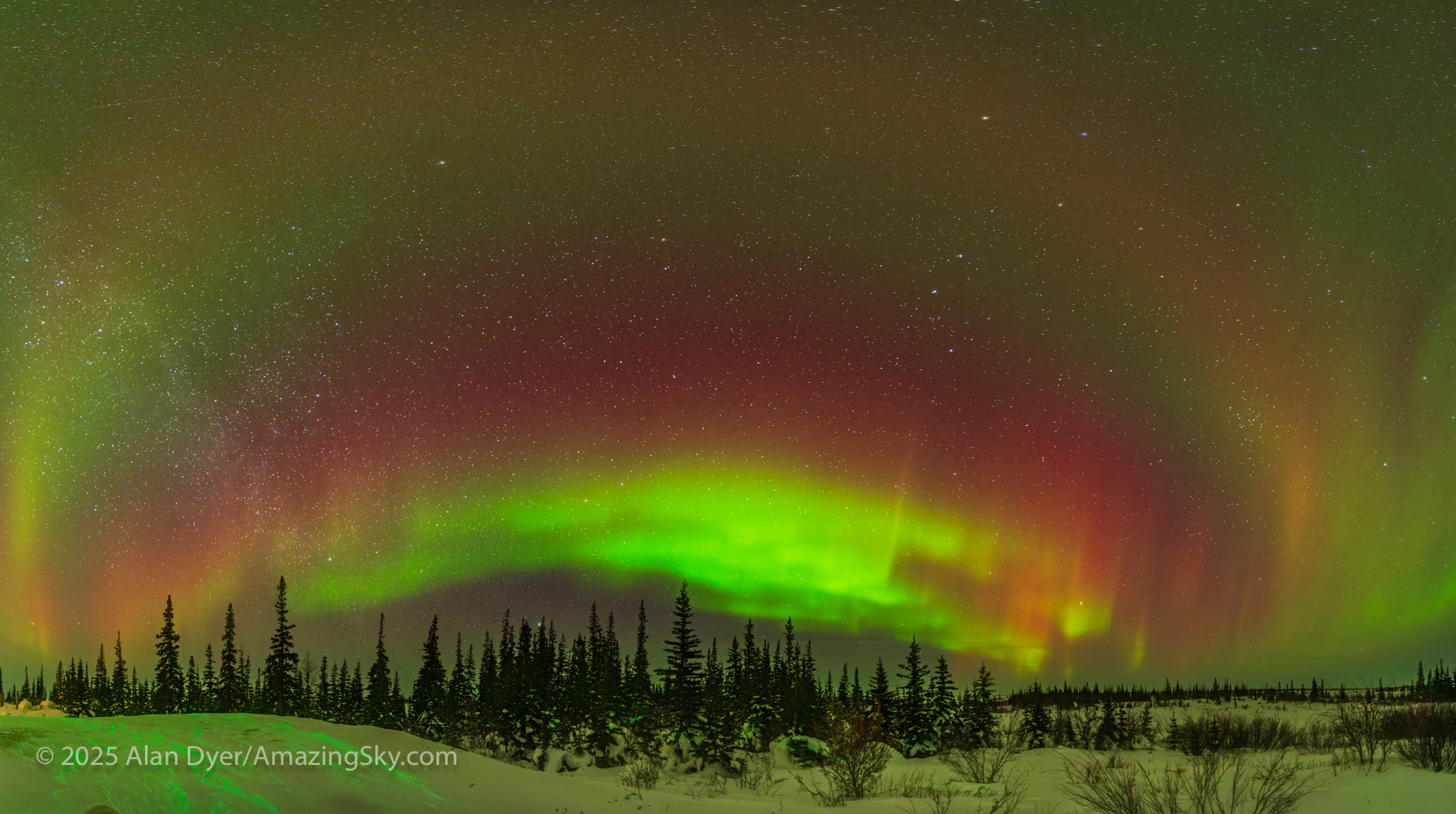
A 180º panorama across the north during an all-night display of Northern Lights, from the Churchill Northern Studies Centre, in Churchill, Manitoba, on February 22, 2025. A panorama of 7 segments, each 13-second exposures with the Viltrox 16mm lens at f/2 on the Nikon Z6III at ISO 1600.

Churchill, Manitoba is on the shore of Hudson Bay at a latitude of 58º North in the sub-Arctic.

It lies under the normal location of the “auroral oval,” the ring around the North Geomagnetic Pole where there is almost always some aurora happening, even on a quiet night. Churchill is as far south as the auroral oval appears in the world when the oval is in its normal state.

By visiting a site under the oval, aurora tourists are almost guaranteed a show, provided the sky is clear.
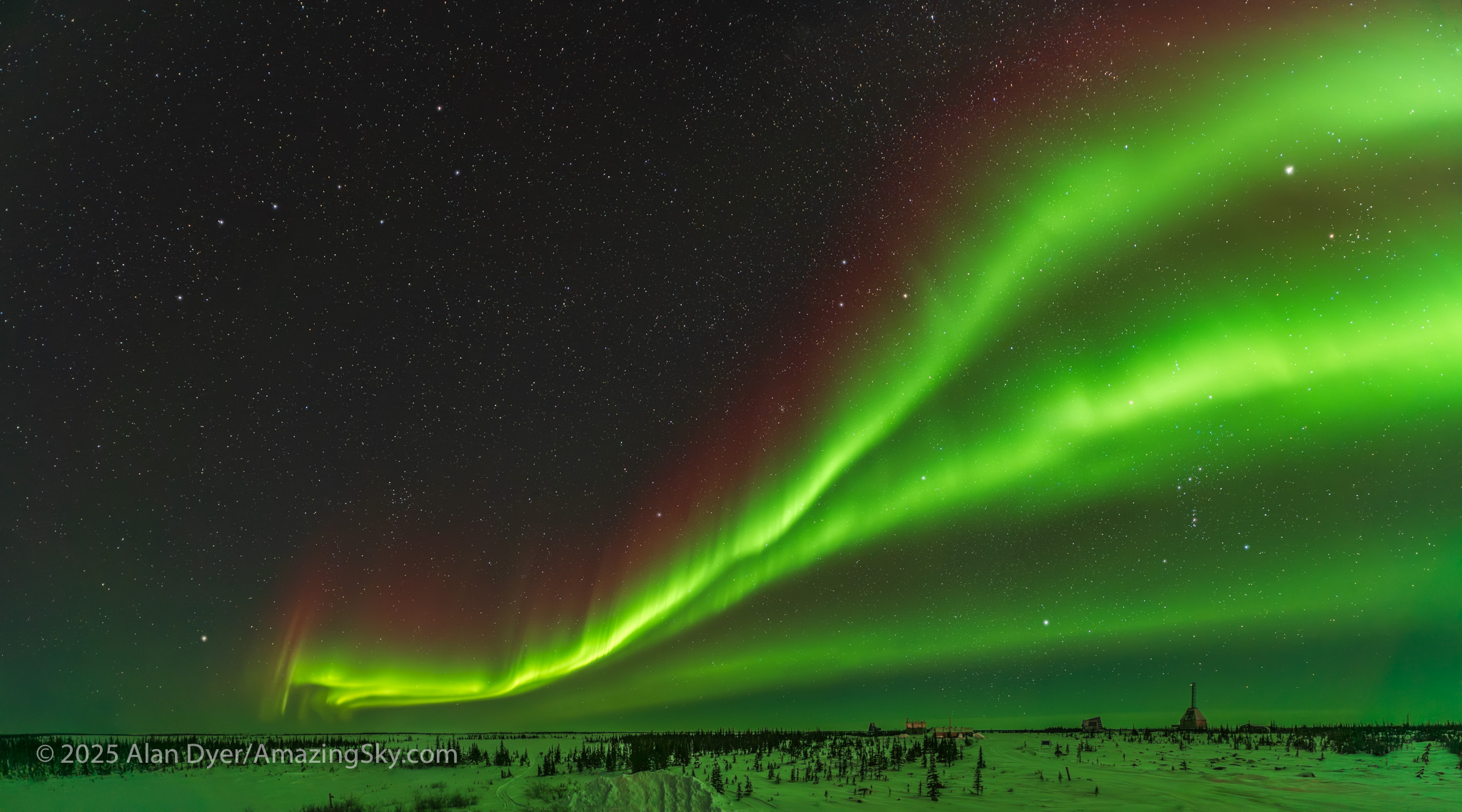
This is a 180º panorama of the Northern Lights across the northern, eastern and southern sky on February 27, 2025 during a Kp4-level display. This is a panorama of 3 segments, each 13-second exposures at f/2.8 with the Laowa 10mm lens on the Nikon Z6III at ISO 1600.

In winter in Churchill, the cold usually brings clear skies. In a decade of conducting programs I’ve only ever had one group clouded out for all five nights of the program. That’s a far better average than locations such as Iceland.
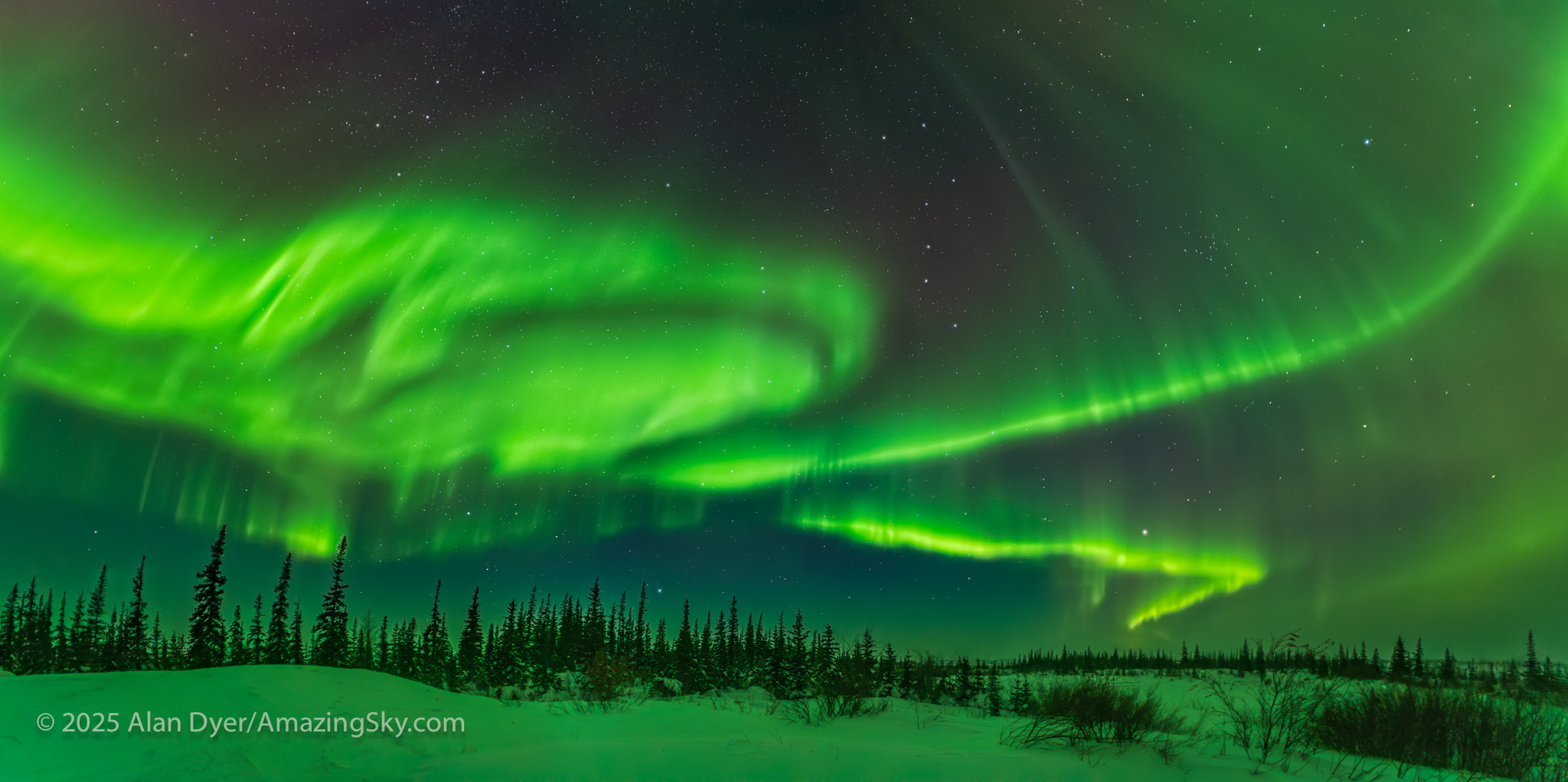
This is a 120º panorama of the Northern Lights across the northern sky on February 26, 2025 during a Kp3-level display. This shows some fine ray structure in the curtains. This is a panorama of 2 segments, each an 8-second exposure at f/2.8 with the Laowa 10mm lens on the Nikon Z6III at ISO 1600.

While several excellent travel companies and local businesses offer aurora tours to Churchill, signing up to one offered by the Northern Studies Centre offers some major advantages.

Notably, guests stay at the Centre, some 20 kilometres outside of Churchill on the site of the old Rocket Range. That makes the site dark and free of light pollution.
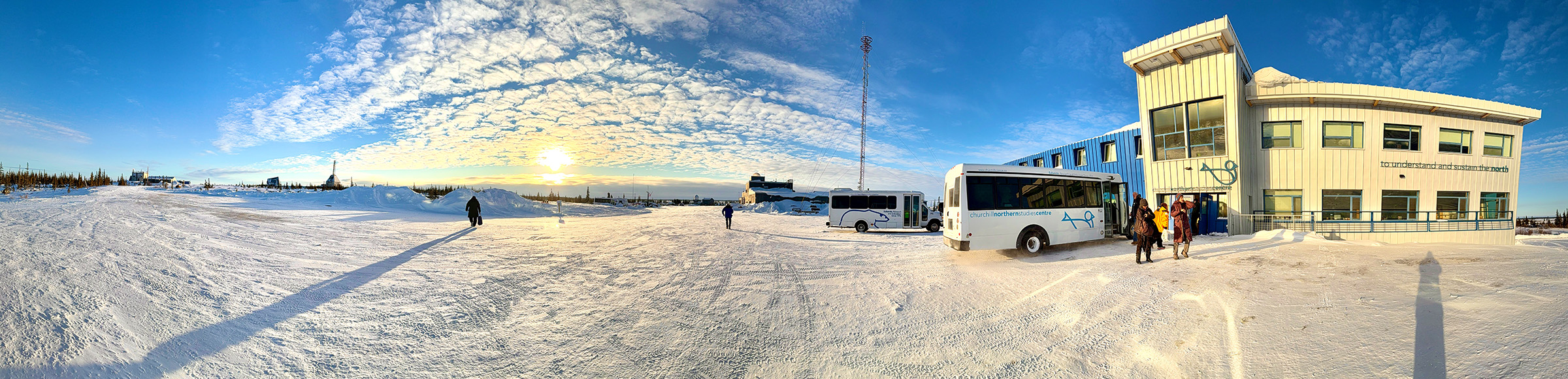
A panorama of the Northern Studies Centre. It has dorm rooms, a cafeteria, classrooms, lounges, a fitness room, library, and all the comforts needed for a great stay under the Lights.

And convenient. Guests sleep on site and need only dress up warm to quickly head outside when the “Lights are out!” call comes. Instructors wake up guests when the Lights don’t appear until late at night, as can often be the case. There’s no driving out to dark sites to wait for the Lights to appear.
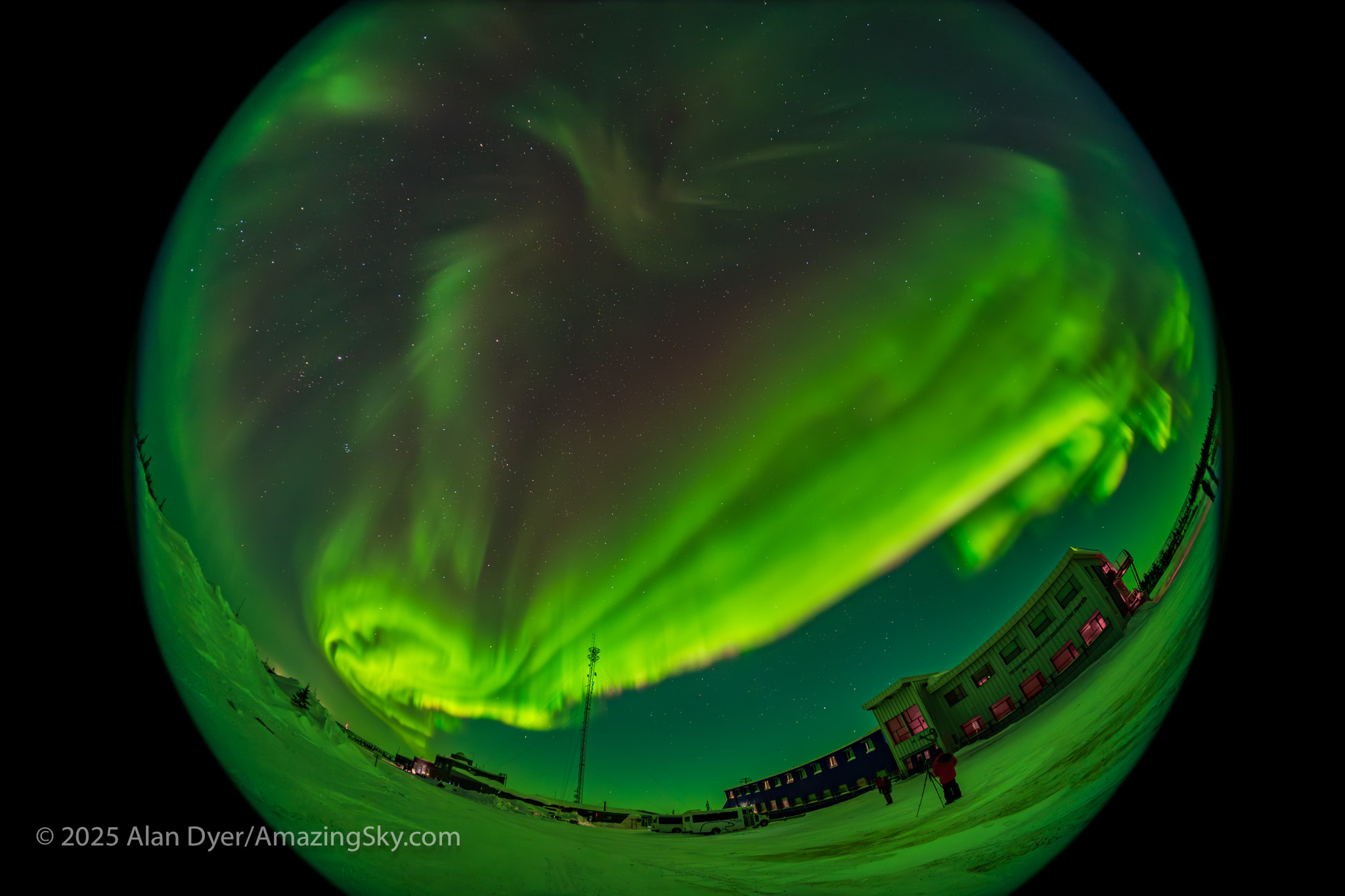
A fish-eye 360° view of the fine display of Northern Lights on February 25, 2025, during a substorm outburst with bright curtains to the north. A single 2.5-second exposure with the TTArtisan 7.5mm fish-eye lens at f/2.

An option is also to head up to the CNSC’s rooftop aurora dome for viewing the Lights in warm shirt-sleeve comfort.
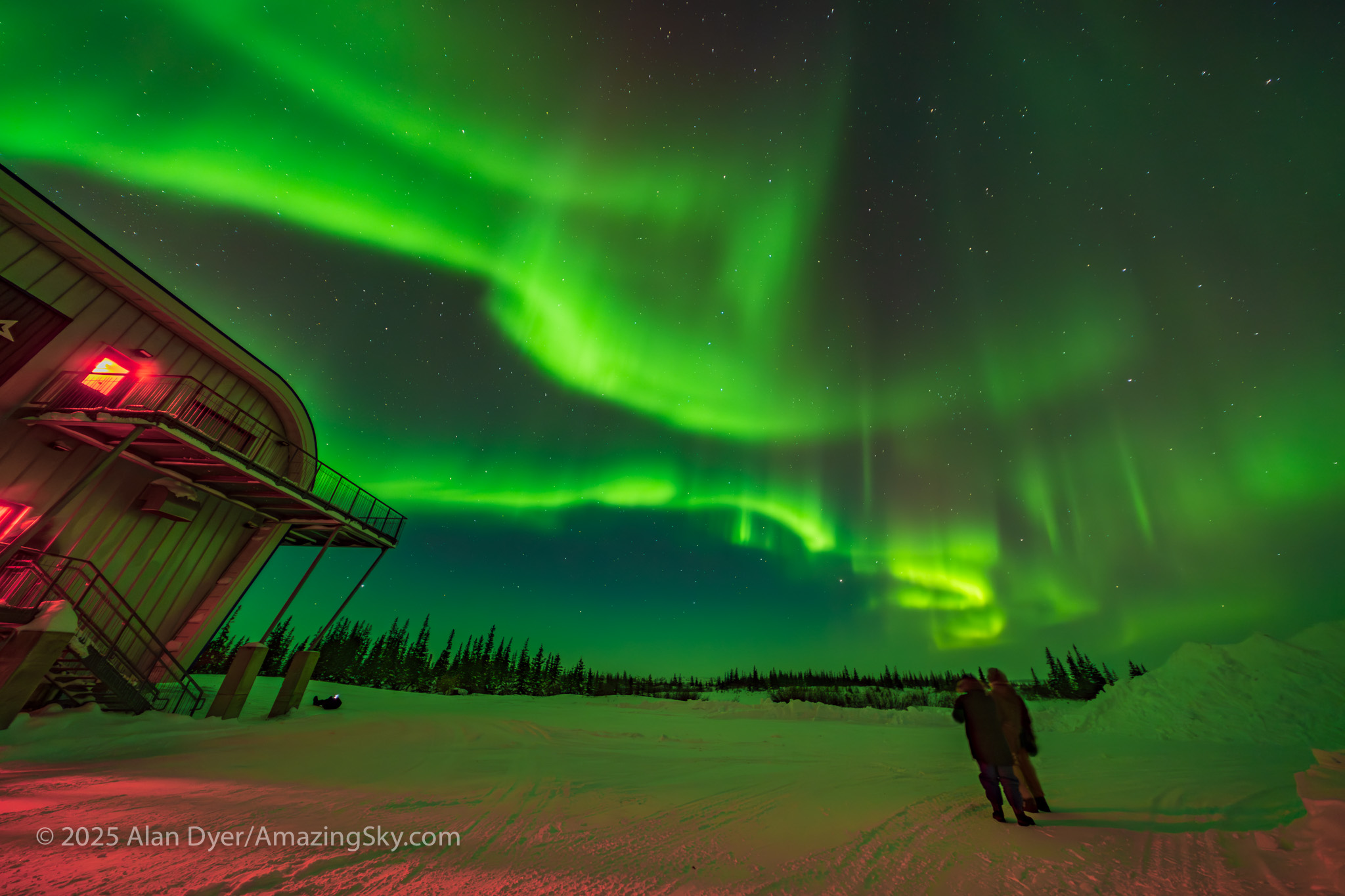
Aurora tourists enjoy the show at the Churchill Northern Studies Centre, February 26, 2025. This was the Learning Vacations tour group in late February 2025. This is a single 8-second exposure with the Laowa 10mm lens at f/2.8 and Nikon Z6III at ISO 1600.

But most guests opt to bundle up and brave the cold for the best experience and unobstructed views of the Lights filling the sky. A convenient option is the second floor observation deck, shown above, and in an image taken from the deck, below.
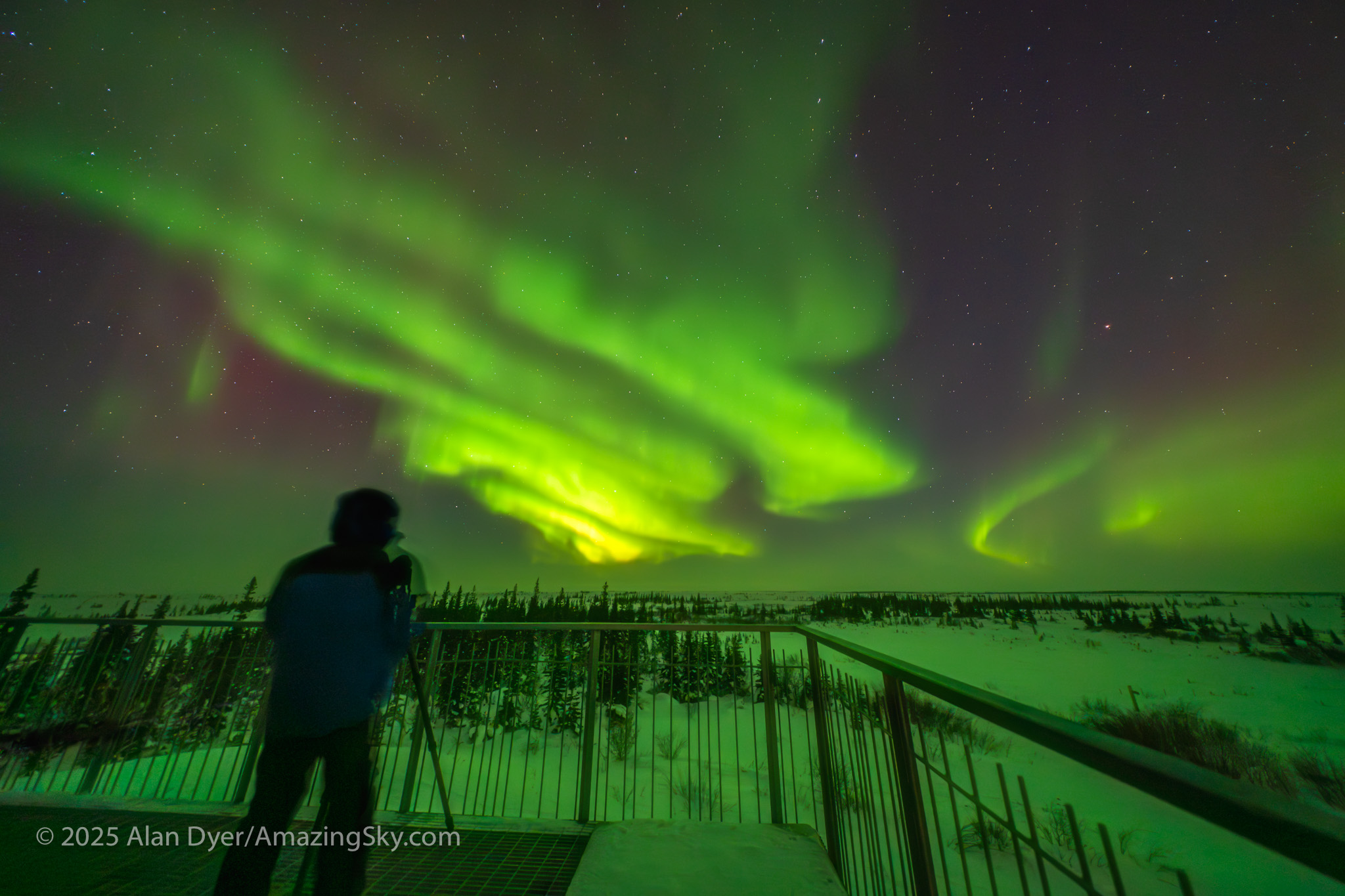
A photographer is capturing a bright display of Northern Lights at the Churchill Northern Studies Centre. This was the first night of a five-night session for aurora tourists from the Road Scholar education travel company. This is a single 4-second exposure with the Laowa 10mm lens at f/2.8 and Nikon Z6III at ISO 3200.

The program includes nightly science talks about the aurora and night sky. The daytime program includes dogsledding, snowshoeing, a tour of the old Rocket Range, and visits to sites in Churchill such as the murals and museums. It’s a very full five days of programming and learning.

To learn more, visit the CNSC’s Learning Vacations page for the Winter Skies program.
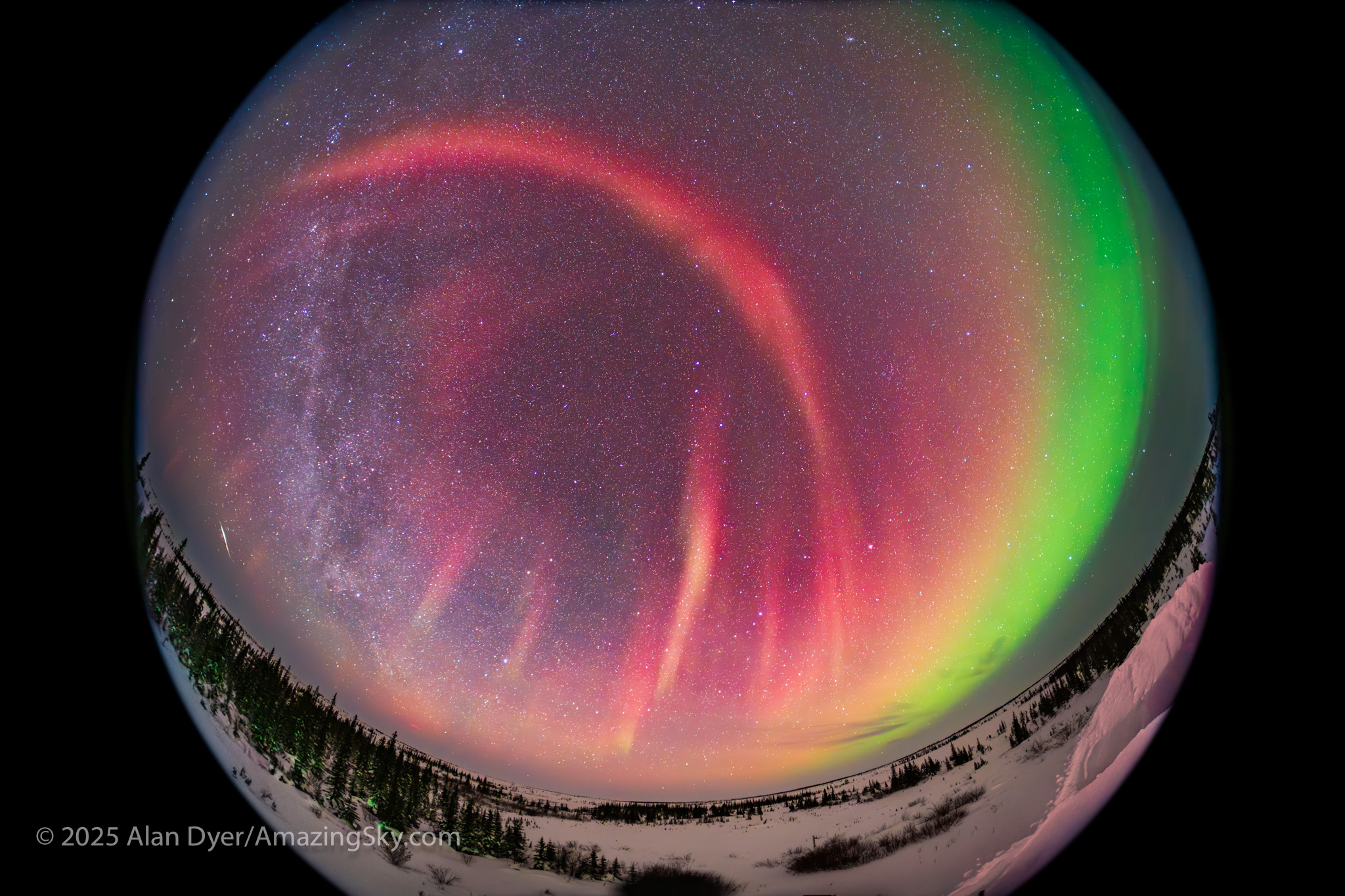
A fish-eye 360° view of a dim and weak display of Northern Lights on February 24, 2025, showing a green diffuse band to the south and a dim red curtain overhead with rays to the east. This red aurora was just visible to the eye as a grey streak. A single long 30-second exposure with the TTArtisan 7.5mm fish-eye lens wide open at f/2 on the Nikon Z6III at ISO 1600.

The main attraction, the aurora, can vary from night to night. However, even when the aurora is weak, as it was this night, above, it can still put on a fine show for the camera, glowing in red colours that only long exposures reveal.
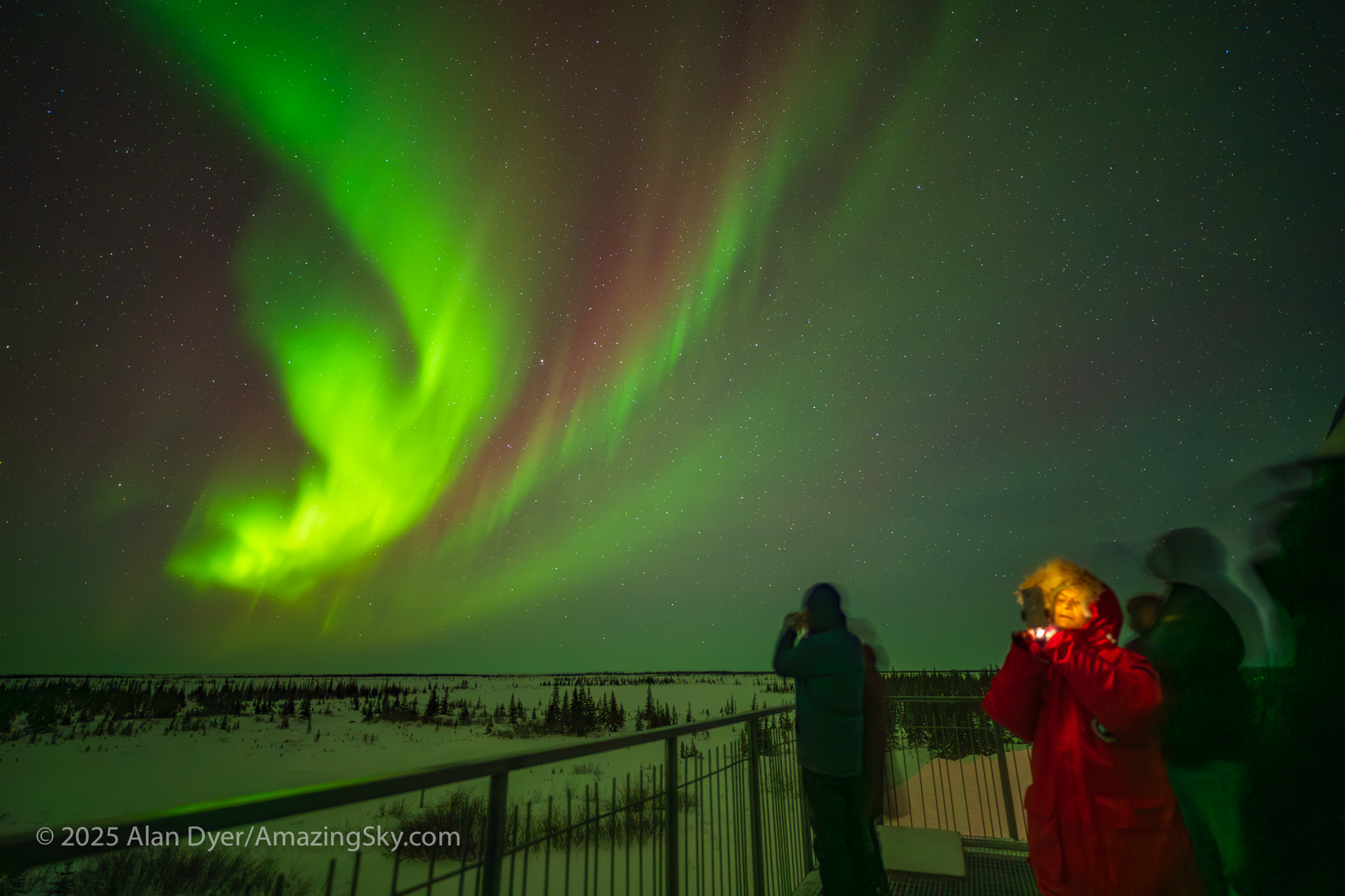
Aurora tourists from the Road Scholar travel company enjoy the show of Northern Lights at the Churchill Northern Studies centre in Churchill, Manitoba, March 1, 2025. This is a 6-second exposure at f/1.8 with the Viltrox 16mm lens on the Nikon Z6III at ISO 1600.

While I use high-end cameras and fast lenses, I’ve been impressed with how well today’s phone cameras can capture the Lights very simply and easily, as a guest is doing above, especially when the aurora is bright.
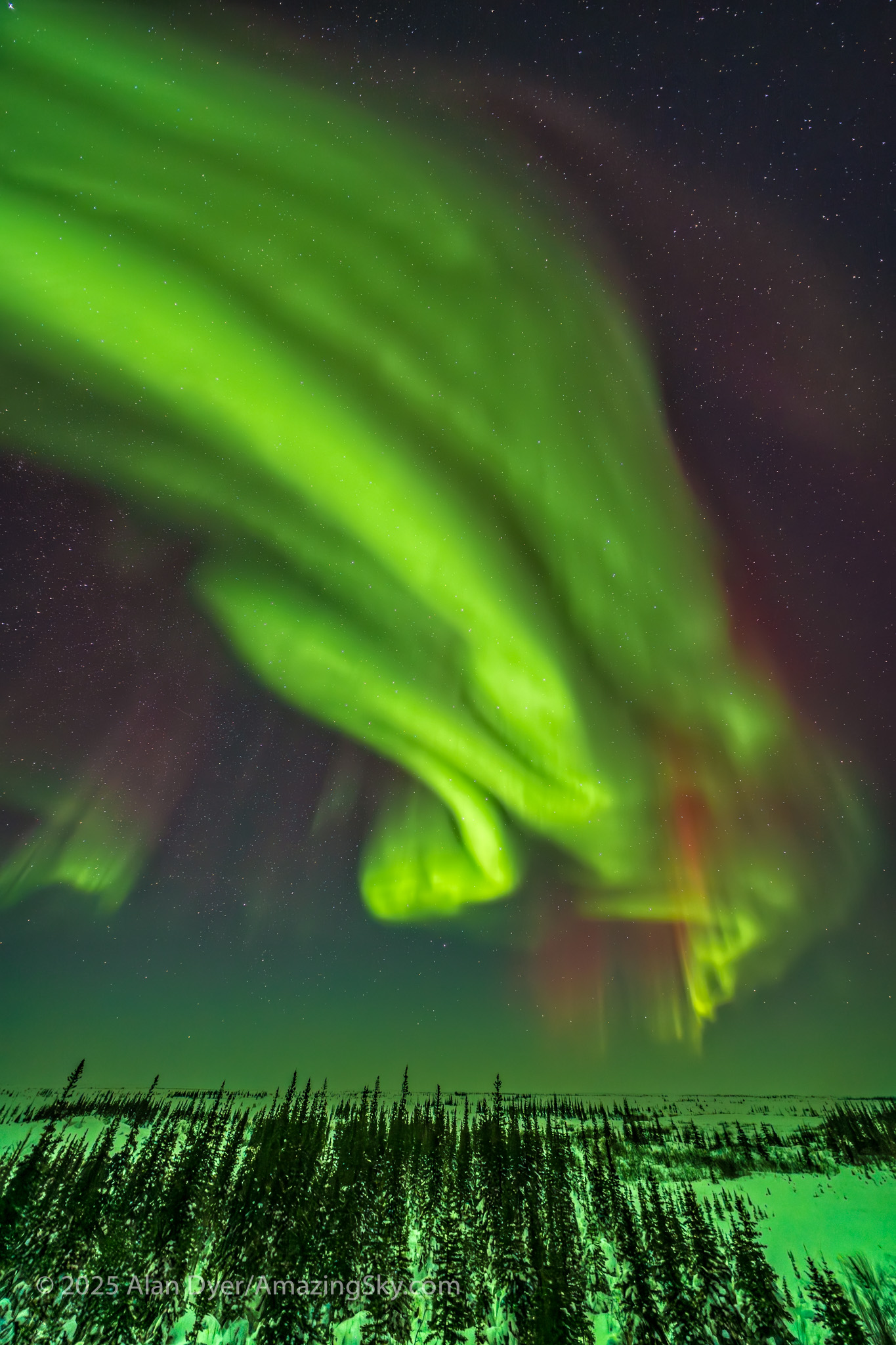
A band of bright green aurora appears here with some subtle red rays at right and magenta upper curtains at left, with the green glow lighting the snow green. A 10-second exposure with the Laowa 10mm lens at f/2.8 on the Nikon Z6III at ISO 1600.

When the aurora brightens, greens and sometimes pinks are visible to the eye, and not just to the camera. And the aurora exhibits rapid rippling and waving motions (check the video below).
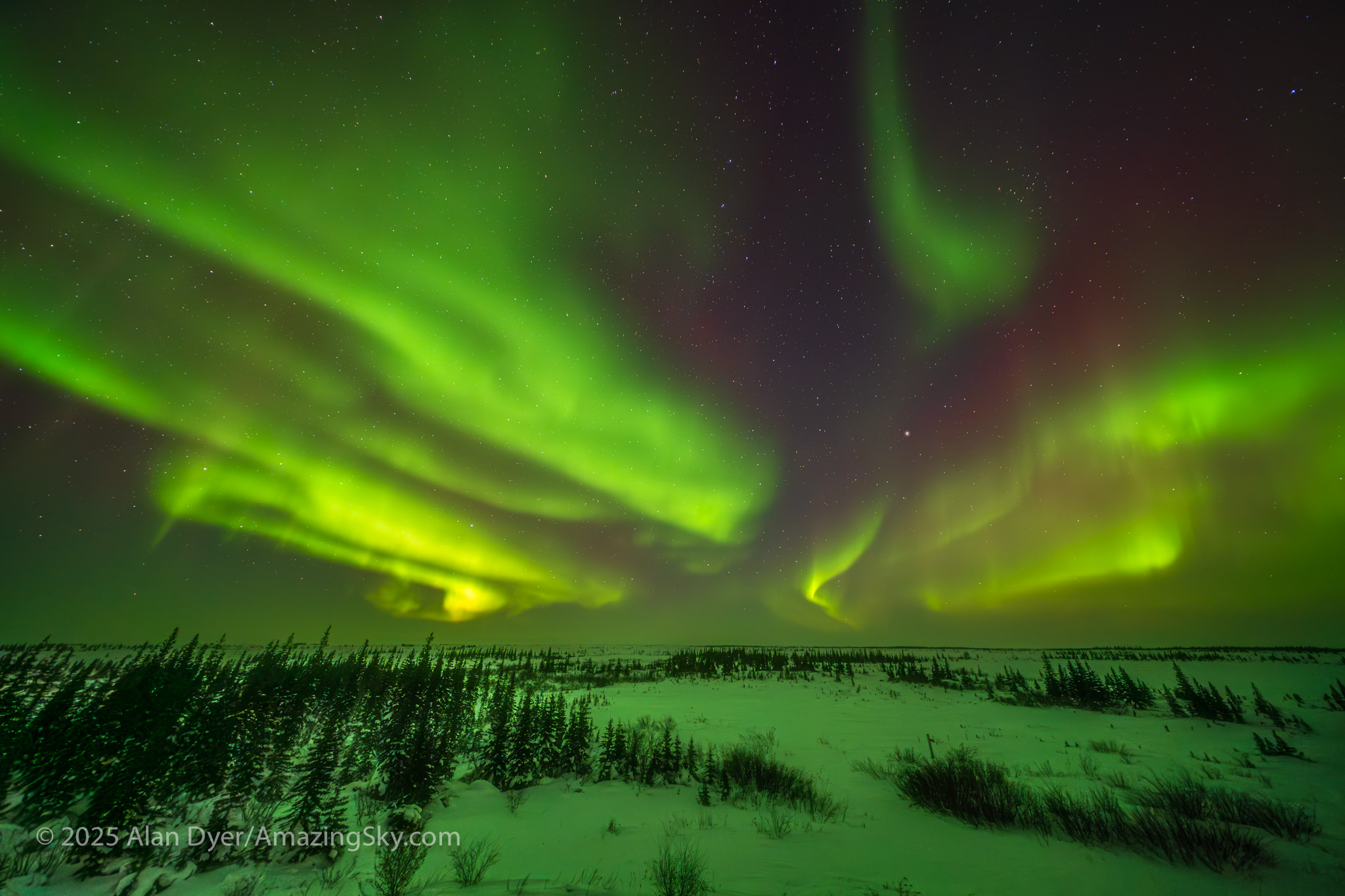
A bright display of colourful curtains of Northern Lights at the Churchill Northern Studies Centre. This is looking northeast toward the direction of the midnight sector where the auroras usually brighten from. This is a single 8-second exposure with the Laowa 10mm lens at f/2.8 and Nikon Z6III at ISO 1600.

The finest sight is when the aurora curtains converge overhead at the zenith for a “coronal outburst.” The effect can be fleeting but the sight is unforgettable. It is one of the finest sights the sky can offer, ranking with a total eclipse of the Sun.
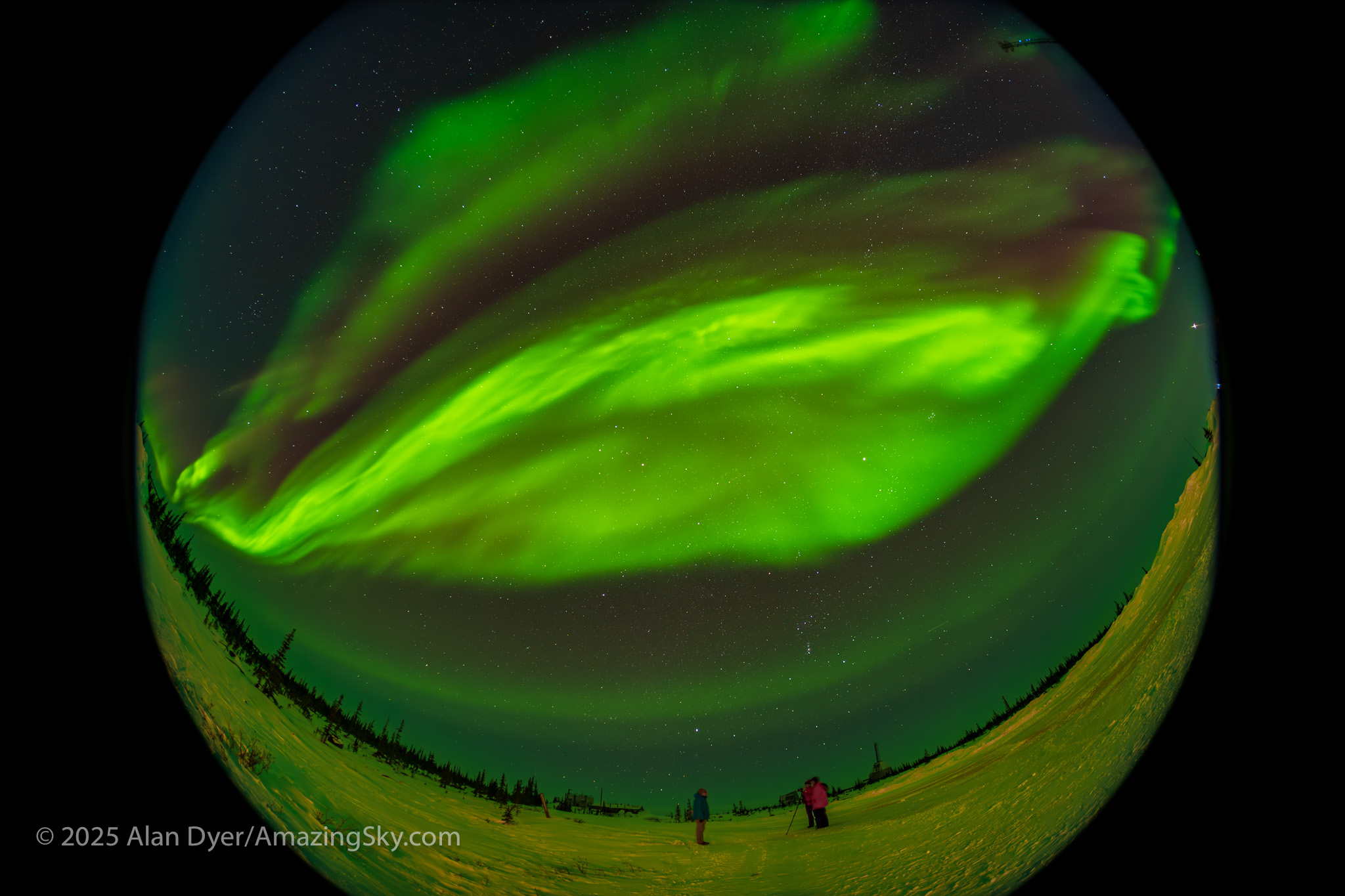
A fish-eye 360° view of the fine display of Northern Lights on February 25, 2025, with a complex of curtains passing overhead and across the sky from northeast (at lower left) to southwest (at upper right), with Venus setting at far right. Orion and Sirius are at bottom centre to the south. A single 10-second exposure with the TTArtisan 7.5mm fish-eye lens at f/2 on the Nikon Z6III at ISO 1600.

Indeed, on most nights the aurora, which might begin as a low arc across the north, moves south to fill the sky with swirling and curling curtains, as below.
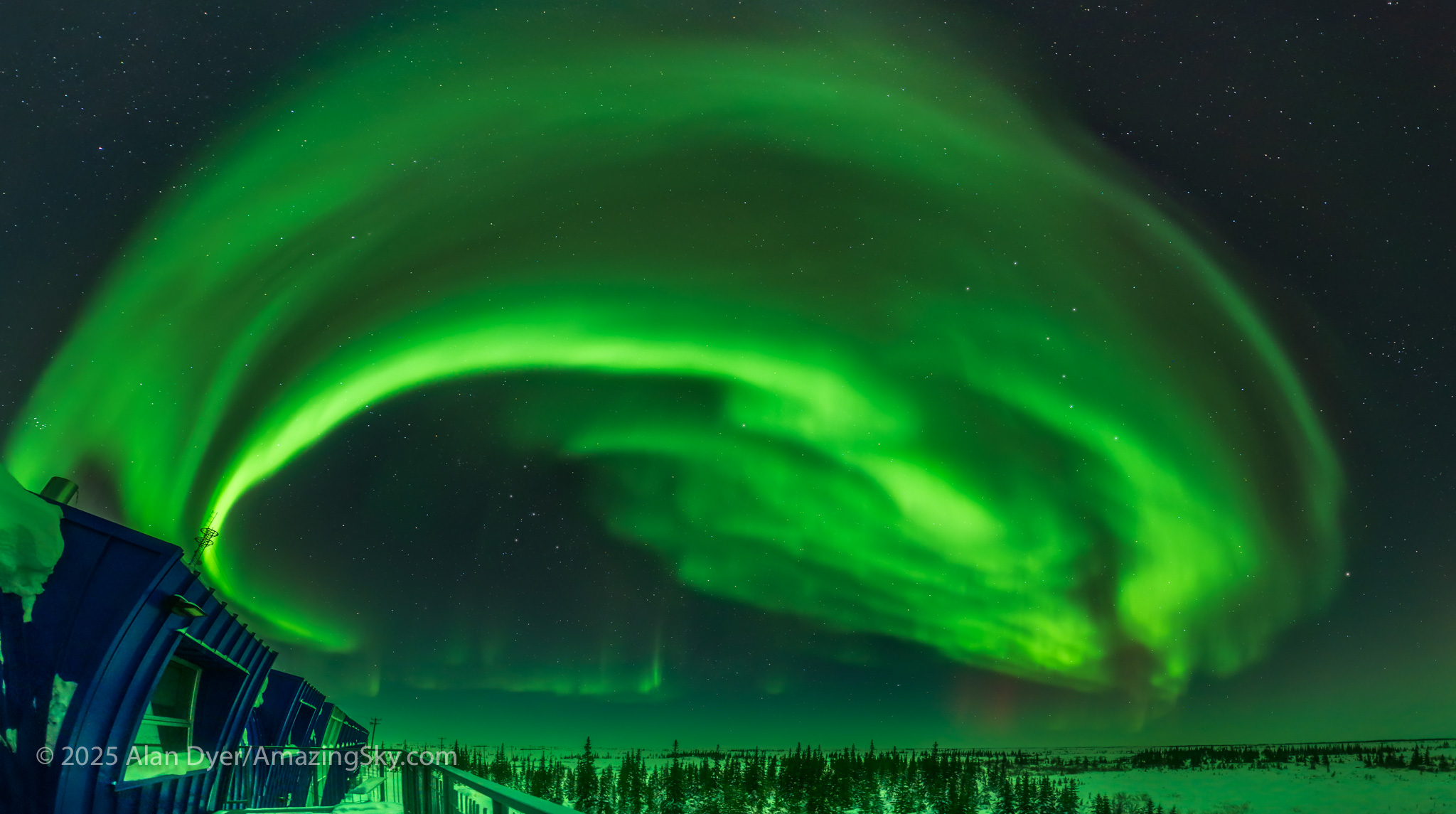
This is a 180º panorama of the Northern Lights across the northern sky on February 27, 2025 during a Kp4-level display. The field extends from the horizon up to well past the zenith. This is a panorama of 6 segments, each an 8-second exposure at f/2.8 with the Laowa 10mm lens on the Nikon Z6III at ISO 1600.

A gallery of my images from Churchill from this year and from past years is on my main AmazingSky.com website here.

A musical collage of still images and real-time videos I shot this year is viewable here on YouTube.

Click through to YouTube for more information about the video.

It’s been a great ten years taking in the wonderful Northern Lights in Churchill. While this was my last year, I encourage you to visit to see the sights for yourself.

Everyone goes away with great memories, able to check the aurora off their bucket list of experiences.

— Alan, March 10, 2025 / AmazingSky.com
The Northern Lights … As They Appeared


Aurora As It Appeared Title

My 10-minute video captures the Northern Lights in real-time video – no time-lapses here!

I hadn’t tried this before but the display of February 12, 2016 from Churchill, Manitoba was so active it was worth trying to shoot it with actual video, not time-lapse still frames.

I used very high ISO speeds resulting in very noisy frames. But I think the motion and colours of the curtains as they ripple and swirl more than overpower the technical limitations. And there’s live commentary!


Select HD and Enter Full Screen for the best quality.

Scenes have been edited for length, and I did not use all the scenes I shot in the final edit. So the scenes you see in the 10-minute video actually took place over about 20 minutes. But each scene is real-time. They show the incredibly rapid motion and fine structure in the auroral curtains, detail blurred in long multi-second exposures.

I used a Nikon D750 camera at ISO speeds from 12,800 to 51,200. While it is certainly very capable of shooting low-light video, the D750 is not optimized for it. A Sony a7s, with its larger pixels and lower noise, would have been a better camera. Next time!

The lens, however, was key. I used the new Sigma 20mm Art lens which, at f/1.4, is the fastest lens in its focal length class. And optical quality, even wide open, is superb.

The temperature was about -30 degrees C, with a windchill factor of about -45 C. It was cold! But no one in the aurora tour group of 22 people I was instructing was complaining. Everyone was outside, bundled up, and enjoying the show.

It was what they had traveled north to see, to fulfill a life-long desire to stand under the Northern Lights. Everyone could well and truly check seeing the aurora off their personal bucket lists this night.

For more information about aurora and other northern eco-tourism tours offered by the Churchill Northern Studies Centre, see churchillscience.ca 

— Alan, February 17, 2016 / www.amazingsky.com 

Dance of the Northern Lights


My new 3-minute music video compiles still and time-lapse imagery of the aurora I shot in February 2015 from Churchill, Manitoba.

Churchill’s location at 58° North on the shore of Hudson Bay puts it directly under the main auroral oval, the zone of greatest auroral activity. Over the 9 nights, 2 were cloudy, with a roaring blizzard.

But on the 8 clear nights we saw aurora every night. I shot time-lapses on 6 of those nights, shooting about 3,500 frames, most of which appear in the final cut of this movie.

Despite the amazing displays we saw, on no night was the auroral activity index (on a scale of 0 to 9) higher than 2 or 3. These were all “normal” quiet nights for auroras in Churchill. Anyone farther south would have seen little in their sky on most of these nights.

I shot many of the time-lapses with an 8mm spherical fish-eye lens, to create sequences suitable for projection in digital planetarium domes. One other time-lapse sequence (the last in this movie) I shot with a 15mm full-frame fish-eye. Even it is not wide enough to take in the entire display when the Lights fill the sky.

Exposures were typically 10 to 15 seconds at f/3.5 and ISO 1600 to 4000, all with the Canon 6D. I powered it from its lone internal battery. Amazingly, despite temperatures that were considered extreme even for Churchill (often -32° C at night) the batteries lasted 90 to 150 minutes allowing me to take lots of frames with no battery change or perhaps just one battery change. Churchill is very dry and only on one night did I have an issue with the lens frosting up.

Music is by Dan Phillipson, his composition “Into the Unknown,” purchased for royalty-free use through Triple Scoop Music. I edited the movie in Apple Aperture, with a title sequence created in Photoshop. Processing of the original images was with Adobe Camera Raw, Photoshop, and LRTimelapse, with assembly of movie frames done with Sequence for MacOS.

I hope you enjoy it! Do click on the Enlarge button to watch it full screen. It may take a while to start playing.

— Alan, March 6, 2015 / © 2015 Alan Dyer / www.amazingsky.com