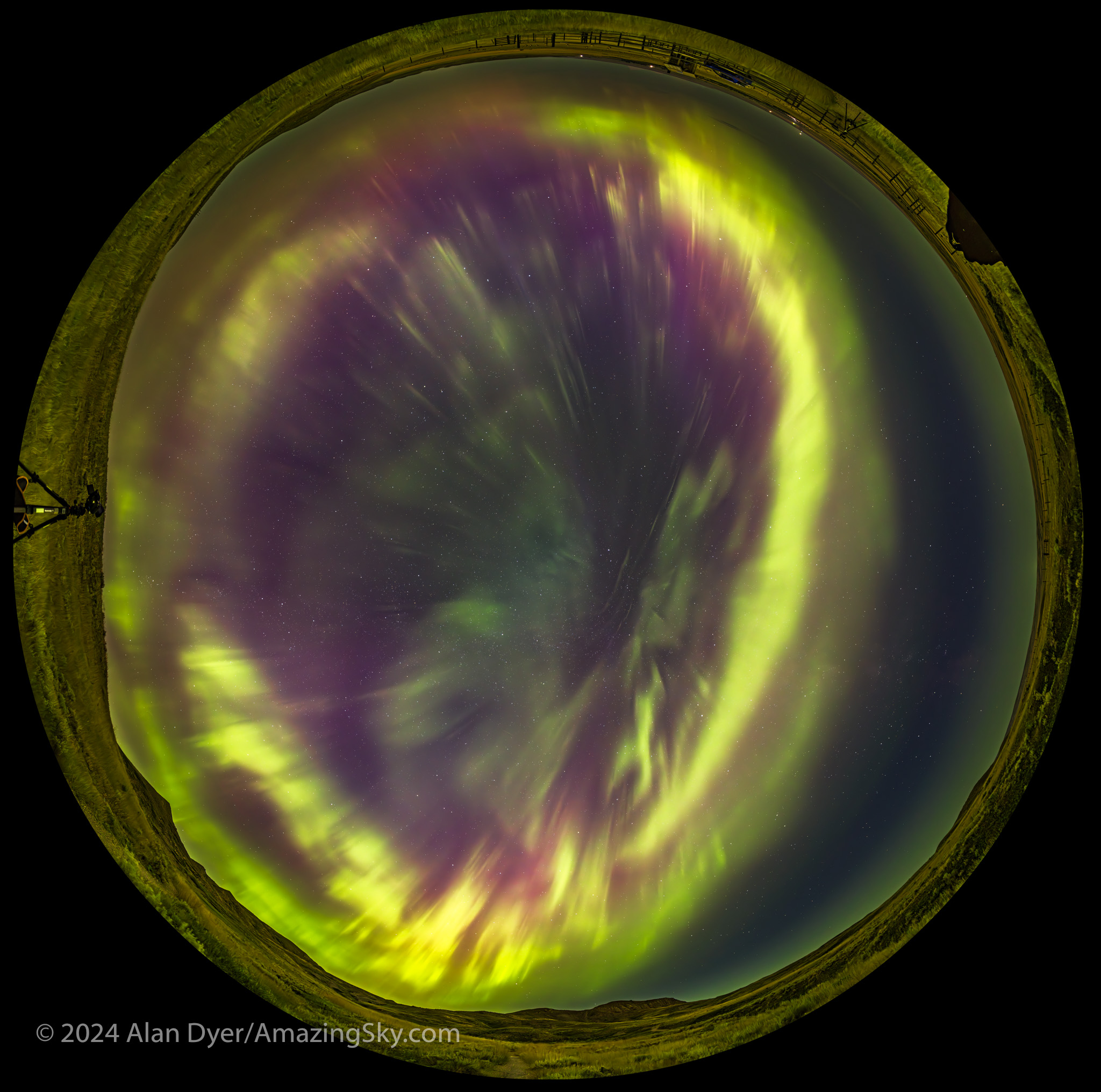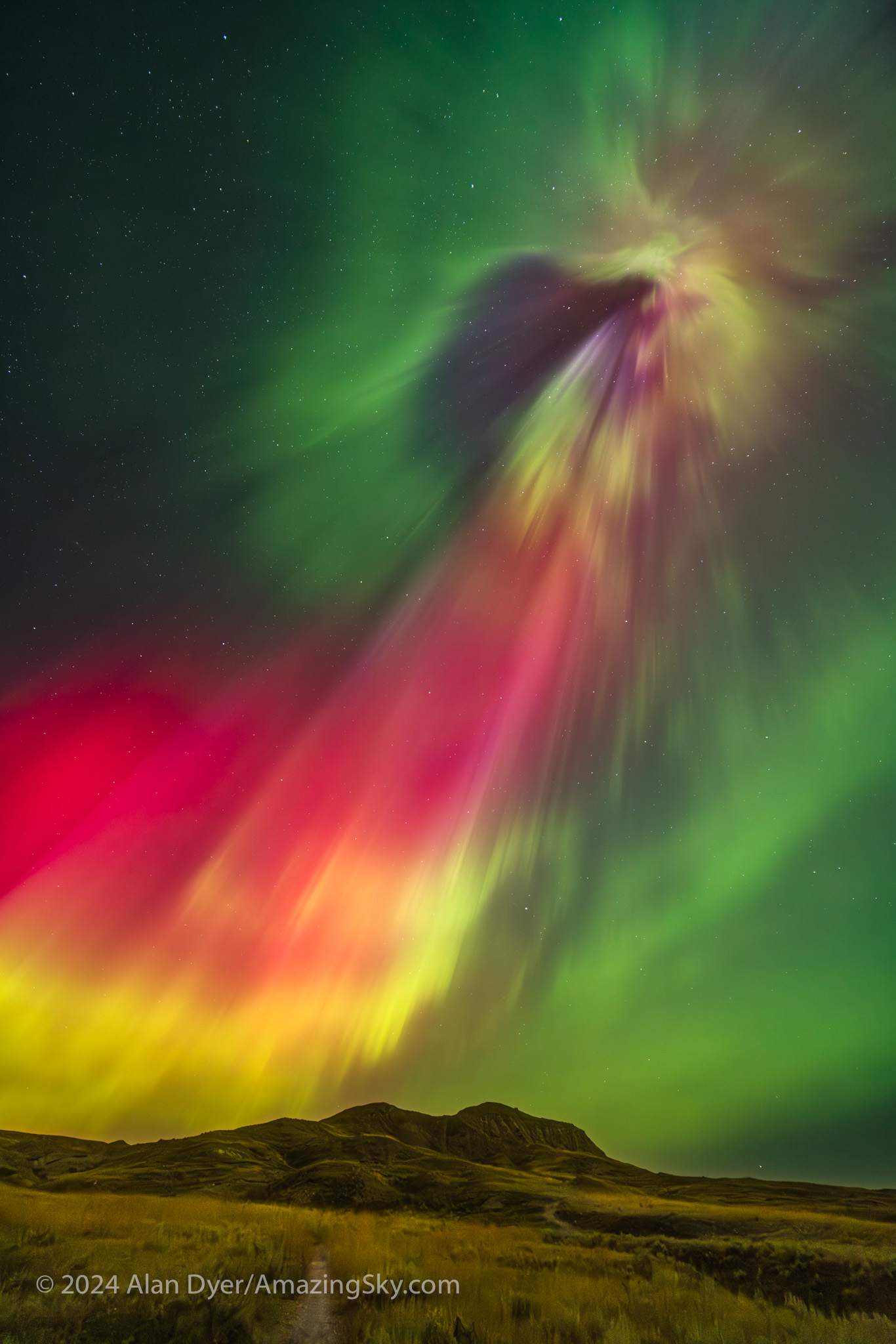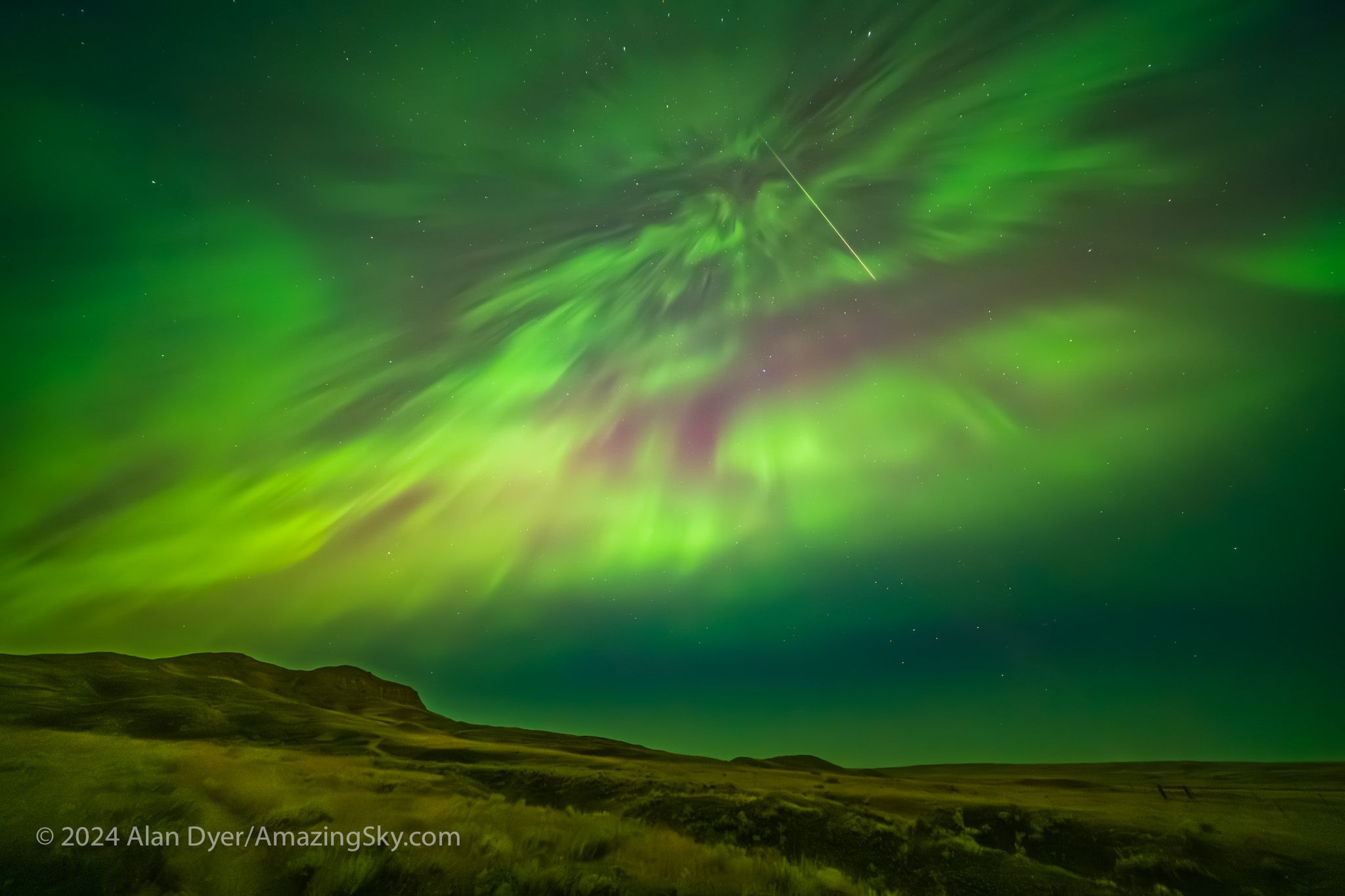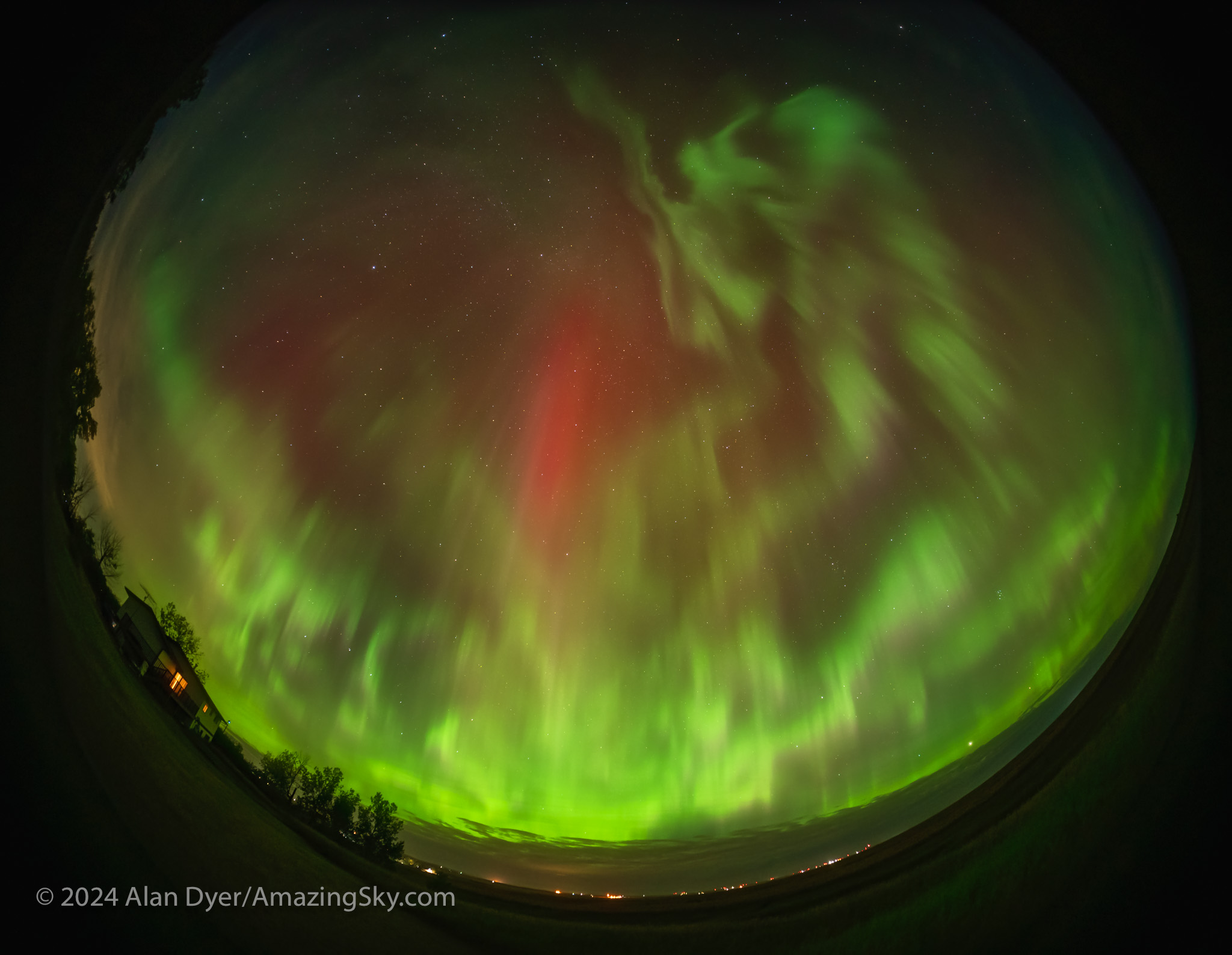
2024 โ€” The Greatest Year of Stargazing ?


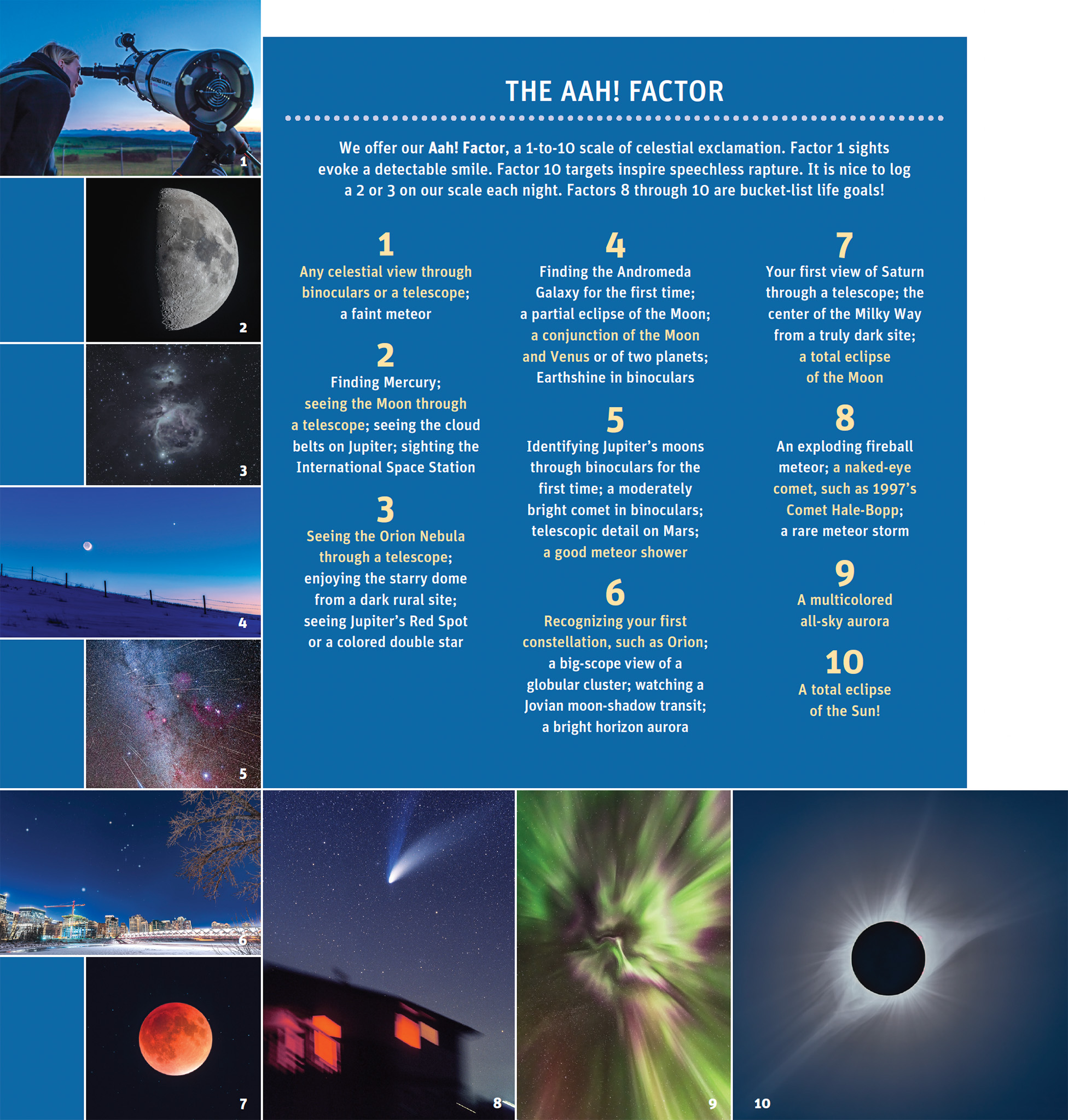
In our book The Backyard Astronomerโ€™s Guide (which we revised this year), Terence Dickinson and I created an Aah! Factor scale with various celestial sights ranked from: 

โ€ข   1, evoking just a smile, to โ€ฆ

โ€ข 10, a life-changing event! 

Our book’s Aah! Factor Scale in Chapter 1

Coming in at an 8 is a naked-eye comet. Deserving a 9 is an all-sky display of an aurora. The only sight to rate a top 10 is a total eclipse of the Sun. 

2024 brought all three, and more! 

Hereโ€™s my look back at what I think was one of the greatest years of stargazing. 


A Winter Moonrise to Begin the Year 

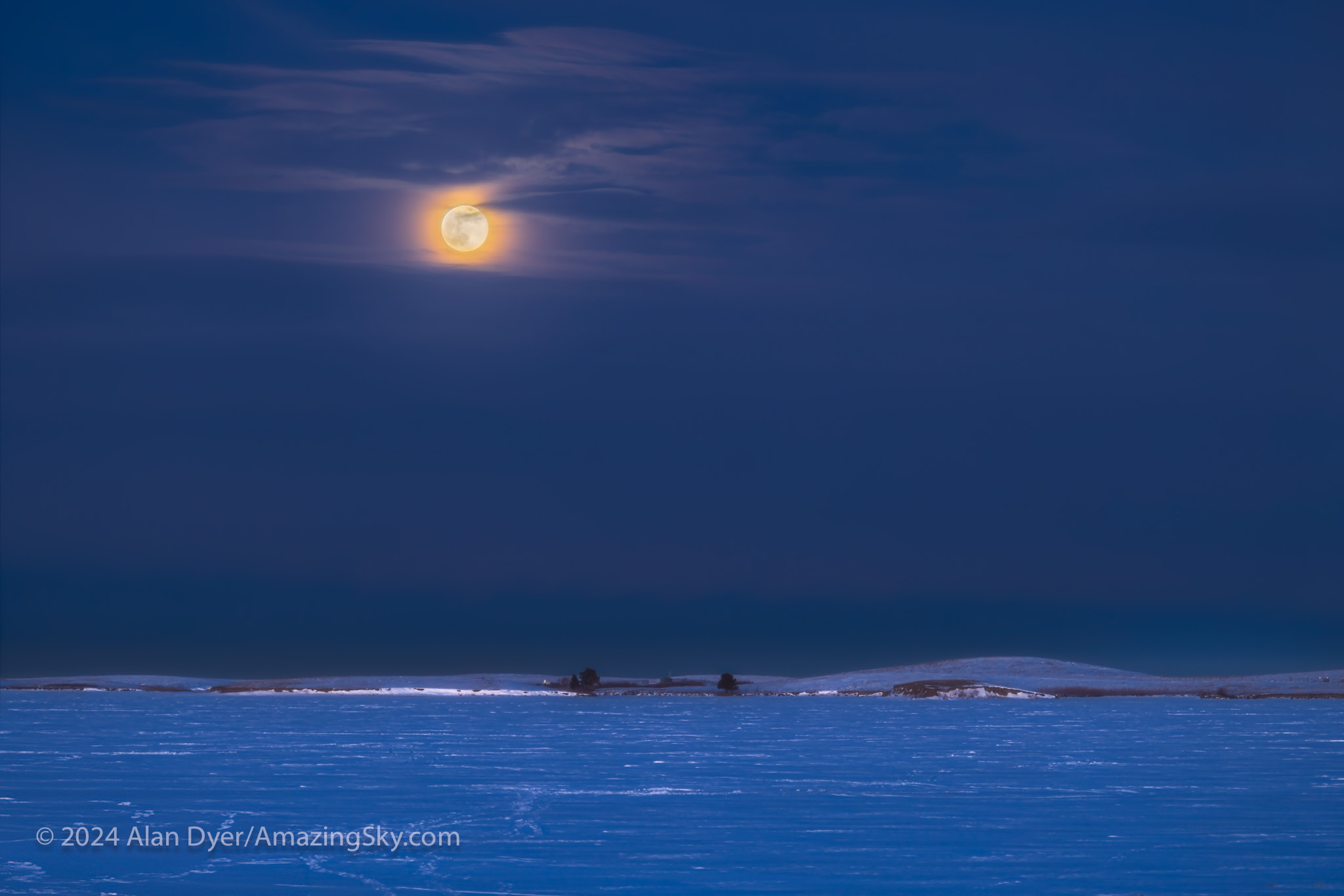
The rising of the winter “Wolf” Moon, the Full Moon of January, over the frozen Crawling Lake Reservoir, in southern Alberta.

Now, this was not any form of rare event. But seeing and shooting any sky sight in the middle of a Canadian winter is an accomplishment. This is the rising of the Full Moon of January, popularly called the Wolf Moon, over a frozen lake near home in Alberta, Canada ๐Ÿ‡จ๐Ÿ‡ฆ. 

It serves to bookend the collection with a Full Moon I captured eleven months later in December. 


Auroras from Churchill, Manitoba 

Had this been my only chance to see the Northern Lights fill the sky this year, I would have been happy. As we often see in Churchill, the aurora covered the sky on several nights, a common sight when you are underneath the main band of aurora borealis that arcs across the northern part of the globe. 
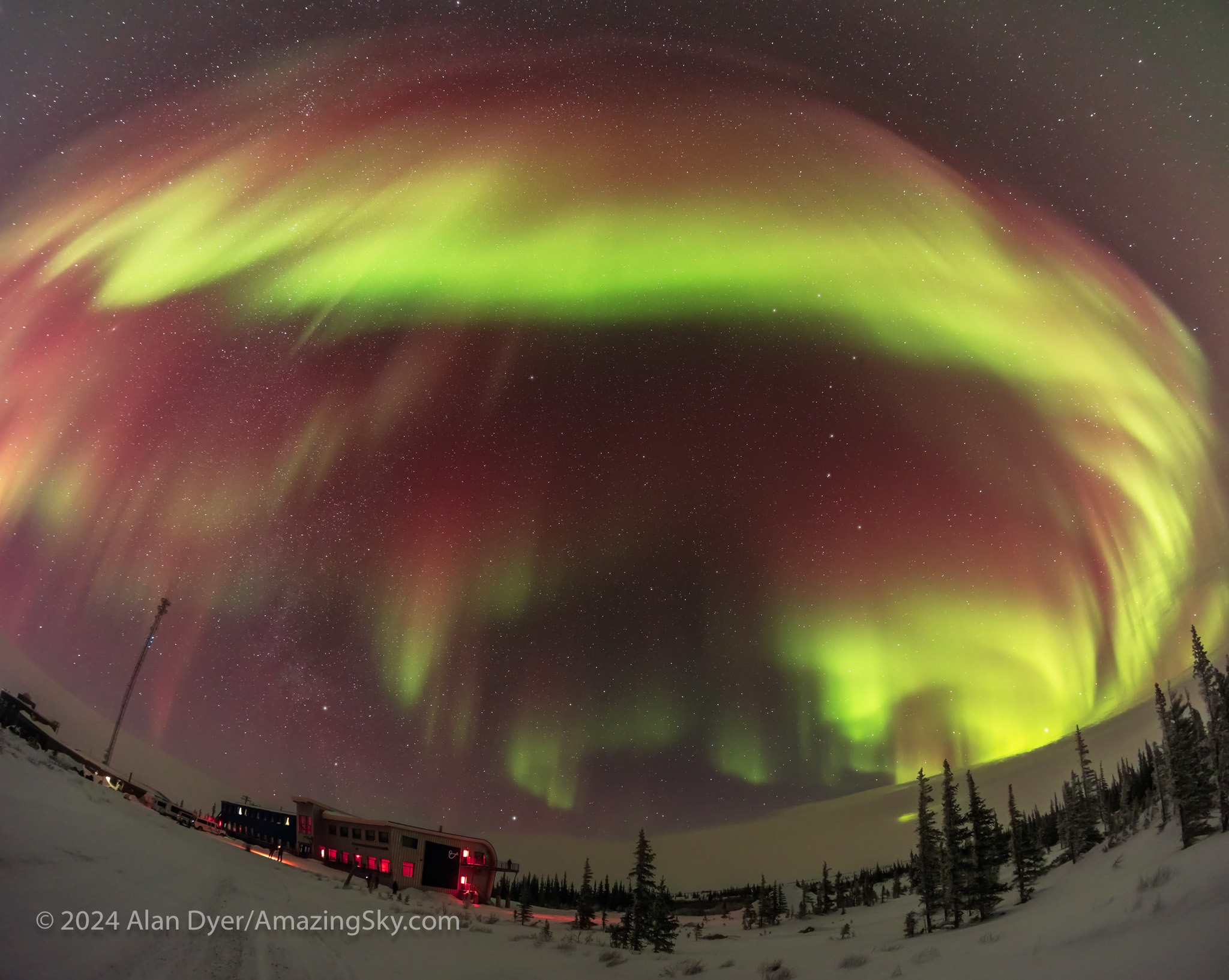
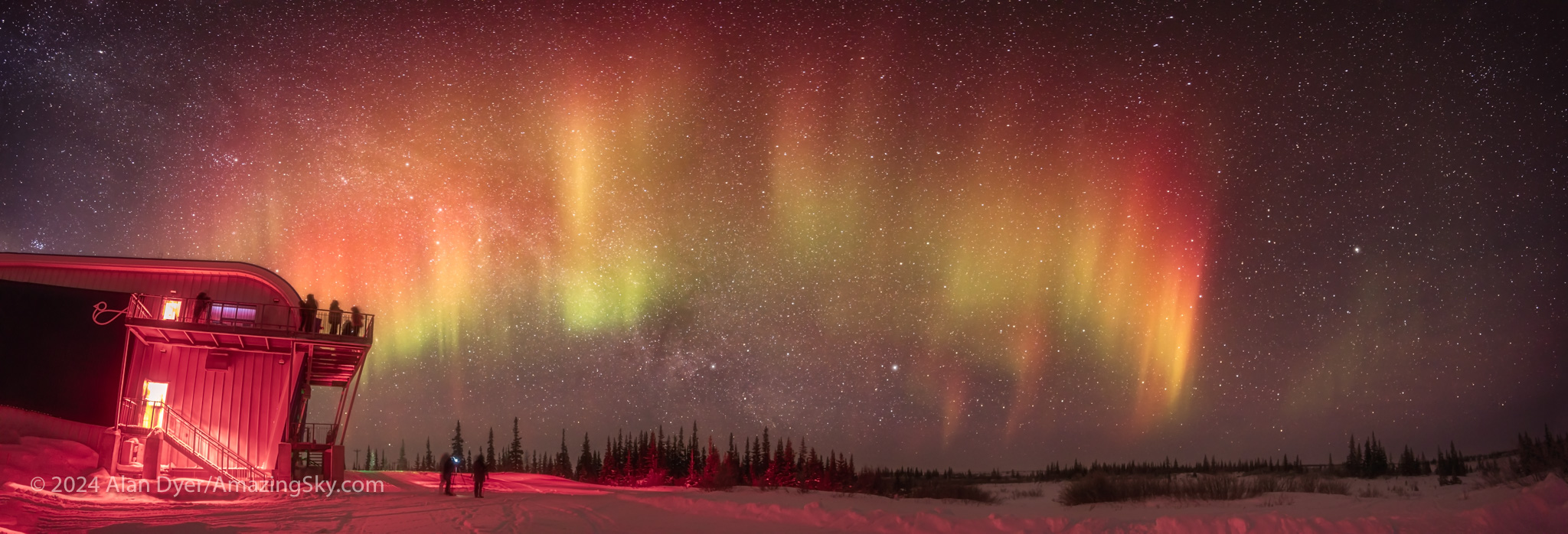
This is a vertical panorama of the sky-filling aurora of February 10, 2024, as seen from the Churchill Northern Studies Centre, in Churchill, Manitoba.

I attended to two aurora tour groups at the Churchill Northern Studies Centre who both got good displays to check โ€œseeing the Northern Lightsโ€ off their bucket list. Join me in 2025!


Under the Austral Sky

Ranking a respectable 7 on our Aah! Factor scale is the naked-eye sight of the galactic centre overhead, with the Milky Way arcing across the sky. Thatโ€™s possible from a latitude of about 30ยฐ South. Thatโ€™s where I went in March, back to Australia ๐Ÿ‡ฆ๐Ÿ‡บ for the first time since 2017. 

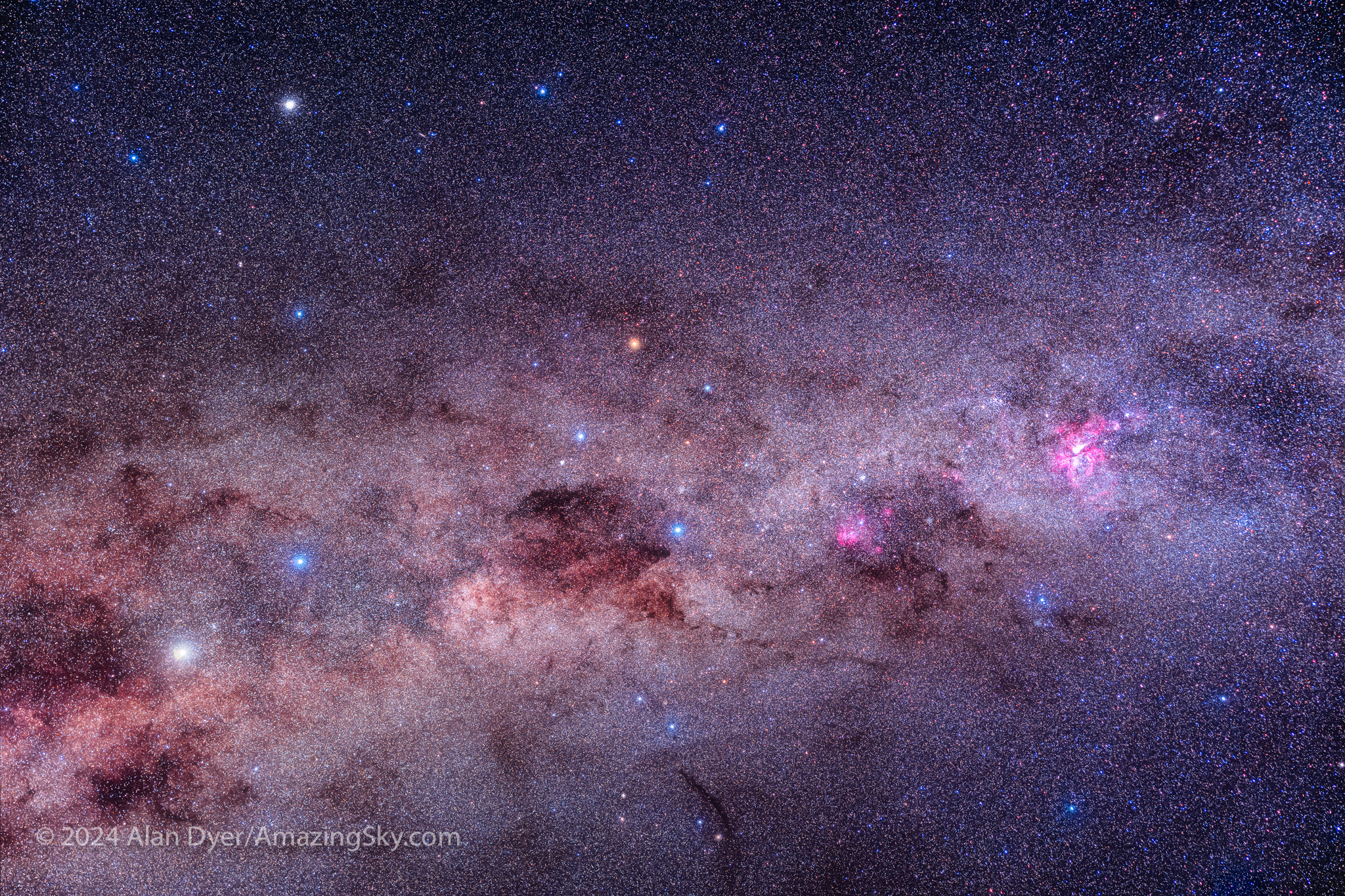
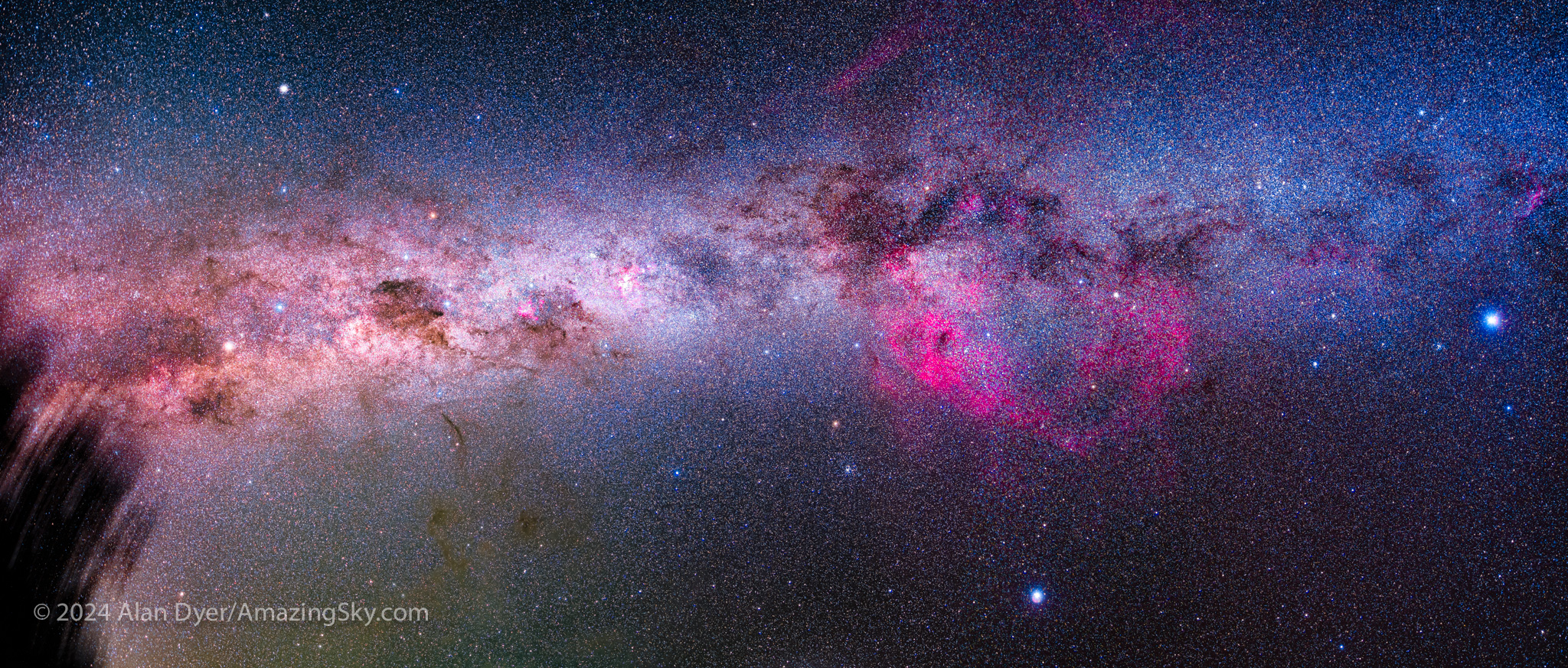
This is a framing of the most spectacular area of the southern Milky Way, from Centaurus at left, to Carina at right, with Crux, the Southern Cross, at centre.

I wrote about it in my previous blog, where I present a tour along the southern Milky Way, and wide-angle views of the Milky Way (the images here are framings of choice regions). 
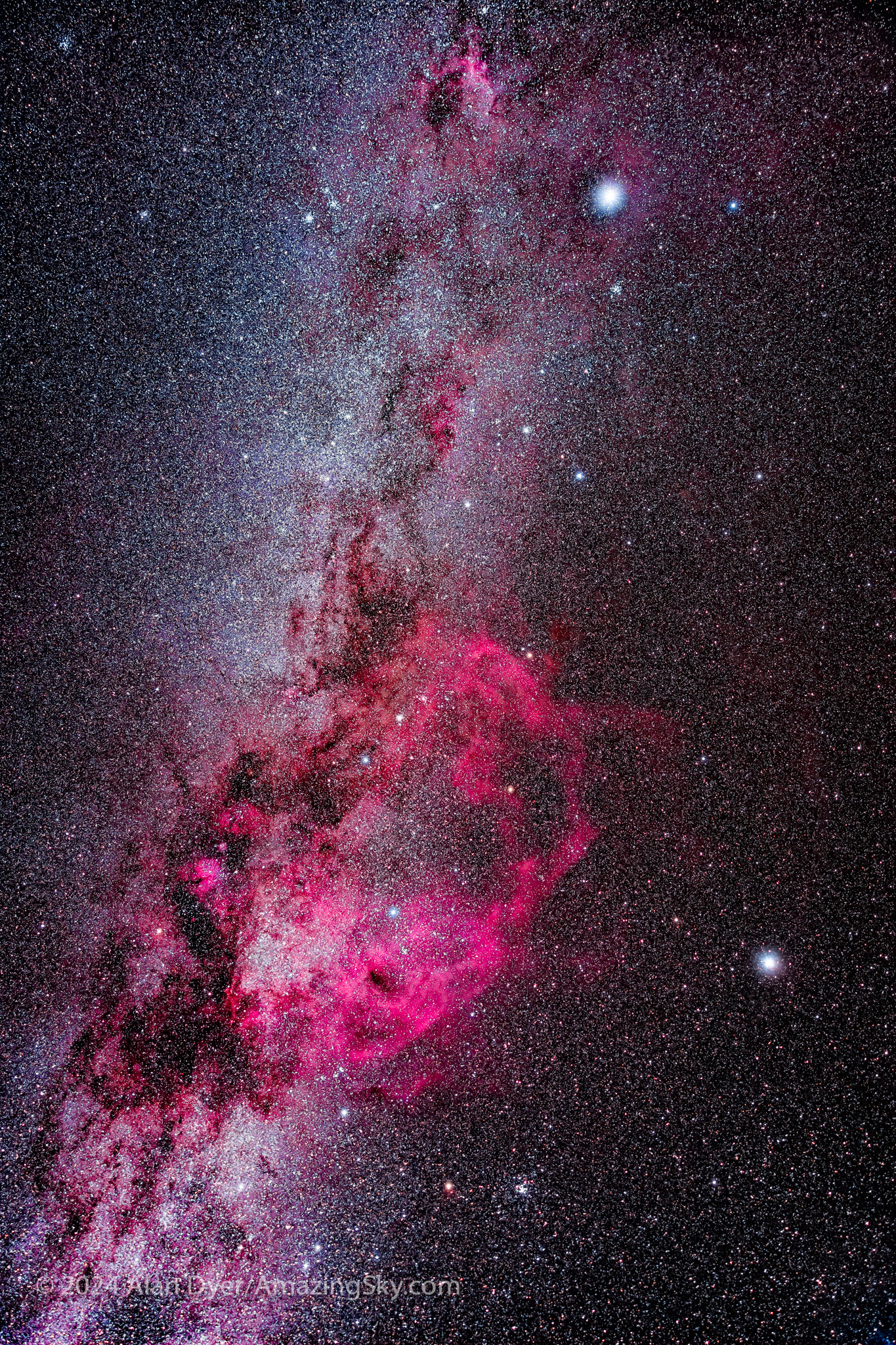
This frames the southern Milky Way from Canis Major and its bright star Sirius at top, to Carina and its bright star Canopus at bottom, the two brightest stars in the night sky. The large red complex is the Gum Nebula.

It is a magical latitude that all northern astronomers should make a pilgrimage to, if only to just lie back and enjoy the view of our place in the outskirts of the Galaxy. I was glad to be back Down Under, to check this top sky sight off my bucket list for 2024. 


A Total Eclipse of the Sun 

No sooner had I returned home from Oz, when it was time to load up the car with telescope gear and drive to the path of the April 8 total solar eclipse, the first “TSE” in North America since 2017, which was the last total eclipse I had seen, in a trip to Idaho

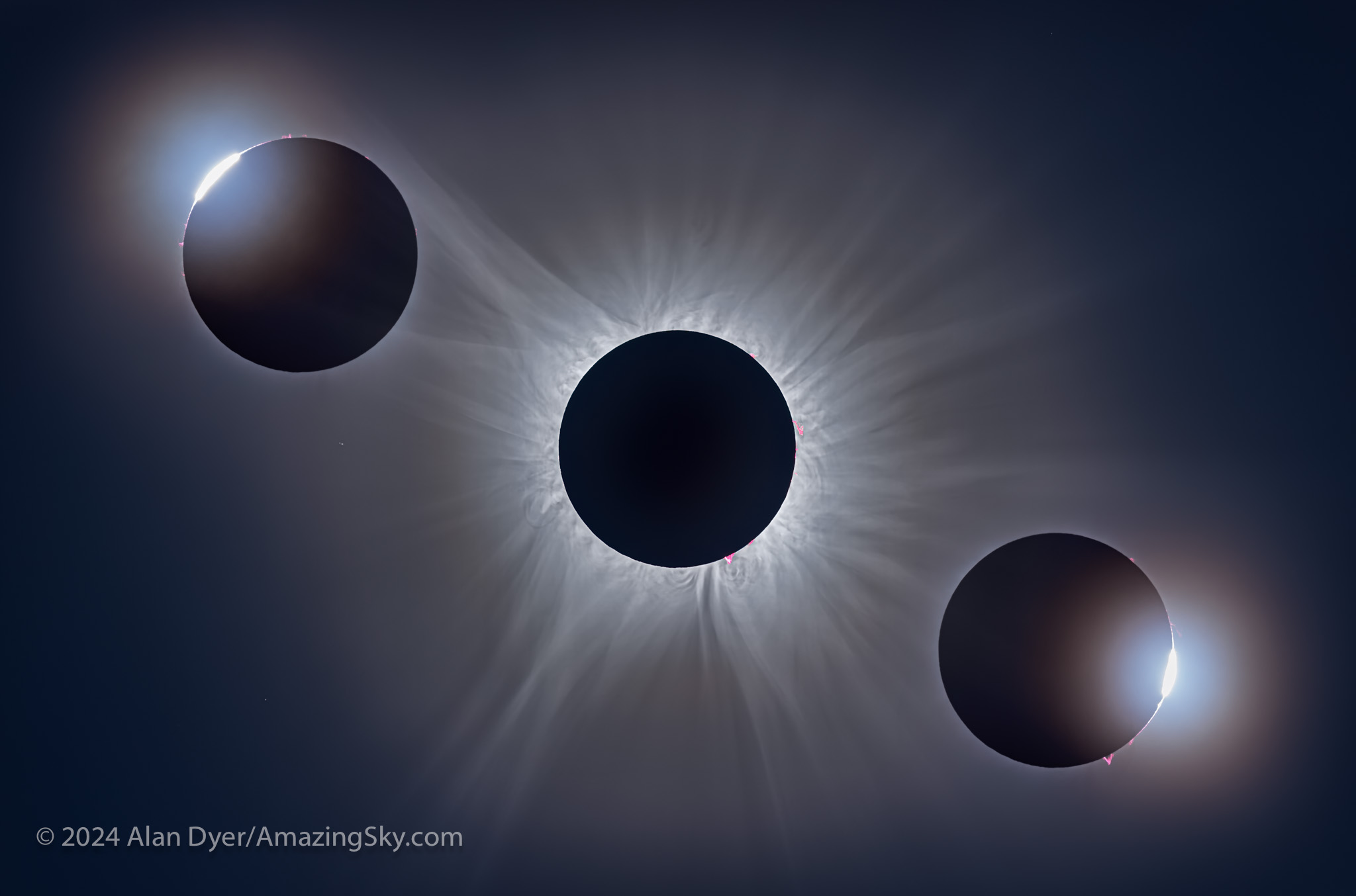
This is a composite of telescopic close-ups of the April 8, 2024 total eclipse, with a multi-exposure blend for the corona at centre, flanked by the diamond rings.

But where? I started south to Texas, my Plan A. Poor weather forecasts there prompted a hasty return to Canada, to drive east across the country to โ€ฆ I ended up in Quรฉbec. My blog about my cross-continental chase is here. My final edited music video is linked to below.

It was gratifying to see a total eclipse from “home” in Canada, only the third time Iโ€™ve been able to do that (previously in 1979 โ€“ Manitoba, and 2008 โ€“ Nunavut). If the rest of the year had been cloudy except for this day I wouldnโ€™t have complained. Much.

This definitely earned a 10 on the Aah! Factor scale. Total eclipses are overwhelming and addictive. Iโ€™ve made my bookings for 2026 in Spain ๐Ÿ‡ช๐Ÿ‡ธ and 2027 in Tunisia ๐Ÿ‡น๐Ÿ‡ณ. 


The Skyโ€™s On Fire

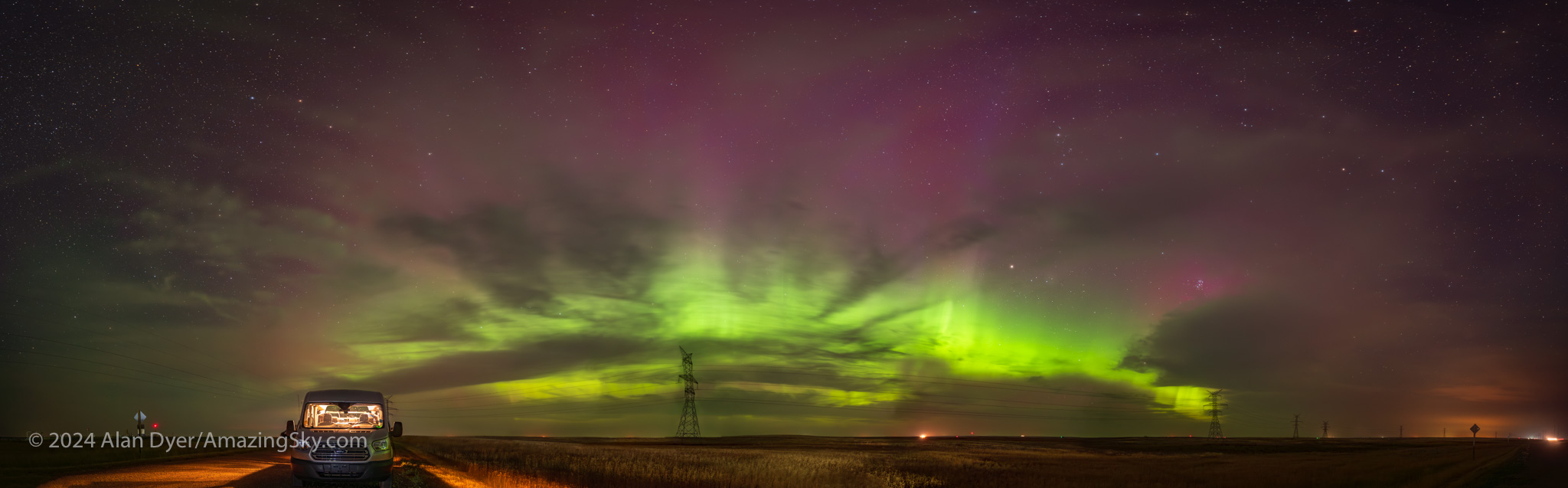
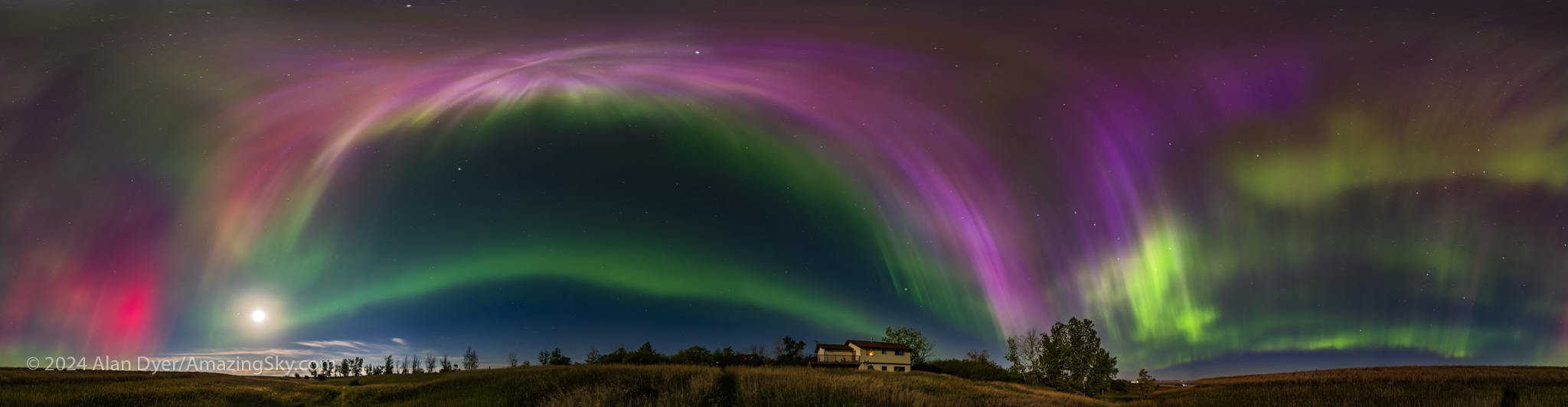
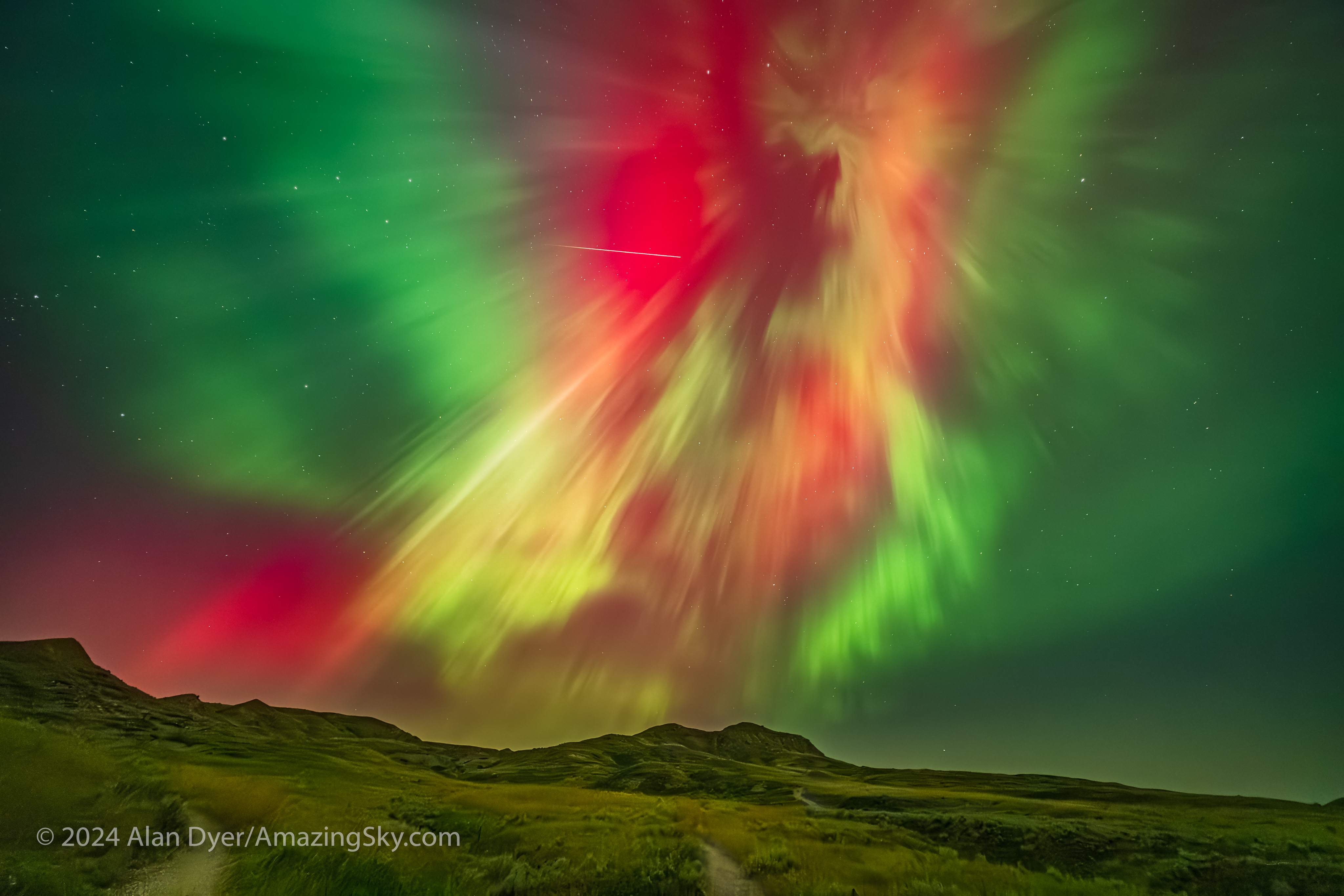
It had been several years since I had seen an aurora from my backyard with colours as vivid and obvious as they were this night. But on May 10, the sky erupted with a fabulous display of aurora that much of the world saw, as aurora borealis in the north and aurora australis in the south. 
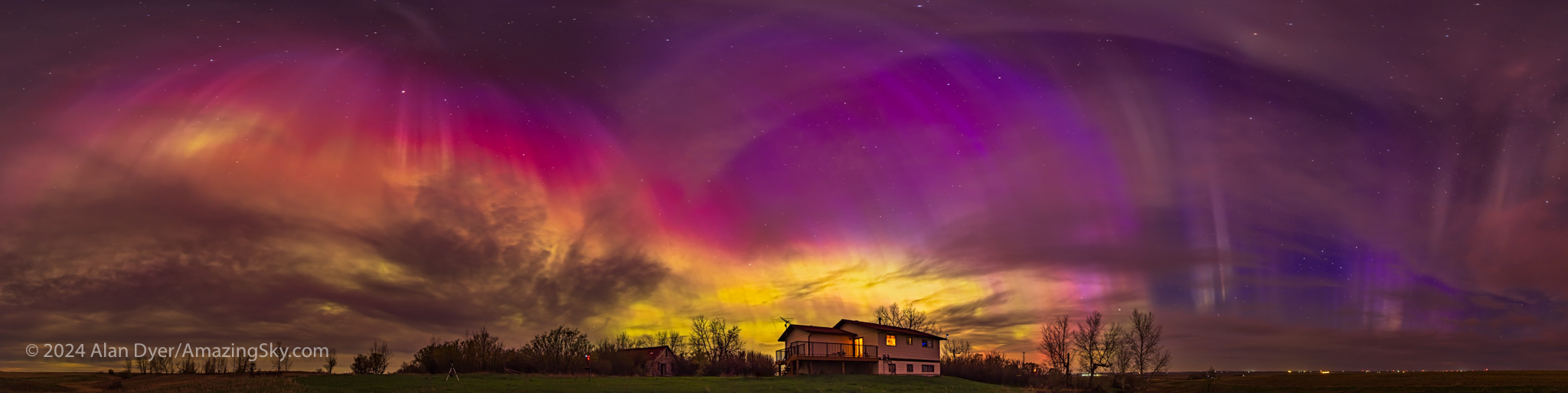
This is a 300ยบ panorama of the May 10, 2024 Northern Lights display, when the Kp Index reached 8 (out of 9), bringing aurora to the southern U.S.

This was the first of several all-sky shows this year. I blogged about the yearโ€™s great auroras here, where there are links to the movies I produced that capture the Northern Lights as only movies can, recording changes so rapid it can be hard to take it all in. Check off a 9 here! 

So not even half way through the year, I had seen three of the top sky sights: the Milky Way core overhead (7), an all-sky aurora (9), and a total eclipse of the Sun (10). 

But there was more to come! Including an Aah! Factor 8


World Heritage Nightscape Treks

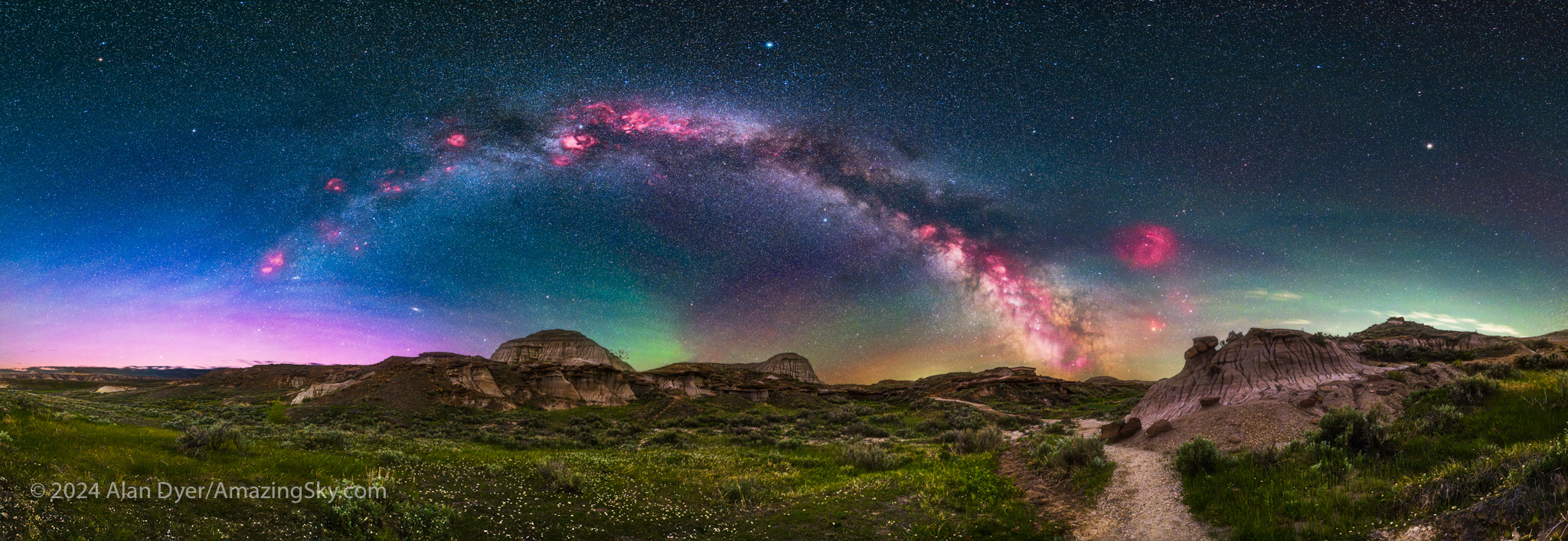
This is a panorama of the arch of the Milky Way rising over the Badlands of Dinosaur Provincial Park, Alberta, with a sky tinted with twilight and airglow.

The sky took a break from presenting spectacles, allowing me to head off on short local trips, to favourite nightscape sites in southern Alberta, which we have in abundance. The Badlands of Dinosaur Provincial Park are just an hour away, the site for the scene above. 
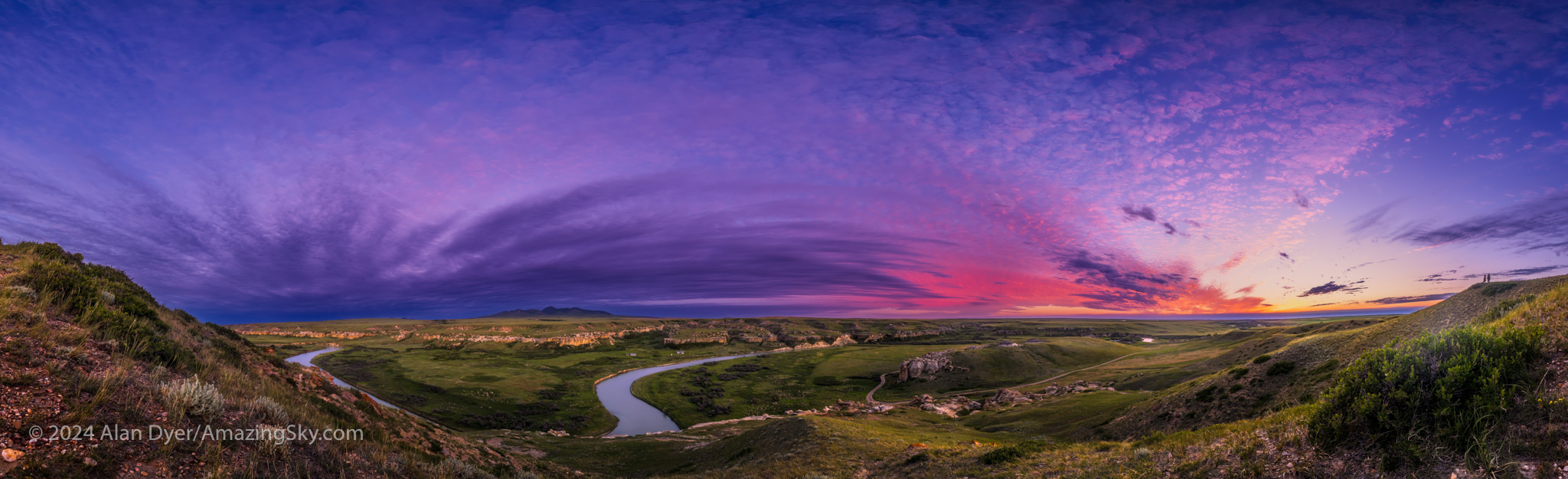
A panorama at sunset at Writing-on-Stone Provincial Park (รรญsรญnai’pi) in Alberta, with the Milk River below and the Sweetgrass Hills in the distance in Montana. Note the people at far right.

The rock formations of Writing-on-Stone Provincial Park are a bit farther, requiring a couple of days commitment to shoot. Clouds hid the main attraction, the Milky Way, this night, but did provide a fine sunset. 
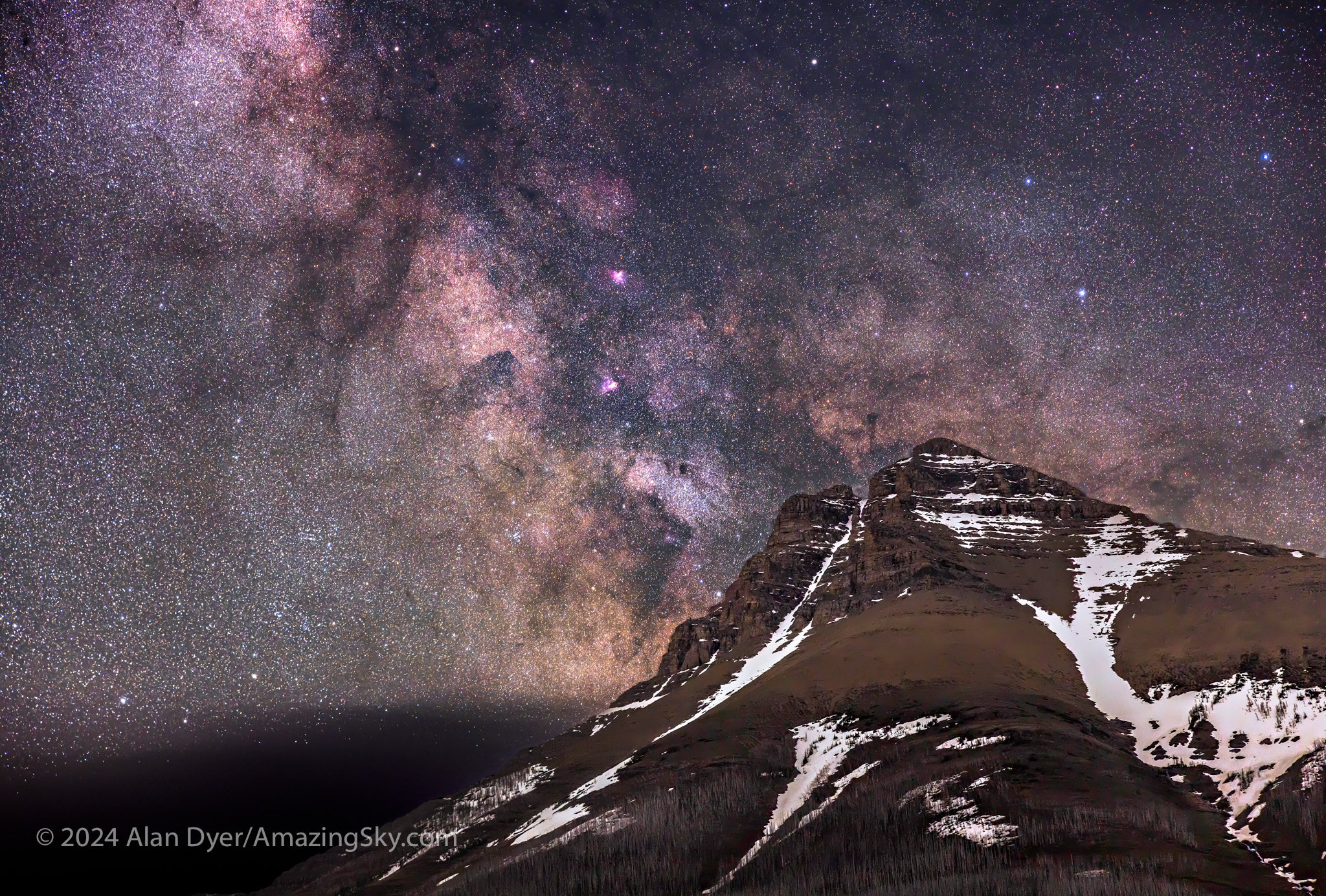
The Milky Way rises over Mt. Blakiston, in Waterton Lakes National Park, Alberta. This was June 10, 2024, so snow remains at high altitudes.

A little further west down the highway is Waterton Lakes National Park, another great spot I try to visit at least once each year. 

All locations I hit this month are U.N. World Heritage Sites, thus the theme of my blog from June. People travel from all over the world to come here, to sites I can visit in a few hours drive. 


Mountains by Starlight

In summer we now often contend with smoke from forest fires blanketing the sky, hiding not just the stars by night, but even the Sun by day. 
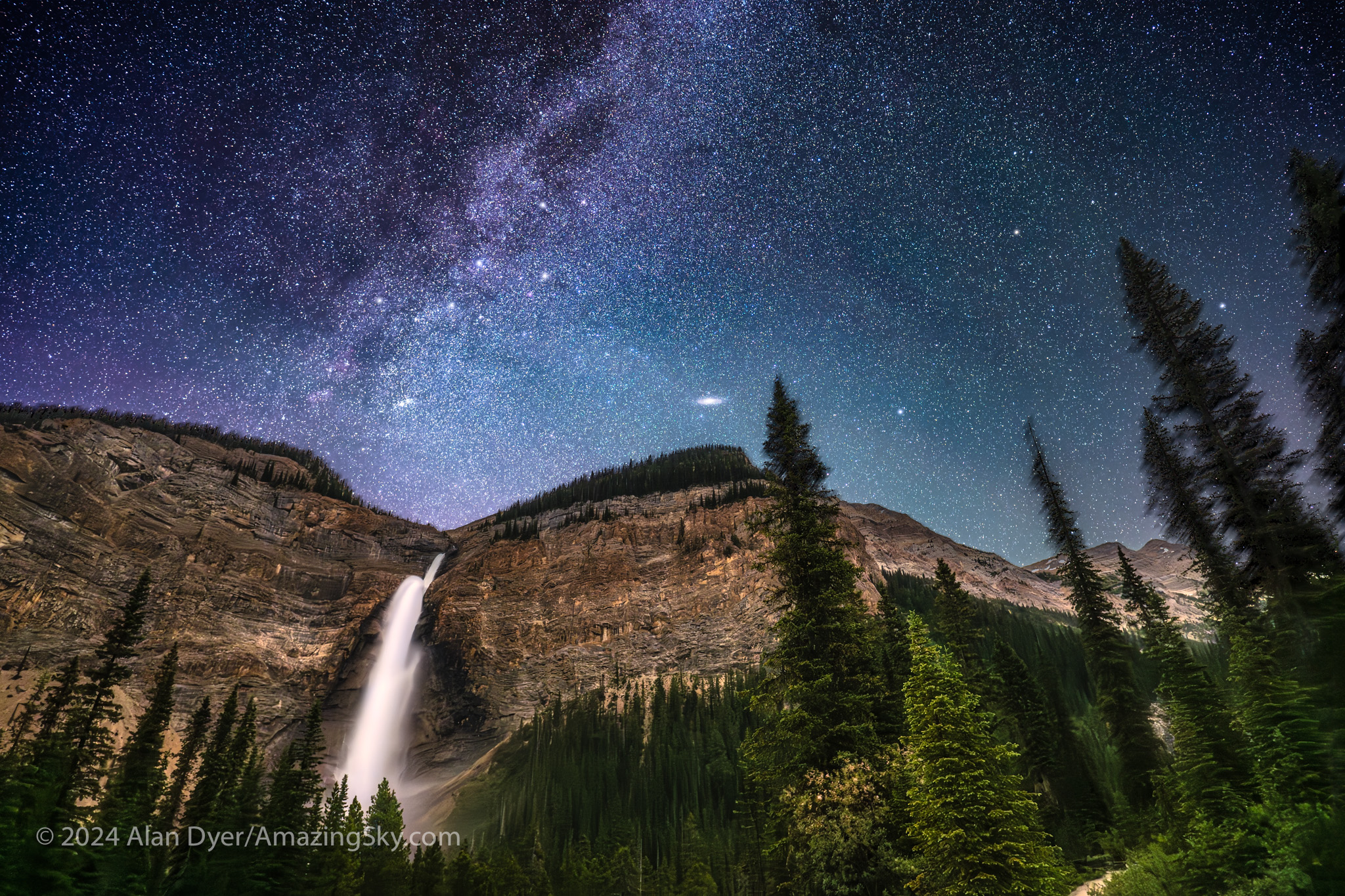
The Andromeda Galaxy at centre is rising above Takakkaw Falls, in Yoho National Park. Above is the W of stars marking Cassiopeia.

But before the smoke rolled in this past summer I was able to visit a spot, Yoho National Park in British Columbia, that had been on my shot list for several years. The timing with clear nights at the right season and Moon phase has to work out. In July it did, for a shoot by starlight at Takakkaw Falls, among the tallest in Canada. 
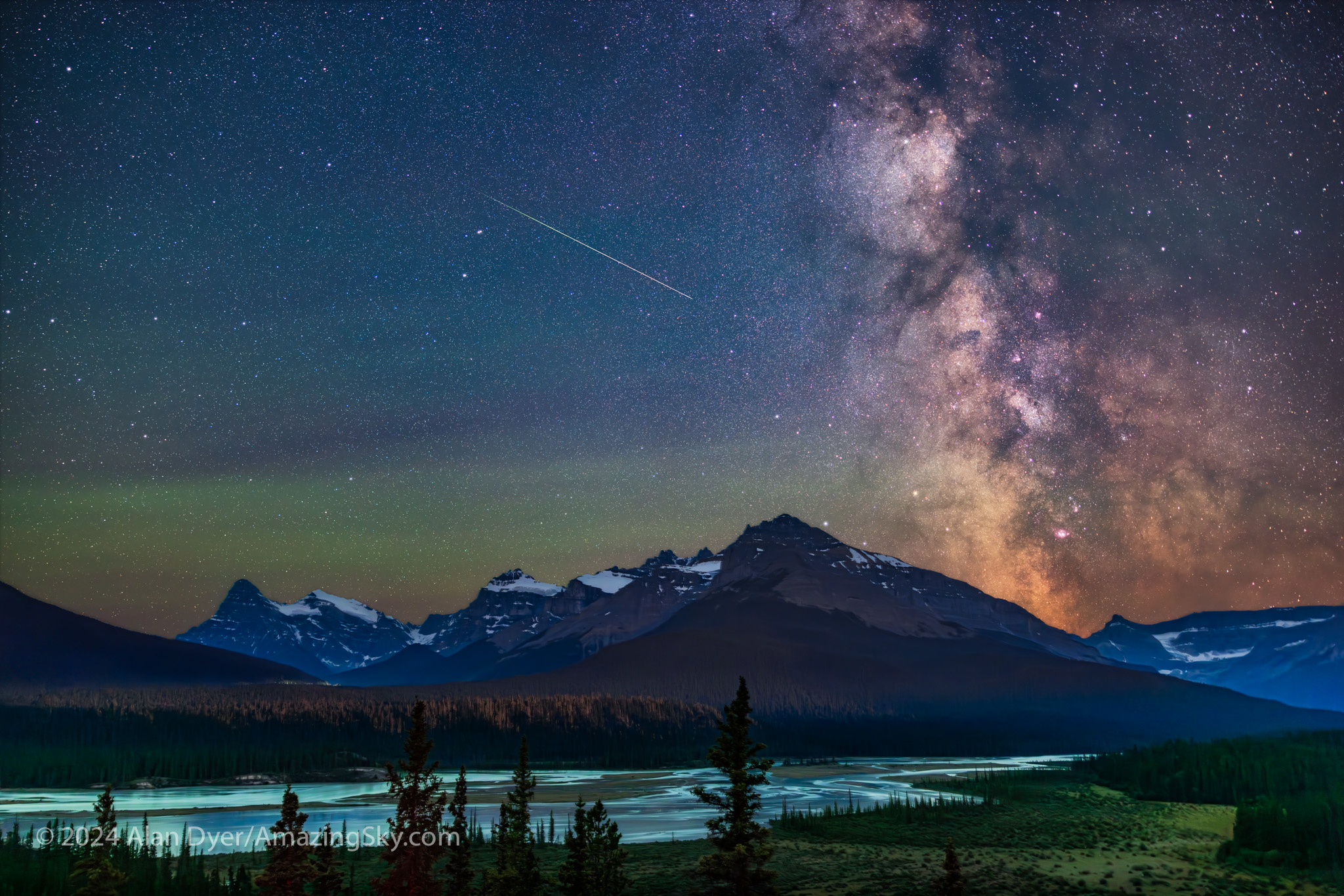
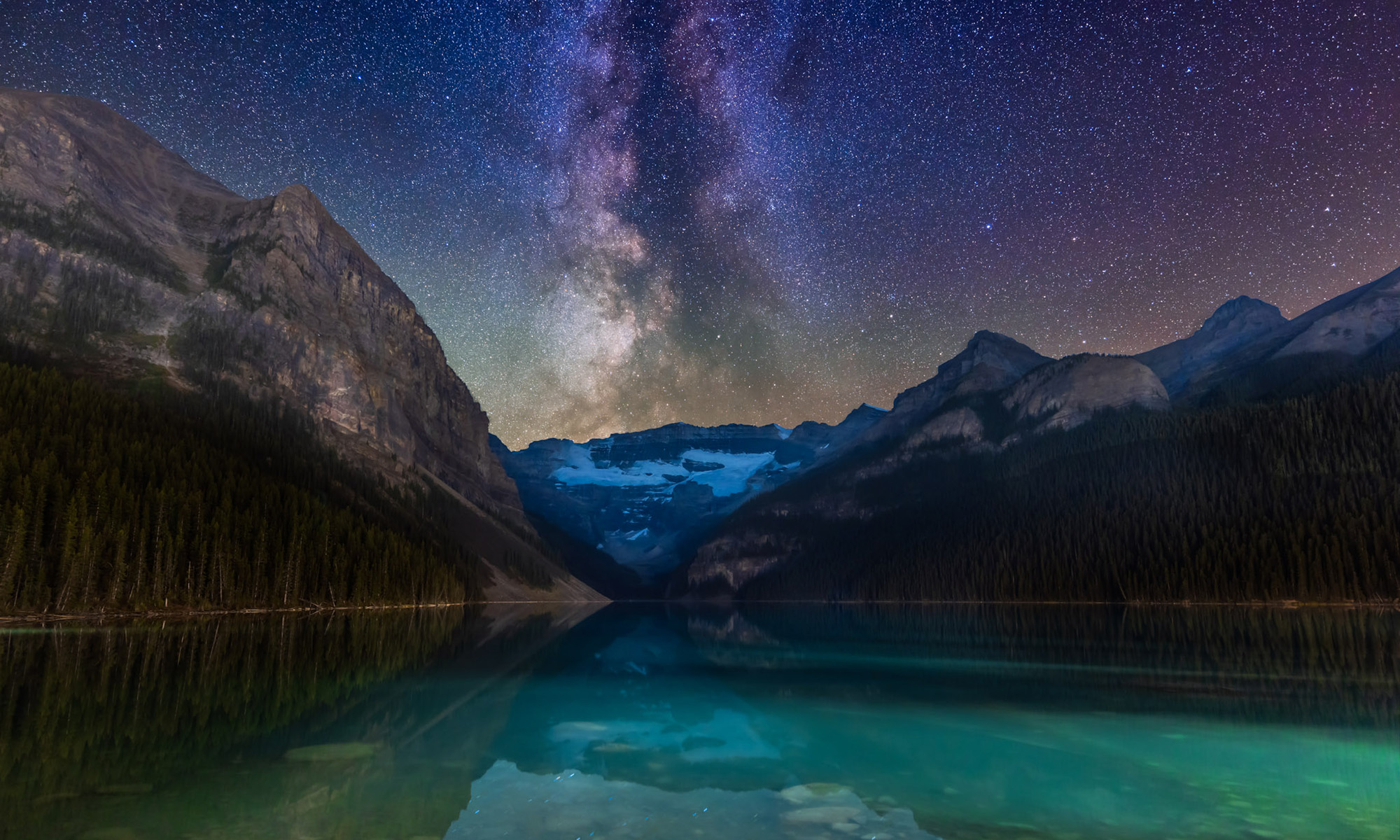
This is the Milky Way core and a bonus meteor over the peaks and valleys at Saskatchewan River Crossing, in Banff National Park, Alberta.

The following nights I was in Banff National Park, at familiar spots on the tourist trail, but uncrowded and quiet at night. It was a pleasure to enjoy the world-class Rocky Mountain scenery under the stars on perfect nights. 


The All-Sky Auroras Return 

In August I headed east to Saskatchewan and the annual Summer Star Party staged by the astronomy clubs in Regina and Saskatoon. It is always a pleasure to attend the SSSP in the beautiful Cypress Hills. The sky remained clear post-party for a trip farther east to the little town of Val Marie, where I stayed at a former convent, and had a night to remember out in Grasslands National Park, one of Canadaโ€™s first, and finest, dark sky preserves.
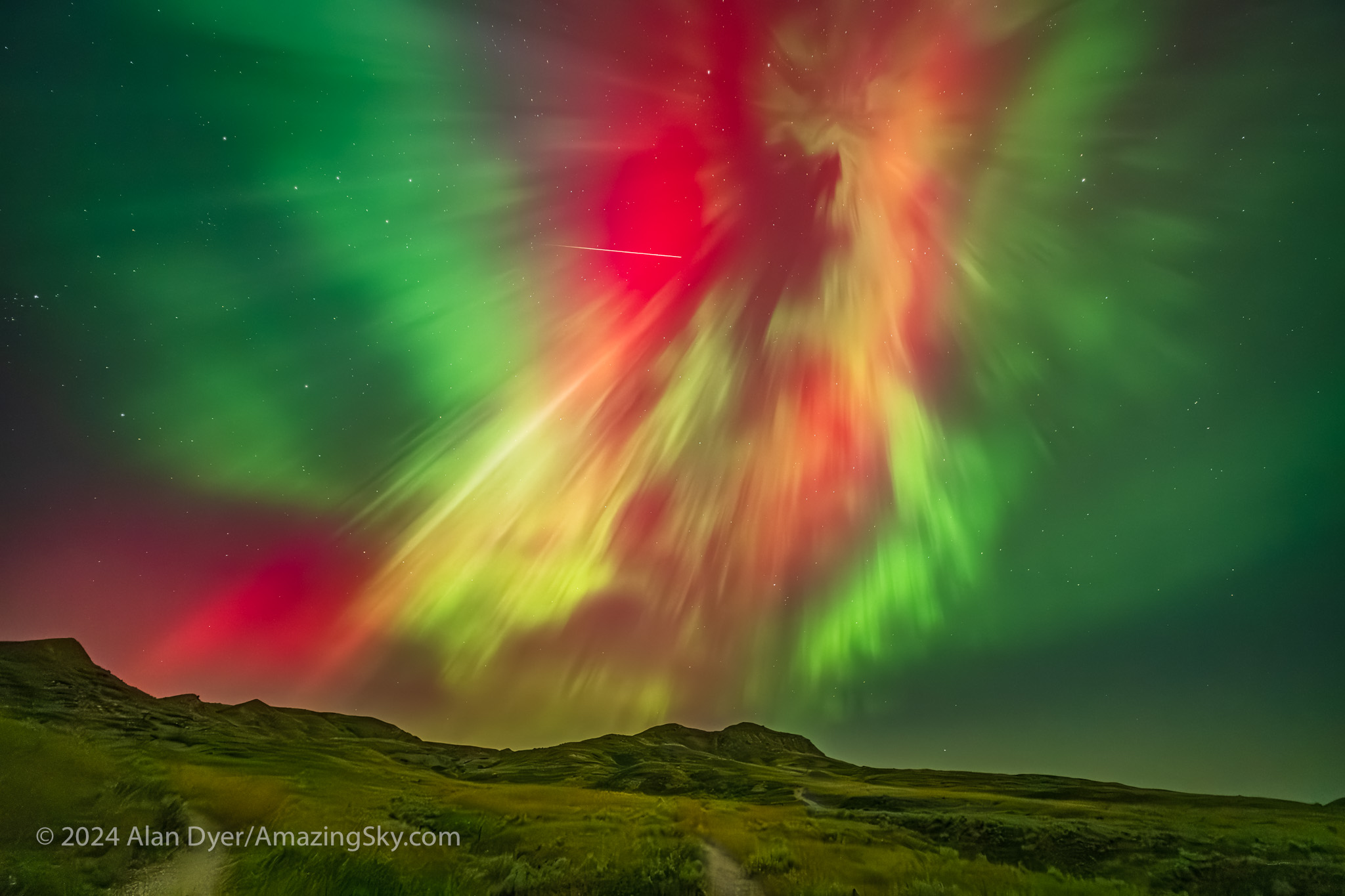
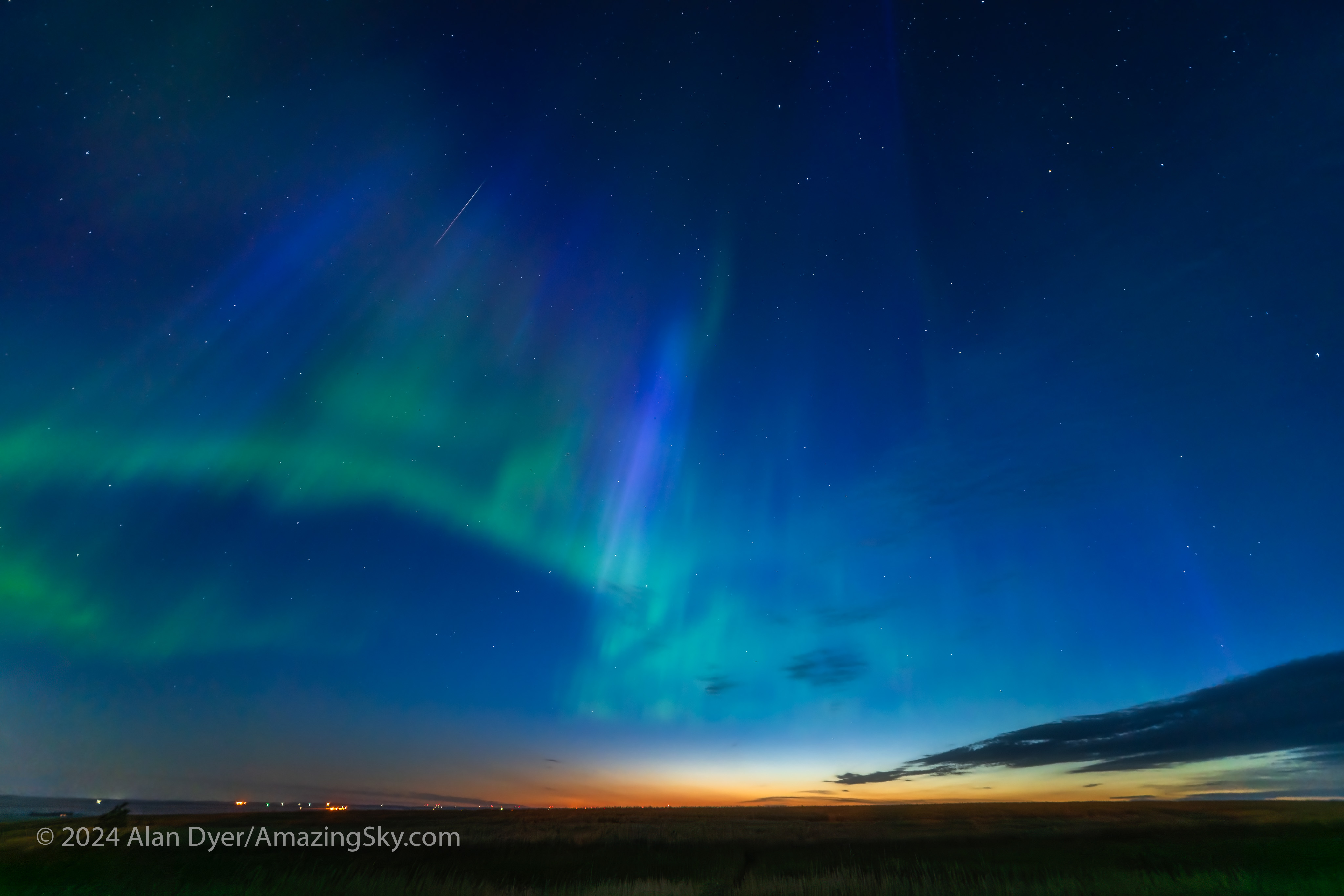
The Northern Lights in a superb all-sky Kp6 to 7 display on August 11-12, 2024, in Grasslands National Park, Saskatchewan.

The plan was to shoot the August 11 Perseid meteor shower, but the aurora let loose again for a stunning show over 70 Mile Butte. My earlier blog has more images and movies from this wonderful month of summertime Northern Lights. 

We are fortunate in western Canada ๐Ÿ‡จ๐Ÿ‡ฆ to be able to see auroras year-round, even in summer. Farther north at the usual Northern Lights destinations, the sky is too bright at night in summer. 


Back to Deep Sky Wonders

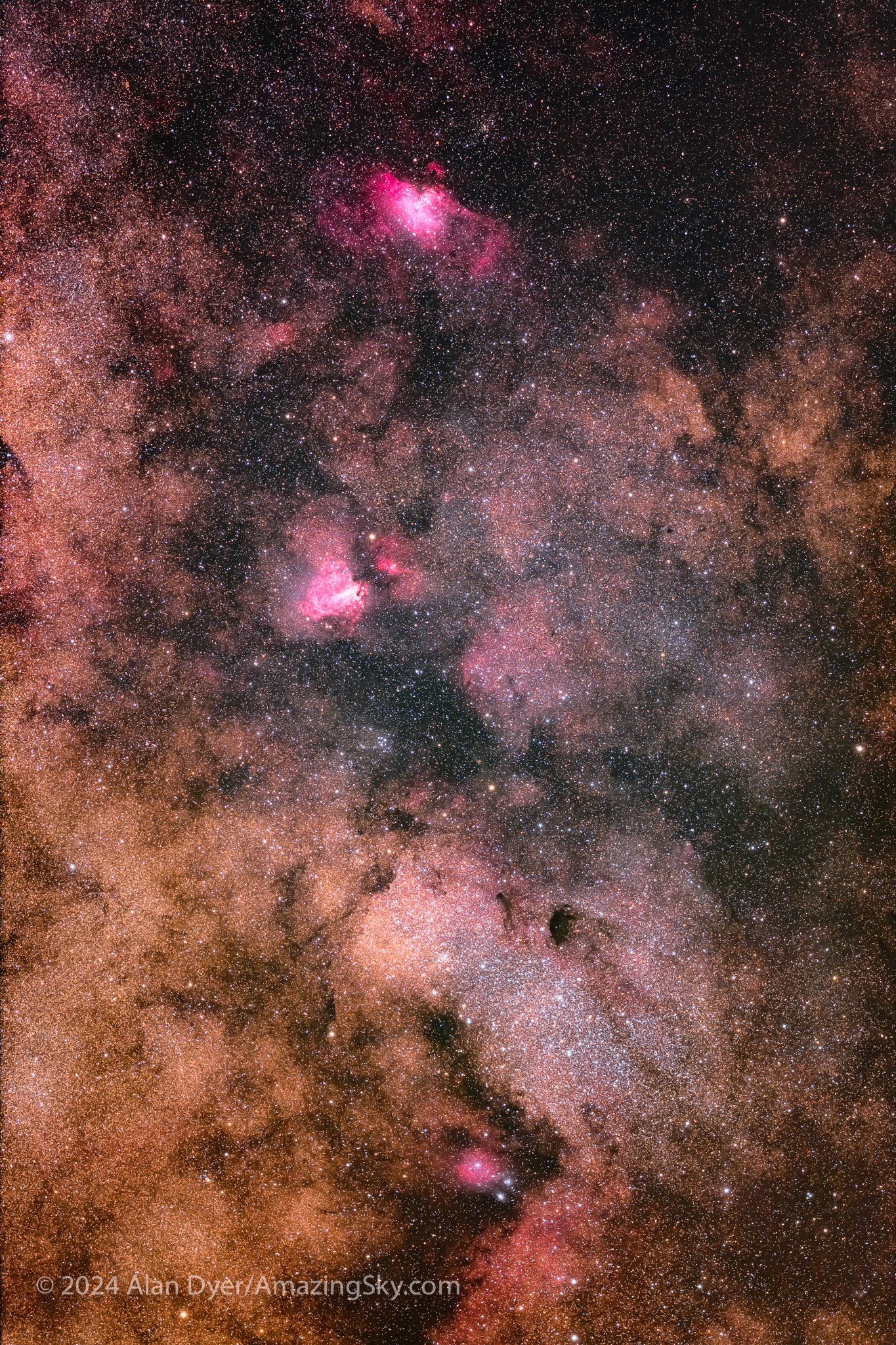
This is a framing of the rich starfield in Sagittarius and Serpens containing a mix of bright star clouds, glowing nebulas, and dark dust in the Milky Way.

September is the month for another astronomical party in the Cypress Hills, but on the Alberta side. At the wonderful Southern Alberta Star Party under its very dark skies, I was able to shoot some favourite deep-sky fields along the Milky Way with new gear I was testing at the time. 
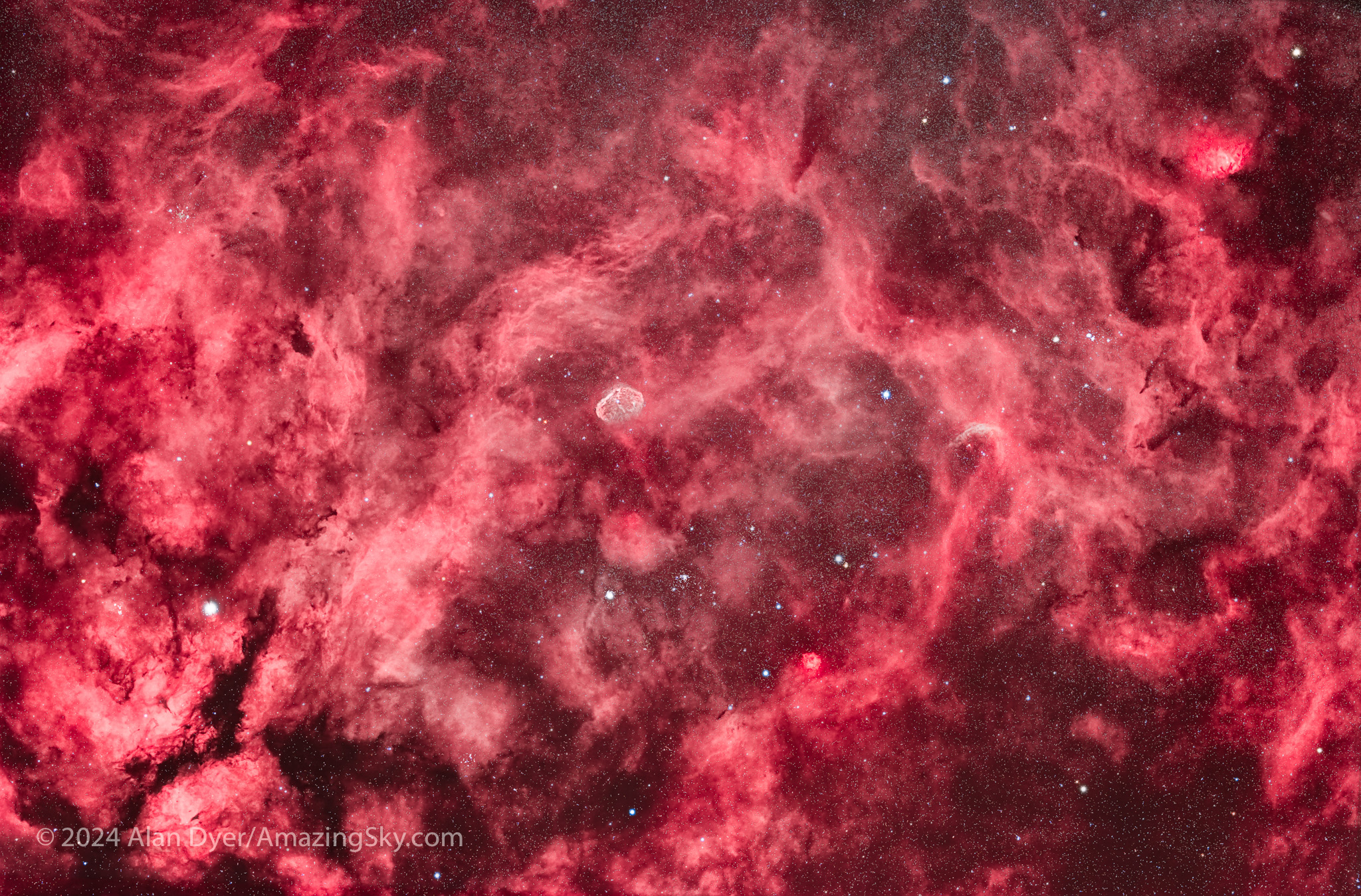
This frames the complex region of emission nebulas in central Cygnus near the star Gamma Cygni, at lower left. The Crescent Nebula is at centre.

And from home, September brought skies dark and clear enough (at least when there was no aurora!) for more captures of colourful nebulas (above and below) along the summer Milky Way. 
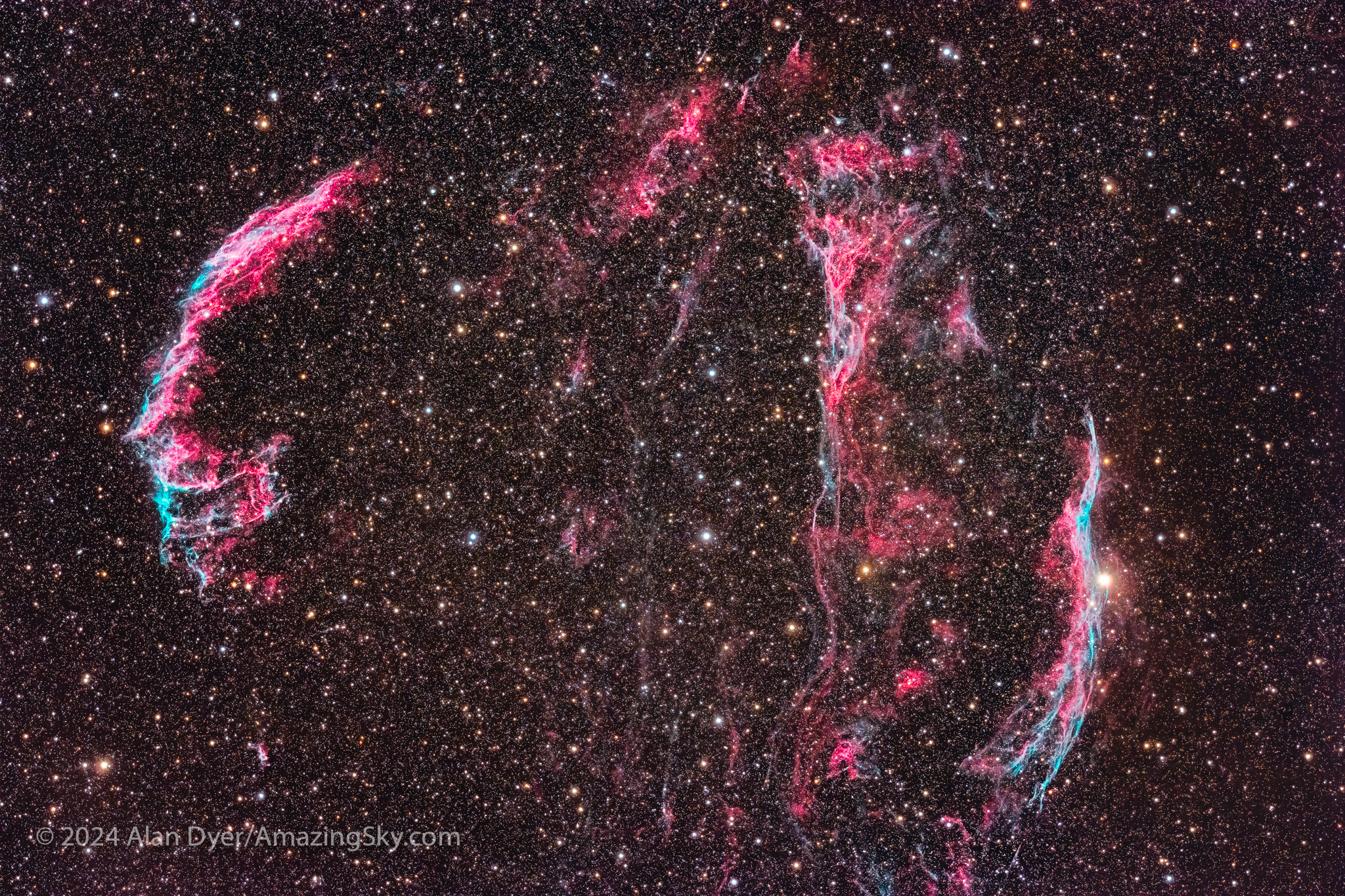
This frames all the photogenic components of the bright Veil Nebula in Cygnus, a several-thousand-year-old supernova remnant.

We invest a lot of money into the kind of specialized gear needed to shoot these targets (and Iโ€™m not nearly as โ€œcommittedโ€ as some are, believe me!), only to find the nights when it all comes together can be few and far between. 

Plus, A Very Minor Eclipse of the Moon 

I had to include this, if only for stark contrast with the spectacular solar eclipse six months earlier. 

We had an example of the most minor of lunar eclipses on March 24, 2024, with a so-called โ€œpenumbralโ€ eclipse of the Moon, an eclipse so slight itโ€™s hard to tell anything unusual is happening. (So I’ve not even included an image here, though I was able to shoot it.)
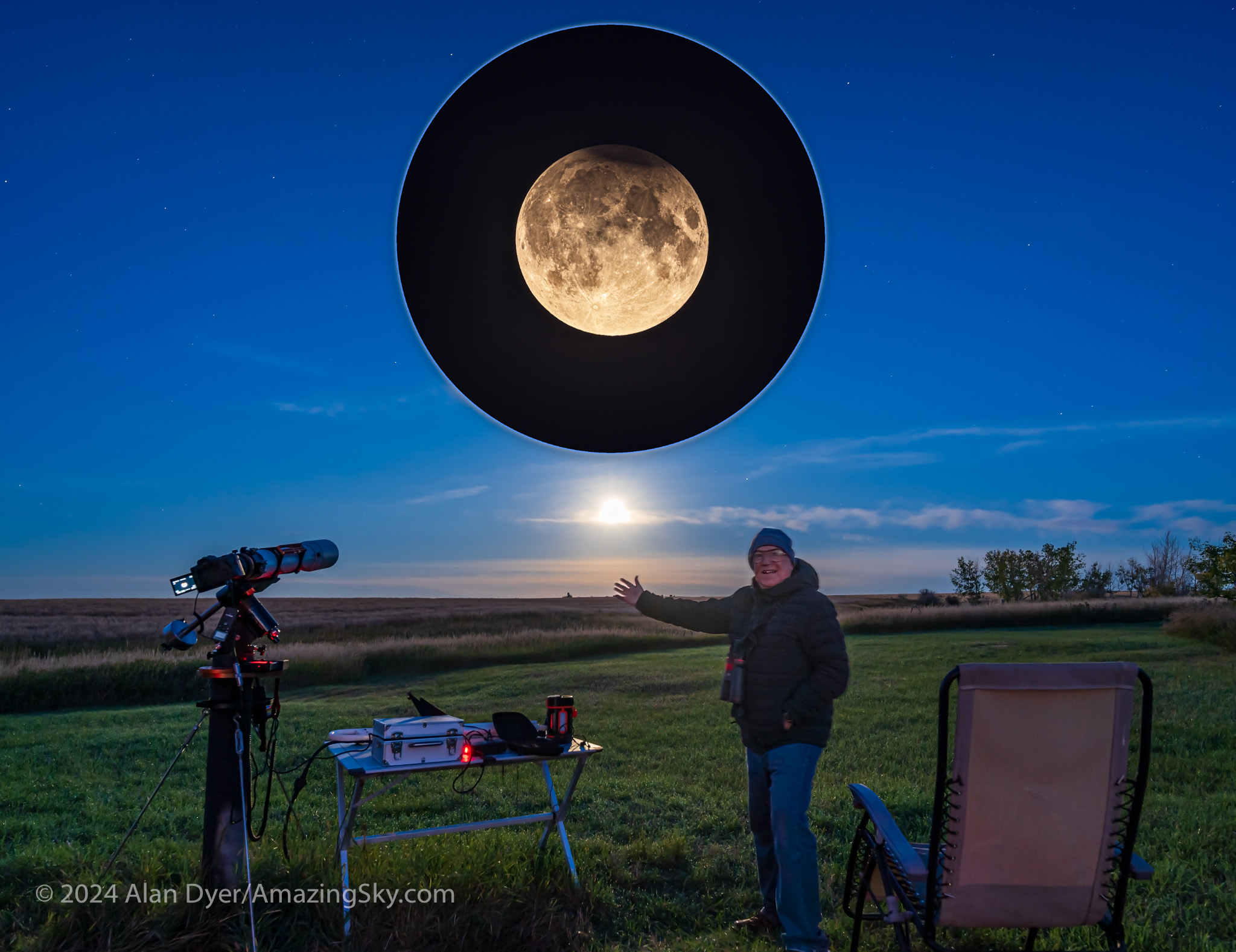
Me at another successful eclipse chase โ€ฆ to my backyard to capture the partial lunar eclipse on September 17, 2024. The Moon is rising in the southeast.

On September 17, we had our second eclipse of the Moon in 2024. This time the Earthโ€™s umbral shadow managed to take a tiny bite out of the Full Moon. Nothing spectacular to be sure. But at least this eclipse expedition was to no farther away than my rural backyard. A clear eclipse of any kind, even a partial eclipse, especially one seen from home, is reason to celebrate. I did!

Of course, a total eclipse of the Moon, when the Full Moon is completely engulfed in Earthโ€™s umbra and turns red, is what we really want to see. They rate a 7 on our Aah! Factor scale. We havenโ€™t had a “TLE” since November 8, 2022, blogged about here.

The next is March 14, 2025. (The link takes you to Fred Espenak’s authoritative web page.)


A Bright Comet At Last!

We knew early in 2024 that the then newly-discovered Comet Tsuchinshan-ATLAS had the potential to perform this month. I planned a trip south to favourite spots in Utah and Arizona to take advantage of what we hoped would be a fine autumn comet. 
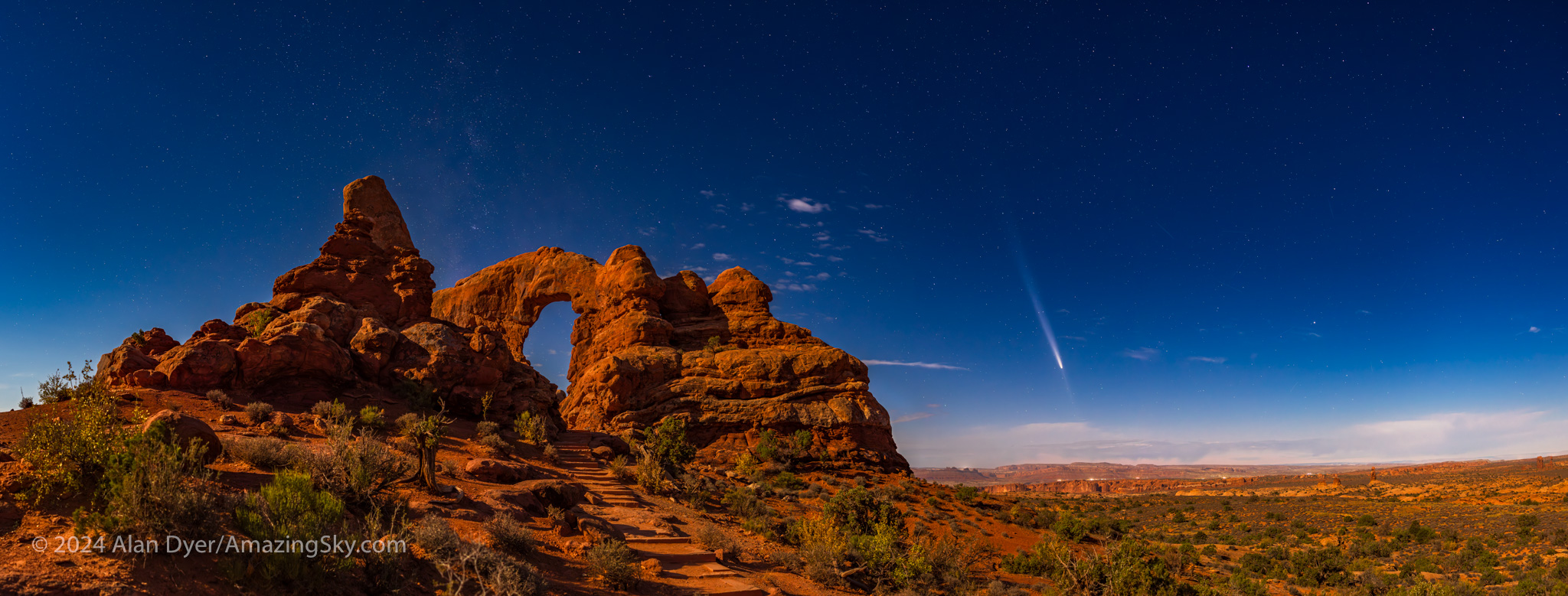
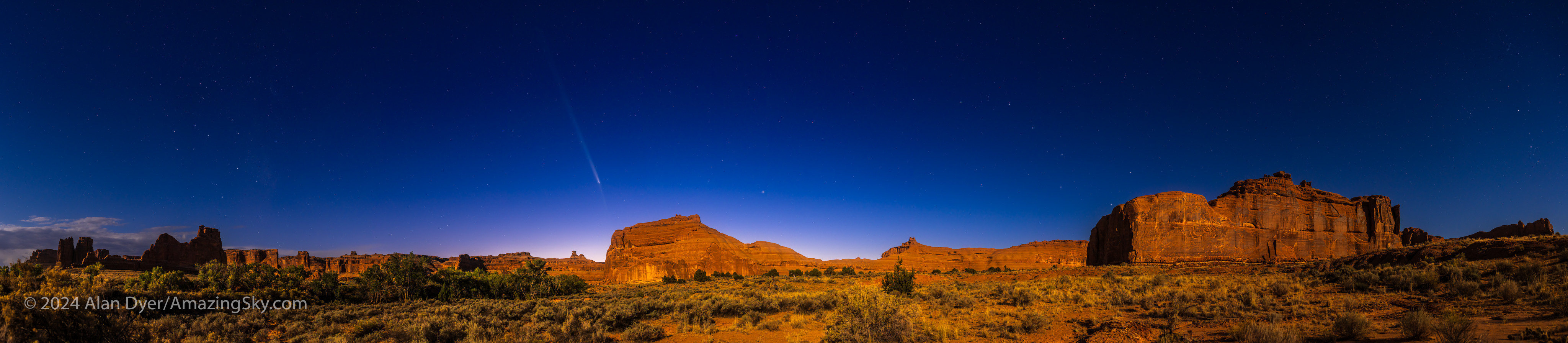
This is Comet Tsuchinshan-ATLAS (C/2023 A3) at its finest in the evening sky, on October 14, two days after its closest approach to Earth, and with it sporting a 10ยบ- to 15ยบ-long dust tail, and a short narrow anti-tail pointed toward the horizon. The location was Turret Arch in the Windows area of Arches National Park, Utah.

It blossomed nicely, especially as it entered into the evening sky in mid-October, as above. Despite the bright moonlight, it was easy to see with the unaided eye, a celestial rarity we get only once a decade, on average, if we are lucky. My blog of my comet chase is here

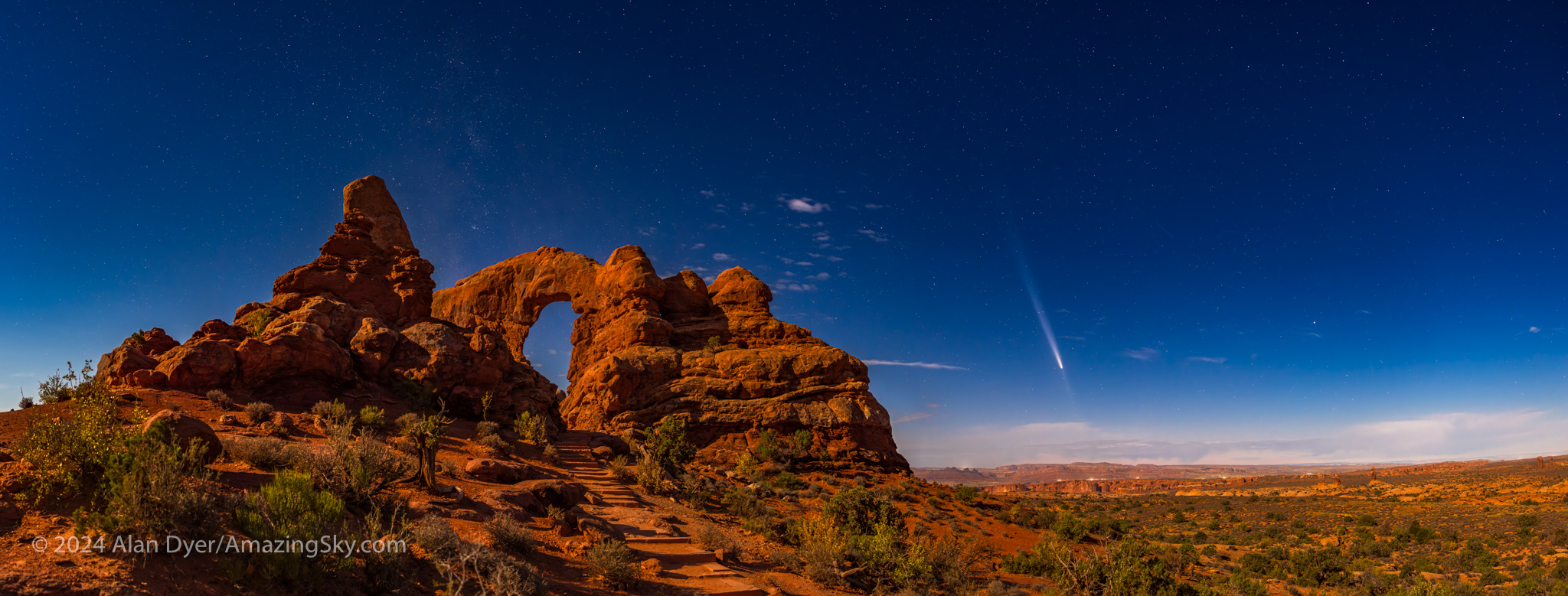
This is a panorama of Comet Tsuchinshan-ATLAS over Arches National Park, Utah, on a moonlit night, October 15, 2024, with the comet easy to see with the unaided eye.

A naked-eye comet ranks an 8 on our Aah! Factor scale. So now 2024 had delivered all four of our Top 4 sky sights. 
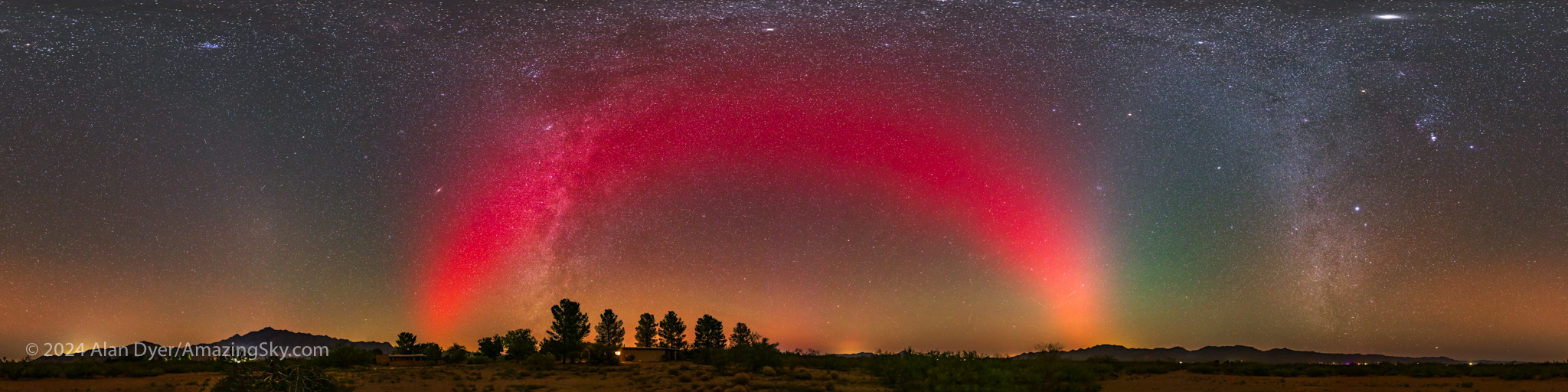
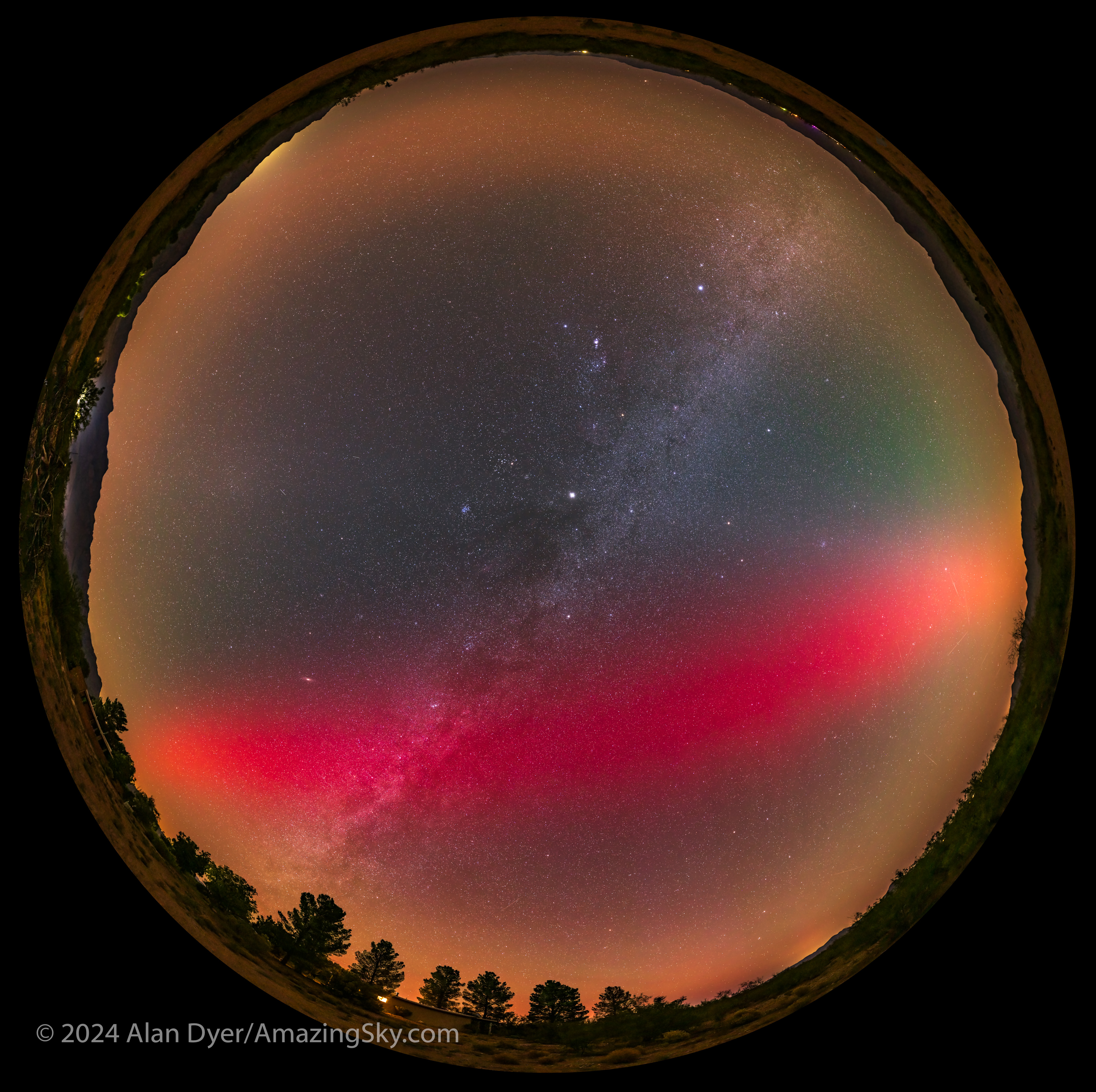
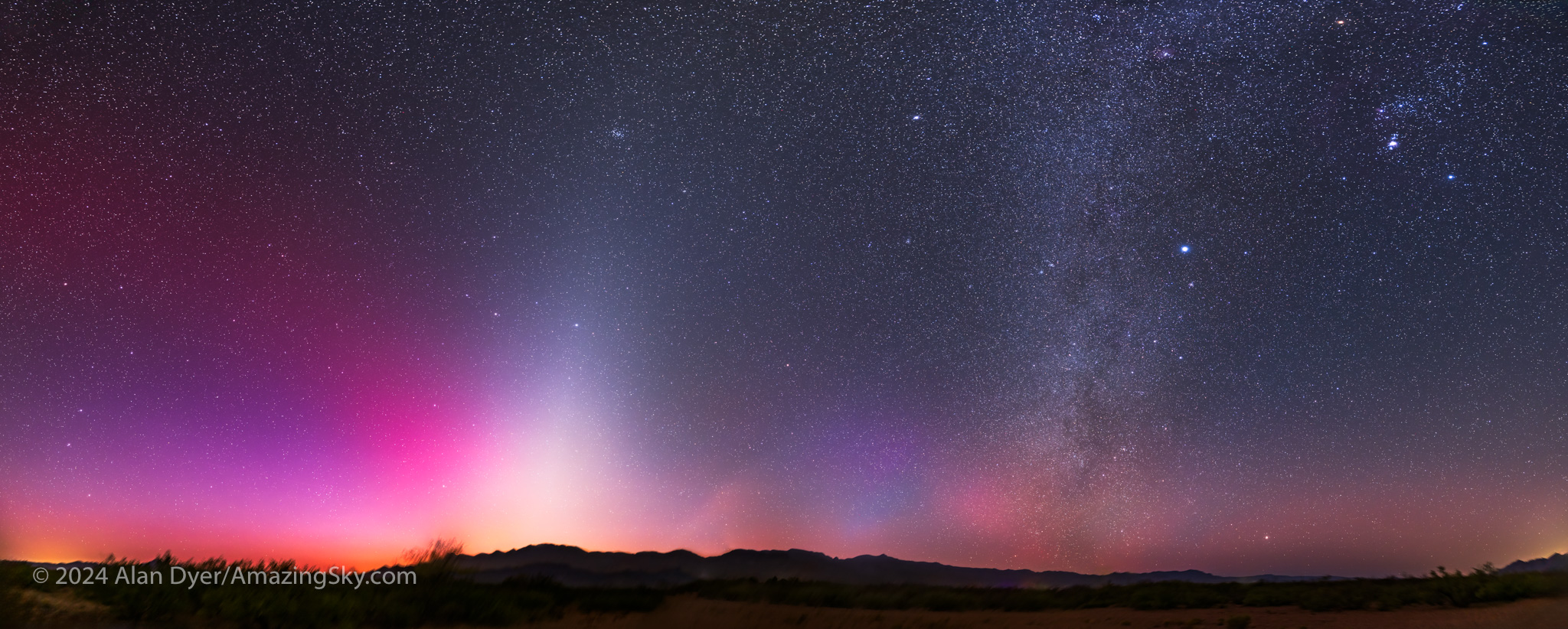
This 360ยฐ panorama captures a rare SAR (Stable Auroral Red) arc across the Arizona sky in the pre-dawn hours of October 11, 2024. The SAR arc was generated in the high atmosphere as part of the global geomagnetic storm of October 10/11, 2024, with a Kp8 rating that night.

But … just as a bonus, there was another fabulous aurora on October 10, seen in my case from the unique perspective of southern Arizona, with an appearance of a bright “SAR” arc more prominent than I had ever seen before. So that view was a rarity, too, so unusual it doesn’t even make our Aah! list, as SARs are typically not visible to the eye.


Back to Norway for Northern Lights

2024 was notable for travel getting โ€œback to normal,โ€ at least for me, with two long-distance drives, and now my second overseas trip. This one took me north to Norway ๐Ÿ‡ณ๐Ÿ‡ด, which I had been visiting twice a year as an enrichment lecturer during pre-pandemic years. 
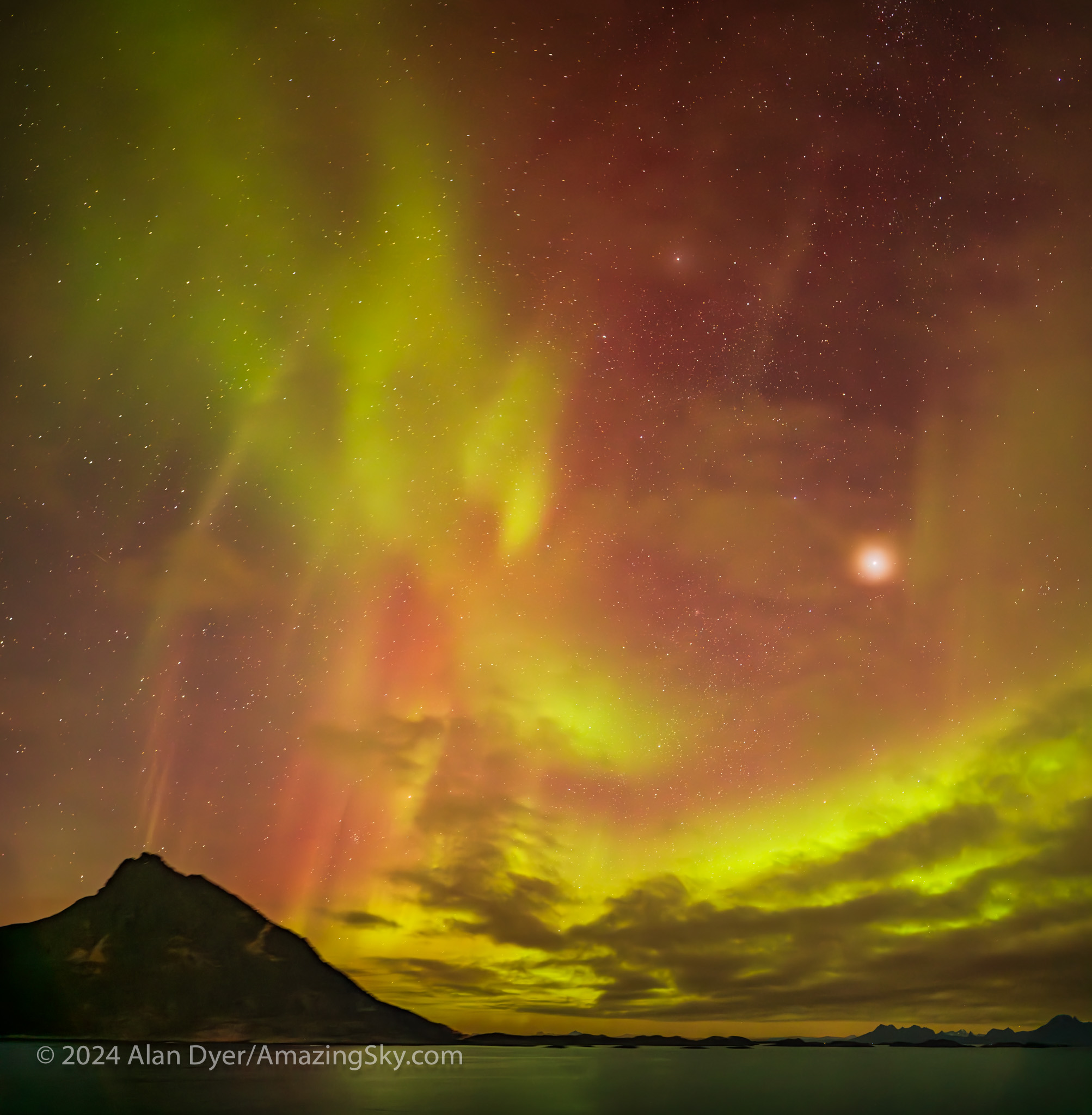
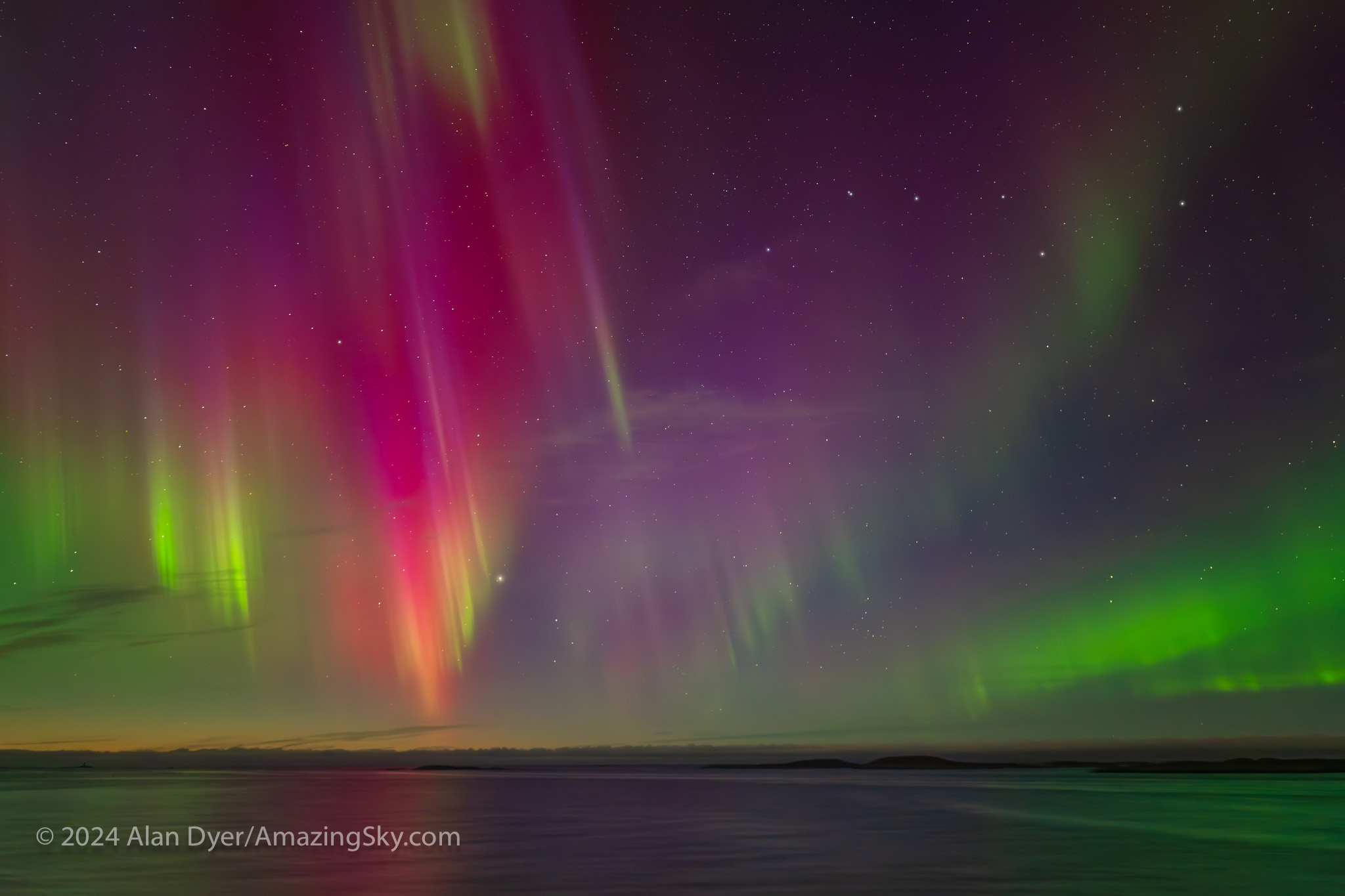
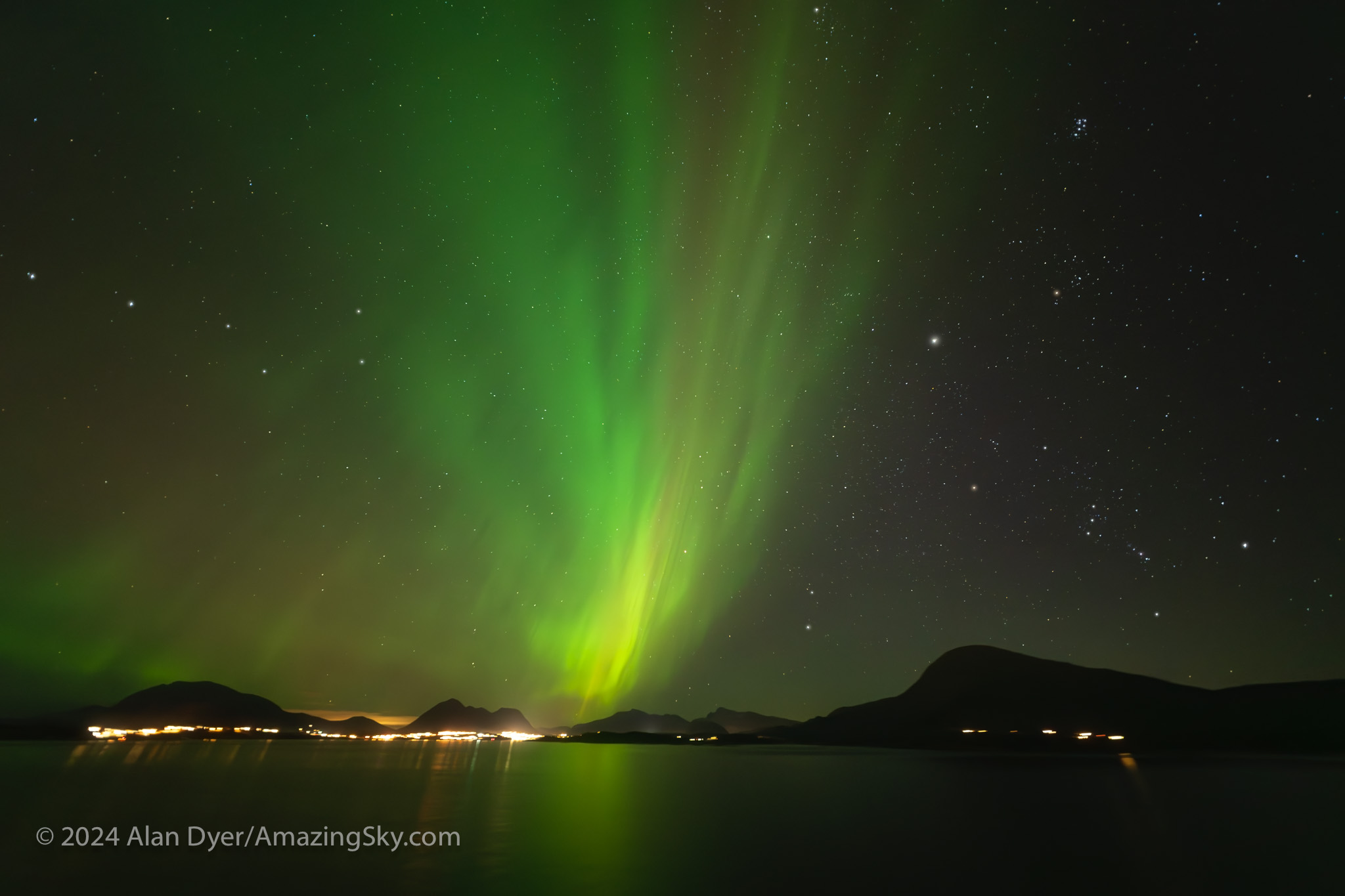
A green and red aurora appears over the coast of Norway, with Jupiter bright at right. This was from the Hurtigruten ship m/s Nordkapp on November 10, 2024, on a coastal cruise with a Road Scholar tour group.

The auroras were excellent, though nothing like the great shows of May and October. But the location sailing along the scenic coast and fjords makes up for any shortfall in the Lights. It was good to be back. I plan to return in 2025 for two cruises in October. Join me there, too!


A Winter Moonrise to End the Year

As I write this, December has been nothing but cloud. Almost. A clear hour on Full Moon night allowed a capture of the โ€œCold Moon,โ€ with the Moon near Jupiter, then at its brightest for the year. So thatโ€™s the other lunar bookend to the year, shot from the snowy backyard. 
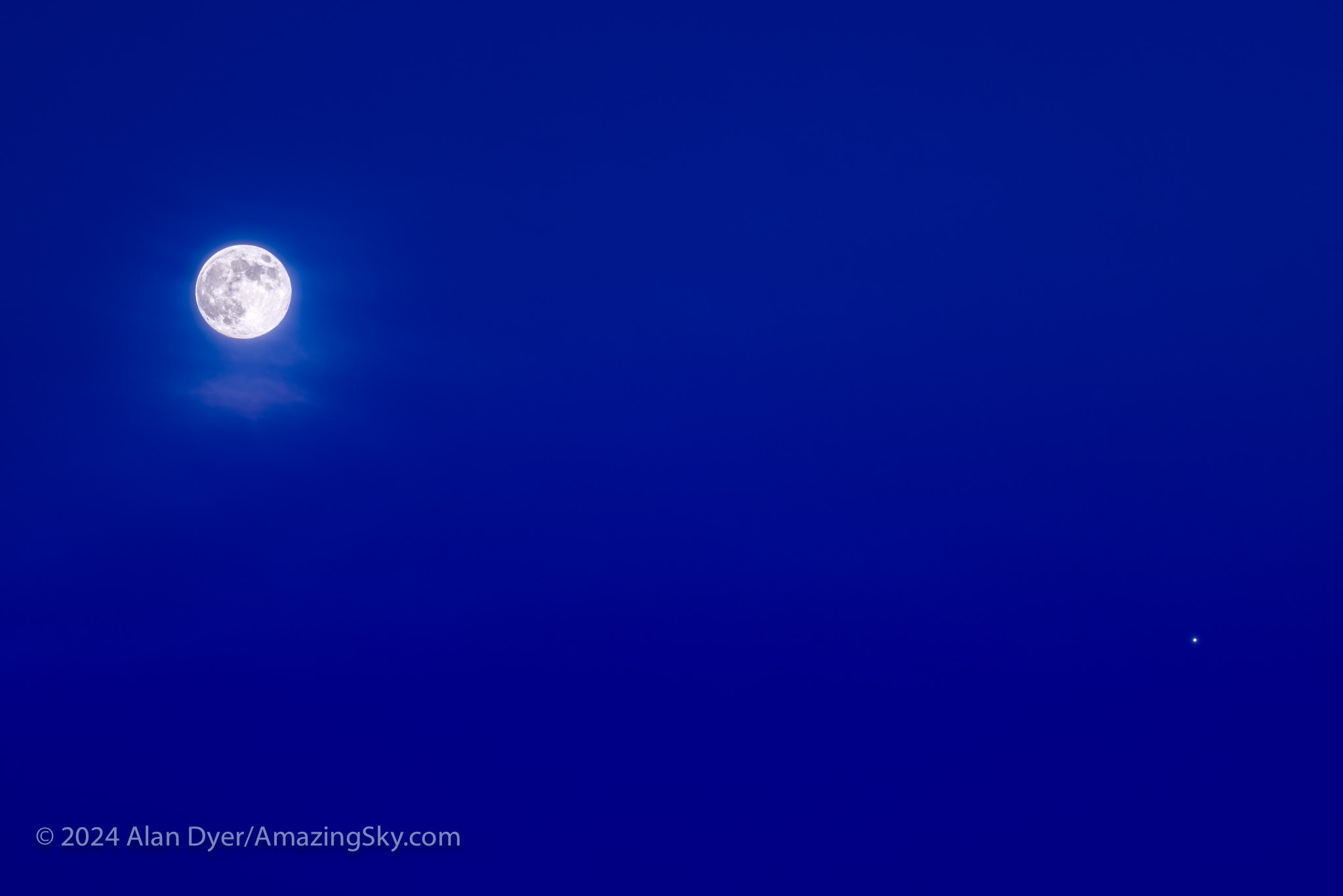
This is the Full Moon of December 14, 2024, near the planet Jupiter at lower right. Both were rising into the eastern sky in the early evening.

However, I did say after the clear total eclipse in April that if the rest of 2024 had been cloudy I wouldnโ€™t complain. So Iโ€™m not. 

And thereโ€™s no reason to, as 2024 did deliver the best year of stargazing I can remember. 2017 had a total solar eclipse. 2020 had a great comet. But we have to go back to 2003 for aurora shows as widespread and as a brilliant as weโ€™ve seen this year. 2024 had them all. And more!

We might see more auroras in 2025. And we have a total eclipse of the Moon. Two in fact, if youโ€™re willing to travel to the other hemisphere. 

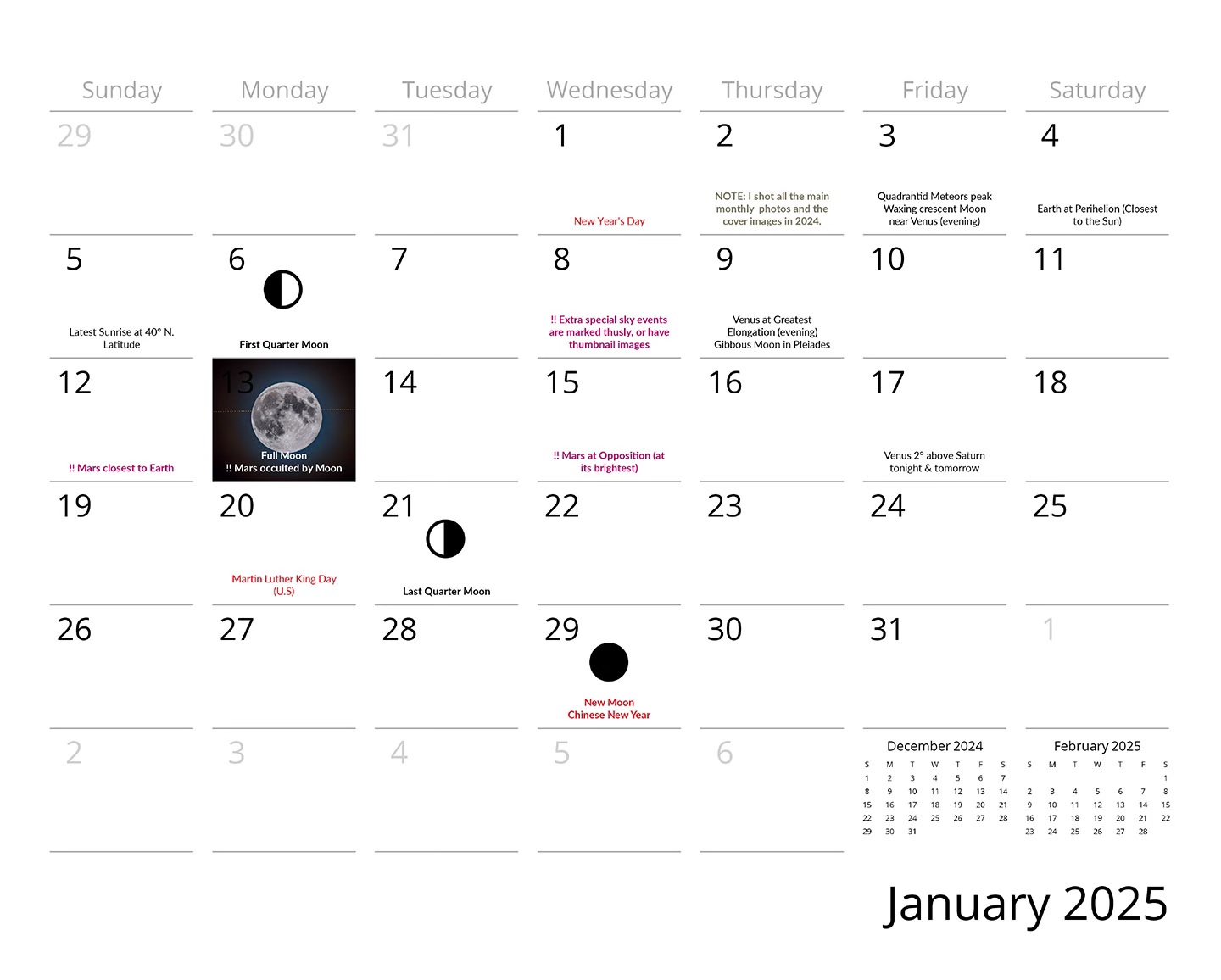
My 2025 Calendar cover. Go to https://www.amazingsky.com/Books

My 2025 Amazing Sky Calendar lists my picks for the best sky events of the coming year, with the emphasis on events viewable from North America. For a free PDF download of my Calendar, go to my website here

Clear skies to all, in a Happy New Year! 

โ€” Alan, December 21, 2024 / amazingsky.com 
Under the Great Southern Sky (2024)


From 2000 to 2017, the year of my last previous trip Down Under, I had been travelling to the Southern Hemisphere, sometimes to Chile but most often to Australia, once a year or biennially. Thereโ€™s just so much to see and photograph in the southern sky. 

This is a panorama of the southernmost portion of the Milky Way, from the stars Alpha and Beta Centauri at far left, to Sirius, the brightest nighttime star, at far right. The second brightest star, Canopus, is at bottom. This is a panorama of 3 segments, each a stack of 10 to 20 sub-frames, each 4 minutes at ISO 800 with the Canon Ra and Canon RF28-70mm lens at f/2.

While the deep-south sky represents perhaps just 30 percent of the entire celestial sphere, it contains arguably the best of everything in the sky: the best nebulas, the best star clusters, the best galaxies, and certainly the best view of our own galaxy, the Milky Way. 

No astronomical life is complete without a visit (or two or more!) to the lands south of the equator, ideally to a latitude of about 20ยฐ to 35ยฐ South. For the first time since 2017, I headed south this past March, in 2024. My belated blog takes you on a tour of the great southern sky.  

Far Away in Australia 

Yes, itโ€™s long way to go โ€” a 15-hour-flight from Canada. But Australia is my favourite destination down under. I can speak the language (sort of!), and have learned to drive on the left. Even after a seven year absence, my brain took only a few minutes to adjust once again to most of the car, and opposing traffic, being on the โ€œwrong sideโ€ of me. 

After a visit with the โ€œrelosโ€ (Aussie for โ€œrelativesโ€) in Sydney and on the Central Coast of New South Wales, I loaded up all the telescope gear my folks had been kindly storing for me for two decades, and headed inland. Not really Outback. And not really โ€œbush.โ€ 

My destination in March, as it usually has been on my many visits (this was my 12th time to Australia), was Coonabarabran in the Central West of NSW. It bills itself as the โ€œAstronomy Capital of Australia.โ€ 

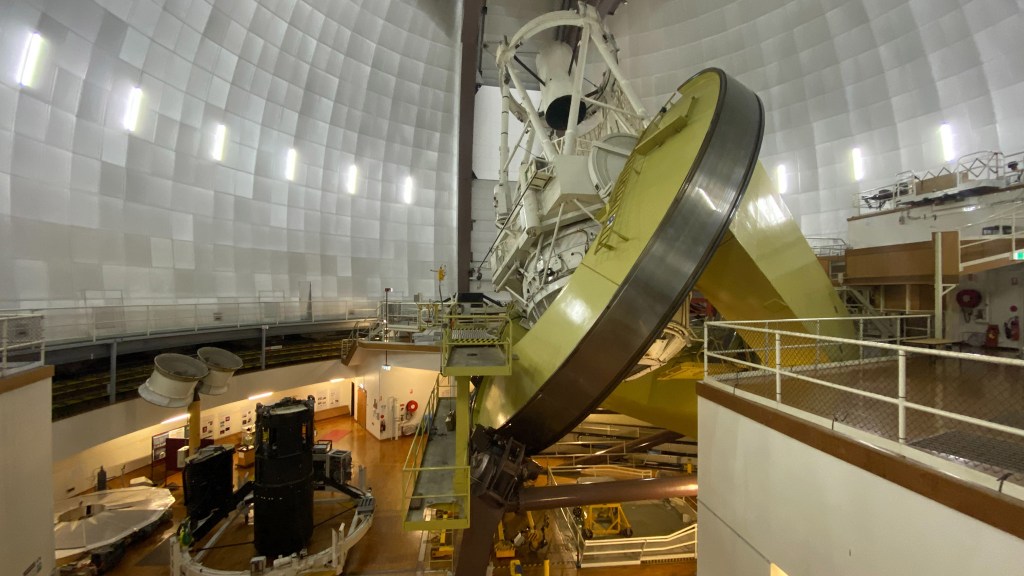
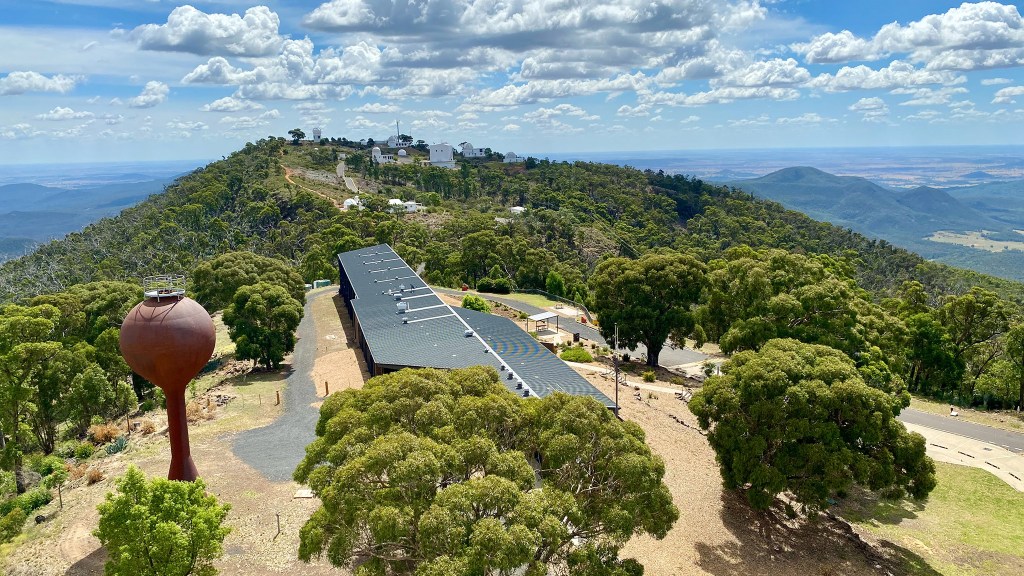
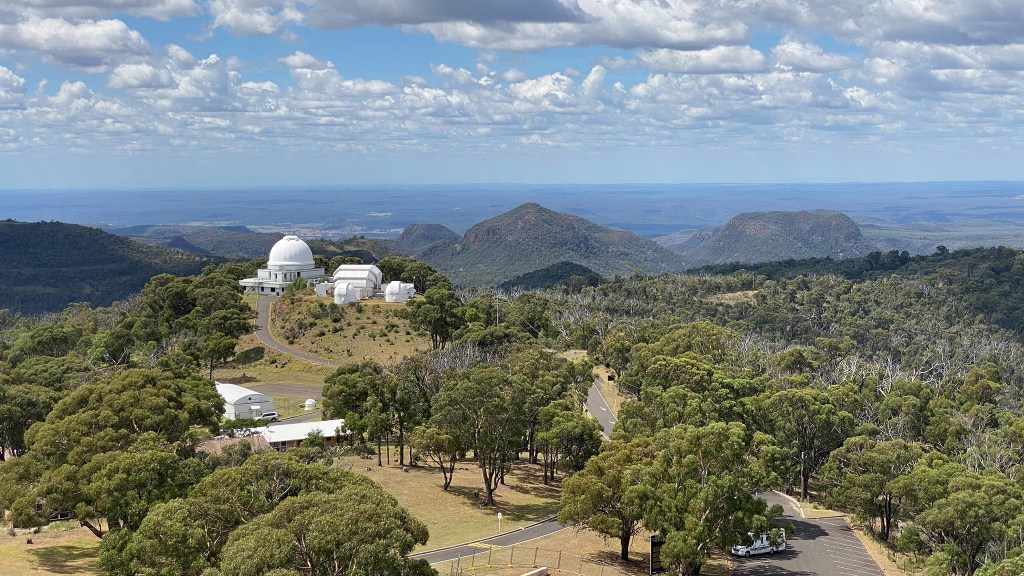
And rightly so, as nearby is the Siding Spring Observatory, Australiaโ€™s largest complex of optical telescopes (check the slide show above). I had a great tour again โ€” thanks, Blake! โ€” of the big 4-metre AAT that towers over the rest of the observatories on the mountain. 

The Upside-Down Sky

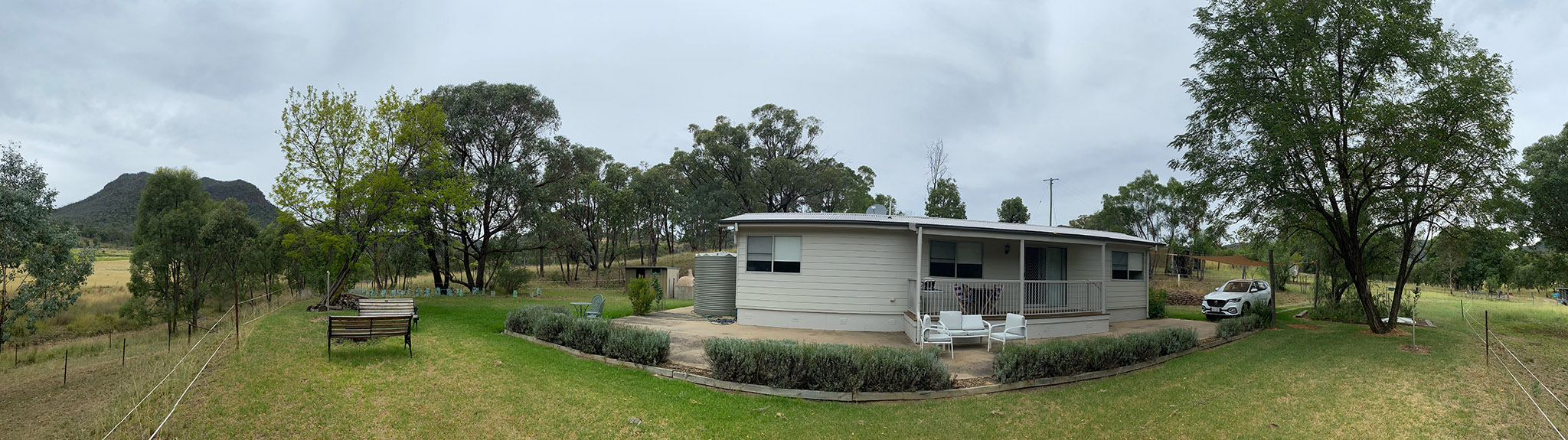
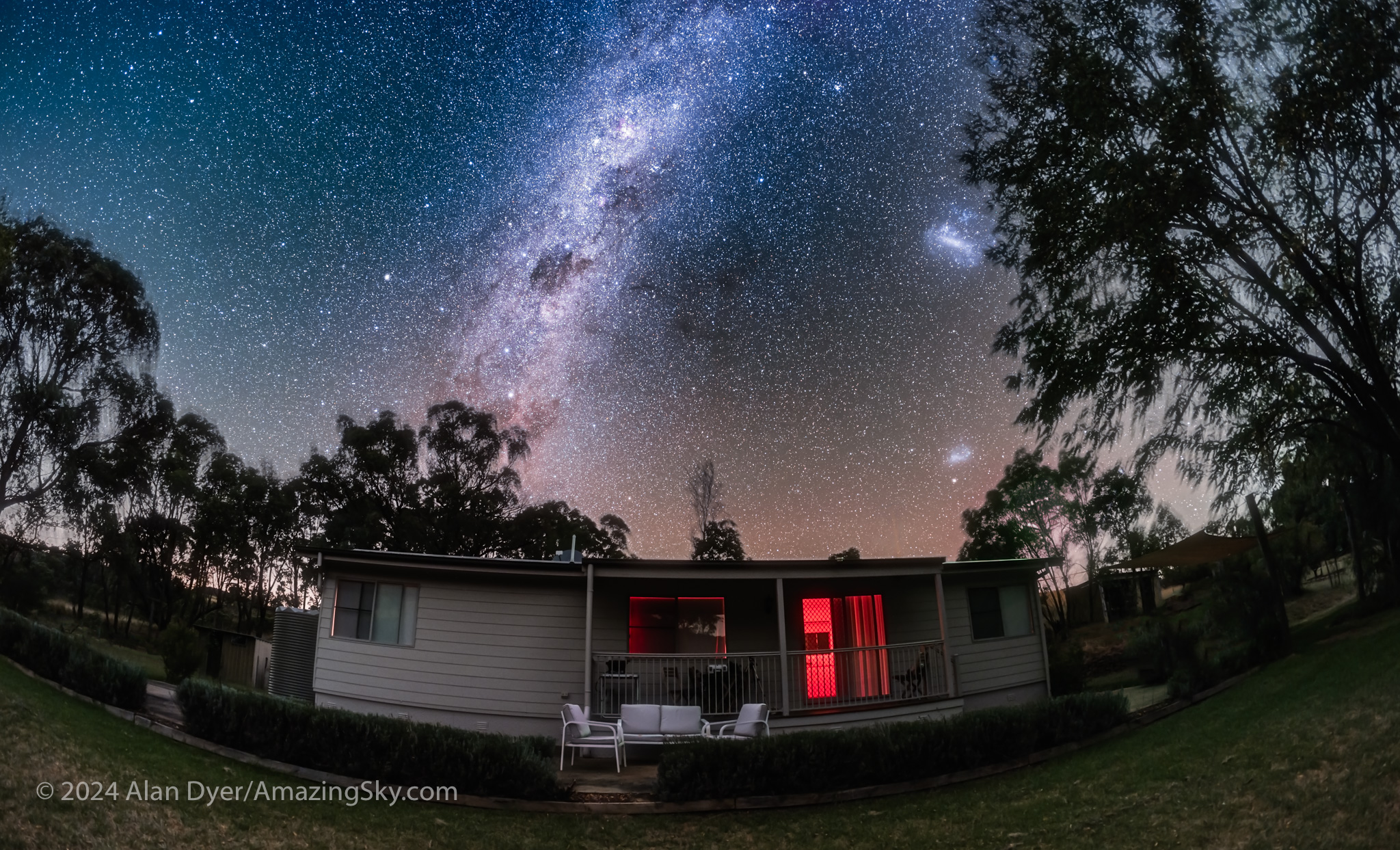
A pano of Mirrabook Cottage, my astronomy retreat site.

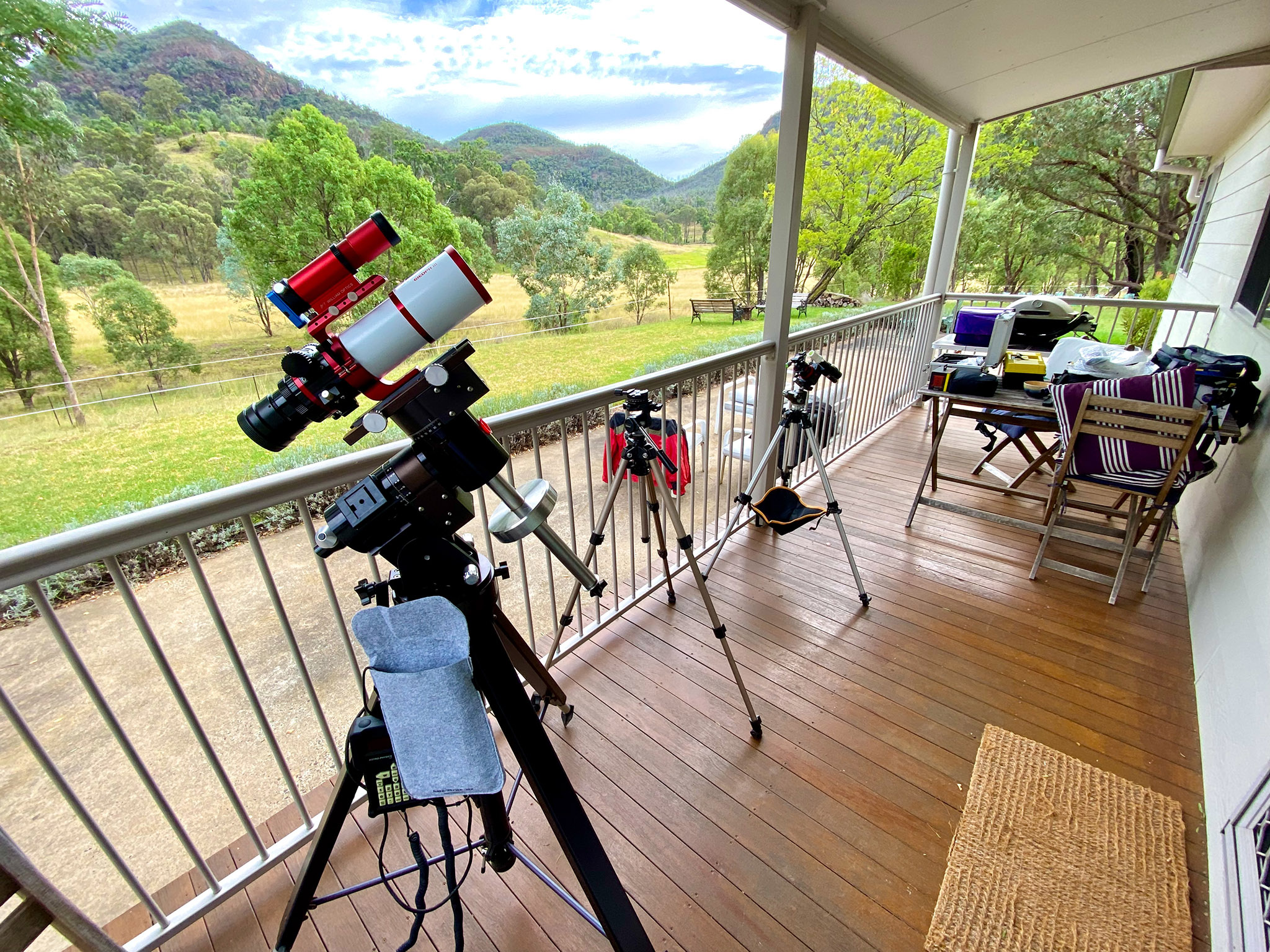
My home for the first week in โ€œCoona,โ€ as the waning Moon got out of the way, was the Mirrabook Cottage off Timor Road, ideal as an astrophoto retreat. The view to the east and south (the view above) is partly obscured by gum trees, but not enough to prevent shooting targets around the South Celestial Pole, such as the Magellanic Clouds, as I show below. 

The scope came with me this time, but the mount had been in Oz for 20 years.

The first order of the day upon arriving was to sort out my gear, to see if it was all working. My main Oz telescope, a legendary Astro-Physics Traveler refractor that I had stored in Australia since the early 2000s, came home with me in 2017, for use at the 2017, 2023, and 2024 solar eclipses in North America (the links take you to blogs for those eclipses) . 

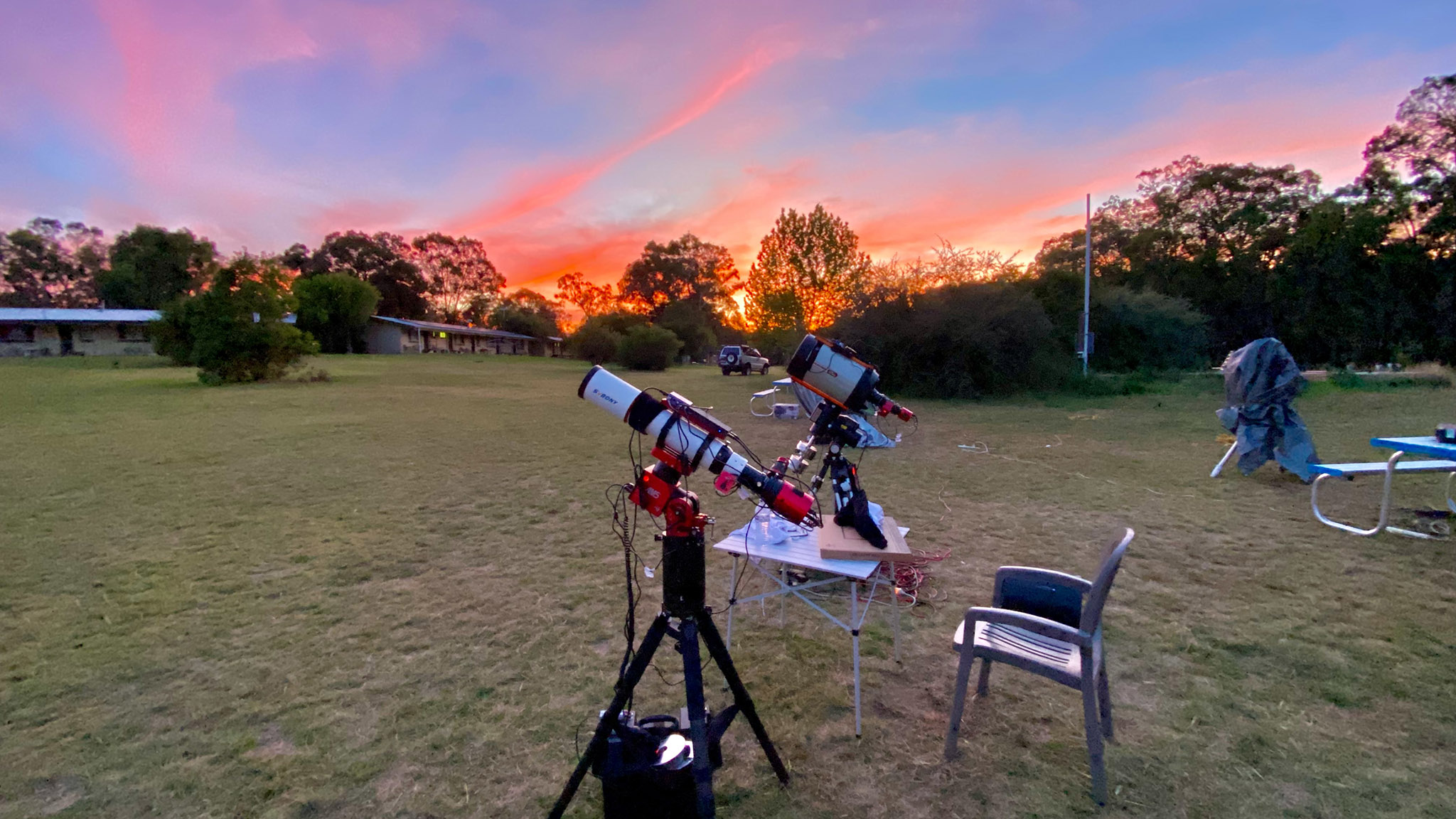
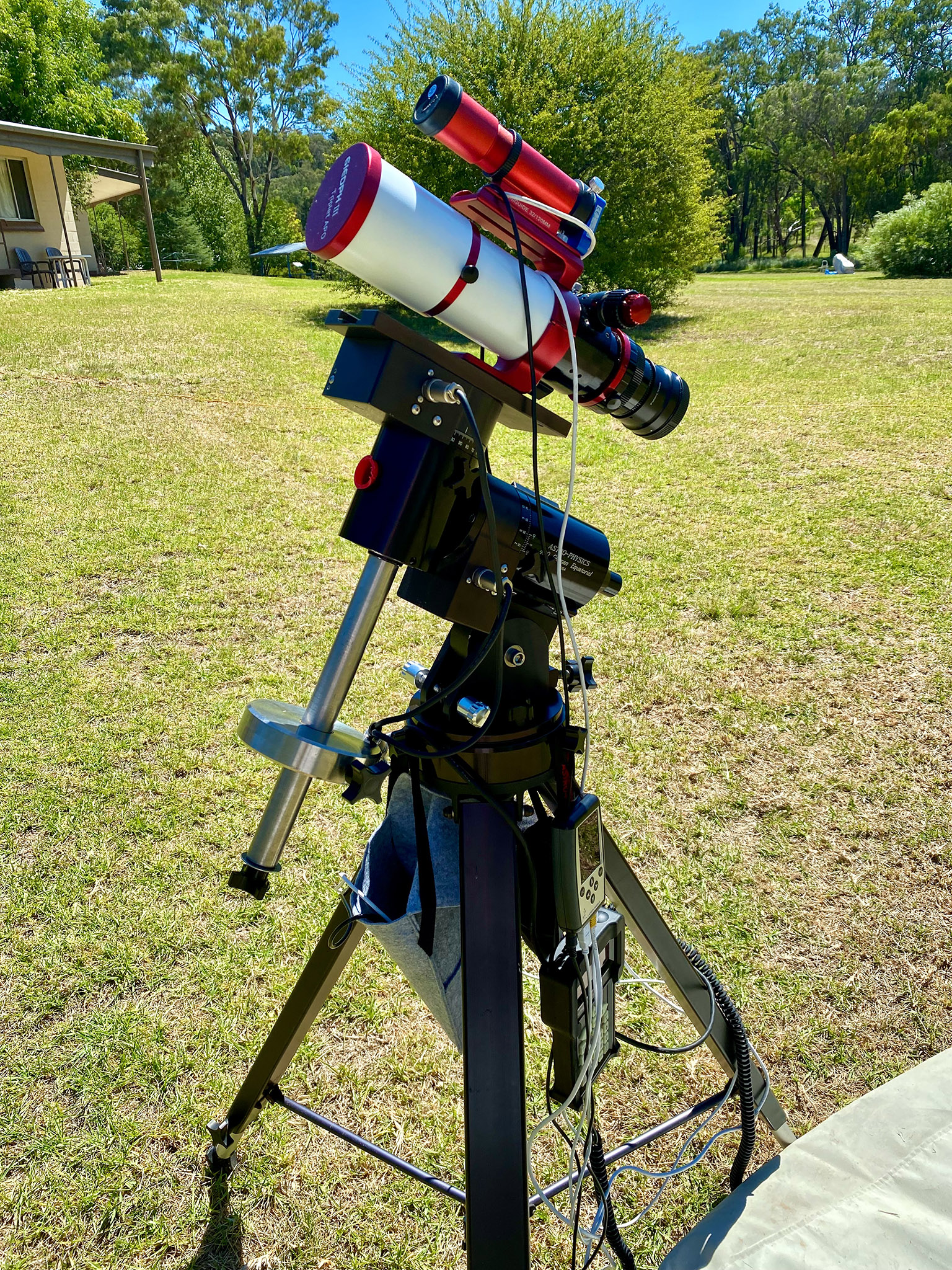
So this year I brought another little refractor with me, the diminutive Sharpstar 61mm EDPH III. Many of the images I present here I shot with the Sharpstar, on the veteran Astro-Physics AP400 mount I show above, which had lived in Australia for two decades. It came home with me this time, to use the very next month at the April total eclipse in Quebec. My blog with the final music video from that eclipse is here.

But I also brought a little star tracker, an MSM Nomad, which I reviewed here, just in case the old iOptron tracker I had in Australia, but hadnโ€™t used since 2017, did not work. I neednโ€™t have feared. It was the new Nomad that had issues, with the iOptron serving me well as a back-up for wide-angle Milky Way images. 

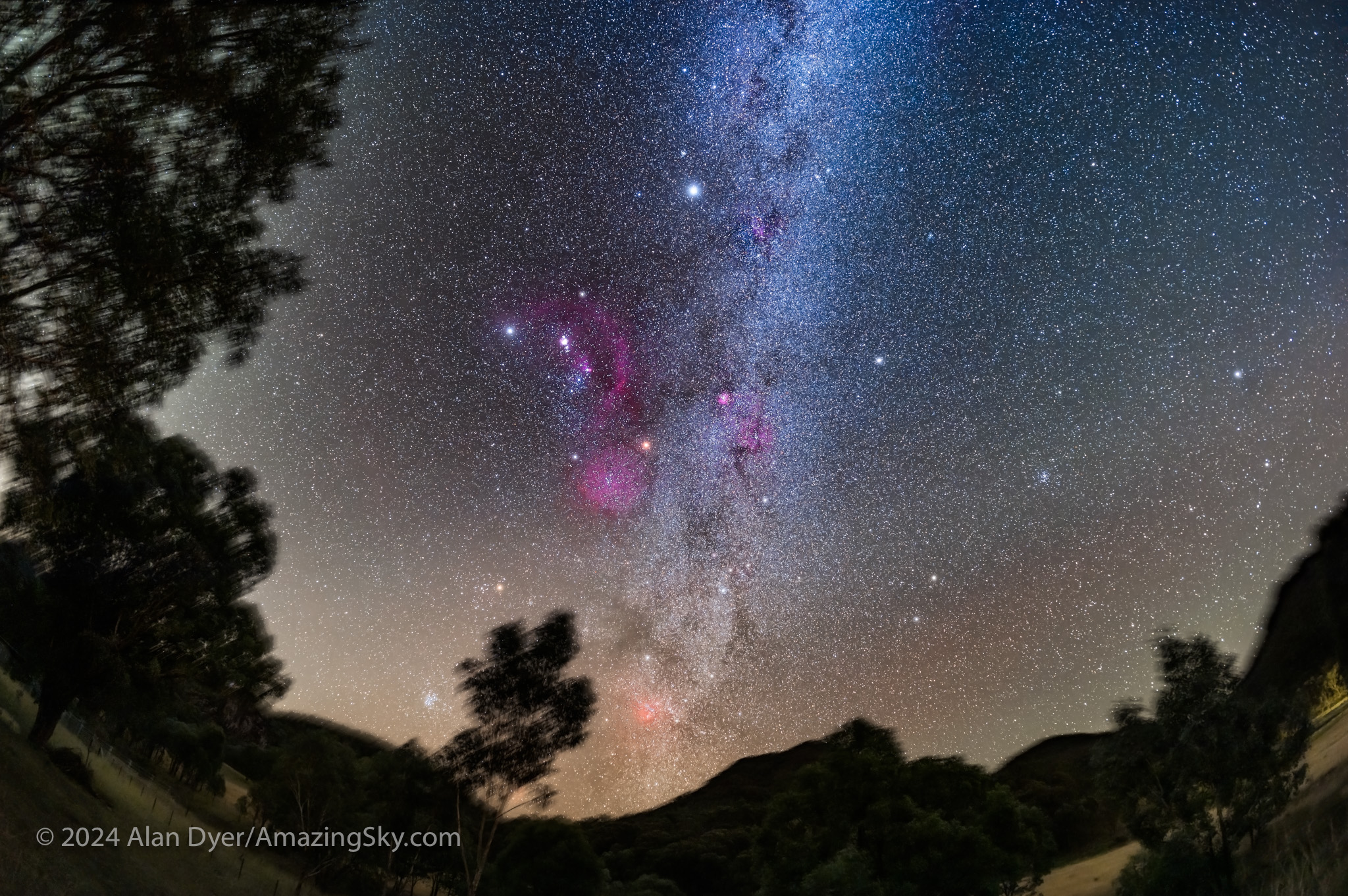
This is a wide-angle view of the constellations of the northern hemisphere winter, but seen from the southern hemisphere looking north on an austral autumn night, March 3, 2024. Shot on the MSM Nomad tracker, for a blend of 4 x 2-minutes tracked at ISO 1600 for the sky and 2 x 2-minutes untracked at ISO 800 for the ground.

From Mirrabook looking north affords a fine view of a sky familiar to us northerners โ€” if we stand on our heads! Orion and the stars of โ€œwinterโ€ are there but upside-down for us, with the constellations that are overhead for us at home, now low in the north. 

I shot all the images presented here during my two-week Oz astrophoto extravaganza. I had clear skies every night, bar for a couple that were welcome breaks! 

A more complete gallery of my images from Australia in 2024 is here on my Flickr site.

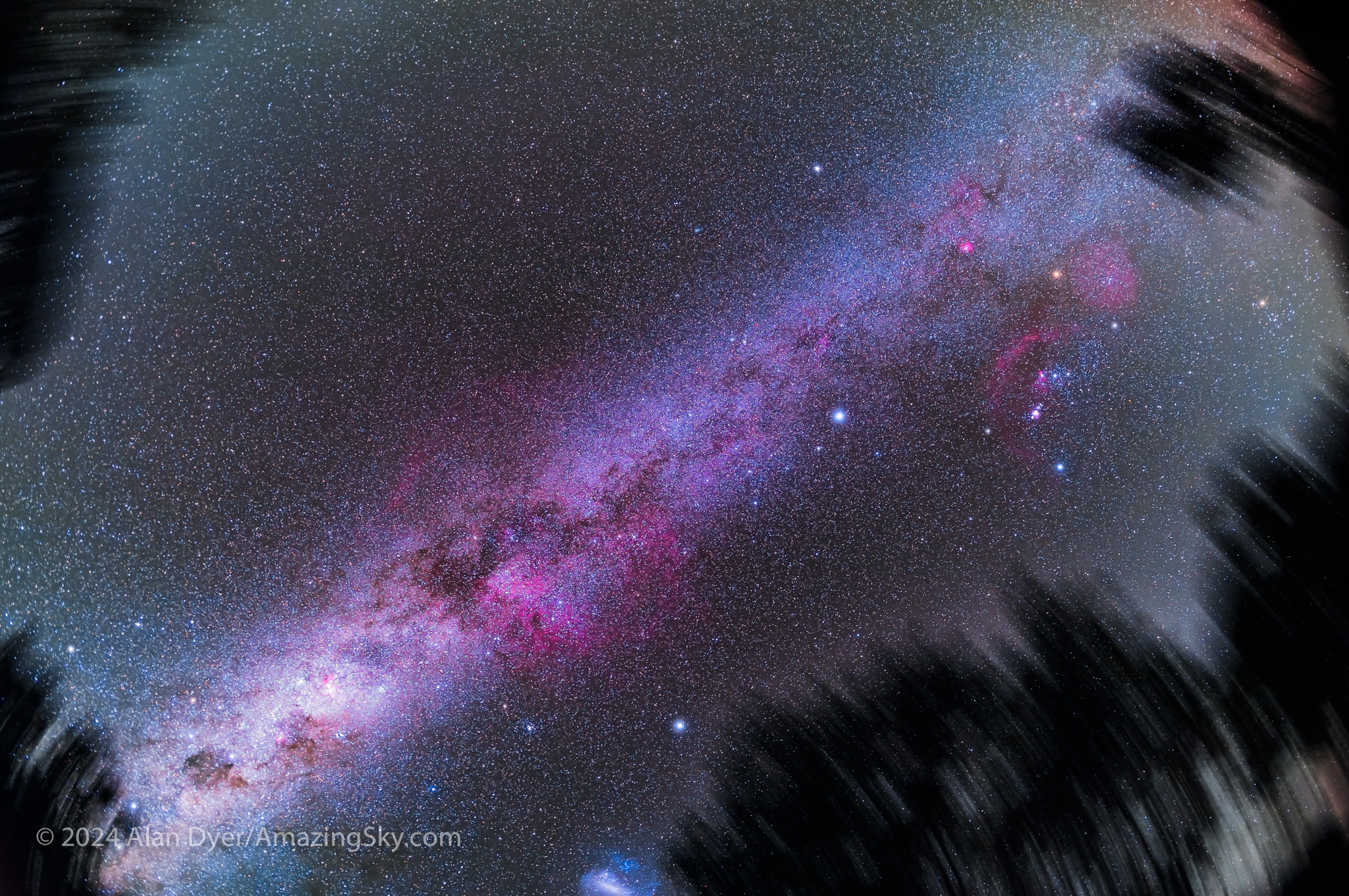
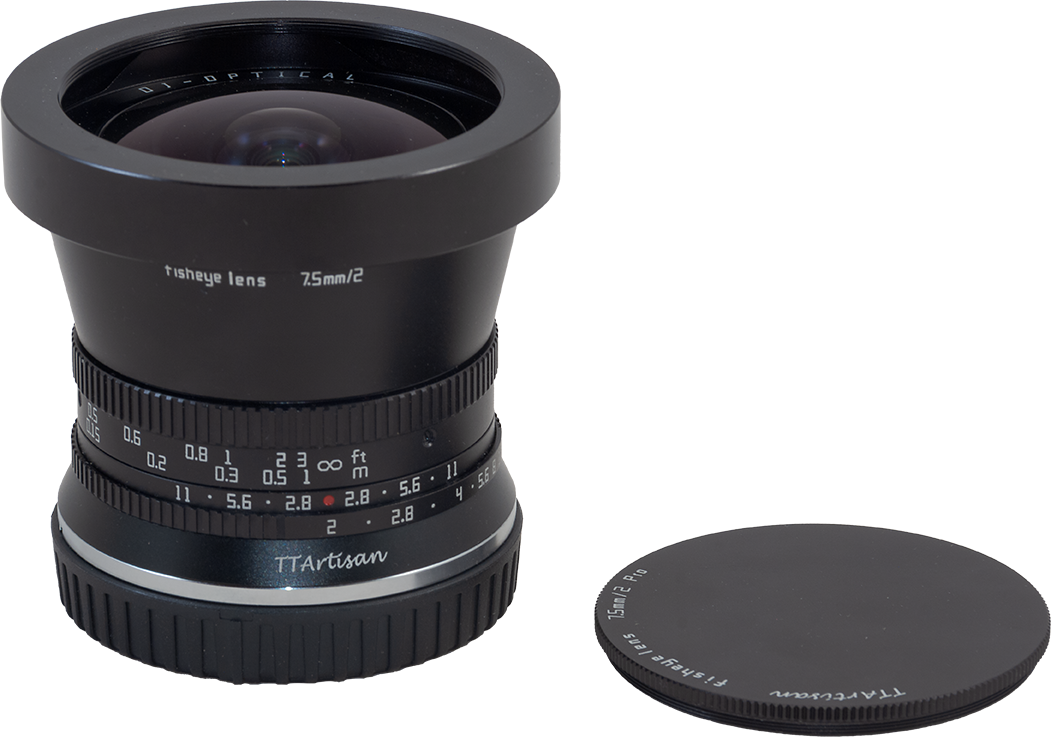
This is a wide-angle view of the southern Milky Way, here from Carina and Crux at lower left up to Orion and Monoceros at upper right. On the MSM Nomad tracker, for a stack of 10 x 3-minute exposures at ISO 800 with the TTArtisan 11mm lens on the Canon Ra.

South of Orion, and overhead from Australia (as I show above), is the dimmer section of the Milky Way passing through constellations once part of the huge celestial ship Argo Navis, now broken into Puppis the Aft Deck, Vela the Sails, and Carina the Keel, the latter containing the second brightest star in the night sky, Canopus, second only to Sirius nearby in Canis Major. 

Puppis and Vela 

Though somewhat obscure and hard to pick out as distinctive patterns, Puppis and Vela are filled with deep-sky wonders. 

The biggest is so vast it covers as much sky as a hand length, held at armโ€™s length. But it is totally invisible to the eye, even aided by optics. 

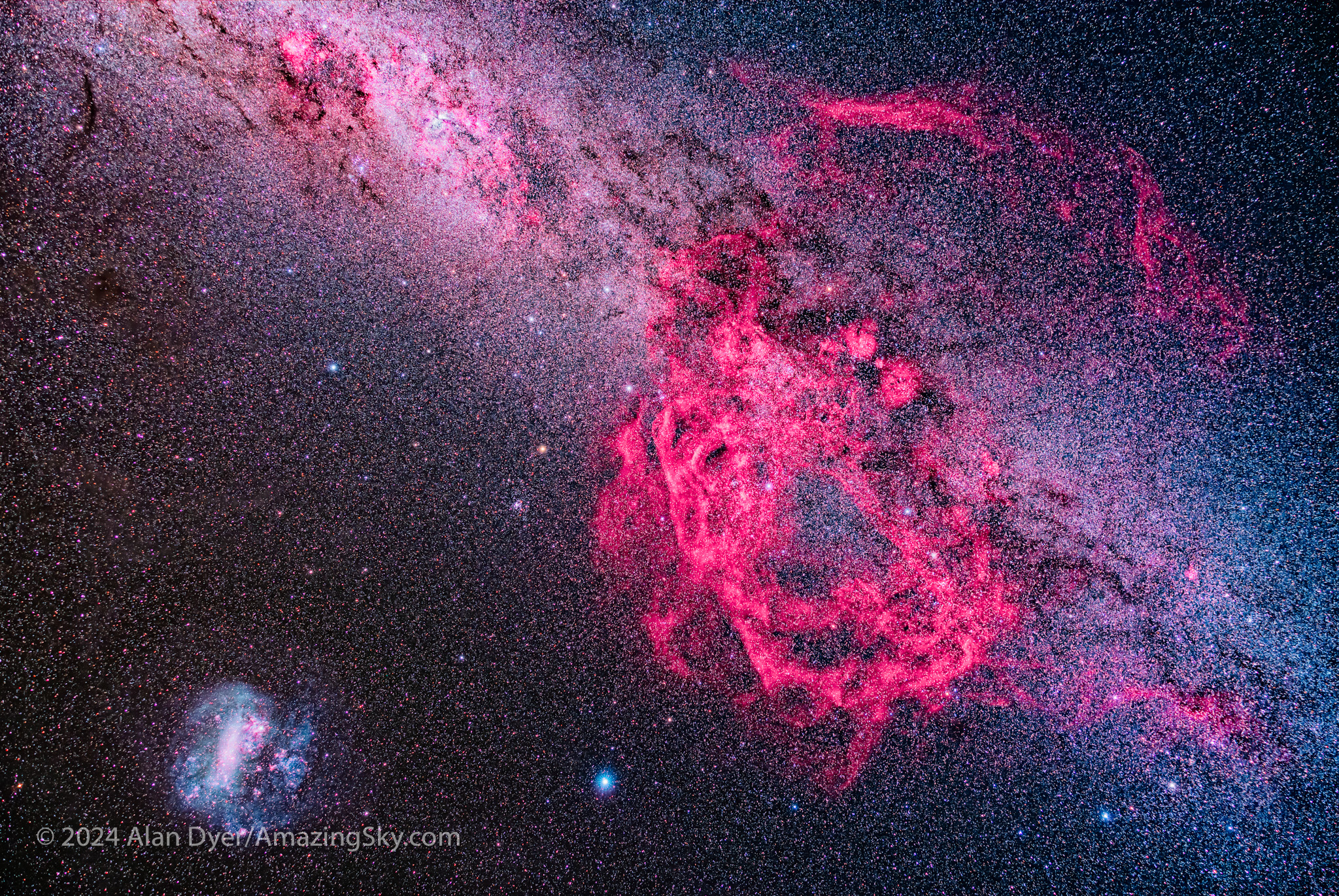
This is a framing of the vast Gum Nebula in the southern Milky Way, that sprawls over the constellations of Vela and Puppis. This is a stack of 12 x 5 minutes at ISO 1600 and f/2 with the Astronomik 12nm H-alpha clip-in filter, blended onto the base unfiltered images from a stack of 14 x 3 minutes at f/2.8, all with the Canon RF28-70mm lens at 28mm on the red-sensitive Canon Ra camera, and on the MSM Nomad tracker.

This is the huge Gum Nebula, discovered in 1955 by Australian astronomer Colin Gum, working at the Mt. Stromlo Observatory near Canberra. It might be a star-forming nebula shaped by stellar winds, or it might be the exploded debris of a nearby supernova star. 

Within the Gum Nebula in Vela is a smaller complex of arcs and fragments I show below. This definitely is a supernova remnant, one that exploded about 11,000 years ago some 900 light years away. But it, too, is large, making it a perfect target for the little refractor, and a telephoto lens, with both versions below. 

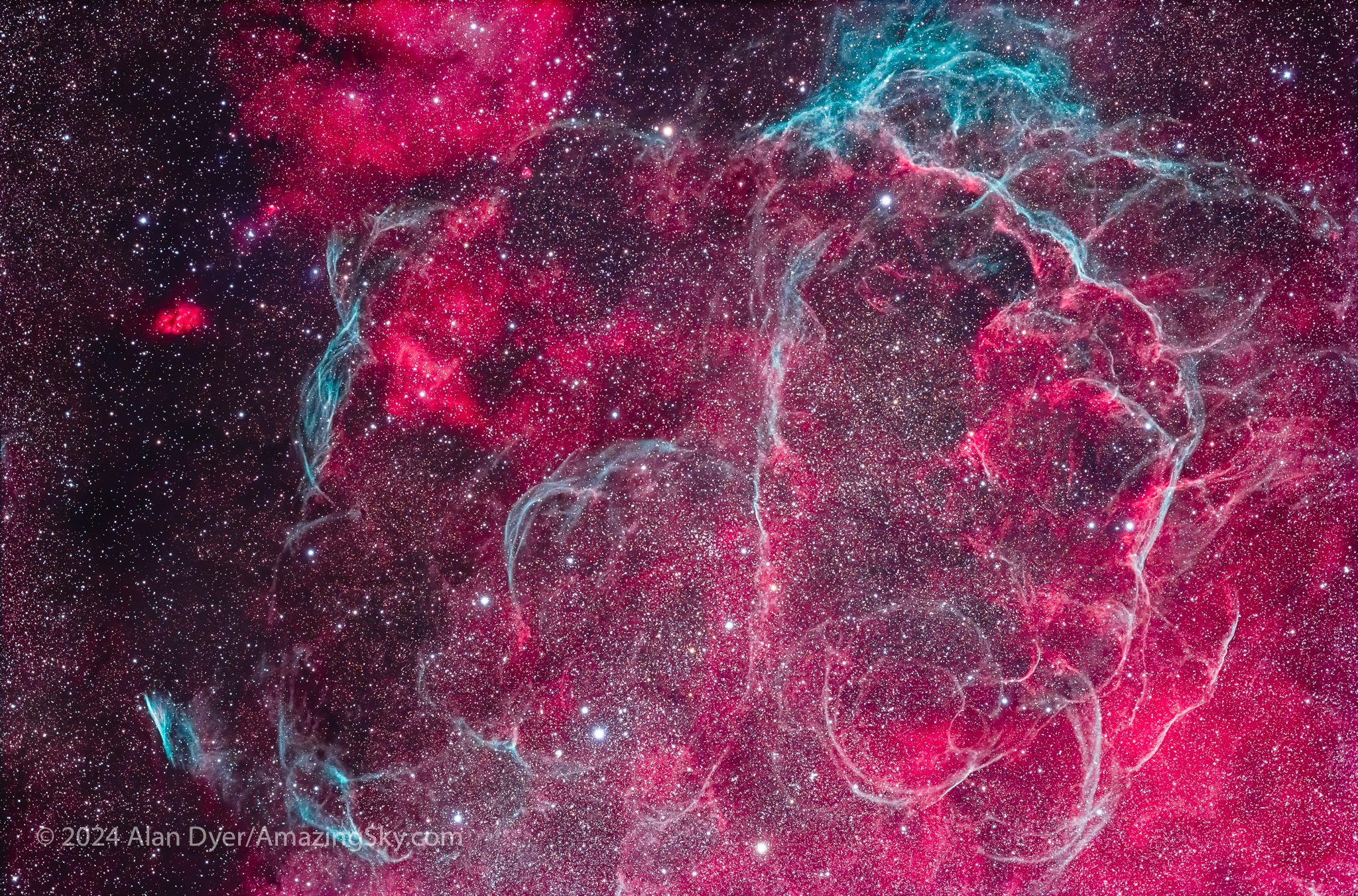
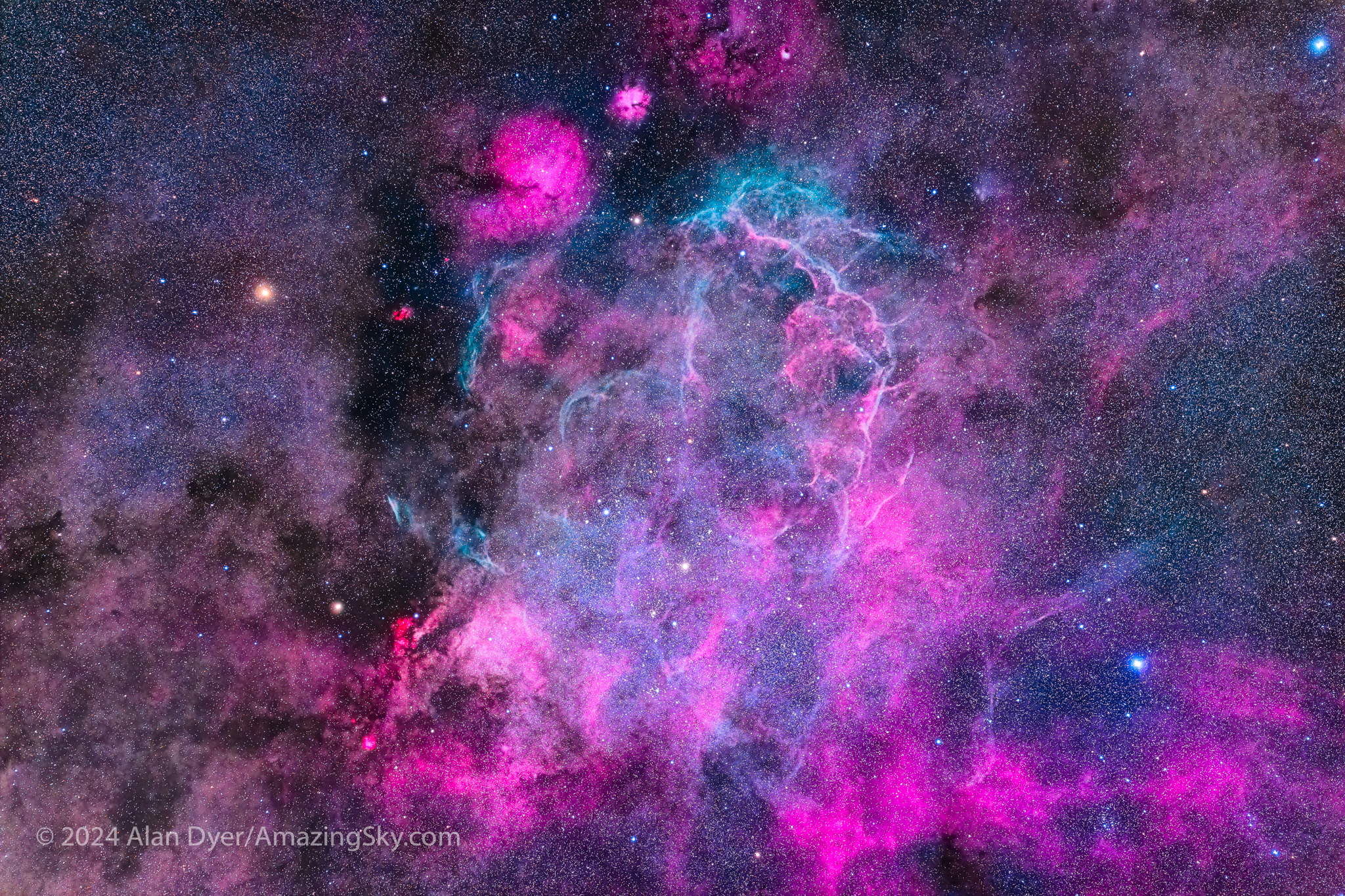
This frames most of the intricate arcs and loops of the Vela Supernova Remnant (SNR). This is a stack of 8 x 10-minute exposures shot through an IDAS NBZ dual narrowband filter to bring out the nebulosity, blended with a stack of 12 x 5-minute exposures with no filter. All with the filter-modified Canon EOS R camera, on the Sharpstar 61 EDPH III refractor at f/4.4.
This is the large Vela Supernova Remnant in a stack of 15 x 2-minute exposures with the Canon RF135mm lens at f/2 on the Canon Ra at ISO 1000. With a broadband filter.

The area is also home to rich fields of bright star clusters (two are below), many intertwined with wreaths of star-forming nebulosity. These rival or exceed the more famous northern targets of the Messier Catalogue compiled between 1774 and 1781 by Charles Messier. It took several more decades before astronomers from the north catalogued the sky to the south. 

This is the bright, large and colourful naked-eye star cluster NGC 2516 in Carina, aka the Southern Beehive Cluster, near the bright star Avior (Epsilon Carinae) in Carina. This is a stack of 8 x 5 minute exposures with the Sharpstar 61mm refractor at f/4.4 and the Canon R at ISO 800.
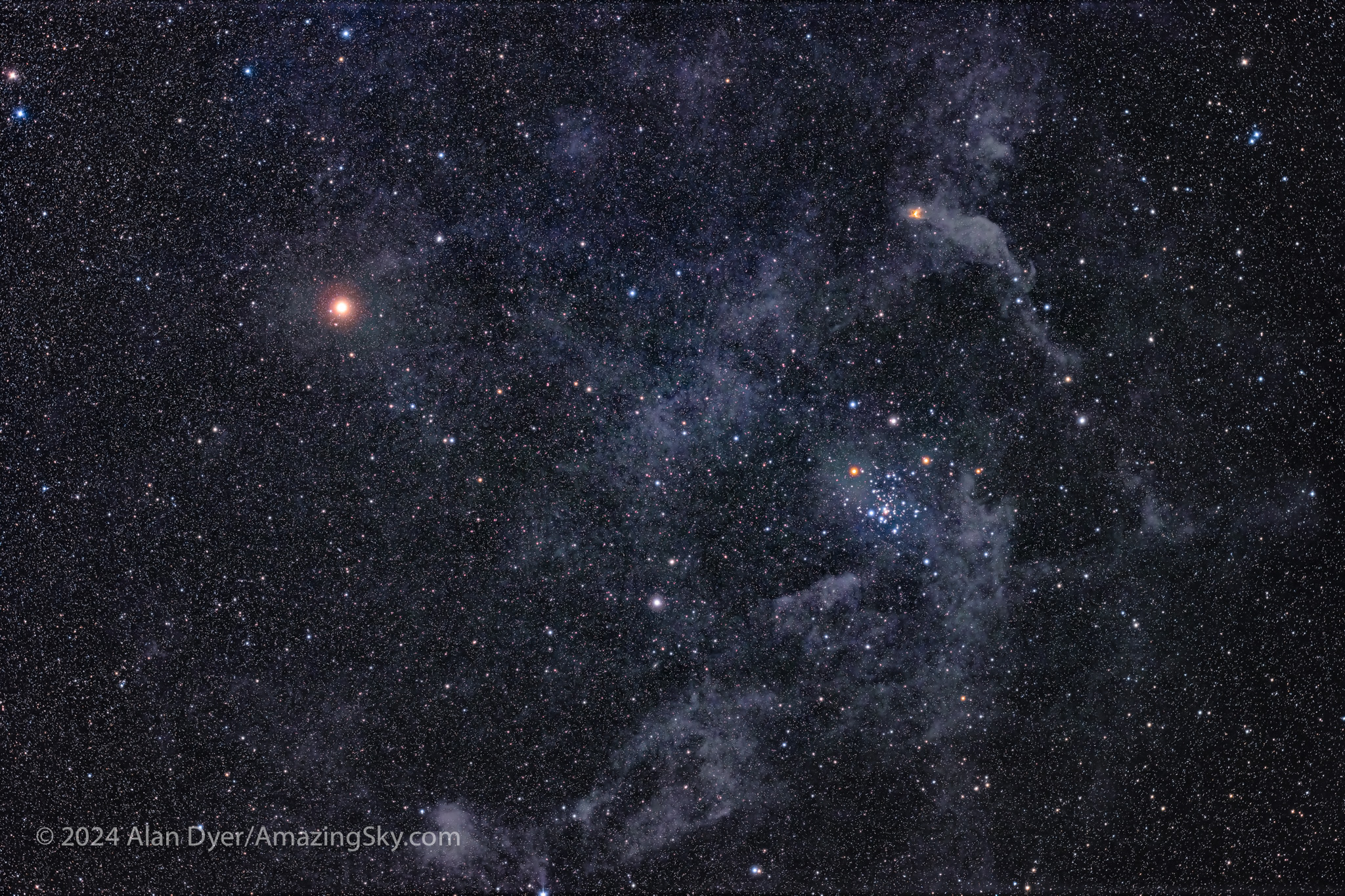
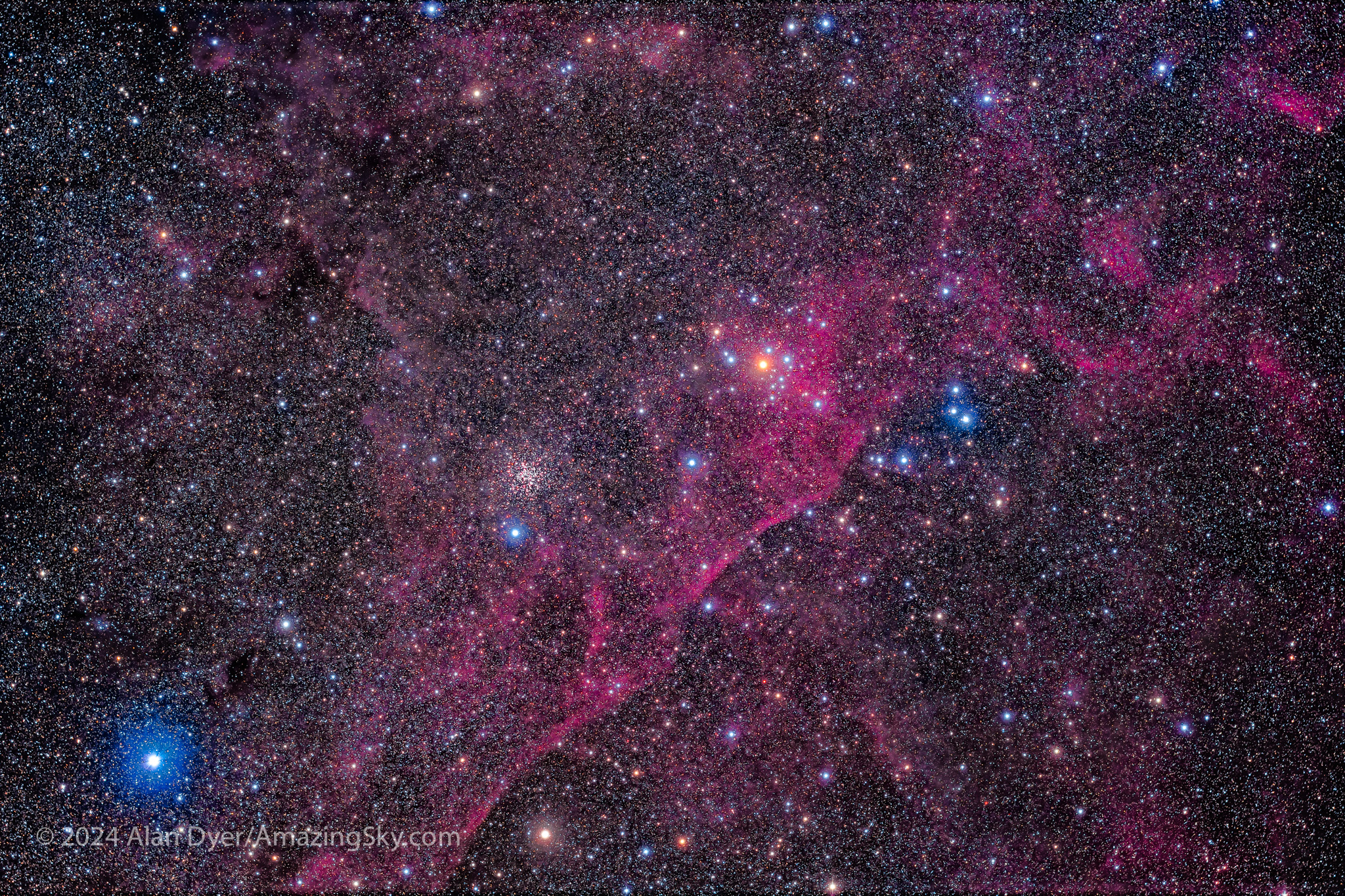
This frames a pair of contrasting and superb star clusters in Puppis: rich NGC 2477 on the left and sparse but bright NGC 2451 on the right, the latter centred on the orange star c Puppis. This is a stack of 8 x 5 minute exposures with the Sharpstar 61mm refractor at f/4.4 and the modified Canon R at ISO 800.

Carina and Crux

Continuing deeper down the Milky Way we come to its most southerly portion rich in nebulas and clusters that outclass anything up north. This is also the brightest part of the Milky Way after the Galactic Centre.

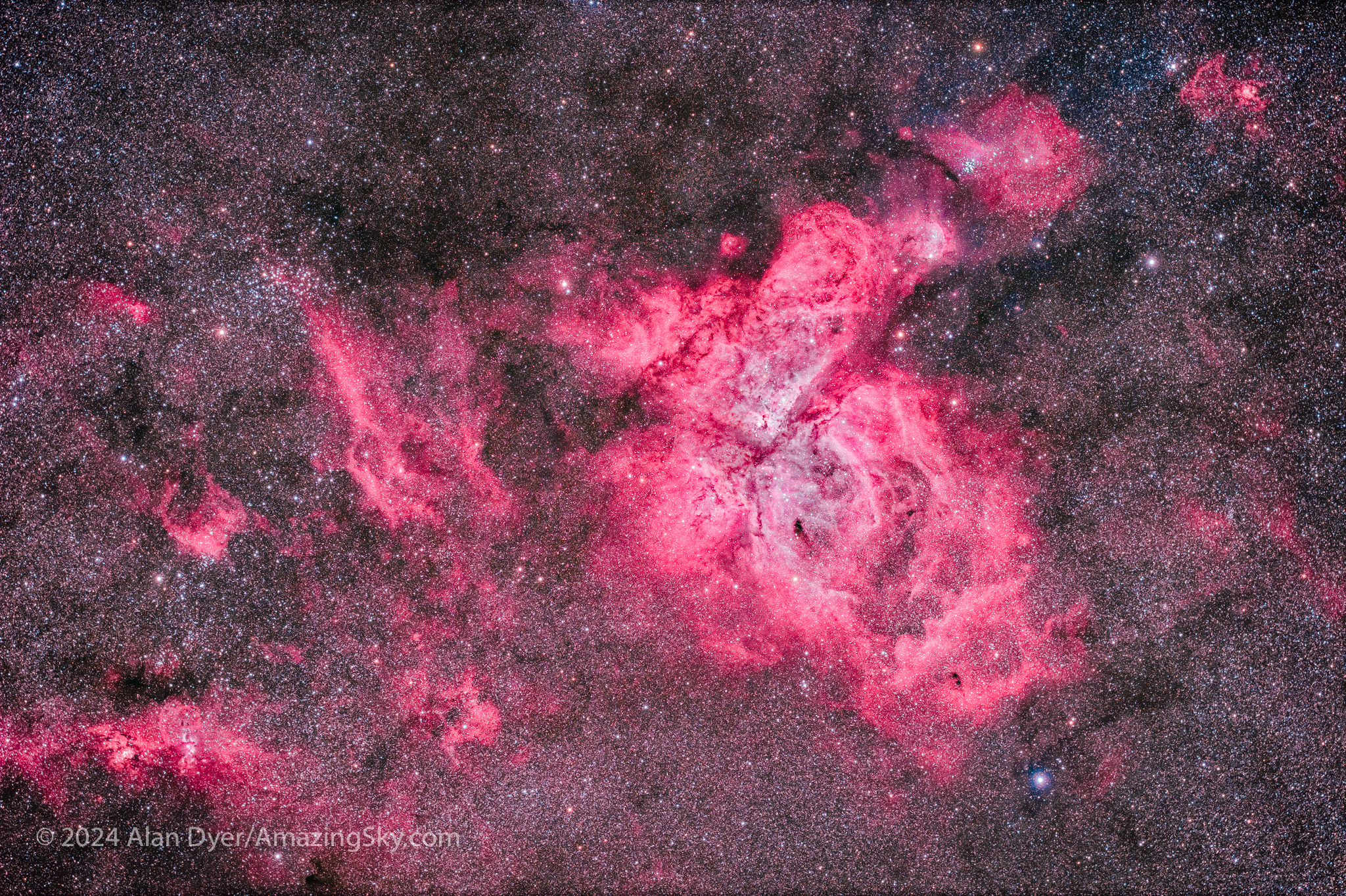
This is the showpiece nebula of the southern skies, the Carina Nebula. The bright and rich Football Cluster, aka the Black Arrow Cluster or Pincushion Cluster, is at upper left. With the Sharpstar refractor at f/4.4 and filter-modified Canon R at ISO 3200 for narrowband filtered shots and ISO 800 for unfiltered shots.

The Carina Nebula is larger than the more famous Orion Nebula farther north. In the eyepiece it is a glowing cloud painted in shades of grey and crossed by intersecting dark lanes of dust. Photographs reveal even more intricate details, and the magenta tints of glowing hydrogen. 

At upper left is the โ€œFootball Cluster,โ€ as Aussies call it, or the Black Arrow Cluster, aka NGC 3532. It is surely one of the finest open star clusters in the sky. John Herschel, who in the 19th century compiled the first thorough catalogue of southern objects, thought so. I agree! 

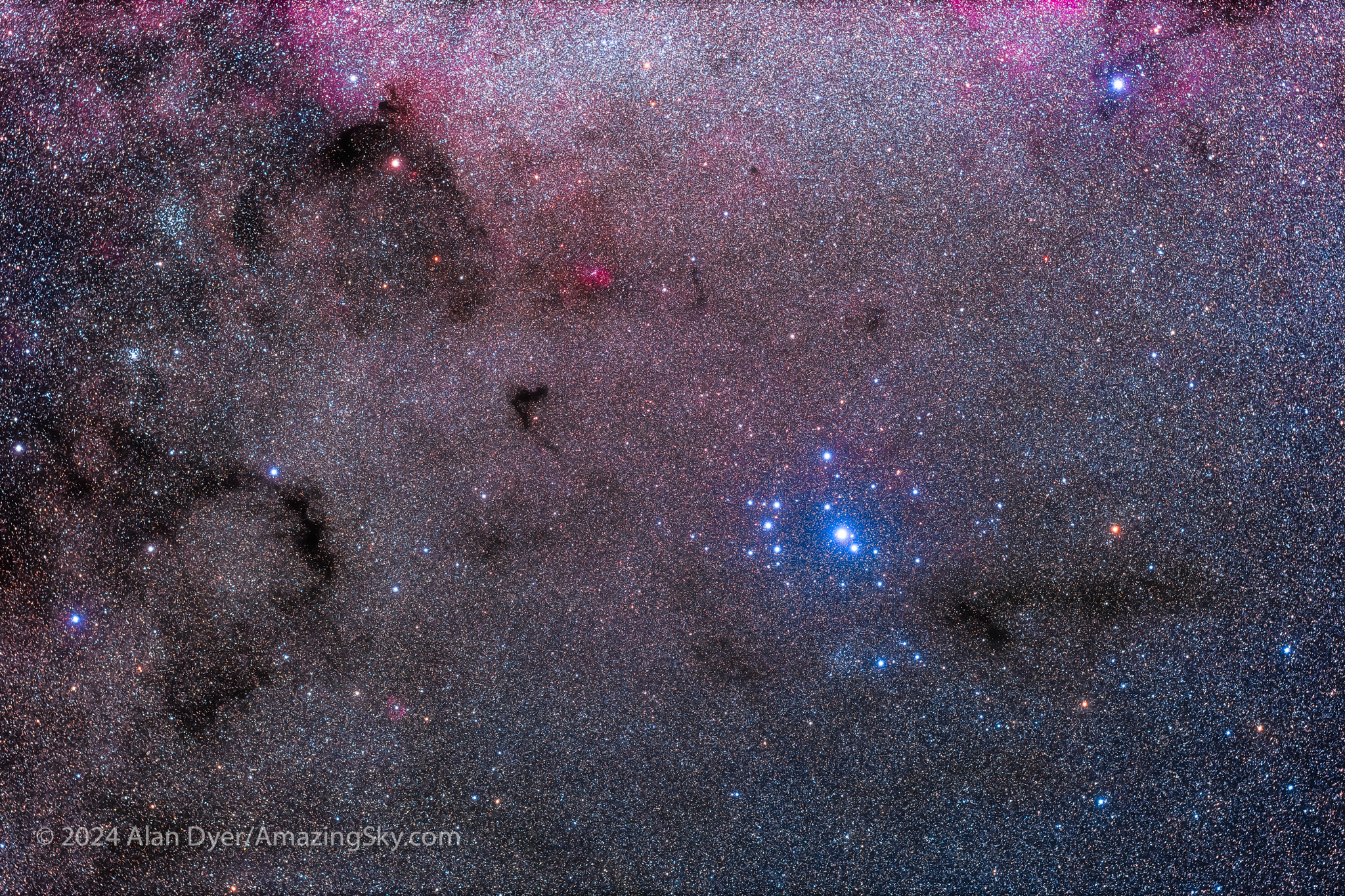
This is the Southern Pleiades star cluster surrounding the naked eye star Theta Carinae. This is a stack of 8 x 5 minute exposures with the Sharpstar 61mm refractor at f/4.4 and the Canon R at ISO 800.

Below the Carina Nebula is a brighter and bluer star cluster known as the Southern Pleiades, or IC 2602. Like many of the targets I show here, it is visible to the unaided eye and is a fine sight in binoculars, which are all you need to enjoy most of the southern splendours.

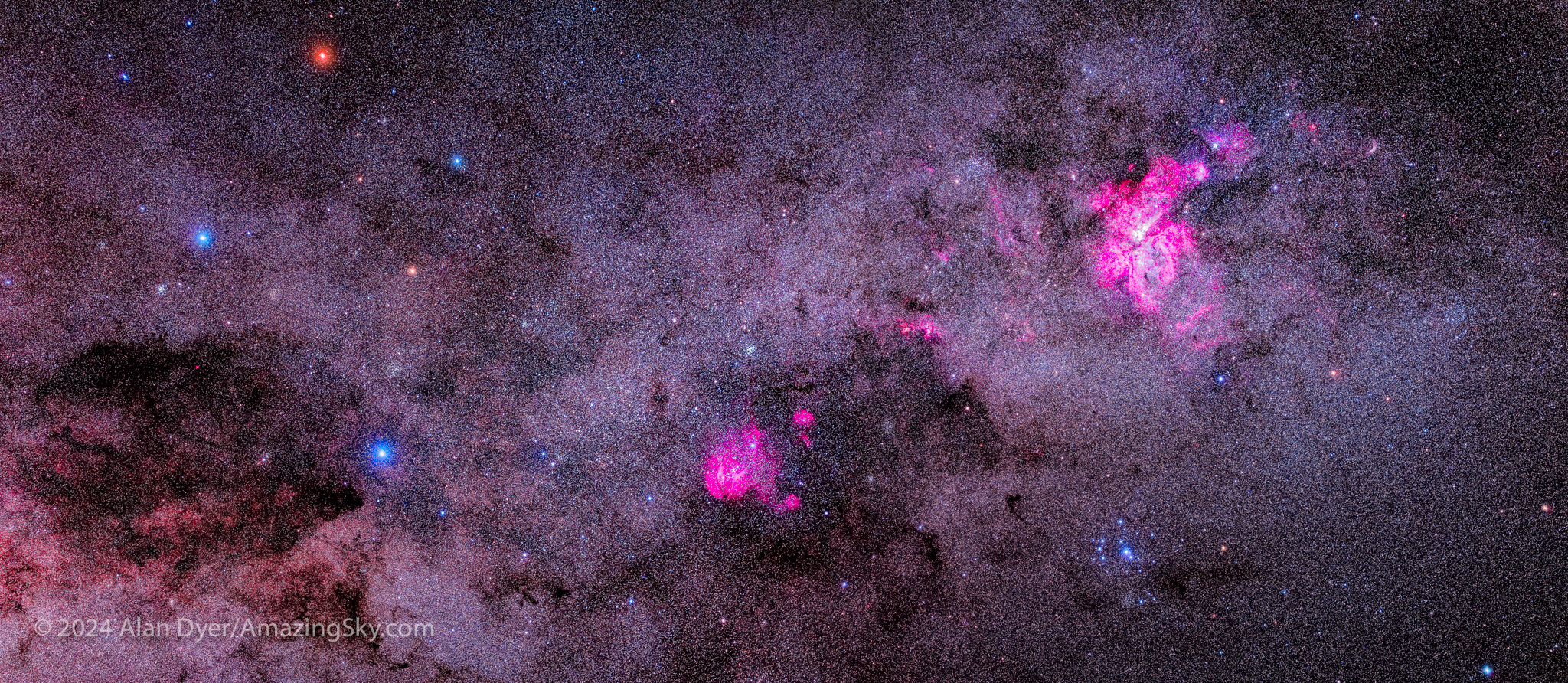
This two-segment telephoto lens panorama extends from the colourful stars of Crux, the Southern Cross at left, to Carina at right. This is a panorama of two segments, each a stack of 12 x 2-minute exposures with the Canon RF135mm lens at f/2 on Canon Ra at ISO 800.

East of the constellation of Carina is the iconic and colourful Southern Cross, or Crux, a star pattern on the flags of Australia, New Zealand and several other austral nations. 

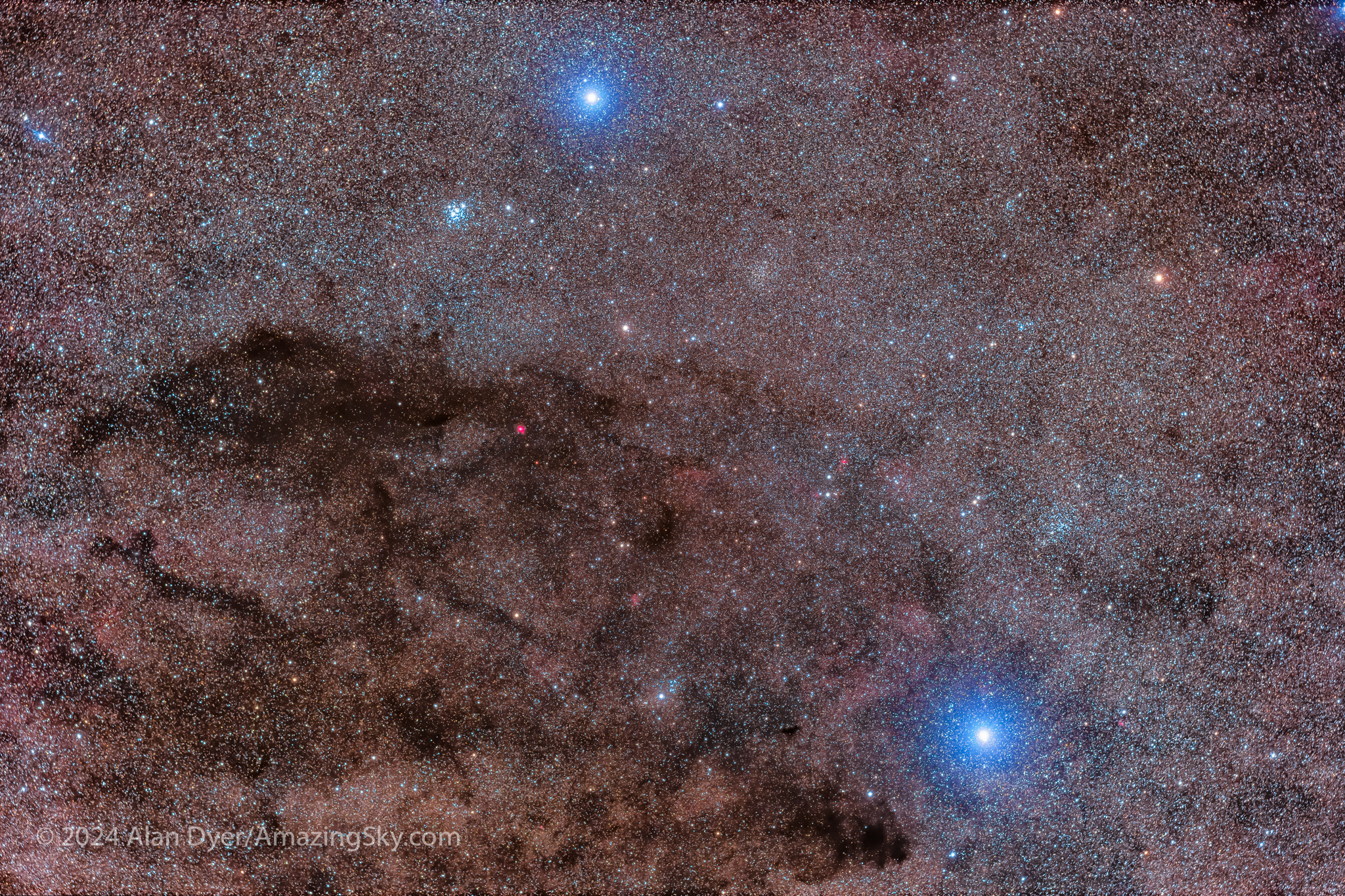
This frames the dark Coal Sack nebula in Crux, the Southern Cross. This is a stack of 8 x 5 minute exposures with the Sharpstar 61mm refractor at f/4.4 and the filter-modified Canon R at ISO 800.

Next to Crux is the darkest patch in the Milky Way, called the Coal Sack. Looking like a dark hole to the eye, in photos it breaks up into streaky dust lanes surrounded by famous star clusters, like the Jewel Box above it. Like many southern clusters, the aptly named (by Herschel) Jewel Box contains a variety of colourful stars. 

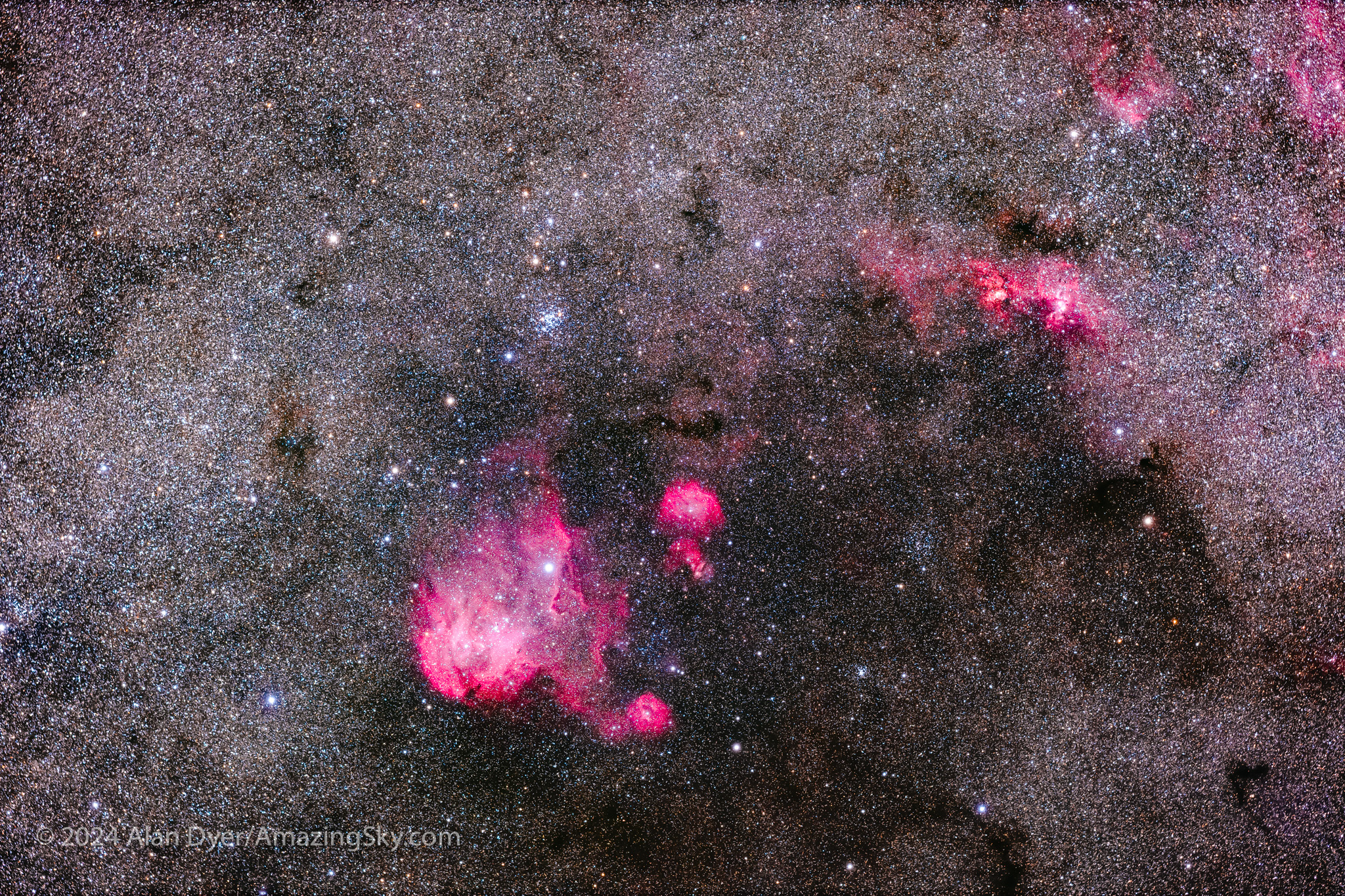
This is the region around the star Lambda Centauri, with the Running Chicken Nebula or IC 2948, at bottom, surrounding the star Lambda Centauri and the loose open star cluster IC 2944. This is a stack of 12 x 5 minute exposures with the Sharpstar 61mm at f/4.4 and filter-modified Canon EOS R camera at ISO 800.

Between Carina and Crux sits another wonderful field of clusters and nebulas, among them the more recently named Running Chicken Nebula. Can you see it? Above it is the Pearl Cluster, NGC 3766, also notable for its colourful member stars. 

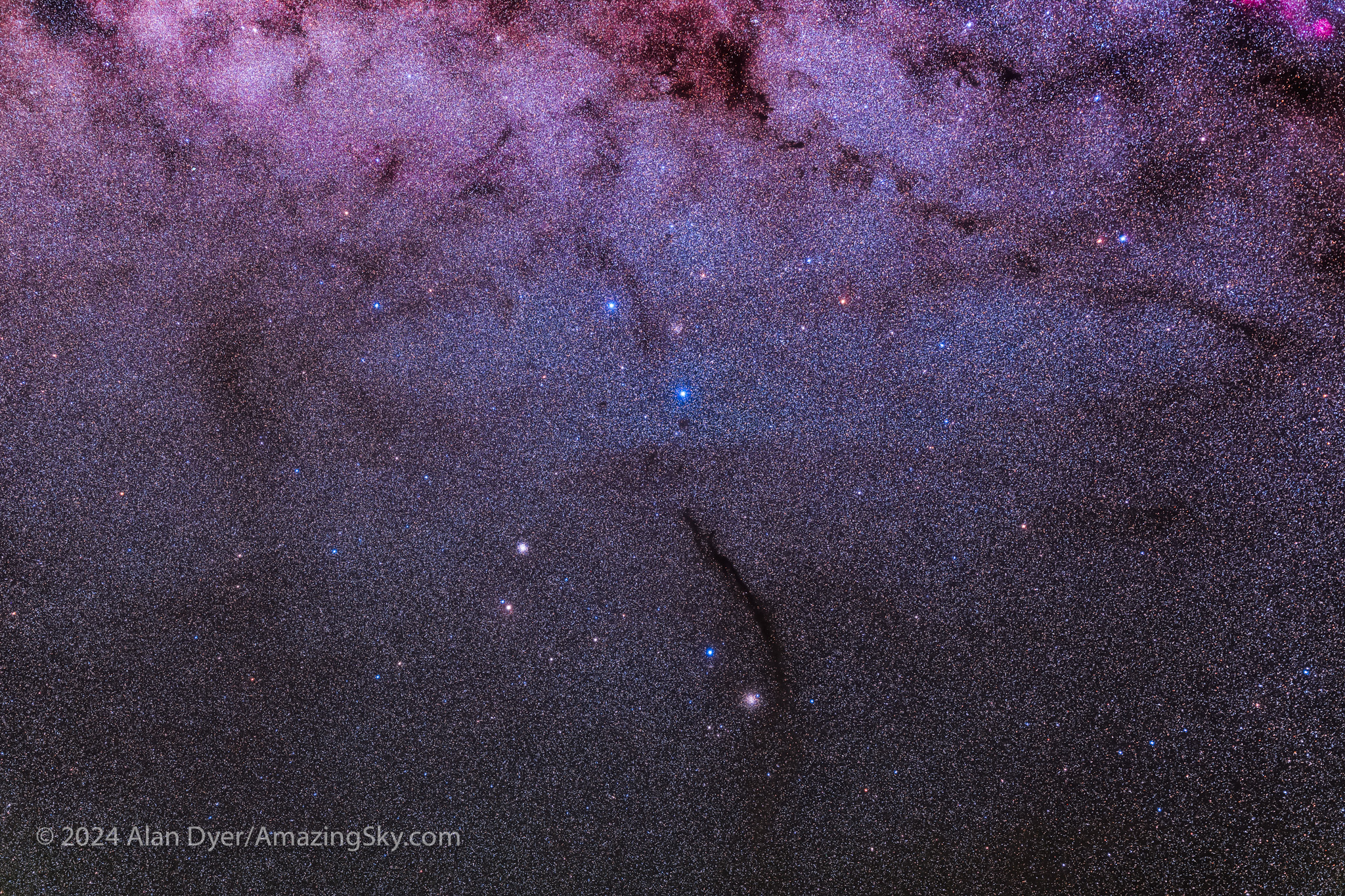
This frames the small constellation of Musca the Fly below the Southern Cross, with the dark nebula called the Dark Doodad, part of the Musca Dark Nebula Complex. This is a stack of 12 x 2 minute exposures with the Canon RF135mm lens at f/2 on the Canon Ra at ISO 800.

Below Crux is the little constellation of Musca the Fly (many southern constellations are named for rather mundane creatures and objects). One of Muscaโ€™s prime sights is the long finger of dusty darkness called the Dark Doodad โ€” yes, thatโ€™s its official name! 

The Magellanic Clouds

All the targets Iโ€™ve shown so far reside in our Milky Way. The next two objects, named for 16th century explorer Ferdinand Magellan, are extra-galactic.

This is the southern Milky Way in Carina, Crux and Centaurus arcing over Mirrabook Cottage. At right are the Large and Small Magellanic Clouds. This is looking south to the South Celestial Pole which is near centre here.

The Clouds are other galaxies beyond ours, but nearby. They are among the closest galaxies and are considered satellites of the Milky Way. Both are visible to the unaided eye, looking like detached bits of the Milky Way. For deep-sky aficionados, they are reason enough to visit the Southern Hemisphere!

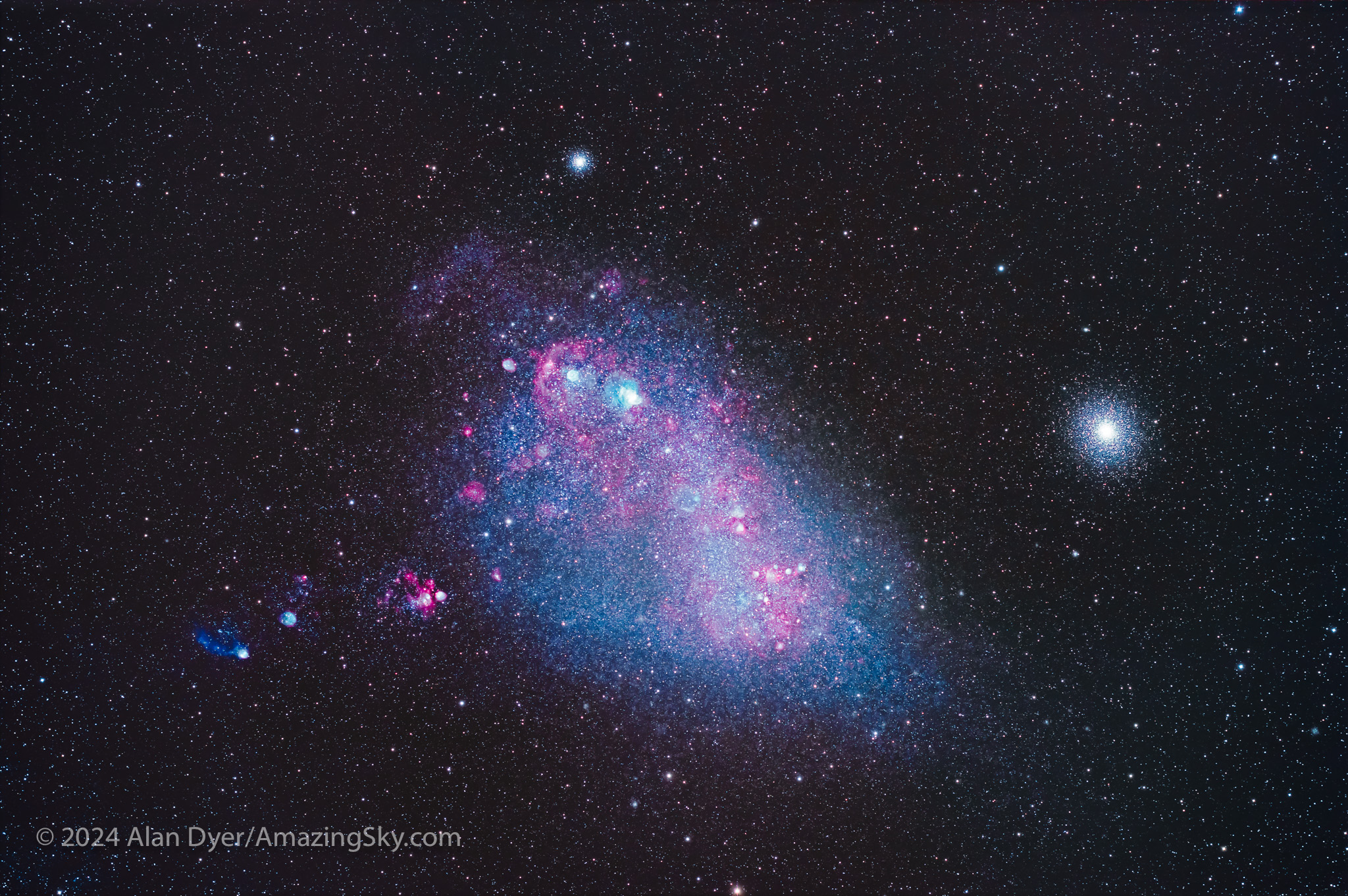
This frames the entire Small Magellanic Cloud, a member of the Local Group of galaxies and a companion of our Milky Way Galaxy. The field is 7.5 by 5ยบ. This is a blend of a stack of 8 x 10-minute exposures at ISO 3200 through an IDAS NBZ narrowband filter, and a stack of 12 x 5 minute unfiltered exposures at ISO 800, all with the Sharpstar 61mm refractor at f/4.4 and the filter-modified Canon R.

The Small Magellanic Cloud contains many star-forming nebulas that glow in hydrogen red and oxygen cyan. It is most famous for its spectacular neighbour, the great globular star cluster called 47 Tucanae, here at right. It is not actually part of the SMC โ€” 47 Tuc is more than ten times closer, on the outskirts of our Galaxy. 

As rich as the Small Cloud is, it pales in comparison to its bigger neighbour, the LMC. The Large Magellanic Cloud is almost a universe unto itself. Astronomers have devoted their careers to studying it. 

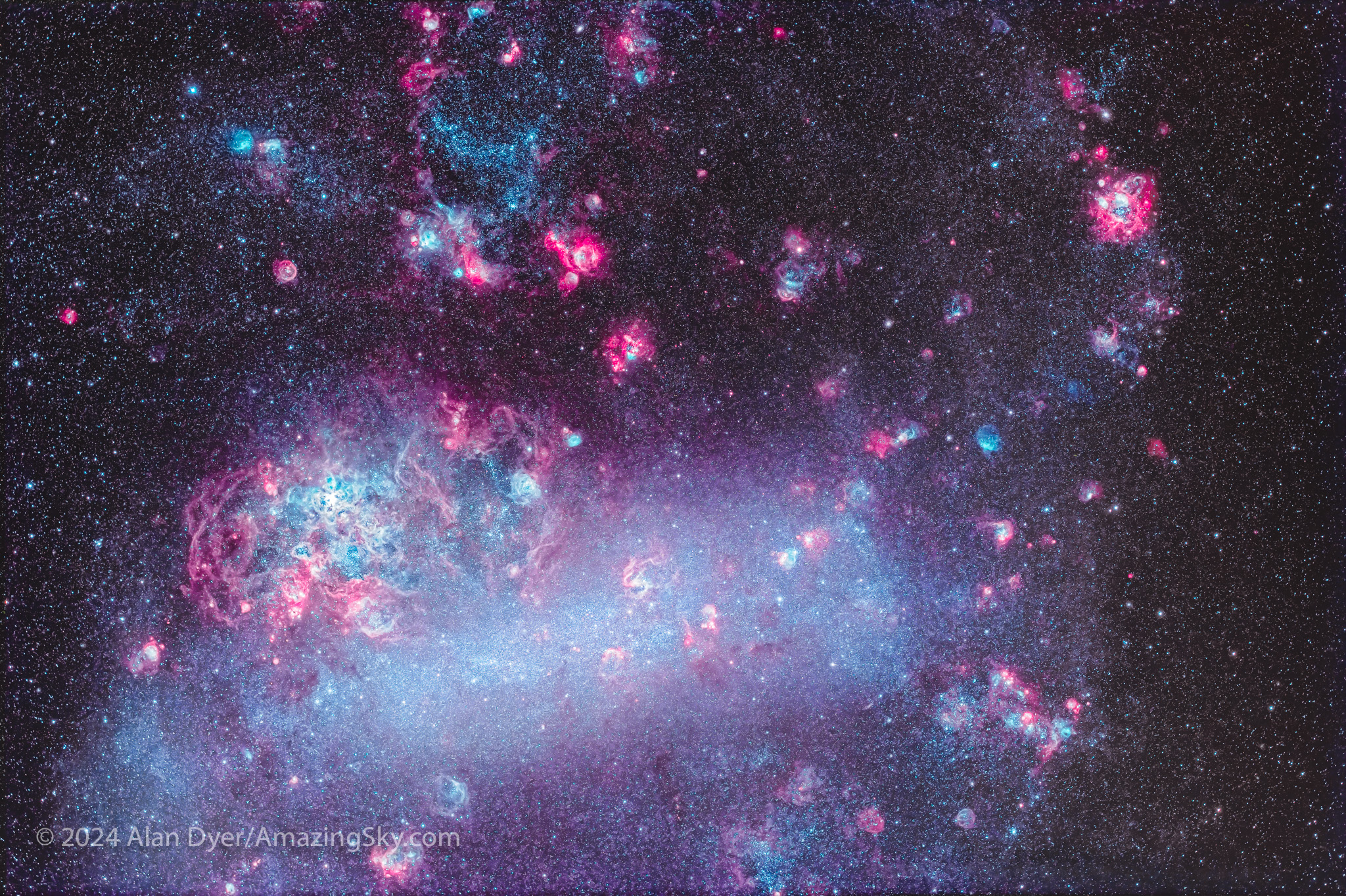
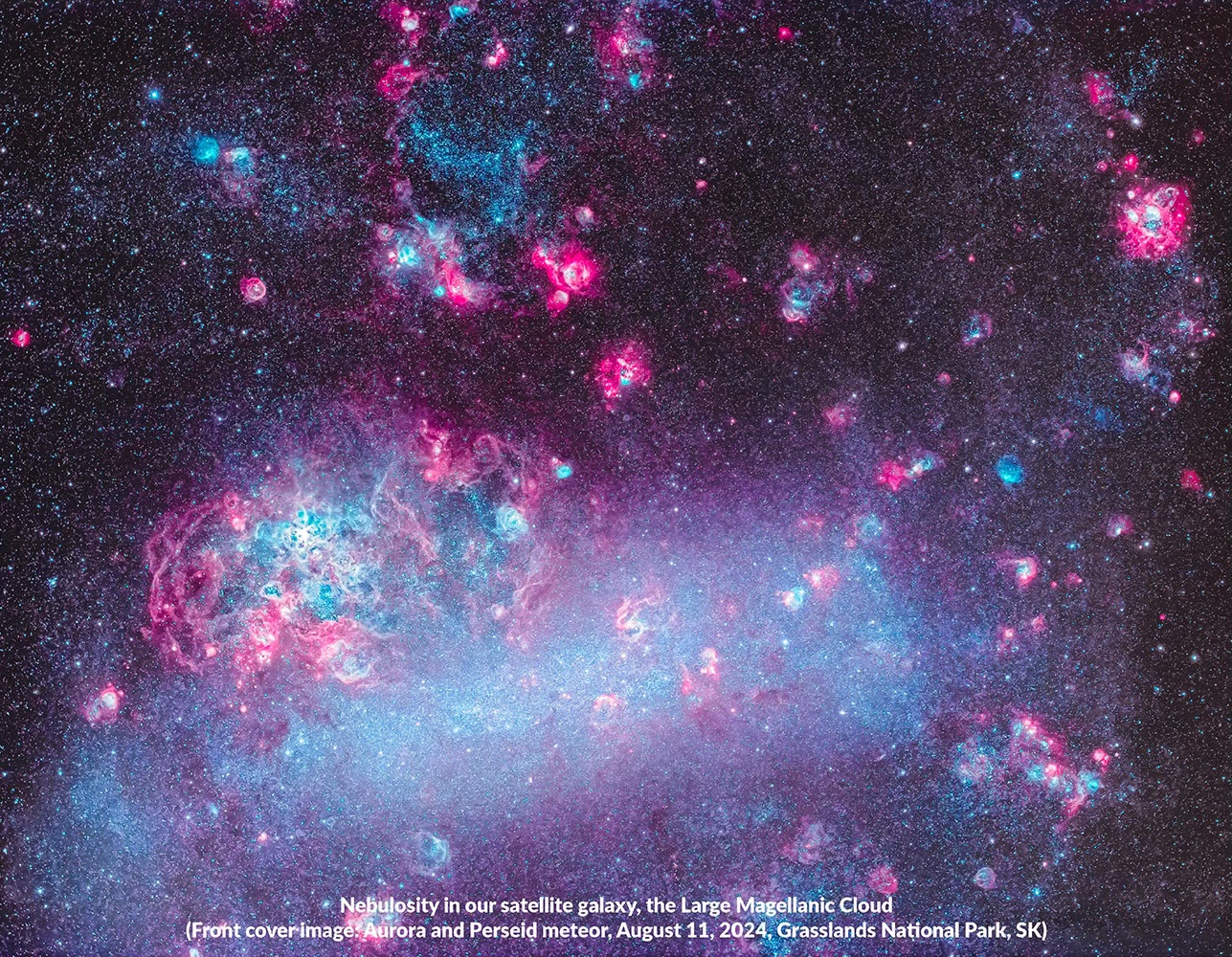
This is the Large Magellanic Cloud, some 160,000 light years away. This is with the Sharpstar refractor in a stack of 12 x 10-minute exposures at ISO 3200 through an IDAS NBZ dual-band (OIII and H-a) filter that adds most of the nebulosity, blended with a stack of 20 x 5-minute exposures at ISO 800 with no filter for the main “natural light” background content.

The biggest attraction in the LMC, one visible to the eye, is the Tarantula Nebula, the mass of cyan at left here. Many of the LMC’s nebulas emit light primarily from oxygen, not hydrogen. But figuring out which object is which can be tough. The LMC is filled with so many nebulas and clusters โ€” and nebulous clusters โ€” that no two catalogues of its contents ever quite agree on the identity and labels of all of them. 

Northern Fields

The Magellanic Clouds are in the deep south, close to the Celestial Pole. A trip south of the equator is needed to see them. But on my trips to Australia I often like to shoot โ€œnorthernโ€ fields that I canโ€™t get well at home in Canada. 

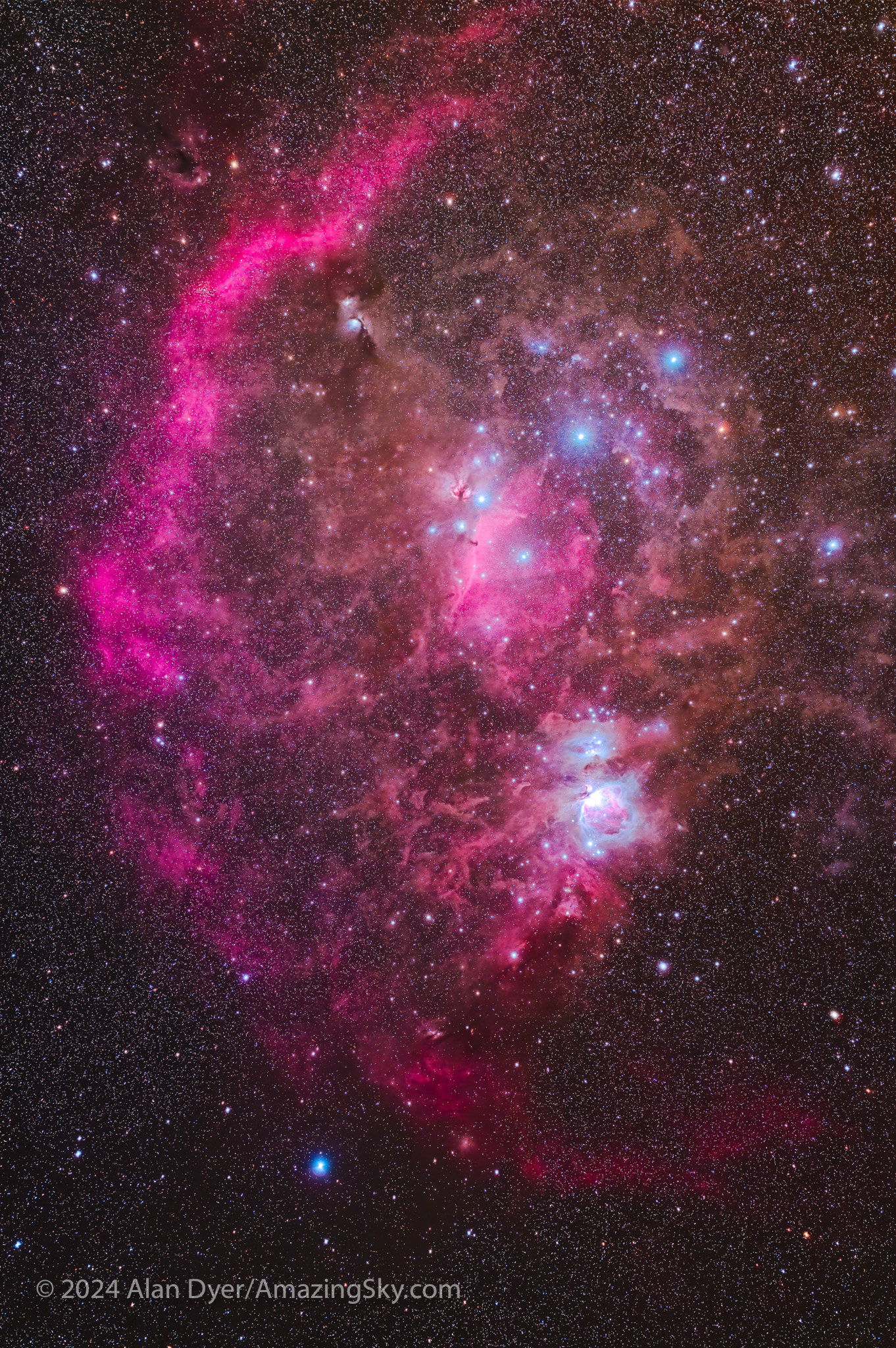
This frames the variety of bright nebulas and dark dust clouds in and around the Belt and Sword of Orion. It shows how the bright Orion Nebula is really just the visible tip of a vast complex of gas and dust in Orion. This is a stack of 14 x 2 minute exposures with the Canon RF135mm lens at f/2 and on the Canon Ra at ISO 800. The lens had an 82mm URTH Night broadband filter on it to enhance nebulas somewhat.

This is the Belt and Sword of Orion the Hunter surrounded by interstellar clouds. Itโ€™s low in my south from home, but high in the north down under. This is with a telephoto lens, not the telescope, captured under better and more comfortable skies than I have in winter in Canada.

This is the nebula-rich region of Monoceros the Unicorn, containing the bright Rosette Nebula, NGC 2237, below the fainter and larger complex of nebulosity, NGC 2264, which contains the small (on this scale) Cone Nebula. This is a stack of 16 x 2 minute exposures with the Canon RF135mm lens at f/2 and on the Canon Ra at ISO 800.

Nearby is another nebulous field but fainter, in Monoceros the Unicorn, containing the popular target, the Rosette Nebula, at bottom here. But thereโ€™s much more in the area that shows up only in long exposures under dark skies.

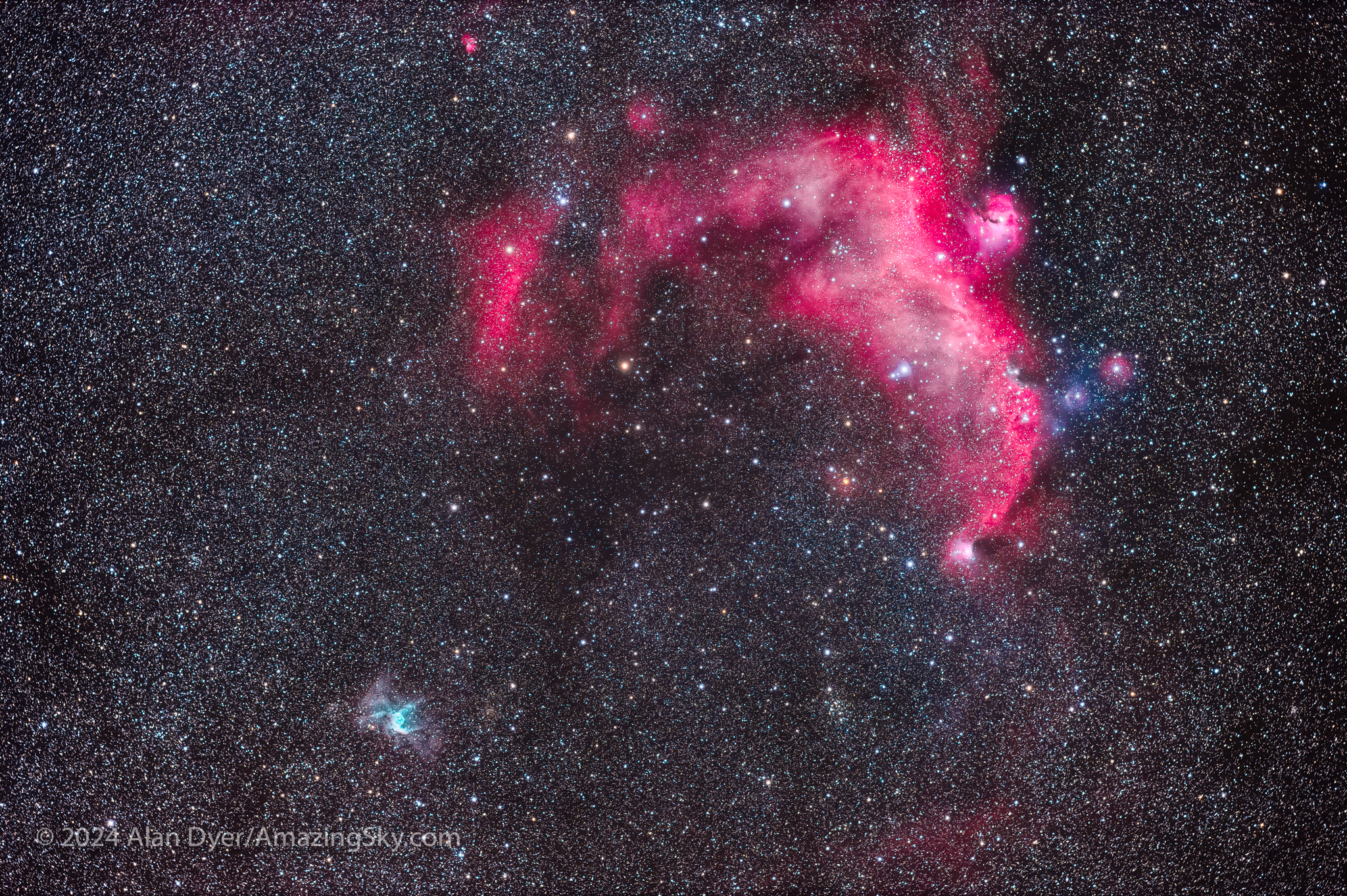
At top is the large Seagull Nebula, an area of mostly red hydrogen-alpha emission and is a region of star formation. At bottom is the small Thor’s Helmet, mostly emitting cyan oxygen III light. This is a blend of a stack of 12 x 10-minute exposures at ISO 3200 with the IDAS NBZ filter, and a stack of 12 x 5-minute exposures at ISO 800 with no filter. All with the Sharpstar 61mm refractor at f/4.4 and Canon EOS R camera.

A target Iโ€™ve often had difficulty shooting for one technical reason or another is the Seagull Nebula straddling the border between Monoceros and Canis Major. I got it this time, together with a contrasting blue-green nebula called Thorโ€™s Helmet, at lower left. Itโ€™s the expelled outer layers of a hot but aging giant star called a Wolf-Rayet star. 

The OzSky Star Party

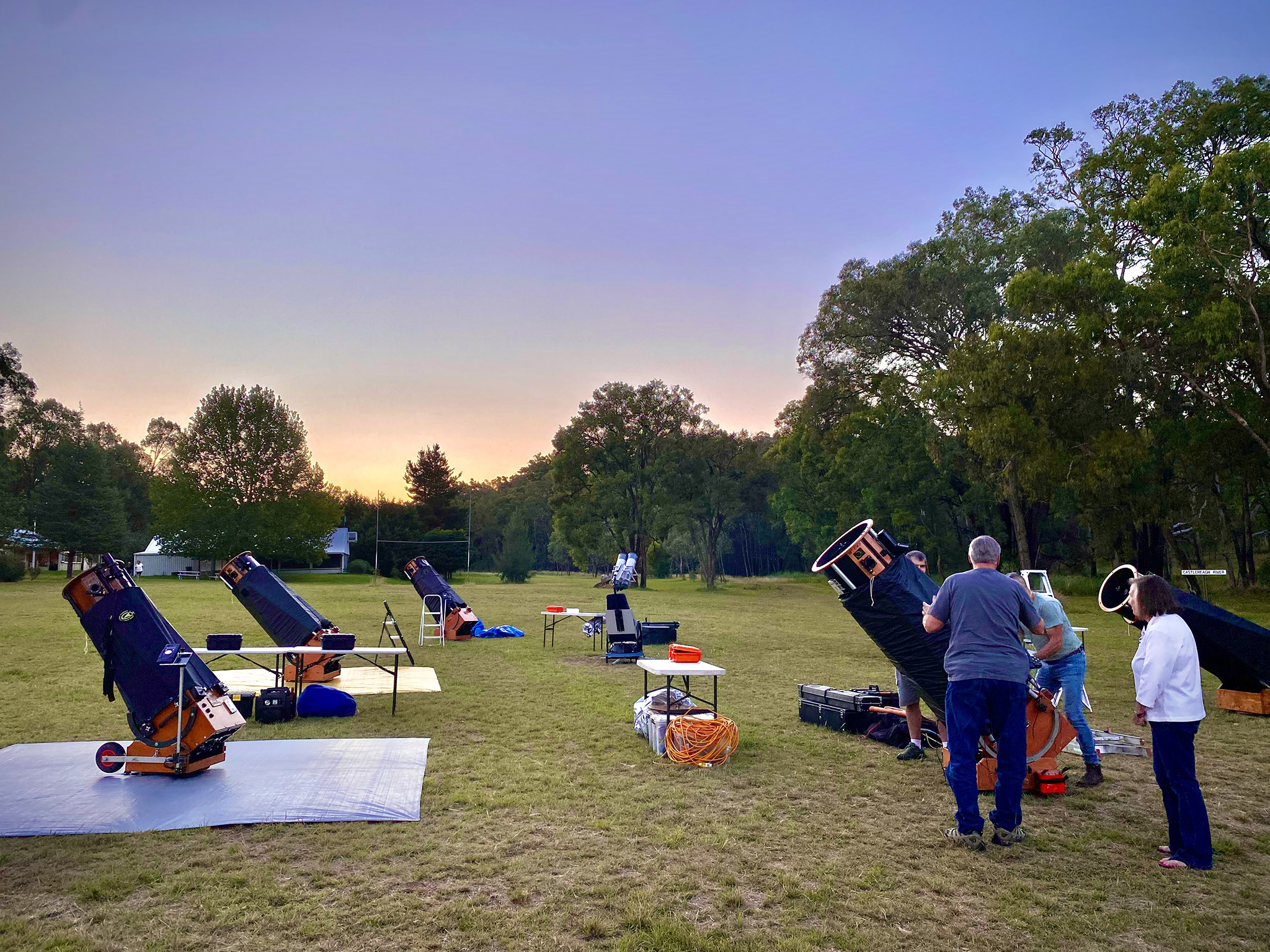
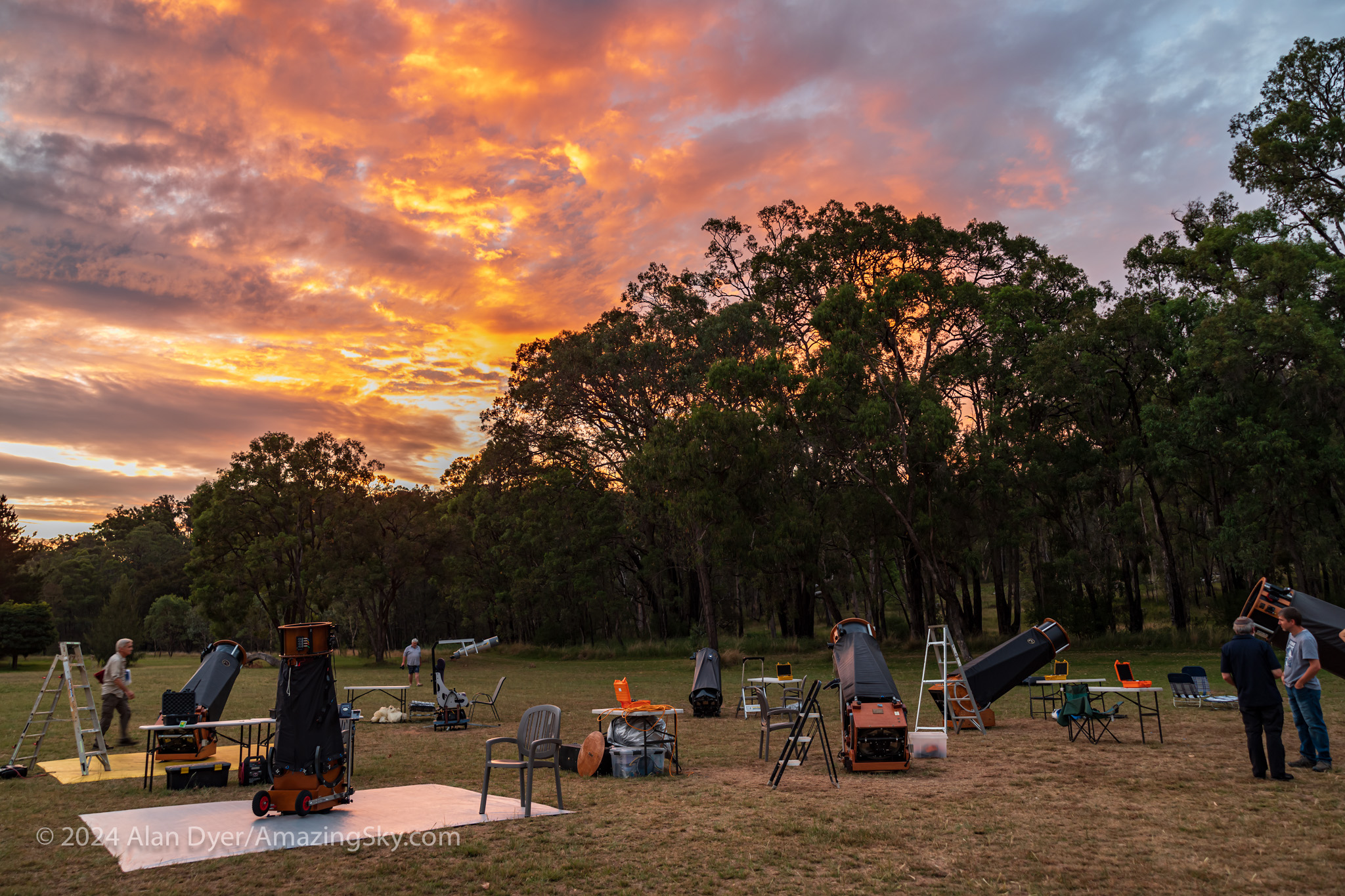
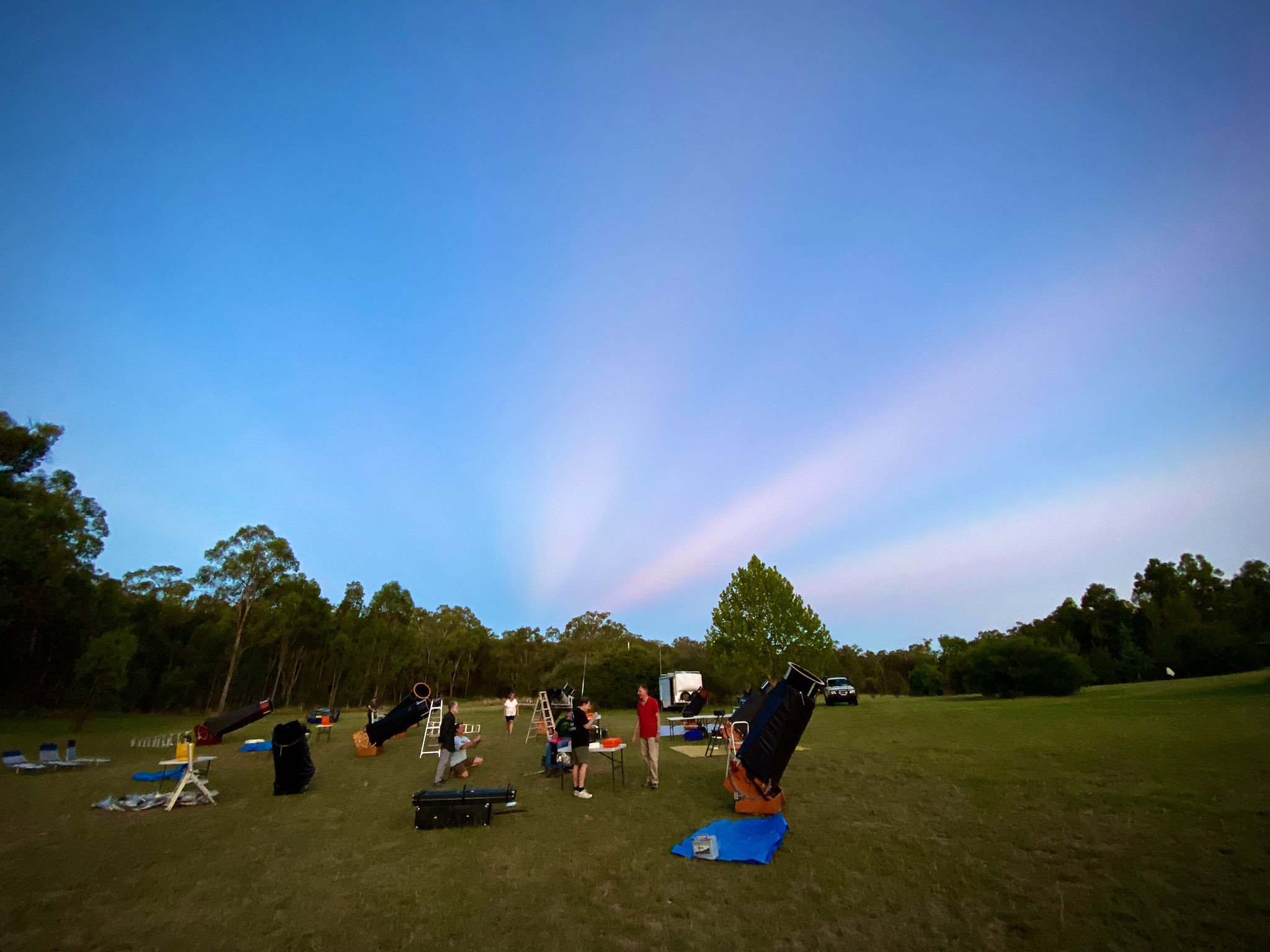
After a successful week at Mirrabook, I packed up and moved down the road to the Warrumbungles Mountain Motel, home to the annual OzSky Star Safari I have now attended six times over the years. (I see as of this writing it is almost sold out for 2025!)

Limited to about 30 people, OzSky (flip through the slide show above) caters to ardent amateur astronomers from overseas who want to revel in the southern sky, aided by the presence on site of a field of giant telescopes, delivered and set up by a great group of Australian astronomers, who show everyone how to run the computer-equipped scopes. And with tips on what to look at beyond the top โ€œeye candyโ€ targets I’m presenting here.

The views of the southern splendours through these 18- to 25-inch telescopes are well worth the price of admission! 

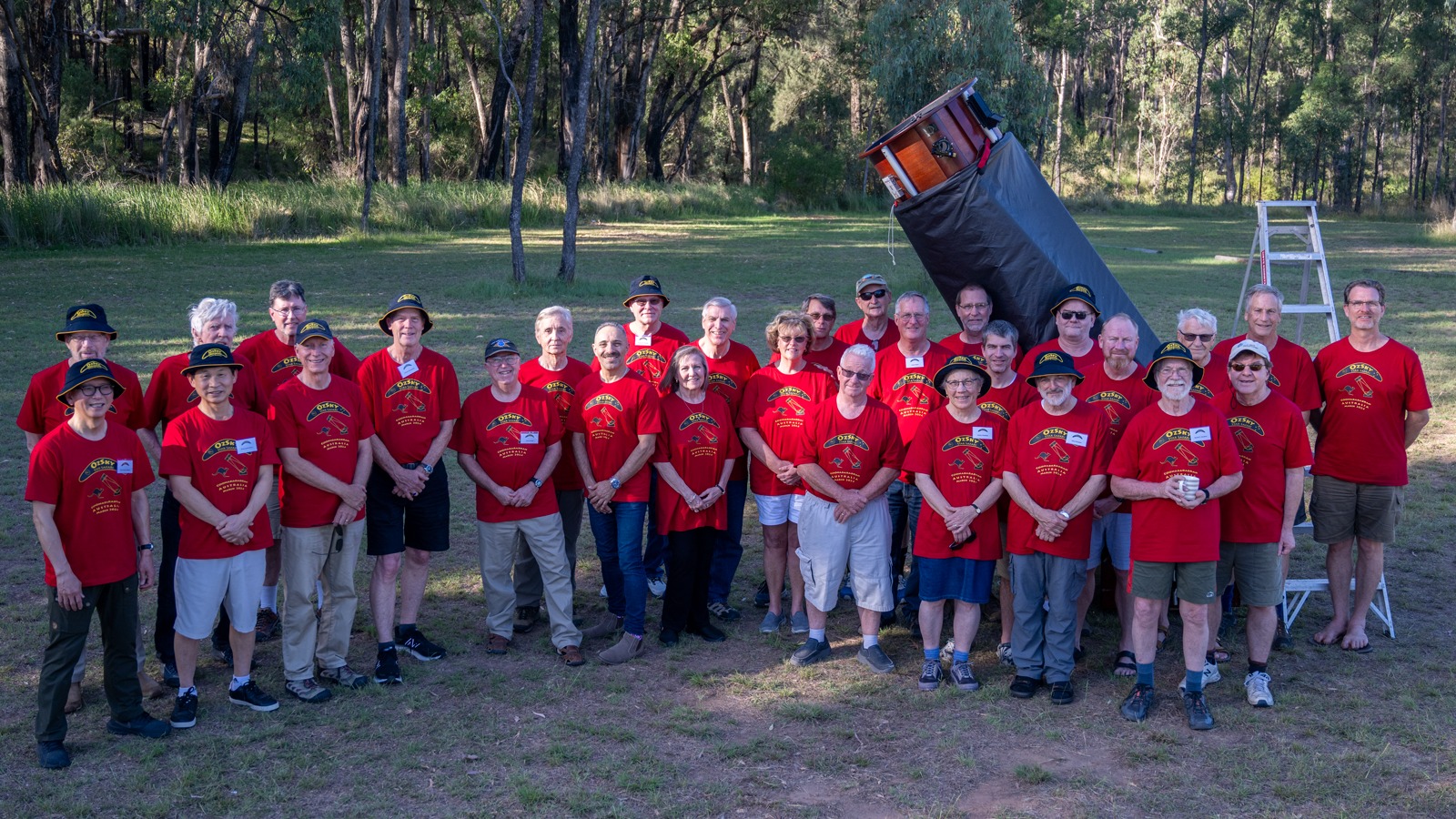
Our group photo of the 2024 OzSky T-shirted attendees and hosts.

It is always a great week of stargazing and camaraderie. If you are thinking of โ€œdoing the southern sky,โ€ I can think of no better way than by attending OzSky. While it is primarily geared to visual observers, a growing number of attendees have been lured into the โ€œdark sideโ€ of astrophotography.

March and April, austral autumn, are good months to go anywhere down under, as you get views of the best of what the southern sky has to offer. The Milky Way is up all night, just as it is six months later in our northern autumn. Thatโ€™s when I made my complementary Arizona pilgrimage this year, blogged about here

The Dark Emu Rising

One of the great naked-eye sights at OzSky in its usual months of March or April is the Dark Emu rising after midnight.

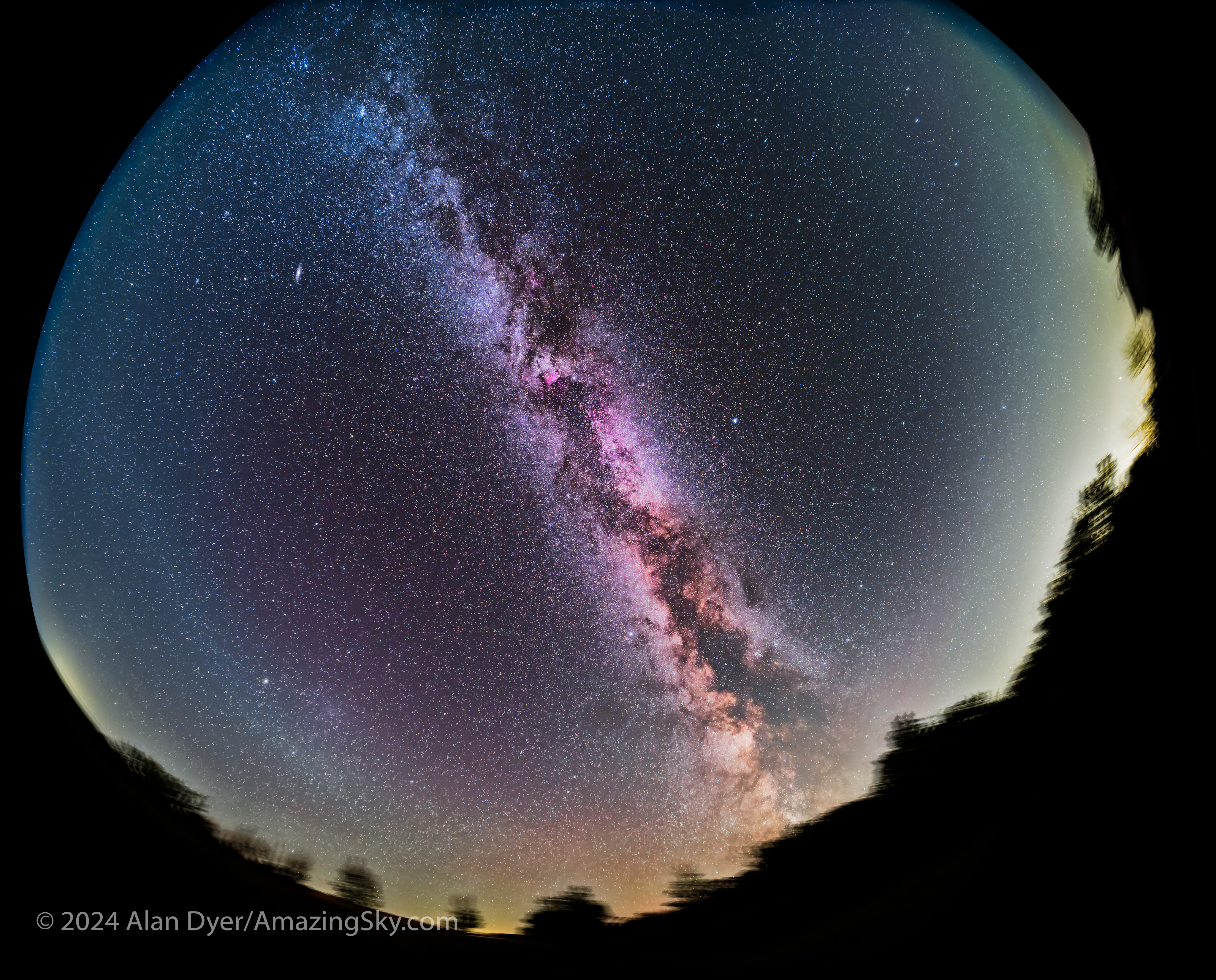
This frames the Australian Aboriginal “Dark Emu” made of dark dust lanes in the Milky Way as it rises in the east. This is a blend of four tracked exposures for the sky and one untracked for the ground, all two minutes at ISO 1600 with the TTArtisan 11mm full-frame fish-eye lens on the Canon EOS R camera.

It is an Australian Aboriginal constellation made of lanes of obscuring interstellar dust, from the Coal Sack on down the Milky Way to past the Galactic Centre. It is obvious to the eye โ€” a constellation made of darkness. 

Sagittarius and Scorpius

Late at night in the austral autumn months, the centre of the Galaxy region in Sagittarius and Scorpius comes up, presenting such a wealth of fields and targets it is hard to know where to begin. 

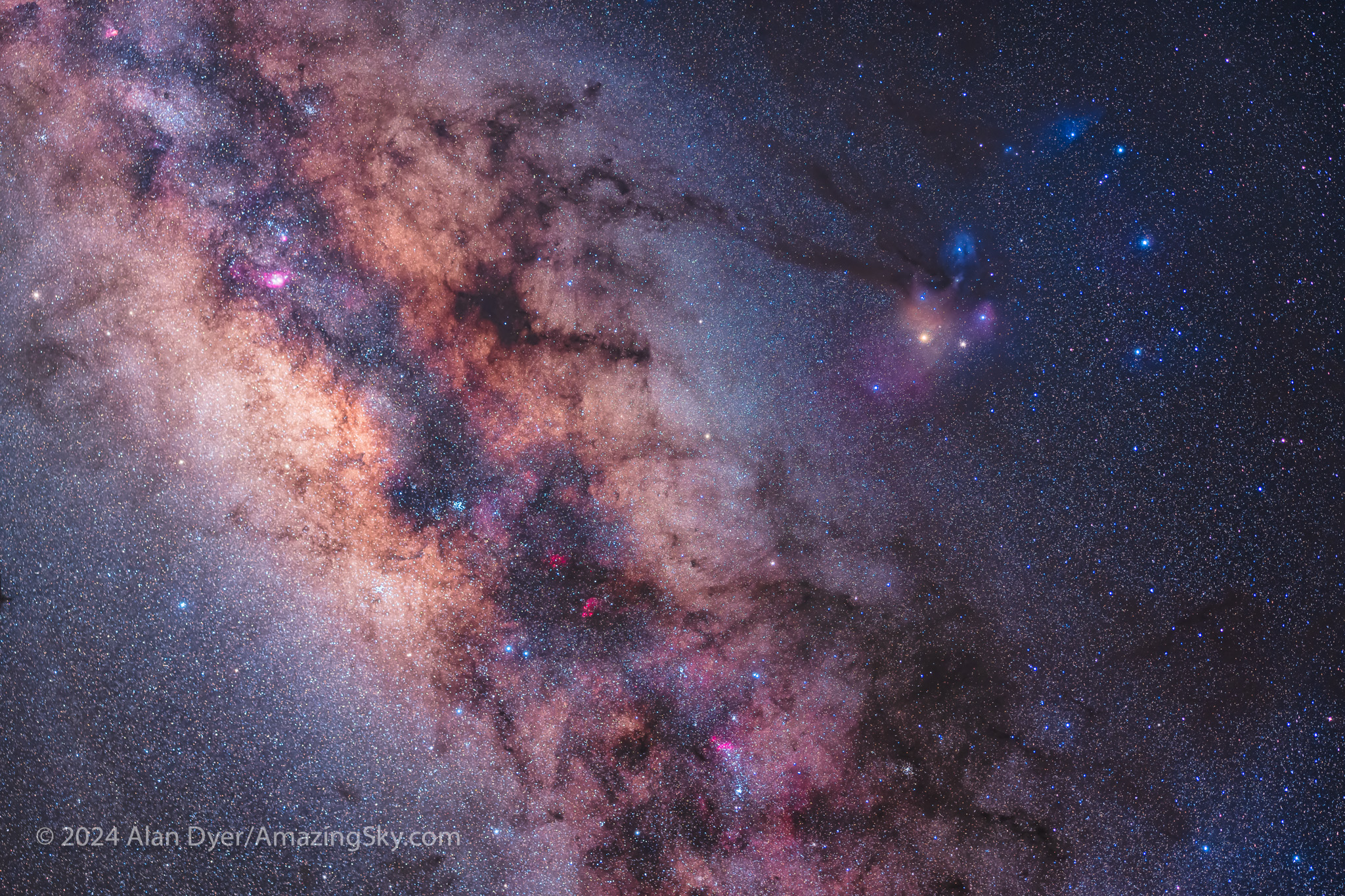
There’s no richer and more colourful area of the sky than this field encompassing the Galactic Center in Sagittarius, at left, and the constellation of Scorpius seen in full here at centre and at right. This is a stack of 6 x 2 minute exposures with the Canon RF 28-70mm lens at f/2 on the Canon Ra at ISO 800.

Yes, we can see this area from up north, but thereโ€™s nothing like seeing Scorpius crawling up the sky head first, and then shining from high overhead by dawn. 

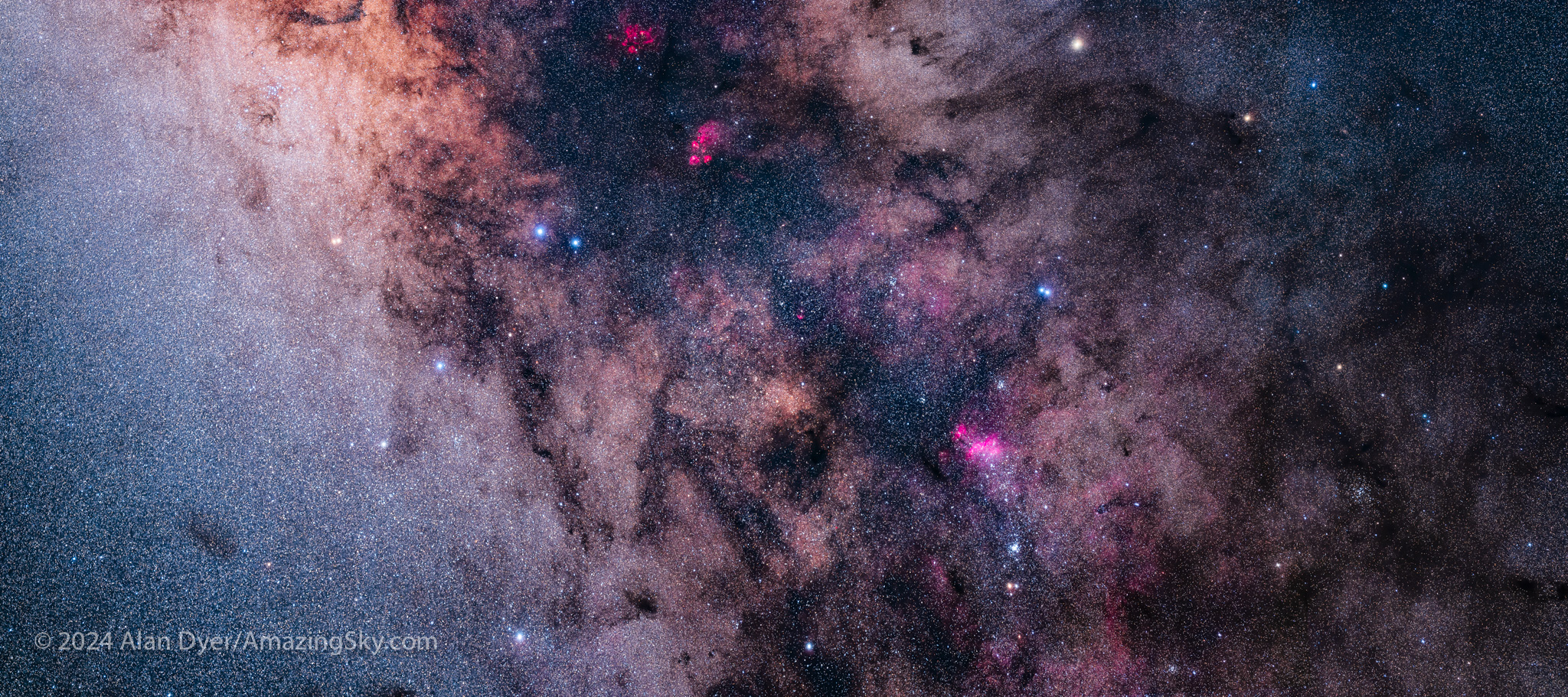
This is a mosaic of the tail of Scorpius โ€” from the bright star cluster Messier 7 at upper left embedded in bright Milky Way starclouds, to the large star cluster NGC 6124 amid dusty dark lanes at lower right. This is a stitch of 3 segments: each a stack of 6 x 2 minute exposures with the Canon RF135mm at f/2 on the Canon Ra at ISO 800.

Fields like this in the Tail of Scorpius are below my northern horizon at home. And it would still be low from a southern U.S. site, where natural green or red airglow can spoil images. Iโ€™ve never had an issue with airglow in Australia. Oz skies are as dark and clean as I have ever experienced.

The Southern Milky Way

The grand finale of a night at OzSky, or anywhere in the southern hemisphere in autumn, is the celestial sight that I think ranks as one of the skyโ€™s best, up there with a total solar eclipse. 

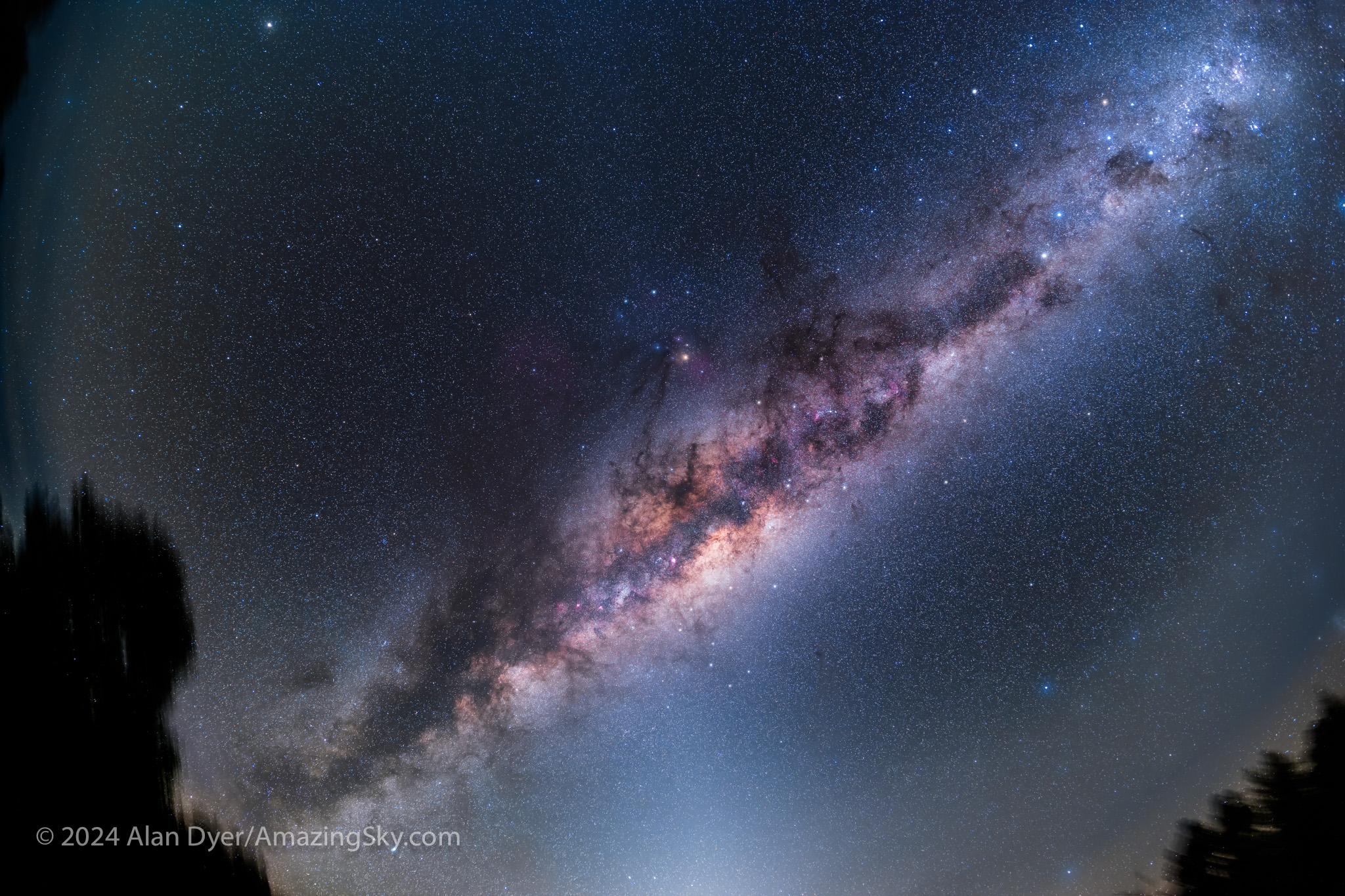
This is an all-sky view of the centre of the Galaxy region in Sagittarius and Scorpius nearly overhead before dawn on an austral autumn morning in March 2024. The Milky Way stretches from Aquila at bottom left to Crux and Carina at upper right. This is a stack of 4 x 4 minute tracked exposures, at f/2.8 with the TTArtisan 11mm full-frame fish-eye lens on the filter-modified Canon EOS R at ISO 800.

That sight is the jaw-dropping pre-dawn panorama of our Galaxy stretched across the sky, with the bright core overhead and its spiral arms out to either side. It is obvious as a giant edge-on galaxy, with us far off-centre. The image above frames the entire Dark Emu.

One of my projects this year, for a moonless night with little likelihood of clouds coming through, was to work photographically along the Milky Way, down from Orion into Puppis and Vela, through Carina and Crux, and into Centaurus, then finishing with the galactic core area of Scorpius and Sagittarius. 

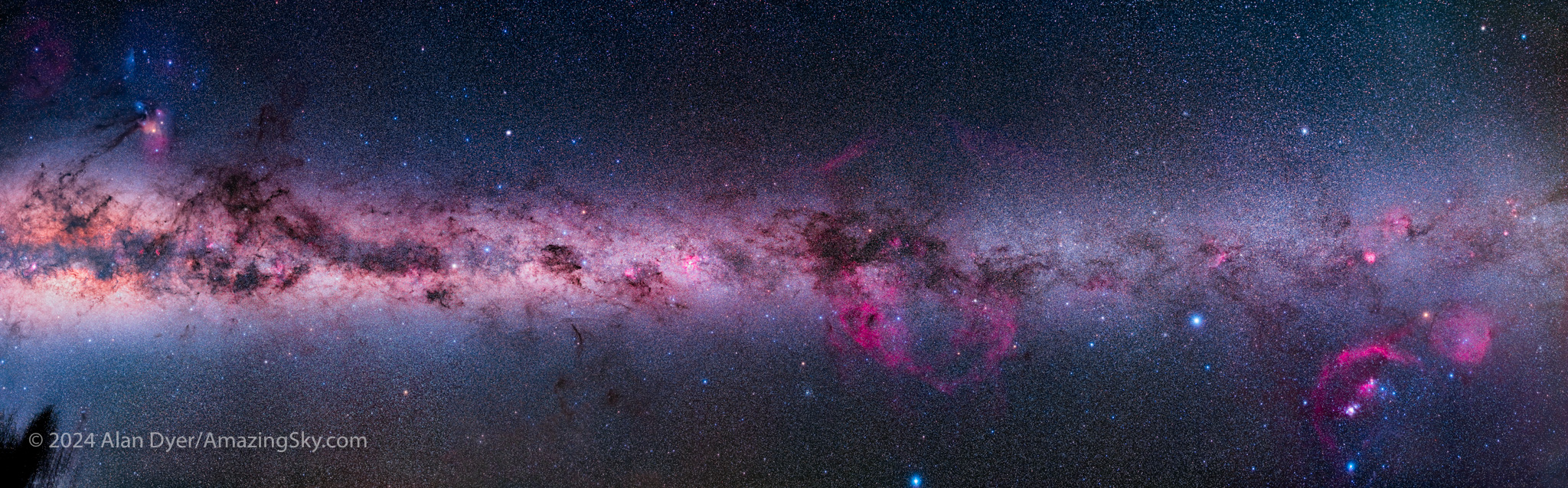
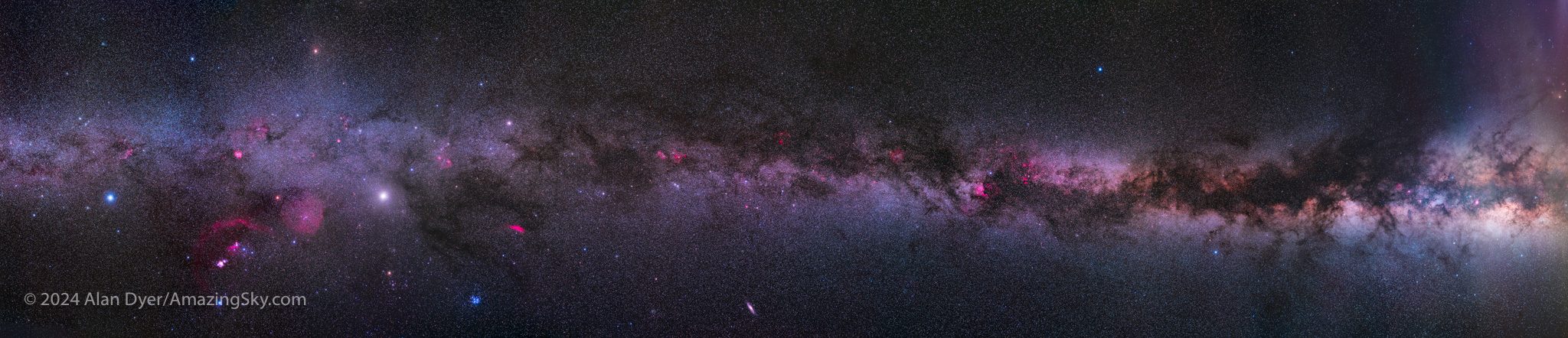
This panorama takes in a 180ยฐ sweep of the Milky Way: from Sagittarius, Scorpius and the Galactic Centre at left, to Orion, Gemini and near the galactic anti-centre at right. This is a panorama of 11 segments, each a stack of 8 to 12 exposures, of 2 or 3 minutes each, with the Canon RF28-70mm lens at f/2.2 or f/2.8 on the Canon Ra at ISO 800.

The resulting 180ยบ panorama, made of 11 segments shot at 32ยฐ South, was an all-night affair, interrupted by a nearby tree and the oncoming dawn. It complements one I shot six months later from 32ยฐ North in Arizona. That panorama is included in my Comet Chasing blog.

The Moon Returns  

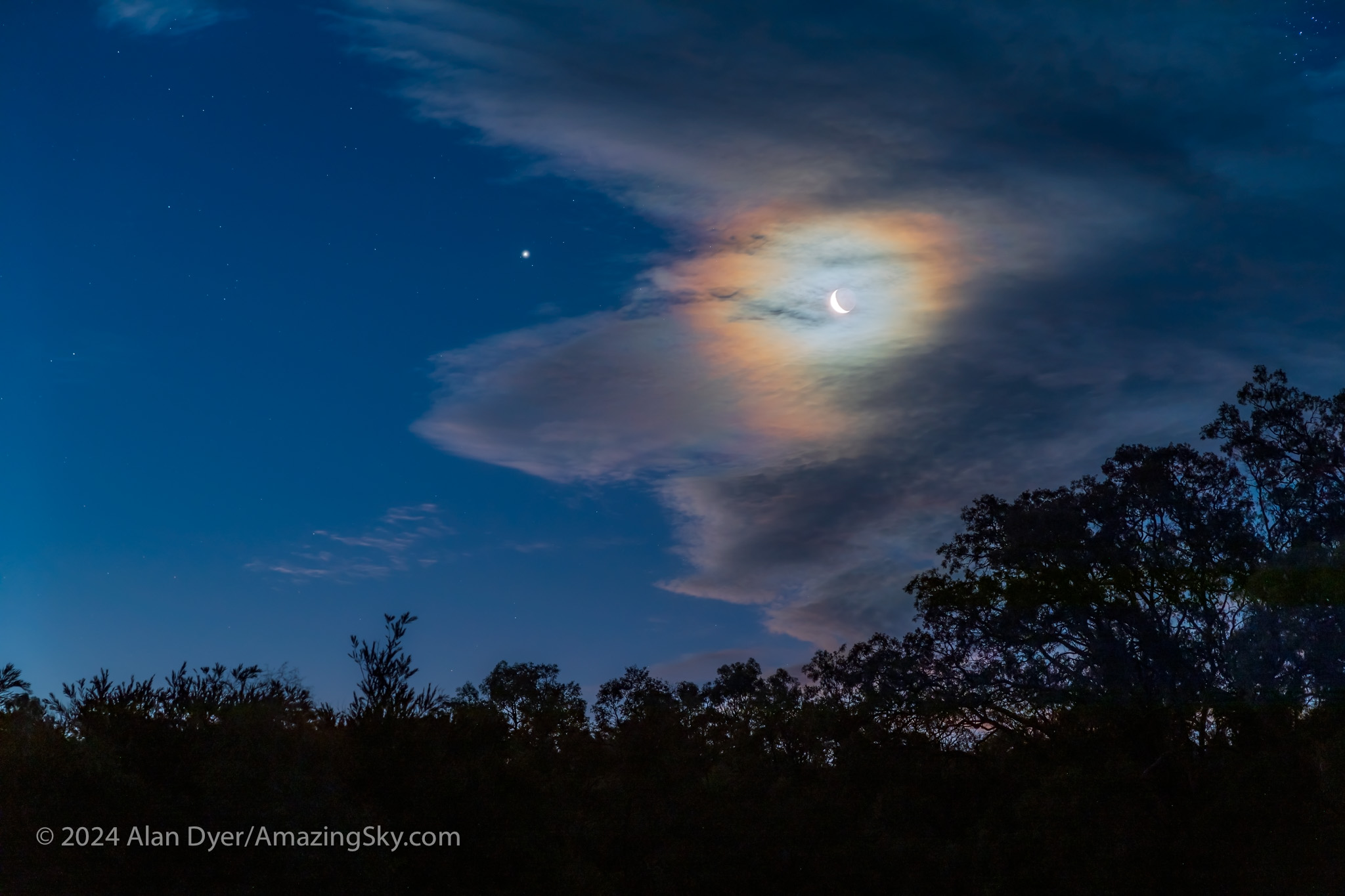
OzSky, as are all star parties, is timed for the dark of the Moon. By the end of the week, with everyone well and truly satiated by starlight and dark skies, the crescent Moon was beginning to appear in the west. (Yes, thatโ€™s a young waxing evening Moon, here near Jupiter on March 14, 2024.) 

The waxing crescent Moon near Jupiter in the western twilight sky on an austral autumn evening. This is a blend of exposures to retain the detail around the bright Moon and corona glow: long (2.5s) for the sky and stars, and three shorter (0.6s, 0.3s and 1/6s) exposures for the Moon.

It was time to pack the telescopes into their trailers, and for everyone to head back home, whether that be in Australia or elsewhere in the world. 

If You Goโ€ฆ 

If you travel to the Southern Hemisphere, at the very least take binoculars and star charts, especially simple “beginner” charts, as youโ€™ll be starting over again identifying a new set of patterns and stars. 

For astrophotography, a star tracker is all you need, plus of course a camera and lenses. Focal lengths from fish-eye to telephoto can all be put to use. But many of the best fields are suitable for framing with no more than a 135mm lens, as I used for some of the images here. 

But take good charts to identify the location of the South Celestial Pole in Octans the Octant. With no bright “South Star,” it can be tricky getting that field into your polar alignment sighting scope. Once aligned, I tend to leave my rig set up where it is, and not have to repeat the process each night. That’s why it’s nice to base yourself under dark skies at a cottage like Mirrabook, and not be on the road and at a different site every night.

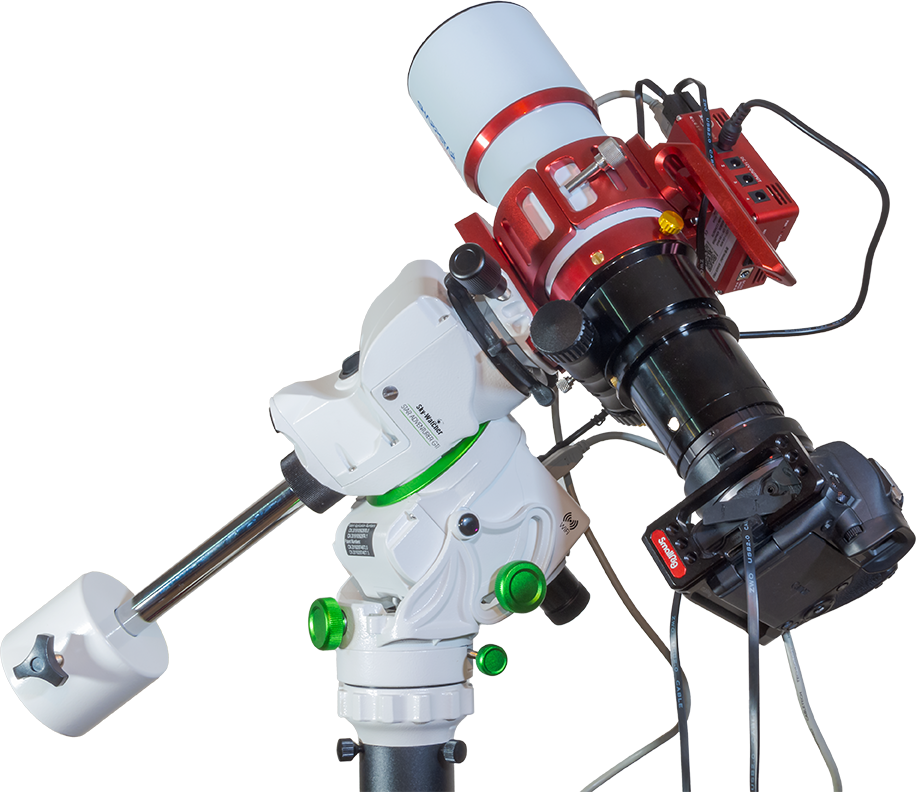
The Sharpstar 61mm scope on the Star Adventurer GTi mount.

If you want to have a telescope with you, one of the current generation of small (50mm to 70mm) apo refractors is ideal, either to look through or shoot through. For imaging, a small equatorial mount is essential, but can be tough to pack with its tripod. And you need to power it. The little Sky-Watcher Star Adventurer GTi powered by its internal 8 AA batteries, but on a collapsible carbon fibre tripod, is a good choice. 

For visual tours, the OzSky Star Safari will provide all the eyepiece time on big scopes you could ask for. It is imaging where you are on your own to come fully equipped and self-contained. 

When will I be back? Perhaps not in 2025. But 2026 is a possibility, maybe a little later in austral autumn to get the Galactic Centre up sooner and higher before dawn. Iโ€™ve been to Australia in the winter months of June and July and itโ€™s too cold! May perhaps.

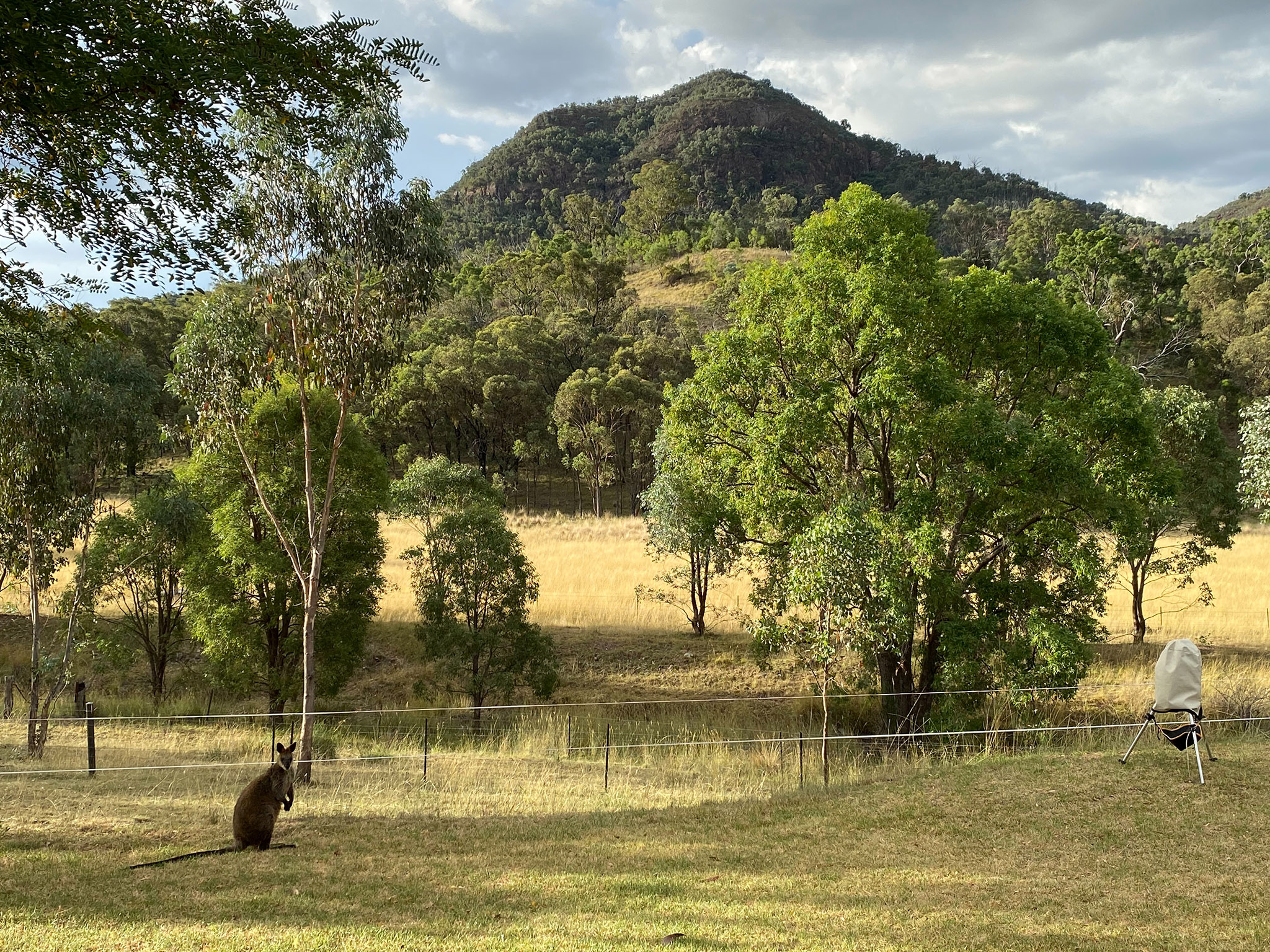
My Oz observing site โ€” with camera gear accompanied by a roo. Or a wallaby? Note the cover over my aligned tracker rig at right.

If you go once, you will be bitten (we hope not literally by one of Ozโ€™s killer critters!) by the southern sky passion. 

The only downside is that when I get home, often to poor weather, but even when skies are clear, I find that the home skies tend to lose their excitement and attraction. They just canโ€™t compare to the great southern skies. 

โ€” Alan, December 18, 2024 / AmazingSky.com 

The Great Auroras of 2024


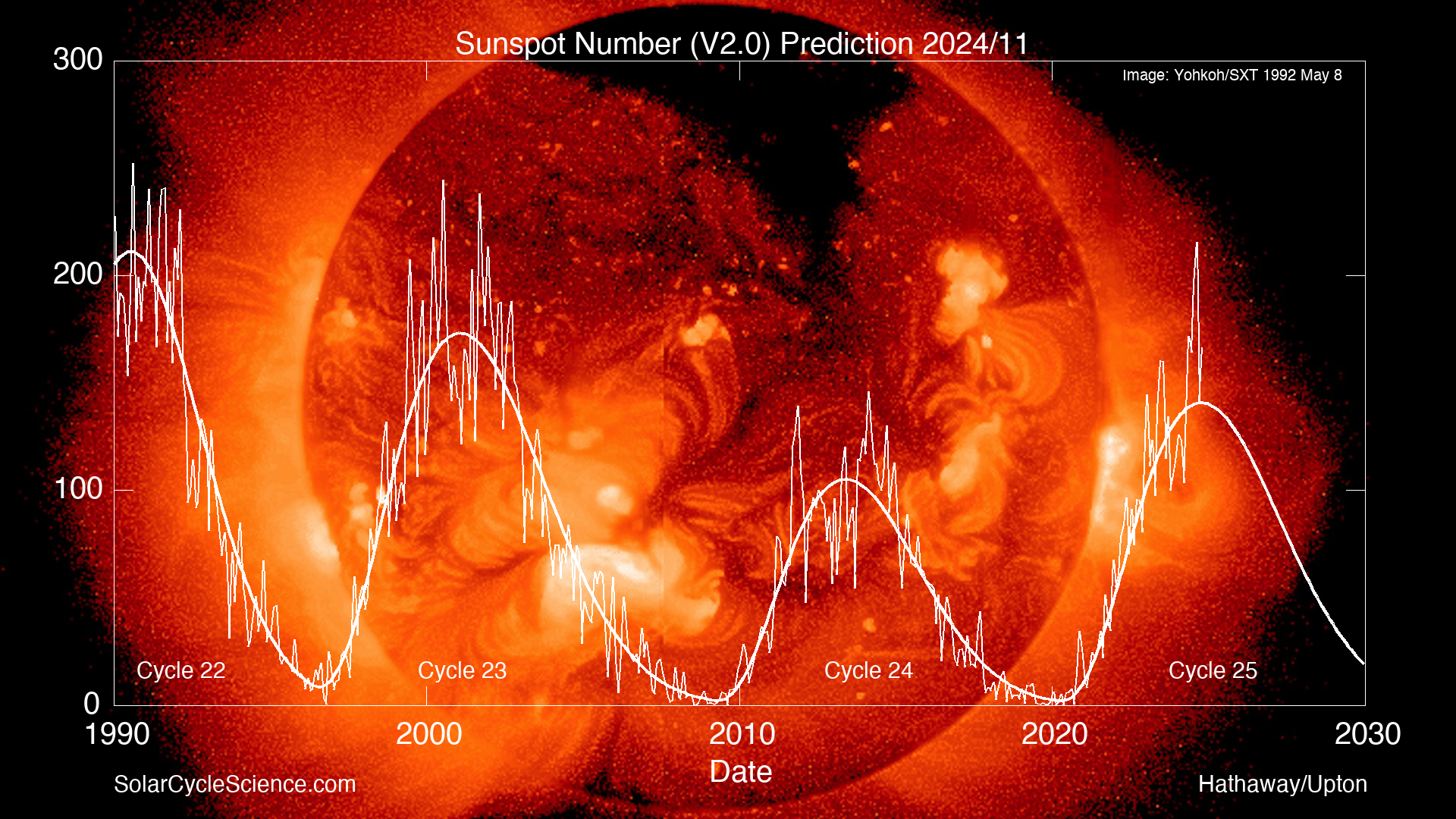
The Sun peaked at โ€œsolar maximumโ€ and gave us wonderful sky shows in 2024. 

Officially, the Sun reached the peak of its roughly 11-year cycle of activity โ€” “solar max” โ€” in late 2024. Thatโ€™s according to NASA and NOAA.

During 2024 several major solar storms erupted as a result of the Sunโ€™s increased activity. They blew massive clouds of energetic particles โ€” electrons and protons โ€” away from the Sun. Some of those storm clouds swept past Earth, sparking bright auroras widely seen in both the Northern and Southern Hemispheres. 

The rise and fall of solar activity. The peak at right is as of November 2024 in mid-Cycle 25. Courtesy SolarCycleScience.com.

I was fortunate enough, as many were, to witness several of 2024โ€™s great auroras, from home in Alberta, and from as far south as Arizona. 

Trips north to Churchill, Manitoba, and to northern Norway also presented some fine aurora nights. But thatโ€™s normal at any time in the solar cycle from those sub-Arctic and Arctic locations.

Itโ€™s when the aurora comes to you that you get a truly memorable show. And 2024 had its share of them.


This was the month I made my annual trek to Churchill, Manitoba, to instruct aurora tour groups at the Churchill Northern Studies Centre. Why not join us in 2025?

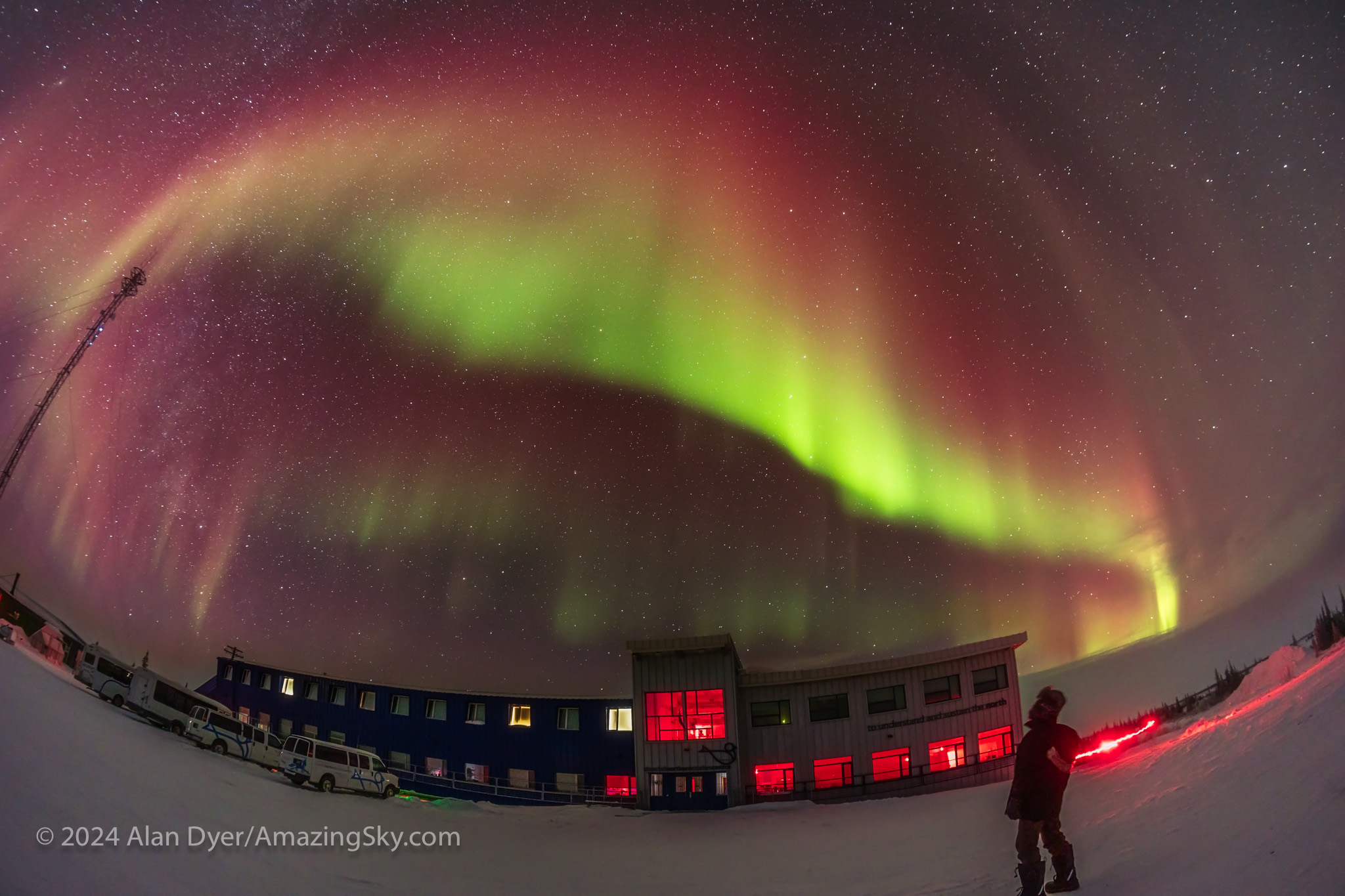
An aurora selfie at the Churchill Northern Studies Centre, on February 10, with a modest Kp4-level storm underway. This is 20-seconds with the TTArtisan 11mm fisheye lens at f/2.8 on the Canon R6 at ISO 1600.

Yes, the air is cold (usually about -25ยฐ C) but the skies are often clear and aurora filled, as Churchill sits under the normal location of the auroral oval, the main zone of auroras. In fact, it is as far south in the world as the auroral oval normally resides, at a latitude of only 58ยบ North, well south of the Arctic. If itโ€™s clear, thereโ€™s almost always some level of Northern Lights. 

This year, 2024, was no exception. Even on nights with low readings on the usual auroral indicators we got sky-filling displays that are rare down south. 

This is a southerly arc of green and red Northern Lights on February 9. This is a panorama of 5 segments, each 20 seconds with the Laowa 15mm lens at f/2 on the Canon R6 at ISO 1600.

What I find in Churchill is that even with numerically weak and visually dim shows, as above, the camera often sees very red and photogenic auroras. The eye sees the colours only when the aurora brightens, which it often does (as I record below), sparking rippling green curtains (from glowing oxygen) fringed with pink (from glowing nitrogen).

I didnโ€™t shoot time-lapses or movies this year in Churchill. Instead, the example movie above, shot using just real-time (not time-lapse) videos, is from February 2019. It is from my AmazingSky YouTube channel.

The video presents the aurora much as the eye saw it, and as it appears when it dances.

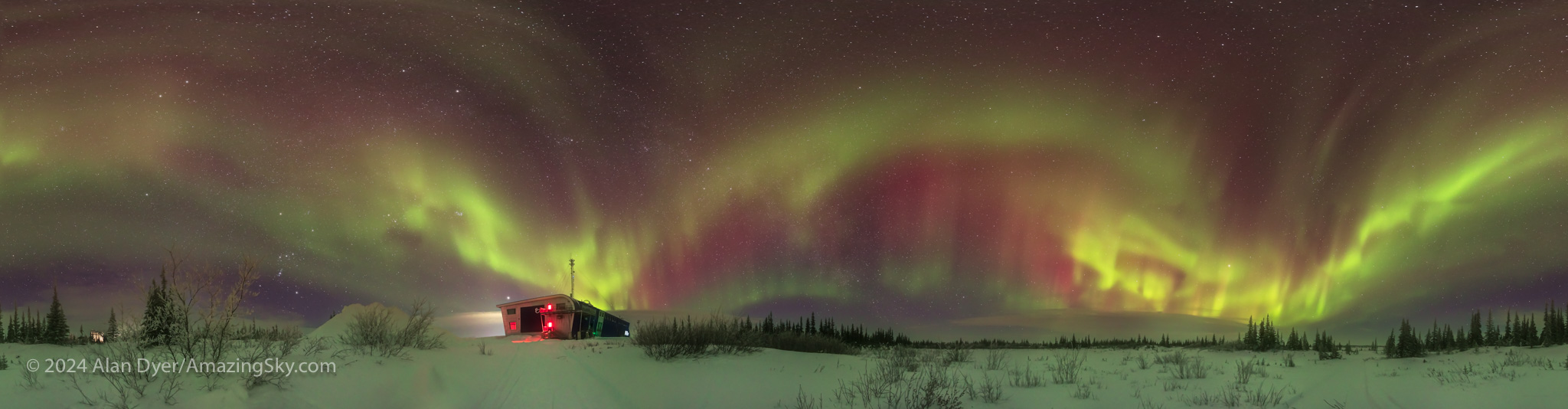
This is a 360ยบ panorama of the all-sky aurora of February 10, from the Churchill Northern Studies Centre. This is a panorama of 9 segments, each 15 seconds with the TTArtisan 11mm lens at f/2.8 on the Canon R6 at ISO 1600.

However, I tend now to shoot mostly panoramas, as above, from this year’s visit. They can take in the full show across the sky, in high-resolution images suitable for framing! 


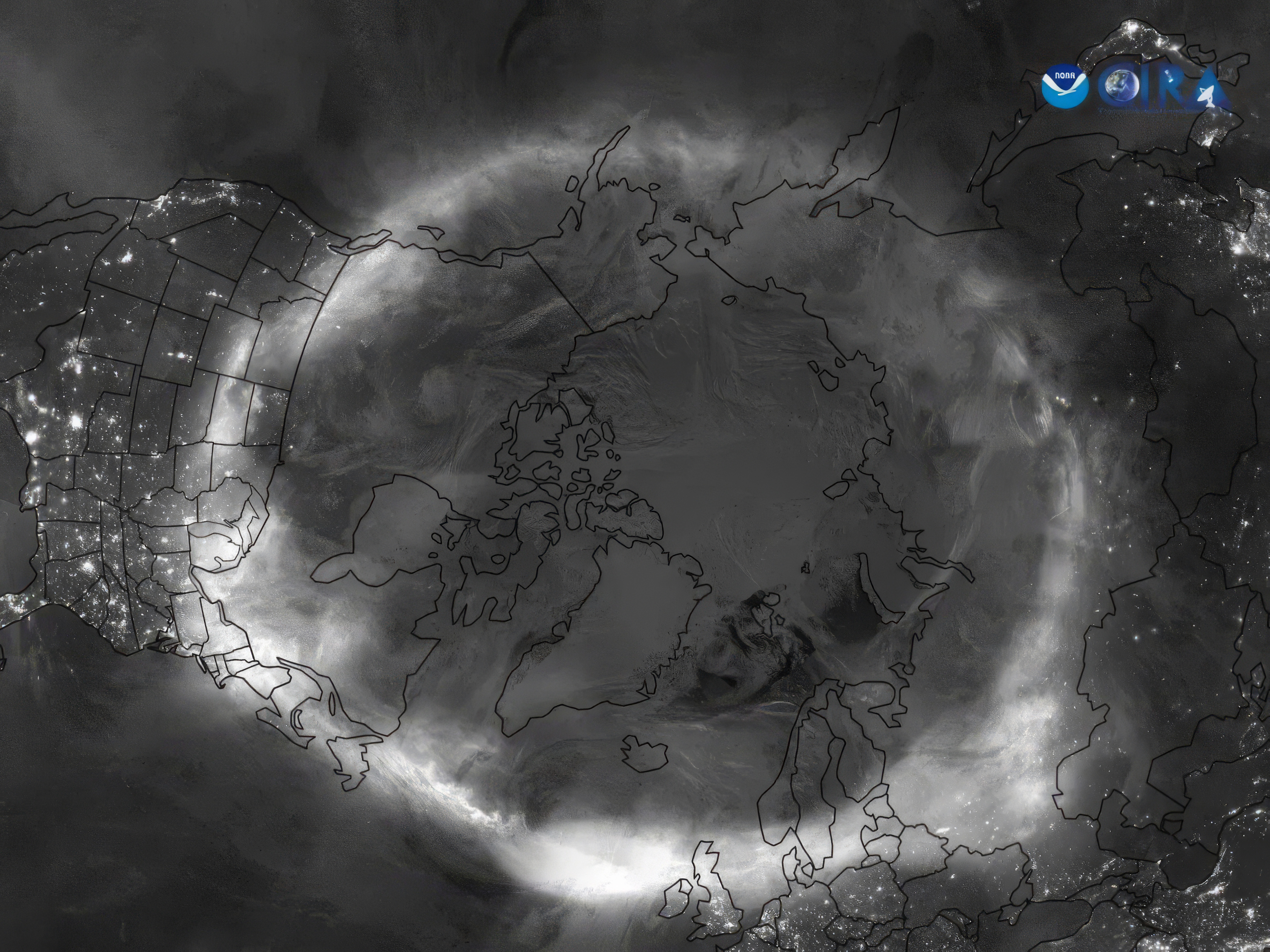
The aurora apps were beeping this day, warning a great display was in the offing. The composite satellite image below from NOAA shows the actual extent of the aurora around the Northern Hemisphere during the great display of May 10/11 . 

Note how the auroral oval is indeed an oval and how the centre is not the geographic North Pole. It is the North Geomagnetic Pole, in the High Arctic of Canada. ๐Ÿ‡จ๐Ÿ‡ฆ So the oval dips down farther south over North America than it does over Europe.

Image courtesy of the U.S. National Oceanic and Atmospheric Administration.

The May 10 solar storm rated a top “G5” on the G1 to G5 storm scale, while the โ€œKpโ€geomagnetic disturbance index reached Kp8 on the Kp0 (nothing) to Kp9 (OMG!) scale. 

I gave a talk at a local community art gallery that evening, and alerted the audience to the likelihood of fine aurora later that night. Sure enough, I got home in time to see the sky already lighting up with aurora in the twilight and behind the clouds. 

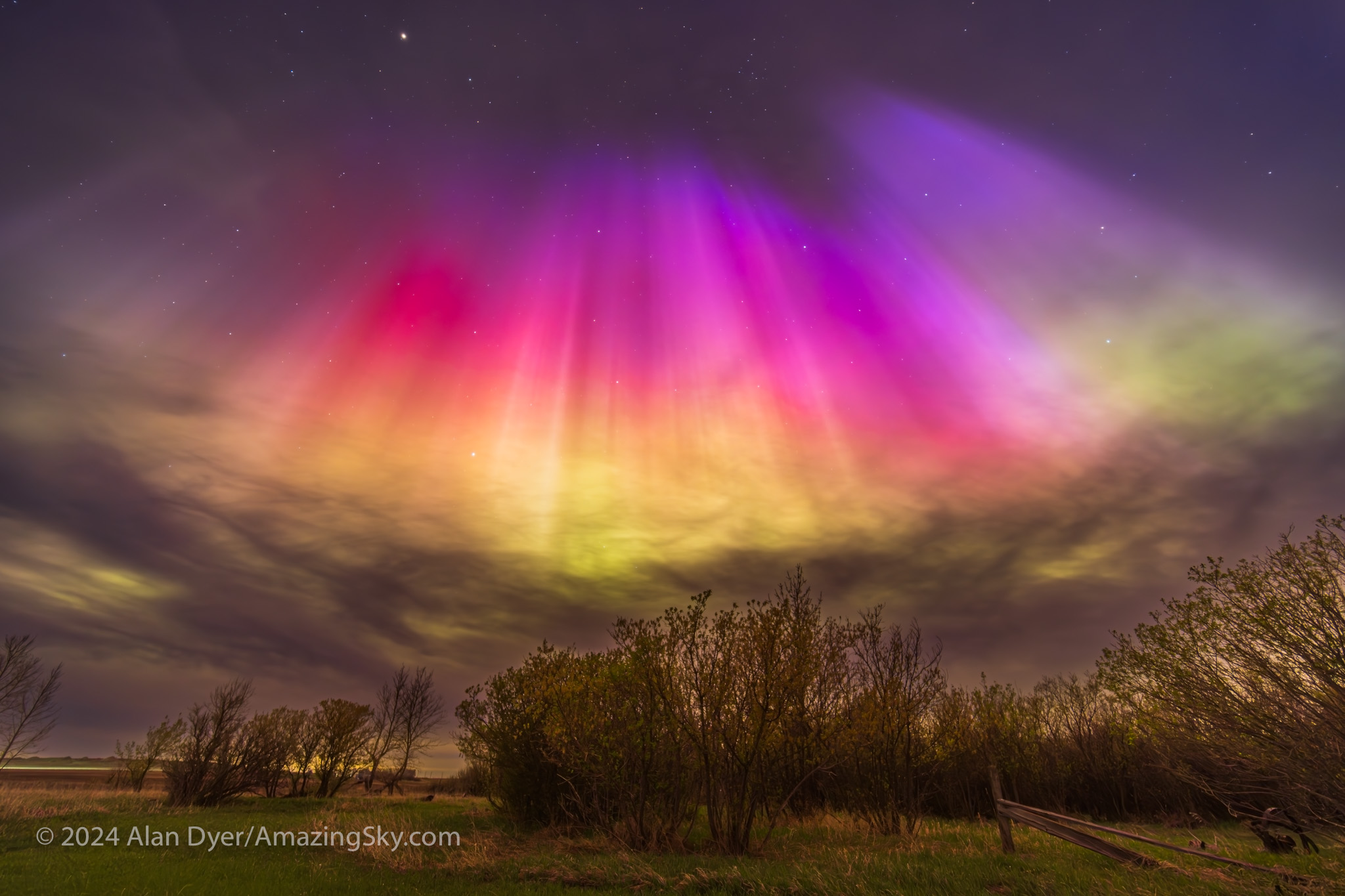
This was the multi-coloured curtain to the south during the great display of May 10. This is a 10-second exposure with the Laowa 15mm lens at f/2.8 on the Canon Ra at ISO 1600.

The clouds cleared off enough to reveal one of the most colourful shows Iโ€™d seen in many years. This time there was no question about seeing reds and vivid pinks with the unaided eye. This was the type of show everyone hopes for. But it takes a Kp6 show and higher to spark it.

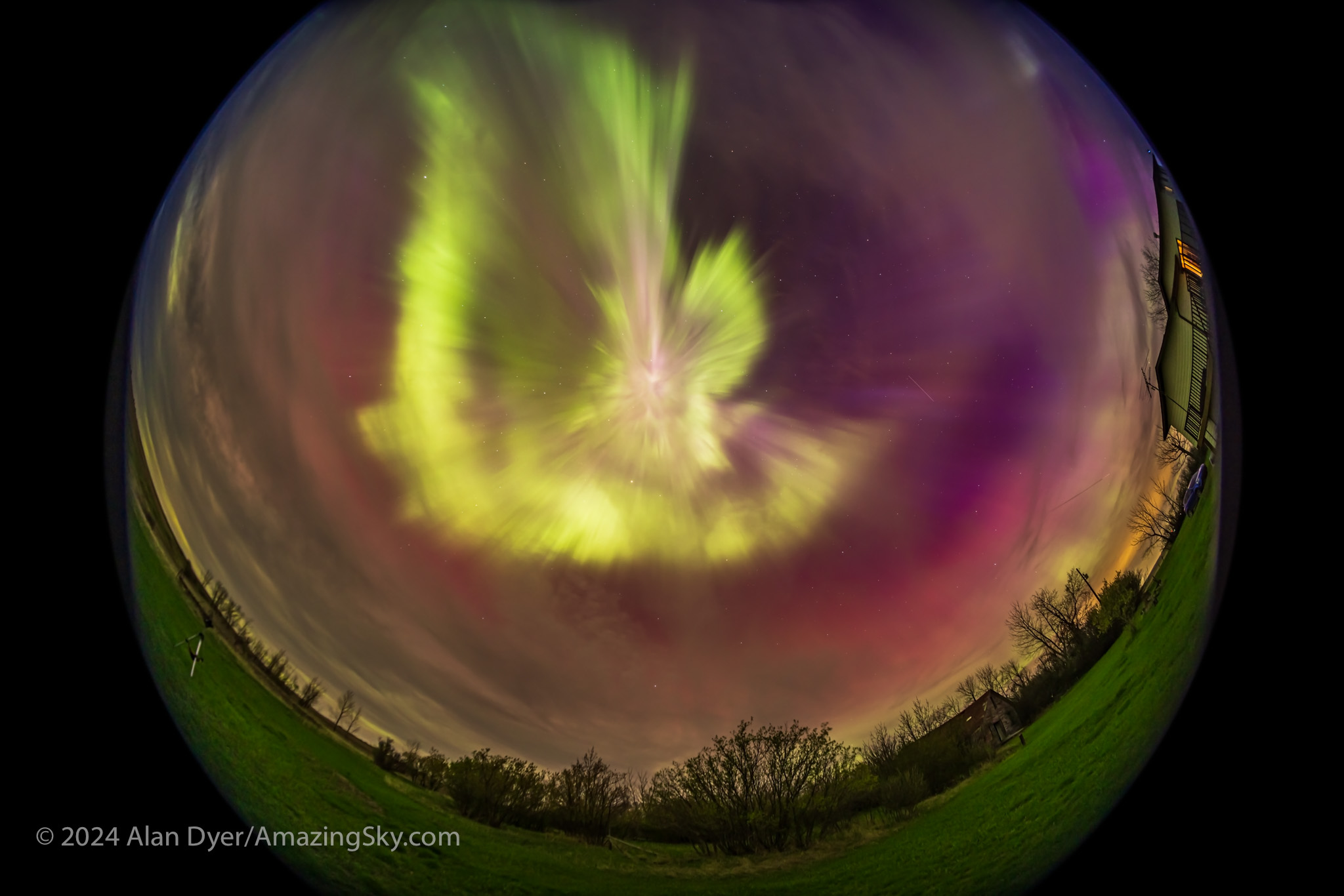
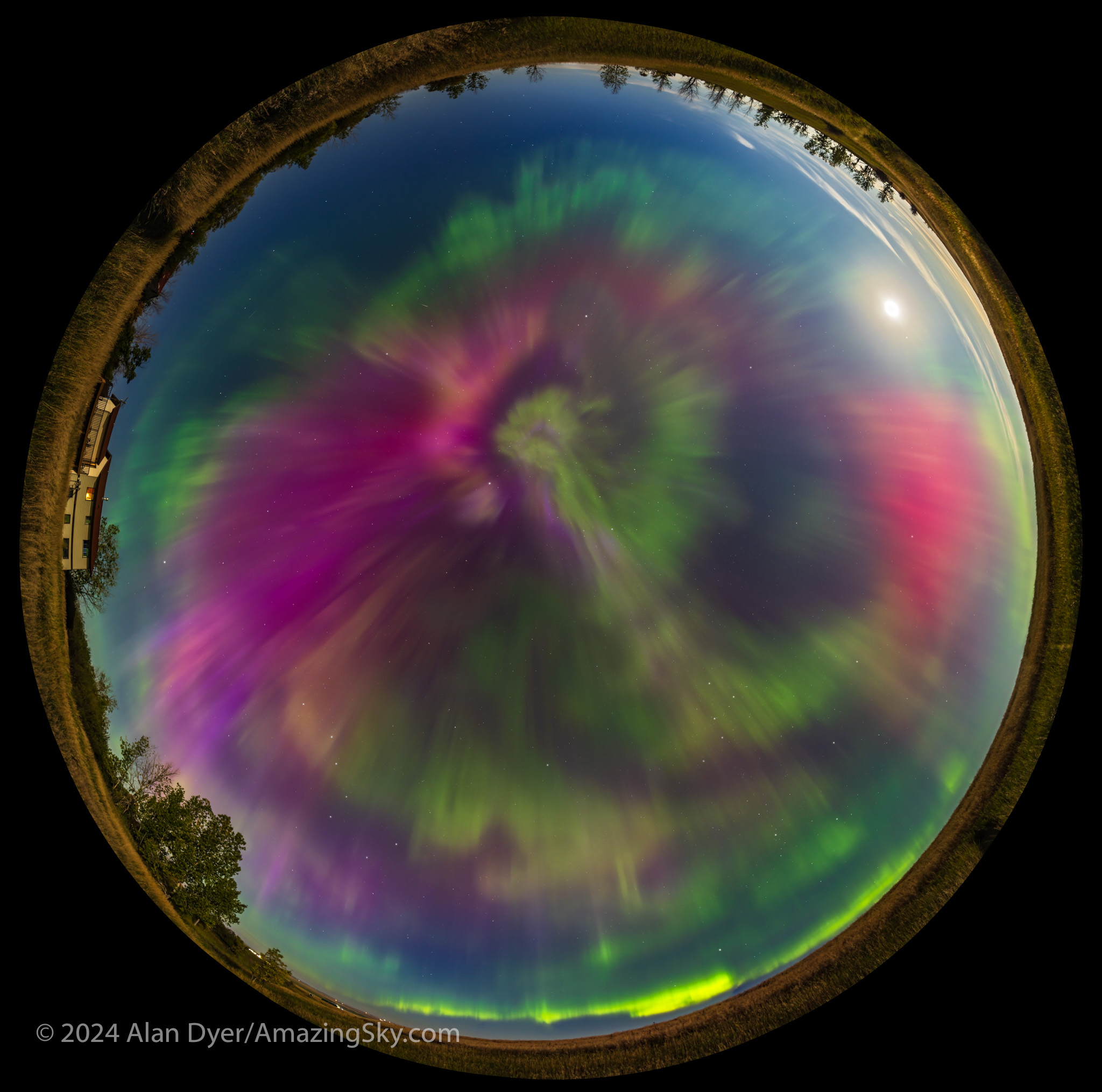
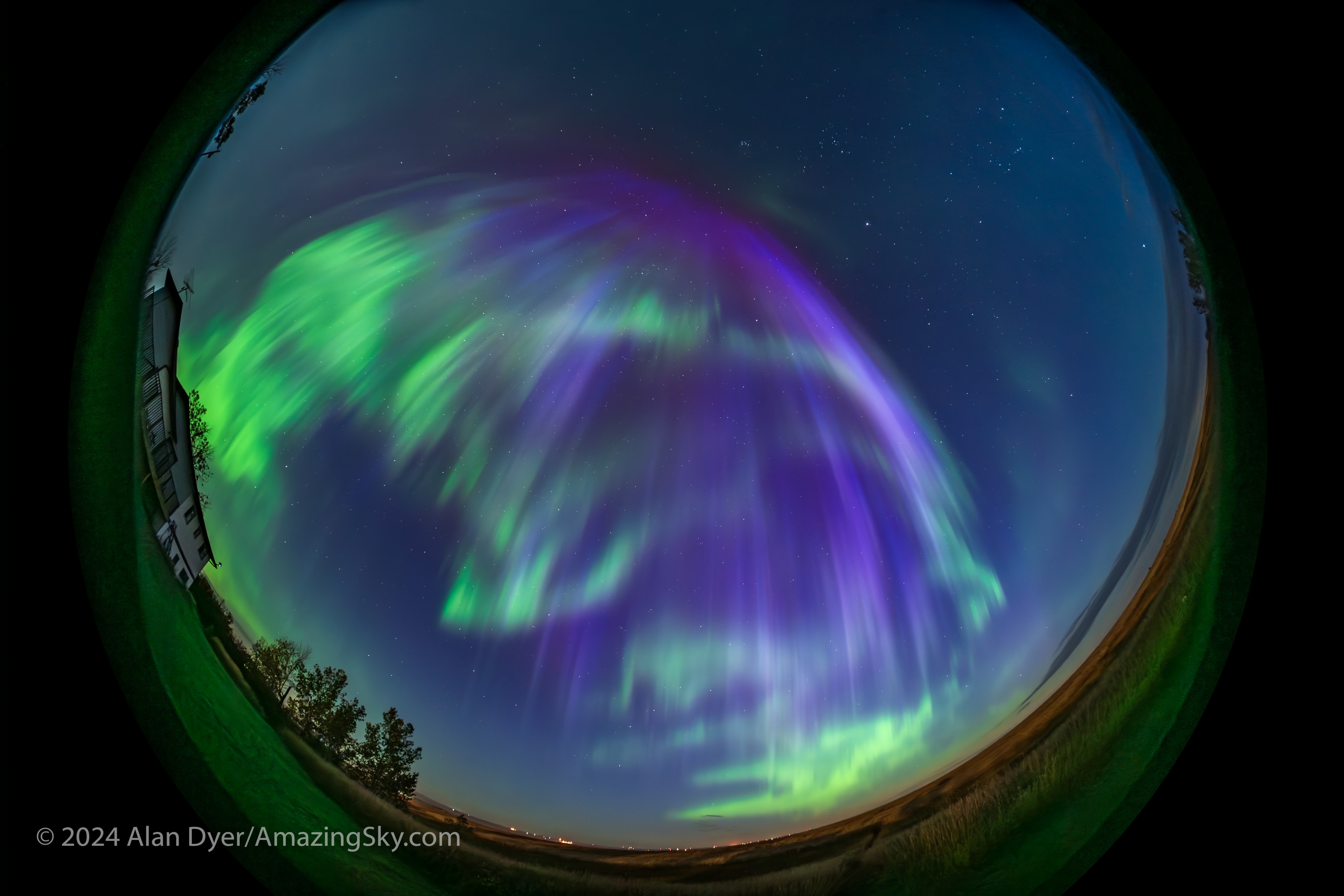
This was the view as the aurora suddenly brightened and converged at the zenith for a superb corona effect. This lasted no more than a minute before it dimmed and subsided again. This is a 9-second exposure with the Laowa 7.5mm circular fisheye lens at f/2 on the Canon R5 at ISO 800.

I blogged previously about the Great May Aurora Display here

And a music video of the May 10 display incorporating time-lapse and real-time video footage is on my YouTube channel, with the clickable link below. Do enlarge to full screen.

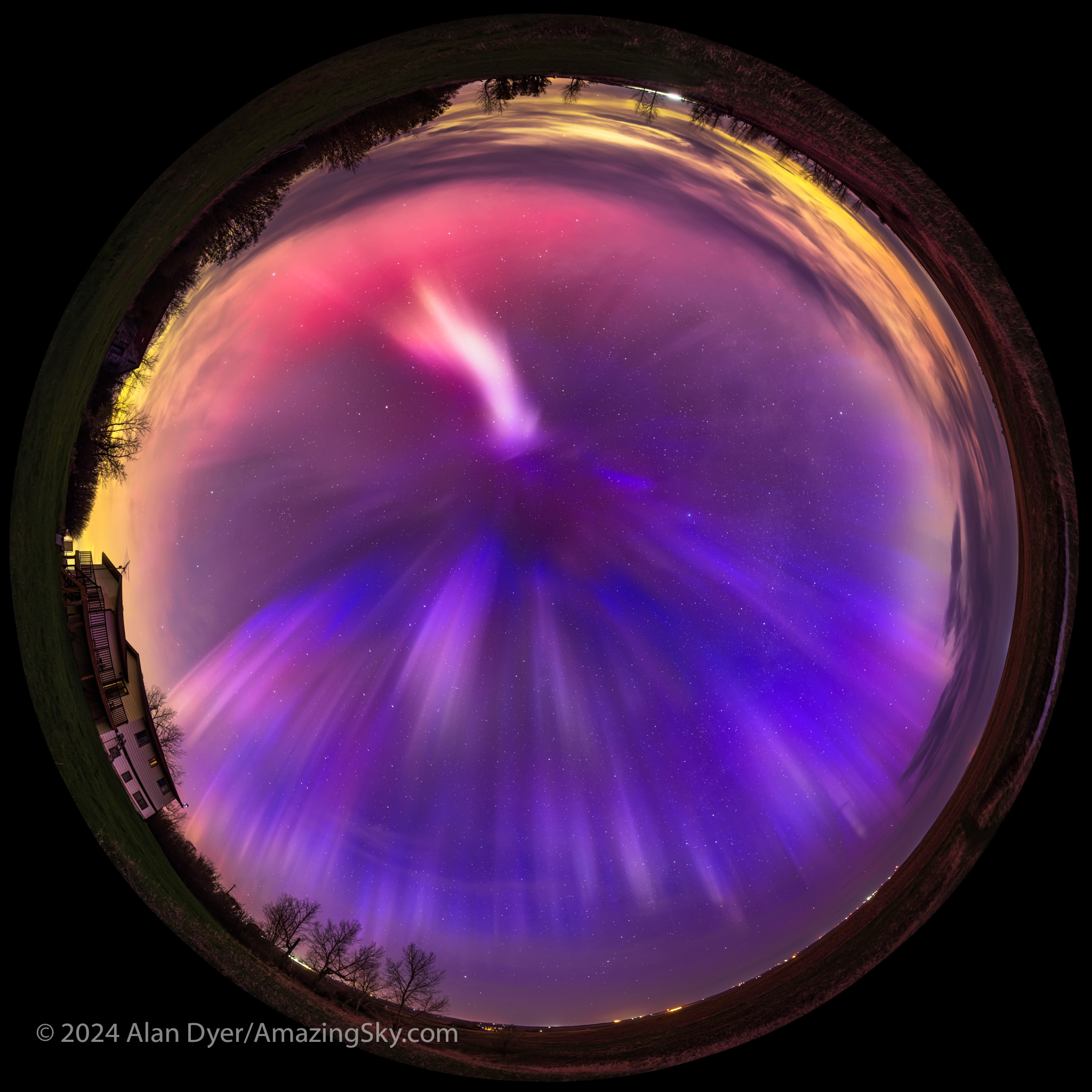
One of the most remarkable aspects of this show was the blue auroras later in the night (shown below), created by sunlight illuminating the upper curtains and reacting with atmospheric nitrogen. The usual auroral greens and reds are from oxygen. Pinks are also from nitrogen. Blues are less common, but were in abundance this night.

This is a 360ยฐย panorama of the May 10/11 aurora exhibiting vertical blue and magenta rays across the western (left), northern (bottom), and eastern (right) sky, and an odd bright patch to the south at top. This was toward the end of the main activity this night, at about 2:30 am. This is made of 20 segments, each 13-second exposures, with the Laowa 15mm lens at f/2 on the Canon Ra at ISO 800.

Auroras around summer solstice, June 21, can be more colourful and often blue, as the Sun lights the upper atmosphere all night. I saw blue auroras again later in the summer.


June and July are normally when we in western Canada get good displays of another northern mid-latitude phenomenon, noctilucent clouds (NLCs)

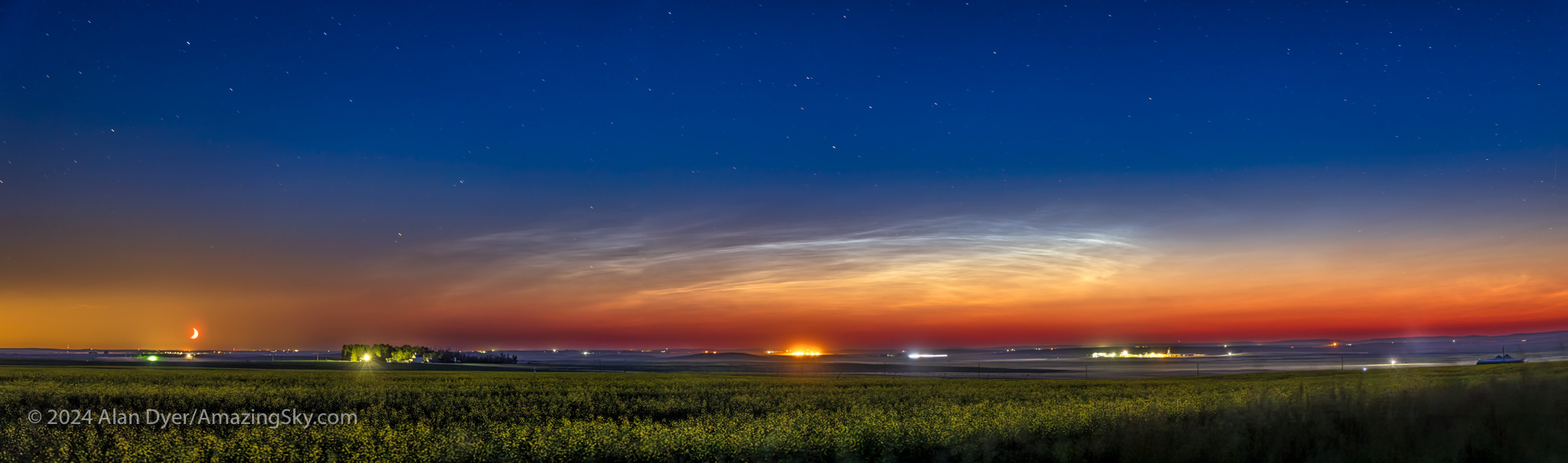
This shows sunlit noctilucent clouds in the northwest in the summer twilight, and as the waxing crescent Moon sets at left. This was July 9 at 11:45 pm MDT, in a panorama of 5 segments, each a 30-second exposure with the Canon RF24-105mm lens at f/4 and 58mm on the Canon R5 at ISO 400.

These are ice clouds at 80 km altitude (almost in space) that are lit by sunlight all night long. I saw only a couple of displays of NLCs this year, and it wasnโ€™t for lack of trying and clear nights, even amid forest fire smoke. The panorama above is from home on July 9, over a yellow canola field. NLC season always coincides with peak canola colour time!

Might NLCs be suppressed by high solar activity? Thereโ€™s some data that suggests they are. However, we werenโ€™t getting many auroras either in early summer. 

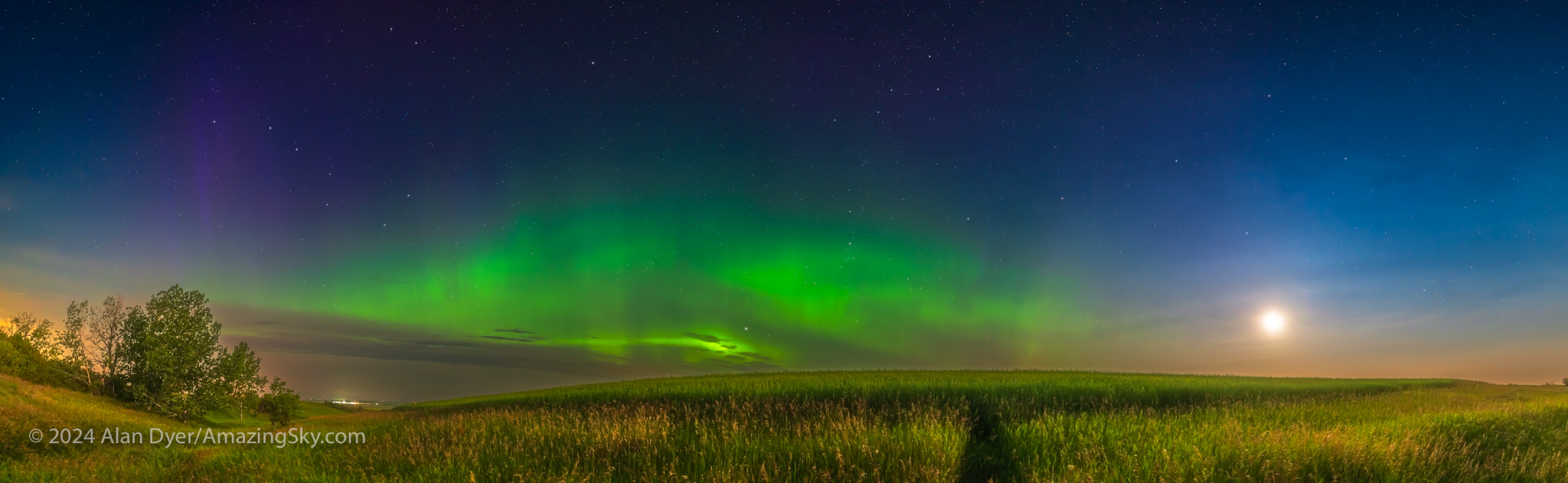
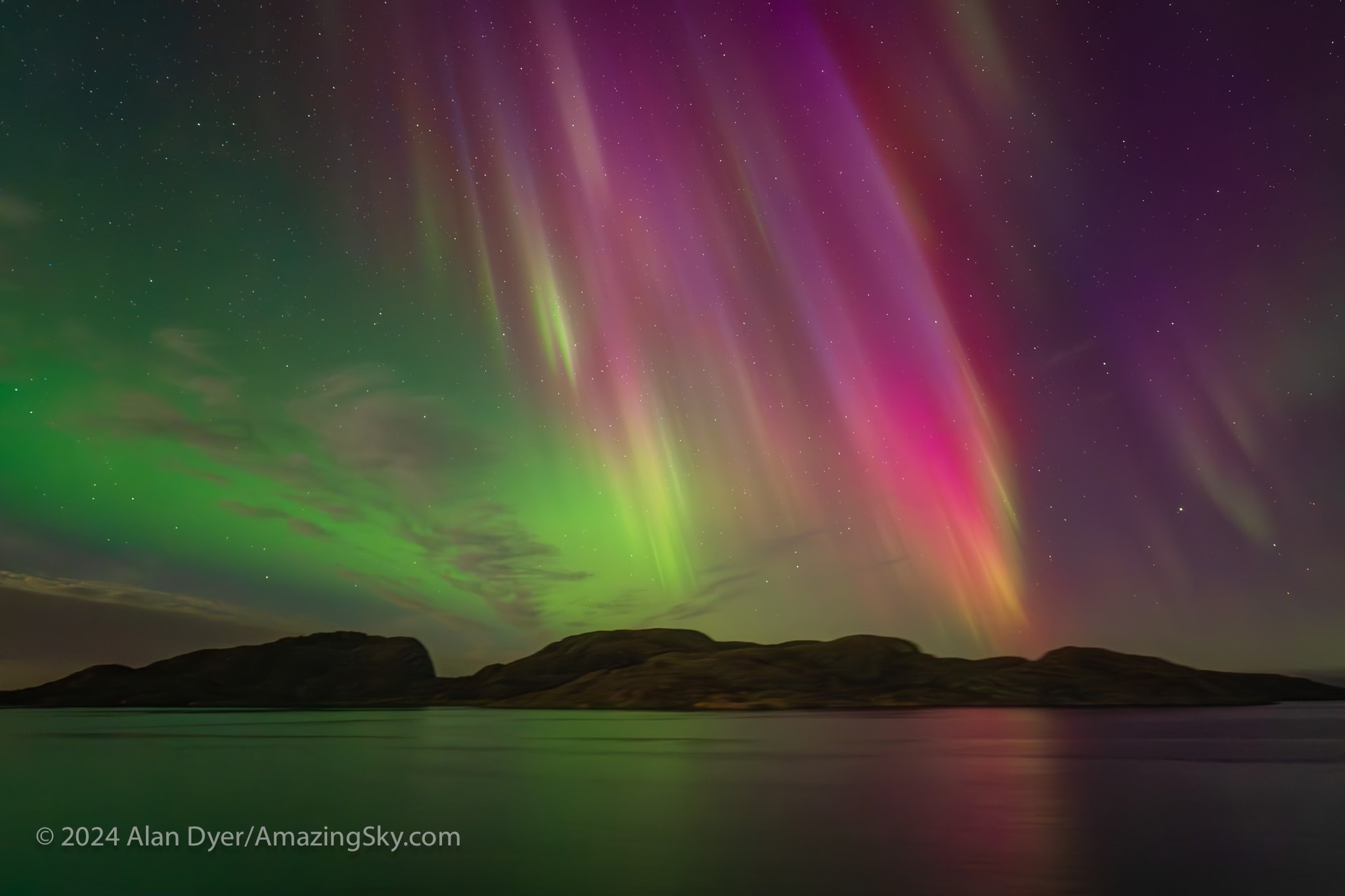
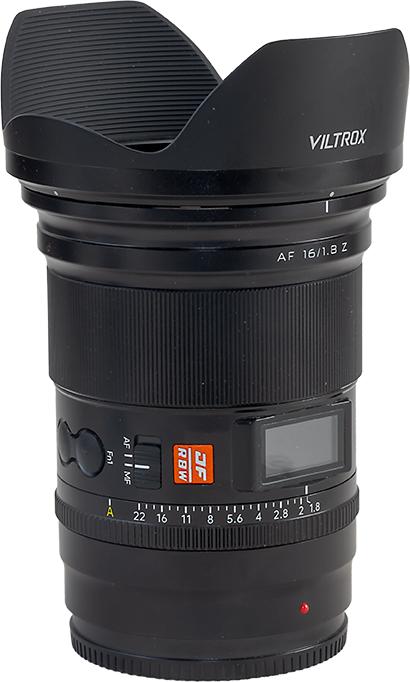
A 180ยฐ panorama of the surprise aurora of July 25, as there was little indication in the days before that an aurora was possible this night. This is a panorama of 6 segments, with the Viltrox 16mm lens at f/2 on the Nikon Z6III at ISO 800, each 8-second exposures.

But at the end of July the Northern Lights returned for some classic shows of arcs across my northern sky, first on July 25 (above), with a prominent sunlit blue/purple ray at left by the Big Dipper. The Kp Index reached Kp5 this night, which is enough to produce a good display from my location in southern Alberta. The Moon is rising at right.

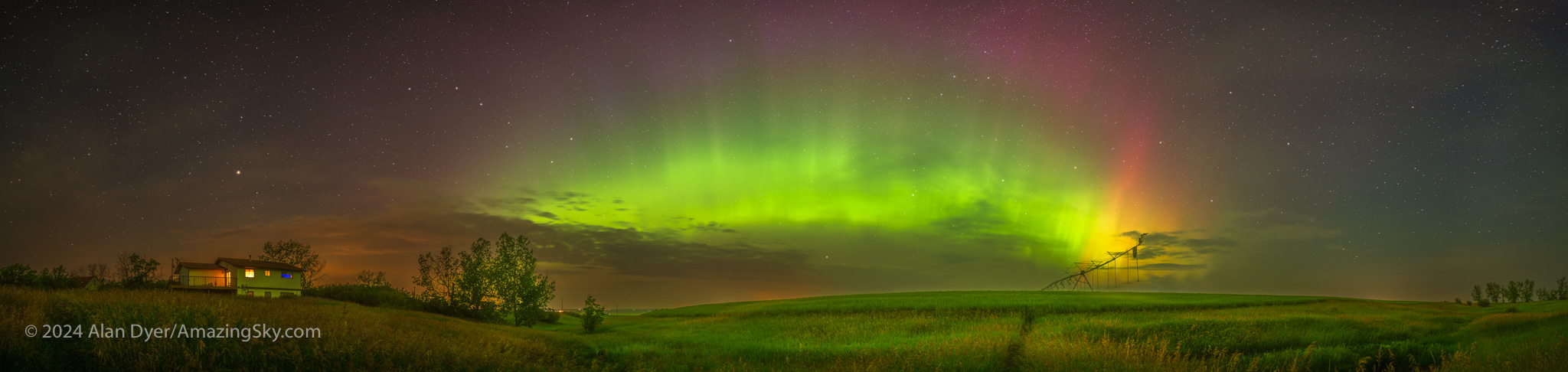
A 180ยฐ panorama of the Kp5-level aurora on July 29, with a green arc, and magenta and red rays. This is a panorama of 8 segments, each 30-second exposures with the Viltrox 16mm at f/2 on the Nikon Z6III at ISO 800.

Then again, four nights later on July 29, an auroral arc appeared across the north, this one with reds mixing with greens to create a yellow band in the east, as well as blue and magenta tops to the green arc that follows the curve of the auroral oval. 


While June and July were quiet months, August made up for them.

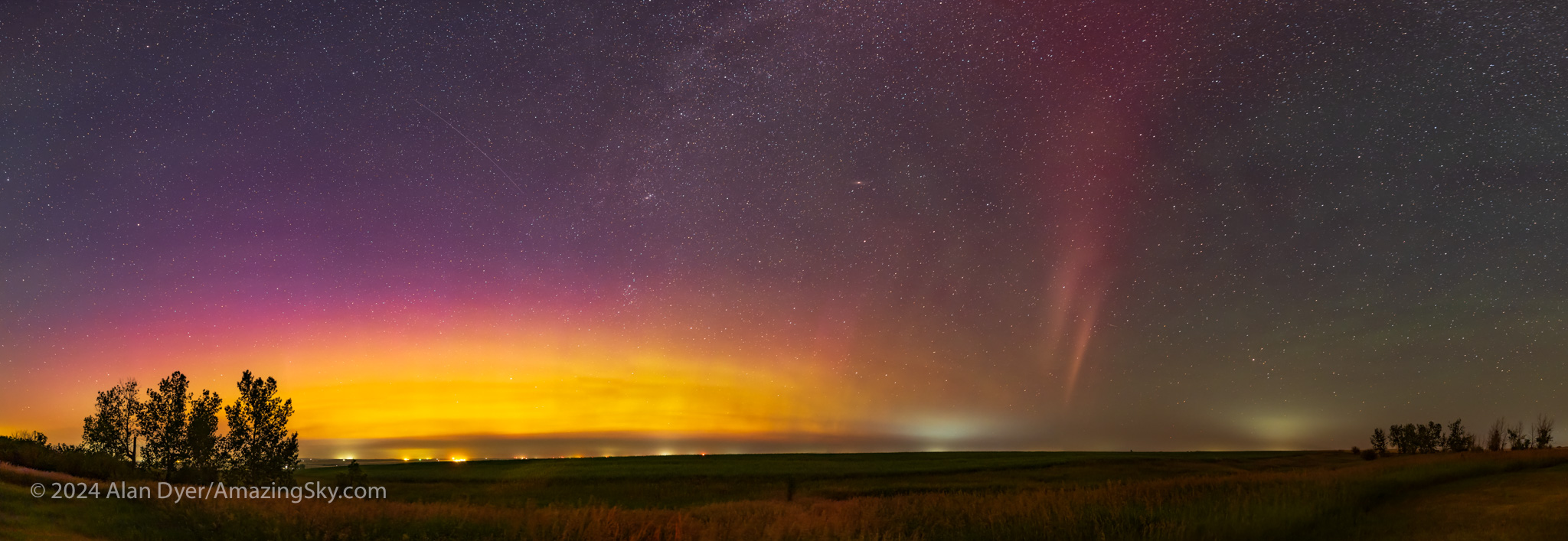
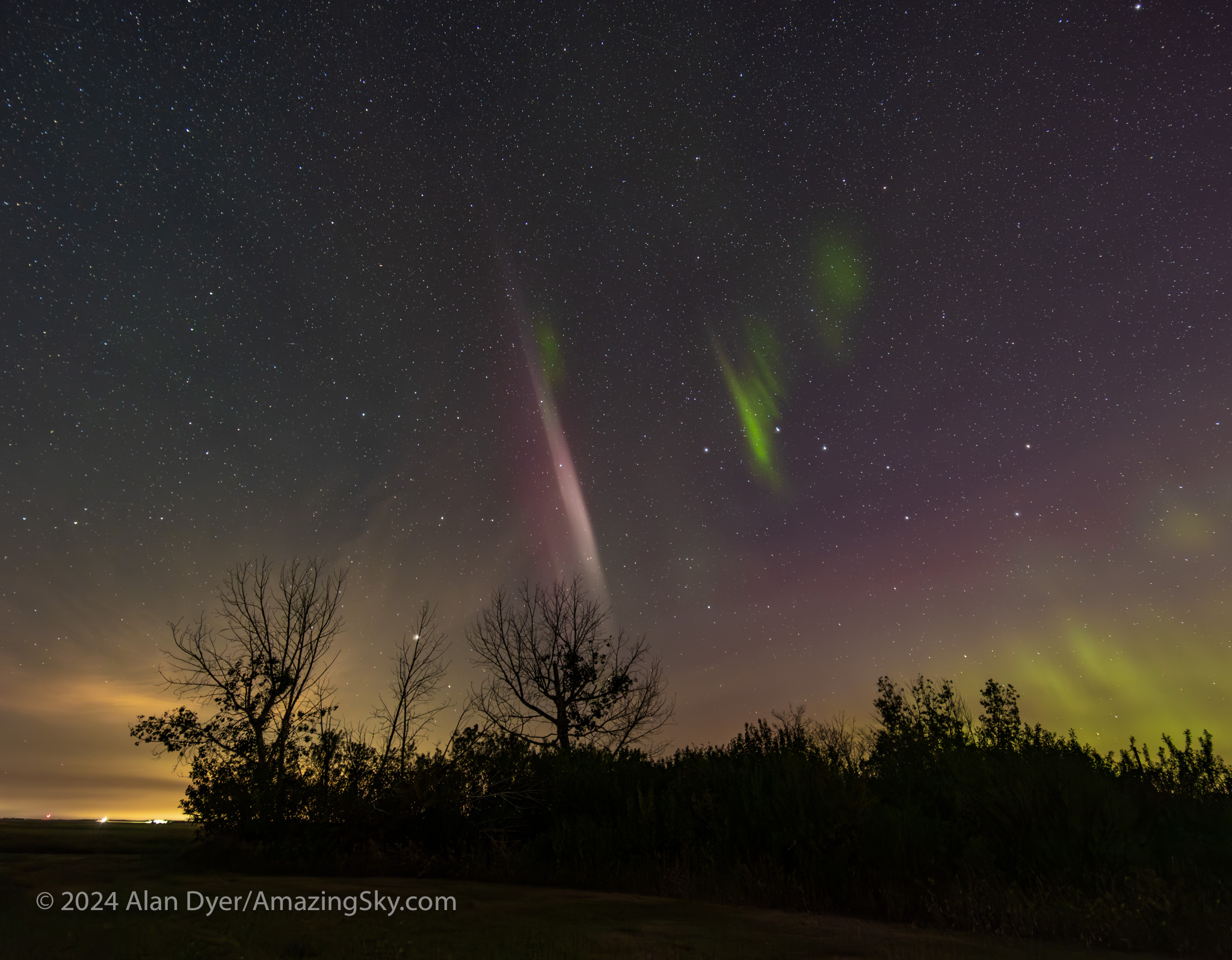
Of all the auroras this year, only this one, on August 1, produced a showing of STEVE, at least as best I saw in 2024. He can be elusive and easily missed!

This is a capture of a faint appearance of a STEVE-like arc during the Kp5 aurora of July31/Aug 1. This was at 12:10 a.m. MDT, so on Aug 1. The camera recorded the pinkish rays at right which are likely STEVE arcs below a more diffuse and fainter red band which may be a SAR, a Stable Auroral Red arc.

STEVE is the odd arc, often white or mauve, that appears southward of the main aurora (from here in the Northern Hemisphere), typically after a show has peaked, then subsided and retreated back north, as it did above. 

STEVE stands for Strong Thermal Emission Velocity Enhancement, as it is caused by horizontally flowing hot gas, and so is not, by definition, a true aurora created by energetic particles raining vertically down magnetic field lines. 

For a classic showing of STEVE see my video, above, from August 2022. High-resolution 4K video I shot this night formed the basis for a scientific research paper, as it revealed structures in STEVE no one had seen before.

This is a capture of a brief appearance of a STEVE arc in the west during the Kp5 aurora of July31/Aug 1. This was at 1:10 a.m. MDT, so on Aug 1. The mauve STEVE arc was visible for about 15 minutes before it gradually faded. The green picket fence fingers, which were visible to the eye but colourless, appeared only a minute or so before this image and were gone no more than 2 mnutes later.

STEVEs are often accompanied by green โ€œpicket fence fingersโ€ hanging down from the mauve arc. These fingers are more akin to normal auroras, but are created by particles from the STEVE band raining down local magnetic field lines. They do not come from far out in space as they do in a normal aurora!


On the night of August 3/4 I was able to join a photo tour run by local photographer Neil Zeller, to shoot Milky Way nightscapes. Escaping clouds, we ended up at a scenic spot south of Medicine Hat, Alberta, called Red Rock Coulee. 

A 180ยฐ panorama of a Kp5-level aurora on a partly cloudy night, August 3/4. This was looking to the northeast at 3:00 am from a side road off the Trans-Canada Highway in southern Alberta just east of Brooks.

On the way home, the aurora began to let loose behind the clouds. We stopped once off the highway as the aurora brightened in an arc across the northeast, above.

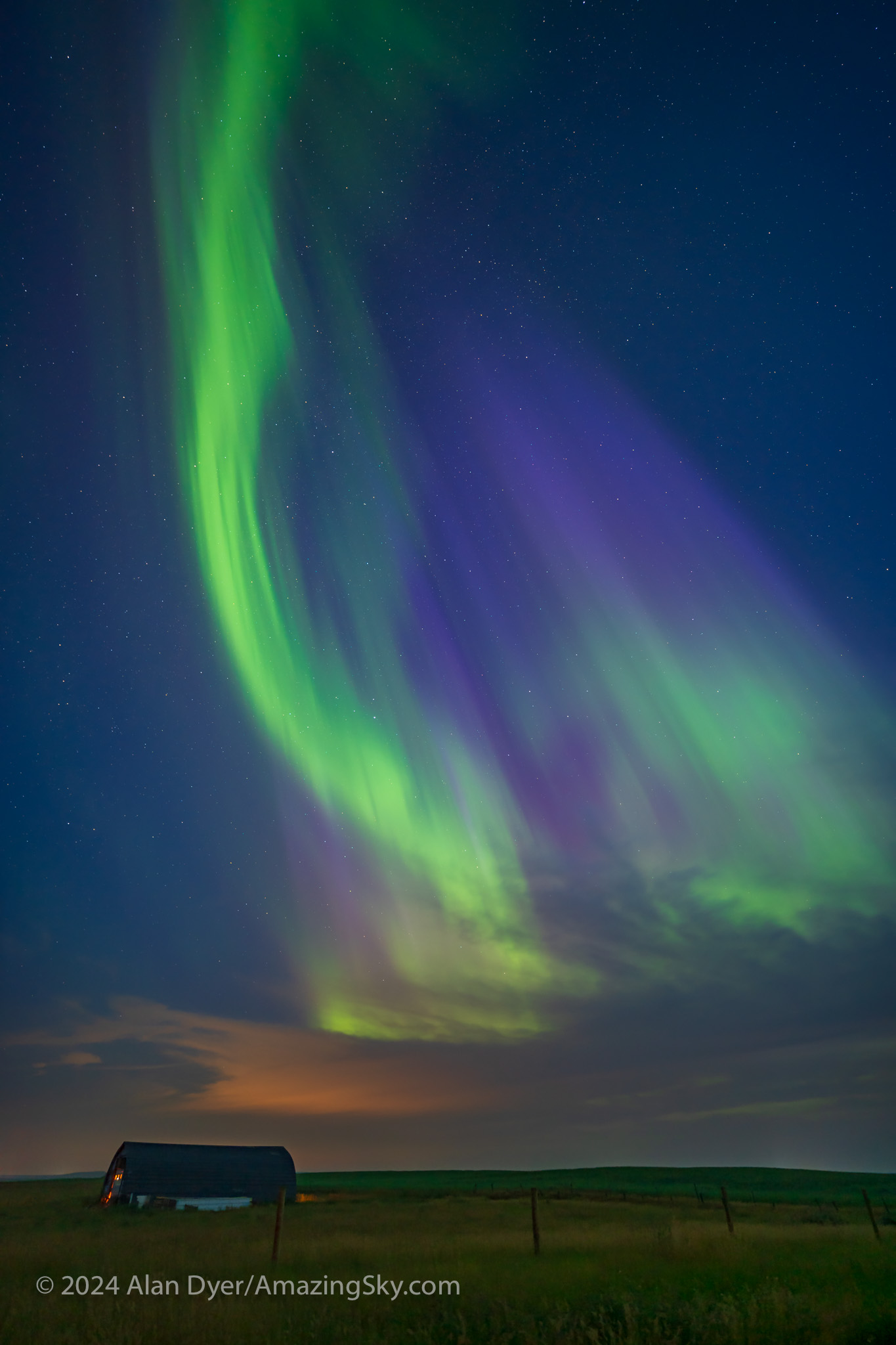
A bright auroral curtain sweeps from the zenith down the western sky, as the sky brightens with the blue of a dawn twilight. This was the morning of August 4, with a Kp5 to 6 level aurora underway. The location was just off Highway 1 between Brooks and Bassano, Alberta. This is a single 13-second exposure with the Viltrox 16mm lens at f/2 on the Nikon Z6III at ISO 400.

We stopped again later, now at 4 am, and marvelled as the curtains converged at the zenith in the finest manifestation an aurora can produce, a swirling zenith โ€œcorona.โ€

A music video from August 4, using just a single real-time video, not a time-lapse, is above. It shows almost the full but brief appearance of the corona, just as the eye saw it looking straight up!


August was a good month! Right after the annual Saskatchewan Summer Star Party in the Cypress Hills I headed farther east to Grasslands National Park, a favourite dark-sky site I had not visited since 2019. 

My plan was to shoot the annual Perseid meteor shower that was to peak on Sunday, August 11, from the same spot I shot it in 2016.

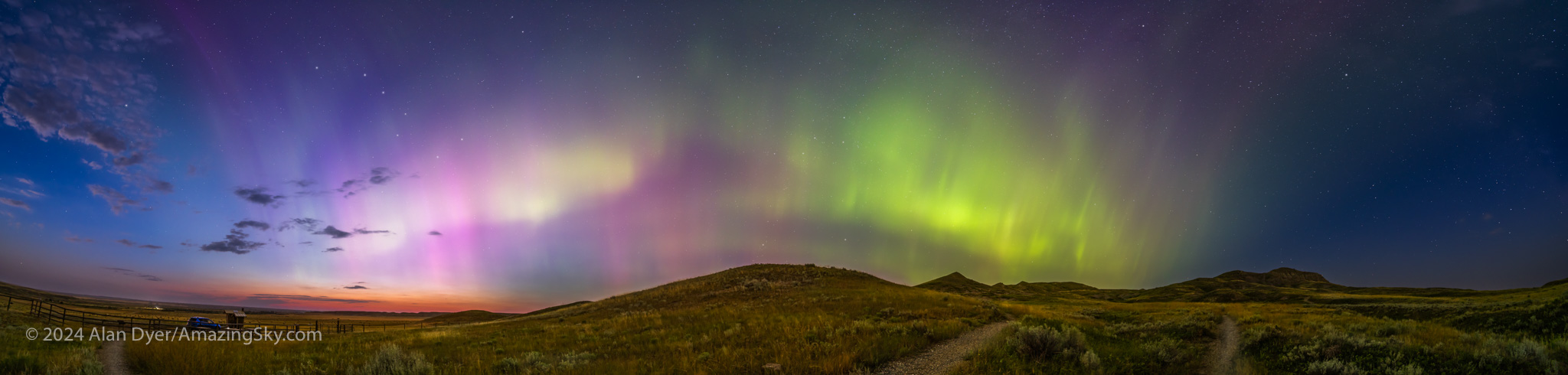
A 270ยฐ panorama of the aurora in the evening twilight on August 11, from the 70 Mile Butte trailhead in Grasslands National Park, West Block near Val Marie, Saskatchewan. This is a panorama of 11 segments, each 15 seconds with the Laowa 15mm lens at f/2.8 on the Canon R5 at ISO 800.

The aurora had other plans. Again, as it did on May 10, the sky was lighting up with colours as it darkened in the evening twilight, above.

This is a 360ยฐ all-sky panorama of the Kp6 to 7-level aurora on August 11, from Grasslands National Park. This is a panorama of 12 segments, each 4 seconds with the Laowa 15mm lens at f/2 on the Canon R5 at ISO 4000.

The aurora expanded to fill the sky, and with odd fragmented bits, shown above. My trio of cameras set up for the meteor shower got repurposed into taking aurora time-lapses, stills, and panoramas. And selfies! โ€” the title slide for this blog was from this memorable night at Grasslands. 

The aurora was bright enough during this substorm outburst at 12:15 am that the red and green colours could be seen with the eye, though they were subtle. This is a 2-second exposure with the Laowa 15mm lens at f/2 on the Canon R5 at ISO 3200.

A notable moment was at midnight when, even to the eye, the sky to the east suddenly turned red, and a wave of crimson aurora quickly swept in. The reds from oxygen mix with the more usual auroral greens, also from oxygen, to create areas of yellow in the sky. 

This was also peak night for the 2024 Perseid meteor shower. One bright Perseid meteor shoots down the Milky Way in Cygnus at top, amid the converging rays of the aurora at the magnetic zenith. This is with the Laowa 10mm lens at f/2.8 on the Nikon Z6III at ISO 6400 for 2 seconds.

A few still frames in the time-lapses did manage to catch a Perseid meteor or two, as above, embedded in the vivid curtains of light. But the meteors were upstaged by the Northern Lights this night.

A music video of this show is above, also on my YouTube channel (itโ€™s been a busy year!). Using only time-lapses, it captures the sudden arrival of the red sub-storm, sped up to be sure, but it seemed that quick!


This night I was hoping to shoot deep-sky objects with telescopes I was testing at home. Again, the aurora had other ideas.

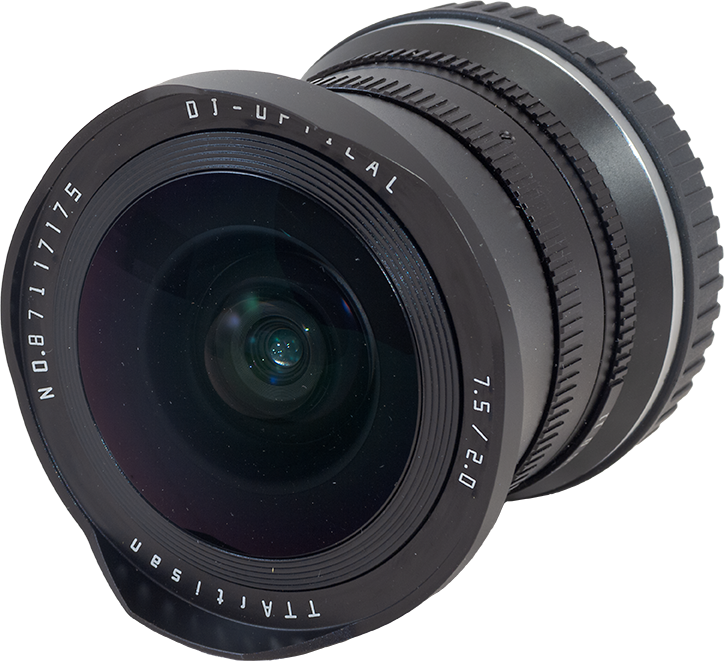
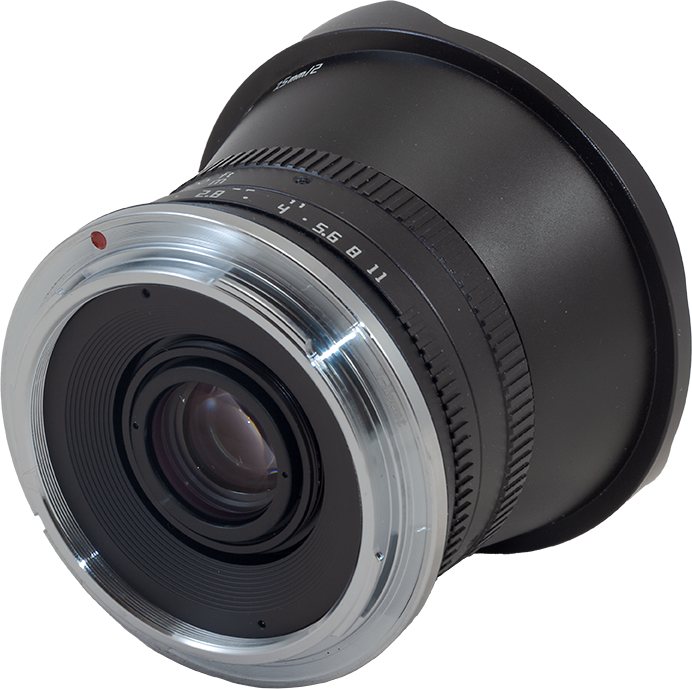
This view is looking north, but the fisheye lens is taking in much of the sky. The August 30 show was somewhat unexpected, though there were last-hour warnings a sky-covering display might be possible. This is a single 4-second exposure with the TTArtisan 7.5mm fisheye lens at f/2 on the Nikon Z6III at ISO 3200.

As the movie shows, a band of Lights across the north early in the evening promised to develop. So I set up a time-lapse camera and fisheye lens to capture, for once, a complete development of an aurora, from a diffuse band, to the onset of an active sub-storm outburst which occurred, as they often do, at midnight when we are looking down Earthโ€™s magnetic tail at the source of the aurora particles. 

As the video shows, the storm then subsides and the aurora changes character. During the post-sub-storm โ€œrecovery phase,โ€ usually when we are under the dawn sector of the auroral oval, an aurora can switch to a pulsating effect with patches of aurora flashing off and on and flaming up to the zenith. This form of aurora is caused by electrons trapped in the Van Allen radiation belts that are bouncing back and forth from pole to pole.

To capture this aspect of the show I switched to real-time video with that same lens, reviewed here on a previous blog

The music video of this show, above, uses a mix of time-lapses and real-time videos shot with the 360ยบ 7.5mm fisheye lens. Itโ€™s a great aurora lens for capturing it all!


Auroras are often most frequent, active, and bright around the spring and autumn equinoxes, when the magnetic field lines of Earth and interplanetary space better connect. Itโ€™s called the Russell-McPherron Effect.

This is a 360ยฐ panorama from left (southeast) to right (northeast) and extending from the horizon to the zenith, taking in the entire sky during an outburst of a particularly colourful aurora on September 16. This is a panorama of 12 segments, each 4 seconds with the Laowa 15mm lens at f/2 on the Canon R5 at ISO 400.

September 16 (6 days before the autumnal equinox) saw another all-sky show that, for us in western Canada, rivalled May 10. As with the spring show, this aurora was notable for its great range of colours, with nitrogen pinks and magentas mixed in with shades of oxygen yellow-greens and reds. 

A darker blue-green band to the south (at left above) during the peak could be aurora from incoming protons exciting hydrogen, not from the usual electrons that excite all other auroras and light up oxygen and nitrogen atoms and molecules.

Yes, there are proton auroras. Another research paper using my images from an October 2021 aurora explored the relationship between proton auroras and SAR arcs (explained below).

This is an all-sky 360ยฐ panorama from the horizon at the edges, to the zenith at centre, taking in the entire sky during an outburst of a particularly colourful aurora on September 16. This is a panorama of 12 segments, each 4 seconds with the Laowa 15mm lens at f/2 on the Canon R5 at only ISO 400.

The September 16 show started with a diffuse band which quickly exploded as a sub-storm onslaught of energetic particles arrived to light up the aurora with greater brilliance, colours, and rapid motion. The onset of a substorm can happen in literally just a minute. 

Even the nearly Full Moon failed to diminish this show, seen from home under perfect skies. Luckily, the smoky season had abated.

A music video of this nightโ€™s show is also above on YouTube. Do click through to watch this and the other videos in full screen mode.


Six months to the day after the great May 10 show, the sky erupted again with auroras seen all over the world, even from more southerly latitudes that donโ€™t normally see Northern Lights.

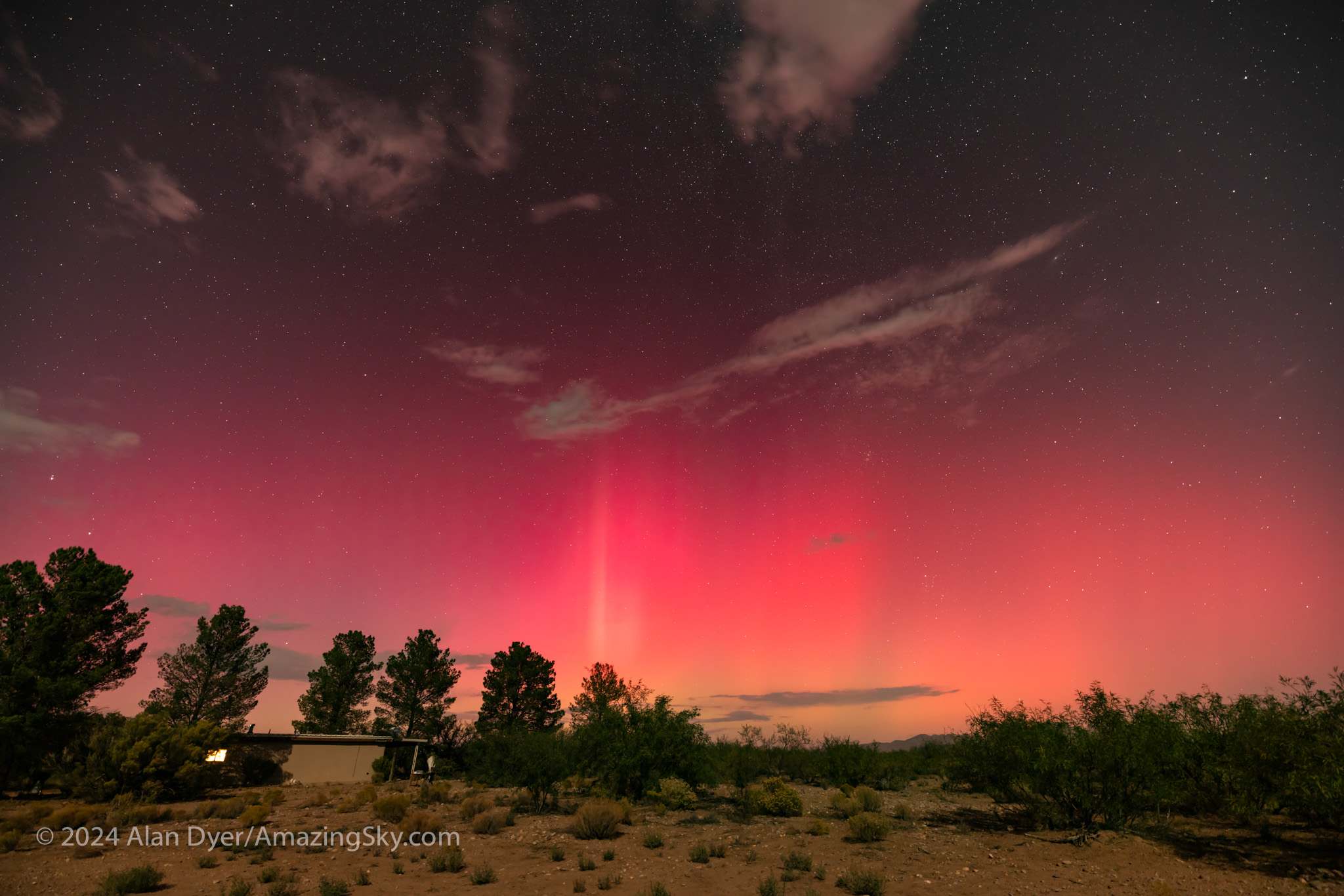
A rare red aurora seen from latitude +32ยบ N from southeast Arizona during the major Kp8-level storm of October 10. This is looking north from the Quailway Cottage near Portal, Arizona and Rodeo, New Mexico. This is a single 15-second exposure with the Canon RF15-35mm lens at 15mm and f/2.8 on the Canon R5 at ISO 1600.

I know because I was at one of those latitudes, in southern Arizona at 32ยฐ N. The aurora created the kind of show seen from areas that donโ€™t normally get auroras โ€” a red sky on the horizon. It is these ominous red skies that provoked Medieval fears of divine wrath and myths of armies clashing in the distant North.

Red auroras can also occur in the Southern Hemisphere (as can every other form of aurora) when the aurora australis brightens and extends farther north than normal, lighting up the southern sky red at locations that rarely see the Southern Lights.

In both cases we are seeing just the red tops of distant curtains that mostly lie hidden over the horizon, the red coming from oxygen reactions that can happen only at the rarefied altitudes of 300 to 500 km. Oxygen greens come from 100 to 300 km up.

From Arizona, I saw what many in the U.S. saw this night โ€” a prominent glow, obviously red even to the eye, across the northern horizon. I was missing a far better show at home!

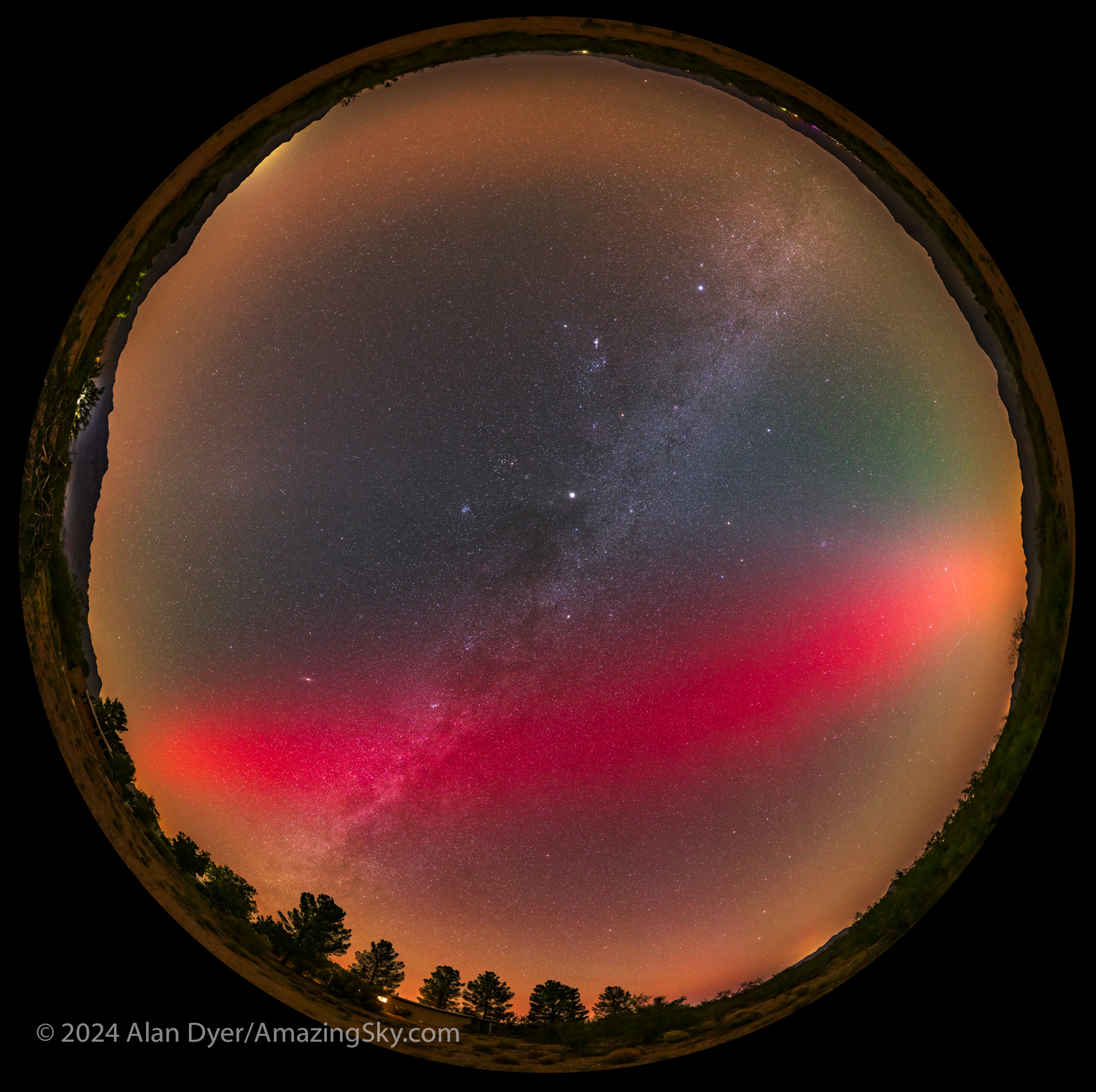
This is a 360ยฐ panorama covering the entire sky and extending up to the zenith at centre, capturing a rare SAR (Stable Auroral Red) arc across the Arizona sky in the pre-dawn hours of October 11. This is a panorama of 12 segments, each 30 seconds at f/2.8 with the Canon RF15-35mm lens on the Canon R5 at ISO 3200.

But unique to my more southerly site was this phenomenon, also widely seen across the U.S. and southern Canada.

Accompanying the โ€œnormalโ€ aurora to the north was a diffuse red (to the camera) arc across the sky that lasted most of the night. This was a Stable Auroral Red (SAR) arc, created by thermal energy flowing horizontally in the high atmosphere some 400 km up.

SARs have been seen evolving into STEVEs, as the mechanisms seem related. Indeed, one of my images from August 1, shown above, seems to show a SAR/STEVE hybrid.

I set up a wide-angle lens and time-lapse hoping to catch such an evolution first-hand, which would have been of great interest to researchers. Alas, the SAR did not cooperate, stubbornly remaining a SAR all night. 

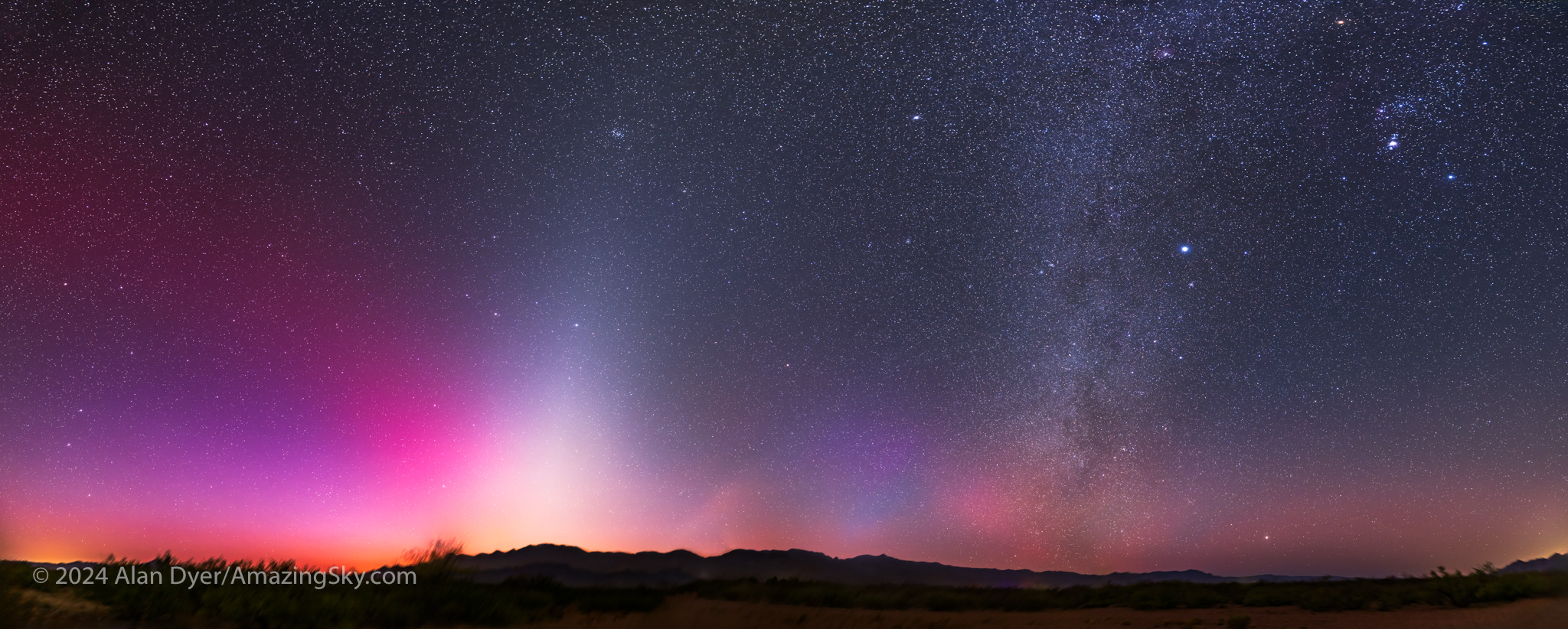
This was the pre-dawn scene from southeastern Arizona on the morning of October 11 that frames a suite of skyglows. This is a panorama of 3 segments, each a stack of 5 x 1-minute tracked exposures with the Canon RF15-35mm lens at 15mm and f/2.8 on the Canon R5 at ISO 1600.

By dawn, with blue sunlight at work, the SAR looked magenta in the twilight, accompanied by two other sky glows: 

  • The pyramid-shaped Zodiacal Light created by sunlight reflecting off cometary and meteoric dust in the inner solar system, 
  • And the winter Milky Way, created by the combined light of distant stars in our section of our Galaxy. 
  • So in one image we have atmospheric, interplanetary, and interstellar sky glows! This was truly an amazing sky, the likes of which I might never see again.

In early November I headed to Norway to instruct my first aurora group there since 2019. The location was on board a ship, the m/s Nordkapp, a ferry in the Hurtigruten fleet that does 12-day runs along the coast, from Bergen in the south, to Kirkenes in the far north, and back again. 

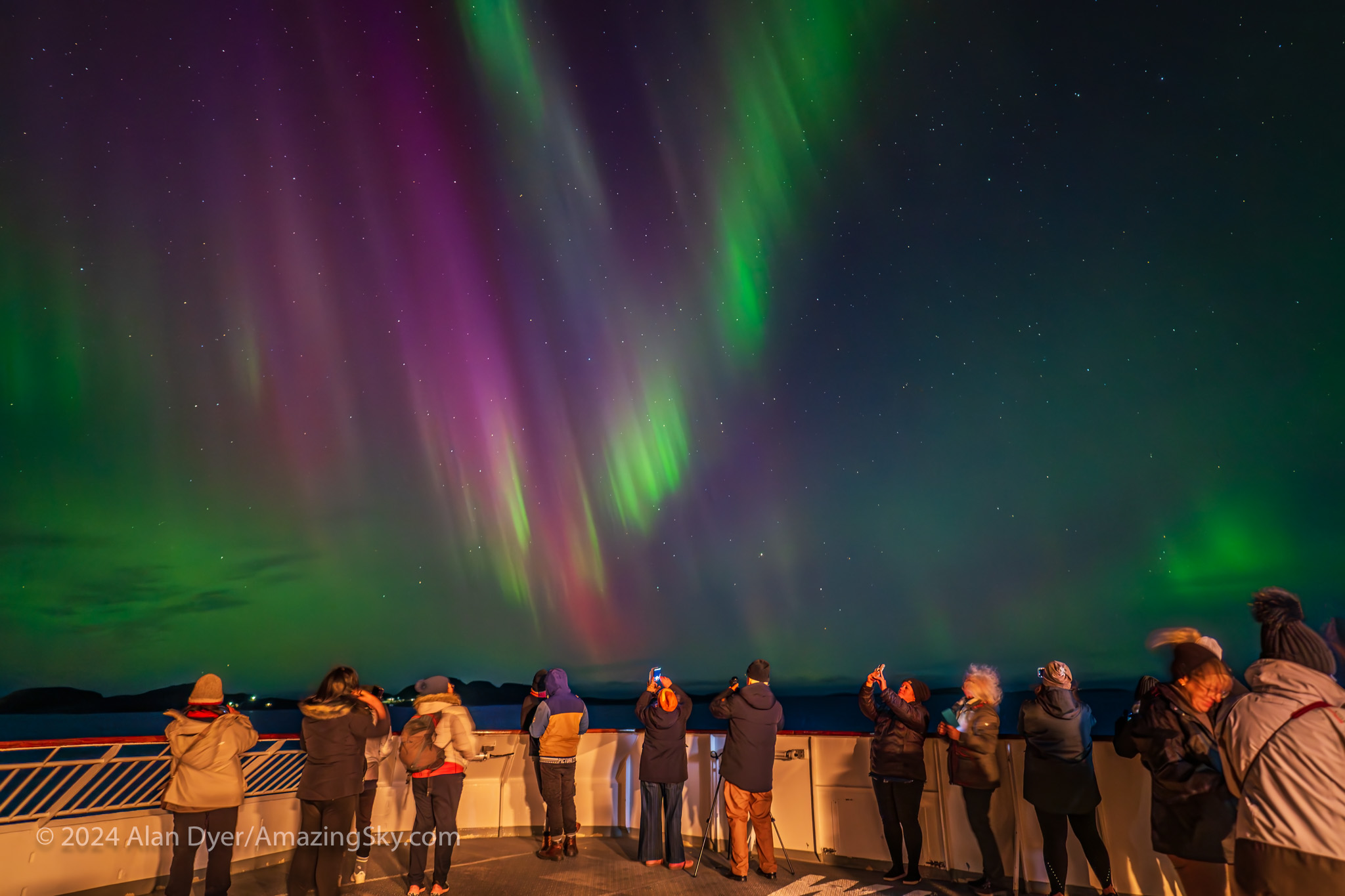
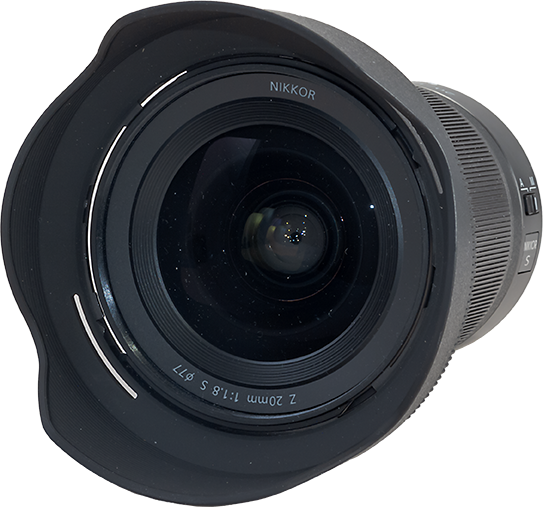
Passengers on board the m/s Nordkapp are watching the Northern Light show on November 9, from the coast of Norway. This is 0.4 seconds at f/1.8 with the Nikkor 20mm lens on the Nikon Z6III at ISO 3200.

We got three nights in a row of active auroras on the northbound voyage. A Kp4 to 5 storm brought the Lights farther south and overhead for us early in the voyage, something we donโ€™t normally see in Norway until we get underneath the auroral oval, which at that longitude in the world lies above the Arctic Circle, north of 66ยฐ latitude. 

A colourful aurora appears in the darkening evening twilight sky at sea along the coast of Norway on November 9. This is a single 2-second exposure with the 20mm Nikkor lens at f/1.8 on the Nikon Z6III at ISO 1600.

But on November 9, with a storm underway, the show started early, rudely interrupting our groupโ€™s cocktail hour as we all rushed up on deck. As it can do, the aurora glowing in a twilight sky took on added tints. 

This is a panorama of auroral arcs across the southern sky, with prominent red content contrasting with the oxygen yellow-green bands. Taken on November 10/11 (just after midnight). This is a panorama of 7 segments, each 1.3-second exposures with the Nikkor 20mm lens at f/1.8 on the Nikon Z6III at ISO 3200.

The next night, November 10, as we sailed through the mountainous Lofoten Islands, we were treated to an aurora with lots of red content, above. No two auroras are alike!

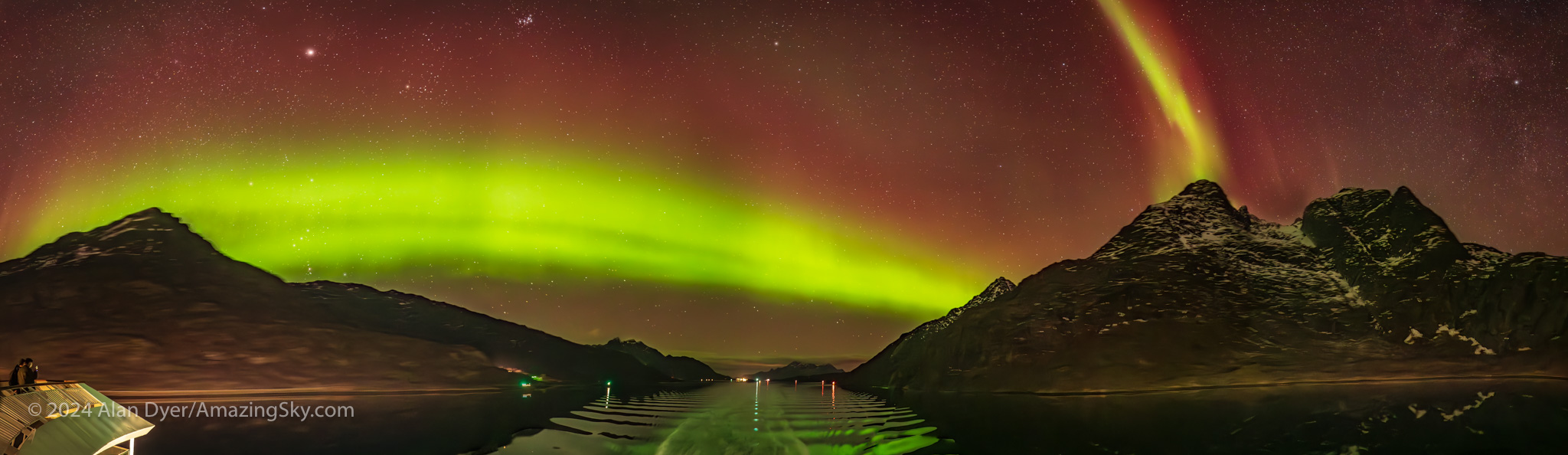
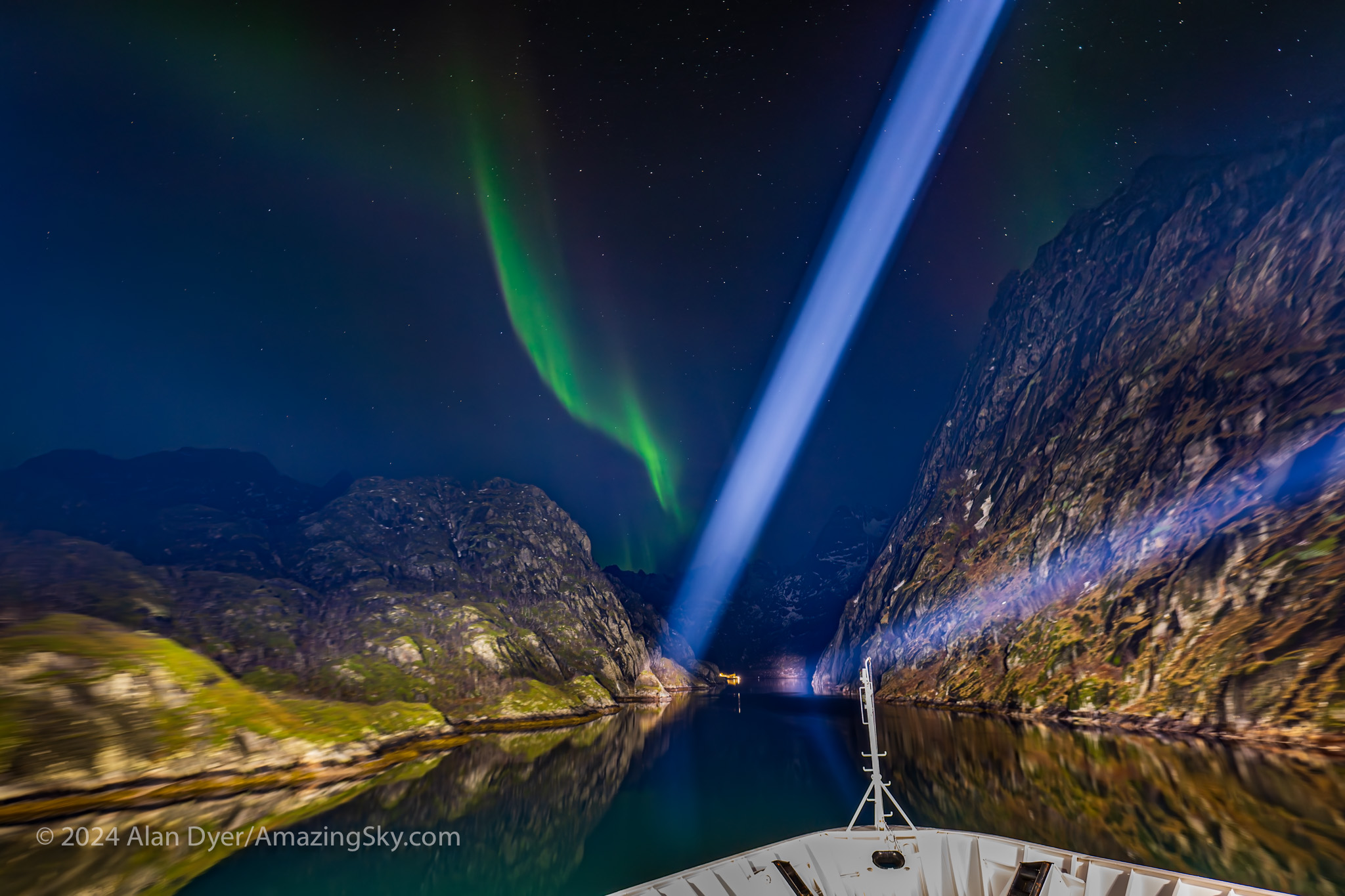
An arc of Northern Lights points the way into the narrow Trollfjord in the Lofoten Islands of Norway, as our ship, the m/s Nordkapp enters the fjord at night by searchlight. This is a 0.5-second exposure at f/1.8 with the Nikkor 20mm lens on the Nikon Z6III at ISO 1600.

A curtain of aurora also nicely pointed the way into the short but scenic Trollfjord, a fjord the ship captains like to navigate into for a memorable side trip as we slide through the narrow canyon with seemingly inches to spare. 

A gallery of my Norway auroras is here on my website.

All going well, I will be back in Norway for two cruises in October. Join me!

A music video of real-time aurora sequences shot from on deck during my November 2024 Norway cruise is above on YouTube. Note the phones held high, the way most people now shoot the aurora, and usually with very good success!


We have more to look forward to in 2025.

First, it is likely that the Sun has not peaked, but may undergo a second peak of maximum activity in 2025 or 2026. A double peak is common at many solar maxes. Just look at the graph at the opening of the blog, and the previous peaks of Cycles 23 and 24.

Plus, the most energetic solar flares and storms often occur after the peak on the downward trend of activity. So we could well see more worldwide aurora displays like we had on May 10 and October 10 in the coming two to three years. The show is far from over!

Watch websites like SpaceWeather.com for aurora alerts and news of solar events coming our way. 

โ€” Alan, December 15, 2024 / AmazingSky.com   

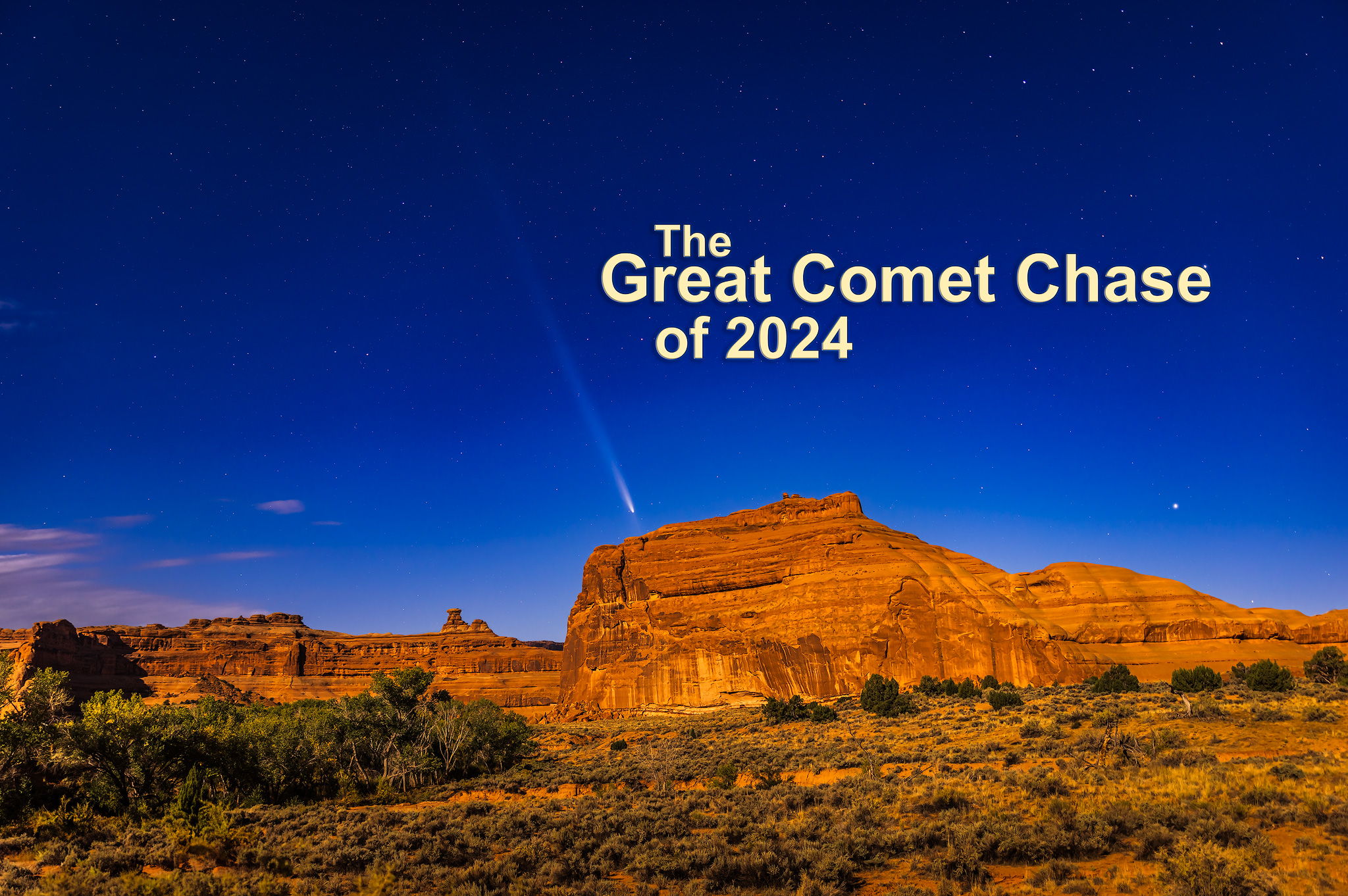
The Great Comet Chase of 2024


A plan to shoot the promised bright comet of 2024 paid off, with fine views at dawn and at dusk of the best comet since 2020. 

Comets are always a gamble. Any new comets discovered, the ones that usually become the brightest, have no track record of performance. Predictions of how bright a new comet might appear are based on what a typical comet should do. But comets can outperform expectations and dazzle us, or they can fizzle and fade away. 

In late 2023 it was clear that a then newly-discovered comet, C/2023 A3, named Tsuchinshan-ATLAS after the observatories where it was co-discovered, had the potential to perform in late 2024.ย 

The low angle and position of the comet from home in Canada in the late September dawn sky, simulated in StarryNight software.

Knowing where it would be in the sky (that trait of a comet can be predicted with accuracy!) I planned a field trip to the U.S. desert Southwest for late September and early October 2024. From farther south the comet would be higher than it would be from home (shown above), and over spectacular landscapes. 

I had visions of another Comet NEOWISE from July 2020. As my blog from 2020 shows, we saw that photogenic comet well from our northern latitude in Canada, as it skimmed across the northern horizon. Tsuchinshan-ATLAS would require a chase south.ย 


September 26 & 27 โ€” at Bryce Canyon, Utah

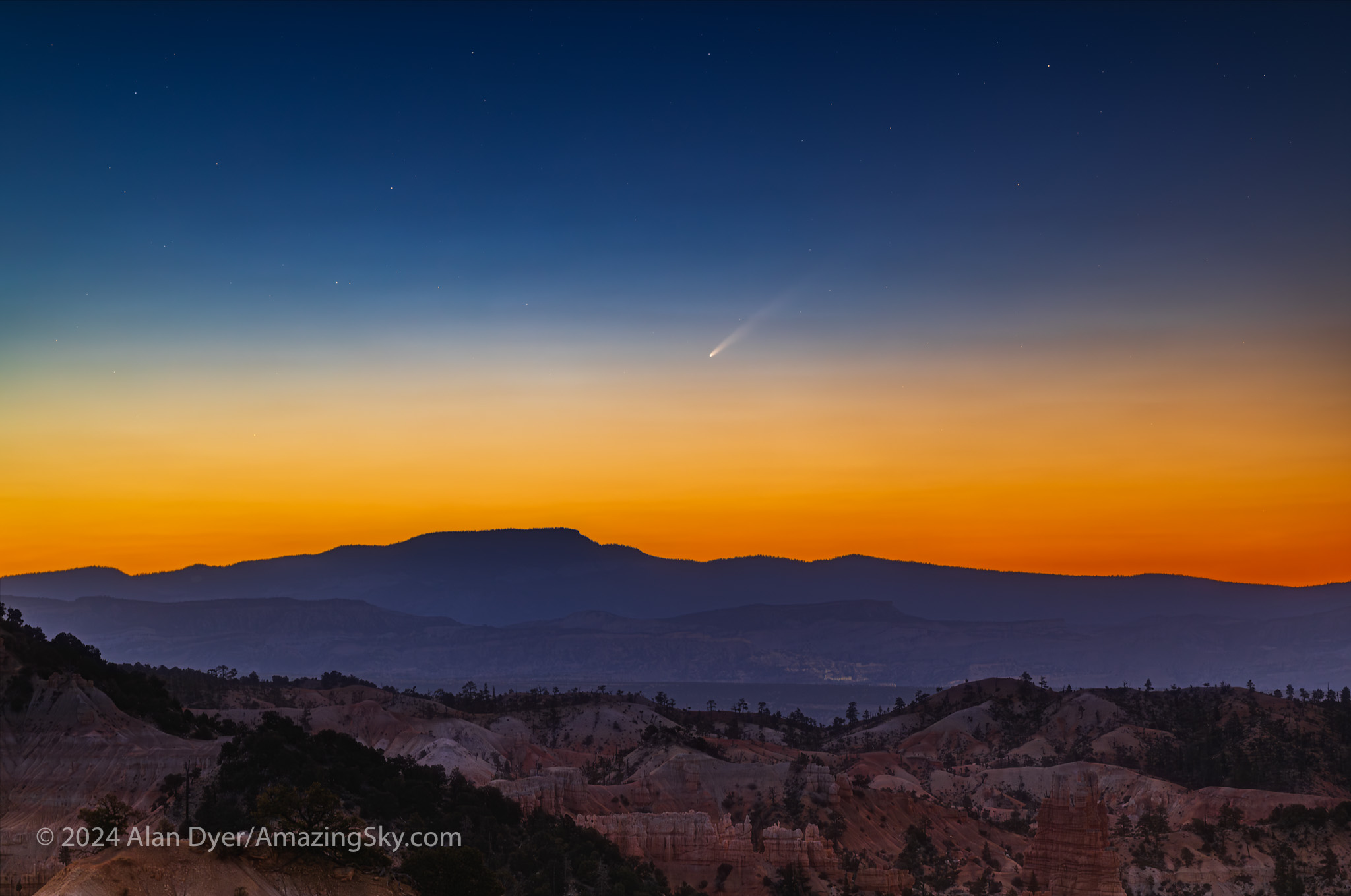
In late September 2024 the comet would be inbound, approaching the Sun and in the morning sky. What better eastern scene than overlooking Bryce Canyon in Utah, where I had been a year before, for the October 14, 2023 annular eclipse of the Sun in the morning sky. (Click the link for my eclipse chase blog.)

I was fortunate to get two clear mornings, both from the Fairyland Canyon viewpoint, just a short walk from the parking lot to carry camera gear and tracking mounts. 

Comet C/2023 A3, Tsuchinshan-ATLAS, at dawn over Bryce Canyon, on the morning of September 27, 2024.

My first look at the comet on September 27 was on the day the comet was at perihelion, closest to the Sun in its orbit, though not in the sky at our viewing angle from Earth. 

The comet was just visible to the unaided eye, but was obvious on the camera view screen, even amid the bright twilight. I had to shoot fast as the window between โ€œcomet riseโ€ and the sky brightening too much was only a few minutes long. 

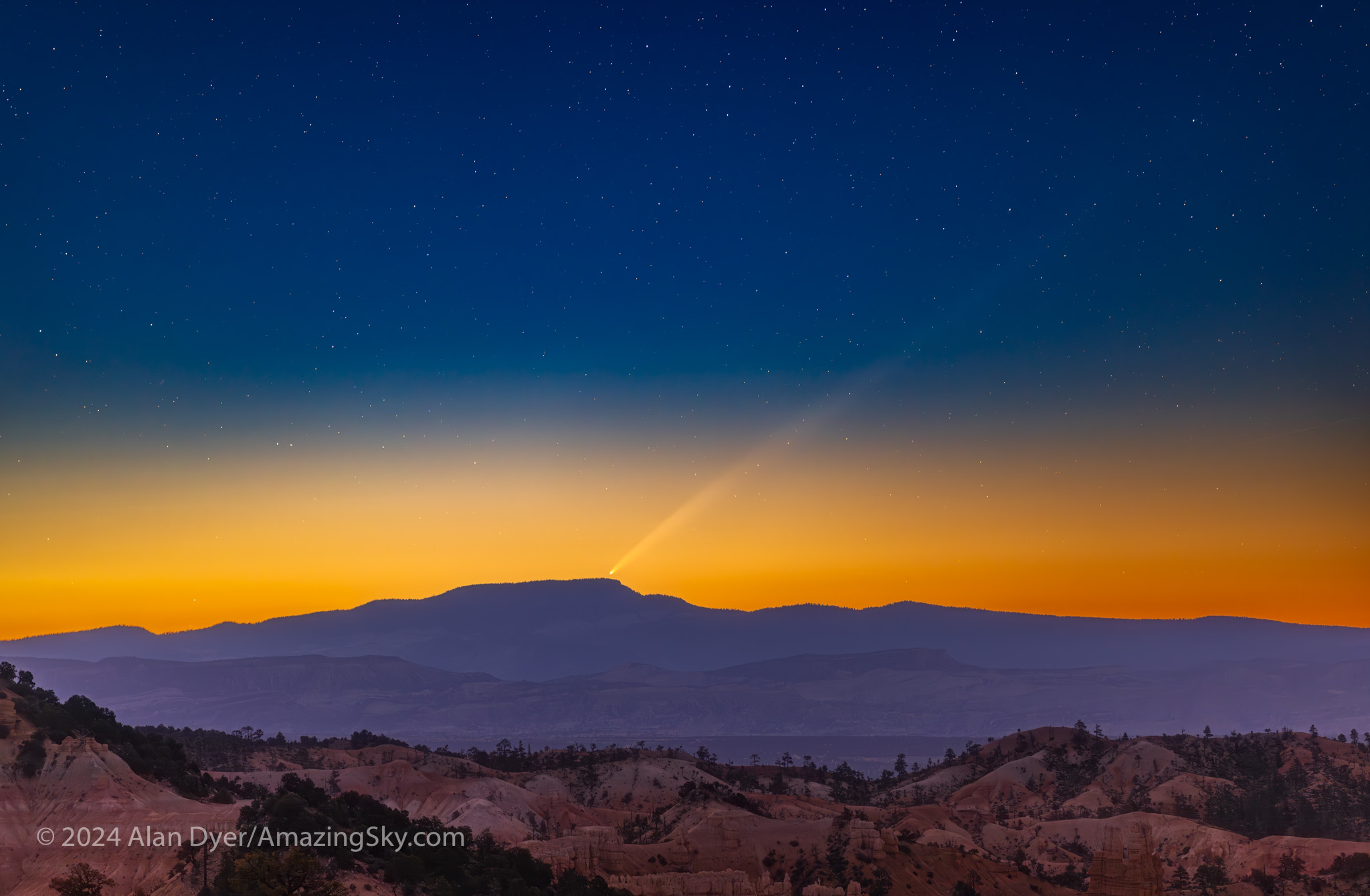
Comet C/2023 A3, Tsuchinshan-ATLAS, rising in the twilight over Bryce Canyon, on September 28, 2024.

Knowing better what to look for, I caught the comet a little sooner the next morning on September 28, and so the tail appeared longer and more impressive as it rose above the distant mountains. A group of other local photographers arrived just a few minutes too late both mornings, and so struggled to just sight the comet, let alone photograph it. 

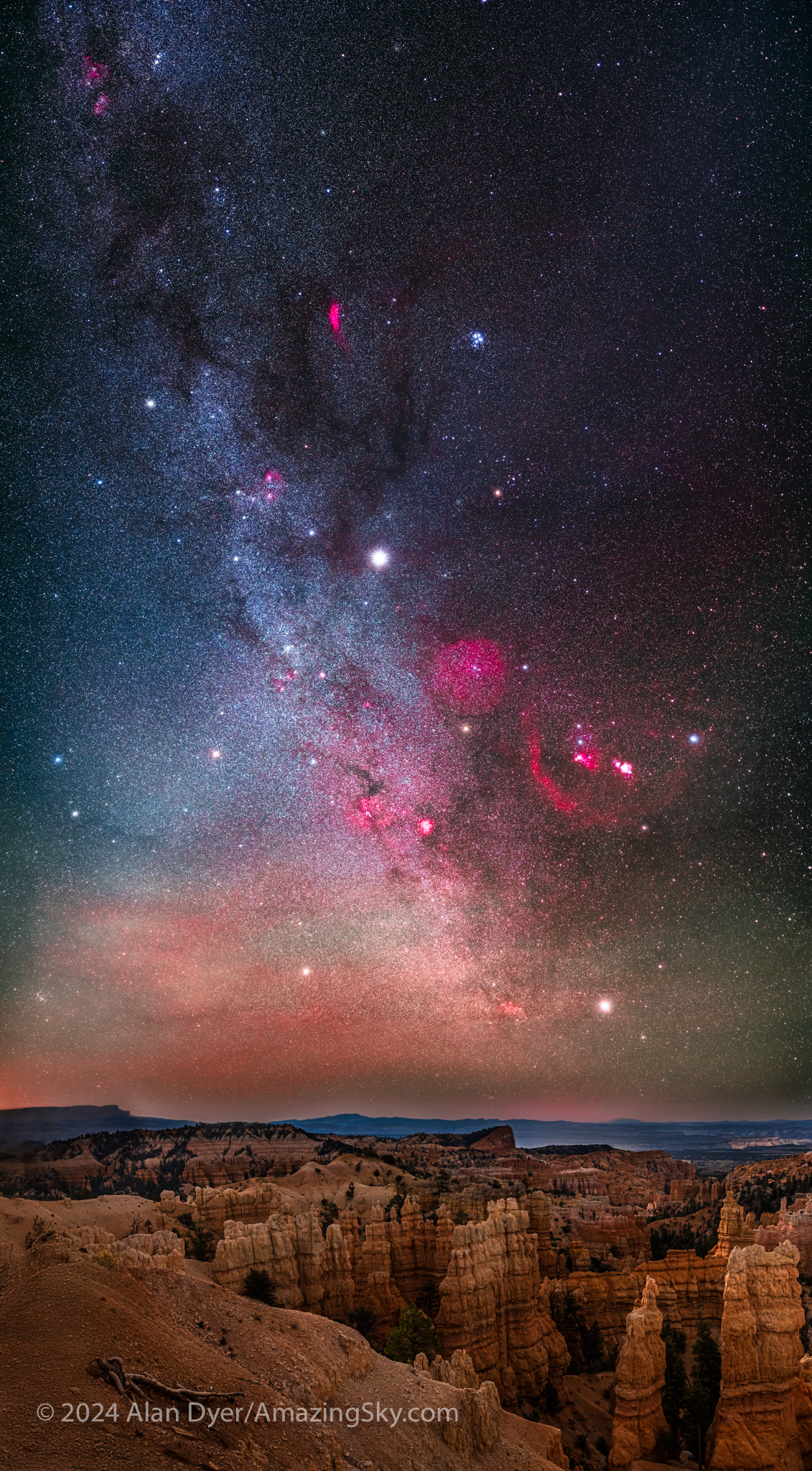
This vertical panorama takes in the nebula-rich northern winter Milky Way over the formations of Bryce Canyon National Park, from the Fairyland Canyon viewpoint.

But I had arrived extra early, to shoot a vertical panorama (above) of the winter Milky Way over the canyon formations below. This and the comet images were shot with the aid of a sky tracker to follow the stars, but with the tracker off for separate shots of the ground. 

So I had bagged the comet at Bryce! On to the next stop.


September 28 & 29 โ€” at Monument Valley, Utah

Thereโ€™s no more iconic or famous landscape in the American West than the buttes of Monument Valley, on the Navaho Tribal Lands on the Arizona/Utah border. 

This panorama from the Navaho Tribal Park at Monument Valley shows the evening twilight sky looking east opposite the sunset to the rising dark blue arc of Earth’s shadow cast on the atmosphere. The shadow is rimmed with a pink “Belt of Venus” tint from sunlight still hitting the upper atmosphere.

A clear first evening provided a fabulous view of the arc of Earthโ€™s shadow across the eastern sky from the viewpoint near the aptly named The View Hotel. 

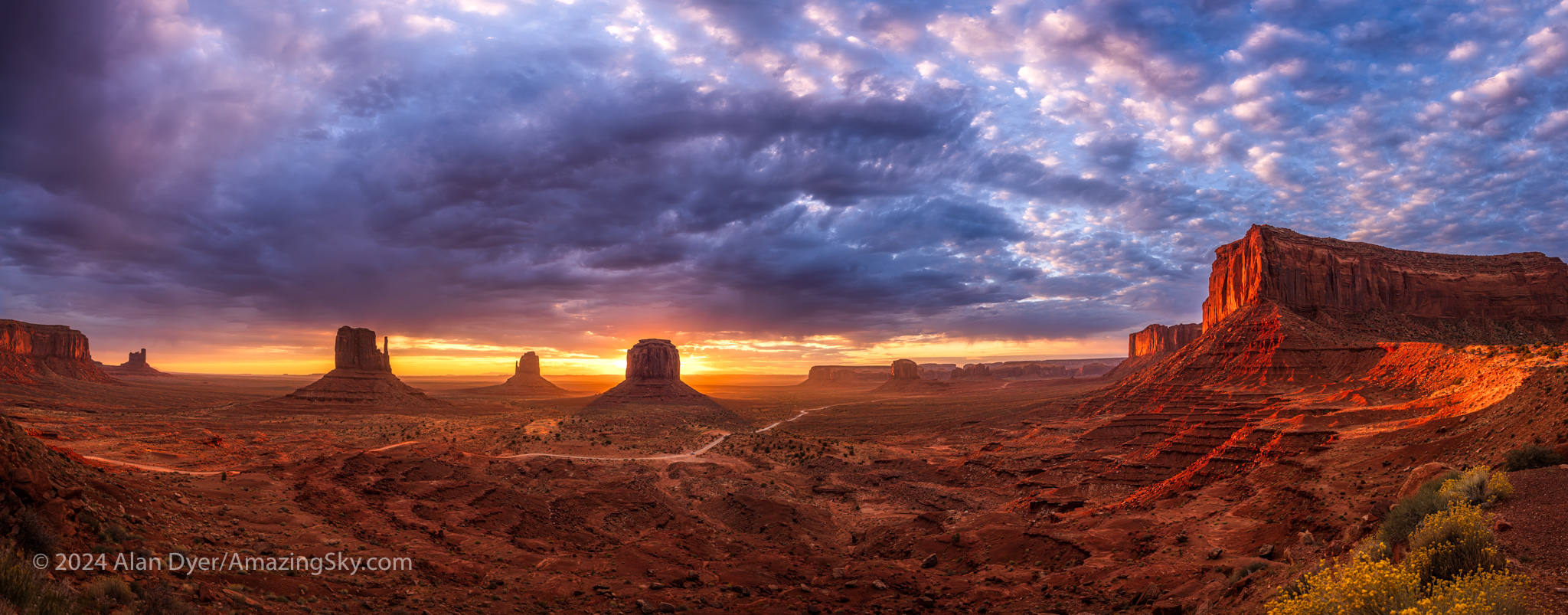
This is a panorama of the sunrise scene at the Navaho Tribal Park, Monument Valley, Arizona, taken just after sunrise with the low Sun lighting the iconic buttes and mesas of the Valley. The West and East Mittens are at left; the Sun was behind Merrick Butte at centre, and lighting Mitchell Mesa at right.

A wonderful sunrise on my second morning there made for a spectacular panorama. But while clouds created fine sunrise lighting, they arenโ€™t conducive to seeing comets!

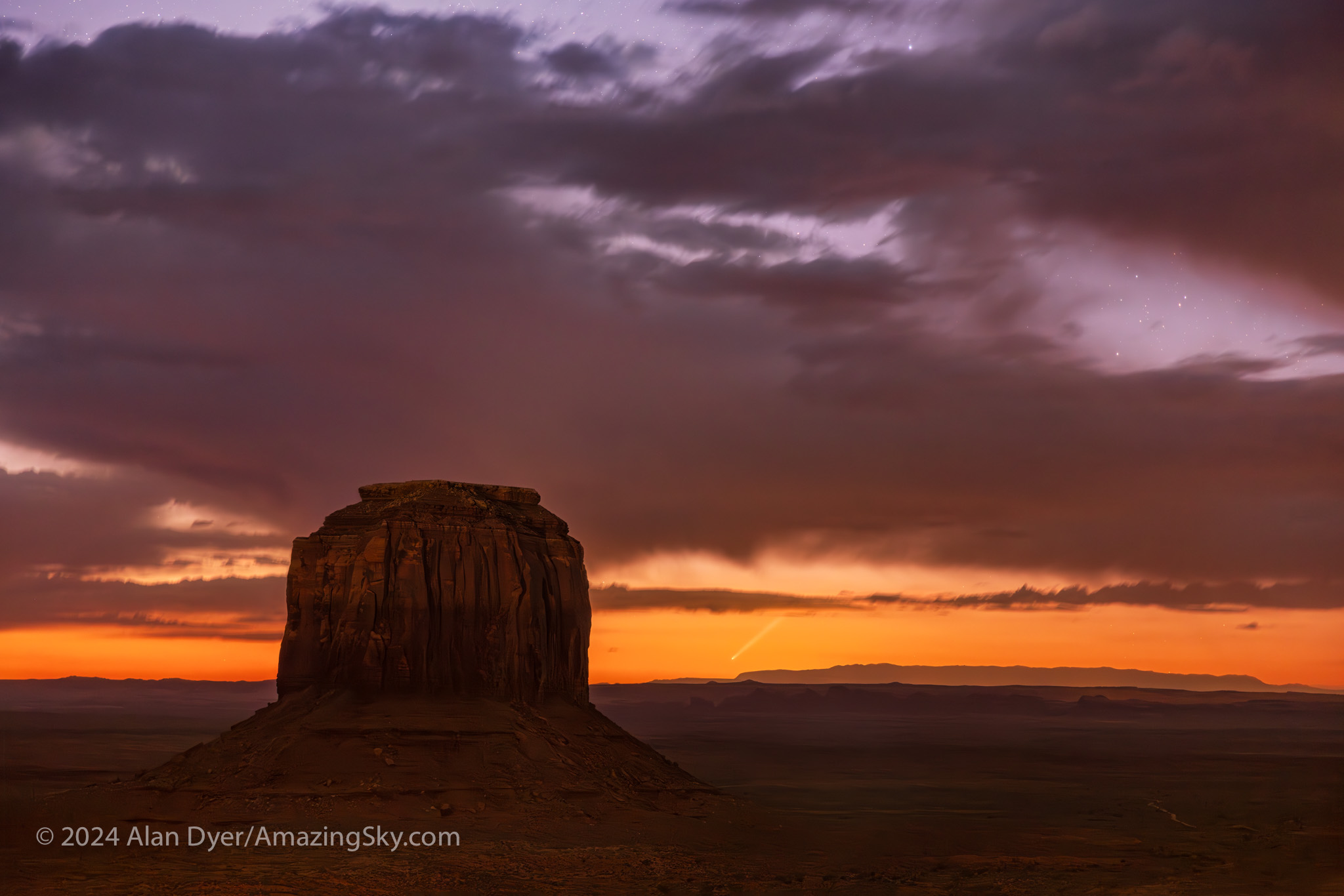
Comet C/2023 A3, Tsuchinshan-ATLAS (at centre), is rising in the dawn twilight over Monument Valley, Arizona on the morning of September 30, 2024. The comet is rising just south (right) of Merrick Butte.

A band of clear sky near the horizon allowed me to catch the comet rising to the right of Merrick Butte, as seen from a spot south of The View from where I had calculated the comet would rise in the right position. From the usual Valley viewpoint farther north the comet would have been behind the butte. 

While the planning worked, the result was not quite the spectacle I had envisioned. The comet was nice, but was starting to become lost in the bright sky as it descended toward the Sun. 

There were only a couple of mornings left to catch the comet at dawn before it disappeared completely into the daytime sky close to the Sun. 


October 1 to 11 โ€” at Quailway Cottage, Arizona

The major block of time in my trip was booked for an astrophoto retreat at a cottage Iโ€™d rented twice before but not since late 2017. The Quailway Cottage, popular among birders, is also ideal for stargazing as it is in one of the darkest areas of the Southwest, north of Douglas, Arizona, and just across the Arizona/New Mexico border. 

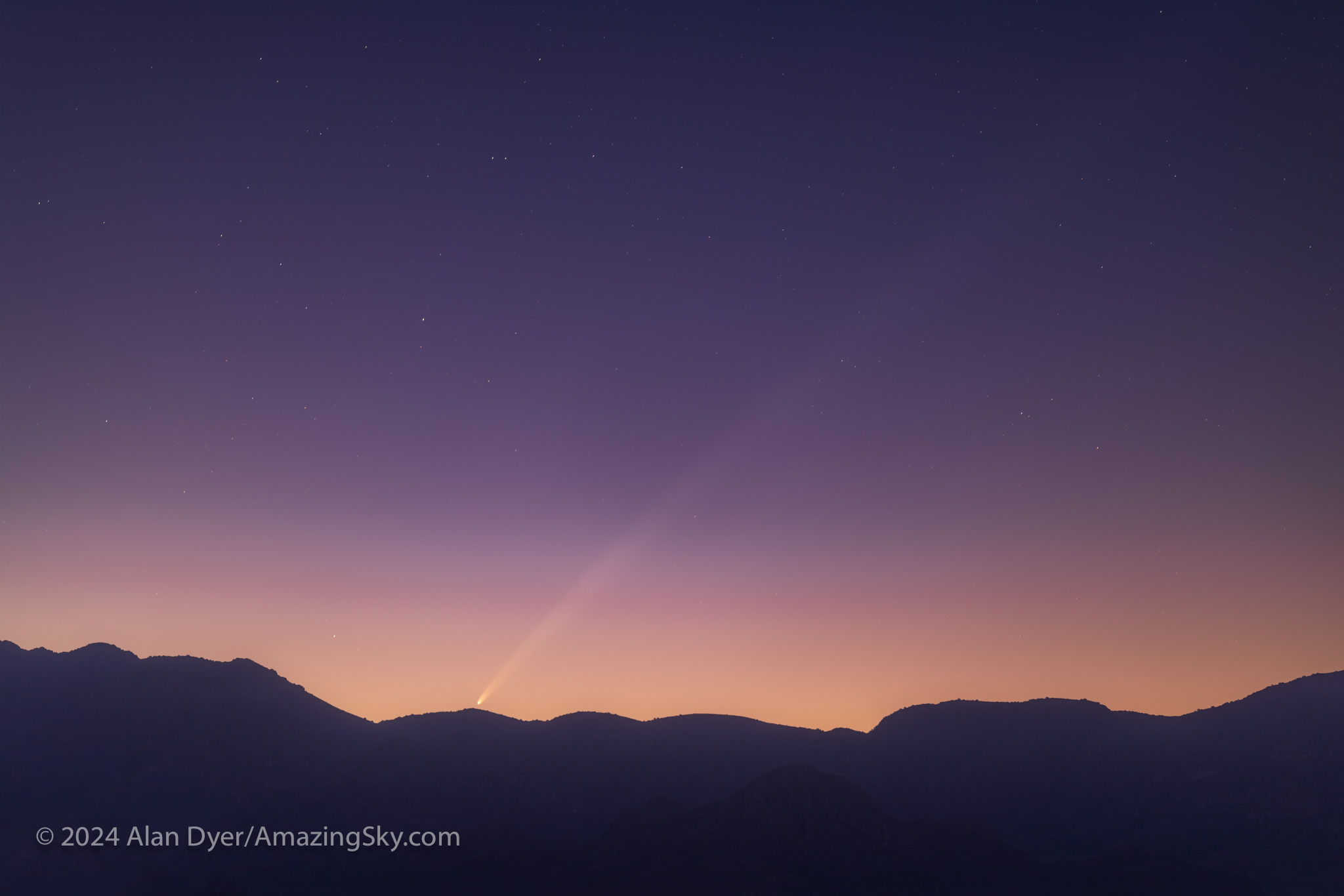
This captures both the glow of Zodiacal Light in the eastern dawn sky (the band of light extending up across the frame) and the dust tail of Comet Tsuchinshan-ATLAS rising from behind the Pelloncillo mountains, at dawn on October 2, 2024.

When I arrived the comet was putting in its last show in the dawn sky. In fact, on October 2 I managed to capture a dawn scene with the morning Zodiacal Light created by sunlight reflecting off cometary dust in the inner solar system, and just the tail of the comet rising before the bright comet head appeared.

Comet C/2023 A3, Tsuchinshan-ATLAS, is rising in the dawn twilight over the Pelloncillo Mountains in New Mexico, on October 2, 2024.

An image taken a little later showed the entire comet, now sporting a more impressive tail. It was blossoming into a fine comet indeed. But we were about to lose sight of it for more than a week. 

Arizona Deep-Sky Imaging 

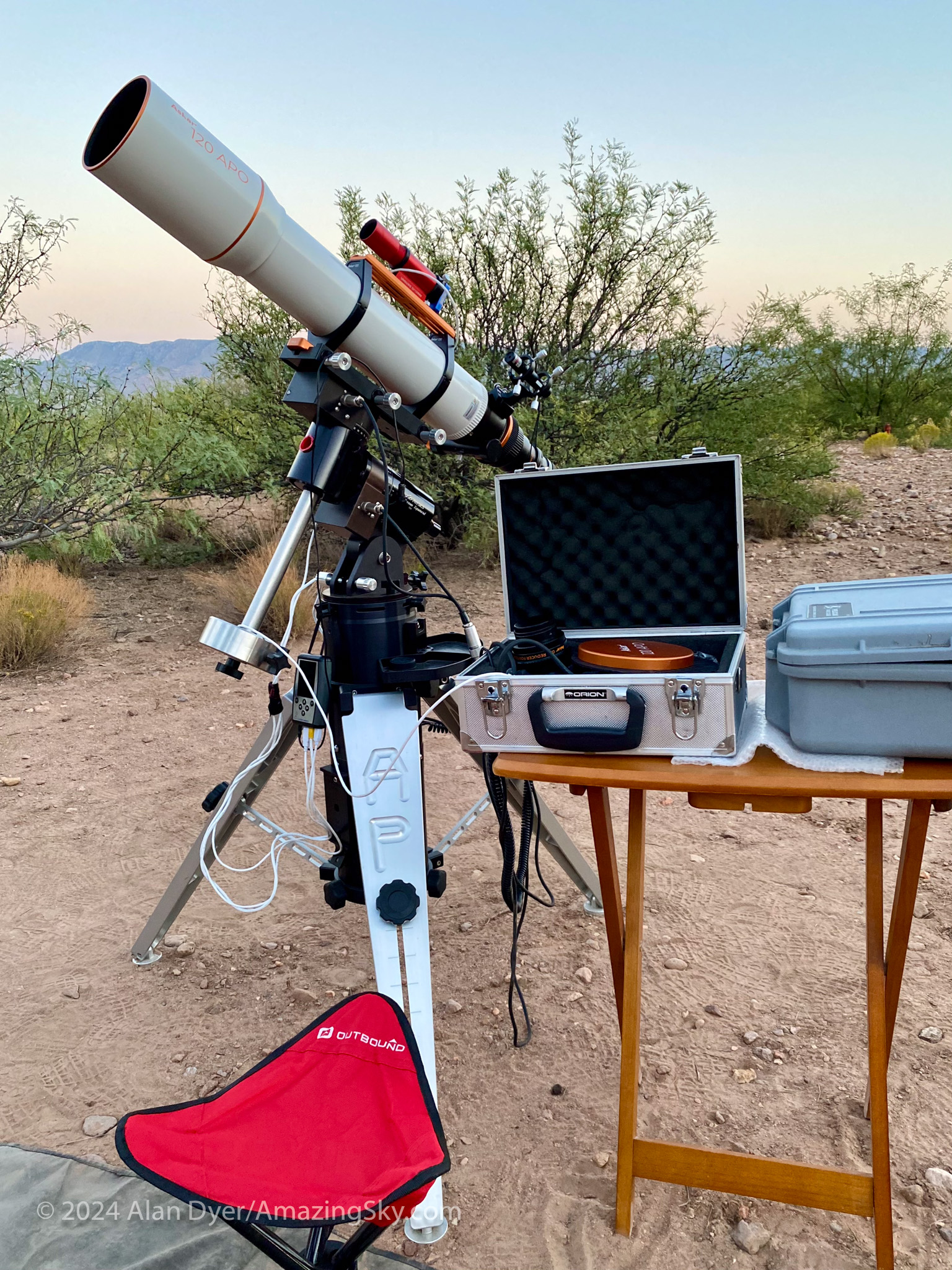
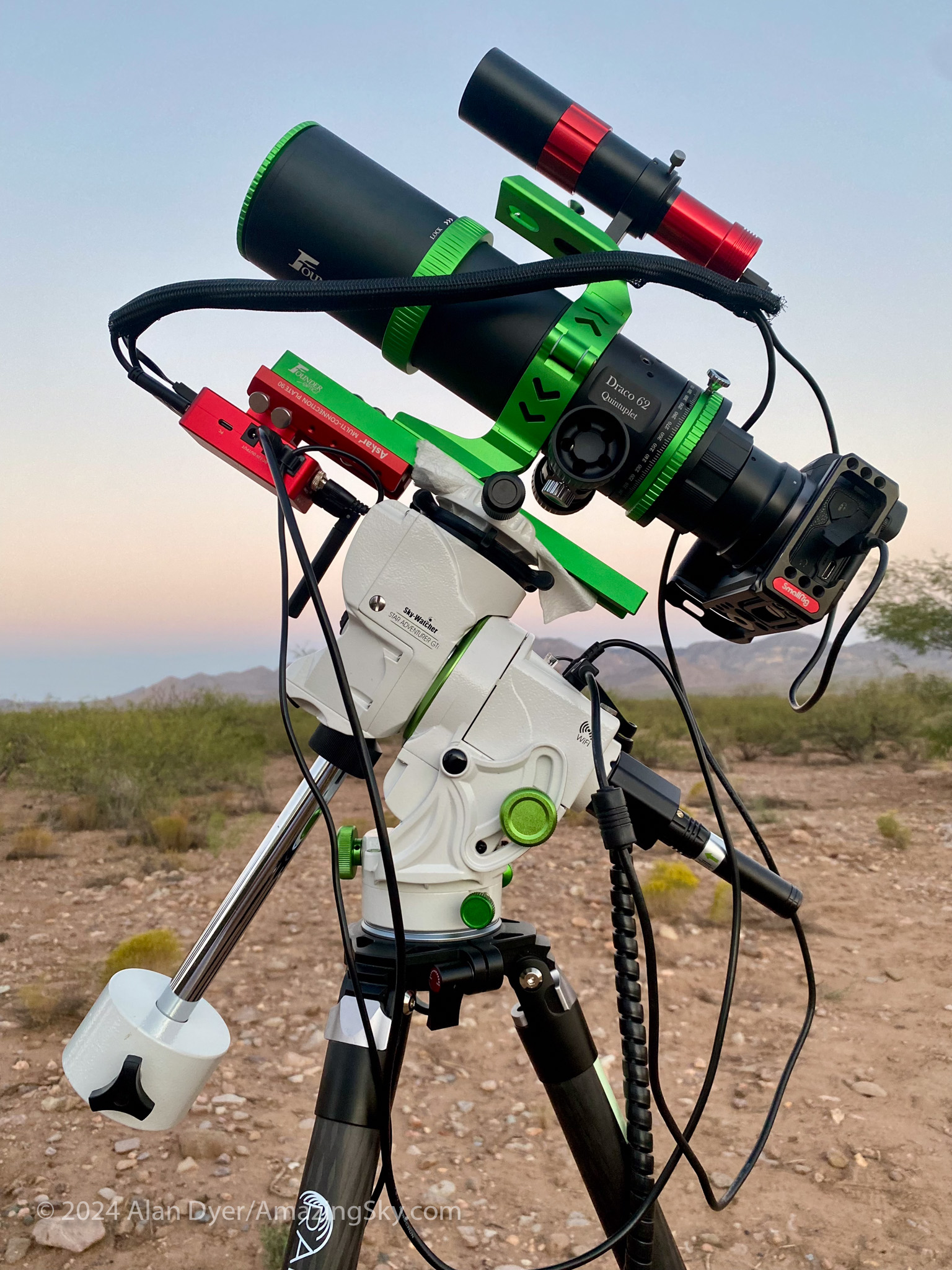
While at Quailway I had clear skies every night. And so, as planned, I went to town shooting all kinds of โ€œdeep-skyโ€ objects and fields with two astrophoto rigs I had brought with me: a longer-focal length 120mm refractor for small targets, and a short-focal length refractor for wide fields in the Milky Way. I had reviewed both new telescopes in recent months. 

I concentrated on shooting targets low in the south that are impossible to get from home in Canada, and that Iโ€™ve missed shooting, or have not shot well, during my visits to Australia.ย See my blog here about my latest trek Down Under.

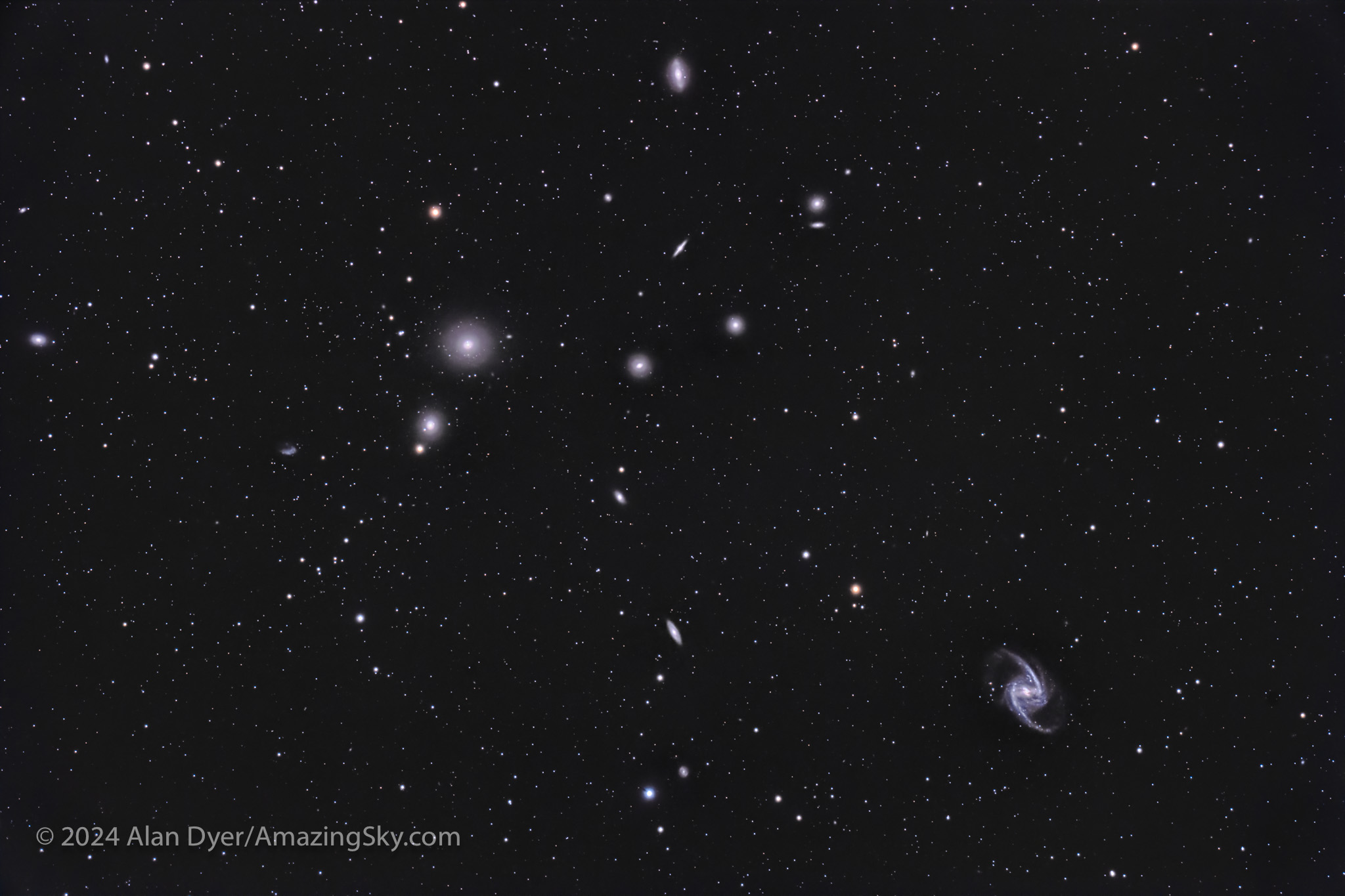
The two brightest Fornax cluster members are the elliptical galaxy NGC 1399 at upper left, paired with smaller NGC 1404, and the galaxy NGC 1365 at lower right, considered one of the best barred spirals in the sky.

Hereโ€™s an example, above, with the larger Askar 120APO: a field of galaxies in the constellation of Fornax that rivals the better-known Markarianโ€™s Chain of galaxies in Coma Berenices in the northern spring sky.

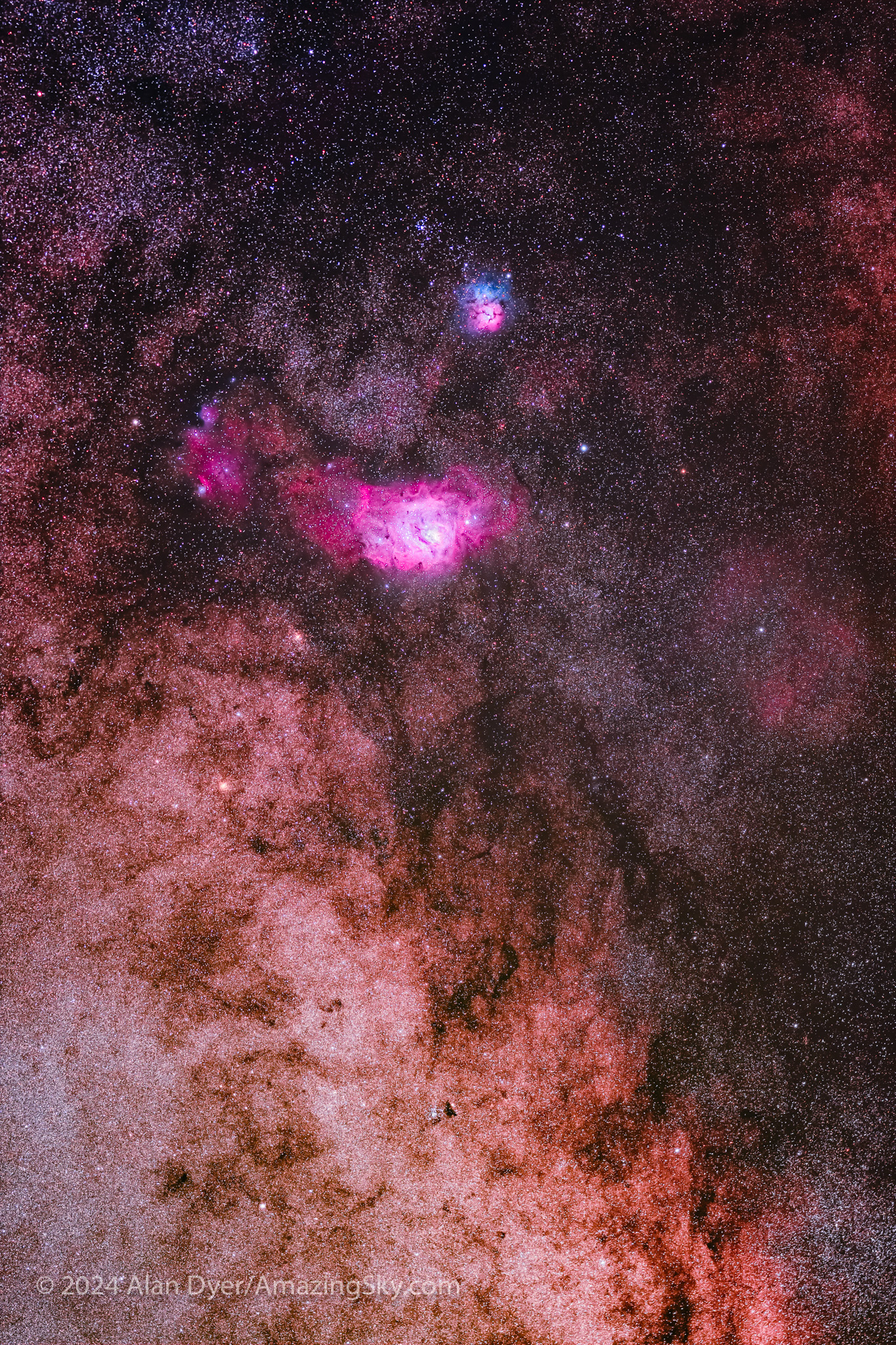
This frames the spectacular region of the Milky Way near the direction of the galactic centre in Sagittarius.

And hereโ€™s a field (above) with the small Founder Optics Draco 62mm scope, framing the rich Sagittarius Starcloud punctuated with the small dark Ink Spot Nebula, all below the bright Lagoon and Trifid Nebulas. 

This panorama extends for about 240ยบ along the northern half of the Milky Way, from Orion at left, to Sagittarius at right, and centered on the Galactic Equator.

In autumn the Milky Way is up all night. So I used a simple star tracker, the MSM Nomad reviewed here on my blog, and a 28-70mm lens at 35mm to shoot a panorama from dusk to dawn along the Milky Way โ€” from the summer stars of Sagittarius and Cygnus (at right, above), through the autumn constellations overhead in Cassiopeia and Perseus (at centre), and down into the pre-dawn sky with the winter stars in and around Orion (at left). 

A Bonus Aurora from Arizona 

I was just north of the Mexican border, at a latitude 32ยฐ North, more than 20ยฐ farther south than at home in Alberta. But what should appear in my sky but โ€ฆ aurora! 

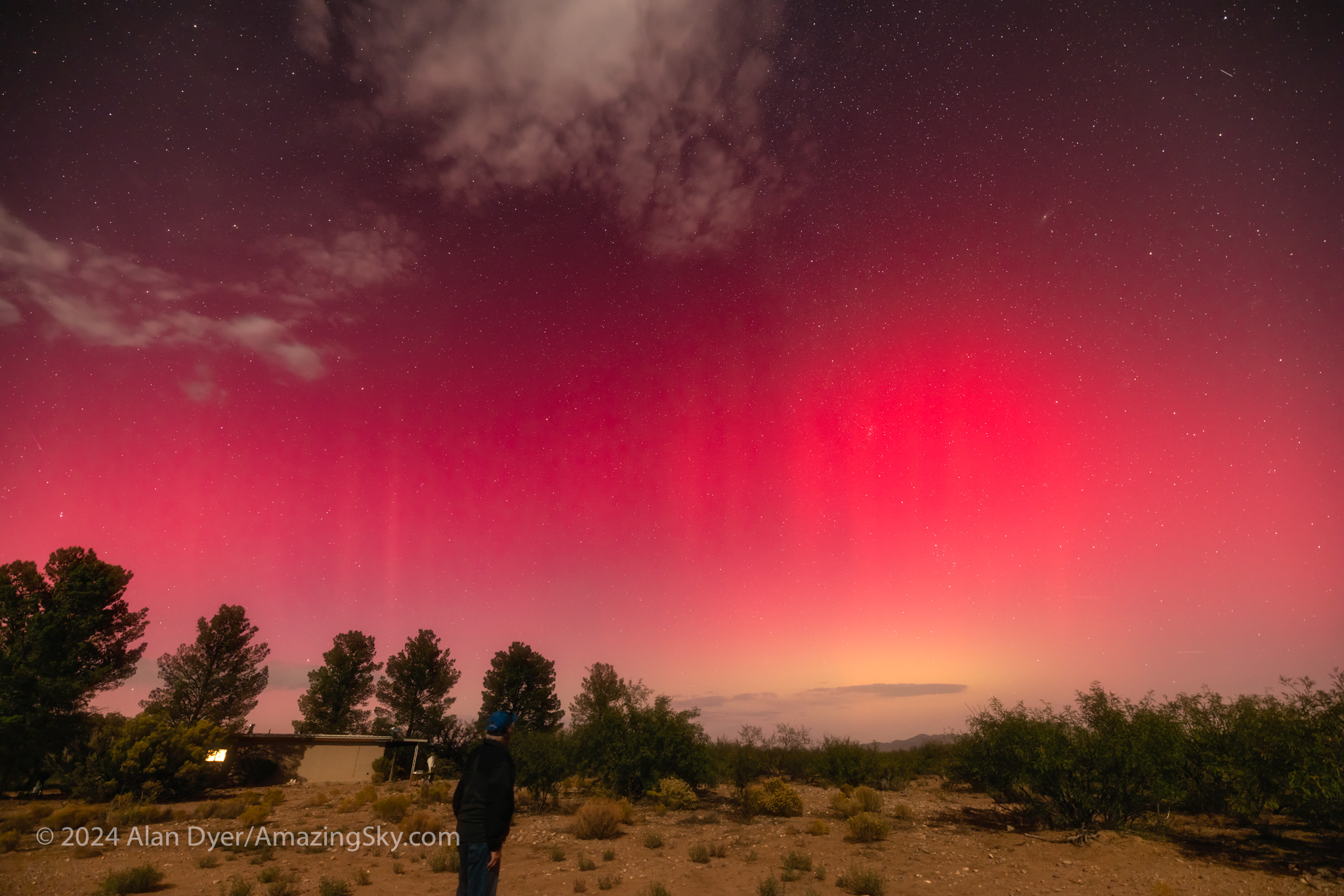
A selfie of me observing the great red aurora of October 10, 2024, from southern Arizona.

On October 9, and then again more so on October 10, a great solar storm brought Northern Lights down to me. And indeed across all of Canada and the U.S. The result for me was a red glow to the north โ€” the tops of distant auroral curtains I would have seen filling my sky at home. 

A time-lapse of an Arizona aurora, using a 15mm wide-angle lens shooting nearly 400 forty-second exposures. View it in-line here. Enlarge to a full screen view. There is no sound.

Above is a time-lapse video of the aurora that night, from a camera aimed due north for four hours. The red curtains come and go through the night.

This is a 360ยฐ panorama covering the entire sky and extending up to the zenith at centre, capturing a rare SAR arc across the Arizona sky in the pre-dawn hours of October 11, 2024.

The remarkable feature that night, October 10/11, was not the aurora, but what is called a SAR (Stable Auroral Red) arc that persisted all night. It appeared as a diffuse red band across the sky, created by heat energy leaking into the upper atmosphere during the solar storm. SAR arcs can accompany an aurora but are not auroras themselves. 

This panorama takes in a rare confluence of skyglows in a colourful dawn sky.

By dawn the next morning, now October 11, the tall Zodiacal Light was prominent alongside the magenta SAR arc to the north (left) and the winter Milky Way to the south (right). Thereโ€™s even a short pillar of light that might be an aurora fragment, or the tail of the comet!  

The Comet Returns 

However, toward the end of my 11-night marathon of deep-sky imaging, the bright head of the comet was to be rising into the evening sky for Part 2 of its apparition. Below is a shot from the evening of October 11, my last at Quailway. Yes, there it was, just above the Chiricahua Mountains. But it was a blip, barely visible in binoculars and to the camera. I had hoped for more. 

This is Comet Tsuchinshan-ATLAS (C/2023 A3) at far right, barely visible emerging into the evening sky and low in the twilight, on October 11, 2024. This view includes Venus at left. Venus was obvious; the comet was not!

With the Moon now waxing into the evening sky, my plan was to head back north, stopping at scenic spots on the trip home, to catch the comet over moonlit landscapes to the west in the dusk sky.

My first two nights, October 12 and 13, at the VLA Radio Observatory near Socorro, New Mexico, then farther north near Canyon de Chelly, Arizona, were both beset by clouds to the west. From images posted on-line, I knew the comet was improving. But it was eluding me. 


October 14 & 15 โ€” at Arches National Park, Utah

The next stop was Arches National Park in Utah, which I last visited in April 2015. The first nightโ€™s forecast for October 14 also looked to be cloudy. But October 15 was supposed to be clear. So I extended my stay by an extra night, thinking that might be my only chance.ย 

As it turned out October 14 was fabulous (below). The comet was easily visible to the unaided eye as a classic comet in the west. I pointed it out to folks walking by at the Windows Arches area. And I could hear other people commenting on it. At last a comet! One that anyone could see โ€” though it helped to be at a clear sky site like Arches. 

Comet Tsuchinshan-ATLAS at its finest in the evening sky, two days after its closest approach to Earth, and with it sporting a 10ยบ- to 15ยบ-long dust tail, and a narrow anti-tail pointed toward the horizon.

By then the Moon was well advanced in age to a bright gibbous phase, so the sky was by no means dark. It was deep blue in photos.

Still the comet showed up brilliantly; it had blossomed a lot in a couple of nights. Above, I framed it beside moonlit Turret Arch.

Below is a scene from the next night, October 15, my โ€œback-upโ€ night. The comet was certainly performing well after all. Even in the moonlight. In binoculars the tail stretched for the same length as the camera recorded it, some 15ยฐ. 

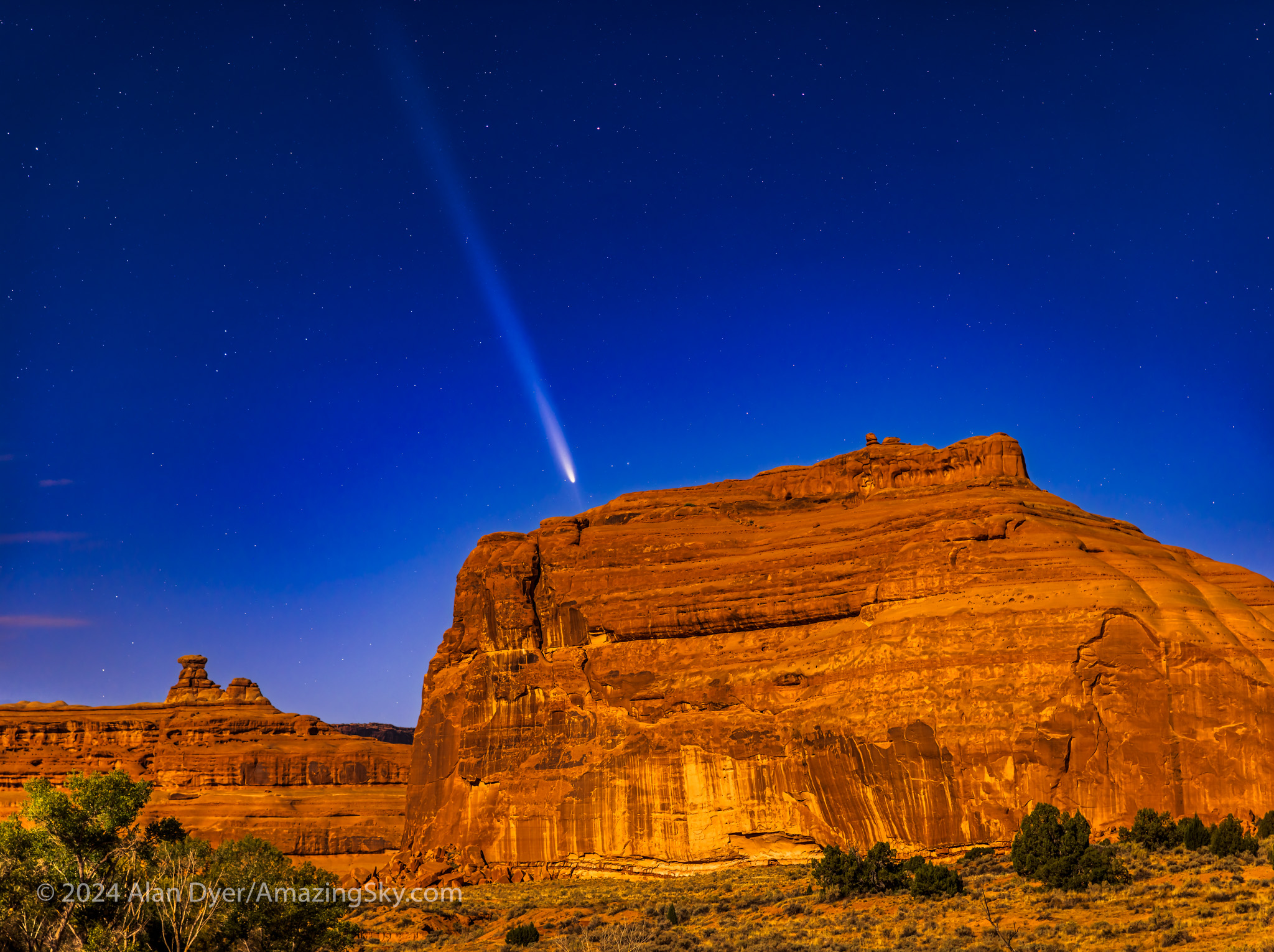
This is a telephoto close-up Comet Tsuchinshan-ATLAS over the red rocks of Arches National Park, Utah, on a superb moonlit night, October 15, 2024.

Indeed, that was my last view of the comet for a while, as clouds prevented any more shooting on the rest of my journey north through Idaho and Montana.ย I even hit a snowstorm in southern Montana.


Late October โ€” Back at Home in Alberta

But the comet was not done yet! Through October, while it receded from us in distance, it climbed higher into our sky, placing it into a dark sky with the Moon now out of the way.ย 

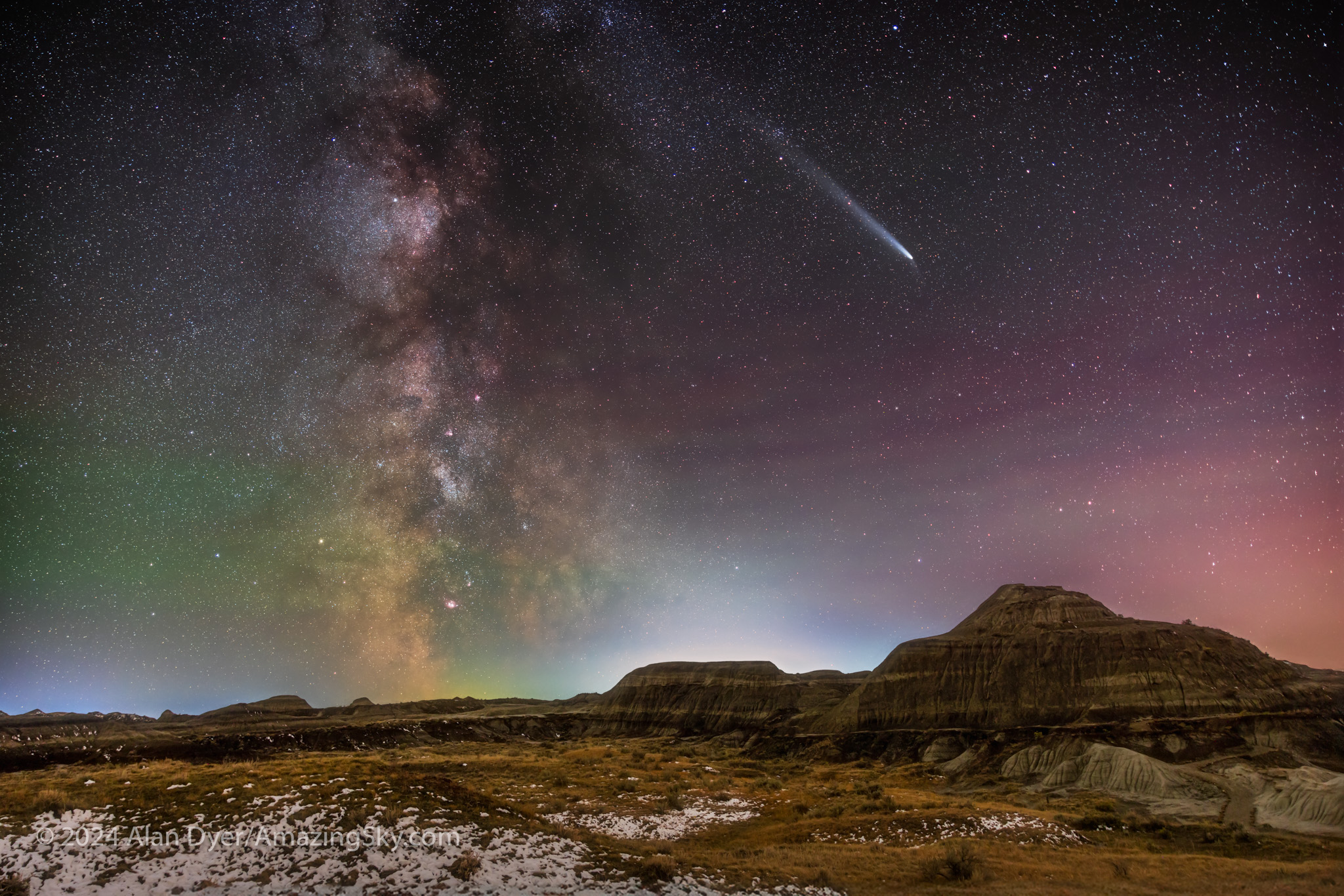
This is Comet Tsuchinshan-ATLAS in a wide-angle nightscape scene over the Badlands of Dinosaur Provincial Park, Alberta, on October 23, 2024.

On October 23, a short trip out to Dinosaur Provincial Park east of home allowed me to shoot the comet over the Alberta Badlands landscape, beside the setting summer Milky Way. 

This is a telephoto lens framing of Comet Tsuchinshan-ATLAS in Ophiuchus on the night of October 30, 2024 near several large star clusters. The field of view is 15ยบ by 10ยบ so the tail extends for about 6ยบ to 8ยบ.

By a week later, on October 30, the comet had diminished in size and brightness, but still looked like a classic comet, here framed in a telephoto close-up as it passed near some bright star clusters. This was from my front yard. The chase was over. 

Clouds and a trip to Norway starting November 4 prevented more opportunities to shoot the comet. (My travel schedule also kept me from writing this blog until now!)

It had been a good chase over a month, yielding images I was happy with. The photos from Utah and Arizona I could not have taken at home, even if the skies had been clear during the cometโ€™s prime-time. (They werenโ€™t!) And it was great to finally get back to my favourite haunts in southern Arizona and New Mexico after an absence of seven years.

In all, Comet Tsuchinshan-ATLAS provided a fine finale to what has been a superb year of stargazing events and celestial sights. 

โ€” Alan, December 9, 2024 โ€” AmazingSky.com ย 

Testing Wide-Angle Lenses on Nikon Z for Astrophotography


I test a trio of wide-angle, auto-focus lenses for astrophotography, all for Nikon Z mount: the Nikkor 20mm f/1.8 S, the Viltrox 16mm f/1.8, and the Laowa 10mm f/2.8 Zero D.

As a bonus, I also test a fourth lens: the TTArtisan manual-focus 7.5mm f/2 fish-eye.

While the selection of lenses for Nikon Z mirrorless cameras is not as diverse as it is for Sony E-mount, Nikon shooters have more brands of lenses to pick from than do users of Canon R mirrorless cameras. For nightscapes and Milky Way photography we want fast, wide-angle lenses, usually in the 14mm to 24mm range. 

Canon, Nikon, and Sony all have excellent zoom lenses that cover the range. I use Canonโ€™s RF 15-35mm L lens a lot, and reviewed it here on my blog from 2022.

But all these wide-angle zooms are f/2.8. While thatโ€™s a good speed for most astro work, having an even faster lens can be valuable. An aperture of f/2 or faster allows for:

โ€” Shorter exposures for untrailed stars when shooting just on a tripod with no tracker.

โ€” Capturing fainter and more numerous meteors during a shower.

โ€” Rapid-cadence time-lapses of auroras, freezing the motions of curtains.

โ€” Real-time movies of auroras and satellite passages at lower, less noisy ISO settings. 

The Nikkor 20mm at f/1.8 allowed a short 1.3-second exposure for capturing the aurora from a ship off the coast of Norway, to minimize ship motion trailing the stars.

Also, stopping those faster lenses down to f/2.8 can sometimes yield better image quality than shooting with a native f/2.8 lens wide open. 

Canon and Sony each have fast f/2 zooms that cover the range from 28mm to 70mm. While those focal lengths can be useful, both lenses are expensive and heavy. And they are still not wide enough for many astro subjects. For fast lenses with even shorter focal lengths we need to turn to โ€œprimeโ€ lenses, ones with fixed focal lengths. 

As of this writing Canon has few fast, wide primes for their RF lens mount (their new 24mm f/1.4 VCM is a costly choice designed primarily for video use). A few third-party lens makers offer fast (f/2 or faster) primes for Canon full-frame cameras, always as manual focus lenses. For example, Laowa has a 15mm f/2, and TTArtisan has a 21mm f/1.5. 

Yes, Sigma now offers auto-focus 16mm and 23mm f/1.4 primes, and Samyang has a new 12mm f/2, but they are only for Canon RF-S cropped-frame cameras. Canon has yet to allow other companies to produce auto-focus lenses for their full-frame cameras. 

Nikon has been restrictive as well. Sigma’s much-lauded Art series that includes the 14mm rectilinear (i.e. the horizon remains straight) and 15mm fish-eye (with a curved horizon), both f/1.4 and aimed at astrophotographers, are not offered for Nikon or Canon, only for Sony E-mount and Panasonic/Leica L-mount cameras. 

However, while Sigma lenses are missing, there is a wider choice of third-party lenses for Nikon Z-mount compared to Canon RF, plus Nikon itself makes a very fine 20mm prime in their premium S-series. 

Thatโ€™s what I test here โ€” three wide-angle rectilinear primes for Nikon Z: A 20mm Nikkor, and two third-party primes: one from Viltrox, their 16mm; and one from Laowa, their new 10mm.

As a bonus, I add in a test of a fast fish-eye lens, from TTArtisan, their 7.5mm f/2. 

Prices are from B&H Photo, but will vary with sales and special promotions.


The Nikkor 20mm S-Line Lens ($1,050)

I shot the northern summer Milky Way (below) with the three rectilinear wide-angle lenses (meaning these are not fish-eyes) with the camera on a star tracker, to prevent star trailing. The tracker was the Move-Shoot-Move Nomad, reviewed here on my blog.

The Nikon Z6III and 20mm Nikkor on the MSM Nomad tracker.

I shot with Nikon’s new Z6III, a 24-megapixel full-frame camera I reviewed in the December 2024 issue of Sky & Telescope magazine. It offers a number of excellent features for nightscape photography. Most notably, auto-focus lenses zip to the infinity focus point automatically when the camera is turned on, something I wish Canon cameras would do. 

The Nikkor 20mm has a field of view along the long dimension of 84ยฐ.

The Nikkor 20mm is the widest prime lens in Nikonโ€™s premium S-Line series. It offers what I consider to be an ideal focal length for most nightscape and wide-field Milky Way images. 

While a 14mm lens is often thought of as the default nightscape lens, a 20mm presents less distortion (objects leaning in or stretched out at the corners) and a more natural perspective. Plus the lens can be made faster (in this case f/1.8), smaller, and not cost as much as an ultra-fast 14mm like the Sigma f/1.4 Art lens. 

Nikkor 20mm Corner Aberrations

The four panels show the upper left corner, in the area outlined in the inset that shows the full frame.

Sharp stars right to the corners is the ideal for all forms of astro images. We donโ€™t want stars to turn into winged seagulls or coloured streaks. They should remain as pinpoint as possible. 

The Nikkor 20mm shows very little aberrations across the frame. Stars are elongated by tangential astigmatism and discoloured by lateral chromatic aberration only slightly and only at the extreme corners. 

Stopping down the lens decreased the aberrations, but some residual astigmatism remained, even at f/4. However, the corner aberrations are low enough, and so restricted to the very corners, that this is a lens you can certainly use wide open at f/1.8, or perhaps at f/2, without any penalty of image sharpness. 

Nikkor 20mm Vignetting

The four panels show the left side, as outlined in the inset. The inset is the f/1.8 sample.

Ideally, we also want images to be as fully-illuminated across the frame as possible. Light fall-off, or vignetting, creates dark corners with less signal reaching the sensor. Less signal gives rise to more noise, noticeable when brightening the corners in processing. That can reveal unsightly noise, banding, and discolouration in nightscapes, especially in the ground, often the darkest part of a scene, not the starry sky. 

The 20mm shows a fair degree of edge and corner darkening when wide open at f/1.8. Stopping the lens down to f/2 improves the field illumination notably. And by f/2.8 the field is fairly uniformly lit. There is little need to go as slow as f/4. 

In all, the Nikkor 20mm S is a superb lens ideal for nightscapes and Milky Way images.


The Viltrox AF 16mm STM ASPH ED IF ($580)

The new company Viltrox has been making a name for themselves recently with the introduction of a number of top-quality pro-grade lenses to compete with the best from any brand, and at much more affordable prices. 

The horizontal field of view of the Viltrox 16mm is 100ยฐ.

Their 16mm is an auto-focus lens that, on the Nikon, can actually auto-focus on stars, as can the Nikkor 20mm. However, it, too, will zip to infinity focus when powered up. Plus two function buttons can be programmed to rack between two preset focus distances, one of which can be infinity. 

A manual aperture ring (above left) has 1/3rd-stop detents, or it can be set to A for controlling the aperture in the camera. 

A colour OLED display (above right) shows the focus distance and aperture, a nice way to confirm your settings at night. The display is too bright on the darkest nights; I cover it with red gel. 

An option to turn it red using the Viltrox app would be welcome.ย  Or to turn it off! ….

With Viltrox lens fully engaged and display ON

Uniquely, this and other Viltrox lenses have Bluetooth built in, for direct connection to a mobile device for firmware updates and lens settings, shown above. However, I found the app buggy; it would connect to the lens, but then refuse to allow settings to be changed, claiming the lens was not connected. Or the app would freeze, disconcerting during a firmware update. Luckily, that did not brick the lens. 

Viltrox 16mm Corner Aberrations

The four panels show the small corner area outlined in the centre inset that shows the entire image.

At the extreme corners, the Viltrox shows some softness (perhaps from field curvature), but only minimal astigmatism and lateral chromatic aberration when wide open at f/1.8, and slightly sharper corners at f/2. At f/2.8 corner performance is nearly perfect, and certainly is at f/4. 

This is a level of aberration correction even the most premium of lenses have a hard time matching.

Viltrox 16mm Vignetting

The panels show the left side outlined in the centre inset, which shows the f/1.8 image.

As is often the case with wider lenses, the Viltrox does show a great deal of vignetting at f/1.8, more so than the Nikkor 20mm. While this can be corrected in processing it will raise noise levels. 

Stopping down to just f/2 helps, but the field becomes more uniform only at f/2.8, the sweet spot for this lens for the best all-round performance. But it offers the speed of f/1.8 when needed, such as for auroras. 

If you prefer a wider field than a 20mm provides, the Viltrox 16mm (also available for Sony) is a great choice that wonโ€™t break the bank. Until Canon changes their third-party lens policy, Canon owners are out of luck getting this excellent lens. 


The Venus Optics/Laowa 10mm Zero-D FF ($800) 

The lens maker Venus Optics (aka Laowa) is known for its innovative and often unusual lens designs. 

Introduced in 2024, their new 10mm offers the widest field available in a rectilinear (not fish-eye) lens for full-frame cameras. The โ€œZero-Dโ€ label is for the lensโ€™s lack of pincushion or barrel distortion. Horizons remain straight no matter where they fall on the frame. However, objects at the corners become elongated a lot.

The Northern Lights in a superb display on August 11-12, 2024, at Grasslands National Park, Saskatchewan. This is with the Laowa 10mm wide open at f/2.8 on the Nikon Z6III at ISO 6400.

Even so, thereโ€™s a lot to be said for having a field that extends for 130ยฐ across the long dimension of a full-frame sensor. Thatโ€™s more than enough to go from well below the horizon to past the zenith when the camera is in portrait orientation. Even in landscape orientation (as above) the lens covers nearly a 90ยฐ field across the short dimension, enough to go almost from horizon to zenith. 

The f/2.8 speed is slower than the other lenses on test here, but is still faster than most ultra-wide lenses. Remarkably, it accepts common 77mm filters, the same as the Nikkor 20mm and Viltrox 16mm. 

The 10mm is available as an auto-focus lens for Sony E and Nikon Z, and in manual focus versions for Canon RF and Panasonic L, oddly all at the same price. 

Laowa 10mm Corner Aberrations 

The four panels show the corner area outlined in the inset, at four apertures between f/2.8 and f/4.

Corner aberrations are much worse than in the 20mm and 16mm lenses, showing a fair degree of tangential  and sagittal astigmatism, elongating stars radially and adding wings to them, respectively. The aberrations are larger and reach deeper into the frame than in the Nikkor and Viltrox lenses. 

Thereโ€™s also some lateral chromatic aberration adding blue and purple fringes to the stars at the corners. Stopping down to f/4 improves, but doesnโ€™t eliminate, the aberrations. 

Laowa 10mm Vignetting

The four panels show the left side, as outlined in the inset, which shows the f/2.8 image.

Edge and corner darkening were also worse than in the other lenses and required about a +50 setting to correct in Adobe Camera Raw, far less than the maximum of +100. So itโ€™s still quite acceptable and correctable. 

However, while stopping the lens down to f/4 improves vignetting, it does not eliminate it, still requiring a +40 correction. Vignetting will be a factor to deal with in all astrophotos with this ultra-wide lens. 

Laowa 10mm Lens Flares

Three panels showing the Moon framed in the left corner (L), centred (C), and in the right corner (R).

With such a wide lens, the Moon or other bright light sources are bound to be within the frame. The Laowa exhibits a prominent internal lens flare when bright objects are in the corners, but just in the corners. Objects near the edge but centered are fine. 

Showing the effect of decreasing aperture on the lens flare and bright light source.

Stopping down the lens adds diffraction spikes (or โ€œsunstarsโ€) to bright lights, but doesnโ€™t eliminate the circular internal reflection. None of this is a serious issue for most images, but it is something to be mindful of when framing nightscapes. 

With the Laowa 10mm lens at f/2.8 on the Nikon Z6III at ISO 3200. Note the Big Dipper at left and Orion at right.

In Milky Way and starfield images, constellations in the corners can distort into unnatural shapes that look odd, as I show above. While the lens can take in a great swath of sky, its distortion and corner aberrations make it less than desirable for tracked Milky shots. 

An aurora in the dawn twilight on September 17, 2024. A 4-second exposure with the Laowa 10mm at f/2.8.

Where the Laowa 10mm really proves its worth is for auroras, as above, which can require as wide a field as you can muster. Note the flat horizon.

For ultra-wide nightscapes in a single image (not a panorama) with a natural looking (not curved) horizon, and for meteor showers, the Laowa is just the ticket. 


BONUS TEST: The TTArtisan 7.5mm f/2 Fish-Eye ($140)

Technically, this lens is designed to be used on cropped-frame (or APS-sensor) cameras where it fills the frame with a curving horizon. But it works on a full-frame camera where it projects a circular image slightly larger in diameter than the short dimension of the frame, so not a complete circle as with a true circular fish-eye like the old Sigma 8mm f/3.5. 

An aurora in the dawn twilight on September 17, 2024 in a 2-second exposure with the TTArtisan 7.5mm fish-eye lens at f/2 on the Nikon Z6III at ISO 800.

For all-sky auroras, this is ideal, where the TTArtisanโ€™s fast f/2 speed is unprecedented in a fish-eye lens. That makes rapid-cadence time-lapses possible, as well as real-time movies. An example is here on my YouTube channel.

A stack of 4 x 4-minute exposures with the TTArtisan 7.5mm f/2 fish-eye lens stopped down to f/2.8 on the Nikon Z6III at ISO 1600, on the MSM Nomad tracker.

Or you can just capture the Milky Way from horizon to horizon, as above. For the latter, having stars sharp across the circular field is still desirable. 

I have this lens for Canon RF as well, but that unit shows a noticeable softening of the left edge with defocused stars, likely from lens de-centering. I was told by TTArtisan that was a normal unit-to-unit variation and not a defect warranting replacement. Annoying! 

I hesitated to buy one for my Nikon. But this is such a unique lens, and so affordable, I took the chance. The Nikon Z-mount version proved much better. 

TTArtisan 7.5mm Edge Performance 

There is no corner performance or vignetting to test here. 

TTArtisan 7.5mm lens at f/2, showing the left side area shown in the blowups below.

Instead, Iโ€™m inspecting the same side on the Nikon Z version that caused a problem on my Canon version. 

Comparing f/2 and f/2.8 edge aberrations.

The Nikon version looks fine, with stars sharp along the edge even at f/2, showing just a low level of astigmatism, to be expected in such a fast, wide lens. Stars tighten up a bit more at f/2.8. Most critically, the field was flat and in focus across the frame. There was no evidence of lens de-centering or optical defects. 

The edges do show some discolouration and a soft edge to the image area. I also see two odd dark protrusions at the top of the frame. Looking through the lens, thereโ€™s nothing obvious intruding into the light path. 

Keep in mind when used on a full-frame camera youโ€™re seeing more of the projected image than was intended in the design. 

The 7.5mm lens comes with a metal lens cap with a threaded centre disk. Remove it to create an aperture that vignettes the image to a smaller but complete circle.

The TTArtisan 7.5mm is a specialty lens to be sure. But at its low price it isnโ€™t a big outlay to include in your lens arsenal, for unique all-sky images, of auroras, satellite passages, sky colours, and the Milky Way. And it is terrific for time-lapses and movies of the whole sky. It is a no-frills manual lens available for most camera mounts.


Recommendations

The Viltrox 16mm, Laowa 10mm and TTArtisan 7.5mm are all available for Sony E-mount. The Laowa and TTArtisan are available for Canon RF, but the Viltrox 16mm is not, as it is an auto-focus, full-frame lens, the class of lenses Canon has yet to allow on their RF mounts, much to the disdain of all concerned but Canon management it seems. 

Viltrox 16mm โ€” For nightscape use, the Viltrox 16mm might be the single best choice, as being the most versatile and affordable of the trio of wide-angle lenses. Its focal length is a good balance between the usual 14mm and what I think is a more useful 20mm. 

Nikkor 20mm โ€” I like the Nikkor 20mm for its lower level of vignetting, slightly tighter framing, and very sharp stars. I think a 20mm is an ideal focal length for many nightscapes and Milky Way scenes. But it is the most expensive lens tested here. 

Laowa 10mm โ€” While nearly as costly as the Nikkor 20mm, the Laowa 10mm is much more specialized and, I think, not as useful as the others for general nightscape and Milky Way shooting. But it is superb for auroras, if you are in a place where they are common, as they are here in Alberta. Otherwise, I think youโ€™d find the 10mm a costly lens that might not see a lot of use for astrophotography. Its real fortรฉ is architecture and real-estate interiors. 

TTArtisan 7.5mm โ€” Ditto on its limited use. But it is so affordable itโ€™s easy to justify even if it doesnโ€™t get a lot of use. The astro images, time-lapses, and movies it can produce are unique and impossible to create any other way. Be sure to buy it from a source where you can return it easily if you find your sample defective. 

Reason To Go Mirrorless

The quality of these and other premium lenses from Nikon, and also from Canon, Sony and third-party makers like Sigma and Viltrox, is one of the major benefits of migrating to mirrorless cameras. DSLRs, and the lenses made for them, are now effectively dead as new gear choices. 

Yes, mirrorless cameras can be better in many aspects of their operation than DSLRs. But it is the lenses made for mirrorless that show the greatest improvement over their DSLR equivalents, many of which date back to the forgiving film days. 

โ€” Alan, December 6, 2024 (amazingsky.com
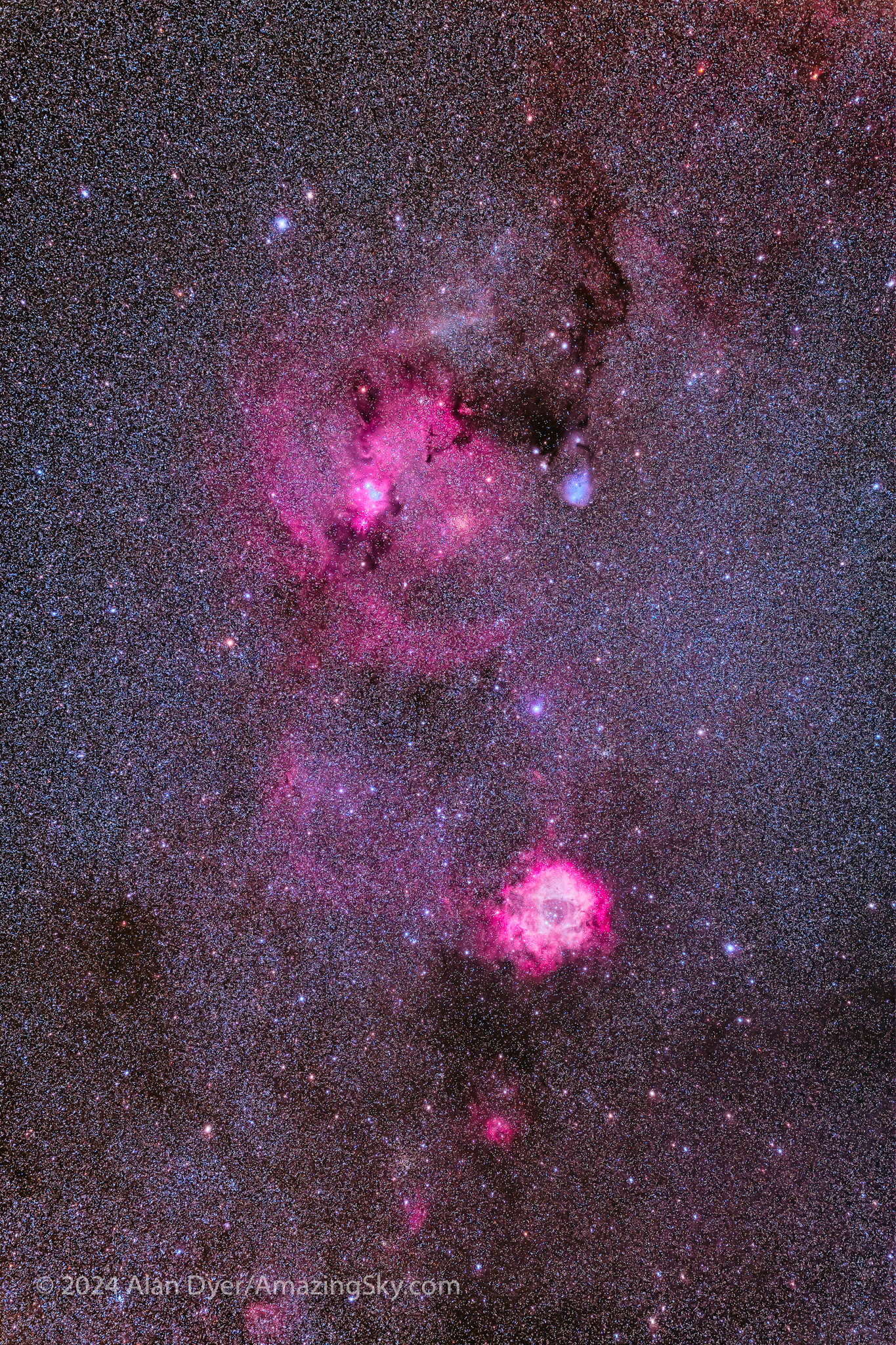
My 2025 Sky Calendar


It’s published! My 2025 Amazing Sky Calendar is out and available for FREE! as a downloadable PDF.

Please go to my website at https://www.amazingsky.com/Books for the details and the download link.

The PDF can be printed at home. It is designed to be printed landscape mode at 13×10-inches, but will work printed 11×8.5-inches. Office supply shops might be able to print it with mounting holes and a spiralย binding.ย 

My 12-month Calendar is illustrated with a selection of 14 of my favourite astro-images from 2024, taken from Alberta, Australia, Utah, Norway, and Quebec.

Each month includes listings of the best sky events for the month, with an emphasis on naked-eye sights, and photogenic events. I’ve selected the Calendar events to be suitable for stargazers in North America.

Thanks! And do share the link!

โ€” Alan, AmazingSky.com / December 2024.