On April 23, 2023 the sky erupted with a massive solar storm, bringing the aurora to millions of people around the word.
On April 23 warnings went out alerting aurora watchers that a solar storm was imminent. And as the sky darkened that night locations all across the Northern and Southern Hemispheres were treated to a great sky show.
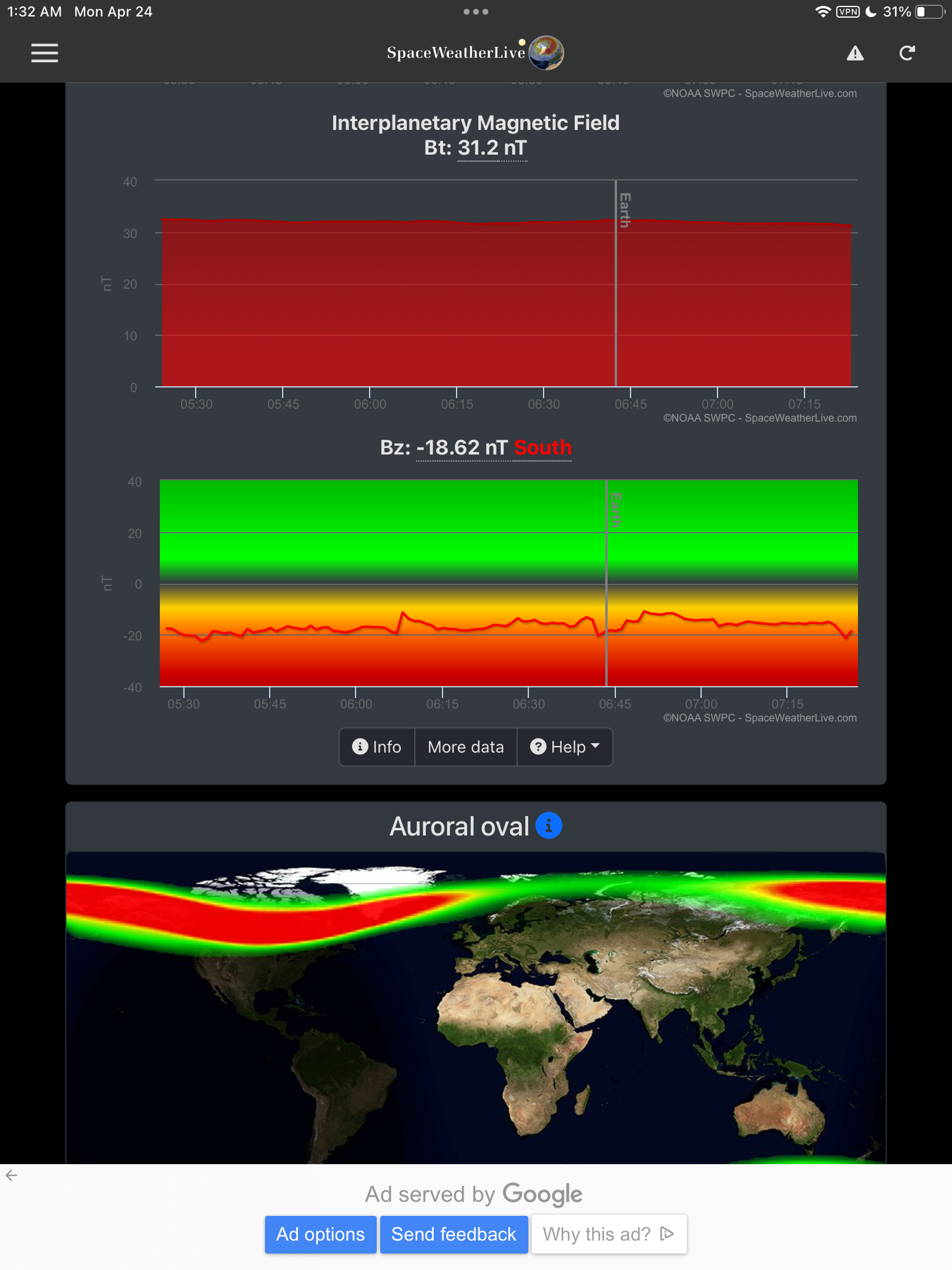
This is what we want to see in our aurora apps! Code Red and a vast auroral oval.
When we see this on our phone apps, we know we’ll get a great show. This was the auroral oval, lit up red, as the display was underway at my location in Alberta, Canada.
All indicators were great!
The strength of the interplanetary field (Bt) was high and the direction of the field (Bz) was well south, all welcome indicators of a superb show.
Sure enough, as it got dark that night, and from my location after the clouds cleared, an aurora was underway covering much of the sky.
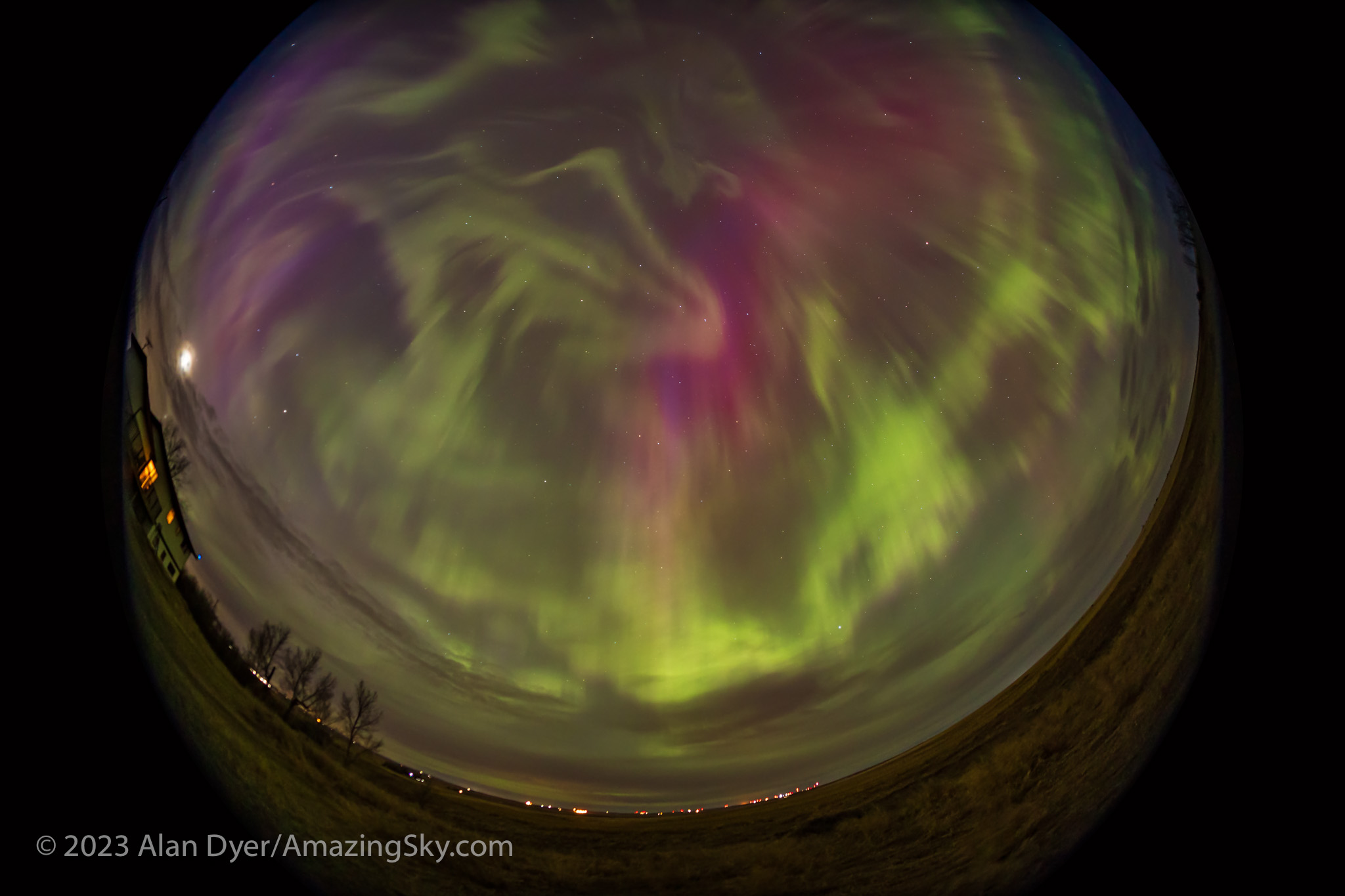
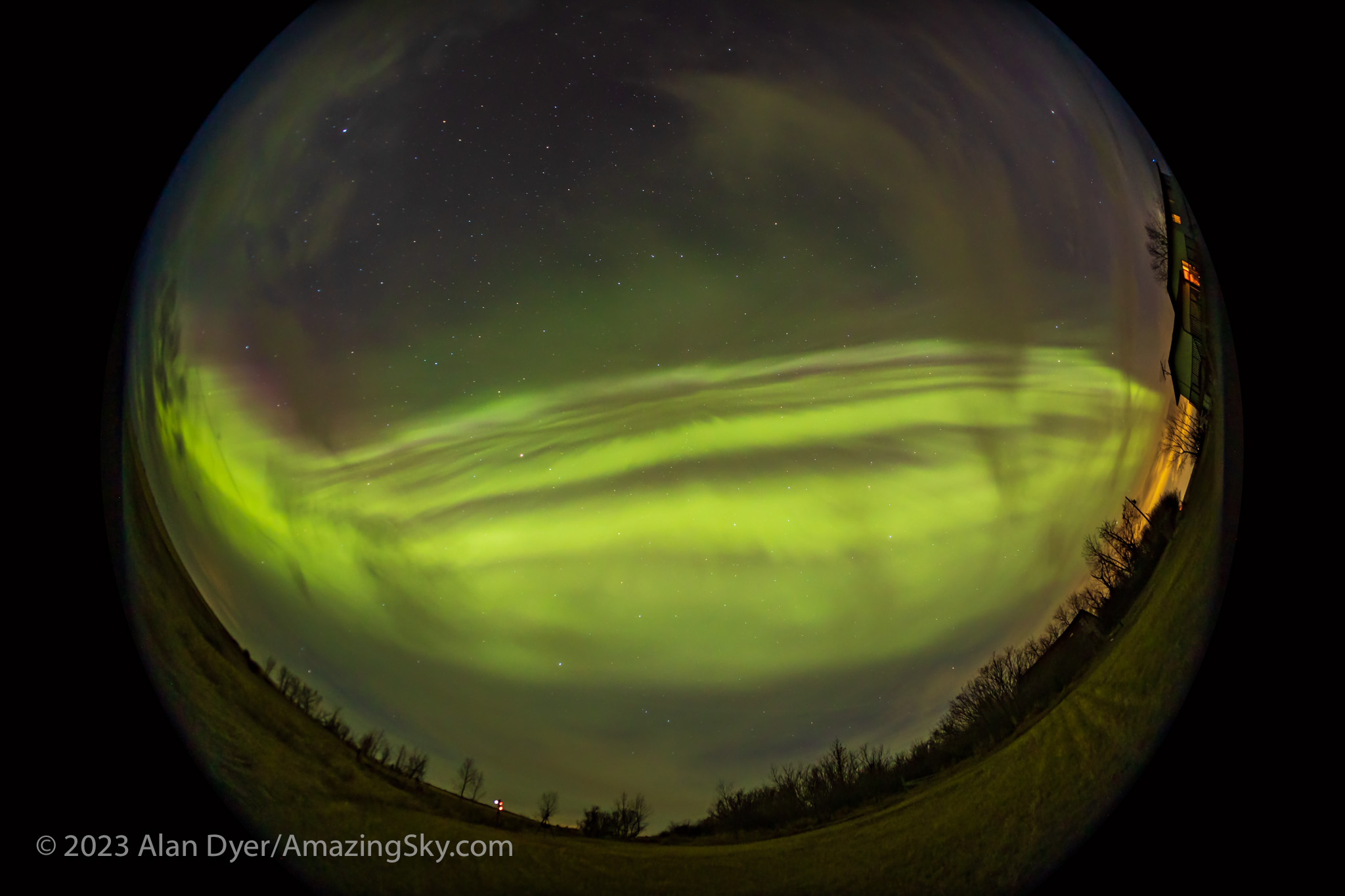
A fish-eye 360° view of the Great April Aurora of April 23, 2023, from home in southern Alberta, Canada. The Kp level reached 7 to 8 this day. The Big Dipper is above centre. This is looking north.
A single 5-second exposure with the TTArtisan 7.5mm circular fish-eye lens at f/2 and Canon R6 at ISO 3200.
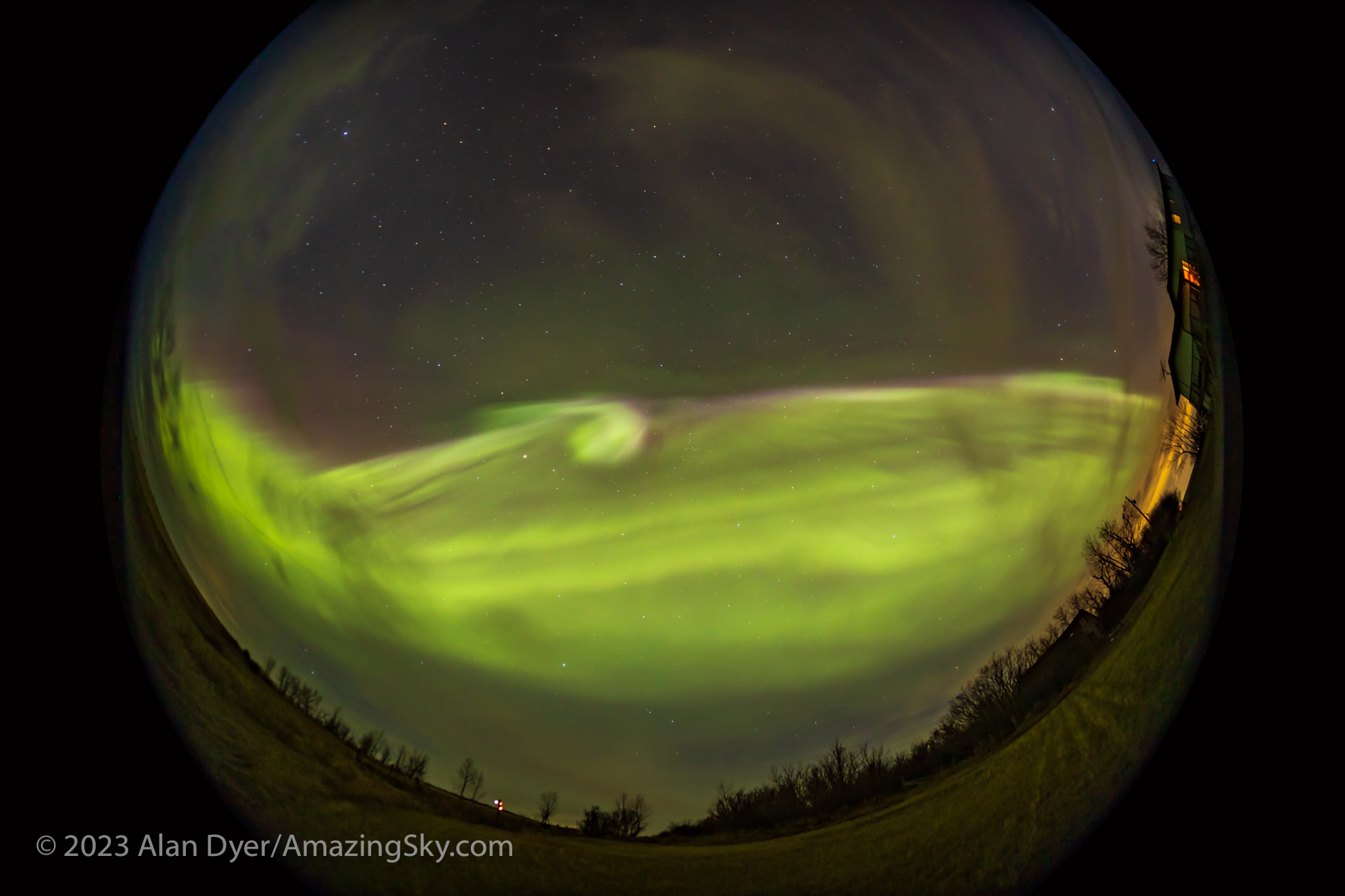
The aurora moved south to occupy just the southern half of the sky, but with incredible ribbons crossing from east to west, rippling and pulsating off and on. Seeing patches of aurora pulse off and on and flaming up to the zenith is not uncommon toward the end of a substorm outburst. But this was the first time I can recall seeing pulsating ribbons.
At times, there was a dark ribbon across the sky, as the aurora formed a gap in its curtains, looking like a “dark aurora.”
A fish-eye 360° view of the Great April Aurora of April 23, 2023, from home in southern Alberta, Canada. The Kp level reached 7 to 8 this day. The Big Dipper is above centre. This is looking south.
A single 5-second exposure with the TTArtisan 7.5mm circular fish-eye lens at f/2 and Canon R6 at ISO 1600.A fish-eye 360° view of the Great April Aurora of April 23, 2023, from home in southern Alberta, Canada. The Kp level reached 7 to 8 this day. The Big Dipper is above centre. This is looking south.
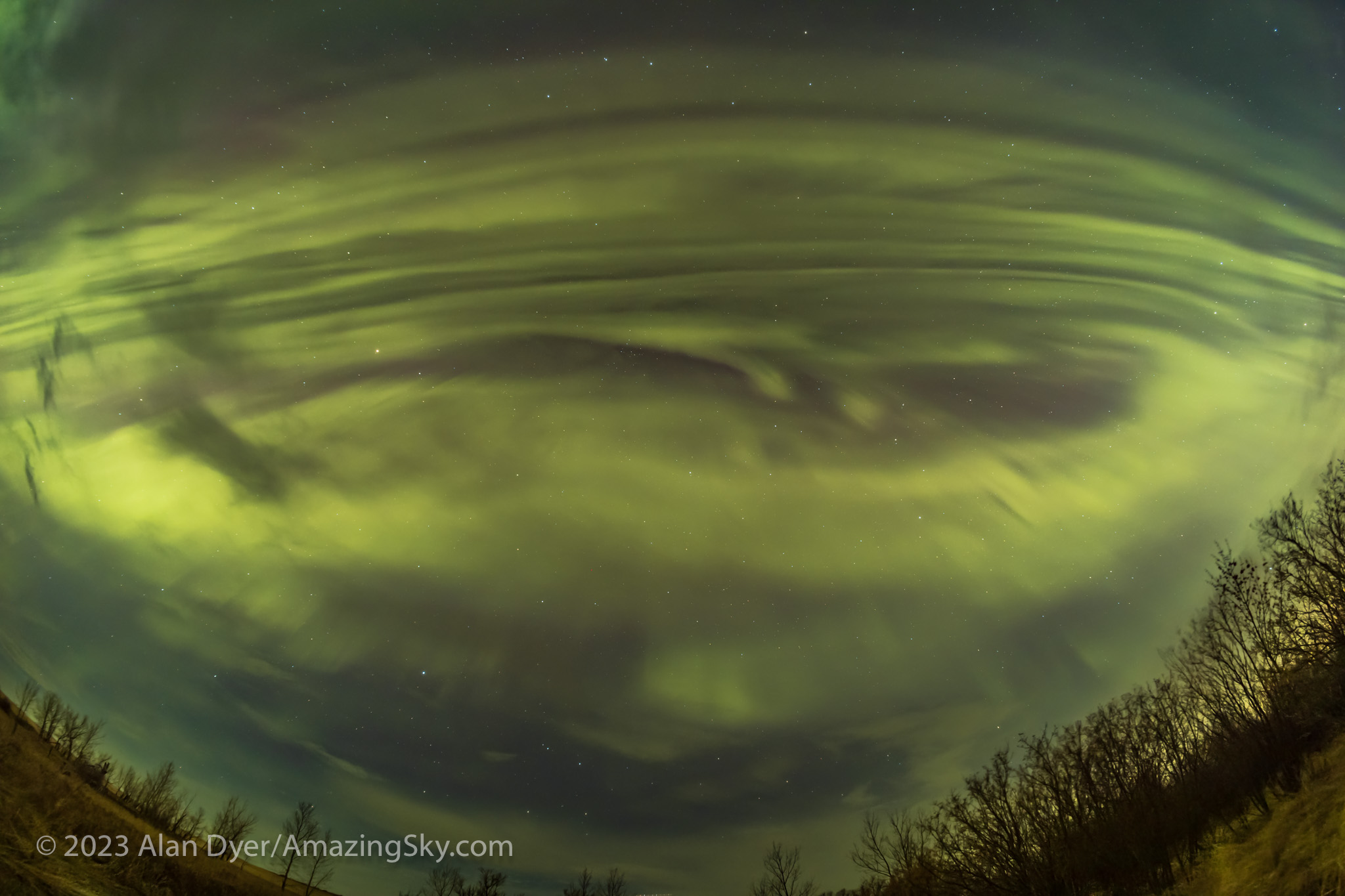
A single 5-second exposure with the TTArtisan 7.5mm circular fish-eye lens at f/2 and Canon R6 at ISO 1600.A view of the great April aurora show of April 23, 2023, looking up to the zenith near the top, with a set of finely-structured parallel ribbons of aurora crossing the sky from east (left) to west (right). This is looking south. The Big Dipper is at top. Taken from home in southern Alberta, Canada.
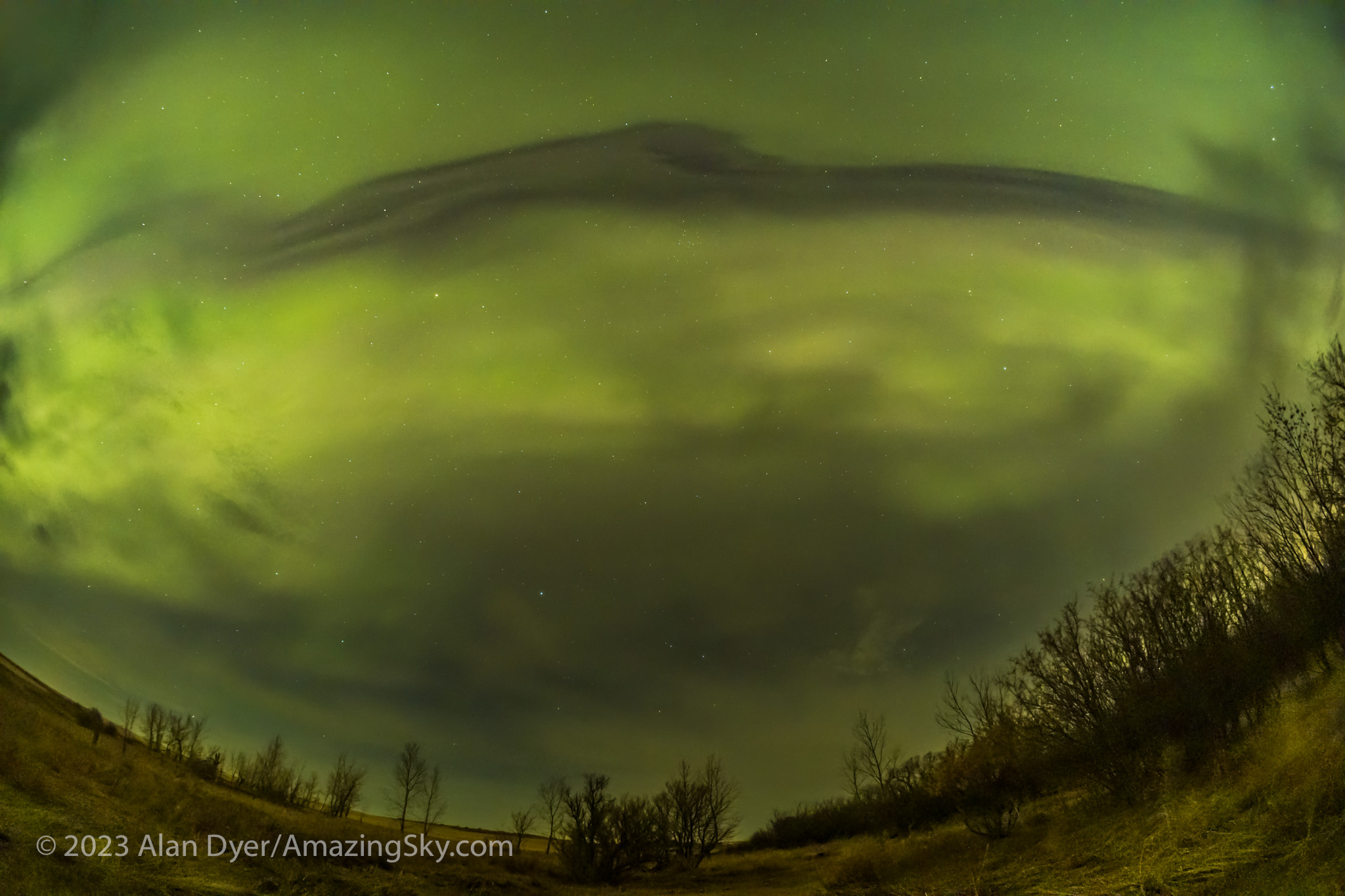
This is a single 10-second exposure with the Canon Ra at ISO 1600 and 11mm TTArtisan full-frame fish-eye lens at f/2.8.A view of the great April aurora show of April 23, 2023, looking to the south, with diffuse curtains across the sky forming a dark gap at the zenith. Taken from home in southern Alberta, Canada.
This is a single 1.6-second exposure with the Canon Ra at ISO 5000 and 11mm TTArtisan full-frame fish-eye lens at f/2.8.
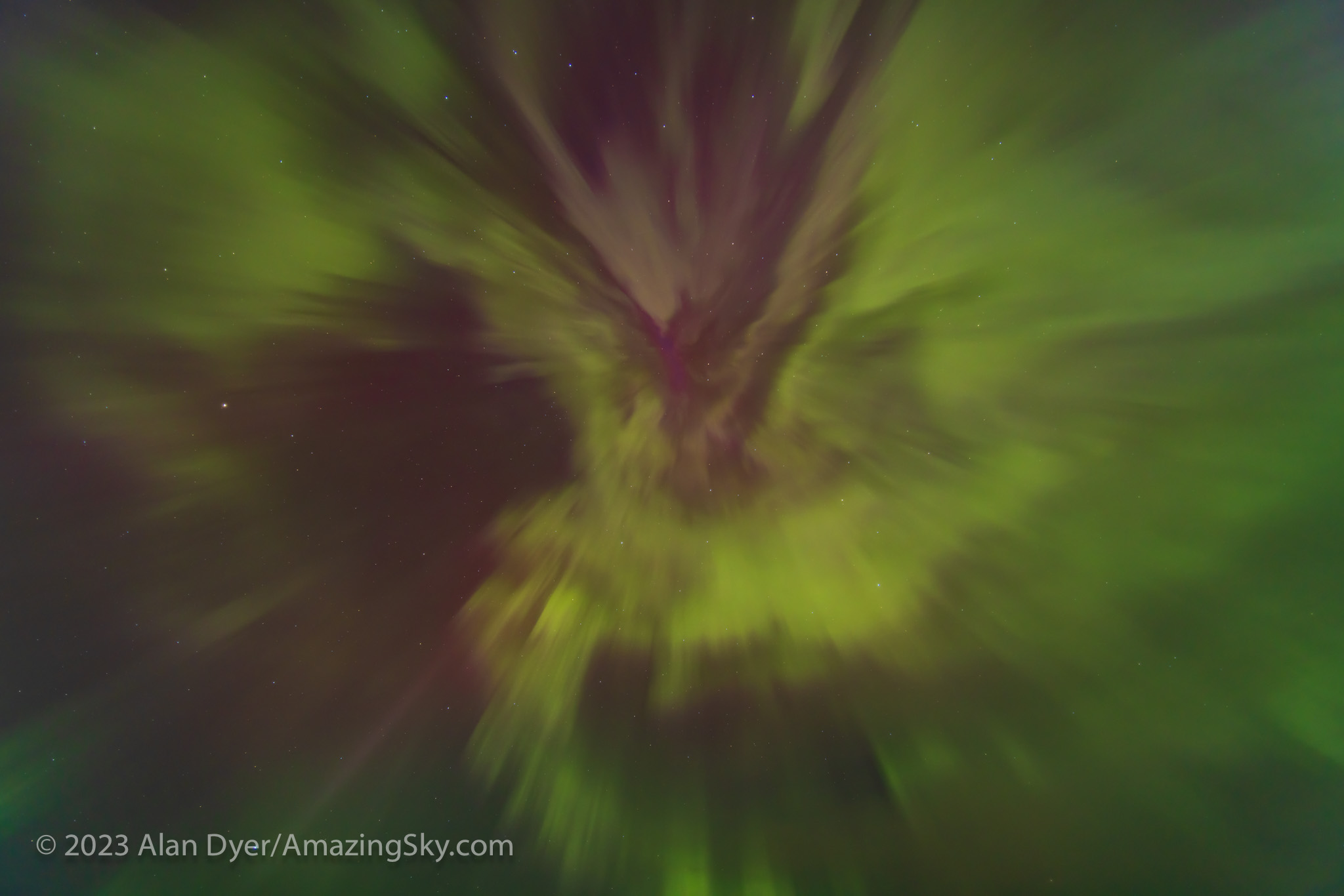
The view looking straight up is always the most jaw-dropping when an aurora fills the sky. Rays and curtains converge at the magnetic zenith to form a “corona.”
The aurora of April 23, 2023, looking straight up to the zenith to capture the converging curtains in a coronal display. The Big Dipper is at top.
A single 3.2-second exposure with the Canon R5 at ISO 800 and Laowa 15mm lens at f/2.
I shot with three cameras, taking stills, time-lapses, and real-time movies. I edited them together here in a music video. Enlarge to full screen to view it. I hope you enjoy it!
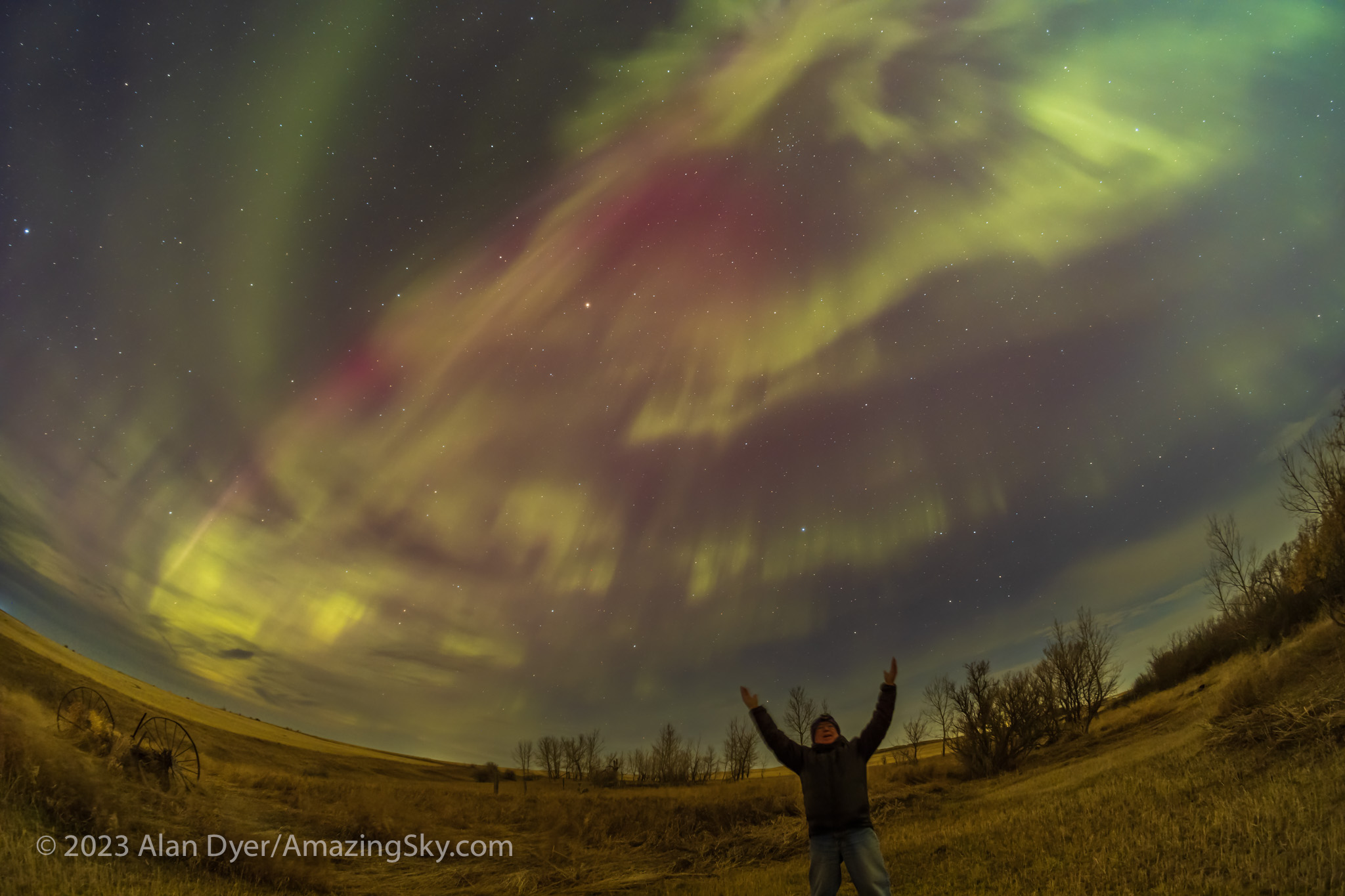
A 3-minute video of the April 23, 2023 aurora show from Alberta.An aurora selfie with the great all-sky Kp6 to 8 level aurora of April 23, 2023. This is looking south toward Arcturus and Spica. The Coma Berenices cluster is at top near the convergence point for the auroral curtains.
Shot from home with the Canon Ra and 11mm TTArtisan full-frame fish-eye lens at f/2.8.
With the Sun ramping up in activity, we should get more great shows of Northern – and Southern! – Lights around the world in the next few years,
On August 7, 2022 we were treated to a fine aurora and a superb showing of the anomalous STEVE arc across the sky.
Where I live in southern Alberta we are well positioned to see a variety of so-called “sub-auroral” phenomena — effects in the upper atmosphere associated with auroras but that appear south of the main auroral arc, thus the term “sub-auroral.”
An arc of a Kp-5 aurora early in the evening just starting a show, but with a fading display of noctilucent clouds low in the north as well.
The main auroral band typically lies over Northern Canada, at latitudes 58° to 66°, though it can move south when auroral activity increases. However, on August 7, the Kp Index was predicted to reach Kp5, on the Kp 0 to 9 scale, so moderately active, but not so active it would bring the aurora right over me at latitude 51° N, and certainly not down over the northern U.S., which normally requires Kp6 or higher levels.
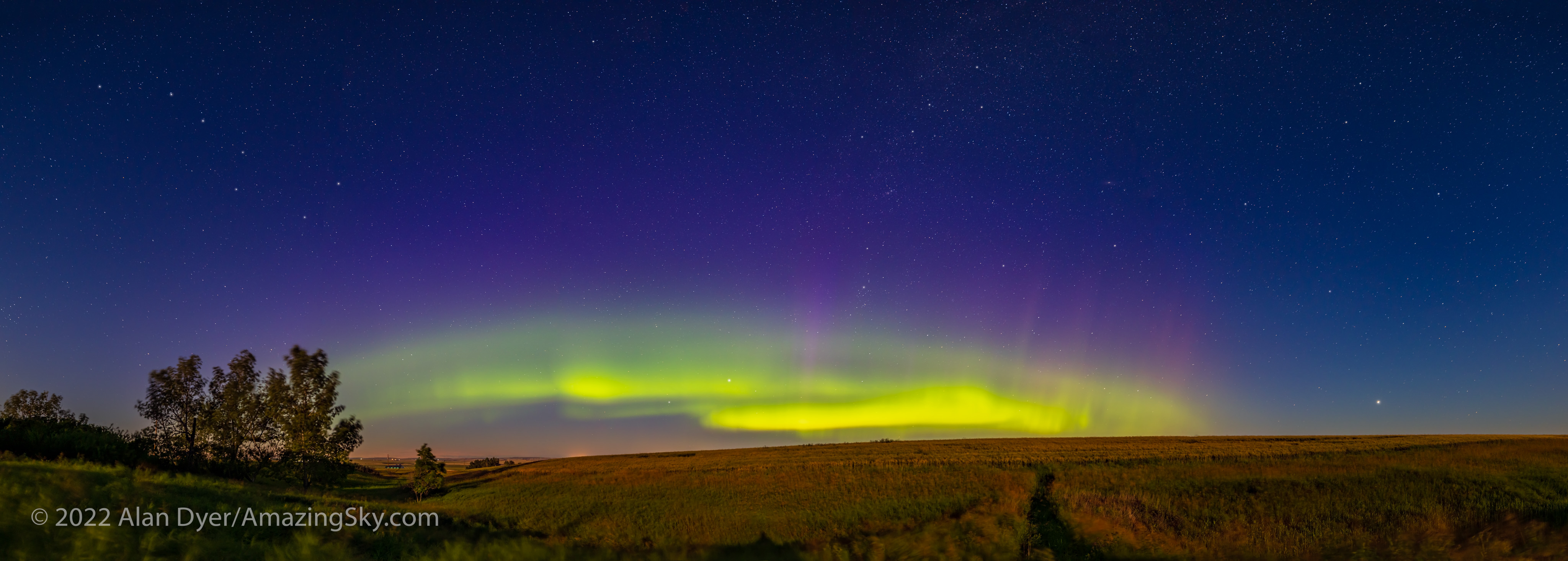
An arc of a Kp-5 aurora over a wheatfield from home in southern Alberta. The panorama takes in the northern stars, from the Big Dipper and Ursa Major at left, to the W of Cassiopeia at top right of centre, with Perseus below Cassiopeia, and Andromeda and Pegasus at right.
So with Kp5, the aurora always appeared in my sky this night to the north, though certainly in a fine display, as I show above.
However, at Kp5, the amount of energy being pumped into the magnetosphere and atmosphere around Earth is high enough to trigger (through mechanisms only beginning to be understood) some of the unique phenomena that occur south of the main aurora. These often appear right over me. That was the case on August 7.
This is a telephoto lens panorama of a low and late-season display of noctilucent clouds in the north on August 7, 2022. This was the latest I had seen NLCs from my latitude of 51° N.
I captured the above panoramas of the aurora early in the night, when we also were treated to a late season display of noctilucent clouds low in the north. These are high altitude water-vapour clouds up almost as high as the aurora. They are common in June and July from here (we are also in an ideal latitude for seeing them). But early August was the latest I had ever sighted NLCs.
A display of a Kp-5 aurora near its peak of activity on August 7, 2022, taken from home in southern Alberta, over the wheatfield next to my acreage. STEVE appeared later this night. Moonlight from the waxing gibbous Moon low in the southwest illuminates the scene.
As the NLCs faded, the auroral arc brightened, promising a good show, in line with the predictions (which don’t always come true!). The main aurora reached a peak in activity about 11:30 pm MDT, when it was bright and moving along the northern and northeastern horizon. It then subsided in brightness and structure, giving the impression the show was over.
But that’s exactly when STEVE can — and this night did! — appear.
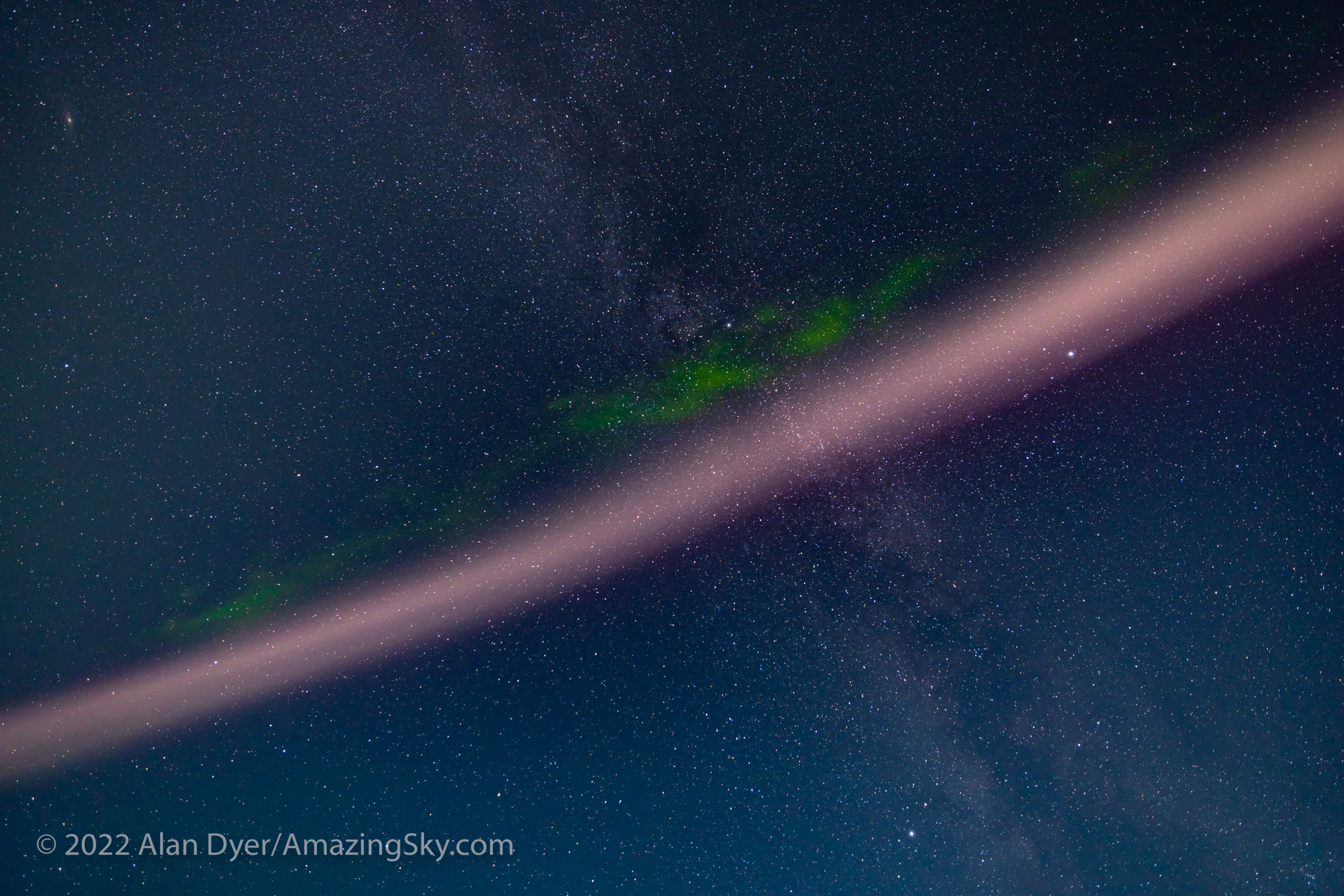
A portrait of the infamous STEVE arc of hot flowing gas associated with an active aurora, here showing his distinctive pink colour and the fleeting appearance of the green picket fence fingers that often show up hanging down from the main arc.
Sure enough, about 12:15 am, a faint arc appeared in the east, which slowly extended to cross the sky, passing straight overhead. This was STEVE, short for Strong Thermal Emission Velocity Enhancement.
STEVE is not an aurora per se, which is caused by electrons raining down from the magnetosphere. STEVE is a ribbon of hot (~3000°) gas flowing east to west. STEVE typically appears for no more than an hour, often less, before he fades from view.
A fish-eye view looking straight up. On this night the green fingers lasted no more than two minutes.
At his peak, STEVE is often accompanied by green “picket-fence” fingers hanging down from the main pink band, which also have a westward rippling motion. These do seem to be caused by vertically moving electrons.
This night I shot with three cameras, with lenses from 21mm to 7.5mm, including two fish-eye lenses needed to capture the full extent of sky-spanning STEVE. I shot still, time-lapses, and real-time videos, compiled below.
Amateur photos like mine have been used to determine the height of STEVE, which seems to be 250 to 300 km, higher than the main components of a normal aurora. Indeed, previous images of mine have formed parts of the data sets for two research papers, with me credited as a citizen scientist co-author.
A closeup of the STEVE arc of hot flowing gas associated with an active aurora.
STEVE is a unique example of citizen scientists working with the professional researchers to solve a mystery that anyone who looks up at the right time and from the right place can see. August 7-8, 2022 and my backyard in Alberta was such a time and place.
A dim Perseid meteor (at top) streaking near the Milky Way on the night of Aug 7-8, 2022, taken as part of a time-lapse set for the STEVE auroral arc in frame as the pink band.
As a bonus, a few frames recorded Perseid meteors, with the annual shower becoming active.
For a video compilation of some of my stills and videos from the night, see this Vimeo video.
A 2.5-minute music video of stills, time-lapses, and real-time videos of STEVE from August 7-8, 2022.







 The Amazing Sky