Nightscapes of Southern Saskatchewan


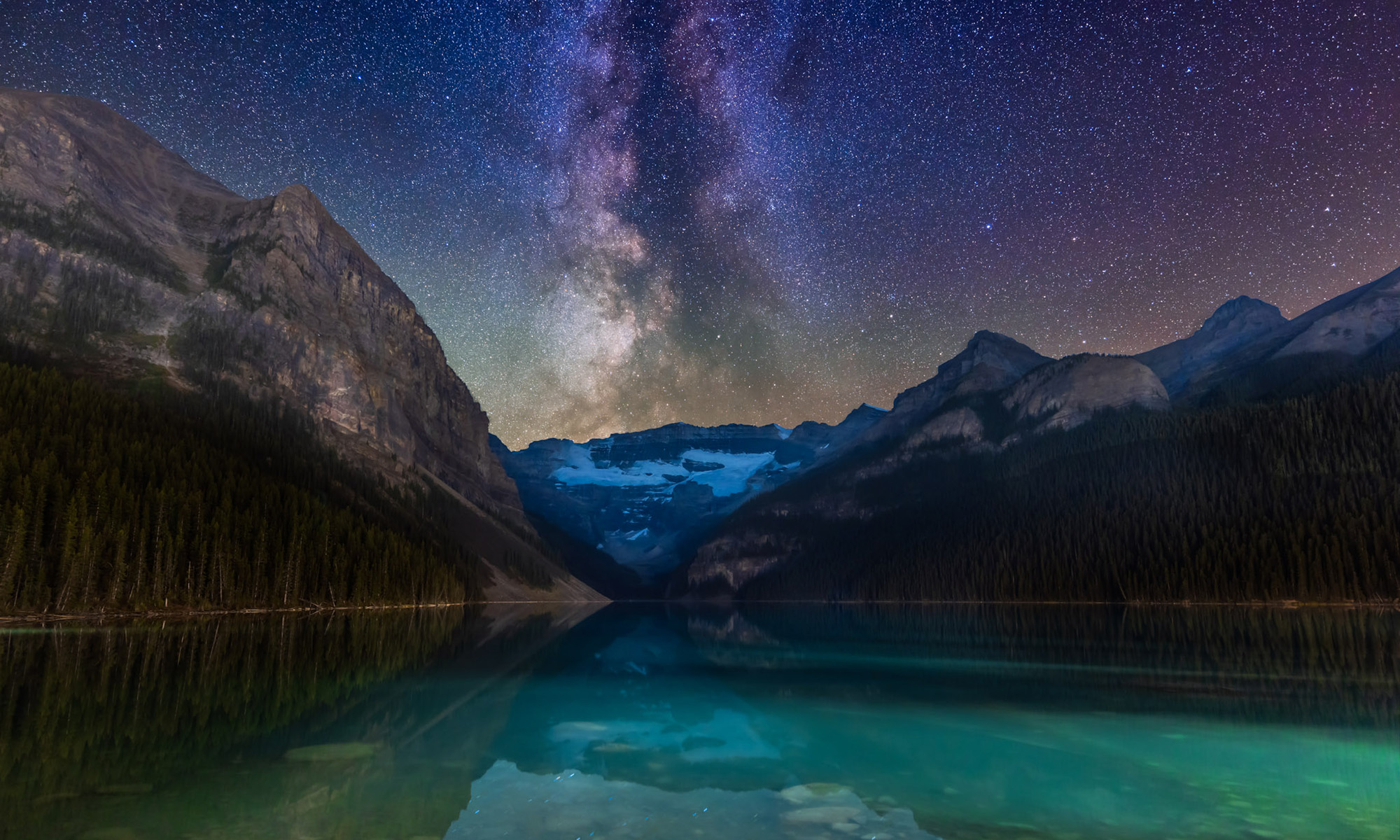
Southern Saskatchewan is a fine place to capture nightscapes of the Milky Way over the grand prairie landscape.

In late August 2025 I took a short road trip around southwest Saskatchewan, taking advantage of a run of wonderfully clear nights to shoot “nightscapes” at some of my favourite locations.

Southern Saskatchewan, and more specifically Southwest Saskatchewan, is a stargazing paradise. The skies are dark and there’s nothing to get in the way of seeing them! Yet, the landscapes have their unique beauty.

And in the case of Grasslands National Park the landscape preserves the endangered realm of original short-grass prairie. It is what the land was like long ago, even including some bison at large.

Grasslands National Park
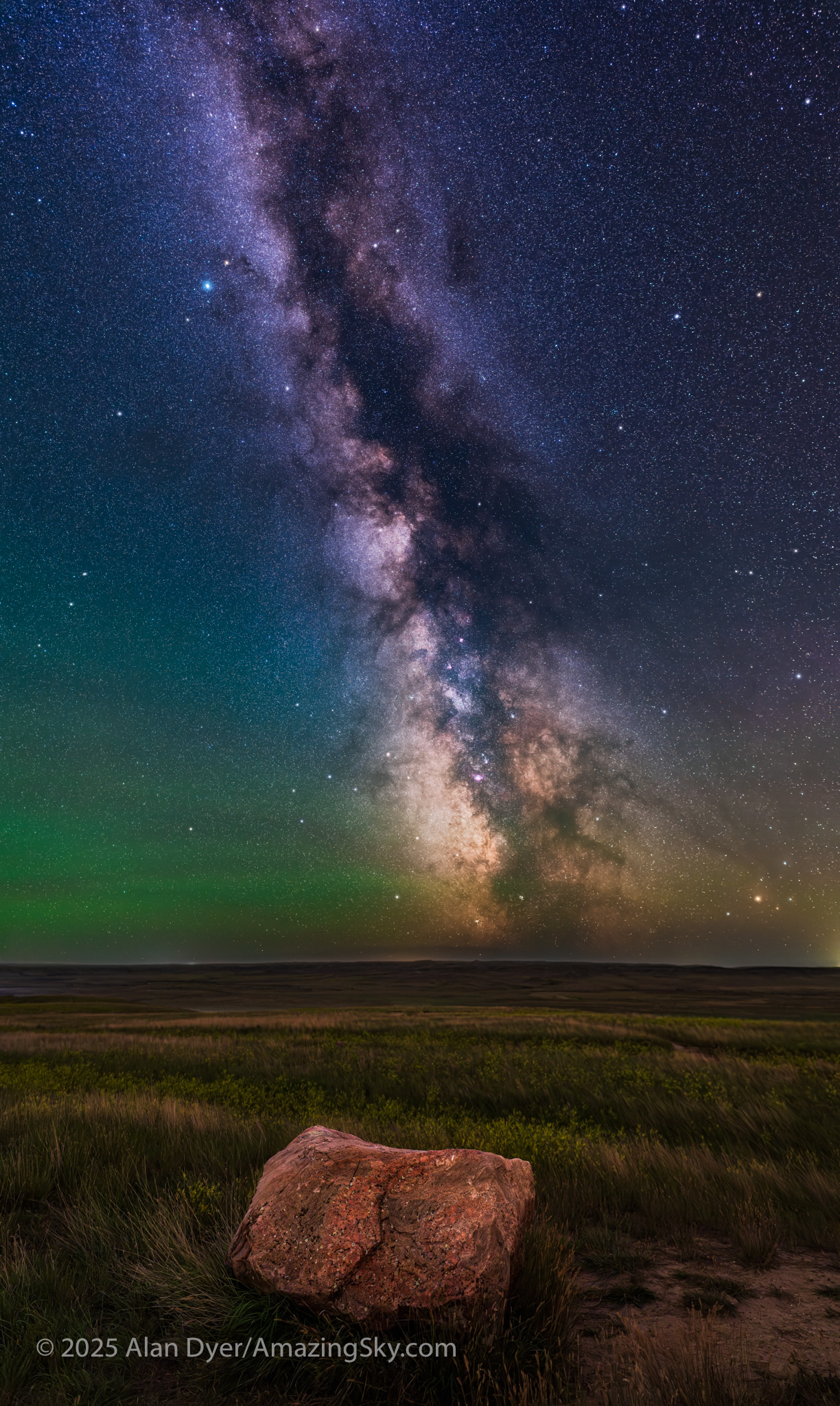
Technical:
This is a blend of tracked and stacked sky exposures with a single untracked ground exposure:
– 7 x 60 seconds at f/2 tracked and focused for the sky, plus
– 1 x 4 minutes at f/2.8 untracked and focused for the foreground to bring out the details lit only by starlight. No light painting was employed here.
– All with the Nikon Z8 at ISO 800 and Nikkor 20mm S lens, on the MSM Nomad tracker. And all from the same tripod position. However, the camera was reframed upward for the sky shots.

In fact, my main destination on my visit to Grasslands this year was to revisit a site I had intended to shoot from in 2019 – the Bison Rubbing Stone overlooking the Frenchman Creek Valley, with the Milky Way as a backdrop.

In 2019 I had to drive through the herd of bison to get there. With the herd only a few hundred metres away, I thought better of setting up at their scratching post. So that year I headed down into the valley to shoot at the 76 Ranch Corral. You can see some images from that location taken on an earlier trip to Grasslands here.

This year I was assured the bison were in the outback, so I set up at their rubbing stone. This is one of the many glacial erratic boulders the Ice Age left scattered across the prairies. With no trees about, the bison have long loved to use them to scratch an itch. But the connection with the stars is that one legend of the sky told by Blackfoot First Nations describes the Milky Way as the “Buffalo Trail,” the dust left by a cosmic herd of bison.

I got the shot! Then all I had to do was turn the camera around to face north to get this scene.
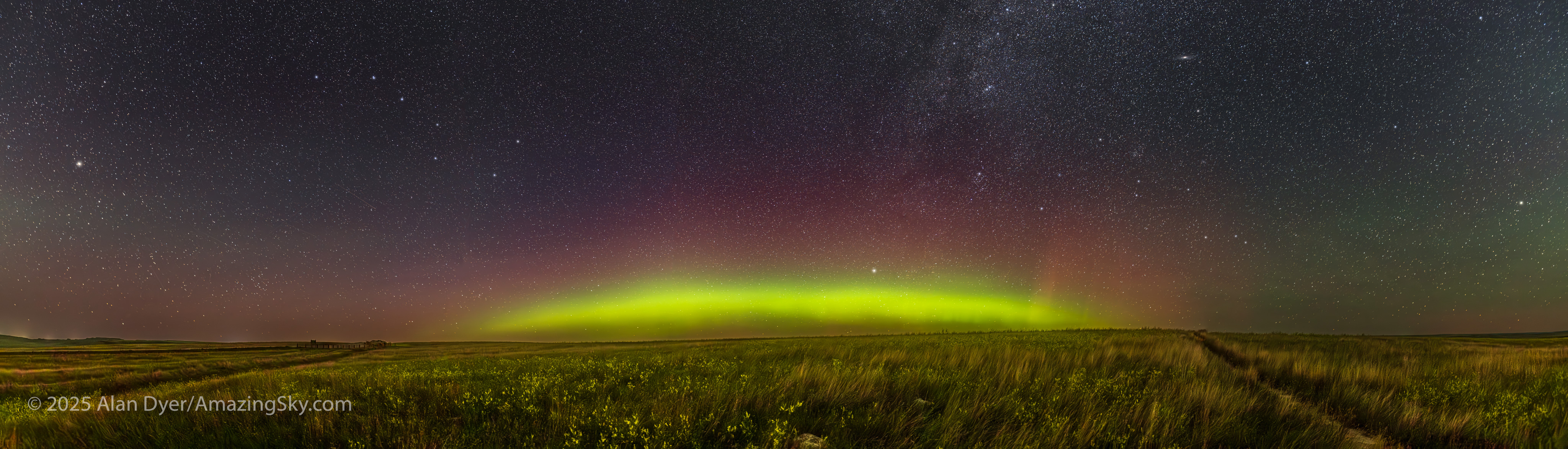
Technical:
This is a panorama of 5 segments, each 30 seconds untracked at f/2 with the Nikkor 20mm S-Line lens and Nikon Z8 at ISO 1600. Stitched with Adobe Camera Raw. I removed aircraft trails, but at left I retained the many faint satellite trails in the northwest still lit by twilight, as this was early at about 10:30 pm CST. I did not focus stack these frames. Nor was the camera tracking the stars.

A mild aurora appeared in a classic arc across the north, and framed between the hiking trail, with the Big Dipper to the left and the Milky Way rising to the right. This is the wonderful sky that awaits in the “big sky” country of Grasslands. On the horizon only 3 distant lights could be seen. Grasslands is a Dark Sky Preserve. May it always be so!
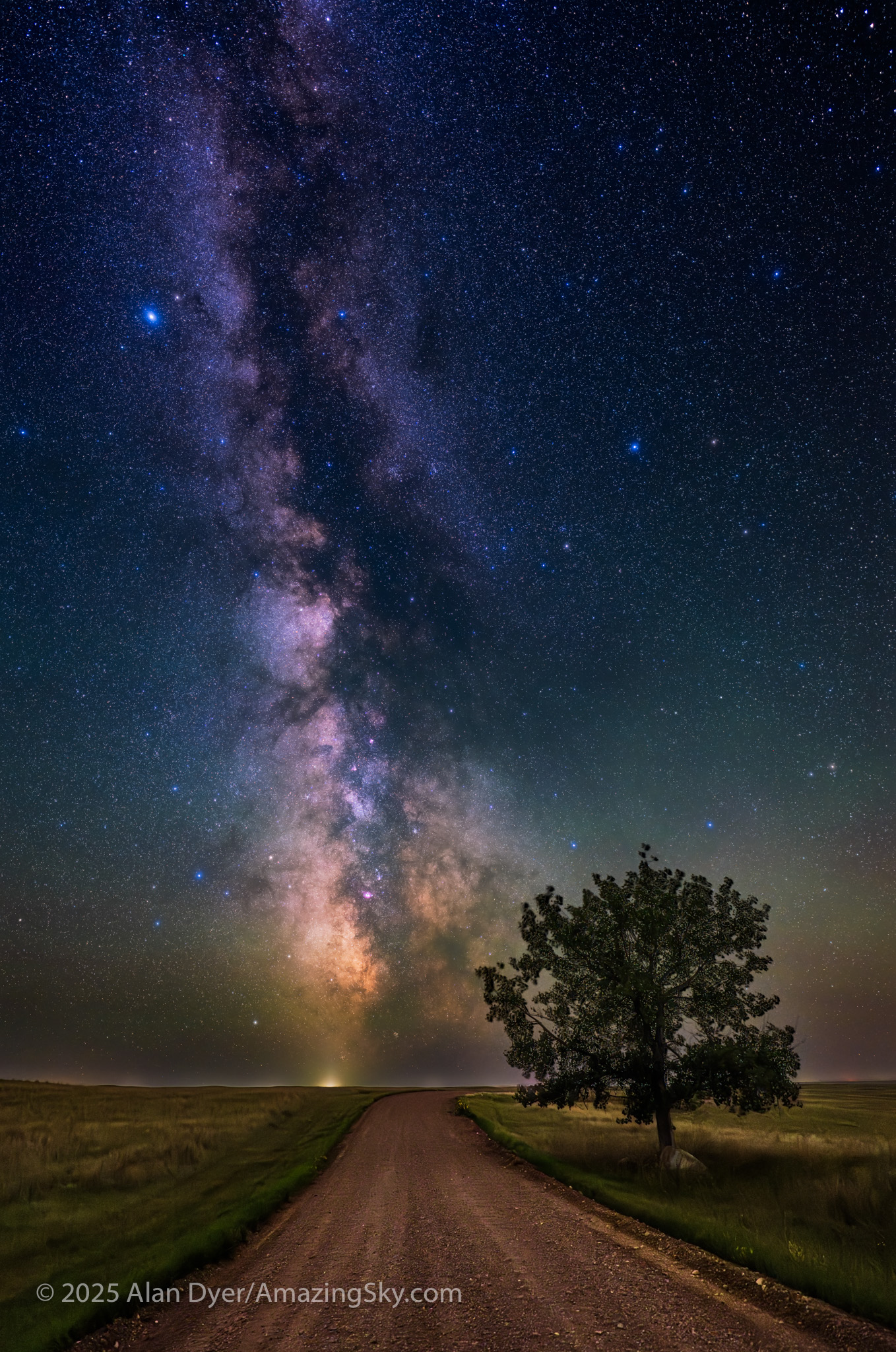
Technical:
This is a blend of tracked and stacked sky exposures with a single untracked ground exposure:
– 4 x 30 seconds at f/2 tracked for the sky, plus
– 1 x 2 minutes at f/2.8 untracked for the ground to bring out the details lit by starlight, plus
– A single 30-second tracked exposure through a Tiffen Double Fog 3 filter layered in, to add the star glows.
– All with the Nikon Z8 at ISO 800 and Nikkor 20mm S lens, on the MSM Nomad tracker. And all from the same tripod position. The camera was not moved for the sky photos.

The night before I headed south out of the little town of Val Marie to a favourite spot high on the hill overlooking the Park. It is called Two Trees, but now only one tree remains! It made a fine foreground for the classic “lone tree and Milky Way” nightscape.

In August the galactic centre lies in the southwest quickly setting in the early evening. But from this latitude of 49º N even with it at its highest, the Milky Way core lies low in the south, making for good compositions with foregrounds below.
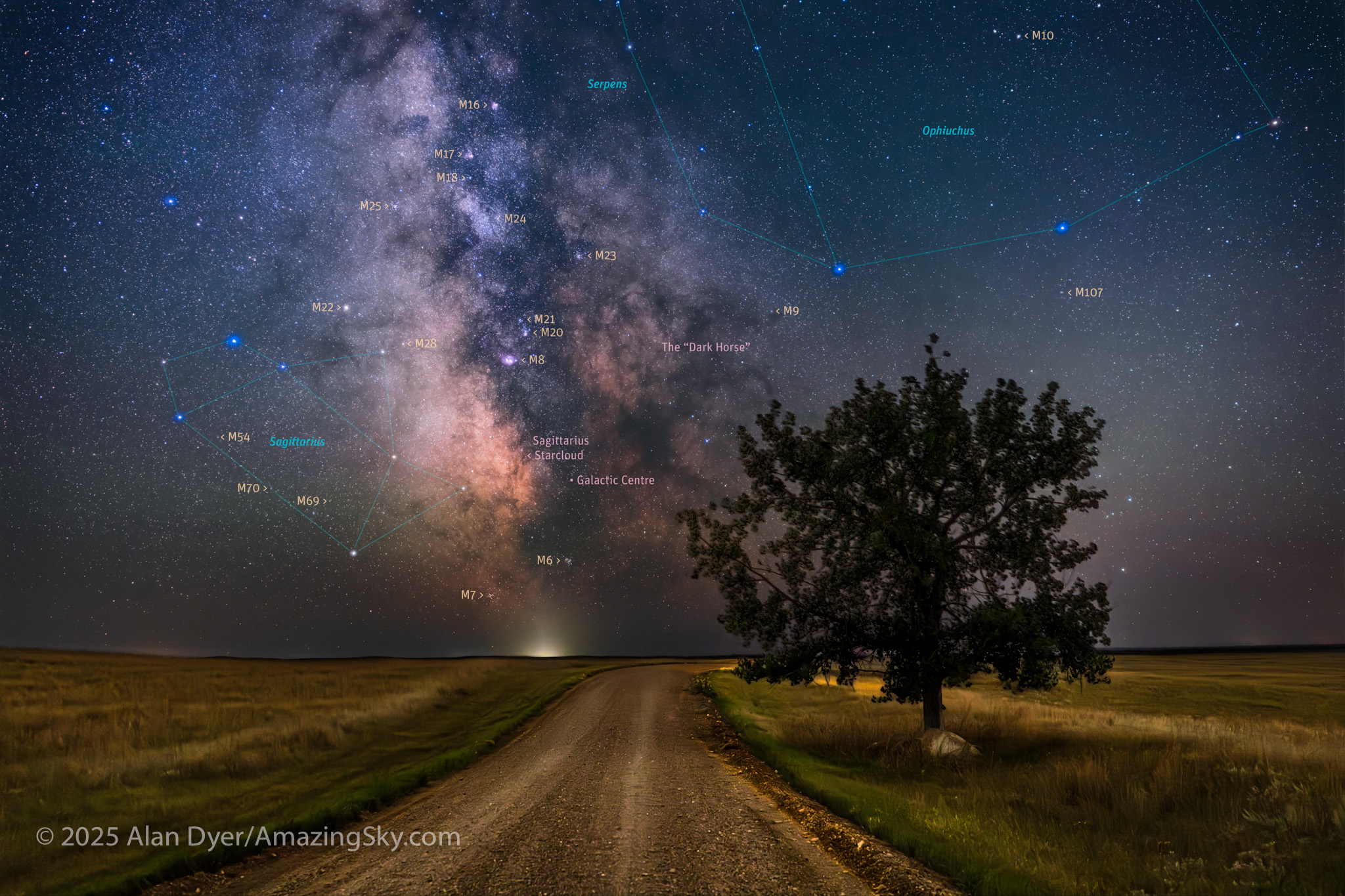
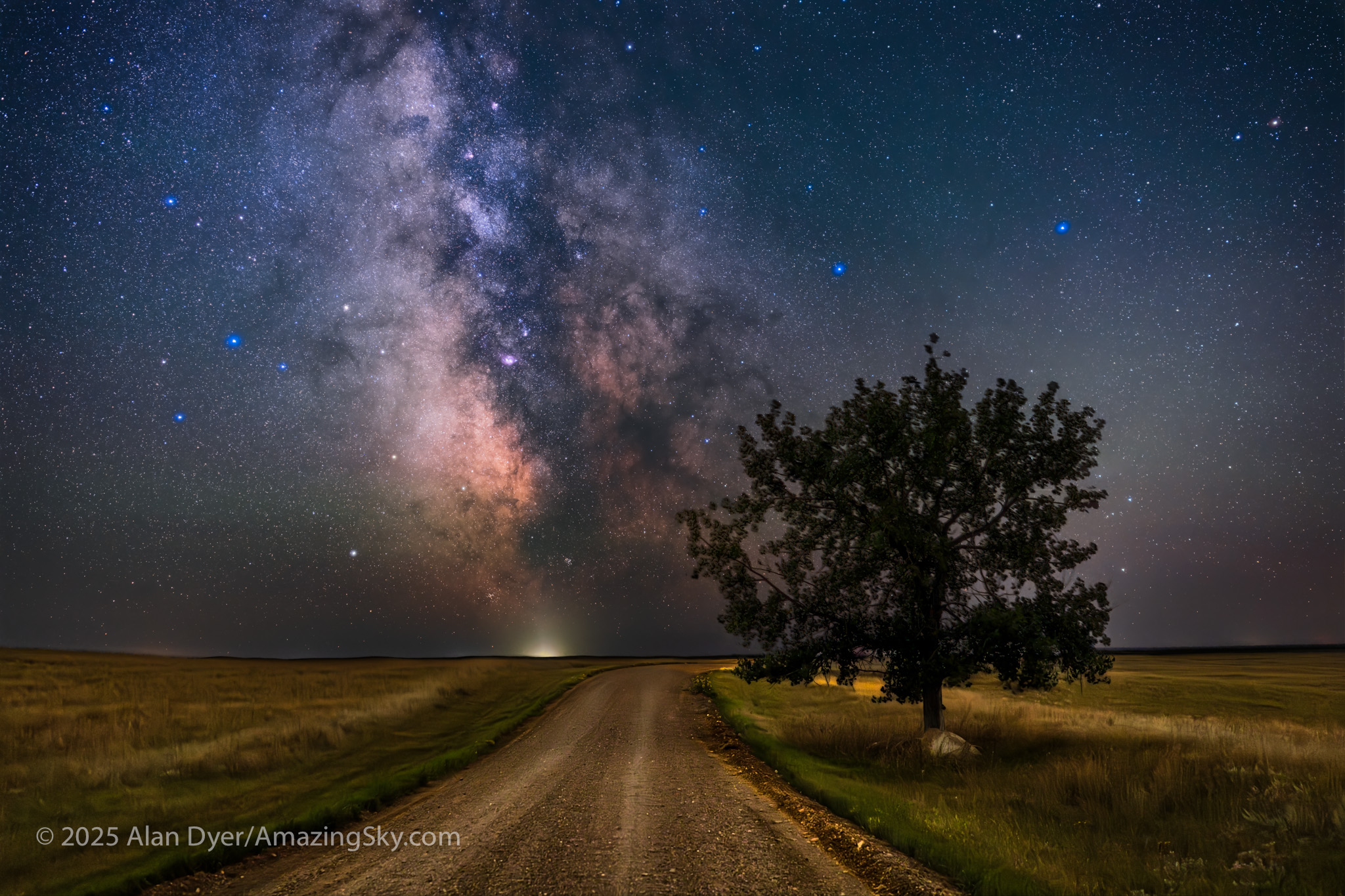
Here I present a “landscape” version of the image above, in versions with and without labels to indicate all the rich nebulas and star clusters in this area of sky in Sagittarius the Archer, home of the Milky Way core. Tap on the images to bring them up full screen.

Similarly, below I present views looking east to the autumn constellations rising over the prairie. This was from the valley below Two Trees Hill, at the Riverwalk day use site. Here there were absolutely no lights visible, and hardly a sky glow on the horizon from towns and light pollution. This was paradise for a stargazing session.
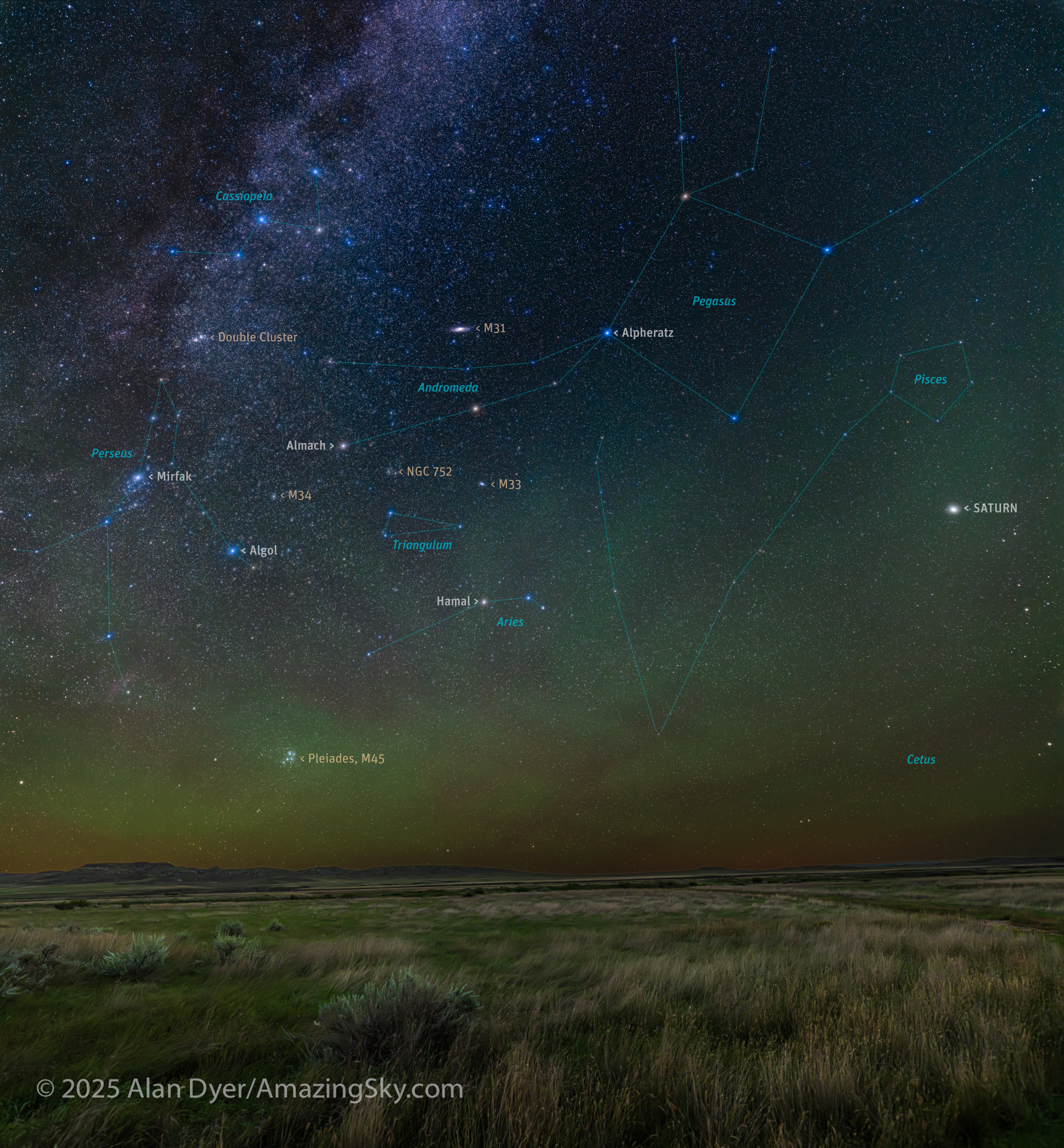
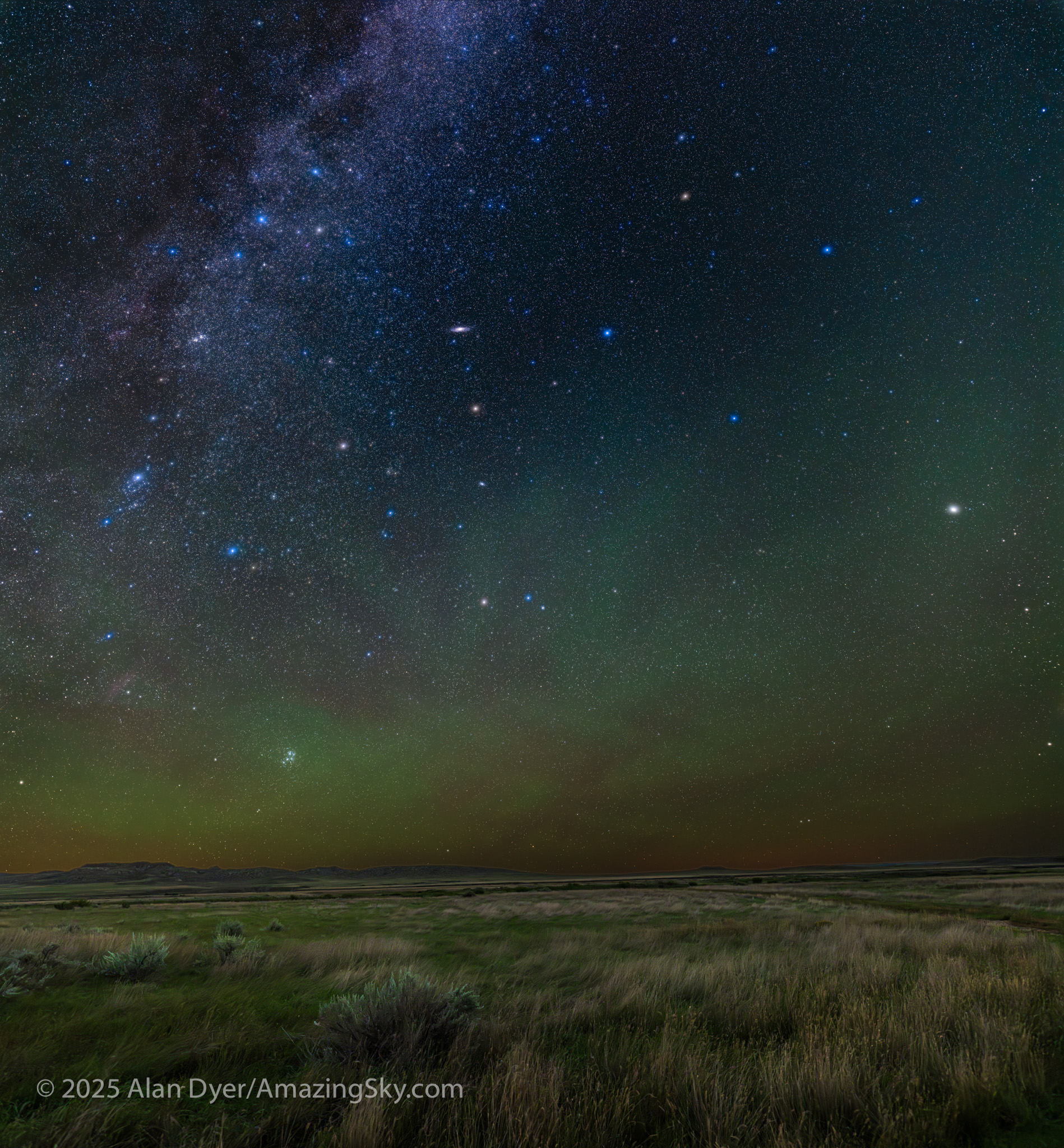
The constellations in this area of sky are the ones made famous in the classic tale of the hero Perseus riding on Pegasus the Flying Horse to rescue the lovely Princess Andromeda from Cetus the Sea Monster, while vain Queen Cassiopeia looks on.

Here the sky was also tinted green, not with aurora but airglow, a natural effect caused by high-altitude oxygen fluorescing at night, giving off energy it has absorbed by day. It discolours the sky but it belongs there! It is visible only at dark sky sites.

The Great Sand Hills

From Grasslands I ventured north to the little town of Leader, Saskatchewan, one of the jumping off points to visit the Great Sand Hills nearby. You have to have a local map to find them, but the sand dunes are extensive, and an oddity on the prairie, another Ice Age relic.

They are not a Park but are an ecological reserve, with limited access. I shot from the main spot with parking for visitors and a trail off into the dunes.

Here is another pair of images with annotations, looking north from the main dune field toward Ursa Major and the Big Dipper.
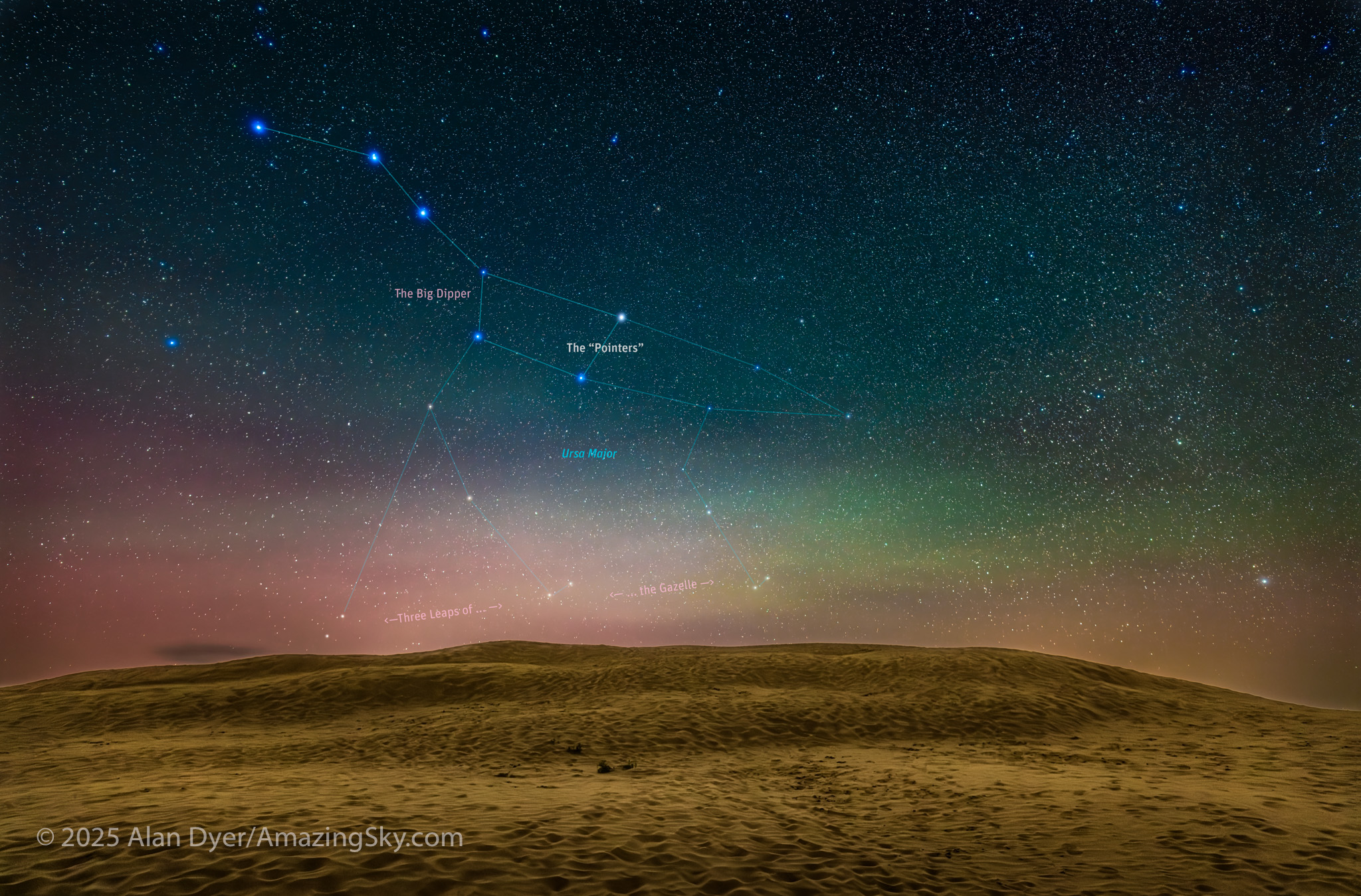
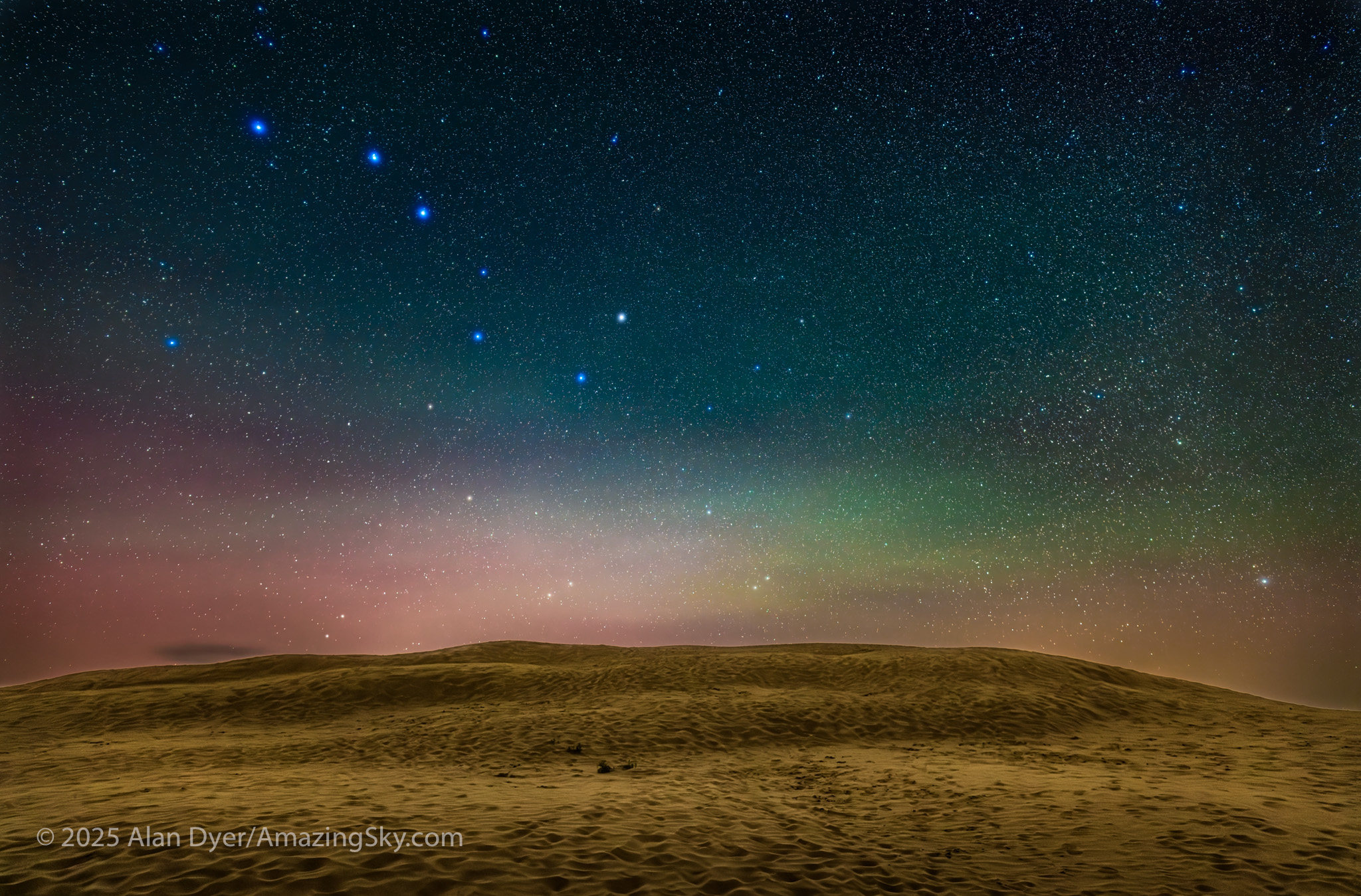
An extensive display of airglow also tints the sky, at least I think that’s the source, and not aurora.
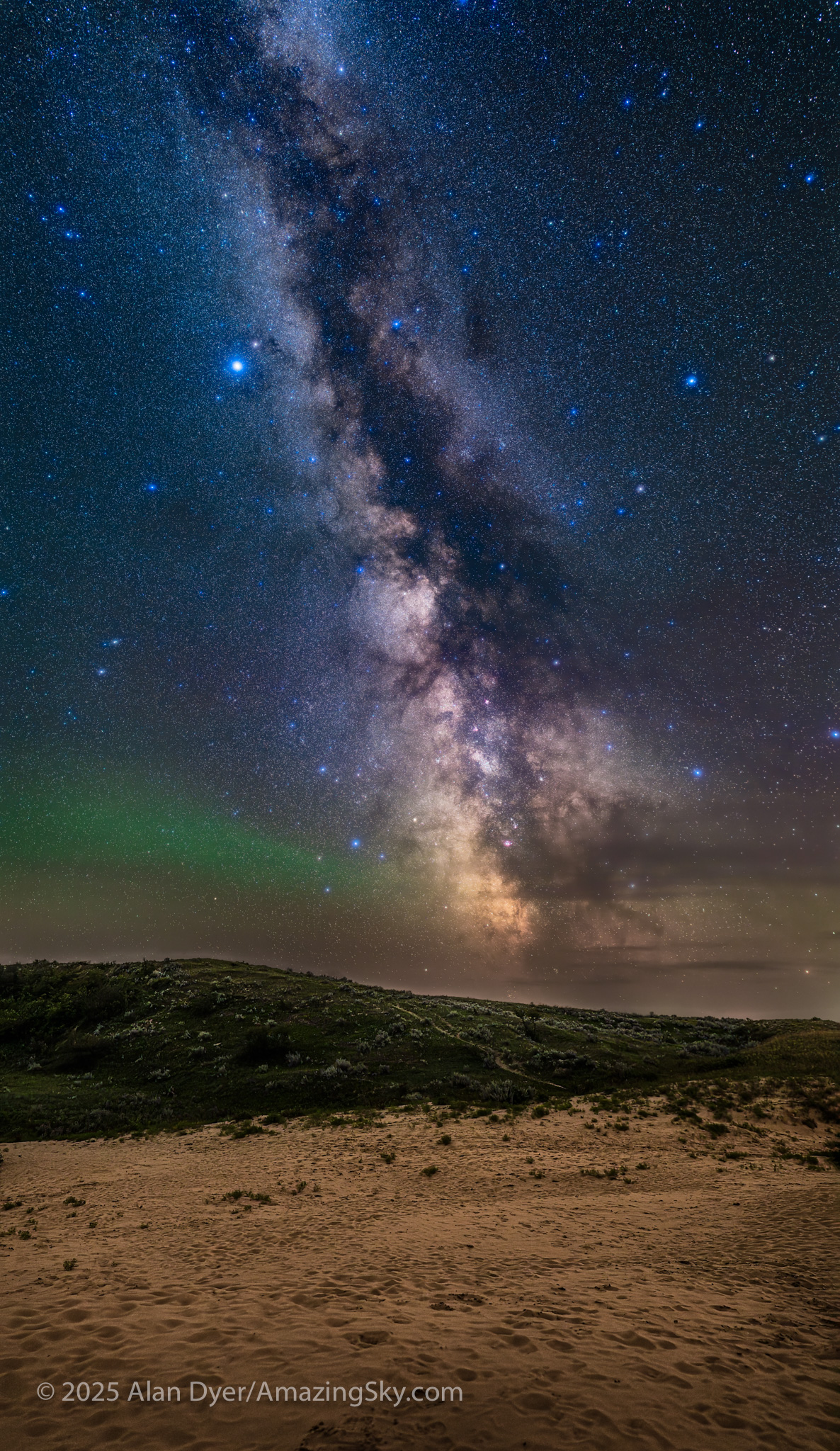
Technical:
This is a blend of tracked and stacked sky exposures with a single untracked ground exposure:
– A stack of 4 x 60 seconds at f/2 tracked for the sky, plus
– 1 x 4 minutes at f/2.8 untracked for the ground, plus
– A single 60-second tracked exposure through a Tiffen Double Fog 3 diffusion filter layered in, to add the star glows.
– All with the Nikon Z8 at ISO 800 and Nikkor 20mm S lens, on the MSM Nomad tracker. And all from the same tripod position. However, the camera framing was changed for the sky and ground shots, tilting it up it to include more of the sky up the northern Milky Way.

Turning around to face south again frames the sweep of the summer Milky Way over the well-trodden dunes. Not quite the Saharan or Namibian scene you might want, but this is Saskatchewan and having even this scene on the prairies is unique. The only other dune fields are far up north and not readily accessible.
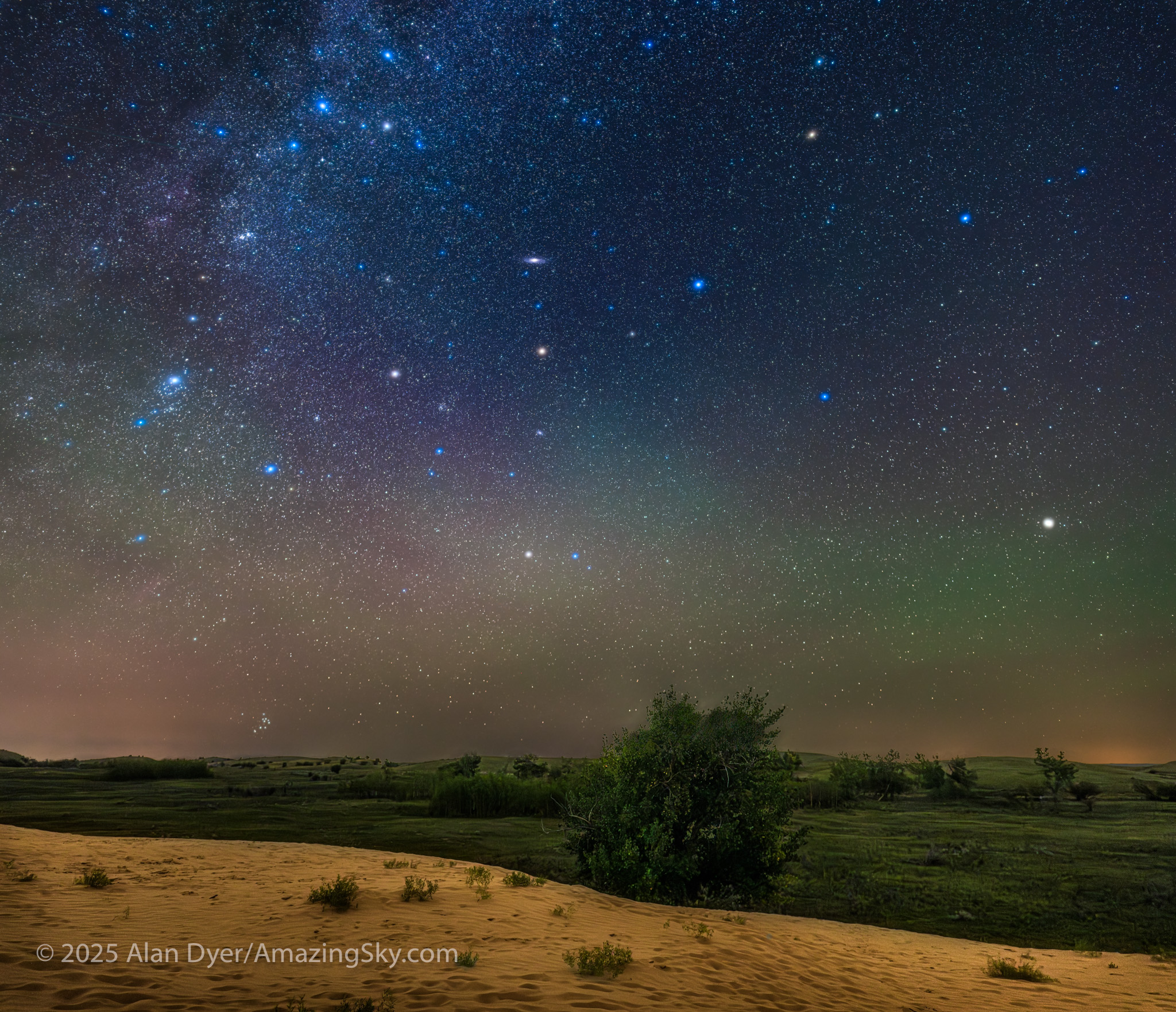
Technical:
This is a blend of tracked and stacked sky exposures with a single untracked ground exposure:
– A stack of 4 x 60 seconds at f/2 tracked for the sky, plus
– 1 x 3 minutes at f/2.8 untracked for the ground to bring out the details lit only by starlight, plus
– A single 60-second tracked exposure through a Tiffen Double Fog 3 diffusion filter layered in, to add the star glows.
– All with the Nikon Z8 at ISO 800 and Nikkor 20mm S lens, on the MSM Nomad tracker. And all from the same tripod position. However, the camera framing was changed for the sky and ground shots, tilting it up it to include all the constellations in one frame but with just a sliver of ground in the frame.

Looking east from the dune again frames the mythological autumn constellations, with the “W” of Cassiopeia at top amid the Milky Way. The bright “star” at lower right is Saturn. The Pleiades are just rising at left.

The Cypress Hills

I had started my Saskatchewan journey in the Cypress Hills, another formation created by the Ice Age, or rather left untouched by the glaciers creating a high wooded oasis on the prairie. I was there for the annual Saskatchewan Summer Star Party, the subject of my previous blog here.
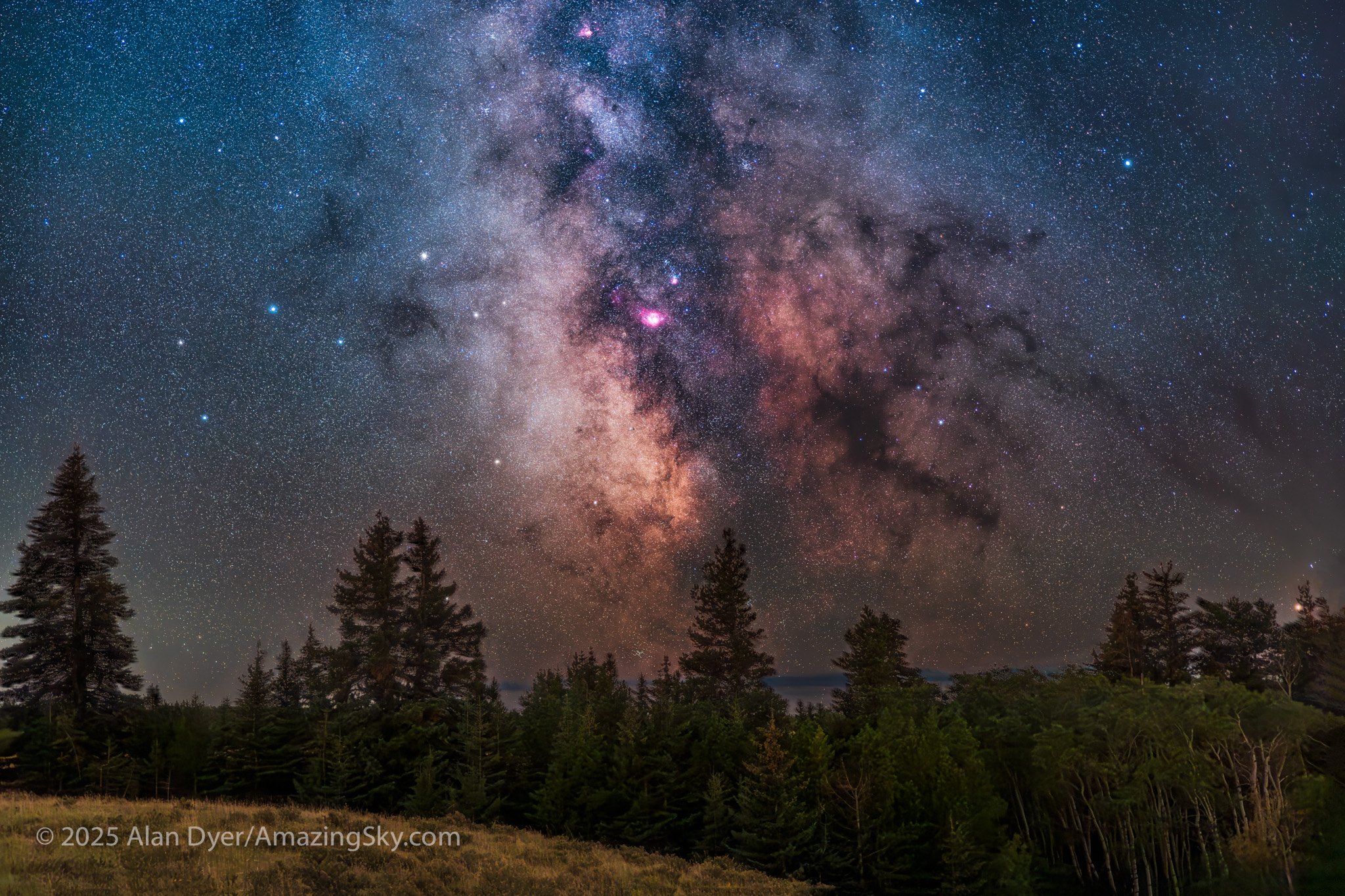
Technical:
This is a blend of:
– A stack of 4 x 1 minute exposures, tracked, for the sky with …
– A stack of 2 x 1-minute exposures, untracked, for the ground,
– All with the Canon RF 28-70mm lens at f/2 and set to 48mm, on the astro-modified Canon EOS R at ISO 1600, and on the MSM Nomad tracker. No filters were employed here.
Masking and blending all the images, with the trees in the foreground was a challenge! The camera was not moved — all images were from the same tripod position.

But on the first couple of nights, with the entire four nights of the Party promising to be clear, I left the Party and headed off on my own to shoot some nightscapes over the pine trees at Lookout Point, to again catch the photogenic galactic core in its last appearance for the season.

For the image below, I employed a special filter that isolates the deep red light emitted by the many hydrogen-gas nebulas toward the Milky Way core.
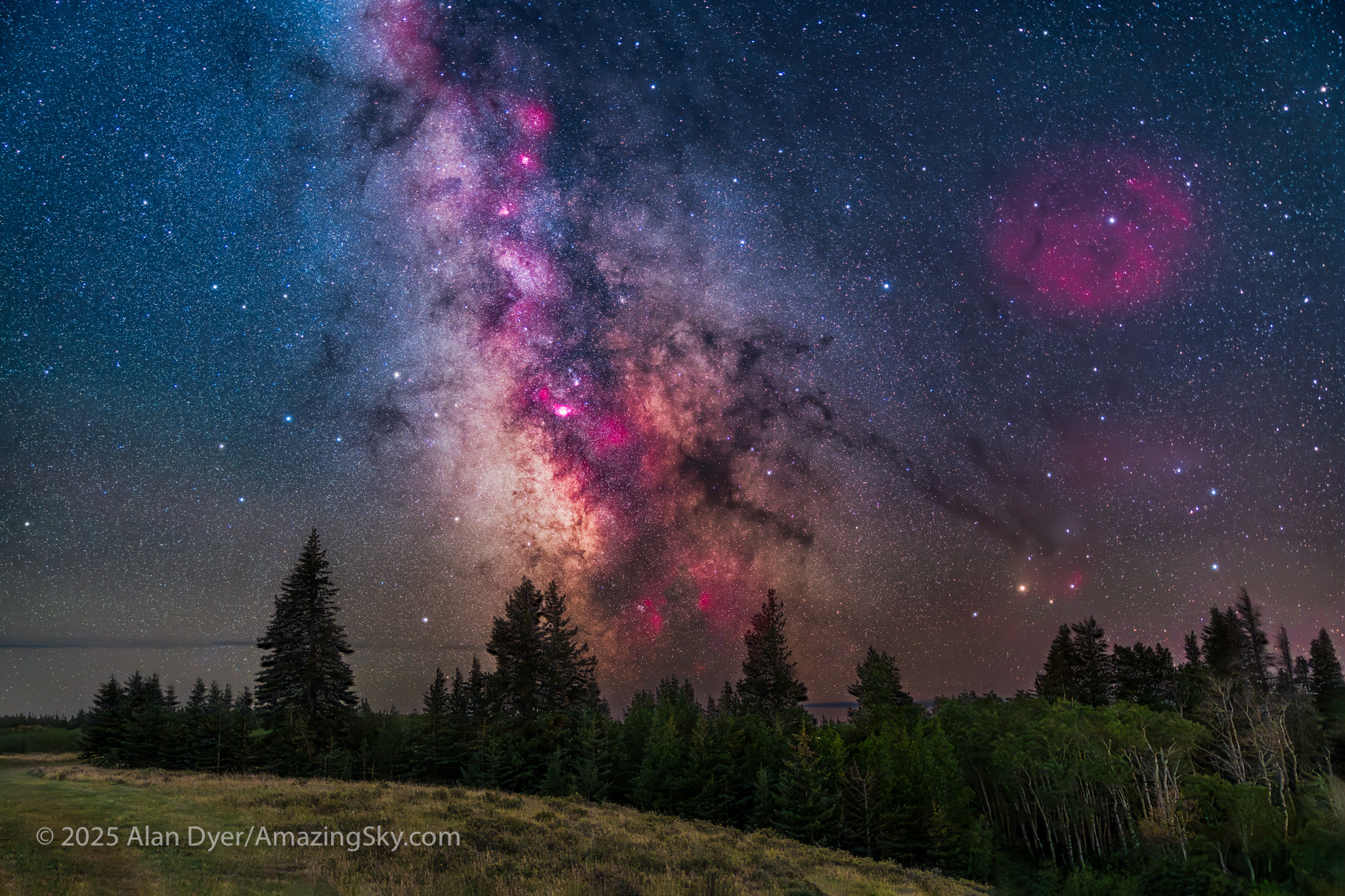
Technical:
This is a blend of:
– A single 2-minute exposure, untracked, for the ground, blended with …
– A stack of 5 x 1 minute exposures, tracked, for the sky, plus …
– An additional tracked 2-minute exposure layered in, taken at the end of the set through an Astronomik “narrowband” H-Alpha clip-in filter, to add the red nebulas.
– All with the Canon RF 28-70mm lens at f/2 and set to 35mm, on the astro-modified Canon EOS R at ISO 1600 (3200 for the Ha shot), and on the MSM Nomad tracker.
Masking and blending all the images, with the trees in the foreground was a challenge! The camera was not moved — all images were from the same tripod position.

This is a technique borrowed from “deep-sky” imaging but now popular among nightscape photographers to create an even more enhanced night sky than a normal unfiltered view.

But even without the filter the long exposures used for the sky record far more detail and colours than even dark-adapted eyes could see. The filter takes that even further.

But those nebulas are there, and they do glow red. Just like the airglow that unaided eyes usually cannot see, the long exposures reveal the unseen, in this case some of the wonderful content of our Galaxy.

And that’s the attraction of astrophotography, to reveal the otherwise elusive or invisible structure of the sky, and in this case juxtaposed over familiar earthly landscapes below.

I can highly recommend Southwest Saskatchewan for anyone interested in stargazing and astrophotography. It’s always been one of my favourite destinations.

— Alan, September 17, 2025 / © 2025 AmazingSky.com
Touring the Constellations of Spring


Join me in a guided tour of the famous (and not so well known!) constellations of the northern spring sky.

The northern spring sky lacks the splendour of bright patterns such as winter’s Orion or summer’s Cygnus, but it is still well worth getting to know. The Milky Way is out of sight, and in its absence we are left with fewer bright stars to dazzle us at night. But we are treated to the year’s best views of famous constellations such as Ursa Major, Leo and Virgo.

Now, I am talking about the sky of the northern hemisphere, where April and May brings spring, and places the Big Dipper high overhead. While some of these constellations can be seen from the southern hemisphere, they appear to the north, low and “upside-down” from the views I present here. And April and May are autumn months.

Let’s start with the “big picture.” (Tap on images to bring them up full screen.)

NOTE: I shot all these images during a run of fine nights in mid-April 2025 with a 15-35mm zoom lens on a Canon EOS R camera, and on a Star Adventurer tracker. Separate exposures through a Tiffen Double Fog 3 filter added the star glows.

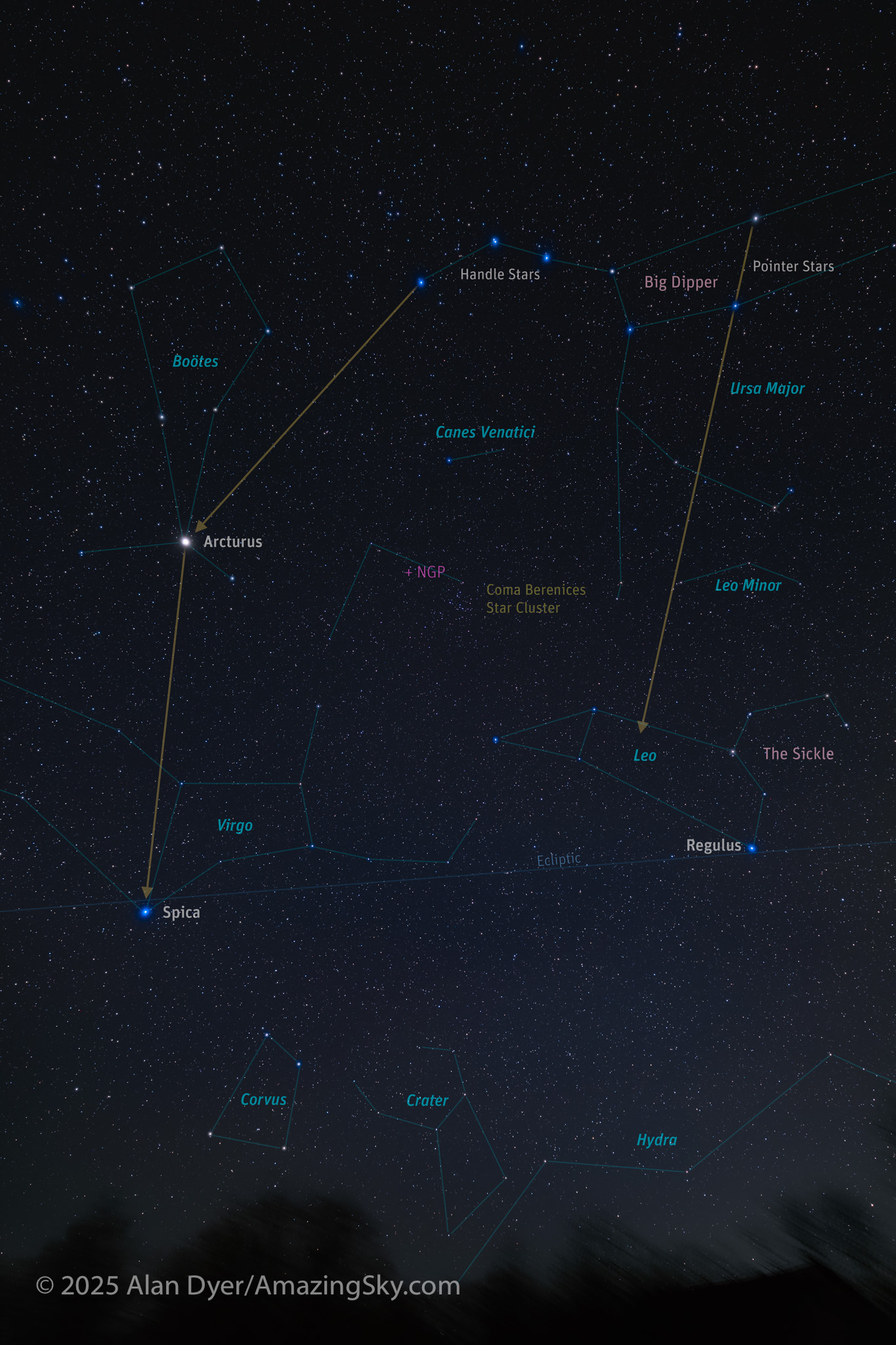
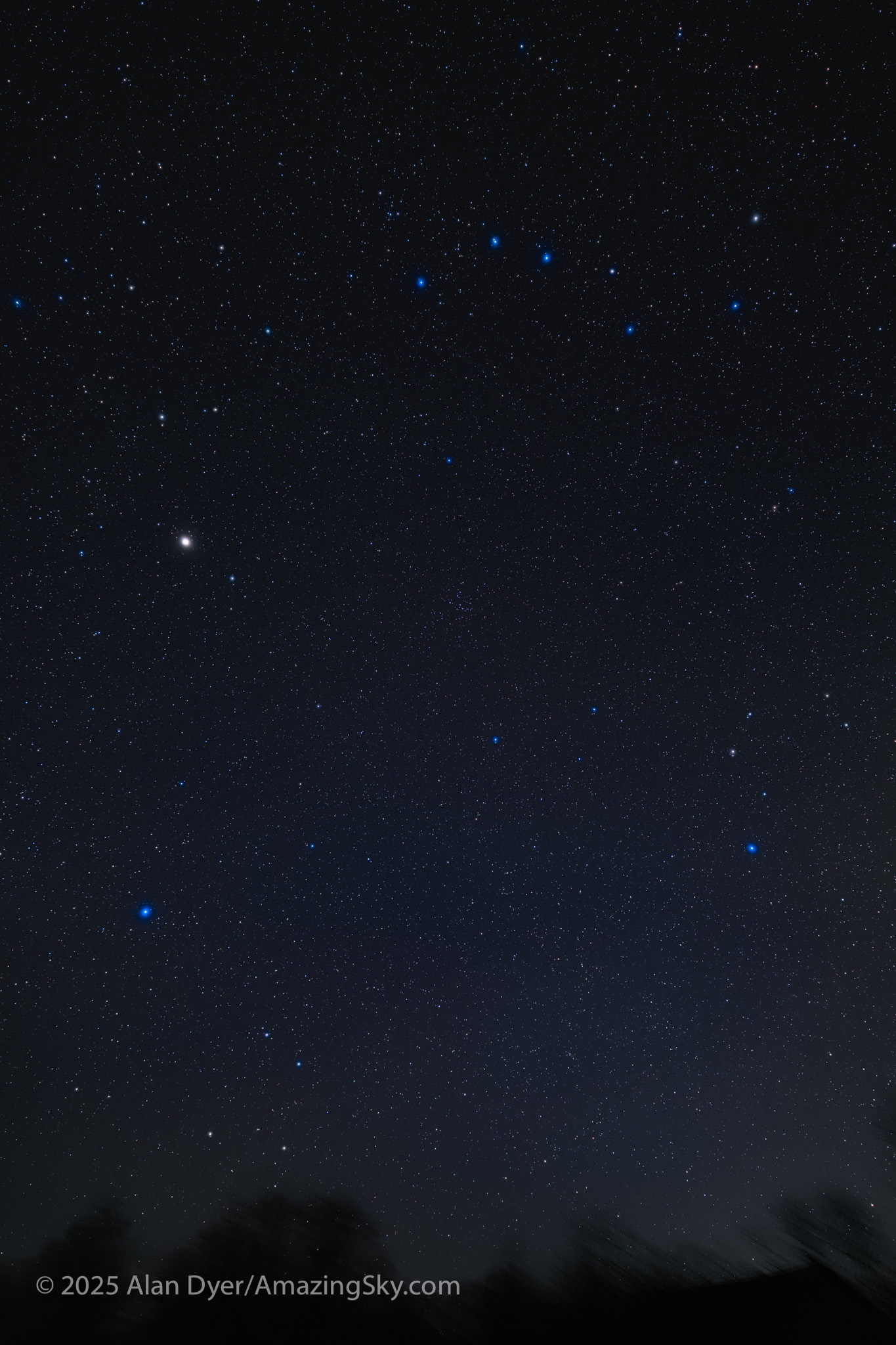
This image, in labeled and unmarked versions, presents a wide view of the spring sky from horizon to well past the zenith overhead. The key pattern to look for is the Big Dipper, at its highest in northern spring. In the UK and Europe it is known as the Plough or Wagon. Look way up to find it first.

Its Pointer Stars in the Bowl famously point north to Polaris. But here I show the other pointer line off the Bowl, to the south, to Leo the Lion. It is well known as one of the constellations of the Zodiac. Leo is marked by one of the brightest spring stars, Regulus.

Use the Handle of the Dipper to arc downward, to locate the brightest star of spring, Arcturus, shining with a yellow light. Keep that line going south and you’ll come to a dimmer and bluer star shining in the south. That’s Spica, the brightest star in Virgo, the Zodiac constellation east of Leo.

Now let’s take a closer look at selected areas.

Ursa Major, Leo and Boötes

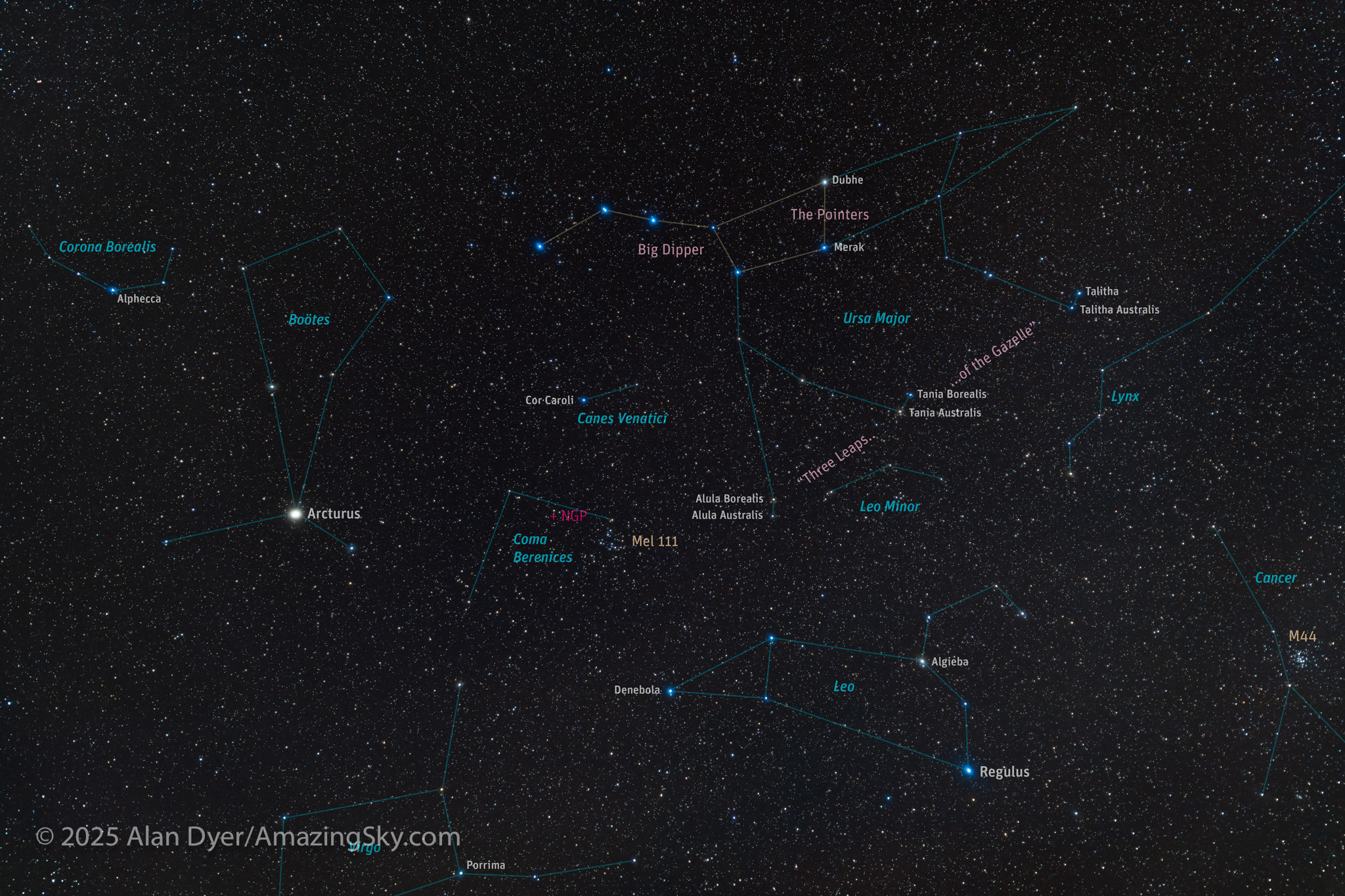
This is still a wide view, looking up and high in the south. There’s the Big Dipper/Plough at top. It is not a constellation. It is an “asterism” of seven stars within the large constellation of Ursa Major, the Great Bear. With a little imagination you can join the dots to make a bear (many northern cultures did so). Except we draw him with a long tail, which bears do not have!

The paws of the Bear are marked by a trio of double stars: Alula Borealis and Australis, Tania Borealis and Australis, and Talitha and Talitha Australis. The names come from Arabic words for “first,” “second,” and “third” as these sets of double stars are collectively called the Three Leaps of the Gazelle in Arabic sky lore. Once you see them you’ll be surprised at how distinctive they are.

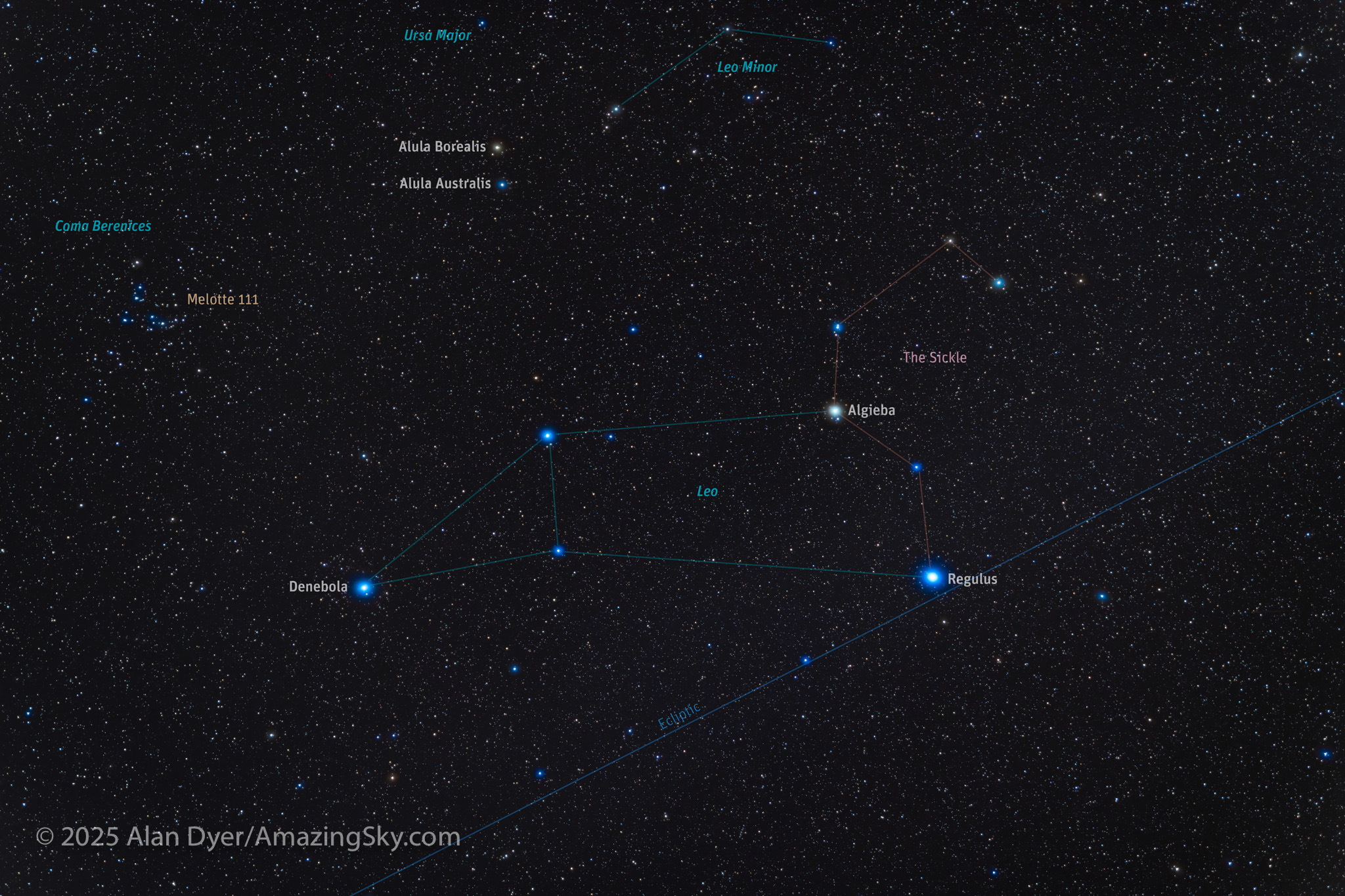
Below Ursa Major is Leo, a pattern that does look a little like a sitting cat. Its bright star Regulus was named by Copernicus, from a Latin word for “little king.” But Regulus has long been known as the heart of the Lion.

To the east lies brighter Arcturus, a name that means “bear watcher,” as it and its host constellation Boötes, the Bear Herdsman, are tied to Ursa Major and Minor in Greek mythology.

Leo, Cancer and flanking clusters

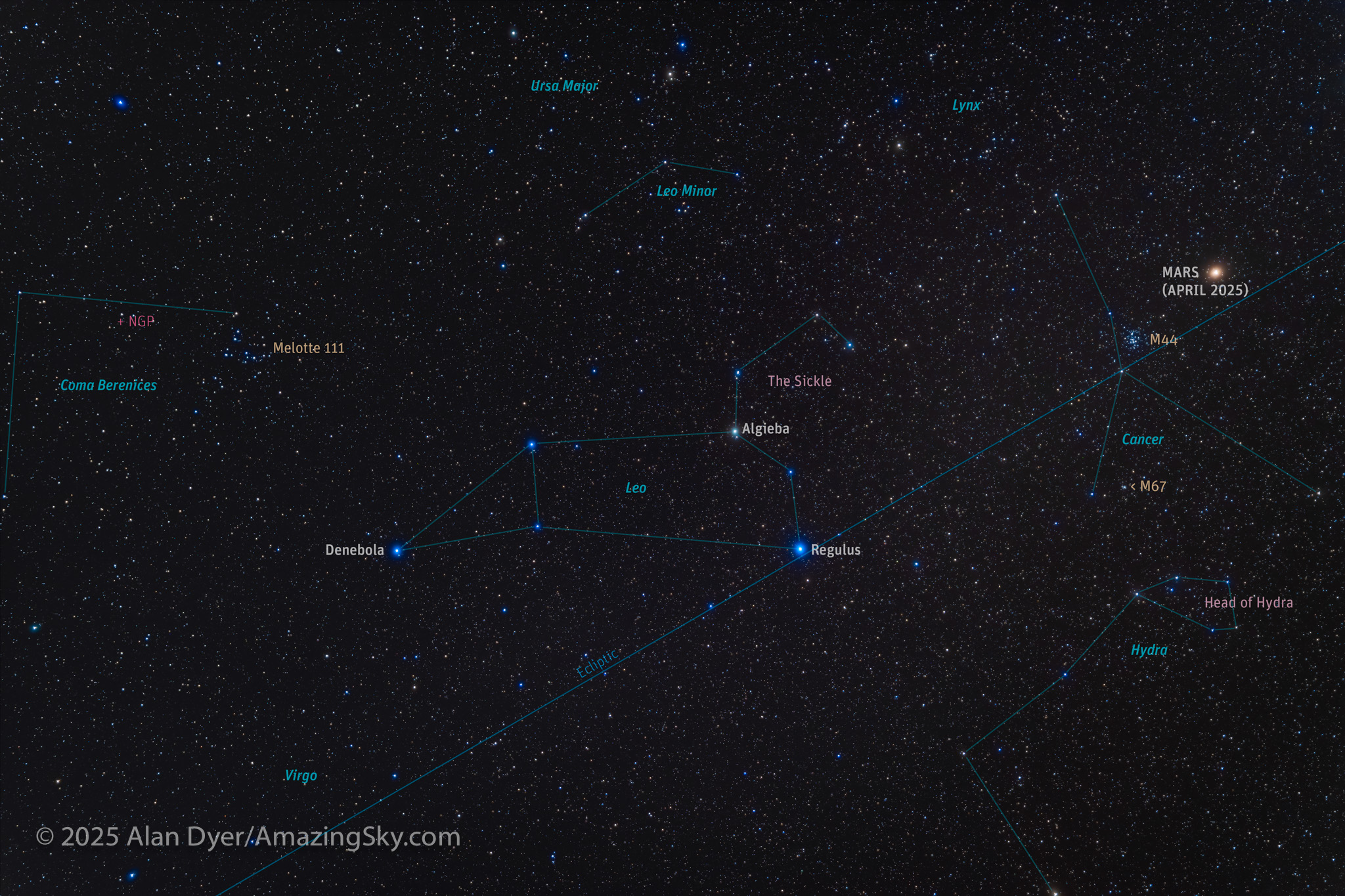
Here I frame Leo, but also two of the constellations that flank him: Cancer the Crab to the right (or west) and Coma Berenices to the left (or east). Each contains a bright naked eye cluster of stars:

  • Messier 44 or the Beehive cluster in Cancer, the faint Zodiac pattern west of Leo. When I shot this image in mid-April 2025 red Mars was just entering Cancer.
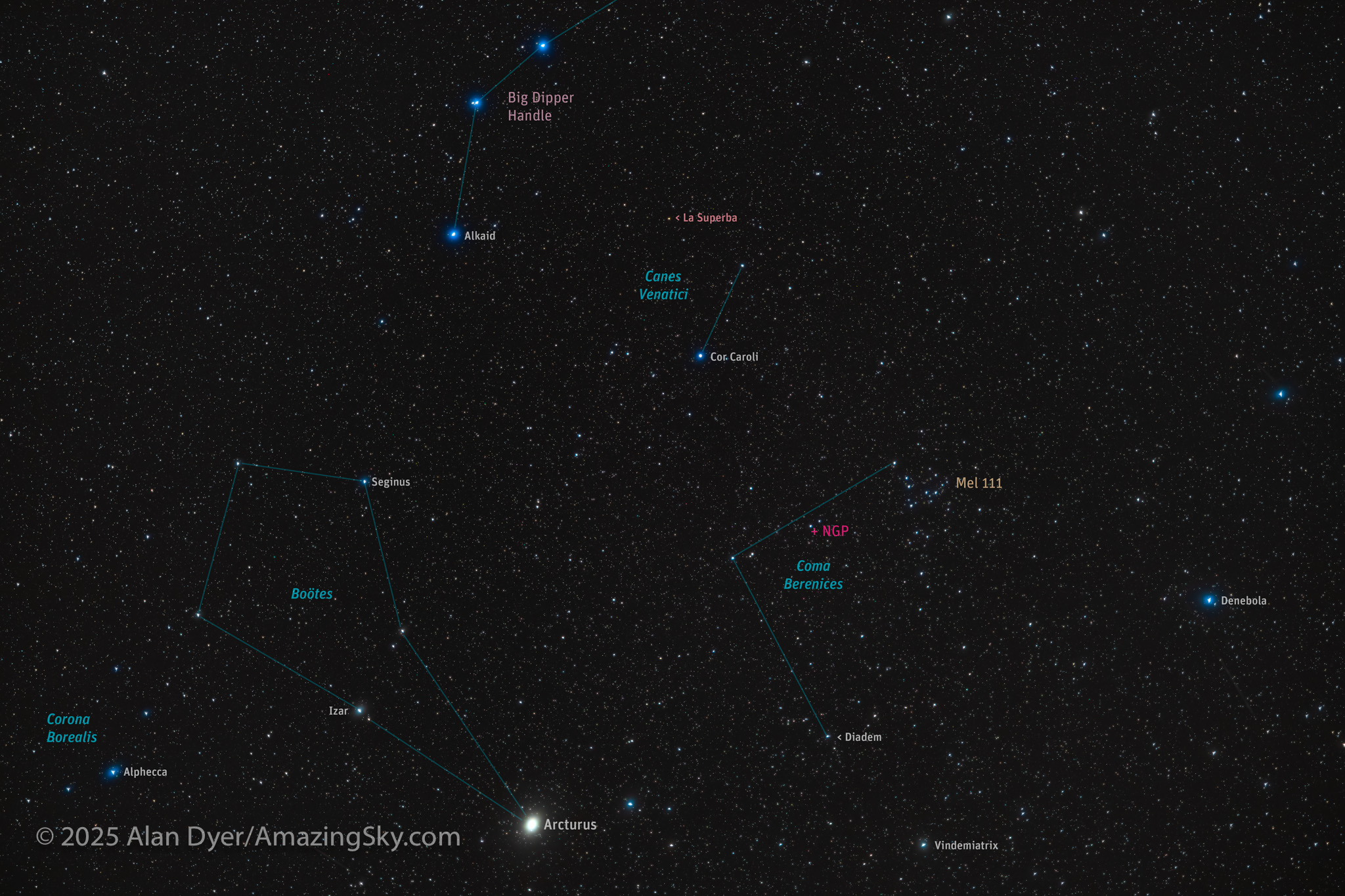
  • and Melotte 111 in Coma Berenices. At one time this clump of stars easily visible to the naked eye was considered part of Leo, as the tuft on the end of his tail. The area was broken off as its own constellation in the 3rd century BCE, and named for Queen Berenice of Egypt, and for her legendary hair (“coma”).
  • Together, the obvious pattern of Leo and the star clusters that flank him form one of the spring sky’s most notable sights.
Leo and Leo Minor

The head of Leo is marked by a curving arc of stars popularly called The Sickle. Or it is thought of as backwards Question Mark, with Regulus the dot at the bottom. Leo is one of the oldest constellations, as there are records of this pattern dating back to 4000 BCE in Mesopotamia.

More modern is the obscure pattern above it, Leo Minor, the Little Lion. It was invented by 17th century star chart maker Johannes Hevelius, to fill in a blank area of sky. Even in a dark sky, it is tough to make out its innocuous pattern between Leo and Ursa Major.

Canes Venatici, Coma Berenices and Boötes

Another obscure pattern created by Hevelius lies below the Handle of the Big Dipper. A sparse pattern of stars marks Canes Venatici, the Hunting Dogs that belong to Boötes to help him herd bears! While not much to look at with the naked eye, Canes Venatici does have superb targets for telescopes, such as the double star Cor Caroli and very red star La Superba.

Below the Dogs lies Berenices’ Hair, home to the star cluster Mel 111, but also the North Galactic Pole (NGP). This is the point 90º away from the plane of the Milky Way and the Galactic Equator seen in our winter and summer skies. But in spring we look straight up out of our Galaxy, to many other telescopic galaxies that inhabit Coma and Virgo, our next stop.

Virgo, Corvus, Crater and Hydra

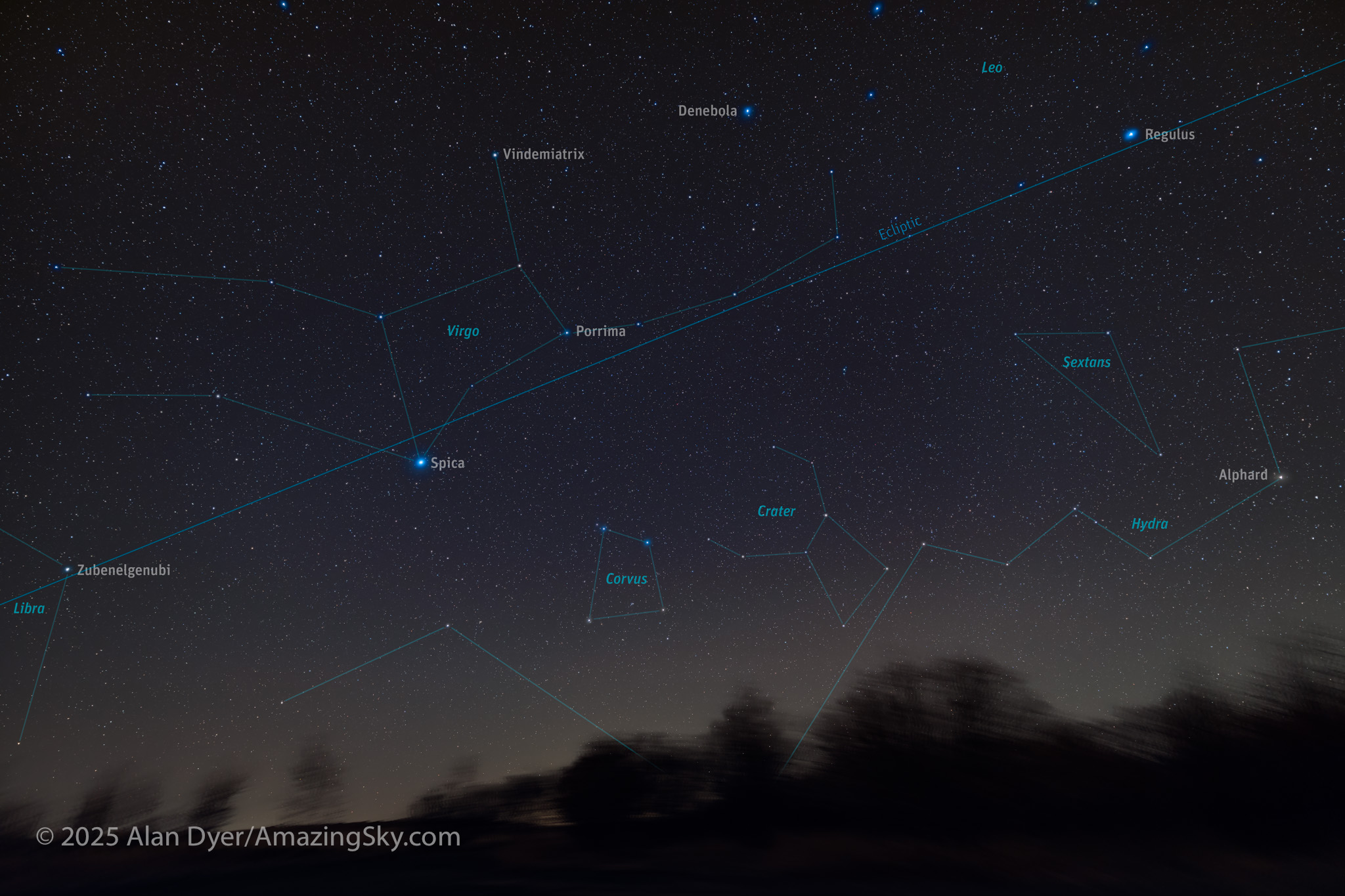
Below Leo and Boötes lies the Zodiac pattern of Virgo, usually thought of as the reclining Greek goddess of agriculture and the harvest. Spica is easy to see, but the sprawling pattern of the rest of Virgo is not so obvious. It takes a dark sky to pick out the other fainter stars of the goddess.

Easier to see, despite its low altitude from northern latitudes (it skims my horizon), is the quadrilateral pattern of Corvus the Crow, a constellation that dates from the 2nd century CE and the star catalogue of Ptolemy. The Crow sits on the tail of Hydra the Water Snake, a long zig-zag line of stars that is only partly contained here. The head of Hydra, off frame to the right here, is in the earlier image of Leo and Cancer.

Another pattern riding the back of Hydra is Crater the Cup, associated with Corvus and Hydra in a Greek myth in which the Crow is sent to fetch water for Apollo but fails. Apollo flings the Crow, Cup and Snake into the sky. Angering the gods could get you immortalized in the sky!

Boötes, Corona Borealis and Hercules

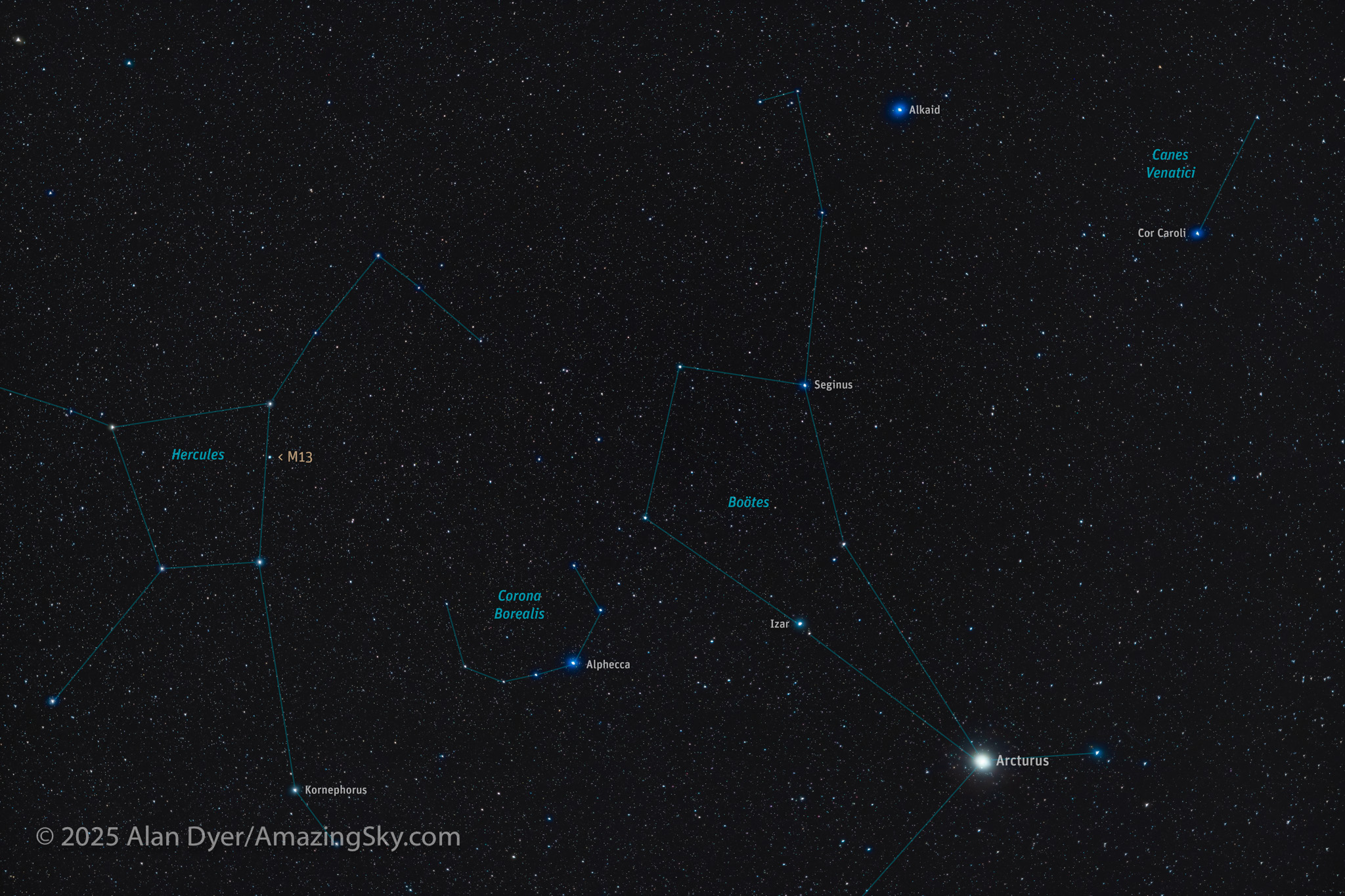
Heading back north above Virgo, we return to the kite-shaped pattern of Boötes above Arcturus, the brightest star in the northern half of the sky. Coming up later on spring evenings, and to the left is a semi-circle of faint stars, the Northern Crown, or Corona Borealis, another of Ptolemy’s patterns from the 2nd century. The crown belongs to the princess Ariadne.

Astronomers have been watching Corona Borealis closely in recent months, waiting for a recurrent nova star to explode and add a new jewel to the Crown. So far, no luck. T CorBor remains stubbornly dim.

To the east of Corona is the H-shaped pattern of Hercules, the Roman name for the Greek hero Heracles. Among his many labours and conquests, he slewed Cancer the Crab and Leo the Lion.

Libra and Scorpius

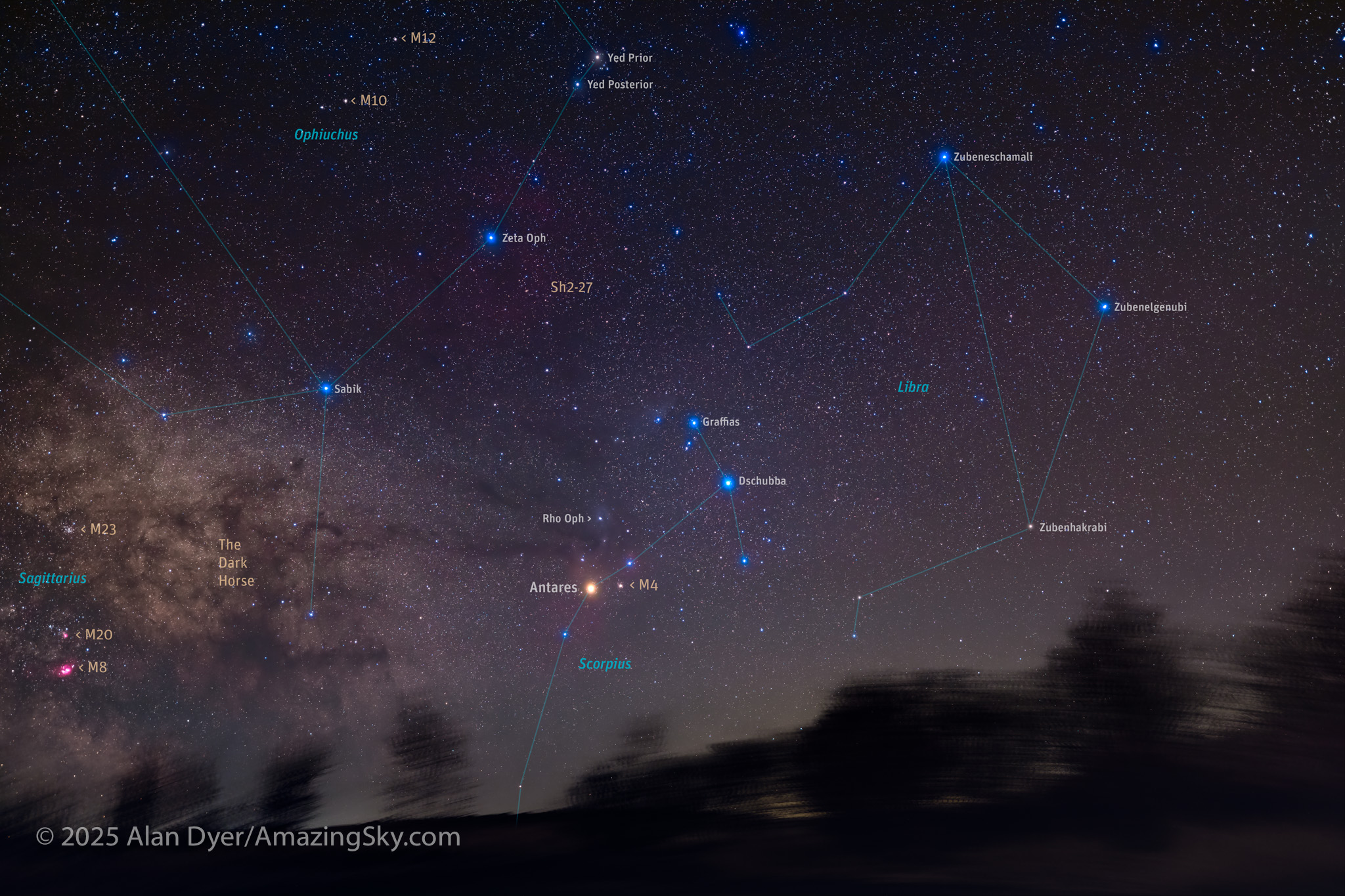
Returning down south and scraping the horizon from my northern latitude late on spring nights are the next two constellations of the Zodiac east of Virgo: Libra the Scales and Scorpius the Scorpion.

Libra is a faint pattern but with the wonderfully named stars Zubeneschamali and Zubenelgenubi, meaning the northern and southern claws, as these stars were once considered part of the Scorpion. However, Libra has long been seen as a balance or scales for meting out justice. It is the only Zodiac constellation that is an inanimate object.

Scorpius is one of the few patterns that looks like what it is supposed to be, though here I see only the northern part of the constellation. His curving tail has yet to rise as the Milky Way comes into view low in the south just before dawn this night. The bright orange star is Antares, the heart of the Scorpion, set in an area rich in dark and colourful nebulas.

The appearance of Scorpius signals the return of the Milky Way to the sky, and the rise of the summer constellations.

But no astronomical life is complete without getting to know the patterns of spring. Clear skies and happy stargazing!

— Alan, April 30, 2025 (amazingsky.com)

Andromeda over Mt. Andromeda


Andromeda over Mt. Andromeda #2

The stars of Andromeda and the autumn sky shine over Mount Andromeda.

This is a photo I’ve been after for several years, one practical to take only in early autumn. Last Sunday night, the skies were ideal.

This is the constellation of Andromeda over its namesake peak, Mt. Andromeda, at right.

The mountain was named in the 1930s by pioneering mountaineer Rex Gibson for the mythological princess. Andromeda is represented in the sky by an arc of stars, here at top centre, stretching from the Square of Pegasus, at right of centre, to Perseus, at left. Just above the main stars of Andromeda lies the oval glow of the Andromeda Galaxy.

The bright object at lower left is the overexposed waning quarter Moon rising in the southeast. Above it are the Pleiades rising.

I shot this from the Forefield Trail just up from the parking lot for the Toe of the Glacier walk to Athabasca Glacier, just off frame to the right. The hills in the foreground are the lateral moraines from the rapidly retreating glacier.

P.S. This my 500th blog post, a major milestone I would think! Thanks for being a fan and reading along. I hope you are enjoying my tours of what is truly an amazing sky.

– Alan, September 17, 2014 / © 2014 Alan Dyer

Canola Field Stars


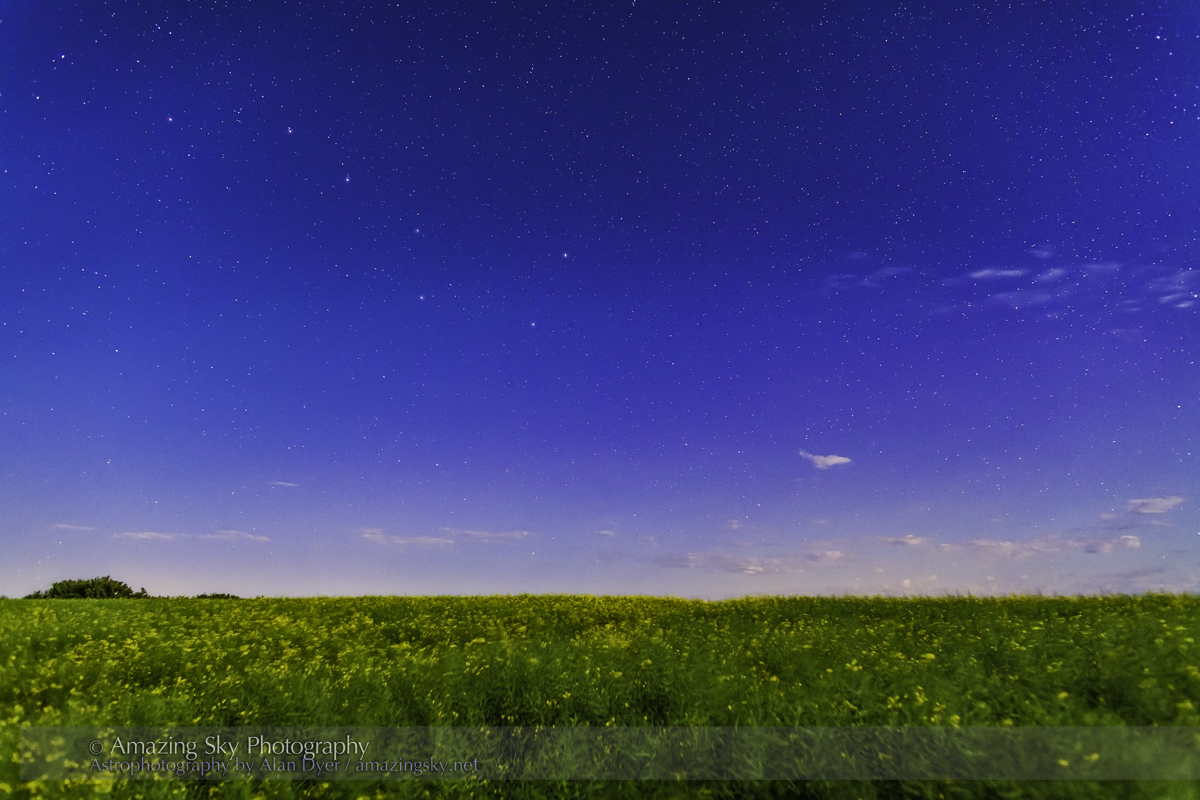
Circumpolar Star Trails over Canola Field (July 26, 2013)

Stars in a blue sky wheel above a ripening field of yellow canola.

It’s been a couple of fine nights of nightscape shooting under the light of the waning Moon and clear skies.

I’ve been shooting from no more exotic location than my local rural neighbourhood, travelling for 5 minutes to spots near one of the many canola fields growing nearby. I wanted to grab some nightscapes over the  fields before they lose their yellow flowers and turn green.

The feature image above looking north is from a time-lapse sequence and stacks several images with the “comet trail” effect, to show the northern stars turning about the North Star.

Big Dipper over Canola Field #2 (July 26, 2013)

This image, also a frame from another time lapse with a longer lens, shows the Big Dipper above that same field but in an exposure short enough to prevent the stars from trailing. You can now make out the familiar Dipper pattern.

This is a very Canadian scene, with the Big Dipper high in a northern latitude sky, and with the foreground crop a Canadian one – Canola was developed in the 1970s at the University of Manitoba. The “can” in canola stands for Canada. Pity there was no aurora.

– Alan, July 28, 2013 / © 2013 Alan Dyer


Moonlight on the Hoodoos


Dinosaur Park Nightscape (May 26, 2013) (16mm 5DII)

The stars shine in a bright moonlit sky over the Alberta Badlands.

My feature image above is one of several still frames I took at the end of 4-hour photo shoot last Sunday at Dinosaur Provincial Park. The nearly Full Moon provides the illumination on an eroded landscape originally cut by water from retreating ice age glaciers.

But the volcanic ash layers hold treasures much older, from 70 million years ago. This area contains the world’s richest collection of late Cretaceous fossils of dinosaurs and other flora and fauna from near the end of the dinosaurs’ reign.

The movie below is a 300-frame time lapse of the stars turning behind the hoodoos. It’s a dolly shot, using the Dynamic Perception Stage Zero rail and controller.

The system works very well, but such shots demand a site with a suitable immediate foreground, as well as a good view to the distant sky. It is the parallax motion between foreground and background that makes a dolly move interesting.

I planned this shot to begin at twilight and continue as the sky was darkening, then into the rest of the night with the Moon rising and lighting up the landscape. The moving clouds were perfectly timed and placed!

– Alan, May 29, 2013 / © 2013 Alan Dyer

Goodbye Winter Sky!


Orion & Winter Sky Setting (24mm 5DMkII)

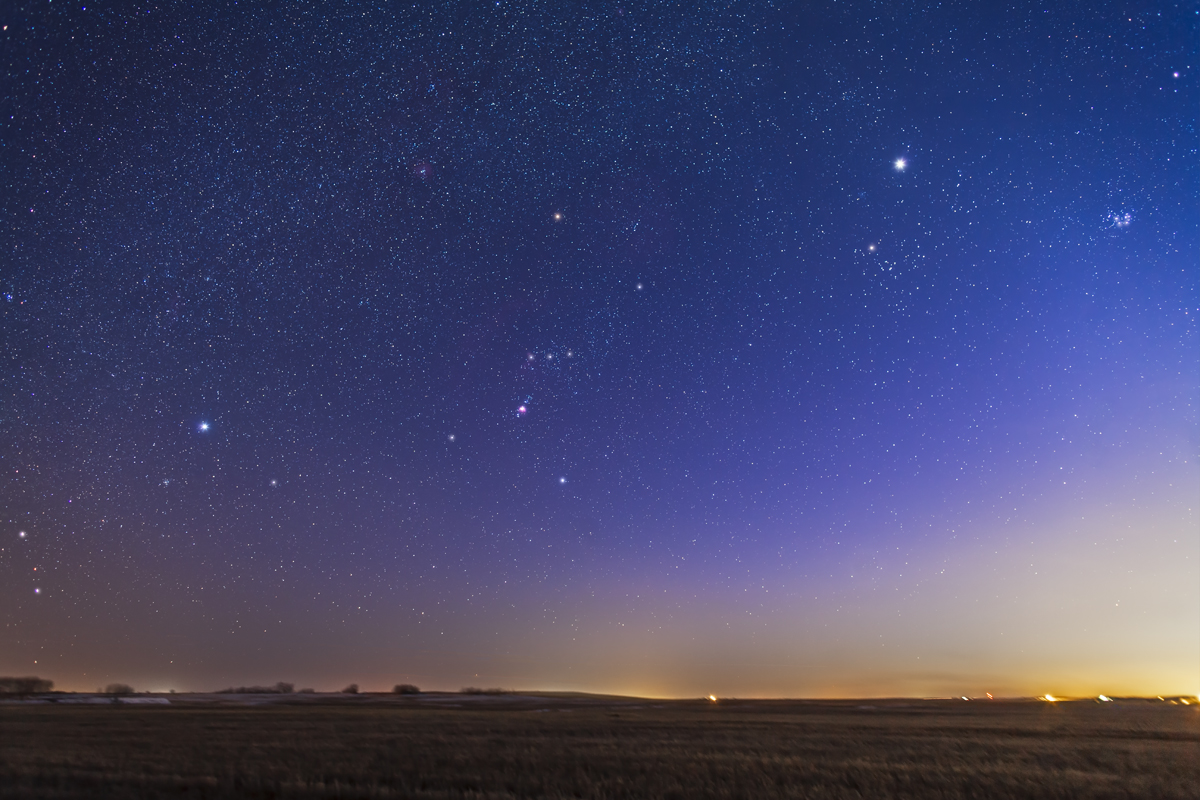
Say goodbye to the winter sky, now sinking fast into the sunset. The departure of Orion and company is an annual sign of spring.

Look west on a clear night in the next couple of weeks and you’ll see this scene, as Orion sinks into the sunset, surrounded by Taurus to the right of him, and Canis Major to the left of him. Taurus is his foe, Canis Major his friend.

Having so many bright stars in the April evening twilight makes for a beautiful scene in the deepening blue. But I suspect most of us are happy to see all signs of winter gone for a long time!

I shot this Monday night, April 1, on a very clear night. Orion’s Belt is just left of centre. The trio of Belt stars points left and down to Sirius, the Dog Star, and points right and up to Aldebaran, the Bull’s Eye. Above Aldebaran is brilliant Jupiter. Just at the right edge of the frame are the Seven Sisters, the Pleiades.

Say goodbye to these stars of winter. We won’t see them again until late summer in the pre-dawn sky.

– Alan, April 2, 2013 / © 2013 Alan Dyer

The Magnificent Milky Way


Sagittarius & Scorpius Over Adobe House (35mm 5DII)

What an amazing area of sky – the centre of the Galaxy hovering over the Earth below.

This was the scene two mornings ago, on our last clear night in New Mexico. This is what’s in the morning sky now and in the evening sky later in July and August. This is the area around Scorpius and Sagittarius and their rich star clouds toward the centre of the Milky Way.

It looks like a scene from an alien planet. But it’s here on Earth, gazing thousands of lights years toward the galactic core.

Enjoy!

– Alan, March 16, 2013 / © 2013 Alan Dyer


A Crisp Winter’s Night Under the Stars


Fish-Eye Winter Sky (8mm 5DII) (Feb 7, 2013)

It was crisp and frosty night filled with the bright stars of winter, and the Milky Way.

This was the sky from my backyard on Thursday, February 7, with Orion and his friends shining due south. It is a “fish-eye” shot taking in all of the sky from horizon to horizon. South is at bottom, north to the top. West is at right, east to the left.

The Milky Way runs from northwest, at top right, to southeast, at bottom left. When we look at this section of the Milky Way we are looking in the direction opposite the galactic core, toward the outer arms of our Galaxy.

Jupiter is the brightest “star” in the image, shining in Taurus. Rising out of the sky glow from towns to the west of me is the pillar of light called the Zodiacal Light. I think you can follow it stretching all the way across the sky from right to left (west to east) where it then becomes a subtle bright patch in the sky well east of the Milky Way. That’s the Gegenschein, a glow of light exactly opposite the Sun. It and the Zodiacal Light are caused by sunlight reflecting off comet dust in the inner solar system.

A night when you can see the Zodiacal Light and Gegenschein – they were visible to the unaided eye – is a good night indeed. Too bad this one was spoiled by some cloud and haze, reflecting the toxic yellow glow of ever-intruding sodium vapour lights.

Silhouetted in the sky glow at right is one of my telescopes, with camera #2 dutifully taking a closeup image of Orion’s Belt. That picture will be the subject of tomorrow’s blog!

– Alan, February 8, 2013 / © 2013 Alan Dyer