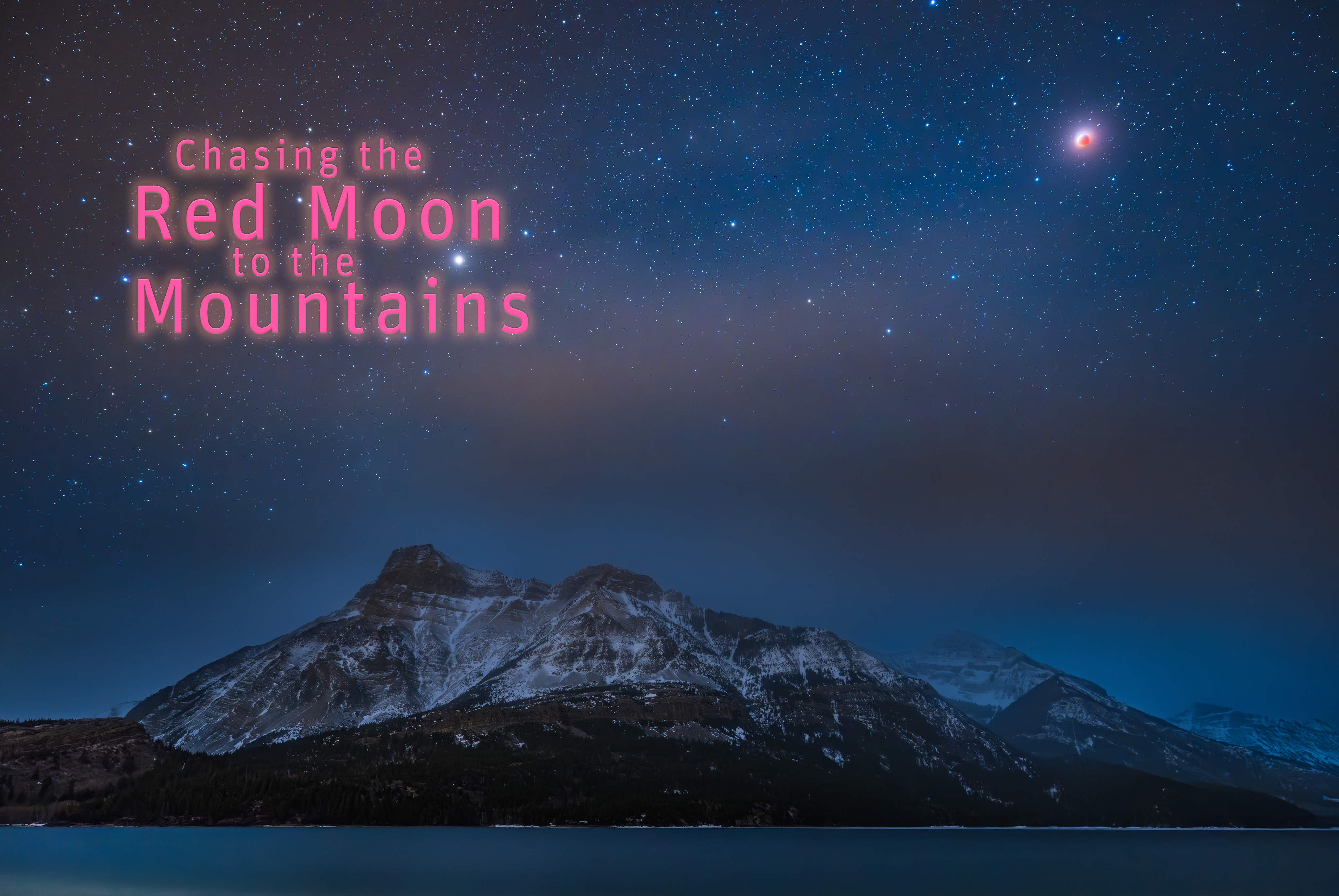
Chasing the Red Moon to the Mountains


It took a last-minute chase, but I managed to capture the total eclipse of the Moon on March 14, 2025.

It would not be an eclipse without a chase. Solar eclipses of the total kind almost always involve travel, often to exotic locales around the world. But total lunar eclipses come to you, as they can be seen from an entire hemisphere of the planet.

Except there’s one problem — clouds! Over the last decade since 2014, of the eight total lunar eclipses (TLEs) I was home in Alberta for, I had to chase into clear skies for all but one. A recounting of one such chase from January 2019 is here.

Only for the TLE before this most recent (on November 8, 2022) was I able to stay home to watch it. Though in that case a snowstorm the day before made the roads and travel poor, so I had to stay home. I recounted that eclipse story here. You’ll find links to my other lunar eclipse stories below.

Once again, for the March 13/14, 2025 TLE, weather prospects looked poor. Not just in my area but in many regions of the continent. But there was hope!
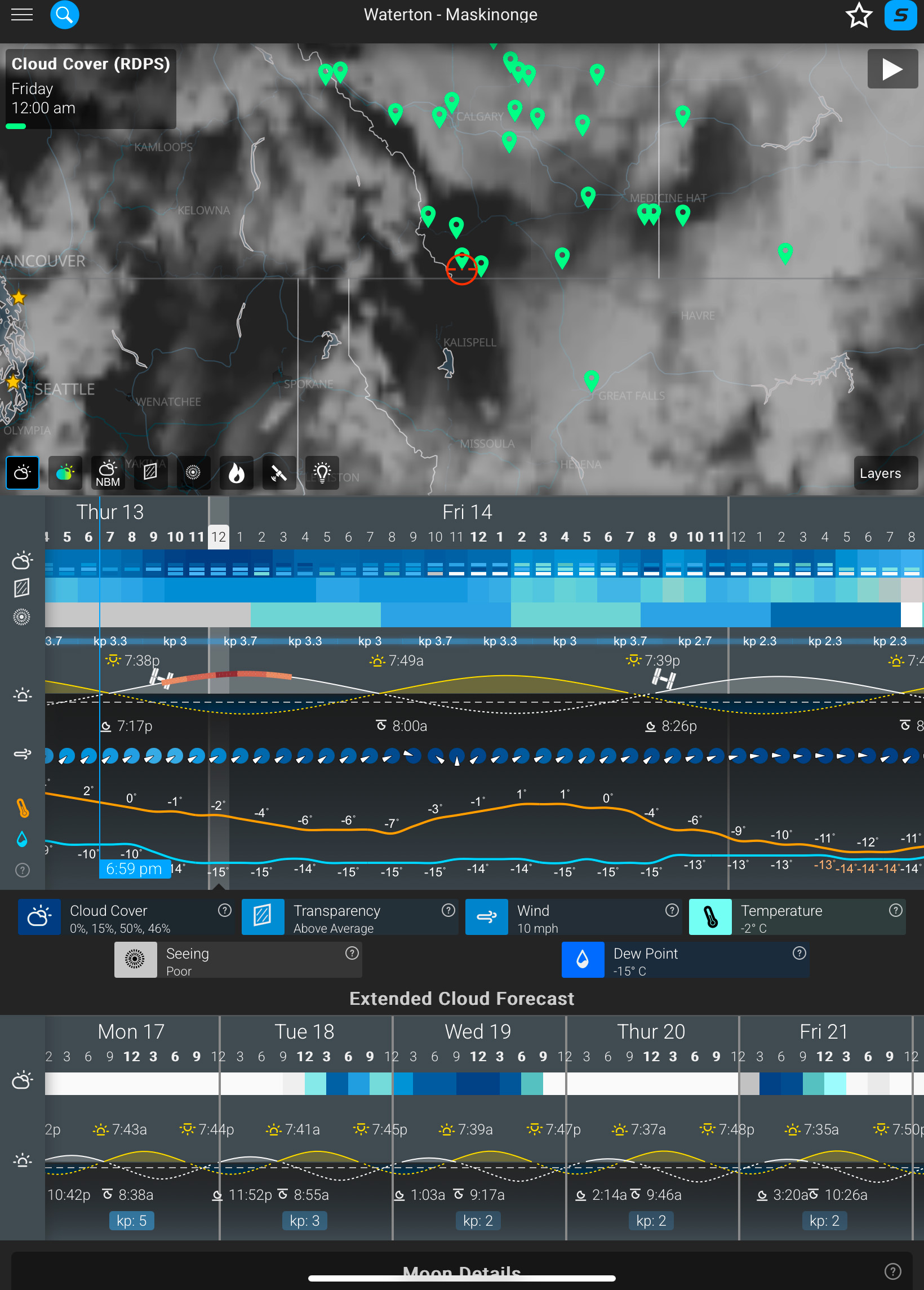
Astrospheric and Environment Canada cloud forecast + Moon information

The forecast cloud cover showed home to be hopeless. But a clear area was supposed to be open in southwestern Alberta, marked by the red circle above. That’s Waterton Lakes National Park, just on the US border. It’s a favourite place of mine for nightscape photography anyway (see my blog from this past summer here).

The chart above from the app Astrospheric shows the clear hole, and the dark blue on the time-line indicates the period with no clouds. Note how it coincides with the wavy line below which shows Moon altitude, with the orange and red regions indicating when the eclipse would take place. Looks good! So I made my plan to chase.

I knew the area well enough to know the site would be a good one for the eclipse, and the Moon’s location to the south. But it pays to check. I use The Photographer’s Ephemeris as my main photo planning app.
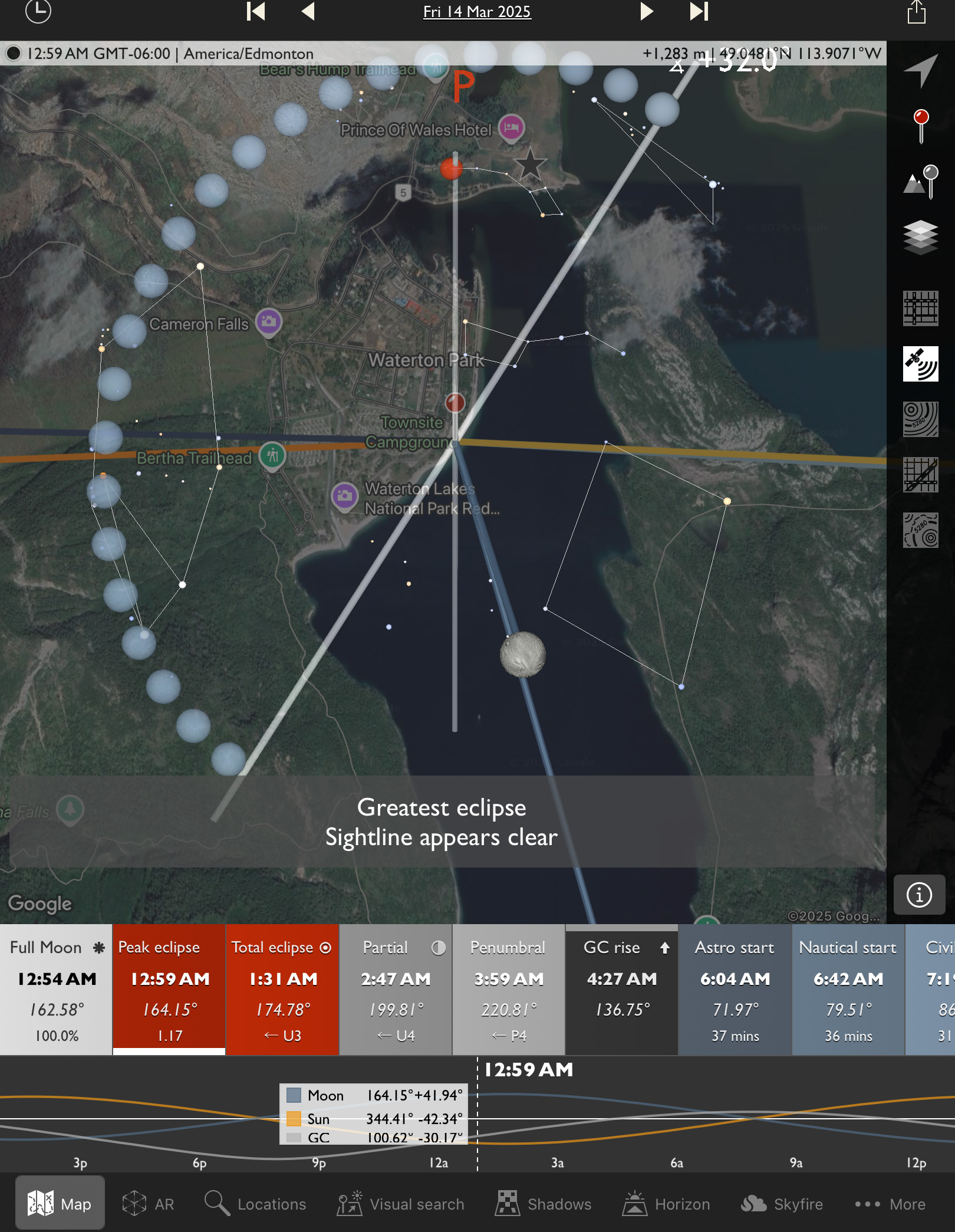
TPE Plot of Sightlines

It showed the sightline toward the Moon during the eclipse as straight down Upper Waterton Lake. My chosen spot was on the lakeside Waterton Avenue, where I could set up both the wide-angle camera and a telescope without having to heft gear any distance. Winter road closures also limited my site choices. Indeed, in winter the Park is quiet, with only a few hotels and restaurants open, and many businesses boarded up.
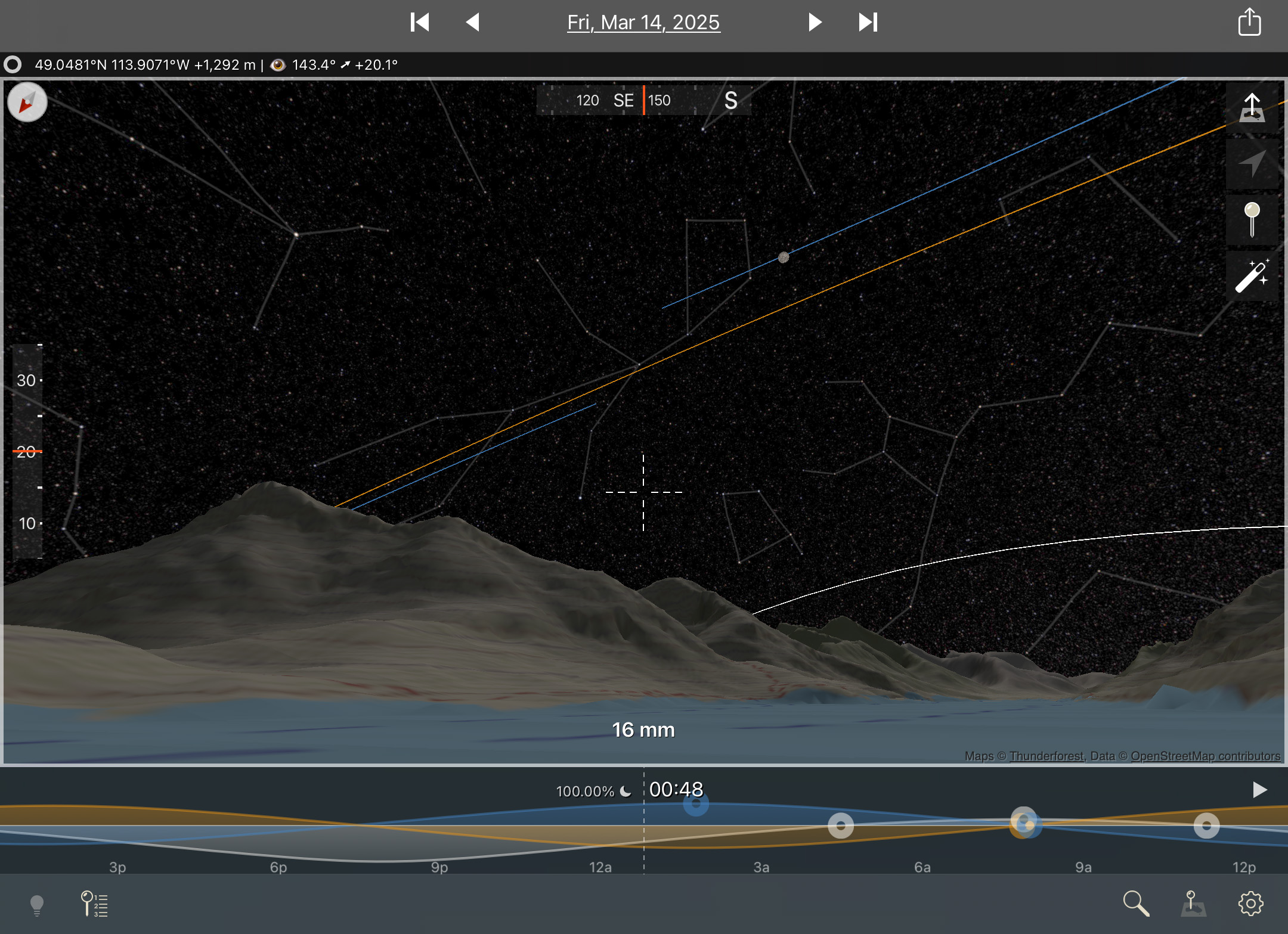
TPE 3D Simulation

Switching to the companion app TPE 3D (above) showed a preview of the landscape and the Moon’s position in the sky relative to the scene below.

Compare the simulation to the real thing below! Pretty accurate, except for the scattered clouds that drifted through.
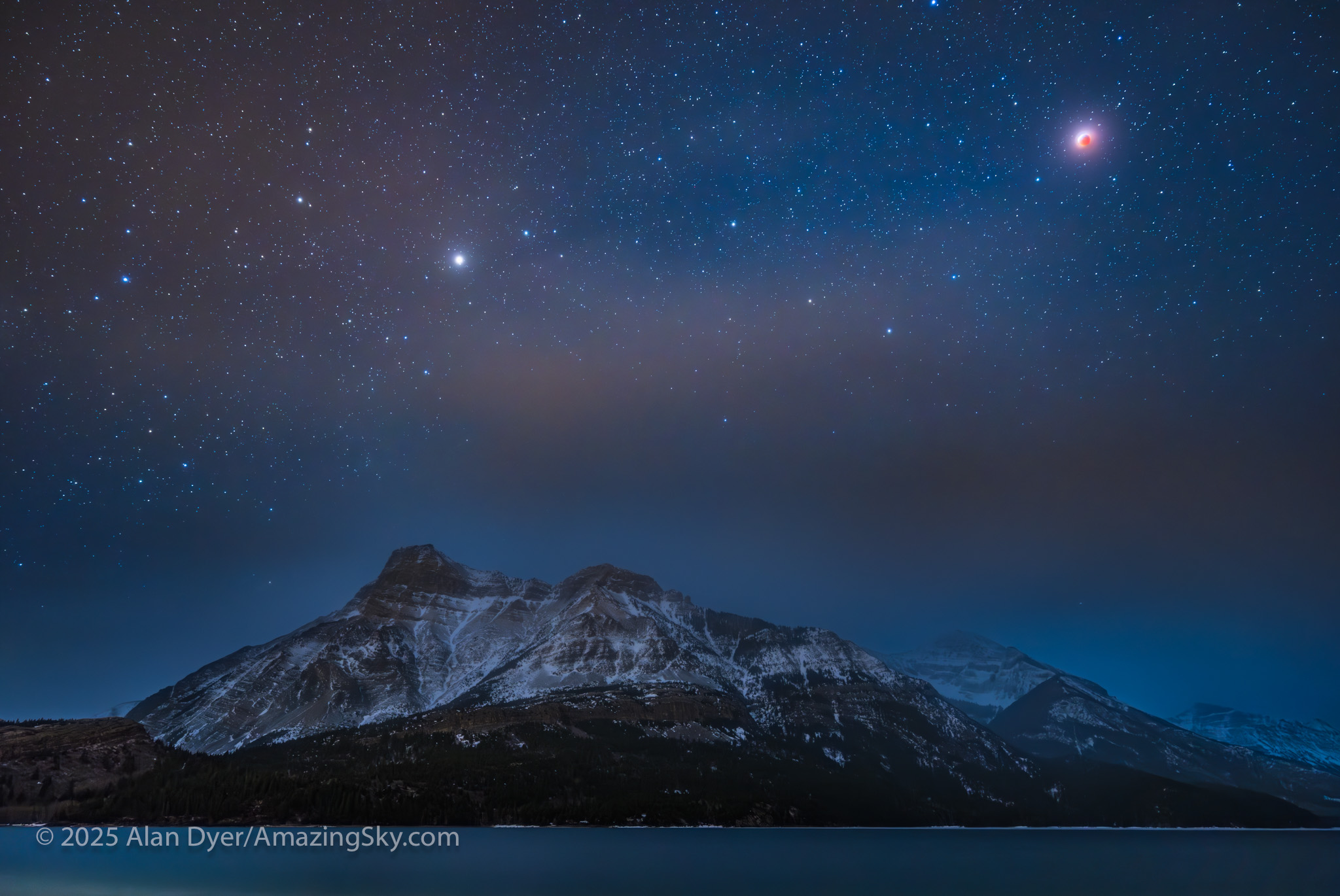
This is a blend of separate images for the sky and ground: a stack of two untracked images for 60 seconds each for the ground, then a third exposure for the sky and untrailed stars, taken immediately afterwards with the tracker motor on, for 30 seconds, all with the Canon RF15-35mm lens wide-open at f/2.8 and at 20mm, on the Canon R5 at ISO 1600. Separate shorter tracked exposures of 15, 8 and 4 seconds blended in kept the lunar disk from overexposing, showing it more as the eye saw it.

The above image is a blend of tracked exposures for the Moon and sky, with untracked exposures for the ground. I shot them just before mid-totality at 1 am MDT. That image was second in priority. First, was a panorama. That result is below.
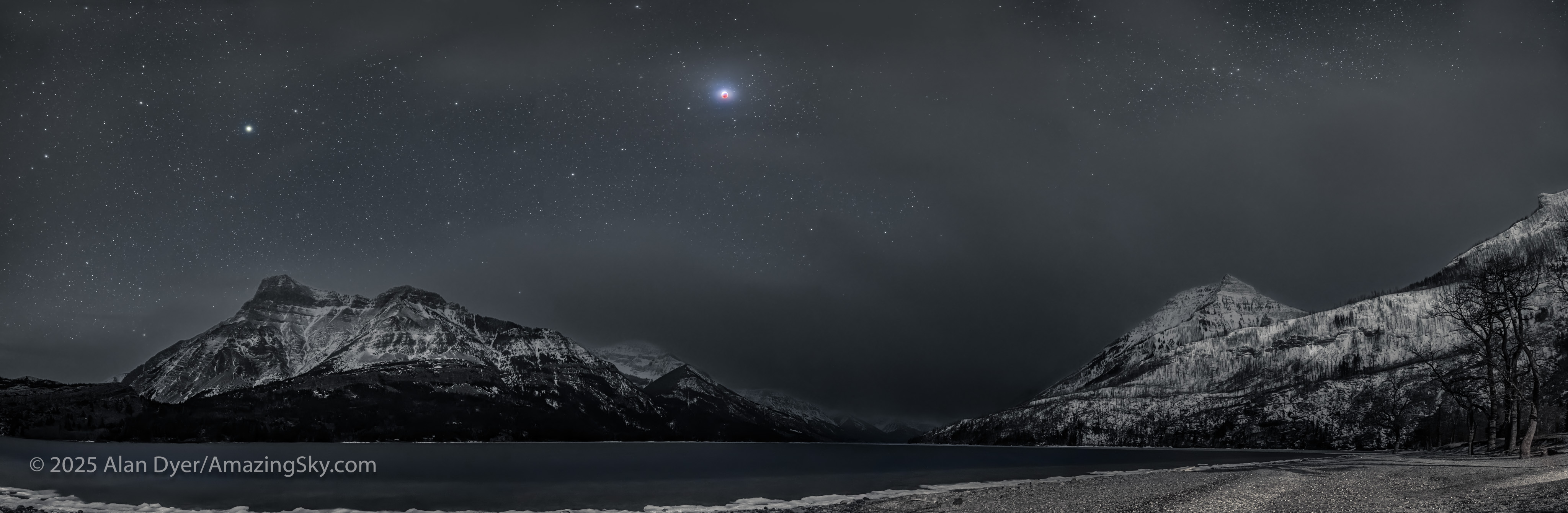
This is a panorama of four segments at 30º spacing, taken in two passes: first untracked for 30 seconds each, then a second pass immediately afterwards with the tracker motor on, also for 30 seconds each, all with the Canon RF15-35mm lens wide-open at f/2.8 and at 20mm, on the Canon R5 at ISO 1600, with the camera in landscape orientation. Separate shorter exposures of 15s, 10s, 5s and 2.5s at ISO 400 were blended in to preserve the lunar disk more as the eye saw it.

I shot this scene just as totality began, to ensure I got it. While the Moon was in clear sky before totality during the partial phase, sure enough as the Moon became fully eclipsed, the clouds wafting over the mountains threatened to move in and obscure the view.

Luckily, while they did hide the Moon now and then, they opened up enough for good views and images for a few minutes at a time throughout the eclipse.

For the panorama I processed the image for a more monochromatic look, to resemble the naked-eye view, but with the Moon appearing as a red globe in the sky, the only colour in the scene. (I shot the tracked shots with the MSM Nomad tracker I reviewed here.)

The site proved excellent, but it was a cold night! While the temperature was only just below freezing, the brisk Waterton wind off the lake made it a chilly experience watching the eclipse for two hours. I was actually being hit by ice pellets blowing off the lake.

I decided not to set up the telescope for close-ups; the wide-angle images were the priority anyway from such a scenic spot.
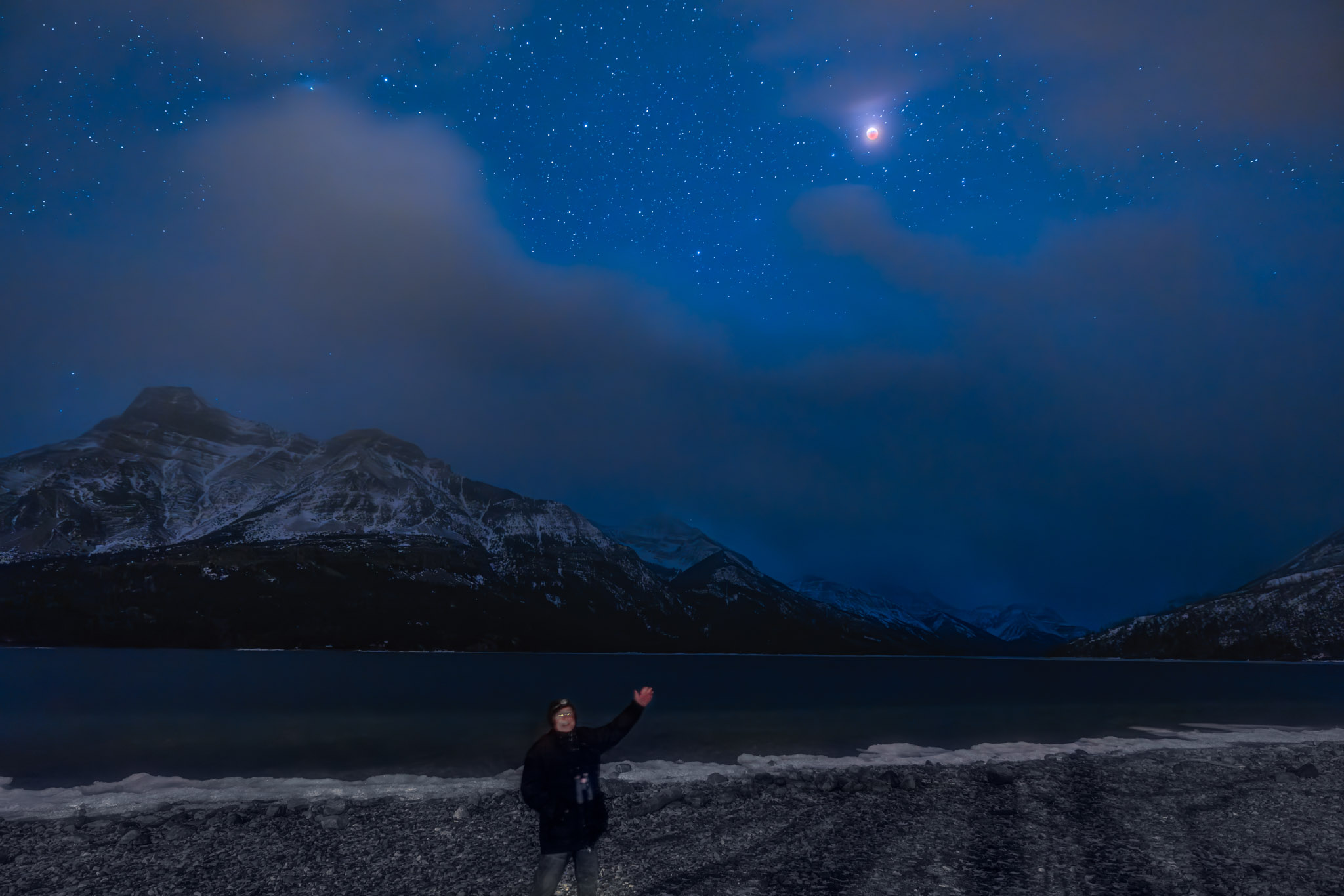
A single untracked 15-second exposure with the RF15-35mm lens at f/2.8 and 17mm on the Canon R5 at ISO 3200.

But I am not complaining. I got the eclipse, once again by chasing to where the weather predictions said it would be clear. The above is my requisite trophy shot.

Had I stayed home I would have been clouded out. Had predictions called for clear skies at home, I would not have made the trip to Waterton to enjoy the eclipse over its wonderful scenery.

The next total lunar eclipse is September 7, 2025, six months after this eclipse. But it is visible from the opposite hemisphere to this one, with no part of that eclipse visible from North America. I will not chase that far for a TLE!
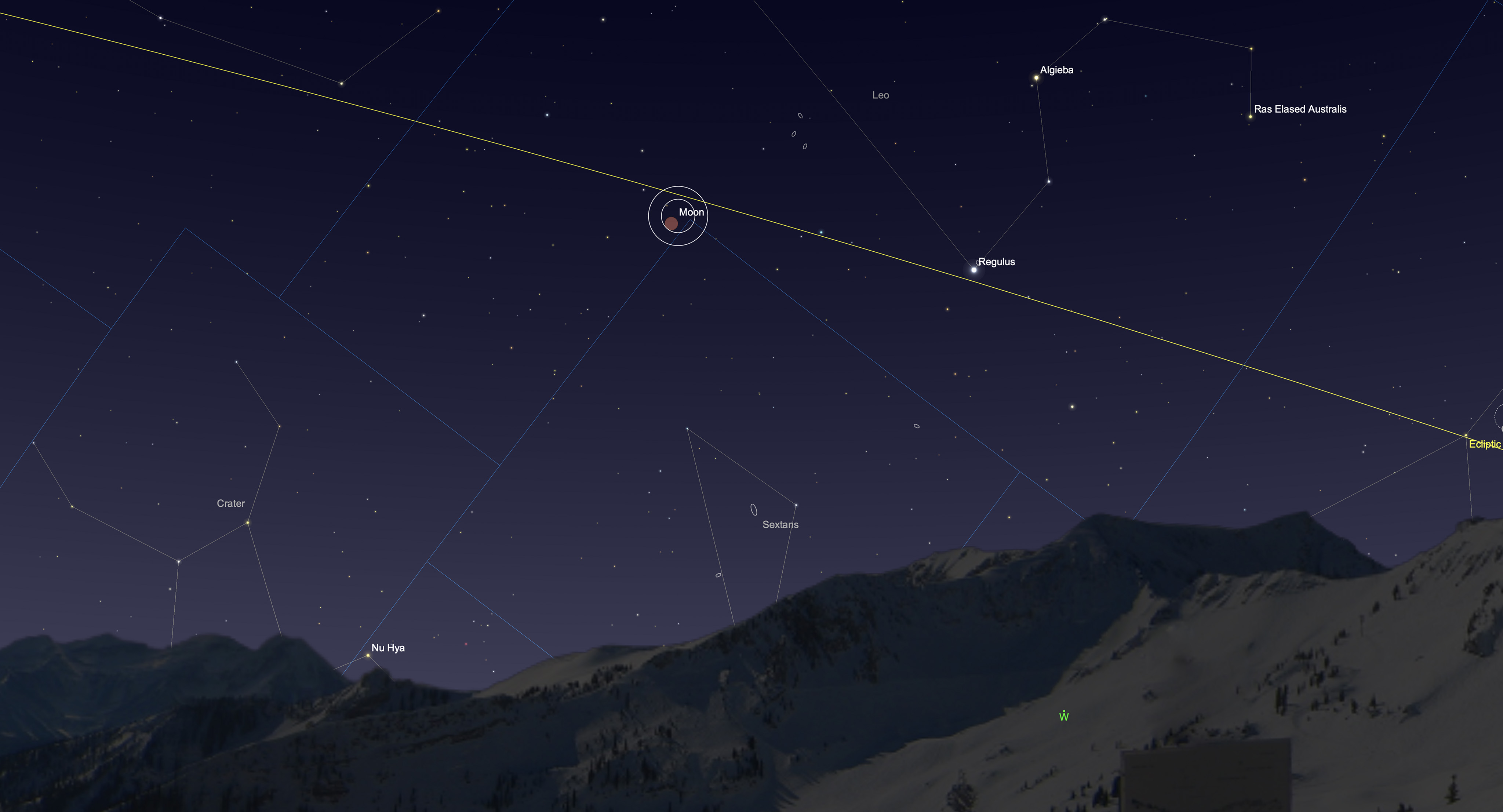
The March 3, 2026 TLE from Alberta

After that, and after a passage of one lunar year (355 days or 12 lunar cycles) since the March 14, 2025 TLE, I have a chance for another total lunar eclipse from home, with western North America favoured. As I preview above, it’ll be an early morning event on March 3, 2026, with the eclipsed Moon setting in the west in the pre-dawn hours.

Sounds like another chase to a mountain site with the red Moon over the Rockies. That’ll be the plan!

— Alan, March 15, 2025 / AmazingSky.com
A Last Look at the Auroras of Churchill


From February 21 to March 4, 2025 I was at the Churchill Northern Studies Centre for my annual visit serving as an instructor to visiting aurora tourists. I’d been doing the program for ten years, with a year off in 2021 when no one visited!

But I decided this was to be my last year, as it was time to “retire” and turn over the program to a new generation of instructors.

So here I present my last look at the Churchill auroras.

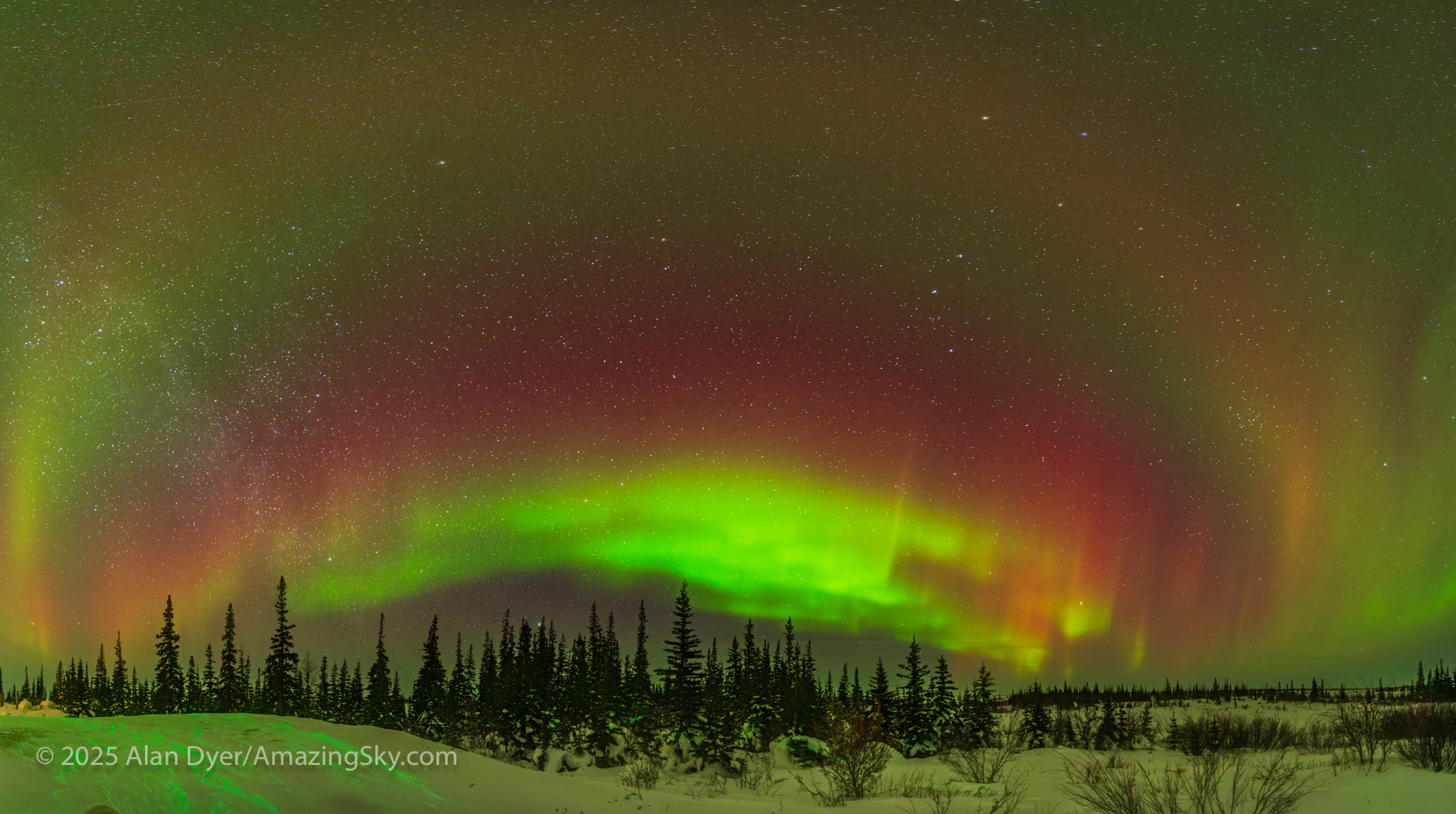
A 180º panorama across the north during an all-night display of Northern Lights, from the Churchill Northern Studies Centre, in Churchill, Manitoba, on February 22, 2025. A panorama of 7 segments, each 13-second exposures with the Viltrox 16mm lens at f/2 on the Nikon Z6III at ISO 1600.

Churchill, Manitoba is on the shore of Hudson Bay at a latitude of 58º North in the sub-Arctic.

It lies under the normal location of the “auroral oval,” the ring around the North Geomagnetic Pole where there is almost always some aurora happening, even on a quiet night. Churchill is as far south as the auroral oval appears in the world when the oval is in its normal state.

By visiting a site under the oval, aurora tourists are almost guaranteed a show, provided the sky is clear.

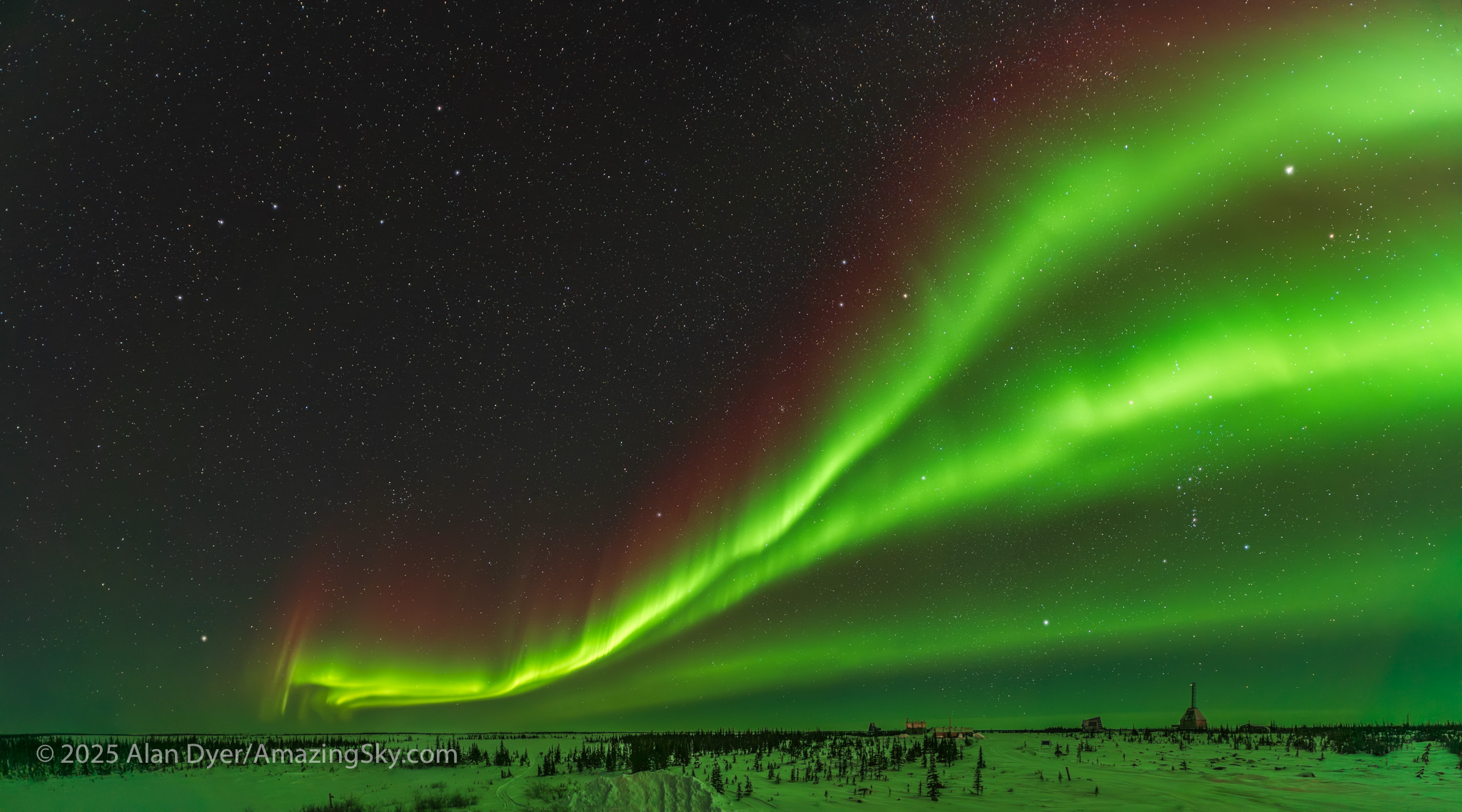
This is a 180º panorama of the Northern Lights across the northern, eastern and southern sky on February 27, 2025 during a Kp4-level display. This is a panorama of 3 segments, each 13-second exposures at f/2.8 with the Laowa 10mm lens on the Nikon Z6III at ISO 1600.

In winter in Churchill, the cold usually brings clear skies. In a decade of conducting programs I’ve only ever had one group clouded out for all five nights of the program. That’s a far better average than locations such as Iceland.

This is a 120º panorama of the Northern Lights across the northern sky on February 26, 2025 during a Kp3-level display. This shows some fine ray structure in the curtains. This is a panorama of 2 segments, each an 8-second exposure at f/2.8 with the Laowa 10mm lens on the Nikon Z6III at ISO 1600.

While several excellent travel companies and local businesses offer aurora tours to Churchill, signing up to one offered by the Northern Studies Centre offers some major advantages.

Notably, guests stay at the Centre, some 20 kilometres outside of Churchill on the site of the old Rocket Range. That makes the site dark and free of light pollution.

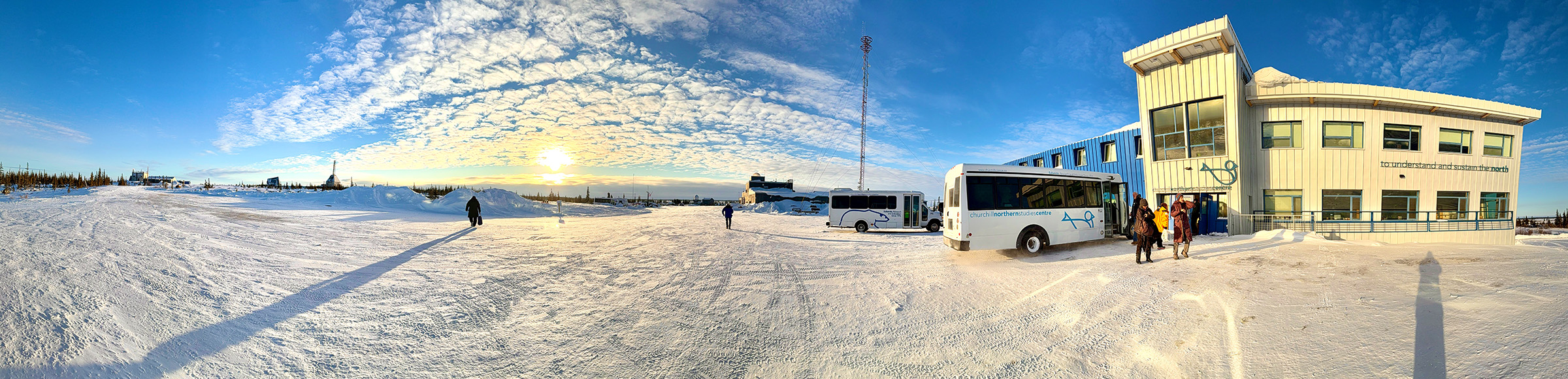
A panorama of the Northern Studies Centre. It has dorm rooms, a cafeteria, classrooms, lounges, a fitness room, library, and all the comforts needed for a great stay under the Lights.

And convenient. Guests sleep on site and need only dress up warm to quickly head outside when the “Lights are out!” call comes. Instructors wake up guests when the Lights don’t appear until late at night, as can often be the case. There’s no driving out to dark sites to wait for the Lights to appear.

A fish-eye 360° view of the fine display of Northern Lights on February 25, 2025, during a substorm outburst with bright curtains to the north. A single 2.5-second exposure with the TTArtisan 7.5mm fish-eye lens at f/2.

An option is also to head up to the CNSC’s rooftop aurora dome for viewing the Lights in warm shirt-sleeve comfort.

Aurora tourists enjoy the show at the Churchill Northern Studies Centre, February 26, 2025. This was the Learning Vacations tour group in late February 2025. This is a single 8-second exposure with the Laowa 10mm lens at f/2.8 and Nikon Z6III at ISO 1600.

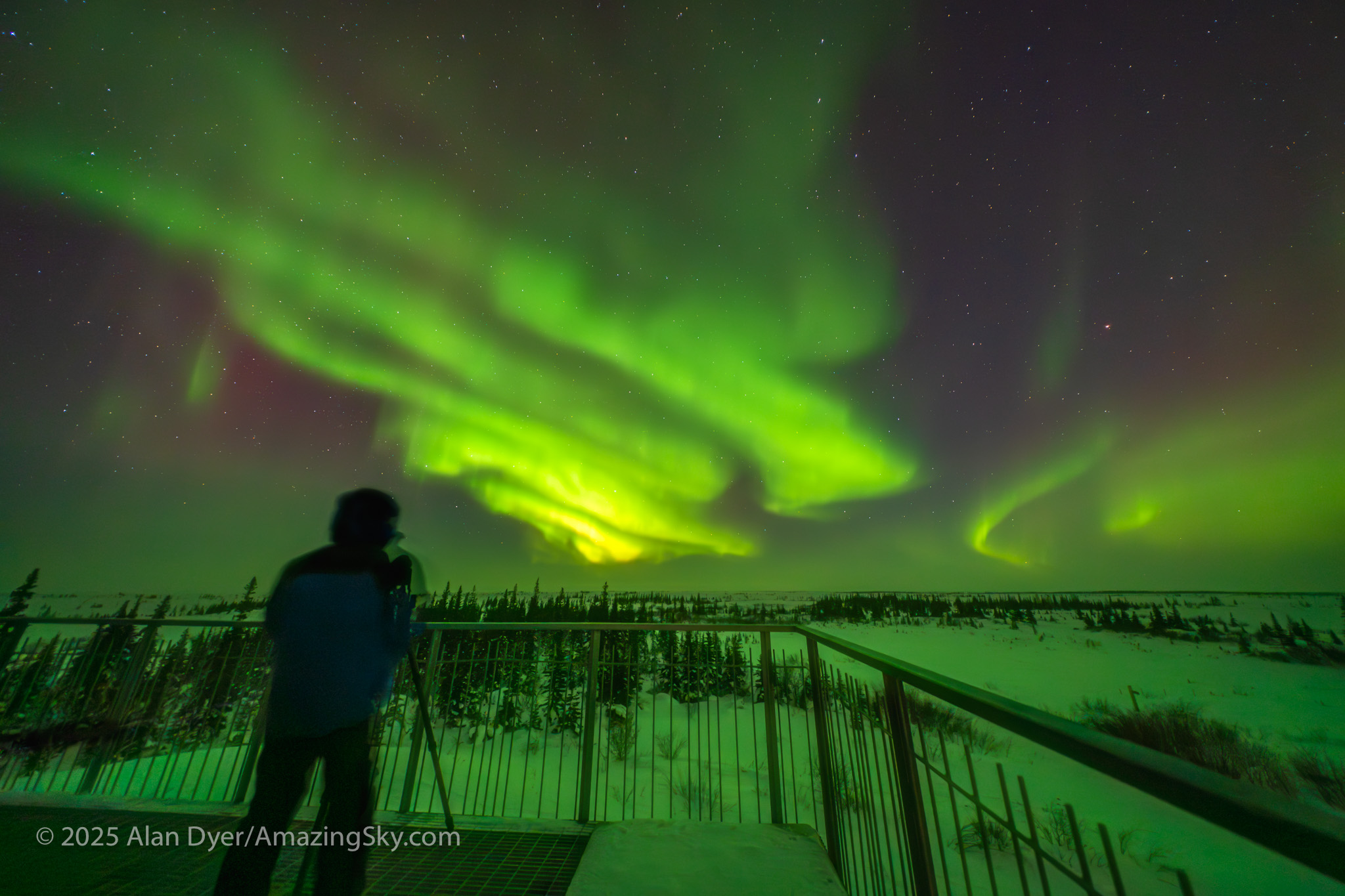
But most guests opt to bundle up and brave the cold for the best experience and unobstructed views of the Lights filling the sky. A convenient option is the second floor observation deck, shown above, and in an image taken from the deck, below.

A photographer is capturing a bright display of Northern Lights at the Churchill Northern Studies Centre. This was the first night of a five-night session for aurora tourists from the Road Scholar education travel company. This is a single 4-second exposure with the Laowa 10mm lens at f/2.8 and Nikon Z6III at ISO 3200.

The program includes nightly science talks about the aurora and night sky. The daytime program includes dogsledding, snowshoeing, a tour of the old Rocket Range, and visits to sites in Churchill such as the murals and museums. It’s a very full five days of programming and learning.

To learn more, visit the CNSC’s Learning Vacations page for the Winter Skies program.

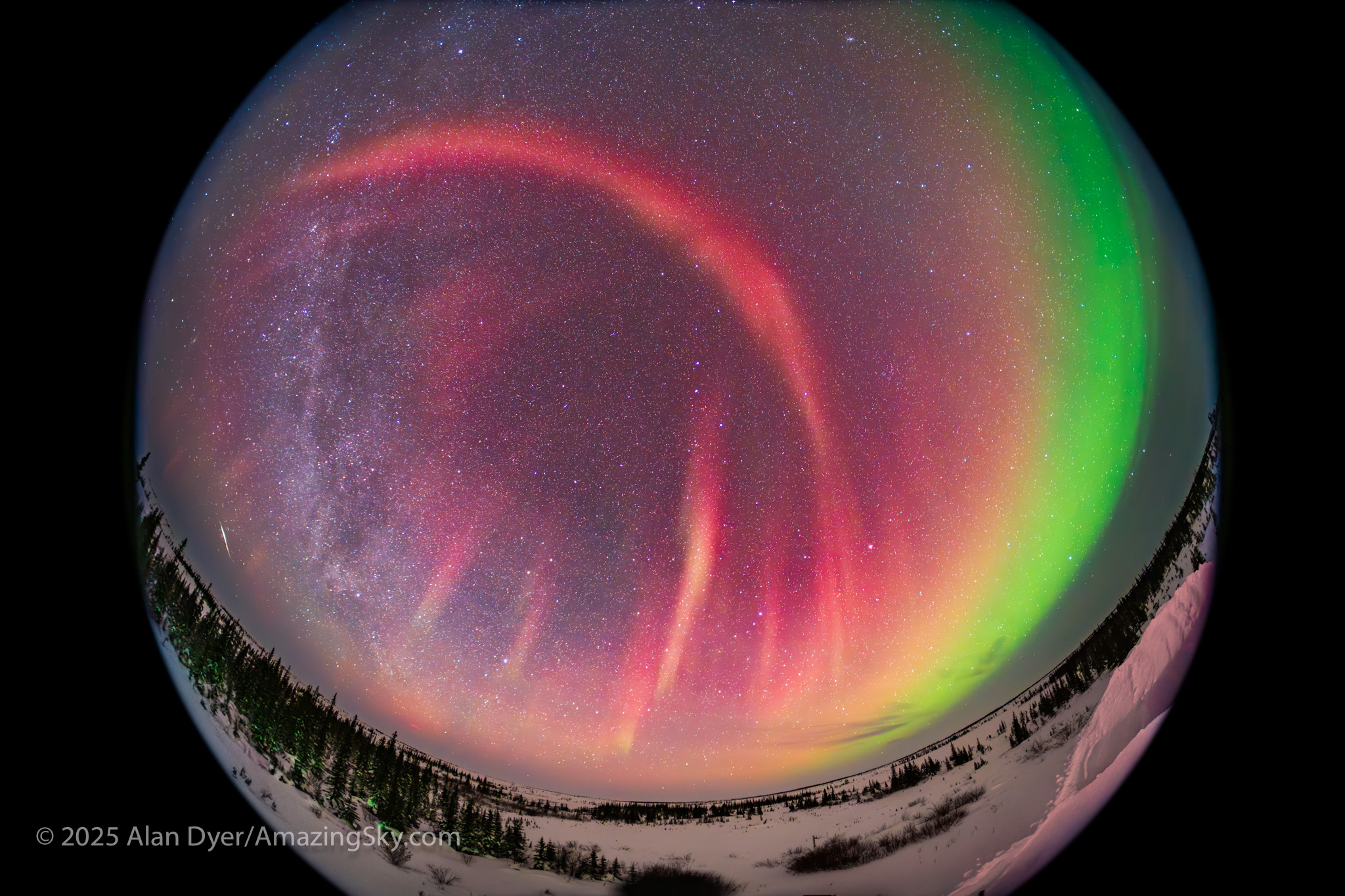
A fish-eye 360° view of a dim and weak display of Northern Lights on February 24, 2025, showing a green diffuse band to the south and a dim red curtain overhead with rays to the east. This red aurora was just visible to the eye as a grey streak. A single long 30-second exposure with the TTArtisan 7.5mm fish-eye lens wide open at f/2 on the Nikon Z6III at ISO 1600.

The main attraction, the aurora, can vary from night to night. However, even when the aurora is weak, as it was this night, above, it can still put on a fine show for the camera, glowing in red colours that only long exposures reveal.

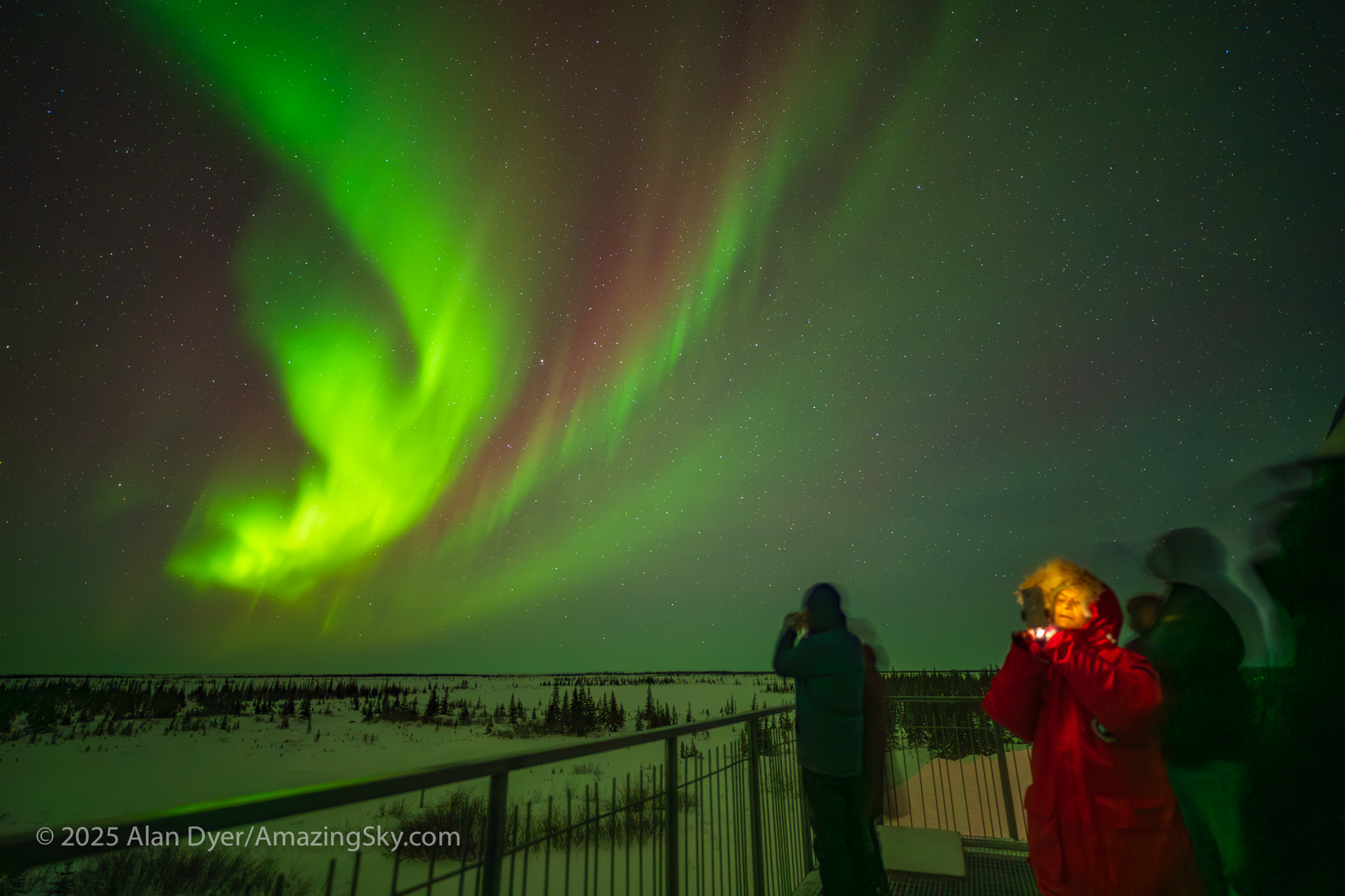
Aurora tourists from the Road Scholar travel company enjoy the show of Northern Lights at the Churchill Northern Studies centre in Churchill, Manitoba, March 1, 2025. This is a 6-second exposure at f/1.8 with the Viltrox 16mm lens on the Nikon Z6III at ISO 1600.

While I use high-end cameras and fast lenses, I’ve been impressed with how well today’s phone cameras can capture the Lights very simply and easily, as a guest is doing above, especially when the aurora is bright.

A band of bright green aurora appears here with some subtle red rays at right and magenta upper curtains at left, with the green glow lighting the snow green. A 10-second exposure with the Laowa 10mm lens at f/2.8 on the Nikon Z6III at ISO 1600.

When the aurora brightens, greens and sometimes pinks are visible to the eye, and not just to the camera. And the aurora exhibits rapid rippling and waving motions (check the video below).

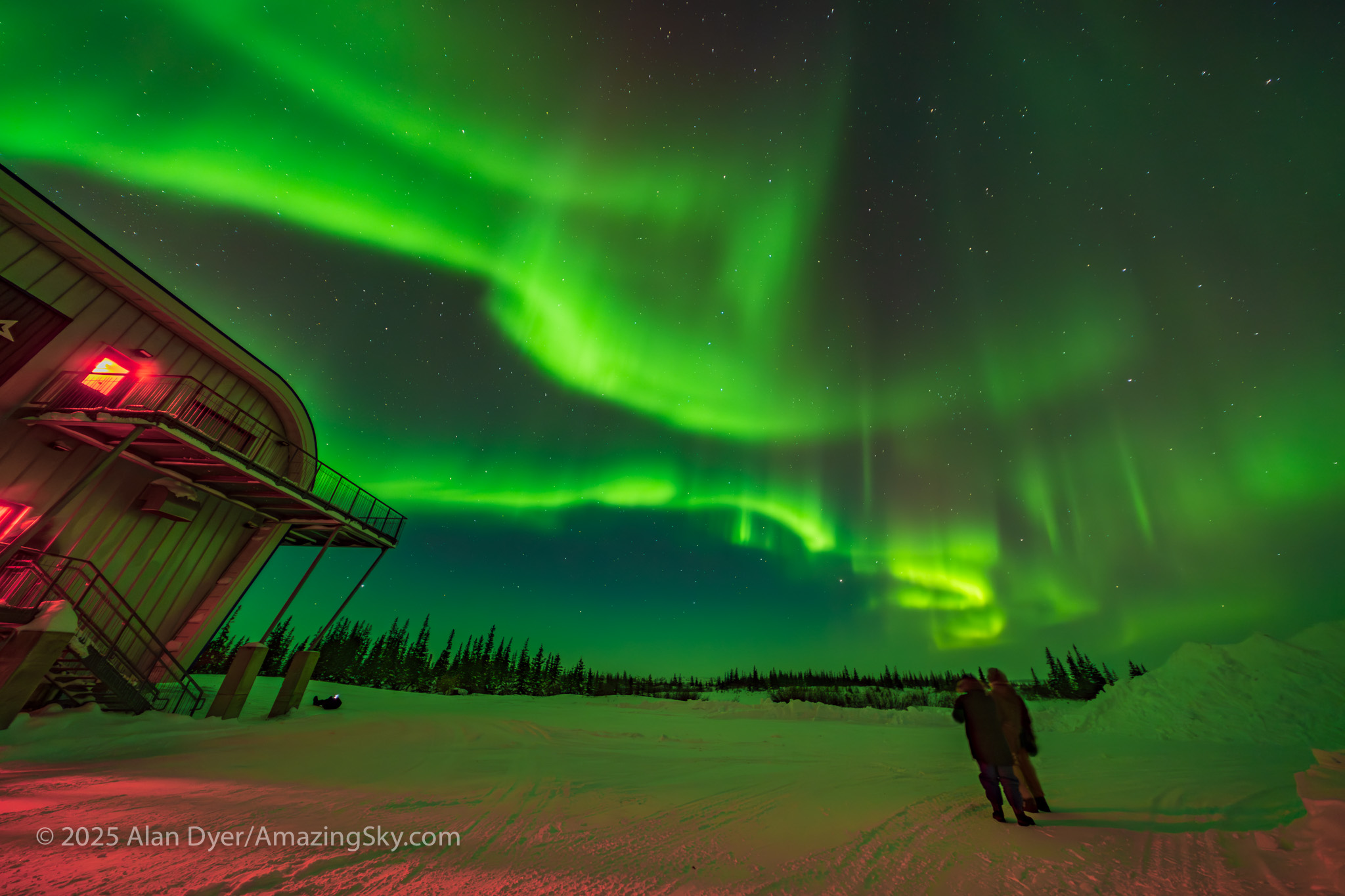
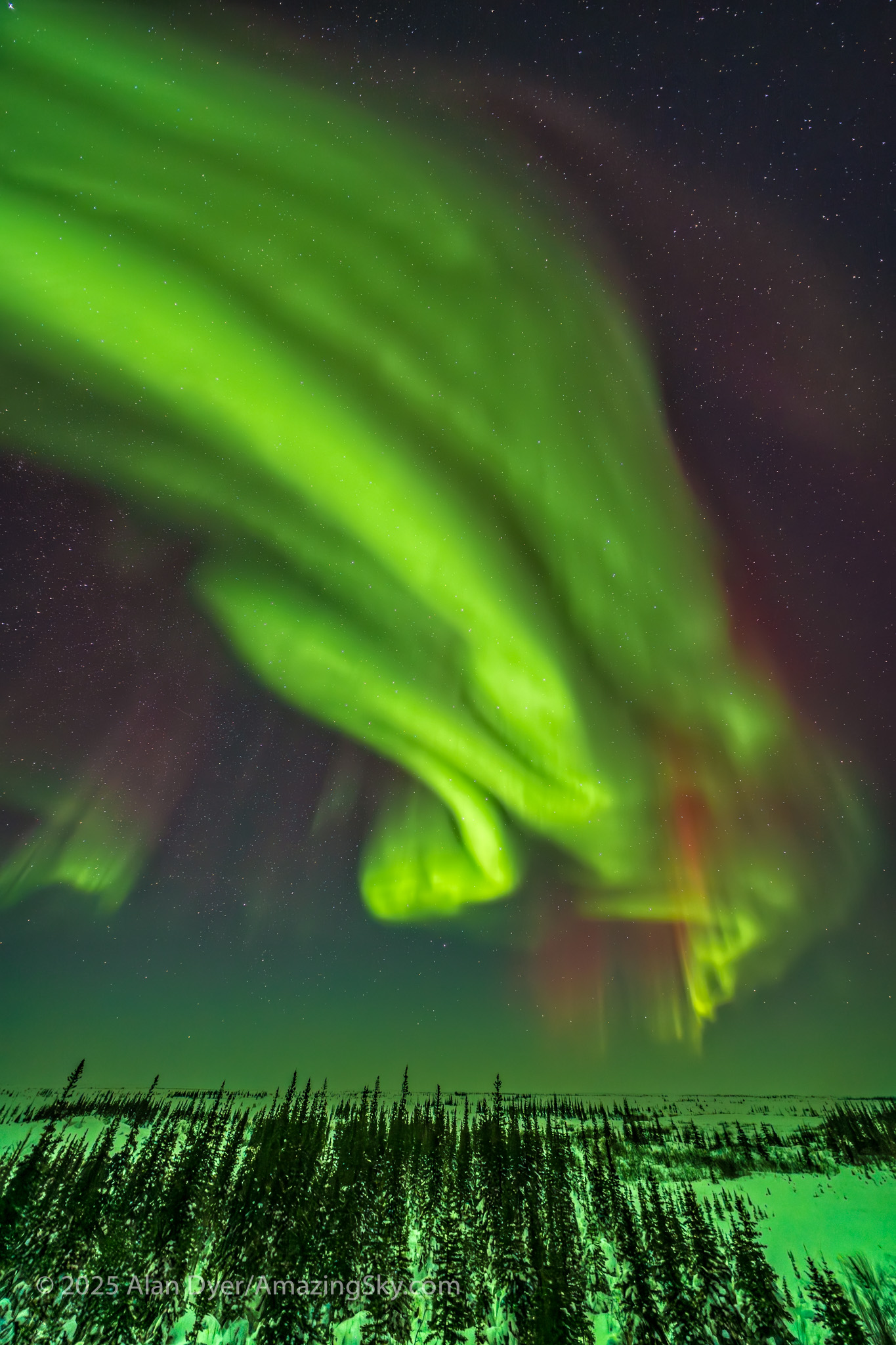
A bright display of colourful curtains of Northern Lights at the Churchill Northern Studies Centre. This is looking northeast toward the direction of the midnight sector where the auroras usually brighten from. This is a single 8-second exposure with the Laowa 10mm lens at f/2.8 and Nikon Z6III at ISO 1600.

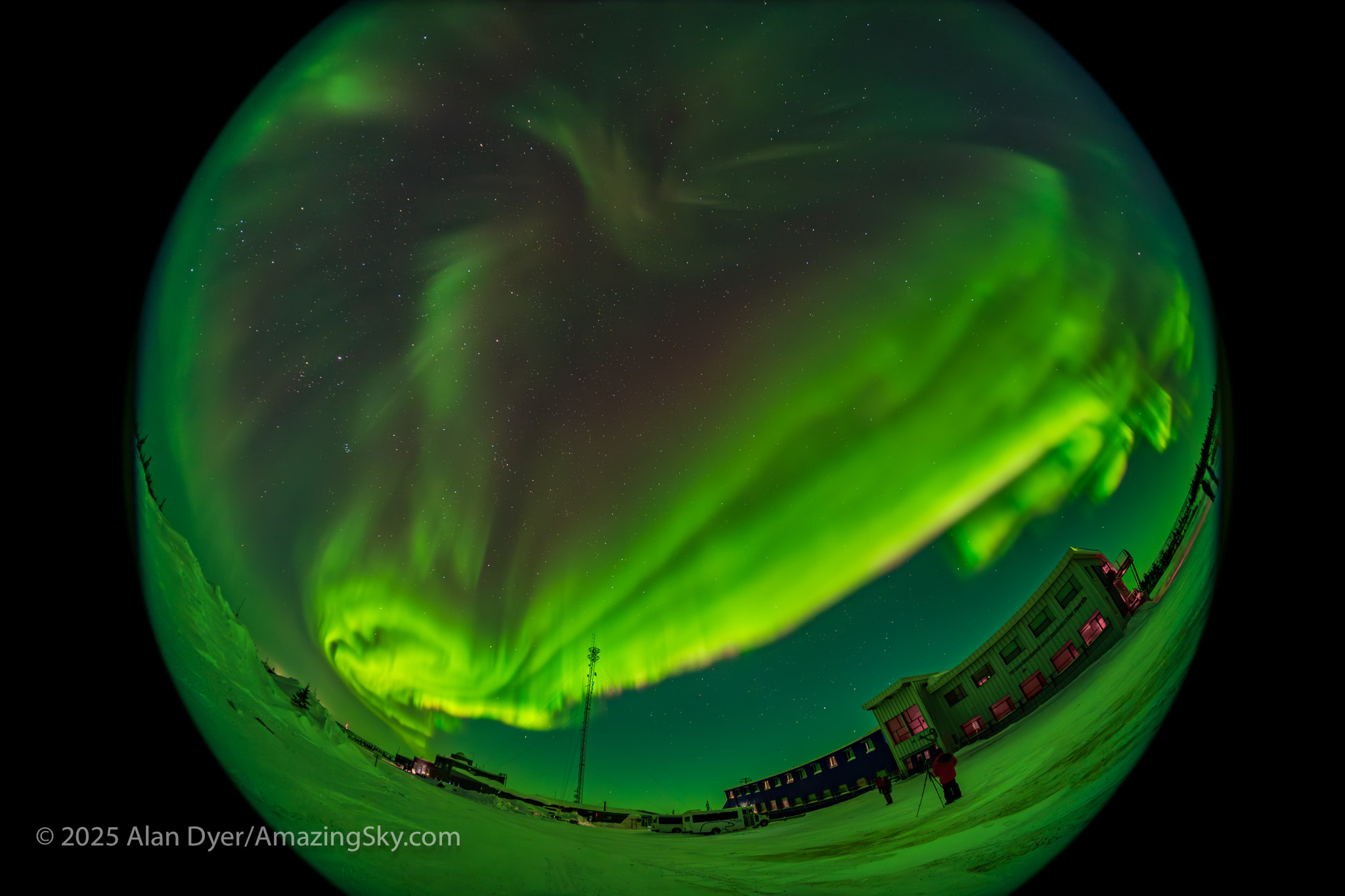
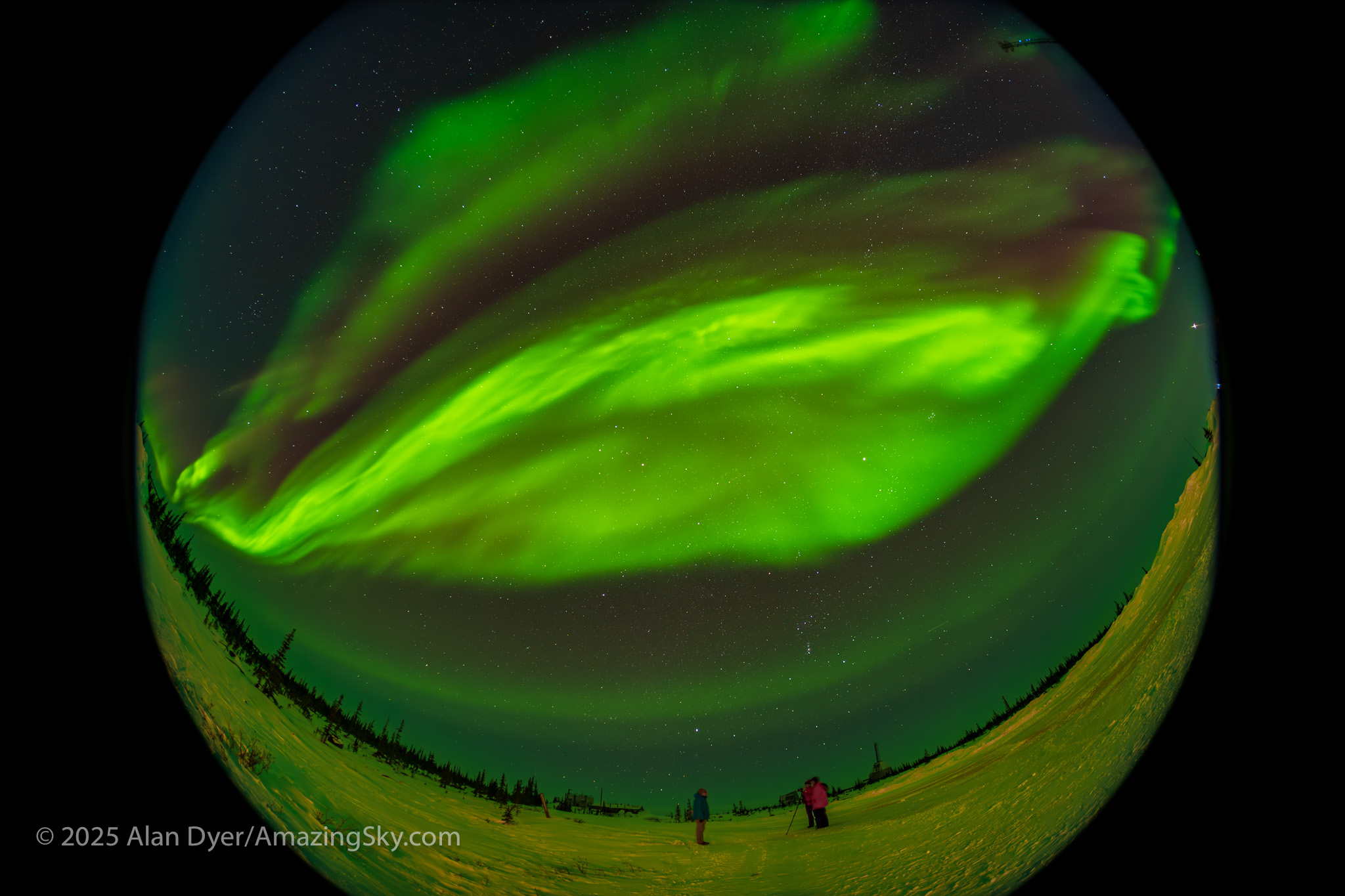
The finest sight is when the aurora curtains converge overhead at the zenith for a “coronal outburst.” The effect can be fleeting but the sight is unforgettable. It is one of the finest sights the sky can offer, ranking with a total eclipse of the Sun.

A fish-eye 360° view of the fine display of Northern Lights on February 25, 2025, with a complex of curtains passing overhead and across the sky from northeast (at lower left) to southwest (at upper right), with Venus setting at far right. Orion and Sirius are at bottom centre to the south. A single 10-second exposure with the TTArtisan 7.5mm fish-eye lens at f/2 on the Nikon Z6III at ISO 1600.

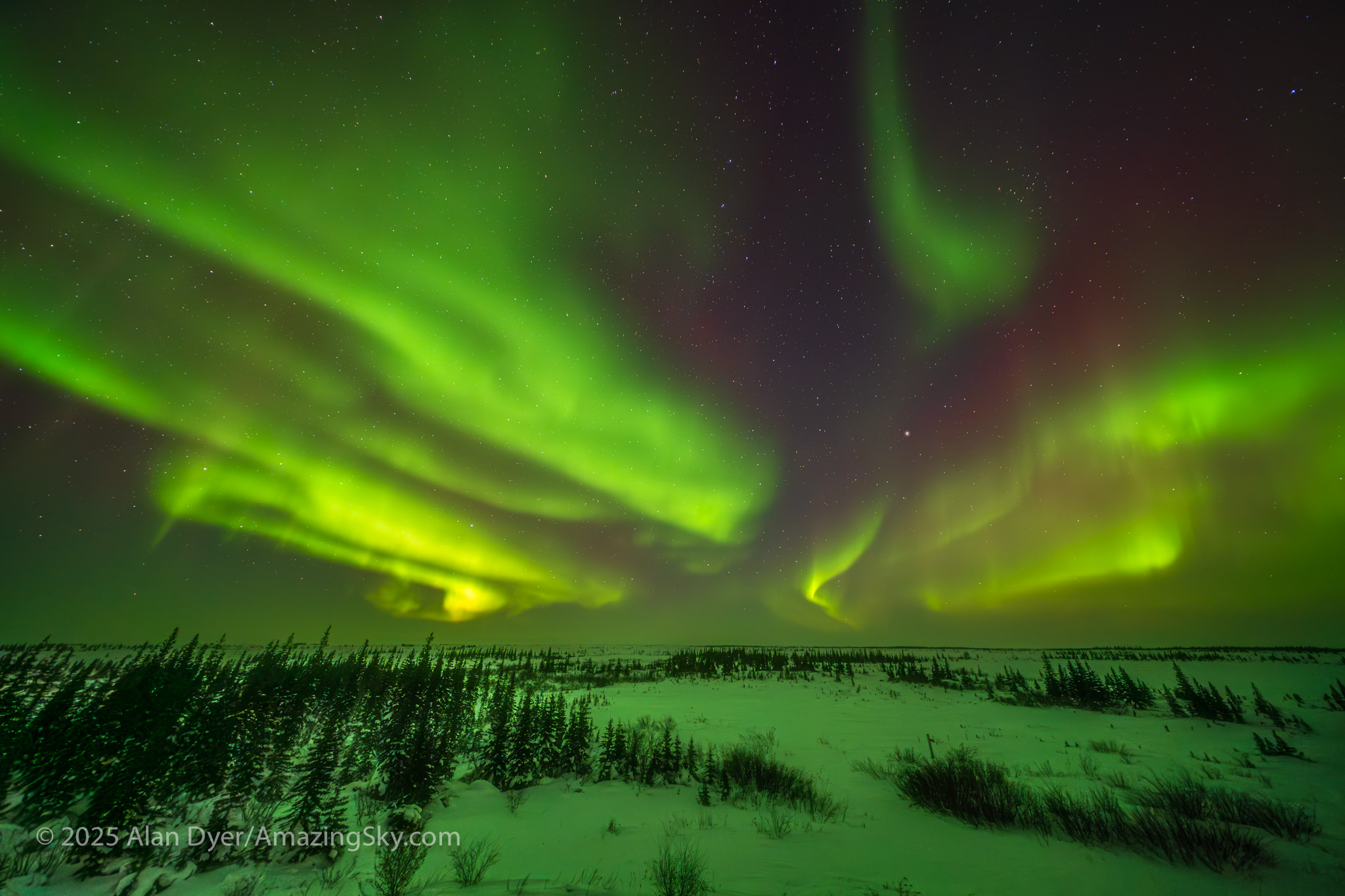
Indeed, on most nights the aurora, which might begin as a low arc across the north, moves south to fill the sky with swirling and curling curtains, as below.

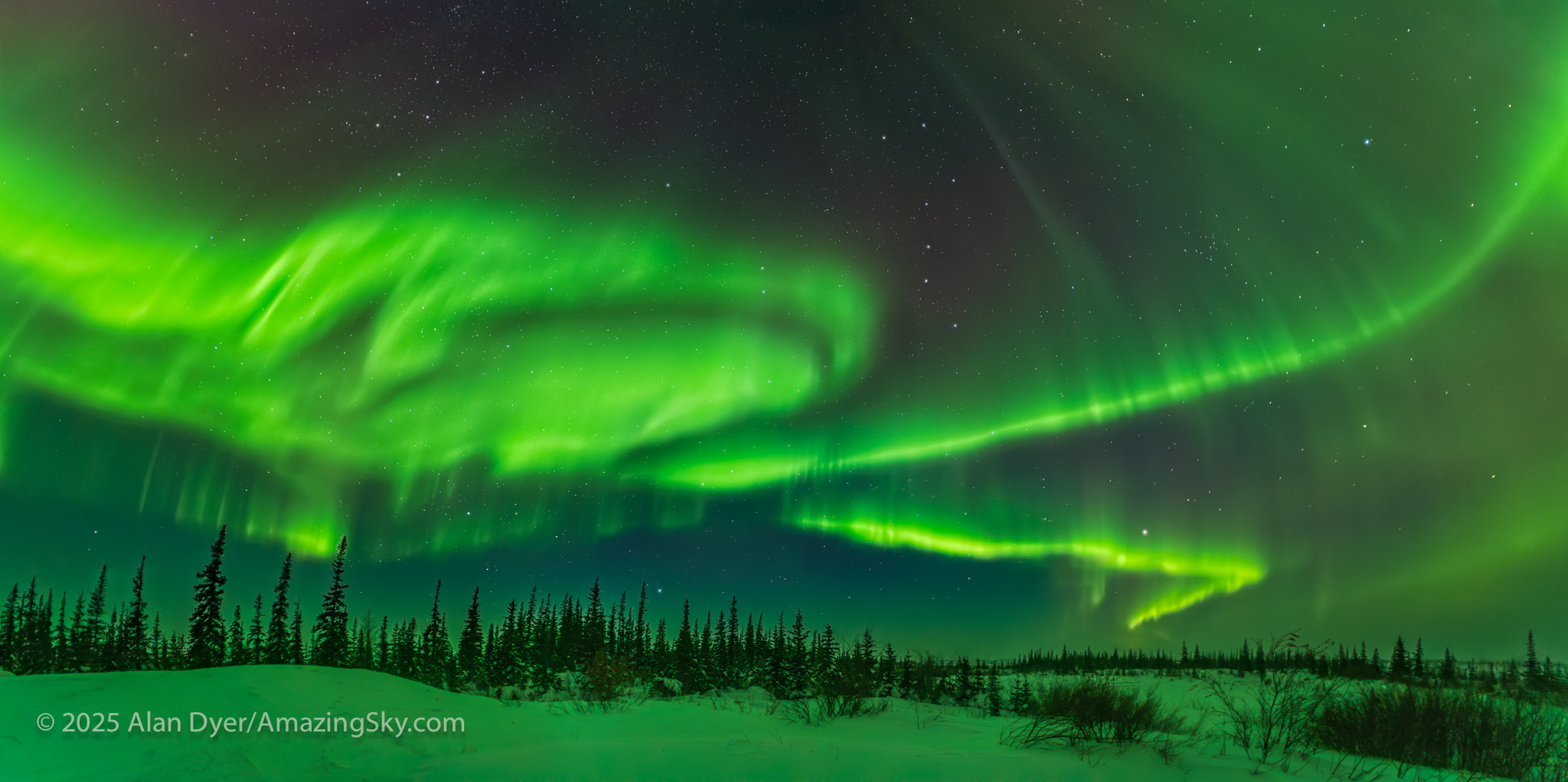
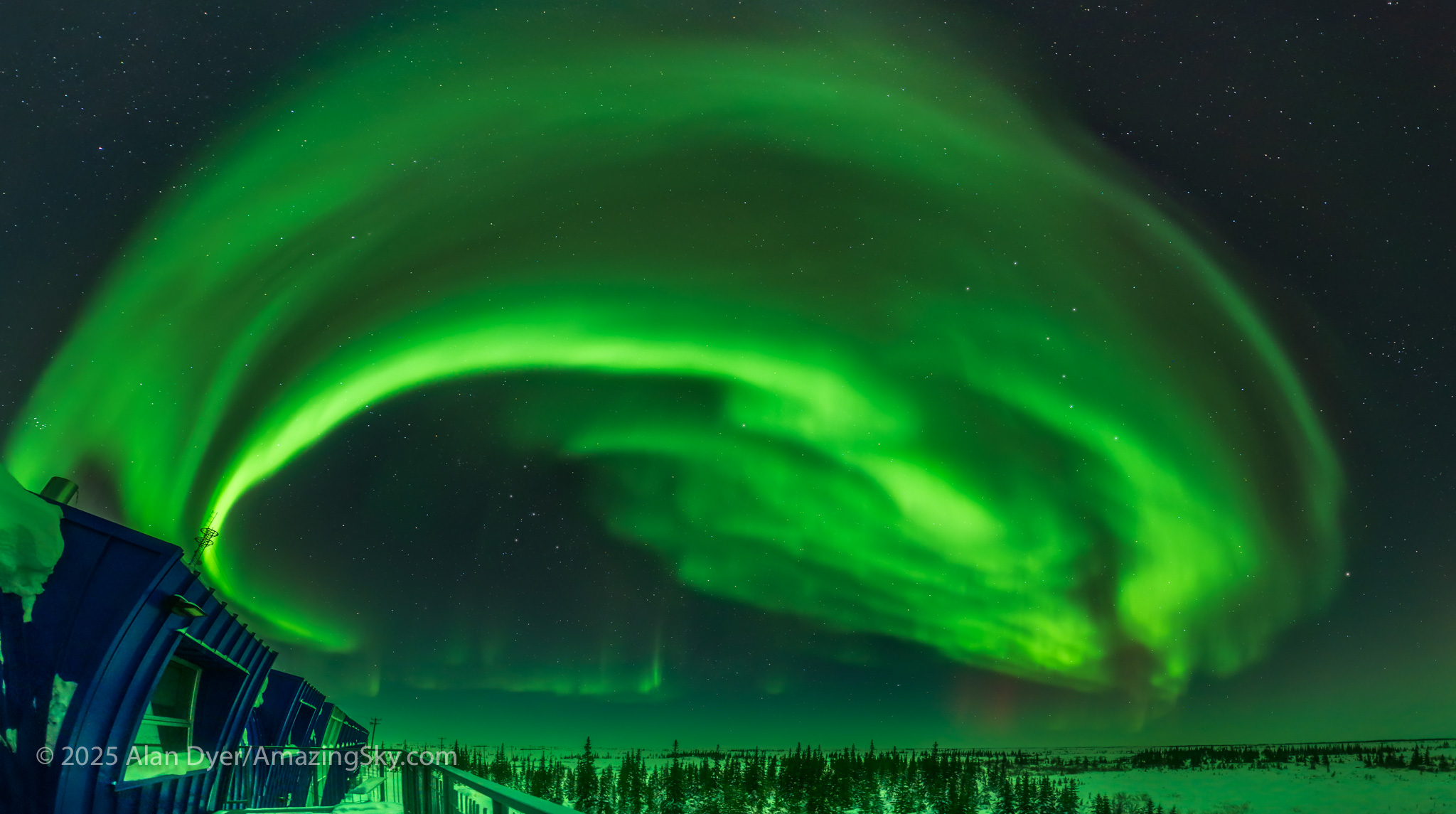
This is a 180º panorama of the Northern Lights across the northern sky on February 27, 2025 during a Kp4-level display. The field extends from the horizon up to well past the zenith. This is a panorama of 6 segments, each an 8-second exposure at f/2.8 with the Laowa 10mm lens on the Nikon Z6III at ISO 1600.

A gallery of my images from Churchill from this year and from past years is on my main AmazingSky.com website here.

A musical collage of still images and real-time videos I shot this year is viewable here on YouTube.

Click through to YouTube for more information about the video.

It’s been a great ten years taking in the wonderful Northern Lights in Churchill. While this was my last year, I encourage you to visit to see the sights for yourself.

Everyone goes away with great memories, able to check the aurora off their bucket list of experiences.

— Alan, March 10, 2025 / AmazingSky.com