2024 — The Greatest Year of Stargazing ?


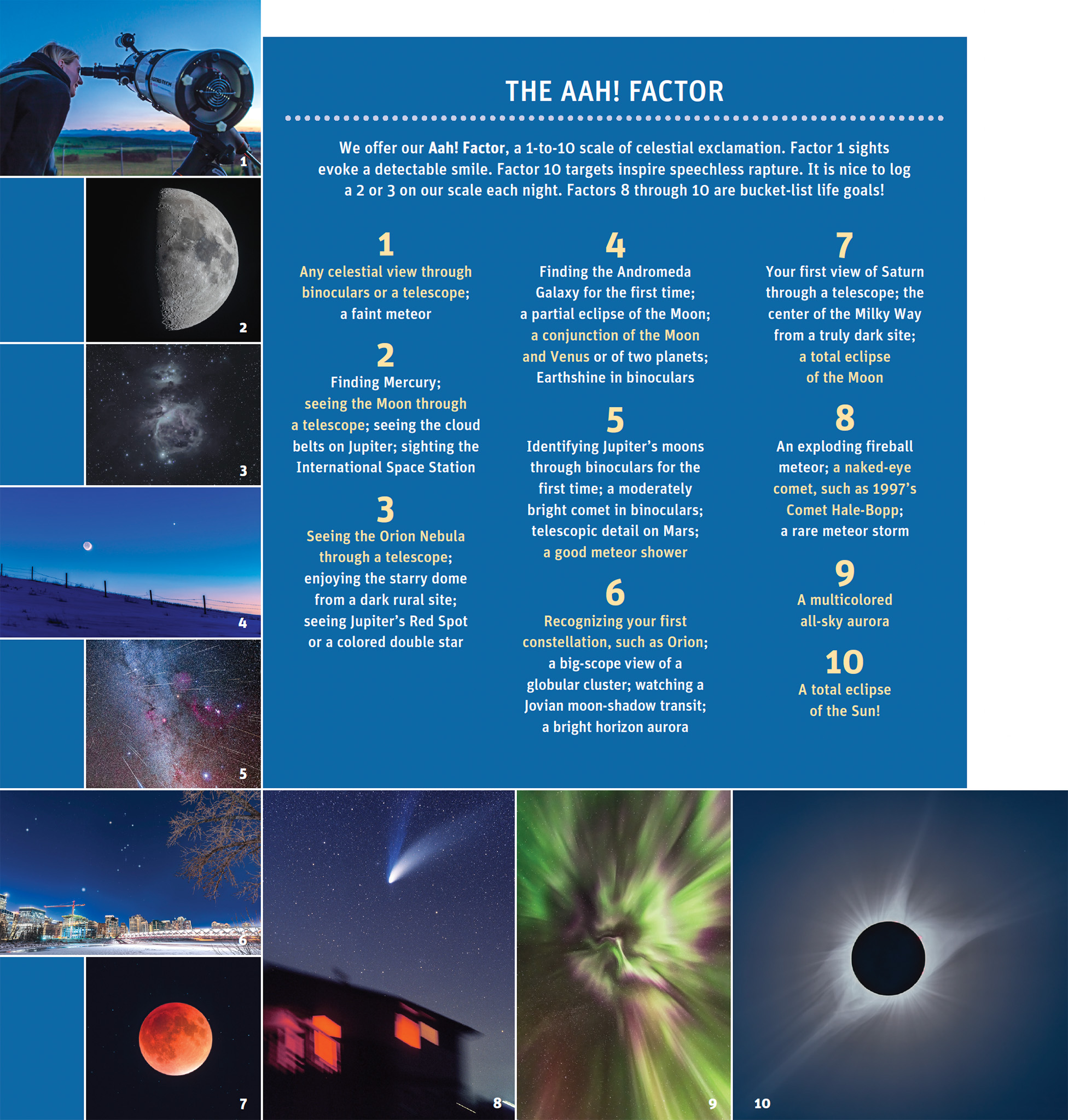
In our book The Backyard Astronomer’s Guide (which we revised this year), Terence Dickinson and I created an Aah! Factor scale with various celestial sights ranked from: 

•   1, evoking just a smile, to …

10, a life-changing event! 

Our book’s Aah! Factor Scale in Chapter 1

Coming in at an 8 is a naked-eye comet. Deserving a 9 is an all-sky display of an aurora. The only sight to rate a top 10 is a total eclipse of the Sun. 

2024 brought all three, and more! 

Here’s my look back at what I think was one of the greatest years of stargazing. 


A Winter Moonrise to Begin the Year 

The rising of the winter “Wolf” Moon, the Full Moon of January, over the frozen Crawling Lake Reservoir, in southern Alberta.

Now, this was not any form of rare event. But seeing and shooting any sky sight in the middle of a Canadian winter is an accomplishment. This is the rising of the Full Moon of January, popularly called the Wolf Moon, over a frozen lake near home in Alberta, Canada 🇨🇦. 

It serves to bookend the collection with a Full Moon I captured eleven months later in December. 


Auroras from Churchill, Manitoba 

Had this been my only chance to see the Northern Lights fill the sky this year, I would have been happy. As we often see in Churchill, the aurora covered the sky on several nights, a common sight when you are underneath the main band of aurora borealis that arcs across the northern part of the globe. 
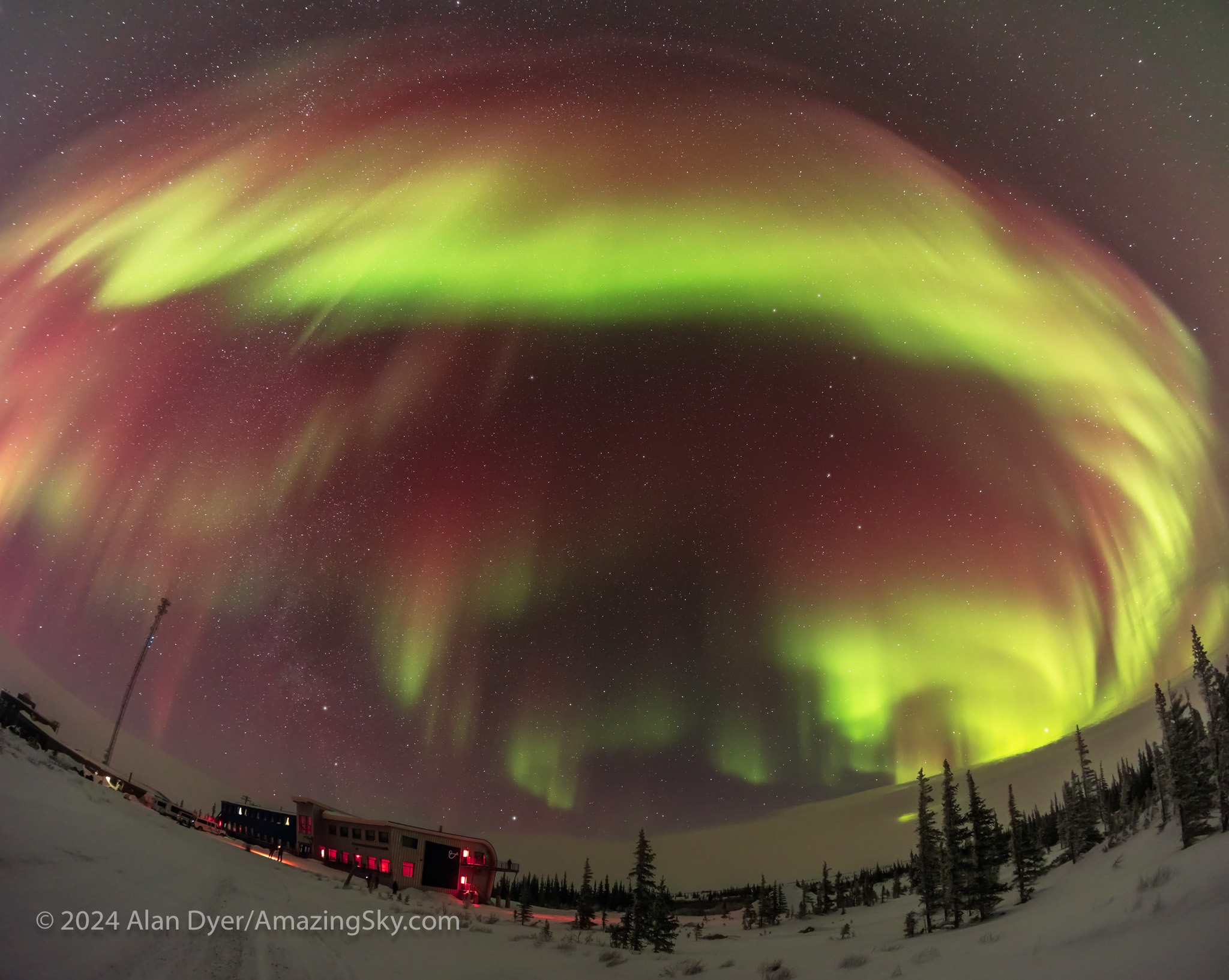
This is a vertical panorama of the sky-filling aurora of February 10, 2024, as seen from the Churchill Northern Studies Centre, in Churchill, Manitoba.

I attended to two aurora tour groups at the Churchill Northern Studies Centre who both got good displays to check “seeing the Northern Lights” off their bucket list. Join me in 2025!


Under the Austral Sky

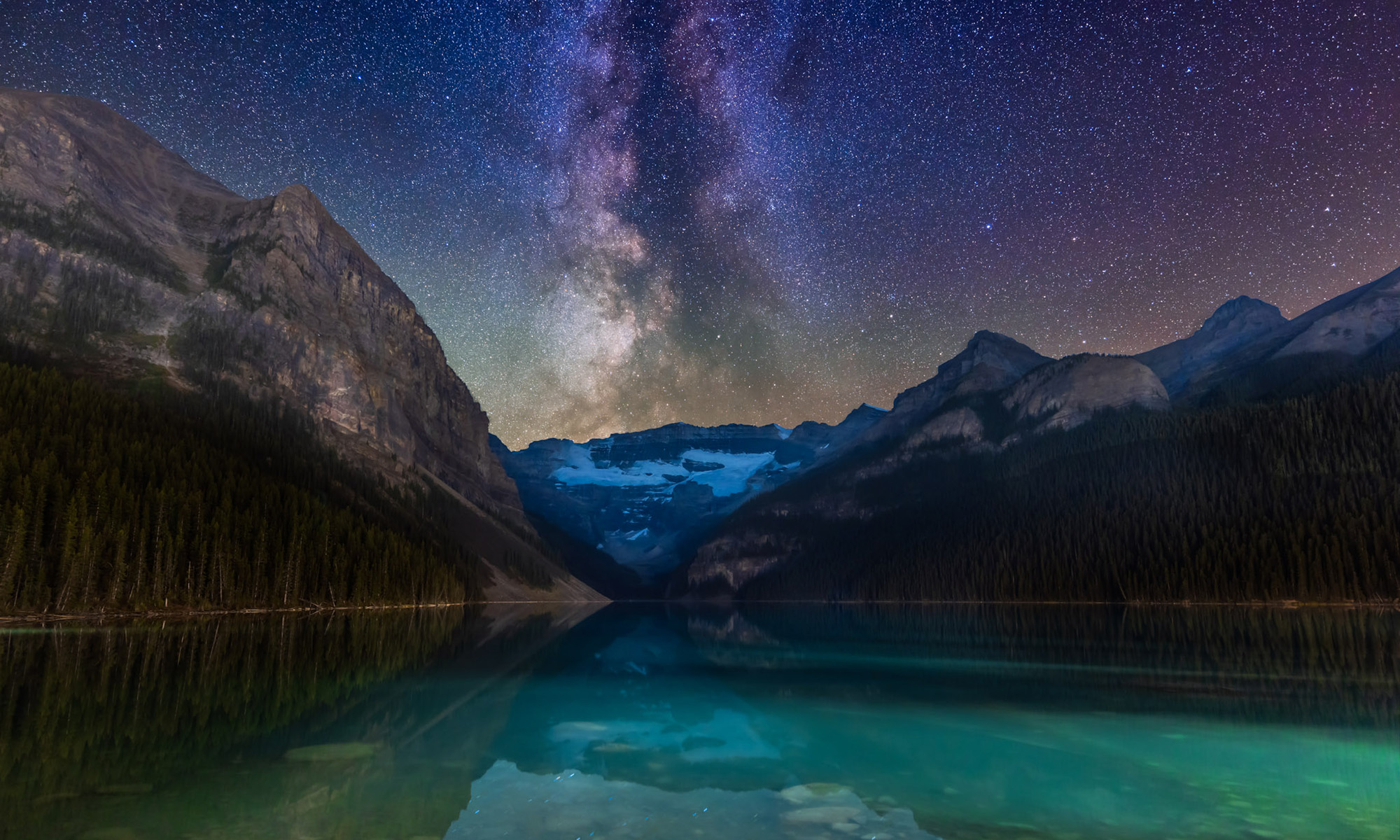
Ranking a respectable 7 on our Aah! Factor scale is the naked-eye sight of the galactic centre overhead, with the Milky Way arcing across the sky. That’s possible from a latitude of about 30° South. That’s where I went in March, back to Australia 🇦🇺 for the first time since 2017. 
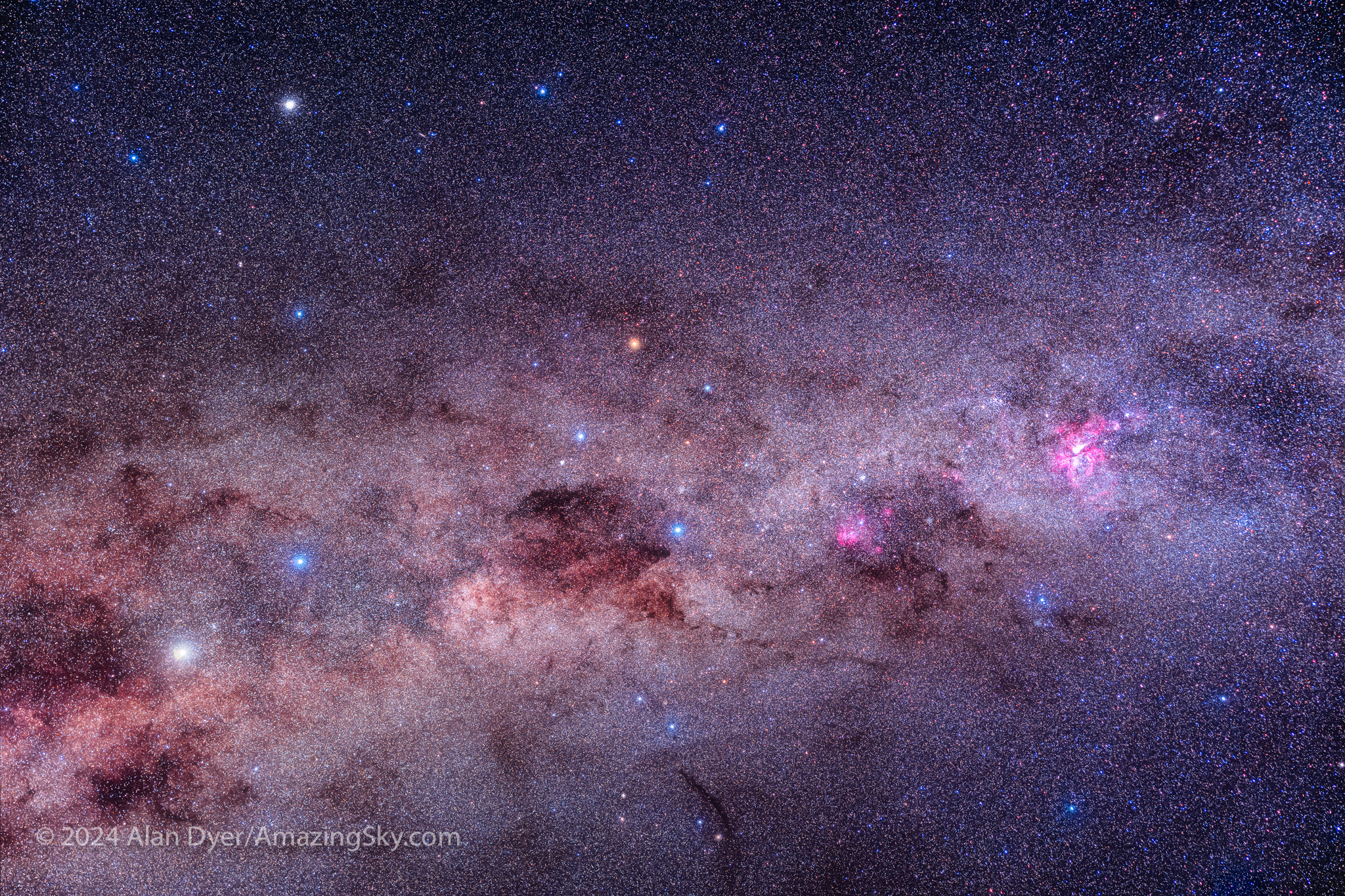
This is a framing of the most spectacular area of the southern Milky Way, from Centaurus at left, to Carina at right, with Crux, the Southern Cross, at centre.

I wrote about it in my previous blog, where I present a tour along the southern Milky Way, and wide-angle views of the Milky Way (the images here are framings of choice regions). 
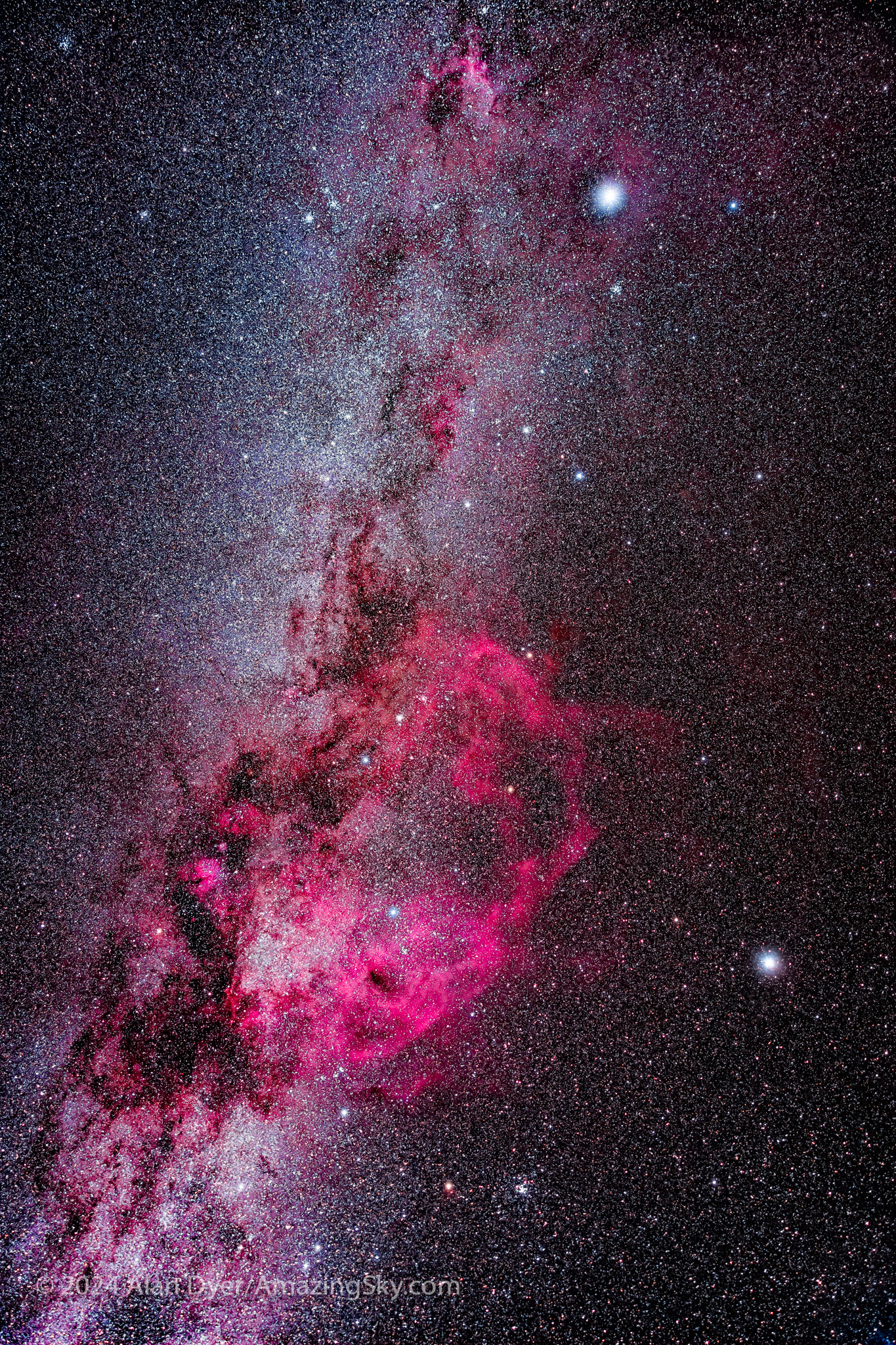
This frames the southern Milky Way from Canis Major and its bright star Sirius at top, to Carina and its bright star Canopus at bottom, the two brightest stars in the night sky. The large red complex is the Gum Nebula.

It is a magical latitude that all northern astronomers should make a pilgrimage to, if only to just lie back and enjoy the view of our place in the outskirts of the Galaxy. I was glad to be back Down Under, to check this top sky sight off my bucket list for 2024. 


A Total Eclipse of the Sun 

No sooner had I returned home from Oz, when it was time to load up the car with telescope gear and drive to the path of the April 8 total solar eclipse, the first “TSE” in North America since 2017, which was the last total eclipse I had seen, in a trip to Idaho

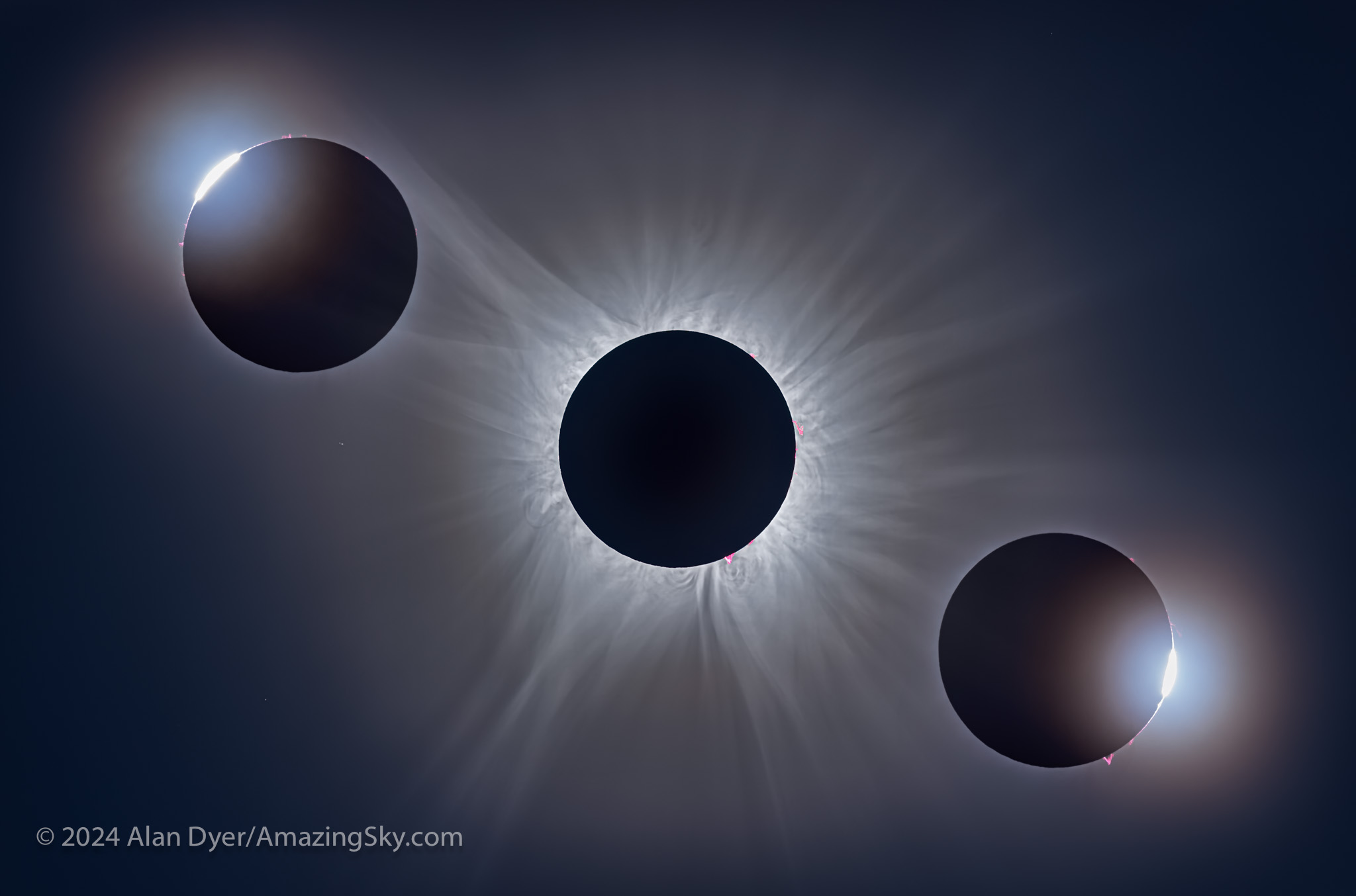
This is a composite of telescopic close-ups of the April 8, 2024 total eclipse, with a multi-exposure blend for the corona at centre, flanked by the diamond rings.

But where? I started south to Texas, my Plan A. Poor weather forecasts there prompted a hasty return to Canada, to drive east across the country to … I ended up in Québec. My blog about my cross-continental chase is here. My final edited music video is linked to below.

It was gratifying to see a total eclipse from “home” in Canada, only the third time I’ve been able to do that (previously in 1979 – Manitoba, and 2008 – Nunavut). If the rest of the year had been cloudy except for this day I wouldn’t have complained. Much.

This definitely earned a 10 on the Aah! Factor scale. Total eclipses are overwhelming and addictive. I’ve made my bookings for 2026 in Spain 🇪🇸 and 2027 in Tunisia 🇹🇳. 


The Sky’s On Fire

It had been several years since I had seen an aurora from my backyard with colours as vivid and obvious as they were this night. But on May 10, the sky erupted with a fabulous display of aurora that much of the world saw, as aurora borealis in the north and aurora australis in the south. 
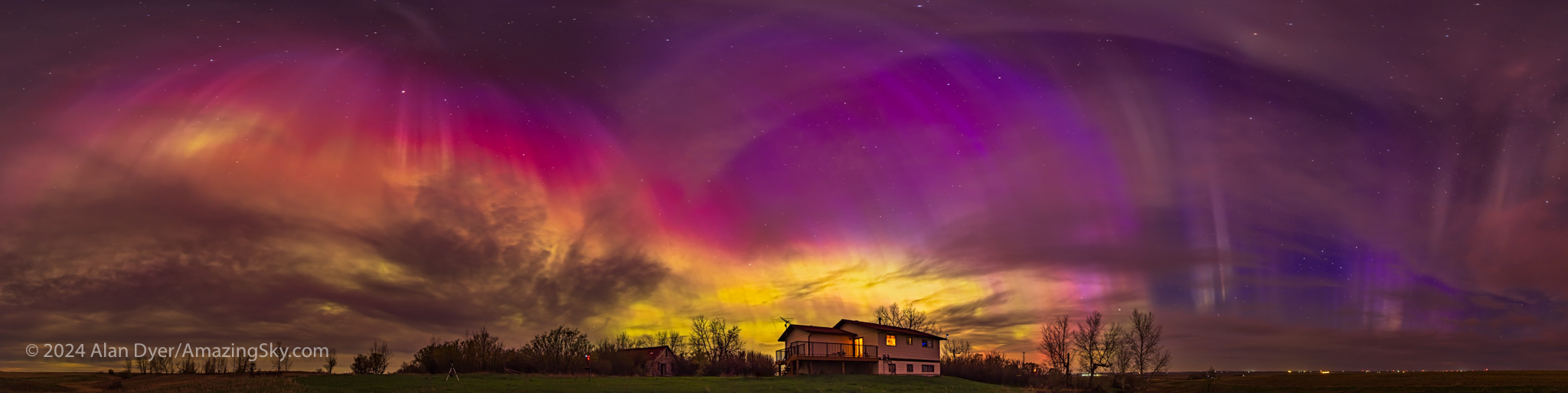
This is a 300º panorama of the May 10, 2024 Northern Lights display, when the Kp Index reached 8 (out of 9), bringing aurora to the southern U.S.

This was the first of several all-sky shows this year. I blogged about the year’s great auroras here, where there are links to the movies I produced that capture the Northern Lights as only movies can, recording changes so rapid it can be hard to take it all in. Check off a 9 here! 

So not even half way through the year, I had seen three of the top sky sights: the Milky Way core overhead (7), an all-sky aurora (9), and a total eclipse of the Sun (10). 

But there was more to come! Including an Aah! Factor 8


World Heritage Nightscape Treks

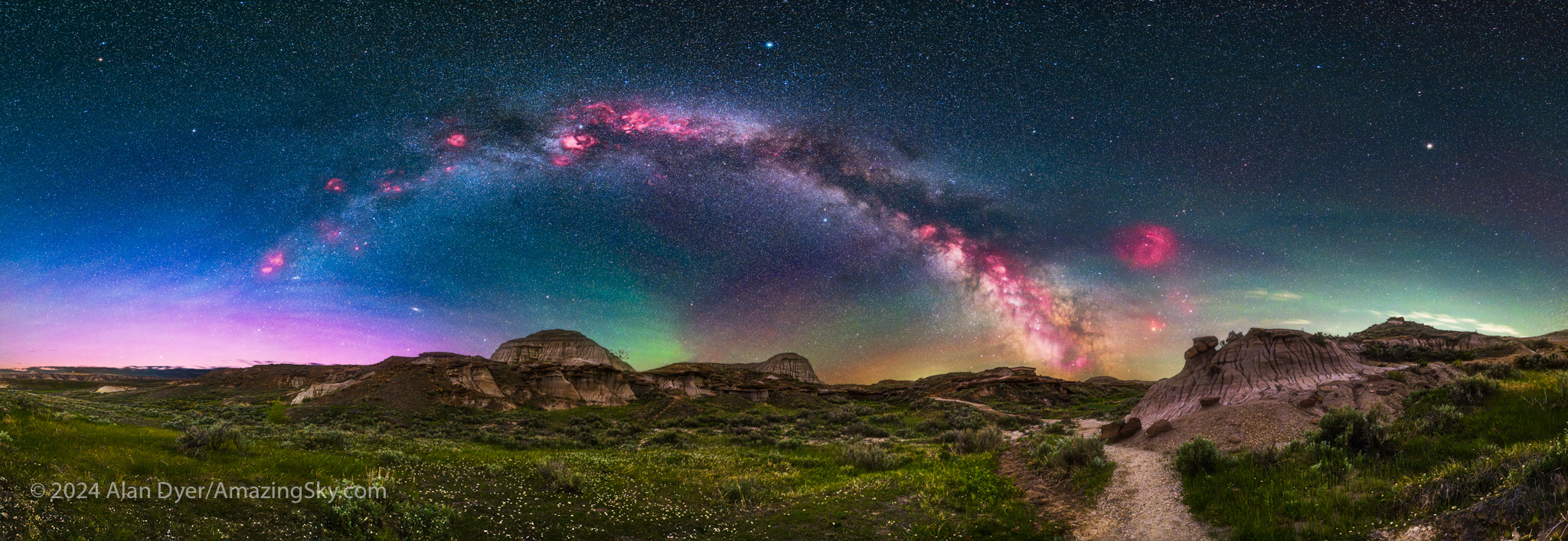
This is a panorama of the arch of the Milky Way rising over the Badlands of Dinosaur Provincial Park, Alberta, with a sky tinted with twilight and airglow.

The sky took a break from presenting spectacles, allowing me to head off on short local trips, to favourite nightscape sites in southern Alberta, which we have in abundance. The Badlands of Dinosaur Provincial Park are just an hour away, the site for the scene above. 
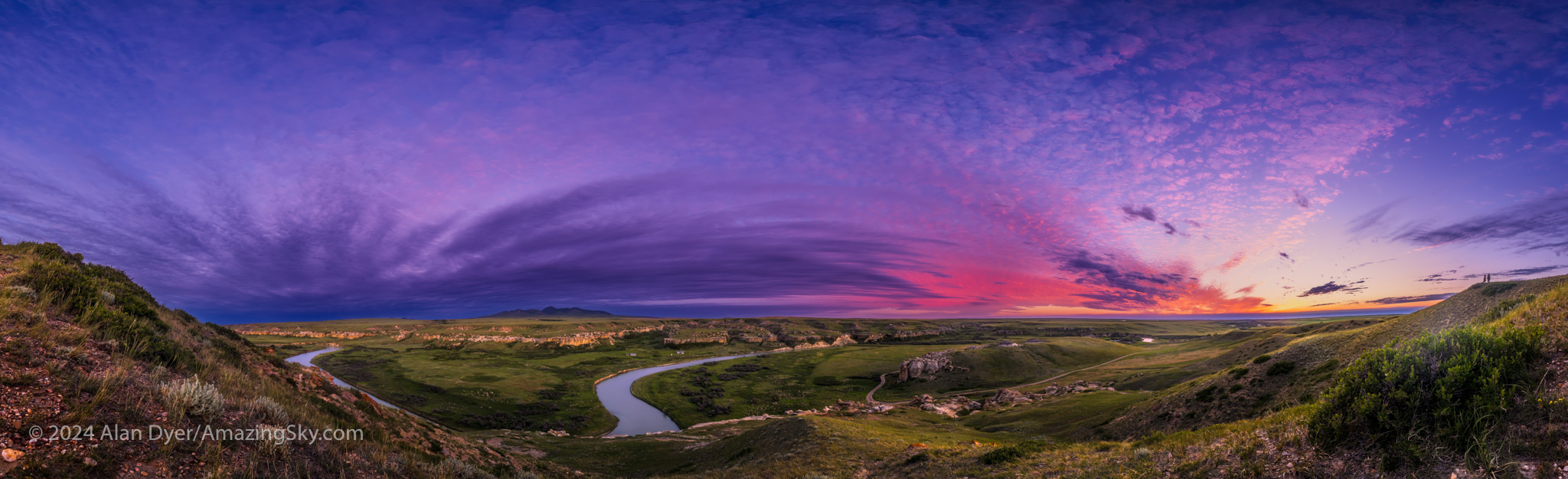
A panorama at sunset at Writing-on-Stone Provincial Park (Áísínai’pi) in Alberta, with the Milk River below and the Sweetgrass Hills in the distance in Montana. Note the people at far right.

The rock formations of Writing-on-Stone Provincial Park are a bit farther, requiring a couple of days commitment to shoot. Clouds hid the main attraction, the Milky Way, this night, but did provide a fine sunset. 
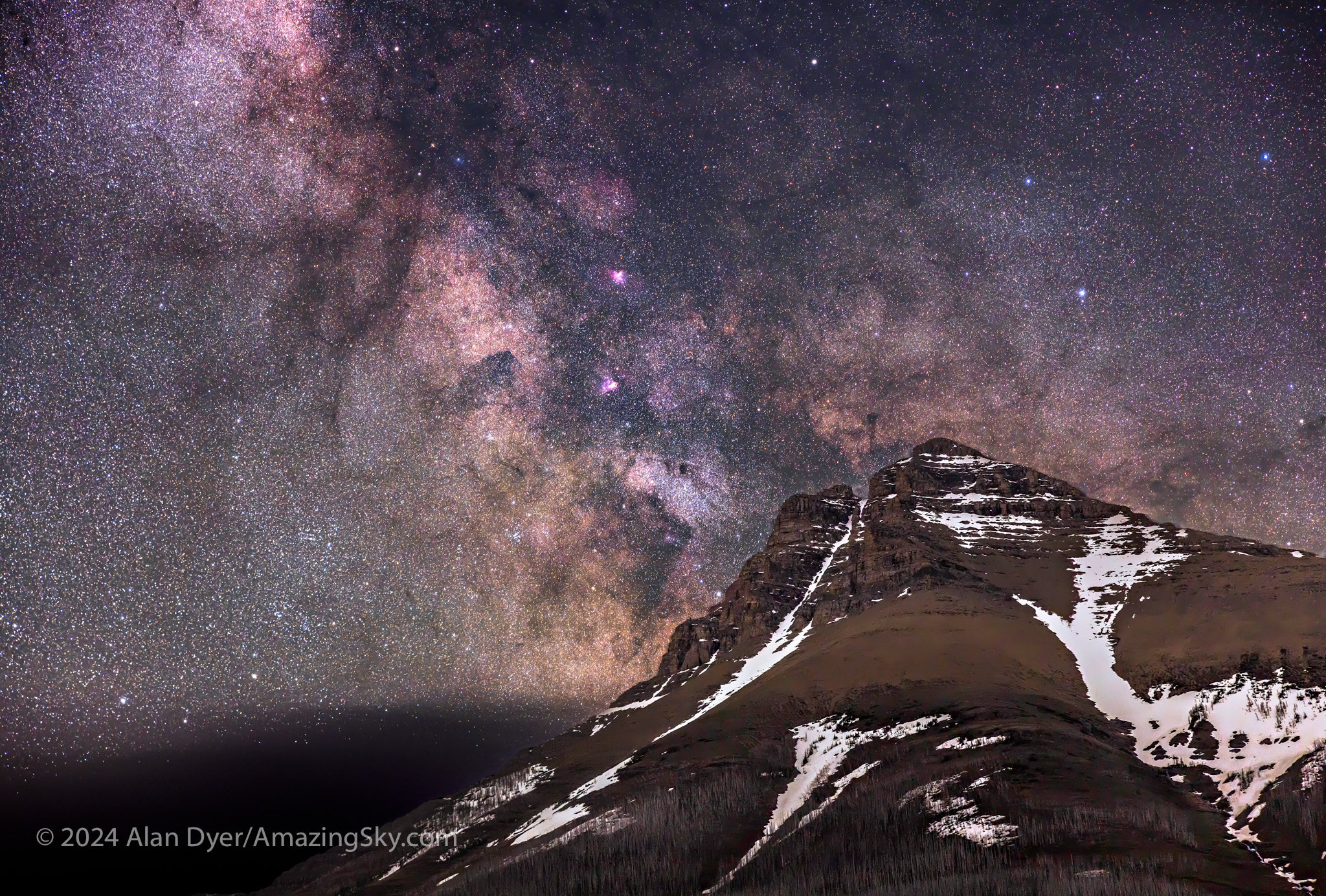
The Milky Way rises over Mt. Blakiston, in Waterton Lakes National Park, Alberta. This was June 10, 2024, so snow remains at high altitudes.

A little further west down the highway is Waterton Lakes National Park, another great spot I try to visit at least once each year. 

All locations I hit this month are U.N. World Heritage Sites, thus the theme of my blog from June. People travel from all over the world to come here, to sites I can visit in a few hours drive. 


Mountains by Starlight

In summer we now often contend with smoke from forest fires blanketing the sky, hiding not just the stars by night, but even the Sun by day. 
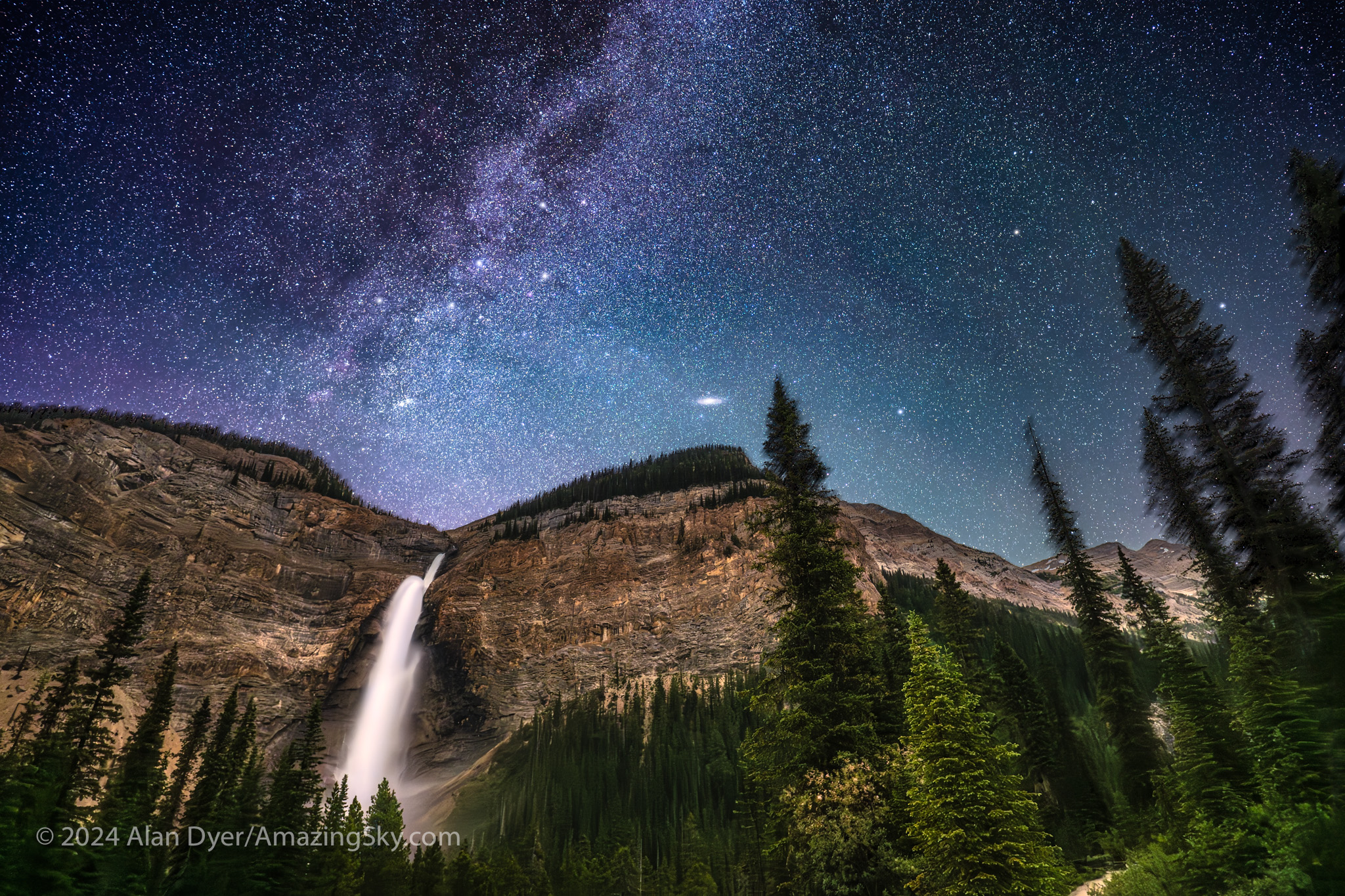
The Andromeda Galaxy at centre is rising above Takakkaw Falls, in Yoho National Park. Above is the W of stars marking Cassiopeia.

But before the smoke rolled in this past summer I was able to visit a spot, Yoho National Park in British Columbia, that had been on my shot list for several years. The timing with clear nights at the right season and Moon phase has to work out. In July it did, for a shoot by starlight at Takakkaw Falls, among the tallest in Canada. 
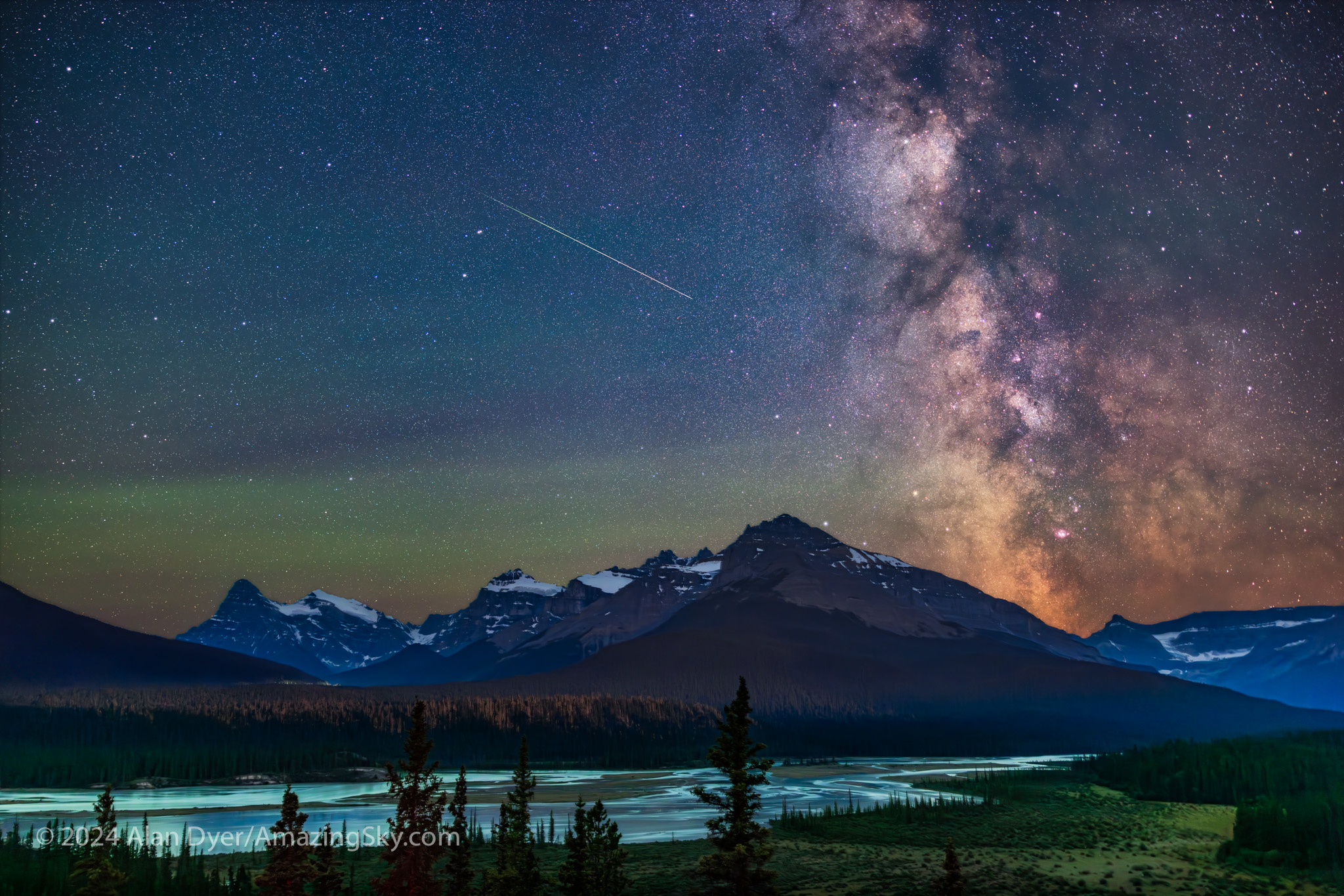
This is the Milky Way core and a bonus meteor over the peaks and valleys at Saskatchewan River Crossing, in Banff National Park, Alberta.

The following nights I was in Banff National Park, at familiar spots on the tourist trail, but uncrowded and quiet at night. It was a pleasure to enjoy the world-class Rocky Mountain scenery under the stars on perfect nights. 


The All-Sky Auroras Return 

In August I headed east to Saskatchewan and the annual Summer Star Party staged by the astronomy clubs in Regina and Saskatoon. It is always a pleasure to attend the SSSP in the beautiful Cypress Hills. The sky remained clear post-party for a trip farther east to the little town of Val Marie, where I stayed at a former convent, and had a night to remember out in Grasslands National Park, one of Canada’s first, and finest, dark sky preserves.
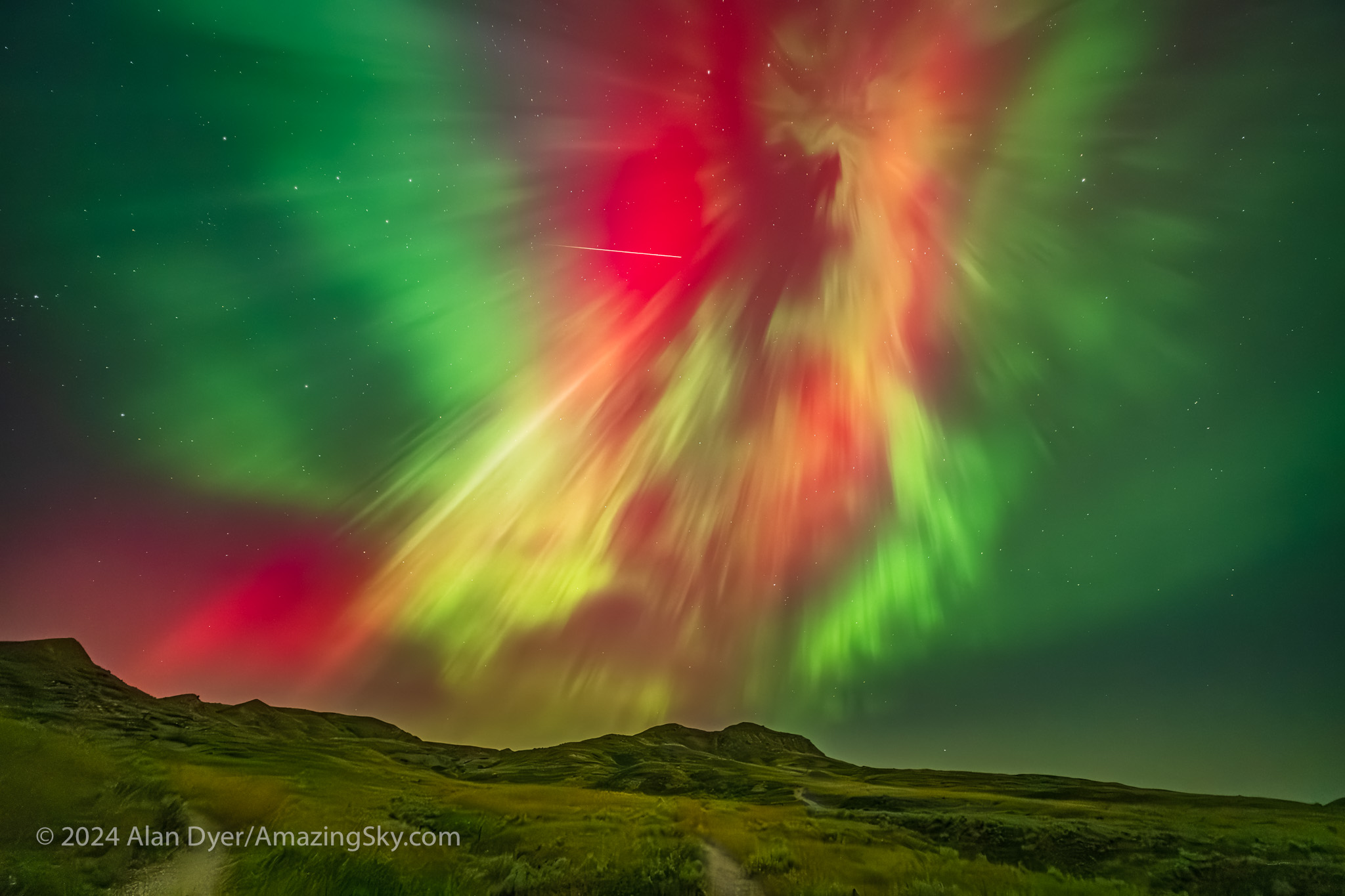
The Northern Lights in a superb all-sky Kp6 to 7 display on August 11-12, 2024, in Grasslands National Park, Saskatchewan.

The plan was to shoot the August 11 Perseid meteor shower, but the aurora let loose again for a stunning show over 70 Mile Butte. My earlier blog has more images and movies from this wonderful month of summertime Northern Lights. 

We are fortunate in western Canada 🇨🇦 to be able to see auroras year-round, even in summer. Farther north at the usual Northern Lights destinations, the sky is too bright at night in summer. 


Back to Deep Sky Wonders

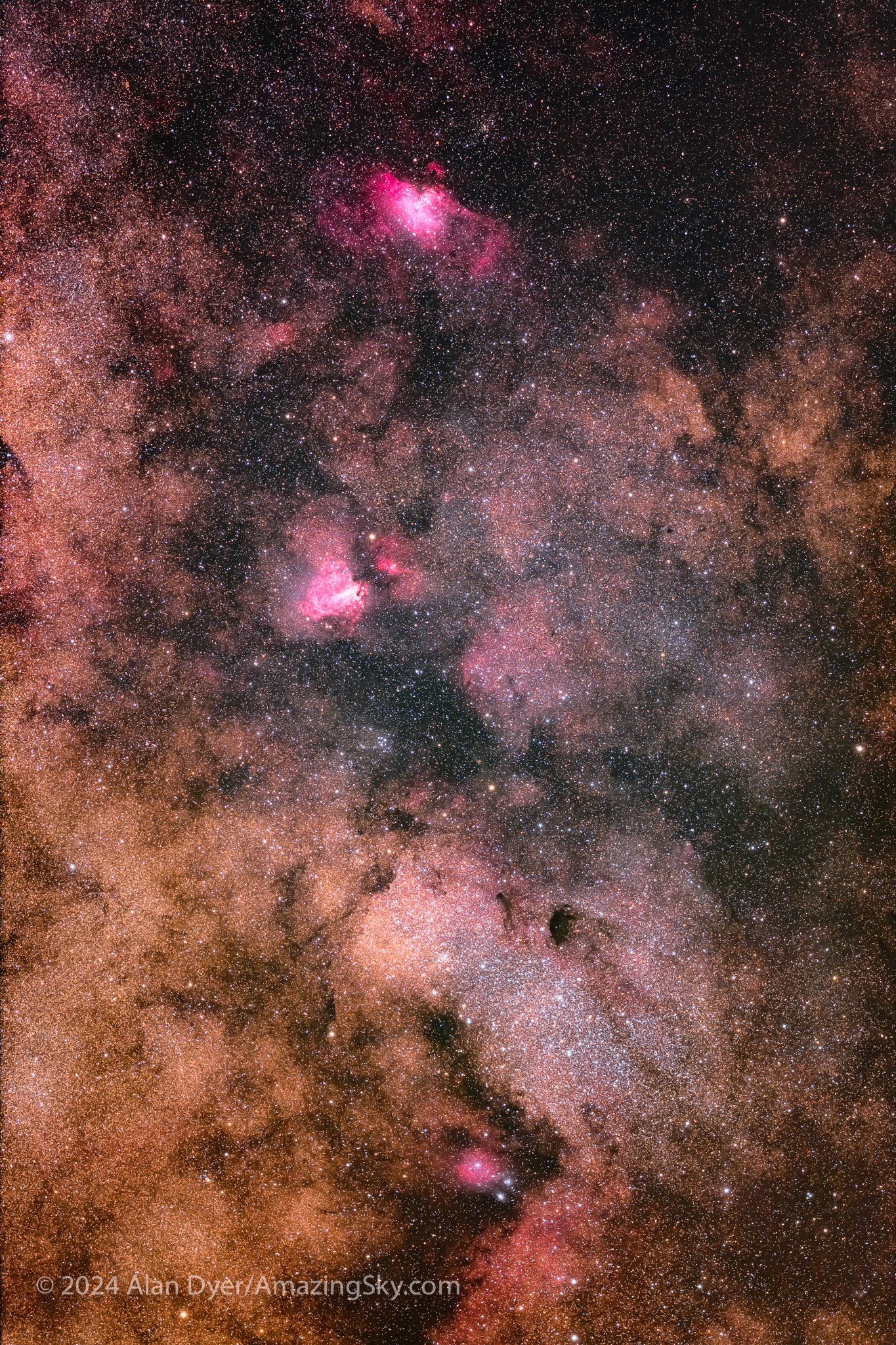
This is a framing of the rich starfield in Sagittarius and Serpens containing a mix of bright star clouds, glowing nebulas, and dark dust in the Milky Way.

September is the month for another astronomical party in the Cypress Hills, but on the Alberta side. At the wonderful Southern Alberta Star Party under its very dark skies, I was able to shoot some favourite deep-sky fields along the Milky Way with new gear I was testing at the time. 
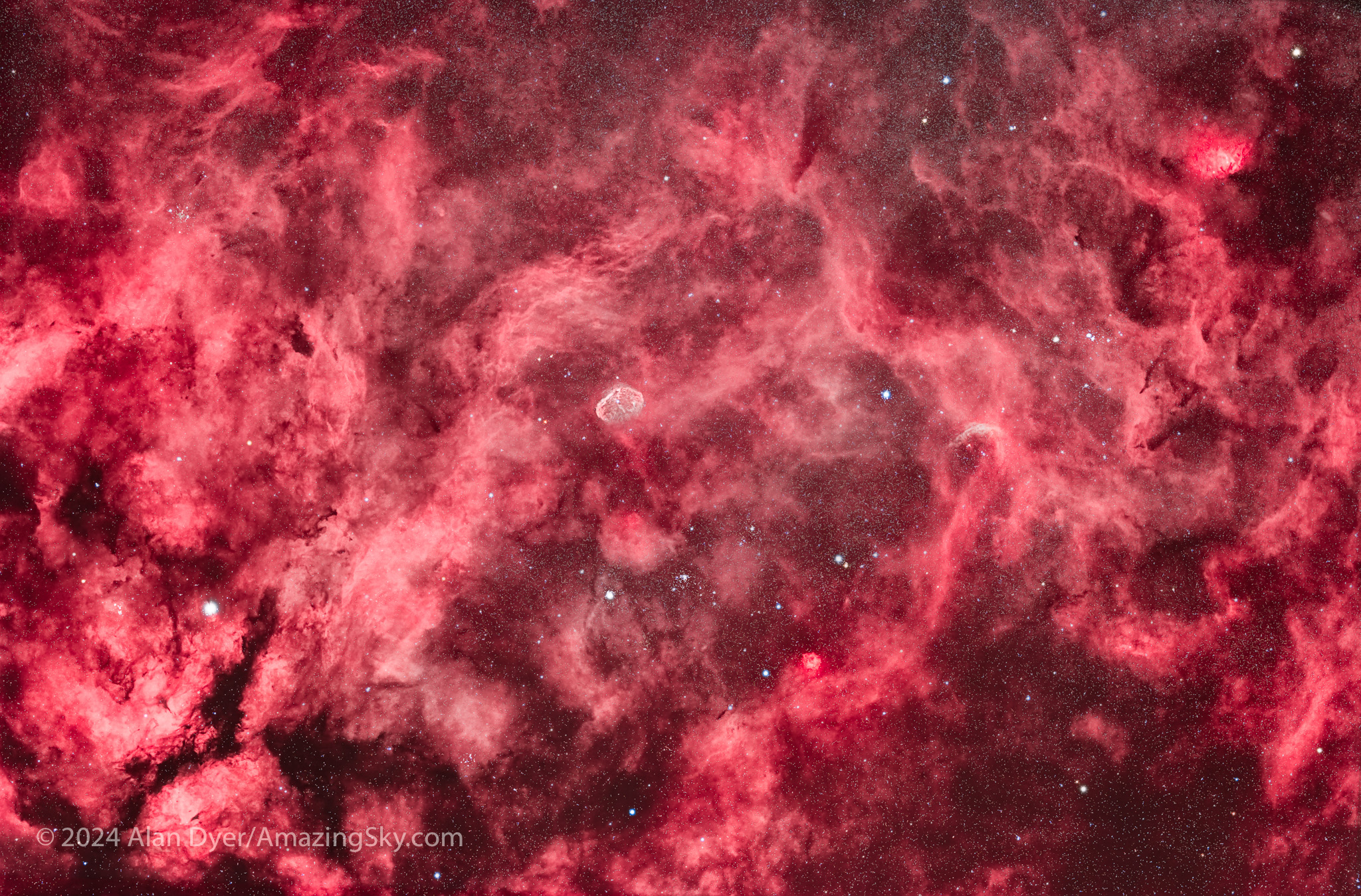
This frames the complex region of emission nebulas in central Cygnus near the star Gamma Cygni, at lower left. The Crescent Nebula is at centre.

And from home, September brought skies dark and clear enough (at least when there was no aurora!) for more captures of colourful nebulas (above and below) along the summer Milky Way. 
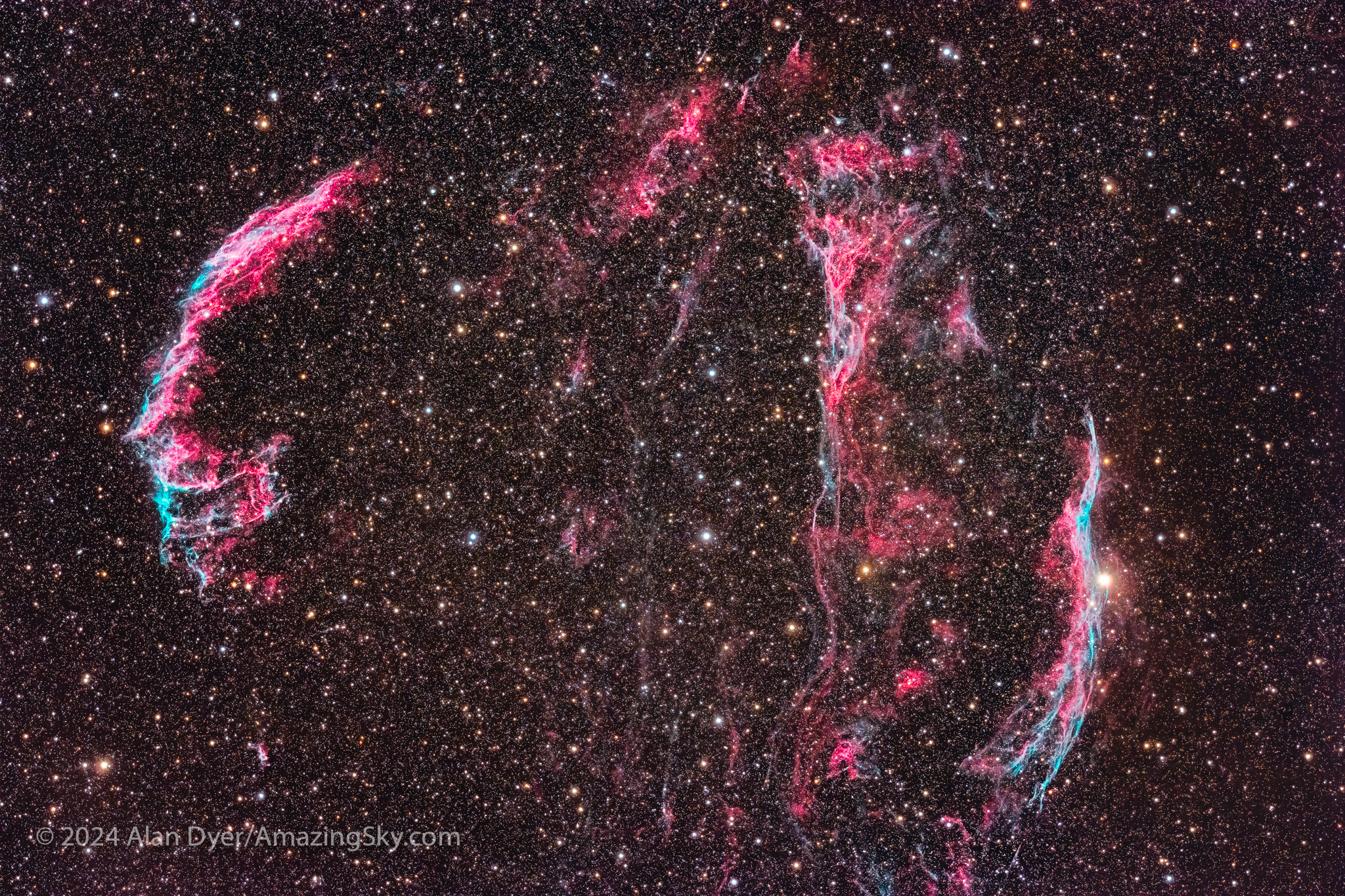
This frames all the photogenic components of the bright Veil Nebula in Cygnus, a several-thousand-year-old supernova remnant.

We invest a lot of money into the kind of specialized gear needed to shoot these targets (and I’m not nearly as “committed” as some are, believe me!), only to find the nights when it all comes together can be few and far between. 

Plus, A Very Minor Eclipse of the Moon 

I had to include this, if only for stark contrast with the spectacular solar eclipse six months earlier. 

We had an example of the most minor of lunar eclipses on March 24, 2024, with a so-called “penumbral” eclipse of the Moon, an eclipse so slight it’s hard to tell anything unusual is happening. (So I’ve not even included an image here, though I was able to shoot it.)
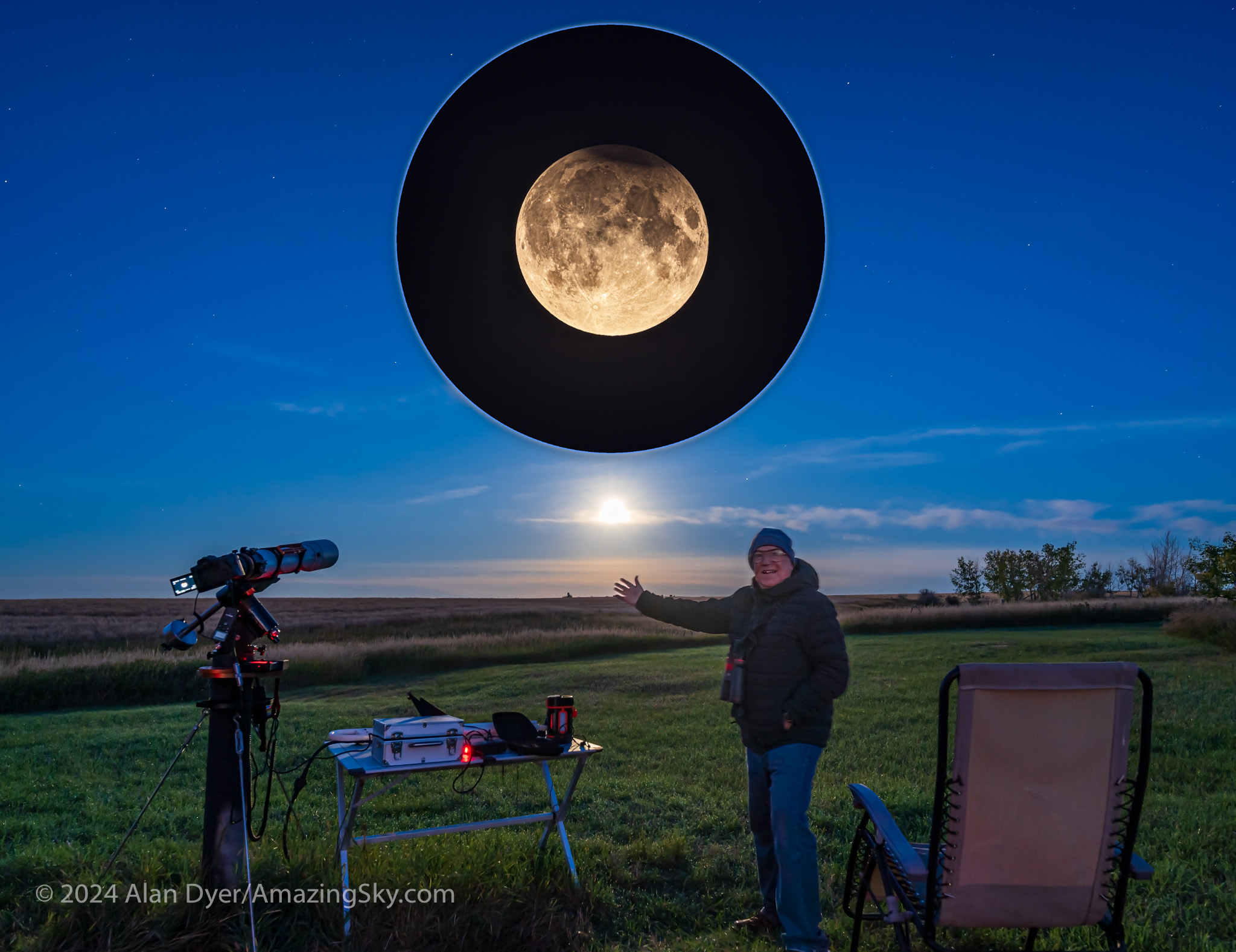
Me at another successful eclipse chase … to my backyard to capture the partial lunar eclipse on September 17, 2024. The Moon is rising in the southeast.

On September 17, we had our second eclipse of the Moon in 2024. This time the Earth’s umbral shadow managed to take a tiny bite out of the Full Moon. Nothing spectacular to be sure. But at least this eclipse expedition was to no farther away than my rural backyard. A clear eclipse of any kind, even a partial eclipse, especially one seen from home, is reason to celebrate. I did!

Of course, a total eclipse of the Moon, when the Full Moon is completely engulfed in Earth’s umbra and turns red, is what we really want to see. They rate a 7 on our Aah! Factor scale. We haven’t had a “TLE” since November 8, 2022, blogged about here.

The next is March 14, 2025. (The link takes you to Fred Espenak’s authoritative web page.)


A Bright Comet At Last!

We knew early in 2024 that the then newly-discovered Comet Tsuchinshan-ATLAS had the potential to perform this month. I planned a trip south to favourite spots in Utah and Arizona to take advantage of what we hoped would be a fine autumn comet. 
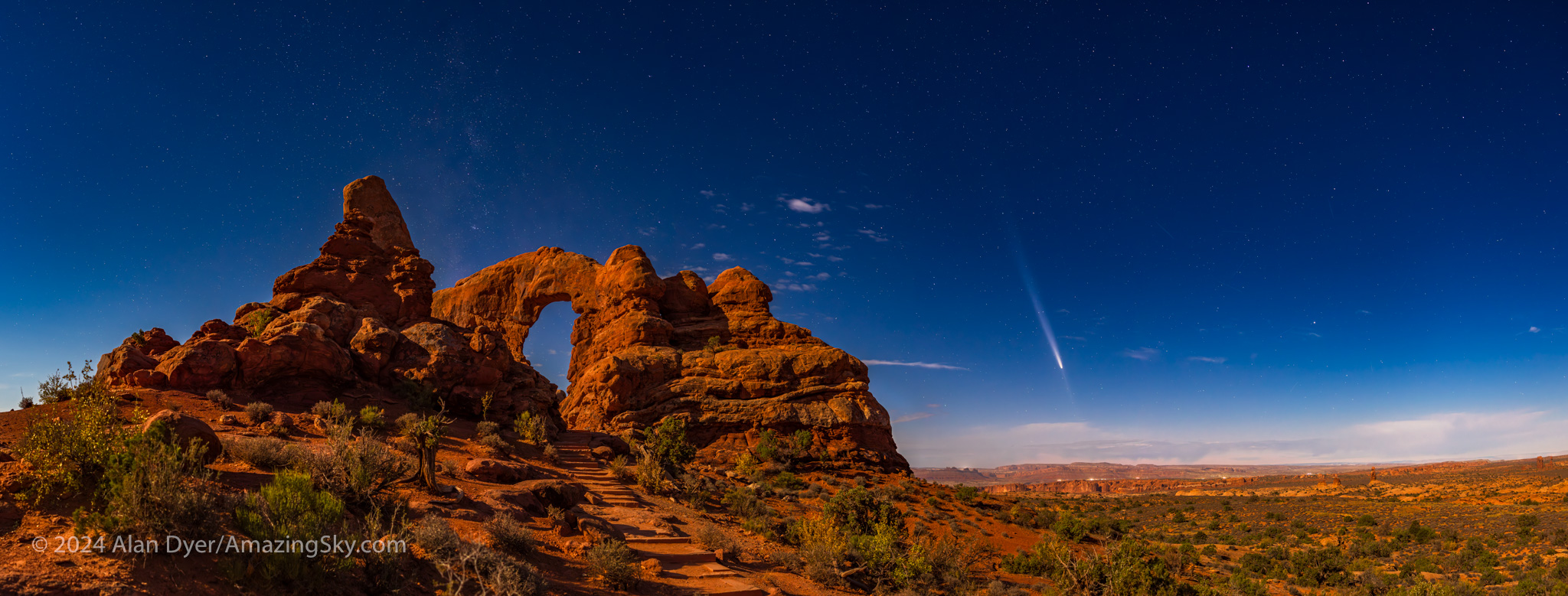
This is Comet Tsuchinshan-ATLAS (C/2023 A3) at its finest in the evening sky, on October 14, two days after its closest approach to Earth, and with it sporting a 10º- to 15º-long dust tail, and a short narrow anti-tail pointed toward the horizon. The location was Turret Arch in the Windows area of Arches National Park, Utah.

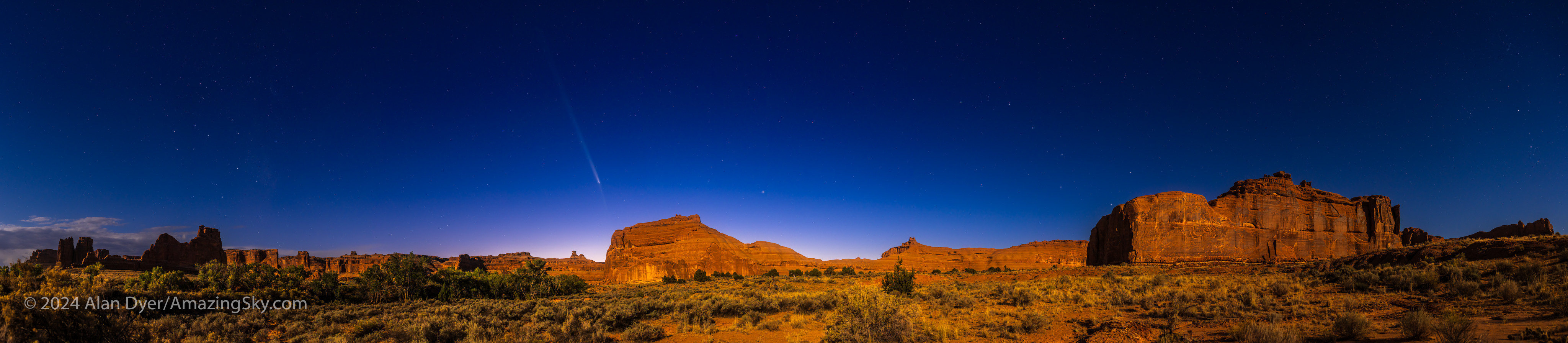
It blossomed nicely, especially as it entered into the evening sky in mid-October, as above. Despite the bright moonlight, it was easy to see with the unaided eye, a celestial rarity we get only once a decade, on average, if we are lucky. My blog of my comet chase is here

This is a panorama of Comet Tsuchinshan-ATLAS over Arches National Park, Utah, on a moonlit night, October 15, 2024, with the comet easy to see with the unaided eye.

A naked-eye comet ranks an 8 on our Aah! Factor scale. So now 2024 had delivered all four of our Top 4 sky sights. 
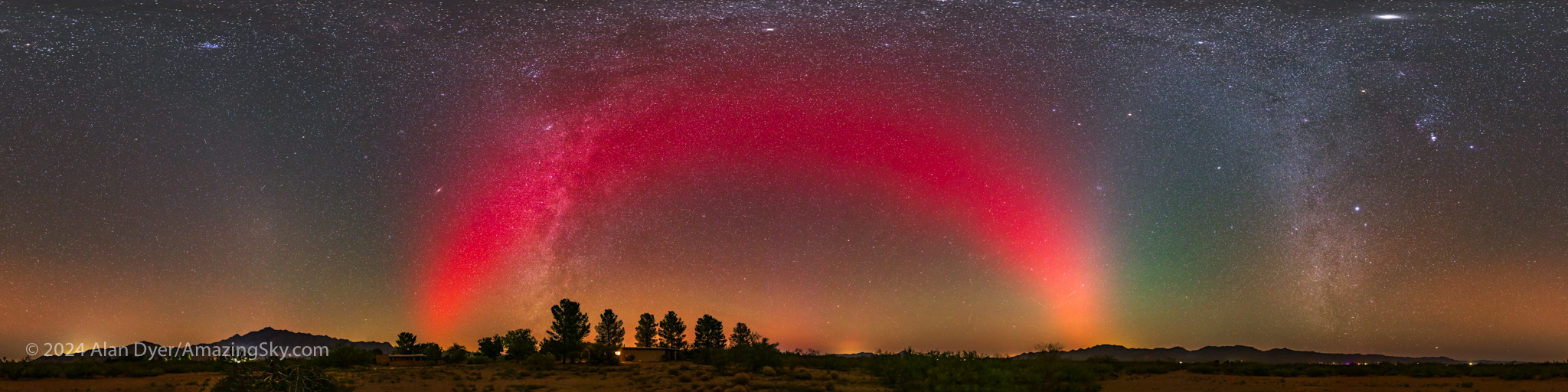
This 360° panorama captures a rare SAR (Stable Auroral Red) arc across the Arizona sky in the pre-dawn hours of October 11, 2024. The SAR arc was generated in the high atmosphere as part of the global geomagnetic storm of October 10/11, 2024, with a Kp8 rating that night.

But … just as a bonus, there was another fabulous aurora on October 10, seen in my case from the unique perspective of southern Arizona, with an appearance of a bright “SAR” arc more prominent than I had ever seen before. So that view was a rarity, too, so unusual it doesn’t even make our Aah! list, as SARs are typically not visible to the eye.


Back to Norway for Northern Lights

2024 was notable for travel getting “back to normal,” at least for me, with two long-distance drives, and now my second overseas trip. This one took me north to Norway 🇳🇴, which I had been visiting twice a year as an enrichment lecturer during pre-pandemic years. 
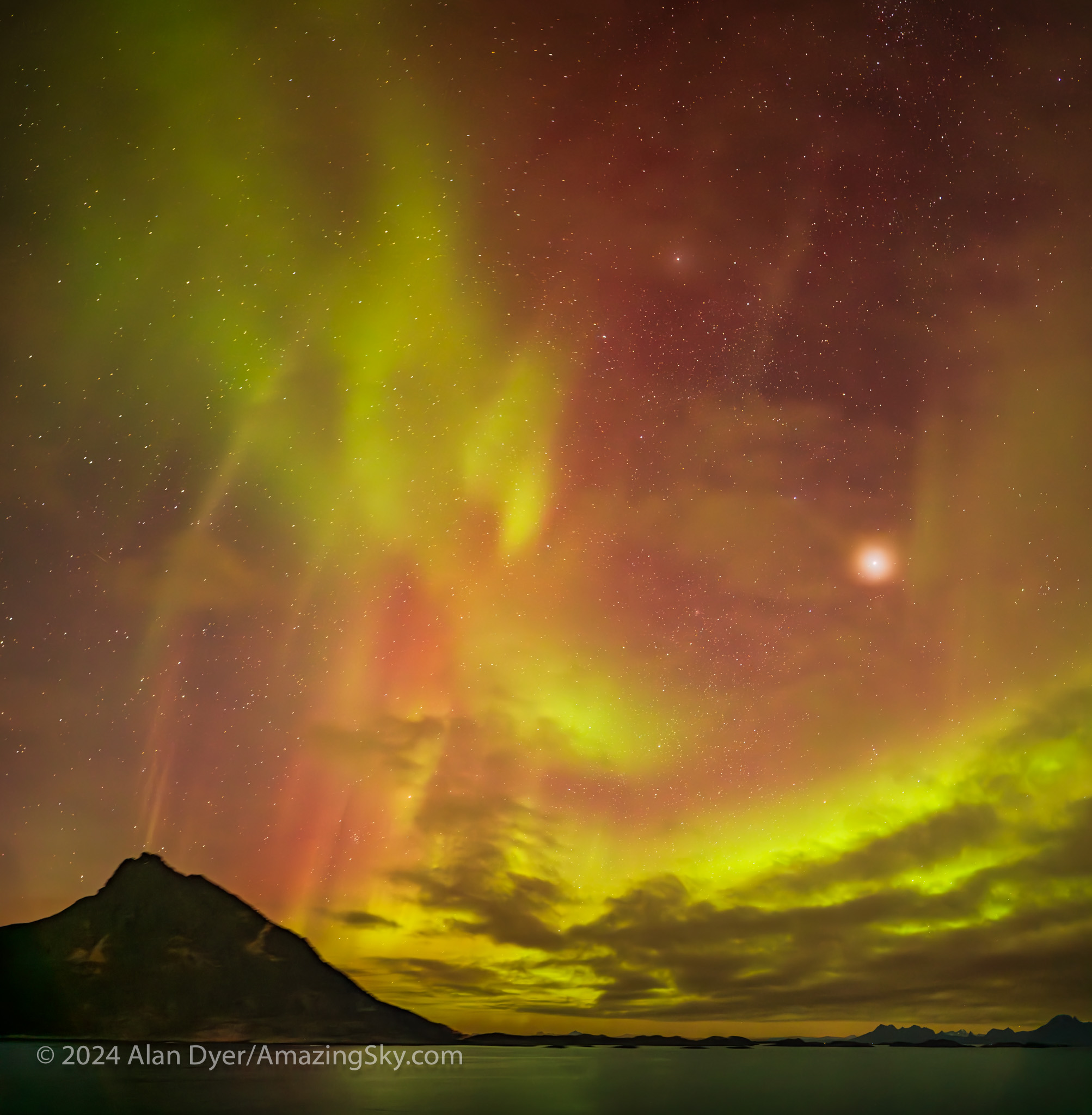
A green and red aurora appears over the coast of Norway, with Jupiter bright at right. This was from the Hurtigruten ship m/s Nordkapp on November 10, 2024, on a coastal cruise with a Road Scholar tour group.

The auroras were excellent, though nothing like the great shows of May and October. But the location sailing along the scenic coast and fjords makes up for any shortfall in the Lights. It was good to be back. I plan to return in 2025 for two cruises in October. Join me there, too!


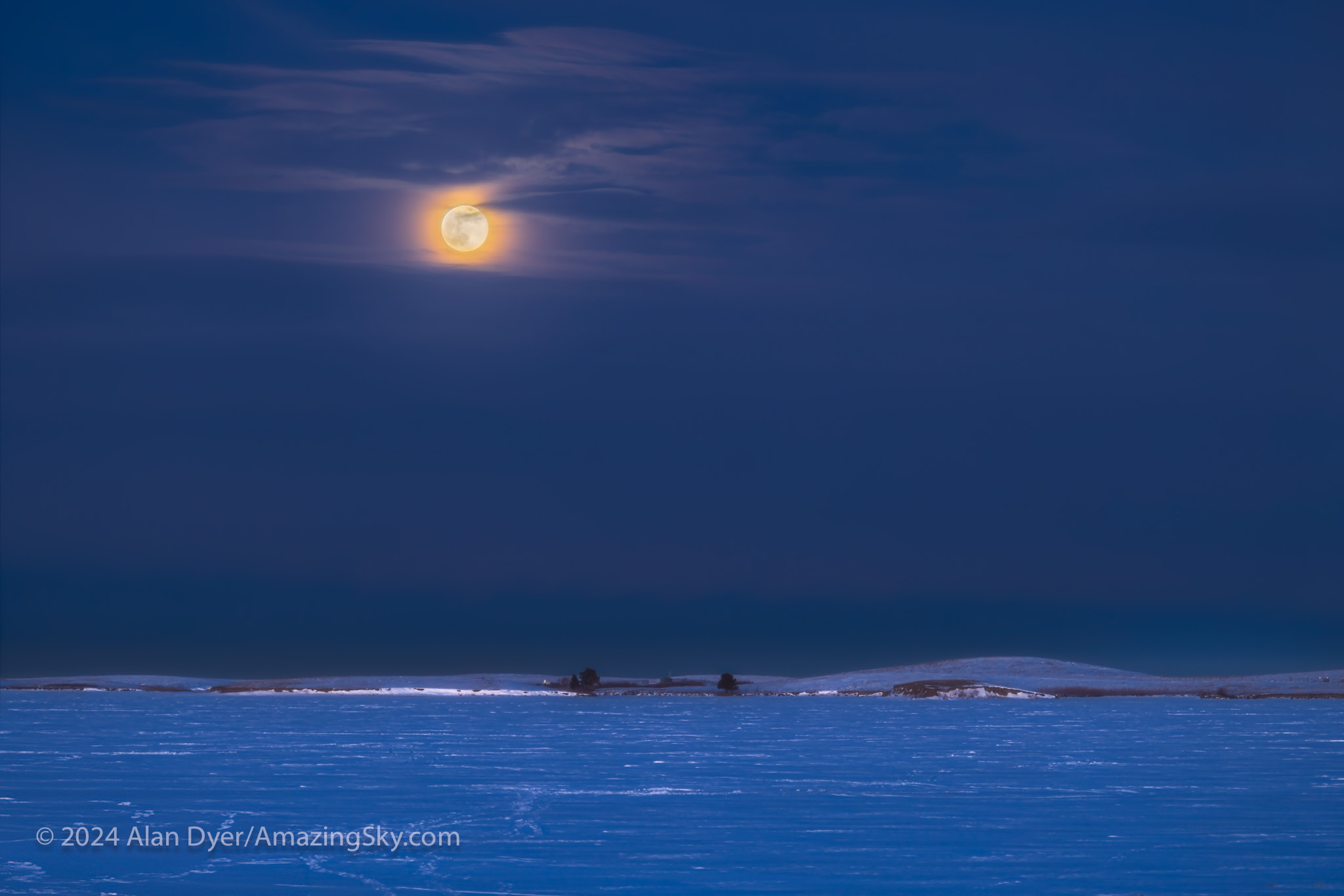
A Winter Moonrise to End the Year

As I write this, December has been nothing but cloud. Almost. A clear hour on Full Moon night allowed a capture of the “Cold Moon,” with the Moon near Jupiter, then at its brightest for the year. So that’s the other lunar bookend to the year, shot from the snowy backyard. 
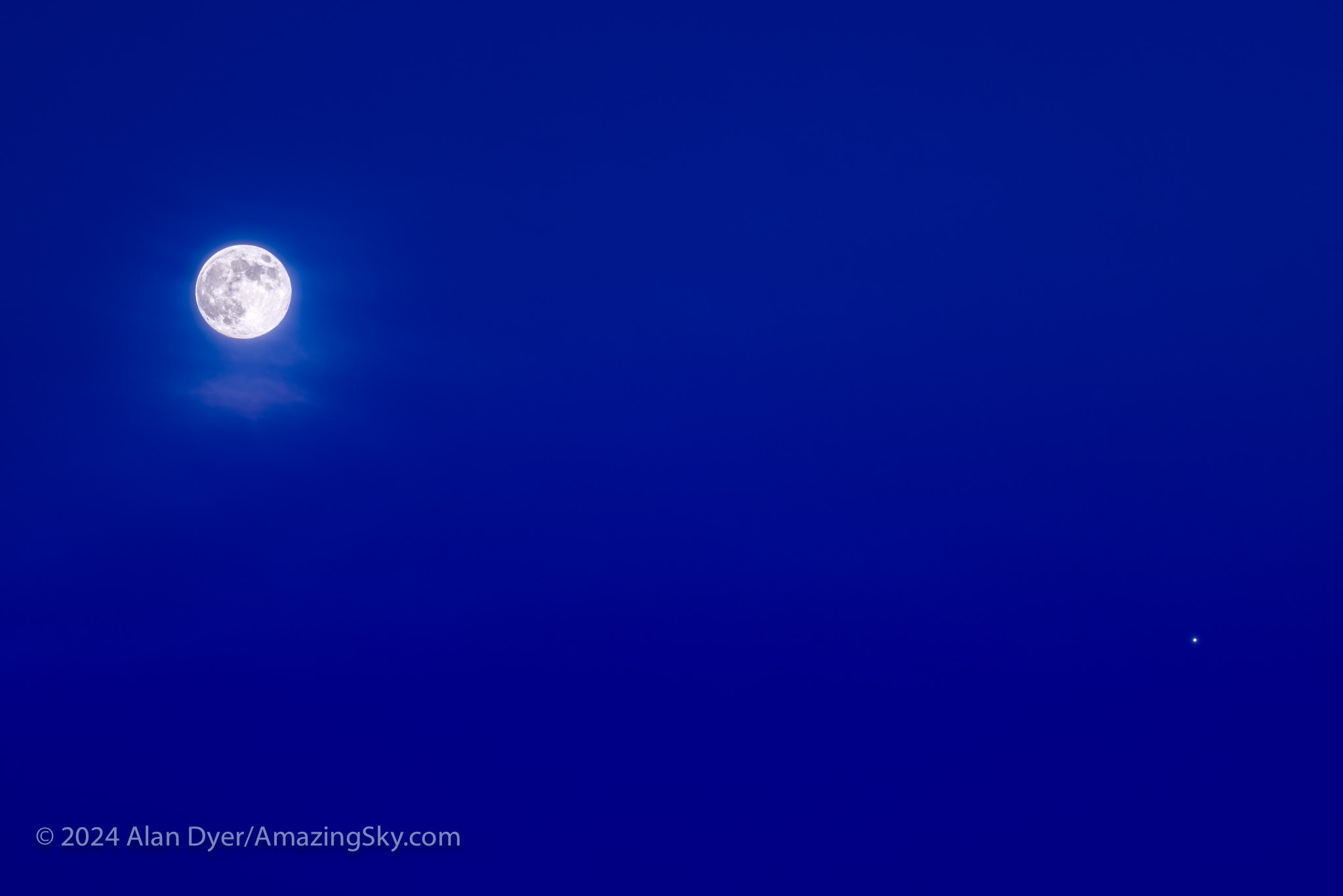
This is the Full Moon of December 14, 2024, near the planet Jupiter at lower right. Both were rising into the eastern sky in the early evening.

However, I did say after the clear total eclipse in April that if the rest of 2024 had been cloudy I wouldn’t complain. So I’m not. 

And there’s no reason to, as 2024 did deliver the best year of stargazing I can remember. 2017 had a total solar eclipse. 2020 had a great comet. But we have to go back to 2003 for aurora shows as widespread and as a brilliant as we’ve seen this year. 2024 had them all. And more!

We might see more auroras in 2025. And we have a total eclipse of the Moon. Two in fact, if you’re willing to travel to the other hemisphere. 
My 2025 Calendar cover. Go to https://www.amazingsky.com/Books

My 2025 Amazing Sky Calendar lists my picks for the best sky events of the coming year, with the emphasis on events viewable from North America. For a free PDF download of my Calendar, go to my website here

Clear skies to all, in a Happy New Year! 

— Alan, December 21, 2024 / amazingsky.com 
The Best Sky Sights of 2021


Two major eclipses of the Moon and a partial eclipse of the Sun over eastern North America highlight the astronomical year of 2021.

I provide my selection of three dozen of the best sky sights for 2021. I focus on events you can actually see, and from North America. I also emphasize events with the potential for good “photo ops.” 

What I Don’t Include

Thus, I’m excluding minor meteor showers and ones that peak at Full Moon, and events that happen with the objects too close to the Sun. 

I also don’t include events seen only from the eastern hemisphere, such as the April 17 occultation of Mars by the Moon — it isn’t even a close conjunction for us in North America. The August 15 rare triple transit of three Galilean moons at once on the disk of Jupiter occurs during daylight hours for western North America, rendering it very challenging to see. An outburst on August 31 of the normally quiet Aurigid meteor shower is predicted to happen over Asia, not North America.

I also don’t list the growing profusion of special or “supermoons” that get click-bait PR every year, choosing instead to limit my list to just the Harvest Moon of September as a notably photogenic Moon. 

Good Year for Lunar Eclipses

But two Full Moons — in May and in November — do undergo eclipses that will be wonderful sights for the eye and camera. As a bonus, the Full Moon of May is the closest Full Moon of 2021, making it, yes, a “supermoon.” 

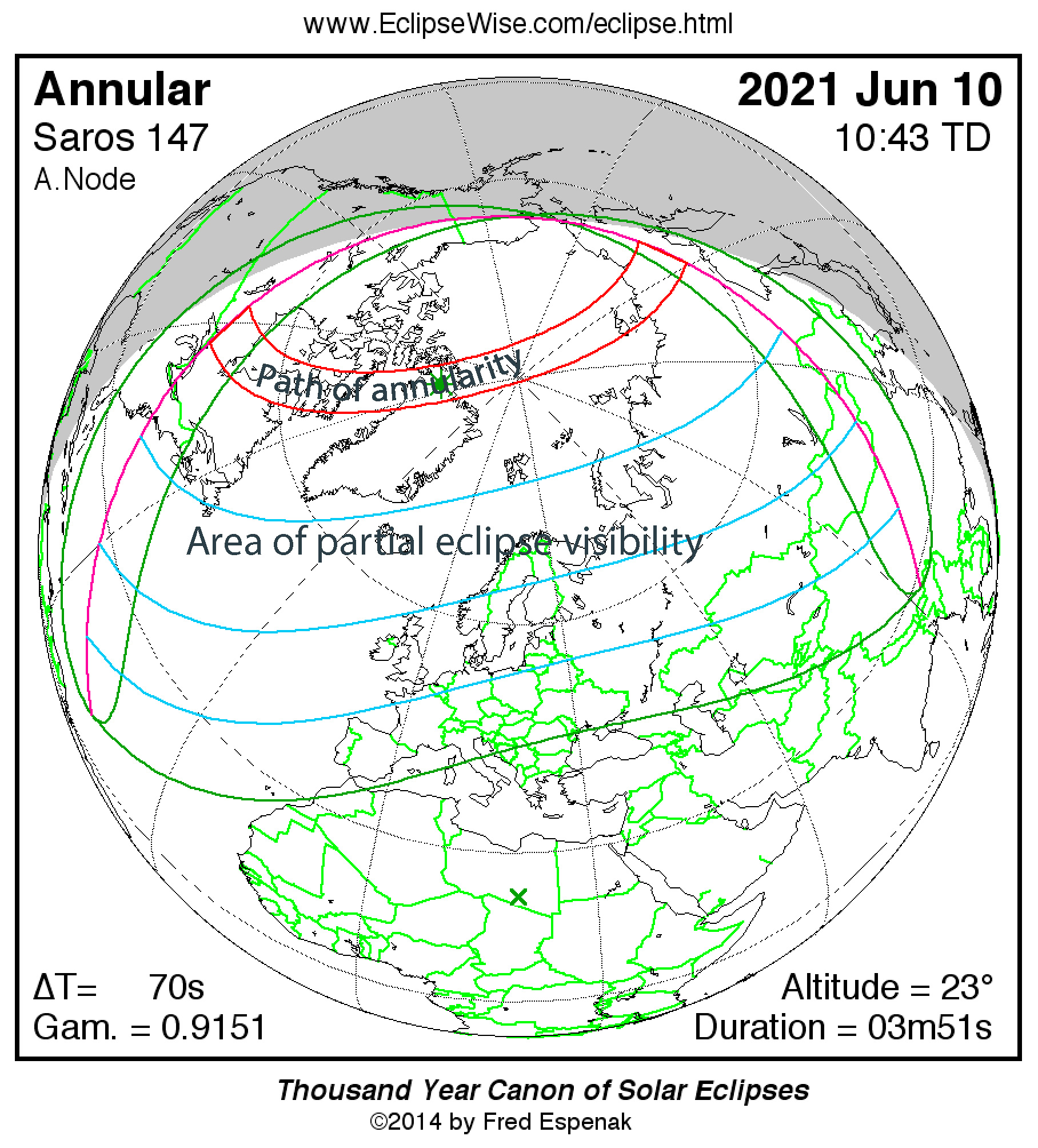
The New Moon eclipses the Sun on June 10, bringing an annular eclipse to remote regions of northern Canada and the Arctic (including the North Pole!). Eastern North America and all of Europe can witness a partial solar eclipse this day. 

Recommended Guides

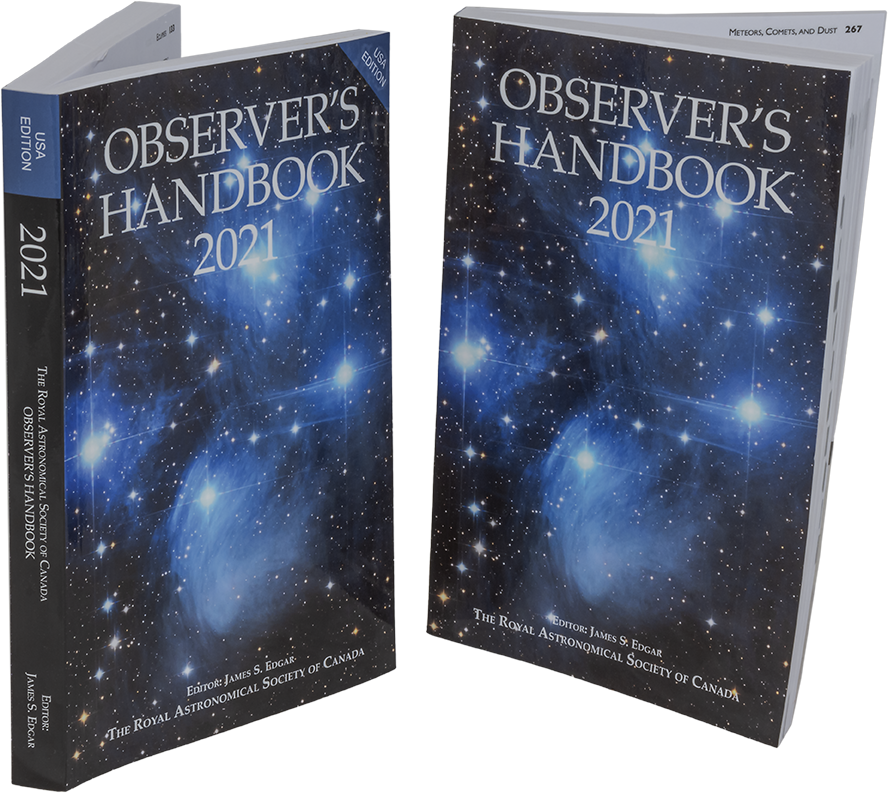
For an authoritative annual guide to the sky and detailed reference work, see the Observer’s Handbook published each year in Canadian and U.S. editions by The Royal Astronomical Society of Canada. I used it to compile this list.

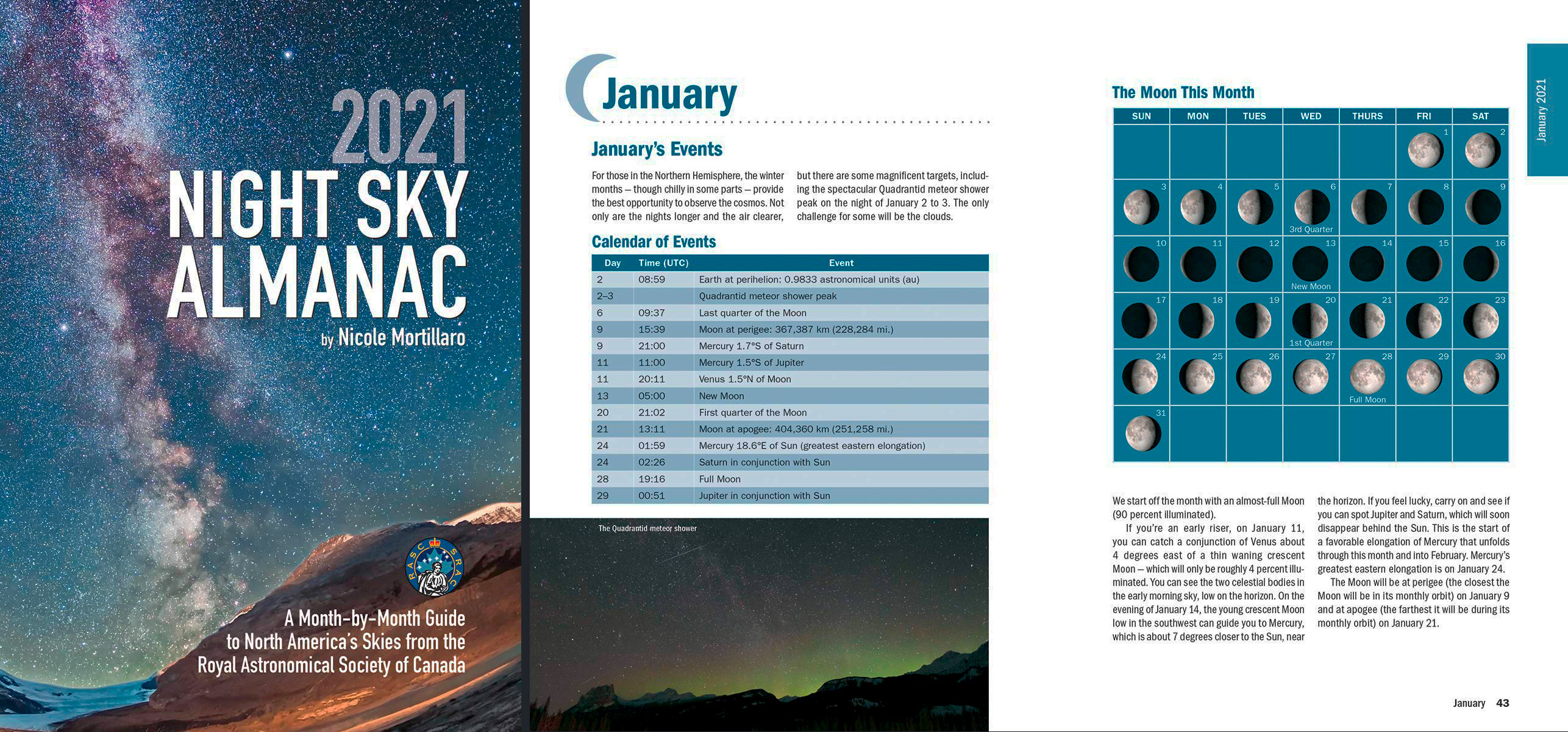
The RASC has also partnered with Firefly Books to publish a more popular-level guide to the coming year’s sky for North America, in the 2021 Night Sky Almanac, authored by Canadian science writer Nicole Mortillaro. It provides excellent monthly star charts.

However, feel free to print out my blog or save it as a PDF for your personal reference. To share my listing with others, please send them the link to this blog page. Thanks!


January

The year begins with a chance to see three planets together at dusk.

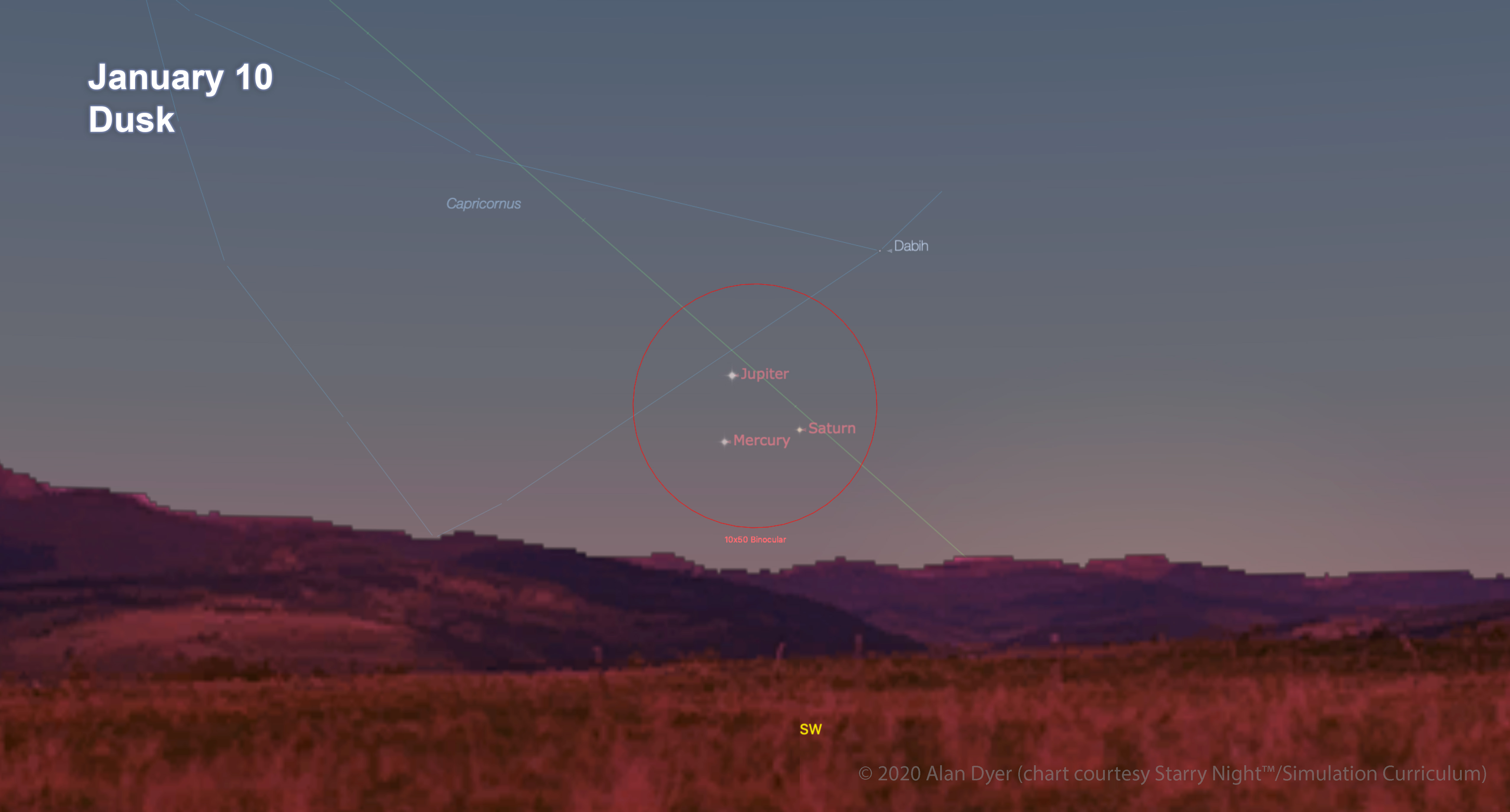
January 10 — Mercury, Jupiter and Saturn within 2 degrees (°)

Even three weeks after their much publicized Great Conjunction, Jupiter and Saturn are still close and visible low in the evening twilight. On January 10 Mercury joins them to form a neat triangle of worlds, but very low in the southwest. Clear skies and binoculars are a must!

NOTE: The red circle on this and most charts represents the 6.5° field of view of a typical 10×50 binocular. So you can see here how binoculars will frame the trio perfectly. All charts are courtesy the desktop app Starry Night™ by Simulation Curriculum

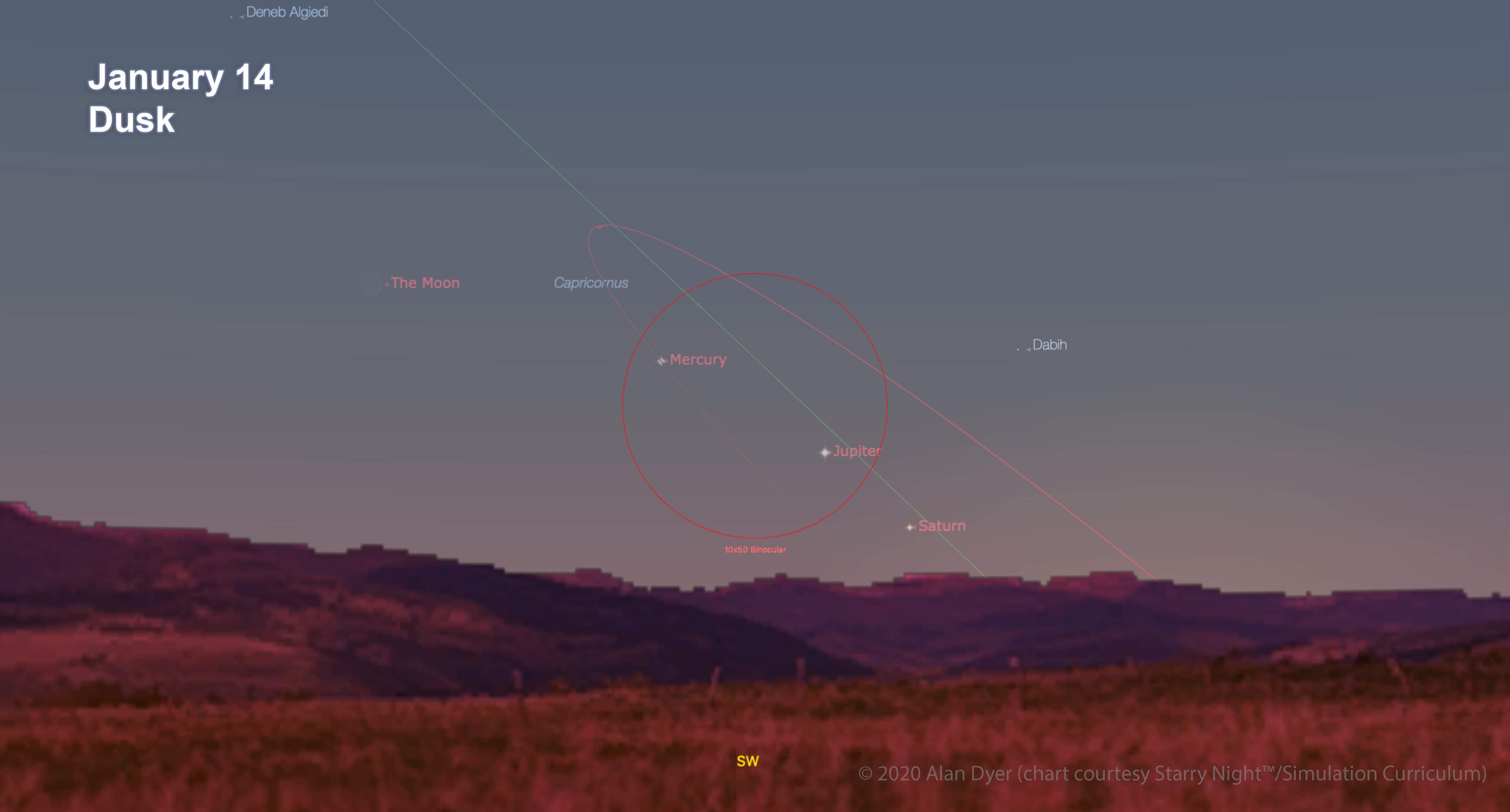
January 14 — Thin waxing crescent Moon above line of Mercury, Jupiter and Saturn 

Saturn disappears behind the Sun on January 23, followed by Jupiter on January 28, so early January is our last chance to see the evening trio of planets, tonight with the crescent Moon. 

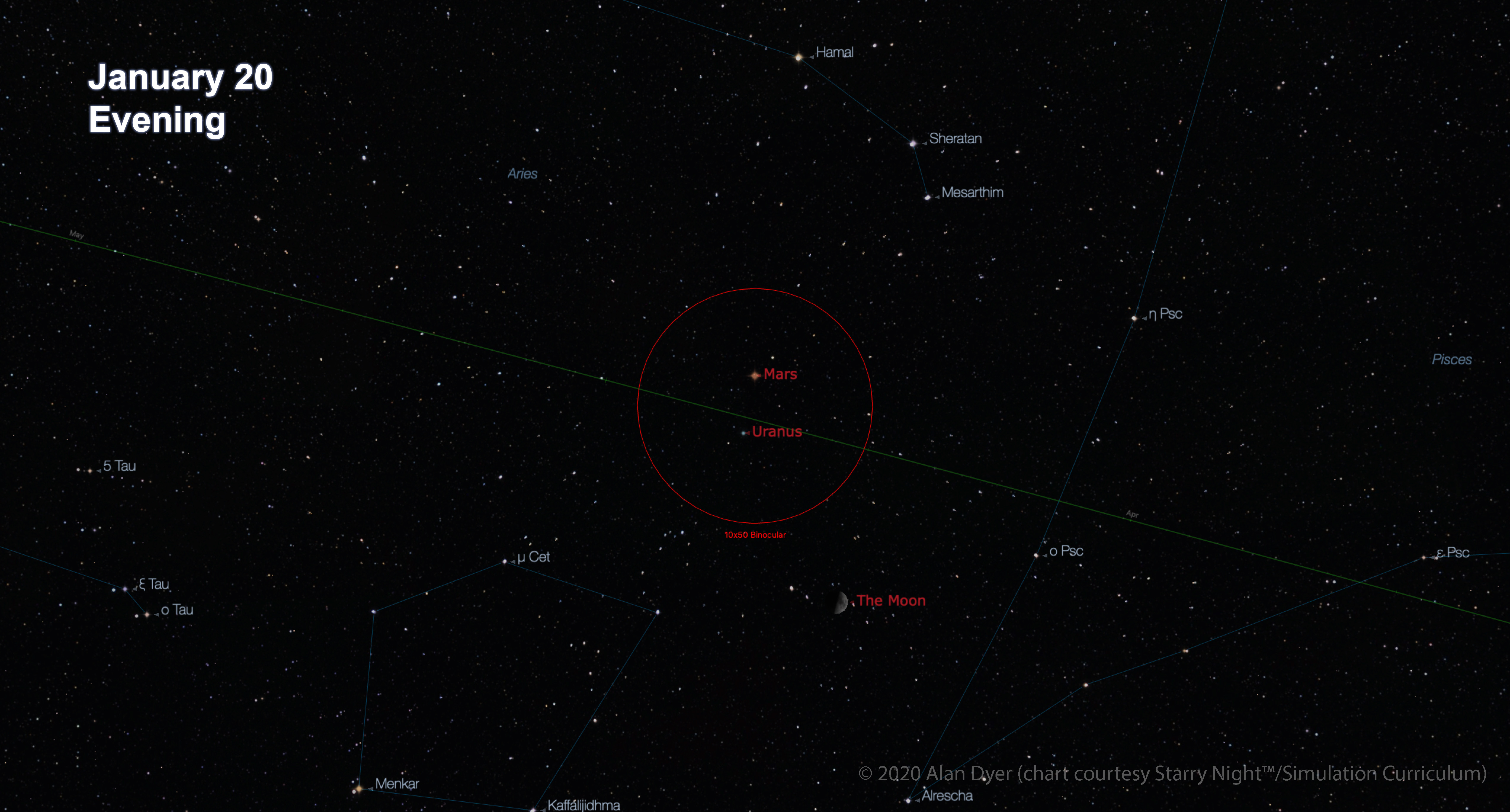
January 20 — Mars and Uranus 1.6° apart

Uranus will be easy to spot in binoculars as a magnitude 5.8 green star below red Mars, so this is your chance to find the seventh planet. The quarter Moon shines below the planet pair. 

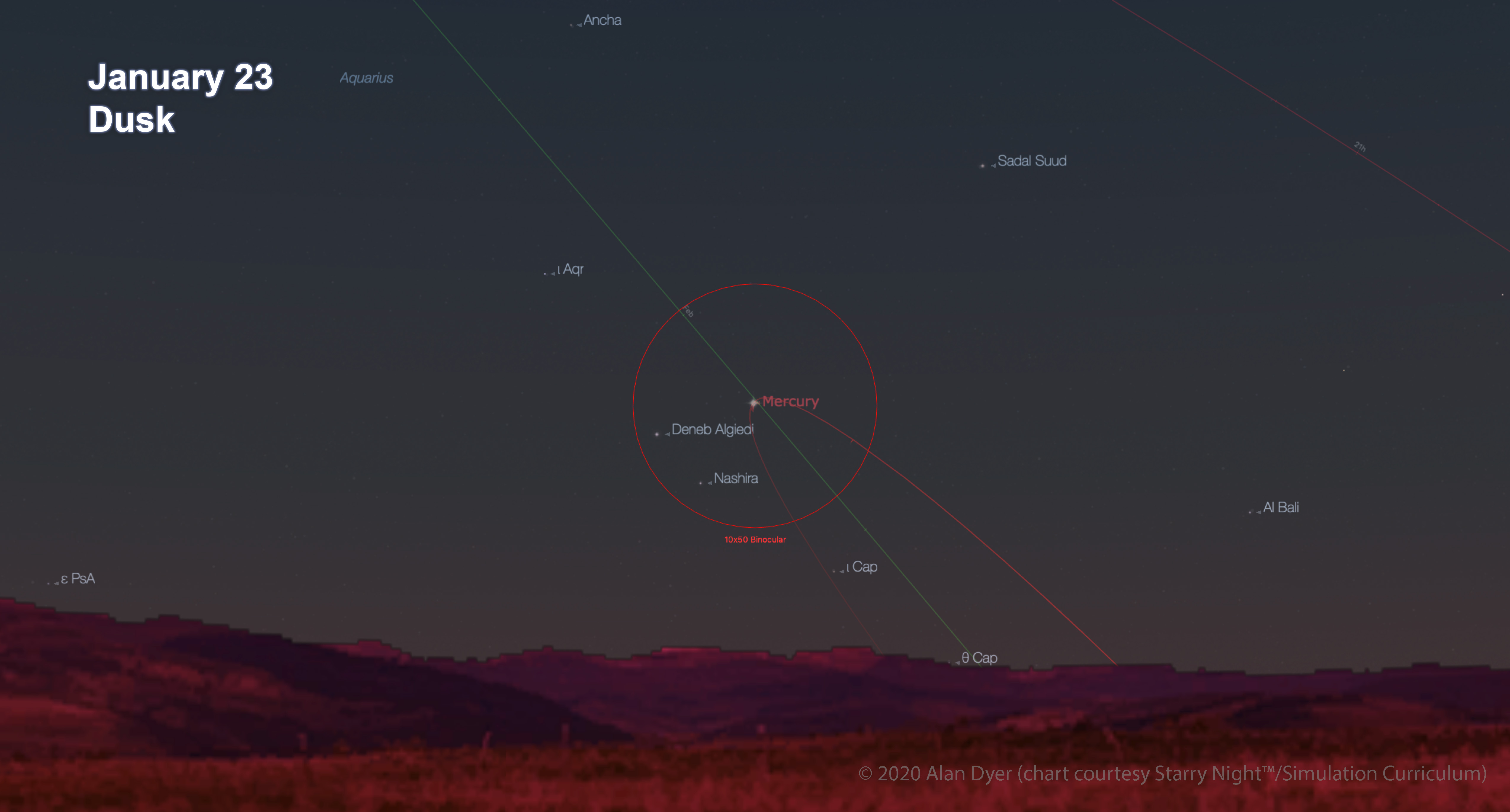
January 23 — Mercury at a favourable evening elongation 

This and its appearance in May are the best opportunities for northern hemisphere observers to catch the innermost planet in the evening sky in 2021. Look for a bright magnitude -0.8 “star” in the dusk twilight. 


February

This is a quiet month with Mars the main evening planet, but now quite small in the telescope. 

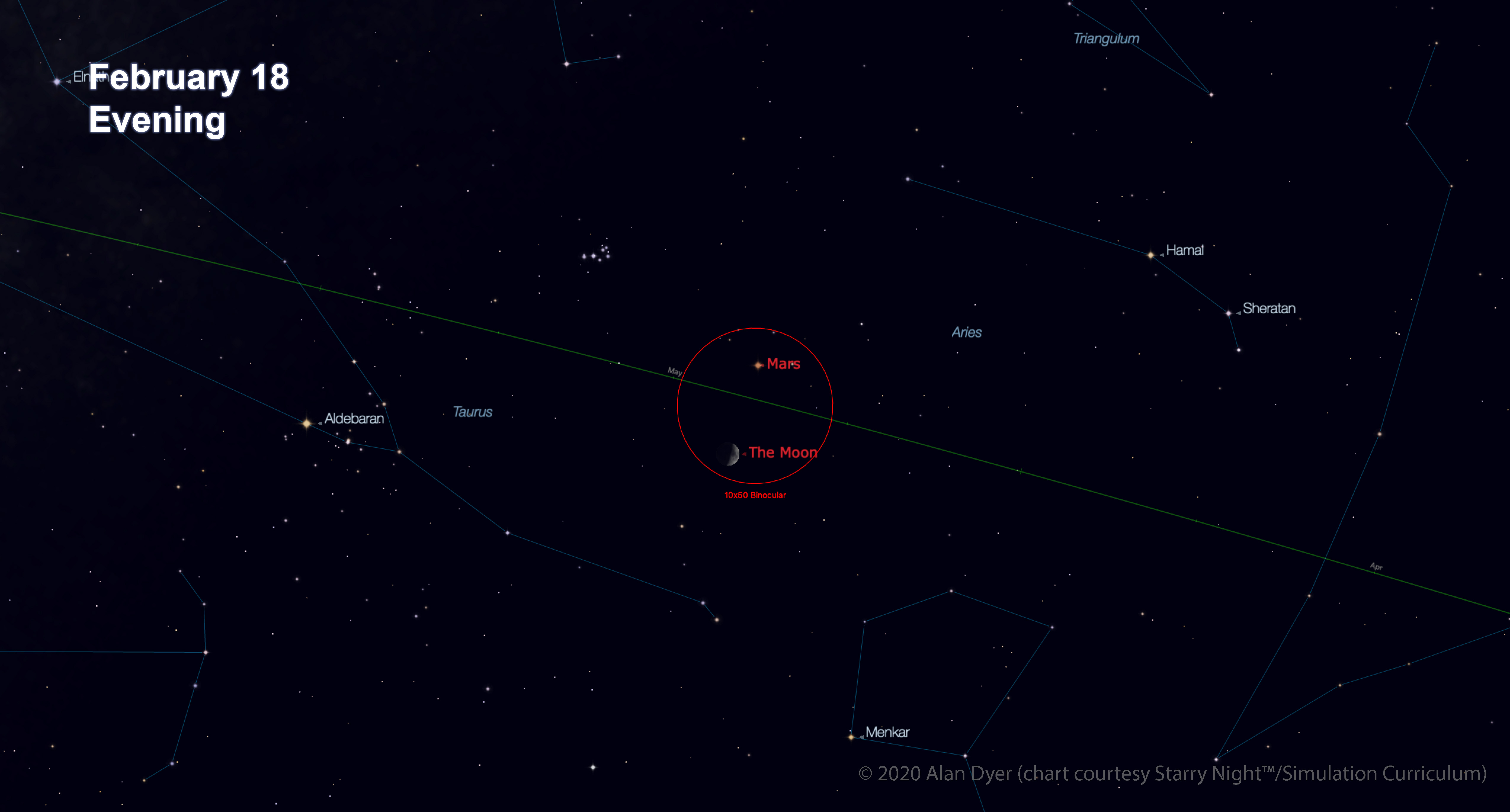
February 18 — Waxing Moon 4° below Mars

The pairing appears near the Pleiades and Hyades star clusters high in the evening sky.


March 

Mars shines high in evening sky in Taurus, while the three planets that were in the evening sky in January begin to emerge into the dawn sky. 

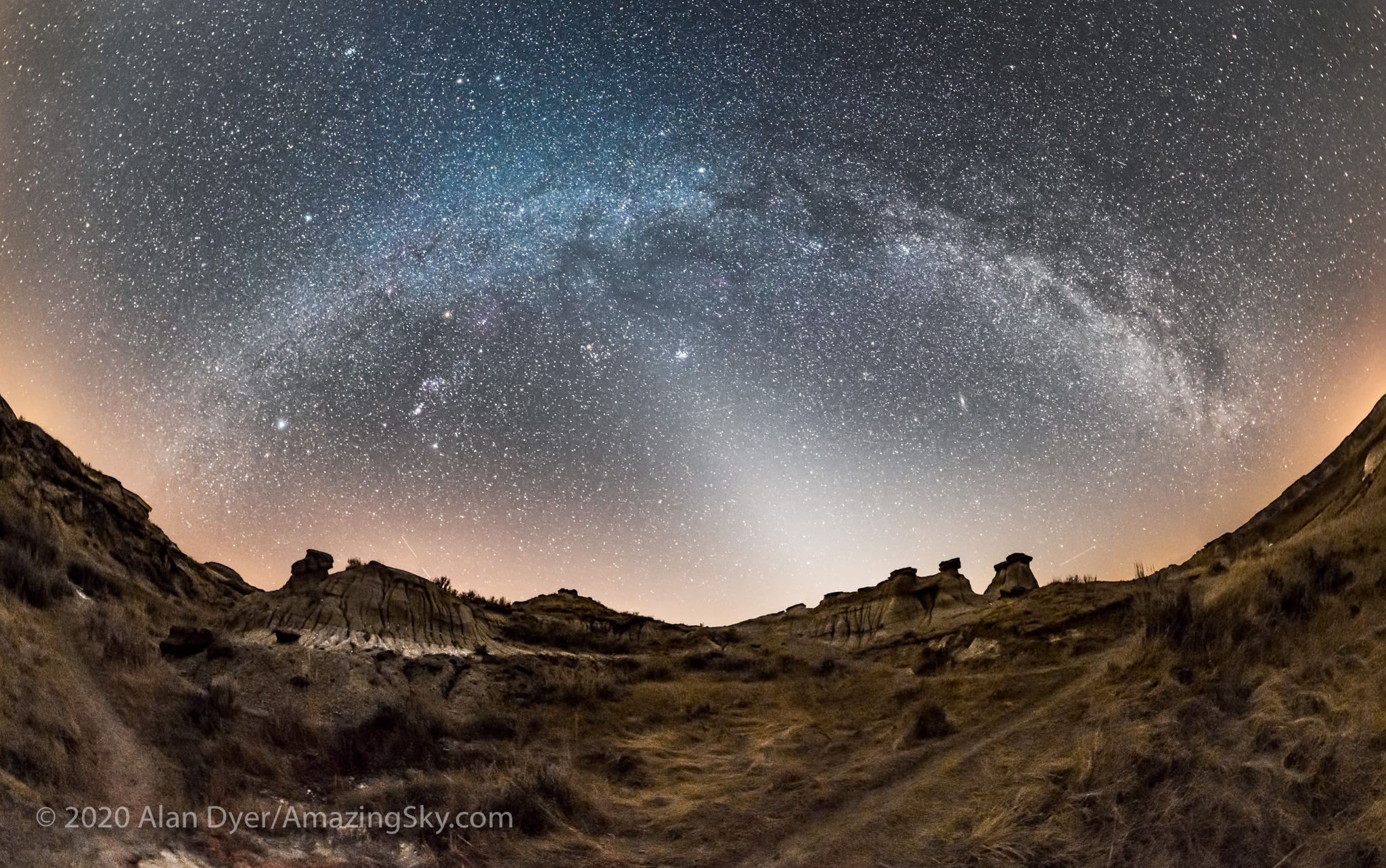
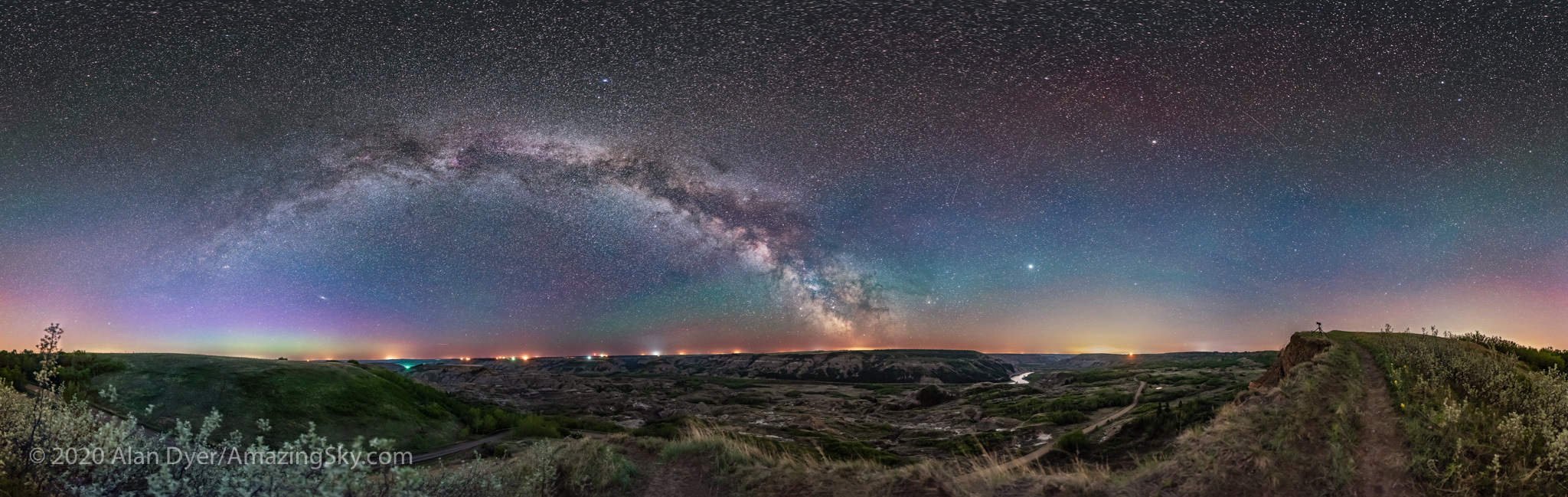
A 200+ degree panorama of the arch of the winter Milky Way, from south (left) to northwest (ar right) with the Zodiacal Light to the west at centre. This was from Dinosaur Provincial Park in southern Alberta on February 28, 2017.

March 1 — Zodiacal light “season” begins in the evening 

From sites away from light pollution look for a faint glow of light rising out of the southwest sky on any clear evening for the next two weeks with no Moon.

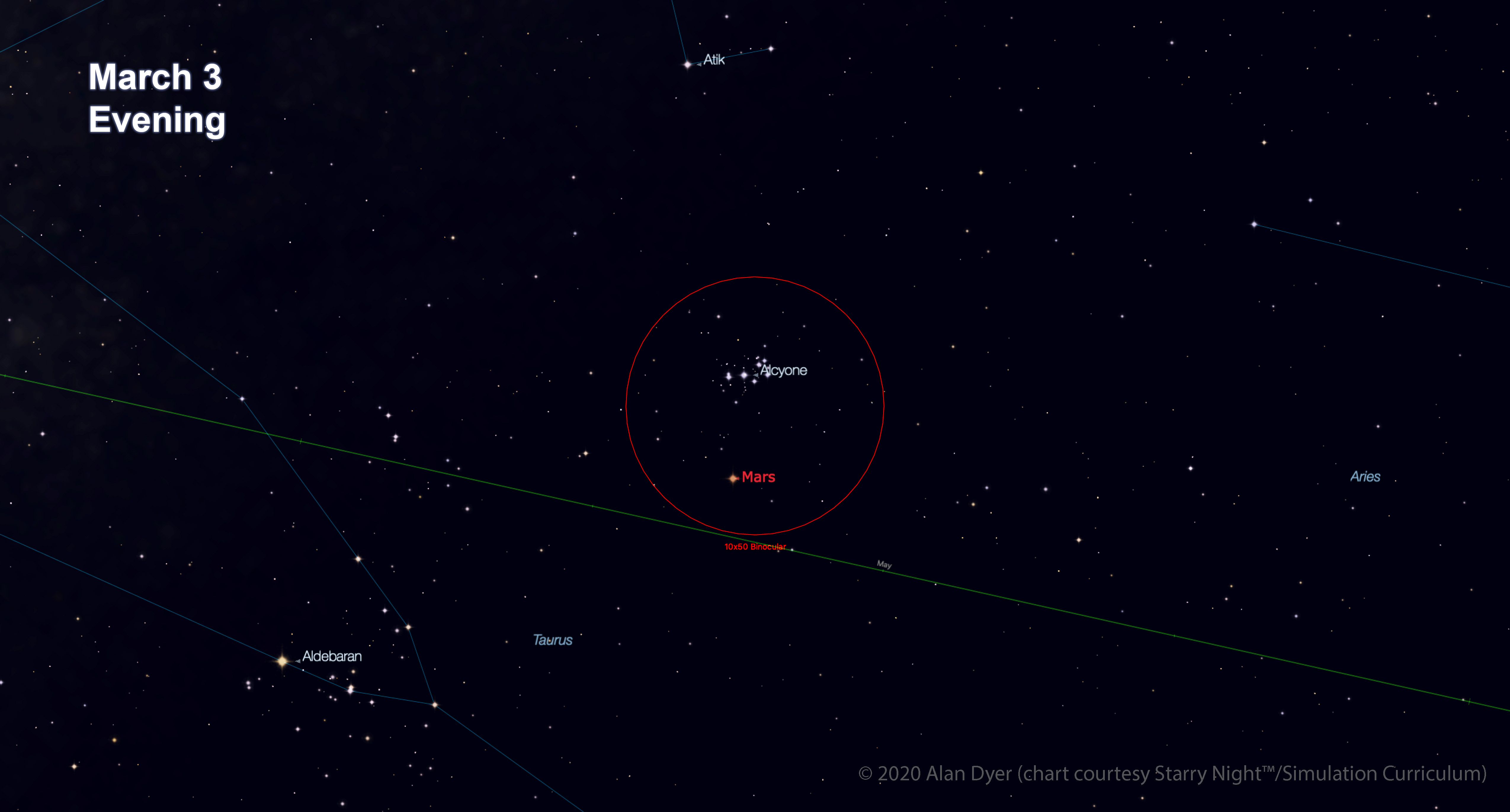
March 3 — Mars 2.5° below the Pleiades

This will be a nice sight in binoculars tonight and tomorrow high in the evening sky, and a good target for tracked telephoto lens shots.

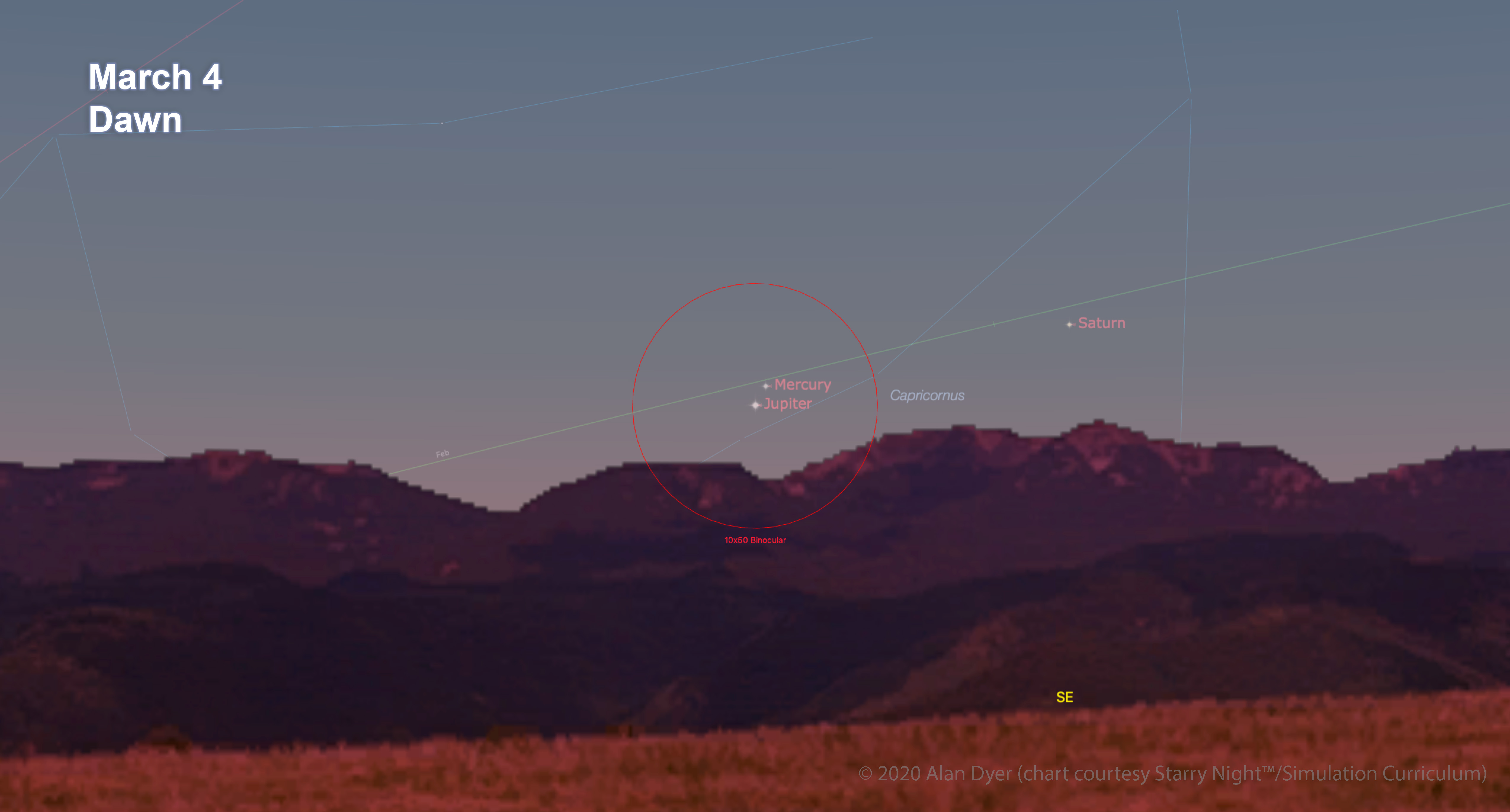
March 4 — Mercury and Jupiter just 1/2° apart 

Close to be sure! But this pairing will be so low in the dawn sky it will be difficult to spot. They will appear equally close on March 5 should clouds intervene on March 4.

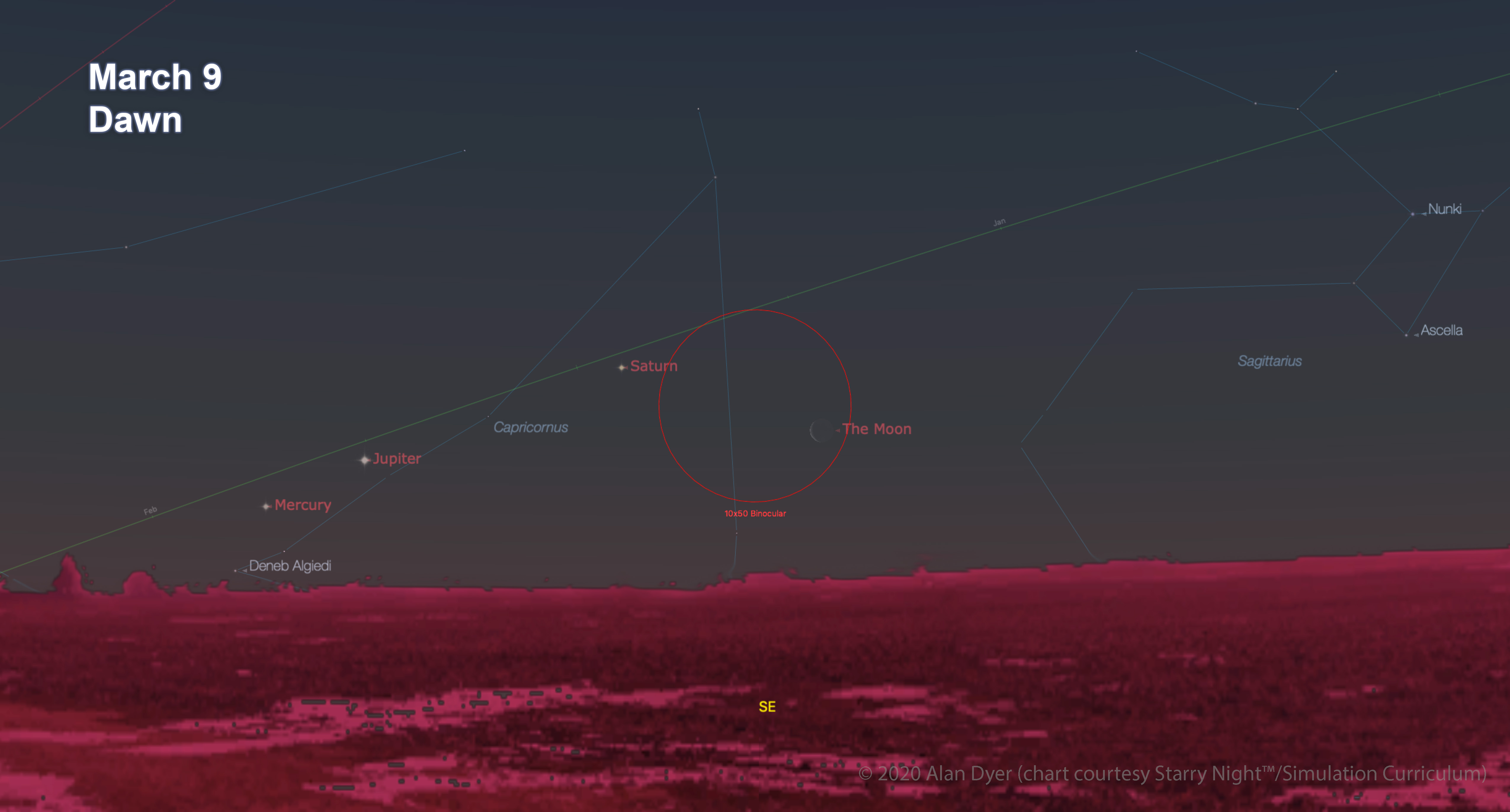
March 9 — Line of Mercury, Jupiter, Saturn and waning crescent Moon 

Three planets and the waxing crescent Moon form a line across the dawn sky but again, very low in the southeast. The even thinner Moon will be below Jupiter on March 10. Observers at low latitudes (south of 35° N) will have the best view on these mornings. 

March 20 — Equinox at 5:37 a.m. EDT

Spring officially begins for the northern hemisphere, autumn for the southern, as the Sun crosses the celestial equator heading north. Today, the Sun rises due east and sets due west for photo ops. 

March 30 — Zodiacal light season again!

With the Moon out of the way, the faint zodiacal light can again be seen and photographed in the west over the next two weeks, but only from a site without significant light pollution on the western horizon.


April

The inner planets appear in the evening sky, while Mars meets M35.

The arch of the Milky Way over the Red Deer River valley and badlands at Dry Island Buffalo Jump Provincial Park, Alberta, on May 19/20, 2018 just after moonset of the waxing crescent Moon.

April 6 — Milky Way arch season begins

With the waning Moon just getting out of view, this morning and for the next two weeks are good nights to shoot panoramas of the bright summer Milky Way as an arch across the sky, with the galactic core in view to the south. The moonless first two weeks of May, June and July will also work this year, but by August the Milky Way is reaching high overhead and so is difficult to capture in a horizontal landscape panorama. 

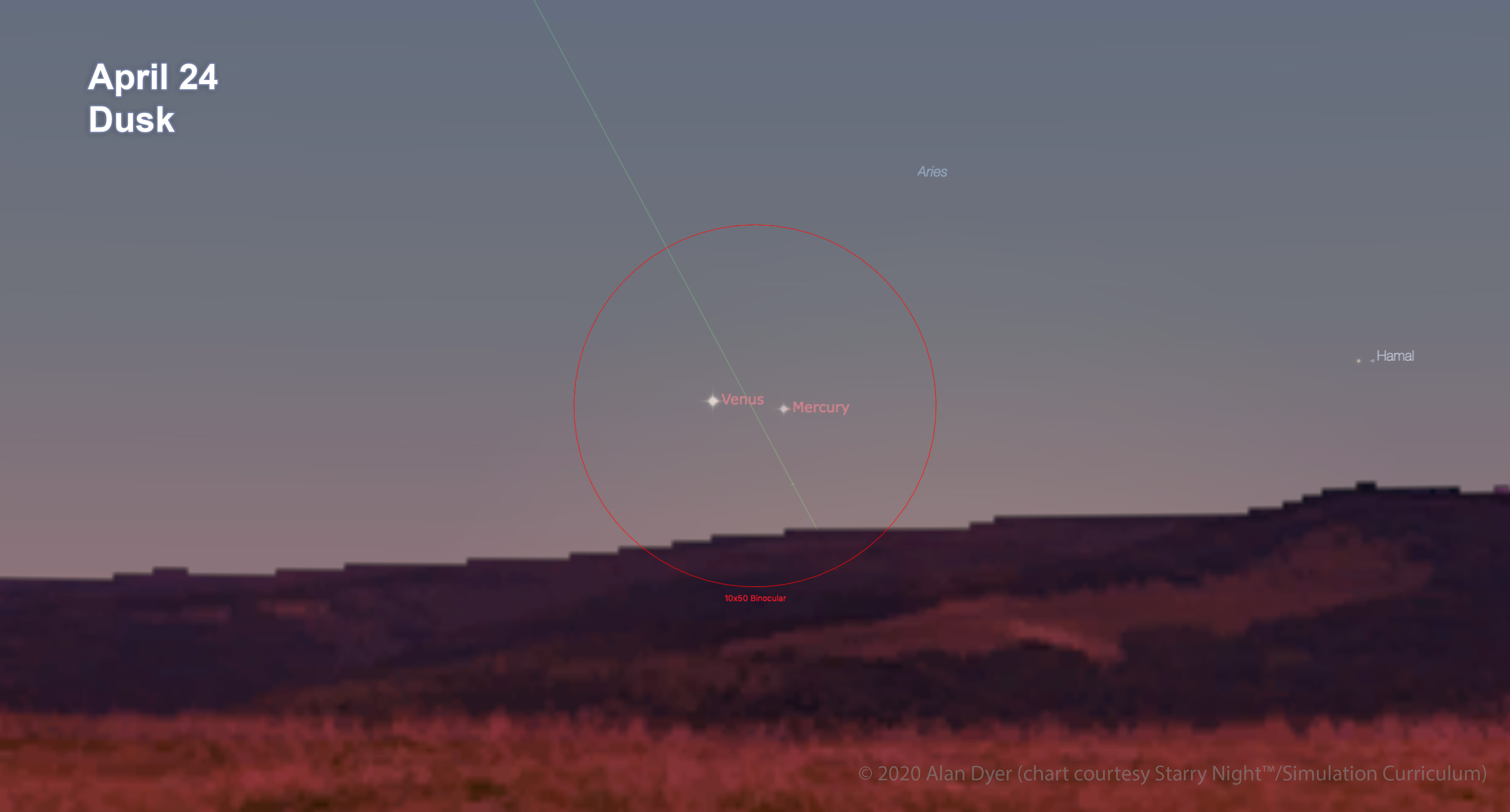
April 24 — Mercury and Venus 1° apart

The two inner planets will be very low in the western evening sky tonight and tomorrow, but with clear skies this is a chance to catch both at once. Use a telephoto lens for the best image. 

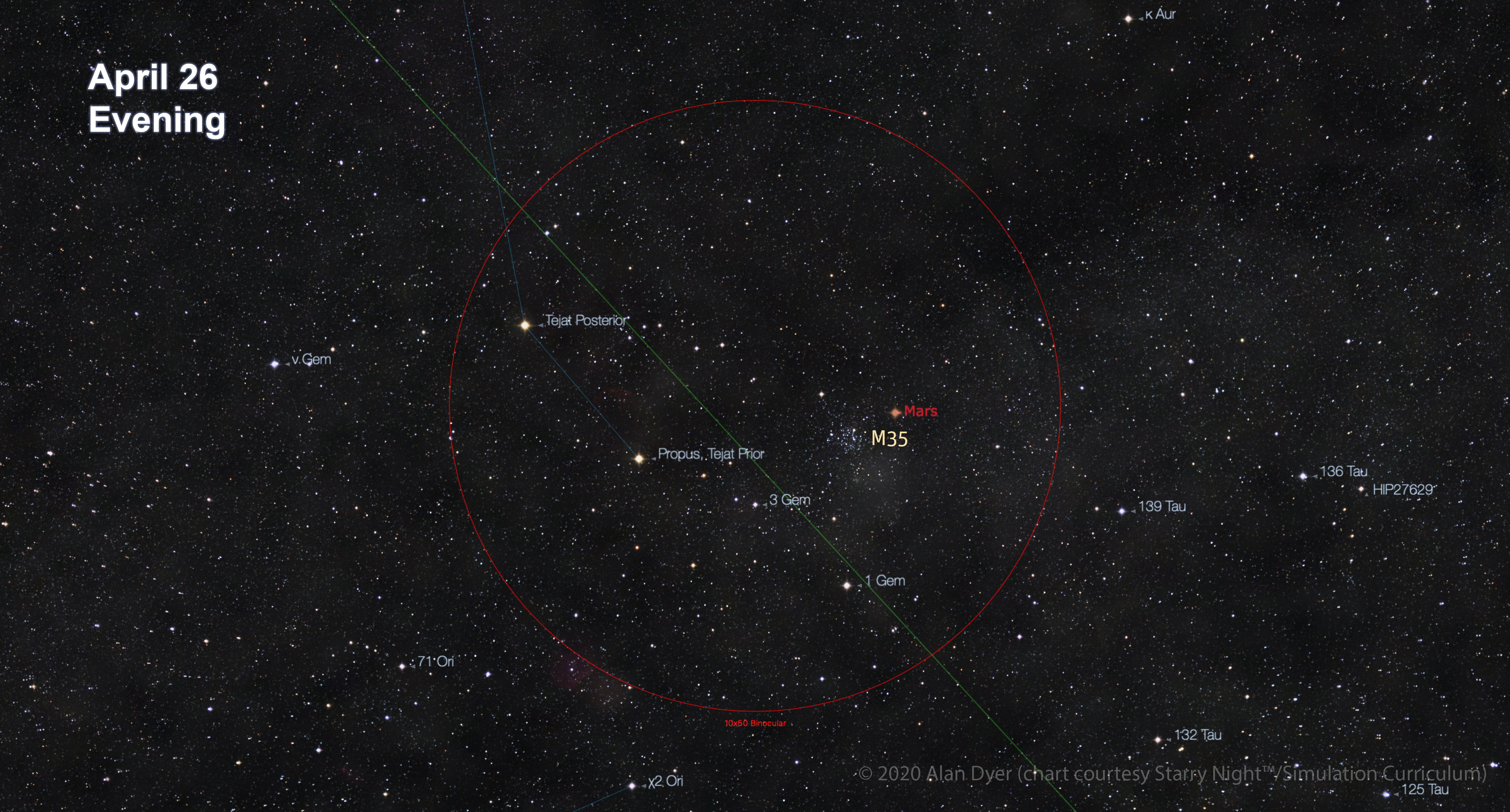
April 26 — Mars passes 1/2° north of M35 star cluster

This will be a fine scene for binoculars or a photo op for a tracked telephoto lens or telescope in a long enough exposure to reveal the rich star cluster Messier 35 in Gemini.


May

On May 26 a totally eclipsed Moon shines red in the west before sunrise for western North America. 

May 12 — Venus and Moon 1.5° apart

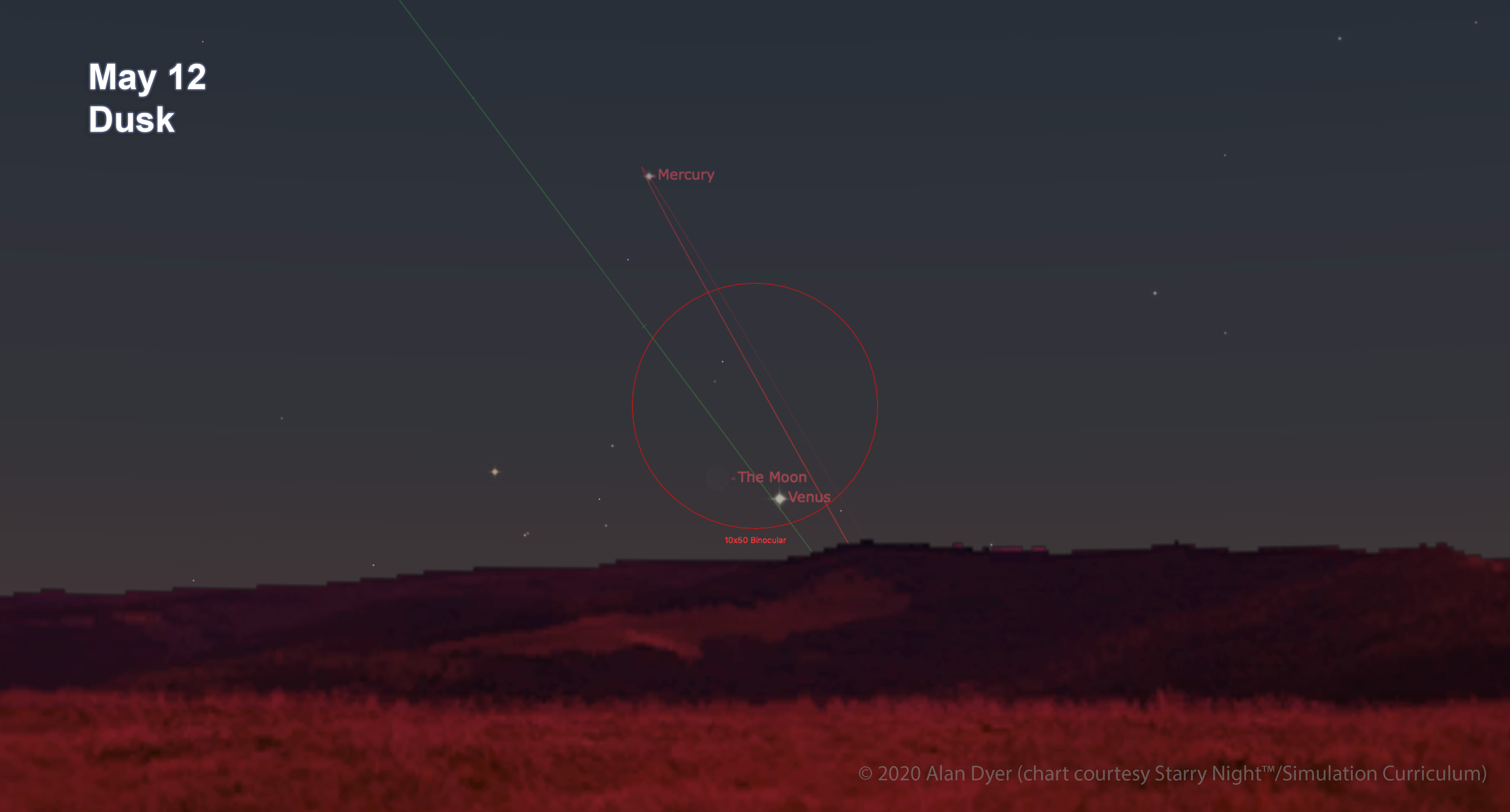
Look low in the western evening sky this night for the pairing of the thin crescent Moon and Venus, and the next night, May 13, for the crescent Moon higher and 4° away from Mercury. These are good nights to capture both inner planets using a short telephoto lens. 

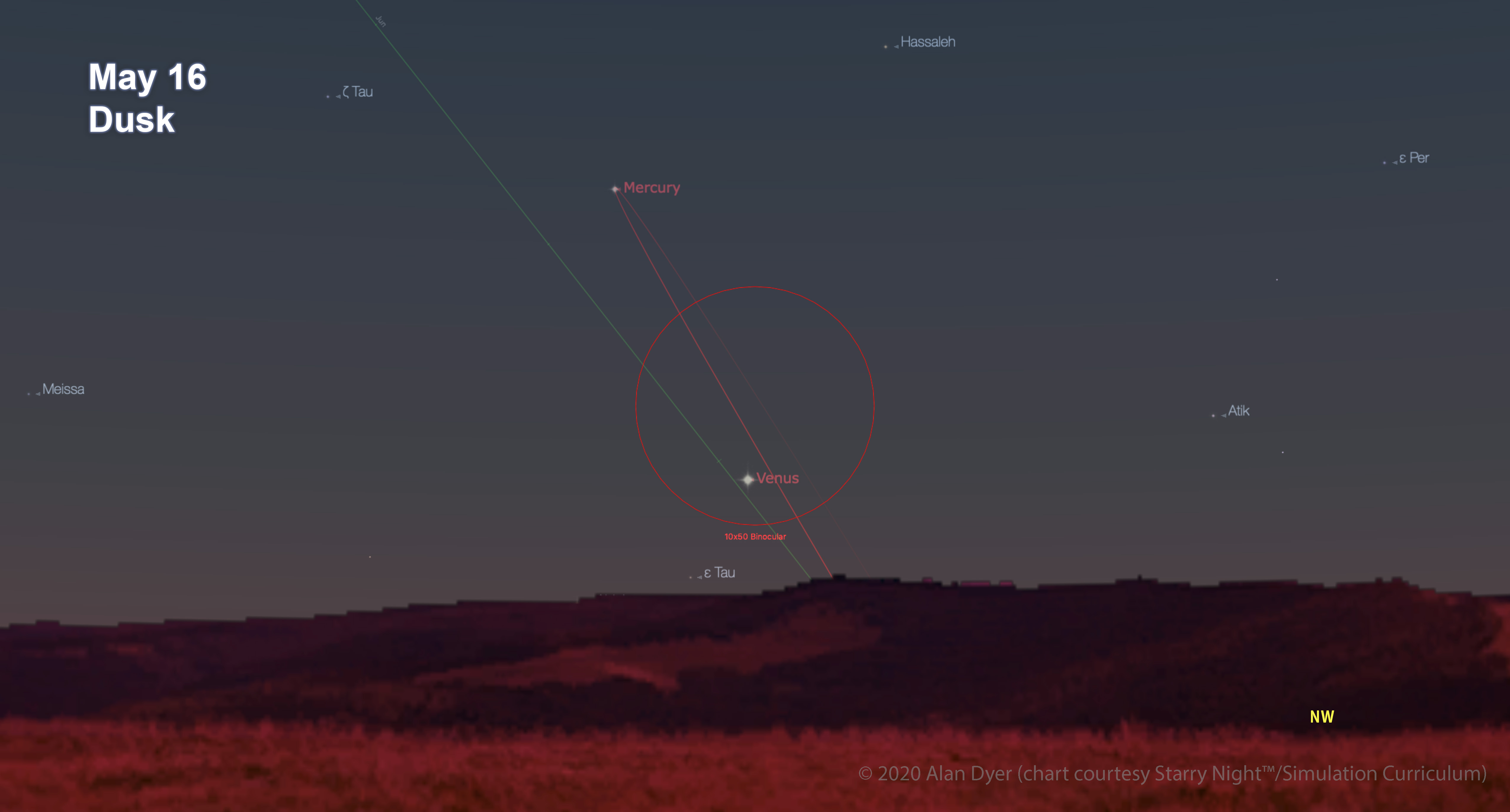
May 16 — Mercury at a favourable evening elongation

With Mercury angled up high in the northwest this is the best week of the year to catch it in the evening sky from northern latitudes. 

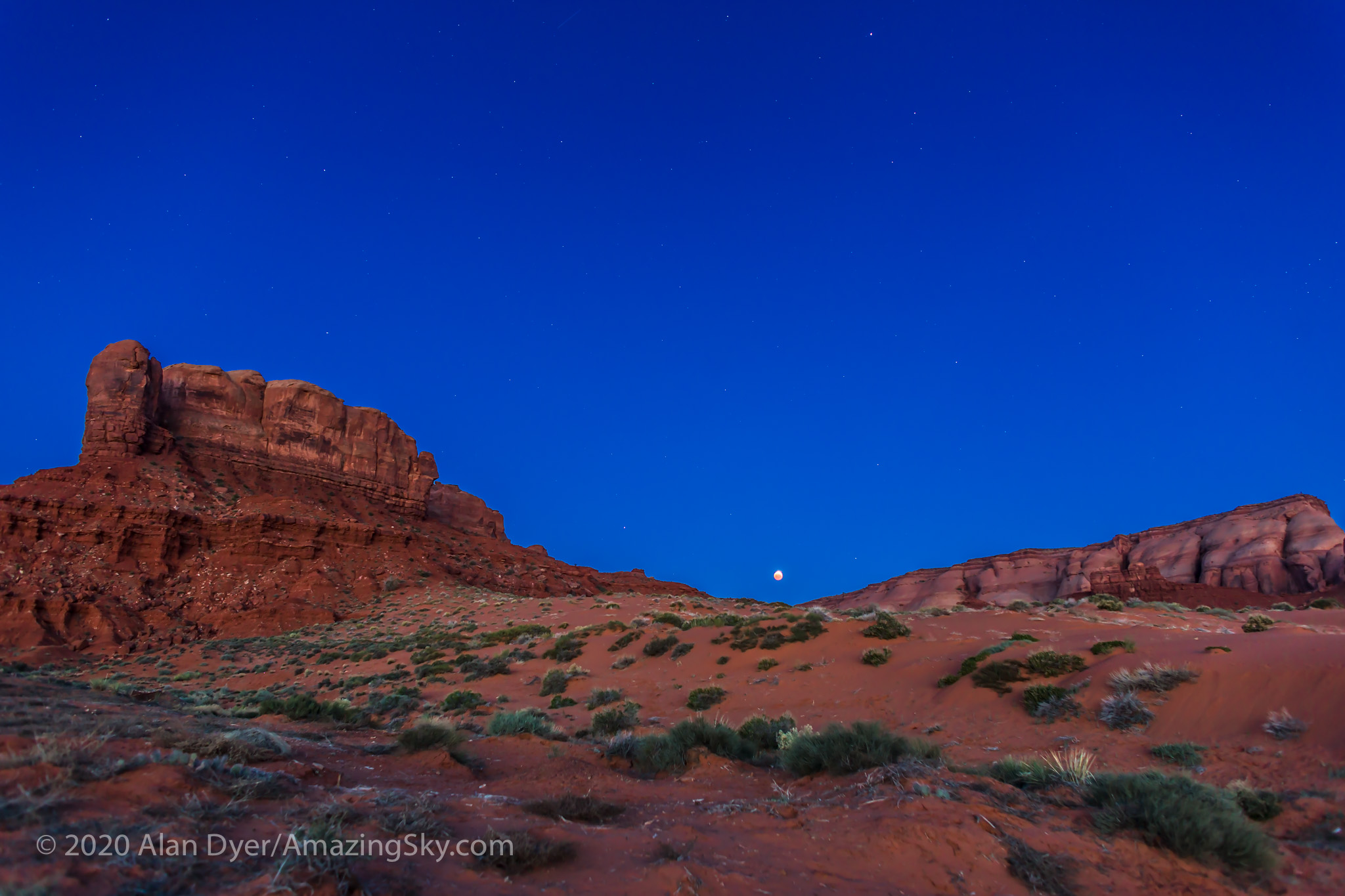
The total lunar eclipse of April 4, 2015 taken from near Tear Drop Arch, in western Monument Valley, Utah. This is a single 5-second exposure at f/2.8 and ISO 400 with the Canon 24mm lens and Canon 6D, untracked. The sky is brightening with blue from dawn twilight.

May 26 — Total Eclipse of the Moon

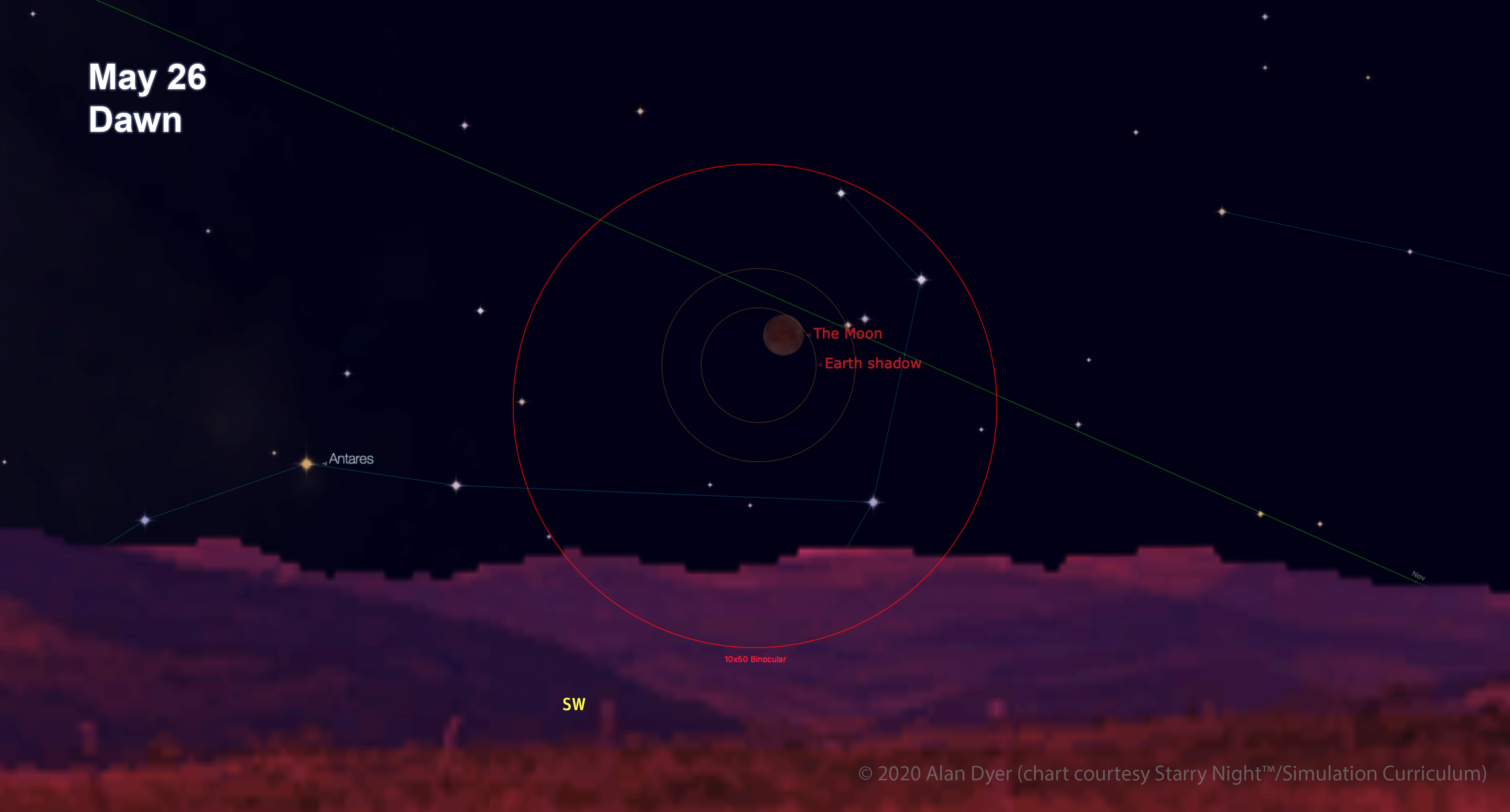
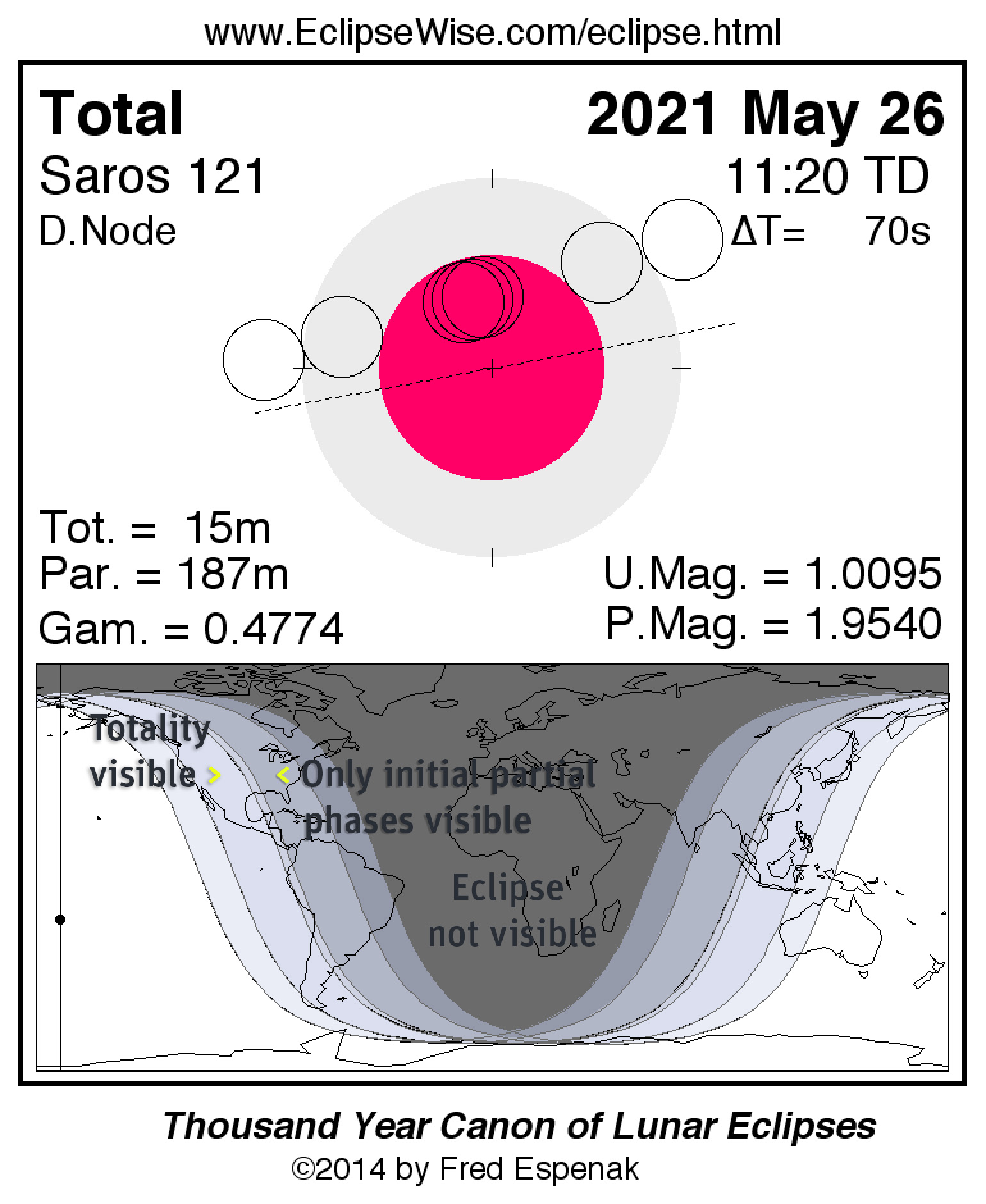
The first total lunar eclipse since January 20, 2019, this “TLE” can be seen as a total eclipse only from western North America, Hawaii, and from Australia and New Zealand. Totality lasts a brief 15 minutes, with the Moon in Scorpius not far from red Antares. The red Moon in a twilight sky will be beautiful, as it was for the April 4, 2015 eclipse at dawn over Monument Valley, Utah shown above.

Those in western North America will see the totally eclipsed Moon setting into the southwest in the dawn hour before sunrise, as depicted here. Over a suitable landscape this will be a photogenic scene, as even at mid-eclipse the Moon will be bright red because it passes so far from the centre of Earth’s umbral shadow.

Unfortunately, those in eastern North America will have to be content with a view of a partially eclipsed Moon setting in the morning twilight. 

A bonus is that this is also the closest and largest Full Moon of 2021, with a close perigee of 357,311 kilometres occurring just 9 hours earlier. So the Full Moon that rises on the evening of May 25 will be the year’s “supermoon.” 

See Fred Espenak’s EclipseWise.com page for details on timing and viewing regions. The dark region on this map does not see any of this eclipse.
May 26 — Comet 7/P Pons-Winnecke at perihelion

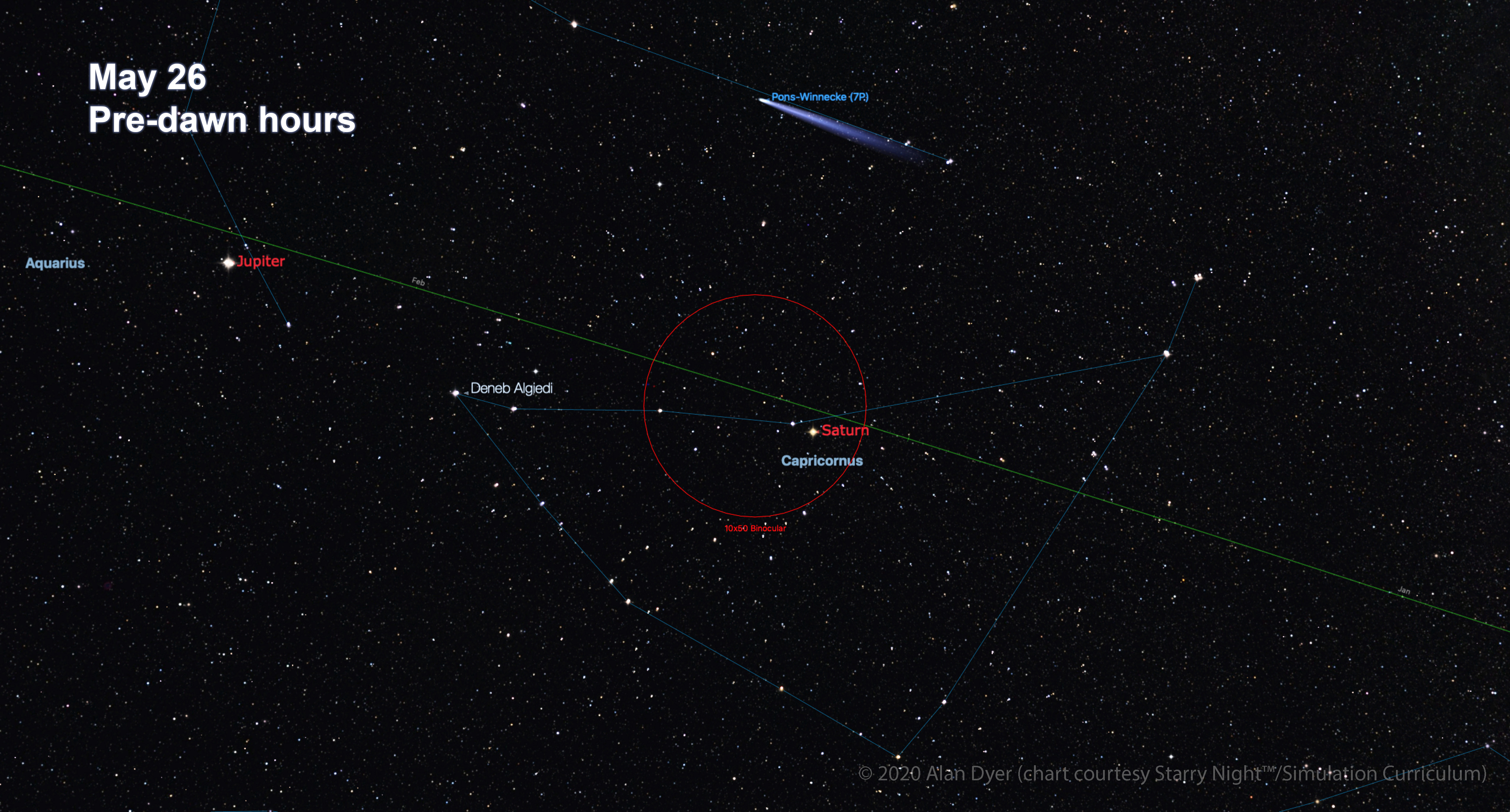
The brightest comet predicted to be visible in 2021 (as of this writing) is the short-period Comet Pons-Winnecke (aka Comet 7/P). It reaches its closest point to the Sun — perihelion — the night of the lunar eclipse and is well placed in Aquarius high in the southeastern dawn sky above Jupiter and Saturn. 

But … it is expected to be only 8th magnitude, making it a binocular object at best, looking like a fuzzball, not the spectacular object depicted here in this exaggerated view of its brightness and tail length. 

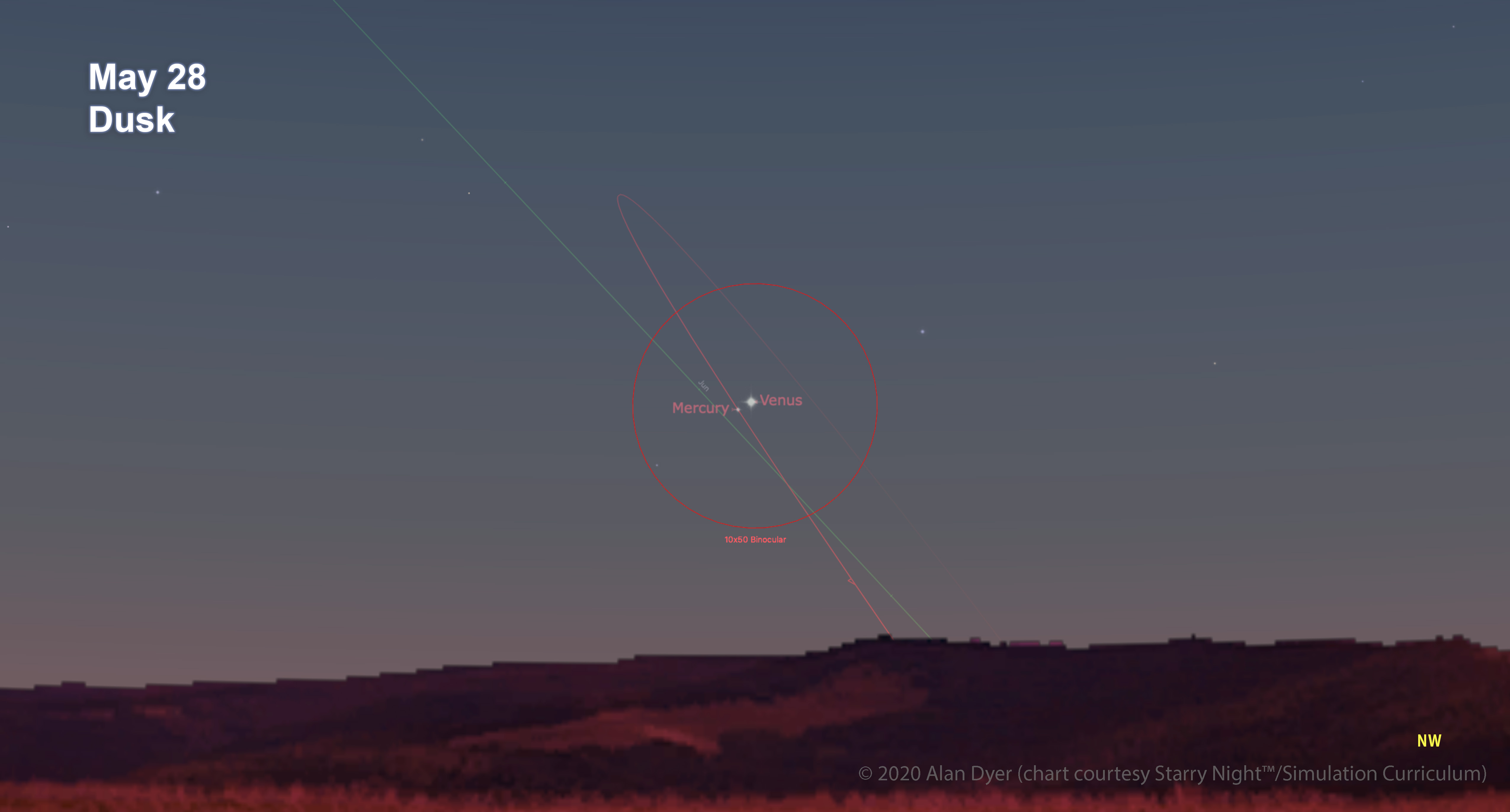
May 28 — Mercury and Venus less than 1/2° apart

Look low in the northwest evening sky for a very close conjunction of the two inner worlds. A telescope will frame them well, with Mercury a tiny crescent and Venus an almost fully illuminated disk. 


June

While eastern North America misses the total lunar eclipse, two weeks later observers in the east do get to see a partial solar eclipse.

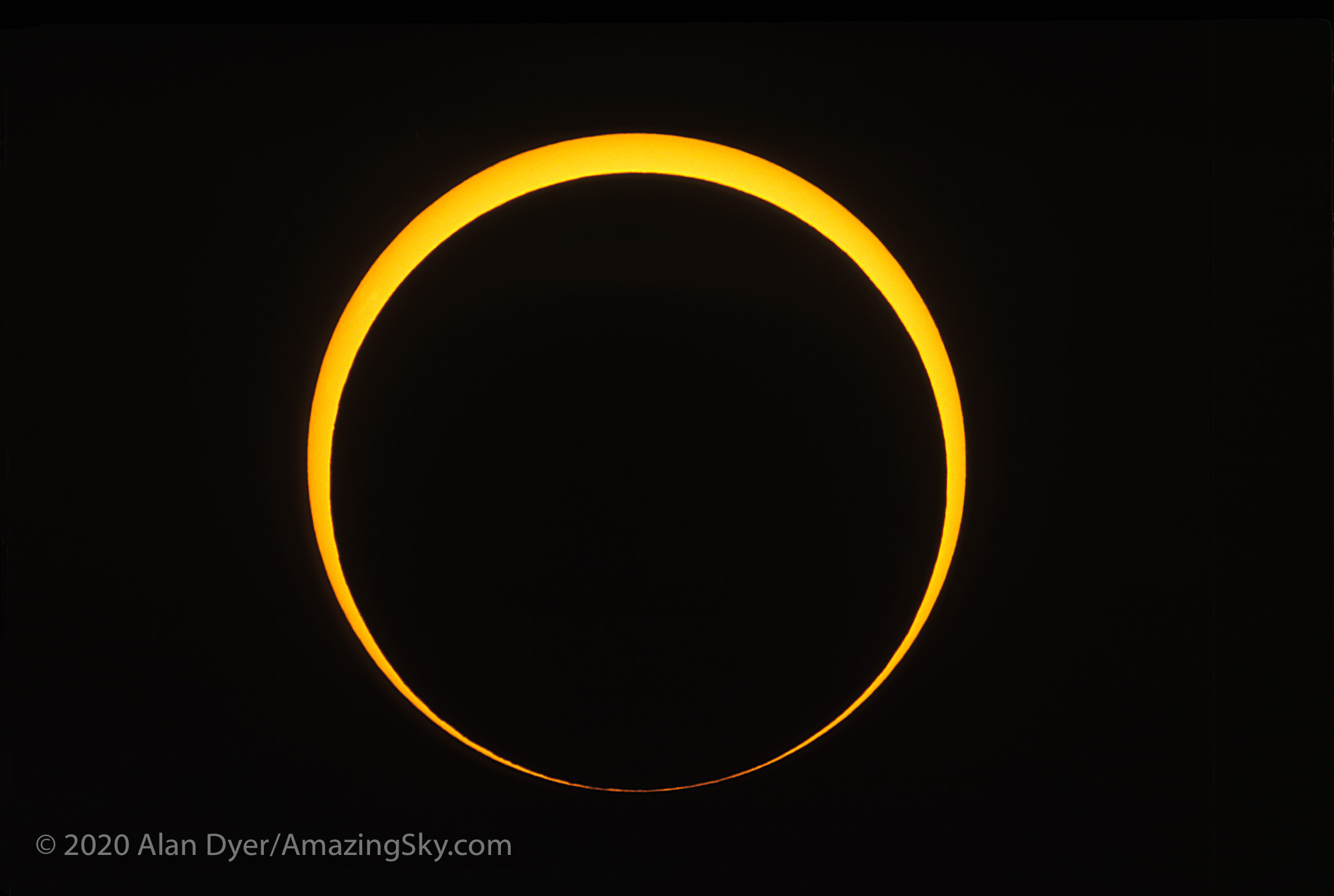
May 10, 1994 Annular Eclipse taken from a site east of Douglas Arizona Showing “reverse” Bailey’s Beads — lunar mountains just touching Sun’s limb 4-inch f/6 apo refractor at f/15 with Barlow lens, and with Ektachrome 100 slide film !
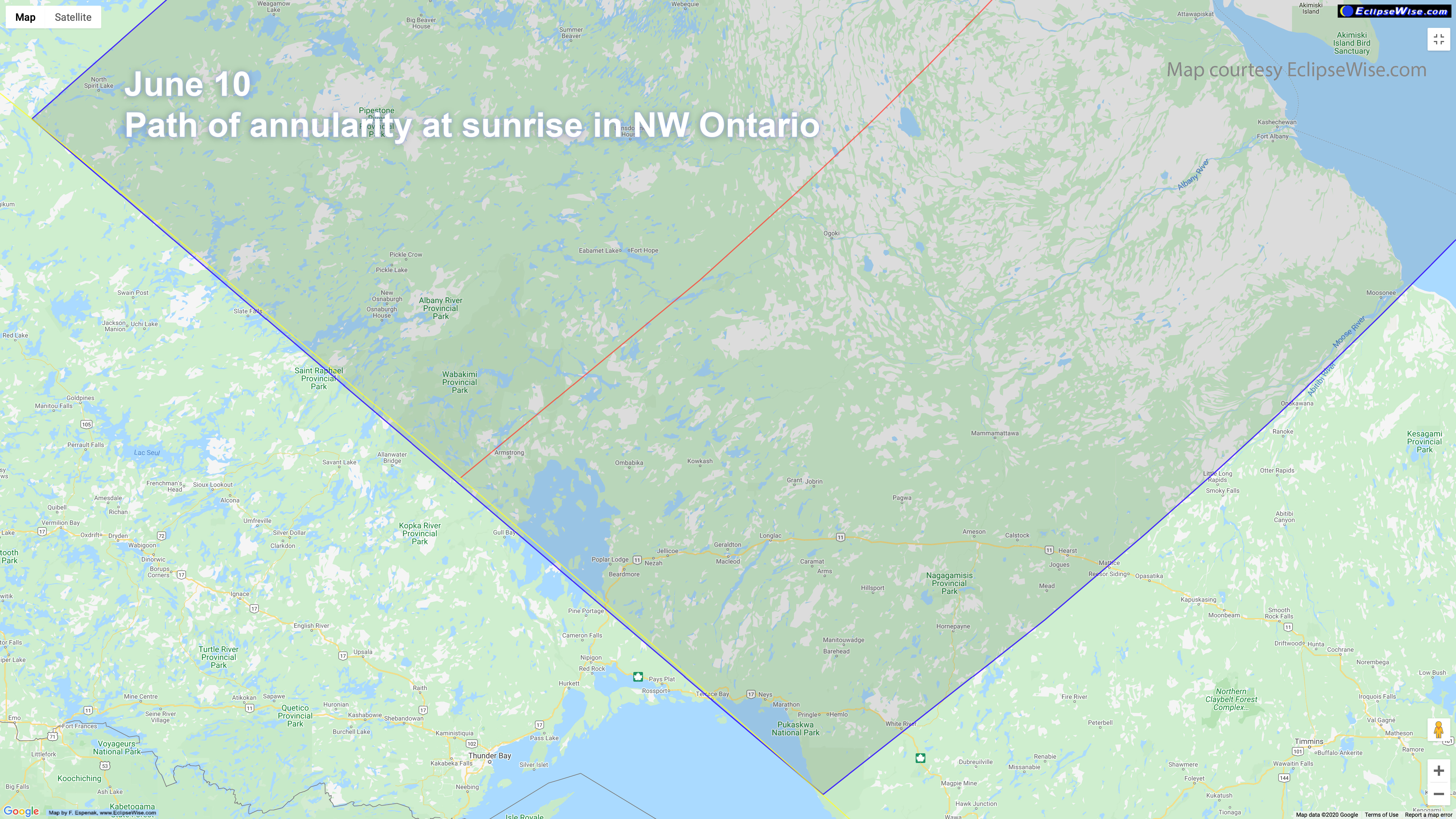
June 10 — Annular eclipse of the Sun

Should you manage to get yourself to the path of the Moon’s anti-umbral shadow you will see the dark disk of the Moon contained within the bright disk of the Sun but not large enough to cover the Sun completely. You see a ring of light, as above from a 1994 annular eclipse.

The Moon is near apogee, so its disk is about as small as it gets, in contrast to the perigee Moon two weeks earlier. During the maximum of 3 minutes 51 seconds of annularity the sky will get unusually dark, but none of the dramatic effects of a total eclipse will appear. The annulus of sunlight that remains is still so bright special solar filters must be used at all times, covering the eyes and lenses.

The region with the best accessibility to the path is northwestern Ontario north and east of Thunder Bay. However, the annular phase of the eclipse there occurs at or just after sunrise, so clouds are likely to obscure the view, as are trees! 

The eastern seaboard of the U.S. and much of eastern Canada can see a partial eclipse of the Sun, as can most of Europe. For details of times and amount of eclipse see Fred Espenak’s EclipseWise website

For an interactive Google map of the path see this page.

June 20 — Solstice at 11:32 p.m. EDT

Summer officially begins for the northern hemisphere, winter for the southern, as the Sun reaches its most northerly position above the celestial equator. The Sun rises farthest to the northeast and sets farthest to the northwest, and the length of daylight is at its maximum.

June 22 — Mars passes through the Beehive star cluster

Mars, now at a modest magnitude +1.8, appears amid the Beehive star cluster, aka M44, tonight and tomorrow evening, but low in the northwest in the twilight sky. Use binoculars or a telescope for the best view. 


July 

Venus and Mars put on a show low in the western twilight.  

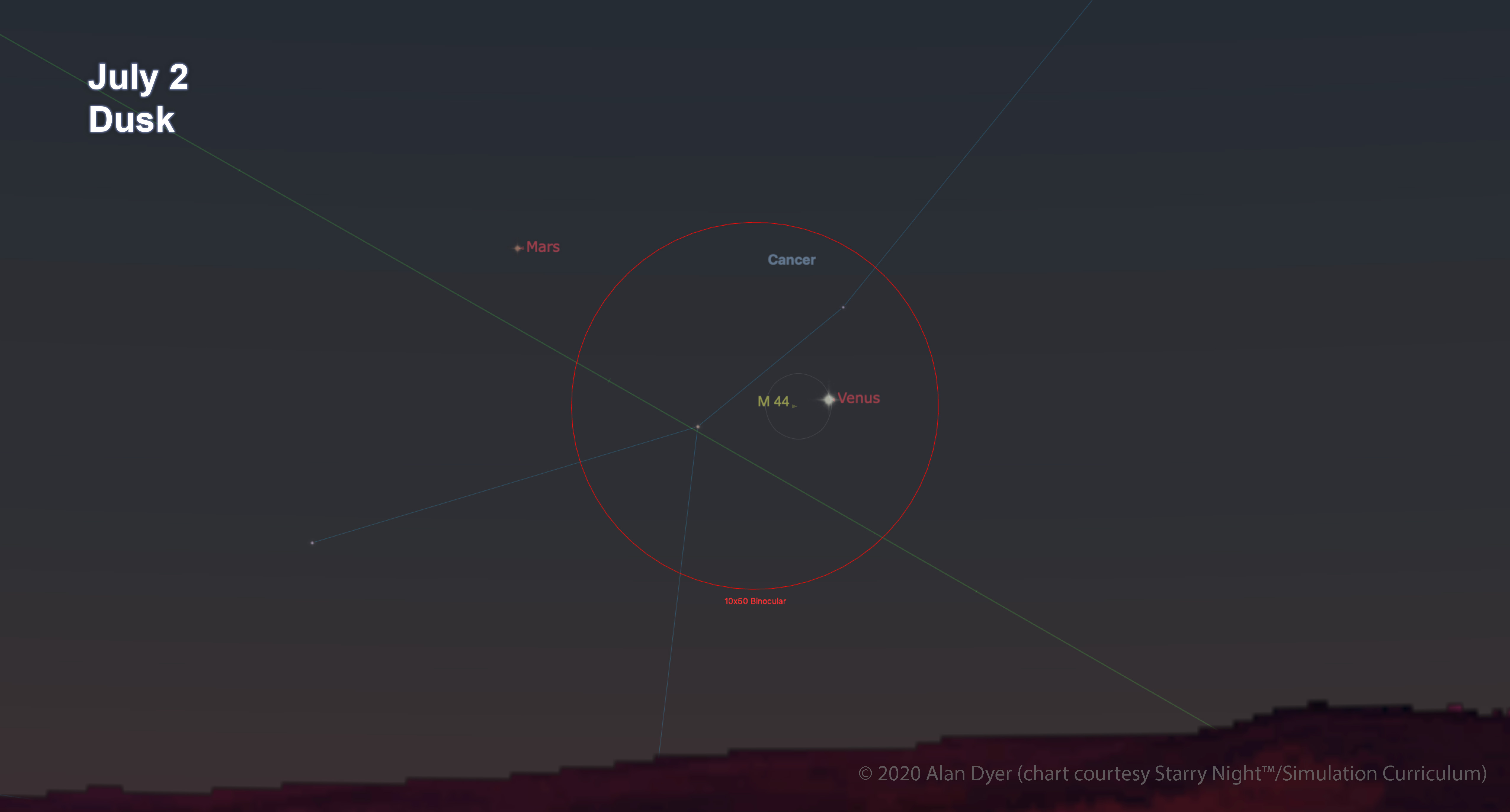
July 2 — Venus passes through the Beehive star cluster 

Venus (at a brilliant magnitude -3.9) follows Mars through the Beehive cluster this evening, but with the pairing even lower in the sky, making it tough to pick out the star cluster. 

July 4 — Mercury at a good morning elongation

Though not at its best for a morning appearance from northern latitudes, Mercury should still be easy to spot and photograph in the pre-dawn sky in Taurus, outshining bright Aldebaran. 

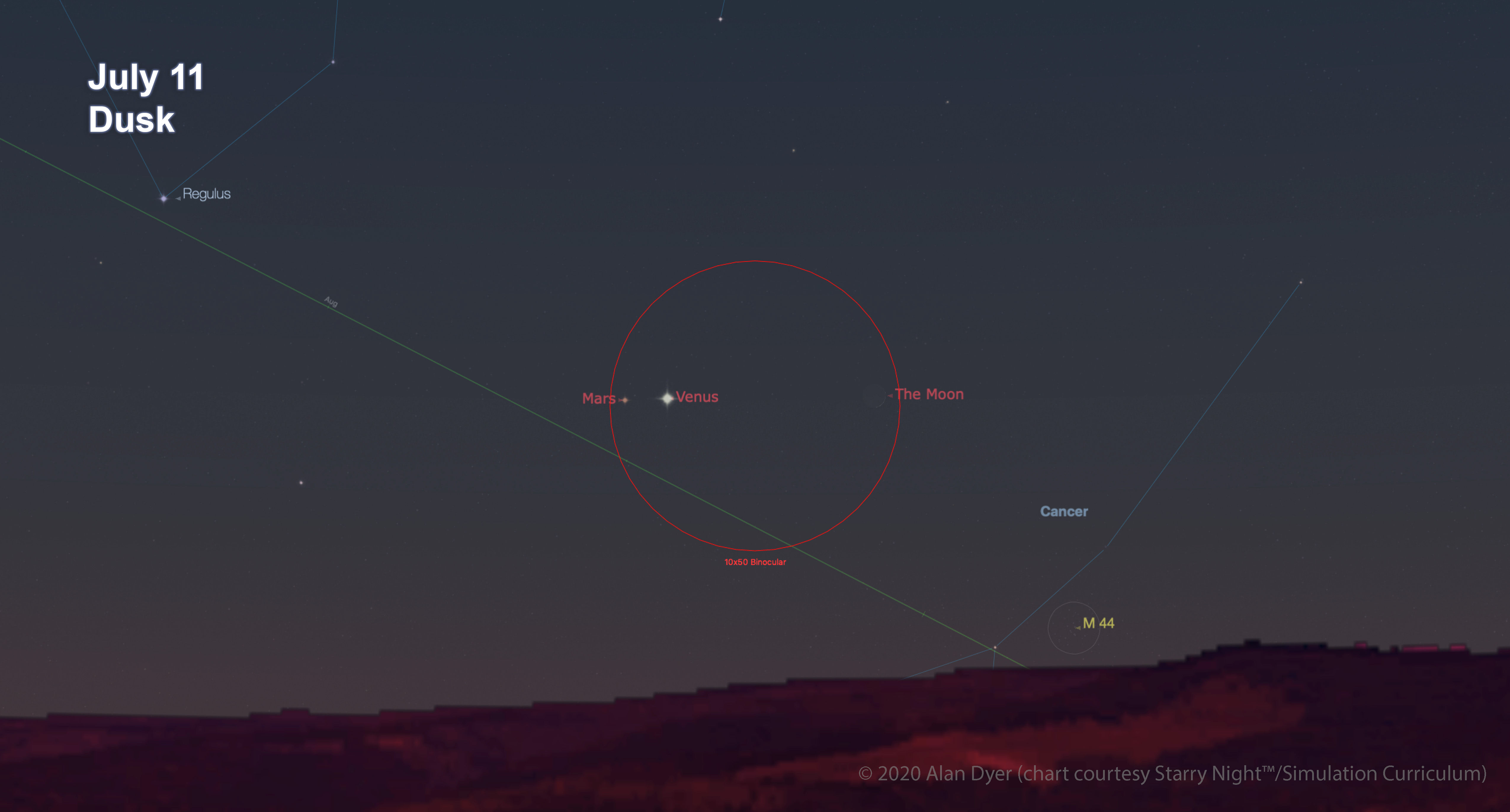
July 11 — Grouping of Venus, Mars and waxing crescent Moon 

Look low in the evening sky for the line of the thin crescent Moon, bright Venus and dim Mars all in the same binocular field. Venus passes 1/2° above Mars on the next two nights, July 12 and 13. 

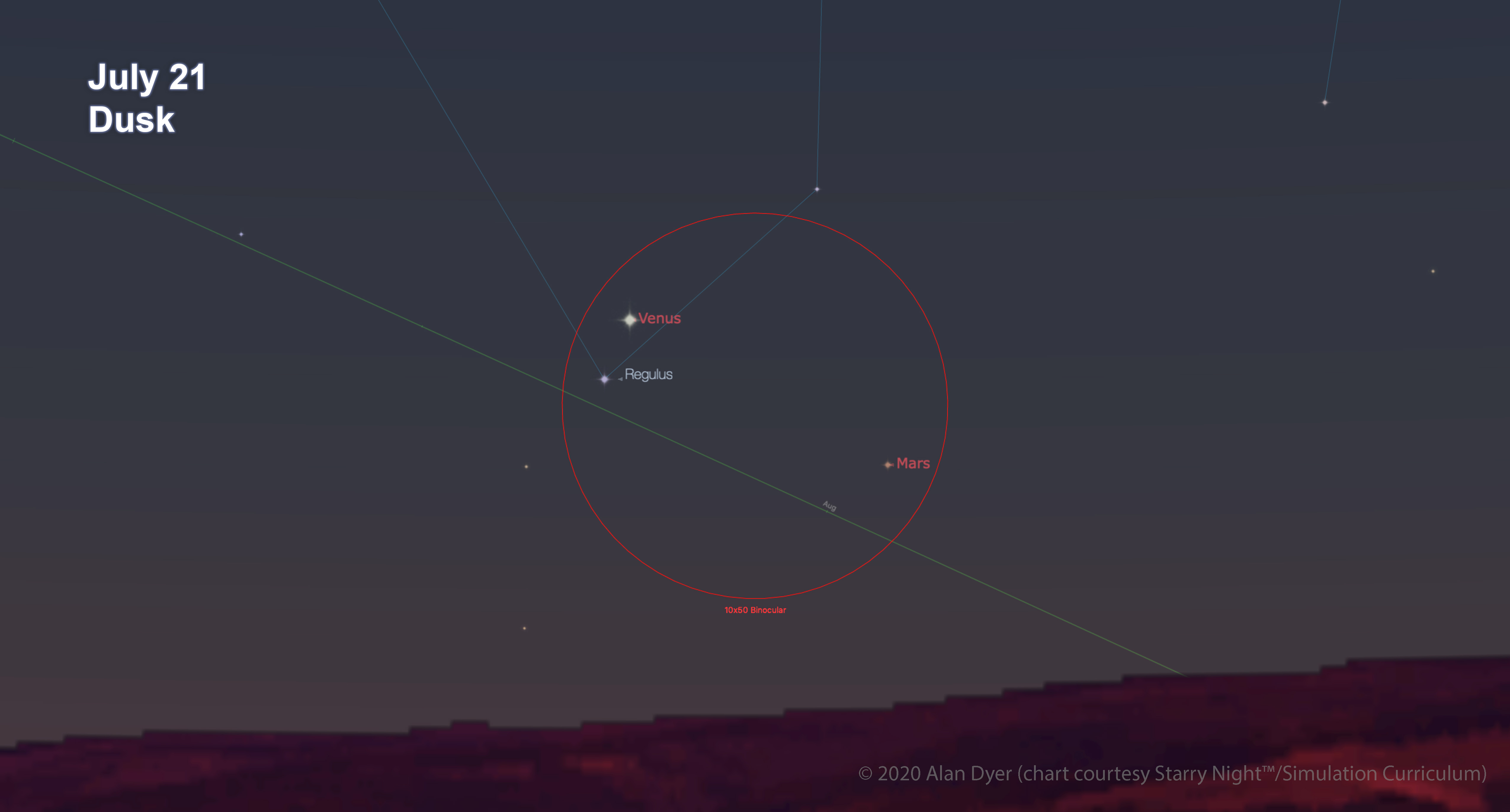
July 21 — Grouping of Venus, Mars and Regulus

The two planets appear with bright Regulus in Leo, all within a binocular field, but again, low in the northwest twilight. The colour contrast of red Mars with white Venus and blue-white Regulus should be apparent in binoculars. 


August

The popular Perseid meteors peak, and we can see (maybe!) the extremely close conjunction of Mercury and Mars. 

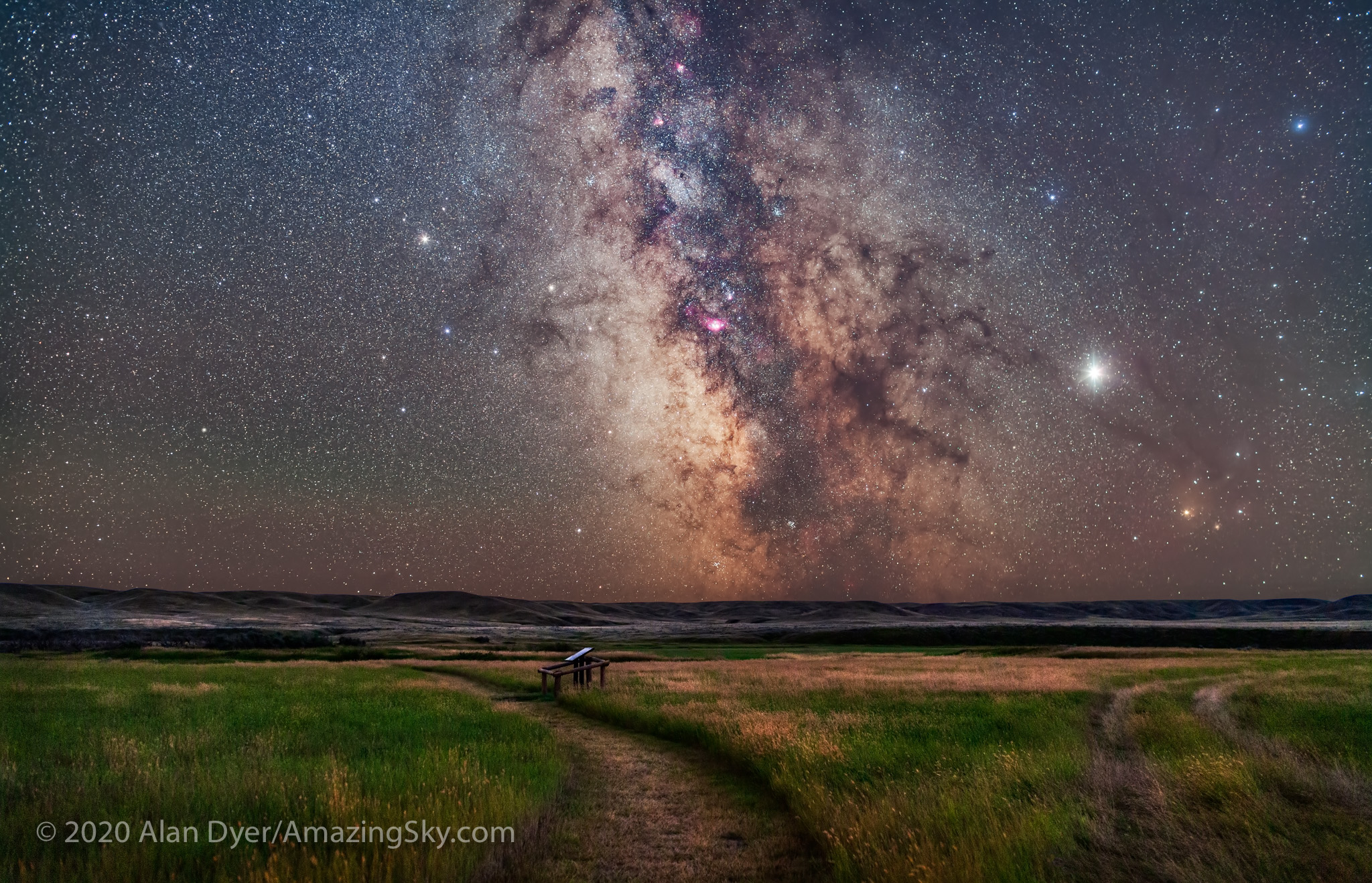
The core of the Milky Way in Sagittarius low in the south over the Frenchman River valley at Grasslands National Park, Saskatchewan.

August 1 — Milky Way core season opens

For southerly latitudes, the first two weeks of May and June are also good, but from the northern U.S. and much of Canada, the nights don’t get dark enough to see and shoot the bright galactic centre until August. The rich star clouds of Sagittarius now shine due south as it gets dark each night over the next two weeks. 

August 2 — Saturn at opposition

Saturn is at its closest and brightest for 2021 tonight, rising at sunset and shining due south in Capricornus in the middle of the night. 

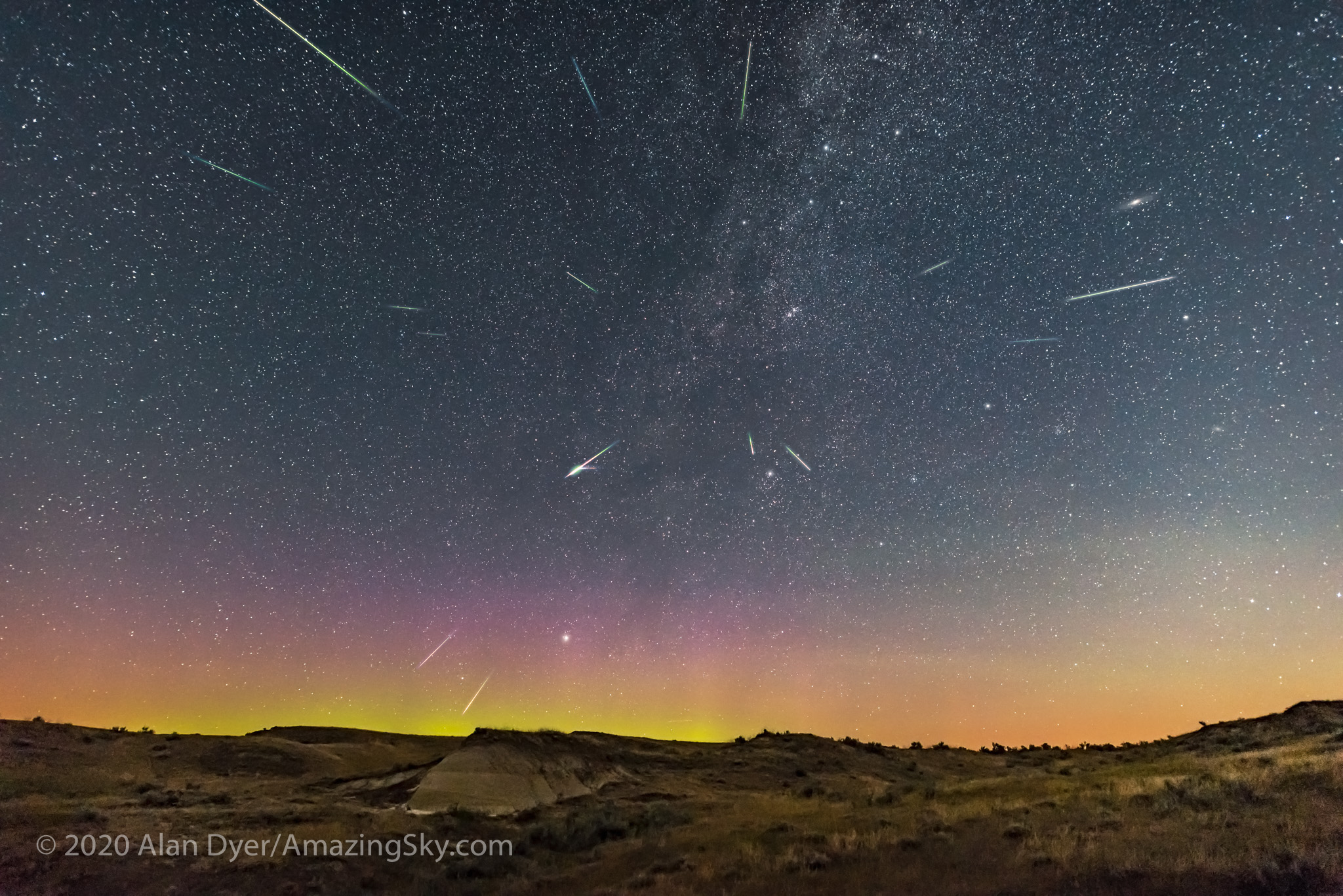
A composite of the Perseid meteors over Dinosaur Provincial Park on the night of August 12/13, 2017.

August 12 — Perseid meteor shower peaks

The annual Perseid meteor shower peaks tonight with a waxing crescent Moon that sets early, to leave most of the night dark and ideal for watching meteors. Look for the crescent Moon 5° above Venus on August 10. 

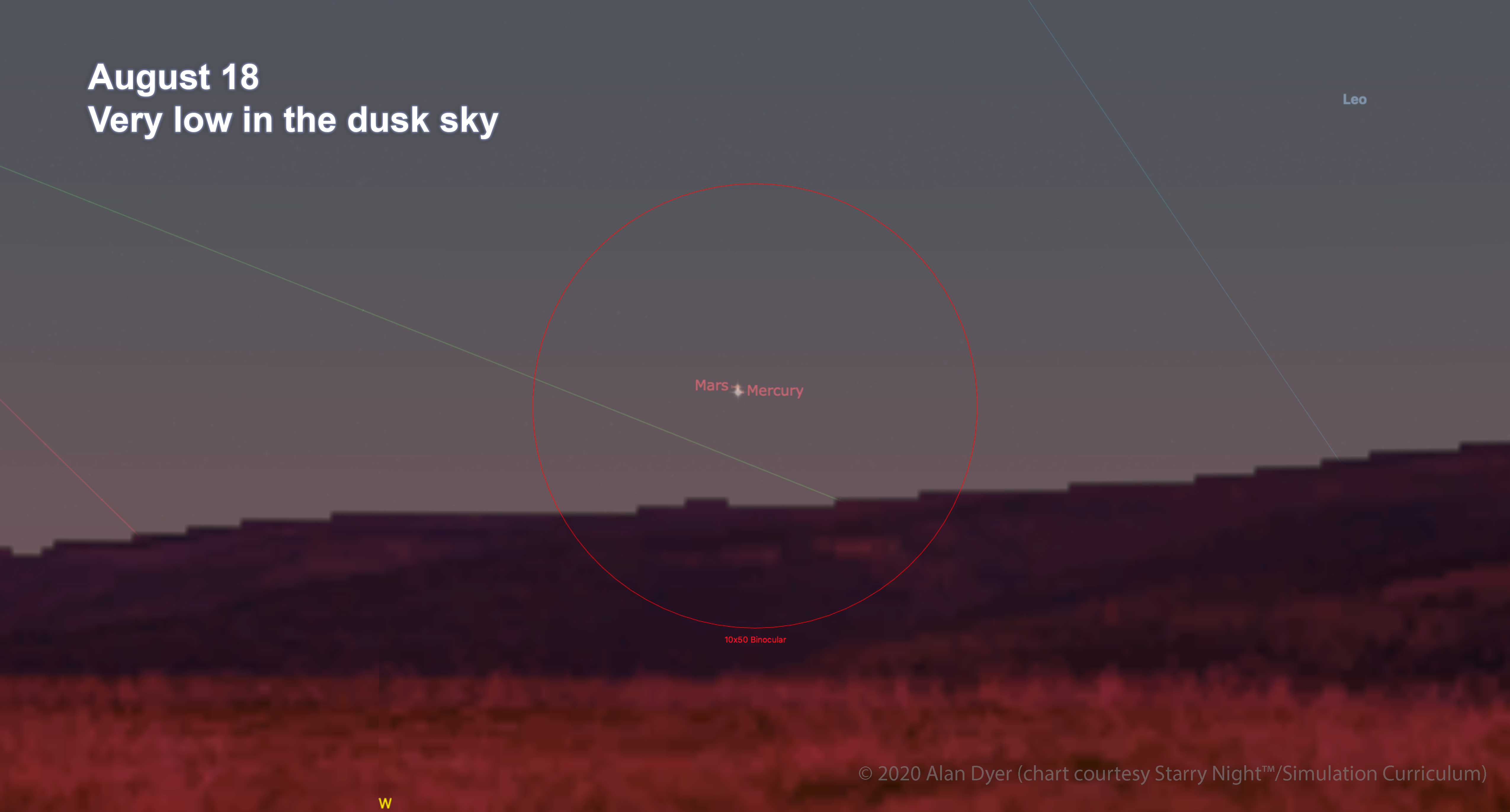
August 18 — Mars and Mercury only 0.06° apart!

Now this is a very close conjunction, with Mercury passing only 4 arc minutes from Mars (compared to the 6 arc minute separation of the Great Conjunction of Jupiter and Saturn on December 21, 2020). But the planets will be very low in the west at dusk and tough to sight. This will be a conjunction for skilled observers blessed with clear skies and a low horizon.

August 20 — Jupiter at opposition

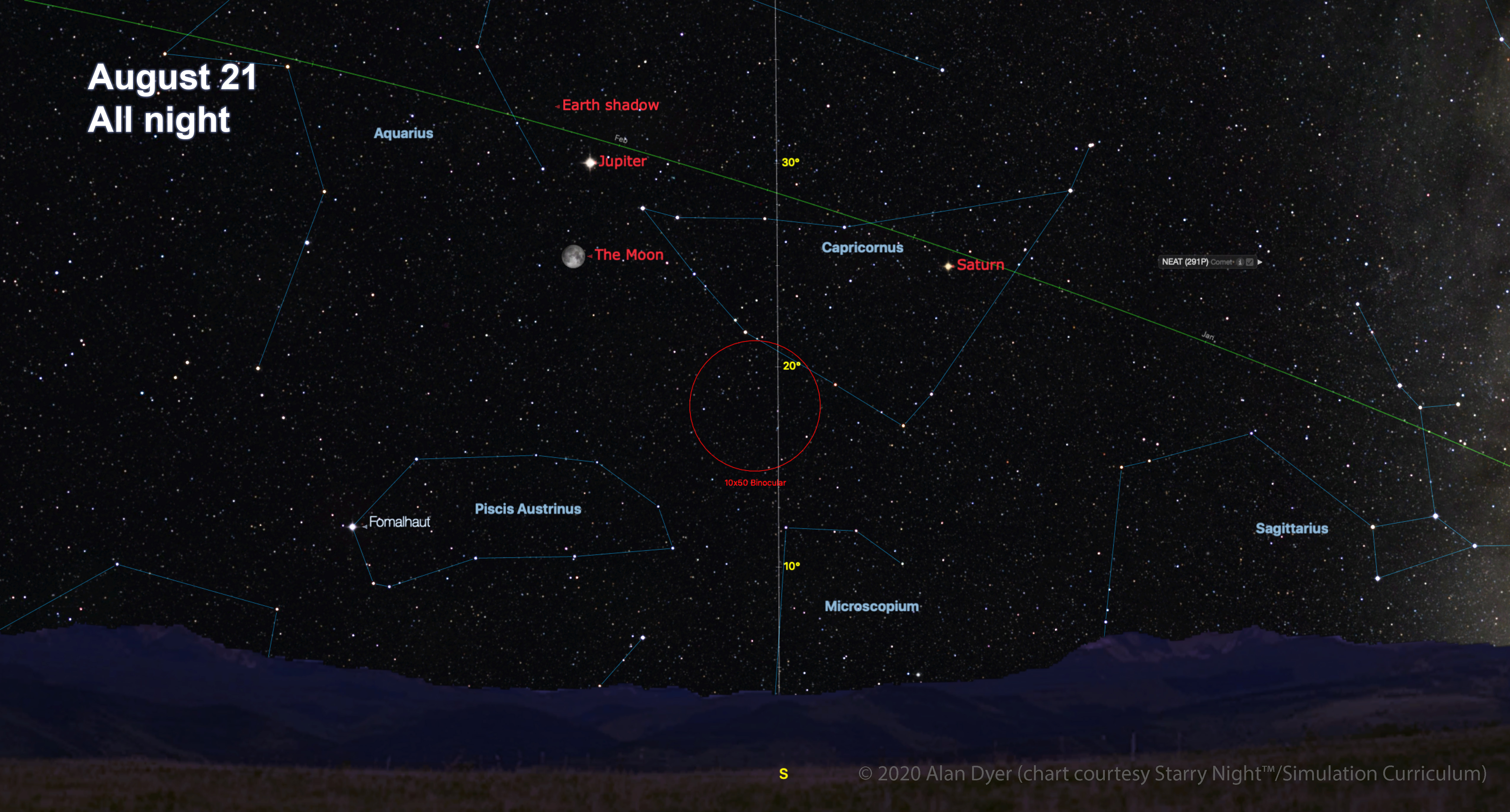
Jupiter, now in Aquarius, reaches its closest and brightest for 2021 tonight, also rising at sunset and shining due south in the middle of the night. On the night of August 21/22, the Full Moon, also at opposition — as all Full Moons are — appears 4° below Jupiter, as shown above. 


September 

It’s Harvest Moon time, with this annual special Full Moon occurring close to the equinox this year for an ideal geometry, making the Moon rise due east. 

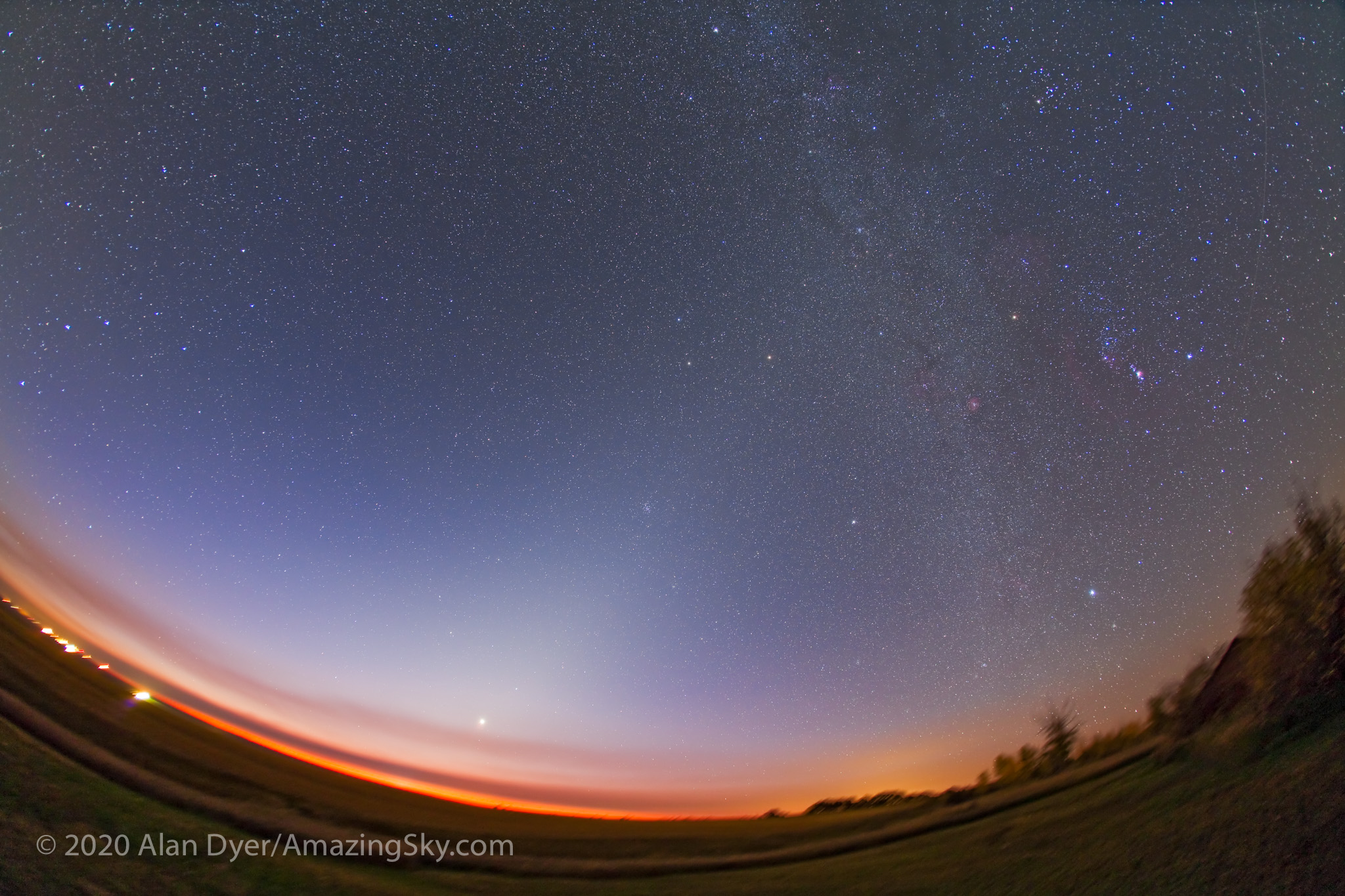
Zodiacal Light at dawn on September 24, 2009. Taken from home in Alberta, with a Canon 5D MkII and 15mm lens at f/4 and ISO 800 for 6 minutes, tracking the sky so the ground is blurred.

September 5 — Zodiacal light “season” begins in the morning

With no Moon for the next two weeks, from sites away from light pollution look to the pre-dawn sky for a faint glow of light rising out of the east before twilight brightens the morning sky.

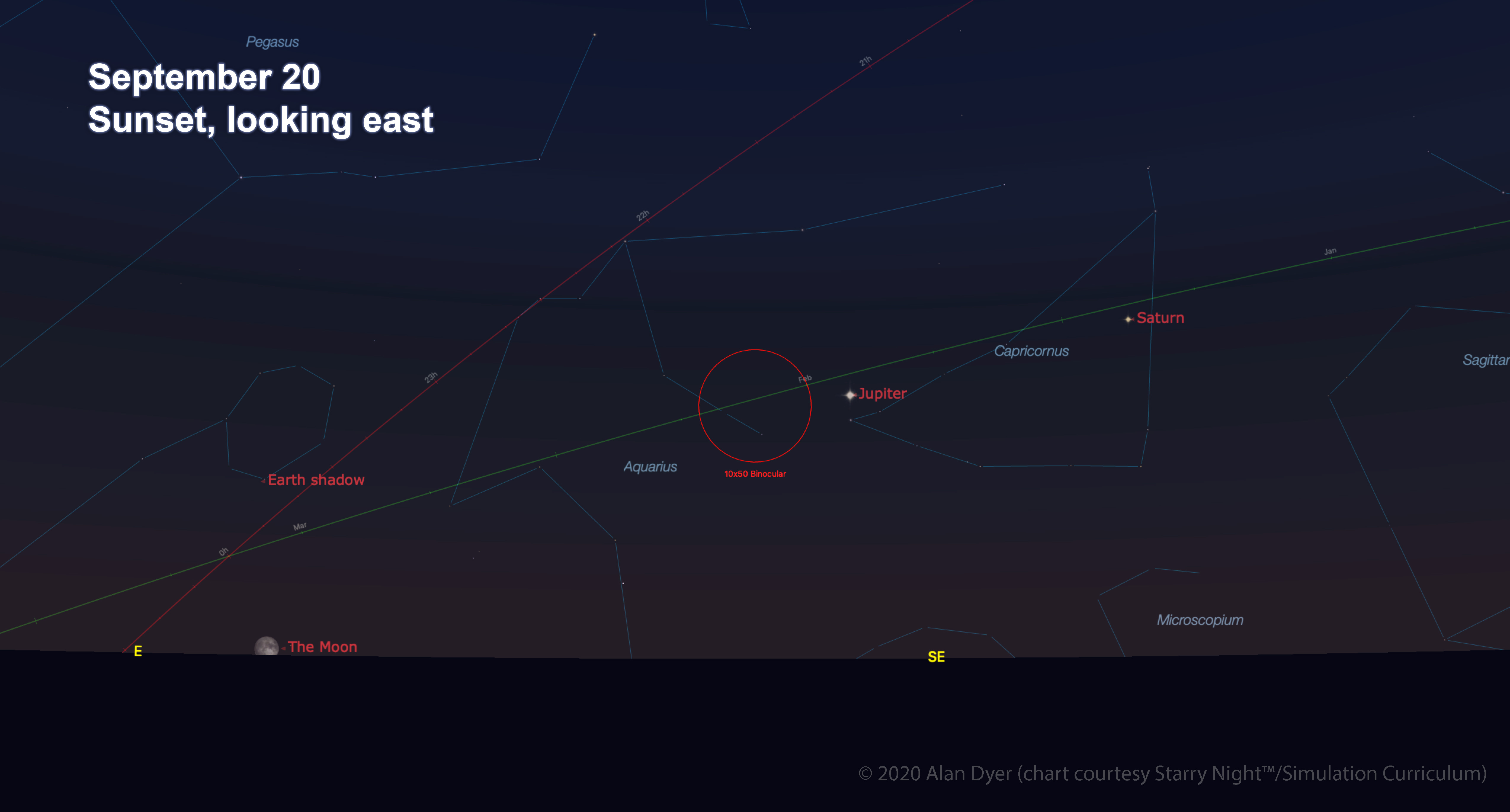
September 20 — Full “Harvest” Moon

Occurring two days before the equinox, this Full Moon will rise nearly due east (a little to the south of east) at sunset and set nearly due west at sunrise at dawn on September 21, for some fine photo ops. 

September 22 — Equinox at 3:21 p.m. EDT

Autumn officially begins for the northern hemisphere, spring for the southern, as the Sun crosses the celestial equator heading south. Today, the Sun rises due east and sets due west for photo ops.


October 

Mercury adorns the dawn while Venus shines bright but low at dusk. 

October 4 — Zodiacal light “season” begins in the morning

With the Moon out of the way for the next two weeks, the zodiacal light will again be visible in the east in the pre-dawn hours. 

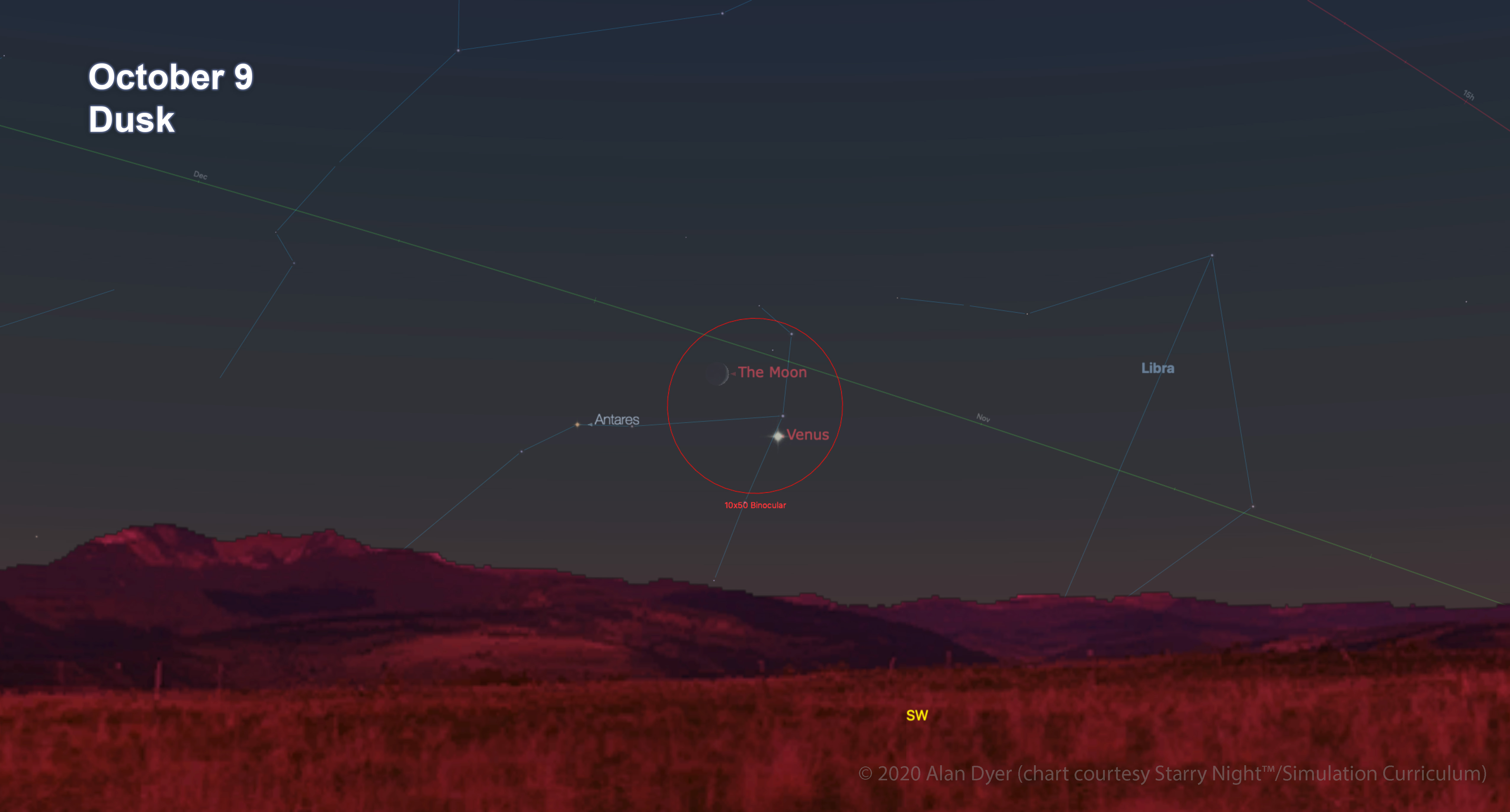
October 9 — The Moon 2.5° from Venus

The crescent Moon passes close to Venus this evening, with the pair not far from the star Antares. The low altitude of the worlds lends itself to some fine photo ops. Look for a similar close conjunction on the evening of November 7. 

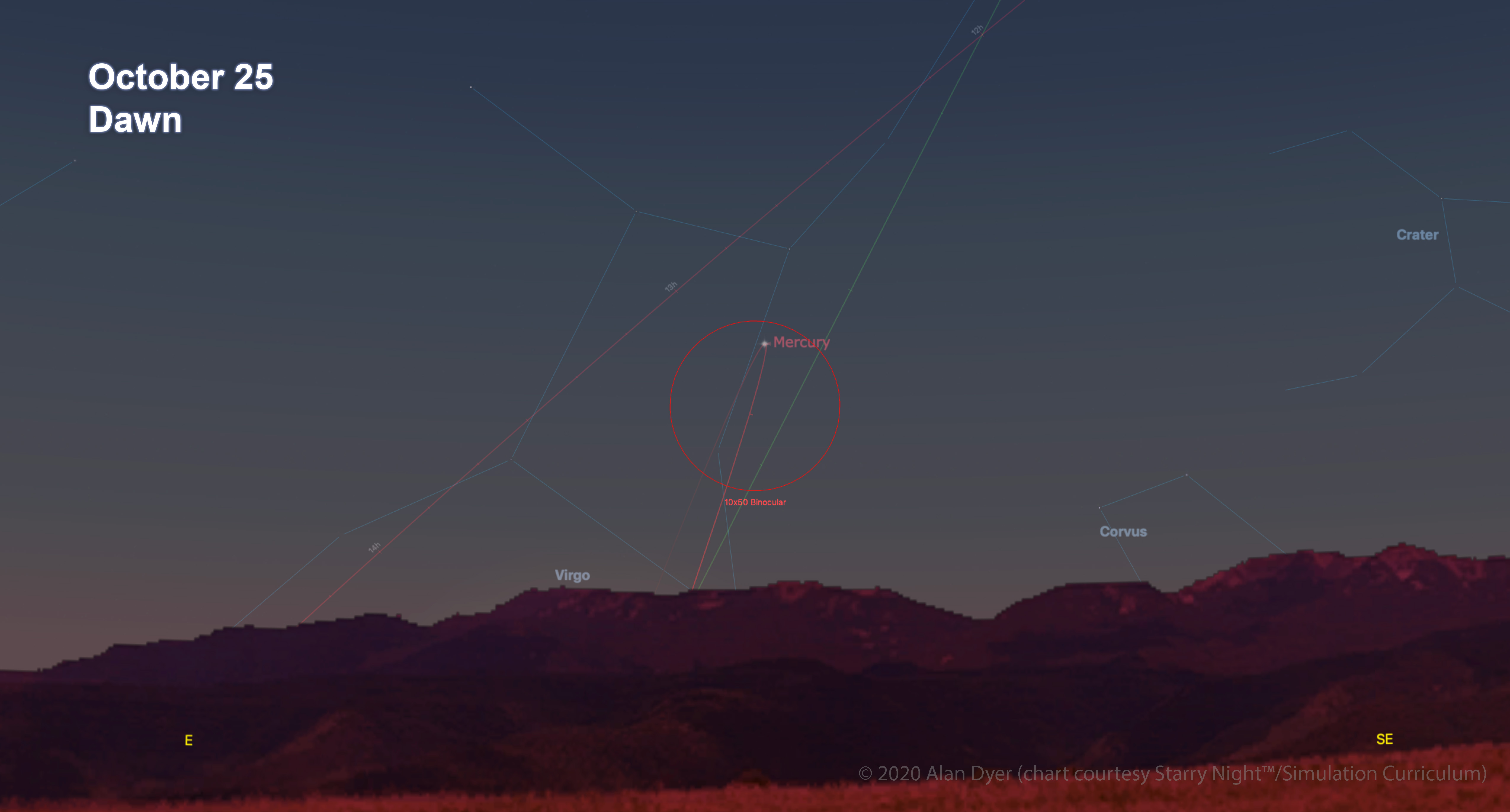
October 25 — Mercury at its most favourable morning elongation

The high angle of the ecliptic — the path of the planets — on autumn dawns swings Mercury up as high as it can get in the morning sky, making this week the best for sighting Mercury as a “morning star” in 2021 from northern latitudes. 

October 29 — Venus at its greatest angle away from the Sun

While now farthest from the Sun in our sky, its low altitude at this time of year makes this an unfavourable evening appearance of Venus. 


November

The second lunar eclipse brings a mostly red Moon to the skies over North America. 

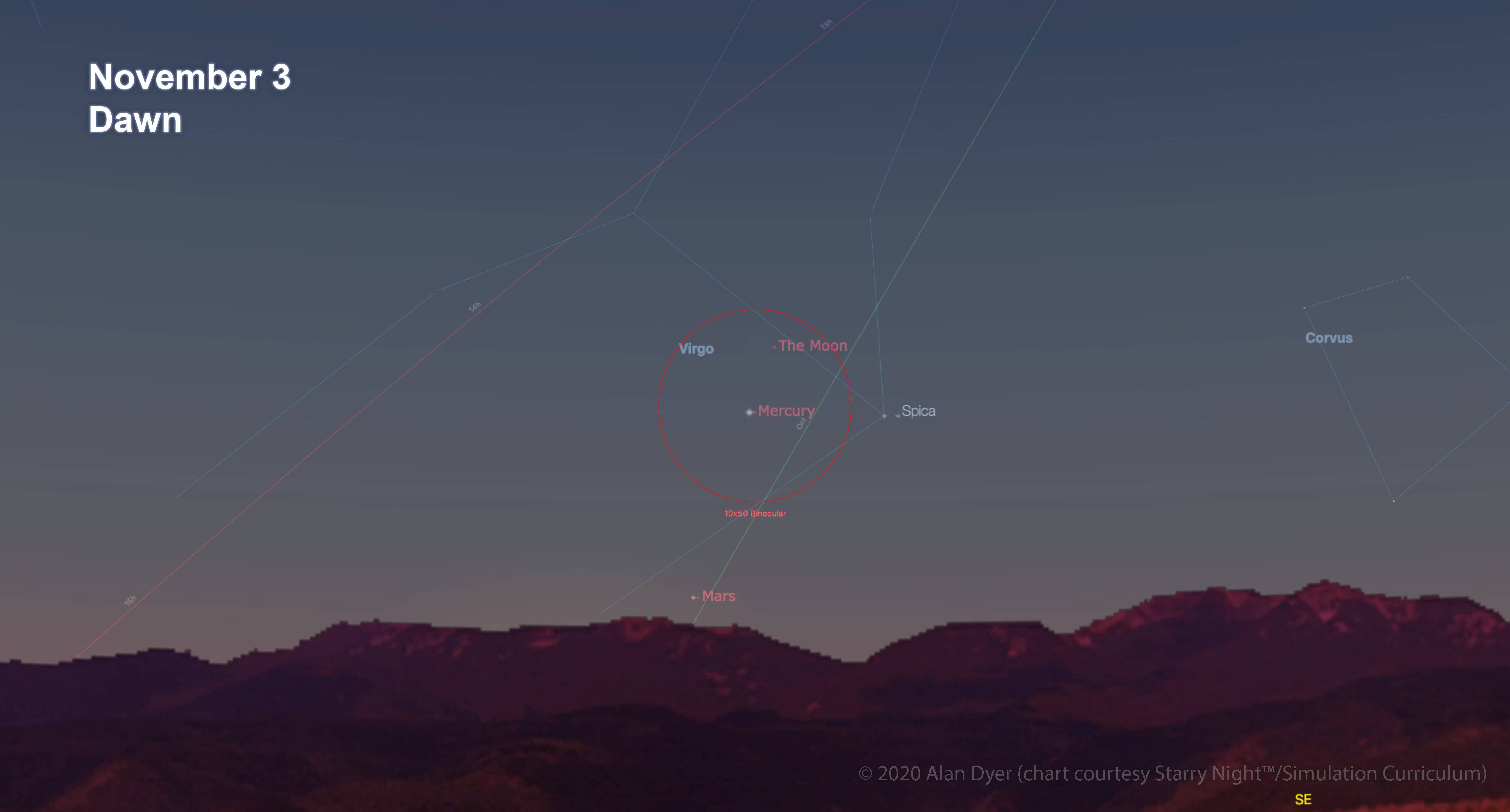
November 3 — Moon and Mercury 2° apart, then a daylight occultation 

Before dawn, with Mercury still well-placed in the morning sky, the waning crescent Moon shines 2° above the planet, with Mars below and the star Spica nearby. Later in the day, about noon to early afternoon (the time varies with your location), the Moon will occult (pass in front of) Mercury. This will be a challenging observation even with a telescope, with the pale and thin Moon only 14° east of the Sun. A very clear sky will be essential! 

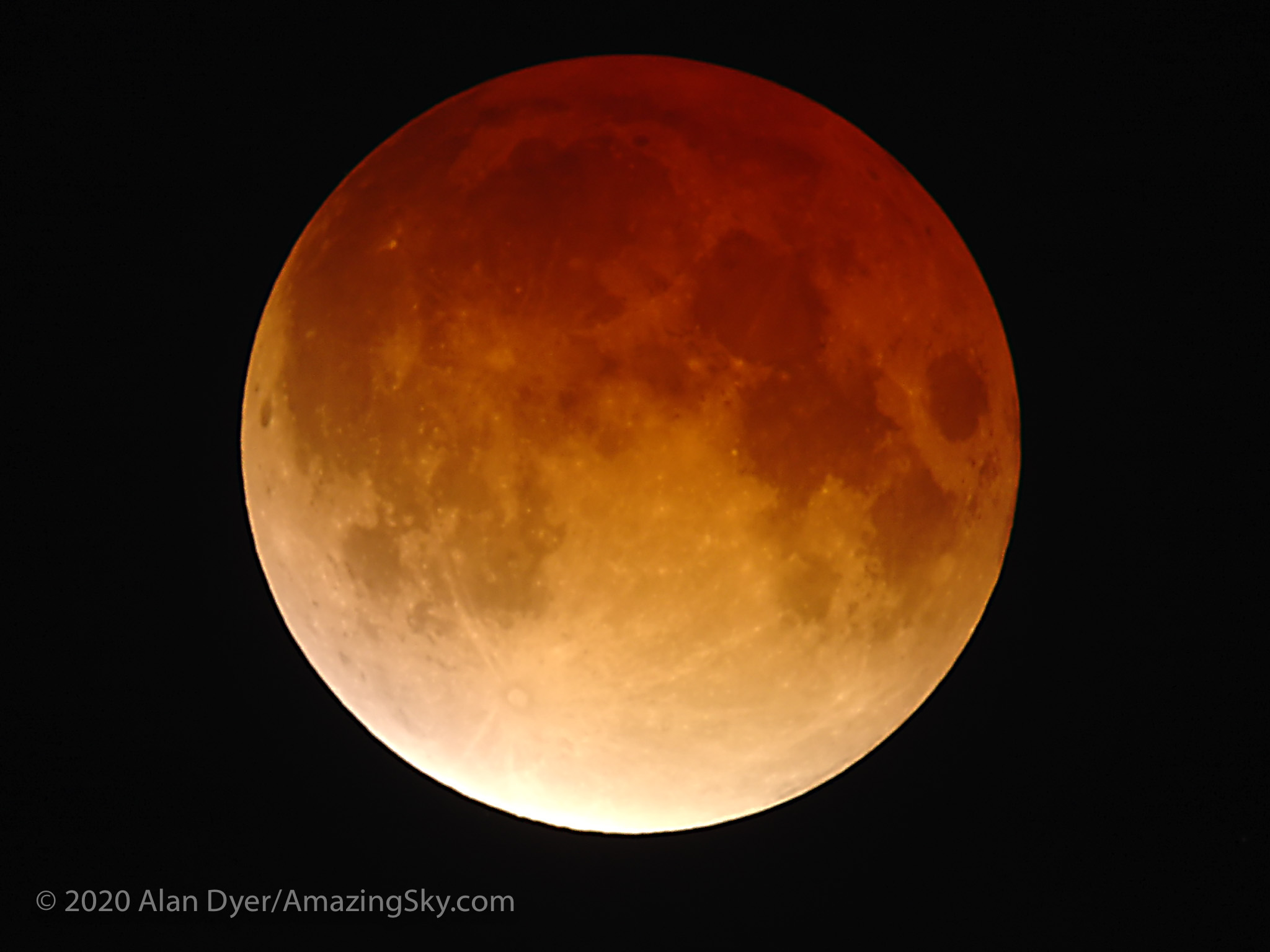
Total lunar eclipse November 8, 2003. Taken through Astro-Physics 5″ Apo refractor at f/6 with MaxView 40mm eyepiece projection into a Sony DSC-V1 5 megapixel digital camera, mounted afocally.

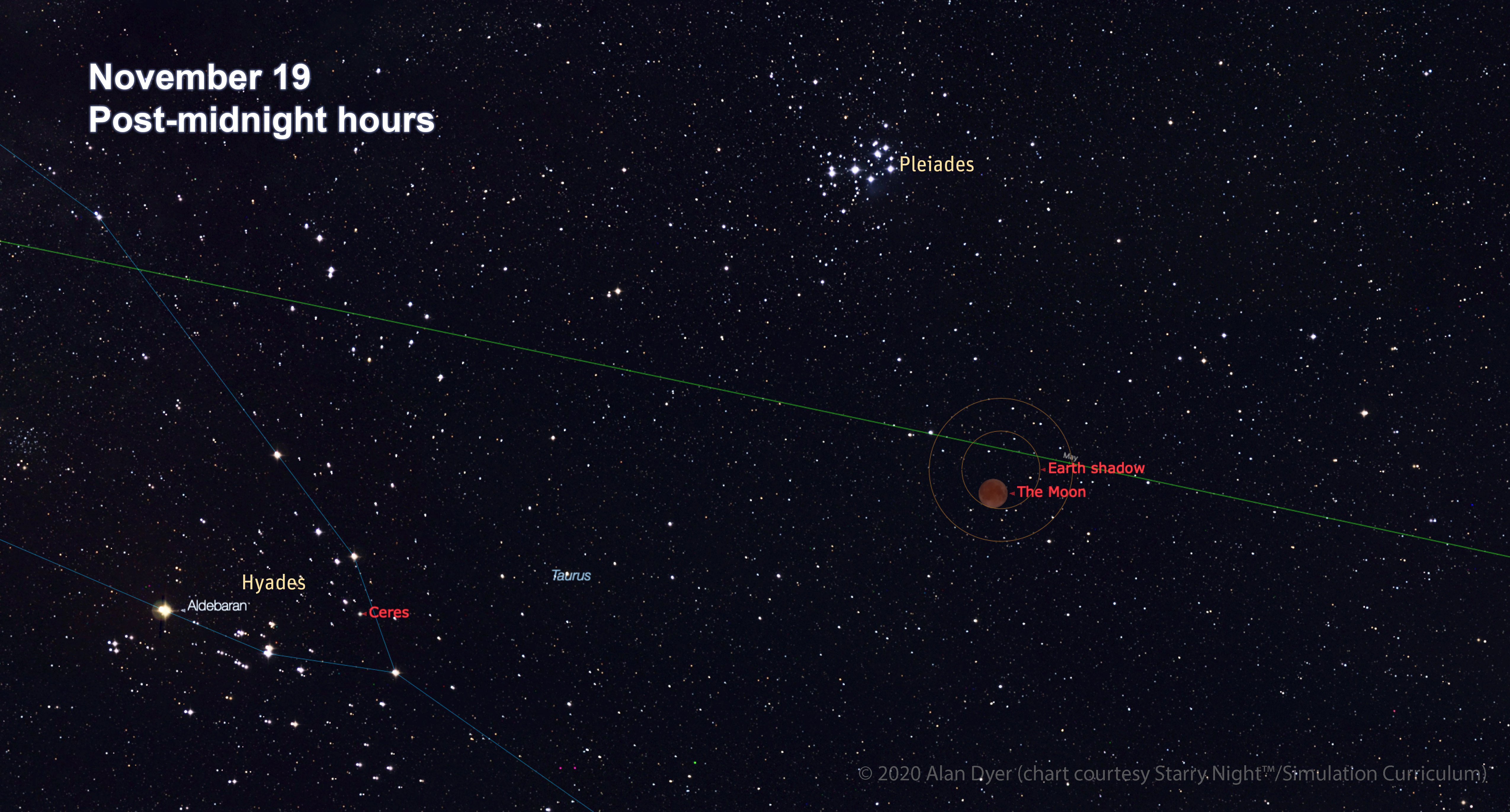
November 19 — 97% Partial Eclipse of the Moon 

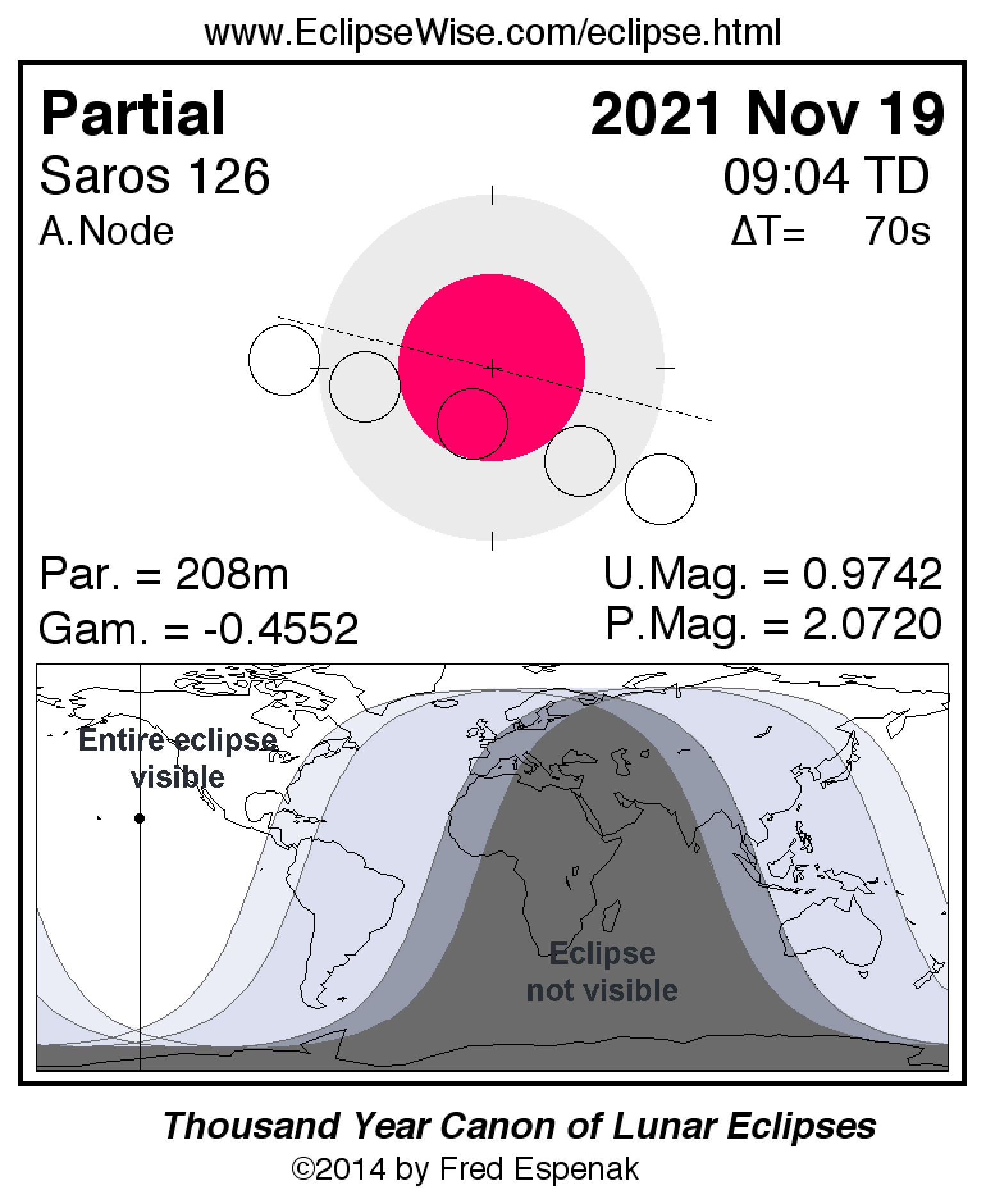
Though not a total eclipse, this is the next best thing: a 97% partial! And unlike the May 26 eclipse, all of North America gets to see this one. 

Mid-eclipse, when the Moon is most deeply embedded in Earth’s umbral shadow, occurs at 4:04 a.m. EST (1:04 a.m. PST) on November 19. While not convenient timing, it ensures that all of the continent can see the entire 3.5-hour long eclipse. The partial umbral phase begins at 3:18 a.m EST (12:18 a.m. PST).

At mid-eclipse, the Moon will resemble Mars — a red world with a bright south “polar cap” caused by the small 3% of the southern edge of the Moon outside the umbra. Its position near the Pleiades and Hyades clusters will make for a great wide-field image. 

Remember — this occurs on the night of November 18/19! So don’t miss it thinking the eclipse starts on the evening of November 19. You’ll be a day late! 

For details see Fred Espenak’s EclipseWise site. As above, the dark region on this map does not see any of this eclipse.


December

The year ends with a chance to see four planets together at dusk. 

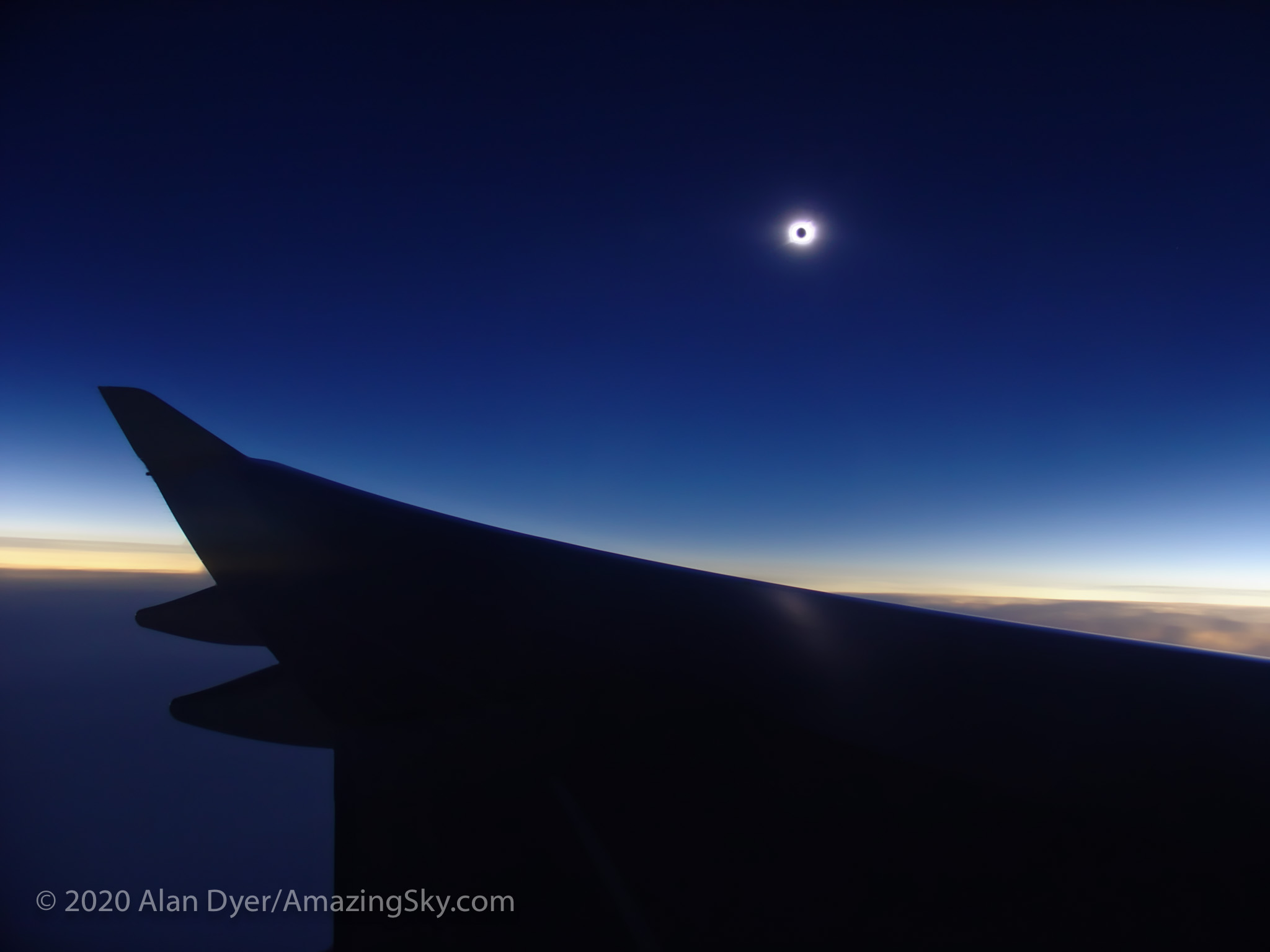
Nov. 23, 2003 total solar eclipse over Antarctica on Qantas/Croydon Travel charter flight out of Melbourne, Australia. Sony DSC-V1 camera. 1/3 sec, f/2.8, 7mm lens, max wide-angle.

December 4 — Total Eclipse of the Sun

I include this for completeness, but this total solar eclipse (TSE) could not be more remote, as the path of totality lies over Antarctica. Only the most intrepid will be there, in expedition ships and in aircraft. (I took this image over Antarctica at the November 23, 2003 total eclipse one 18-year Saros cycle before this year’s TSE.) Even the partial phases are visible only from southernmost Australia and Africa.

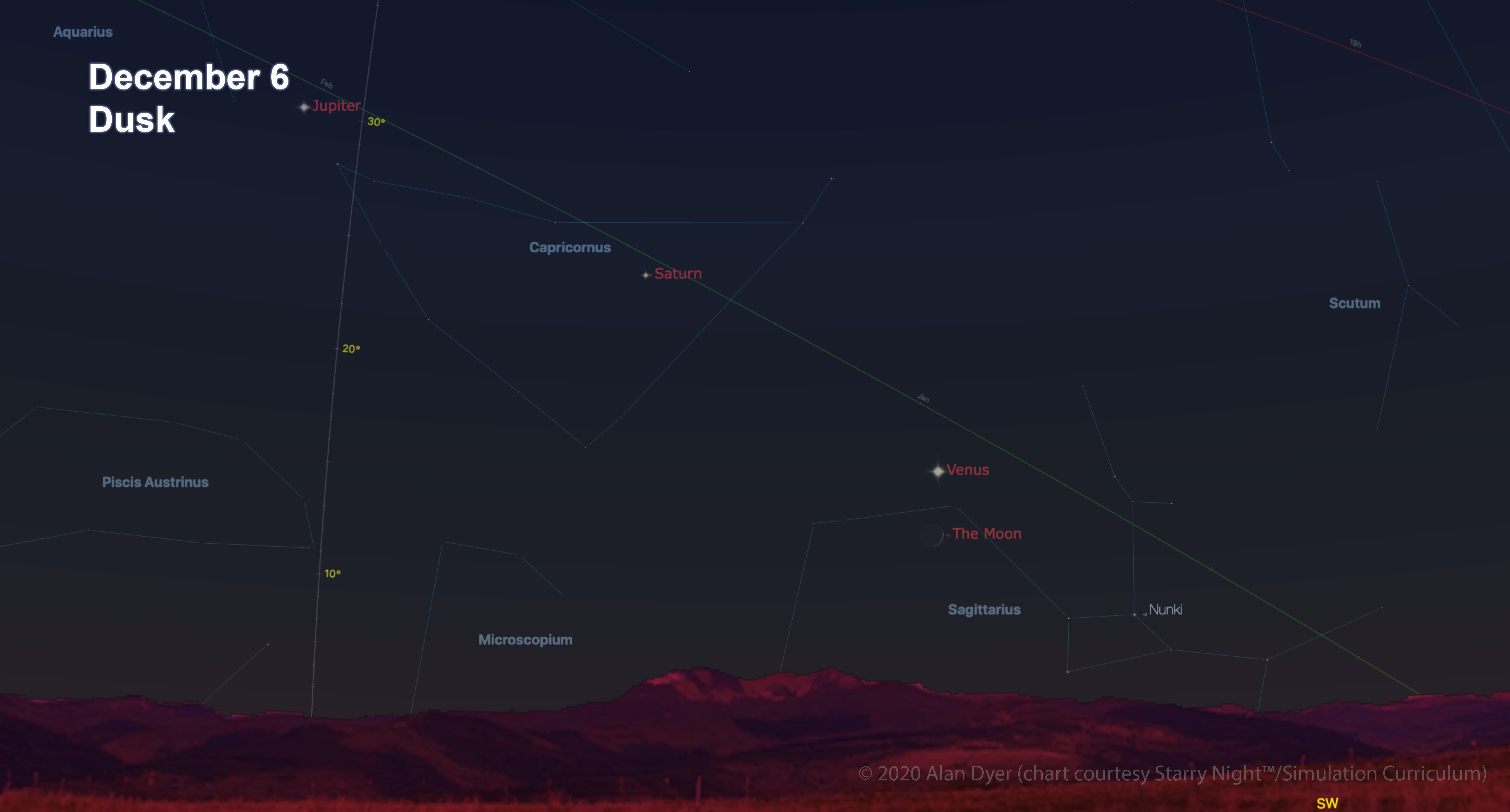
December 6 — Moon 2.5° below Venus

With Venus just past its official December 3 date of “greatest brilliancy” (at magnitude -4.7), the waxing crescent Moon appears close below it, with Saturn and Jupiter further along the line of the ecliptic in the southwest. The Moon appears below Saturn on December 7 and below Jupiter on December 8. 

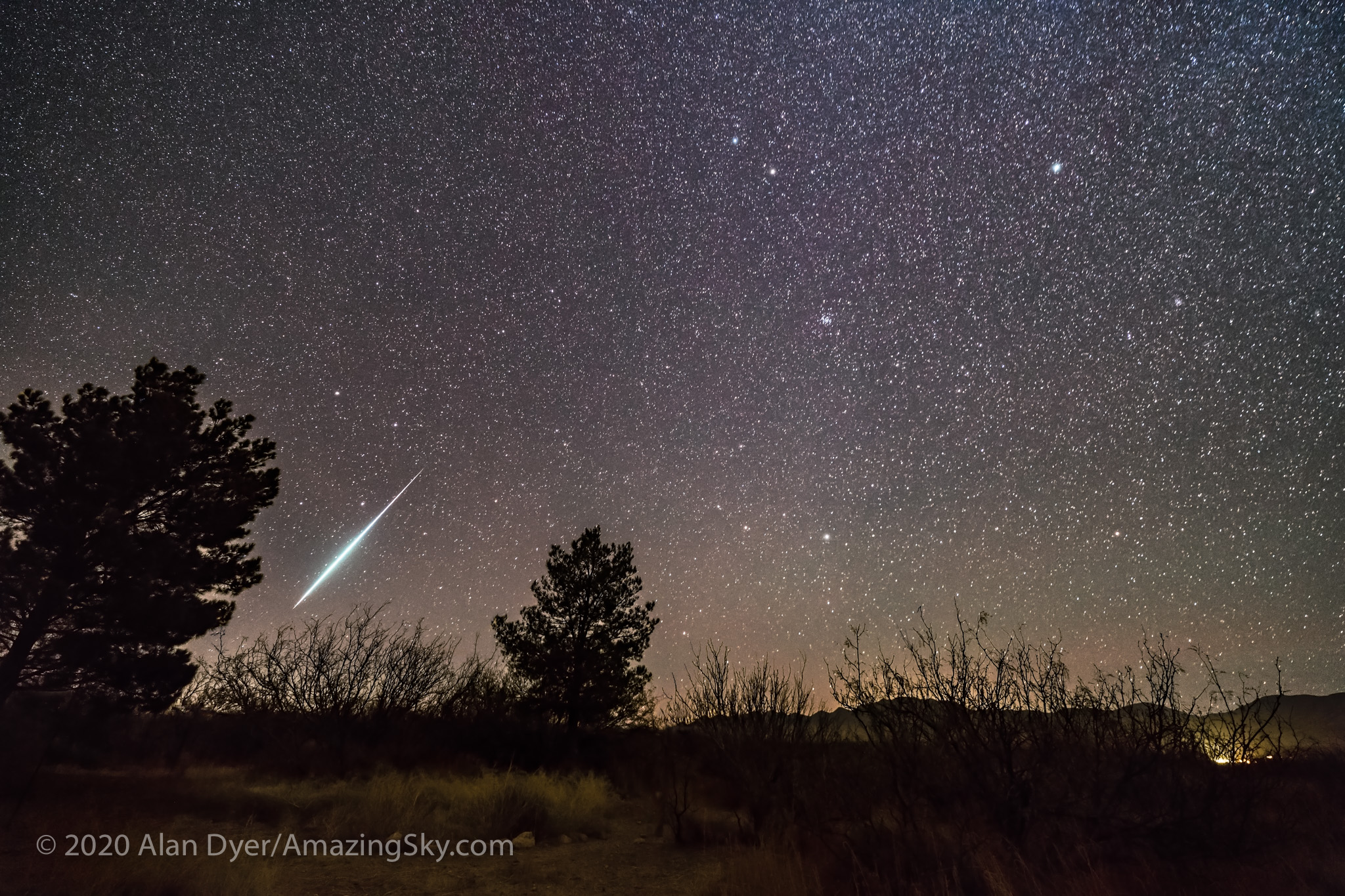
A single bright meteor from the Geminid meteor shower of December 2017, dropping toward the horizon in Ursa Major.

December 13 — Geminid meteor shower peaks

The most prolific meteor shower of the year peaks with a waxing 10-day-old gibbous Moon lighting the sky, so not great conditions. But with luck it will still be possible to see and capture bright fireballs. 

December 21 — Solstice at 10:59 a.m. EST

Winter officially begins for the northern hemisphere, summer for the southern, as the Sun reaches its most southerly position below the celestial equator. The Sun rises farthest to the southeast and sets farthest to the southwest, and the length of daylight is at its minimum.

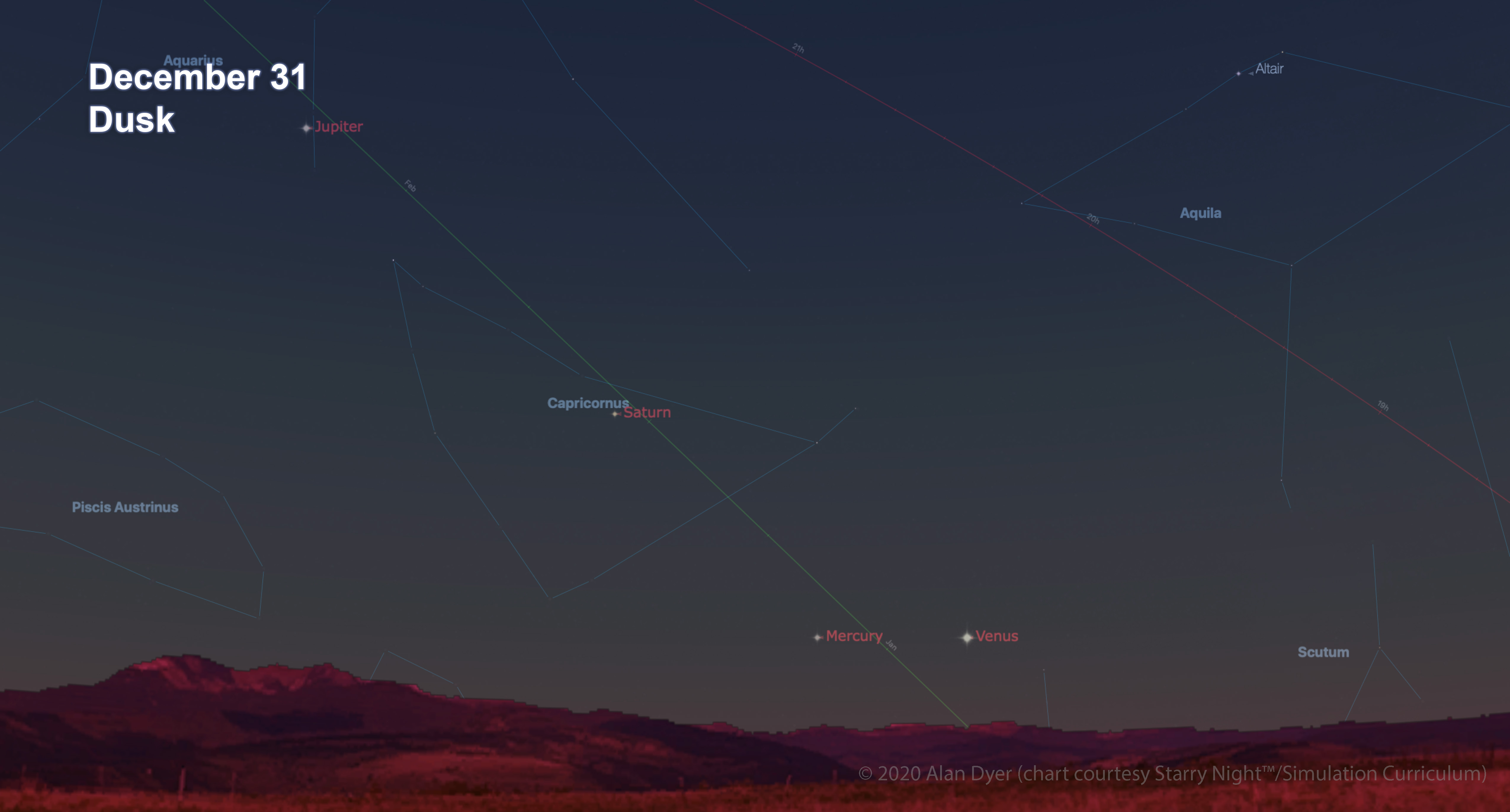
December 31 — Four planets in view 

As the year ends the same three planets that adorned the evening sky in early January are back, with the addition of Venus. So on New Year’s Eve we can see four of the naked eye planets (only Mars is missing) at once in the evening sky. 


Good luck, good viewing, and clear skies in 2021! 

For lots of tips and techniques for shooting the night sky, see my Nightscape and Timelapse ebook linked to above.

— Alan, December 26, 2020 / © 2020 AmazingSky.com