Amateur astronomers like nothing more than spending time under a dark night sky with a field of friends.
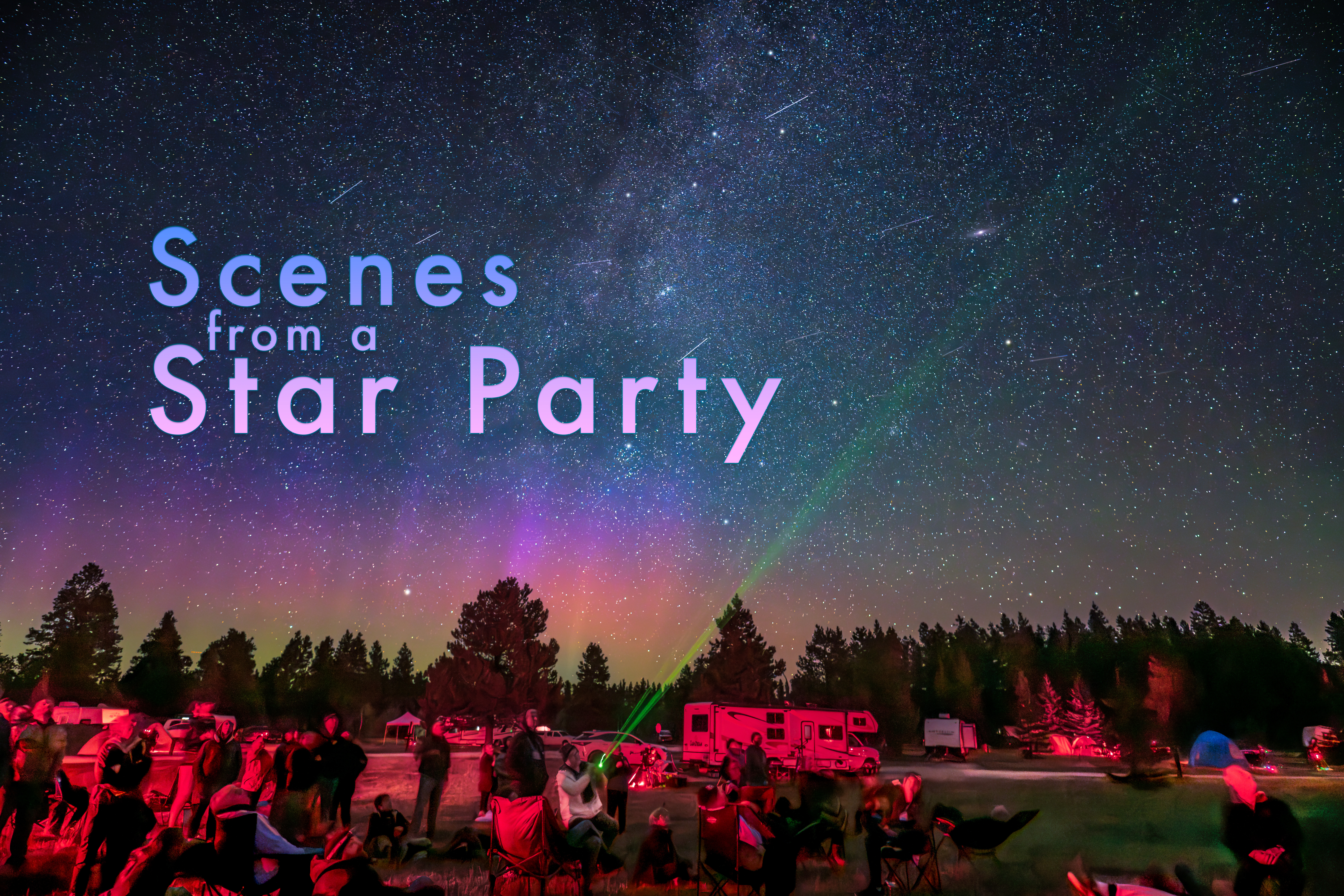
Star parties are a popular part of the hobby of amateur astronomy. They’re chances for stargazers to get under dark skies and meet up with others who love the night sky.
Each year I attend the biggest such event in my area in western Canada, the Saskatchewan Summer Star Party. It usually attracts about 320 sky lovers to the very dark skies of southwest Saskatchewan.
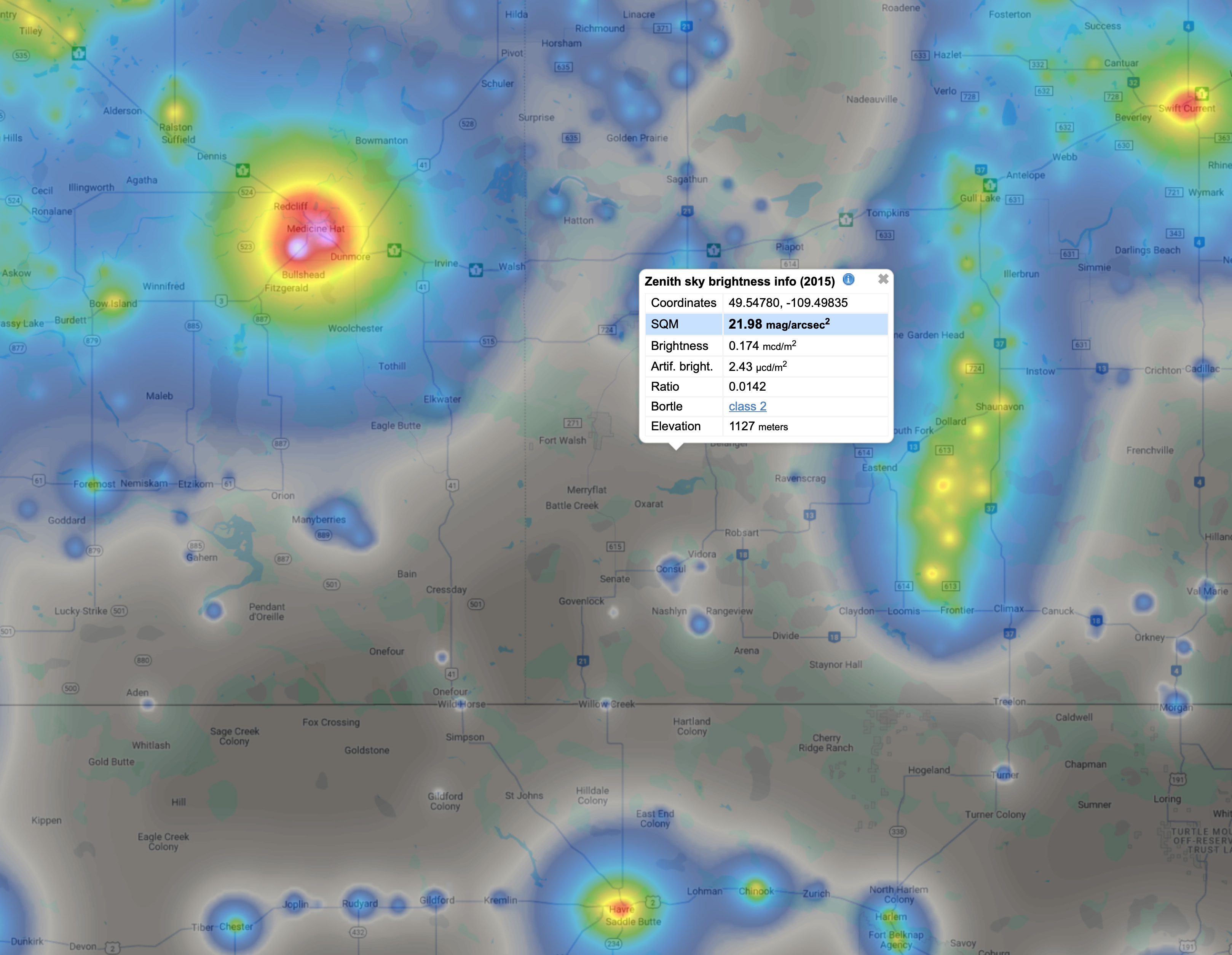
A light pollution map where grey = good!
The label marks the spot for the Party, in the Cypress Hills, and in the Cypress Hills Interprovincial Park, that straddles the border of Saskatchewan and Alberta. As per its name, the SSSP is held on the Saskatchewan side of the Park, in the Centre Block south of Maple Creek. (A complementary Southern Alberta Star Party is held on the Alberta side of the Cypress Hills, in September. I’ll be there!)
As the map shows, the Cypress Hills are far from any light pollution and offer “Bortle 2-class” skies — 1 being the darkest, and 9 being downtown Las Vegas!
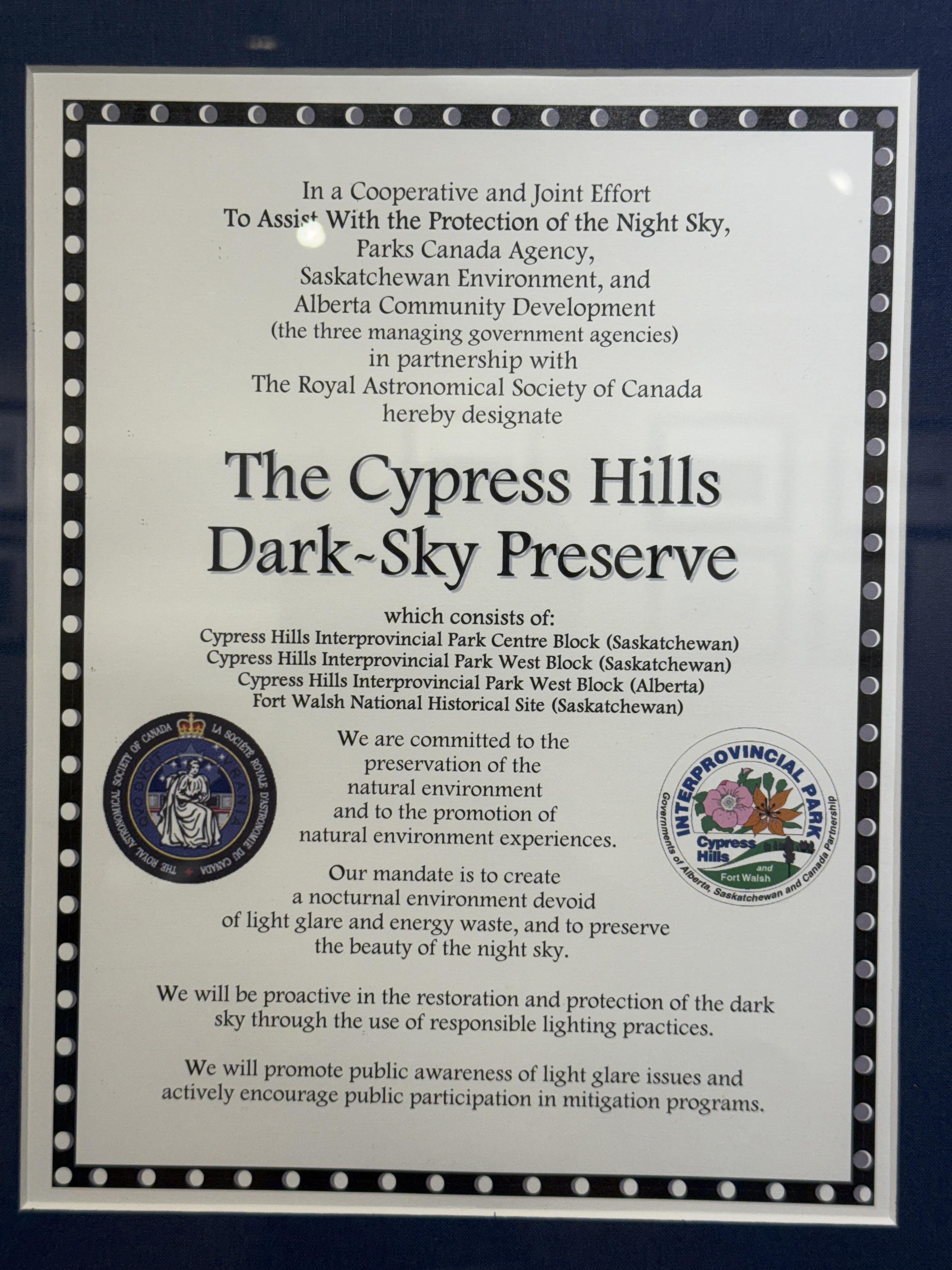
In fact, the Park is a Dark Sky Preserve, a designation awarded in 2004. Parks are increasingly aware of their role in not only conserving flora, fauna, and historical sites, but also the increasingly threatened night sky. As the saying goes, “Half the Park is after dark!”
The DSP Declaration
The Dark Sky Preserve designation, and efforts to refit what lighting is in the Park to “dark-sky friendly” fixtures, came about as a direct result of the Park, and Star Party, being the site of a comet discovery three years earlier.
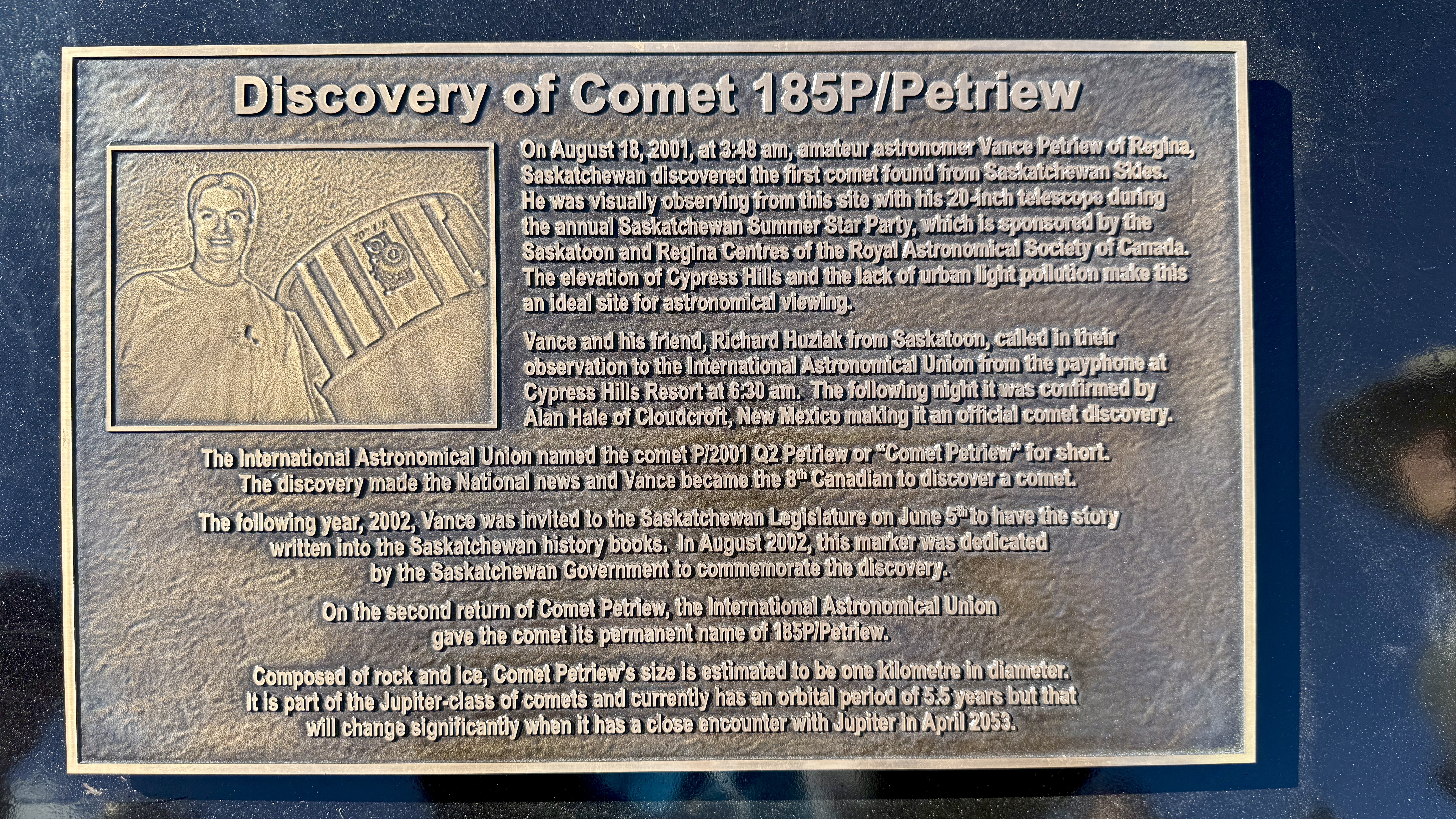
It was at the Star Party in August 2001 that Regina amateur astronomer Vance Petriew discovered a comet, an observing feat that merits a comet being named for the discoverer.
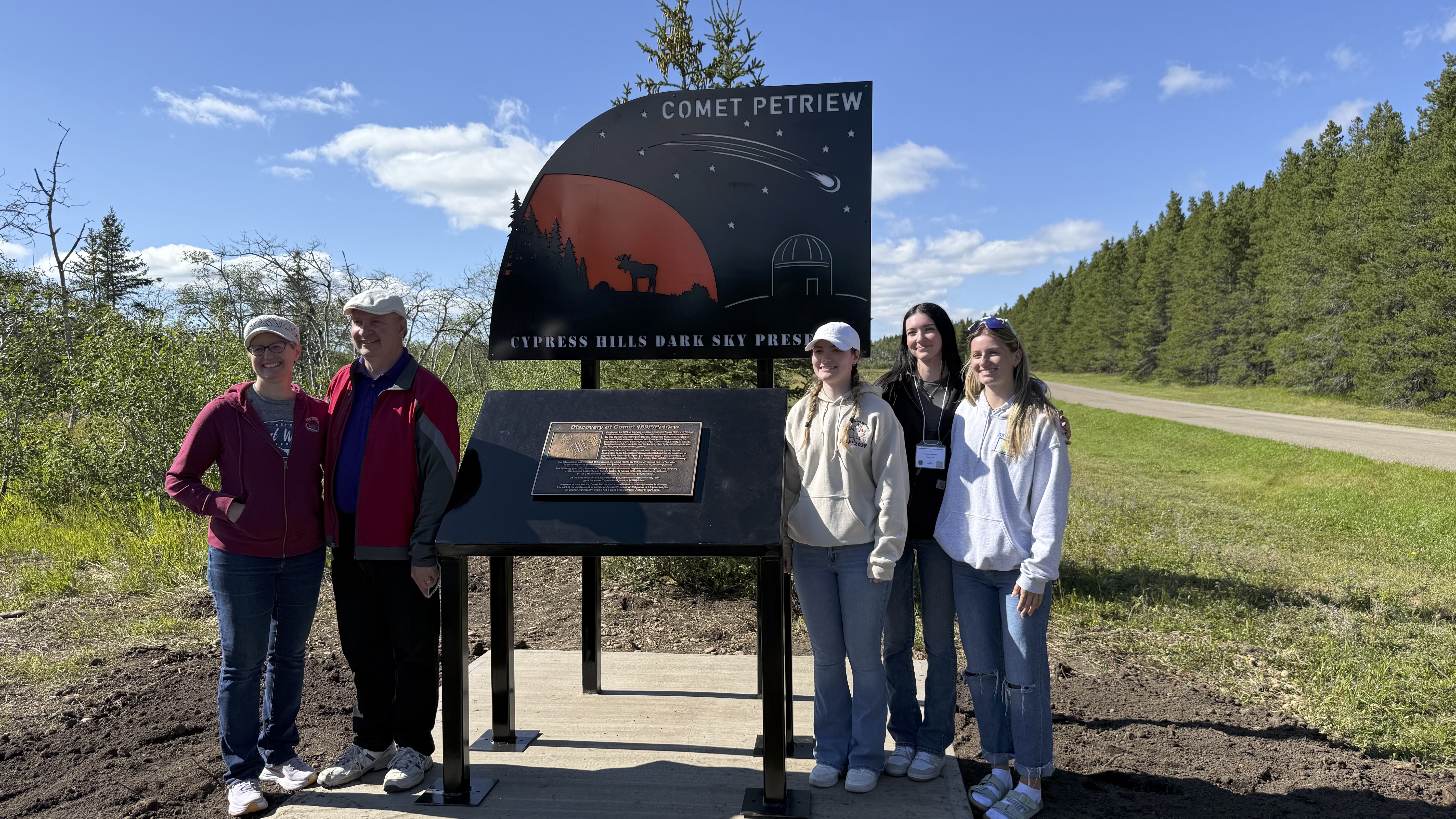
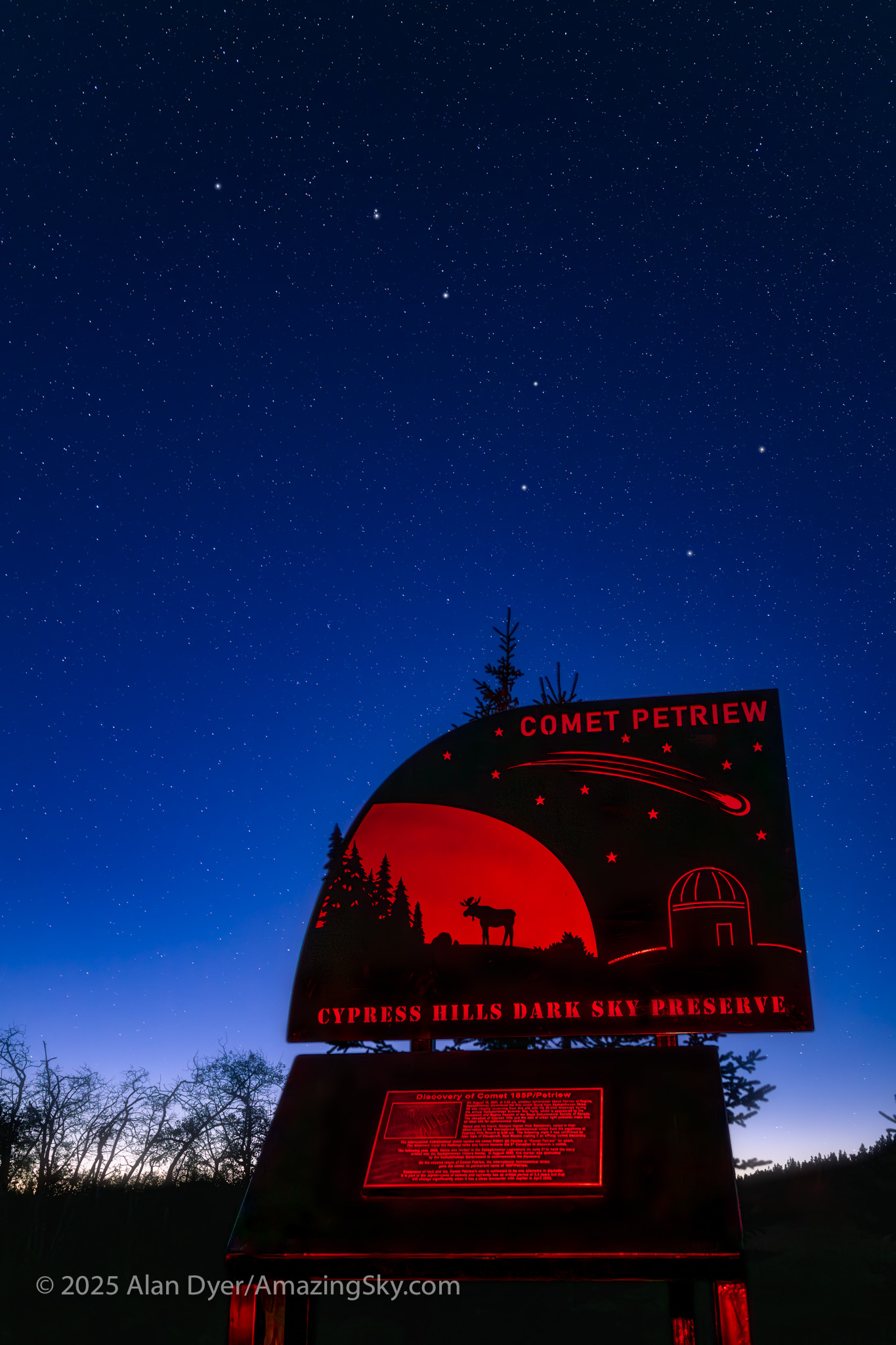
This year, a new sign and plaque were unveiled commemorating the discovery, replacing a cairn that had fallen into disrepair over 20 years. Here is the unveiling —
Park officials, fellow astronomers and Vance unveil the sign.
This was a fine event with all the star party folks in attendance, many of whom were there in 2001! — including the now adult daughters of the Petriew family.
Click on the images below to bring the photos up full screen.
The Petriew FamilyThe comet scope in 2025.Comet Petriew plaque
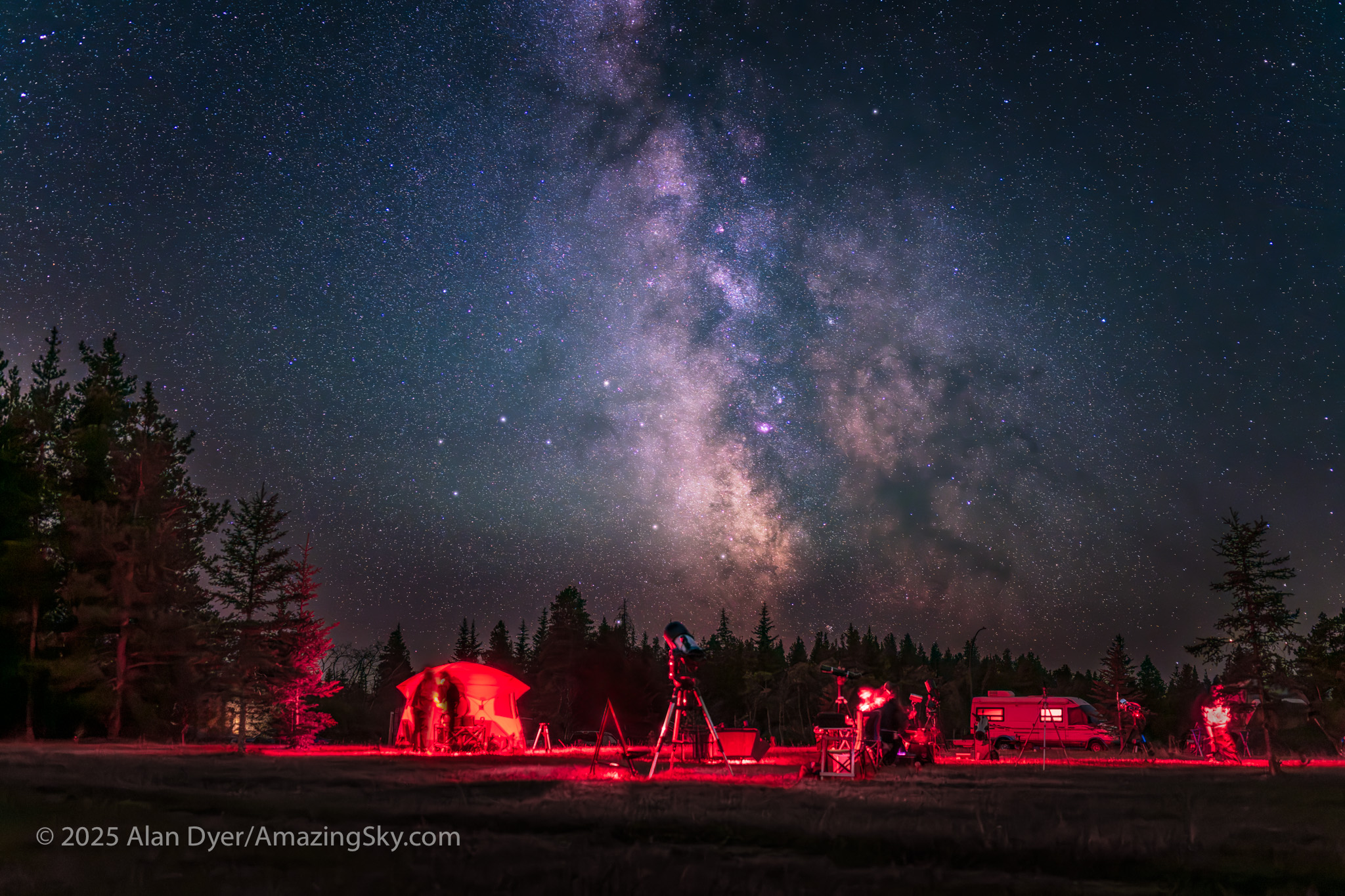
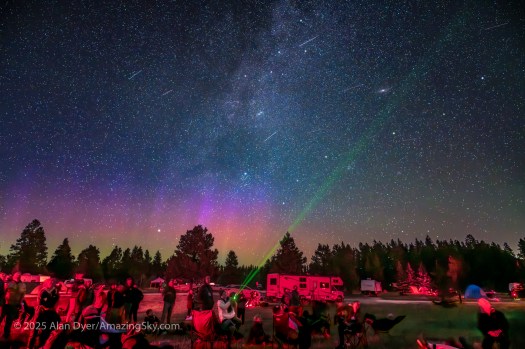
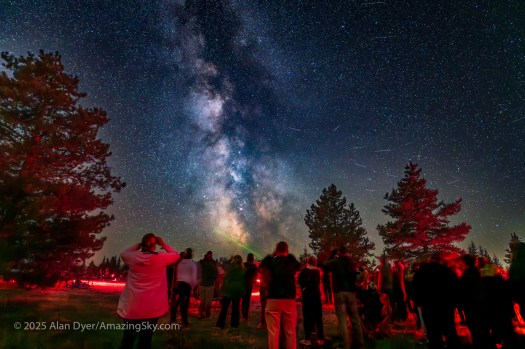
While that was a highlight of the week, the real show was the sky above. The Milky Way was on display in a sky clearer and darker than we had seen it for many years. No clouds, no smoke, and little dew and bugs! The Cypress Hills are a mecca for stargazing!
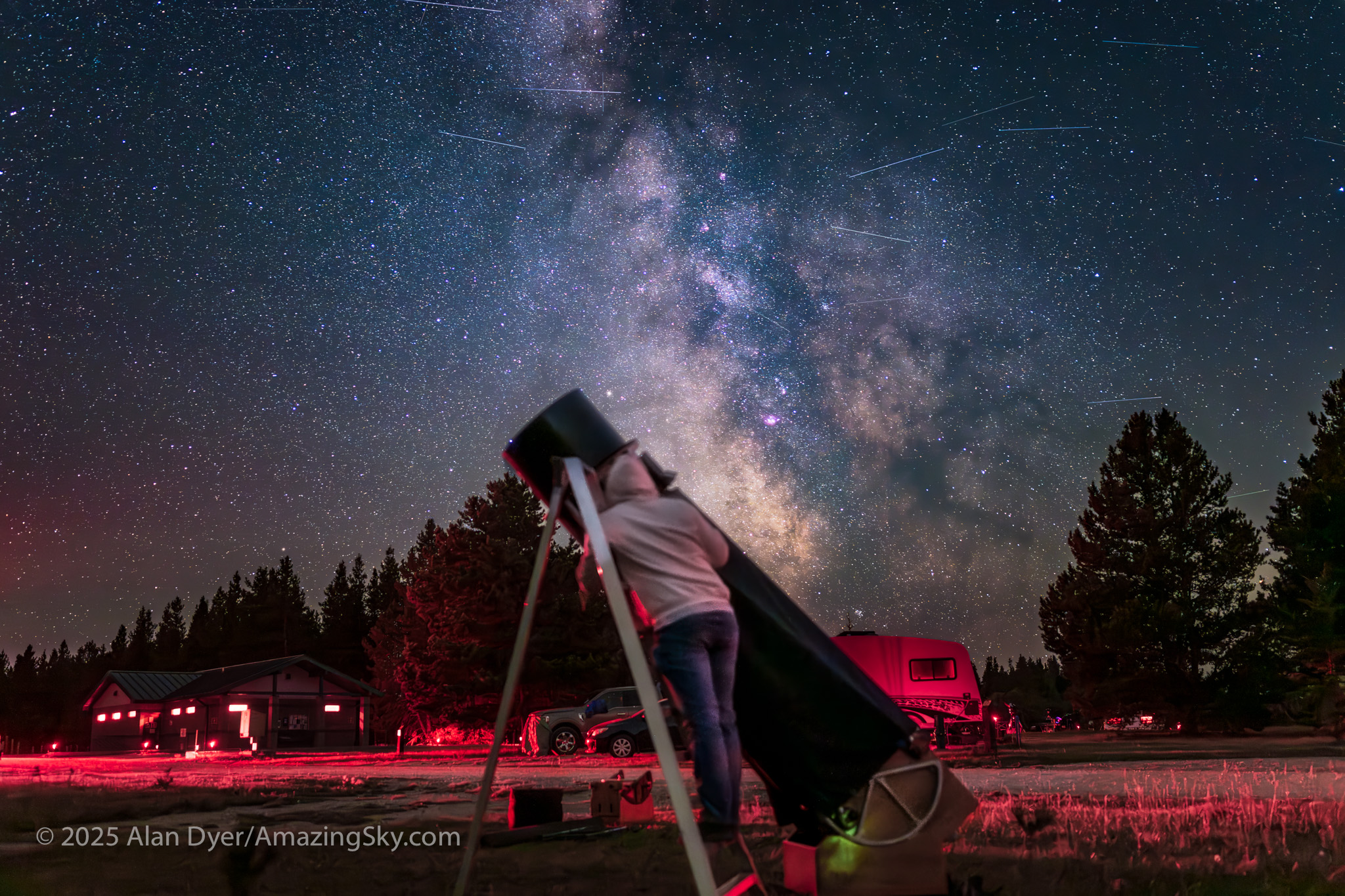
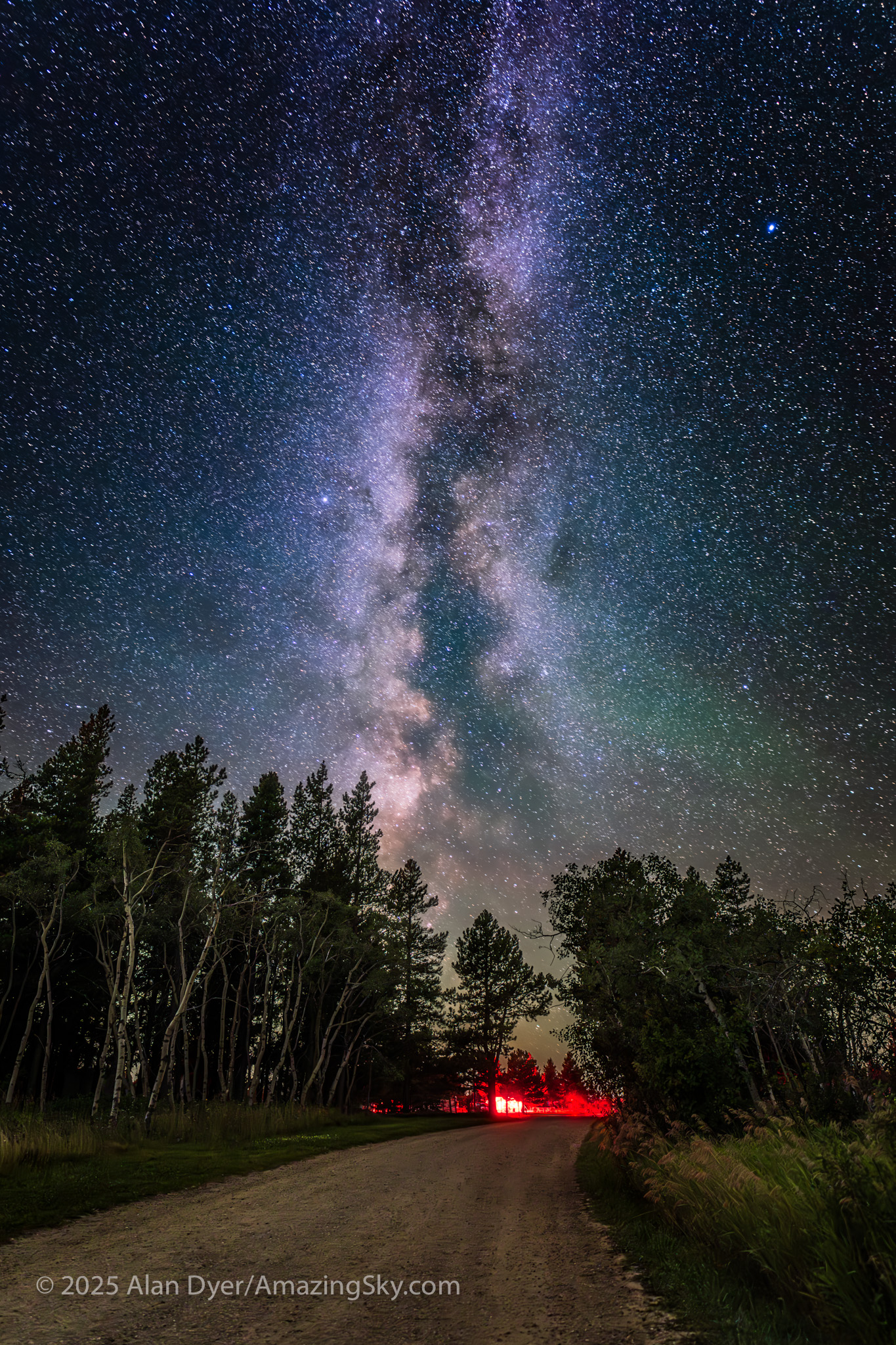
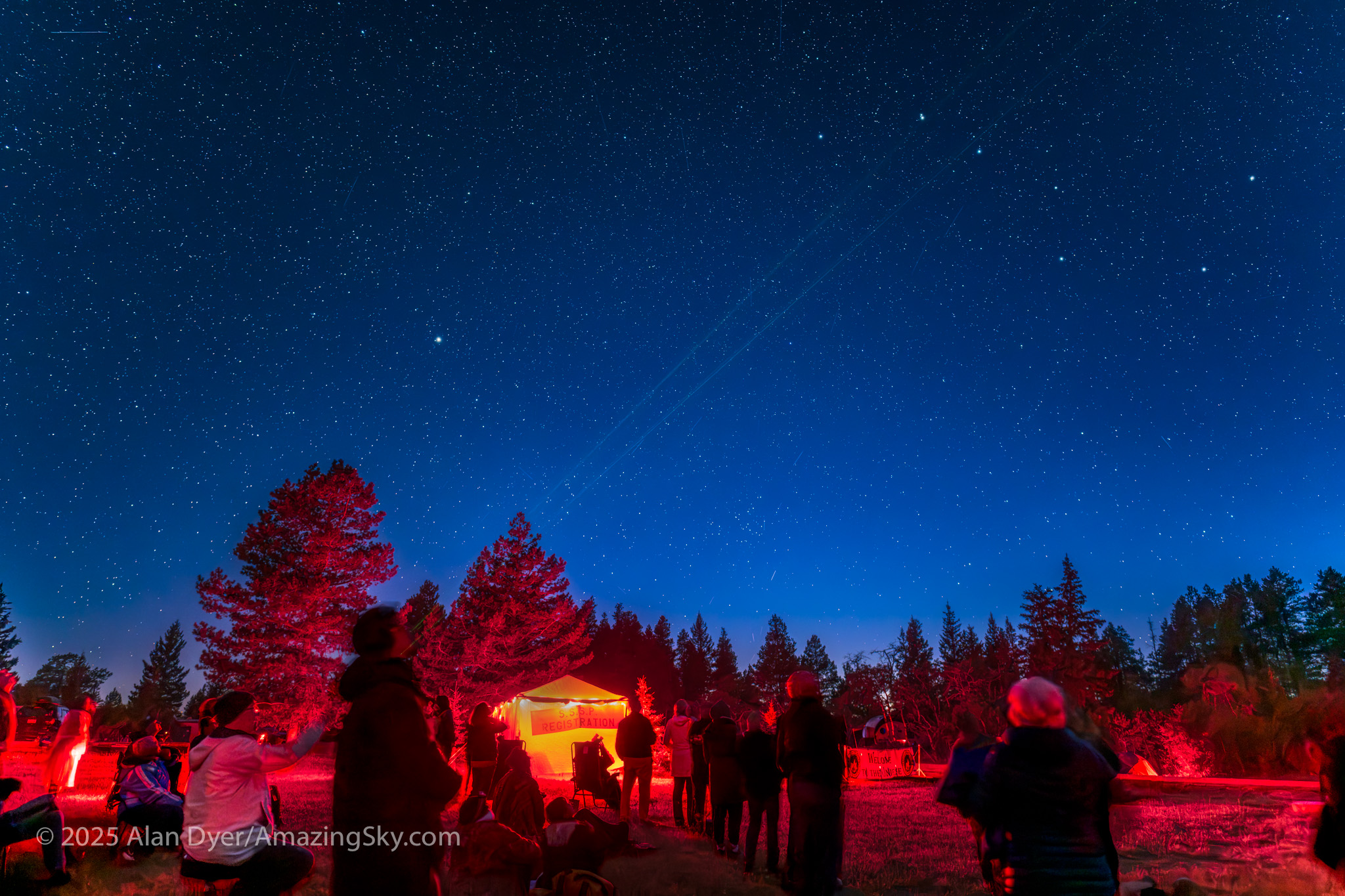
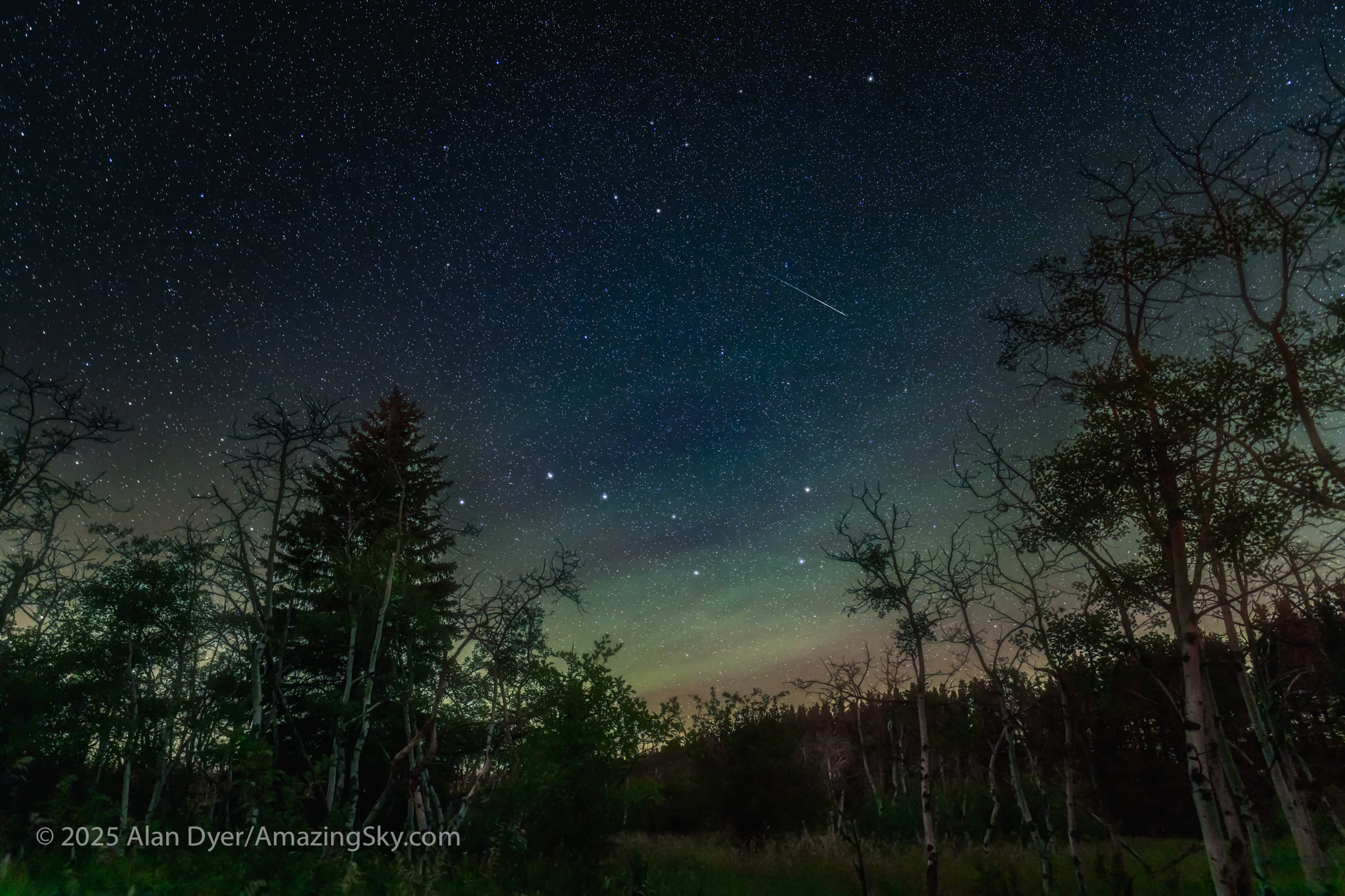
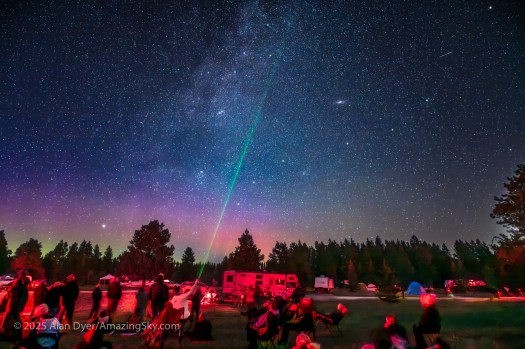
The road into the Meadows Campground, home to the Saskatchewan Summer Star Party. The SSSP is organized by the Royal Astronomical Society of Canada centres in Regina and Saskatoon. Telescopes and tents under the Milky Wa.yA sky tour in the early evening with blue twilight.The Big and Little Dippers in the Cypress Hills
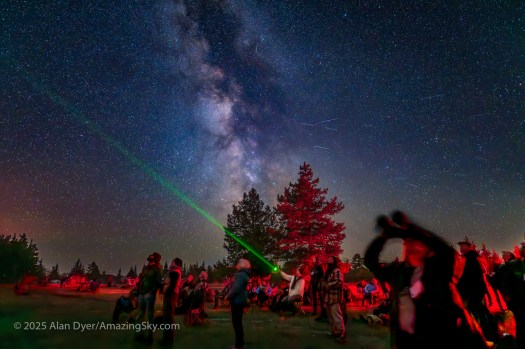
A popular part of this star party, as it is at many such events, is a laser-guided tour of naked-eye sights, where a guide points out the constellation patterns, and highlights objects that need nothing more than binoculars to see well.
In a slide show below, astronomer Ron Waldron from Saskatoon conducts the 2025 Friday night “star walk.” It’s BYOB — Bring Your Own Binoculars!
Laser touring the sky
Yes, there was an aurora
Look up! Look way up!
Peering into the Galactic Core
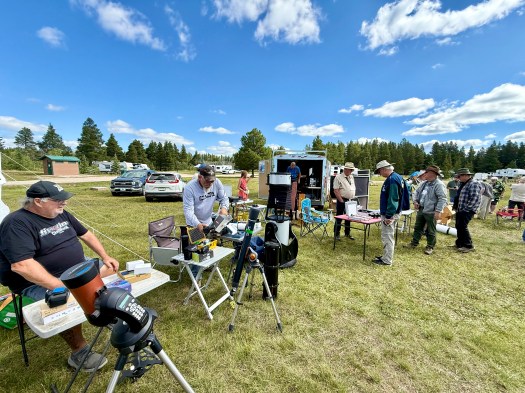
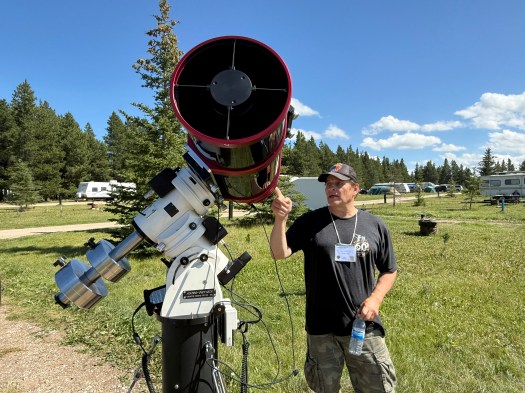
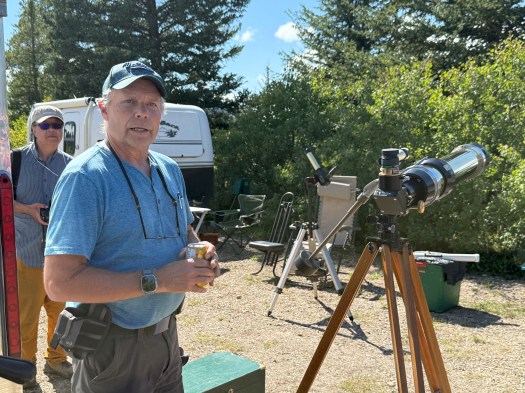
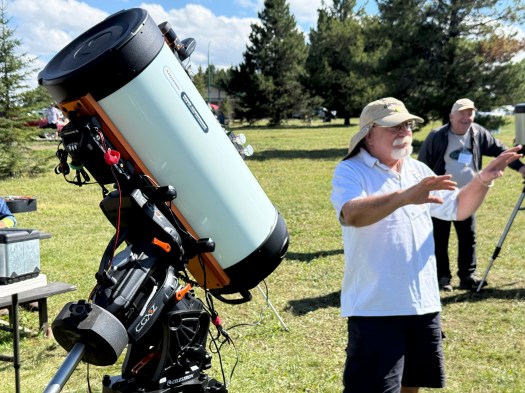
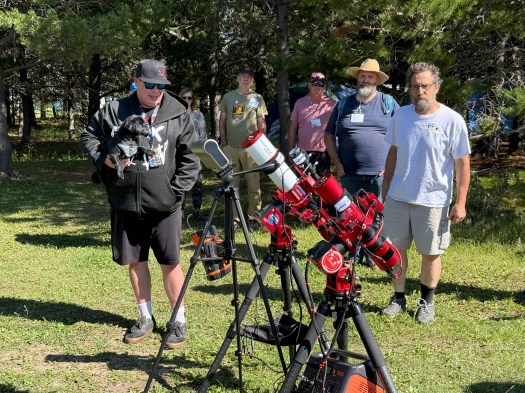
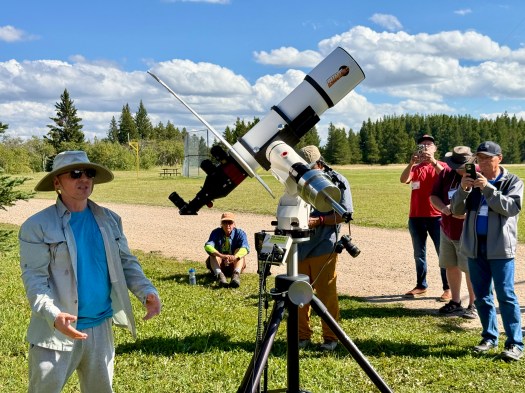
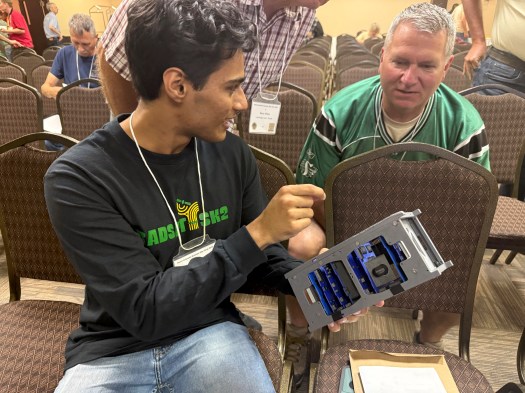
While participants stay up until the wee hours to enjoy all that the sky has to offer, every star party offers a range of daytime activities (but not happening too early!). Star parties are great places to see fields of telescopes of every description. This year the program included a formal “show-and-shine” tour of some notable gear for all to admire. And there’s the ever-popular swap meet with bargains on offer.
The Swap Meet
Kevin’s astrophoto rig
Wade’s classic refractor
Ed’s super astrophoto scope
Nick’s astrophoto array
Dan’s super solar scope
We enjoyed several talks on a range of astronomy topics, not just stargazing, but also the latest in science research. We heard about a satellite being built in Saskatchewan by U of S and U of R students, and about how the Mars Perseverance rover collects samples, in a talk from one of the researchers involved with the NASA mission.
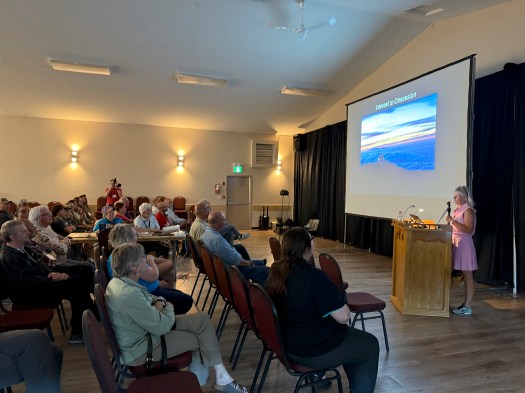
Kimberly Sibbald delivered the opening keynote on her amazing astrophotos.
Dr. Chris Herd from the U of A explained Mars sample collection.
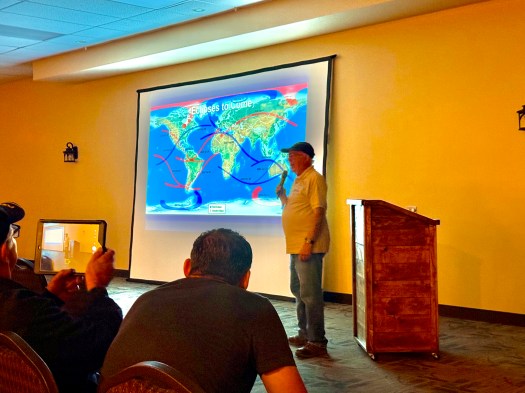
And I gave a short talk about eclipses coming up.
A 3D model of the Sask Sat
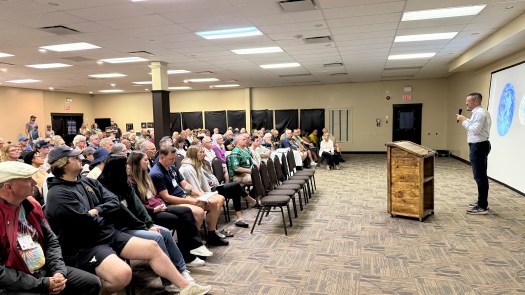
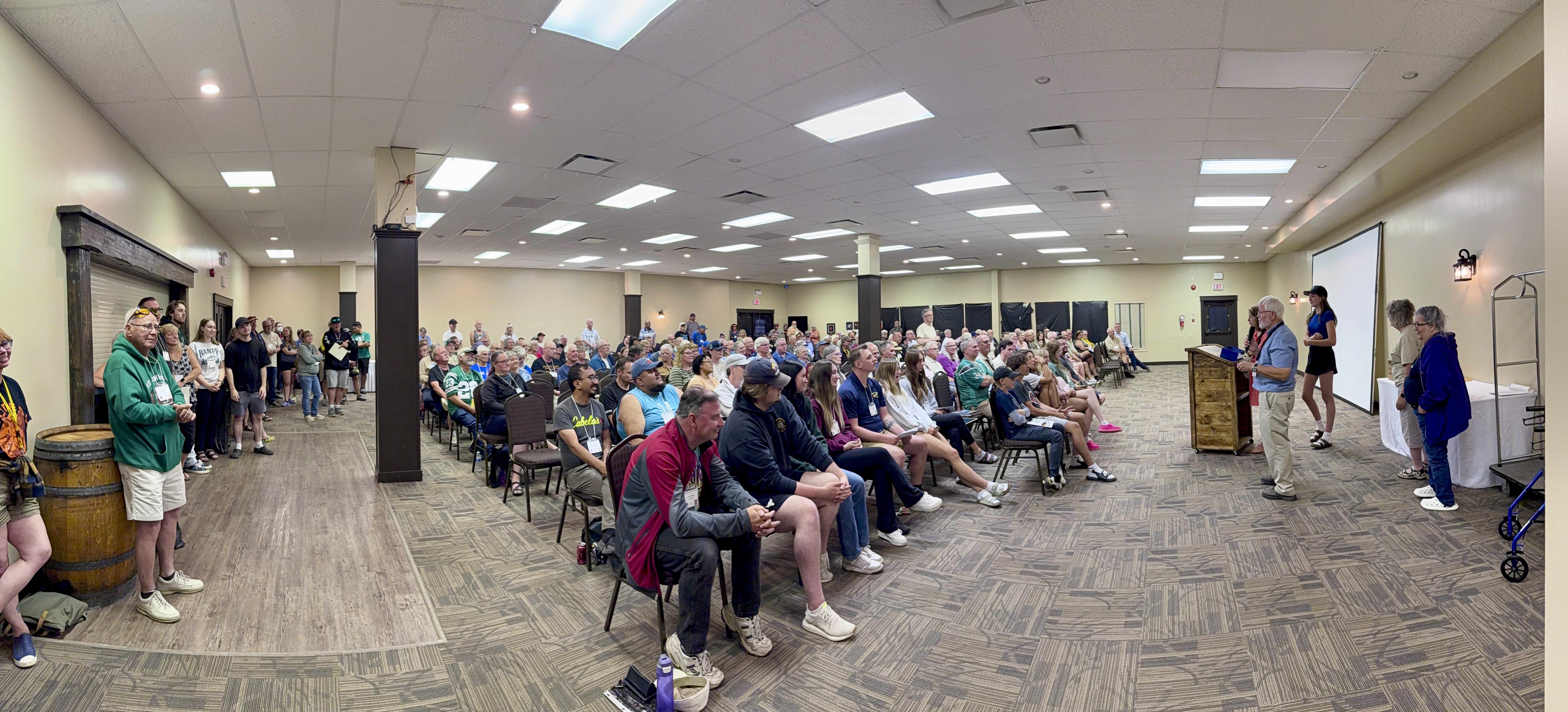
And of course there were awards and door prizes to be won! Always to a capacity crowd at the Cypress Resort conference room.
The door prizes being handed out. You must be in the room to win!
It was a superb 4 days of astronomy and stargazing. If you are in the area, I highly recommend attending. Next year’s SSSP will be August 12 to 15 inclusive — it’s always at New Moon. The website is here but won’t be updated for the 2026 event details until next year.
I won’t be there in 2026, as August 12 is the date of the next total eclipse of the Sun, which I discuss in my previous blog. I plan to be in Spain!
This is the new sign and plaque commemorating the discovery in 2001 of a comet here in the Cypress Hills Interprovincial Park by Vance Petriew.
But I highly recommend attending in 2026. As most people do, you may find yourself enjoying the weekend so much you make it an annual event in your calendar. I shall miss my annual August ritual of the SSSP in 2026 and in 2027 — there’s an eclipse that August, too!
But 2025 was certainly a fine year to enjoy all that the Cypress Hills have to offer under the stars.
I had always planned to drive to the April 8, 2024 total eclipse of the Sun. But to where? I ended up on the other side of the continent than originally planned.
It is not often the path of the Moon’s shadow crosses your home country, let alone continent. Only once before in recent years, on August 21, 2017, did the narrow shadow path pass near enough to my home in Alberta to allow me to drive to a total eclipse. They almost always require flying.
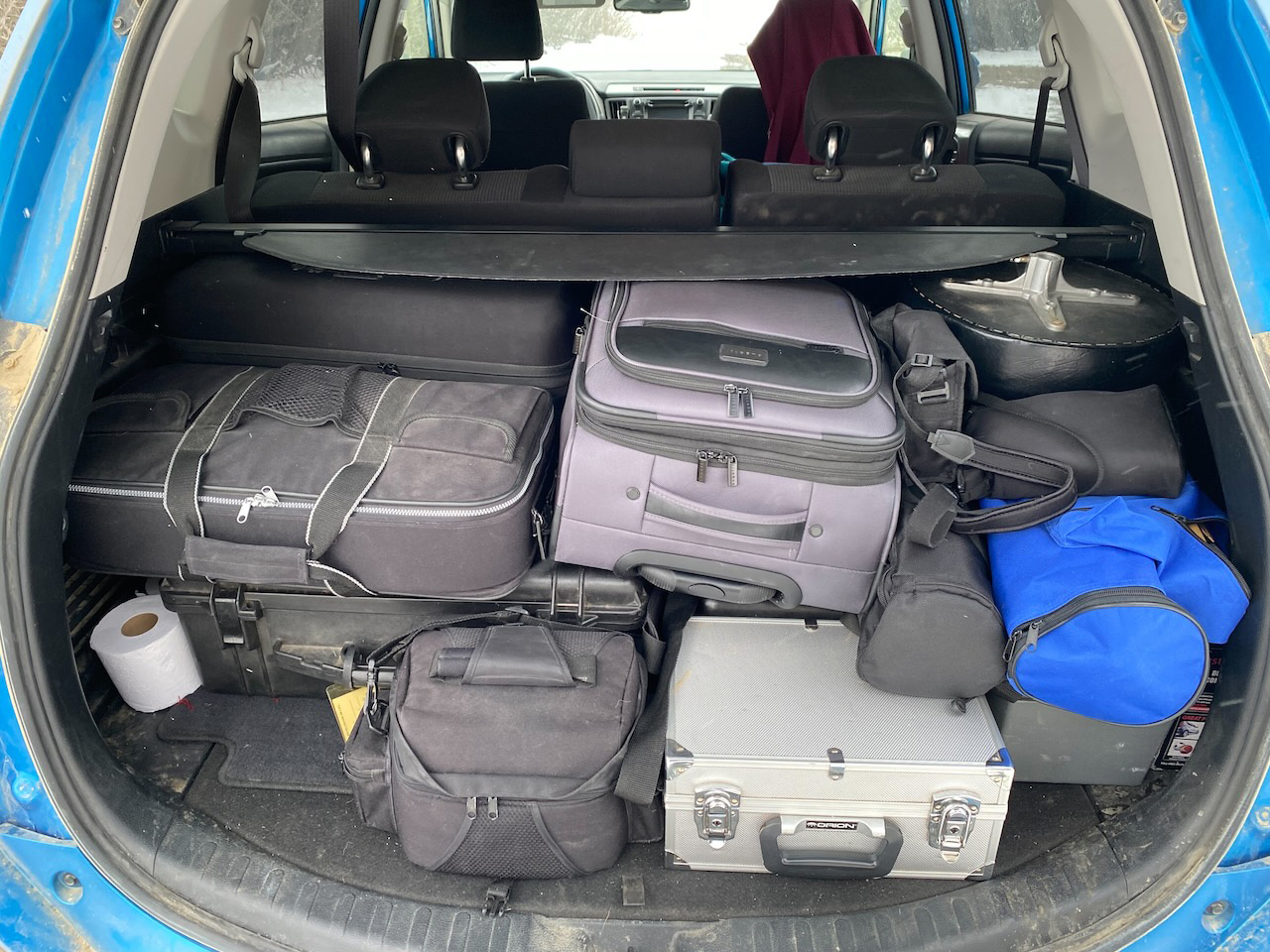
Packed and ready to hit the highway for a long eclipse trip.
Yes, while I could drive to the April 8, 2024 eclipse, it was going to demand a much longer drive than in 2017. But driving allowed me to take a carload of telescope and camera gear. So that was the plan.
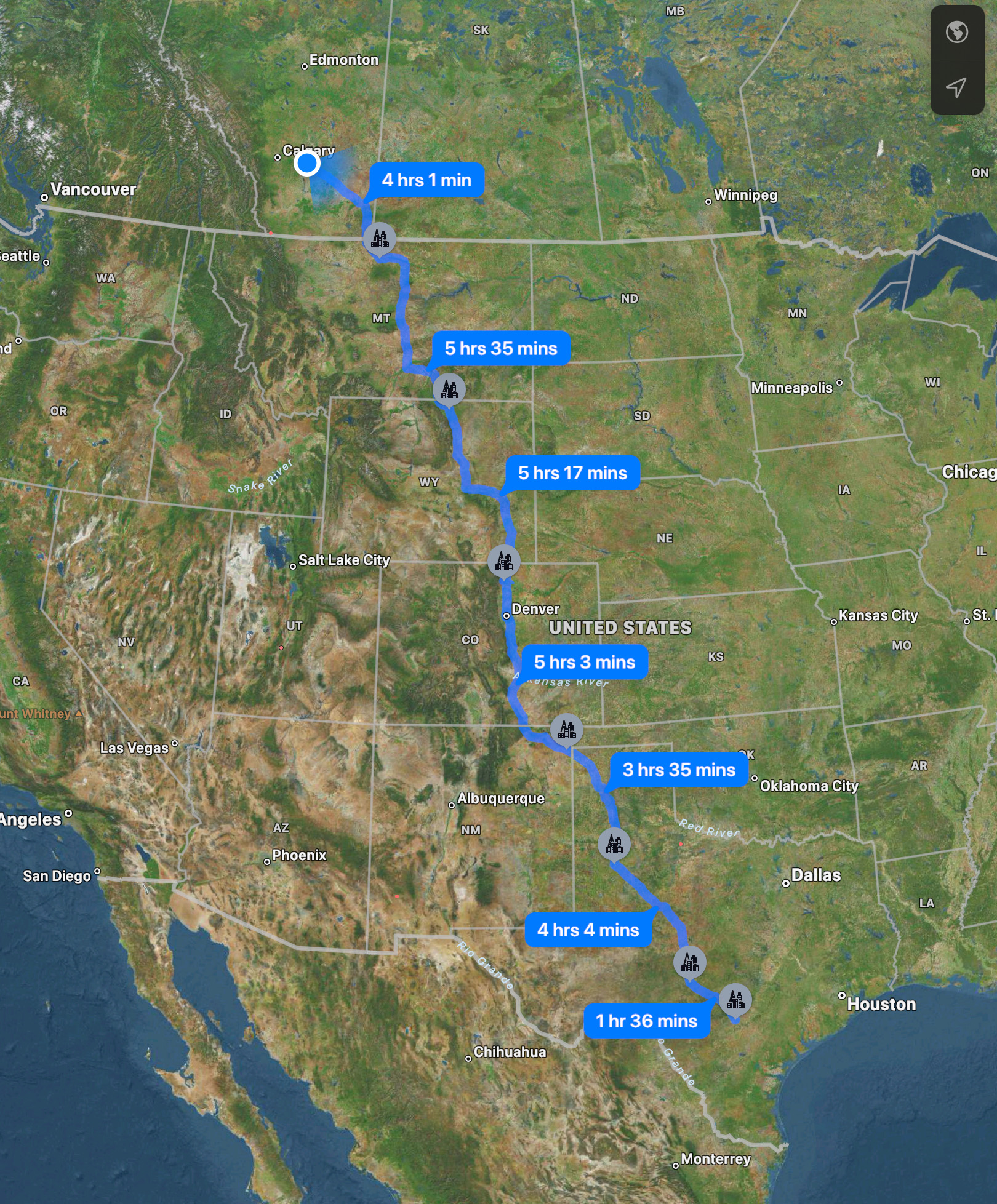
My destination was San Antonio, Texas. That’s where I had made a hotel booking more than a year earlier. The weather prospects in Texas were forecast to be best (at least according to the long-term averages) of any locations along the path in the U.S. or Canada. (I did not want to drive into Mexico.)
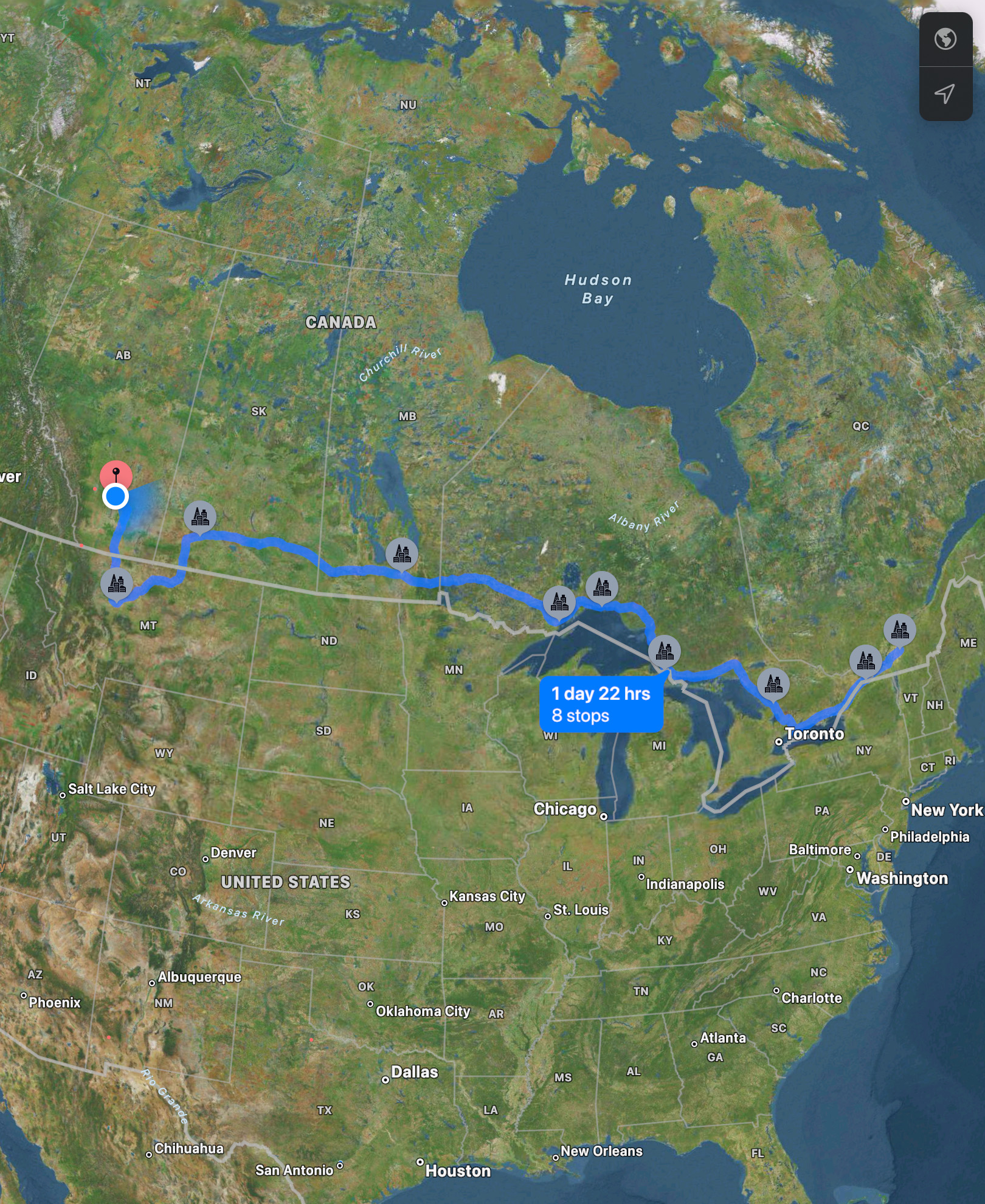
Where I was going! Where I ended up going!
On March 30, with some trepidation, I set out down I-15 heading south. I got as far as Great Falls, Montana, my stop for night one. But it was to be a move in the wrong direction.
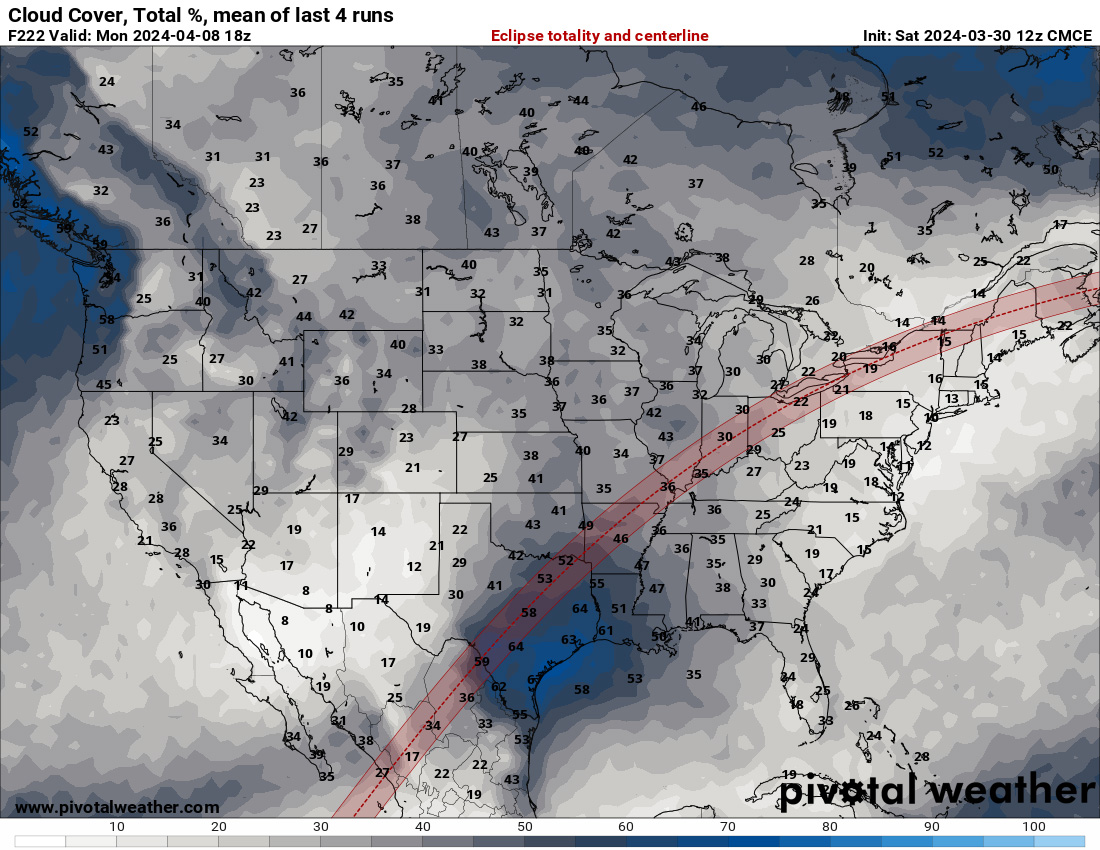
The forecast for Eclipse Day as of March 30. Blue is bad; white is good!
The various long-range weather models were all agreeing, even 10 days in advance, that Texas (covered in blue above) was looking poor for eclipse day. But eastern Canada looked good! That was the exact opposite of what had been expected.
So on Easter Sunday, I turned around and headed north, crossing back into Canada at a lonely border post in southwest Saskatchewan.
I proceeded east along the TransCanada, Highway 1. I decided against a route across the northern U.S. and around the southern end of Lake Michigan, to avoid severe weather forecast for the middle of the U.S.
One of my daily Facebook travelogue posts with a beer of the day.
Along the way I posted my beer-du-jour travel reports, as above from Day 8, that day from within the shadow path at last!
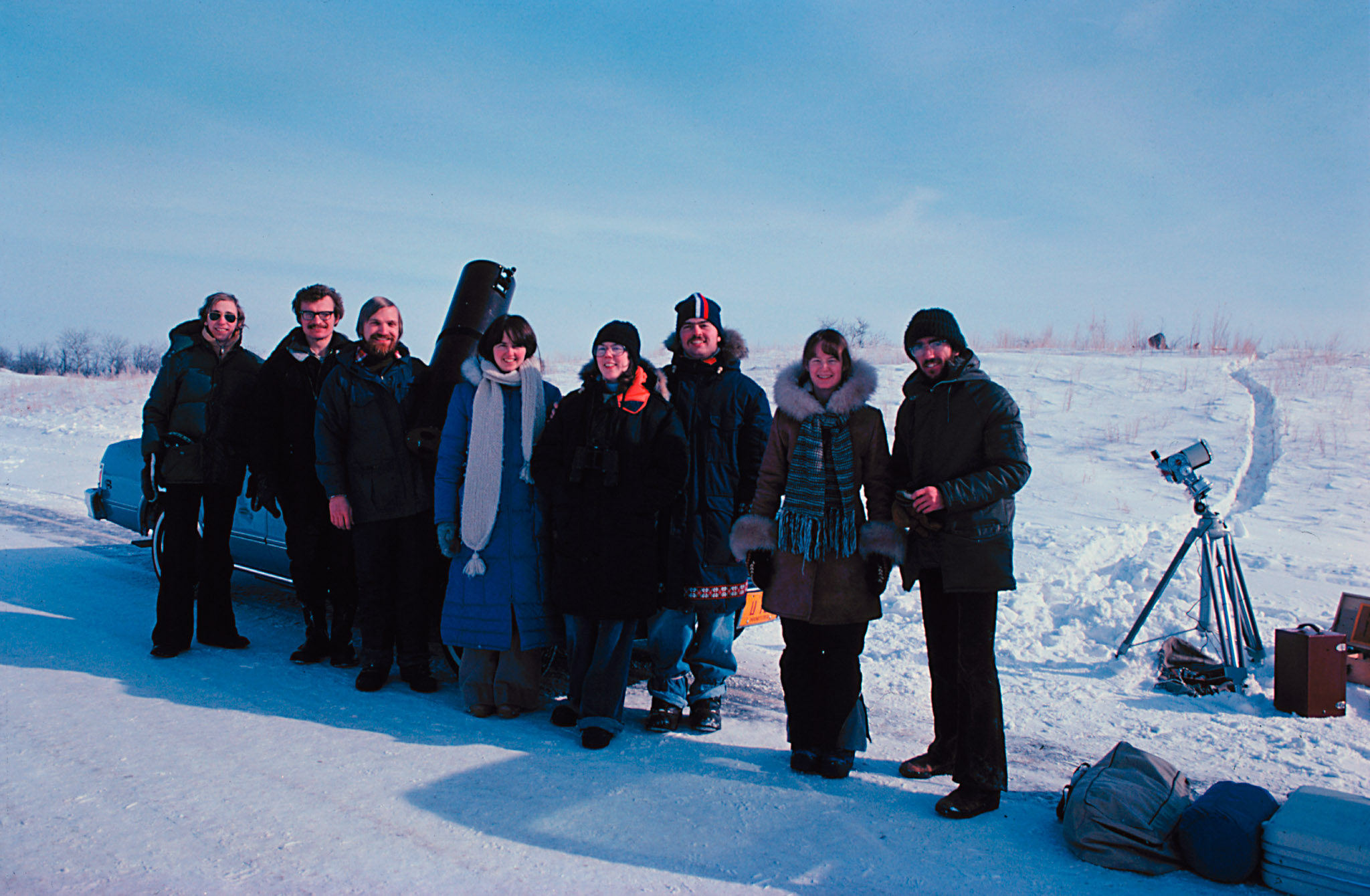
Our 1979 eclipse group in 1979.The 1979 eclipse site in 2024.The February 26, 1979 eclipse.
I also stopped at the only total eclipse site, of the 16 I had seen previously, I have ever been able to re-visit. On February 26, 1979 I and a small band of friends from Edmonton viewed the mid-winter eclipse (the last one visible from southern Canada) from a median road (Firdale Road as it is now called) on the TransCanada Highway near Carberry, Manitoba. I found the spot again, where I saw (and shot with my Questar telescope) my first total eclipse of the Sun.
However, a day after entering Ontario, the bad weather caught up with me, forcing an extra night north of Lake Superior while the only highway across the region, Highway 17, was cleared of snow and re-opened at Wawa, the usual cross-Canada choke point.
My new destination (after abandoning the site in the Texas Hill Country) was to be southern Ontario.
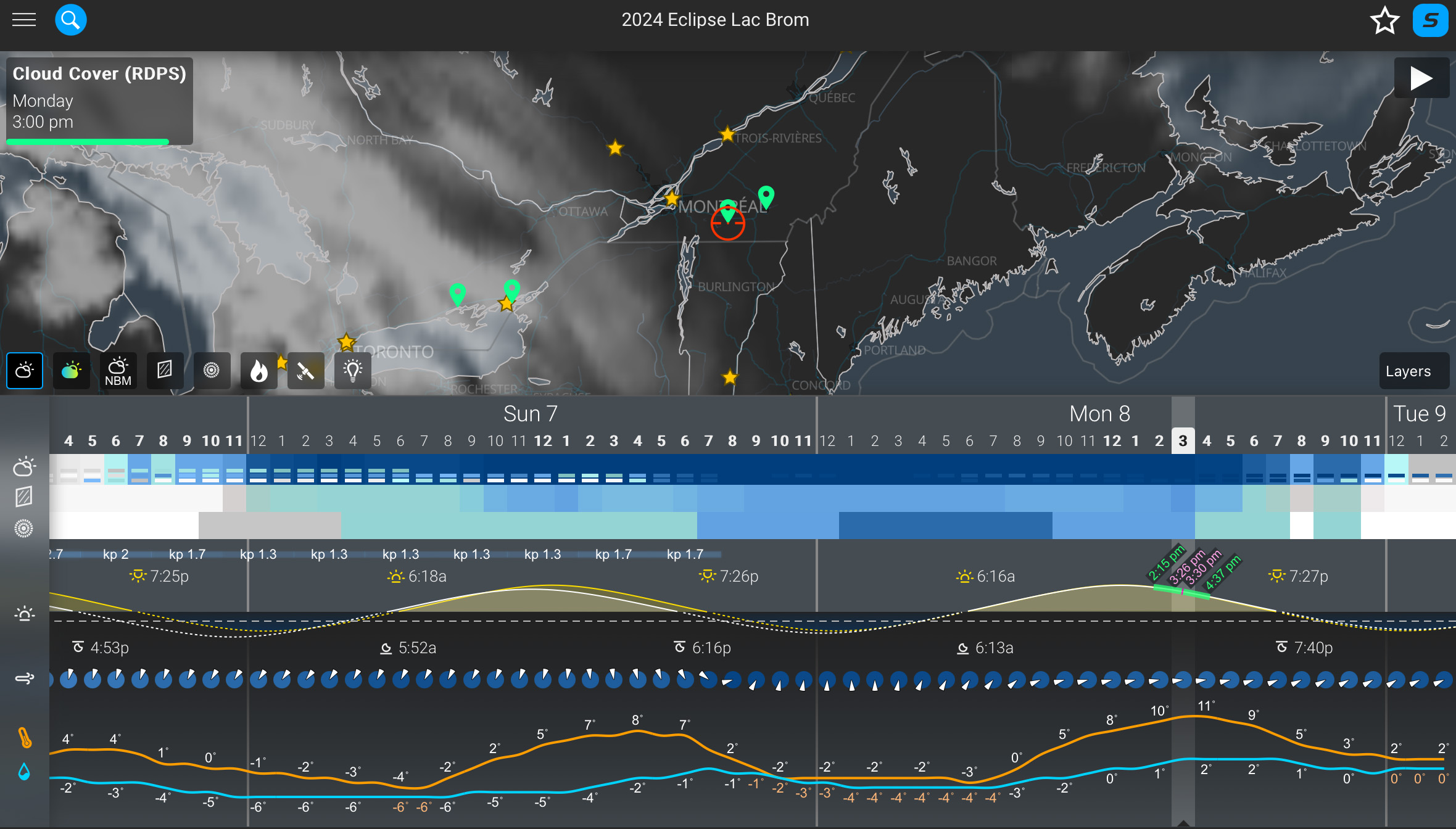
The weather prediction as of April 5.Southern Québec looking good!
However, as eclipse day approached and the weather predictions became more precise, it was apparent that Ontario would also be under some cloud. Southern Québec was looking better. So the Eastern Townships became my new Plan A site! I was running out of time!
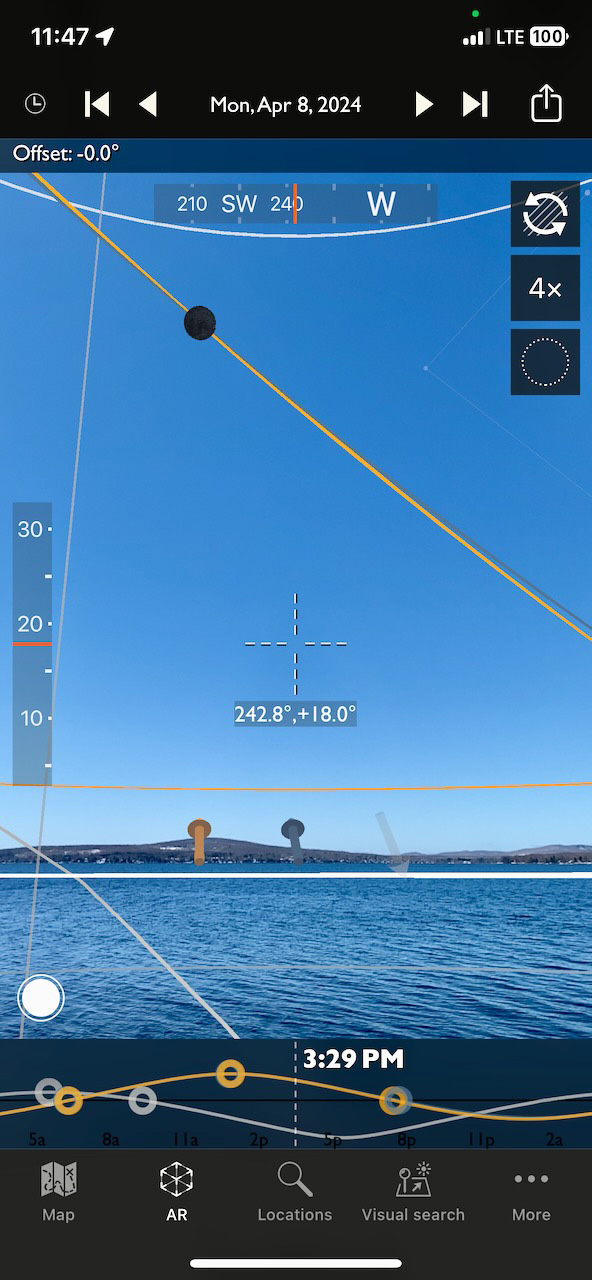
Using the TPE app to check the Sun’s location once on site, the day before the eclipse.
I arrived on site in Québec with only a day to spare to check out the location I had found by exploring Google maps.
With the Sun lower in the mid-afternoon sky in Québec compared to the high-noon Sun in Texas, I decided to shoot a wide-angle scene of the eclipse over a lake, preferably with open water, not ice! That required a site with public parking on an eastern lakeshore.
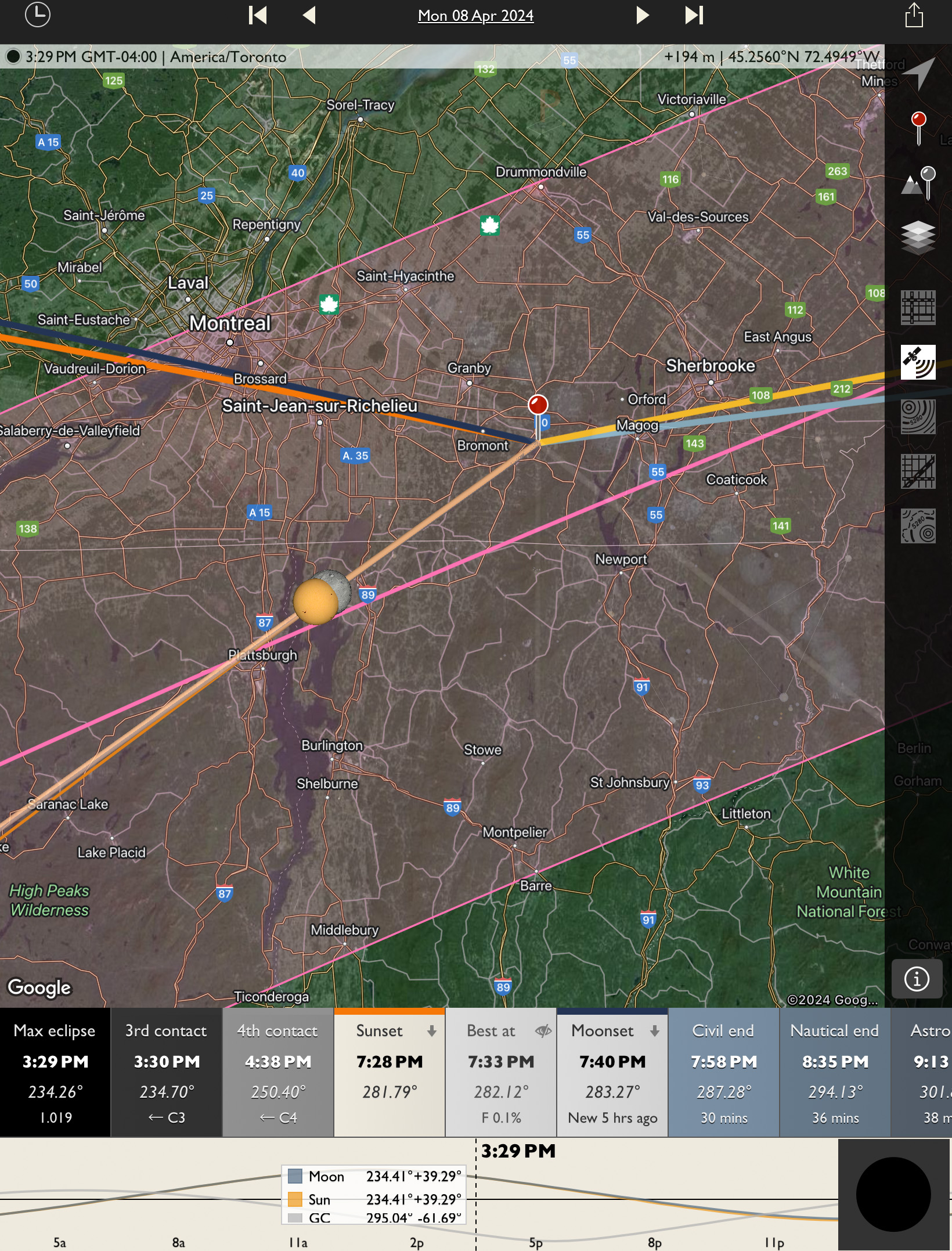
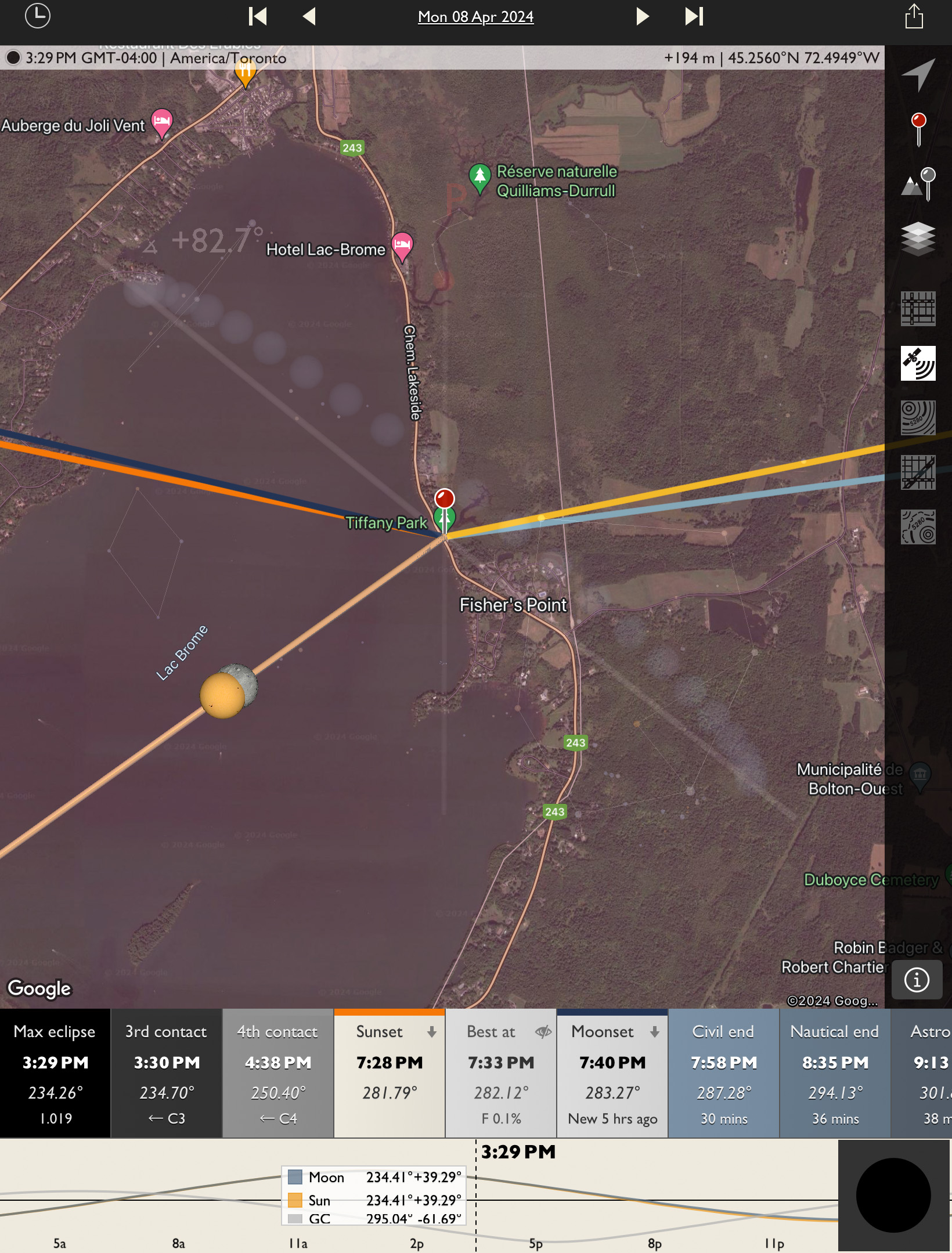
The Photographer’s Ephemeris (TPE) app to check Sun angles.Zooming in with TPE app for my chosen Lac Brome site. .
The site I found, then checked out on April 7, was on Lac Brome. It proved ideal — except for the thin cloud that was now predicted to drift through during the eclipse.
Sure enough, that’s just what happened. The cloud detracted from the eclipse only in preventing long-exposure images recording the outermost streamers in the Sun’s atmosphere.
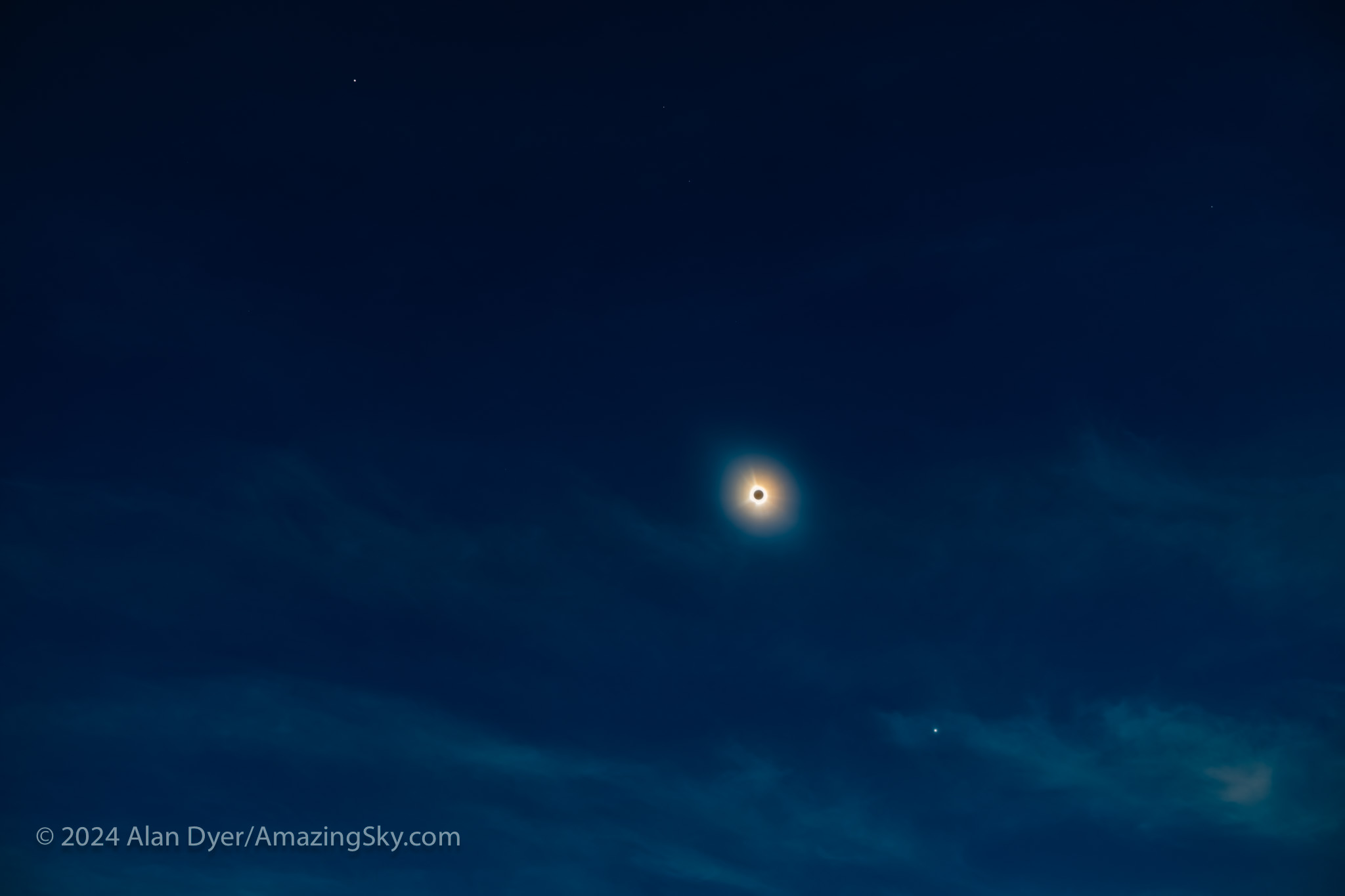
A wide-field view of the eclipse of the Sun, taking in the bright planets Jupiter (at top) and Venus (below) that were easily visible to the unaided eye during totality.
I could have sought out clearer skies by going even farther east, but I was in a crunch for time and hotel rooms! As it was I was able to get rooms everywhere I wanted and at normal “non-eclipse” rates!
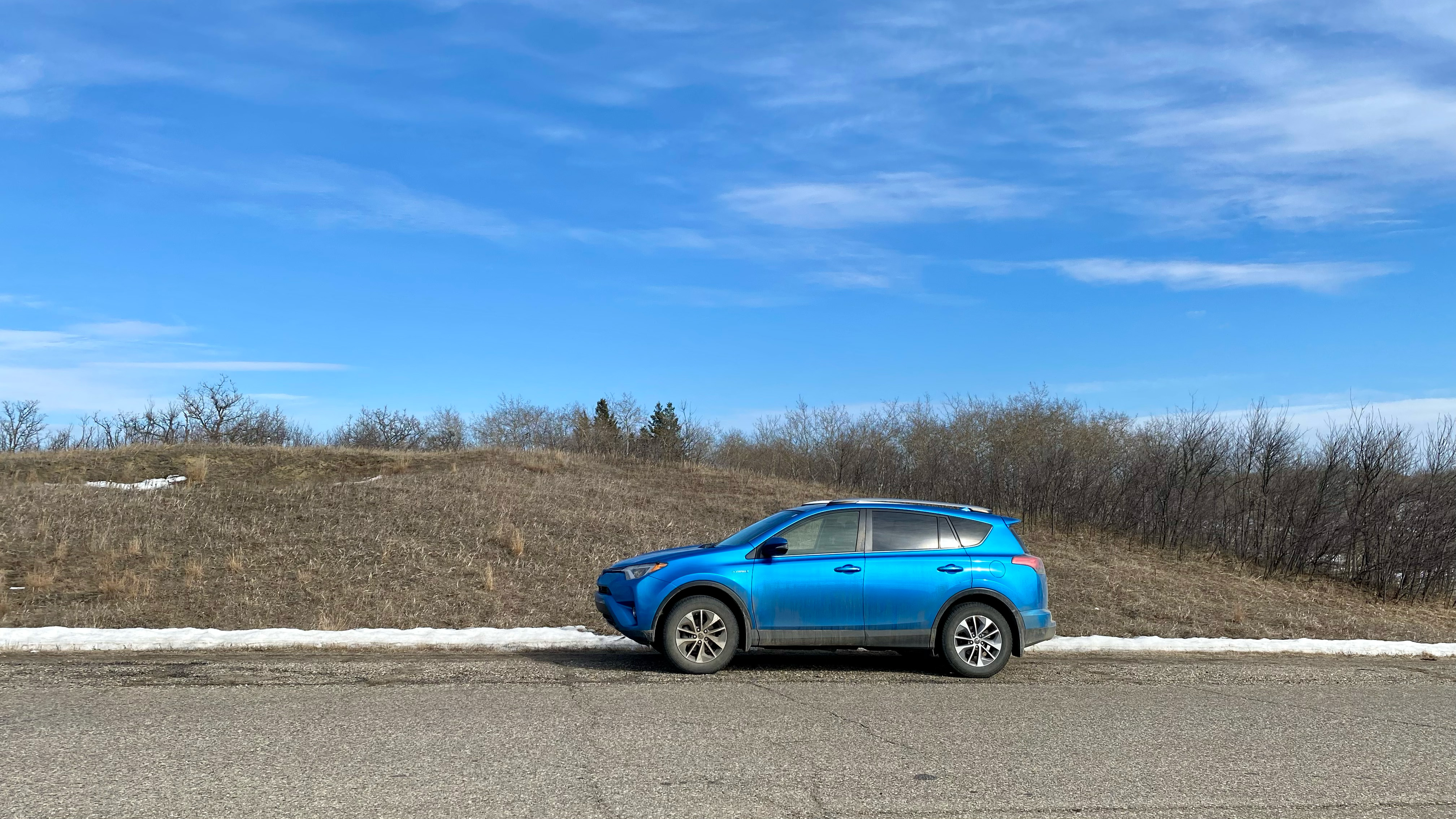
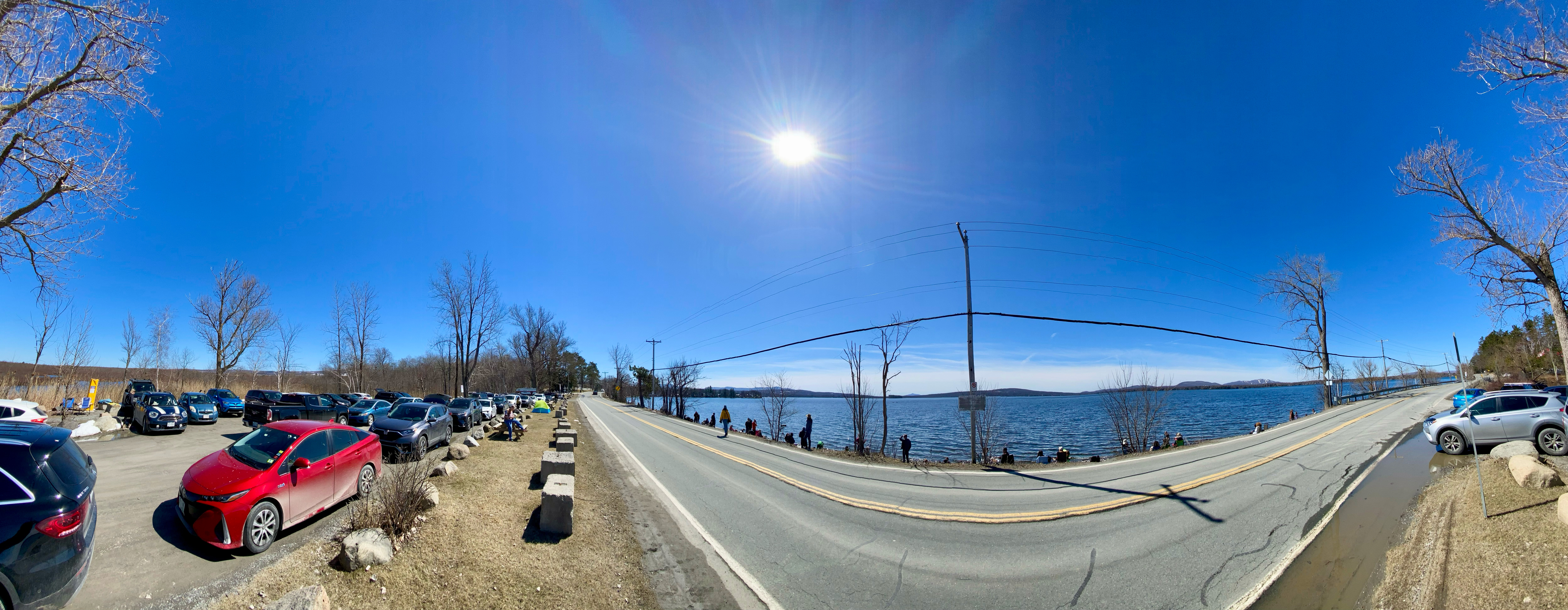
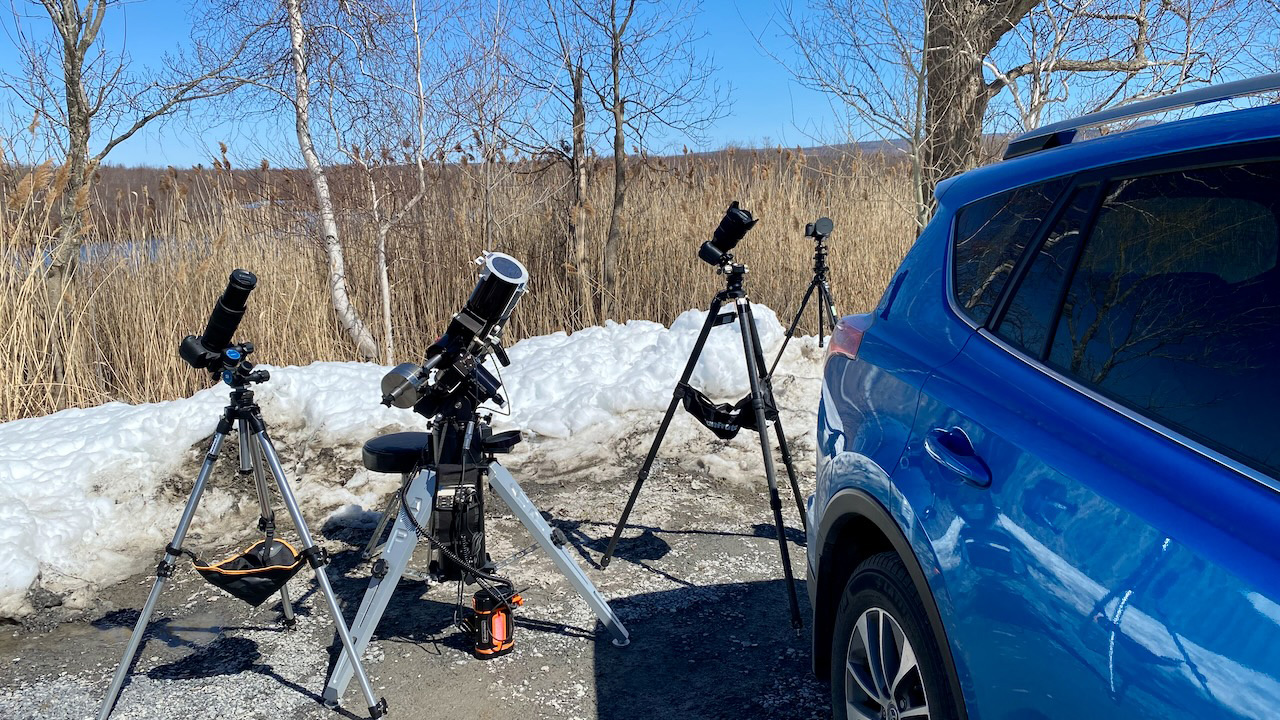
A panorama of the lakeside parking area at Lac Brome prior to the eclipse. My RAV4 and camera array, pre-eclipse.I shot with 4 cameras at the car and one set up lakeside.
The Lac Brome site filled with cars during the day, with people from Québec and Ontario, but also from Alberta, and from Pennsylvania, Massachusetts and Maine – at least those were the homes of the folks I enjoyed meeting on eclipse day.
Everyone had a great time and had a superb eclipse experience.
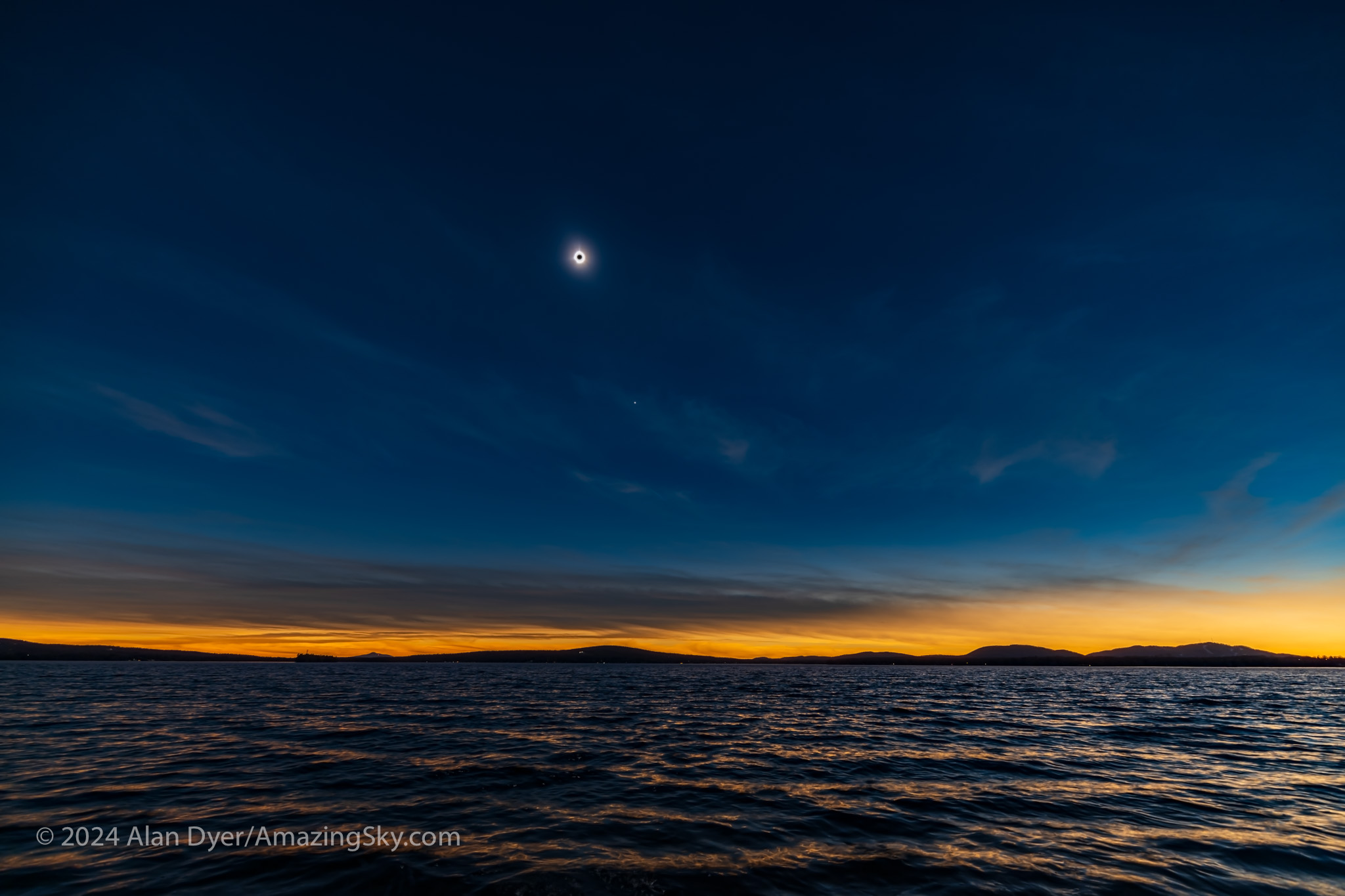
The total eclipse of the Sun over the waters of Lac Brome, in the Eastern Townships of Quebec, Canada. The twilight colours come from sunlight from outside the shadow path.
The lunar shadow arrived from the southwest, from the direction of the Sun, appearing as a dark cloud racing toward us. At the end of the eclipse the sky brightened first in that same direction, as the trailing edge of the shadow shot up across the sky. The clouds helped make the shadow edge more visible.
A time-lapse of the arrival and departure of the lunar shadow, made of 1200 frames each 1 second apart.
I shot with five cameras, just as I had done in 2017, possible only because I drove.
The main rig was my faithful Astro-Physics Traveler, a 105mm refractor telescope the company owner designed for his personal use at the 1991 eclipse in Mexico.
My main eclipse rig, with a 60mm visual scope on the 105mm photo scope, on an equatorial tracking mount.
My Traveler, bought in 1992, has lived up to its name, having now been to six central solar eclipses: the annular eclipses of 1994 (Arizona) and 2023 (Utah), and the total eclipses of 1998 (Curaçao), 2012 (Queensland, Australia), 2017 (Idaho), and now 2024 in Québec, Canada. I paired it with the wonderful matching AP400 mount, which I had only just brought back with me the month before from Australia, where it had spent the last two decades.
All the gear worked great. Unlike six months earlier for the October 14, 2023 annular eclipse in Utah, this time I remembered all the cables needed to have the telescope mount track the Sun.
I did mess up on a couple of settings (such as not framing the 4K movie camera as I should have – in pre-eclipse excitement I just forgot to check my chart). But none of the errors were serious.
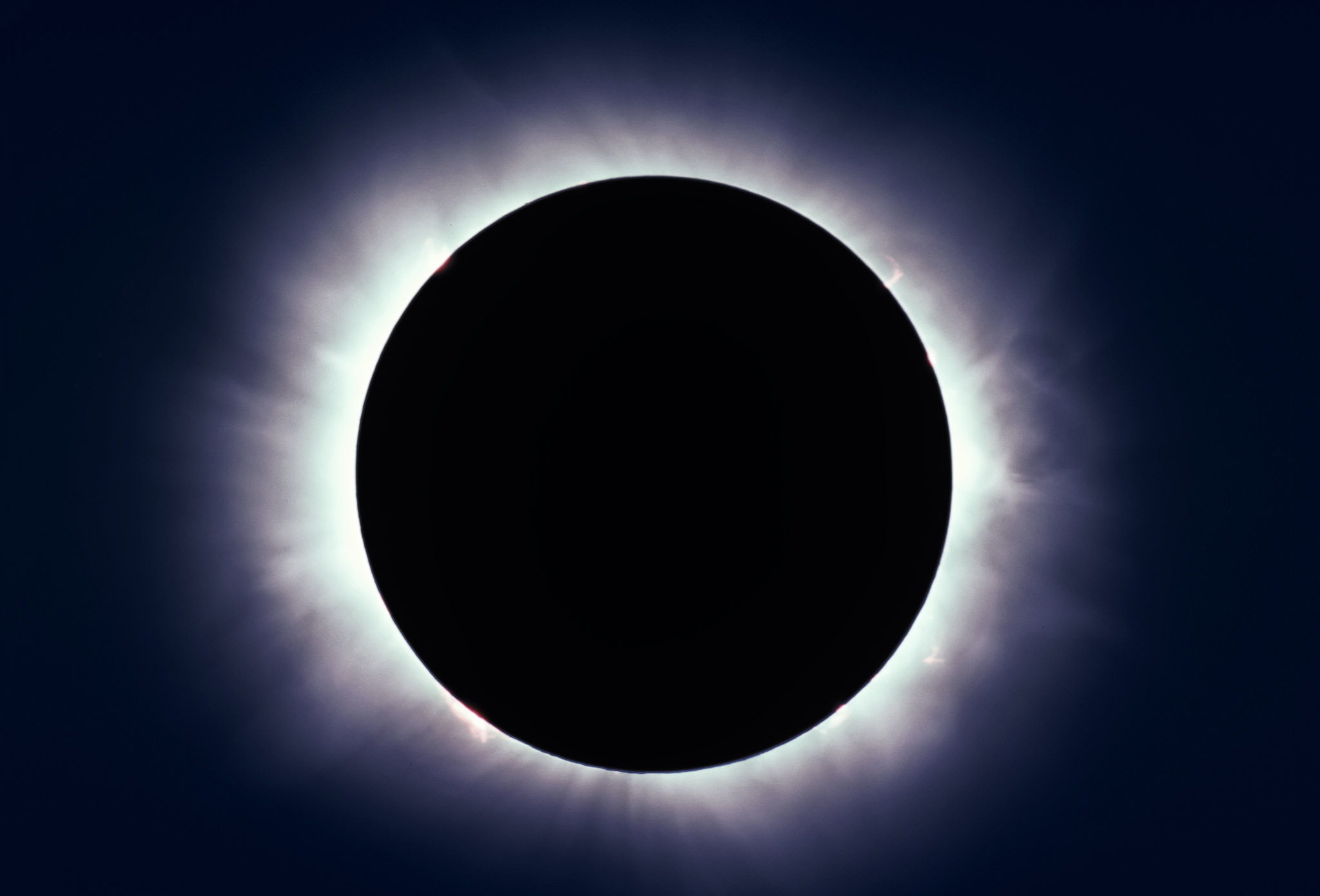
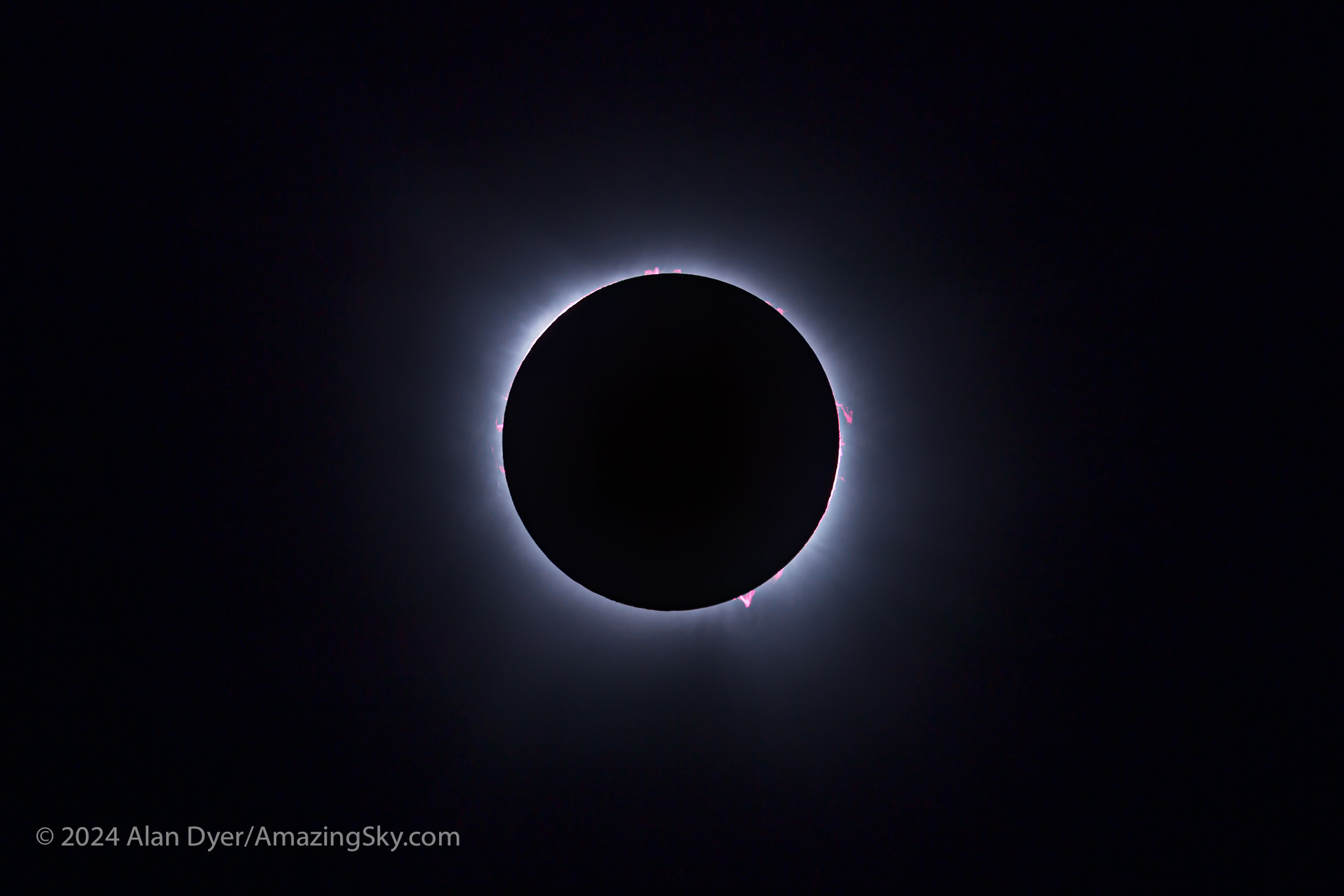
The eclipse in a blend of two exposures to display all the fiery pink prominences that were visible during totality around the lunar disk in one image, set against the bright inner corona of the Sun with the dark disk of the Moon in silhouette in front of the Sun.
Once started all my cameras, except for the one on the Traveler, ran unattended.
At this eclipse I was determined to get a good look at it through the small visual scope I had piggybacked onto the Traveler photo scope. While I had used a similar rig in 2017, I only thought to look through the visual scope 20 seconds before totality ended.
Not this year.
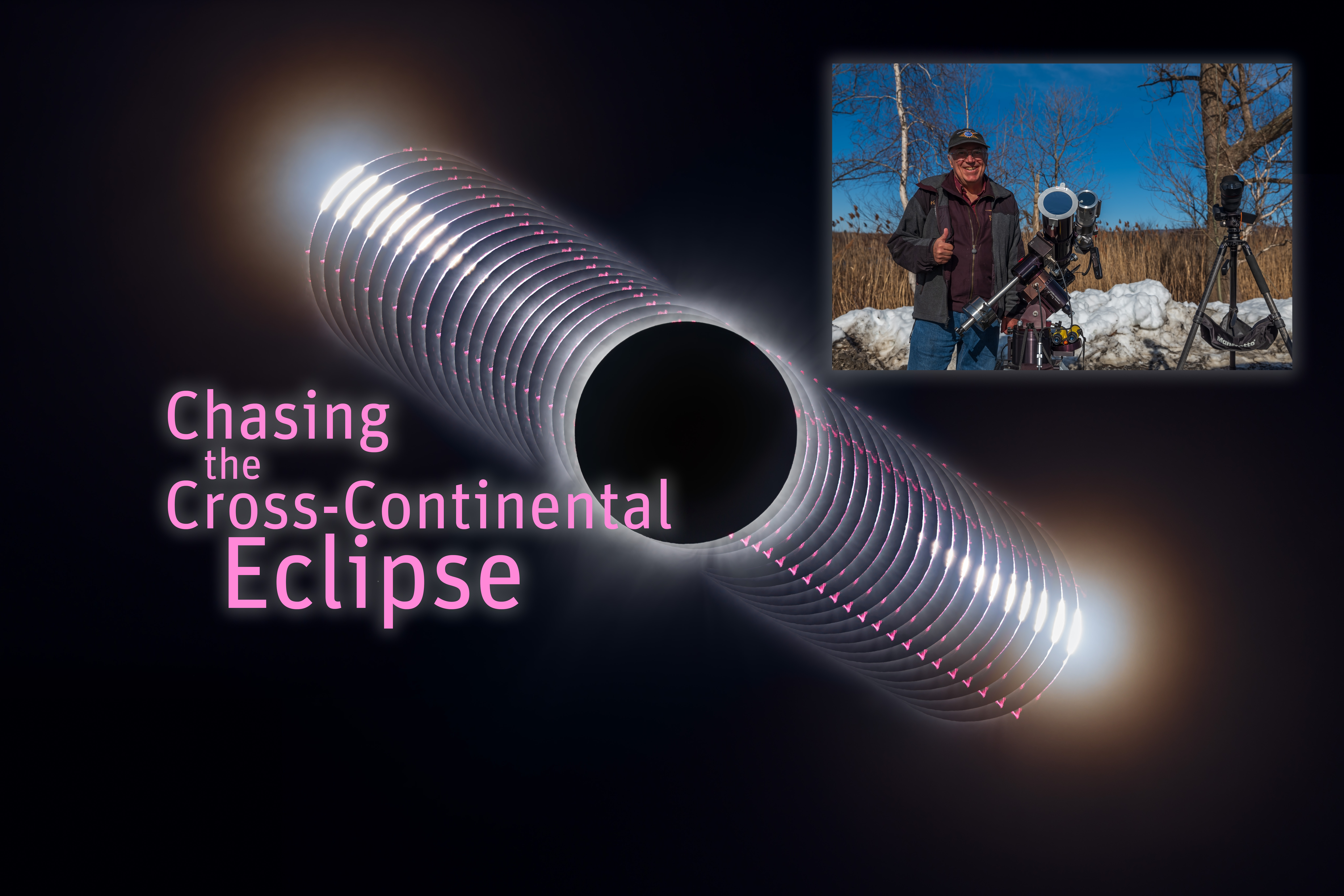
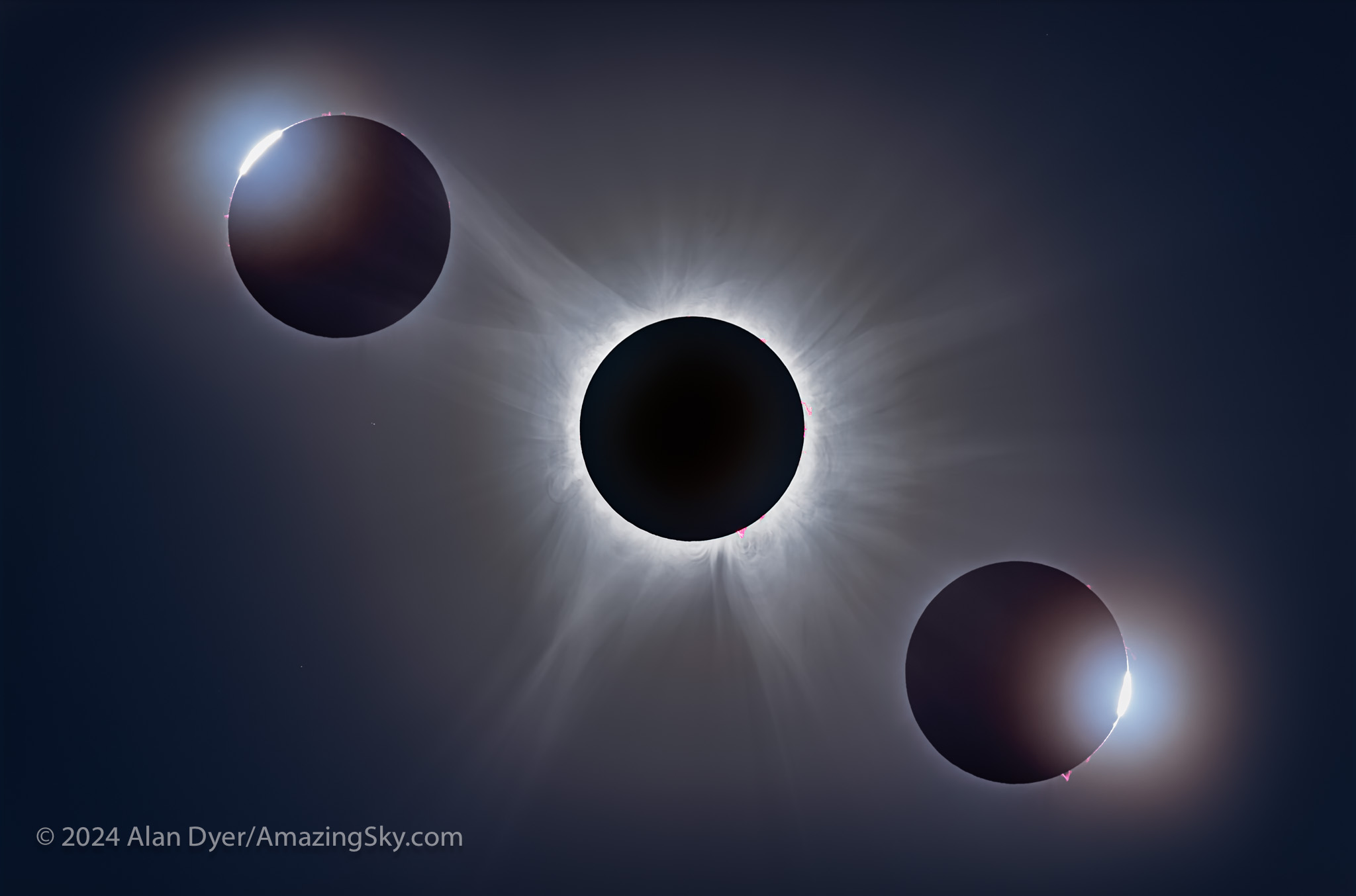
A telescopic close-up of the eclipsed Sun. Onto the central blend of images for totality I layered in single images of each of the diamond rings before and after totality. They are when the last or first burst of sunlight shines through lunar valleys. The first diamond ring is at top left, the last at bottom right, so time runs from left to right.
I got a great look at the eclipsed Sun, its corona structures, flaming pink prominences, and breakout of the red chromosphere layer just as totality ended. (You can’t easily see the chromosphere at the start of totality as it can be risky looking too soon through optics when the Sun’s blindingly bright photosphere is still in view.)
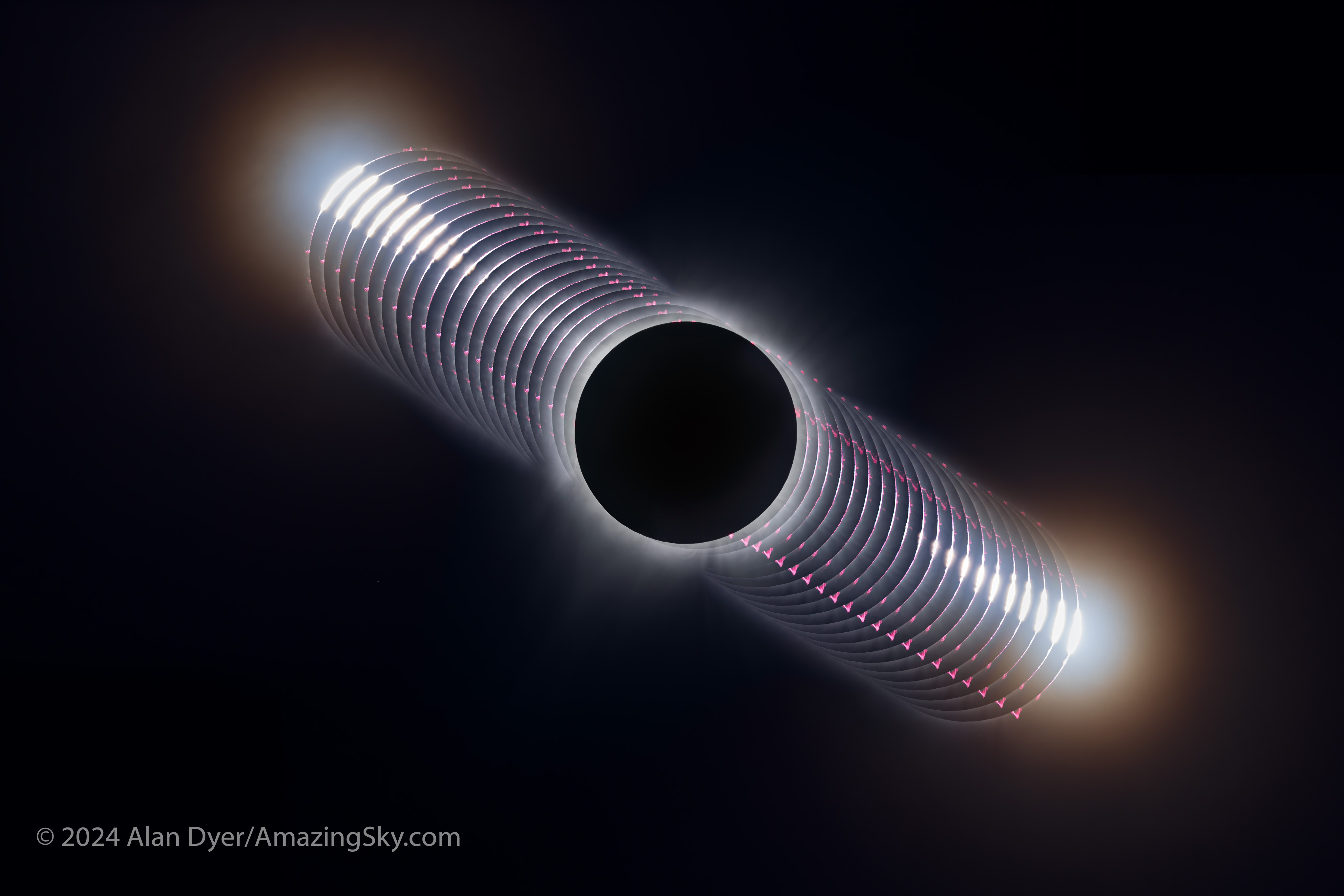
This is a composite showing the sequence of events surrounding totality, from just before totality (at upper left) to just after totality (at lower right), with totality in the middle. The contact images were taken 0.6 seconds apart.
And yet, as at all eclipses, I found the naked eye view the most compelling. The “black hole” Sun looked huge and unearthly. While I had binoculars handy, the same 12×36 image-stabilized binoculars I bring to most eclipses, I completely forgot to look though them, just as I forget at most eclipses!
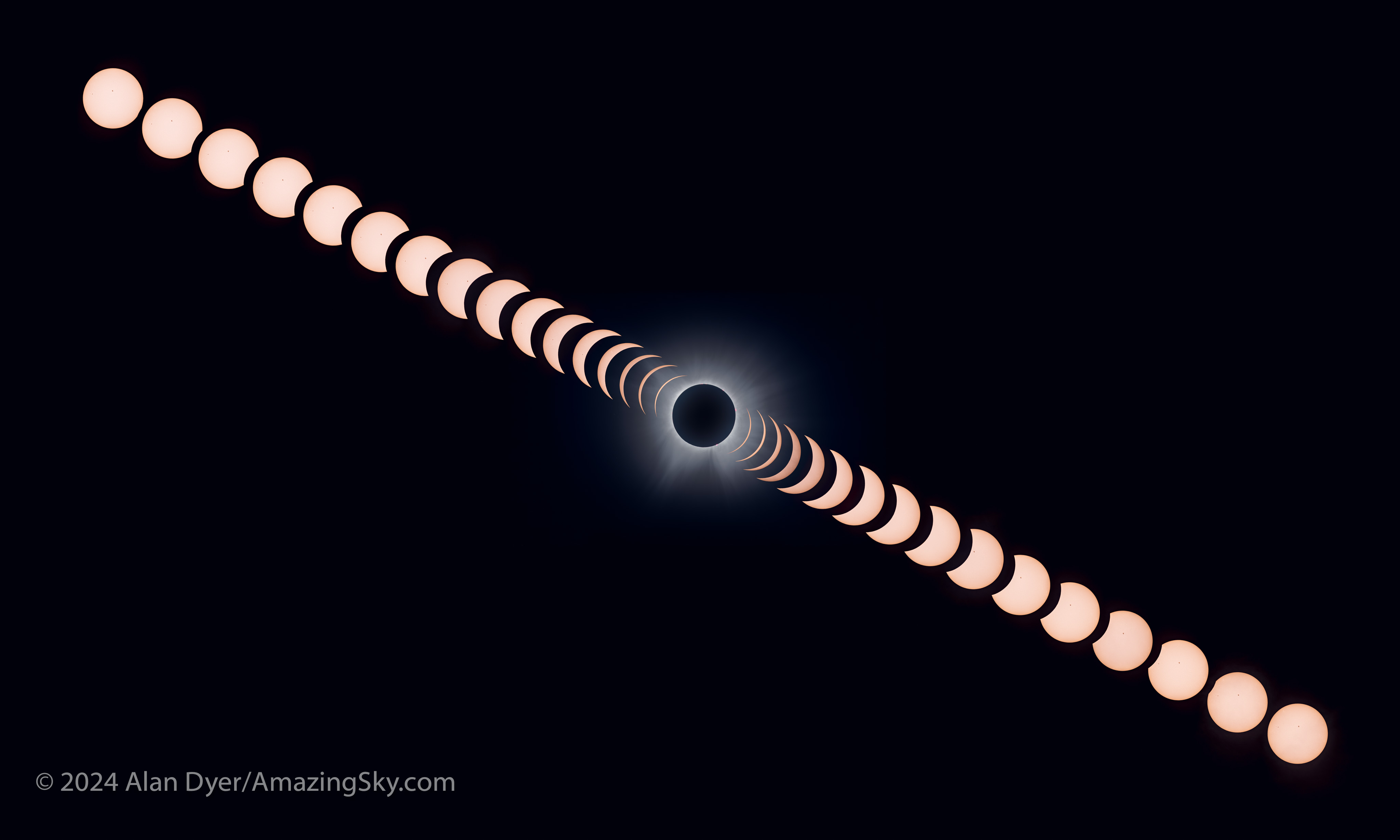
This is a composite showing the complete sequence of the April 8, 2024 eclipse of the Sun, from first contact (at upper left) to last contact (at lower right), with totality at mid-eclipse in the middle.
I shot all the images with the Astro-Physics Traveler 105mm refractor at 630mm focal length and f/6, with the Canon R5 at ISO 100. The partial phases are 1/800 or 1/400 second exposures through a Kendrick/Baader solar filter.
Wanting to record the full sequence, I shot the partial phases until the bitter end. But post-eclipse, people came over and had a look through my scope (I think mine was the only telescope on site). We had a great time exchanging impressions. The hand-held phone camera photos people showed me looked fabulous!
I looked for fleeting shadow bands just before and after totality (I laid out a white sheet on the ground for the purpose) but saw none, a negative observation confirmed by a fellow eclipse chaser at the site.
Time-lapse movies of the second and third contact (start and end of totality) diamond rings, shot through the telescope with the Canon R5 in continuous burst mode for hundreds of frames each.
I did two live interviews for CBC Radio, for the Edmonton and Calgary stations, but not until after the eclipse ended. By the time I did those and finished packing away my carload of gear, it was 6:30 p.m., three hours after totality.
I was the last to leave the site, with fishermen now arriving for an evening’s catch.
I was in that shadow as the Space Station flew over. Astronauts saw the elliptical shadow moving over eastern Canada.
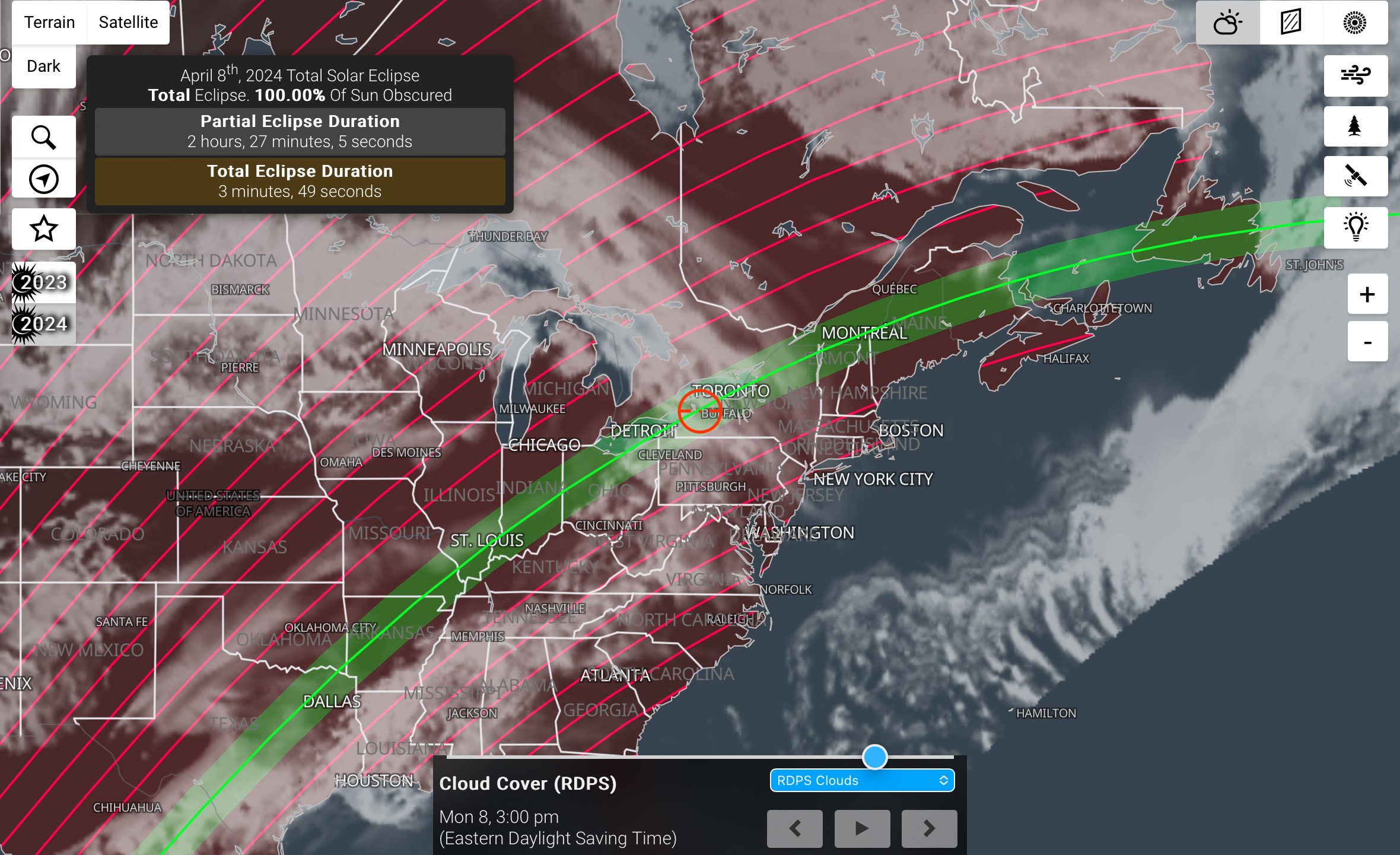
The passage of the lunar shadow across the continent, showing where the clouds were. I was under the wispy clouds at upper right in Québec.
I faced no traffic jams heading back to the hotel at Ste. Helen-de-Bagot. I processed and posted one eclipse image that night. And I revised the price (down to $2.99 U.S.) and description of my How to Photograph the Solar Eclipses ebook, as now only the big processing chapter is of any value, post-eclipse. It continues to sell.
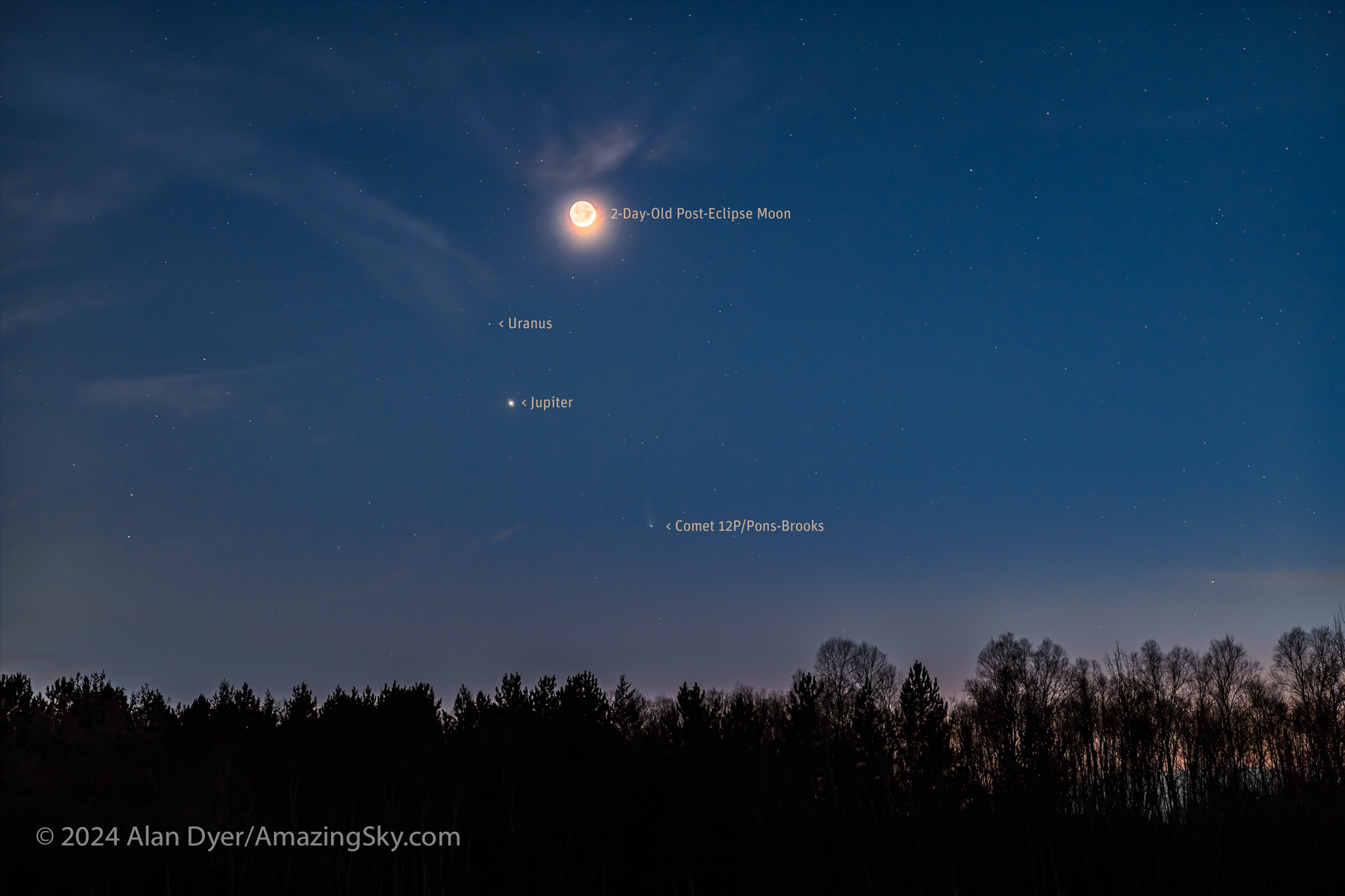
This is the waxing crescent Moon on April 10, 2024, two days after it eclipsed the Sun, and with it above the bright planet Jupiter, with it also near Uranus. Below the solar system worlds is the faint Comet 12P/Pons-Brooks, visible here as a fuzzy star with a stubby tail..
On the long drive back to Alberta, with the pressure of having to make time now gone, I spent pleasant evenings stopping to see friends and family on the road home. So I didn’t start work on the complex blends and composite images I show here until I got home a week after the eclipse.
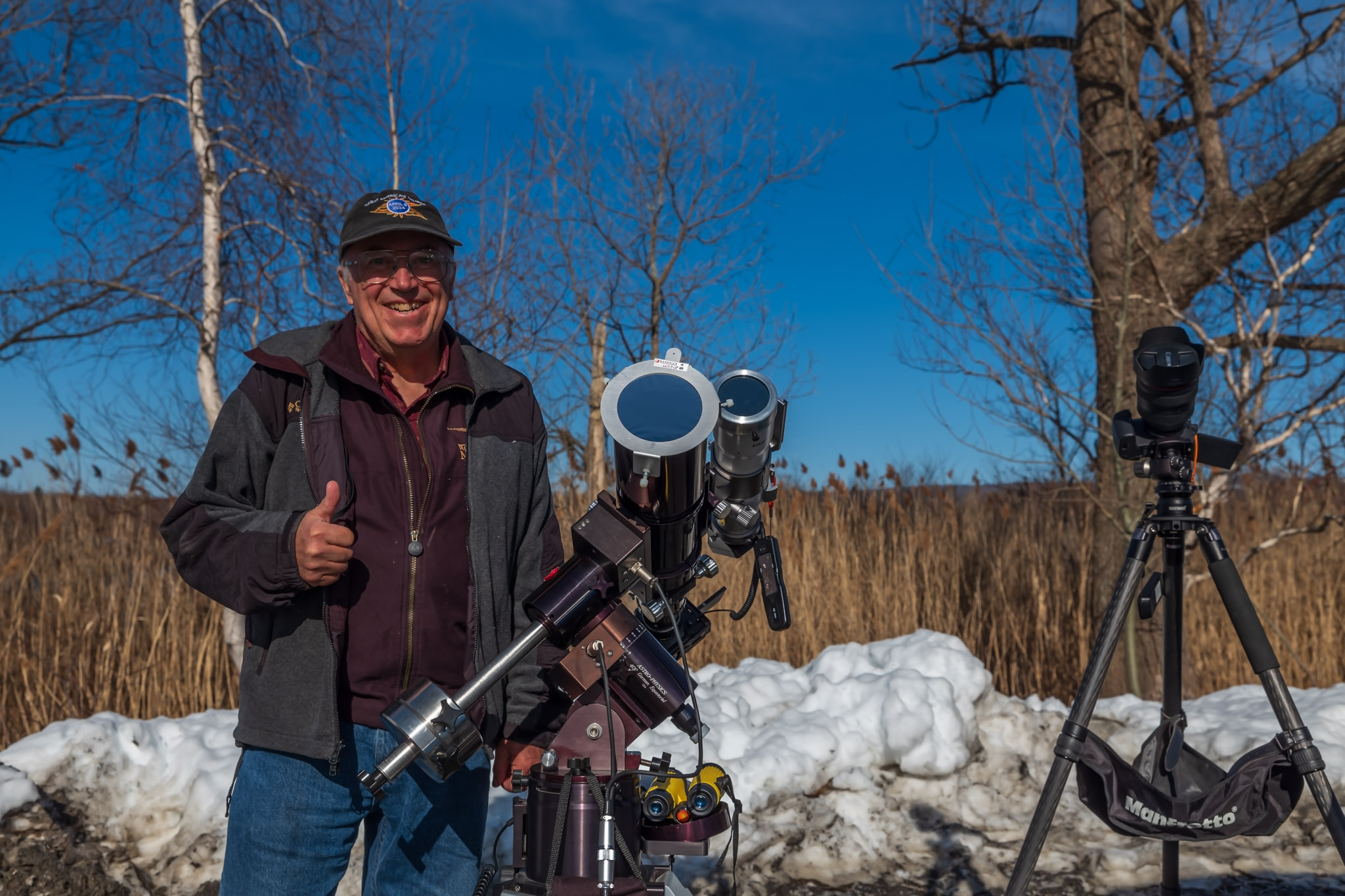
The happy eclipse chaser having bagged his game!
The 17-day-long drive was nearly 9,000 km over 100 hours behind the wheel. Was it worth it? Of course!
Would I do it again? It’s a moot question as none of the upcoming eclipses allows for a cross-continent drive. Except perhaps in July 2028 in Australia. But I suspect just heading inland a day or two over the Great Dividing Range will be enough to get away from winter coastal cloud in New South Wales. (Sydney is in the path, but so is a cottage I rented last month near Coonabarabran for my superb March stay under the southern skies!)
The next total eclipse of the Sun visible from anywhere in Canada will be August 22, 2044. I won’t have to drive anywhere, as it passes right over my house! But I will have to live that long to enjoy a eclipse from my own backyard.
I suspect this was my last chance to see – and drive to – a total eclipse in Canada.
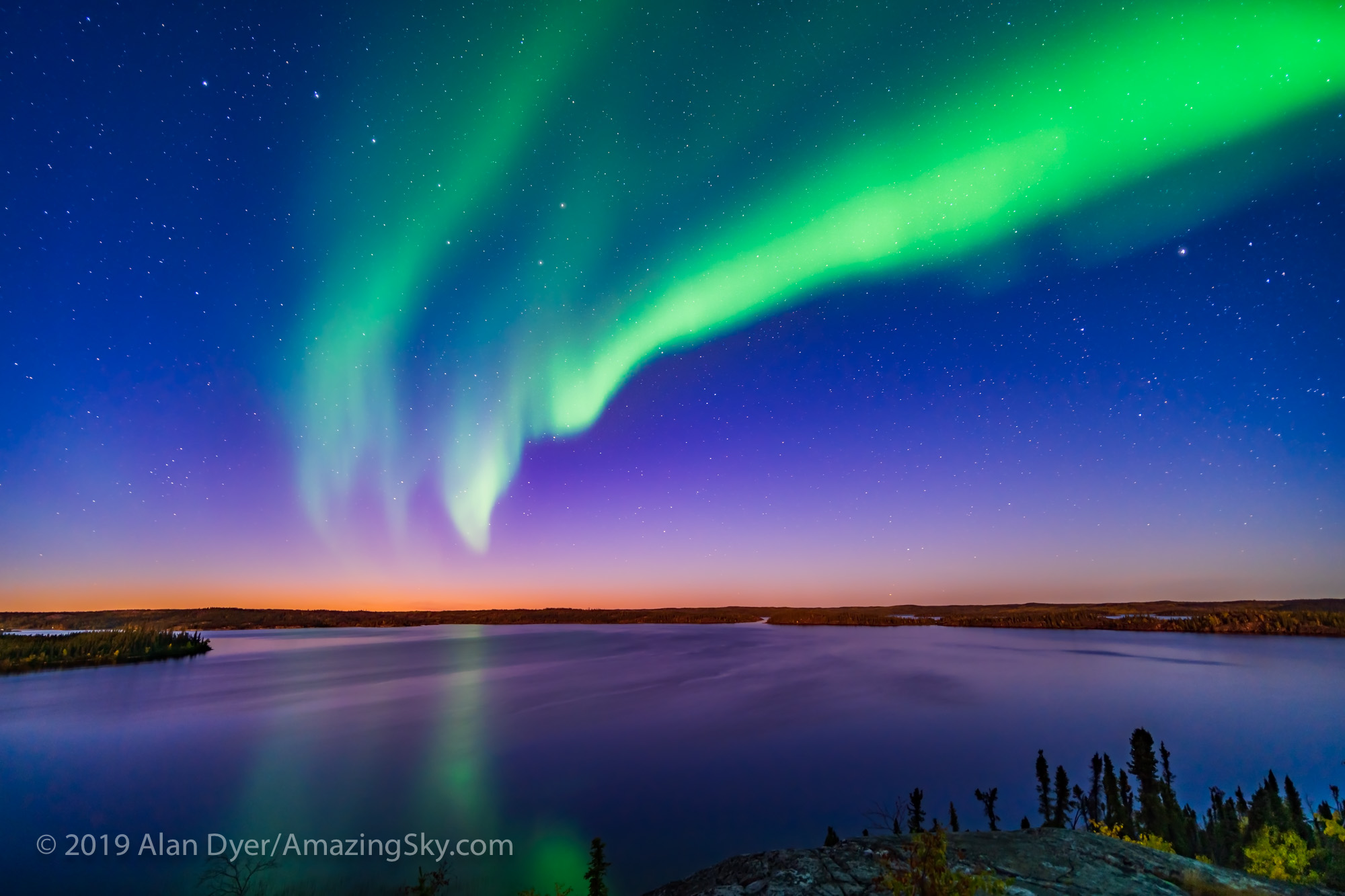
It was a fabulous week of clear skies and dancing auroras in and around Yellowknife in Canada’s North.
For the second year in a row I traveled due north from home in Alberta to visit Yellowknife, capitol of Canada’s Northwest Territories. At a latitude of 62° North, Yellowknife lies directly under the auroral oval and so enjoys views of the Northern Lights on almost every clear night.
During my 8-night stay from September 3 to 10 almost every night was clear and filled with auroras.
Somba K’e Park
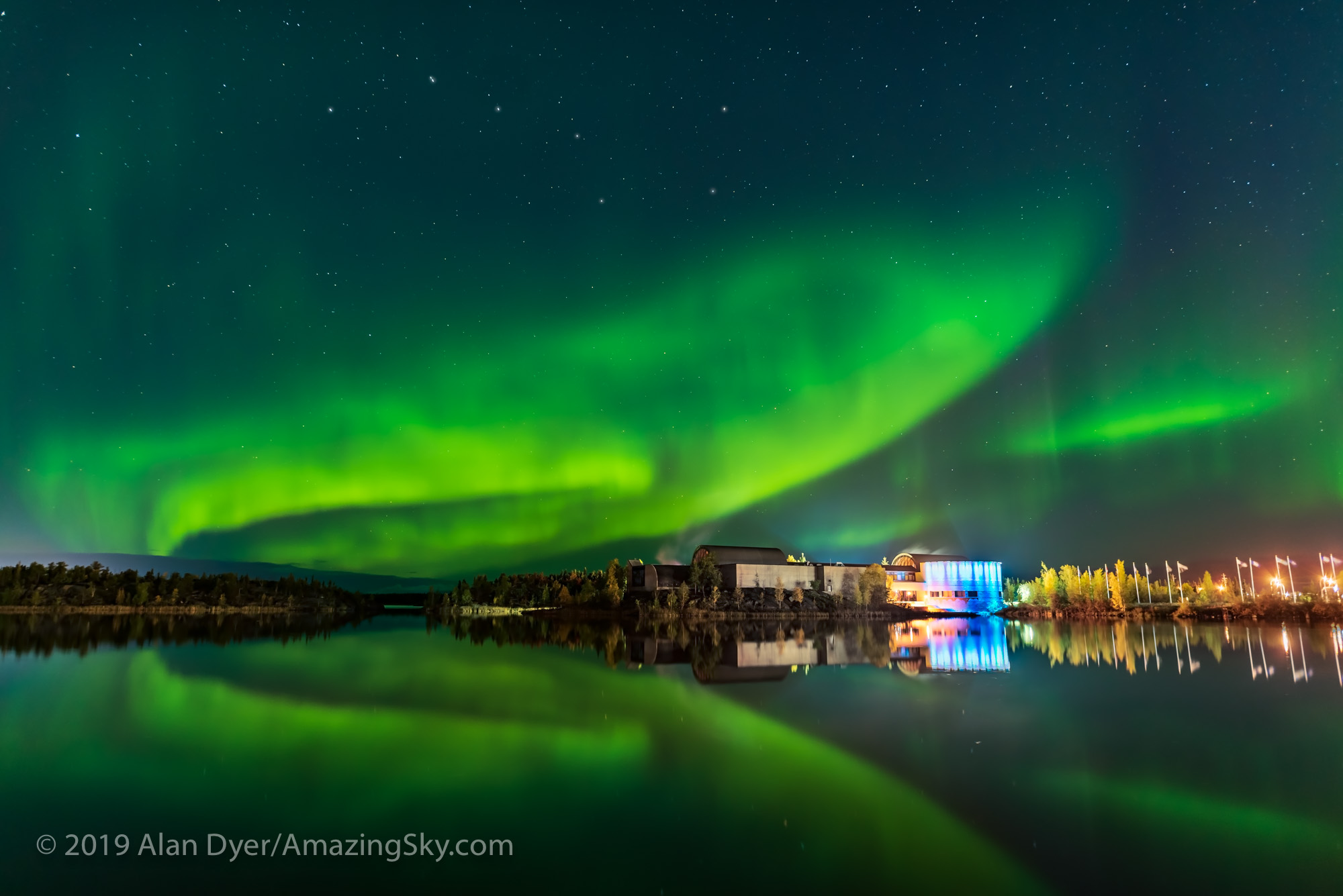
The Lights can be seen even from within the downtown core, as the opening image shows, taken from the urban Sombe K’e Park looking over Frame Lake and the Prince of Wales Museum.
The Museum is lit with rippling bands of coloured light that emulate the aurora borealis.
Pilot’s Monument
A favourite urban site for viewing the Lights is the Pilot’s Monument lookout in the middle of Yellowknife’s Oldtown district. This panorama sweeps from northeast at left to west at far right, looking mostly south over the downtown core.
This night even the urban lights were not enough to wash out the Lights as they brightened during a brief substorm.
This is a 300° panorama of the Northern Lights over Yellowknife, NWT on the night of Sept 6-7, 2019, during a sub-storm outbreak at 12:45 a.m. when the sky went wild with aurora. This is a 9-segment panorama with the 15mm Laowa lens at f/2 and Sony a7III at ISO 800, for 10 seconds each.
Rotary Park
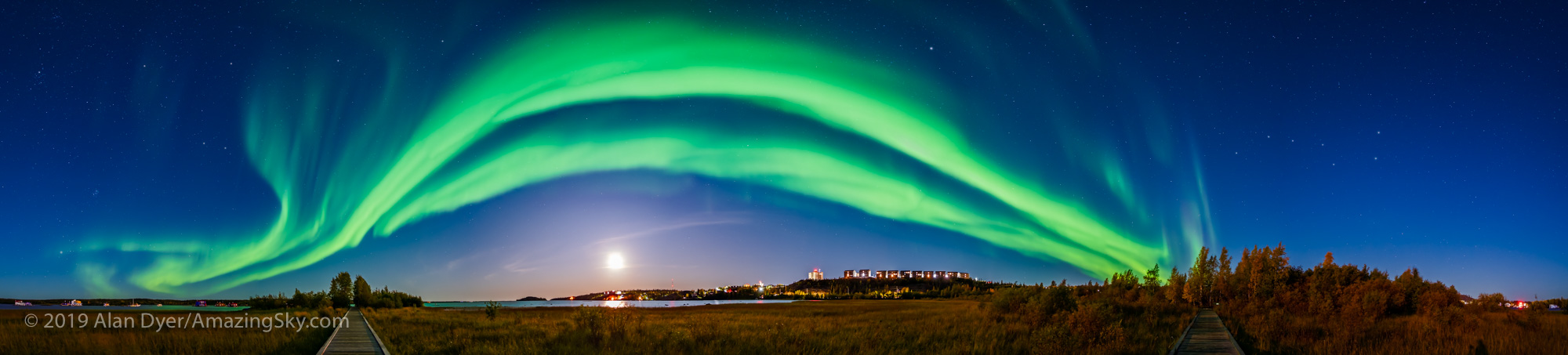
Another good urban site that gets you away from immediate lights is the open spaces of Rotary Park overlooking the houseboats anchored in Yellowknife Bay. This panorama again sweeps from east to west, looking toward to the waxing Moon low in the south.
Again, despite the urban lights and moonlight, the Lights were spectacular.
A 240° panorama of the Northern Lights from the Boardwalk in the urban Rotary Park in Yellowknife, NWT, on Sept 10, 2019. A waxing gibbous Moon is bright to the south and lights the sky and landscape. This is a 7-segment panorama, each segment 8 seconds at f/2 with the Venus Optics 15mm lens and Sony a7III at ISO 1600. Stitched with Adobe Camera Raw.
Prosperous Lake
The main viewing sites for the Northern Lights are down Highway 4, the Ingraham Trail east of the city away from urban lights.. One of the closest stops is a parking lot on the shore of a backwater bay of Prosperous Lake. It’s where many tourist buses stop and unload their passengers, mostly to get their selfies under the Lights.
But with patience you can get your own photos unencumbered by other lights and people, as I show below.
A group of aurora tourists take their aurora selfies at Prosperous Lake, near Yellowknife, NWT, a popular spot on the Ingraham Trail for aurora watching. This was about 1:15 a.m. MDT. This is a single 5-second exposure with the 20mm Sigma Art lens at f/2 and Nikon D750 at ISO800.
The Northern Lights over the end of Prosperous Lake, on the Ingraham Trail near Yellowknife, NWT, a popular spot for aurora watching in the area. This is a single 8-second exposure with the Sigma 20mm lens at f/2 and Nikon D750 at ISO 800.
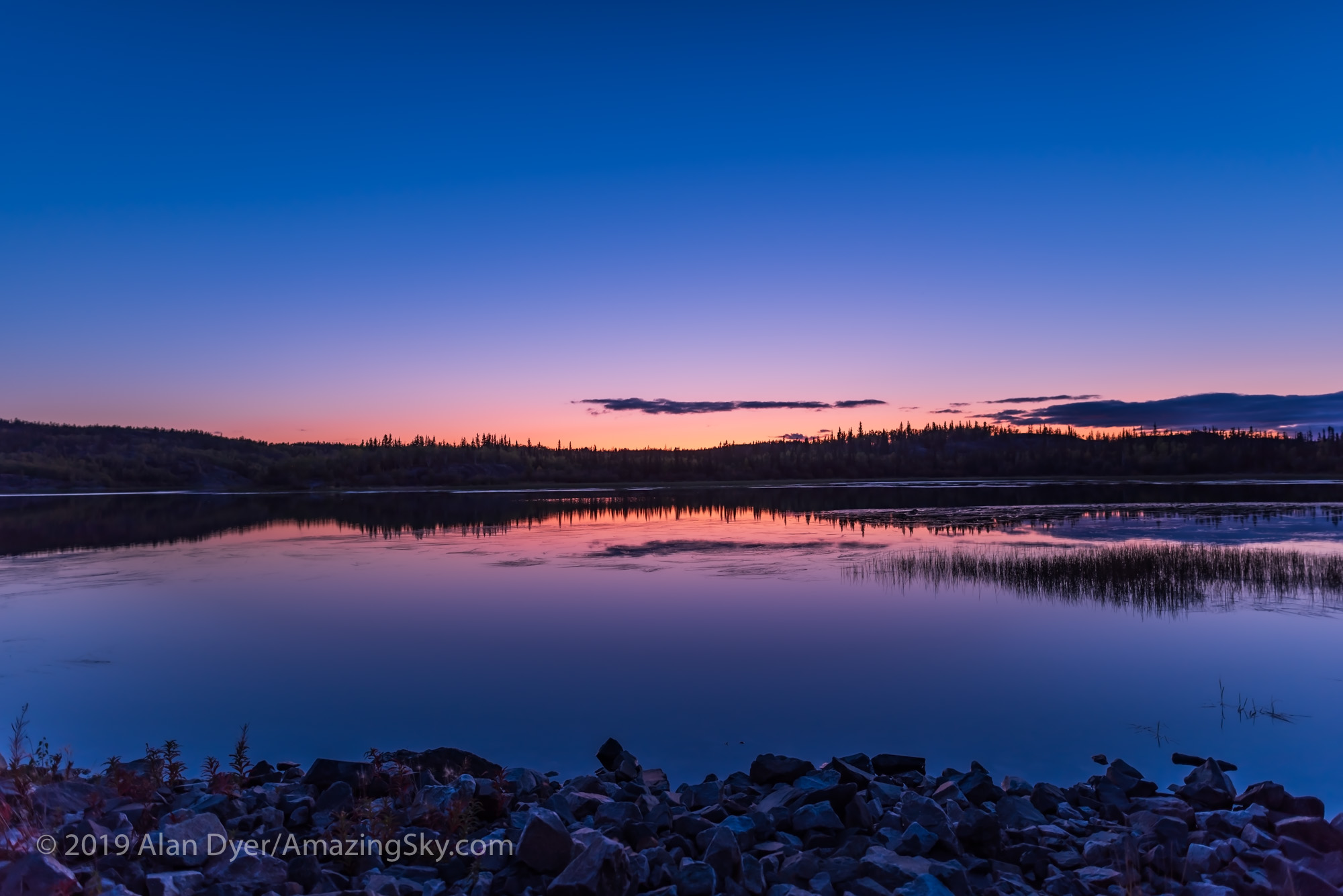
On one of my nights I stopped at Prosperous on the way to sites farther down Ingraham Trail to catch the twilight colours in the stunningly clear sky.
Twilight at Prosperous Lake on the Ingraham Trail, near Yellowknife, NWT, Sept. 7, 2019. The colours are accentuated by volcanic ash in the atmosphere.
Madeline Lake
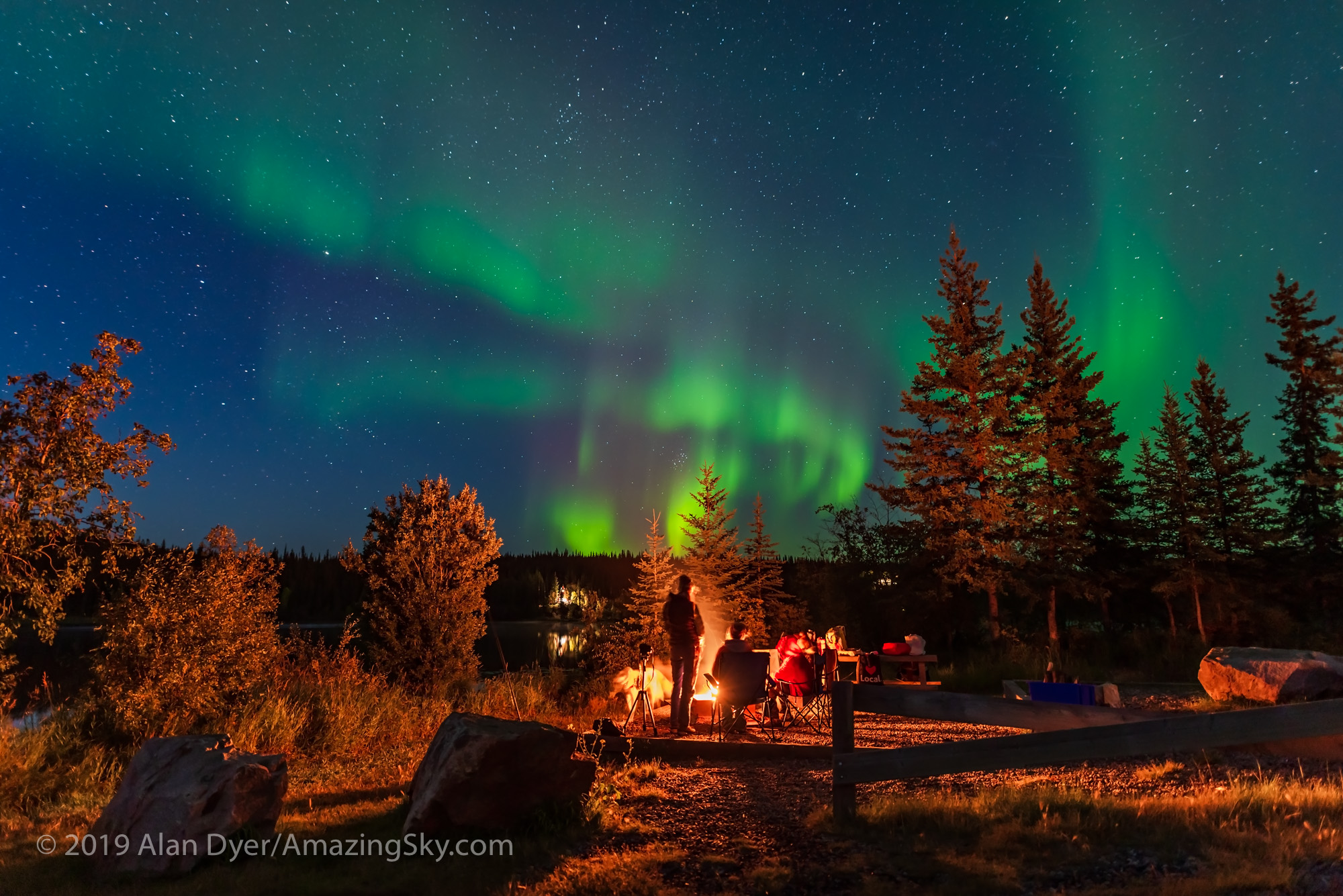
This small lake and picnic site farther along the Trail serves as a great place to shoot the Lights reflected in the calm waters and looking north. I spent one of my nights at Madeline Lake, a popular spot for local residents to have a campfire under the Lights.
Enjoying a campfire on a fine September Saturday night under the brightening Northern Lights, at Madeline Lake on the Ingraham Trail near Yellowknife. This is a single 10-second exposure with the 20mm Sigma lens at f/2 and Nikon D750 at ISO 800.
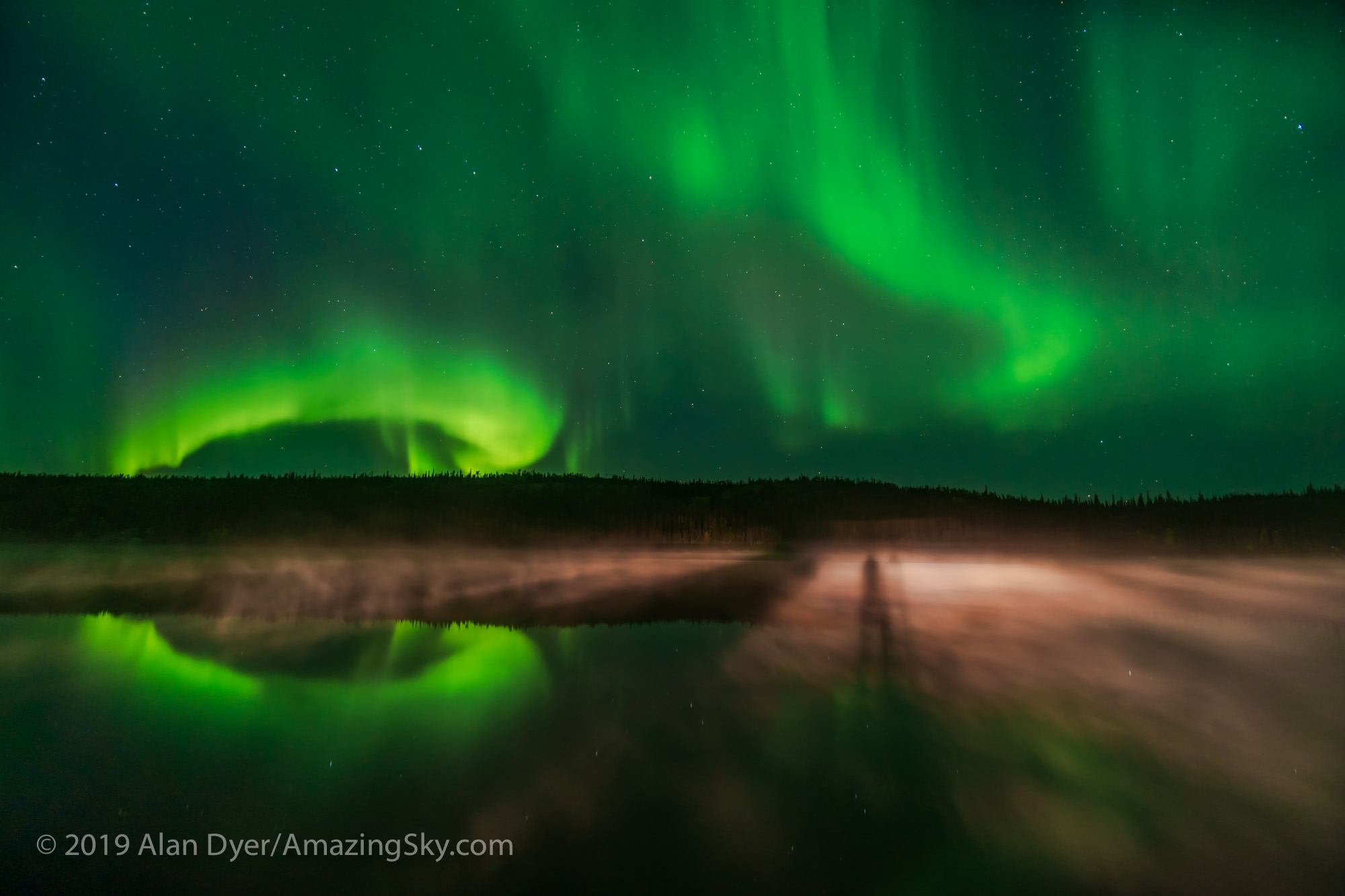
And it’s popular for tour buses, whose headlights shine out across the lake as they arrive through the night, in this case casting my long shadow across the misty lake.
A novelty shot of the shadow of me and my tripod projected across a misty Madeline Lake by car headlights from arriving aurora tourists at this popular spot on the Ingraham Trail near Yellowknife. This was September 7, 2019. A single exposure.
A group of aurora tourists take in the show at Madeline Lake, on the Ingraham Trail near Yellowknife, NWT, a popular spot for the busloads of visitors being shuttled around each night. The Big Dipper is at centre. This is a single exposure, 6 seconds at ISO 3200 with the Laowa 15mm lens at f/2 and Sony a7III.
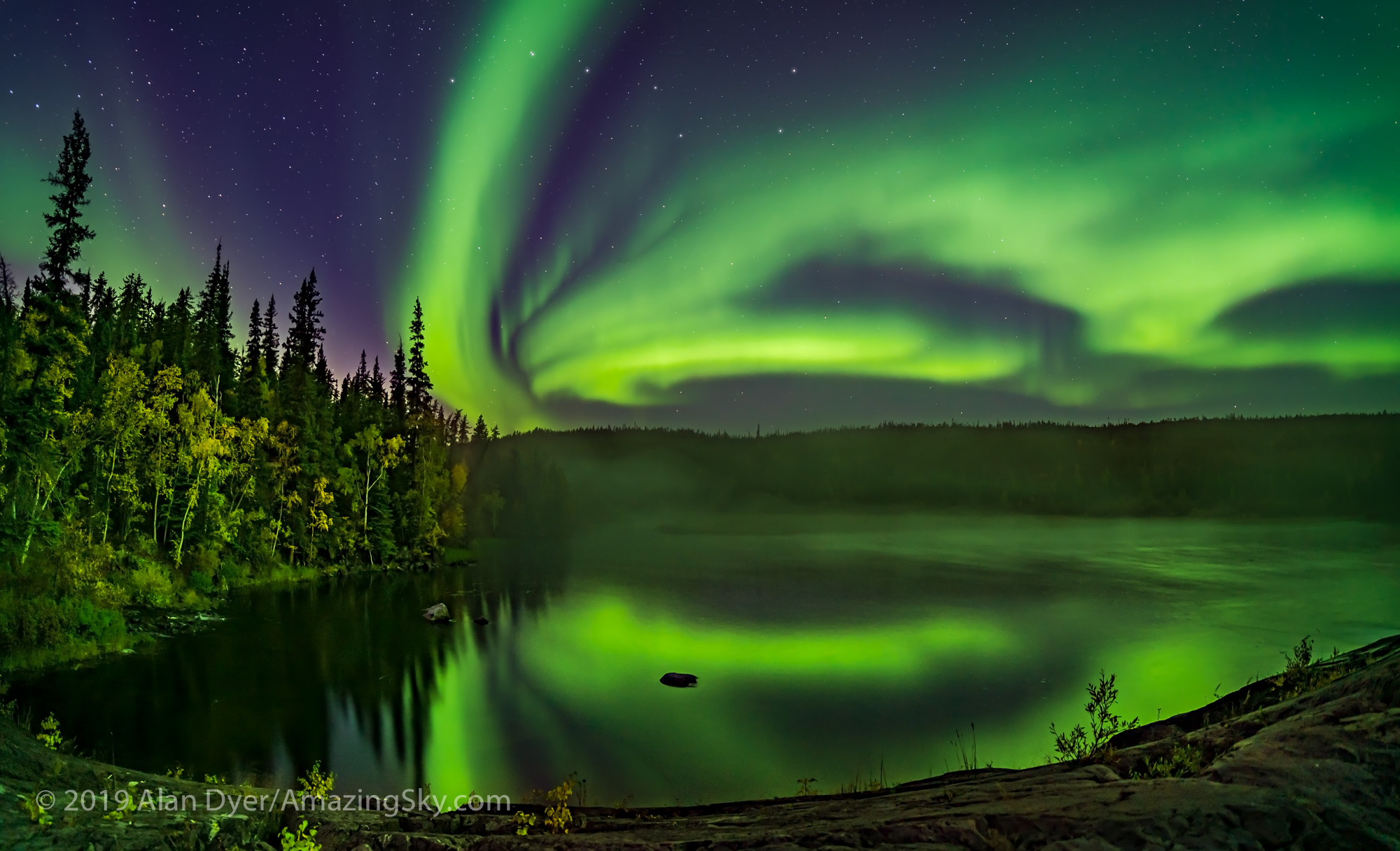
However, again with patience it is possible to get clean images of the aurora and its reflections in the lake.
Reflections of the Northern Lights in the calm and misty waters of Madeline Lake on the Ingraham Trail near Yellowknife, NWT on Sept 7, 2019. This is one of a series of “reflection” images. The Big Dipper is at left. Capella is at right. This is a single 13-second exposure with the 15mm Laowa lens at f/2 and Sony a7III at ISO 1600.
Reflections of the Northern Lights in the calm waters of Madeline Lake on the Ingraham Trail near Yellowknife, NWT on Sept 7, 2019. This is one of a series of “reflection” images. The Big Dipper is at left; Capella at far right. This is a single 8-second exposure with the 15mm Laowa lens at f/2 and Sony a7III at ISO 1600.
The Northern Lights in a subtle but colourful display over the still waters of Madeline Lake on the Ingraham Trail near Yellowknife, NWT. This was the night of September 7-8, 2019. This is a 4-segment panorama, each 13 seconds at ISO 1600 with the Venus Optics 15mm lens at f/2 and Sony a7III camera.
The Ramparts
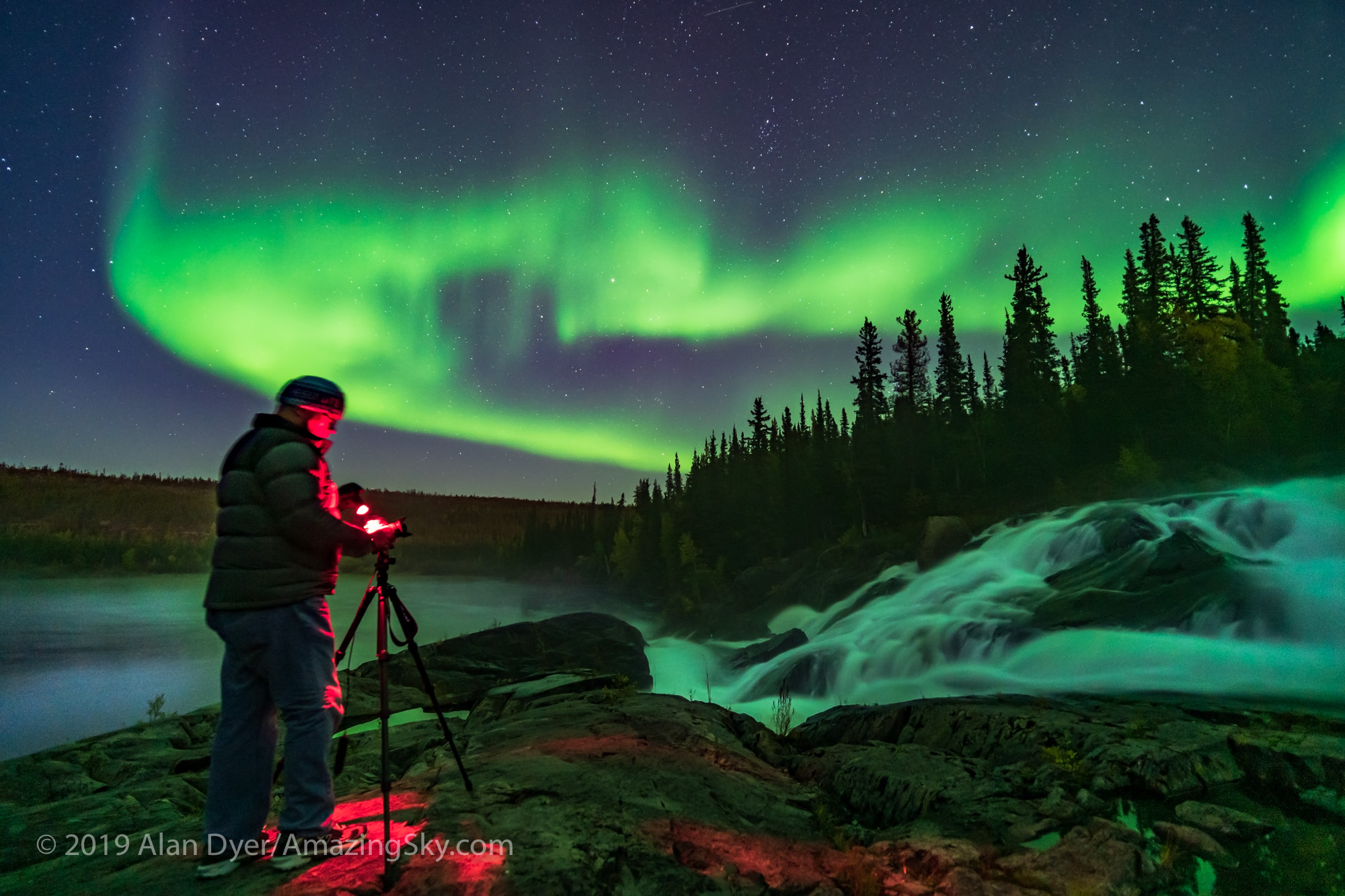
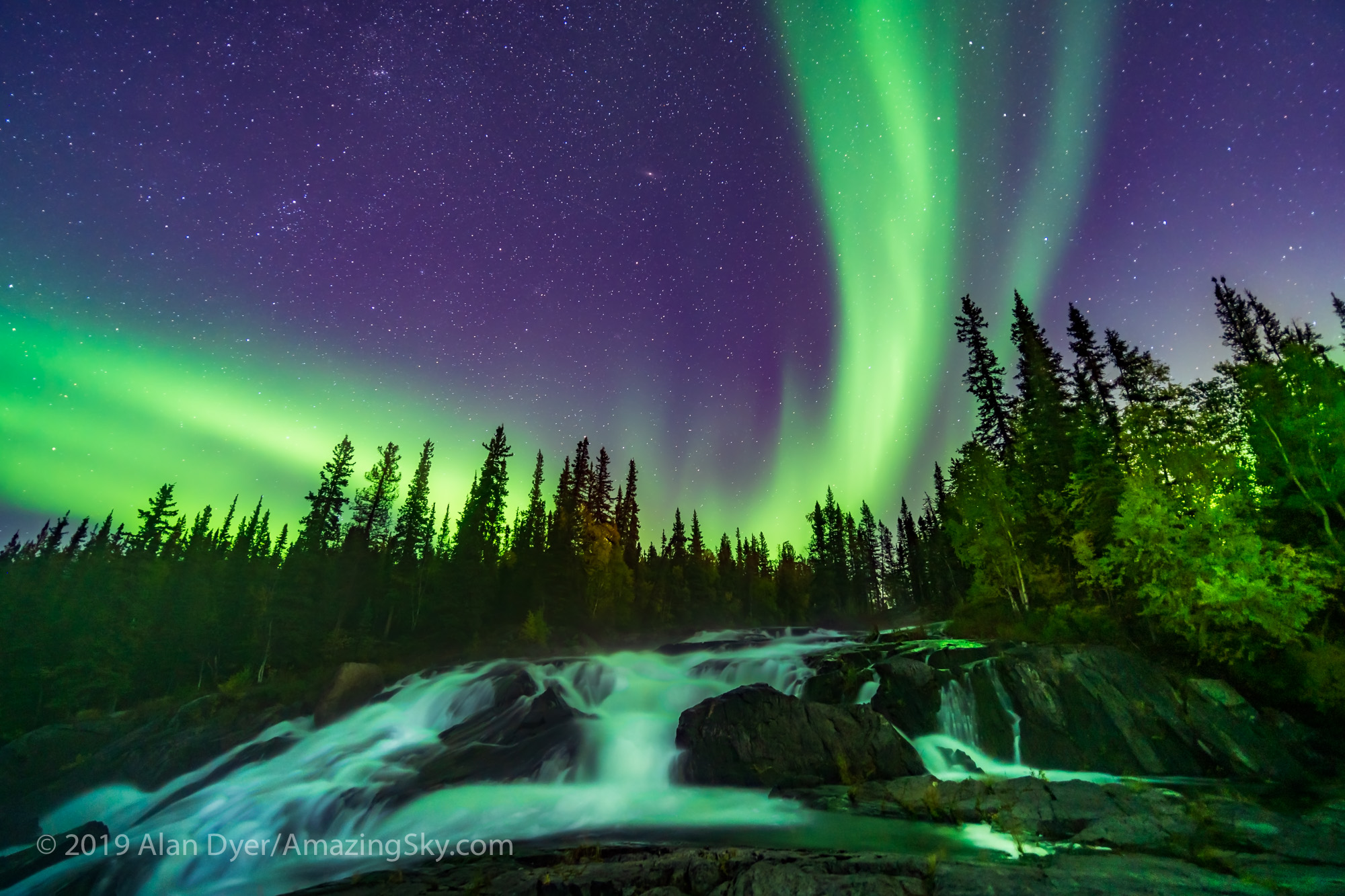
Farther down the Trail is a spot the tour buses will not go to as a visit to the Ramparts waterfall on the Cameron River requires a hike down a wooded trail, in the dark with bears about. Luckily, my astrophoto colleague, amateur astronomer, and local resident Stephen Bedingfield joined me for a superb shoot with us the only ones present at this stunning location.
Photographer Stephen Bedingfield is shooting the Northern Lights at the Ramparts waterfalls on the Cameron River, September 8, 2019. This is a single 8-second exposure with the Laowa 15mm lens at f/2 and Sony a7III at ISO 3200.
The Northern Lights over the waterfalls known as the Ramparts on the Cameron River east of Yellowknife, NWT, on September 8, 2019. This is a single exposure of 20 seconds with the 15mm Laowa lens at f/2 and Sony a7III at ISO 1600, blended with two light painted exposures of the same duration but with the water illuminated to make it more white.
The view looking the other way north over the river was equally wonderful. What a place for viewing the Northern Lights!
The Northern Lights in an arc across the northern sky over the Cameron River, downriver from the Ramparts Falls. This was September 8, 2019 with the trees turning in their fall colours. The Big Dipper at top centre. This is a two-segment panorama, each 25 seconds at f/2 with the Laowa 15mm lens and Sony a7III at ISO 800. Stitched with ACR.
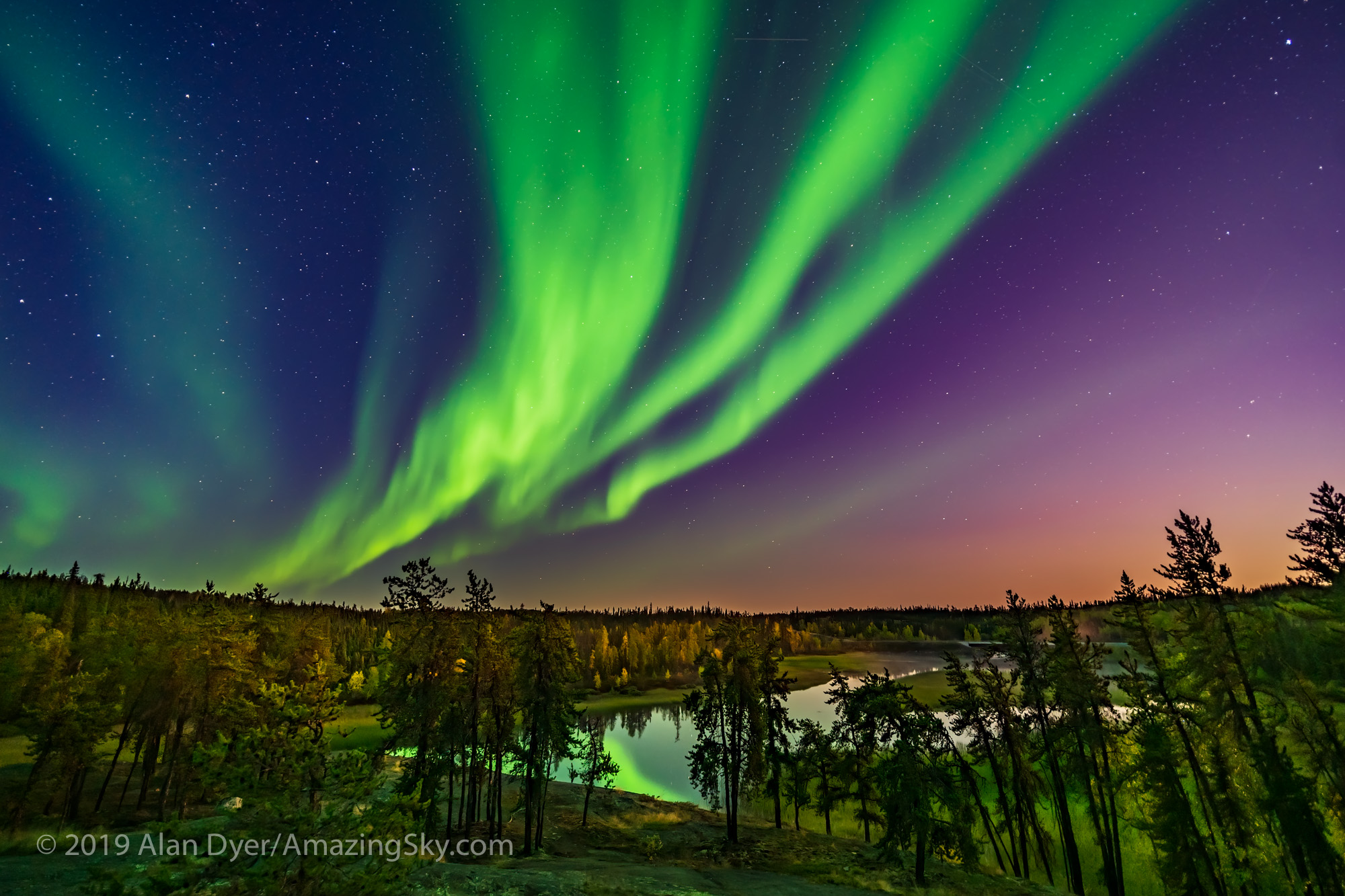
The view from a viewpoint early on the trail down to the Ramparts and overlooking the Cameron River yielded a superb scene with the low Moon and twilight providing the illumination as the Lights kicked up early in the evening.
The curtains of an early evening aurora starting to dance in the twilight and with the western sky lit by moonlight from the waxing gibbous Moon low in the sky and off-frame to the right. This is from the Cameron River viewpoint off the Ramparts falls trail on the Ingraham trail near Yellowknife. This is a single 15-second exposure with the 15mm Laowa lens at f/2 and Sony a7III at ISO 1600.
Prelude Lake
A favourite spot is the major camping and boat launch area of Prelude Lake Territorial Park. But to avoid the crowds down by the shoreline, Stephen and I hiked up to the overlook above the lake looking north. A few other ardent photographers joined us. This was another spectacular and perfect night.
An arc of Northern Lights appears in the evening twilight over Prelude Lake near Yellowknife, NWT, on September 9, 2019. This is a single 25-second exposure at f/2 with the Venus Optics 15mm lens and Sony a7III at ISO 800.
September is a superb time to visit as the lakes are still open and the autumn colours make for a good contrast with the sky colours.
The panorama below takes in the Big Dipper at left, Capella at centre, and with the Pleiades and Hyades rising at right of centre.
The arc of Northern Lights starting a show in the deep twilight over Prelude Lake on the Ingraham Trail near Yellowknife, NWT. This was September 9, 2019. Light from the waxing gibbous Moon behind the camera also illuminates the scene. This is a 5-segment panorama with the 15mm Laowa lens at f/2 and Sony a7III at ISO 800 and all at 25 seconds. Stitched with PTGui, as ACR and Photoshop refused to joint the left segments.
I used the 8mm fish-eye lens to capture the entire sky, the only way you can really take in the whole scene on camera. When the Lights fill the sky you don’t know which way to look or aim your camera!
A 360° fish-eye view of the Northern Lights over Prelude Lake near Yellowknife, NWT, Canada, on September 9, 2019, with photographers in the foreground shooting the Lights from the viewpoint above the lake. Polaris is near the centre; the Big Dipper and Ursa Major are at lower left; Cassiopeia is at upper right. Andromeda and Pegasus are rising at far right. Arcturus is setting at far left. This is a single shot with the 8mm Sigma lens at f/3.5 on the Sony a7III for 10 seconds at ISO 3200. Moonlight also provides some of the illumination. Accent AI filter applied to the ground with Topaz Studio 2.0
A 360° fish-eye view of the Northern Lights over Prelude Lake near Yellowknife, NWT, Canada, on September 9, 2019. Polaris is near the centre; the Big Dipper and Ursa Major are at lower left; Cassiopeia is at upper right. Andromeda and Pegasus are rising at far right. Arcturus is setting at far left. This is a single shot with the 8mm Sigma lens at f/3.5 on the Sony a7III for 20 seconds at ISO 1000. Moonlight also provides some of the illumination. Accent AI filter applied to the ground with Topaz Studio 2.0
There are many other scenic spots along the Trail, such as Pontoon Lake, Reid Lake, and Tibbitt Lake at the very end of Ingraham Trail. For images and movies I shot last year at Tibbitt Lake, see my blog post at Aurora Reflections in Yellowknife.
But in my 8 nights in Yellowknife this year I managed to hit many of the key aurora spots for photography and viewing. I recommend a visit, especially in September before autumn clouds roll in later in the season, and while the lakes are not frozen and nighttime temperatures are mild.
Here’s a 3-minute music video of clips I shot from all these sites showing the motion of the Lights as it appeared to the eye in “real-time,” not sped up or in time-lapse.
The Northern Lights of Yellowknife from Alan Dyer on Vimeo.
The Northern Lights are amazing from Yellowknife, in Canada’s Northwest Territories.
A handful of locations in the world are meccas for aurora chasers. Yellowknife is one of them and, for me, surprisingly accessible with daily flights north.
In a two-hour flight from Calgary you can be at latitude 62° North and standing under the auroral oval with the lights dancing overhead every clear night.
The attraction of going in early September, as I did, is that the more persistent clouds of late autumn have not set in, and the many lakes and rivers are not yet frozen, making for superb photo opportunities.
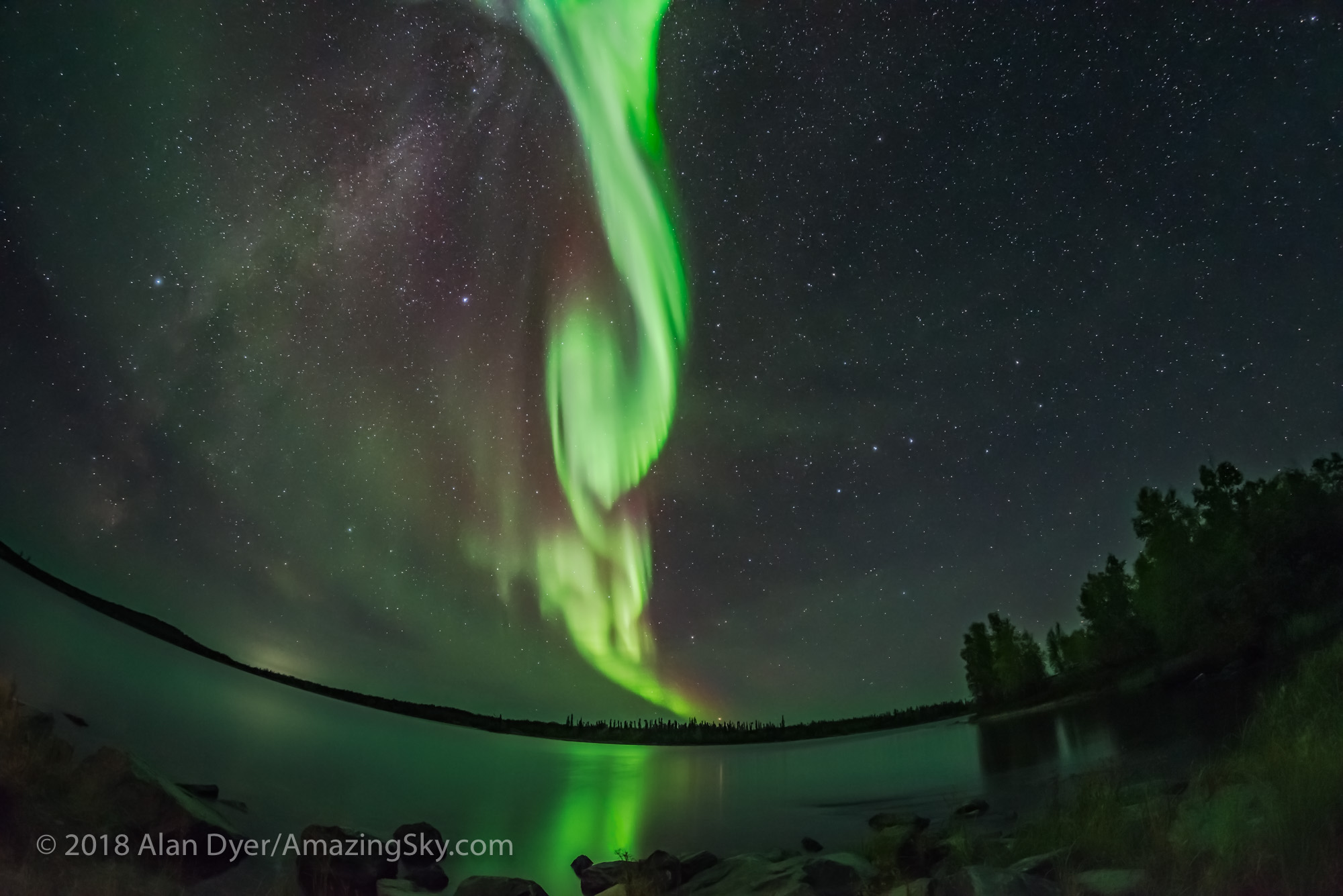
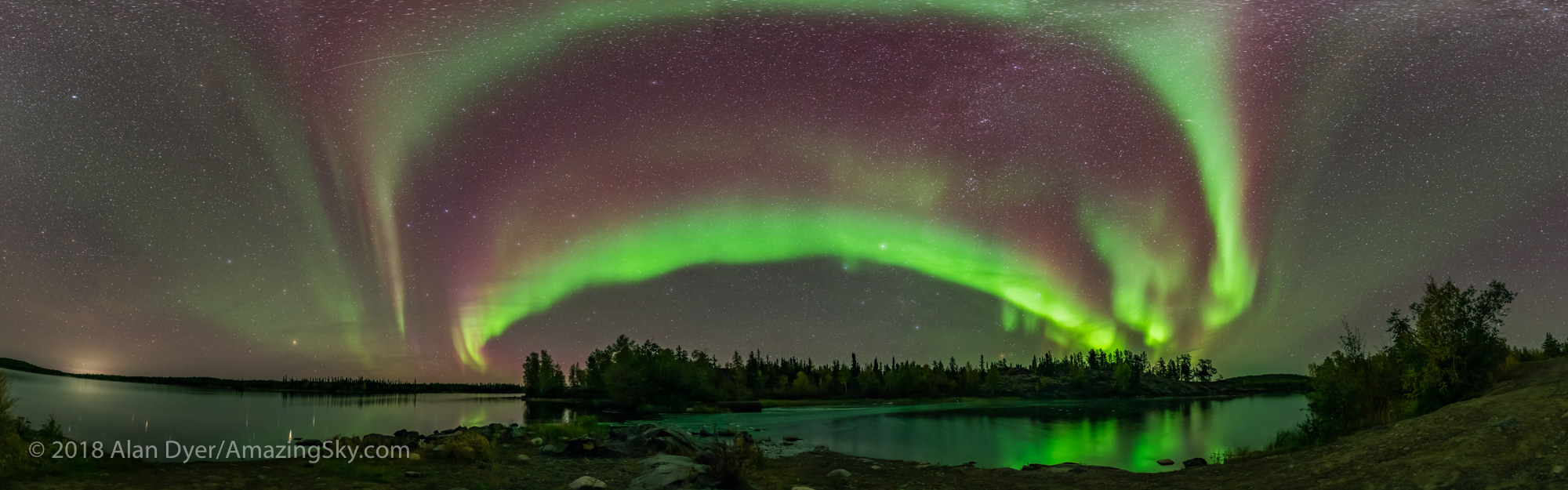
A display of Northern Lights starting up in the twilight, over the river leading out of Tibbitt Lake, at the end of the Ingraham Trail near Yellowknife NWT, on September 8, 2018. This was the start of a fabulous display this night. Capella and Auriga are at left; the Pleiades is rising left of centre; the Andromeda Galaxy is at top. This is a mean-combined stack of 7 exposures for the ground to smooth noise and one exposure for the sky and partially for the reflection, all 25 seconds at f/2.5 with the 14mm Sigma Art lens and Nikon D750 at ISO 1600.
A single image from a time-lapse sequence, of the auroral curtains converging toward the zenith during the display on September 8/9, 2018, from near Yellowknife, NWT. The curtains show some fringes of pink from nitrogen. This is 2.5 seconds at f/2.8 with the 12mm Rokinon full-frame fish-eye lens and Nikon D750 at ISO 6400.
A faint green and red auroral curtain to the northwest over Tibbitt Lake on the Ingraham Trail near Yellowknife, NWT. The Big Dipper is right of centre; Arcturus setting on the horizon. This was September 8, 2018. This is a mean-combined stack of 8 exposures for the ground and water to smooth noise, and a single exposure for the sky, all 25 seconds at f/2 with the 15mm Laoawa lens and Sony A7III at ISO 1600.
A single image from a time-lapse sequence, of the auroral curtains converging toward the zenith during the display on September 8/9, 2018, from near Yellowknife, NWT. This is 2.5 seconds at f/2.8 with the 12mm Rokinon full-frame fish-eye lens and Nikon D750 at ISO 6400.
Lakes down Highway 4, the Ingraham Trail, such as Prosperous, Prelude, and Pontoon are popular spots for the busloads of tourists who fly in every year from around the world.
On one magical night I and my local host and guide, Stephen Bedingfield, went to the end of the Trail, to where the Ice Road begins, to Tibbitt Lake, and had the site to ourselves. The aurora was jaw-dropping that night.
On other nights with less certain prospects I stayed in town, and still got a fine show on several nights, the Lights so bright they show up well even from within urban Yellowknife.
A selfie portrait under an all-sky display of Northern Lights in the city of Yellowknife, from the boardwalk at Rotary Park. This was on the night of Sept. 10/11, 2018 during a major solar storm, but in the subsiding hours after the sky cleared at about 2 am. The Big Dipper is at right. The Summer Triangle is at left. Cassiopeia is at the zenith. The view is looking northwest at centre. This is a mean stack of 6 exposures smoothed to reduce noise for the ground and one exposure for the sky and me, all 6 seconds at f/3.5 with the Sigma 8mm lens and Sony a7III at ISO 3200. The focus is soft.
An all-sky display of Northern Lights in the city of Yellowknife, from the end of the boardwalk at Rotary Park looking over the bay. This was on the night of Sept. 10/11, 2018 during a major solar storm, but in the subsiding hours after the sky cleared at about 2 am. The winter stars of Taurus and Gemini are rising. The Big Dipper is at far left. Cassiopeia is at the zenith. The view is looking east at centre. This is a mean stack of 8 exposures smoothed to reduce noise for the ground and one exposure for the sky, all 6 seconds at f/3.5 with the Sigma 8mm lens and Sony a7III at ISO 3200. The focus is soft.
A curtain of aurora sweeps over the houseboats moored on Yellowknife Bay in Yellowknife, NWT, on September 11, 2018. The Pleiades and Hyades star clusters in Taurus are rising at left. This is a mean-combined stack of 8 images to smooth noise for the ground and water, and a single exposure for the sky and houseboats themselves (as they were moving slightly from exposure to exposure). Each was 13 seconds at f/2 with the Venus Optics 15mm lens and Sony a7III at ISO 3200.
The Northern Lights over the “United in Celebration” sculpture at the Somba K’e Civic Plaza on Frame Lake in downtown Yellowknife, NWT, on September 14, 2018. The Prince of Wales Museum is at far right. This is a stack of 5 images for the ground to smooth noise and one image for the sky, all 6 seconds at f/2 with the 15mm Laoawa lens and Sony a7III at ISO 400.
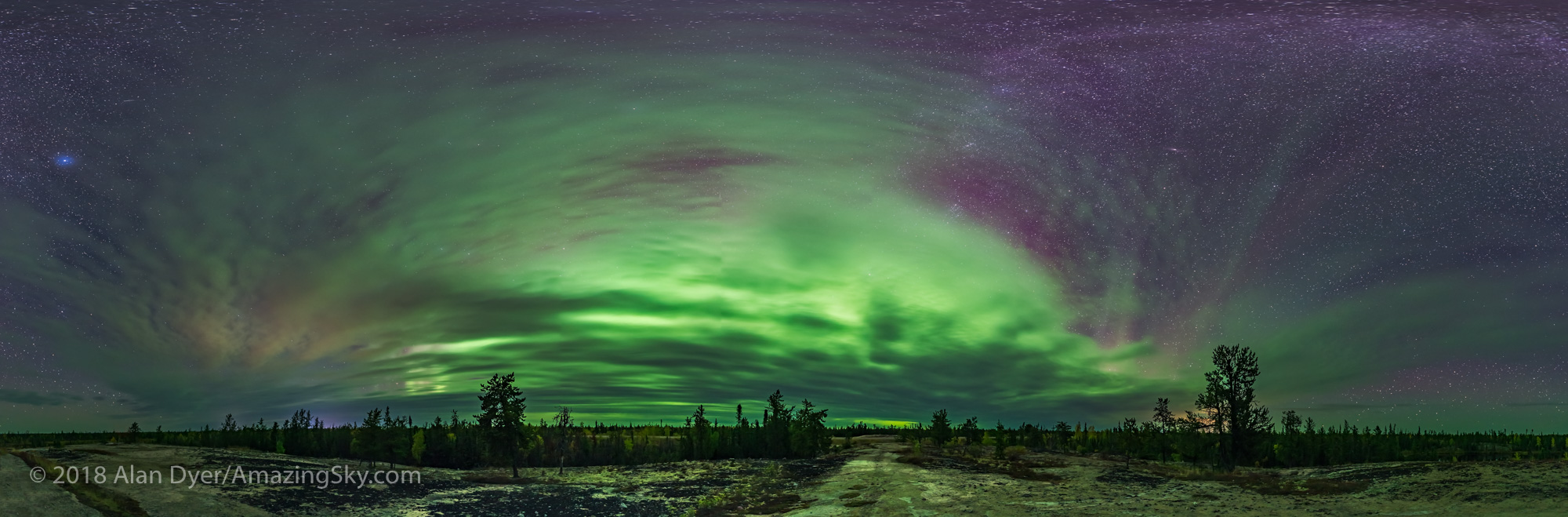
On another night we chased into clear skies down Highway 3 to the west, to a rocky plateau on the Canadian Precambrian Shield. Even amid the clouds, the aurora was impressive.
But it was the night at Tibbitt that was the highlight.
Here is the finale music video from movies shot that night, September 8, 2018, with two cameras: the Sony a7III used to take “real-time” 4K videos of the aurora motion, and the Nikon D750 used to take time-lapses.
The movie is in 4K. The music, Eternal Hope, is by Steven Gutheinz and is used by permission of West One Music.
Aurora Reflections from Alan Dyer on Vimeo.
Click through to Vimeo for more technical info about the video.
Enjoy! And do share!
And make Yellowknife one of your bucket-list locations.




 It was a fabulous week of clear skies and dancing auroras in and around Yellowknife in Canada’s North.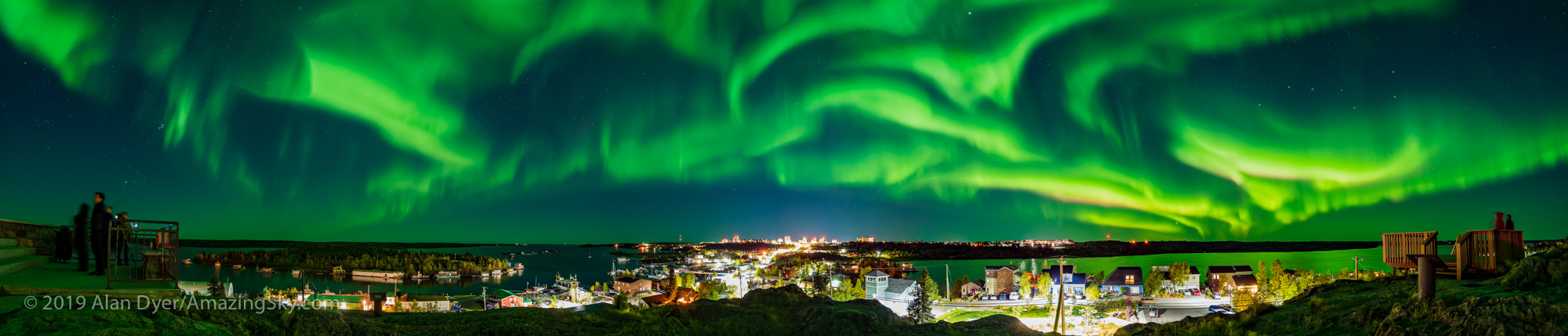








 The Amazing Sky