2024 — The Greatest Year of Stargazing ?


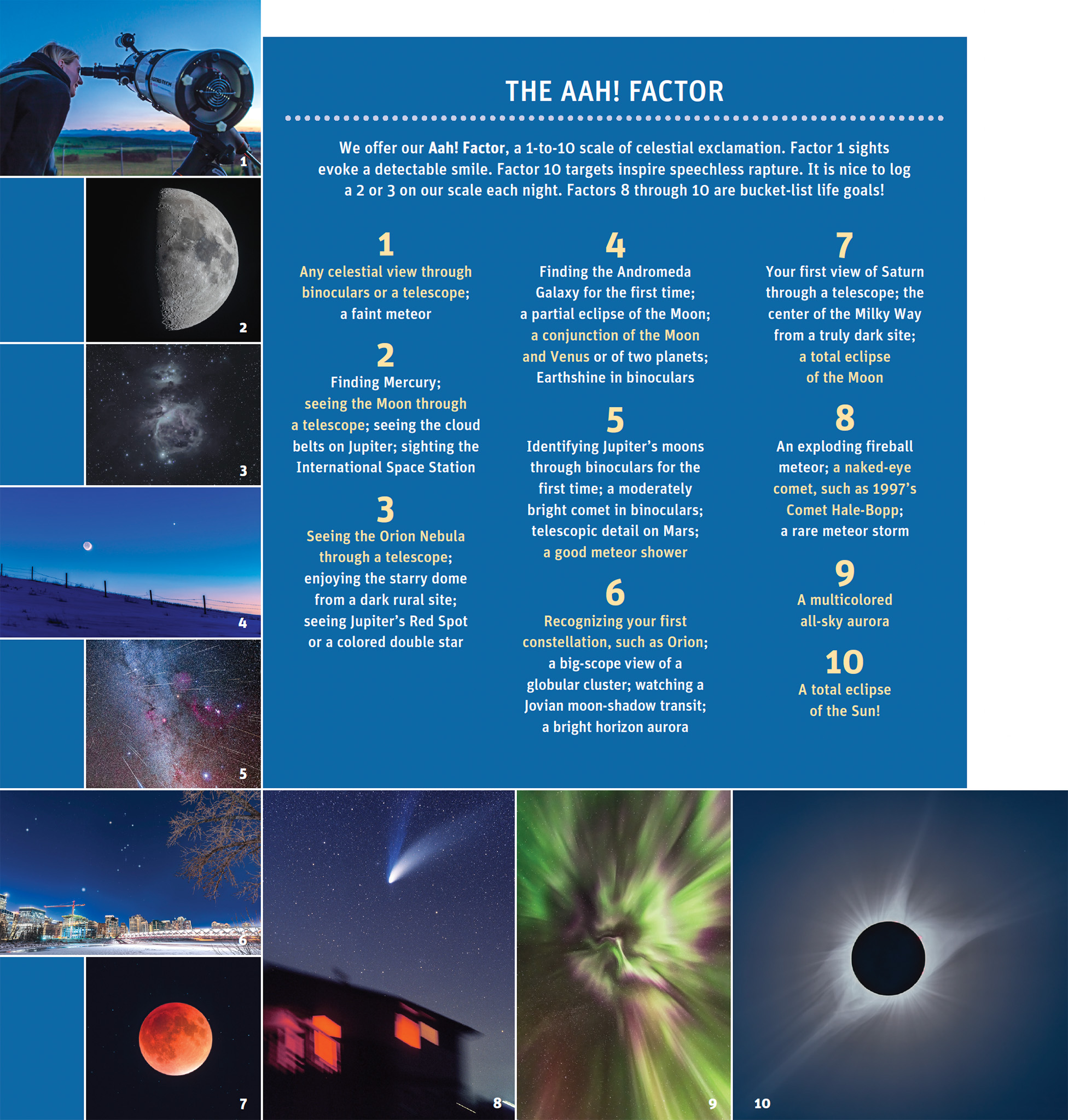
In our book The Backyard Astronomer’s Guide (which we revised this year), Terence Dickinson and I created an Aah! Factor scale with various celestial sights ranked from: 

•   1, evoking just a smile, to …

10, a life-changing event! 

Our book’s Aah! Factor Scale in Chapter 1

Coming in at an 8 is a naked-eye comet. Deserving a 9 is an all-sky display of an aurora. The only sight to rate a top 10 is a total eclipse of the Sun. 

2024 brought all three, and more! 

Here’s my look back at what I think was one of the greatest years of stargazing. 


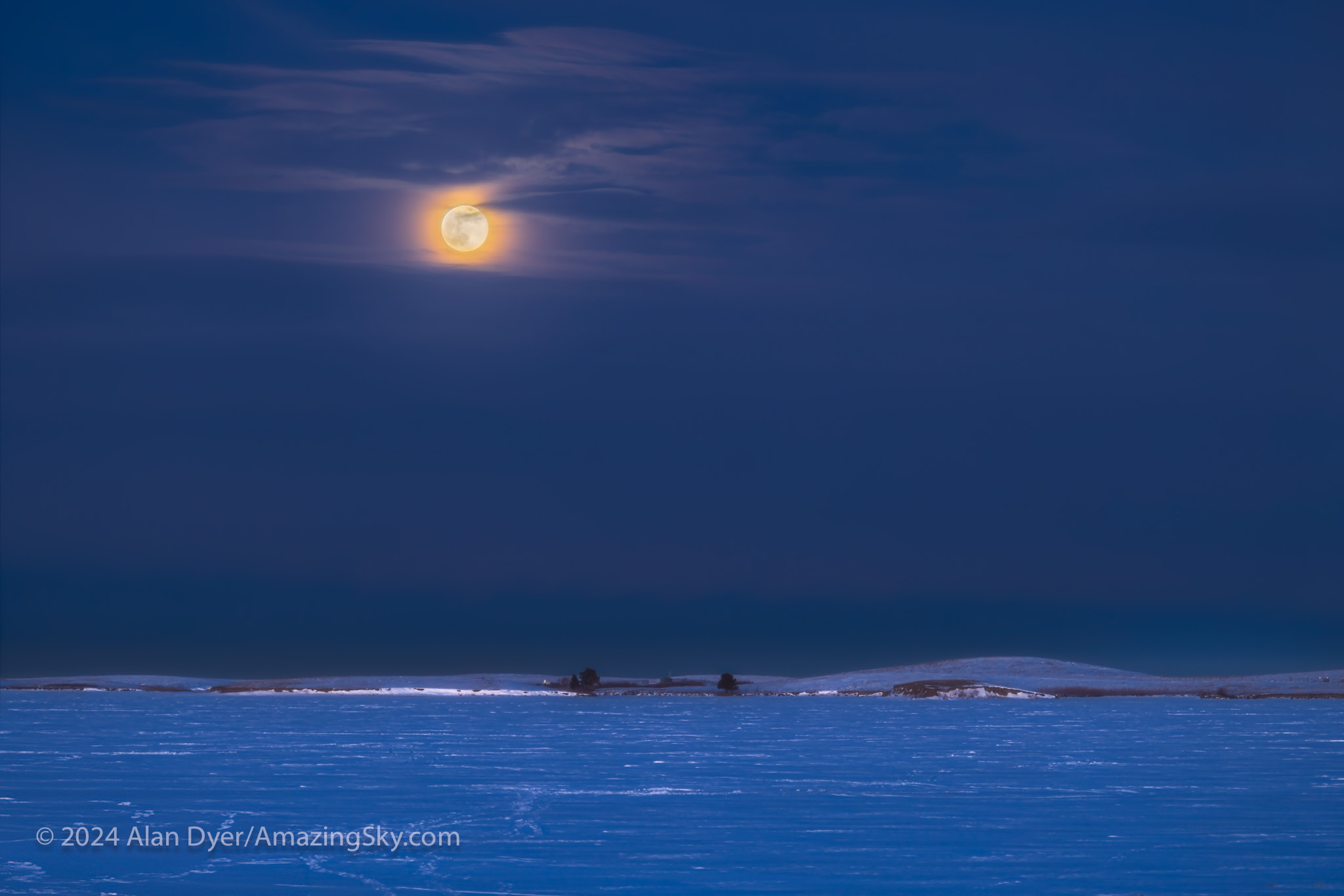
A Winter Moonrise to Begin the Year 

The rising of the winter “Wolf” Moon, the Full Moon of January, over the frozen Crawling Lake Reservoir, in southern Alberta.

Now, this was not any form of rare event. But seeing and shooting any sky sight in the middle of a Canadian winter is an accomplishment. This is the rising of the Full Moon of January, popularly called the Wolf Moon, over a frozen lake near home in Alberta, Canada 🇨🇦. 

It serves to bookend the collection with a Full Moon I captured eleven months later in December. 


Auroras from Churchill, Manitoba 

Had this been my only chance to see the Northern Lights fill the sky this year, I would have been happy. As we often see in Churchill, the aurora covered the sky on several nights, a common sight when you are underneath the main band of aurora borealis that arcs across the northern part of the globe. 
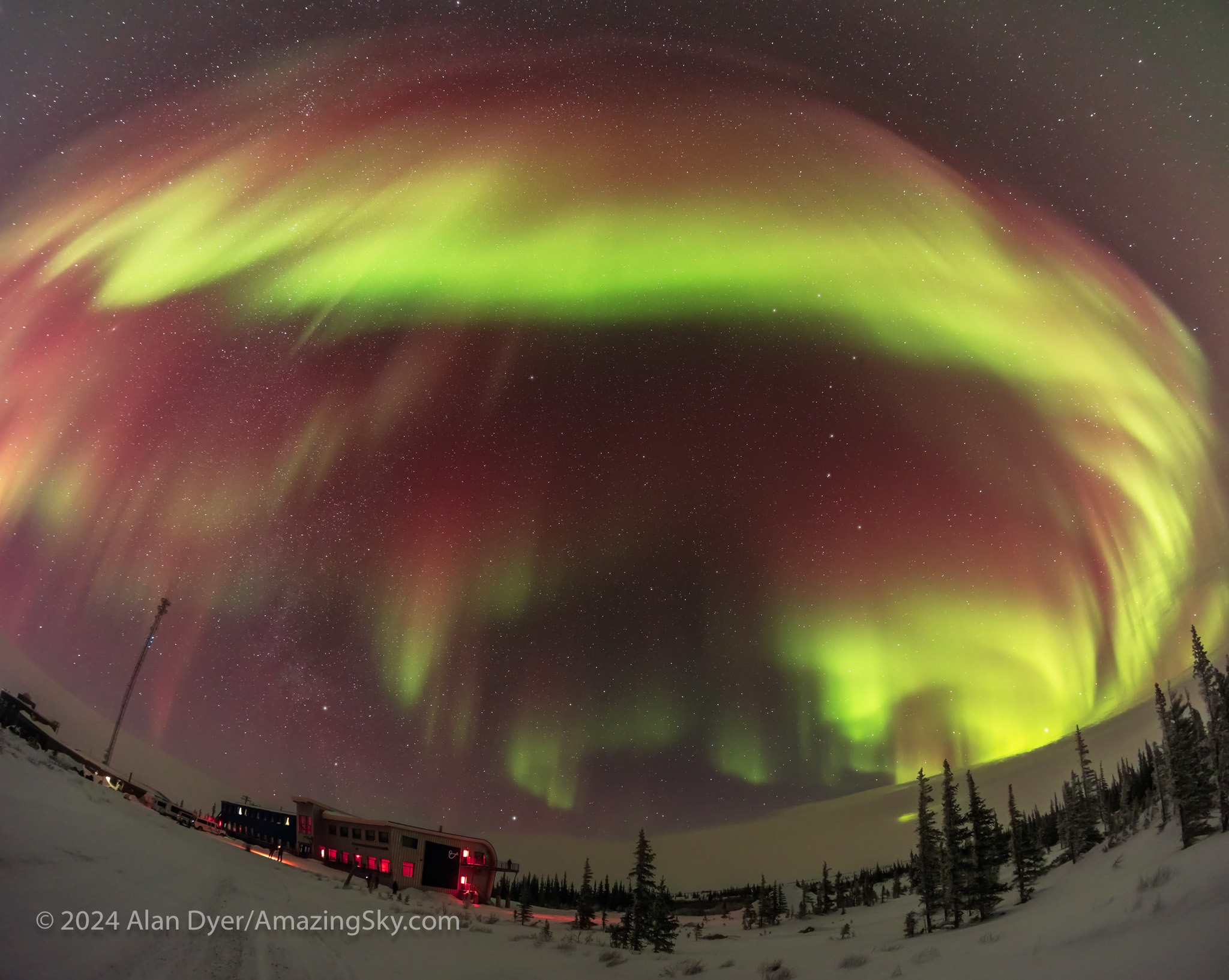
This is a vertical panorama of the sky-filling aurora of February 10, 2024, as seen from the Churchill Northern Studies Centre, in Churchill, Manitoba.

I attended to two aurora tour groups at the Churchill Northern Studies Centre who both got good displays to check “seeing the Northern Lights” off their bucket list. Join me in 2025!


Under the Austral Sky

Ranking a respectable 7 on our Aah! Factor scale is the naked-eye sight of the galactic centre overhead, with the Milky Way arcing across the sky. That’s possible from a latitude of about 30° South. That’s where I went in March, back to Australia 🇦🇺 for the first time since 2017. 
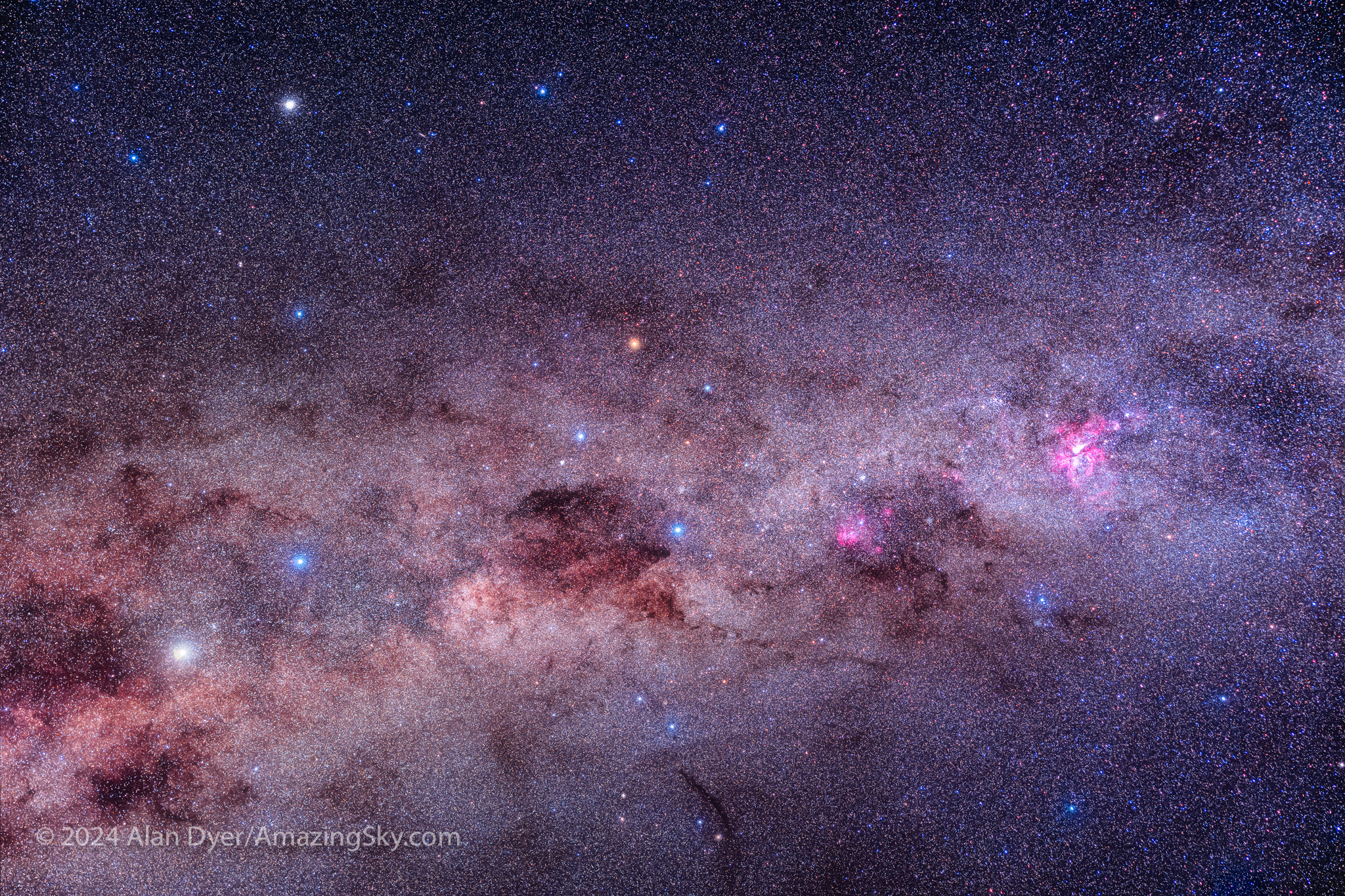
This is a framing of the most spectacular area of the southern Milky Way, from Centaurus at left, to Carina at right, with Crux, the Southern Cross, at centre.

I wrote about it in my previous blog, where I present a tour along the southern Milky Way, and wide-angle views of the Milky Way (the images here are framings of choice regions). 
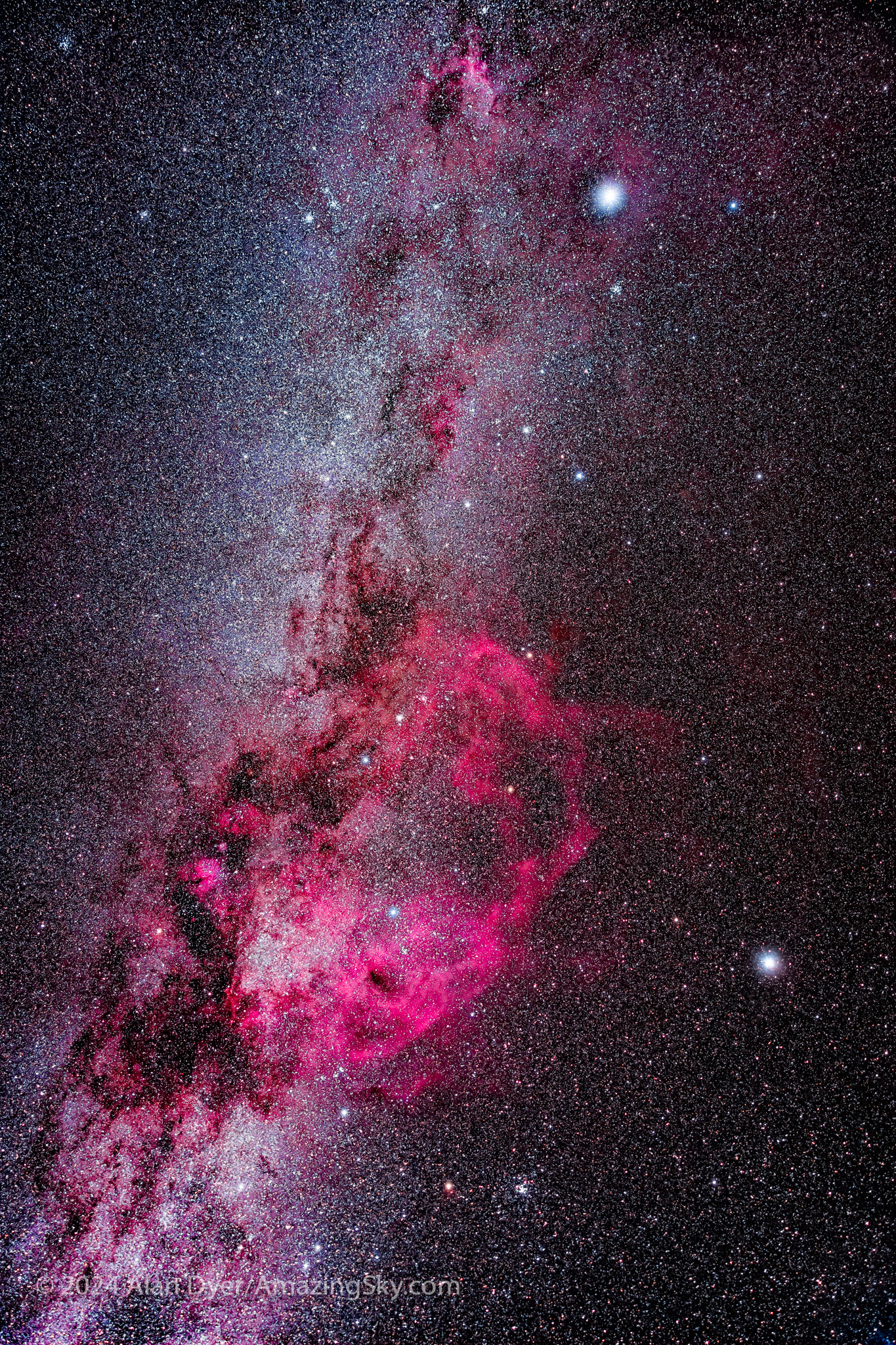
This frames the southern Milky Way from Canis Major and its bright star Sirius at top, to Carina and its bright star Canopus at bottom, the two brightest stars in the night sky. The large red complex is the Gum Nebula.

It is a magical latitude that all northern astronomers should make a pilgrimage to, if only to just lie back and enjoy the view of our place in the outskirts of the Galaxy. I was glad to be back Down Under, to check this top sky sight off my bucket list for 2024. 


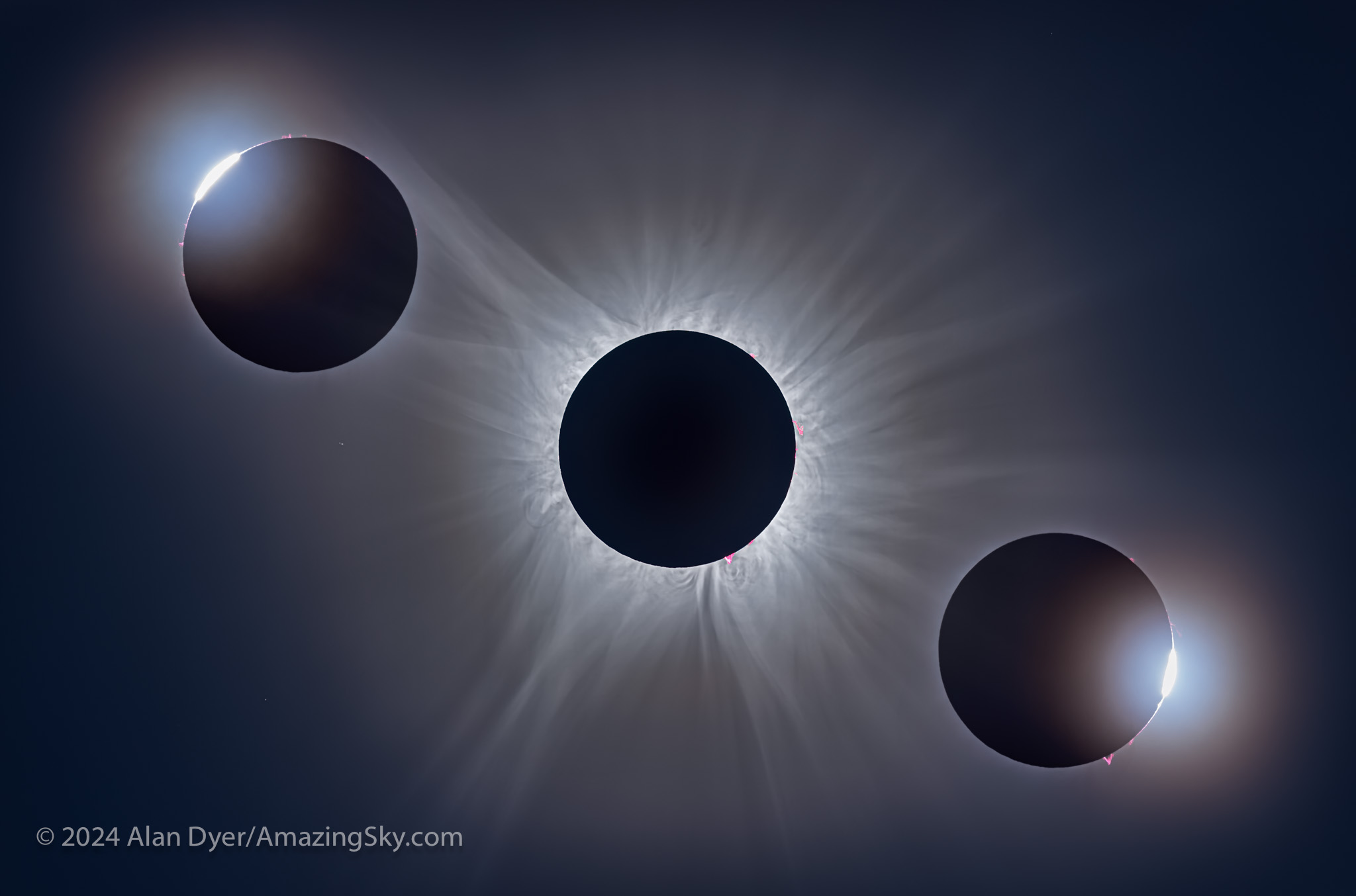
A Total Eclipse of the Sun 

No sooner had I returned home from Oz, when it was time to load up the car with telescope gear and drive to the path of the April 8 total solar eclipse, the first “TSE” in North America since 2017, which was the last total eclipse I had seen, in a trip to Idaho

This is a composite of telescopic close-ups of the April 8, 2024 total eclipse, with a multi-exposure blend for the corona at centre, flanked by the diamond rings.

But where? I started south to Texas, my Plan A. Poor weather forecasts there prompted a hasty return to Canada, to drive east across the country to … I ended up in Québec. My blog about my cross-continental chase is here. My final edited music video is linked to below.

It was gratifying to see a total eclipse from “home” in Canada, only the third time I’ve been able to do that (previously in 1979 – Manitoba, and 2008 – Nunavut). If the rest of the year had been cloudy except for this day I wouldn’t have complained. Much.

This definitely earned a 10 on the Aah! Factor scale. Total eclipses are overwhelming and addictive. I’ve made my bookings for 2026 in Spain 🇪🇸 and 2027 in Tunisia 🇹🇳. 


The Sky’s On Fire

It had been several years since I had seen an aurora from my backyard with colours as vivid and obvious as they were this night. But on May 10, the sky erupted with a fabulous display of aurora that much of the world saw, as aurora borealis in the north and aurora australis in the south. 
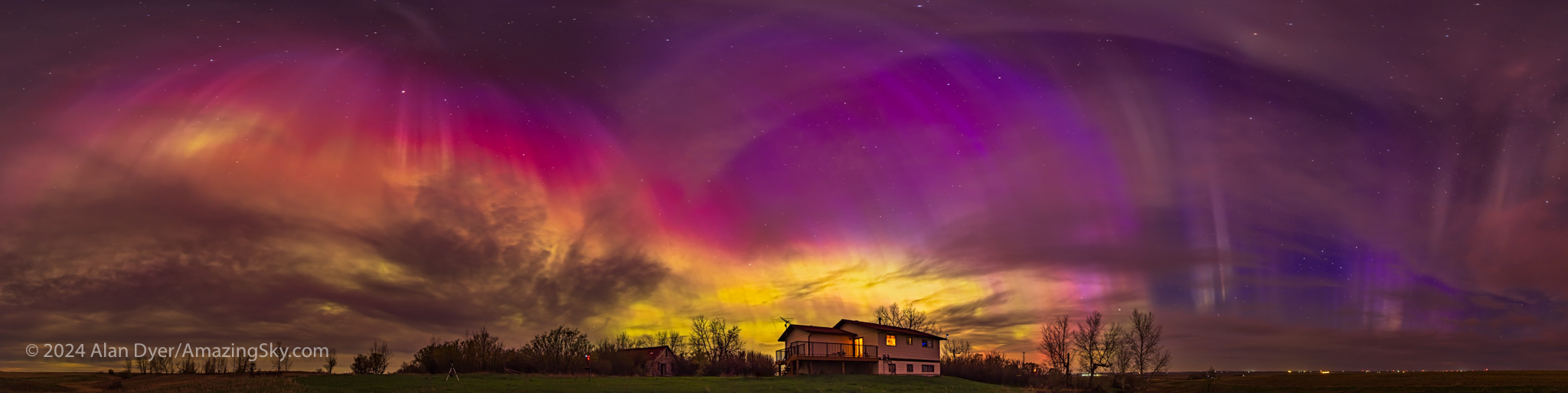
This is a 300º panorama of the May 10, 2024 Northern Lights display, when the Kp Index reached 8 (out of 9), bringing aurora to the southern U.S.

This was the first of several all-sky shows this year. I blogged about the year’s great auroras here, where there are links to the movies I produced that capture the Northern Lights as only movies can, recording changes so rapid it can be hard to take it all in. Check off a 9 here! 

So not even half way through the year, I had seen three of the top sky sights: the Milky Way core overhead (7), an all-sky aurora (9), and a total eclipse of the Sun (10). 

But there was more to come! Including an Aah! Factor 8


World Heritage Nightscape Treks

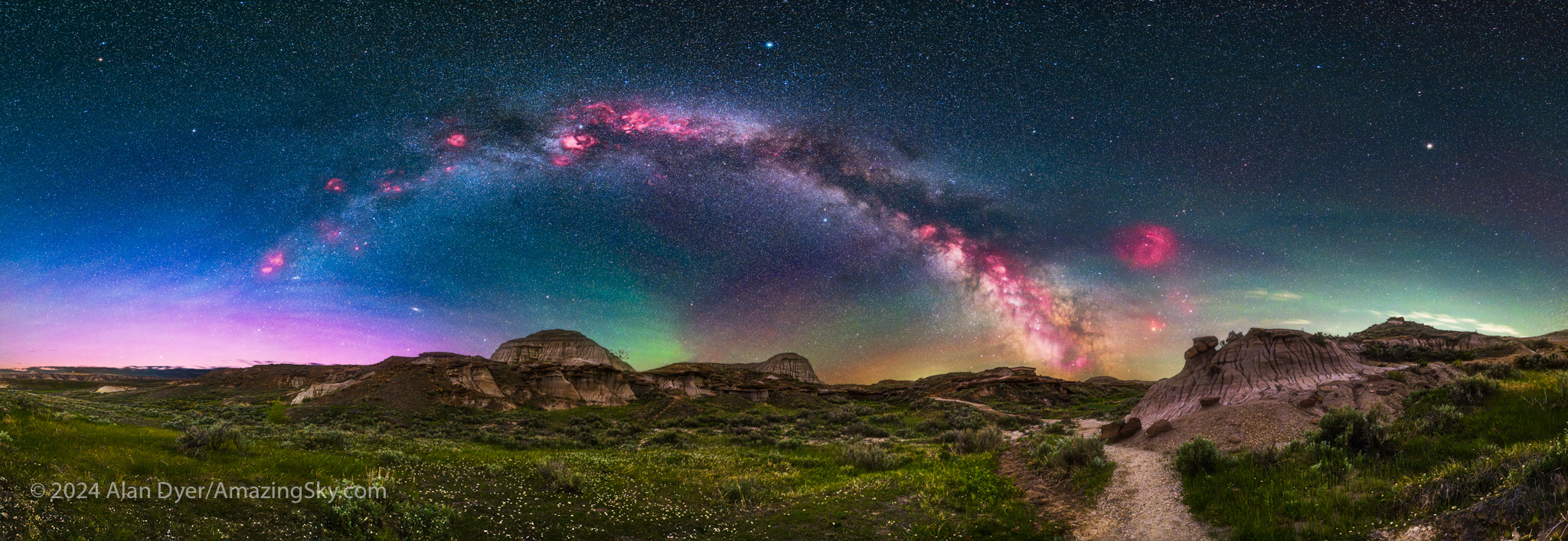
This is a panorama of the arch of the Milky Way rising over the Badlands of Dinosaur Provincial Park, Alberta, with a sky tinted with twilight and airglow.

The sky took a break from presenting spectacles, allowing me to head off on short local trips, to favourite nightscape sites in southern Alberta, which we have in abundance. The Badlands of Dinosaur Provincial Park are just an hour away, the site for the scene above. 
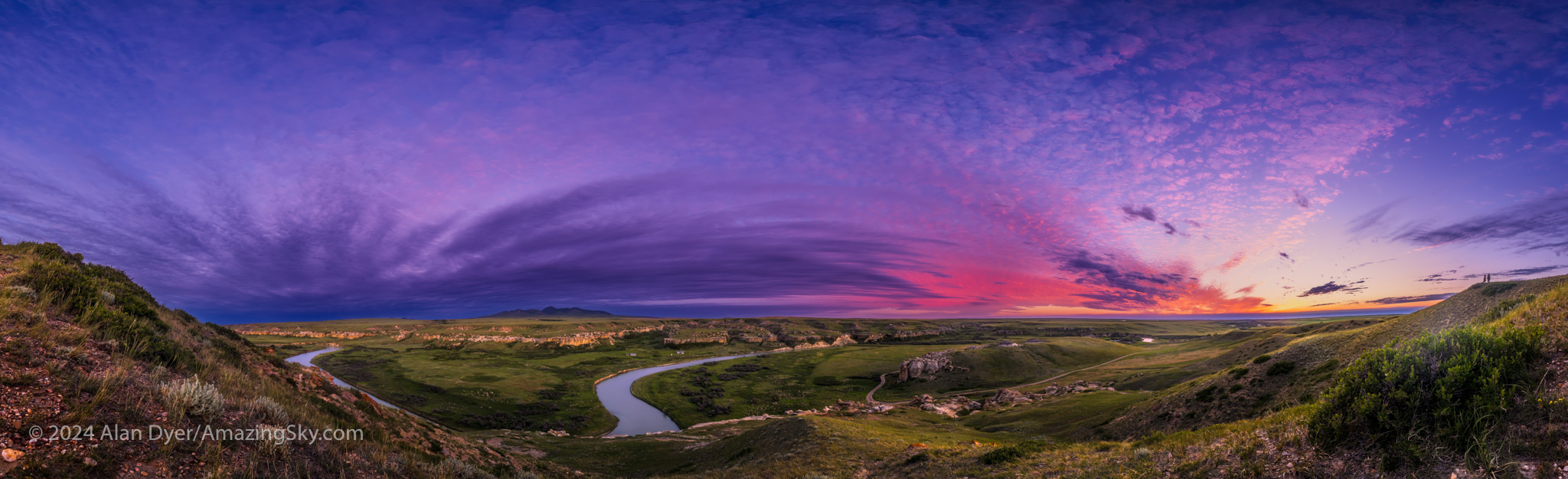
A panorama at sunset at Writing-on-Stone Provincial Park (Áísínai’pi) in Alberta, with the Milk River below and the Sweetgrass Hills in the distance in Montana. Note the people at far right.

The rock formations of Writing-on-Stone Provincial Park are a bit farther, requiring a couple of days commitment to shoot. Clouds hid the main attraction, the Milky Way, this night, but did provide a fine sunset. 
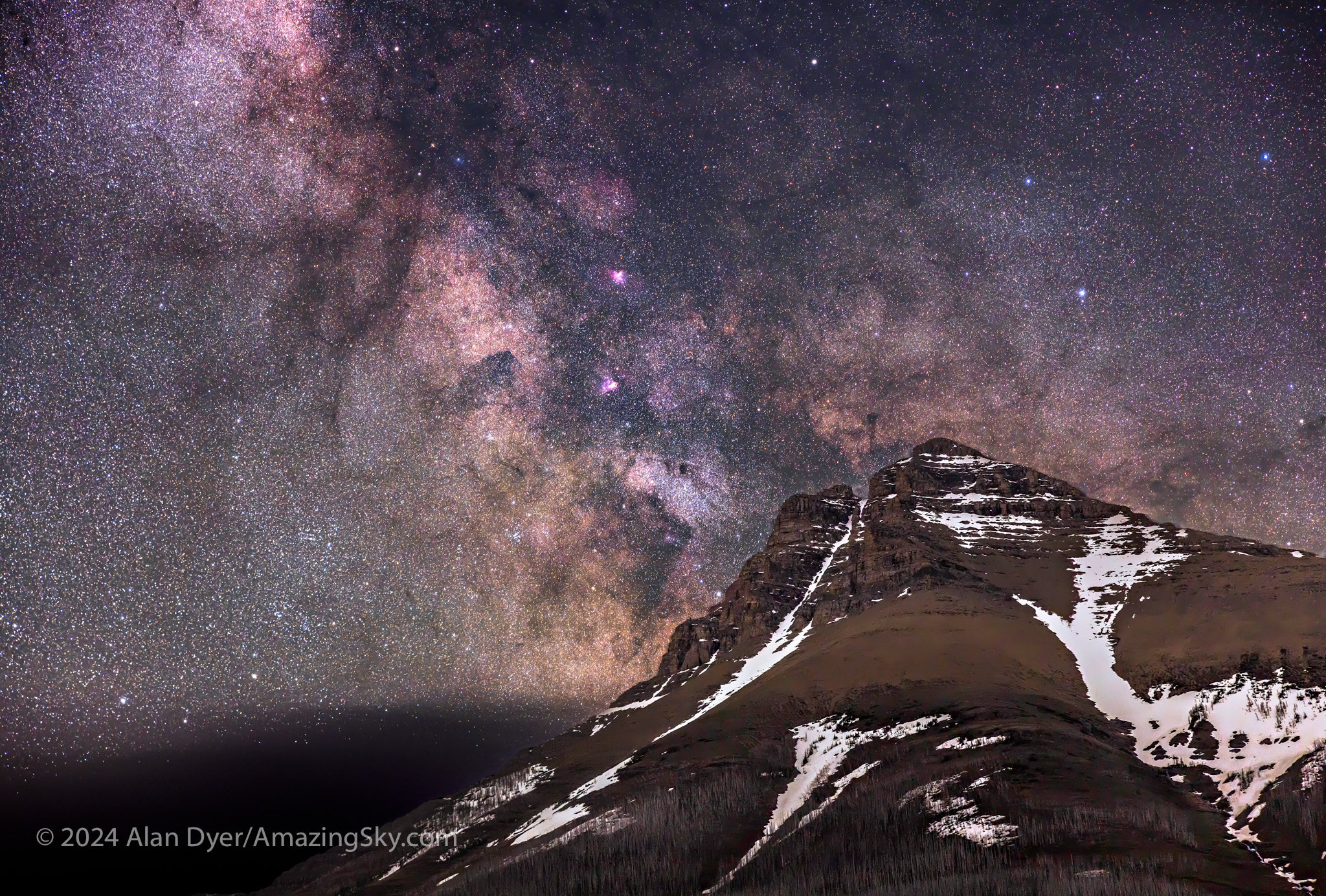
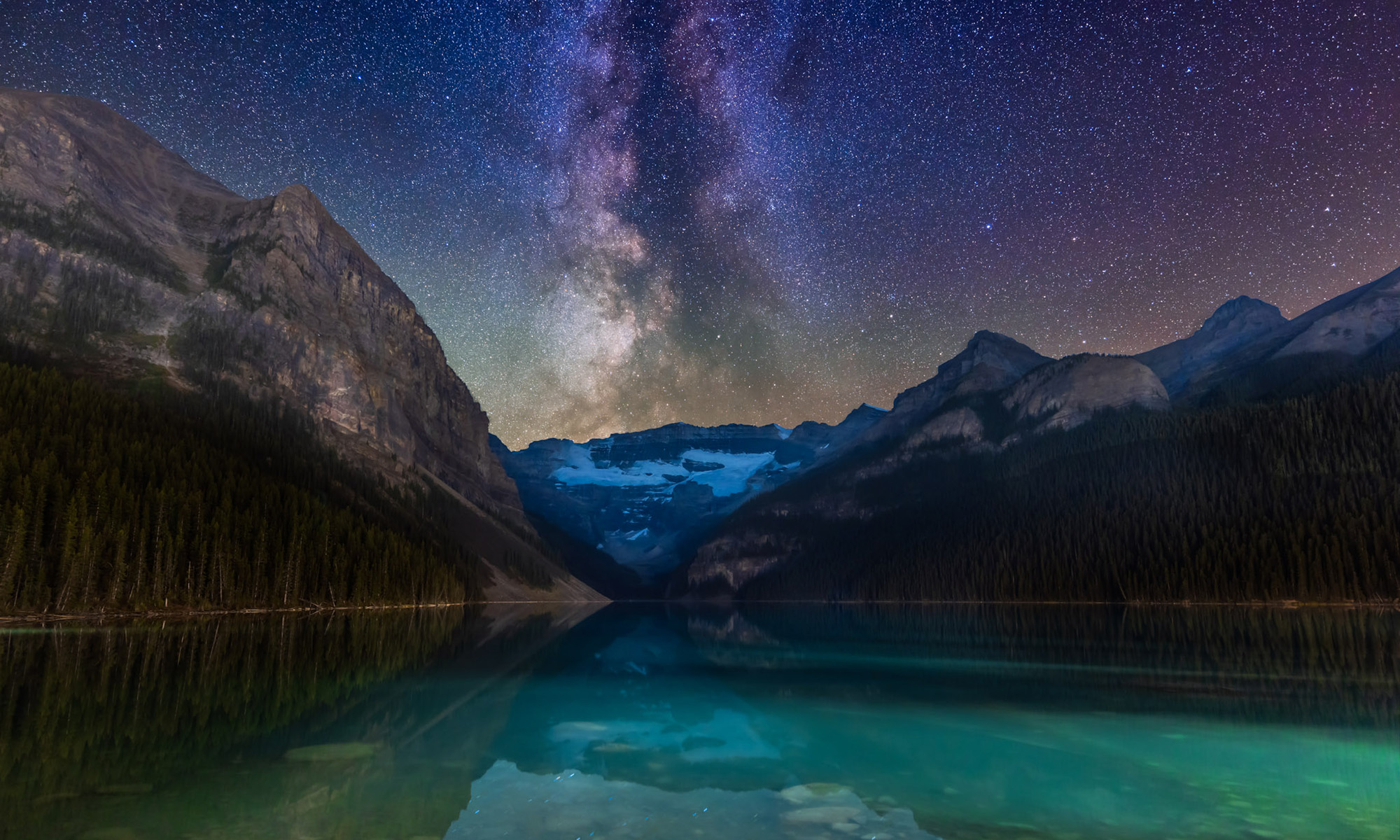
The Milky Way rises over Mt. Blakiston, in Waterton Lakes National Park, Alberta. This was June 10, 2024, so snow remains at high altitudes.

A little further west down the highway is Waterton Lakes National Park, another great spot I try to visit at least once each year. 

All locations I hit this month are U.N. World Heritage Sites, thus the theme of my blog from June. People travel from all over the world to come here, to sites I can visit in a few hours drive. 


Mountains by Starlight

In summer we now often contend with smoke from forest fires blanketing the sky, hiding not just the stars by night, but even the Sun by day. 
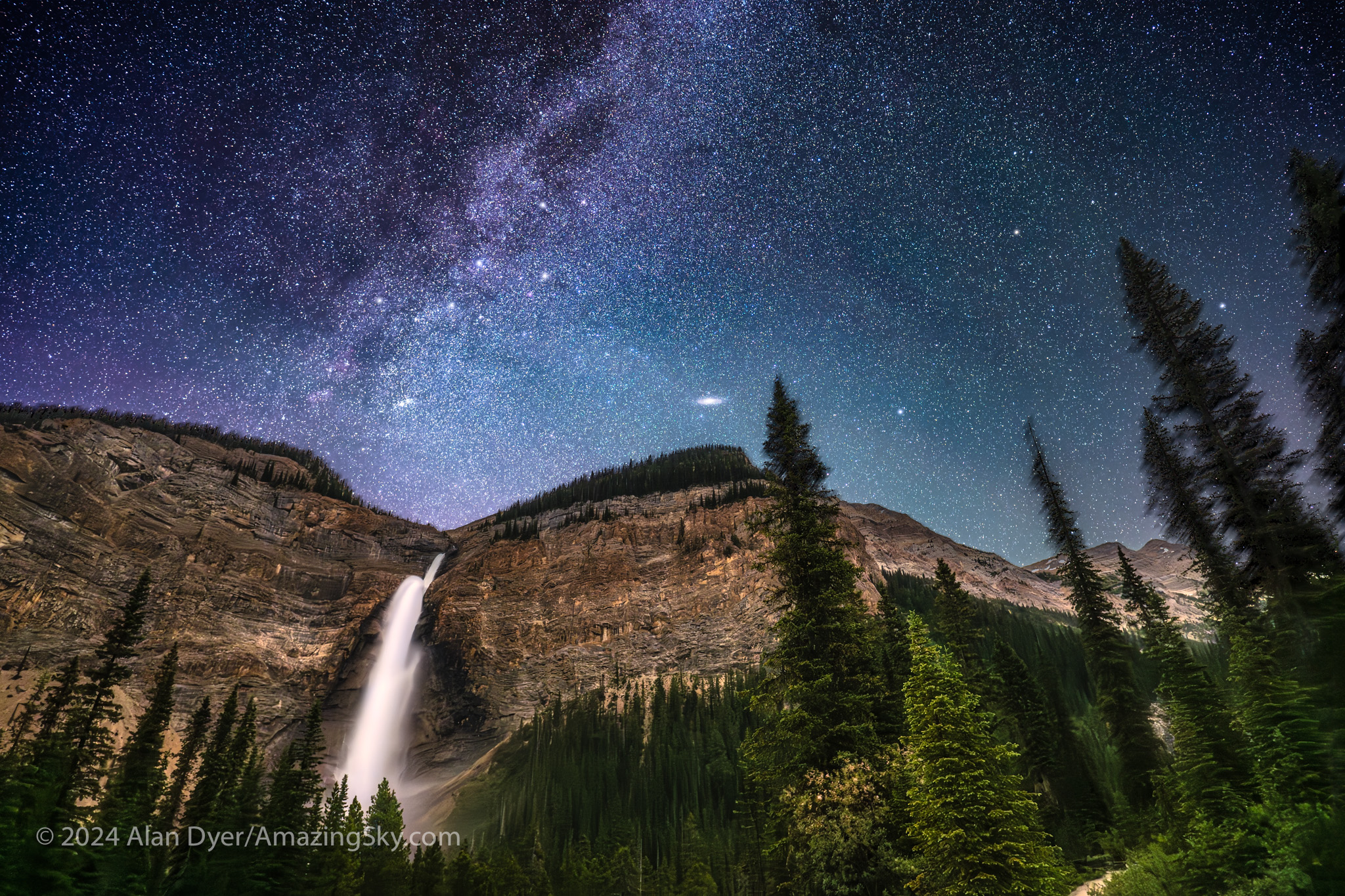
The Andromeda Galaxy at centre is rising above Takakkaw Falls, in Yoho National Park. Above is the W of stars marking Cassiopeia.

But before the smoke rolled in this past summer I was able to visit a spot, Yoho National Park in British Columbia, that had been on my shot list for several years. The timing with clear nights at the right season and Moon phase has to work out. In July it did, for a shoot by starlight at Takakkaw Falls, among the tallest in Canada. 
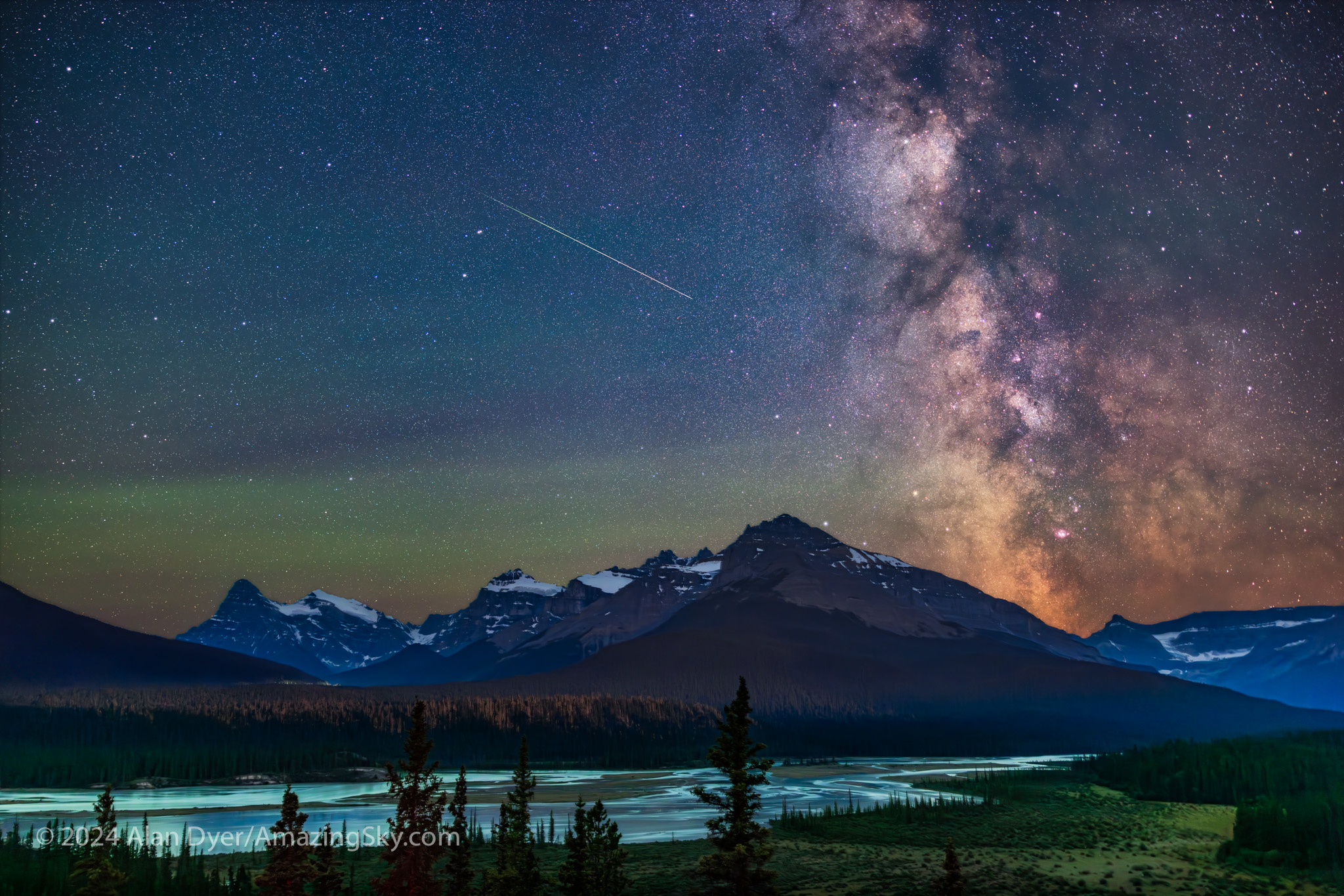
This is the Milky Way core and a bonus meteor over the peaks and valleys at Saskatchewan River Crossing, in Banff National Park, Alberta.

The following nights I was in Banff National Park, at familiar spots on the tourist trail, but uncrowded and quiet at night. It was a pleasure to enjoy the world-class Rocky Mountain scenery under the stars on perfect nights. 


The All-Sky Auroras Return 

In August I headed east to Saskatchewan and the annual Summer Star Party staged by the astronomy clubs in Regina and Saskatoon. It is always a pleasure to attend the SSSP in the beautiful Cypress Hills. The sky remained clear post-party for a trip farther east to the little town of Val Marie, where I stayed at a former convent, and had a night to remember out in Grasslands National Park, one of Canada’s first, and finest, dark sky preserves.
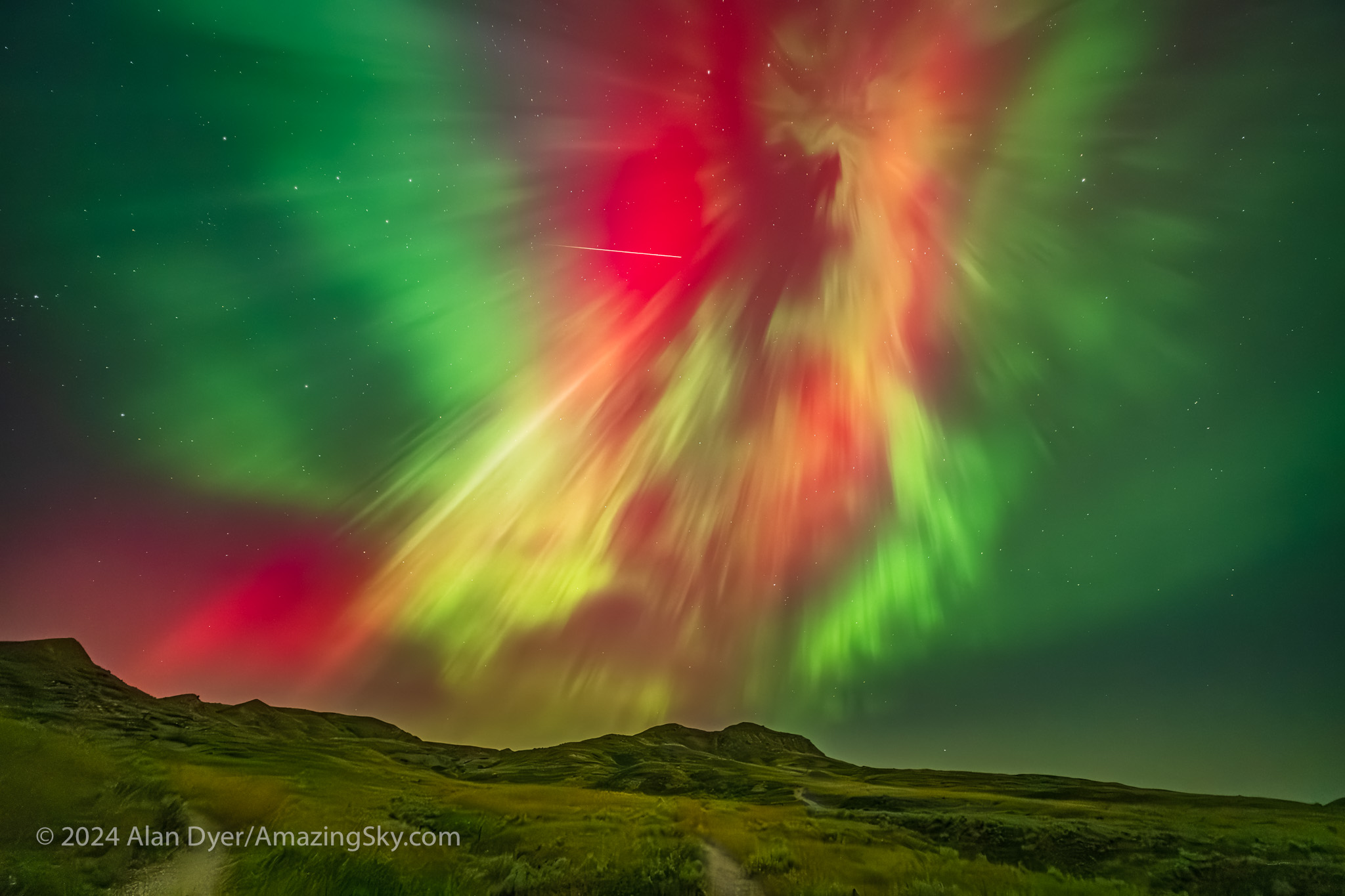
The Northern Lights in a superb all-sky Kp6 to 7 display on August 11-12, 2024, in Grasslands National Park, Saskatchewan.

The plan was to shoot the August 11 Perseid meteor shower, but the aurora let loose again for a stunning show over 70 Mile Butte. My earlier blog has more images and movies from this wonderful month of summertime Northern Lights. 

We are fortunate in western Canada 🇨🇦 to be able to see auroras year-round, even in summer. Farther north at the usual Northern Lights destinations, the sky is too bright at night in summer. 


Back to Deep Sky Wonders

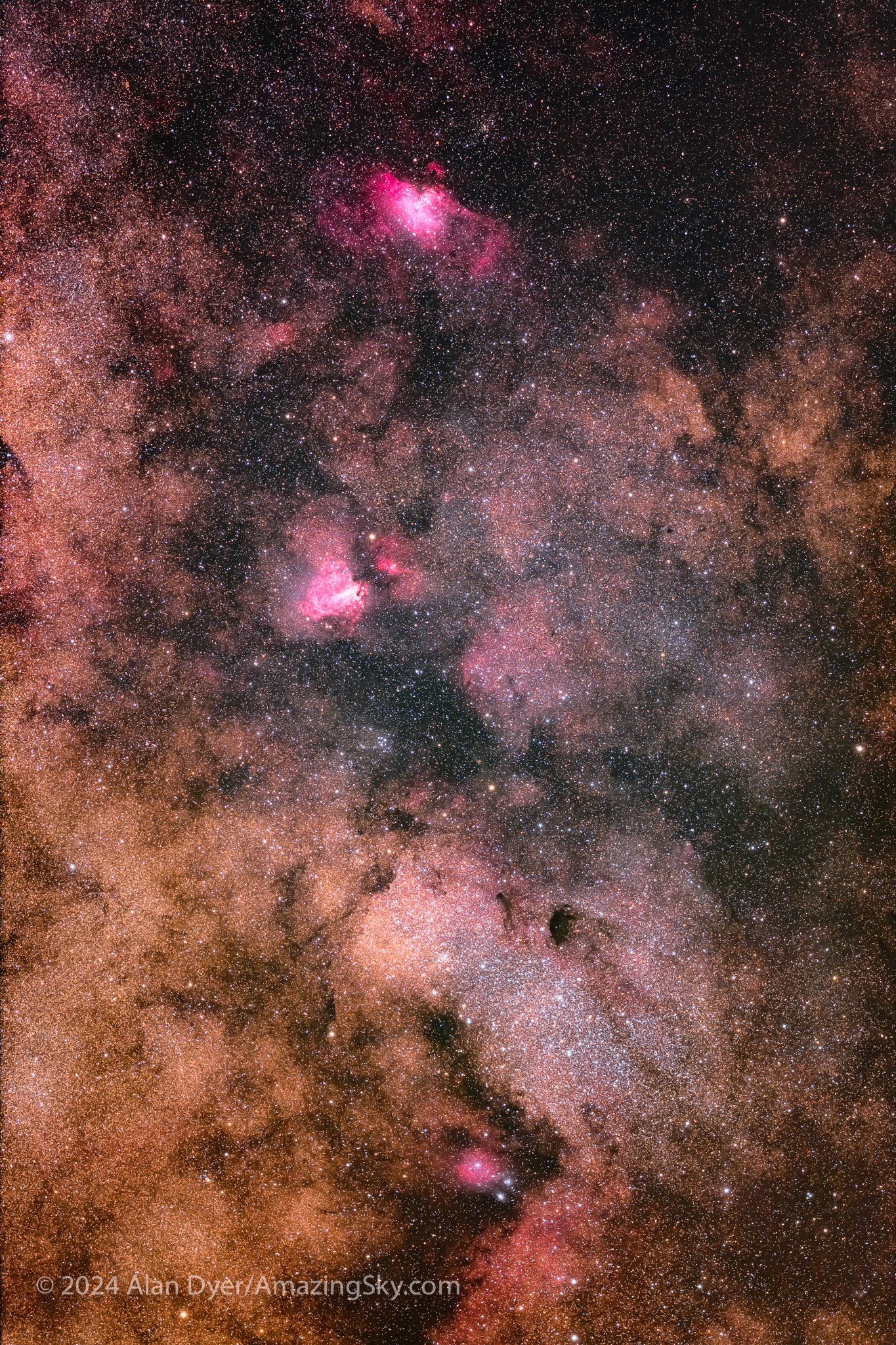
This is a framing of the rich starfield in Sagittarius and Serpens containing a mix of bright star clouds, glowing nebulas, and dark dust in the Milky Way.

September is the month for another astronomical party in the Cypress Hills, but on the Alberta side. At the wonderful Southern Alberta Star Party under its very dark skies, I was able to shoot some favourite deep-sky fields along the Milky Way with new gear I was testing at the time. 
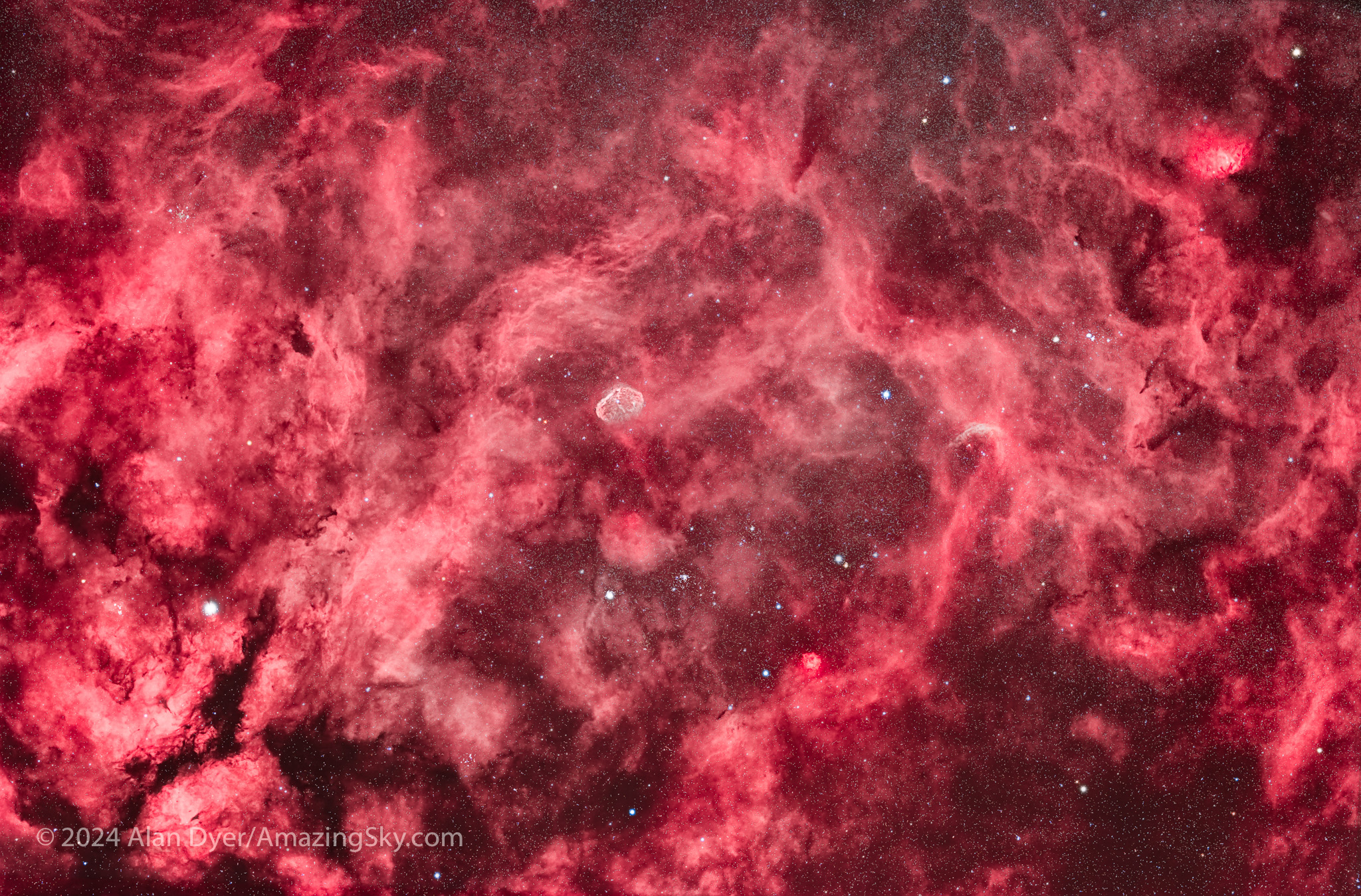
This frames the complex region of emission nebulas in central Cygnus near the star Gamma Cygni, at lower left. The Crescent Nebula is at centre.

And from home, September brought skies dark and clear enough (at least when there was no aurora!) for more captures of colourful nebulas (above and below) along the summer Milky Way. 
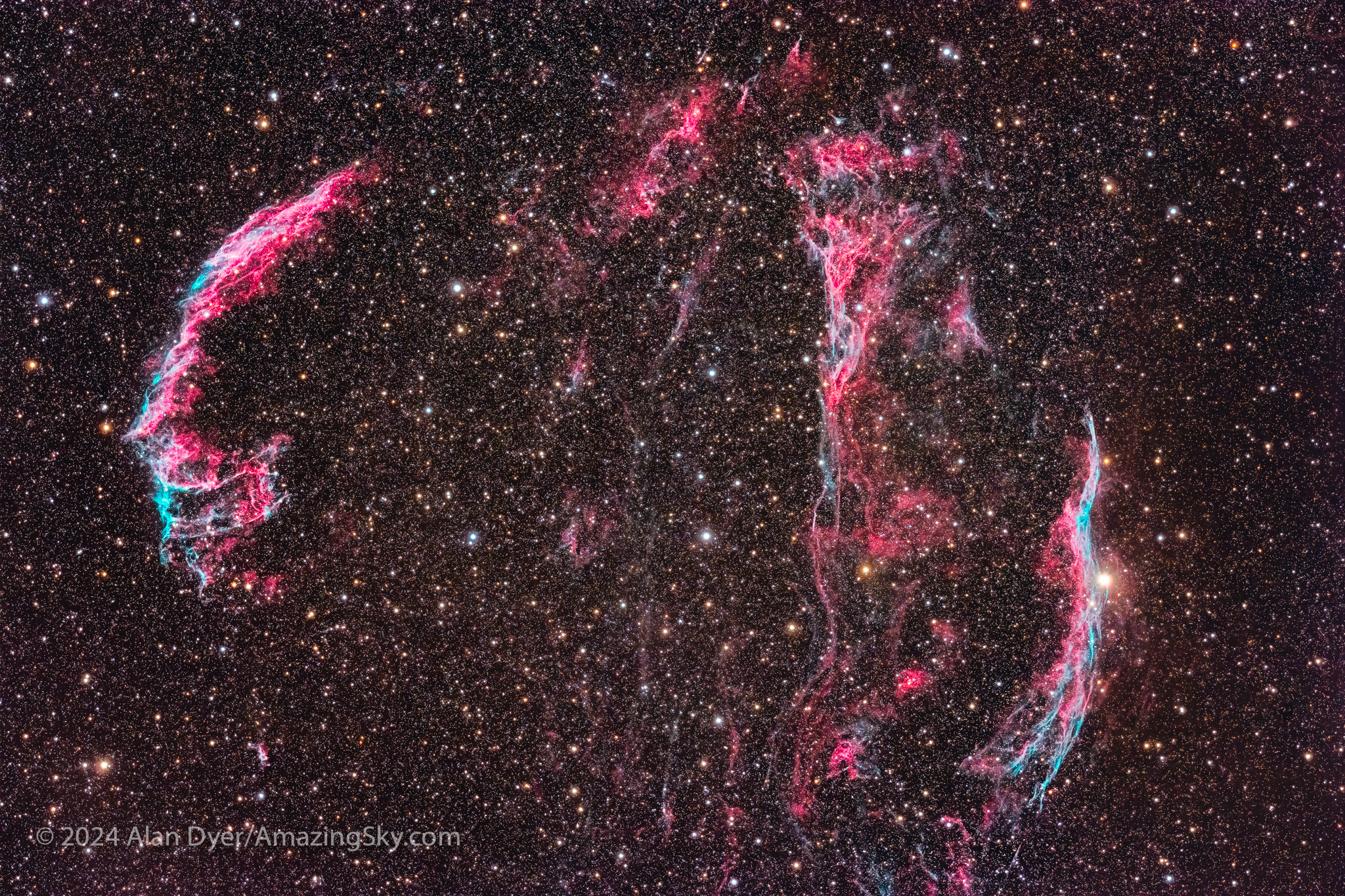
This frames all the photogenic components of the bright Veil Nebula in Cygnus, a several-thousand-year-old supernova remnant.

We invest a lot of money into the kind of specialized gear needed to shoot these targets (and I’m not nearly as “committed” as some are, believe me!), only to find the nights when it all comes together can be few and far between. 

Plus, A Very Minor Eclipse of the Moon 

I had to include this, if only for stark contrast with the spectacular solar eclipse six months earlier. 

We had an example of the most minor of lunar eclipses on March 24, 2024, with a so-called “penumbral” eclipse of the Moon, an eclipse so slight it’s hard to tell anything unusual is happening. (So I’ve not even included an image here, though I was able to shoot it.)
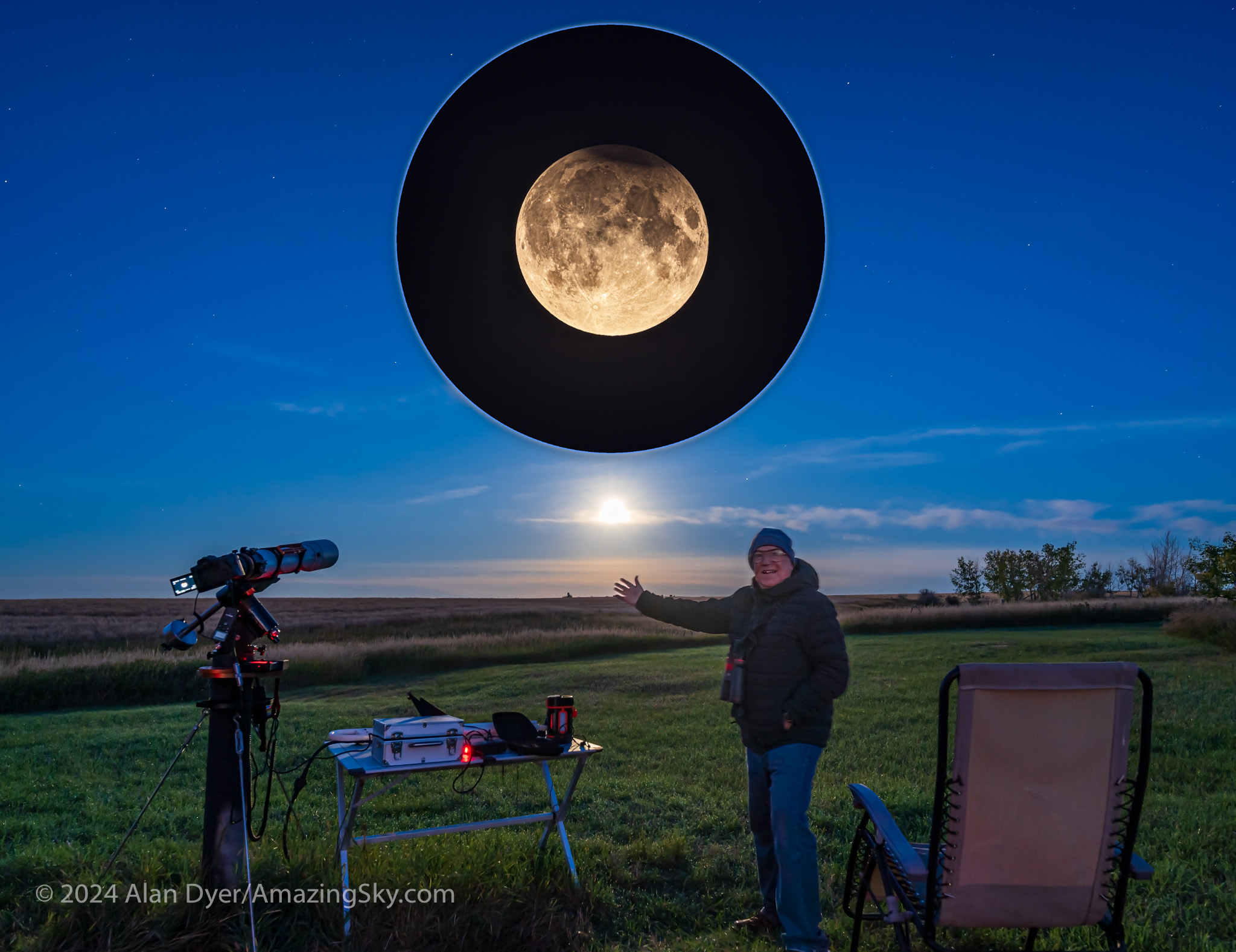
Me at another successful eclipse chase … to my backyard to capture the partial lunar eclipse on September 17, 2024. The Moon is rising in the southeast.

On September 17, we had our second eclipse of the Moon in 2024. This time the Earth’s umbral shadow managed to take a tiny bite out of the Full Moon. Nothing spectacular to be sure. But at least this eclipse expedition was to no farther away than my rural backyard. A clear eclipse of any kind, even a partial eclipse, especially one seen from home, is reason to celebrate. I did!

Of course, a total eclipse of the Moon, when the Full Moon is completely engulfed in Earth’s umbra and turns red, is what we really want to see. They rate a 7 on our Aah! Factor scale. We haven’t had a “TLE” since November 8, 2022, blogged about here.

The next is March 14, 2025. (The link takes you to Fred Espenak’s authoritative web page.)


A Bright Comet At Last!

We knew early in 2024 that the then newly-discovered Comet Tsuchinshan-ATLAS had the potential to perform this month. I planned a trip south to favourite spots in Utah and Arizona to take advantage of what we hoped would be a fine autumn comet. 
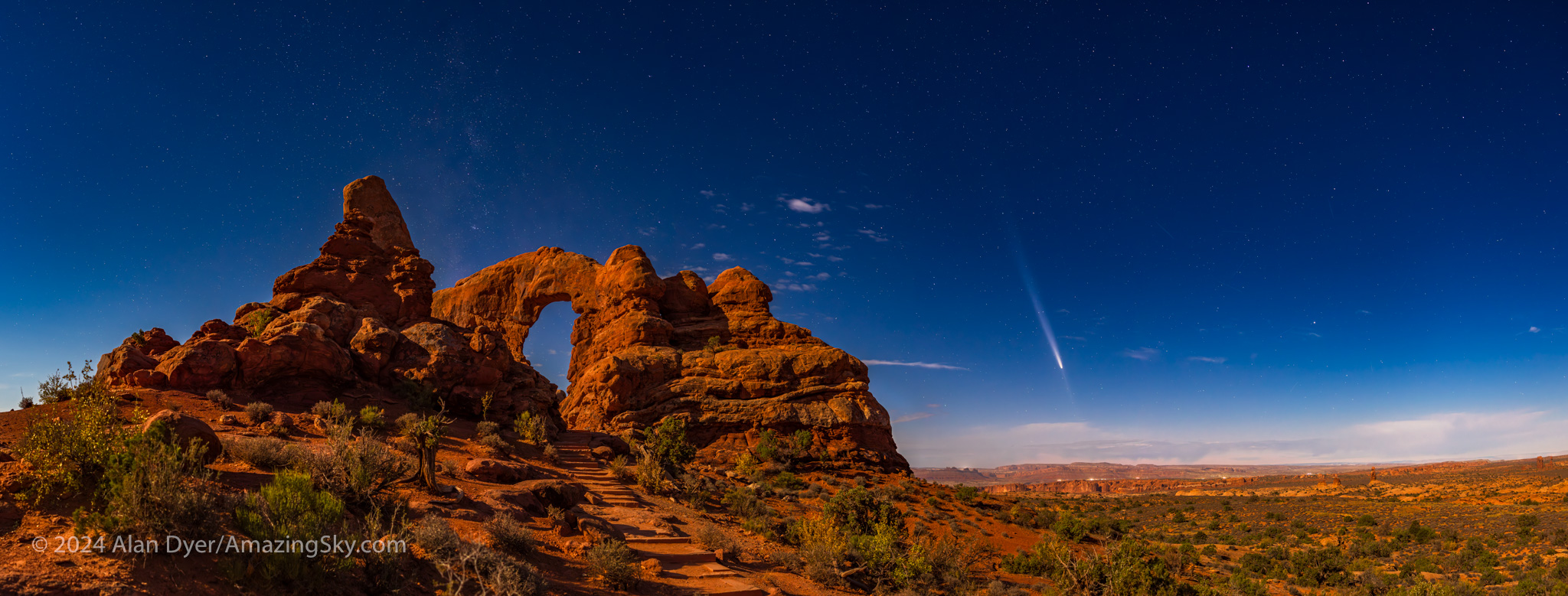
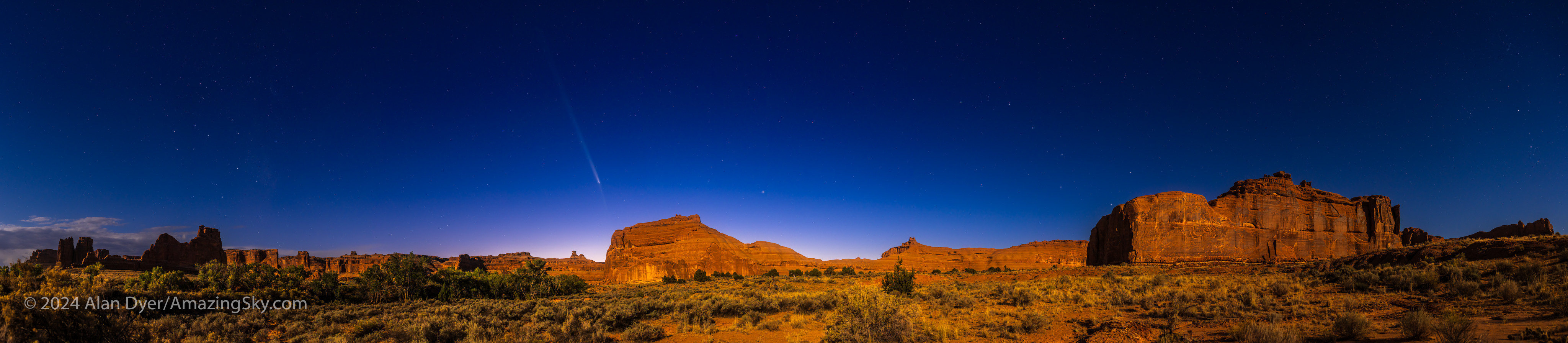
This is Comet Tsuchinshan-ATLAS (C/2023 A3) at its finest in the evening sky, on October 14, two days after its closest approach to Earth, and with it sporting a 10º- to 15º-long dust tail, and a short narrow anti-tail pointed toward the horizon. The location was Turret Arch in the Windows area of Arches National Park, Utah.

It blossomed nicely, especially as it entered into the evening sky in mid-October, as above. Despite the bright moonlight, it was easy to see with the unaided eye, a celestial rarity we get only once a decade, on average, if we are lucky. My blog of my comet chase is here

This is a panorama of Comet Tsuchinshan-ATLAS over Arches National Park, Utah, on a moonlit night, October 15, 2024, with the comet easy to see with the unaided eye.

A naked-eye comet ranks an 8 on our Aah! Factor scale. So now 2024 had delivered all four of our Top 4 sky sights. 
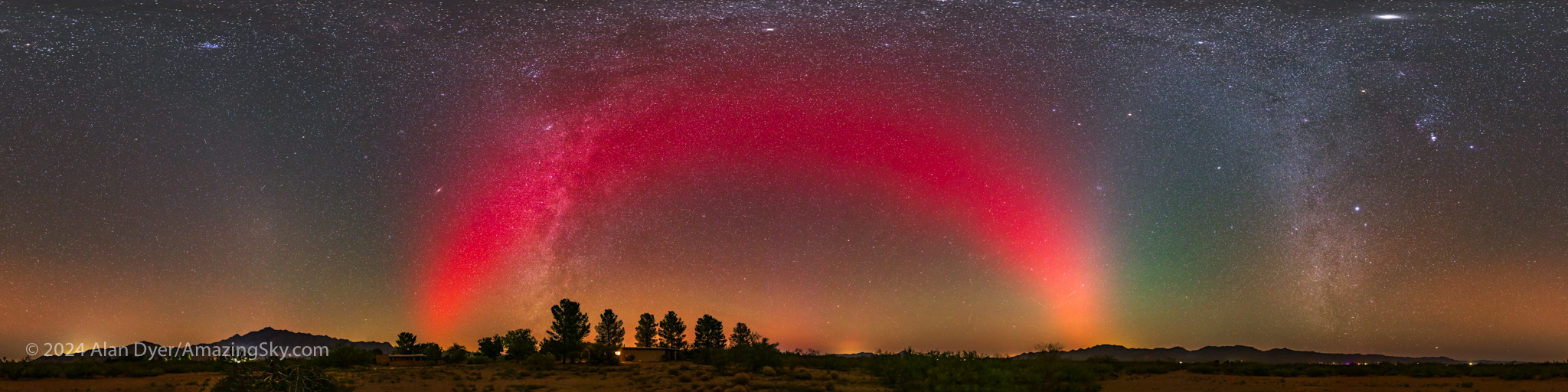
This 360° panorama captures a rare SAR (Stable Auroral Red) arc across the Arizona sky in the pre-dawn hours of October 11, 2024. The SAR arc was generated in the high atmosphere as part of the global geomagnetic storm of October 10/11, 2024, with a Kp8 rating that night.

But … just as a bonus, there was another fabulous aurora on October 10, seen in my case from the unique perspective of southern Arizona, with an appearance of a bright “SAR” arc more prominent than I had ever seen before. So that view was a rarity, too, so unusual it doesn’t even make our Aah! list, as SARs are typically not visible to the eye.


Back to Norway for Northern Lights

2024 was notable for travel getting “back to normal,” at least for me, with two long-distance drives, and now my second overseas trip. This one took me north to Norway 🇳🇴, which I had been visiting twice a year as an enrichment lecturer during pre-pandemic years. 
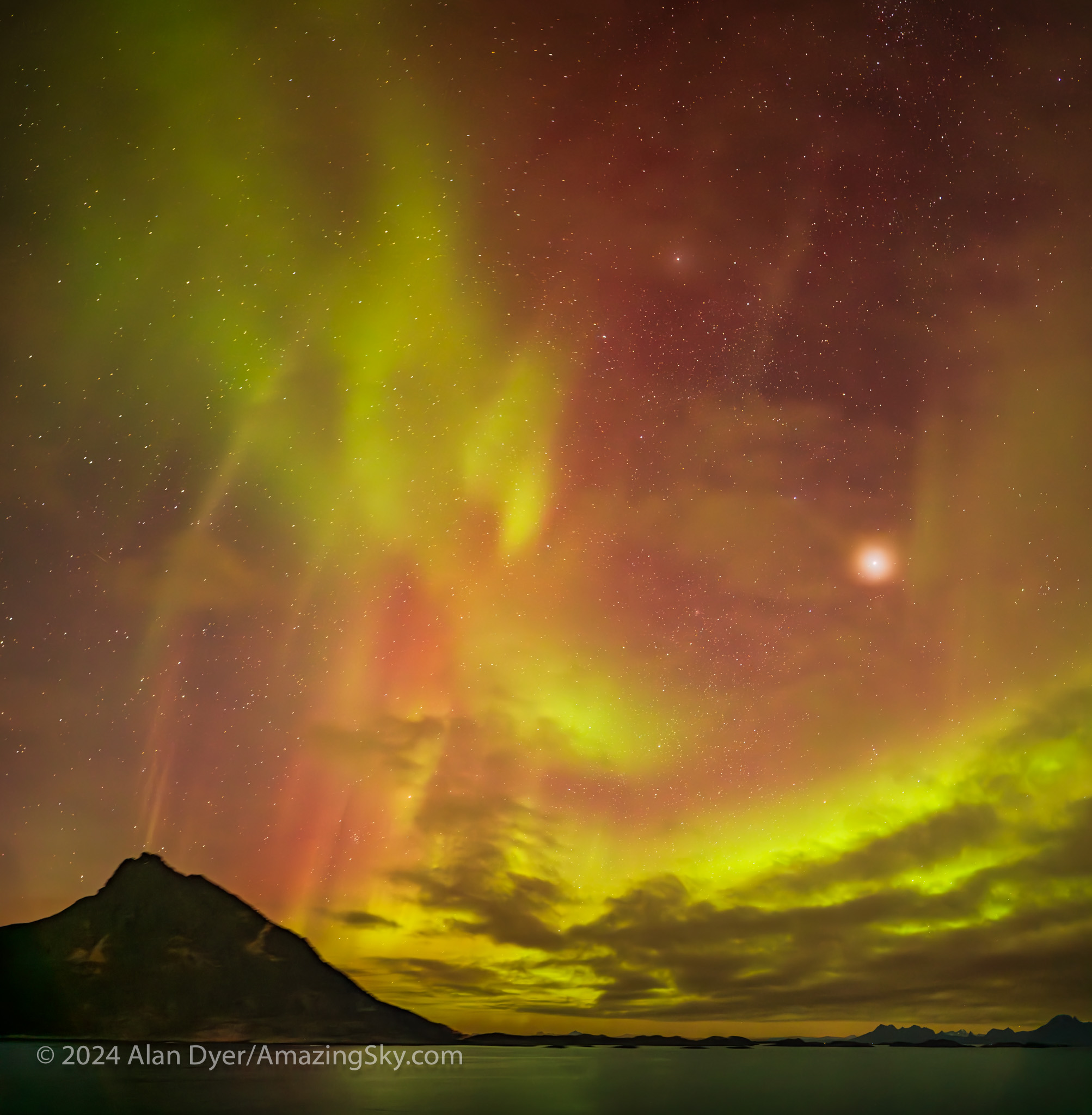
A green and red aurora appears over the coast of Norway, with Jupiter bright at right. This was from the Hurtigruten ship m/s Nordkapp on November 10, 2024, on a coastal cruise with a Road Scholar tour group.

The auroras were excellent, though nothing like the great shows of May and October. But the location sailing along the scenic coast and fjords makes up for any shortfall in the Lights. It was good to be back. I plan to return in 2025 for two cruises in October. Join me there, too!


A Winter Moonrise to End the Year

As I write this, December has been nothing but cloud. Almost. A clear hour on Full Moon night allowed a capture of the “Cold Moon,” with the Moon near Jupiter, then at its brightest for the year. So that’s the other lunar bookend to the year, shot from the snowy backyard. 
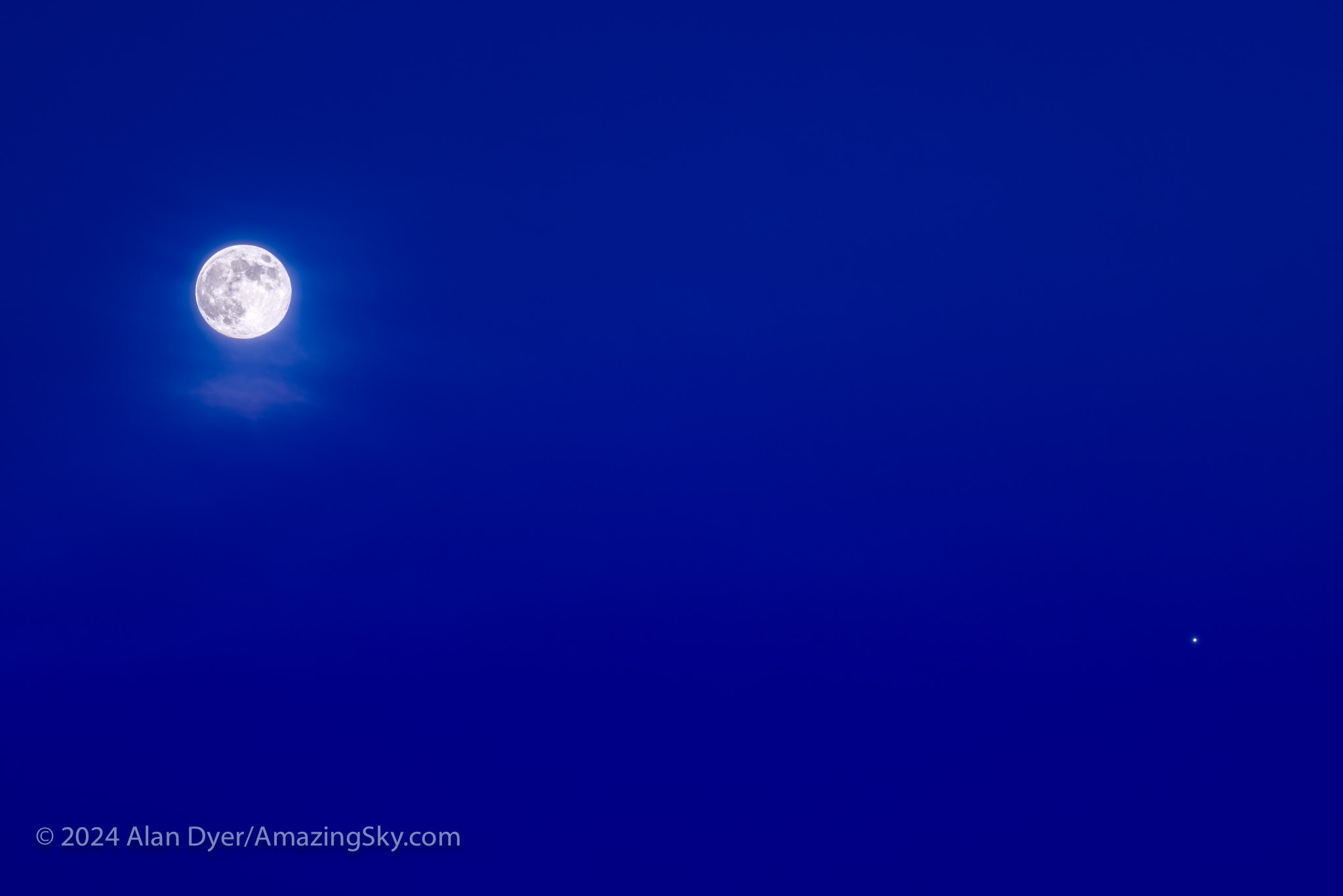
This is the Full Moon of December 14, 2024, near the planet Jupiter at lower right. Both were rising into the eastern sky in the early evening.

However, I did say after the clear total eclipse in April that if the rest of 2024 had been cloudy I wouldn’t complain. So I’m not. 

And there’s no reason to, as 2024 did deliver the best year of stargazing I can remember. 2017 had a total solar eclipse. 2020 had a great comet. But we have to go back to 2003 for aurora shows as widespread and as a brilliant as we’ve seen this year. 2024 had them all. And more!

We might see more auroras in 2025. And we have a total eclipse of the Moon. Two in fact, if you’re willing to travel to the other hemisphere. 
My 2025 Calendar cover. Go to https://www.amazingsky.com/Books

My 2025 Amazing Sky Calendar lists my picks for the best sky events of the coming year, with the emphasis on events viewable from North America. For a free PDF download of my Calendar, go to my website here

Clear skies to all, in a Happy New Year! 

— Alan, December 21, 2024 / amazingsky.com 
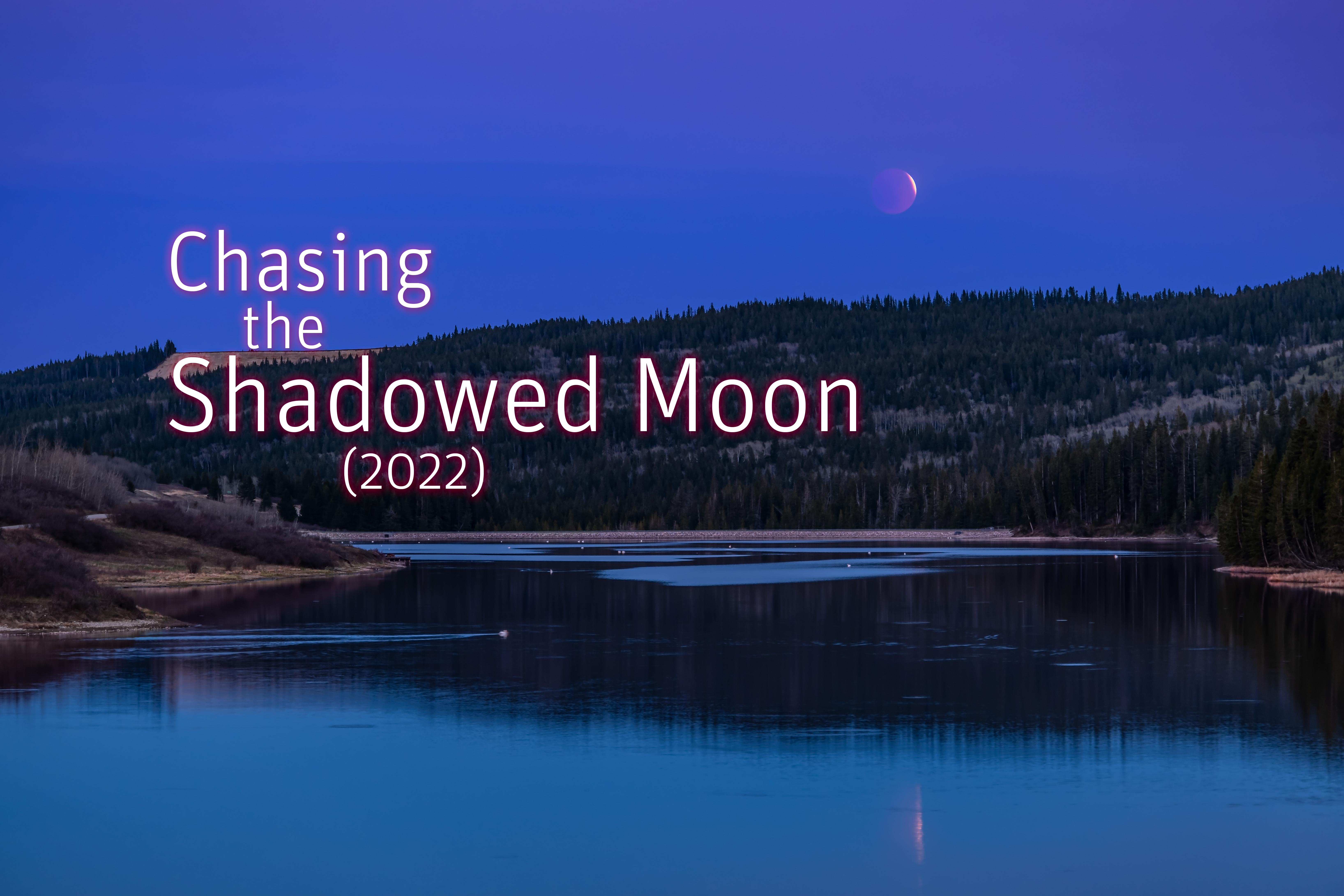
Chasing the Shadowed Moon (2022)


Once again, catching the eclipsed Moon required a chase to clear skies.

As with every previous eclipse of the Moon visible from my area in the last decade, I didn’t have the luxury of watching it from home, but had to chase to find clear skies.

(See my previous tales of the November 19, 2021 and May 26, 2021 eclipses.)

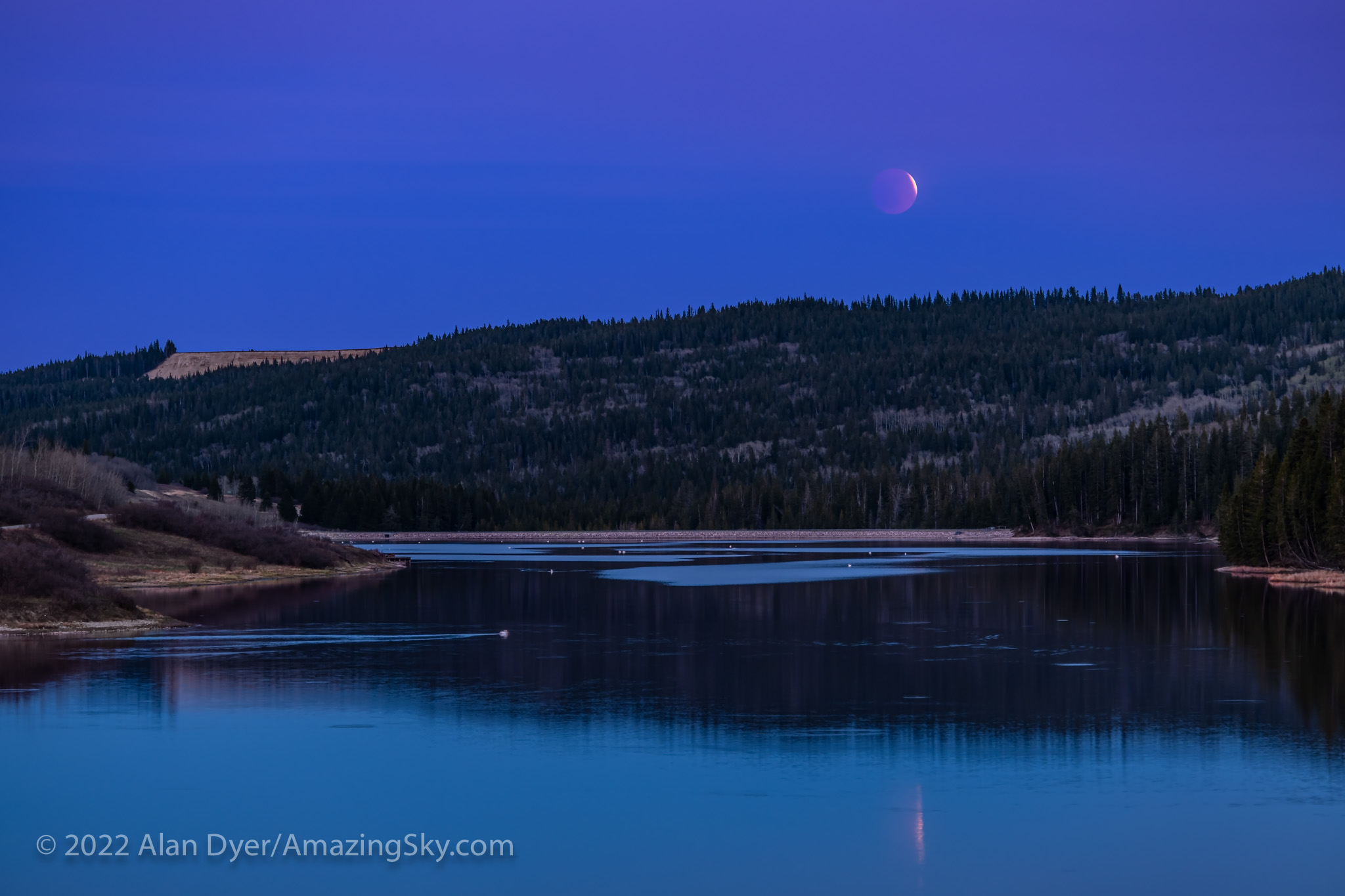
However, the reward was the sight of the reddened Moon from one of my favourite locations in Alberta, Reesor Lake, in Cypress Hills Interprovincial Park.

The eclipse in question was the total lunar eclipse of May 15/16, 2022. As with any eclipse, planning starts with a look at the weather forecasts, or more specifically cloud forecasts.

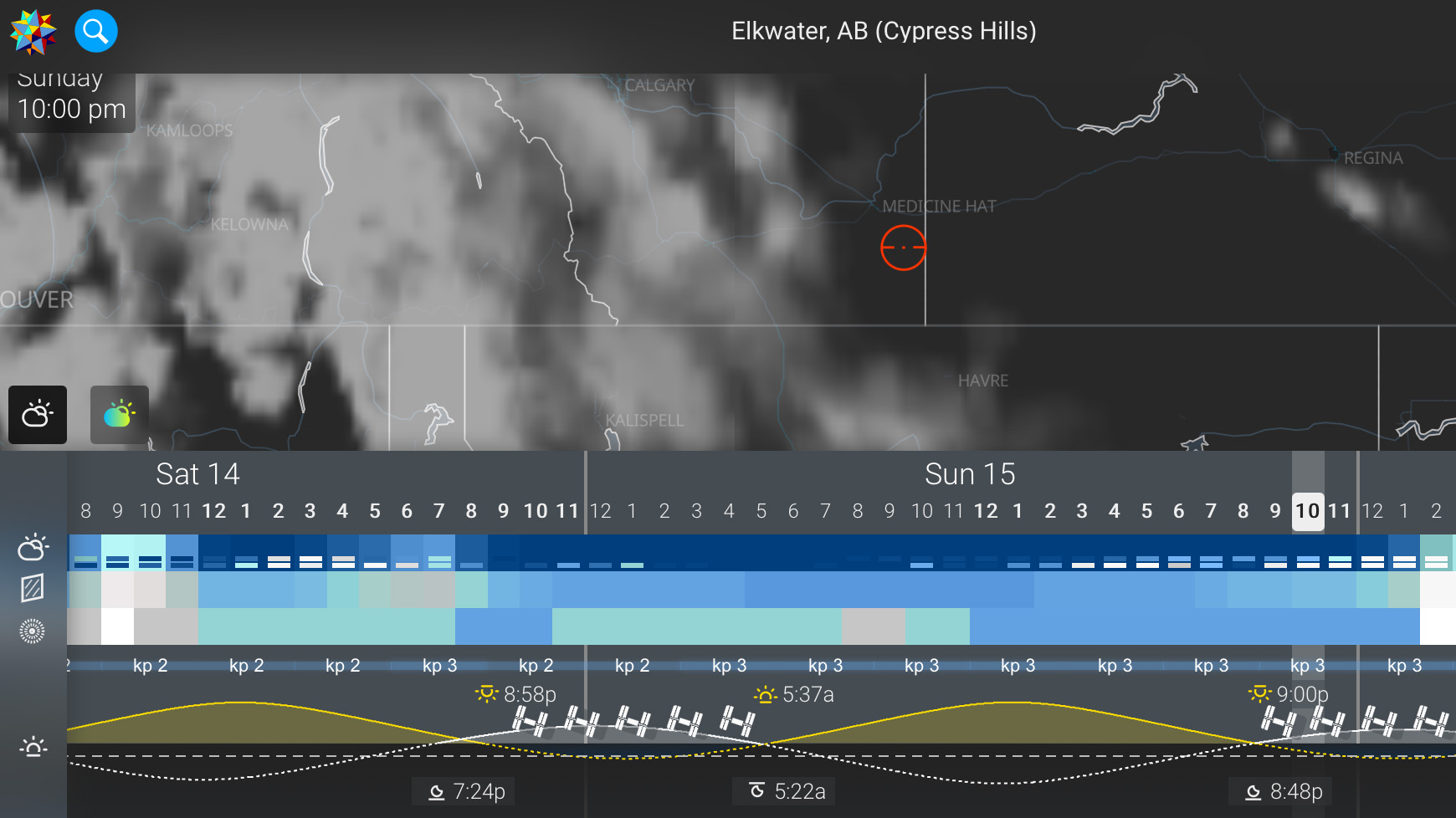
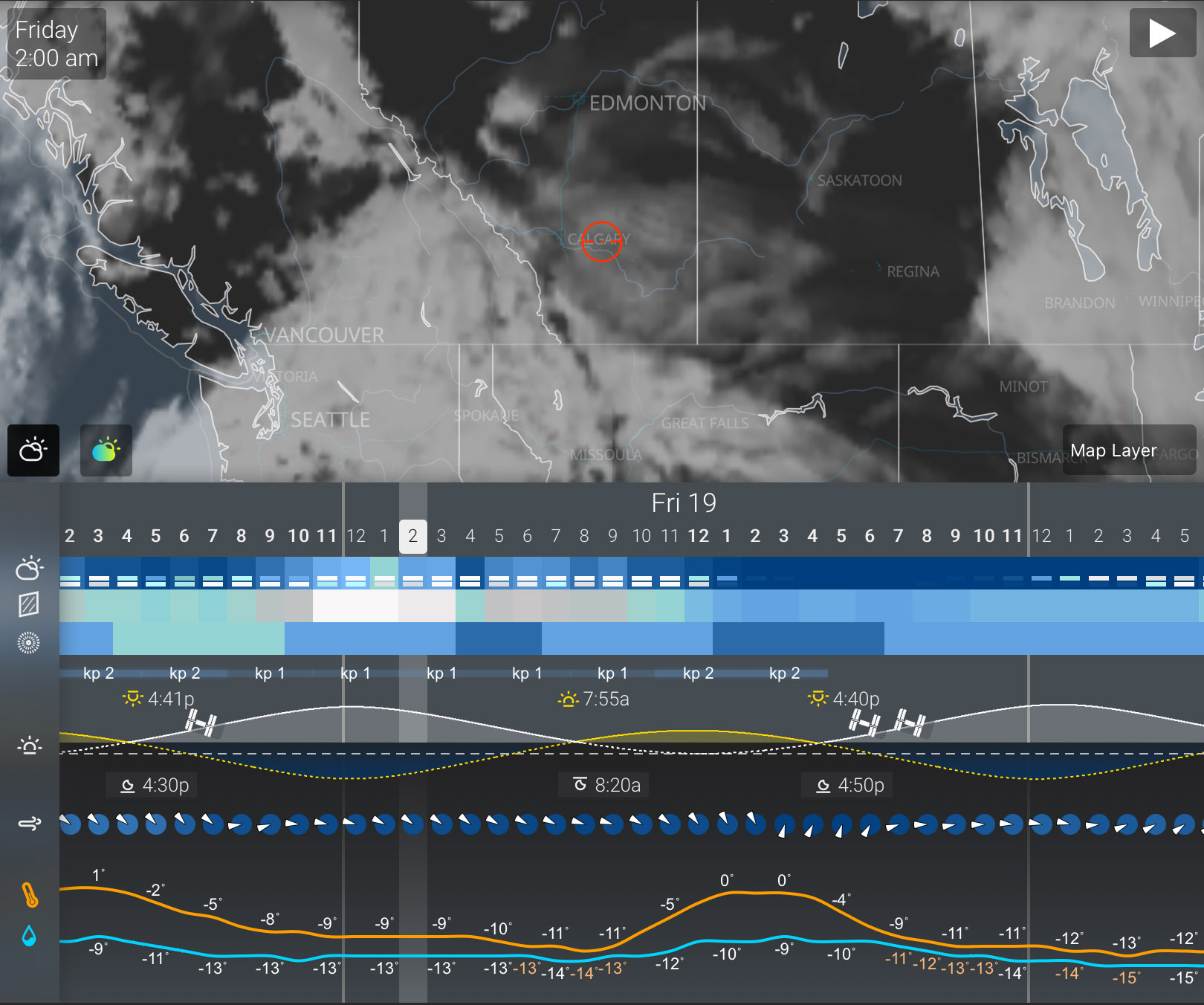
A few days prior, conditions didn’t look good from my home, to the west of the red marker.

Cloud forecast two days prior.

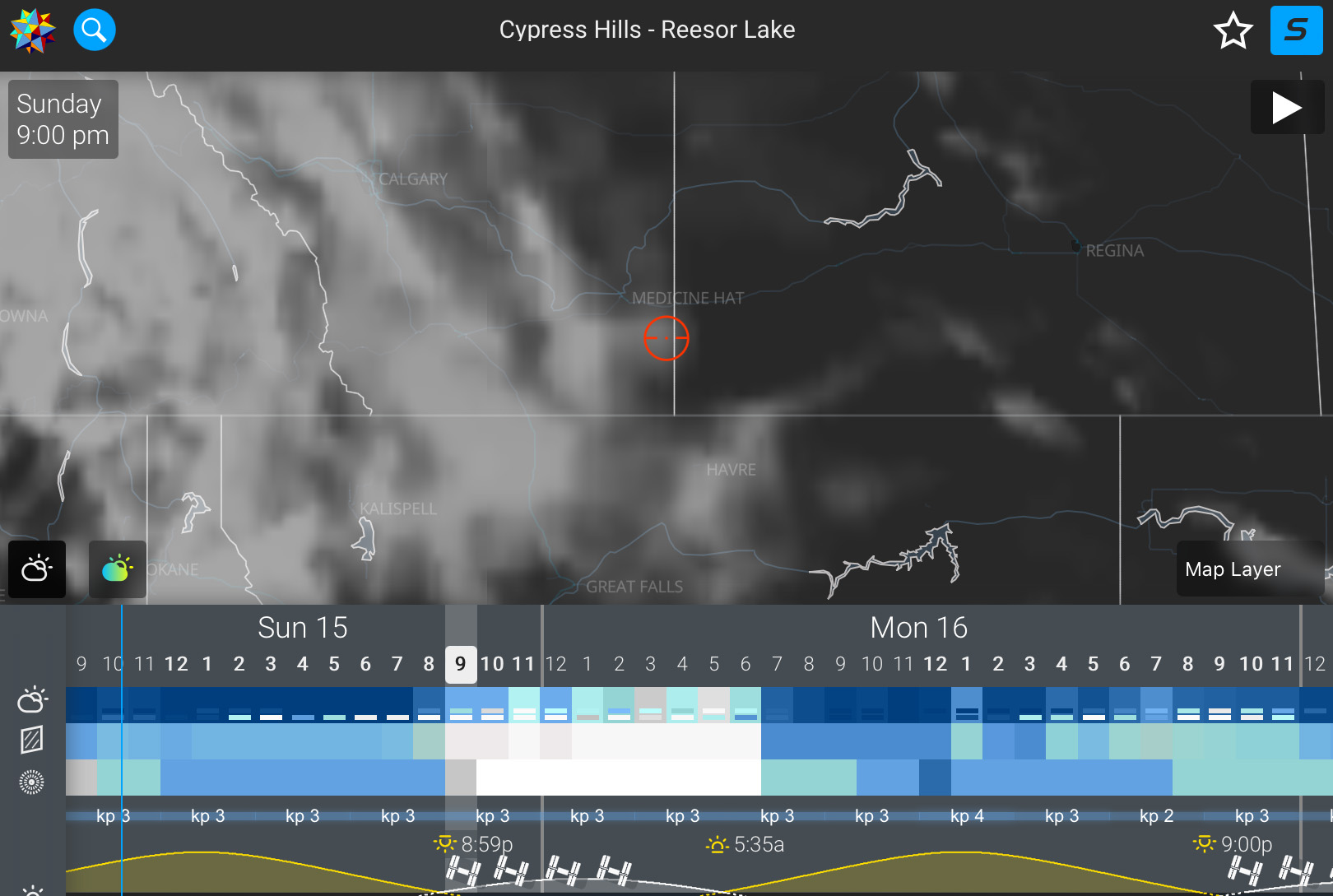
But as the chart from the app Astrospheric shows, very clear skies were forecast for southeast Alberta, in the Cypress Hills area, where I have shot many times before.

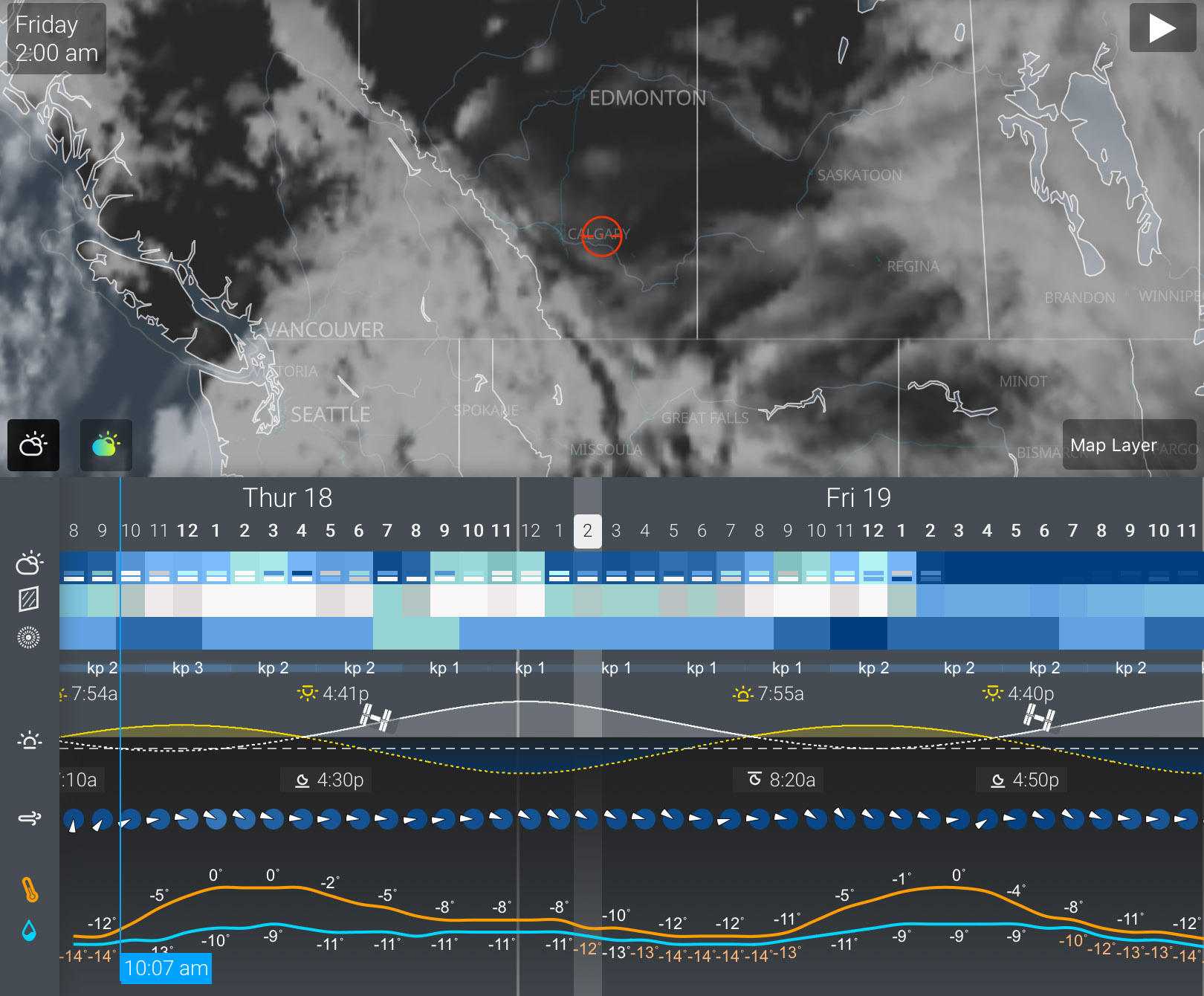
Except as eclipse evening drew closer, the forecast got worse. Now, the clouds were going to extend to my chosen site, with a particularly annoying tongue of cloud right over my spot. Clouds were going to move in just as the total eclipse began. Of course!

Cloud forecast the morning of the eclipse.

I decided to go for it anyway, as the Moon would be to the east, in the direction of the clear skies. It didn’t need to be clear overhead. Nor did I want to drive any farther than I really needed, especially to another location with an unknown foreground.

The spot I chose was one I knew well, on the west shore of scenic Reesor Lake, near the Alberta/Saskatchewan border, but on the Alberta side of Cypress Hills Interprovincial Park.

I used the app The Photographer’s Ephemeris (TPE) to help plan the shoot, to ensure the Moon would be well situated over the lake.

A screen shot from TPE

Handily, TPE provides moonrise times and angles for the chosen location, as well as eclipse times for that time zone.

The companion app, TPE 3D, provides a preview of the scene in 3D relief, with the hills depicted, as a check on Moon altitude and azimuth with respect to the horizon below.

TPE 3D’s simulation

As you can see the simulation matched reality quite well, though the image below was from an earlier time than the simulation, which was for well after mid-totality.

The eclipse over Reesor Lake, in the last stages of the partial eclipse.

However, true to the predictions, clouds were moving in from the west all during the eclipse, to eventually obscure the Moon just as it entered totality and became very dim. Between the clouds and the dark, red Moon, I lost sight of it at totality. As expected!

Below is my last sighting, just before totality began.

The eclipsed Full Moon rising over Reesor Lake in Cypress Hills Interprovincial Park, Alberta, on May 15, 2022.

However, I was content at having captured the eclipse from a photogenic site. More images of a complete eclipse would have been nice, but alas! I still consider the chase a success.

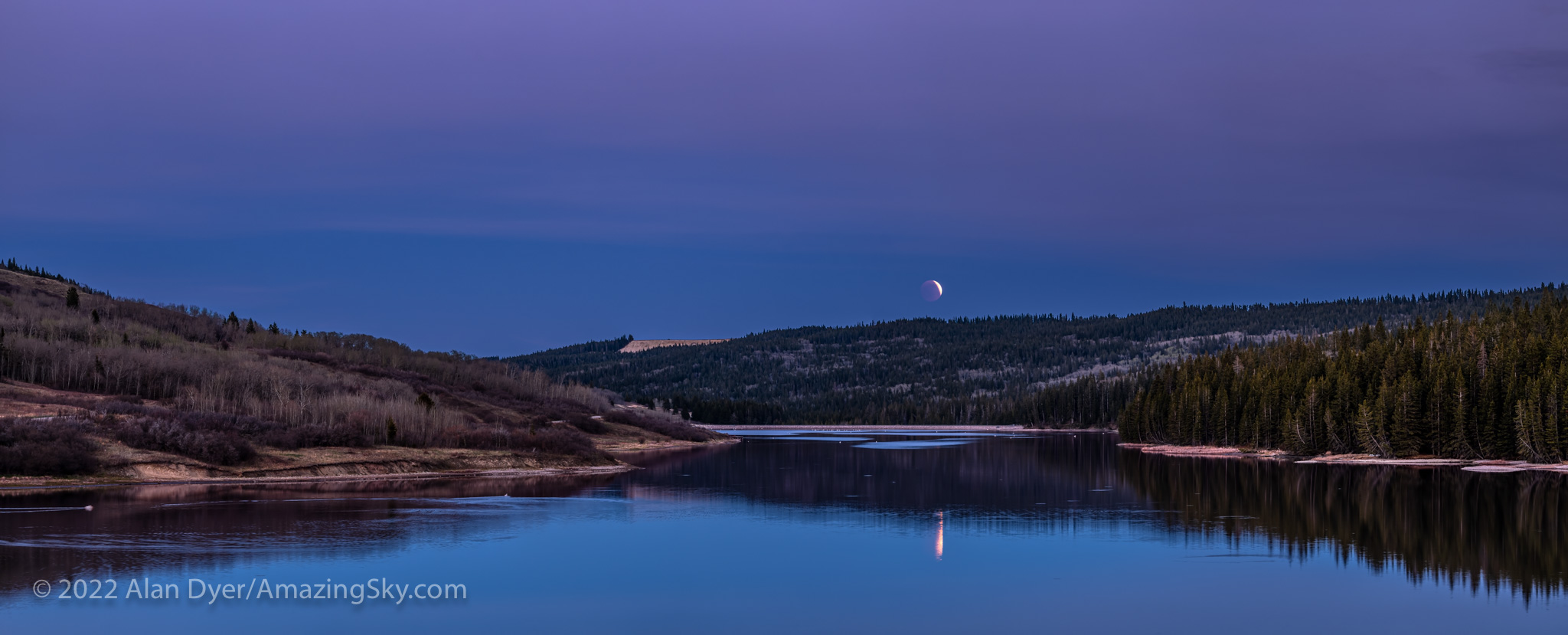
A panorama of the eclipsed Full Moon rising over Reesor Lake in Cypress Hills Interprovincial Park, Alberta, on May 15, 2022.

Just for fun, I shot a quick panorama of three segments, and it turned out to be my favourite image from the eclipse, capturing the scene very well. Pelicans and geese were plying the calm waters of the lake. And owls were hooting in the woods. It was a fabulous evening!

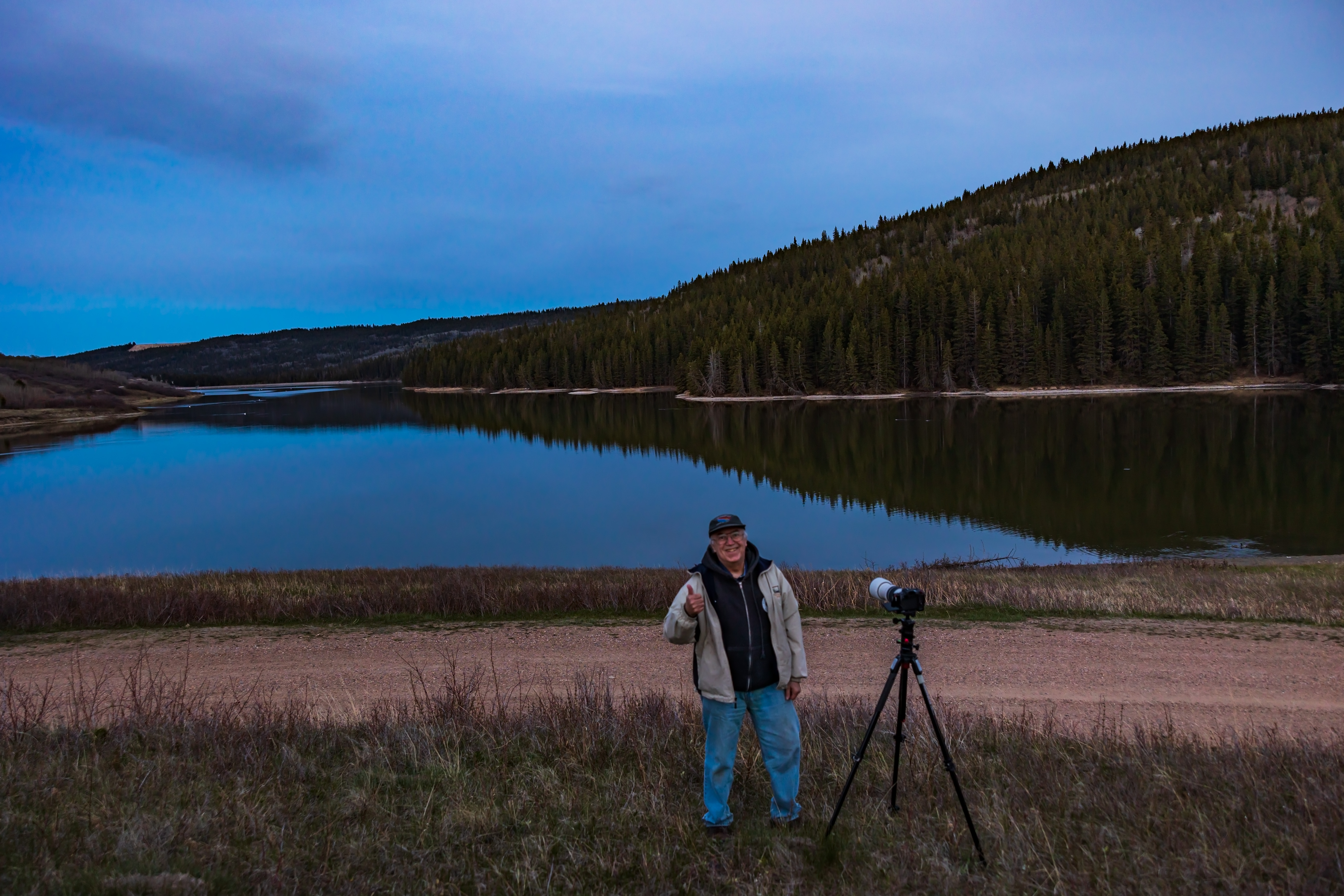
Me at Reesor Lake after shooting the lunar eclipse of May 15, 2022, with the Moon now in clouds behind me.

Before departing, I took my customary “trophy” shot, of the eclipse hunter having bagged his game.


Interestingly, this eclipse was a close repeat of one 19 years earlier to the day, because of the so-called Metonic Cycle where eclipses of the Sun and Moon repeat at 19-year intervals on the same calendar day, at least for 2 or 3 cycles.

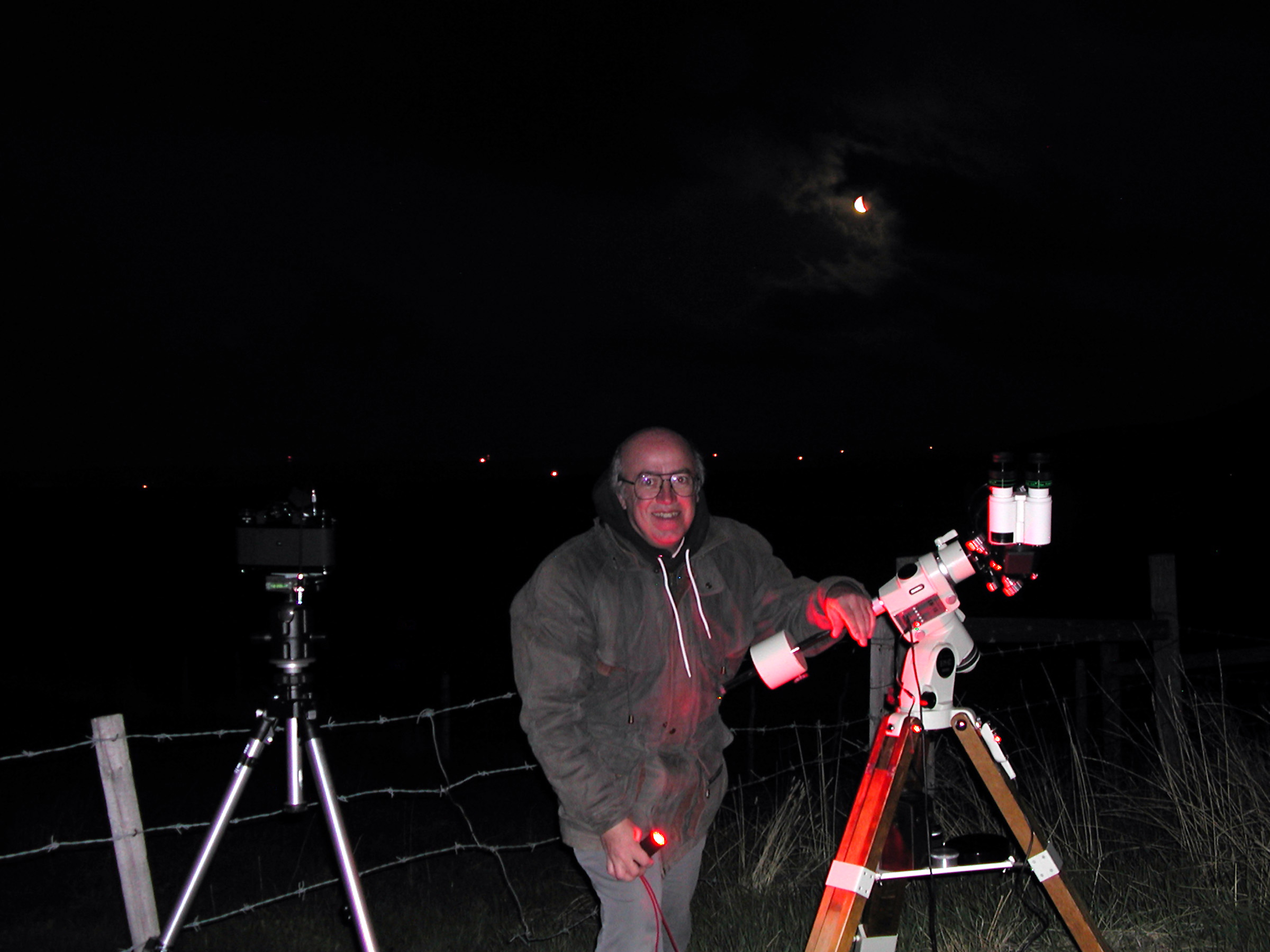
The trophy shot from May 15, 2003.

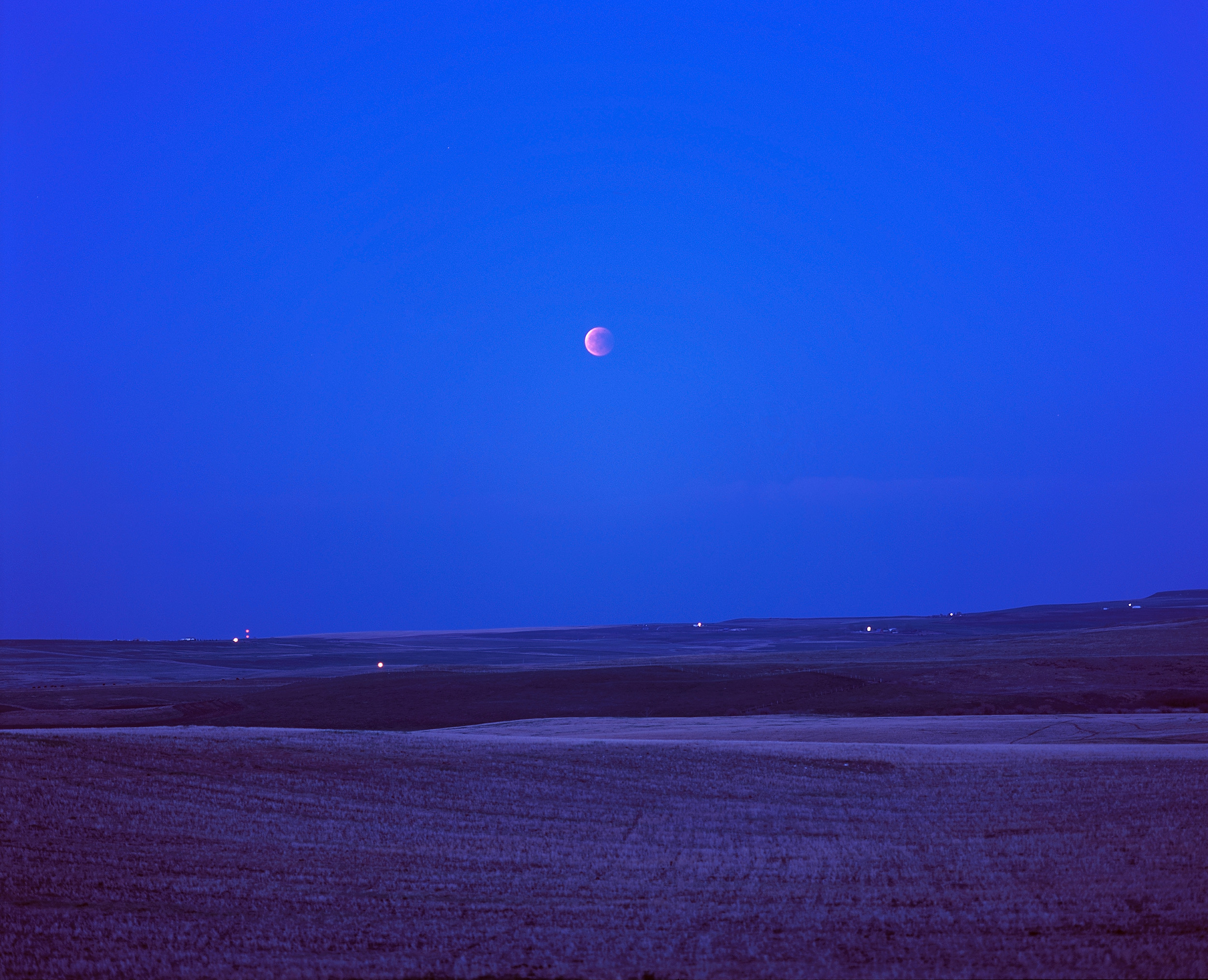
On May 15, 2003, we also had a total lunar eclipse in the early evening, with the eclipsed Moon rising into a spring twilight sky. I also chased clear skies for that one, but in the opposite direction from home, to the southwest, to the foothills. At that time it was all film, and medium format at that.

Total eclipse of the Moon seen May 15, 2003 from southern Alberta (from a site west of Nanton). The Moon rose as totality started so was deep into totality by the time it was high enough to see and sky dark enough to make it stand out. Pentax 67 camera with 165mm lens at f/2.8 with Fujichrome 100F slide film.

So it was another (partially!) successful eclipse chase.

The next opportunity is on the night of November 7/8, 2022, a time of year not known for clear skies!

Just once I would like to see one from home, to make it easier to shoot with various telescopes and trackers, as the reddened Moon will be west of the photogenic winter Milky Way, and very close to the planet Uranus. Plus for me in Alberta the November eclipse occurs in the middle of the night, making a home eclipse much more convenient. After that, the next chance is March 13/14, 2025.

But no matter the eclipse, I suspect another chase will be in order! It just wouldn’t be a lunar eclipse without one.

— Alan, May 19, 2022 (amazingsky.com)


Chasing the Earth-Shadowed Moon (Again!)


A selfie of the successful eclipse hunter having bagged his game, on the morning of November 19, 2021.

It’s been over 10 years since I’ve last had the luxury of observing an eclipse of the Moon from the comfort of home. Once again, a chase was needed.

During the post-midnight wee morning hours, the Moon was set to once again pass through the Earth’s shadow, this time presenting us with a deep partial eclipse, with 97% of the Full Moon’s disk immersed in the umbra and deep red.

We had another lunar eclipse in 2021, six lunar cycles earlier on May 26, an eclipse that was barely total and, for me, positioned low in the southwest at dawn. I chased that eclipse north to Rocky Mountain House, Alberta, to find clear skies on eclipse morning.

A composite “time-lapse” blend of the setting Full Moon entering the Earth’s umbral shadow on the morning of May 26, 2021.

Every lunar eclipse I’ve seen from Alberta since December 2010 I’ve had to chase to find clear skies. While the chases were all successful, this time I was hoping to stay home and enjoy the eclipse without a long drive to seek clear skies, and to then employ a telescope to shoot the Moon in close-up. In the days before the eclipse, the forecasts changed daily.

On the day before the eclipse, things looked bad, with high clouds forecast for home.

The Environment Canada forecast for eclipse time at 2 am Nov 19, as of the afternoon of Nov. 17.

It looked like a trip to north-central Alberta was warranted, perhaps to Wainwright. But rather than book a motel, I decided to wait to see if the forecast might improve. And sure enough it did.

The Environment Canada forecast for eclipse time at 2 am Nov 19, as of the morning of Nov. 18, eclipse day!

By the morning of eclipse day, prospect for clear skies from home looked better Or perhaps a short drive east would suffice. With luck!

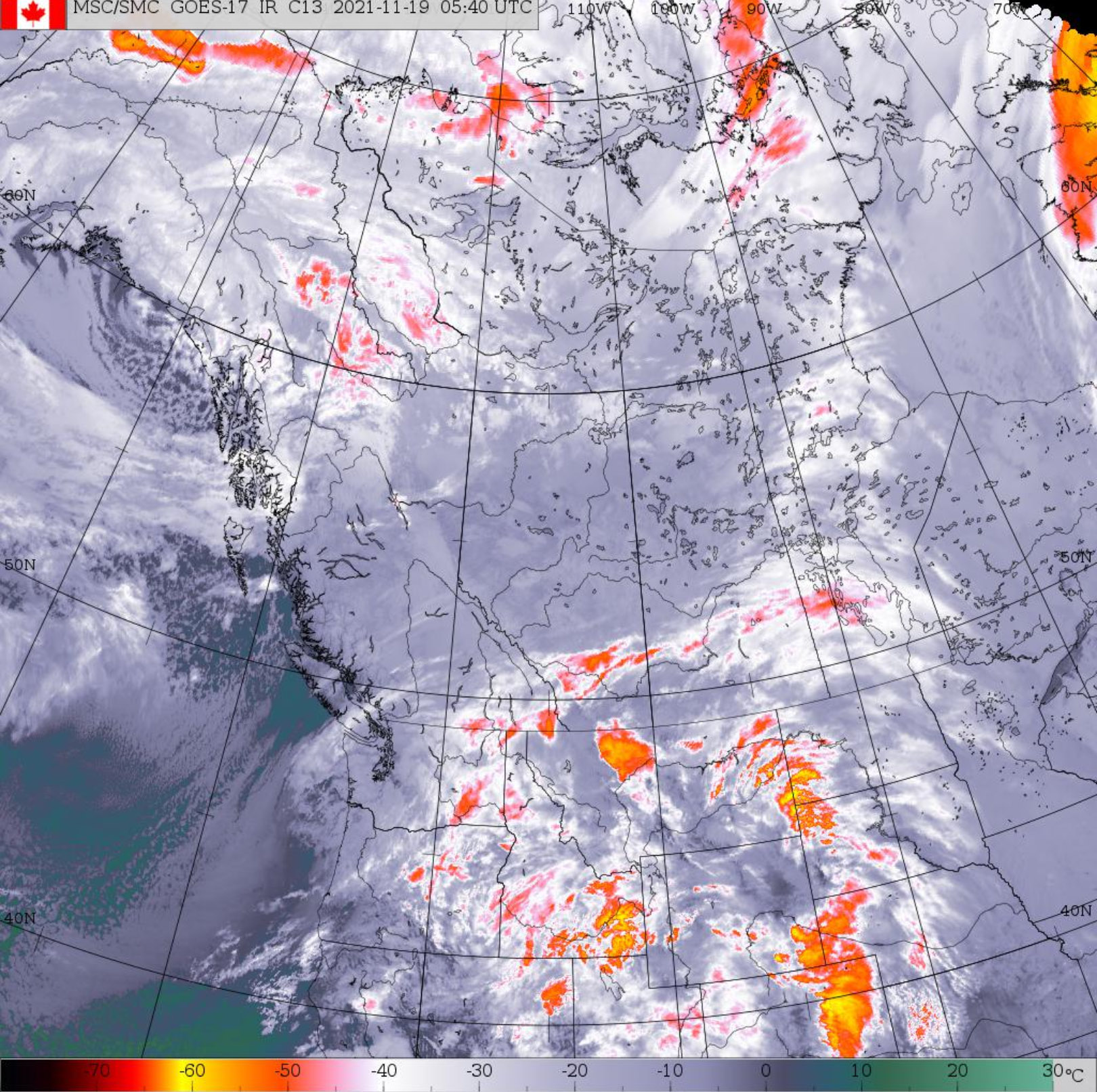
But by the evening of the eclipse, clouds were not cooperating. The actual views from satellites showed lots of cloud over my area (as the view out the door confirmed!), and it didn’t look like the clouds were going away.

Satellite view eclipse evening, with my area in Alberta at centre.

But as the previous forecasts called for, clear skies were to be found to the north. So at 11:30 pm, with the eclipse starting in less than an hour, I packed up the car and headed north to as far as I could get — and hopefully as far as I need to get — to be assured of clear skies.

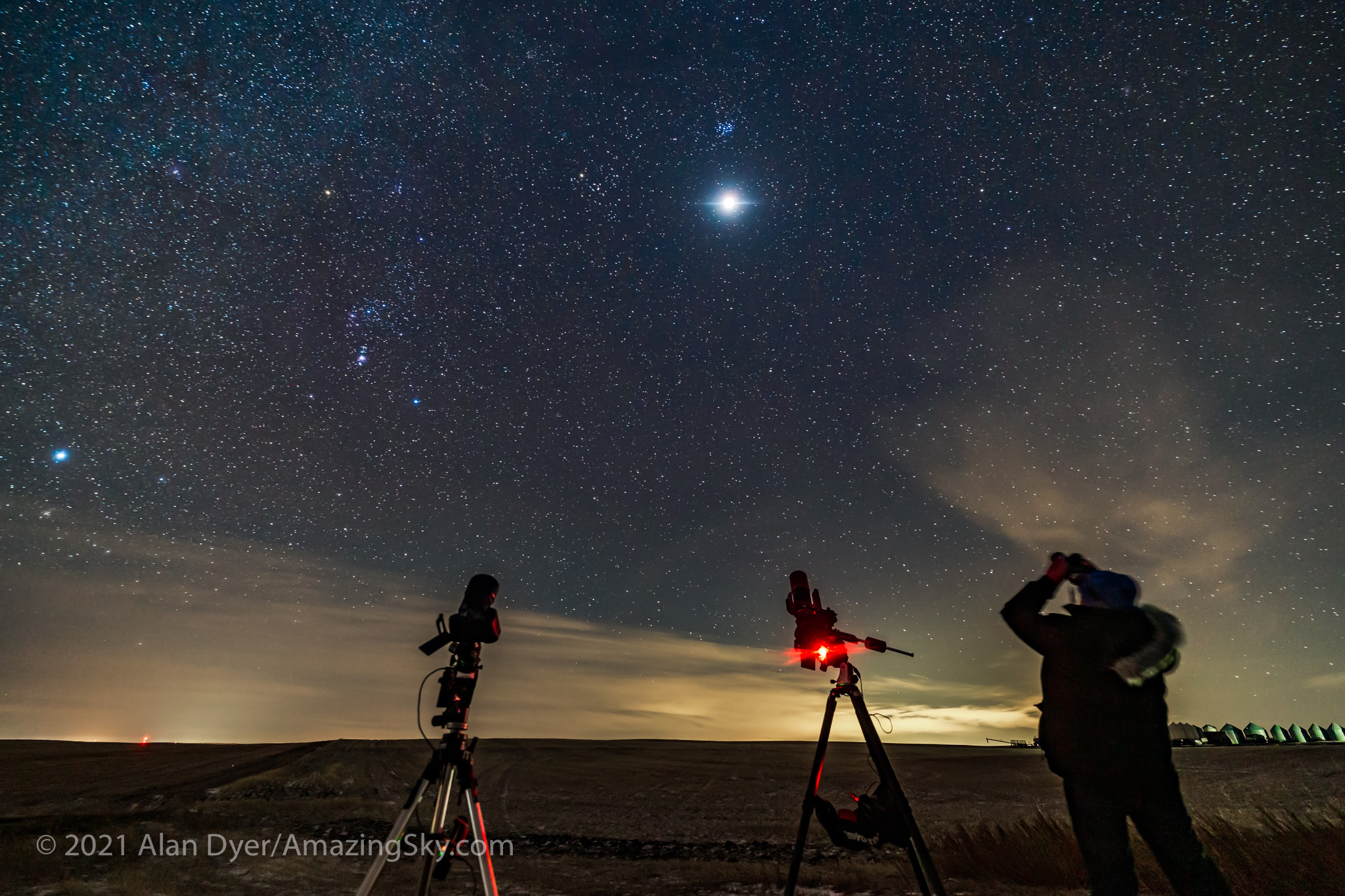
A selfie of the successful eclipse hunter observing the eclipse of the Moon, on the morning of November 19, 2021.

It worked! The eclipse was well underway as I made my way north, stopping to check its progress and the state of the clouds. As expected, about 90 minutes north I drove out from under the clouds you can see to the south in the photo above, where I had come from.

I chose a side road and pull off near Rowley, Alberta. I had enough time to set up three cameras, two on polar-aligned trackers to take longer, wide-field images of the Moon amid the stars, plus the static camera for the selfies.

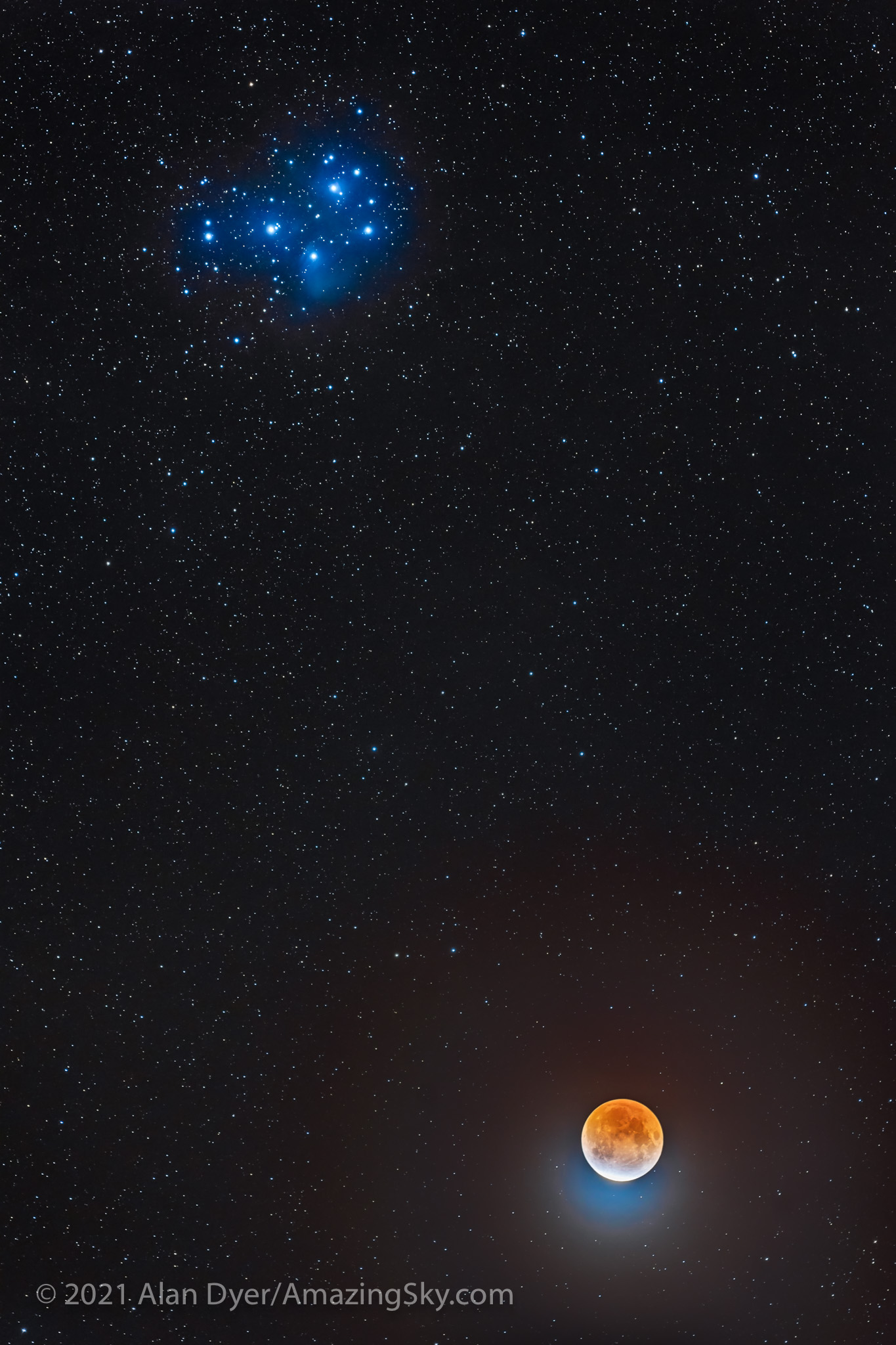
The deep partial eclipse of the Moon of November 19, 2021, with the reddened Moon below the Pleiades star cluster, M45, in Taurus, the hallmark feature of this eclipse which at maximum at 2:03 am MST (about 8 minutes after this sequence was taken at 1:55 am MST) was 97% partial, so not quite total. This is a stack of 2 x 30-second exposures at ISO 3200 for the base sky, blended with 30s, 8s, 2s, and 0.6s exposures at ISO 800, all with the Canon EOS R6 camera on the William Optics RedCat astrograph at f/4.9, and on the Sky-Watcher Star Adventurer tracker at the sidereal rate.

The red Moon below the blue Pleiades was the unique sight at this eclipse. It can only happen if an eclipse occurs in mid-November and that won’t happen for another 19 years, on November 18, 2040, in a total eclipse visible only from the eastern hemisphere.

After some mid-eclipse equipment woes — a tracker deciding to come loose from the tripod, and a lens that refused to focus — I also took some wider shots of the Moon among the stars of Taurus.

This is a stack of 2 x 30-second exposures at ISO 1600 for the base sky, blended with 10s, 4s, 1s, and 0.3s exposures at ISO 800, all with the Canon EOS Ra camera and Canon RF28-70mm lens at f/2.8 and on the Sky-Watcher Star Adventurer Mini tracker.

Despite writing an extensive blog on how to shoot this eclipse, it did prove to be more of a challenge than I had anticipated. The portion of the Moon outside the umbra, even at mid-eclipse, remained very bright, and overexposed and flared in the frames with long enough shutter speeds to record the stars. A full total eclipse is easier to shoot!

This is a stack of 2 x 30-second exposures at ISO 3200 for the base sky, blended with 15s, 4s, 1s, and 0.25s exposures at ISO 400, all with the Canon EOS R6 camera and Canon RF28-70mm lens at 28mm and f/2.8 and on the Sky-Watcher Star Adventurer Mini tracker.

However, I can count this eclipse chase as a success. Of all the total (or near total in this case) lunar eclipses visible from my area of the world since 2001, I’ve seen them all. But almost all required a chase.

Will that be the case next year? We have two total lunar eclipses in 2022: on May 15 (with the Moon rising at eclipse time as seen from here in Alberta), and again six lunar cycles later on the morning of November 8, 2022, which is 12 lunar cycles after this most recent eclipse. We are in the middle of a nice run of 4 lunar eclipses, three total and one near-total.

I suspect I will be chasing both of those!

— Alan, November 20, 2021 (AmazingSky.com)

The Moon in June


On one of the few clear nights of late I took the opportunity to shoot the Moon. It’s a familiar subject to be sure, but one I don’t shoot very often. Pity really, as it is rich in detail and makes for dramatic photos.

I took this shot June 12, about 4 days before the Full Moon of June, so this is a waxing gibbous Moon. Lots of terrain (lunain?) shows up at left along the terminator, including the wonderful semi-circular bay at about 10 o’clock called Sinus Iridum. At the bottom is the bright Tycho crater, with its distinctive splash of rays spreading out across most of globe. Imagine the devastating impact that caused that feature! It isn’t that old either — estimates suggest Tycho is just 100 million years old, putting its formation smack dab in the middle of the Cretaceous Period when dinosaurs ruled the Earth. They would have seen that impact, little knowing another similar-sized impact 35 million years hence, but aimed at Earth, would do them in.

For this shot I used the Astro-Physics 130mm apo refractor with a 2x Barlow lens to increase the effective focal length to 1600mm, a combo that exactly fills the frame of the Canon 7D with no room to spare. I processed this image for high contrast, to bring out the subtle tonal and colour variations in the dark lunar seas, an effect due to different mineral content of the lava that oozed out forming the lunar plains. Judicious use of Highlight Recovery (in Camera Raw) and Shadows and Highlights (in Photoshop) brings out the detail across a subject with a huge dynamic range in brightness. A liberal application of Smart Sharpening also helps snap up detail.

— Alan, June 18, 2011 / Image © Alan Dyer 2011