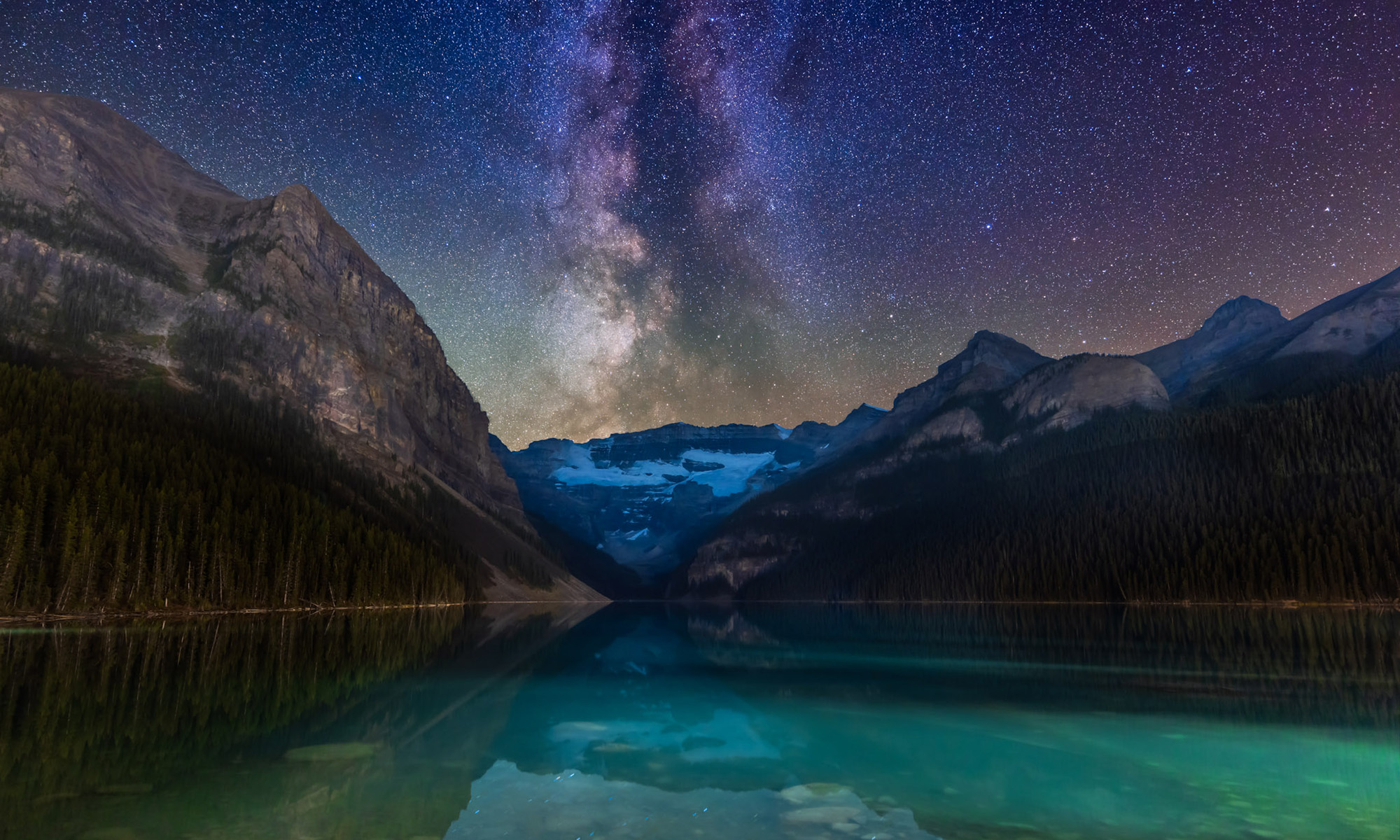
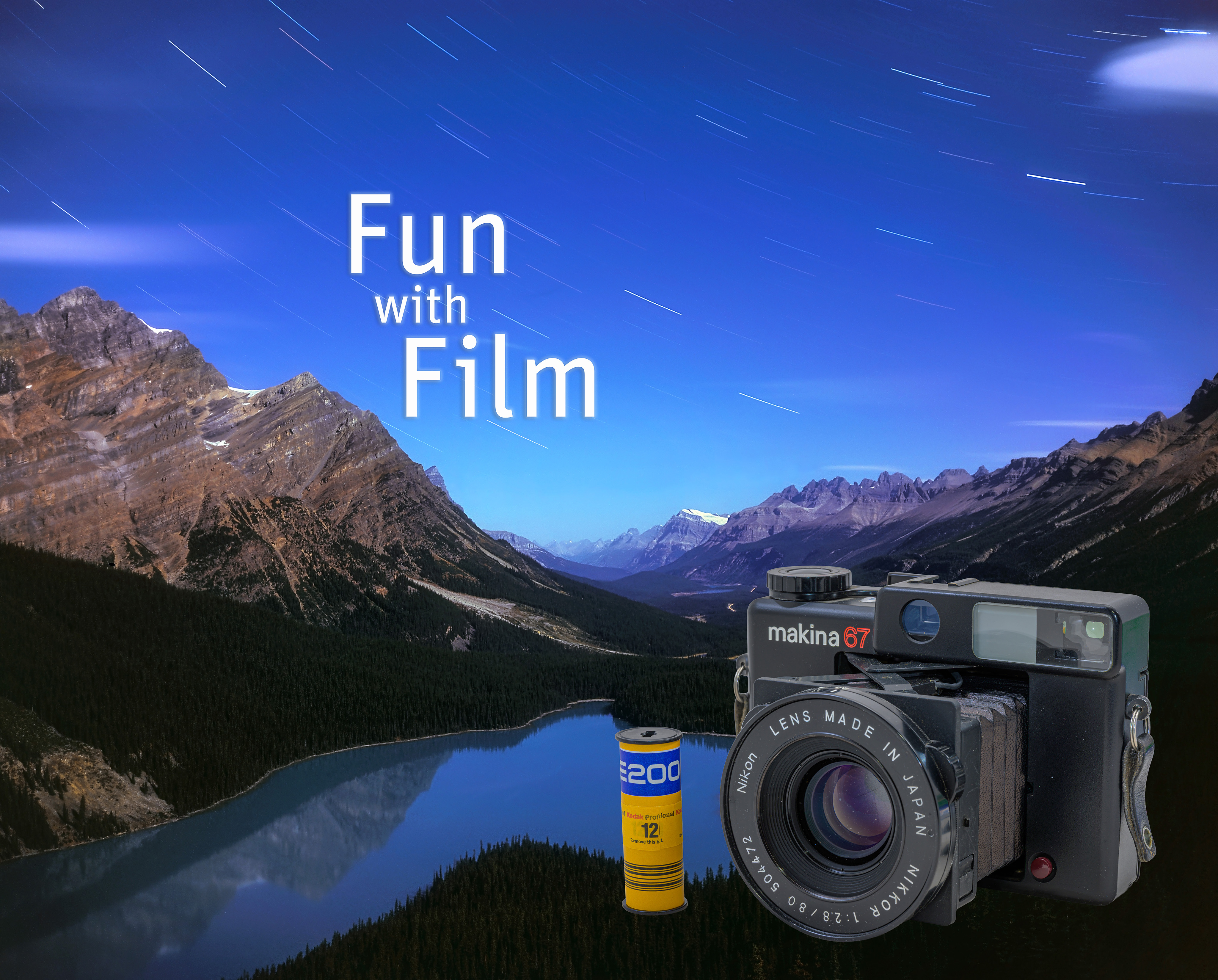
I take a nostalgic look back at what could be done in nightscape photography with the “analogue” technology of film – and in medium-format.
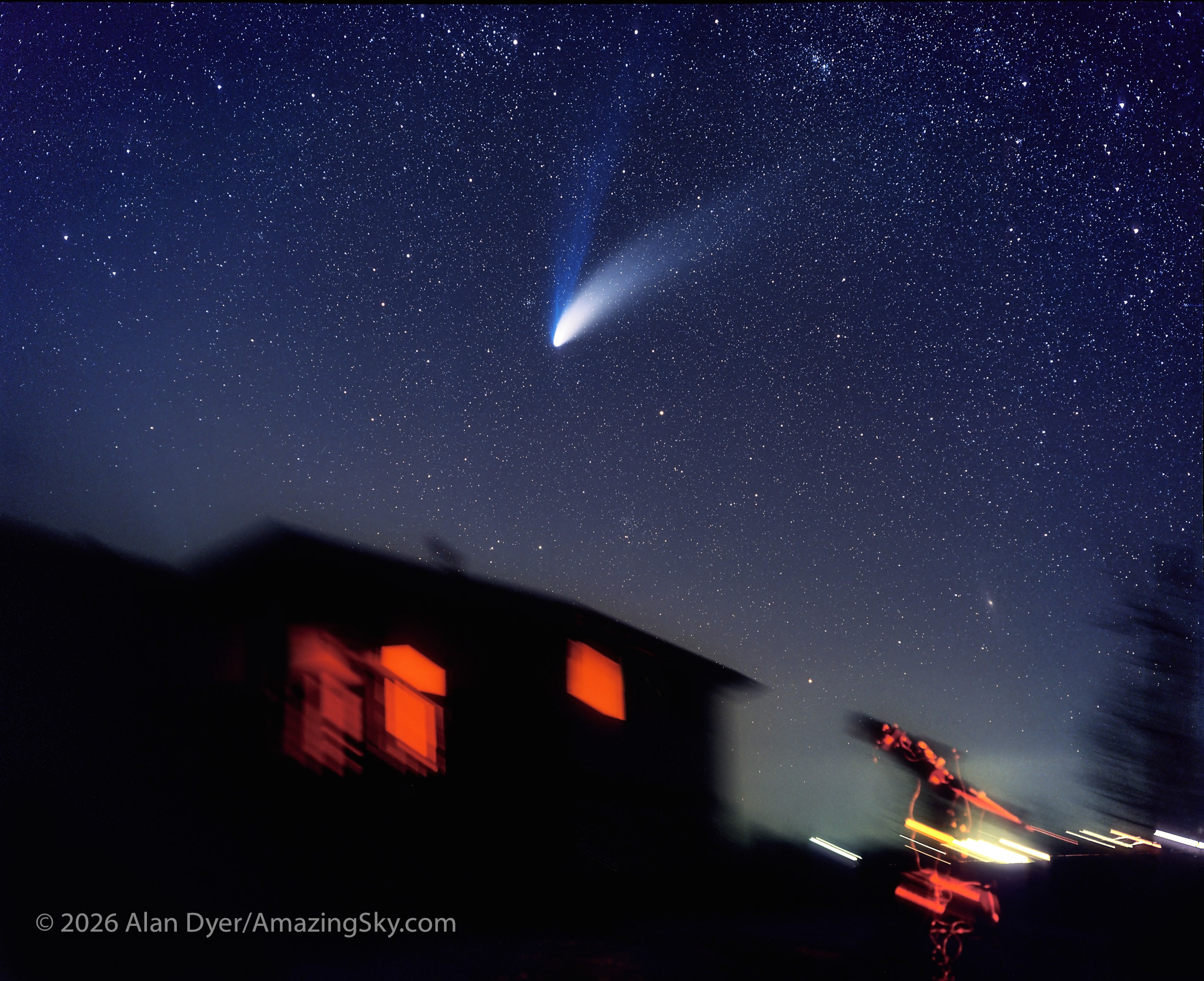
Ah! Those were the good old days – and nights – shooting with film. The occasion of the 30th anniversary of the great Comet Hyakutake in March 1996 prompted me to revisit my old film shots of that comet, and of Comet Hale-Bopp a year later in April 1997, as below.
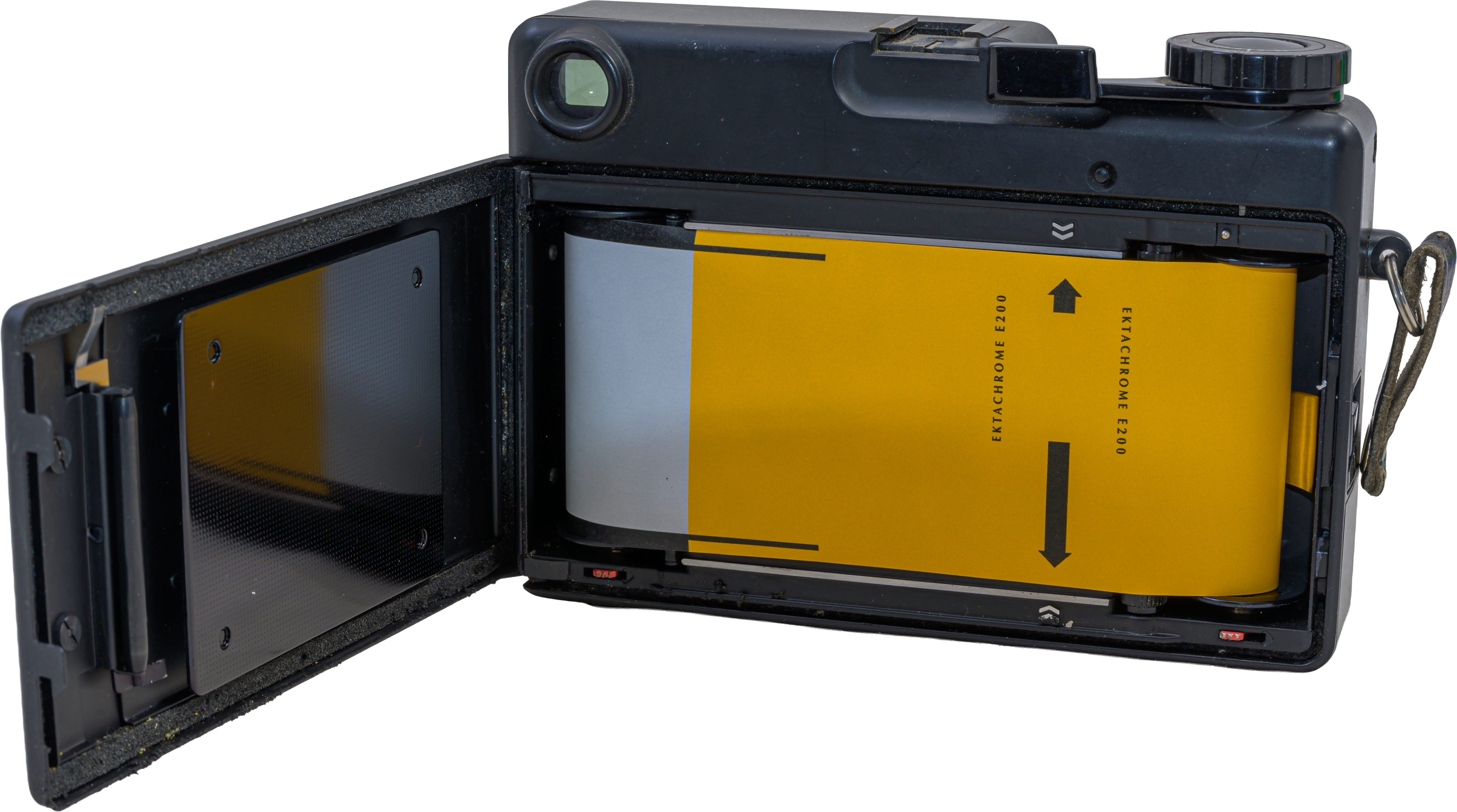
In this case, all the photos I present here (with one exception) I shot with the rather rare, and as it turns out collectible medium-format camera, the Plaubel Makina 67. It used 120- or 220-format film which, for this camera, yielded images 60mm by 70mm in size, larger than today’s “medium-format” digital camera sensors. I scanned all the negatives or positive slides with a Nikon 8000 film scanner.
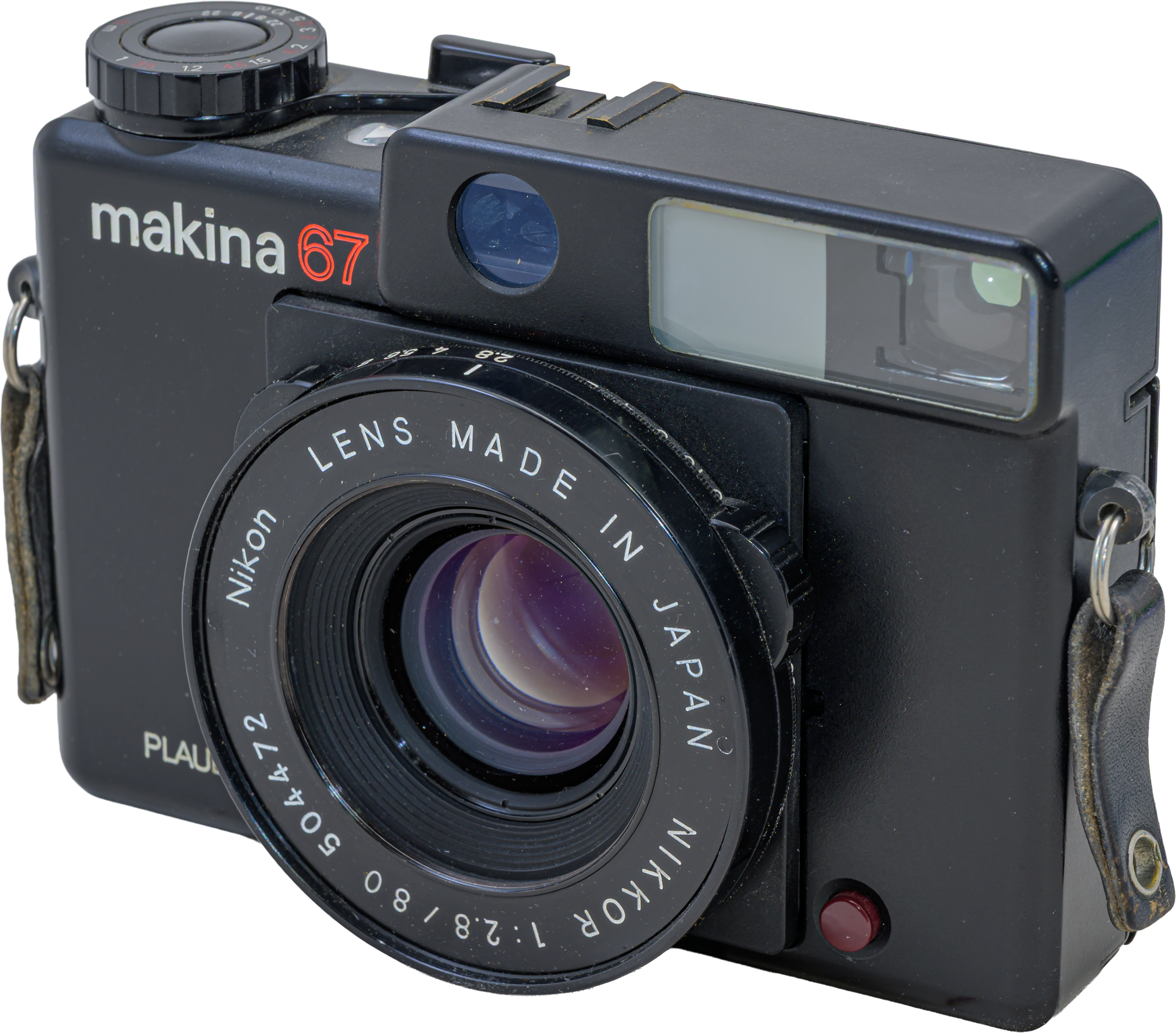
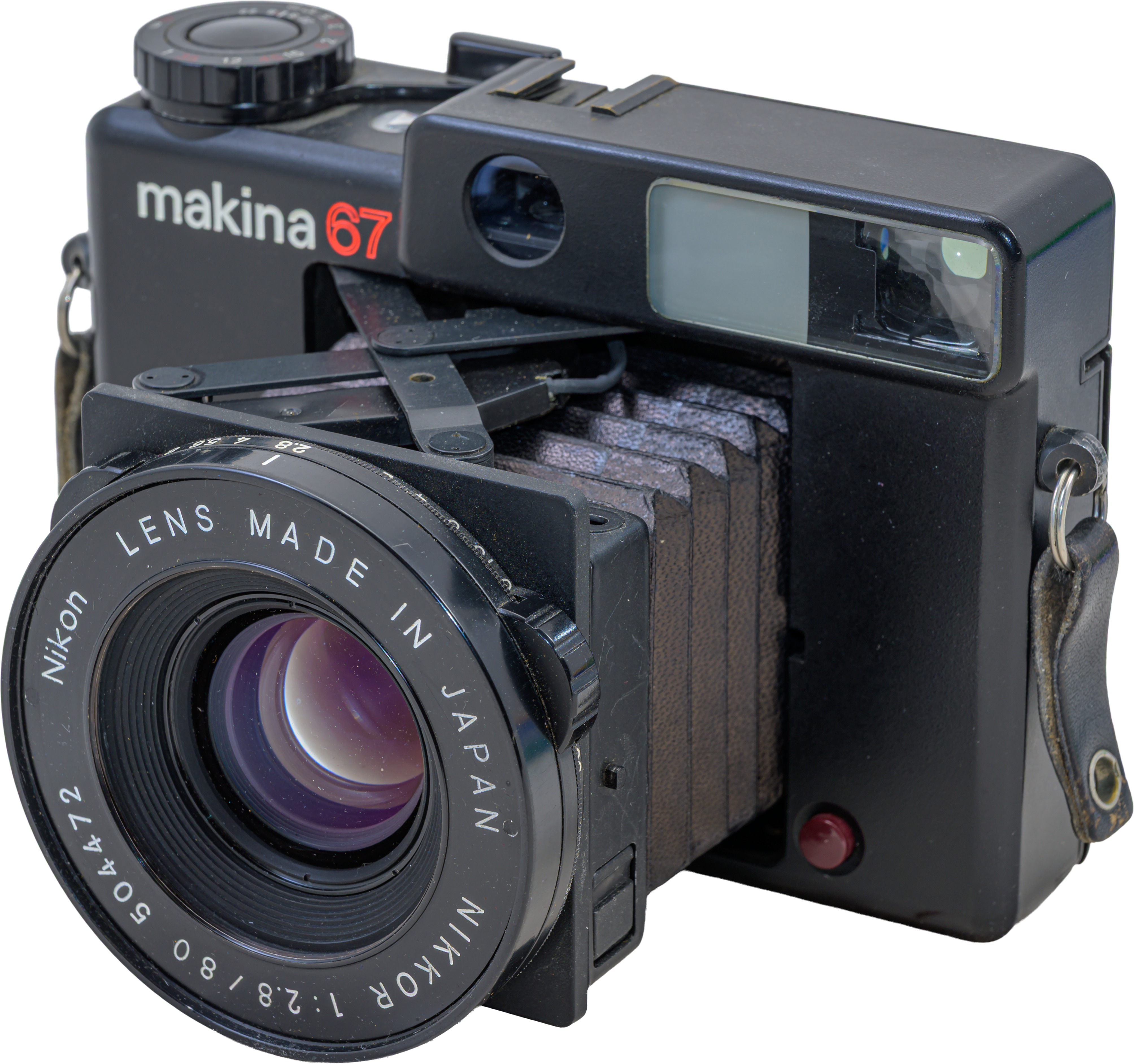
The made-in-Japan Plaubel Makina was unusual for being a rangefinder, not a reflex camera – you framed and focused through a separate optical viewfinder, not through the taking lens. For all my images I simply set the focus to infinity, and there was never an issue with parallax when composing a nightscape scene.
But the lens was fixed, and was a Nikkor 80mm f/2.8 made by Nikon. That’s the equivalent of a 40mm normal/slightly wide-angle lens on a full-frame sensor today (or on 35mm film). The lens was on a bellows that could collapse back to make a compact, almost pocketable camera. Thus today, with the resurgence in popularity of film, the Makina is still sought after, not just by collectors to put on a shelf, but by those wanting to put it to use in the field.
I bought it in 1994. I just sold it, for about what I paid for it 32 years earlier, though not taking into account inflation. I had not shot with it in 20 years. Apart from the light meter, which I rarely used, it still worked.
Moonlit Nightscapes
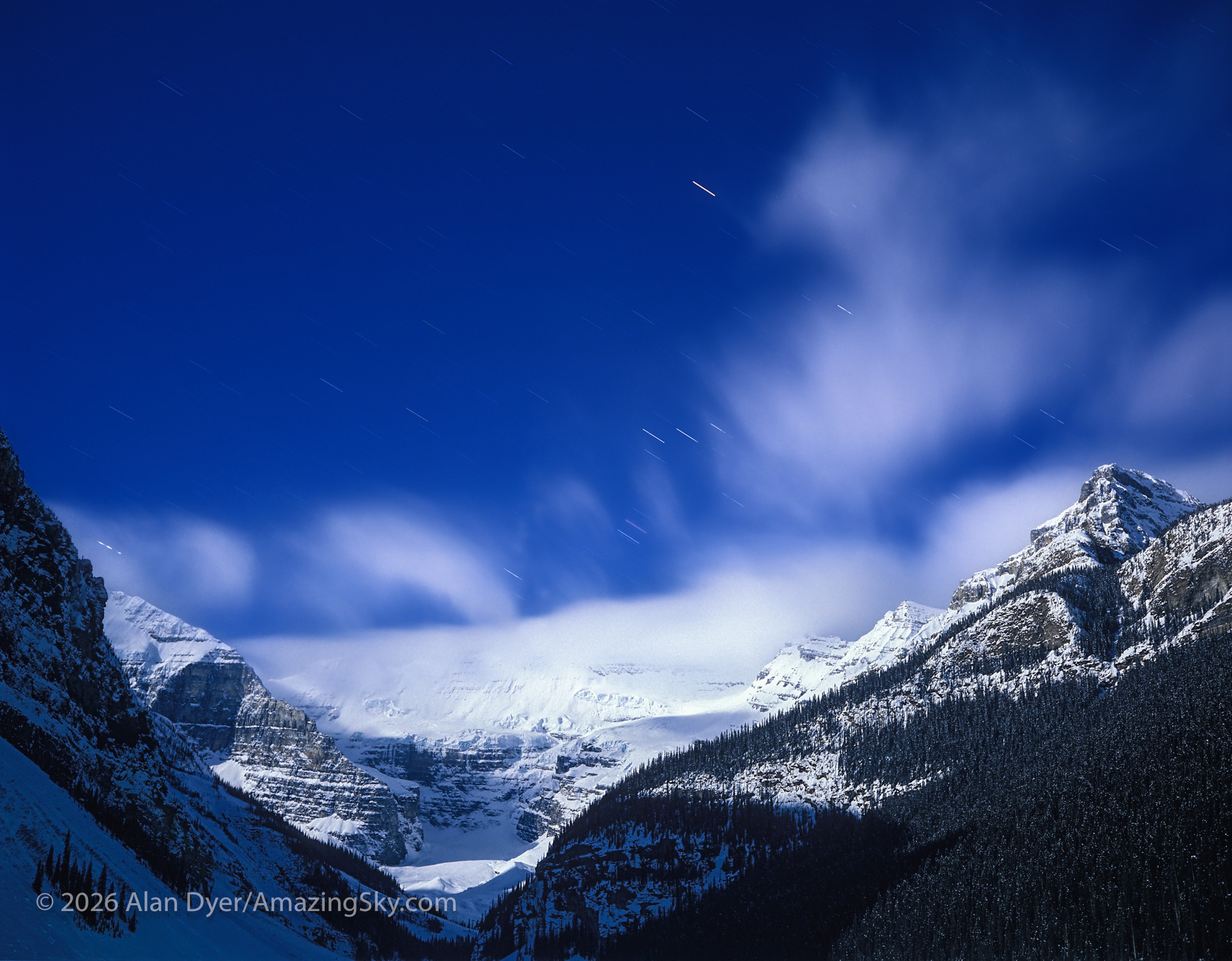
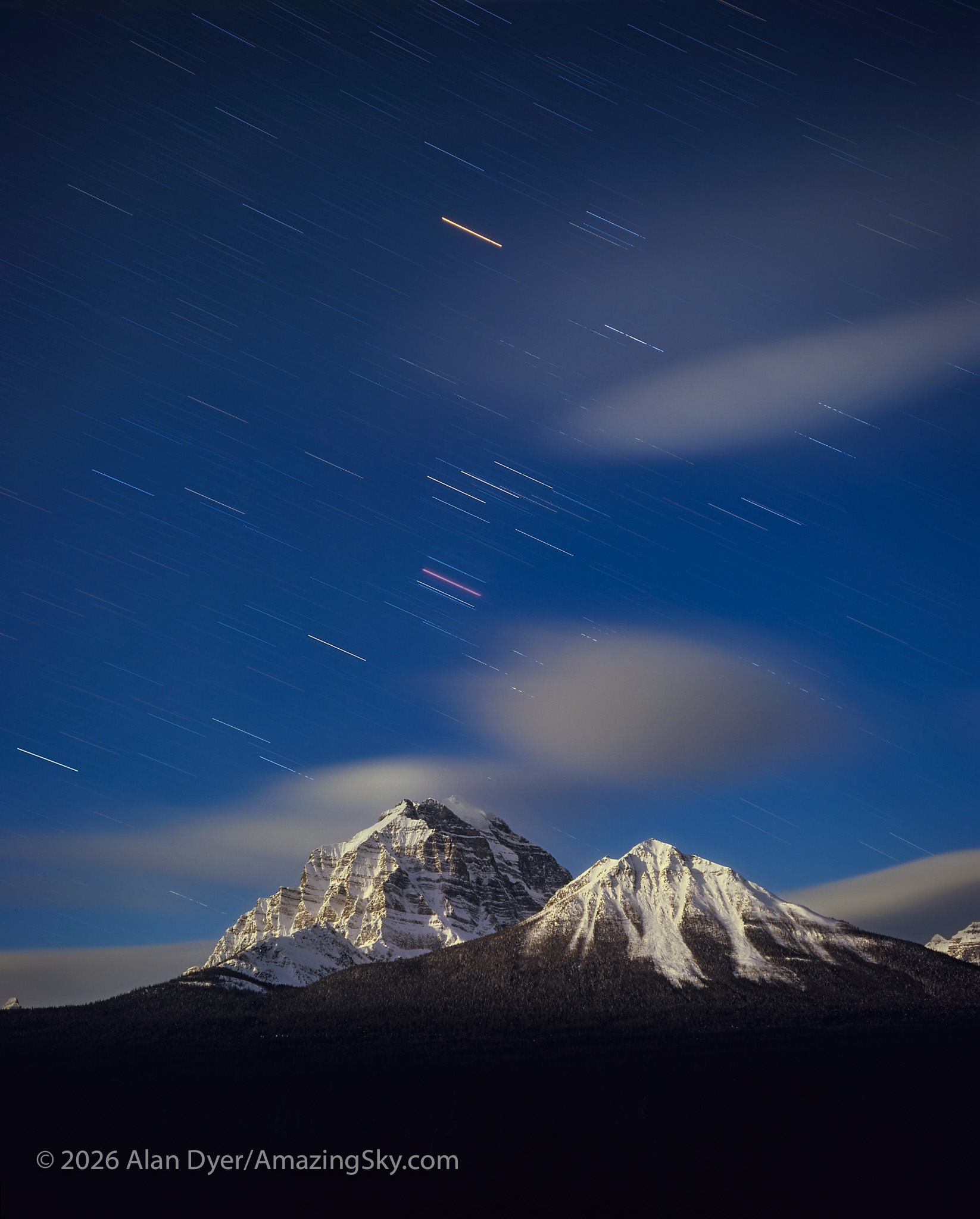
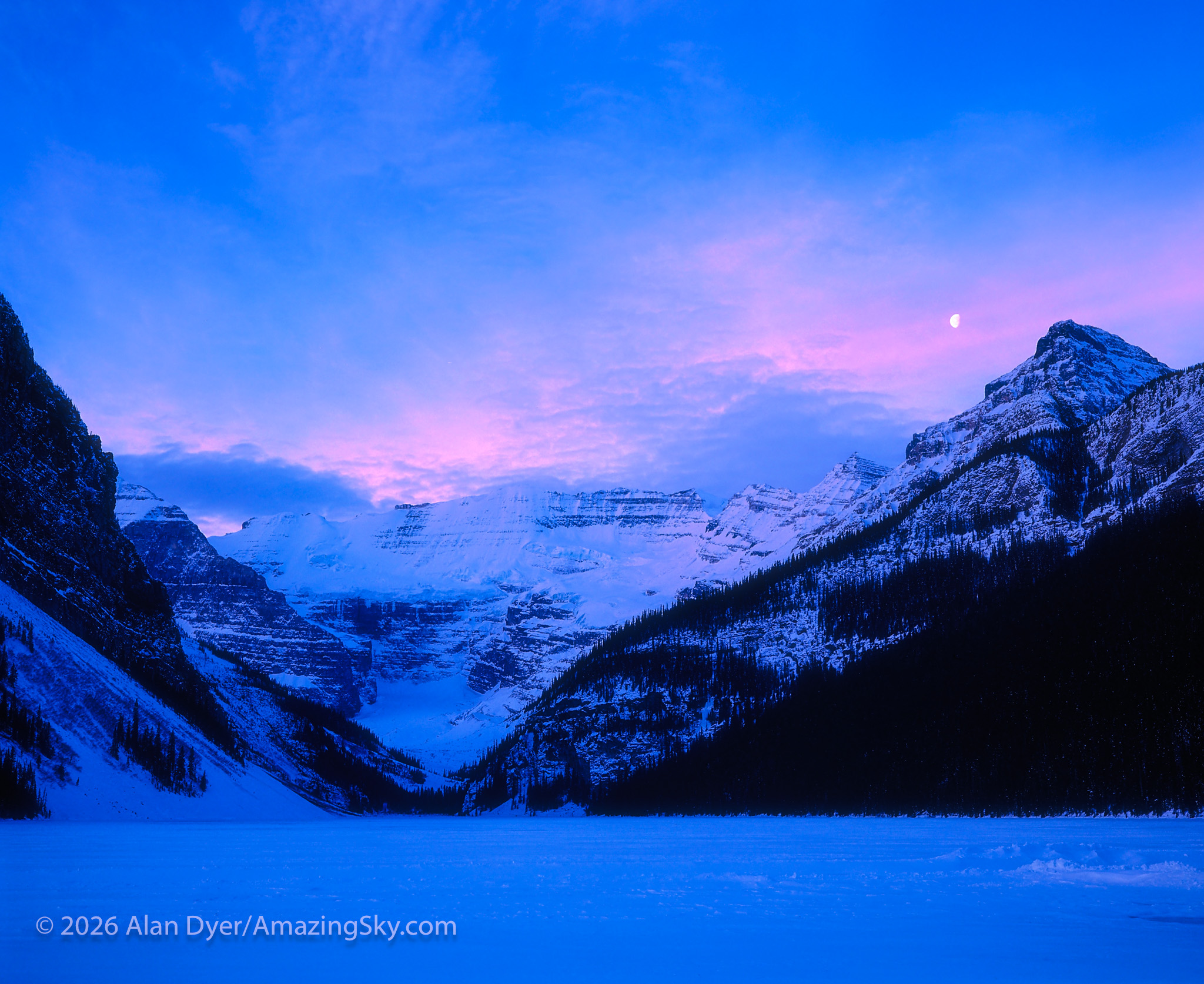
What could you shoot with medium format film – or any film – for nightscapes? The prime subjects were scenes lit by bright moonlight. While you could shoot short exposures to keep stars as pinpoints, that required quite fast film, with ASA/ISO 400 or 800 generally the fastest on the market. And fast film was very grainy, in part spoiling the very sharpness you were after by shooting with medium format.
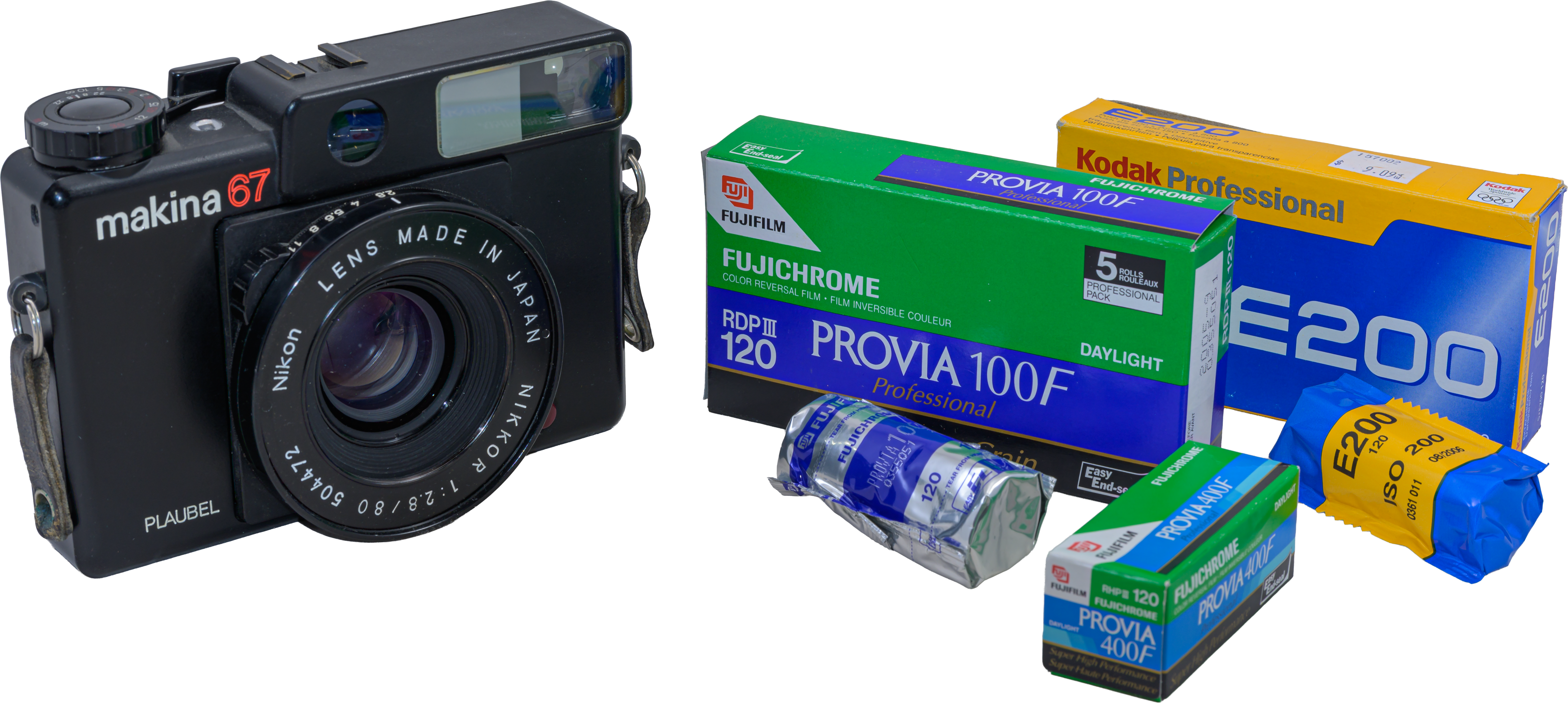
So my choice was to usually shoot with slower ASA or ISO 50 to 200 film, such as Fuji Velvia 50, Provia 100 F, or Kodak Ektachrome E200. The latter was a prime choice for any tracked deep-sky images as it was quite red sensitive to pick up red nebulas along the Milky Way. But I didn’t do much of that with the Makina, reserving those shots for a Pentax 67 camera I bought later with its interchangeable lenses.
Star Trails
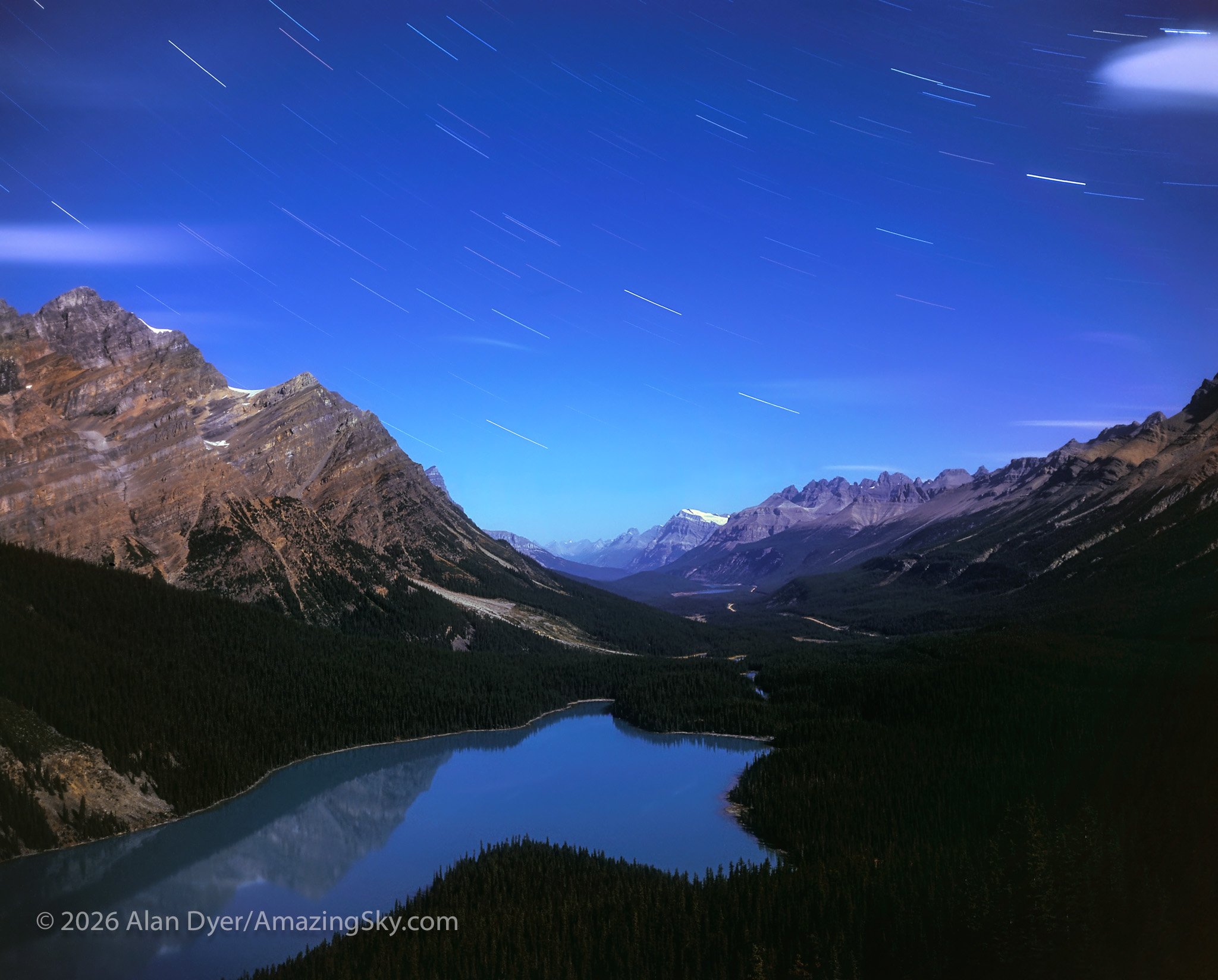
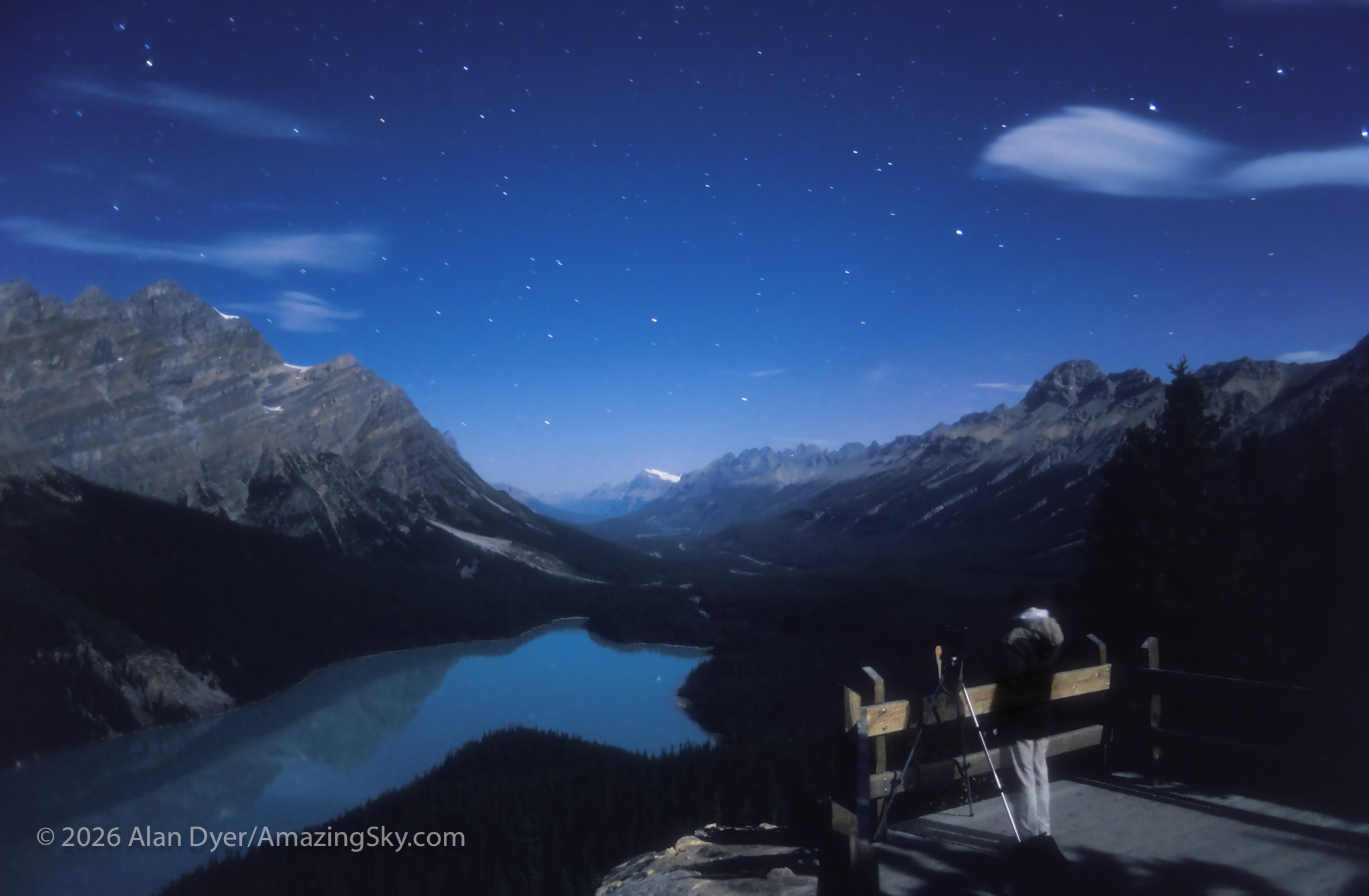
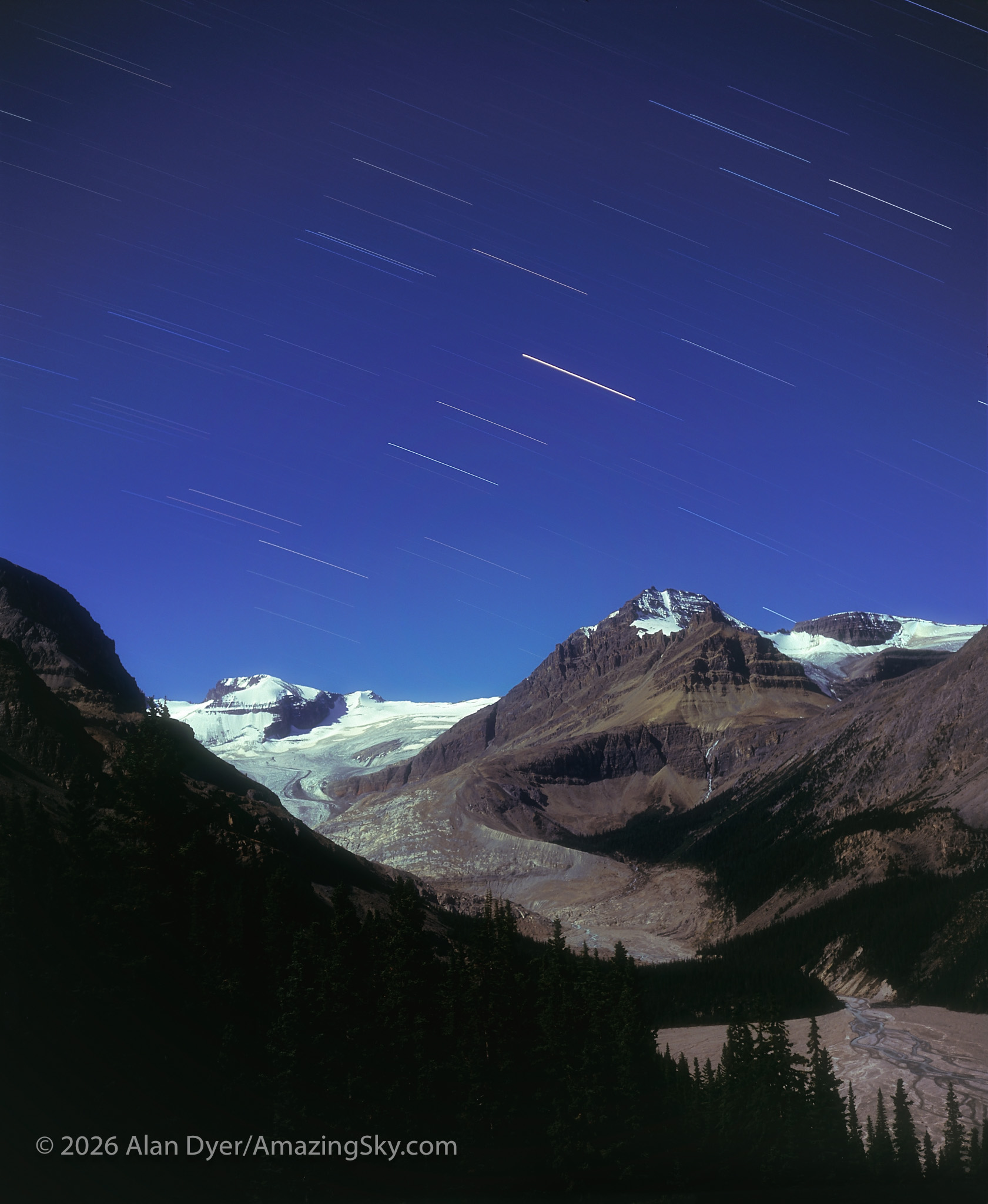
So instead I generally sought out sites in the scenic Canadian Rockies to shoot long exposures by moonlight, as I am doing above at Peyto Lake, to create star trail nightscapes. Exposures were typically 15 to 30 minutes but on slow film. That’s one single exposure on one piece of film. Stacking short exposures? Not in the good old days!
Exposures were strictly from experience. I carried a printed table of exposures with me, with exposure times for what worked at different Moon phases and altitudes, and with various films. Even so, you never knew if you got it right until days later. Of course, you could “bracket,” and shoot for various lengths of time. But in some cases, as below, you had limited time, or one chance, to get the shot.
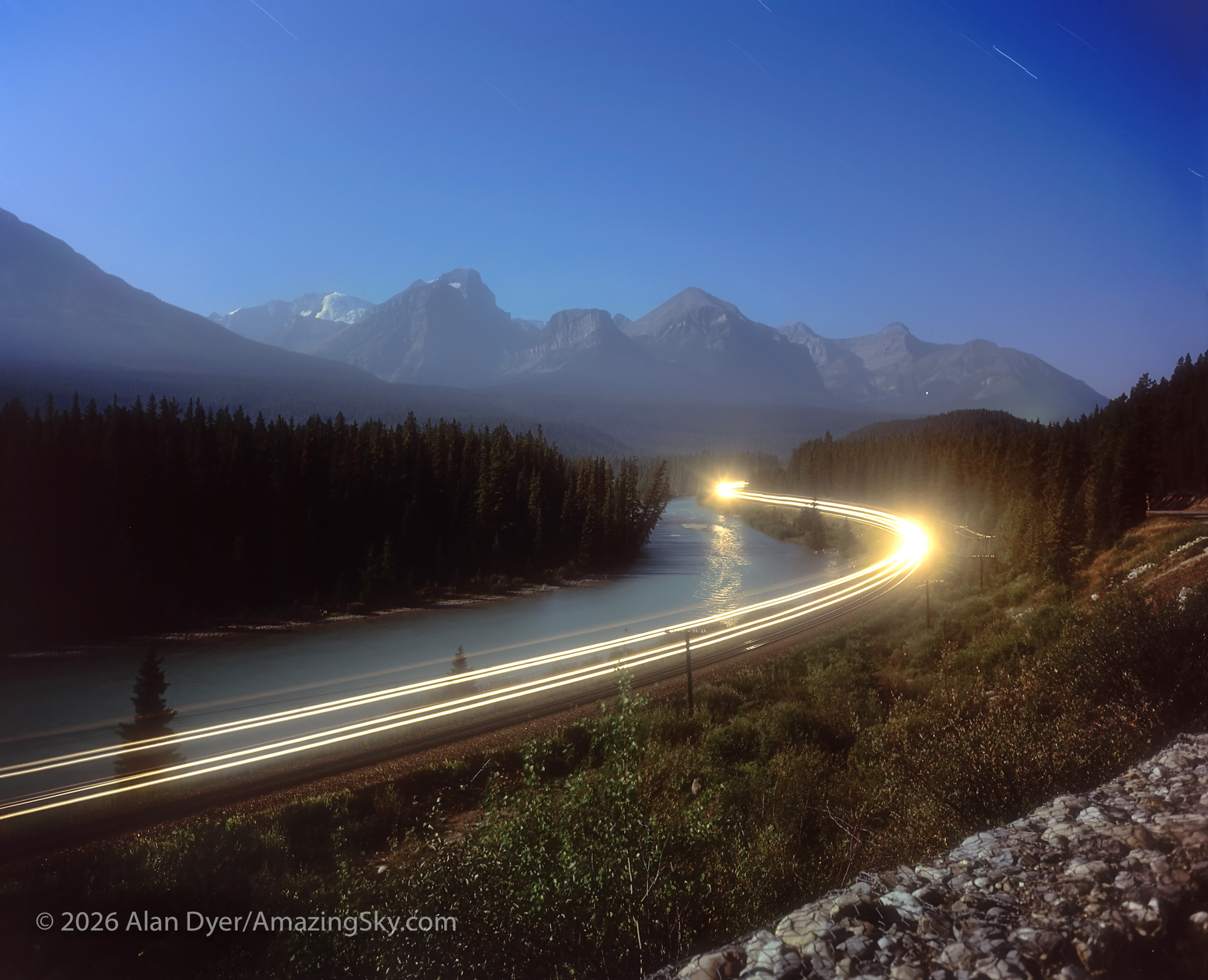
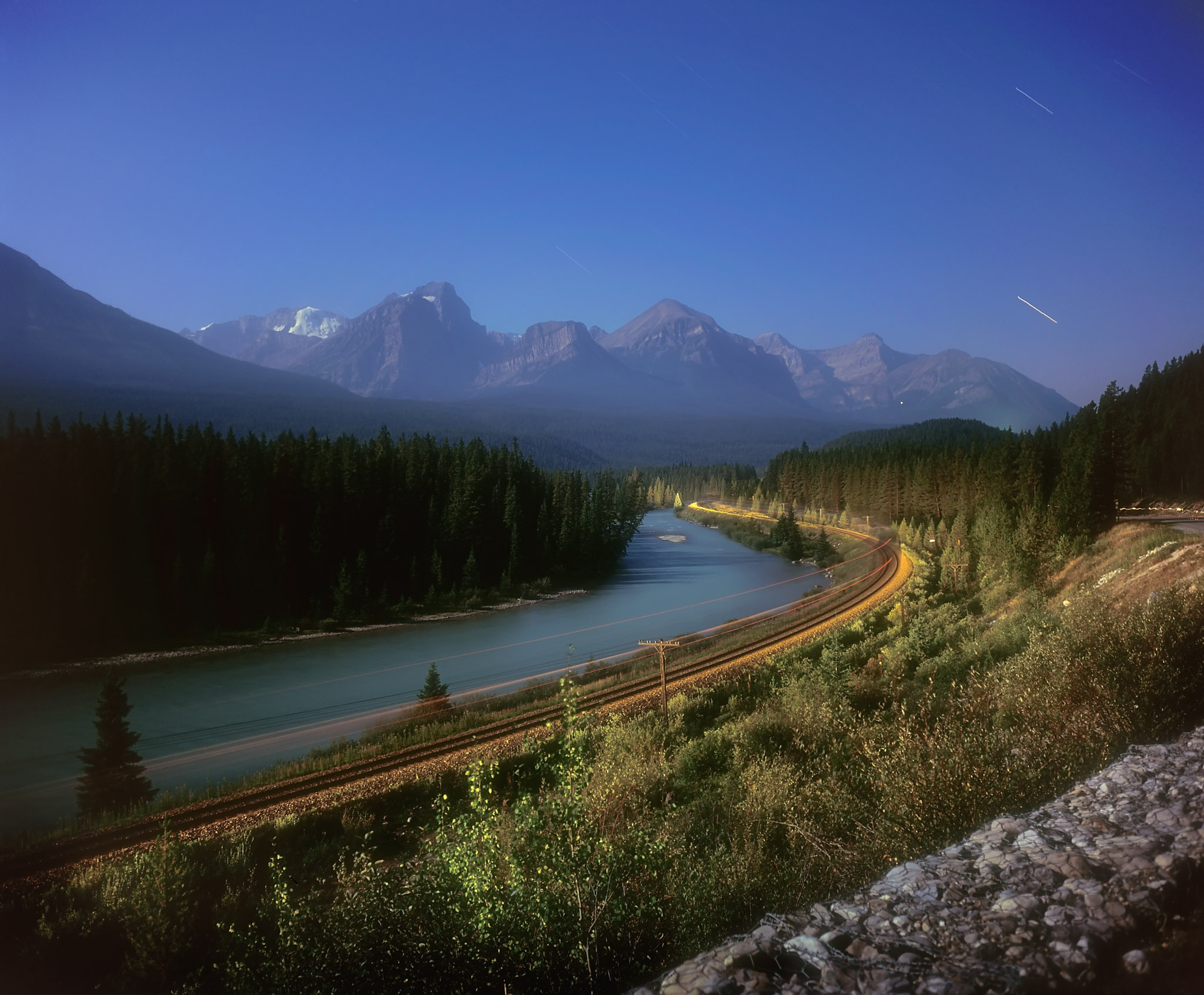
Again, those are single shots “got right” in the camera, not blends or composites created later at the computer.
While you could take star trails on dark moonless nights, the foreground would simply be a dark silhouette. It would have no detail, and “lifting the shadows” in processing yielded nothing! Film is inherently “non-linear” – recording twice as many photons does not necessarily yield an image twice as bright.
Indeed, below a certain threshold of incoming photons, such as with landscapes lit only by starlight, film did nothing. The few photons coming in were never enough to excite the silver halide molecules in the emulsion into reacting.
And a property called “reciprocity failure” meant films lost what sensitivity they had over a long exposure time. Exposing longer didn’t necessarily produce a brighter image, and might even result in a discoloured image as the three colour-sensitive layers in the emulsion suffered different levels of reciprocity failure. So long-exposure images might turn green.
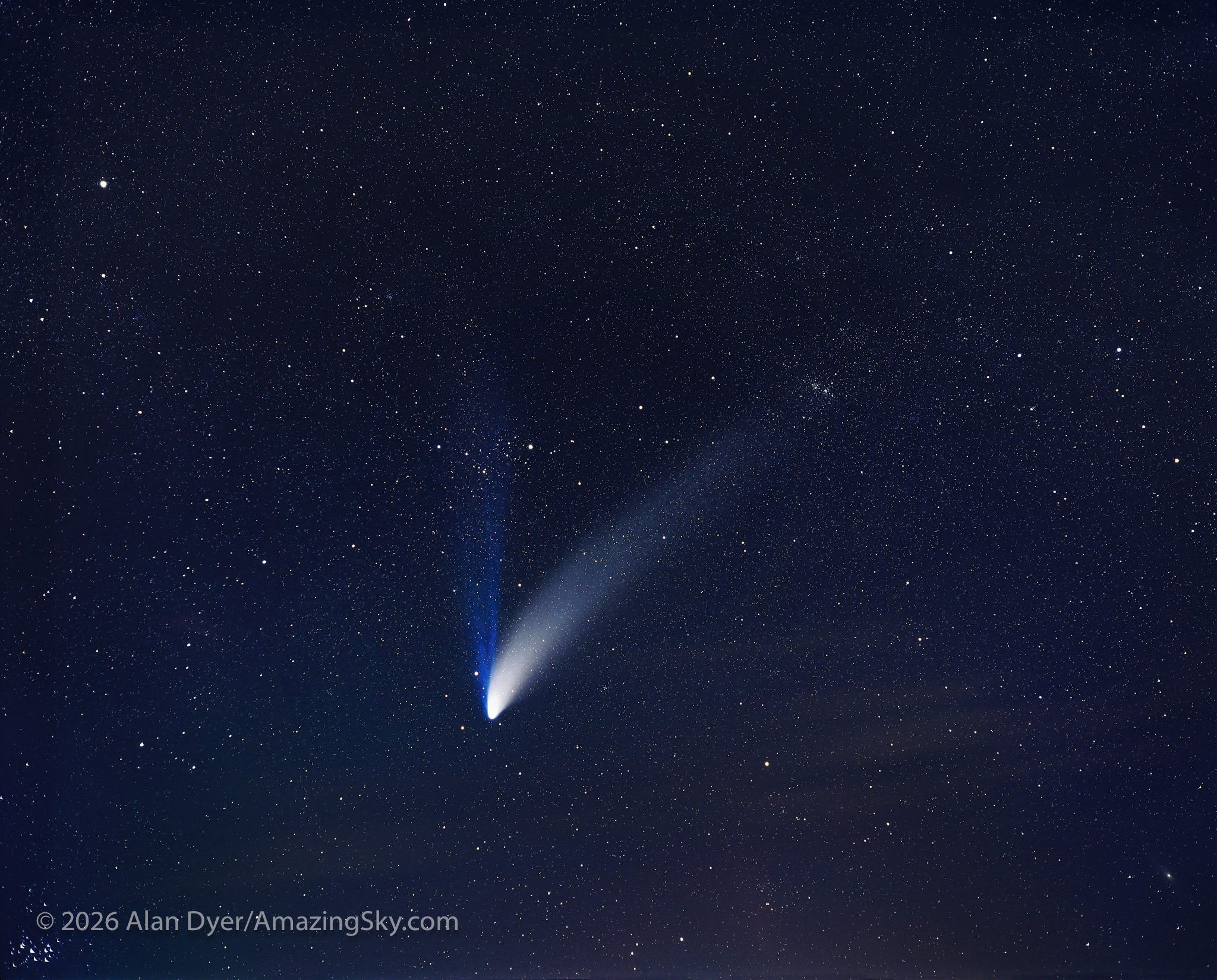
But bright subjects worked well, such as of what is still the brightest comet we’ve seen in recent decades, above. But what could we have recorded if we’d had digital sensors!
In-Camera Composites
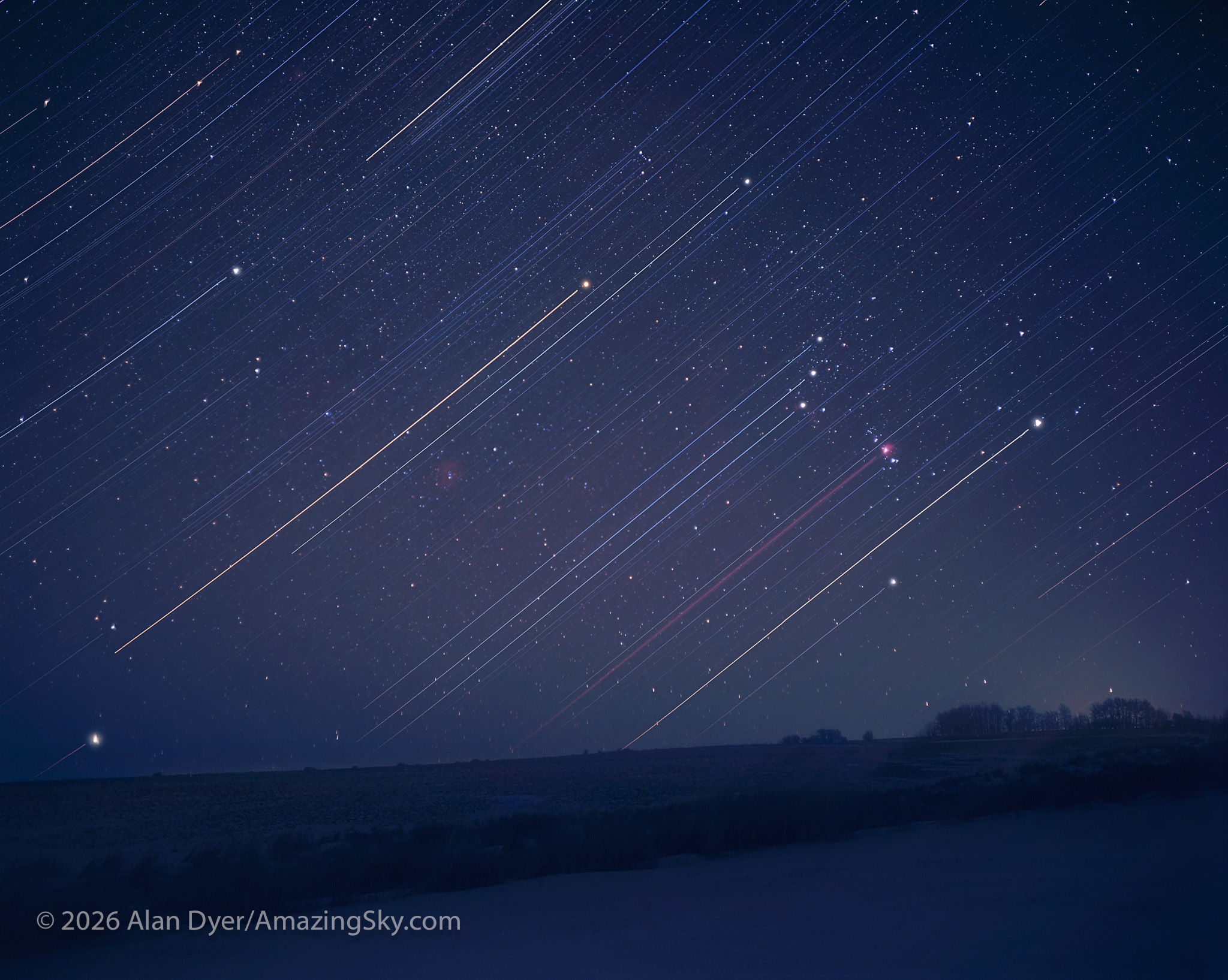
Before digital processing, you had to be creative at the camera. The star trail image above is a double exposure on Fujichrome 100 film:
- an untracked exposure for just over an hour as Orion rose into position with lens stopped down to f/8,
- then the lens covered for two minutes. With the drive then turned on, I opened the lens to f/2.8 and exposed for about another 10 minutes with the equatorial drive tracking to add deeper pinpoint stars.
But the image has soft focus at the centre due to another annoying property of film – it could buckle in the camera as it absorbed moisture, despite a pressure plate pressing it down over the film gate. So you could expose for a long time only to have the image spoiled by film warping.
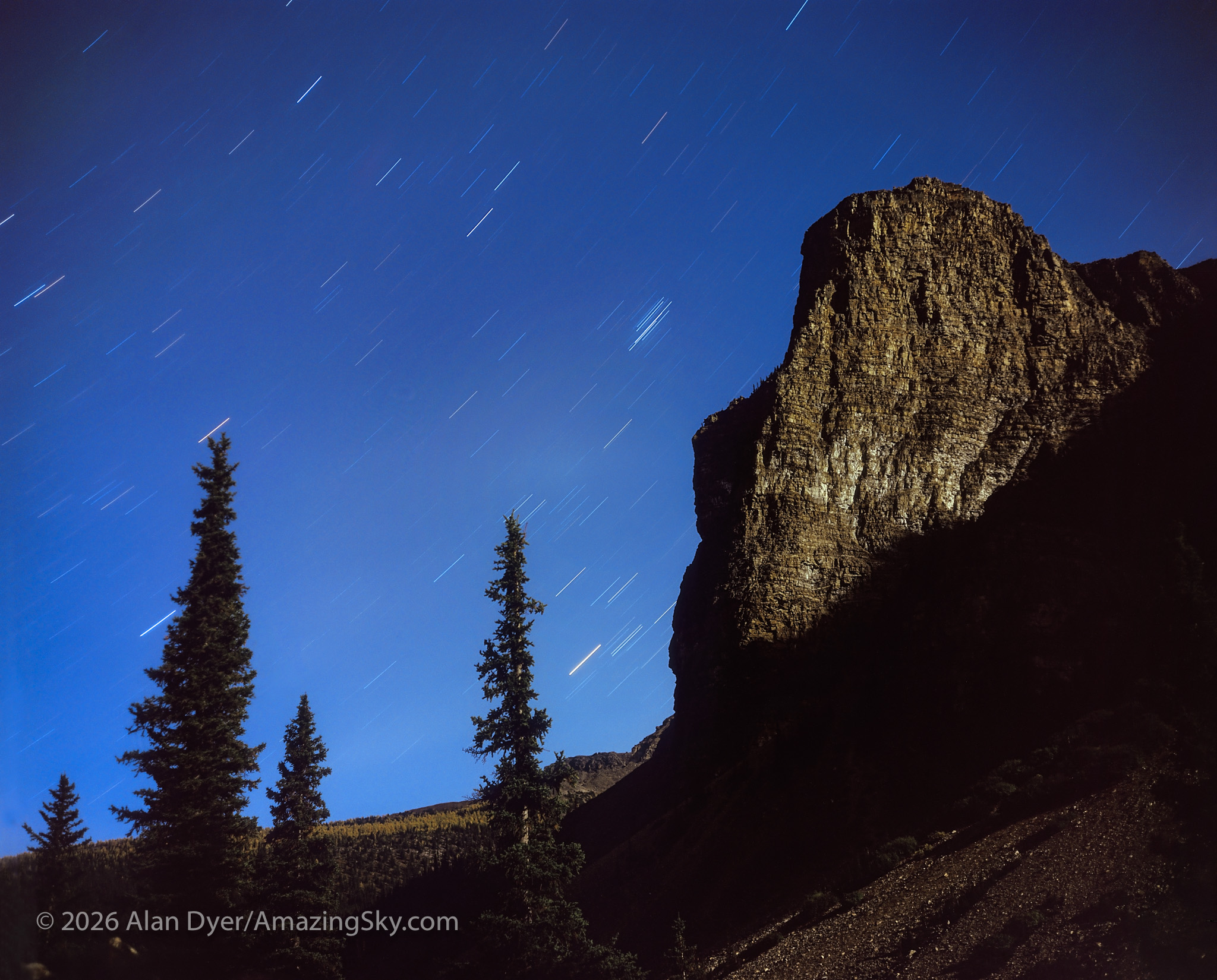
So shooting on moonlit nights and keeping exposures under 30 minutes usually worked well. But as above and below, even under moonlight, the areas in shadow remained dark and blocked up, with no hope of recovering detail.
Shooting the Milky Way on a moonless night? Forget it! The iconic nightscape image most common today of a detailed Milky Way above a starlit landscape rich in details was, and is, impossible with film. Nightscape photography as we know it really became feasible only with the advent of digital SLR cameras.
Indeed, my first nightscapes in 2004 with my first digital SLR, the Canon 300D – images which showed a detailed foreground with only starlight providing the illumination – ended what had been my decade-long love-affair with medium-format film, and film in general.
In dusting off the Makina I was tempted to put a roll in it for old time’s sake and shoot some astro with it. Tempted for a few seconds, then I came to my senses. The younger generation are welcome to discover the challenge of shooting film. I’ve been there, done that, and I’m not going back! The drawbacks are just too much for the results.
But a new generation of photographers are welcome to have their fun with film.
– Alan, April 2026 / amazingsky.com

