Exploring the Dusty Realms of the Milky Way


A run of exceptionally clear nights allowed me to capture scenes of stardust along the MilkyWay.

Colourful nebulas – clouds of glowing gas – are the most popular targets in the deep sky for astrophotographers. Most nebulas emit red light from hydrogen atoms. Some glow blue by reflecting the light of nearby hot stars.

But another class of nebulas emits or reflects almost no light, and appears dark, often as shapes silhouetted against the bright starry background. They are usually made of obscuring interstellar dust – typically grains of carbon soot emitted by aging or active stars – literally stardust.

In the olden days of film photography, these dark dust clouds always appeared black in our exposures. Or they never showed up at all.

But today’s digital cameras, with the aid of processing techniques, can capture the dust clouds, often not as black clouds, but as pale blue tendrils, or as brownish-yellow streamers faintly glowing with a warm light.

In October and November 2023, a series of unusually clear and mild nights allowed me to go after some of these dark and dusty targets, from my home in rural southern Alberta, Canada. I captured a selection of scenes off the beaten track along the Milky Way. Here’s my tour of stardust sights in the northern autumn and winter sky.


Cepheus the King
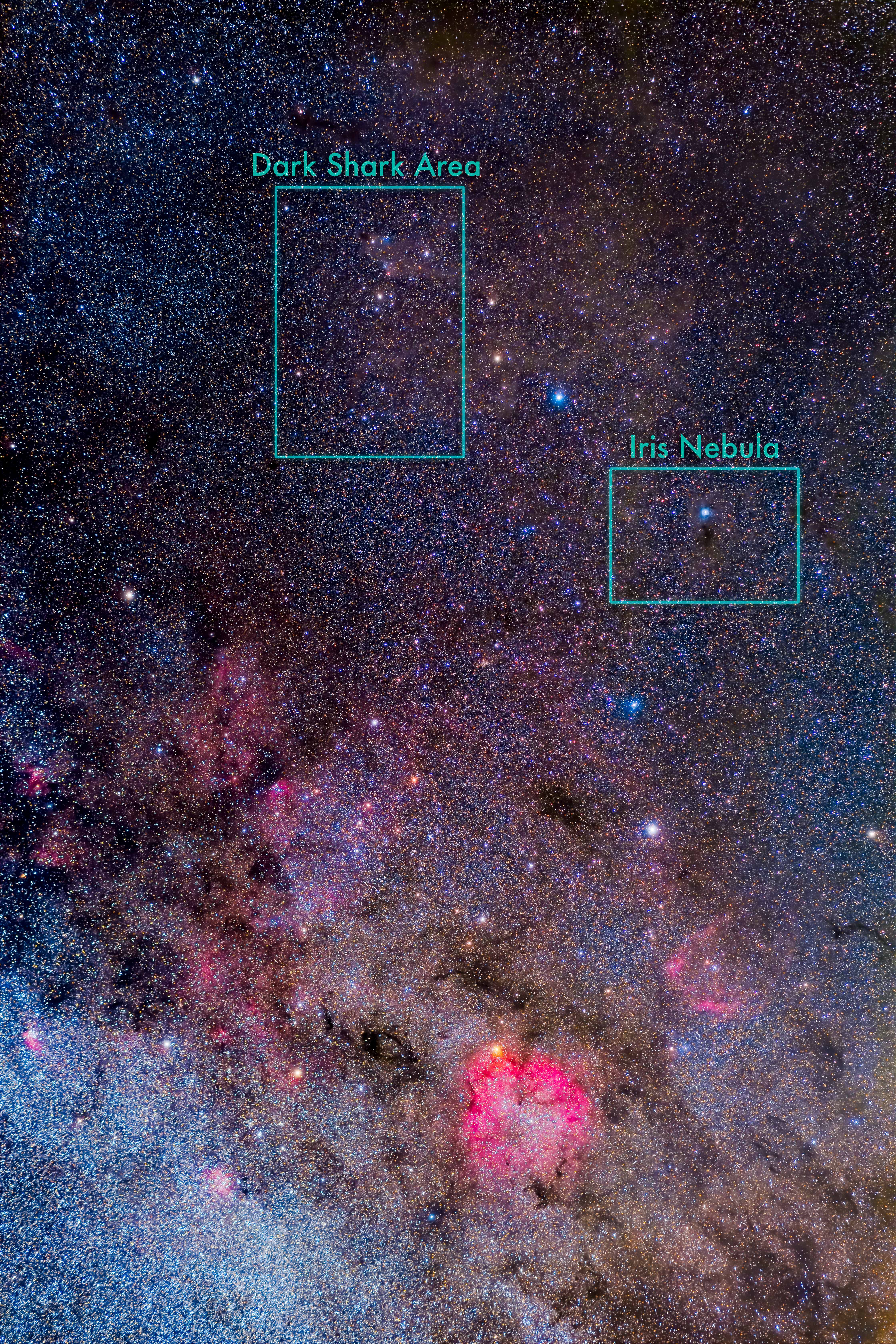
This is a portrait of most of the northern constellation of Cepheus the King. All the wide-field images were shot and processed to emphasize the rich collection of bright and dark nebulas in the constellation. North is always up. This is a stack of 40 x 2-minute exposures with the rare Samyang RF85mm f/1.4 lens stopped down to f/2.8, on the Canon EOS Ra camera at ISO 800. The lens was equipped with a 77mm Nisi Clear Night broadband filter. For all the wide-field images the camera was on the Star Adventurer 2i tracker for tracked but unguided exposures.

The wide-field image above frames most of the northern constellation of Cepheus. The southern section of Cepheus at the bottom of the frame lies in the Milky Way and is rich in bright red nebulas, notably the large, round IC 1396. It is a popular and easy target. But the northern upper reaches of Cepheus are where more challenging dusty nebulas reside. I’ve indicated the location of two fields shown in the close-ups below.

The Iris Nebula
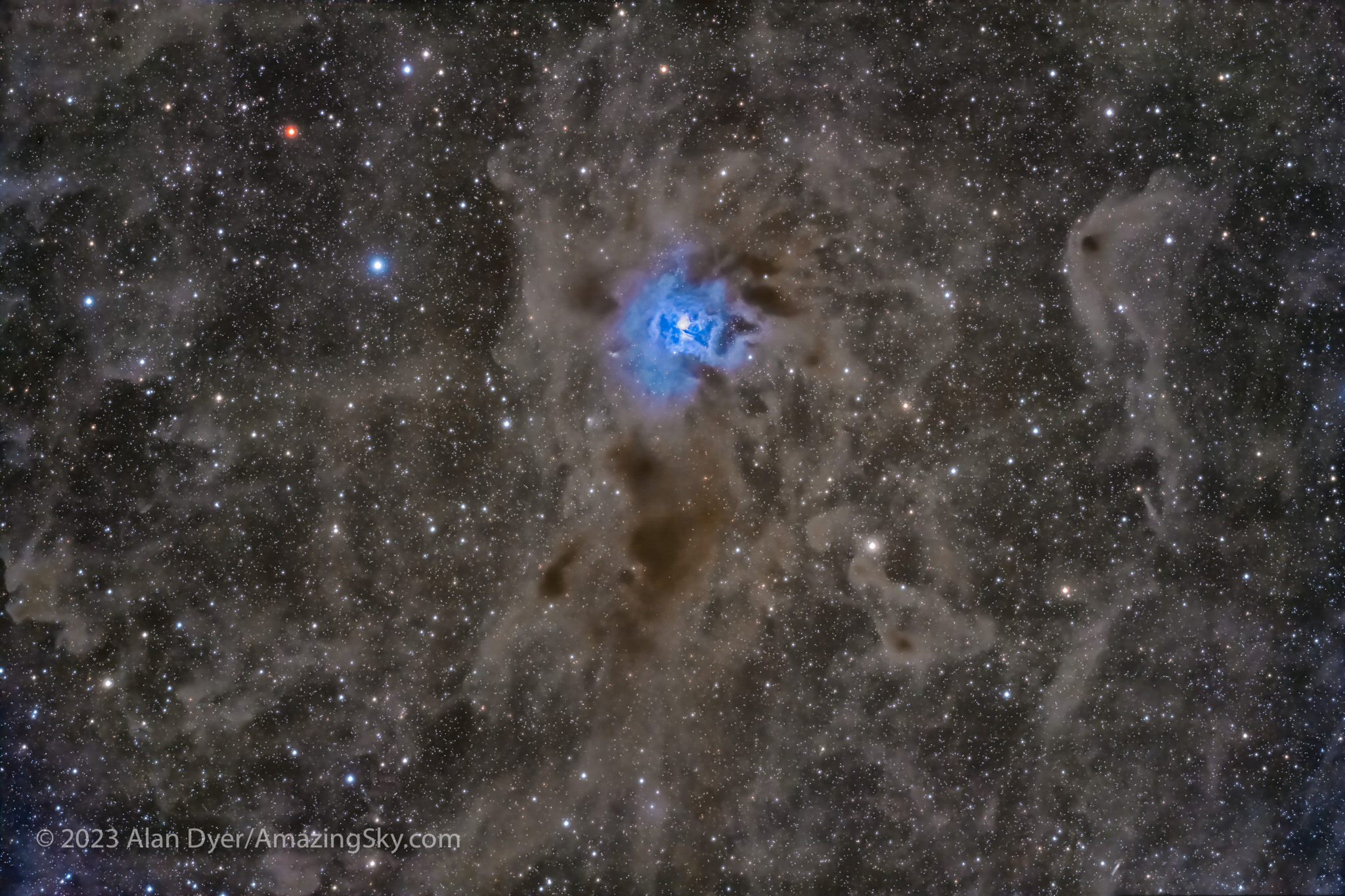
This is the bright blue reflection nebula, NGC 7023, aka the Iris Nebula, in Cepheus. This is a stack of 25 x 8-minute exposures through the Askar APO120 refractor at f/7 with the 1X Flattener, and with the filter-modified Canon R camera at ISO 1600.

Located some 1300 light years away, this is a blue reflection nebula, as the dust is lit by the young blue star in its core. But surrounding the bright Iris Nebula are more extensive clouds of dust, dimly lit by reflected light and with varying densities and shades of grey and brown.

The Dark Shark and Wolf’s Cave Nebulas

This is a portrait of a field of dusty nebulas in northern Cepheus, in a stack of 30 x 6-minute exposures with the Astro-Tech AT90CFT refractor at f/4.8 and filter-modified Canon EOS R camera at ISO 800, though no filter was used when taking these frames.

This field in northern Cepheus is yellowed by reams of dust. A couple of blue reflection nebulas lie on the edges of streamers of brown dust. The object at top is called the Dark Shark, for its fanciful resemblance to a menacing shark, though one wearing a blue hat!

At the bottom of the frame is a long, snake-like dark brown nebula, Barnard 175, with the blue reflection nebula van den Bergh (vdB) 152 at its tip. This object has been dubbed the Wolf’s Cave Nebula, though that likeness is harder to discern. It is unclear where some of these nicknames come from, as many are recent appellations invented by astrophotographers. Some of the names have stuck, though few are “official.”


Perseus the Hero and Taurus the Bull
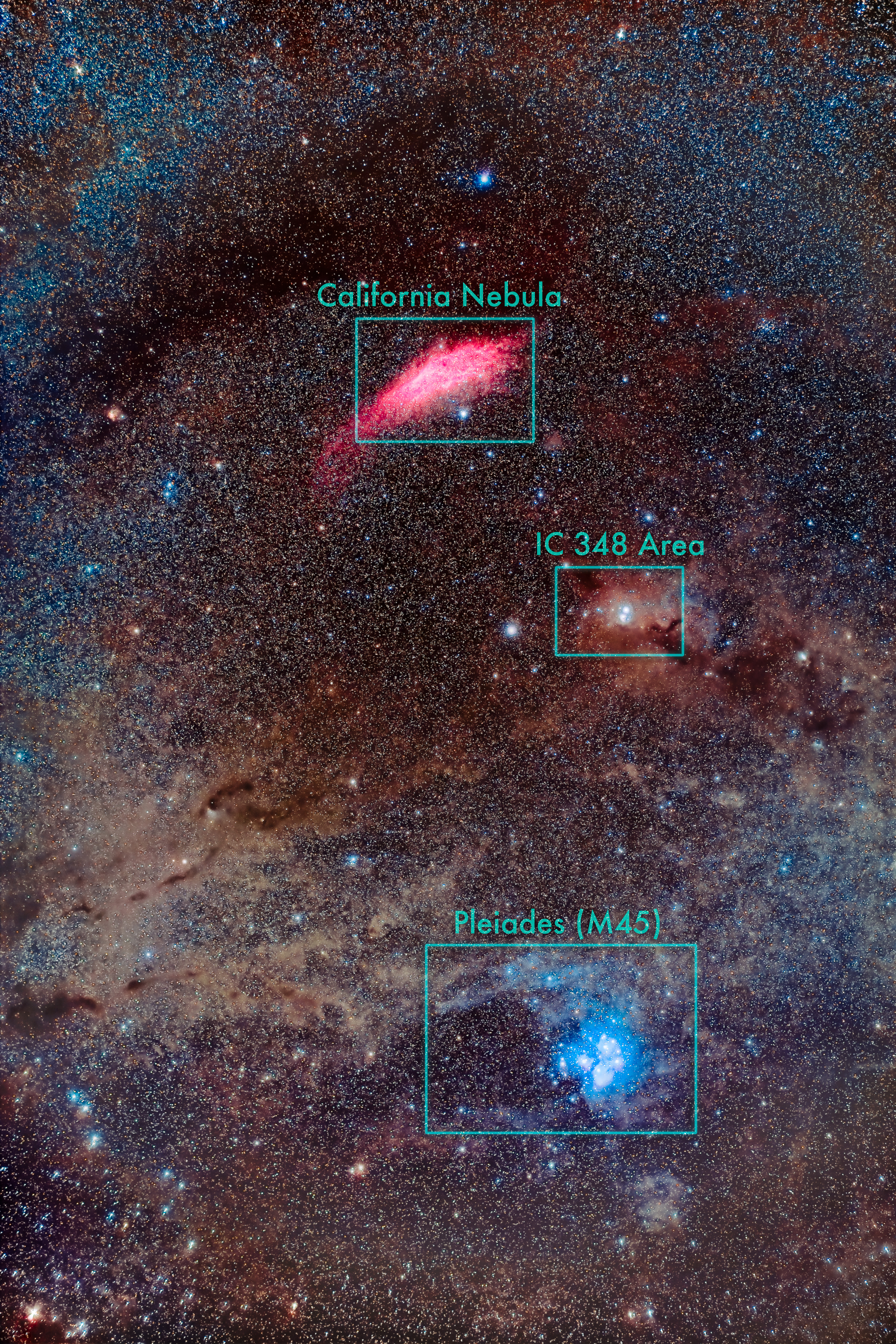
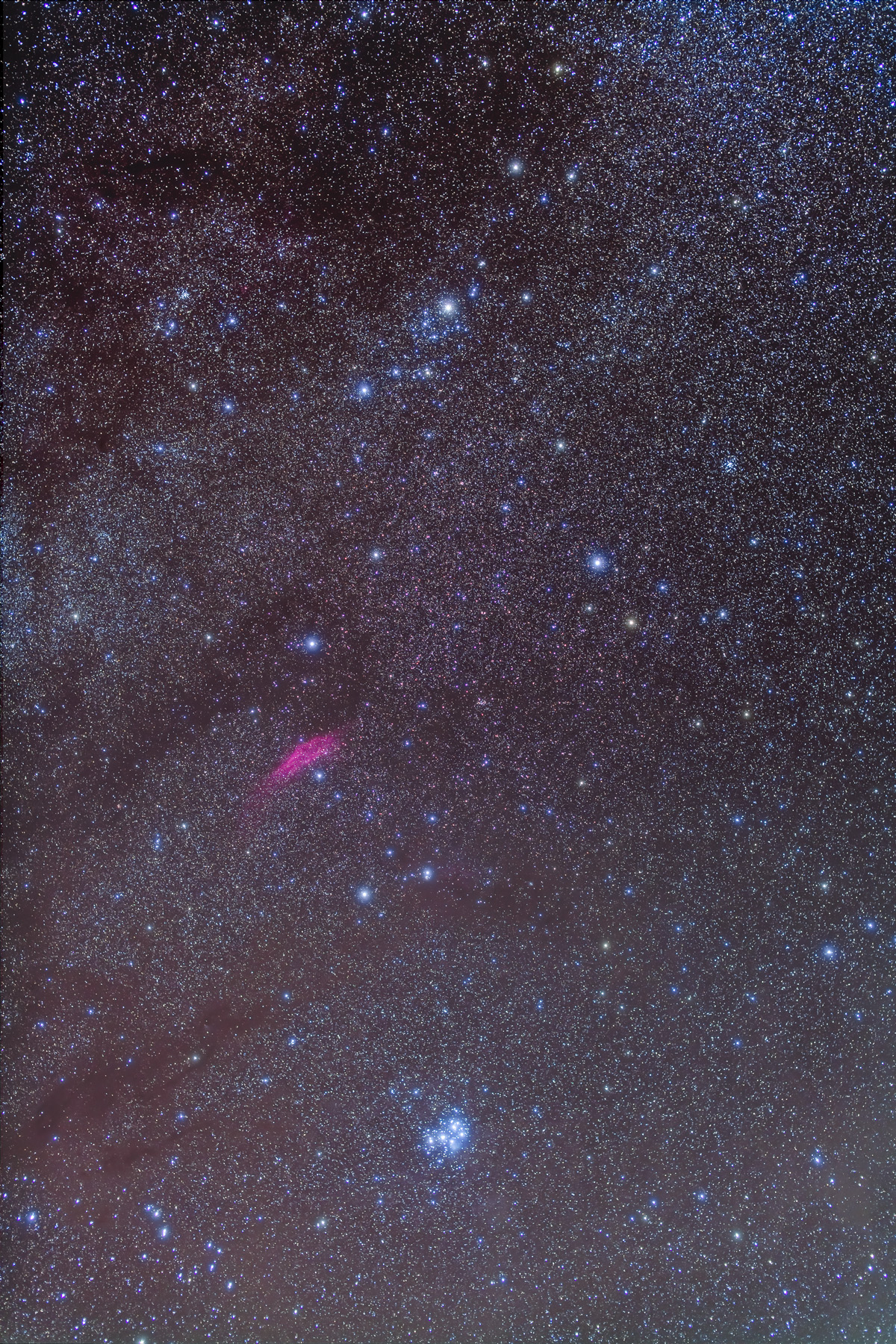
This is a portrait of the dust-filled region of sky from Perseus down to Taurus that includes the pink California Nebula (NGC 1499) at top down to the Pleiades star cluster (M45) at bottom. This is a stack of 48 x 2-minute exposures with the rare Samyang RF85mm f/1.4 lens stopped down to f/2.8, on the Canon EOS Ra camera at ISO 800. The lens was equipped with a 77mm Nisi Clear Night broadband filter.

The region of sky between Perseus and Taurus is rich in bright nebulas set amid large tendrils of dust in Taurus. The Pleiades star cluster lights up a portion of the dust clouds. And the pink California Nebula lies at the end of a large lane of dust.

The California Nebula
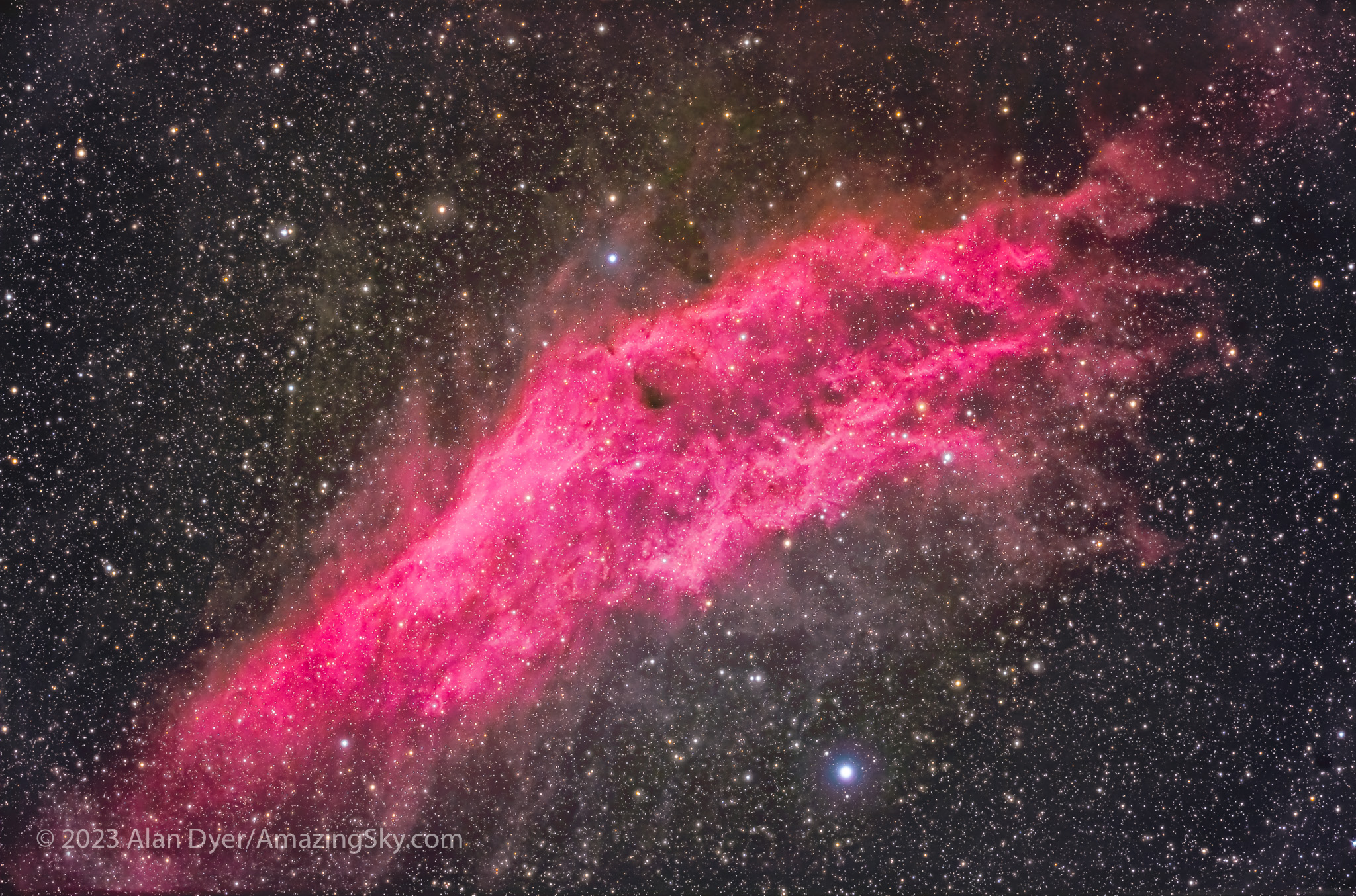
This is the California Nebula, aka NGC 1499, in Perseus near the star Menkib, or Xi Persei, at bottom. This is a stack of 12 x 6-minute exposures with the filter-modified Canon R (though no filter was used to take this image), at ISO 800, on the Askar APO120 refractor with its 0.8x Reducer/Flattener for f/5.6 and 670mm focal length.

The California Nebula (named for its resemblance to the shape of the state) lies in Perseus. It is a bright emission nebula glowing in the red and pink light of hydrogen atoms, perhaps excited by blue-white Xi Persei, aka Menkib, at bottom. But it sits amid wider clouds of dust, here recorded as white and yellow.

IC 348
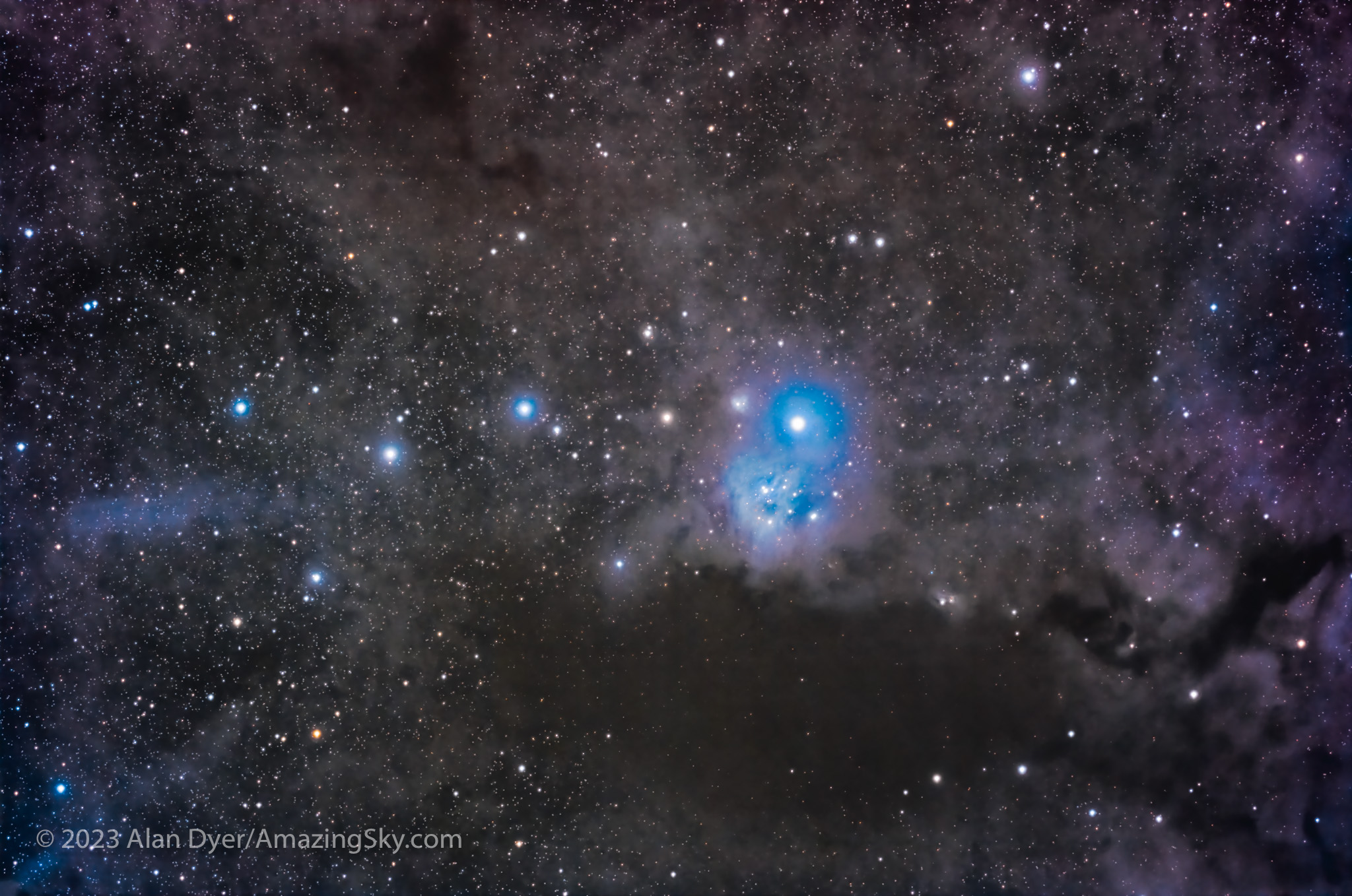
This is the bright blue reflection nebula complex, IC 348, in Perseus, in a stack of 18 x 8-minute exposures through the Askar APO120 refractor at f/7 with the 1X Flattener, and with the filter-modified Canon R camera at ISO 1600.

This complex mix of reflection and dark nebulas surrounds Omicron Persei. In some sections the dust is so dense it blocks all light from more distant stars. Once thought to be holes in the heavens, the photos of pioneering astrophotographer Edward Emerson Barnard in the early 20th century proved that dark nebulas are nearby, and obscure what’s behind them.

IC 348’s distance of only 700 light years means there isn’t much between us and the surrounding dark clouds. Oddly, though a popular target, as best I can tell, no one has come up with a nickname for this field. What can you see in the dark shapes?

The Pleiades / Messier 45
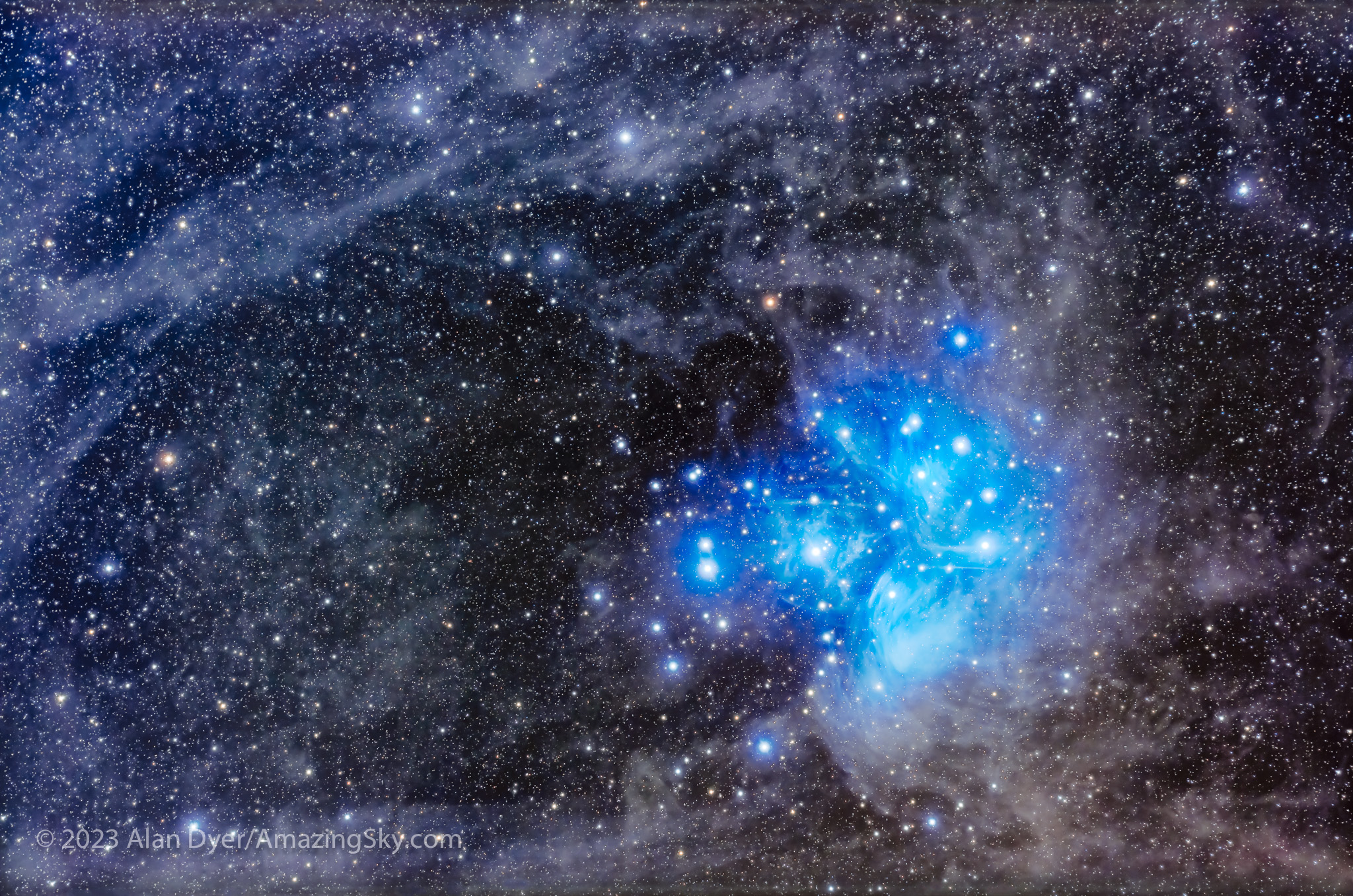
This frames the famous Pleiades or Seven Sisters star cluster (aka Messier or M45) set amid a dusty starfield in Taurus. The field is about 4.7° by 3.2°. This is a stack of 30 x 6-minute exposures with the Astro-Tech AT90CFT refractor at f/4.8 (using its 0.8x Reducer) and the filter-modified Canon R camera at ISO 800.

There’s no more famous deep-sky object than the blue Pleiades, or Seven Sisters. They feature in the mythology of almost all cultures around the world. The young blue stars are surrounded by bright blue reflection nebulosity, most prominent below the lower star Merope, a bit of nebula catalogued separately as NGC 1435.

While the Pleiades light up the core of the dust clouds blue, the dust clouds extend much wider and permeate the entire constellation of Taurus. However, the outlying clouds are very faint as they have no nearby source of illumination. The arc of nebulosity at top is most obvious. It was found by Barnard and is catalogued as IC 353.


Taurus the Bull

This is a portrait of the dust-filled region of sky in Taurus that frames the Hyades star cluster (at bottom) with bright yellow Aldebaran, up to the blue Pleiades star cluster (M45) at top. This is a stack of 48 x 2-minute exposures with the Samyang RF85mm f/1.4 lens at f/2.8, on the Canon EOS Ra camera at ISO 800.

Overlapping the previous constellation field, this framing extends farther south, continuing past the Pleiades down into the main section of Taurus the Bull, with the luminous yellow star Aldebaran marking the Bull’s eye. It is surrounded by the stars of the V-shaped Hyades star cluster, legendary half-sisters to the Pleiades.

Notable in this framing are the large dark tendrils of the Taurus Molecular Clouds, dense streams of dust only about 430 light years away. They are on my shot list for close-ups on upcoming clear winter nights.

NGC 1555 and Area
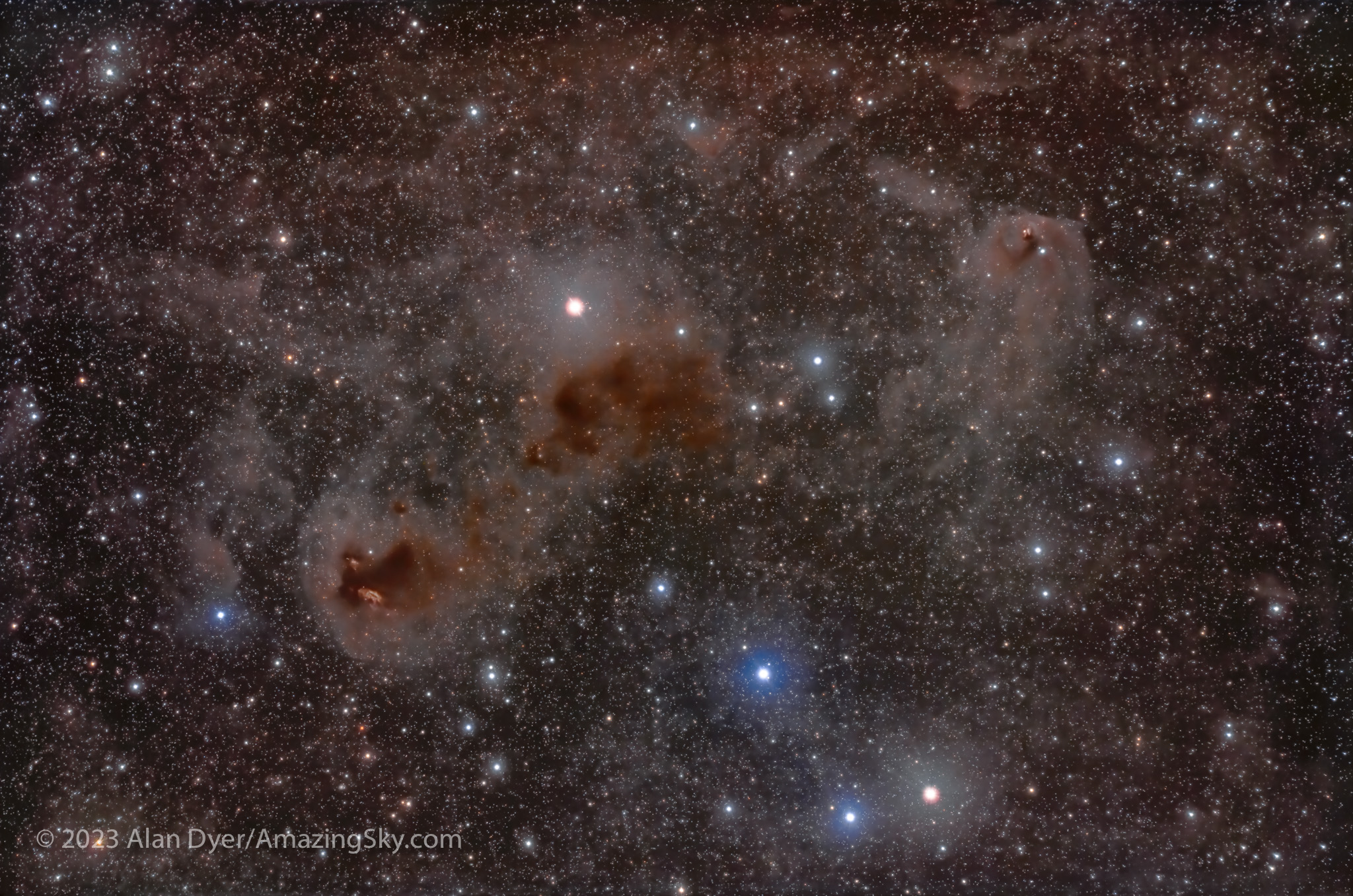
This is a framing of dust clouds among the stars of the Hyades star cluster in Taurus. The field of view is 4.7° by 3.2°. This is a stack of 30 x 6-minute exposures with the Astro-Tech AT90CFT refractor at f/4.8 and the filter-modified Canon EOS R camera at ISO 800, though no filter was used in taking the images.

This complex field lies on the northern edge of the Hyades. At upper right is the odd nebula NGC 1555, discovered by John Russell Hind in 1852 and variable in brightness due to changes in its embedded source star T Tauri, a prototype of a class of young, newly formed stars. An adjacent object, NGC 1554, was catalogued by Otto Struve, but has faded from view; thus it is called Struve’s Lost Nebula.

At lower left is the emission nebula Sharpless 2-239 embedded in the dense and brownish dust cloud LDN (Lynds Dark Nebula) 1551. It is dark indeed, but not black. Like most dark nebulas it has some warm colour.


Orion the Hunter
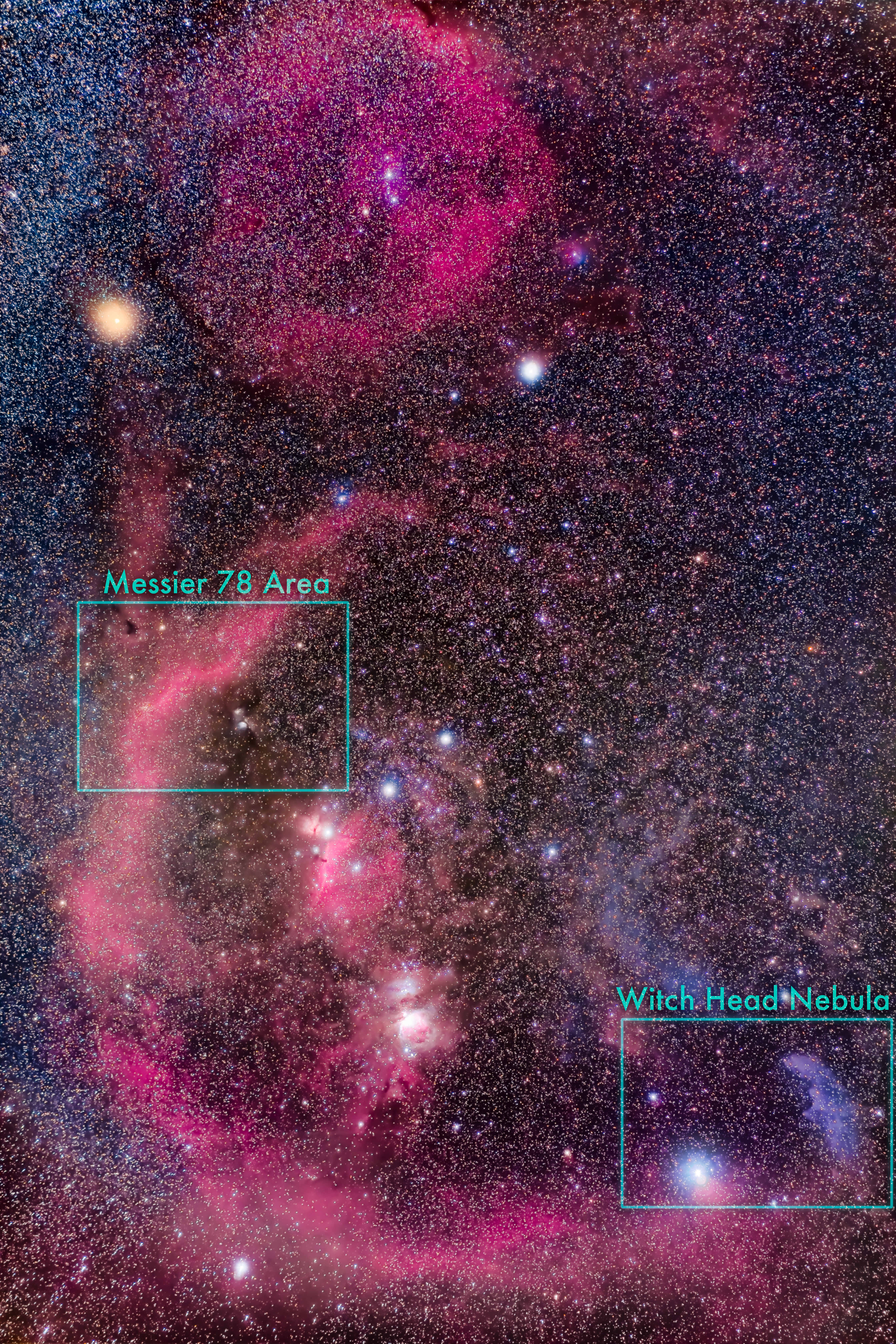
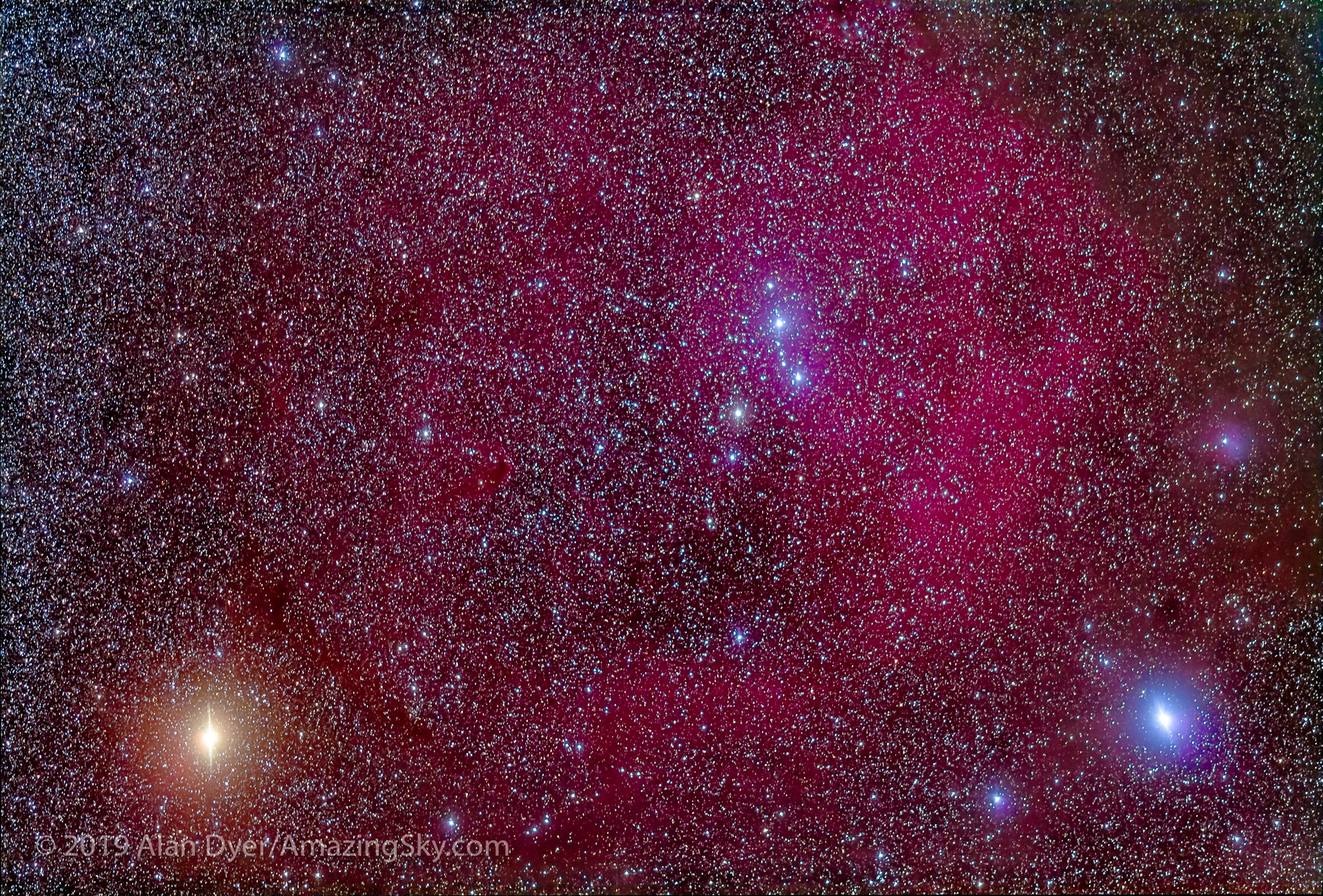
This is a portrait of Orion the Hunter with exposures and processing to emphasize the complex and colourful array of bright and dark nebulas within its boundaries. This is a stack of 42 x 2-minute exposures with the Samyang RF85mm f/1.4 lens at f/2.8, on the Canon EOS Ra camera at ISO 800. The lens had a Nisi Clear Night broadband filter to help improve contrast.

The most photogenic constellation is surely Orion the Hunter. It is filled with a rich collection of nebulas, including the eponymous Orion Nebula, bright enough to be visible to the unaided eye in the Sword of Orion, and #42 in Charles Messier’s catalogue.

The largest feature (though one best seen only in photos) is the arc of Barnard’s Loop, a possible supernova remnant or stellar wind-blown bubble that encircles Orion. It is usually plotted on sky atlases as just an easternmost arc, though it extends down and below Orion, all the way over to blue Rigel at bottom right.

At top is the large circular emission nebula Sharpless 2-264, surrounding the head of Orion and the star Meissa and a loose open star cluster Collinder 69. The nebula has become known as the Angelfish Nebula. It sits above orange Betelgeuse (at left) and blue-white Bellatrix (at right), marking the shoulders of Orion.

As you can see, there’s a winter-full of targets to go after in Orion. However, in my tour, I focused on two areas of dust and reflection nebulas.

Messier 78 Area

This is the bright reflection nebula complex that includes Messier 78 (the largest blue-white nebula) and NGC 2071 above it. This is a stack of 30 x 4-minute exposures through the Astro-Tech AT90CFT refractor with its 0.8x Reducer for f/4.8, and with the filter-modified Canon R camera at ISO 1600. No filter was employed here.

This frames one of the other often-neglected nebulas in Orion, Messier 78, one of the objects catalogued by Charles Messier in the 1780s. His is the popular “hit list” of deep-sky targets for all amateur astronomers.

In this case, M78 is accompanied by another smaller reflection nebula, NGC 2071. They are set in a region of dark clouds of interstellar dust, and framed by the red-magenta arc of Barnard’s Loop, aka Sharpless 2-276. The small reflection nebula at upper left on the edge of another dark cloud is van den Bergh 62. The large faint star cluster left of centre on the edge of the Loop is NGC 2112.

The Witch Head Nebula

This is the reflection nebula called the Witch Head, but officially IC 2118 (also with the catalogue number NGC 1909), near the very bright star Rigel, at lower left in Orion. This is a stack of 29 x 6-minute exposures through the Astro-Tech AT90CFT refractor with its 0.8x Reducer for f/4.8, and with the filter-modified Canon R camera at ISO 800. No filter was employed here.

The hot, blue giant star at lower left is Rigel at the foot of Orion. It illuminates the dust cloud that forms the fanciful shape of the blue Witch Head Nebula, or IC 2118. The nebula is actually over the border in Eridanus the River. Some magenta emission nebulosity also populates the field in Orion.

Indeed, as the wide-field photo above attests, all of Orion is filled with some form of nebulosity, be it emission, reflection, or dark.

There’s much more to go after when exploring the nebulous and dusty realms of the Milky Way. The sky is filled with stardust. Indeed, we are made of it!

— Alan, November, 2023 / www.amazingsky.com

Touring the Wonders of the Winter Sky


The Wonders of the Winter Sky

I present a tour of the deep-sky wonders of the winter sky.

While some might think the Milky Way is only a summer sight, the winter Milky Way is well worth a look!

In January and February we are looking outward from our location in the Milky Way, toward the Orion Spur, the minor spiral arm we live in. In it, and in the major Perseus Arm that lies beyond, lie hotbeds of star formation.

Artist's impression of the Milky Way (updated - annotated)
Courtesy European Southern Observatory

These star forming areas create a panorama of star clusters and glowing nebulas along the winter Milky Way and surrounding the constellation of Orion. The montage above shows the best of the deep-sky sights at this time or year.

(And yes, for southern hemisphere viewers I know this is your summer sky! But for us northerners, Orion is forever associated with frosty winter nights.)

The closeups below are all with a 200mm telephoto lens providing a field of view similar to that of binoculars. However, most of these nebulas are photographic targets only.


The Belt and Sword of Orion

The Belt and Sword of Orion with Barnard's Loop
This is a stack of 16 x 2- to 3-minute exposures with the filter-modified Canon 5D MkII at ISO 800 to 1250 and 200mm Canon L-Series lens at f/2.8. Taken with the Fornax Lightrack tracker as part of testing. Taken from home on January 8, 2019 during a clear couple of hours between passing haze and cloud.

This is the heart of the star formation activity, in the centre of Orion.

The bright Orion Nebula (or Messier 42 and 43) at bottom in Orion’s Sword is obvious in binoculars and glorious in a small telescope.

The Horsehead Nebula above centre and just below Orion’s Belt is famous but is a tough target to see through even a large telescope.

Barnard’s Loop at left is a wave of nebulosity being blown out of the Orion area by strong stellar winds. Any sighting of this object by eye is considered a feat of observing skill!


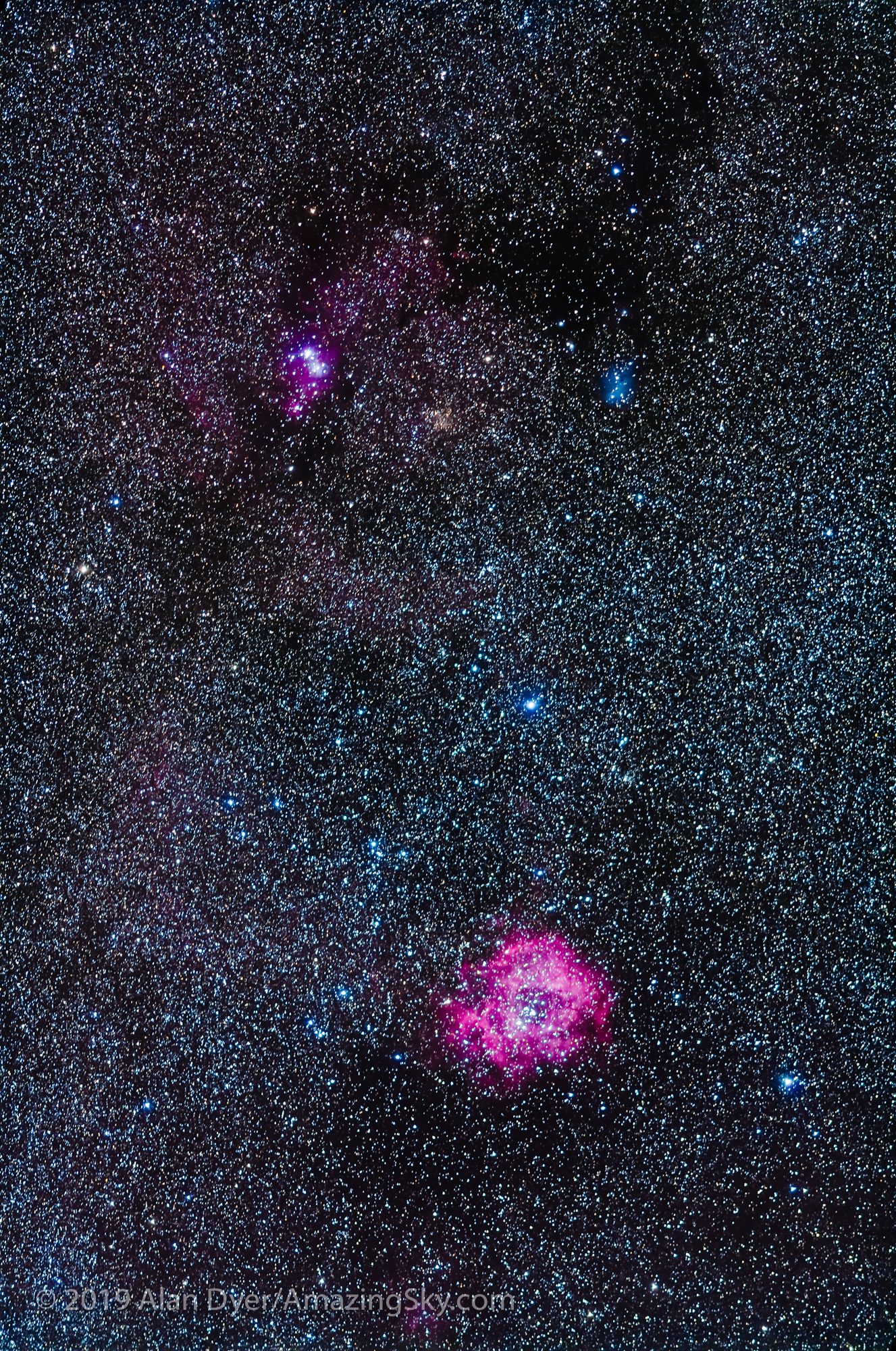
The Rosette Nebula and Area

Rosette and Christmas Tree Cluster with 200mm
The area of the Rosette Nebula (bottom) and Christmas Tree Cluster (top) in Monoceros with the Fornax Lightrack tracker and 200mm lens and filter modified Canon 5D MkII. This is a stack of 10 x 3 minute exposures at ISO 800.

The small cluster of hot young stars inside the Rosette Nebula is blowing a hole in the nebula giving it its Rosette name. Above is a loose star cluster called the Christmas Tree, surrounded by more faint nebulosity that includes the tiny Cone Nebula.


Gemini Clusters and Nebulas

The Clusters and Nebulas of Gemini
This is a stack of 10 x 3-minute exposures with the filter-modified Canon 5D MkII at ISO 800 and 200mm Canon L-Series lens at f/2.8. Some light haze passing through in some exposures added the natural star glows. I left those in as part of the stack to add the glows. Taken with the Fornax Lightrack tracker as part of testing. Taken from home on a rare fine and mild winter night, January 4, 2019.

This field of clusters and nebulosity is above Orion in Gemini, with Messier 35 the main open star cluster here at top. Below M35 is the tiny star cluster NGC 2158. The nebulosity at left between Mu and Eta Geminorum is IC 443, a remnant of a supernova explosion, and is aka the Jellyfish Nebula. The nebula at bottom is IC 2174, just over the border in Orion and aka the Monkeyhead Nebula.


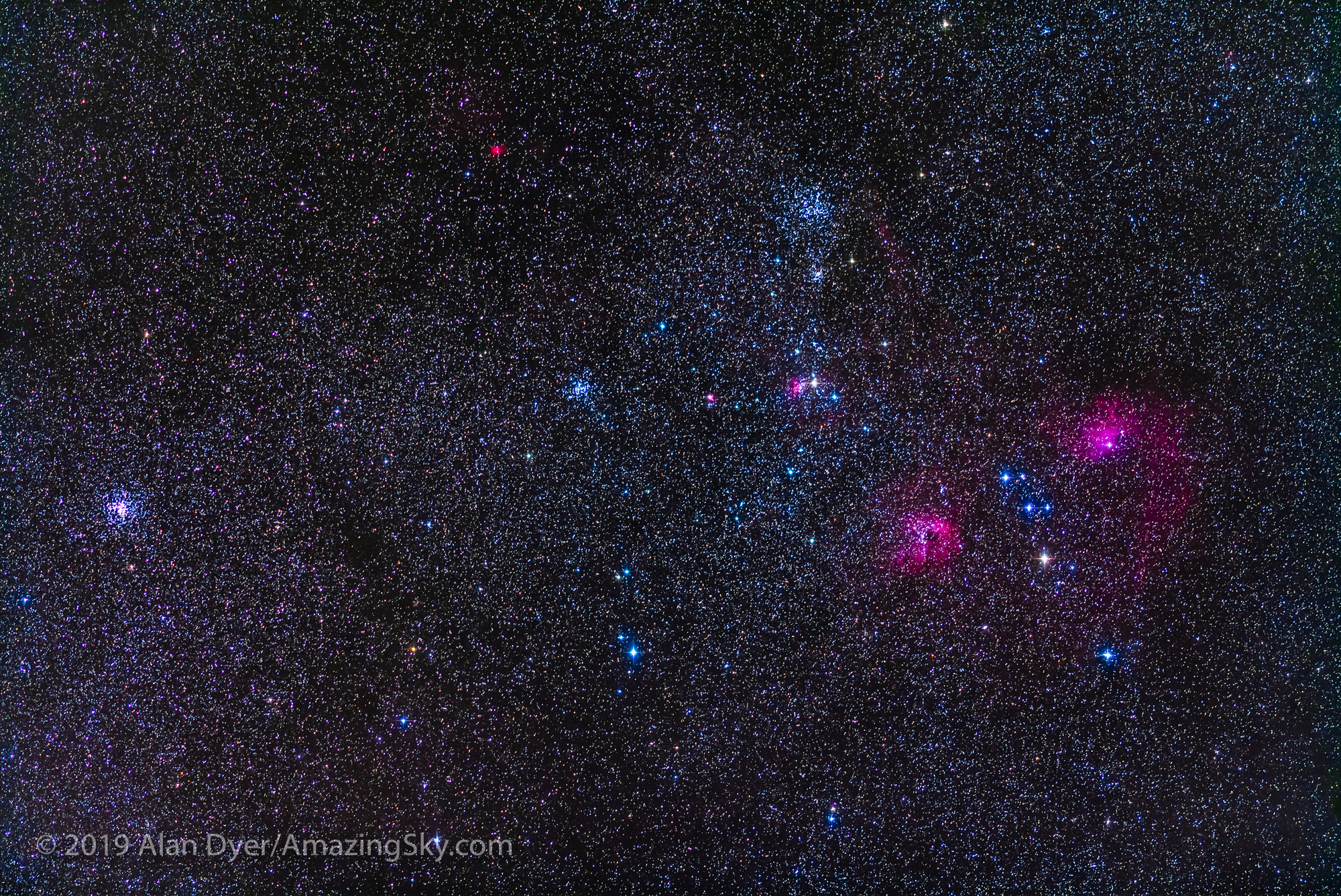
Auriga Clusters and Nebulas

The Clusters and Nebulas of Auriga
This is a stack of 5 x 3-minute exposures with the filter-modified Canon 5D MkII at ISO 800 and 200mm Canon L-Series lens at f/2.8. Taken with the Fornax Lightrack tracker as part of testing. Diffraction spikes added with Astronomy Tools actions. Taken from home on January 4, 2019.

Above Gemini and Orion lies Auriga, with its rich field of clusters and nebulosity, with — from left to right — Messier 37, Messier 36, and Messier 38, as the main open star clusters here. Below M38 is NGC 1907. The nebulosity at right is IC 410 and IC 405, the Flaming Star Nebula.

In between them is the colourful asterism known as the Little Fish. Messier 38 is also known as the Starfish Cluster while Messier 36 is called the Pinwheel Cluster. The bright red nebula at top is Sharpless 2-235. The little nebulas at centre are NGC 1931 and IC 417.


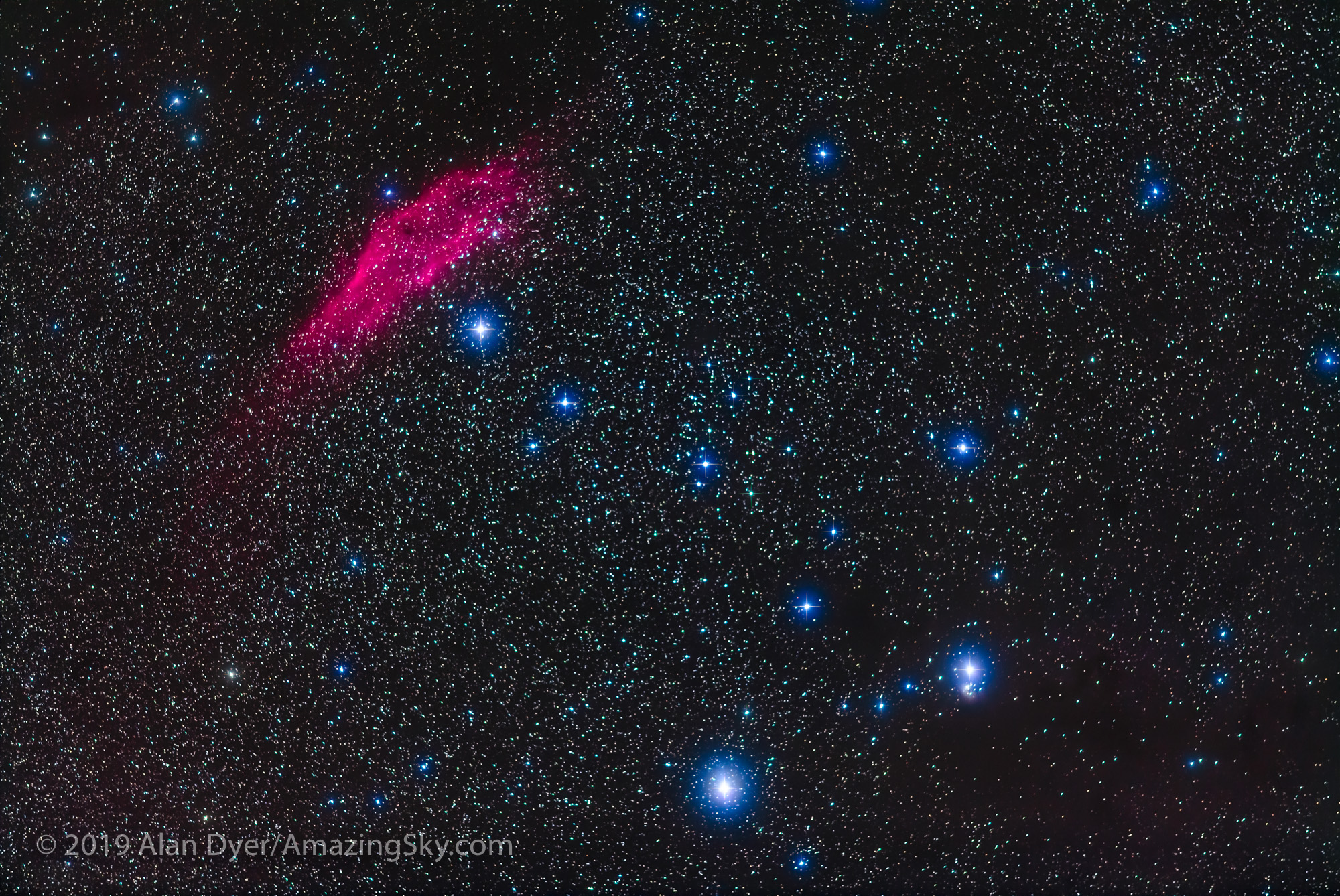
The California Nebula

The California Nebula in Perseus
This is a stack of 5 x 3-minute exposures with the filter-modified Canon 5D MkII at ISO 800 and 200mm Canon L-Series lens at f/2.8. An additional exposure taken through the Kenko Softon A filter is layered in to add the star glows to bring out their colours. Taken with the Fornax Lightrack tracker. Taken from home on a rare fine and mild winter night, January 4, 2019.

Now we enter Perseus, more an autumn constellation but well up through most of the winter months. It contains the aptly named California Nebula, NGC 1499, at top left, with the bright star Zeta Persei. at bottom A small region of reflection nebulosity, IC 348, surrounds the star Atik, or Omicron Persei, at bottom right. The star just below NGC 1499 is Menkib, or Xi Persei, and is likely energizing the nebula.


The Pleiades, or Seven Sisters

Pleiades M45 with 200mm Lens
The Pleiades with the Fornax Lightrack tracker and 200mm lens + Canon 5D MkII in a stack of 10 x 3 minute exposures at ISO 800.

Obvious to the eye and central to the sky lore of many cultures is the Pleiades, aka the Seven Sisters, in Taurus the bull. It is also called Messier 45.

This is a newly formed cluster of hundreds of stars, passing through a dusty region of the Milky Way, which adds the fuzzy glows around the stars — an example of a reflection nebula, glowing blue as it reflects the blue light of the young stars.


The Hyades

The Hyades Star Cluster with NGC 1647 in Taurus
This is a stack of 5 x 2-minute exposures with the Canon 5D MkII at ISO 800 and 200mm Canon L-Series lens at f/2.8. An additional exposure taken through the Kenko Softon A filter is layered in to add the star glows to bring out their colours. Taken with the Fornax Lightrack tracker. Diffraction spikes added with Astronomy Tools actions for artistic effect.

Below the Pleiades in Taurus lies the larger Hyades star cluster. The V-shaped cluster stars are all moving together and lie about 150 light years away. Bright yellow Aldebaran, the eye of Taurus, is an intruder and lies at only half that distance, so is not a member of Hyades but is a more nearby star. The smaller, more distant star cluster NGC 1647 appears at left.


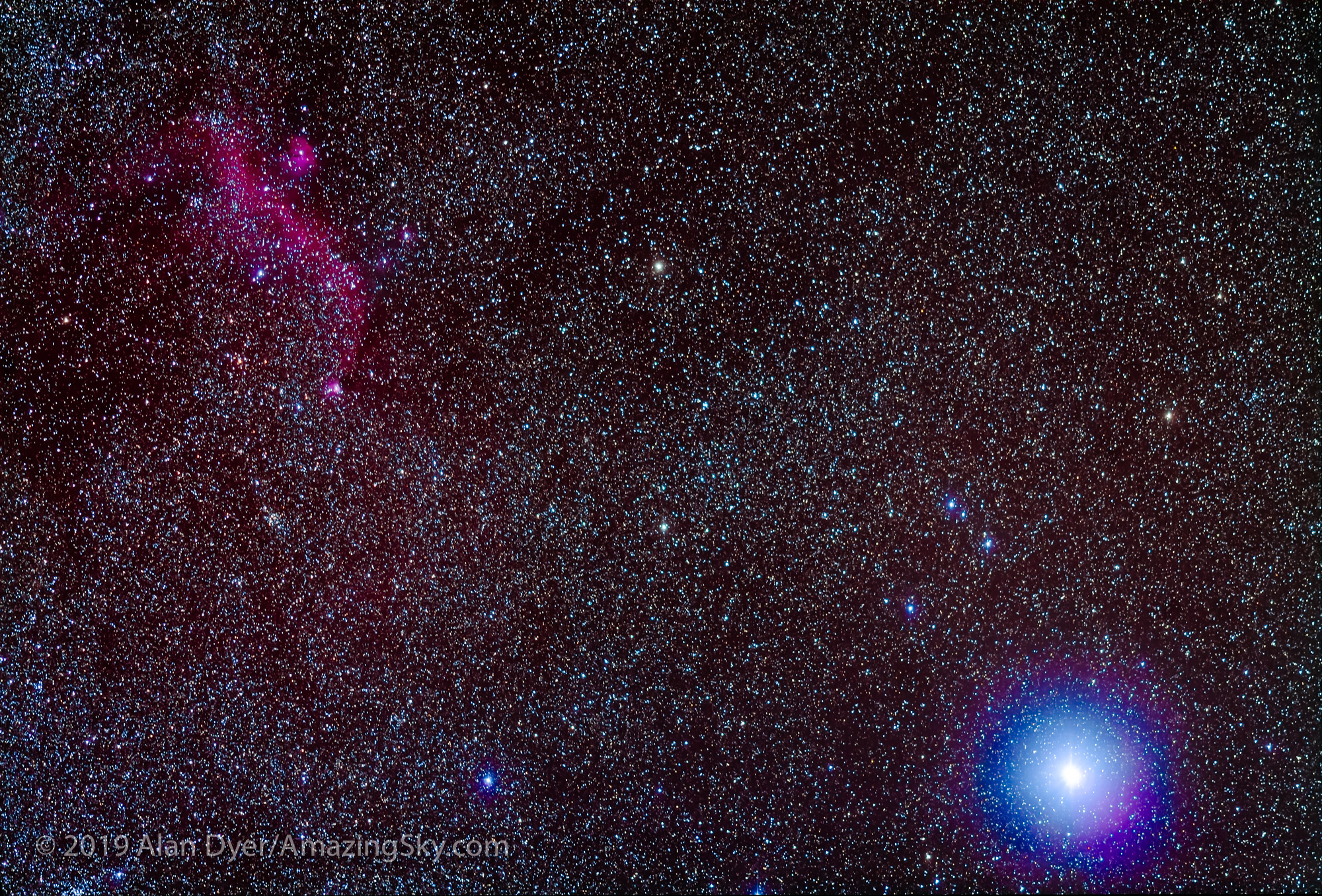
Seagull Nebula

Seagull Nebula and Sirius with 200mm
This is a stack of 10 x 3 minute exposures at ISO 800 (with the filter-modified Canon 5D MkII and Canon 200mm lens at f/2.8). The rings of colour around Sirius are an artifact of the sensor filter, I think!

Low in my northern winter sky is the brightest star in the sky of any season, Sirius. Just above and to the east of Sirius lies the Seagull Nebula (at top left), also called IC 2177, on the Canis Major-Monoceros border. Like many of these nebulas. the Seagull is too faint to easily see even with a telescope, but shows up well in photographs.


Lambda Orionis Nebula

Lambda Orionis Nebula with 200mm
With the Fornax Lightrack tracker and 200mm lens and filter-modified Canon 5D MkII. A stack of 10 x 3 minute exposures at ISO 800 with the filter-modified Canon 5D MkII and Canon 200mm lens at f/2.8.

This is the head of Orion, with the red supergiant star Betelgeuse at bottom left and the blue giant star Bellatrix right at bottom right. The brightest star at top is Meissa or Lambda Orionis, and is surrounded by a large and very faint area of hydrogen nebulosity. The open cluster around Meissa is catalogued as Collinder 69.

While the winter Milky Way might not look as bright and spectacular as the summer Milky Way of Sagittarius and Scorpius, it does contains a wealth of wonders that are treats for the eye and telescope … and for the camera.

PS.: The techniques for taking and processing images like these form the content of our new Deep Sky with Your DSLR video course now being promoted on KickStarter until the end of February, and available for purchase once it is published later this spring.

See my previous blog post for details.  Thanks and clear skies!

— Alan, February 17, 2019 / © 2019 Alan Dyer / AmazingSky.com 


Mosaic of the Autumn Constellations


Mosaic of the Northern Autumn Constellations

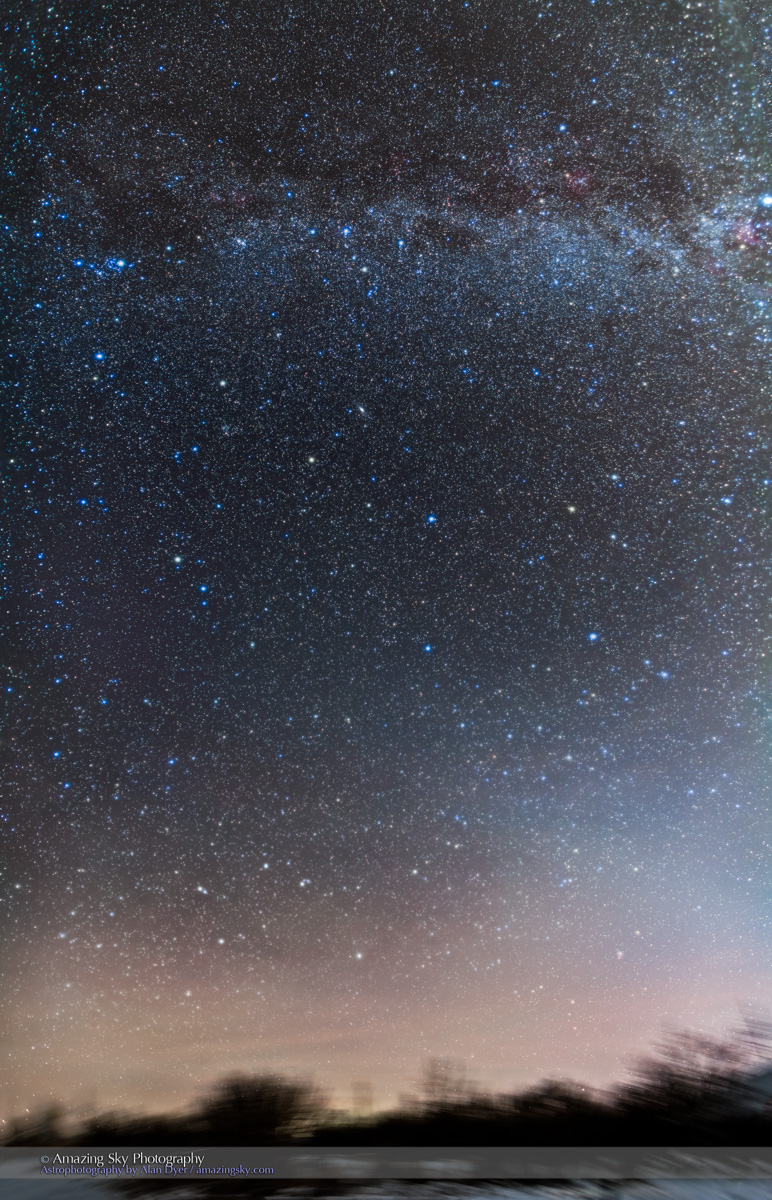
I present a horizon-to-zenith panorama of the pantheon of autumn constellations.

Yes, I know it’s winter, but as it gets dark each night now in early January the autumn stars are still front and centre. I took the opportunity during a run of very clear nights at home to shoot a panorama of the autumn sky.

It is a mosaic that sweeps up the sky and frames many related Greek mythological constellations:

• from the watery constellations of Aquarius, Pisces, and Cetus at the bottom near the horizon…

• to Pegasus and Aries in mid-frame…

• on up to Andromeda and Perseus at upper left…

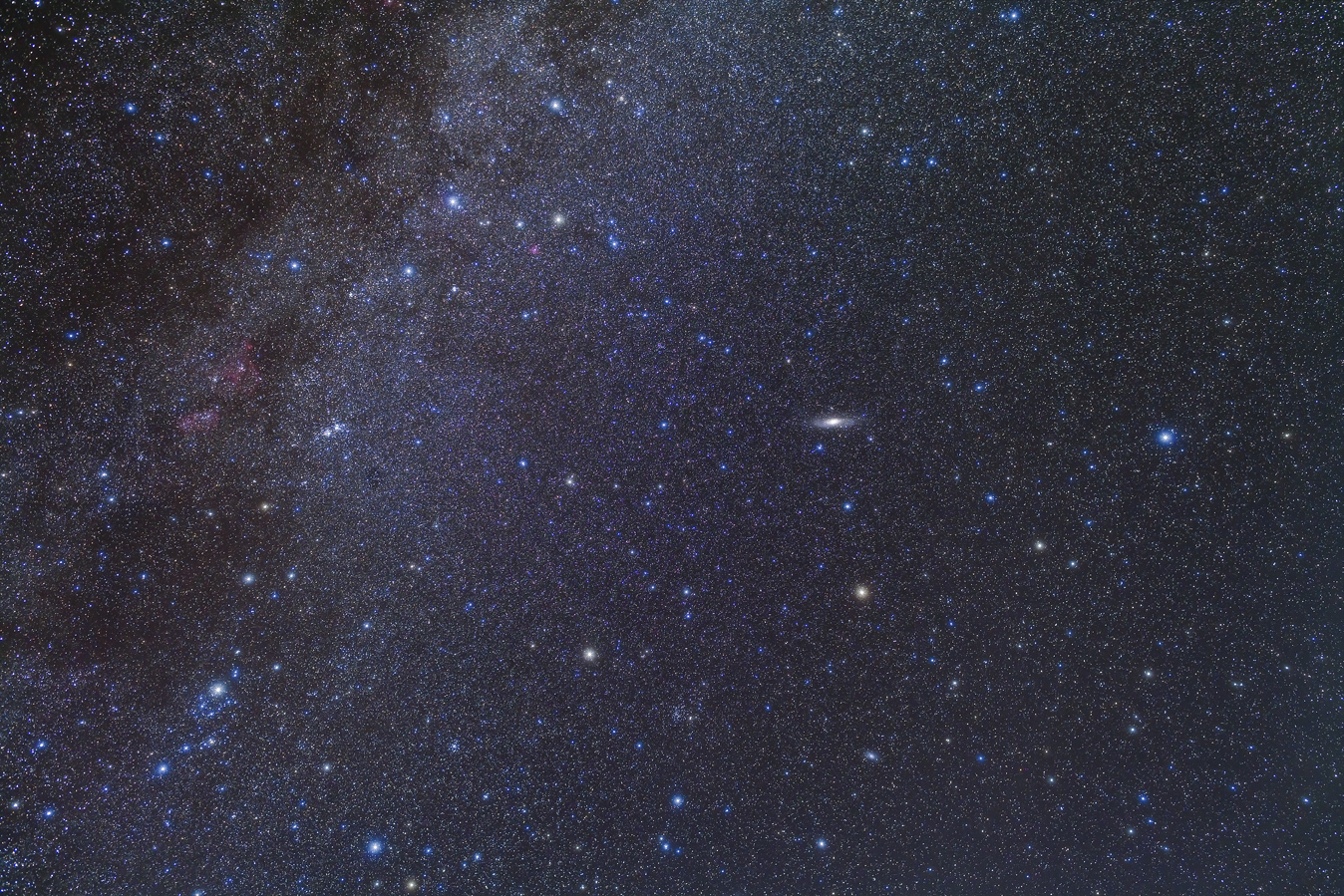
• and finally Cassiopeia and Cepheus at the top of frame embedded in the Milky Way overhead. The Andromeda Galaxy, M31, is just above centre.

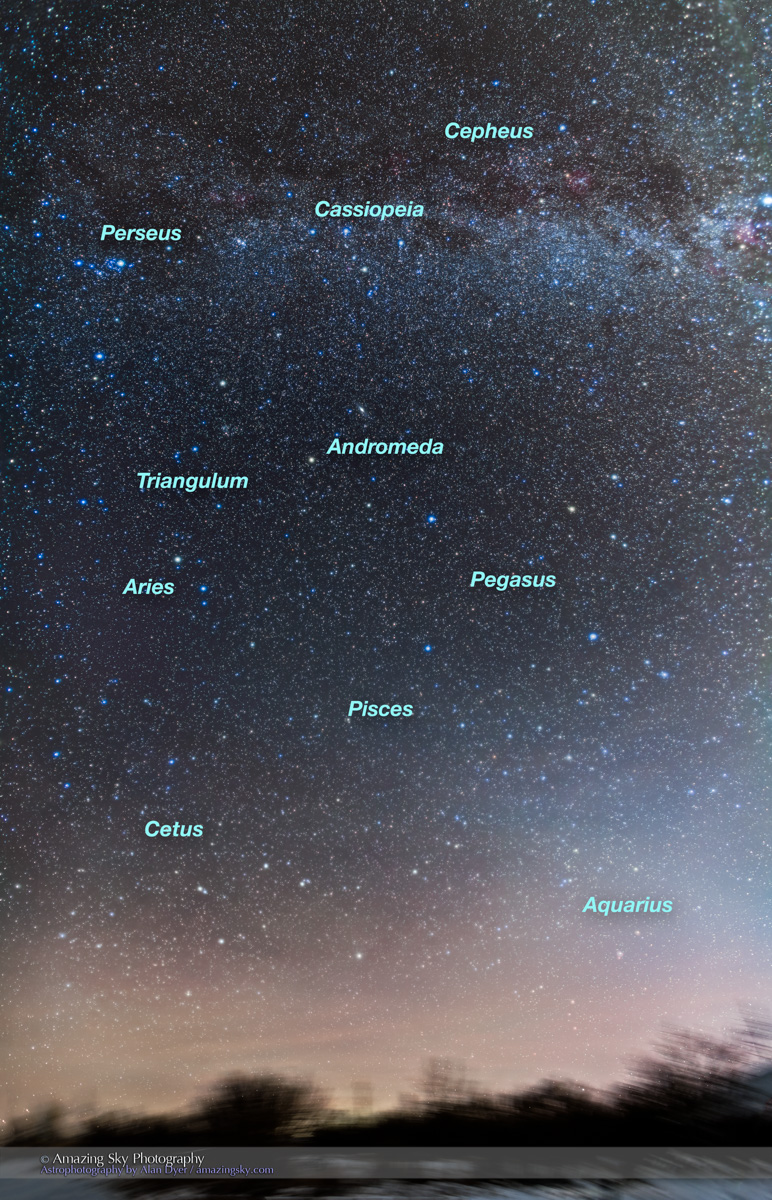
Mosaic of the Northern Autumn Constellations (with Labels)

Here, I’ve labeled the participating constellations, though only a few, such as the “square” of Pegasus and the “W” of Cassiopeia, have readily identifiable patterns.

Most of these constellations are related in Greek mythology, with Princess Andromeda being the daughter of Queen Cassiopeia and King Cepheus, who was rescued from the jaws of Cetus the Sea Monster by Perseus the Hero, who rode on Pegasus the Winged Horse in some accounts.

Zodiacal Light brightens the sky at bottom right in Aquarius, and angles across the frame to the left.


TECHNICAL:

I shot this from home on a very clear night January 2, 2016 with the Zodiacal Light plainly visible to the naked eye.

This is a mosaic of 5 panels, each a stack of 5 x 2 minute exposures, plus each panel having another stack of 2 x 2 minute exposures blended in, and taken through the Kenko Softon filter to add the fuzzy star glows to make the constellations stand out.

All were shot with the 24mm Canon lens at f/2.8 and Canon 5DMkII at ISO 1600. All tracked on the AP Mach One mount.

All stacking and stitching in Photoshop CC 2015. Final image size is 8500 x 5500 pixels and 3.6 gigabytes for the layered master.

– Alan, January 3, 2016 / © 2016 Alan Dyer / www.amazingsky.com
 

A Plethora of Perseids


A composite depicting the Perseid meteor shower on the night of Wednesday, August 12, 2015 as shot from southern Alberta, Canada.  The image takes in a wide swath of the north and eastern sky, including the radiant of the shower in Perseus at left of centre, near the Double Cluster visible as a clump of stars. All the Perseids can be traced back to this point. Also in the image: the summer Milky Way and, at left, a dim aurora in green and magenta that was barely visible to the eye but was picked up by the camera. The Andromeda Galaxy is at centre. The Pleiades is just on the horizon. Apart from some haze from forest fire smoke, it was a near perfect night: warm, dry, just a little wind to keep the bugs at bay, and no Moon. A perfect night for a meteor watch.  This is a layered stack of 35 images recording three dozen meteors (most Perseids but also a couple of sporadics not aimed back to the radiant in Perseus, such as the bright one at far left).  The 35 images were selected from 200 shot from 11 pm to 2:30 am that night, with most frames not picking up any meteors. This composite is from the 35 taken over the 3.5 hours that did record a meteor. Each exposure is 1 minute at f/2.8 with the 15mm full-frame fish-eye, on the Canon 5D MkII at ISO 3200 (a couple of the early shots in the sequence were at ISO 1600 for 2 minutes).  The camera was tracking the sky on the Sky-Watcher Star Adventurer tracker, so all images of the stars are aligned and registered out of the camera, with the meteors in their proper position relative to the stars and radiant. I masked out a couple of satellite and aircraft trails that were distracting, and took away from the point of illustrating the radiant of the meteor shower.  The horizon, however, is from one image, taken early in the sequence. Some of the blue in the sky comes from one of the early shots taken in deep twilight but that contained a nice meteor. And I liked the blue it added.  All stacking and processing with Adobe Ca

It was a good year for Perseid meteors, as they shot across the sky in abundance on dark-of-the-Moon nights.

Last week, August 11 and 12 proved to be superb for weather in southern Alberta, with clear skies and warm temperatures perfect for a night of watching and shooting meteors.

On both nights I had identical camera rigs running, all from my rural backyard. These images are from the peak night, Wednesday, August 12.

The main image at top is with a 15mm ultra wide lens, on a camera that was tracking the sky as it turned. Like many meteor photos these days it is a layered stack of many images, in this case 35, to put as many meteors as possible onto one frame.

While the result does illustrate the effect of meteors streaking away from the radiant point, here in Perseus, it does lend a false impression of what the shower was like. It took me 3.5 hours of shooting to capture all of those meteors.

Note the aurora as well.

The Perseid meteor shower on peak night of Wednesday, August 12, 2015, showing meteors radiating from the “radiant point” in northern Perseus, then rising in the northeast sky. One bright sporadic, non-Perseid meteor is at left, and a small sporadic is near the horizon at right. The meteor at far left, top, may be a satellite streak.  The Andromeda Galaxy is at upper right. A dim aurora is at left in the northeast. The setting is a ripening canola field at home.  This is a stack of 16 images, one for the “base layer” ground and sky, containing a bright meteor, and 15 other images taken as part of the same sequence, each containing a meteor, layered with Photoshop using Lighten blend mode. I rotated each of the additional “meteor layers” around Polaris at upper left, so the sky aligned closely, putting the meteors in close to their correct position relative to the stars, to accurately illustrate the radiant effect. This was necessary as this sequence was shot with a fixed, non-tracking camera (the Canon 6D) using a 14mm Rokinon lens at f/2.8. Each exposure was 1 minute at ISO 3200. The 16 meteor frames came from a set of 212 frames taken over 3.5 hours. I layered in only the frames with meteors.  Frames were taken from 11 pm to 2:30 am MDT.

With this camera I used a wide 14mm lens, but with the camera on a fixed tripod. I again blended frames, 16 of them, to show the meteors radiating from Perseus.

Because the camera was not tracking the sky, later in Photoshop I rotated each frame relative to a lower “base-level” image, rotating them around Polaris at top as the sky does, in order to line up the stars and have the meteors appear in their correct position relative to the background stars and radiant point.

Note the errant bright “sporadic” meteor not part of the shower.

The Perseid meteors shooting through Cygnus and the Summer Triangle area of the summer Milky Way, on the night of Wednesday, August 12, 2015. Deneb is the star at top left, Vega at top right, and Altair at bottom. The Perseids shoot across the frame from top left to bottom right. Other streaks are sporadic meteors or short satellite trails. I masked out other long satellite trails that were distracting to the image’s focus on depicting Perseids. This is a stack of 24 images, each with a meteor or two, taken over a 3.5-hour period that night, with each exposure being 1 minute at f/2, with the 24mm Sigma lens and Nikon D750 at ISO 1600. The 24 image with meteors were selected from a total of 214 shot for this sequence, with most frames not recording any meteor, and perhaps only satellites or aircraft.

Camera number 3 was aimed straight up for 3.5 hours, toward Cygnus and the Summer Triangle, in hopes of nabbing that brilliant fireball streaking down the Milky Way. I got a nice “rain of meteors” effect but the bright bolide meteor eluded me.

This was certainly the best year for the Perseids in some time, with it coinciding with New Moon.

Later this year, the Geminids will also put on a good show at nearly New Moon, on the nights of December 13 and 14. So if you liked, or missed, the Perseids, take note of the dates in December.

However, for many of us, a Geminid watch is a very, cold and snowy affair!

— Alan, August 18, 2015 / © 2015 Alan Dyer / www.amazingsky.com 
Autumn Stars Rising over Dinosaur Park


Autumn Sky Rising over Badlands

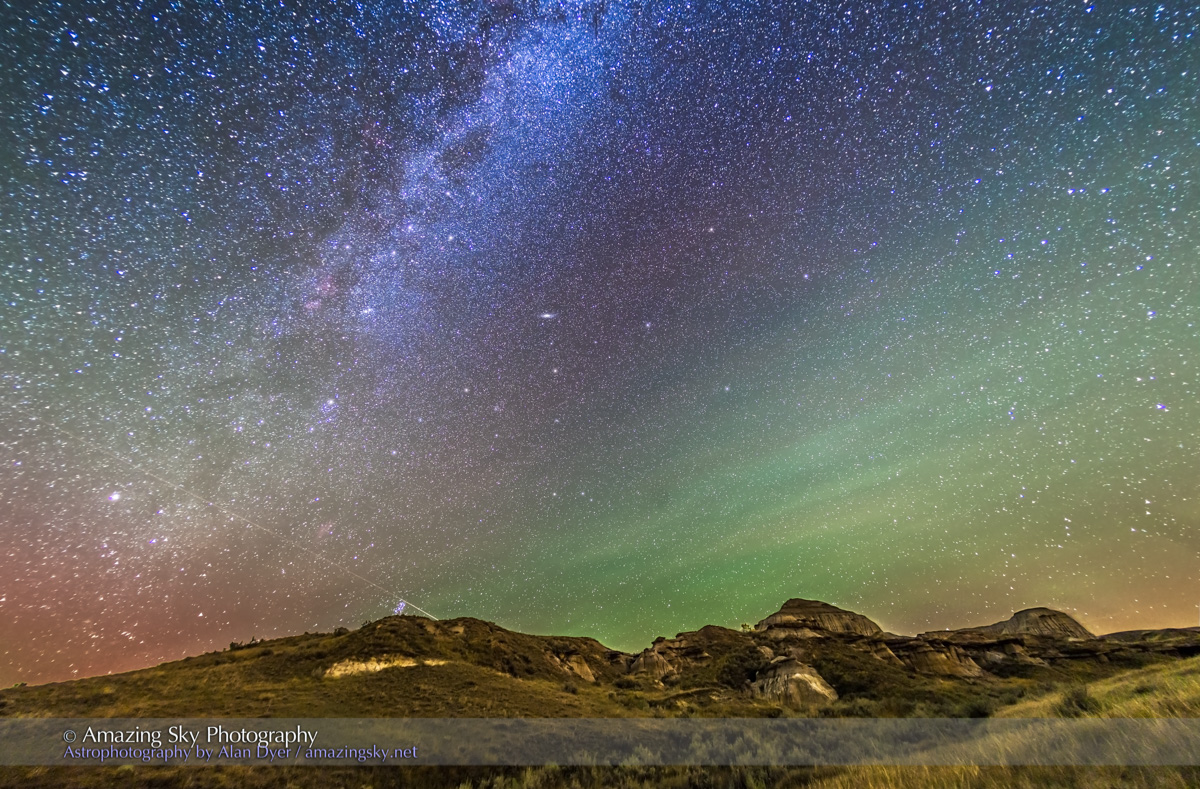
The autumn constellations rise into a colourful sky at Dinosaur Provincial Park, Alberta.

Last night the sky started out beautifully clear but as it got darker it was apparent even to the eye that the sky wasn’t really dark, despite the lack of any Moon.

The camera captured the culprit – extensive green airglow, to the east at right. A faint aurora also kicked up to the north, at left, adding a red glow. Light pollution from gas plants nearby and from Brooks 50 km away added yellow to the sky scattered off haze and incoming cloud.

The sky colours added to the scene of the autumn constellations of Cassiopeia, Andromeda, Perseus and Pegasus rising in the east. The Andromeda Galaxy is at centre. The Pleiades is (are?) just rising over the hill.

This is a composite of five stacked and tracked exposures for the sky (with the camera on the Star Adventurer tracking mount) and four stacked but untracked exposures I took at the end of the sequence for the sharp ground (I just turned the tracker motor off for these).

– Alan, September 26, 2014 / © 2014 Alan Dyer


Thunderstorm in the Moonlight


Thunderstorm in Moonlight (June 25, 2013)

A thunderstorm rolls across the northern horizon with the stars of Cassiopeia and Andromeda rising.

This was a perfect night for storm shooting. The storm was far enough away to not engulf me in rain and wind, but close enough to show detail and reveal its bolts of lightning. A waning gibbous Moon shone in the south lighting up the storm clouds to the north and turning the sky blue.

Meanwhile the stars of Cassiopeia, Perseus and Andromeda were rising behind the storm clouds, a nice contrast of Earth and sky.

I’ve been after a confluence of circumstances like this for a few years. An aurora to the northeast would have been nice as well. But you can’t have everything!

– Alan, June 25, 2013 / © 2013 Alan Dyer

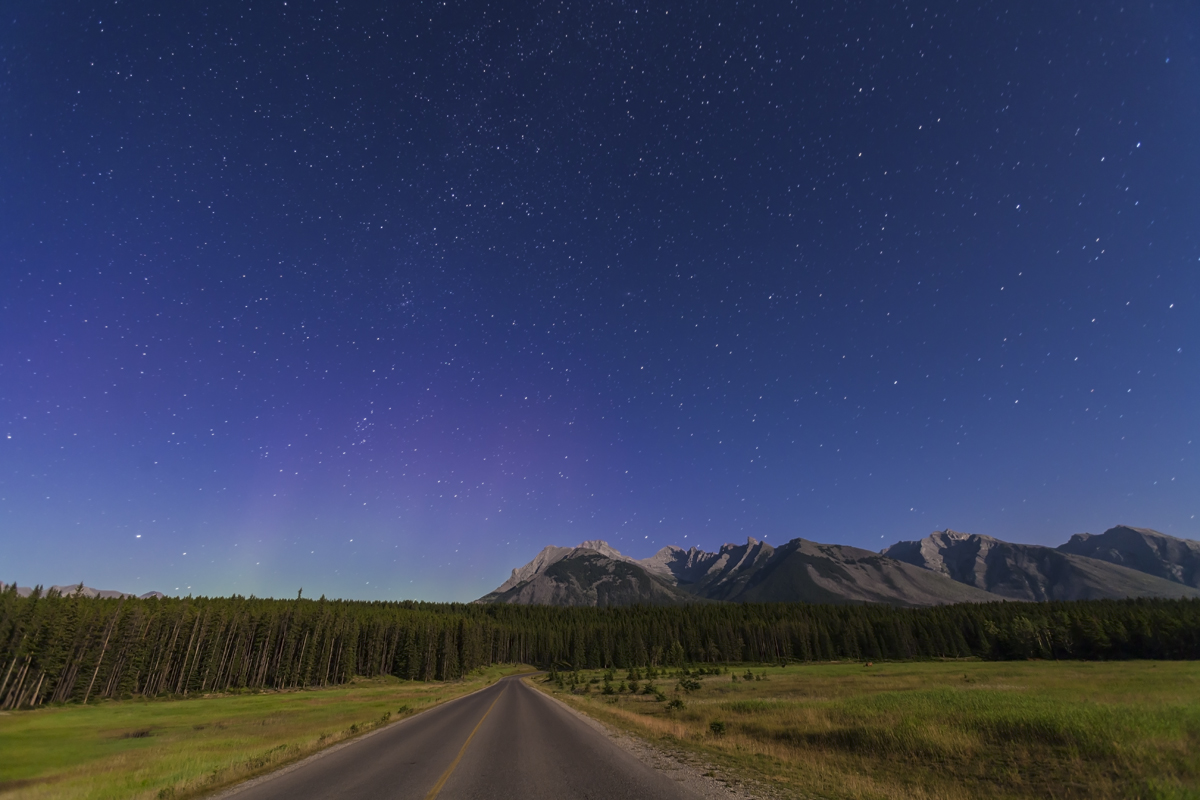
Driving to Andromeda


Are we there yet? It would take a long time to get to the end of this road.

A road in Banff appears as if it is heading toward the autumn constellations rising over the peaks of the Fairholme range in the Canadian Rockies. The stars of Andromeda (centre), Pegasus (right), Perseus (left), and Cassiopeia (above left) make up the panorama of mythological heroes populating the northern autumn sky. In the sky above the road the small smudge of the Andromeda Galaxy is visible, shining from 2.5 million light years away. A faint aurora at left adds to the moonlit scene.

I shot this Sunday, July 29, moments after taking the image in the previous blog, which was looking the other way, north toward Cascade Mountain, from the meadows north of Banff. This was a very photogenic spot.

— Alan, August 4, 2012 / © 2012 Alan Dyer


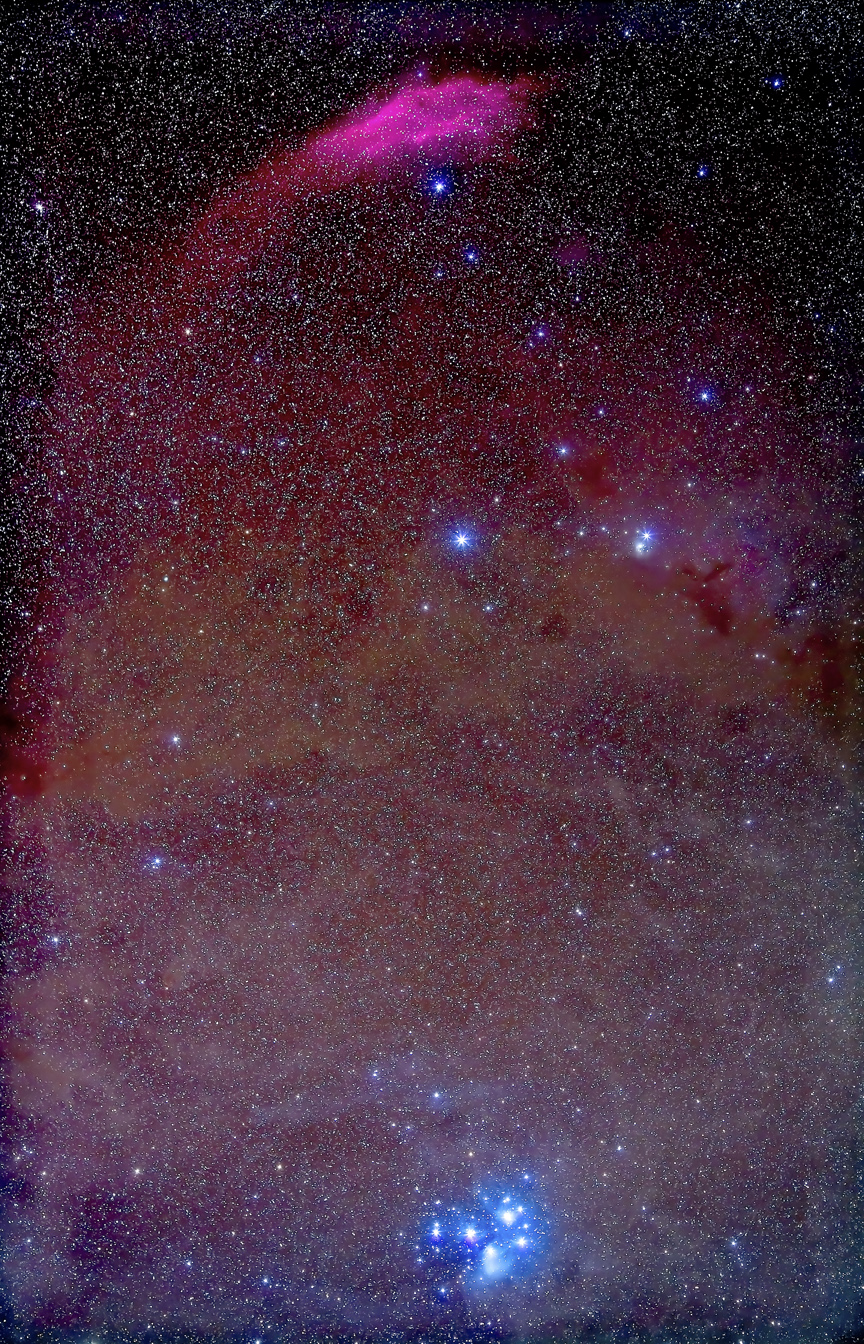
Celestial Pinks and Blues


Who says the dark night sky isn’t colourful? Of course, to the naked eye it mostly is, with the darkness punctuated only with a few red, yellow and blues stars. But expose a camera for long enough and all kinds of colour begins to appear.

This region is above us now, in the Northern Hemisphere evening sky for mid-winter. It’s the boundary area between Taurus and Perseus. Below are the vivid blues of the hot young Pleiades star cluster in Taurus. At top, just squeezing into the frame, is the shocking pink of the California Nebula, a glowing cloud of hydrogen gas in Perseus.

But between are the subtle hues of faint nebulosity weaving all through the Perseus-Taurus border zone. Below are faint cyans and blues from dust clouds reflecting the light of the Pleiades stars. In the middle are the yellow-browns of dark dust clouds hardly emitting light at all, but snaking across the frame to end in a complex of pink and blue straddling the border collectively known as IC 348 and IC 1333. At top, the glowing hydrogen gas of the California emits a mix of red and blue wavelengths, creating the hot pink tones, but fading to a deeper red to the left as the nebula thins out to the east. Throughout, hot blue stars pepper the sky and help illuminate the dust and gas clouds which will likely form more hot stars in the eons to come.

I took this shot last Wednesday night, on one of the few clear, haze-free nights of late. This is a “piggybacked shot,” with the Canon 5D MkII camera going along for the ride on one of my tracking mounts. This final shot is a stack of five 6-minute exposures, highly processed to bring out the faint clouds barely brighter than the sky itself. The camera was equipped with a 135mm telephoto lens, giving a field of view a couple of binocular fields wide. Hold out your hand and your outstretched palm would nicely cover  this area of sky. But only the camera reveals what is actually there.

— Alan, January 29, 2012 / Image © 2012 Alan Dyer

Legends of the Fall


These stars are as much a part of autumn in the northern hemisphere as are the changing colours of leaves and the flying south of geese.

These are the stars of legend, outlining the mythical constellations of Queen Cassiopeia (at top left), her daughter Andromeda (arcing across the bottom half of the image), and the hero Perseus (the stars at lower left) who rescued Andromeda from the ravages of Cetus the sea monster.

These stars are now high in the east in the evening sky, heralding the start of autumn and the return of frosty nights.

There are lots to see with binoculars or a telescope in these constellations. Look around this image and you can pick out several clumps, or clusters, of stars in Perseus and Andromeda. But the most obvious object is the oval-shaped Andromeda Galaxy, visible to the unaided eye from dark rural skies. This is the nearest sizeable galaxy to our Milky Way, and yet its light still takes 2.5 million years to reach us.

I took this shot earlier this week during a run of clear and warm autumn nights, perhaps the last before the chill nights of fall come on. It’s a wide-angle shot with a 35mm lens and Canon 5D MkII camera, tracked for a stack of four 6-minute exposures plus a fifth taken with a soft-focus filter.

— Alan, October 1, 2011 / Image © 2011 Alan Dyer


Pursuing Perseus


One of the tenets of my astrophotography “philosophy,” if there can be such a thing (my university degree is in Philosophy after all), is to not spend an enormous amount of time and money chasing after the same images others do, knowing they will likely get far better results than I might achieve, given my location and choice number of clear skies. I don’t live in Arizona, New Mexico or Chile.

Yes, there are certain showpiece objects one is obliged to shoot, to add to the portfolio. But rather than go after many of the usual galaxies and nebulas, I often prefer to shoot wider-field targets that others often bypass.

Simple shots of constellations are often more in demand by publishers than closeups of deep-sky objects, and yet are usually in short supply, as many astrophotographers dismiss them as being “just for beginners.” But good constellation shots still take the right gear, techniques and skies to stand out. Only now am I getting the results I’ve long sought.

With new techniques now in hand, one of my goals is to accumulate a complete portfolio of constellation portraits, though not all of these star patterns stand out as being photogenic. But this one does.

This shot is a recent favourite of mine, of the constellation of Perseus, a rich area of sky. Modern digital cameras show it as the old film cameras never could, laced with reddish dark nebulas of different densities. The Milky Way through this region takes on such a variety of subtle hues achieving correct colour balance is tough.

At top is the loose collection of hot blue stars known as the Perseus Association. At bottom is the most famous tightly bound cluster of stars, the Pleiades. Between is the finger of glowing hydrogen gas called the California Nebula. This photo is an example of how “simple constellation” shots can take on a beauty of their own.

– Alan, February 2011 / Image © 2011 Alan Dyer