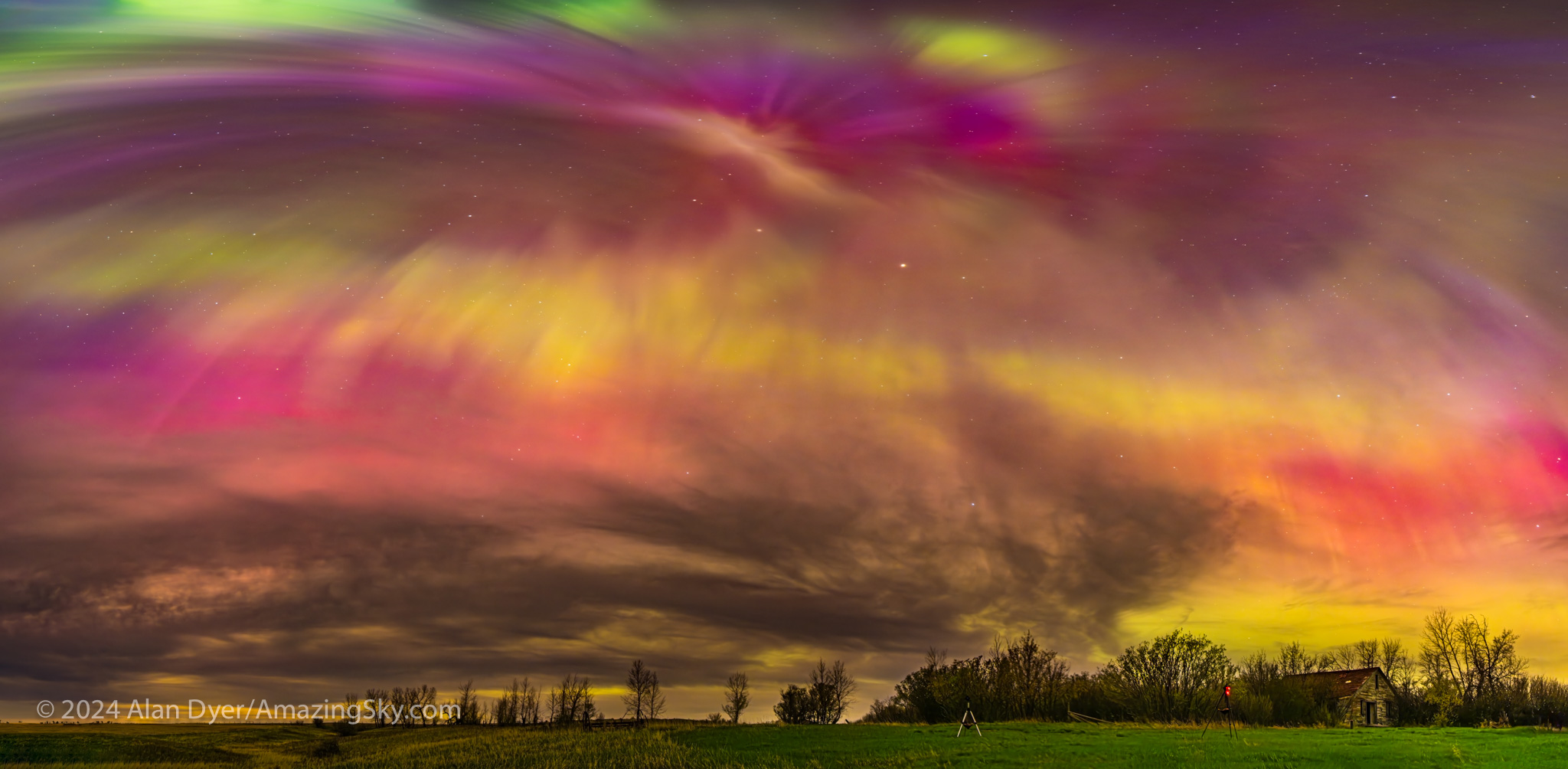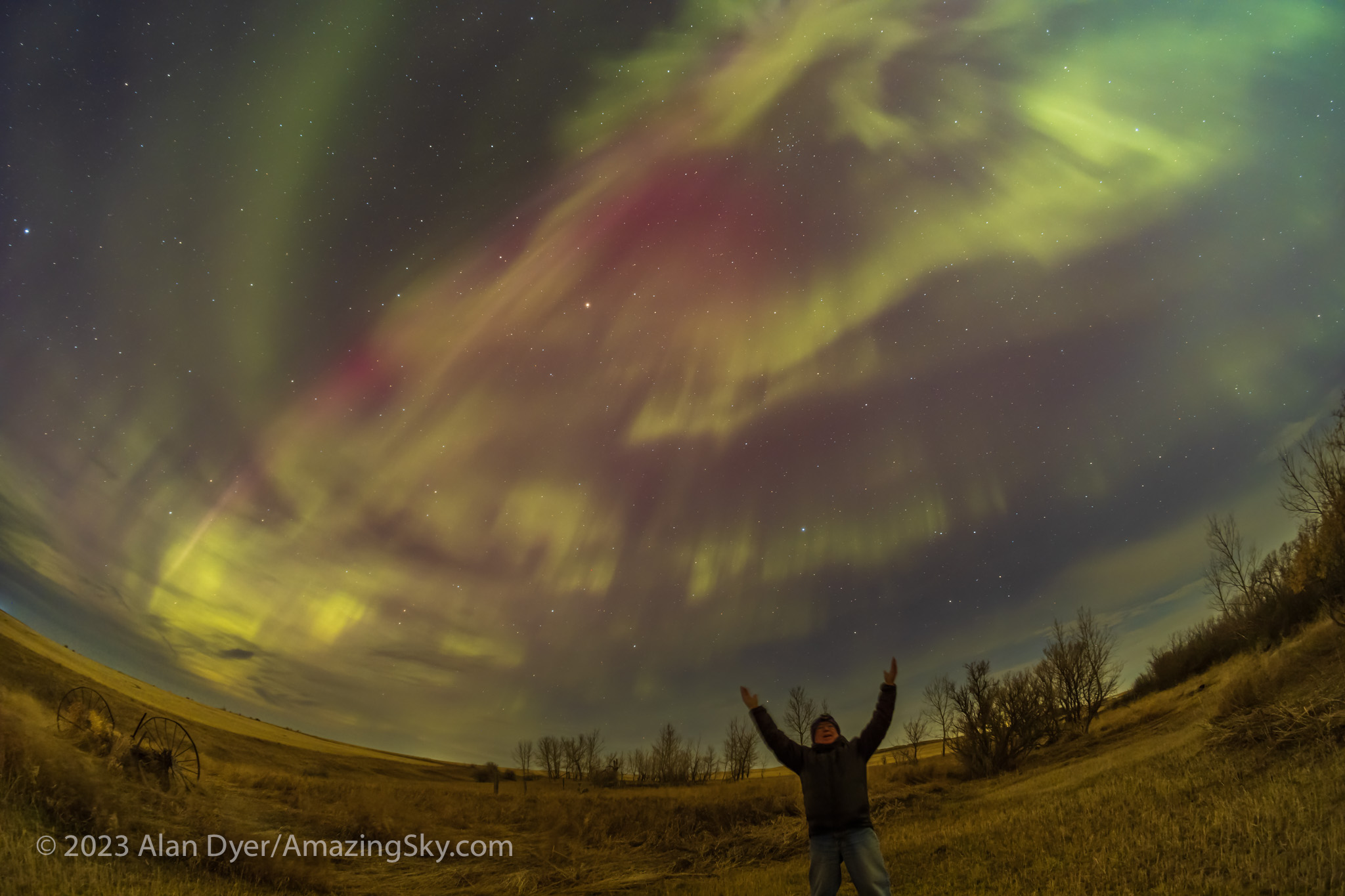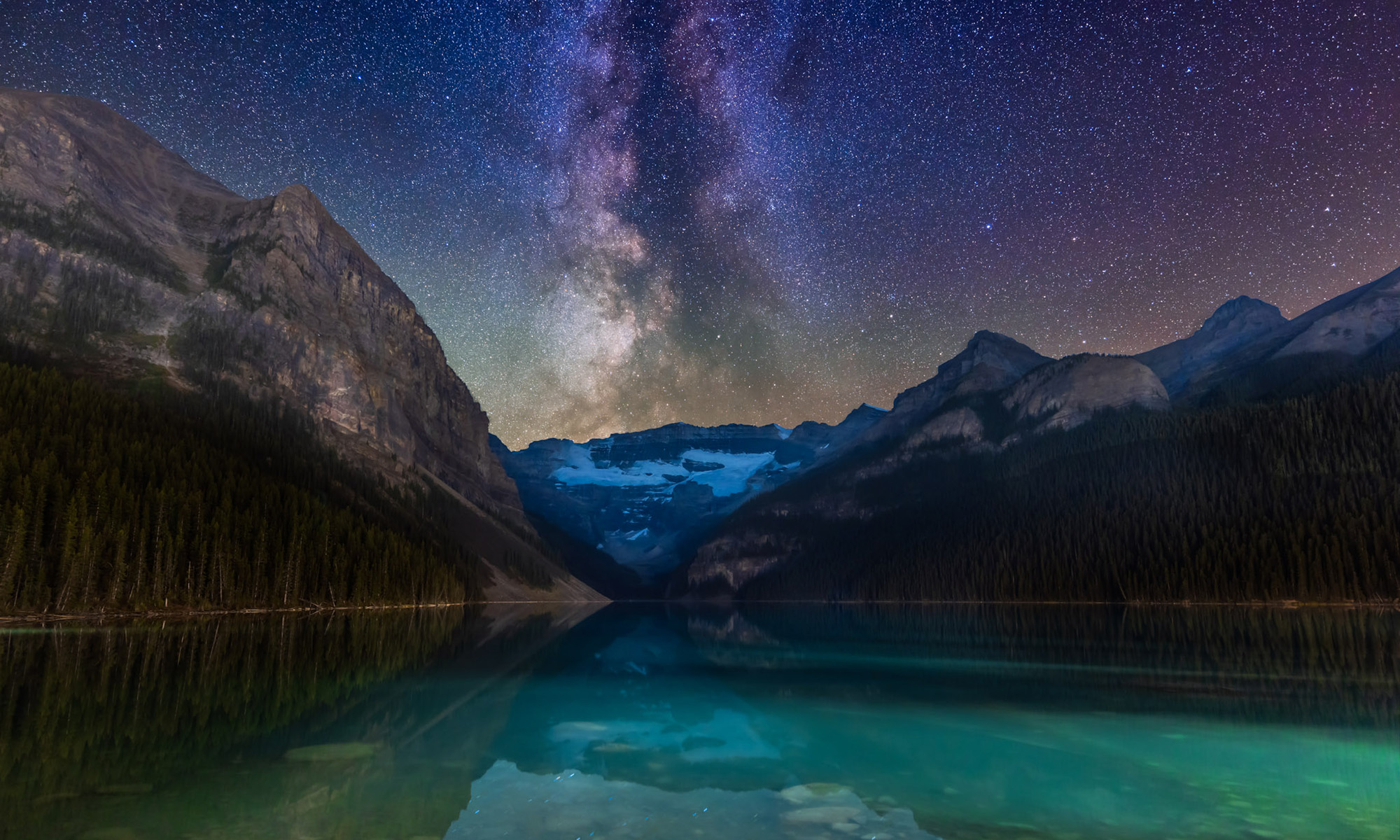
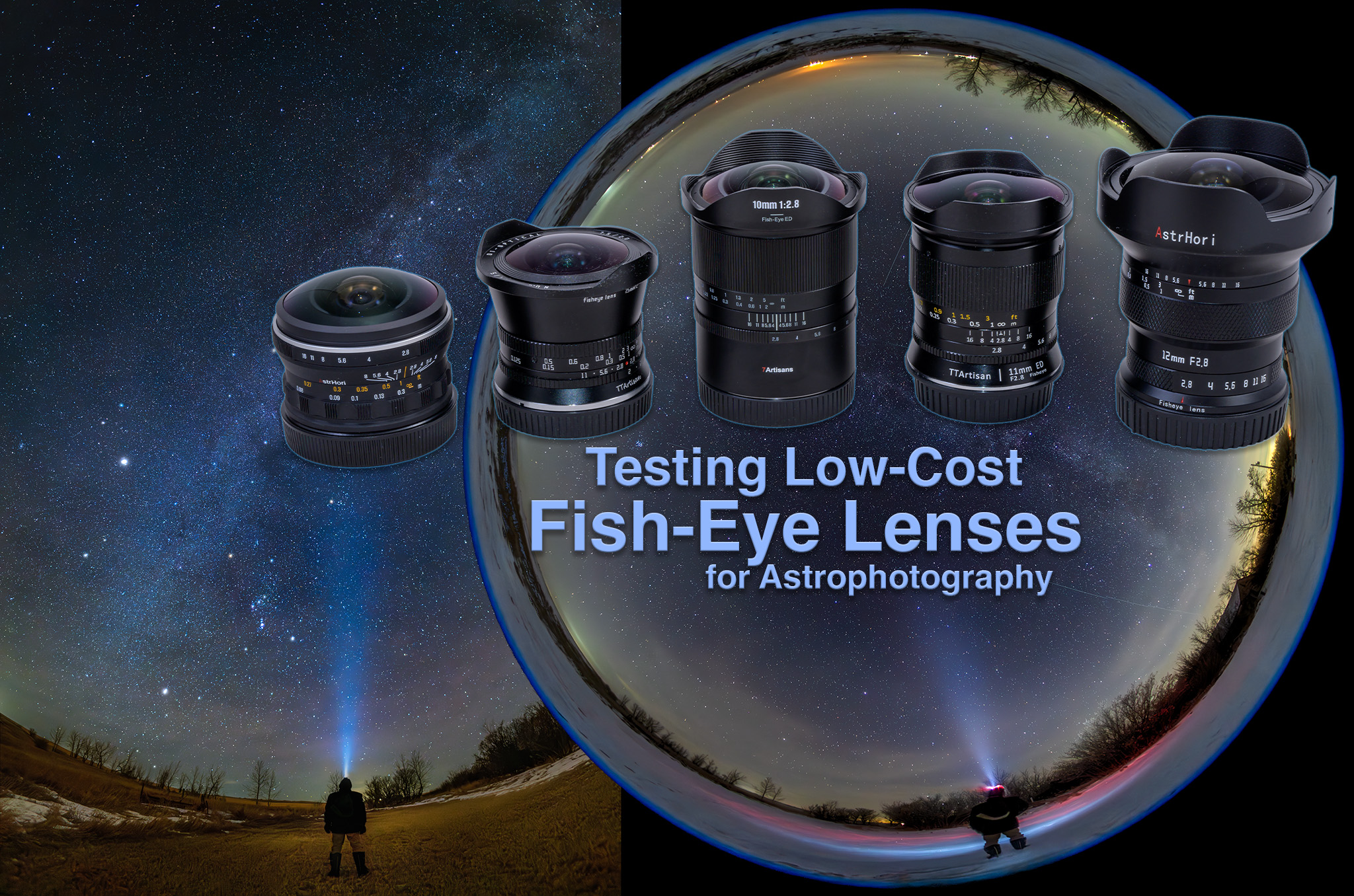
Testing Low-Cost Fish-Eye Lenses for Astrophotography


We have a bevy of new and very affordable fish-eye lenses to choose from. They can work great for astrophotography. But which one is best? 

Chinese lens makers are showering the market with affordable lenses, and for the most part theyโ€™re of quite good quality. Among them are fish-eyes, very special-purpose lenses. One of those purposes is astrophotography โ€” shooting wide swaths of the night sky, if not the entire sky, in one frame. Thatโ€™s ideal for capturing sky-filling auroras, or the sweep of the Milky Way. 

Here I test five low-cost fish-eyes on the night sky: 
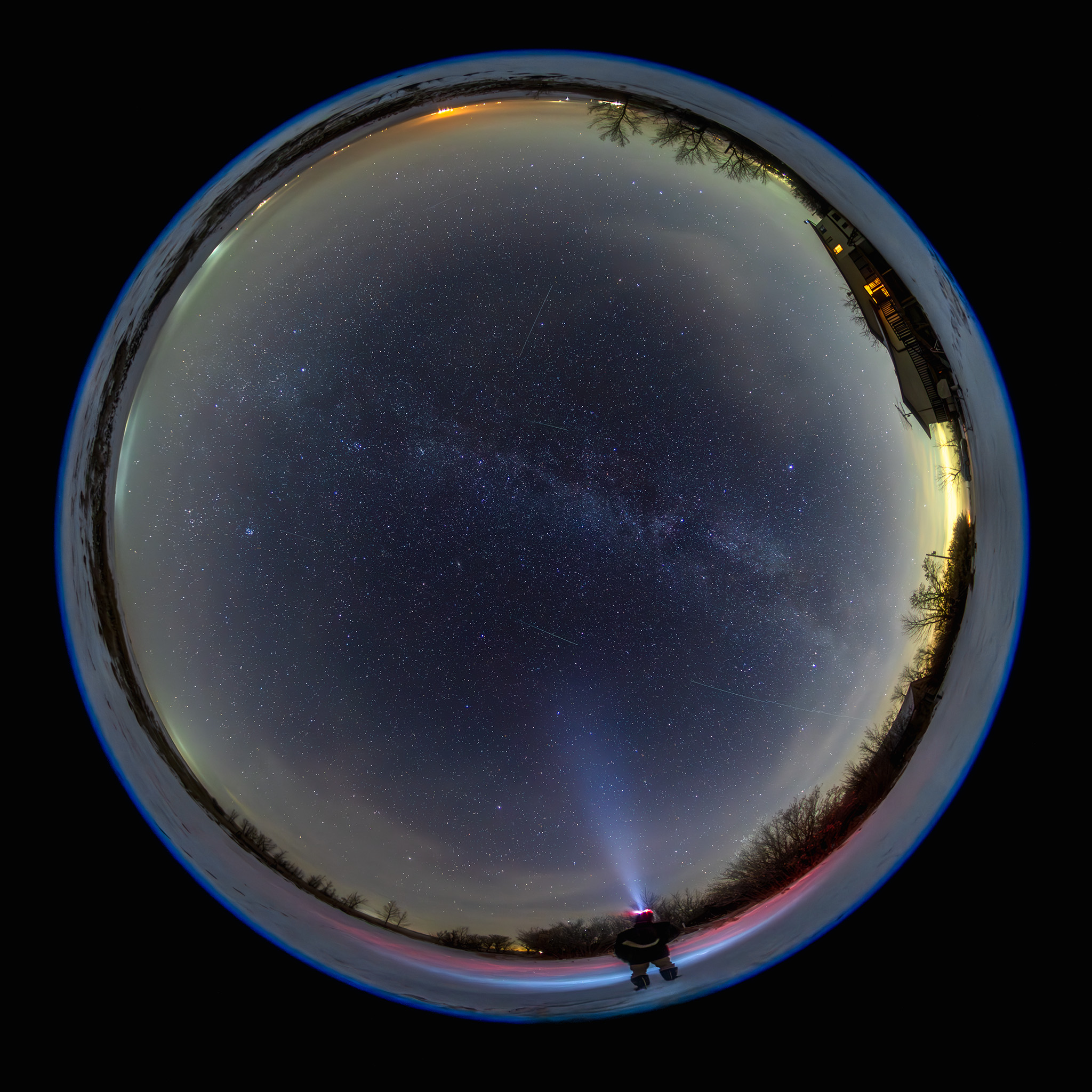
โ€“ Two circular format lenses that project a round image taking in a full 360ยฐ by 180ยบ within the rectangular frame, plus โ€ฆ

โ€“ Three lenses that fill the rectangular frame corner to corner (i.e. they are โ€œfull-frameโ€ or โ€œdiagonalโ€ fish-eyes) with a field that is about 180ยบ wide across the frame diagonal. They present curved horizons; they are not โ€œzero-distortionโ€ ultra-wide lenses. 

All five lenses work well on full-frame (36mm x 24mm sensor) cameras. All have fast f/2.8 or f/2 optics, making them suitable for astrophotography. Slower f/4 and f/5.6 fish-eyes are not so well suited.

I tested them all under a dark starry sky, checking for horizon-to-horizon sharpness and edge artifacts, and on a moonlit night looking for lens flares. 

NOTE: My blog features many high-resolution images that may take a while to load. 

However, you can CLICK or TAP on a test image to bring it up full screen for closer inspection, and save it as a JPG download. 

All images are ยฉ 2026 by Alan Dyer/AmazingSky.com. By all means share a link to the blog. But sharing individual images or publishing them without permission is prohibited.

TL;DR SUMMARY

All five lenses work surprisingly well for such low-cost optics. And all are well made, with smooth, well-dampened manual focusing. None are โ€œplastic-fantasticโ€ junk. 

For a full-frame fish-eye the 7Artisans 10mm stands out for astro use, for its optical quality and good features such as the glow-in-the-dark markings, and an excellent storage case. It will be the best lens here for Milky Way images where star sharpness counts most. 

For a circular fish-eye, the 6mm AstrHori and the 7.5mm TTArtisan each have unique features: an amazing 220ยบย field of view for the 6mm, and fast f/2 speed for the 7.5mm. Both would be superb for capturing all-sky aurora shows, perhaps for projection in digital planetarium domes.ย 

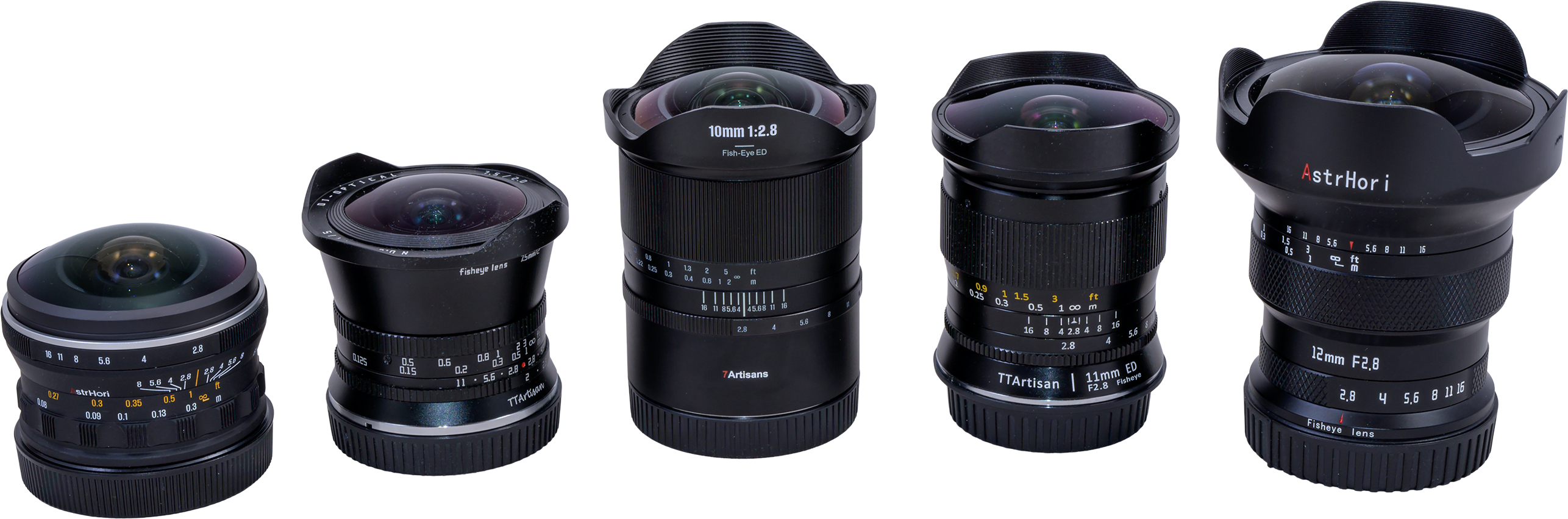
The five fish-eyes, to compare their relative sizes

THE LENSES

Here are the five lenses under test, in order of increasing focal length, shown above from L to R to compare their sizes โ€”

โ€” 6mm f/2.8 AstrHori circular fish-eye โ€“ with an advertised 220ยบ field of view

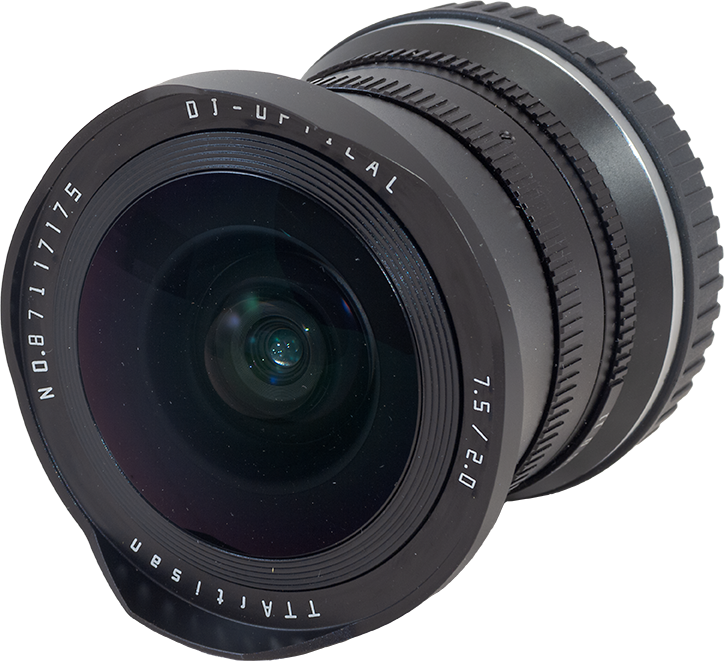
โ€” 7.5mm f/2 TTArtisan circular fish-eye โ€“ 180ยบ field of view (advertised)

โ€” 10mm f/2.8 7Artisans full-frame fish-eye โ€“ 185ยบ diagonal field of view (advertised)

โ€” 11mm f/2.8 TTArtisan full-frame fish-eye โ€“ 180ยบ diagonal field of view (advertised)

โ€” 12mm f/2.8 AstrHori full-frame fish-eye โ€“ 185ยบ diagonal field of view (advertised)

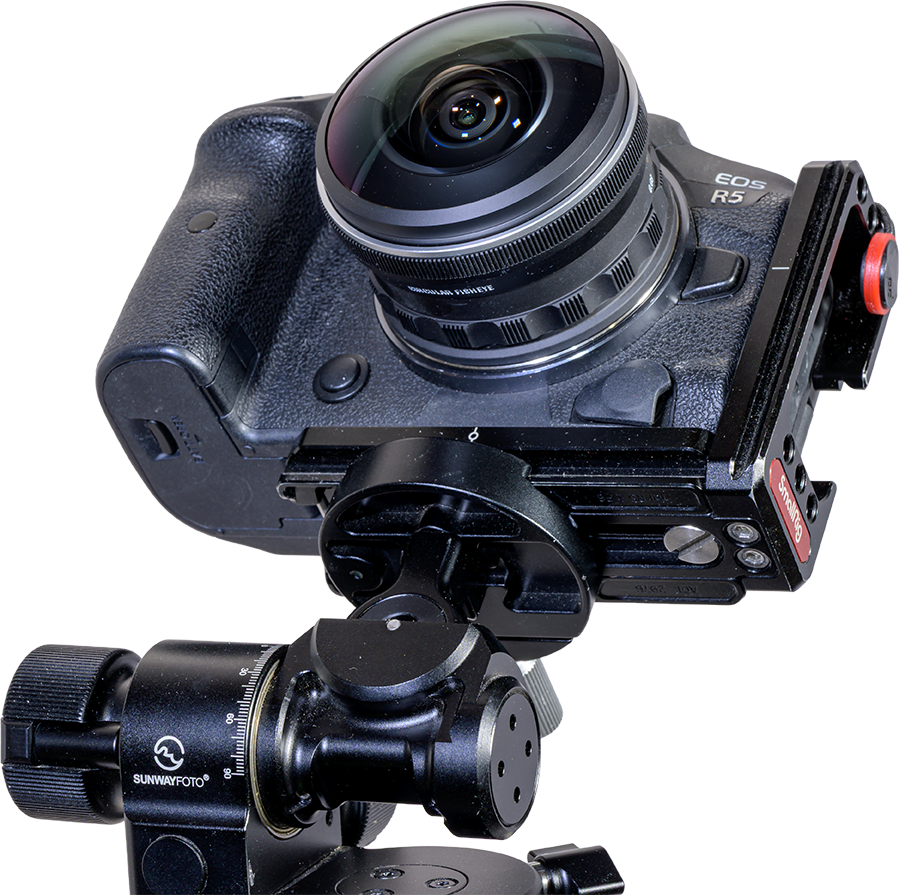
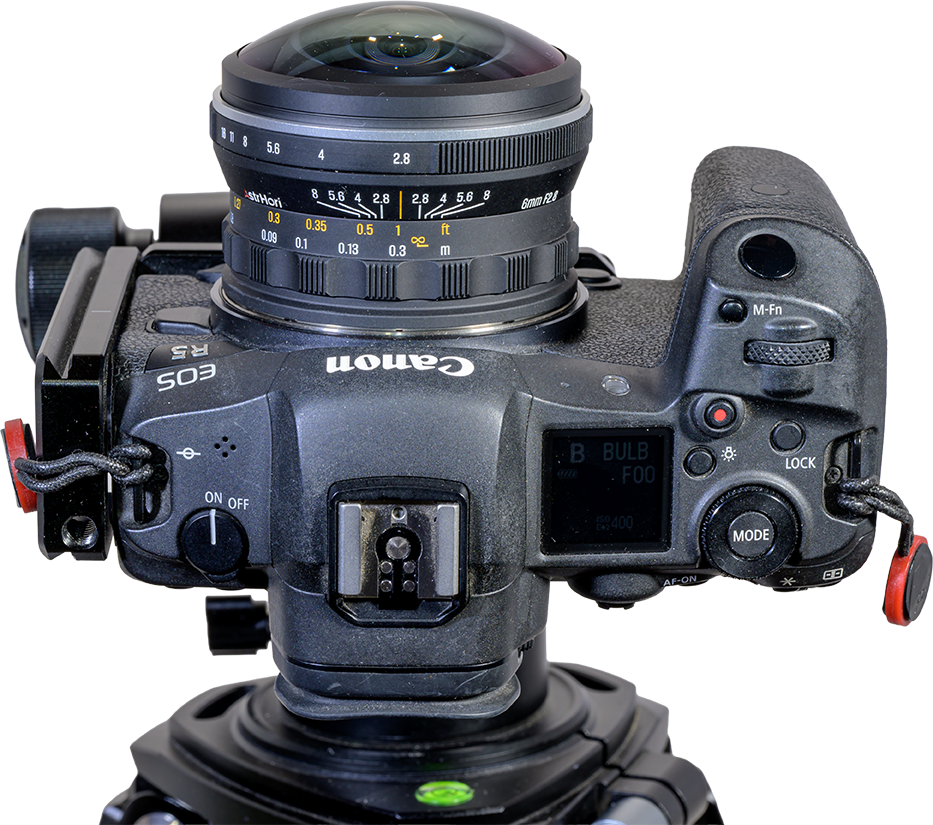
The 6mm, 11mm and 12mm lenses I tested on a 45 megapixel Canon R5.

The 7.5mm and 10mm lenses I tested on a 45 megapixel Nikon Z8. 

However, all the lenses are available for a wide range of camera brands, as I list below. All are manual-focus only, with no electrical connections to the camera body. So there is no restriction from Canon in offering them in RF-mount versions. But when using them on any camera, no EXIF metadata is recorded for lens brand, focal length or aperture. 

With the exception of the TTArtisan 11mm (which has versions for older Canon EF and Nikon F mounts), the lenses are for mirrorless cameras only โ€” they will not fit on DSLR camera bodies. By virtue of their design, none of the lenses accept filters, either front- or rear-mounted. None feature a rear weather sealing gasket. 

But the key factor is that none sell for more than $300; some cost less than $200. At that price, why not have one? Or two? 
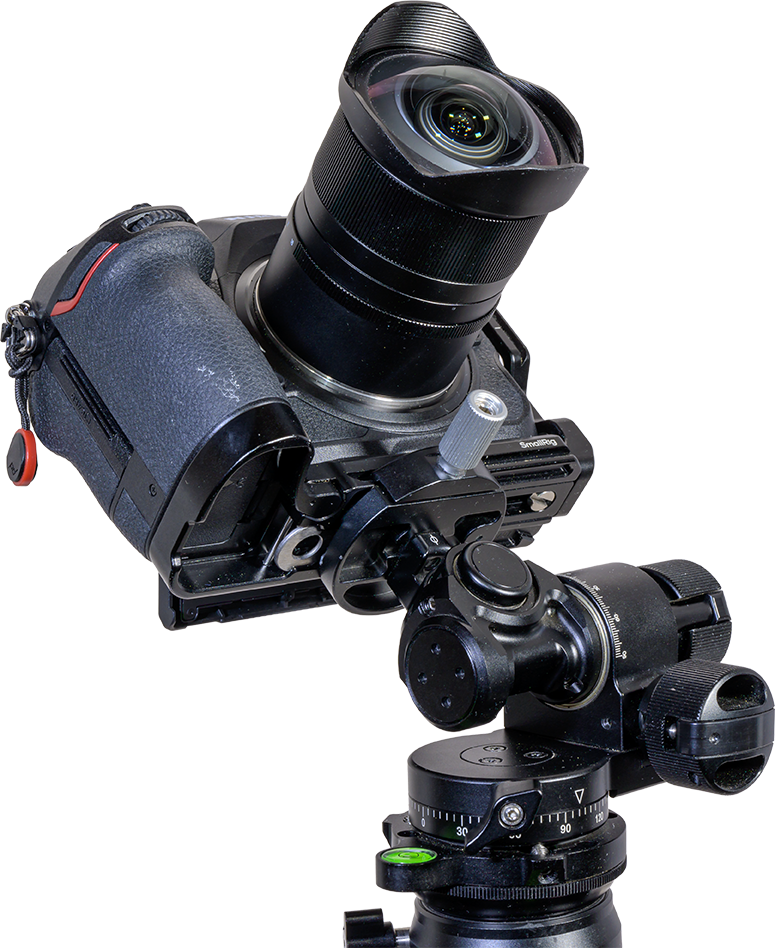
WHY DIDNโ€™T YOU TESTโ€ฆ?

First, I am not a test lab; I bought these lenses for personal use and out of curiosity. I selected low-cost lenses made for full-frame mirrorless cameras, what I shoot with. Indeed, the short flange distance of mirrorless cameras is what makes these lens designs possible.ย 

I did not test fish-eyes made just for APS-C or Micro4/3rds cameras, for example from the Chinese brands Meike (their 3.5mm and 7.5mm) and Brightin Star (their 7.5mm).

However, despite it being made for full-frame cameras, I chose not to buy and include the new Brightin Star 11mm f/2.8 Mark II ($270), a decision based on expert lens reviewer Christopher Frostโ€™s test here on his YouTube channel. The lensโ€™s edge performance, important for astro work, was shown as poor, even when stopped down. I saved my money. 

Nor did I test the new Laowa/Venus Optics 8-15mm f/2.8 zoom fish-eye, which offers a circular-format and full-frame fish-eye in one lens. It might perform well but is $700 US, so not a low-cost option โ€“ but you do get two lenses for the price of one. Ditto on the new Canon RF7-14mm f/2.8-f/3.5 L fish-eye โ€“ it has autofocus and is $1,900 US.ย 

The AstrHori 6mm

TESTING NOTES:

โ€” For my aberration tests I shot all the lenses on the same moonless night, with them aimed straight up to take in as much sky as possible to put stars across the frame. The cameras were on a star tracker (not shown) to eliminate star trails that can mask or mimic aberrations. 

โ€” In all cases where I show examples shot at different apertures, both images were shot for equal exposure value (by doubling the ISO for the smaller aperture shot), and then processed identically. So any brightness difference you see is from the lens performance, not my exposure or processing.

โ€” I did not apply any lens corrections or brighten the edges to compensate for vignetting. However, none of the diagonal fish-eyes suffer from obvious corner vignetting, unlike rectilinear ultra-wides that can exhibit very dark corners from extreme light fall-off.ย 

โ€” For my lens flare tests I shot all the lenses on the same moonlit night with a waxing Moon in the southwest which I placed off-centre to prompt internal reflections. The cameras were also on a tracker. 

โ€” I bought most of these lenses directly from the manufacturers from their on-line stores in China. Delivery in all cases was quick by mail, fulfilled from a North American distribution point. While I had no issues, product quality for bargain lenses can vary, so consider buying from a source where you can easily return the lens for a replacement or a refund.

I will state at the outset that none of these lenses offer pinpoint stars to the edges of their image circles, certainly not at their maximum apertures. You canโ€™t expect aberration-free performance at these prices. 

If you wish optical perfection in a fish-eye lens then look at the Sigma 15mm f/1.4 DG DN, for $2,200 US. (See Nico Carverโ€™s test of that lens here on his Nebula Photos YouTube channel.)

Here are the test details, with the five fish-eyes presented in order of increasing focal length. 


The AstrHori 6mm f/2.8 Circular Fish-Eye
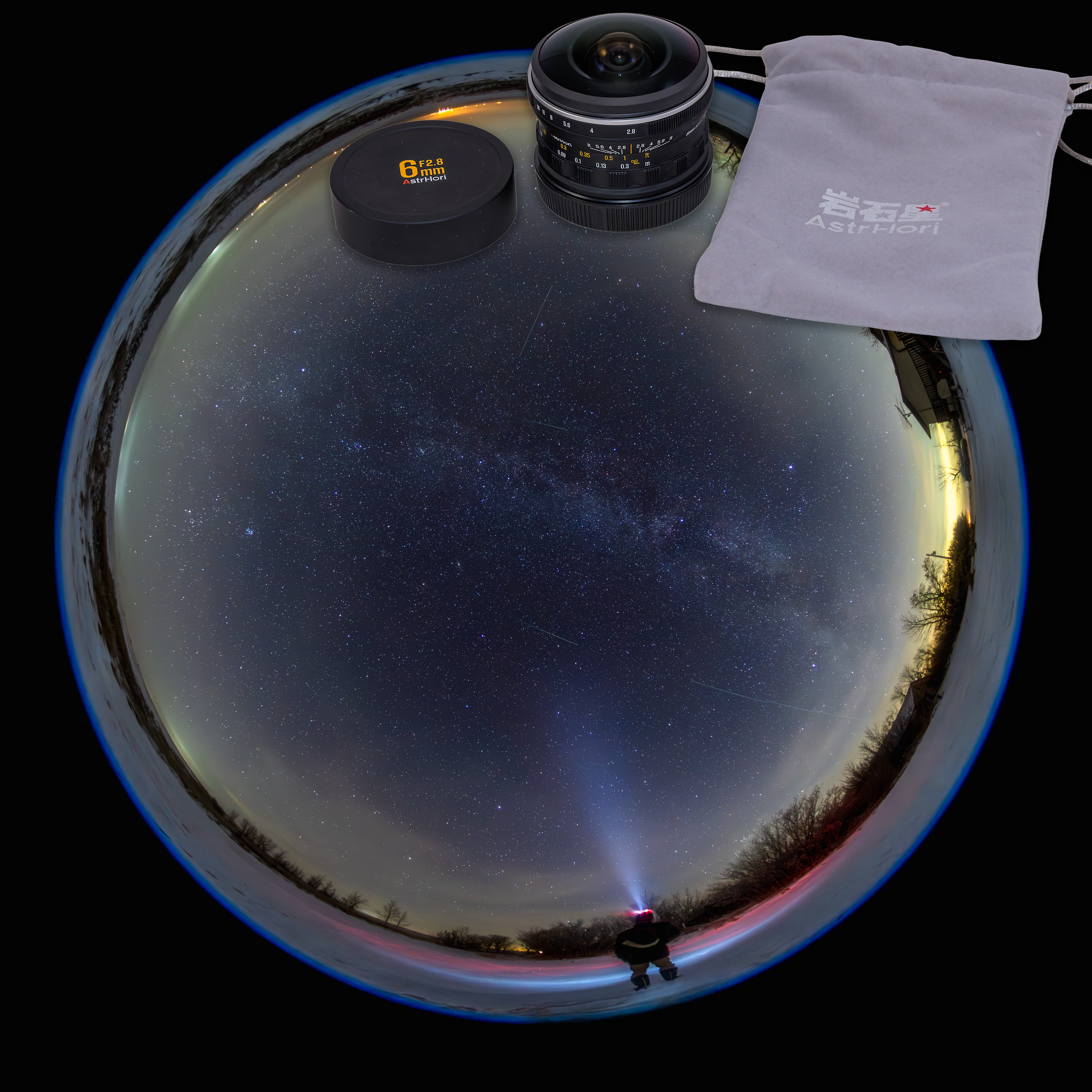
Available for Sony E, Panasonic L, Canon RF, Nikon Z Lens Mounts

$300 US. 

The unique selling point of this lens is that it has an amazing 220ยบ field of view across its image circle. It can actually see behind itself! To stay out of the frame, duck!

When aimed straight up it will include not only the entire sky down to the horizon, but also the ground well below the horizon, good for putting the sky in context to the landscape below. Doing so with any other lens requires shooting a multi-segment panorama. While panos have the benefit of higher resolution, the 6mm lens allows for all-sky time-lapses and movies.  

Previously, to get such a field of view with such a speed (f/2.8) you had to pay more than $100,000 (!!!) for a rare sample of the massive 6mm f/2.8 Nikkor lens made in limited quantities in the early 1980s. By contrast, the 6mm from AstrHori (it is not AstroHori!) is downright tiny. And cheap!

The lens has a knurled manual focus ring that turns smoothly, and a ribbed aperture ring with firm clicks at each f-stop. Infinity focus, with the stars sharpest, proved to be slightly shy of the centre of the infinity mark, so the lens requires careful manual focusing. The lens can focus past infinity.

The press-on metal lens cap is boldly marked with the lens identity. Like all AstrHori lenses, the 6mm comes with a thick soft cloth pouch. 

The short length of the lens makes it difficult to wrap an anti-dew heater coil around it, certainly not without risk of shifting the focus or aperture. Thatโ€™s a consideration, as aimed straight up its lens is bound to attract dew or frost over long shoots. 

IMAGE QUALITY

The 6mm AstrHori doesnโ€™t quite fill the frame across the sensorโ€™s short dimension (24mm). Instead, the lensโ€™s image circle is about 21mm across. The edge of the image circle is soft but clean โ€“ it is not rimmed by odd colours or internal reflections. 
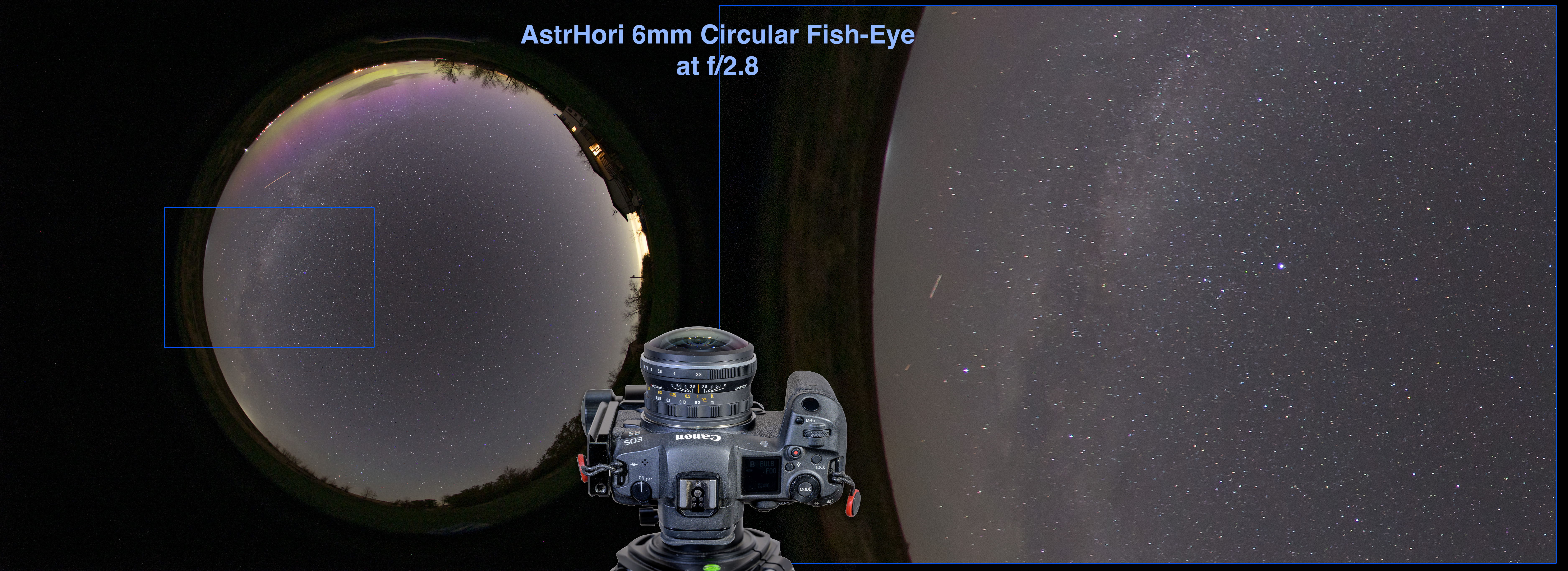
6mm AstrHori at f/2.8 โ€“ In all test images the image on the right is a blow-up of the blue-framed area at left.

Stars in the centre are tack sharp at f/2.8, with some longitudinal chromatic aberration (LoCA) adding small blue halos. The LoCA is gone at f/4. Stars toward the edges show an increasing amount of elongation from astigmatism, and exhibit colour streaks from lateral chromatic aberration (LaCA). Both diminish at f/4 but are still present. 
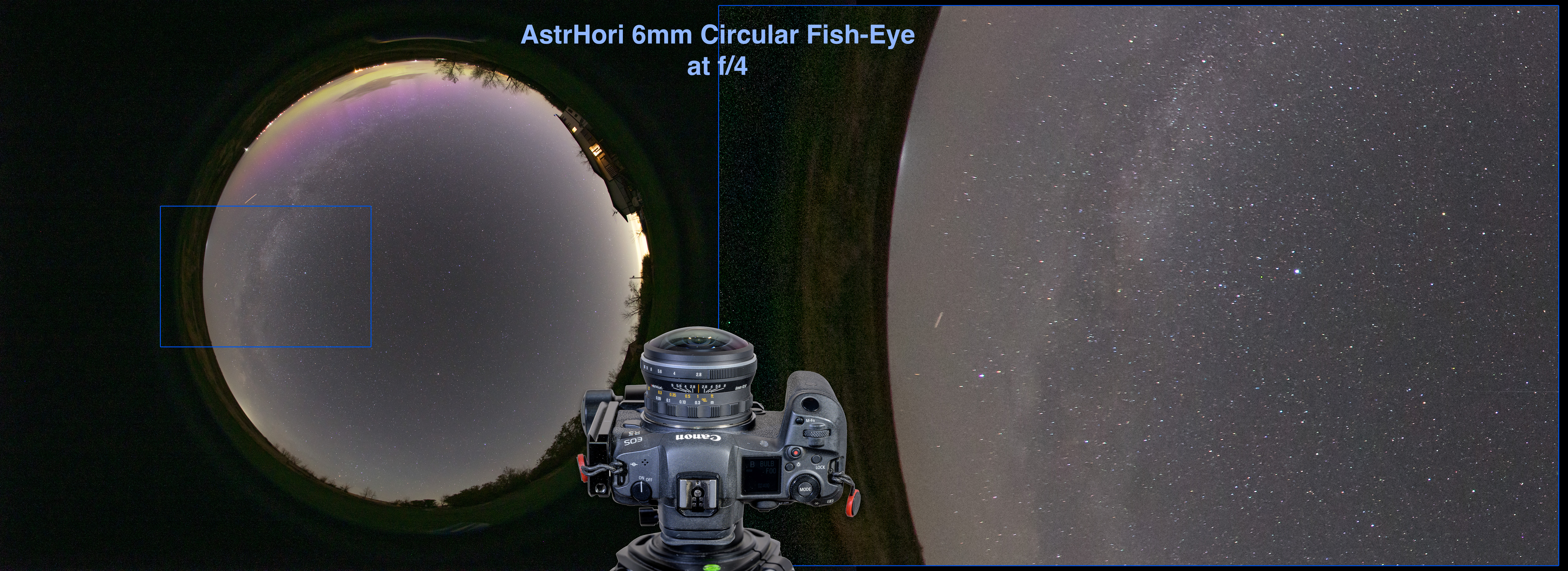
6mm AstrHori at f/4 โ€“ Note the brighter edge and ground compared to f/2.8

By comparison, Sigmaโ€™s old 8mm f/3.5 circular fish-eye, now long discontinued but that I used for many years on my Canon DSLRs, had smaller but still noticeable levels of astigmatism and lateral chromatic aberration at the edges, even when stopped down to f/4 or f/4.5. So the $300 AstrHori is not far below the classic but much more costly Sigma 8mm for edge sharpness.

The main benefit to stopping down the AstrHori 6mm is the reduced vignetting that brightens the field overall, but especially the horizon around the edges. So if the horizon content is important, stop the lens down. Otherwise, this lens works well at f/2.8.

LENS FLARES

A 30-second exposure at f/2.8 with the Moon in the frame (if itโ€™s in the sky itโ€™ll be in the frame with this lens!) showed only a small lens flare (arrowed) opposite the Moon. It tightened up at f/4 (not shown) but was still present. In all, this is a good performance. 
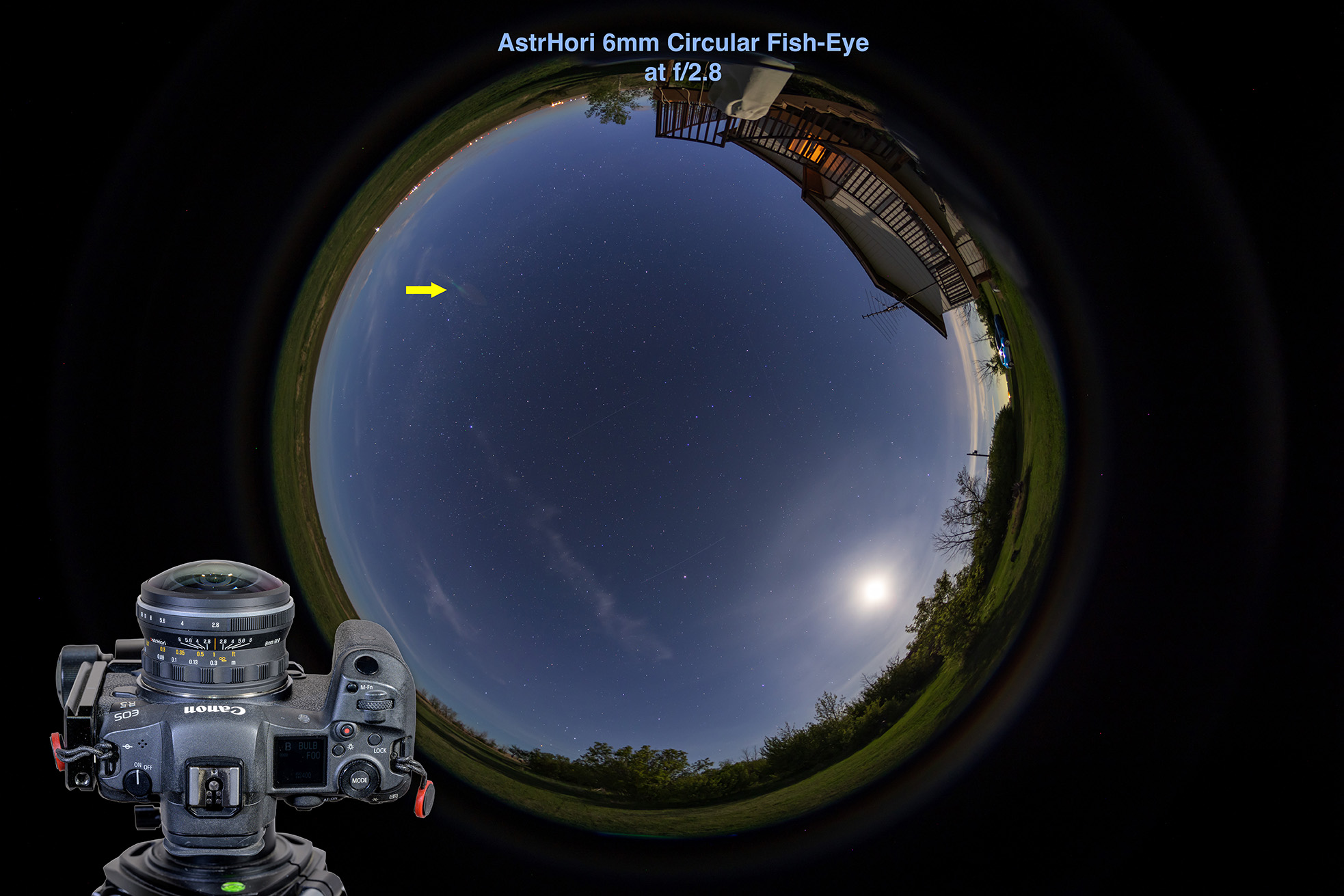
Faint lens flare is arrowed.

But for all-sky time-lapses with the Moon up, expect to see a lens flare moving opposite the Moon. The same might be true of all-sky images of a total solar eclipse. The eclipse of August 2, 2027 with the Sun at the zenith from Egypt would be a great use-case for this lens!


The TTArtisan 7.5mm f/2 Circular Fish-Eye
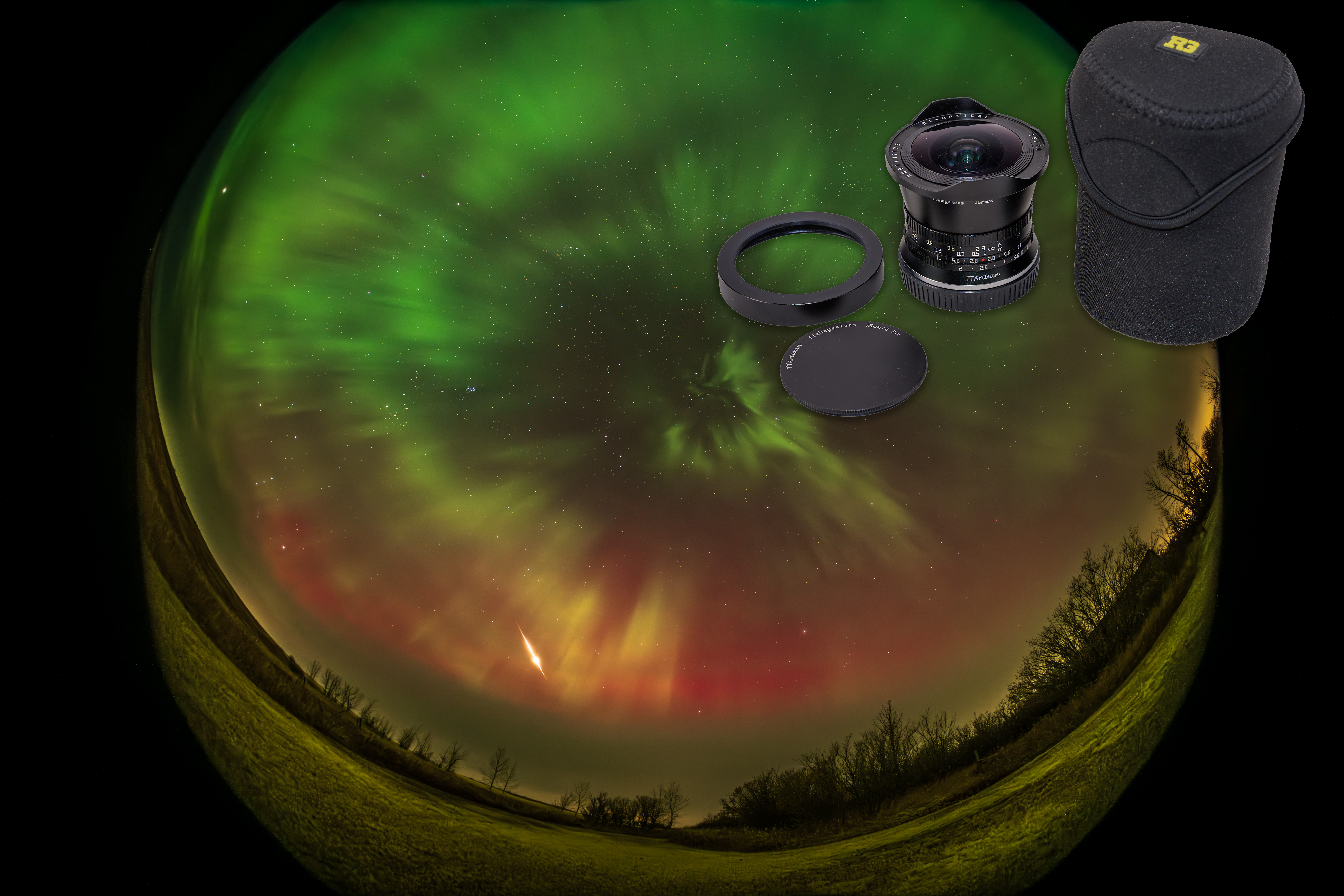
Available for Sony E, Leica L, Canon RF, Fuji X, Nikon Z Lens Mounts

$140 US. 

Link to the TTArtisan 7.5mm web page

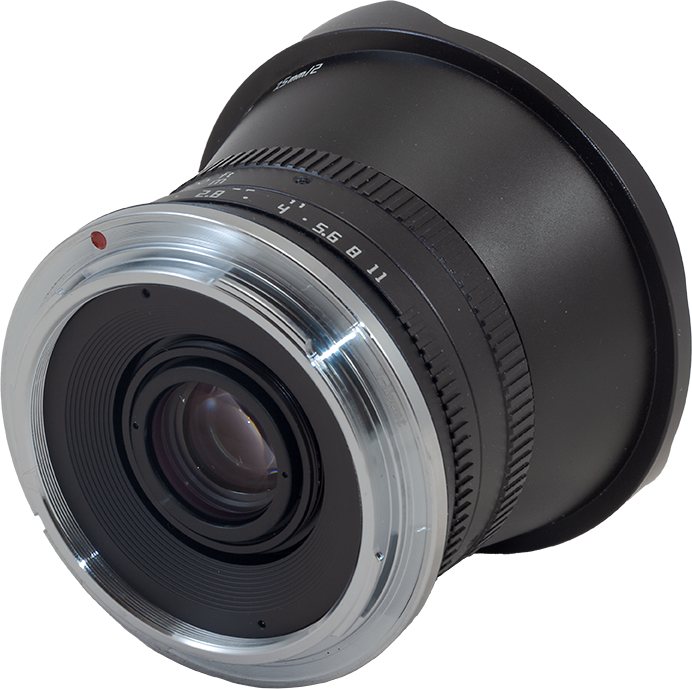
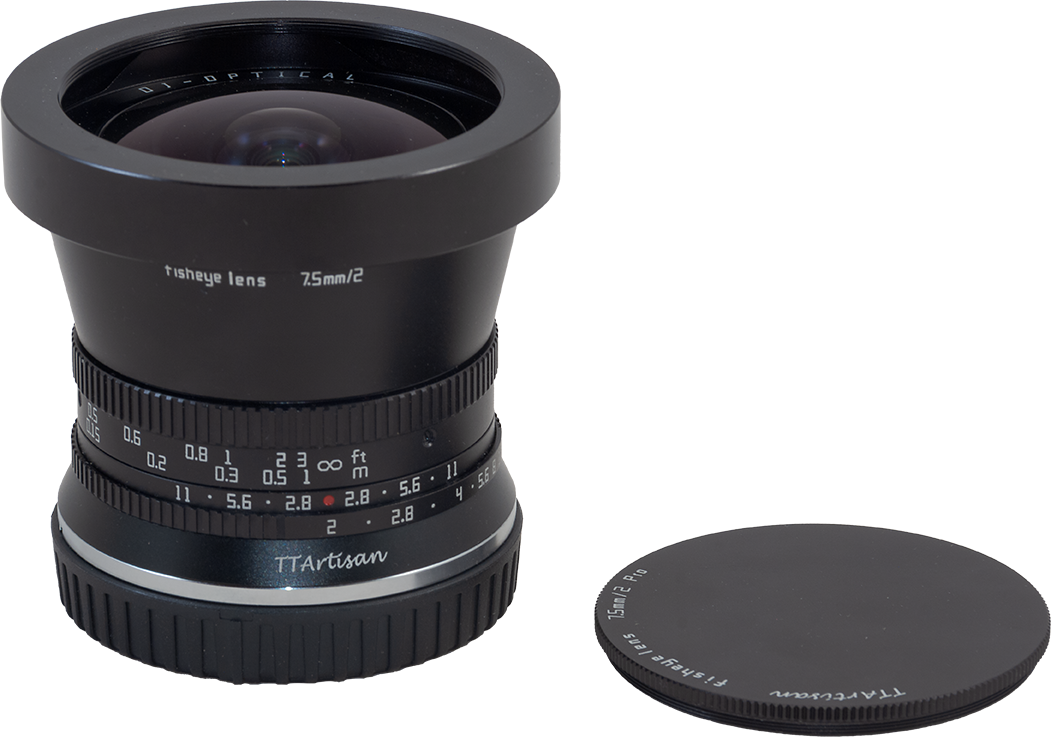
The unique selling point of this lens is its speed โ€“ f/2! All the others are f/2.8. However, technically this is a lens made for APS-C sensor cameras, where it would serve as a full-frame fish-eye. But it works as a near-circular-format fish-eye on full-frame cameras, though with the image truncated at the top and bottom, as I show. You donโ€™t get a full circle. But you do get a much wider field than with the full-frame fish-eyes that follow.

The 7.5mm does not come with a case or pouch, unlike lenses from TTArtisanโ€™s competitors. (The case I show above is one I bought extra for this lens.) The lens has a metal front cap with a thread-on central disk, as shown above. With the disk removed, the remaining ring acts as an iris that mechanically vignettes the image to a 24mm-wide circle, but with much less than 180ยฐ horizon-to-horizon coverage. Iโ€™ve never used this lens that way; I prefer to record as much of the image as the lens projects, then mask down the image later if needed. 

I like this lens so much I bought it twice โ€“ for Canon RF and for Nikon Z. The Nikon copy I test here has better optics with less tilt (or โ€œdecenteringโ€) in the lens elements. The Canon copy is notably soft on the left side. I asked TTArtisan about this, hoping to get a replacement for my Canon RF unit, but their rep said thatโ€™s within their acceptable level of performance. Thatโ€™s the drawback of low-cost lenses like these; expect unit-to-unit variations. 

The best focus, with the stars sharpest, proved to be well short of the infinity mark, requiring manual focusing. But I suspect that, too, will vary from unit to unit, likely true of most of these lenses. 

With its f/2 speed, the 7.5mm is great for rapid-fire time-lapses of fast-moving auroras, or even real-time 4K or 8K aurora movies where fast lens speed is essential, to keep the ISO lower for less noise. 

IMAGE QUALITY 

The image circle is fairly cleanly defined, but does show two small dark shadows protruding into both the top and bottom of the frame from some mechanical vignetting. A dark blue glow also rims the periphery of the image circle. Keep in mind, on the APS-C cameras the lens is designed for you wouldnโ€™t see the outer part of the image circle.
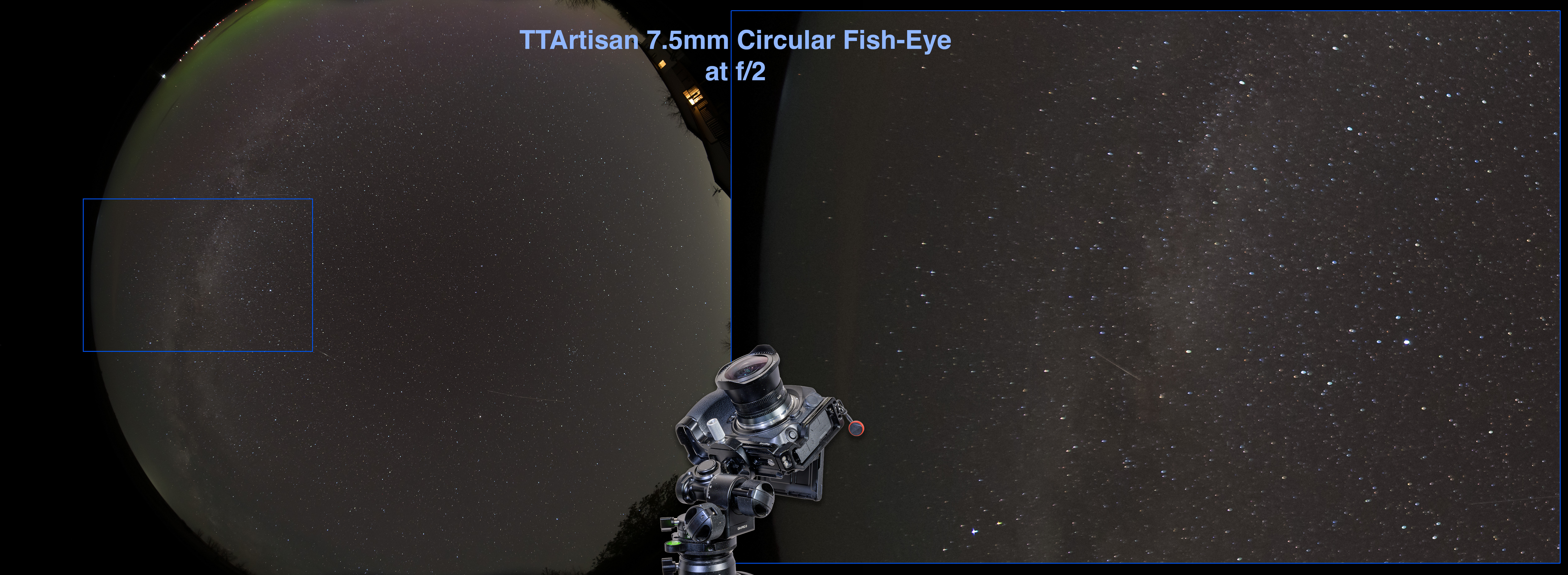
7.5mm TTArtisan at f/2

At f/2 stars are quite sharp at the centre, but begin to soften and elongate from what looks like coma as well as astigmatism in the outer third of the image circle.
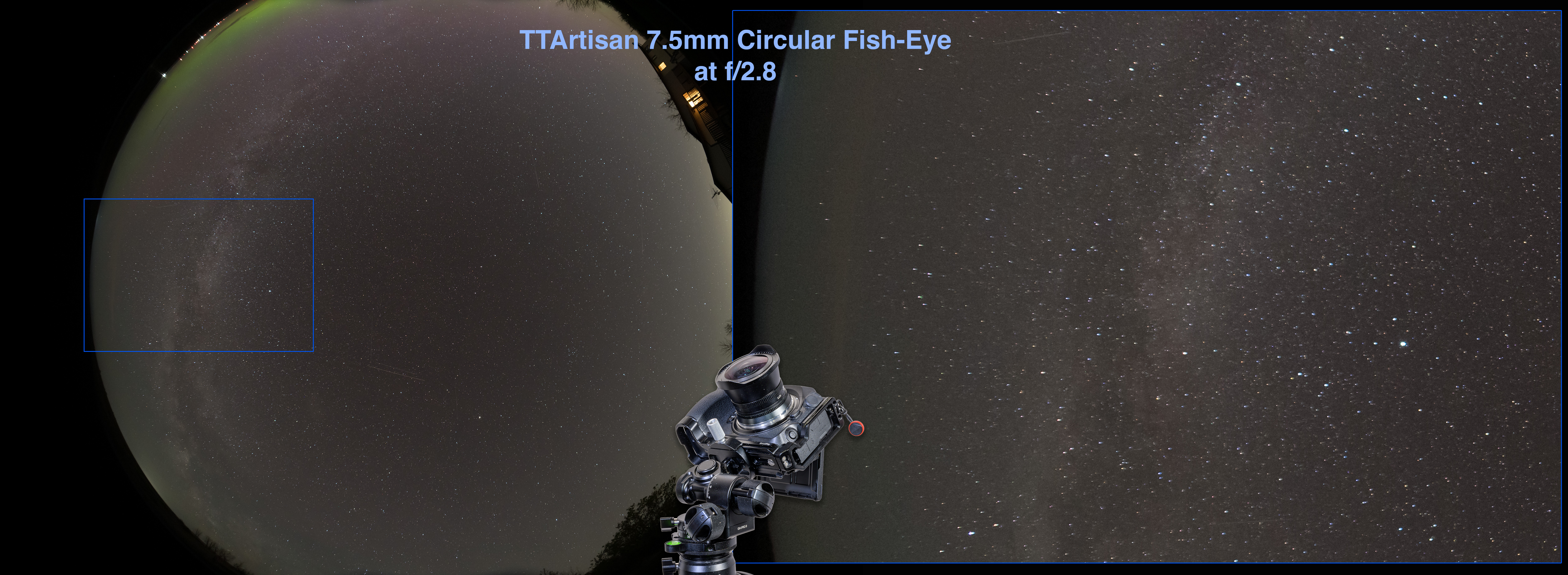
7.5mm TTArtisan at f/2.8

Star sharpness improves at f/2.8, and more at f/4, by which point stars now look very sharp almost to the edge of the image circle. 
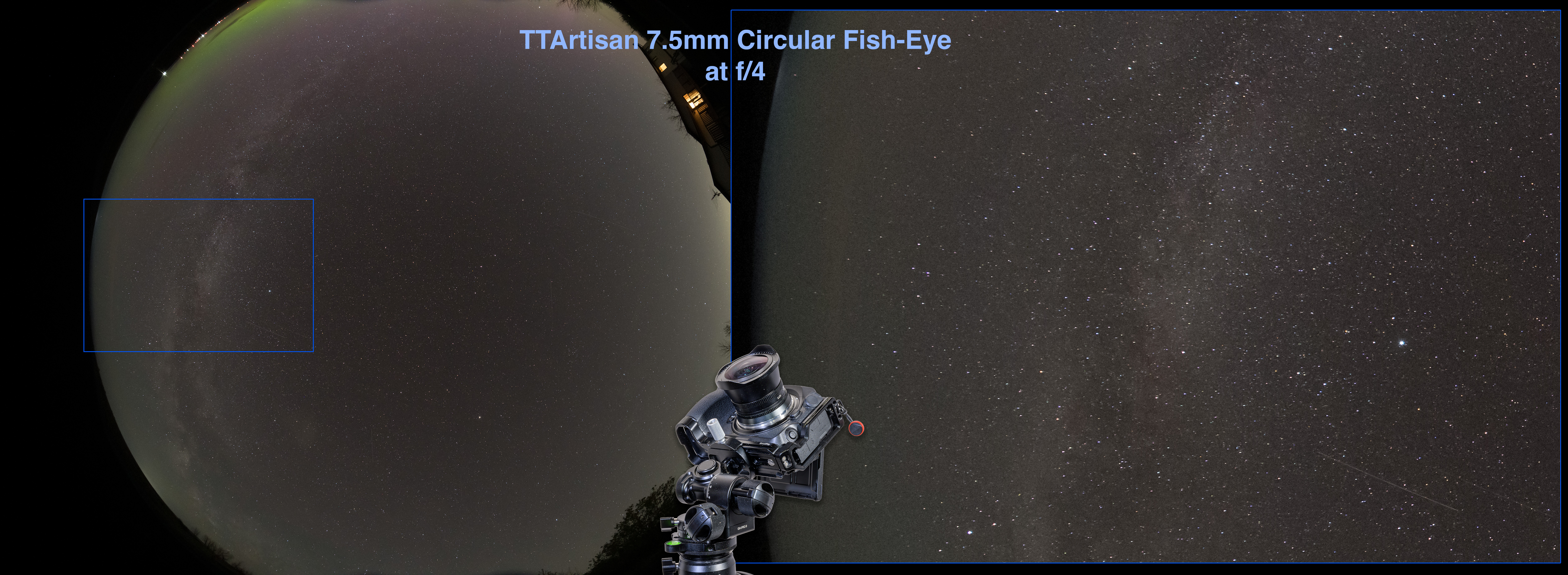
7.5mm TTArtisan at f/4

As the examples show, the image also brightens and becomes more evenly illuminated as you stop down. In all, shooting at f/2.8 will work best for most astrophoto situations. Shoot at f/2 if you need the extra speed for rapid time-lapses or movies. Shoot at f/4 if star sharpness is paramount, such as for projection in a digital planetarium dome. 

LENS FLARES
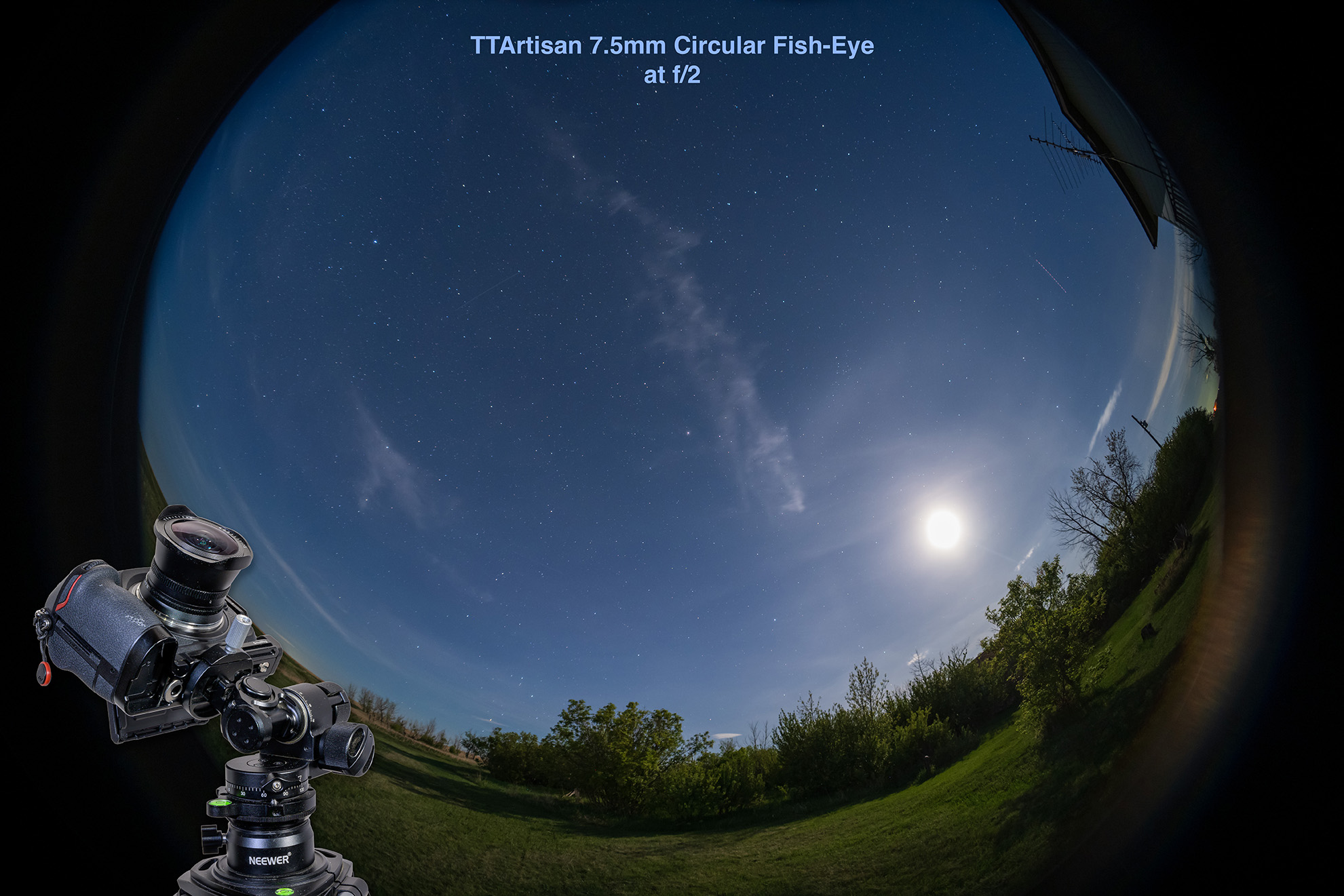
7.5mm TTArtisan at f/2

The TTArtisan 7.5mm proved surprisingly immune to lens flares. I didnโ€™t see any in the sky itself. What you do get is a flare around the periphery from an internal reflection off bright lights, like the Moon here. This might need masking out in the final images. 


The 7Artisans 10mm f/2.8 Mark II Full-Frame Fish-Eye
Available for Sony E, Leica L, Canon RF, Nikon Z Lens Mounts

$280 US. 

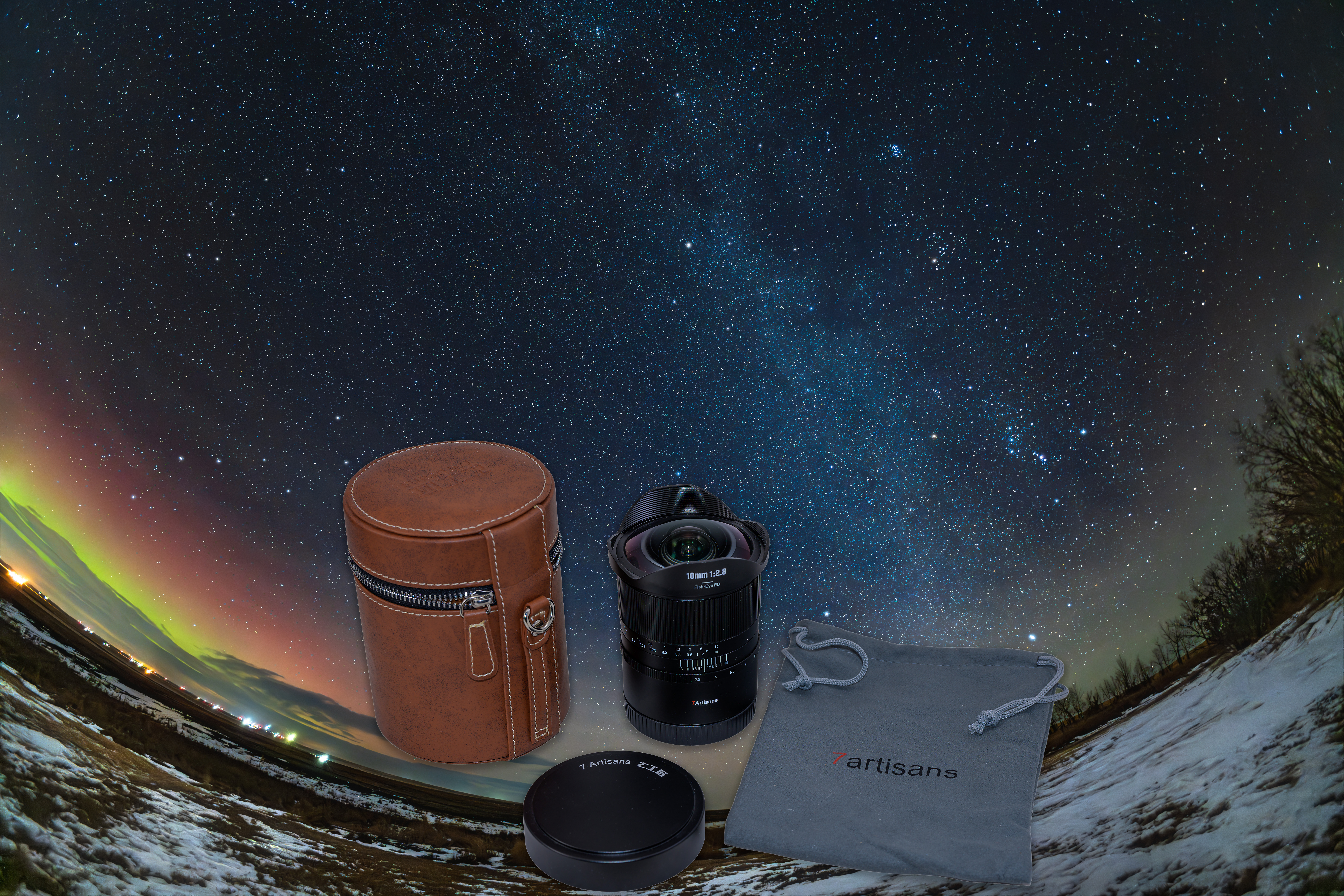
This is the first, and so far only, lens I have used from the China-based company 7Artisans. I am impressed with it. The 10mm came with both a cloth lens pouch and a hard-sided zippered lens case, both shown above. Very nice! Nikon should take note and be so generous with their premium S-line lenses. 

The lens is solid, with all-metal construction and a metal press-on lens cap. The rear cap is plastic, true of all the lenses. The focus movement is smooth with a good level of resistance or dampening. Infinity focus, with the stars sharpest, proved to be left of the infinity mark. The lens focuses past infinity, so careful manual focusing is needed. The aperture ring is click-less, preferred for video use, but a bit of a nuisance for photography. 
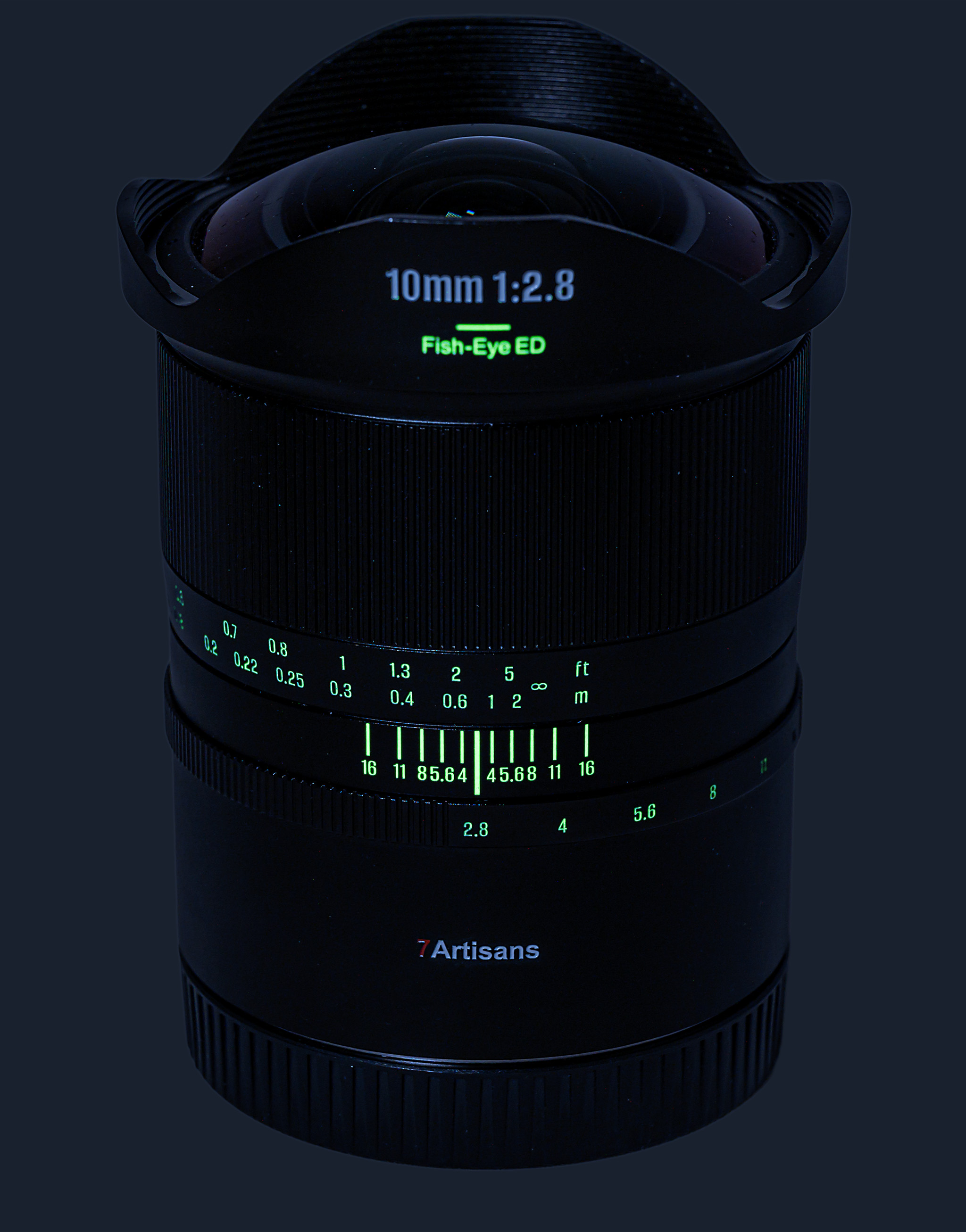
The fluorescent lens markings

An added bonus, clearly showing this lens has been designed for night use in mind, is that the focus and depth of field markings are fluorescent. Hit the lens with white light and they will glow in the dark for a while, as above. Nice! 

I tested the new Manual Focus Mark II model, advertised as having โ€œenhanced performanceโ€ over the original lens โ€“ with two of the 11 lens elements being ED glass, versus the original modelโ€™s single ED element. I never used the original 10mm, so I canโ€™t comment on how the Mark II version has improved. And donโ€™t confuse this new MkII 10mm with another 10mm f/2.8 AF lens 7Artisans also sells. That 10mm has auto-focus but is only for APS-C cameras. 

IMAGE QUALITY  

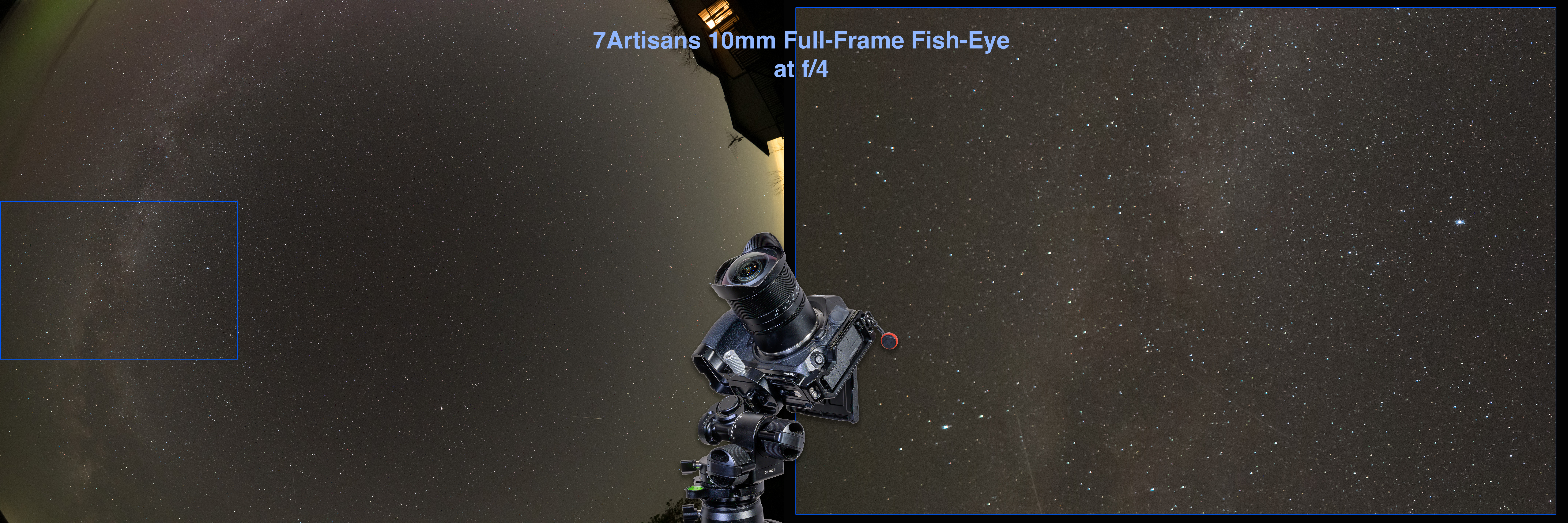
I aimed all the full-frame fish-eyes straight up to the zenith, to put stars in all corners. However, I am zooming in on the edge of the long dimension in these samples. Click or tap on an image to download a high-resolution JPG for closer inspection of all parts of an image. 
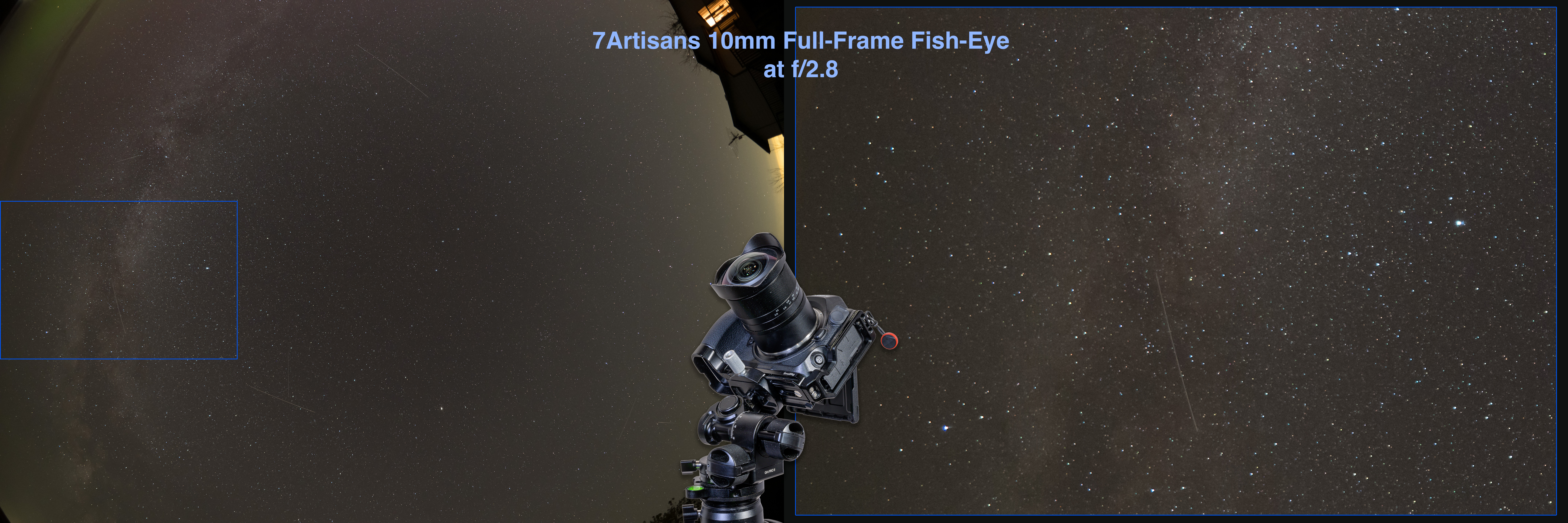
10mm 7Artisans at f/2.8

The 7Artisans 10mm proved very sharp at the centre and toward the edges of the frame, showing only a small level of astigmatism and lateral colour at the edges at f/2.8. Bright stars at the very corners did show โ€œwingsโ€ from astigmatism.

10mm 7Artisans at f/4

Stars tightened up at f/4, but still had some astigmatism at the pixel-peeping level. The 10mm also had the widest field of view of the three full-frame fish-eyes, by a slight margin. 

The image edges brightened with the lens at f/4, as expected from the reduced vignetting all wide-angle lenses show when stopped down. But unless you are very fussy about star shapes, the 7Artisans 10mm will work very well when shot wide-open at f/2.8.

LENS FLARES
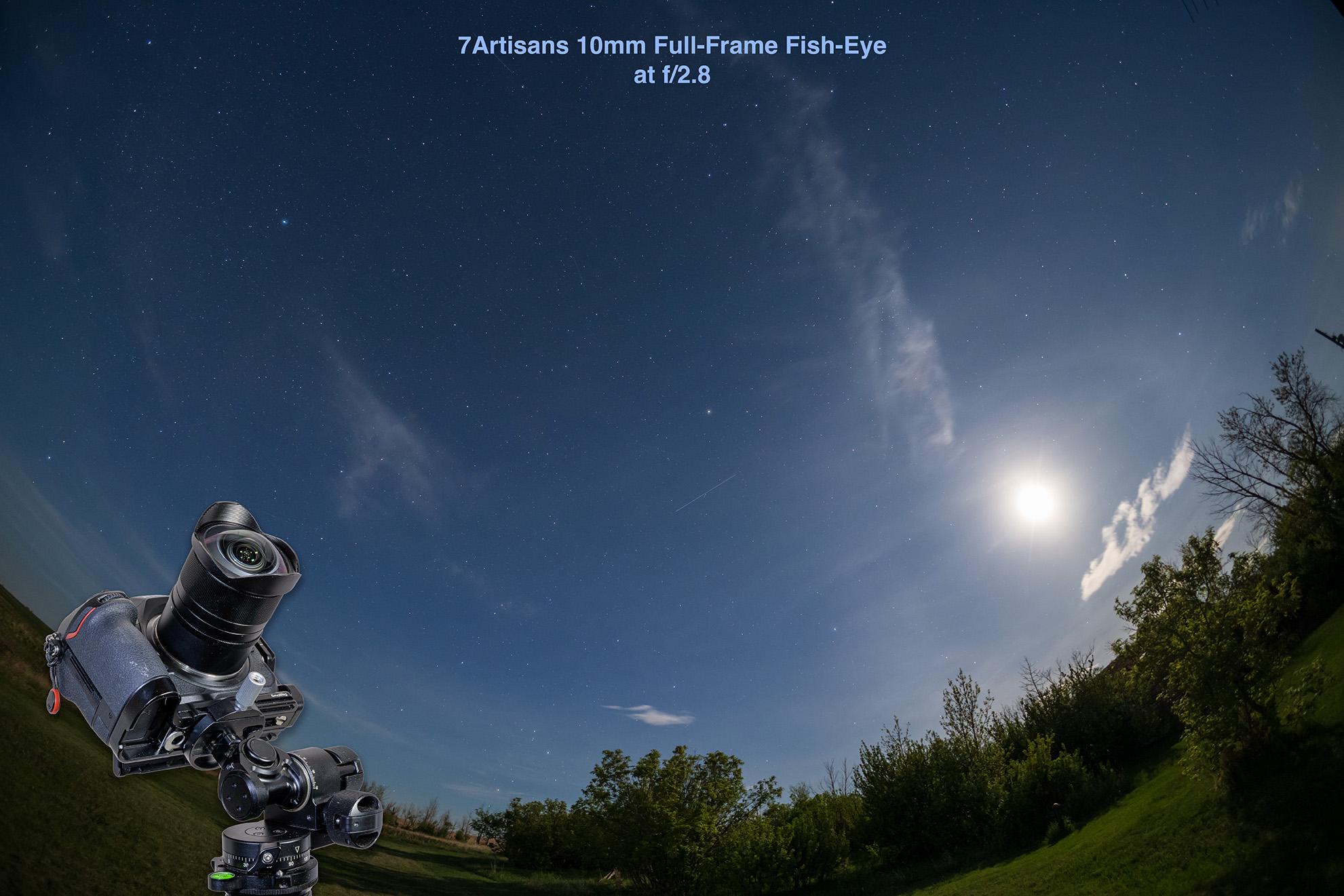
10mm 7Artisans at f/2.8

I didnโ€™t see any noticeable flares in my moonlight test shots, quite remarkable! What slight halo you can see around the Moon, here shot at f/2.8, is in the sky, from the thin clouds this night.


The TTArtisan 11mm f/2.8 Full-Frame Fish-Eye
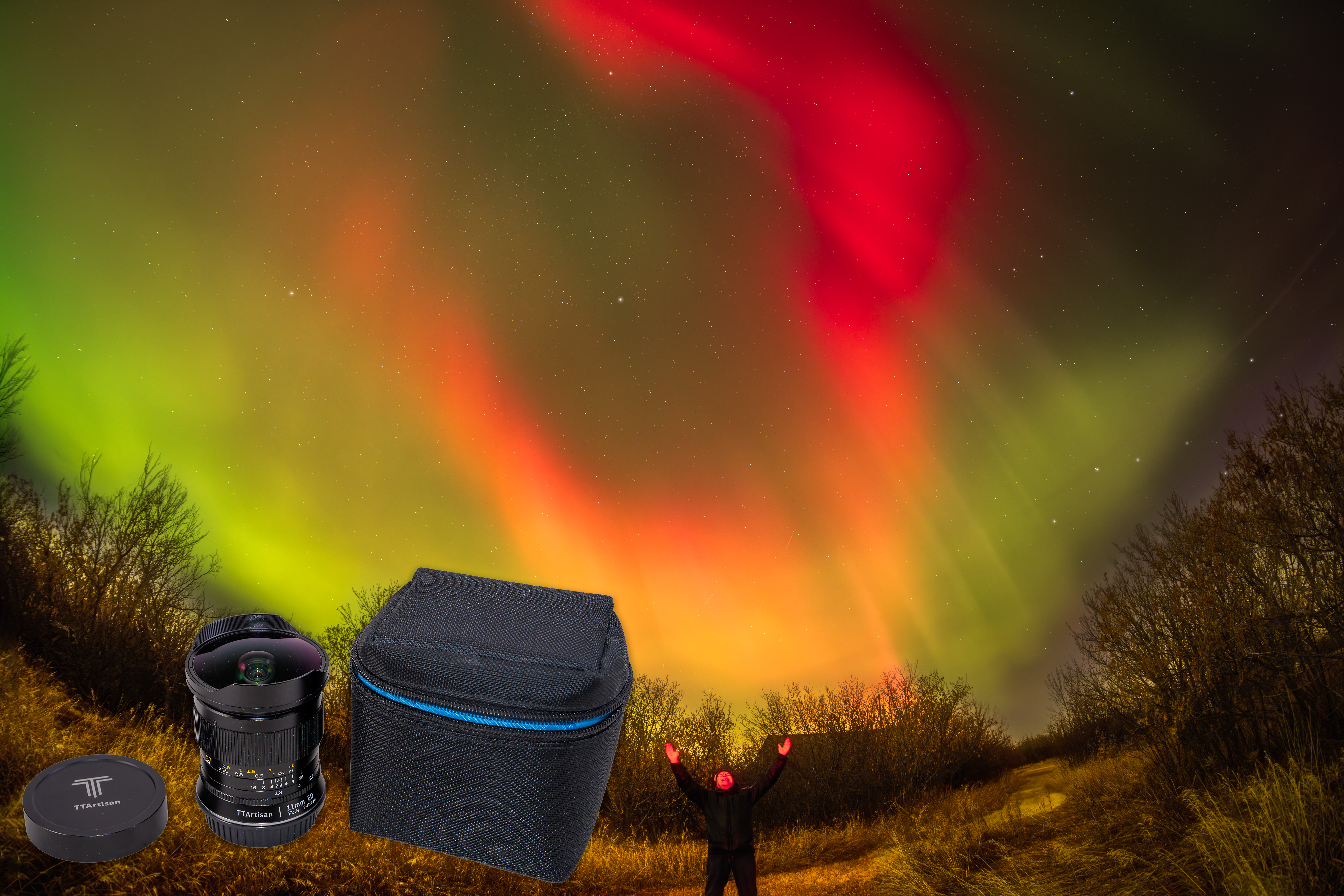
Available for Sony E, Leica L, Panasonic/Olympus M43, Canon RF, Fuji X, Nikon Z Lens Mounts plus for Nikon F and Canon EF DSLR cameras in a different model. 

$235 US. 

Link to the TTArtisan 11mm web page

Iโ€™ve owned this lens for several years during which time it has served me well for many aurora shows. As best I can tell the lens sold today is the same as the one I bought some 5 years ago. Like the 7.5mm, the 11mm does not come with a case or pouch, a shortcoming of TTArtisan lenses. The case I show above is an extra one I had on hand that works well for this lens.

Note, this is the one lens of the group that is available for DSLR cameras โ€“ for Canon EF and Nikon F โ€“ though in a different optical design than the lens I tested. 

The lens is compact, solid and dense, with all-metal construction, including the front lens cap. The focus turns smoothly with just the right amount of dampening. Infinity focus, with the stars sharpest, proved to be actually at the infinity mark with the focus at the extreme end. The lens does not focus past infinity, making it the easiest lens of the group to focus in the field. The aperture ring is click-less, again not ideal for photography. 

IMAGE QUALITY 

The 11mm TTArtisanโ€™s test images proved to be about 1/2-stop darker than images with the 10mm 7Artisans and 12mm AstrHori, when all were shot at the same camera settings. 

The 11mm also had the narrowest field of the three diagonal fish-eyes, even compared to the 12mm AstrHori, though the difference was slight. 
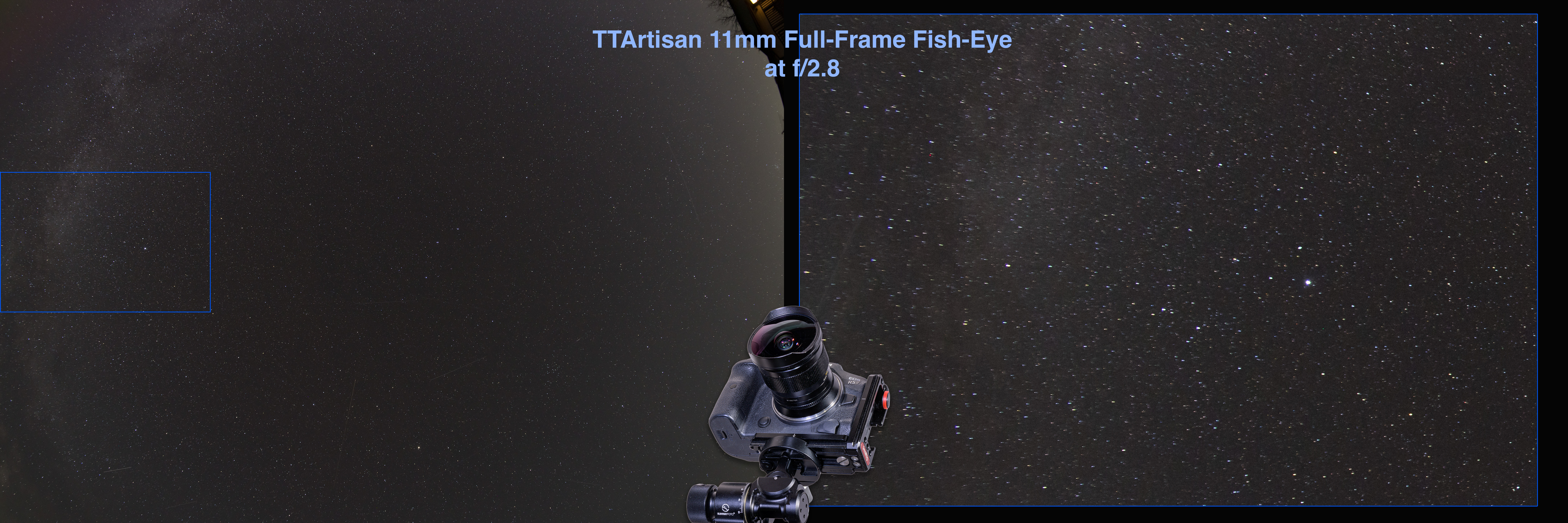
11mm TTArtisan at f/2.8

Stars were sharp in the centre of the frame with minimal LoCA. Astigmatism increasingly elongated the stars into streaks toward the edges of the frame at f/2.8, though with minimal lateral colour. Stars tightened up at f/4 but still showed more aberration than did the 10mm 7Artisans. 
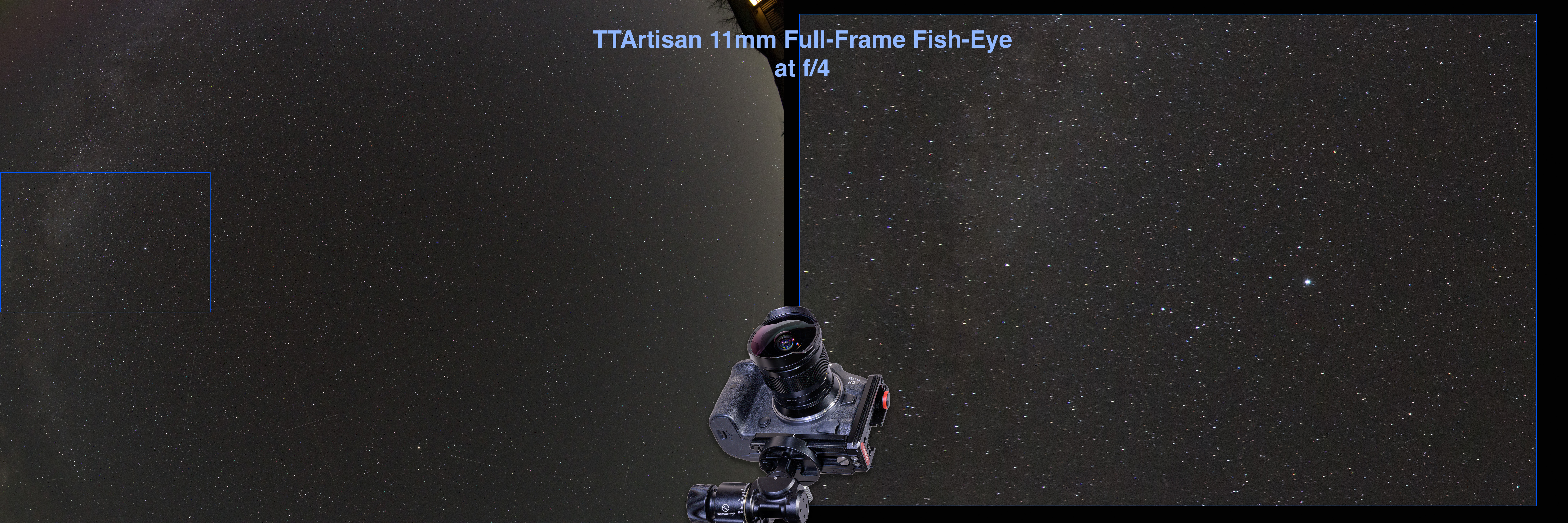
11mm TTArtisan at f/4

Stopping down brightened the frame edges. But overall, this lens can work well at f/2.8, which is how Iโ€™ve used it for most shooting, mostly of auroras. If Milky Way nightscapes are your priority, look at the 7Artisans 10mm. 

LENS FLARES
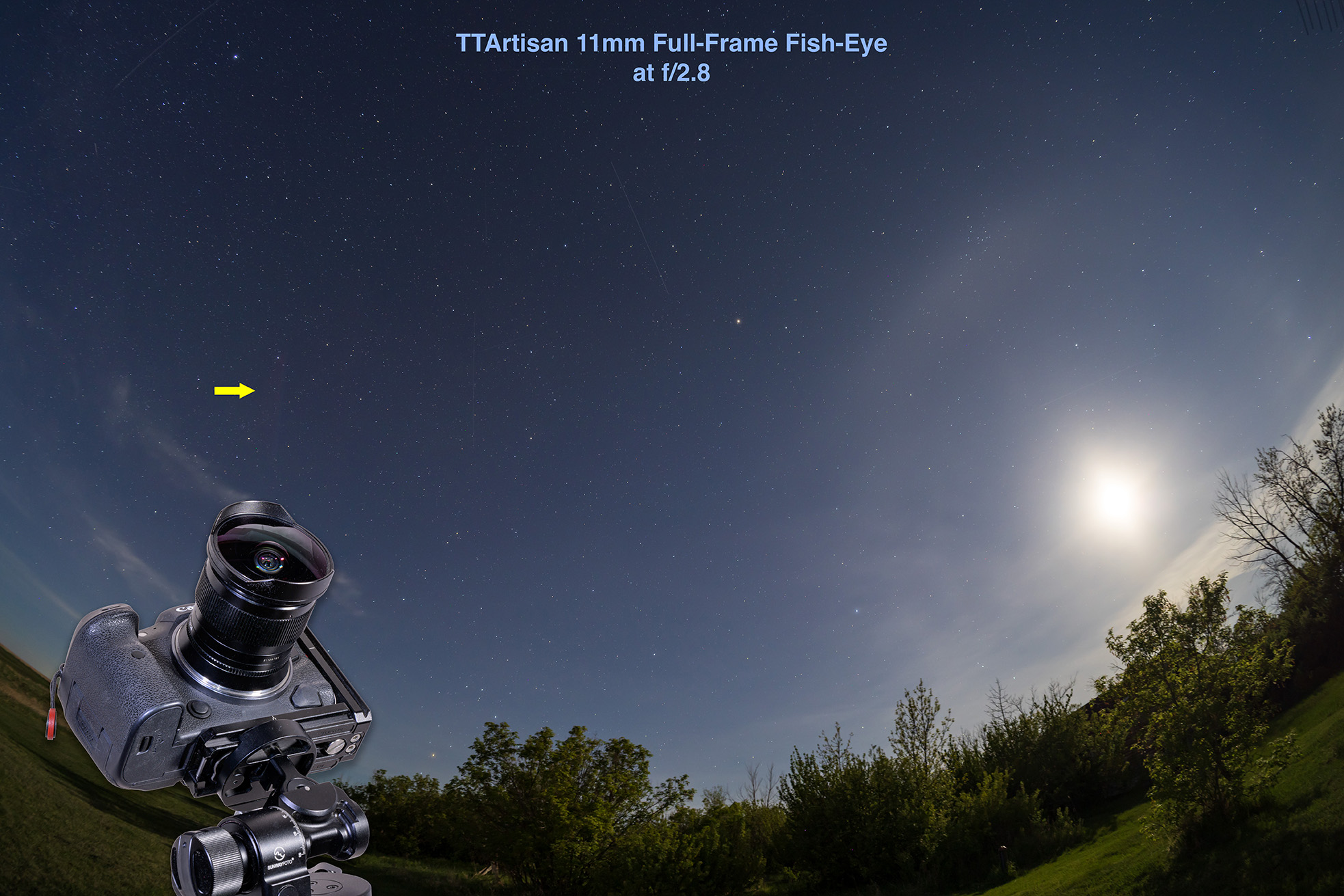
11mm TTArtisan at f/2.8 โ€“ a small lens flare is arrowed.

The TTArtisan 11mm was fairly immune to lens flares, showing only a slight coloured flare (arrowed) opposite the Moon in my test images. So its coatings must be performing fairly well, despite the overall lower level of light transmission of this older lens. 


The Astrhori 12mm f/2.8 Full-Frame Fish-Eye
Available for Sony E, Leica L, Canon RF, Nikon Z Lens Mounts

$260 US. 

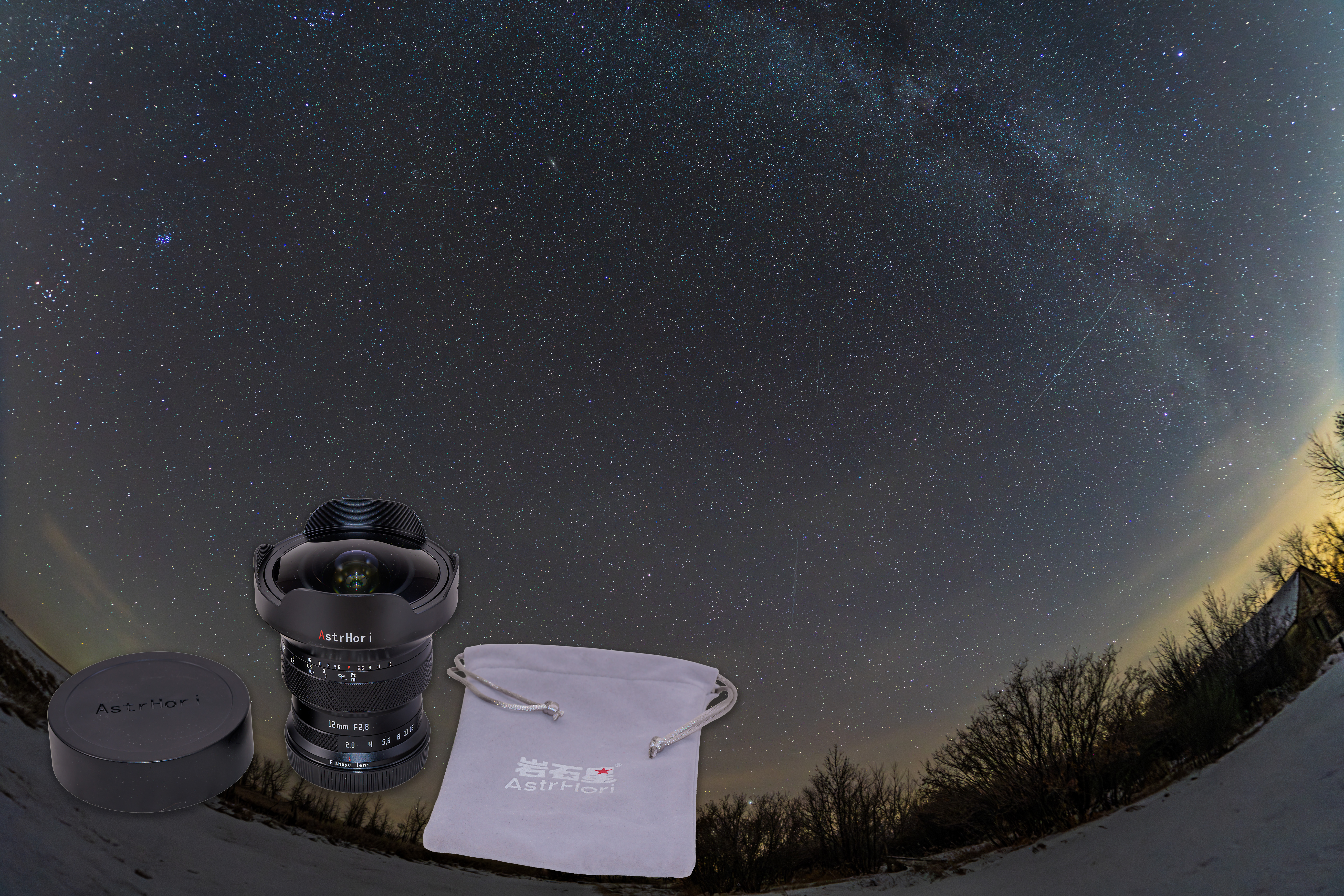
AstrHori offers a 12mm as their diagonal fish-eye for full-frame cameras. It is solidly made, but larger than the others with a bulbous front lens element. It is also the heaviest lens of the group, weighing 830 grams with lens caps, compared to 700 grams for the 7Artisans 10mm, and 550 grams for the much smaller TTArtisan 11mm.

 While the 12mm came with AstrHoriโ€™s standard lens pouch it is far too small for this lens. What were they thinking? The lens has a smoothly-turning manual focus ring and, similar to the others, with a good level of dampening. Infinity focus with the stars sharpest was shy of the infinity mark, between 1 metre and infinity. The lens focused past infinity, so careful manual focusing is required, true of all the lenses except the TTArtisan 11mm. 

The aperture ring has firm click stops at 1/2-stop intervals from f/2.8 to f/8, and one each for f/11 and f/16. This is the only lens of the group with a plastic front cap, but it is deep and presses on very securely. The aperture values have large white figures making them easy to read in the dark. 

IMAGE QUALITY 

Stars are sharp in the centre with only slight LoCA-induced blue halos at f/2.8 that disappear at f/4. Stars begin to soften and elongate from astigmatism at the outermost edges of the field at f/2.8.
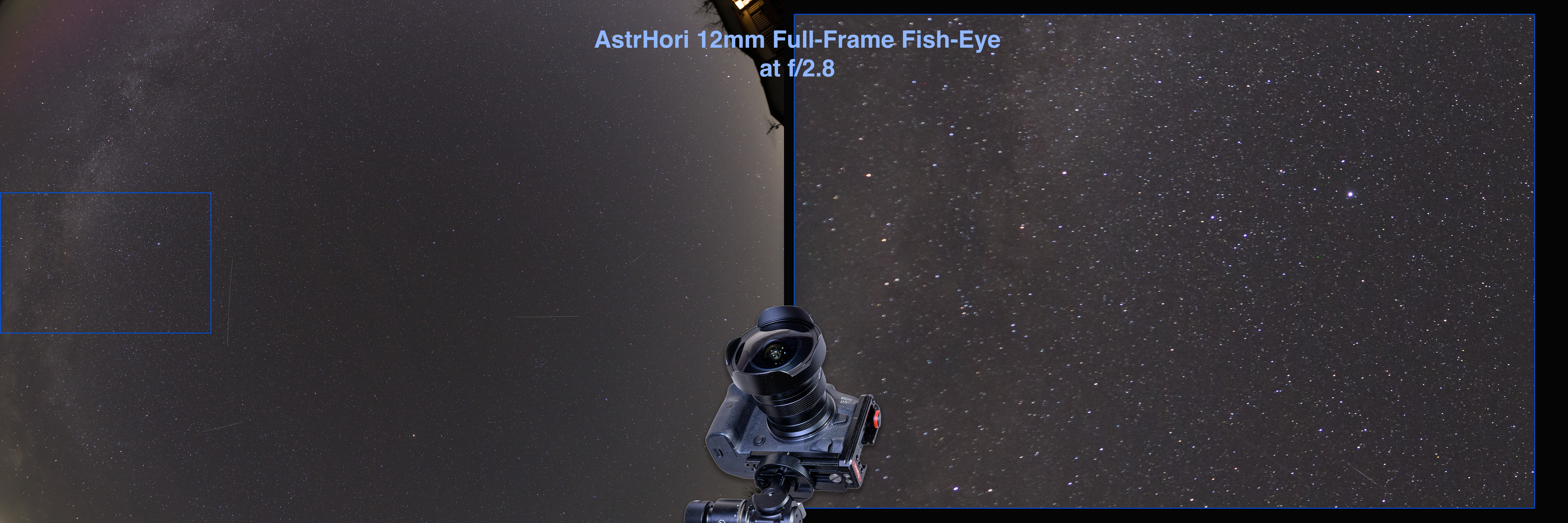
12mm AstrHori at f/2.8

They tighten somewhat at f/4 but not by much compared to f/2.8. The entire field, not just the field edges, brightens at f/4 from the more uniform illumination. 
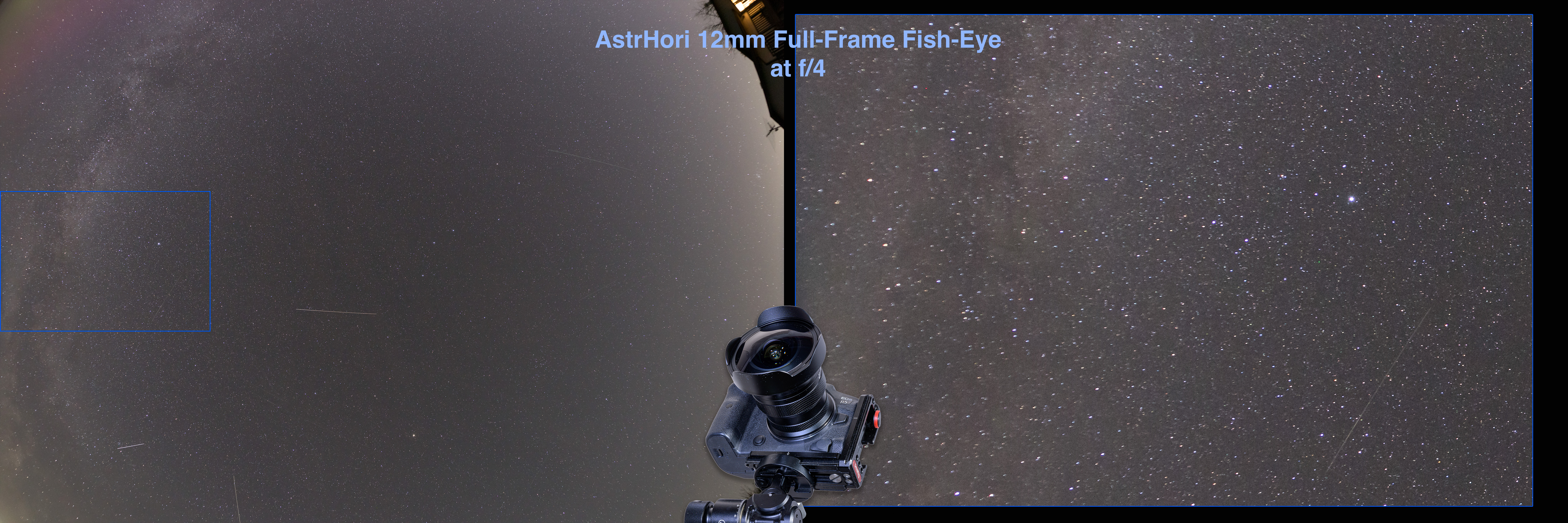
12mm AstrHori at f/4 โ€“ Note the brighter field at f/4.

Of the three full-frame fish-eyes Iโ€™d rank the 12mm as #2 for across-the-field star sharpness, behind the 10mm 7Artisans but ahead of the 11mm TTArtisan. 

LENS FLARES

I donโ€™t need to add an arrow to point out the lens flares here! Wow! They are extreme. 
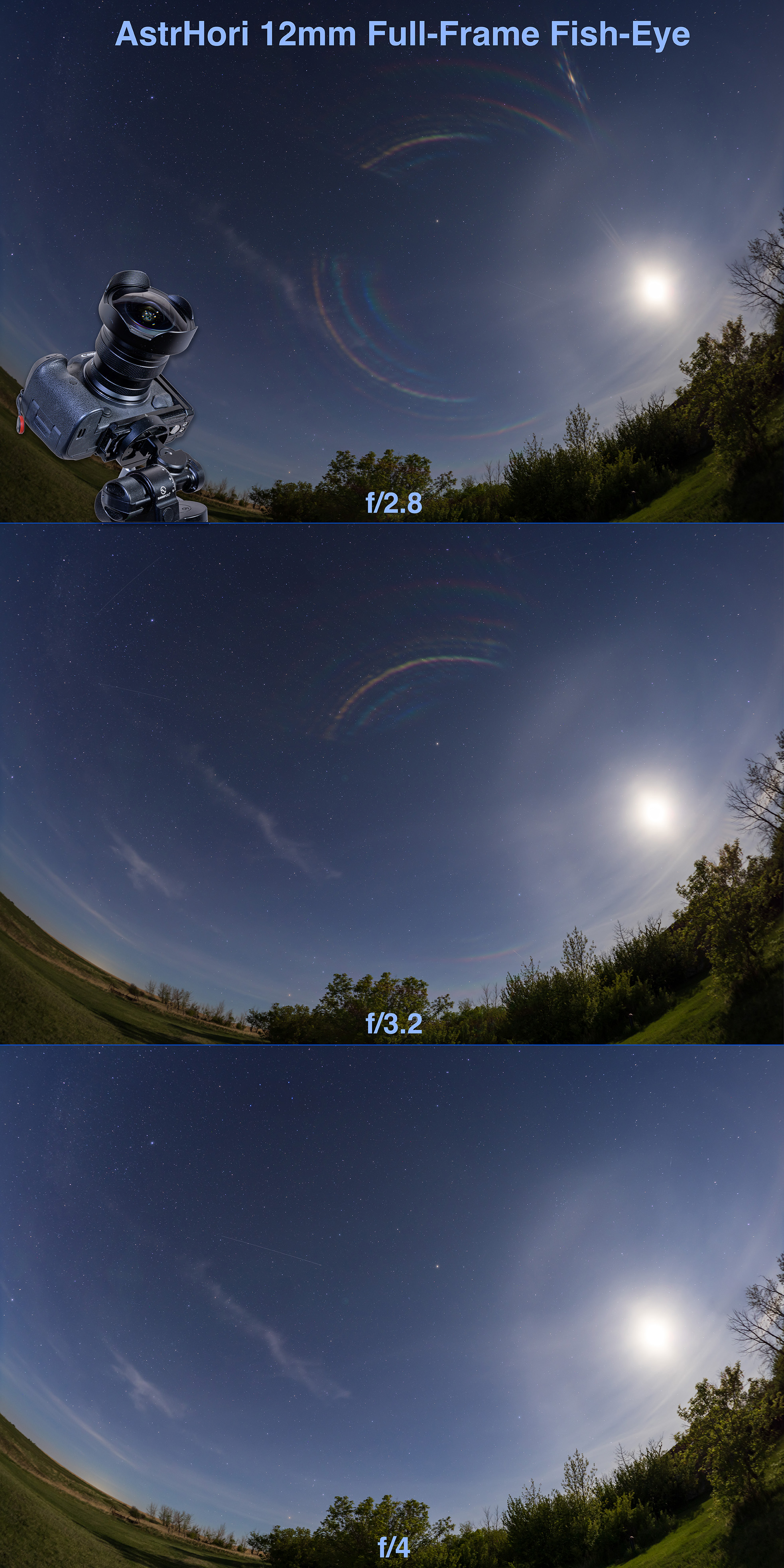
12mm AstrHori lens flare at three f/ratios – Gone at f/4 โ€“ The white ring around the Moon is a natural ice halo.

Wide open at f/2.8 the lens shows rainbows of internal lens reflections, with an odd split appearance. Stopping down to the click stop halfway between f/2.8 and f/4 (about f/3.2) eliminates half the reflections. Stopping down to f/4 gets rid of all of them. Very odd. 

Either the lenses are not properly edge blackened, or the lens hood is inducing reflections in the bulbous front element, or there is some shiny component inside adding the reflections. 
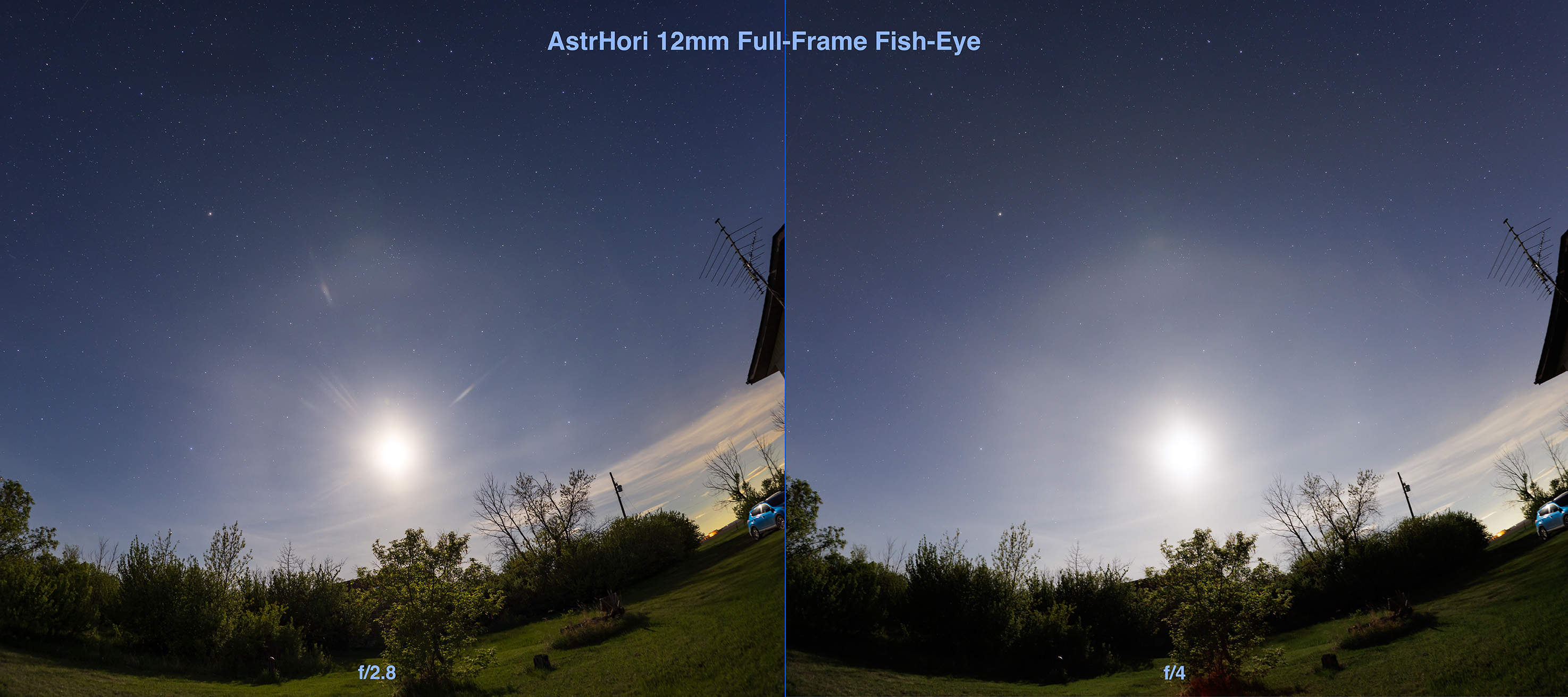
12mm AstrHori at f/2.8 and at f/4, with Moon below centre.

The flares get larger as the light source (the Moon here) moves to the edge of the frame. With the Moon closer to the centre (as shown above), the coloured rings disappear but there are still radial streaks pointing away from the Moon. They disappear at f/4.

I never noticed these flares on dark sky shots of the stars and aurora. But this is not a lens you can shoot the sky with if the Moon or Sun are in it, at least not at f/2.8. If you shoot an eclipse sky time-lapse with this lens, you must stop it down. 

This is a serious flaw AstrHori needs to fix in a Mark II version of this lens. 


Recommendations

I think every astrophotographer should have a fish-eye lens in their kit, especially true of aurora chasers. The low cost of these new Chinese lenses makes it easy to add one, for the few special nights itโ€™ll be used. 

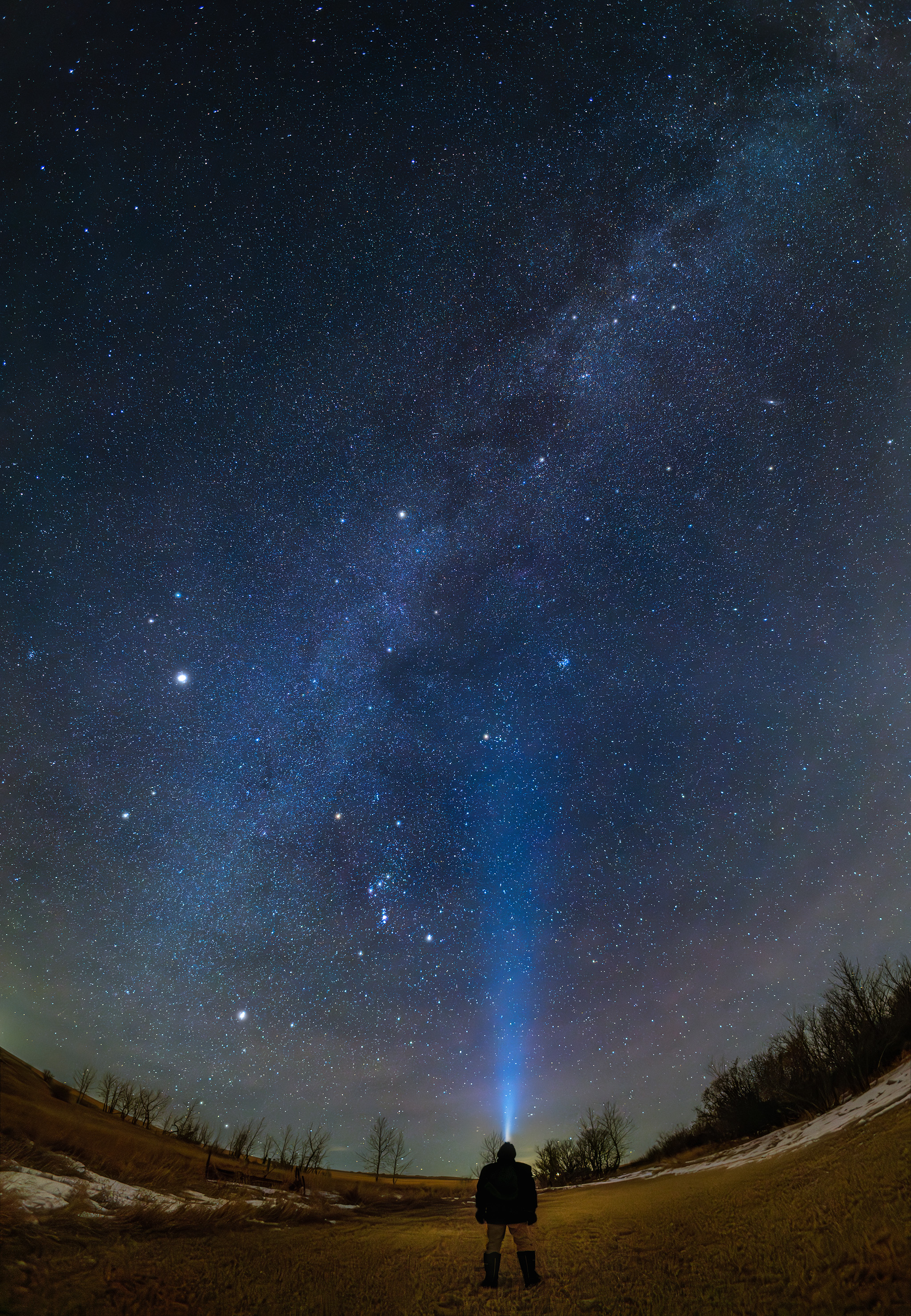
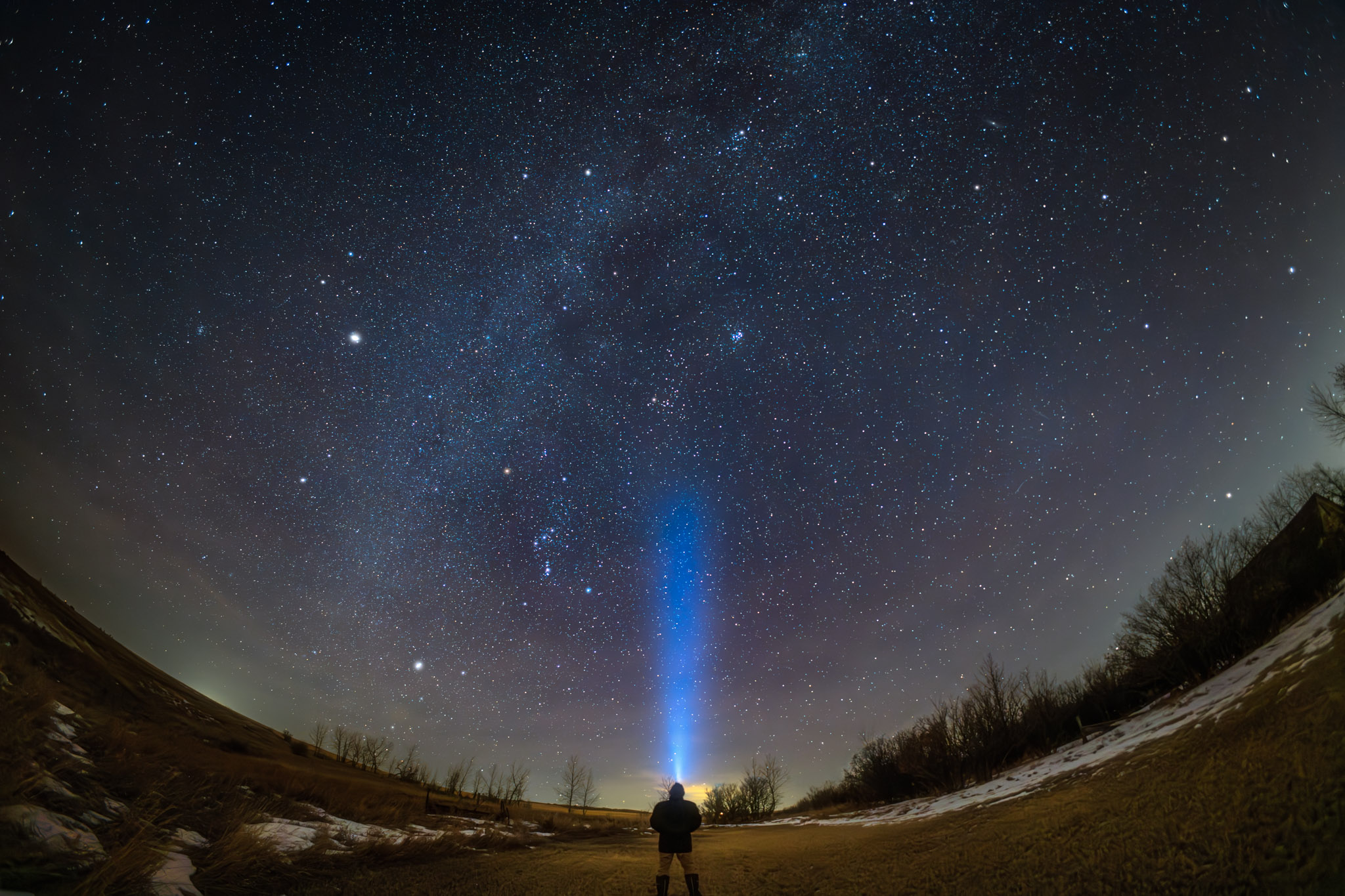
A blend of three exposures โ€“ two for the ground and me without the light on, and one for the sky with the headlamp on. Untracked, with the 7Artisans MkII 10mm lens wide-open at f/2.8 on the Nikon Z8 at ISO 3200 for 15 seconds each.

A full-frame fish-eye is the first choice I would recommend. But do note they produce a curved horizon, as above. If thatโ€™s not to your liking, buy an ultra-wide rectilinear lens. But none have as a wide a field as a fish-eye, and rectilinears will distort objects much more by stretching them at the corners. 

Of the three full-frame fish-eyes I tested I liked the 10mm 7Artisans the best. It offered the best optical quality, nice fittings with its glow-in-the-dark markings, an excellent hard storage case, and it was compact.ย 

The 12mm AstrHori was bright and relatively sharp, but much larger than the others so is not a lens you can tuck away in a bag in case you might need it. And its wild lens flares made it unsuitable for use wth the Sun or Moon in the frame, at least when shot wide open. 

The 11mm TTArtisan was compact but darker than the others, showing its older coatings perhaps, and lower light transmission. Again, mine was an older unit. 
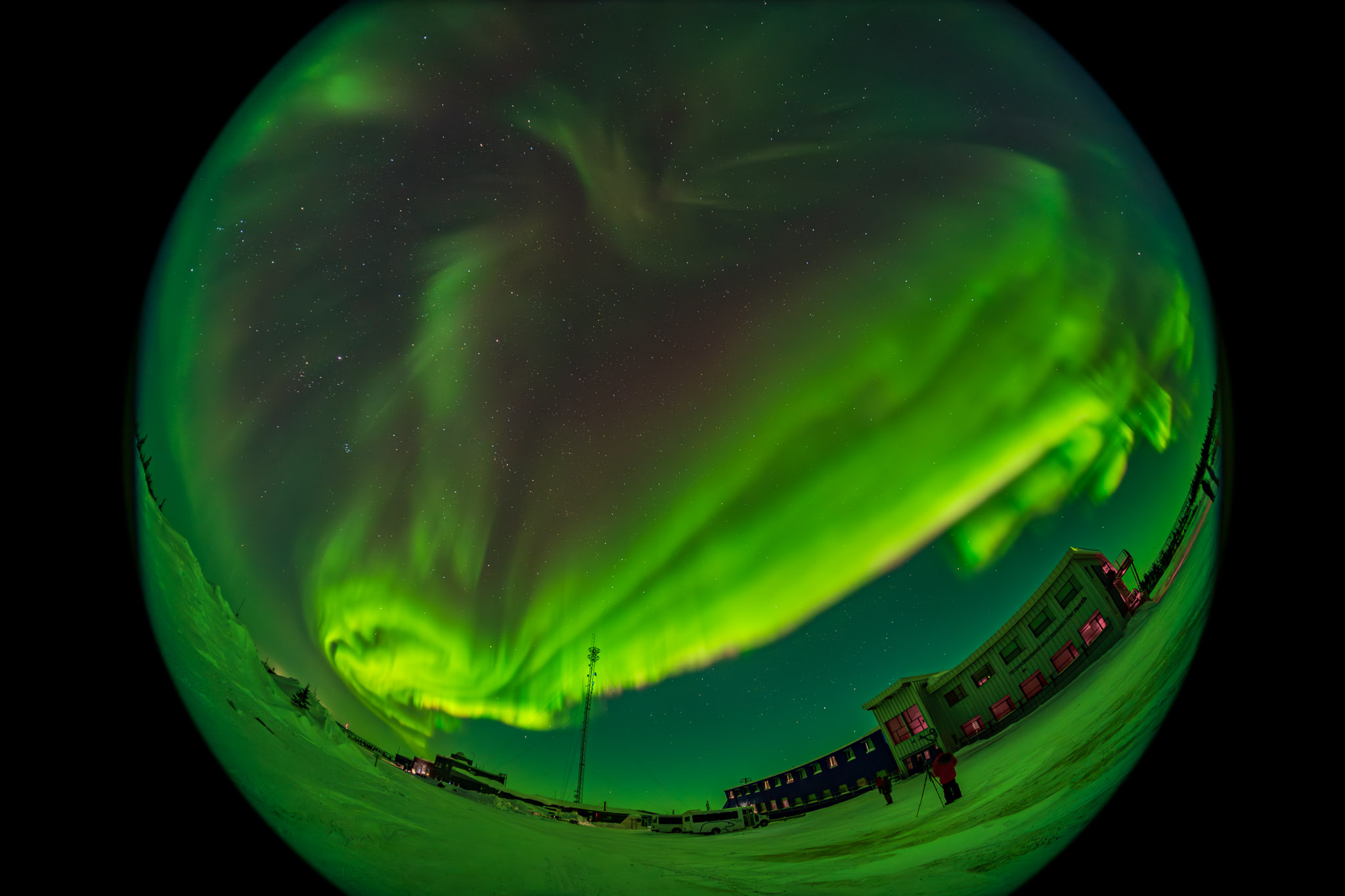
A single 2.5-second exposure with the TTArtisan 7.5mm fish-eye lens at f/2 on the Nikon Z6III at ISO 1600. From the Churchill Northern Studies Centre, Manitoba.

The f/2 speed of the 7.5mm TTArtisan is great if you intend to take time-lapses or movies of the aurora. It would be good for sequences shot for tilt-dome planetariums. 

Otherwise, the unique 220ยบ 6mm AstrHori is perfect for capturing all the sky and ground below on one frame. It would be good for shooting stills or time-lapses of auroras or sky motion for planetarium projection, especially in non-tilt-dome (flat-floor) theatres. 

I hope this test has helped you make a choice. We have some fine lenses to pick from now, and at appealing prices, compared to the DSLR days when there were few fish-eyes on offer, all costly.

โ€” Alan, May 27, 2026 / ยฉ 2026 Alan Dyer / AmazingSky.com  
The Great Auroras of 2024


The Sun peaked at โ€œsolar maximumโ€ and gave us wonderful sky shows in 2024. 

Officially, the Sun reached the peak of its roughly 11-year cycle of activity โ€” “solar max” โ€” in late 2024. Thatโ€™s according to NASA and NOAA.

During 2024 several major solar storms erupted as a result of the Sunโ€™s increased activity. They blew massive clouds of energetic particles โ€” electrons and protons โ€” away from the Sun. Some of those storm clouds swept past Earth, sparking bright auroras widely seen in both the Northern and Southern Hemispheres. 

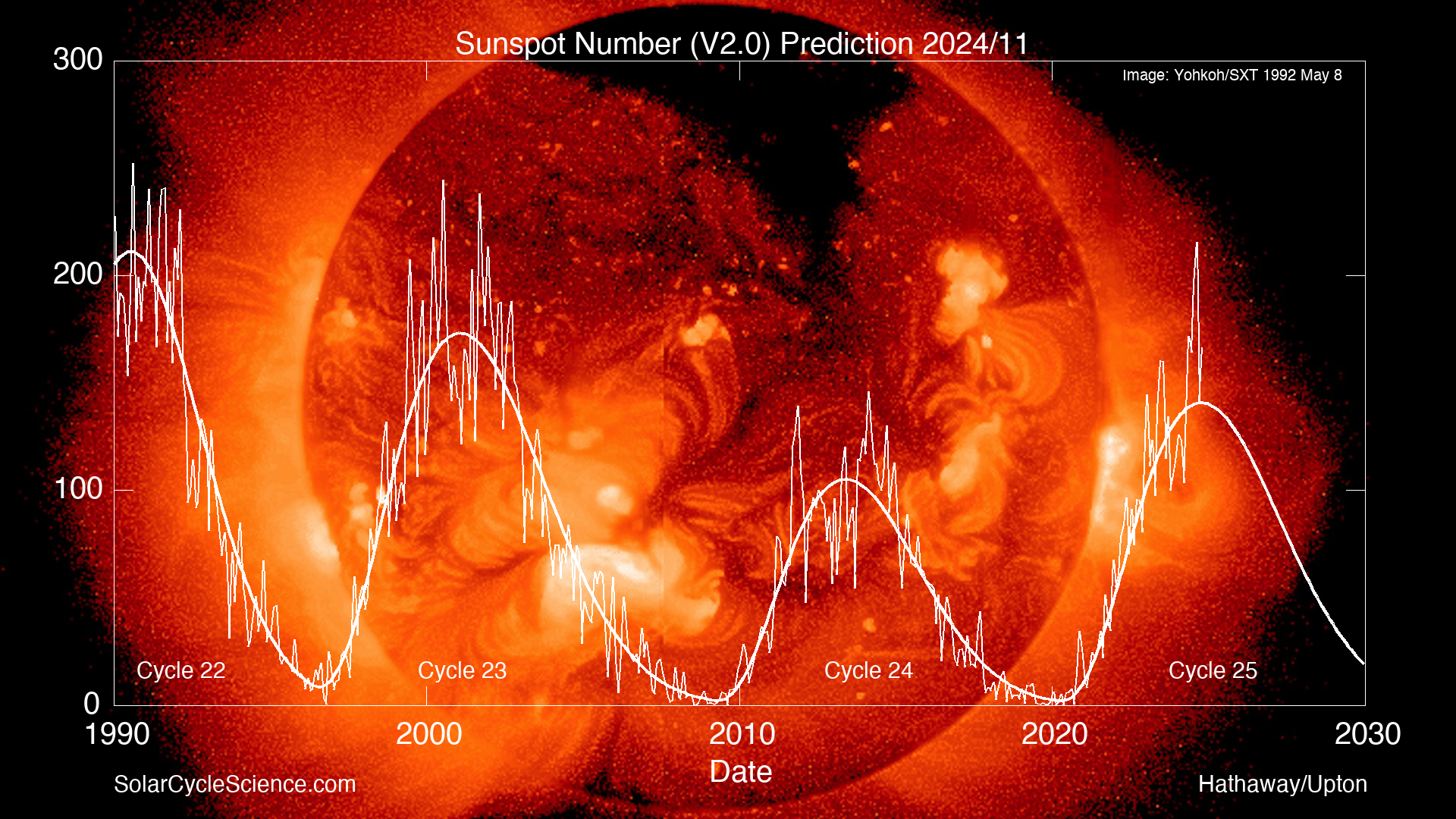
The rise and fall of solar activity. The peak at right is as of November 2024 in mid-Cycle 25. Courtesy SolarCycleScience.com.

I was fortunate enough, as many were, to witness several of 2024โ€™s great auroras, from home in Alberta, and from as far south as Arizona. 

Trips north to Churchill, Manitoba, and to northern Norway also presented some fine aurora nights. But thatโ€™s normal at any time in the solar cycle from those sub-Arctic and Arctic locations.

Itโ€™s when the aurora comes to you that you get a truly memorable show. And 2024 had its share of them.


This was the month I made my annual trek to Churchill, Manitoba, to instruct aurora tour groups at the Churchill Northern Studies Centre. Why not join us in 2025?

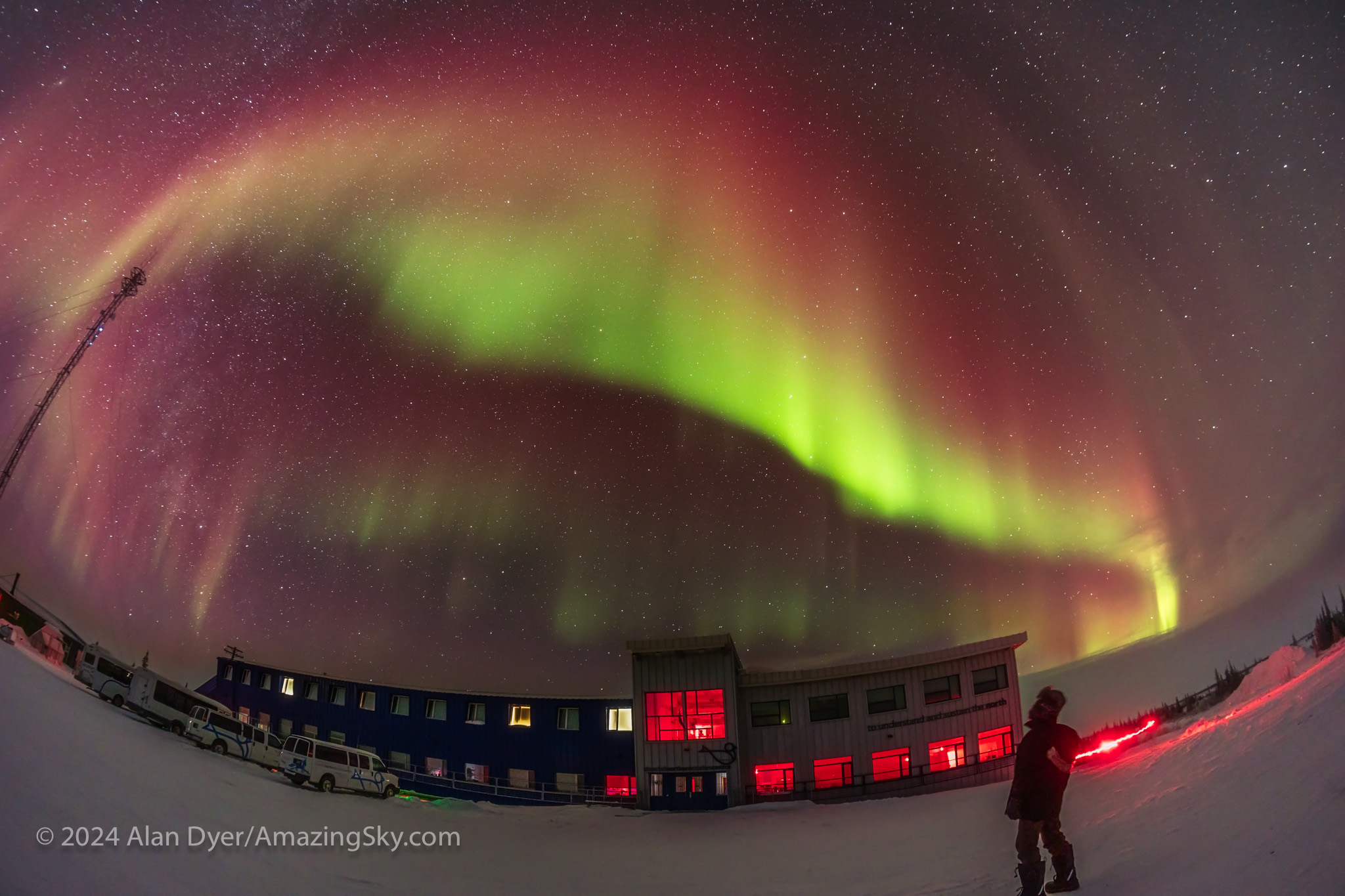
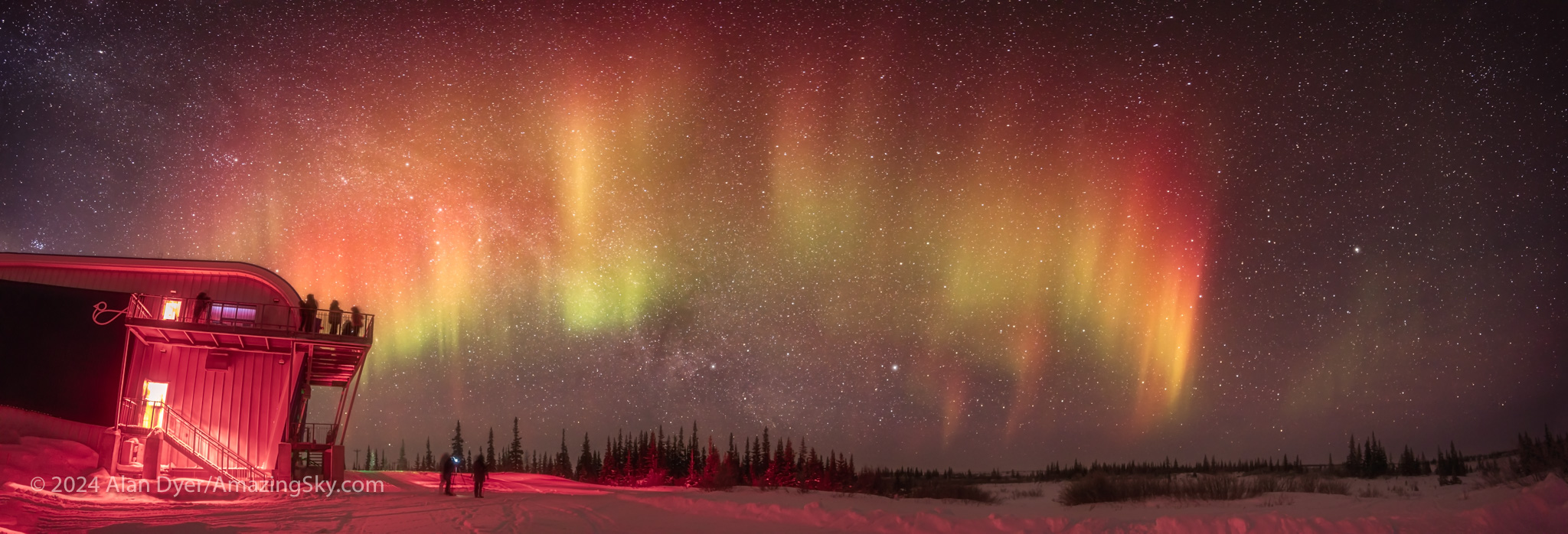
An aurora selfie at the Churchill Northern Studies Centre, on February 10, with a modest Kp4-level storm underway. This is 20-seconds with the TTArtisan 11mm fisheye lens at f/2.8 on the Canon R6 at ISO 1600.

Yes, the air is cold (usually about -25ยฐ C) but the skies are often clear and aurora filled, as Churchill sits under the normal location of the auroral oval, the main zone of auroras. In fact, it is as far south in the world as the auroral oval normally resides, at a latitude of only 58ยบ North, well south of the Arctic. If itโ€™s clear, thereโ€™s almost always some level of Northern Lights. 

This year, 2024, was no exception. Even on nights with low readings on the usual auroral indicators we got sky-filling displays that are rare down south. 

This is a southerly arc of green and red Northern Lights on February 9. This is a panorama of 5 segments, each 20 seconds with the Laowa 15mm lens at f/2 on the Canon R6 at ISO 1600.

What I find in Churchill is that even with numerically weak and visually dim shows, as above, the camera often sees very red and photogenic auroras. The eye sees the colours only when the aurora brightens, which it often does (as I record below), sparking rippling green curtains (from glowing oxygen) fringed with pink (from glowing nitrogen).

I didnโ€™t shoot time-lapses or movies this year in Churchill. Instead, the example movie above, shot using just real-time (not time-lapse) videos, is from February 2019. It is from my AmazingSky YouTube channel.

The video presents the aurora much as the eye saw it, and as it appears when it dances.

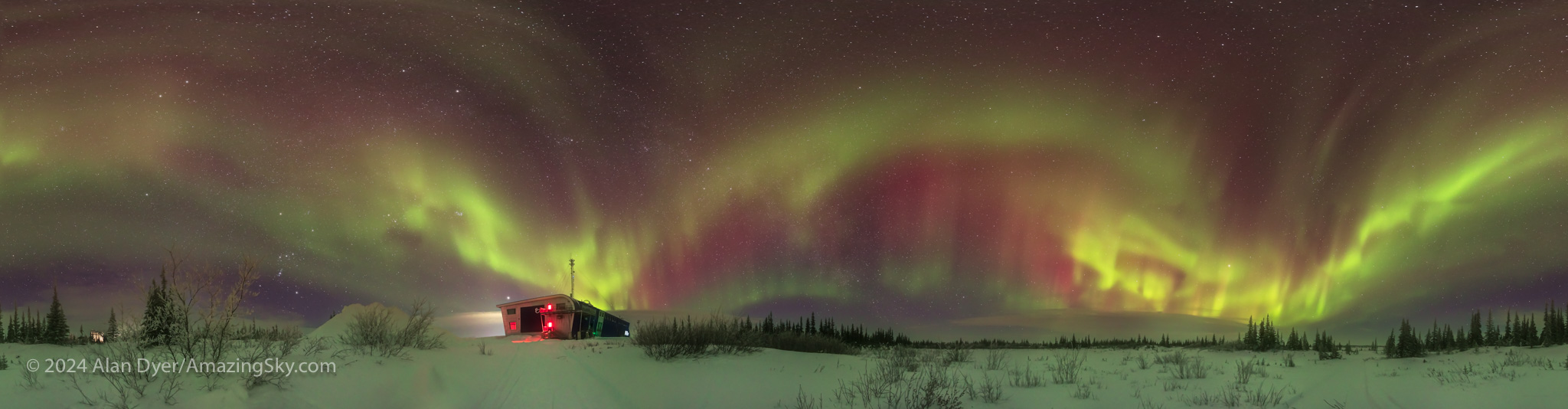
This is a 360ยบ panorama of the all-sky aurora of February 10, from the Churchill Northern Studies Centre. This is a panorama of 9 segments, each 15 seconds with the TTArtisan 11mm lens at f/2.8 on the Canon R6 at ISO 1600.

However, I tend now to shoot mostly panoramas, as above, from this year’s visit. They can take in the full show across the sky, in high-resolution images suitable for framing! 


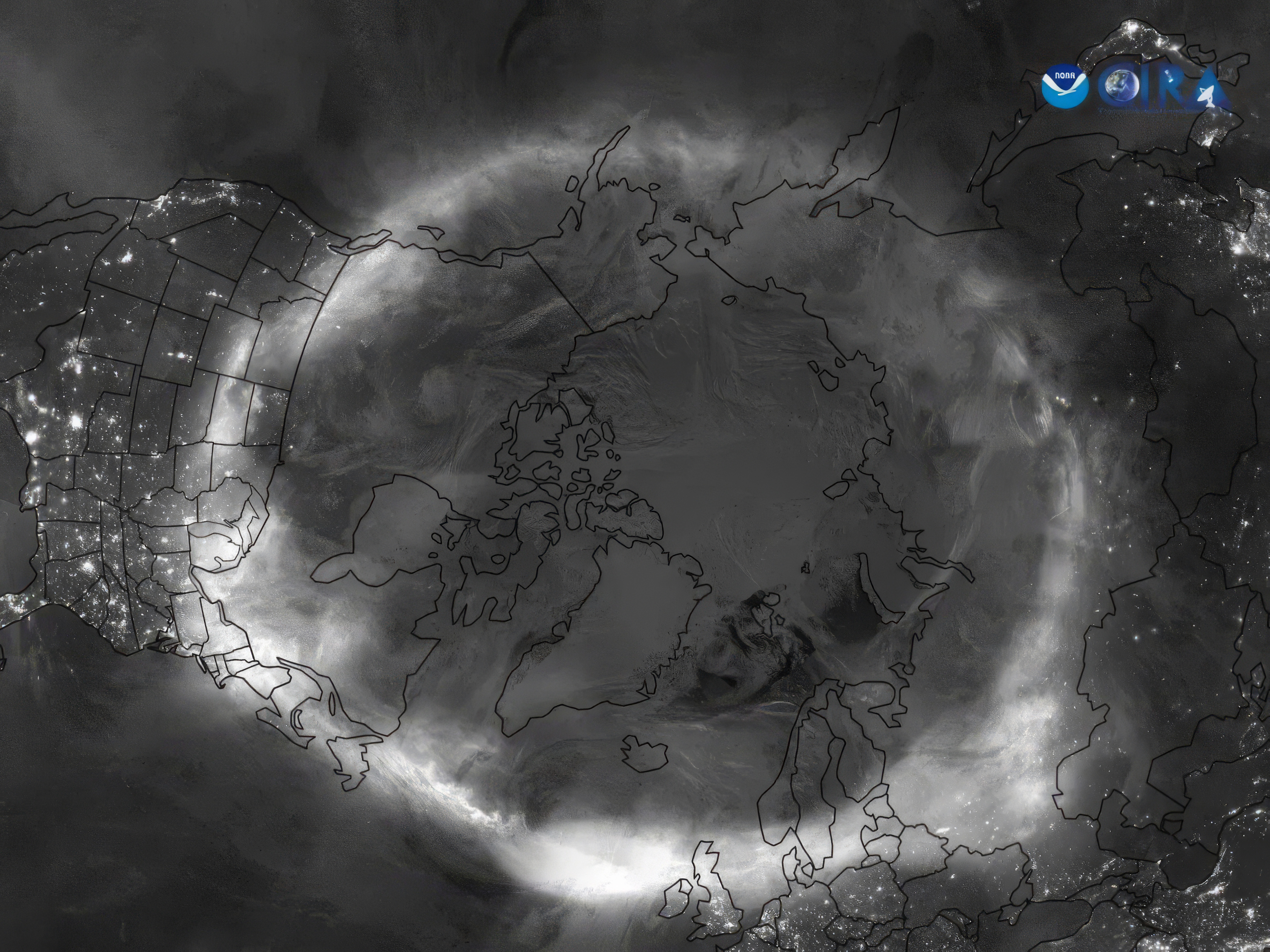
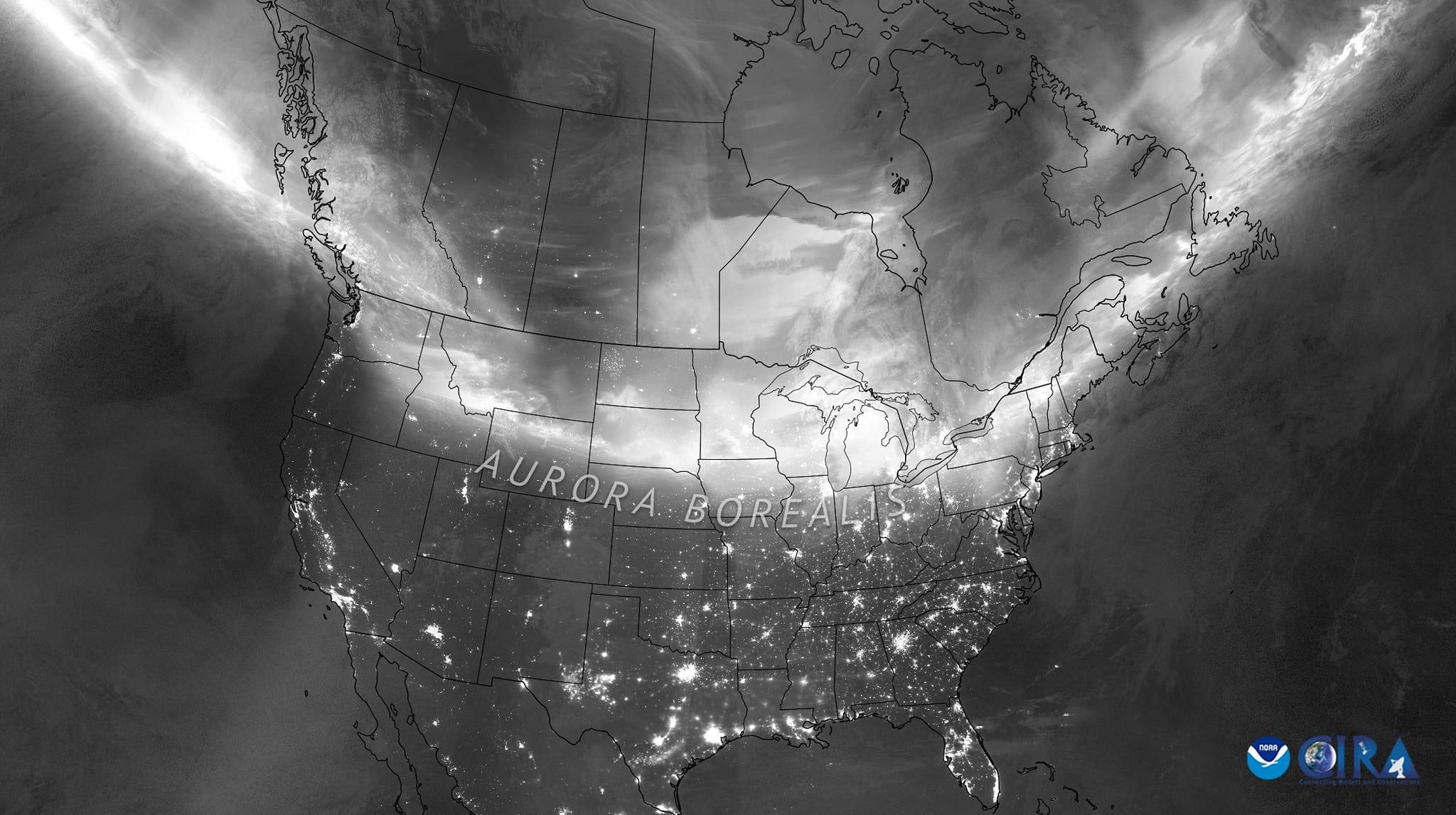
The aurora apps were beeping this day, warning a great display was in the offing. The composite satellite image below from NOAA shows the actual extent of the aurora around the Northern Hemisphere during the great display of May 10/11 . 

Note how the auroral oval is indeed an oval and how the centre is not the geographic North Pole. It is the North Geomagnetic Pole, in the High Arctic of Canada. ๐Ÿ‡จ๐Ÿ‡ฆ So the oval dips down farther south over North America than it does over Europe.

Image courtesy of the U.S. National Oceanic and Atmospheric Administration.

The May 10 solar storm rated a top “G5” on the G1 to G5 storm scale, while the โ€œKpโ€geomagnetic disturbance index reached Kp8 on the Kp0 (nothing) to Kp9 (OMG!) scale. 

I gave a talk at a local community art gallery that evening, and alerted the audience to the likelihood of fine aurora later that night. Sure enough, I got home in time to see the sky already lighting up with aurora in the twilight and behind the clouds. 

This was the multi-coloured curtain to the south during the great display of May 10. This is a 10-second exposure with the Laowa 15mm lens at f/2.8 on the Canon Ra at ISO 1600.

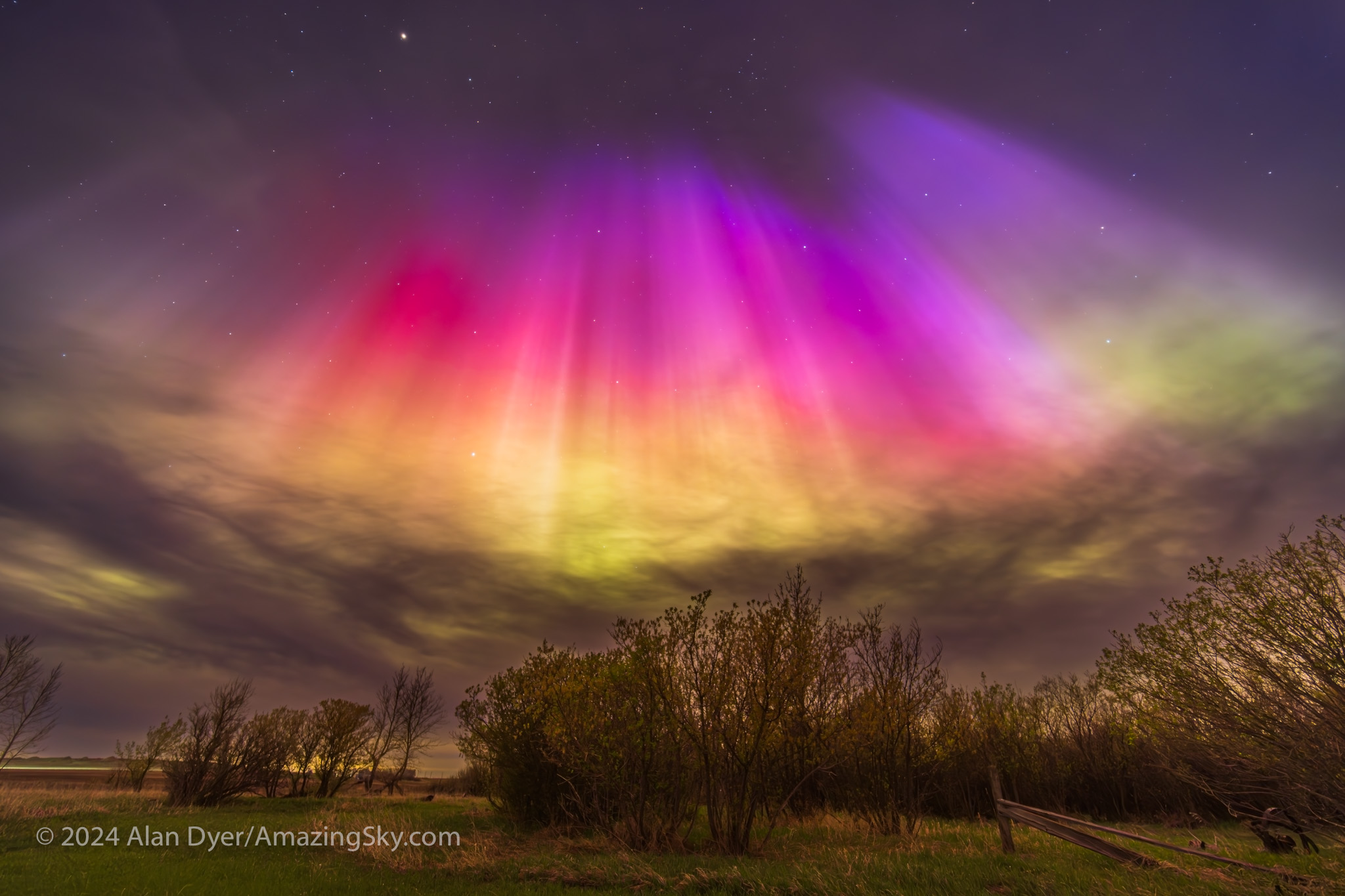
The clouds cleared off enough to reveal one of the most colourful shows Iโ€™d seen in many years. This time there was no question about seeing reds and vivid pinks with the unaided eye. This was the type of show everyone hopes for. But it takes a Kp6 show and higher to spark it.

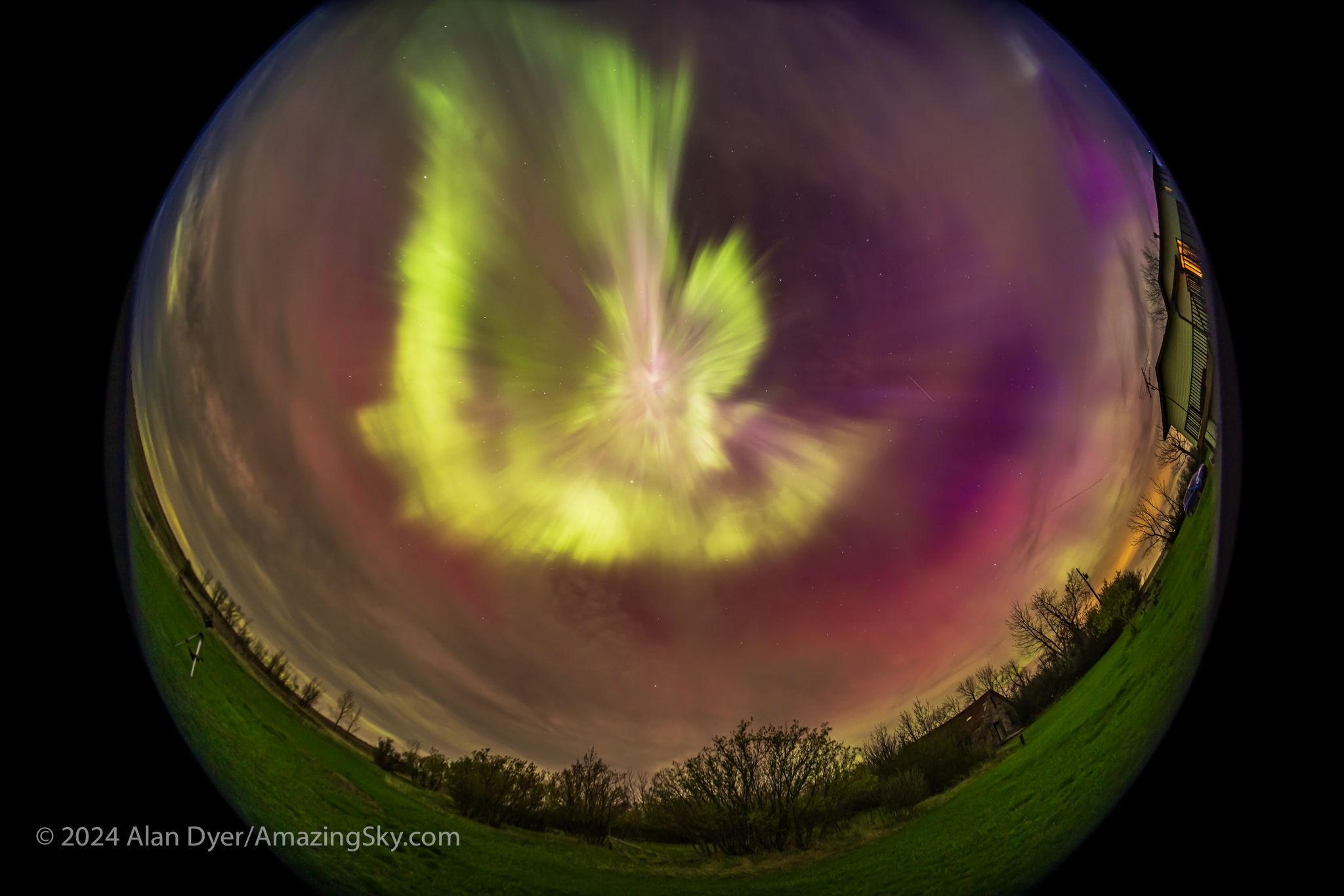
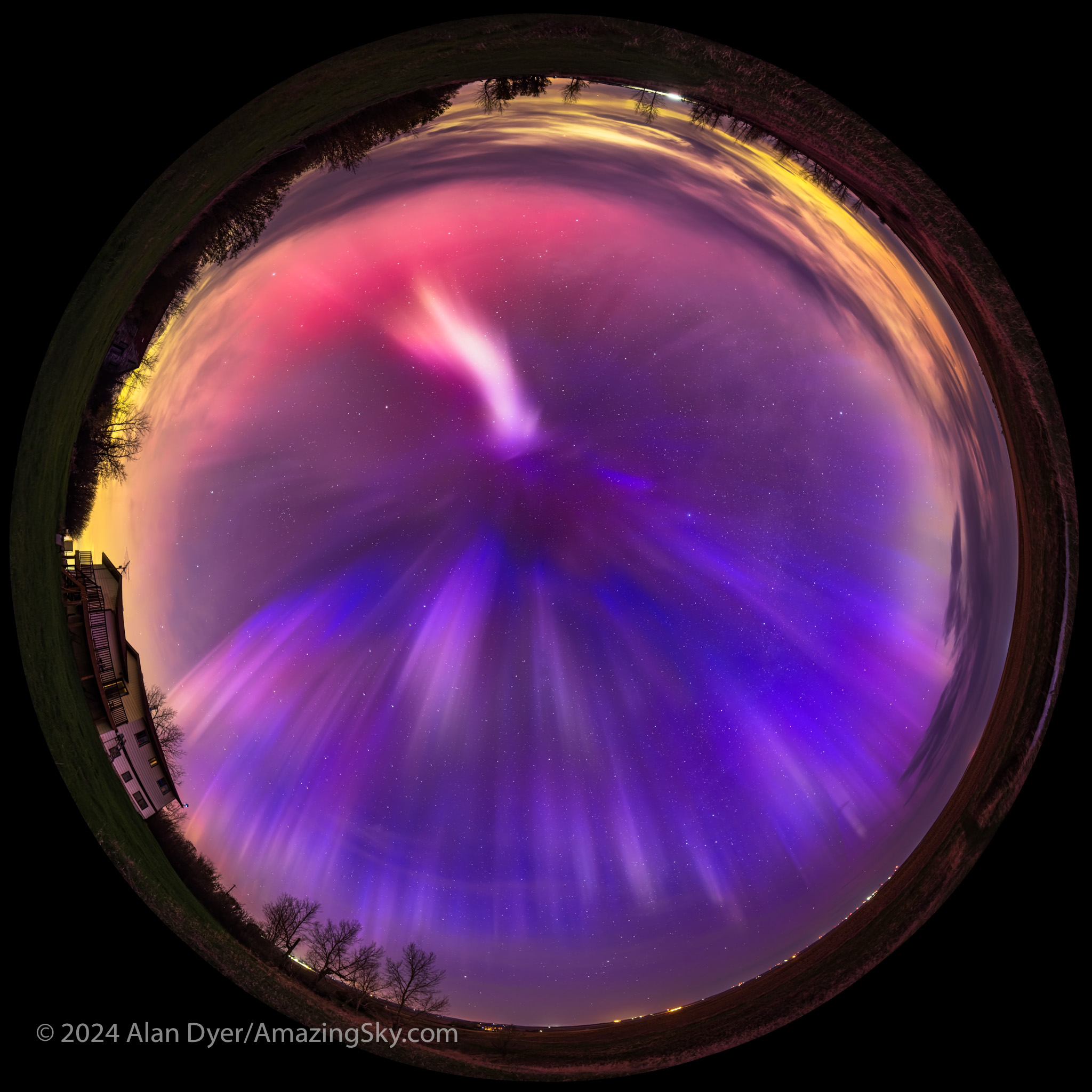
This was the view as the aurora suddenly brightened and converged at the zenith for a superb corona effect. This lasted no more than a minute before it dimmed and subsided again. This is a 9-second exposure with the Laowa 7.5mm circular fisheye lens at f/2 on the Canon R5 at ISO 800.

I blogged previously about the Great May Aurora Display here

And a music video of the May 10 display incorporating time-lapse and real-time video footage is on my YouTube channel, with the clickable link below. Do enlarge to full screen.

One of the most remarkable aspects of this show was the blue auroras later in the night (shown below), created by sunlight illuminating the upper curtains and reacting with atmospheric nitrogen. The usual auroral greens and reds are from oxygen. Pinks are also from nitrogen. Blues are less common, but were in abundance this night.

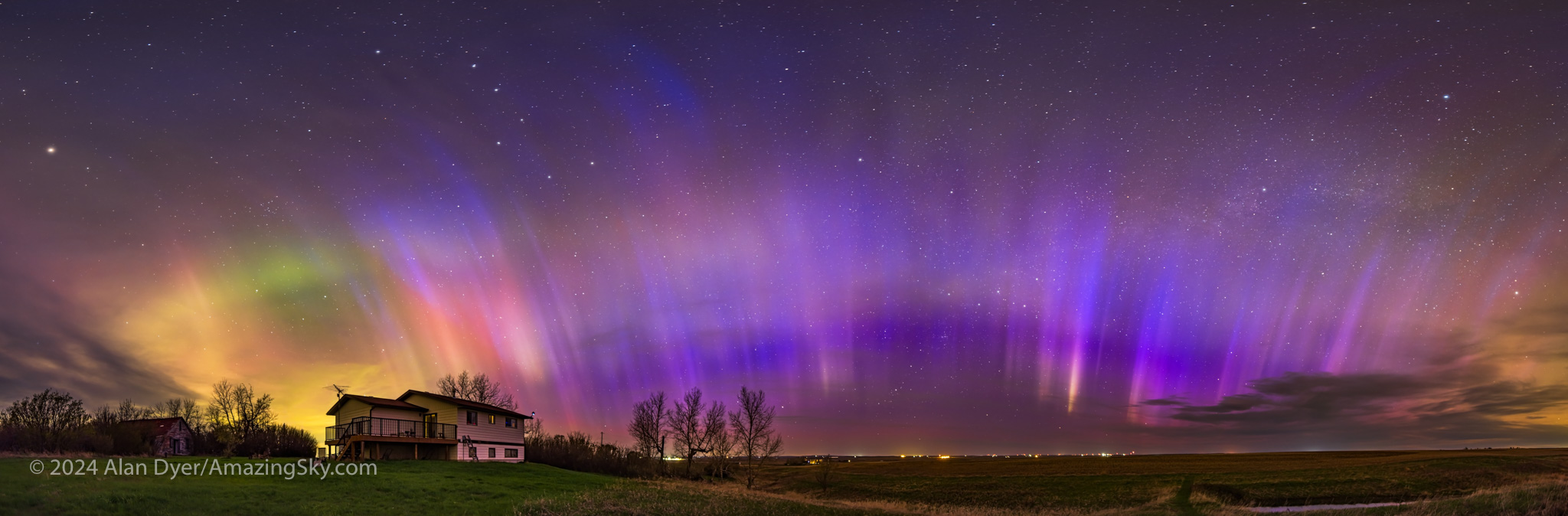
This is a 360ยฐย panorama of the May 10/11 aurora exhibiting vertical blue and magenta rays across the western (left), northern (bottom), and eastern (right) sky, and an odd bright patch to the south at top. This was toward the end of the main activity this night, at about 2:30 am. This is made of 20 segments, each 13-second exposures, with the Laowa 15mm lens at f/2 on the Canon Ra at ISO 800.

Auroras around summer solstice, June 21, can be more colourful and often blue, as the Sun lights the upper atmosphere all night. I saw blue auroras again later in the summer.


June and July are normally when we in western Canada get good displays of another northern mid-latitude phenomenon, noctilucent clouds (NLCs)

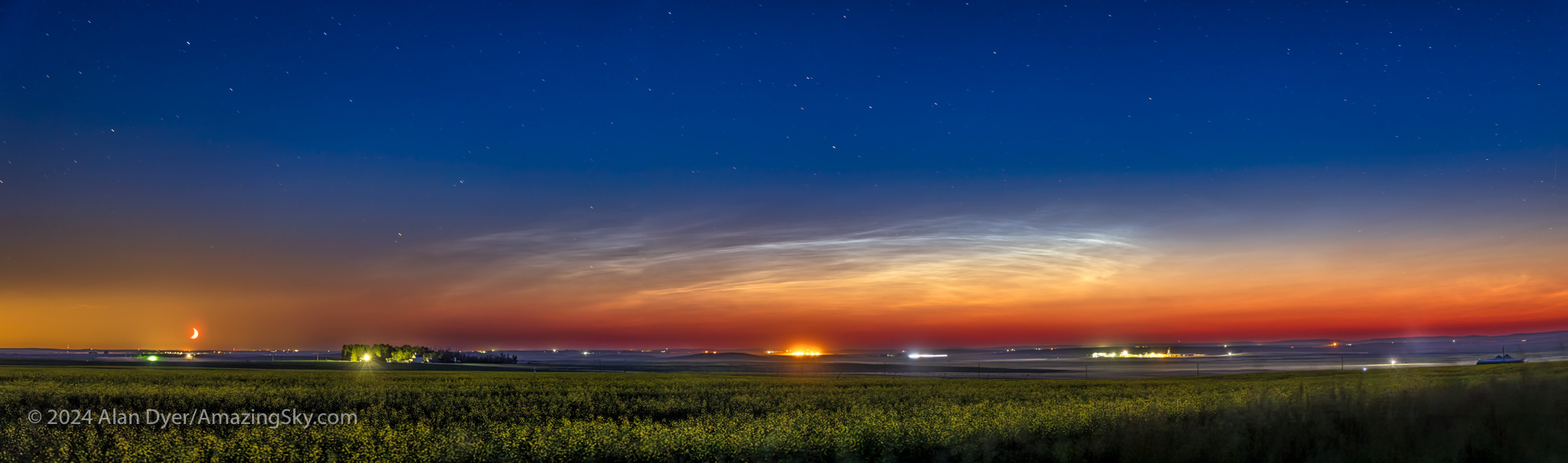
This shows sunlit noctilucent clouds in the northwest in the summer twilight, and as the waxing crescent Moon sets at left. This was July 9 at 11:45 pm MDT, in a panorama of 5 segments, each a 30-second exposure with the Canon RF24-105mm lens at f/4 and 58mm on the Canon R5 at ISO 400.

These are ice clouds at 80 km altitude (almost in space) that are lit by sunlight all night long. I saw only a couple of displays of NLCs this year, and it wasnโ€™t for lack of trying and clear nights, even amid forest fire smoke. The panorama above is from home on July 9, over a yellow canola field. NLC season always coincides with peak canola colour time!

Might NLCs be suppressed by high solar activity? Thereโ€™s some data that suggests they are. However, we werenโ€™t getting many auroras either in early summer. 

A 180ยฐ panorama of the surprise aurora of July 25, as there was little indication in the days before that an aurora was possible this night. This is a panorama of 6 segments, with the Viltrox 16mm lens at f/2 on the Nikon Z6III at ISO 800, each 8-second exposures.

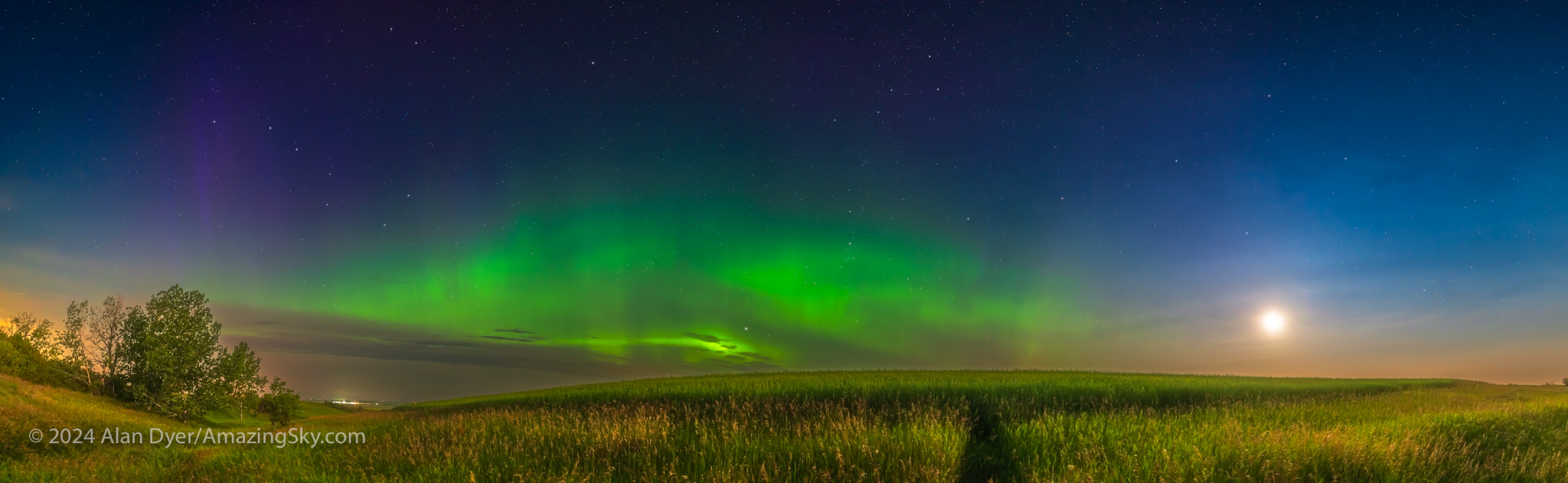
But at the end of July the Northern Lights returned for some classic shows of arcs across my northern sky, first on July 25 (above), with a prominent sunlit blue/purple ray at left by the Big Dipper. The Kp Index reached Kp5 this night, which is enough to produce a good display from my location in southern Alberta. The Moon is rising at right.

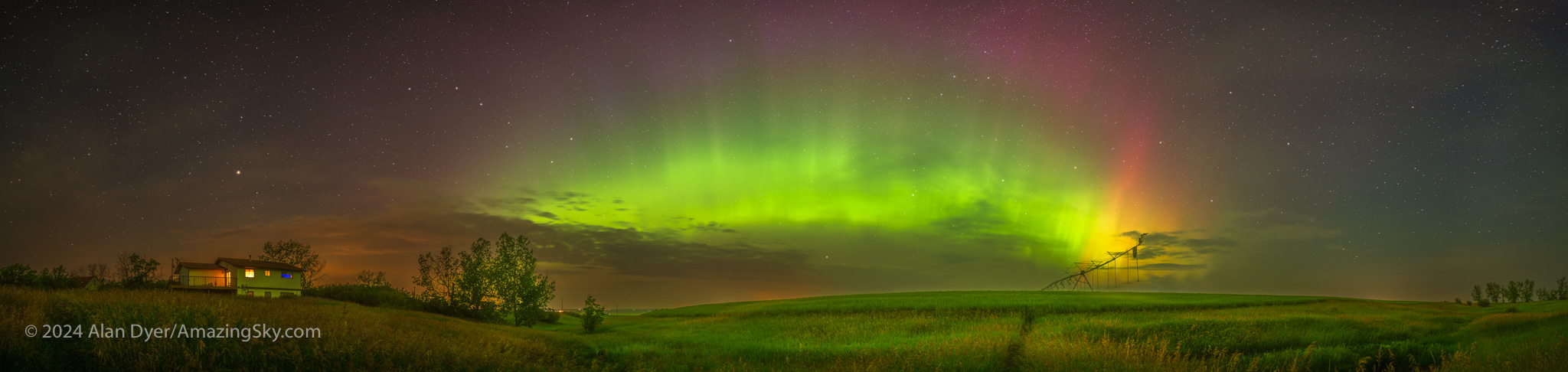
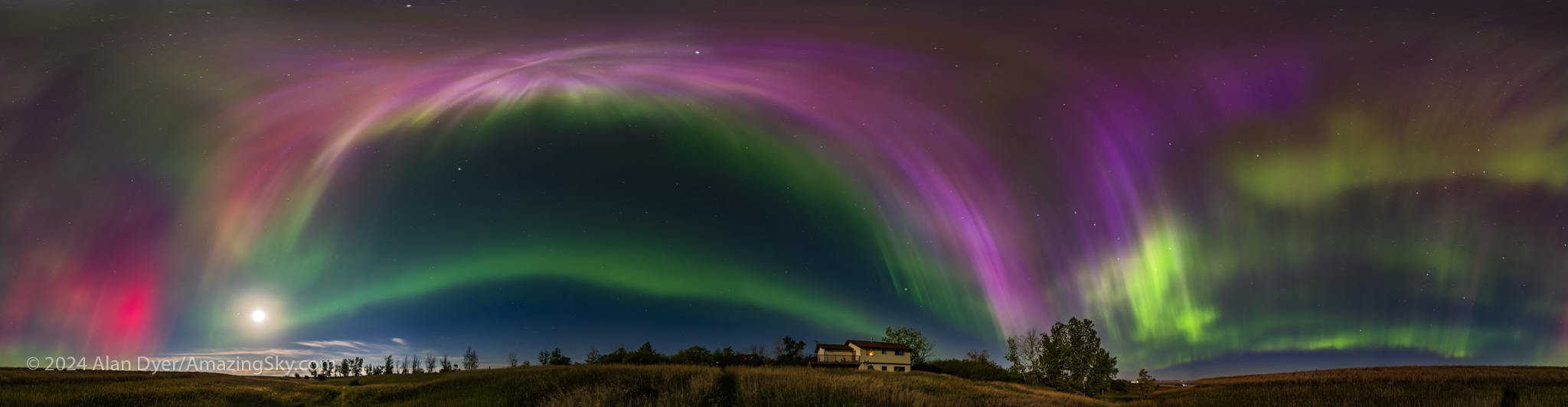
A 180ยฐ panorama of the Kp5-level aurora on July 29, with a green arc, and magenta and red rays. This is a panorama of 8 segments, each 30-second exposures with the Viltrox 16mm at f/2 on the Nikon Z6III at ISO 800.

Then again, four nights later on July 29, an auroral arc appeared across the north, this one with reds mixing with greens to create a yellow band in the east, as well as blue and magenta tops to the green arc that follows the curve of the auroral oval. 


While June and July were quiet months, August made up for them.

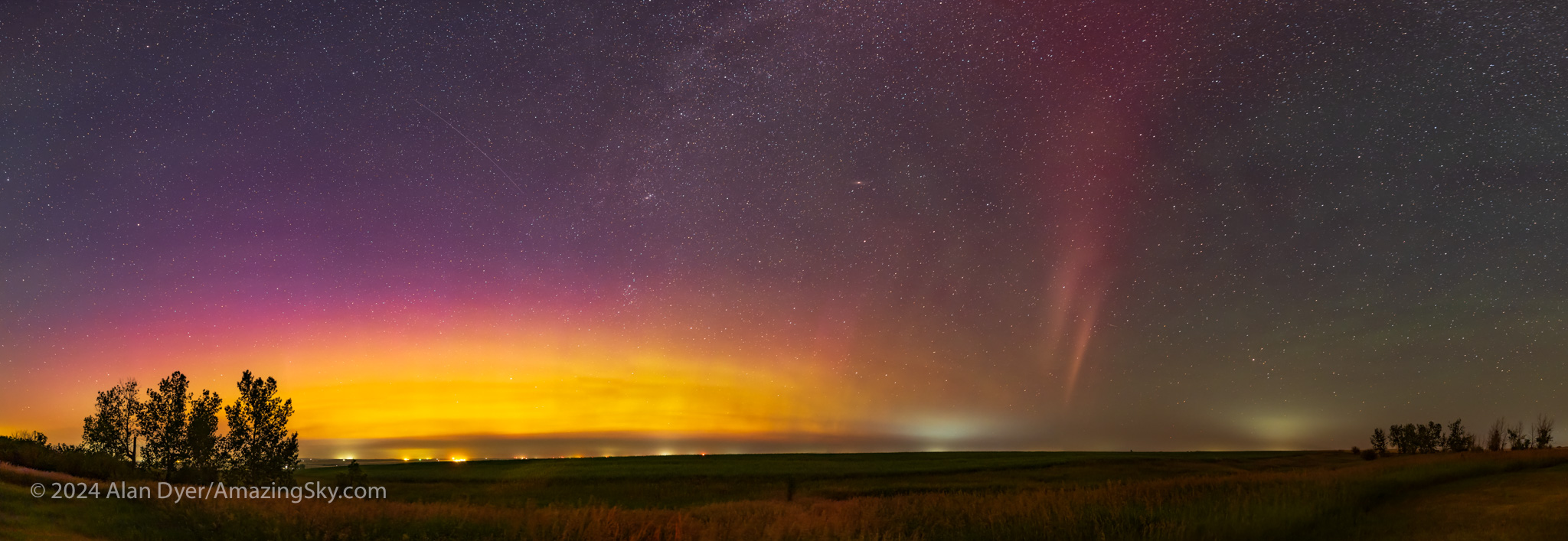
Of all the auroras this year, only this one, on August 1, produced a showing of STEVE, at least as best I saw in 2024. He can be elusive and easily missed!

This is a capture of a faint appearance of a STEVE-like arc during the Kp5 aurora of July31/Aug 1. This was at 12:10 a.m. MDT, so on Aug 1. The camera recorded the pinkish rays at right which are likely STEVE arcs below a more diffuse and fainter red band which may be a SAR, a Stable Auroral Red arc.

STEVE is the odd arc, often white or mauve, that appears southward of the main aurora (from here in the Northern Hemisphere), typically after a show has peaked, then subsided and retreated back north, as it did above. 

STEVE stands for Strong Thermal Emission Velocity Enhancement, as it is caused by horizontally flowing hot gas, and so is not, by definition, a true aurora created by energetic particles raining vertically down magnetic field lines. 

For a classic showing of STEVE see my video, above, from August 2022. High-resolution 4K video I shot this night formed the basis for a scientific research paper, as it revealed structures in STEVE no one had seen before.

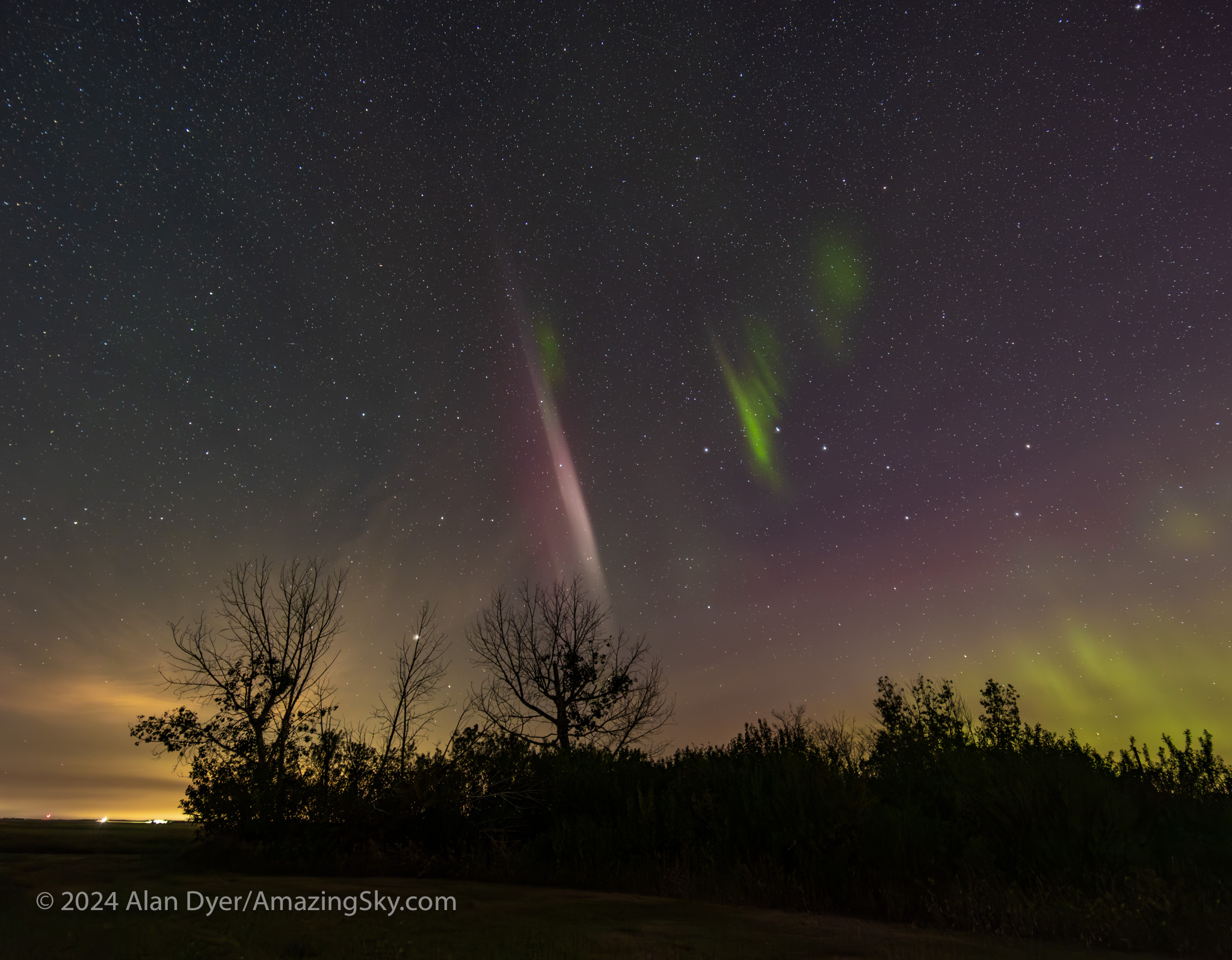
This is a capture of a brief appearance of a STEVE arc in the west during the Kp5 aurora of July31/Aug 1. This was at 1:10 a.m. MDT, so on Aug 1. The mauve STEVE arc was visible for about 15 minutes before it gradually faded. The green picket fence fingers, which were visible to the eye but colourless, appeared only a minute or so before this image and were gone no more than 2 mnutes later.

STEVEs are often accompanied by green โ€œpicket fence fingersโ€ hanging down from the mauve arc. These fingers are more akin to normal auroras, but are created by particles from the STEVE band raining down local magnetic field lines. They do not come from far out in space as they do in a normal aurora!


On the night of August 3/4 I was able to join a photo tour run by local photographer Neil Zeller, to shoot Milky Way nightscapes. Escaping clouds, we ended up at a scenic spot south of Medicine Hat, Alberta, called Red Rock Coulee. 

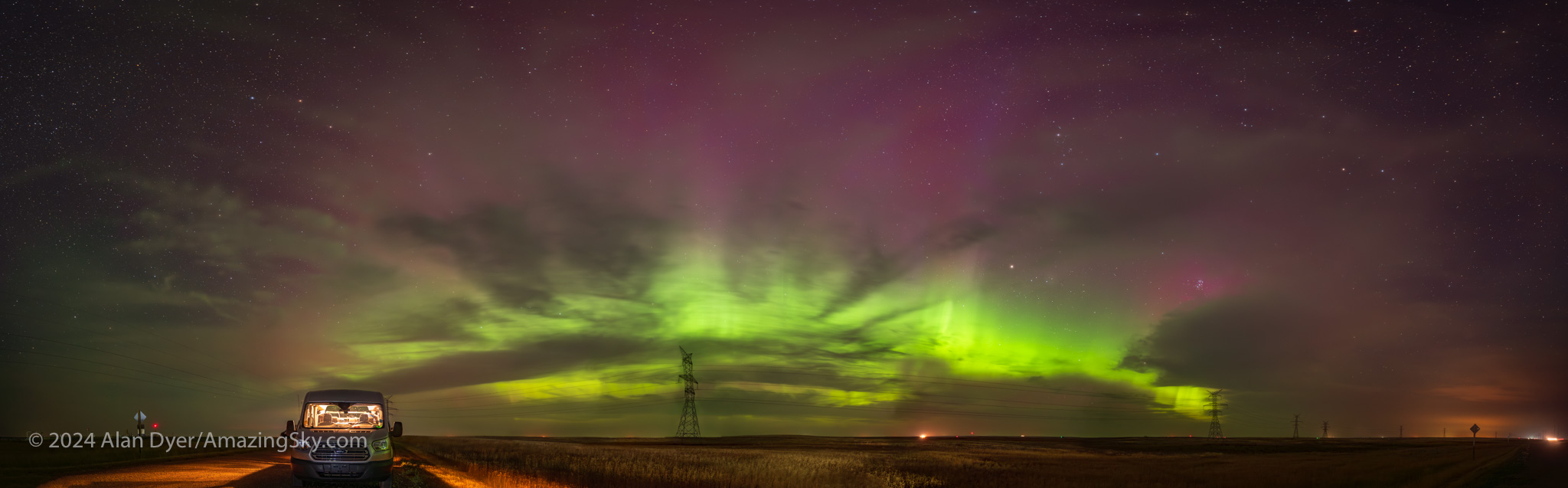
A 180ยฐ panorama of a Kp5-level aurora on a partly cloudy night, August 3/4. This was looking to the northeast at 3:00 am from a side road off the Trans-Canada Highway in southern Alberta just east of Brooks.

On the way home, the aurora began to let loose behind the clouds. We stopped once off the highway as the aurora brightened in an arc across the northeast, above.

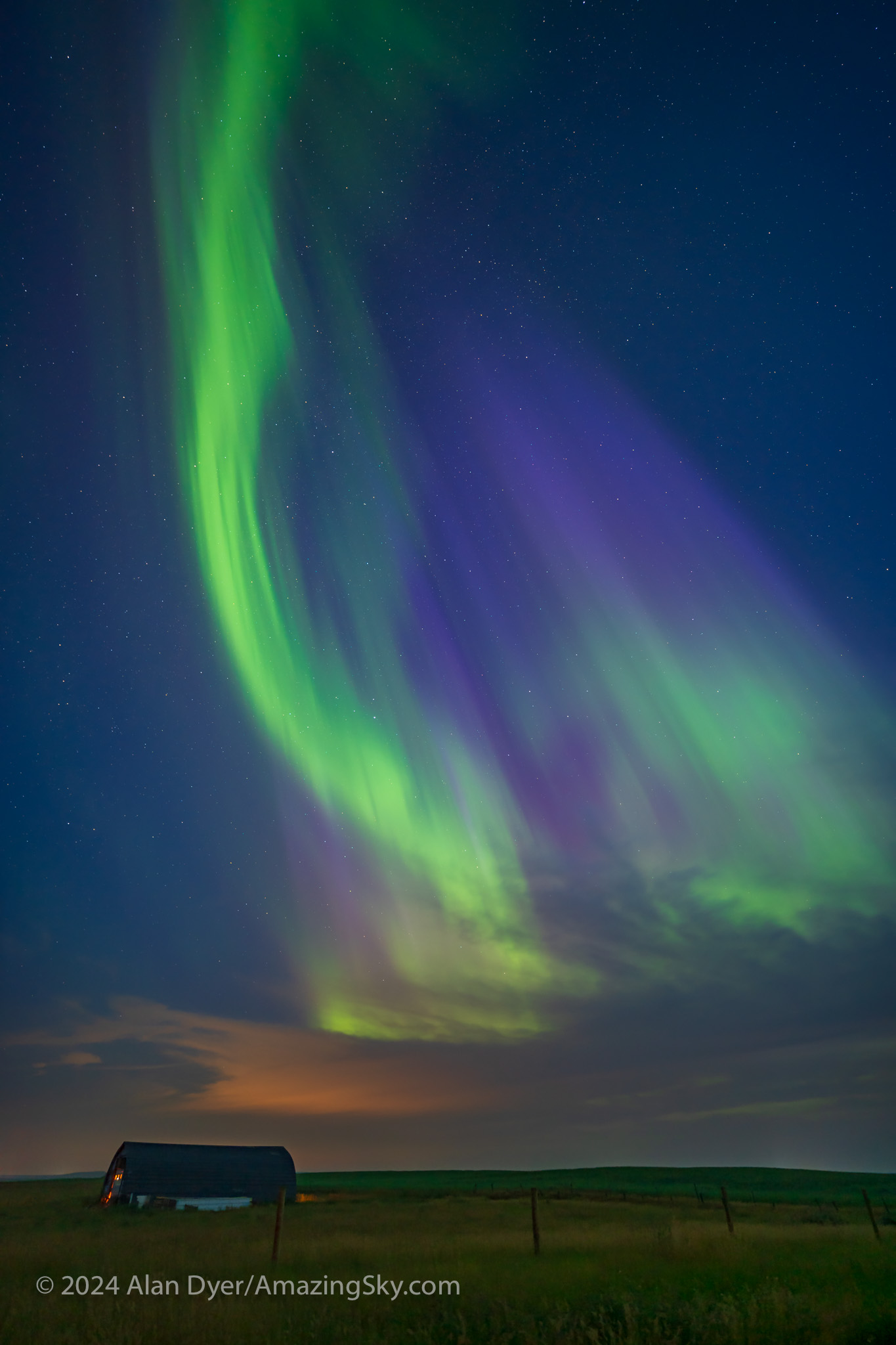
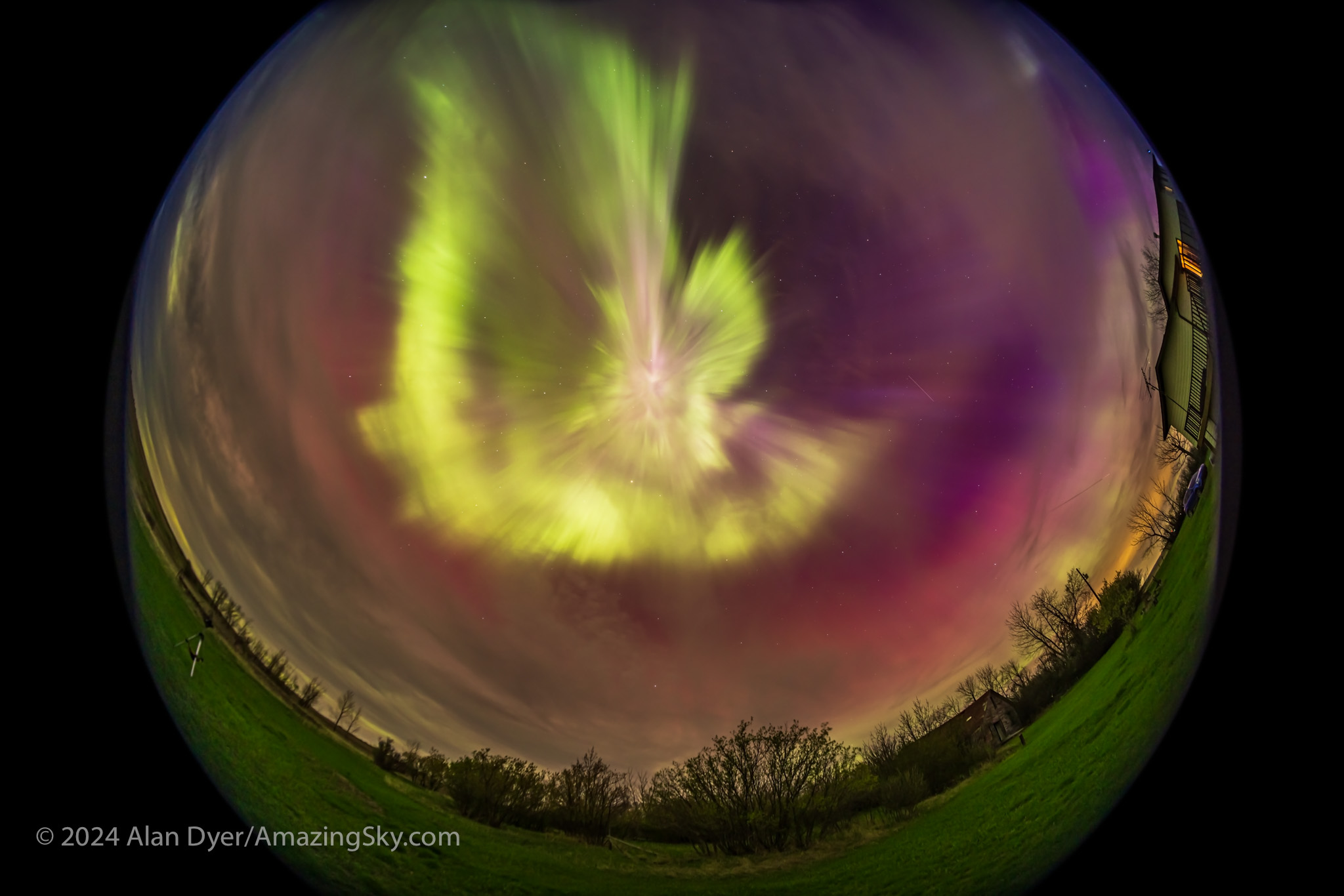
A bright auroral curtain sweeps from the zenith down the western sky, as the sky brightens with the blue of a dawn twilight. This was the morning of August 4, with a Kp5 to 6 level aurora underway. The location was just off Highway 1 between Brooks and Bassano, Alberta. This is a single 13-second exposure with the Viltrox 16mm lens at f/2 on the Nikon Z6III at ISO 400.

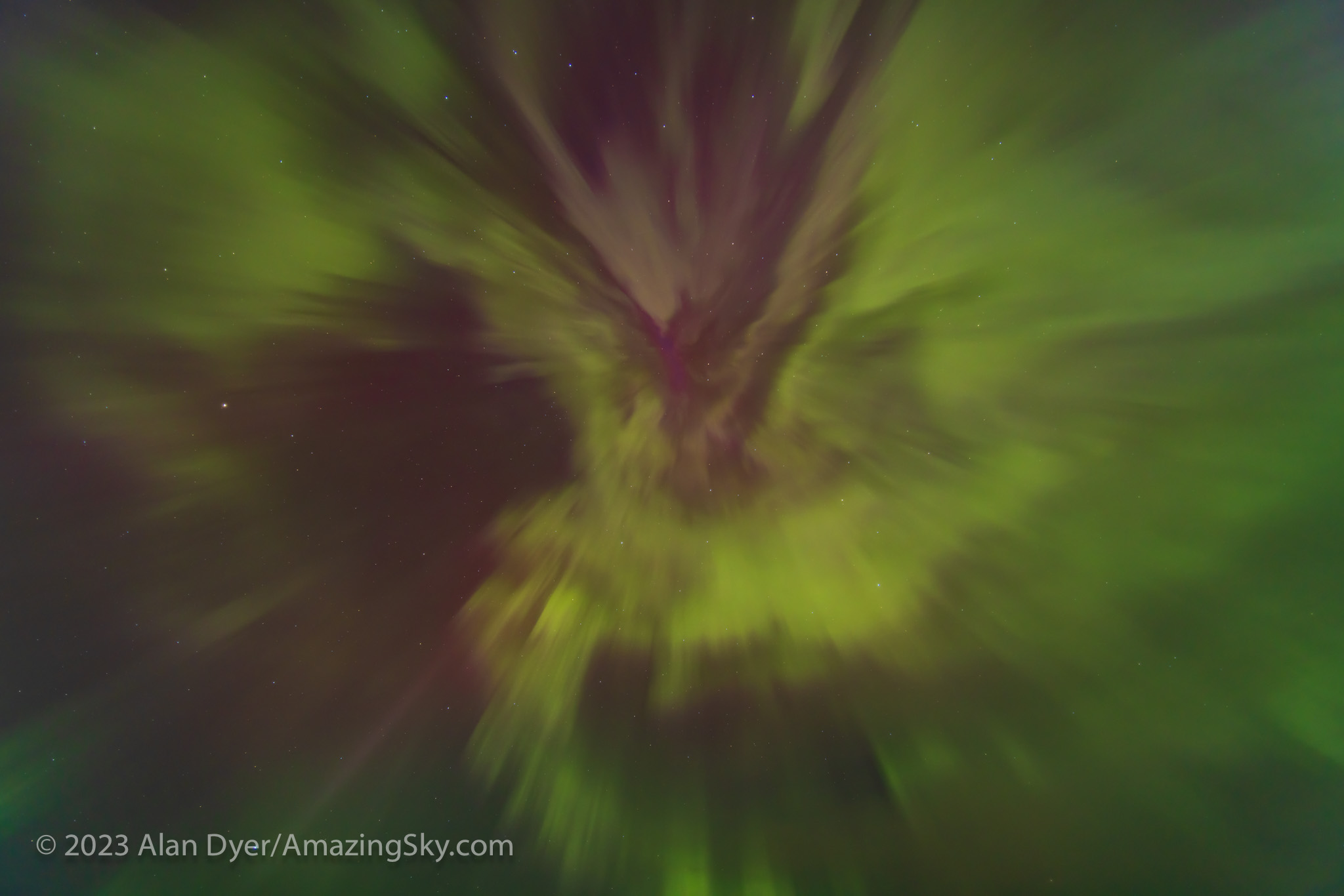
We stopped again later, now at 4 am, and marvelled as the curtains converged at the zenith in the finest manifestation an aurora can produce, a swirling zenith โ€œcorona.โ€

A music video from August 4, using just a single real-time video, not a time-lapse, is above. It shows almost the full but brief appearance of the corona, just as the eye saw it looking straight up!


August was a good month! Right after the annual Saskatchewan Summer Star Party in the Cypress Hills I headed farther east to Grasslands National Park, a favourite dark-sky site I had not visited since 2019. 

My plan was to shoot the annual Perseid meteor shower that was to peak on Sunday, August 11, from the same spot I shot it in 2016.

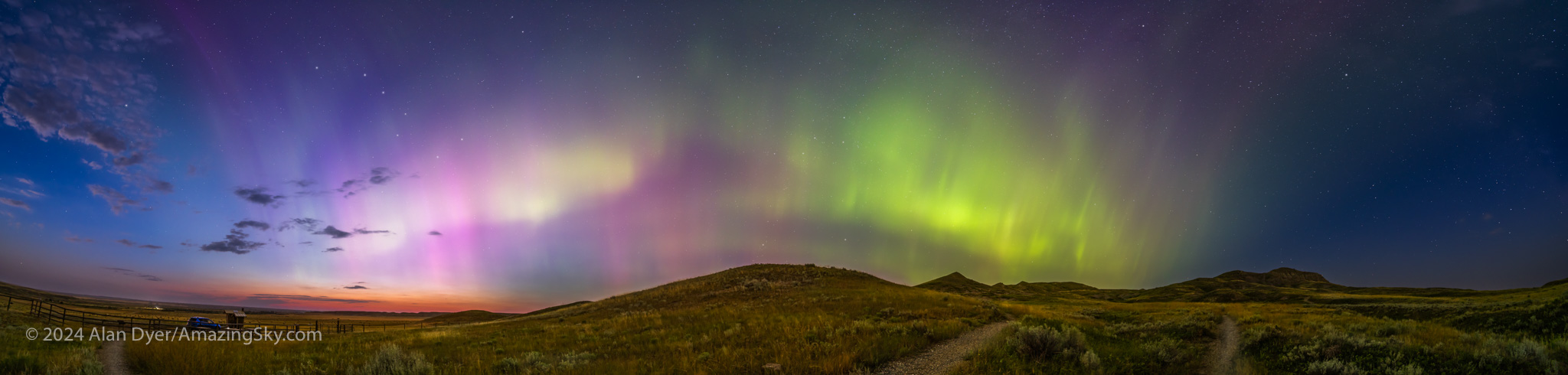
A 270ยฐ panorama of the aurora in the evening twilight on August 11, from the 70 Mile Butte trailhead in Grasslands National Park, West Block near Val Marie, Saskatchewan. This is a panorama of 11 segments, each 15 seconds with the Laowa 15mm lens at f/2.8 on the Canon R5 at ISO 800.

The aurora had other plans. Again, as it did on May 10, the sky was lighting up with colours as it darkened in the evening twilight, above.

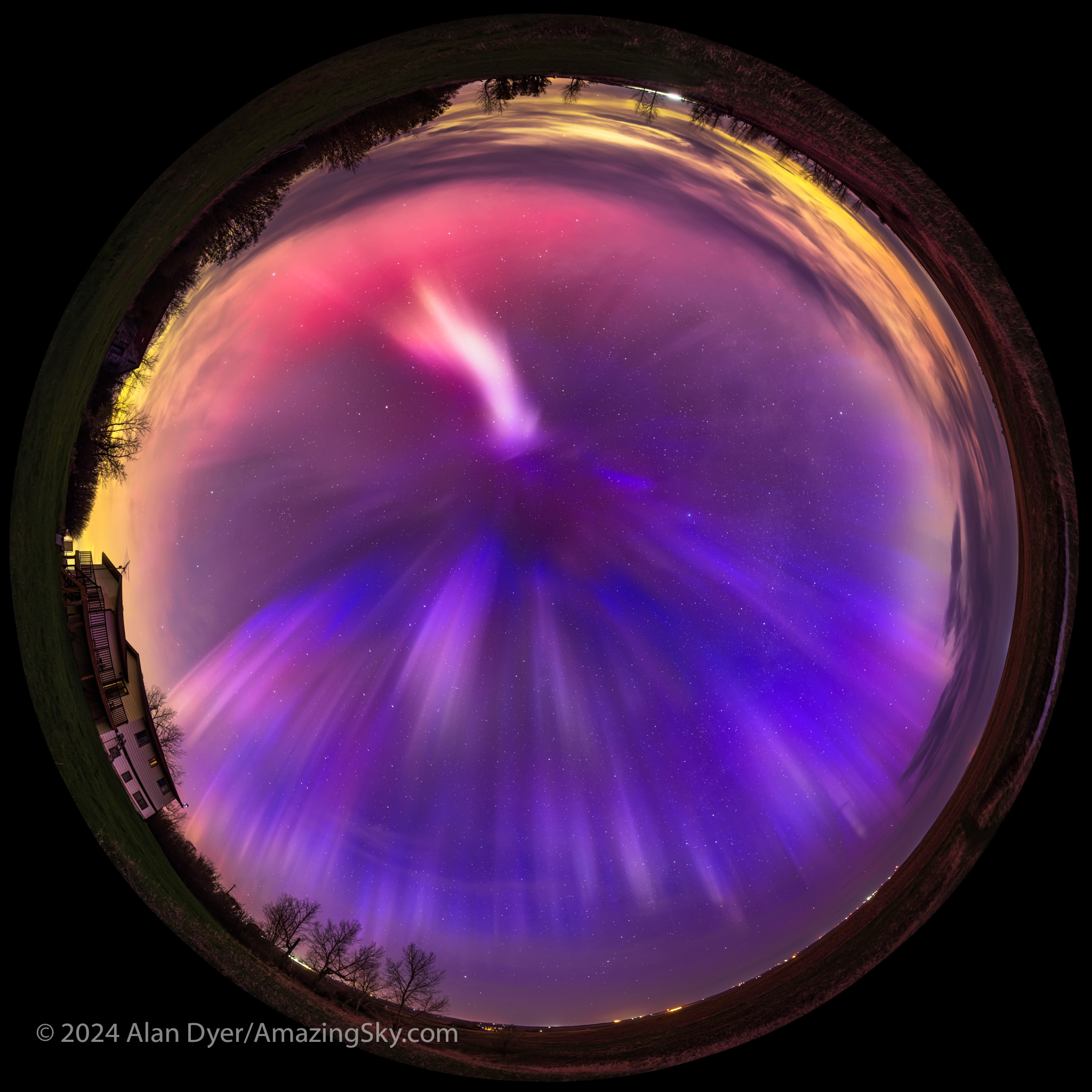
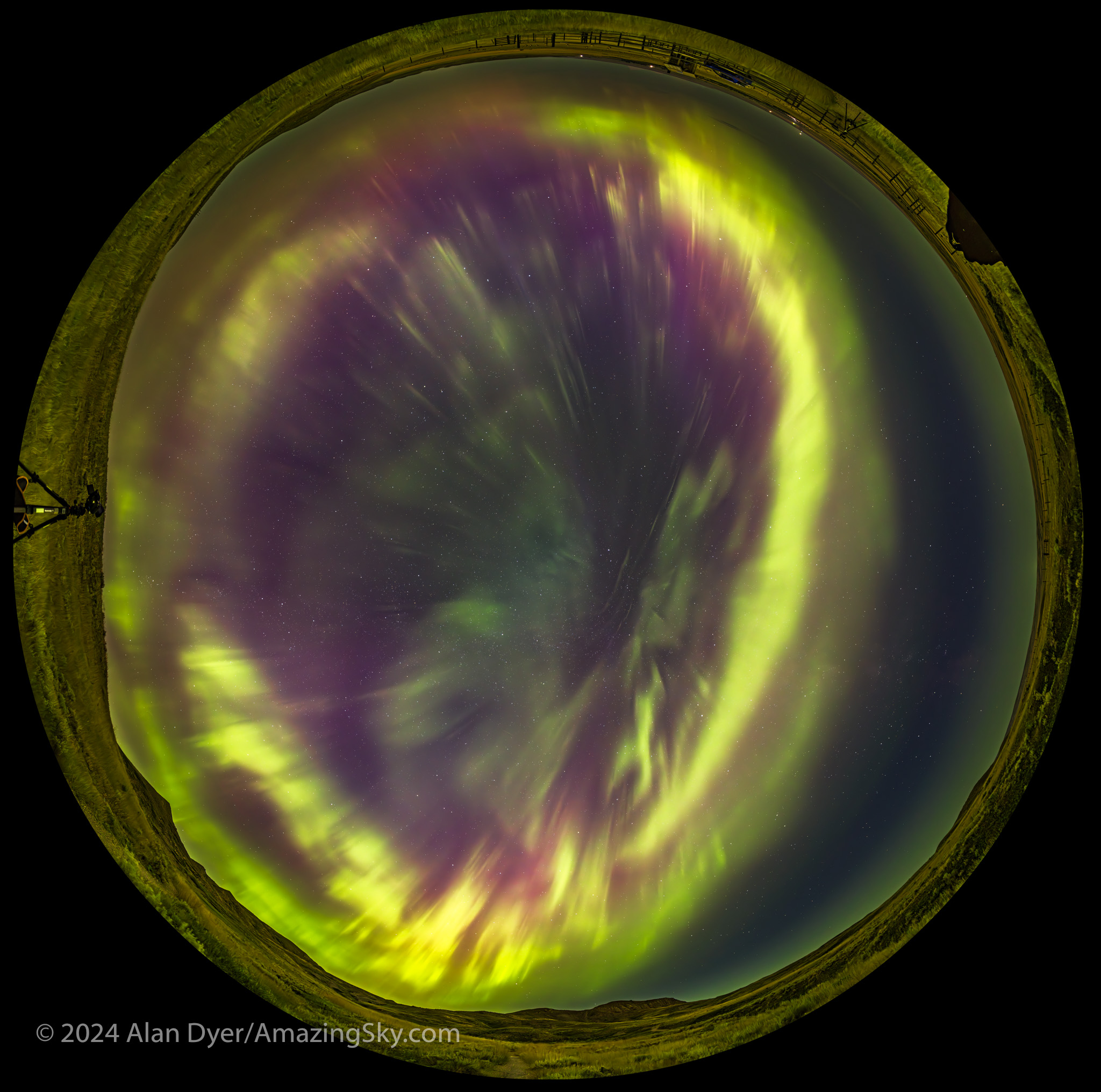
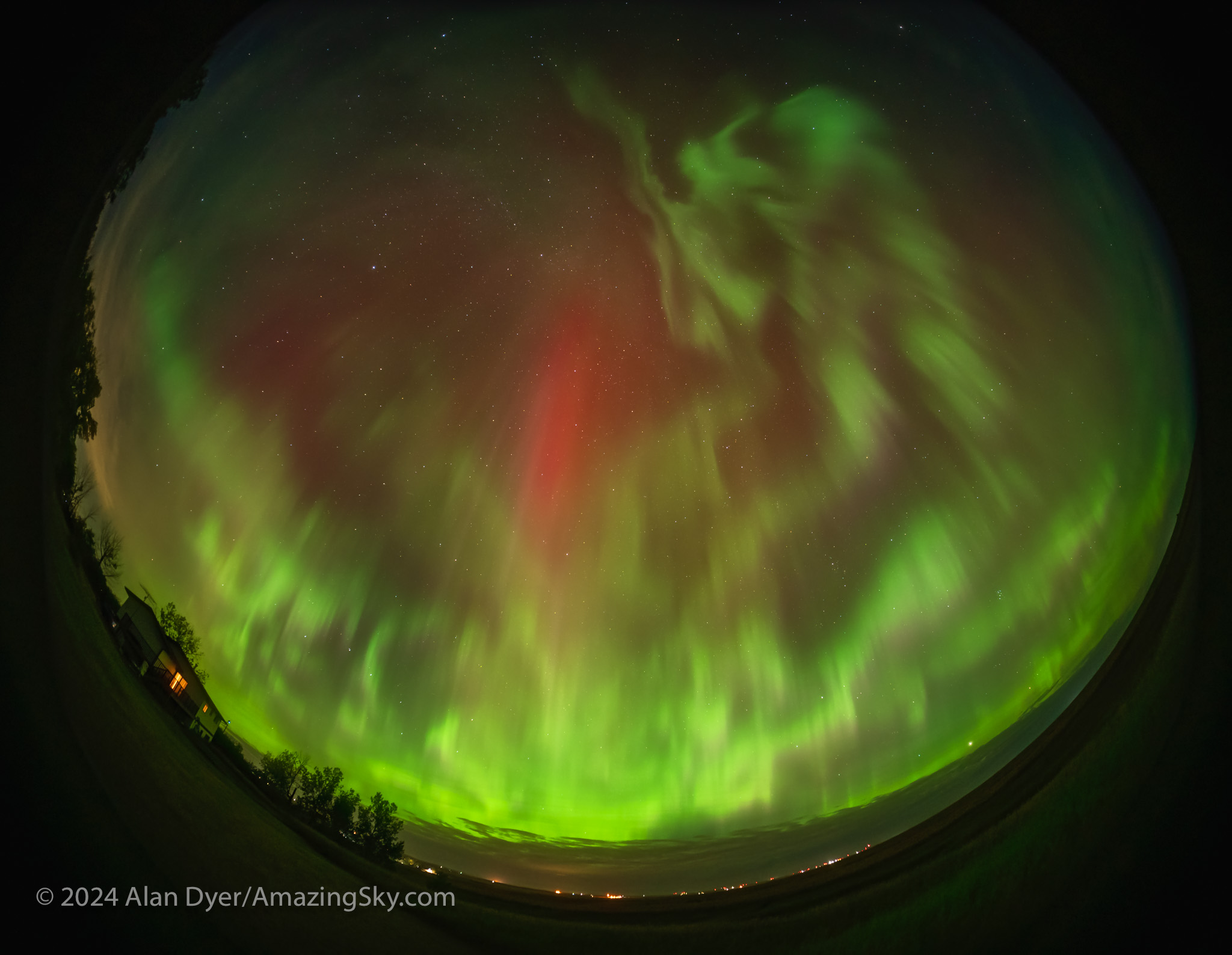
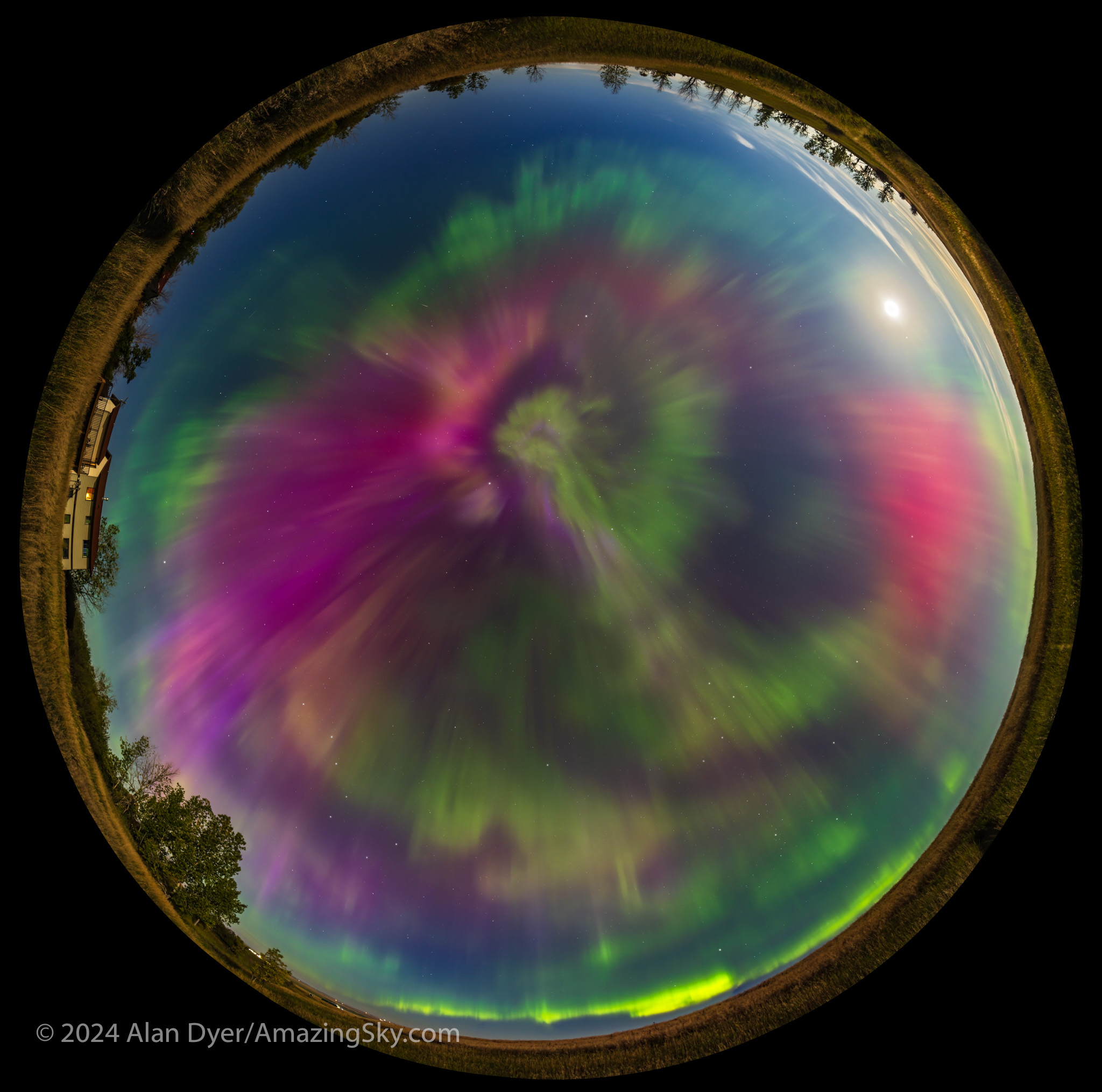
This is a 360ยฐ all-sky panorama of the Kp6 to 7-level aurora on August 11, from Grasslands National Park. This is a panorama of 12 segments, each 4 seconds with the Laowa 15mm lens at f/2 on the Canon R5 at ISO 4000.

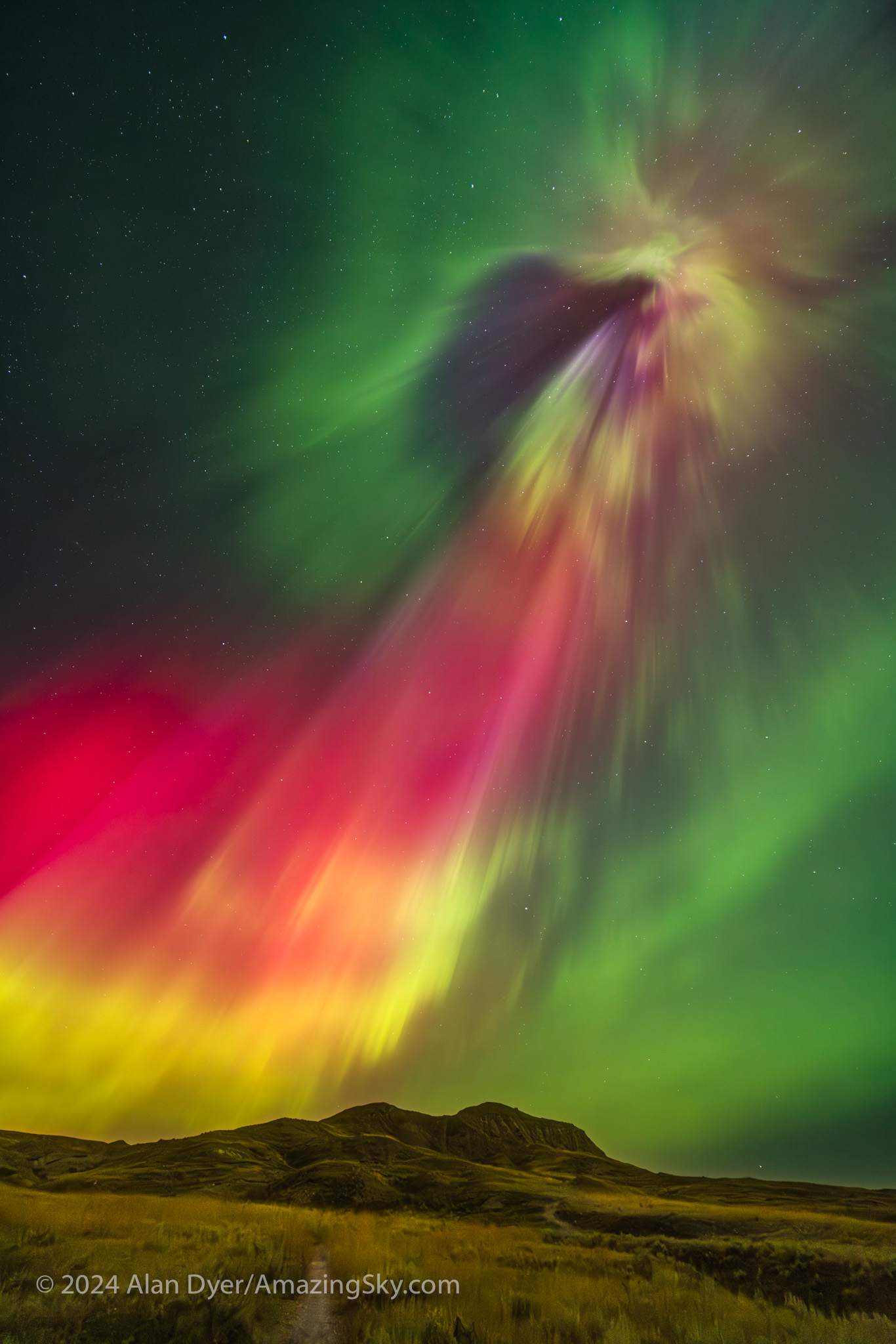
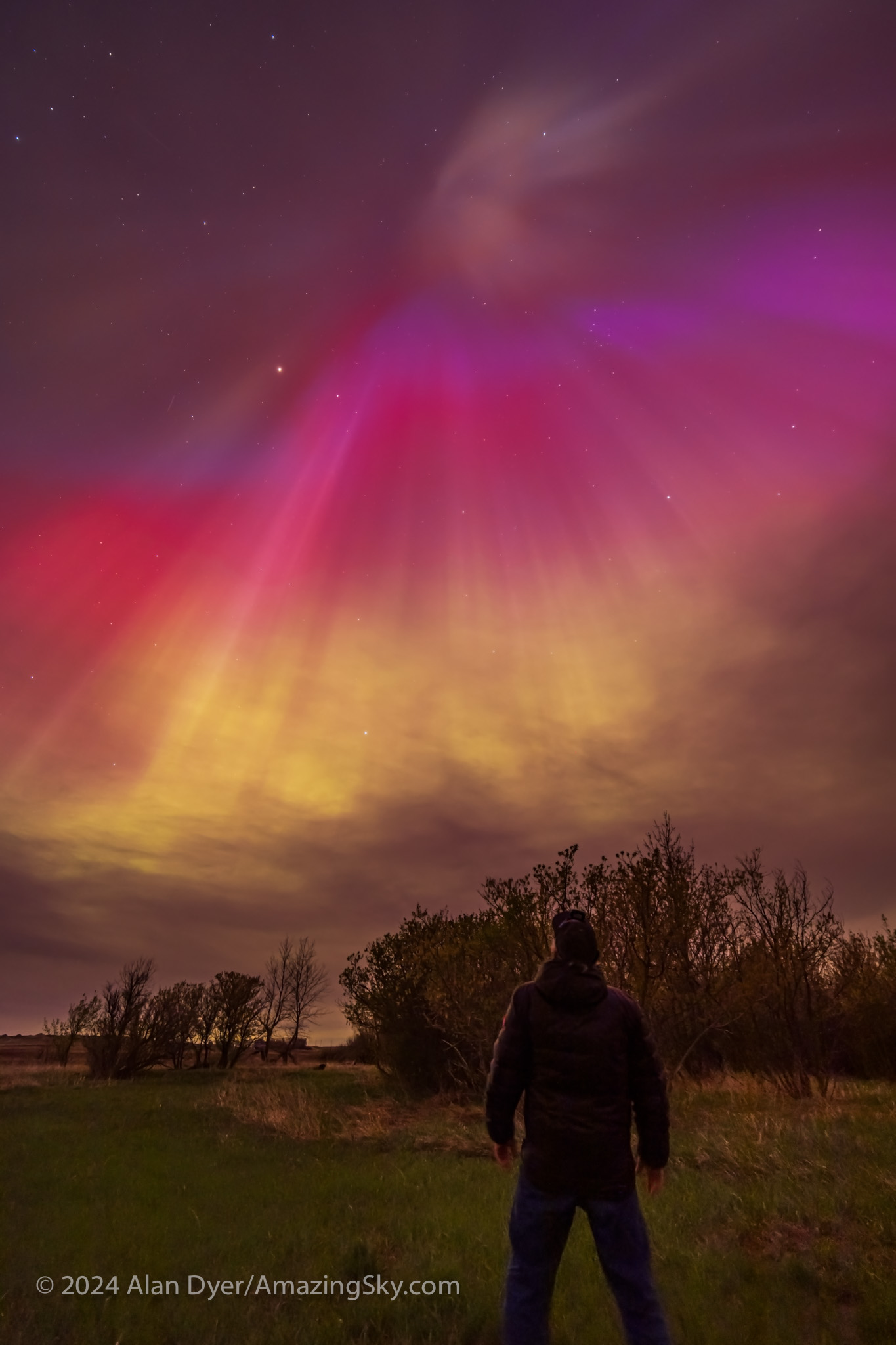
The aurora expanded to fill the sky, and with odd fragmented bits, shown above. My trio of cameras set up for the meteor shower got repurposed into taking aurora time-lapses, stills, and panoramas. And selfies! โ€” the title slide for this blog was from this memorable night at Grasslands. 

The aurora was bright enough during this substorm outburst at 12:15 am that the red and green colours could be seen with the eye, though they were subtle. This is a 2-second exposure with the Laowa 15mm lens at f/2 on the Canon R5 at ISO 3200.

A notable moment was at midnight when, even to the eye, the sky to the east suddenly turned red, and a wave of crimson aurora quickly swept in. The reds from oxygen mix with the more usual auroral greens, also from oxygen, to create areas of yellow in the sky. 

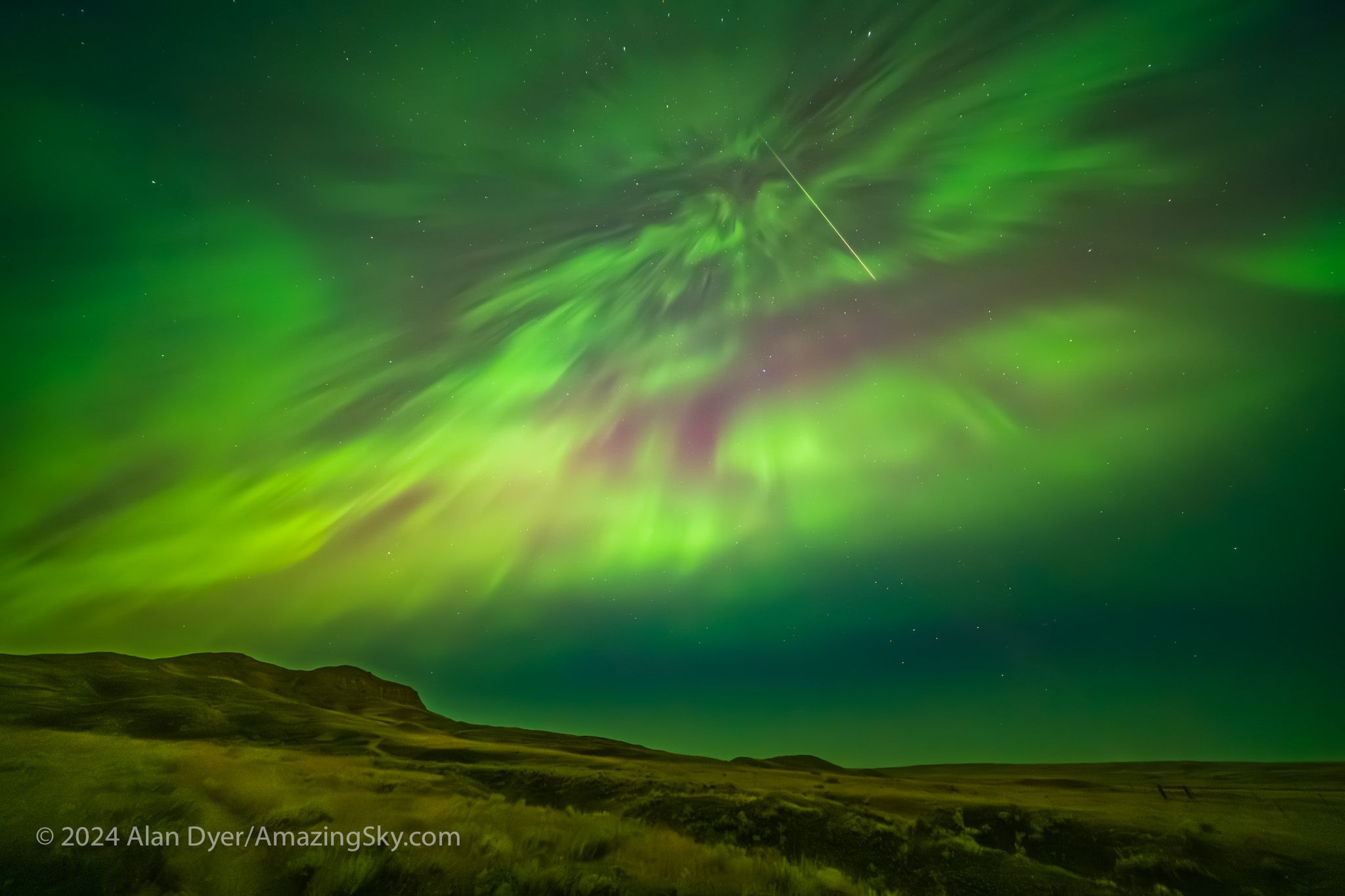
This was also peak night for the 2024 Perseid meteor shower. One bright Perseid meteor shoots down the Milky Way in Cygnus at top, amid the converging rays of the aurora at the magnetic zenith. This is with the Laowa 10mm lens at f/2.8 on the Nikon Z6III at ISO 6400 for 2 seconds.

A few still frames in the time-lapses did manage to catch a Perseid meteor or two, as above, embedded in the vivid curtains of light. But the meteors were upstaged by the Northern Lights this night.

A music video of this show is above, also on my YouTube channel (itโ€™s been a busy year!). Using only time-lapses, it captures the sudden arrival of the red sub-storm, sped up to be sure, but it seemed that quick!


This night I was hoping to shoot deep-sky objects with telescopes I was testing at home. Again, the aurora had other ideas.

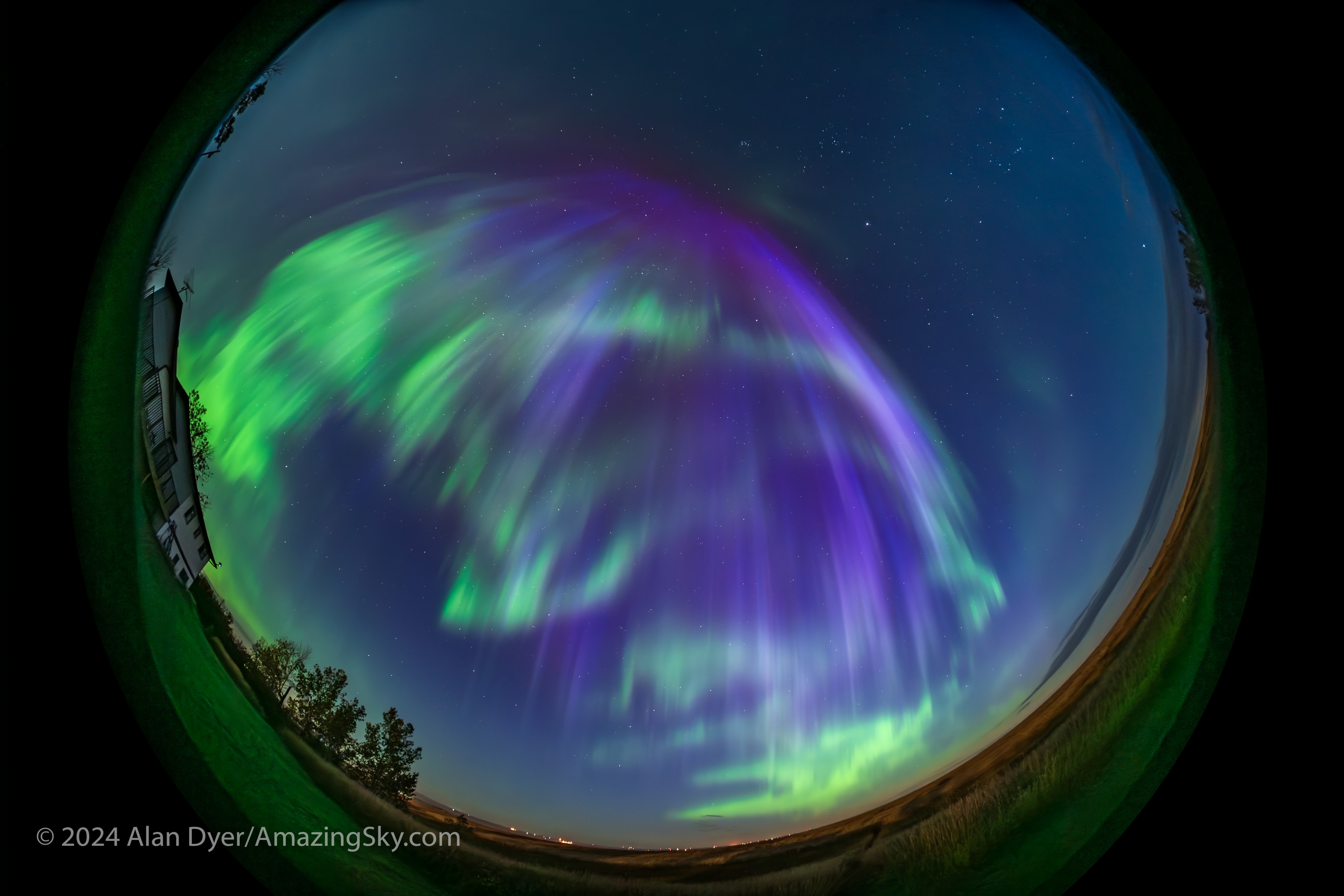
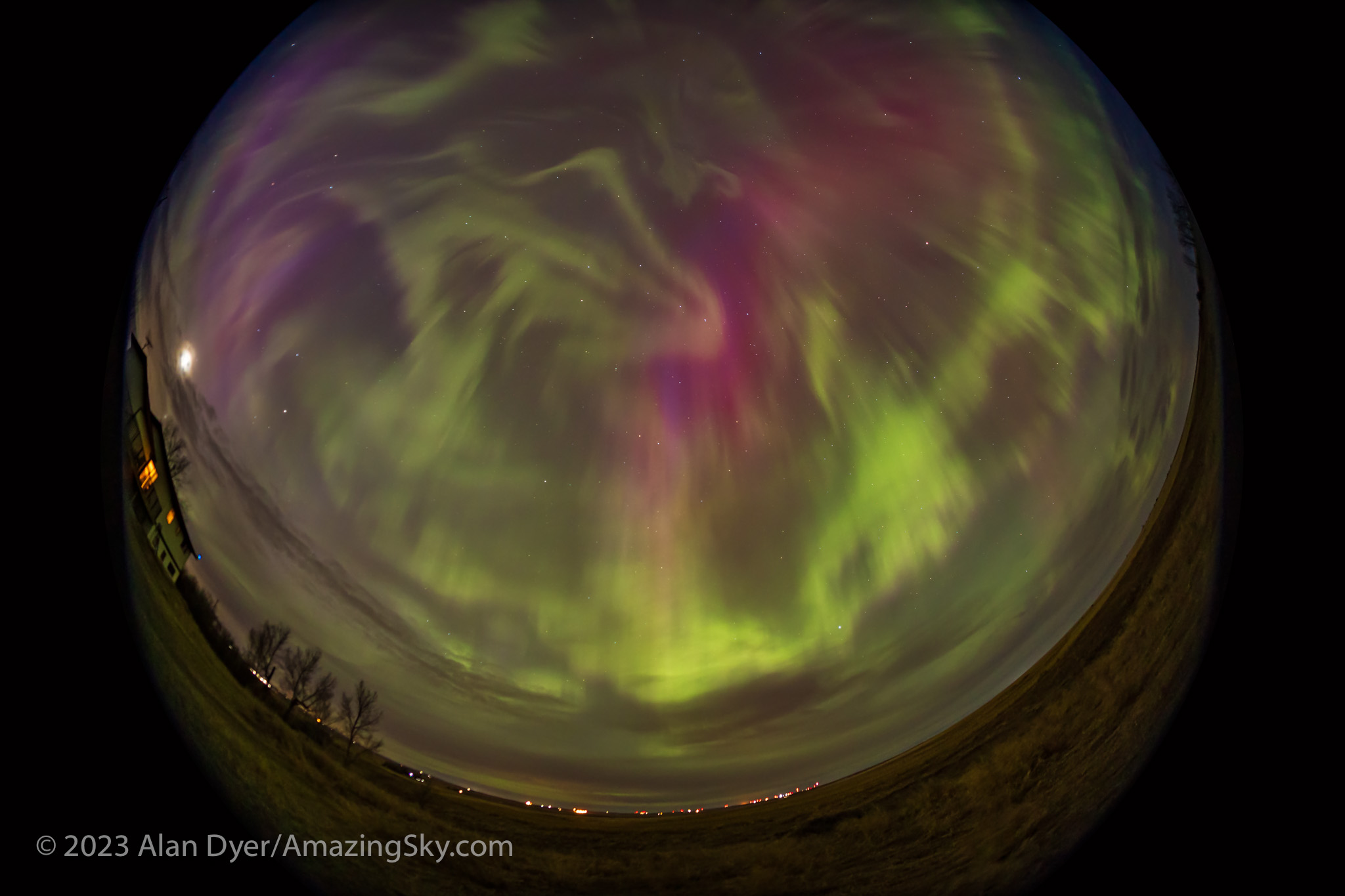
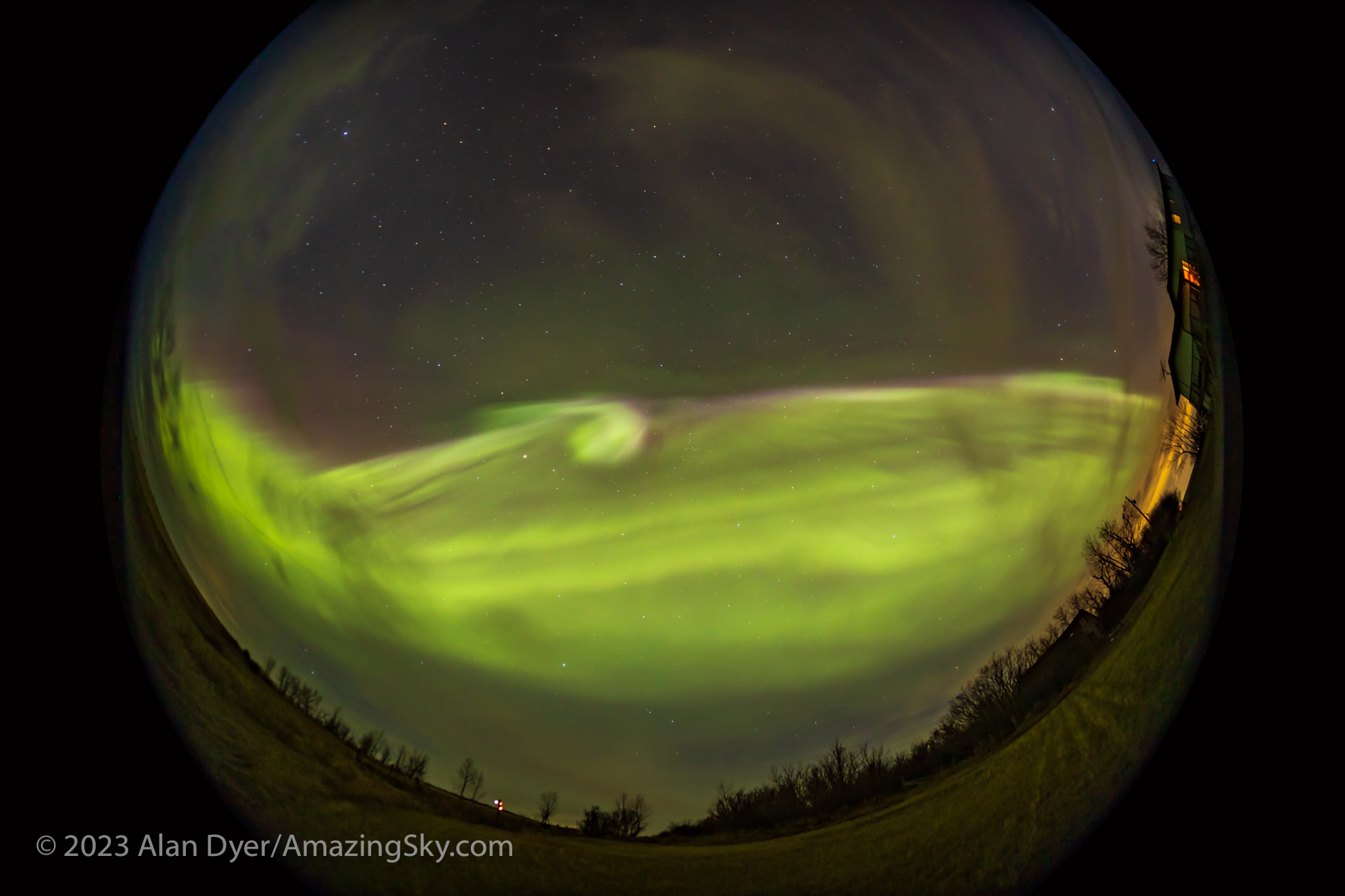
This view is looking north, but the fisheye lens is taking in much of the sky. The August 30 show was somewhat unexpected, though there were last-hour warnings a sky-covering display might be possible. This is a single 4-second exposure with the TTArtisan 7.5mm fisheye lens at f/2 on the Nikon Z6III at ISO 3200.

As the movie shows, a band of Lights across the north early in the evening promised to develop. So I set up a time-lapse camera and fisheye lens to capture, for once, a complete development of an aurora, from a diffuse band, to the onset of an active sub-storm outburst which occurred, as they often do, at midnight when we are looking down Earthโ€™s magnetic tail at the source of the aurora particles. 

As the video shows, the storm then subsides and the aurora changes character. During the post-sub-storm โ€œrecovery phase,โ€ usually when we are under the dawn sector of the auroral oval, an aurora can switch to a pulsating effect with patches of aurora flashing off and on and flaming up to the zenith. This form of aurora is caused by electrons trapped in the Van Allen radiation belts that are bouncing back and forth from pole to pole.

To capture this aspect of the show I switched to real-time video with that same lens, reviewed here on a previous blog

The music video of this show, above, uses a mix of time-lapses and real-time videos shot with the 360ยบ 7.5mm fisheye lens. Itโ€™s a great aurora lens for capturing it all!


Auroras are often most frequent, active, and bright around the spring and autumn equinoxes, when the magnetic field lines of Earth and interplanetary space better connect. Itโ€™s called the Russell-McPherron Effect.

This is a 360ยฐ panorama from left (southeast) to right (northeast) and extending from the horizon to the zenith, taking in the entire sky during an outburst of a particularly colourful aurora on September 16. This is a panorama of 12 segments, each 4 seconds with the Laowa 15mm lens at f/2 on the Canon R5 at ISO 400.

September 16 (6 days before the autumnal equinox) saw another all-sky show that, for us in western Canada, rivalled May 10. As with the spring show, this aurora was notable for its great range of colours, with nitrogen pinks and magentas mixed in with shades of oxygen yellow-greens and reds. 

A darker blue-green band to the south (at left above) during the peak could be aurora from incoming protons exciting hydrogen, not from the usual electrons that excite all other auroras and light up oxygen and nitrogen atoms and molecules.

Yes, there are proton auroras. Another research paper using my images from an October 2021 aurora explored the relationship between proton auroras and SAR arcs (explained below).

This is an all-sky 360ยฐ panorama from the horizon at the edges, to the zenith at centre, taking in the entire sky during an outburst of a particularly colourful aurora on September 16. This is a panorama of 12 segments, each 4 seconds with the Laowa 15mm lens at f/2 on the Canon R5 at only ISO 400.

The September 16 show started with a diffuse band which quickly exploded as a sub-storm onslaught of energetic particles arrived to light up the aurora with greater brilliance, colours, and rapid motion. The onset of a substorm can happen in literally just a minute. 

Even the nearly Full Moon failed to diminish this show, seen from home under perfect skies. Luckily, the smoky season had abated.

A music video of this nightโ€™s show is also above on YouTube. Do click through to watch this and the other videos in full screen mode.


Six months to the day after the great May 10 show, the sky erupted again with auroras seen all over the world, even from more southerly latitudes that donโ€™t normally see Northern Lights.

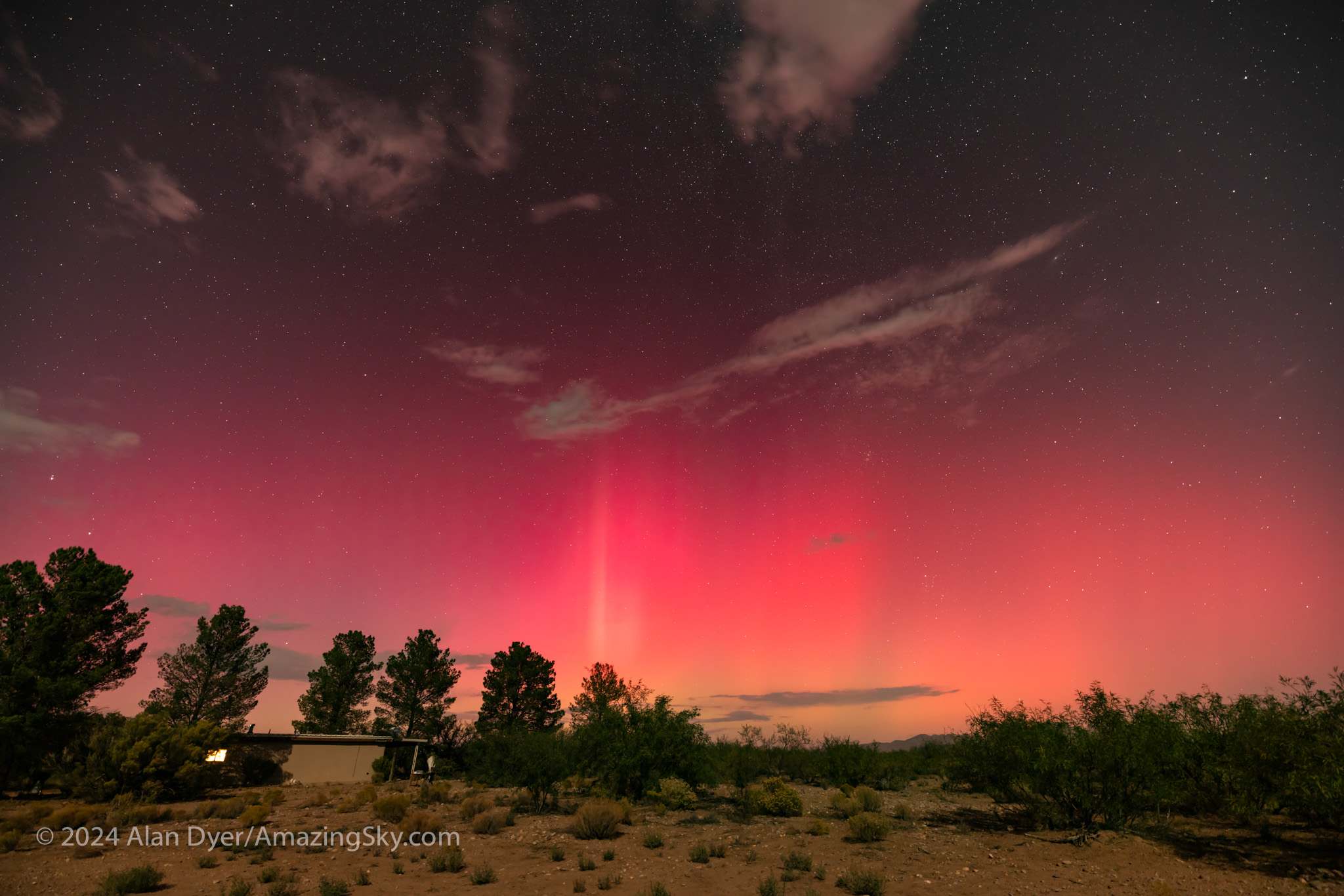
A rare red aurora seen from latitude +32ยบ N from southeast Arizona during the major Kp8-level storm of October 10. This is looking north from the Quailway Cottage near Portal, Arizona and Rodeo, New Mexico. This is a single 15-second exposure with the Canon RF15-35mm lens at 15mm and f/2.8 on the Canon R5 at ISO 1600.

I know because I was at one of those latitudes, in southern Arizona at 32ยฐ N. The aurora created the kind of show seen from areas that donโ€™t normally get auroras โ€” a red sky on the horizon. It is these ominous red skies that provoked Medieval fears of divine wrath and myths of armies clashing in the distant North.

Red auroras can also occur in the Southern Hemisphere (as can every other form of aurora) when the aurora australis brightens and extends farther north than normal, lighting up the southern sky red at locations that rarely see the Southern Lights.

In both cases we are seeing just the red tops of distant curtains that mostly lie hidden over the horizon, the red coming from oxygen reactions that can happen only at the rarefied altitudes of 300 to 500 km. Oxygen greens come from 100 to 300 km up.

From Arizona, I saw what many in the U.S. saw this night โ€” a prominent glow, obviously red even to the eye, across the northern horizon. I was missing a far better show at home!

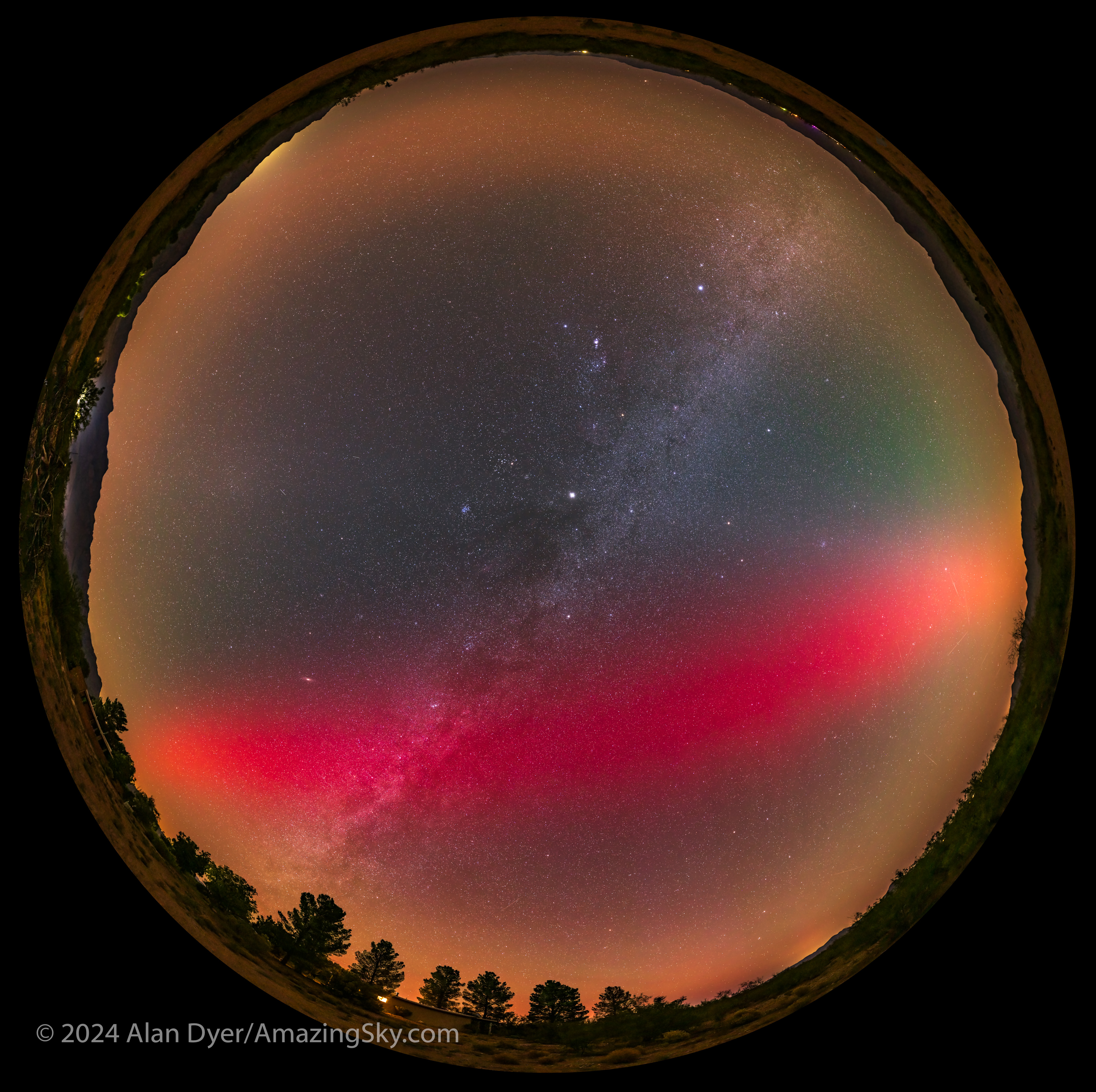
This is a 360ยฐ panorama covering the entire sky and extending up to the zenith at centre, capturing a rare SAR (Stable Auroral Red) arc across the Arizona sky in the pre-dawn hours of October 11. This is a panorama of 12 segments, each 30 seconds at f/2.8 with the Canon RF15-35mm lens on the Canon R5 at ISO 3200.

But unique to my more southerly site was this phenomenon, also widely seen across the U.S. and southern Canada.

Accompanying the โ€œnormalโ€ aurora to the north was a diffuse red (to the camera) arc across the sky that lasted most of the night. This was a Stable Auroral Red (SAR) arc, created by thermal energy flowing horizontally in the high atmosphere some 400 km up.

SARs have been seen evolving into STEVEs, as the mechanisms seem related. Indeed, one of my images from August 1, shown above, seems to show a SAR/STEVE hybrid.

I set up a wide-angle lens and time-lapse hoping to catch such an evolution first-hand, which would have been of great interest to researchers. Alas, the SAR did not cooperate, stubbornly remaining a SAR all night. 

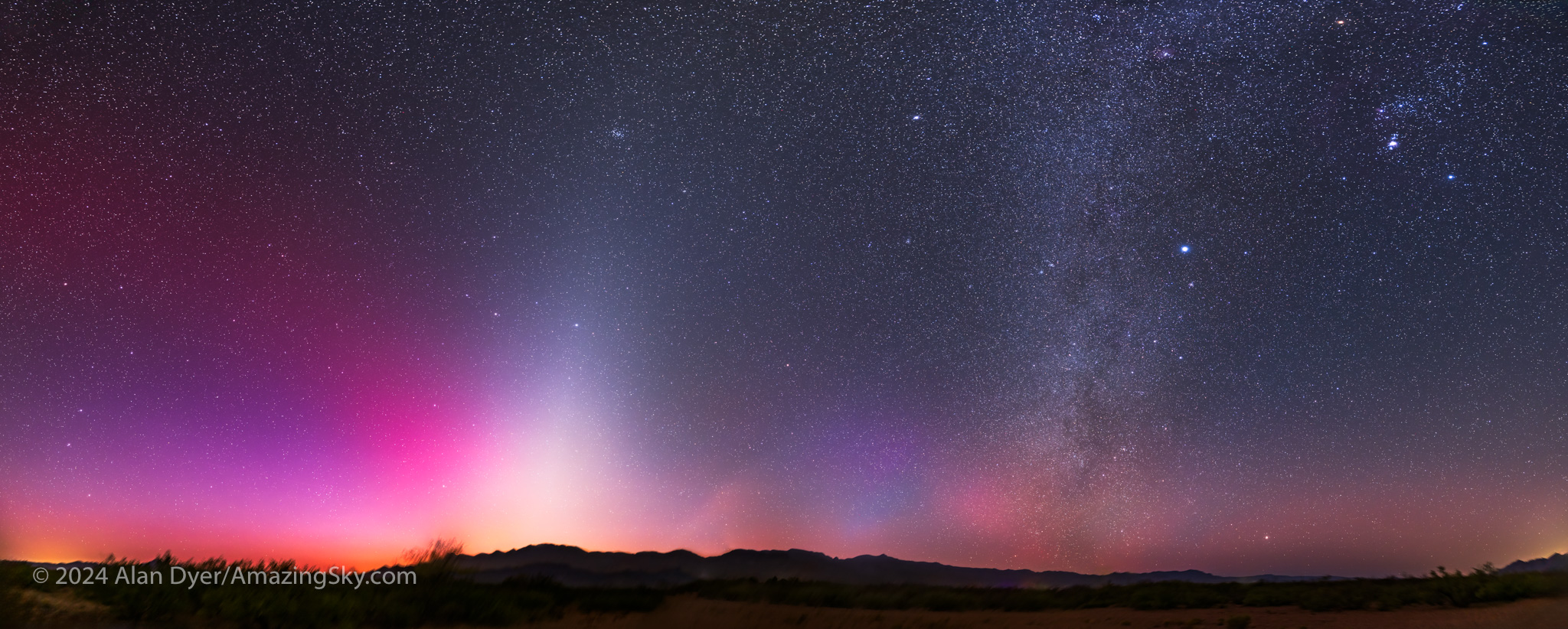
This was the pre-dawn scene from southeastern Arizona on the morning of October 11 that frames a suite of skyglows. This is a panorama of 3 segments, each a stack of 5 x 1-minute tracked exposures with the Canon RF15-35mm lens at 15mm and f/2.8 on the Canon R5 at ISO 1600.

By dawn, with blue sunlight at work, the SAR looked magenta in the twilight, accompanied by two other sky glows: 

  • The pyramid-shaped Zodiacal Light created by sunlight reflecting off cometary and meteoric dust in the inner solar system, 
  • And the winter Milky Way, created by the combined light of distant stars in our section of our Galaxy. 
  • So in one image we have atmospheric, interplanetary, and interstellar sky glows! This was truly an amazing sky, the likes of which I might never see again.

In early November I headed to Norway to instruct my first aurora group there since 2019. The location was on board a ship, the m/s Nordkapp, a ferry in the Hurtigruten fleet that does 12-day runs along the coast, from Bergen in the south, to Kirkenes in the far north, and back again. 

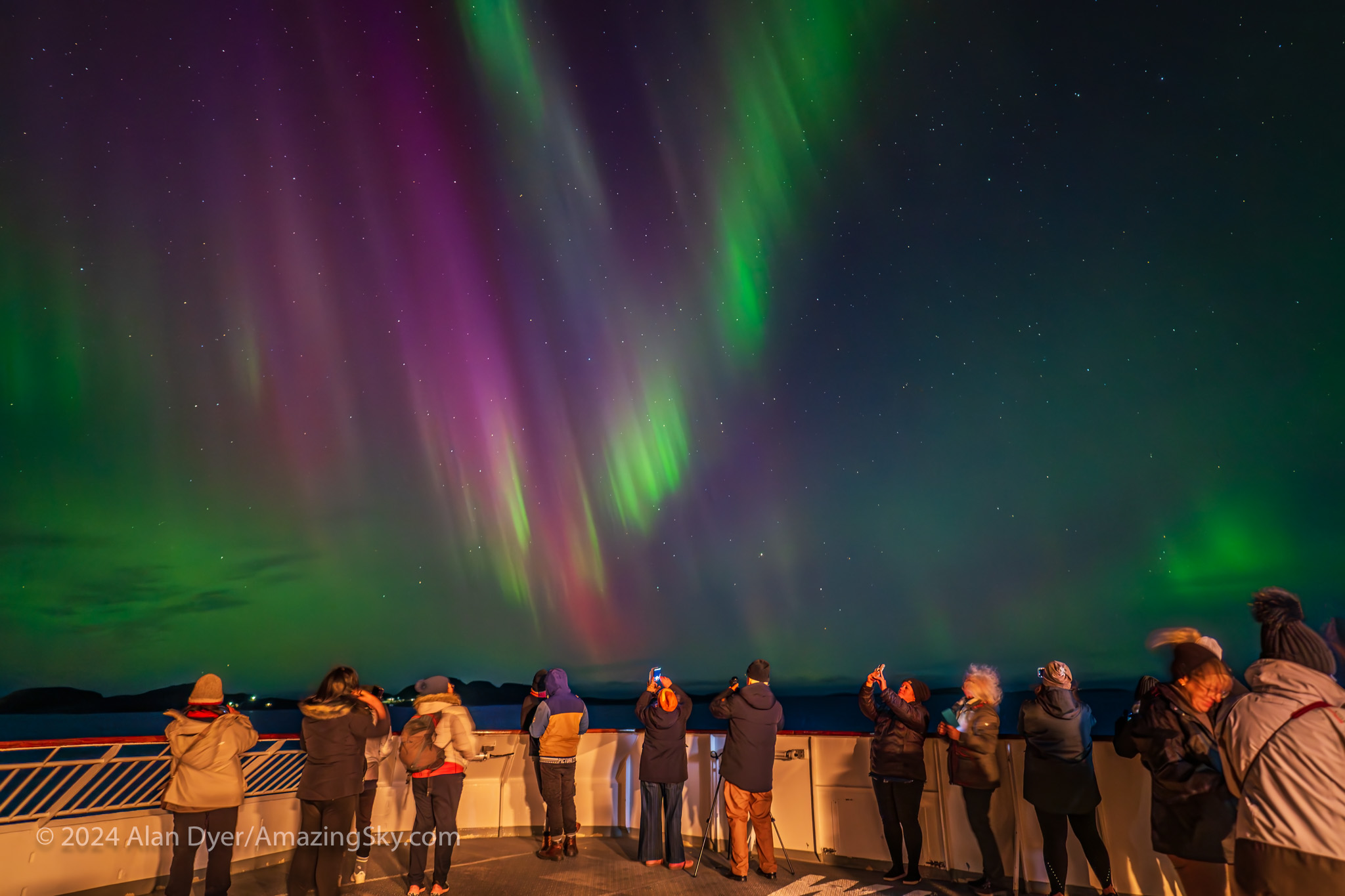
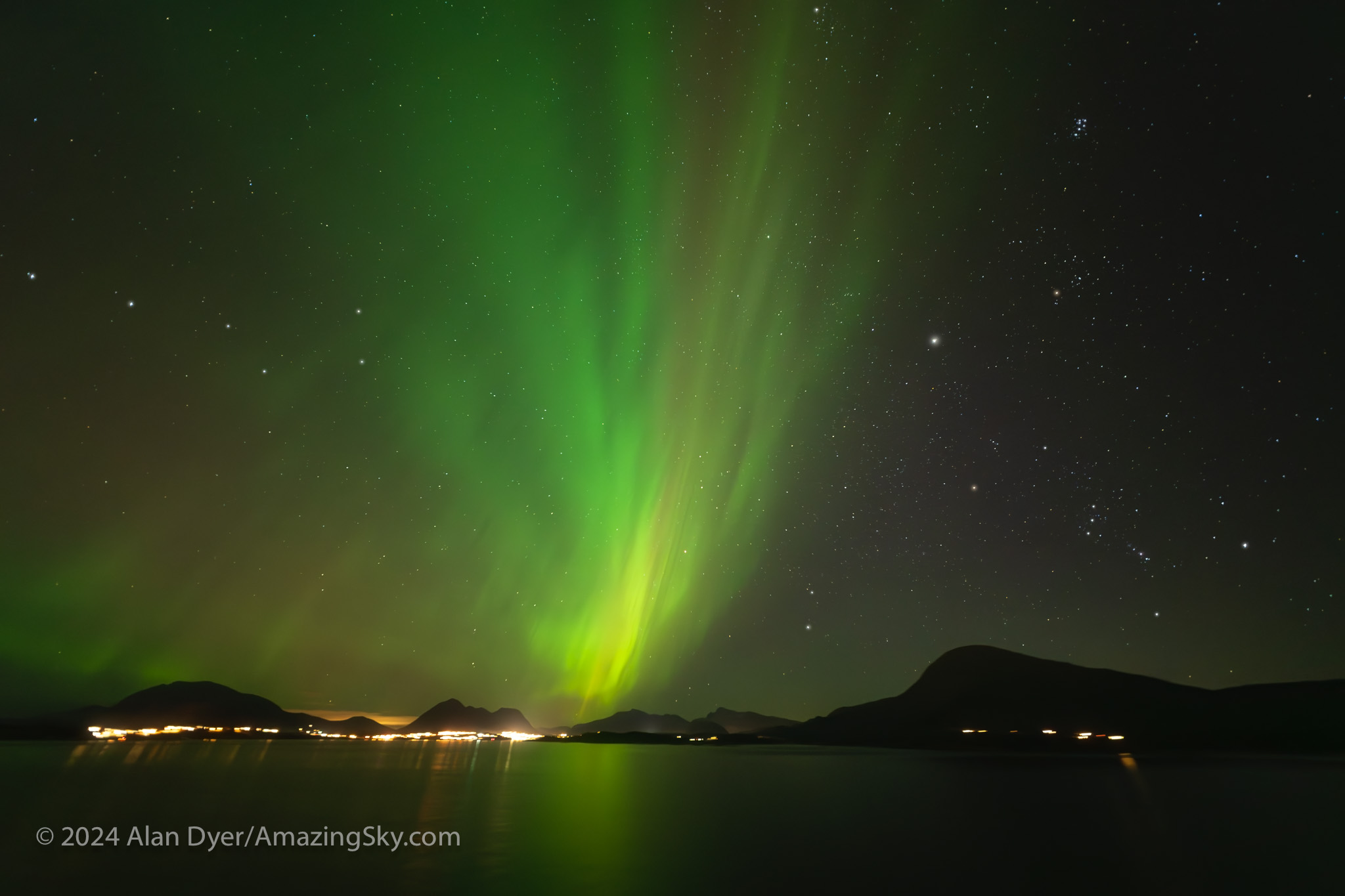
Passengers on board the m/s Nordkapp are watching the Northern Light show on November 9, from the coast of Norway. This is 0.4 seconds at f/1.8 with the Nikkor 20mm lens on the Nikon Z6III at ISO 3200.

We got three nights in a row of active auroras on the northbound voyage. A Kp4 to 5 storm brought the Lights farther south and overhead for us early in the voyage, something we donโ€™t normally see in Norway until we get underneath the auroral oval, which at that longitude in the world lies above the Arctic Circle, north of 66ยฐ latitude. 

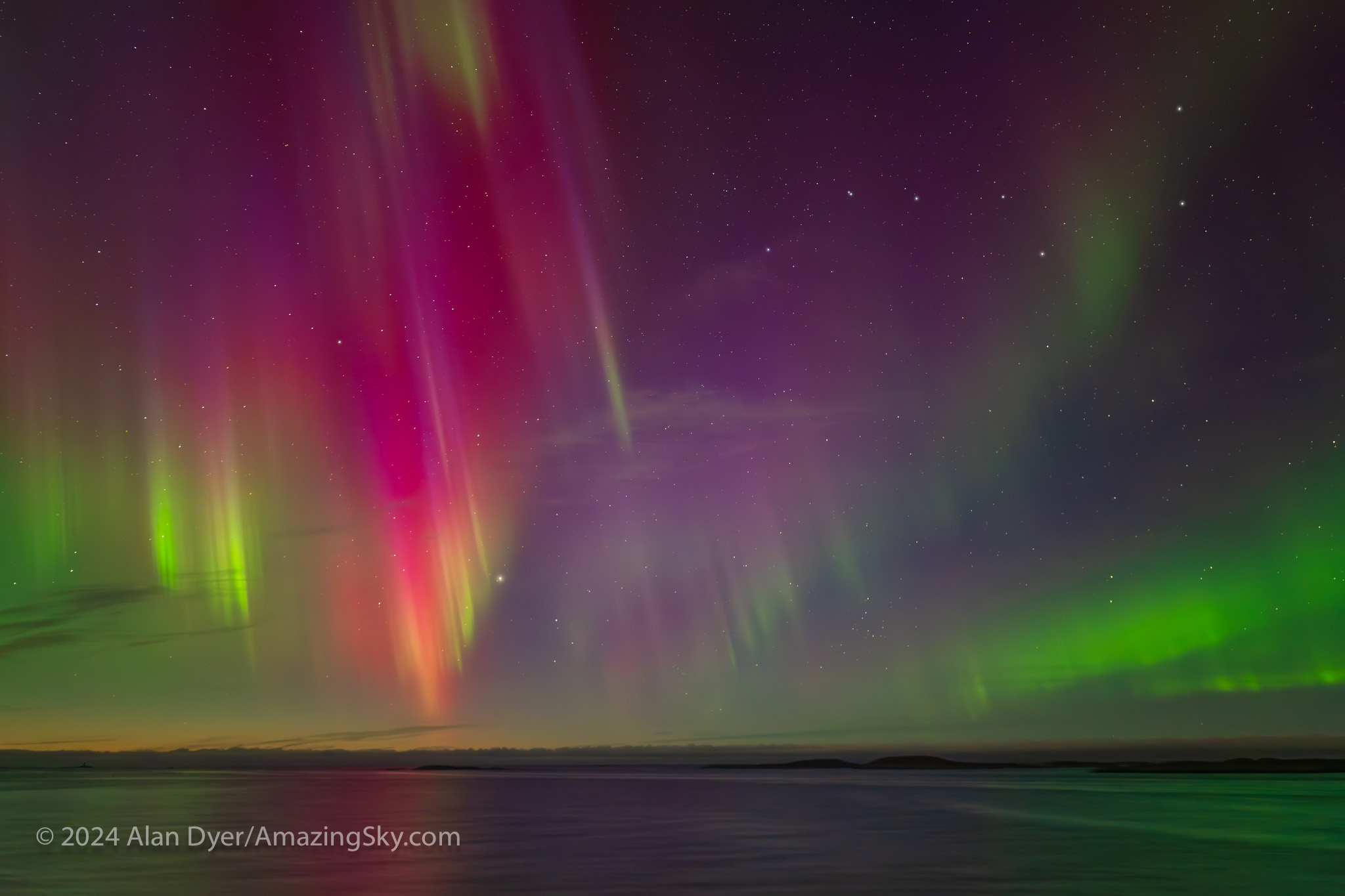
A colourful aurora appears in the darkening evening twilight sky at sea along the coast of Norway on November 9. This is a single 2-second exposure with the 20mm Nikkor lens at f/1.8 on the Nikon Z6III at ISO 1600.

But on November 9, with a storm underway, the show started early, rudely interrupting our groupโ€™s cocktail hour as we all rushed up on deck. As it can do, the aurora glowing in a twilight sky took on added tints. 

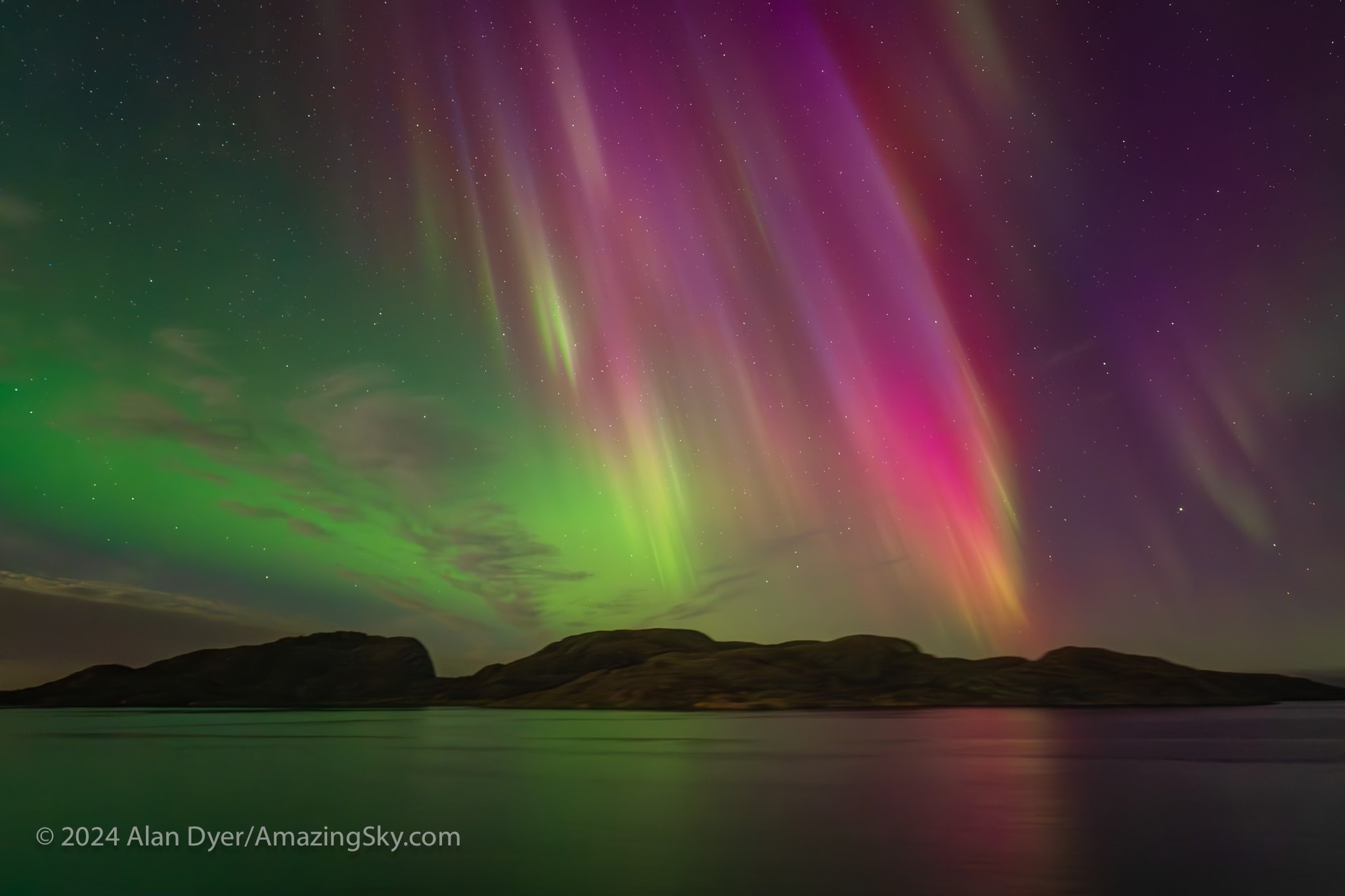
This is a panorama of auroral arcs across the southern sky, with prominent red content contrasting with the oxygen yellow-green bands. Taken on November 10/11 (just after midnight). This is a panorama of 7 segments, each 1.3-second exposures with the Nikkor 20mm lens at f/1.8 on the Nikon Z6III at ISO 3200.

The next night, November 10, as we sailed through the mountainous Lofoten Islands, we were treated to an aurora with lots of red content, above. No two auroras are alike!

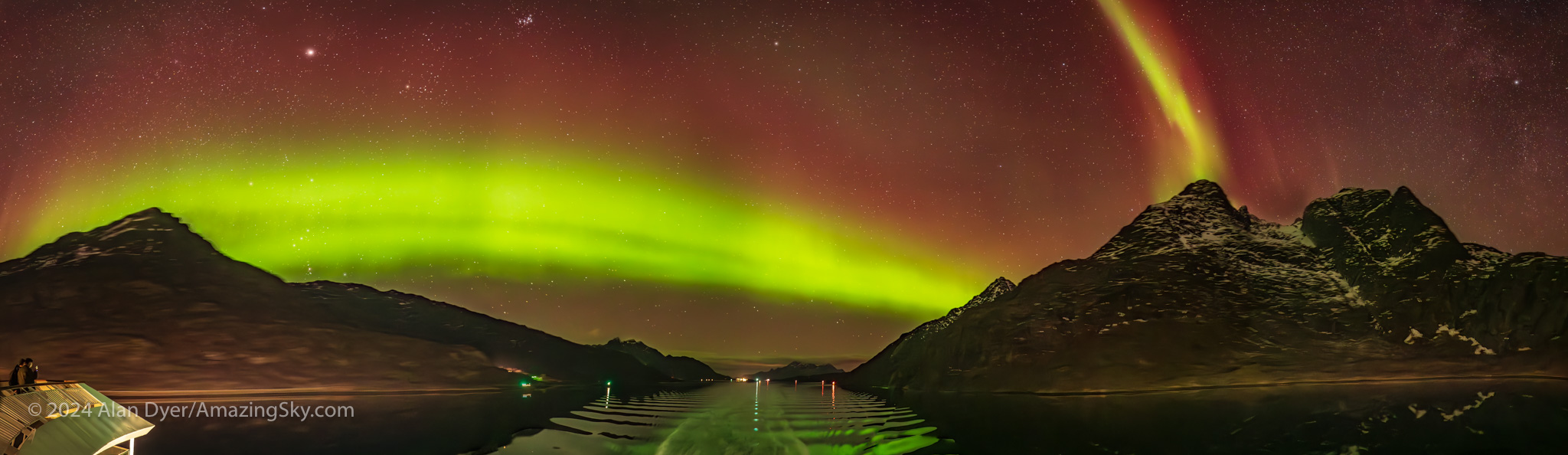
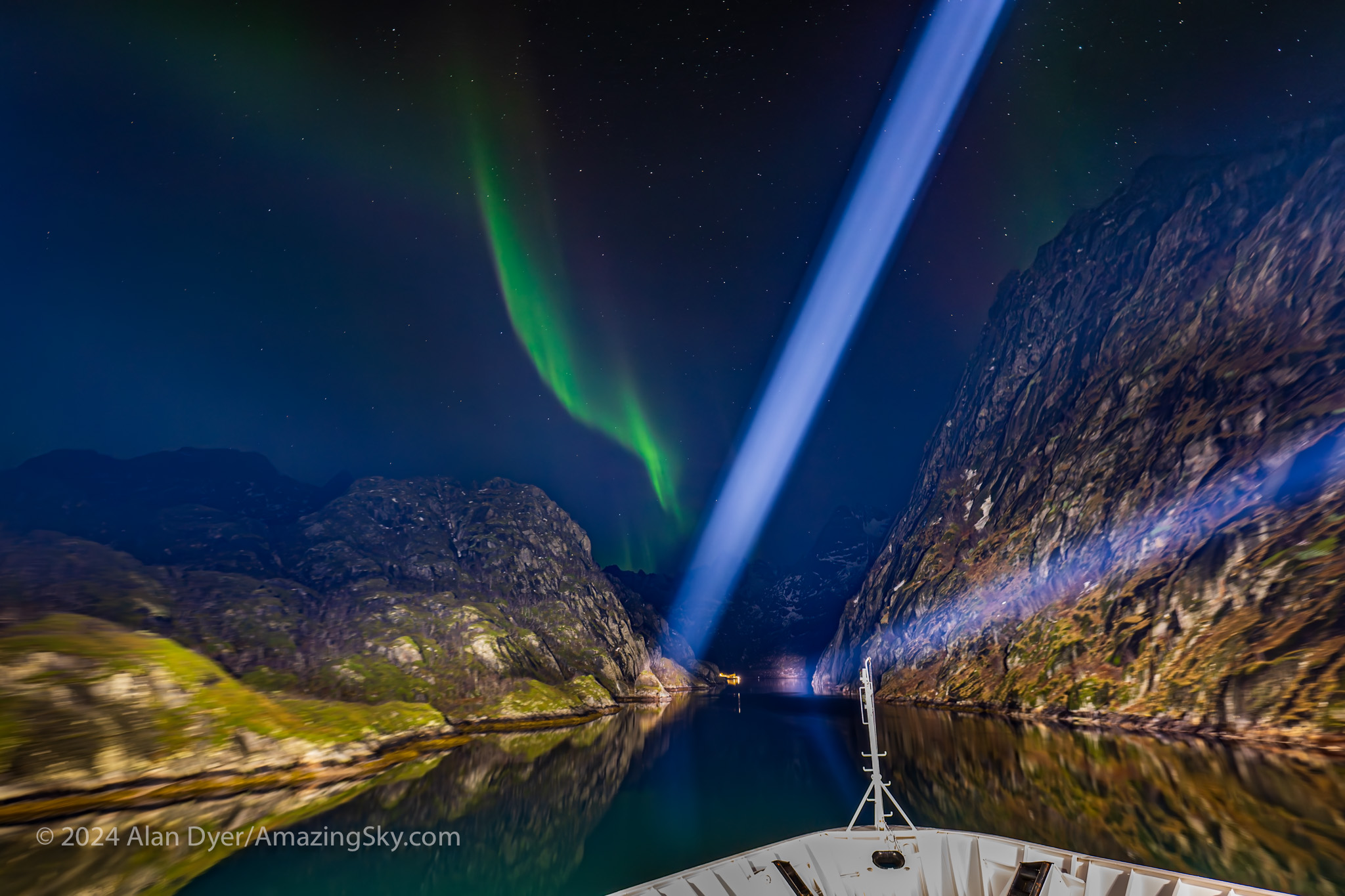
An arc of Northern Lights points the way into the narrow Trollfjord in the Lofoten Islands of Norway, as our ship, the m/s Nordkapp enters the fjord at night by searchlight. This is a 0.5-second exposure at f/1.8 with the Nikkor 20mm lens on the Nikon Z6III at ISO 1600.

A curtain of aurora also nicely pointed the way into the short but scenic Trollfjord, a fjord the ship captains like to navigate into for a memorable side trip as we slide through the narrow canyon with seemingly inches to spare. 

A gallery of my Norway auroras is here on my website.

All going well, I will be back in Norway for two cruises in October. Join me!

A music video of real-time aurora sequences shot from on deck during my November 2024 Norway cruise is above on YouTube. Note the phones held high, the way most people now shoot the aurora, and usually with very good success!


We have more to look forward to in 2025.

First, it is likely that the Sun has not peaked, but may undergo a second peak of maximum activity in 2025 or 2026. A double peak is common at many solar maxes. Just look at the graph at the opening of the blog, and the previous peaks of Cycles 23 and 24.

Plus, the most energetic solar flares and storms often occur after the peak on the downward trend of activity. So we could well see more worldwide aurora displays like we had on May 10 and October 10 in the coming two to three years. The show is far from over!

Watch websites like SpaceWeather.com for aurora alerts and news of solar events coming our way. 

โ€” Alan, December 15, 2024 / AmazingSky.com   
Testing Wide-Angle Lenses on Nikon Z for Astrophotography


I test a trio of wide-angle, auto-focus lenses for astrophotography, all for Nikon Z mount: the Nikkor 20mm f/1.8 S, the Viltrox 16mm f/1.8, and the Laowa 10mm f/2.8 Zero D.

As a bonus, I also test a fourth lens: the TTArtisan manual-focus 7.5mm f/2 fish-eye.

While the selection of lenses for Nikon Z mirrorless cameras is not as diverse as it is for Sony E-mount, Nikon shooters have more brands of lenses to pick from than do users of Canon R mirrorless cameras. For nightscapes and Milky Way photography we want fast, wide-angle lenses, usually in the 14mm to 24mm range. 

Canon, Nikon, and Sony all have excellent zoom lenses that cover the range. I use Canonโ€™s RF 15-35mm L lens a lot, and reviewed it here on my blog from 2022.

But all these wide-angle zooms are f/2.8. While thatโ€™s a good speed for most astro work, having an even faster lens can be valuable. An aperture of f/2 or faster allows for:

โ€” Shorter exposures for untrailed stars when shooting just on a tripod with no tracker.

โ€” Capturing fainter and more numerous meteors during a shower.

โ€” Rapid-cadence time-lapses of auroras, freezing the motions of curtains.

โ€” Real-time movies of auroras and satellite passages at lower, less noisy ISO settings. 

The Nikkor 20mm at f/1.8 allowed a short 1.3-second exposure for capturing the aurora from a ship off the coast of Norway, to minimize ship motion trailing the stars.

Also, stopping those faster lenses down to f/2.8 can sometimes yield better image quality than shooting with a native f/2.8 lens wide open. 

Canon and Sony each have fast f/2 zooms that cover the range from 28mm to 70mm. While those focal lengths can be useful, both lenses are expensive and heavy. And they are still not wide enough for many astro subjects. For fast lenses with even shorter focal lengths we need to turn to โ€œprimeโ€ lenses, ones with fixed focal lengths. 

As of this writing Canon has few fast, wide primes for their RF lens mount (their new 24mm f/1.4 VCM is a costly choice designed primarily for video use). A few third-party lens makers offer fast (f/2 or faster) primes for Canon full-frame cameras, always as manual focus lenses. For example, Laowa has a 15mm f/2, and TTArtisan has a 21mm f/1.5. 

Yes, Sigma now offers auto-focus 16mm and 23mm f/1.4 primes, and Samyang has a new 12mm f/2, but they are only for Canon RF-S cropped-frame cameras. Canon has yet to allow other companies to produce auto-focus lenses for their full-frame cameras. 

Nikon has been restrictive as well. Sigma’s much-lauded Art series that includes the 14mm rectilinear (i.e. the horizon remains straight) and 15mm fish-eye (with a curved horizon), both f/1.4 and aimed at astrophotographers, are not offered for Nikon or Canon, only for Sony E-mount and Panasonic/Leica L-mount cameras. 

However, while Sigma lenses are missing, there is a wider choice of third-party lenses for Nikon Z-mount compared to Canon RF, plus Nikon itself makes a very fine 20mm prime in their premium S-series. 

Thatโ€™s what I test here โ€” three wide-angle rectilinear primes for Nikon Z: A 20mm Nikkor, and two third-party primes: one from Viltrox, their 16mm; and one from Laowa, their new 10mm.

As a bonus, I add in a test of a fast fish-eye lens, from TTArtisan, their 7.5mm f/2. 

Prices are from B&H Photo, but will vary with sales and special promotions.


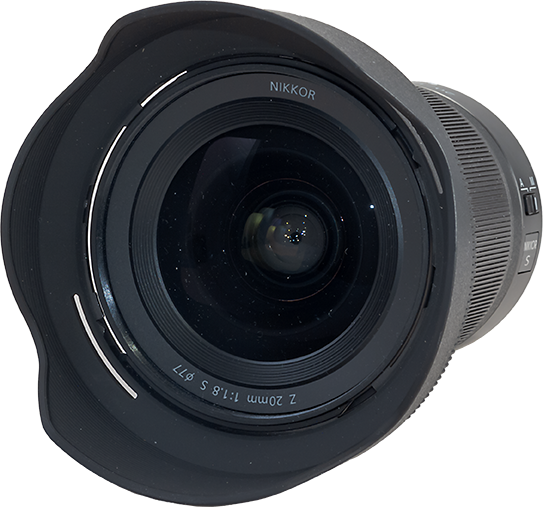
The Nikkor 20mm S-Line Lens ($1,050)

I shot the northern summer Milky Way (below) with the three rectilinear wide-angle lenses (meaning these are not fish-eyes) with the camera on a star tracker, to prevent star trailing. The tracker was the Move-Shoot-Move Nomad, reviewed here on my blog.

The Nikon Z6III and 20mm Nikkor on the MSM Nomad tracker.

I shot with Nikon’s new Z6III, a 24-megapixel full-frame camera I reviewed in the December 2024 issue of Sky & Telescope magazine. It offers a number of excellent features for nightscape photography. Most notably, auto-focus lenses zip to the infinity focus point automatically when the camera is turned on, something I wish Canon cameras would do. 

The Nikkor 20mm has a field of view along the long dimension of 84ยฐ.

The Nikkor 20mm is the widest prime lens in Nikonโ€™s premium S-Line series. It offers what I consider to be an ideal focal length for most nightscape and wide-field Milky Way images. 

While a 14mm lens is often thought of as the default nightscape lens, a 20mm presents less distortion (objects leaning in or stretched out at the corners) and a more natural perspective. Plus the lens can be made faster (in this case f/1.8), smaller, and not cost as much as an ultra-fast 14mm like the Sigma f/1.4 Art lens. 

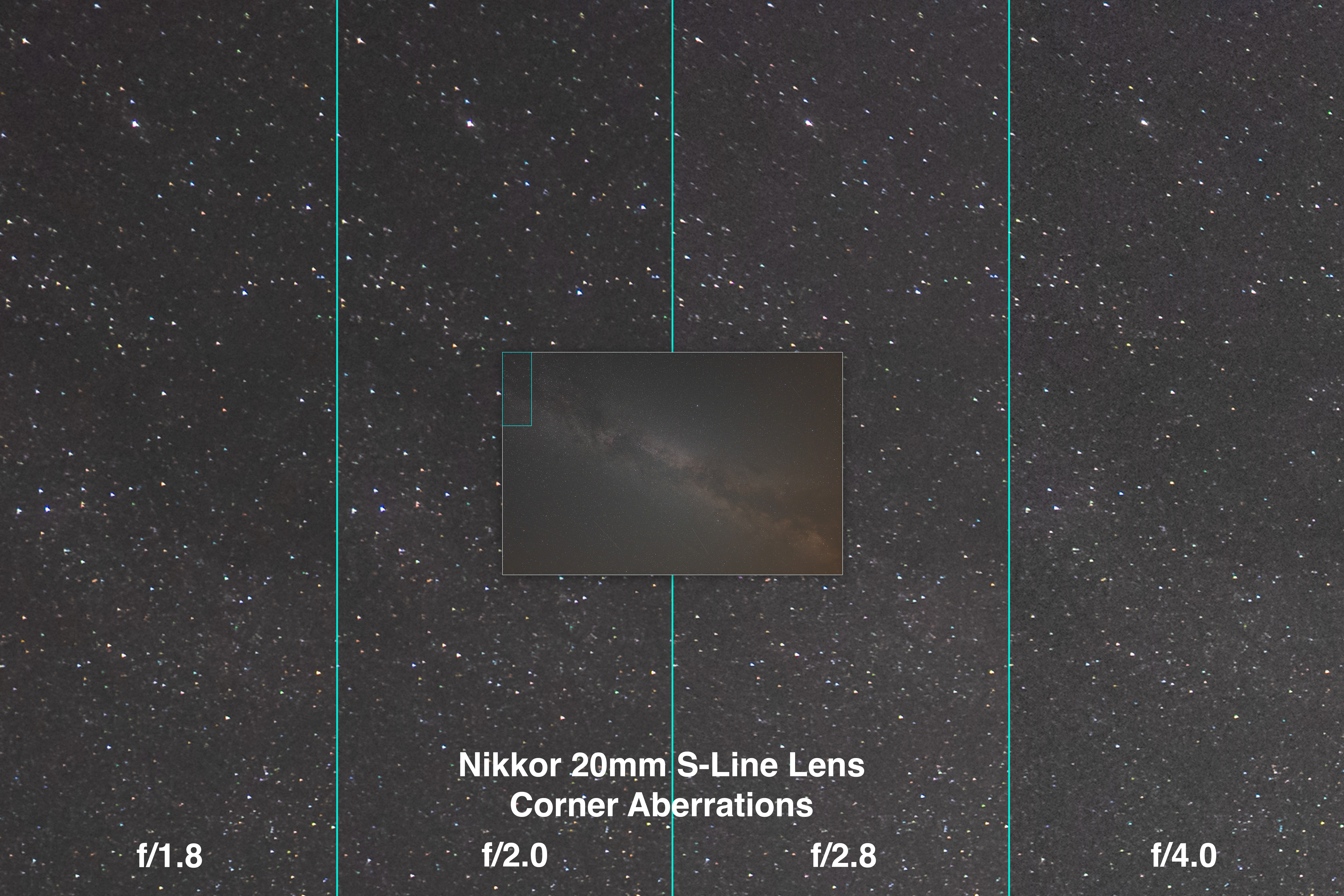
Nikkor 20mm Corner Aberrations

The four panels show the upper left corner, in the area outlined in the inset that shows the full frame.

Sharp stars right to the corners is the ideal for all forms of astro images. We donโ€™t want stars to turn into winged seagulls or coloured streaks. They should remain as pinpoint as possible. 

The Nikkor 20mm shows very little aberrations across the frame. Stars are elongated by tangential astigmatism and discoloured by lateral chromatic aberration only slightly and only at the extreme corners. 

Stopping down the lens decreased the aberrations, but some residual astigmatism remained, even at f/4. However, the corner aberrations are low enough, and so restricted to the very corners, that this is a lens you can certainly use wide open at f/1.8, or perhaps at f/2, without any penalty of image sharpness. 

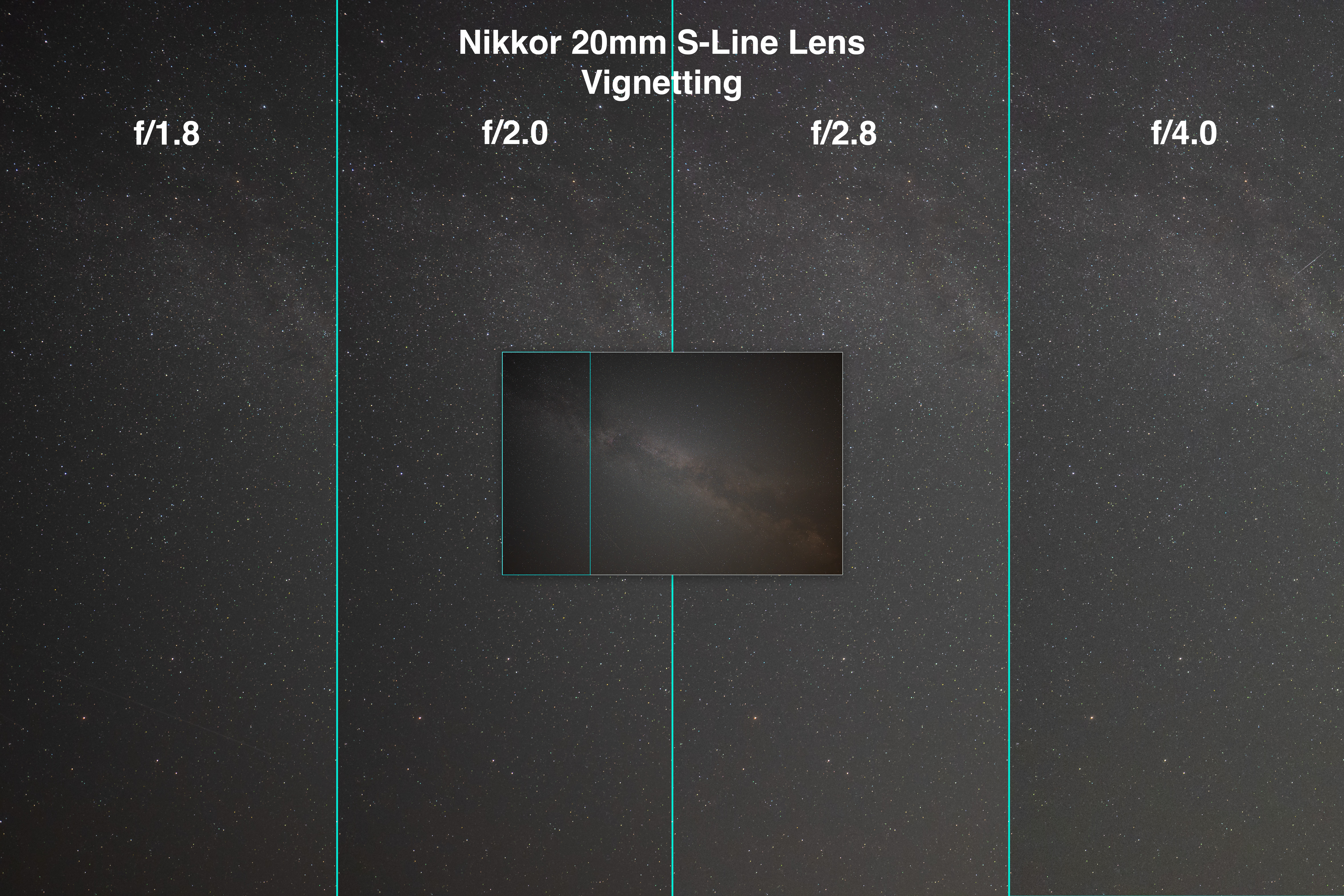
Nikkor 20mm Vignetting

The four panels show the left side, as outlined in the inset. The inset is the f/1.8 sample.

Ideally, we also want images to be as fully-illuminated across the frame as possible. Light fall-off, or vignetting, creates dark corners with less signal reaching the sensor. Less signal gives rise to more noise, noticeable when brightening the corners in processing. That can reveal unsightly noise, banding, and discolouration in nightscapes, especially in the ground, often the darkest part of a scene, not the starry sky. 

The 20mm shows a fair degree of edge and corner darkening when wide open at f/1.8. Stopping the lens down to f/2 improves the field illumination notably. And by f/2.8 the field is fairly uniformly lit. There is little need to go as slow as f/4. 

In all, the Nikkor 20mm S is a superb lens ideal for nightscapes and Milky Way images.


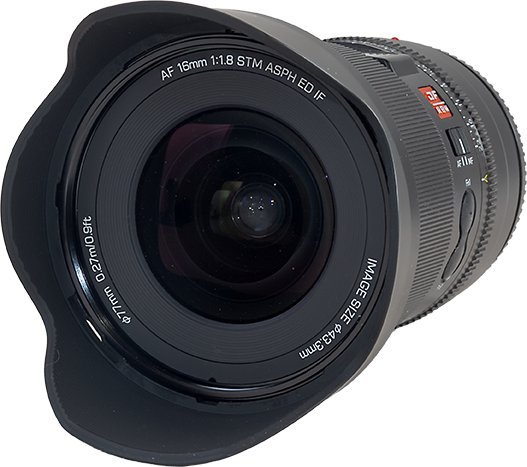
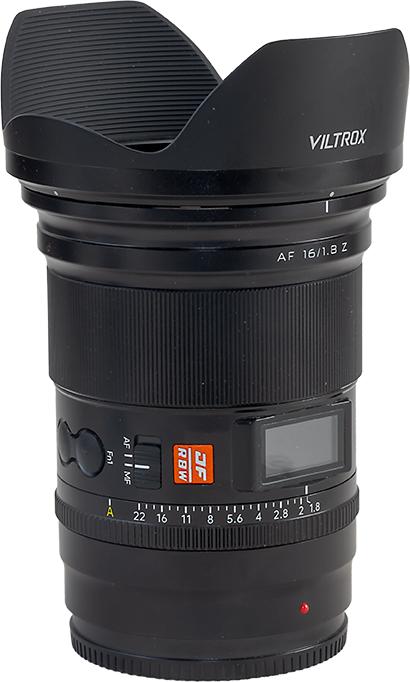
The Viltrox AF 16mm STM ASPH ED IF ($580)

The new company Viltrox has been making a name for themselves recently with the introduction of a number of top-quality pro-grade lenses to compete with the best from any brand, and at much more affordable prices. 

The horizontal field of view of the Viltrox 16mm is 100ยฐ.

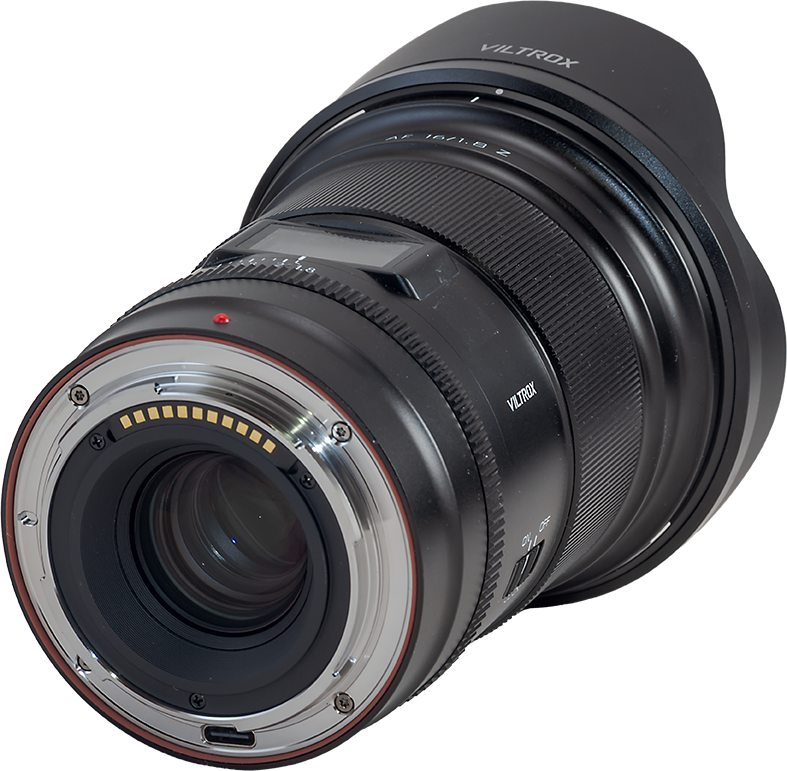
Their 16mm is an auto-focus lens that, on the Nikon, can actually auto-focus on stars, as can the Nikkor 20mm. However, it, too, will zip to infinity focus when powered up. Plus two function buttons can be programmed to rack between two preset focus distances, one of which can be infinity. 

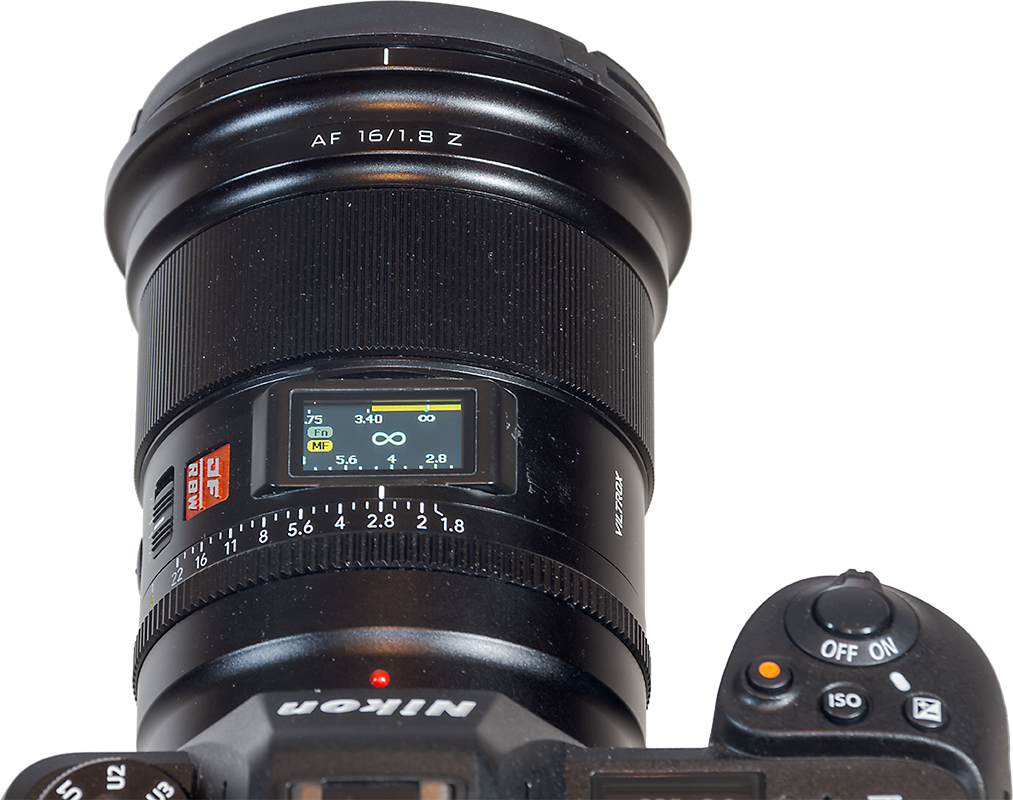
A manual aperture ring (above left) has 1/3rd-stop detents, or it can be set to A for controlling the aperture in the camera. 

A colour OLED display (above right) shows the focus distance and aperture, a nice way to confirm your settings at night. The display is too bright on the darkest nights; I cover it with red gel. 

An option to turn it red using the Viltrox app would be welcome.ย  Or to turn it off! ….

With Viltrox lens fully engaged and display ON

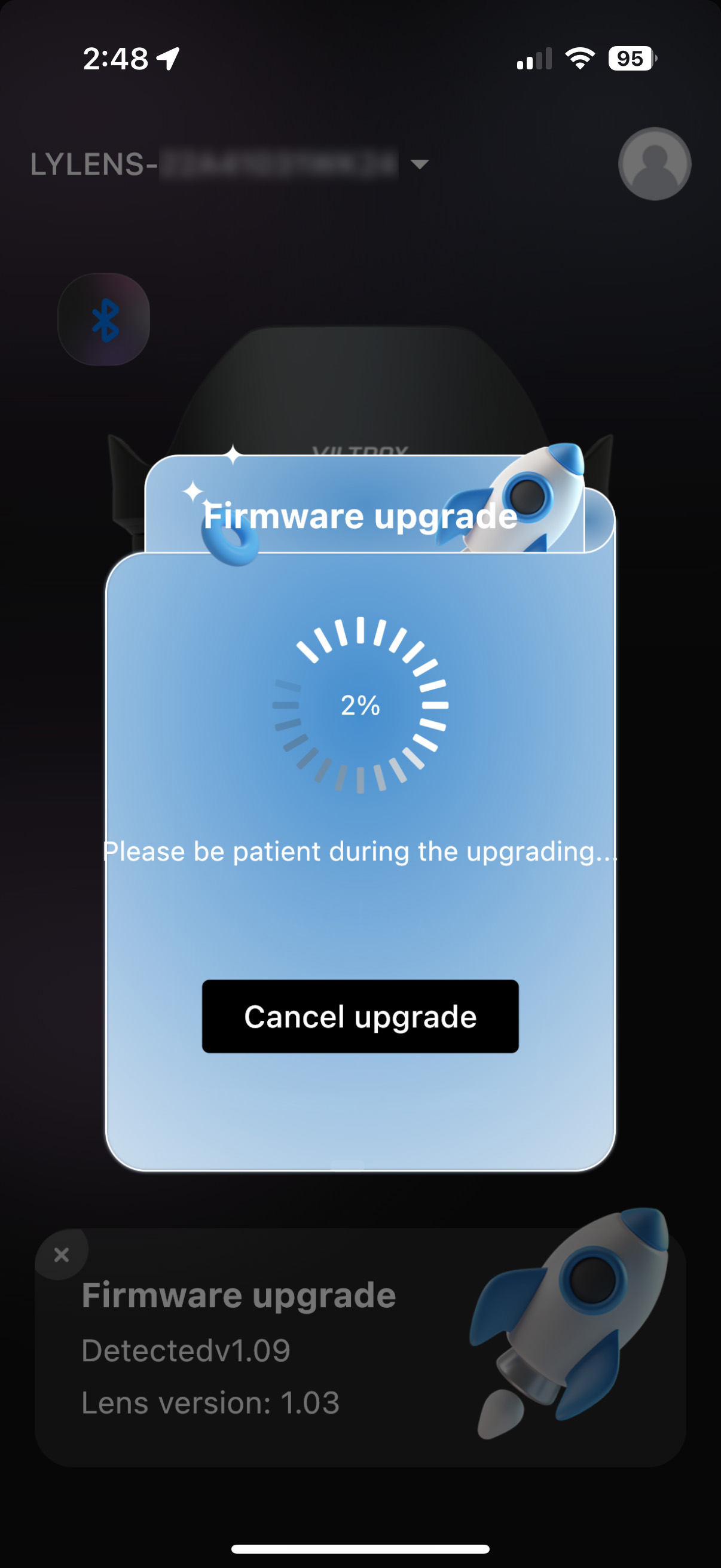
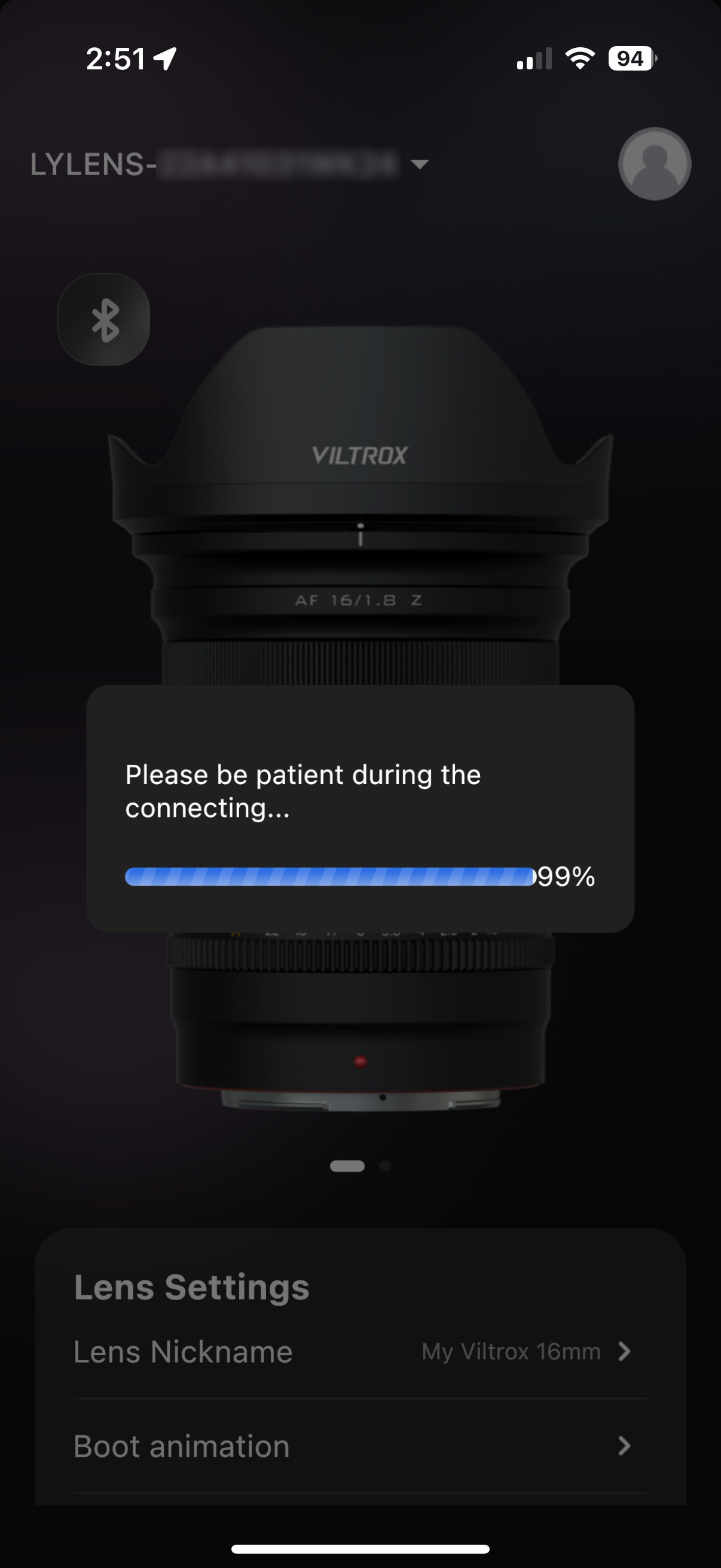
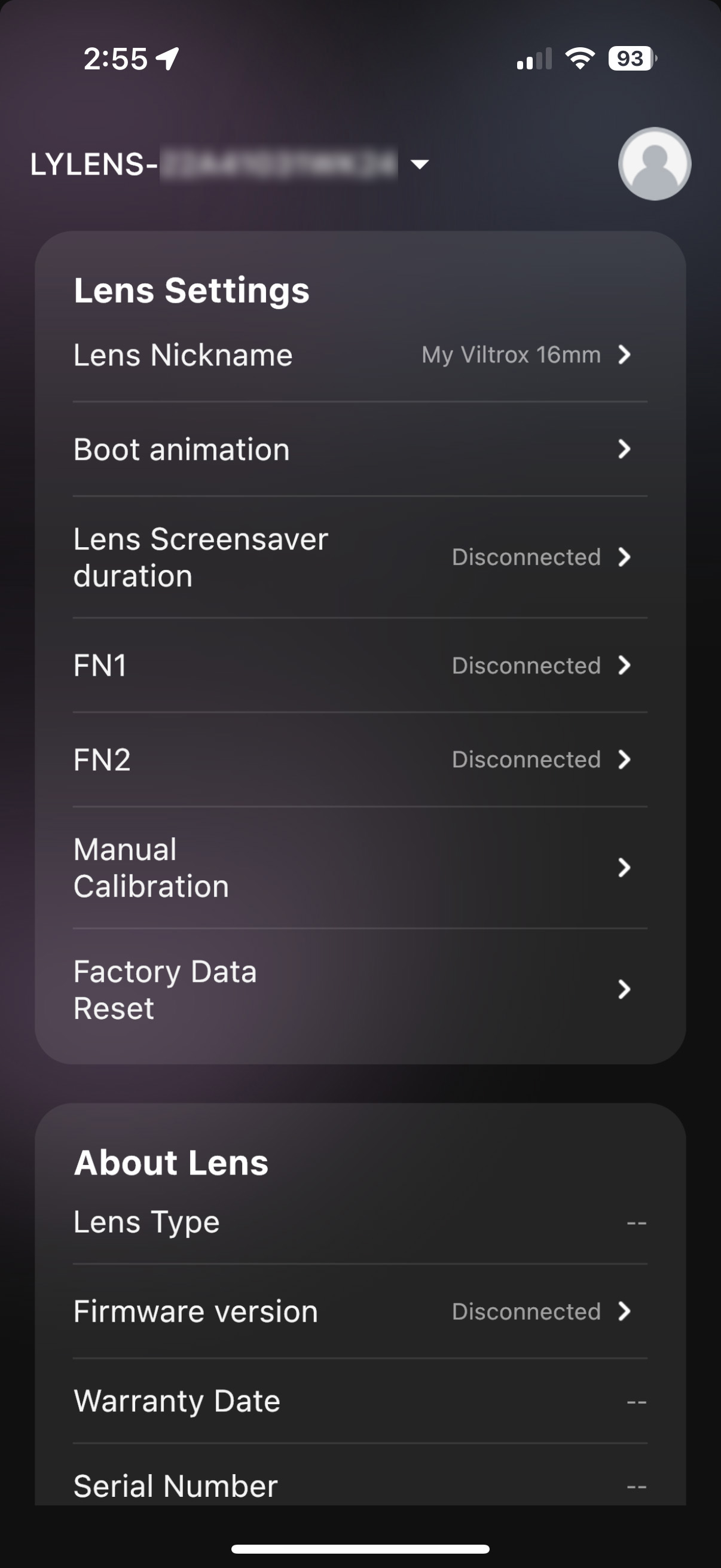
Uniquely, this and other Viltrox lenses have Bluetooth built in, for direct connection to a mobile device for firmware updates and lens settings, shown above. However, I found the app buggy; it would connect to the lens, but then refuse to allow settings to be changed, claiming the lens was not connected. Or the app would freeze, disconcerting during a firmware update. Luckily, that did not brick the lens. 

Viltrox 16mm Corner Aberrations

The four panels show the small corner area outlined in the centre inset that shows the entire image.

At the extreme corners, the Viltrox shows some softness (perhaps from field curvature), but only minimal astigmatism and lateral chromatic aberration when wide open at f/1.8, and slightly sharper corners at f/2. At f/2.8 corner performance is nearly perfect, and certainly is at f/4. 

This is a level of aberration correction even the most premium of lenses have a hard time matching.

Viltrox 16mm Vignetting

The panels show the left side outlined in the centre inset, which shows the f/1.8 image.

As is often the case with wider lenses, the Viltrox does show a great deal of vignetting at f/1.8, more so than the Nikkor 20mm. While this can be corrected in processing it will raise noise levels. 

Stopping down to just f/2 helps, but the field becomes more uniform only at f/2.8, the sweet spot for this lens for the best all-round performance. But it offers the speed of f/1.8 when needed, such as for auroras. 

If you prefer a wider field than a 20mm provides, the Viltrox 16mm (also available for Sony) is a great choice that wonโ€™t break the bank. Until Canon changes their third-party lens policy, Canon owners are out of luck getting this excellent lens. 


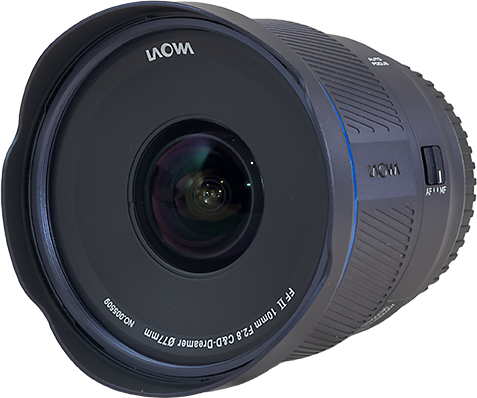
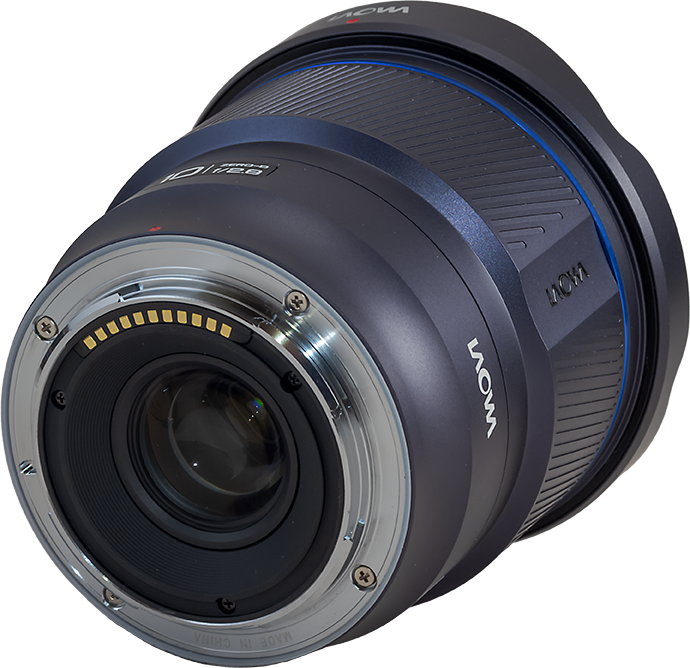
The Venus Optics/Laowa 10mm Zero-D FF ($800) 

The lens maker Venus Optics (aka Laowa) is known for its innovative and often unusual lens designs. 

Introduced in 2024, their new 10mm offers the widest field available in a rectilinear (not fish-eye) lens for full-frame cameras. The โ€œZero-Dโ€ label is for the lensโ€™s lack of pincushion or barrel distortion. Horizons remain straight no matter where they fall on the frame. However, objects at the corners become elongated a lot.

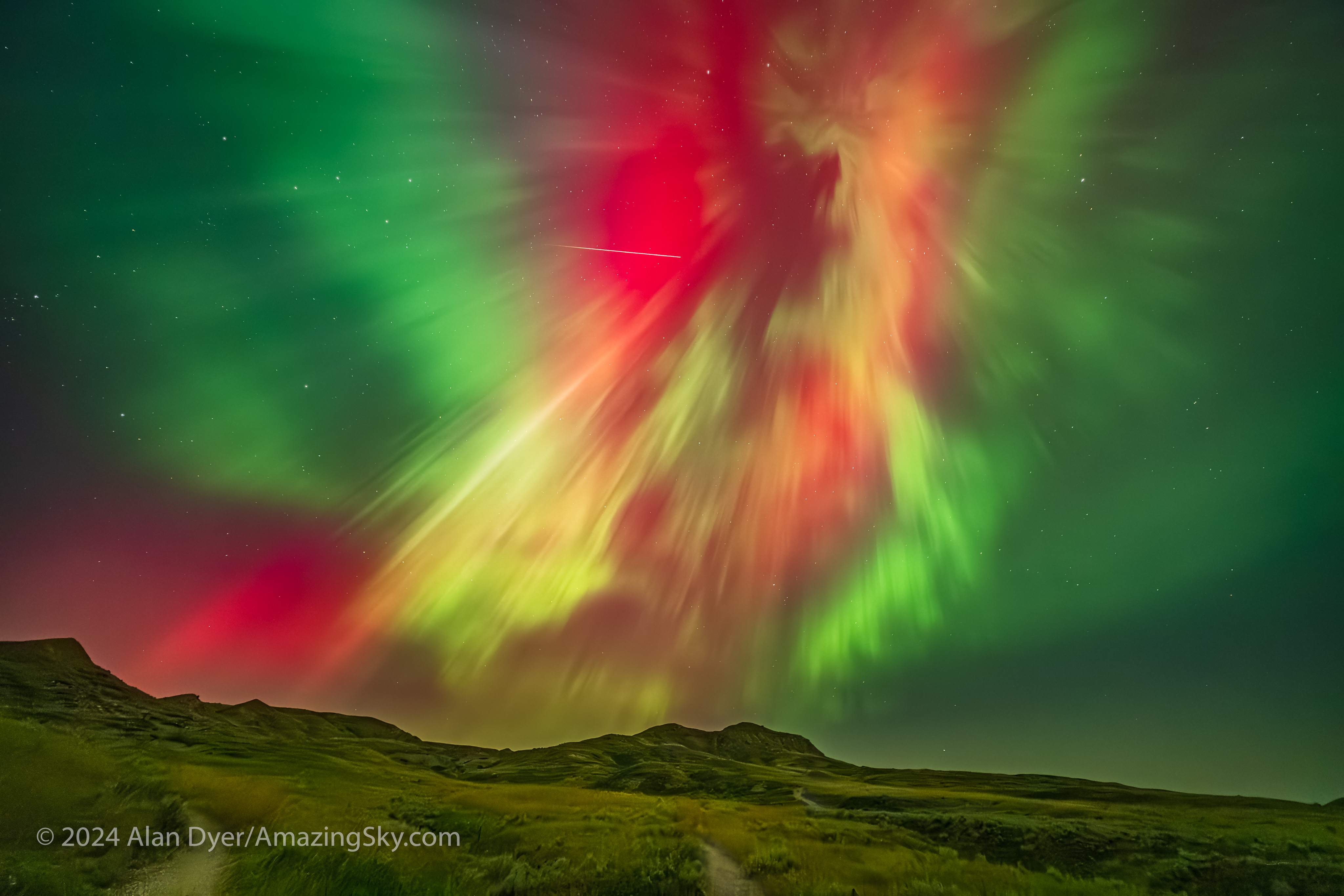
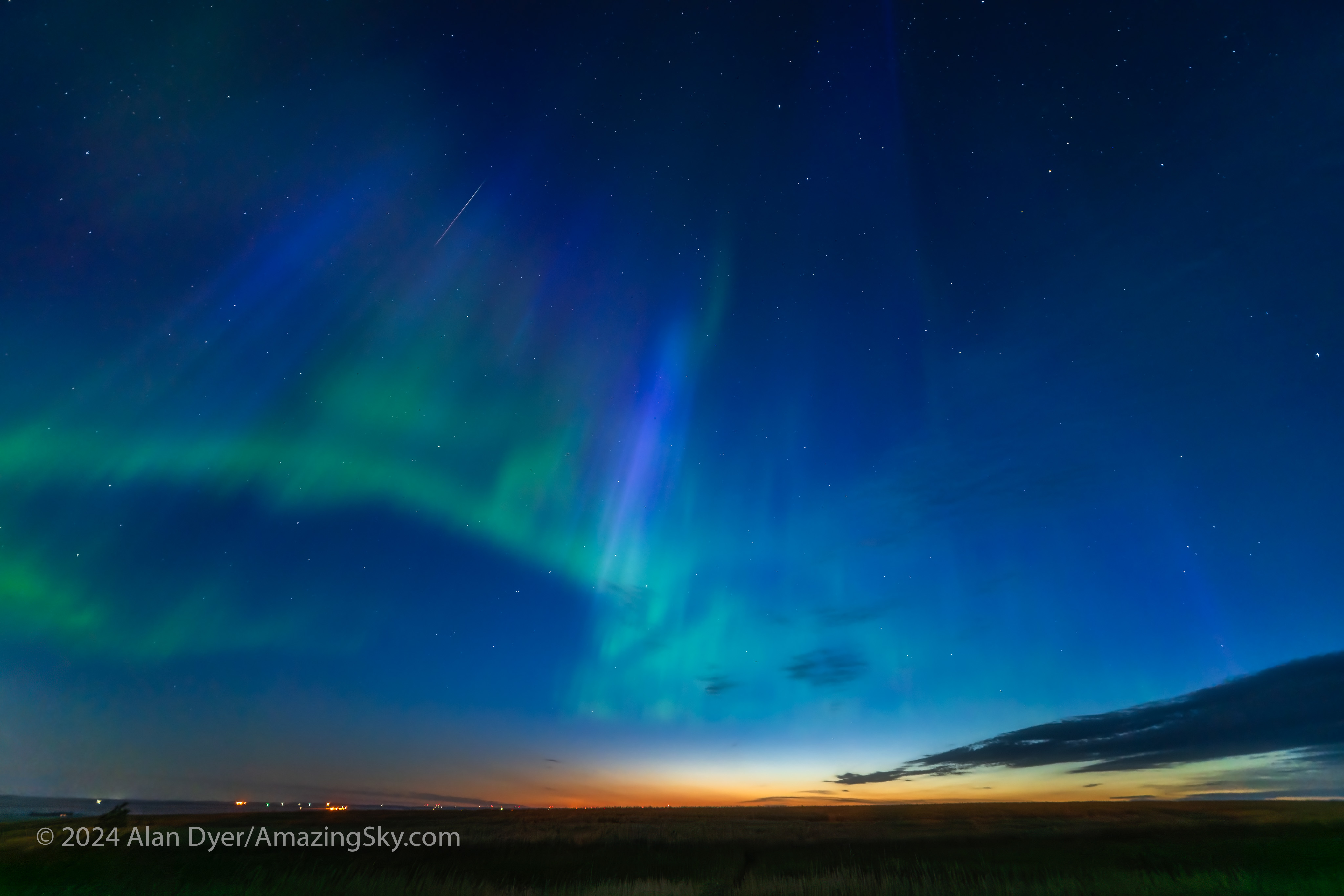
The Northern Lights in a superb display on August 11-12, 2024, at Grasslands National Park, Saskatchewan. This is with the Laowa 10mm wide open at f/2.8 on the Nikon Z6III at ISO 6400.

Even so, thereโ€™s a lot to be said for having a field that extends for 130ยฐ across the long dimension of a full-frame sensor. Thatโ€™s more than enough to go from well below the horizon to past the zenith when the camera is in portrait orientation. Even in landscape orientation (as above) the lens covers nearly a 90ยฐ field across the short dimension, enough to go almost from horizon to zenith. 

The f/2.8 speed is slower than the other lenses on test here, but is still faster than most ultra-wide lenses. Remarkably, it accepts common 77mm filters, the same as the Nikkor 20mm and Viltrox 16mm. 

The 10mm is available as an auto-focus lens for Sony E and Nikon Z, and in manual focus versions for Canon RF and Panasonic L, oddly all at the same price. 

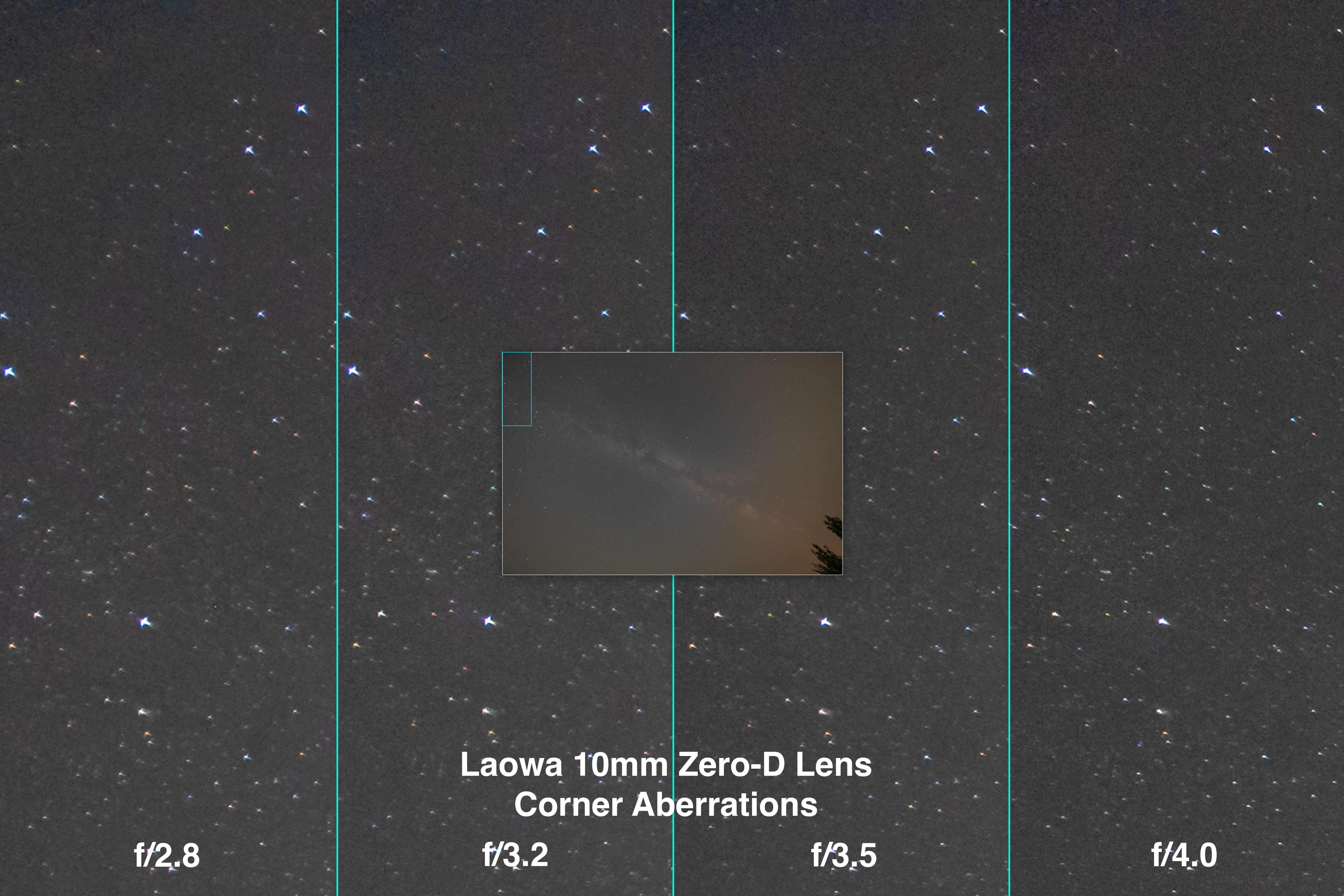
Laowa 10mm Corner Aberrations 

The four panels show the corner area outlined in the inset, at four apertures between f/2.8 and f/4.

Corner aberrations are much worse than in the 20mm and 16mm lenses, showing a fair degree of tangential  and sagittal astigmatism, elongating stars radially and adding wings to them, respectively. The aberrations are larger and reach deeper into the frame than in the Nikkor and Viltrox lenses. 

Thereโ€™s also some lateral chromatic aberration adding blue and purple fringes to the stars at the corners. Stopping down to f/4 improves, but doesnโ€™t eliminate, the aberrations. 

Laowa 10mm Vignetting

The four panels show the left side, as outlined in the inset, which shows the f/2.8 image.

Edge and corner darkening were also worse than in the other lenses and required about a +50 setting to correct in Adobe Camera Raw, far less than the maximum of +100. So itโ€™s still quite acceptable and correctable. 

However, while stopping the lens down to f/4 improves vignetting, it does not eliminate it, still requiring a +40 correction. Vignetting will be a factor to deal with in all astrophotos with this ultra-wide lens. 

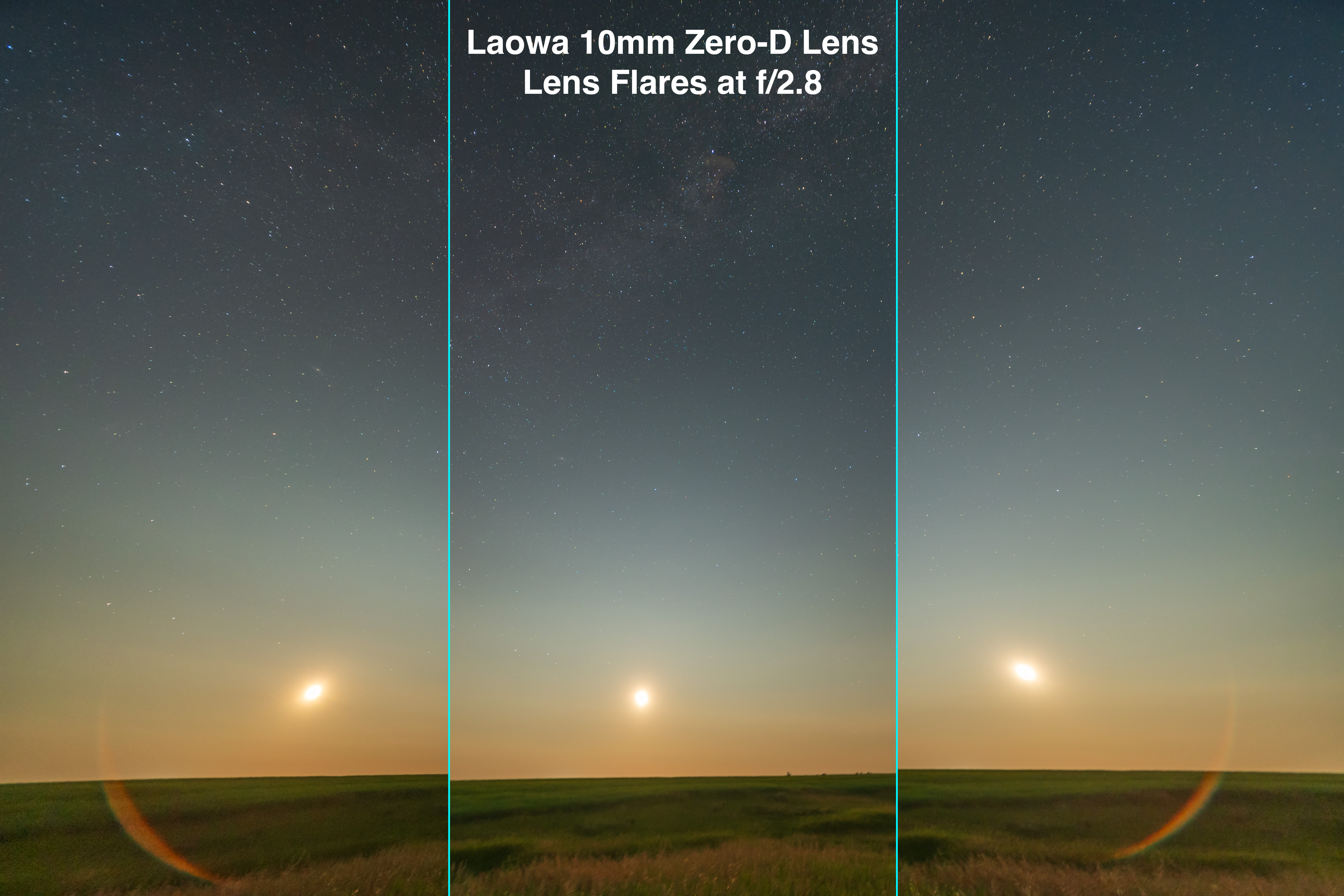
Laowa 10mm Lens Flares

Three panels showing the Moon framed in the left corner (L), centred (C), and in the right corner (R).

With such a wide lens, the Moon or other bright light sources are bound to be within the frame. The Laowa exhibits a prominent internal lens flare when bright objects are in the corners, but just in the corners. Objects near the edge but centered are fine. 

Showing the effect of decreasing aperture on the lens flare and bright light source.

Stopping down the lens adds diffraction spikes (or โ€œsunstarsโ€) to bright lights, but doesnโ€™t eliminate the circular internal reflection. None of this is a serious issue for most images, but it is something to be mindful of when framing nightscapes. 

With the Laowa 10mm lens at f/2.8 on the Nikon Z6III at ISO 3200. Note the Big Dipper at left and Orion at right.

In Milky Way and starfield images, constellations in the corners can distort into unnatural shapes that look odd, as I show above. While the lens can take in a great swath of sky, its distortion and corner aberrations make it less than desirable for tracked Milky shots. 

An aurora in the dawn twilight on September 17, 2024. A 4-second exposure with the Laowa 10mm at f/2.8.

Where the Laowa 10mm really proves its worth is for auroras, as above, which can require as wide a field as you can muster. Note the flat horizon.

For ultra-wide nightscapes in a single image (not a panorama) with a natural looking (not curved) horizon, and for meteor showers, the Laowa is just the ticket. 


BONUS TEST: The TTArtisan 7.5mm f/2 Fish-Eye ($140)

Technically, this lens is designed to be used on cropped-frame (or APS-sensor) cameras where it fills the frame with a curving horizon. But it works on a full-frame camera where it projects a circular image slightly larger in diameter than the short dimension of the frame, so not a complete circle as with a true circular fish-eye like the old Sigma 8mm f/3.5. 

An aurora in the dawn twilight on September 17, 2024 in a 2-second exposure with the TTArtisan 7.5mm fish-eye lens at f/2 on the Nikon Z6III at ISO 800.

For all-sky auroras, this is ideal, where the TTArtisanโ€™s fast f/2 speed is unprecedented in a fish-eye lens. That makes rapid-cadence time-lapses possible, as well as real-time movies. An example is here on my YouTube channel.

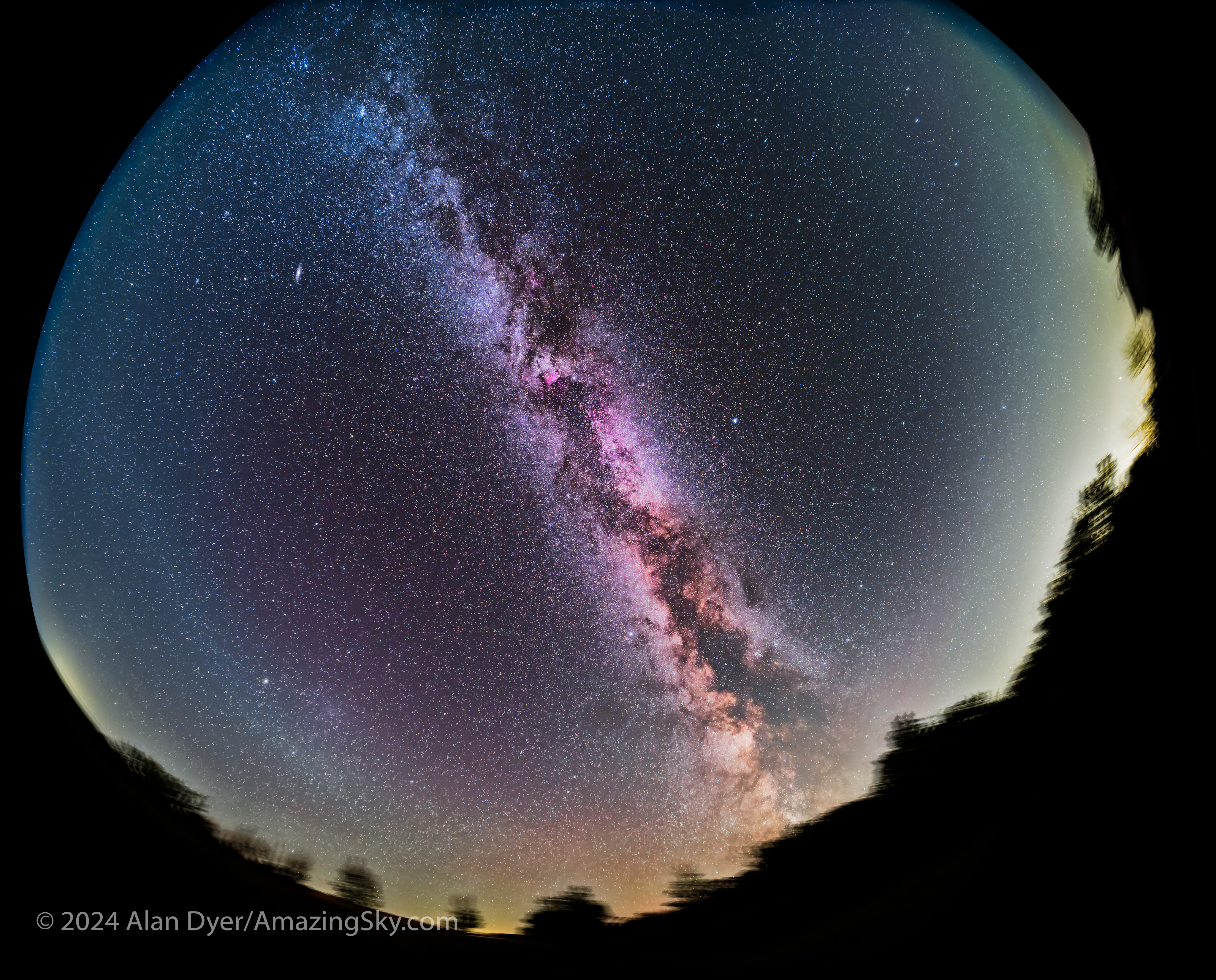
A stack of 4 x 4-minute exposures with the TTArtisan 7.5mm f/2 fish-eye lens stopped down to f/2.8 on the Nikon Z6III at ISO 1600, on the MSM Nomad tracker.

Or you can just capture the Milky Way from horizon to horizon, as above. For the latter, having stars sharp across the circular field is still desirable. 

I have this lens for Canon RF as well, but that unit shows a noticeable softening of the left edge with defocused stars, likely from lens de-centering. I was told by TTArtisan that was a normal unit-to-unit variation and not a defect warranting replacement. Annoying! 

I hesitated to buy one for my Nikon. But this is such a unique lens, and so affordable, I took the chance. The Nikon Z-mount version proved much better. 

TTArtisan 7.5mm Edge Performance 

There is no corner performance or vignetting to test here. 

TTArtisan 7.5mm lens at f/2, showing the left side area shown in the blowups below.

Instead, Iโ€™m inspecting the same side on the Nikon Z version that caused a problem on my Canon version. 

Comparing f/2 and f/2.8 edge aberrations.

The Nikon version looks fine, with stars sharp along the edge even at f/2, showing just a low level of astigmatism, to be expected in such a fast, wide lens. Stars tighten up a bit more at f/2.8. Most critically, the field was flat and in focus across the frame. There was no evidence of lens de-centering or optical defects. 

The edges do show some discolouration and a soft edge to the image area. I also see two odd dark protrusions at the top of the frame. Looking through the lens, thereโ€™s nothing obvious intruding into the light path. 

Keep in mind when used on a full-frame camera youโ€™re seeing more of the projected image than was intended in the design. 

The 7.5mm lens comes with a metal lens cap with a threaded centre disk. Remove it to create an aperture that vignettes the image to a smaller but complete circle.

The TTArtisan 7.5mm is a specialty lens to be sure. But at its low price it isnโ€™t a big outlay to include in your lens arsenal, for unique all-sky images, of auroras, satellite passages, sky colours, and the Milky Way. And it is terrific for time-lapses and movies of the whole sky. It is a no-frills manual lens available for most camera mounts.


Recommendations

The Viltrox 16mm, Laowa 10mm and TTArtisan 7.5mm are all available for Sony E-mount. The Laowa and TTArtisan are available for Canon RF, but the Viltrox 16mm is not, as it is an auto-focus, full-frame lens, the class of lenses Canon has yet to allow on their RF mounts, much to the disdain of all concerned but Canon management it seems. 

Viltrox 16mm โ€” For nightscape use, the Viltrox 16mm might be the single best choice, as being the most versatile and affordable of the trio of wide-angle lenses. Its focal length is a good balance between the usual 14mm and what I think is a more useful 20mm. 

Nikkor 20mm โ€” I like the Nikkor 20mm for its lower level of vignetting, slightly tighter framing, and very sharp stars. I think a 20mm is an ideal focal length for many nightscapes and Milky Way scenes. But it is the most expensive lens tested here. 

Laowa 10mm โ€” While nearly as costly as the Nikkor 20mm, the Laowa 10mm is much more specialized and, I think, not as useful as the others for general nightscape and Milky Way shooting. But it is superb for auroras, if you are in a place where they are common, as they are here in Alberta. Otherwise, I think youโ€™d find the 10mm a costly lens that might not see a lot of use for astrophotography. Its real fortรฉ is architecture and real-estate interiors. 

TTArtisan 7.5mm โ€” Ditto on its limited use. But it is so affordable itโ€™s easy to justify even if it doesnโ€™t get a lot of use. The astro images, time-lapses, and movies it can produce are unique and impossible to create any other way. Be sure to buy it from a source where you can return it easily if you find your sample defective. 

Reason To Go Mirrorless

The quality of these and other premium lenses from Nikon, and also from Canon, Sony and third-party makers like Sigma and Viltrox, is one of the major benefits of migrating to mirrorless cameras. DSLRs, and the lenses made for them, are now effectively dead as new gear choices. 

Yes, mirrorless cameras can be better in many aspects of their operation than DSLRs. But it is the lenses made for mirrorless that show the greatest improvement over their DSLR equivalents, many of which date back to the forgiving film days. 

โ€” Alan, December 6, 2024 (amazingsky.com
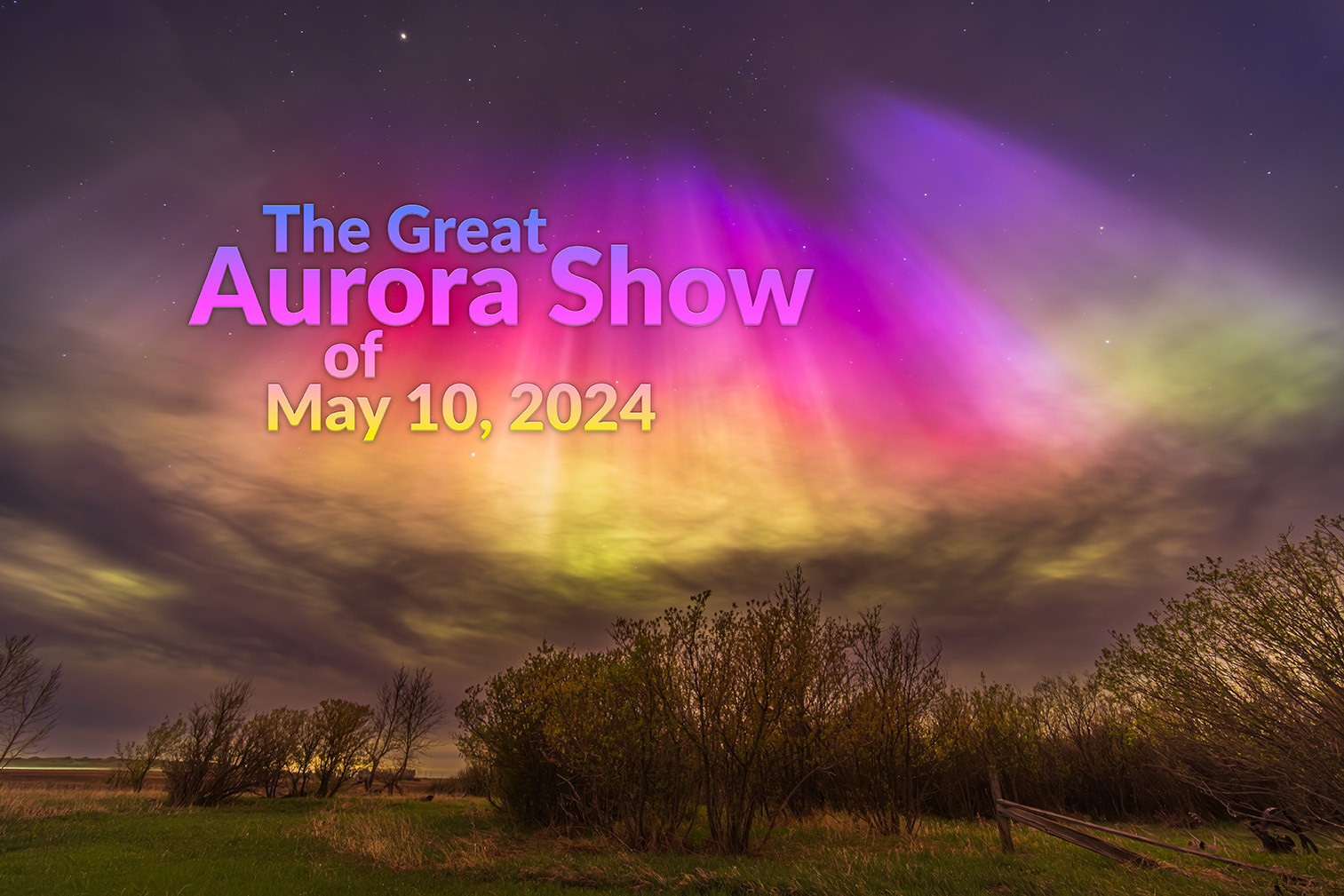
The Great Aurora Show of May 10, 2024


It has been many years since we were treated to an aurora as widely seen as the show on May 10, 2024. Here’s my tale of the great display.

As the sky darkened around the world on May 10/11, 2024, sky watchers in both the northern and southern hemispheres were amazed to see the sky lit by the deep reds, greens and pinks of a massive display of aurora. For me, this was my first Kp8 to 9 show (to use one measure of aurora intensity) in more than 20 years, back in the film era!

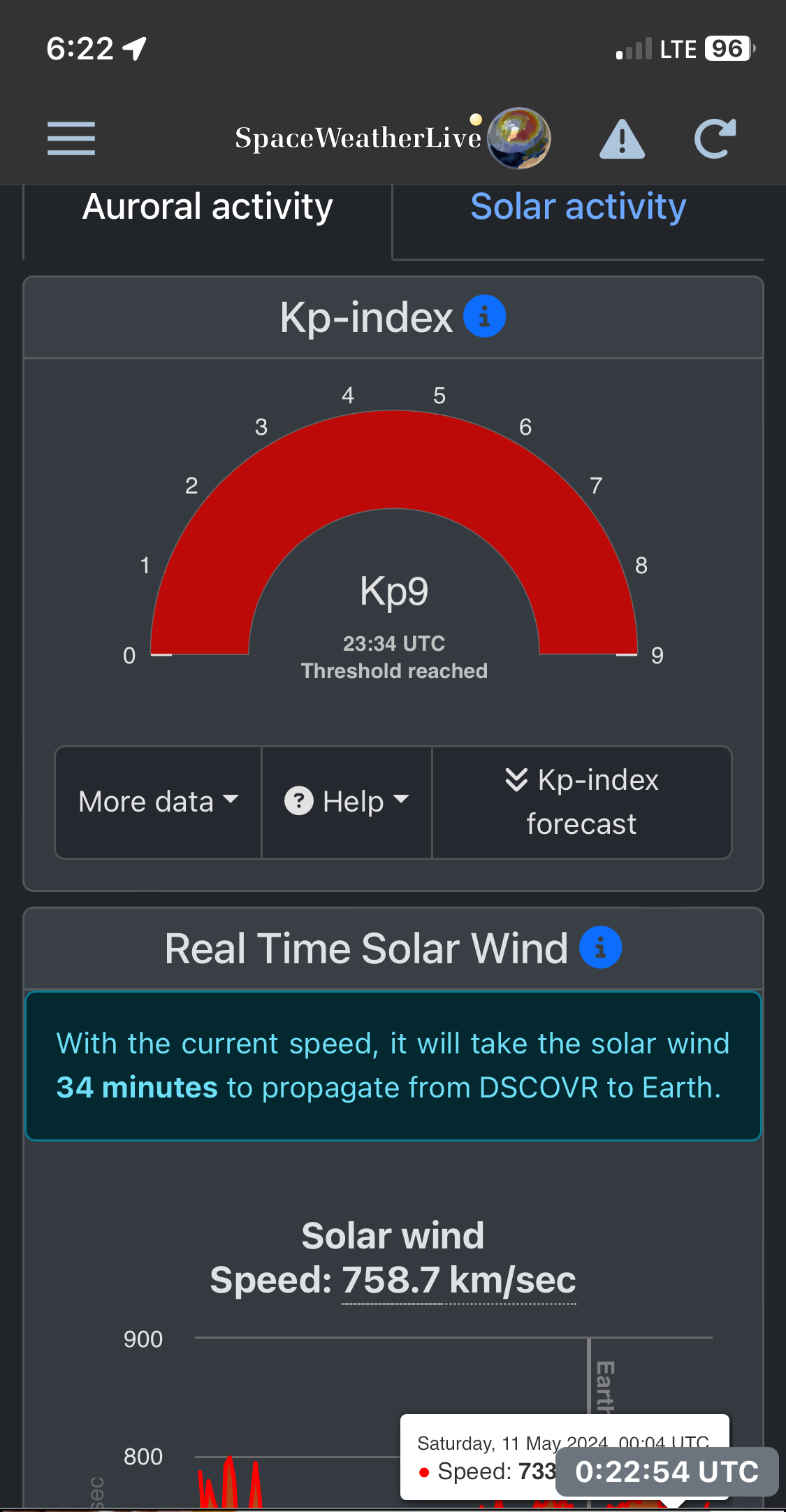
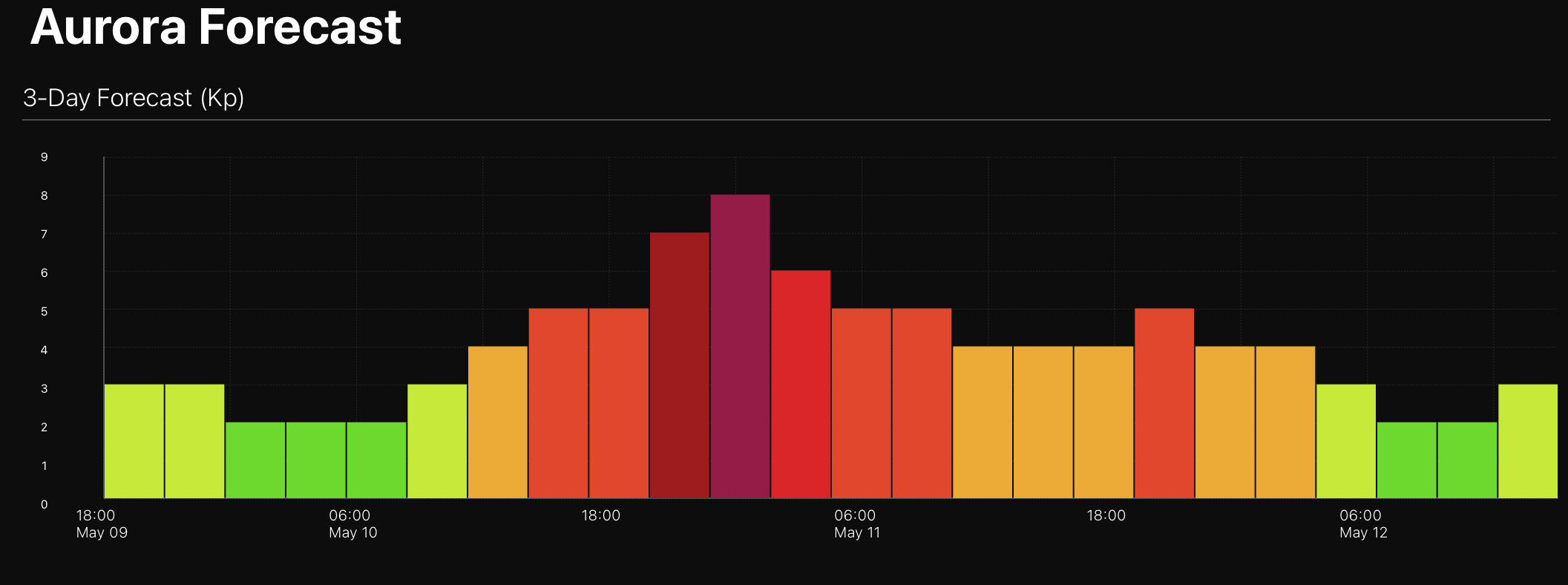
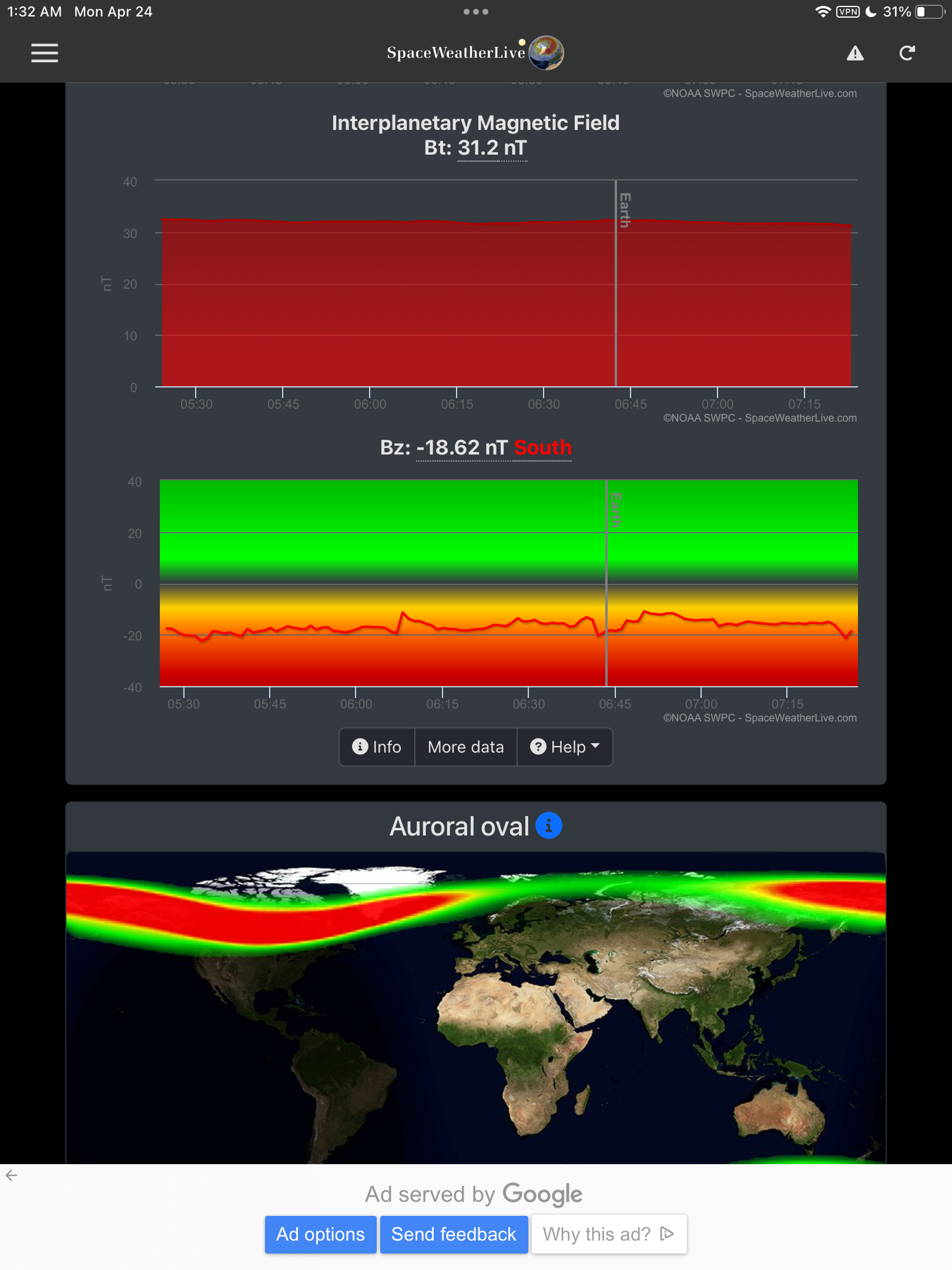
Throughout the day, aurora chasers’ phones (mine included) had been beeping with alerts of the arrival of a major solar storm, with the usual indicators of auroral activity pinned to the top of the scale.

A NOAA satellite’s eye view of the ring of aurora May 10/11, showing it south of me in Alberta, and across the northern U.S. People in the southern U.S. saw it to their north.

As I show below, the graphic of the intensity of the band of aurora, the auroral oval, was lit up red and wide. This was a night we didn’t have to chase north to see the Northern Lights or aurora borealis โ€” they were coming south to meet us (as I show above).

Observers in the southern hemisphere had the normally elusive aurora australis move much farther north than usual, bringing the Southern Lights even to tropical latitudes in Australia, South America and Africa.

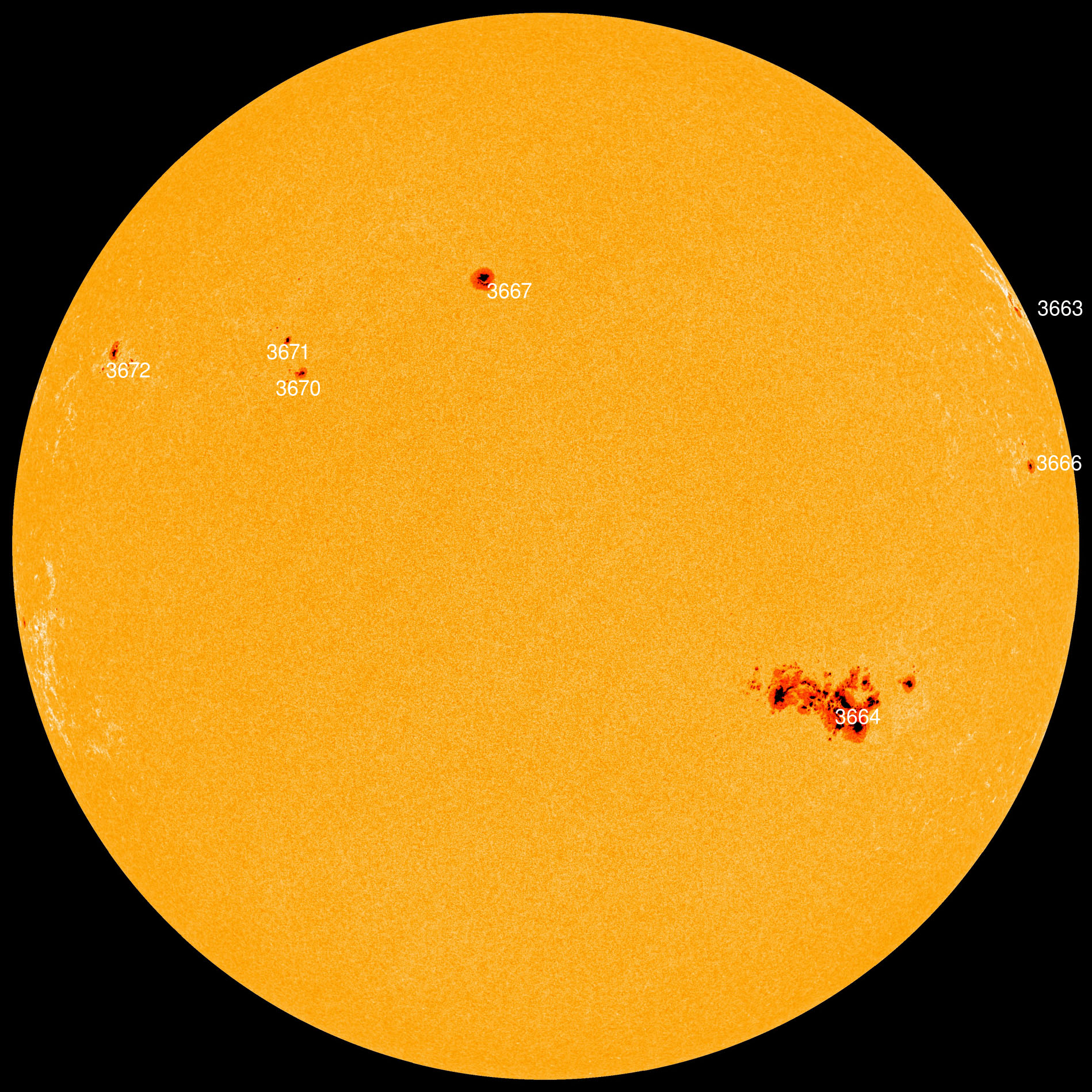
The cause was a massive sunspot group on the Sun which had let off several intense solar flares.

Sunspot group 3664 was so big it could be seen with the naked eye, using solar eclipse glasses. Photo courtesy NASA.

The flares had in turn blown off parts of the Sun’s atmosphere, the corona, that anyone who saw the total eclipse a month earlier had admired so much. But a month later, the corona was being blown our way, in a series of Coronal Mass Ejections (CMEs), to collide with Earth.

A movie of six CMEs blasting toward Earth, captured by the SOHO satellite. Courtesy NASA/ESA.

As it happened I was scheduled to give a community talk in the nearby town early in the evening of May 10, on the topic of The Amazing Sky! Watching the indicators, I could more or less promise the audience that we would indeed see an amazing sky later that evening as it got dark.

Post talk, I hurried home to get the cameras ready, choosing to forgo more hurried driving out to a scenic site in southern Alberta, for the convenience of shooting from my rural backyard. As the sky darkened, the clouds were lit purple, and curtains of aurora appeared in the clear patches.

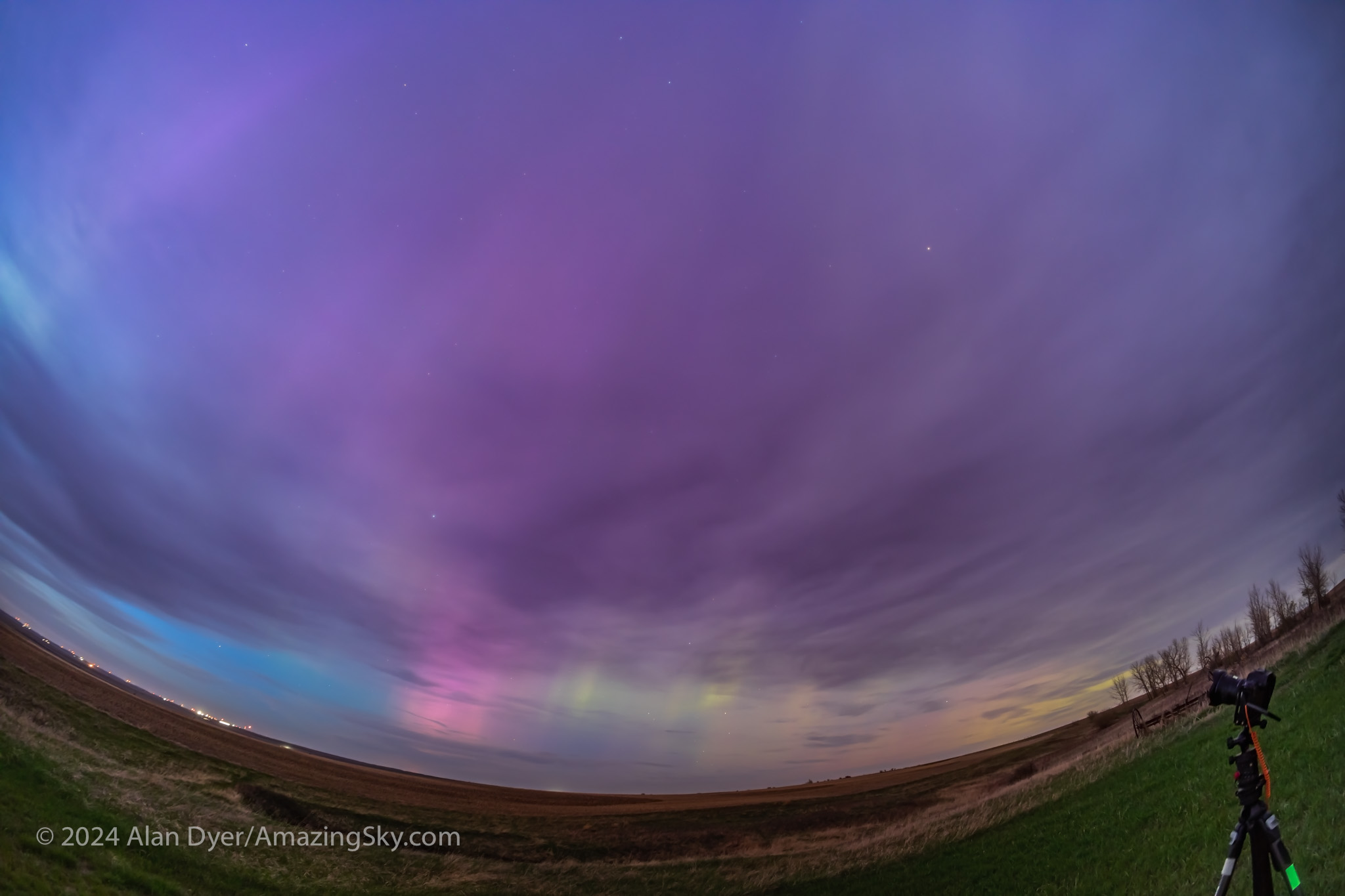
Clouds and aurora in twilight with the 11mm TTArtisan full-frame fish-eye lens.
A bright arc of aurora shining through the purple clouds, with the 7.5mm TTArtisan circular fish-eye lens.

Something big was going on! This was promising to be the best show of Northern Lights I had seen from home in a year. (Spring 2023 had three great shows at monthly intervals, followed by an aurora drought for many months. See The Great April Aurora.)

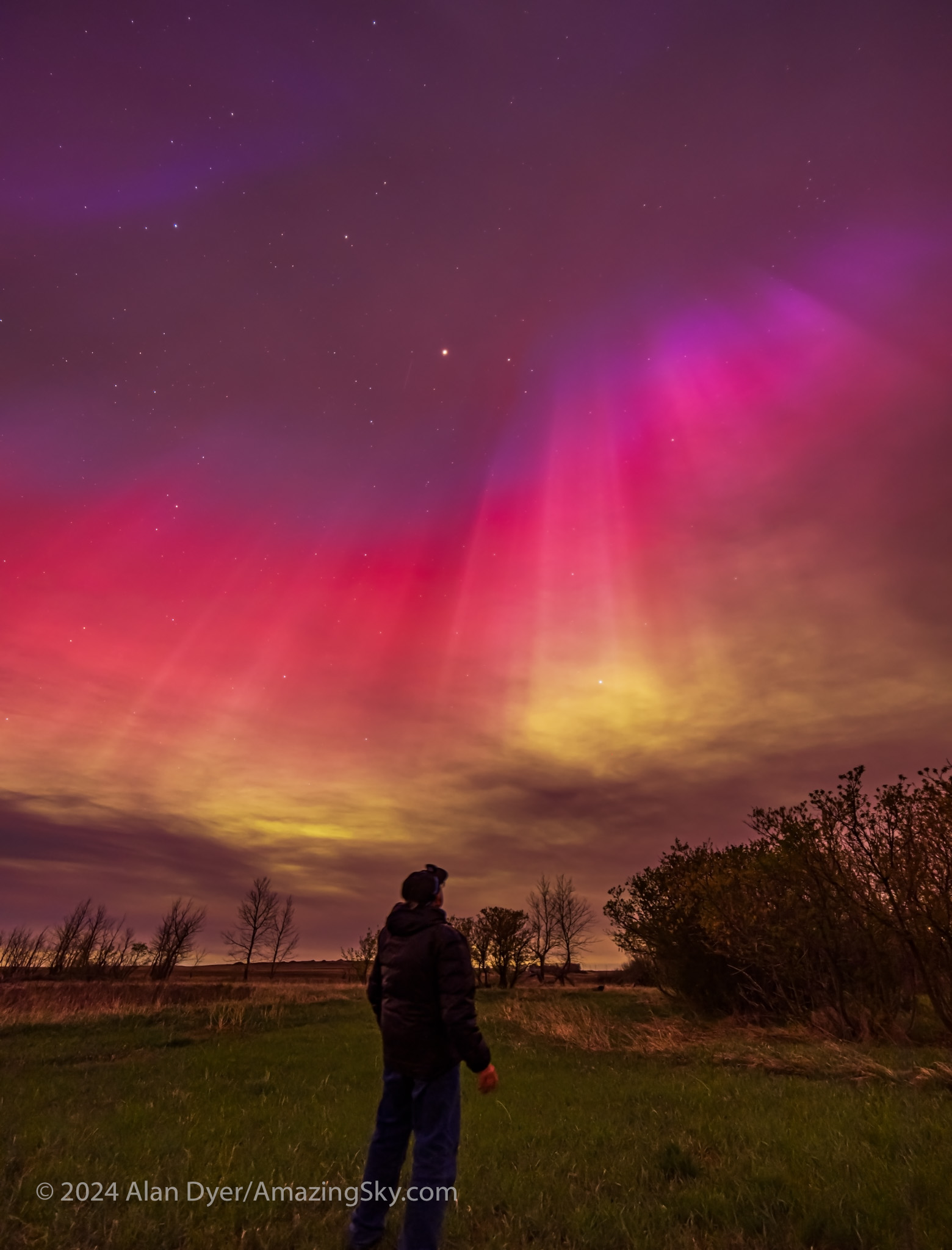
A selfie at the start of the great aurora show of May 10, 2024.

I shot with four cameras (a Canon EOS R, Ra, R5 and R6) โ€” two for time-lapses, one for real-time movies, and one for still images. I used the latter to take many multi-image panoramas, as they are often the best way to capture the wide extent of an aurora across the sky.

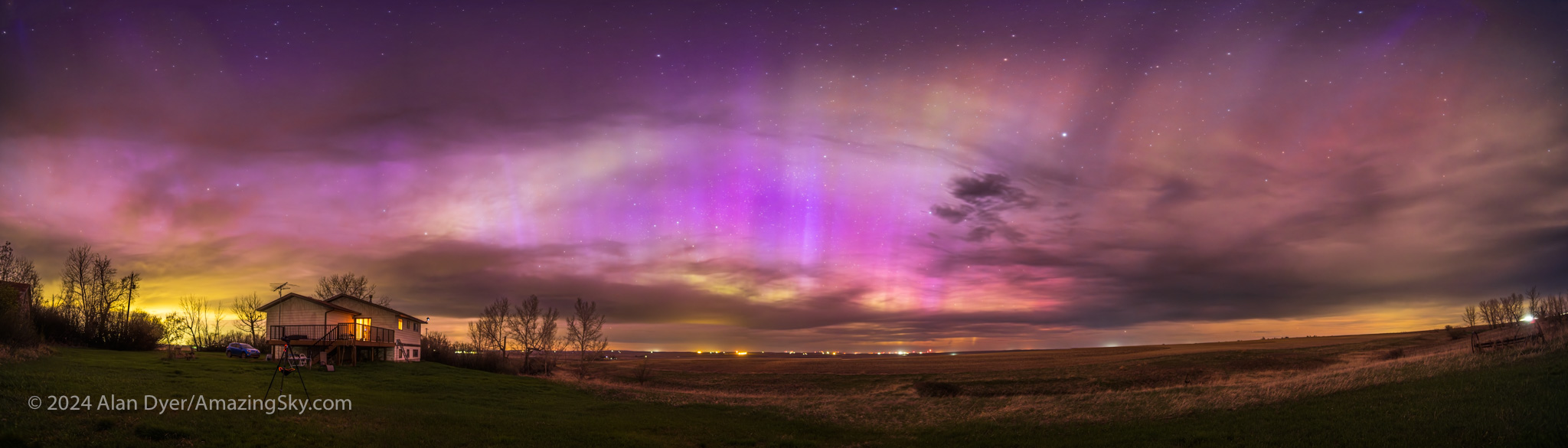
The arc of aurora in purple and white across the northern sky from home in Alberta at the start of the great display (about 11:30 p.m. MDT).

Early in the evening the arc of aurora wasn’t the usual green from oxygen, but shades of purple, pink, and even white, likely from sunlit nitrogen. The panorama above is looking north toward a strangely coloured arc of nitrogen (?) aurora.

Then after midnight a more normal curtain appeared suddenly, but toward the south, brightening and rising to engulf much of the southern sky and the sky overhead.

Looking south with the 15mm wide-angle lens.

It is at local midnight to 1 a.m. when substorms usually hit, as we are then looking straight down Earth’s magnetic tail, toward the rain of incoming aurora particles bombarding the Earth. During a substorm, the rain turns into a deluge โ€” the intensity of the incoming electrons increases, sparking a sudden brightening of the aurora, making it dance all the more rapidly.

This is a 300ยฐ panorama of my home sky now filled with colourful curtains.

As the aurora explodes in brightness it often swirls up to the zenith (or more correctly, the magnetic zenith) to form one of the sky’s greatest sights, a coronal outburst. Rays and beams converge overhead to form a tunnel effect. It is jaw-dropping.

I’ve seen this many times from northern sites such as Churchill and Yellowknife, where the aurora often dances straight up. And from my latitude of 51ยฐ N in western Canada, the aurora does often come down to us.

But this night, people at latitudes where, at best, the aurora might be seen just as a glow on the horizon, saw it dance overhead in a corona show to rival the solar eclipse, and that other corona we saw on April 8!

This is a panorama of a substorm outburst creating an overhead corona with rays converging to the magnetic zenith (south of the true zenith), and amid clouds. The rays show a rich mix of oxygen greens and reds, as well as nitrogen blues blending to create purples. Some greens and reds are mixing to make yellows.

Yes, the long exposures of aurora photos (even those taken with phone cameras) show the colours better than your eye can see them (insensitive as our eyes are to colour in dim light). But this night portions of the arcs and rays were bright enough that greens and pinks were easily visible to the naked eye.


This is a single 9-second exposure of the peak of a bright outburst at 1 a.m. MDT. It was with the Laowa 7.5mm circular fish-eye lens at f/2 on the Canon R5 at ISO 800. It is one frame from a time-lapse sequence.

At its peak the show was changing rapidly enough, I couldn’t get to all the cameras to aim and frame them, especially the movie camera. The brightest outburst at 1 a.m. lasted just a minute โ€” the time-lapse cameras caught it. The sequence below shows the view in 9-second exposures taken consecutively just 1 second apart.

This series shows a brief outburst of bright aurora at the magnetic zenith overhead. The time between these 7 consecutive 9-second exposures is only 1 second, so this bright outburst did not last long (little more than a minute). With the TTArtisan 7.5mm f/2 fish-eye lens on the Canon R5. Click or tap to enlarge to full screen.

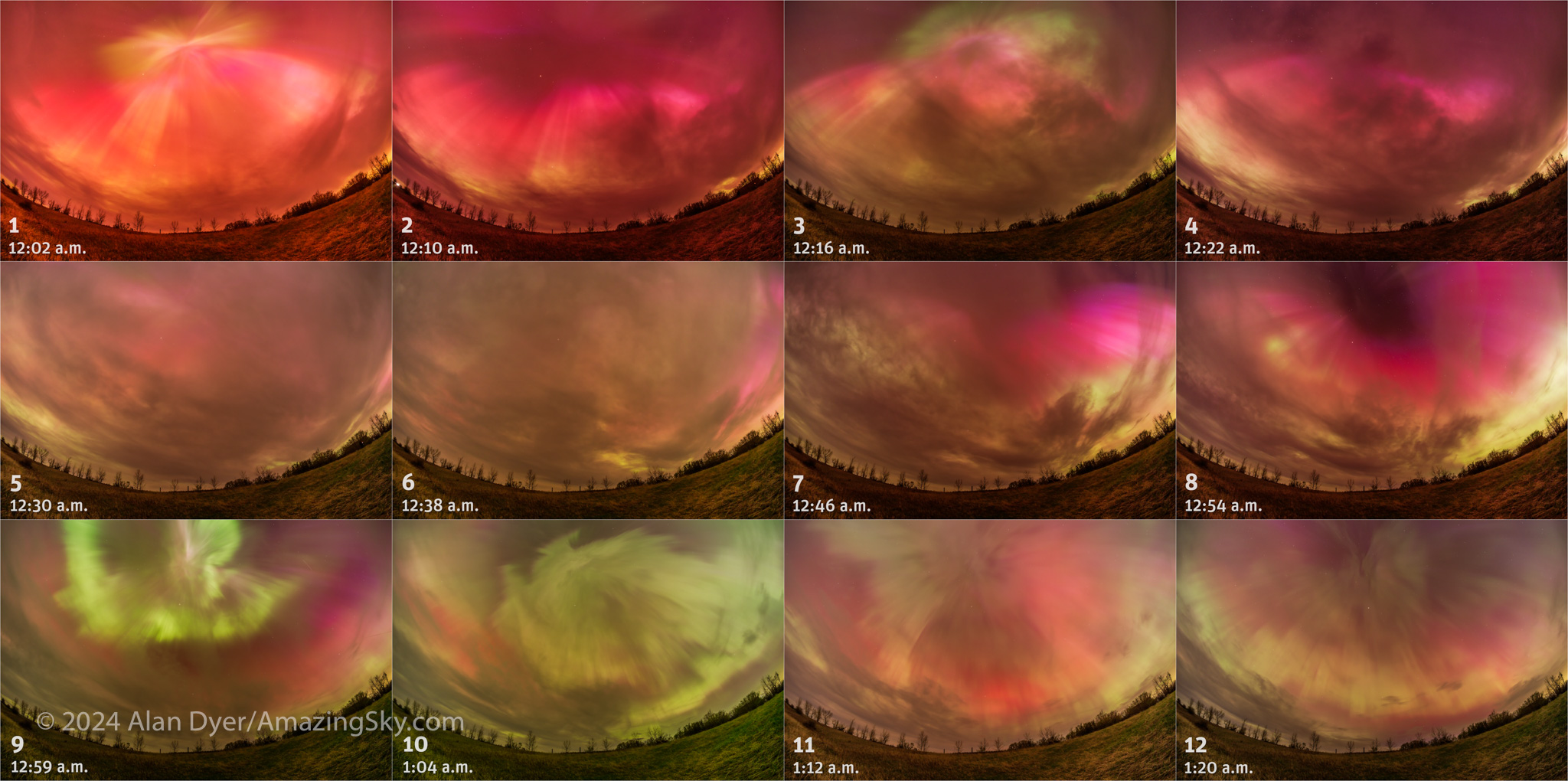
Here’s another sequence of frames taken as part of a time-lapse sequence with the 11mm lens. It shows the change in the aurora over the 80 minutes or so that it was most active for me at my site.


The time between these 12 images is usually 8 minutes, though to include some interesting activity at a bright outburst, the interval is 5 minutes for three of the images around 1 a.m. Each is a 7- or 9-second exposure taken as part of a time-lapse sequence using the 11mm TTArtisan lens at f/2.8 on the Canon R at ISO 800 or 1600.

Shooting time-lapses with fish-eye lenses captures the show with a minimum of attention needed (except to adjust ISO or exposure times when the aurora brightens!). I could use the still camera (with the Laowa 15mm f/2 lens) to take individual shots, such as more selfies and home shots.

This is a single 8-second exposure with the Laowa 15mm lens at f/2 on the Canon Ra at ISO 800. Another camera taking a time-lapse is in the scene. I had four going this night.

As colourful as the aurora was at its best between midnight and 1:30 a.m., I think the most unique shots came after the show had subsided to appear just as faint rays across the north again, much as it had begun. To the eye it didn’t look like much, but even on the camera’s live screen I could see unusual colours.

I took more panoramas, to capture one of the most unusual auroral arcs I’ve even seen โ€” a blue and magenta aurora across the north, similar to how the night started.

This a stitch of 11 segments, each 13-second exposures, with the Laowa 15mm lens at f/2 on the Canon Ra camera at ISO 800, and turned to portrait orientation. Processed in Camera Raw and stitched with PTGui.

The colours may be from nitrogen glowing, which tends to light up in blues and purples, especially when illuminated by sunlight at high altitudes. At 2 to 2:30 a.m. the Sun might have been illuminating the aurora at a height of 150 to 400 km, and far to the north.

I’d seen blue-topped green auroras before (and there’s a green aurora off to the west at left here). But this was the first time I’d seen an all-blue aurora, no doubt a product of the intense energy flowing in the upper atmosphere this night. And the season and my latitude.

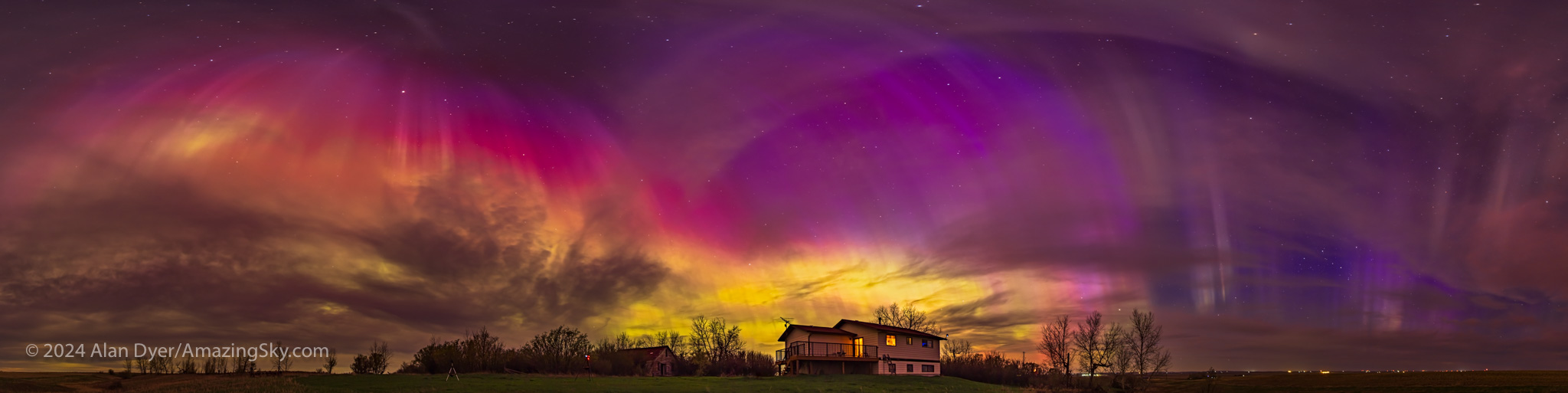
The panorama is a spherical projection spanning 360ยบ, and reaching to the zenith 90ยฐ high at centre. This a stitch of 20 segments, each 13-second exposures, with the Laowa 15mm lens at f/2 on the Canon Ra camera at ISO 800, and turned to portrait orientation. Processed in Camera Raw and stitched with PTGui.

The weirdest aurora was at 2:30 a.m., when in addition to the blue rays of nitrogen, an odd white and magenta patch appeared briefly to the south. What was that??

The lesson here? During a bright show do not go back to sleep when things seem to be dying down. Interesting phenomena can appear in the post-storm time, as we’ve learned with STEVE and other odd red arcs and green proton blobs that we aurora photographers have helped document.

I end with a finale music video, mostly made of the time-lapses I shot this night.

Enjoy!

Bring on more aurora shows as the Sun peaks in activity, perhaps this year. But the best shows often occur in the 2 or 3 years after solar max. So we have several more years to look forward to seeing the Lights dance in our skies.

Watch in full screen and in 4K if you can. For all the tech details click through to YouTube and check the description below the video.

Thanks and clear skies!

โ€” Alan, May 18, 2024 amazingsky.com

The Great April Aurora


On April 23, 2023 the sky erupted with a massive solar storm, bringing the aurora to millions of people around the word.

On April 23 warnings went out alerting aurora watchers that a solar storm was imminent. And as the sky darkened that night locations all across the Northern and Southern Hemispheres were treated to a great sky show.

This is what we want to see in our aurora apps! Code Red and a vast auroral oval.

When we see this on our phone apps, we know we’ll get a great show. This was the auroral oval, lit up red, as the display was underway at my location in Alberta, Canada.

All indicators were great!

The strength of the interplanetary field (Bt) was high and the direction of the field (Bz) was well south, all welcome indicators of a superb show.

Sure enough, as it got dark that night, and from my location after the clouds cleared, an aurora was underway covering much of the sky.
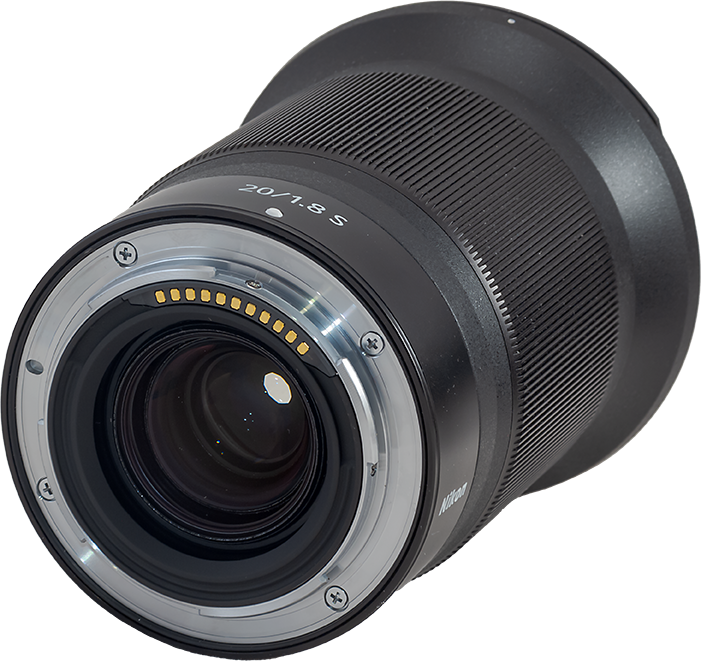
A fish-eye 360ยฐ view of the Great April Aurora of April 23, 2023, from home in southern Alberta, Canada. The Kp level reached 7 to 8 this day. The Big Dipper is above centre. This is looking north. A single 5-second exposure with the TTArtisan 7.5mm circular fish-eye lens at f/2 and Canon R6 at ISO 3200.
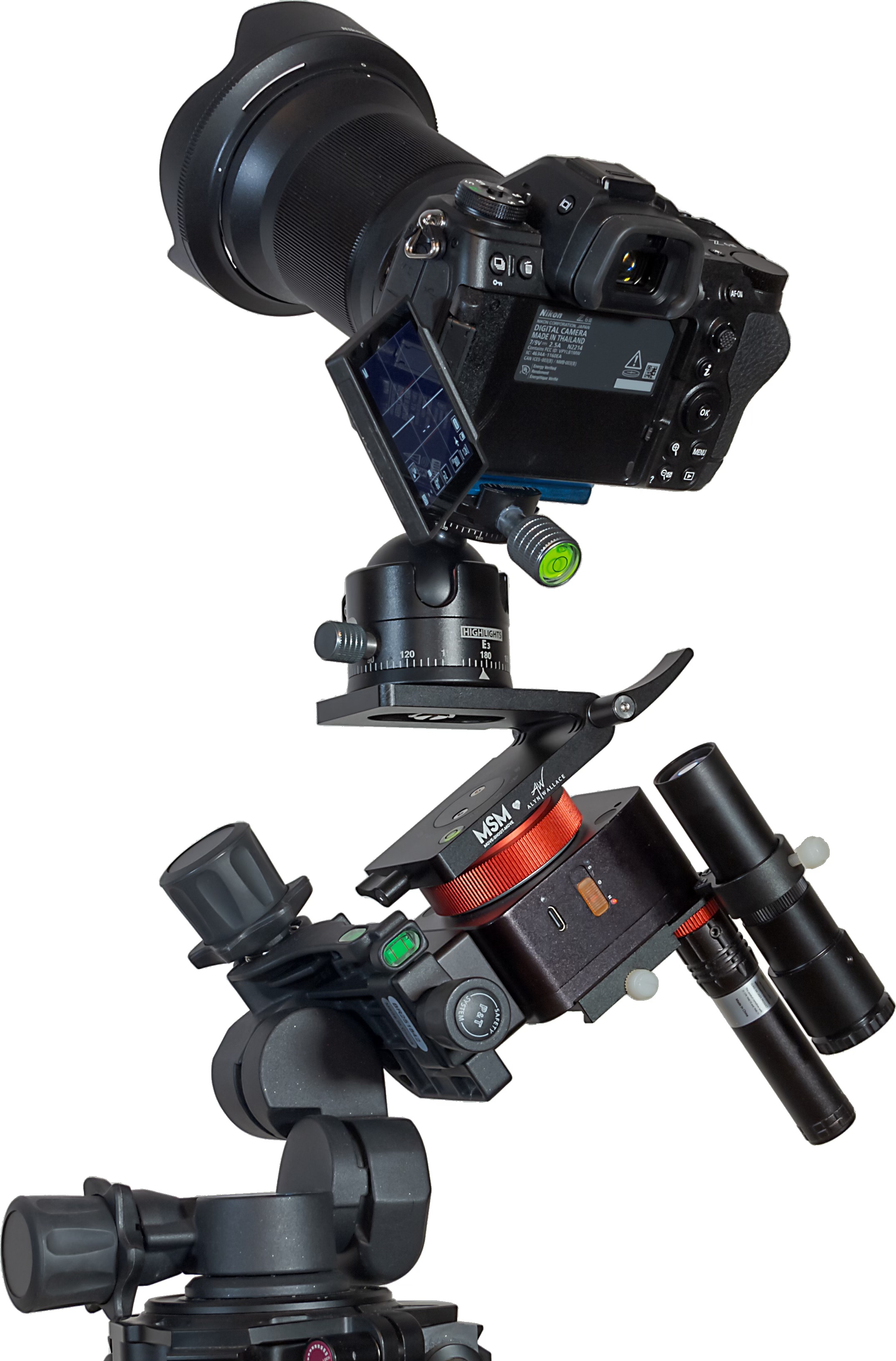
The aurora moved south to occupy just the southern half of the sky, but with incredible ribbons crossing from east to west, rippling and pulsating off and on. Seeing patches of aurora pulse off and on and flaming up to the zenith is not uncommon toward the end of a substorm outburst. But this was the first time I can recall seeing pulsating ribbons.
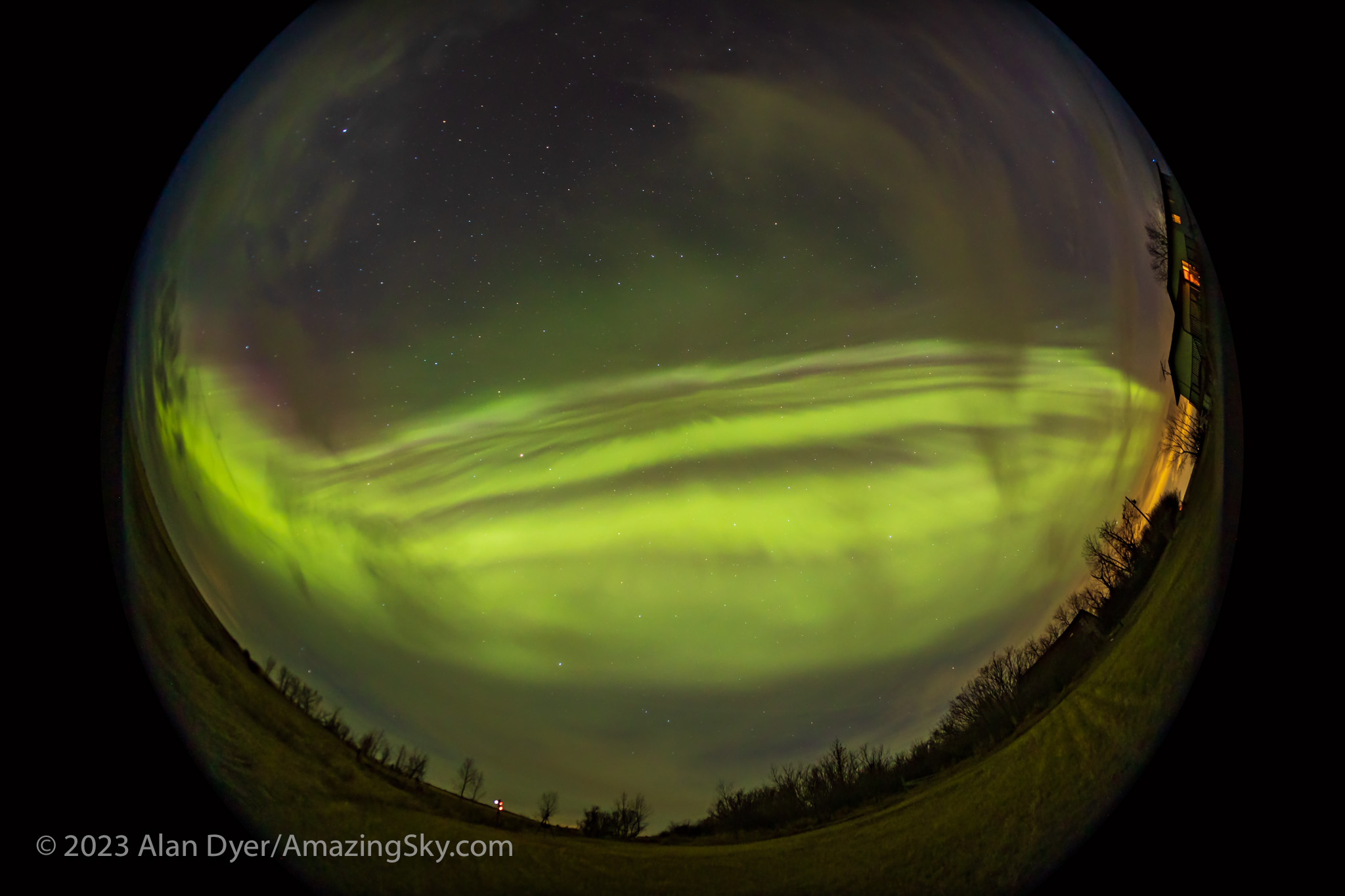
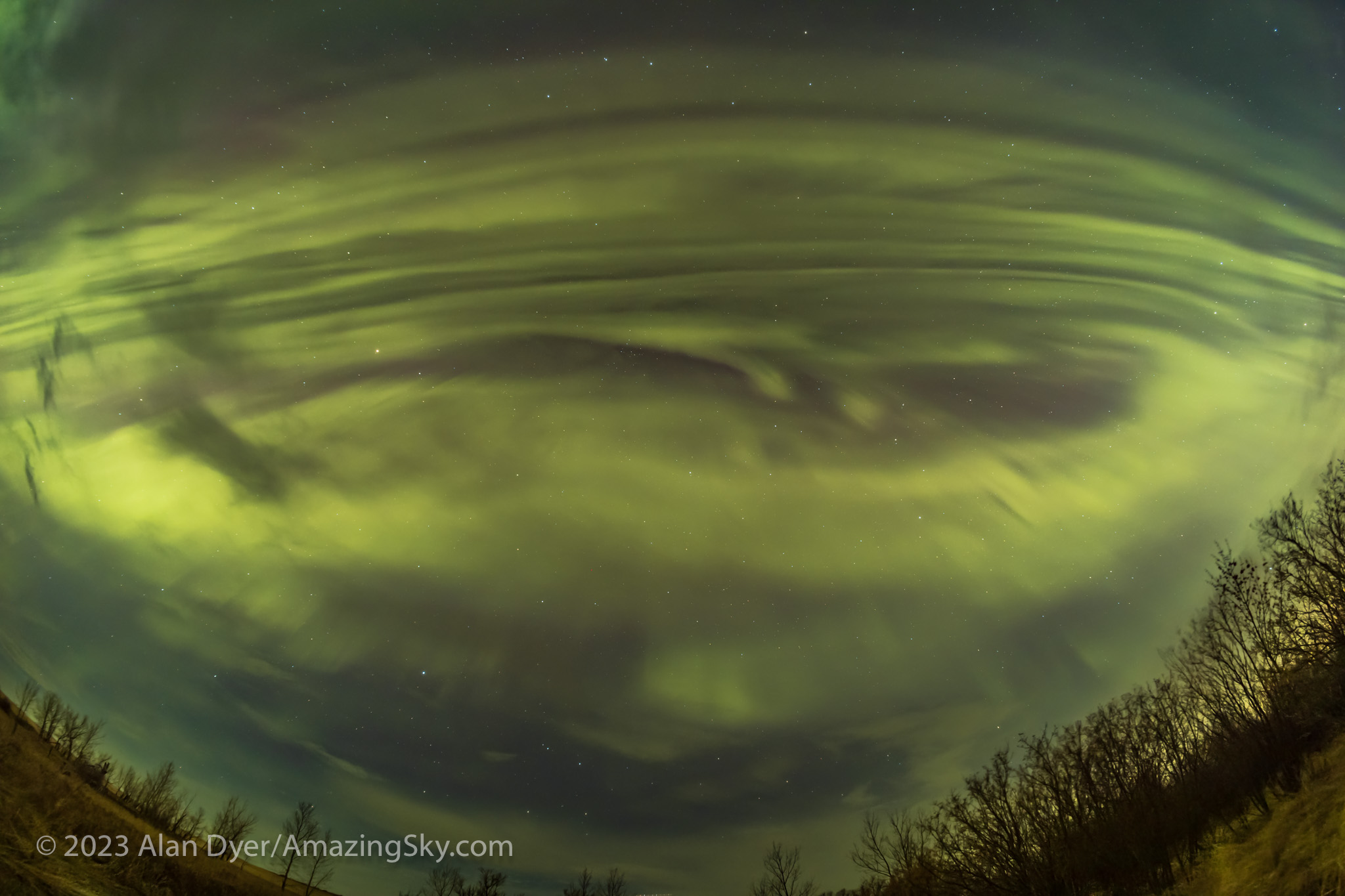
At times, there was a dark ribbon across the sky, as the aurora formed a gap in its curtains, looking like a “dark aurora.”

The view looking straight up is always the most jaw-dropping when an aurora fills the sky. Rays and curtains converge at the magnetic zenith to form a “corona.”

The aurora of April 23, 2023, looking straight up to the zenith to capture the converging curtains in a coronal display. The Big Dipper is at top. A single 3.2-second exposure with the Canon R5 at ISO 800 and Laowa 15mm lens at f/2.

I shot with three cameras, taking stills, time-lapses, and real-time movies. I edited them together here in a music video. Enlarge to full screen to view it. I hope you enjoy it!

A 3-minute video of the April 23, 2023 aurora show from Alberta.
An aurora selfie with the great all-sky Kp6 to 8 level aurora of April 23, 2023. This is looking south toward Arcturus and Spica. The Coma Berenices cluster is at top near the convergence point for the auroral curtains. Shot from home with the Canon Ra and 11mm TTArtisan full-frame fish-eye lens at f/2.8.

With the Sun ramping up in activity, we should get more great shows of Northern โ€“ and Southern! โ€“ Lights around the world in the next few years,

โ€” Alan Dyer / April 29, 2023 / ยฉ 2023 AmazingSky.com