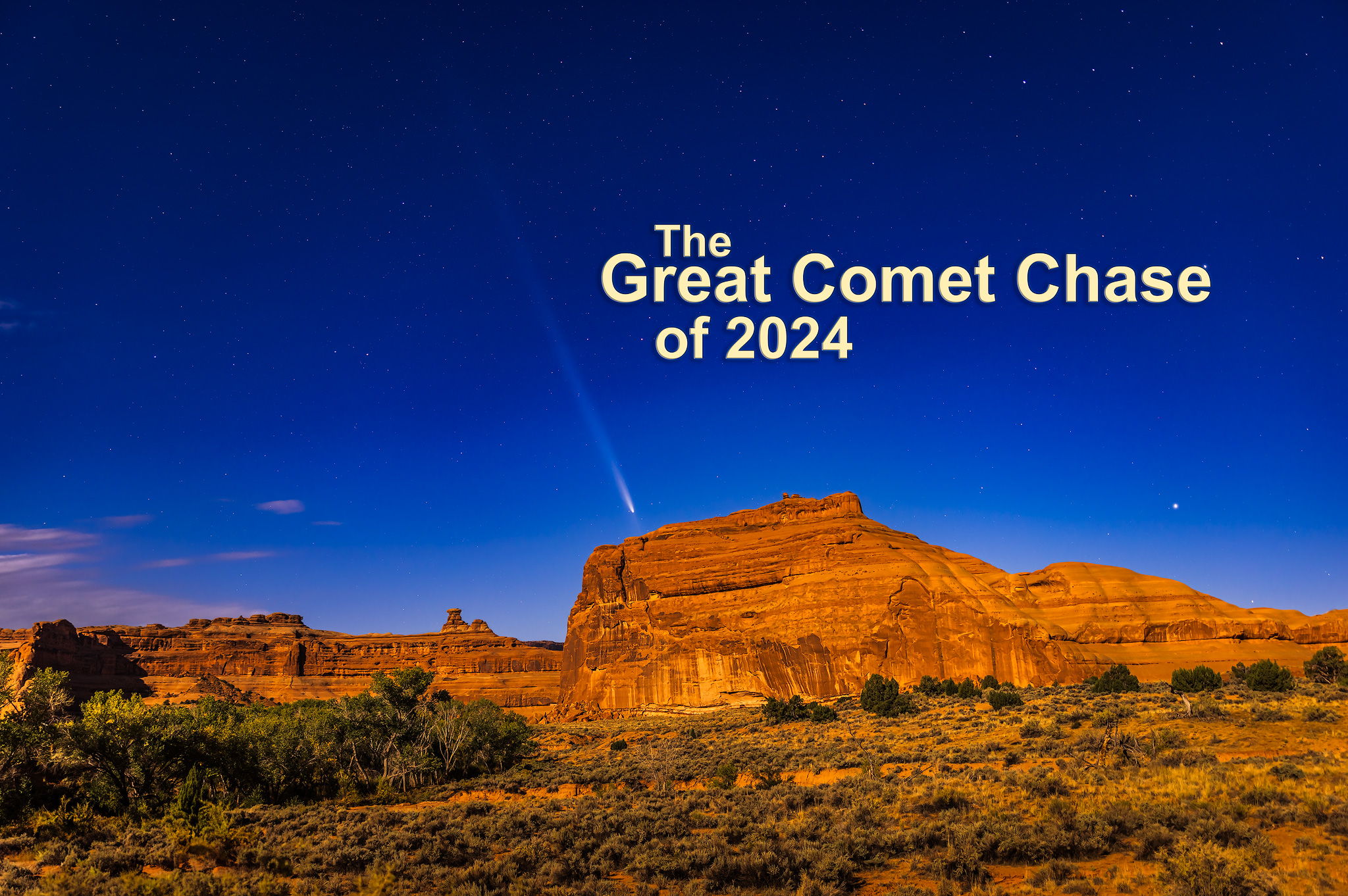
The Great Comet Chase of 2024


A plan to shoot the promised bright comet of 2024 paid off, with fine views at dawn and at dusk of the best comet since 2020. 

Comets are always a gamble. Any new comets discovered, the ones that usually become the brightest, have no track record of performance. Predictions of how bright a new comet might appear are based on what a typical comet should do. But comets can outperform expectations and dazzle us, or they can fizzle and fade away. 

In late 2023 it was clear that a then newly-discovered comet, C/2023 A3, named Tsuchinshan-ATLAS after the observatories where it was co-discovered, had the potential to perform in late 2024.ย 

The low angle and position of the comet from home in Canada in the late September dawn sky, simulated in StarryNight software.

Knowing where it would be in the sky (that trait of a comet can be predicted with accuracy!) I planned a field trip to the U.S. desert Southwest for late September and early October 2024. From farther south the comet would be higher than it would be from home (shown above), and over spectacular landscapes. 

I had visions of another Comet NEOWISE from July 2020. As my blog from 2020 shows, we saw that photogenic comet well from our northern latitude in Canada, as it skimmed across the northern horizon. Tsuchinshan-ATLAS would require a chase south.ย 


September 26 & 27 โ€” at Bryce Canyon, Utah

In late September 2024 the comet would be inbound, approaching the Sun and in the morning sky. What better eastern scene than overlooking Bryce Canyon in Utah, where I had been a year before, for the October 14, 2023 annular eclipse of the Sun in the morning sky. (Click the link for my eclipse chase blog.)

I was fortunate to get two clear mornings, both from the Fairyland Canyon viewpoint, just a short walk from the parking lot to carry camera gear and tracking mounts. 
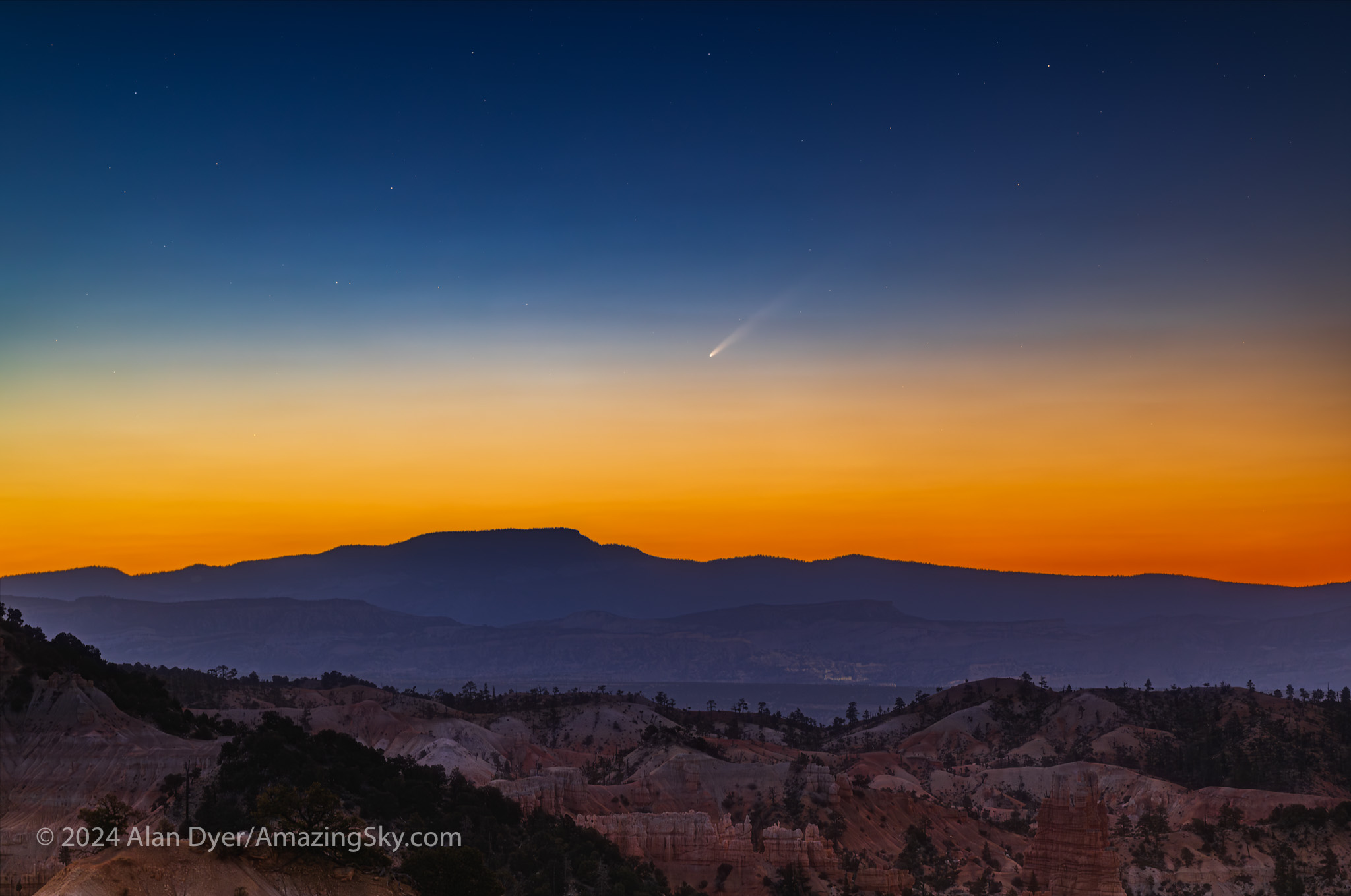
Comet C/2023 A3, Tsuchinshan-ATLAS, at dawn over Bryce Canyon, on the morning of September 27, 2024.

My first look at the comet on September 27 was on the day the comet was at perihelion, closest to the Sun in its orbit, though not in the sky at our viewing angle from Earth. 

The comet was just visible to the unaided eye, but was obvious on the camera view screen, even amid the bright twilight. I had to shoot fast as the window between โ€œcomet riseโ€ and the sky brightening too much was only a few minutes long. 
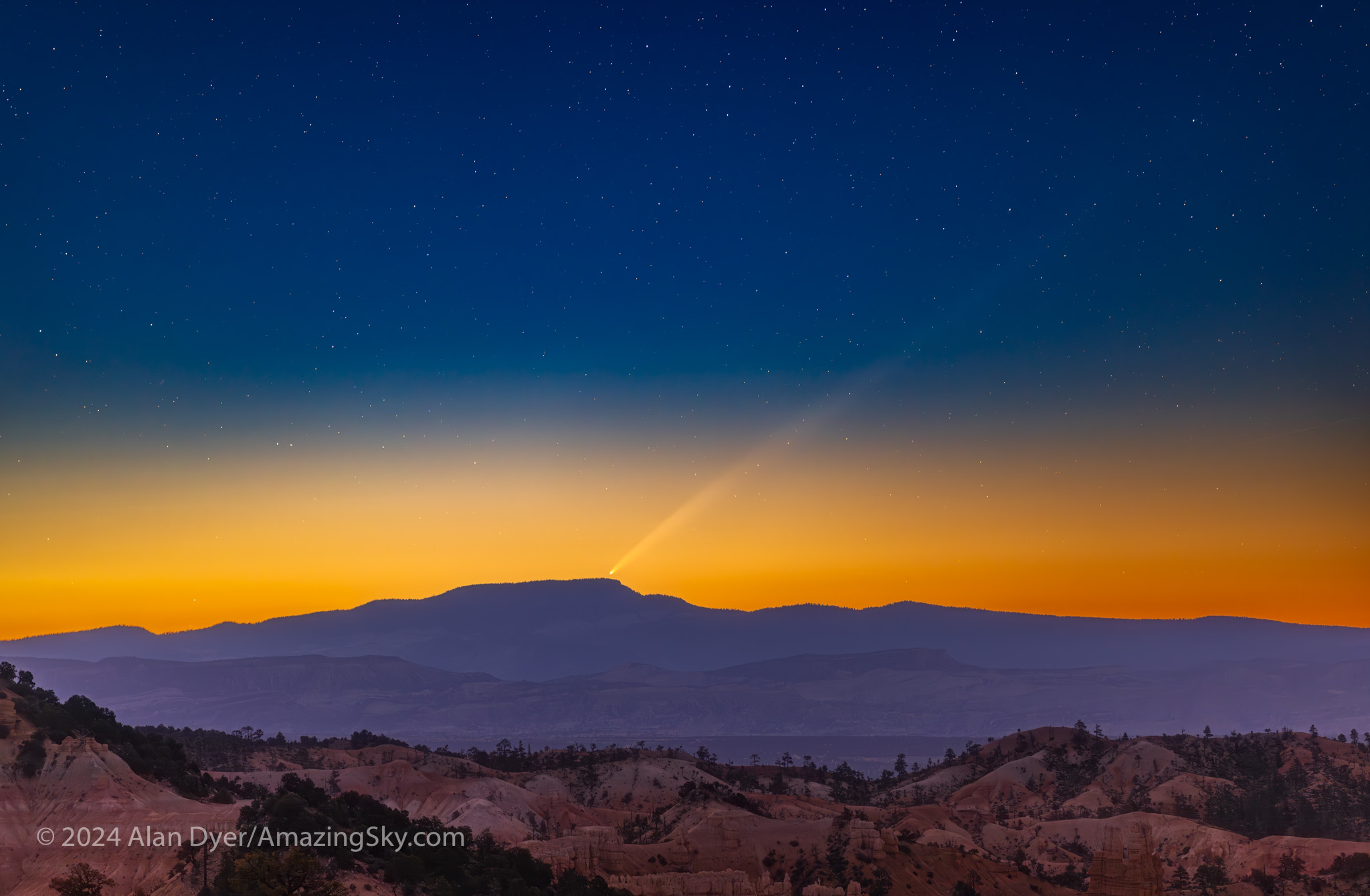
Comet C/2023 A3, Tsuchinshan-ATLAS, rising in the twilight over Bryce Canyon, on September 28, 2024.

Knowing better what to look for, I caught the comet a little sooner the next morning on September 28, and so the tail appeared longer and more impressive as it rose above the distant mountains. A group of other local photographers arrived just a few minutes too late both mornings, and so struggled to just sight the comet, let alone photograph it. 
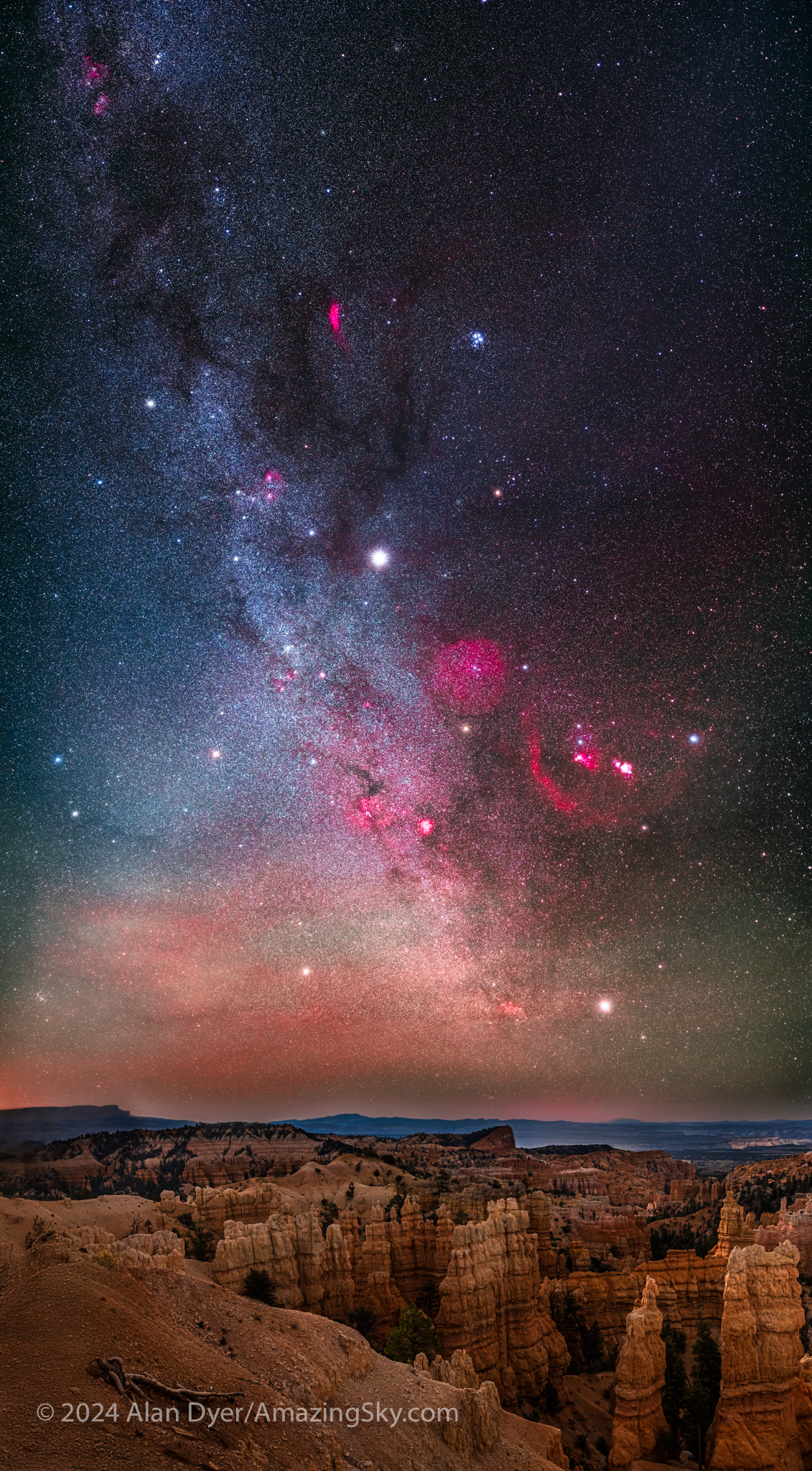
This vertical panorama takes in the nebula-rich northern winter Milky Way over the formations of Bryce Canyon National Park, from the Fairyland Canyon viewpoint.

But I had arrived extra early, to shoot a vertical panorama (above) of the winter Milky Way over the canyon formations below. This and the comet images were shot with the aid of a sky tracker to follow the stars, but with the tracker off for separate shots of the ground. 

So I had bagged the comet at Bryce! On to the next stop.


September 28 & 29 โ€” at Monument Valley, Utah

Thereโ€™s no more iconic or famous landscape in the American West than the buttes of Monument Valley, on the Navaho Tribal Lands on the Arizona/Utah border. 

This panorama from the Navaho Tribal Park at Monument Valley shows the evening twilight sky looking east opposite the sunset to the rising dark blue arc of Earth’s shadow cast on the atmosphere. The shadow is rimmed with a pink “Belt of Venus” tint from sunlight still hitting the upper atmosphere.

A clear first evening provided a fabulous view of the arc of Earthโ€™s shadow across the eastern sky from the viewpoint near the aptly named The View Hotel. 
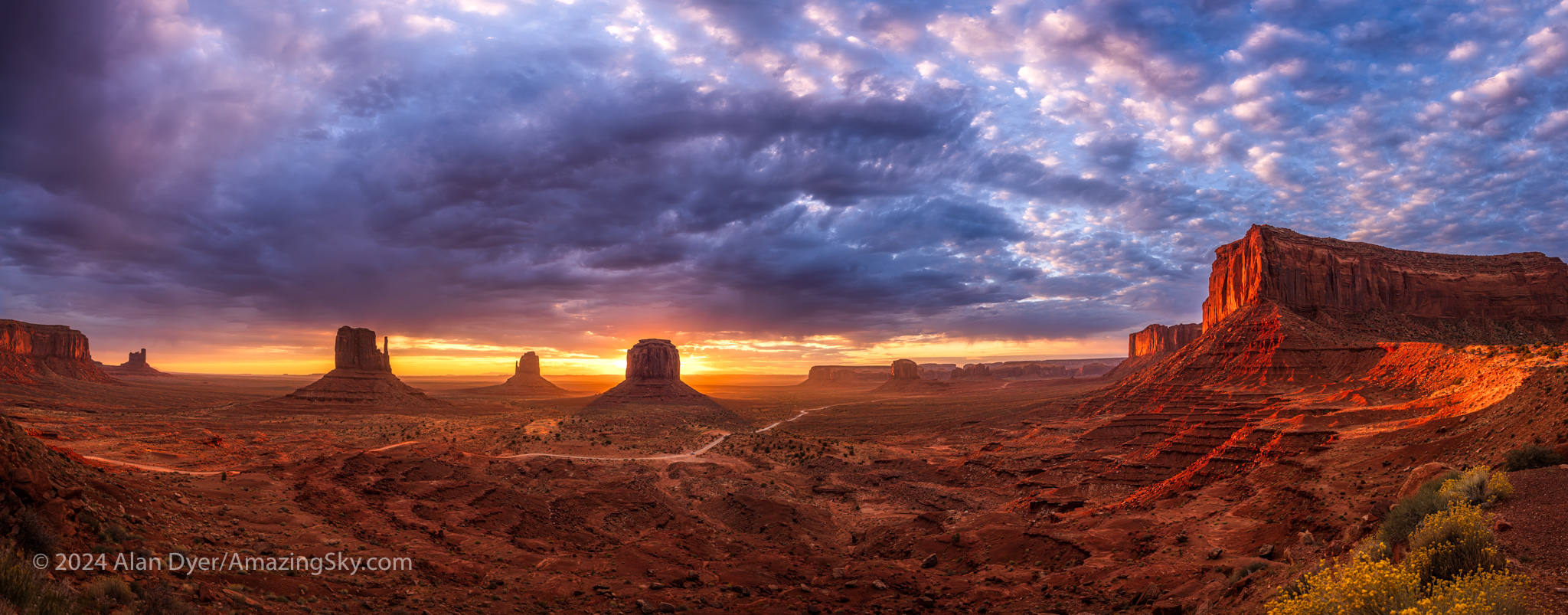
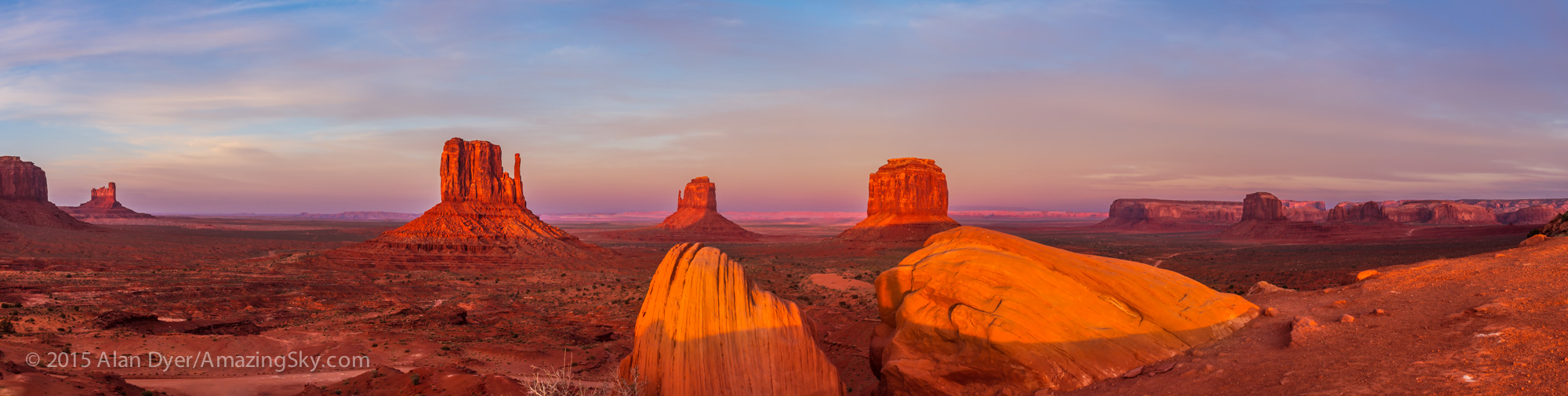
This is a panorama of the sunrise scene at the Navaho Tribal Park, Monument Valley, Arizona, taken just after sunrise with the low Sun lighting the iconic buttes and mesas of the Valley. The West and East Mittens are at left; the Sun was behind Merrick Butte at centre, and lighting Mitchell Mesa at right.

A wonderful sunrise on my second morning there made for a spectacular panorama. But while clouds created fine sunrise lighting, they arenโ€™t conducive to seeing comets!

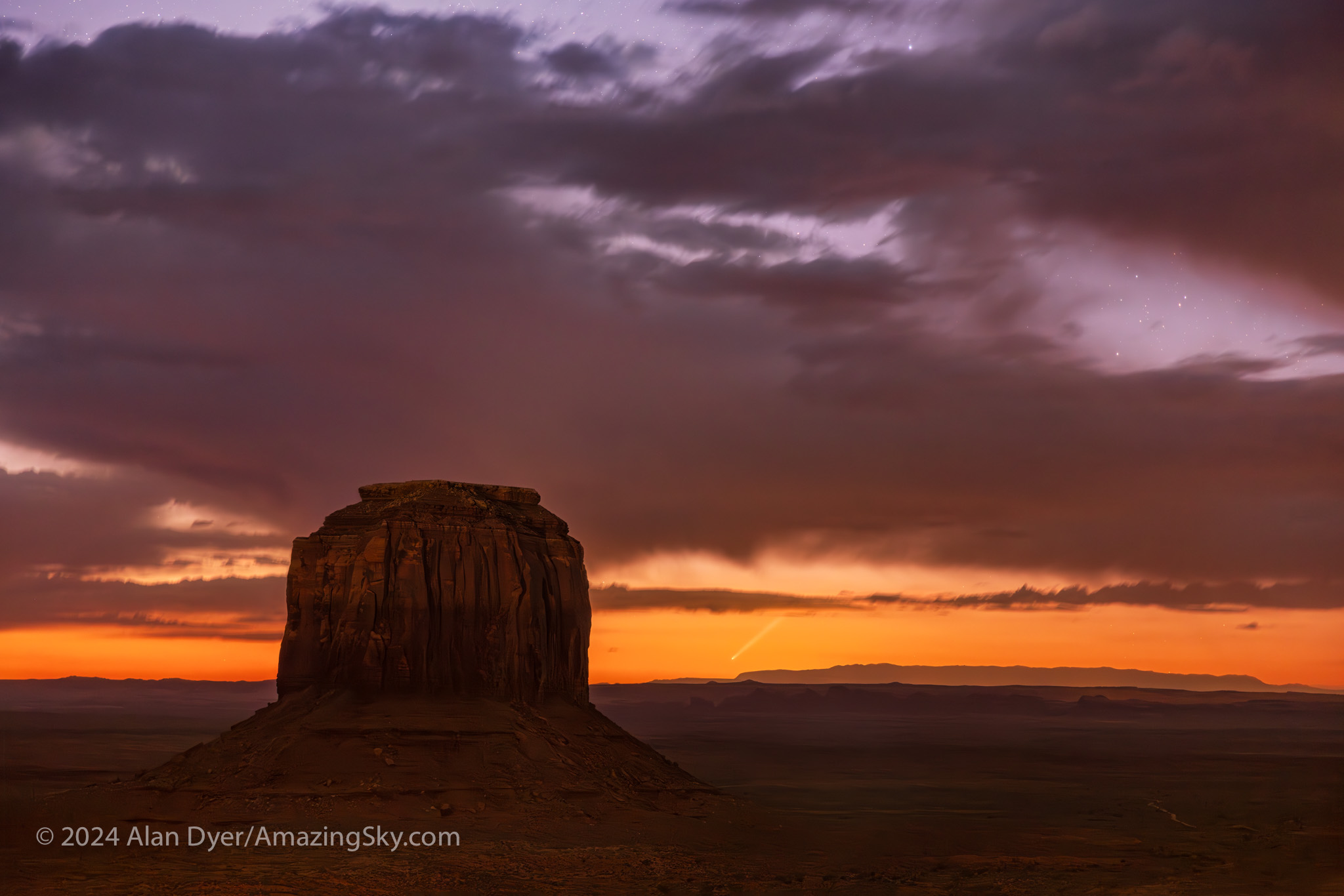
Comet C/2023 A3, Tsuchinshan-ATLAS (at centre), is rising in the dawn twilight over Monument Valley, Arizona on the morning of September 30, 2024. The comet is rising just south (right) of Merrick Butte.

A band of clear sky near the horizon allowed me to catch the comet rising to the right of Merrick Butte, as seen from a spot south of The View from where I had calculated the comet would rise in the right position. From the usual Valley viewpoint farther north the comet would have been behind the butte. 

While the planning worked, the result was not quite the spectacle I had envisioned. The comet was nice, but was starting to become lost in the bright sky as it descended toward the Sun. 

There were only a couple of mornings left to catch the comet at dawn before it disappeared completely into the daytime sky close to the Sun. 


October 1 to 11 โ€” at Quailway Cottage, Arizona

The major block of time in my trip was booked for an astrophoto retreat at a cottage Iโ€™d rented twice before but not since late 2017. The Quailway Cottage, popular among birders, is also ideal for stargazing as it is in one of the darkest areas of the Southwest, north of Douglas, Arizona, and just across the Arizona/New Mexico border. 

This captures both the glow of Zodiacal Light in the eastern dawn sky (the band of light extending up across the frame) and the dust tail of Comet Tsuchinshan-ATLAS rising from behind the Pelloncillo mountains, at dawn on October 2, 2024.

When I arrived the comet was putting in its last show in the dawn sky. In fact, on October 2 I managed to capture a dawn scene with the morning Zodiacal Light created by sunlight reflecting off cometary dust in the inner solar system, and just the tail of the comet rising before the bright comet head appeared.
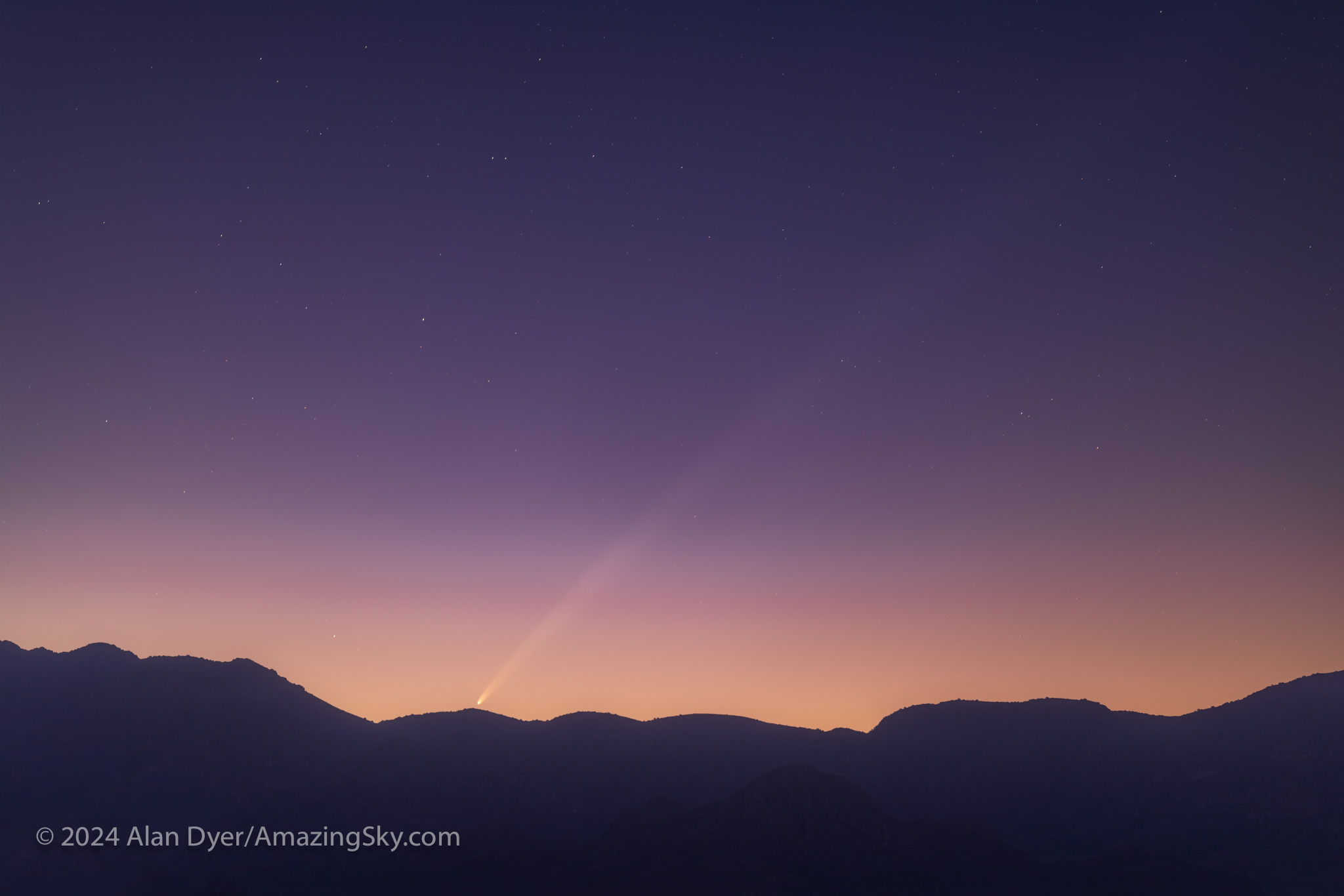
Comet C/2023 A3, Tsuchinshan-ATLAS, is rising in the dawn twilight over the Pelloncillo Mountains in New Mexico, on October 2, 2024.

An image taken a little later showed the entire comet, now sporting a more impressive tail. It was blossoming into a fine comet indeed. But we were about to lose sight of it for more than a week. 

Arizona Deep-Sky Imaging 

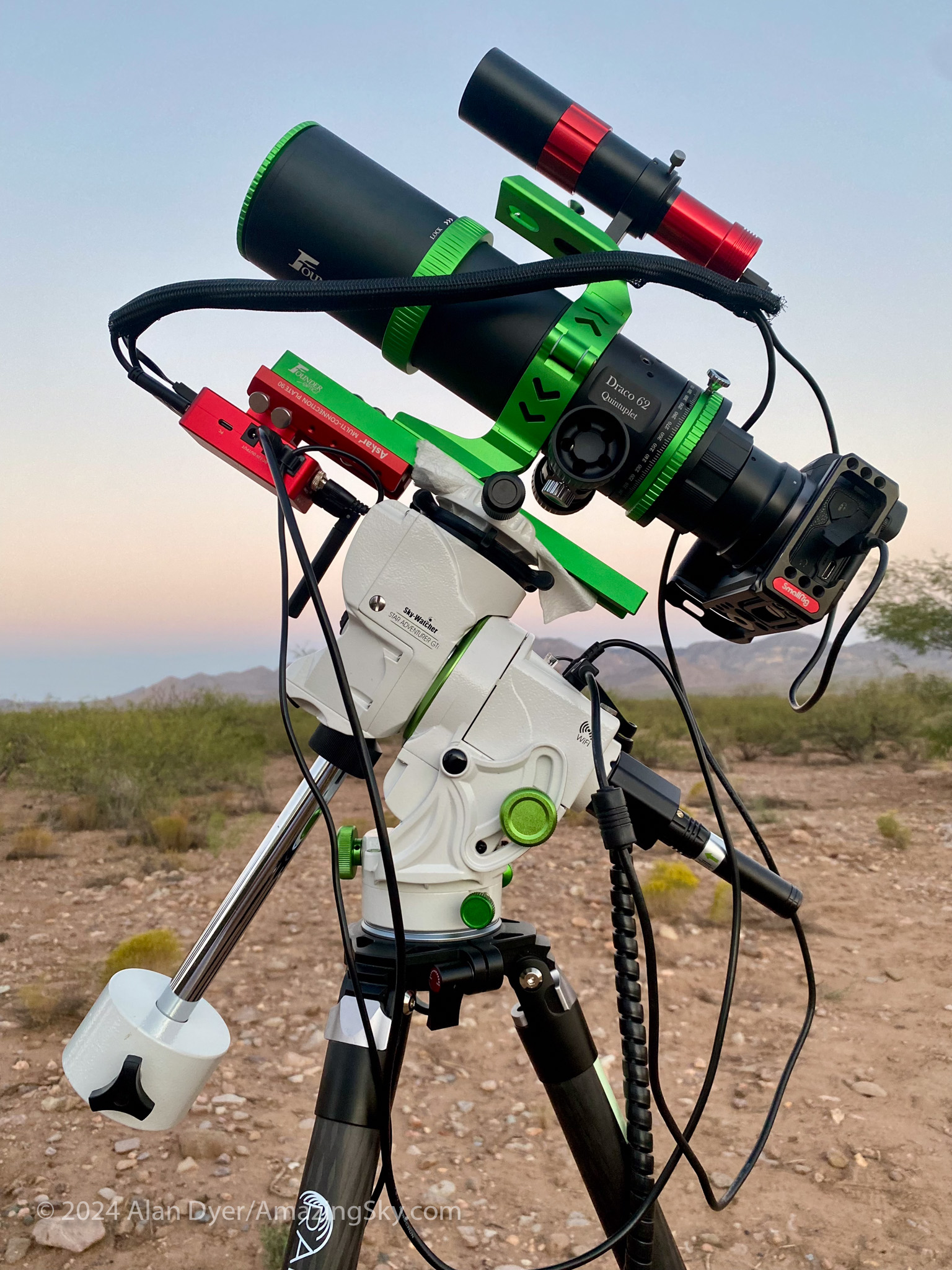
While at Quailway I had clear skies every night. And so, as planned, I went to town shooting all kinds of โ€œdeep-skyโ€ objects and fields with two astrophoto rigs I had brought with me: a longer-focal length 120mm refractor for small targets, and a short-focal length refractor for wide fields in the Milky Way. I had reviewed both new telescopes in recent months. 
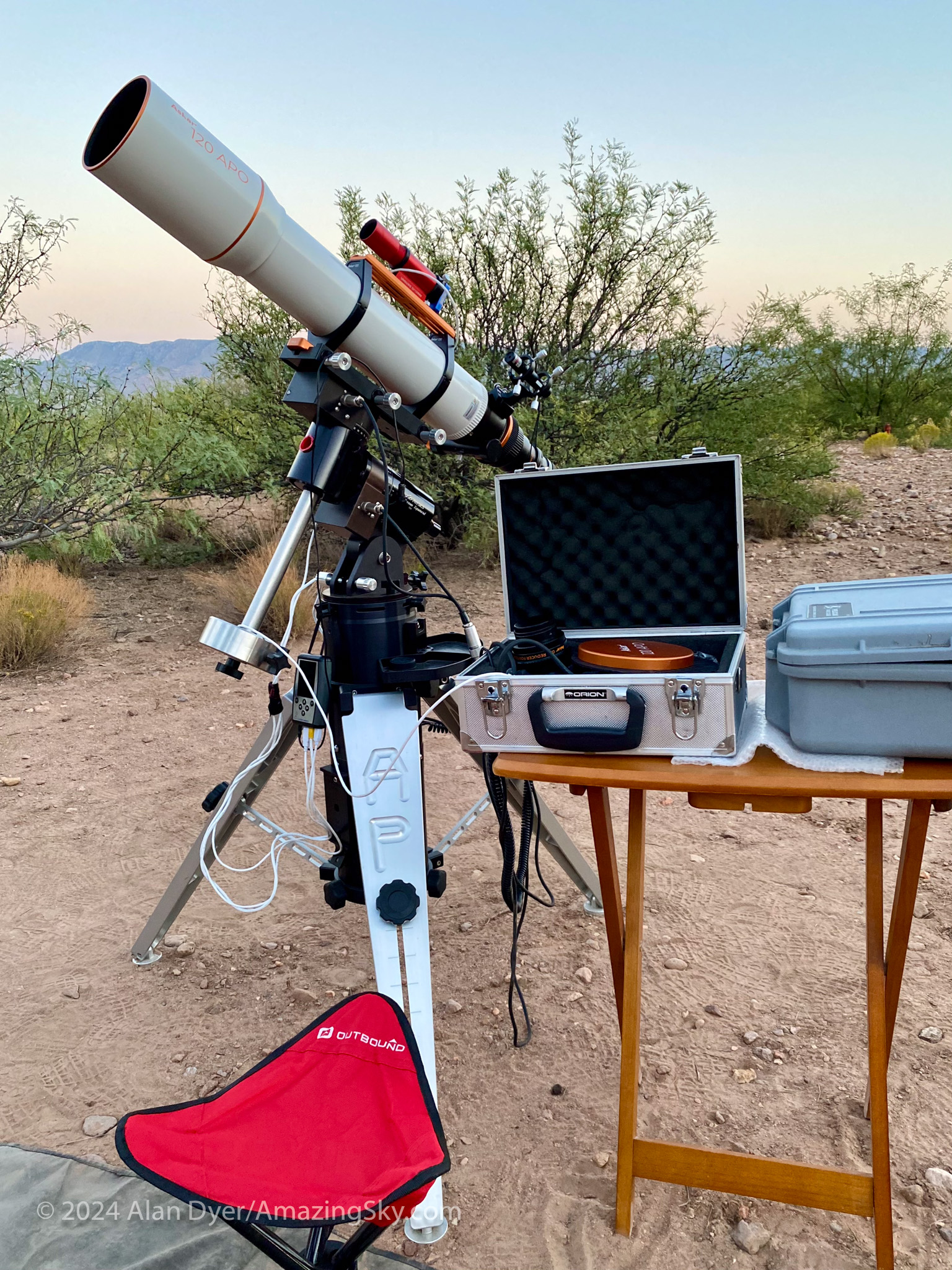
I concentrated on shooting targets low in the south that are impossible to get from home in Canada, and that Iโ€™ve missed shooting, or have not shot well, during my visits to Australia.ย See my blog here about my latest trek Down Under.
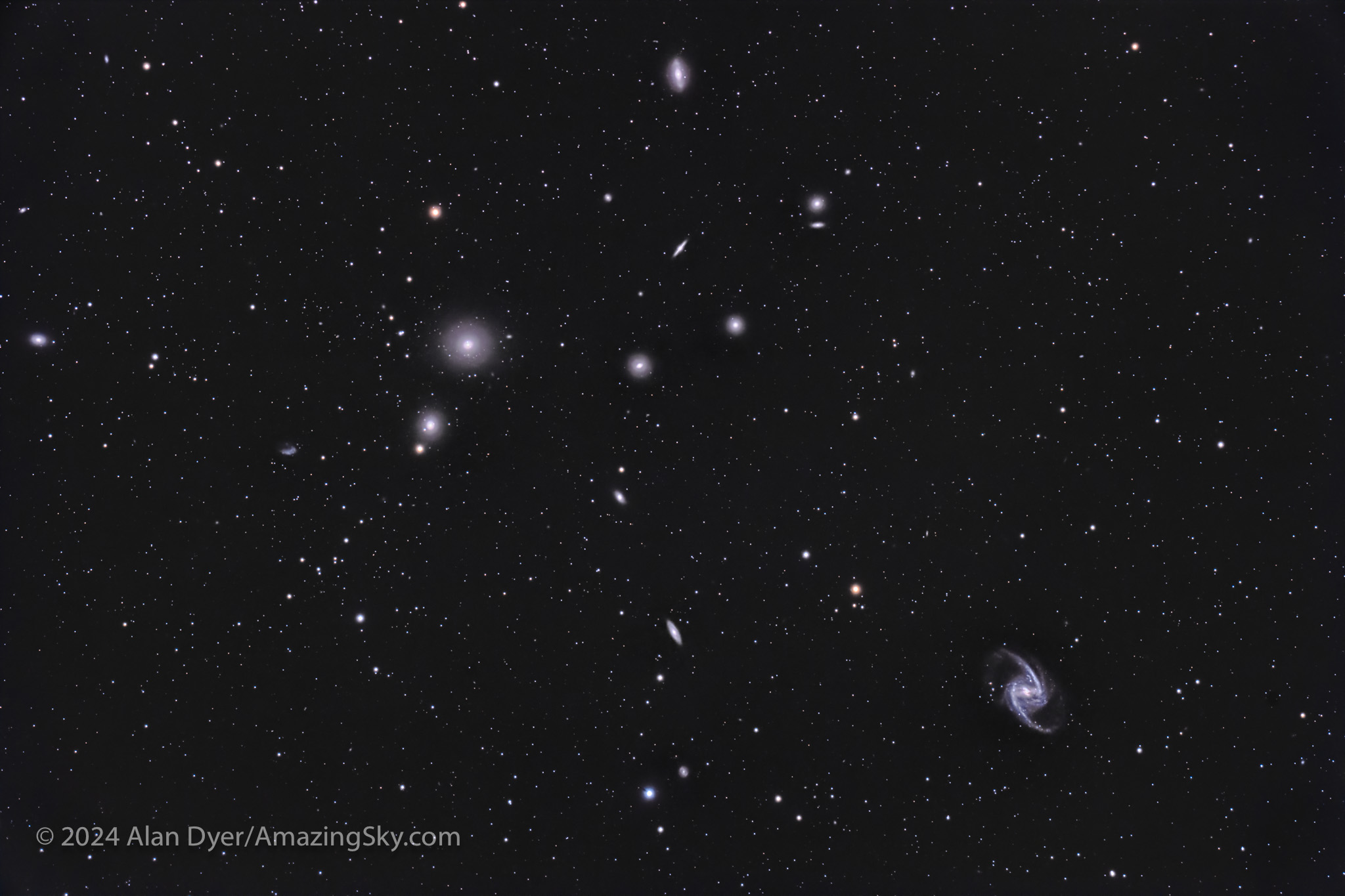
The two brightest Fornax cluster members are the elliptical galaxy NGC 1399 at upper left, paired with smaller NGC 1404, and the galaxy NGC 1365 at lower right, considered one of the best barred spirals in the sky.

Hereโ€™s an example, above, with the larger Askar 120APO: a field of galaxies in the constellation of Fornax that rivals the better-known Markarianโ€™s Chain of galaxies in Coma Berenices in the northern spring sky.
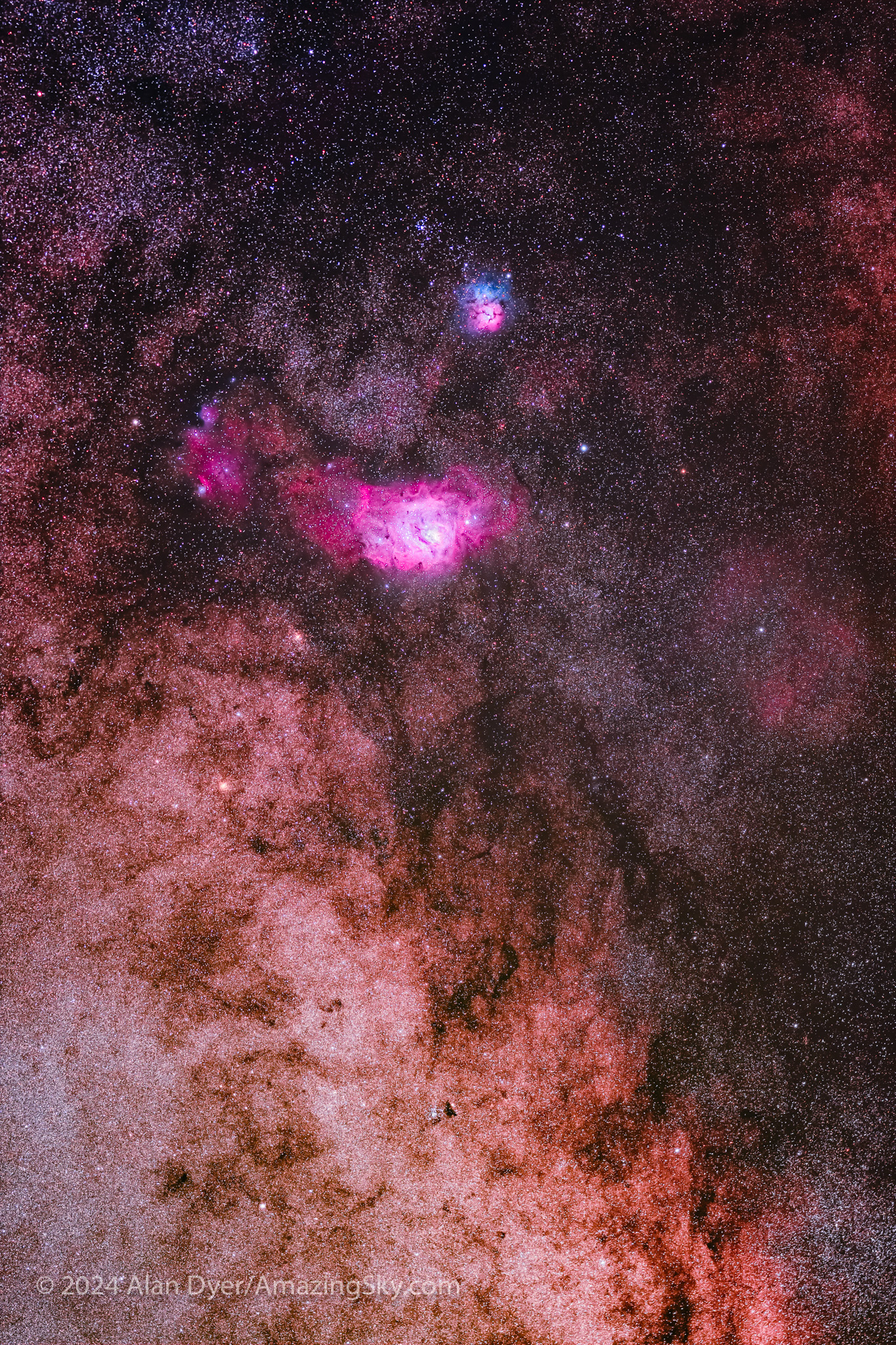
This frames the spectacular region of the Milky Way near the direction of the galactic centre in Sagittarius.

And hereโ€™s a field (above) with the small Founder Optics Draco 62mm scope, framing the rich Sagittarius Starcloud punctuated with the small dark Ink Spot Nebula, all below the bright Lagoon and Trifid Nebulas. 
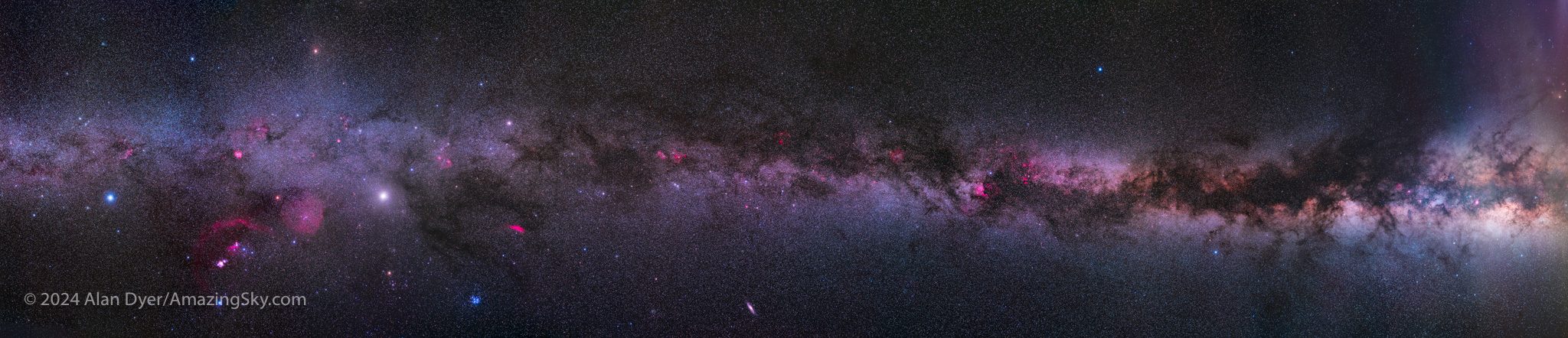
This panorama extends for about 240ยบ along the northern half of the Milky Way, from Orion at left, to Sagittarius at right, and centered on the Galactic Equator.

In autumn the Milky Way is up all night. So I used a simple star tracker, the MSM Nomad reviewed here on my blog, and a 28-70mm lens at 35mm to shoot a panorama from dusk to dawn along the Milky Way โ€” from the summer stars of Sagittarius and Cygnus (at right, above), through the autumn constellations overhead in Cassiopeia and Perseus (at centre), and down into the pre-dawn sky with the winter stars in and around Orion (at left). 

A Bonus Aurora from Arizona 

I was just north of the Mexican border, at a latitude 32ยฐ North, more than 20ยฐ farther south than at home in Alberta. But what should appear in my sky but โ€ฆ aurora! 

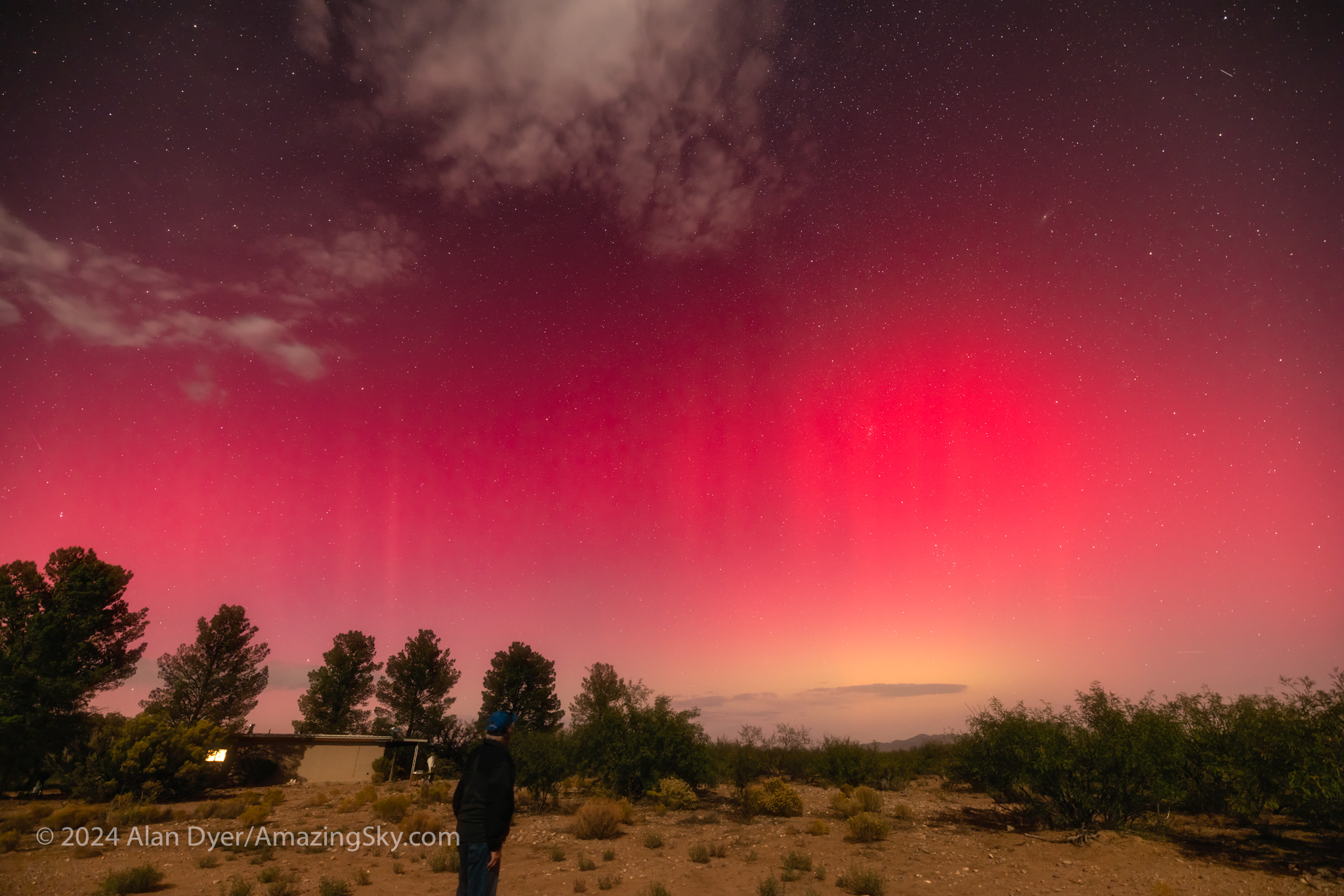
A selfie of me observing the great red aurora of October 10, 2024, from southern Arizona.

On October 9, and then again more so on October 10, a great solar storm brought Northern Lights down to me. And indeed across all of Canada and the U.S. The result for me was a red glow to the north โ€” the tops of distant auroral curtains I would have seen filling my sky at home. 

A time-lapse of an Arizona aurora, using a 15mm wide-angle lens shooting nearly 400 forty-second exposures. View it in-line here. Enlarge to a full screen view. There is no sound.

Above is a time-lapse video of the aurora that night, from a camera aimed due north for four hours. The red curtains come and go through the night.
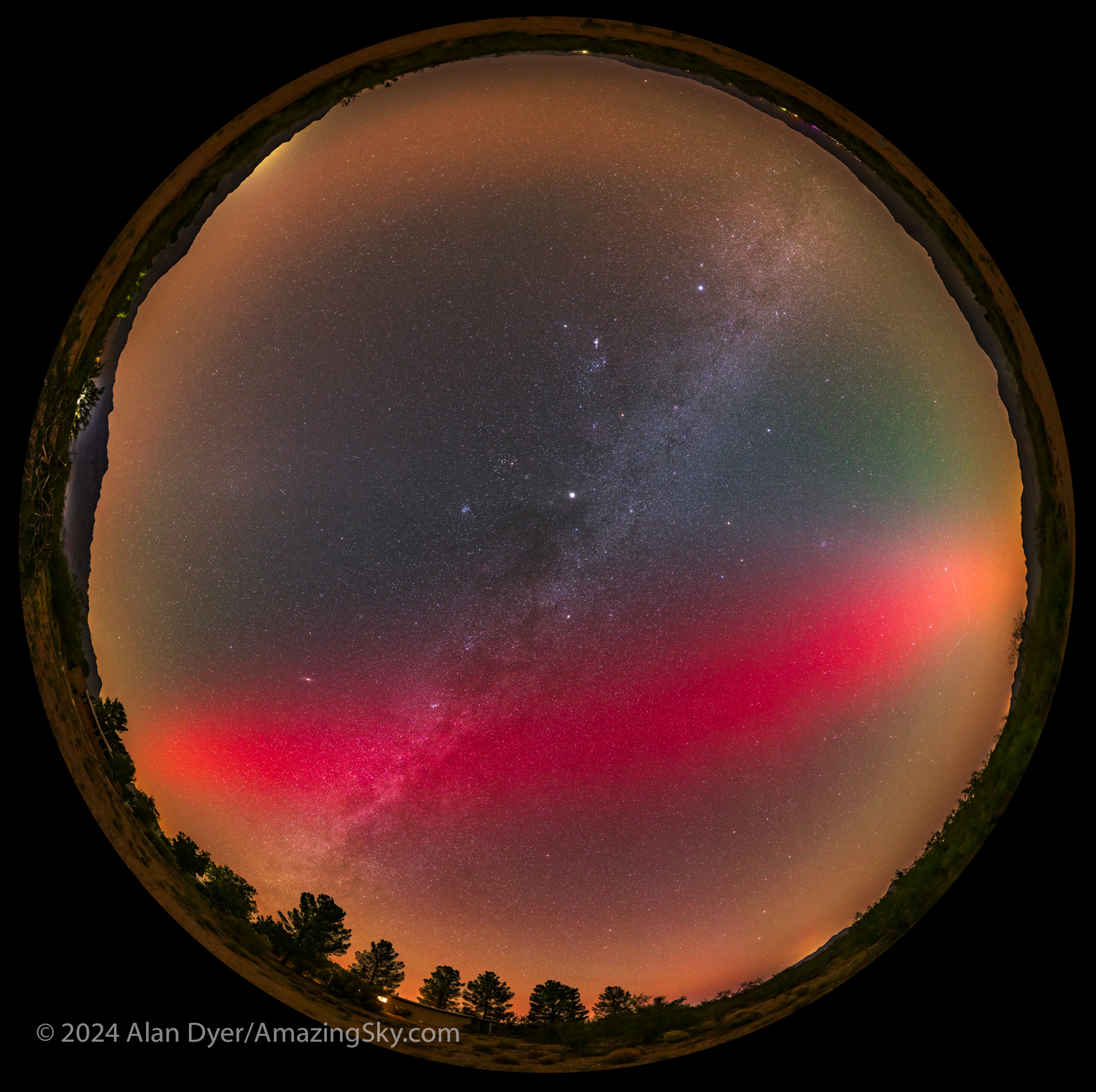
This is a 360ยฐ panorama covering the entire sky and extending up to the zenith at centre, capturing a rare SAR arc across the Arizona sky in the pre-dawn hours of October 11, 2024.

The remarkable feature that night, October 10/11, was not the aurora, but what is called a SAR (Stable Auroral Red) arc that persisted all night. It appeared as a diffuse red band across the sky, created by heat energy leaking into the upper atmosphere during the solar storm. SAR arcs can accompany an aurora but are not auroras themselves. 
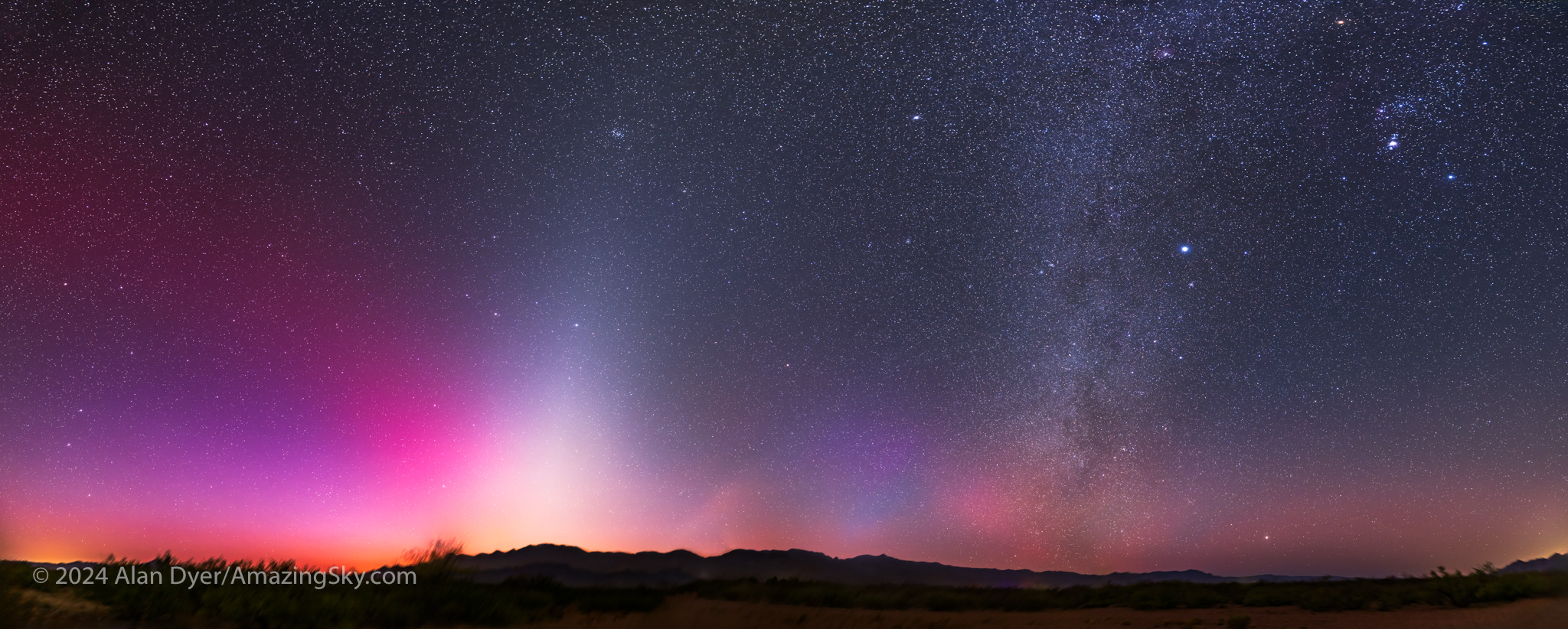
This panorama takes in a rare confluence of skyglows in a colourful dawn sky.

By dawn the next morning, now October 11, the tall Zodiacal Light was prominent alongside the magenta SAR arc to the north (left) and the winter Milky Way to the south (right). Thereโ€™s even a short pillar of light that might be an aurora fragment, or the tail of the comet!  

The Comet Returns 

However, toward the end of my 11-night marathon of deep-sky imaging, the bright head of the comet was to be rising into the evening sky for Part 2 of its apparition. Below is a shot from the evening of October 11, my last at Quailway. Yes, there it was, just above the Chiricahua Mountains. But it was a blip, barely visible in binoculars and to the camera. I had hoped for more. 

This is Comet Tsuchinshan-ATLAS (C/2023 A3) at far right, barely visible emerging into the evening sky and low in the twilight, on October 11, 2024. This view includes Venus at left. Venus was obvious; the comet was not!

With the Moon now waxing into the evening sky, my plan was to head back north, stopping at scenic spots on the trip home, to catch the comet over moonlit landscapes to the west in the dusk sky.

My first two nights, October 12 and 13, at the VLA Radio Observatory near Socorro, New Mexico, then farther north near Canyon de Chelly, Arizona, were both beset by clouds to the west. From images posted on-line, I knew the comet was improving. But it was eluding me. 


October 14 & 15 โ€” at Arches National Park, Utah

The next stop was Arches National Park in Utah, which I last visited in April 2015. The first nightโ€™s forecast for October 14 also looked to be cloudy. But October 15 was supposed to be clear. So I extended my stay by an extra night, thinking that might be my only chance.ย 

As it turned out October 14 was fabulous (below). The comet was easily visible to the unaided eye as a classic comet in the west. I pointed it out to folks walking by at the Windows Arches area. And I could hear other people commenting on it. At last a comet! One that anyone could see โ€” though it helped to be at a clear sky site like Arches. 
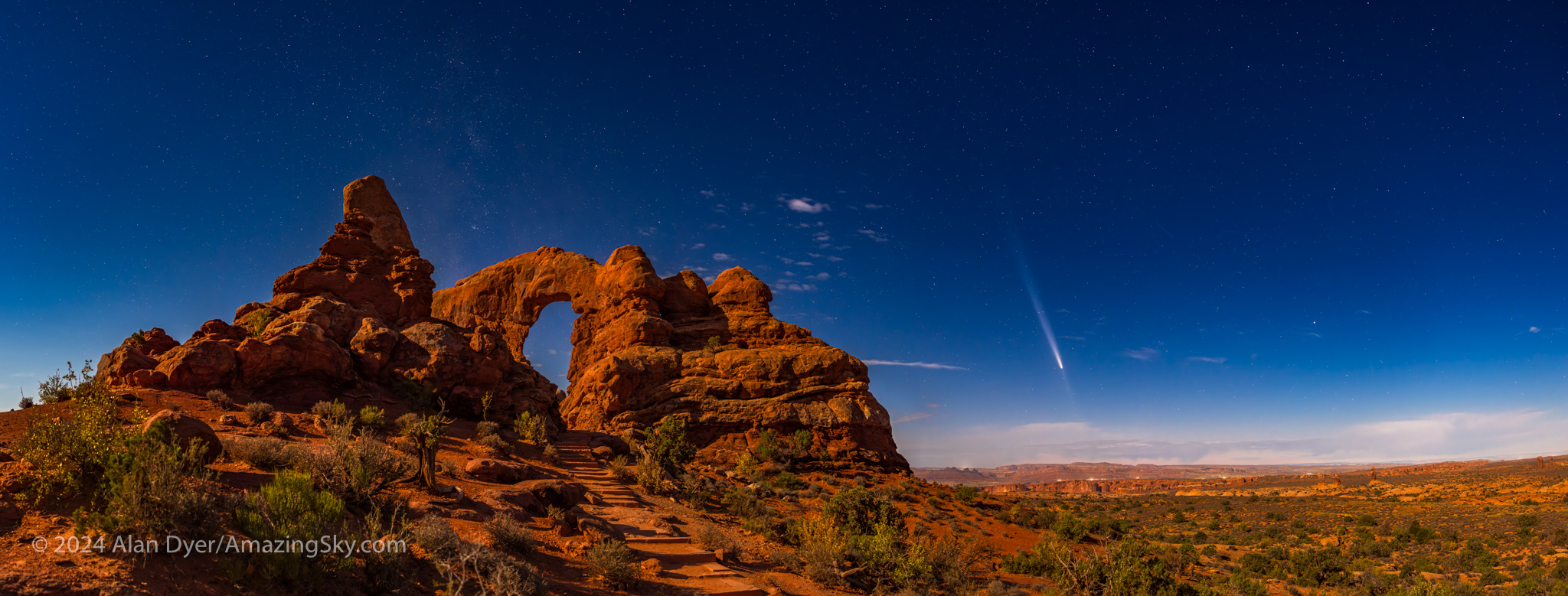
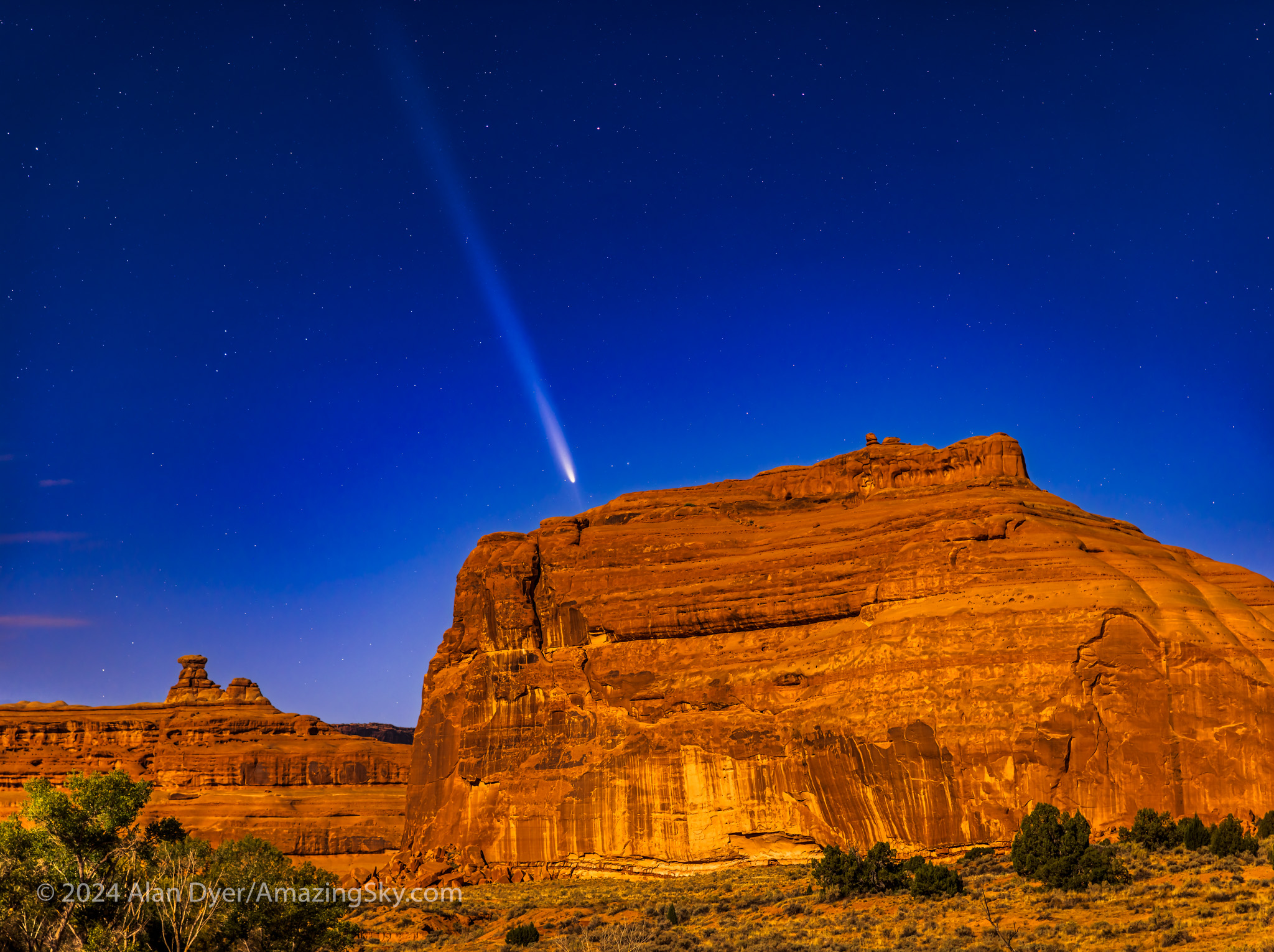
Comet Tsuchinshan-ATLAS at its finest in the evening sky, two days after its closest approach to Earth, and with it sporting a 10ยบ- to 15ยบ-long dust tail, and a narrow anti-tail pointed toward the horizon.

By then the Moon was well advanced in age to a bright gibbous phase, so the sky was by no means dark. It was deep blue in photos.

Still the comet showed up brilliantly; it had blossomed a lot in a couple of nights. Above, I framed it beside moonlit Turret Arch.

Below is a scene from the next night, October 15, my โ€œback-upโ€ night. The comet was certainly performing well after all. Even in the moonlight. In binoculars the tail stretched for the same length as the camera recorded it, some 15ยฐ. 

This is a telephoto close-up Comet Tsuchinshan-ATLAS over the red rocks of Arches National Park, Utah, on a superb moonlit night, October 15, 2024.

Indeed, that was my last view of the comet for a while, as clouds prevented any more shooting on the rest of my journey north through Idaho and Montana.ย I even hit a snowstorm in southern Montana.


Late October โ€” Back at Home in Alberta

But the comet was not done yet! Through October, while it receded from us in distance, it climbed higher into our sky, placing it into a dark sky with the Moon now out of the way.ย 

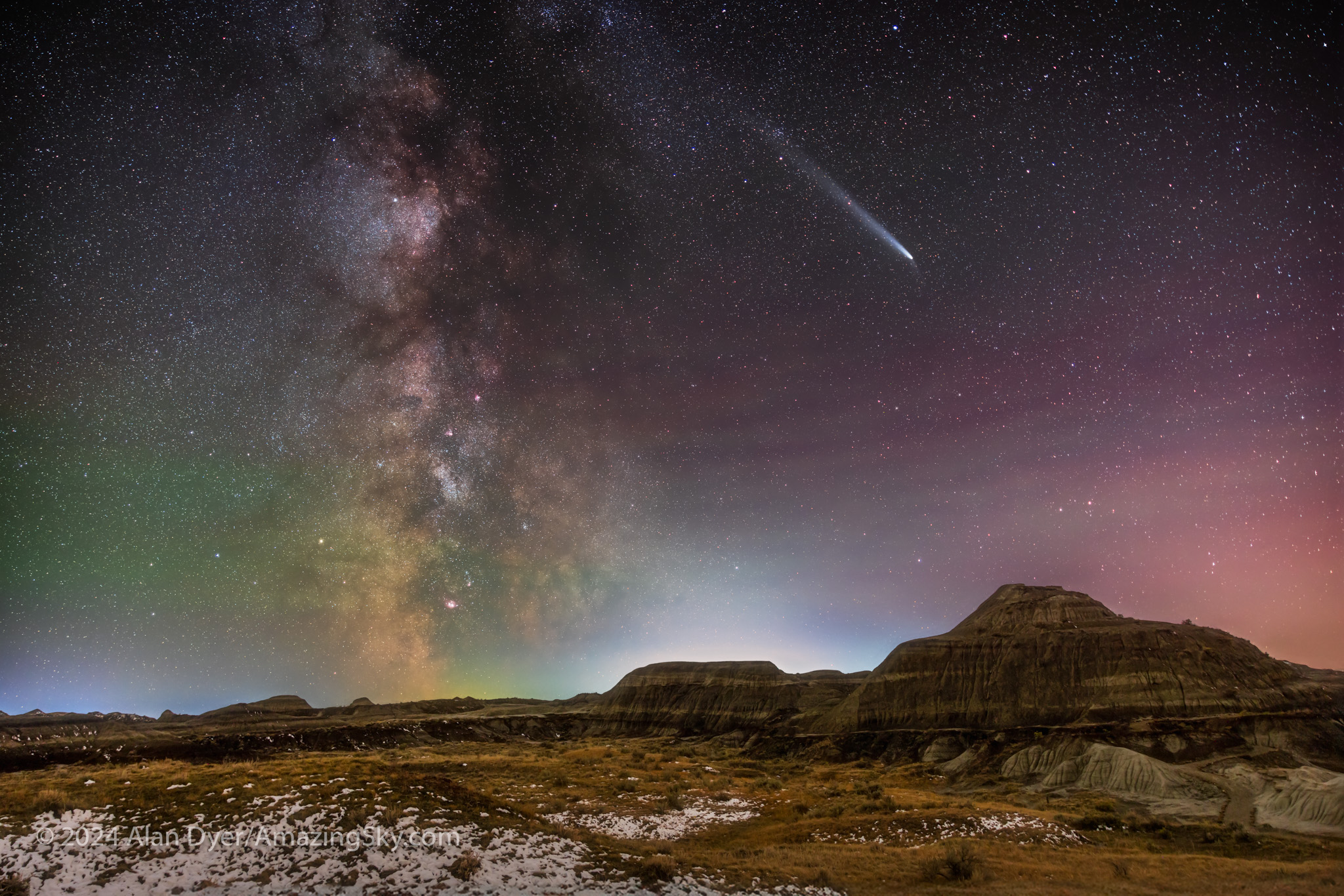
This is Comet Tsuchinshan-ATLAS in a wide-angle nightscape scene over the Badlands of Dinosaur Provincial Park, Alberta, on October 23, 2024.

On October 23, a short trip out to Dinosaur Provincial Park east of home allowed me to shoot the comet over the Alberta Badlands landscape, beside the setting summer Milky Way. 
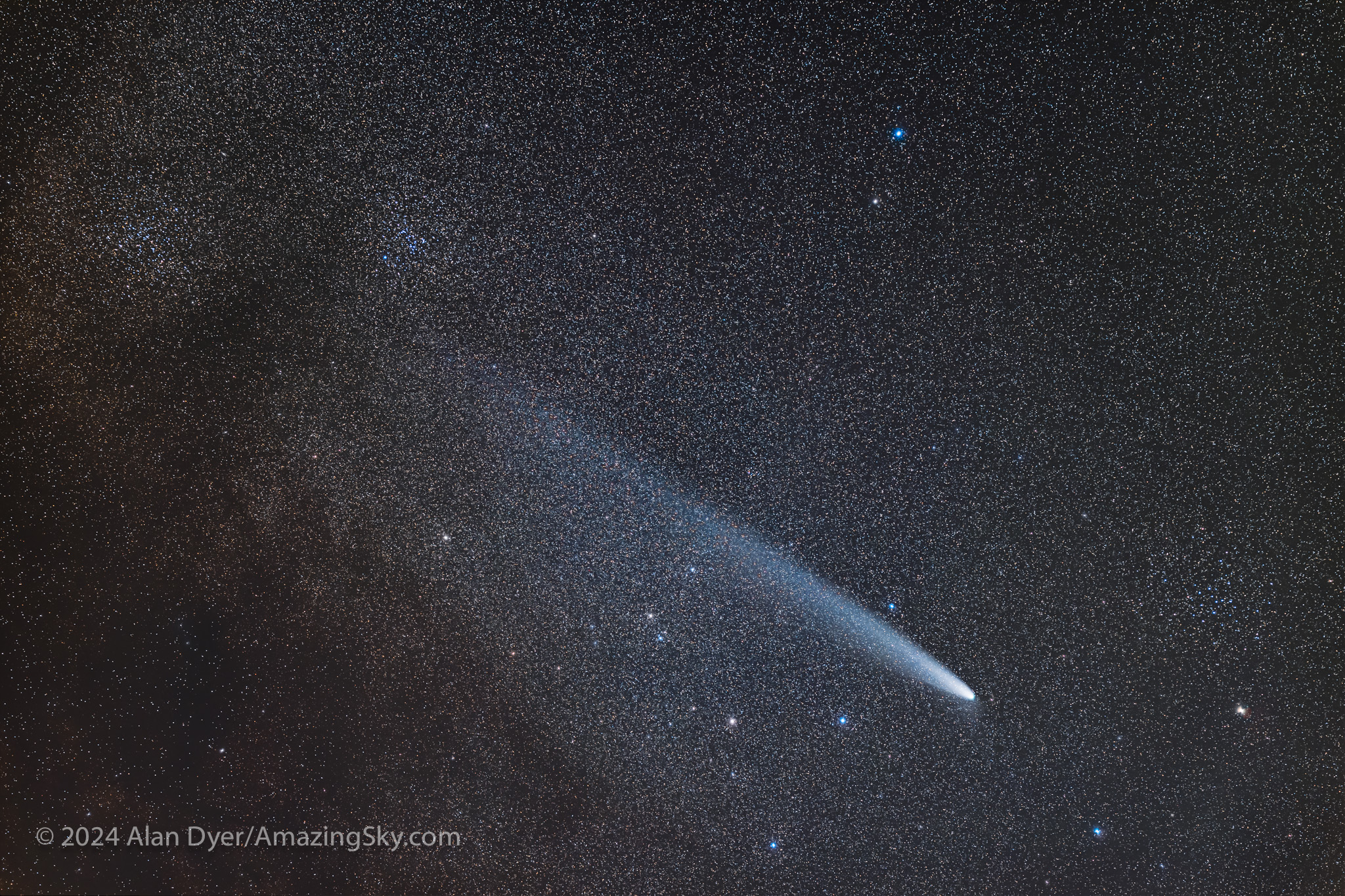
This is a telephoto lens framing of Comet Tsuchinshan-ATLAS in Ophiuchus on the night of October 30, 2024 near several large star clusters. The field of view is 15ยบ by 10ยบ so the tail extends for about 6ยบ to 8ยบ.

By a week later, on October 30, the comet had diminished in size and brightness, but still looked like a classic comet, here framed in a telephoto close-up as it passed near some bright star clusters. This was from my front yard. The chase was over. 

Clouds and a trip to Norway starting November 4 prevented more opportunities to shoot the comet. (My travel schedule also kept me from writing this blog until now!)

It had been a good chase over a month, yielding images I was happy with. The photos from Utah and Arizona I could not have taken at home, even if the skies had been clear during the cometโ€™s prime-time. (They werenโ€™t!) And it was great to finally get back to my favourite haunts in southern Arizona and New Mexico after an absence of seven years.

In all, Comet Tsuchinshan-ATLAS provided a fine finale to what has been a superb year of stargazing events and celestial sights. 

โ€” Alan, December 9, 2024 โ€” AmazingSky.com ย 

Chasing the Annular Eclipse


Like all eclipses, seeing the October 14 annular eclipse of the Sun was not a certainty. As good luck and planning would have it, the sky and location could not have been better!

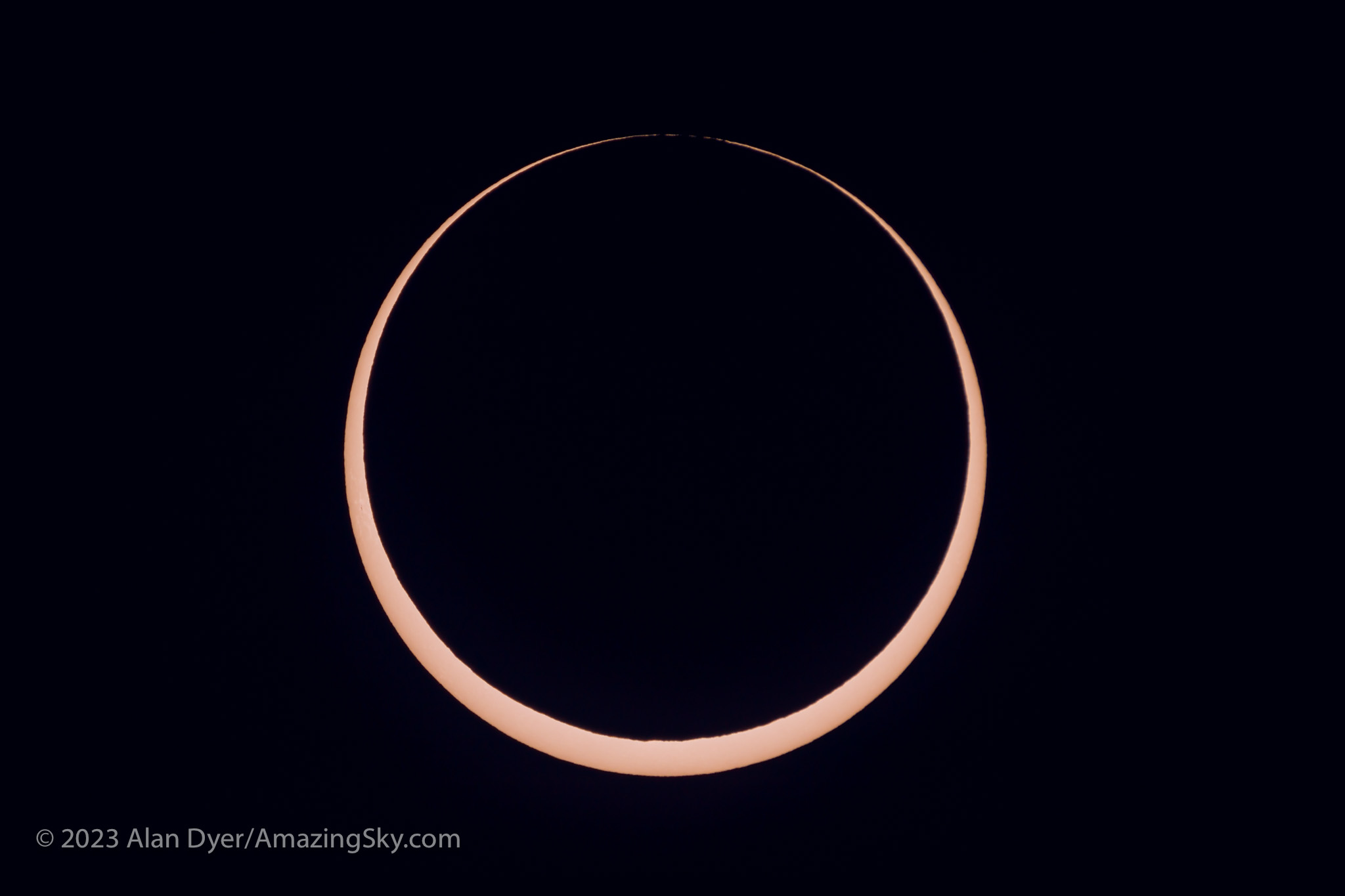
Annular eclipses of the Sun donโ€™t present the spectacle of a total eclipse. Because the Moon is near its farthest point from Earth, its disk is not large enough to completely cover the Sun. At mid-eclipse, as I show below, a ring of sunlight (dubbed a โ€œring of fireโ€) remains, still too bright to view without a solar filter. 

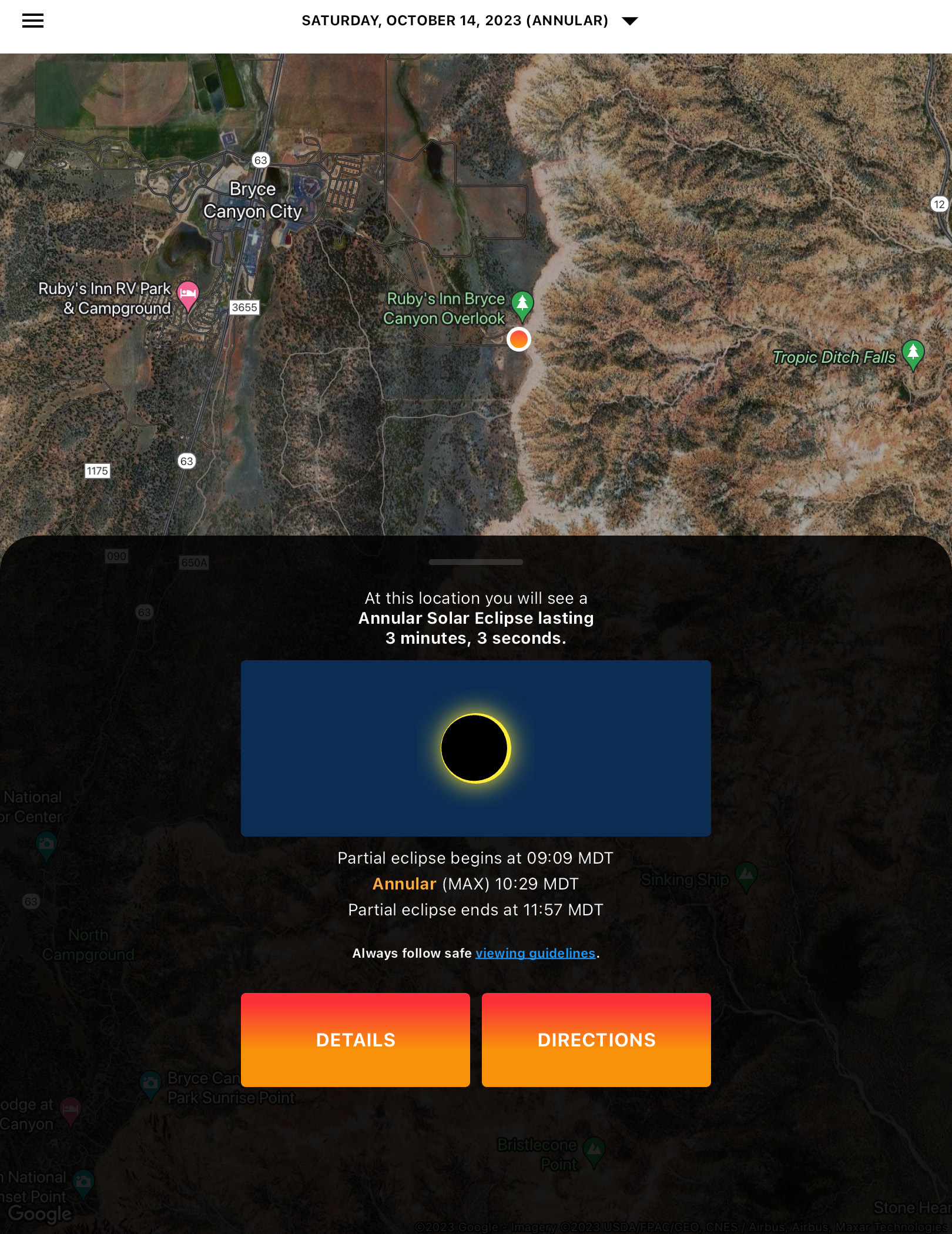
The October 14, 2023 annular solar eclipse, in a single image captured at mid-eclipse, at 10:29 am MDT at the Ruby’s Inn Overlook on the rim of Bryce Canyon, Utah, a site well south of the centreline, with 3m03s of annularity.

While lacking the jaw-dropping beauty of a total, annular eclipses are rare and unique enough that every ardent skywatcher should make a point of seeing one. 

Prior to October 14, I had seen only one, on May 10, 1994, from southeast Arizona, an event I captured on film of course back then. 

A sunset annular on June 10, 2002 that I traveled to Puerto Vallarta, Mexico to see was mostly clouded out. The annular of May 20, 2012 traced a similar path across the U.S. Southwest as the 2023 eclipse. But work commitments at the science centre in Calgary kept me home for that one. A sunrise annular on June 10, 2021 in Northwestern Ontario was essentially out of reach due to COVID travel restrictions. 

With no other annular eclipses within easy reach in North America until 2039 and 2046, this was my next, and perhaps last, opportunity to see one, unless I chose to travel the world. 

I had planned for several months to watch the annular eclipse from southern Utah, ideally from Bryce Canyon National Park, shown above. (Clicking on the images brings them up full screen.) I booked accommodations in January 2023, finding even then that popular hotels in the area were already sold out. 

The final spot for the wide-angle composite shown below. The camera had to be next to that very fence post to frame the scene well.

The attraction was the landscape below the morning Sun, for a planned composite image of the eclipse over the hoodoos of Bryce. However, I had learned weeks earlier that traffic was going to be restricted to just park shuttle buses on eclipse day. Should Plan A not work out then Plan B was Kodachrome Basin, a state park nearby, which a park employee assured me would be open to cars well before sunrise on eclipse day. 

Seen on I-15 past Salt Lake City. Eclipse ahead!

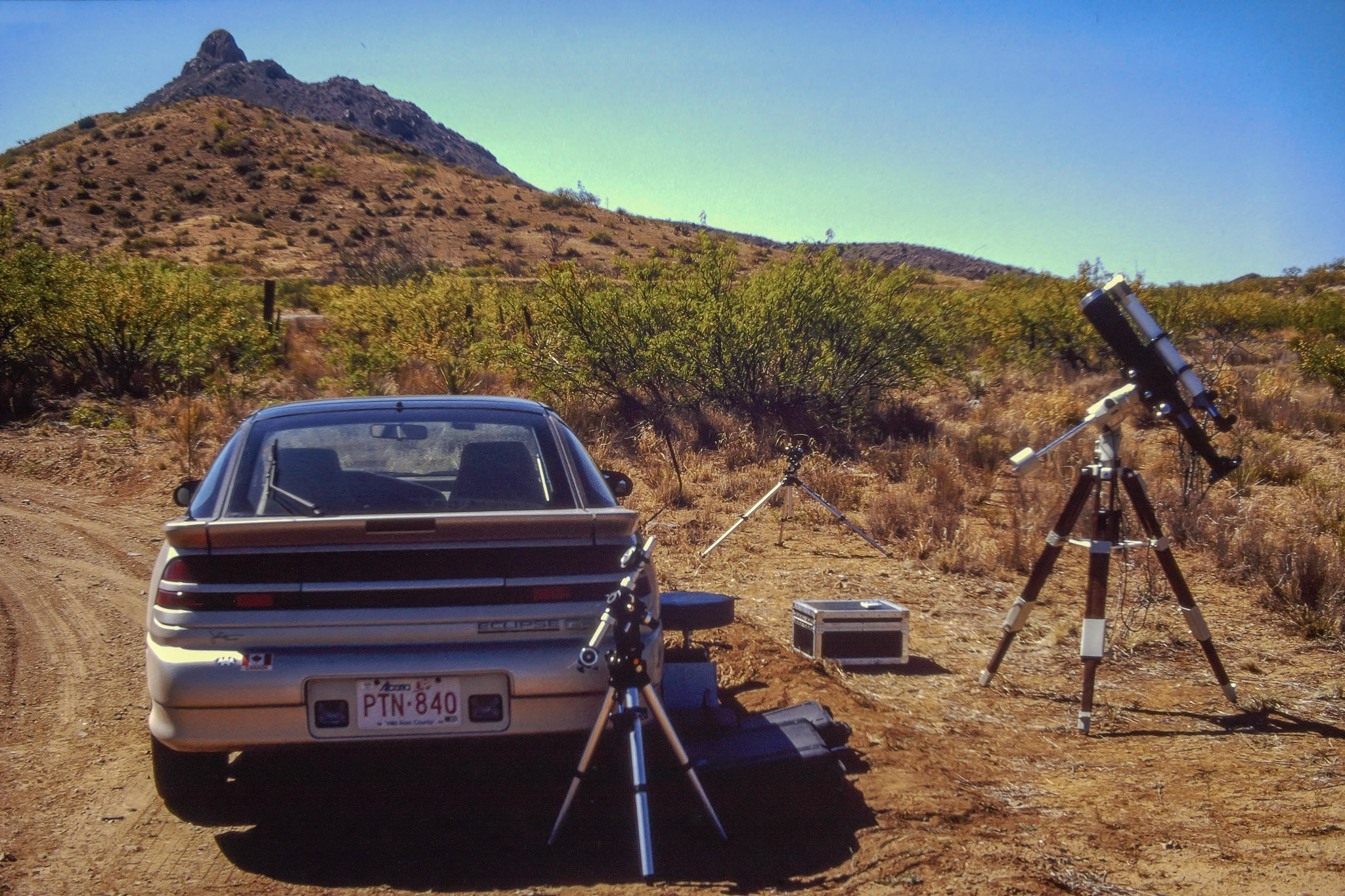
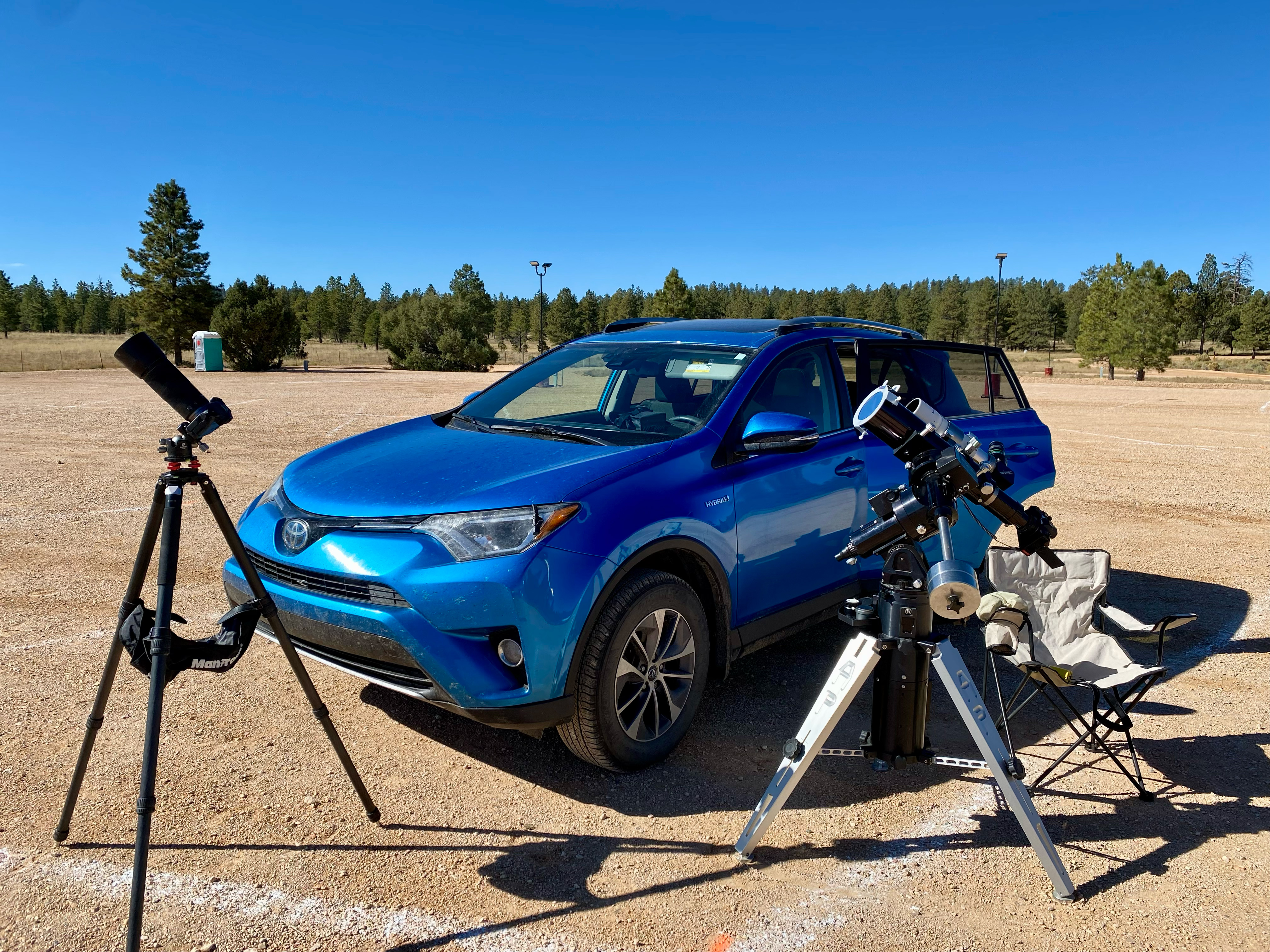
So I made my plans to drive south, taking with me a carload of telescope and camera gear, an array I would never be able to take to an overseas eclipse. The centrepiece was my venerable Astro-Physics Traveler 105mm (4-inch) refractor, a telescope created for the 1991 total eclipse in Mexico. Since I bought mine in 1992 Iโ€™ve used it for five central solar eclipses, including now two annulars. It’s in the 1994 and 2023 site images above.

As per the instructions in my eclipse ebook, I practiced with the gear in the summer of 2023, documented here on my previous blog.

A week before the eclipse (as above at left), the weather prospects for the entire southwest looked poor. It was to be clouds everywhere. I even considered Plan S โ€“ Stay Home! And watch the 60% partial eclipse from Alberta where skies were to be clear. 

But undaunted, six days before the eclipse, I headed south on Interstate 15, checking the weather each day, and seeking out Plan C sites in New Mexico or Texas south of the projected mass of clouds. I checked where accommodation could be had at the last minute. 

At my stop in Richfield, Utah, four days before the eclipse, I had a crossroads turning point: either continue south to Bryce down US-89 (above), or head east on I-70, then south into New Mexico or Texas, with enough time to get there if needed. 

But by now the weather prospects were turning around. By three days out, and with the forecasts now much more reliable, it looked like southern Utah would be in the clear. I continued with my original plan to Bryce. But where exactly?

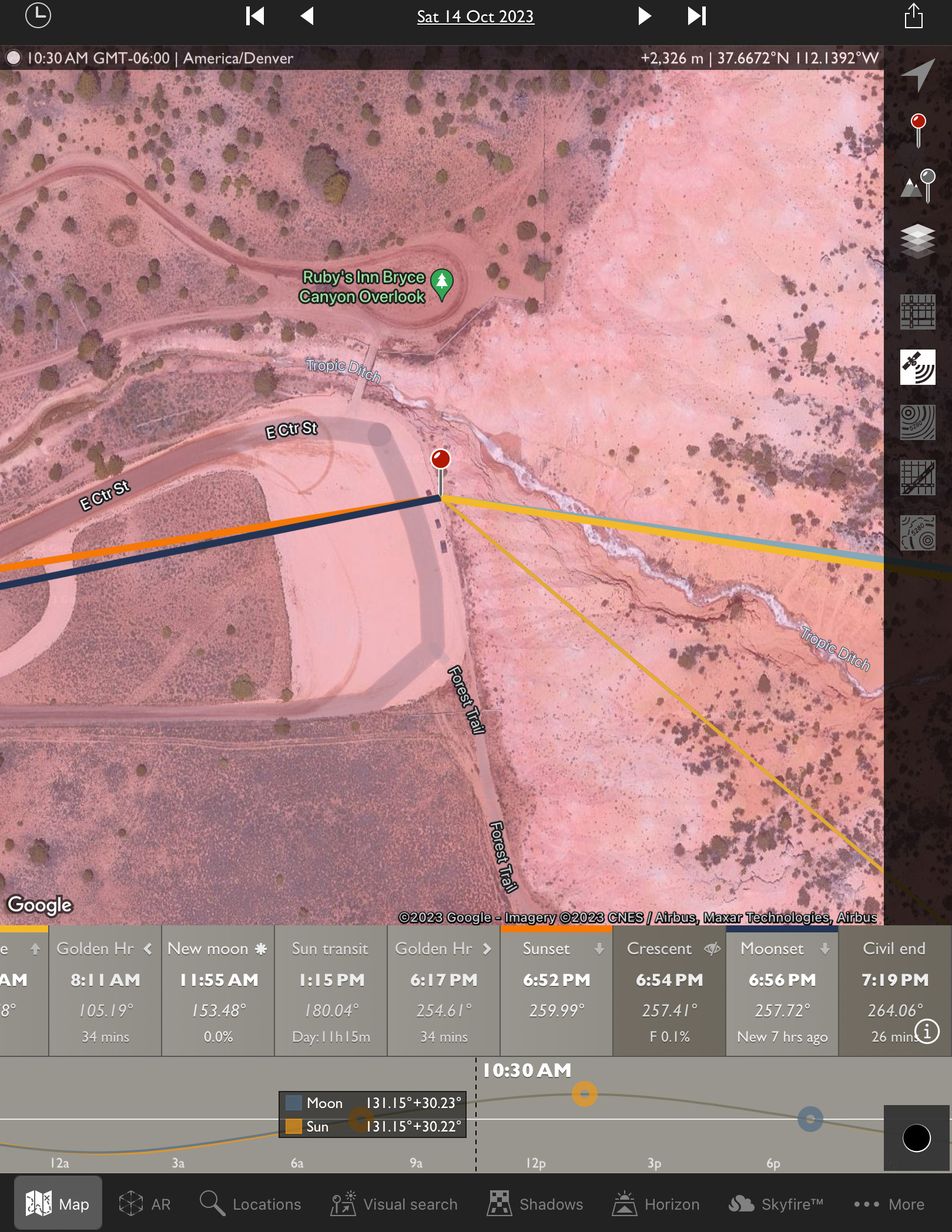
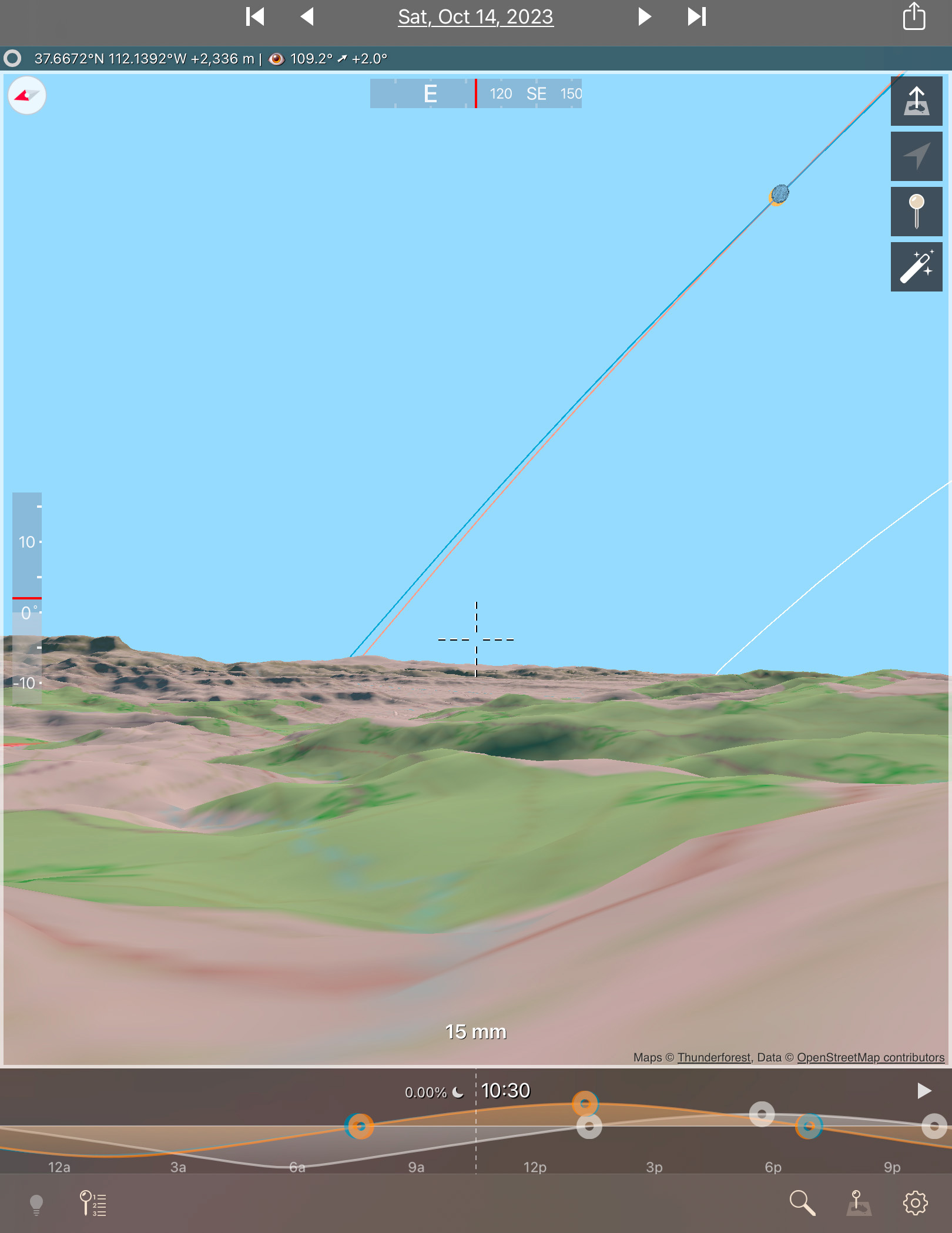
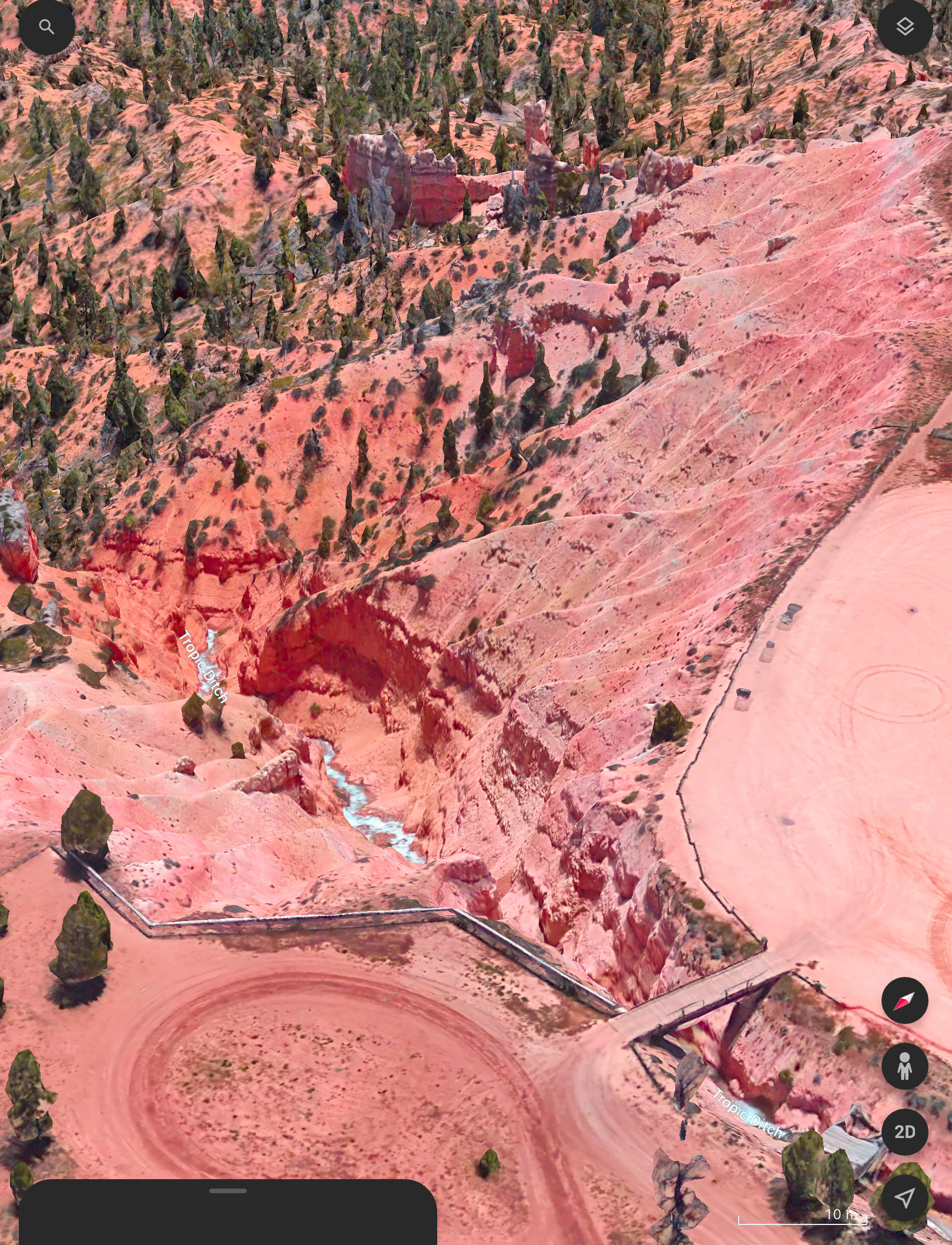
I had looked at possible sites on Google Earth and with the Sun-angle planning apps I use (such as The Photographer’s Ephemeris, or TPE) and found one just outside the Park that I hoped would be accessible to drive into. 

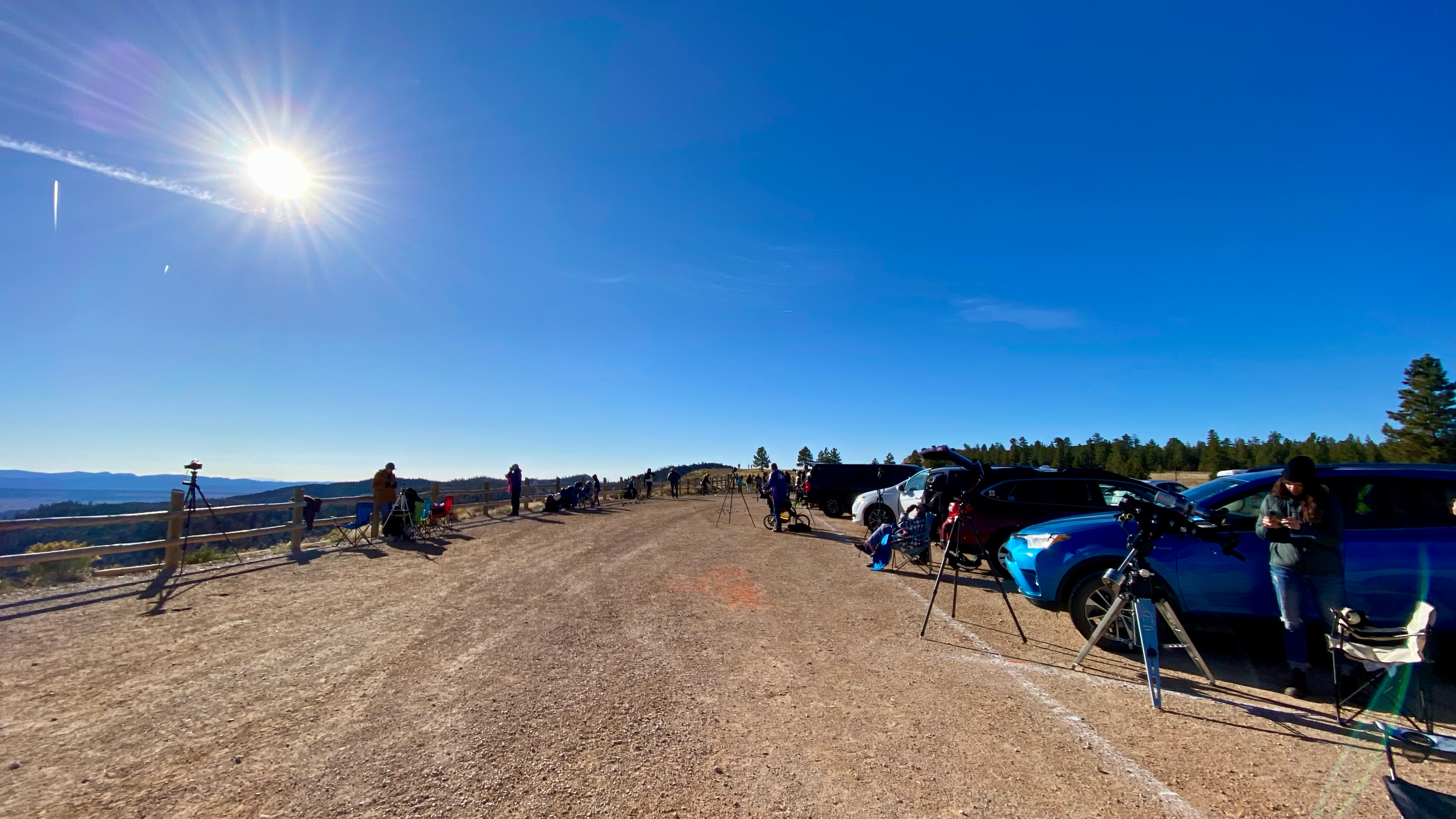
Upon arriving in the area three days early, the first priority was to inspect the site in person. It looked perfect! Almost too good to be true! 

A panorama of the Ruby’s Inn site with the eclipse in progress. My wide-angle camera is at left by that fencepost.

The site, known as the Rubyโ€™s Inn Overlook, provided a great view toward the eclipse with a stunning landscape below, including a river! (Well, it was actually an irrigation channel called the Tropic Ditch.) And I could park right next to my wide-angle landscape camera, to keep an eye on it over the five hours of shooting, while setting up the scope gear next to my car. 

I stayed at the Bryce View Lodge on eclipse eve, a hotel just a few hundred metres from the site. So no long pre-dawn drive on eclipse morn. However, the gated site was not going to be open until 7 a.m. on eclipse day. And admission was $20 per car, a cash donation to the Bryce Canyon City school sports teams. Fine! 

As it turned out, by the time I got on site and setup the priority wide-angle camera for the base-image sunrise shots at 7:30 a.m., the sky was too bright to polar align the telescope mount on Polaris, for accurate tracking of the Sun across the sky. 

It turned out that was the least of my concerns. 

My three eclipse cameras: the wide-angle, the one on the 105mm refractor telescope (with a smaller 60mm scope on top for visual views with a Herschel Solar Wedge), and one with a 100-400mm lens on the tripod.

As I unpacked the carload of scope gear at 8 a.m. I realized I had forgotten a crucial cable to connect the mount to the drive electronics. So the mount was not going to be able to track anyway! 

So much for my plans for a time-lapse through the scope. I had to manually centre the Sun every minute or so. I took lots of photos, but gave up on any effort to take them at a regular cadence.ย But I had enough images for the singles and composites shown here.

This is a composite of the October 14, 2023 annular solar eclipse with a sequence of six images showing the Moon advancing across a sunspot, the largest one visible on the Sun that day. The images are placed for a photogenic spacing, with time running forward from lower left to upper right, to reflect the Sun’s motion up across the morning sky.

Of course, once I got home the first thing I did was look downstairs in my scope room. Sure enough there was the cable, mixed up with the similar electronics from another mount I have from the same company, as I had been testing both prior to the eclipse. So much for my checklists! Theyโ€™re only good if they list every critical bit, and if you use them.

So that was one big user error. 

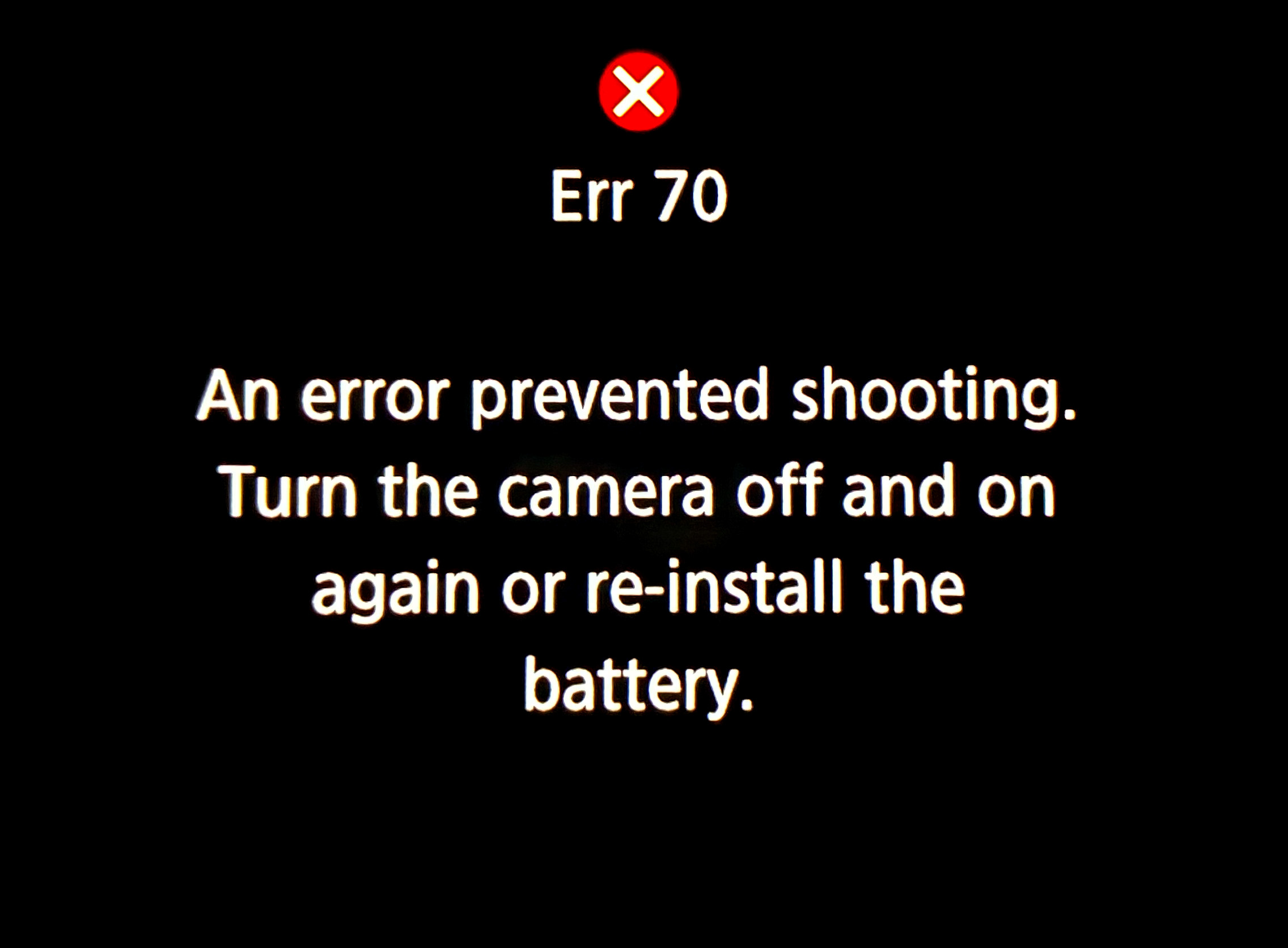
You don’t want to see this at an eclipse!

The other was a camera error, in fact Error70! I had set my main telescope camera to take rapid bursts of images (at up to 20 frames per second) at the crucial second and third contacts when annularity began and ended. With the Moonโ€™s rough limb tangent to the inside edge of the Sun, you see beads of light rapidly form and disappear at the contacts. 

This is a composite of the October 14, 2023 annular solar eclipse at second contact. It illustrates the irregular edge of the Moon breaking up the rim of sunlight as the dark disk of the Moon became tangent to the inner edge of the Sun at second contact at the start of annularity. 15 exposures taken over 20 seconds at second contact are combined with a single exposure taken about 1.5 minutes later at mid-annularity.

The camera worked great at second contact, shooting 344 frames over 20 seconds. A composite of 15 of those frames is above, layered to exaggerate the rough lunar limb and its mountain peaks. A time-lapse from those frames is below.

A time-lapse of second contact from 344 frames over ~20 seconds.

And it appeared to be working at third contact three minutes later. Until I looked down and saw the dreaded error message. In checking the camera later, none of the third contact images had recorded to either memory card. 

It is a known but intermittent bug in Canon firmware that can happen when the camera is not connected to a Canon lens (it was on a telescope it cannot communicate with). I saw the error once in testing. And I had a hard time reproducing it to take the screen shot above once I got home. But if something can go wrong โ€ฆ! 

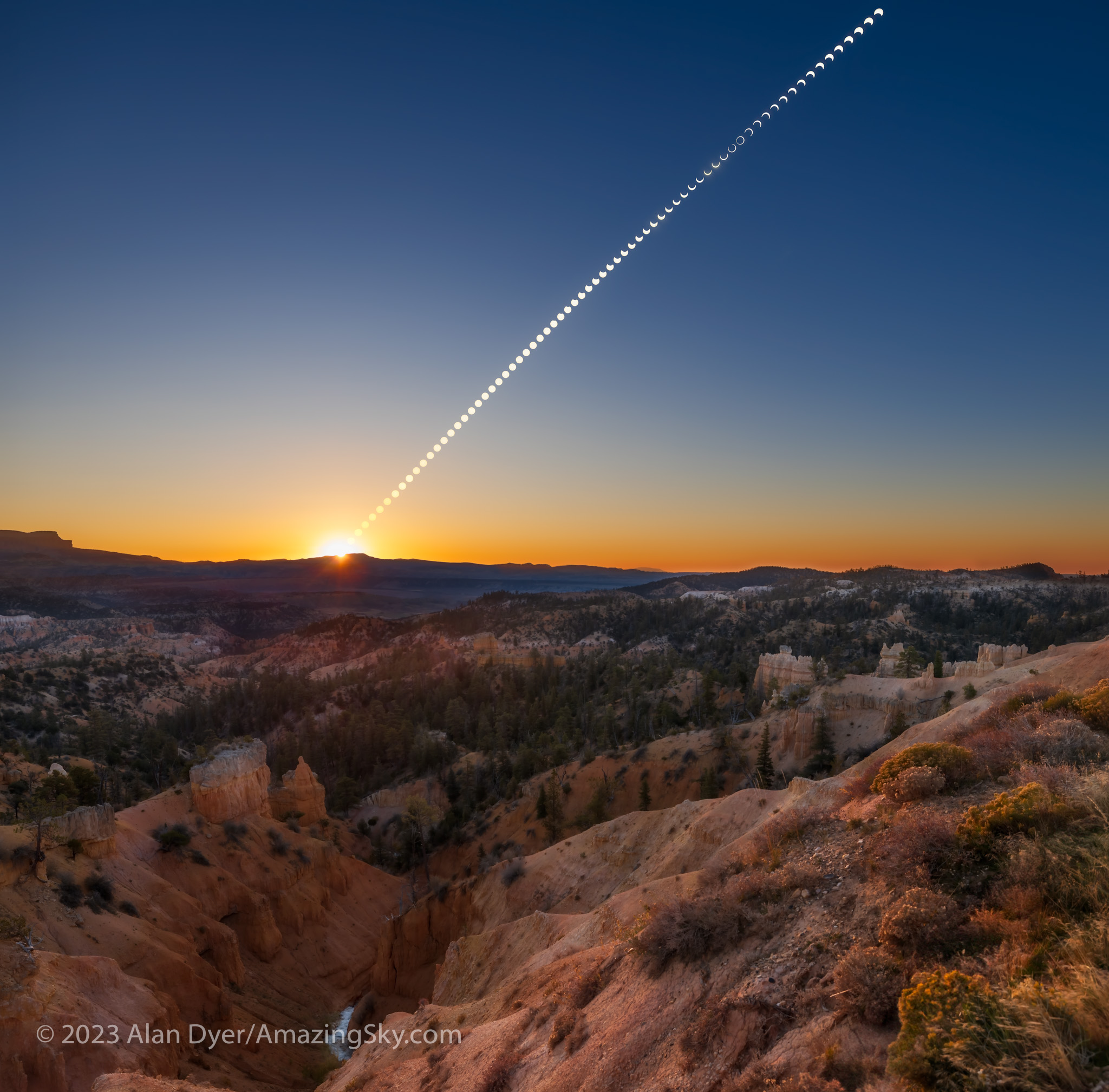
This is a portrait of the October 14, 2023 annular eclipse of the Sun, captured in a sequence of images taken from the rim of Bryce Canyon, Utah, from sunrise until nearly the end of the eclipse before noon local time. This is a composite blend of unfiltered exposures taken at sunrise for the landscape lit by the rising Sun, and for the dawn sky. Onto the base panorama of the ground and sky I layered in 66 filtered images of the Sun, as it rose into the morning sky, and with the Moon moving across its disk over nearly 3 hours, reaching mid-eclipse at about 10:29 local MDT at upper right. It then appears as a ring, or annulus of light for one frame.

Despite the errors both human and machine, I count eclipse day as successful, considering a week earlier prospects had looked so poor. As it was, apart from some thin but inconsequential cloud that drifted through before mid-eclipse, the sky was perfect.

As was the site. I enabled me to get the main shot I was after, the wide-angle composite, above. It’s a winner! And it accurately depicts the size of the Sun and its motion across the sky, albeit set into a twilight sky taken at sunrise.

As it had been 29 years since my last annular, I wasnโ€™t sure what to expect. But the darkening of the sky and eerie level of sunlight, despite a blazing Sun in the day sky, were impressive. The morning just looked strange! It was a taste of the total to come.

Venus at its widest angle west of the Sun was easy to spot in the deep blue sky. I regret not thinking to shoot even a phone camera image of that sight.ย 

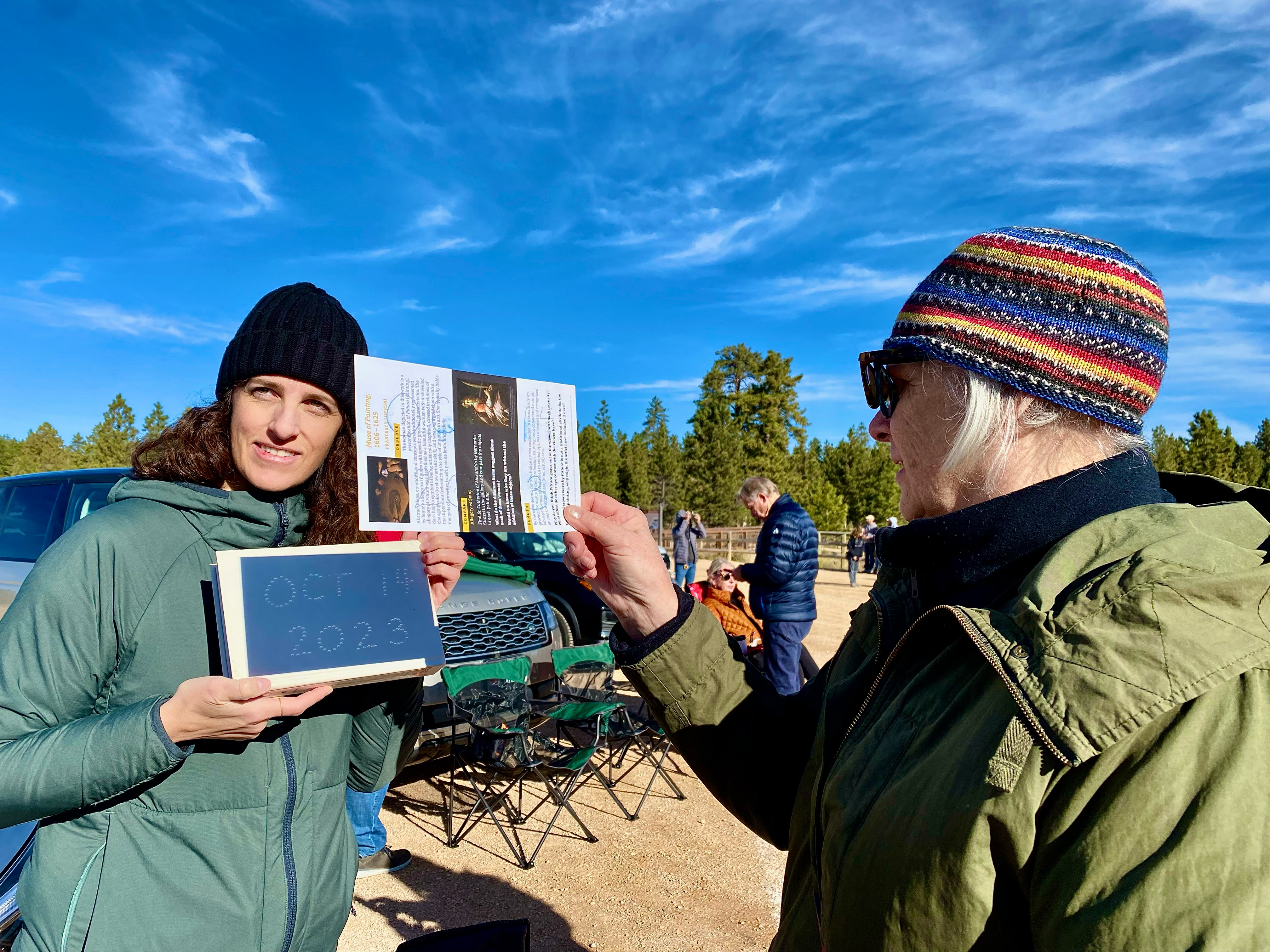
Projecting the solar crescents with a made-on-the-spot pinhole projection sign.

I had pleasant chats with other folks at the site, and enjoyed showing them telescopic views though the smaller visual scope I had piggybacked on the main scope, one that was just for looking through.ย Plus folks shot phone pix of my camera screen.

The October 14, 2023 annular solar eclipse, in a single image captured at second contact with the Moon tangent to the inside limb of the Sun, at 10:27 am MDT at the site I used.

But at the critical contacts, I was glued to that visual scope for the amazing sight of the horns of the crescent Sun rapidly wrapping around the Moon at second contact, then unwrapping at third contact.ย 

The October 14, 2023 annular solar eclipse, in a series of images captured at second contact with the Moon tangent to the inside limb of the Sun, at 10:27 am MDT at the site I used. The 7 frames here were selected from a set of 344 shot in high-speed continuous mode at 20 frames per second.

The breakup of the rim of sunlight into beads of light along the cratered and mountainous edge of the Moon was also impressive. I was not at the optimum site for seeing those beads, as the landscape dictated my choice of location. But those that I saw at each of the internal contacts were a fine bonus to a memorable morning.ย 

This is a composite that records the sequence around mid-eclipse of the October 14, 2023 annular eclipse of the Sun. This is a blend of 8 exposures each taken 2.25 minutes apart, about the minimum time to keep the disks separate and avoid them overlapping.

A third camera shooting a sequence with an untracked 400mm telephoto lens worked well. I used a subset of its images to create a still-image composite (above) and the full set for a time-lapse (below), with the position and motion of the Sun authentic, produced by the natural east-to-west motion of the sky. But against that you see the Moonโ€™s orbital motion moving its dark disk down across the disk of the Sun. 

A time-lapse from 300 frames taken at 4-second intervals with the sky’s motion carrying the Sun across the frame.

As soon as annularity ended, everyone else started to pack up and leave. For them the show was over. Understandably. On many total eclipse tours I’ve been on we’ve been on the road back to the hotel after totality and the requisite happy group shot.

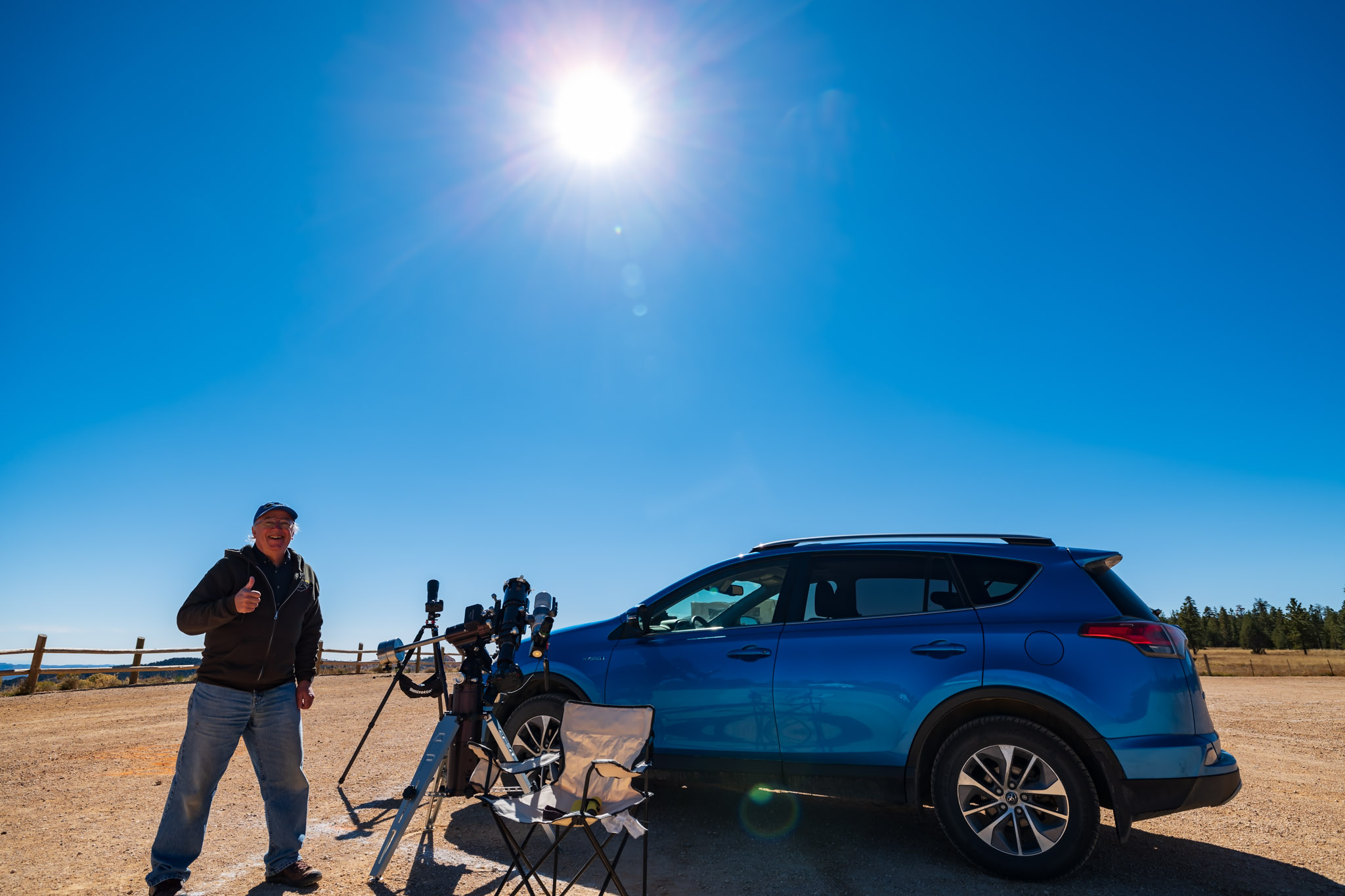
Eclipse success! The trophy shot after everyone else had left.

But at this eclipse my shooting plan dictated that I stick it out. By the end of the eclipse I was the last one standing, alone to enjoy last contact and then lunch, killing time for any road congestion to diminish, as I had to head to another motel for the post-eclipse night, in nearby Panguitch. 

I had a celebratory dinner and Moab-brewed beer that night at Cowboyโ€™s, the best restaurant in Panguitch, sporting my Annular 2023 eclipse hat! 

But the next day I started the drive north again, for the three-day trek back up I-15 to the border, then home. 

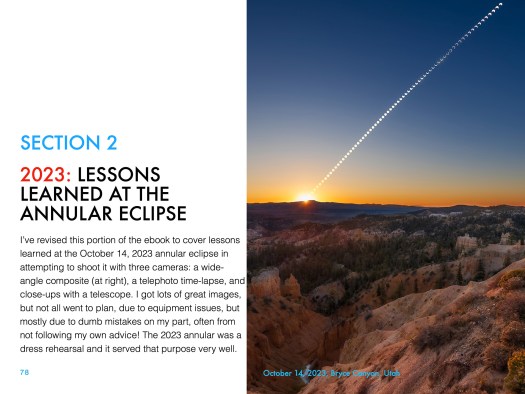
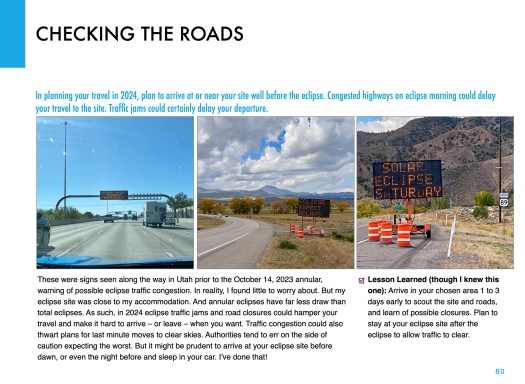
Priority one upon getting home was to finish processing images, and to include them in a revised version of my ebook How to Photograph the Solar Eclipses. It is linked to above and here on the title. Images of some sample pages from the revised edition are in the slide show below.

Post-annular, the bookโ€™s title remains the same, but I revised the pages in Chapter 4 on planning for the 2023 eclipse with pages on โ€œlessons learned!โ€ And there were several! 

I expanded Chapter 11 on processing to include tutorials on assembling annular eclipse composites, now that I actually have some! 

Such as the composite of first- to last-contact telescopic close-ups below.

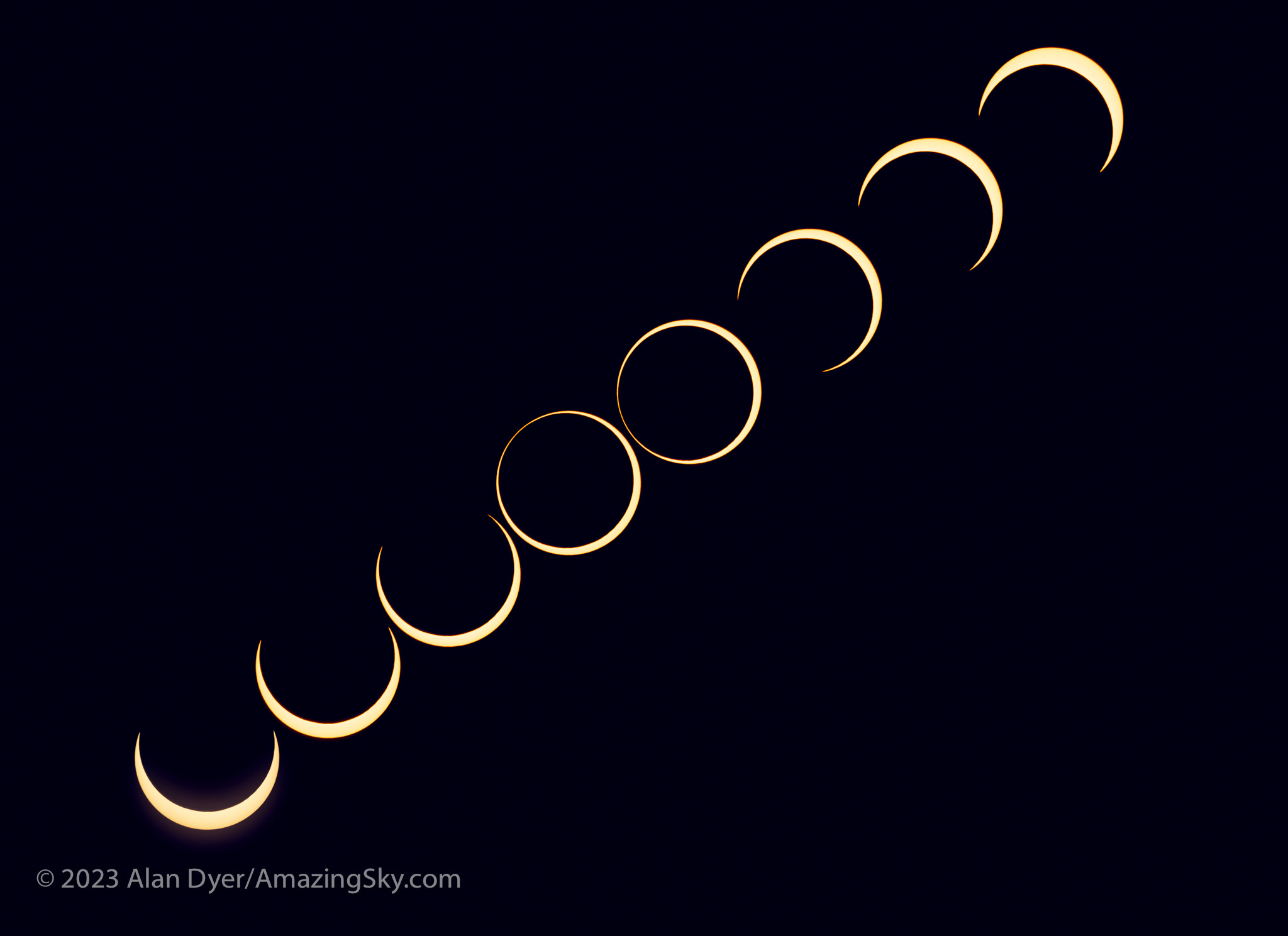
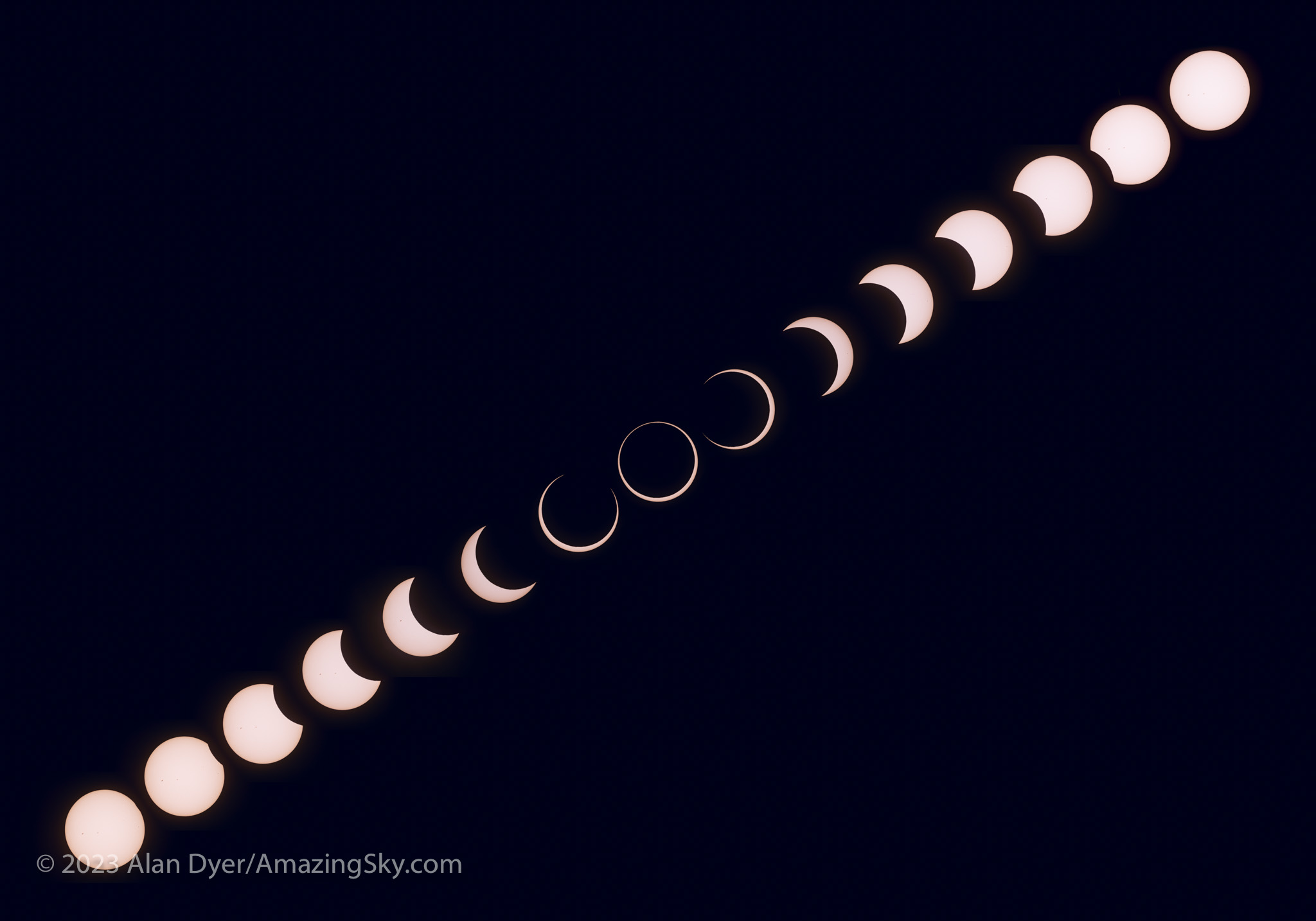
This is a composite of the various stages of the entire October 14, 2023 annular solar eclipse, from start (lower left) to end (upper right), with mid-eclipse at centre. So time runs forward from left to right, with the Suns positioned to reflect the approximate motion of the Sun in the morning sky when this eclipse occured at my site, with it rising higher through the progress of the eclipse. North is up in this image.

The new version of my ebook is 20 pages larger than the pre-annular edition. 

An email has gone out from eJunkie to all buyers of the earlier-edition PDF to alert them to the new version, and with a download link. Apple Books readers should get a notice when they open the book on their Mac or iPad in the Books app that a new version is available. 

I suspect that will be the last revision of my ebook before the big event โ€“ the total eclipse of the Sun on April 8, 2024. 

Hereโ€™s wishing us all clear skies for that one! That eclipse will indeed require a drive to Texas. This time I’ll remember that damned cable! 

โ€” Alan Dyer, October 31, 2023

amazingsky.com 

Nightscapes at Double Arch


Star Trails Behind Double Arch

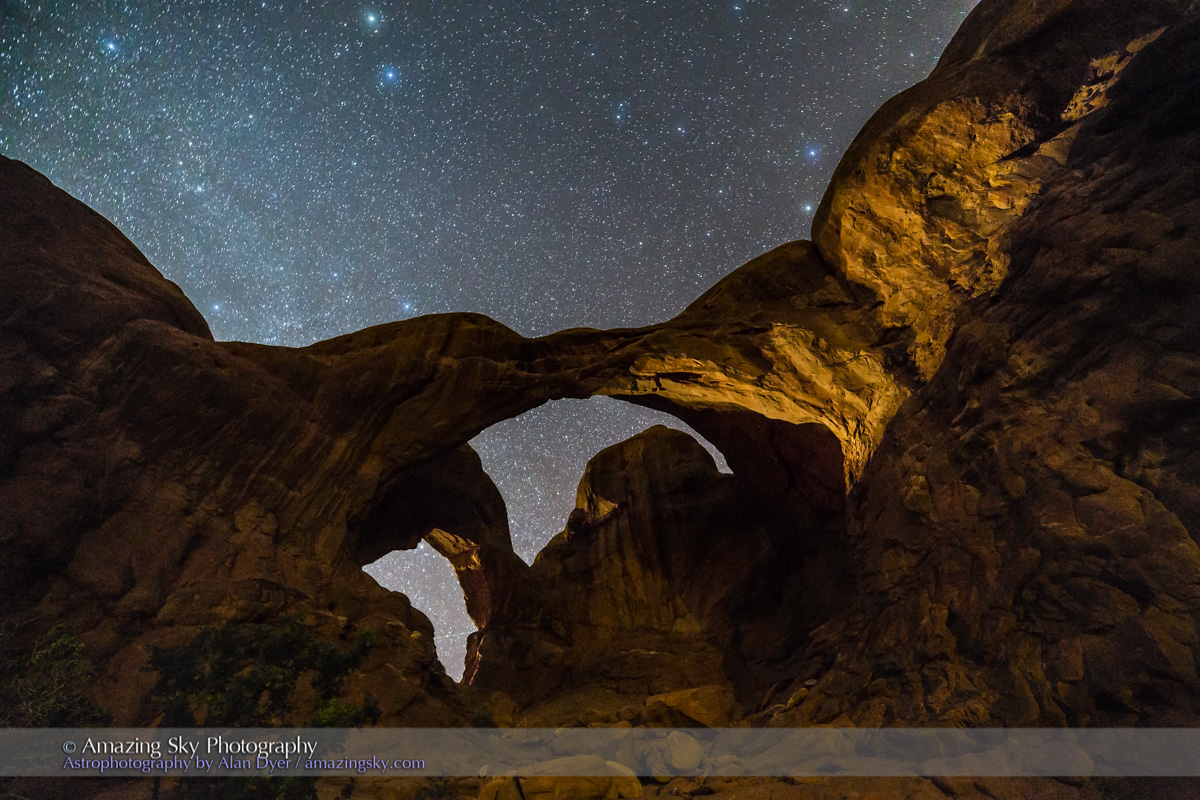
The iconic Double Arch looks great under dark skies, moonlight, or painted with artificial light.

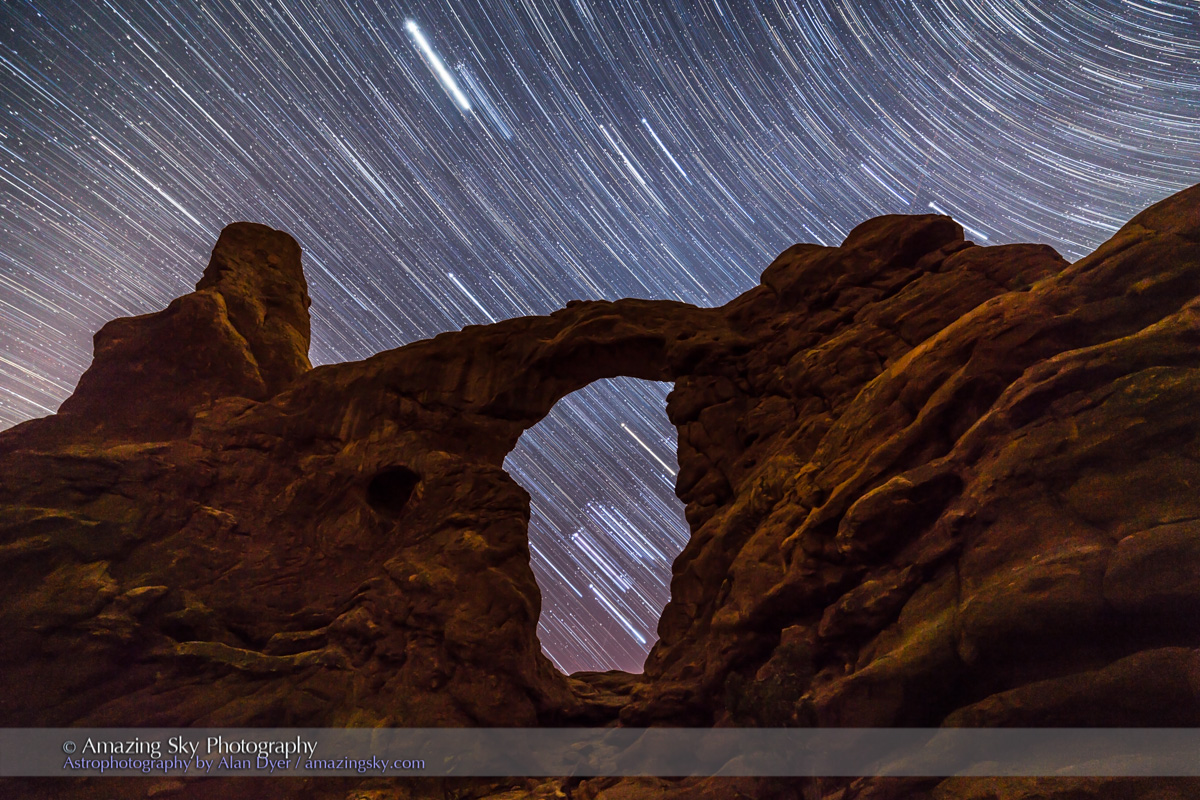
Last night, I returned to the Double Arch at Arches National Park, to capture a star trail series, starting from the onset of darkness at 9:30 p.m., and continuing for 2.5 hours until midnight, an hour after moonrise at 11:00 p.m. The lead image is the result.

I think it turned out rather well.

The Big Dipper is just streaking into frame at top right, as I knew it would from shooting here the night before. The bright streak at upper left is Jupiter turning into frame at the end of the sequence.ย Note how the shadow of the moonlit foreground arch matches the shape of the background arch.

On the technical end, the star trail composite isย a stack of 160 frames, each 45 seconds at f/2.8 and ISO 3200, with the Canon 6D and 14mm lens. The foreground, however, comes from a stack of 8 frames taken toward the end of the shoot, as the moonlight was beginning to light the arches. An additional 45-secondย exposure taken a couple of minutes after the last star trail frame adds the star-like points at the “head” of the star trail streaks.

I used the excellent Advanced Stacker Actions from StarCircleAcademy to do the stacking in Photoshop.

Dark Sky Behind Double Arch

Before starting the star trail set, I took some initial short-exposure nightscapes while the sky was still dark. The result is the aboveย image, of Double Arch in a dark sky. Passingย car headlights provided some rather nice accent illumination.

On such a fine night I thought others might be there as well. Arches is a very popular place for nightscape imaging.

Sure enough, 6 others came and went through the early evening before moonrise. We had a nice time chatting about gear and techniques.

As expected, a few photographers came armed with bright lights for artificially lighting the arches. I kept my camera running, knowing any illumination they shone on the foreground wouldn’t affect my star trails, and that I’d mask in the foreground from frames taken after moonrise.

Photographer Lighting Double Arch

Here’s one frame from my star trail sequence where one photographer headed under the arch to light it for his photos. It did makeย for a nice scene โ€“ a human figure adds scale and dimension.

However,ย I always find the light from the LED lamps too artificial and harsh, and comesย from the wrong direction to look natural. I also question the ethics of blastingย a dark sky site with artificial light.

On aย night like this I’d rather wait until moonrise and let nature provide the more uniform, warmer illumination with natural shadows.

Big Dipper over Double Arch

As an example, I took this image the night before usingย short exposures in the moonlight to capture the Big Dipper over Double Arch. When I shot this atย 11 p.m. I had the site to myself. Getting nature to provide the rightย light requires the photographer’s rule of “waiting for the light.”

โ€“ Alan, April 7, 2015 / ยฉ 2015 Alan Dyer / www.amazingsky.com
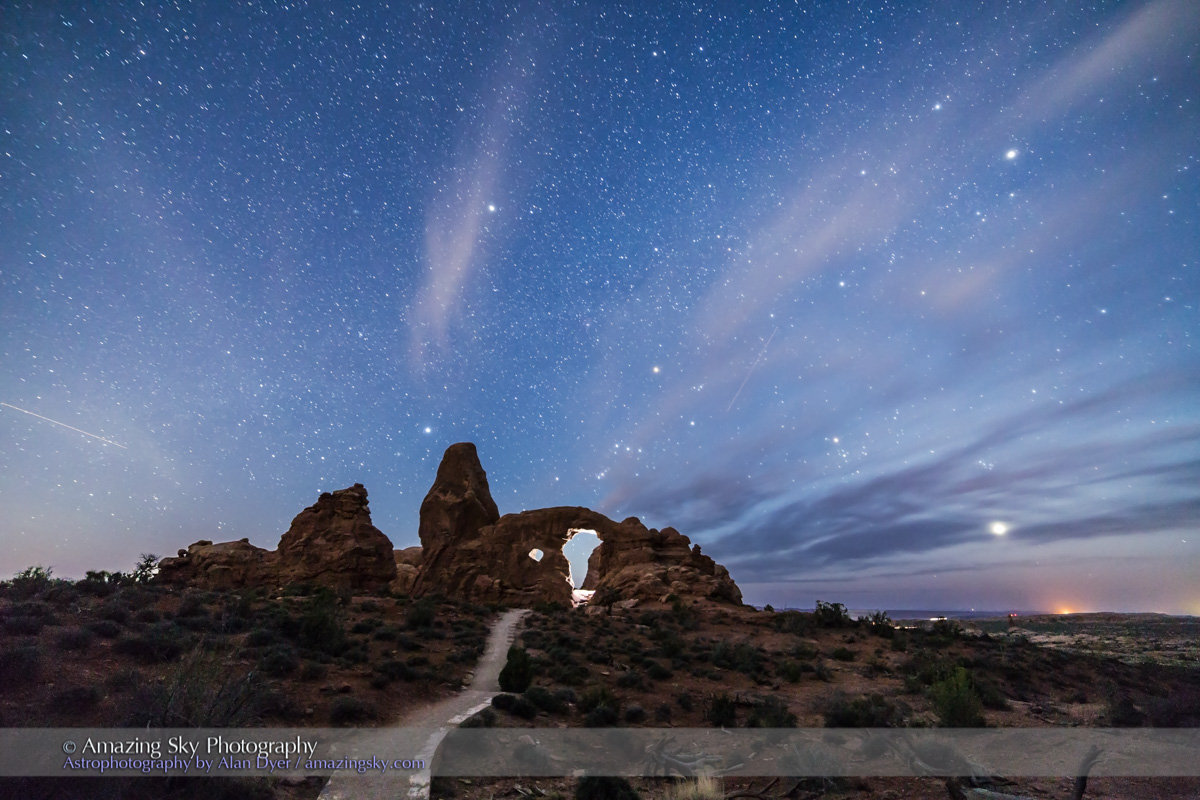
Orion Over and Through Turret Arch


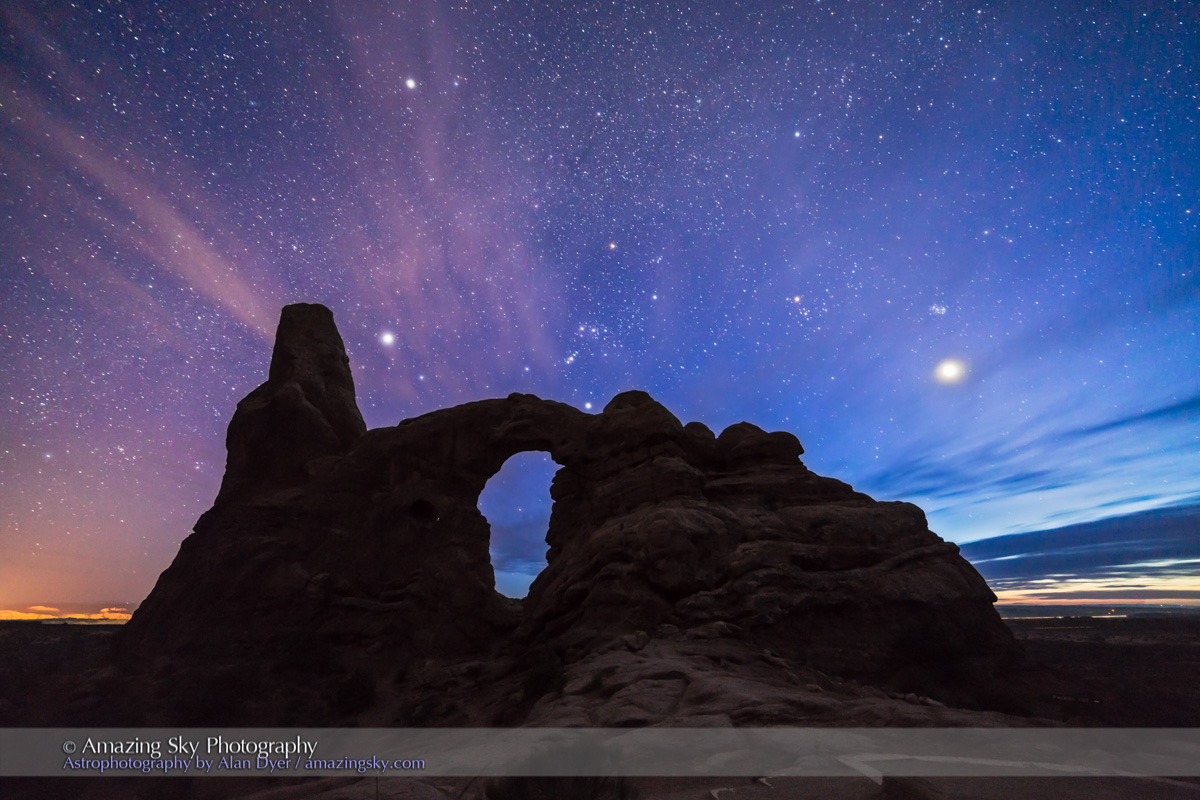
Orion Star Trails Through Turret Arch

What a fabulous night for some nightscapes at Arches National Park, Utah.

I’m at Arches National Park for two nights, to shoot the starsย over itsย amazing eroded sandstone landscape.

I started the night last night, April 6, shooting Orion over Turret Arch while the sky was still lit by deep twilight. That image is below. It shows Orion and the winter sky, with bright Venus at right, setting over the aptly-named Turret Arch.

I scouted the location earlier in the day and measured in person, as expected from maps, that the angles would be perfect for capturing Orion over the Arch.

But better still would be getting Orion setting through the Arch. That’s the lead photo at top.

I shot the star trail image laterย in the evening, over half an hour. It uses a stack of 5 exposures: a single, short 30-second one for the initial point-like stars, followed by a series of four 8-minute exposures to create the long star trails. The short exposure was at ISO 4000; the long exposures at ISO 250. All are with the Rokinon 14mm lens.

Orion Over Turret Arch

Archesย is a popular and iconic place for nightscape photography.

I thought I’d likely not be alone, and sure enough another pairย of photographers showed up, though they were armed with lights to illuminate the Arches, as many photographers like to do.

I shot this from afar, as they lit up the inside of Turret Arch where I had been earlier in the night.

Photographer Lighting Turret Arch

I prefer not to artificially illuminate natural landscapes, or do so only mildly, not with bright spotlights. We traded arches! โ€“ while I shot Turret, the other photography couple shot next door at the North and South Window Arches, and vice versa. It all worked out fine.

Later in the night, after moonrise, I shot next door at the famous Double Arch. Those moonlit photos will be in tomorrow’s blog.

It was a very productive night, and a remarkable experience shooting at such a location on a warm and quiet night, with only a fellow photographer or two for company.

โ€“ Alan, April 7, 2015 / ยฉ 2015 Alan Dyer / www.amazingsky.com

Moonlighting at Monument Valley


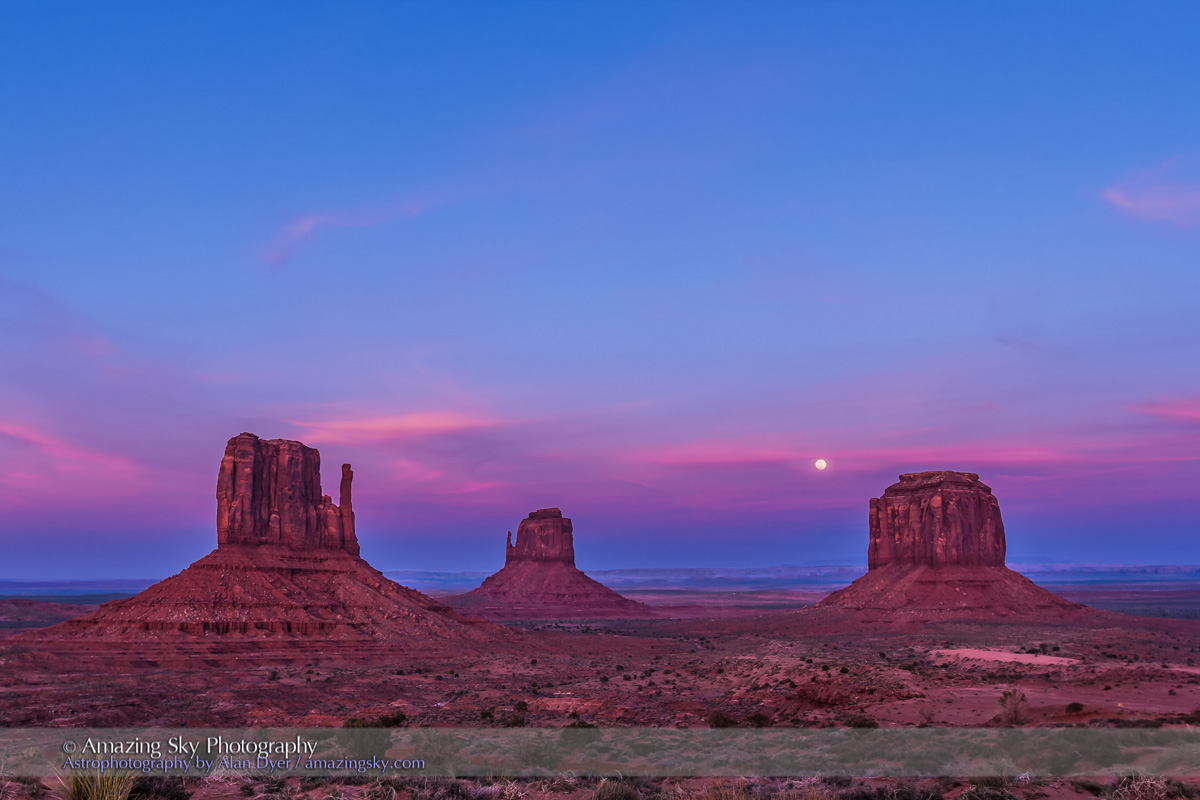
Moonrise Behind the Mittens at Monument Valley (#1)

The Full Moon rises behind the famous Mitten buttes at Monument Valley.

I spent a fabulous weekend capturing sunsets and nightscapes at the iconic Monument Valley on the Utah/Arizona border,ย the photogenic outdoor setย of dozens movies over the decades.

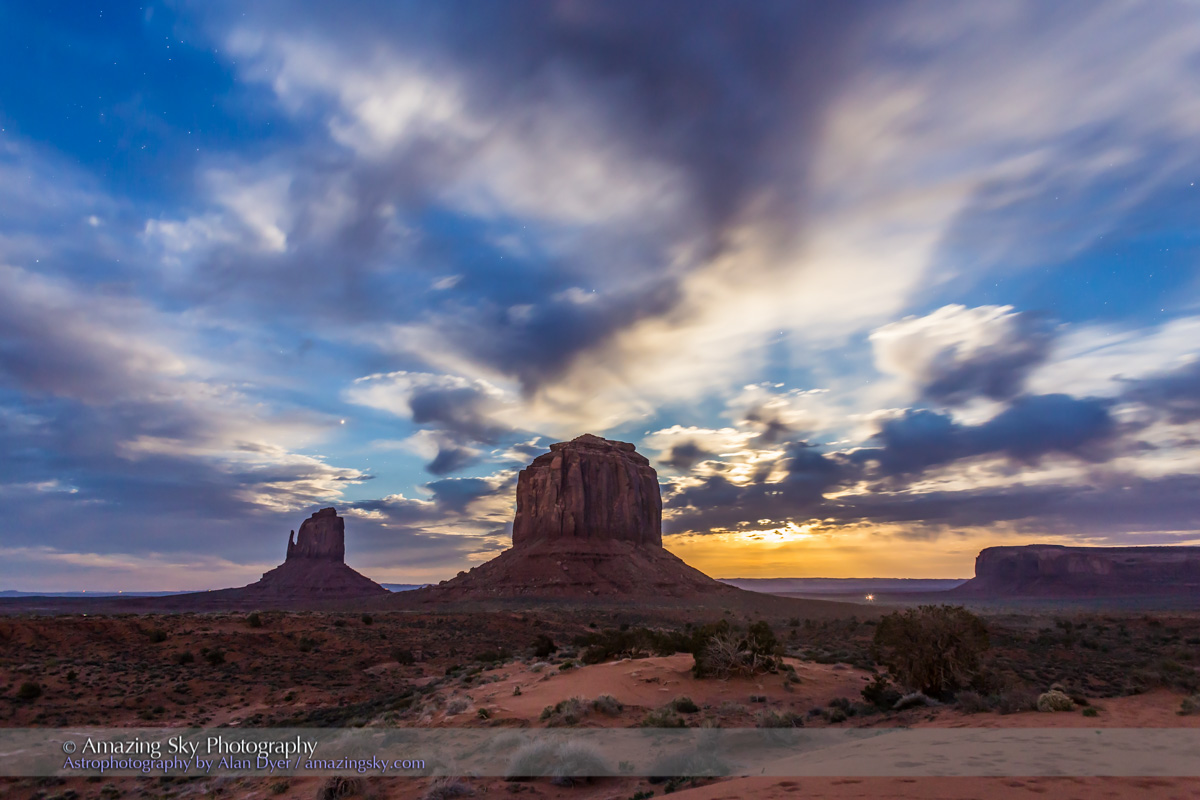
On the eve of the total lunar eclipse I shot the nearly Full Moon rising behind the West (left)ย and East (centre)ย Mittens and Merrick Butte (at right). On the evening of Friday, April 3 the Moon rose and sat amid the sunlit clouds with the Sun still up.

The alignment that would place the Moon directly opposite the Sun to create the eclipse was still 11 hours away.

Note how the butte’s shadows point almost, but not quite directly, at the nearly Full Moon. They point at the place in the sky the Moon would be before dawn at the end of that night.

Indeed, on eclipse morning on Saturday, April 4 the Moon set exactly as the Sun rose (see my photos in my previous blog).

But on eclipse eve the Moon rose 30 minutes before the Sun set, providing a chance to catch the Moon behind the still sunlit red buttes.

Moonrise Behind the Mittens at Monument Valley (#2)

I shot this image about 20 minutes after sunset on April 3, so the foreground is now in shadow but the Moon appears in a more richly tinted twilight sky.

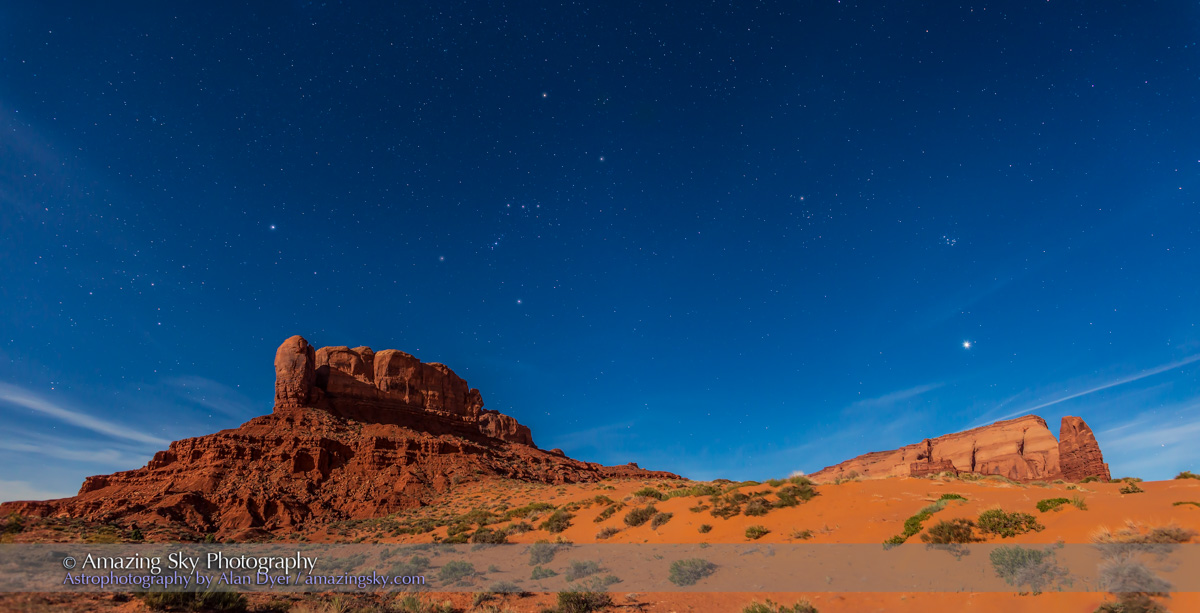
Orion and Venus Setting at Monument Valley

Later on April 3 I captured this scene, with the Tear Drop and Rock Door Mesas now lit by a bright Full Moon, and with the stars of the winter sky setting into the west. Canis Major and Orion are at left, while Taurus, including the Pleiades star cluster and brilliant Venus, are at right.

The Orion & Venus image is a 2-panel panorama.

Moonbeams at Monument Valley

On the evening of April 4, clouds thwarted plans for a long star trail sequence above a moonlit foreground.

Instead, I shot toward the Moon and clouds, to capture subtle moonbeams radiating out from the Moon, now some 14 hours after the eclipse, rising behind Merrick Butte. I shot this from the dusty Loop Road that winds through the valley floor.

Big Dipper over West Mitten, Monument Valley

Instead of lots of images for a star trail composite, I was content to shoot this one image, catching the Big Dipper in a brief hole in the drifting clouds, hanging in the sky over the West Mitten butte. The foreground is lit by the partly obscured Full Moon. The long exposure streaks the moving clouds.

Night or day, it’s hard not to take a great photo here, clouds or not!

Sunset Panorama at Monument Valley

On my final evening at Monument Valley, high winds common to the area, blowing dust, and the closed Loop Road, scuttled plans again for long star trail sequences from the valley floor.

So on Easter Sunday, April 5, I settled for a panorama from the classic viewpoint showing the setting Sun lighting the buttes and mesas of Monument Valley.

It is an amazing place, but one that still requires patience to wait out the clouds and dust storms.

โ€“ Alan, April 6, 2015 / ยฉ 2015 Alan Dyer / www.amazingsky.com
Red Moon over the Red Rocks of Monument Valley


Lunar Eclipse Sequence from Monument Valley

What a great site to watch the Moon turn red in a total eclipse.

I can’t recall a more scenic total eclipse of the Moon. I planned this site as best I could from Google maps and other apps, andย the location proved ideal.

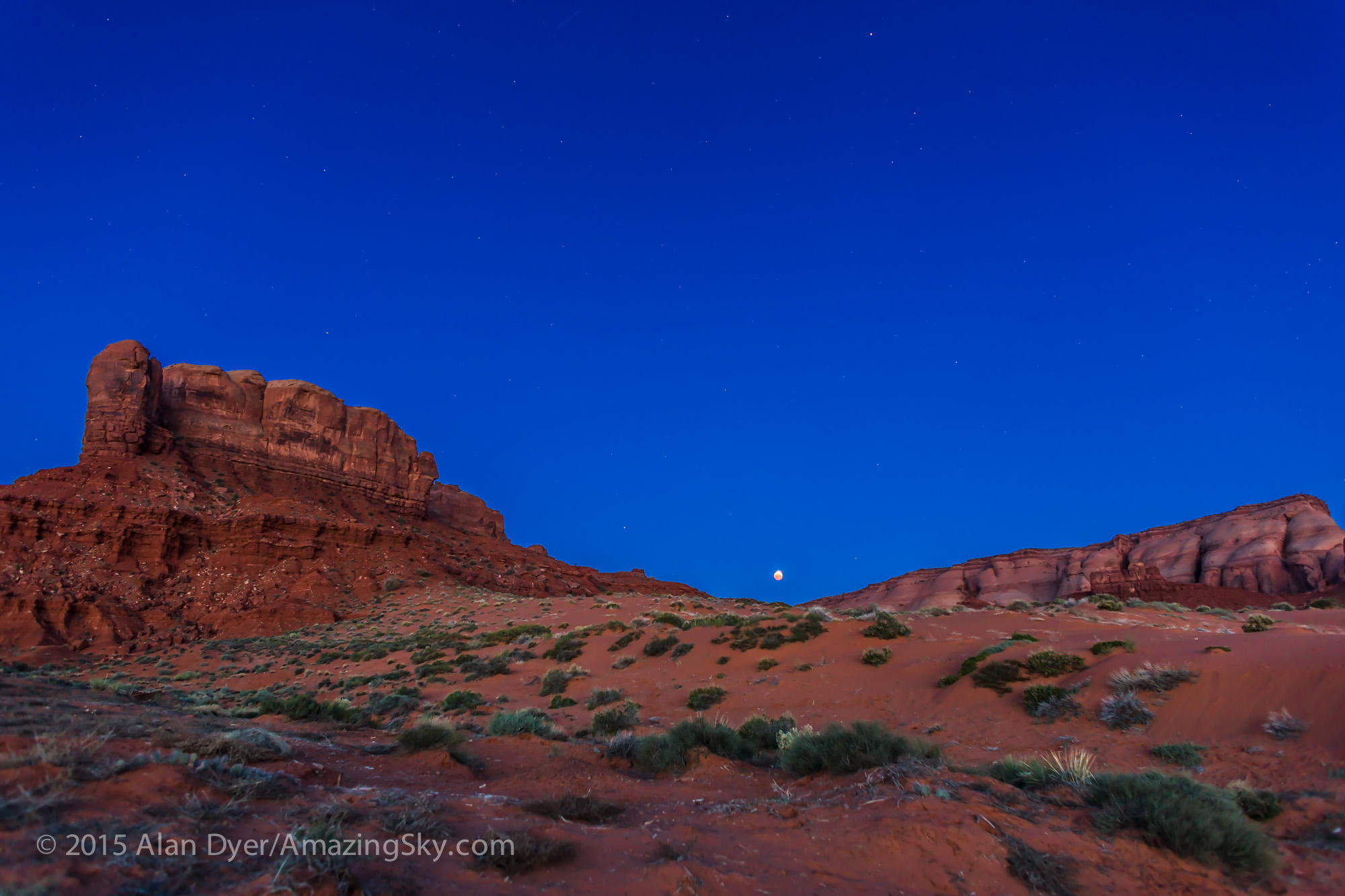
As the Moon went into the Earth’s shadow it set into the notchย between the two peaks of this mesa at Monument Valley, Utah. It was a stunning celestial sight seen from one of the most dramatic scenic sites on the planet.

This was the total lunar eclipse on the morning of April 4, 2015, an eclipse that was barely total with just 4 minutes of totality with the Moon within Earth’s umbral shadow. The top of the Moon, grazing the edge of our planet’s shadow, always appeared bright white, as expected.

The lead image is a composite of many exposures: short ones for the partial phases that flank a longer exposure for the single image of totality and and even longer exposure for the sky and landscape, all taken over the course of 2.5 hours with a fixed camera โ€“ don’t bump the tripod!

Lunar Eclipse over Monument Valley Mesa

I shot this image with the second camera riding on a tracking platform. It is a bend of three exposures: two long ones for the sky and ground and a short exposure to retain the Moon and avoid it turning into a white overexposed blob.

The long skyย exposure was taken with the tracker on, to keep the stars as pinpoints, while for theย ground exposure I turned the tracker motor off to keep the ground sharp. I layered and maskedย theseย with Photoshop.

Lunar Eclipse at Dawn from Monument Valley

The last image is a single image only, just one exposure, taken a few minutes after the end of totality as the sky was quickly brightening with the blue of dawn. It captures the naked-eye scene.

I shot all these from my B&B for the weekend, the Tear Drop Arch B&B, named for the arch on the mesa at left in these images. I chose the spot to provide a scenic foreground to the western-sky eclipse without having to drive miles in the pre-dawn hours. I was moments away from bed as the sun rose and the eclipsed Moon set.

Next lunar eclipse: September 27, 2015, in the evening for North America.

โ€“ Alan, April 4, 2015 / ยฉ 2015 Alan Dyer / www.amazingsky.com