A Last Look at the Auroras of Churchill


From February 21 to March 4, 2025 I was at the Churchill Northern Studies Centre for my annual visit serving as an instructor to visiting aurora tourists. I’d been doing the program for ten years, with a year off in 2021 when no one visited!

But I decided this was to be my last year, as it was time to “retire” and turn over the program to a new generation of instructors.

So here I present my last look at the Churchill auroras.
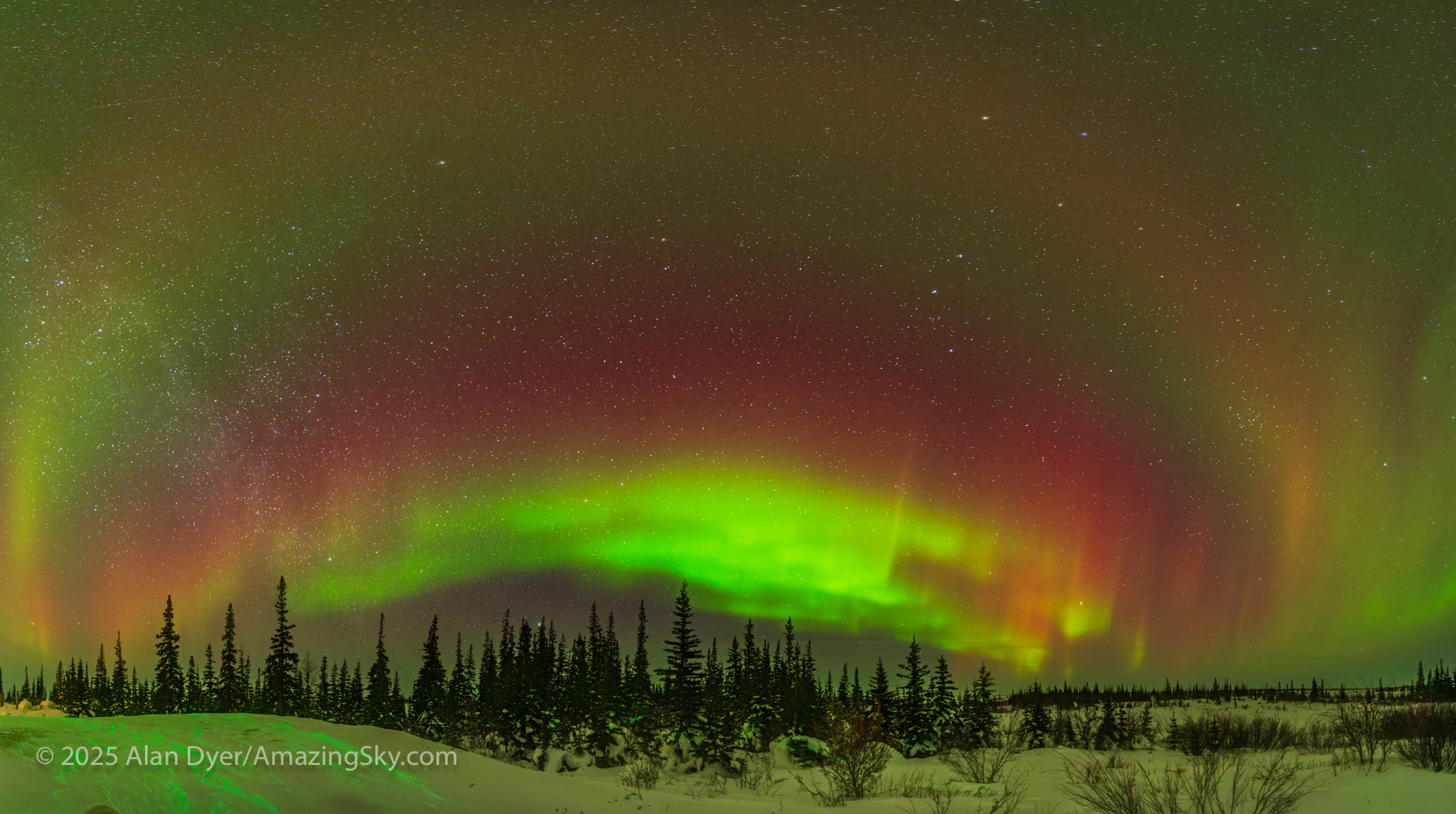
A 180º panorama across the north during an all-night display of Northern Lights, from the Churchill Northern Studies Centre, in Churchill, Manitoba, on February 22, 2025. A panorama of 7 segments, each 13-second exposures with the Viltrox 16mm lens at f/2 on the Nikon Z6III at ISO 1600.

Churchill, Manitoba is on the shore of Hudson Bay at a latitude of 58º North in the sub-Arctic.

It lies under the normal location of the “auroral oval,” the ring around the North Geomagnetic Pole where there is almost always some aurora happening, even on a quiet night. Churchill is as far south as the auroral oval appears in the world when the oval is in its normal state.

By visiting a site under the oval, aurora tourists are almost guaranteed a show, provided the sky is clear.
This is a 180º panorama of the Northern Lights across the northern, eastern and southern sky on February 27, 2025 during a Kp4-level display. This is a panorama of 3 segments, each 13-second exposures at f/2.8 with the Laowa 10mm lens on the Nikon Z6III at ISO 1600.

In winter in Churchill, the cold usually brings clear skies. In a decade of conducting programs I’ve only ever had one group clouded out for all five nights of the program. That’s a far better average than locations such as Iceland.
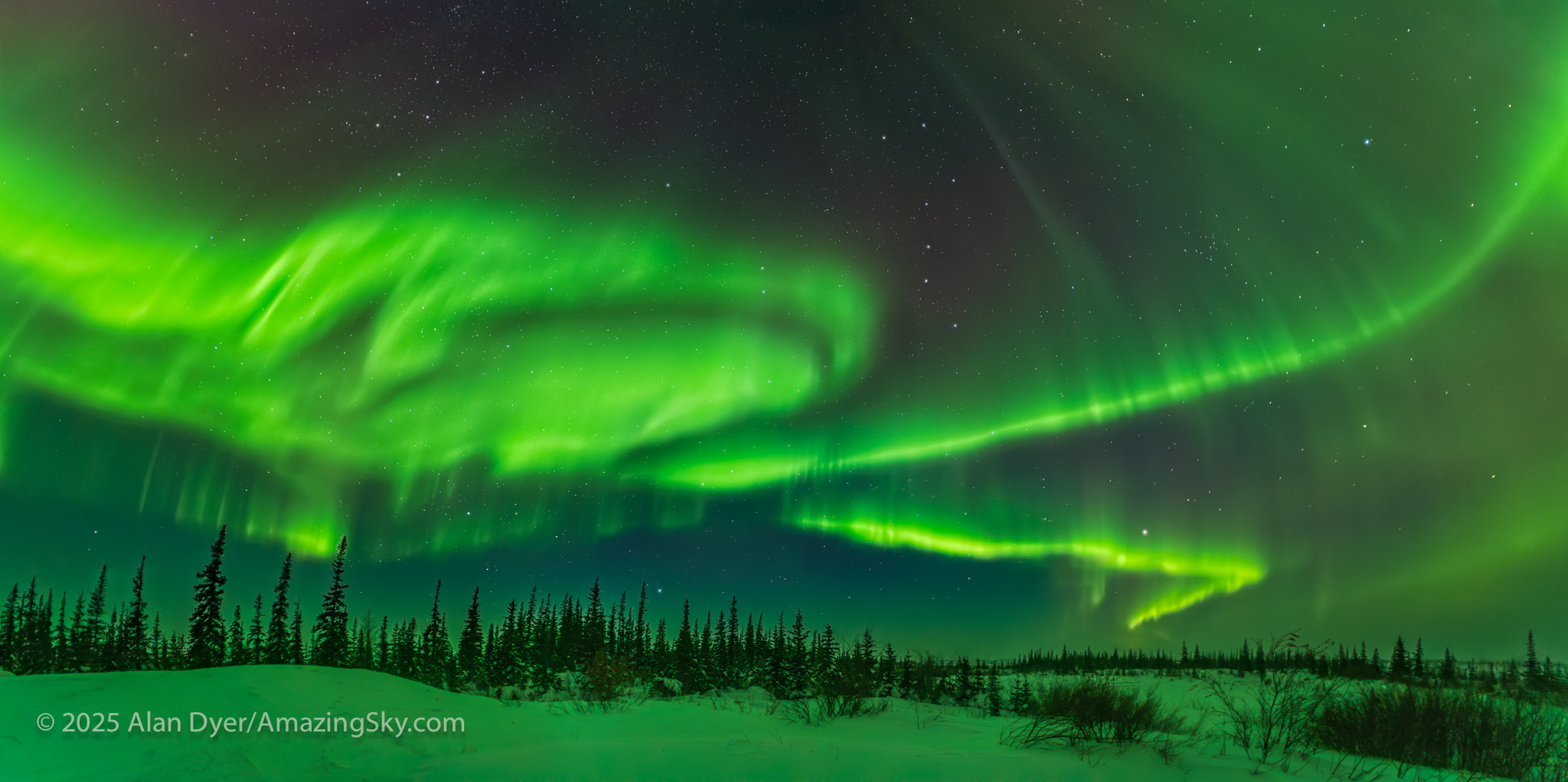
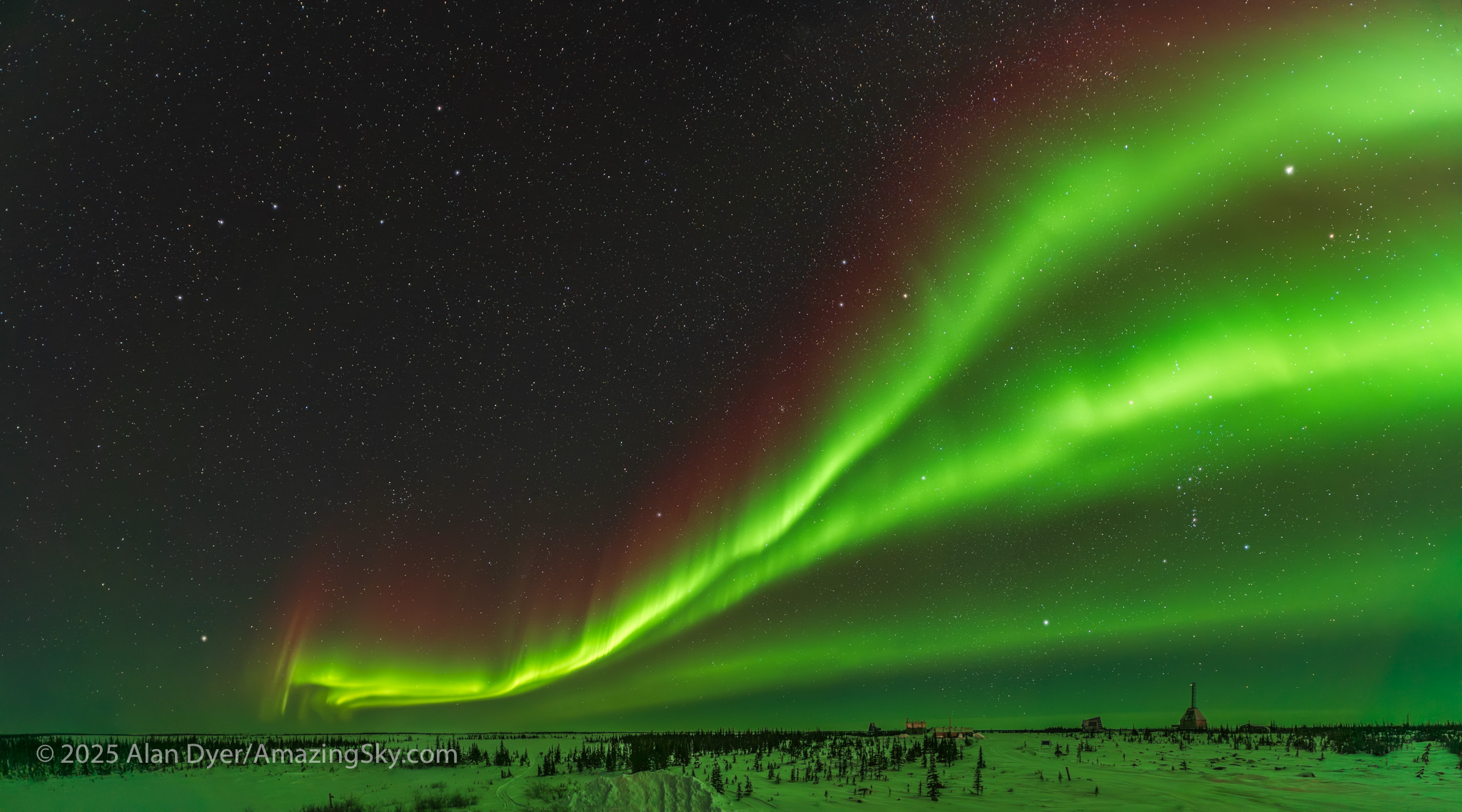
This is a 120º panorama of the Northern Lights across the northern sky on February 26, 2025 during a Kp3-level display. This shows some fine ray structure in the curtains. This is a panorama of 2 segments, each an 8-second exposure at f/2.8 with the Laowa 10mm lens on the Nikon Z6III at ISO 1600.

While several excellent travel companies and local businesses offer aurora tours to Churchill, signing up to one offered by the Northern Studies Centre offers some major advantages.

Notably, guests stay at the Centre, some 20 kilometres outside of Churchill on the site of the old Rocket Range. That makes the site dark and free of light pollution.
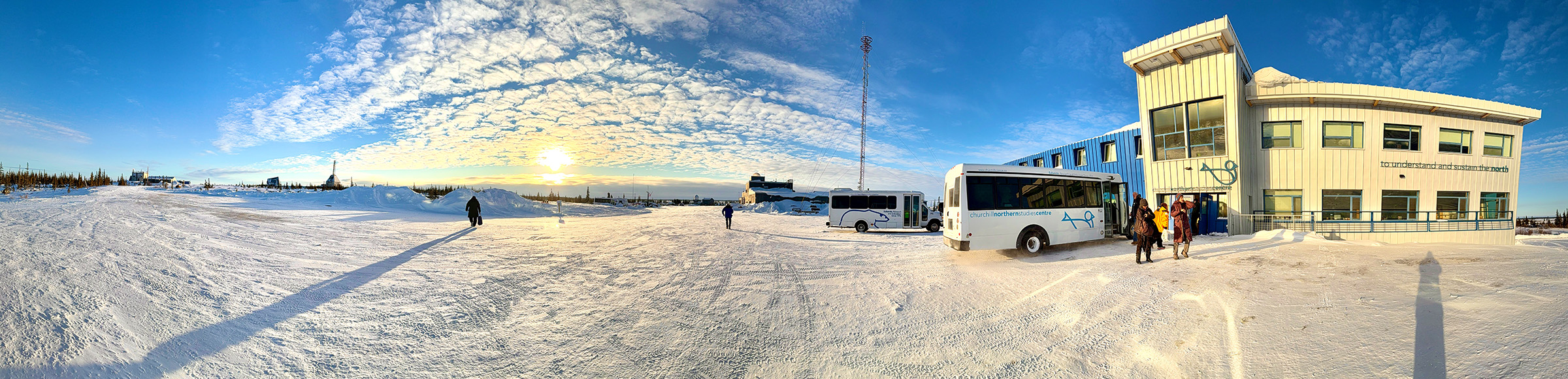
A panorama of the Northern Studies Centre. It has dorm rooms, a cafeteria, classrooms, lounges, a fitness room, library, and all the comforts needed for a great stay under the Lights.

And convenient. Guests sleep on site and need only dress up warm to quickly head outside when the “Lights are out!” call comes. Instructors wake up guests when the Lights don’t appear until late at night, as can often be the case. There’s no driving out to dark sites to wait for the Lights to appear.
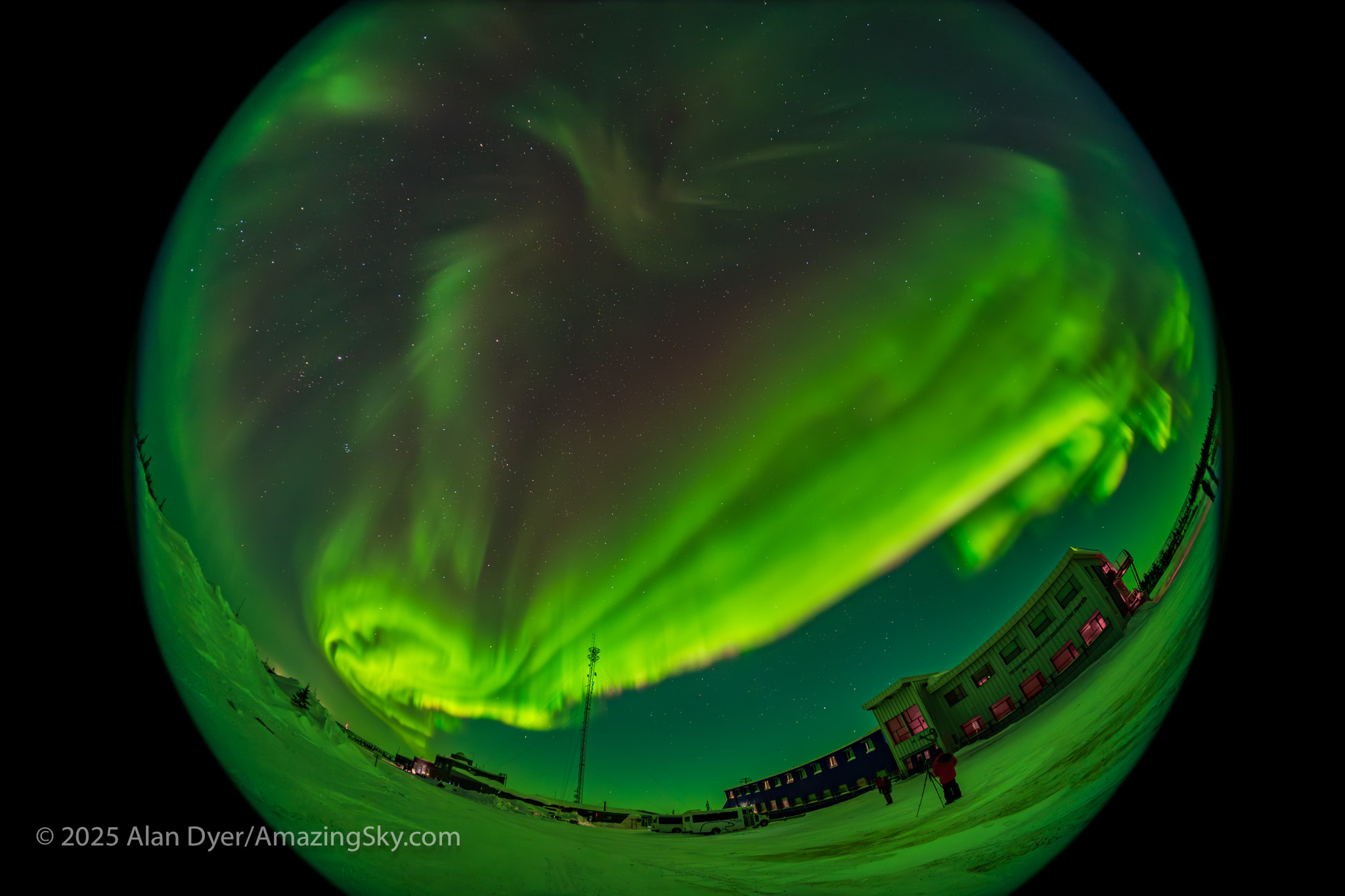
A fish-eye 360° view of the fine display of Northern Lights on February 25, 2025, during a substorm outburst with bright curtains to the north. A single 2.5-second exposure with the TTArtisan 7.5mm fish-eye lens at f/2.

An option is also to head up to the CNSC’s rooftop aurora dome for viewing the Lights in warm shirt-sleeve comfort.
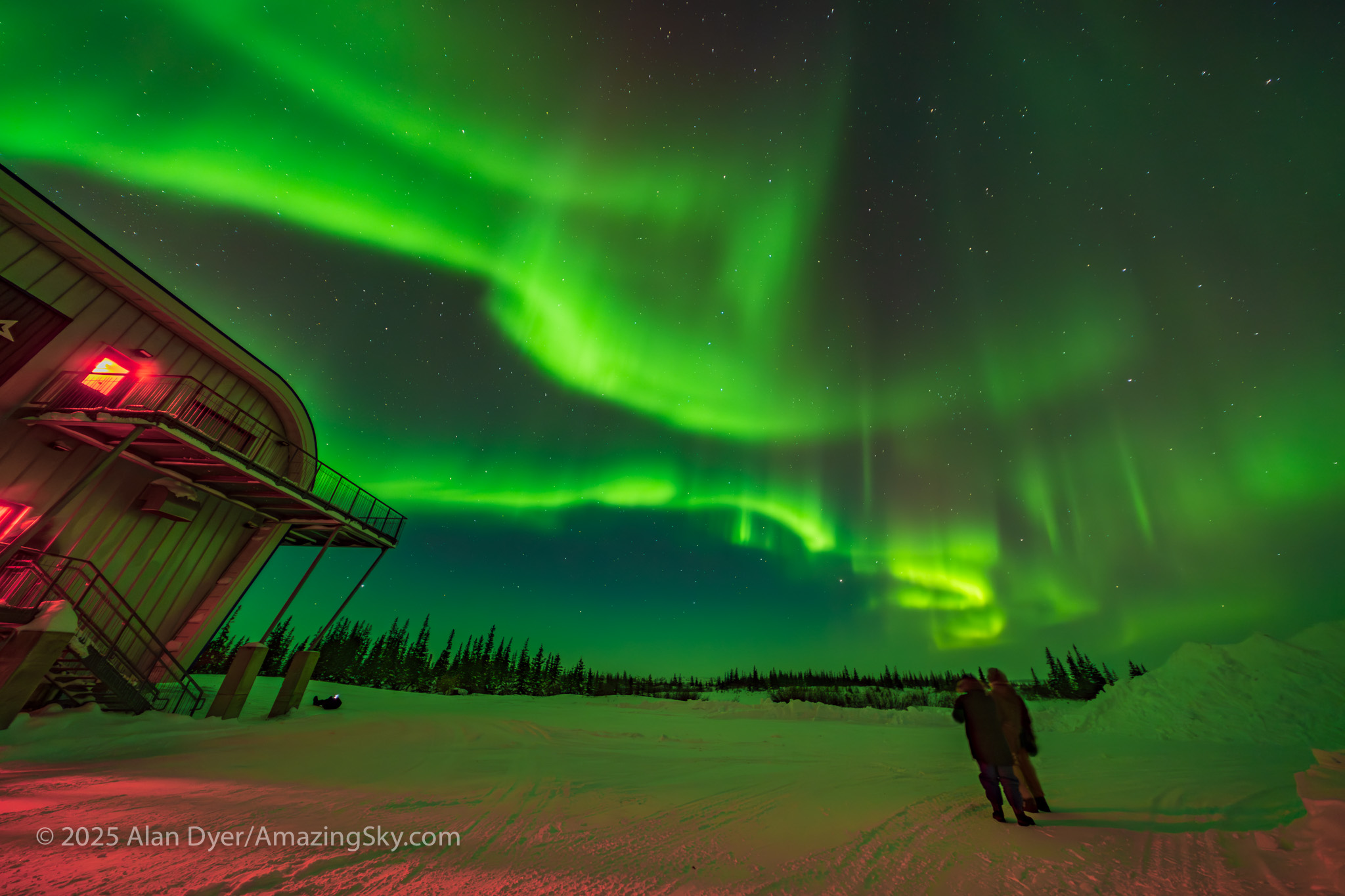
Aurora tourists enjoy the show at the Churchill Northern Studies Centre, February 26, 2025. This was the Learning Vacations tour group in late February 2025. This is a single 8-second exposure with the Laowa 10mm lens at f/2.8 and Nikon Z6III at ISO 1600.

But most guests opt to bundle up and brave the cold for the best experience and unobstructed views of the Lights filling the sky. A convenient option is the second floor observation deck, shown above, and in an image taken from the deck, below.
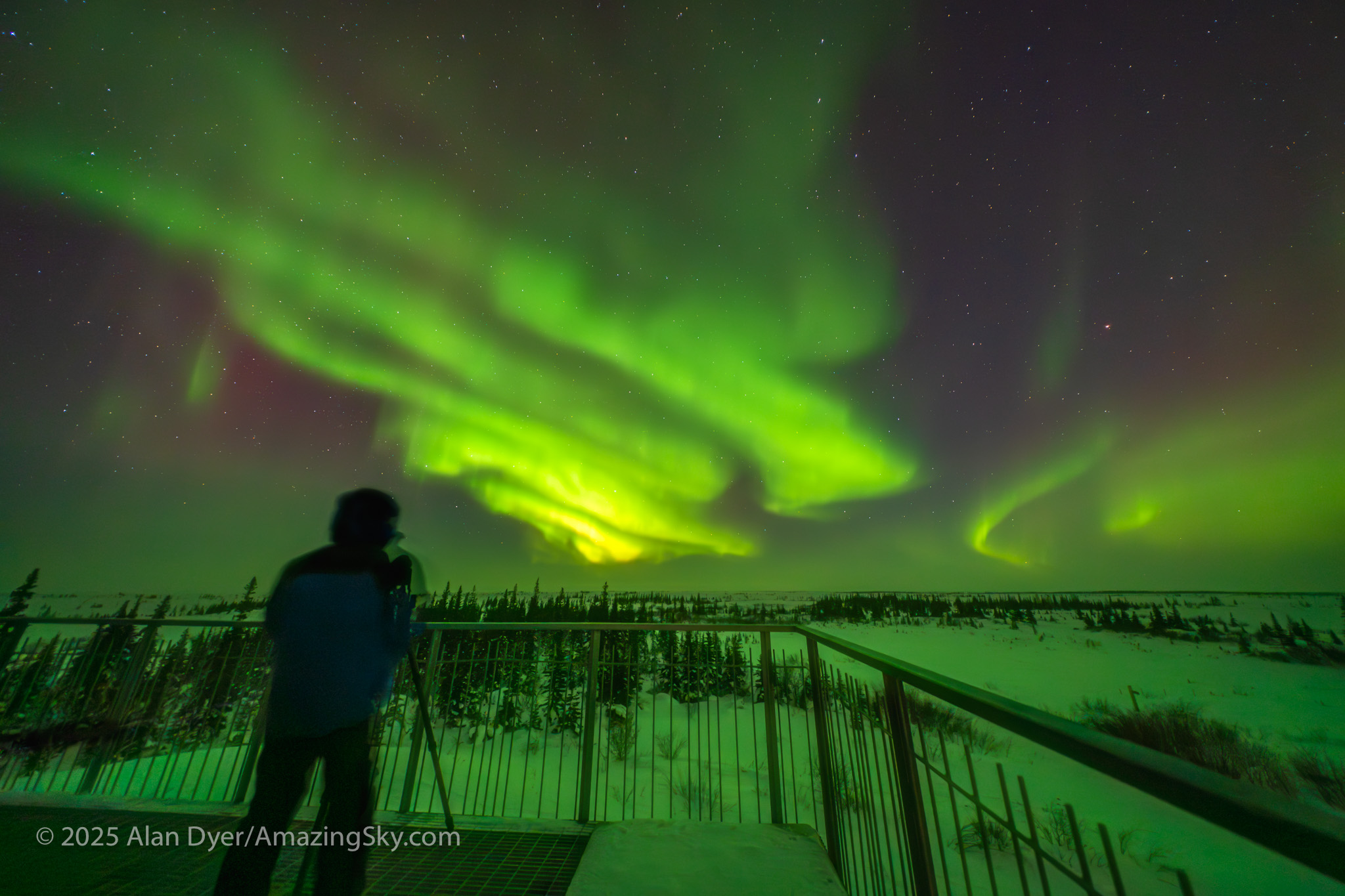
A photographer is capturing a bright display of Northern Lights at the Churchill Northern Studies Centre. This was the first night of a five-night session for aurora tourists from the Road Scholar education travel company. This is a single 4-second exposure with the Laowa 10mm lens at f/2.8 and Nikon Z6III at ISO 3200.

The program includes nightly science talks about the aurora and night sky. The daytime program includes dogsledding, snowshoeing, a tour of the old Rocket Range, and visits to sites in Churchill such as the murals and museums. It’s a very full five days of programming and learning.

To learn more, visit the CNSC’s Learning Vacations page for the Winter Skies program.
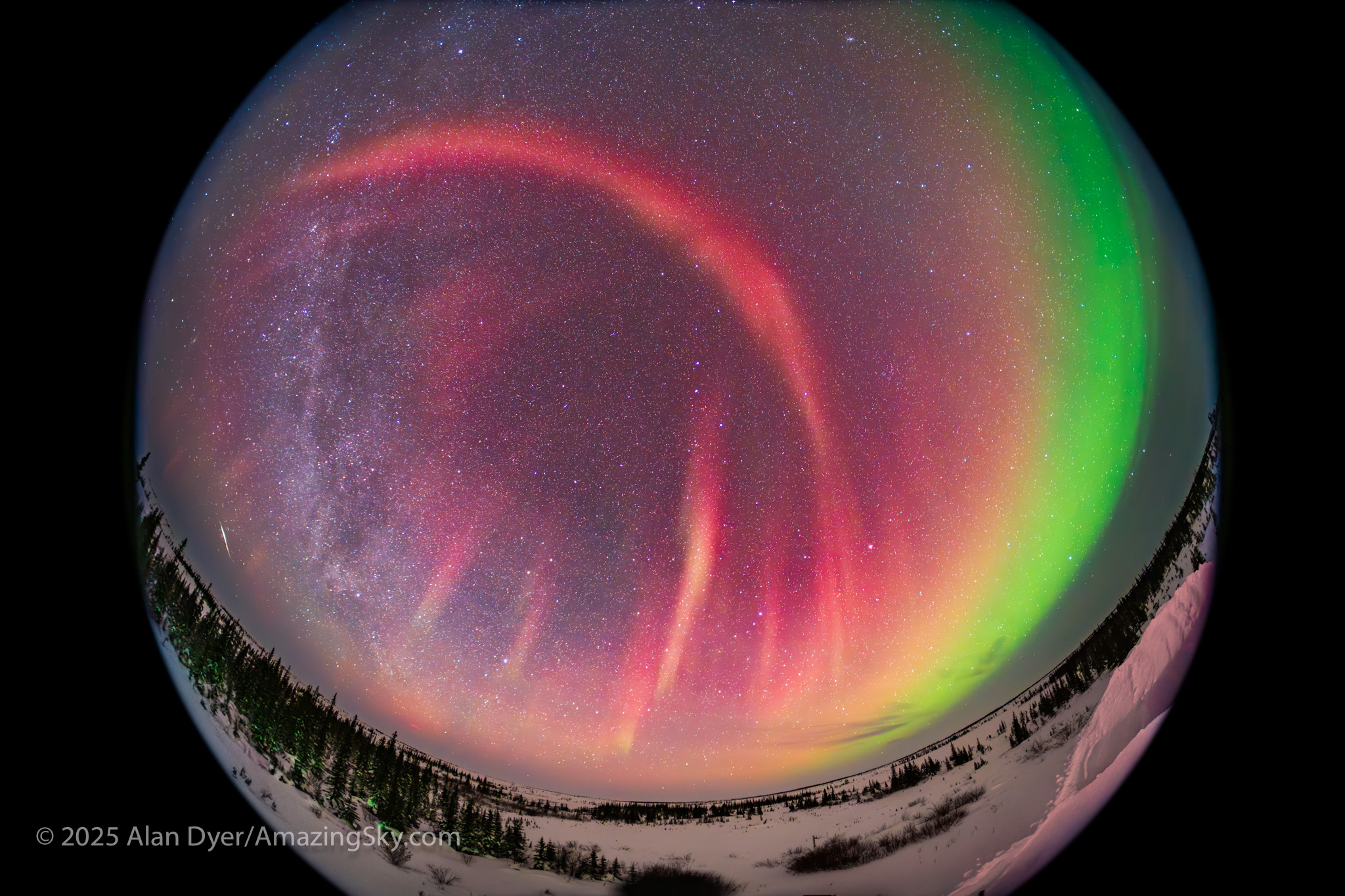
A fish-eye 360° view of a dim and weak display of Northern Lights on February 24, 2025, showing a green diffuse band to the south and a dim red curtain overhead with rays to the east. This red aurora was just visible to the eye as a grey streak. A single long 30-second exposure with the TTArtisan 7.5mm fish-eye lens wide open at f/2 on the Nikon Z6III at ISO 1600.

The main attraction, the aurora, can vary from night to night. However, even when the aurora is weak, as it was this night, above, it can still put on a fine show for the camera, glowing in red colours that only long exposures reveal.
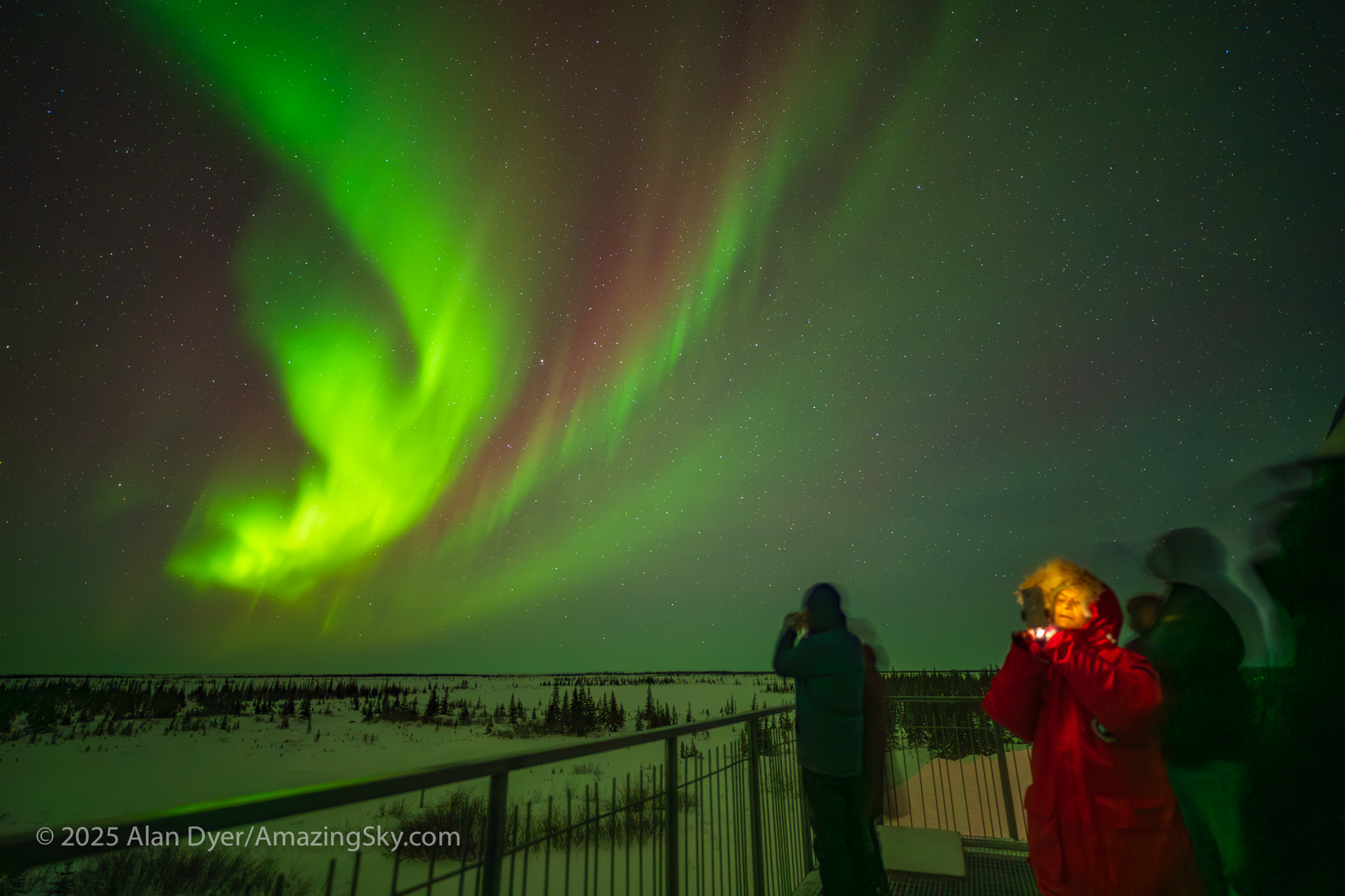
Aurora tourists from the Road Scholar travel company enjoy the show of Northern Lights at the Churchill Northern Studies centre in Churchill, Manitoba, March 1, 2025. This is a 6-second exposure at f/1.8 with the Viltrox 16mm lens on the Nikon Z6III at ISO 1600.

While I use high-end cameras and fast lenses, I’ve been impressed with how well today’s phone cameras can capture the Lights very simply and easily, as a guest is doing above, especially when the aurora is bright.
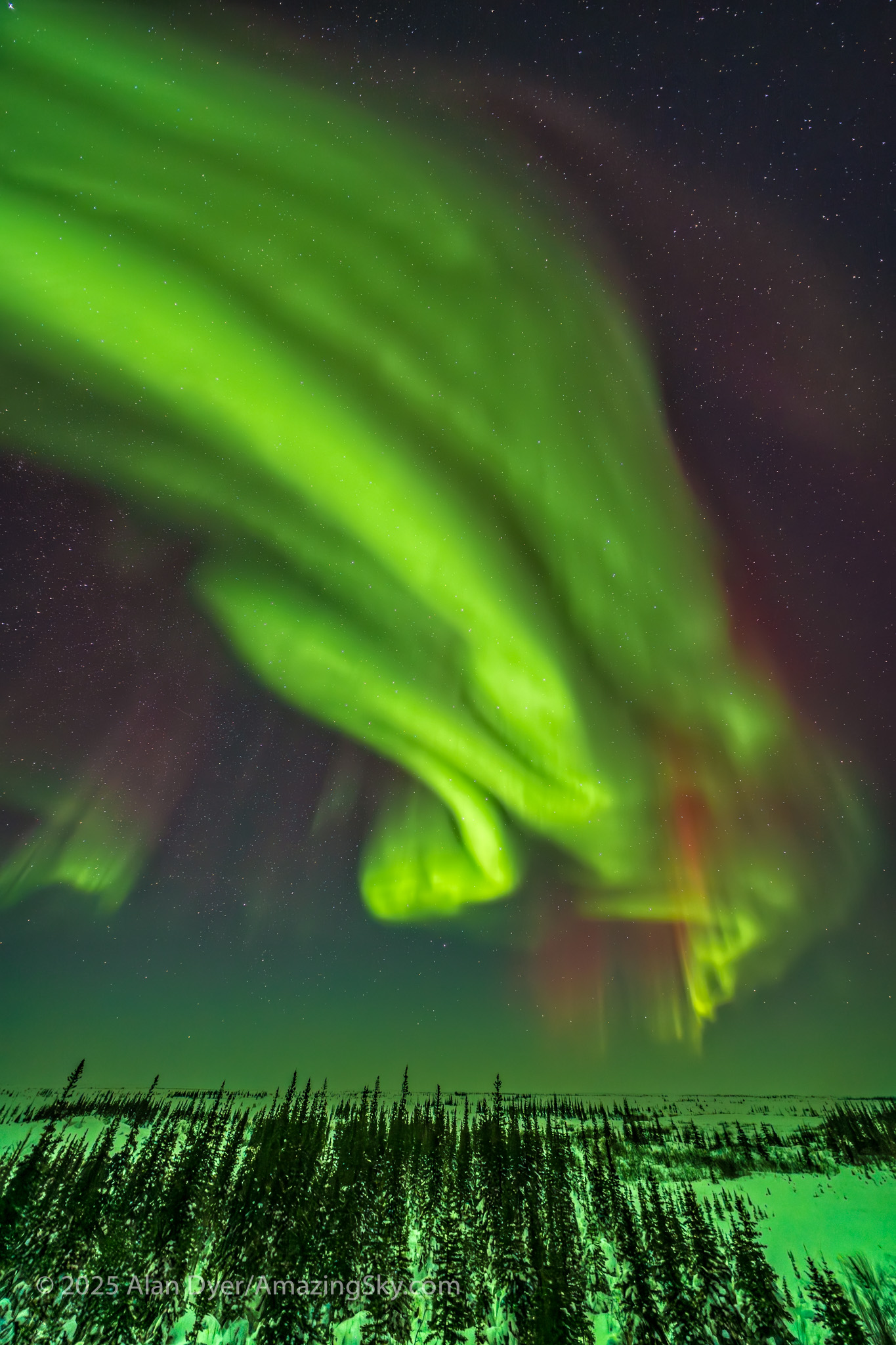
A band of bright green aurora appears here with some subtle red rays at right and magenta upper curtains at left, with the green glow lighting the snow green. A 10-second exposure with the Laowa 10mm lens at f/2.8 on the Nikon Z6III at ISO 1600.

When the aurora brightens, greens and sometimes pinks are visible to the eye, and not just to the camera. And the aurora exhibits rapid rippling and waving motions (check the video below).
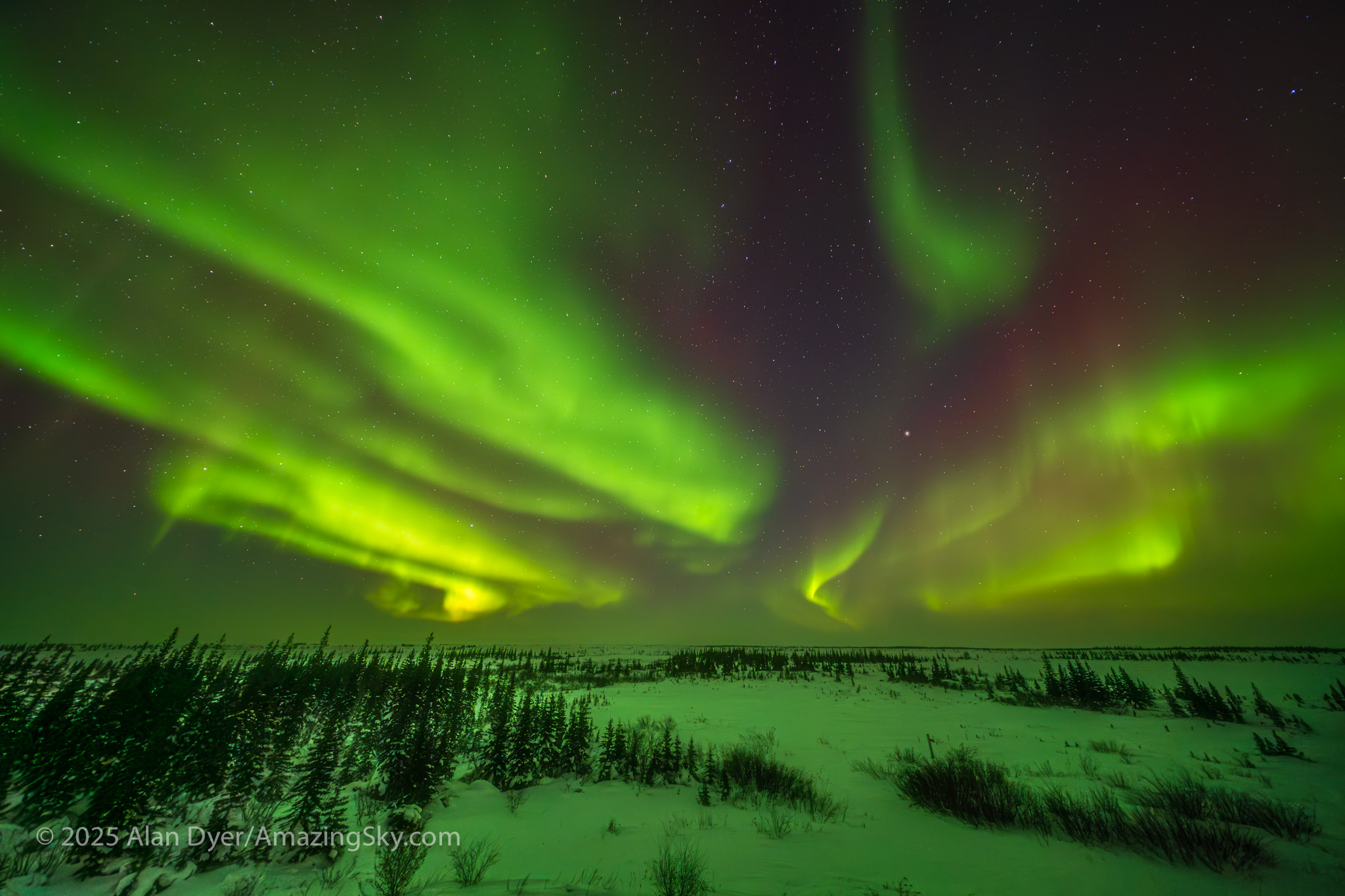
A bright display of colourful curtains of Northern Lights at the Churchill Northern Studies Centre. This is looking northeast toward the direction of the midnight sector where the auroras usually brighten from. This is a single 8-second exposure with the Laowa 10mm lens at f/2.8 and Nikon Z6III at ISO 1600.

The finest sight is when the aurora curtains converge overhead at the zenith for a “coronal outburst.” The effect can be fleeting but the sight is unforgettable. It is one of the finest sights the sky can offer, ranking with a total eclipse of the Sun.
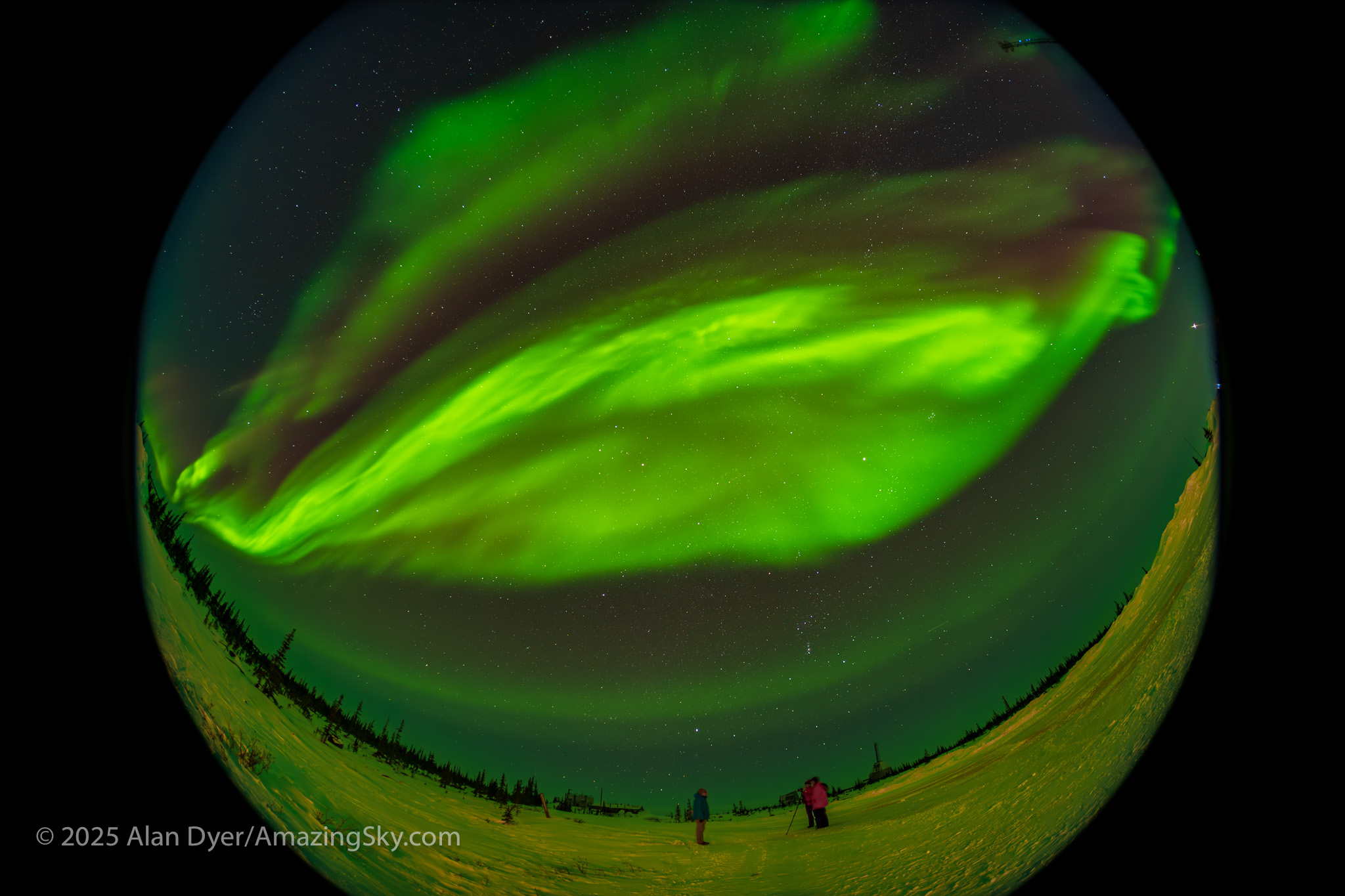
A fish-eye 360° view of the fine display of Northern Lights on February 25, 2025, with a complex of curtains passing overhead and across the sky from northeast (at lower left) to southwest (at upper right), with Venus setting at far right. Orion and Sirius are at bottom centre to the south. A single 10-second exposure with the TTArtisan 7.5mm fish-eye lens at f/2 on the Nikon Z6III at ISO 1600.

Indeed, on most nights the aurora, which might begin as a low arc across the north, moves south to fill the sky with swirling and curling curtains, as below.
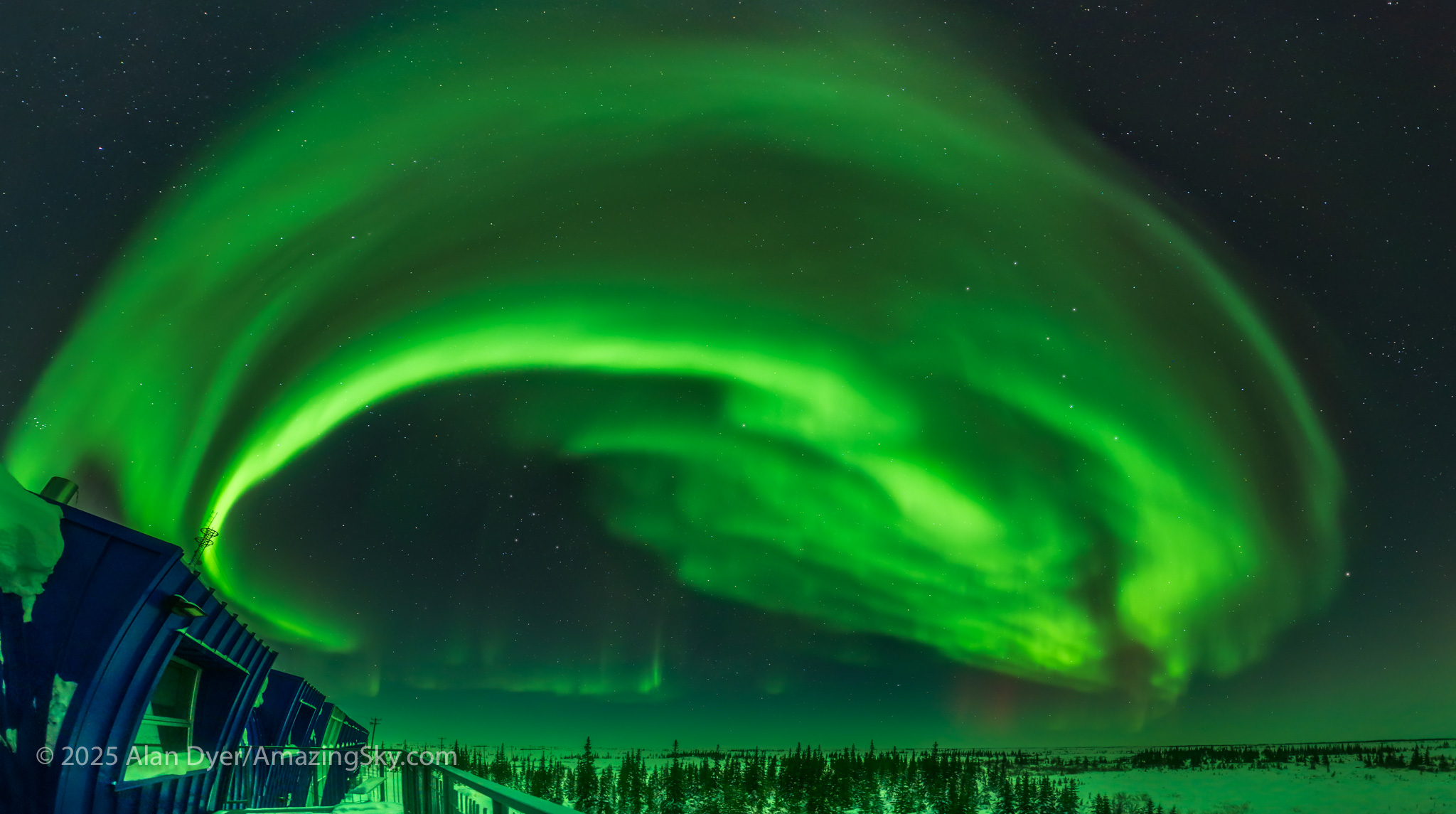
This is a 180º panorama of the Northern Lights across the northern sky on February 27, 2025 during a Kp4-level display. The field extends from the horizon up to well past the zenith. This is a panorama of 6 segments, each an 8-second exposure at f/2.8 with the Laowa 10mm lens on the Nikon Z6III at ISO 1600.

A gallery of my images from Churchill from this year and from past years is on my main AmazingSky.com website here.

A musical collage of still images and real-time videos I shot this year is viewable here on YouTube.

Click through to YouTube for more information about the video.

It’s been a great ten years taking in the wonderful Northern Lights in Churchill. While this was my last year, I encourage you to visit to see the sights for yourself.

Everyone goes away with great memories, able to check the aurora off their bucket list of experiences.

— Alan, March 10, 2025 / AmazingSky.com

The Snowbound Eclipse


For once I was able to watch a total eclipse of the Moon under clear skies from home. Good thing, as a snowstorm would have made travel a challenge. 

On November 8, 2022 the Full Moon once again passed through the umbral shadow of the Earth, as it has done at six-month intervals for the last two years. The Moon turned deep red for almost an hour and a half. 

This is the totally eclipsed Moon of November 8, 2022 set in the stars of Aries, with the planet Uranus nearby, visible as the greenish star about three Moon diameters away from the Moon at the 10 o’clock position.

This was to be the last total eclipse of the Moon visible from anywhere in the world until March 14, 2025. 

However, in the days leading up to the eclipse weather prospects looked poor. The worse snowstorm — indeed the first major snowstorm for my area — was forecast for the day before the eclipse, November 7. Of course! 

Weather prospects for eclipse time from the Astrospheric app.

For all the lunar eclipses in the last decade visible from my area, I have had to chase to find clear skies, perhaps a couple of hours away or a half day’s drive away. I documented those expeditions in previous posts, the latest of which is here for the May 15, 2022 total eclipse. In all cases I was successful. 

However, just once it would be nice to be able to stay home. The last “TLE” I was able to watch from home was on December 21, 2010. It had been a long decade of lunar eclipse chasing! 

But, it looked like another chase might be needed. Weather maps showed possible clear skies to the west and south of me on eclipse night. But cloud over me. 

Other forecast models were a bit more optimistic.

The problem was with six inches of new snow having fallen and temperatures forecast to be in the minus 20s Celsius, any drive to a remote site was going to be unwise, especially at 3 am for the start of the eclipse in my time zone in Alberta. 

I decided to — indeed was more or less forced to — stay put at home and hope for the best. So this was the “snowbound eclipse!” 

Luckily, as the snowstorm receded east, clear skies followed, providing better conditions than I had expected. What a pleasure it was watching this eclipse from the comfort of home. While operating camera gear at -25° C was still a challenge, at least I could retreat inside to warm up. 

A wide-angle view of the total eclipse of the Moon of November 8, 2022, with the red Moon at right amid the stars of the northern winter sky, plus with bright red Mars at top. Above and left of the Moon is the blue Pleiades star cluster, while below it and to the left is the larger Hyades cluster with reddish Aldebaran in Taurus. The stars of Orion are left of centre, including reddish Betelgeuse, while at far left are the two Dog Stars: Procyon, at top, in Canis Minor, and Sirius, at bottom, in Canis Major.

The view with the naked eye of the red Moon set in the winter sky was unforgettable. And the views though binoculars were, as always, the best for showing off the subtle colour gradations across the lunar disk. 

A self-portrait of me observing the total eclipse of the Moon on November 8, 2022, on a very cold (-25° C) morning at 4 am.

As has been the tradition at the last few eclipses, I shot a souvenir selfie to show I was really there enjoying the eclipse. 

A view of the aurora that appeared during the November 8, 2022 total eclipse of the Moon, as the sky darkened to reveal a show of Northern Lights on this very cold and icy night at 4 am.

A bonus was the appearance of some Northern Lights during totality. As the bright Moon dimmed during its passage into Earth’s umbral shadow, darkening the sky, the aurora began to appear to the north, opposite the eclipsed Moon. 

Not a great display, but it was the first time I can recall seeing aurora during a lunar eclipse. 

A parting shot of the now partially eclipsed Moon setting in the west down my driveway, early in the morning of November 8, 2022. With the Canon R6 and TTArtisan 21mm lens at f/2.8.

My parting view and photo was of the now partially eclipsed (and here overexposed) Moon emerging from the shadow and shining right down my rural snowbound driveway. 

It was a perfect last look from home of a sight we won’t see again for two and half years. 

— Alan, November 9, 2022 (amazingsky.com

Touring the Wonders of the Winter Sky


The Wonders of the Winter Sky

I present a tour of the deep-sky wonders of the winter sky.

While some might think the Milky Way is only a summer sight, the winter Milky Way is well worth a look!

In January and February we are looking outward from our location in the Milky Way, toward the Orion Spur, the minor spiral arm we live in. In it, and in the major Perseus Arm that lies beyond, lie hotbeds of star formation.

Artist's impression of the Milky Way (updated - annotated)
Courtesy European Southern Observatory

These star forming areas create a panorama of star clusters and glowing nebulas along the winter Milky Way and surrounding the constellation of Orion. The montage above shows the best of the deep-sky sights at this time or year.

(And yes, for southern hemisphere viewers I know this is your summer sky! But for us northerners, Orion is forever associated with frosty winter nights.)

The closeups below are all with a 200mm telephoto lens providing a field of view similar to that of binoculars. However, most of these nebulas are photographic targets only.


The Belt and Sword of Orion

The Belt and Sword of Orion with Barnard's Loop
This is a stack of 16 x 2- to 3-minute exposures with the filter-modified Canon 5D MkII at ISO 800 to 1250 and 200mm Canon L-Series lens at f/2.8. Taken with the Fornax Lightrack tracker as part of testing. Taken from home on January 8, 2019 during a clear couple of hours between passing haze and cloud.

This is the heart of the star formation activity, in the centre of Orion.

The bright Orion Nebula (or Messier 42 and 43) at bottom in Orion’s Sword is obvious in binoculars and glorious in a small telescope.

The Horsehead Nebula above centre and just below Orion’s Belt is famous but is a tough target to see through even a large telescope.

Barnard’s Loop at left is a wave of nebulosity being blown out of the Orion area by strong stellar winds. Any sighting of this object by eye is considered a feat of observing skill!


The Rosette Nebula and Area

Rosette and Christmas Tree Cluster with 200mm
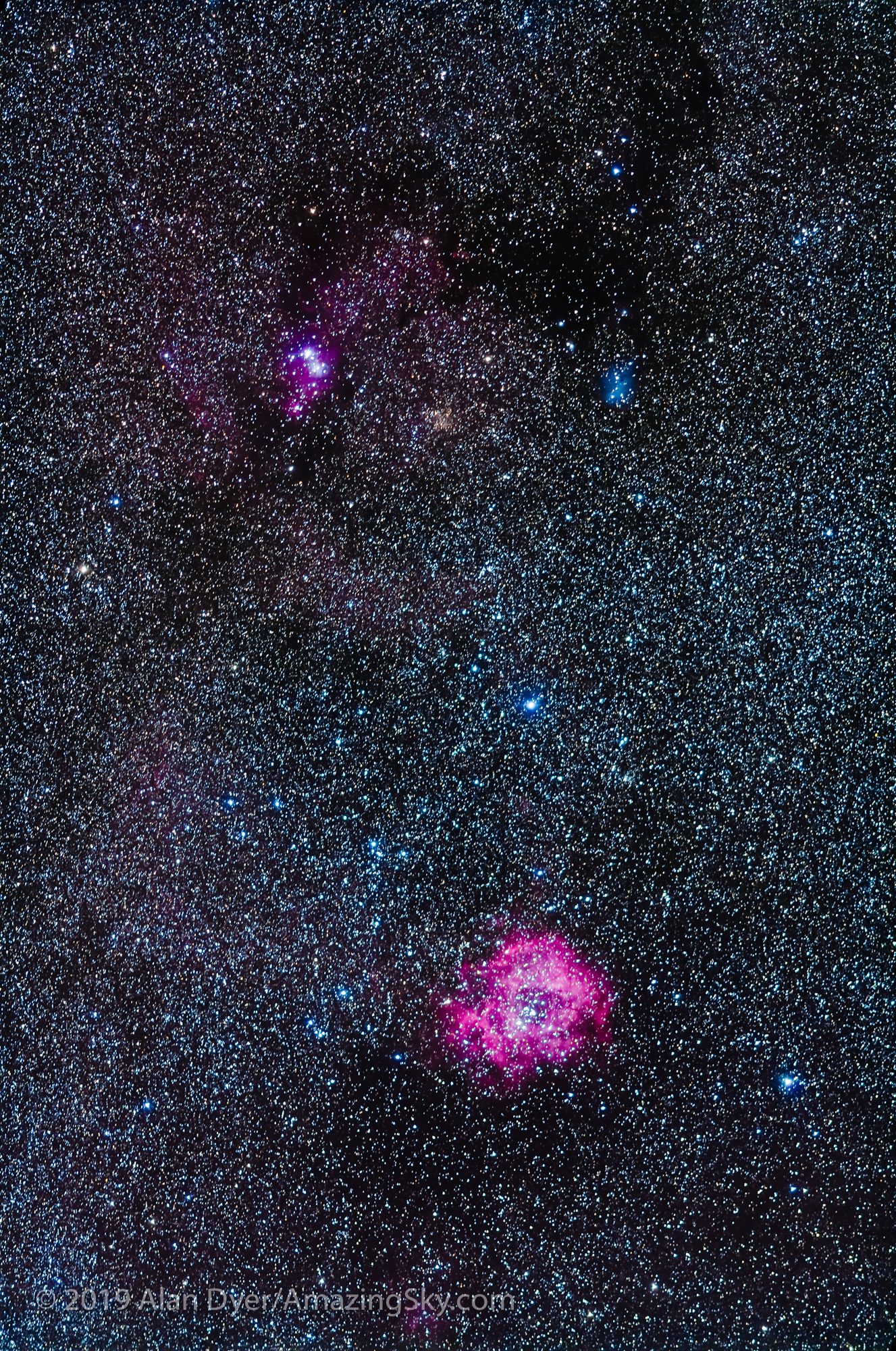
The area of the Rosette Nebula (bottom) and Christmas Tree Cluster (top) in Monoceros with the Fornax Lightrack tracker and 200mm lens and filter modified Canon 5D MkII. This is a stack of 10 x 3 minute exposures at ISO 800.

The small cluster of hot young stars inside the Rosette Nebula is blowing a hole in the nebula giving it its Rosette name. Above is a loose star cluster called the Christmas Tree, surrounded by more faint nebulosity that includes the tiny Cone Nebula.


Gemini Clusters and Nebulas

The Clusters and Nebulas of Gemini
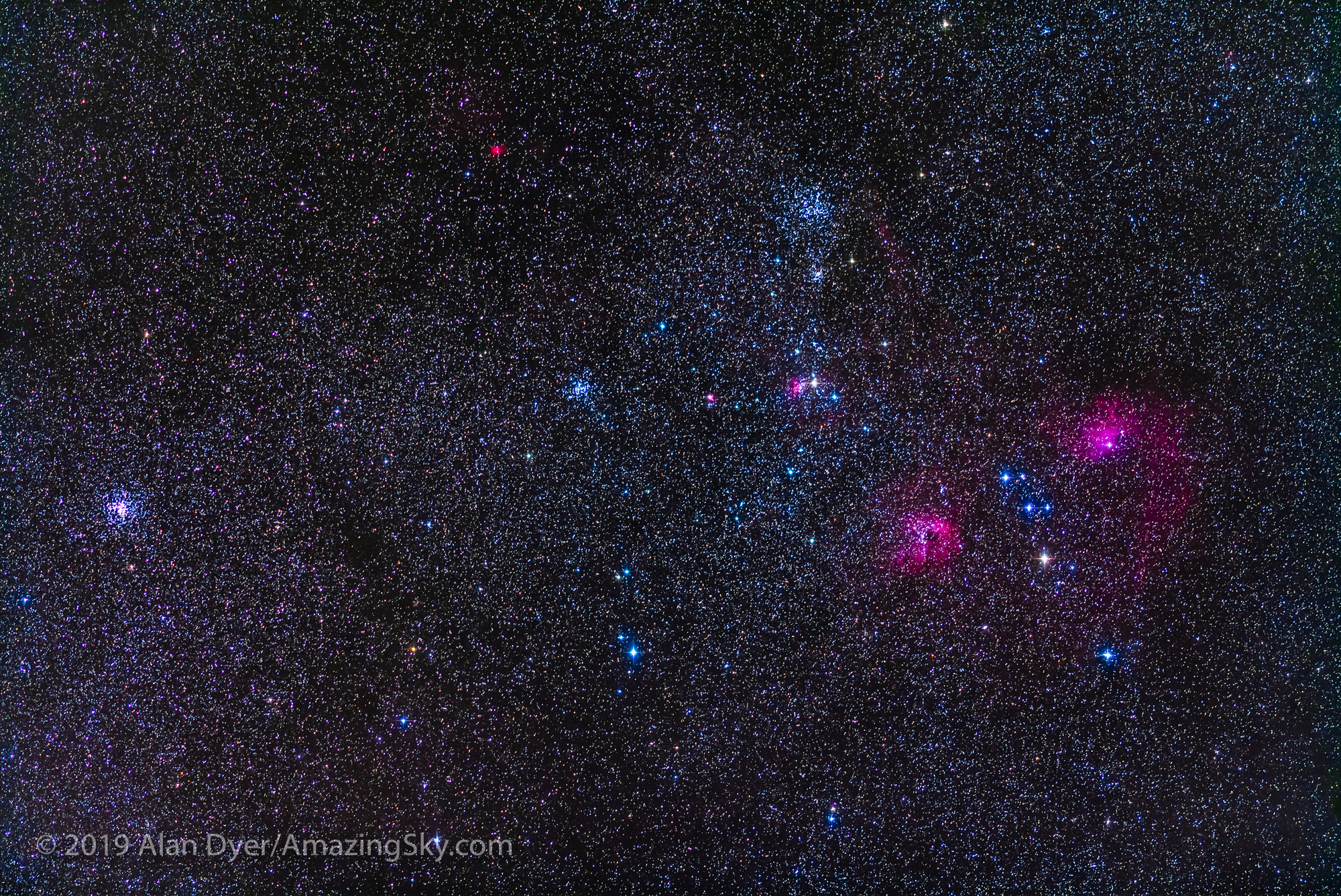
This is a stack of 10 x 3-minute exposures with the filter-modified Canon 5D MkII at ISO 800 and 200mm Canon L-Series lens at f/2.8. Some light haze passing through in some exposures added the natural star glows. I left those in as part of the stack to add the glows. Taken with the Fornax Lightrack tracker as part of testing. Taken from home on a rare fine and mild winter night, January 4, 2019.

This field of clusters and nebulosity is above Orion in Gemini, with Messier 35 the main open star cluster here at top. Below M35 is the tiny star cluster NGC 2158. The nebulosity at left between Mu and Eta Geminorum is IC 443, a remnant of a supernova explosion, and is aka the Jellyfish Nebula. The nebula at bottom is IC 2174, just over the border in Orion and aka the Monkeyhead Nebula.


Auriga Clusters and Nebulas

The Clusters and Nebulas of Auriga
This is a stack of 5 x 3-minute exposures with the filter-modified Canon 5D MkII at ISO 800 and 200mm Canon L-Series lens at f/2.8. Taken with the Fornax Lightrack tracker as part of testing. Diffraction spikes added with Astronomy Tools actions. Taken from home on January 4, 2019.

Above Gemini and Orion lies Auriga, with its rich field of clusters and nebulosity, with — from left to right — Messier 37, Messier 36, and Messier 38, as the main open star clusters here. Below M38 is NGC 1907. The nebulosity at right is IC 410 and IC 405, the Flaming Star Nebula.

In between them is the colourful asterism known as the Little Fish. Messier 38 is also known as the Starfish Cluster while Messier 36 is called the Pinwheel Cluster. The bright red nebula at top is Sharpless 2-235. The little nebulas at centre are NGC 1931 and IC 417.


The California Nebula

The California Nebula in Perseus
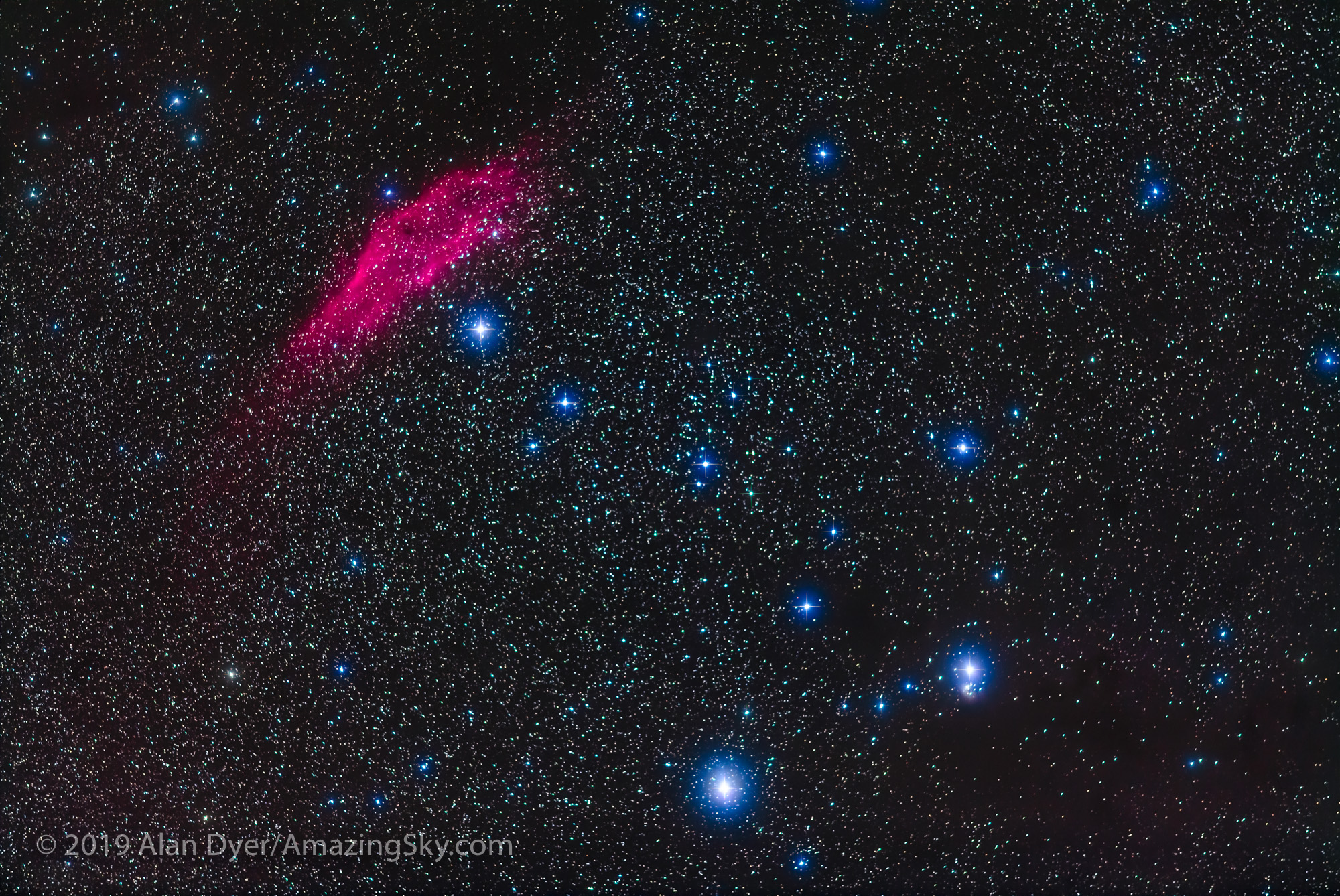
This is a stack of 5 x 3-minute exposures with the filter-modified Canon 5D MkII at ISO 800 and 200mm Canon L-Series lens at f/2.8. An additional exposure taken through the Kenko Softon A filter is layered in to add the star glows to bring out their colours. Taken with the Fornax Lightrack tracker. Taken from home on a rare fine and mild winter night, January 4, 2019.

Now we enter Perseus, more an autumn constellation but well up through most of the winter months. It contains the aptly named California Nebula, NGC 1499, at top left, with the bright star Zeta Persei. at bottom A small region of reflection nebulosity, IC 348, surrounds the star Atik, or Omicron Persei, at bottom right. The star just below NGC 1499 is Menkib, or Xi Persei, and is likely energizing the nebula.


The Pleiades, or Seven Sisters

Pleiades M45 with 200mm Lens
The Pleiades with the Fornax Lightrack tracker and 200mm lens + Canon 5D MkII in a stack of 10 x 3 minute exposures at ISO 800.

Obvious to the eye and central to the sky lore of many cultures is the Pleiades, aka the Seven Sisters, in Taurus the bull. It is also called Messier 45.

This is a newly formed cluster of hundreds of stars, passing through a dusty region of the Milky Way, which adds the fuzzy glows around the stars — an example of a reflection nebula, glowing blue as it reflects the blue light of the young stars.


The Hyades

The Hyades Star Cluster with NGC 1647 in Taurus
This is a stack of 5 x 2-minute exposures with the Canon 5D MkII at ISO 800 and 200mm Canon L-Series lens at f/2.8. An additional exposure taken through the Kenko Softon A filter is layered in to add the star glows to bring out their colours. Taken with the Fornax Lightrack tracker. Diffraction spikes added with Astronomy Tools actions for artistic effect.

Below the Pleiades in Taurus lies the larger Hyades star cluster. The V-shaped cluster stars are all moving together and lie about 150 light years away. Bright yellow Aldebaran, the eye of Taurus, is an intruder and lies at only half that distance, so is not a member of Hyades but is a more nearby star. The smaller, more distant star cluster NGC 1647 appears at left.


Seagull Nebula

Seagull Nebula and Sirius with 200mm
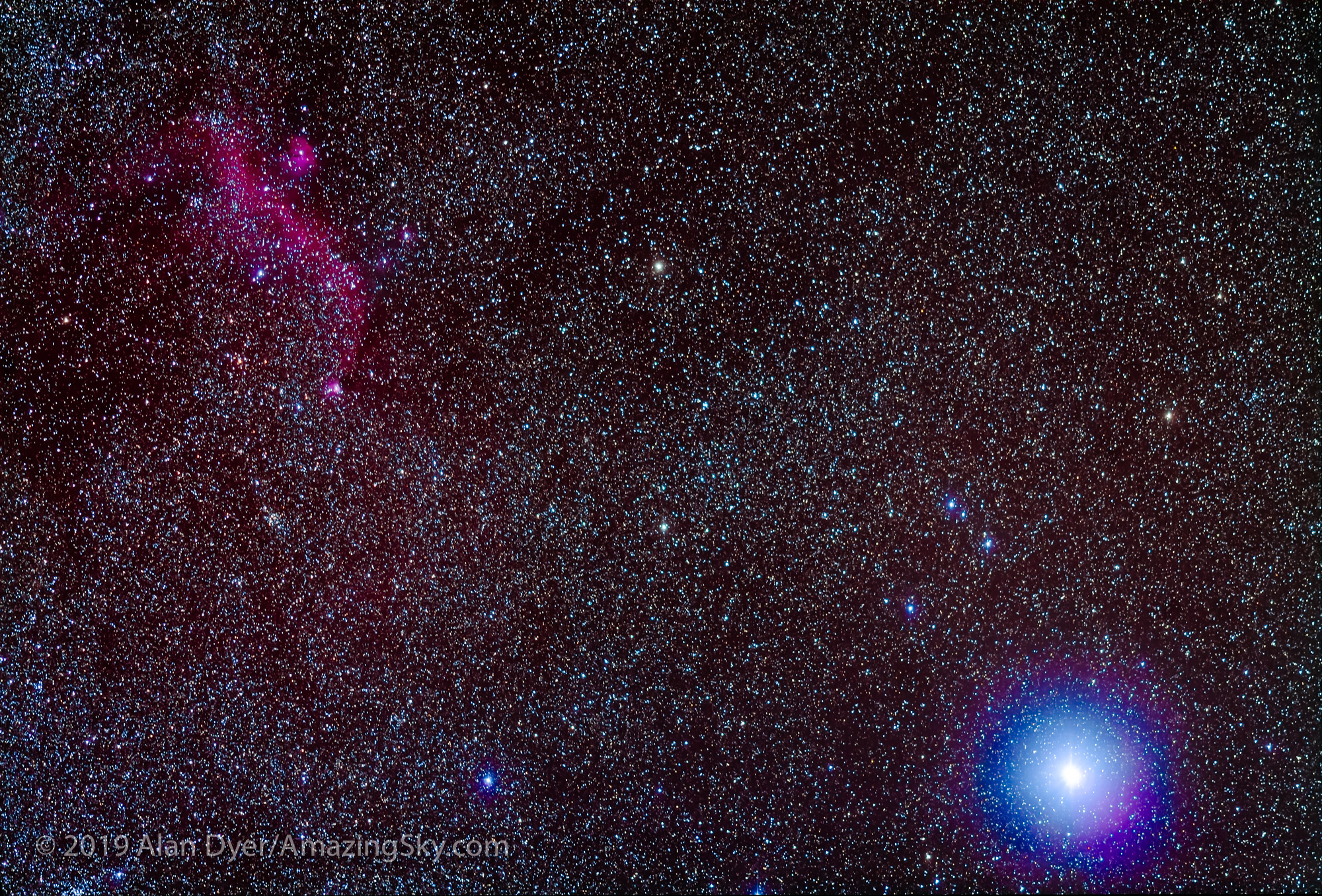
This is a stack of 10 x 3 minute exposures at ISO 800 (with the filter-modified Canon 5D MkII and Canon 200mm lens at f/2.8). The rings of colour around Sirius are an artifact of the sensor filter, I think!

Low in my northern winter sky is the brightest star in the sky of any season, Sirius. Just above and to the east of Sirius lies the Seagull Nebula (at top left), also called IC 2177, on the Canis Major-Monoceros border. Like many of these nebulas. the Seagull is too faint to easily see even with a telescope, but shows up well in photographs.


Lambda Orionis Nebula

Lambda Orionis Nebula with 200mm
With the Fornax Lightrack tracker and 200mm lens and filter-modified Canon 5D MkII. A stack of 10 x 3 minute exposures at ISO 800 with the filter-modified Canon 5D MkII and Canon 200mm lens at f/2.8.

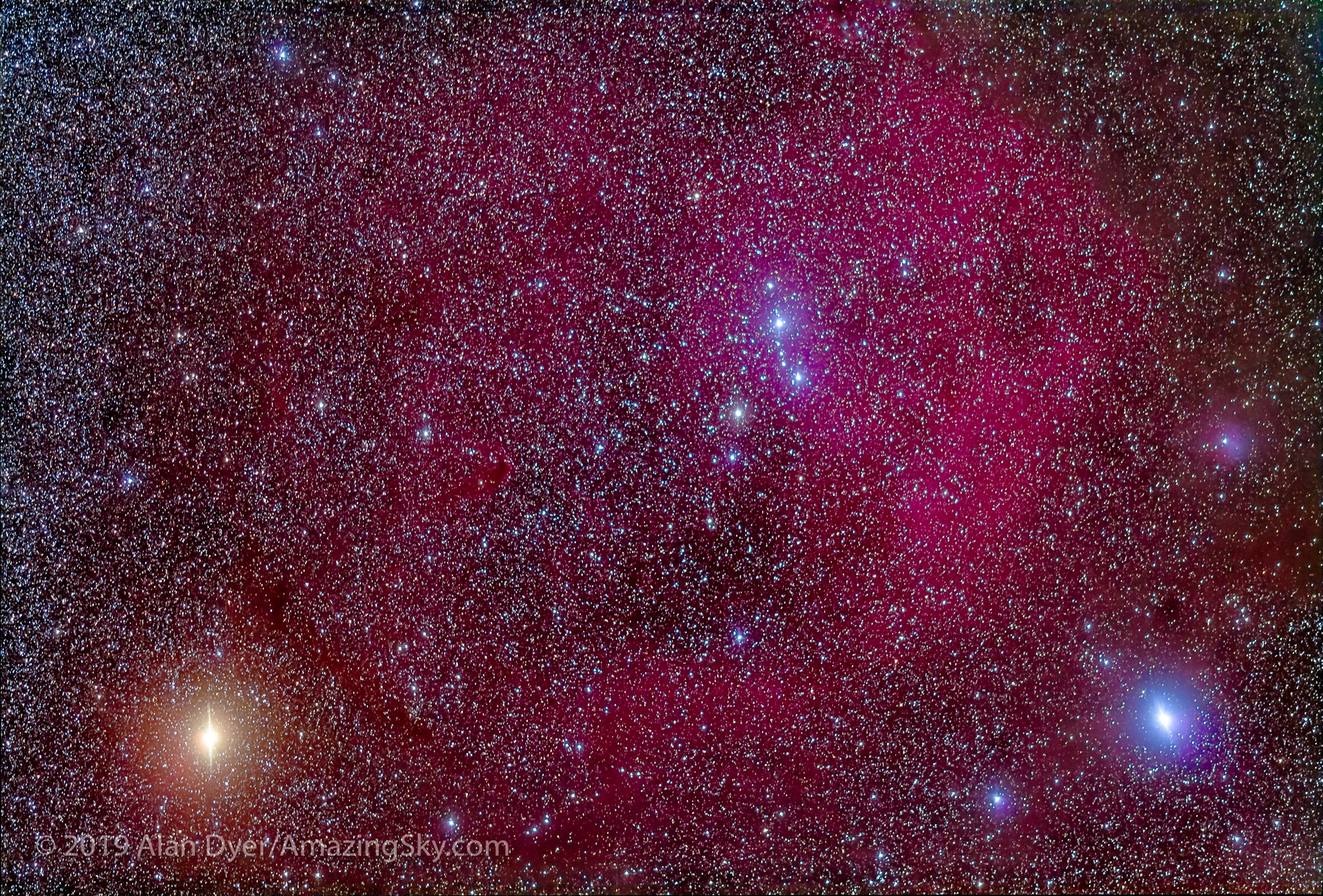
This is the head of Orion, with the red supergiant star Betelgeuse at bottom left and the blue giant star Bellatrix right at bottom right. The brightest star at top is Meissa or Lambda Orionis, and is surrounded by a large and very faint area of hydrogen nebulosity. The open cluster around Meissa is catalogued as Collinder 69.

While the winter Milky Way might not look as bright and spectacular as the summer Milky Way of Sagittarius and Scorpius, it does contains a wealth of wonders that are treats for the eye and telescope … and for the camera.

PS.: The techniques for taking and processing images like these form the content of our new Deep Sky with Your DSLR video course now being promoted on KickStarter until the end of February, and available for purchase once it is published later this spring.

See my previous blog post for details.  Thanks and clear skies!

— Alan, February 17, 2019 / © 2019 Alan Dyer / AmazingSky.com 


A Starry Night in the Badlands


Winter Milky Way Arch and Zodiacal Light

In a winter of cloud, the skies cleared for a magical night in the Alberta Badlands.

Two weeks ago, on February 28, I took advantage of a rare and pristine night to head to one of my favourite spots in Dinosaur Provincial Park, to shoot nightscapes of the winter sky over the Badlands.

A spate of warm weather had melted most of the snow, so the landscape doesn’t look too wintery. But the stars definitely belong to winter in the Northern Hemisphere.

The main image above shows the winter Milky Way arching across the sky from southeast (at left) to northwest (at right). The tower of light in the west is the Zodiacal Light, caused by sunlight reflecting off dust particles in the inner solar system. It is an interplanetary, not atmospheric, effect.

Winter Sky Panorama at Dinosaur Park (Fish-Eye View)
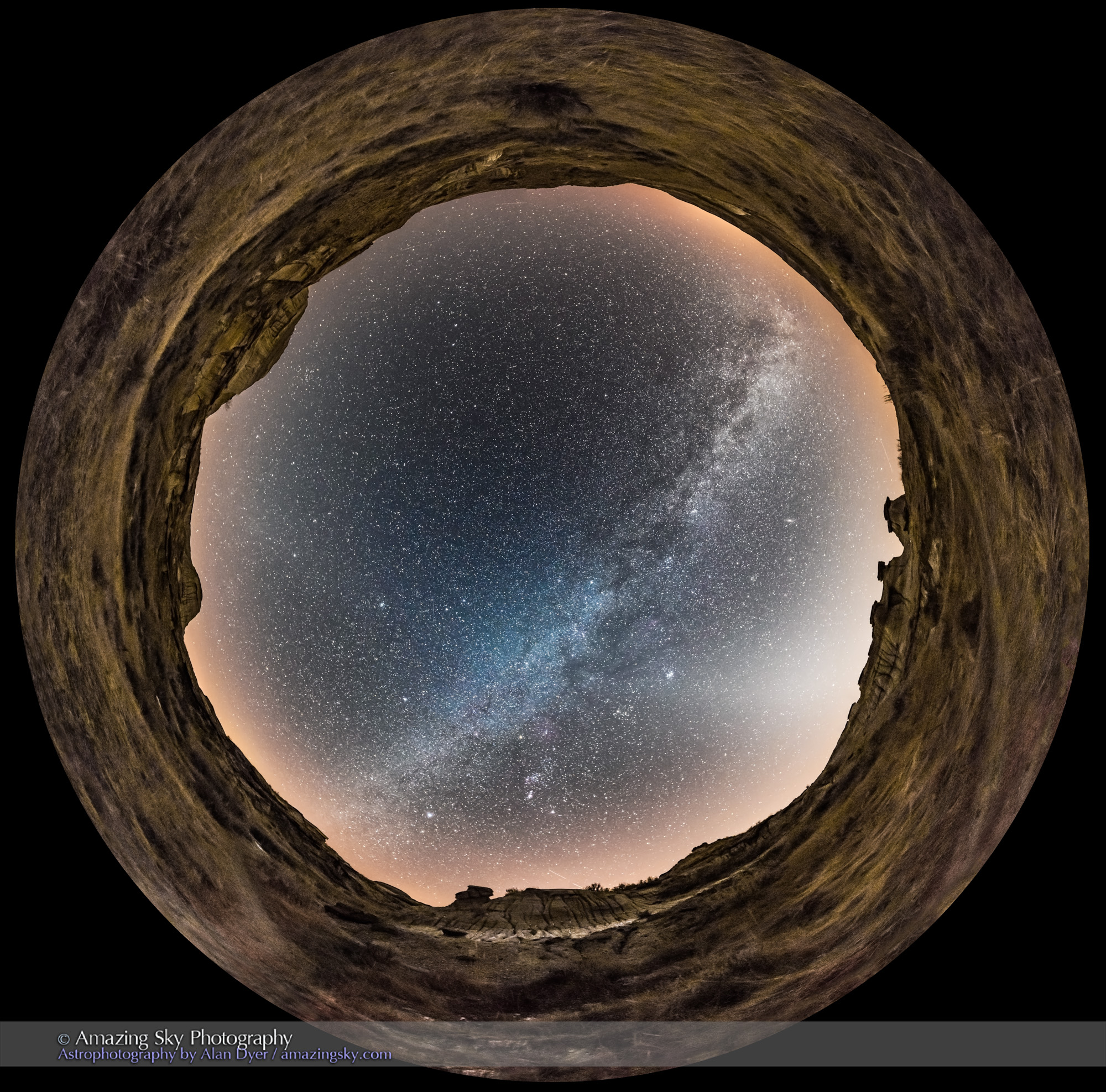
This is a stitch of 6 segments with the 12mm Rokinon lens at f/2.8 for 30 seconds each, with the Nikon D750 at ISO 6400, mounted portrait. Stitched with PTGui.

Above, this 360° version of the scene records the entire sky, with the winter Milky Way from horizon to horizon. With a little averted imagination you can also trace the Zodiacal Light from west (right) over to the eastern sky (left), where it brightens in the diffuse glow of the Gegenschein, where dust opposite the Sun in the outer solar system reflects light back to us.

Winter Sky Panorama at Dinosaur Park (with Labels)
This is a stitch of 6 segments taken with the 12mm full-fame fish-eye Rokinon lens at f/2.8, all 30-second exposures with the Nikon D750 at ISO 6400. The camera was aimed portrait with the segments at 60° spacings. Stitched with PTGui using equirectangular projection with the zeith pulled down slightly.

A rectangular version of the panorama wraps the sky around from east (left), with Leo rising, to northeast (right), with the Big Dipper standing on its handle. I’ve added the labels in Photoshop of course.

Winter Stars over Dinosaur Park
This is a stack of 8 x 30-second exposures for the ground, mean combined to smooth noise, plus one 30-second exposure for the sky. All at f/2.2 with the Sigma 20mm Art lens and Nikon D750 at ISO 6400.

Here, in a single-frame shot, Orion is at centre, Canis Major (with Sirius) is below left, and Taurus (with Aldebaran) is at upper right. The Milky Way runs down to the south. The clusters M35, M41, M46 and M47 are visible as diffuse spots, as is the Orion Nebula, M42, below Orion’s Belt.

Evening Zodiacal Light at Dinosaur Park
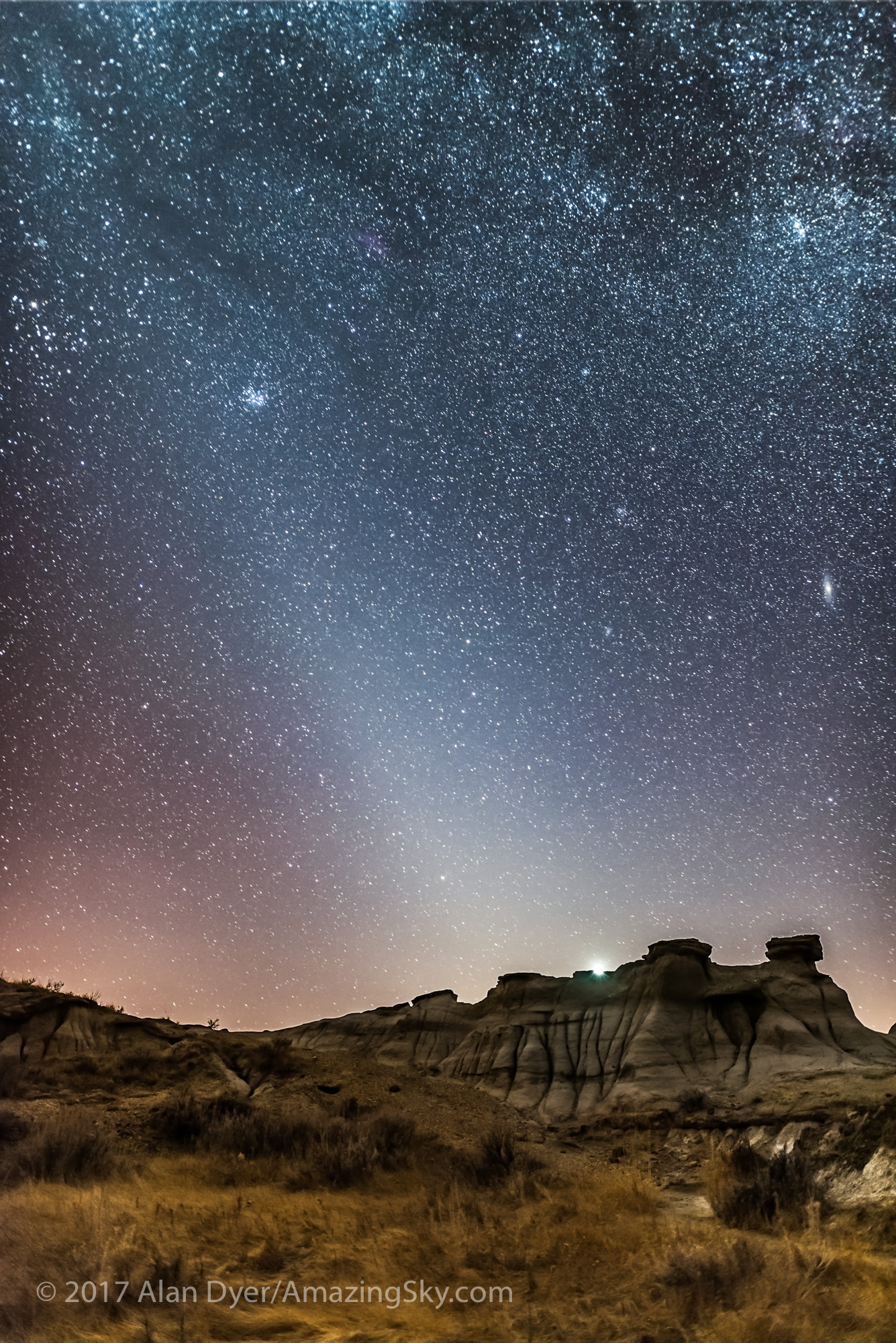
The late winter evening Zodiacal Light, from at Dinosaur Provincial Park, Alberta, February 28, 2017. This is a stack of 7 x 30-second exposures for the ground, mean combined for lower noise, plus one 30-second exposure for the sky, all at f/2 with the 20mm Sigma Art lens, and Nikon D750 at ISO 6400.

This is certainly my best shot of the evening Zodiacal Light from my area in Alberta. It is obvious at this time of year on moonless nights, but requires a site with little urban skyglow to the west.

It is best visible in the evening from northern latitudes in late winter and spring.

Here, Venus is just setting above the badlands landscape. The Andromeda Galaxy is at right, the Pleiades at left. The Milky Way runs across the frame at top.

There is a common belief among nightscape photographers that the Milky Way can be seen only in summer. Not so.

What they mean is that the brightest part of the Milky Way, the galactic centre, is best seen in summer. But the Milky Way can be seen in all seasons, with the exception of spring when it is largely absent from the early evening sky, but rises late at night.

— Alan, March 14, 2017 / © 2017 Alan Dyer / AmazingSky.com 
 

Waning Moon in the Sunrise Clouds


Waning Moon at Sunrise (Feb 27, 2014)

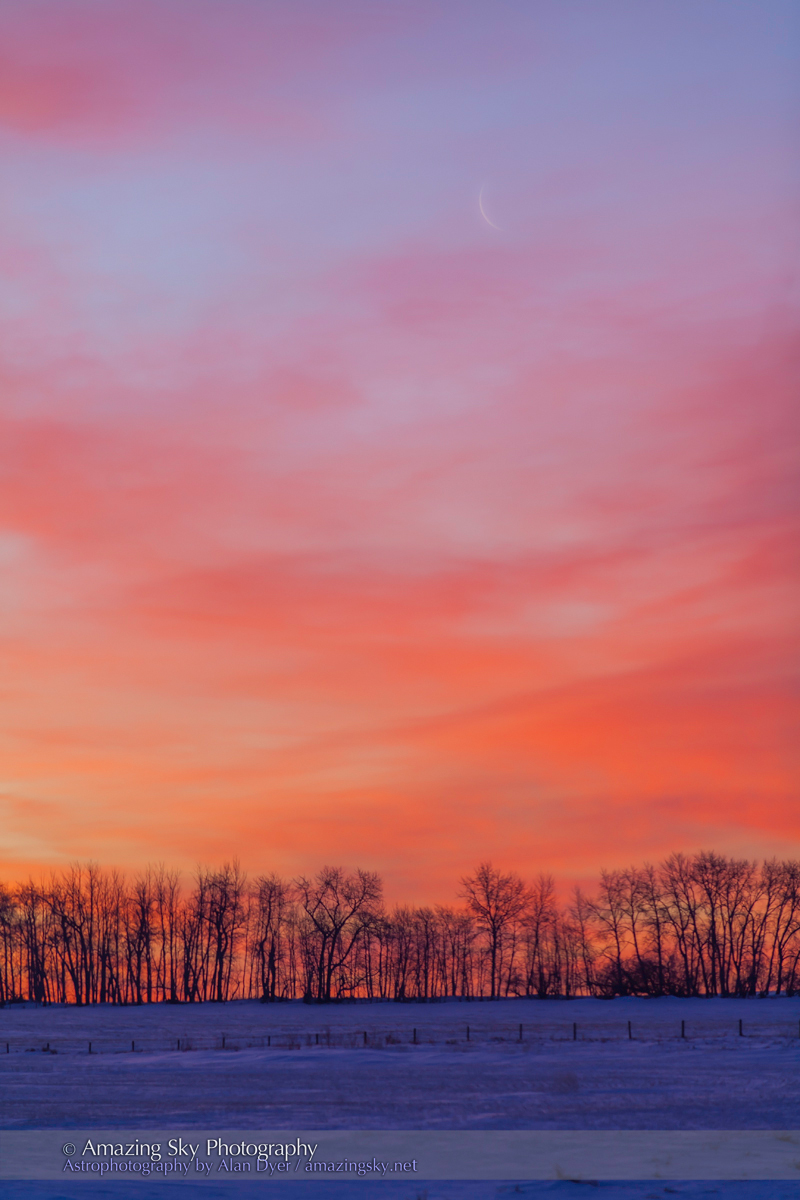
The thin waning Moon sits in the red clouds of sunrise on a winter morning.

This was the scene this morning, February 27, just before sunrise when I was able to catch the thin crescent Moon – a waning Moon – amid the sunrise clouds. The Moon just happened to appear in a clearer hole in the clouds, in a blue patch above the pinks and oranges of the clouds. They contrast with the cold blue snow below.

This was a beautiful scene to start the day.

– Alan, February 27, 2014 / © 2014 Alan Dyer


Solar Halo in a Cold Blue Sky


Solar Halo and Sundogs (Dec 19, 2013) #2

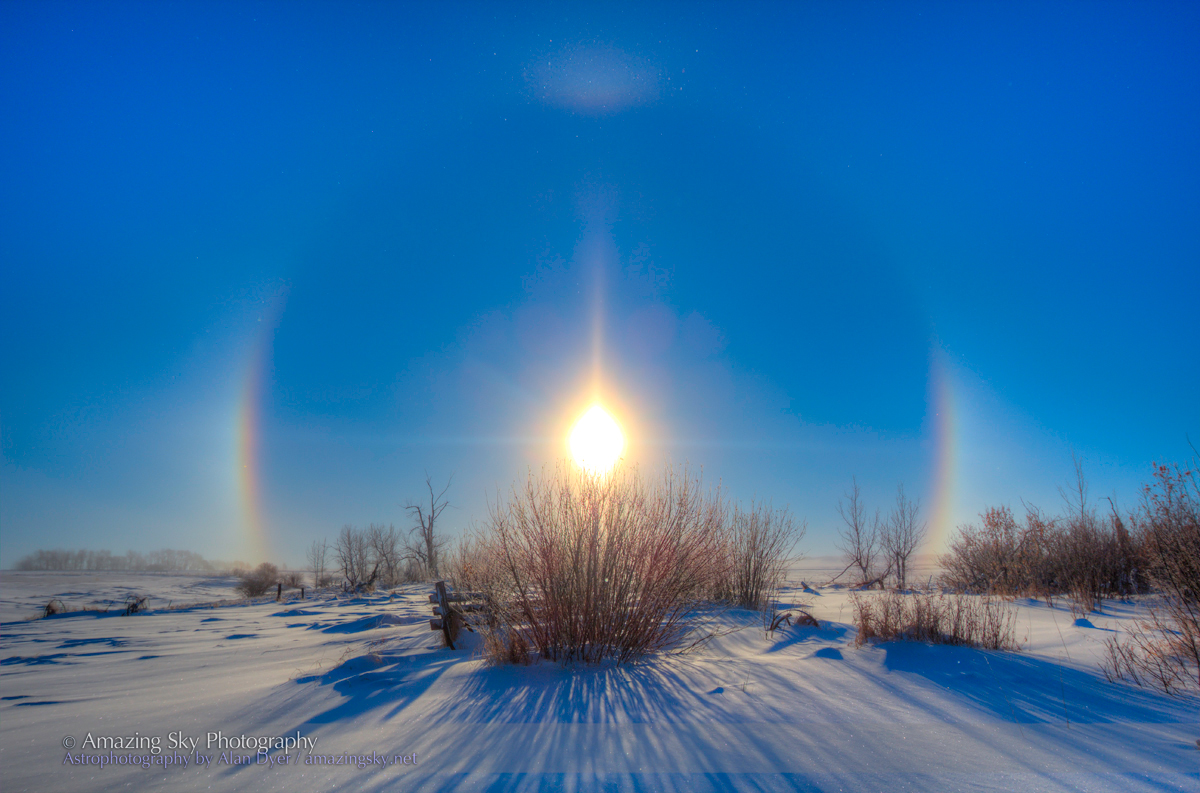
A solar halo and sundogs surround the Sun on a cold winter day in Alberta.

I’m back home amid the snow and cold. The one celestial treat to such a clear but cold winter day is the appearance of sundogs and solar halos around the cold Sun.

This was this morning, with the low winter Sun above my snow-covered backyard, and the air filled with tiny ice crystals. You can see them as sparkly “stars” in the sky and in the foreground. Those crystals are refracting the sunlight and making the coloured “rainbows” on either side of the Sun called “parhelia” or sundogs. A faint halo encircles the Sun, topped by an upper tangent arc.

You can read more about halos and their origin at Les Cowley’s AtmosphericOptics website.

Solar Halo and Sundogs (Dec 19, 2013) #1

Here’s another view with a wider-angle lens. I’ve punched up the vibrance to bring out the fact that the shadows on such a day are not black or grey but blue, coloured by the intense blue light streaming down from the sky.

With these winter scenes, I wish all my blog fans and followers a very Merry Christmas, happy holidays and a very happy New Year. Clear skies to all in 2014!


– Alan, December 19, 2013 / © 2013 Alan Dyer