Exploring the Dusty Realms of the Milky Way


A run of exceptionally clear nights allowed me to capture scenes of stardust along the MilkyWay.

Colourful nebulas – clouds of glowing gas – are the most popular targets in the deep sky for astrophotographers. Most nebulas emit red light from hydrogen atoms. Some glow blue by reflecting the light of nearby hot stars.

But another class of nebulas emits or reflects almost no light, and appears dark, often as shapes silhouetted against the bright starry background. They are usually made of obscuring interstellar dust – typically grains of carbon soot emitted by aging or active stars – literally stardust.

In the olden days of film photography, these dark dust clouds always appeared black in our exposures. Or they never showed up at all.

But today’s digital cameras, with the aid of processing techniques, can capture the dust clouds, often not as black clouds, but as pale blue tendrils, or as brownish-yellow streamers faintly glowing with a warm light.

In October and November 2023, a series of unusually clear and mild nights allowed me to go after some of these dark and dusty targets, from my home in rural southern Alberta, Canada. I captured a selection of scenes off the beaten track along the Milky Way. Here’s my tour of stardust sights in the northern autumn and winter sky.


Cepheus the King
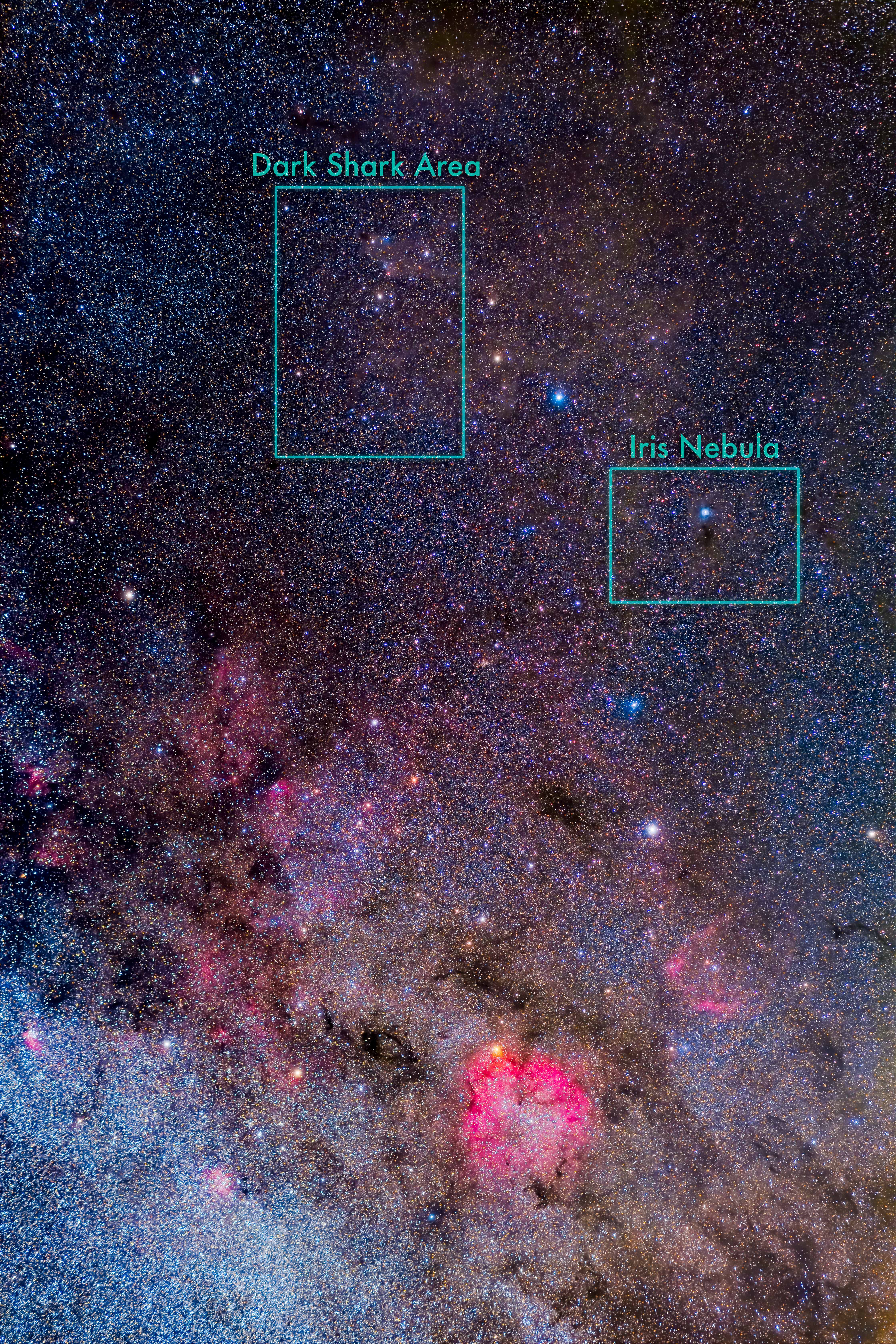
This is a portrait of most of the northern constellation of Cepheus the King. All the wide-field images were shot and processed to emphasize the rich collection of bright and dark nebulas in the constellation. North is always up. This is a stack of 40 x 2-minute exposures with the rare Samyang RF85mm f/1.4 lens stopped down to f/2.8, on the Canon EOS Ra camera at ISO 800. The lens was equipped with a 77mm Nisi Clear Night broadband filter. For all the wide-field images the camera was on the Star Adventurer 2i tracker for tracked but unguided exposures.

The wide-field image above frames most of the northern constellation of Cepheus. The southern section of Cepheus at the bottom of the frame lies in the Milky Way and is rich in bright red nebulas, notably the large, round IC 1396. It is a popular and easy target. But the northern upper reaches of Cepheus are where more challenging dusty nebulas reside. I’ve indicated the location of two fields shown in the close-ups below.

The Iris Nebula
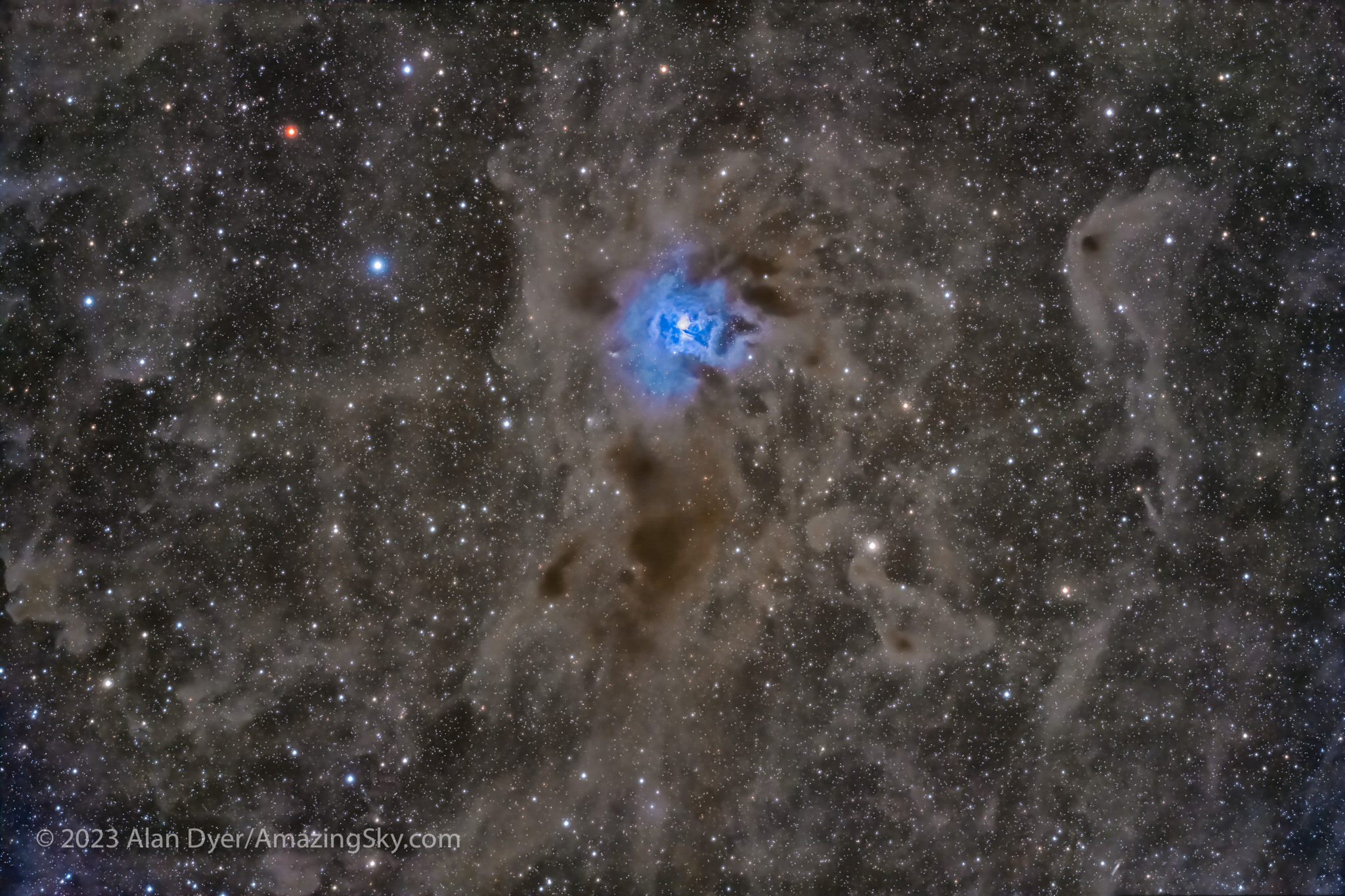
This is the bright blue reflection nebula, NGC 7023, aka the Iris Nebula, in Cepheus. This is a stack of 25 x 8-minute exposures through the Askar APO120 refractor at f/7 with the 1X Flattener, and with the filter-modified Canon R camera at ISO 1600.

Located some 1300 light years away, this is a blue reflection nebula, as the dust is lit by the young blue star in its core. But surrounding the bright Iris Nebula are more extensive clouds of dust, dimly lit by reflected light and with varying densities and shades of grey and brown.

The Dark Shark and Wolf’s Cave Nebulas

This is a portrait of a field of dusty nebulas in northern Cepheus, in a stack of 30 x 6-minute exposures with the Astro-Tech AT90CFT refractor at f/4.8 and filter-modified Canon EOS R camera at ISO 800, though no filter was used when taking these frames.

This field in northern Cepheus is yellowed by reams of dust. A couple of blue reflection nebulas lie on the edges of streamers of brown dust. The object at top is called the Dark Shark, for its fanciful resemblance to a menacing shark, though one wearing a blue hat!

At the bottom of the frame is a long, snake-like dark brown nebula, Barnard 175, with the blue reflection nebula van den Bergh (vdB) 152 at its tip. This object has been dubbed the Wolf’s Cave Nebula, though that likeness is harder to discern. It is unclear where some of these nicknames come from, as many are recent appellations invented by astrophotographers. Some of the names have stuck, though few are “official.”


Perseus the Hero and Taurus the Bull
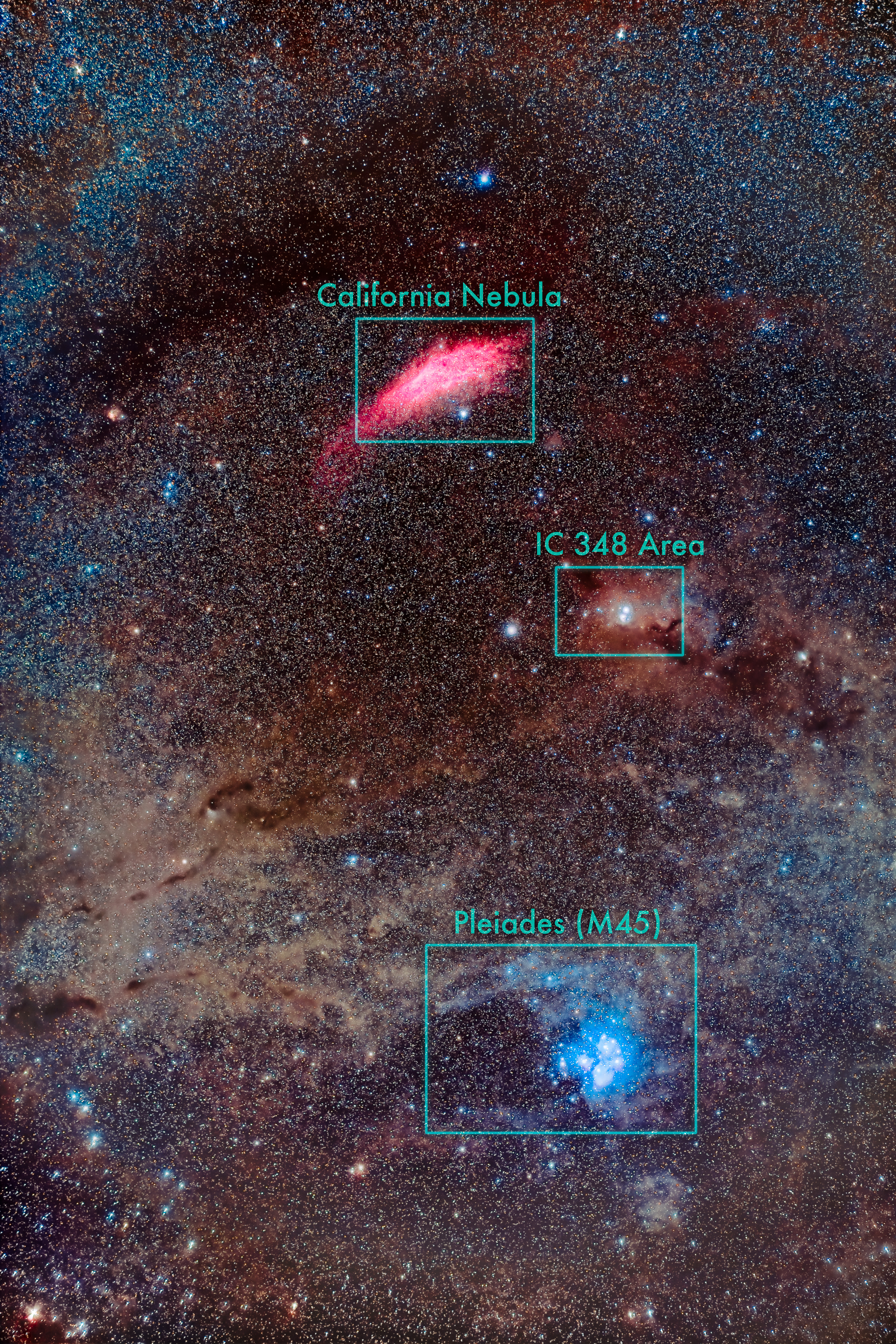
This is a portrait of the dust-filled region of sky from Perseus down to Taurus that includes the pink California Nebula (NGC 1499) at top down to the Pleiades star cluster (M45) at bottom. This is a stack of 48 x 2-minute exposures with the rare Samyang RF85mm f/1.4 lens stopped down to f/2.8, on the Canon EOS Ra camera at ISO 800. The lens was equipped with a 77mm Nisi Clear Night broadband filter.

The region of sky between Perseus and Taurus is rich in bright nebulas set amid large tendrils of dust in Taurus. The Pleiades star cluster lights up a portion of the dust clouds. And the pink California Nebula lies at the end of a large lane of dust.

The California Nebula
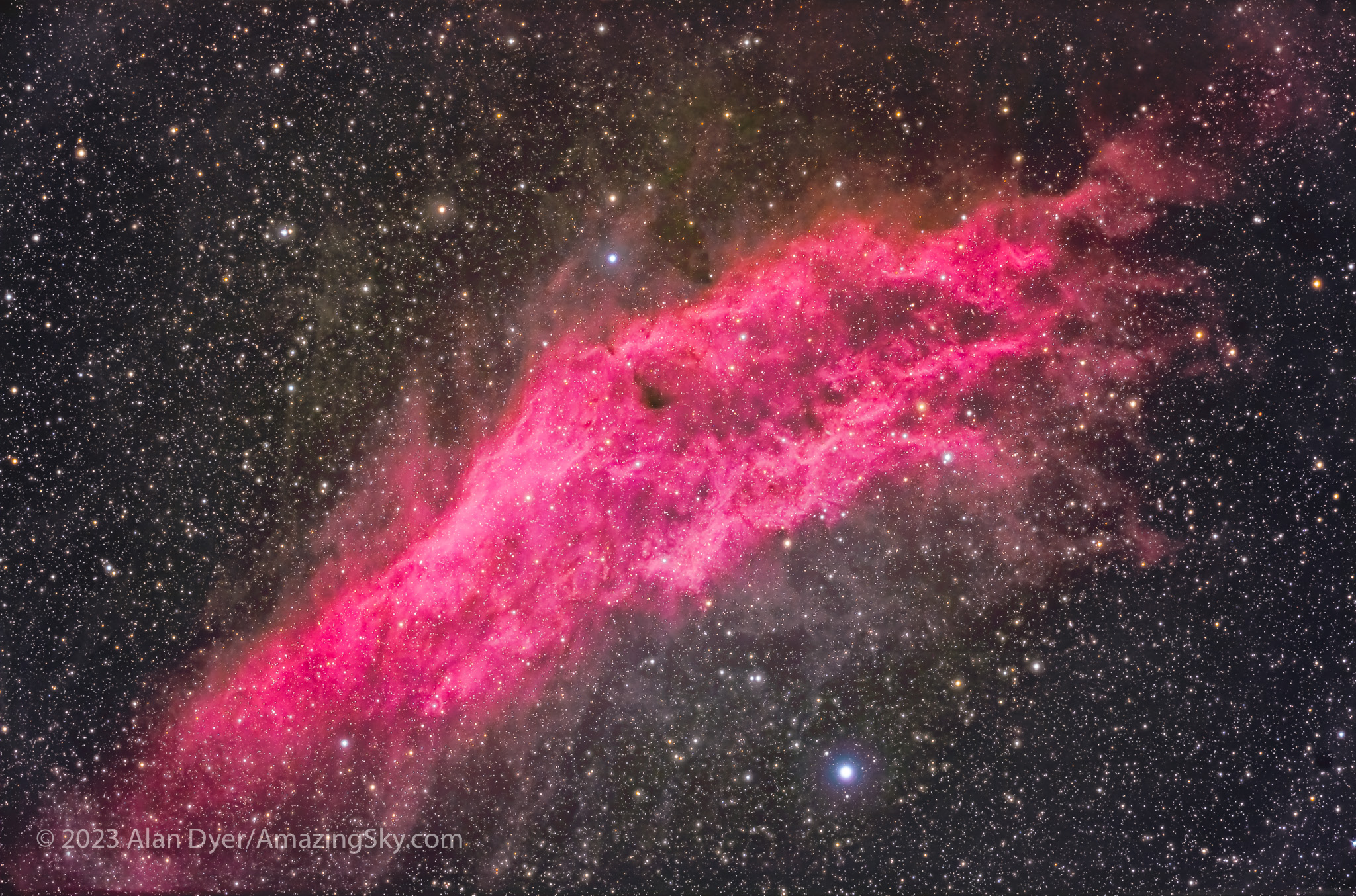
This is the California Nebula, aka NGC 1499, in Perseus near the star Menkib, or Xi Persei, at bottom. This is a stack of 12 x 6-minute exposures with the filter-modified Canon R (though no filter was used to take this image), at ISO 800, on the Askar APO120 refractor with its 0.8x Reducer/Flattener for f/5.6 and 670mm focal length.

The California Nebula (named for its resemblance to the shape of the state) lies in Perseus. It is a bright emission nebula glowing in the red and pink light of hydrogen atoms, perhaps excited by blue-white Xi Persei, aka Menkib, at bottom. But it sits amid wider clouds of dust, here recorded as white and yellow.

IC 348
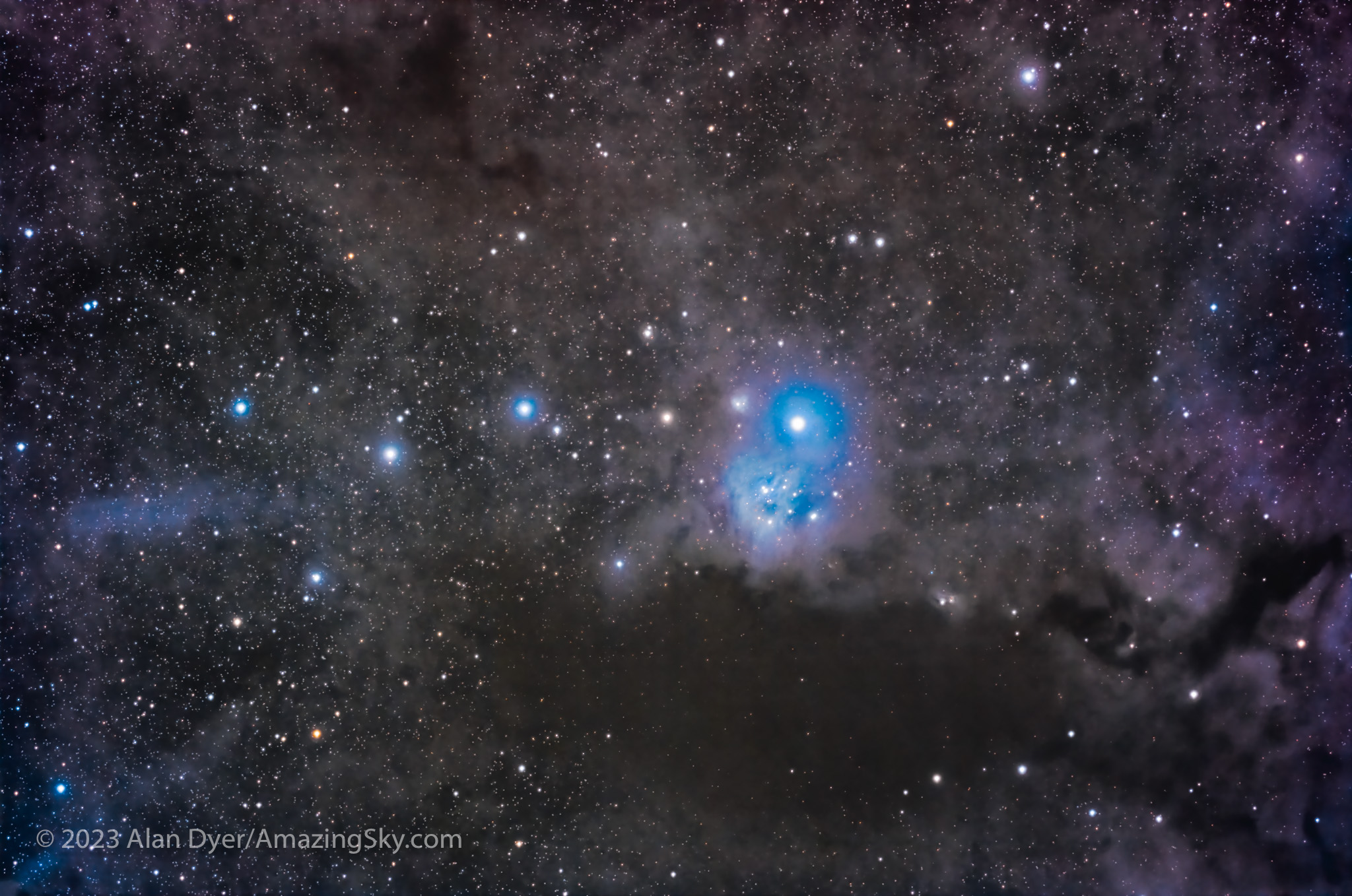
This is the bright blue reflection nebula complex, IC 348, in Perseus, in a stack of 18 x 8-minute exposures through the Askar APO120 refractor at f/7 with the 1X Flattener, and with the filter-modified Canon R camera at ISO 1600.

This complex mix of reflection and dark nebulas surrounds Omicron Persei. In some sections the dust is so dense it blocks all light from more distant stars. Once thought to be holes in the heavens, the photos of pioneering astrophotographer Edward Emerson Barnard in the early 20th century proved that dark nebulas are nearby, and obscure what’s behind them.

IC 348’s distance of only 700 light years means there isn’t much between us and the surrounding dark clouds. Oddly, though a popular target, as best I can tell, no one has come up with a nickname for this field. What can you see in the dark shapes?

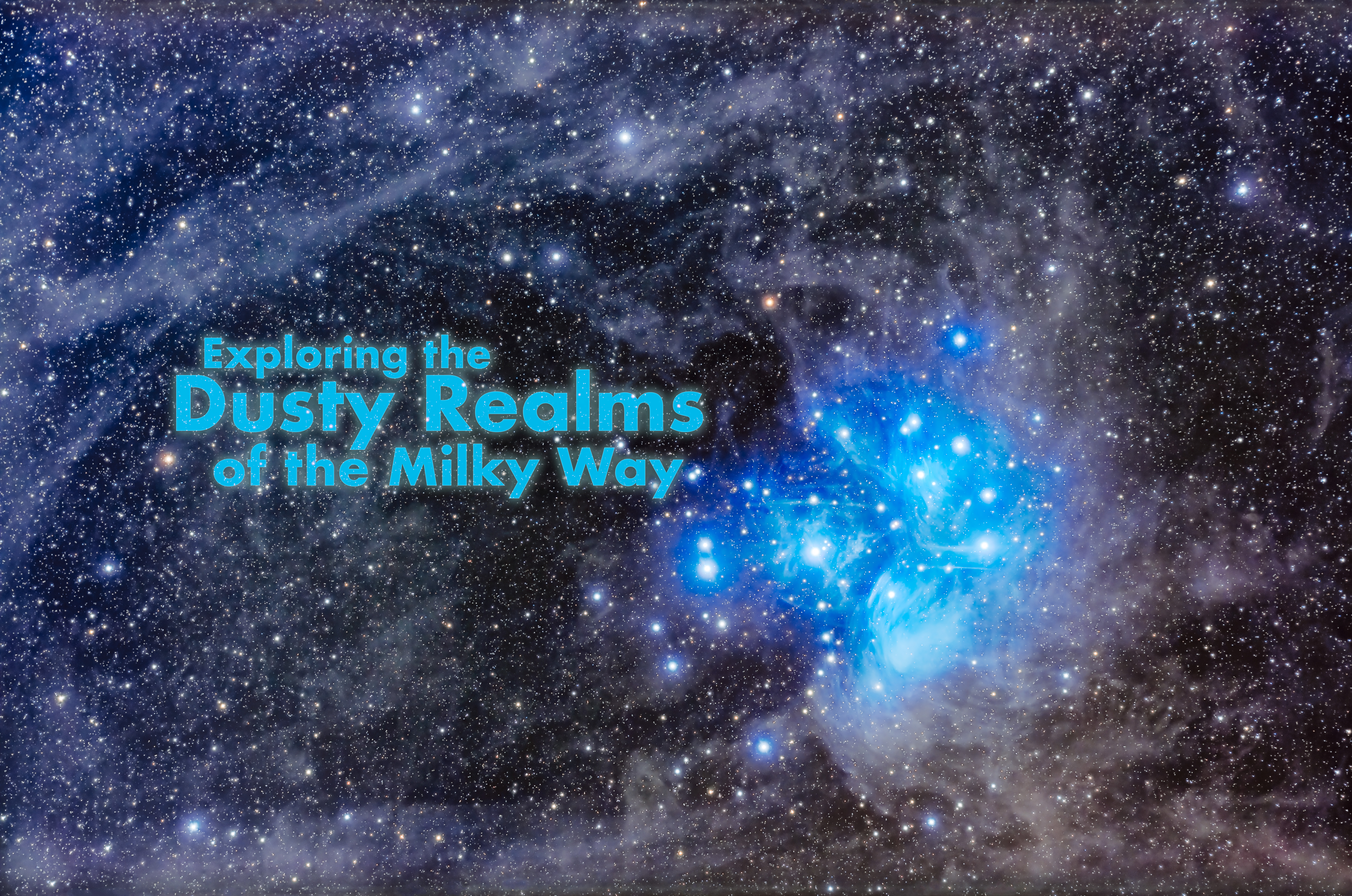
The Pleiades / Messier 45
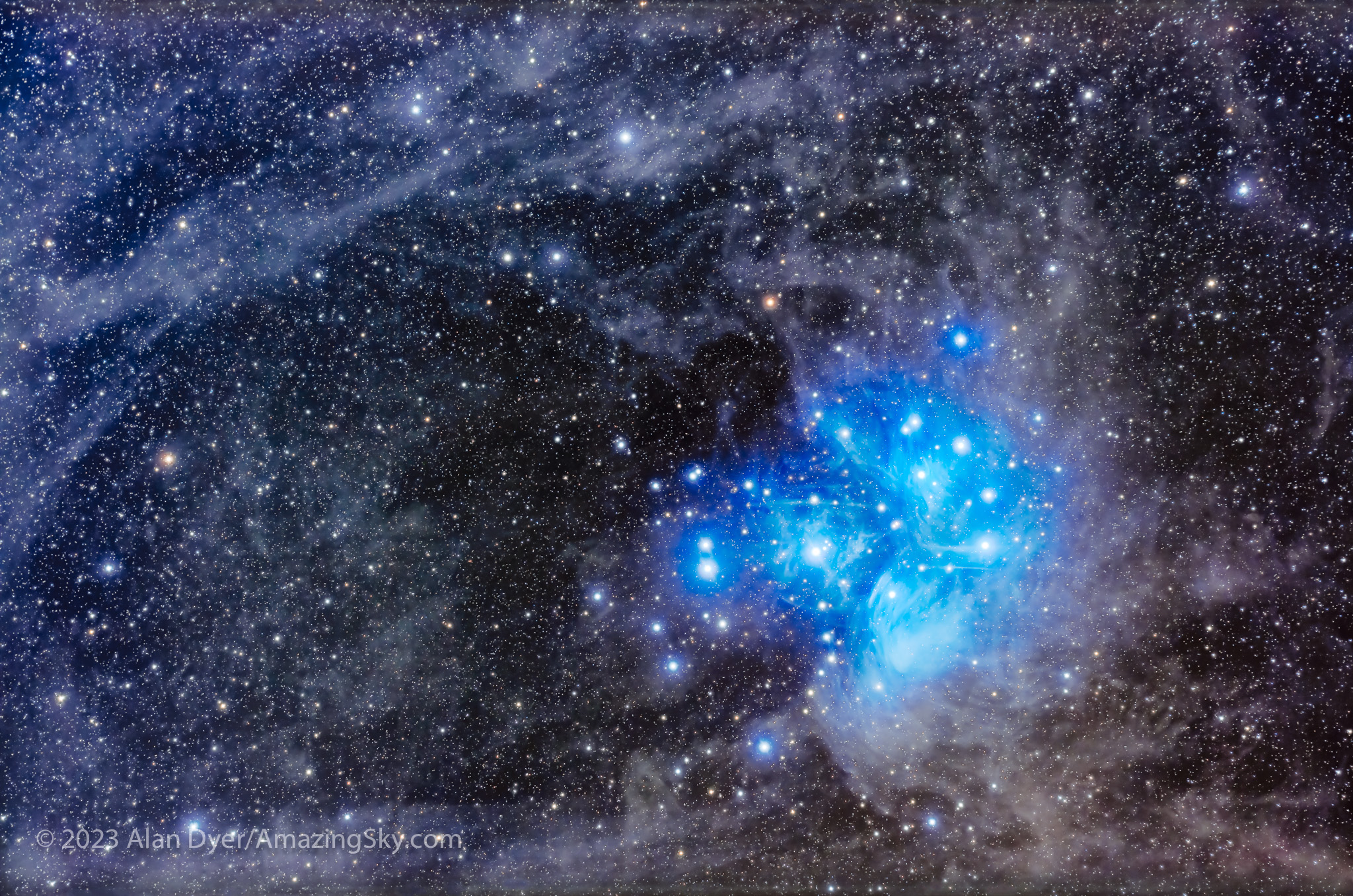
This frames the famous Pleiades or Seven Sisters star cluster (aka Messier or M45) set amid a dusty starfield in Taurus. The field is about 4.7° by 3.2°. This is a stack of 30 x 6-minute exposures with the Astro-Tech AT90CFT refractor at f/4.8 (using its 0.8x Reducer) and the filter-modified Canon R camera at ISO 800.

There’s no more famous deep-sky object than the blue Pleiades, or Seven Sisters. They feature in the mythology of almost all cultures around the world. The young blue stars are surrounded by bright blue reflection nebulosity, most prominent below the lower star Merope, a bit of nebula catalogued separately as NGC 1435.

While the Pleiades light up the core of the dust clouds blue, the dust clouds extend much wider and permeate the entire constellation of Taurus. However, the outlying clouds are very faint as they have no nearby source of illumination. The arc of nebulosity at top is most obvious. It was found by Barnard and is catalogued as IC 353.


Taurus the Bull

This is a portrait of the dust-filled region of sky in Taurus that frames the Hyades star cluster (at bottom) with bright yellow Aldebaran, up to the blue Pleiades star cluster (M45) at top. This is a stack of 48 x 2-minute exposures with the Samyang RF85mm f/1.4 lens at f/2.8, on the Canon EOS Ra camera at ISO 800.

Overlapping the previous constellation field, this framing extends farther south, continuing past the Pleiades down into the main section of Taurus the Bull, with the luminous yellow star Aldebaran marking the Bull’s eye. It is surrounded by the stars of the V-shaped Hyades star cluster, legendary half-sisters to the Pleiades.

Notable in this framing are the large dark tendrils of the Taurus Molecular Clouds, dense streams of dust only about 430 light years away. They are on my shot list for close-ups on upcoming clear winter nights.

NGC 1555 and Area
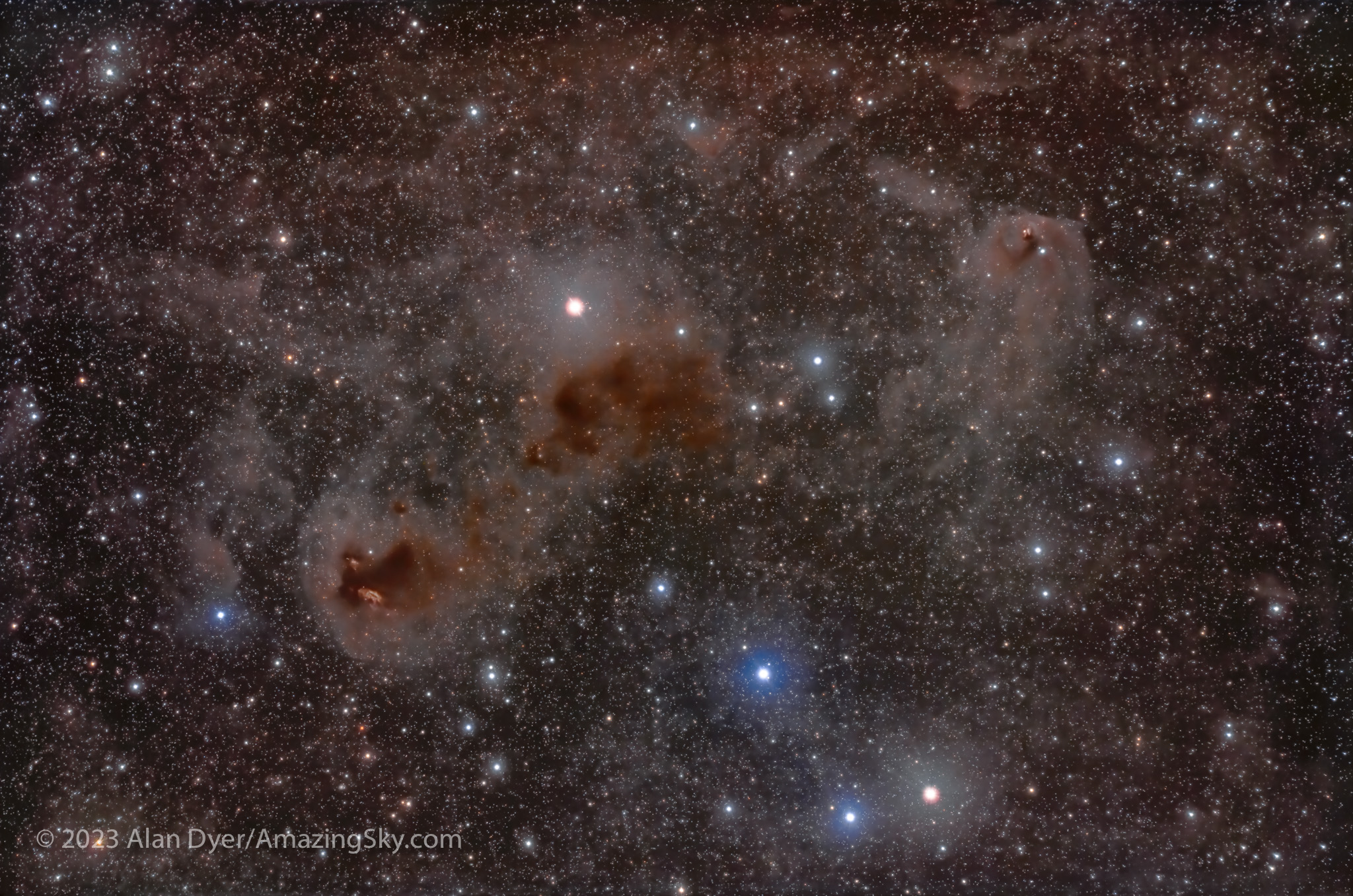
This is a framing of dust clouds among the stars of the Hyades star cluster in Taurus. The field of view is 4.7° by 3.2°. This is a stack of 30 x 6-minute exposures with the Astro-Tech AT90CFT refractor at f/4.8 and the filter-modified Canon EOS R camera at ISO 800, though no filter was used in taking the images.

This complex field lies on the northern edge of the Hyades. At upper right is the odd nebula NGC 1555, discovered by John Russell Hind in 1852 and variable in brightness due to changes in its embedded source star T Tauri, a prototype of a class of young, newly formed stars. An adjacent object, NGC 1554, was catalogued by Otto Struve, but has faded from view; thus it is called Struve’s Lost Nebula.

At lower left is the emission nebula Sharpless 2-239 embedded in the dense and brownish dust cloud LDN (Lynds Dark Nebula) 1551. It is dark indeed, but not black. Like most dark nebulas it has some warm colour.


Orion the Hunter
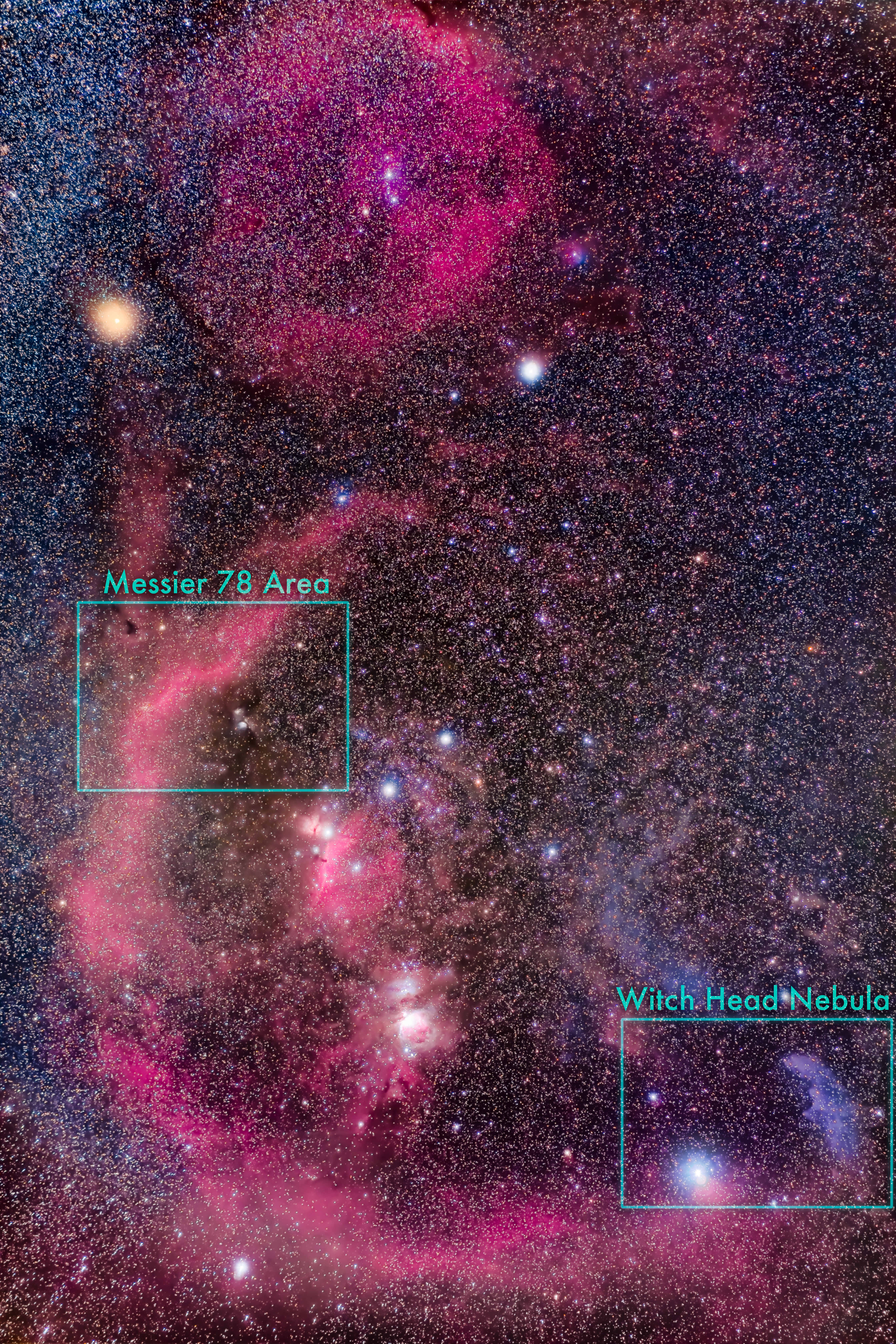
This is a portrait of Orion the Hunter with exposures and processing to emphasize the complex and colourful array of bright and dark nebulas within its boundaries. This is a stack of 42 x 2-minute exposures with the Samyang RF85mm f/1.4 lens at f/2.8, on the Canon EOS Ra camera at ISO 800. The lens had a Nisi Clear Night broadband filter to help improve contrast.

The most photogenic constellation is surely Orion the Hunter. It is filled with a rich collection of nebulas, including the eponymous Orion Nebula, bright enough to be visible to the unaided eye in the Sword of Orion, and #42 in Charles Messier’s catalogue.

The largest feature (though one best seen only in photos) is the arc of Barnard’s Loop, a possible supernova remnant or stellar wind-blown bubble that encircles Orion. It is usually plotted on sky atlases as just an easternmost arc, though it extends down and below Orion, all the way over to blue Rigel at bottom right.

At top is the large circular emission nebula Sharpless 2-264, surrounding the head of Orion and the star Meissa and a loose open star cluster Collinder 69. The nebula has become known as the Angelfish Nebula. It sits above orange Betelgeuse (at left) and blue-white Bellatrix (at right), marking the shoulders of Orion.

As you can see, there’s a winter-full of targets to go after in Orion. However, in my tour, I focused on two areas of dust and reflection nebulas.

Messier 78 Area

This is the bright reflection nebula complex that includes Messier 78 (the largest blue-white nebula) and NGC 2071 above it. This is a stack of 30 x 4-minute exposures through the Astro-Tech AT90CFT refractor with its 0.8x Reducer for f/4.8, and with the filter-modified Canon R camera at ISO 1600. No filter was employed here.

This frames one of the other often-neglected nebulas in Orion, Messier 78, one of the objects catalogued by Charles Messier in the 1780s. His is the popular “hit list” of deep-sky targets for all amateur astronomers.

In this case, M78 is accompanied by another smaller reflection nebula, NGC 2071. They are set in a region of dark clouds of interstellar dust, and framed by the red-magenta arc of Barnard’s Loop, aka Sharpless 2-276. The small reflection nebula at upper left on the edge of another dark cloud is van den Bergh 62. The large faint star cluster left of centre on the edge of the Loop is NGC 2112.

The Witch Head Nebula

This is the reflection nebula called the Witch Head, but officially IC 2118 (also with the catalogue number NGC 1909), near the very bright star Rigel, at lower left in Orion. This is a stack of 29 x 6-minute exposures through the Astro-Tech AT90CFT refractor with its 0.8x Reducer for f/4.8, and with the filter-modified Canon R camera at ISO 800. No filter was employed here.

The hot, blue giant star at lower left is Rigel at the foot of Orion. It illuminates the dust cloud that forms the fanciful shape of the blue Witch Head Nebula, or IC 2118. The nebula is actually over the border in Eridanus the River. Some magenta emission nebulosity also populates the field in Orion.

Indeed, as the wide-field photo above attests, all of Orion is filled with some form of nebulosity, be it emission, reflection, or dark.

There’s much more to go after when exploring the nebulous and dusty realms of the Milky Way. The sky is filled with stardust. Indeed, we are made of it!

— Alan, November, 2023 / www.amazingsky.com
Mosaic of the Autumn Constellations


Mosaic of the Northern Autumn Constellations

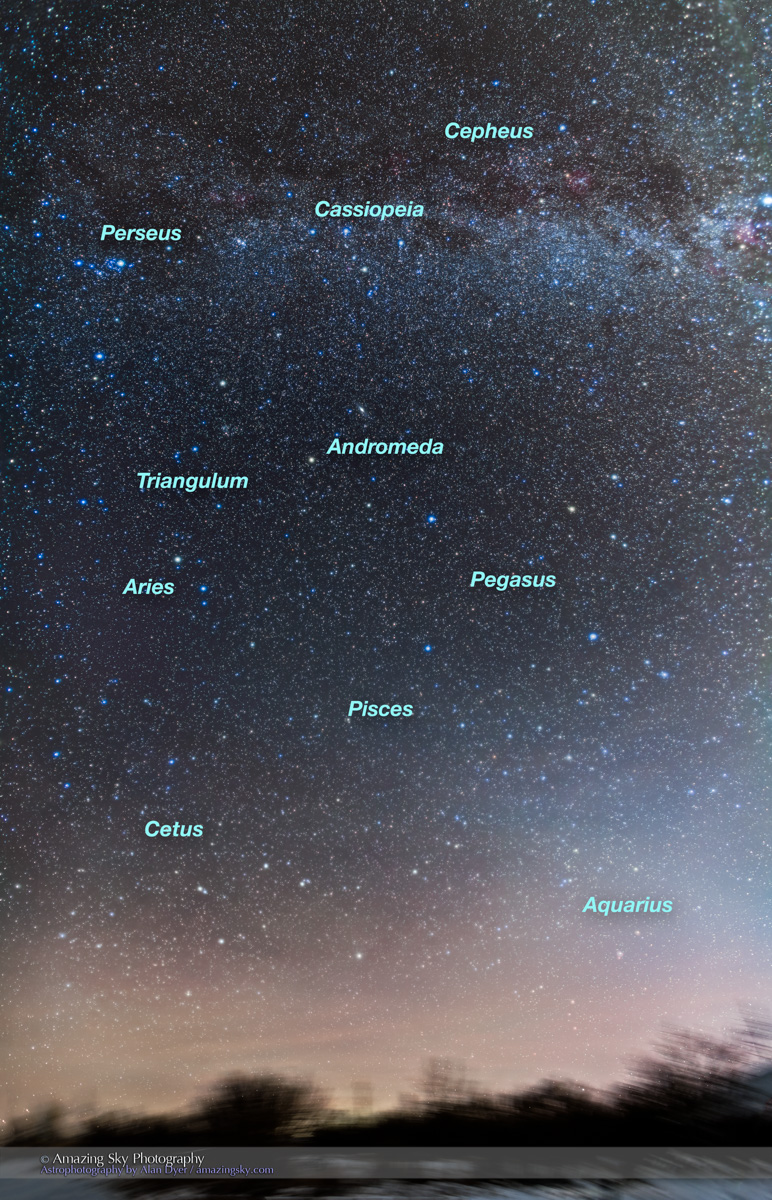
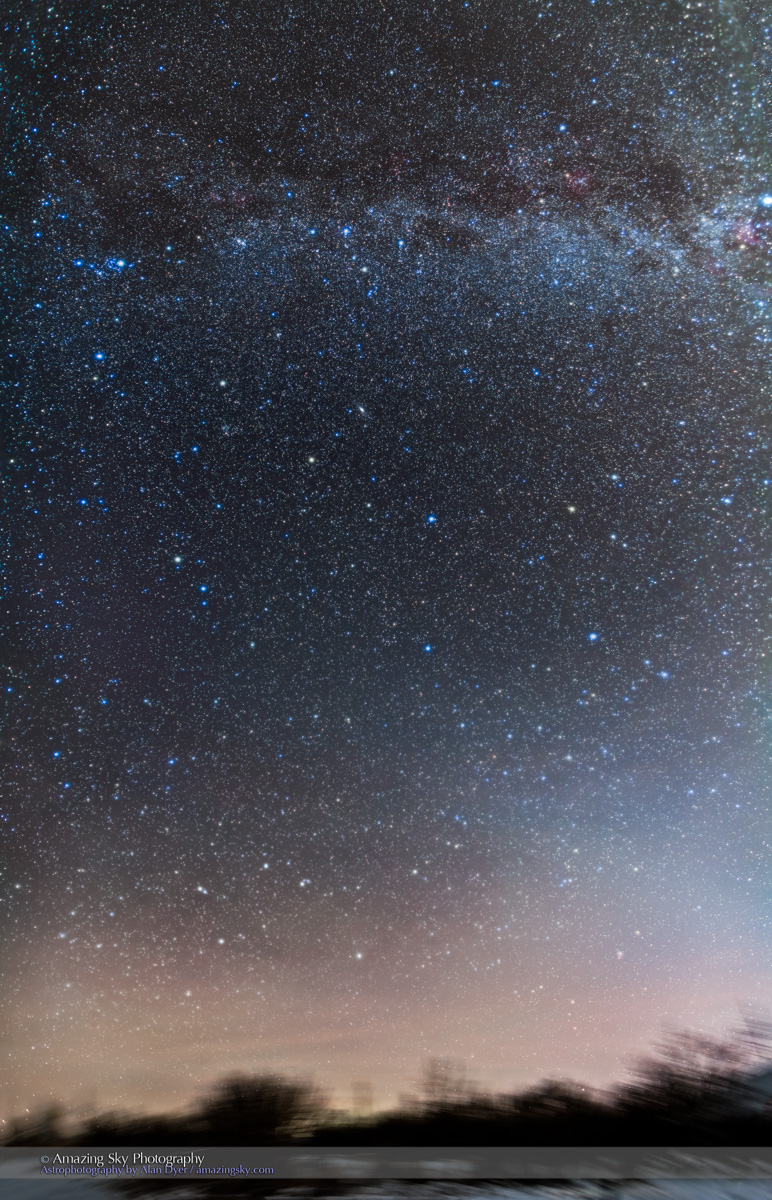
I present a horizon-to-zenith panorama of the pantheon of autumn constellations.

Yes, I know it’s winter, but as it gets dark each night now in early January the autumn stars are still front and centre. I took the opportunity during a run of very clear nights at home to shoot a panorama of the autumn sky.

It is a mosaic that sweeps up the sky and frames many related Greek mythological constellations:

• from the watery constellations of Aquarius, Pisces, and Cetus at the bottom near the horizon…

• to Pegasus and Aries in mid-frame…

• on up to Andromeda and Perseus at upper left…

• and finally Cassiopeia and Cepheus at the top of frame embedded in the Milky Way overhead. The Andromeda Galaxy, M31, is just above centre.

Mosaic of the Northern Autumn Constellations (with Labels)

Here, I’ve labeled the participating constellations, though only a few, such as the “square” of Pegasus and the “W” of Cassiopeia, have readily identifiable patterns.

Most of these constellations are related in Greek mythology, with Princess Andromeda being the daughter of Queen Cassiopeia and King Cepheus, who was rescued from the jaws of Cetus the Sea Monster by Perseus the Hero, who rode on Pegasus the Winged Horse in some accounts.

Zodiacal Light brightens the sky at bottom right in Aquarius, and angles across the frame to the left.


TECHNICAL:

I shot this from home on a very clear night January 2, 2016 with the Zodiacal Light plainly visible to the naked eye.

This is a mosaic of 5 panels, each a stack of 5 x 2 minute exposures, plus each panel having another stack of 2 x 2 minute exposures blended in, and taken through the Kenko Softon filter to add the fuzzy star glows to make the constellations stand out.

All were shot with the 24mm Canon lens at f/2.8 and Canon 5DMkII at ISO 1600. All tracked on the AP Mach One mount.

All stacking and stitching in Photoshop CC 2015. Final image size is 8500 x 5500 pixels and 3.6 gigabytes for the layered master.

– Alan, January 3, 2016 / © 2016 Alan Dyer / www.amazingsky.com


A Cosmic Christmas Wreath


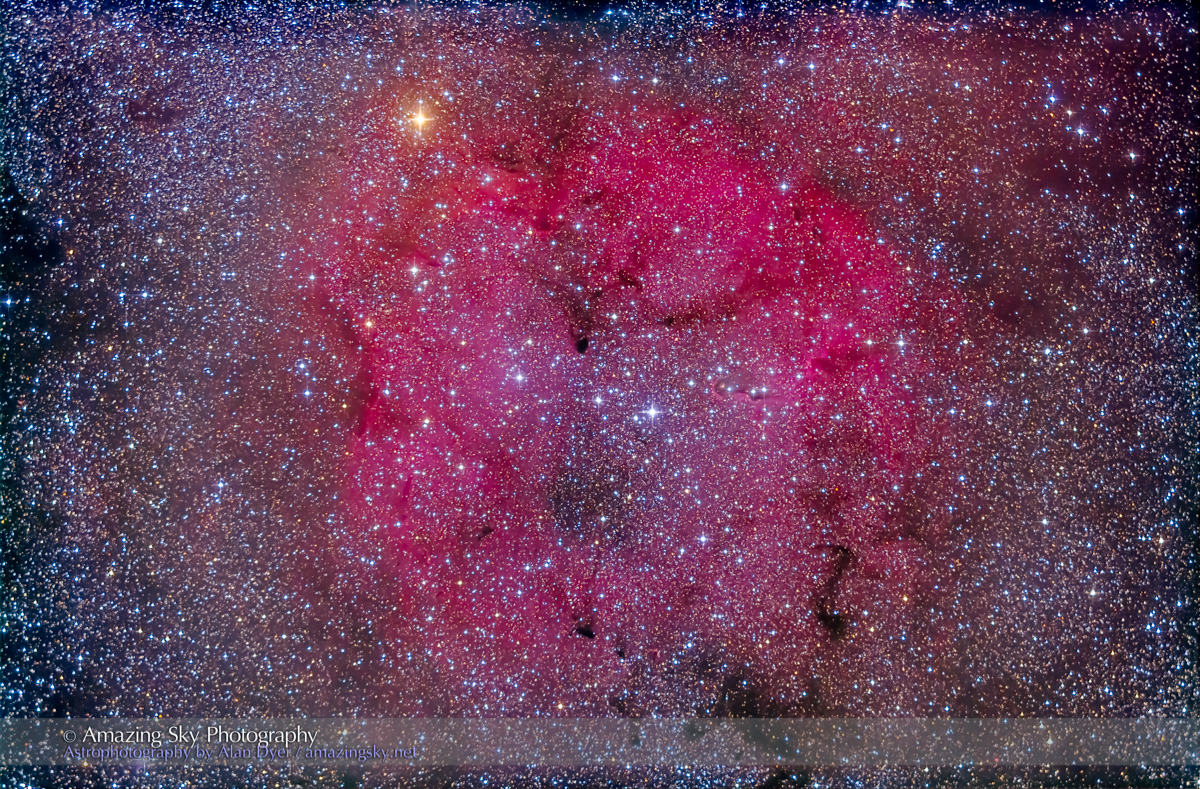
IC 1396 & Garnet Star in Cepheus

A cosmic Christmas wreath glows in the sky, adorned by a celestial garnet.

This nebula, known as IC 1396, shines in the constellation of Cepheus the king, now high overhead on early winter evenings in the northern hemisphere. It’s a bubble of gas blown by new stars amid the interstellar wreath.

At top, shining like a Christmas light on the wreath, is an orange star. This is Mu Cephei, also known as the Garnet Star. It’s a red supergiant, roughly 1,500 times bigger than our Sun. If it replaced our Sun at the centre of our solar system it would engulf all the planets out to and including Jupiter.

Be happy Mu sits 1,000 light years away!

Happy holidays! And happy solstice. Winter arrives in the northern hemisphere at 6:03 p.m. EST on Sunday, December 21. That’s the shortest day and longest night of the year, for all those north of the equator.

– Alan, December 20, 2014 / © 2014 Alan Dyer

King and Queen of the Sky


Cassiopeia and Cepheus (50mm 5DII) Sept 29, 2013

Cassiopeia and Cepheus reign over the autumn sky amid the Milky Way.

This is a photo from last night’s shoot, taken on a very clear autumn night with the Milky Way prominent across the sky. I shot sets of constellation images, among them this one framing Queen Cassiopeia and King Cepheus.

Cassiopeia is the well-known “W” pattern at lower left. Cepheus is harder to pick out – he’s a crooked square at right, topped by a tall triangle, like a child’s drawing of a house.

The Milky Way runs across the frame, peppered with red nebulas, from IC 1396 at far right in the bottom of Cepheus, to the NGC 7822 complex at centre, and the IC 1805 complex at far left. Lots of smaller nebulas dot the scene. At far left is the Double Cluster, two adjacent clumps of stars in the outer Perseus Arm of the Milky Way. Most of the deep-sky objects in this frame lie thousands of light years away in the next spiral arm out from the one we live in, or in the space between the two arms.

Most of the bright stars here are young blue stars. But a couple of exceptions stand out: yellow Shedar (or Alpha Cassiopeiae, the bottommost star in the W and an orange giant), and red Mu Cephei, at far right bordering the round IC 1396 nebula. That star is also known as Herschel’s Garnet Star. It is a red supergiant star 1400 times larger than our Sun and one of the most luminous stars in the catalog.

– Alan, September 30, 2013 / © 2013 Alan Dyer


Regal Colours of Cassiopeia


Sitting on the border of Queen Cassiopeia and King Cepheus is this royal cloak of pinks and reds.

Too faint to see even in a small telescope, the main cloud of nebulosity is called NGC 7822, with a companion cloud below known as Cederblad 214. Rather cold names for a stunning region of space.

I love the colours in this field. The camera I use is modified to bring out the reds of glowing hydrogen but also nicely picks up blues and purples, which mix to provide subtle shades of pink and magenta. There are even yellows and greens from dust clouds.

Yes, I’ve certainly punched up the colour and contrast quite a bit from what came out of the camera, but I tried to retain a “natural” colour balance, not skewing the palette too far to the deeply saturated monotone red I see in some images of nebulas.

I shot this Saturday night, October 6, from my backyard on a fine autumn night for stargazing and star shooting. It’s a stack of eight 12-minute exposures, “median” combined to eliminate the satellite trails that crossed several frames.

– Alan, October 6, 2012 / © 2012 Alan Dyer

Star Birth Site


In contrast to last Saturday’s post, Star Death Site, this is a place where stars are born.

This magenta cloud is where dozens of new stars are forming. One centre of star formation is the finger at right jutting into the hollowed out core of the nebula. Ultra-violet radiation from nearby hot stars is eroding away this dark finger of dust and gas, causing its rim to glow. This is a feature similar to the famous “Pillars of Creation” depicting in Hubble Space Telescope views of another nebula, the Eagle Nebula. However, this giant wreath of hydrogen 3000 light years away has no name, just the catalog number IC 1396. It’s in Cepheus, high in the northern autumn sky.

An added attraction of the scene is the orange star at top, Herschel’s Garnet Star, a.k.a. mu Cephei. This red supergiant is one of the largest stars known. If it replaced our Sun the Garnet Star would engulf all the planets out to Jupiter. Including its profuse radiation emitted in the infrared, the Garnet Star outshines the Sun by 350,000 times. It is squandering its energy so quickly this supergiant is destined to explode as a supernova, perhaps leaving behind a remnant like the Veil Nebula I described in that earlier blog from a few days ago.

These deep space wonders are all part of the great cycle of stardust that fuels the Galaxy.

– Alan, September 25, 2012 / © 2012 Alan Dyer

The Northern Nebulas of the Milky Way


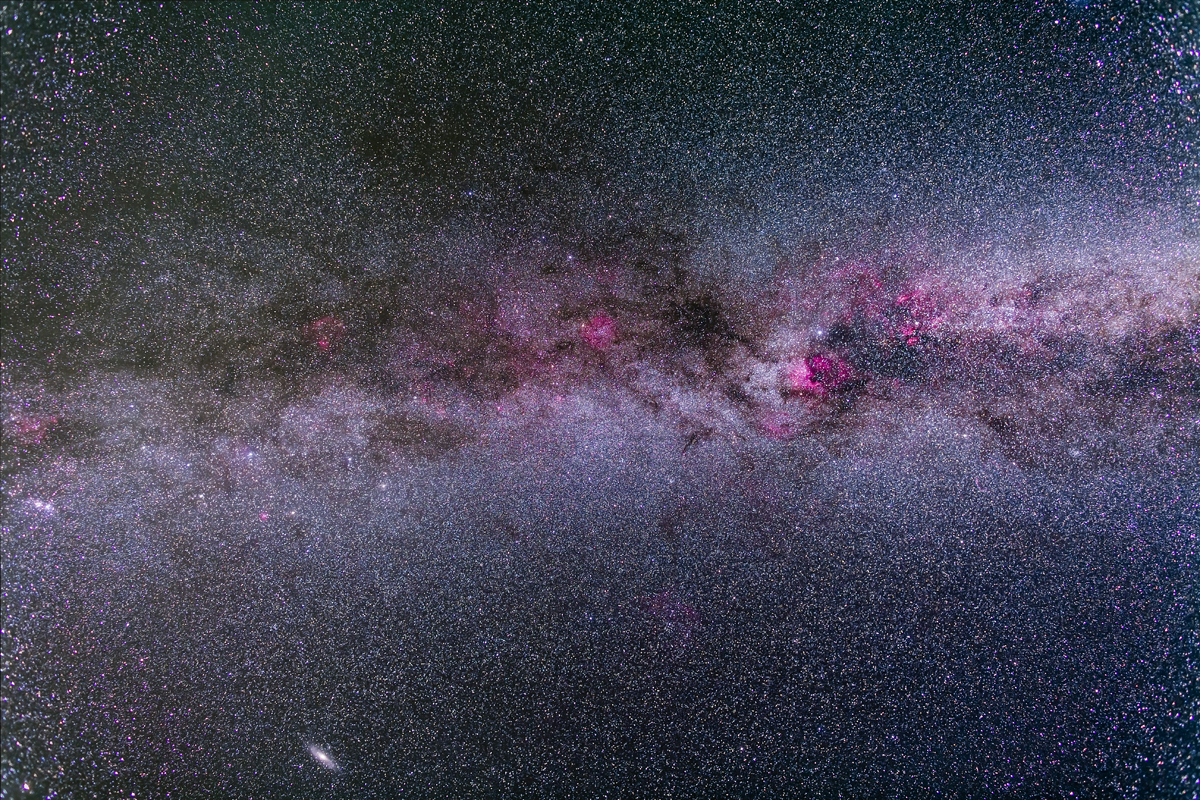
This is the prime celestial real estate above us now on northern summer nights.

This wide-angle shot takes in the Milky Way from Cygnus at right to Perseus at left, an area populated by lots of nebulas, both bright and dark. A couple of previous posts (The Subtle Shades of Cepheus and The Dark Clouds of Cygnus) featured close-up views of sections of this sky, the areas at centre in this wider context image in northern Cygnus and southern Cepheus.

At bottom is the elliptical glow of the Andromeda Galaxy, another “milky way” beyond ours.

I boosted the contrast and colour more than I normally do for astrophotos, to punch out the nebulas and the subtle dark lanes of dust that permeate this part of the Milky Way. I shot this last weekend from the star party in Cypress Hills, Saskatchewan. With three clear nights it was a productive weekend!

– Alan, August 26, 2012 / © 2012 Alan Dyer

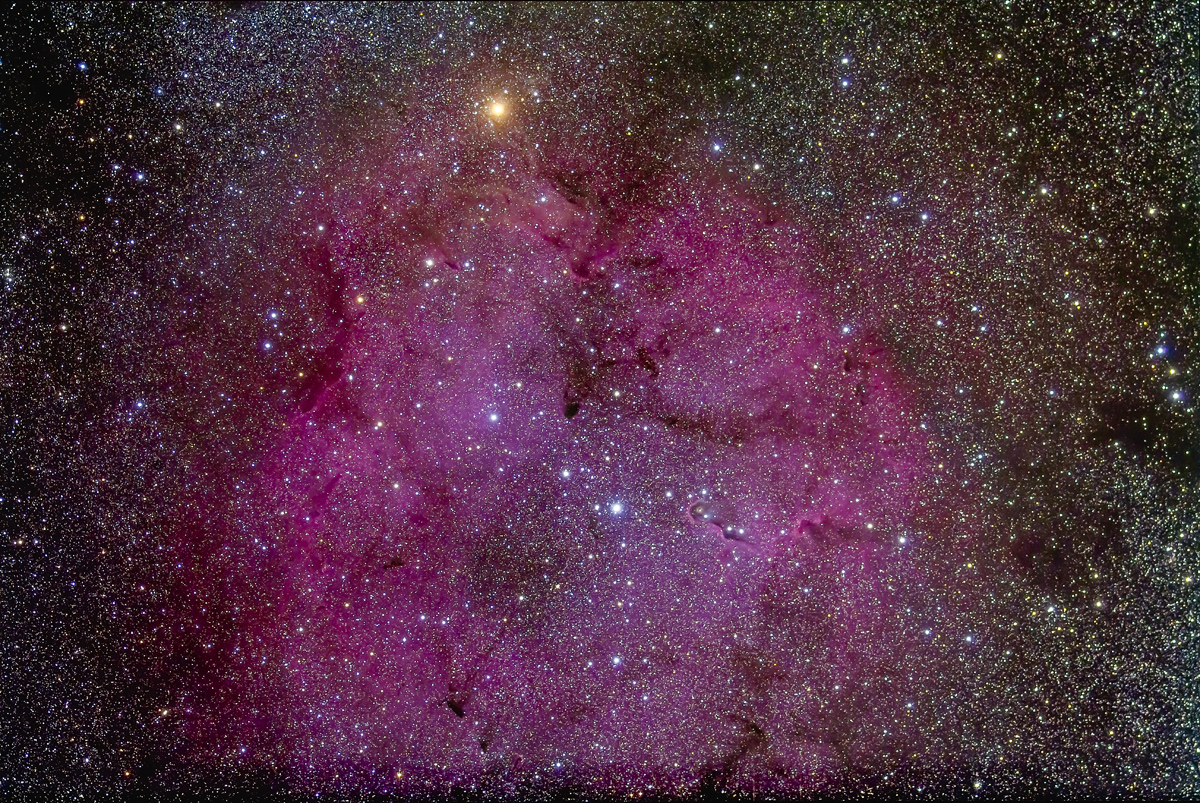
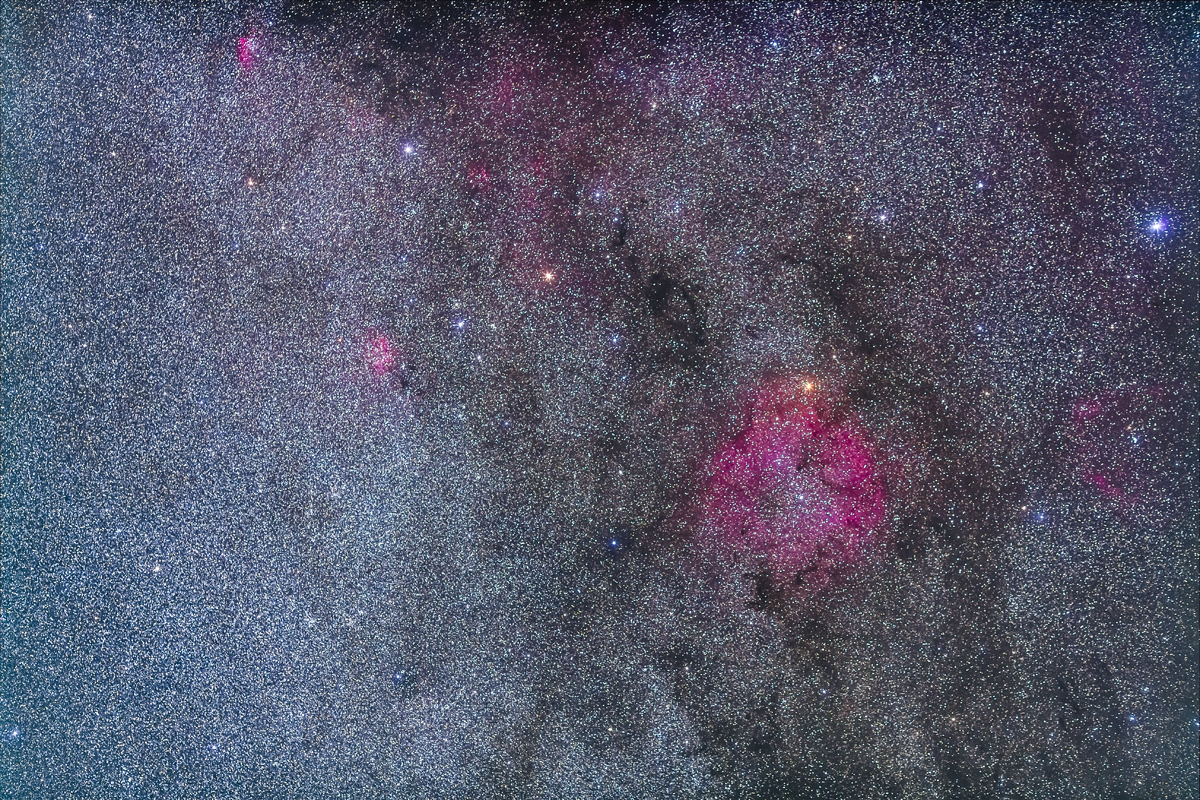
The Subtle Shades of Cepheus


The Milky Way in Cepheus presents a palette of colours revealed in long exposures.

This binocular-sized field contains the large magenta nebula IC 1396, a site of star formation. On its northern (upper) edge shines the orange star Mu Cephei, otherwise known as Herschel’s Garnet Star, for its very red appearance in the eyepiece. It is a bloated red supergiant, one of the largest stars known. A few other stars in the field are younger blue giants. Faint wisps of red hydrogen fill the field (the faint crescent at right is Sharpless 129, left of centre is Sharpless 132, at top left is NGC 7380). Diagonally along the Milky Way lie dark, yellow-tinted dust clouds. The darkest patch at centre is the Barnard 169/170/171 complex. These contrast with the dust-free blue starfields of the Milky Way at left.

This is a stack of five 5-minute exposures with the 135mm telephoto and Canon 5D MkII camera, which has been filter modified to record the faint red nebulas better than a stock camera.

– Alan, August 25, 2012 / © 2012 Alan Dyer