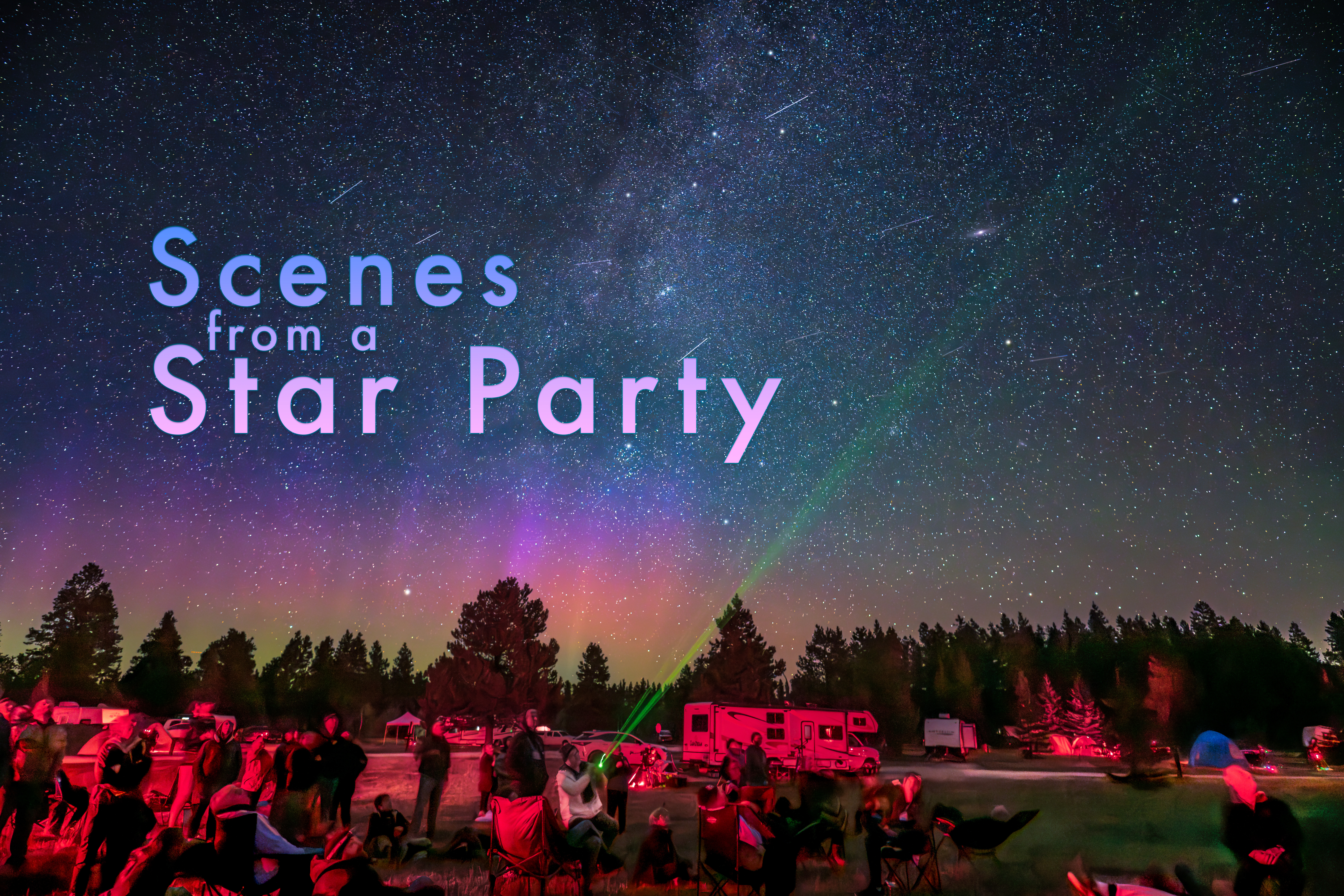
Scenes from a Star Party


Amateur astronomers like nothing more than spending time under a dark night sky with a field of friends.

Star parties are a popular part of the hobby of amateur astronomy. They’re chances for stargazers to get under dark skies and meet up with others who love the night sky.

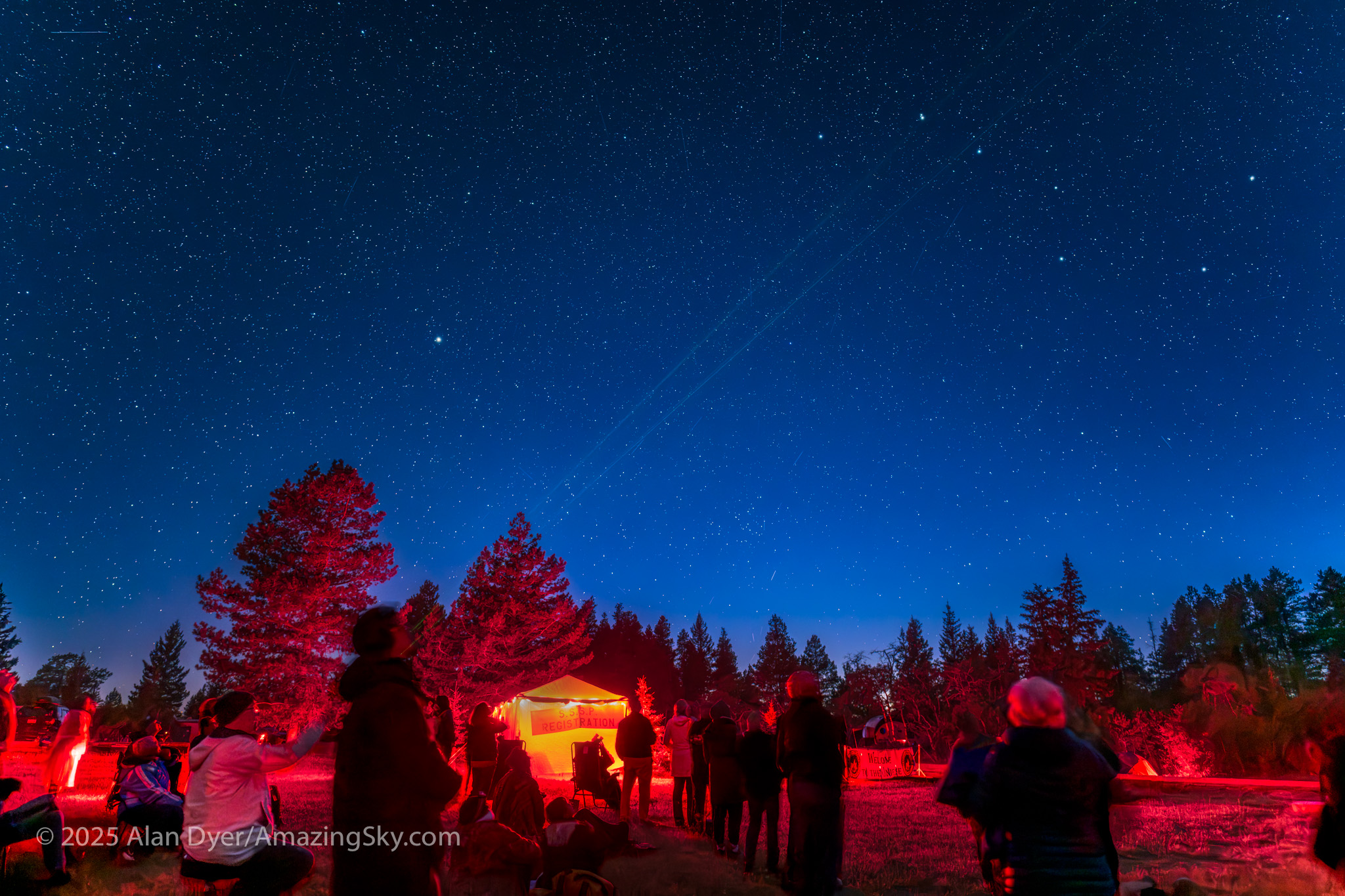
Each year I attend the biggest such event in my area in western Canada, the Saskatchewan Summer Star Party. It usually attracts about 320 sky lovers to the very dark skies of southwest Saskatchewan.
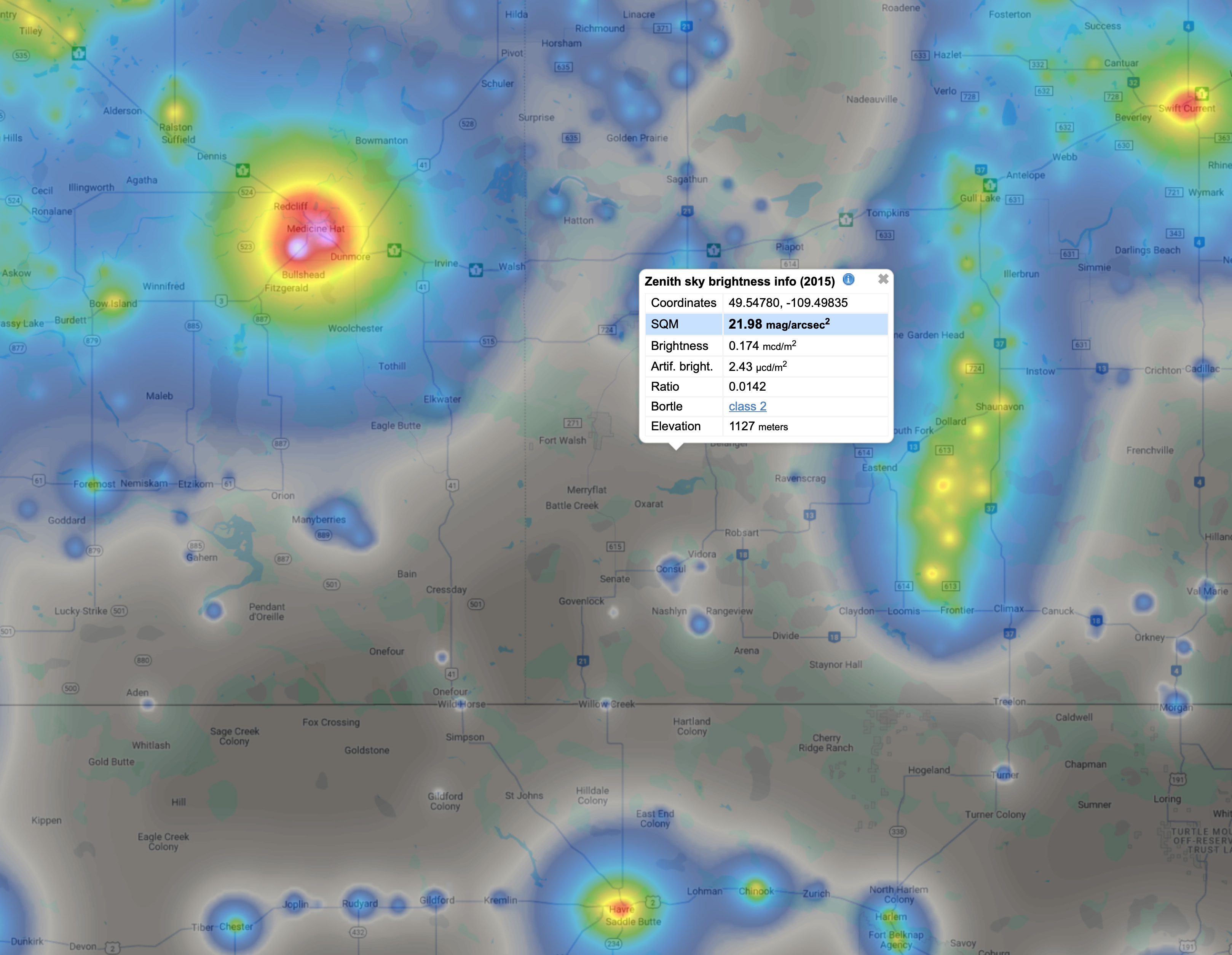
A light pollution map where grey = good!

The label marks the spot for the Party, in the Cypress Hills, and in the Cypress Hills Interprovincial Park, that straddles the border of Saskatchewan and Alberta. As per its name, the SSSP is held on the Saskatchewan side of the Park, in the Centre Block south of Maple Creek. (A complementary Southern Alberta Star Party is held on the Alberta side of the Cypress Hills, in September. I’ll be there!)

As the map shows, the Cypress Hills are far from any light pollution and offer “Bortle 2-class” skies — 1 being the darkest, and 9 being downtown Las Vegas!

In fact, the Park is a Dark Sky Preserve, a designation awarded in 2004. Parks are increasingly aware of their role in not only conserving flora, fauna, and historical sites, but also the increasingly threatened night sky. As the saying goes, “Half the Park is after dark!”
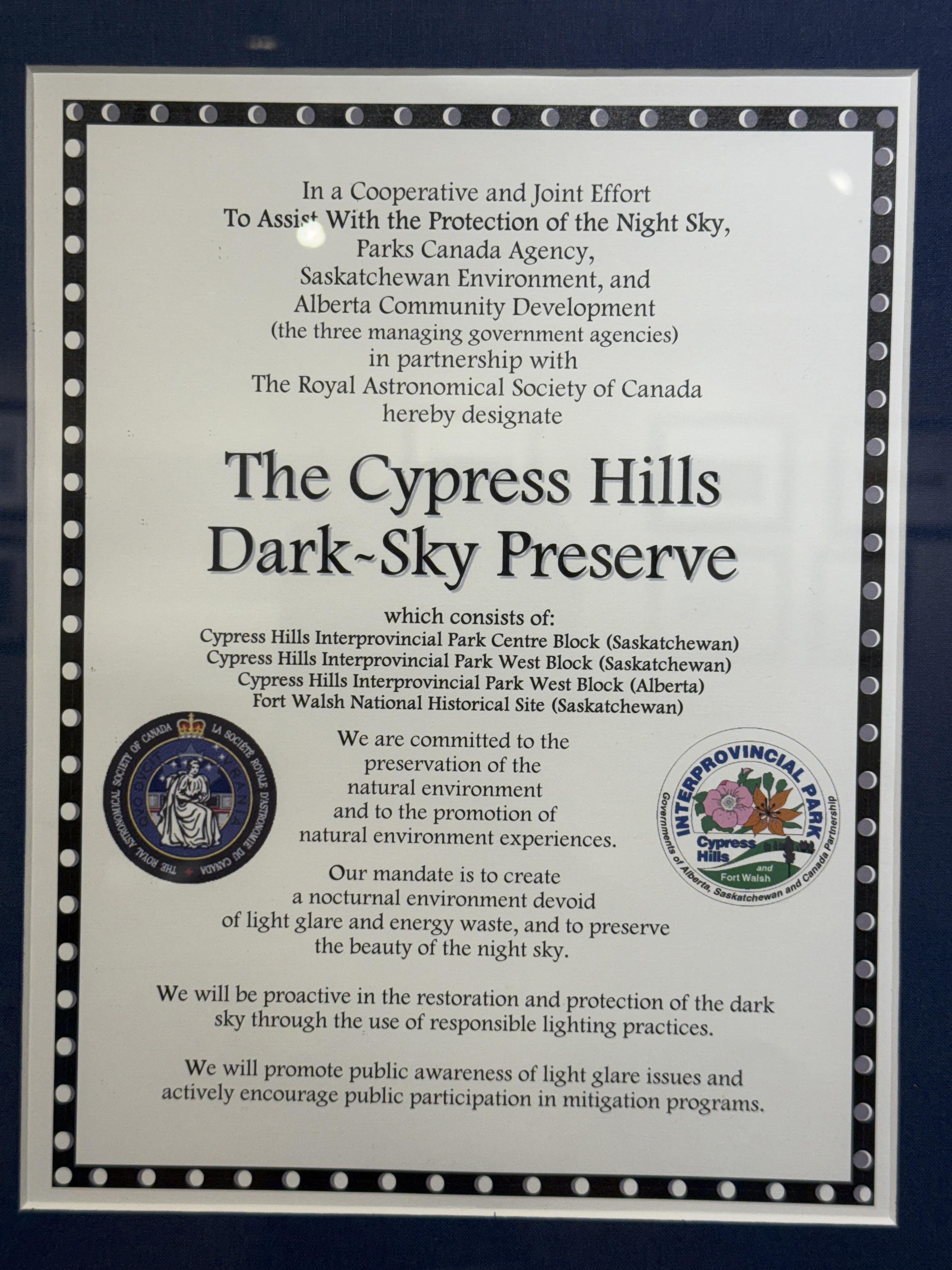
The DSP Declaration

The Dark Sky Preserve designation, and efforts to refit what lighting is in the Park to “dark-sky friendly” fixtures, came about as a direct result of the Park, and Star Party, being the site of a comet discovery three years earlier.

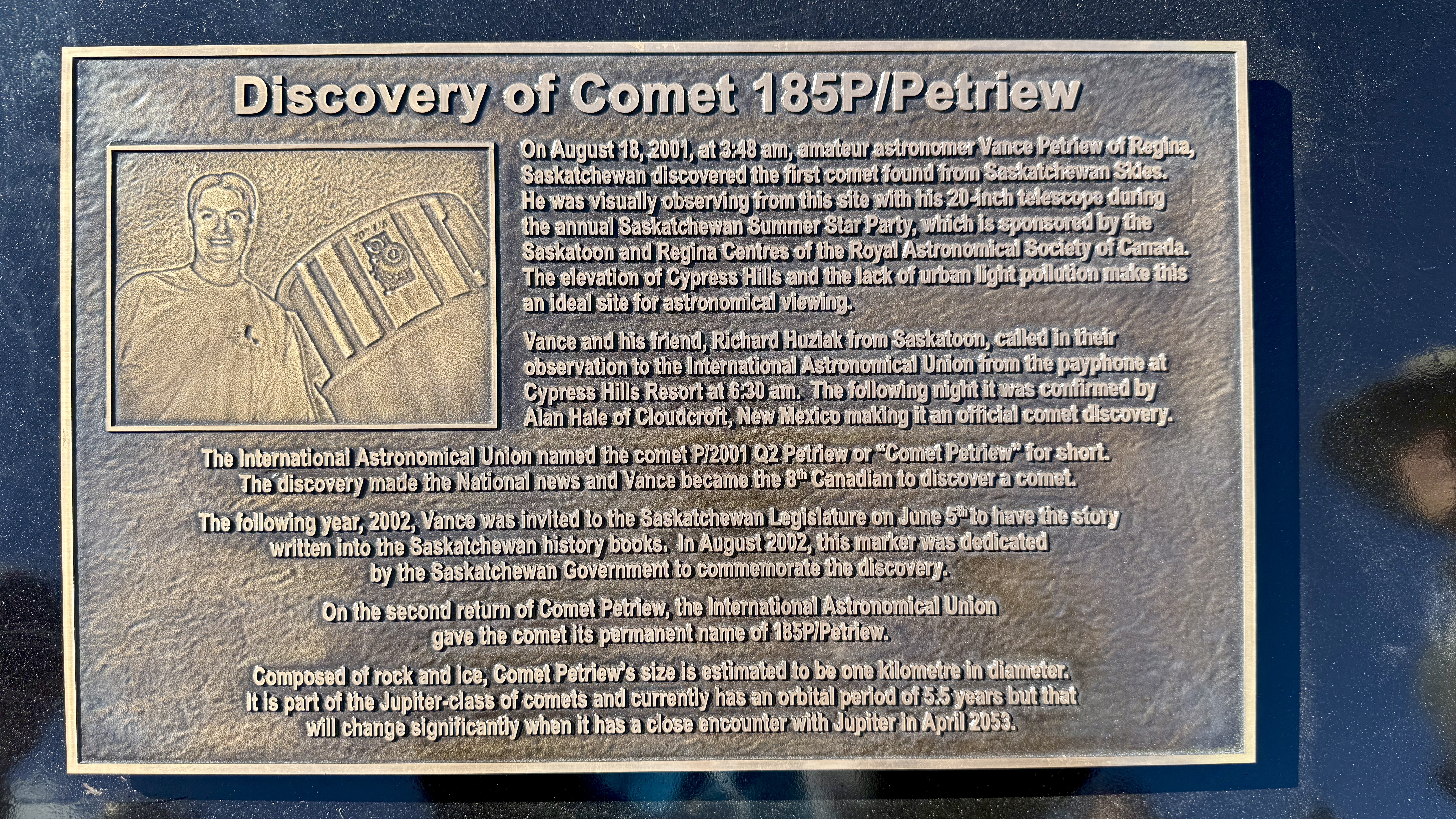
It was at the Star Party in August 2001 that Regina amateur astronomer Vance Petriew discovered a comet, an observing feat that merits a comet being named for the discoverer.

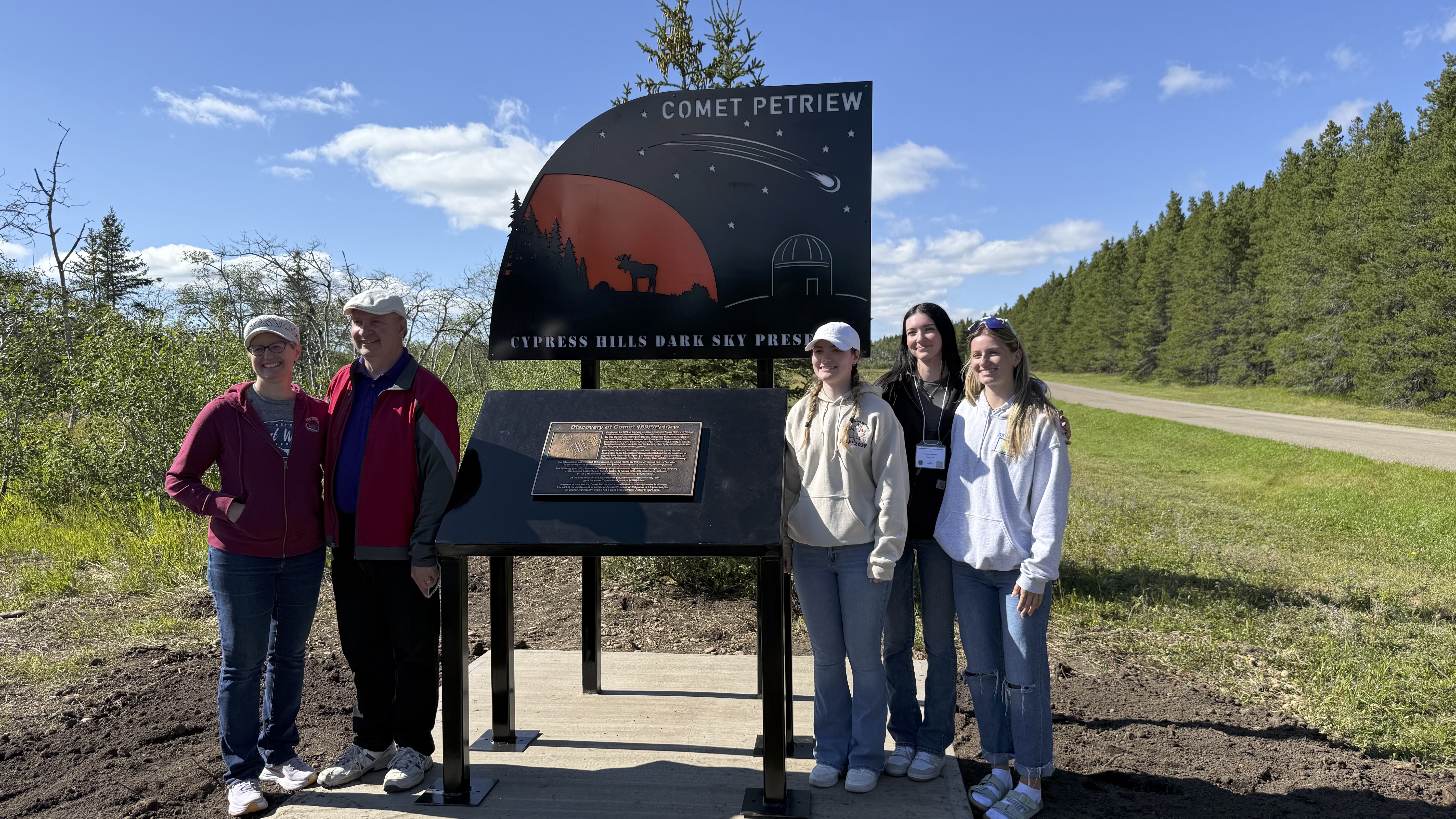
This year, a new sign and plaque were unveiled commemorating the discovery, replacing a cairn that had fallen into disrepair over 20 years. Here is the unveiling —

Park officials, fellow astronomers and Vance unveil the sign.

This was a fine event with all the star party folks in attendance, many of whom were there in 2001! — including the now adult daughters of the Petriew family.

Click on the images below to bring the photos up full screen.
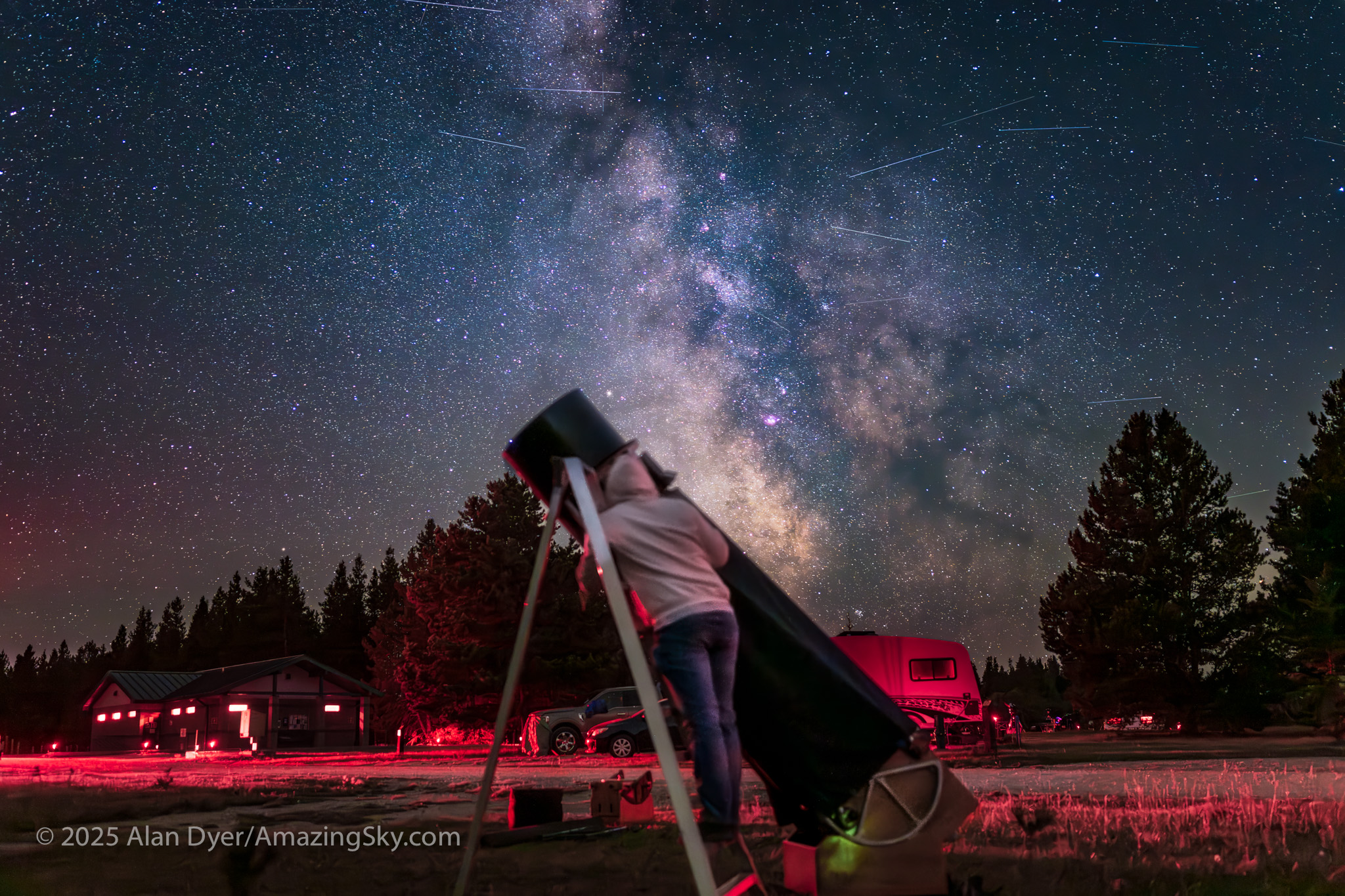
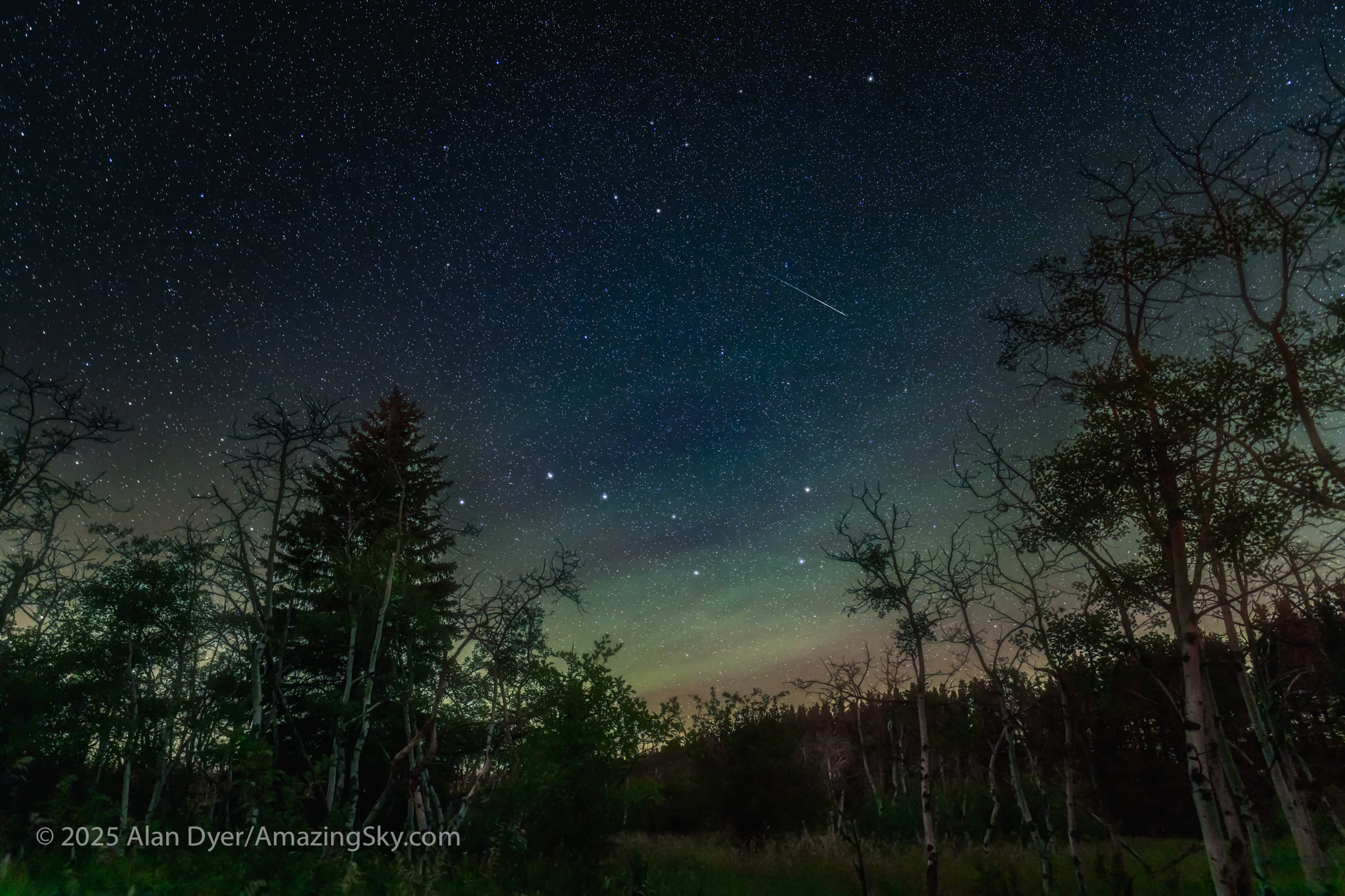
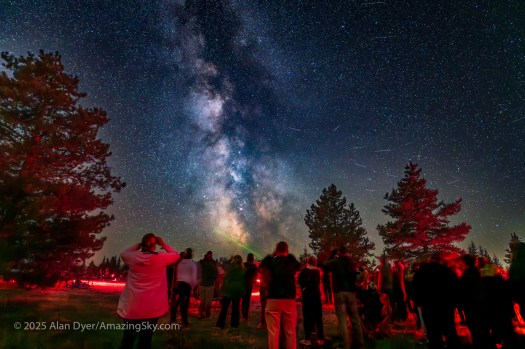
While that was a highlight of the week, the real show was the sky above. The Milky Way was on display in a sky clearer and darker than we had seen it for many years. No clouds, no smoke, and little dew and bugs! The Cypress Hills are a mecca for stargazing!
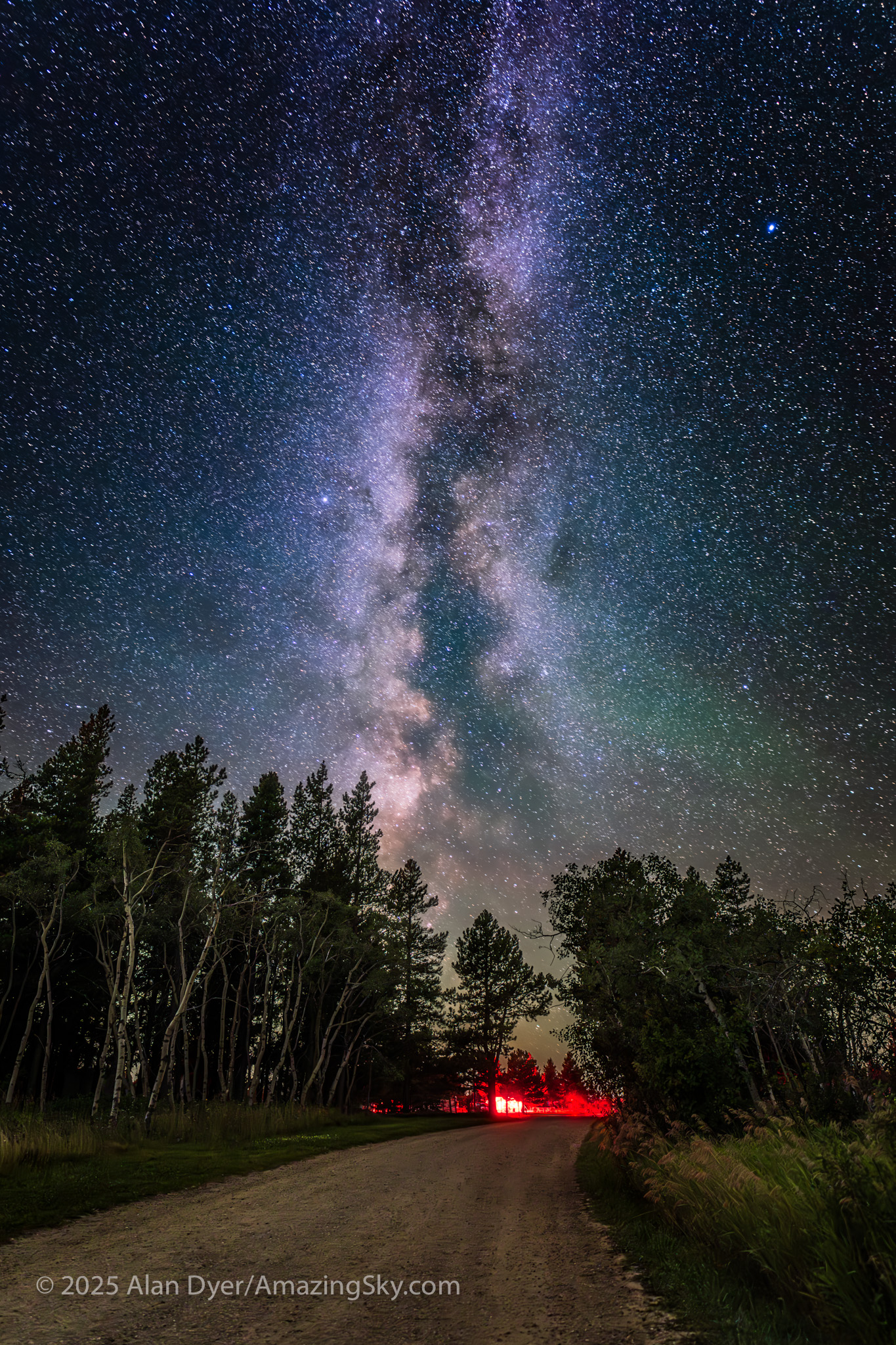
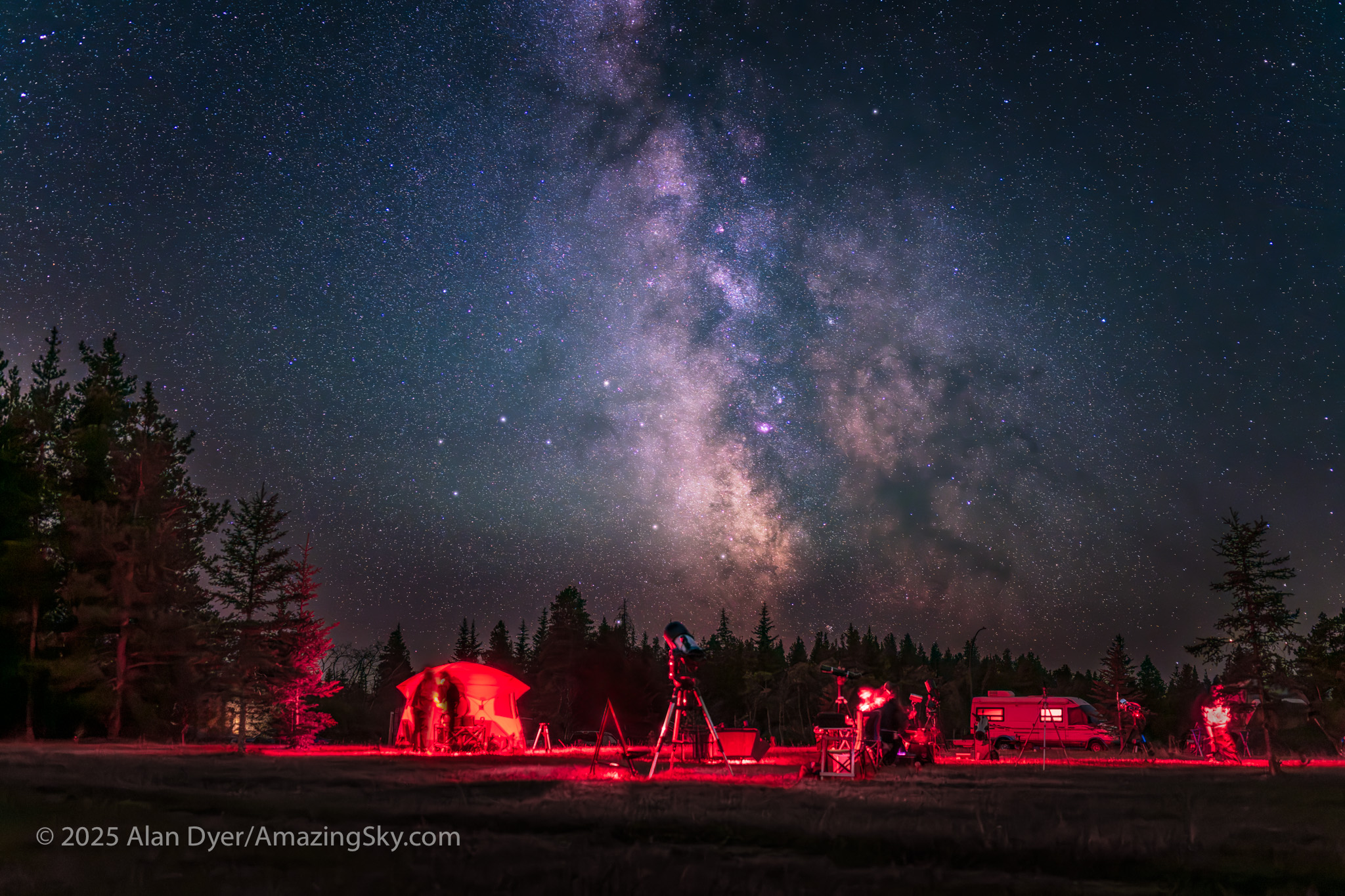
The road into the Meadows Campground, home to the Saskatchewan Summer Star Party. The SSSP is organized by the Royal Astronomical Society of Canada centres in Regina and Saskatoon.

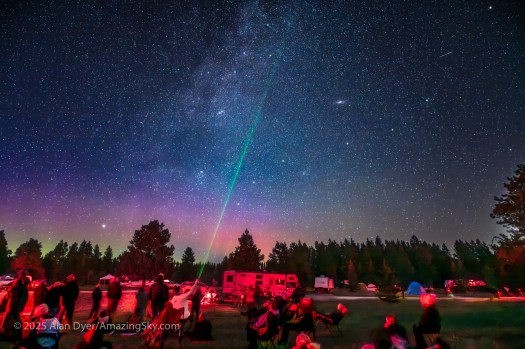
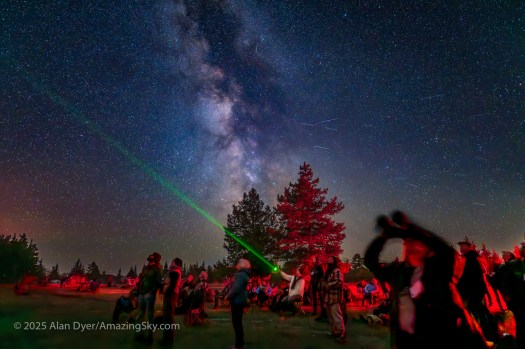
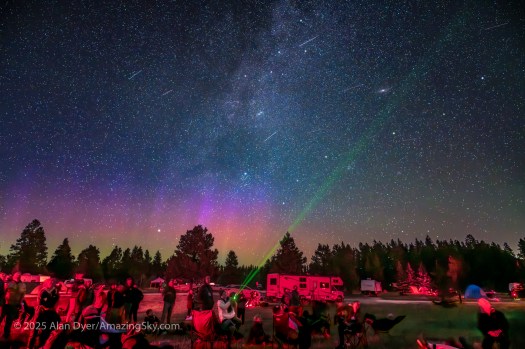
A popular part of this star party, as it is at many such events, is a laser-guided tour of naked-eye sights, where a guide points out the constellation patterns, and highlights objects that need nothing more than binoculars to see well.

In a slide show below, astronomer Ron Waldron from Saskatoon conducts the 2025 Friday night “star walk.” It’s BYOB — Bring Your Own Binoculars!
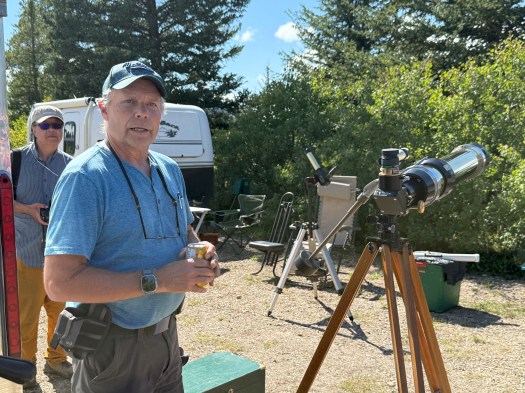
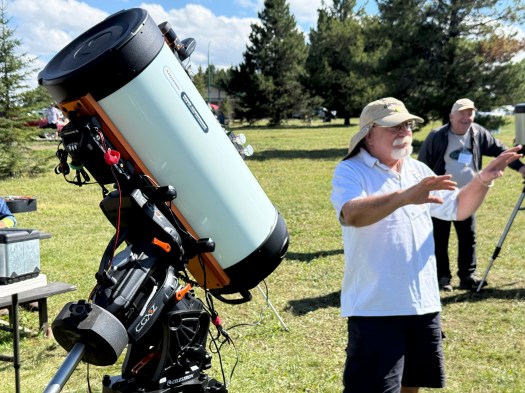
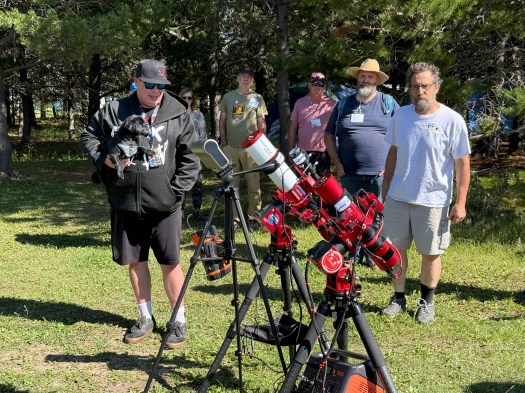
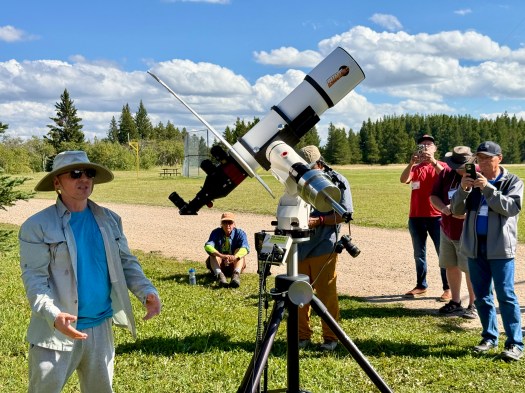
While participants stay up until the wee hours to enjoy all that the sky has to offer, every star party offers a range of daytime activities (but not happening too early!). Star parties are great places to see fields of telescopes of every description. This year the program included a formal “show-and-shine” tour of some notable gear for all to admire. And there’s the ever-popular swap meet with bargains on offer.
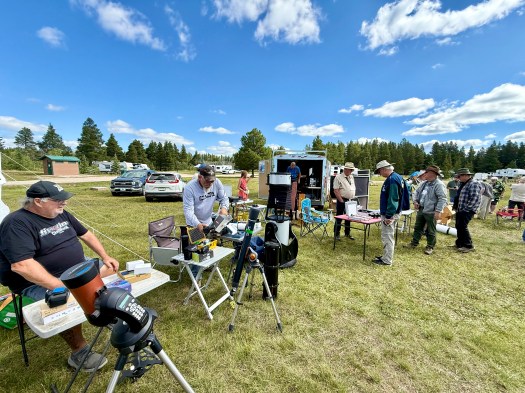
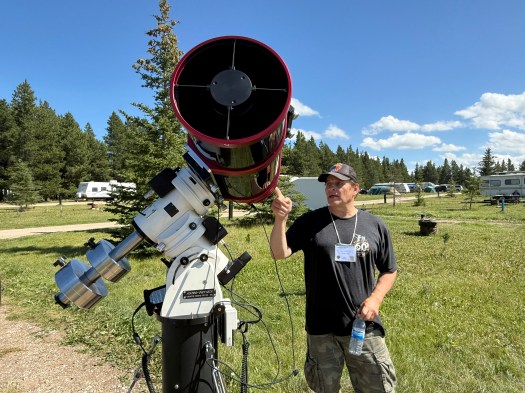
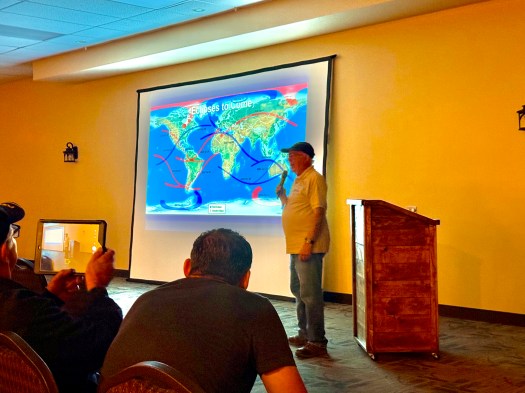
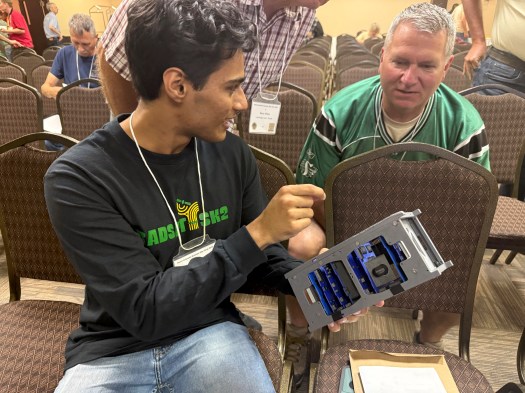
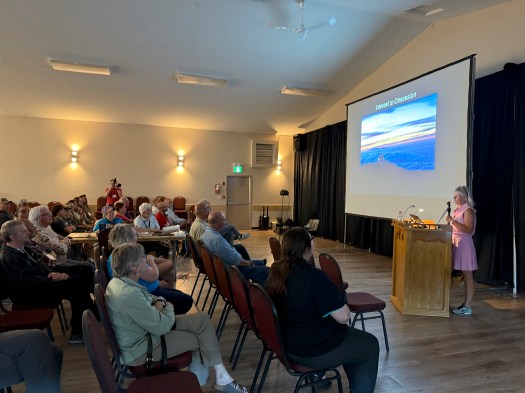
We enjoyed several talks on a range of astronomy topics, not just stargazing, but also the latest in science research. We heard about a satellite being built in Saskatchewan by U of S and U of R students, and about how the Mars Perseverance rover collects samples, in a talk from one of the researchers involved with the NASA mission.
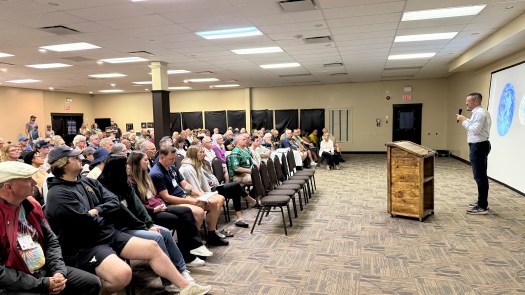
And of course there were awards and door prizes to be won! Always to a capacity crowd at the Cypress Resort conference room.
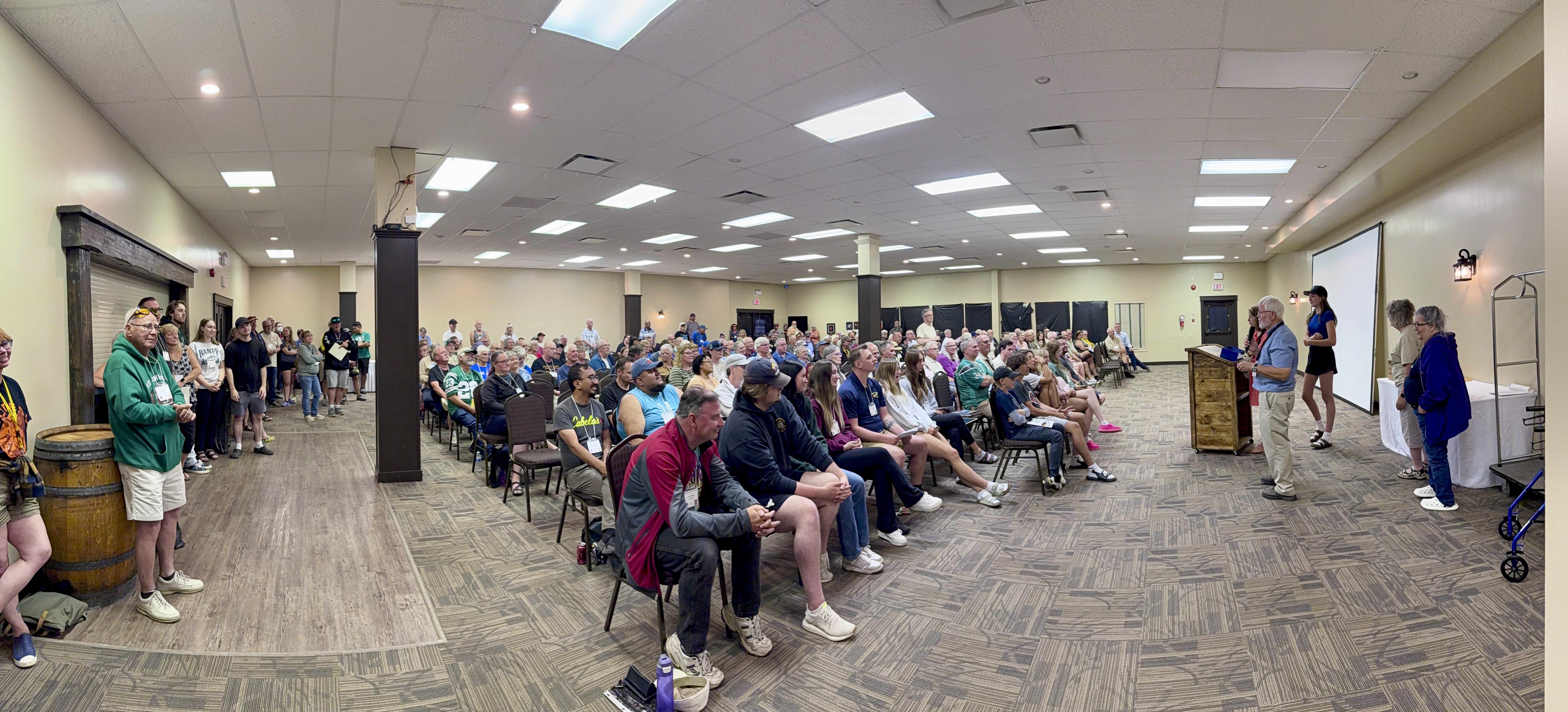
The door prizes being handed out. You must be in the room to win!

It was a superb 4 days of astronomy and stargazing. If you are in the area, I highly recommend attending. Next year’s SSSP will be August 12 to 15 inclusive — it’s always at New Moon. The website is here but won’t be updated for the 2026 event details until next year.

I won’t be there in 2026, as August 12 is the date of the next total eclipse of the Sun, which I discuss in my previous blog. I plan to be in Spain!
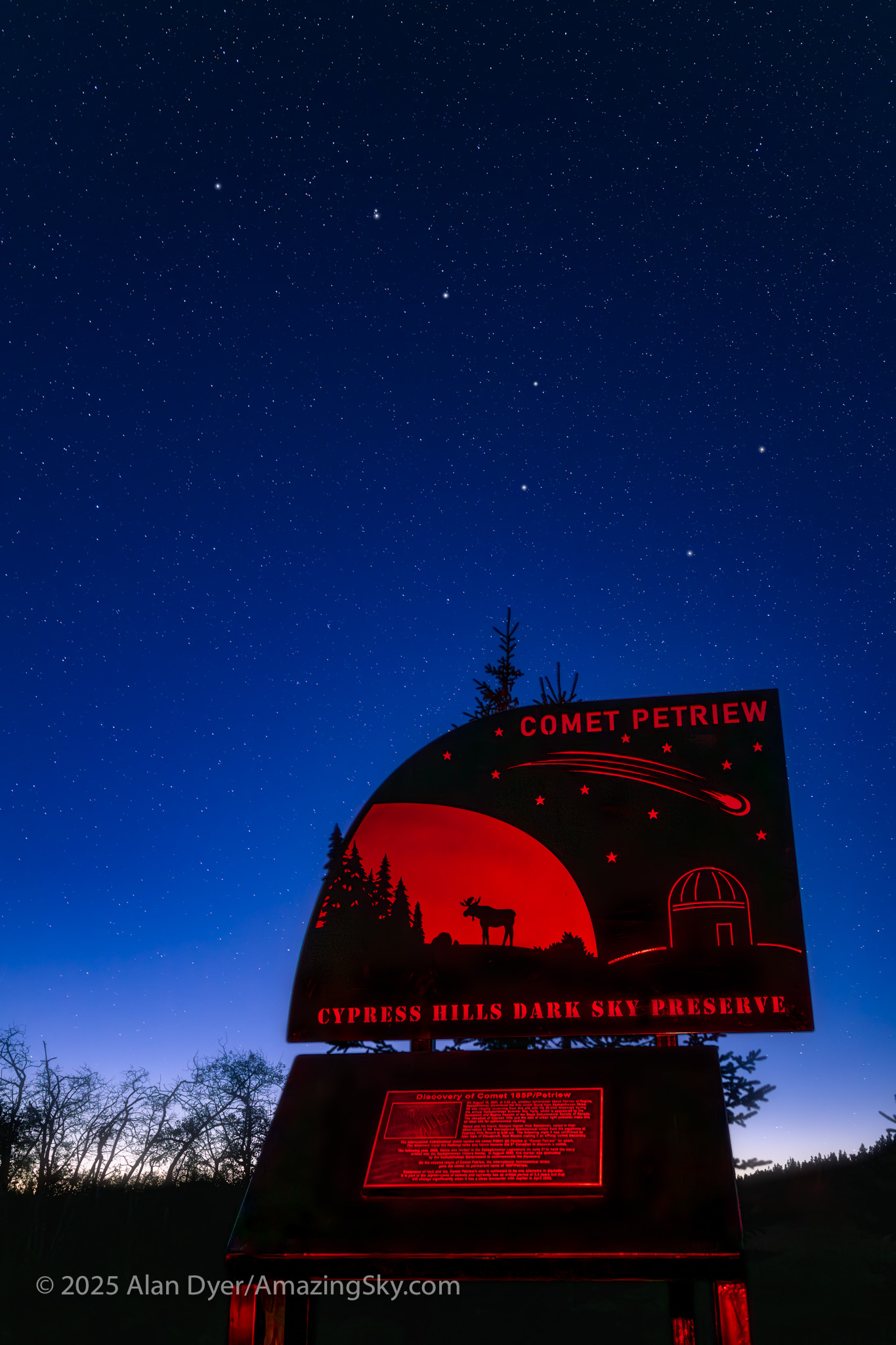
This is the new sign and plaque commemorating the discovery in 2001 of a comet here in the Cypress Hills Interprovincial Park by Vance Petriew.

But I highly recommend attending in 2026. As most people do, you may find yourself enjoying the weekend so much you make it an annual event in your calendar. I shall miss my annual August ritual of the SSSP in 2026 and in 2027 — there’s an eclipse that August, too!

But 2025 was certainly a fine year to enjoy all that the Cypress Hills have to offer under the stars.

— Alan, September 6, 2025 / AmazingSky.com

Honoured with a Stamp


4557_CP_Astronomy Stamp_Booklet-2-FA_V2

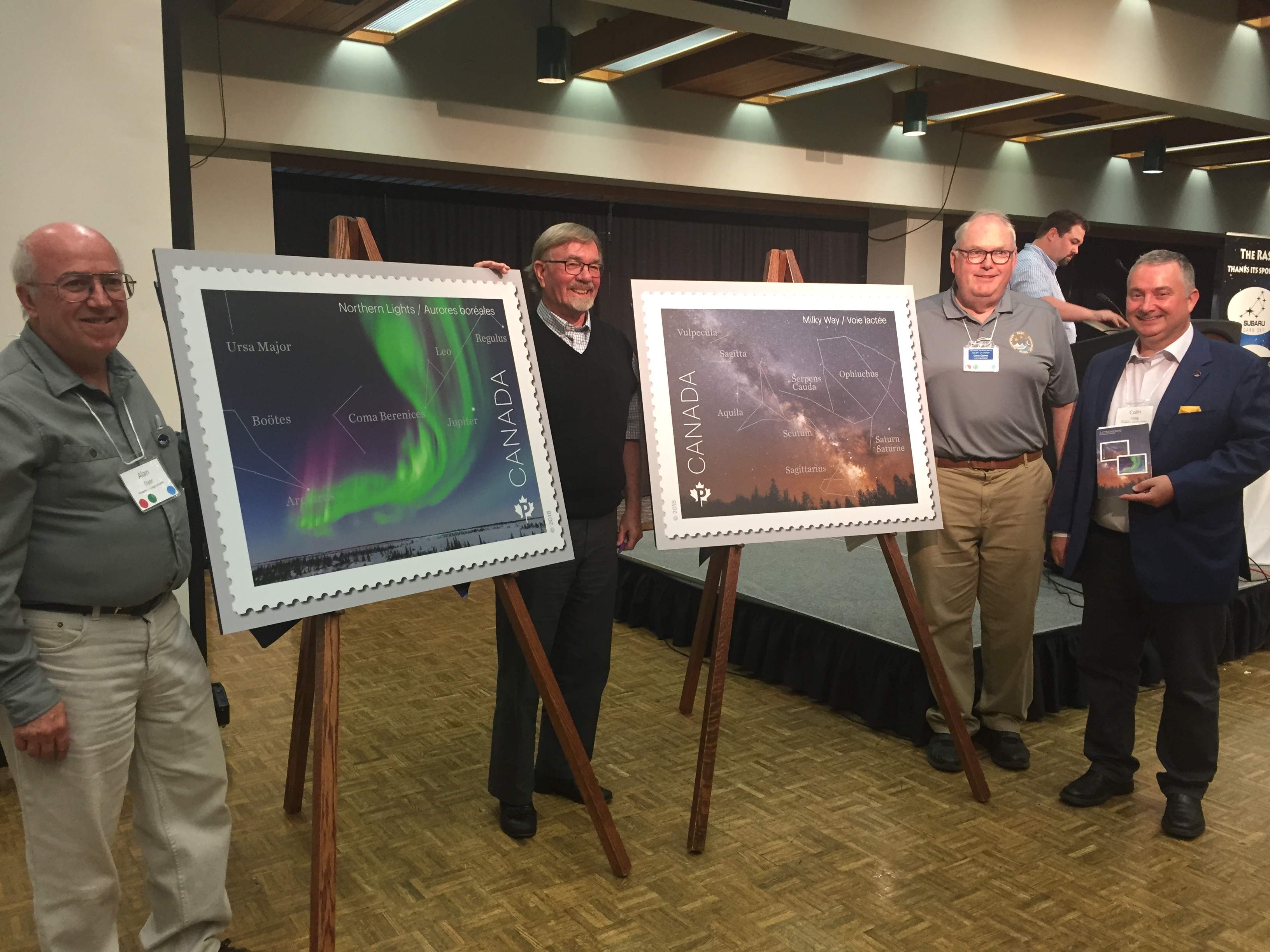
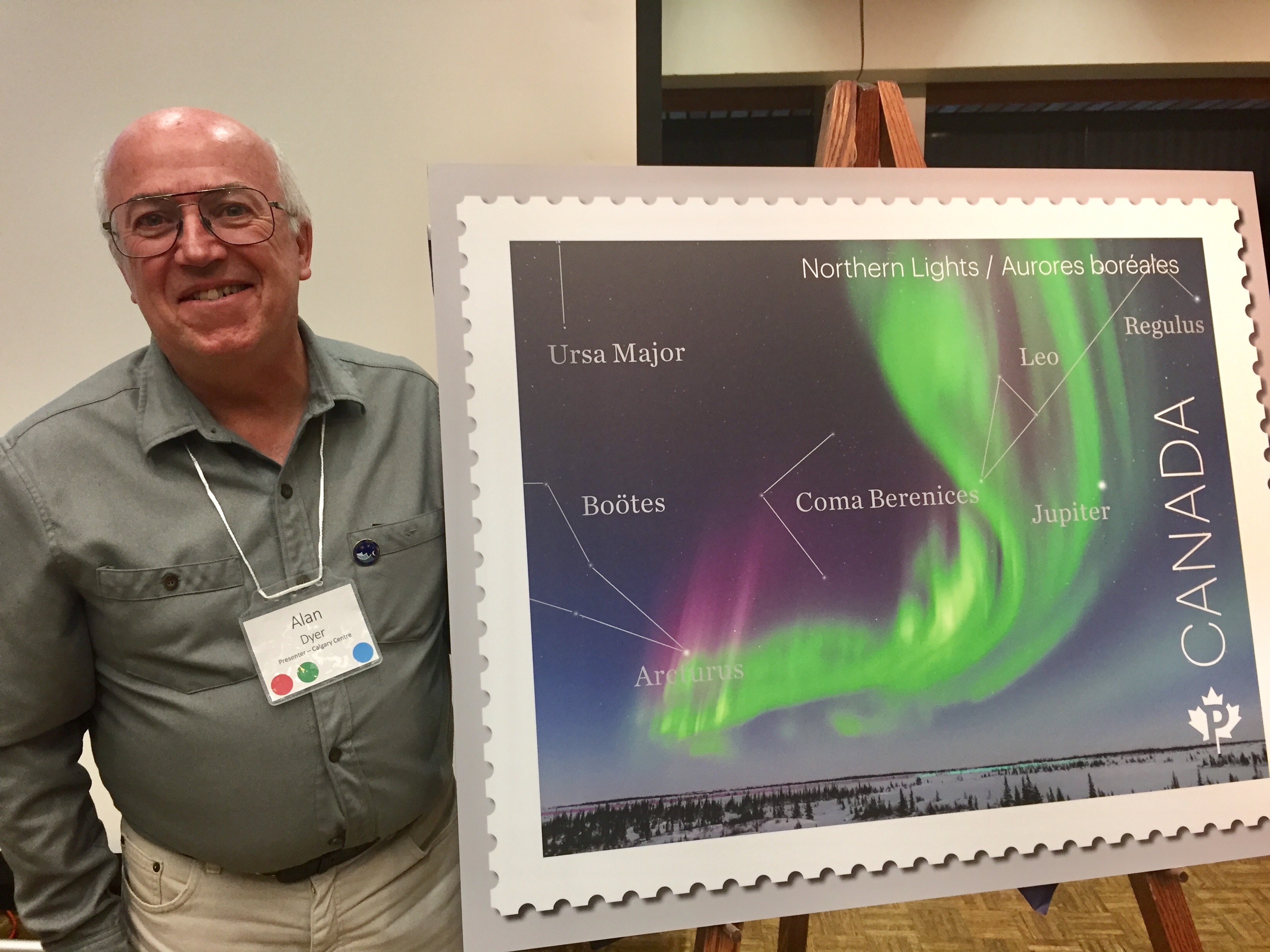
One of my aurora images now appears on a new stamp issued by Canada Post to mark the 150th Anniversary of the Royal Astronomical Society of Canada. 

It is always a treat to see one of your images in print, but this is a rare privilege indeed. On June 29 Canada Post unveiled a new set of astronomy stamps, one of which features an aurora image from me, shot March 14, 2016 from the Churchill Northern Studies Centre, in Churchill, Manitoba. I shot it from the second floor observing deck, looking east to the rising sky.

The other stamp features a Milky Way image shot by fellow RASC member Matt Quinn taken from the Bruce Peninsula, Ontario.

If you view the stamps under UV “black light” more image information is revealed!

The stamps were issued to mark the 150th Anniversary of the Royal Astronomical Society of Canada, which began as an exclusive “gentlemen’s club” in Toronto in 1868. It is much more inclusive today, as it should be, with a membership of 5500 people from across Canada.

IMG_3581

The stamps were unveiled at a ceremony at the RASC’s annual General Assembly, this year held in Calgary where I live. Representatives from Canada Post, and of course the RASC executive were in attendance.

IMG_6276

This shows (L to R): me, David Foote (author, eclipse chaser, and member of the Stamp Advisory Committee), Chris Gainor (incoming RASC President), and Colin Haig (outgoing RASC President) at the unveiling. Matt Quinn was not able to attend. All those present (including members of the local Philatelic Society) received first day covers which David and I autographed.

IMG_E6274

This was certainly a great honour, a once-a-lifetime event I’m sure. I am grateful to the RASC officials such as Randy Attwood who lobbied for the stamp issue, a process that began three years ago.

I was first contacted by Canada Post in October 2016 though the final image was not selected until October 2017. Since then, its use was to be kept secret until the “Big Reveal” unveiling at the General Assembly. For the most part, it was!

IMG_E6264

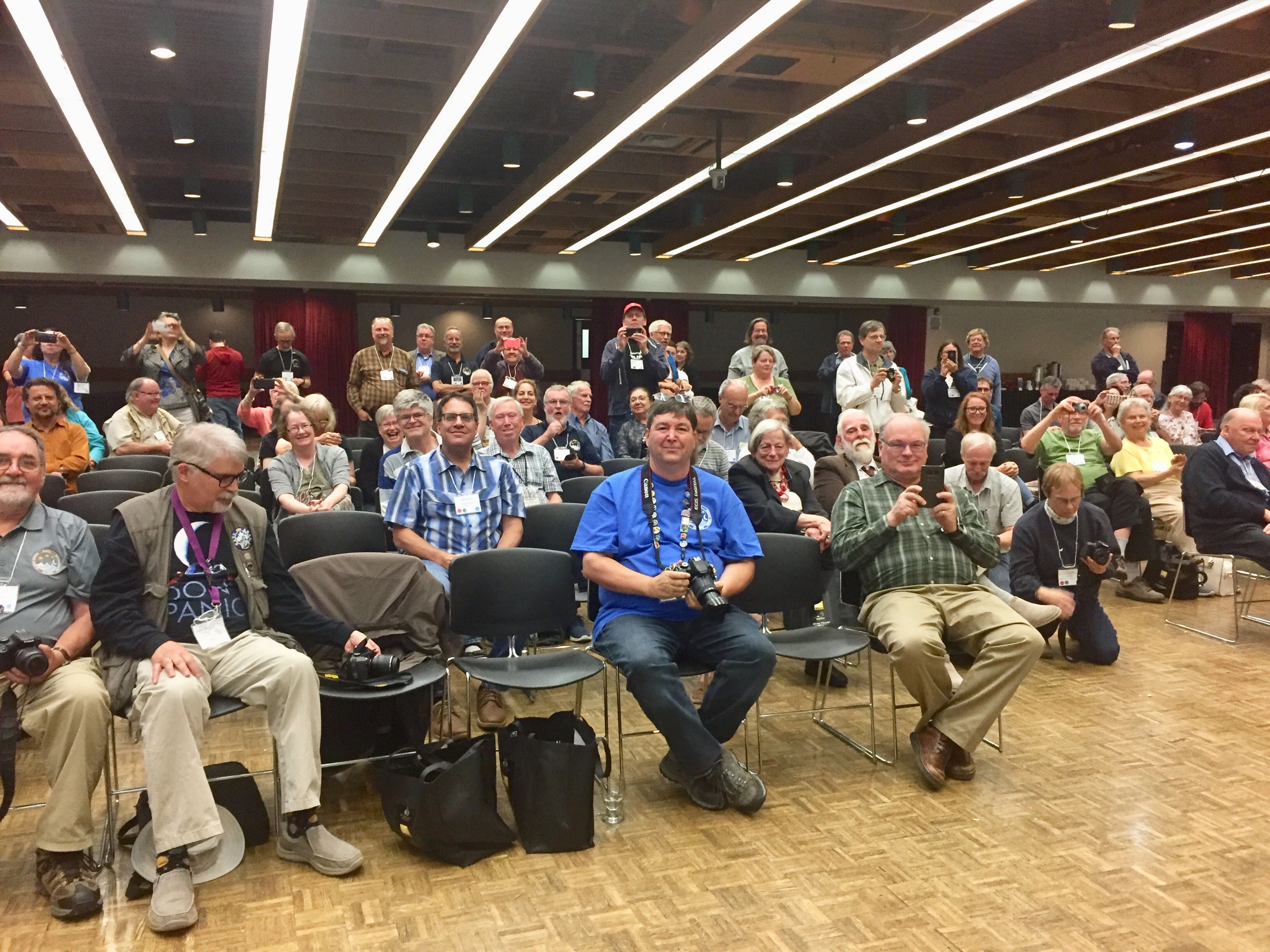
This is a shot I took of some of my fellow RASC members and friends from across Canada enjoying me taking a picture of them at the ceremony at the University of Calgary.

Many thanks! And now mail some letters!

— Alan, July 2, 2018 / © 2018 Alan Dyer / amazingsky.com 


Saturday Night Under the Stars


RAO Milky Way Night (Aug 3) #1

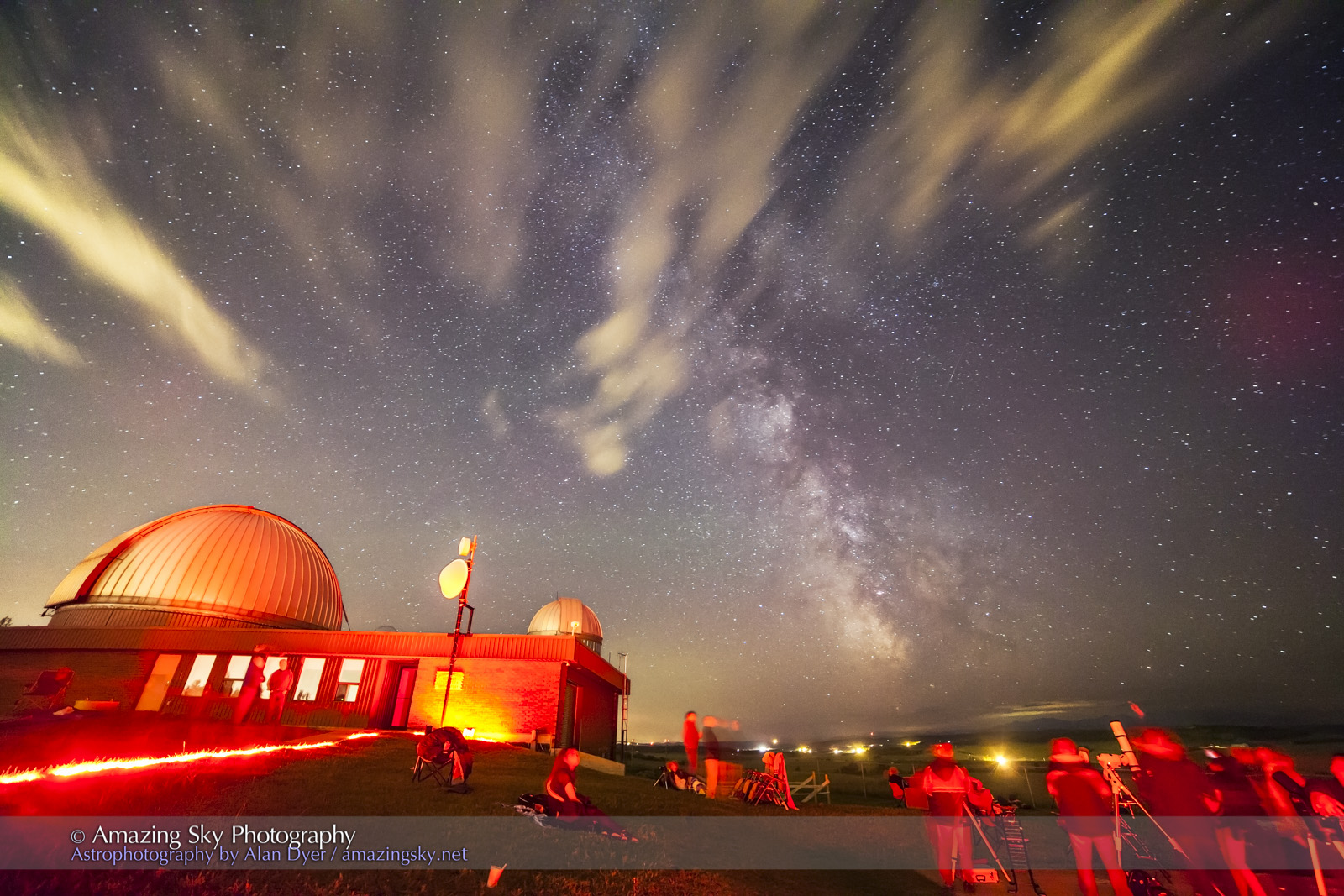
On a summer Saturday night hundreds gathered to enjoy the stars and Milky Way.

What a fine night this was. Last night, Saturday, August 3, I helped out at one of the annual Milky Way Nights presented by the University of Calgary’s Rothney Astrophysical Observatory. About 300 people attended, under nearly perfect conditions. The few clouds that rolled through later in the night didn’t detract from the views of the Milky Way and deep-sky objects.

Part way through the night I conducted a laser tour of the night sky. It was pretty neat presenting a “planetarium show” under the real stars to about 150 people gathered on the hillside lying on blankets and in lawn chairs. Astronomy outreach doesn’t get much better!

RAO Milky Way Night - Fish-Eye View #1 (Aug 3, 2013)

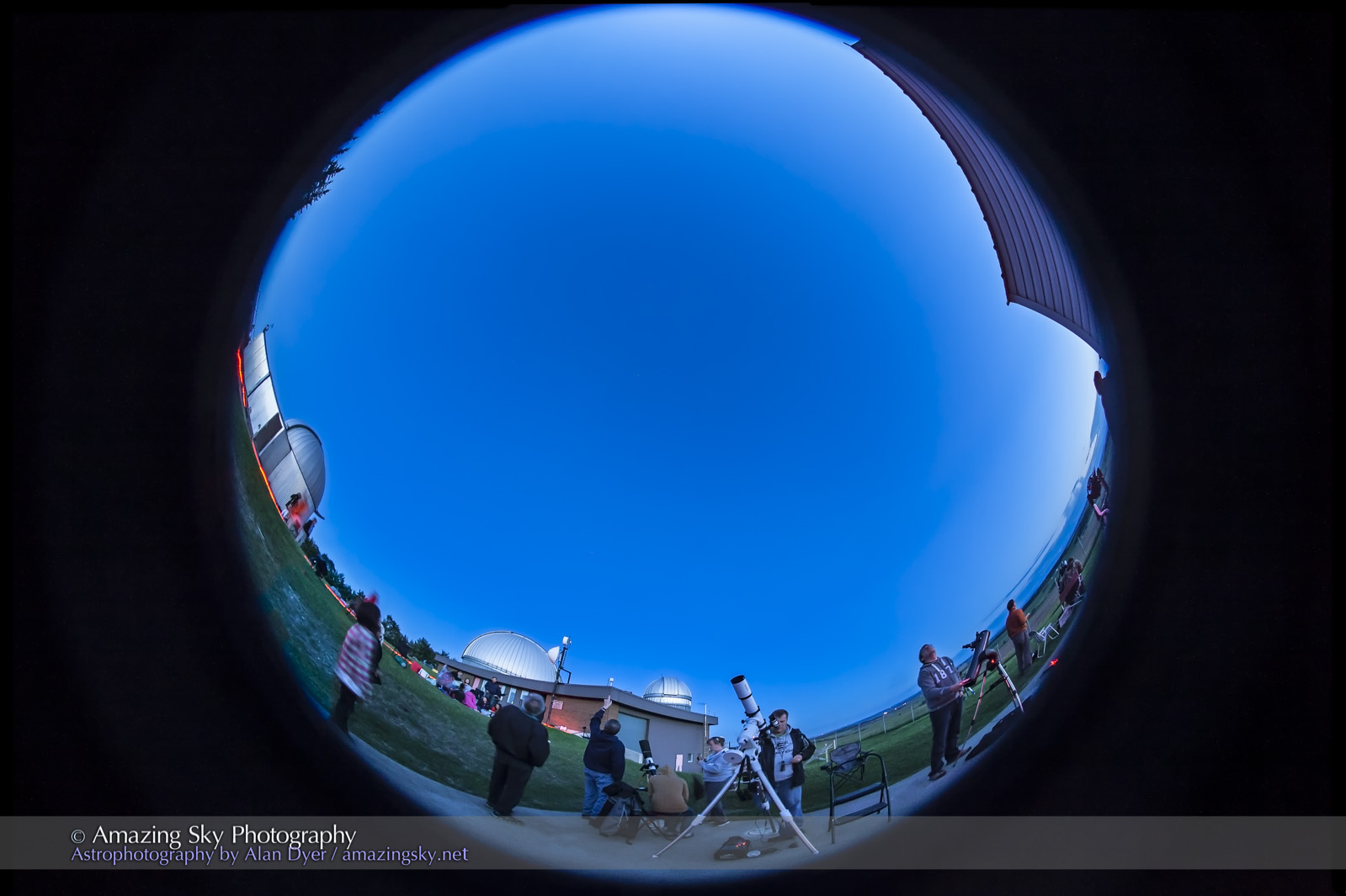
Folks from the local astronomy club set up their telescopes on the patio for public viewing. This is a fish-eye lens image I took in the twilight for use in an upcoming digital planetarium show I’m working on that will tour people through the Milky Way.

RAO Milky Way Night (Aug 3) #4

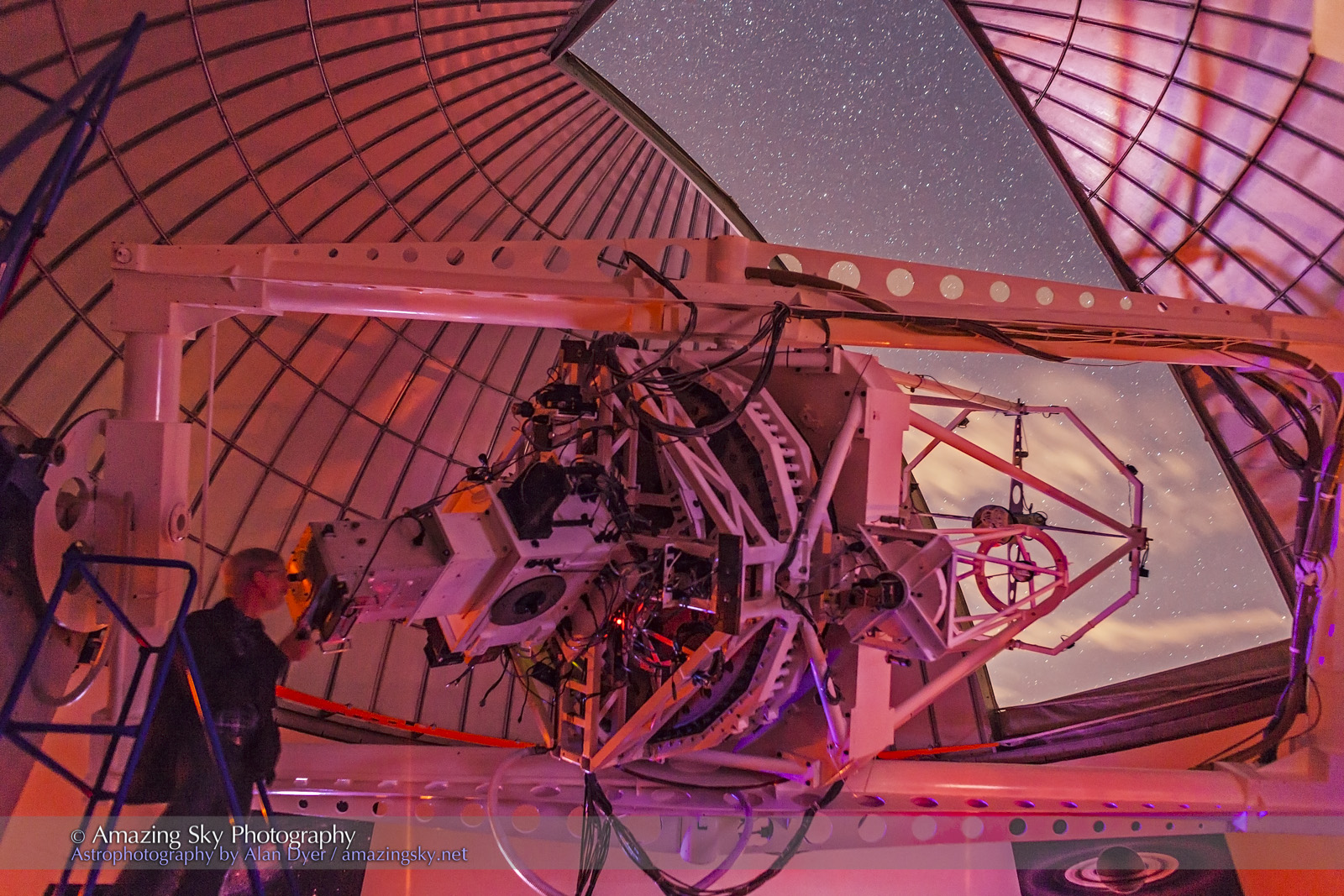
A highlight was the opportunity for people to look through one of the largest telescopes in Canada, the 1.8-metre ARC Telescope that is normally used for spectroscopy but can actually be equipped with an eyepiece. Here, observatory director Dr. Phil Langill lines up the telescope on Neptune.

The event went from 10 p.m. to 2 a.m. We started these Milky Way Nights in 2009 for the International Year of Astronomy and they have been big hits every summer since, one of the legacies of IYA.

– Alan, August 4, 2013 / © 2013 Alan Dyer


See, That’s the Orion Nebula!


RAO Open House (February 9, 2013)

What a hardy bunch we are in Canada, braving winter weather to see Orion and company. 

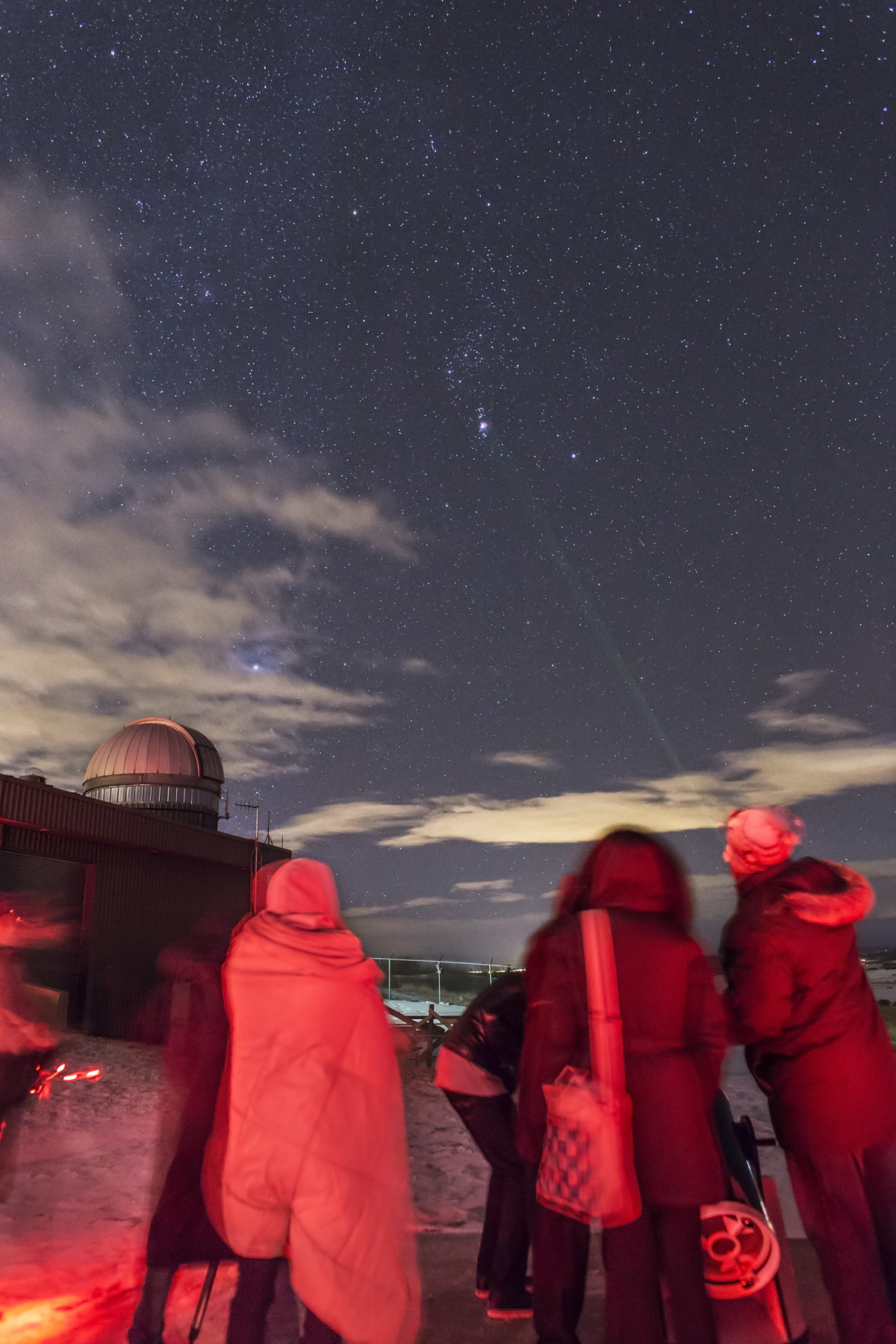
A well-bundled group of sky fans partakes in an impromptu tour of Orion and his famous nebula.

I shot this scene last night, February 9, at the first of a series of monthly stargazing nights at the local university research observatory, the Rothney Astrophysical Observatory. About 120 people and volunteers gathered to take in the sights of the winter sky, as best they could as transient clouds permitted. Inside, speakers presented talks themed to the Chinese New Year, which is governed by the timing of the New Moon each year. As this was a New Moon night, people were able to stargaze under reasonably dark skies to see deep-sky sights such as the Orion Nebula.

Want to know where it is? An astronomy club member points it out rather handily with one of the best tools astronomers have for public outreach, a bright green laser pointer. Controversial and dangerous in the wrong hands, when used responsibly these laser pointers are wonderful for conducting sky tours.

As a side note, this is a 3-second exposure with a new Canon 6D camera at ISO 8000, yet the photo shows very little noise. In just 3 seconds, the Milky Way is beginning to show up! I could have gone to previously unthinkable speeds of ISO 12000+ and still had a presentable shot. This will be a superb camera for nightscapes and available light shots.

– Alan, February 10, 2013 / © 2013 Alan Dyer