If you saw the total eclipse in 2024 (or you missed it!) you have three chances in the next three years to see another. But you will have to travel.
Typically, total eclipses of the Sun occur about 18 to 24 months apart. Unusually, in the next three years, we have a trio of total eclipses each only a year apart. Or to be precise, a lunar year — 12 lunar phase cycles — apart.
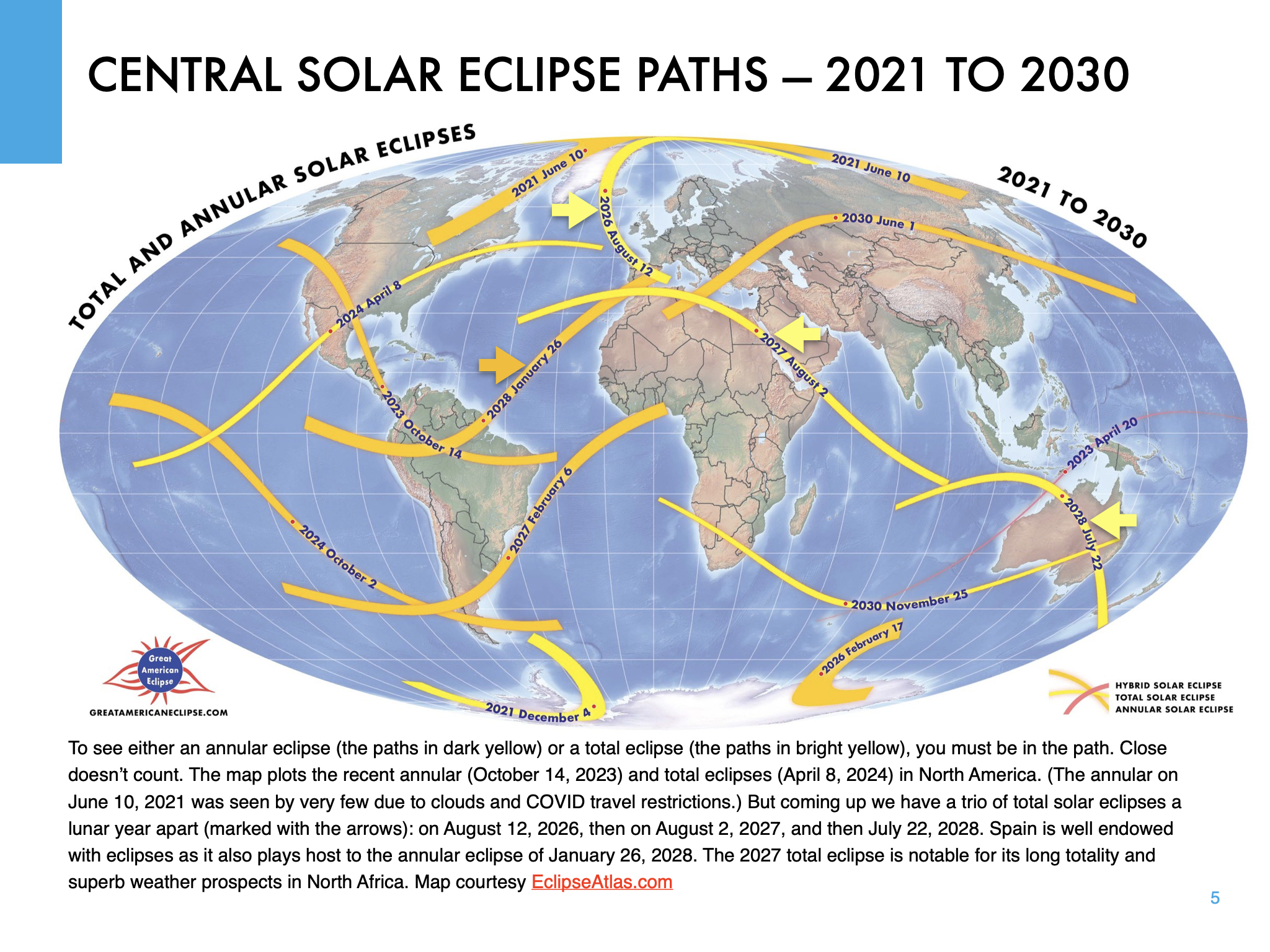
The map above (courtesy EclipseAtlas.com) plots the paths of all central solar eclipses (annulars, totals and hybrids) from 2021 to 2030. Included are the paths of the 2023 annular and 2024 total in North America you might have seen.
But the next total eclipse in populated North America is not until August 2044, then again in August 2045. To see a total eclipse in the next few years, those of us in the Americas will have to travel.
However, those in Europe can drive to the next eclipse, to their first total eclipse at home since August 1999.
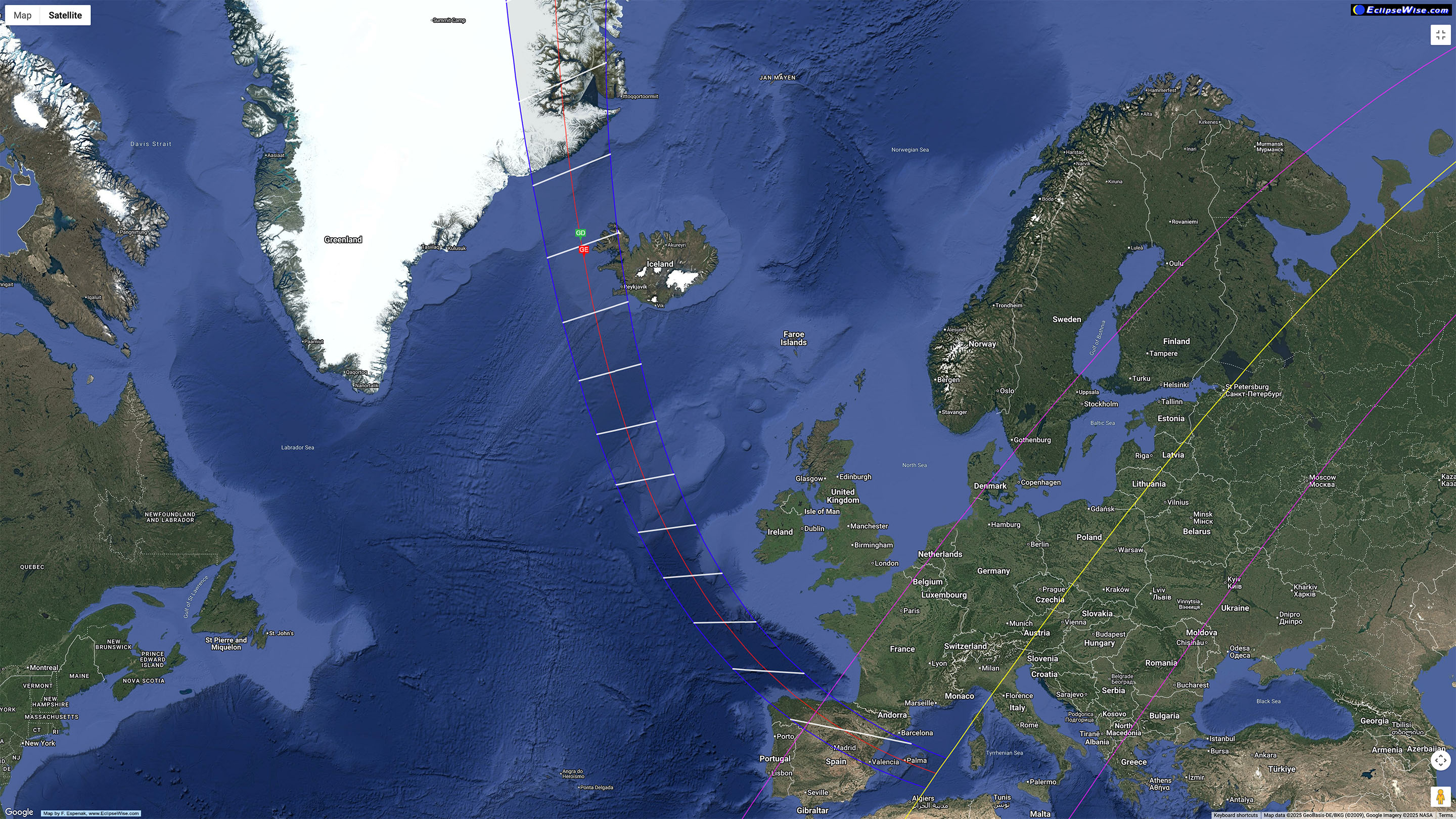
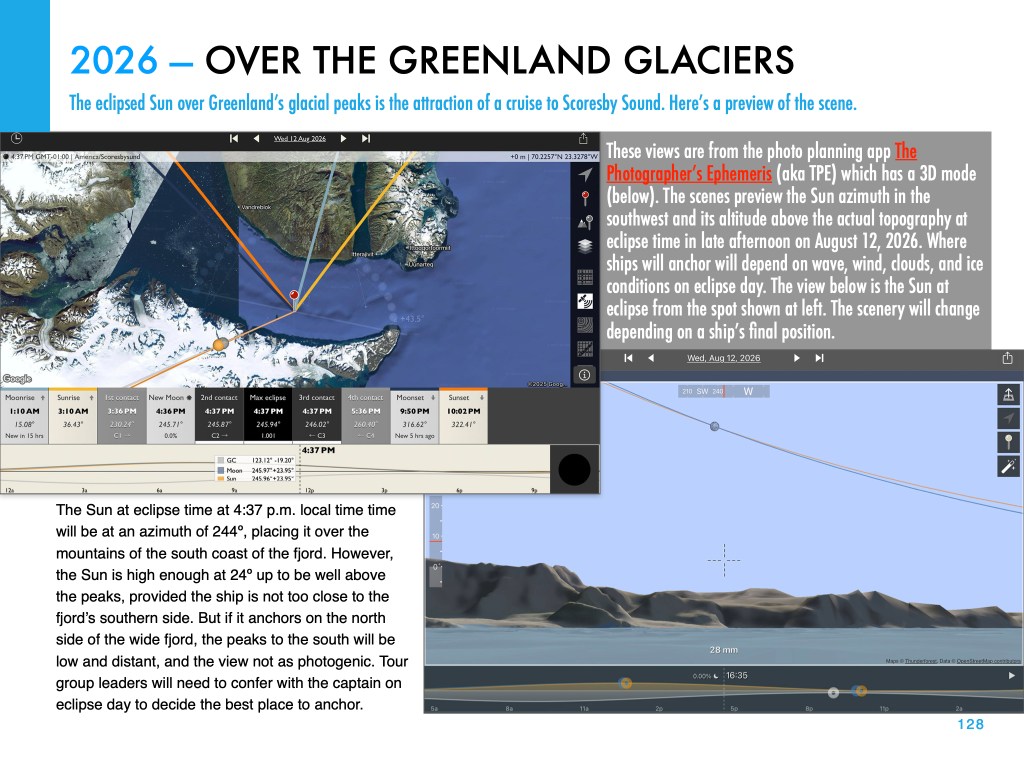
A year from now as I write this, the Moon’s umbral shadow will intercept the Earth for the first time since April 8, 2024. The path of this next total eclipse is unusual in that it starts in northern Russia, travels north over the North Pole, then sweeps down from the north to cross eastern Greenland, nipping the west coast of Iceland, then crossing Spain, to end at sunset over the Balearic Islands of Spain.
Weather prospects are surprisingly good for the several cruise ships planning to be in a Greenland fjord. Iceland is iffy, but had the eclipse been this year (on August 12, 2025) many people would have seen it. Spain was the opposite — statistically it has the best weather prospects along the 2026 path, but on August 12, 2025 most of the country was beset by storms.
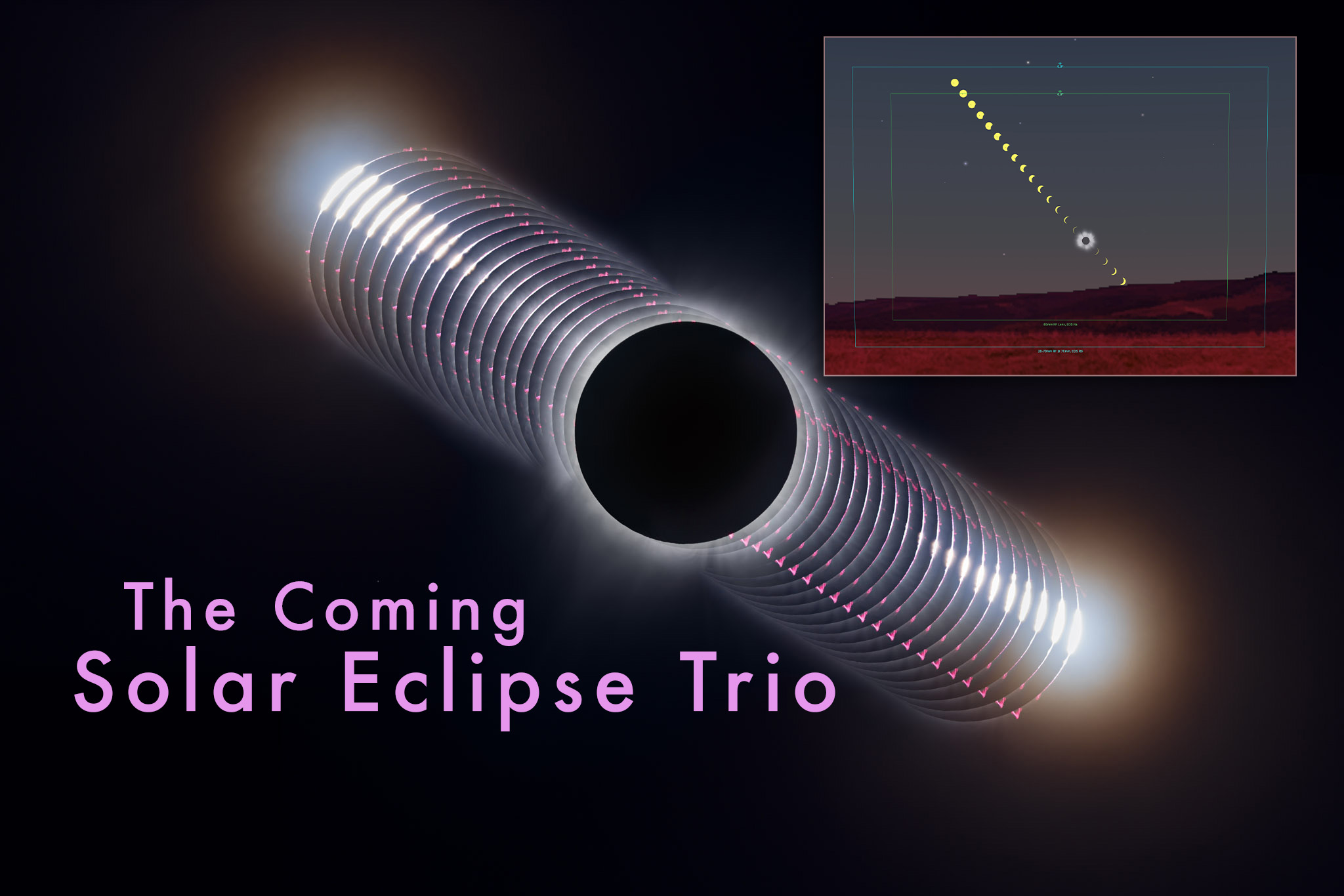
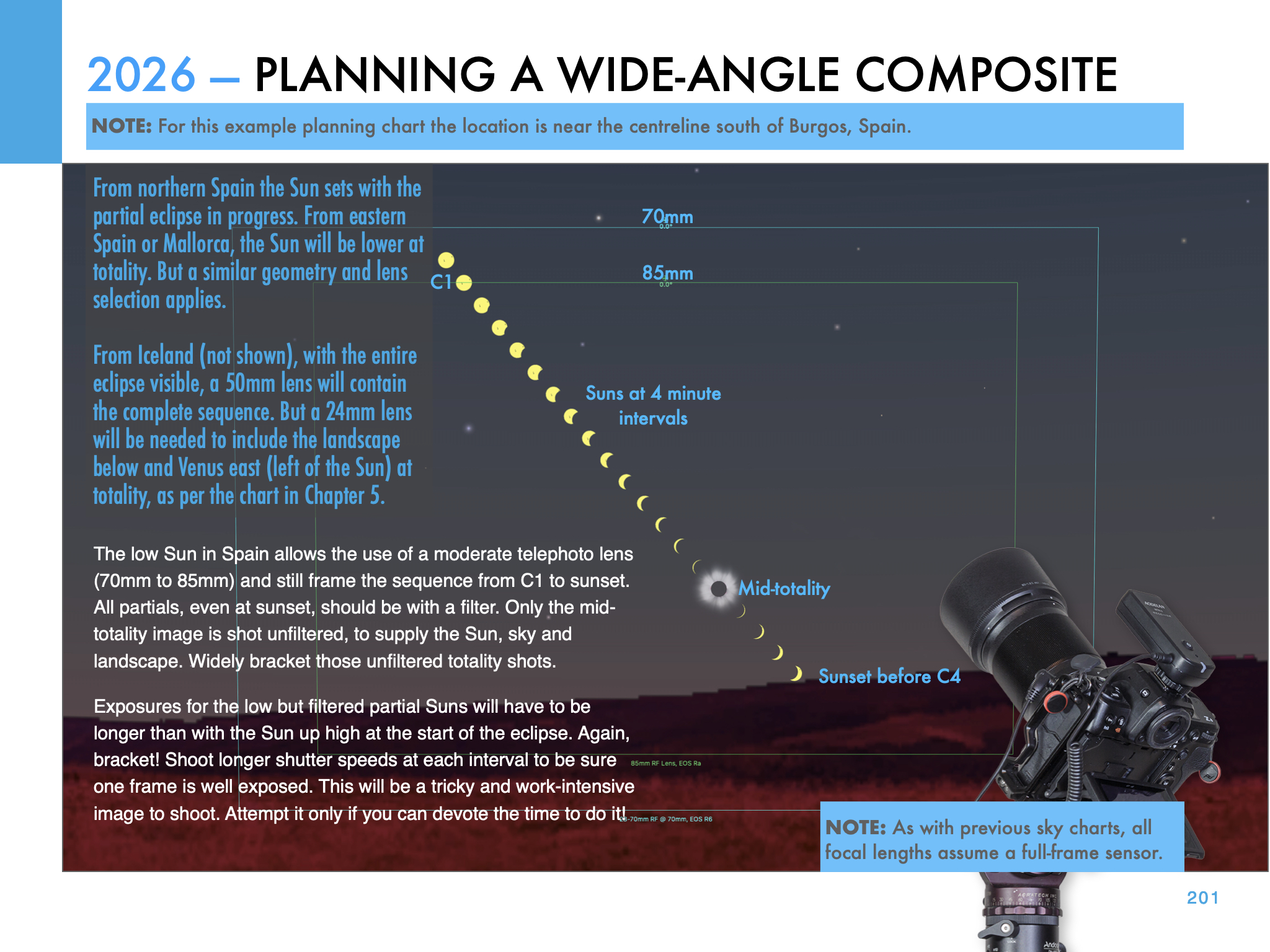
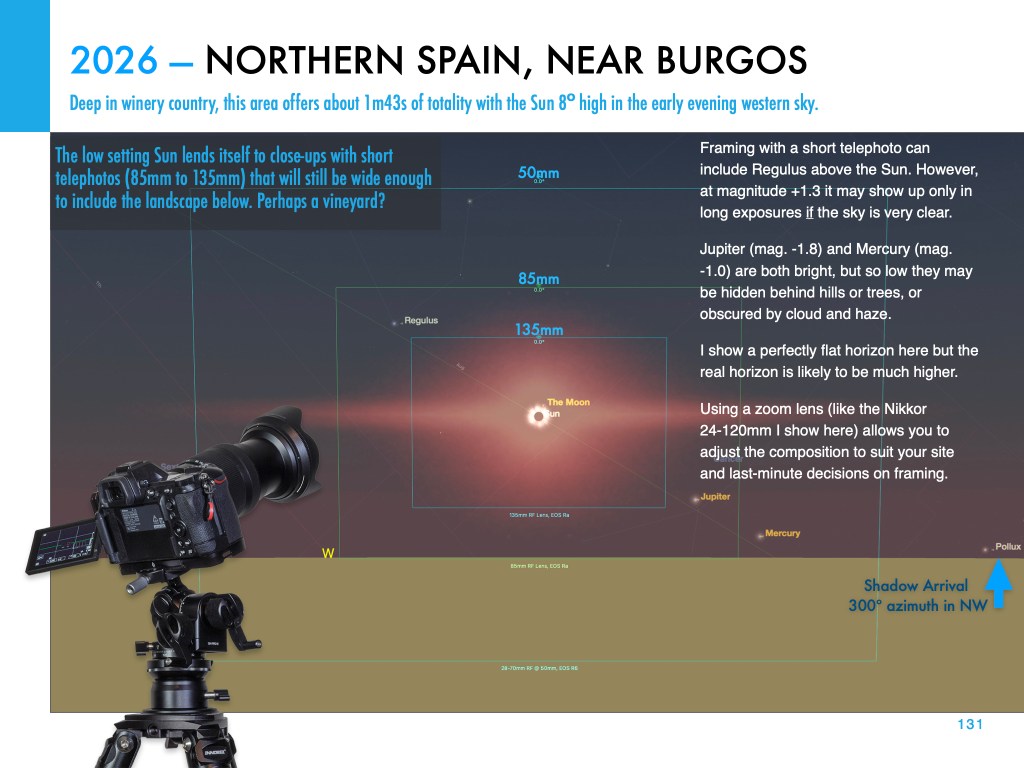
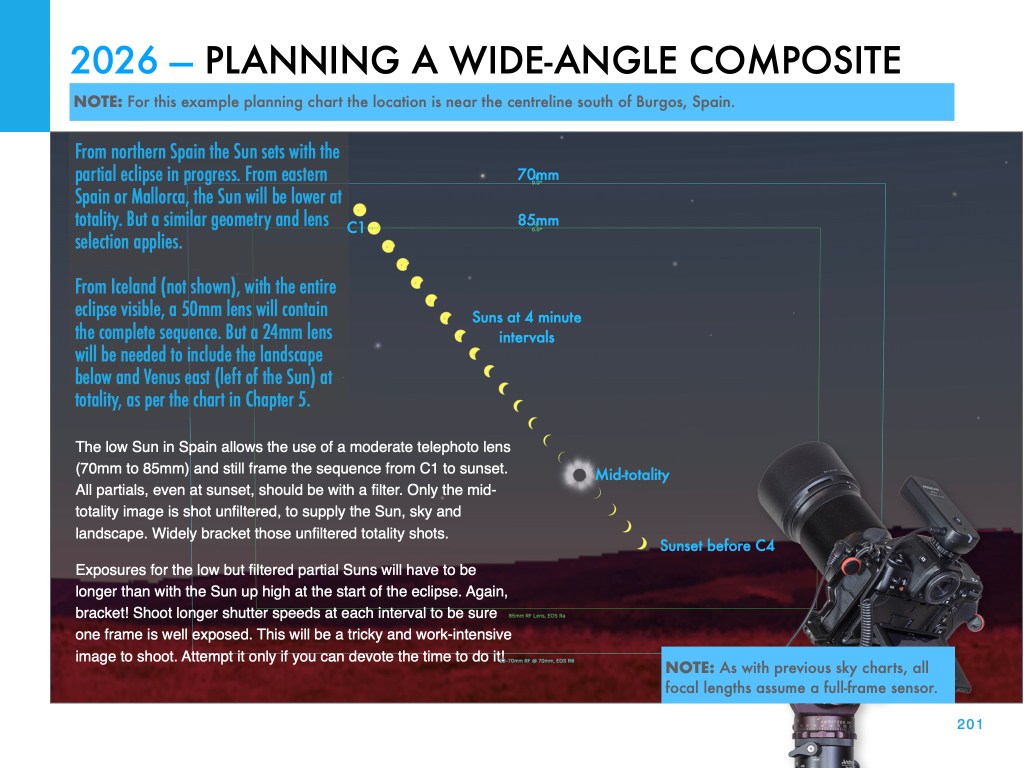
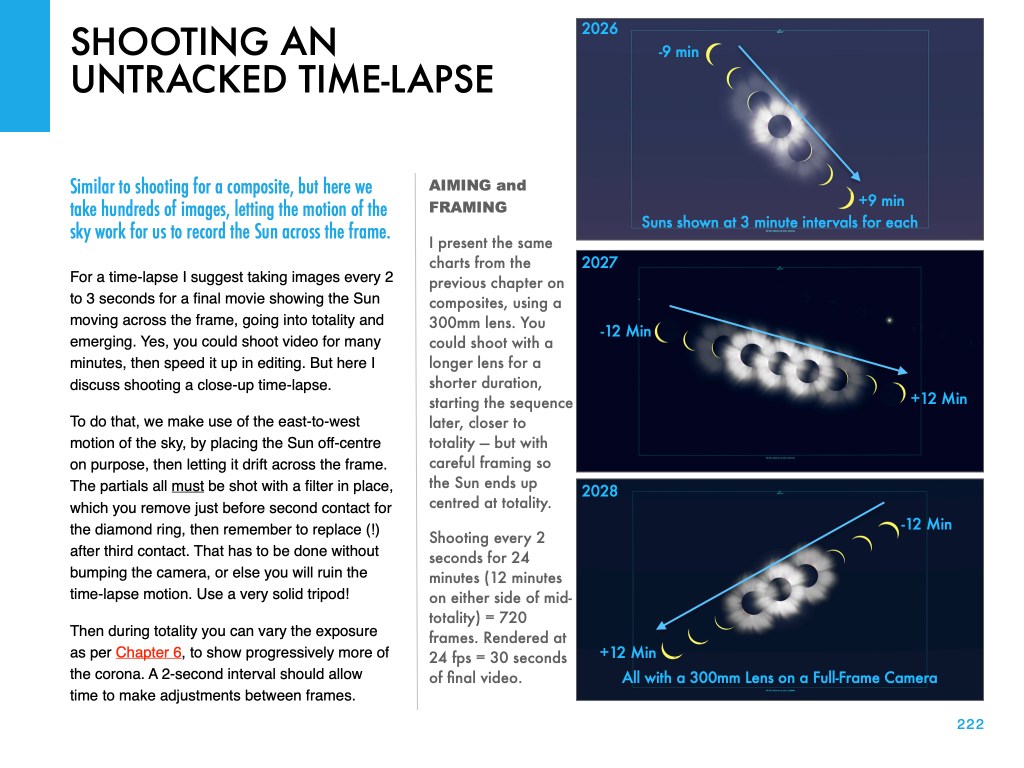
From northern Spain, where I intend to be and as I show above, the Sun will be low in the west in the early evening sky, for a relatively short 1m40s of totality. A low eclipse can be spectacular, but riskier as there’s a greater chance of clouds hiding a low Sun.
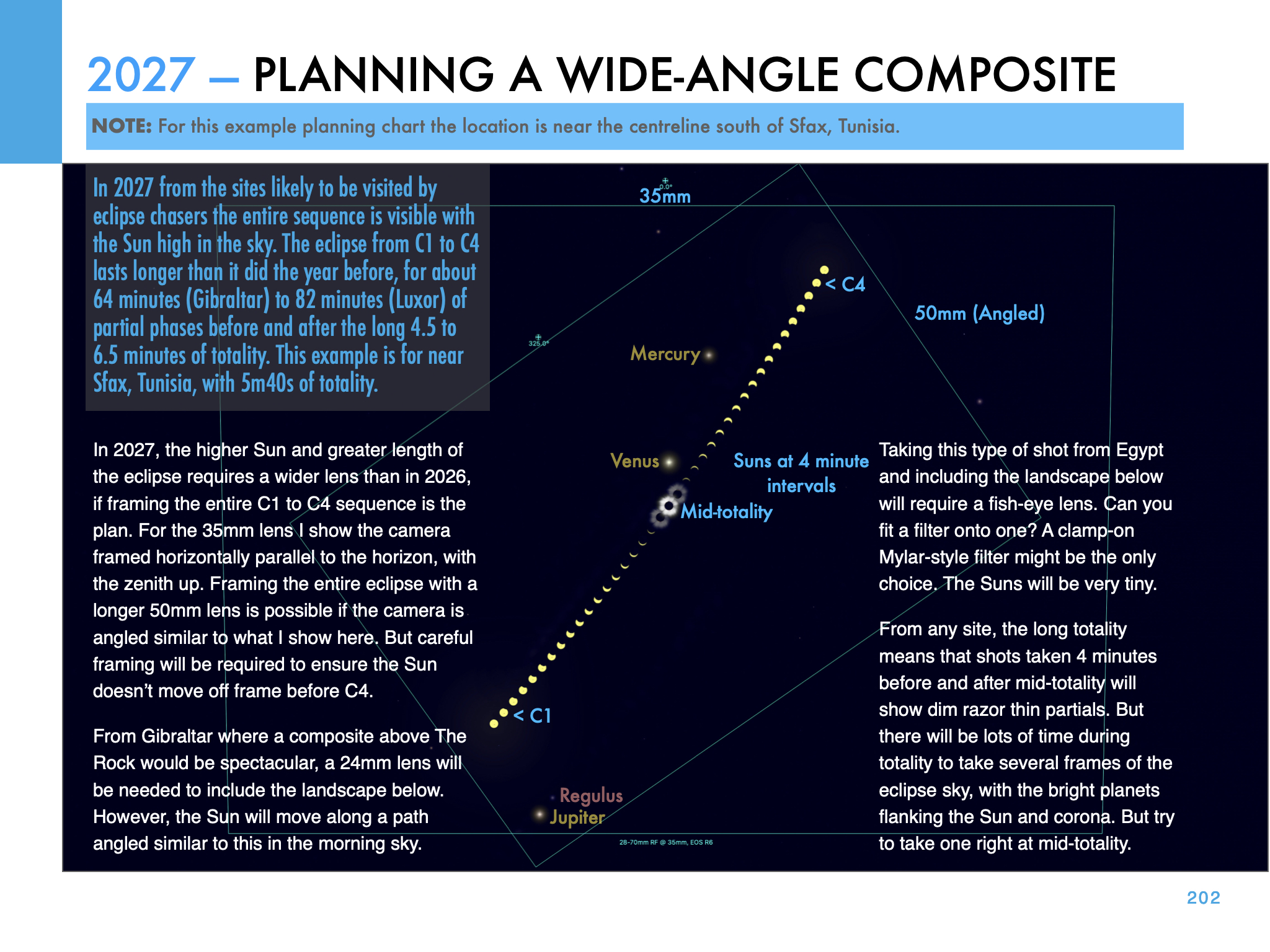
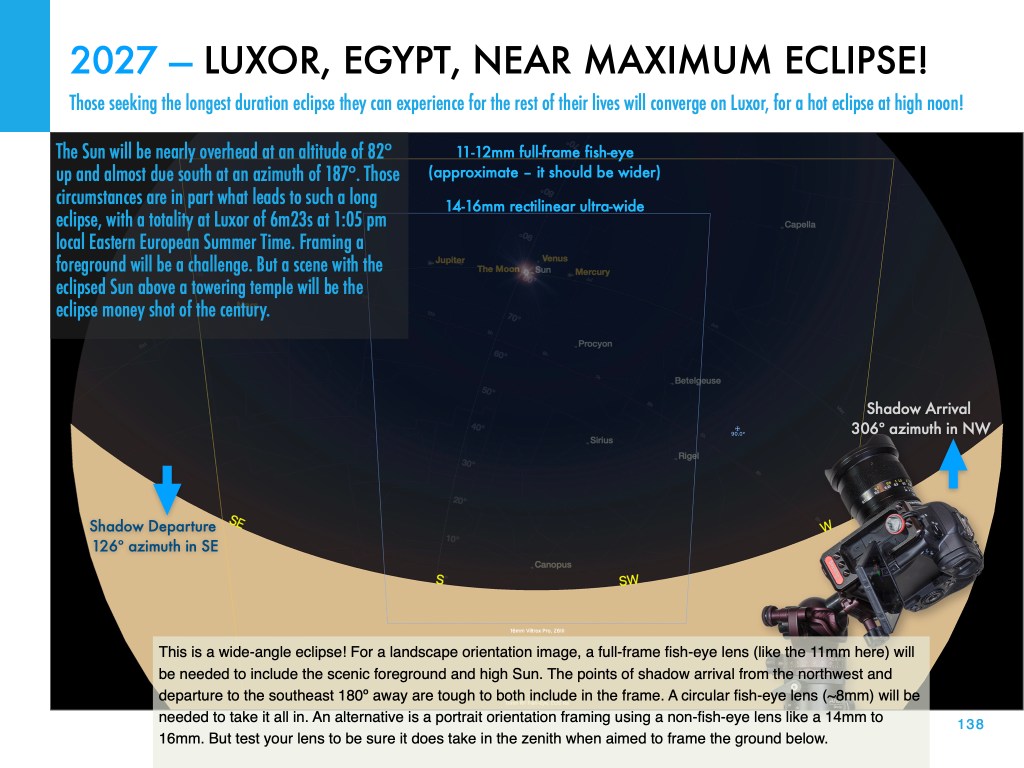
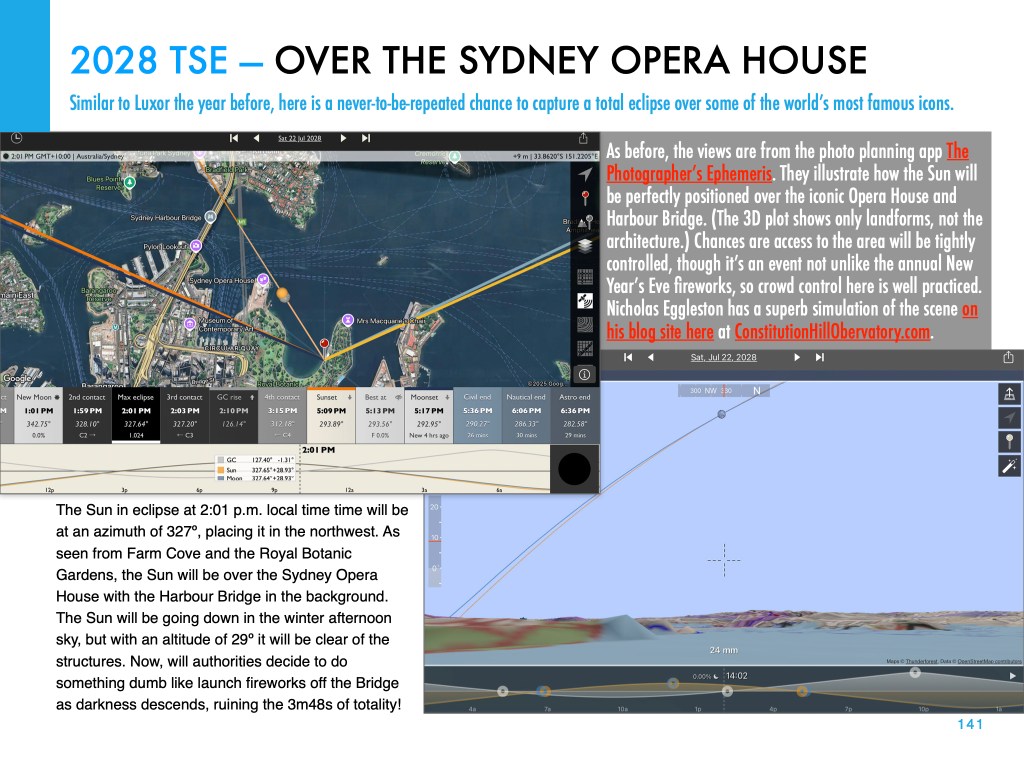
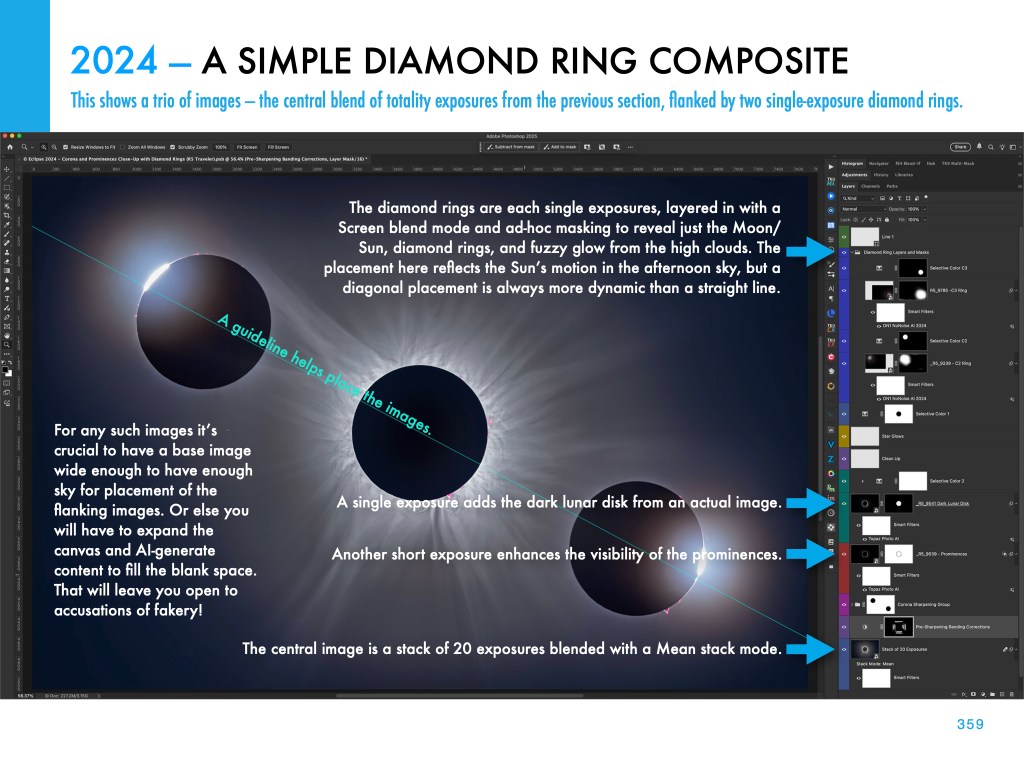
This and the other images of the Sun’s position at each eclipse are pages from my eclipse ebook, described below.
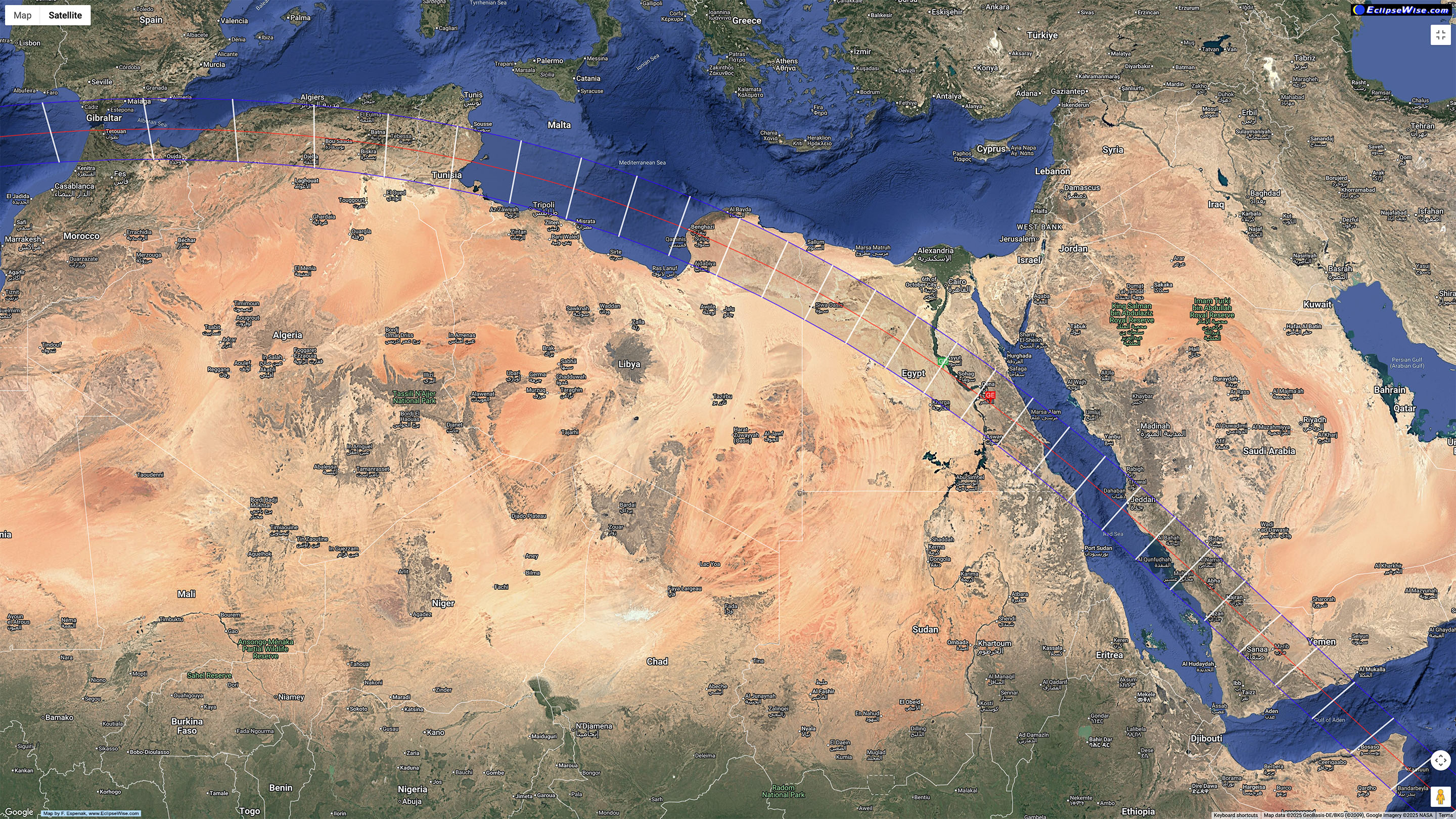
Twelve new Moons later, the lunar shadow again crosses the Earth, this time passing over North Africa where skies are almost always clear in summer. But the days are hot! The shadow crosses the Strait of Gibraltar and passes over Morocco, Algeria, Tunisia, Libya, Egypt, and Saudi Arabia. In addition to the good weather, the attraction is that this is the longest total eclipse for the rest of the 21st century.
The spectacular temples of Luxor, Egypt are at the point of maximum eclipse, with an unusual 6m23s of totality with the Sun high overhead. Even at Gibraltar, totality is 4m35s, seven seconds longer than the maximum in Mexico in 2024.
From Tunisia, as I show above, the Sun is 55º high over the Mediterranean, and totality is a generous 5m44s.
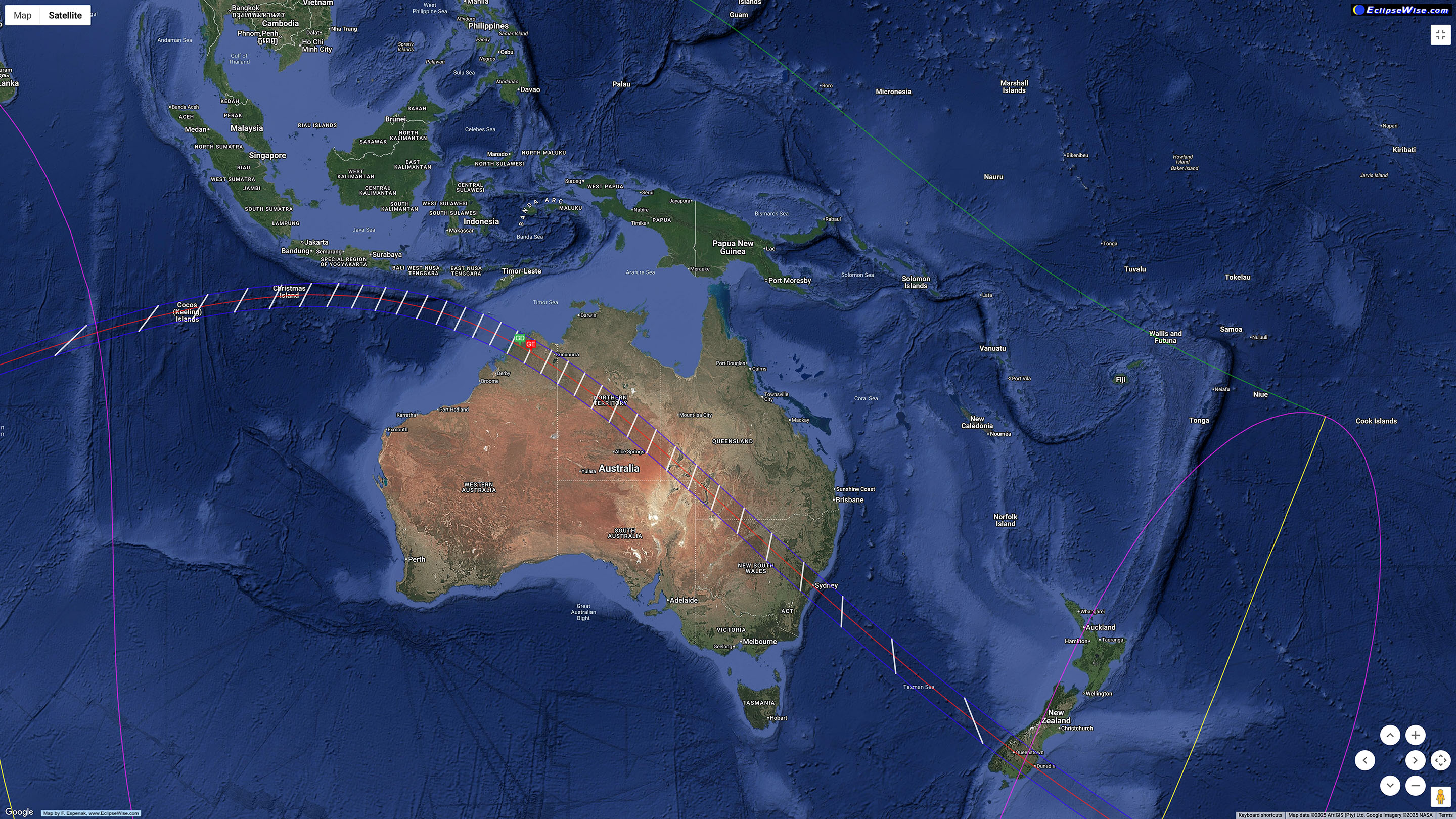
Another 12 lunar months later, the Moon shadow sweeps across the southern hemisphere, for another generously long eclipse. Remote Western Australia enjoys 5m10s of totality on a winter’s day.
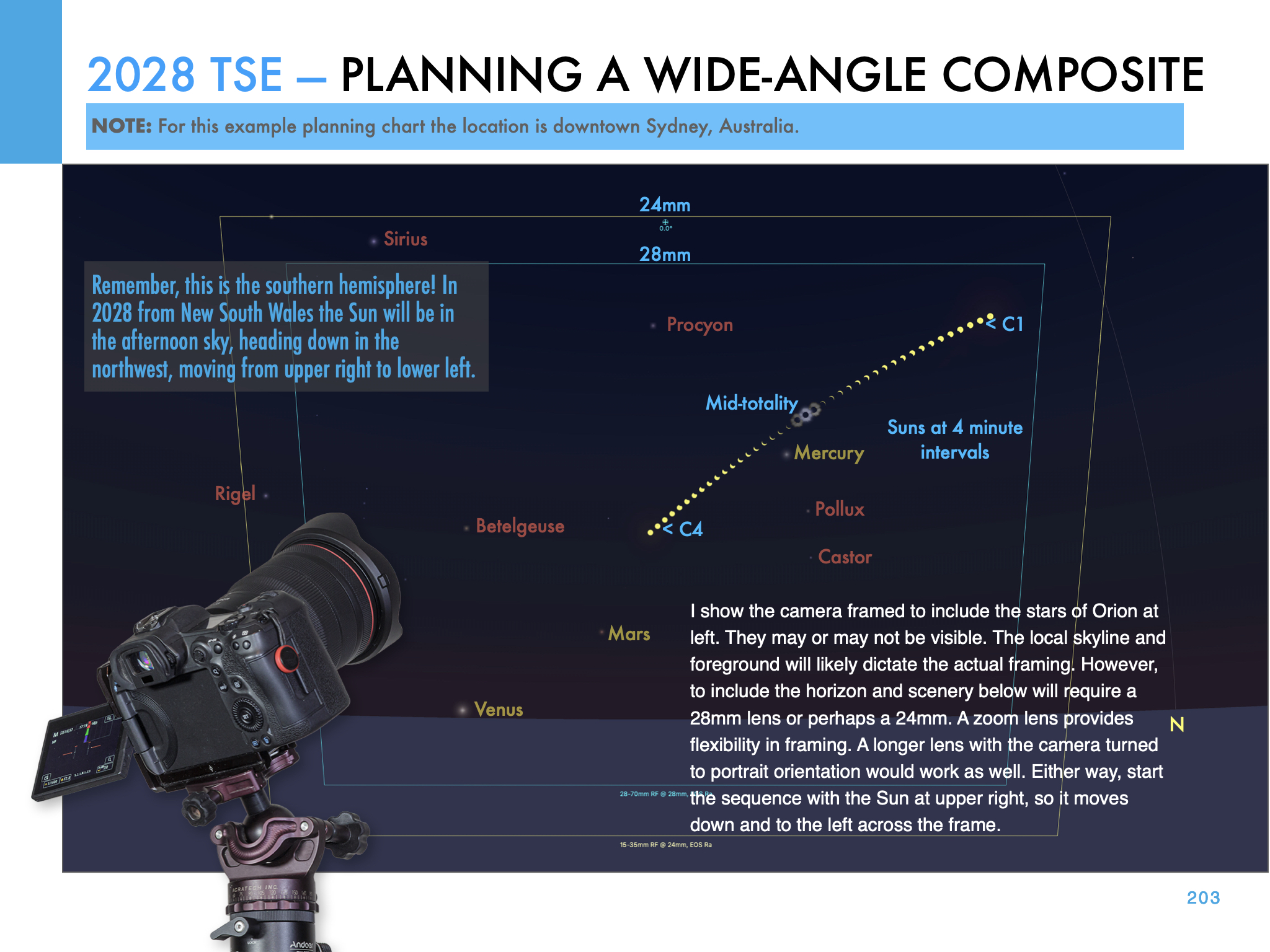
But millions lie in the path in New South Wales, where Sydneysiders can watch a total eclipse over Sydney Harbour lasting 3m48s. The sky scene is below, with a late afternoon winter Sun heading down in the west. From Farm Cove, the eclipsed Sun will be over the Opera House and Harbour Bridge, for a never-to-be-repeated photo op.
The South Island of New Zealand sees a sunset eclipse (the shadow passes over Milford Sound) that lasts 2m55s, longer than the 2017 eclipse in the United States.
Coincidentally, Australia also hosts the next total eclipse to follow, after a gap of 28 months, on November 25, 2030. And the lunar shadow crosses Australia on July 13, 2037 and December 26, 2038 — a Boxing Day eclipse down under. So Australia is the place to be for the next decade or so.
But between 2026 and 2028, Spain is host to three eclipses, as the 2027 total crosses Spanish territory, and the January 26, 2028 annular eclipse ends at sunset in western Spain. At this eclipse the Moon is not large enough to completely hide the Sun, so at mid-eclipse we see a bright ring of light, similar to the annular eclipse here in North America on October 14, 2023.
My Plans
Where will I be? For 2026 I have signed onto a trip to Spain with the well-travelled photo tour company CaptureTheAtlas.com.
They are planning a very photo-centric tour to Spain for viewing the eclipse from a winery near Burgos. I’ll be one of the instructors, among a stellar line-up of eclipse veterans and astrophoto experts. I invite you to check out the details of the tour here at its webpage. We’d love to have you join us!
For 2027 I am planning to be in Tunisia, on the Mediterranean coast, with a tour group from Astro-Trails.com.
The path of totality passes just a few kilometres from Coonabarabran, the “Astronomy Capital of Australia,” as the Siding Spring Observatory is just down the Timor Road in the path. In July the Milky Way is at its best, with the centre of the Galaxy high overhead at nightfall. That’s a sight equal to an eclipse for bucket-list spectacle.
My EBook
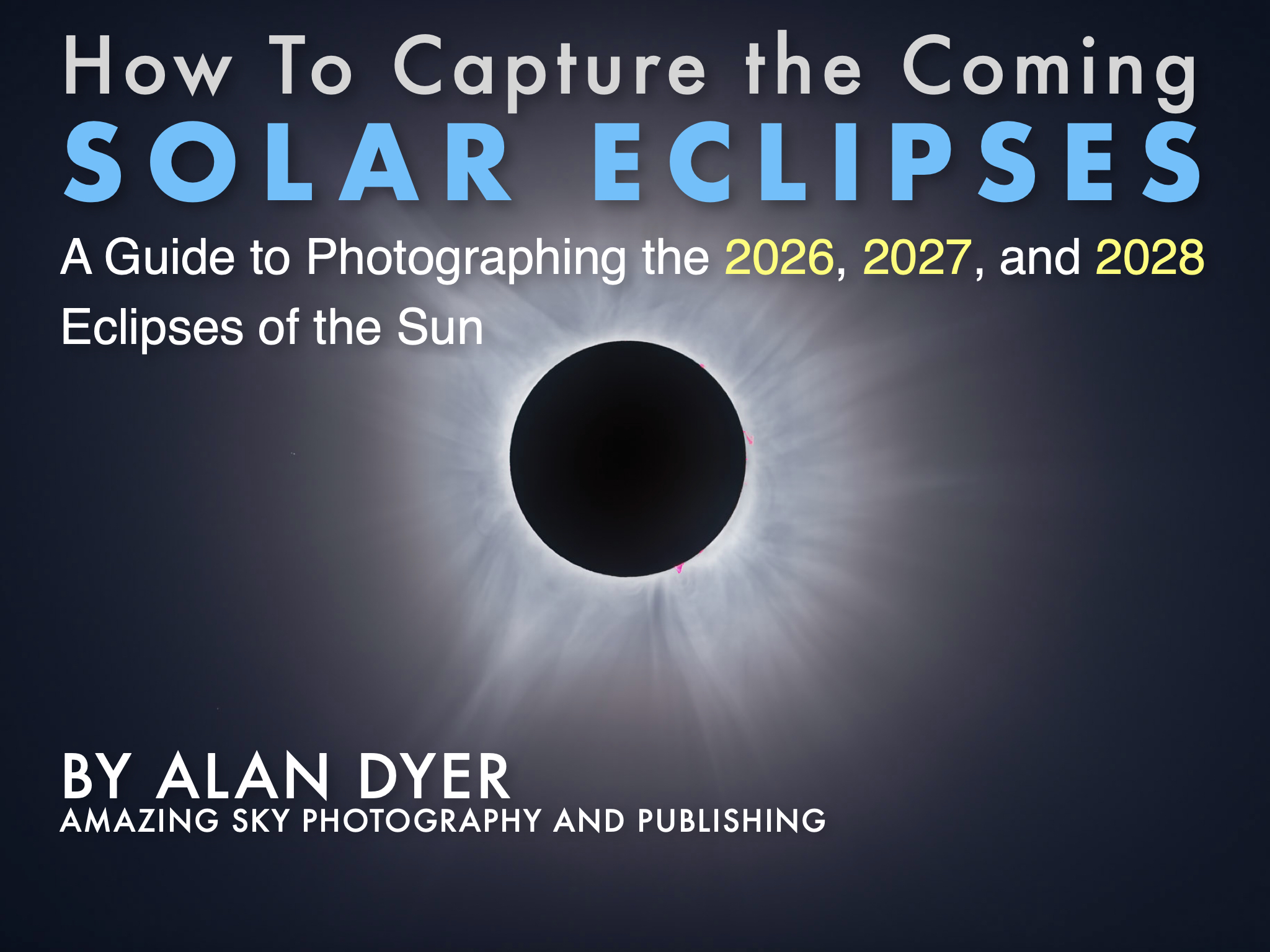
The cover of my new 400-page ebook
For 2017’s eclipse I prepared an ebook on how to photograph it. It proved popular, and so for the 2023 and 2024 eclipses I revised it to cover both the annular and total eclipses.
Its popularity prompted me to revise it again, this time to cover the coming trio of eclipses, plus I included pages on the January 2028 annular, as many who visit Spain for the totals may plan to return for the sunset annular (low annulars are also the most spectacular!).
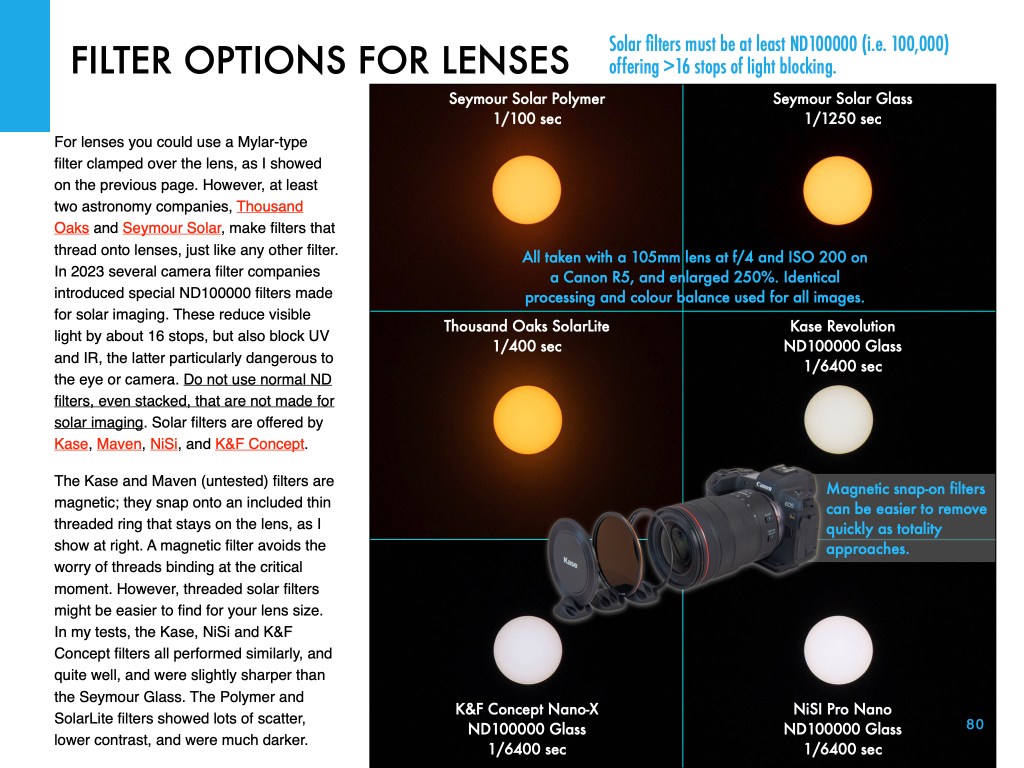
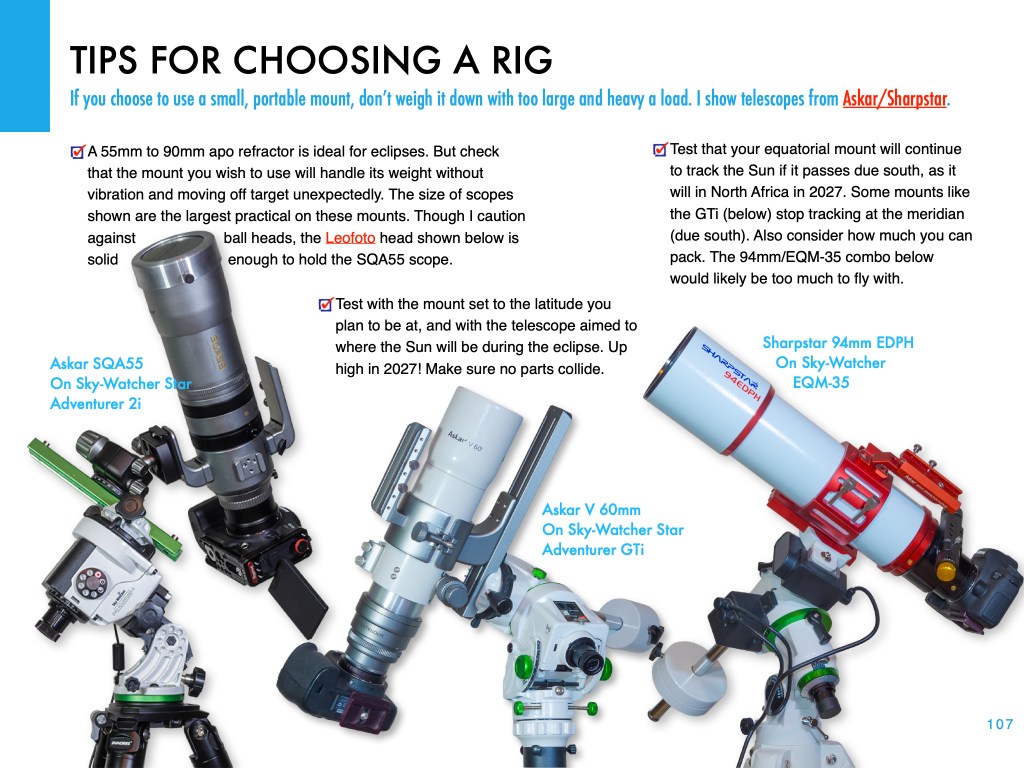
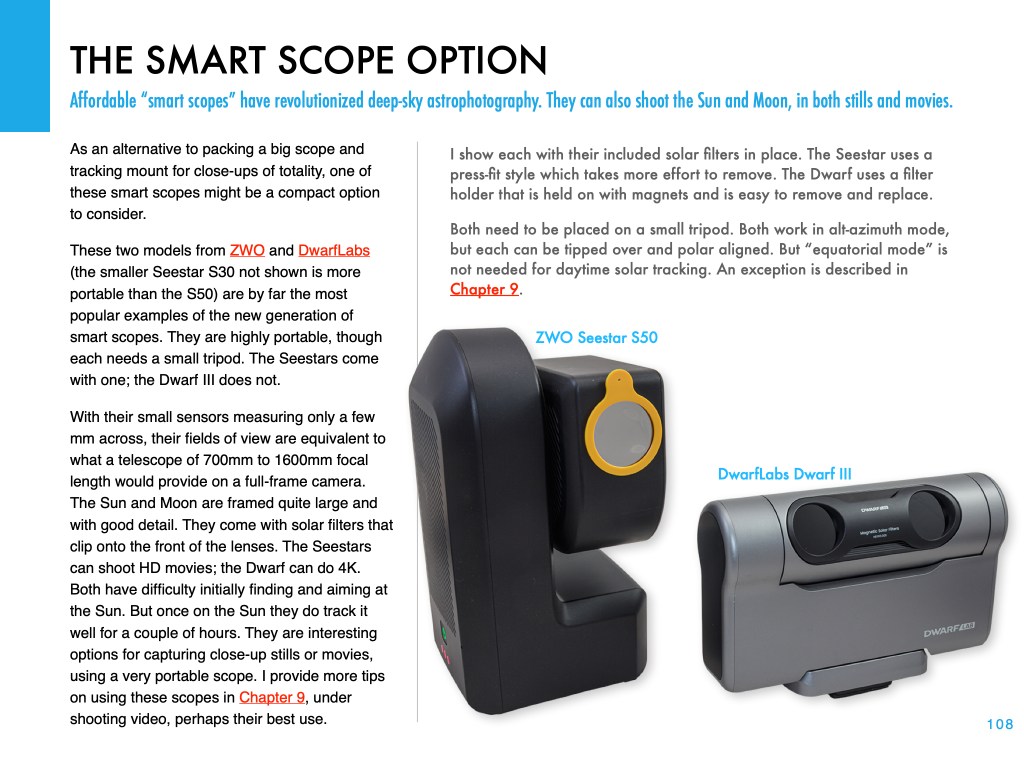
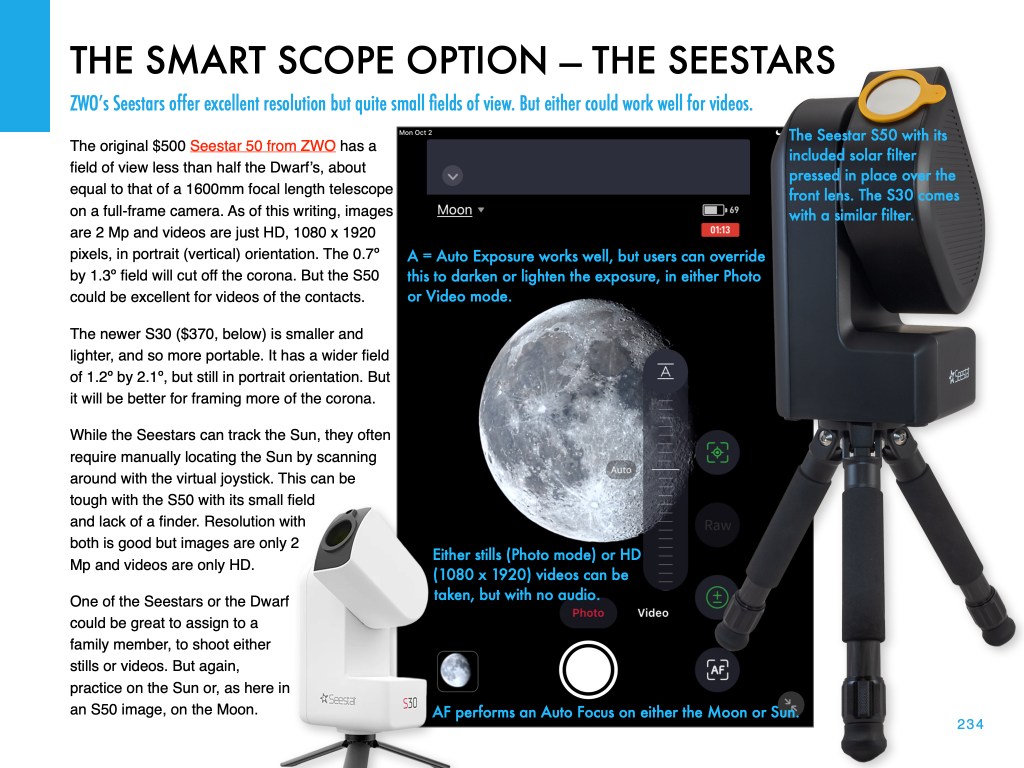
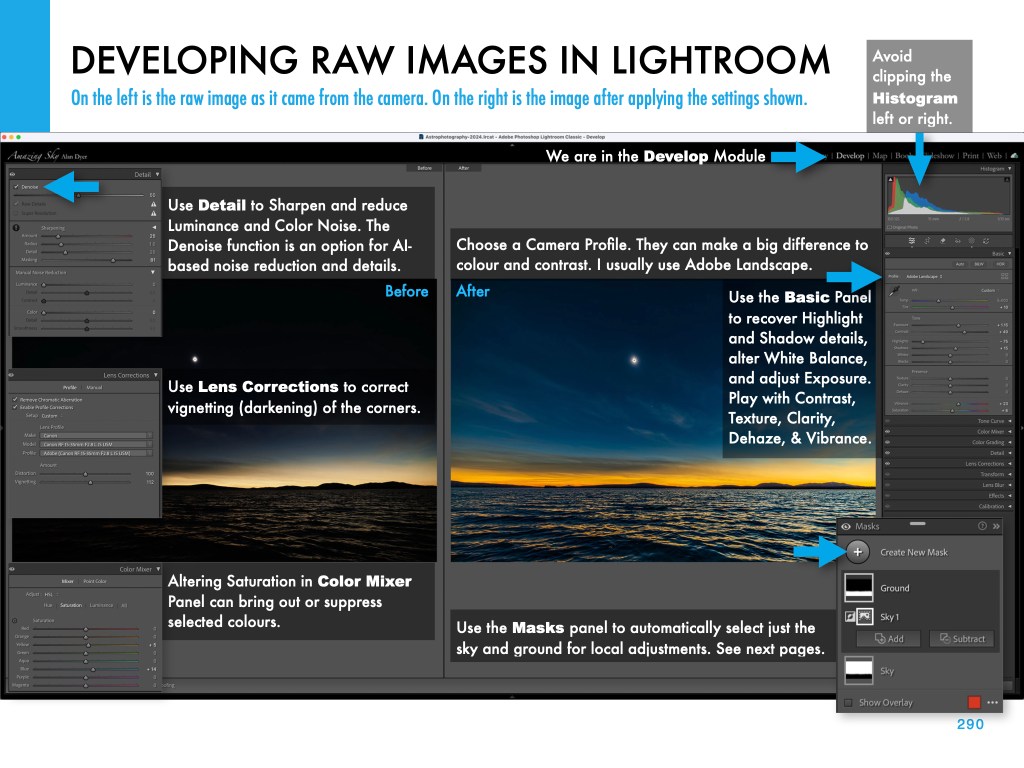
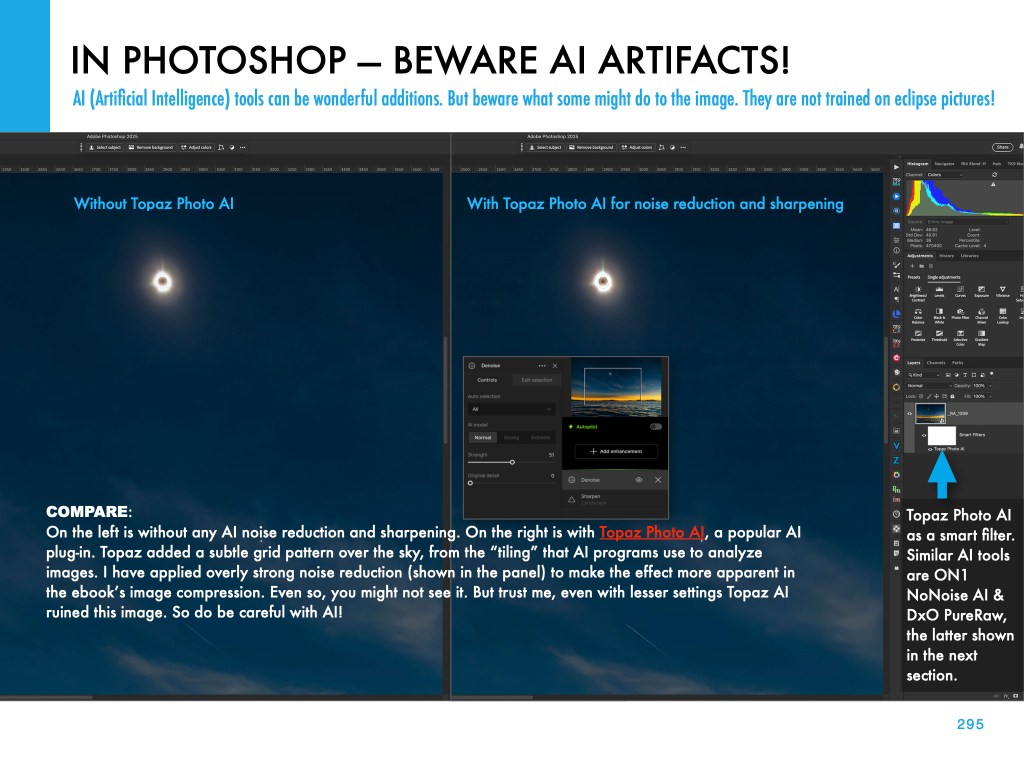
My new ebook is 40 pages larger than the previous edition, with most of the added content in the 100-page chapter on processing eclipse images, from wide-angles, to time-lapses, and to blended exposures of totality close-ups. I include lots of information on choosing the right gear — filters, camera, lenses, telescopes, and tracking mounts.
The slide show above presents images of sample pages. Do page through the gallery for a look at the content.
But for all the details and links to buy the book (from Apple Books or as a PDF for all platforms) see its webpage at my website.
It will be a busy three years for eclipse chasers, as rarely do we get three-in-a-row like this. The diversity of locations and eclipse circumstances make this an exciting trio to chase. But you can just go back to Spain to see most of them!
Join me in a guided tour of the famous (and not so well known!) constellations of the northern spring sky.
The northern spring sky lacks the splendour of bright patterns such as winter’s Orion or summer’s Cygnus, but it is still well worth getting to know. The Milky Way is out of sight, and in its absence we are left with fewer bright stars to dazzle us at night. But we are treated to the year’s best views of famous constellations such as Ursa Major, Leo and Virgo.
Now, I am talking about the sky of the northern hemisphere, where April and May brings spring, and places the Big Dipper high overhead. While some of these constellations can be seen from the southern hemisphere, they appear to the north, low and “upside-down” from the views I present here. And April and May are autumn months.
Let’s start with the “big picture.” (Tap on images to bring them up full screen.)
NOTE: I shot all these images during a run of fine nights in mid-April 2025 with a 15-35mm zoom lens on a Canon EOS R camera, and on a Star Adventurer tracker. Separate exposures through a Tiffen Double Fog 3 filter added the star glows.
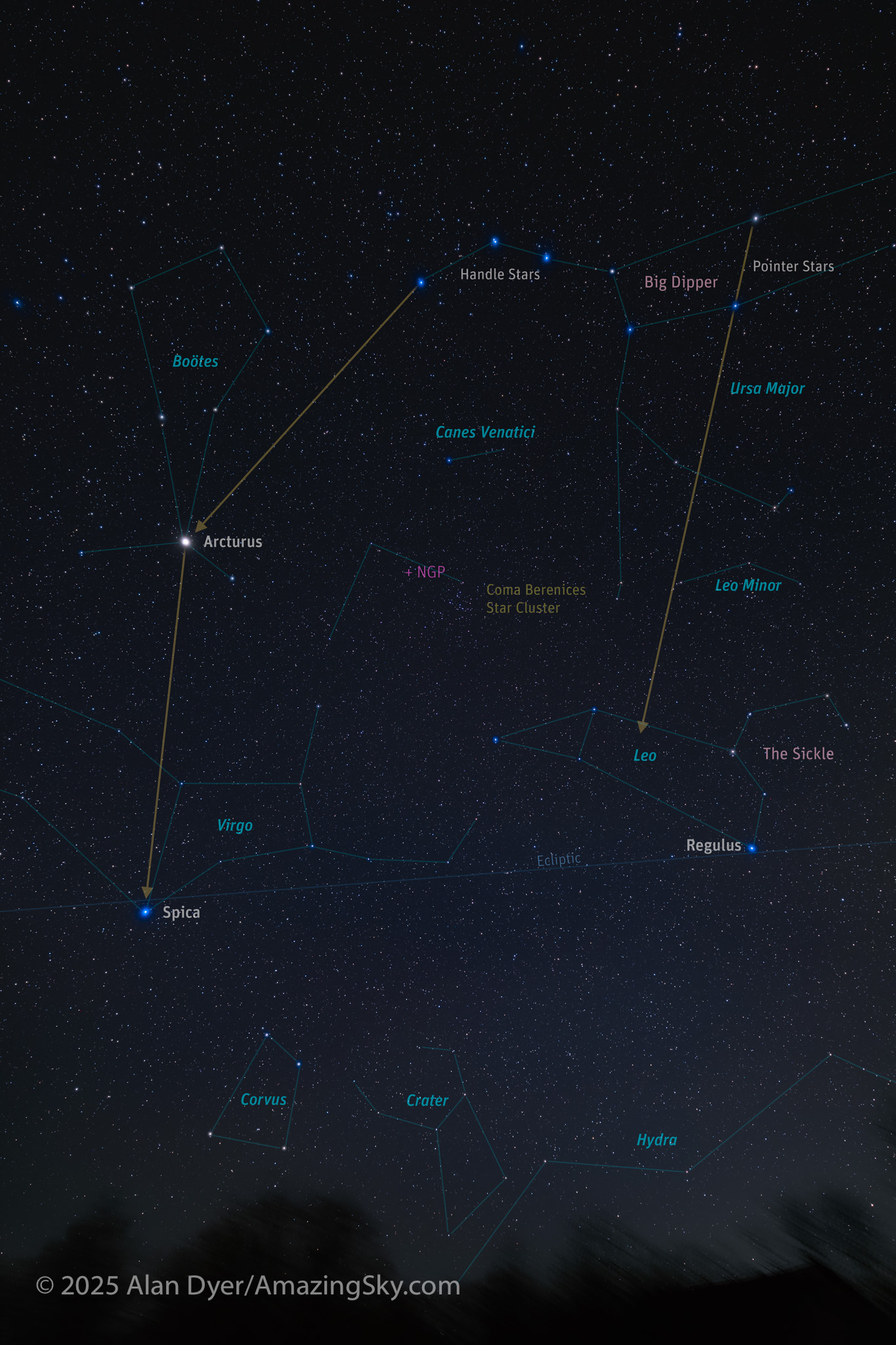
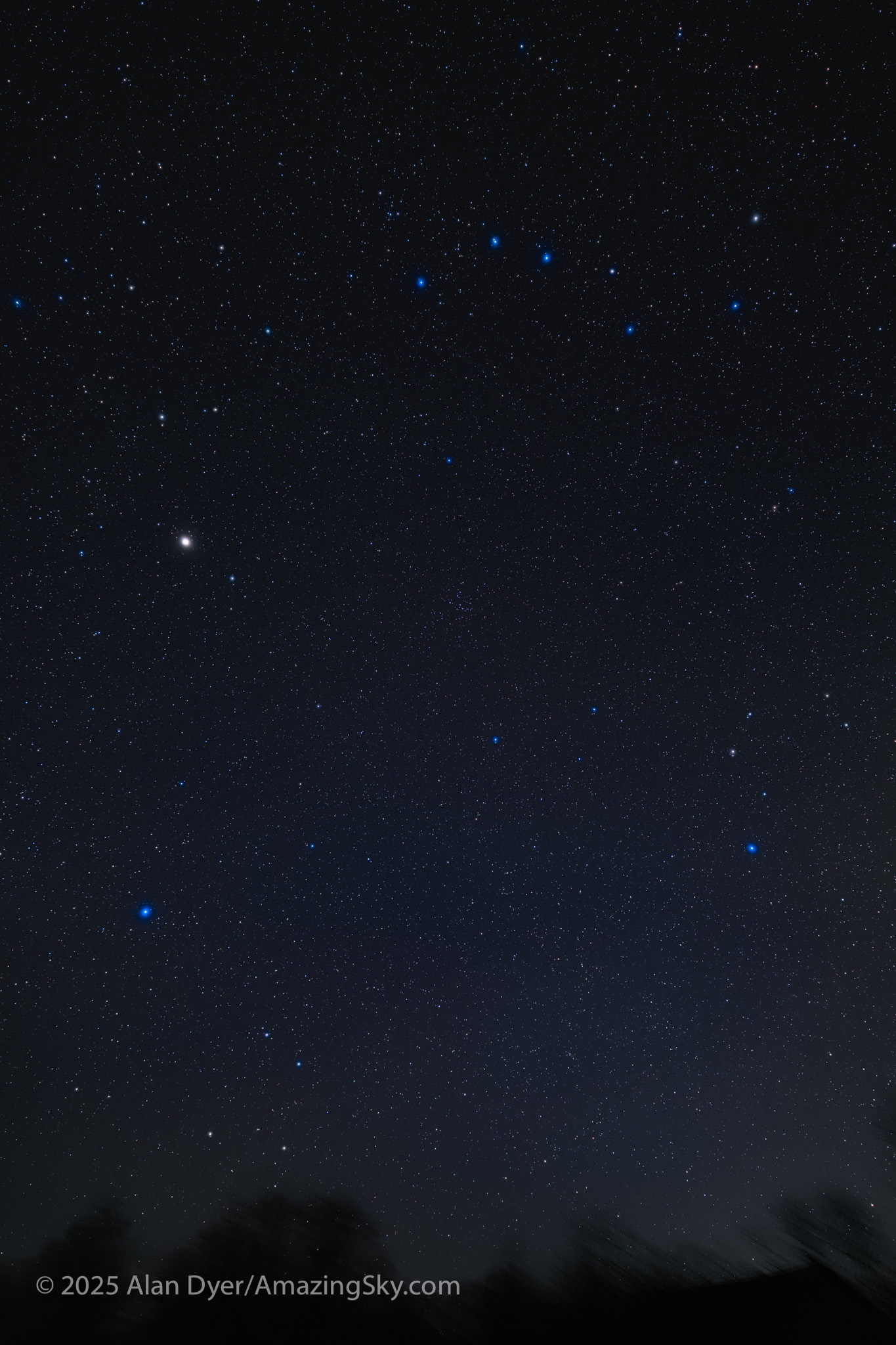
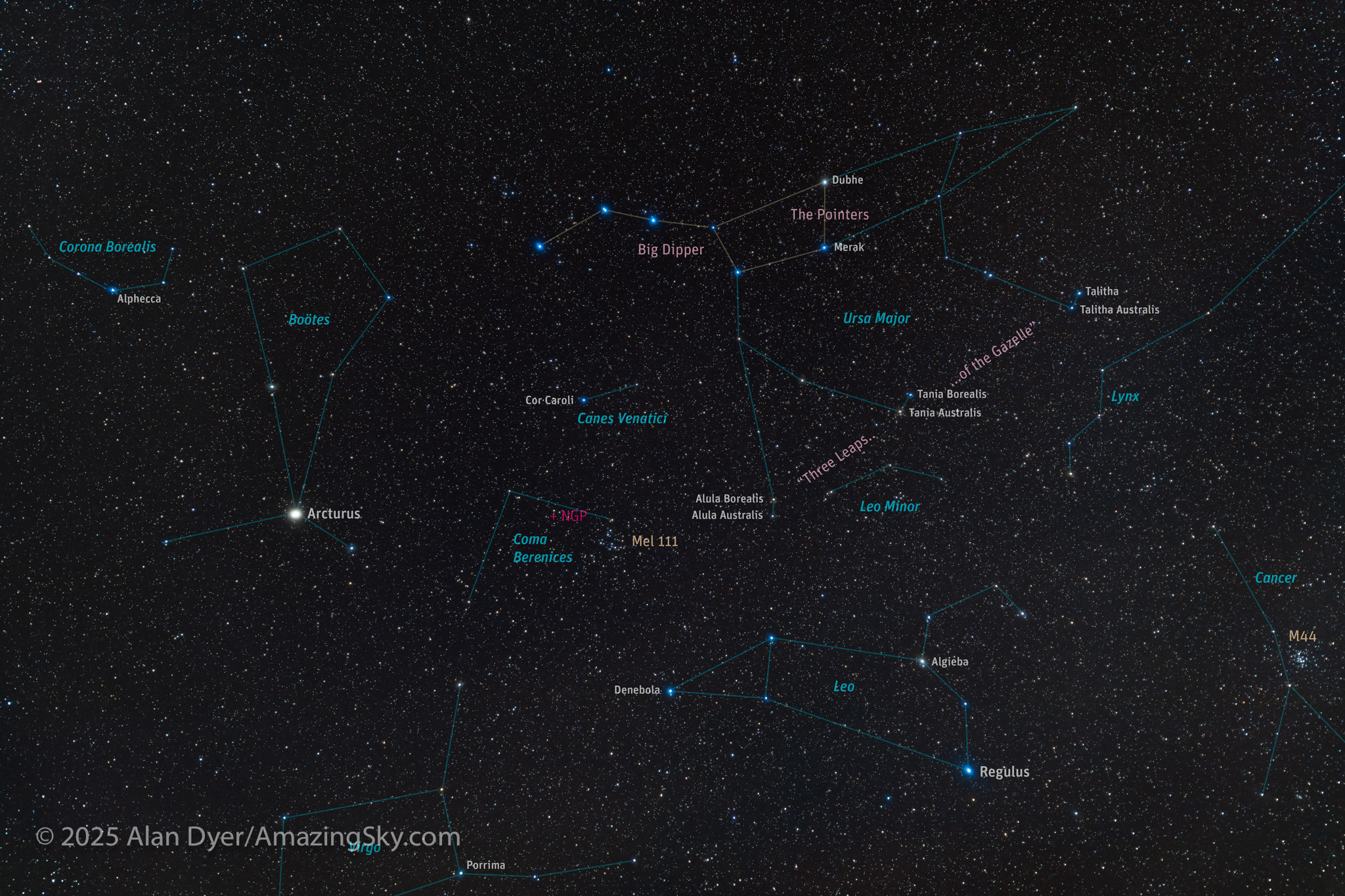
This image, in labeled and unmarked versions, presents a wide view of the spring sky from horizon to well past the zenith overhead. The key pattern to look for is the Big Dipper, at its highest in northern spring. In the UK and Europe it is known as the Plough or Wagon. Look way up to find it first.
Its Pointer Stars in the Bowl famously point north to Polaris. But here I show the other pointer line off the Bowl, to the south, to Leo the Lion. It is well known as one of the constellations of the Zodiac. Leo is marked by one of the brightest spring stars, Regulus.
Use the Handle of the Dipper to arc downward, to locate the brightest star of spring, Arcturus, shining with a yellow light. Keep that line going south and you’ll come to a dimmer and bluer star shining in the south. That’s Spica, the brightest star in Virgo, the Zodiac constellation east of Leo.
Now let’s take a closer look at selected areas.
Ursa Major, Leo and Boötes
This is still a wide view, looking up and high in the south. There’s the Big Dipper/Plough at top. It is not a constellation. It is an “asterism” of seven stars within the large constellation of Ursa Major, the Great Bear. With a little imagination you can join the dots to make a bear (many northern cultures did so). Except we draw him with a long tail, which bears do not have!
The paws of the Bear are marked by a trio of double stars: Alula Borealis and Australis, Tania Borealis and Australis, and Talitha and Talitha Australis. The names come from Arabic words for “first,” “second,” and “third” as these sets of double stars are collectively called the Three Leaps of the Gazelle in Arabic sky lore. Once you see them you’ll be surprised at how distinctive they are.
Below Ursa Major is Leo, a pattern that does look a little like a sitting cat. Its bright star Regulus was named by Copernicus, from a Latin word for “little king.” But Regulus has long been known as the heart of the Lion.
To the east lies brighter Arcturus, a name that means “bear watcher,” as it and its host constellation Boötes, the Bear Herdsman, are tied to Ursa Major and Minor in Greek mythology.
Leo, Cancer and flanking clusters
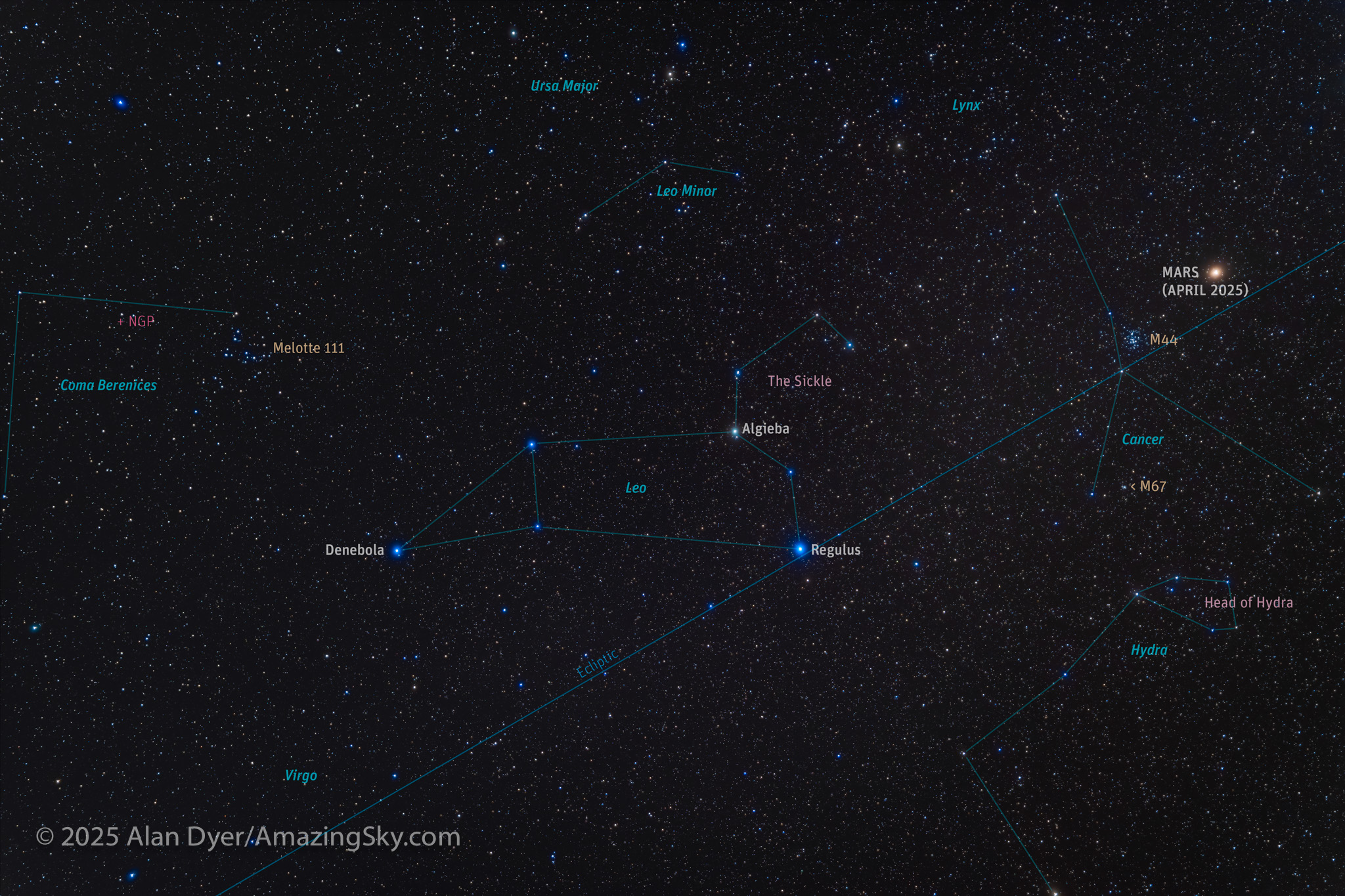
Here I frame Leo, but also two of the constellations that flank him: Cancer the Crab to the right (or west) and Coma Berenices to the left (or east). Each contains a bright naked eye cluster of stars:
Messier 44 or the Beehive cluster in Cancer, the faint Zodiac pattern west of Leo. When I shot this image in mid-April 2025 red Mars was just entering Cancer.
and Melotte 111 in Coma Berenices. At one time this clump of stars easily visible to the naked eye was considered part of Leo, as the tuft on the end of his tail. The area was broken off as its own constellation in the 3rd century BCE, and named for Queen Berenice of Egypt, and for her legendary hair (“coma”).
Together, the obvious pattern of Leo and the star clusters that flank him form one of the spring sky’s most notable sights.
Leo and Leo Minor
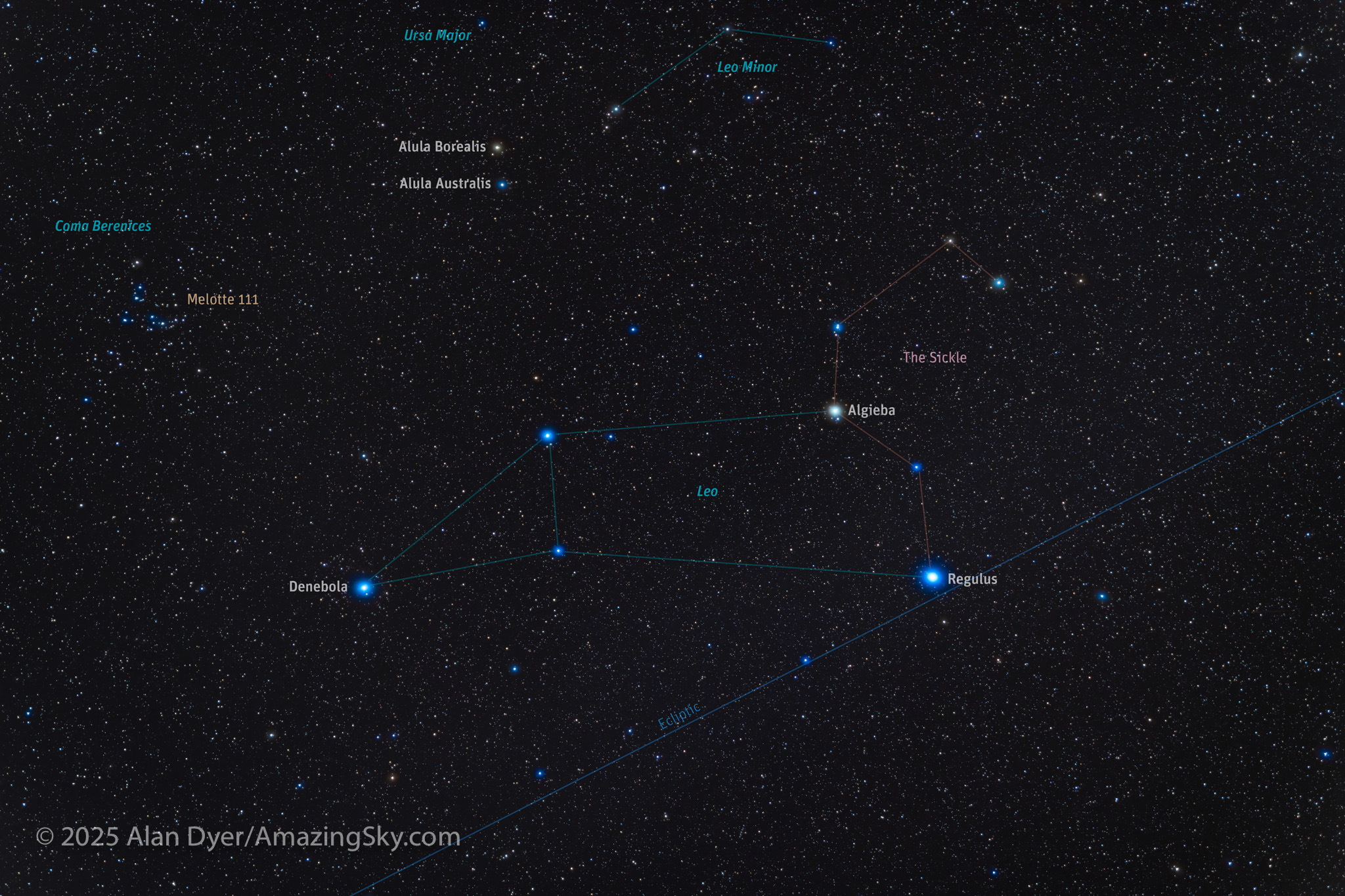
The head of Leo is marked by a curving arc of stars popularly called The Sickle. Or it is thought of as backwards Question Mark, with Regulus the dot at the bottom. Leo is one of the oldest constellations, as there are records of this pattern dating back to 4000 BCE in Mesopotamia.
More modern is the obscure pattern above it, Leo Minor, the Little Lion. It was invented by 17th century star chart maker Johannes Hevelius, to fill in a blank area of sky. Even in a dark sky, it is tough to make out its innocuous pattern between Leo and Ursa Major.
Canes Venatici, Coma Berenices and Boötes
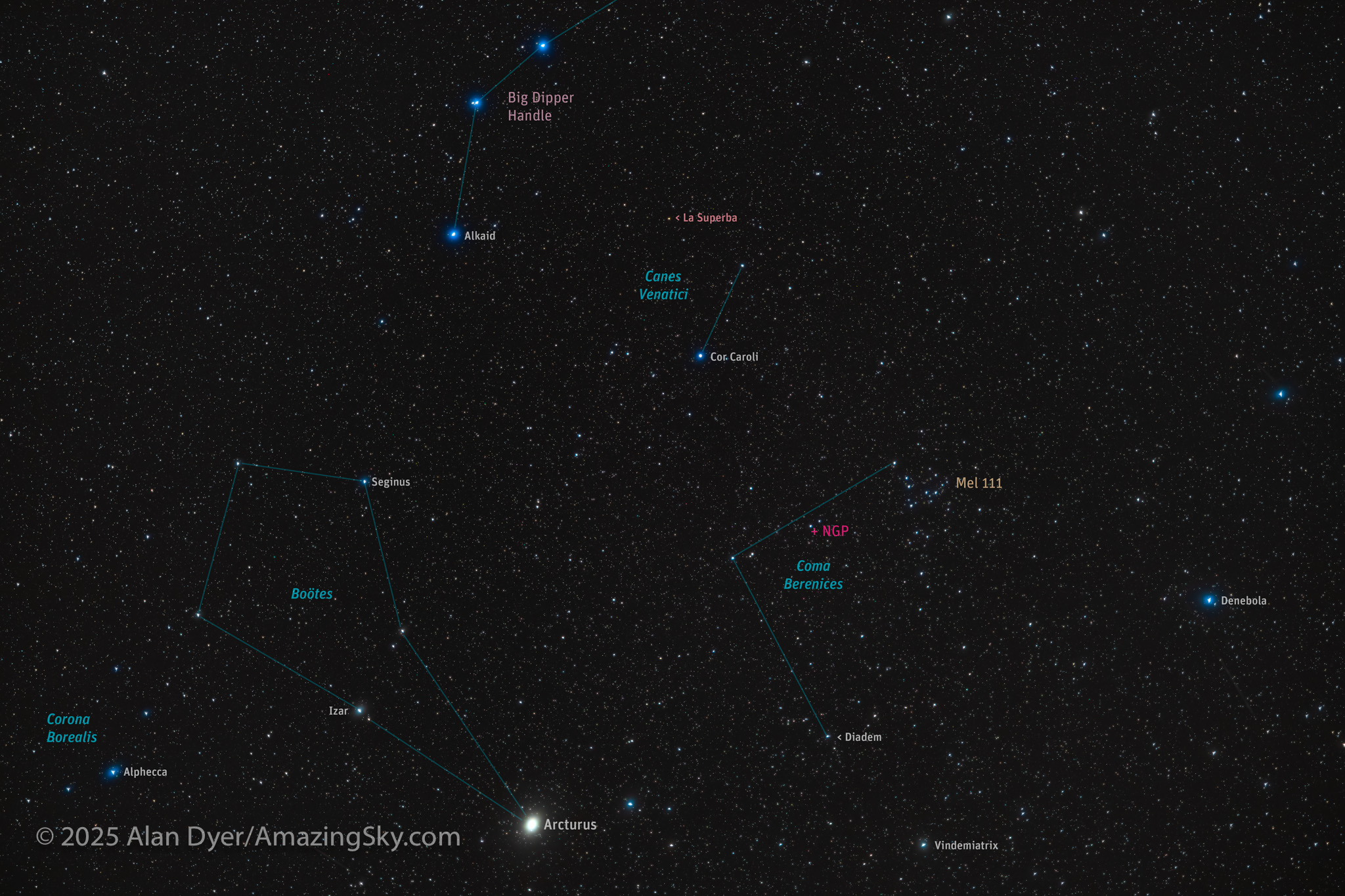
Another obscure pattern created by Hevelius lies below the Handle of the Big Dipper. A sparse pattern of stars marks Canes Venatici, the Hunting Dogs that belong to Boötes to help him herd bears! While not much to look at with the naked eye, Canes Venatici does have superb targets for telescopes, such as the double star Cor Caroli and very red star La Superba.
Below the Dogs lies Berenices’ Hair, home to the star cluster Mel 111, but also the North Galactic Pole (NGP). This is the point 90º away from the plane of the Milky Way and the Galactic Equator seen in our winter and summer skies. But in spring we look straight up out of our Galaxy, to many other telescopic galaxies that inhabit Coma and Virgo, our next stop.
Virgo, Corvus, Crater and Hydra
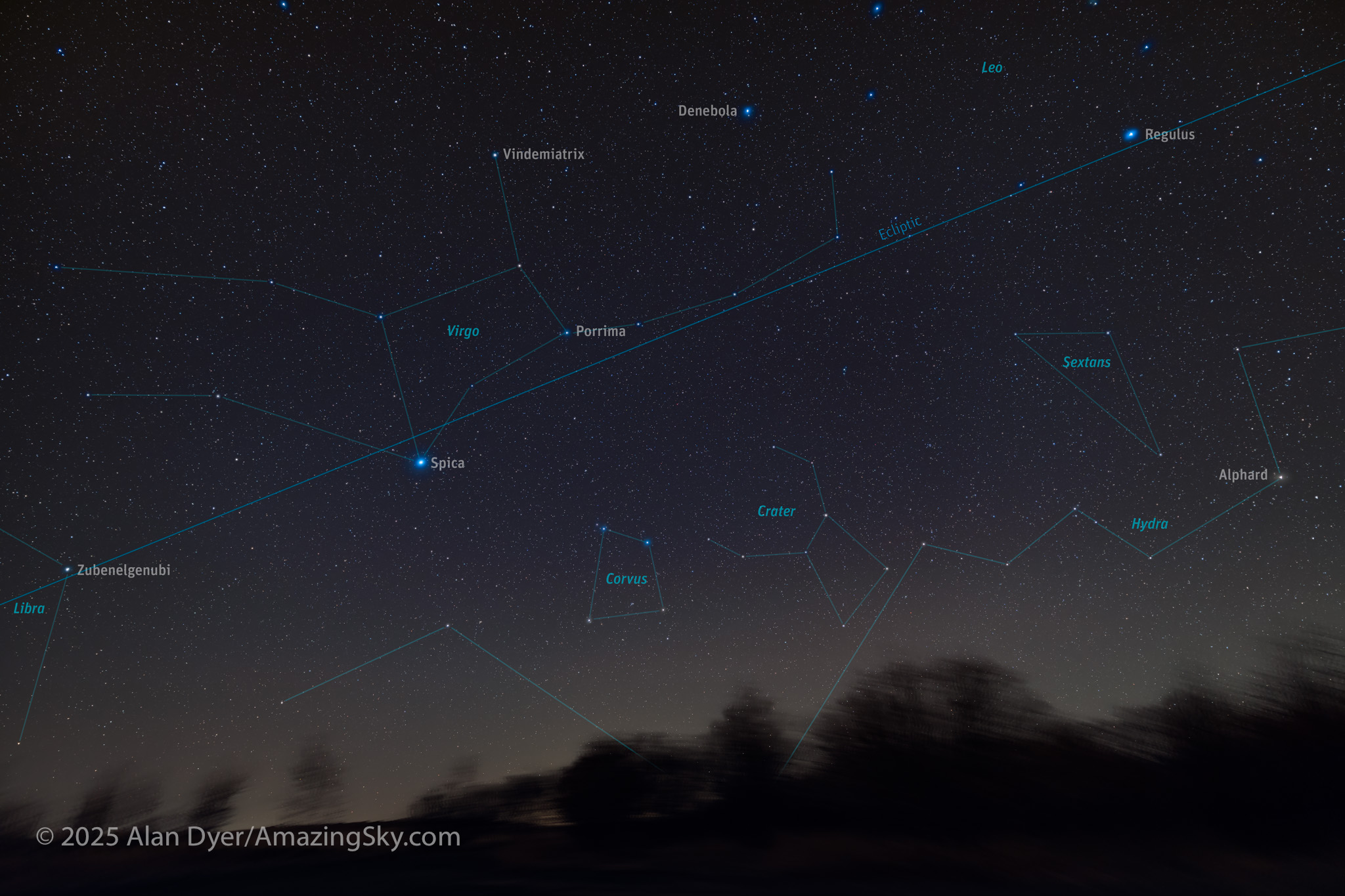
Below Leo and Boötes lies the Zodiac pattern of Virgo, usually thought of as the reclining Greek goddess of agriculture and the harvest. Spica is easy to see, but the sprawling pattern of the rest of Virgo is not so obvious. It takes a dark sky to pick out the other fainter stars of the goddess.
Easier to see, despite its low altitude from northern latitudes (it skims my horizon), is the quadrilateral pattern of Corvus the Crow, a constellation that dates from the 2nd century CE and the star catalogue of Ptolemy. The Crow sits on the tail of Hydra the Water Snake, a long zig-zag line of stars that is only partly contained here. The head of Hydra, off frame to the right here, is in the earlier image of Leo and Cancer.
Another pattern riding the back of Hydra is Crater the Cup, associated with Corvus and Hydra in a Greek myth in which the Crow is sent to fetch water for Apollo but fails. Apollo flings the Crow, Cup and Snake into the sky. Angering the gods could get you immortalized in the sky!
Boötes, Corona Borealis and Hercules
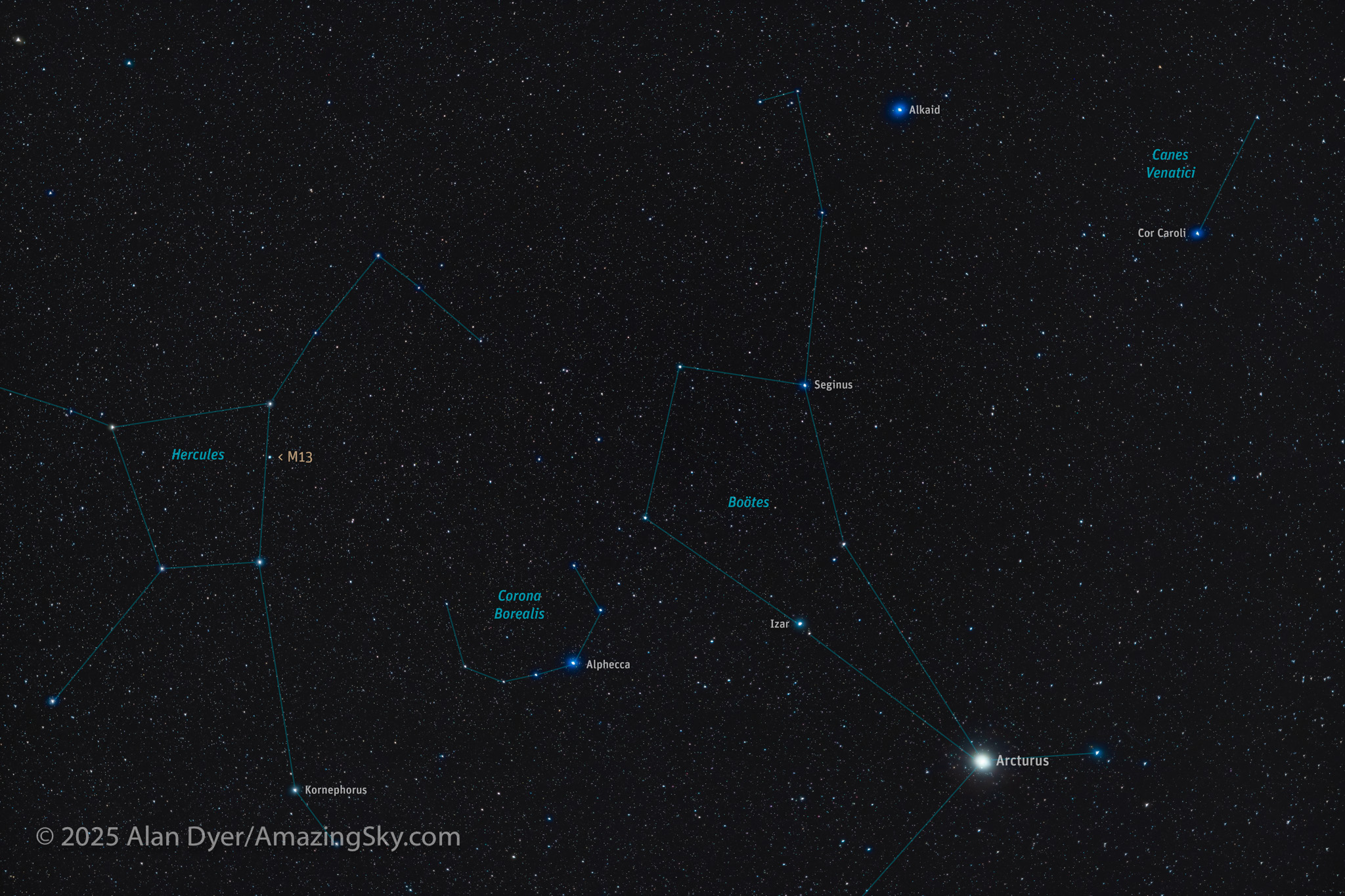
Heading back north above Virgo, we return to the kite-shaped pattern of Boötes above Arcturus, the brightest star in the northern half of the sky. Coming up later on spring evenings, and to the left is a semi-circle of faint stars, the Northern Crown, or Corona Borealis, another of Ptolemy’s patterns from the 2nd century. The crown belongs to the princess Ariadne.
Astronomers have been watching Corona Borealis closely in recent months, waiting for a recurrent nova star to explode and add a new jewel to the Crown. So far, no luck. T CorBor remains stubbornly dim.
To the east of Corona is the H-shaped pattern of Hercules, the Roman name for the Greek hero Heracles. Among his many labours and conquests, he slewed Cancer the Crab and Leo the Lion.
Libra and Scorpius
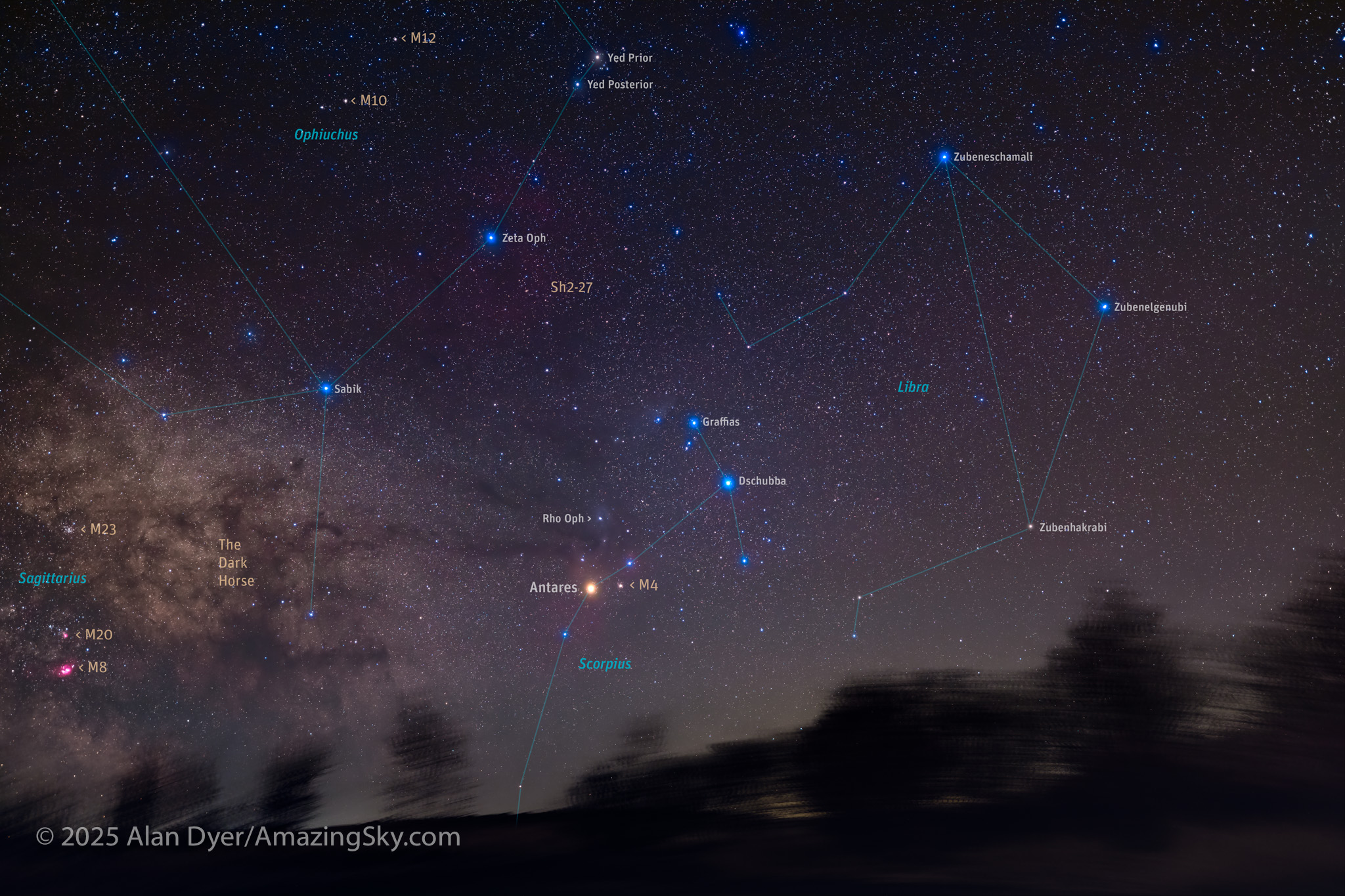
Returning down south and scraping the horizon from my northern latitude late on spring nights are the next two constellations of the Zodiac east of Virgo: Libra the Scales and Scorpius the Scorpion.
Libra is a faint pattern but with the wonderfully named stars Zubeneschamali and Zubenelgenubi, meaning the northern and southern claws, as these stars were once considered part of the Scorpion. However, Libra has long been seen as a balance or scales for meting out justice. It is the only Zodiac constellation that is an inanimate object.
Scorpius is one of the few patterns that looks like what it is supposed to be, though here I see only the northern part of the constellation. His curving tail has yet to rise as the Milky Way comes into view low in the south just before dawn this night. The bright orange star is Antares, the heart of the Scorpion, set in an area rich in dark and colourful nebulas.
The appearance of Scorpius signals the return of the Milky Way to the sky, and the rise of the summer constellations.
But no astronomical life is complete without getting to know the patterns of spring. Clear skies and happy stargazing!
Amateur astronomers soon learn that spring is “galaxy season.” But so is autumn … if you know where to look.
Each season brings a different and rich set of targets to view through telescopes. Summer and winter skies are dominated by the Milky Way and its assortment of glowing nebulas and sparkling star clusters, objects not far away within our Galaxy’s spiral arms.
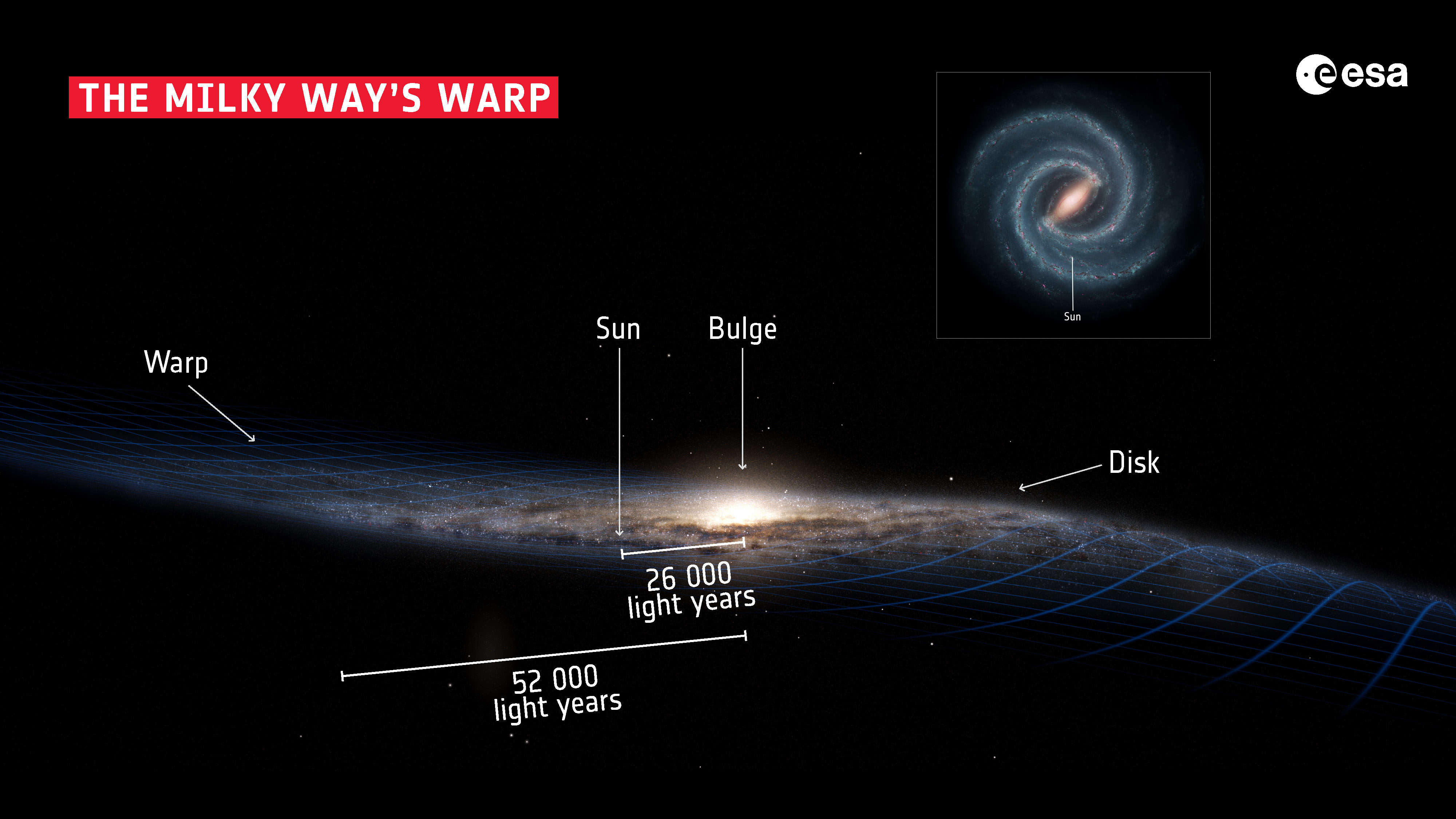
We live in a galaxy that is a flattened disk — though, as shown in this artwork based on data from the European Space Agency’s recently concluded Gaia mission, that disk is warped.
Image courtesy ESA
In summer and winter, as viewed from our location halfway from the centre to the edge of our Galaxy, we look into its disk, to see our Galaxy as the “Milky Way,” the misty band across the night sky.
But in spring we look straight out of the disk, into intergalactic space filled with other distant galaxies. In northern hemisphere spring we look “up” in this illustration, out of the disk toward the North Galactic Pole, and the rich collections of galaxies in Coma Berenices, Leo, and Virgo.
In southern hemisphere spring — and from the southern hemisphere — we look “down” in the diagram, toward the assortment of galaxies around the South Galactic Pole, in and around the lesser-known constellations of Eridanus, Fornax and Sculptor.
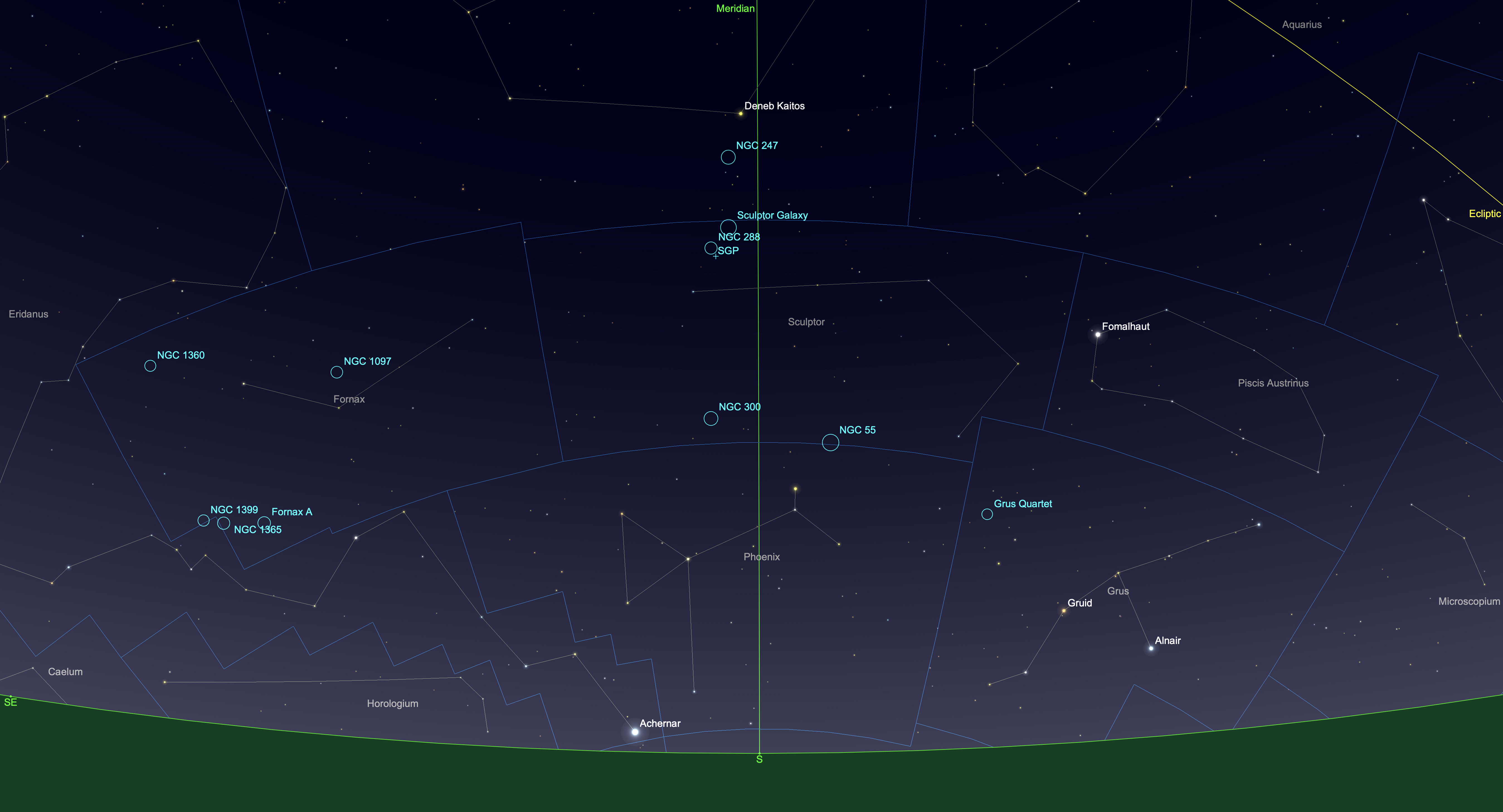
A SkySafari chart showing some of the targets on the tour, low in the south from Arizona’s latitude in autumn.
But, as I show above, that area of sky is accessible from sites in the northern hemisphere, when it is autumn. (The marker for SGP is the South Galactic Pole.) As you can see, the galaxy-filled constellations lie low in the southern sky. It takes travelling to a site as far south as possible to see them well.
That’s what I did in October 2024, to a favourite spot just north of the Mexican border near Portal, Arizona (latitude 32º N). I blogged about that trip earlier.
Here I provide a tour of some of the deep-sky delights I shot on that trip, during autumn “galaxy season,” the other galaxy hunting time. All these galaxies are bright, rivalling the better-known northern targets in the popular 18th-century Messier Catalogue. But French astronomer Charles Messier never observed from this far south to see them. And yet, some of these targets are large and bright enough to be visible in binoculars, ranking them as “showpiece” objects.
NOTE: You can tap or click on all images to bring them up full screen.
Galaxies Galore!
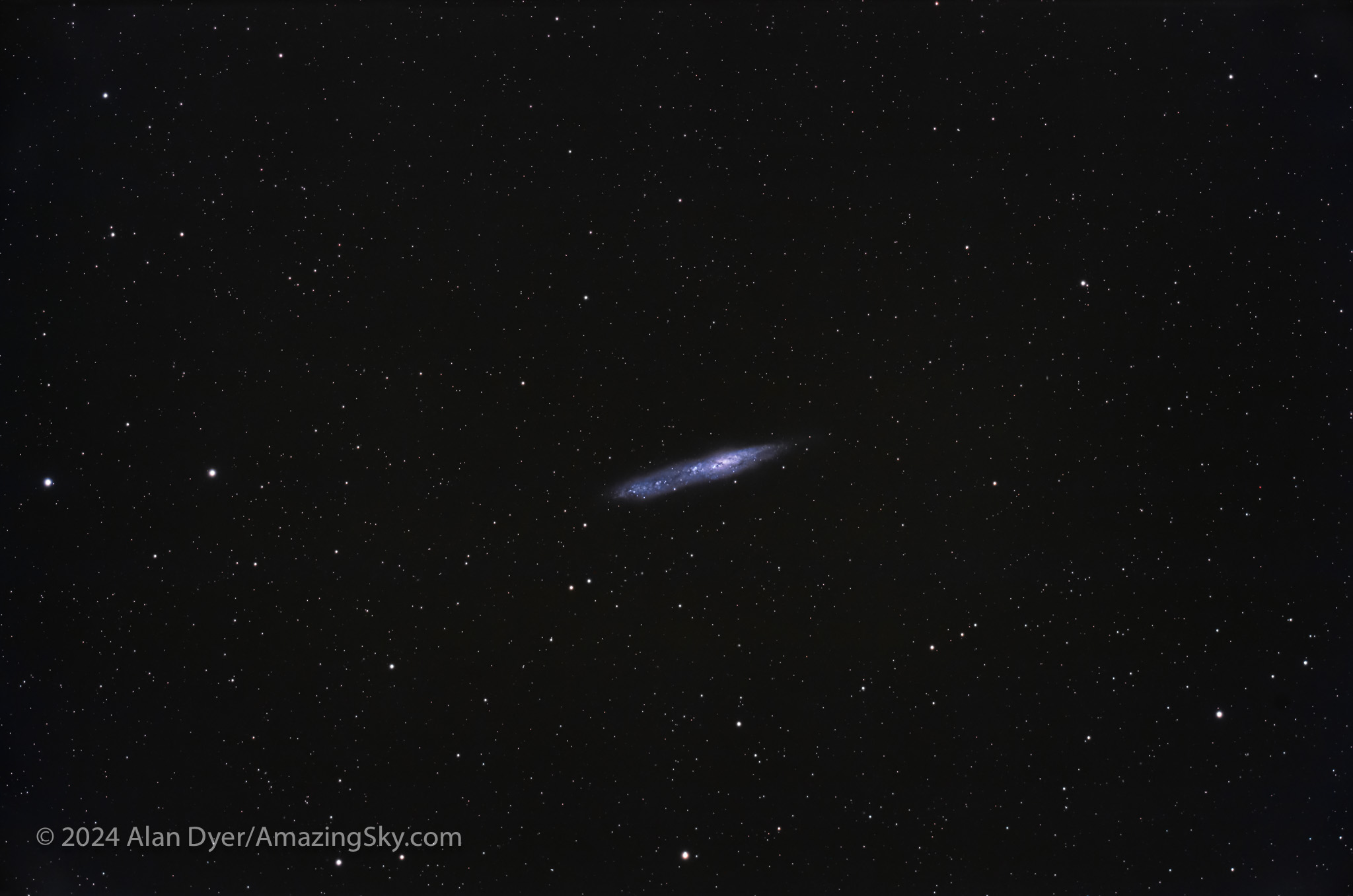
NGC 55 in Sculptor
This is a stack of 16 x 4 minute exposures with the Askar APO120 refractor at f/5.6 (with its 0.8x Reducer) and the Canon Ra at ISO 1000.
This bright (8th magnitude) edge-on galaxy is big, almost 1/2º across (as wide as a Full Moon diameter — the field here is 2º by 3º). NGC 55 lies on the border of the obscure southern constellations Sculptor and Phoenix.
The galaxy was discovered by James Dunlop from Australia in 1826. It is one of the brightest members of the Sculptor Group of galaxies near the South Galactic Pole, though some consider it a member of our own Local Group of neighbour galaxies. It has an asymmetrical shape and is crossed by dark dust lanes. It is classed as a barred spiral, though that shape is hard to discern; we’ll see better examples later in the tour.
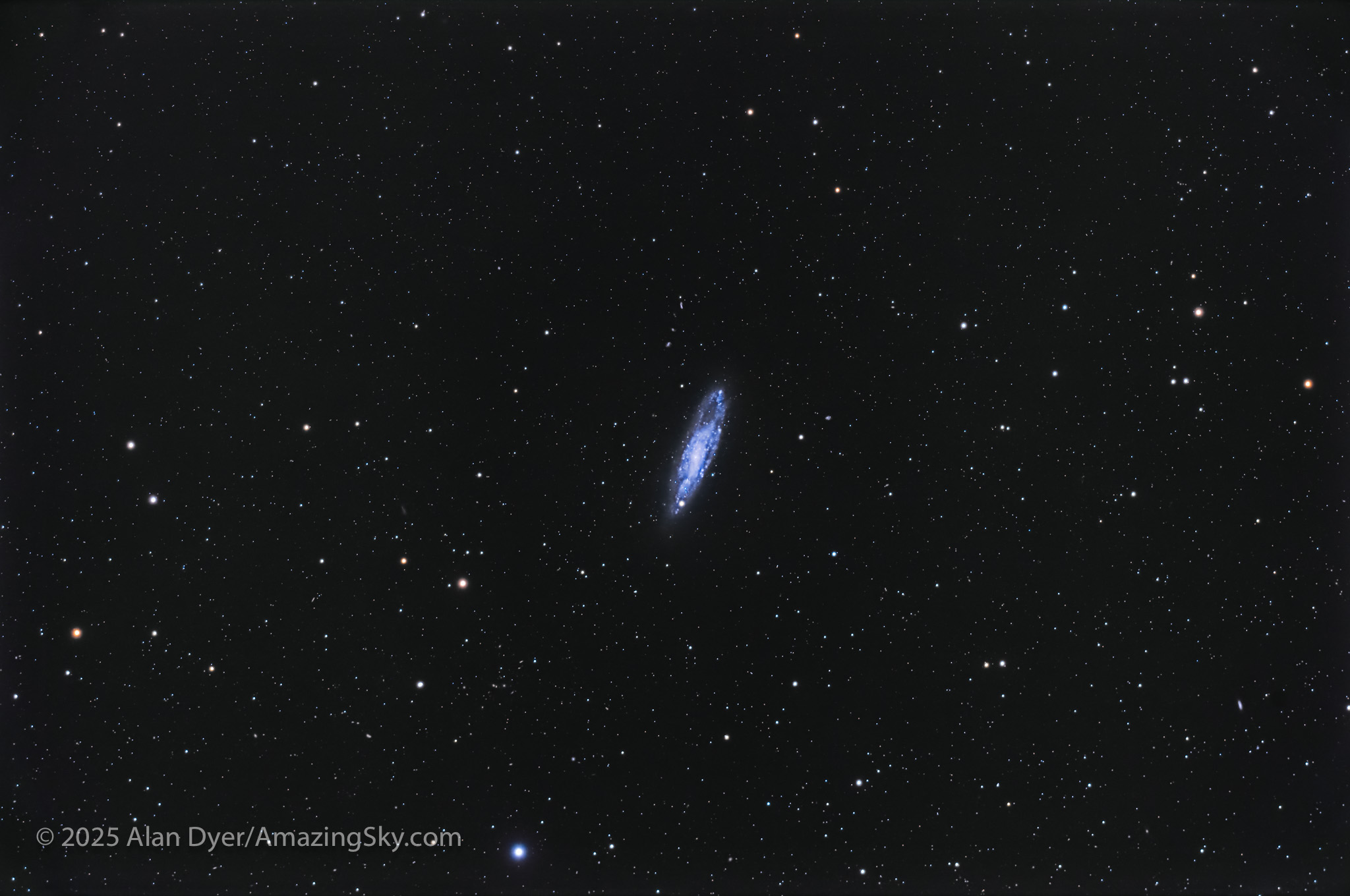
NGC 247, the Dusty Spiral in Cetus
This is a stack of 16 x 4 minute exposures with the Askar APO120 refractor at f/5.6 with its 0.8x Reducer, and the Canon Ra at ISO 800.
This is the bright (9th magnitude) and moderately large spiral galaxy NGC 247 in southern Cetus, the Whale. It is known as the Dusty Spiral and is #62 in Sir Patrick Moore’s Caldwell Catalogue of notable non-Messier objects.
It is also a member of the Sculptor Group of nearby galaxies close to our own Local Group that surrounds the Milky Way. A group of tiny and faint 14th to 16th magnitude “PGC” galaxies (from the Principal Galaxies Catalogue) called Burbidge’s Chain lies just above NGC 247.
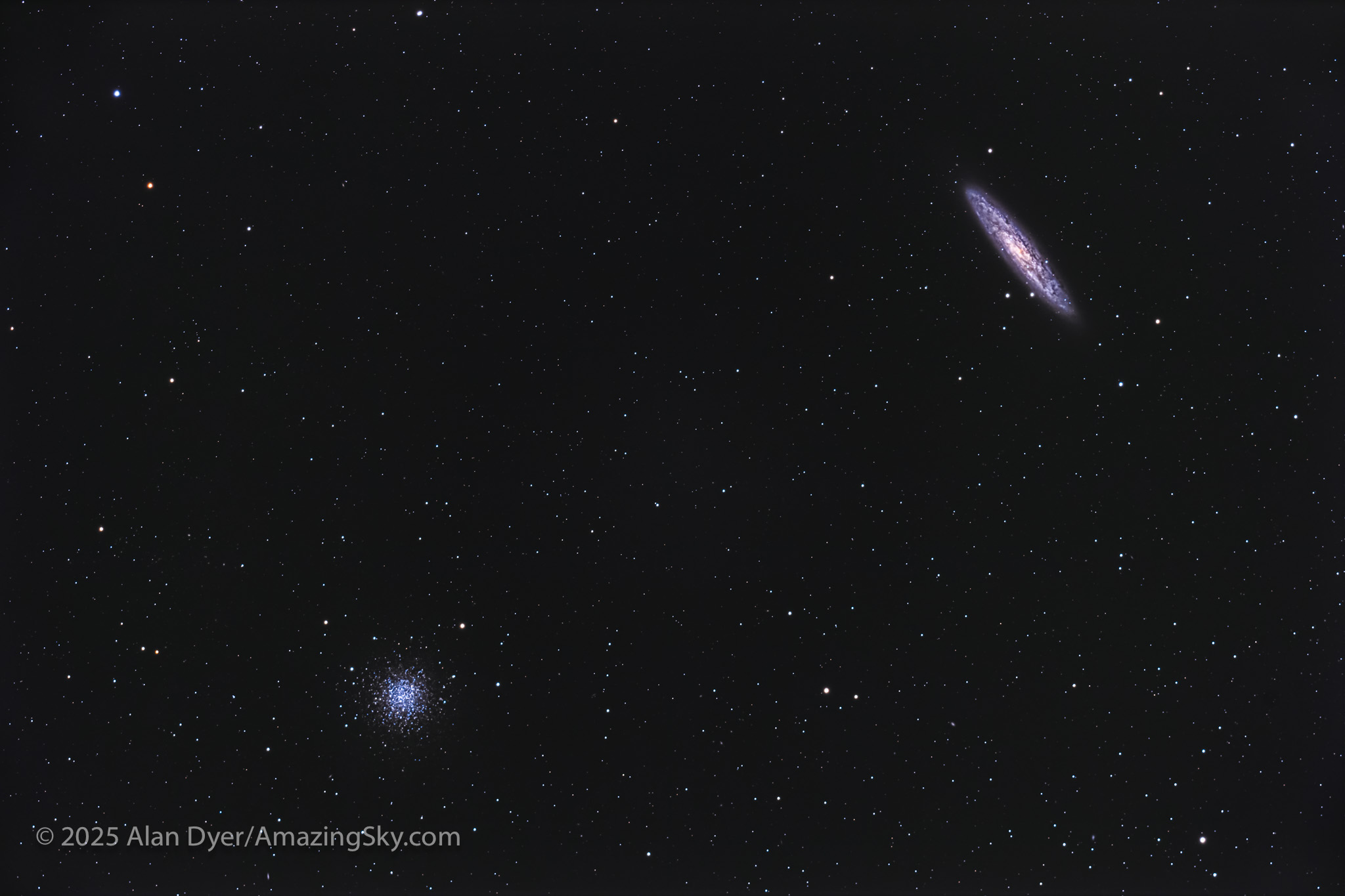
NGC 253, the Silver Coin, with NGC 288, a Pairing in Sculptor
This is a stack of 20 x 3-minute exposures with the APO120 refractor with its 0.8x Reducer for 560mm focal length and f/5.6, and the Canon Ra at ISO 1600. No filter was employed.
Here, sitting right next to the South Galactic Pole, we get a two-for-one field. This is the pairing of the bright and large edge-on spiral galaxy NGC 253 (upper right) with the large and loose globular star cluster NGC 288 (lower left). The latter is easily resolved into its constituent stars.
The two are just 1.75 degrees apart in Sculptor, but are actually 12 million light years apart in space, with NGC 288 belonging to our Milky Way, while NGC 253 is another galaxy altogether, one of the brightest in the sky (at magnitude 7) and a member of the Sculptor Group.
NGC 253 is also known as the Silver Coin Galaxy, and is Caldwell 65 on Sir Patrick Moore’s list. However, it was discovered by Caroline Herschel in 1783, from England! Her brother William discovered nearby NGC 288.
NGC 300, the Sculptor Pinwheel
This is a stack of 16 x 4 minute exposures with the APO120 refractor at f/5.6 with its 0.8x Reducer, and the Canon Ra at ISO 800.
This is the bright (8th magnitude) and moderately large (1/2º across) spiral galaxy NGC 300, aka the Sculptor Pinwheel. It’s the southern equivalent of the popular Messier 33 spiral in Triangulum. NGC 300 is also Caldwell 70.
It, too, was discovered in 1826 by James Dunlop. NGC 300 may be a member of the Sculptor Group. Or it might lie closer to us than the Sculptor Group, along with NGC 55, at “only” 6.5 million light years away.
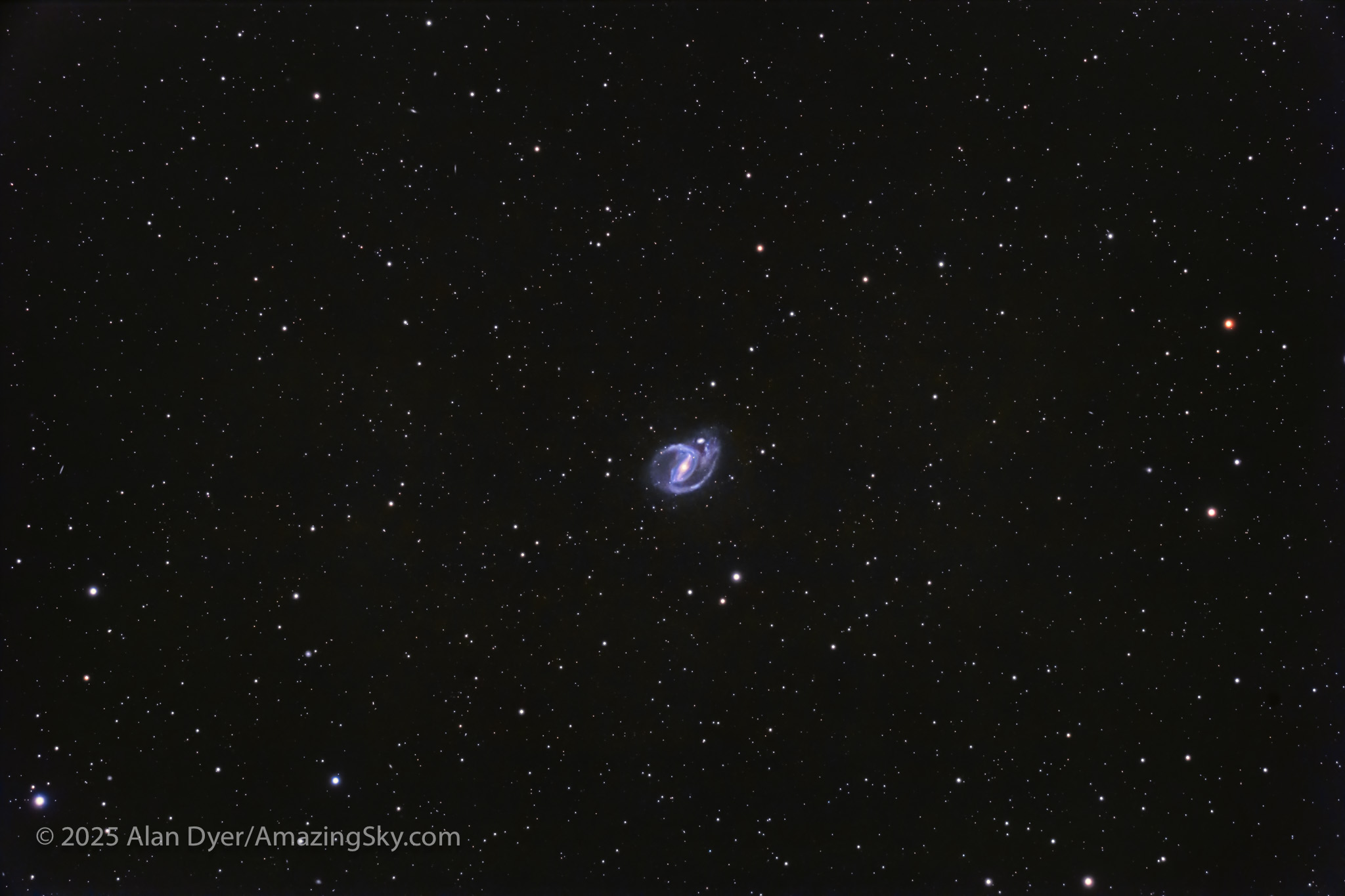
NGC 1097, a Barred Spiral in Fornax
This is a stack of 10 x 6 minute exposures with the APO120 refractor at f/7, with the Canon Ra at ISO 1600.
We trek farther east into the next constellation over from Sculptor, to Fornax the Furnace, to find NGC 1097. This is the realm of bright (magnitude 9.5 in this case) barred spiral galaxies. This class of galaxy has arms emanating from a long bar at the core. This area of sky is replete with bright barred spirals, far more so than any area we find “up north.”
NGC 1097 is also classified as a Seyfert galaxy, a type with an active quasar-like nucleus, housing a massive black hole. NGC 1097 is also Caldwell 67. Just on its northern edge sits the little companion galaxy NGC 1097A.
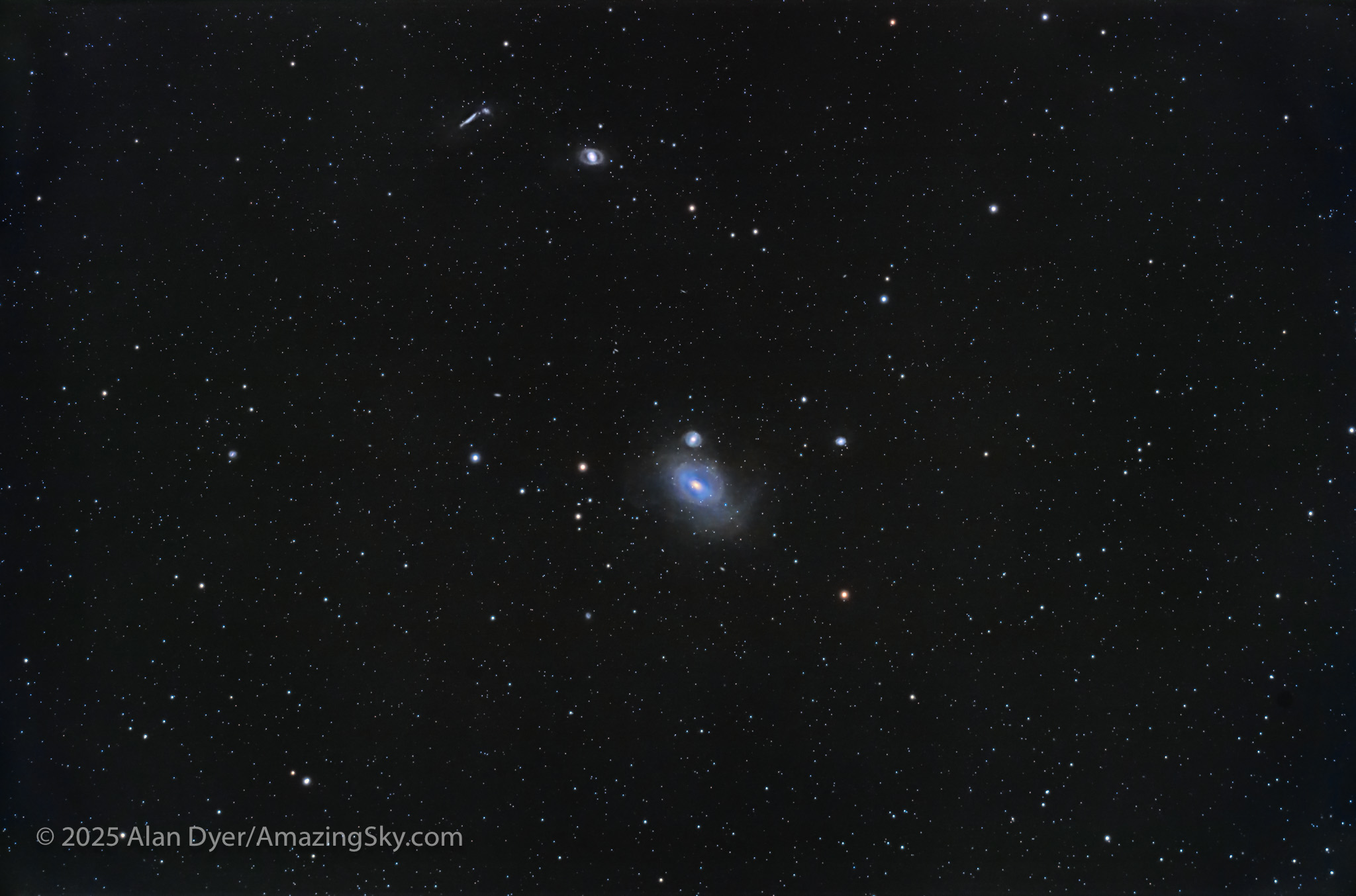
NGC 1316 in Fornax, also with a Black Hole
This is a stack of 15 x 4 minute exposures with the APO120 refractor at f/5.6 with its 0.8x Reducer, with the Canon Ra at ISO 800.
This bright (magnitude 8.5) elliptical galaxy is also catalogued by radio astronomers as Fornax A, because NGC 1316 is also a “bright” source of radio waves, thought to be generated by a supermassive black hole at its core.
Elliptical galaxies are notorious for being cannibal galaxies, eating others nearby. Sure enough, the galaxy is surrounded by faint tidal streams of stars, just recorded here, the result of collisions and mergers with unfortunate companions that wandered too close by. NGC 1316 is about 75 million light years away, and belongs to the Fornax 1 Galaxy Cluster. Despite its uniqueness and brightness, it is not in the Caldwell Catalogue.
Just above it is the smaller elliptical NGC 1318. At top is the trio of: the edge-on spiral NGC 1326A and companion NGC 1326B, and the barred spiral NGC 1326 with an odd ring shape.
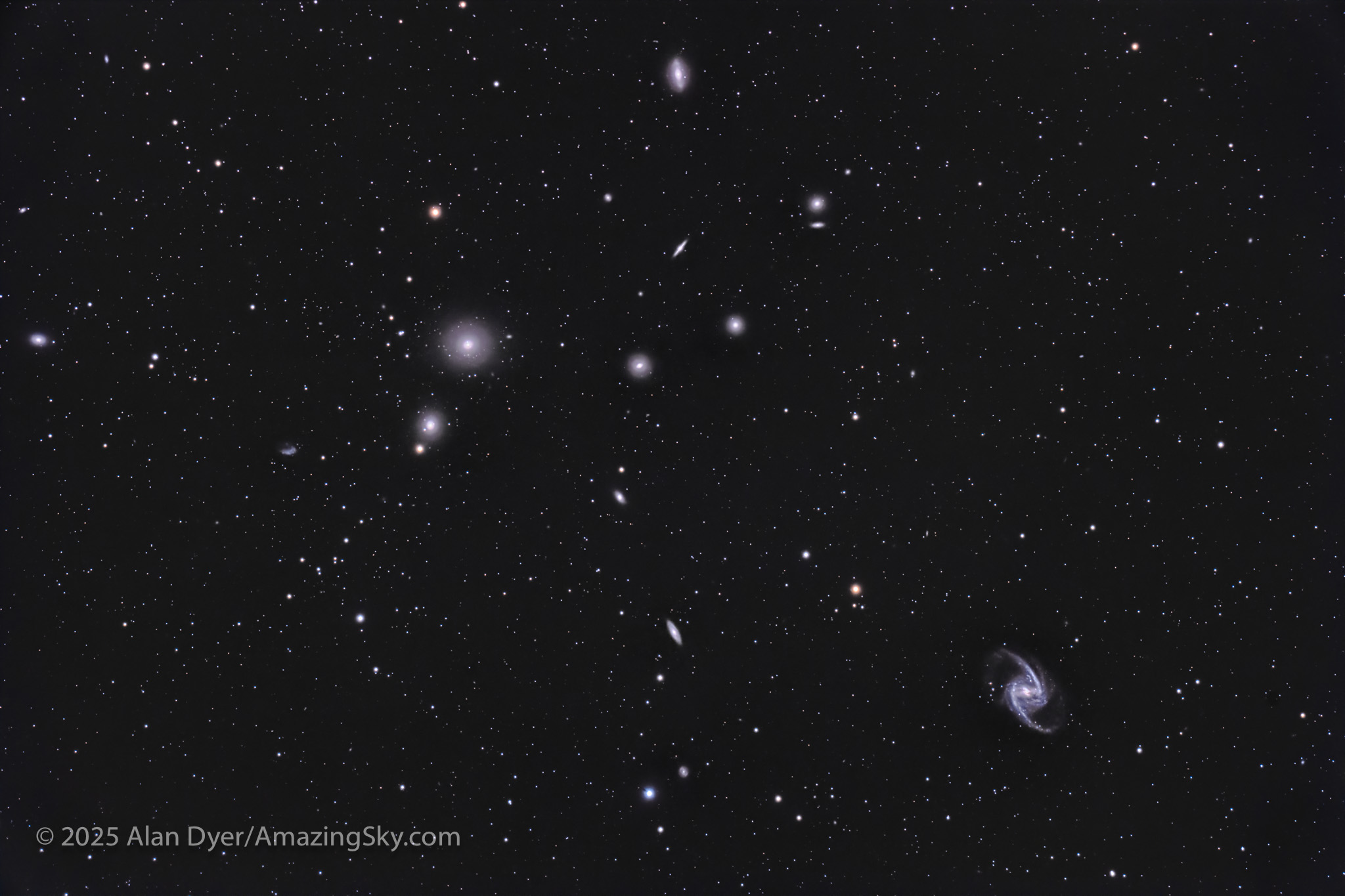
NGC 1365 and NGC 1399, at the Heart of the Fornax Cluster
This is a stack of just 10 x 6 minute exposures through the APO120 refractor at f/7 and the Canon Ra at ISO 1600.
This frames the main members of the populous Fornax Galaxy Cluster, second only perhaps to the northern sky’s Coma-Virgo Galaxy Cluster, and its Markarian’s Chain area, for having the most bright galaxies in one low-power telescope field. (The field here is 1.6º by 2.4º.) It is a “must see” sight for galaxy fans.
The two brightest Fornax cluster members are: – the giant elliptical galaxy NGC 1399 at upper left, paired with smaller NGC 1404, – and the barred spiral galaxy NGC 1365 at lower right, considered one of the best barred spirals in the sky. There’s nothing quite like it up north. Like NGC 1399, it is 58 million light years away.
The odd shaped galaxy at left is the irregular galaxy NGC 1427A, with NGC 1427 itself at the far left edge. The elongated spiral galaxy at top is NGC 1380. Numerous other NGC and tiny, faint PGC galaxies populate the field, down to magnitude 15 or so.
Bonus Nebulas!
While autumn’s galaxy season has lots to offer the galaxy hunter, there are some wonderful nebulas down south as well. In my sampling, all are “planetaries.”
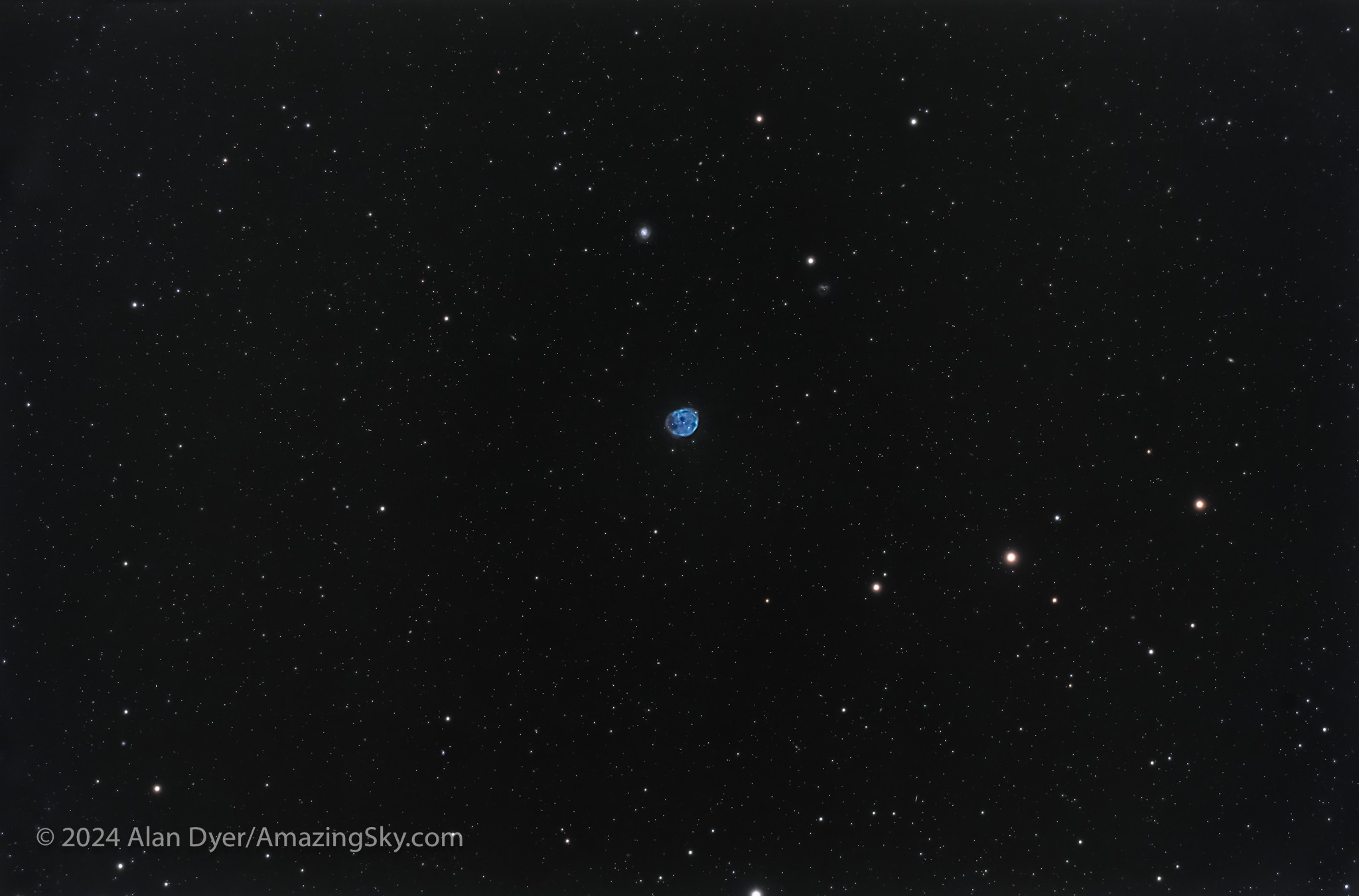
NGC 246, the Skull Nebula in Cetus
This is a stack of 16 x 4 minute exposures with the Askar APO120 refractor at f/5.6 with its 0.8x Reducer, with the Canon Ra at ISO 1600.
This is the nebula NGC 246, aka the Skull Nebula, in Cetus. It’s an example of a planetary nebula, so-called because this type of object with their small blue-green disks reminded William Herschel of the planet Uranus that he discovered in 1781. NGC 246 was discovered by Herschel four years later in 1785.
NGC 246 has a mottled disk, giving it its fanciful name, and a 12th magnitude central star that has ejected the nebula as part of its end-of-life eruptions, the origin of all planetaries. They have nothing to do with planet formation; they are the products of star death.
NGC 246 lies about 1,600 light years away. Just above it is the small galaxy NGC 255.
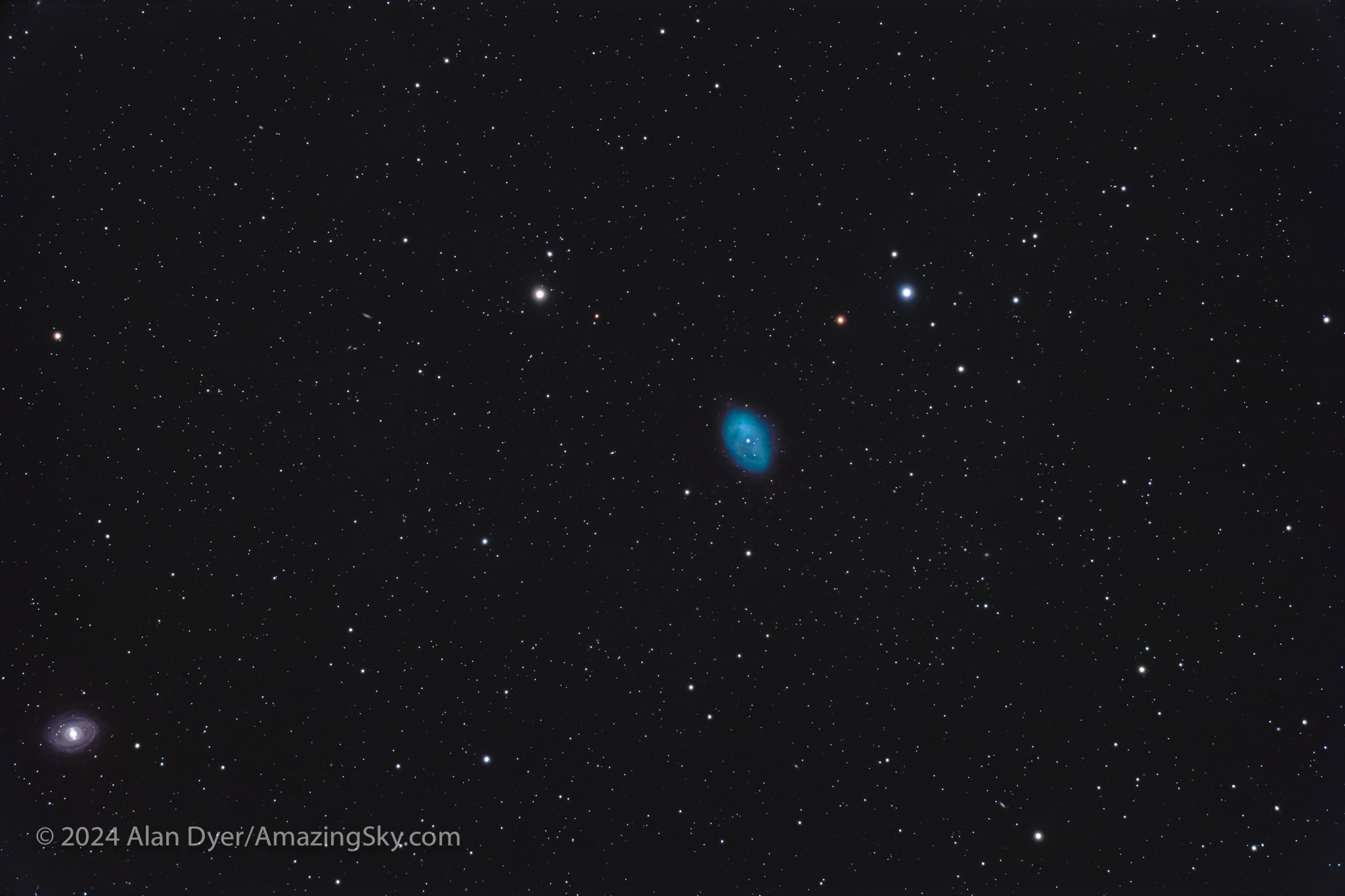
NGC 1360, the Robin’s Egg Nebula in Fornax
This is a stack of 10 x 6 minute exposures with the Askar APO120 refractor at f/7 and with the Canon Ra at ISO 1600.
This, too, is a planetary nebula, but an odd one, in that it is a more uniform disk than is usual for planetaries, lacking the ring or bi-polar shape of most such objects. It was only recently classified as a planetary, one with an 11th magnitude central star responsible for expelling the nebula.
NGC 1360 is bright (at 9th magnitude), large, and blue-green, giving it the nickname the Robin’s Egg Nebula. The barred spiral galaxy (there are lot of them down here!) NGC 1398 is at lower left.
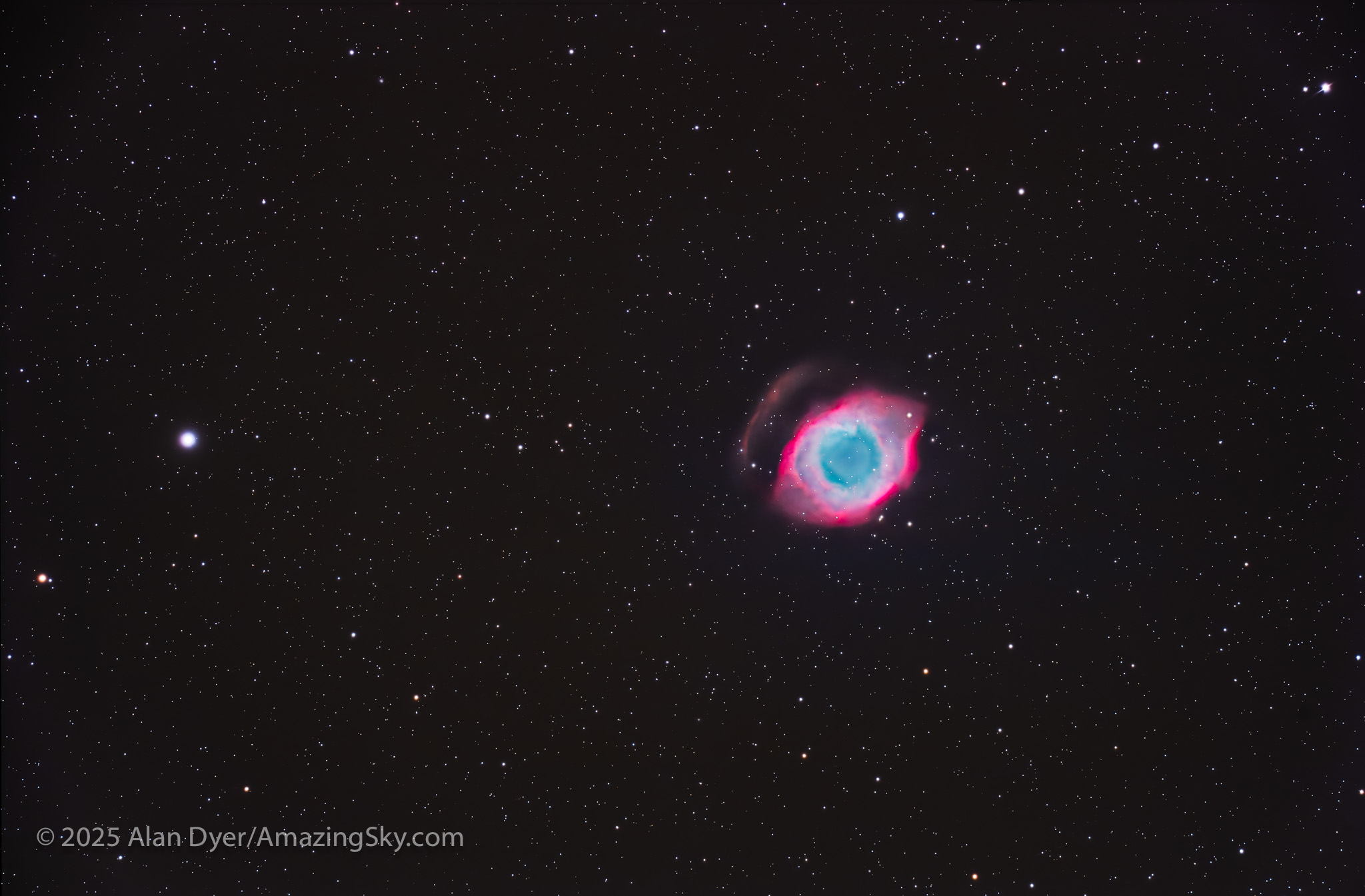
NGC 7293, the Helix Nebula in Aquarius
This is a blend of: a stack of 24 x 8 minute exposures with no filter, with a stack of 20 x 12 minute exposures with an IDAS NBX narrowband filter to isolate just the green Oxygen III and red Hydrogen alpha light. All through the APO120 at f/7, taken over 2 nights as the object was not well-placed long enough for all the images to be taken in one night. Shot using the Canon Ra, at ISO 3200 for the filtered frames and ISO 1600 for the unfiltered shots.
This is the large and bright (magnitude 7.6) planetary nebula catalogued as NGC 7293, but better known as the Helix Nebula, in Aquarius. But the internet has also dubbed in “The Eye of God.”
While this target lies farther north than most of the objects here, making it easy to see from northern latitudes, William Herschel working in England missed it. His telescopes were too powerful! It wasn’t discovered until 1824 (or thereabouts) by Karl Ludwig Harding in Germany. It is #63 in the Caldwell Catalogue.
NGC 7293 is thought to be one of the closest planetary nebulas to us, at only 650 light years away, thus its large size, nearly 1/4º across, half the size of the Moon’s disk. There’s an outer halo that is twice that size, but only the brightest portion of it is recorded here as a partial arc. It takes exposures of many hours, and more patience than I have, to pick up this nebula’s full extent.
The bright star at left is 5th magnitude star Upsilon Aquarii, which I composed to be in the frame and not on the edge if the Helix had been centered.
About the Images
As per the tech details in the captions, I shot all the images from southern Arizona during a wonderful marathon of astrophotography in October 2024, at the Quailway Cottage, a favorite spot of mine for an astronomy retreat.
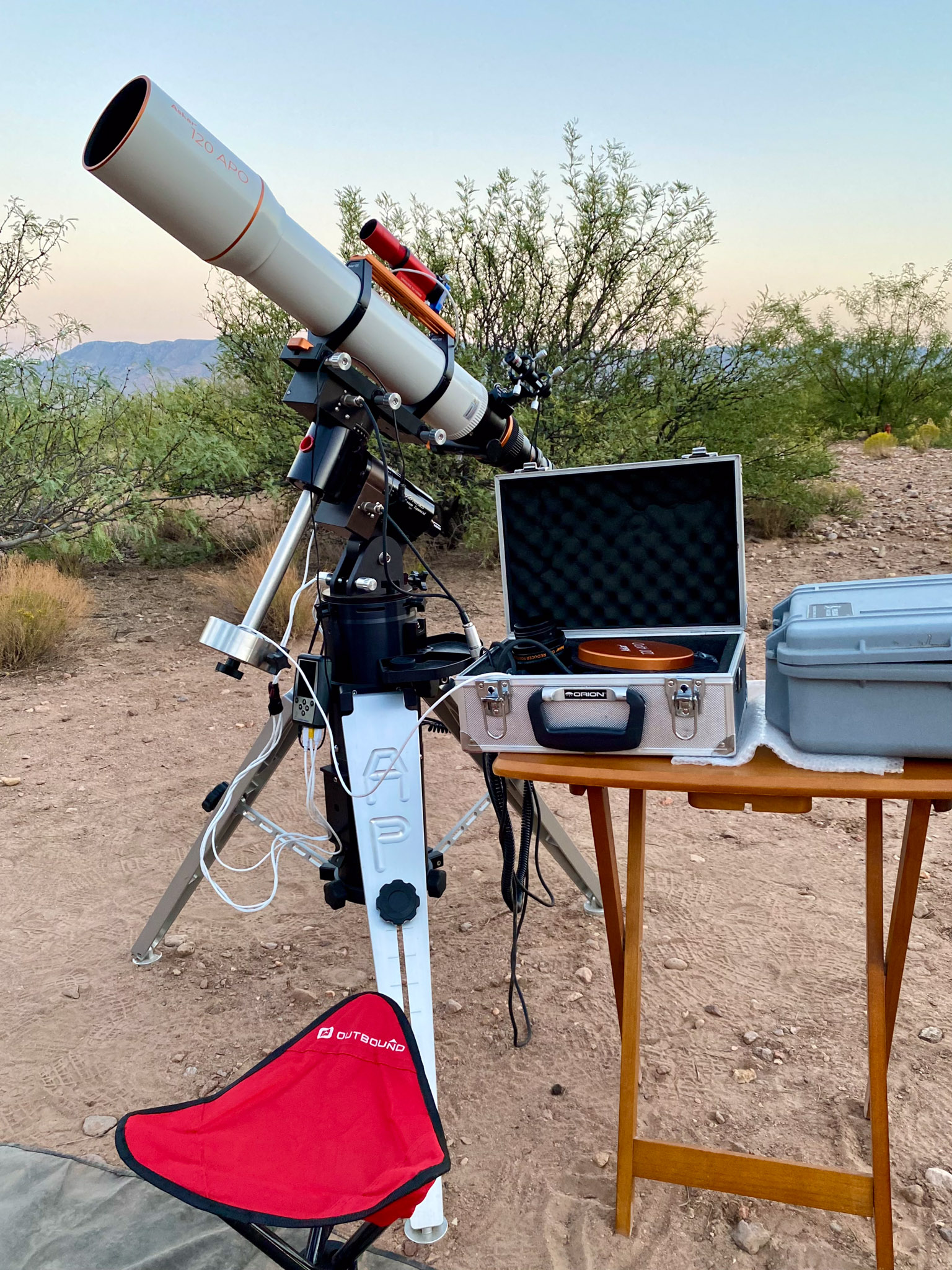
I used an Askar APO120 refractor, at either its native f/7 for a focal length of 840mm, or with its 0.8x Reducer lens for a faster f/5.6 focal ratio and shorter 670mm focal length, yielding a wider field and shorter exposure times for each “sub-frame.” Most images have a similar “plate scale,” so the difference in object size is due to their actual size on the sky.
The camera was the astro-modified 30-megapixel Canon Ra. The mount was the venerable Astro-Physics AP400, which returned earlier in 2024 from its 20-year stay in Australia. I used the Lacerta MGEN3 stand-alone auto-guider, for app- and computer-free guiding which I prefer. The MGEN3 performs “dithering,” shifting the framing by a few pixels between each exposure, to aid elimination of thermal noise when stacking images.
While it looks impressive, the telescope is still not the best for small, detailed targets like the galaxies and planetaries here. They demand even more focal length (= bigger and heavier telescopes) than I prefer to shoot with.
Even so, I plan to take the same rig to New Mexico this year in May to shoot targets in the “other half of the sky,” during spring galaxy season.
A plan to shoot the promised bright comet of 2024 paid off, with fine views at dawn and at dusk of the best comet since 2020.
Comets are always a gamble. Any new comets discovered, the ones that usually become the brightest, have no track record of performance. Predictions of how bright a new comet might appear are based on what a typical comet should do. But comets can outperform expectations and dazzle us, or they can fizzle and fade away.
In late 2023 it was clear that a then newly-discovered comet, C/2023 A3, named Tsuchinshan-ATLAS after the observatories where it was co-discovered, had the potential to perform in late 2024.
The low angle and position of the comet from home in Canada in the late September dawn sky, simulated in StarryNight software.
Knowing where it would be in the sky (that trait of a comet can be predicted with accuracy!) I planned a field trip to the U.S. desert Southwest for late September and early October 2024. From farther south the comet would be higher than it would be from home (shown above), and over spectacular landscapes.
I had visions of another Comet NEOWISE from July 2020. As my blog from 2020 shows, we saw that photogenic comet well from our northern latitude in Canada, as it skimmed across the northern horizon. Tsuchinshan-ATLAS would require a chase south.
September 26 & 27 — at Bryce Canyon, Utah
In late September 2024 the comet would be inbound, approaching the Sun and in the morning sky. What better eastern scene than overlooking Bryce Canyon in Utah, where I had been a year before, for the October 14, 2023 annular eclipse of the Sun in the morning sky. (Click the link for my eclipse chase blog.)
I was fortunate to get two clear mornings, both from the Fairyland Canyon viewpoint, just a short walk from the parking lot to carry camera gear and tracking mounts.
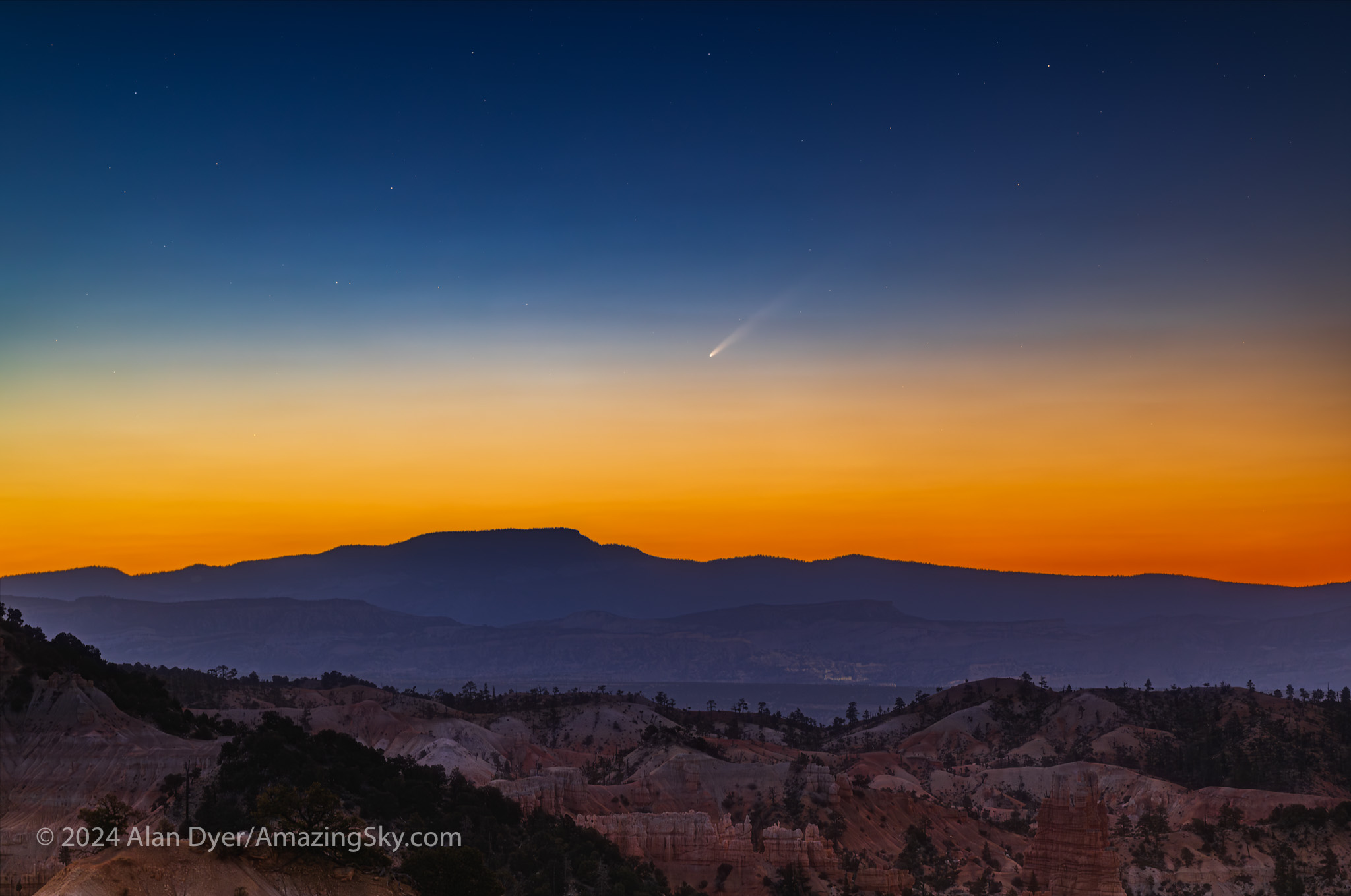
Comet C/2023 A3, Tsuchinshan-ATLAS, at dawn over Bryce Canyon, on the morning of September 27, 2024.
My first look at the comet on September 27 was on the day the comet was at perihelion, closest to the Sun in its orbit, though not in the sky at our viewing angle from Earth.
The comet was just visible to the unaided eye, but was obvious on the camera view screen, even amid the bright twilight. I had to shoot fast as the window between “comet rise” and the sky brightening too much was only a few minutes long.
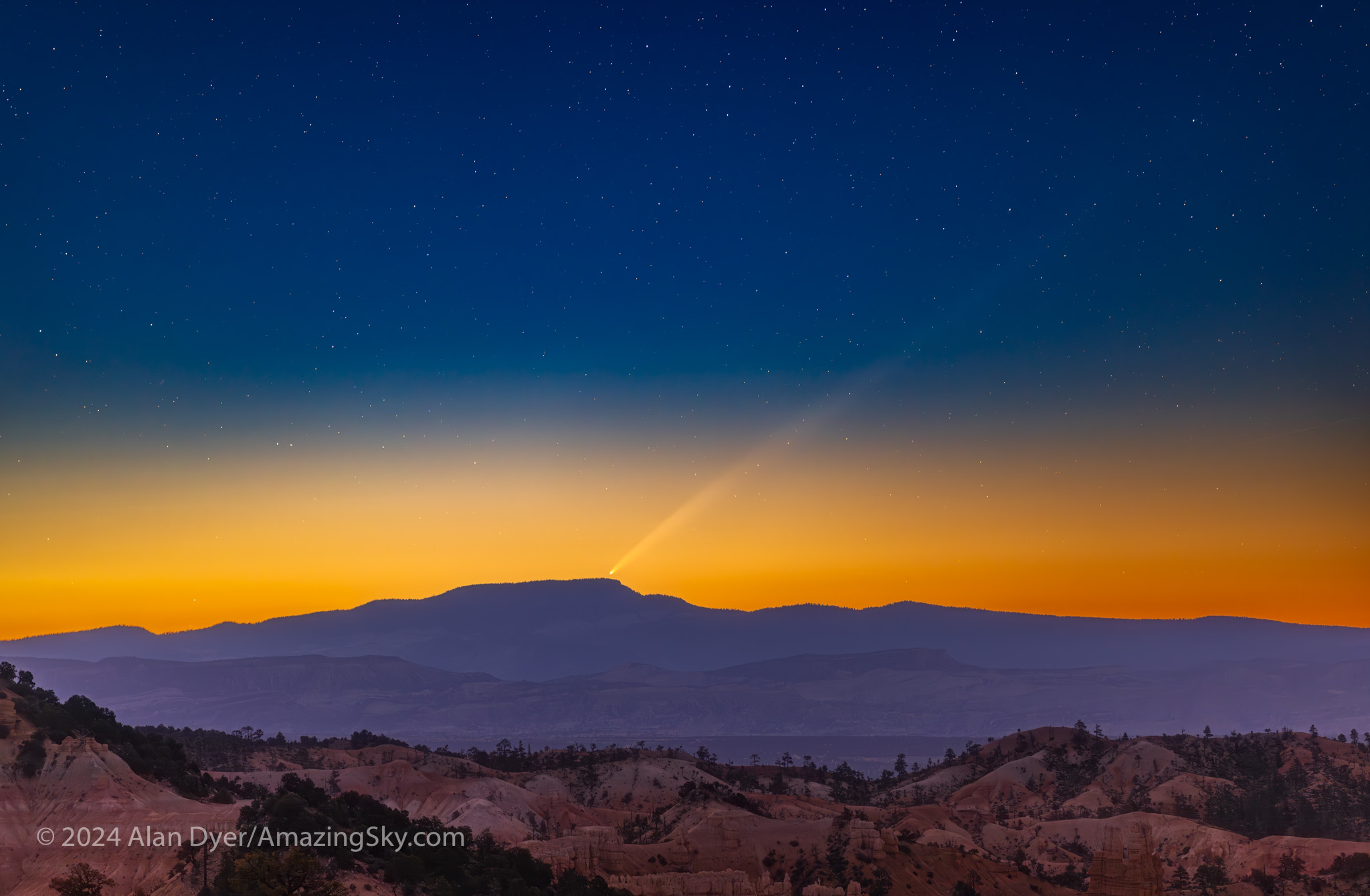
Comet C/2023 A3, Tsuchinshan-ATLAS, rising in the twilight over Bryce Canyon, on September 28, 2024.
Knowing better what to look for, I caught the comet a little sooner the next morning on September 28, and so the tail appeared longer and more impressive as it rose above the distant mountains. A group of other local photographers arrived just a few minutes too late both mornings, and so struggled to just sight the comet, let alone photograph it.
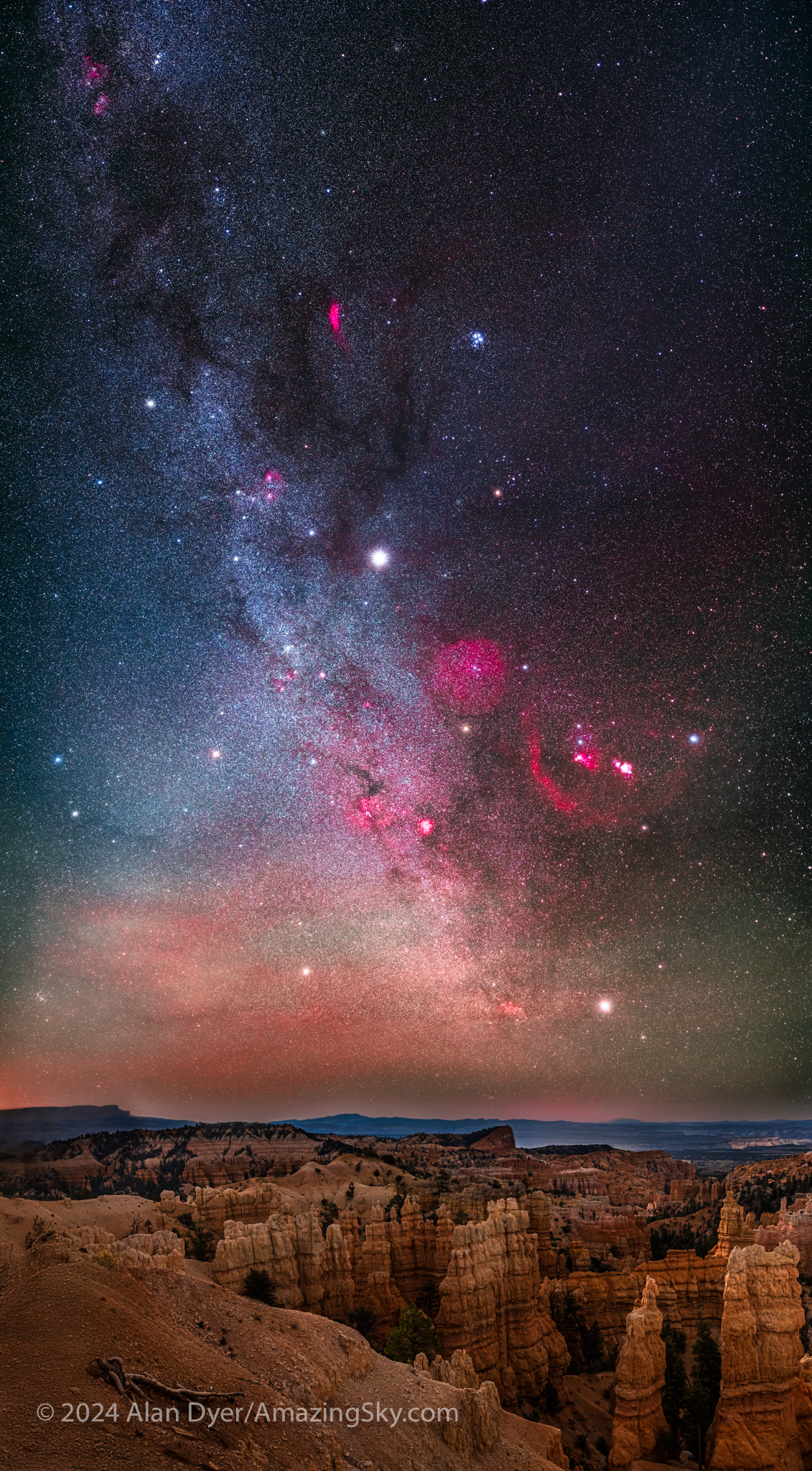
This vertical panorama takes in the nebula-rich northern winter Milky Way over the formations of Bryce Canyon National Park, from the Fairyland Canyon viewpoint.
But I had arrived extra early, to shoot a vertical panorama (above) of the winter Milky Way over the canyon formations below. This and the comet images were shot with the aid of a sky tracker to follow the stars, but with the tracker off for separate shots of the ground.
So I had bagged the comet at Bryce! On to the next stop.
September 28 & 29 — at Monument Valley, Utah
There’s no more iconic or famous landscape in the American West than the buttes of Monument Valley, on the Navaho Tribal Lands on the Arizona/Utah border.
This panorama from the Navaho Tribal Park at Monument Valley shows the evening twilight sky looking east opposite the sunset to the rising dark blue arc of Earth’s shadow cast on the atmosphere. The shadow is rimmed with a pink “Belt of Venus” tint from sunlight still hitting the upper atmosphere.
A clear first evening provided a fabulous view of the arc of Earth’s shadow across the eastern sky from the viewpoint near the aptly named The View Hotel.
This is a panorama of the sunrise scene at the Navaho Tribal Park, Monument Valley, Arizona, taken just after sunrise with the low Sun lighting the iconic buttes and mesas of the Valley. The West and East Mittens are at left; the Sun was behind Merrick Butte at centre, and lighting Mitchell Mesa at right.
A wonderful sunrise on my second morning there made for a spectacular panorama. But while clouds created fine sunrise lighting, they aren’t conducive to seeing comets!
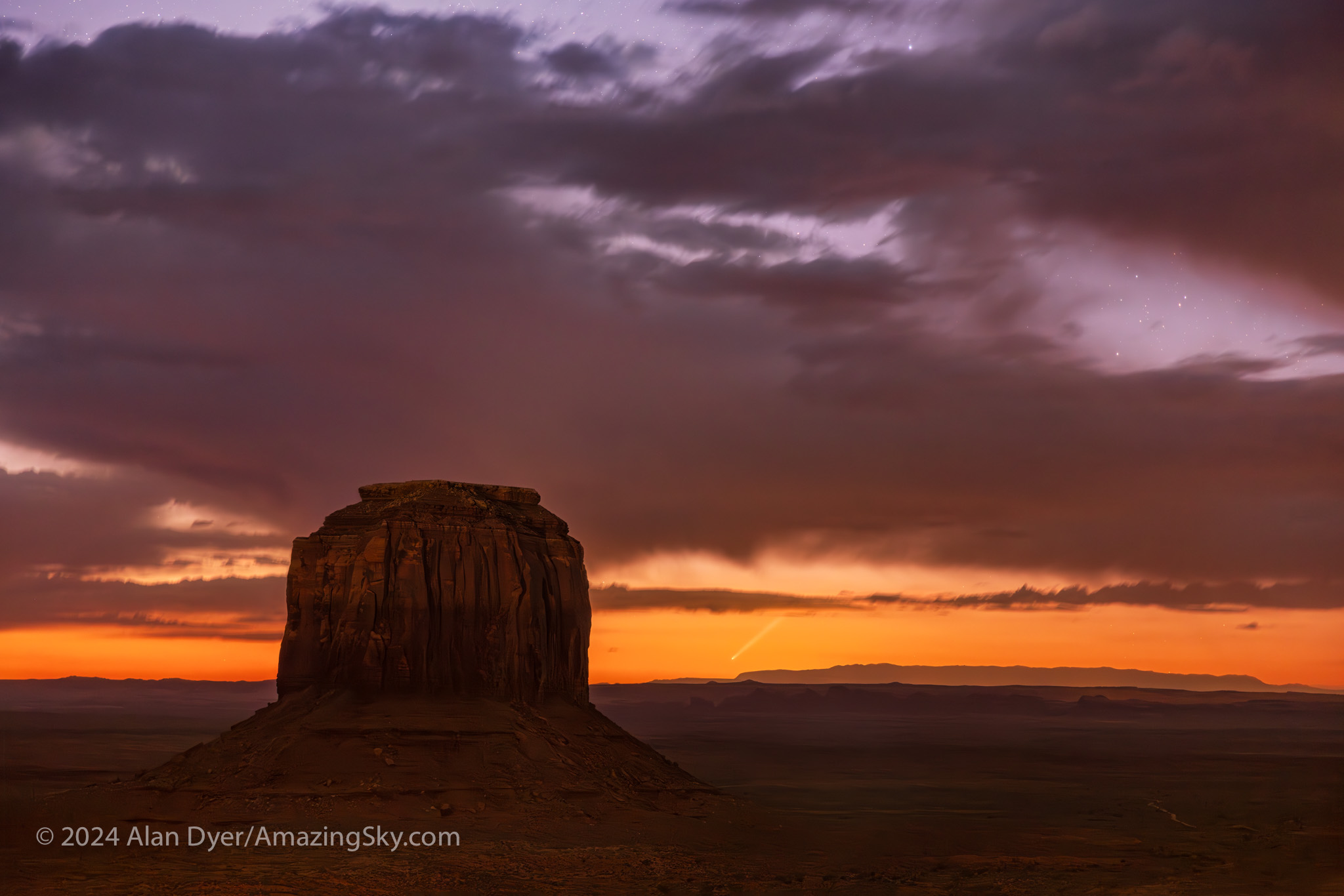
Comet C/2023 A3, Tsuchinshan-ATLAS (at centre), is rising in the dawn twilight over Monument Valley, Arizona on the morning of September 30, 2024. The comet is rising just south (right) of Merrick Butte.
A band of clear sky near the horizon allowed me to catch the comet rising to the right of Merrick Butte, as seen from a spot south of The View from where I had calculated the comet would rise in the right position. From the usual Valley viewpoint farther north the comet would have been behind the butte.
While the planning worked, the result was not quite the spectacle I had envisioned. The comet was nice, but was starting to become lost in the bright sky as it descended toward the Sun.
There were only a couple of mornings left to catch the comet at dawn before it disappeared completely into the daytime sky close to the Sun.
October 1 to 11 — at Quailway Cottage, Arizona
The major block of time in my trip was booked for an astrophoto retreat at a cottage I’d rented twice before but not since late 2017. The Quailway Cottage, popular among birders, is also ideal for stargazing as it is in one of the darkest areas of the Southwest, north of Douglas, Arizona, and just across the Arizona/New Mexico border.
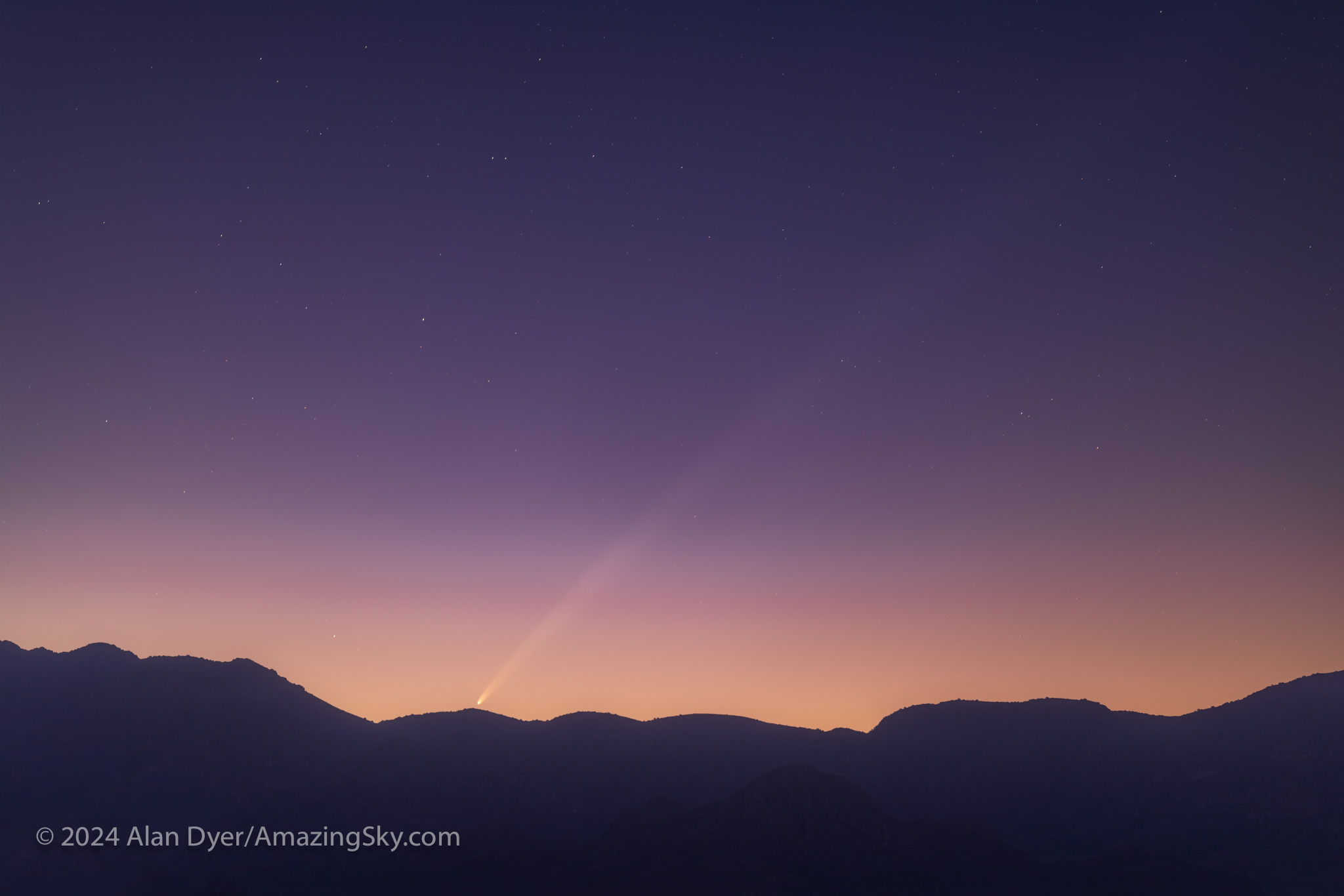
This captures both the glow of Zodiacal Light in the eastern dawn sky (the band of light extending up across the frame) and the dust tail of Comet Tsuchinshan-ATLAS rising from behind the Pelloncillo mountains, at dawn on October 2, 2024.
When I arrived the comet was putting in its last show in the dawn sky. In fact, on October 2 I managed to capture a dawn scene with the morning Zodiacal Light created by sunlight reflecting off cometary dust in the inner solar system, and just the tail of the comet rising before the bright comet head appeared.
Comet C/2023 A3, Tsuchinshan-ATLAS, is rising in the dawn twilight over the Pelloncillo Mountains in New Mexico, on October 2, 2024.
An image taken a little later showed the entire comet, now sporting a more impressive tail. It was blossoming into a fine comet indeed. But we were about to lose sight of it for more than a week.
Arizona Deep-Sky Imaging
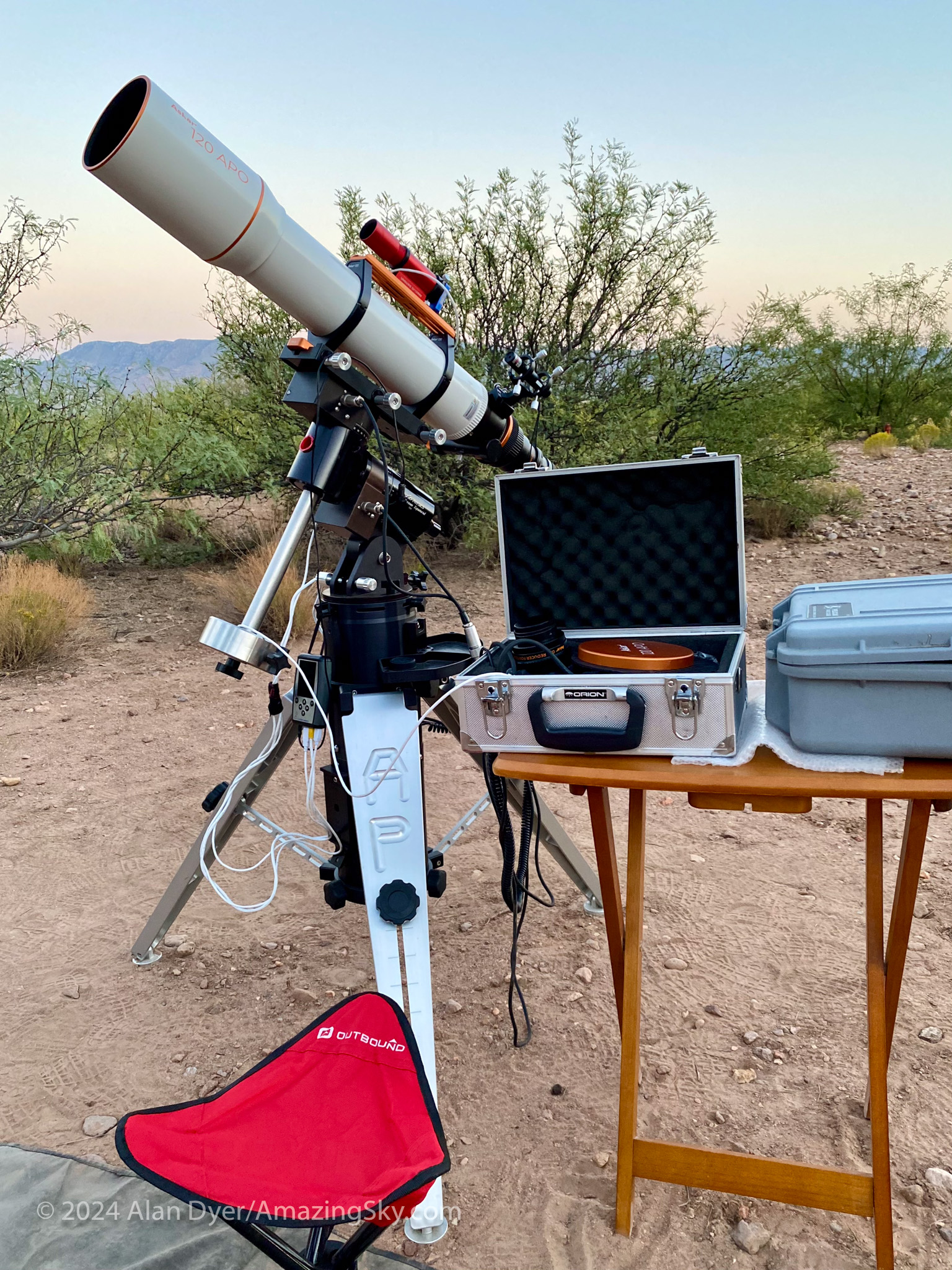
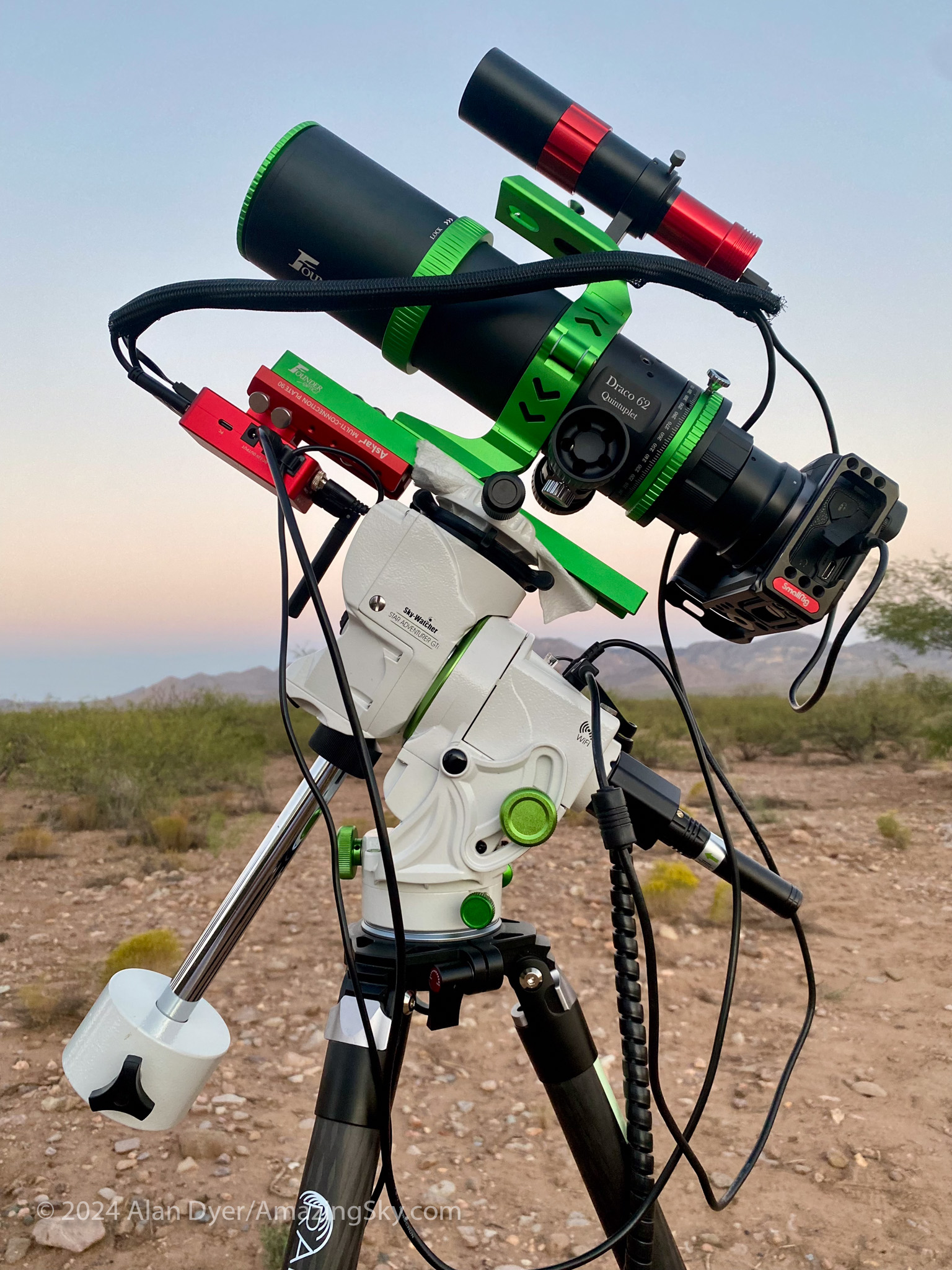
While at Quailway I had clear skies every night. And so, as planned, I went to town shooting all kinds of “deep-sky” objects and fields with two astrophoto rigs I had brought with me: a longer-focal length 120mm refractor for small targets, and a short-focal length refractor for wide fields in the Milky Way. I had reviewed both new telescopes in recent months.
The Askar APO120 on a veteran Astro-Physics AP400 mount. The Founder Optics Draco 62 on the small Star Adventurer GTi mount.
I concentrated on shooting targets low in the south that are impossible to get from home in Canada, and that I’ve missed shooting, or have not shot well, during my visits to Australia. See my blog here about my latest trek Down Under.
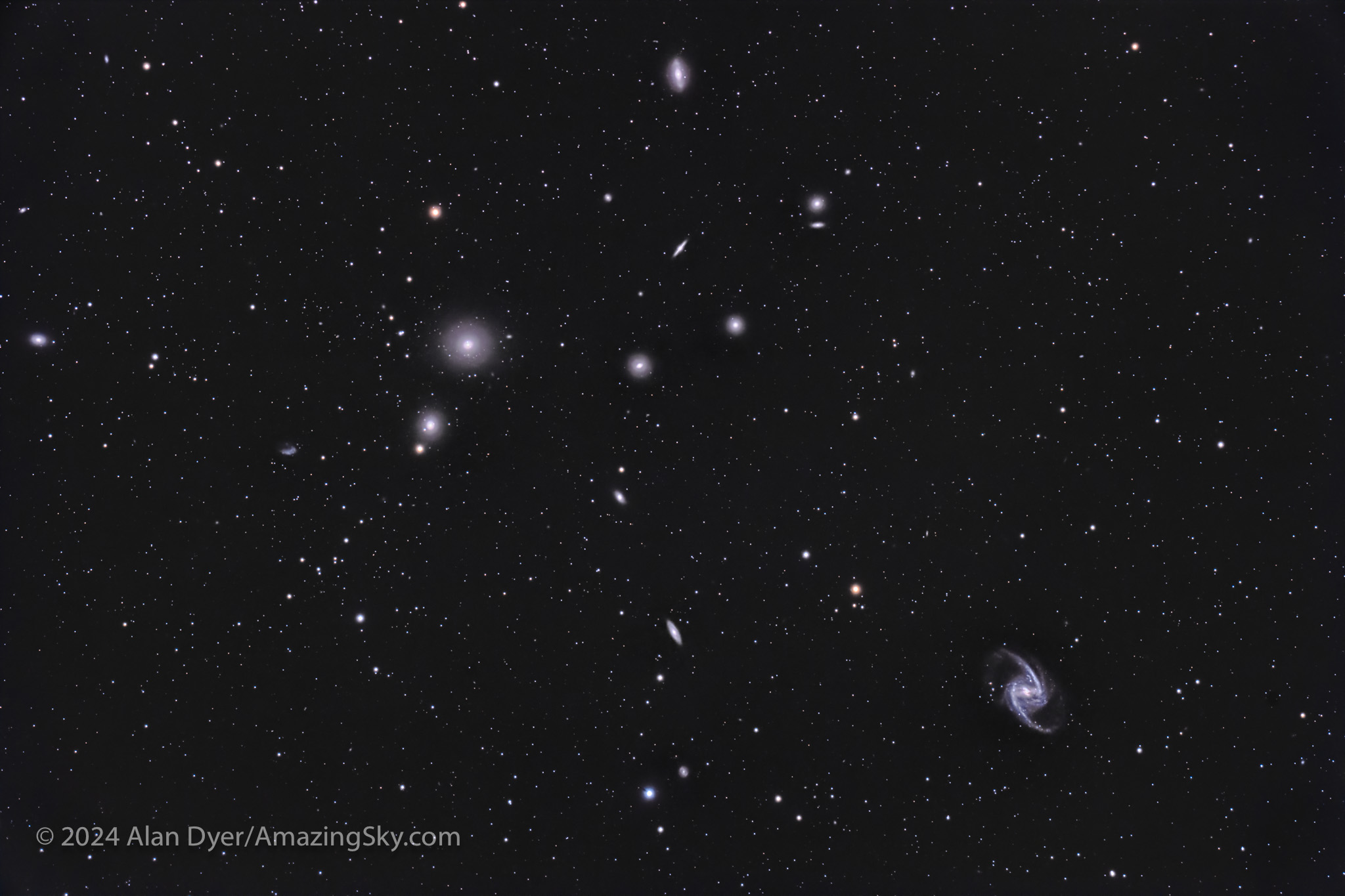
The two brightest Fornax cluster members are the elliptical galaxy NGC 1399 at upper left, paired with smaller NGC 1404, and the galaxy NGC 1365 at lower right, considered one of the best barred spirals in the sky.
Here’s an example, above, with the larger Askar 120APO: a field of galaxies in the constellation of Fornax that rivals the better-known Markarian’s Chain of galaxies in Coma Berenices in the northern spring sky.
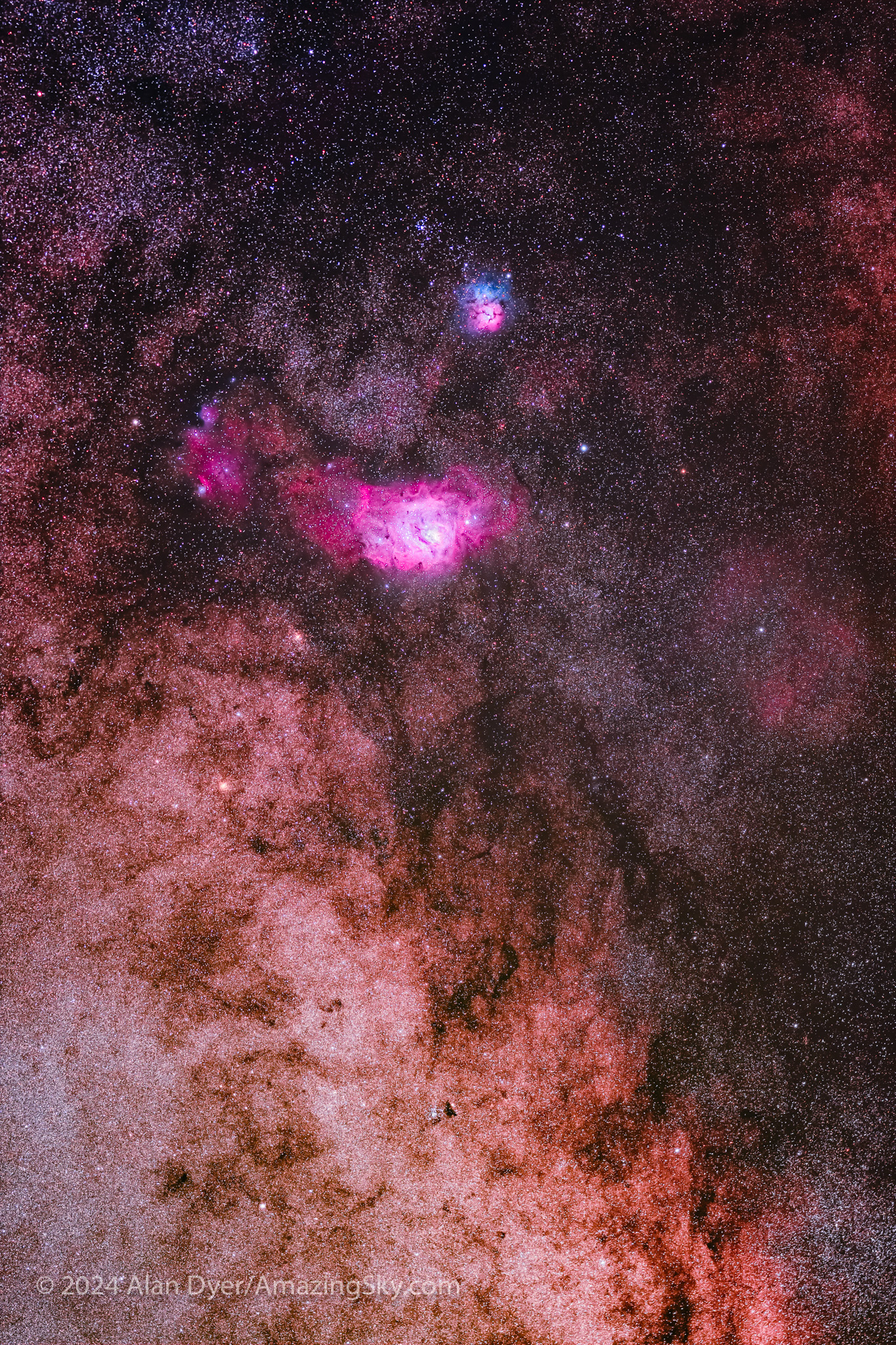
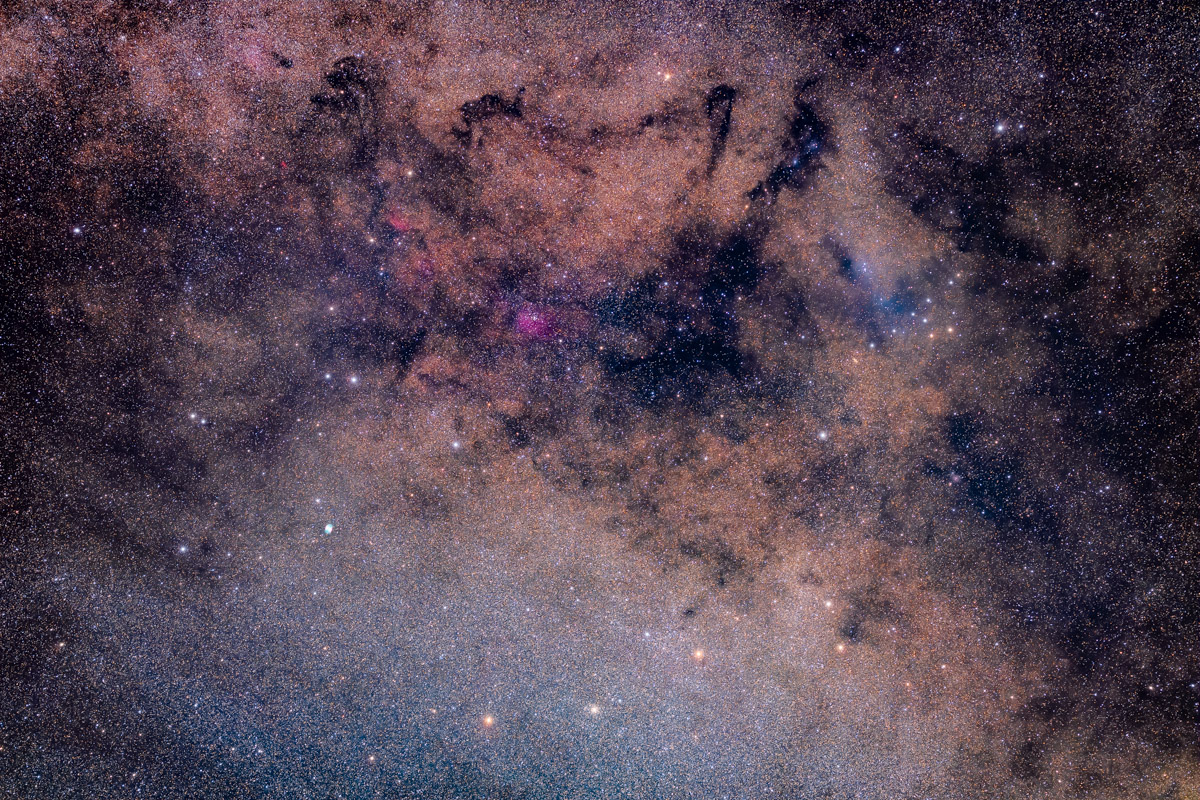
This frames the spectacular region of the Milky Way near the direction of the galactic centre in Sagittarius.
And here’s a field (above) with the small Founder Optics Draco 62mm scope, framing the rich Sagittarius Starcloud punctuated with the small dark Ink Spot Nebula, all below the bright Lagoon and Trifid Nebulas.
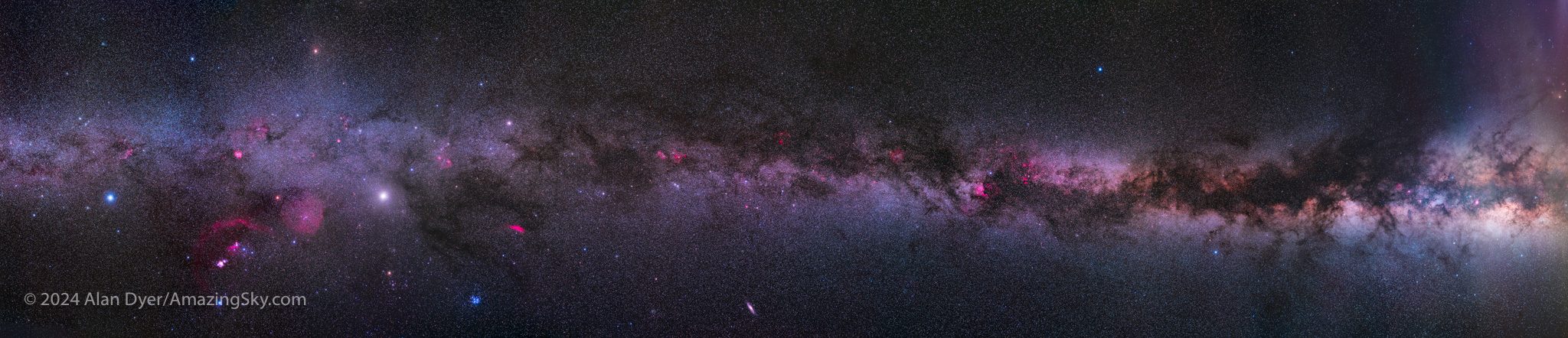
This panorama extends for about 240º along the northern half of the Milky Way, from Orion at left, to Sagittarius at right, and centered on the Galactic Equator.
In autumn the Milky Way is up all night. So I used a simple star tracker, the MSM Nomad reviewed here on my blog, and a 28-70mm lens at 35mm to shoot a panorama from dusk to dawn along the Milky Way — from the summer stars of Sagittarius and Cygnus (at right, above), through the autumn constellations overhead in Cassiopeia and Perseus (at centre), and down into the pre-dawn sky with the winter stars in and around Orion (at left).
A Bonus Aurora from Arizona
I was just north of the Mexican border, at a latitude 32° North, more than 20° farther south than at home in Alberta. But what should appear in my sky but … aurora!
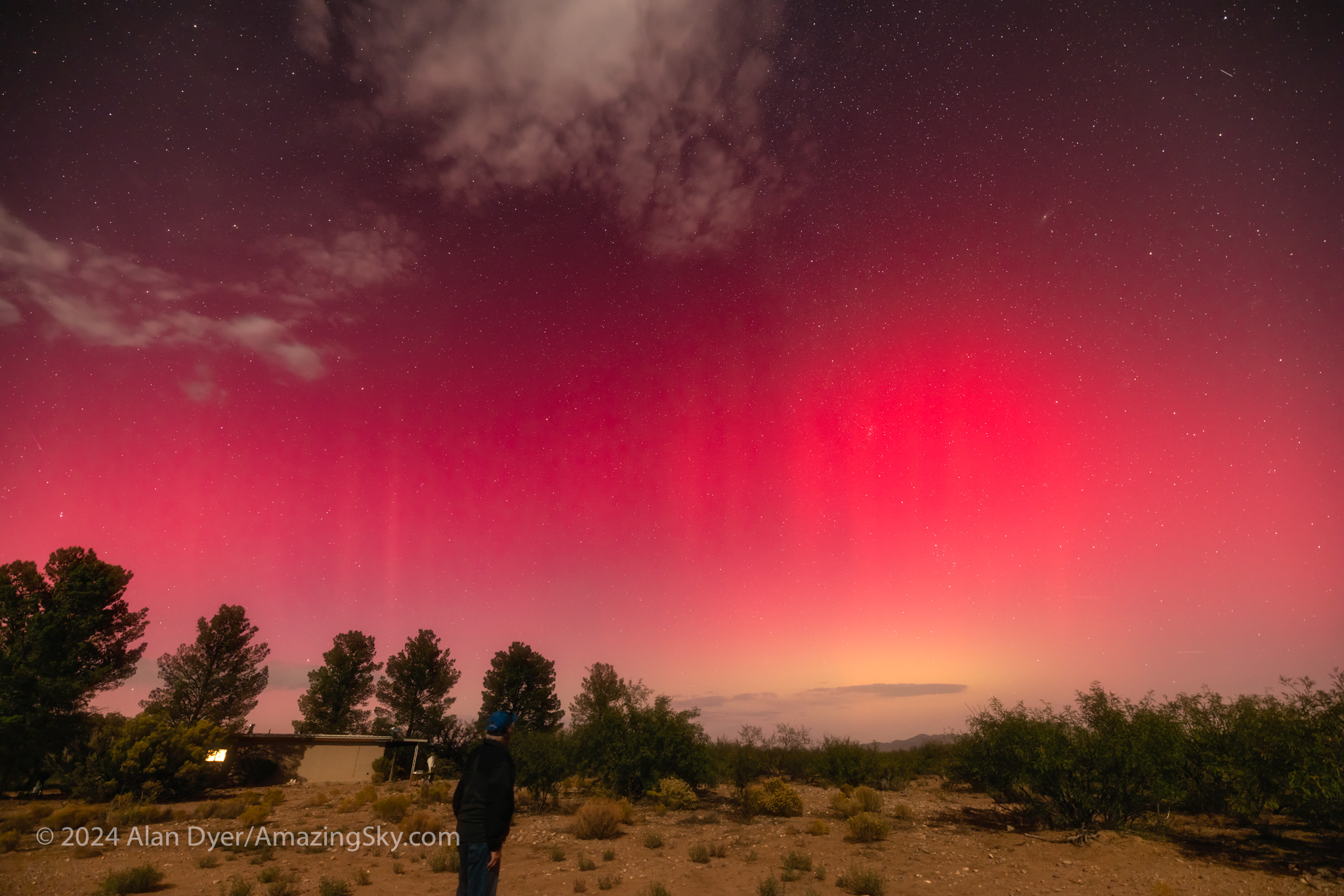
A selfie of me observing the great red aurora of October 10, 2024, from southern Arizona.
On October 9, and then again more so on October 10, a great solar storm brought Northern Lights down to me. And indeed across all of Canada and the U.S. The result for me was a red glow to the north — the tops of distant auroral curtains I would have seen filling my sky at home.
A time-lapse of an Arizona aurora, using a 15mm wide-angle lens shooting nearly 400 forty-second exposures. View it in-line here. Enlarge to a full screen view. There is no sound.
Above is a time-lapse video of the aurora that night, from a camera aimed due north for four hours. The red curtains come and go through the night.
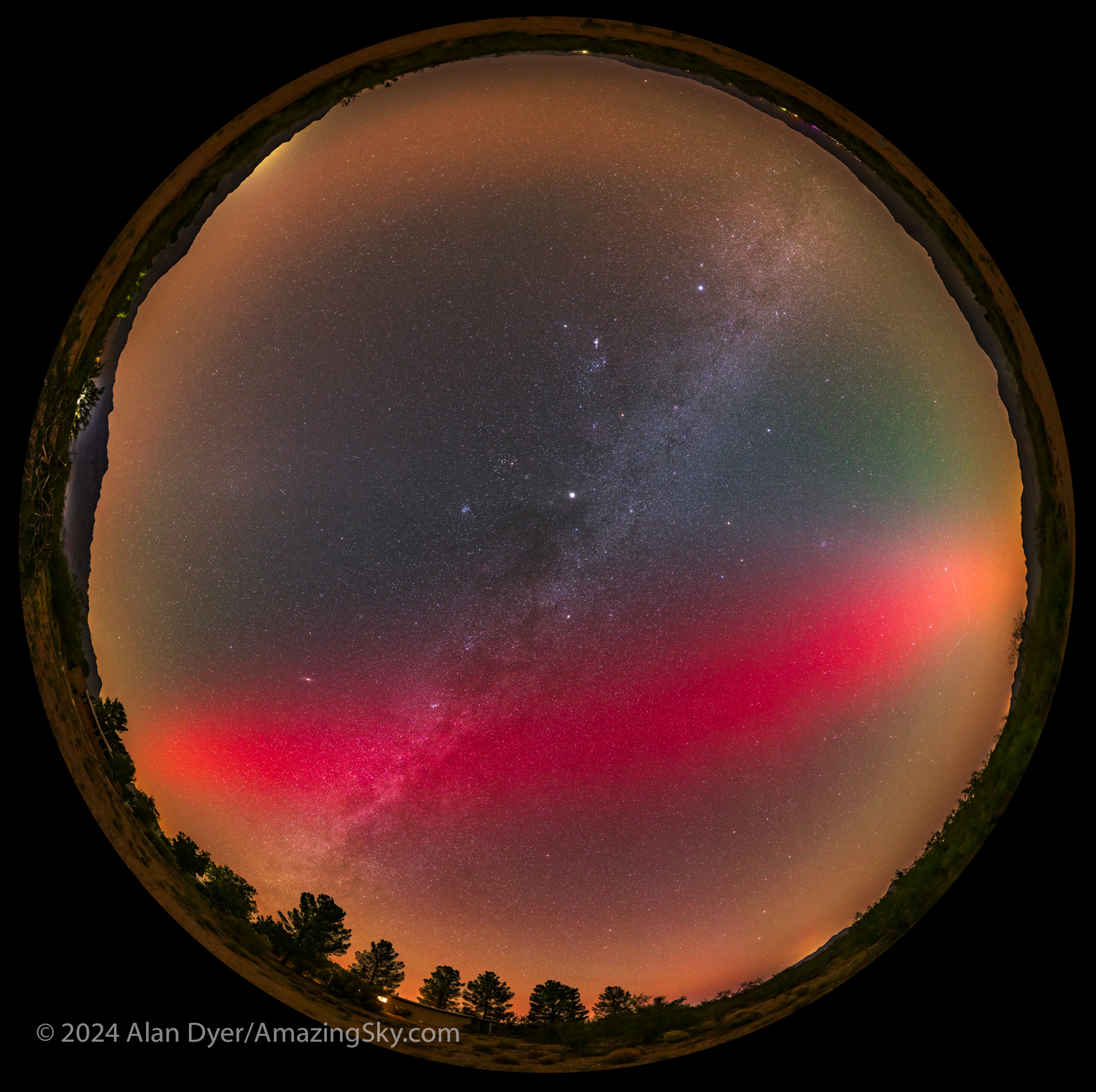
This is a 360° panorama covering the entire sky and extending up to the zenith at centre, capturing a rare SAR arc across the Arizona sky in the pre-dawn hours of October 11, 2024.
The remarkable feature that night, October 10/11, was not the aurora, but what is called a SAR (Stable Auroral Red) arc that persisted all night. It appeared as a diffuse red band across the sky, created by heat energy leaking into the upper atmosphere during the solar storm. SAR arcs can accompany an aurora but are not auroras themselves.
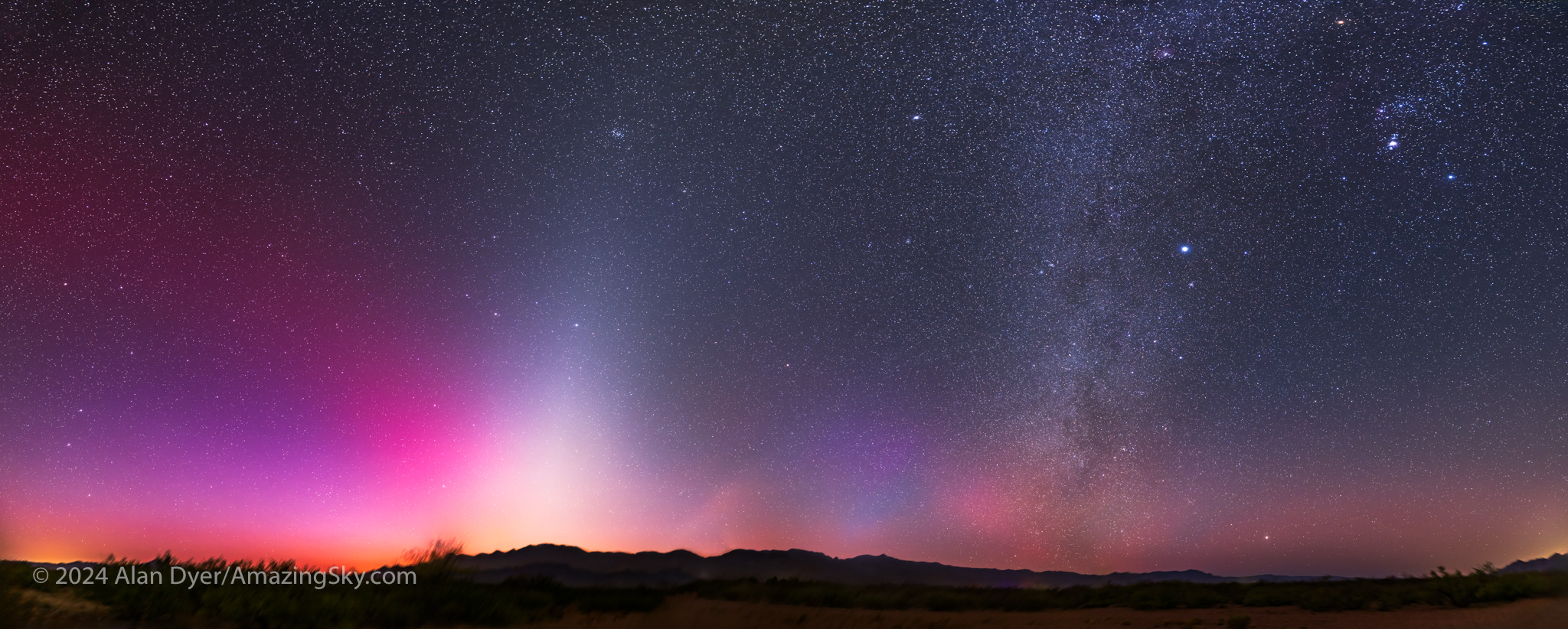
This panorama takes in a rare confluence of skyglows in a colourful dawn sky.
By dawn the next morning, now October 11, the tall Zodiacal Light was prominent alongside the magenta SAR arc to the north (left) and the winter Milky Way to the south (right). There’s even a short pillar of light that might be an aurora fragment, or the tail of the comet!
The Comet Returns
However, toward the end of my 11-night marathon of deep-sky imaging, the bright head of the comet was to be rising into the evening sky for Part 2 of its apparition. Below is a shot from the evening of October 11, my last at Quailway. Yes, there it was, just above the Chiricahua Mountains. But it was a blip, barely visible in binoculars and to the camera. I had hoped for more.
This is Comet Tsuchinshan-ATLAS (C/2023 A3) at far right, barely visible emerging into the evening sky and low in the twilight, on October 11, 2024. This view includes Venus at left. Venus was obvious; the comet was not!
With the Moon now waxing into the evening sky, my plan was to head back north, stopping at scenic spots on the trip home, to catch the comet over moonlit landscapes to the west in the dusk sky.
My first two nights, October 12 and 13, at the VLA Radio Observatory near Socorro, New Mexico, then farther north near Canyon de Chelly, Arizona, were both beset by clouds to the west. From images posted on-line, I knew the comet was improving. But it was eluding me.
October 14 & 15 — at Arches National Park, Utah
The next stop was Arches National Park in Utah, which I last visited in April 2015. The first night’s forecast for October 14 also looked to be cloudy. But October 15 was supposed to be clear. So I extended my stay by an extra night, thinking that might be my only chance.
As it turned out October 14 was fabulous (below). The comet was easily visible to the unaided eye as a classic comet in the west. I pointed it out to folks walking by at the Windows Arches area. And I could hear other people commenting on it. At last a comet! One that anyone could see — though it helped to be at a clear sky site like Arches.
Comet Tsuchinshan-ATLAS at its finest in the evening sky, two days after its closest approach to Earth, and with it sporting a 10º- to 15º-long dust tail, and a narrow anti-tail pointed toward the horizon.
By then the Moon was well advanced in age to a bright gibbous phase, so the sky was by no means dark. It was deep blue in photos.
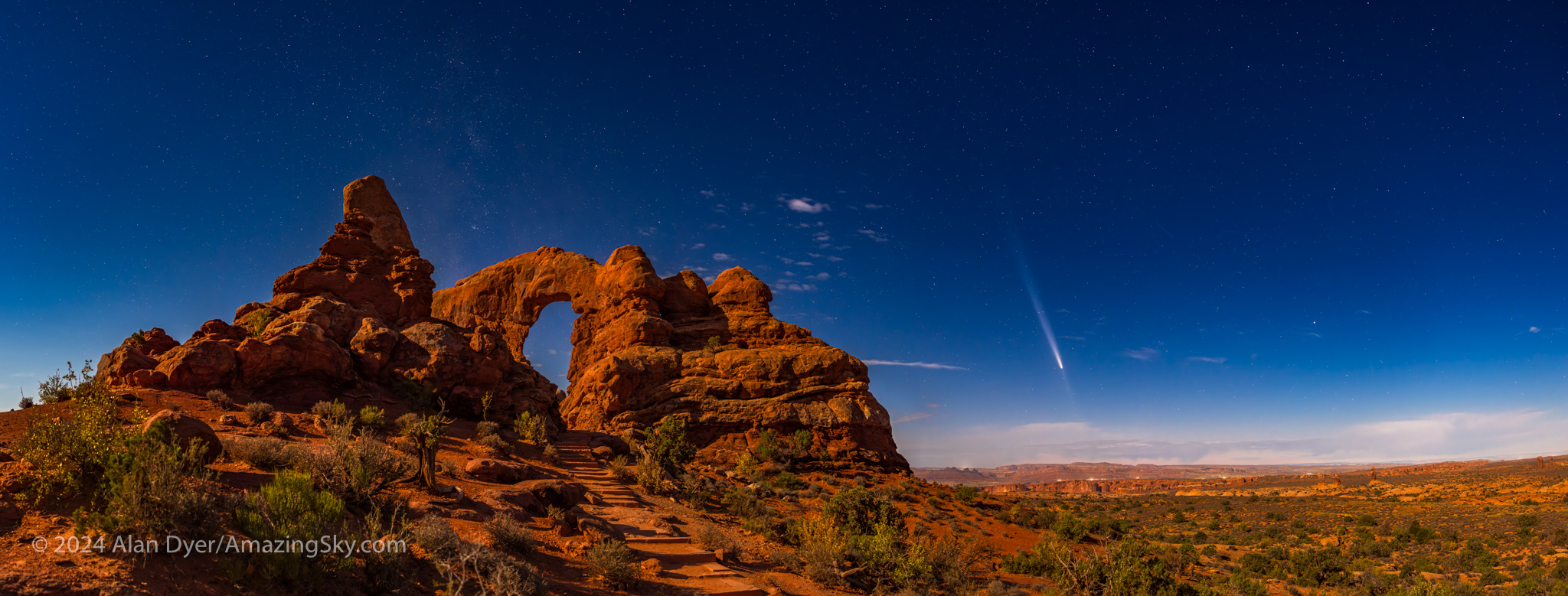
Still the comet showed up brilliantly; it had blossomed a lot in a couple of nights. Above, I framed it beside moonlit Turret Arch.
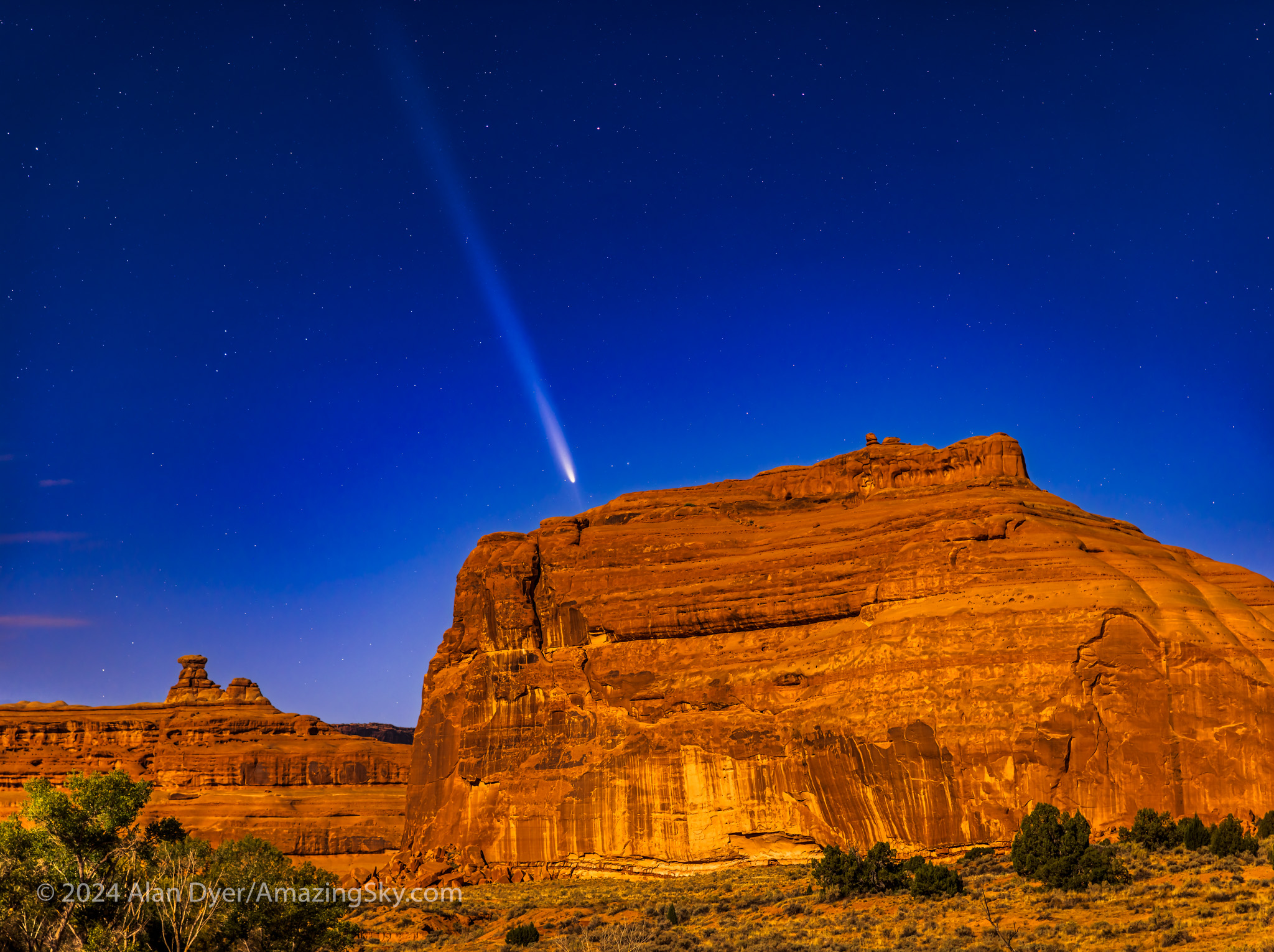
Below is a scene from the next night, October 15, my “back-up” night. The comet was certainly performing well after all. Even in the moonlight. In binoculars the tail stretched for the same length as the camera recorded it, some 15°.
This is a telephoto close-up Comet Tsuchinshan-ATLAS over the red rocks of Arches National Park, Utah, on a superb moonlit night, October 15, 2024.
Indeed, that was my last view of the comet for a while, as clouds prevented any more shooting on the rest of my journey north through Idaho and Montana. I even hit a snowstorm in southern Montana.
Late October — Back at Home in Alberta
But the comet was not done yet! Through October, while it receded from us in distance, it climbed higher into our sky, placing it into a dark sky with the Moon now out of the way.
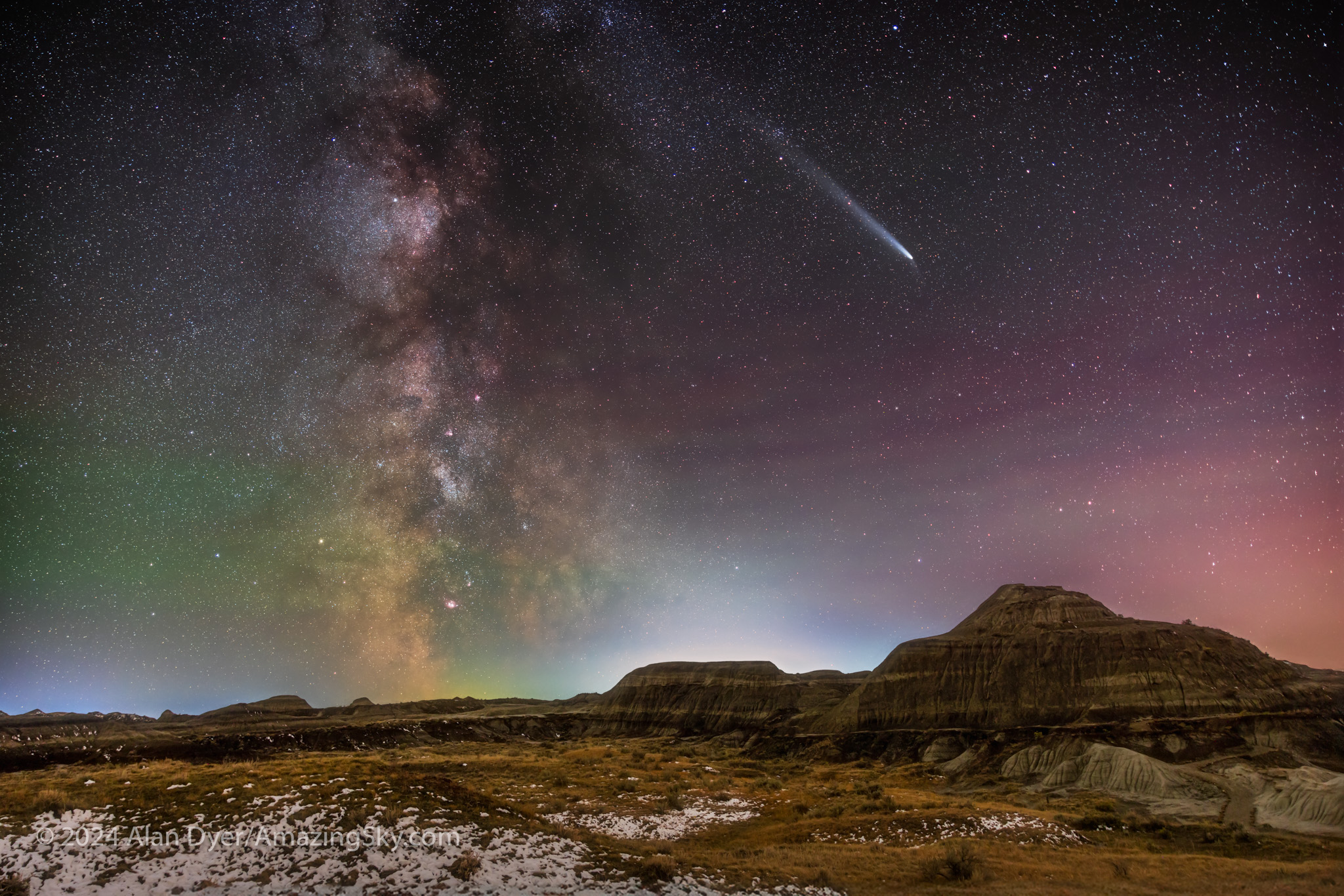
This is Comet Tsuchinshan-ATLAS in a wide-angle nightscape scene over the Badlands of Dinosaur Provincial Park, Alberta, on October 23, 2024.
On October 23, a short trip out to Dinosaur Provincial Park east of home allowed me to shoot the comet over the Alberta Badlands landscape, beside the setting summer Milky Way.
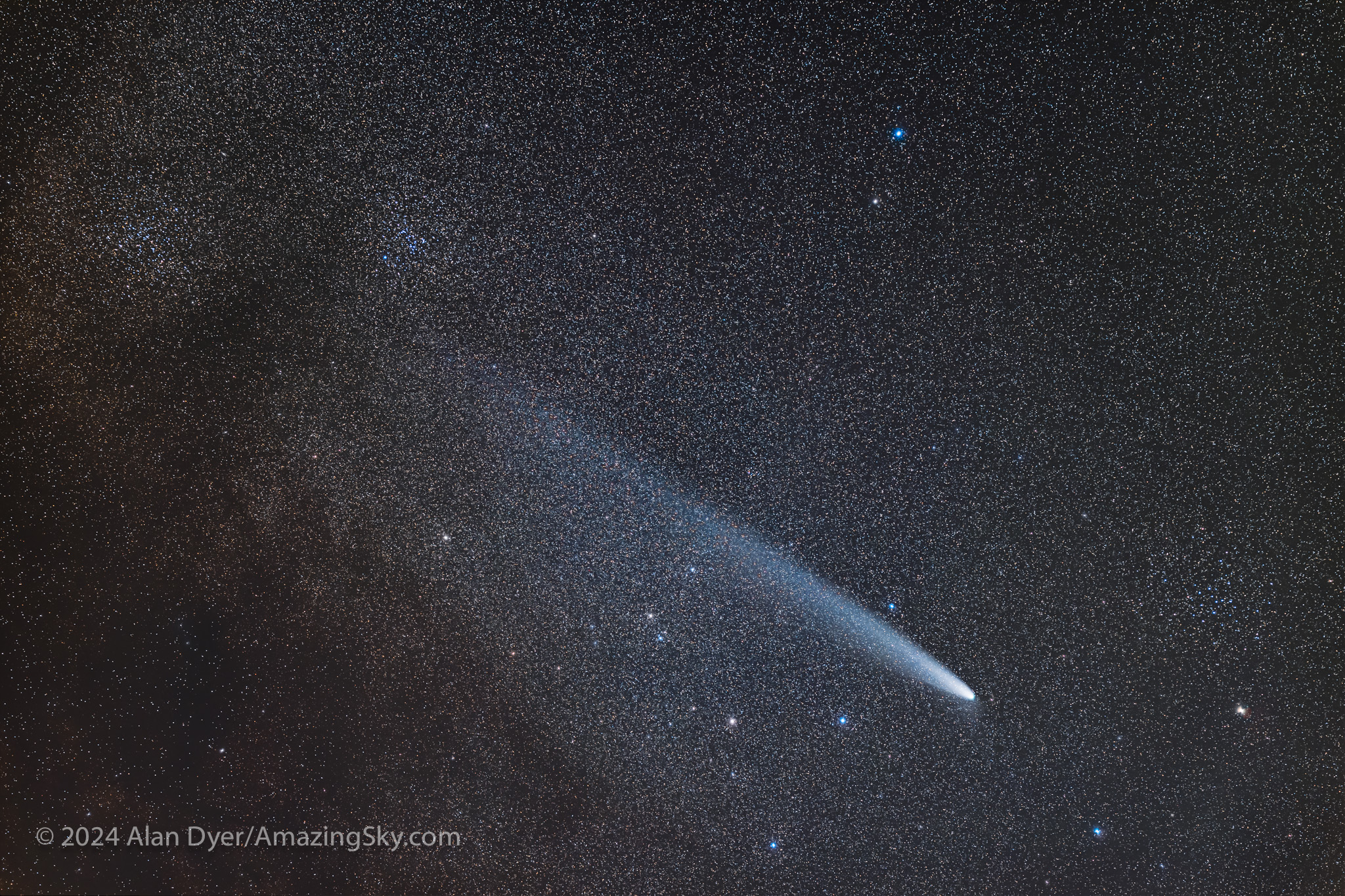
This is a telephoto lens framing of Comet Tsuchinshan-ATLAS in Ophiuchus on the night of October 30, 2024 near several large star clusters. The field of view is 15º by 10º so the tail extends for about 6º to 8º.
By a week later, on October 30, the comet had diminished in size and brightness, but still looked like a classic comet, here framed in a telephoto close-up as it passed near some bright star clusters. This was from my front yard. The chase was over.
Clouds and a trip to Norway starting November 4 prevented more opportunities to shoot the comet. (My travel schedule also kept me from writing this blog until now!)
It had been a good chase over a month, yielding images I was happy with. The photos from Utah and Arizona I could not have taken at home, even if the skies had been clear during the comet’s prime-time. (They weren’t!) And it was great to finally get back to my favourite haunts in southern Arizona and New Mexico after an absence of seven years.
In all, Comet Tsuchinshan-ATLAS provided a fine finale to what has been a superb year of stargazing events and celestial sights.
The new star tracker from Move Shoot Move improves upon their original model, eliminating its flaws to provide a reliable and compact tracker.
A few years ago the start-up company Move Shoot Move (MSM) introduced a low-cost (about $250), compact star tracker they called the Rotator. Like all other star trackers, the Rotator allowed a camera to follow the turning sky for untrailed, pinpoint stars in long exposures.
Trackers are essential for rich Milky Way images, and are great for nightscapes, for shooting the sky, blended with untracked shots of the ground, as I show in examples below.
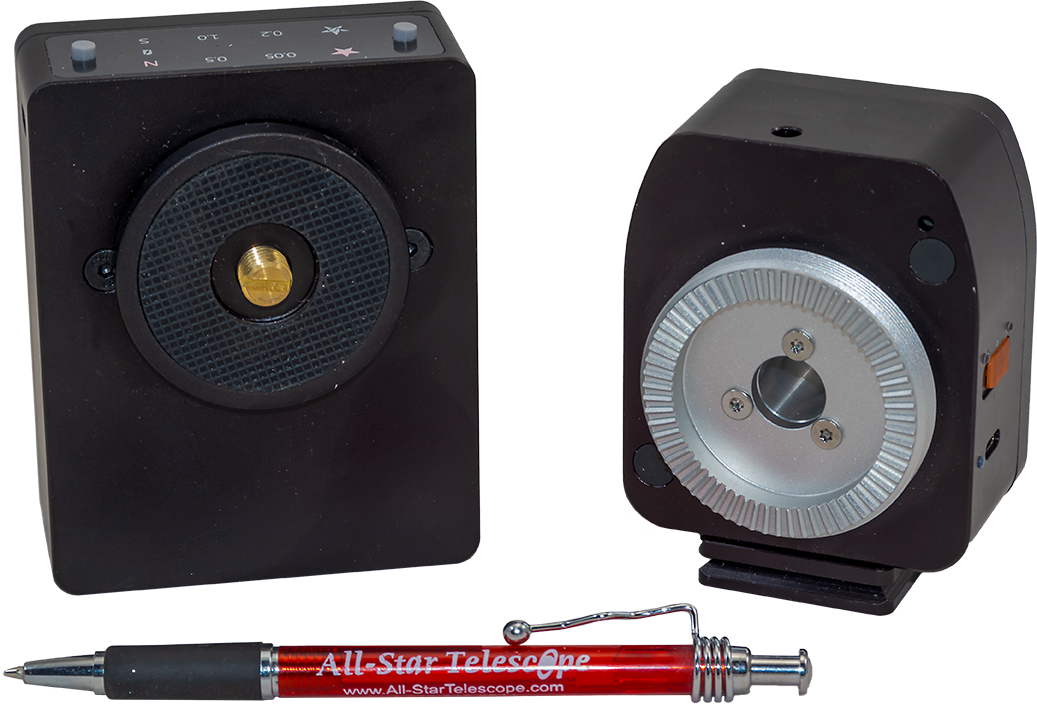
The original Rotator (L) and new Nomad (R). The Nomad is even smaller than the Rotator.
Out with the Old …
The original Rotator went through a couple of design changes during its lifetime. I tested the last versions to be marketed, using three different sample units I either purchased or were sent to me by MSM. (My reviews appeared in 2019 on my blog here, and in the June 2021 issue of Sky & Telescope magazine.)
The bottom line is that I found all the samples of the Rotator I tested to be unreliable for accurate tracking, indeed for tracking period, as units would sometimes not start tracking for a few minutes, or just stop tracking mid-shoot and then restart intermittently. Getting a set of untrailed exposures was a hit or miss affair.
But with a cost lower than most other trackers on the market (ostensibly, as explained below), a pocketable compact size, and with endorsements from notable nightscape photographers, the original Rotator garnered a loyal following of fans. I was not one of them.
MSM obviously recognized the design flaws of the Rotator, because in early 2024 they replaced it with an all-new model, dubbed the Nomad. It works!
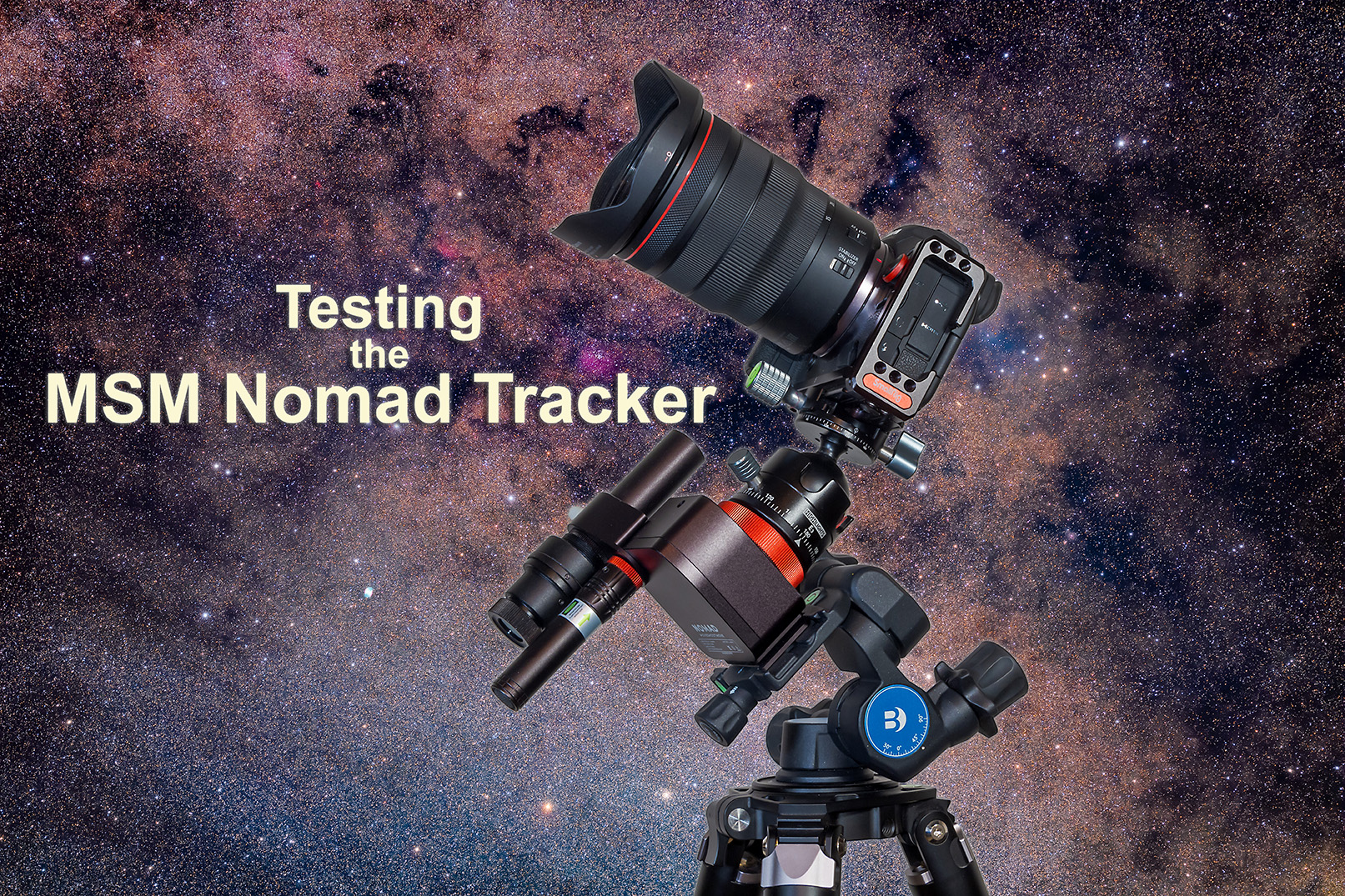
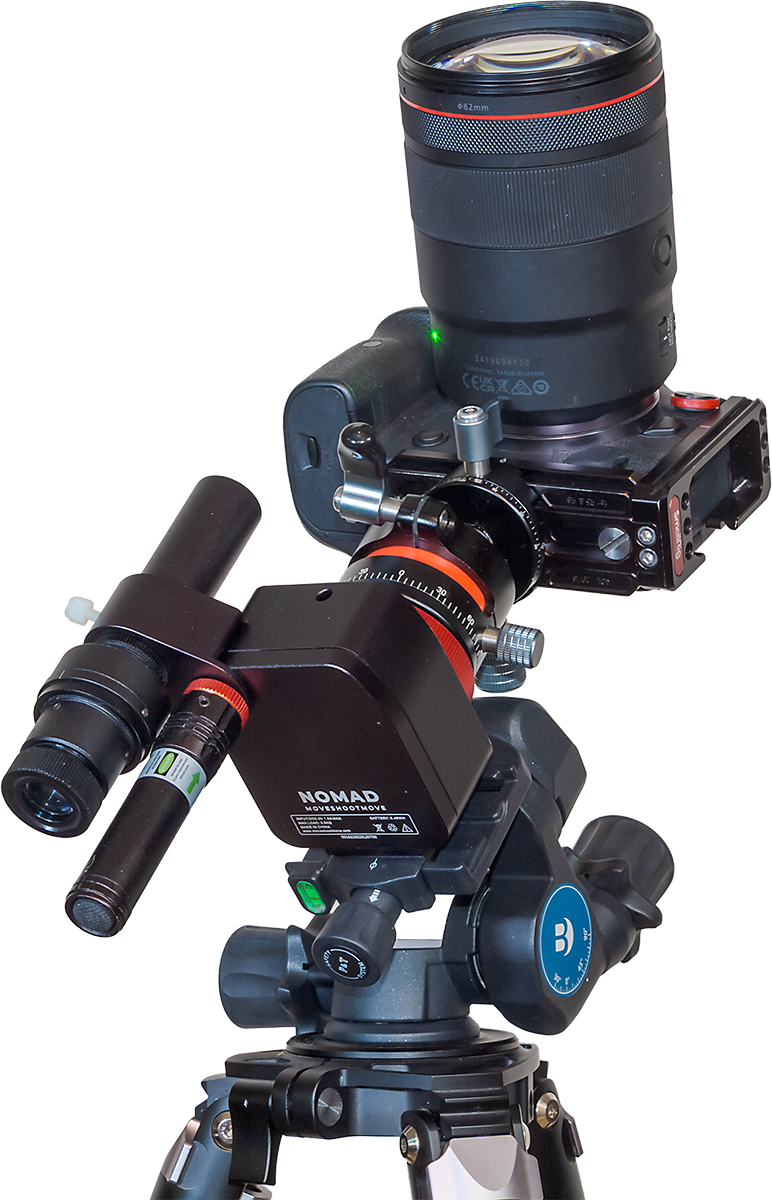
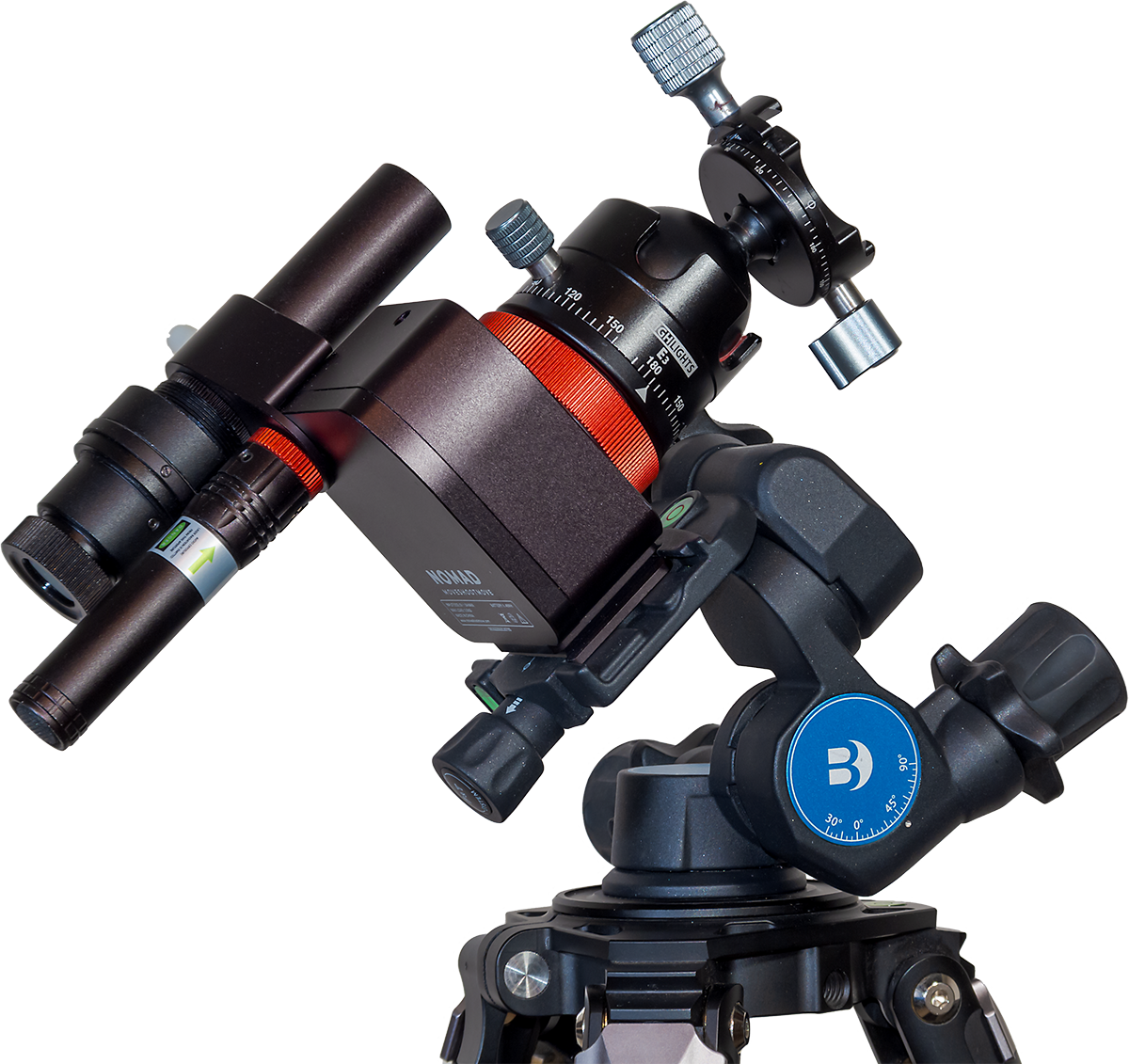
The Nomad on the Benro 3-Way Head, with Laser and Polar Scope, and with a camera and 135mm lens. The ball head is not one from MSM.
I purchased a unit in January 2024 when the Nomad came out, and have used it extensively and successfully over the last few months. I found it has addressed all the serious flaws of the Rotator.
Polar Alignment Accessories
With a weight of about 400 grams, the Nomad is about 70 grams lighter than the old Rotator. It is one of the lightest and smallest trackers on the market, a benefit for those wanting to hike to remote nightscape sites, or pack gear for airline travel. (I took my Nomad to Australia this year; one result is below, shot with the Nomad.)
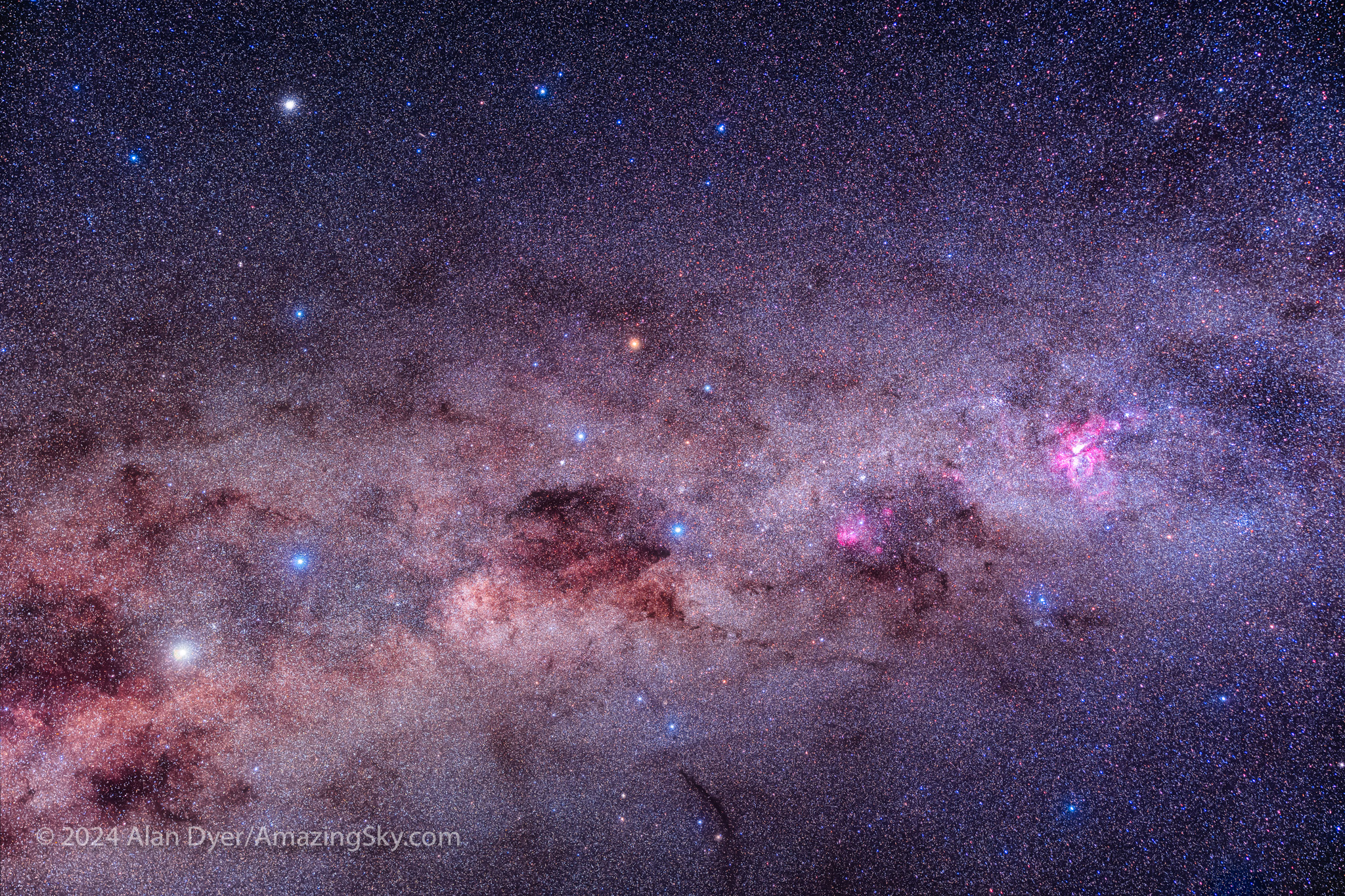
This frames the spectacular area of the southern Milky Way from Centaurus at left, to Carina at right, with Crux, the Southern Cross, at centre. This is a stack of 8 x 4-minute exposures with the Canon RF28-70mm lens at 48mm and f/2.8, on the Canon Ra at ISO 800. All on the MSM Nomad tracker.
However, unlike the popular Star Adventurer 2i and Mini trackers from Sky-Watcher, the Nomad, like MSM’s older Rotator, does not have a polar alignment scope built in, just a peep sight hole. That makes it easier for MSM to fit a tracker inside a compact box.
And yet, I feel some form of polar alignment aid (not just a peep sight) is essential if a tracker is to follow the sky accurately. Like the Rotator, the Nomad can be purchased with two add-on choices (shown below):
• a 5 mw green laser pointer,
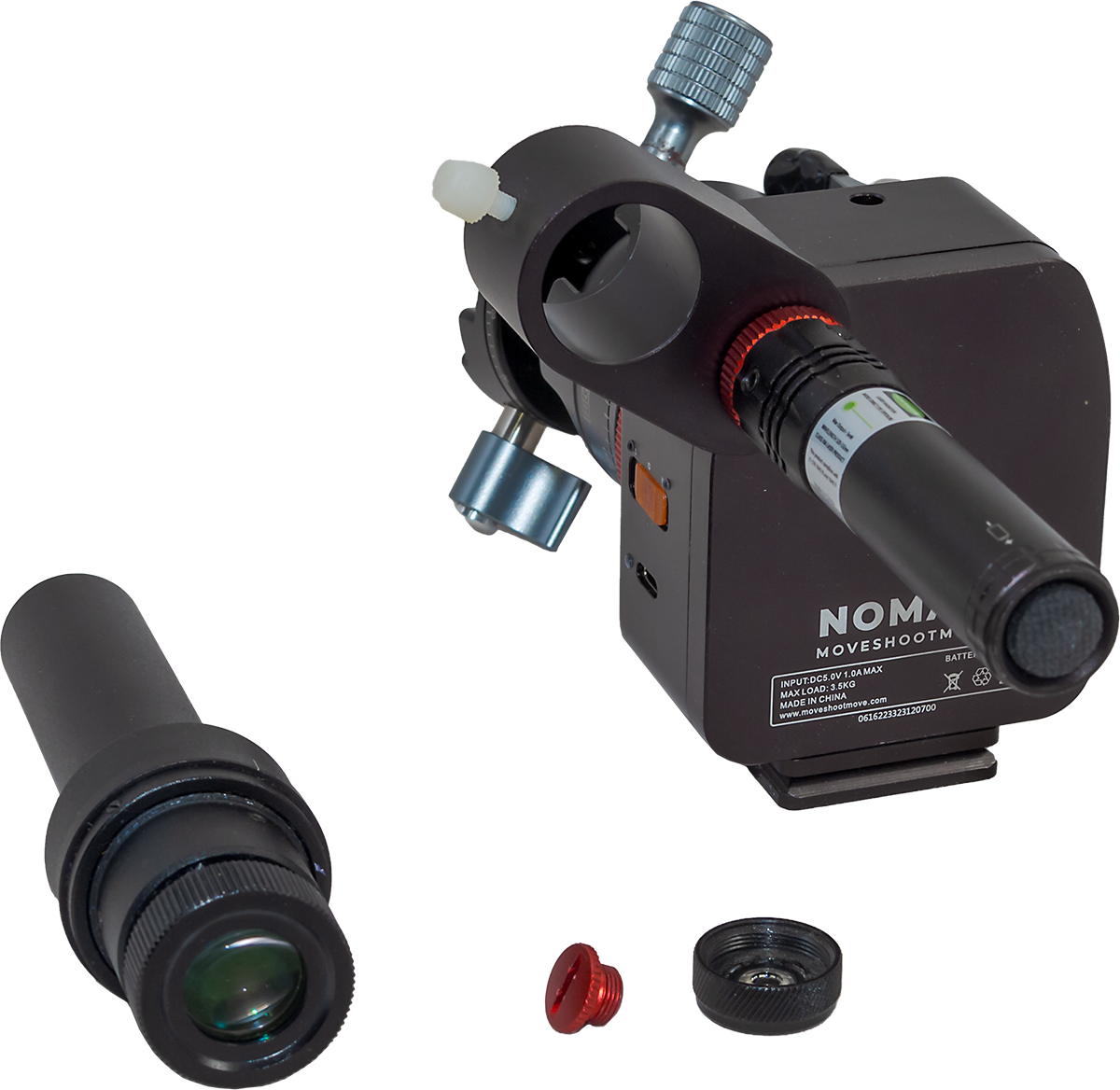
• and an optical polar scope …
… each of which attaches to the side of the Nomad as outboard accessories. I purchased both, bundled with the Nomad as “Basic Kit C” for $309 U.S., and find both accessories useful.
NOTE: When shopping at the MSM website don’t be fooled by what looks like temporary sale prices. The prices are always marked down, though MSM does offer coupon codes now and then for genuine discounts. I’ve always found MSM’s delivery by parcel post prompt, and in my case, shipments came from a warehouse in Canada, not China.
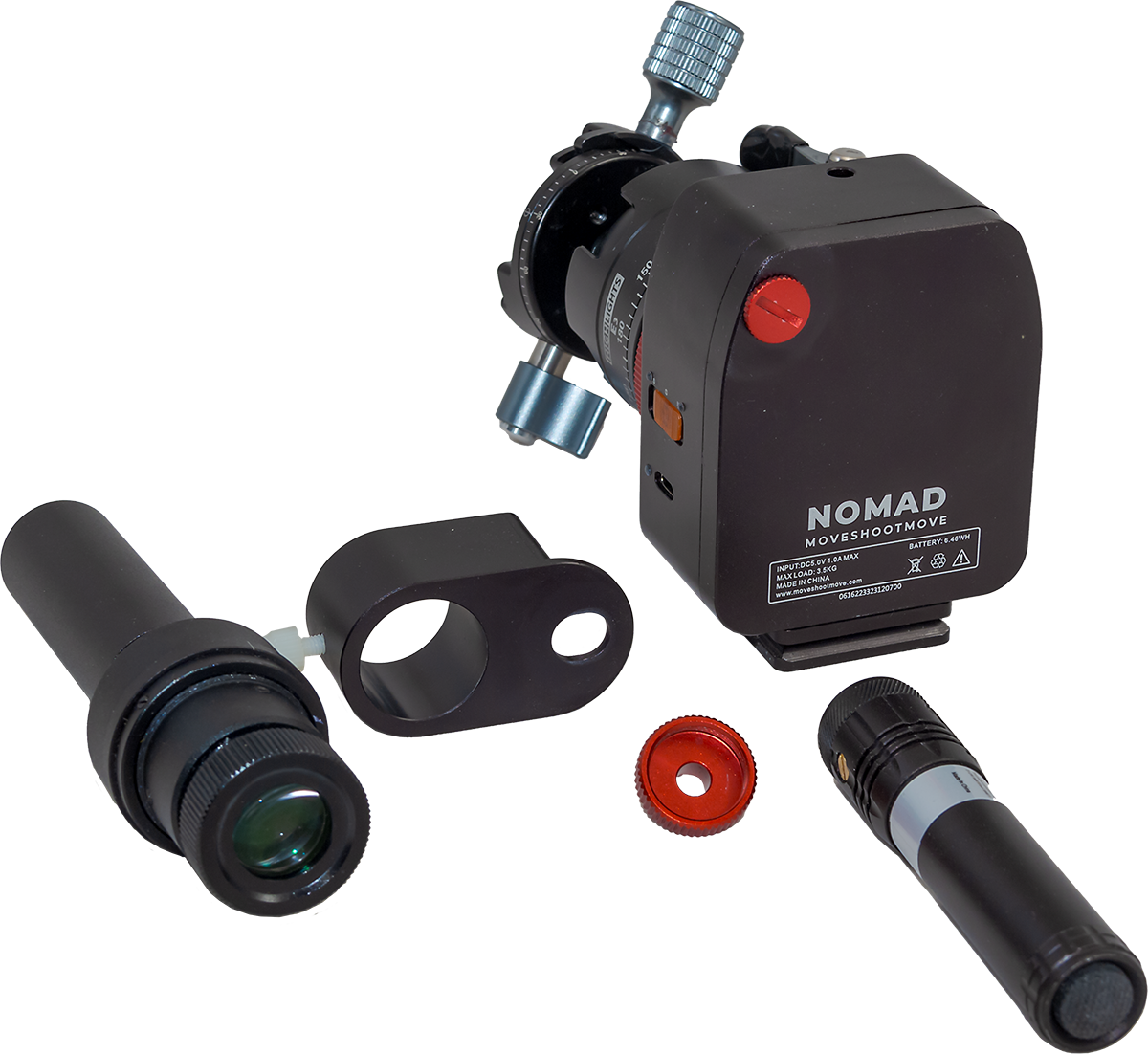
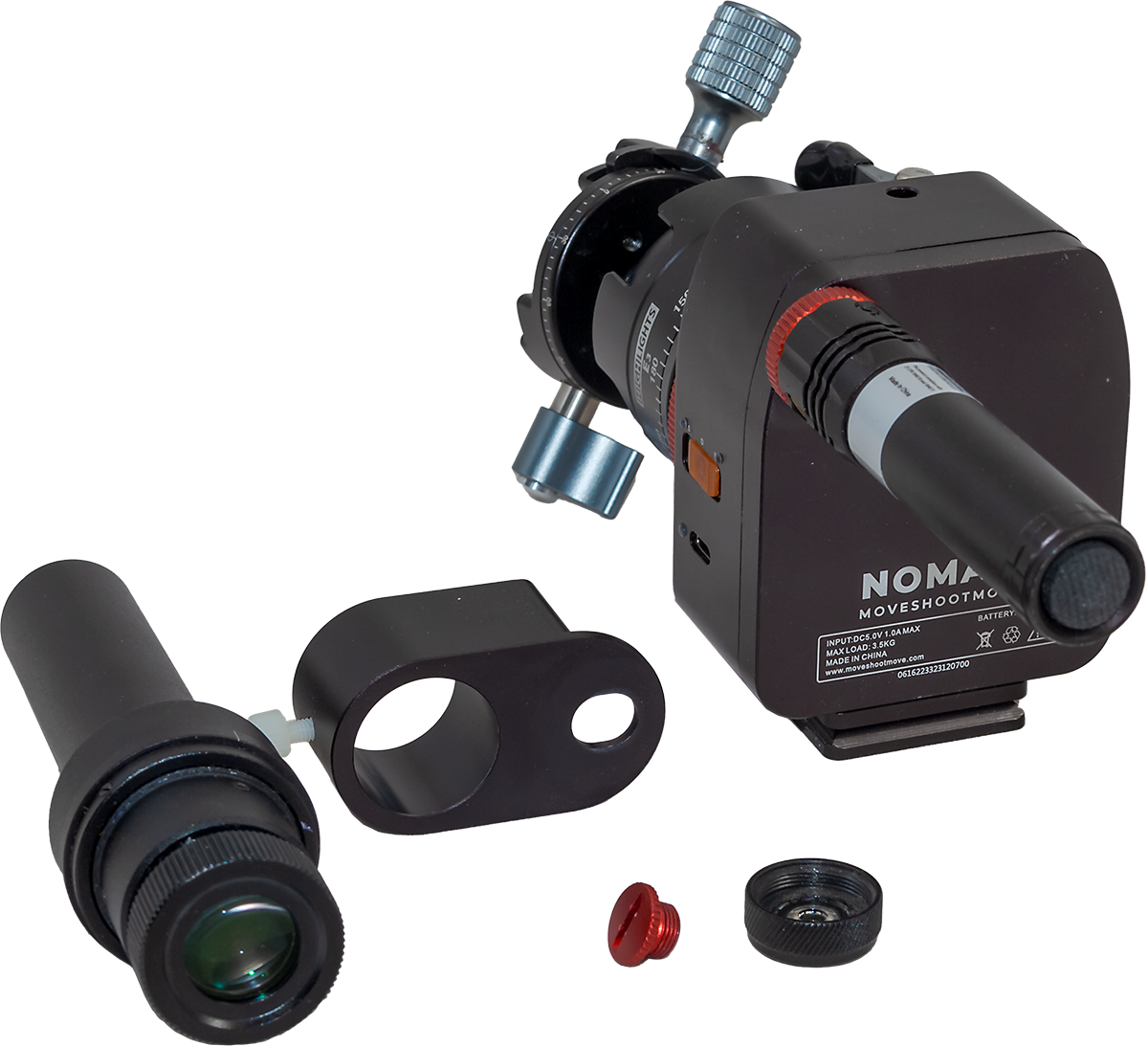
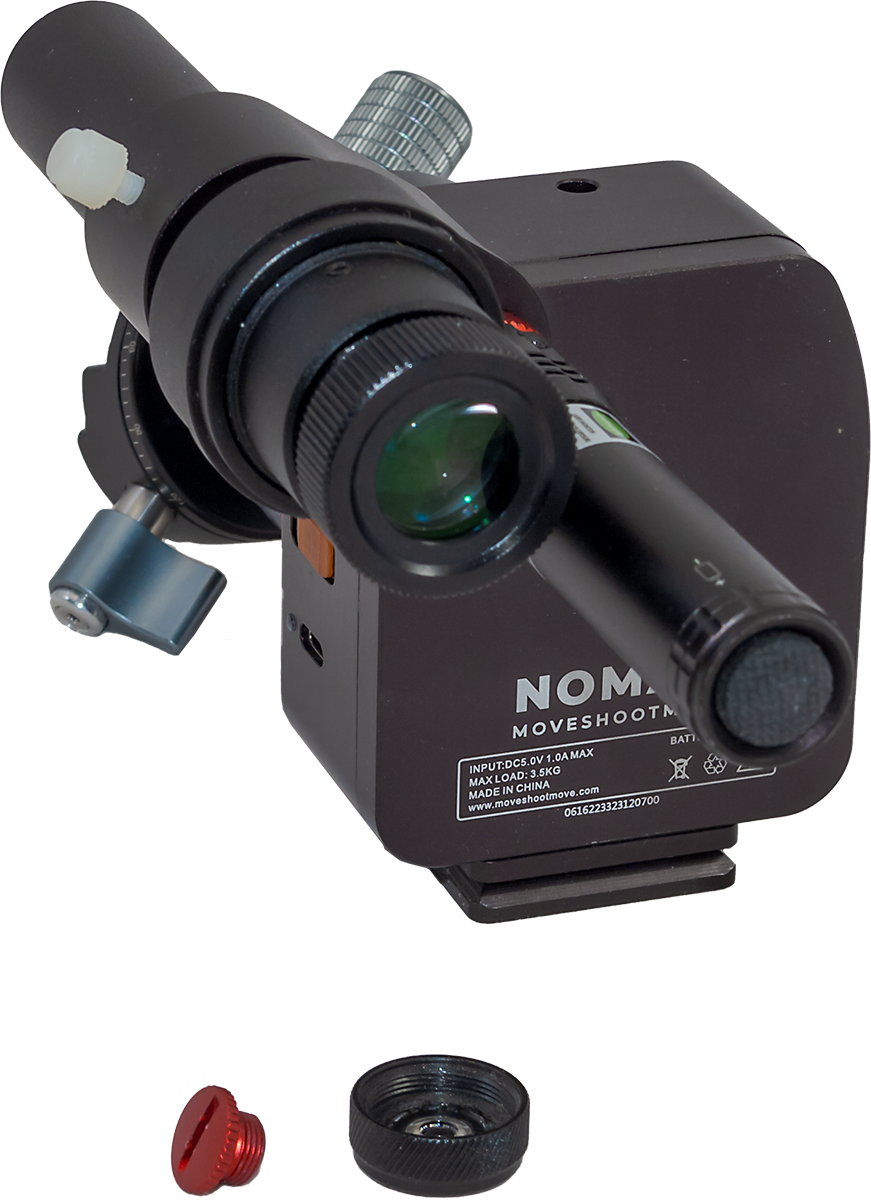
The Laser and Polar Scope as they come suppliedWith the Laser threaded on using the red capWith the Polar Scope clamp attachedWith both the Polar Scope and Laser attached. Don’t lose the caps at bottom!
As with the Rotator, the need to add essential accessories makes the Nomad more expensive and more complex to pack than buyers might think. And it can be more complex to initially set up than imagined, not helped by the lack of any instructions. (I’m told by MSM that a downloadable PDF sheet is being prepared.) In place of factory-supplied instructions, MSM depends on its YouTuber fans to provide tutorials.
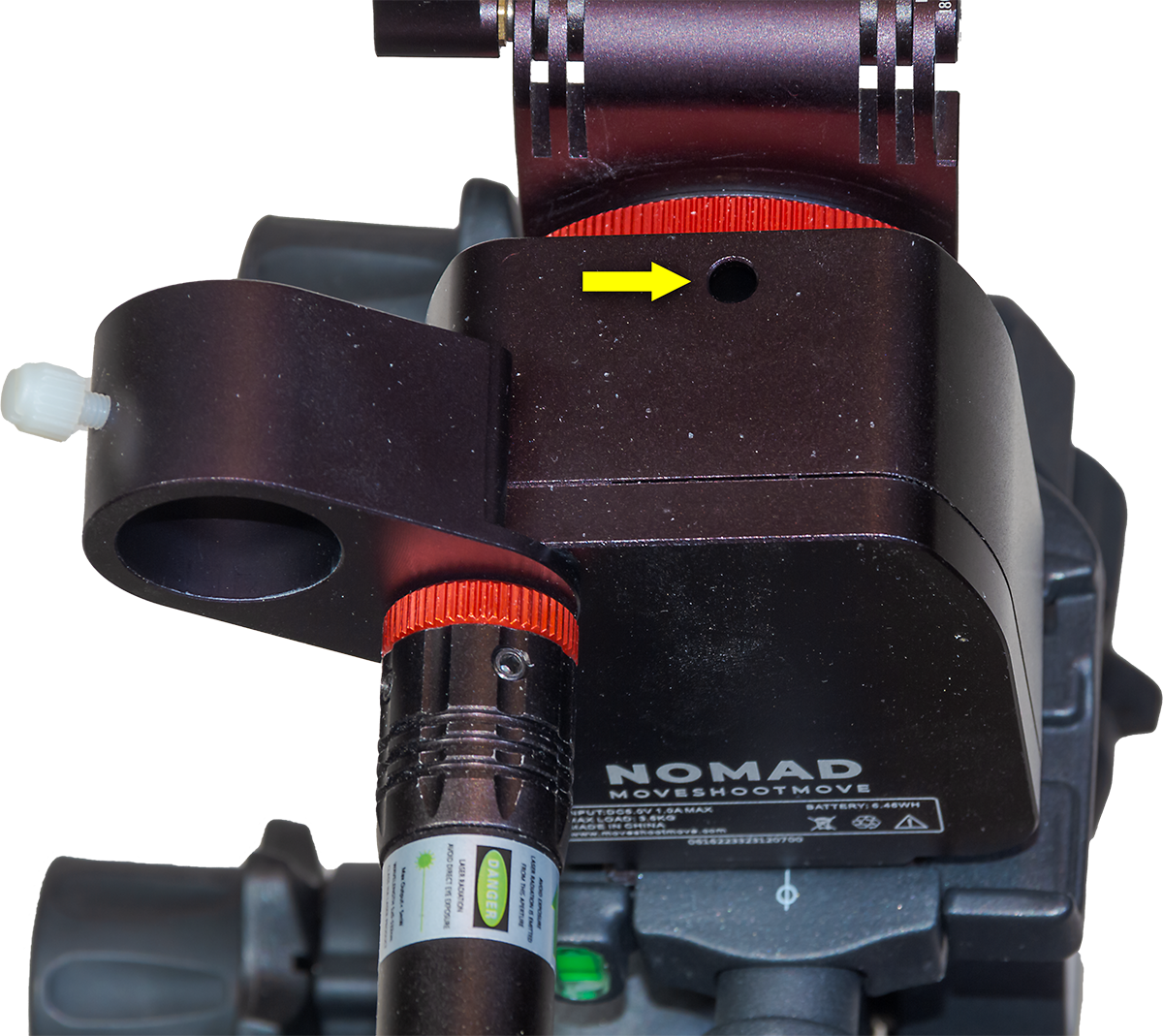
It took me a moment to figure out how the laser attaches to the Nomad — it does so by replacing the black cap that comes on the laser with a supplied threaded red cap, so the laser can screw into the peep hole on the Nomad’s body that is covered by yet another cap you remove — but don’t lose it, as you might need it.
The optical polar scope attaches by way of an included clamp held onto the Nomad by the laser, or by the removable threaded cap (so you will need it if you aren’t using the laser, but it is easily lost).
Out of the box I found I had to adjust the beam of the laser (using the two tiny set screws on the laser) so the beam exited straight out the laser and up the peep hole in the Nomad’s case.
Once collimated, the laser pointer has proved to be an accurate and convenient way to polar align, especially for shooting with wide-angle lenses. (Keep in mind, green laser pointers over 1 mw are illegal in some jurisdictions.)
The laser uses a removable and rechargeable 3.7-volt battery, and comes with a little USB-powered charger. The laser’s battery has lasted for months of momentary use. The laser works briefly in winter when it is warm, but as soon as it gets cold, as is true of most laser pointers, it refuses to lase!
This frames the small constellations of Sagitta the Arrow and Vulpecula the Fox. At lower left is the green planetary nebula Messier 27, aka the Dumbbell, shown in the close-up tracking test image below. This is a stack of 14 x 2-minute exposures with the Canon RF135mm lens on the Canon Ra, on the MSM Nomad tracker. The images were the best 14 out of a series shot to test the Nomad’s tracking.
However, for the more accurate polar alignment needed when shooting with telephoto lenses (an example is above), and for winter use, I prefer to use the optical polar scope, with the laser a handy complement just to get close to the pole.
The polar scope has a reticle etched with star patterns for both the North and South Celestial Poles. I found the latter worked well in Australia. The mounting clamp held the polar scope securely and consistently well centered, another welcome improvement over the polar scope clamp supplied with the Rotator, which could wiggle around.
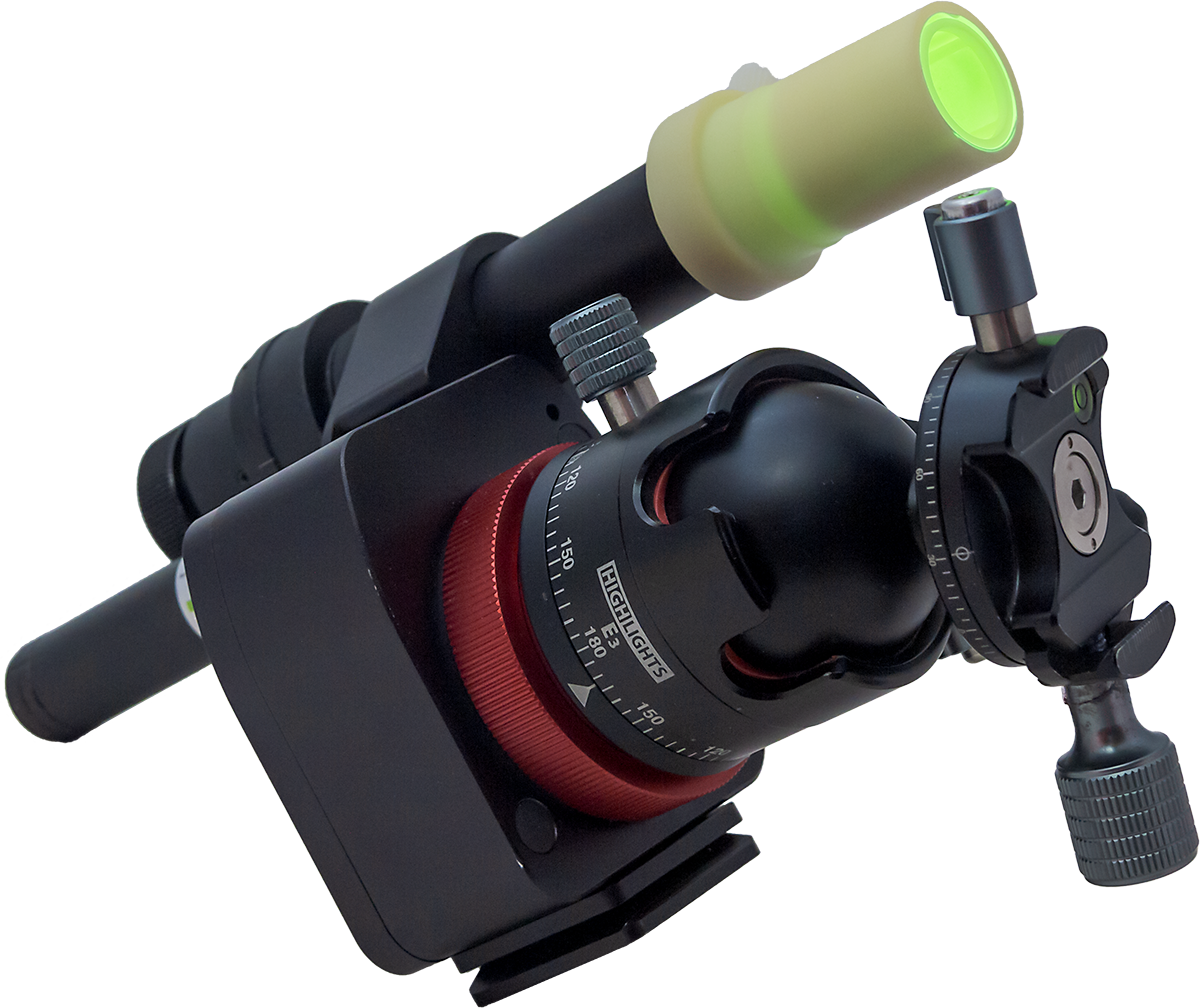
Polar scope with its glow-in-the-dark Illuminator. The Nomad comes with an Arca-Swiss dovetail plate bolted onto the bottom edge, for attaching it to a tripod head or to the optional MSM Wedge.
The polar scope does not have an illuminator LED. Instead, it comes with a novel phosphorescent cap which you hit briefly with white light so it glows in the dark.
Placed over the front of the polar scope, it lights up the field allowing the reticle to be seen in silhouette. While it works fine for sighting Polaris, the bright field can make it hard to see the faint stars in Octans around the South Celestial Pole.
The Nomad on the Benro 3-Way Geared Head, using the Arca-Swiss attachment plate. Another method of mounting the Nomad to the Benro is shown below.
To aid polar alignment I purchased the Benro 3-Way Geared Head, also sold by MSM but available from many sources. Its geared motions make it easy to aim the tracker’s rotation axis precisely at the pole and hold it there solidly.
The Benro accepts standard Arca-Swiss mounting plates, so I’ve found it a useful head to have for other purposes and gear combinations. It has replaced my old Manfrotto 410 3-axis head which uses a proprietary mounting plate.
However, MSM also sells its own latitude adjustment Wedge which, at $90, is a cheaper alternative to the $200 Benro. I’ve not used the MSM Wedge, so I can’t say how solid and precise it is. But the Wedge is lighter than the Benro head, and so may be a better choice when weight is a prime consideration.
I would recommend either the Wedge or Benro for their fine adjustments of azimuth and altitude that are essential for easy, yet precise and stable polar alignment.
Tracking Accuracy
All-important is how well the Nomad tracks. When shooting with wide-angle lenses (14mm to 35mm) for nightscapes and wide Milky Way shots, the majority of images I’ve taken over the last few months, using exposures of 1 to 3 minutes, have been reliably well tracked, with pinpoint stars.
The Nomad begins tracking right away, with no wait for gear backlash to be taken up, or for the drive mechanism to settle in. I also found no tendency for tracking to be better or worse with camera position, unlike the Rotator that seemed to work better with the camera aimed at one area of sky vs another. And the Nomad didn’t suffer from any stalls or moments when it just stopped in its tracks, again unlike the problematic Rotator.
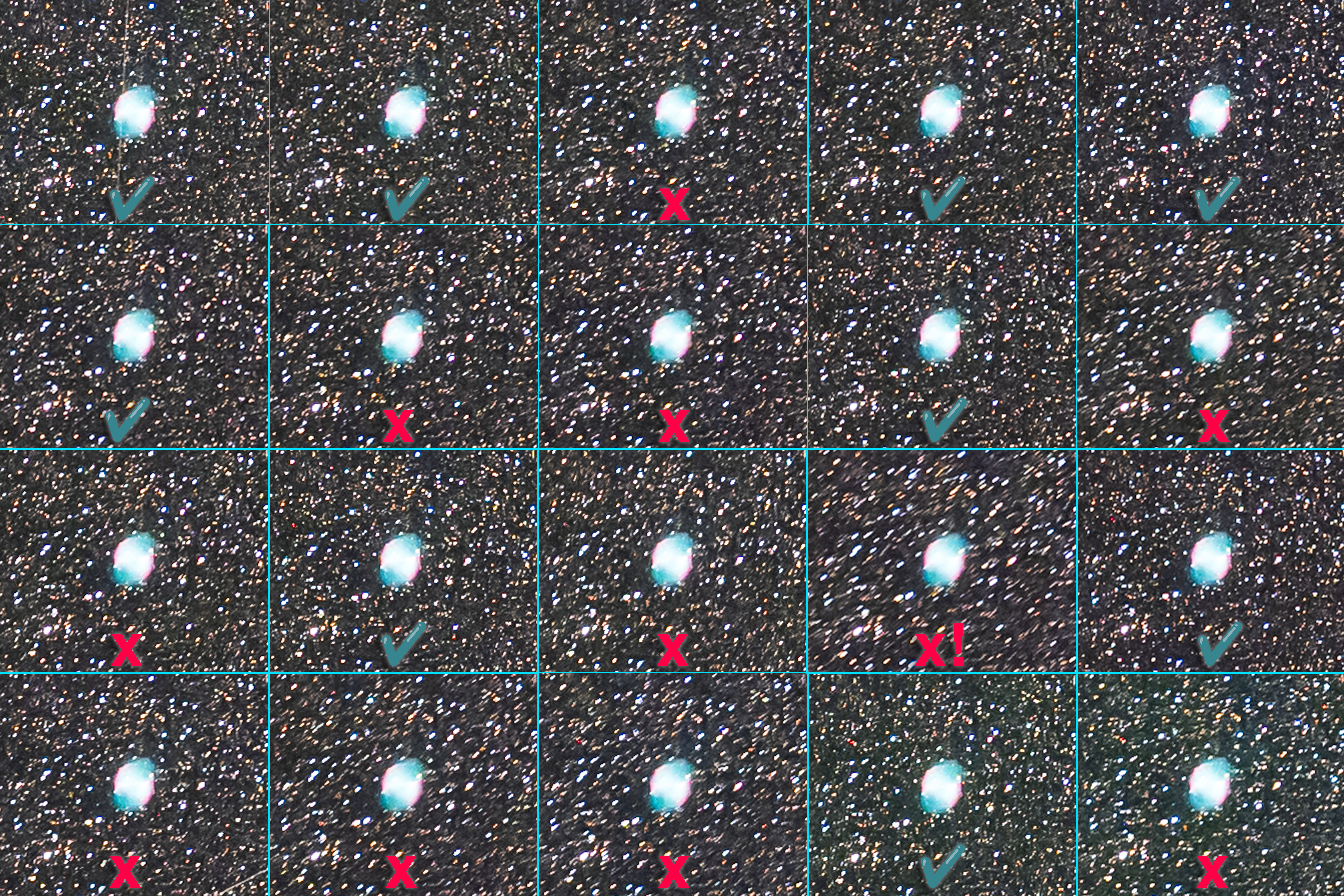
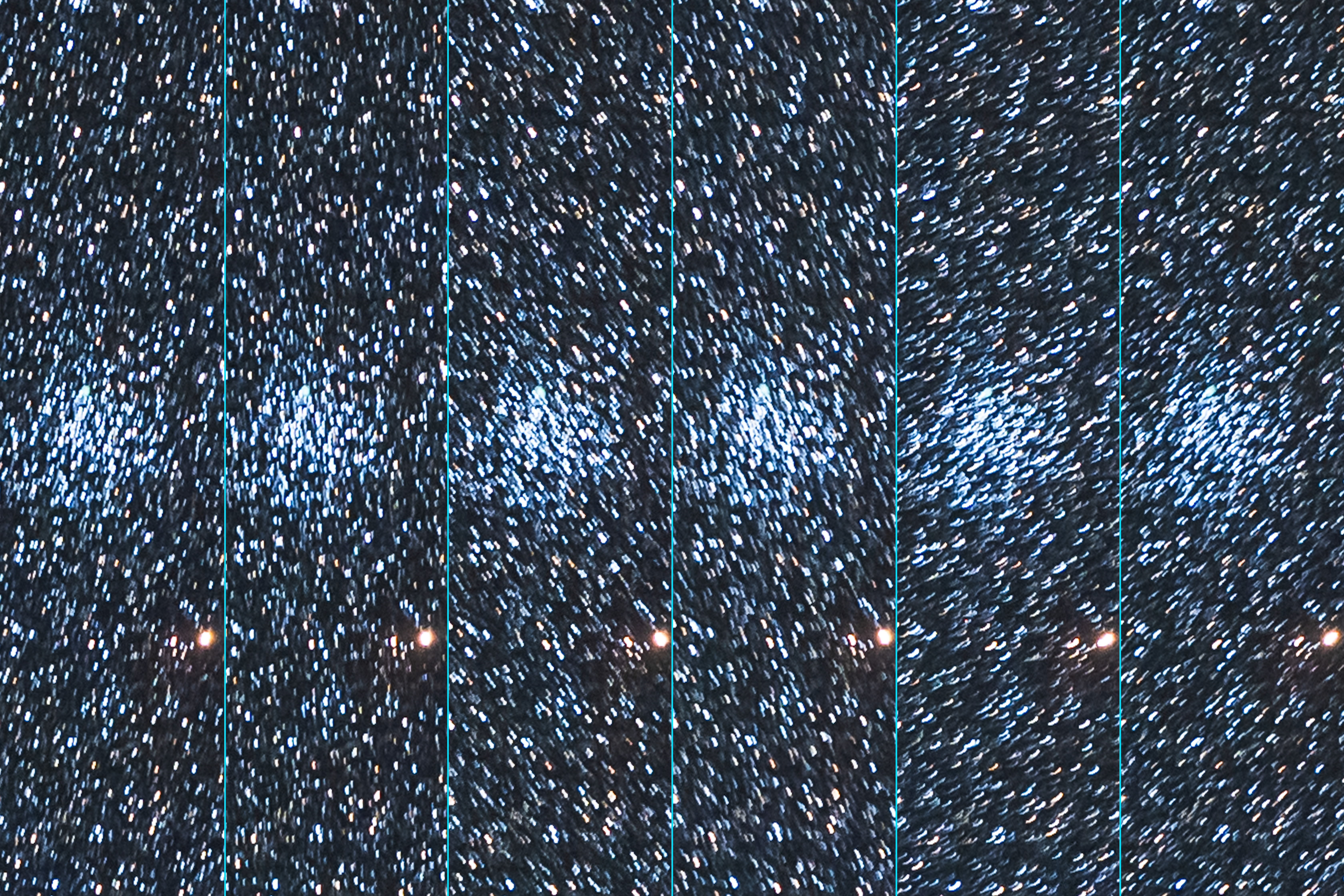
20 consecutive 2-minute exposures with a 135mm lens, to show the variations in tracking accuracy. Tap on the image to download it for closer inspection.
As with any tracker, where you do see mistracking is when using longer lenses. I tested, and indeed have used, the Nomad with 85mm and 135mm telephoto lenses, as many owners will want to do, for close-ups of Milky Way starfields and for so-called “deepscapes.” (An example of the latter is at the end.) The demo image above shows blow-ups of consecutive frames from the 135mm shoot of the Vulpecula/Sagitta starfield shown earlier.
In those more demanding tests, as I demonstrate here, I found that typically about 50% to 60% of images (taken with 1- to 2-minute exposures) were tracked well enough to be usable. The longer the focal length used, or the longer the exposures, the more frames will be trailed enough to be unusable in an image stack. And a well-tracked frame can be followed by a badly tracked one, then the next is fine again. That’s the nature of small drive gears.
As with other trackers, I would suggest that the Nomad is best used with lenses no longer than a fast 135mm. Even then, plan to shoot twice as many frames as you’ll need. Half may need to be discarded. While I know some users will want to push the Nomad beyond its limits, I would not recommend burdening it with monster telephoto lenses or small telescopes. Like all other trackers, that’s not its purpose.
When there was mistracking it was usually in the east-west direction, due to errors in the drive mechanism, and not north-south due to flexure. (If it occurs, north-south drift is likely due to poor polar alignment.)
I found the Nomad did indeed turn at the sidereal rate to follow the stars, something I was never confident the Rotator actually did.
While you might think a 50% success rate with telephotos is not good, in fact the Nomad’s tracking performance is on par with other competing trackers I’ve used, from Sky-Watcher and iOptron. At wide-angle focal lengths the success rate proved closer to 100%.
So for a tracker as compact as the Nomad to perform so well is very welcome indeed. It’s the main area where the Nomad beats the old Rotator by a long shot!
NOTE: While the MSM website mentions an “optional counterweight system,” as of my review’s publication date it is still being developed, MSM tells me. However, I don’t feel it will be necessary for the Nomad’s main purpose of wide-field imaging.
Mechanical Stability
Another flaw of the old Rotator was that it had several single-point attachments that, under the torque of a turning camera, could cause the camera to come loose and suddenly flop down.
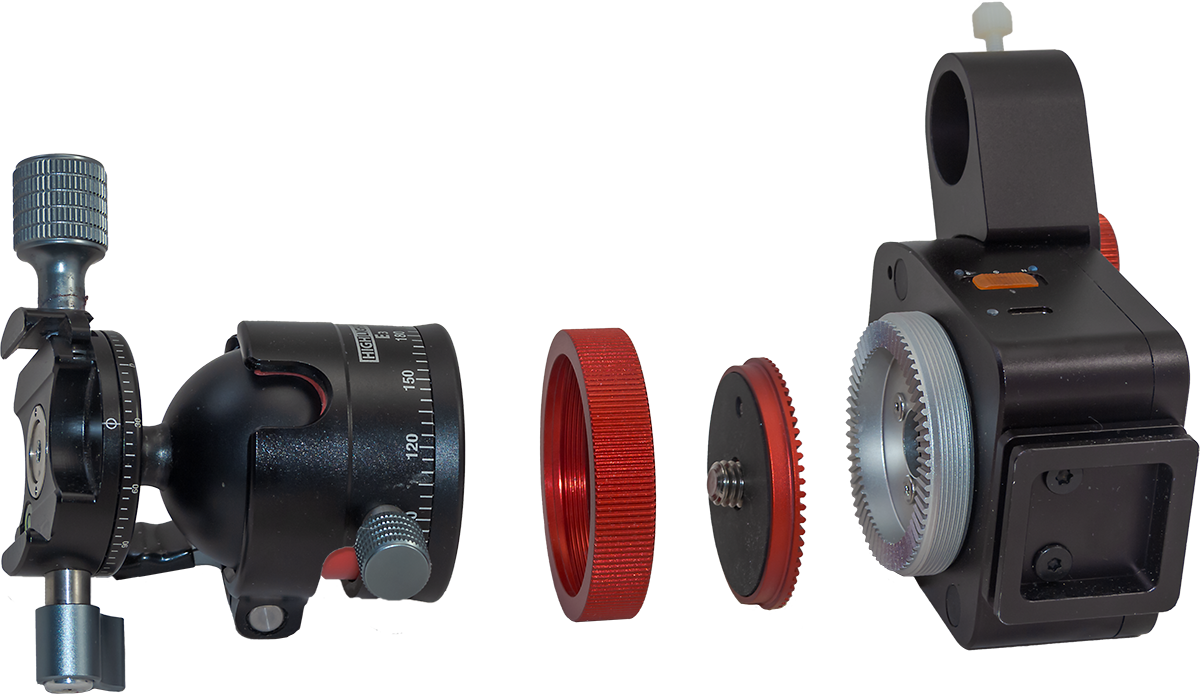
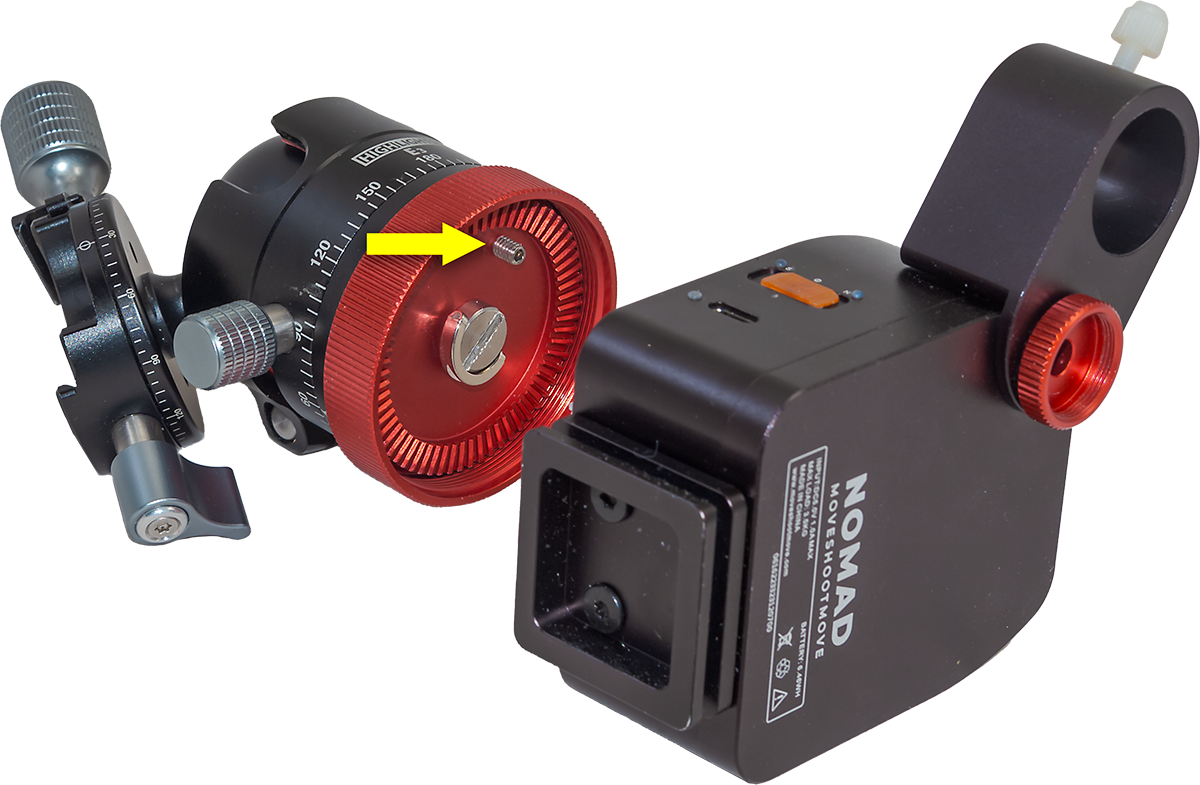
Exploded view of the ratcheted mounting plate to attach a ball head to the NomadShowing the set screw to prevent the ball head coming loose
The Nomad uses a ratcheted clamp to attach a user-supplied ball head to the tracker body, and that clamp has an additional safety set screw to help ensure the ball head does not unscrew itself as a camera turns.
I’ve had no issues with cameras coming loose. Of course, the solidness of the ball head used will be critical as well. A large ball head can be better, but introduce some of the issues I report on below.
While MSM offers its own ball head, I have not used it, preferring to use a couple of other ball and pano heads I like, and that I show in the images here.
Simplicity of Operation
The Nomad improves upon the old Rotator by doing away with all its time-lapse features. You might think that eliminating features can’t be an improvement, but in this case it is.
I suspect few owners used the Rotator’s preset functions for slowly turning a camera along the horizon while firing the camera shutter between each incremental time-lapse move (the very function that gave the company its name!). The Rotator’s options for creating time-lapses were confusing to set up and limited in their choice of speeds. A serious time-lapse photographer would never use it.
(If you do want a tracker with time-lapse motion-control capabilities the Star Adventurer Mini works well. Its WiFi connection and mobile app allows a user to set all the factors needed for a good time-lapse: interval, angle increment, number of frames, and length of shoot.)
Instead, MSM has focused the Nomad on being just a star tracker, and I think wisely so. Its only controls are a three-position S-OFF-N switch, for using the Nomad in either the southern or northern hemisphere. It worked very well “Down Under,” with the exception noted below.
There is no solar or lunar drive rate, unnecessary in a tracker, and also no half-speed rate for nightscapes, used to lessen star trailing while also minimizing ground blurring. I’ve never liked using trackers at such a compromise half-speed rate, so I don’t miss it.
Using the optional V-Plate described below, I have used the Nomad to take tracked Milky Way panoramas, as shown here. It has worked very well for that purpose, with it easy to switch the tracking on (for the sky) and off (for the ground).
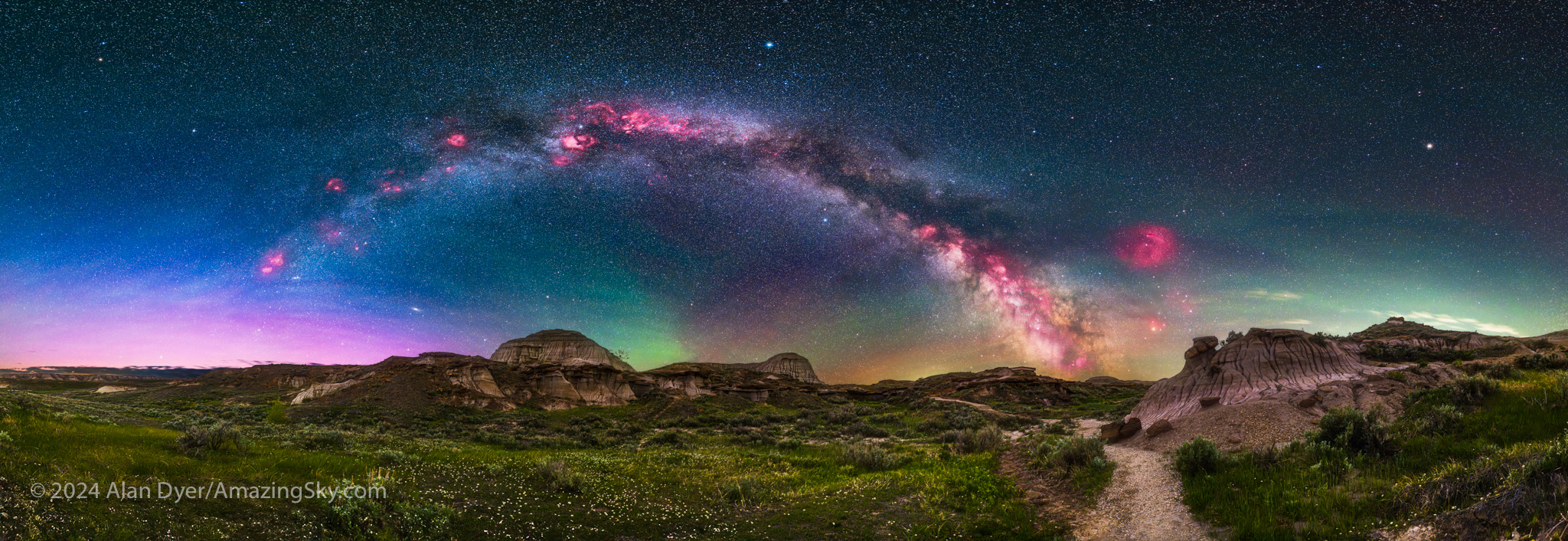
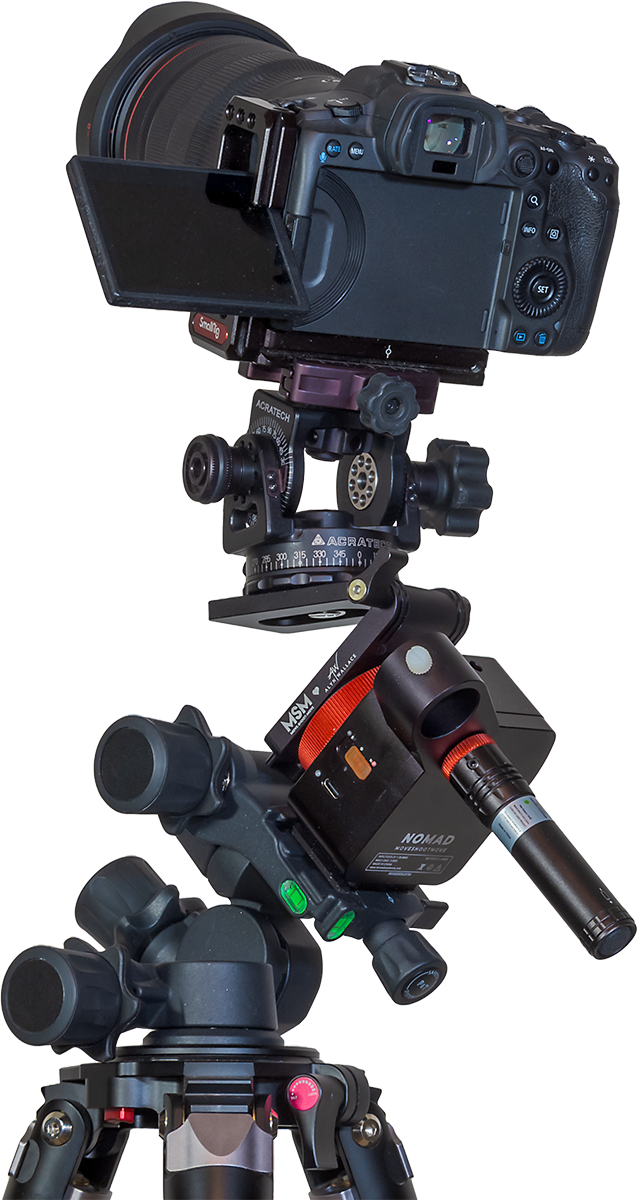
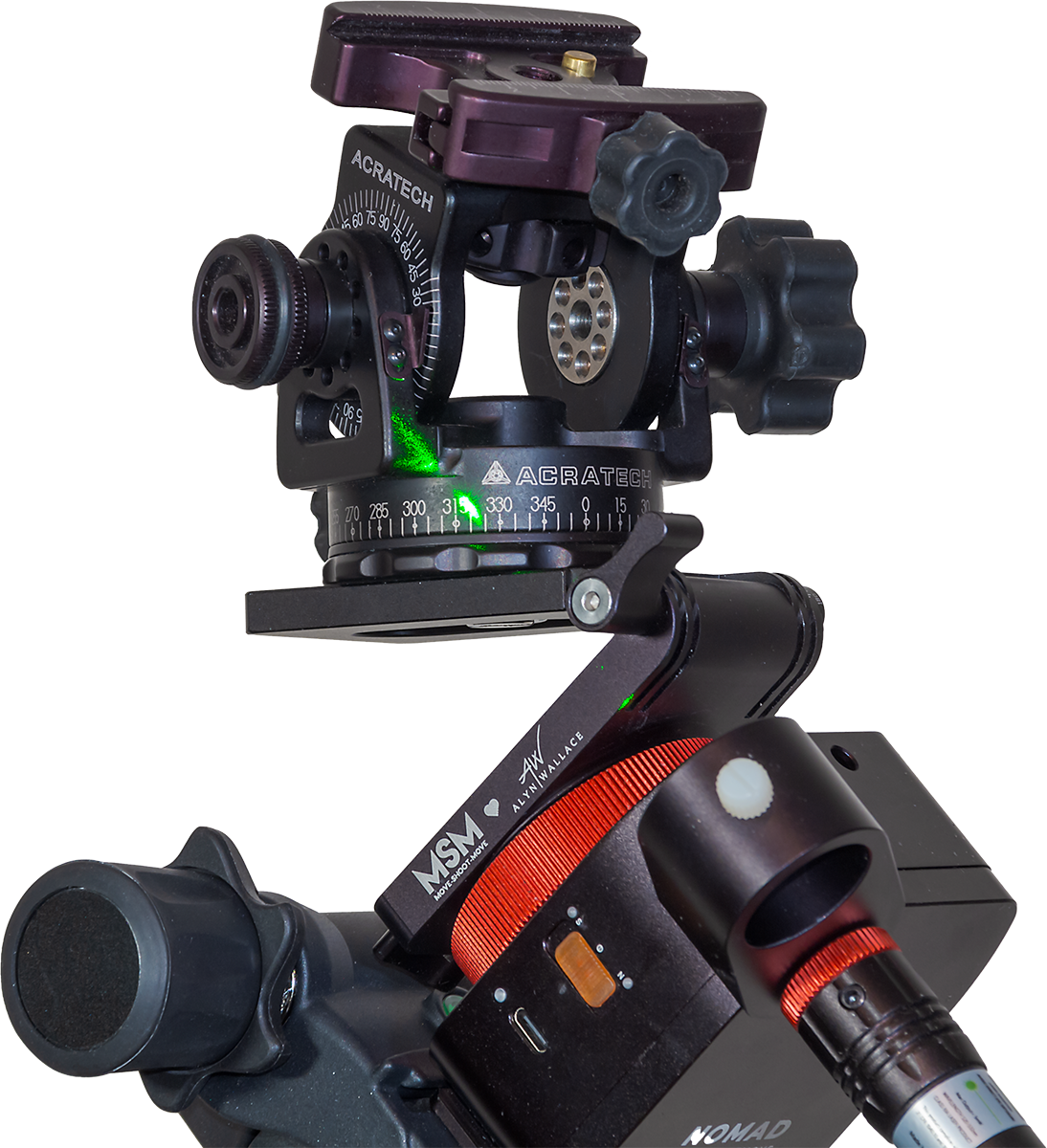
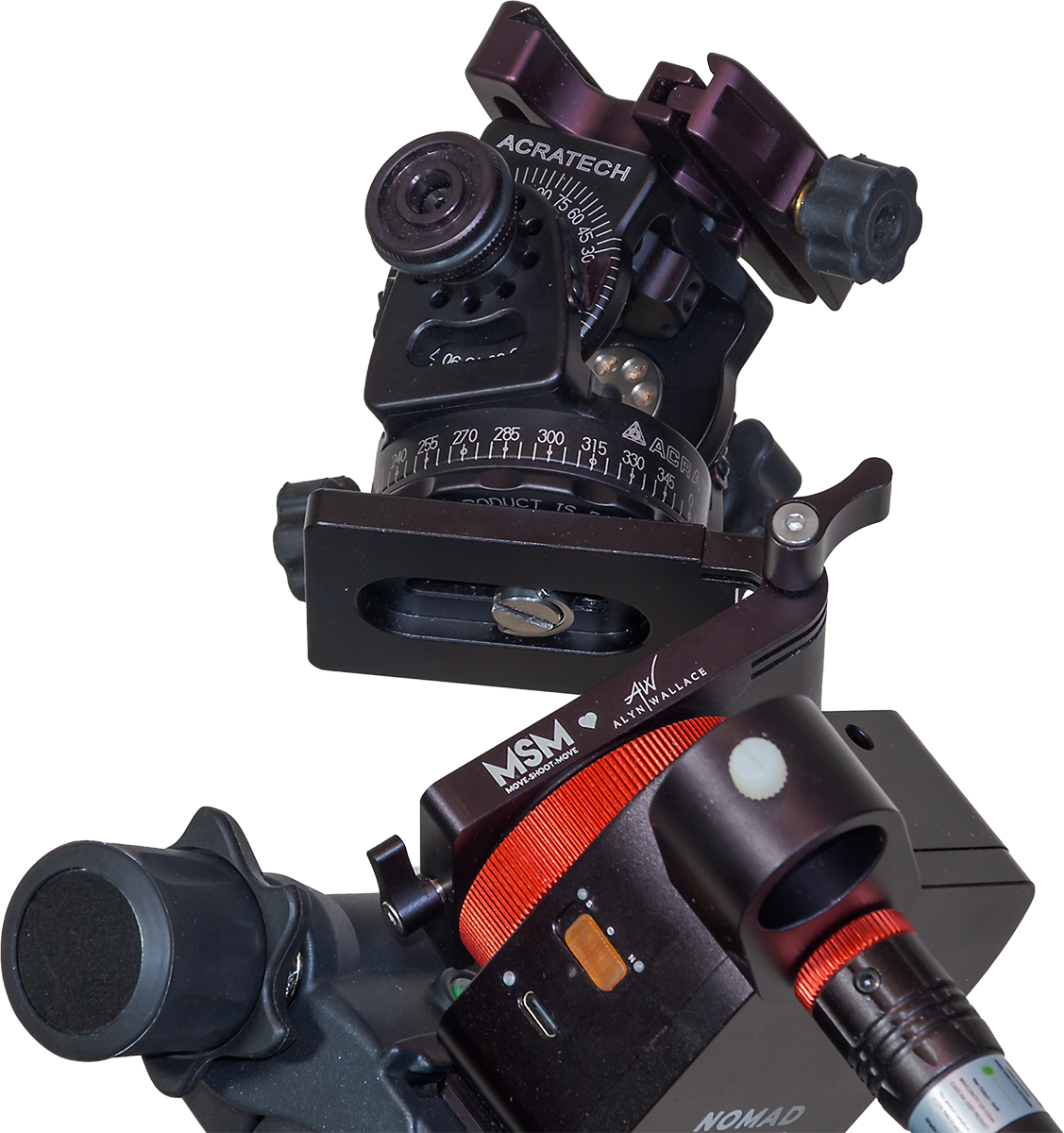
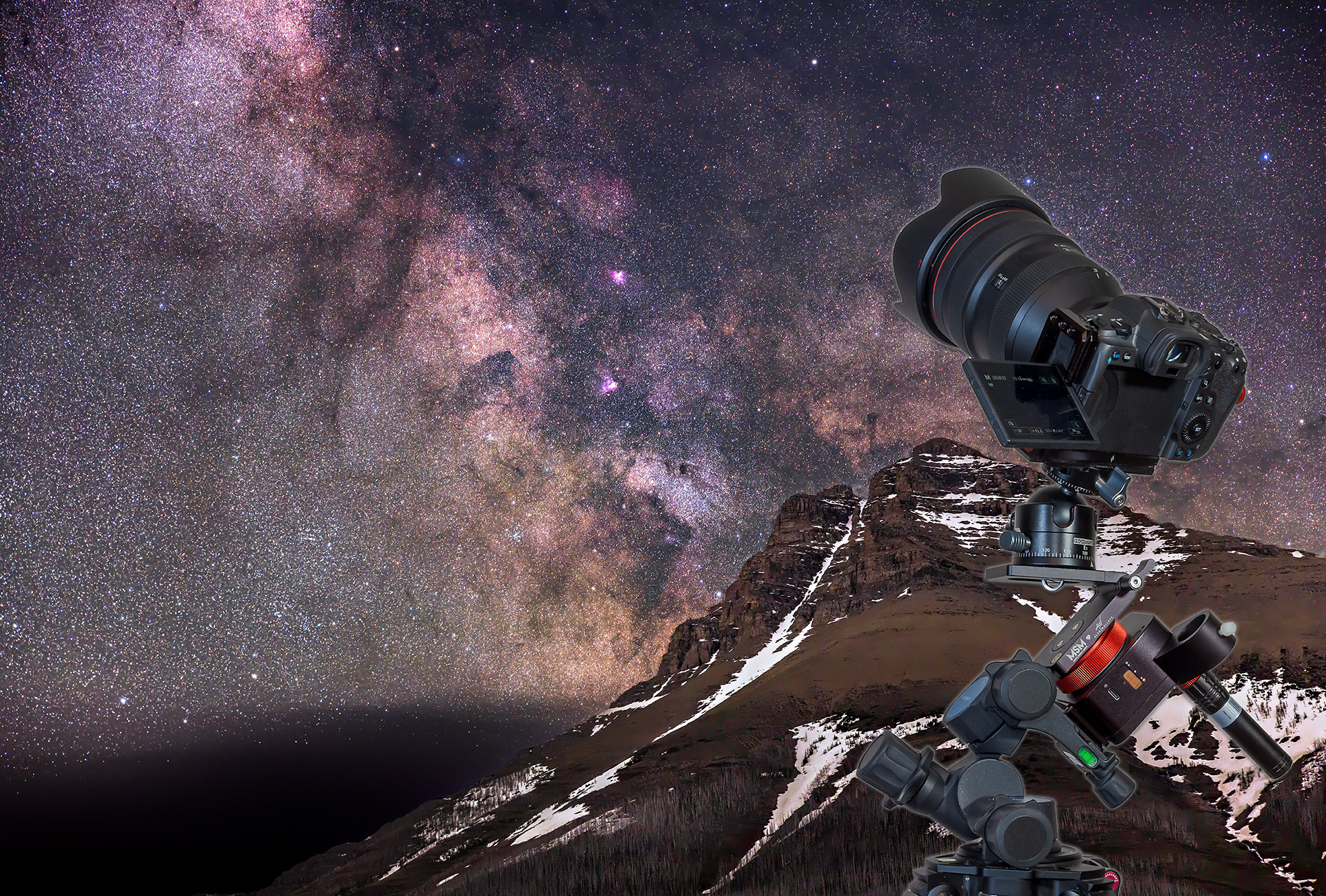
This is a 200° panorama of the arch of the northern Milky Way rising over Dinosaur Provincial Park, Alberta. Shot with the Nomad, with a blend of an untracked panorama for the ground and tracked panos for the sky.The gear used to take the panorama above, including the Alyn Wallace V-Plate, supporting an Acratech 2-axis pan head. The Nomad is ON here, set to N. Below the power switch is the USB-C port for charging and external power.
My only criticism is that the power switch is a little mushy and perhaps easy to slide on by mistake when it is packed in a bag.
An LED for each of the N and S directions glows red to indicate the power is on and the direction chosen, handy to help prevent you from choosing the wrong direction by mistake.
The Nomad is powered by an internal lithium battery that charges from any 5-volt USB charger (the Nomad comes with a USB-C cord, but no charger). The Nomad takes about 2.5 hours to charge to full and runs for 6 to 7 hours of continuous tracking at room temperatures. A second LED by the USB port glows yellow when the Nomad is charging, and green when it has fully charged.
In practice the Nomad has lasted for several nights of shooting on one charge. When the battery level is low, the red LED for the other direction begins blinking. As a backup in the field, the Nomad can be powered via its USB-C port by any external 5-volt power bank.
Collisions
The Nomad hasn’t been without issues, though the main problem I’ve had I can’t, in fairness, blame on the Nomad.
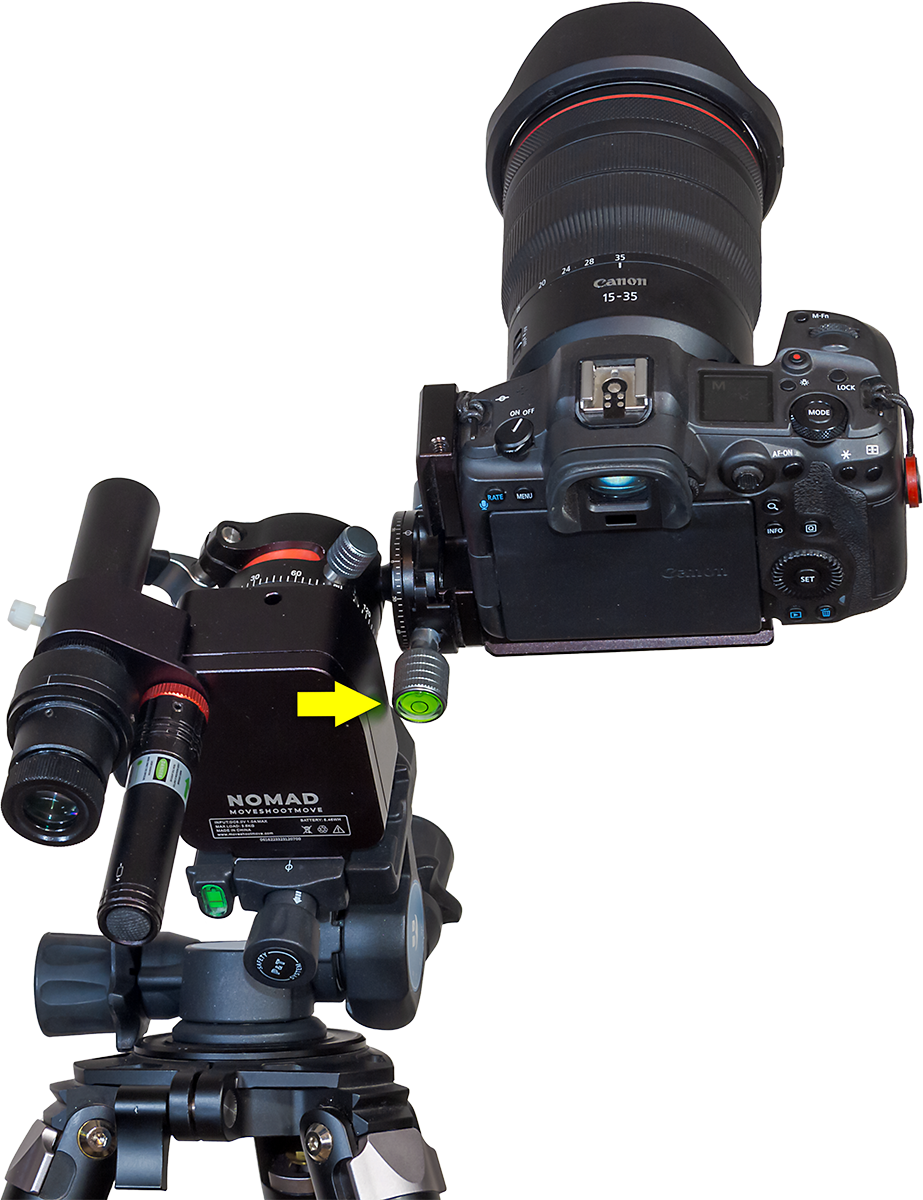
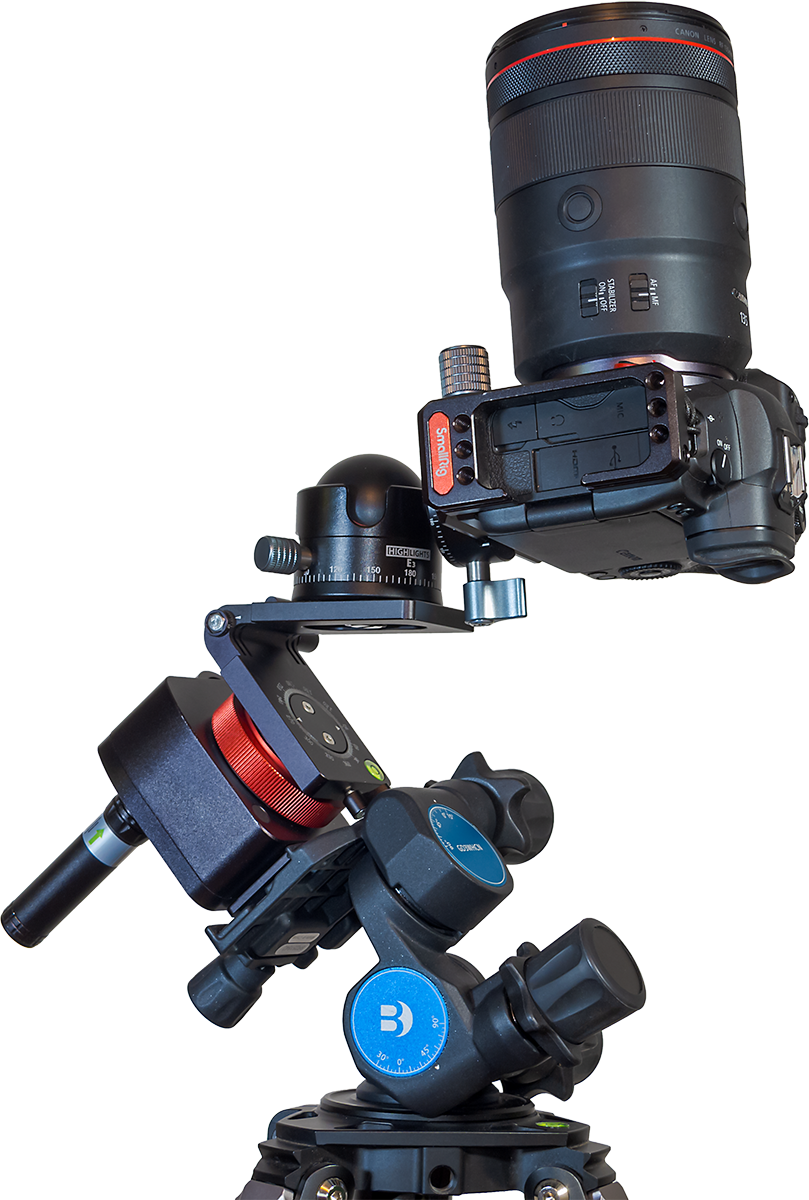
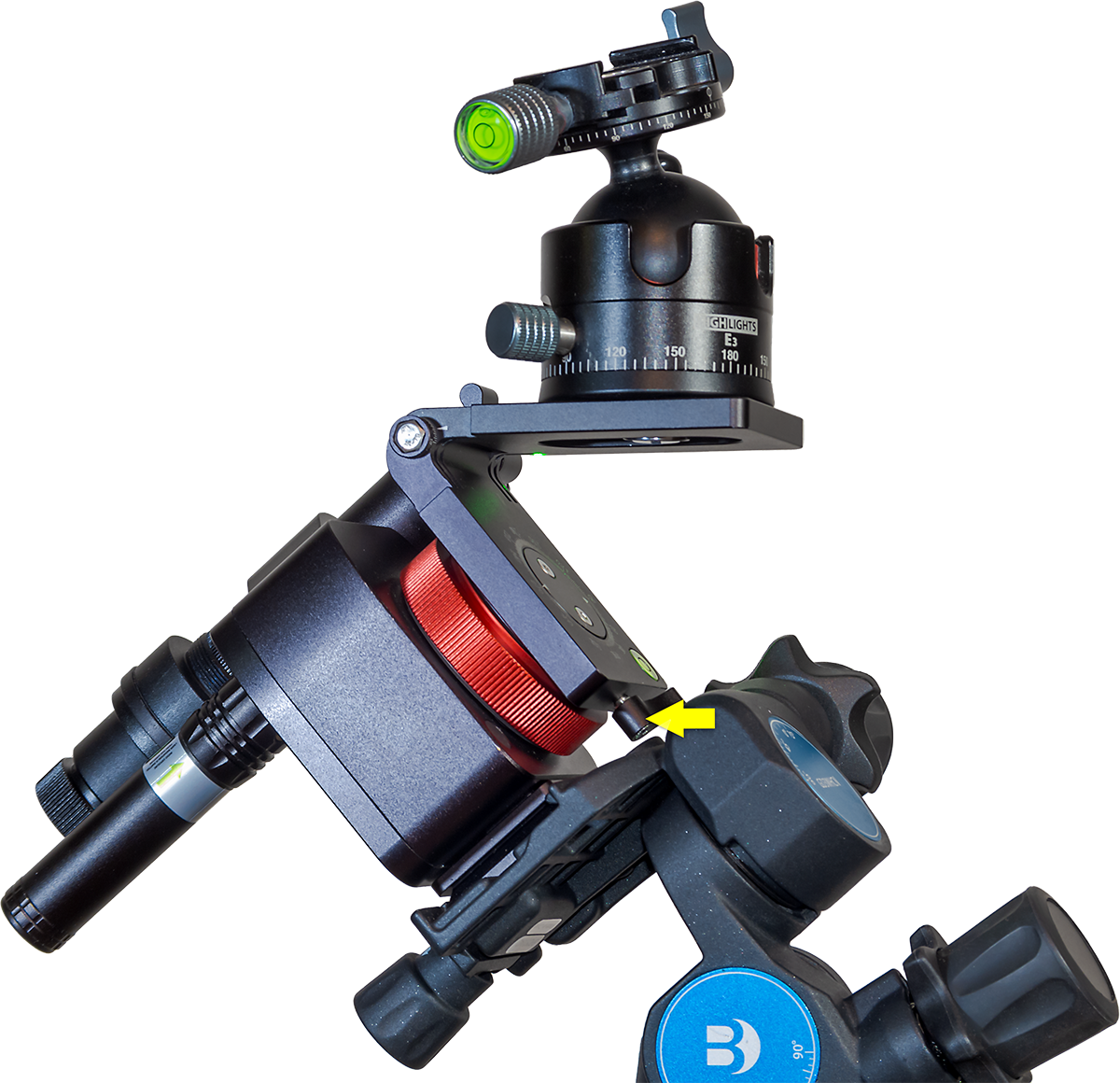
Due to the Nomad’s small size and shape, ball heads sit close to the Nomad body. Locks and clamps sticking out from ball heads can collide with the Nomad, or with the Benro head, as it rotates the ball head. Here I show how a collision can occur when aimed up at the zenith.
Showing the ball head colliding with the Benro when aimed high.
But collisions can also occur when aimed at the Celestial Pole. I ran into that issue in Australia, where many of the wide-field targets in the Milky Way (such as the field in Carina and Crux shown earlier) lie close to the South Celestial Pole.
A camera aimed toward the Celestial Pole (either South or North) is more likely to collide with the Nomad than when a camera is aimed toward the sky opposite the Pole.
Aimed toward the Celestial PoleAs it turns, the ball head hits the Nomad
As I show above, one night when tracking targets in Carina I found the ball head had jammed against the Nomad, seizing its motion. As I feared, that caused something inside the Nomad to come loose.
After the collision incident no frame was well-tracked. The Nomad was wandering all over the place!
From then on it failed to track well for any shots. The drive was wobbling the stars in random directions. No frame was usable. The Nomad was now out of commission, not a welcome prospect when you have traveled to the other side of the world to shoot the sky.
The access hole with a handy adjustment screw that fixed the issue.
What was the solution? There was only one point of adjustment accessible to users, a mysterious hole on the side of the tracker with a small hex screw at the bottom. This is normally covered by a rubber plug, though that was either missing on arrival or got lost along the way from my unit. Upon inquiry, MSM told me the screw is for use just at the factory, for a final adjustment of the gear and bearing distance.
But in my case, tightening it slightly seemed to do the trick, restoring normal tracking. However, my unit still tends to make intermittent clicking sounds now and then, though it seems to track well enough again.
The lesson here is don’t let gear collide with the Nomad. It likely has no internal clutch, making it unforgiving of being jammed.
Collision Avoidance
How do you avoid collisions? What I should have used in Australia was MSM’s optional V-Plate designed by the late and sadly missed Alyn Wallace.
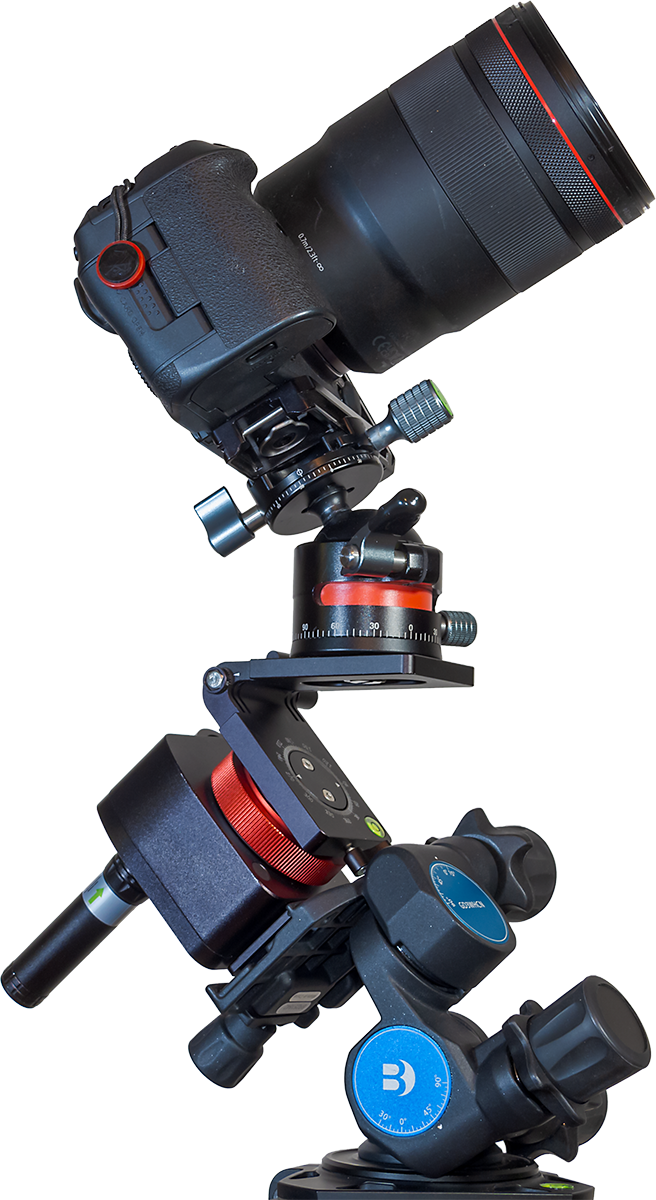
Aimed toward the Celestial PoleAimed toward the zenith
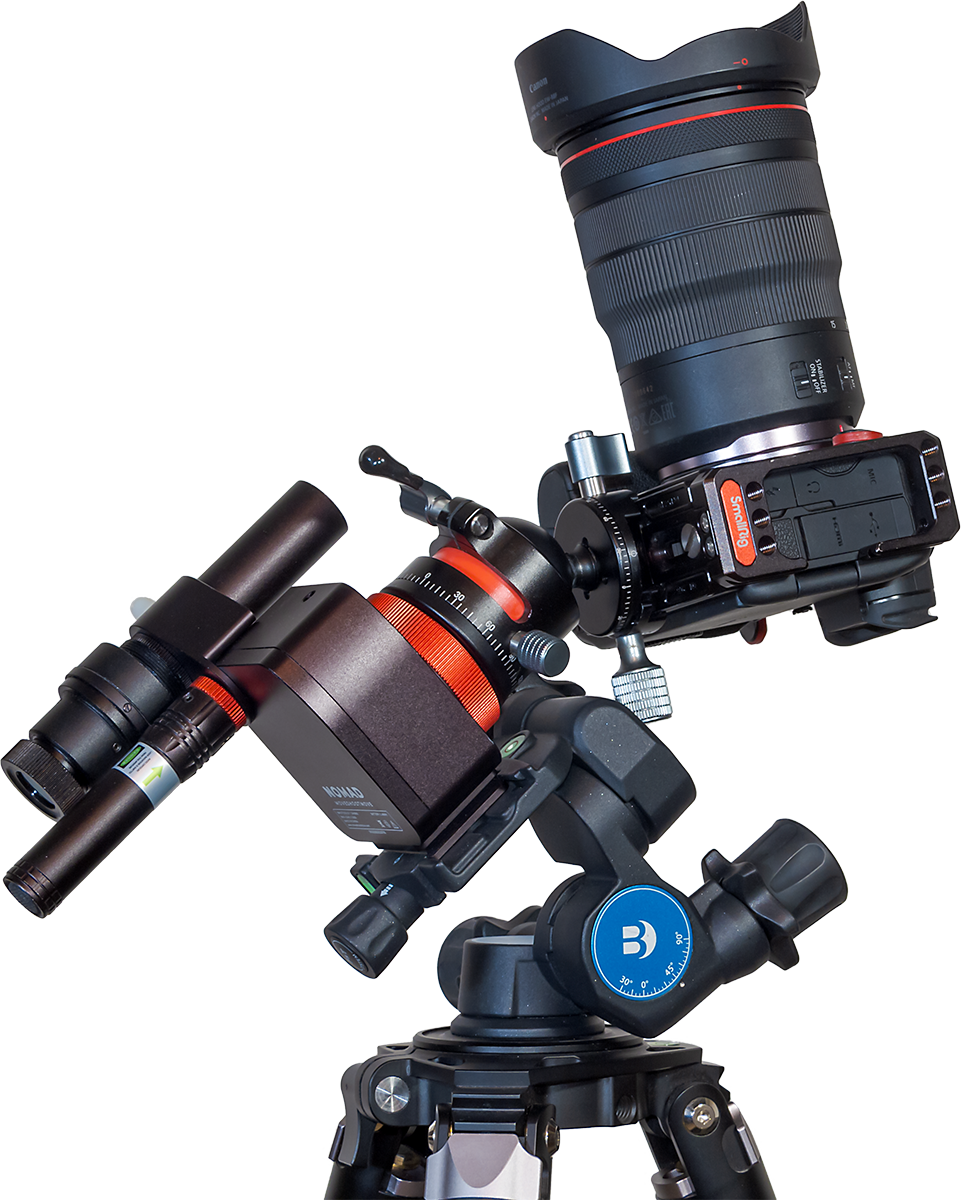
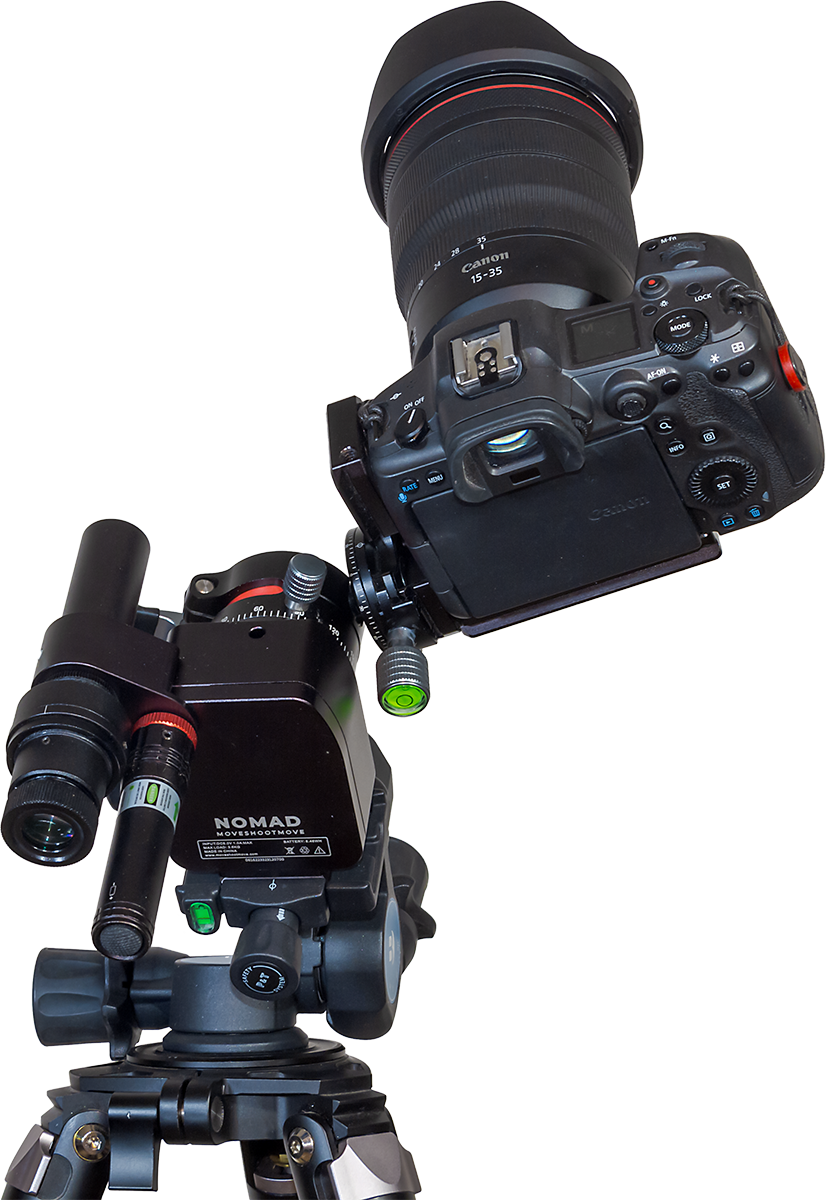
I bought one a couple of years ago, but never thought to bring it with me on the Australia trip. As I show above, the V-Plate allows for much more freedom to aim a camera, either toward the Poles or straight up (as I show above), or low in the sky 180° away from the Pole, without fear of the ball head hitting other components.
The V-Plate’s shortcoming is that, despite cranking down the levers that hold it in position, it can still slip under the weight of a heavy camera sitting on the diving-board-like platform supported only on one end. The V-Plate’s locks are not as solid and secure as they should be. But with care it can work well. And you need buy only the V-Plate; not the Z-Plate.
I should note that since I got my V-Plate, it has been upgraded with a larger lever handle to aid tightening the tilt lock. However, it really needs another support point on the tilt adjustment, so it can’t move as readily under load.
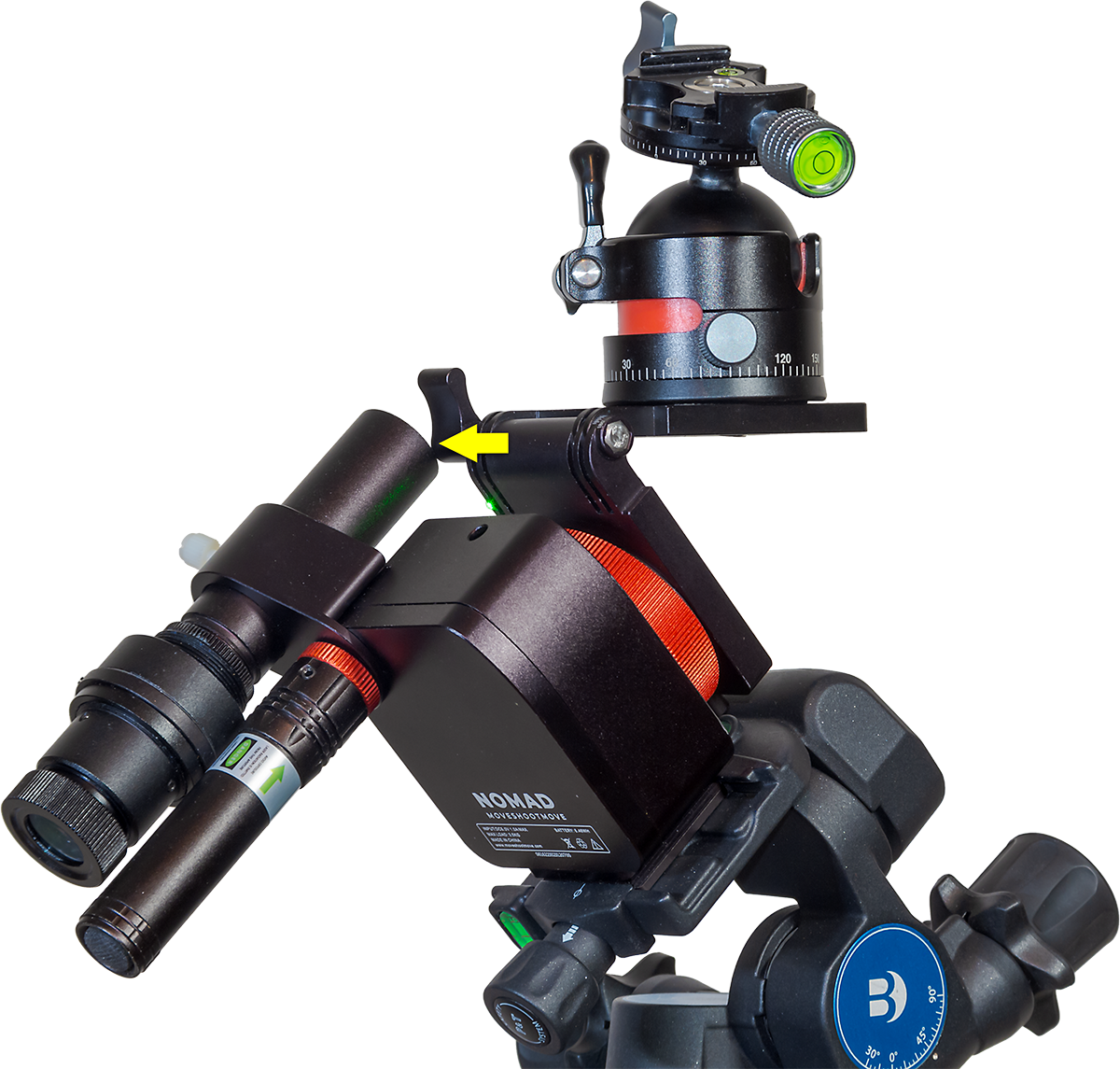
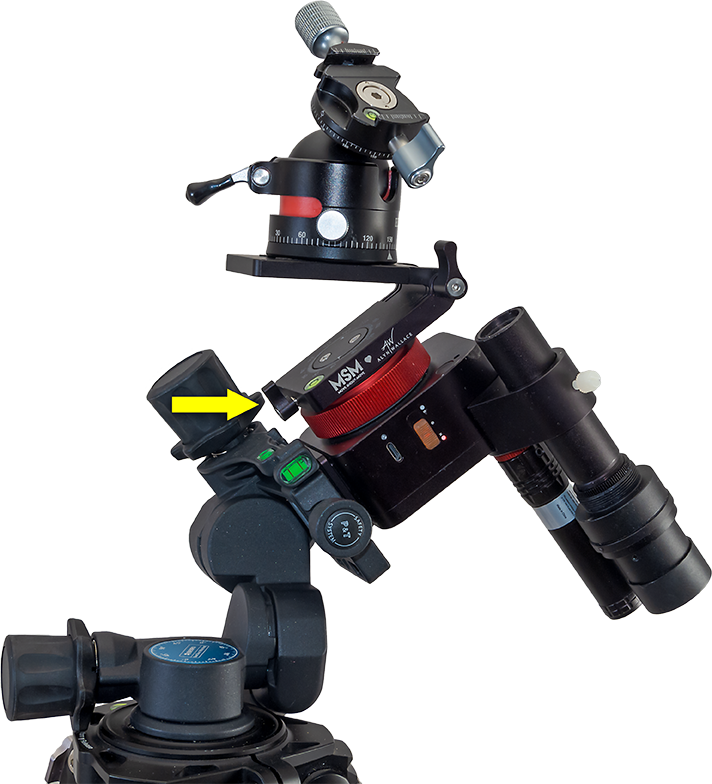
V-Plate lock knob hard to get at and adjustV-Plate lock knob hitting the Polar Scope
In addition, MSM now offers a taller Arca-Swiss mounting block as an option, to replace the plate that comes bolted onto the Nomad with two Torx screws. That optional riser block moves the Nomad farther from the Wedge or Benro head, helping to prevent some collisions. By putting more space between the Nomad and the Benro head, the riser block makes it easier to get at the small locking clamp on the V-Plate’s rotation axis. But …
Shortly after I first published this review, a loyal reader (thanks, John!) pointed out his method of placing the Nomad on the Benro, with the Nomad turned 90° to the way I pictured it earlier. As I show below, this places the Benro’s lock knob on the side of the Nomad, not back. The benefit is that the V-Plate’s azimuth lock lever is now more accessible and well-separated from the Benro. That method makes the taller riser block unnecessary.
Here’s a reader-suggested alternative method for mounting the Nomad and orienting the Benro head that puts more space between the V-Plate and Benro, for ease of adjustment.
Even with this alternative method, the V-Plate tends to block the laser’s beam, as does a camera once it is mounted. The polar scope can also be blocked. It’s an example of how one MSM accessory can interfere with another accessory, perhaps requiring yet another accessory to solve!
Laser beam hitting the V-Plate with it horizontalV-Plate rotated out of the way of the laser
In practice, with the V-Plate installed, polar alignment often has to be done before attaching the camera or setting up the V-Plate to the desired orientation. When adding the camera, care has to be taken to then not bump the Nomad off alignment. That’s why I like the Benro head as a stable platform for the Nomad, despite its extra weight.
As I illustrated earlier, the V-Plate is also an essential accessory for shooting tracked-sky Milky Way panoramas, as it allows a camera to be turned parallel to the horizon from segment to segment while it also tracks the sky.
A “deepscape” of the Sagittarius starclouds over Mt. Blakiston, in Waterton Lakes National Park, Alberta. This is a blend of two exposures: a single untracked 2-minute exposure at ISO 1600 for the ground, and a single tracked 2-minute exposure at ISO 800 for the sky, taken immediately after, with the Nomad tracker motor now on. With a 28-70mm lens at 70mm, on the rig shown.
Recommendations
So, as with the Rotator, when buying a Nomad, plan on adding several “optional” accessories to your cart. They can, in fact, be essential.
However, they can add another $150 (for V-Plate + Wedge + riser block) to $250 (V-Plate + Benro head + riser block) to the total. These are in addition to the cost of the polar alignment aids offered in the various Basic bundles. I like having both the laser and polar scope, but for shooting just wide-angle nightscapes, the laser alone will do.
The cost of accessories makes the Nomad not quite the low-cost tracker you might have been sold on, nor as self-contained and compact as it first appears. Just choosing what combination of gear to buy can be daunting for beginners.
The Milky Way and its core region in Sagittarius and Scorpius over the Badlands of Dinosaur Provincial Park, Alberta. This is a blend of untracked exposures for the ground and tracked exposures for the sky, with the Canon Ra on the Nomad, with the Canon RF15-35mm lens at 20mm at f/2.8.
But when well-equipped, the little Nomad can work very well. Despite my run-in with a collision glitch, I can recommend the Nomad as a good choice for anyone looking for a solid, accurate, but portable tracker that can slip into any camera bag.
Just make room in your bag – and budget! – for polar alignment aids, V-Plates, wedges, and ball heads to complete your tracking kit.
And then don’t let anything collide with the Nomad!
— Alan, June 27, 2024 – Revised June 28 / AmazingSky.com







 The Amazing Sky