The new star tracker from Move Shoot Move improves upon their original model, eliminating its flaws to provide a reliable and compact tracker.
A few years ago the start-up company Move Shoot Move (MSM) introduced a low-cost (about $250), compact star tracker they called the Rotator. Like all other star trackers, the Rotator allowed a camera to follow the turning sky for untrailed, pinpoint stars in long exposures.
Trackers are essential for rich Milky Way images, and are great for nightscapes, for shooting the sky, blended with untracked shots of the ground, as I show in examples below.
The original Rotator (L) and new Nomad (R). The Nomad is even smaller than the Rotator.
Out with the Old …
The original Rotator went through a couple of design changes during its lifetime. I tested the last versions to be marketed, using three different sample units I either purchased or were sent to me by MSM. (My reviews appeared in 2019 on my blog here, and in the June 2021 issue of Sky & Telescope magazine.)
The bottom line is that I found all the samples of the Rotator I tested to be unreliable for accurate tracking, indeed for tracking period, as units would sometimes not start tracking for a few minutes, or just stop tracking mid-shoot and then restart intermittently. Getting a set of untrailed exposures was a hit or miss affair.
But with a cost lower than most other trackers on the market (ostensibly, as explained below), a pocketable compact size, and with endorsements from notable nightscape photographers, the original Rotator garnered a loyal following of fans. I was not one of them.
MSM obviously recognized the design flaws of the Rotator, because in early 2024 they replaced it with an all-new model, dubbed the Nomad. It works!
The Nomad on the Benro 3-Way Head, with Laser and Polar Scope, and with a camera and 135mm lens. The ball head is not one from MSM.
I purchased a unit in January 2024 when the Nomad came out, and have used it extensively and successfully over the last few months. I found it has addressed all the serious flaws of the Rotator.
Polar Alignment Accessories
With a weight of about 400 grams, the Nomad is about 70 grams lighter than the old Rotator. It is one of the lightest and smallest trackers on the market, a benefit for those wanting to hike to remote nightscape sites, or pack gear for airline travel. (I took my Nomad to Australia this year; one result is below, shot with the Nomad.)
This frames the spectacular area of the southern Milky Way from Centaurus at left, to Carina at right, with Crux, the Southern Cross, at centre. This is a stack of 8 x 4-minute exposures with the Canon RF28-70mm lens at 48mm and f/2.8, on the Canon Ra at ISO 800. All on the MSM Nomad tracker.
However, unlike the popular Star Adventurer 2i and Mini trackers from Sky-Watcher, the Nomad, like MSM’s older Rotator, does not have a polar alignment scope built in, just a peep sight hole. That makes it easier for MSM to fit a tracker inside a compact box.
And yet, I feel some form of polar alignment aid (not just a peep sight) is essential if a tracker is to follow the sky accurately. Like the Rotator, the Nomad can be purchased with two add-on choices (shown below):
• a 5 mw green laser pointer,
• and an optical polar scope …
… each of which attaches to the side of the Nomad as outboard accessories. I purchased both, bundled with the Nomad as “Basic Kit C” for $309 U.S., and find both accessories useful.
NOTE: When shopping at the MSM website don’t be fooled by what looks like temporary sale prices. The prices are always marked down, though MSM does offer coupon codes now and then for genuine discounts. I’ve always found MSM’s delivery by parcel post prompt, and in my case, shipments came from a warehouse in Canada, not China.
The Laser and Polar Scope as they come suppliedWith the Laser threaded on using the red capWith the Polar Scope clamp attachedWith both the Polar Scope and Laser attached. Don’t lose the caps at bottom!
As with the Rotator, the need to add essential accessories makes the Nomad more expensive and more complex to pack than buyers might think. And it can be more complex to initially set up than imagined, not helped by the lack of any instructions. (I’m told by MSM that a downloadable PDF sheet is being prepared.) In place of factory-supplied instructions, MSM depends on its YouTuber fans to provide tutorials.
It took me a moment to figure out how the laser attaches to the Nomad — it does so by replacing the black cap that comes on the laser with a supplied threaded red cap, so the laser can screw into the peep hole on the Nomad’s body that is covered by yet another cap you remove — but don’t lose it, as you might need it.
The optical polar scope attaches by way of an included clamp held onto the Nomad by the laser, or by the removable threaded cap (so you will need it if you aren’t using the laser, but it is easily lost).
Out of the box I found I had to adjust the beam of the laser (using the two tiny set screws on the laser) so the beam exited straight out the laser and up the peep hole in the Nomad’s case.
Once collimated, the laser pointer has proved to be an accurate and convenient way to polar align, especially for shooting with wide-angle lenses. (Keep in mind, green laser pointers over 1 mw are illegal in some jurisdictions.)
The laser uses a removable and rechargeable 3.7-volt battery, and comes with a little USB-powered charger. The laser’s battery has lasted for months of momentary use. The laser works briefly in winter when it is warm, but as soon as it gets cold, as is true of most laser pointers, it refuses to lase!
This frames the small constellations of Sagitta the Arrow and Vulpecula the Fox. At lower left is the green planetary nebula Messier 27, aka the Dumbbell, shown in the close-up tracking test image below. This is a stack of 14 x 2-minute exposures with the Canon RF135mm lens on the Canon Ra, on the MSM Nomad tracker. The images were the best 14 out of a series shot to test the Nomad’s tracking.
However, for the more accurate polar alignment needed when shooting with telephoto lenses (an example is above), and for winter use, I prefer to use the optical polar scope, with the laser a handy complement just to get close to the pole.
The polar scope has a reticle etched with star patterns for both the North and South Celestial Poles. I found the latter worked well in Australia. The mounting clamp held the polar scope securely and consistently well centered, another welcome improvement over the polar scope clamp supplied with the Rotator, which could wiggle around.
Polar scope with its glow-in-the-dark Illuminator. The Nomad comes with an Arca-Swiss dovetail plate bolted onto the bottom edge, for attaching it to a tripod head or to the optional MSM Wedge.
The polar scope does not have an illuminator LED. Instead, it comes with a novel phosphorescent cap which you hit briefly with white light so it glows in the dark.
Placed over the front of the polar scope, it lights up the field allowing the reticle to be seen in silhouette. While it works fine for sighting Polaris, the bright field can make it hard to see the faint stars in Octans around the South Celestial Pole.
The Nomad on the Benro 3-Way Geared Head, using the Arca-Swiss attachment plate. Another method of mounting the Nomad to the Benro is shown below.
To aid polar alignment I purchased the Benro 3-Way Geared Head, also sold by MSM but available from many sources. Its geared motions make it easy to aim the tracker’s rotation axis precisely at the pole and hold it there solidly.
The Benro accepts standard Arca-Swiss mounting plates, so I’ve found it a useful head to have for other purposes and gear combinations. It has replaced my old Manfrotto 410 3-axis head which uses a proprietary mounting plate.
However, MSM also sells its own latitude adjustment Wedge which, at $90, is a cheaper alternative to the $200 Benro. I’ve not used the MSM Wedge, so I can’t say how solid and precise it is. But the Wedge is lighter than the Benro head, and so may be a better choice when weight is a prime consideration.
I would recommend either the Wedge or Benro for their fine adjustments of azimuth and altitude that are essential for easy, yet precise and stable polar alignment.
Tracking Accuracy
All-important is how well the Nomad tracks. When shooting with wide-angle lenses (14mm to 35mm) for nightscapes and wide Milky Way shots, the majority of images I’ve taken over the last few months, using exposures of 1 to 3 minutes, have been reliably well tracked, with pinpoint stars.
The Nomad begins tracking right away, with no wait for gear backlash to be taken up, or for the drive mechanism to settle in. I also found no tendency for tracking to be better or worse with camera position, unlike the Rotator that seemed to work better with the camera aimed at one area of sky vs another. And the Nomad didn’t suffer from any stalls or moments when it just stopped in its tracks, again unlike the problematic Rotator.
20 consecutive 2-minute exposures with a 135mm lens, to show the variations in tracking accuracy. Tap on the image to download it for closer inspection.
As with any tracker, where you do see mistracking is when using longer lenses. I tested, and indeed have used, the Nomad with 85mm and 135mm telephoto lenses, as many owners will want to do, for close-ups of Milky Way starfields and for so-called “deepscapes.” (An example of the latter is at the end.) The demo image above shows blow-ups of consecutive frames from the 135mm shoot of the Vulpecula/Sagitta starfield shown earlier.
In those more demanding tests, as I demonstrate here, I found that typically about 50% to 60% of images (taken with 1- to 2-minute exposures) were tracked well enough to be usable. The longer the focal length used, or the longer the exposures, the more frames will be trailed enough to be unusable in an image stack. And a well-tracked frame can be followed by a badly tracked one, then the next is fine again. That’s the nature of small drive gears.
As with other trackers, I would suggest that the Nomad is best used with lenses no longer than a fast 135mm. Even then, plan to shoot twice as many frames as you’ll need. Half may need to be discarded. While I know some users will want to push the Nomad beyond its limits, I would not recommend burdening it with monster telephoto lenses or small telescopes. Like all other trackers, that’s not its purpose.
When there was mistracking it was usually in the east-west direction, due to errors in the drive mechanism, and not north-south due to flexure. (If it occurs, north-south drift is likely due to poor polar alignment.)
I found the Nomad did indeed turn at the sidereal rate to follow the stars, something I was never confident the Rotator actually did.
While you might think a 50% success rate with telephotos is not good, in fact the Nomad’s tracking performance is on par with other competing trackers I’ve used, from Sky-Watcher and iOptron. At wide-angle focal lengths the success rate proved closer to 100%.
So for a tracker as compact as the Nomad to perform so well is very welcome indeed. It’s the main area where the Nomad beats the old Rotator by a long shot!
NOTE: While the MSM website mentions an “optional counterweight system,” as of my review’s publication date it is still being developed, MSM tells me. However, I don’t feel it will be necessary for the Nomad’s main purpose of wide-field imaging.
Mechanical Stability
Another flaw of the old Rotator was that it had several single-point attachments that, under the torque of a turning camera, could cause the camera to come loose and suddenly flop down.
Exploded view of the ratcheted mounting plate to attach a ball head to the NomadShowing the set screw to prevent the ball head coming loose
The Nomad uses a ratcheted clamp to attach a user-supplied ball head to the tracker body, and that clamp has an additional safety set screw to help ensure the ball head does not unscrew itself as a camera turns.
I’ve had no issues with cameras coming loose. Of course, the solidness of the ball head used will be critical as well. A large ball head can be better, but introduce some of the issues I report on below.
While MSM offers its own ball head, I have not used it, preferring to use a couple of other ball and pano heads I like, and that I show in the images here.
Simplicity of Operation
The Nomad improves upon the old Rotator by doing away with all its time-lapse features. You might think that eliminating features can’t be an improvement, but in this case it is.
I suspect few owners used the Rotator’s preset functions for slowly turning a camera along the horizon while firing the camera shutter between each incremental time-lapse move (the very function that gave the company its name!). The Rotator’s options for creating time-lapses were confusing to set up and limited in their choice of speeds. A serious time-lapse photographer would never use it.
(If you do want a tracker with time-lapse motion-control capabilities the Star Adventurer Mini works well. Its WiFi connection and mobile app allows a user to set all the factors needed for a good time-lapse: interval, angle increment, number of frames, and length of shoot.)
Instead, MSM has focused the Nomad on being just a star tracker, and I think wisely so. Its only controls are a three-position S-OFF-N switch, for using the Nomad in either the southern or northern hemisphere. It worked very well “Down Under,” with the exception noted below.
There is no solar or lunar drive rate, unnecessary in a tracker, and also no half-speed rate for nightscapes, used to lessen star trailing while also minimizing ground blurring. I’ve never liked using trackers at such a compromise half-speed rate, so I don’t miss it.
Using the optional V-Plate described below, I have used the Nomad to take tracked Milky Way panoramas, as shown here. It has worked very well for that purpose, with it easy to switch the tracking on (for the sky) and off (for the ground).
This is a 200° panorama of the arch of the northern Milky Way rising over Dinosaur Provincial Park, Alberta. Shot with the Nomad, with a blend of an untracked panorama for the ground and tracked panos for the sky.The gear used to take the panorama above, including the Alyn Wallace V-Plate, supporting an Acratech 2-axis pan head. The Nomad is ON here, set to N. Below the power switch is the USB-C port for charging and external power.
My only criticism is that the power switch is a little mushy and perhaps easy to slide on by mistake when it is packed in a bag.
An LED for each of the N and S directions glows red to indicate the power is on and the direction chosen, handy to help prevent you from choosing the wrong direction by mistake.
The Nomad is powered by an internal lithium battery that charges from any 5-volt USB charger (the Nomad comes with a USB-C cord, but no charger). The Nomad takes about 2.5 hours to charge to full and runs for 6 to 7 hours of continuous tracking at room temperatures. A second LED by the USB port glows yellow when the Nomad is charging, and green when it has fully charged.
In practice the Nomad has lasted for several nights of shooting on one charge. When the battery level is low, the red LED for the other direction begins blinking. As a backup in the field, the Nomad can be powered via its USB-C port by any external 5-volt power bank.
Collisions
The Nomad hasn’t been without issues, though the main problem I’ve had I can’t, in fairness, blame on the Nomad.
Due to the Nomad’s small size and shape, ball heads sit close to the Nomad body. Locks and clamps sticking out from ball heads can collide with the Nomad, or with the Benro head, as it rotates the ball head. Here I show how a collision can occur when aimed up at the zenith.
Showing the ball head colliding with the Benro when aimed high.
But collisions can also occur when aimed at the Celestial Pole. I ran into that issue in Australia, where many of the wide-field targets in the Milky Way (such as the field in Carina and Crux shown earlier) lie close to the South Celestial Pole.
A camera aimed toward the Celestial Pole (either South or North) is more likely to collide with the Nomad than when a camera is aimed toward the sky opposite the Pole.
Aimed toward the Celestial PoleAs it turns, the ball head hits the Nomad
As I show above, one night when tracking targets in Carina I found the ball head had jammed against the Nomad, seizing its motion. As I feared, that caused something inside the Nomad to come loose.
After the collision incident no frame was well-tracked. The Nomad was wandering all over the place!
From then on it failed to track well for any shots. The drive was wobbling the stars in random directions. No frame was usable. The Nomad was now out of commission, not a welcome prospect when you have traveled to the other side of the world to shoot the sky.
The access hole with a handy adjustment screw that fixed the issue.
What was the solution? There was only one point of adjustment accessible to users, a mysterious hole on the side of the tracker with a small hex screw at the bottom. This is normally covered by a rubber plug, though that was either missing on arrival or got lost along the way from my unit. Upon inquiry, MSM told me the screw is for use just at the factory, for a final adjustment of the gear and bearing distance.
But in my case, tightening it slightly seemed to do the trick, restoring normal tracking. However, my unit still tends to make intermittent clicking sounds now and then, though it seems to track well enough again.
The lesson here is don’t let gear collide with the Nomad. It likely has no internal clutch, making it unforgiving of being jammed.
Collision Avoidance
How do you avoid collisions? What I should have used in Australia was MSM’s optional V-Plate designed by the late and sadly missed Alyn Wallace.
Aimed toward the Celestial PoleAimed toward the zenith
I bought one a couple of years ago, but never thought to bring it with me on the Australia trip. As I show above, the V-Plate allows for much more freedom to aim a camera, either toward the Poles or straight up (as I show above), or low in the sky 180° away from the Pole, without fear of the ball head hitting other components.
The V-Plate’s shortcoming is that, despite cranking down the levers that hold it in position, it can still slip under the weight of a heavy camera sitting on the diving-board-like platform supported only on one end. The V-Plate’s locks are not as solid and secure as they should be. But with care it can work well. And you need buy only the V-Plate; not the Z-Plate.
I should note that since I got my V-Plate, it has been upgraded with a larger lever handle to aid tightening the tilt lock. However, it really needs another support point on the tilt adjustment, so it can’t move as readily under load.
V-Plate lock knob hard to get at and adjustV-Plate lock knob hitting the Polar Scope
In addition, MSM now offers a taller Arca-Swiss mounting block as an option, to replace the plate that comes bolted onto the Nomad with two Torx screws. That optional riser block moves the Nomad farther from the Wedge or Benro head, helping to prevent some collisions. By putting more space between the Nomad and the Benro head, the riser block makes it easier to get at the small locking clamp on the V-Plate’s rotation axis. But …
Shortly after I first published this review, a loyal reader (thanks, John!) pointed out his method of placing the Nomad on the Benro, with the Nomad turned 90° to the way I pictured it earlier. As I show below, this places the Benro’s lock knob on the side of the Nomad, not back. The benefit is that the V-Plate’s azimuth lock lever is now more accessible and well-separated from the Benro. That method makes the taller riser block unnecessary.
Here’s a reader-suggested alternative method for mounting the Nomad and orienting the Benro head that puts more space between the V-Plate and Benro, for ease of adjustment.
Even with this alternative method, the V-Plate tends to block the laser’s beam, as does a camera once it is mounted. The polar scope can also be blocked. It’s an example of how one MSM accessory can interfere with another accessory, perhaps requiring yet another accessory to solve!
Laser beam hitting the V-Plate with it horizontalV-Plate rotated out of the way of the laser
In practice, with the V-Plate installed, polar alignment often has to be done before attaching the camera or setting up the V-Plate to the desired orientation. When adding the camera, care has to be taken to then not bump the Nomad off alignment. That’s why I like the Benro head as a stable platform for the Nomad, despite its extra weight.
As I illustrated earlier, the V-Plate is also an essential accessory for shooting tracked-sky Milky Way panoramas, as it allows a camera to be turned parallel to the horizon from segment to segment while it also tracks the sky.
A “deepscape” of the Sagittarius starclouds over Mt. Blakiston, in Waterton Lakes National Park, Alberta. This is a blend of two exposures: a single untracked 2-minute exposure at ISO 1600 for the ground, and a single tracked 2-minute exposure at ISO 800 for the sky, taken immediately after, with the Nomad tracker motor now on. With a 28-70mm lens at 70mm, on the rig shown.
Recommendations
So, as with the Rotator, when buying a Nomad, plan on adding several “optional” accessories to your cart. They can, in fact, be essential.
However, they can add another $150 (for V-Plate + Wedge + riser block) to $250 (V-Plate + Benro head + riser block) to the total. These are in addition to the cost of the polar alignment aids offered in the various Basic bundles. I like having both the laser and polar scope, but for shooting just wide-angle nightscapes, the laser alone will do.
The cost of accessories makes the Nomad not quite the low-cost tracker you might have been sold on, nor as self-contained and compact as it first appears. Just choosing what combination of gear to buy can be daunting for beginners.
The Milky Way and its core region in Sagittarius and Scorpius over the Badlands of Dinosaur Provincial Park, Alberta. This is a blend of untracked exposures for the ground and tracked exposures for the sky, with the Canon Ra on the Nomad, with the Canon RF15-35mm lens at 20mm at f/2.8.
But when well-equipped, the little Nomad can work very well. Despite my run-in with a collision glitch, I can recommend the Nomad as a good choice for anyone looking for a solid, accurate, but portable tracker that can slip into any camera bag.
Just make room in your bag – and budget! – for polar alignment aids, V-Plates, wedges, and ball heads to complete your tracking kit.
And then don’t let anything collide with the Nomad!
— Alan, June 27, 2024 – Revised June 28 / AmazingSky.com
AI-based noise reduction programs continue to improve, to provide remarkable results on many images. But … how well do they work on star-filled astrophotos?
As we know, software evolves rapidly. So here’s my latest look at versions of those programs current of as May 2024, plus new entries into the category, all with a focus on how well they perform on a variety of astrophotos. Only two programs tested here, NoiseXTerminator and GraXpert, are specifically designed to be used on astrophotos, primarily telescopic images of deep-sky objects.
The other programs on test are general purpose, for use on noisy images such as wildlife photos shot at high ISOs to freeze motion, or any photos shot under low light. But the latter includes nightscapes.
I tested programs in three categories, defined primarily by how they are used in a processing workflow:
Adobe DeNoise AI in Camera RawDxO PureRAW 4 stand-alone app
General programs usable only on Raw files at the start of a workflow:
Adobe DeNoise AI from within Adobe Camera Raw (v16.3) or Lightroom (v13.3)
DxO PureRAW 4 (v4.1), a stand-alone app only
Luminar Neo Noiseless AION1 NoNoise AI 2024Topaz Photo AI
General programs usable as stand-alone apps on Raw files, but also as plug-ins for Photoshop for use later in a workflow (I tested both workflows):
Luminar Neo (v1.19.1) and its Noiseless AI filter
ON1 NoNoise AI 2024 (v18.3)
Topaz Photo AI (v3.02)
GraXpert stand-alone app
Programs specialized for astro work:
RC-Astro NoiseXTerminator (v1.1.3), usable only as a Photoshop plug-in
GraXpert (v3.0.2), usable only as a stand-alone application
(The latter two can also be installed as “processes” accessed from within the specialized astrophoto program PixInsight; I did not test that workflow.)
Comparing ACR’s standard noise reduction to 5 AI-based noise reduction programs
MY METHODS (“BUT WHAT ABOUT …?”)
I tested the five general-purpose programs on four types of astrophotos:
Nightscapes
Aurora images
Total solar eclipse images
Deep-sky images, both wide-field and telescopic
I tested the two specialized programs only on sample deep-sky photos, the types of images they are designed and trained for.
In all cases, the test images are single frames. I did not stack any images for these examples, as I wanted to show what the programs could do with noisy originals.
I tested only on Raw files from mirrorless cameras. I did not test on FITS files from specialized cooled astronomy cameras, as those require a quite different workflow and software.
Anticipating the “What about …?” question — no, I did not test Topaz DeNoise AI. While popular among astrophotographers, both it and its companion program, Sharpen AI, were discontinued in 2023, in favor of Topaz concentrating on their single program, Photo AI, that can de-noise, sharpen, and upscale.
I made an exception for Luminar Neo. While it includes general processing functions, it is used more often (certainly by me!) just as a plug-in for its AI-driven effects and filters, noise reduction being one.
PLEASENOTE:
All the test images are full-resolution JPGs (6,000 to 8,000 pixels wide) that you can download (by right-clicking) for detailed inspection. You will often need to do so, to see the pixel-level differences I refer to.
But the sizes of the images make the blog page slow to load initially. Patience, please!
DxO PureRAW can be called up from within Adobe Bridge by going to File>Open With … and choosing DxO PureRAW.
In Lightroom, the route to send images to PureRAW is File>Plug-In Extras>Process and Preview with DxO PureRaw 4. You cannot choose Photo>Edit In … as you might do to send images to other programs.
TL;DR SUMMARY (with links to the software websites)
Of the two Raw-only programs, Adobe’s DeNoise AI and DxO’s PureRAW 4, both worked well, with v4 of PureRAW much improved over its earlier artifact-prone v2 I tested and dismissed in 2022. Similarly, unlike its early version, Adobe DeNoise AI did not invent structures, such as auroral arcs.
Adobe’s DeNoise AI brought out details in the shadows much better than DxO’s PureRAW 4, which blocked up shadows. But PureRAW produced sharper details in illuminated landscapes, yielding less of the plastic appearance that Adobe DeNoise is still prone to. However, both programs turned star trails into wiggly worms.
Each of the three other general-purpose programs failed as stand-alone apps when importing Raw files, then exporting them as either Raw DNG (Digital Negative) files (ON1 NoNoise AI and Topaz Photo AI), or as TIFF files (Luminar Neo). Their exported images were either dark, vignetted, or hugely shifted in color or tonal balance. Results with that Raw-to-DNG/TIFF workflow were often unusable.
However, the same three programs (Luminar Neo, ON1 NoNoise AI and Topaz Photo AI) worked well as plug-ins from within Adobe Photoshop. Images now looked fine, with ON1 NoNoise producing what I thought was the best overall noise reduction with the fewest artifacts and “patchiness” in most examples. Luminar Neo’s Noiseless AI was consistently the poorest performer in all cases. It’s the program I can rule out of the running for noise reduction.
The two specialized astro programs, NoiseXTerminator and GraXpert, did a fine job on deep-sky images, reducing fine-grained noise without eliminating stars, just what they are “trained” to do. However, I felt NoiseXTerminator did the better job, with the new (as of May 2024) GraXpert 3.0 softening stars or leaving residual mottled artifacts. Neither worked well on nightscapes — while they didn’t harm detail too much, other programs performed better on what are often detailed but dark and noisy foregrounds.
My main takeaway — No one piece of AI software works best on all astrophotos. A program that provides great results on one image or class of image might perform poorly on another image. That’s the nature of AI-driven processing.
So … my overall conclusion and personal workflow picks? —
Adobe DeNoise AI would be my first choice for noisy nightscape images, where it has to be applied early in the workflow. It will be worth trying on deep-sky images.
DxO PureRAW might work better on some nightscapes with lots of ground textures.
ON1 NoNoise AI works well on many images when applied as a plug-in later in the workflow, but its sliders often need adjusting from the defaults.
NoiseXTerminator remains my preferred plug-in for deep-sky images.
PLEASENOTE:
I have not provided prices and explained buying options, as frankly some can be complex!
For those details, go to the software’s website by clicking on the links in the names above. With the exception of Luminar Neo, all are available as free trial copies.
All programs are available for Windows and MacOS. I tested the latter versions, on an M1 Max MacBook Pro.
A typical test image, showing the small section that the comparison examples zoom in on. This is the first image shown below in detail.
RAW-ONLY PROGRAMS — NIGHTSCAPES
To provide evidence for my conclusions, I focus first on the two Raw-only programs, Adobe DeNoise AI and DxO PureRAW 4, as they produced by far the best results of all the programs on demanding nightscapes, often remarkably so. They not only reduce noise, they also recover fine details with AI sharpening you cannot turn off. How well that works is what I demonstrate below.
In each of the following examples, I show the two programs compared to an image processed in Adobe Camera Raw (ACR) using the Detail panel’s old non-AI adjustments for sharpening and noise reduction.
I developed all the images in ACR, then sent them through Adobe’s DeNoise AI option or into DxO PureRAW. Both options produce new raw DNG files, with all the develop settings intact and accurate, with some exceptions with PureRAW as shown below.
Peyto Lake Nightscape
Peyto Lake corner closeup — with Canon R5 at ISO 3200
In most cases I show only a section of images blown up by 250% to 500%. Here, in the first example of a nightscape shot I zoom in on a corner, as illustrated above, where noise often lurks due to lens vignetting. (I shot this and many of the nightscape examples with the 45-megapixel Canon R5. See my test of it for astrophotography here.)
The standard ACR noise reduction leaves a blizzard of fine noise and large color blotches. The Adobe DeNoise AI version (with it at 60%, the setting I used for all the DeNoise images) shows much less noise and somewhat reduced color blotches. The PureRAW version shows even better noise reduction, but the trees turn very dark with no detail.
But compare the mountainside. Adobe turns the rock layers into artificial-looking ropey bands; PureRAW’s detail recovery looks much more natural for texture.
Lake Edith Nightscape
Lake Edith corner closeup — with Canon R5 at ISO 5000
In this example, I again zoom in on a badly underexposed corner. The standard ACR version looks awful, riddled with color splotches and banding. The Adobe DeNoise version has cleaned up most of the mess. But the PureRAW version is better, eliminating even more noise and artifacts.
So is PureRAW better? Not so fast!
Storm Mountain Nightscape
Storm Mountain corner closeup — with Canon R5 at ISO 100
In this close-up of the Storm Mountain twilight image (that I show in full farther down the page), the normal image shot at ISO 100 isn’t marred too much by noise. But it does exhibit the magenta discoloration often seen in underexposed frame corners when the shadows are “lifted” brighter, as I show in the inset of the Basics panel.
The Adobe DeNoise version automatically corrected the color back to normal (I made no manual adjustments) and brought out the fine details. By comparison, PureRAW turned the trees completely dark, a lazy way to reduce noise! I tried further lifting the shadows with some reverse vignetting (as shown), but the result was a muddy mess. PureRAW crushed the shadows to the point no detail was recoverable.
So is Adobe better? Not necessarily ….
Lake Louise Nightscape
Lake Louise close-up — with Canon R5 at ISO 1600
Here I zoom in on famous Mount Victoria at the end of Lake Louise in Banff, in a one-minute exposure taken for the ground. As before, I think PureRAW has done a better job at recovering details in the mountain, though maybe to the point of over-sharpening? Adobe DeNoise perhaps looks more natural here.
But look at the star trails, which we sometimes want in our nightscapes, or have whether we want them or not! Yes, the sky in the AI-processed images looks less noisy, but the star trails now look like wiggly irregular streaks. PureRAW is a little worse, but both programs suffer from the same AI misinterpretation of the content. Both ruined the sky.
Will this always be the case?
Sierra Cabins Nightcape
Sierra Cabins close-up — with Fuji GFX100S at ISO 3200
All the other image examples are from Canon mirrorless cameras: the EOS R, Ra or R5. But this is a blow-up of a 100-megapixel photo from a medium-format Fuji GFX100S. The rustic cabin and the sky is less noisy in the AI images, with PureRAW the better performer here by a small margin. Stars look fine, and the AI sharpening of both programs has brought out the faint stars without any artifacts, a welcome improvement I think.
RAW-ONLY PROGRAMS — AURORA
I include this as a separate example, as an aurora photo provides a sky with a different type of content. In the past I’ve seen Adobe AI invent aurora rays.
Aurora Curtain
Aurora close-up — with Canon Ra at ISO 1600
This is an image from the Great Aurora show of May 10, 2024. There’s less noise in the AI versions of this example, and both programs also eliminated the errant hot red pixel at lower right in the ACR image. I’ve found these two AI programs can correctly identify and eliminate some hot pixels, though hot pixel removal can be hit or miss.
In all, I found the AI routines of Adobe and DxO did a fine job on auroras, reducing noise without introducing artifacts such as banding or posterized color gradations. Neither overly sharpened foreground details, nor added structures into the aurora or clouds that shouldn’t be there or that look unrealistic.
RAW-ONLY PROGRAMS — SOLAR ECLIPSE
Many of us have close-ups of the April 8, 2024 total eclipse of the Sun. Even though you might have shot them at a low ISO (even when eclipsed, the Sun is bright), you might have been surprised to see how much fine noise remains in the corona and sky.
Solar Eclipse Corona Close-Up
Corona close-up — with Canon R5 at ISO 100
This is a close-up of a frame taken through a 105mm f/6 refractor at a focal length of 630mm. Even at ISO 100, there’s a pixel-level granulation visible, but in this case I don’t think either Adobe DeNoise or PureRAW provided much of an improvement, likely because this is a low-ISO original.
In fact, I think Adobe DeNoise AI made noise worse, as its inherent sharpening added some dark flecks throughout the corona. But neither program introduced any banding, unlike Topaz was guilty of below.
RAW-ONLY PROGRAMS — DEEP-SKY
Here I compare the two Raw-only programs on several examples of deep-sky images — photos of the Milky Way and nebulas taken with tracking mounts so the stars remain pinpoints, ideally! These examples are tough tests, as the AI models have likely received little training on what these are supposed to look like! And faint stars can look like noise.
Orion Portrait
Orion close-up — with Canon Ra at ISO 800
First is a wide-angle portrait of Orion, blowing up the center of a tracked exposure with a 28-70mm zoom lens set to 46mm. (See my test of Canon RF zoom lenses here.) Shot at ISO 800, low for deep-sky images, this single frame is fairly clean to begin with. The AI programs do smooth the noise, without wiping out stars. Nice!
But they do accentuate the residual chromatic aberration (the blue haloes) on stars. PureRAW looks a little worse as it seems to have shifted the color to more magenta. All three Raw files have identical settings and profiles applied, yet PureRAW looks slightly different.
Cygnus H-alpha Monochrome
Cygnus close-up — with Canon Ra at ISO 3200 with Astronomik 12nm H-a clip-in filter
This is a more demanding example, shot with the same lens but at 70mm, and with the red-sensitive Canon Ra. It is rendered in monochrome as it was shot through a deep-red hydrogen-alpha filter to isolate the red light from the nebulas, here in Cygnus.
This is a single frame (you would normally stack lots of these!), very noisy due not only to the high ISO used, but also because only the red pixels (one quarter of the total on the sensor) recorded any signal.
Both Adobe DeNoise AI and DxO PureRaw have cleaned up the noise well. PureRAW has added more sharpening, tightening the stars and enhancing fine structure. Whether this is good or not depends on your goals and tolerance for AI-induced changes. In this case, I don’t think it has invented details.
But then there’s this example ….
Vela Supernova Remnant
Vela SNR close-up — with modified Canon R at ISO 3200
This, too, is a filtered single frame, taken through a 61mm-aperture telescope equipped with a “dual narrowband” filter which isolates the red H-alpha wavelength, but also the cyan Oxygen emission lines prominent in supernova remnants like this one in Vela. The deep filter requires shooting at a high ISO. So there’s lots of noise.
In this trio, I also applied NoiseXTerminator to the left image, an AI-based noise reduction program designed for just such images. I show more examples with “NoiseX” at the end.
I don’t think Adobe DeNoise or PureRAW have done any better job than NoiseX at reducing noise. If anything, each might have added some additional texturing that looks artificial, and accentuated chromatic aberration haloes on the stars. NoiseX wins here, right?
Well … look at the fine structures of the wisps of nebulas in all three panes. In the two panels at center and right, you can see more structure in the nebulosity, such as the protruding red fingers at top, that are not there in the NoiseX version at left. Is this real? Might other sharpening routines later in the workflow have brought it out anyway? Or are these details the products of AI imagination!?
Before purists dismiss the Adobe and DxO AI programs for fabricating details, here’s another example.
Crab Nebula
Crab Nebula close-up — with modified Canon R at ISO 800
This is another supernova remnant, the famous Crab Nebula in Taurus. It is a 500% blow-up of the center of a single exposure with a modified Canon R on a 120mm f/7 refractor.
In this case, the “normal” image on the left has had just ACR’s old-style noise reduction applied, nothing else. In the middle and on the right, the Adobe and DxO AI versions are noticeably less noisy.
But … the small red tendrils are also more obvious with AI enhancement — and they are real (as comparisons to other more detailed astrophotos showed me). So here the AI has helped bring out subtle details while smoothing noise. I think PureRAW has sharpened stars a little too much, and shifted the colors, again to magenta.
Summary Points:
Both Adobe DeNoise AI and DxO PureRAW 4 can work wonders on nightscapes…
… Except on star trails! Both programs ruin star trails.
Their improvements to low ISO images is not so great, if minimal.
In its conversion of Raw to DNG, PureRAW sometimes introduced minor and unwelcome changes to images’ brightness and color. Adobe DeNoise did not.
But PureRAW recovered details in textured landscapes much better than DeNoise, which can suffer from plastic looking artifacts.
Both programs are worth trying on deep-sky images, if your workflow allows working with Raw files.
But you have to look carefully at the details – pixel peep! – as you might see oddities introduced by either program that you feel are unacceptable. Or you might see welcome sharpening, saving you more work later in processing.
Recommendations:
Adobe DeNoise AI has the advantage that if you are an Adobe Cloud subscriber you already have it. It is included with Lightroom and Camera Raw. So try DeNoise AI; you might like the results. Or not! But as with DxO PureRAW, it can be applied only to Raw files and only at the start of a workflow.
Download the trial copy of DxO PureRAW and test it on your own images. You might prefer it in your workflow.
OTHER PROGRAMS — WORKING STAND-ALONE ON RAW FILES
Now I test Luminar Neo Noiseless AI, ON1 NoNoise AI, and Topaz Photo AI — three AI noise reduction programs that can work not only on Raw files but on other file formats, allowing them to be applied at various points in a workflow.
All three programs can read Raw files from a wide range of cameras. Like PureRAW, ON1 and Topaz can also export DNG files, Adobe’s universal version of a Raw file. The best format Luminar can export to is a 16-bit TIFF.
I sent all the raw images I’ve shown above, plus a dozen more I’m not showing, through all three programs working as stand-alone apps, similar to how PureRAW operates. I usually applied their default or auto settings for noise reduction, and also for sharpening, as both Adobe and DxO also sharpen — you can’t have them not sharpen. I wanted to compare like to like.
Aurora Curtain
Aurora Curtain with three programs as stand-alone apps
The exported files from all three programs showed noticeable differences in brightness and color on this aurora example from the May 10, 2024 display. Again, all have had the same develop settings applied to them as were applied to the original file in Camera Raw. Topaz shows over-sharpening, but that can be turned down from the usually excessive level chosen by its “Auto Pilot” routine.
Aurora over House
Aurora over House with three programs as stand-alone apps
Another aurora example also shows significant differences in brightness, color and contrast. Auroras are particularly sensitive to shifts in white balance and to the camera profile chosen. In this case the profile was Camera Neutral. Only Luminar honored that profile; ON1 and Topaz offered only a generic Color profile in their DNGs. Luminar did not apply the lens correction for the Venus Optics 15mm lens used here, as it was not in its database. So its image looks dark and vignetted, requiring manual adjustments.
Peyto Lake Nightscape
Peyto Lake nightscape with three programs as stand-alone apps
The differences became even more marked on some of my test nightscapes. In this ISO 3200 Canon R5 image from Peyto Lake in Banff only Topaz’s exported DNG succeeds in resembling the original developed Raw file from ACR. Luminar’s TIFF is far too dark and ON1’s DNG is way too bright and contrasty. What happened there?
Storm Mountain Nightscape
Storm Mountain twilight scene with three programs as stand-alone apps
Another example, shot at ISO 100 with the Canon R5, also shows major disparities between the original Raw files and the exported images, with Luminar’s now looking the closest, ON1 still too bright and contrasty, and Topaz’s way too dark. There is no predicting what you’ll get.
I think the differences might be due to how each program interprets the camera profile used, but the reason is a mystery.
Summary Points:
Unlike DxO PureRAW 4, none of these three programs can be used in practice as stand-alone noise reduction apps, at least not with reliable results.
Recommendations:
Use Luminar Neo, ON1 NoNoise AI and Topaz Photo AI only as plug-ins, at least for noise reduction. That’s what I test next.
THE SAME TRIO — AS PLUG-INS WITHIN PHOTOSHOP
Thankfully, when I used the same three programs called up from within Photoshop as filter plug-ins, all worked well, though with varying levels of noise reduction quality.
All three can also be called up from within Adobe Lightroom.
Sending images to Plug-Ins with Lightroom, using Edit in ….
However, for the latter, do not use the route I advised at the beginning for DxO PureRAW. Do not send images to them via File>Plug-In Extras …. While that will work, you’ll get the same bad results I show in the previous section when using the programs as stand-alone apps.
Instead, as I show immediately above, from Lightroom, use Photo>Edit In… and choose your plug-in. That will produce the same good results I show below.
An even better method is to choose Photo>Edit In>Open as Smart Object in Photoshop. You can then apply these or any plug-in as a non-destructive “smart filter,” with settings you can re-adjust at any time, rather than being “baked into” the resulting TIFF file. That’s what I did for the tests below.
I can hear the anti-Adobe faction clamouring! For those who do not use Photoshop, all three programs will also install as plug-ins into Affinity Photo 2, a very Photoshop-like layer-based editor available under a perpetual license at low cost. However, I did not test that workflow variation.
Peyto Lake Nightscape
Peyto Lake close-up — with Canon R5 at ISO 3200
Here, on blow-ups of a noisy frame corner, I show the settings I used. Most are default, except for ON1 where I backed off its Tack Sharp Deblur from the 100 it had picked. While ON1 NoNoise ostensibly has an Auto function for detecting and applying an amount of noise reduction and sharpening suitable for each photo, it often picks 100%.
However, ON1 NoNoise AI did the best job. Topaz Photo AI still left noise in the foreground. Luminar Noiseless AI wasn’t bad, but left a noisier sky with some patchy artifacts.
Aurora Curtain
Aurora Curtain — with Canon Ra at ISO 1600
On the aurora example, I also applied Photoshop’s old Reduce Noise filter to the image brought in from Camera Raw. It can do a good job smoothing fine-scale noise.
With that conventional filter applied I found there wasn’t a big difference among the four versions. The three AI programs did a good job, with ON1 and Topaz better than Luminar, which still left some noise. Topaz over-sharpened the stars and trees, leaving colorful ringing artifacts on the latter. And that was with its Sharpen filter backed off to 30 from the 50 the Auto Pilot routine suggested using.
Vela Supernova Remnant Deep-Sky
Vela SNR close-up — with modified Canon R at ISO 3200
Luminar Noiseless AI improved this noisy frame by only a small degree. ON1 and Topaz were much better, providing good noise reduction without adding significant artifacts or odd “invented” structures. As usual, Topaz sharpened stars by default, and perhaps a little too much.
Cygnus Starfield Deep-Sky
Cygnus close-up — with Canon Ra at ISO 1600
This star-rich field taken with a 70mm lens tests how well the programs can retain tiny stars while smoothing noise. Luminar left stars intact but didn’t provide much better noise reduction over what Camera Raw’s old manual noise sliders produced.
ON1 did provide a smoother background sky. But retaining faint stars required backing off Luminance noise reduction and increasing Enhance Detail to bring back the faint stars it wiped out with its default settings. Boosting Deblur and Micro Contrast can add ugly haloes on stars. So, with a deft touch to the sliders the results with ON1 can be very good, with the added benefit that it appears to reduce residual chromatic aberration around stars without affecting star colors.
With Topaz, sliding up Original Detail helped bring back stars lost to noise smoothing. However, there was an odd general reduction in contrast over the image.
Solar Eclipse Corona Close-Up
Corona close-up — with Canon R5 at ISO 100
Each program handled this low-ISO file a little differently. Luminar seemed to actually increase noise, adding coarser structures and some banding. ON1 was the smoothest, with noticeably less noise than the original Camera Raw image. Topaz left (or added?) some fine scale color noise. It sharpened the lunar limb very well, though with a slight dark halo.
But the real revelation was when I zoomed out to look at the darker sky beyond the brightest parts of the corona.
Solar Corona Banding Artifacts
Corona sky close-up — with Canon R5 at ISO 100, showing Topaz banding artifacts
Topaz Photo AI introduced very noticeable banding in the form of square blocks, an artifact of how AI programs analyze images in “tiles.” I did see this in other photos processed with Photo AI, in areas that should look smooth. The culprit is the noise reduction; turn it off and the banding goes away, but now you have noise!
In this case, Topaz’s noise reduction ruined the image, though its sharpening was useful. Overall, I think ON1 NoNoise AI 2024 was the winning plug-in for noise reduction. But I’ve used Photo AI to sharpen solar prominences.
Summary Points:
All three programs worked well as plug-ins, with none of the extreme shifts in color or tone shown in the previous section in the stand-alone app exports.
However, even as a plug-in I felt Luminar Neo’s Noiseless AI filter consistently produced the worst results, or often little benefit at all.
Topaz Photo AI can produce good results, but watch for banding artifacts and over-sharpening. I also found that Topaz was prone to crashes and lock-ups, requiring force-quitting.
ON1 NoNoise AI 2024 provided the best overall noise reduction among these three plug-ins. The 2024 version is much improved over the 2023 version which had a High Detail mode that was awful! Even so, watch for loss of stars, or sharpening haloes. Play with the sliders.
Recommendations:
While Topaz Photo AI is popular among nature photographers, I would suggest ON1’s NoNoise AI 2024 is the better choice for astrophotographers looking for a noise reduction plug-in.
I can’t dismiss Luminar Neo. I like it for some of its other special effect filters, such as Orton glows, Magic Light, Sky Enhancer AI, and Accent AI. I find it a useful plug-in for effects and finishing touches. However, I would not recommend Luminar for noise reduction.
SPECIALIZED PROGRAMS — NOISE XTERMINATOR and GRAXPERT
No review of AI programs for astrophotography can leave out RC-Astro’s XTerminator plug-ins. Here I show Russell Croman’s NoiseXTerminator which uses AI trained on star-filled astrophotos. I tested it as a filter plug-in for Photoshop.
Also becoming popular in the last year is the free stand-alone application GraXpert. Developed first to eliminate nasty gradients of tone and color across deep-sky images due to light pollution, GraXpert now also includes AI-based noise reduction. I tested it as a stand-alone application; it does not install as a plug-in, though like NoiseXTerminator, it can install as a process accessible from within the popular astrophoto program PixInsight.
As a stand-alone app, GraXpert can only import and work on TIFFs, JPGs, or FITS files, the latter format produced by dedicated astro cameras.
I show only deep-sky image examples, as that’s the domain of these two programs.
Crab Nebula with NoiseXTerminator vs. ON1 and Topaz
Crab Nebula close-up — with modified Canon R at ISO 800
First I show a comparison of the Crab Nebula test image with ACR’s standard non-AI noise reduction applied plus Photoshop’s old Reduce Noise filter. I compare this to the same image but with NoiseXTerminator also applied at 60% strength. Now compare this to versions with ON1 NoNoise and Topaz Photo AI.
NoiseXTerminator produced the smoothest result with no detrimental affect on the stars or nebulosity. ON1 is a good second place for noise reduction, with slightly sharper stars, which may or may not be desirable. Topaz produced subtle patchy artifacts and added tiny structures that may or may not be real.
NGC 1763 with NoiseXTerminator vs. ON1 and Topaz
NGC 1763 in LMC — with modified Canon R at ISO 3200
This is a single-frame close-up of the second best nebula in the Large Magellanic Cloud (after the Tarantula), taken at ISO 3200 through a dual-narrowband filter. So it is noisy.
The left panel is again with ACR and Photoshop’s Reduce Noise. But applying NoiseXTerminator cleaned the image up a lot. ON1 looks almost as good. Topaz sharpened detail to the point of revealing pinprick faint stars that are just blurs in the other images. These may indeed be real!
Vela Supernova Remnant with Noise XTerminator and GraXpert
Vela SNR close-up — with modified Canon R at ISO 3200
The same Vela SNR image I used earlier shows excellent noise reduction from NoiseXTerminator, with star colors and nebula structures left alone. GraXpert at 50% strength (the developers have suggested backing off the settings) did not produce as smooth a sky. Applying GraXpert at 100% strength did yield noise reduction on par with NoiseX, but produced a slightly softer overall image.
Crab Nebula with Noise XTerminator and GraXpert
Crab Nebula close-up — with modified Canon R at ISO 800
Processing the Crab Nebula image shows much the same results. Though I think here even at 100% GraXpert isn’t producing as good a level of noise reduction as NoiseX, leaving some patchiness amid the nebula, and a mottled texturing to the background sky.
Summary Points:
For the best noise reduction on deep-sky images, especially telescopic close-ups, the dedicated programs NoiseXTerminator and GraXpert trained on such images can do a better job than general-purpose AI programs.
I find NoiseXTerminator the better of the two, but GraXpert is new and evolving.
Recommendations:
GraXpert has the great benefit of being free! But on Macs it runs very slowly, something the developers admit and seem resigned to, as their market is Windows users. My test images each took 2 to 2.5 minutes to process, some 5 to 10 times slower than any of the other programs. And it runs only as a stand-alone app, yet it cannot read Raw files from DSLRs or mirrorless cameras, unlike PureRAW. But if you are a deep-sky imager, try it, as its main purpose – gradient removal – might prove indispensable.
As I prefer to accomplish as much of my editing as possible within one program, I prefer NoiseXTerminator as it can be applied from within Photoshop, and as an editable smart filter. I use it on most of my deep-sky images. I highly recommend it and RC-Astro’s other plug-ins.
YOUR MILEAGE MAY VARY!
The nature of AI means that results with any program can vary from image to image. That’s why no one, me included, can claim that one program is “the best!” Best for what? And with what workflow?
As some programs, such as Topaz Photo AI, offer multiple AI models and settings for strength and sharpening, results on the same image can be quite different. In most of my testing I used either the program’s auto defaults or backed off from those defaults where I thought the effect was too strong and detrimental to the image.
This is all by way of saying, your mileage may vary! In fact, it certainly will.
So don’t take my word for it. Most programs (Luminar Neo is an exception) are available as free trial copies to test out on your astro-images and in your preferred workflow. Test for yourself.
But do pixel peep. That’s where you’ll see the flaws. And the benefits. We are fortunate to have such a great arsenal of tools at our disposal. They will only get better as the AI models improve.
I hope my review – as lengthy as it is! – has helped you make an informed decision on what to buy.
With the October 14, 2023 annular eclipse of the Sun only weeks or days away, it’s time to test your equipment, to ensure success on eclipse day.
On October 14 everyone in North America, Central America, and much of South America can see an eclipse of the Sun, as shown in the map below, courtesy GreatAmericanEclipse.com. The closer you are to the “path of annularity” drawn in yellow here, the more of the Sun you see covered by the Moon.
Eclipse map showing area of visibility of the October 14 eclipse courtesy GreatAmericanEclipse.com
However, for the best experience, plan to be in the central path of the Moon’s shadow. In North America, as shown in the map below, that path crosses the western states, passing over the scenic landscapes of the American southwest.
Courtesy GreatAmericanEclipse.com
Those in the main path will see an annular eclipse – the Moon will travel across the center of the Sun’s disk, but won’t be large enough to completely cover the Sun. The result, as shown below, is that the Sun will be reduced to a thin ring or “annulus” of light at mid-eclipse, but only for a few minutes.
The May 10, 1994 annular eclipse of the Sun, with a trio of eclipse rigs.
To view or photograph the annular eclipse well, you need to use a long telephoto lens or a telescope. A focal length of 400mm or longer is required to make the Sun’s and Moon’s disks large enough to show detail well.
As I show above, the lens or telescope can be on a solid tripod, or on an untracked alt-azimuth telescope mount, or on a mount that can track the sky, such as the equatorial mount on the right above. All will work fine, as exposures will always be short, just a fraction of a second.
I go into the many options for photographing the eclipse in my ebook, linked to at right. It contains thorough tutorials on how to shoot the eclipses in 2023 and 2024. In this blog I’m focusing on extolling the need to practice now, with whatever gear you own and intend to use for the eclipse.
An array of solar filers, for unaided eyes, lenses and telescopes
No matter what optics you plan to use, they must be equipped with a safe solar filter mounted over the front of the optics. For the October 14 eclipse, even from sites in the path of annularity, a filter must be used at all times. It will never be safe to look at or shoot the Sun without a filter.
And it must be a filter dense enough and designed for the purpose of aiming at the Sun. Do not use stacked neutral density filters or other jury-rigged arrangements, as other filters can transmit ultraviolet or infrared light that can still damage eyes and cameras.
The eyeglass or handheld style of solar filters are good for unaided eye views, and most are made by American Paper Optics or Rainbow Symphony. A list of recommended filter suppliers is available at the American Astronomical Society’s eclipse website at https://eclipse.aas.org/eye-safety. In addition, many astronomy clubs, planetariums and science centers will offer safe eyeglass-style filters they purchased in bulk from one of the suppliers above.
However, for photography through a lens or telescope you need a filter that either screws onto the lens or clamps over the telescope, as I show below.
Comparing different types of telescope filters – the Baader Mylar worked best in this test.
In my testing, I’ve found that the aluminized Mylar® (or polyethylene) type of filter – one that looks like a silvery sheet – provides the best sharpness and contrast, despite the wrinkles. The most popular type is made by Baader Planetarium, and sold by them or by other dealers and resellers.
While metal-coated glass filters also work very well, in recent years they have become hard to find, with past suppliers of glass filters switching to black polymer plastic material. While safe and good for naked-eye views, I’ve found the image through black polymer filters can be soft and surrounded by lots of light scatter when used for photography at long focal lengths.
TESTING, TESTING!
An eclipse rig under test, with dual scopes for shooting and looking
Once properly equipped, test your setup as soon as possible on the Sun. In the rig above I have piggybacked a smaller telescope onto the larger telescope, both with filters, the latter to shoot through while I look through the smaller scope, good for watching the few minutes of annularity.
The key things to test for are:
Finding the Sun (not as easy as you might think!)
Focusing on the Sun (also critical and can be tough – focus on the edge or on sunspots)
Checking for any focus shift over a couple of hours time
Determining the correct exposures with your filter
Checking for any vibration that can blur the image
Operating your camera to change settings, without vibration
Checking to see how long batteries will last
Seeing how much the Sun moves across the frame during a few minutes time
Following the Sun or keeping it centered
Making a checklist of the gear you need on eclipse day, plus any backups such as a spare battery, and tools for last-minute fixes or adjustments.
The filters from Kendrick Astro Instruments have a handy Sun finder attachment.
You want to test how solid your setup is when aimed up. Your super-telephoto lens and tripod that work great for birds and wildlife might not be as well-suited as you thought when aimed high at the Sun. Best to find out now about any shortcomings in your gear.
A series of images with an 80mm refractor and Kendrick Mylar filter shows a range from under to over-exposed.
Run through a set of exposures to see what produces the best result with your optics and filter. Even with the October 14 eclipse underway, the Sun will be a similar brightness as it is on any normal day.
At best, on eclipse day you might wish to shoot a bracketed set of exposures throughout the eclipse, perhaps a frame taken at your pre-determined “best” exposure, and two others: at one stop and two stops overexposed, to account for the slightly dimmer solar disk when it is mostly covered by the Moon in a deep partial or annular phase.
Alter exposures by changing shutter speeds, not aperture or ISO. Keep the ISO speed low, and the aperture either wide open or at some middle setting such as f/5.6 for the sharpest images.
But also check what exposures might be needed when shooting the Sun through thin clouds. Any cloud or haze will require longer exposures. And you might need to change shutter speeds quickly if the Sun goes into and out of clouds. Practice that – without introducing vibration from handling the camera.
Leave the rig for a couple of hours to test how the focus might shift, as it is certain to do, as the temperature changes through the morning or afternoon. Practice touching up the focus. People fuss over the “best” exposure, when it is poor focus that is the common spoiler of eclipse photos.
You can find more tips for practicing for eclipse close-ups at a blog I wrote for AstronomyByNight.ca.
WIDE-FIELD OPTIONS
May 10, 1994 annular eclipse in a series of multiple exposures every 10 minutes.
An alternative way to shoot the eclipse is with a wide-angle lens, but also equipped with a solar filter, as shown above. Frame the scene to include the expected path of the Sun, determined by using planetarium software such as SkySafari or Stellarium (my ebook also has charts). Take images every minute or so, then layer those onto an unfiltered image of the sky and foreground taken either before the Sun enters the frame or after it leaves it.
A test set for a composite image.
Practice that method now, to shoot images for a test composition as I show above. It layers filtered images taken at 5-minute intervals onto an unfiltered background sky image taken after the Sun left the frame.
However, composite images can be complex to plan and execute.
The partial solar eclipse of October 23, 2014 as seen from Jasper, Alberta, at a public event in Centennial Park as part of the annual Dark Sky Festival. This is a single-exposure image showing the scene near mid-eclipse with telescopes from volunteers from the Royal Astronomical Society of Canada, and the mostly clear skies above with the crescent Sun visible through the handheld polymer solar filter.
A simpler method for grabbing a souvenir eclipse photo is to simply hold a handheld solar filter in front of the lens to dim the Sun but leave the rest of the scene visible.
Again, you can practice that now to see what exposure might be best. For this type of shot I find black polymer filters best as they are less reflective than the Mylar type.
That method, or using a long lens or telescope will work well on eclipse day no matter where you are, either in the path or elsewhere enjoying the partial eclipse, as in the example image below, also from October 23, 2014, shot with my small scope at lower left in the image above.
The partial eclipse of the Sun, October 23, 2014, as seen from Jasper, Alberta, shot under clear skies through a Mylar filter, on the front of a 66mm f/6 apo refractor.
No matter the method and gear you use, success on eclipse day will require practicing beforehand to learn what can go wrong, and what works best for the setup you plan to use. Never assume something will work!
Clear skies on October 14! The annular eclipse that day will serve as a great dress rehearsal for the big eclipse to come – the total eclipse of the Sun on April 8, 2024. That’s the event you really want to get right!
I test nine programs for processing raw files for the demands of nightscape astrophotography.
Warning! This is a long and technical blog, but for those interested in picking the best software, I think you’ll find it the most comprehensive test of programs for processing nightscapes. The review is illustrated with 50 high-resolution, downloadable images which will take a while to load. Patience!
As a background, in December 2017 I tested ten contenders vying to be alternatives to Adobe’s suite of software. You can find that earlier survey here on my blog. But 2017 was ages ago in the lifetime of software. How well do the latest versions of those programs compare now for astrophotography? And what new software choices do we have as we head into 2023?
To find out, I compared eight programs, pitting them against what I still consider the standard for image quality when developing raw files, Adobe Camera Raw (the Develop module in Adobe Lightroom is essentially identical). I tested them primarily on sample nightscape images described below.
I tested only programs that are offered for both MacOS and Windows, with identical or nearly identical features for both platforms. However, I tested the MacOS versions.
In addition to Adobe Camera Raw (represented by the Adobe Bridge icon), I tested, in alphabetical order, and from left to right in the icons above:
ACDSee Photo Studio
Affinity Photo 2 (from Serif)
Capture One 23
Darktable 4
DxO PhotoLab 6
Exposure X7
Luminar Neo (from SkyLum)
ON1 Photo RAW 2023
I tested all the programs strictly for the purpose of processing, or “developing” raw files, using nightscape images as the tests. I also looked at features for preparing and exporting a large batch of images to assemble into time-lapse movies, though the actual movie creation usually requires specialized software.
NOTE: I did not test the programs with telescope images of nebulas or galaxies. The reason — most deep-sky astrophotographers never use a raw developer anyway. Instead, the orthodox workflow is to stack and align undeveloped raw files with specialized “calibration” software such as DeepSkyStacker or PixInsight that outputs 16-bit or 32-bit TIFFs, bypassing any chance to work with the raw files.
TL;DR Conclusions
Here’s a summary of my recommendations, with the evidence for my conclusions presented at length (!) in the sections that follow:
What’s Best for Still Image Nightscapes?
Adobe Camera Raw (or its equivalent in Adobe Lightroom) still produces superb results, lacking only the latest in AI noise reduction, sharpening and special effects. Though, as I’ve discovered, AI processing can ruin astrophotos if not applied carefully.
The Adobe alternatives that provided the best raw image quality in my test nightscapes were Capture One and DxO PhotoLab.
ACDSee Photo Studio, Exposure X7,and Luminar Neo produced good results, but all had flaws.
ON1 Photo RAW had its flaws as well, but can serve as a single-program replacement for both Lightroom and Photoshop.
Affinity Photo works well as a Photoshop replacement, and at a low one-time cost. But it is a poor choice for developing raw images.
If you are adamant about avoiding subscription software, then a combination of DxO PhotoLab and Affinity Photo can work well, providing great image quality, and serving to replace both Lightroom and Photoshop.
I cannot recommend Darktable, despite its zero price. I struggled to use its complex and overly technical interface, only to get poor results. It also kept crashing, despite me using the new ARM version on my M1 MacBook Pro. It was worth what I paid for it.
At the end of my blog, I explain the reasons why I did not include other programs in the test, to answer the inevitable “But what about …!?” questions.
What’s Best for Basic Time-Lapses?
For simple time-lapse processing, where the same settings can be applied to all the images in a sequence, all the programs except Affinity Photo, can copy and paste settings from one key image to all the others in a set, then export them out as JPGs for movie assembly.
However, for the best image quality and speed, I feel the best choices are:
Adobe, either Lightroom or the combination of Camera Raw/Bridge
Capture One 23
DxO PhotoLab 6
While ON1 Photo RAW can assemble movies directly from developed raw files, I found Capture One or DxO PhotoLab can do a better job processing the raw files. And ON1’s time-lapse function is limited, so in my opinion it is not a major selling point of ON1 for any serious time-lapse work.
Luminar Neo was so slow at Copy & Paste and Batch Export it was essentially unusable.
What’s Best for Advanced Time-Lapses?
None of the non-Adobe programs will work with the third-party software LRTimelapse (www.lrtimelapse.com). It is an essential tool for advanced time-lapse processing.
While ON1 offers time-lapse movie assembly, it cannot do what LRTimelapse does — gradually shift processing settings over a sequence based on keyframes to accommodate changing lighting, and to micro-adjust exposure levels based on actual image brightness to smooth out the bane of time-lapse shooters — image flickering.
LRTimelapse works only with Lightroom or ACR/Bridge. If serious and professional time-lapse shooting is your goal, none of the Adobe contenders will do the job. Period. Subscribe to Adobe software. And buy LRTimelapse.
Avoiding Adobe?
My testing demonstrated to me that for nightscape photography, Adobe software remains a prime choice, for its image quality and ease of use. However, the reasons to go with any program other than Adobe are:
For equal or even better image quality, or for features not offered by Adobe.
But mostly to avoid Adobe’s subscription model of monthly or annual payments.
Capture One pricing as of early 2023, in Canadian funds.
All the non-Adobe alternatives can be purchased as a “perpetual license” for a one-time fee, though often with significant annual upgrade costs for each year’s major new release. However, you needn’t purchase the upgrade; your old version will continue to run. Below, I provide purchase prices in U.S. funds, but most companies have frequent sales and discount offers.
While all of Adobe’s competitors will proclaim one-time pricing, several also offer their software via annual subscriptions, with additional perks and bonuses, such as file syncing to mobile apps, or better long-term or package pricing, to entice you to subscribe.
Keep in mind that whatever program you use, its catalog and/or sidecar files where your raw image settings are stored will always be proprietary to that program. ON1 and Affinity also each save files in their own proprietary format. Switch to any other software in the future and your edits will likely not be readable by that new software.
Raw Editing vs. Layer-Based Editing
As I mentioned, I tested all the programs strictly for their ability to process, or “develop,” raw image files for nightscapes. (Raw files are likened to being digital negatives that we “develop.”)
For some nightscape still images, raw developing might be all that’s needed, especially as software companies add more advanced “AI” (artificial intelligence) technology to their raw developers for precise selection, masking, and special effects.
In the case of time-lapse sequences made of hundreds of raw frames, raw developing is the only processing that is practical. What we need for time-lapses is to:
Develop a single key raw file to look great, then …
Copy all its settings to the hundreds of other raw files in the time-lapse set, then …
Export that folder of raw images to “intermediate JPGs” for assembly into a movie, usually with a specialized assembly program.
The programs that offer layer-based editing: Adobe Photoshop, ON1 Photo RAW, and Serif Affinity Photo
However, for most still-image astrophotography, including nightscapes, we often stack and/or blend multiple images to create the final scene, for several reasons:
To stack multiple images with a Mean or Median stack mode to smooth noise.
To layer dozens of images with a Lighten blend mode to create star trails.
To layer and blend images via masking to combine the different exposures often needed to record the ground and sky each at their best.
Or often as not, a combination of all of the above!
All those methods require a layer-based program. Adobe Photoshop is the most popular choice.
Of the programs tested here, only two also offer the ability to layer multiple images for stacks, blends and composites. They are:
Affinity Photo 2
ON1 Photo RAW 2023
I did not test these two programs to compare their image layering and masking abilities vs. Photoshop, as important as those functions might be.
Fans of Skylum’s Luminar Neo will point out that it also supports image layers. In theory. In the version I tested (v1.6.2) bugs made it impossible to load files into layers properly — the layer stack became confused and failed to display the stack’s contents. I could not tell what it was stacking! Skylum is notorious for its buggy releases.
Those determined not to use Adobe software should be aware that, apart from Affinity Photo and ON1 Photo RAW, all the other programs tested here are not replacements for Adobe Photoshop, nor are they advertised as such. They are just raw developers, and so can serve only to replace Adobe Lightroom or Adobe Camera Raw/Adobe Bridge.
The Challenge
This is the main image I threw at all nine programs, a single 2-minute exposure taken at Lake Louise, Alberta in October 2022. The lens was the Canon RF15-35mm at f/2.8 on a Canon R5 camera at ISO 800.
The original raw image
Above is the raw image as it came out of camera, with the default Adobe Color camera profile applied, but no other adjustments. The length of exposure on a static tripod meant the stars trailed. The image has:
A sky that needs color correcting and contrast enhancement.
Dark shadows in the foreground and distance that need recovery.
Bright foreground areas that need suppressing, where lights from the Chateau Lake Louise hotel illuminate the mountainsides and water.
Lens flares and lights from night hikers that need retouching out.
It is an iconic scene, but when shot at night, it’s a challenging one to process.
The untracked image developed in Adobe Camera Raw
Above is the image after development in Adobe Camera Raw (ACR), using sliders under its Basic, Optics, Detail, Curve, Color Mixer, and Calibration tabs, and applying the Adobe Landscape camera profile. Plus I added retouching, and local adjustments with ACR’s masks to affect just the sky and parts of the ground individually. This is the result I think looks best, and is the look I tried to get all other programs to match or beat. You might prefer a different look or style.
The developed tracked image
In addition, I tried all programs on another two-minute exposure of the scene (shown above) but taken on a star tracker to produce untrailed, pinpoint stars, but a blurred ground. It served to test how well each program’s noise reduction and sharpening dealt with stars.
The final layered and blended image in Adobe Photoshop
I shot that tracked version to blend with the untracked version to produce the very final image above, created from the Camera Raw edits. That blending of sky and ground images (with each component a stack of several images) was done in Photoshop. However, Affinity Photo or ON1 Photo RAW could have done the required layering and masking. I show a version done with Affinity at the end of the blog.
The Competitors
In a statement I read some time ago, DxO stated that Adobe products enjoy a 90% share of the image processing market, leaving all the competitors to battle over the remaining 10%. I’m not sure how accurate that is today, especially as many photographers will use more than one program.
However, I think it is fair to say Adobe’s offerings are the programs all competitors are out to beat.
NOTE: Click/tap on any of the images to bring them up full screen as high-res JPGs so you can inspect them more closely.
The Established Standard
Adobe Camera Raw (included with Photoshop, Adobe Bridge and Lightroom)
Cost: $10 a month, or $120 a year by subscription for 20 Gb of cloud storage (all prices in U.S. $)
Adobe Camera Raw (ACR) is the raw development utility that comes with Photoshop and Adobe Bridge, Adobe’s image browsing application. Camera Raw is equivalent to the Develop module in Lightroom, Adobe’s cataloguing and asset management software. Camera Raw and Lightroom have identical processing functions and can produce identical results, but I tested ACR. I use it in conjunction with Adobe Bridge as an image browser. Bridge can then send multiple developed images into Photoshop as layers for stacking. All programs are included in Adobe’s Photo subscription plan.
The Contenders (in Alphabetical Order)
Here are the eight programs I tested, comparing them to Adobe Camera Raw. All but Skylum’s Luminar Neo offer free trial copies.
ACDSee Photo Studio
Cost: $100 to $150, depending on version. $50 on up for annual major upgrades. By subscription from $70 a year.
I tested Photo Studio for Mac v9. Windows users have a choice of Photo Studio Professional or Photo Studio Ultimate. All three versions offer a suite of raw development tools, in addition to cataloging functions. However, the Ultimate version (Windows only) also offers layer-based editing, making it similar to Photoshop. ACDSee assured me that Photo Studio for Mac resembles the Windows Professional version, at least for basic raw editing and image management. However, Photo Studio Professional for Windows also has HDR and Panorama merging, which the Mac version does not.
Affinity Photo 2
Cost: $70. Upgrades are free except for rare whole-number updates (in seven years there’s been only one of those!). No subscription plan is offered.
Apart from the free Darktable, this is the lowest-cost raw developer on offer here. But Affinity’s strength is as a layer-based editor to compete with Photoshop. As such, Affinity Photo has some impressive features, such as the unique ability to calibrate and align deep-sky images, its stack modes (great for star trails and noise smoothing) which only Photoshop also has, and its non-destructive adjustment layers, filters and masks. Affinity Photo is the most Photoshop-like of all the programs here. However, it alone of the group lacks any image browser or cataloging function, so this is not a Lightroom replacement.
Capture One 23 Pro
Cost: $299. 33% off (about $200) for annual major upgrades. By subscription for $180 a year.
Capture One started life as a program for tethered capture shooting in fashion studios. It has evolved into a very powerful raw developer and image management program. While Capture One advertises that it now offers “layers,” these are only for applying local adjustments to masked areas of a single underlying image. While they work well, you cannot layer different images. So Capture One cannot be used like Photoshop, to stack and composite images. It is a Lightroom replacement only, but a very good one. However, it is the most costly to buy, upgrade each year, or subscribe to, which appears to be the sales model Capture One is moving toward, following Adobe.
In contrast to Capture One, you cannot argue with Darktable’s price! For a free, open-source program, Darktable is surprisingly full-featured, while being fairly well supported and updated. As with most free cross-platform programs, Darktable uses an unconventional and complex user interface lacking any menus. It has two main modules: Lighttable for browsing images, and Darkroom for editing images. Map, Slideshow, Print and Tethering modules clearly signal this program is intended to be a free version of Lightroom. The price you pay, however, is in learning to use its complex interface.
DxO PhotoLab 6 ELITE
Cost: $219. $99 for annual major upgrades. No subscription plan is offered.
DxO PhotoLab is similar to Capture One in being a very complete and feature-rich raw developer with good image management functions and a well-designed interface. While it has an image browser for culling, keywording and rating images, PhotoLab does not create a catalog as such, so this isn’t a full Lightroom replacement. But it is a superb raw developer, with very good image quality and noise reduction. While PhotoLab is also available in a $140 ESSENTIAL edition, it lacks the DeepPrime noise reduction and ClearView Plus haze reduction, both useful features for astrophotos.
Exposure X7
Cost: $129. $89 for annual major upgrades. No subscription plan is offered.
Formerly known as Alien Skin Exposure, from the makers of the once-popular utilities Blow Up and Eye Candy, Exposure X7 is a surprisingly powerful raw editor (considering you might not have heard of it!), with all the expected adjustment options, plus a few unique ones such as Bokeh for purposely blurring backgrounds. It enjoys annual major updates, so is kept up to date, though is a little behind the times in lacking any AI-based effects or masking, or even automatic edge detection. Like Capture One, Exposure offers adjustment layers for ease of applying local edits.
Luminar Neo
Cost: $149. $39 to $59 for individual Extensions. $179 for Extensions pack. By subscription for $149 a year which includes Neo and all Extensions. Frequent discounts and changing bundles make the pricing confusing and unpredictable.
By contrast to Exposure X7, Luminar Neo from Skylum is all about AI. Indeed, its predecessor was called Luminar AI. Introduced in 2022, Neo supplanted Luminar AI, whose image catalog could not be read by Neo, much to the consternation of users. Luminar AI is now gone. All of Skylum’s effort now goes into Neo. It offers the expected raw editing adjustments, along with many powerful one-click AI effects and tools, some offered as extra-cost extensions in a controversial à la carte sales philosophy. Neo’s cataloging ability is basic and unsuitable for image management.
ON1 Photo RAW 2023
Cost: $99. $60 for annual major upgrades. $70 for individual plug-ins, each with paid annual updates. By subscription for $90 a year which includes all plug-ins and updates.
Of all the contenders tested, this is the only program that can truly replace both Lightroom and Photoshop, in that ON1 Photo RAW has cataloging, raw developing, and image layering and masking abilities. In recent years ON1 has introduced AI functions for selection, noise reduction, and sharpening. Some of these are also available as individual plug-ins for Lightroom and Photoshop at an additional cost. While the main program and plug-ins can be purchased as perpetual licences, the total cost makes an annual subscription the cheapest way to get and maintain the full ON1 suite. Like Capture One, they are moving customers to be subscribers.
Feature Focus
I have assumed a workflow that starts with raw image files, not JPGs, for high-quality results. And I have assumed the goal of making that raw image look as good as possible at the raw stage, an important step in the workflow, as it is the only time we have access to the full dynamic range of the 14-bit raw data that comes from the camera.
I judged each program based on several features I consider key to great nightscapes and time-lapses:
Browser/Cataloging Functions —Because we often deal with lots of images from an astrophoto shoot, the program should allow us to sort, rate, and cull images before proceeding with developing the best of the set for later stacking, and to easily compare the results.
Lens Corrections —Does the program apply automatic lens corrections for distortion and vignetting? How extensive is its lens database? Or are manual adjustments required?
Noise Reduction —We shoot at high ISOs, so good noise reduction is essential for removing digital noise without sacrificing details such as pixel-level stars, or adding AI artifacts.
Shadow Recovery —While good highlight recovery can be important (and a prime reason for shooting and processing raw images), in nightscapes good shadow recovery is even more crucial. The starlit ground is dark, but rich in detail. We want to recover that shadow detail, without affecting other tonal ranges or introducing noise.
Local Adjustments and Masking —Good masking tools allow us to do more at the raw stage while we have access to the full range of image data. But how precise can the masks be? How easy is it to apply different settings to the ground and sky, the most common need for local adjustments with nightscapes.
Overall Finished Image Quality —Tools such as Dehaze and Clarity can work wonders at boosting contrast in the sky. Good color adjustments from HSL sliders can help fine-tune the overall color balance. How good did the final image look? — an admittedly subjective judgement.
Copy & Paste Settings —A program should not only develop one image well, but also then be able to transfer all of that key image’s settings to several other images taken for noise stacking, or to what could be hundreds of images shot for a time-lapse movie or star trail scene.
Batch Export —For stacking images for star trails, or for creating panoramas in advanced stitching programs such as PTGui, or when assembling time-lapse movies, the program should allow a “batch export” of selected images to TIFFs or JPGs for use elsewhere.
Advanced Features —Does the program support panorama stitching and HDR (High Dynamic Range) merging of selected developed raw files? If so, what type of file does it create?
Summary Comparison Table
• = Feature is present; ticks the boxes!
— = Feature is missing
Partial = Feature only partially implemented (e.g. Only has distortion correction but not vignetting correction, or has limited cataloging functions)
I judged other features on an admittedly subjective scale of Poor, Fair, Good, or Excellent, based on my overall impressions of the reliability, options offered, quality, and/or speed of operation.
Feature-by-Feature Details — 1. Browsing and Cataloging
Here, feature by feature, are what I feel are the differences among the programs, comparing them using the key factors I listed above.
All programs, but one, offer a Browse or Library module presenting thumbnails of all the images in a folder or on a drive. (For Adobe Camera Raw that module is Adobe Bridge, included with the Creative Cloud Photo subscription.) From the Browse/Library module you can sort, rate and cull images.
The Catalog screens from six of the programs tested
Luminar Neo’s Catalog function (as of early 2023) allows only flagging images as favorites. It is very crude.
The other programs have more full-featured image management, allowing star rating, color label rating, pick/reject flags, keywording, grouping into collections or projects, and searching.
Capture One and ON1 Photo RAW provide the option of importing images into formal catalogs, just as Adobe Lightroom requires. However, unlike Lightroom, both programs can also work with images just by pointing them to a folder, without any formal import process. Capture One calls this a “session.” Adobe Bridge works that way — it doesn’t produce a catalog.
While not having to import images first is convenient, having a formal catalog allows managing a library even when the original images are off-line on a disconnected hard drive, or for syncing to a mobile app. If that’s important, then consider Capture One, ON1 Photo RAW, or Adobe Lightroom. They each have mobile apps.
Adobe Lightroom (but not Bridge) is also able to connect directly to what it calls “Publish Services” — Flickr, PhotoShelter, and SmugMug for example, using plug-ins offered by those services. I use that feature almost daily. ACDSee offers that feature only in its Windows versions of Photo Studio. As best I could tell, all other programs lacked anything equivalent.
SerifAffinity Photo is the lone exception lacking any form of image browser or asset management. It’s hard to fathom why in late 2022, with their major update to Version 2 of their software suite, Serif did not introduce a digital asset management program to link their otherwise excellent Photo, Designer and Publisher programs. This is a serious limitation of Serif’s Affinity creative suite, which is clearly aimed at competing one-on-one with Adobe Photoshop, Illustrator and InDesign, yet Serif has no equivalent of Adobe Bridge for asset management.
WINNERS: Capture One and ON1 Photo RAW, for the most flexibility in informal browsing vs. formal cataloguing. Adobe Lightroom for its Publish Services.
LOSER: Affinity Photo for lacking any image management or catalog.
Feature-by-Feature Details — 2. Lens Corrections
The wide-angle lenses we typically use in nightscape and time-lapse imaging suffer from vignetting and lens distortions. Ideally, software should automatically detect the camera and lens used and apply accurate corrections based on its equipment database.
The Lens Corrections panels from all nine programs.
Of the nine programs tested, only four — Adobe Camera Raw, Darktable, DxO PhotoLab, and ON1 Photo Raw — automatically applied both distortion and vignetting corrections for the Canon RF15-35mm lens I used for the test images. DxO is particularly good at applying corrections, drawing upon the company’s vast repository of camera and lens data. If your local copy of PhotoLab is missing a camera-lens combination, what it calls a “module,” DxO allows you to download it or request it.
Capture One and Exposure X7 both detected the lens used and applied distortion correction, but did nothing to adjust vignetting. I had to apply vignetting correction, a more important adjustment, manually by eye.
ACDSee and Luminar have no Auto Lens Corrections at all; distortion and vignetting both have to be dialed in manually.
Affinity Photo lacked any automatic correction data for the Canon RF15-35mm lens in question, despite the lens being introduced in 2019. I selected the similar Canon EF16-35mm lens instead, as I show above circled in blue. Affinity gets marks off for having an outdated and incomplete lens database.
WINNERS: Adobe, Darktable, DxO PhotoLab, and ON1 Photo RAW, for full Auto Lens Corrections.
LOSERS: ACDSee and Luminar, for lacking Auto Lens Corrections.
Feature-by-Feature Details — 3. Noise Reduction and Sharpening
Absolutely essential to astrophotography is effective noise reduction, of both grainy “luminance” noise, as well as colorful speckles and splotches from “chrominance” noise. Programs should smooth noise without eliminating stars, removing star colors, or adding odd structures and artifacts.
Conversely, programs should offer a controllable level of sharpening, without introducing dark halos around stars, a sure sign of over-zealous sharpening.
Closeups of the tracked image comparing noise reduction and star image quality in all 9 programs. Tap or click to download a high-res version for closer inspection to see the pixel-level differences.
I tested noise reduction using the tracked version of my test images, as the pinpoint stars from the 45-megapixel Canon R5 will reveal any star elimination or discoloration.
Adobe Camera Raw’s aging noise reduction routine stood up very well against the new AI competitors. It smoothed noise acceptably, while retaining star colors and Milky Way structures. But turn it up too high, as might be needed for very high ISO shots, and it begins to blur or wipe out stars. AI noise reduction promises to solve this.
AI-Based Noise Reduction:
DxO PhotoLab’s Prime and DeepPrime AI-based options can also do a good job. But … I find DeepPrime (shown above) and the newer DeepPrimeXD (shown below) can introduce wormy looking artifacts to starfields. The older Prime method might be a better choice. However, the annoyance with DxO PhotoLab is that it is not possible to preview any of its Prime noise reduction results full-screen, only in a tiny preview window, making the best settings a bit of a guess, requiring exporting the image to see the actual results.
ON1 Photo RAW’s NoNoise AI can also do a good job, but has to be backed off a lot from the automatic settings its AI technology applies. Even so, I found it still left large-scale color blotches, a pixel-level mosaic pattern, and worst of all, dark halos around stars, despite me applying no sharpening at all to the image. ON1 continues to over-sharpen under the hood. I criticized it for star halos in my 2017 survey — the 2023 version behaves better, but still leaves stars looking ugly.
The other AI program, Luminar Neo with its Noiseless AI extension (an extra-cost option) did a poor job, adding strange artifacts to the background sky and colored halos around stars.
Comparing DxO’s three Prime noise reduction options on the untracked image. DeepPrimeXD is sharper!Comparing DxO’s three Prime noise reduction methods on the tracked image. DeepPrimeXD is riddled with artifacts.
So beware of AI. As I show above with DxO, because they are not trained on starfields, AI routines can introduce unwanted effects and false structures. What works wonders on high-ISO wildlife or wedding shots can ruin astrophotos.
For a more complete test of AI programs, such as Topaz DeNoise AI and Noise XTerminator, made specifically for noise reduction, see my review from November 2022, Testing Noise Reduction Programs for Astrophotography.
Non AI-Based Noise Reduction:
Capture One smoothed noise very well, but tended to bloat stars and soften fine detail with its Single Pixel control turned up even to one pixel, as here.
Affinity Photo nicely smoothed noise, but also removed star colors, yet added colored rims to some stars, perhaps from poor de-Bayering. Serif Lab’s raw engine still has its flaws.
ACDSee Photo Studio also added loads of unacceptable halos to stars, and could not reduce noise well without smoothing details.
Darktable has very good noise reduction, including a panel specifically for Astrophoto Denoise. Great! Pity its routines seemed to wipe out star colors and fine structures in the Milky Way.
Exposure X7 smoothed noise well, but also wiped out details and structures, and its sharpening adds dark halos to stars.
That said, it might be possible to eke out better results from all these programs with more careful settings. Backing off sharpening or noise reduction can avoid some of the unwanted side effects I saw, but leave more noise.
Adobe Camera Raw does eliminate most random hot or dead pixels “under the hood.” However, I wish it had an adjustable filter for removing any that still remain (usually from thermal noise) and that can plague the shadows of nightscapes. Single-pixel filters are offered by Capture One, Darktable, DxO, and Exposure X7. Though turning them up too high can ruin image detail.
WINNERS: Adobe and DxO PhotoLab (if the latter is used cautiously)
LOSERS: ACDSee, Affinity, Darktable, Exposure X7, and Luminar Neo for unacceptable loss of detail and star colors, while adding in false structures (Neo)
Feature-by-Feature Details — 4. Shadow Recovery
While all programs have exposure and contrast adjustments, the key to making a Milky Way nightscape look good is being able to boost the shadows in the dark starlit ground, while preventing the sky or other areas of the image from becoming overly bright or washed out.
Comparing Shadow Recovery in two programs (Camera Raw – top – and DxO PhotoLab – middle) that worked quite well, with Darktable (bottom) that did not.
In the three examples above I have applied only white balance and exposure correction, then “lifted” the Shadows. I added some contrast adjustment to Darktable, to help improve it, and Smart Lighting to the DxO image, which was needed here.
Here are my findings, roughly in order of decreasing image quality, but with Adobe first as the one to match or beat.
Adobe Camera Raw has a very good Shadows slider that truly affects just the dark tonal areas and with a slight touch (turning it up to 100 doesn’t wipe out the image). Some other programs’ Shadows adjustments are too aggressive, affect too wide a range of tones, or just add a grey wash over the image, requiring further tweaks to restore contrast.
Capture One did an excellent job on Shadow recovery under its High Dynamic Range set of sliders. The dark landscape brightened without becoming flat or grey. This is a primary contributor to its excellent image quality.
DxO PhotoLab’s Shadows slider affects a wider tonal range than ACR or Capture One, also brightening mid-tones, though it has a Midtones slider to separately adjust those. On its own, the Shadows slider didn’t work as well as in ACR or Capture One. But DxO’s superb feature is its “Smart Lighting,” which can work wonders on a scene with one click. Another unique adjustment is “ClearView Plus,” a form of Dehaze which can snap up contrast, often too aggressively, but it can be backed off in intensity. Those two adjustments alone might be reason enough to use PhotoLab.
ON1 Photo RAW’s Shadows slider affected too wide a range of tonal values, brightening the entire scene and making it look flat. This can be overcome with some tweaks to the Contrast, Blacks and Midtones sliders. It takes more work to make a scene look good.
ACDSee’s Fill Light and Shadows sliders were also much too broad. But its unique LightEQ panel has options for “Standard” and “Advanced” settings which each provide an equalizer interface for making more selective tonal adjustments. It worked well, though the image looked too harsh and contrasty, despite me adding no contrast adjustments, the opposite flaw of other programs.
Luminar Neo’s Shadows slider under its DevelopRAW panel was also broad, washing out contrast, requiring a liberal application of its SuperContrast slider to return the image to a better look. But the final result looked fine.
Exposure X7’s Shadows slider also lowered overall contrast, requiring boosting Contrast and Blacks to return the image to a pleasing tonal balance.
Affinity Photo’s Shadows slider did a far better job in its new v2 (released in late 2022) than in the original Affinity Photo, which was frankly awful. Even so, I found Affinity Photo 2 still tended to produce flat results, hard to compensate for from within the Develop Persona, as its options are so limited.
Darktable’s Shadows slider (which has several sub-sliders) produced a flat result. Despite the numerous variations of other contrast and level adjustments scattered over various panels, I could not get a pleasing result. It will take a true Darktable fan and expert to exact a good image from its bewildering options, if it’s even possible.
WINNERS: Capture One and DxO PhotoLab, plus Adobe still works well
LOSERS: Affinity Photo and Darktable
Feature-by-Feature Details — 5. Local Adjustments and Masking
This is the area where programs have made major improvements in the five years since my last survey of raw developers. Thus I devote a major section to the feature.
With accurate and easy masking it is now easier to apply adjustments to just selected areas of a raw image. We can finish off a raw file to perhaps be publication ready, without having to use a layer-based program like Photoshop to perform those same types of local adjustments. Adobe Camera RAW, Luminar Neo, and ON1 Photo Raw are leaders in this type of advanced AI masking. But other programs have good non-AI methods of masking – and making – local adjustments.
Adobe Camera Raw (and Adobe Lightroom) now has far better masking than in older versions that used the awkward method of applying multiple “pins.” Masks now occupy separate layers, and AI masks can be created in one-click for the sky (and ground by inverting the Sky mask) and for key subjects in the image. Other non-AI masks can be created with brushes (with an Auto Mask option for edge detection) and gradient overlays, and with the option of luminance and color range masks. The AI-created Sky masks proved the most accurate compared to other programs’ AI selections, though they can intrude into the ground at times. But the sky masks do include the stars. In all, Camera Raw (or Lightroom) has the most powerful masking tools of the group, though they can be tricky to master.
ACDSee Photo Studio allows up to eight different brushed-on mask areas, each with its own adjustments, in addition to gradient masks. There is no edge detection as such, though the brushes can be limited to selecting areas of similar brightness and color. The “Magic” brush option didn’t help in selecting just the sky and stars. Local adjustments are possible to only Exposure, Saturation, Fill Light, Contrast, and Clarity. So no local color adjustments are possible. In all, local adjustments are limited.
Affinity Photo has, in its Develop Persona, what it calls Overlays, where for each Overlay, or layer, you can brush on separate sets of adjustments using all the sliders in the Develop Persona. Oddly, there is no option for decreasing the opacity of a brush, only its size and feathering. While there is an Edge Aware option, it did a poor job on the test image detecting the boundary between land and sky, despite the edge being sharply defined. So local adjustments require a lot of manual brushing and erasing to get an accurate mask. The red mask Overlay, useful at times, has to be turned on and off manually. Other programs (ACR and Capture One) have the option of the colored overlay appearing automatically just when you are brushing.
Capture One offers adjustment layers for each mask required. The only “smart” brush is the Magic Brush which affects areas across the entire image with similar luminosity. There isn’t any edge detection option as such, so creating masks for the sky and ground is still largely a manual process requiring careful brushing. Separate layers can be added for healing and retouching. While Capture One’s local adjustments can work well, they require a lot more manual work than do programs equipped with AI-driven selection tools.
DxO PhotoLab allows multiple local adjustments, with the option of an Auto Mask brush that nicely detects edges, though the mask overlay itself (as shown above on the sky) doesn’t accurately show the area being affected. Strange. Masks can also be added with what are called Control Points to affect just areas of similar luminance within a wide circle, often requiring multiple Control Points to create an adjustment across a large region. Masks can also be created with adjustable brushes. Each masked area is then adjusted using a set of equalizer-like mini-controls, rather than in the main panels. In all, it’s a quirky interface, but it can work quite well once you get used to it.
Exposure X7 offers adjustment layers with options to add a gradient, or to draw or brush on an area to make a selection. There is no edge detection, only a color range mask option, so creating a sky or ground mask can require lots of hand painting. I found the preview sluggish, making it a bit of a trial-and-error exercise to make fine adjustments. However, the full range of tone and color adjustments can be applied to any local mask, a plus compared to ACDSee for example.
Luminar was first out with AI masks to automatically select the sky, and various landscape elements it detects. In all it does a good job, making it easy to add local adjustments. There are also gradient tools and normal brushes, but oddly, considering the amount of AI Luminar relies on, there is no edge detection (at least, as of early 2023). So brushing to create a mask requires a lot of finicky painting and erasing to refine the mask edge. The strong point is that masks can be added to any of Luminar’s many filters and adjustment panels, allowing for lots of options for tweaking the appearance of selected areas, such as adding special effects like glows to the sky or landscape. However, most of those filters and effects are added to the image after it is developed, and not to the original raw file.
ON1’s AI Sky mask does not include the stars.
ON1 Photo RAW has always offered good local adjustments, with each occupying its own layer. Photo RAW 2023 added its new “Super Select” AI tools to compete with Adobe. But they are problematic. The select Sky AI masking fails to include stars, leaving a sky mask filled with black holes, requiring lots of hand painting to eliminate. You might as well have created the mask by hand to begin with. Plus in the test image, selecting “Mountain” to create a ground mask just locked up the program, requiring a Force Quit to exit it. However, ON1’s conventional masks and adjustments work well, with a wide choice of brush options. The Perfect Brush detects areas of similar color, not edges per se.
WINNERS: Adobe and Luminar for accurate AI masks
LOSER: Darktable— it has no Local Adjustments at all
I provide each of the finished images for the untracked star trail example below, under Program-by-Program Results. But here’s a summary, in what I admit is a subjective call. One program would excel in one area, but be deficient in another. But who produced the best looking end result?
Overall, I think Capture One came closest to matching or exceeding Adobe Camera Raw for image quality. Its main drawback is the difficulty in creating precise local adjustment masks.
DxO PhotoLab also produced a fine result, but still looking a little flat compared to ACR and Capture One. But it does have good AI noise reduction.
In the middle of the ranking are the group of ACDSee Photo Studio, Exposure X7, and ON1 Photo RAW. Their results look acceptable, but closer examination reveals the flaws such as haloed stars and loss of fine detail. So they rank from Fair to Good, depending on how much you pixel peep!
Luminar Neo did a good job, though achieving those results required going beyond what its DevelopRAW panel can do, to apply Neo’s other filters and effects. So in Neo’s case, I did more to the image than what was possible with just raw edits. But with Luminar, the distinction between raw developer and layer-based editor is fuzzy indeed. It operates quite differently than other programs tested here, perhaps refreshingly so.
For example, with the more conventionally structured workflow of Affinity Photo, I could have exacted better results from it had I taken the developed raw image into its Photo Persona to apply more adjustments farther down the workflow. The same might be said of ON1 Photo RAW.
But the point of this review was to test how well programs could do just at the raw-image stage. Due to the unique way it operates, I’ll admit Luminar Neo did get the advantage in this raw developer test. Though it failed on several key points.
WINNERS: Adobe and Capture One, with DxO a respectable second
Getting one image looking great is just the first step. Even when shooting nightscape stills we often take several images to stack later.
As such, we want to be able to process just one image, then copy and paste its settings to all the others in one fell swoop. And then we need to be able to inspect those images in thumbnails to be sure they all look good, as some might need individual tweaking.
While it’s a useful feature for images destined for a still-image composite, Copy & Paste Settings is an absolutely essential feature for processing a set for a time-lapse movie or a star trail stack.
The Copy and Paste Settings panels from the 8 programs that offer this feature.
I tested the programs on the set of 360 time-lapse frames of the Perseid meteor shower used next for the Batch Export test.
Adobe Bridge makes it easy to copy and paste Camera Raw settings to identically process all the files in a folder. Lightroom has a similar function. Adobe also has adaptive masks, where a sky mask created for one image will adapt to all others, even if the framing or composition changes, as it would in a motion-control time-lapse sequence or panorama set. Applying settings to several hundred images is fairly quick, though Bridge can be slow at rendering the resulting thumbnails.
ON1 Photo RAW can also copy and paste AI masks adaptively, so a Sky mask created for one image will adapt to match another image, even if the framing is different. However, applying all the settings to a large number of images and rendering the new previews proved achingly slow. And it’s a pity it doesn’t create a better sky mask to begin with.
Capture One has a single Copy and Apply Adjustments command where you develop one image, select it plus all the other undeveloped images in the set to sync settings from the processed image to all the others. But the adjustment layers and their masks copy identically; there is no adaptive masking because there are no AI-generated masks. However, applying new settings to hundreds of images and rendering their thumbnails is very fast, better than other programs.
DxO PhotoLab’s Control Point masks and local adjustments also copy identically. Copying adjustments from one image to the rest in the set of 360 test images was also very fast.
ACDSee Photo Studio and Exposure X7 also allow copying and pasting all or selected settings, including local adjustment masks. ACDSee was slow, but Exposure X7 was quite quick to apply settings to a large batch of images, such as the 360 test images.
Darktable’s function is under the History Stack panel where you can copy and paste all or selected settings, but all are global — there are no local adjustments or masks.
Luminar Neo allows only copying and pasting of all settings, not a selected set. When testing it on the set of 360 time-lapse frames, Neo proved unworkably slow, taking as much as an hour to apply settings and render the resulting thumbnails in its Catalog view, during which time my M1 MacBook Pro warned the application was running out of memory, taking up 110 Gb! I had to Force Quit it.
Affinity Photo is capable of editing only one image at a time. There is no easy or obvious way to copy the Develop Persona settings from one raw image, open another, then paste in those settings. You can only save Presets for each Develop Persona panel, making transferring settings from one image to even just one other image a tedious process.
Affinity Photo with several raw images stacked and identically processed with the method below.
Affinity Workaround
But … there is a non-obvious and unintuitive method in Affinity which works for stacking and processing a few raw files for a blend:
Process one raw image and then click Develop so it moves into the Photo Persona, as a “RAW Layer (Embedded),” a new feature in Affinity Photo 2.
Find the other raw image files (they won’t have any settings applied) and simply drag them onto the Photo Persona screen.
Use the Move tool to align the resulting new layers with the original image.
Select all the image layers (but only the first will have any settings applied) and hit the Develop Persona button.
Then hit the Develop button — this will apply the settings from the first image to all the others in the layer stack. It’s the best Affinity can do for a “copy and paste” function.
Change the blend mode or add masks to each layer to create a composite or star trail stack.
Each layer can be re-opened in the Develop Persona if needed to adjust its settings.
It’s all a bit of a kludge, but it does work.
WINNERS: Capture One for blazing speed; Adobe and ON1 for adaptive masks
LOSER: Affinity Photo, for lacking this feature entirely, except for a method that is not at all obvious and limited in its use.
Feature-by-Feature Details — 8. Batch Export
Once you develop a folder of raw images with “Copy & Paste,” you now have to export them with all those settings “baked into” the exported files.
This step creates an intermediate set of TIFFs or JPGs to either assemble into a movie with programs such as TimeLapse DeFlicker, or to stack into a star trail composite using software such as StarStaX.
The Batch Export panels from all 9 programs.
To test the Batch Export function, I used each program to export the same set of 360 developed raw files taken with a 20-megapixel Canon R6, shot for a meteor shower time-lapse, exporting them into full-resolution, low-compression JPGs.
While all programs can do the task, some are much better than others.
Adobe Bridge has a configurable Export panel (though it can be buggy at times), as does Lightroom. Its speed is good, but is beaten by several of the competitors.
Even Affinity Photo can do a batch export, done through its “New Batch Job” function. As with its other image selection operations, Affinity depends on your operating system’s Open dialog box to pick images. Exporting worked well, though without being able to develop a batch of raw files, I’m not sure why you would have cause to use this batch function to export them. I had to test it with undeveloped raws. Oddly, Affinity’s exported JPGs (at 5496 x 3664 pixels) were slightly larger than the size of the original raws (which were 5472 x 3648 pixels). No other program did this.
Most programs allow saving combinations of Export settings as frequently used presets. An exception is Exposure X7 where separate presets have to be saved and loaded for each option in its Export panel, awkward. And Luminar Neo’s batch export is basic, with no option for saving Export presets at all.
In the export of the 360 test images, each program took:
Adobe Bridge 15 minutes (after 3 attempts to get it to actually work!)
ACDSee Photo Studio 33 minutes
Affinity Photo 2 32 minutes
Capture One 23 6 minutes
Darktable 4 16 minutes
DxO PhotoLab 6 8 minutes
Exposure X7 5 minutes 30 seconds
Luminar Neo 8.5 hours (!)
ON1 Photo RAW 2023 1.4 hours
This was on my M1 Max MacBook Pro. Your mileage will vary! The clear winners in the export race were Exposure X7, Capture One, and DxO. ON1 was way behind the pack. Luminar was impossibly slow. It is not a program for working with lots of images.
ON1’s Time-Lapse Function
Unique among these programs, ON1 Photo RAW provides a Time-Lapse function that allows directly exporting developed raw files to a final movie, without the need to export an intermediate JPG set. That sounds like a great time saver. Only Adobe After Effects can do the same.
However … ON1’s options are limited: up to a maximum DCI 4K size, in H264 or Apple ProRes codecs, and with a choice of just three frame rates: 24, 25, or 30 frames per second. A dedicated assembly program such as TimeLapse DeFlicker can do a much better job, and faster, with more options such as frame blending, and up to 8K movie sizes.
And oddly, ON1’s Time-Lapse panel provides no option for where to save the movie or what to name it — it defaults to saving the movie to the original folder with the images, and with the name of one of the images. I had to search for it to locate it.
WINNERS: Exposure X7 and Capture One for sheer speed
LOSER: Luminar Neo for being unusably slow
Feature-by-Feature Details — 9. Advanced Features
Here I’ve noted what programs offer what features, but I tested only the panorama stitching function. For a panorama test I used a set of seven images shot with the Canon R5 and RF15-35mm lens at Peyto Lake, Banff.
The Panorama options from 4 programs. ON1 (lower left) failed to stitch 2 of the 7 segments).
Adobe Camera Raw (and Lightroom) offers HDR Merge and Panorama stitching plus, uniquely, the ability to merge multi-exposure HDR panoramas. But it has no Focus Stack option (that’s in Photoshop). For panoramas, ACR offers a choice of projection geometries, and the very excellent Boundary Warp function for filling in blank areas, as well as content-aware Fill Edges. The result is a raw DNG file.
Capture One has HDR Merge and Panorama stitching, but no Focus Stack option. Like ACR, Capture One’s panorama mode offers a choice of projection geometries and results in a raw DNG file for further editing at the raw level. It worked well on the test set, though lacks anything equivalent to ACR’s content-aware Fill Edges and Boundary Warp options.
ON1 Photo RAW offers HDR Merge, Focus Stack, and Panorama stitching of raw files. Using the same seven images that ACR and Capture One succeeded with, ON1 failed to stitch two of the segments, leaving a partial pano. It does offer a limited choice of projection methods and, like ACR, has the option to warp the image to fill blank areas. It creates a raw DNG file.
Affinity Photo also offers HDR Merge, Focus Stack, and Panorama stitching, all from raw files. However, the panorama function is quite basic, with no options for projection geometry or content-aware fill. But it did a good job blending all segments of the test set seamlessly. The result is a raw file that can be further processed in the Develop Persona.
ACDSee Photo Studio for Mac lacks any HDR, Focus Stack, or Panorama stitching. Those functions are available in the Windows versions (Pro and Ultimate), but I did not test them.
Luminar Neo offers HDR Merge and Focus Stack through two extra-cost extensions. As of this writing it does not offer Panorama stitching, but more extensions (yet to be identified!) will be released in 2023.
Darktable offers just HDR Merge, but no Focus Stack or Panorama functions.
DxO PhotoLab 6 lacks any HDR, Focus Stack or Panorama functions. Ditto for Exposure X7. Those are serious deficiencies, as we have a need for all those functions when processing nightscapes. You would have to develop the raw files in DxO or Exposure, then export TIFFs to merge or stitch them using another program such as Affinity Photo.
WINNERS: Adobe and Capture One
LOSER: DxO for missing key functions expected in a premium “Adobe killer”
Program-by-Program Summary
I could end the review here, but I feel it’s important to present the evidence, in the form of the final images, as best I could process them with each of the programs. I rate their overall image quality and performance on a subjective scale of Poor / Fair / Good / Excellent, with additional remarks about the Pros and Cons of each program, as I see them.
Adobe Camera Raw (also applies to Adobe Lightroom)
IMAGE QUALITY: Excellent
PROS: ACR has excellent selective shadow recovery and good noise reduction which, while not up to the level of new AI methods, doesn’t introduce any weird AI artifacts. Its panels and sliders are fairly easy to use, with a clean user interface. Its new AI masking and local adjustments are superb, though take some practice to master.
CONS: It is available only by monthly or annual subscription, and lacks the more advanced AI noise reduction, sharpening, and one-click special effects of some competitors. Using the Adobe suite requires moving between different Adobe programs to perform all functions. Adobe Bridge, a central program in my workflow, tends to be neglected by Adobe, and suffers from bugs and deficiencies that go uncorrected.
ACDSee Photo Studio (for Mac)
IMAGE QUALITY: Fair
PROS: Photo Studio in its various versions offers good image management functions, making it suitable as a non-subscription Lightroom alternative. It offers an advanced array of tonal and color adjustments in an easy-to-use interface.
CONS: It produced badly haloed stars and had poor noise reduction. Its local adjustments are limited and lag behind the competition with no AI functions. It has no panorama stitching or HDR merging functions in the Mac version — the Windows versions get much more love and attention from ACDSee.
Affinity Photo 2
IMAGE QUALITY: Fair (for its Develop Persona) / Good to Excellent (as a Photoshop replacement)
PROS: Affinity Photo is certainly the best alternative to Photoshop for anyone looking to avoid Adobe. It is an excellent layer-based program (far better than GIMP) with unique features for astrophotographers such as stacking and gradient removal. With v2, it is now possible to transfer a raw file from the Develop Persona to the Photo Persona non-destructively, allowing re-opening the raw file for re-editing, similar to Adobe’s Camera Raw Smart Objects.
CONS: Affinity Photo’s Develop Persona for raw files is basic, with limited adjustments and producing average results at best. Transferring settings from one raw file to others is difficult, if not impossible. Affinity Photo is designed for editing single images only.
Capture One 23
IMAGE QUALITY: Excellent
PROS: Capture One has excellent shadow recovery and color adjustment controls. Local adjustments are easy to add and edit, though lack edge detection and AI selection. It has excellent cataloging functions, and overall superb image quality. It’s a good Lightroom alternative.
CONS: It’s costly to purchase, and more expensive than Adobe’s Creative Cloud to subscribe to. It can easily soften stars if not careful. It lacks AI masking, and overall the program tends to lag behind competitors by a few years for advanced features — Capture One added panorama stitching only a couple of versions back. I found the program also tended to litter my drive with Capture One folders.
Darktable
IMAGE QUALITY: Poor
PROS: It’s free! And it offers many adjustments and intricate options not found elsewhere that the technically minded will enjoy experimenting with.
CONS: Darktable’s community of developers has added a bewildering array of panels in a confusing interface, making Darktable not for beginners nor the feint of heart. I struggled with it, all for poor results. Just finding the Export function was a challenge. Darktable is a program designed by programmers for use by other programmers who love to play with image data, and who care little for a user interface friendly to “the rest of us!”
DxO PhotoLab 6
IMAGE QUALITY: Excellent
PROS: Along with Capture One, I found DxO PhotoLab capable of producing a good-looking image, the equal of or perhaps better than Camera Raw, partly because of DxO’s ClearView and Smart Lighting options. It has lots of downloadable camera and lens modules for automatic lens corrections. Its noise reduction was excellent, though its DeepPrime and DeepPrimeXD options can add AI artifacts.
CONS: There are no adjustment layers or masks as such. Local adjustments are done through DxO’s quirky Control Point interface which isn’t as visually intuitive nor as precise as masks and layers. As of PhotoLab 6, DxO has yet to offer panorama or HDR merging, lagging far behind the competition.
Exposure X7
IMAGE QUALITY: Fair
PROS: Exposure has a full set of tonal and color adjustments, and essential image management functions. It has good local adjustment layers, though with no AI or smart brushes to automatically detect edges. It produced acceptable final results, though still looking a little flat.
CONS: Exposure lacks any panorama stitching or HDR merging functions. Its noise reduction can wipe out stars and image details, and its sharpening adds dark halos to stars. It often crashed during my testing, by simply quitting unexpectedly. Annoying.
Luminar Neo
IMAGE QUALITY: Good to Excellent
PROS: Luminar has a clean, fresh interface with many powerful AI-driven functions and effects unique to Luminar and that are easy to apply. The final result looks fine. Its AI masks work quite well. Neo also works as a plug-in for Photoshop or Lightroom.
CONS: Luminar is expensive to purchase outright with all the Extensions, with a subscription the most economical method of acquiring, and maintaining, the full package. Its Noiseless AI didn’t handle starfields well. Neo lacks a useable cataloging function, and the version tested had numerous serious bugs. It is best for editing just single images.
ON1 Photo RAW 2023
IMAGE QUALITY: Good
PROS: ON1 Photo RAW is the only program of the set that can: catalog images, develop raw files, and then layer and stack images, performing all that Lightroom and Photoshop can do. It can serve as a one-program solution, and has excellent Effects and NoNoise AI, also available as plug-ins for Adobe software. It offers layer-based editing as well.
CONS: ON1 consistently produces dark halos around stars from over-sharpening in its raw engine. These cannot be eliminated. Its AI selection routines are flawed. Its AI noise reduction can leave artifacts if applied too aggressively, which is the default setting. Opening images from the Browse module as layers in the Edit module can be slow. It offers no stack modes (present in Photoshop and Affinity) for easy noise smoothing or star trail stacking, and the alternative — changing layer Blend modes — has to be done one at a time for each layer, a tedious process for a large image stack.
Why Didn’t I Test …?
… [Insert your favorite program here!] No doubt it’s one you consider badly neglected by all the world’s photographers!
But … as I stated at the outset, I tested only programs offered for both MacOS and Windows. I tested the MacOS versions — and for nightscapes, which are more demanding than normal daytime scenes.
Icons for the programs not tested. How many can you identify? Hint: They are in alphabetical order.
I did not test:
Adobe Photoshop Elements —Effectively Photoshop “Lite,” Elements is available for $99 as a one-time purchase with a perpetual license, for both MacOS and Windows. Optional annual updates cost about $80. While it offers image and adjustment layers, and can open .PSD files, Elements cannot do much with 16-bit images, and has limited functions for developing raw files, in its version of Camera Raw “Lite.” And its Lightroom-like Organizer module does not not have any Copy & Paste Settings or batch export functions, making it unsuitable for batch editing or time-lapse production.
Like Apple’s Photos and other free photo apps, I don’t consider Elements to be a serious option for nightscape and time-lapse work. A Creative Cloud Photo subscription doesn’t cost much more per year, yet gets you far, far more in Adobe’s professional-level software.
Corel PaintShop — As with ACDSee’s product suite, Corel’s PaintShop is available in Pro and Pro Ultimate versions, both updated for 2023, and each with extensive raw and layer-based editing features. But they are only for Windows. If you are a PC user, PaintShop is certainly worth testing out. Their neglected MacOS program (also available for Windows and Linux) is the raw developer AfterShot Pro 3 (currently at v3.7.0.446). It is labeled as being from 2017, and last received a minor bug fix update in January 2021. I included it in my 2017 survey, but could not this year as it refused to recognize the CR3 raw files from my Canon R5 and R6 cameras.
Darkroom and Acorn are two Mac-only apps wth just basic features. There are no doubt numerous other similar Windows-only apps that I am not familiar with.
GIMP — Being free, it has its loyal fans. But it is not a raw developer, so it is not tested here. It is favorite of some astrophotographers as a no-cost substitute for Adobe Photoshop or Affinity Photo. It’s available for MacOS and Windows.
Iridient Developer — Its anachronistic, text-only website looks like it comes from 1995, giving the impression that this raw developer should be free, open-source software. It isn’t; it costs $99. It is a basic raw developer but only for MacOS. It is updated frequently, and a trial copy is available.
Pixelmator Pro — While it is a very capable and well-supported program with some excellent features, it too is available only for MacOS. Like Affinity Photo, it seems to be primarily for editing individual raw images, and lacks any image management functions, notably Copy & Paste Settings.
PixInsight — This specialized astrophoto program is designed for deep-sky image processing and bringing out the most subtle structures in faint nebulas and galaxies. For those it works wonders. But it is not suitable for nightscapes. Examples I’ve seen from PI fans who have used it for nightscapes, including images I’ve sent them for their expert processing, have not impressed me.
RawTherapee — As of early January 2023 when I completed my testing, the latest version of this free open-source program, v5.9, was available only for Windows and Linux. The MacOS version was still back at v5.8 from February 2020, a version that was unable to open the Canon CR3 raw files I was using in my tests. While the CR3 format has been out for several years, RawTherapee was still not supporting it, a hazard of open-source software dependent on the priorities of volunteer programmers who mostly use Windows. Like Darktable, RawTherapee is an incredibly complex program to use, with programmers adding every possible panel, slider and checkbox they could think of. [UPDATE MARCH 2023: RawTherapee 5.9 for MacOS is now available and opens Canon .CR3 files. Mac users might certainly want to try it. And Windows users, too!]
Topaz Studio — While Topaz Labs has been busy introducing some fine AI specialty programs, such as DeNoise AI, their main photo editor, Topaz Studio, has been neglected for years and, as of late 2022, was not even listed as a product for sale. It’s gone.
What About? — To prevent the number of programs tested from growing even larger, I did not include a few other little-known and seldom-used programs such as Cyberlink PhotoDirector and Picktorial, though I’m sure they have their fans.
I also did not test any camera manufacturer programs, such as Canon’s Digital Photo Professional, Nikon’s CaptureNX, or Sony’s ImagingEdge. They will open raw images only from their own cameras. Few photographers use them unless forced to, perhaps to open new raw files not yet supported by Adobe, DxO, et al, or to access files created by special camera functions such as Pixel Shift or Raw Burst Mode.
Recommendations
Having used Adobe software for decades, I’m used to its workings and the look it provides images. I’ve yet to see any of the competitors produce results so much better that they warrant me switching programs. At best, the competitors produce results as good as Adobe, at least for nightscape astrophotos, though with some offering unique and attractive features.
For example, the AI noise reduction routines in DxO PhotoLab and ON1 Photo RAW can outperform Adobe Camera Raw and Lightroom. Adobe needs to update its raw editing software with more advanced noise reduction and sharpening. Even so, the AI routines in the competitors are prone to creating odd artifacts, so have to be applied carefully to astrophotos.
A possible workflow: DxO PhotoLab or Capture One into Affinity Photo
As I recommended in 2017, for those who refuse to use Adobe — or any software by subscription — a possible combination for the best astrophoto image quality might be DxO PhotoLab 6 for raw developing and basic time-lapse processing, paired with Affinity Photo 2 for stacking and compositing still images, from finished TIFF files exported out of DxO then opened and layered with Affinity.
An example of images developed in Capture One and then layered and masked in Affinity Photo.
The pairing of Capture One with Affinity could work just as well, though is more costly. And anyone who hates software by subscription in principle might want to avoid Capture One as they are pushing customers toward buying only by subscription, as is ON1.
For a single-program solution, I’d recommend ON1 Photo RAW more highly, if only it produced better star image quality. Its raw engine continues to over-sharpen, and its AI masking functions are flawed, though will likely improve. I routinely use ON1’s Effects plug-in from Photoshop, as it has some excellent “finishing-touch” filters such as Dynamic Contrast. I find ON1’s NoNoise AI plug-in also very useful.
The same applies to Luminar Neo. While I can’t see using it as a principle processing program, it works very well as a Photoshop plug-in for adding special effects, some with its powerful and innovative AI routines.
Finally — Download Trials and Test!
But don’t take my word for all of this. Please test for yourself!
With the exception of Luminar Neo, all the programs I tested (and others I didn’t, but you might be interested in) are available as free trial copies. Try them out on your images and workflow. You might find you like one program much better than any of the others or what you are using now.
Often, having more than one program is useful, if only for use as a plug-in from within Lightroom or Photoshop. Some plug-ins made for Photoshop also work from within Affinity Photo, though it is hit-and-miss what plug-ins will actually work. (In my testing, plug-ins from DxO/Nik Collection, Exposure X7, ON1, RC-Astro, and Topaz all work; ones from Skylum/Luminar install but fail to run.)
LRTimelapse working on the meteor shower time-lapse frames.
While I was impressed with Capture One and DxO PhotoLab, for me the need to use the program LRTimelapse (shown above) for processing about 80 percent of all the time-lapse sequences I shoot means the question is settled. LRTimelapse works only with Adobe software, and the combination works great and improves wth every update of LRTimelapse.
Even for still images, the ease of working within Adobe’s ecosystem to sort, develop, layer, stack, and catalog images makes me reluctant to migrate to a mix of programs from different companies, especially when the cost of upgrading many of those programs is not much less than, or even more costly, than an Adobe Photo plan subscription.
However … if it’s just a good raw developer you are after for astro work, without paying for a subscription, try Capture One 2023 or DxO PhotoLab 6. Try Affinity Photo if you want a good Photoshop replacement.
In a detailed technical blog I compare six AI-based noise reduction programs for the demands of astrophotography. Some can work wonders. Others can ruin your image.
Over the last two years we have seen a spate of specialized programs introduced for removing digital noise from photos. The new generation of programs use artificial intelligence (AI), aka machine learning, trained on thousands of images to better distinguish unwanted noise from desirable image content.
At least that’s the promise – and for noisy but normal daytime images they do work very well.
But in astrophotography our main subjects – stars – can look a lot like specks of pixel-level noise. How well can each program reduce noise without eliminating stars or wanted details, or introducing odd artifacts, making images worse.
To find out, I tested six of the new AI-based programs on real-world – or rather “real-sky” – astrophotos. Does one program stand out from the rest for astrophotography?
NOTE: All the images are full-resolution JPGs you can tap or click on to download for detailed inspection. But that does make the blog page slow to load initially. Patience!
TL;DR SUMMARY
The new AI-trained noise reduction programs can indeed eliminate noise better than older non-AI programs, while leaving fine details untouched or even sharpening them.
Of the group tested, the winner for use on just star-filled images is a specialized program for astrophotography, NoiseXTerminator from RC-Astro.
For nightscapes and other images, Topaz DeNoise AI performed well, better than it did in earlier versions that left lots of patchy artifacts, something AI programs can be prone to.
While ON1’s new NoNoise AI 2023 performed fine, it proved slightly worse in some cases than its earlier 2022 version. Its new sharpening routine needs work.
Other new programs, notably Topaz Photo AI and Luminar’s Noiseless AI, also need improvement before they are ready to be used for the rigours of astrophotography.
For reasons explained below, I would not recommend DxO’s PureRAW2. [See below for comments on the newer DxO PureRaw3, which suffers from the same issues.]
The three test images in Adobe Camera Raw showing the Basic settings applied.
METHODOLOGY
As described below, while some of the programs can be used as stand-alone applications, I tested them all as plug-ins for Photoshop, applying each as a smart filter applied to a developed raw file brought into Photoshop as a Camera Raw smart object.
Most of these programs state that better results might be obtainable by using the stand-alone app on original raw files. But for my personal workflow I prefer to develop the raw files with Adobe Camera Raw, then open those into Photoshop for stacking and layering, applying any further noise reduction or sharpening as non-destructive smart filters.
Many astrophotographers also choose to stack unedited original images with specialized stacking software, then apply further noise reduction and editing later in the workflow. So my workflow and test procedures reflect that.
However, the exception is DxO’s PureRAW2. It can work only on raw files as a stand-alone app, or as a plug-in from Adobe Lightroom. It does not work as a Photoshop plug-in. I tested PureRAW2 by dropping raw Canon .CR3 files onto the app, then exporting the results as raw DNG files, but with the same settings applied as with the other raw files. For the nightscape and wide-field images taken with lenses in DxO’s extensive database, I used PureRAW’s lens corrections, not Adobe’s.
As shown above, I chose three representative images:
A nightscape with star trails and a detailed foreground, at ISO 1600.
A wide-field deep-sky image at ISO 1600 with an 85mm lens, with very tiny stars.
A close-up deep-sky image taken with a telescope and at a high ISO of 3200, showing thermal noise hot pixels.
Each is a single image, not a stack of multiple images.
Before applying the noise reduction, the raw files received just basic color corrections and a contrast boost to emphasize noise all the more.
THE CONTENDERS
In the test results for the three images, I show the original raw image, plus a version with noise reduction and sharpening applied using Adobe Camera Raw’s own sliders, with luminance noise at 40, color noise at 25, and sharpening at 25.
I use this as a base comparison, as it has been the noise reduction I have long applied to images. However, ACR’s routine (also found in Adobe Lightroom) has not changed in years. It is good, but it is not AI.
[See below for an April 2023 update with a comparison of Adobe’s new AI Denoise with DxO DeepPrimeXD and Topaz PhotoAI.]
The new smart AI programs should improve upon this. But do they?
PLEASENOTE:
I have refrained from providing prices and explaining buying options, as frankly some can be complex!
For those details and for trial copies, go to the software’s website by clicking on the link in the header product names below.
All programs are available for Windows and MacOS. I tested the latter versions.
I have not provided tutorials on how to use the software; I have just reported on their results. For trouble-shooting their use, please consult the software company in question.
ON1’s main product is the Lightroom/Photoshop alternative program called ON1 Photo RAW, which is updated annually to major new versions. It has full cataloging options like Lightroom and image layering like Photoshop. Its Edit module contains the NoNoise AI routine. But NoNoise AI can be purchased as a stand-alone app that also installs as a plug-in for Lightroom and Photoshop. It’s what I tested here. The latest 2023 version of NoNoise AI added ON1’s new Tack Sharp AI sharpening routine.
Version tested: 17.0.1
Topaz DeNoise AI’s four-pane view to select the best AI model.
This program has proven very popular and has been adopted by many photographers – and astrophotographers – as an essential part of an editing workflow. It performs noise reduction only, offering a choice of five AI models. Auto modes can choose the models and settings for you based on the image content, but you can override those by adjusting the strength, sharpness, and recovery of original detail as desired.
A separate program, Topaz Sharpen AI, is specifically for image sharpening, but I did not test it here. Topaz Gigapixel AI is for image resizing.
Version tested: 3.7.0
Topaz Photo AI’s control interface for its three main functions: noise, sharpening and upscaling.
In 2022 Topaz introduced this new program which incorporates the trio of noise reduction, sharpening and image resizing in one package. Like DeNoise, Sharpen and Gigapixel, Photo AI works as a stand-alone app or as a plug-in for Lightroom and Photoshop. Photo AI’s Autopilot automatically detects and applies what it thinks the image needs. While it is possible to adjust settings, Photo AI offers much less control than DeNoise AI and Topaz’s other single-purpose programs.
As of this writing in November 2022 Photo AI is enjoying almost weekly updates, and seems to be where Topaz is focusing its development and marketing effort. [See below for a test of PhotoAI v1.3.1, current as of April 2023.]
Version tested: 1.0.9
Luminar Neo’s Edit interface with choices of many filters and effects, including Noiseless AI.
Unlike the other noise reduction programs tested here, Luminar Neo from the software company Skylum is a full-featured image editing program, with an emphasis on one-click AI effects. One of those is the new Noiseless AI, available as an extra-cost extension to the main Neo program, either as a one-time purchase or by annual subscription. Noiseless AI cannot be purchased on its own. However, Neo with most of its extensions does work as a plug-in for Lightroom and Photoshop.
Being new, Luminar Neo is also updated frequently, with more extensions coming in the next few months.
Version tested: 1.5.0
DxO PureRAW’s simple interface with few choices for Noise Reduction settings.
Like ON1, DxO makes a full-featured alternative to Adobe’s Lightroom for cataloging and raw developing called DxO PhotoLab, in version 6 as of late 2022. It contains DxO’s Prime and DeepPrime noise reduction routines. However, as with ON1, DxO has spun off just the noise reduction and lens correction parts of PhotoLab into a separate program, PureRAW2, which runs either as a stand-alone app or as a plug-in for Lightroom – but not Photoshop, as PureRAW works only on original raw files.
Unlike all the other programs, PureRAW2 offers essentially no options to adjust settings, just the option to apply, or not, lens corrections, and to choose the output format. For this testing I applied DeepPrime and exported out to DNG files. [See below for a test of DeepPrimeXD, now offered with PureRaw3.]
Version tested: 2.2
Noise Terminator’s controls allow adjusting strength and detail.
Unlike the other programs tested, NoiseXTerminator from astrophotographer Russell Croman is designed specifically for deep-sky astrophotography. It installs as a plug-in for Photoshop or Affinity Photo, but not Lightroom. It is also available under the same purchased licence as a “process” for PixInsight, an advanced program popular with astrophotographers, as it is designed just for editing deep-sky images.
I tested the Photoshop plug-in version of Noise XTerminator. It receives occasional updates to both the actual plug-in and separate updates to the AI module.
Version tested: 1.1.2, AI model 2
NIGHTSCAPE TEST
As with the other test images, the panels show a highly magnified section of the image, indicated in the inset. I shot the image of Lake Louise in Banff, Alberta with a Canon RF15-35mm lens on a 45-megapixel Canon R5 camera at ISO 1600.
The test results on a sample nightscape.
Adobe Camera Raw’s basic noise reduction did a good job, but like all general routines it does soften the image as a by-product of smoothing out high-ISO noise.
ON1 NoNoise 2023 retained landscape detail better than ACR but softened the star trails, despite me adding sharpening. It also produced a somewhat patchy noise smoothing in the sky. This was with Luminosity backed off to 75 from the auto setting (which always cranks up the level to 100 regardless of the image), and with the Tack Sharp routine set to 40 with Micro Contrast at 0. It left a uniform pixel-level mosaic effect in the shadow areas. Despite the new Tack Sharp option, the image was softer than with last year’s NoNoise 2022 version (not shown here as it is no longer available) which produced better shadow results.
Topaz DeNoise AI did a better job than NoNoise retaining the sharp ground detail while smoothing noise, always more obvious in the sky in such images. Even so, it also produced some patchiness, with some areas showing more noise than others. This was with the Standard model set to 40 for Noise and Sharpness, and Recover Details at 75. I show the other model variations below.
Topaz Photo AI did a poor job, producing lots of noisy artifacts in the sky and an over-sharpened foreground riddled with colorful speckling. It added noise. This was with the Normal setting and the default Autopilot settings.
Noiseless AI in Luminar Neo did a decent job smoothing noise while retaining, indeed sharpening ground detail without introducing ringing or colorful edge artifacts. The sky was left with some patchiness and uneven noise smoothing. This was with the suggested Middle setting (vs Low and High) and default levels for Noise, Detail and Sharpness. However, I do like Neo (and Skylum’s earlier Luminar AI) for adding other finishing effects to images such as Orton glows.
DxO PureRAW2 did smooth noise very well while enhancing sharpness quite a lot, almost too much, though it did not introduce obvious edge artifacts. Keep in mind it offers no chance to adjust settings, other than the mode – I used DeepPrime vs the normal Prime. Its main drawback is that in making the conversion back to a raw DNG image it altered the appearance of the image, in this case darkening the image slightly. It also made some faint star trails look wiggly!
Noise XTerminator really smoothed out the sky, and did so very uniformly without doing much harm to the star trails. However, it smoothed out ground detail unacceptably, not surprising given its specialized training on stars, not terrestrial content.
Conclusion: For this image, I’d say Topaz DeNoise AI did the best, though not perfect, job.
This was surprising, as tests I did with earlier versions of DeNoise AI showed it leaving many patchy artifacts and colored edges in places. Frankly, I was put off using it. However, Topaz has improved DeNoise AI a lot.
Why it works so well, when Topaz’s newer program Photo AI works so poorly is hard to understand. Surely they use the same AI code? Apparently not. Photo AI’s noise reduction is not the same as DeNoise AI.
Similarly, ON1’s NoNoise 2023 did a worse job than their older 2022 version. One can assume its performance will improve with updates. The issue seems to be with the new Tack Sharp addition.
NoiseXTerminator might be a good choice for reducing noise in just the sky of nightscape images. It is not suitable for foregrounds, though as of April 2023 its performance on landscapes has improved but is not ideal.
WIDE-FIELD IMAGE TEST
I shot this image of Andromeda and Triangulum with an 85mm Rokinon RF lens on the 45-megapixel Canon R5 on a star tracker. Stars are now points, with small ones easily mistaken for noise. Let’s see how the programs handle such an image, zooming into a tiny section showing the galaxy Messier 33.
The test results on a sample wide-field deep-sky image.
Adobe Camera Raw’s noise and sharpening routines do take care of the worst of the luminance and chrominance noise, but inevitably leave some graininess to the image. This is traditionally dealt with by stacking multiple sub-exposures.
ON1 NoNoise 2023 did a better job than ACR, smoothing the worst of the noise and uniformly, without leaving uneven patchiness. However, it did soften star images, almost like it was applying a 1- or 2-pixel gaussian blur, adding a slight hazy look to the image. And yet the faintest stars that appeared as just perceptible blurs in the original image were sharpened to one- or two-pixel points. This was with only NoNoise AI applied, and no Tack Sharp AI. And, as I show below, NoNoise’s default “High Detail” option introduced with the 2022 version and included in the 2023 edition absolutely destroys star fields. Avoid it.
ON1 NoNoise “High Detail” option ruins star fields, as shown at right. Use “Original” instead.
Topaz DeNoise AI did a better job than Camera Raw, though it wasn’t miles ahead. This was with the Standard setting. Its Low Light and Severe models were not as good, surprising as you might think one of those choices would be the best for such an image. It pays to inspect Topaz’s various models’ results. Standard didn’t erase stars; it actually sharpened the fainter ones, almost a little too much, making them look like specks of noise. Playing with Enhance Sharpness and Recover Detail didn’t make much difference to this behavior.
Topaz Photo AI again performed poorly. Its Normal mode left lots of noise and grainy artifacts. While its Strong mode shown here did smooth background noise better, it softened stars, wiping out the faint ones and leaving colored edges on the brighter ones.
Noiseless AI in Luminar Neo did smooth fine noise somewhat, better than Camera Raw, but still left a grainy background, though with the stars mostly untouched in size and color.
DxO PureRAW2did eliminate noise quite well, while leaving even the faintest stars intact, unlike with the deep-sky image below, which is odd. However, it added some dark halos to bright stars from over-sharpening. And, as with the nightscape example, PureRAW’s output DNG was darker than the raw that went in. I don’t want noise reduction programs altering the basic appearance of an image, even if that can be corrected later in the workflow.
Noise XTerminator performed superbly, as expected – after all, this is the subject matter it is trained to work on. It smoothed out random noise better than any of the other programs, while leaving even the faintest stars untouched, in fact sharpening them slightly. Details in the little galaxy were also unharmed.
Conclusion: The clear winner was NoiseXTerminator.
Topaz DeNoise was a respectable second place, performing better than it had done on such images in earlier versions. Even so, it did alter the appearance of faint stars which might not be desirable.
ON1 NoNoise 2023 also performed quite well, with its softening of brighter stars yet sharpening of fainter ones perhaps acceptable, even desirable for an effect.
TELESCOPIC DEEP-SKY TEST
I shot this image of the NGC 7822 complex of nebulosity with a SharpStar 61mm refractor, using the red-sensitive 30-megapixel Canon Ra and with a narrowband filter to isolate the red and green light of the nebulas.
Again, the test image is a single raw image developed only to re-balance the color and boost the contrast. No dark frames were applied, so the 8-minute exposure at ISO 3200 taken on a warm night shows thermal noise as single “hot pixel” white specks.
The test results on a sample deep-sky close-up.
Adobe Camera Raw did a good job smoothing the worst of the noise, suppressing the hot pixels but only by virtue of it softening all of the image slightly at the pixel level. However, it leaves most stars intact.
ON1 NoNoise 2023 also did a good job smoothing noise while also seeming to boost contrast and structure slightly. But as in the wide-field image, it did smooth out star images a little, though somewhat photogenically, while still emphasizing the faintest stars. This was with no sharpening applied and Luminosity at 60, down from the default 100 NoNoise applies without fail. One wonders if it really is analyzing images to produce optimum settings. With no Tack Sharp sharpening applied, the results on this image with NoNoise 2023 looked identical to NoNoise 2022.
Topaz DeNoise AI did another good job smoothing noise, while leaving most stars unaffected. However, the faintest stars and hot pixels were sharpened to be more visible tiny specks, perhaps too much, even with Sharpening at its lowest level of 1 in Standard mode. Low Light and Severe modes produced worse results, with lots of mottling and unevenness in the background. Unlike NoNoise, at least its Auto settings do vary from image to image, giving you some assurance it really is responding to the image content.
Topaz Photo AI again produced unusable results. Its Normal modes produced lots of mottled texture and haloed stars. Its Strong mode shown here did smooth noise better, but still left lots of uneven artifacts, like DeNoise AI did in its early days. It certainly seems like Photo AI is using old hand-me-down code from DeNoise AI.
Noiseless AI in Luminar Neo did smooth noise but unevenly, leaving lots of textured patches. Stars had grainy halos and the program increased contrast and saturation, adjustments usually best left for specific adjustment layers dedicated to the task.
DxO PureRAW2 did smooth noise very well, including wiping out the faintest specks from hot pixels, but it also wiped out the faintest stars, I think unacceptably and more than other programs like DeNoise AI. For this image it did leave basic brightness alone, likely because it could not apply lens corrections to an image taken with unknown optics. However, it added an odd pixel-level mosaic-like effect on the sky background, again unacceptable.
Noise XTerminator did a great job smoothing random noise without affecting any stars or the nebulosity. The Detail level of 20 I used actually emphasized the faintest stars, but also the hot pixel specks. NoiseXTerminator can’t be counted on to eliminate thermal noise; that demands the application of dark frames and/or using dithering routines to shift each sub-frame image by a few pixels when autoguiding the telescope mount. Even so, Noise XTerminator is so good users might not need to take and stack as many images.
Conclusion: Again, the winner was NoiseXTerminator.
Deep-sky photographers have praised “NoiseX” for its effectiveness, either when applied early on in a PixInsight workflow or, as I do in Photoshop, as a smart filter to the base stacked image underlying other adjustment layers.
Topaz DeNoise is also a good choice as it can work well on many other types of images. But again, play with its various models and settings. Pixel peep!
ON1 NoNoise 2023 did put in a respectable performance here, and it will no doubt improve – it had been out less than a month when I ran these tests.
Based on its odd behavior and results in all three test images I would not recommend DxO’s PureRAW2. Yes, it reduces noise quite well, but it can alter tone and color in the process, and add strange pixel-level mosaic artifacts.
COMPARING DxO and TOPAZ OPTIONS
DxO and Topaz DeNoise AI offer the most choices of AI models and strength of noise reduction. Here I compare:
Topaz DeNoise AI on the nightscape image using three of its models: Standard (which I used in the comparisons above), plus Low Light and Severe. These show how the other models didn’t do as good a job.
The set below also compares DeNoise AI to Topaz’s other program, Photo AI, to show how poor a job it is doing in its early form. Its Strong mode does smooth noise but over-sharpens and leaves edge artifacts. Yes, Photo AI is one-click easy to use, but produces bad results – at least on astrophotos.
Comparing DeNoise’s and Photo AI’s different model settings.
As of this writing DxO’s PureRAW2 offers the Prime and newer DeepPrime AI models – I used DeepPrime for my tests.
However, DxO’s more expensive and complete image processing program, PhotoLab 6, also offers the even newer DeepPrimeXD model, which promises to preserve or recover even more “Xtra Detail” over the DeepPrime model. As of this writing, the XD mode is not offered in PureRAW2. Perhaps that will wait for PureRAW3, no doubt a paid upgrade.
[UPDATE MARCH 2023: DxO has indeed brought out PureRaw3 as a paid upgrade that, as expected, offers the DeepPrimeXD. In testing the new version I found that, while it did not seem to alter an image’s exposure as PureRaw2 did, DeepPrime and DeepPrimeXD still unacceptably ruin starry skies, by either adding a fine-scale mosaic effect (DeepPrime) or weird wormy artifacts (DeepPrimeXD). Try it for yourself to see if you find the same.]
Comparing DxO’s various Prime model settings. DeepPrimeXD is only in PhotoLab 6.
The set above compares the three noise reduction models of DxO’s PhotoLab 6. DeepPrime does do a better job than Prime. DeepPrimeXD does indeed sharpen detail more, but in this example it is too sharp, showing artifacts, especially in the sky where it is adding structures and textures that are not real.
However, when used from within PhotoLab 6, the DeepPrime noise reduction becomes more usable. PhotoLab is then being used to perform all the raw image processing, so PureRAW’s alteration of color and tone is not a concern. Conversely, it can also output raw DNGs with only noise reduction and lens corrections applied, essentially performing the same tasks as PureRAW. If you have PhotoLab, you don’t need PureRAW.
APRIL 2023 UPDATE — TESTING ADOBE’S NEW AI Denoise
In April 2023 Adobe updated Lightroom Classic to v12.3 and the Camera Raw plug-in for Bridge and Photoshop to 15.3. The major new feature was a long-awaited AI noise reduction from Adobe called Denoise. It works only on raw files and generates a new raw DNG file to which all the raw develop settings, including AI masks, can be applied. But the DNG file is some four times larger than the original raw file from the camera.
Here’s a comparison of Camera Raw using the old noise reduction and the new AI option, with DxO’s DeepPrimeXD and Topaz’s PhotoAI, on an aurora image from April 23, 2023:
I used Topaz Photo AI as that’s the program Topaz is now putting all their development effort into, neglecting their other plug-ins such as DeNoise AI. I used DxO PhotoLab 6 with its DeepPrimeXD option to export a DNG with only noise reduction applied, for results identical to what is now offered with DxO’s separate PureRaw3 plug-in.
At 100% above, there’s very little obvious difference. They show up when pixel peeping.
400% blow-ups of the sky – Tap or click to download a full-res JPG
Above are 400% blow-ups of a section of the sky.
Compared to using Adobe’s old noise reduction sliders, their new AI Denoise did a far superior job at smoothing noise, and providing sharpening – almost too much, making even the smallest stars pop out more, perhaps a good thing. But there’s no control of that sharpening.
DxO’s DeepPrimeXD provides a similar, or perhaps more excessive level of AI sharpening. While it smooths noise, it introduces all manner of wormy AI artifacts. It is unacceptable.
Topaz PhotoAI’s noise reduction and sharpening, here both applied with their AutoPilot settings, smoothed noise, but created a patchy appearance. It also softened the stars, despite having sharpening turned on. It was the worst of the set.
400% blow-ups of a section of the ground y – Tap or click to download a full-res JPG
In a similar set of blow-ups of the ground, the old Adobe noise reduction did just that — it smoothed only some noise. The new AI Denoise not only smooths noise, it also applies AI-based sharpening, to the point of almost inventing detail. Here it looks believable, but in other tests I have seen it add content, such as structures in the aurora, that looked fake and out of place. Or just plain wrong!
DxO’s DeepPrimeXD’s main feature over the older DeepPrime is the “eXtra Detail” it finds. Here it produces a result similar to Adobe Denoise, though in some areas of this and other images, I find it is over-sharpening. As with Adobe, there is no option for backing off the sharpening. Other than using DeepPrime or Prime noise reduction.
Topaz PhotoAI didn’t do much to add sharpening. If anything, it made the image softer. While PhotoAI has improved with its weekly updates, it still falls far short of the competition, at least for astrophotos and nightscapes.
The bottom line — Adobe’s new AI Denoise can do a superb job on astrophotos, and will be particularly useful for high-ISO nightscapes, perhaps better than any of the competition. But watch what it does! It can invent details or create results that look artificial. Being able to adjust the sharpening would be helpful. Perhaps that will come in an update.
COMPARING AI TO OLDER NON-AI PROGRAMS
The new generation of AI-based programs have garnered all the attention, leaving older stalwart noise reduction programs looking a little forlorn and forgotten.
Here I compare Camera Raw and two of the best of the AI programs, Topaz DeNoise AI and NoiseXTerminator, with two of the most respected of the “old-school” non-AI programs:
Nik Dfine2’s control interface.
Dfine2, included with the Nik Collection of plug-ins sold by DxO (shown above), and
Reduce Noise v9 sold by Neat Image (shown below).
Neat Image’s Reduce Noise control interface – the simple panel.
I tested both by using them in their automatic modes, where they analyze a section or sections of the image and adjust the noise reduction accordingly, but then apply that setting uniformly across the entire image. However, both allow manual adjustments, with Neat Image’s Reduce Noise offering a bewildering array of technical adjustments.
How do these older programs stack up to the new AI generation? Here are comparisons using the same three test images.
Comparing results with Neat Image and Nik Dfine2 on the nightscape test image.
In the nightscape image, Nik Dfine2 and Neat Image’s Reduce Noise did well, producing uniform noise reduction with no patchiness. But the results weren’t significantly better than with Adobe Camera Raw’s built-in routine. Like ACR, both non-AI programs did smooth detail in the ground, compared to DeNoise AI which sharpened the mountain details.
Comparing results with Neat Image and Nik Dfine2 on the wide-field test image.
In the tracked wide-field image, the differences were harder to distinguish. None performed up to the standard of Noise XTerminator, with both Nik Dfine2 and Neat Image softening stars a little compared to DeNoise AI.
Comparing results with Neat Image and Nik Dfine2 on the deep-sky test image.
In the telescopic deep-sky image, all programs did well, though none matched NoiseXTerminator. None eliminated the hot pixels. But Nik Dfine2 and Neat Image did leave wanted details alone, and did not alter or eliminate desired content. However, they also did not eliminate noise as well as did Topaz DeNoise AI or NoiseXTerminator.
The AI technology does work!
YOUR RESULTS MAY VARY
I should add that the nature of AI means that the results will certainly vary from image to image.
In addition, with many of these programs offering multiple models and settings for strength and sharpening, results even from the same program can be quite different. In this testing I used either the program’s auto defaults or backed off those defaults where I thought the effect was too strong and detrimental to the image.
Software is also a constantly moving target. Updates will alter how these programs perform, we hope for the better. For example, two days after I published this test, ON1 updated NoNoise AI to v17.0.2 with minor fixes and improvements.
And do remember I’m testing on astrophotos, and pixel peeping to the extreme. Rave reviews claiming how well even the poor performers here work on “normal” images might well be valid.
This is all by way of saying, your mileage may vary!
So don’t take my word for it. Most programs (Luminar Neo is an exception) are available as free trial copies to test out on your astro-images and in your preferred workflow. Test for yourself. But do pixel peep. That’s where you’ll see the flaws.
WHAT ABOUT ADOBE?
As noted above, with v15.3 of Camera Raw and v12.3 of Lightroom Classic, Adobe finally introduced their contender into the AI noise reduction contest. And it is a very good entry at that.
But it works only on raw files early in the workflow, and it generates a new raw DNG file, one four times the size of the original. The suggestion is that this technology will expand so that the AI noise reduction can be applied later in the workflow to other file formats.
Indeed, in the last couple of years Adobe has introduced several amazing and powerful “Neural Filters” into Photoshop, which work wonders with one click.
Neural network Noise Reduction is coming to Photoshop. One day!
A neural filter for Noise Reduction is on Adobe’s Wait List for development, so perhaps we will see something in the next few months from Adobe, as a version of the AI noise reduction now offered in Lightroom and Camera Raw.
Until then we have lots of choices for third party programs that all improve with every update. I hope this review has helped you make a choice.
— Alan, November 15, 2022 / Revised April 27, 2023 / AmazingSky.com
In a format similar to my other popular camera tests, I put the 45-megapixel Canon R5 mirrorless camera through its paces for the demands of astrophotography.
In a sequel to my popular post from September 2021 where I reviewed the Canon R6 mirrorless camera, here is a similar test of its higher-megapixel companion, the Canon R5. Where the R6 has a modest 20-megapixel sensor with relatively large 6.6-micron pixels, the R5 is (at present) Canon’s highest megapixel camera, with 45 megapixels. Each pixel is only 4.4 microns across, providing higher resolution but risking more noise.
Is the higher noise noticeable? If so, does that make the R5 less than ideal for astrophotography? To find out, I tested an R5 purchased locally in Calgary from The Camera Store in May 2022.
NOTE: CLICK orTAP on any image to bring it up full screen for closer inspection. The blog contains a lot of high-res images, so they may take a while to all load. Patience! Thanks!
The Canon R5 uses a full-frame sensor offering 45 megapixels, producing images with 8192 x 5464 pixels, and making 8K video possible.
TL;DR Summary
The Canon R5 proved to be surprisingly low in noise, and has worked very well for nightscape, lunar and deep-sky photography (as shown below), where its high resolution does produce a noticeable improvement to image detail, with minimal penalty from higher noise. Its 8K video capability has a place in shooting the Moon, Sun and solar eclipses. It was not so well suited to shooting videos of auroras.
This is a stack of 12 x 5-minute exposures with a Sharpstar 94EDPH refractor at f/4.5 and the Canon R5 at ISO 800, taken as a test of the R5 for deep-sky imaging. No filters were employed. Close-ups of sub-frames from this shoot with the R5, and also with the R6 and Ra, are used throughout the review.
R5 Pros
The Canon R5 is superb for its:
High resolution with relatively low noise
ISO invariant sensor performance for good shadow recovery
Good live view display with ISO boost in Movie mode
8K video has its attraction for eclipse photography
Good top LCD information screen missing in the R6
No magenta edge “amp glow” that the R6 shows
Higher 6x and 15x magnifications for precise manual focusing
Good battery life
Pro-grade Type N3 remote port
R5 Cons
The Canon R5 is not so superb for its:
Noise in stills and movies is higher than in the R6
Propensity for thermal-noise hot pixels in shadows
Not so suitable for low-light video as the R6
Overheating in 8K video
Live View image is not as bright as in the R6’s Movie mode
High cost!
The flip-out screen of the R5 (and all recent Canon cameras) requires an L-bracket with a notch in the side (a Small Rig unit is shown here) to accommodate the tilting screen.
CHOOSING THE R5
Since late 2019 my main camera for all astrophotography has been the Canon Ra, a limited-edition version of the original R, Canon’s first full-frame mirrorless camera that started the R series. The Ra had a special infra-red cutoff filter in front of the sensor that passed a higher level of visible deep-red light, making it more suitable for deep-sky astrophotography than a standard DSLR or DSLM (mirrorless) camera. The Ra was discontinued after two years on the market, a lifetime similar to Canon’s previous astronomical “a” models, the 20Da and 60Da.
I purchased the Canon R6 in late 2021, primarily to use it as a low-light video camera for aurora photography, replacing the Sony a7III I had used for several years and reviewed here. Over the last year, I sold all my non-Canon cameras, as well as the Canon 6D MkII DSLR (reviewed here), to consolidate my camera gear to just Canon mirrorless cameras and lenses.
The R6 has proven to be an able successor to the Sony for me, with the R6’s modest megapixel count and larger pixels making it excellent for low-light video. But the higher resolution of the R5 was still attractive. So I have now added it to my Canon stable. Since doing so, I have put it through several of my standard tests to see how suitable it is for the demands of astrophotography, both stills and video.
Here are my extensive results, broken down by various performance criteria. I hope you will find my review useful in helping you make a purchase decision.
LIVE VIEW FRAMING
This compares the back-of-camera views of the R5 vs. the R6, with both set to their highest ISO in Movie mode for the brightest preview image.
First, why go mirrorless at all? For astrophotography, the big difference compared to even a high-end DSLR, is how much brighter the “Live View” image is when shooting at night. DSLM cameras are always in Live View – even the eye-level viewfinder presents a digital image supplied by the sensor.
And that image is brighter, often revealing more than what a DSLR’s optical viewfinder can show, a great advantage for framing nightscape scenes, and deep-sky fields at the telescope.
The R5 certainly presents a good live view image. However, it is not as bright nor as detailed as what the R6 can provide when placed in its Movie mode and with the ISO bumped up to the R6’s highest level of ISO 204,800, where the Milky Way shows up, live!
The R5 only goes as high as ISO 51,200, and so as I expected it does not provide as bright or detailed a preview at night as the R6 can. However, the R5 is better than the original R for live-view framing, and better than any Canon DSLR I’ve used.
LIVE VIEW FOCUSING
As with other Canon mirrorless cameras, the R5 offers a Focus Assist overlay (top) to aid manual focusing. It works on bright stars. It also has a 6x and 15x magnifications for even more precise focusing.
Like the R6, the R5 can autofocus accurately on bright stars and planets. By comparison, while the Ra can autofocus on distant bright lights, it fails on bright stars or planets.
Turning on Focus Peaking makes stars turn red, yellow or blue (your choice of colours) when they are in focus, as a reassuring confirmation.
Turning on Focus Guide provides the arrowed overlays shown above.
In manual focus, an additional Focus Aid overlay, also found in the R6, provides arrows that close up and turn green when in focus on a bright star or planet.
Or, as shown above, you can zoom in by 6x or 15x to focus by eye the old way by examining the star image. These are magnification levels higher than the 5x and 10x of the R6 and most other Canon cameras, and are a great aid to precise focusing, necessary to make full use of the R5’s high resolution, and the sharpness of Canon’s RF lenses. The 15x still falls short of the Ra’s 30x for ultra-precise focusing on stars, but it’s a welcome improvement nonetheless.
In all, while the R5 is not as good as the R6 for framing in low light, it is better for precise manual focusing using its higher 15x magnification.
NOISE PERFORMANCE — NIGHTSCAPES
The key camera characteristic for astrophoto use is noise. There is no point in having lots of resolution if, at the high ISOs we use for most astrophotography, the detail is lost in noise. But I was pleasantly surprised that proved not to be the case with the R5.
As I show below, noise is well controlled, making the R5 usable for nightscapes at ISOs up to 3200, if not 6400 when needed in a pinch.
This compares the noise on a dark nightscape at the typical ISOs used for such scenes. A level of noise reduction shown has been applied in Camera Raw.
With 45 megapixels, at the upper end of what cameras offer today, the R5 has individual pixels, or more correctly “photosites,” that are each 4.4 microns in size, the “pixel pitch.”
This is still larger than the 3.7-micron pixels in a typical 24-megapixel cropped-frame camera like the Canon R10, or the 3.2-micron pixels found in a 32-megapixel cropped-frame camera like the Canon R7. Both are likely to be noisier than the R5, though will provide even higher resolution, as well as greater magnification with any given lens or telescope.
By comparison, the 30-megapixel full-frame R (and Ra) has a pixel pitch of 5.4 microns, while the 20-megapixel R6’s pixel pitch is a generous 6.6 microns. Only the 12-megapixel Sony a7SIII has larger 8.5-micron pixels, making it the low-light video champ.
The bigger the photosites (i.e. the larger the pixel pitch), the more photons each photosite can collect in a given amount of time – and the more photons they can collect, period, before they overfill and clip highlights. More photons equals more signal, and therefore a better signal-to-noise ratio, while the greater “full-well depth” yields higher dynamic range.
However, each generation of camera improves the signal-to-noise ratio by suppressing noise via its sensor design and improved signal processing hardware and firmware. The R5 and R6 each use Canon’s latest DIGIC X processor.
This compares the R5 to the R6 and Ra cameras at the high ISOs of 3200 and 6400 often used for Milky Way nightscapes.
In nightscapes the R5 did show more noise at high ISOs, especially at ISO 6400, than the R6 and Ra, but the difference was not large, perhaps one stop at most, if that. What was noticeable was the presence in the R5 of more hot pixels from thermal noise, as described later.
This compares the R5 to the R6 and Ra cameras at the more moderate ISOs of 800 and 1600 used for brighter nightscapes.
At slower ISOs the R5 showed a similar level of noise as the R6 and Ra, but a finer-grained noise than the R6, in keeping with the R5’s smaller pixels. In this test set, the R5 did not exhibit noticeably more noise than the other two cameras. This was surprising.
NOTE: In these comparisons I have not resampled the R5 images down to the megapixel count of the R6 to equalize them, as that’s not what you would do if you bought an R5. Instead, I have magnified the R6 and Ra’s smaller images so we examine the same area of each camera’s images.
As with the R6, I also saw no “magic ISO” setting where the R5 performed better than at other settings. Noise increased in proportion to the ISO speed. The R5 proved perfectly usable up to ISO 3200, with ISO 6400 acceptable for stills when necessary. But I would not recommend the R5 for those who like to shoot Milky Way scenes at ISO 12,800.
For nightscapes, a good practice that would allow using lower ISO speeds would be to shoot the sky images with a star tracker, then take separate long untracked exposures for the ground.
NOTE: In my testing I look first and foremost at actual real-world results. For those interested in more technical tests and charts, I refer you to DxOMark’s report on the Canon R5.
NOISE PERFORMANCE — DEEP-SKY
This compares the R5 at the typical ISO settings used for deep-sky imaging, with no noise reduction applied to the raw files for this set. The inset shows the portion of the frame contained in the blow-ups.
Deep-sky imaging with a tracking mount is more demanding, due to its longer exposures of up to several minutes for each “sub-frame.”
On a series of deep-sky exposures through a telescope, above, the R5 again showed quite usable images up to ISO 1600 and 3200, with ISO 6400 a little too noisy in my opinion unless a lot of noise reduction was applied or many images were shot to stack later.
This compares the R5 to the R6 and Ra cameras at ISO 6400, higher than typically used for deep-sky imaging. No noise reduction was applied to the raw files.
As with the nightscape set, at high ISOs, such as at ISO 6400, the R5 did show more noise than the R6 and Ra, as well as more colour splotchiness in the dark sky, and lower contrast. The lower dynamic range of the R5’s smaller pixels is evident here.
Just as with nightscapes, the lesson with the R5 is to keep the ISO low if at all possible. That means longer exposures with good auto-guiding, but that’s a best practice with any camera.
This compares the R5 to the R6 and Ra cameras at the lower ISOs of 800 and 1600 best for deep-sky imaging, for better dynamic range. No noise reduction was applied to the raw files.
At lower ISOs that provide better dynamic range, shown above, the difference in noise levels between the three cameras was not that obvious. Each camera presented very similar images, with the R6 having a coarser noise than the Ra and R5.
In all, I was surprised the R5 performed as well as it did for deep-sky imaging. See my comments below about its resolution advantage.
ISO INVARIANCY
The flaw in many Canon DSLRs, one documented in my 2017 review of the 6D Mark II, was their poor dynamic range due to the lack of an ISO invariant sensor design.
Canon R-series mirrorless cameras have largely addressed this weakness. As with the R and R6, the sensor in the R5 appears to be nicely ISO invariant.
Where ISO invariancy shows itself to advantage is on nightscapes where the starlit foreground is often dark and underexposed. Bringing out detail in the shadows in raw files requires a lot of Shadow Recovery or increasing the Exposure slider. Images from an ISO invariant sensor can withstand the brightening “in post” far better, with minimal noise increase or degradations such as a loss of contrast, added banding, or horrible discolourations.
This shows the same scene with the R5 progressively underexposed by shooting at a lower ISO then boosted in exposure in Adobe Camera Raw.
As I do for such tests, I shot sets of images at the same shutter speed, one well-exposed at a high ISO, then several at successively lower ISOs to underexpose by 1 to 4 stops. I then brightened the underexposed images by increasing the Exposure in Camera Raw by the same 1 to 4 stops. In an ideal ISO invariant sensor, all the images should look the same.
The R5 performed well in images underexposed by up to 3 stops. Images underexposed by 4 stops started to fall apart with low contrast and a magenta cast. This was worse performance than the R6, which better withstood underexposure by as much as 4 stops, and fell apart at 5 stops of underexposure.
While it can withstand underexposure, the lesson with the R5 is to still expose nightscapes as well as possible, likely requiring a separate longer exposure for the dark ground. Expose to the right! Don’t depend on being able to save the image by brightening “in post.” But again, that’s a best practice with any camera.
THERMAL NOISE
Here I repeat some of the background information from my R6 review. But it bears repeating, as even skilled professional photographers often misunderstand the various forms of noise and how to mitigate them.
All cameras will exhibit thermal noise in long exposures, especially on warm nights. This form of heat-induced noise peppers the shadows with bright or “hot” pixels, often brightly coloured.
This is not the same as the shot and read noise that adds graininess to high-ISO images and that noise reduction software can smooth out later in post.
This shows a long-exposure nightscape scene both without and with Long Exposure Noise Reduction turned on. LENR eliminated most, though not all, of the hot pixels in the shadows.
I found the R5 was prone to many hot pixels in long nightscape exposures where they show up in dark, underexposed shadows. I did not find a prevalence of hot pixels in well-exposed deep-sky images.
LONG EXPOSURE NOISE REDUCTION
With all cameras a setting called Long Exposure Noise Reduction (LENR) eliminates this thermal noise by taking a “dark frame” and subtracting it in-camera to yield a raw file largely free of hot pixels, and other artifacts such as edge glows.
The LENR option on the R5 did eliminate most hot pixels, though sometimes still left, or added, a few (or they might be cosmic ray hits). LENR is needed more on warm nights, and with longer exposures at higher ISOs. So the extent of thermal noise in any camera can vary a lot from shoot to shoot, and season to season.
This compares a long exposure of nothing (with the lens cap on), both without LENR (left) and with LENR (right), to show the extent of just the thermal noise.
The comparison above shows just thermal noise in long exposures with and without LENR, to show its effectiveness. However, bear in mind in this demo the raw files have been boosted a lot in exposure and contrast (using DxO PhotoLab with the settings shown) to exaggerate the visibility of the noise.
Like the R6, when LENR is actively taking a dark frame, the R5’s rear screen indicates “Busy,” which is annoyingly bright at night, exactly when you would be employing LENR. To hide this display, the only option is to close the screen. Instead, the unobtrusive top LCD screen alone should be used to indicate a dark frame is in progress. It does with the Ra, though Busy also displays on its rear screen as well, which is unnecessary.
As with all mirrorless cameras, the R5 lacks the “dark frame buffer” present in Canon full frame DSLRs that allows several exposures to be taken in quick succession even with LENR on.
Long Exposure Noise Reduction is useful when the gap in time between exposures it produces is not critical.
With all Canon R cameras, turning on LENR forces the camera to take a dark frame after every light frame, doubling the time it takes to finish every exposure. That’s a price many photographers aren’t willing to pay, but on warm nights I find it can be essential, and a best practice, for the reward of cleaner images out of camera. I found it is certainly a good practice with the R5.
TIP: If you find hot pixels are becoming more obvious over time, try this trick: turn on the Clean Manually routine for 30 seconds to a minute. In some cameras this can remap the hot pixels so the camera can better eliminate them.
STAR QUALITY
Using LENR with the R5 did not introduce any oddities such as oddly-coloured, green or wiped-out stars. Even without LENR I saw no evidence of green stars, a flaw that plagues some Sony cameras at all times, or Nikons when using LENR.
This is a single developed raw frame from the stack of four minute exposures used to create the final image shown at the top. It shows sharp and nicely coloured stars, with no odd green stars.
Canons have always been known for their good star colours, and the R5 maintains the tradition. According to DPReview the R5 has a mild low-pass anti-alias filter in front of its sensor. Cameras which lack such a sensor filter do produce sharper images, but stars that occupy only one or two pixels might not de-Bayer properly into the correct colours. I did not find that an issue with the R5.
As in the R6, I also saw no evidence of “star-eating,” a flaw Nikons and Sonys have been accused of over the years, due to aggressive in-camera noise reduction even on raw files. Canons have largely escaped charges of star-eating.
RED SENSITIVITY
The R5 I bought was a stock “off-the-shelf” model. It is Canon’s now-discontinued EOS Ra that was “filter-modified” to record a greater level of the deep-red wavelength from red nebulas in the Milky Way. As I show below, compared to the Ra, the R5 did well, but could not record the depth of nebulosity the Ra can, to be expected for a stock camera.
However, bright nebulas will still be good targets for the R5. But if it’s faint nebulosity you are after, both in wide-field Milky Way images and telescopic close-ups, consider getting an R5 “spectrum modified” by a third-party supplier. Or modifying an EOS R.
This compares identically processed four-minute exposures at ISO 800 with the R5 vs. the red-sensitive Ra.
EDGE ARTIFACTS and EDGE GLOWS
DSLRs are prone to vignetting along the top and bottom of the frame from shadowing by the upraised mirror and mirror box. Not having a mirror, and a sensor not deeply recessed in the body, largely eliminates this edge vignetting in mirrorless cameras.
While the Ra shows a very slight vignetting along the bottom of the frame (visible in the example above), the R5 was clean and fully illuminated to the edges, as it should be.
I was also pleased to see the R5 did not exhibit any annoying “amp glows” — dim, often magenta glows at the edge of the frame in long exposures, created by heat emitted from sensor electronics adding infrared (IR) glows to the image.
I saw noticeable amp glows in the Canon R6 which could only be eliminated by taking LENR dark frames. It’s a flaw that has yet to be eliminated with firmware updates. Taking LENR darks is not required with the R5, except to reduce thermal hot pixels as noted above.
With a lack of IR amp glows, the R5 should work well when filter-modified to record either more visible Hydrogen-alpha red light, or deeper into the infrared spectrum.
Resolution — Nightscapes
Now we come to the very reason to get an R5, its high resolution. Is the difference visible in typical astrophotos? In a word, yes. If you look closely.
If people only see your photos on Facebook or Instagram, no one will ever see any improvement in your images! But if your photos are seen as large prints, or you are simply a stickler for detail, then you will be happy with the R5’s 45 megapixels. (Indeed, you might wish to wait for the rumoured even higher megapixel Canon 5S!)
This compares identically processed four-minute exposures at ISO 800 with the R5 vs. the red-sensitive Ra.
Nightscapes, and indeed all landscape photos by day or by night, is where you will see the benefit of more megapixels. Finer details in the foreground show up better. Images are less pixelated. In test images with all three cameras, the R5 did provide sharper images to be sure. But you do have to zoom in a lot to appreciate the improvement.
Resolution — lunar imaging
This compares blow-ups of images of the Moon taken through a 5-inch f/6 refractor (780mm focal length) with the R6 and R5.
The Moon through a telescope is another good test of resolution. The above comparison shows how the R5’s smaller 4.4-micron pixels do provide much sharper details and less pixelation than the R6.
Of course, one could shoot at an even longer focal length to increase the “plate scale” with the R6. But at that same longer focal length the R5 will still provide better resolution, up to the point where its pixels are sampling more than what the atmospheric seeing conditions permit to be resolved. For lunar and planetary imaging, smaller pixels are always preferred, as they allow you to reach the seeing limit with shorter and often faster optical systems.
Resolution — deep sky
This compares extreme blow-ups of images of the North America Nebula used for the other tests, shot with a 94mm f/4.5 refractor with the three cameras.
On starfields, the difference is not so marked. As I showed in my review of the R6, with “only” 20 megapixels the R6 can still provide detailed deep-sky images.
However, in comparing the three cameras above, with images taken at a focal length of 420mm, the R5 does provide sharper stars, with faint stars better recorded, and with less blockiness (i.e. “square stars”) on all the star images. At that focal length the plate scale with the R5 is 2.1 arc seconds per pixel. With the R6 it is 3.2 arc seconds per pixel.
This is dim green Comet PanSTARRS C/2017 K2, at top, passing above the star clusters IC 4756 at lower left and NGC 6633 at lower right on May 25-26, 2022. This is a stack of ten 5-minute exposures with a William Optics RedCat 51 at f/4.9 and the Canon R5 at ISO 800.
The R5 is a good choice for shooting open and globular star clusters, or any small targets such as planetary nebulas, especially with shorter focal length telescopes. Bright targets will allow using lower ISOs, mitigating any of the R5’s extra noise.
With an 800mm focal length telescope, the plate scale with the R5 will be 1.1 arc seconds per pixel, about the limit most seeing conditions will permit resolving. With even longer focal length telescopes, the R5’s small pixels would be oversampling the image, with little gain in resolution, at least for deep-sky subjects. Lunar and planetary imaging can benefit from plate scales of 0.5 arc seconds per pixel or smaller.
CAN YOU CreatE resolution?
This compares an original R6 image with the same image rescaled 200% in ON1 Resize AI and Topaz Gigapixel AI, and with those three compared to an original R5 image.
Now, one can argue that today’s AI-driven scaling programs such as ON1 Resize AI and Topaz Gigapixel AI can do a remarkable job up-sizing images while enhancing and sharpening details. Why buy a higher-megapixel camera when you can just sharpen images from a lower-resolution model?
While these AI programs can work wonders on regular images, I’ve found their machine-learning seems to know little about stars, and can often create unwanted artifacts.
In scaling up an R6 image by 200%, ON1 Resize AI 2022 made a mess of the stars and sky background. Topaz Gigapixel AI did a much better job, leaving few artifacts. But using it to double the R6 image in pixel count still produced an image that does not look as sharp as an original R5 image, despite the latter having fewer pixels than the upsized R6 image.
Yes, we are definitely pixel-peeping! But I think this shows that it is better to have the pixels to begin with in the camera, and to not depend on software to generate sharpness and detail.
VIDEO Resolution
The R5’s 45-megapixel sensor also makes possible its headline selling point when it was released in 2020: 8K movie recording, with movies sized 8192 x 4320 (DCI standard) or 7680 x 4320 (UHD standard) at 29.97 frames per second, almost IMAX quality.
Where the R6’s major selling point for me was its low-light video capability, the R5’s 8K video prowess was less important. Or so I thought. With testing, I can see it will have its place in astrophotography, especially solar eclipses.
The R5 offers the options of 8K and 4K movies each in either the wider DCI Digital Cinema standard (8K-D and 4K-D) or more common Ultra-High Definition standard (8K-U and 4K-U), as well as conventional 1080 HD.This shows the Moon shot with the same 460mm-focal length telescope, with full-width frame grabs from movies shot in 8K, 4K, and 4K Movie Crop modes.
Unlike the original Canon R and Rp, the R5 and R6 can shoot 4K movies sampled from the full width of their sensors, so there is no crop factor in the field of view recorded with any lens.
However, like the R6, the R5 also offers the option of a Movie Crop mode which samples a 4K movie from the central 4096 (4K-D) or 3840 (4K-U) pixels of the sensor. As I show above, this provides a “zoomed-in” image with no loss of resolution, useful when wide field of view is not so important as is zooming into small targets, such as for lunar and solar movies.
This compares close-ups of frame grabs of the Moon movies shown in full-frame above, as well as a frame from an R6 movie, to compare resolutions.
So what format produces the best resolution when shooting movies? As I show above, magnified frame grabs of the Moon demonstrate that shooting at 8K provides a much less pixelated and sharper result than either the 4K-Fine HQ (which creates a “High-Quality” 4K movie downsampled from 8K) or a standard 4K movie.
Shooting a 4K movie with the R6 also produced a similar result to the 4K movies from the R5. The slightly softer image in the R5’s 4K frame can, I think, be attributed more to atmospheric seeing.
Solar eclipse use
Shooting the highest resolution movies of the Moon will be of prime interest to astrophotographers when the Moon happens to be passing in front of the Sun!
That will happen along a narrow path that crosses North America on April 8, 2024. Capturing the rare total eclipse of the Sun in 8K video will be a goal of many. At the last total solar eclipse in North America, on August 21, 2017, I was able to shoot it in 4K by using a then state-of-the-art top-end Canon DSLR loaned to me by an IMAX movie production company!
And who knows, by 2024 we might have 100-megapixel cameras capable of shooting and recording the firehose of data from 12K video! But for now, even 8K can be a challenge.
This compares the R5 at 8K with it in the best quality 4K Fine HQ vs. the R5 and R6 in their 4K Movie Crop modes.
However, do you need to shoot 8K to get sharp Moon, Sun or eclipse movies? The above shows the 8K frame-grab compared to the R5’s best quality full-frame 4K Fine, and the R5’s and R6’s 4K Movie Crop mode that doesn’t resample or bin pixels from the larger sensor to create a 4K movie. The Cropped movies look only slightly softer than the R5 at 8K, with less pixelation than the 4K Fine HQ movie.
When shooting the Sun or Moon through a telescope or long telephoto lens, the wide field of a full-frame movie might not be required, even to take in the two- or three-degree-wide solar corona around the eclipsed Sun.
However, if a wide field for the maximum extent of the outer corona, combined with sharp resolution is the goal, then a camera like the Canon R5 capable of shooting 8K movies will be the ticket.
And 8K will be ideal for wide-angle movies of the passage of the Moon’s shadow during any eclipse, or for moderate fields showing the eclipsed Sun flanked by Jupiter and Venus on April 8, 2024.
Canon CLOG3
This shows the difference (using frame grabs from 4K movies) between shooting in Canon C-Log3 and shooting with normal “in-camera” colour grading. The exposures were the same.
Like the R6, the R5 offers the option of shooting movies in Canon’s C-Log3 profile, which records internally in 10-bit, preserving more dynamic range in movies, up to 12 stops. The resulting movie looks flat, but when “colour graded” later in post, the movie records much more dynamic range, as I show above. Without C-Log3, the bright sunlit lunar crescent is blown out, as will be the Sun’s inner corona.
The bright crescent Moon with dim Earthshine is a good practice-run stand-in for the eclipsed Sun with its wide range of brightness from the inner to the outer corona.
Sample Moon Movies
For the full comparison of the R5 and R6 in my test shoot of the crescent Moon, see this narrated demo movie on Vimeo for the 4K movies, shot in various modes, both full-frame and cropped, with C-Log3 on and off.
Keep in mind that video compression in the on-line version may make it hard to see the resolution difference between shooting modes.
A “private link” 10-minute video on Vimeo demonstrating 4K video clips with the R5 and R6.
For a movie of the 8K footage, though downsized to 4K for the Vimeo version (the full sized 8K file was 29 Gigs!), see this sample movie below on Vimeo.
A “private link” video on Vimeo demonstrating 8K video clips with the R5.
LOw-Light VIDEO
Like the R6, the R5 can shoot at a dragged shutter speed as slow as 1/8-second. That slow shutter, combined with a fast f/1.4 to f/2 lens, and ISOs as high as 51,200 are the keys to shooting movies of the night sky.
Especially auroras. Only when auroras get shadow-casting bright can we shoot at the normal 1/30-second shutter speed of movies and at lower ISOs.
This compares frame grabs of aurora movies shot the same night with the R5 at 8K and 4K with the Canon R6 at 4K, all at ISO 51,200.
I was able to shoot a decent aurora one night from home with both the R5 and R6, and with the same fast TTArtisan 21mm f/1.5 RF lens. The sky and aurora changed in brightness from the time I shot with the R6 first to the R5 later. But even so, the movies serve as a look at how the two cameras perform for real-time aurora movies.
Auroras are where we need to shoot full-frame, for the maximum field of view, and at high ISOs. The R5’s maximum ISO is 51,200, while the R6 goes up to 204,800, though it is largely unusable at that speed for actual shooting, just for previewing scenes.
As expected, the R6 was much less noisy than the R5, by about two stops. The R5 is barely usable at ISO 51,200, while the R6 works respectably well at that speed. If auroras get very bright, then slower ISOs can be used, making the R5 a possible camera for low-light use, but it would not be a first choice, unless 8K auroras are a must-have.
Sample aurora Movies
For a narrated movie comparing the R5 and R6 at 4K on the aurora, stepping both through a range of ISO speeds, see this movie at Vimeo.
A “private link” video on Vimeo demonstrating 4K aurora clips with the R5 and R6.
For a movie showing the same aurora shot with the R5 at 8K, see this movie. However, it has been down-sized to 4K for on-line viewing, so you’ll see little difference between it and the 4K footage. Shooting at 8K did not improve or smooth noise performance.
A “private link” video on Vimeo demonstrating 8K aurora clips with the R5.
BATTERY LIFE — Stills and video
Canon’s new LP-E6NH battery supports charging through the USB-C port and has a higher 2130mAh capacity than the 1800mAh LP-E6 batteries. However, the R5 is compatible with the older batteries.
Like the R6, the R5 comes with a new version of Canon’s standard LP-E6 battery, the LP-E6NH.
On mild nights, I found the R5 ran fine on one battery for the 3 to 4 hours needed to shoot a time-lapse sequence, or set of deep-sky images, with power to spare. Now, that was with the camera in “Airplane Mode,” which I always use regardless, to turn off the power-consuming WiFi and Bluetooth, which I never use on cameras.
As I noted with the R6, for demanding applications, especially in winter, the R5 can be powered by an outboard USB power bank that has Power Delivery or “PD” capability.
The exception for battery use is when shooting videos, especially 8K. That can drain a battery after an hour of recording, though it takes only 10 to 12 minutes of 8K footage to fill a 128 gigabyte card. While less than half that length will be needed to capture any upcoming total eclipse from diamond ring to diamond ring, the result is still a massive file.
OVERHEATING
More critically, the R5 is also infamous for overheating and shutting down when shooting 8K movies, after a time that depends on how hot the environment is. I found the R5 shot 8K or 4K Fine HQ for about 22 minutes at room temperature before the overheat warning first came on, then shut off recording two or three minutes later. Movie recording cannot continue until the R5 cools off sufficiently, which takes at least 10 to 15 minutes.
That deficiency might befoul unwary eclipse photographers in 2024. The answer for “no-worry” 8K video recording is the Canon R5C, the video-centric version of the R5, with a built-in cooling fan.
Features and usability
While certainly not designed with astrophotography in mind, the R5 has several hardware and firmware features that are astrophoto friendly.
The R5’s Canon-standard flip screen
Like all Canon cameras made in the last few years, the R5 has Canon’s standard articulated screen, which can be angled up for convenient viewing when on a telescope. It is also a full touch screen, with all important camera settings and menus adjustable on screen, good for use at night.
With 2.1 million dots, the R5’s rear screen has a higher resolution than the 1.62-million-dot screen of the R6, and much higher than the 1 million pixels of the Rp’s screen, but is the same resolution as in the R and Ra.
The R5’s top-mounted backlit LCD screen
The R5, like the original R, has a top backlit LCD screen for display of current camera settings, battery level and Bulb timer. The lack of a top screen was one of my criticisms of the R6.
Yes, the hardware Mode dial of the R6 and Rp does make it easier to switch shooting modes, such as quickly changing from Stills to Movie. However, for astrophotography the top screen provides useful information during long exposures, and is handy to check when the camera is on a telescope or tripod aimed up to the sky, without spoiling dark adaptation. I prefer to have one.
The R5’s front-mounted N3-style remote port
The R5’s remote shutter port, used for connecting external intervalometers or time-lapse motion controllers, is Canon’s professional-grade three-pronged N3 connector. It’s sturdier than the 2.5mm mini-phono plug used by the Rp, R and R6. It’s a plus for the R5.
As with all new cameras, the R5’s USB port is a USB-C type. A USB-C cable is included.
The R5’s back panel buttons and controls
Like the R6, the R5 has a dedicated magnification button on the back panel for zooming in when manually focusing or inspecting images. In the R and Ra, that button is only on the touch panel rear screen, where it has to be called up by paging to that screen, an inconvenience. While virtual buttons on a screen are easier to see and operate at night than physical buttons, I find a real Zoom button handy as it’s always there.
The R5’s twin cards, a CFexpress Type B and an SD UHS-II
To handle the high data rates of 8K video and also 4K video when set to the high frame rate option of 120 fps, one of the R5’s memory card slots requires a CFexpress Type B card, a very fast but more costly format.
As I had no card reader for this format, I had to download movies via a USB cable directly from the camera to my computer, using Canon’s EOS Utility software, as Adobe Downloader out of Adobe Bridge refused to do the job. Plan to buy a card reader.
Allocating memory card use
In the menus, you can choose to record video only to the CFexpress, and stills only to the SD card, or both stills and movies to each card for a backup, with the limitation that 8K and 4K 120fps won’t record to the SD card, even very fast ones.
FIRMWARE FEATURES
Setting the Interval Timer
Unlike the Canon R and Ra (which both annoyingly lack a built-in intervalometer), but like the R6, the R5 has an Interval Timer in its firmware. This can be used to set up a time-lapse sequence, but with exposures only up to the maximum of 30 seconds allowed by the camera’s shutter speed settings, true of most in-camera intervalometers. Even so, this is a useful function for simple time-lapses.
Setting the Bulb Timer
As with most recent Canon DSLRs and DSLMs, the R5 also includes a built-in Bulb Timer. This allows setting an exposure of any length (many minutes or hours) when the camera is in Bulb mode. However, it cannot be combined with the Interval Timer for multiple exposures; it is good only for single shots. Nevertheless, I find it useful for shooting long exposures for the ground component of nightscape scenes.
Custom button functions
While Canon cameras don’t have Custom Function buttons per se (unlike Sonys), the R5’s various buttons and dials can be custom programmed to functions other than their default assignments. I assign the * button to turning on and off the Focus Peaking display and, as shown, the AF Point button to a feature only available as a custom function, one that temporarily brightens the rear screen to full, good for quickly checking framing at night.
Assigning Audio Memos to the Rate button
A handy feature of the R5 is the ability to add an audio notation to images. You shoot the image, play it back, then use the Rate button (if so assigned) to record a voice memo of up to 30 seconds, handy for making notes in the field about an image or a shoot. The audio notes are saved as WAV files with the same file number as the image.
The infamous Release Shutter Without Lens command
Like other EOS R cameras, the R5 has this notorious “feature” that trips up every new user who attaches their Canon camera to a telescope or manual lens, only to find the shutter suddenly doesn’t work. The answer is to turn ON “Release Shutter w/o Lens” found buried under Custom Functions Menu 4. Problem solved!
OTHER FEATURES
I provide more details of other features and settings of the R5, many of which are common to the R6, in my review of the R6 here.
Multi-segment panoramas with the R5, like this aurora scene, yield superb resolution but can become massive in size, pressing the ability of software and hardware to process them.
CONCLUSION
No question, the Canon R5 is costly. Most buyers would need to have very good daytime uses to justify its purchase, with astrophotography a secondary purpose.
That said, other than low-light night sky videos, the R5 does work very well for all forms of astrophotography, providing a level of resolution that lesser cameras simply cannot.
Nevertheless, if it is just deep-sky imaging that is of interest, then you might be better served with a dedicated cooled-sensor CMOS camera, such as one of the popular ZWO models, and the various accessories that need to accompany such a camera.
But for me, when it came time to buy another premium camera, I still preferred to have a model that could be used easily, without computers, for many types of astro-images, particularly nightscapes, tracked wide-angle starfields, as well as telescopic images.
Since buying the R5, after first suspecting it would prove too noisy to be practical, it has in fact become my most used camera, at least for all images where the enhanced red sensitivity of the EOS Ra is not required. But for low-light night videos, the R6 is the winner.
However, to make use of the R5’s resolution, you do have to match it with sharp, high-quality lenses and telescope optics, and have the computing power to handle its large files, especially when stitching or stacking lots of them. The R5 can be just the start of a costly spending spree!
In an extensive technical blog, I put the Canon R6 mirrorless camera through its paces for the demands of astrophotography.
Every major camera manufacturer, with the lone exception of stalwart Pentax, has moved from producing digital lens reflex (DSLR) cameras, to digital single lens mirrorless (DSLM) cameras. The reflex mirror is gone, allowing for a more compact camera, better movie capabilities, and enhanced auto-focus functions, among other benefits.
But what about for astrophotography? I reviewed the Sony a7III and Nikon Z6 mirrorless cameras here on my blog and, except for a couple of points, found them excellent for the demands of most astrophotography.
For the last two years I’ve primarily used Canon’s astro-friendly and red-sensitive EOS Ra mirrorless, a model sadly discontinued in September 2021 after just two years on the market. I reviewed that camera in the April 2020 issue of Sky & Telescope magazine, with a quick first look here on my blog.
The superb performance of the Ra has prompted me to stay with the Canon mirrorless R system for future camera purchases. Here I test the mid-priced R6, introduced in August 2020.
NOTE: In early November 2022 Canon announced the EOS R6 MkII, which one assumes will eventually replace the original R6 once stock of that camera runs out. The MkII has a 24 Mp sensor for slightly better resolution, and offers longer battery life. But the main improvements over the R6 is to autofocus accuracy, a function of little use to astrophotographers. Only real-world testing will tell if the R6 MkII has better or worse noise levels than the R6, or has eliminated the R6’s amp glow, reported on below.
M31, the spiral galaxy in Andromeda, with the Canon R6 mirrorless camera. It is a stack of 8 x 8-minute exposures at ISO 800, blended with a stack of 8 x 2-minute exposures at ISO 400 for the core, to prevent it from overexposing too much, all with a SharpStar 76mm apo refractor at f/4.5 with its field flattener/reducer.
TL;DR SUMMARY
The Canon R6 has proven excellent for astrophotography, exhibiting better dynamic range and shadow recovery than most Canon DSLRs, due to the ISO invariant design of the R6 sensor. It is on par with the low-light performance of Nikon and Sony mirrorless cameras.
The preview image is sensitive enough to allow easy framing and focusing at night. The movie mode produces usable quality up to ISO 51,200, making 4K movies of auroras possible. Canon DSLRs cannot do this.
Marring the superb performance are annoying deficiencies in the design, and one flaw in the image quality – an amp glow – that particularly impacts deep-sky imaging.
R6 pros
The Canon R6 is superb for its:
Low noise, though not exceptionally so
ISO invariant sensor performance for good shadow recovery
Sensitive live view display with ultra-high ISO boost in Movie mode
Relatively low noise Movie mode with full frame 4K video
Low light auto focus and accurate manual focus assist
Good battery life
R6 cons
The Canon R6 is not so superb for its:
Design Deficiencies
Lack of a top LCD screen
Bright timer display in Bulb on the rear screen
No battery level indication when shooting
Low grade R3-style remote jack, same as on entry-level Canon DSLRs
Image Quality Flaw
Magenta edge “amp glow” in long exposures
The Canon Ra on the left with the 28-70mm f/2 RF lens and the Canon R6 on the right with the 70-200mm f/2/8 RF lens, two superb but costly zooms for the R system cameras.
CHOOSING THE R6
Canon’s first full-frame mirrorless camera, the 30-megapixel EOS R, was introduced in late 2018 to compete with Sony. As of late-2021 the main choices in a Canon DSLM for astrophotography are either the original R, the 20-megapixel R6, the 26-megapixel Rp, or the 45-megapixel R5.
The new 24-megapixel Canon R3, while it has impressive low-noise performance, is designed primarily for high-speed sports and news photography. It is difficult to justify its $6,000 cost for astro work.
I have not tested Canon’s entry-level, but full-frame Rp. While the Rp’s image quality is likely quite good, its small battery and short lifetime on a single charge will be limiting factors for astrophotography.
Nor have I tested the higher-end R5. Friends who use the R5 for nightscape work love it, but with smaller pixels the R5 will be noisier than the R6, which lab tests at sites such as DPReview.com seem to confirm.
Meanwhile, the original EOS R, while having excellent image quality and features, is surely destined for replacement in the near future – with a Canon EOS R Mark II? The R’s successor might be a great astrophoto camera, but with the Ra gone, I feel the R6 is currently the prime choice from Canon, especially for nightscapes.
I tested an R6 purchased in June 2021 and updated in August with firmware v1.4. I’ll go through its performance and functions with astrophotography in mind. I’ve ignored praised R6 features such as eye tracking autofocus, in-body image stabilization, and high speed burst rates. They are of limited or no value for astrophotography.
Along the way, I also offer a selection of user tips, some of which are applicable to other cameras.
LIVE VIEW FOCUSING AND FRAMING
“Back-of-the-camera” views of the R6 in its normal Live View mode (upper left) and its highly-sensitive Movie Mode (upper right), compared to views with four other cameras. Note the Milky Way visible with the R6 in its Movie mode, similar to the Sony in Bright Monitoring mode.
The first difference you will see when using any new mirrorless camera, compared to even a high-end DSLR, is how much brighter the “Live View” image is when shooting at night. DSLM cameras are always in Live View – even the eye-level viewfinder presents a digital image supplied by the sensor.
As such, whether on the rear screen on in the viewfinder, you see an image that closely matches the photo you are about to take, because it is the image you are about to take.
To a limit. DSLMs can do only so much to simulate what a long 30-second exposure will look like. But the R6, like many DSLMs, goes a long way in providing a preview image bright enough to frame a dark scene and focus on bright stars. Turn on Exposure Simulation to brighten the live image, and open the lens as wide as possible.
The Canon R6 in its Movie Mode at ISO 204,800 and with a lens wide open.
But the R6 has a trick up its sleeve for framing nightscapes. Switch the Mode dial to Movie, and set the ISO up to 204,800 (or at night just dial in Auto ISO), and with the lens wide open and shutter on 1/8 second (as above), the preview image will brighten enough to show the Milky Way and dark foreground, albeit in a noisy image. But it’s just for aiming and framing.
This is similar to the excellent, but well-hidden Bright Monitoring mode on Sony Alphas. This high-ISO Movie mode makes it a pleasure using the R6 for nightscapes. The EOS R and Ra do not have this ability. While their live view screens are good, they are not as sensitive as the R6’s, with the R and Ra’s Movie modes able to go up to only ISO 12,800. The R5 can go up to “only” ISO 51,200 in its Movie mode, good but not quite high enough for live framing on dark nights.
Comparing Manual vs. Auto Focus results with the R6.
The R6 will also autofocus down to a claimed EV -6.5, allowing it to focus in dim light for nightscapes, a feat impossible in most cameras. In practice with the Canon RF 15-35mm lens at f/2.8, I found the R6 can’t autofocus on the actual dark landscape, but it can autofocus on bright stars and planets (provided, of course, the camera is fitted with an autofocus lens).
Autofocusing on bright stars proved very accurate. By comparison, while the Ra can autofocus on distant bright lights, it fails on bright stars or planets.
Turning on Focus Peaking makes stars turn red, yellow or blue (your choice of colours) when they are in focus, as a reassuring confirmation.
The Focus Peaking and Focus Guide menu.The R6 live view display with Focus Guide arrows on and focused on a star, Antares.
In manual focus, an additional Focus Aid overlay provides arrows that close up and turn green when in focus on a bright star or planet. Or you can zoom in by 5x or 10x to focus by eye the old way by examining the star image. I wish the R6 had a 15x or 20x magnification; 5x and 10x have long been the Canon standards. Only the Ra offered 30x for ultra-precise focusing on stars.
In all, the ease of framing and focusing will be the major improvement you’ll enjoy by moving to any mirrorless, especially if your old camera is a cropped-frame Canon Rebel or T3i! But the R6 particularly excels at ease of focusing and framing.
NOISE PERFORMANCE
The key camera characteristic for astrophoto use is noise. I feel it is more important than resolution. There’s little point in having lots of fine detail if it is lost in a blizzard of high-ISO noise. And for astro work, we are almost always shooting at high ISOs.
Comparing the R6’s noise at increasingly higher ISO speeds on a starlit nightscape.
With just 20 megapixels, low by today’s standards, the R6 has individual pixels, or more correctly “photosites,” that are each 6.6 microns in size, the “pixel pitch.”
By comparison, the 30-megapixel R (and Ra) has a pixel pitch of 5.4 microns, the 45-megapixel R5’s pixel pitch is 4.4 microns, while the acclaimed low-light champion in the camera world, the 12-megapixel Sony a7sIII, has large 8.5-micron photosites.
The bigger the photosites (i.e. the larger the pixel pitch), the more photons each photosite can collect in a given amount of time – and the more photons they can collect, period, before they overfill and clip highlights. More photons equals more signal, and therefore a better signal-to-noise ratio, while the greater “full-well depth” yields higher dynamic range.
Each generation of camera also improves the signal-to-noise ratio by suppressing noise via its sensor design and improved signal processing hardware and firmware. The R6 uses Canon’s latest DIGIC X processor shared by the company’s other mirrorless cameras.
Comparing the R6noise with the 6D MkII and EOS Ra on a deep-sky subject, galaxies.
In noise tests comparing the R6 against the Ra and Canon 6D Mark II, all three cameras showed a similar level of noise at ISO settings from 400 up to 12,800. But the 6D Mark II performed well only when properly exposed. Both the R6 and Ra performed much better for shadow recovery in underexposed scenes.
Comparing the R6noise with with the 6D MkII and EOS Ra on a shadowed nightscape.Comparing the R6 noise with the EOS Ra on the Andromeda Galaxy at typical deep-sky ISO speeds.
In nightscapes and deep-sky images the R6 and Ra looked nearly identical at each of their ISO settings. This was surprising considering the Ra’s smaller photosites, which perhaps attests to the low noise of the astronomical “a” model.
Or it could be that the R6 isn’t as low noise as it should be for a 20 megapixel camera. But it is as good as it gets for Canon cameras, and that’s very good indeed.
I saw no “magic ISO” setting where the R6 performed better than at other settings. Noise increased in proportion to the ISO speed. It proved perfectly usable up to ISO 6400, with ISO 12,800 acceptable for stills when necessary.
ISO INVARIANCY
The flaw in many Canon DSLRs, one documented in my 2017 review of the 6D Mark II, was their poor dynamic range due to the lack of an ISO invariant sensor design.
The R6, as with Canon’s other R-series cameras, has largely addressed this weakness. The sensor in the R6 appears to be nicely ISO invariant and performs as well as the Sony and Nikon cameras I have used and tested, models praised for their ISO invariant behaviour.
Where this trait shows itself to advantage is on nightscapes where the starlit foreground is often dark and underexposed. Bringing out detail in the shadows in raw files requires a lot of Shadow Recovery or increasing the Exposure slider. Images from an ISO invariant sensor can withstand the brightening “in post” far better, with minimal noise increase or degradations such as a loss of contrast, added banding, or horrible discolourations.
Comparing the R6 for ISO Invariancy on a starlit nightscape.
To test the R6, I shot sets of images at the same shutter speed, one well-exposed at a high ISO, then several at successively lower ISOs to underexpose by 1 to 5 stops. I then brightened the underexposed images by increasing the Exposure in Camera Raw by the same 1 to 5 stops. In an ideal ISO invariant sensor, all the images should look the same.
The R6 did very well in images underexposed by up to 4 stops. Images underexposed by 5 stops started to fall apart, but I’ve seen that in Sony and Nikon images as well.
Comparing the R6 for ISO Invariancy on a moonlit nightscape.
This behaviour applies to images underexposed by using lower ISOs than what a “normal” exposure might require. Underexposing with lower ISOs can help maintain dynamic range and avoid highlight clipping. But with nightscapes, foregrounds can often be too dark even when shot at an ISO high enough to be suitable for the sky. Foregrounds are almost always underexposed, so good shadow recovery is essential for nightscapes, and especially time-lapses, when blending in separate longer exposures for the ground is not practical.
With its improved ISO invariant sensor, the R6 will be a fine camera for nightscape and time-lapse use, which was not true of the 6D Mark II.
Comparing R6 images underexposed in 1-stop increments by using shorter shutter speeds.Comparing R6 images underexposed in 1-stop increments by using smaller apertures.
However, to be clear, ISO invariant behaviour doesn’t help you as much if you underexpose by using too short a shutter speed or too small a lens aperture. I tested the R6 in series of images underexposed by keeping ISO the same but decreasing the shutter speed then the aperture in one-stop increments.
The underexposed images fell apart in quality much sooner, when underexposed more than 3 stops. Again, this is behaviour similar to what I’ve seen in Sonys and Nikons. For the best image quality I feel it is always a best practice to expose well at the camera. Don’t count on saving images in post.
An in-camera image fairly well exposed with an ETTR histogram.
TIP: Underexposing by using too short an exposure time is the major mistake astrophotographers make, who then wonder why their images are riddled with odd artifacts and patten noise. Always Expose to the Right (ETTR), even with ISO invariant cameras. The best way to avoid noise is to give your sensor more signal, by using longer exposures or wider apertures. Use settings that push the histogram to the right.
LONG EXPOSURE NOISE REDUCTION
All cameras will exhibit thermal noise in long exposures, especially on warm nights. This form of noise peppers the shadows with hot pixels, often brightly coloured.
This is not the same as the shot and read noise that adds graininess to high-ISO images and that noise reduction software can smooth out. This is a common misunderstanding, even among professional photographers who should know better!
Long Exposure Noise Reduction (LENR) eliminates this thermal noise by taking a “dark frame” and subtracting it in-camera to yield a raw file free of hot pixels.
And yes, LENR does apply to raw files, another fact even many professional photographers don’t realize. It is High ISO Noise Reduction that applies only to JPGs, along with Color Space and Picture Styles.
Comparing a dark nightscape without and with LENR on a warm night. Hot pixels are mostly gone at right.
The LENR option on the R6 did eliminate most hot pixels, though sometimes still left, or added, a few. LENR is needed more on warm nights, and with longer exposures at higher ISOs. So the extent of thermal noise in any camera can vary a lot from shoot to shoot.
When LENR is active, the R6’s rear screen lights up with “Busy,” which is annoyingly bright. To hide this display, the only option is to close the screen.
As with the EOS Ra, and all mirrorless cameras, the R6 has no “dark frame buffer” that allows several exposures to be taken in quick succession even with LENR on. Canon’s full-frame DSLRs have this little-known buffer that allows 3, 4, or 5 “light frames” to be taken in a row before the LENR dark frame kicks in a locks up the camera on Busy.
Comparing long exposure images with the lens cap on (dark frames), to show just thermal noise. The right edge of the frame is shown, blown up, to reveal the amp glow, which LENR removes.
With all Canon R cameras, and most other DSLRs, turning on LENR forces the camera to take a dark frame after every light frame, doubling the time it takes to finish every exposure. That’s a price many photographers aren’t willing to pay, but on warm nights it can be necessary, and a best practice, for the reward of cleaner images.
The standard Canon Sensor Cleaning menu.
TIP: If you find hot pixels are becoming more obvious over time, try this trick: turn on the Clean Manually routine for 30 seconds to a minute. In some cameras this can remap the hot pixels so the camera can better eliminate them.
STAR QUALITY
Using LENR with the R6 did not introduce any oddities such as oddly-coloured, green or wiped-out stars. Even without LENR I saw no evidence of green stars, a flaw that plagues some Sony cameras at all times, or Nikons when using LENR.
Comparing the R6 for noise and star colours at typical deep-sky ISOs and exposure times.
Canons have always been known for their good star colours, and the R6 is no exception. According to DPReview the R6 has a low-pass anti-alias filter in front of its sensor. Cameras which lack such a sensor filter do produce sharper images, but stars that occupy only one or two pixels might not de-Bayer properly into the correct colours. That’s not an issue with the R6.
I also saw no “star-eating,” a flaw Nikons and Sonys have been accused of over the years, due to aggressive in-camera noise reduction even on raw files. Canons have always escaped charges of star-eating.
VIGNETTING/SHADOWING
DSLRs are prone to vignetting along the top and bottom of the frame from shadowing by the upraised mirror and mirror box. Not having a mirror, and a sensor not deeply recessed in the body, largely eliminates this edge vignetting in mirrorless cameras.
This illustrates the lack of edge shadows but magenta edge glows in a single Raw file boosted for contrast.
That is certainly true of the R6. Images boosted a lot in contrast, as we do with deep-sky photos, show not the slightest trace of vignetting along the top or bottom edges There were no odd clips or metal bits intruding into the light path, unlike in the Sony a7III I tested in 2018.
The full frame of the R6 can be used without need for cropping or ad hoc edge brightening in post. Except …
EDGE ARTIFACTS/AMP GLOWS
The R6 did exhibit one serious and annoying flaw in long-exposure high-ISO images – a magenta glow along the edges, especially the right edge and lower right corner.
Comparing a close-up of a nightscape, without and with LENR, to show the edge glow gone with LENR on.
Whether this is the true cause or not, it looks like “amplifier glow,” an effect caused by heat from circuitry illuminating the sensor with infra-red light. It shows itself when images are boosted in contrast and brightness in processing. It’s the sort of flaw revealed only when testing for the demands of astrophotography. It was present in images I took through a telescope, so it is not IR leakage from an auto-focus lens.
I saw this type of amp glow with the Sony a7III, a flaw eventually eliminated in a firmware update that, I presume, turned off unneeded electronics in long exposures.
Amp glow is something I have not seen in Canon cameras for many years. In a premium camera like the R6 it should not be there. Period. Canon needs to fix this with a firmware update.
UPDATE AUGUST 1, 2022: As of v1.6 of the R6 firmware, released in July 2022, the amp glow issue remains and has not been fixed. It may never be at this point.
It is the R6’s only serious image flaw, but it’s surprising to see it at all. Turning on LENR eliminates the amp glow, as it should, but using LENR is not always practical, such as in time-lapses and star trails.
For deep-sky photography high-ISO images are pushed to extremes of contrast, revealing any non-uniform illumination or colour. The usual practice of taking and applying calibration dark frames should also eliminate the amp glow. But I’d rather it not be there in the first place!
RED SENSITIVITY
The R6 I bought was a stock “off-the-shelf” model. It is Canon’s now-discontinued EOS Ra model that is (or was) “filter-modified” to record a greater level of the deep red wavelength from red nebulas in the Milky Way. Compared to the Ra, the R6 did well, but could not record the depth of nebulosity the Ra can, to be expected for a stock camera.
Comparing the stock R6 with the filter-modified Ra on Cygnus nebulosity.
In wide-field images of the Milky Way, the R6 picked up a respectable level of red nebulosity, especially when shooting through a broadband light pollution reduction filter, and with careful processing.
Comparing the stock R6 with the filter-modified Ra on the Swan Nebula with a telescope with minimal processing to the Raw images.Comparing the stock R6 with the filter-modified Ra on the Swan Nebula with a telescope with a dual narrowband filter and with colour correction applied to the single Raw images.
However, when going after faint nebulas through a telescope, even the use of a narrowband filter did not help bring out the target. Indeed, attempting to correct the extreme colour shift introduced by such a filter resulted in a muddy mess and accentuated edge glows with the R6, but worked well with the Ra.
While the R6 could be modified by a third party, the edge amp glow might spoil images, as a filter modification can make a sensor even more sensitive to IR light, potentially flooding the image with unwanted glows.
TIP: Buying a used Canon Ra (if you can find one) might be one choice for a filter-modified mirrorless camera, one much cheaper than a full frame cooled CMOS camera such as a ZWO ASI2400MC. Or Spencer’s Camera sells modified versions of all the R series cameras with a choice of sensor filters. But I have not used any of their modded cameras.
RESOLUTION
A concern of prospective buyers is whether the R6’s relatively low 20-megapixel sensor will be sharp enough for their purposes. R6 images are 5472 by 3648 pixels, much less than the 8000+ pixel-wide images from high-resolution cameras like the Canon R5, Nikon Z7II or Sony a1.
Unless you sell your astrophotos as very large prints, I’d say don’t worry. In comparisons with the 30-megapixel Ra I found it difficult to see a difference in resolution between the two cameras. Stars were nearly as well resolved in the R6, and only under the highest pixel-peeping magnification did stars look a bit more pixelated in the R6 than in the Ra. Faint stars were equally well recorded.
Comparing resolution of the R6 vs. Ra with a blow-up of wide-field 85mm imagesComparing resolution of the R6 vs. Ra on blow-ups of the Andromeda Galaxy with a 76mm apo refractor. The R6 is more pixellated but it takes pixel peeping to see it!
The difference between 20 and 30 megapixels is not as great as you might think for arc-second-per-pixel plate scale. I think it would take going to the R5 with its 45 megapixel sensor to provide enough of a difference in resolution over the R6 to be obvious in nightscape scenes, or when shooting small, detailed deep-sky subjects such as globular clusters.
If landscape or wildlife photography by day is your passion, with astrophotography a secondary purpose, then the more costly but highly regarded R5 might be the better choice.
Super Resolution menu in Adobe Lightroom.
TIP: Adobe now offers (in Lightroom and in Camera Raw) a Super Resolution option, that users might think (judging by the rave reviews on-line) would be the answer to adding resolution to astro images from “low-res” cameras like the R6.
Comparing a normal R6 image with the same image upscaled with Super Resolution.
Sorry! In my tests on astrophotos I’ve found Super Resolution results unsatisfactory. Yes, stars were less pixelated, but they became oddly coloured in the AI-driven up-scaling. Green stars appeared! The sky background also became mottled and uneven.
I would not count on such “smart upscaling” options to add more pixels to astro-images from the R6. Then again, I don’t think there’s a need to.
RAW vs. cRAW
Canon now offers the option of shooting either RAW or cRAW files, the latter being the same megapixel count but compressed in file size by almost a factor of two. This allows shooting twice as many images before card space runs out, perhaps useful for shooting lots of time-lapses on extended trips away from a computer.
The R6 Image Quality menu with the cRAW Option.Comparing an R6 cRAW with a RAW image.
However, the compression is not lossless. In high-ISO test images purposely underexposed, then brightened in post, I could see a slight degradation in cRAW images – the noise background looked less uniform and exhibited a blocky look, like JPG artifacts.
The R6’s dual SD card slots.
TIP: With two SD card slots in the R6 (the second card can be set to record either a backup of images on card one, or serve as an overflow card) and the economy of large SD cards, there’s not the need to conserve card space as there once was. I would suggest always shooting in the full RAW format. Why accept any compression and loss of image quality?
BATTERY LIFE
The R6 uses a new version of Canon’s standard LP-E6 battery, the LP-E6NH, that supports charging through the USB-C port and has a higher 2130mAh capacity than the 1800mAh LP-E6 batteries. However, the R6 is compatible with older batteries.
On warm nights, I found the R6 ran fine on one battery for the 3 to 4 hours needed to shoot a time-lapse sequence, with power to spare. However, as noted below, the lack of a top LCD screen means there’s no ongoing display of battery level, a deficiency for time-lapse and deep-sky work.
For demanding applications, especially in winter, the R6 can be powered by an outboard USB power bank that has “Power Delivery” capability. That’s a handy feature. There’s no need to install a dummy battery leading out to a specialized power source.
The R6’s Connection menu with Airplane mode to turn off battery-eating WiFi and Bluetooth.
TIP: Putting the camera into Airplane mode (to turn off WiFi and Bluetooth), turning off the viewfinder, and either switching off or closing the rear screen all helps conserve power. The R6 does not have GPS built in. Tagging images with location data requires connecting to your phone.
VIDEO USE
A major selling point for me was the R6’s low-light video capability. It replaces my Sony A7III, which had been my “go to” camera for real-time 4K movies of auroras.
As best I can tell (from the dimmer auroras I’ve shot to date), the R6 performs equally as well as the Sony. It is able to record good quality (i.e. acceptably noise-free) 4K movies at ISO 25,600 to ISO 51,200. While it can shoot at up to ISO 204,800, the excessive noise makes the top ISO an emergency-use only setting.
The R6’s Movie size and quality options, with 4K and Full HD formats and frame rates.
Comparing the R6 on a dim aurora at various high ISO speeds. Narrated at the camera — excuse the wind noise! Switch to HD mode for the best video playback quality. This was shot in 4K but WordPress plays back only in HD.
The R6 can shoot at a dragged shutter speed as slow as 1/8-second – good, though not as slow as the Sony’s 1/4-second slowest shutter speed in movie mode. That 1/8-second shutter speed and a fast f/1.4 to f/2 lens are the keys to shooting movies of the night sky. Only when auroras get shadow-casting bright can we shoot at the normal 1/30-second shutter speed and at lower ISOs.
As with Nikons (but not Sonys), the Canon R6 saves its movie settings separately from its still settings. When switching to Movie mode you don’t have to re-adjust the ISO, for example, to set it higher than it might have been for stills, very handy for taking both stills and movies of an active aurora, where quick switching is often required.
Unlike the R and Rp, the R6 captures 4K movies from the full width of the sensor, preserving the field of view of wide-angle lenses. This is excellent for aurora shooting.
The R6’s Movie Cropping menu option
A 4K movie of the Moon in full-frame and copped-frame modes, narrated at the camera. Again, this was shot in 4K but WordPress plays back only in HD.Comparing blow-ups of frame-grabbed stills from a full-frame 4K vs. Cropped frame 4K. The latter is less pixellated.
However, the R6 offers the option of a “Movie Crop” mode. Rather than taking the 4K movie downsampled from the entire sensor, this crop mode records from a central 1:1 sampled area of the sensor. That mode can be useful for high-magnification lunar and planetary imaging, for ensuring no loss of resolution. It worked well, producing videos with less pixelated fine details in test movies of the Moon.
Though of course I have yet to test it on one, the R6 should be excellent for movies of total solar eclipses. It can shoot 4K up to 60 frames per second in both full frame and cropped frame. It cannot shoot 6K (buy the R3!) or 8K (buy the R5!).
The R6’s Canon Log settings menu for video files.
Shooting in the R6’s Canon cLog3 profile records internally in 10-bit, preserving more dynamic range in movies, up to 12 stops. During eclipses, that will be a benefit for recording totality, with the vast range of brightness in the Sun’s corona. It should also aid in shooting auroras which can vary over a huge range in brightness.
Grading a cLog format movie in Final Cut under Camera LUT.
TIP: Processing cLog movies, which look flat out of camera, requires applying a cLog3 Look Up Table, or LUT, to the movie clips in editing, a step called “colour grading.” This is available from Canon, from third-party vendors or, as it was with my copy of Final Cut Pro, might be already installed in your video editing software. When shooting, turn on View Assist so the preview looks close to what the final graded movie will look like.
EXPOSURE TRACKING IN TIME-LAPSES
In one test, I shot a time-lapse from twilight to darkness with the R6 in Aperture Priority auto-exposure mode, of a fading display of noctilucent clouds. I just let the camera lengthen the shutter speed on its own. It tracked the darkening sky very well, right down to the camera’s maximum exposure time of 30 seconds, using a fish-eye lens at f/2.8. This demonstrated that the light meter in the R6 was sensitive enough to work well in dim light.
Other cameras I have used cannot do this. The meter fails at some point and the exposure stalls at 5 or 6 seconds long, resulting in most frames after that being underexposed. By contrast, the R6 showed excellent performance, negating the need for special bulb ramping intervalometers for some “holy grail” scenes. Here’s the resulting movie.
A time-lapse of 450 frames from 0.4 seconds to 30 seconds, with the R6 in Av mode. Set to 1080P for the best view! A screenshot from LRTimelapse showing the smoothness of the exposure tracking (the blue line) through the sequence,
In addition, the R6’s exposure meter tracked the darkening sky superbly, with nary a flicker or variation. Again, few cameras can do this. Nikons have an Exposure Smoothing option in their Interval Timers which works well.
The R6 has no such option but doesn’t seem to need it. The exposure did fail at the very end, when the shutter reached its maximum of 30 seconds. If I had the camera on Auto ISO, it might have started to ramp up the ISO to compensate, a test I have yet to try. Even so, this is impressive time-lapse performance in auto-exposure.
MISSING FEATURES
The R6, like the low-end Rp, lacks a top LCD screen for display of camera settings and battery level. In its place we get a traditional Mode dial, which some daytime photographers will prefer. But for astrophotography, a backlit top LCD screen provides useful information during long exposures.
The R6 top and back of camera view.
Without it, the R6 provides no indication of battery level while a shoot is in progress, for example, during a time-lapse. A top screen is also useful for checking ISO and other settings by looking down at the camera, as is usually the case when it’s on a tripod or telescope.
The lack of a top screen is an inconvenience for astrophotography. We are forced to rely on looking at the brighter rear screen for all information. It is a flip-out screen, so can be angled up for convenient viewing on a telescope.
The R6’s flip screen, similar to most other new Canon cameras.
The R6 has a remote shutter port for an external intervalometer, or control via a time-lapse motion controller. That’s good!
However, the port is Canon’s low-grade 2.5mm jack. It works, and is a standard connector, but is not as sturdy as the three-pronged N3-style jack used on Canon’s 5D and 6D DSLRs, and on the R3 and R5. Considering the cost of the R6, I would have expected a better, more durable port. The On/Off switch also seems a bit flimsy and easily breakable under hard use.
The R6’s side ports, including the remote shutter/intervalometer port.
These deficiencies provide the impression of Canon unnecessarily “cheaping out” on the R6. You can forgive them with the Rp, but not with a semi-professional camera like the R6.
INTERVAL TIMER
Unlike the Canon R and Ra (which still mysteriously lack a built-in interval timer, despite firmware updates), the R6 has one in its firmware. Hurray! This can be used to set up a time-lapse sequence, but on exposures only up to the maximum of 30 seconds allowed by the camera’s shutter speed settings, true of most in-camera intervalometers.
The Interval Timer menu page.
For 30-second exposures taken in succession as quickly as possible the interval on the R6 has to be set to 34 seconds. The reason is that the 30-second exposure is actually 32 seconds, true of all cameras. With the R6, having a minimum gap in time between shots requires an Interval not of 33 seconds as with some cameras, but 34 seconds. Until you realize this, setting the intervalometer correctly can be confusing.
Like all Canon cameras, the R6 can be set to take only up to 99 frames, not 999. That seems a dumb deficiency. Almost all time-lapse sequences require at least 200 to 300 frames. What could it possibly take in the firmware to add an extra digit to the menu box? It’s there at in the Time-lapse Movie function that assembles a movie in camera, but not here where the camera shoots and saves individual frames. It’s another example where you just can’t fathom Canon’s software decisions.
Setting the Interval Timer for rapid sequence shots with a 30-second exposure.
TIP: If you want to shoot 100 or more frames, set the Number of Frames to 00, so it will shoot until you tell the camera to stop. But awkwardly, Canon says the way to stop an interval shoot is to turn off the camera! That’s crude, as doing so can force you to refocus if you are using a Canon RF lens. Switching the Mode dial to Bulb will stop an interval shoot, an undocumented feature.
BULB TIMER
As with most recent Canon DSLRs and DSLMs, the menu also includes a Bulb Timer. This allows setting an exposure of any length (many minutes or hours) when the camera is in Bulb mode. This is handy for single long shots at night.
The Bulb Timer menu page. Bulb Timer only becomes an active choice when the camera is on Bulb.
However, it cannot be used in conjunction with the Interval Timer to program a series of multi-minute exposures, a pity. Instead, a separate outboard intervalometer has to be used for taking an automatic set of any exposures longer than 30 seconds, true of all Canons.
In Bulb and Bulb Timer mode, the R6’s rear screen lights up with a bright Timer readout. While the information is useful, the display is too bright at night and cannot be dimmed, nor turned red for night use, exactly when you are likely to use Bulb. The power-saving Eco mode has no effect on this display, precisely when you would want it to dim or turn off displays to prolong battery life, another odd deficiency in Canon’s firmware.
The Bulb Timer screen active during a Bulb exposure. At night it is bright!
The Timer display can only be turned off by closing the flip-out screen, but now the viewfinder activates with the same display. Either way, a display is on draining power during long exposures. And the Timer readout lacks any indication of battery level, a vital piece of information during long shoots. The Canon R, R3 and R5, with their top LCD screens, do not have this annoying “feature.”
TIP: End a Bulb Timer shoot prematurely by hitting the Shutter button. That feature is documented.
IN-CAMERA IMAGE STACKING
The R6 offers a menu option present on many recent Canon cameras: Multiple Exposure. The camera can take and internally stack up to 9 images, stacking them by using either Average (best for reducing noise) or Bright mode (best for star trails). An Additive mode also works for star trails, but stacking 9 images requires reducing the exposure of each image by 3 stops, say from ISO 1600 to ISO 200, as I did in the example below.
The Multiple Exposure menu page.
The result of the internal stacking is a raw file, with the option of also saving the component raws. While the options work very well, in all the cameras I’ve owned that offer such functions, I’ve never used them. I prefer to do any stacking needed later at the computer.
Comparing a single image with a stack of 9 exposures with 3 in-camera stacking methods.
TIP: The in-camera image stacking options are good for beginners wanting to get advanced stacking results with a minimum of processing fuss later. Use Average to stack ground images for smoother noise. Use Bright for stacking sky images for star trails. Activate one of those modes, then control the camera with a separate intervalometer to automatically shoot and internally stack several multi-minute exposures.
SHUTTER OPERATION
Being a mirrorless camera, there is no reflex mirror to introduce vibration, and so no need for a mirror lockup function. The shutter can operate purely mechanically, with physical metal curtains opening and closing to start and end the exposure.
However, the default “out of the box” setting is Electronic First Curtain, where the actual exposure, even when on Bulb, is initiated electronically, but ended by the mechanical shutter. That’s good for reducing vibration, perhaps when shooting the Moon or planets through a telescope at high magnification.
R6 Shutter Mode options.
In Mechanical, the physical curtains both start and end the exposure. It’s the mode I usually prefer, as I like to hear the reassuring click of the shutter opening. I’ve never found shutter vibration a problem when shooting deep sky images on a telescope mount of any quality.
In Mechanical mode the shutter can fire at up to 12 frames a second, or up to 20 frames a second in Electronic mode where both the start and end of the exposure happen without the mechanical shutter. That makes for very quiet operation, good for weddings and golf tournaments!
Electronic Shutter Mode is for fastest burst rates but has limitations.
Being vibration free, Electronic shutter might be great during total solar eclipses for rapid-fire bursts at second and third contacts when shooting through telescopes. Maximum exposure time is 1/2 second in this mode, more than long enough for capturing fleeting diamond rings.
Longer exposures needed for the corona will require Mechanical or Electronic First Curtain shutter. Combinations of shutter modes, drive rates (single or continuous), and exposure bracketing can all be programmed into the three Custom Function settings (C1, C2 and C3) on the Mode dial, for quick switching at an eclipse. It might not be until April 8, 2024 until I have a chance to test these features. And by then the R6 Mark II will be out!
TIP: While the R6’s manual doesn’t state it, some reviews mention (including at DPReview) that when the shutter is in fully Electronic mode the R6’s image quality drops from 14-bit to 12-bit, true of most other mirrorless cameras. This reduces dynamic range. I would suggest not using Electronic shutter for most astrophotography, even for exposures under 1/2 second. For longer exposures, it’s a moot point as it cannot be used.
The menu option that fouls up all astrophotographers using an R-series camera.
TIP: The R6 has the same odd menu item that befuddles many a new R-series owner, found on Camera Settings: Page 4. “Release Shutter w/o Lens” defaults to OFF, which means the camera will not work if it is attached to a manual lens or telescope it cannot connect to electronically. Turn it ON and all will be solved. This is a troublesome menu option that Canon should eliminate or default to ON.
OTHER MENU FEATURES
The rear screen is fully touch sensitive, allowing all settings to be changed on-screen if desired, as well as by scrolling with the joystick and scroll wheels. I find going back to an older camera without a touchscreen annoying – I keep tapping the screen expecting it to do something!
The Multi-Function Button brings up an array of 5 settings to adjust. This is ISO.
The little Multi-Function (M-Fn) button is a worth getting used to, as it allows quick access to a choice of five important functions such as ISO, drive mode and exposure compensation. However, the ISO, aperture and shutter speed are all changeable by the three scroll wheels.
The Q button brings up the Quick Menu for displaying and adjusting key functions.
There’s also the Quick menu activated by the Q button. While the content of the Quick menu screen can’t be edited, it does contain a good array of useful functions, adjustable with a few taps.
Under Custom settings, the Dials and Buttons can be re-assigned to other functions.
Unlike Sonys, the R6 has no dedicated Custom buttons per se. However, it does offer a good degree of customization of its buttons, by allowing users to re-assign them to other functions they might find more useful than the defaults. For example ….
This shows the AF Point button being re-assigned to the Maximize Screen Brightness (Temporary) command.
I’ve taken the AF Point button and assigned it to the Maximize Screen Brightness function, to temporarily boost the rear screen to full brightness for ease of framing.
The AE Lock button I assigned to switch the Focus Peaking indicators on and off, to aid manual focusing when needed.
The Depth of Field Preview button I assigned to switching between the rear screen and viewfinder, through that switch does happen automatically as you put your eye to the viewfinder.
The Set button I assigned to turning off the Rear Display, though that doesn’t have any effect when the Bulb Timer readout is running, a nuisance.
While the physical buttons are not illuminated, having a touch screen makes it less necessary to access buttons in the dark. It’s a pity the conveniently positioned but mostly unused Rate button can’t be re-programmed to more useful functions. It’s a waste of a button.
Set up the Screen Info as you like it by turning on and off screen pages and deciding what each should show.
TIP: The shooting screens, accessed by the Info button (one you do need to find in the dark!), can be customized to show a little, a lot, or no information, as you prefer. Take the time to set them up to show just the information you need over a minimum of screen pages.
LENS AND FILTER COMPATIBILITY
The new wider RF mount accepts only Canon and third-party RF lenses. However, all Canon and third-party EF mount lenses (those made for DSLRs) will fit on RF-mount bodies with the aid of the $100 Canon EF-to-RF lens adapter.
The Canon ER-to-RF lens adapter will be needed to attach R cameras to most telescope camera adapters and Canon T-rings made for older DSLR cameras.
This adapter will be necessary to attach any Canon R camera to a telescope equipped with a standard Canon T-ring. That’s especially true for telescopes with field flatterers where maintaining the standard 55mm distance between the flattener and sensor is critical for optimum optical performance.
The shallower “flange distance” between lens and sensor in all mirrorless cameras means an additional adapter is needed not just for the mechanical connection to the new style of lens mount, but also for the correct scope-to-sensor spacing.
The extra spacing provided by a mirrorless camera has the benefit of allowing a filter drawer to be inserted into the light path. Canon offers a $300 lens adapter with slide-in filters, though the choice of filters useful for astronomy that fit Canon’s adapter is limited. AstroHutech offers a few IDAS nebula filters.
Clip-in filters made for the EOS R, such as those offered by Astronomik, will also fit the R6. Though, again, most narrowband filters will not work well with an unmodified camera.
The AstroHutech adapter allows inserting filters into the light path on telescopes.
TIP: Alternatively, AstroHutech also offers its own lens adapter/filter drawer that goes from a Canon EF mount to the RF mount, and accepts standard 52mm or 48mm filters. It is a great way to add interchangeable filters to any telescope when using an R-series camera, while maintaining the correct back-focus spacing. I use an AstroHutech drawer with my Ra, where the modified camera works very well with narrowband filters. Using such filters with a stock R6 won’t be as worthwhile, as I showed above.
A trio of Canon RF zooms — all superb but quite costly.
As of this writing, the selection of third-party lenses for the Canon RF mount is limited, as neither Canon or Nikon have “opened up” their system to other lens makers, unlike Sony with their E-mount system. For example, we have yet to see much-anticipated RF-mount lenses from Sigma, Tamron and Tokina.
A trio of third party RF lenses — L to R: the TTArtisan 7.5mm f/2 and 11mm f/2.8 fish-eyes and the Samyang/Rokinon AF 85mm f/1.4.
The few third-party lenses that are available, from TTArtisan, Venus Optics and other boutique Chinese lens companies, are usually manual focus lenses with reverse-engineered RF mounts offering no electrical contact with the camera. Some of these wide-angle lenses are quite good and affordable. (I tested the TTArtisan 11mm fish-eye here.)
Until other lens makers are “allowed in,” if you want lenses with auto-focus and camera metadata connections, you almost have to buy Canon. Their RF lenses are superb, surpassing the quality of their older EF-mount equivalents. But they are costly. I sold off a lot of my older lenses and cameras to help pay for the new Canon glass!
Astrophotographers often like to operate their cameras at the telescope using computers running specialized control software. I tested the R6 with two popular Windows programs for controlling DSLR and now mirrorless cameras, BackyardEOS (v3.2.2) and AstroPhotographyTool (v3.88). Both recognized and connected to the R6 via its USB port.
Both programs recognized the Canon R6.
Another popular option is the ASIair WiFi controller from ZWO. It controls cameras via one of the ASIair’s USB ports, and not (confusingly) through the Air’s remote shutter jack marked DSLR. Under version 1.7 of its mobile app, the ASIair now controls Canon R cameras and connected to the R6 just fine, allowing images to be saved both to the camera and to the Air’s own MicroSD card.
With an update in 2021, the ZWOASIair now operates Canon R-series cameras.
The ASIair is an excellent solution for both camera control and autoguiding, with operation via a mobile device that is easier to use and power in the field than a laptop. I’ve not tried other hardware and software controllers with the R6.
TIP: While the R6, like many Canon cameras, can be controlled remotely with a smartphone via the CanonConnect mobile app, the connection process is complex and the connection can be unreliable. The Canon app offers no redeeming features for astrophotography, and maintaining the connection via WiFi or Bluetooth consumes battery power.
A dim red and green aurora from Dinosaur Provincial Park, Alberta, on August 29/30, 2021. This is a stack of 4 exposures for the ground to smooth noise and one exposure for the sky, all 30 seconds at f/2.8 with the Canon 15-35mm RF lens at 25mm and the Canon R6 at ISO 4000.
SUGGESTIONS TO CANON
To summarize, in firmware updates, Canon should:
Fix the low-level amp glow. No camera should have amp glow.
Allow either dimming the Timer readout, turning it red, or just turning it off!
Add a battery display to the Timer readout.
Expand the Interval Timer to allow up to 999 frames, as in the Time-Lapse Movie.
Allow the Rate button to be re-assigned to more functions.
Default the Release Shutter w/o Lens function to ON.
Revise the manual to correctly describe how to stop an Interval Timer shoot.
Allow programming multiple long exposures by combining Interval and Bulb Timer, or by expanding the shutter speed range to longer than 30 seconds, as some Nikons can do.
The Zodiacal Light in the dawn sky, September 14, 2021, from home in Alberta, with the winter sky rising. This is a stack of 4 x 30-second exposures for the ground to smooth noise, and a single 30-second exposure for the sky, all with the TTArtisan 7.5mm fish-eye lens at f/2 and on the Canon R6 at ISO 1600.
CONCLUSION
The extended red sensitivity of the Canon EOS Ra makes it better suited for deep-sky imaging. But with it now out of production (Canon traditionally never kept its astronomical “a” cameras in production for more than two years), I think the R6 is now Canon’s best camera (mirrorless or DSLR) for all types of astrophotography, both stills and movies.
However, I cannot say how well it will work when filter-modified by a third-party. But such a modification is necessary only for recording red nebulas in the Milky Way. It is not needed for other celestial targets and forms of astrophotography.
A composite showing about three dozen Perseid meteors accumulated over 3 hours of time, compressed into one image showing the radiant point of the meteor shower in Perseus. All frames were with the Canon R6 at ISO 6400 and with the TTArtisan 11mm fish-eye lens at f/2.8.
The low noise and ISO invariant sensor of the R6 makes it superb for nightscapes, apart from the nagging amp glow. That glow will also add an annoying edge gradient to deep-sky images, best dealt with when shooting by the use of LENR or dark frames.
As the image of the Andromeda Galaxy, M31, at the top of the blog attests, with careful processing it is certainly possible to get fine deep-sky images with the R6.
For low-light movies the R6 is Canon’s answer to the Sony alphas. No other Canon camera can do night sky movies as well as the R6. For me, it was the prime feature that made the R6 the camera of choice to complement the Ra.
I had the chance to test out an early sample of Canon’s new EOS Ra camera designed for deep-sky photography.
Once every 7 years astrophotographers have reason to celebrate when Canon introduces one of their “a” cameras, astronomical variants optimized for deep-sky objects, notably red nebulas.
In 2005 Canon introduced the ground-breaking 8-megapixel 20Da, the first DLSR to feature Live View for focusing. Seven years later, in 2012, Canon released the 18-megapixel 60Da, a camera I still use and love.
Both cameras were cropped-frame DSLRs.
Now in 2019, seven years after the 60Da, we have the newly-released EOS Ra, the astrophoto version of the 30-megapixel EOS R released in late 2018. The EOS R is a full-frame mirrorless camera with a sensor similar to what’s in Canon’s 5D MkIV DSLR.
Here, I present a selection of sample images taken with the new EOS Ra.
The large emission nebula IC 1805 in Cassiopeia, aka the Heart Nebula. The round nebula at top right is NGC 896. The large loose star cluster at centre is Mel 15; the star cluster at left is NGC 1027. The small cluster below NGC 896 is Tombaugh 4. This is a stack of 8 x 6-minute exposures with the Canon EOS Ra mirrorless camera at ISO 1600 through the Astro-Physics Traveler apo refractor at f/6 with the Hotech field flattener. Stacked, aligned and processed in Photoshop.
Both versions of the EOS R have identical functions and menus.
The big difference is that the EOS Ra, as did Canon’s earlier “a” models, has a factory-installed filter in front of the sensor that transmits more of the deep red “hydrogen-alpha” wavelength emitted by glowing nebulas.
Normal cameras suppress much of this deep-red light as a by-product of their filters cutting out the infra-red light that digital sensors are very sensitive to, but that would not focus well.
The North America Nebula, NGC 7000, in Cygnus, taken with the new Canon EOS Ra factory-modified “astronomical” version of the Canon EOS R mirrorless camera. This is a stack of 4 x 6-minute exposures, with LENR on and at ISO 1600, through the Astro-Physics Traveler 105mm f/6 apo refractor with the Hutech field flattener.
I was sent an early sample of the EOS Ra, and earlier this autumn also had a sample of the stock EOS R.
Both were sent for testing so I could prepare a test report for Sky and Telescope magazine. The full test report will appear in an upcoming issue.
The large emission nebula IC 1396 in Cepheus with the orange “Garnet Star” at top, and the Elephant Trunk Nebula, van den Bergh 142, at bottom as a dark lane protruding into the emission nebula. This is a stack of 5 x 6-minute exposures with the Canon EOS Ra mirrorless camera at ISO 1600 through the Astro-Physics Traveler apo refractor at f/6 with the Hotech field flattener. Stacked, aligned and processed in Photoshop.
• How the Ra compares to previous “a” models and third-party filter-modified cameras
• How the Ra works for normal daylight photography
• Noise levels compared to other cameras
• Features unique to the EOS Ra, such as 30x Live View focusing
Messier 52 open cluster, at left, and the Bubble Nebula, NGC 7635 below and to the right of it, at centre, plus the small red nebula NGC 7538 at right. The open cluster at lower right is NGC 7510. All in Cassiopeia. This is a stack of 8 x 6-minute exposures at ISO 1600 with the Canon EOS Ra camera and Astro-Physics Traveler apo refractor at f/6 with the Hotech field flattener. No LENR dark frame subtraction employed as the temperature was -15° C.
UPDATE — November 25, 2019
As part of further testing I shot the Heart and Soul Nebulas in Cassiopeia through my little Borg 77mm f/4 astrograph with both the EOS Ra and my filter-modified 5D MkII (modified years ago by AstroHutech) to compare which pulled in more nebulosity. It looked like a draw.
Both images are single 8-minute exposures, taken minutes apart and developed identically in Adobe Camera Raw, but adjusted for colour balance to equally neutralize the sky background. The histograms look similar. Even so, the Ra looks a little redder overall. But keep in mind a sky or nebula can be made to appear any shade of red you like in processing.
The question is which camera shows more faint nebulosity?
The modified 5D MkII has always been my favourite camera for this type of astrophotography, picking up more nebulosity than other “a” models I’ve tested, including the Nikon D810a.
But in this case, I’d say the EOS Ra is performing as well as, if not better than the 5D MkII. How well any third-party modified camera you buy now performs will depend which, if any, filter the modifier installs in front of the sensor. So your mileage will vary.
For most of my other testing I shot through my much-prized Astro-Physics Traveler, a 105mm aperture f/6 apochromatic refractor on the Astro-Physics Mach1 mount.
To connect the EOS Ra (with its new RF lens mount) to my existing telescope-to-camera adapter and field flattener lens I used one of Canon’s EF-EOS R lens adapters.
The bottom line is that the EOS Ra works great!
It performs very well on H-alpha-rich nebulas and has very low noise. It will be well-suited to not only deep-sky photography but also to wide-field nightscape and time-lapse photography, perhaps as Canon’s best camera yet for those applications.
WHAT ABOUT THE PRICE?
The EOS Ra will sell for $2,500 US, a $700 premium over the cost of the stock EOS R. Some complain. Of course, if you don’t like it, you don’t have to buy it. This is not an upgrade being forced upon you.
As I look at it, it is all relative. When Nikon’s astronomy DSLR, the 36 Mp D810a, came out in 2015 it sold for $3,800 US, $1,300 more than the EOS Ra. It was, and remains a fine camera, if you can find one. It is discontinued.
A 36 Mp cooled and dedicated CMOS astro camera, the QHY367, with the same chip as the D810a, goes for $4,400, $1,900 more than the Ra. Yes, it will produce better images I’m sure than the EOS Ra, but deep-sky imaging is all it can do. At a cost, in dollars and ease of use.
And yes, buying a stock EOS R and having it modified by a third party costs less, and you’ll certainly get a good camera, for $300 to $400 less than an Ra. But …
• The EOS Ra has a factory adjusted white balance for ease of “normal” use — no need to buy correction filters. So there’s a $$ saving there, even if you can find clip-in correction filters for the EOS R — you can’t.
• And the Ra retains the sensor dust cleaning function. Camera modifier companies remove it or charge more to reinstall it.
• And the 30x live view magnification is very nice.
• The EOS Ra also carries a full factory warranty.
Do I wish the EOS Ra had some other key features? Sure. A mode to turn all menus red would be nice. As would an intervalometer built-in, one that works with the Bulb Timer to allow sequences of programmed multi-minute exposures. Both could be added in with a firmware update.
And providing a basic EF-EOS R lens adapter in the price would be a welcome plus, as one is essential to use the EOS Ra on a telescope.
That’s my take on it. I’ll be buying one. But then again I bought the 20Da, twice!, and the 60Da, and I hate to think what I paid for those much less capable cameras.
BONUS TEST — The RF 15-35mm L Lens
Canon is also releasing an impressive series of top-class RF lenses for their R mirrorless cameras. The image below is an example astrophoto with the new RF 15-35mm f/2.8 L zoom lens, an ideal combination of focal lengths and speed for nightscape shooting.
Orion and the winter stars rising on a late October night, with Sirius just clearing the horizon at centre bottom, Capella and the Pleiades are at top. M44 cluster is at far left. Taken with the Canon 15-35mm RF lens at 15mm and f/2.8 and the EOS Ra camera at ISO 800 as part of testing. A stack of 4 x 2-minute exposures on the Star Adventurer tracker.
Below is a further set of stacked and processed images with the RF 15-35mm L lens, taken in quick succession, at 15mm, 24mm, and 35mm focal lengths, all shot wide open at f/2.8. The EOS Ra was on the Star Adventurer tracker (as below) to follow the stars.
Click or tap on the images below to view a full-resolution version for closer inspection.
15mm — Northern autumn Milky Way with RF 15-35mm at f/2.8 and at 15mm focal length. Taken with the EOS Ra at ISO 800 for a stack of 4 x 2-minute exposures.
24mm — Northern autumn Milky Way with RF 15-35mm at f/2.8 and at 24mm focal length. Taken with the EOS Ra at ISO 800 for a stack of 2 x 2-minute exposures.
35mm — Northern autumn Milky Way with RF 15-35mm at f/2.8 and at 35mm focal length. Taken with the EOS Ra at ISO 800 for a stack of 2 x 2-minute exposures.
The RF 15-35mm lens performs extremely well at 15mm exhibiting very little off-axis aberrations at the corners.
Off-axis aberrations do increase at the longer focal lengths but are still very well controlled, and are much less than I’ve seen on my older zoom and prime lenses in this focal length range.
The RF 15-35mm is a great complement to the EOS Ra for wide-field Milky Way images.
I was impressed with the new EOS Ra. It performs superbly for astrophotography.
A new low-cost sky tracker promises to simplify not only tracking the sky but also taking time-lapses panning along the horizon. It works but …
If you are an active nightscape photographer chances are your social media feeds have been punctuated with ads for this new low-cost tracker from MoveShootMove.com.
For $200, much less than popular trackers from Sky-Watcher and iOptron, the SiFo unit (as it is labelled) offers the ability track the sky, avoiding any star trails. That alone would make it a bargain, and useful for nightscape and deep-sky photographers.
But it also has a function for panning horizontally, moving incrementally between exposures, thus the Move-Shoot-Move designation. The result is a time-lapse movie that pans along the horizon, but with each frame with the ground sharp, as the camera moves only between exposures, not during them.
The Move-Shoot-Move Tracker The $200 MSM can be polar aligned using the optional laser, shown here, or an optical polar scope to allow to follow the sky. The ball head is user supplied.
Again, for $200 this is an excellent feature lacking in trackers like the Sky-Watcher Star Adventurer or iOptron SkyTracker. The Sky-Watcher Star Adventurer Mini does, however, offer both tracking and “move-shoot-move” time-lapse functions, but at a cost of $300 to $400 U.S., depending on accessories.
All these functions are provided in a unit that is light (weighing 700 grams with a tripod plate and the laser) and compact (taking up less space in your camera bag than most lenses). By comparison, the Star Adventurer Mini weighs 900 grams with the polar scope, while the original larger Star Adventurer is 1.4 kg, double the MSM’s weight.
Note, that the MSM’s advertised weight of 445 grams does not include the laser or a tripod plate, two items you need to use it. So 700 grams is a more realistic figure, still light, but not lighter than the competition by as much as you might be led to believe.
Nevertheless, the MSM’s small size and weight make it attractive for travel, especially for flights to remote sites. Construction is solid and all-metal. This is not a cheap plastic toy.
But does it work? Yes, but with several important caveats that might be a concern for some buyers.
What I Tested
I purchased the Basic Kit B package for $220 U.S., which includes a small case, a laser pointer and bracket for polar alignment (and with a small charger for the laser’s single 3.7-volt battery), and with the camera sync cable needed for time-lapse shooting.
I also purchased the new “button” model, not the older version that used a knob to set various tracking rates.
MSM Fitted Out Keep in mind that to use any tracker like the MSM you will need a solid tripod with a head good enough to hold the tracker and camera steady when tipped over when polar aligned, and another ball head on the tracker itself.
The ball head needed to go on top of the tracker is something you supply. The kit does come with two 3/8-inch stud bolts and a 3/8-to1/4-inch bushing adapter, for placing the tracker on tripods in the various mounting configurations I show below.
The first units were labelled as ‘SiFo,” but current units now carry the Gauda brand name. I’ll just call it the MSM.
I purchased the gear from the MSM website, and had my order fulfilled and shipped to me in Canada from China with no problems.
Tracking the Sky in Nightscapes
The attraction is its tracking function, allowing a camera to follow the sky and take exposures longer than any dictated by “500” or “NPF” Rules to avoid any star trailing.
Exposures can be a minute or more to record much more depth and detail in the Milky Way, though the ground will blur. But blending tracked sky exposures with untracked ground exposures gets around that, and with the MSM it’s easy to turn on and off the tracking motor, something not possible with the low-cost wind-up Mini Track from Omegon.
Mounting on the Side The MSM is shown in illustrations and instructions mounted by its side panel bolt hole. This works, but produced problems with the gears not meshing well and the MSM not tracking at all for initial exposures.
The illustrations and instructions (in a PDF well-hidden off the MSM Buy page) show the MSM mounted using the 1/4-20 bolt hole on the side of the unit opposite the LED-illuminated control panel. While this seems to be the preferredmethod, in the first unit I tested I found it produced serious mis-tracking problems.
50mm Lens Set, Mounted on the Side A set of five consecutive 1-minute exposures taken with the original SiFo-branded MSM mounted by its side bolt hole showed the MSM’s habit of taking several minutes for the gears to mesh and to begin tracking. Tap or click to download full-res version.
With a Canon 6D MkII and 50mm f/1.4 lens (not a particularly heavy combination), the MSM’s gears would not engage and start tracking until after about 5 minutes. The first exposures were useless. This was also the case whenever I moved the camera to a new position to re-frame the scene or sky. Again, the first few minutes produced no or poor tracking until the gears finally engaged.
This would be a problem when taking tracked/untracked sets for nightscapes, as images need to be taken in quick succession. It’s also just plain annoying.
However, see the UPDATE at the end for the performance of a new Gauda-branded unit that was sent to me.
50mm Nightscape With patience and persistence you can get well-tracked nightscapes with the MSM. This is a single 1-minute exposure with a 50mm lens. Tap or click to download full-res version.
Mounting Options
The solution was to mount the MSM using the 3/8-inch bolt hole on the back plate of the tracker, using the 1/4-20 adapter ring to allow it to attach to my tripod head. This still allowed me to tip the unit up to polar align it.
Mounting on the Back Mounting the MSM using its back plate produced more reliable tracking results, though requires swapping mounting bolts and 3/8-1/4-inch adapter rings from the preferred method of mounting the MSM for time-lapse work.
Tracking was now much more consistent, with only the first exposure usually badly trailed. But subsequent exposures all tracked, but with varying degrees of accuracy as I show below.
When used as a tracker, you need to control the camera’s exposure time with an external intervalometer you supply, to allow setting exposures over 30 seconds long.
The MSM offers a N and S setting, the latter for use in the Southern Hemisphere. A 1/2-speed setting turns the tracker at half the normal sidereal rate, useful for nightscapes as a compromise speed to provide some tracking while minimizing ground blurring.
Polar Alignment
For any tracker to track, its rotation axis has to be aimed at the Celestial Pole, near Polaris in the Northern Hemisphere, and near Sigma Octantis in the Southern Hemisphere.
Polar Aligning on Polaris The MSM’s bright laser pointer is useful for aiming the tracker at the North Celestial Pole, located about a degree away from Polaris in the direction of Alkaid, the end star in the Handle of the Big Dipper or Plough.
I chose the laser pointer option for this, rather than the polar alignment scope. The laser attaches to the side of the MSM using a small screw-on metal bracket so that it points up along the axis of rotation, the polar axis.
The laser is labeled as a 1mw unit, but it is far brighter than any 1mw I’ve used. This does make it bright, allowing the beam to show up even when the sky is not dark. The battery is rechargeable and a small charger comes with the laser. Considering the laser is just a $15 option, it’s a bargain. But ….
UPDATE ADDED SEPTEMBER 1
Since I published the review, I have had the laser professionally tested, and it measured as having an output of 45 milliwatts. Yet it is labeled as being under 1 milliwatt. This is serious misrepresentation of the specs, done I can only assume to circumvent import restrictions. In Canada it is now illegal to import, own, or use any green laser over 5 milliwatts, a power level that would be sufficient for the intended use of polar aligning. 45mw is outright illegal.
So be warned, use of this laser will be illegal in some areas. And use of any green laser will be illegal close to airports, and outlawed entirely in some jurisdictions such as Australia, a fact the MSM website mentions.
The legal alternative is the optical polar alignment scope. I already have several of those, but my expectation that I could use one I had with the same bracket supplied with the laser were dashed by the fact that the bracket’s hole is too narrow to accept any of the other polar alignment scopes I have, which are all standard items. I you want a polar scope, buy theirs for $70.
However, if you can use it where you live, the laser works well enough, allowing you to aim the tracker at the Pole just by eye. For the wide lenses the tracker is intended to be used with, eyeball alignment proved good enough.
Just be very, very careful not to accidentally look down the beam. Seriously. It is far too easy to do by mistake, but doing so could damage your eye in moments.
Tracking the Sky in Deep-Sky Images
How well does the MSM actually track? In tests of the original SiFo unit I bought, and in sets of exposures with 35mm, 50mm, and 135mm lenses, and with the tracker mounted on the back, I found that 25% to 50% of the images showed mis-tracking. Gear errors still produced slightly trailed stars. This gear error shows itself more as you shoot with longer focal lengths.
35mm Lens Set, Mounted on the Back A set of 2-minute exposures with the MSM mounted by its back plate showed better tracking with quicker gear meshing, though still with some frames showing trailing. Tap or click to download full-res version.
The MSM is best for what it is advertised as — as a tracker for nightscapes with forgiving wide-angle lenses in the 14mm to 24mm range. With longer lenses, expect to throw away a good number of exposures as unusable. Take twice as many as you think you might need.
135mm Telephoto Lens Set A set of 20 one-minute exposures with a 135mm lens showed more than half with unusable amounts of mis-tracking. But enough worked to be usable! Tap or click to download full-res version.
With a 135mm lens taking Milky Way closeups, more than half the shots were badly trailed. Really badly trailed. This is not from poor polar alignment, which produces a gradual drift of the frame, but from errors in the drive gears, and random errors at that, not periodic errors.
To be fair, this is often the case with other trackers as well. People always want to weight them down with heavy and demanding telephotos for deep-sky portraits, but that’s rarely a good idea with any tracker. They are best with wide lenses.
That said, I found the MSM’s error rate and amount to be much worse than with other trackers. With the Star Adventurer models and a 135mm lens for example, I can expect only 20% to 25% of the images to be trailed, and even then rarely as badly as what the MSM exhibited.
See the UPDATE at the end for the performance of the replacement Gauda-branded unit sent to me with the promise of much improved tracking accuracy.
Sagitta and Area with the 135mm The result of the above set was a stack of 8 of the best for a fine portrait of the Milky Way area in Sagitta, showing the Dumbbell Nebula and Coathanger asterism. Each sub-frame was 1 minute at f/2 and ISO 1600. Tap or click to download full-res version.
Yes, enough shots worked to be usable, but it took using a fast f/2 lens to keep exposure times down to a minute to provide that yield. Users of slow f/5.6 kit-zoom lenses will struggle trying to take deep-sky images with the MSM.
In short, this is a low-cost tracker and it shows. It does work, but not as well as the higher-cost competitors. But restrict it to wide-angle lenses and you’ll be fine.
Panning the Ground
The other mode the MSM can be used in is as a time-lapse motion controller. Here you mount the MSM horizontally so the camera turns parallel to the horizon (or it can be mounted vertically for vertical panning, a mode I rarely use and did not test).
The MSM at Work I performed all the time-lapse testing from my rural backyard on nights in mid-August 2019 with a waning Moon lighting the sky.
This is where the Move-Shoot-Move function comes in.
The supplied Sync cable goes from the camera’s flash hot shoe to the MSM’s camera jack. What happens is that when the camera finishes an exposure it sends a pulse to the MSM, which then quickly moves while the shutter is closed by the increment you set.
There is a choice of 4 speeds, marked in degrees-per-move: 0.05°, 0.2°, 0.5°, and 1.0°. For example, as the movie below shows, taking 360 frames at the 1° speed results in a complete 360° turn.
Time-Lapse Speeds The control panel offers a choice of N and S rotation directions, a 1/2-speed rate for partially tracked nightscapes, and Move-Shoot-Move rates per move of 0.05°, 0.2°, 0.5° and a very fast 1° setting. The Sync cable plugs into the jack on the MSM. The other jack is for connecting to a motion control slider, a function I didn’t test.
The MSM does the moving, but all the shutter speed control and intervals must be set using a separate intervalometer, either one built into the camera, or an outboard hardware unit. The MSM does not control the camera shutter. In fact, the camera controls the MSM.
Intervals should be set to be about 2 seconds longer than the shutter speed, to allow the MSM to perform its move and settle.
This connection between the MSM and camera worked very well. It is unconventional, but simple and effective.
Mounting for Time-Lapse The preferred method of mounting the MSM for time-lapses is to do so “upside-down” with its rotating top plate at bottom attached to the tripod. Thus the whole MSM and camera turns, preventing the Sync cable from winding up during a turn.
Too Slow or Too Fast
The issue is the limited choice of move speeds. I found the 0.5° and 1° speeds much too fast for night use, except perhaps for special effects in urban cityscapes. Even in daytime use, when exposure times are very short, the results are dizzying, as I show below.
Even the 0.2°-per-move speed I feel is too fast for most nightscape work. Over the 300 exposures one typically takes for a time-lapse movie, that speed will turn the MSM (300 x 0.2°) = 60 degrees. That’s a lot of motion for 300 shots, which will usually be rendered out at 24 or 30 frames per second for a clip that lasts 10 to 12 seconds. The scene will turn a lot in that time.
On the other hand, the 0.05°-per-move setting is rather slow, producing a turn of (300 x 0.05°) = 15° during the 300 shots.
That works, but with all the motion controllers I’ve used — units that can run at whatever speed they need to get from the start point to the end point you set — I find a rate of about 0.1° per move is what works best for a movie that provides the right amount of motion. Not too slow. Not too fast. Just right.
Inverted Control Panel When mounted as recommended for time-lapses, the control panel does end up upside-down.
UPDATE ADDED DECEMBER 21, 2019
From product photos on the MoveShootMove.com website now it appears that the tracker is now labeled MSM, as it should have been all along.
Most critically, perhaps in response to this review and my comments here, the time-lapse speeds have been changed to 0.05, 0.075, 0.1 and 0.125 degrees per move, adding the 0.1°/move speed I requested below and deleting the overly fast 0.5° and 1.0° speeds.
Plus it appears the new units have the panel labels printed the other way around so they are not upside down for most mounting situations.
I have not tested this new version, but these speeds sound much more usable for panning time-lapses. Bravo to MSM for listening!
Following the Sky in a Time-Lapse
The additional complication is trying to get the MSM to also turn at the right rate to follow the sky — for example, to keep the galaxy core in frame during the time-lapse clip. I think doing so produces one of the most effective time-lapse sequences.
But to do that with any device requires turning at a rate of 15° per hour, the rate the sky moves from east to west.
Because the MSM provides only set fixed speeds, the only way you have of controlling how much it moves over a given amount of time, such as an hour, is to vary the shutter speed.
I found that to get the MSM to follow the Milky Way in a time-lapse using the 0.05° rate and shooting 300 frames required shooting at a shutter speed of 12 seconds. No more, no less.
Top Plate Display When mounted “upside-down” for a time-lapse the top surface provides the N-S direction arrows (N moves clockwise) and a small, handy bubble level.
Do the Math
Where does that number come from?
At its rate of 0.05°/move, the MSM will turn 15° over 300 shots. The sky moves 15° in one hour, or 3600 seconds. So to fit 300 shots into 3600 seconds means each shot has to be no longer than (3600/300) = 12 seconds long.
The result works, as I show in the sampler movie.
But 12 seconds is a rather short shutter speed on a dark, moonless night with the Milky Way.
For properly exposed images you would need to shoot at very fast apertures (f/1.4 to f/2) and/or high and noisy ISO speeds. Neither are optimal. But they are forced upon you by the MSM’s restricted rates.
Using the faster 0.2° rate (of the original model) yields a turn of 60° over 300 shots. That’s four hours of sky motion. So each exposure now has to be 48 seconds long for the camera to follow the sky, four times longer because the drive rate is now four times faster.
A shutter speed of 48 seconds is a little too long in my opinion. Stars in each frame will trail. Plus a turn of 60° over 300 shots is quite a lot, producing a movie that turns too quickly.
Alternative Time-Lapse Configuration The other option is to mount the MSM so the control panel is right-side-up and the top turn-table (the part that turns and that the camera is attached to) is on top. Now only the camera turns; the MSM does not. This works but the Sync cable can wrap around and bind in long turns. For short turns of 30° to 60° it is fine.
By far the best speed for motion control time-lapses would be 0.1° per move. That would allow 24-second exposures to follow the sky, allowing a stop less in aperture or ISO speed. (DECEMBER 21 UPDATE: That speed seems to now be offered.)
Yes, having only a limited number of pre-wired speeds does make the MSM much easier to program than devices like the Star Adventurer Mini or SYRP Genie Mini that use wireless apps to set their functions. No question, the MSM is better suited to beginners who don’t want to fuss with lots of parameters.
As it is, getting a decent result requires some math and juggling of camera settings to make up for the MSM’s limited choices of speeds.
Time-Lapse Movie Examples
This compilation shows examples of daytime time-lapses taken at the fastest and dizzying 0.5° and 1.0° speeds, and night time-lapses taken at the slower speeds. The final clip is taken at 0.05°/move and with 12-second exposures, a combination that allowed the camera to nicely follow the Milky Way, albeit at a slow pace. Taking more than the 300 frames used here would have produced a clip that turned at the same rate, but lasted longer.
Battery Life
The MSM is powered off an internal rechargeable battery, which can be charged from any 5-volt charger you have from a mobile phone.
The MSM uses a USB-C jack for the power cable, but a USB-A to USB-C cord is supplied, handy as you might not have one if you don’t have other USB-C devices.
The battery lasted for half a dozen or more 300-shot time-lapses, enough to get you through at least 2 or 3 nights of shooting. However, my testing was done on warm summer nights. In winter battery life will be less.
While the built-in battery is handy, in the field should you find battery level low (the N and S switches blink as a warning) you can’t just swap in fresh batteries. Just remember to charge up before heading out. Alternatively, it can be charged from an external 5V battery pack such as used to prolong cell phone life.
The constellations of Hercules and Corona Borealis in the northern spring and summer sky. This is a stack of 3 x 2-minute exposures with the 50mm Sigma lens at f/2.8 and Canon 6D at ISO 800, plus an additional 2 min exposure through the Kenko Softon filter to add the star glows. All tracked on the original MSM SiFo Tracker from China. Tap or click to download full-res version.
Other Caveats
The MSM does not offer, nor does it promise, any form of automated panorama shooting. This is where the device turns by, say, 15° to 45° between shots, to shoot the segments for a still-image panorama. More sophisticated motion controllers from SYRP and Edelkrone offer that function, including the ability to mate two devices for automated multi-tier panoramas.
Nor does the MSM offer the more advanced option of ramping speeds up and down at the start and end of a time-lapse. It moves at a constant rate throughout.
While some of the shortcomings could perhaps be fixed with a firmware update, there is no indication anywhere that its internal firmware can be updated through the USB-C port.
UPDATE ADDED OCTOBER 7, 2019
Since I published the review, MSM saw the initial test results and admitted that the earlier units like mine (ordered in June) exhibited large amounts of tracking error. They sent me a replacement unit, now branded with the Gauda label. According to MSM it contains a more powerful motor promised to improve tracking accuracy and making it possible to take images with lenses as long as 135mm.
I’m sorry to report it didn’t.
This shows 300% blow-ups of a star field rising in the northeast sky taken with the new Gauda unit and with a 135mm lens, each for 2 minutes in quick succession. Less than 50% of the frames were useable and untrailed. (The first frames were shot through high clouds.)
Taken the same night as the previous set, this shows 24 shots taken in quick succession with the same 135mm lens for 2 minutes each but with the camera aimed overhead to the zenith. None of the images were usable. All were trailed, most very badly.
In tests with the 135mm lens the new, improved MSM still showed lots of tracking error, to the point that images taken with a lens as long as this were mostly unusable.
Tap or click on the images to download full-res versions.
The short movie above takes the full-frame images from the zenith set of 24 frames taken over 48 minutes and turns them into a little time-lapse. It shows how the mechanism of the MSM seems to be wobbling the camera around in a circle, creating the mis-tracking.
Comparison with the Star Adventurer
As a comparison, the next night I used a Sky-Watcher Star Adventurer (the full-size model not the Mini) to shoot the same fields in the northeast and overhead with the same 135mm lens and with the same ball-head, to ensure the ball-head was not at fault. Here are the results:
The same field looking northeast, with 300% blow-ups of 2-minute exposures with the 135mm lens and Star Adventurer tracker. As is usual with this unit, about 20% of the frames show mis-tracking, but none as badly as the MSM.
Aiming the camera to the zenith the Star Adventurer again showed a good success rate with a slightly greater percentage trailed, but again, none as badly as the MSM.
The Star Adventurer performed much better. Most images were well-tracked. Even on those frames that showed trailing, it was slight. The Star Adventurer is a unit you can use to take close-ups of deep-sky fields with telephoto lenses, if that’s your desire.
By contrast, the MSM is best used — indeed, I feel can only be used practically — with wide-angle lenses and with exposures under 2 minutes. Here’s a set taken with a 35mm lens, each for 2 minutes.
This is a set of consecutive 2-minute exposures with a 35mm lens and Canon 6D MkII on the MSM tracker, with the tracker mounted using the side 1/4-20 bolt hole. It was aimed to the northeast. About half the images showed significant trailing.
With the more forgiving 35mm lens, while more images worked, the success rate was still only 50%.
What I did not see with the new Gauda unit was the 5-minute delay before the gears meshed and tracking began. That issue has been resolved by the new, more powerful motor. The new Gauda model does start tracking right away.
But it is still prone to significant enough drive errors that stars are often trailed even with a 35mm lens (this was on a full-frame Canon 6D MkII).
UPDATED CONCLUSIONS (December 21, 2019)
The MSM tracker is low-cost, well-built, and compact for easy packing and travel. It performs its advertised functions well enough to allow users to get results, either tracked images of the Milky Way and constellations, or simple motion-control time-lapses.
But it is best used — indeed I would suggest can only be used — with wide-angle lenses for tracked Milky Way nightscapes. Even then, take more shots than you think you need to be sure enough are well-tracked and usable.
It can also be used for simple motion-control time-lapses, provided you do to the math to get it to turn by the amount you want, working around the too-slow or too-fast speeds. The new 0.1° per move speed (added in models as of December 2019) seems a reasonable rate for most time-lapses.
However, I think aspiring time-lapse photographers will soon outgrow the MSM’s limitations for motion-control sequences. But it can get you started.
If you really value its compactness and your budget is tight, the MSM will serve you well enough for tracked nightscape shooting with wide-angle lenses.
But if you wish to take close-ups of starfields and deep-sky objects with longer lenses, consider a unit like the Sky-Watcher Star Adventurer for its lower tracking errors. Or the Star Adventurer Mini for its better motion-control time-lapse functions.
I put the new Nikon Z6 mirrorless camera through its paces for astrophotography.
Following Sony’s lead, in late 2018 both Nikon and Canon released their entries to the full-frame mirrorless camera market.
Here I review one of Nikon’s new mirrorless models, the Z6, tested solely with astrophotography in mind. I did not test any of the auto-exposure, auto-focus, image stabilization, nor rapid-fire continuous mode features.
In my testing I compared the Nikon Z6 (at right above) to two competitive cameras, the relatively new Sony a7III mirrorless (at left above) and 2015-vintage Nikon D750 DSLR.
All three are “entry-level” full-frame cameras, with 24 megapixels and in a similar $2,000 price league, though the older D750 now often sells at a considerable discount.
Disclosure
I should state at the outset that my conclusions are based on tests conducted over only three weeks in mid-winter 2019 while I had the camera on loan from Nikon Canada’s marketing company.
I don’t own the camera and didn’t have many moonless nights during the loan period to capture a lot of “beauty” shots under the stars with the Z6.
An arc of the auroral oval across the northern horizon on the night of January 10-11, 2019. With the Sigma 14mm lens and Nikon Z6 for testing.
However, I think my testing was sufficient to reveal the camera’s main traits of interest — as well as deficiencies it might have — for astrophotography.
I should also point out that I do not participate in “affiliate links,” so I have no financial motivation to prompt you to buy gear from merchants.
In short — I found the Nikon Z6 superb for astrophotography.
Summary:
• It offers as low a noise level as you’ll find in a 24-megapixel full-frame camera, though its noise was not significantly lower than the competitive Sony a7III, nor even the older Nikon D750.
• The Z6’s ISO-invariant sensor proved excellent when dealing with the dark underexposed shadows typical of Milky Way nightscapes.
• The Live View was bright and easy to enhance to even brighter levels using the Movie mode to aid in framing nightscapes.
• When shooting deep-sky images through telescopes using long exposures, the Z6 did not exhibit any odd image artifacts such as edge vignetting or amplifier glows, unlike the Sony a7III. See my review of that camera in my blog from 2018.
Recommendations:
• Current owners of Nikon cropped-frame cameras wanting to upgrade to full-frame would do well to consider a Z6 over any current Nikon DSLR.
• Anyone wanting a full-frame camera for astrophotography and happy to “go Nikon” will find the Z6 nearly perfect for their needs.
Nikon Z6 vs. Z7
I opted to test the Z6 over the more expensive Z7, as the 24-megapixel Z6 has 6-micron pixels resulting in lower noise (according to independent tests) than the 46 megapixel Z7 with its 4.4 micron pixels.
In astrophotography, I feel low noise is critical, with 24-megapixel cameras hitting a sweet spot of noise vs. resolution.
However, if the higher resolution of the Z7 is important for your daytime photography needs, then I’m sure it will work well at night. The Nikon D850 DSLR, with a sensor similar to the Z7, has been proven by others to be a good astrophotography camera, albeit with higher noise than the lesser megapixel Nikons such as the D750 and Z6.
NOTE: Tap or click on images to download and display them full screen for closer inspection.
High ISO Noise
The three 24-megapixel cameras compared at three high ISO levels in a close-up of a dark-sky nightscape.
To test noise in a real-world situation, I shot a dark nightscape scene with the three cameras, using a 24mm Sigma Art lens on the two Nikons, and a 24mm Canon lens on the Sony via a MetaBones adapter. I shot at ISOs from 800 to 12,800, typical of what we use in nightscapes and deep-sky images.
The comparison set above shows performance at the higher ISOs of 3200 to 12,800. I saw very little difference among the trio, with the Nikon Z6 very similar to the Sony a7III, and with the four-year-old Nikon D750 holding up very well against the two new cameras.
The comparison below shows the three cameras on another night and at ISO 3200.
The three cameras compared for noise at properly exposed moonlit scenes at ISO 3200, a typical nightscape setting.
Both the Nikon Z6 and Sony a7III use a backside illuminated or “BSI” sensor, which in theory is promises to provide lower noise than a conventional CMOS sensor used in an older camera such as the D750.
In practice I didn’t see a marked difference, certainly not as much as the one- or even 1/2-stop improvement in noise I might have expected or hoped for.
Nevertheless, the Nikon Z6 provides as low a noise level as you’ll find in a camera offering 24 megapixels, and will perform very well for all forms of astrophotography.
ISO Invariance
The three cameras compared for ISO invariance at 0EV (well exposed) and -5EV (5 stops underexposed then brightened in processing).
Nikon and Sony both employ an “ISO-invariant” signal flow in their sensor design. You can purposely underexpose by shooting at a lower ISO, then boost the exposure later “in post” and end up with a result similar to an image shot at a high ISO to begin with in the camera.
I find this feature proves its worth when shooting Milky Way nightscapes that often have well-exposed skies but dark foregrounds lit only by starlight. Boosting the brightness of the landscape when developing the raw files reveals details in the scene without unduly introducing noise, banding, or other artifacts such as magenta tints.
That’s not true of “ISO variant” sensors, such as in most Canon cameras. Such sensors are far less tolerant of underexposure and are prone to noise, banding, and discolouration in the brightened shadows.
To test the Z6’s ISO invariance (as shown above) I shot a dark nightscape at ISO 3200 for a properly exposed scene, and also at ISO 100 for an image underexposed by a massive 5 stops. I then boosted that image by 5 stops in exposure in Adobe Camera Raw. That’s an extreme case to be sure.
I found the Z6 provided very good ISO invariant performance, though with more chrominance specking than the Sony a7III and Nikon D750 at -5 EV.
Below is a less severe test, showing the Z6 properly exposed on a moonlit night and at 1 to 4 EV steps underexposed, then brightened in processing. Even the -4 EV image looks very good.
This series taken under moonlight shows that even images underexposed by -4 EV in ISO and boosted later by +4 EV in processing look similar for noise and image quality as an image properly exposed in the camera (at ISO 800 here).
In my testing, even with frames underexposed by -5 EV, I did not see any of the banding effects (due to the phase-detect auto-focus pixels) reported by others.
As such, I judge the Z6 to be an excellent camera for nightscape shooting when we often want to extract detail in the shadows or dark foregrounds.
Compressed vs. Uncompressed / Raw Large vs. Small
Comparing Z6 images shot at full resolution and at Medium Raw size. to show resolution and noise differences.
The Z6, as do many Nikons, offers a choice of shooting 12-bit or 14-bit raws, and either compressed or uncompressed.
I shot all my test images as 14-bit uncompressed raws, yielding 46 megabyte files with a resolution of 6048 x 4024 pixels. So I cannot comment on how good 12-bit compressed files are compared to what I shot. Astrophotography demands the best original data.
However, as the menu above shows, Nikon now also offers the option of shooting smaller raw sizes. The Medium Raw setting produces an image 4528 x 3016 pixels and a 18 megabyte file (in the files I shot), but with all the benefits of raw files in processing.
The Z cameras use the XQD style memory cards and in a single card slot. The fast XQDs are ideal for recording 4K movies at high data rates but are more costly than the more common SD cards.
The Medium Raw option might be attractive when shooting time-lapses, where you might need to fit as many frames onto the single XQD card as possible, yet still have images large enough for final 4K movies.
However, comparing a Large Raw to a Medium Raw did show a loss of resolution, as expected, with little gain in noise reduction.
This is not like “binning pixels” in CCD cameras to increase signal-to-noise ratio. I prefer to never throw away information in the camera, to allow the option of creating the best quality still images from time-lapse frames later.
Nevertheless, it’s nice to see Nikon now offer this option on new models, a feature which has long been on Canon cameras.
Star Image Quality
The Orion Nebula with the Nikon Z6
The Orion Nebula with the Nikon D750
Above is the Orion Nebula with the D750 and with the Z6, both shot in moonlight with the same 105mm refractor telescope.
I did not find any evidence for “star-eating” that Sony mirrorless cameras have been accused of. (However, I did not find the Sony a7III guilty of eating stars either.) Star images looked as good in the Z6 as in the D750.
A single Orion Nebula image with the Z6 in a 600% blow-up in Adobe Camera Raw, showing clean artifact-free star images with good, natural colours.
Raw developers (Adobe, DxO, ON1, and others) decoded the Z6’s Bayer-array NEF files fine, with no artifacts such as oddly-coloured or misshapen stars, which can arise in cameras lacking an anti-alias filter.
LENR Dark frames
A blank long exposure with no LENR applied – click or tap to open the image full screen
A blank long exposure with LENR – tap or click to open the image full screen
Above, 8-minute exposures of nothing, taken with the lens cap on at room temperature: without LENR, and with LENR, both boosted a lot in brightness and contrast to exaggerate the visibility of any thermal noise. These show the reduction in noise speckling with LENR activated, and the clean result with the Z6. At small size you’ll likely see nothing but black!
For deep-sky imaging a common practice is to shoot “dark frames,” images recording just the thermal noise that can then be subtracted from the image.
The Long Exposure Noise Reduction feature offered by all cameras performs this dark frame subtraction internally and automatically by the camera for any exposures over one second long.
I tested the Z6’s LENR and found it worked well, doing the job to effectively reduce thermal noise (hot pixels) without adding any other artifacts.
The rear screen “i” menu as I had it customized for my testing, with functions for astrophotography such as LENR assigned to the 12 boxes.
NOTE:
Some astrophotographers dismiss LENR and never use it. By contrast, I prefer to use LENR to do dark frame subtraction. Why? Through many comparison tests over the years I have found that separate dark frames taken later at night rarely do as good a job as LENR darks, because those separate darks are taken when the sensor temperature, and therefore the noise levels, are different than they were for the “light” frames.
I’ve found that dark frames taken later, then subtracted “in post” inevitably show less or little effect compared to images taken with LENR darks. Or worse, they add a myriad of pock-mark black specks to the image, adding noise and making the image look worse.
The benefit of LENR is lower noise. The penalty of LENR is that each image takes twice as long to shoot — the length of the exposure + the length of the dark frame. Because …
As Expected on the Z6 … There’s no LENR Dark Frame Buffer
Only Canon full-frame cameras offer this little known but wonderful feature for astrophotography. Turn on LENR and it is possible to shoot three (with the Canon 6D MkII) or four (with the Canon 6D) raw images in quick succession even with LENR turned on. The Canon 5D series also has this feature.
The single dark frame kicks in and locks up the camera only after the series of “light frames” are taken. This is excellent for taking a set of noise-reduced deep-sky images for later stacking without need for further “image calibration.”
No Nikon has this dark frame buffer, not even the “astronomical” D810a. And not the Z6.
ANOTHER NOTE:
I have to mention this every time I describe Canon’s dark frame buffer: It works only on full-frame Canons, and there’s no menu function to activate it. Just turn on LENR, fire the shutter, and when the first exposure is complete fire the shutter again. Then again for a third, and perhaps a fourth exposure. Only then does the LENR dark frame lock up the camera as “Busy” and prevent more exposures. That single dark frame gets applied to each of the previous “light” frames, greatly reducing the time it takes to shoot a set of dark-frame subtracted images.
But do note that Canon’s dark frame buffer will not work if…:
a) You leave Live View on. Don’t do that for any long exposure shooting.
b) You control the camera through the USB port via external software. It works only when controlling the camera via its internal intervalometer or via the shutter port using a hardware intervalometer.
Sensor Illumination
A single 4-minute exposure of Messier 35 in moonlight at ISO 400 with the Z6 and 105mm apo refractor, with no flat fielding or lens correction applied, showing the clean edges and lack of amp glows. The darkening of the corners is inherent in the telescope optical system and is not from the camera.
With DSLRs deep-sky images shot through telescopes, then boosted for contrast in processing, usually exhibit a darkening along the bottom of the frame. This is caused by the upraised mirror shadowing the sensor slightly, an effect never noticed in normal photography.
Mirrorless cameras should be free of this mirror box shadowing. The Sony a7III, however, still exhibits some edge shadows due to an odd metal mask in front of the sensor. It shouldn’t be there and its edge darkening is a pain to eliminate in the final processing.
As I show in my review of the a7III, the Sony also exhibits a purple edge glow in long-exposure deep-sky images, from an internal light source. That’s a serious detriment to its use in deep-sky imaging.
Happily, the Z6 proved to be free of any such artifacts. Images are clean and evenly illuminated to the edges, as they should be. I saw no amp glows or other oddities that can show up under astrophotography use. The Z6 can produce superb deep-sky images.
Red Sensitivity
Messer 97 planetary nebula and Messier 108 galaxy in a lightly processed single 4-minute exposure at ISO 1600 with the 105mm refractor, again showing a clean field. The glow at top right is from a Big Dipper star just off the edge of the field.
During my short test period, I was not able to shoot red nebulas under moonless conditions. So I can’t say how well the Z6 performs for recording H-alpha regions compared to other “stock” cameras.
However, I would not expect it to be any better, nor worse, than the competitors. Indeed, the stock Nikon D750 I have does a decent job at picking up red nebulas, though nowhere near as well as Nikon’s sadly discontinued D180a. See my blog post from 2015 for an example shot with that camera.
With the D810a gone, if it is deep red nebulosity you are after with a Nikon, then consider buying a filter-modified Z6 or having yours modified.
Both LifePixel and Spencer’s Camera offer to modify the Z6 and Z7 models. However, I have not used either of their services, so cannot vouch for them first hand.
Live View Focusing and Framing
An image of the back of the camera with a scene under moonlight, with the Z6 set to the highest ISO speed in the movie mode, to aid framing the scene at night.
For all astrophotography manually focusing with Live View is essential. And with mirrorless cameras there is no optical viewfinder to look through to frame scenes. You are dependent on the live electronic image (on the rear LCD screen or in the eye-level electronic viewfinder, or EVF) for seeing anything.
Thankfully, the Z6 presents a bright Live View image making it easy to frame, find, and focus on stars. Maximum zoom for precise focusing is 15x, good but not as good as the D750’s 20x zoom level, but better than Canon’s 10x maximum zoom in Live View.
The Z6 lacks the a7III’s wonderful Bright Monitoring function that temporarily ups the ISO to an extreme level, making it much easier to frame a dark night scene. However, something similar can be achieved with the Z6 by switching it temporarily to Movie mode, and having the ISO set to an extreme level.
As with most Nikons (and unlike Sonys), the Z6 remembers separate settings for the still and movie modes, making it easy to switch back and forth, in this case for a temporarily brightened Live View image to aid framing.
That’s very handy, and the Z6 works better than the D750 in this regard, providing a brighter Live View image, even with the D750’s well-hidden Exposure Preview option turned on.
Video Capability
Comparing the three cameras using 1/25-second still frames grabbed from moonlit night movies (HD with the D750 and 4K with the Z6 and a7III) shot at ISO 51200, plus a similarly exposed frame from the a7III shot with a shutter speed of only 1/4 second allowing the slower ISO of 8000.
Where the Z6 pulls far ahead of the otherwise similar D750 is in its movie features.
The Z6 can shoot 4K video (3840 x 2160 pixels) at either 30, 25, or 24 frames per second. Using 24 frames per second and increasing the ISO to between 12,800 to 51,200 (the Z6 can go as high as ISO 204,800!) it is possible to shoot real-time video at night, such as of auroras.
But the auroras will have to be bright, as at 24 fps, the maximum shutter speed is 1/25-second, as you might expect.
The a7III, by comparison, can shoot 4K movies at “dragged” shutter speeds as slow as 1/4 second, even at 24 fps, making it possible to shoot auroras at lower and less noisy ISO speeds, albeit with some image jerkiness due to the longer exposures per frame.
The D750 shoots only 1080 HD and, as shown above, produces very noisy movies at ISO 25,600 to 51,200. It’s barely usable for aurora videos.
The Z6 is much cleaner than the D750 at those high ISOs, no doubt due to far better internal processing of the movie frames. However, if night-sky 4K videos are an important goal, a camera from the Sony a7 series will be a better choice, if only because of the option for slower dragged shutter speeds.
For examples of real-time auroras shot with the Sony a7III see my music videos shot in Yellowknife and in Norway.
Battery Life
The Z6 uses the EN-EL15b battery compatible with the battery and charger used for the D750. But the “b” variant allows for in-camera charging via the USB port.
In room temperature tests the Z6 lasted for 1500 exposures, as many as the D750 was able to take in a side-by-side test. That was with the screens off.
At night, in winter temperatures of -10 degrees C (14° F), the Z6 lasted for three hours worth of continuous shooting, both for long deep-sky exposure sets and for a test time-lapse I shot, shown below.
A time-lapse movie, downsized here to HD from the full-size originals, shot with the Z6 and its internal intervalometer, from twilight through to moonrise on a winter night. Processed with Camera Raw and LRTimelapse.
However, with any mirrorless camera, you can extend battery life by minimizing use of the LCD screen and eye-level EVF. The Z6 has a handy and dedicated button for shutting off those screens when they aren’t needed during a shoot.
The days of mirrorless cameras needing a handful of batteries just to get through a few hours of shooting are gone.
Lens and Telescope Compatibility
A 14mm Sigma Art lens with the Nikon FTZ lens adapter needed to attach any “legacy” F-mount lens to the Z6.
As with all mirrorless cameras, the Nikon Z cameras use a new lens mount, one that is incompatible with the decades-old Nikon F mount.
The Z mount is wider and can accommodate wider-angle and faster lenses than the old F mount ever could, and in a smaller package. While we have yet to see those lenses appear, in theory that’s the good news.
The bad news is that you’ll need Nikon’s FTZ lens adapter to use any of your existing Nikon F-mount lenses on either the Z6 or Z7. As of this writing, Nikon is supplying an FTZ free with every Z body purchase.
I got an FTZ with my loaner Z6 and it worked very well, allowing even third-party lenses like my Sigma Art lenses to focus at the same point as they normally do (not true of some thIrd-party adapters), preserving the lens’s optical performance. Autofocus functions all worked fine and fast.
The FTZ adapter needed to attach the Z6 to a telescope camera adapter (equipped with a standard Nikon T-ring) and field flattener lens for a refractor.
You’ll also need the FTZ adapter for use on a telescope, as shown above, to go from your telescope’s camera adapter, with its existing Nikon T-ring, to the Z6 body.
The reason is that the field flattener or coma corrector lenses often required with telescopes are designed to work best with the longer lens-to-sensor distance of a DSLR body. The FTZ adapter provides the necessary spacing, as do third-party adapters.
The FTZ lens adapter has its own tripod foot, useful for balancing front-heavy lenses like the big Sigma here.
The only drawback to the FTZ is that any tripod plate attached to the camera body itself likely has to come off, and the tripod foot incorporated into the FTZ used instead. I found myself often having to swap locations for the tripod plate, an inconvenience.
Camera Controller Compatibility
The port side of the Z6, with the DC2 shutter remote jack at bottom, and HDMI and USB-C ports above. There’s also a mic and headphone jack for video use.
Since it uses the same Nikon-type DC2 shutter port as the D750, the Z6 it should be compatible with most remote hardware releases and time-lapse motion controllers that operate a Nikon through the shutter port. An example are the controllers from SYRP.
On the other hand, time-lapse devices and external intervalometers that run Nikons through the USB port might need to have their firmware or apps updated to work with the Z6.
For example, as of early May 2019, CamRanger lists the Z6 as a supported camera; the Arsenal “smart controller” does not. Nor does Alpine Labs for their Radian and Pulse controllers, nor TimeLapse+ for its excellent View bramping intervalometer. Check with your supplier.
For those who like to use laptops to run their camera at the telescope, I found the Windows program Astro Photography Tool (v3.63) worked fine with the Z6, in this case connecting to the camera’s USB-C port using the USB-C to USB-A cable that comes with the camera. This allows APT to shift not only shutter speed, but also ISO and aperture under scripted sequences.
However, BackyardNikon v2.0, current as of April 2019, does not list the Z6 as a supported camera.
Raw File Compatibility
A Z6 Raw NEF file open in Raw Therapee 5.6, showing good star images and de-Bayering.
Inevitably, raw files from brand new cameras cannot be read by any raw developer programs other than the one supplied by the manufacturer, Nikon Capture NX in this case. However, even by the time I did my testing in winter 2019 all the major software suppliers had updated their programs to open Z6 files.
Adobe Lightroom and Photoshop, Affinity Photo, DxO PhotoLab, Luminar 3, ON1 PhotoRAW, and the open-source Raw Therapee all open the Z6’s NEF raw files just fine.
PixInsight 1.8.6 failing to open a Z6 raw NEF file.
Specialized programs for processing astronomy images might be another story. For example, as of v1.08.06, PixInsight, a favourite program among astrophotographers, does not open Z6 raw files. Nor does Nebulosity v4. But check with the developers for updates.
Other Features for Astrophotography
Here are other Nikon Z6 features I found of value for astrophotography, and for operating the camera at night.
Tilting LCD Screen
Like the Nikon D750 and Sony A7III, the Z6 offers a tilting LCD screen great for use on a telescope or tripod when aimed up at the sky. However, the screen does not flip out and reverse, a feature useful for vloggers, but seldom needed for astrophotography.
Showing the top OLED screen and dedicated ISO button that is easy to access in the dark. It works in conjunction with the top dial.
OLED Top Screen (Above)
The Sony doesn’t have one, and Canon’s low-cost mirrorless Rp also lacks one. But the top-mounted OLED screen of the Z6 is a great convenience for astrophotography. It makes it possible to monitor camera status and battery life during a shoot, even with the rear LCD screen turned off to prolong battery life.
Touch Screen
Sony’s implementation of touch-screen functions is limited to just choosing autofocus points. By contrast, the Nikon Z6 offers a full range of touchscreen functions, making it easy to navigate menus and choose settings.
I do wish there was an option, as there is with Pentax, to tint the menus red for preserving night vision.
Built-in Intervalometer
As with other Nikons, the Z6 offers an internal intervalometer capable of shooting time-lapses, just as long as individual exposures don’t need to be longer than 30 seconds.
In addition, there’s the Exposure Smoothing option which, as I have found with the D750, is great for smoothing flickering in time-lapses shot using auto exposure.
Sony has only just added an intervalometer to the a7III with their v3 firmware update, but with no exposure smoothing.
Custom i Menu / Custom Function Buttons
The Sony a7III has four custom function buttons users can assign to commonly used commands, for quick access. For example, I assign one Custom button to the Bright Monitoring function which is otherwise utterly hidden in the menus, but superb for framing nightscapes, if only you know it’s there!
The Nikon Z6 has two custom buttons beside the lens mount. However, I found it easier to use the “i” menu (shown above) by populating it with those functions I use at night for astrophotography. It’s then easy to call them up and adjust them on the touch screen.
Thankfully, the Z6’s dedicated ISO button is now on top of the camera, making it much easier to find at night than the awkwardly placed ISO button on the back of the D750, which I am always mistaking for the Image Quality button, which you do not want to adjust by mistake.
My Menu
As most cameras do, the Z6 also has a “My Menu” page which you can also populate with favourite menu commands.
The D750 (left) compared to the smaller and lighter Z6 (right). This shows the wider Z lens mount compared to Nikon’s old F-mount standard.
Lighter Weight / Smaller Size
The Z6 provides similar imaging performance, if not better (for movies) than the D750, and in a smaller and lighter camera, weighing 200 grams (0.44 pounds) less than the D750. Being able to downsize my equipment mass is a welcome plus to going mirrorless.
Extreme 800% blow-ups of the Moon show a slightly sharper image with the Z6 set to Silent Shutter.
Electronic Front Curtain Shutter / Silent Shooting
By design, mirrorless cameras lack any vibration from a bouncing mirror. But even the mechanical shutter can impart vibration and blurring to high-magnification images taken through telescopes.
The electronic front curtain shutter (lacking in the D750) helps eliminate this, while the Silent Shooting mode does just that — it makes the Z6 utterly quiet and vibration free when shooting, as all the shutter functions are now electronic. This is great for lunar and planetary imaging.
What’s Missing for Astrophotography (not much!)
Bulb Timer for Long Exposures
While the Z6 has a Bulb setting, there is no Bulb Timer as there is with Canon’s recent cameras. A Bulb Timer would allow setting long Bulb exposures of any length in the camera, though Canon’s cannot be combined with the intervalometer.
Instead, the Nikon must be used with an external Intervalometer for any exposures over 30 seconds long. Any number of units are compatible with the Z6, through its shutter port which is the same type DC2 jack used in the D750.
In-Camera Image Stacking to Raws
The Z6 does offer the ability to stack up to 10 images in the camera, a feature also offered by Canon and Pentax. Images can be blended with a Lighten (for star trails) or Average (for noise smoothing) mode.
However, unlike with Canon and Pentax, the result is a compressed JPG not a raw file, making this feature of little value for serious imaging. Plus with a maximum of only 10 exposures of up to 30-seconds each, the ability to stack star trails “in camera” is limited.
Illuminated Buttons
Unlike the top-end D850, the Z6’s buttons are not illuminated, but then again neither are the Z7’s.
As a bonus — the Nikon 35mm S-Series Lens
The upper left frame corner of a tracked star image shot with the 35mm S lens wide open at f/1.8 and stopped down at third stop increments.
With the Z6 I also received a Nikkor 35mm f/1.8 S lens made for the Z-mount, as the lens perhaps best suited for nightscape imaging out of the native Z-mount lenses from Nikon. See Nikon’s website for the listing.
If there’s a downside to the Z-series Nikons it’s the limited number of native lenses that are available now from Nikon, and likely in the future from anyone, due to Nikon not making it easy for other lens companies to design for the new Z mount.
In testing the 35mm Nikkor on tracked shots, stars showed excellent on- and off-axis image quality, even wide open at f/1.8. Coma, astigmatism, spherical aberration, and lateral chromatic aberration were all well controlled.
However, as with most lenses now offered for mirrorless cameras, the focus is “by-wire” using a ring that doesn’t mechanically adjust the focus. As a result, the focus ring turns continuously and lacks a focus scale.
So it is not possible to manually preset the lens to an infinity mark, as nightscape photographers often like to do. Focusing must be done each night.
Until there is a greater selection of native lenses for the Z cameras, astrophotographers will need to use the FTZ adapter and their existing Nikon F-mount or third-party Nikon-mount lenses with the Zs.
Recommendations
I was impressed with the Z6.
The Owl Nebula, Messier 97, a planetary nebula in our galaxy, and the edge-on spiral galaxy Messier 108, paired below the Bowl of the Big Dipper in Ursa Major. This is a stack of 5 x 4-minute exposures at ISO 1600 with the Nikon Z6 taken as part of testing. This was through the Astro-Physics Traveler refractor at f/6 with the Hotech field flattener and FTZ adapter.
For any owner of a Nikon cropped-frame DSLR (from the 3000, 5000, or 7000 series for example) wanting to upgrade to full-frame for astrophotography I would suggest moving to the Z6 over choosing a current DSLR.
Mirrorless is the way of the future. And the Z6 will yield lower noise than most, if not all, of Nikon’s cropped-frame cameras.
The Z6 with the Nikkor 35mm f/1.8 S lens native for the Z mount.
For owners of current Nikon DSLRs, especially a 24-megapixel camera such as the D750, moving to a Z6 will not provide a significant improvement in image quality for still images.
But … it will provide 4K video and much better low-light video performance than older DSLRs. So if it is aurora videos you are after, the Z6 will work well, though not quite as well as a Sony alpha.
In all, there’s little downside to the Z6 for astrophotography, and some significant advantages: low noise, bright live view, clean artifact-free sensor images, touchscreen convenience, silent shooting, low-light 4K video, all in a lighter weight body than most full-frame DSLRs.
I put the new Sony a7III mirrorless camera through its paces for the features and functions we need to shoot the night sky.
Sony’s a7III camera has enjoyed rave reviews since its introduction earlier in 2018. Most tests focus on its superb auto exposure and auto focus capabilities that rival much more costly cameras, including Sony’s own a7rIII and a9.
For astrophotography, none of those auto functions are of any value. We shoot everything on manual. Indeed, the ease of manually focusing in Live View is a key function.
In my testing I compared the Sony a7III to two competitive DSLRs, the Canon 6D MkII and Nikon D750.
All three are “entry-level” full-frame cameras, with 24 to 26 megapixels and in a similar price league of $1,500 (Nikon) to 2,000 (Sony).
I tested a Sony a7III purchased locally. It was not supplied to me by Sony in return for an “influential” blog post.
I did this testing in preparation for the new third edition of my Nightscapes and Time-Lapse eBook, which includes information on Sony mirrorless cameras, as well as many, many other updates and additions!
NOTE:Click or Tap on most images to bring them up full-frame for inspection.
MILKY WAY AT DINOSAUR PARK A stack of 2 x 90-second exposures for the ground, to smooth noise, and at f/2.8 for better depth of field, plus a single 30-second untracked exposure at f/2 for the sky. All with the Laowa 15mm lens and Sony a7III at ISO 3200.
Mirrorless vs. DSLR
COMPACT CAMERA and LENS The Sony a7III with the compact but fast Laowa Venus Optics 15mm f/2 lens.
As with Sony’s other popular Alpha 7 and 9 series cameras, the new Alpha 7III is a full-frame mirrorless camera, a class of camera Canon and Nikon have yet to offer, though models are rumoured or promised.
In the meantime, Sony commands the full-frame mirrorless market.
As its name implies, a mirrorless camera lacks the reflex mirror of a digital single lens reflex camera that, in a DSLR, provides the light path for framing the scene though the optical viewfinder.
SONY LIVE VIEW The Sony a7III’s excellent Live View screen display. You can see the Milky Way!
In a mirrorless, the camera remains in “live view” all the time, with the sensor always feeding a live image to either or both the rear LCD screen and electronic viewfinder (EVF). While you can look through and frame using the EVF as you would with a DSLR, you are looking at an electronic image from the sensor, not an optical image from the lens.
The advantage of purely electronic viewing is that the image you are previewing matches the image you’ll capture, at least for short exposures. The disadvantage is that full-time live view draws more power, with mirrorless cameras notorious for being battery hungry.
Other mirrorless advantages include:
Compact size and lighter weight, yet offering all the image quality of a full-frame DSLR.
The thinner body allows the use of lenses from any manufacturer, albeit requiring the right adapter, an additional expense.
Lenses developed natively for mirrorless models can be smaller and lighter. An example is the Laowa 15mm f/2 I used for some of the testing.
The design lends itself to video shooting, with many mirrorless cameras offering 4K as standard, while often in DSLRs only high-end models do.
More rapid-fire burst modes and quieter shutters are a plus for action and wedding photographers, though they are of limited value for astrophotography.
Points of Comparison
CAMERA TRIO The Sony a7III, Nikon D750, and Canon 6D Mark II. Note the size difference.
In testing the Sony a7III I ignored all the auto functions. Instead, I concentrated on those points I felt of most concern to astrophotographers, such as:
Noise levels
Effectiveness of Long Exposure Noise Reduction (LENR)
Quality of Raw files, such as sharpness of stars
Brightness of Live View for framing and focusing
Uniformity of sensor illumination
Compatibility for time-lapse imaging
Battery life
TL;DR Conclusions
DEEP-SKY TEST The North America Nebula with the Sony a7III and a Meade 70mm f/5 astrographic refractor, for a single 4-minute exposure at ISO 1600. The reds have been boosted in processing.
Noise
Levels of luminance and chrominance noise were excellent and similar to – but surprisingly not better than – the Nikon D750.
Star Eater
The Star Eater is effectively gone. Stars are not smoothed out in long exposures.
ISO Invariance
The Sony exhibited good – though not great – “ISO invariant” performance.
Dark Frames
Dark frame subtraction using Long Exposure Noise Reduction removed most – but not all – hot pixels from thermal noise.
Live View Focusing and Framing
Live View was absolutely superb, though the outstanding Bright Monitoring function is as well-hidden as Sony could possibly make it.
Sensor Illumination Uniformity
The Sony showed some slight edge-of-frame shadowing from the mask in front of the sensor, as well as a weak purple amp glow.
Features
• The a7III lacks any internal intervalometer or ability to add one via an app. But it is compatible with many external intervalometers and controllers.
• The a7III’s red sensitivity for recording H-Alpha-emitting nebulas was poor.
• It lacks the “light-frame” buffer offered by full-frame Canons that allows shooting several frames in quick succession even with LENR turned on.
Video Capability
The a7III offers 4K video and, at 24 frames-per-second, is full-frame. Shutter speeds can be as slow as 1/4-second, allowing real-time aurora shooting at reasonable ISO speeds.
Battery Life
Shooting typical 400-frame time-lapses used about 40% of the battery capacity, similar to the other DSLRs.
Overall Recommendations
The Sony a7III is a superb camera for still and time-lapse nightscape shooting, and excellent for real-time aurora videos. It is good, though not great, for long-exposure deep-sky imaging.
STAR TRAILS and AURORA With the Laowa 15mm lens and Sony a7III, for 155 exposures, all 20 seconds at f/2.8 and at ISO 800, and taken as part of a 360-frame time-lapse.
Noise
The Sony a7III uses a sensor that is “Backside Illuminated,” a feature that promises to improve low-light performance and reduce noise.
I saw no great benefit from the BSI sensor. Noise at typical astrophoto ISO speeds – 800 to 6400 – were about equal to the four-year-old Nikon D750.
That was a bit surprising. I expected the new BSI-equipped Sony to better the Nikon by about a stop. It did not. This emphasizes just how good the Nikon D750 is.
Nevertheless, noise performance of the Sony a7III was still excellent, with both the Sony and Nikon handily outperforming the Canon 6D MkII, with its slightly smaller pixels, by about a stop in noise levels.
NOTE: I performed all Raw developing with Adobe Camera Raw v10.3. It is possible some of the artifacts I saw are due to ACR not handling the a7III’s .ARW files as well as it should. But to develop all the images from Sony, Nikon, and Canon equally for comparisons, ACR is the best choice.
COMPARING NOISE The Sony a7III exhibited noise levels similar to the Nikon D750 at high ISOs, with the Sony and Nikon each about a stop better for noise than the Canon 6D MkII.
NOISE AT ISO 3200 At ISO 3200, a common nightscape ISO speed, all three cameras performed well in this moonlit scene. The Canon shows a darker sky as its images were taken a few minutes later. The Nikon had the Sigma 14mm Art lens; the Canon and Sony used the same Rokinon 14mm SP lens.
NOISE AT ISO 6400 At ISO 6400, the Canon begins to show excessive noise, about a stop worse than the Nikon and Sony. No luminance noise reduction was applied to these images. All cameras show an equal number of stars recorded.
ISO Invariance
Both the Sony and Nikon use sensor and signal path designs that are “ISO invariant.” As a result, images shot underexposed at slower ISOs, then boosted in exposure later in processing look identical to properly exposed high-ISO images. Well, almost.
The Sony still showed some discoloration artifacts and added noise when boosting images by +4 EV that the Nikon did not. Even with uncompressed Raws, the Sony was not quite as ISO invariant as the Nikon, though the difference shows up only under extreme push-processing of badly underexposed frames.
Plus, the Sony was far better than the Canon 6D MkII’s “ISO variant” sensor. Canon really needs to improve their sensors to keep in the game.
ISO INVARIANCE COMPARISON Here I shot all three cameras at ISO 6400 for a correct exposure for the scene, and also at ISO 1600 and ISO 400, for images 2 and 4 stops underexposed respectively. These were then boosted in Adobe Camera Raw by 2 and 4 stops in Exposure Value (EV) to compensate. With ISO invariant sensors the boosted images should look similar to the well-exposed image.
ISO INVARIANCE CLOSE-UP A closeup of the scene shows the ISO variant Canon exhibited more noise and magenta discoloration in the +4 EV boosted image. The Nikon looks very clean, but the Sony also shows discoloration, green here, and an increase in noise. These are all uncompressed 14-bit Raw files.
SONY vs. NIKON Comparing just the two ISO-invariant cameras, the Sony and the Nikon, on another night, shows a similar performance difference when boosting underexposed slow-ISO images later in Camera Raw. The Sony begins to show more noise and now a magenta discoloration in the +3 and +4 EV images, similar to, but not as badly as does the ISO-variant Canon 6D MkII.
Compressed vs. Uncompressed
The Sony a7III offers a choice of shooting Uncompressed or Compressed Raw files. Uncompressed Raws are 47 Mb in size; Compressed Raws are 24 Mb.
In well-exposed images, I saw little difference in image quality.
But the dark shadows in underexposed nightscapes withstood shadow recovery better in the uncompressed files. Compressed files showed more noise and magenta discoloration in the shadows.
It is not clear if Sony’s compressed Raws are 12-bit vs. 14-bit for uncompressed files.
Nevertheless, for the demands of nightscape and deep-sky shooting and processing, I suggest shooting Uncompressed Raws. Use Compressed only if you plan to take lots of time-lapse frames and need to conserve memory card space on extended shoots.
UNCOMPRESSED vs. COMPRESSED Here I compare any image degradation from using compressed vs. uncompressed Raws, and from employing Long Exposure Noise Reduction. Images are only slightly underexposed and boosted by +1 EV in Camera Raw. Shadow noise is similar in all images, with the ones taken with LENR on showing elimination of colored hot pixels, as they should.
UNCOMPRESSED vs. COMPRESSED at -4EV The same scene but now underexposed by 4 stops and boosted by +4 EV later shows greater differences. The compressed image shows more noise and discoloration, and the images taken with LENR on, while eliminating hot pixels, show more random luminance noise. Keep in mind, these are vastly underexposed images.
UNCOMPRESSED vs. COMPRESSED DEEP-SKY A real-world deep-sky example shows the same comparison. All images are well-exposed, for tracked and guided 4-minute exposures. The ones taken with LENR on show fewer hot pixels. The compressed images appear identical to the uncompressed files for noise and star content.
Star Eater (Updated March 27, 2021)
Over the last year or so, firmware updates from Sony introduced a much-publicized penchant for Sony Alphas to “eat” stars even in Raw files, apparently due to an internal noise reduction or anti-aliasing routine users could not turn off. Stars were smoothed away along with the noise in exposures longer than 3.2 seconds in some Sony cameras (longer than 30 seconds in others).
I feel that in the a7III the Star Eater has been largely vanquished.
While others beg to differ and claim this camera still eats stars, they offer no evidence of it other than graphs and charts, not A-B photos of actual tracked starfields taken with the Sony vs. another camera thought not to eat stars.
As the images below show, there is a very slight one-pixel-level softening that kicks in at 4 seconds and longer but it did not eat or wipe out stars. Stars are visible to the same limiting magnitude and close double stars are just as well resolved across all exposures. Indeed, at slower ISOs and longer exposures, more stars are visible.
I saw none of the extreme effects reported by others with other Sonys, where masses of faint stars disappeared or turned into multi-colored blotches. It is possible the effect is still present in other Sony Alpha models. I have not tested those.
But in the a7III, I did not see any significant “star eating” in any long exposures even up to the 4 minutes I used for some deep-sky shots. In images taken at the same time with other cameras not accused of star eating, the Sony showed just as many faint stars as the competitors. Stars were visible to just as faint a limiting magnitude, and that’s what counts, NOT graphs and charts, especially when such results are not shown for other cameras.
In short, long exposures showed just as many stars as did short exposures.
This was true whether I was shooting compressed or uncompressed Raws, with or without Long Exposure Noise Reduction. Neither compression nor LENR invoked “star eating.”
STAR EATER SERIES at 200% This series of tracked images (shown here blown up 200%) goes from 2 seconds to 2 minutes, with decreasing ISO speed to equalize the exposure value across the series. Between 3.2s and 4s a very slight one-pixel-level softening does kick in, reducing noise and very slightly blurring stars. Yet, just as many stars are recorded and are resolved, and at the lower ISOs/longer exposures more stars are visible because faint stars are not lost in the noise.
STAR EATER SERIES at 400% This is the same series as above but now blown up 400% to better reveal the very subtle change in pixel-level sharpness as exposure lengthened from 3.2 to 4 seconds. Noise (most noticeable in the trees) is reduced and stars are very slightly softened. But none are “eaten” or wiped out. And star colors are not affected, though very small stars are sometimes green, an effect seen in other cameras due to de-Bayering artifacts.
STAR EATER DEEP-SKY #1 Tracked deep-sky images through a telescope using 4-minute exposures show the Sony a7III recording an equal number of faint stars as the Canon 6D MkII. No luminance noise reduction was applied to these images in processing.
STAR EATER DEEP-SKY #2 Another example with 4-minute exposures again demonstrates no problems recording faint stars. The Canon does show more noise than the Sony. No noise reduction was applied in processing.
SONY and NIKON COMPARED For yet more evidence, this is a comparison of the Sony a7III vs. the Nikon D750 in tracked 90-second exposures with 14mm lenses. Again, the Sony records just as many stars as the Nikon.
LENR Dark frames
For elimination of hot pixels from thermal noise I prefer to use Long Exposure Noise Reduction when possible for nightscape and deep-sky images, especially on warm summer nights.
Exceptions are images taken for star trail stacking and for time-lapses, images that must be taken in quick succession, with minimal time gap between frames.
Turning on LENR did eliminate most hot pixels in long exposures, but not all. A few remained. Also, when boosting the exposure a lot in processing, the images taken with LENR on showed more shot and read noise than non-LENR frames.
The dark frame the camera was taking and subtracting was actually adding some noise, perhaps due to a temperature difference. The cause is not clear.
Sony advises that when using LENR Raw images are recorded with only 12-bit depth, not 14-bit. This might be a contributing factor. Yet frames taken with LENR on were the same 47 Mb size as normal uncompressed frames.
For those who think this is normal for LENR use, the Nikon D750 shows nothing like this – frames taken with LENR on are free of all hot pixels and do not show more shot or read noise, nor deterioration of shadow detail from lower bit depths.
However, I emphasize that the noise increase from using LENR with the Sony was visible only when severely boosting underexposed images in processing.
In most shooting situations, I found using LENR provided the overriding positive benefit of reducing hot pixels. It just needs to be better, Sony!
SONY WITH AND WITHOUT LENR These are 4-minute exposures of dark frames (i.e. the lens cap on!) taken at room temperature with and without Long Exposure Noise Reduction. In the Sony, LENR did not eliminate all hot pixels nor the magenta amp glow at the left edge. LENR also added a background level of fine noise. These have had exposure and contrast increased to exaggerate the differences.
NIKON WITH AND WITHOUT LENR Dark frames taken with the Nikon D750 under the same circumstances and processed the same show none of the residual hot pixels and added background noise when LENR is employed. Nor is there any amp glow anywhere along the frame edges.
SONY REAL-WORLD LENR COMPARISON A real-world example with the Sony, with a properly exposed nightscape, shows that the ill effects of using LENR don’t show up under normal processing. You do get the benefit of reduced hot pixels in shadows, especially on a warm night like this was. This is a blow-up of the lower corner of the frame, as indicated.
Sensor Illumination
How evenly an image is illuminated is a common factor when testing lenses.
But astrophotography, which often requires extreme contrast boosts, reveals non-uniform illumination of the sensor itself, regardless of the optics, originating from hardware elements in front of the sensor casting shadows onto the sensor.
This is most noticeable – indeed usually only noticeable – when shooting deep-sky targets though telescopes.
With DSLRs it is the raised mirror which often casts a shadow, produced a dark vignetted band along the bottom of the frame. Its extent varies from camera model to model.
With a mirrorless camera the sensor is not set far back in a mirror box, as it is in a DSLR. As such, I would have expected a more uniformly illuminated sensor.
SENSOR CLOSE-UP showing intruding mask edges.
Instead, I saw a slight shadowing at the top and bottom edges but just at the corners. This is from a thin metal mask in front of the sensor. It intrudes into the light path ever so slightly. It shouldn’t.
This is an annoying flaw, though applying “flat fields” or ad hoc local adjustments should eliminate this. But that’s a nuisance to do, and should not be necessary with a mirrorless camera.
Worse is that long deep-sky exposures at high ISOs also exhibited a faint purple glow at the left edge, perhaps from heat from nearby electronics, a so-called “amp glow.” Or I’ve read where this is from an internal infrared source near the sensor.
Taking a dark frame with LENR did not eliminate this, and it should, demonstrating again that for whatever reason in the a7III LENR is not as effective as it should be.
I have not seen such “amp” glows in cameras (at least in the DSLRs I’ve used) for a number of years, so seeing it in the new Sony a7III was another surprise.
This would be much tougher to eliminate in deep-sky images where the extreme contrast boosts we typically apply to images of nebulas and galaxies will accentuate any odd glows.
UPDATE: March 27, 2021 — Subsequent firmware updates seem to have eliminated this amp glow. One supplier of filter-modified cameras, Spencer’s Camera, who had refused to modify Sonys because of this glow, now lists many Sony Alphas as suitable for modification. However, the sensor masks and “green stars” (described below) still make the Sony a7III less desirable for deep-sky imaging than other mirrorless cameras I’ve tested.
SONY FIELD ILLUMINATION #1 The full field of a deep-sky image taken through an f/5 70mm astrographic refractor shows the minor level of edge darkening at the corners from shadowing of the sensor in the Sony.
SONY FIELD ILLUMINATION #2 The full field of a deep-sky image taken through an f/6 105mm refractor shows the level of edge darkening at the edges from shadowing of the sensor in the Sony, and the purple “amplifier” glow at the left edge present in all very long exposures.
Red Sensitivity
When shooting deep-sky objects, particularly red nebulas, we like a camera to have a less aggressive infrared cutoff filter, to pick up as much of the deep red Hydrogen-Alpha emission line as possible.
The Sony showed poor deep-red sensitivity, though not unlike other cameras. It was a little worse than the stock Canon 6D MkII.
This isn’t a huge detriment, as anyone who really wants to go after deep nebulosity must use a “filter-modified” camera anyway.
Canon and Nikon both offered factory modified cameras at one time, notably the Canon 60Da and Nikon D810a. Sony doesn’t have an “a” model mirrorless.
To get the most out of the Sony for deep-sky imaging you would have to have it modified by a third-party, though the amp glow described above makes it a poor choice for modification.
RED SENSITIVITY COMPARED Three deep-sky exposures compare cameras for red sensitivity: a filter-modified Canon 5D MkII, a stock Canon 6D MkII, and the stock Sony a7III. As expected the filter-modified camera picks up much more red nebulosity. The Sony doesn’t do quite as well as the Canon 6D MkII.
Live View Focusing and Framing
Up to now my report on the Sony a7III hasn’t shown as glowing a performance as all the YouTube reviews would have you believe.
But Live Focus is where the a7III really stands out. I love it!
In Live View it is possible to make the image so bright you can actually see the Milky Way live on screen! Wow! This makes it so easy to frame nightscapes and deep-sky fields.
FINDING BRIGHT MONITORING The excellent Bright Monitoring function is accessible only off the Custom Key menu where it appears as a choice on the Display/Auto Review2 page (below) that can be assigned to a C button.
But this special “Bright Monitoring” mode is as well hidden as Sony could make it. Unless you actually read the full-length 642-page PDF manual (you have to download it), you won’t know about it. Bright Monitoring does not appear in any of the in-camera menus you can scroll through, so you won’t stumble across it.
Instead, you have to go to the Camera Settings 2 page, then select Still Image–Custom Key. In the menu options that appear you can now scroll to one called Bright Monitoring. Surprise! Assign it to one of the hardware Custom C buttons. I put it on C2, making it easy to call up when needed.
The other Live View function that works well, but also needs assigning to a C button is the Camera Settings 1 > Focus Magnifier. I put this on C1. It magnifies the Live View by 5.9x or 11.7x, allowing for precise manual focusing on a star.
Two other functions are useful for Live View:
Camera Settings 2 > Live View Display > Setting Effect ON. This allows the Live View image to reflect the camera settings in use, better simulating the actual exposure, even without Bright Monitoring on.
Camera Settings 1 > Peaking Setting. Turning this ON superimposes a shimmering effect on parts of an image judged in focus. This might be an aid, or an annoyance. Try it.
In all, the Sony provides superb, if well-hidden, Live View options that make accurately framing and focusing a nightscape or time-lapse scene a joy.
Great Features for Astrophotography
Here are some other Sony a7III features I found of value for astrophotography, and for operating the camera at night.
SONY TILTING SCREEN It tilts up and down but does not flip out as with the Canon 6D MkII’s. Still, this is a neck- and back-saving feature for astrophotography.
Tilting LCD Screen
Like the Nikon D750, the Sony’s screen tilts vertically up and down, great for use when on a telescope, or on any tripod when aimed up at the sky. As photographers age, this becomes a more essential feature!
Custom Buttons
The four C buttons can be programmed for oft-used functions, making them easy to access at night. Standard functions such as ISO and Drive Mode are easy to get at on the thumb wheel, unlike the Nikon D750 where I am forever hunting for the ISO or Focus Zoom buttons, or the Canon 6D MkII which successfully hides the Focus Zoom and Playback buttons at night.
My Menu
In new models, Sony now offers the option of a final “My Menu” page which you can populate with often-used functions from the other 35 pages of menu commands!
Adaptability to Many Lenses
Using the right lens adapter (I use one from Metabones), it is possible to use lenses with mounts made for Canon, Nikon, Sigma and others. Plus there are an increasing number of lenses from third parties offered with native Sony E-mounts. This is good news, as astrophotography requires fast, high-quality lenses, and the Sony allows more choices.
Lighter Weight / Smaller Size
The compact a7III body weighs a measured 750 grams, vs. 900 grams each for the Nikon D750 and Canon 6D MkII. The lower weight can be helpful for use on lightweight telescopes, on small motion control devices, and for simply keeping weight and bulk down when traveling.
Dual Card Slots
Not essential, but having two card slots is very helpful, for backup, for handling overflows from very long time-lapse shoots, or assigning them for stills vs. movies, or Raws vs. JPGs. Only Slot 1 will work with the fastest UHS II cards that are needed for recording the highest quality 4K video.
USB Power
It is possible to power the camera though the USB port (indeed that’s how you charge the battery, as no separate battery charger is supplied as standard, a deficiency). This might be useful for long shoots, though likely as not that same USB port will be needed for an intervalometer or motion control device. But if the Sony had a built-in intervalometer…!
Display Options
To reduce battery drain it is possible to turn off the EVF completely – I find I never use it at night – and to turn off the LCD display when shooting, though the latter is an option you have to activate to add to the Display button’s various modes.
The downside is that when shooting is underway you get no reassuring indication anything is happening, except for a brief LED flash when an image is written to a card.
Electronic Front Curtain Shutter
Most DSLRs do not offer this, but the Sony’s option of an electronic front curtain shutter and the additional Silent Shooting mode completely eliminates vibration, useful for some high-magnification shooting through telephotos and telescopes.
LUNAR CLOSE-UPS COMPARED This trio compares closeups of the Moon taken with and without electronic front curtain shutter. All were taken through a 130mm refractor telescope at f/12 using a Barlow lens. The image with e-shutter and in Silent Mode is a tad sharper, but that could be just as much from variations in seeing conditions as from the lower vibration from using the electronic shutter.
What’s Missing for Astrophotography
Intervalometer — NOW INCLUDED! UPDATE: In April 2019 Sony issued a v3 Firmware update for the a7III which added an internal intervalometer. I’ve used this new function and it works very well.
I had originally remarked that this useful function was missing. But no more! Thank you Sony!
While a built-in intervalometer is not essential, I find I often do use the Canon and Nikon in-camera intervalometers for simple shoots. So it is great to have one available on the Sony. However, like other brands’ internal intervalometers Sony’s is good only for exposures up to 30 seconds long.
Bulb Timer or Long Exposures
However, while the Sony has a Bulb setting there is no Bulb Timer as there is with the Canon. The Bulb Timer would allow setting long Bulb exposures of any length in the camera.
Instead, for any exposures over 30 seconds long (or time-lapses with >30-second-long frames) the Sony must be used with an external Intervalometer. I use a $50 Vello unit, and it works very well. It controls the Sony through the camera’s Multi USB port.
In-Camera Image Stacking
Also missing, and present on most new Canons, are Multiple Exposure modes for in-camera stacking of exposures in a Brighten mode (for star trails) or Averaging mode (for noise smoothing).
Yes, this can all be done later in processing, but having the camera do the stacking can often be convenient, and great for beginners, as long as they understand what those functions do, or even that they exist!
Time-Lapse Smoothing
When using its internal intervalometer, the Nikon D750 has an excellent Exposure Smoothing option. This does a fine job smoothing frame-to-frame flickering in time-lapses, something the Canon cannot do. Nor the Sony, as it has no intervalometer at all.
Light Frame Buffer in LENR
This feature is little known and utilized, and only Canon full-frame cameras offer it. Turn on LENR and it is possible to shoot three (with the 6D MkII) or four (with the 6D) Raw images in quick succession even with LENR turned on. The Canon 5D series also has this.
The dark frame kicks in and locks up the camera only after the series of “light frames” are taken. This is wonderful for taking a set of noise-reduced deep-sky images for later stacking. Nikons don’t have this, not even the D810a, and not Sonys.
Illuminated Buttons
The Sony’s buttons are not illuminated. While these might add glows to long exposure images, if they could be designed not to do that (i.e. they turn off during exposures), lit buttons would be very handy at night.
Limited Touch Screen Functions
An alternative would be an LCD screen that was touch sensitive. The Sony a7III’s screen is, but only to select an area for auto focus or zooming up an image in playback. The Canon 6D MkII has a fully functional touch screen which can be, quite literally, handy at night.
INTERVALOMETER For time-lapses, the Sony must be used with an external intervalometer like this Vello unit.
Video Capability
Here’s another area where the new Sony a7III really shines.
It offers 4K (or more precisely UltraHD) video recording for videos of 3840 x 2160 pixels. (True 4K is actually 4096 x 2160 pixels.)
With a fast enough UHS-II Class card it can record 4K video up to 30 frames per second and at a bit rate of either 60 or 100 Mbps.
At 24 fps videos are full-frame with no cropping. Hurray! You can take full advantage of wide-angle lenses, great for auroras. At 30 fps, 4K videos are cropped with a 1.2x crop factor.
In Movie Mode ISO speeds go up to ISO 102,400, but are pretty noisy, if unusable at such speeds.
But when shooting aurora videos I found, to my surprise, I could “drag” the shutter speeds as slow as 1/4-second, fully 4 stops better than the Nikon’s slowest shutter speed of 1/60 second in Full HD, and 3 stops better than the Canon’s slowest movie shutter of 1/30 second.
Coupled with a fast f/1.4 to f/2 lens, the slow shutter speed allows real-time aurora shooting at “only” ISO 6400 to 12,800, for quite acceptable levels of noise. I am very impressed!
Real-time video of auroras is not possible with anything like this quality with the Nikon (I’ve used it often), and absolutely not with the Canon. And neither are 4K.
Is the a7III as good for low-light video as the Sony a7s models, with their larger 8.5-micron pixels?
I would assume not, but not having an a7s (either Mark I or II) to test I can’t say for sure. But the a7III should do the job for bright auroras, the ones with rapid motion worth recording with video, plus offer 24 megapixels for high-quality stills of all sky subjects.
I think it’s a great camera for both astrophoto stills and video.
AURORA VIDEO FRAME This is a frame grab from a real-time 4K video of a “Steve” aurora.
An example is in a 4K video I shot on May 6, 2018 of an usual aurora known as “STEVE.”
Steve Aurora – May 6, 2018 (4K) from Alan Dyer on Vimeo.
For another example of using the Sony a7III for recording real-time video of the night sky see this video of the aurora shot from Norway in March 2019.
The Northern Lights At Sea from Alan Dyer on Vimeo.
Battery Life
I found the a7III would use up about about 40% of the battery capacity in a typical 400-frame time-lapse on mild spring nights, with 30-second exposures. This is with the EVF and rear LCD Display OFF, and the camera in Airplane mode to turn off wireless functions to further conserve battery power. I was using the wired Vello intervalometer.
This is excellent performance on par with the DSLRs I use. At last, we have a mirrorless camera that not only doesn’t eat stars, it also does not eat batteries!
One battery can get you through a night of shooting, though performance will inevitably decline in winter, as with all cameras.
MILKY WAY and PLANETS With the Sony a7III and Laowa 15mm lens at f/2 for a stack of 4 exposures for the ground to smooth noise and one exposure for the sky, all 30 seconds at ISO 3200.
Lens and Telescope Compatibility
As versatile as a mirrorless camera is for lens choice, making use of that versatility requires buying the right lens adapter(s). They can cost anywhere from $100 to $400. The lowest cost units just adapt the lens mechanically; the more costly units also transfer lens data and allow auto focusing with varying degrees of compatibility.
WITH METABONES CANON ADAPTER The MetaBones Canon EF-to-Sony E mount adapter transfers lens data and allows auto focus to function.
For use on telescopes, the simple adapters will be sufficient, and necessary as many telescope-to-camera adapters and field flatteners are optimized for the longer lens flange-to-sensor distance of a DSLR. Even if you could get a mirrorless camera to focus without a lens adapter to add the extra spacing, the image quality across the field might be compromised on many telescopes.
I used the Metabones Canon-to-Sony adapter when attaching the Sony to my telescopes using my existing Canon telescope adapters. Image quality was just fine.
ADAPTING TO A TELESCOPE The MetaBones adapter, as will other brands, adds the correct lens flange to sensor distance for telescope field flatteners to work best.
Time-Lapse Controller Compatibility
Due to limitations set by Sony, controlling one of their cameras with an external controller can be problematic.
Devices that trigger only the shutter should be fine. That includes simple intervalometers like the Vello, the Syrp Genie Mini panning unit, and the Dynamic Perception and Rhino sliders, to name devices I use. However, all will need the right camera control cable, available from suppliers like B&H.
And, as I found, the Sony might need to be placed into Continuous shooting mode to have the shutter fire with every trigger pulse from the motion controller. When used with the Genie Mini (below) the Sony fired at only every other pulse if it was in Single shot mode, an oddity of Sony’s firmware.
Some time-lapse controllers are able to connect to a camera through its USB port and then adjust the ISO and aperture as well, for ramped “holy grail” sunset-to-Milky Way sequences.
For example, the TimeLapse+ View (see http://www.timelapseplus.com) works great for automated holy grails, but the developer recommends that with most Sonys the minimum allowed interval between shots is longer (8 to 14 seconds) than with Canons and Nikons. See http://docs.view.tl/#camera-specific-notes
SONY WITH THE SYRP GENIE MINI The Sony A7III worked well with the Syrp Genie Mini motion controller with the right shutter cable but only when placed in Continuous mode.
Recommendations
In conclusion, here’s my summary recommendations for the three competitive cameras, rating them from Poor, to Fair, to Good, to Excellent.
SONY: I deducted marks from the Sony a7III for deep-sky imaging for its lack of a light frame buffer, poor red sensitivity, odd LENR performance, and purple amp glow not seen on the other cameras and that dark frames did not eliminate.
However, I did not consider “star eating” to be a negative factor, as the Sony showed just as many stars and as well-resolved as did the competitors, and what more could you ask for?
I rate the Sony excellent for nightscape imaging and for real-time aurora videos. I list it as just “good” for time-lapse work only because it will not be fully compatible with some motion controllers and rampers. So beware!
NIKON: I deducted points for real-time video of auroras – the D750 can do them but is pretty noisy with the high ISOs needed. Its red sensitivity is not bad, but its lack of a light frame buffer results a less productive imaging cycle when using LENR on deep-sky shooting.
I know … people shoot dark frames separately for subtracting later in processing. However, I’ve found these post-shoot darks rarely work well, as the dark frames are not at the same temperature as the light frames, and often add noise or dark holes.
CANON: The 6D MkII’s lack of an ISO invariant sensor rears its ugly head in underexposed shadows in dark-sky nightscapes. I like its image stacking options, which can help alleviate the noise and artifacts in still images, but aren’t practical for time-lapses. Thus my Good rating for nightscapes but Fair rating for time-lapses. (See my test at https://amazingsky.net/2017/08/09/testing-the-canon-6d-mark-ii-for-nightscapes/)
While the 6D MkII has HD video, it is incapable of any low-light video work.
And its light-frame buffer is great for minimizing shooting time for a series of deep-sky images with in-camera LENR dark frames, which I find are the best for minimizing thermal noise. Give me a Canon full-frame any day for prime-focus deep-sky shooting.
It’s just a pity the 6D MkII has only a 3-frame buffer when using LENR. Really Canon? The 2008-vintage 5D MkII had a 5-frame buffer! Your cameras are getting worse for astrophotography while Sony’s are getting better.
SONY a7III
NIKON D750
CANON 6D Mk II
Nightscapes
Excellent
Excellent
Good
Time-Lapse
Good
Excellent
Fair
Real-Time Video (Auroras)
Excellent
Fair
Poor
Wide-field Deep Sky
Good
Good
Excellent
Telescopic Deep Sky
Fair
Good
Excellent
I trust you’ll find the review of value. Thanks for reading!
ADDENDUM as of JUNE 6, 2018
Since publishing the first results a number of people commented with suggestions for further testing, to check claims that:
The Sony would perform better for noise under dark sky conditions, at high ISOs, rather than the moonlit scene above. OK, let’s try that.
The Sony would perform better in an ISO Invariancy “face-off” if its ISOs were kept above 640, to keep all the images within the Sony’s upper ISO range of its dual-gain sensor design, with two ranges (100 to 400, and 640 on up). Fair enough.
What little “star-eater” effect I saw might be mitigated by shooting on Continuous drive mode or by firing the shutter with an external timer. That’s worth a check, too.
For the additional tests, I shot all images within a 3-hour span on the night of June 5/6, using the Sony a7III, Nikon D750, and Canon 6D MkII, with the respective lenses: the Laowa 15mm lens at f/2, the Sigma 14mm Art at f/2, and the Rokinon 14mm SP at f/2.5.
The cameras were on a Star Adventurer Mini tracker to keep stars pinpoints, though the ground blurred in the longer exposures.
DARK SKY NOISE TEST
I show only the Sony and Nikon compared here, shot at the common range of ISOs used for nightscape shooting, 800 to 12800. All images are equally well exposed. The inset image at right in Photoshop shows the scene, the Milky Way above dark trees in my backyard!
To the eye, the Sony and Nikon look very similar for noise levels, just as in the moonlit scene. Both are very good – indeed, among the best performing cameras for high-ISO noise levels. But the Sony, being four years newer than the Nikon, is not better.
BUT … what the Sony did exhibit was better details in the shadows than the Nikon.
And this was with equal processing and no application of Shadow Recovery. This is where the Sony’s Backside Illuminated sensor with presumably higher quantum efficiency in gathering photons might be providing the advantage. With its good shadow details, you have to apply less shadow recovery in post-processing, which does keep noise down. So points to Sony here.
SONY vs NIKON HIGH ISO under DARK SKIES Noise levels appeared visually similar but the Sony showed more shadow details. Excellent!
I did put all the high ISO images through the classic noise reduction program Noise Ninja to measure total Luminance and Chrominance noise, and included the Canon 6D MkII’s images.
The resulting values and graph show the Sony actually measured worse for noise than the Nikon at each high ISO speed, 3200 to 12800, though with both performing much better than the Canon.
The higher noise of the Canon is visually obvious, but I’d say the Sony a7III and Nikon D750 are pretty equal visually for noise, despite the numbers.
COMPARING NOISE WITH NOISE NINJA
DARK SKY ISO INVARIANCY
Again, here I show only the Sony and Nikon, the two “ISO invariant” cameras. The correct exposure for the scene was 30 seconds at ISO 6400 and f/2. The images shown here were shot at lower ISOs to underexposure the dark scene by 2 to 4 stops or EV. Those underexposed images were then boosted later in processing (in Adobe Camera Raw) by the required Exposure Value to equalize the image brightness.
Contrary to expectations, the Sony did not show any great loss in image quality as it crossed the ISO 640 boundary into its lower ISO range. But the Nikon did show more image artifacts in the “odd-numbered” ISOs of 640 and 500. In this test, the Nikon did not perform as well as the Sony for ISO invariancy. Go figure!
Again, the differences are in images vastly underexposed. And both cameras performed much better than the ISO “variant” Canon in this test.
DARK SKY ISO INVARIANCY Here the Sony a7III performed well and better than the Nikon D750.
STAR EATER REVISITED
I shot images over a wide-range of exposures, from 2 seconds to 2 minutes, but show only the ones covering the 2-second to 4-second range, where the “star-eater” anti-aliasing or noise smoothing applied by Sony kicks in (above 3.2 seconds it seems).
I shot with the Sony a7III on Single shot drive mode, on Continuous Low drive mode (with the camera controlling the shutter speed in both cases), and a set with the Sony on Bulb and the shutter speed set by an external Vello intervalometer.
This is really pixel peeping at 400%. In Single drive mode, stars and noise soften ever so slightly at 4 seconds and higher. In Continuous mode, I think the effect is still there but maybe a little less. In shots on Bulb controlled by the External Timer, maybe the stars at 4 seconds are a little sharper still. But this is a tough call. To me, the star eater effect on the Sony a7III is a non-issue. It may be more serious on other Sony alphas.
STAR EATING vs DRIVE MODE This series shows star sharpness in images taken in Single and Continuous drive modes, and in Externally Timed exposures.
DE-BAYERING STAR ARTIFACTS
An issue that, to me, has a more serious effect on star quality is the propensity of the Sony, and to some extent the Nikon, to render tiny stars as brightly colored points, unrealistically so. In particular, many stars look green, from the dominance of green-filtered photosites on Bayer-array sensors.
Here I compare all three cameras for this effect in two-minute tracked exposures taken with Long Exposure Noise Reduction (i.e. in-camera dark frame subtraction) off and on.
The Sony shows a lot of green stars with or without LENR. The Nikon seems to discolor stars only when LENR is applied. Why would that be? The Canon is free of any such issue – stars are naturally colored whether LENR dark frames are applied or not.
This is all with Raws developed with Adobe Camera Raw.
When opening the same Raws in other programs (ON1 Photo RAW, Affinity Photo, DxO PhotoLab, and Raw Therapee) the results can be quite different, with stars often rendered with fringes of hot, colored pixels. Or rendered with little or no color at all. Raw Therapee offers a choice of de-Bayering, or “de-mosaic,” routines, and each produces different looking stars, and none look great! Certainly not as good as the Canon rendered with Camera Raw.
What’s going on here is a mystery – it’s a combination of the cameras’ unique Raw file formats, anti-alias filter in front of the sensor (or lack thereof in the Sony), and the de-Bayering routines of all the many Raw developers wrestling with the task of rendering stars that occupy only a few pixels. It’s unfair to blame just the hardware or the software.
But this test re-emphasized my thoughts that Canon DSLRs remain the best for long-exposure deep-sky imaging where you can give images as much exposure time as they need, while the ISO invariant Sony and Nikons exceed at nightscape shooting where exposures are often limited and plagued by dark shadows and noise.
COLORED STARS COMPARISON The Sony shows a propensity to render small stars in many vivid and unreal colors. The Nikon can do so after LENR is applied. The Canon is more neutral and natural.
To Adobe or not to Adobe. That is the question many photographers are asking with the spate of new image processing programs vying to “kill Photoshop.”
I tested more than ten contenders as alternatives to Adobe’s image processing software, evaluating them ONLY for the specialized task of editing demanding nightscape images taken under the Milky Way, both for single still images and for time-lapses of the moving sky. I did not test these programs for other more “normal” types of images.
Also, please keep in mind, I am a Mac user and tested only programs available for MacOS, though many are also available for Windows. I’ve indicated these.
But I did not test any Windows-only programs. So sorry, fans of Paintshop Pro (though see my note at the end), Photoline, Picture Window Pro, or Xara Photo & Graphic Designer. They’re not here. Even so, I think you will find there’s plenty to pick from!
This review expands upon and updates mini-reviews I included in my Nightscapes and Time-Lapses eBook, shown at right.
If you are hoping there’s a clear winner in the battle against Adobe, one program I can say does it all and for less cost and commitment, I didn’t find one.
However, a number of contenders offer excellent features and might replace at least one member of Adobe’s image processing suite.
For example, only four of these programs can truly serve as a layer-based editing program replacing Photoshop.
The others are better described as Adobe Lightroom competitors – programs that can catalog image libraries and develop raw image files, with some offering adjustment layers for correcting color, contrast, etc. But as with Lightroom, layering of images – to stack, composite, and mask them – is beyond their ability.
For processing time-lapse sequences, however, we don’t need, nor can we use, the ability to layer and mask several images into one composite.
What we need for time-lapses is to:
Develop a single key raw file, then …
Copy its settings to the hundreds of other raw files in the time-lapse set, then …
Export that folder of raw images to “intermediate JPGs” for assembly into a movie.
Even so, not all these contenders are up to the task.
Here are the image processing programs I looked at. Costs are in U.S. dollars. Most have free trial copies available.
The Champion from Adobe
Adobe Camera Raw (ACR), Photoshop, Bridge, and Lightroom, the standards to measure others by
Cost: $10 a month by subscription, includes ACR, Photoshop, Bridge, and Lightroom
Adobe Camera Raw (ACR) is the raw development plug-in that comes with Photoshop and Adobe Bridge, Adobe’s image browsing application that accompanies Photoshop. Camera Raw is equivalent to the Develop module in Lightroom, Adobe’s cataloguing and raw processing software. Camera Raw and Lightroom have identical processing functions and can produce identical results.
Photoshop and Lightroom complement each other and are now available together, but only by monthly subscription through Adobe’s Creative Cloud service, at $10/month. Though $120 for a year is not far off the cost of purchasing many of these other programs and perhaps upgrading them annually, many photographers prefer to purchase their software and not subscribe to it.
Thus the popularity of these alternative programs. Most offered major updates in late 2017.
My question is, how well do they work? Are any serious contenders to replace Photoshop or Lightroom?
Lightroom Contenders: Five Raw Developers
ACDSee Photo Studio (current as of late 2017)
Cost: $60 to $100, depending on version, upgrades $40 to $60.
I tested the single MacOS version. Windows users have a choice of either a Standard or Professional version. Only the Pro version offers the full suite of raw development features, in addition to cataloging functions. The MacOS version resembles the Windows Pro version.
Capture One v11 (late 2017 release)
Cost: $299, and $120 for major upgrades, or by subscription for $180/year
As of version 11 this powerful raw developer and cataloguing program offers “Layers.” But these are only for applying local adjustments to masked areas of an image. You cannot layer different images. So Capture One cannot be used like Photoshop, to stack and composite images. It is a Lightroom replacement only, but a very good one indeed.
Here’s a low cost Lightroom replacement for image management and raw processing abilities. Noise reduction is “Perfectly Clear” from Athentech and works well.
The ELITE version of what DxO now calls “PhotoLab” offers DxO’s superb PRIME noise reduction and excellent ClearView contrast enhancement feature. While it has an image browser, PhotoLab does not create a catalog, so this isn’t a full Lightroom replacement, but it is a superb raw developer. DxO also recently acquired the excellent Nik Collection of image processing plug-ins, so we can expect some interesting additions and features.
This free open source program has been created and is supported by a loyal community of programmers. It offers a bewildering blizzard of panels and controls, among them the ability to apply dark frames and flat field images, features unique among any raw developer and aimed specifically at astrophotographers. Yes, it’s free, but the learning curve is precipitous.
Photoshop Contenders: Four Raw Developers with Layering/Compositing
These programs can not only develop at least single raw images, if not many, but also offer some degree of image layering, compositing, and masking like Photoshop.
However, only ON1 Photo RAW can do that and also catalog/browse images as Lightroom can. Neither Affinity, Luminar, or Pixelmator offer a library catalog like Lightroom, nor even a file browsing function such as Adobe Bridge, serious deficiencies I feel.
This is the lowest cost raw developer and layer-based program on offer here, and has some impressive features, such as stacking images, HDR blending, and panorama stitching. However, it lacks any library or cataloguing function, so this is not a Lightroom replacement, but it could replace Photoshop.
Macphun has changed their name to Skylum and now makes their fine Luminar program for both Mac and Windows. While adding special effects is its forte, Luminar does work well both as a raw developer and layer-based editor. But like Affinity, it has no cataloguing feature. It cannot replace Lightroom.
Of all the contenders tested here, this is the only program that can truly replace both Lightroom and Photoshop, in that ON1 has cataloguing, raw developing, and image layering and masking abilities. In fact, ON1 allows you to migrate your Lightroom catalog into its format. However, ON1’s cost to buy and maintain is similar to Adobe’s Creative Cloud Photo subscription plan. It’s just that ON1’s license is “perpetual.”
NOTE: Windows users might find Corel’s Paintshop Pro 2018 a good “do-it-all” solution – I tested only Corel’s raw developer program Aftershot Pro, which Paintshop Pro uses.
The “Pro” version of Pixelmator was introduced in November 2017. It has an innovative interface and many fine features, and it allows layering and masking of multiple images. However, it lacks some of the key functions (listed below) needed for nightscape and time-lapse work. Touted as a Photoshop replacement, it isn’t there yet.
The Challenge
This is the image I threw at all the programs, a 2-minute exposure of the Milky Way taken at Writing-on-Stone Provincial Park in southern Alberta in late July 2017.
NOTE: Click/tap on any of the screen shots to bring them up full screen so you can inspect and save them.
Original Raw Image Out of the Camera, BEFORE Development
The lens was the Sigma 20mm Art lens at f/2 and the camera the Nikon D750 at ISO 1600.
Thus the ground is blurred. Keep that in mind, as it will always look fuzzy in the comparison images. But it does show up noise well, including hot pixels. This image of the sky is designed to be composited with one taken without the tracker turning, to keep the ground sharp.
Raw Image AFTER Development in Adobe Camera Raw
Above is the image after development in Adobe Camera Raw (ACR), using sliders under its Basic, Tone Curve, Detail, HSL, Lens Corrections, and Effects tabs. Plus I added a “local adjustment” gradient to darken the sky at the top of the frame. I judged programs on how well they could match or beat this result.
Same Image Developed in Adobe Lightroom
Above is the same image developed in Adobe Lightroom, to demonstrate how it can achieve identical results to Camera Raw, because at heart it is Camera Raw.
Feature Focus
I have assumed a workflow that starts with raw image files from the camera, not JPGs, for high-quality results.
And I have assumed the goal of making that raw image look as good as possible at the raw stage, before it goes to Photoshop or some other bit-mapped editor. That’s an essential workflow for time-lapse shooting, if not still-image nightscapes.
However, I made no attempt to evaluate all these programs for a wide range of photo applications. That would be a monumental task!
Nor, in the few programs capable of the task, did I test image layering. My focus was on developing a raw image. As such, I did not test the popular free program GIMP, as it does not open raw files. GIMP users must turn to one of the raw developers here as a first stage.
If you are curious how a program might perform for your purposes and on your photos, then why not test drive a trial copy?
Instead, my focus was on these programs’ abilities to produce great looking results when processing one type of image: my typical Milky Way nightscape, below.
TIFF Exported from DxO PhotoLab … then Imported into Photoshop
Such an image is a challenge because…
The subject is inherently low in contrast, with the sky often much brighter than the ground. The sky needs much more contrast applied, but without blocking up the shadows in the ground.
The sky is often plagued by off-color tints from artificial and natural sky glows.
The ground is dark, perhaps lit only by starlight. Bringing out landscape details requires excellent shadow recovery.
Key to success is superb noise reduction. Images are shot at high ISOs and are rife with noise in the shadows. We need to reduce noise without losing stars or sharpness in the landscape.
I focused on being able to make one image look as good as possible as a raw file, before bringing it into Photoshop or a layer-based editor – though that’s where it will usually end up, for stacking and compositing, as per the final result shown at the end.
I then looked at each program’s ability to transfer that one key image’s settings over to what could be hundreds of other images taken that night, either for stacking into star trails or for assembling into a time-lapse movie.
Summary Conclusions
Results of 8 Programs compared to ACR (at left)
None of the programs I tested ticked all the boxes in providing all the functions and image quality of the Adobe products.
But here’s a summary of my recommendations:
For Advanced Time-Lapse
None of the non-Adobe programs will work with the third-party software LRTimelapse (www.lrtimelapse.com). It is an essential tool for advanced time-lapse processing. LRTimelapse works with Lightroom or ACR/Bridge to gradually shift processing settings over a sequence, and smooth annoying image flickering.
If serious and professional time-lapse shooting is your goal, none of the Adobe contenders will work. Period. Subscribe to Creative Cloud. And buy LRTimelapse.
For Basic Time-Lapse
However, for less-demanding time-lapse shooting, when the same settings can be applied to all the images in a sequence, then I feel the best non-Adobe choices are, in alphabetical order:
ACDSee
Capture One
Corel Aftershot Pro
DxO PhotoLab
ON1 Photo RAW
… With, in my opinion, DxO and Capture One having the edge for image quality and features. But all five have a Library or Browser mode with easy-to-use Copy & Paste and Batch Export functions needed for time-lapse preparation.
Also worth a try is PhotoDirector9 (MacOS and Windows), a good Lightroom replacement. Scroll to the end for more details and a link.
For Still Image Nightscapes
If you are processing just individual still images, perhaps needing only to stack or composite a few exposures, and want to do all the raw development and subsequent layering of images within one non-Adobe program, then look at (again alphabetically):
Affinity Photo
Luminar 2018
ON1 Photo RAW 2018
… With Affinity Photo having the edge in offering a readily-available function off its File menu for stacking images, either for noise smoothing (Mean) or creating star trails (Maximum).
However, I found its raw development module did not produce as good a result as most competitors due to Affinity’s poorer noise reduction and less effective shadow and highlight controls. Using Affinity’s “Develop Persona” module, I could not make my test image look as good as with other programs.
Luminar 2018 has better noise reduction but it demands more manual work to stack and blend images.
While ON1 Photo Raw has some fine features and good masking tools, it exhibits odd de-Bayering artifacts, giving images a cross-hatched appearance at the pixel-peeping level. Sky backgrounds just aren’t smooth, even after noise reduction.
To go into more detail, these are the key factors I used to compare programs.
Noise Reduction
Absolutely essential is effective noise reduction, of luminance noise and chrominance color speckles and splotches.
Ideally, programs should also have a function for suppressing bright “hot” pixels and dark “dead” pixels.
Here’s what I consider to be the “gold standard” for noise reduction, Adobe Camera Raw’s result using the latest processing engine in ACR v10/Photoshop CC 2018.
BEFORE and AFTER Noise Reduction with Adobe Camera Raw (ACR)
I judged other programs on their ability to produce results as good as this, if not better, using their noise reduction sliders. Some programs did better than others in providing smooth, noiseless skies and ground, while retaining detail.
BEFORE and AFTER Noise Reduction and Other Adjustments with DxO PhotoLab
For example, one of the best was DxO PhotoLab, above. It has excellent options for reducing noise without being overwhelming in its choices, the case with a couple of other programs. For example, DxO has a mostly effective dead/hot pixel removal slider.
ACR does apply such a hot pixel removal “under the hood” as a default, but often still leaves many glaring hot specks that must be fixed later in Photoshop.
Comparing Noise Reduction
300% Close-Ups to Compare Noise Reduction
Above are 8 of the contender programs compared to Camera Raw for noise reduction.
Missing from this group is the brand new Pixelmator Pro, for MacOS only. It does not yet have any noise reduction in its v1 release, a serious deficiency in imaging software marketed as “Pro.” For that reason alone, I cannot recommend it. I describe its other deficiencies below.
Lens Corrections
The wide-angle lenses we typically use in nightscape and time-lapse imaging suffer from vignetting and lens distortions. Having software that can automatically detect the lens used and apply bespoke corrections is wonderful.
Lens Corrections in Capture One
Only a few programs, such as Capture One (above), have a library of camera and lens data to draw upon to apply accurate corrections with one click. With others you have to dial in corrections manually by eye, which is crude and inaccurate.
Shadows and Highlights
All programs have exposure and contrast adjustments, but the key to making a Milky Way nightscape look good is being able to boost the shadows (the dark ground) while preventing the sky from becoming overly bright, yet while still applying good contrast to the sky.
Shadows and Highlight and other Enhancements in DxO PhotoLab
Of the contenders, I liked DxO PhotoLab best (shown above), not only for its good shadow and highlight recovery, but also excellent “Smart Lighting” and “ClearView” functions which served as effective clarity and dehaze controls to snap up the otherwise low-contrast sky. With most other programs it was tough to boost the shadows without also flattening the contrast.
On the other hand, Capture One’s excellent layering and local adjustments did make it easier to brush in adjustments just to the sky or ground.
However, any local adjustments like those will be feasible only for still images or time-lapses where the camera does not move. In any motion control sequences the horizon will be shifting from frame to frame, making precise masking impractical over a sequence of hundreds of images.
Therefore, I didn’t place too much weight on the presence of good local adjustments. But they are nice to have. Capture One, DxO PhotoLab, and ON1 win here.
Selective Color Adjustments
All programs allow tweaking the white balance and overall tint.
But it’s beneficial to also adjust individual colors selectively, to enhance red nebulas, enhance or suppress green airglow, bring out green grass, or suppress yellow or orange light pollution.
Some programs have an HSL panel (Hue, Saturation, Lightness) or an equalizer-style control for boosting or dialing back specific colors.
Color Adjustments in Capture One
Capture One (above) has the most control over color correction, with an impressive array of color wheels and sliders that can be set to tweak a broad or narrow range of colors.
And yet, despite this, I was still unable to make my test image look quite the way I wanted for color balance. ACR and DxO PhotoLab still won out for the best looking final result.
Copy and Paste Settings
Even when shooting nightscape stills we often take several images to stack later. It’s desirable to be able to process just one image, then copy and paste its settings to all the others in one fell swoop. And then to be able to inspect those images in thumbnails to be sure they all look good.
Some programs (Affinity Photo, Luminar, Pixelmator Pro) lack any library function for viewing or browsing a folder of thumbnail images. Yes, you can export a bunch of images with your settings applied as a user preset, but that’s not nearly as good as actually seeing those images displayed in a Browser mode.
Copy and Paste Settings in ON1 Photo RAW
What’s ideal is a function such as ON1 Photo RAW displays here, and that some other programs have: the ability to inspect a folder of images, work on one, then copy and paste its settings to all the others in the set.
This is absolutely essential for time-lapse work, and nice to have even when working on a small set to be stacked into a still image.
Batch Export
Once you develop a folder of raw images with “Copy and Paste,” you now have to export them with all those settings “baked into” the exported files.
This step is to create an intermediate set of JPGs to assemble into a movie. Or perhaps to stack into a star trail composite using third party software such as StarStaX, or to work on the images in another layer-based program of your choice.
Batch Export in ON1 Photo RAW
As ON1 Photo RAW shows above, this is best done using a Library or Browser mode to visually select the images, then call up an Export panel or menu to choose the image size, format, quality, and location for the exports.
Click Export and go for coffee – or a leisurely dinner – while the program works through your folder. All programs took an hour or more to export hundreds of images.
Design
Those functions were the key features I looked for when evaluating the programs for nightscape and time-lapse work.
Every program had other attractive features, often ones I wished were in Adobe Camera Raw. But if the program lacked any of the above features, I judged it unsuitable.
Yes, the new contenders to the Photoshop crown have the benefit of starting from a blank slate for interface design.
Luminar 2018’s Clean User Interface
Many, such as Luminar 2018 above, have a clean, attractive design, with less reliance on menus than Photoshop.
Photoshop has grown haphazardly over 25 years, resulting in complex menus. Just finding key functions can take many tutorial courses!
But Adobe dares to “improve” Photoshop’s design and menu structure at its peril, as Photoshop fans would scream if any menus they know and love were to be reorganized!
The new mobile-oriented Lightroom CC is Adobe’s chance to start afresh with a new interface.
Summary Table of Key Features
Click or tap to view and save full screen version.
Fair = Feature is present but doesn’t work as easily or produce as good a result
Partial = Program has lens correction but failed to fully apply settings automatically / DxO has a Browse function but not Cataloging
Manual = Program has only a manually-applied lens correction
– = Program is missing that feature altogether
Program-by-Program Results
I could end the review here, but I feel it’s important to present the evidence, in the form of screen shots of all the programs, showing both the whole image, and a close-up to show the all-important noise reduction.
ACDSee Photo Studio
ACDSee Full Screen
ACDSee Enlargement
PROS: This capable cataloging program has good selective color and highlight/shadow recovery, and pretty smooth noise reduction. It can copy and paste settings and batch export images, for time-lapses. It is certainly affordable, making it a low-cost Lightroom contender.
CONS: It lacks any gradient or local adjustments, or even spot removal brushes. Lens corrections are just manual. There is no dehaze control, which can be useful for snapping up even clear night skies. You cannot layer images to create composites or image stacks. This is not a Photoshop replacement.
Affinity Photo
Affinity Photo Full Screen
Affinity Photo Enlargement
PROS: Affinity supports image layers, masking with precise selection tools, non-destructive “live” filters (like Photoshop’s Smart Filters), and many other Photoshop-like functions. It has a command for image stacking with a choice of stack modes for averaging and adding images.
It’s a very powerful but low cost alternative to Photoshop, but not Lightroom. It works fine when restricted to working on just a handful of images.
CONS: Affinity has no lens correction database, and I found it hard to snap up contrast in the sky and ground without washing them out, or having them block up. Raw noise reduction was acceptable but not up to the best for smoothness. It produced a blocky appearance. There are no selective color adjustments.
Nor is there any library or browse function. You can batch export images, but only through an unfriendly dialog box that lists images only by file name – you cannot see them. Nor can you copy and paste settings visually, but only apply a user-defined “macro” to develop images en masse upon export.
This is not a program for time-lapse work.
Capture One 11
Capture One 11 Full Screen
Capture One 11 Enlargement
PROS: With version 11 Capture One became one of the most powerful raw developers, using multiple layers to allow brushing in local adjustments, a far better method than Adobe Camera Raw’s local adjustment “pins.” It can create a catalog from imported images, or images can be opened directly for quick editing. Its noise reduction was good, with hot pixel removal lacking in Camera Raw.
Its color correction options were many!
It can batch export images. And it can export files in the raw DNG format, though in tests only Adobe Camera Raw was able to read the DNG file with settings more or less intact.
CONS: It’s costly to purchase, and more expensive than Creative Cloud to subscribe to. Despite all its options I could never quite get as good looking an image using Capture One, compared to DxO PhotoLab for example.
It is just a Lightroom replacement; it can’t layer images.
Corel Aftershot Pro 3
Corel Aftershot Pro Full Screen
Corel Aftershot Pro Enlargement
PROS: This low-cost option has good noise reduction using Athentech’s Perfectly Clear process, with good hot pixel or “impulse” noise removal. It has good selective color and offers adjustment layers for brushing in local corrections. And its library mode can be used to copy and paste settings and batch export images.
Again, it’s solely a Lightroom alternative.
CONS: While it has a database of lenses, and identified my lens, it failed to apply any automatic corrections. Its shadow and highlight recovery never produced a satisfactory image with good contrast. Its local adjustment brush is very basic, with no edge detection.
DxO PhotoLab
DxO PhotoLab Full Screen
DxO PhotoLab Enlargement
PROS: I found DxO produced the best looking image, better perhaps than Camera Raw, because of its DxO ClearView and Smart Lighting options. It has downloadable camera and lens modules for automatic lens corrections. Its noise reduction was excellent, with its PRIME option producing by far the best results of all the programs, better perhaps than Camera Raw, plus with hot pixel suppression.
DxO has good selective color adjustments, and its copy and paste and batch export work fine.
CONS: There are no adjustment layers as such. Local adjustments and repairing are done through the unique U-Point interface which works something like ACR’s “pins,” but isn’t as visually intuitive as masks and layers. Plus, DxO is just a raw developer; there is no image layering or compositing. Nor does it create a catalog as such.
So it is not a full replacement for either Lightroom or Photoshop. But it does produce great looking raw files for export (even as raw DNGs) to other programs.
Luminar 2018
Luminar 2018 Full Screen
Luminar 2018 Enlargement
PROS: Luminar has good selective color adjustments, a dehaze control, and good contrast adjustments for highlights, mid-tones, and shadows. Adjustments can be added in layers, making them easier to edit. Noise reduction was smooth and artifact-free, but adjustments were basic. Many filters can be painted on locally with a brush, or with a radial or gradient mask.
CONS: It has no lens correction database; all adjustments are manual. The preview was slow to refresh and display results when adjusting filters. The interface is clean but always requires adding filters to the filter panel to use them when creating new layers. Its batch export is crude, with only a dialog box and no visual browser to inspect or select images.
Settings are applied as a user preset on export, not through a visual copy-and-paste function. I don’t consider that method practical for time-lapses.
ON1 Photo RAW 2018
ON1 Photo RAW Full Screen
ON1 Photo RAW Enlargement
PROS: ON1 is the only program of the bunch that can: catalog images, develop raw files, and then layer and stack images, performing all that Lightroom and Photoshop can do. It is fast to render previews in its “Fast” mode, but in its “Accurate” mode ON1 is no faster than Lightroom. It has good layering and masking functions, both in its Develop mode and in its Photoshop-like Layers mode.
Selective color and contrast adjustments were good, as was noise reduction. Developing, then exporting a time-lapse set worked very well, but still took as long as with Lightroom or Photoshop.
CONS: Despite promising automatic lens detection and correction, ON1 failed to apply any vignetting correction for my 20mm Sigma lens. Stars exhibited dark haloes, even with no sharpening, dehaze, or noise reduction applied. Its de-Bayering algorithm produced a cross-hatched pattern at the pixel level, an effect not seen on other programs.
Noise reduction did not smooth this. Thus, image quality simply wasn’t as good.
Pixelmator Pro
Pixelmator Pro Full Screen
Pixelmator Pro Enlargement
PROS: It is low cost. And it has an attractive interface.
CONS: As of version 1 released in November 2017 Pixelmator Pro lacks: any noise reduction (it’s on their list to add!), any library mode or copy and paste function, nor even the ability to open several images at once displayed together.
It is simply not a contender for “Photoshop killer” for any photo application, despite what click-bait “reviews” promise, ones that only re-write press releases and don’t actually test the product.
Raw Therapee v5.3
Raw Therapee Full Screen
Raw Therapee Enlargement – With and Without Noise Reduction
PROS: It’s free! It offers an immense number of controls and sliders. You can even change the debayering method. It detects and applies lens corrections (though in my case only distortion, not vignetting). It has good selective color with equalizer-style sliders. It has acceptable (sort of!) noise reduction and sharpening with a choice of methods, and with hot and dead pixel removal.
It can load and apply dark frames and flat fields, the only raw developer software that can. This is immensely useful for deep-sky photography.
CONS: It offers an immense number of controls and sliders! Too many! It is open source software by committee, with no one in charge of design or user friendliness. Yes, there is documentation, but it, too, is a lot to wade through to understand, especially with its broken English translations. This is software for digital signal processing geeks.
But worst of all, as shown above, its noise reduction left lots of noisy patches in shadows, no matter what combination of settings I applied. Despite all its hundreds of sliders, results just didn’t look as good.
What About …? (updated December 28)
No matter how many programs I found to test, someone always asks, “What about …?” In some cases such comments pointed me to programs I wasn’t even aware of, but subsequently tried out. So here are even more to pick from…
Billed as having “everything you need in an image editor,” this low-cost ($30) MacOS-only program is anything but. Its raw developer module is crude and lacks any of the sophisticated range of adjustments offered by all the other programs on offer here. It might be useful as a layer-based editor of images developed by another program.
Available for Mac and Windows for $150, this Lightroom competitor offers a good browser function, with the ability to “copy-from-one and paste-to-many” images (unlike some of the programs below), and a good batch export function for time-lapse work. It has good selective color controls and very good noise reduction providing a smooth background without artifacts like blockiness or haloes. Local adjustments, either through brushed-on adjustments or through gradients, are applied via handy and easy to understand (I think!) layers.
While it has auto lens corrections, its database seemed limited — it did not have my Sigma 20mm lens despite it being on the market for 18 months. Manual vignetting correction produced a poor result with just a washed out look.
The main issue was that its shadow, highlight, and clarity adjustments just did not produce the snap and contrast I was looking for, but that other programs could add to raw files. Still, it looks promising, and is worth a try with the trial copy. You might find you like it. I did not. For similar cost, other programs did a better job, notably DxO PhotoLab.
In the same ilk as Raw Therapee, I also tested out another free, open-source raw developer, one simply called “darktable,” with v2.2.5 shown below. While it has some nice functions and produced a decent result, it took a lot of time and work to use.
darktable RAW Developer
The MacOS version I tried (on a brand new 5K iMac) ran so sluggishly, taking so long to re-render screen previews, that I judged it impractical to use. Sliders were slow to move and when I made any adjustments often many seconds would pass before I would see the result. Pretty frustrating, even for free.
A similar crowd-developed raw processing program, Iridient Developer (above), sells for $99 US. I tested a trial copy of v3.2. While it worked OK, I was never able to produce a great looking image with it. It had no redeeming features over the competition that made its price worthwhile.
Paintshop Pro’s included but very basic Raw developer.
Using Parallels running Windows 10 on my Mac, I did try out this popular Windows-only program from Corel. By itself, Paintshop Pro’s raw developer module (shown above) is basic, crude and hardly up to the tax of processing demanding raw files. You are prompted to purchase Corel’s Aftershot Pro for more capable raw development, and I would agree – Aftershot would be an essential addition. However …
As I showed above, I did test the MacOS version of Aftershot Pro on my raw sample image, and found it did the poorest job of making my raw test image look good. Keep in mind that it is the ability of all these programs to develop this typical raw nightscape image that I am primarily testing.
That said, given a well-developed raw file, Paintshop Pro can do much more with it, such as further layering of images and applying non-destructive and masked adjustment layers, as per Photoshop. Indeed, it is sold as a low-cost (~ $60) Photoshop replacement. As such, many Windows users find Paintshop’s features very attractive. However, Paintshop lacks the non-destructive “smart” filters, and the more advanced selection and masking options offered by Photoshop, Affinity Photo, and ON1 Photo Raw. If you have never used these, you likely don’t realize what you are missing.
If it’s an Adobe alternative you are after, I would suggest Windows users would be better served by other options. Why not test drive Affinity and ON1?
PhotoDirector’s very Lightroom-like interface and controls.
This was a surprising find. Little known, certainly to me, this Windows and MacOS program from the Taiwanese company Cyberlink, is best described as a Lightroom substitute, but it’s a good one. Its regular list price is $170. I bought it on sale for $60.
Like Lightroom, working on any images with PhotoDirector requires importing them into a catalog. You cannot just browse to the images. Fine. But one thing some people complain about with Lightroom is the need to always import images.
I was impressed with how good a job PhotoDirector did on my raw test image. PhotoDirector has excellent controls for shadow and highlight recovery, HSL selective color, copying-and-pasting settings, and batch exporting. So it will work well for basic time-lapse processing.
Noise reduction was very good and artifact-free. While it does have automatic lens corrections, its database did not include the 2-year old Sigma 20mm Art lens I used. So it appears its lens data is not updated frequently.
PhotoDirector has good local adjustments and gradients using “pins” rather than layers, similar to Camera Raw and Lightroom.
After performing raw image “Adjustments,” you can take an image into an Edit module (for adding special effects), then into a Layers module for further work. However, doing so destructively “flattens” the image to apply the raw adjustments you made. You cannot go back and tweak the raw settings in the Adjustment module, as you can when opening a raw file as a “smart object” in Adobe Photoshop.
While PhotoDirector does allow you to layer in other images to make basic composites (such as adding type or logos), there is no masking function nor any non-destructive adjustment layers. So this is most assuredly not a Photoshop substitute, despite what the advertising might suggest. But if it’s a Lightroom replacement you are after, do check it out in a trial copy.
MacOS-only Picktorial v3, with its clean interface
This little-known MacOS-only program (only $40 on sale) for developing raw images looks very attractive, with good selective color, lots of local adjustments, and good masking tools, the features promoted on the website. It does have a browse function and can batch export a set of developed files.
However … its noise reduction was poor, introducing glowing haloes around stars when turned up to any useful level. Its shadows, highlights, and contrast adjustments were also poor – it was tough to make the test image look good without flattening contrast or blocking up shadows. Boosting clarity even a little added awful dark haloes to stars, making this a useless function. It has no lens correction, either automatic or manual. Like Topaz Studio, below, it cannot copy and paste settings to a batch of images, only to one image at a time, so it isn’t useful for time-lapse processing.
I cannot recommend this program, no matter how affordable it might be.
Popular among some camera manufacturers as their included raw developer, Silky Pix can be purchased separately ($80 list price for the standard version, $250 list price for the Pro version) with support for many cameras’ image files. It is available for MacOS and Windows. I tried the lower-cost “non-Pro” version 8. It did produce a good-looking end result, with good shadow and highlight recovery, and excellent color controls. Also on the plus side, Silky Pix has very good copy-and-paste functions for development settings, and good batch export functions, so it can be used to work on a folder of time-lapse frames.
On the down side, noise reduction, while acceptable, left an odd mottled pattern, hardly “silky.” The added “Neat” noise reduction option only smoothed out detail and was of little value except perhaps for very noisy images. Noise reduction did nothing to remove hot pixels, leaving lots of colored specks across the image. The program uses unorthodox controls whose purposes are not obvious. Instead of Highlights and Shadows you get Exposure Bias and HDR. Instead of Luminance and Color noise reduction, you get sliders labeled Smoothness and Color Distortion. You really need to read the extensive documentation to learn how to use this program.
I found sliders could be sticky and not easy to adjust precisely. The MacOS version was slow, often presenting long bouts of spinning beachballs while it performed some function. This is a program worth a try, and you might find you like it. But considering what the competition offers, I would not recommend it.
While Topaz Labs previously offered only plug-ins for Photoshop and other programs (their Topaz DeNoise 6 is very good), their Topaz Studio stand-alone program now offers full raw processing abilities.
It is for Mac and Windows. While it did a decent job developing my test Milky Way image (above), with good color and contrast adjustments, it cannot copy and paste settings from one image to a folder of images, only to one other image. Nor can it batch export a folder of images. Both deficiencies make it useless for time-lapse work.
In addition, while the base program is free, adding the “Pro Adjustments” modules I needed to process my test image (Noise Reduction, Dehaze, Precision Contrast, etc.) would cost $160 – each Adjustment is bought separately. Some users might like it, but I wouldn’t recommend it.
And … Adobe Photoshop Elements v18 (late 2017 release)
What about Adobe’s own Photoshop “Lite?” Elements is available for $99 as a boxed or downloadable one-time purchase, but with annual updates costing about $50. While it offers image and adjustment layers, it cannot do much with 16-bit images, and has very limited functions for developing raw files.
And its Lightroom-like Organizer module does not have any copy-and-paste settings or batch export functions, making it unsuitable for time-lapse production.
Photoshop Elements v18 – Showing its Version of Camera Raw Lite
Elements is for processing photos for the snapshot family album. Like Apple’s Photos and other free photo apps, I don’t consider Elements to be a serious option for nightscape and time-lapse work. But it can be pressed into service for raw editing and layering single images, especially by beginners.
However, a Creative Cloud Photo subscription doesn’t cost much more than buying, then upgrading Elements outright, yet gets you far, far more in professional-level software.
And Yet More…!
In addition, for just developing raw files, you likely already have software to do the job – the program that came with your camera.
Canon Digital Photo Professional v4
For Canon it’s Digital Photo Professional (shown above); for Nikon it’s Capture NX; for Pentax it’s Digital Camera Utility, etc.
These are all capable raw developers, but have no layering capabilities. And they read only the files from their camera brand. If theirs is the only software you have, try it. They are great for learning on.
But you’ll find that the programs from other companies offer more features and better image quality.
What Would I Buy?
Except for Capture One, which I tested as a trial copy, I did buy all the software in question, for testing for my Nightscapes eBook.
However, as I’ve described, none of the programs tick all the boxes. Each has strengths, but also weaknesses, if not outright deficiencies. I don’t feel any can fully replace Adobe products for features and image quality.
A possible non-Adobe combination for the best image quality might be DxO PhotoLab for raw developing and basic time-lapse processing, and Affinity Photo for stacking and compositing still images, from finished TIFF files exported out of DxO and opened and layered with Affinity.
But that combo lacks any cataloging option. For that you’d have to add ACDSee or Aftershot for a budget option. It’s hardly a convenient workflow I’d want to use.
ON1 De-Bayer Artifacts (Right) Compared to DxO PhotoLab (Left), at 400%
I’d love to recommend ON1 Photo RAW more highly as a single solution, if only it had better raw processing results, and didn’t suffer from de-Bayering artifacts (shown in a 400% close-up above, compared to DxO PhotoLab). These add the star haloes and a subtle blocky pattern to the sky, most obvious at right.
To Adobe or Not to Adobe
I’m just not anxious, as others are, to “avoid Adobe.”
I’ve been a satisfied Creative Cloud subscriber for several years, and view the monthly fee as the cost of doing business. It’s much cheaper than the annual updates that boxed Photoshop versions used to cost. Nor am I worried about Adobe suddenly jacking up the fees or holding us hostage with demands.
LRTimelapse at Work on a Time-Lapse Sequence
For me, the need to use LRTimelapse (shown above) for about 80 percent of all the time-lapse sequences I shoot means the question is settled. LRTimelapse works only with Adobe software, and the combination works great. Sold.
I feel Camera Raw/Lightroom produces results that others can only just match, if that.
Only DxO PhotoLab beat Adobe for its excellent contrast enhancements and PRIME noise reduction.
Yes, other programs certainly have some fine features I wish Camera Raw or Lightroom had, such as:
Hot and dead pixel removal
Dark frame subtraction and flat field division
Better options for contrast enhancement
And adding local adjustments to raw files via layers, with more precise masking tools
Among others!
But those aren’t “must haves.”
Using ACR or Lightroom makes it easy to export raw files for time-lapse assembly, or to open them into Photoshop for layering and compositing, usually as “smart objects” for non-destructive editing, as shown below.
Final Layered Photoshop Image
Above is the final layered image, consisting of:
A stack of 4 tracked exposures for the sky (the test image is one of those exposures)
And 4 untracked exposures for the ground.
The mean stacking smooths noise even more. The masking reveals just the sky on the tracked set. Every adjustment layer, mask, and “smart filter” is non-destructive and can be adjusted later.
I’ll work on recreating this same image with the three non-Adobe programs capable of doing so – Affinity, Luminar, and ON1 Photo RAW – to see how well they do. But that’s the topic of a future blog.
Making the Switch?
The issue with switching from Adobe to any new program is compatibility.
While making a switch will be fine when working on all new images, reading the terabytes of old images I have processed with Adobe software (and being able to re-adjust their raw settings and layered adjustments) will always require that Adobe software.
If you let your Creative Cloud subscription lapse, as I understand it the only thing that will continue to work is Lightroom’s Library module, allowing you to review images only. You can’t do anything to them.
None of the contender programs will read Adobe’s XMP metadata files to display raw images with Adobe’s settings intact.
Conversely, nor can Adobe read the proprietary files and metadata other programs create.
With final layered Photoshop files, while some programs can read .PSD files, they usually open them just as flattened images, as ON1 warns it will do above. It flattened all of the non-destructive editing elements created in Photoshop. Luminar did the same.
A Layered Photoshop PSB File Opened in Affinity Photo
Only Affinity Photo (above) successfully read a complex and very large Photoshop .PSB file correctly, honouring at least its adjustment and image layers. So, if backwards compatibility with your legacy Photoshop images is important, choose Affinity Photo.
However, Affinity flattened Photoshop’s smart object image layers and their smart filters. Even Adobe’s own Photoshop Elements doesn’t honor smart objects.
Lest you think that’s a “walled garden” created by “evil Adobe,” keep in mind that the same will be true of the image formats and catalogs that all the contender programs produce.
To read the adjustments, layers, and “live filters” you create using any another program, you will need to use that program.
Will Affinity, DxO, Luminar, ON1, etc. be around in ten years?
Yes, you can save out flattened TIFFs that any program can read in the future, but that rules out using those other programs to re-work any of the image’s original settings.
In Conclusion!
U-Point Local Adjustments in DxO PhotoLab
I can see using DxO PhotoLab (above) or Raw Therapee for some specific images that benefit from their unique features.
Or using ACDSee as a handy image browser.
Luminar 2018 as a Plug-In Within Photoshop
And ON1 and Luminar have some lovely effects that can be applied by calling them up as plug-ins from within Photoshop, and applied as smart filters. Above, I show Luminar working as a plug-in, applying its “Soft & Airy” filter.
In the case of Capture One and DxO PhotoLab, their ability to save images back as raw DNG files (the only contender programs of the bunch that can), means that any raw processing program in the future should be able to read the raw image.
DNG Raw File Created by Capture One Opened in ACR
However, only Capture One’s Export to DNG option produced a raw file readable and editable by Adobe Camera Raw with its settings from Capture One (mostly) intact (as shown above).
Even so, I won’t be switching away from Adobe any time soon.
But I hope my survey has given you useful information to judge whether you should make the switch. And if so, to what program.
I put two new fast 14mm lenses to the test: the Sigma 14mm f/1.8 Art vs. the Rokinon 14mm f/2.4 SP.
Much to the delight of nightscape and astrophotographers everywhere we have a great selection of new and fast wide-angle lenses to pick from.
Introduced in 2017 are two fast ultra-wide 14mm lenses, from Sigma and from Rokinon/Samyang. Both are rectilinear, not fish-eye, lenses.
I tested the Nikon version of the Sigma 14mm f/1.8 Art lens vs. the Canon version of the Rokinon 14mm f/2.4 SP. I used a Nikon D750 and Canon 6D MkII camera.
I also tested the new faster Rokinon SP against the older and still available Rokinon 14mm f/2.8, long a popular lens among nightscape photographers.
The Sigma 14mm is a fully automatic lens with auto focus. It is the latest in their highly regarded Art series of premium lenses. I have their 20mm and 24mm Art lenses and love them.
The Rokinon 14mm SP (also sold under the Samyang brand) is a manual focus lens, but with an AE chip so that it communicates with the camera. Adjusting the aperture is done on the camera, not by turning a manual aperture ring, as is the case with many of Rokinon’s lower cost series of manual lenses. The lens aperture is then recorded in each image’s EXIF metadata, an aid to later processing. It is part of Rokinon’s premium “Special Performance” SP series which includes an 85mm f/1.2 lens.
All units I tested were items purchased from stock, and were not supplied by manufacturers as samples for testing. I own these!
CONCLUSIONS
For those with no time to read the full review, here are the key points:
• The Sigma f/1.8 Art exhibits slightly more off-axis aberrations than the Rokinon 14mm SP, even at the same aperture. But aberrations are very well controlled.
• As its key selling point, the Sigma offers another full stop of aperture over the Rokinon SP (f/1.8 vs. f/2.4), making many types of images much more feasible, such as high-cadence aurora time-lapses and fixed-camera stills and time-lapses of a deeper, richer Milky Way.
• The Sigma also has lower levels of vignetting (darkening of the frame corners) than the Rokinon 14mm SP, even at the same apertures.
• Both the Sigma Art and Rokinon SP lenses showed very sharp star images at the centre of the frame.
• Comparing the new premium Rokinon 14mm SP against the older Rokinon 14mm f/2.8 revealed that the new SP model has reduced off-axis aberrations and lower levels of vignetting than the lower-cost f/2.8 model. However, so it should for double the price or more of the original f/2.8 lens.
• The Rokinon 14mm SP is a great choice for deep-sky imaging where optical quality is paramount. The Sigma 14mm Art’s extra speed will be superb for time-lapse imaging where the f/1.8 aperture provides more freedom to use shorter shutter speeds or lower ISO settings.
•Though exhibiting the lowest image quality of the three lenses, the original Rokinon 14mm f/2.8 remains a superb value, at its typical price of $350 to $500. For nightscapers on a budget, it’s an excellent choice.
TESTING PROCEDURES
For all these tests I placed the camera and lens on a tracking mount, the Sky-Watcher Star Adventurer Mini shown below. This allowed the camera to follow the sky, preventing any star trailing. Any distortions you see are due to the lens, not sky motion.
Star Adventurer Mini Tracker (with Sigma 14mm on Nikon D750)
As I stopped down the aperture, I lengthened the exposure time to compensate, so all images were equally well exposed.
In developing the Raw files in Adobe Camera Raw, I applied a standard level of Contrast (25) and Clarity (50) boost, and a modest colour correction to neutralize the background sky colour. I also applied a standard level of noise reduction and sharpening.
However, I did not apply any lens corrections that, if applied, would reduce lateral chromatic aberrations and compensate for lens vignetting.
So what you see here is what the lens produced out of the camera, with no corrections. Keep in mind that the vignetting you see can be largely compensated for in Raw development, with the provisos noted below. But I wanted to show how much vignetting each lens exhibited.
OFF-AXIS ABERRATIONS
Stars are the severest test of any lens. Not test charts, not day shots of city skylines. Stars.
The first concern with any fast lens is how sharp the stars are not only in the centre of the frame, but also across the frame to the corners. Every lens design requires manufacturers to make compromises on what lens aberrations they are going to suppress at the expense of other lens characteristics. You can never have it all!
However, for astrophotography we do look for stars to be as pinpoint as possible to the corners, with little coma and astigmatism splaying stars into seagull and comet shapes. Stars should also not become rainbow-coloured blobs from lateral chromatic aberration.
SIGMA 14mm ART
Sigma 14mm Art – Upper Left Corner Close-up at 5 Apertures
Sigma 14mm Art – Upper Right Corner Close-up at 5 Apertures
These images show 200% blowups of the two upper corners of the Sigma 14mm Art lens, each at five apertures, from wide open at f/1.8, then stopped down at 1/3rd stop increments to f/2.8. As you would expect, performance improves as you stop down the lens, though some astigmatism and coma are still present at f/2.8.
But even wide open at f/1.8, off-axis aberrations are very well controlled and minimal. You have to zoom up this much to see them.
There was no detectable lateral chromatic aberration.
Aberrations were also equal at each corner, showing good lens centering and tight assembly tolerances.
ROKINON 14mm SP
Rokinon 14mm SP at 3 Apertures
Rokinon 14mm SP at 3 Apertures
Similarly, these images show 200% blow-ups of the upper corners of the Rokinon SP, at its three widest apertures: f/2.4, f/2.8 and f/3.2.
Star images look tighter and less aberrated in the Rokinon, even when compared at the same apertures.
But images look better on the left side of the frame than on the right, indicating a slight lens de-centering or variation in lens position or figuring, a flaw noted by other users in testing Rokinon lenses. The difference is not great and takes pixel-peeping to see. Nevertheless, it is there, and may vary from unit to unit. This should not be the case with any “premium” lens.
SIGMA vs. ROKINON
Rokinon vs. Sigma Corner Aberrations Compared
This image shows both lenses in one frame, at the same apertures, for a more direct comparison. The Rokinon SP is better, but of course, doesn’t go to f/1.8 as does the Sigma.
ON-AXIS ABERRATIONS
We don’t want good performance at the corners if it means sacrificing sharp images at the centre of the frame, where other aberrations such as spherical aberration can take their toll and blur images.
These images compare the two lenses in 200% blow-ups of an area in the Cygnus Milky Way that includes the Coathanger star cluster. Both lenses look equally as sharp.
SIGMA 14mm ART
Sigma 14mm Art – Centre of Frame Close-up
Even when wide open at f/1.8 the Sigma Art shows very sharp star images, with little improvement when stopped down. Excellent!
ROKINON 14mm SP
Rokinon 14mm SP – Centre of Frame Close-up
The same can be said for the Rokinon SP. It performs very well when wide open at f/2.4, with star images as sharp as when stopped down 2/3rds of an f-stop to f/3.2
SIGMA vs. ROKINON
Sigma vs. Rokinon Centre Sharpness Compared
This image shows both lenses in one frame, but with the Sigma wide open at f/1.8 and stopped down to f/2.8, vs. the Rokinon wide open at f/2.4 and stopped to f/2.8. All look superb.
VIGNETTING
The bane of wide-angle lenses is the light fall-off that is inevitable as lens focal lengths decrease. We’d like this vignetting to be minimal. While it can be corrected for later when developing the Raw files, doing so can raise the visibility of noise and discolouration, such as magenta casts. The less vignetting we have to deal with the better.
As with off-axis aberrations, vignetting decreases as lenses are stopped down. Images become more uniformly illuminated across the frame, with less of a “hot spot” in the centre.
SIGMA 14mm ART
Sigma 14mm Art – Vignetting Compared at 5 Apertures
This set compares the left edge of the frame in the Sigma SP at five apertures, from f/1.8 to f/2.8. You can see how the image gets brighter and more uniform as the lens is stopped down. (The inset image at upper right show what part of the frame I am zooming into.)
ROKINON 14mm SP
Rokinon 14mm SP – Vignetting Compared at 3 Apertures
This similar set compares the frame’s left edge in the Rokinon SP at its three widest apertures, from f/2.4 to f/3.2. Again, vignetting improves but is still present at f/3.2.
SIGMA vs. ROKINON
Rokinon vs. Sigma – Vignetting Compared
This compares both lenses at similar apertures side by side for a direct comparison. The Sigma is better than the Rokinon with a much more uniform illumination across the frame.
Sigma 14mm Art – Vignetting at f/1.8 Maximum Aperture
Rokinon 14mm SP – Vignetting at f/2.4 Maximum Aperture
In these two images, above, of the entire frame at their respectively widest apertures, I’d say the Sigma exhibits less vignetting than the Rokinon, even when wide open at f/1.8. The cost for this performance, other than in dollars, is that the Sigma is a large, heavy lens with a massive front lens element.
ROKINON 14mm f/2.4 SP vs. ROKINON 14mm f/2.8 Standard
Even the Rokinon 14mm SP, though a manual lens, carries a premium price, at $800 to $1000 U.S., depending on the lens mount.
The 14mm Rokinon/Samyang f/2.8 Lens
For those looking for a low-cost, ultra-wide lens, the original Rokinon/Samyang 14mm f/2.8 (shown above) is still available and popular. It is a fully manual lens, though versions are available with a AE chip to communicate lens aperture information to the camera.
I happily used this f/2.8 lens for several years. Before I sold it earlier in 2017 (before I acquired the Sigma 14mm), I tested it against Rokinon’s premium SP version.
The older f/2.8 lens exhibited worse off-axis and on-axis aberrations and vignetting than the SP, even with the SP lens set to the same f/2.8 aperture. But image quality of the original lens is still very good, and the price is attractive, at half the price or less, than the 14mm SP Rokinon.
TWO 14mm ROKINONS: OFF-AXIS ABERRATIONS
Two Rokinons (Older “Standard” vs. new SP) – Upper Left Corner Close-up
Two Rokinons (Older “Standard” vs. new SP) – Upper Right Corner Close-up
Here, in closeups of the upper corners, I show the difference between the two Rokinons, the older standard lens on the left, and the new SP on the right.
The SP, as it should, shows lower aberrations and tighter star images, though with the improvement most marked on the left corner; not so much on the right corner. The original f/2.8 lens holds its own quite well.
TWO 14mm ROKINONS: ON-AXIS ABERRATIONS
Two Rokinons (Older “Standard” vs. new SP) – Centre of Frame Close-up
At the centre of the frame, the difference is more apparent, with the SP lens exhibiting sharper star images than the old 14mm with its generally softer, larger star images. The latter likely has more spherical aberration.
TWO 14mm ROKINONS: VIGNETTING
Two Rokinons (Older “Standard” vs. new SP) – Vignetting Compared
The new SP lens clearly has the advantage here, with less vignetting and brighter corners even when wide open at f/2.4 than the older lens does at its widest aperture of f/2.8. This is another reason to go for the new SP if image quality is paramount
PRICES
The new Sigma 14mm Art lens is costly, at $1600 U.S., though with a price commensurate with its focal length and aperture. Other premium lenses in this focal length range, either prime or zoom, from Nikon and Canon sell for much more, and have only an f/2.8 maximum aperture. So in that sense, the Sigma Art is a bargain.
The new Rokinon 14mm SP sells for $800 to $1000, still a premium price for a manual focus lens. But its optical quality competes with the best.
The older Rokinon 14mm f/2.8 is a fantastic value at $350 to $500, depending on lens mount and AE chip. For anyone getting into nightscape and Milky Way photography, it is a great choice.
RECOMMENDATIONS
With such a huge range in price, what should you buy?
A 14mm is a superb lens for nightscape shooting – for sky-filling auroras, for panoramas along the Milky Way, or of the entire sky. But the lens needs to be fast. All three lenses on offer here satisfy that requirement.
Sigma 14mm Art (left) and Rokinon 14mm SP (right)
SIGMA 14mm f/1.8 ART
If you want sheer speed, this is the lens. It offers a full stop gain over the already fast Rokinon f/2.5, allowing exposures to be half the length, or shooting at half the ISO speed for less noise.
Its fast speed comes into its own for rapid cadence aurora time-lapses, to freeze auroral motion as much as possible in exposures as short as 1 to 2 seconds at a high ISO. The fast speed might also make real-time movies of the aurora possible on cameras sensitive and noiseless enough to allow video shooting at ISO 25,000 and higher, such as the Sony a7s models.
The Sigma’s fast speed also allows grabbing rich images of the Milky Way in exposures short enough to avoid star trailing, either in still images or in time-lapses of the Milky Way in motion.
While the Sigma does exhibit some edge aberrations, they are very well controlled (much less than I see with some 24mm and 35mm lenses I have) and are a reasonable tradeoff for the speed and low level of vignetting, which results in less noisy corners.
Photographers obsess over corner aberrations when, for fixed-camera nightscape shooting, a low level of vignetting is probably more critical. Correcting excessive vignetting introduces noise, while the corner aberrations may well be masked by star trailing. Only in tracked images do corner aberrations become more visible, as in the test images here.
I’d suggest the Sigma is the best choice for nightscape and time-lapse shooting, with its speed allowing for kinds of shots not possible otherwise.
The Sigma also appears to be the best coated of all the lenses, as you can see in the reflections in the lenses in the opening image, and below. However, I did not test the lenses for flares and ghosting.
As a footnote, none of the lenses allow front-mounted filters, and none have filter drawers.
ROKINON 14mm f/2.4 SP
For less money you get excellent optical quality, though with perhaps some worrisome variation in how well the lens elements are figured or assembled, as evidenced by the inconsistent level of aberration from corner to corner.
Nevertheless, stars are tight on- and off-axis, and vignetting is quite low, for corners that will be less noisy when the shadows are recovered in processing.
I’d suggest the Rokinon SP is a great choice if tracked deep-sky images are your prime interest, where off-axis performance is most visible. However, the SP’s inconsistent aberrations from corner to corner are evidence of lower manufacturing tolerances than Sigma’s, so your unit may not perform like mine.
For nightscape work, the SP’s f/2.4 aperture might seem a minor gain over Rokinon’s lower-cost f/2.8 lens. But it is 1/3 of an f-stop. That means, for example, untracked Milky Way exposures could be 30 seconds instead of 40 seconds, short enough to avoid obvious star trailing. At night, every fraction of an f-stop gain is welcome and significant.
ROKINON 14mm f/2.8 Standard
You might never see the difference in quality between this lens and its premium SP brother in images intended for time-lapse movies, even at 4K resolution.
But those intending to do long-exposure deep-sky imaging, as these test images are, will want the sharpest stars possible across the frame. In which case, consider the 14mm SP.
But if price is a prime consideration, the original f/2.8 Rokinon is a fine choice. You’ll need to apply a fair amount of lens correction in processing, but the lens exists in the Camera Raw/Lightroom database, so correction is just a click away.
That was a lengthy report, I know! But there’s no point in providing recommendations without the evidence to back them up.
All images, other than the opening “beauty shot,” can be clicked/tapped on to download a full-resolution original JPG for closer inspection.
As I’ve just received the Sigma Art lens I’ve not had a chance to shoot any “real” nightscape images with it yet, just these test shots. But for a real life deep-sky image of the Milky Way shot with the Rokinon SP, see this image from Australia. https://flic.kr/p/SSQm7G
I hope you found the test of value in helping you choose a lens.
Following up on my earlier tests, I compare the new Canon 6D MkII camera to earlier Canon full-frame models in long, tracked exposures of the Milky Way.
A month ago I published tests of the new Canon 6D MkII camera for nightscape images, ones taken using a fixed tripod in which exposures usually have to be limited to no longer than 30 to 60 seconds, to prevent star trailing.
Despite these short exposures, we still like to extract details from the dark shadows of the scene, making nightscape images a severe test of any camera.
Here I test the 6D MkII for what, in many respects, is a less demanding task: shooting long exposures of deep-sky objects, the Milky Way in Cygnus in this case.
Why is this an easier task? The camera is now on a tracking mount (I used the new Sky-Watcher Star Adventurer Mini) which is polar aligned to follow the rotation of the sky. As such, exposures can now be many minutes long if needed. We can give the camera sensor as much signal as the darkness of the night sky allows. More signal equals less noise in the final images.
In addition, there are no contrasty, dark shadows where noise lurks. Indeed, the subjects of deep-sky images are often so low in contrast, as here, they require aggressive contrast boosting later in processing to make a dramatic image.
While that post-processing can bring out artifacts and camera flaws, as a rule I never see the great increase in noise, banding, and magenta casts I sometimes encounter when processing short-exposure nightscape scenes.
The Canon 6D MkII at four typical ISO speeds in tracked exposures. The original Canon 6D at four typical ISO speeds in tracked exposures. A Canon 5D MkII that has been filter-modified at four typical ISO speeds in tracked exposures.For this test, I shot the same region of sky with the same 35mm lens L-Series lens at f/2.2, using three cameras:
• Canon 6D MkII (2017)
• Canon 6D (2012)
• Canon 5D MkII (2008)
Note that the 5D MkII has been “filter-modified” to make its sensor more sensitive to the deep red wavelengths emitted by hydrogen gas, the main component of the nebulas along the Milky Way. You’ll see how it picks up the red North America Nebula much better than do the two off-the-shelf “stock” cameras. (Canon had their own factory-modified “a” models in years past: the 20Da and 60Da. Canon: How about a 6D MkIIa?)
I shot at four ISO speeds typical of deep-sky images: 800, 1600, 3200, and 6400.
Exposures were 4 minutes, 2 minutes, 1 minute, and 30 seconds, respectively, to produce equally exposed frames with a histogram shifted well to the right, as it should be for a good signal-to-noise ratio.
Noisy deep-sky images with DSLR cameras are usually the result of the photographer underexposing needlessly, often in the mistaken belief that doing so will reduce noise when, in fact, it does just the opposite.
The above set of three images compares each of the three cameras at those four ISO speeds. In all cases I have applied very little processing to the images: only a lens correction, some sharpening, a slight contrast and clarity increase, and a slight color correction to neutralize the background sky.
However, I did not apply any luminance noise reduction. So all the images are noisier than what they would be in a final processed image.
Even so, all look very good. And with similar performance.
All frames were shot with Long Exposure Noise Reduction (LENR) on, for an automatic dark frame subtraction by the camera. I saw no artifacts from applying LENR vs. shots taken without it.
The 6D and 6D MkII perhaps show a little less noise than the old 5D MkII, as they should being newer cameras.
The 6D MkII also shows a little less pixelation on small stars, as it should being a 26 megapixel camera vs. 20 to 21 megapixels for the older cameras. However, you have to examine the images at pixel-peeping levels to see these differences. Nevertheless, having higher resolution without the penalty of higher noise is very welcome.
The three cameras compared at ISO 1600. Note the histogram and region of the frame we are examining up close. The three cameras compared at ISO 3200. Note the histogram and region of the frame we are examining up close. The three cameras compared at ISO 6400. Note the histogram and region of the frame we are examining up close.Above, I show images from the three cameras side by side at ISOs 1600, 3200, and 6400. It is tough to tell the difference in noise levels, the key characteristic for this type of astrophotography.
The new 6D MkII shows very similar levels of noise to the 6D, perhaps improving upon the older cameras a tad.
Because images are well-exposed (note the histogram at right), the 6D MkII is showing none of the flaws of its lower dynamic range reported elsewhere.
That’s the key. The 6D MkII needs a well-exposed image. Given that, it performs very well.
The three cameras in stacked and processed final images.This version shows the same images but now with stacked frames and with a typical level of processing to make a more attractive and richer final image. Again, all look good, but with the modified camera showing richer nebulosity, as they do in deep-sky images.
The lead image at the very top is a final full-frame image with the Canon 6D MkII.
As such, based on my initial testing, I can recommend the Canon 6D MkII (and plan to use it myself) for deep-sky photography.
Indeed, I’ll likely have the camera filter-modified to replace my vintage yet faithful 5D MkII for most of my deep-sky shooting. The 6D MkII’s tilting LCD screen alone (a neck, back, and knee saver when attached to a telescope!) makes it a welcome upgrade from the earlier cameras.
The only drawback to the 6D MkII for deep-sky work is its limited dark frame buffer. As noted in my earlier review, it can shoot only three Raw files in rapid succession with Long Exposure Noise Reduction turned on. The 5D MkII can shoot five; the 6D can shoot four. (A 6D MkIIa should have this buffer increased to at least 4, if not 8 images.)
I make use of this undocumented feature all the time to ensure cleaner images in long deep-sky exposures, as it produces and subtracts dark frames with far greater accuracy than any taken later and applied in post-processing.
I hope you’ve found this report of interest.
With the 6D MkII so new, and between smoky skies and the interference of the Moon, I’ve had only one night under dark skies to perform these tests. But the results are promising.
For more tips on deep-sky imaging and processing see my pages on my website:
In a technical blog I compare the new Canon 6D Mark II camera with its predecessor, the Canon 6D, with the focus on performance for nightscape astrophotography.
No pretty pictures in this blog I’m afraid! This is a blog for gear geeks.
The long-awaited Canon 6D Mark II camera is out, replacing the original 6D after that camera’s popular 5-year reign as a prime choice among astrophotographers for all kinds of sky images, including nightscapes and time-lapses.
As all new cameras do, the 6D Mark II is currently fetching a full list price of $2000 U.S. Eventually it will sell for less. The original 6D, introduced in 2012 at that same list price, might still be available from many outlets, but for less, likely below $1500 US.
Shown on the left, above, the 6D Mark II is similar in size and weight to the original 6D.
However, the new Mark II offers 6240 x 4160 pixels for 26 megapixels, a bump up in resolution over the 5472 x 3648 20-megapixel 6D. The pixel pitch of the Mark II sensor is 5.7 microns vs. 6.6 microns for the 6D.
One difference is that the port for a remote release is now on the front, but using the same solid 3-pin N3 connector as the 6D and other full-frame Canons. That makes it compatible with all external controllers for time-lapse shooting.
TESTING FOR THE NIGHT
My interest is in a camera’s performance for long-exposure astrophotography, with images taken at high ISO settings. I have no interest in auto-focus performance (we shoot at night with focus set manually), nor how well a camera works for high-speed sports shooting.
To test the Mark II against the original 6D I took test shots at the same time of a high-contrast moonlit scene in the backyard, using a range of ISO speeds typical of nightscape scenes.
The comparisons show close-ups of a scene shown in full in the smaller inset screen.
COMPARING NOISE
The key characteristic of interest for night work is noise. How well does the camera suppress the noise inherent in digital images when the signal is boosted to the high ISO settings we typically use?
6D Mark II noise at 5 ISO speeds
This set shows the 6D MkII at five ISOs, from ISO 1600 all the way up to the seldom-used ISO 25,600, all shot in Raw, not JPG. In all cases, no noise reduction was applied in later processing, so the results do look worse than what processed images would.
Click or tap on all images to expand each image to full screen for closer inspection.
6D noise at 5 ISO speeds
This set shows the same range of ISOs with the original 6D. All were taken at the same aperture, f/2.8, with a 35mm lens. Exposures were halved for each successive bump up in ISO speed, to ensure equally exposed images.
Comparing the sets, the 6D MkII shows a much greater tendency to exhibit a magenta cast in the shadows at very high ISOs, plus a lower contrast in the shadows at increasing ISOs, and slightly more luminance noise than the 6D.
How much more noise the 6D MkII exhibits is demonstrated here.
6D MkII noise at ISO 3200 compared to 6D
To me, visually, the MkII presents about 1/2 stop, or EV, worse noise than the 6D.
In this example, the MkII exhibits a noise level at ISO 3200 (a common nightscape setting) similar to what the 6D does if set between ISO 4000 and 5000 – about 1/2 stop worse noise.
Frankly, this is surprising.
Yes, the MkII has a higher pixel count and therefore smaller pixels (5.7 microns in this case) that are always more prone to noise. But in the past, advances to the in-camera signal processing has prevented noise from becoming worse, despite increasing pixel count, or has even produced an improvement in noise.
For example, the 2012-vintage 6D is better for noise than Canon’s earlier 2008-era 5D MkII model by about half a stop, or EV.
After five years of camera development I would have expected a similar improvement in the 6D MkII. After all, the 6D MkII has Canon’s latest DIGIC 7 processor, vs. the older 6D’s DIGIC 5+.
Instead, not only is there no noise improvement, the performance is worse.
That said, noise performance in the 6D MkII is still very good, and better than you’ll get with today’s 24 megapixel cropped-frame cameras with their even smaller 4 micron pixels. But the full frame 6D MkII doesn’t offer quite as much an improvement over cropped-frame cameras as does the five-year-old 6D.
ISO INVARIANCY
In the previous sets all the images were well-exposed, as best they could be for such a contrasty scene captured with a single exposure.
What happens when Raw images are underexposed, then boosted later in exposure value in processing?
This is not an academic question, as that’s often the reality for nightscape images where the foreground remains dark. Bringing out detail in the shadows later requires a lot of Shadow Recovery or increasing the Exposure. How well will the image withstand that work on the shadows?
To test this, I shot a set of images at the same shutter speed, but at successively slower ISOs, from a well-exposed ISO 3200, to a severely underexposed ISO 100. I then boosted the Exposure setting later in Raw processing by an amount that compensated for the level of underexposure in the camera, from a setting of 0 EV at ISO 3200, to a +5 EV boost for the dark ISO 100 shots.
This tests for a camera’s “ISO Invariancy.” If a camera has a sensor and signal processing design that is ISO invariant, a boosted underexposed image at a slow ISO should look similar to a normally exposed image at a high ISO.
You’re just doing later in processing what a camera does on its own in-camera when bumping up the ISO.
But cameras that use ISO “variant” designs suffer from increased noise and artifacts when severely underexposed images are boosted later in Raw processing.
The Canon 6D and 6D MkII are such cameras.
6D Mark II ISO Invariancy
This set above shows the results from the 6D Mark II. Boosting underexposed shadows reveals a lot of noise and a severe magenta cast.
These are all processed with Adobe Camera Raw, identical to the development engine in Adobe Lightroom.
6D ISO Invariancy
This set above shows the results from the 6D. The older camera, which was never great for its lack of ISO Invariancy performance, is still much better than the new Mark II.
Underexposed shadows show less noise and discolouration in the 6D. For a comparison of the Canon 6D with the ISO Invariant Nikon D750, see my earlier Nikon vs. Canon blog from 2015. The Nikon performs much better than the 6D.
Effectively, this is the lack of dynamic range that others are reporting when testing the 6D MkII on more normal daytime images. It really rears its ugly head in nightscapes.
The lesson here is that the Mark II needs to be properly exposed as much as possible.
Don’t depend on being able to extract details later from the shadows. The adage “Expose to the Right,” which I explain at length in my Nightscapes eBook, applies in spades to the 6D MkII.
DARK FRAME BUFFER
All the above images were taken with Long Exposure Noise Reduction (LENR) off. This is the function that, when turned on, forces the camera to take and internally subtract a dark frame – an image of just the noise – reducing thermal noise and discolouration in the shadows.
A unique feature of Canon full-frame cameras is that when LENR is on you can take several exposures in quick succession before the dark frame kicks in and locks up the camera. This is extremely useful for deep-sky shooting.
The single dark frame then gets applied to the buffered “light frames.”
The 6D Mark II, when in either Raw or in Raw+JPG can take 3 shots in succession. This is a downgrade from the 6D which can take 4 shots when in Raw+JPG. Pity.
ADOBE CAMERA RAW vs. DIGITAL PHOTO PROFESSIONAL
My next thought was that Adobe Camera Raw, while it was reading the Mark II files fine, might not have been de-Bayering or developing them properly. So I developed the same image with both Raw developers, Adobe’s and Canon’s latest version of their own Digital Photo Professional (DPP).
ACR vs. DPP
Here I did apply a modest and approximately similar level of noise reduction to both images:
In ACR: Color at 25, Luminosity at 40, with Sharpness at 25
In DPP: Chrominance at 8, Luminosity at 8, with Sharpness at 2
Yes, DPP did do a better job at eliminating the ugly magenta cast, but did a much worse job at reducing overall noise. DPP shows a lot of blockiness, detail loss, and artifacts left by the noise reduction.
Adobe Camera Raw and/or Lightroom remain among the best of many Raw developers.
IMAGE AVERAGING
A new feature the 6D Mark II offers is the ability to shoot and stack images in-camera. It can either “Add” the exposure values, or, most usefully, “Average” them, as shown here.
6D Mark II Multiple Exposure screen
Other newer Canon DSLRs also offer this feature, notably the 7D MkII, the 5D MkIV, the 5Ds, and even the entry-level 80D. So the 6D MkII is not unique. But the feature was not on the 6D.
Here’s the benefit.
6D Mark II Averaging results
The left image is a single exposure; the middle is an average stack of 4 exposures stacked in camera; the right image an average stack of 9 exposures, the maximum allowed.
Noise smooths out a lot, with less noise the more images you stack. The result is a single Raw file, not a JPG. Excellent!
While this kind of stacking can be done later in processing in Photoshop, or in any layer-based program, many people might find this in-camera function handy.
Except, as you can see, the sky will exhibit star trails, and not as well defined as you would get from stacking them with a “Lighten” blend mode, as all star trail stacking routines use.
So this averaging method is NOT the way to do star trails. The Mark II does not offer the Brighten mode some other new Canons have that does allow for in-camera star trail stacking. Again, a pity in a camera many will choose for astrophotography.
Nevertheless, the Average mode is a handy way to create foreground landscapes with less noise, which then have to be composited later with a sky image or images.
OTHER FEATURES
On the left, below, the Mark II has a nearly identical layout of buttons and controls to the 6D on the right. So owners of the older model will feel right at home with the Mark II. That’s handy, as we astrophotographers work in the dark by feel!
6D Mark II (left) and 6D rear views
Of course the big new feature, a first for Canon in a full-frame camera, is the Mark II’s fully articulated screen. It flips out, tilts, and even flips around to face forward. This is super-great for all astrophotography, especially when conducted by aging photographers with aching backs!
And the screen, as with the entry-level cropped-frame Canons, is a touch screen. For someone who hasn’t used one before – me! – that’ll take some getting used to, if only in just remembering to use it.
And it remains to be seen how well it will work in the cold. But it’s great to have.
INTERVAL TIMER
Like other late-model Canon DSLRs, the 6D MkII has a built-in intervalometer. It works fine but is useable only on exposures with internally set shutter speeds up to 30 seconds.
6D Mark II Interval Timer screen
However, setting the Interval so it fires the shutter with a minimal gap of 1 second between shots (our usual requirement for night time-lapses) is tricky: You have to set the interval to a value not 1 second, but 2 to 3 seconds longer than the shutter speed. i.e. an exposure of 30 seconds requires an interval of 33 seconds, as shown above. Anything less and the camera misses exposures.
Why? Well, when set to 30 seconds the camera actually takes a 32-second exposure. Surprise!
Other cameras I’ve used and tested with internal intervalometers (Nikon and Pentax) behave the same way. It’s confusing, but once you are used to it, the intervalometer works fine.
Except … the manual suggests the only way to turn it off and stop a sequence is to turn off the camera. That’s crude. A reader pointed out that it is also possible to stop a time-lapse sequence by hitting the Live View Start/Stop button. However, that trick doesn’t work on sequences programmed with only a second between frames, as described above. So stopping a night time-lapse is inelegant to say the least. With Nikons you can hold down the OK button to stop a sequence, with the option then of restarting it if desired.
Also, the internal Intervalometer cannot be used for exposures longer than 30 seconds. Again, that’s the case with all in-camera intervalometers in other models and brands.
BULB TIMER
As with many other new Canons, the Mark II has a Bulb Timer function.
6D Mark II Bulb Timer screen
When on Bulb you can program in exposure times of any length. That’s a nice feature that, again, might mean an external intervalometer is not needed for many situations.
PLAYBACK SCREEN
A new feature I like is the greatly expanded information when reviewing an image.
6D Mark II Playback screen
One of the several screens you can scroll to shows whether you have shot that image with Long Exposure Noise Reduction on or not.
Excellent! I have long wanted to see that information recorded in the metadata. Digital Photo Professional also displays that status, but not Adobe Camera Raw/Lightroom.
CONCLUSION
While this has been a long report, this is an important camera for us astrophotographers.
I wish the news were better, but the 6D Mark II is somewhat of a disappointment for its image quality. It isn’t bad. It’s just that it isn’t any better than than the older 6D, and in some aspects is worse.
The 6D Mark II as part of the rig for shooting the total solar eclipse. The articulated screen will be very nice!
Canon has clearly made certain compromise decisions in their sensor design. Perhaps adding in the Dual-Pixel Autofocus for rapid focusing in Movie Mode has compromised the signal-to-noise ratio. That’s something only Canon can explain.
But the bottom-line recommendations I can offer are:
If you are a Canon user looking to upgrade to your first full-frame camera, the 6D Mark II will provide a noticeable and welcome improvement in noise and performance over a cropped-frame model. But an old 6D, bought new while they last in stock, or bought used, will be much cheaper and offer slightly less noise. But the Mark II’s flip-out screen is very nice!
If you are a current 6D owner, upgrading to a Mark II will not get you better image quality, apart from the slightly better resolution. Noise is actually worse. But it does get you the flip-out screen. I do like that!
If you are not wedded to Canon, but want a full-frame camera for the benefits of its lower noise, I would recommend the Nikon D750. I have one and love it. I have coupled it with the Sigma Art series lenses. I have not used any of the Sony a7-series Mirrorless cameras, so cannot comment on their performance, but they are popular to be sure.
However, I hope this review aimed specifically at nightscape shooters will be of value. I have yet to test the 6D Mark II for very long-exposure tracked deep-sky images.
Last night I shot into the autumn Milky Way at the Heart Nebula.
I’m currently just finishing off a month of testing the new Nikon D810a camera, a special high-end DSLR aimed specifically at astrophotographers.
I’ll post a more thorough set of test shots and comparisons in a future blog, but for now here are some shots from the last couple of nights.
Above is the setup I used to shoot the image below, shot in the act of taking the image below!
The Nikon is at the focus of my much-loved TMB 92mm refractor, riding on the Astro-Physics Mach One mount. The mount is being “auto-guided” by the wonderful “just-press-one-button” SG-4 auto-guider from Santa Barbara Instruments. The scope is working at a fast f/4.4 with the help of a field flattener/reducer from Borg/AstroHutech.
I shot a set of 15 five-minute exposures at ISO 1600 and stacked, aligned and averaged them (using mean stack mode) in Photoshop. I explain the process in my workshops, but there’s also a Ten Steps page at my websitewith my deep-sky workflow outlined.
The Heart Nebula, IC 1805, in Cassiopeia, with nebula NGC 896 at upper right and star cluster NGC 1027 at left of centre. This is a stack of 15 x 5-minute exposures with the Nikon D810a as part of testing, at ISO 1600, and with the TMB 92mm apo refractor at f/4.4 with the Borg 0.85x field flattener. Taken from home Nov 29, 2015.
The main advantage of Nikon’s special “a” version of the D810 is its extended red sensitivity for a capturing just such objects in the Milky Way, nebulas which shine primarily in the deep red “H-alpha” wavelength emitted by hydrogen.
It works very well! And the D810a’s 36 megapixels really do resolve better detail, something you appreciate in wide-angle shots like this one, below, of the autumn Milky Way.
It’s taken with the equally superb 14-24mm f/2.8 Nikkor zoom lens. Normally, you would never use a zoom lens for such a demanding subject as stars, but the 14-24mm is stunning, matching or beating the performance of many “prime” lenses.
The Milky Way from Perseus, at left, to Cygnus, at right, with Cassiopeia (the “W”) and Cepheus at centre. Dotted along the Milky Way are various red H-alpha regions of glowing hydrogen. The Andromeda Galaxy, M31, is at botton. The Double Cluster star cluster is left of centre. Deneb is the bright star at far right, while Mirfak, the brightest star in Perseus, is at far left. The Funnel Nebula, aka LeGentil 3, is the darkest dark nebula left of Deneb. This is a stack of 4 x 1-minute exposures at f/2.8 with the Nikkor 14-24mm lens wide open, and at 24mm, and with the Nikon D810a red-sensitive DSLR, at ISO 1600. Shot from home, with the camera on the iOptron Sky-Tracker.
The D810a’s extended red end helps reveal the nebulas along the Milky Way. The Heart Nebula, captured in the close-up at top, is just left of centre here, left of the “W” forming Cassiopeia.
The Nikon D810a is a superb camera, with low noise, high-resolution, and features of value to astrophotographers. Kudos to Nikon for serving our market!
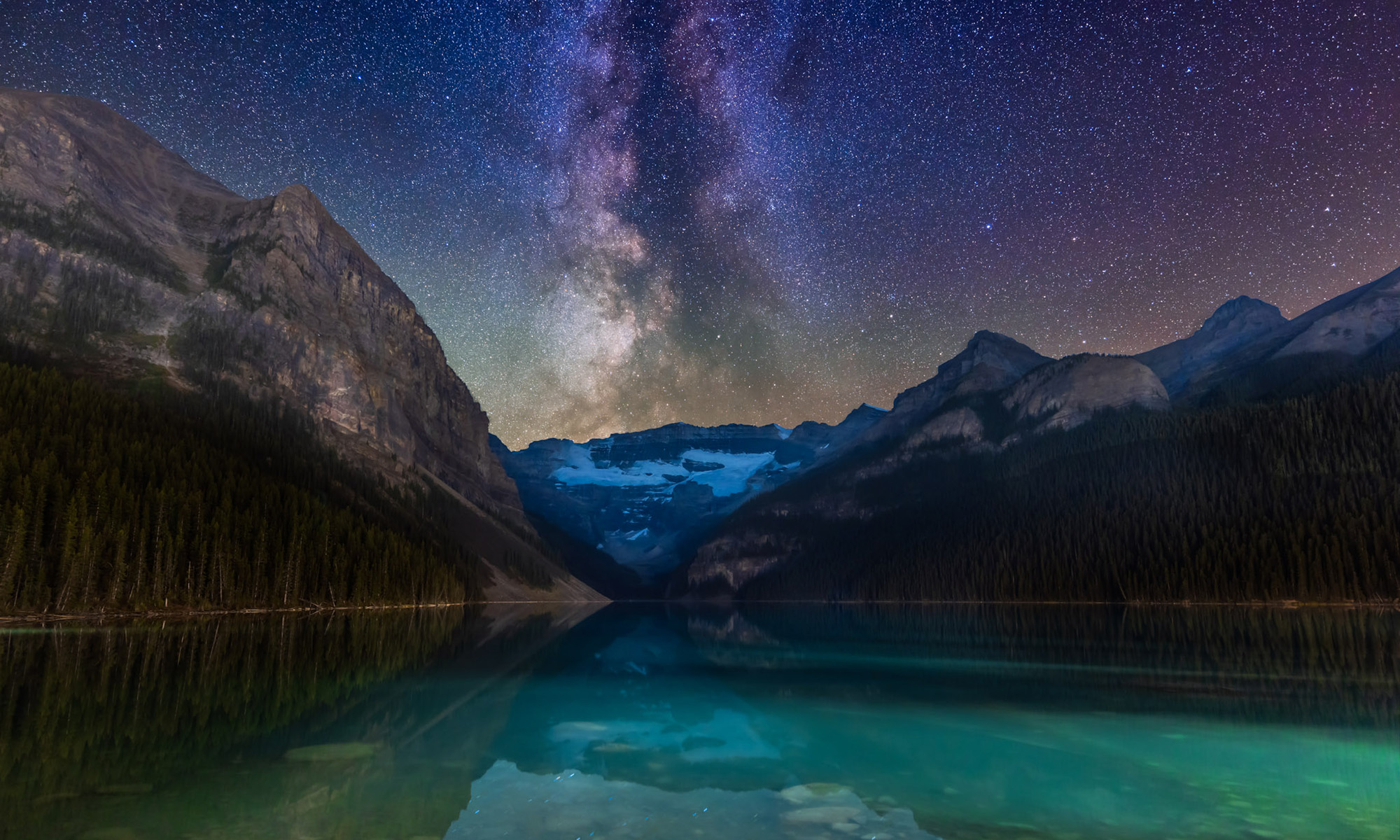
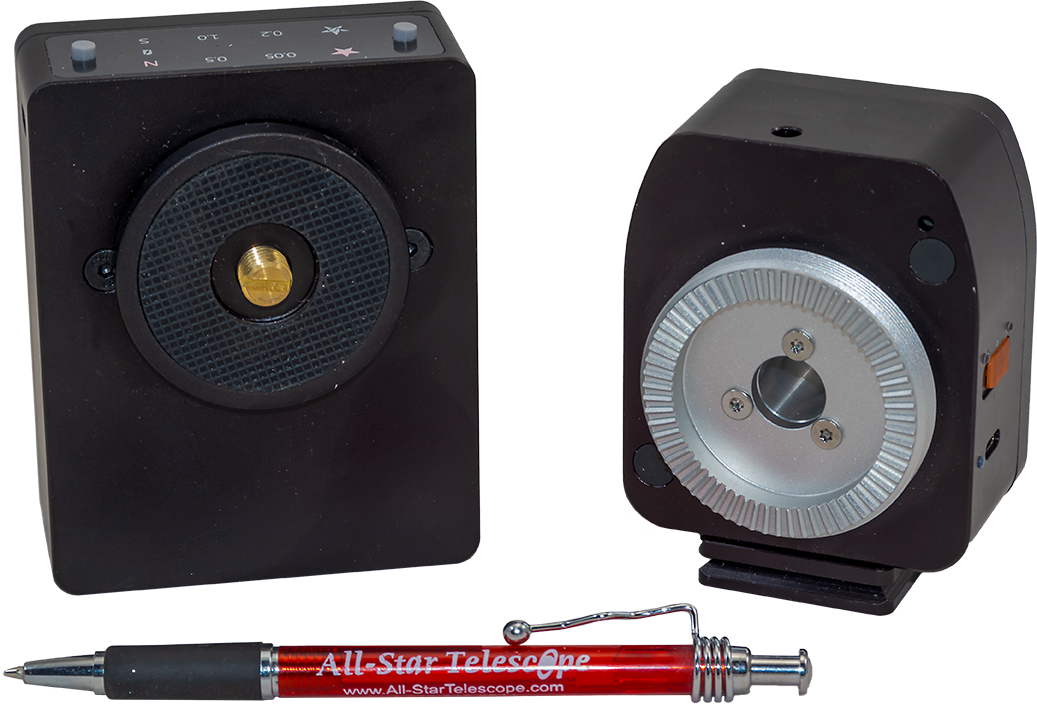
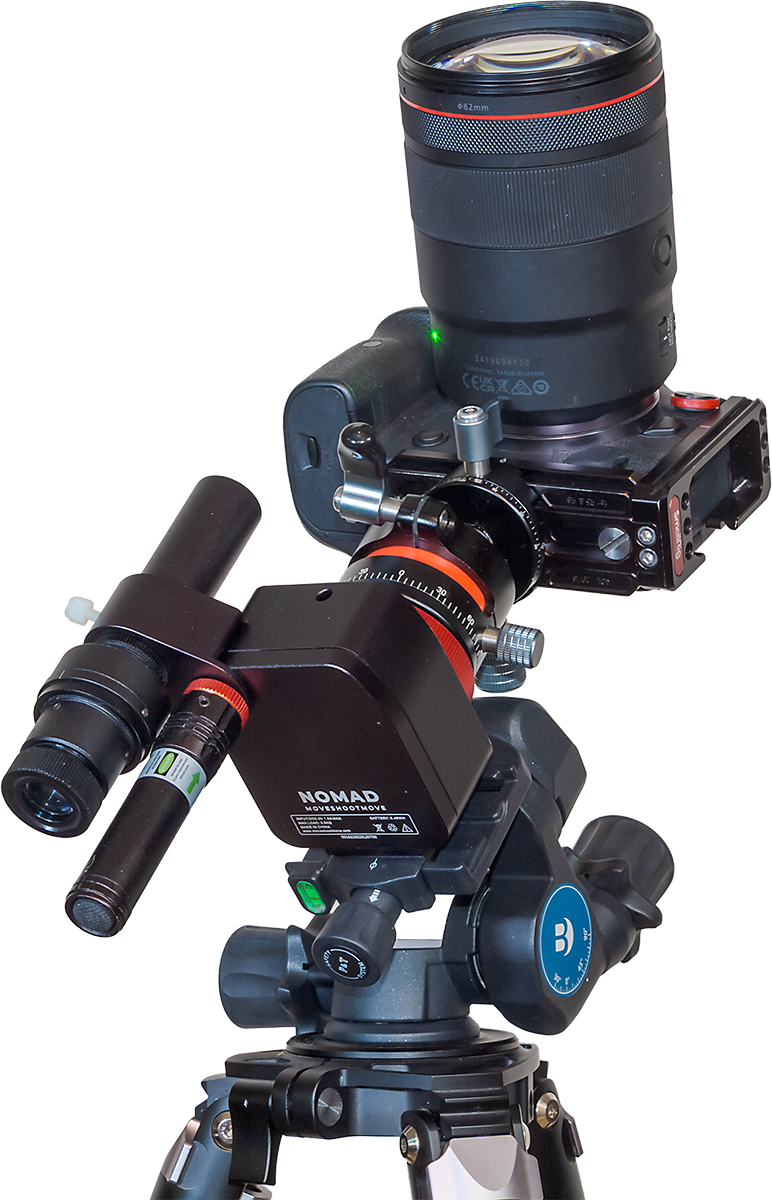
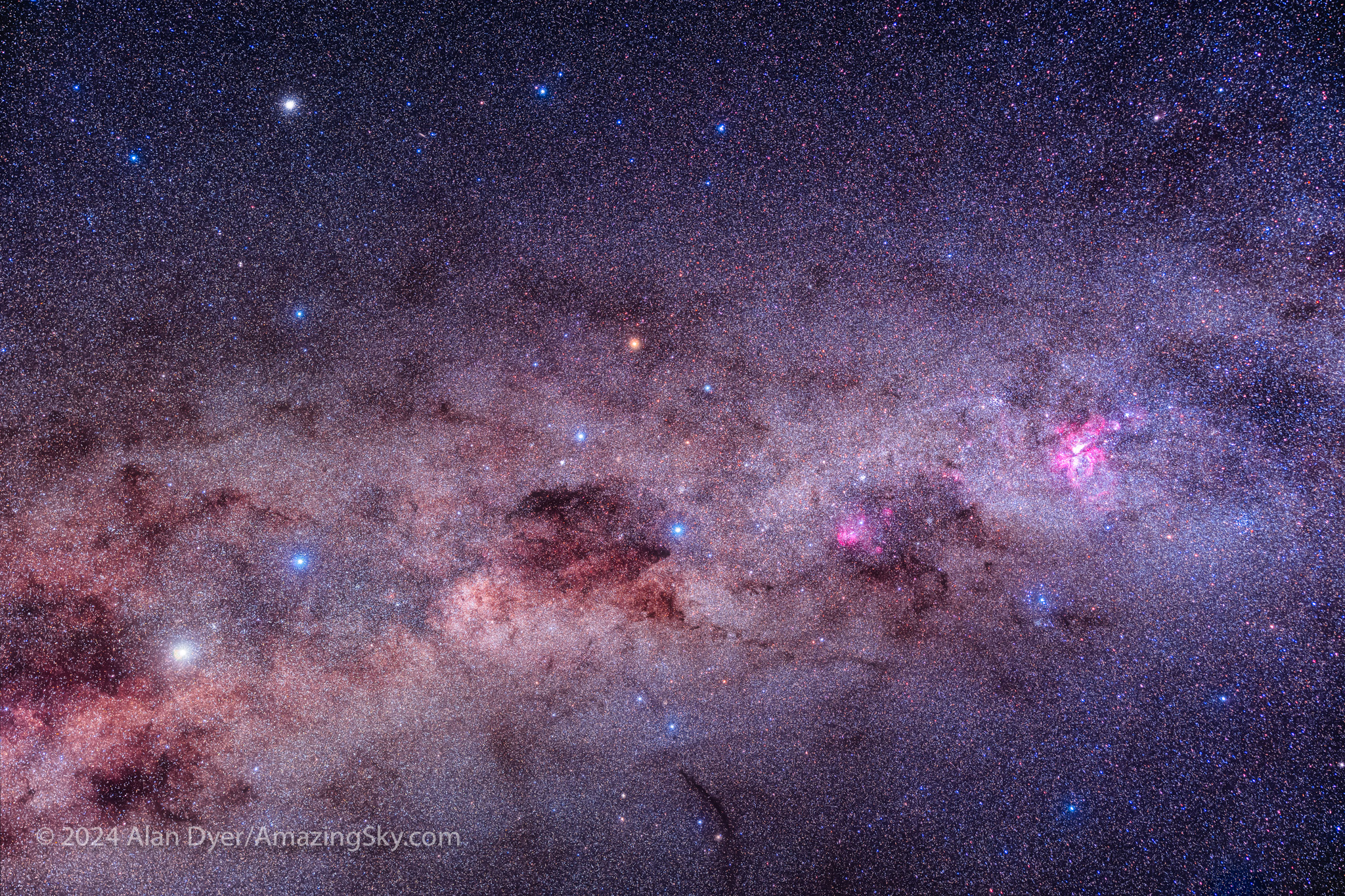
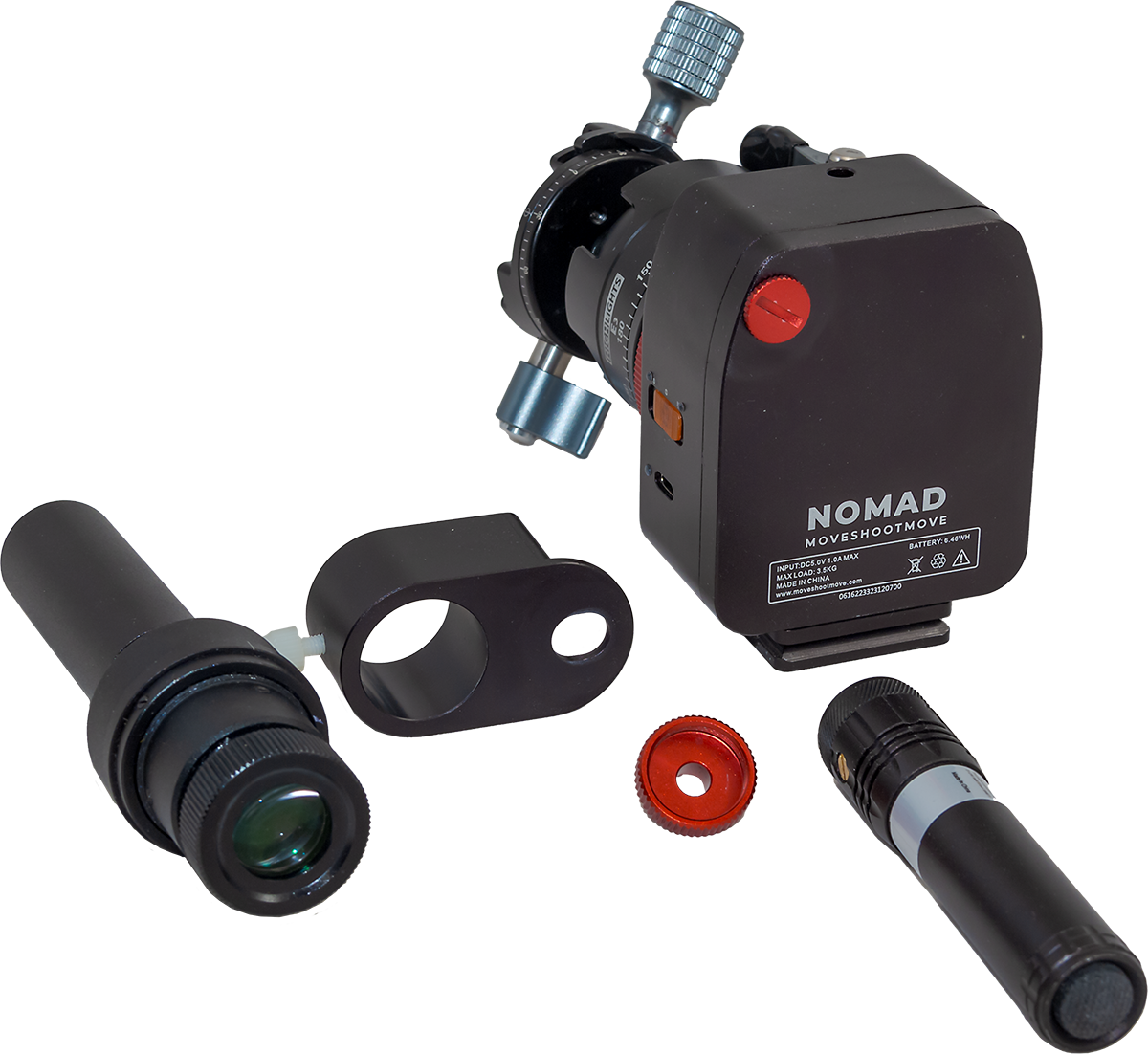
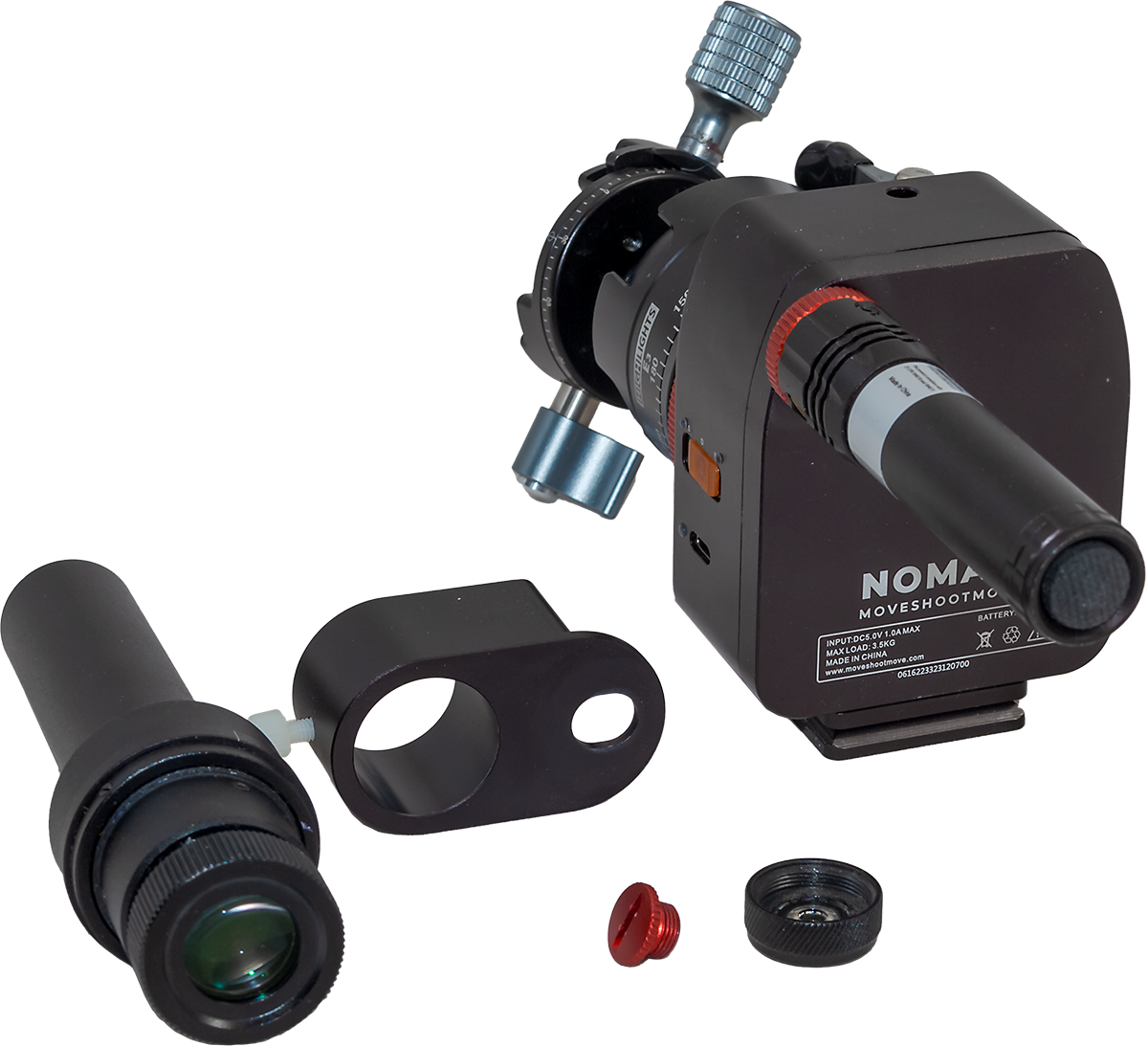
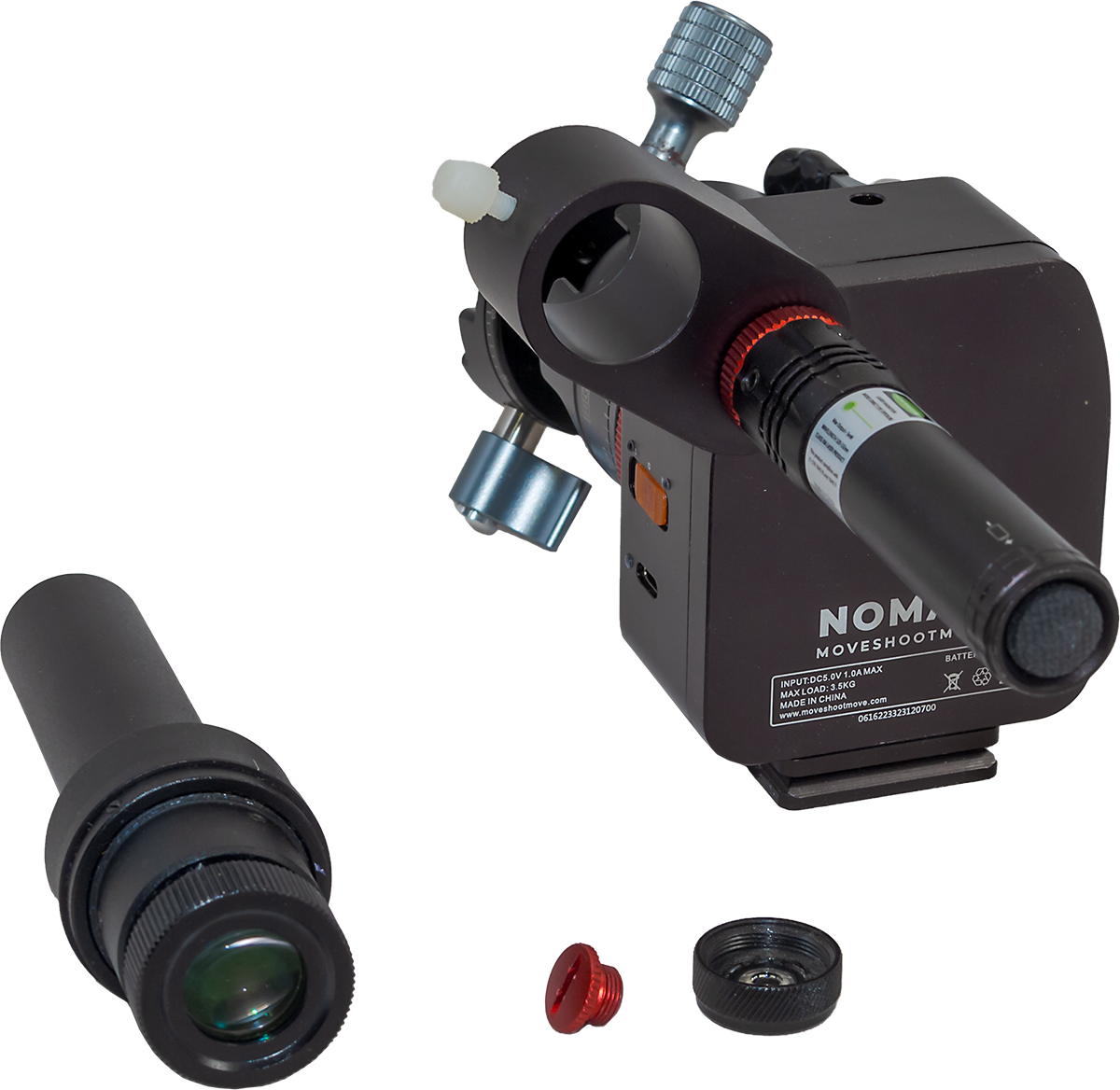
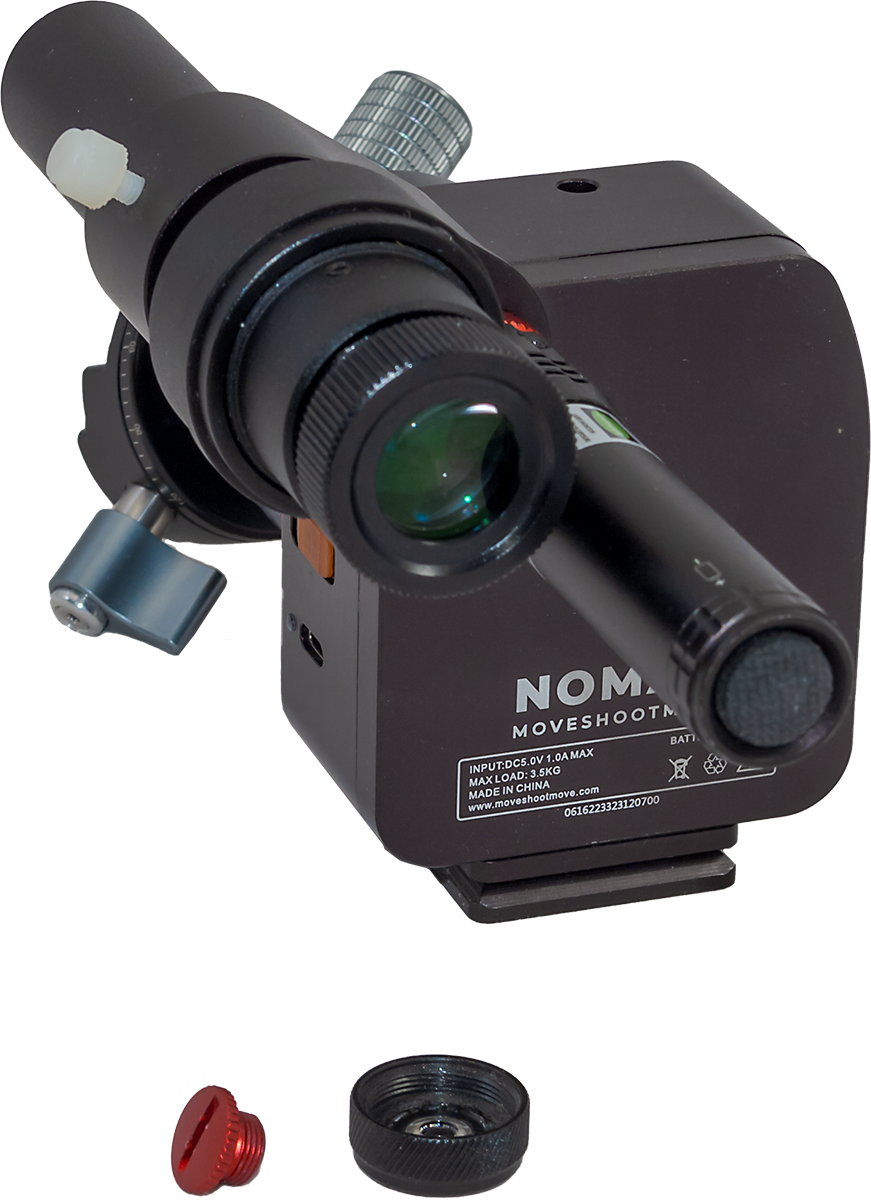
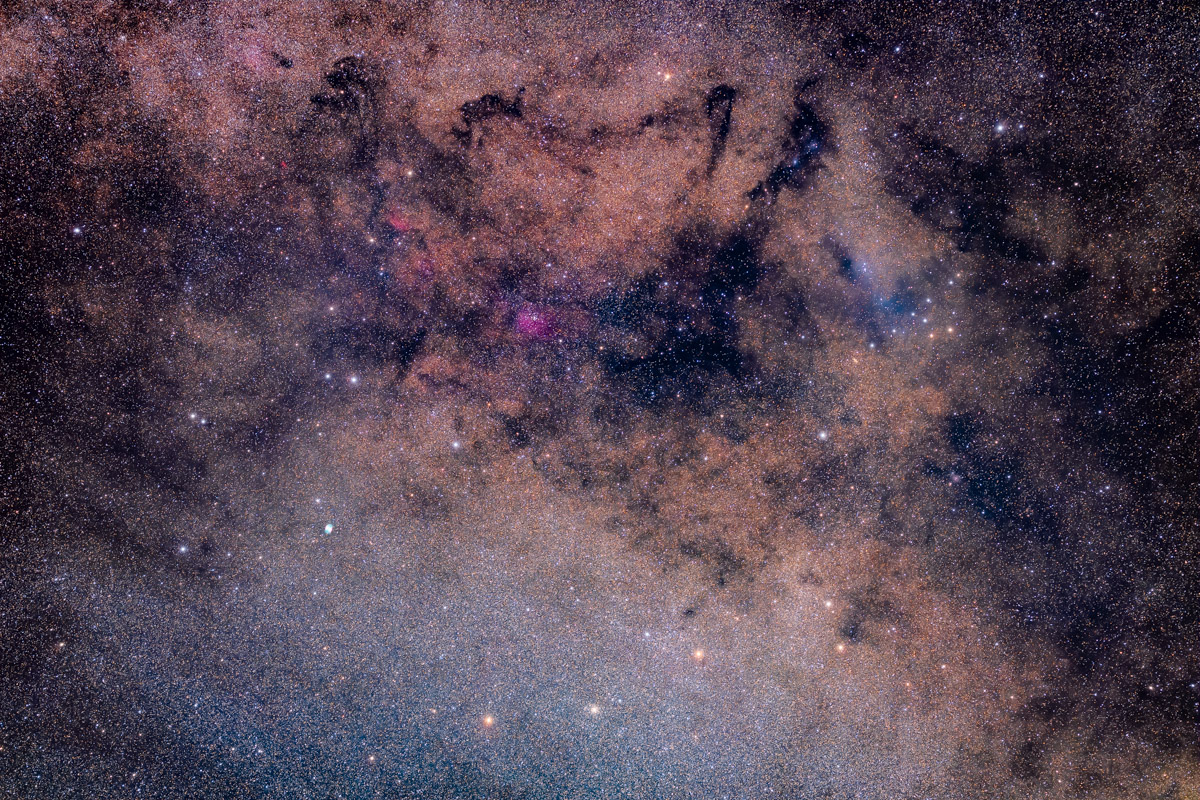
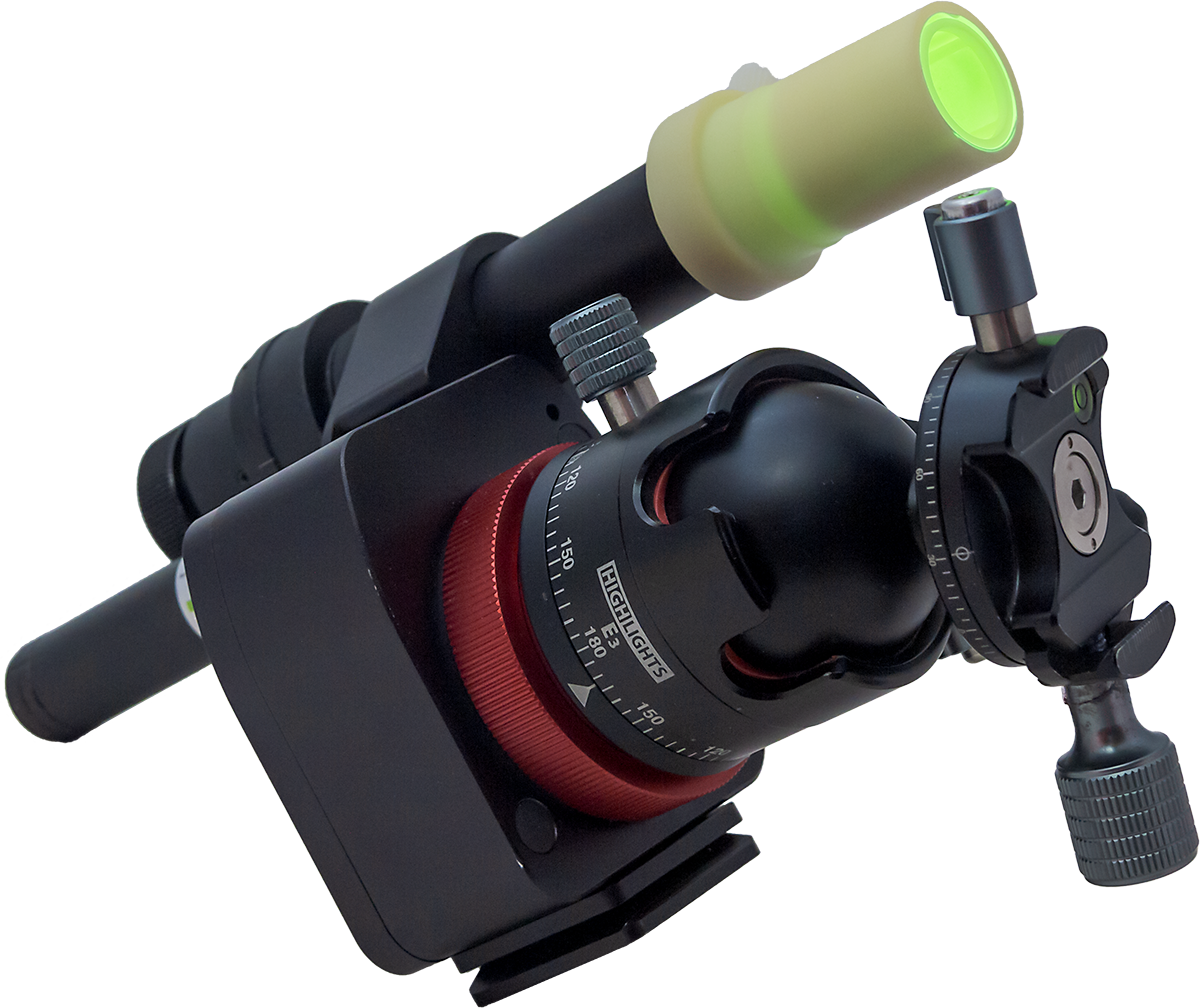
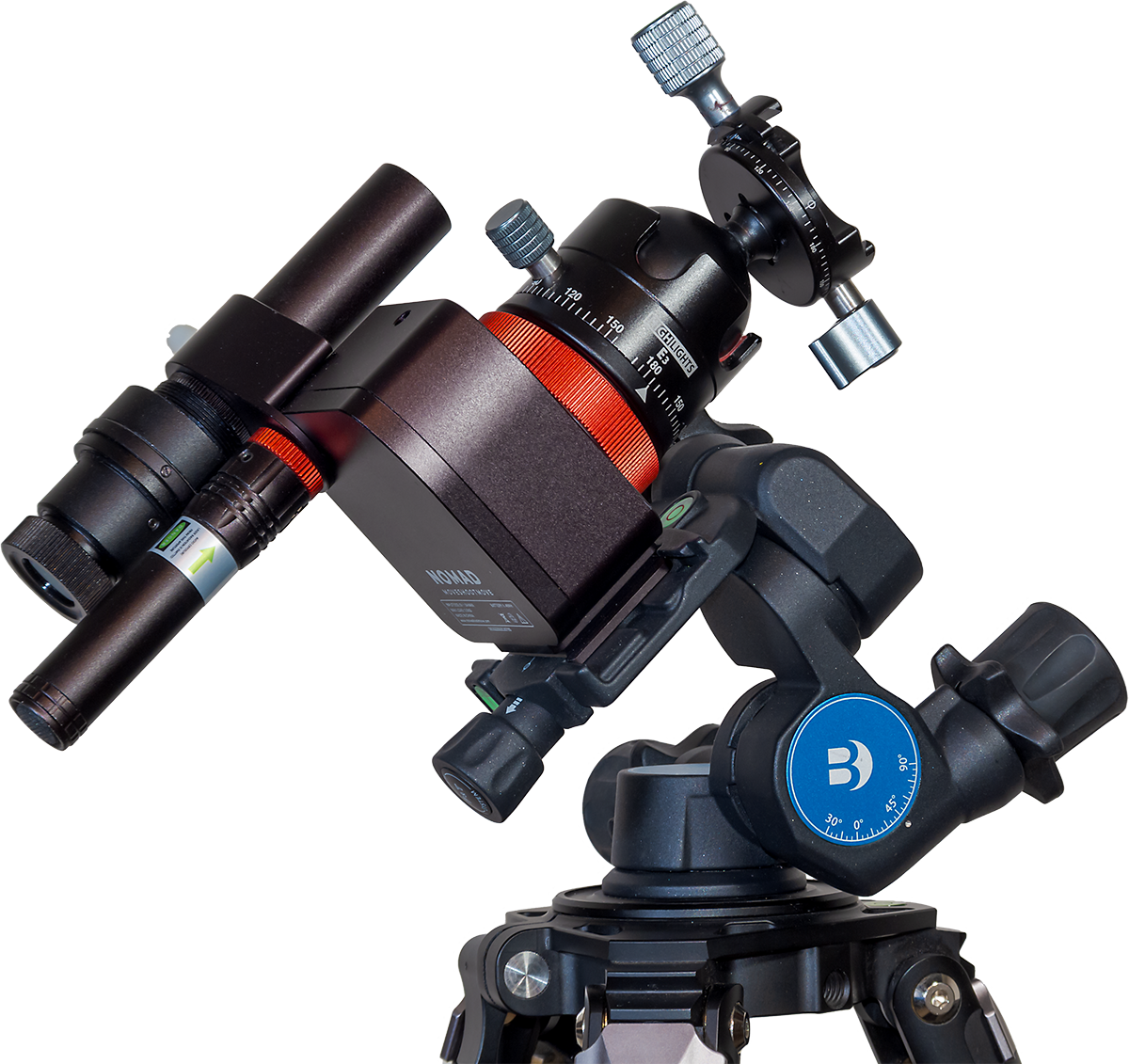
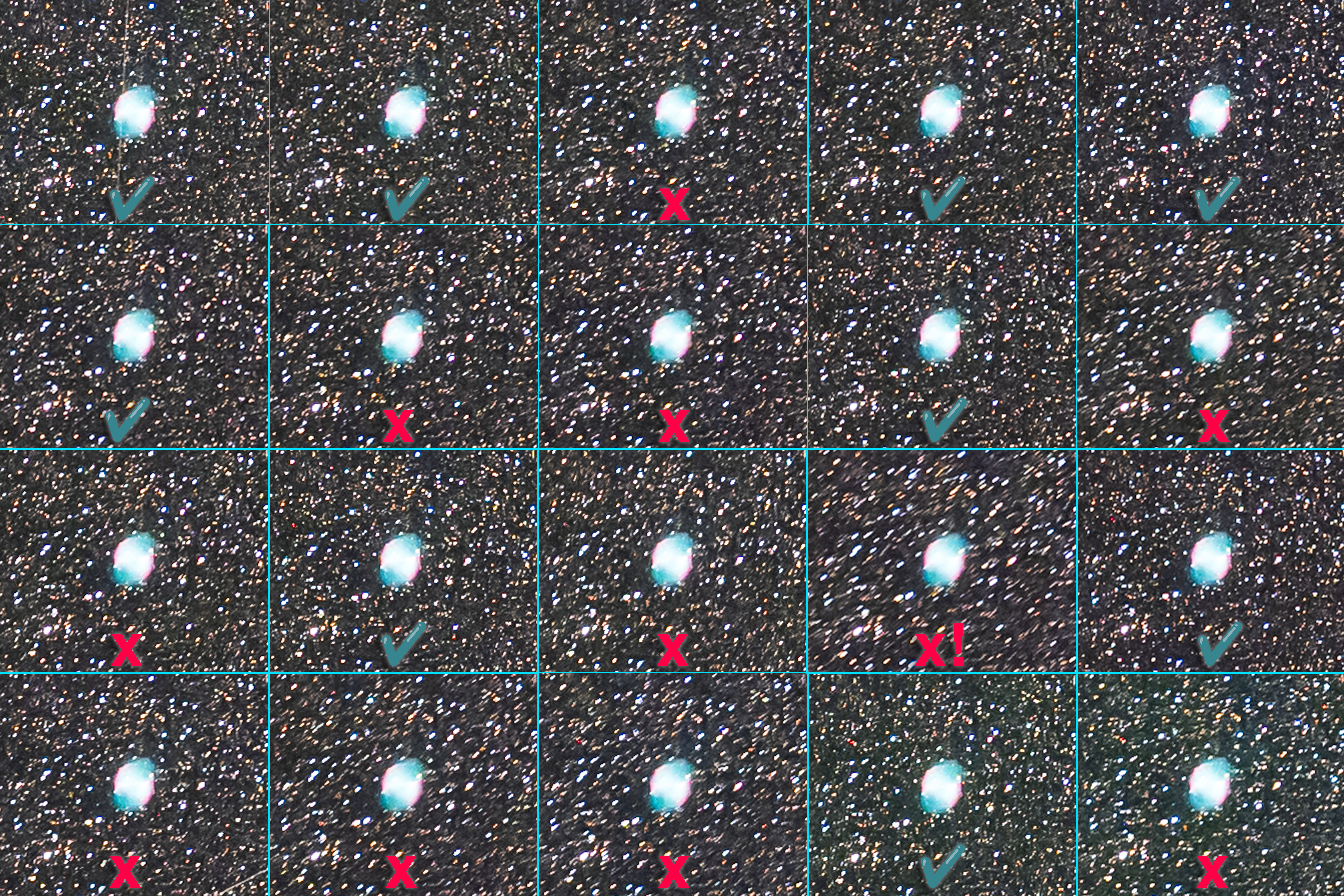
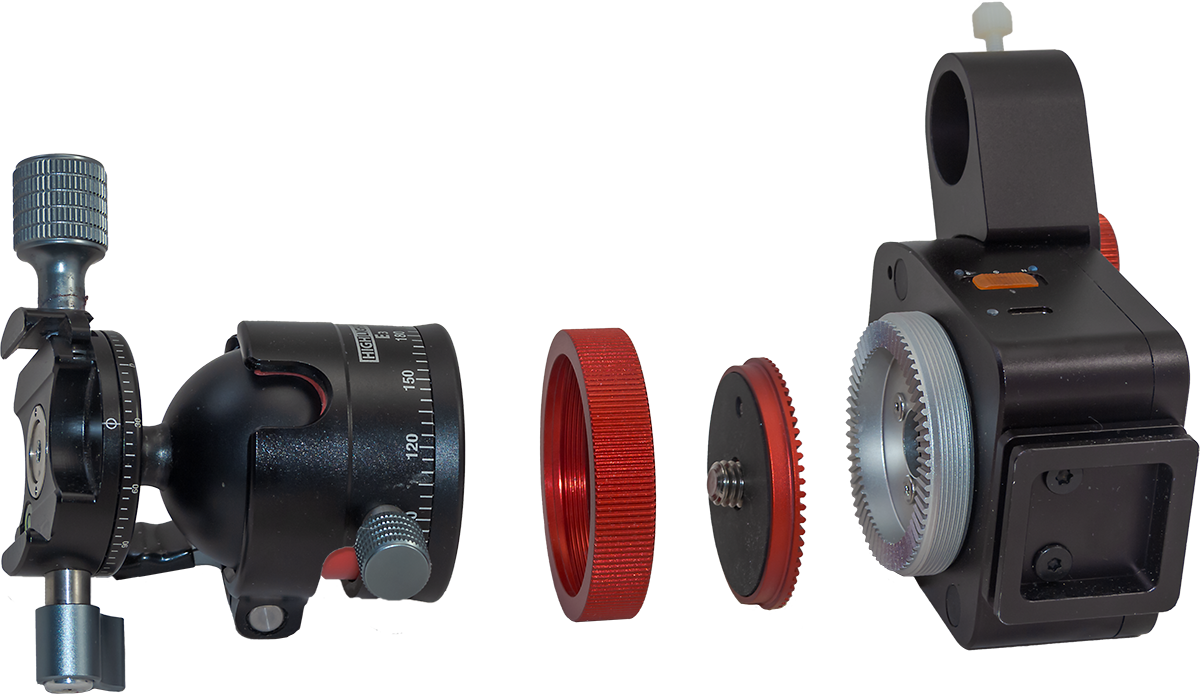
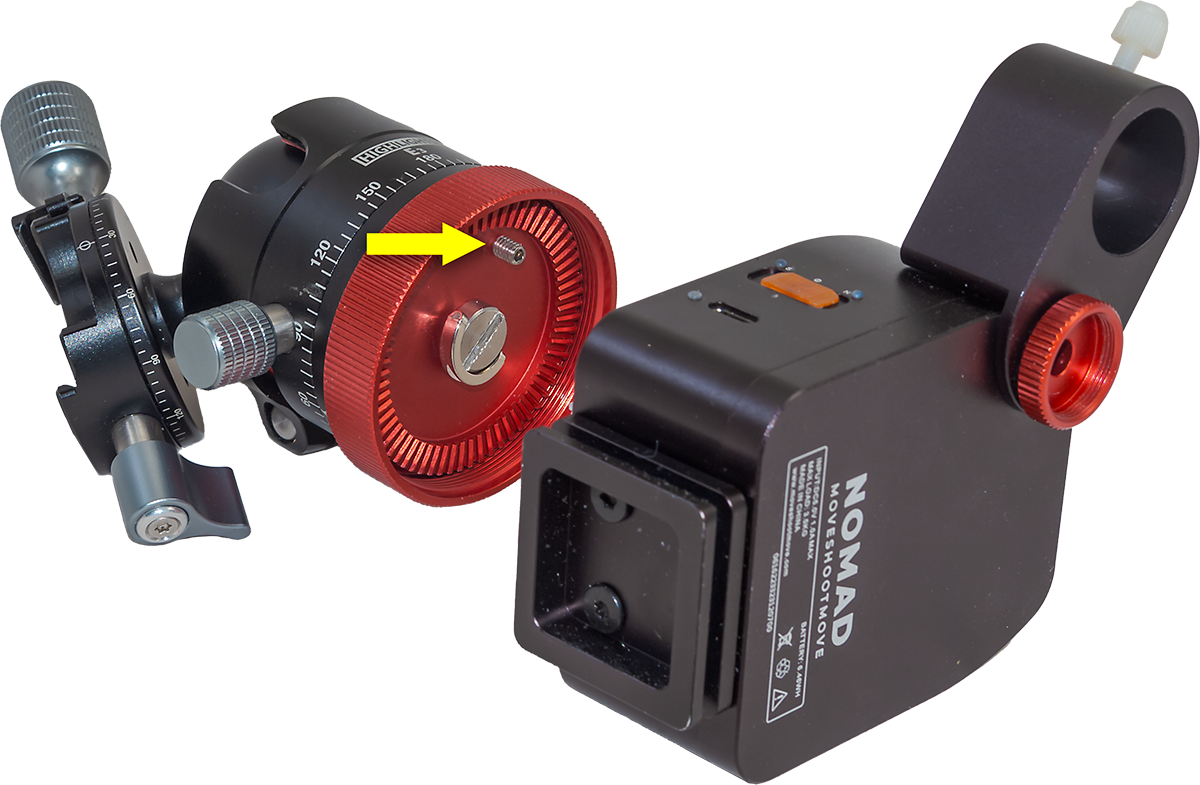
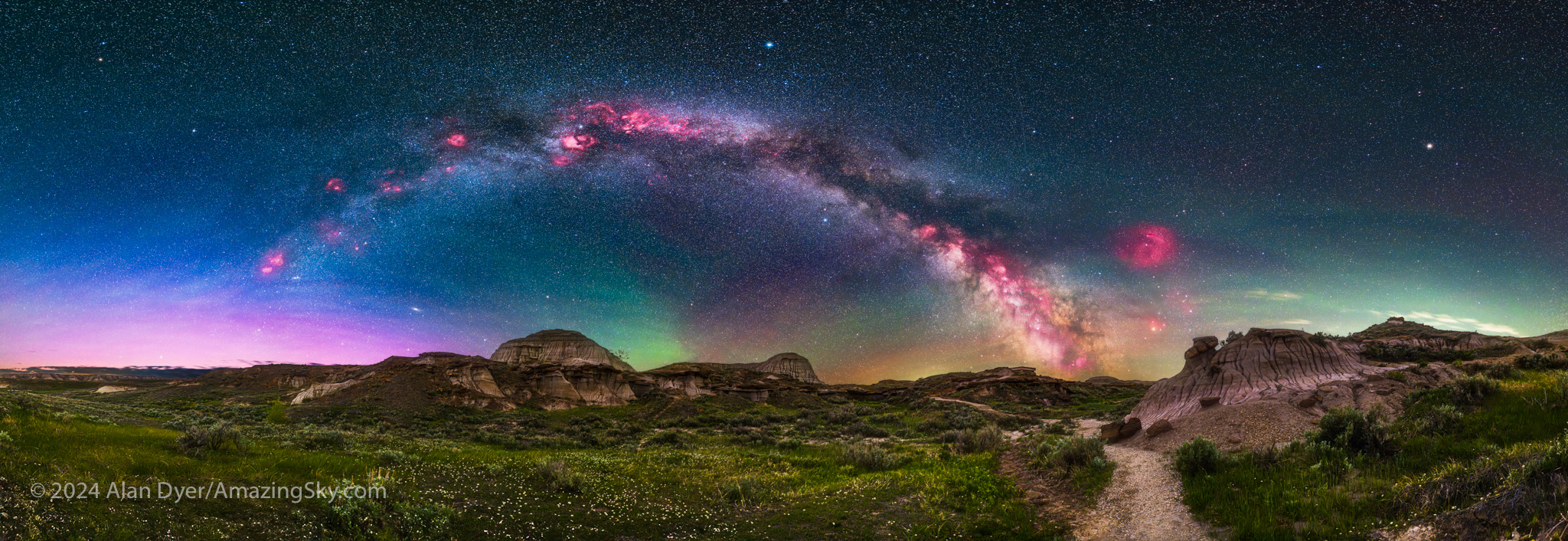
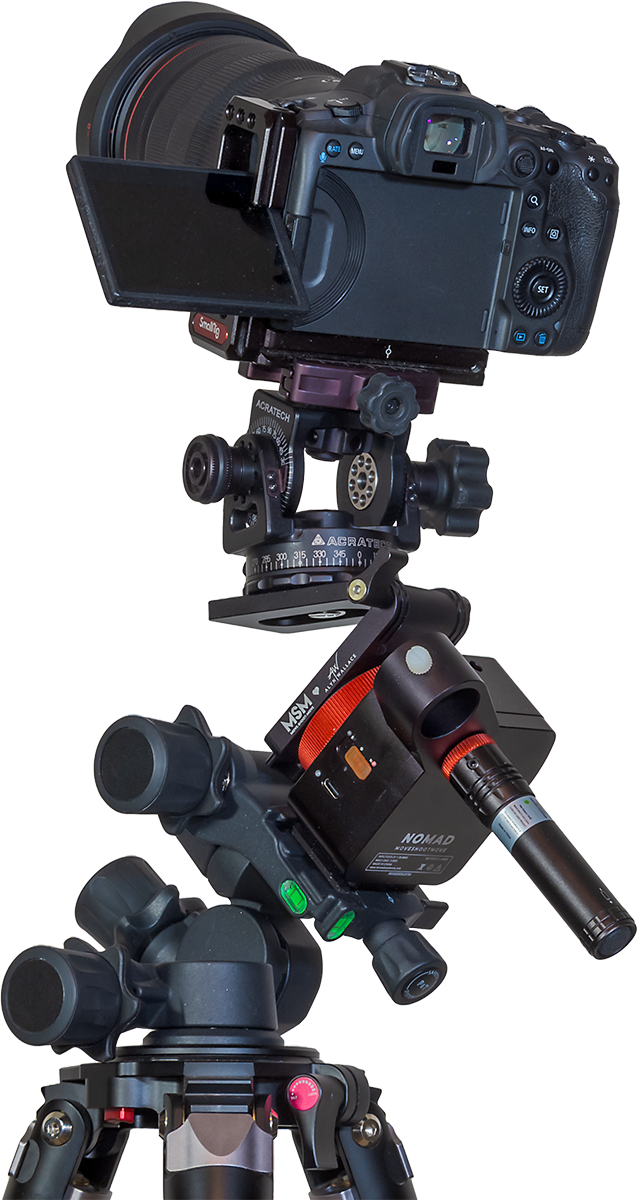
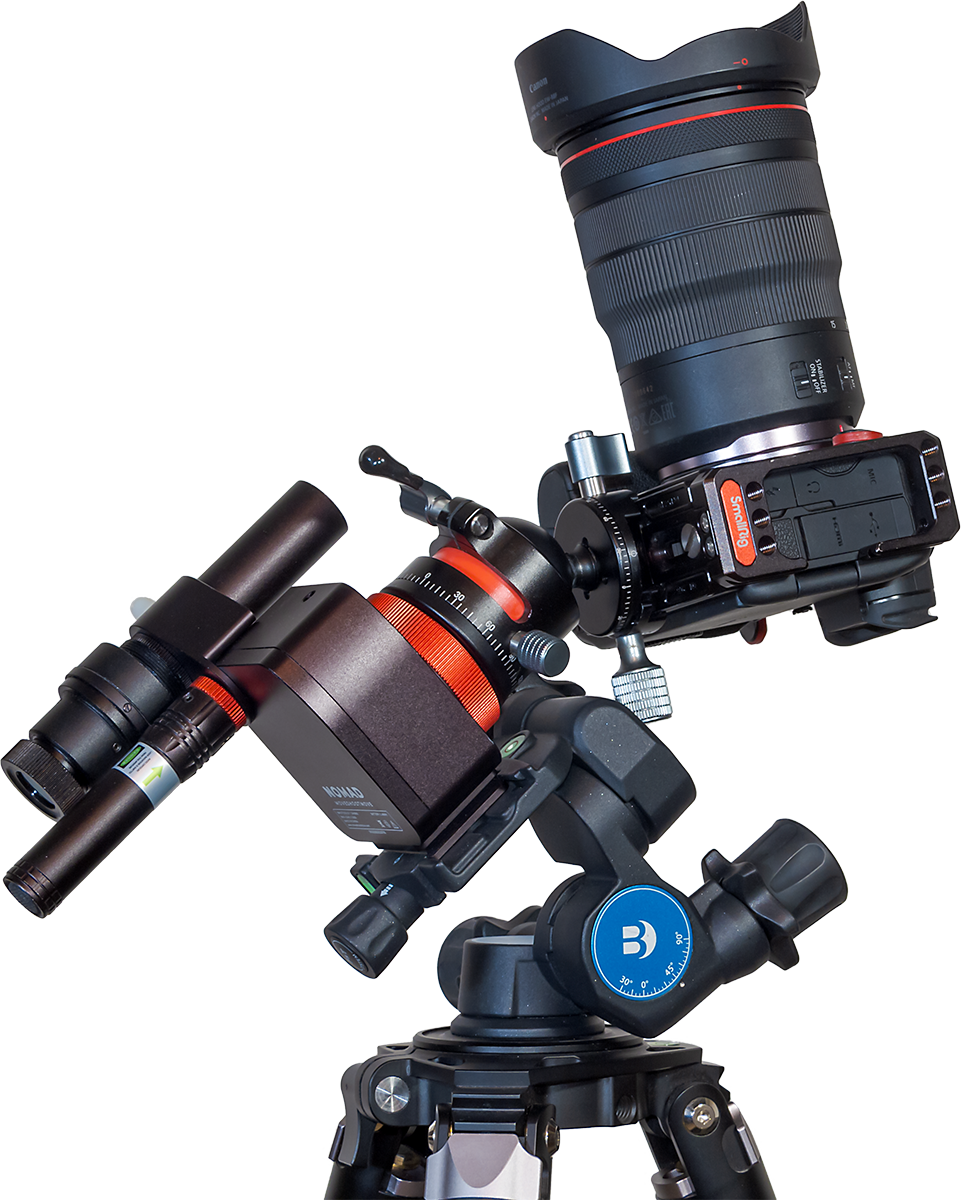
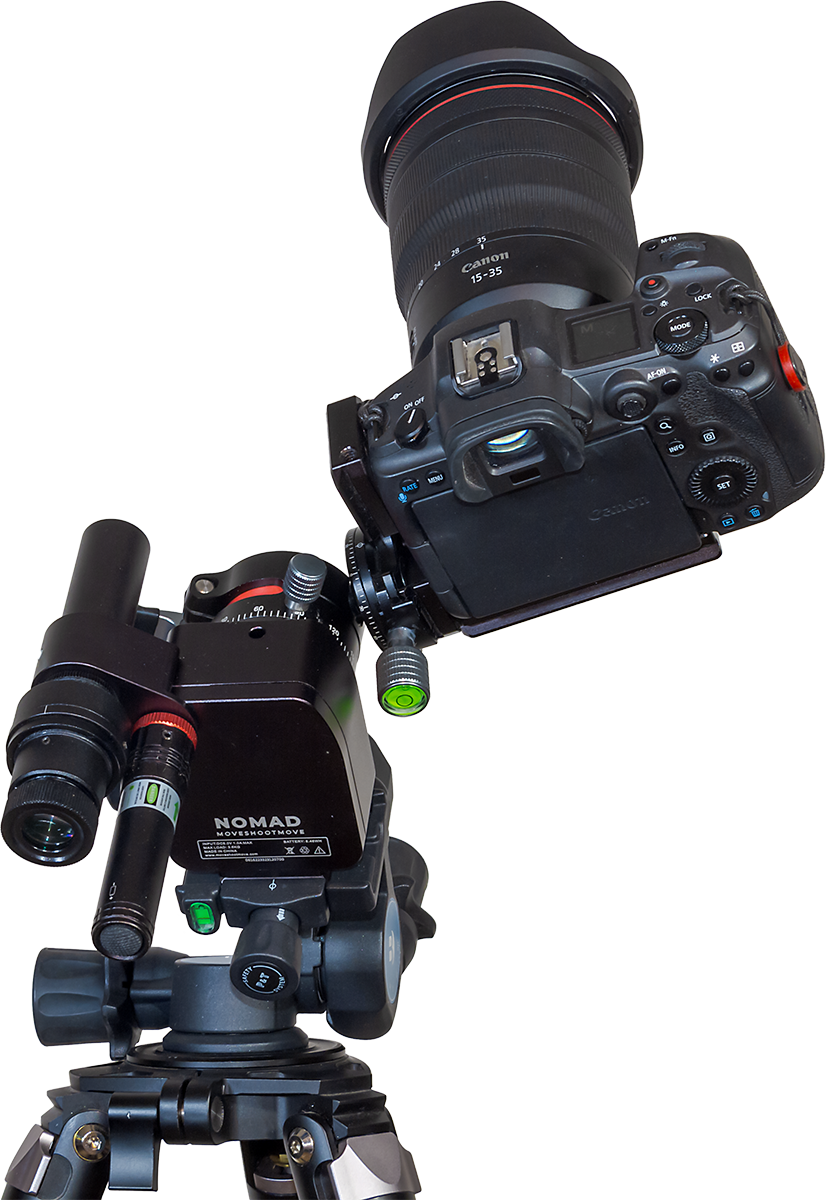
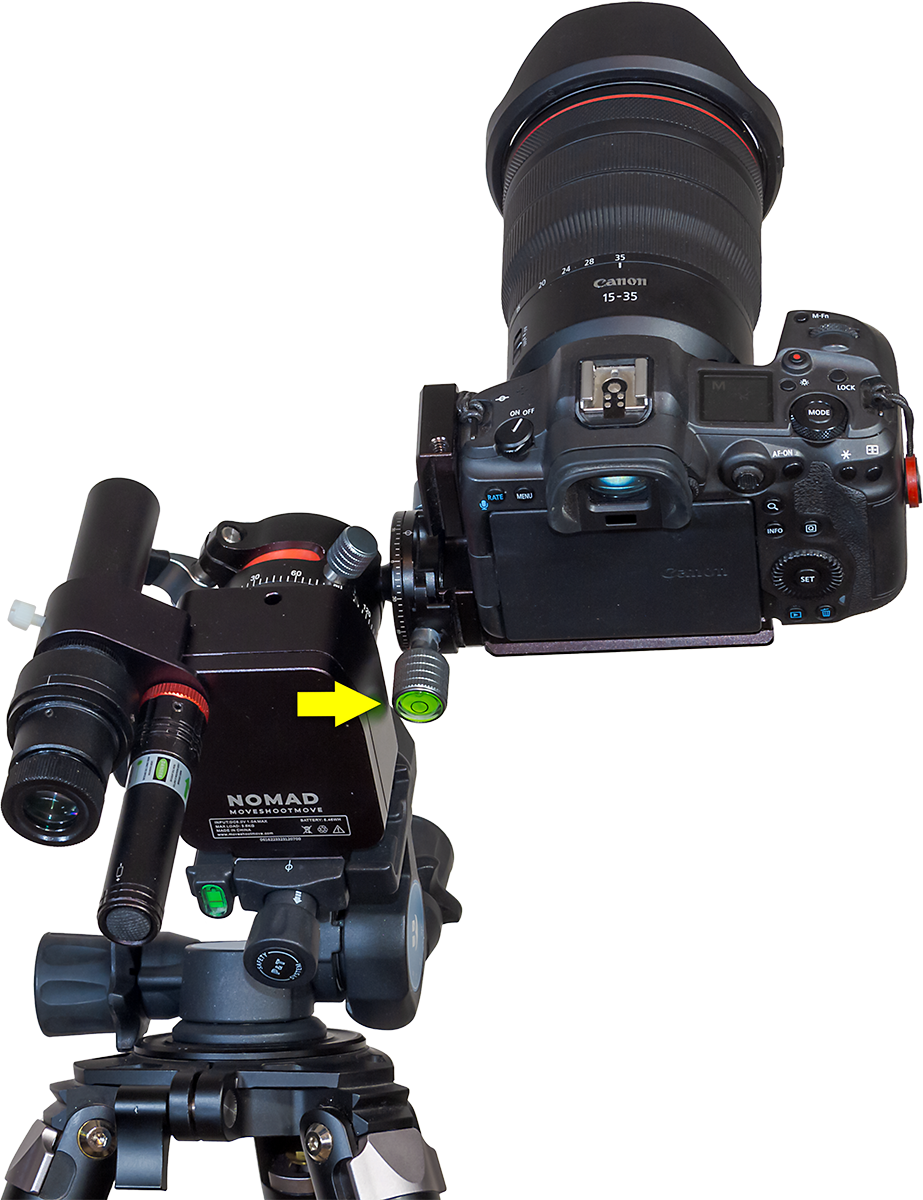
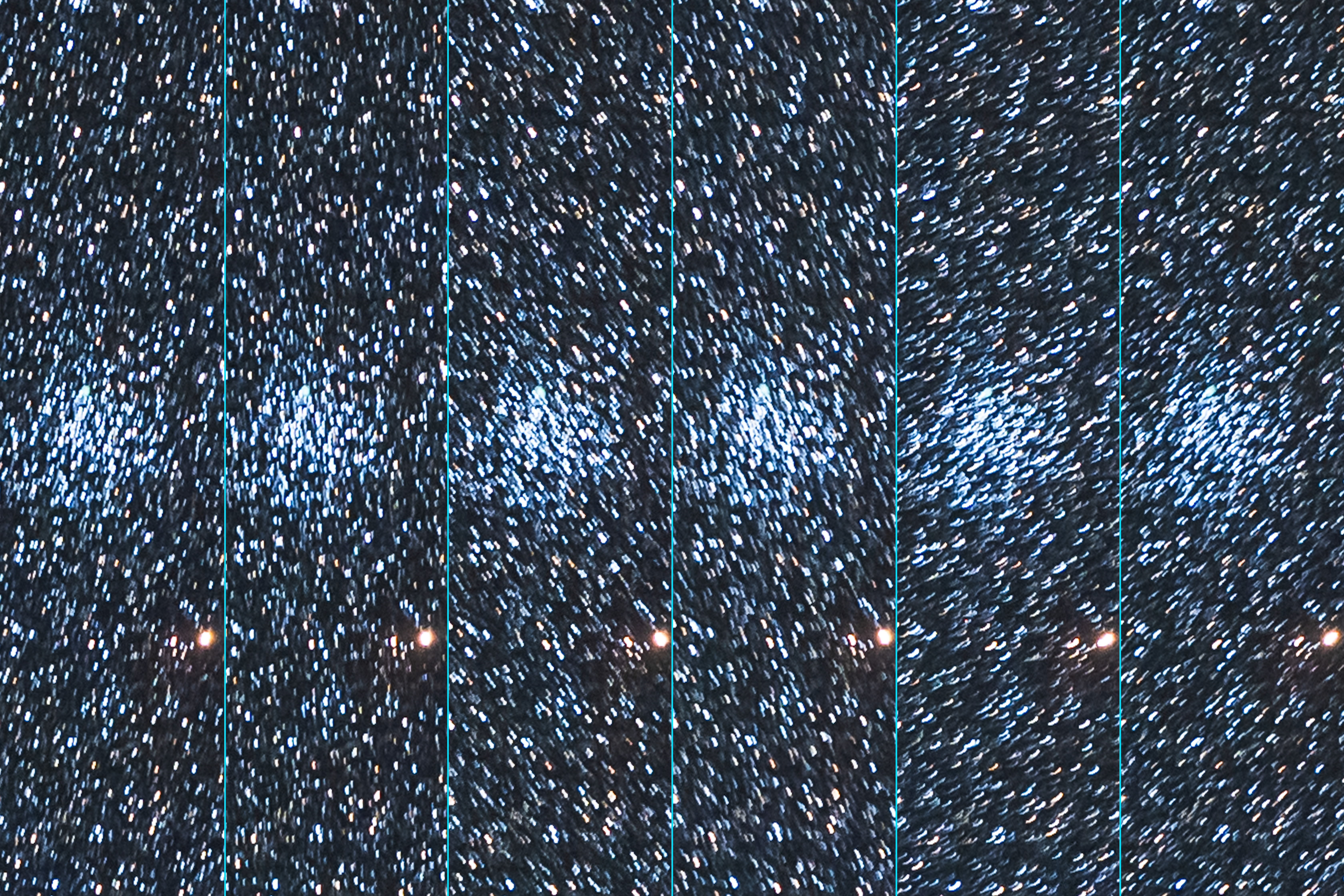
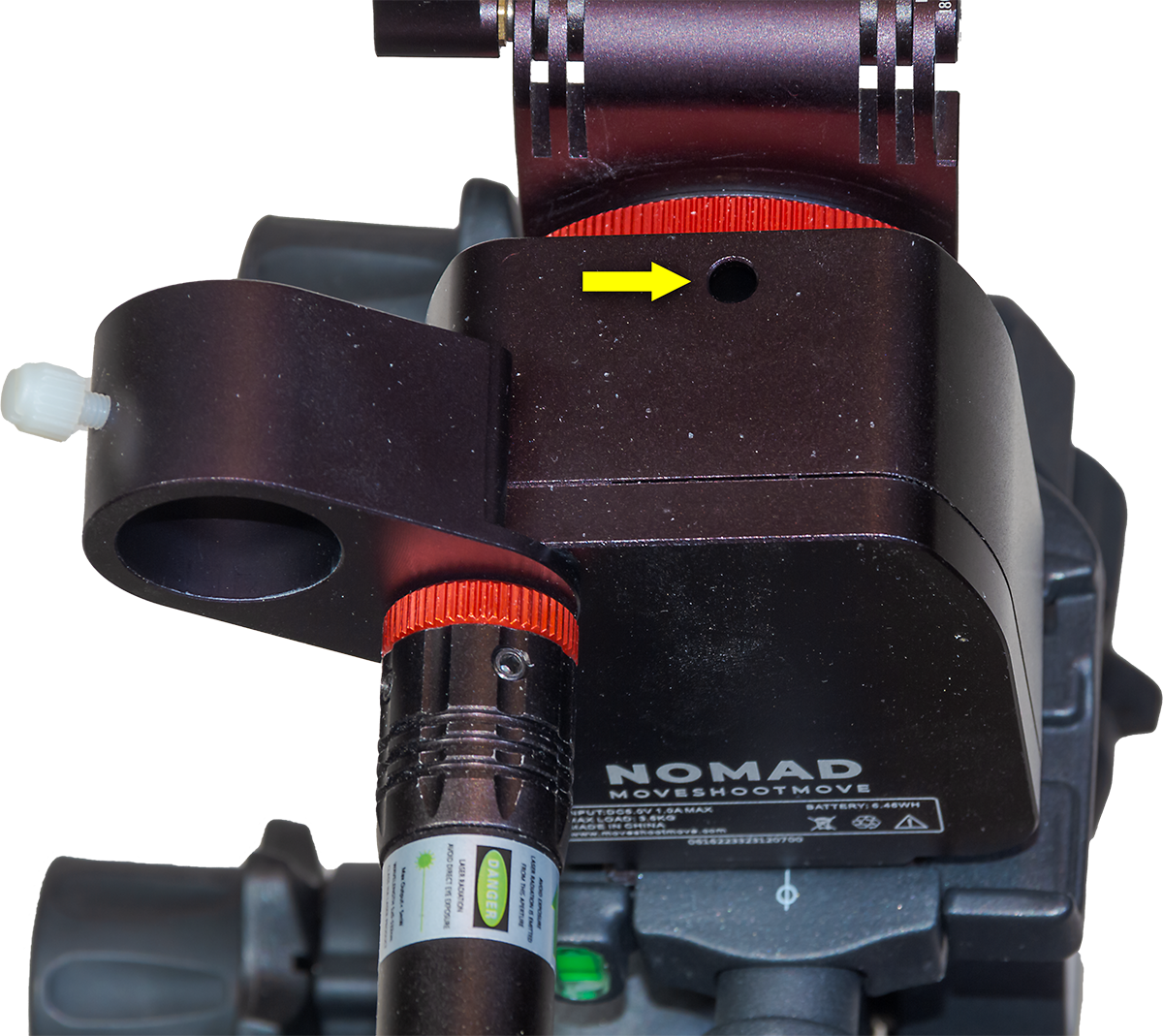
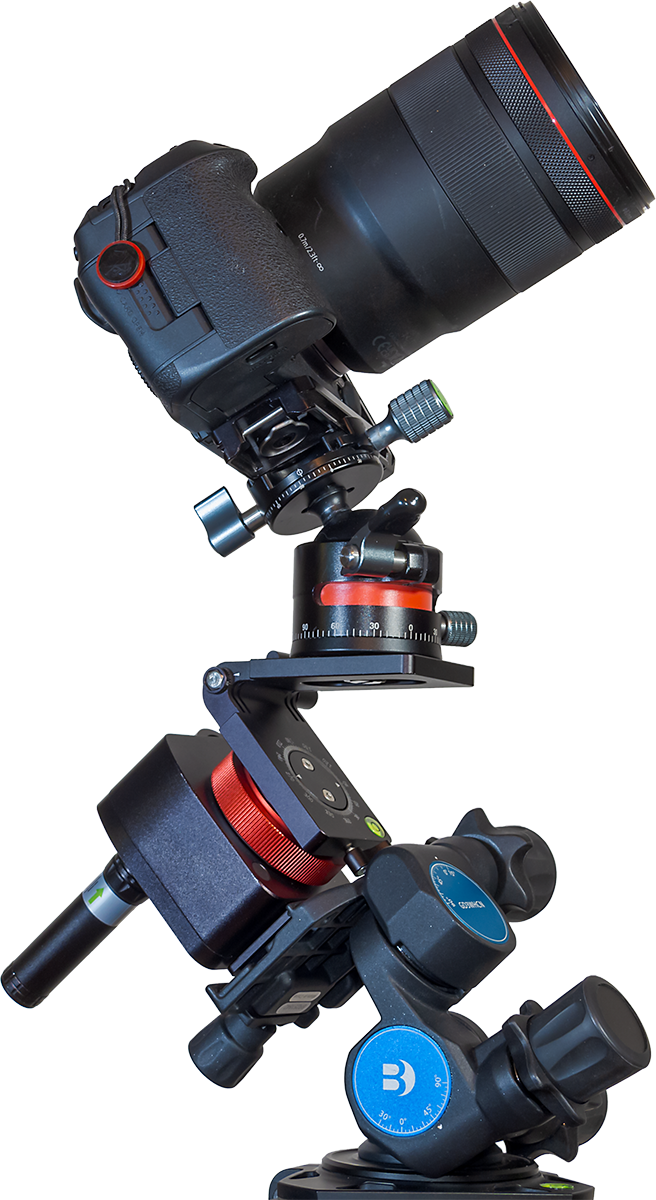
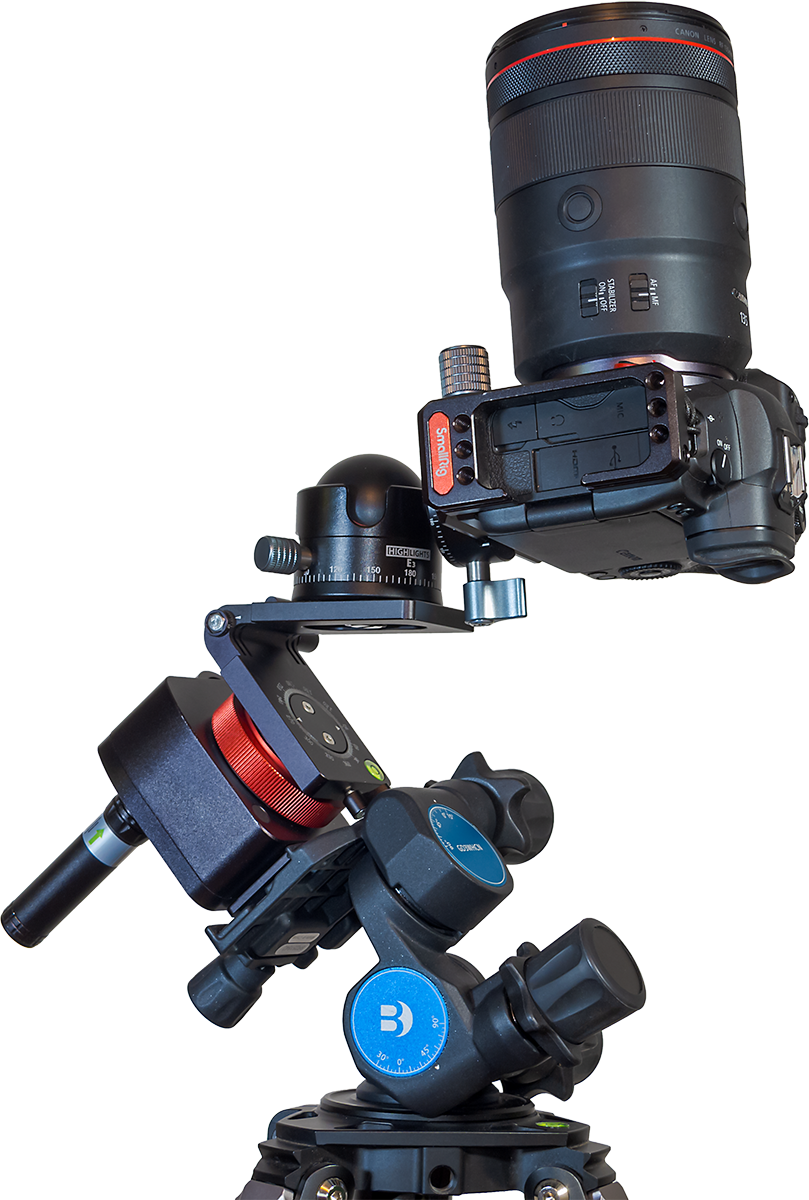
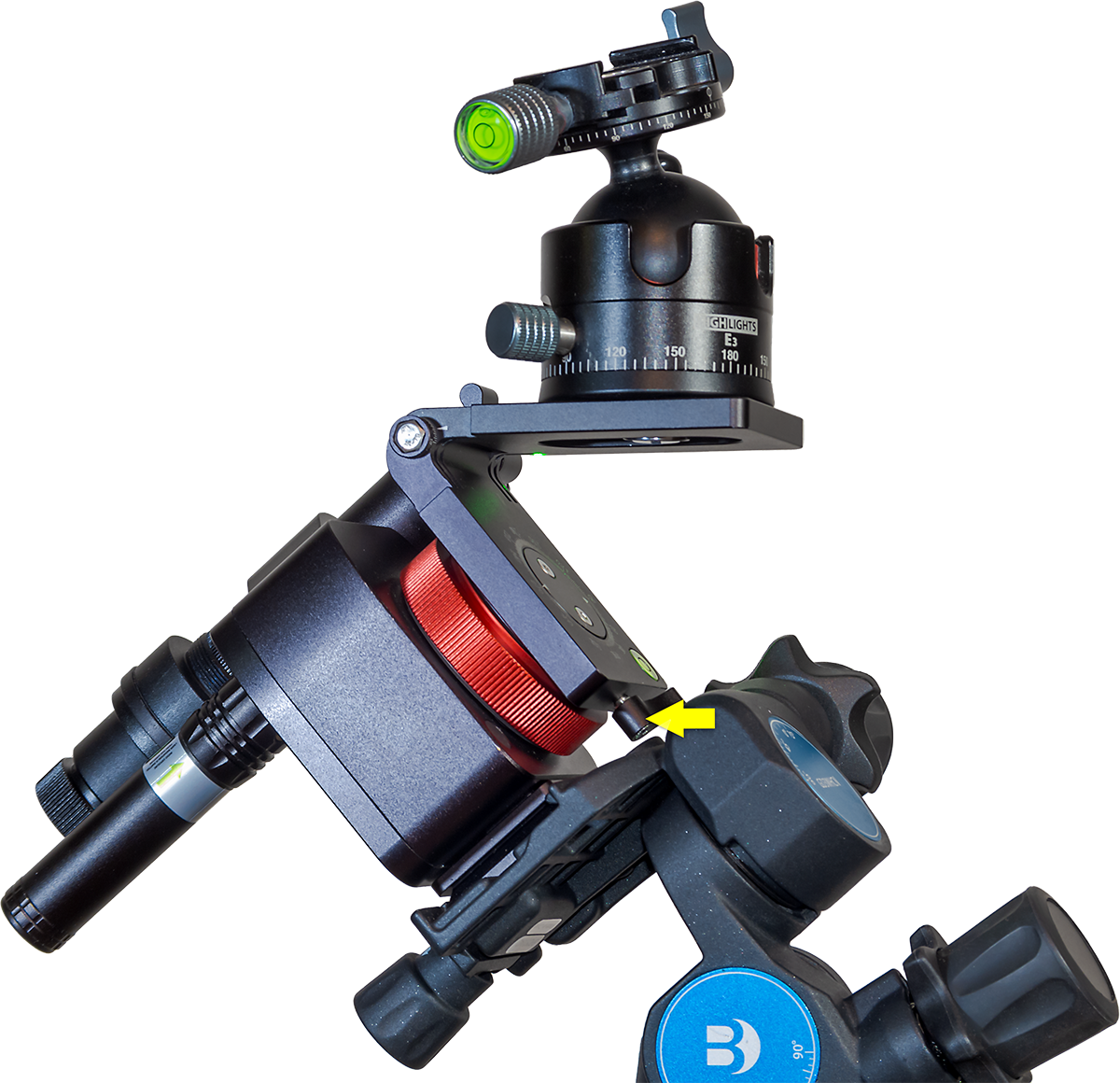
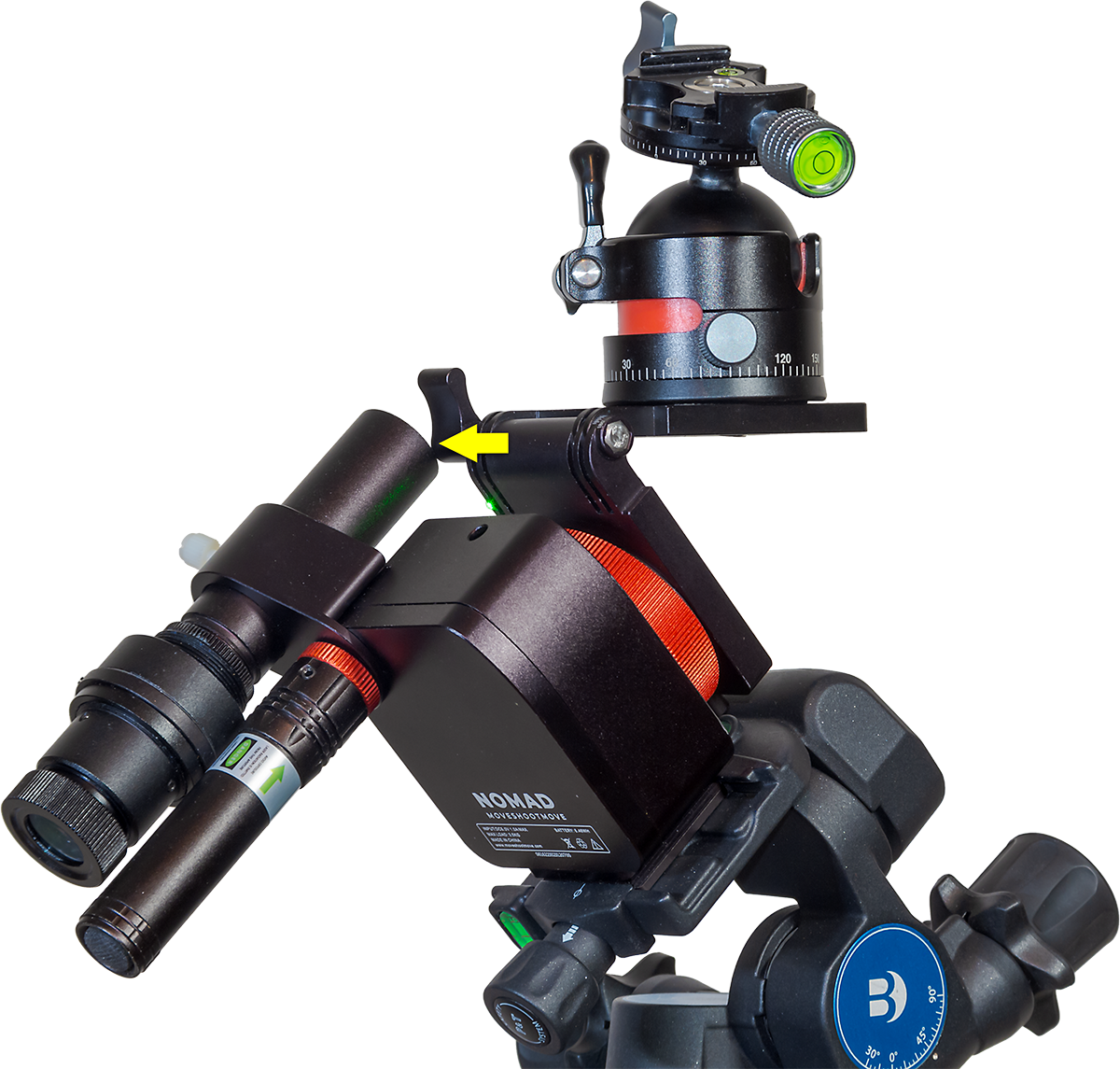
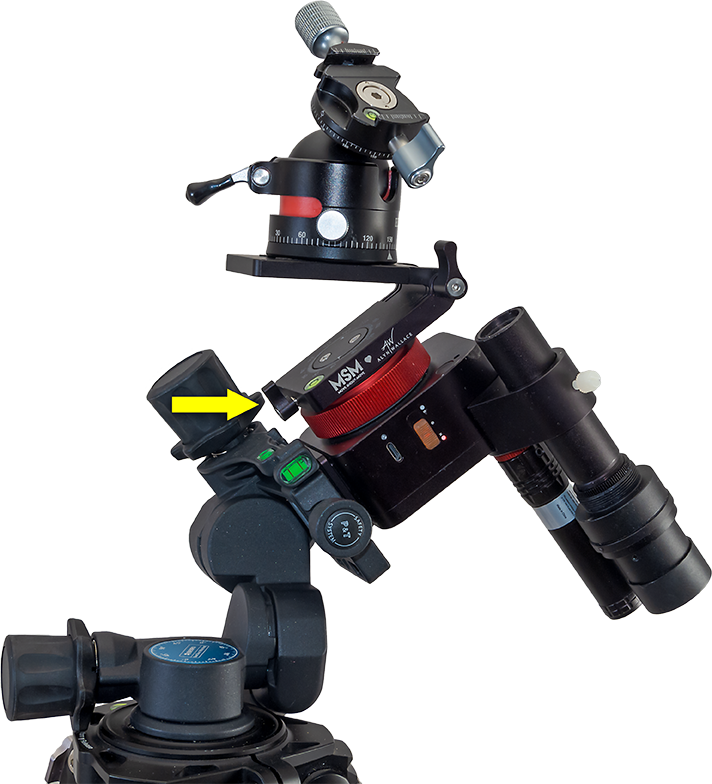
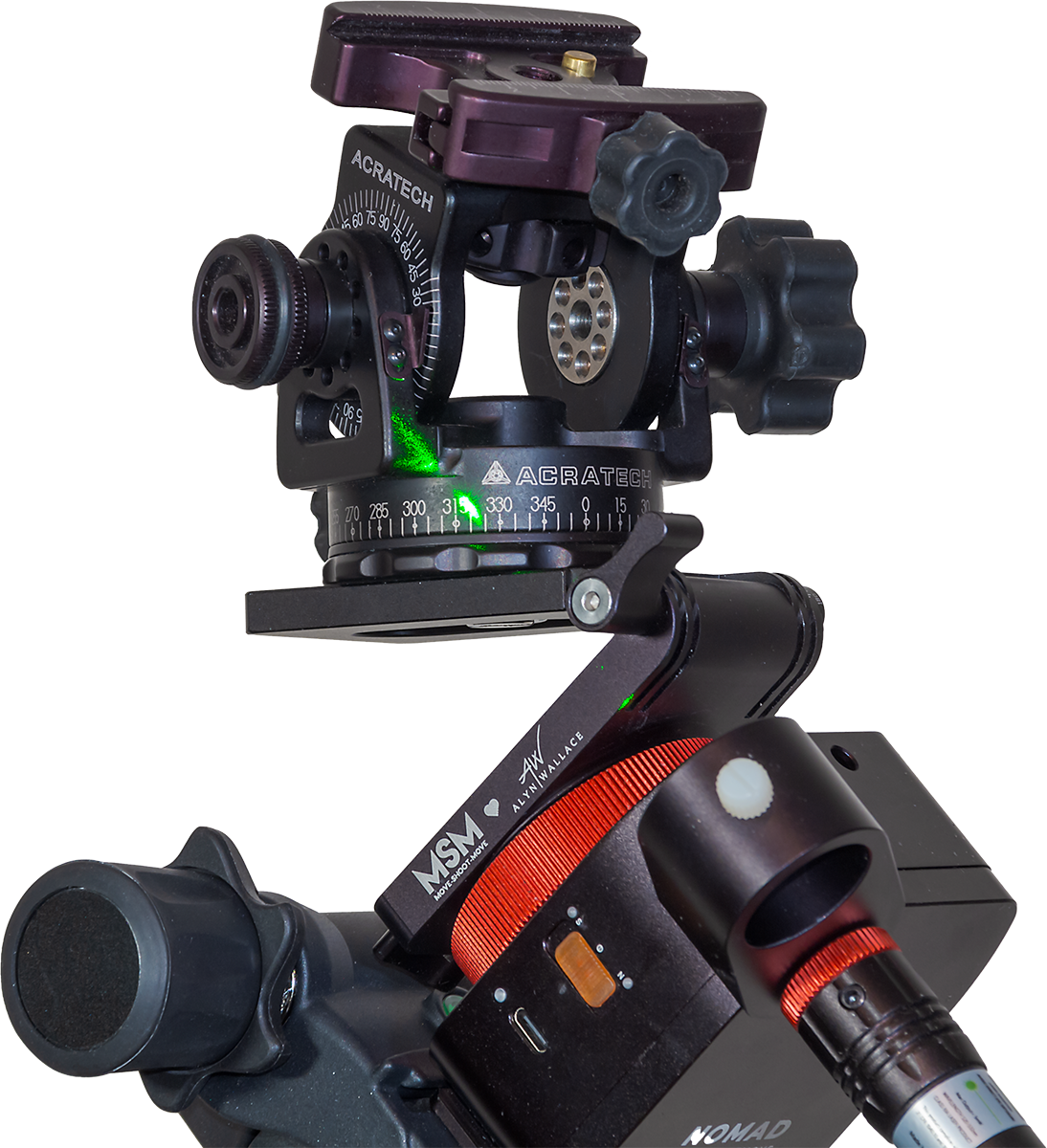
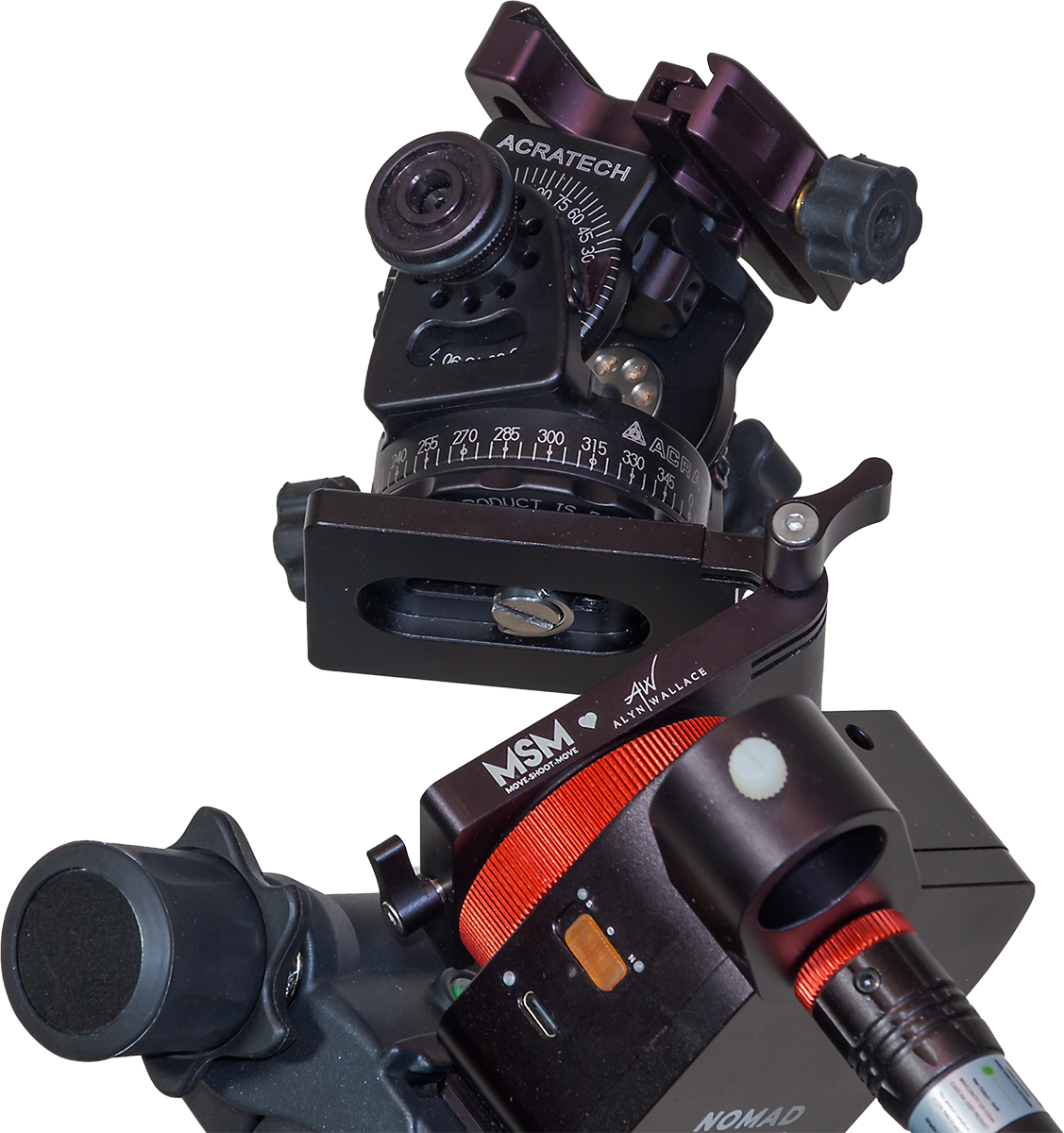
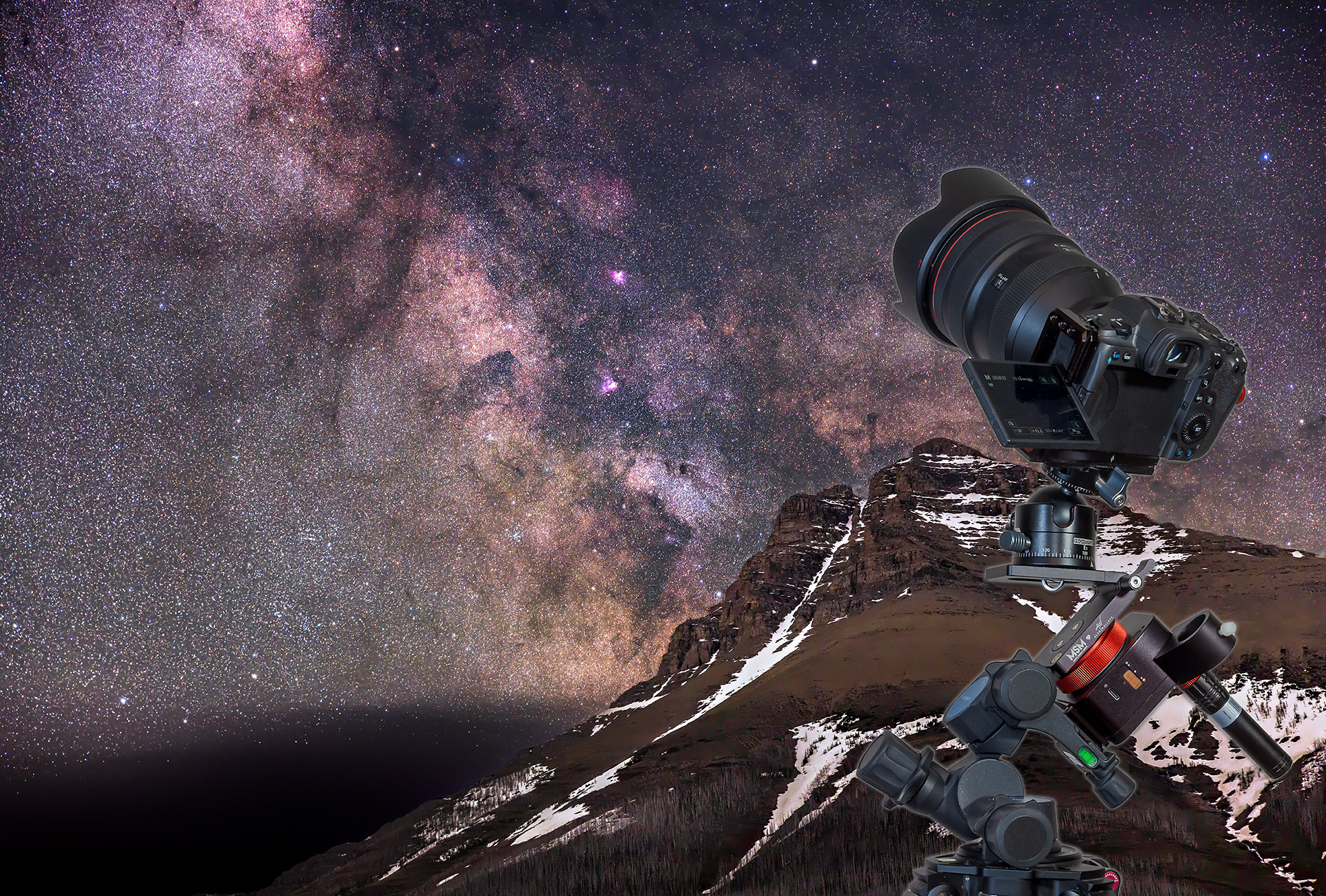
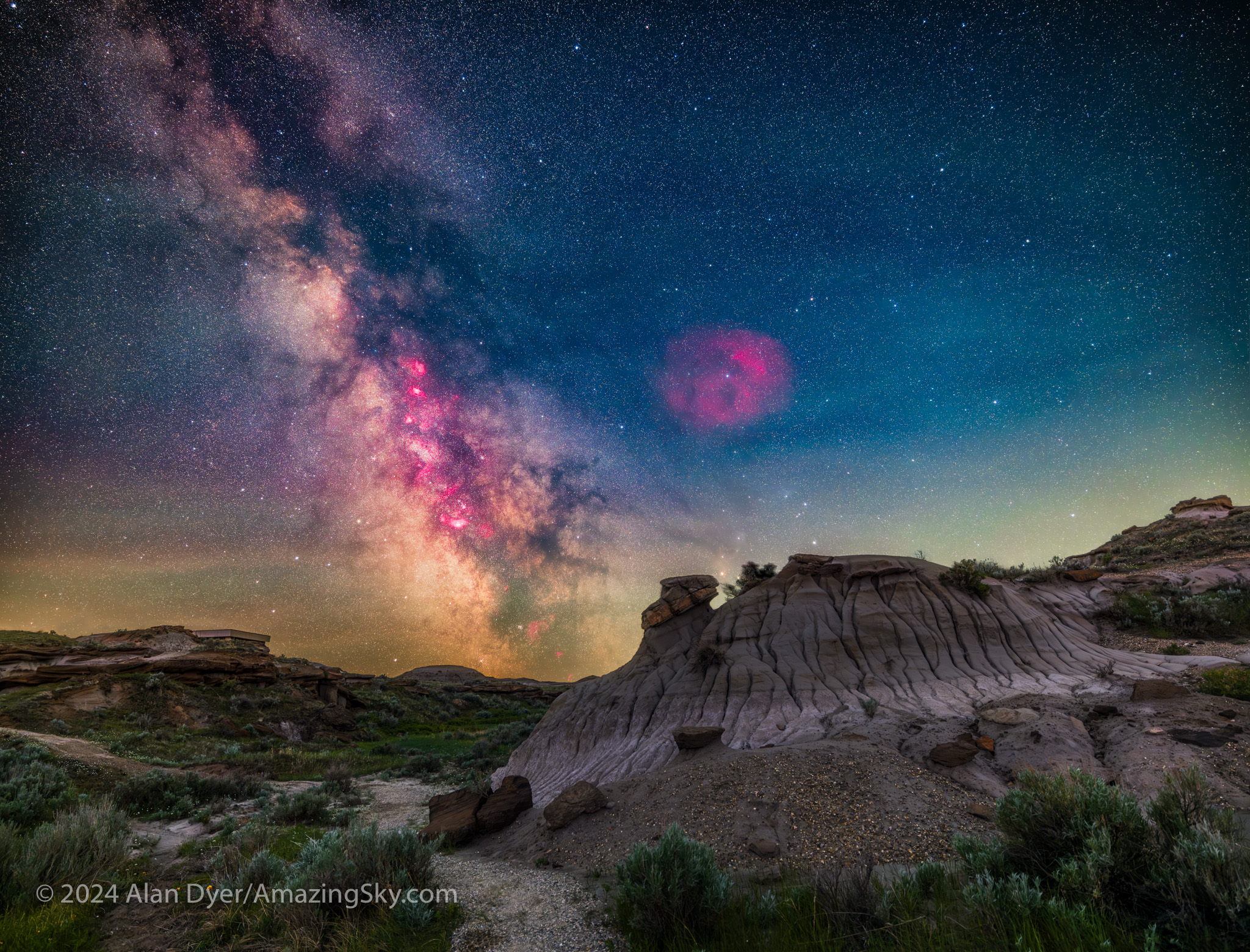


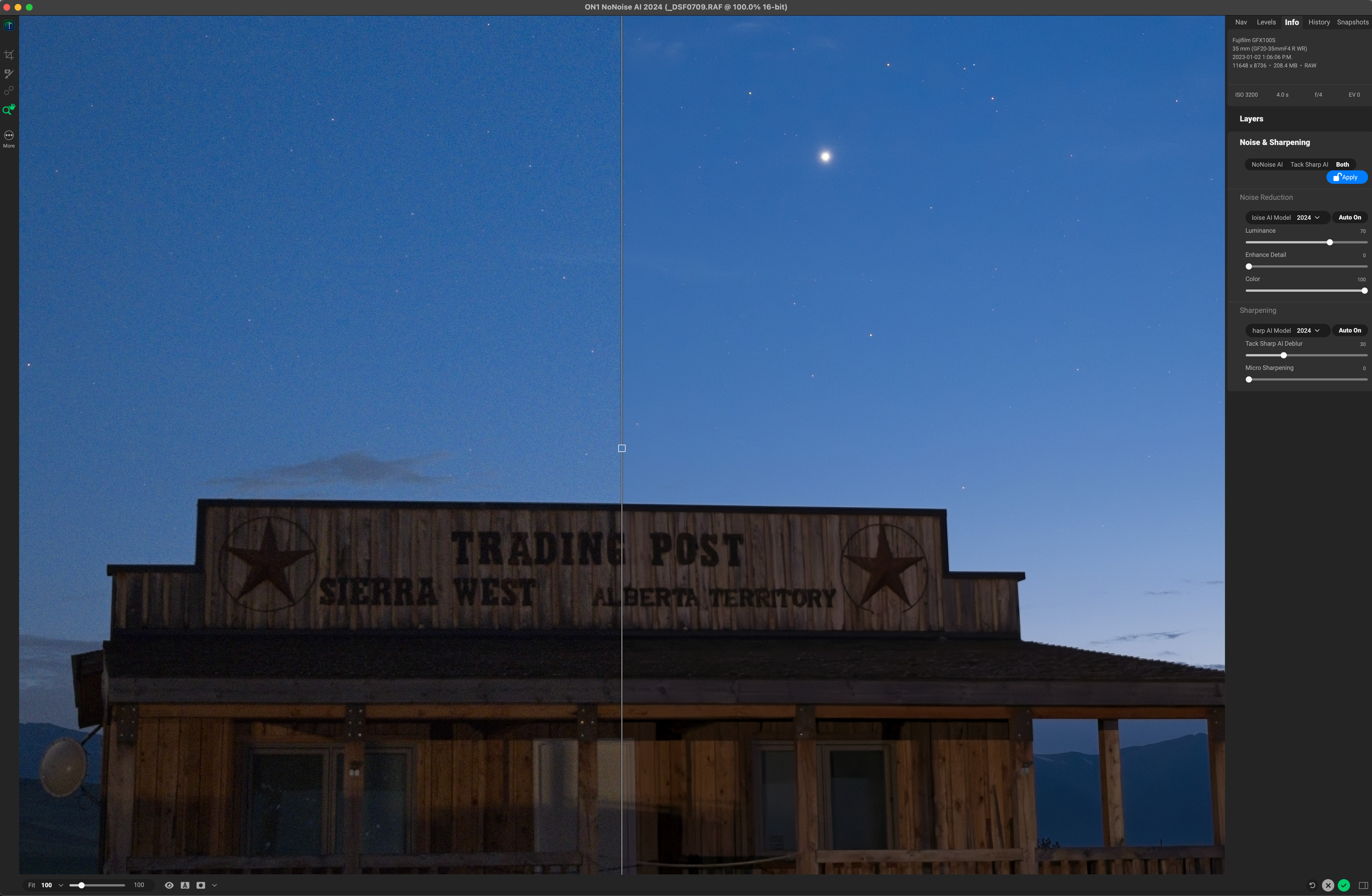


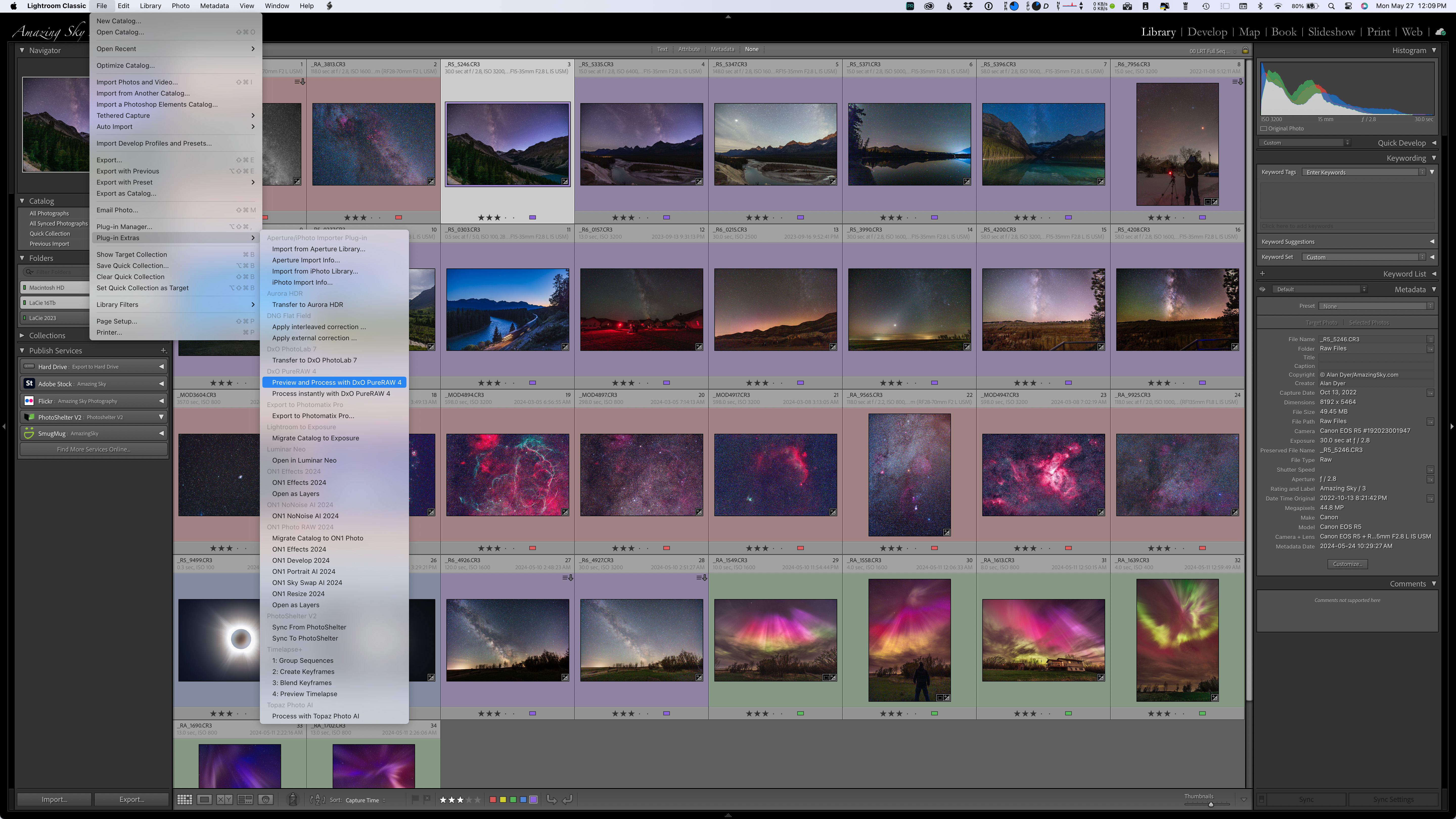
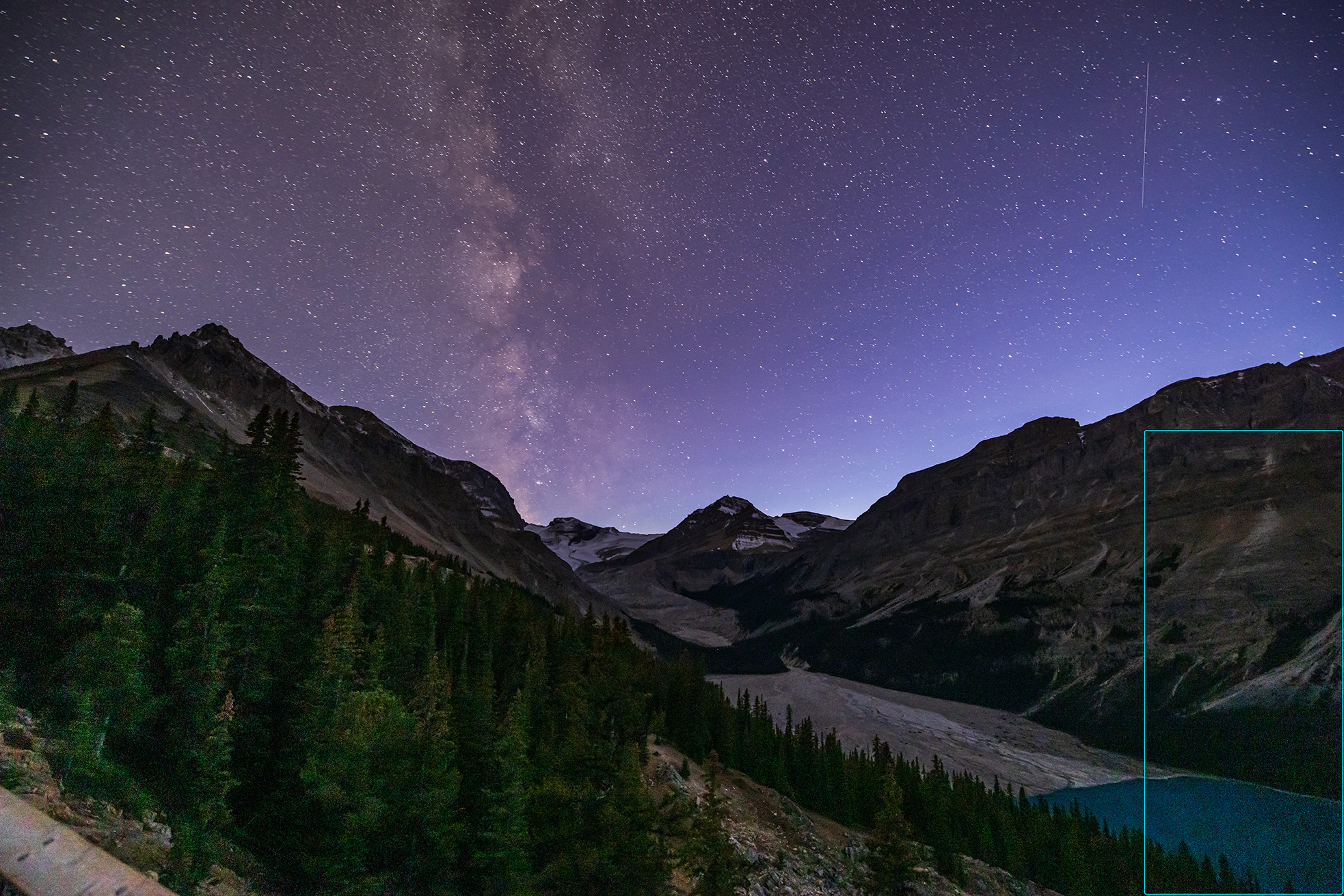


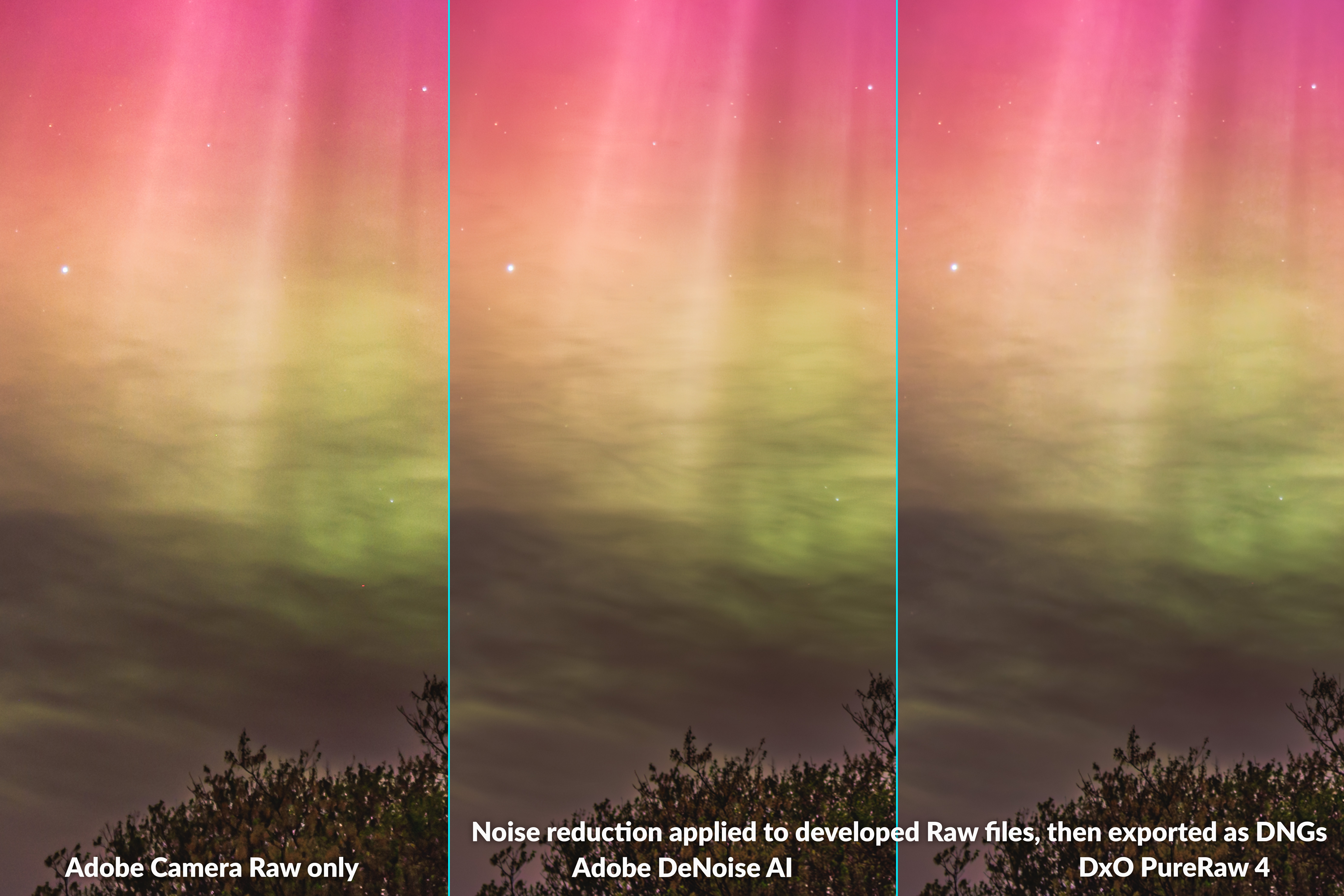



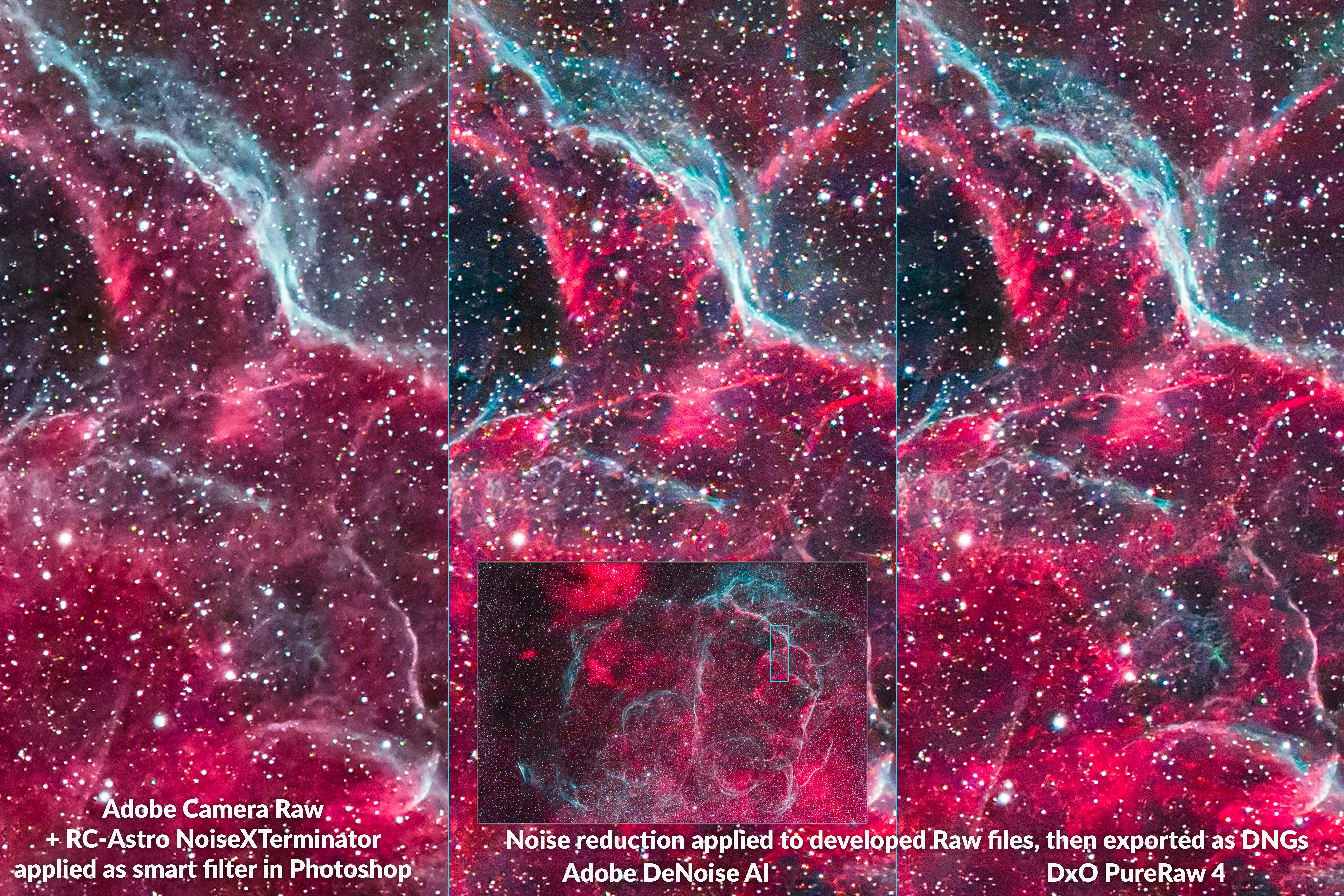
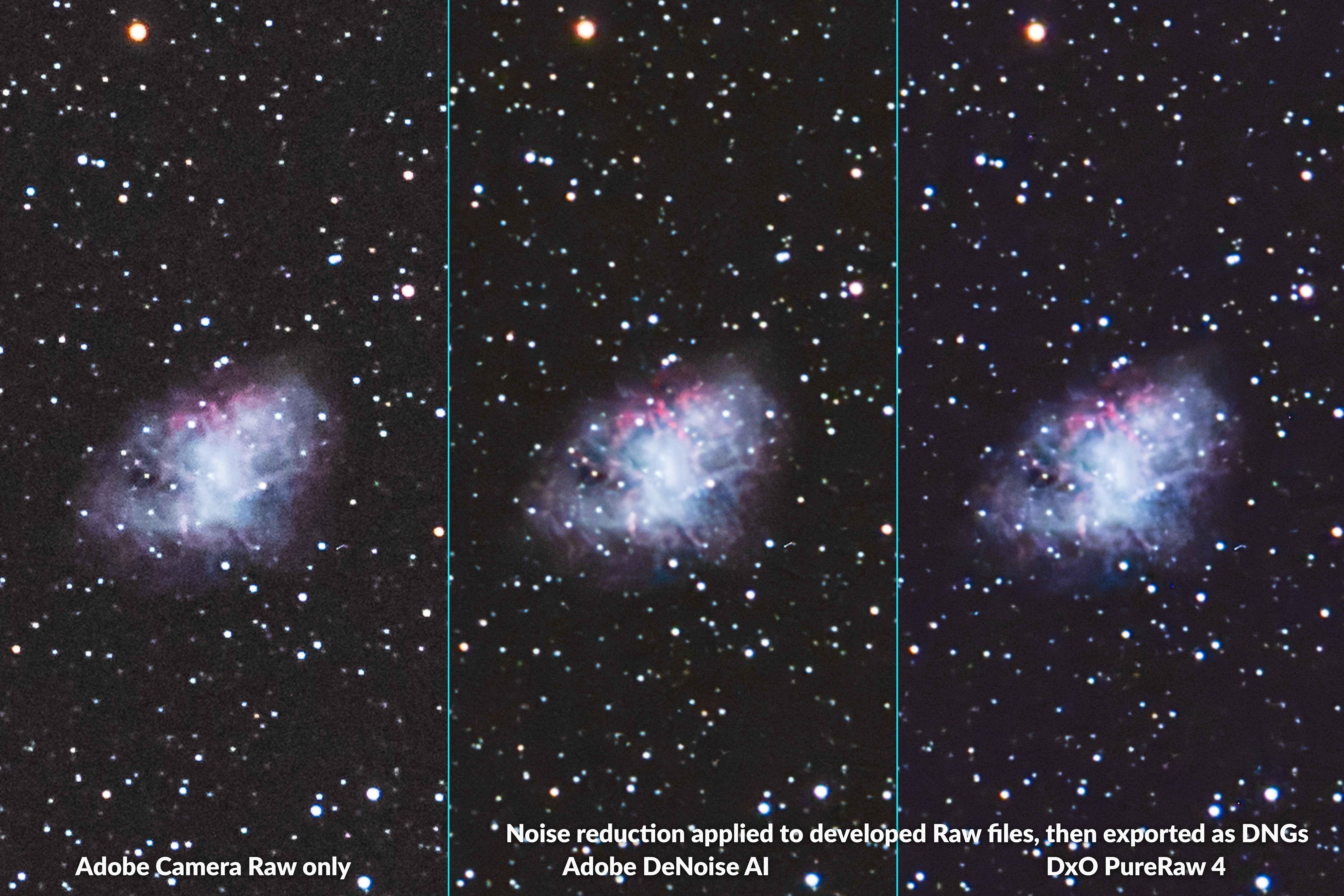







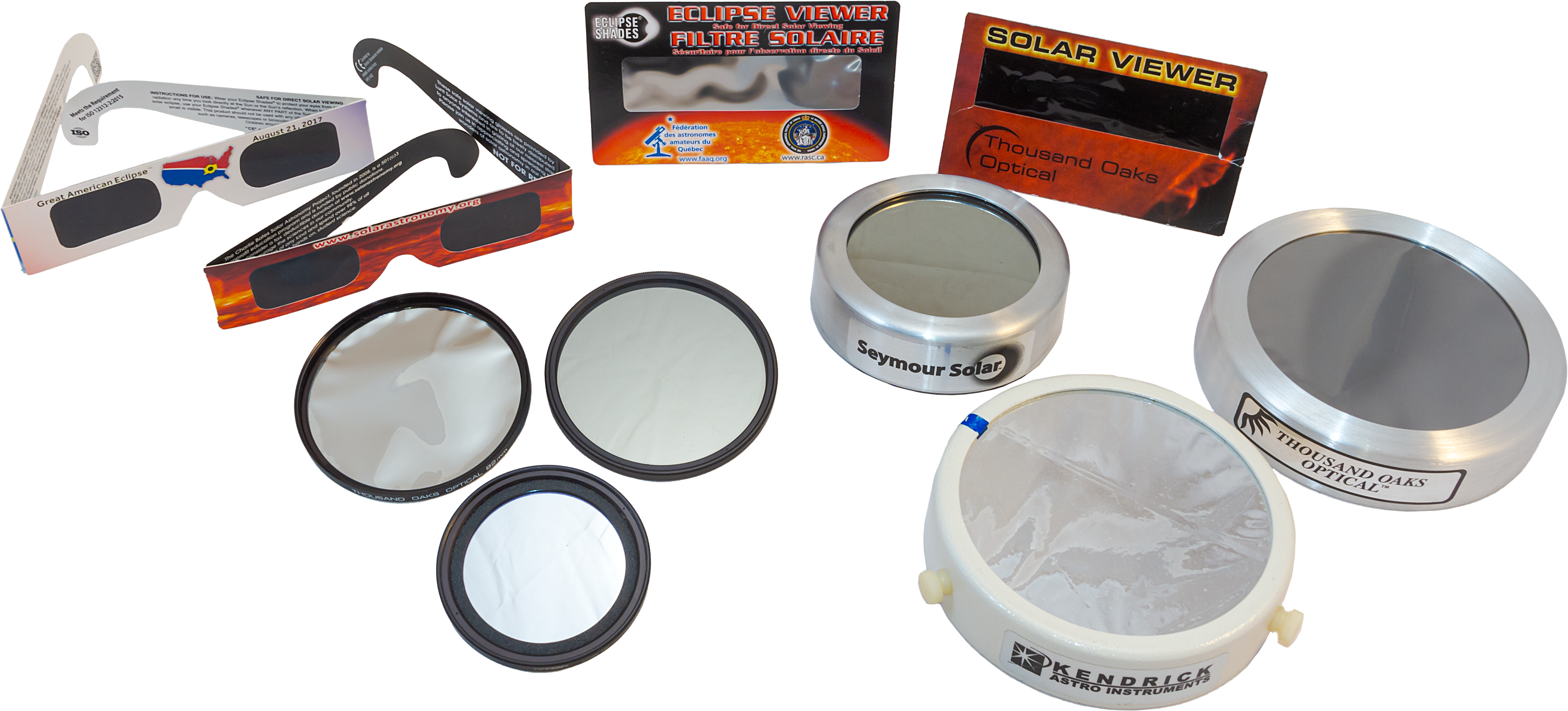

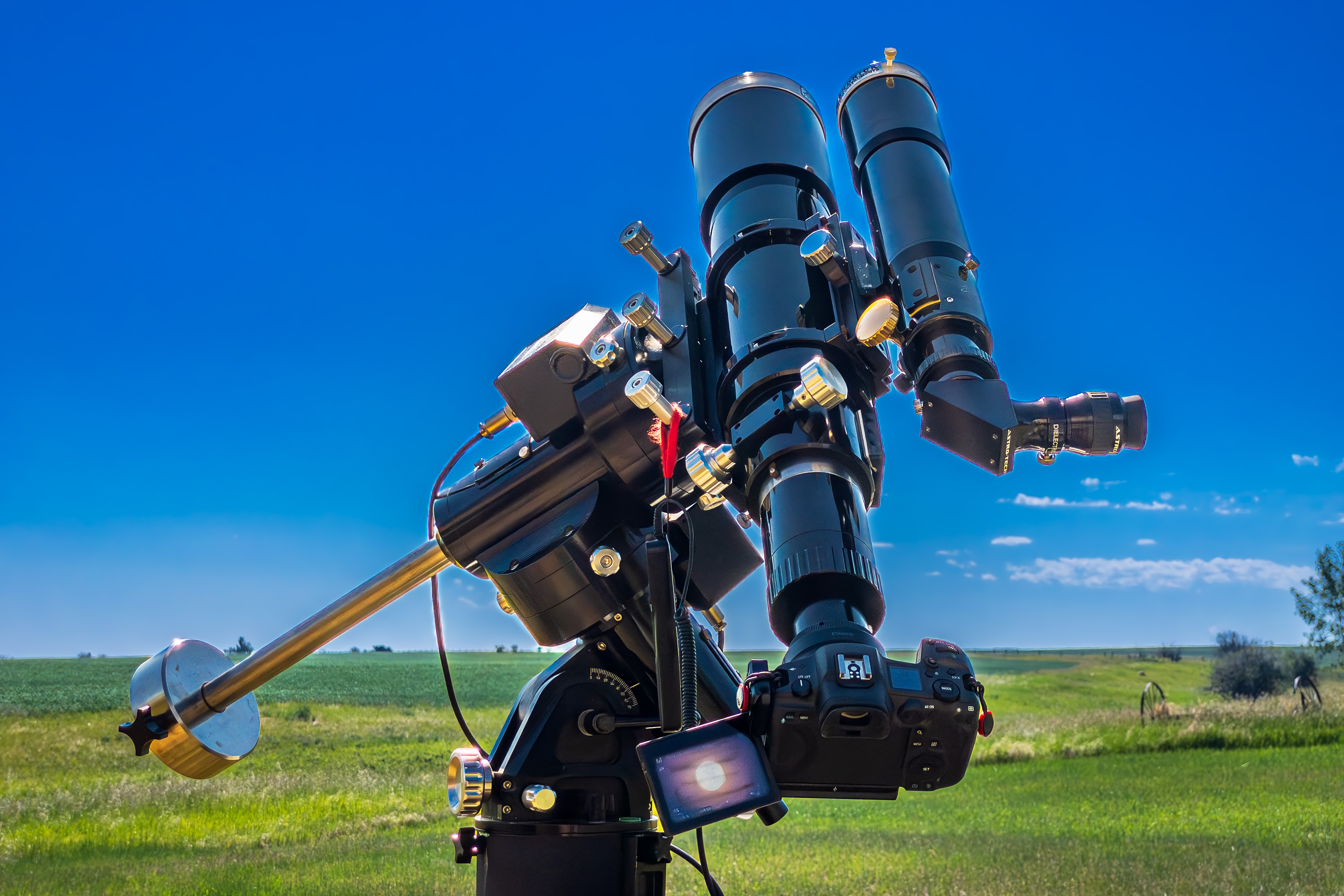
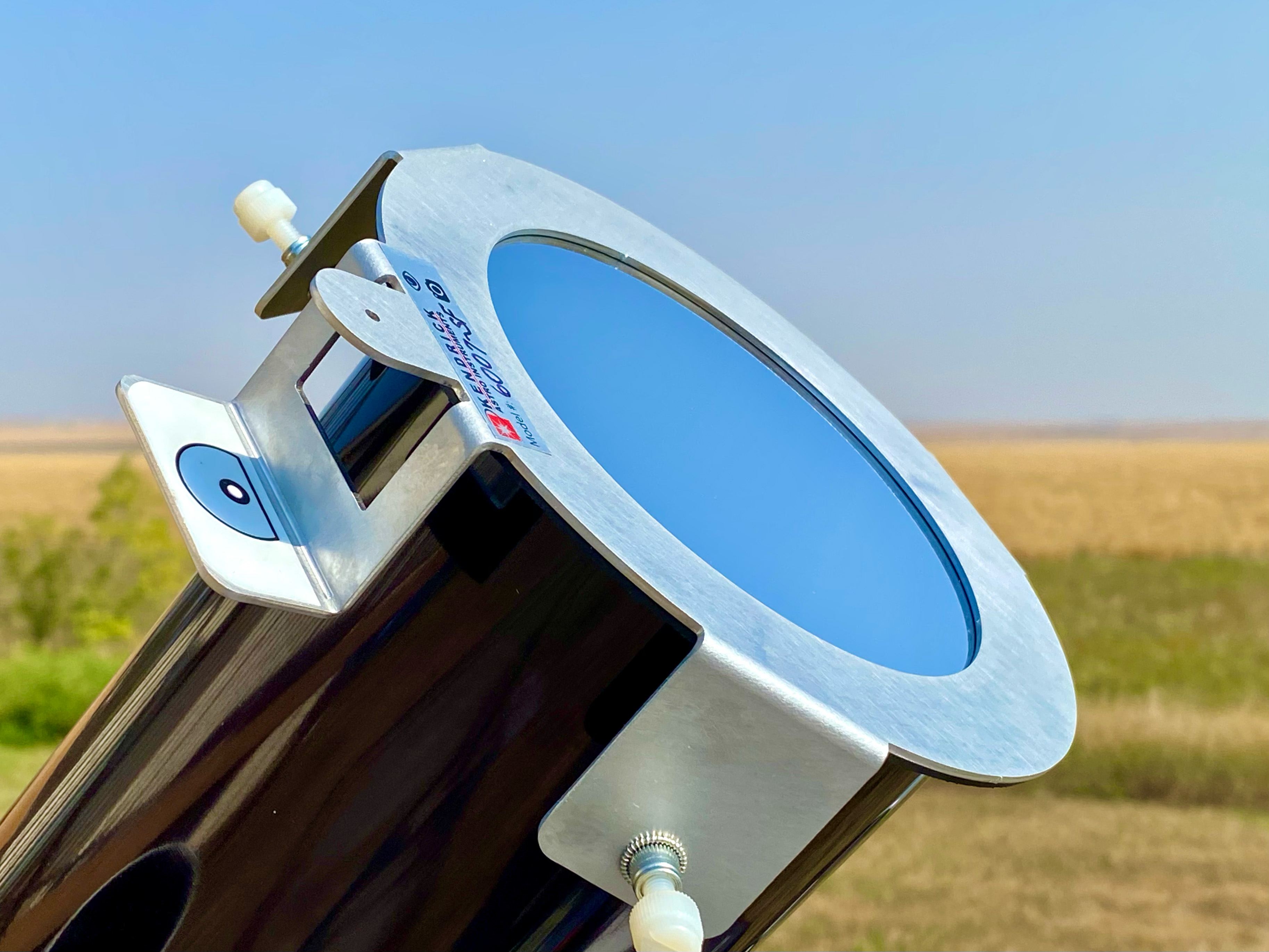

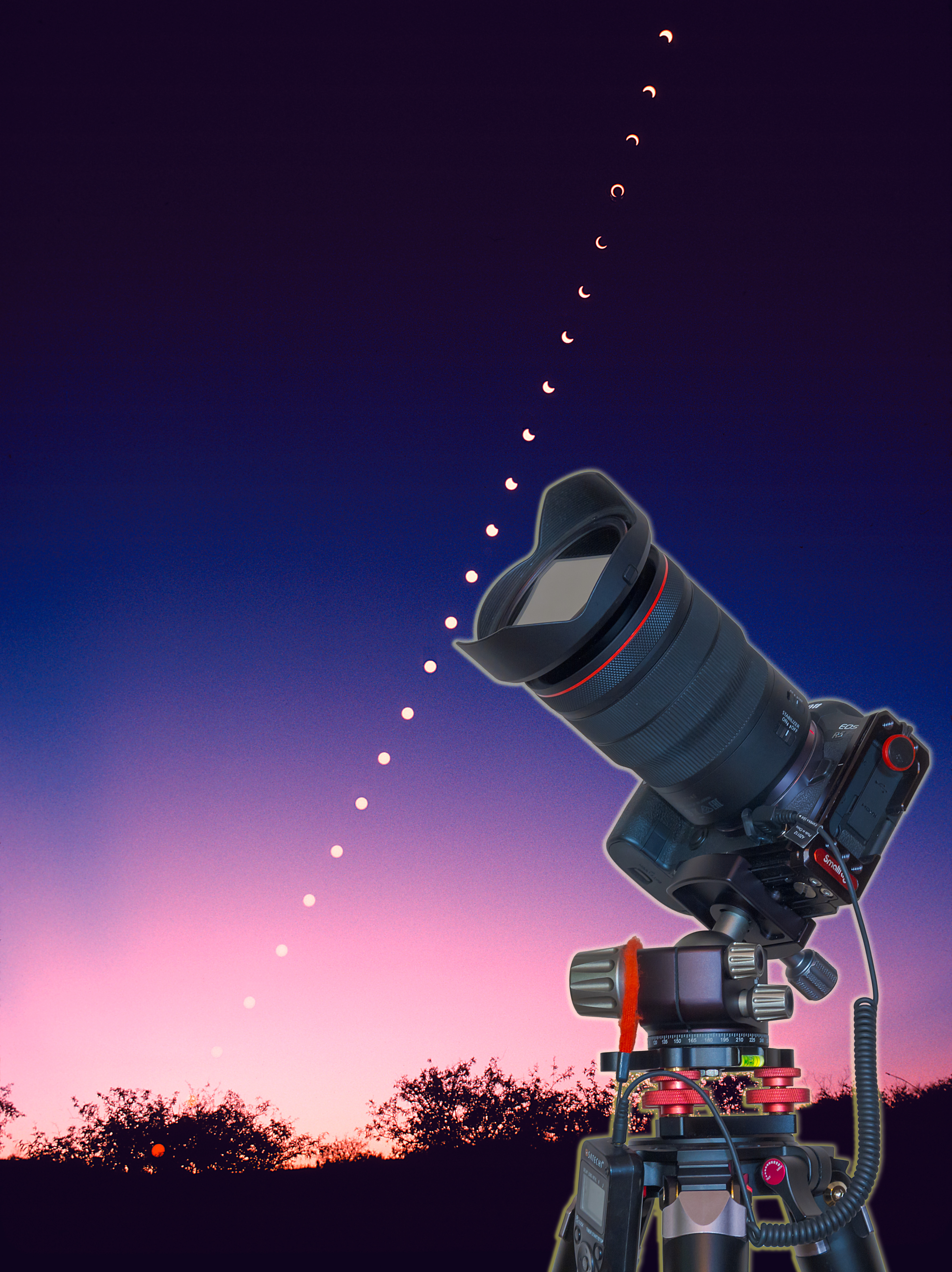


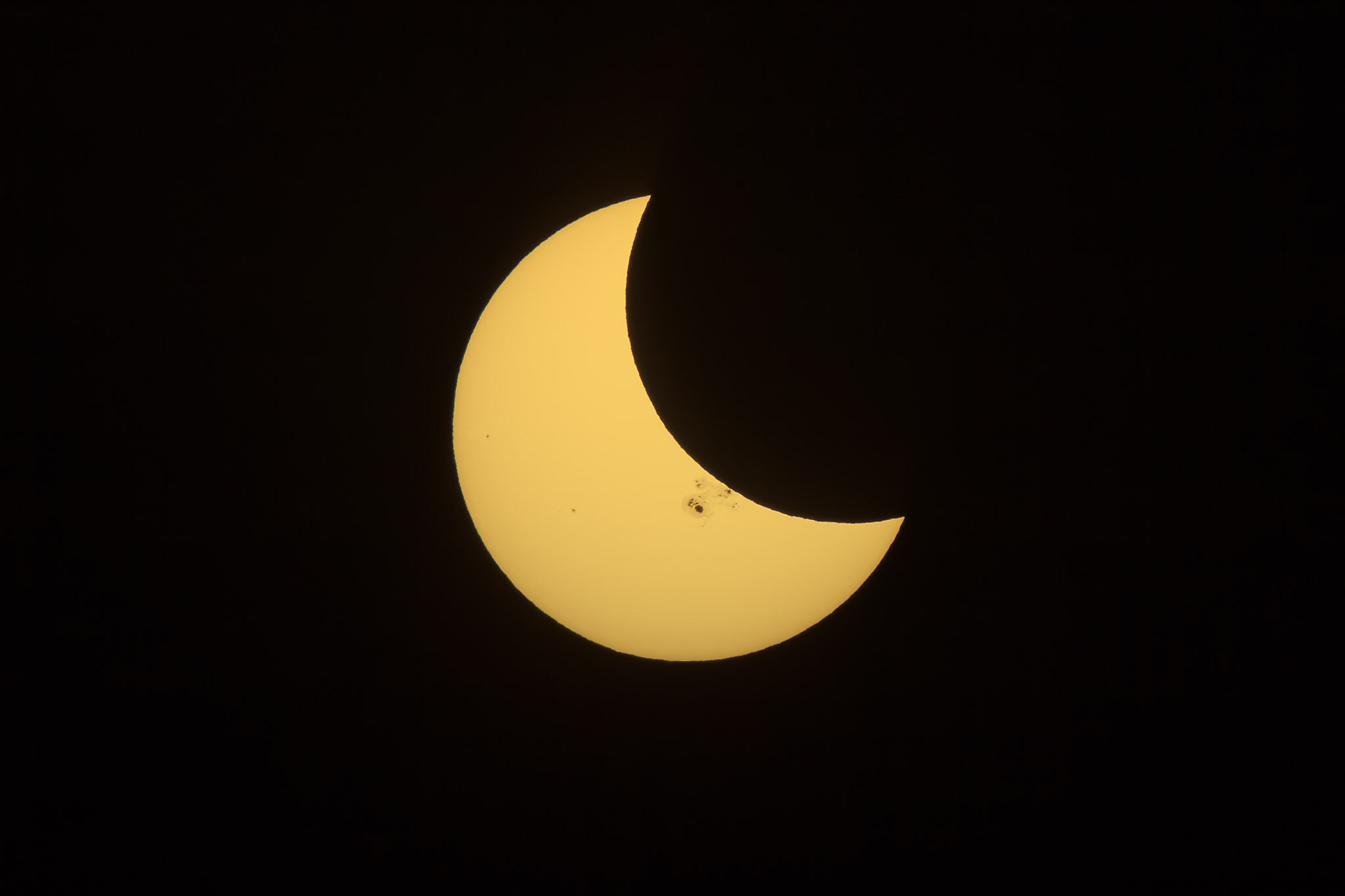




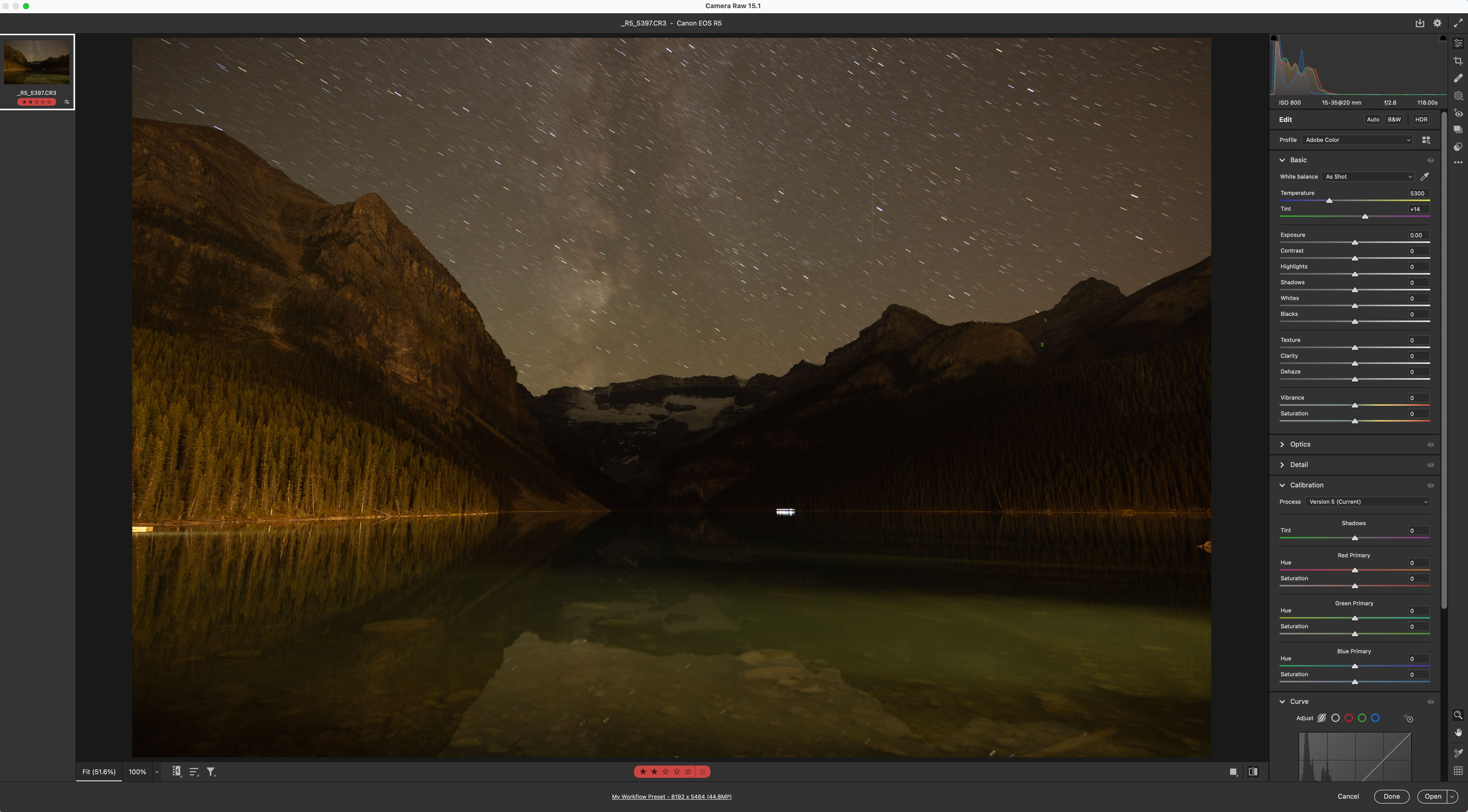


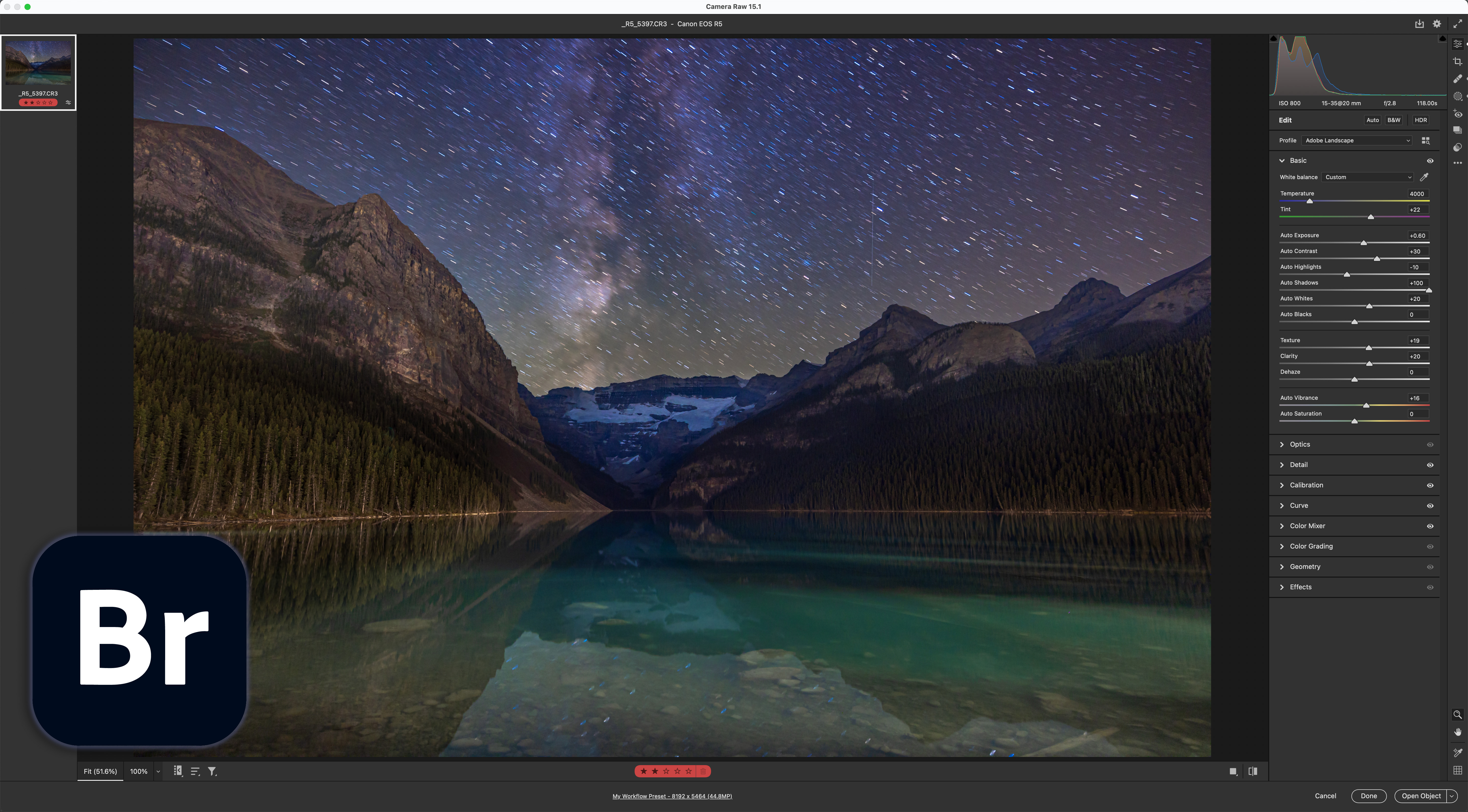
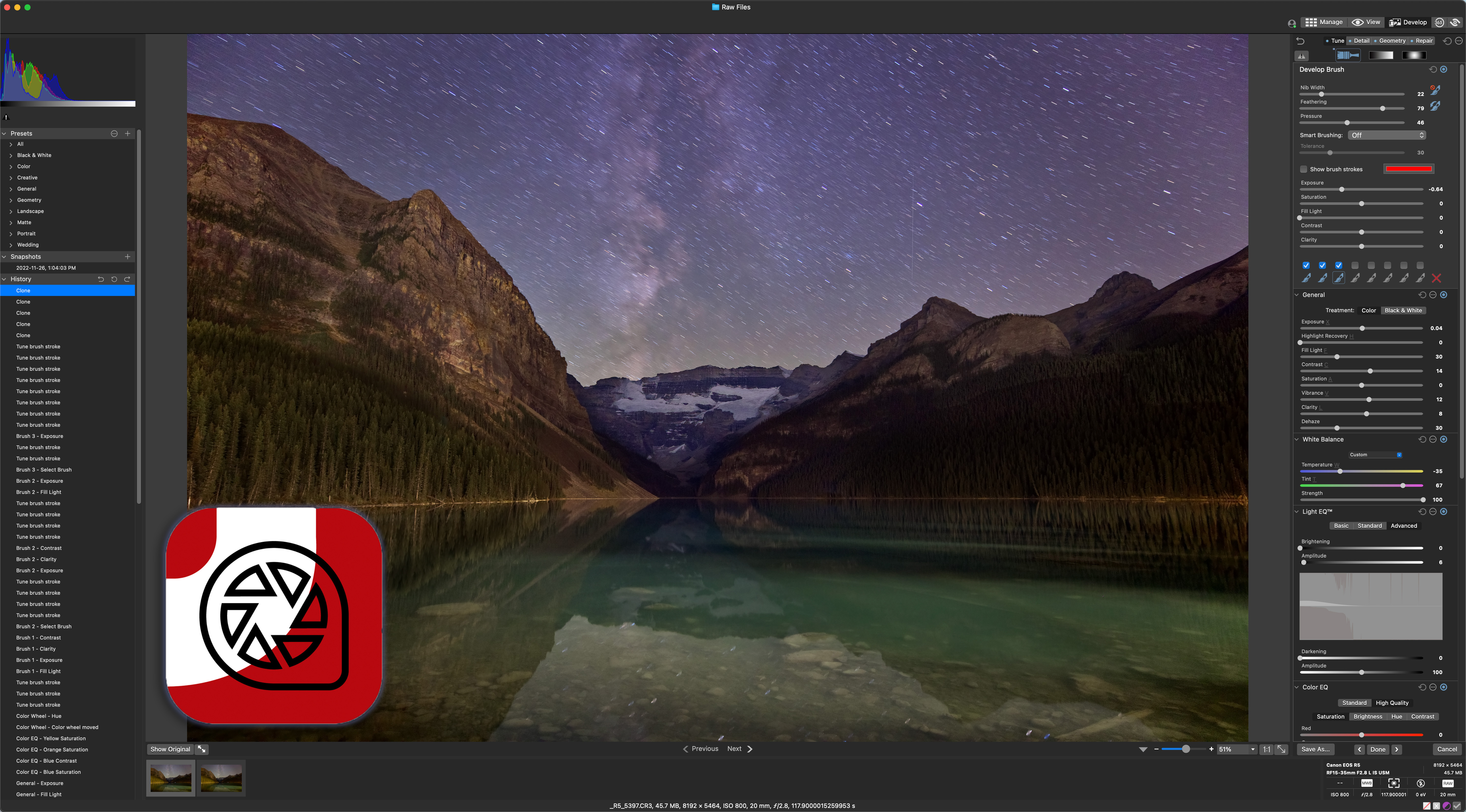
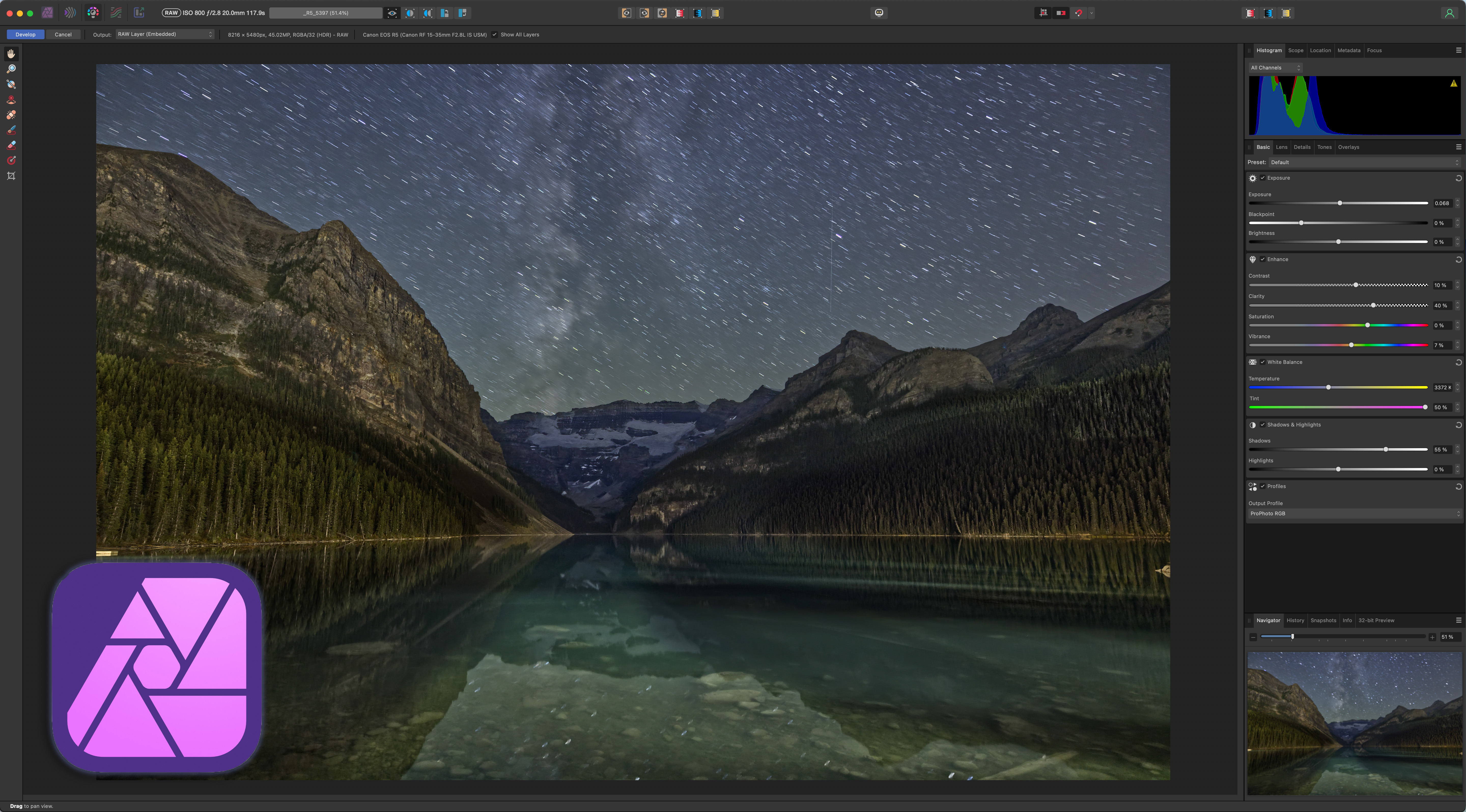
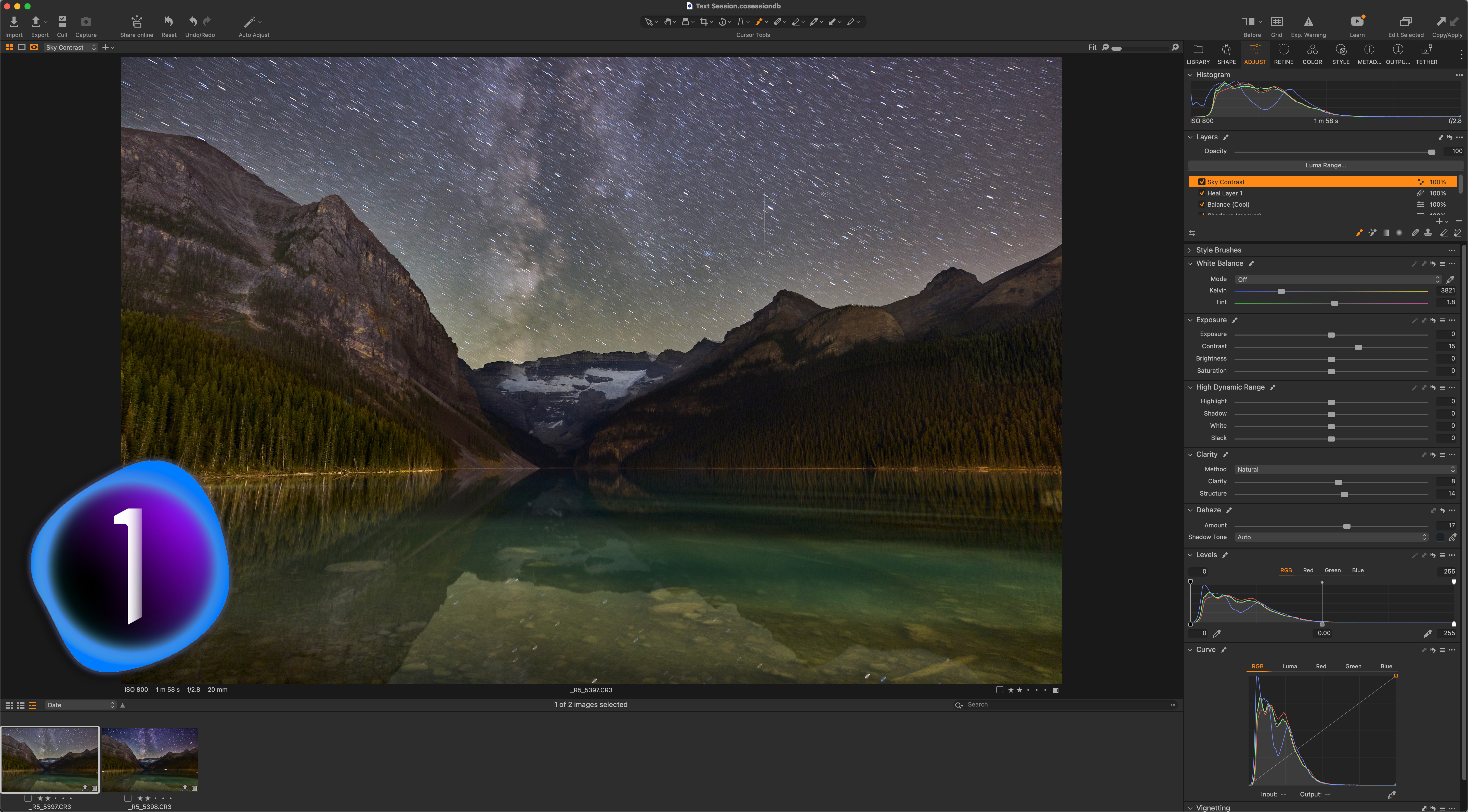
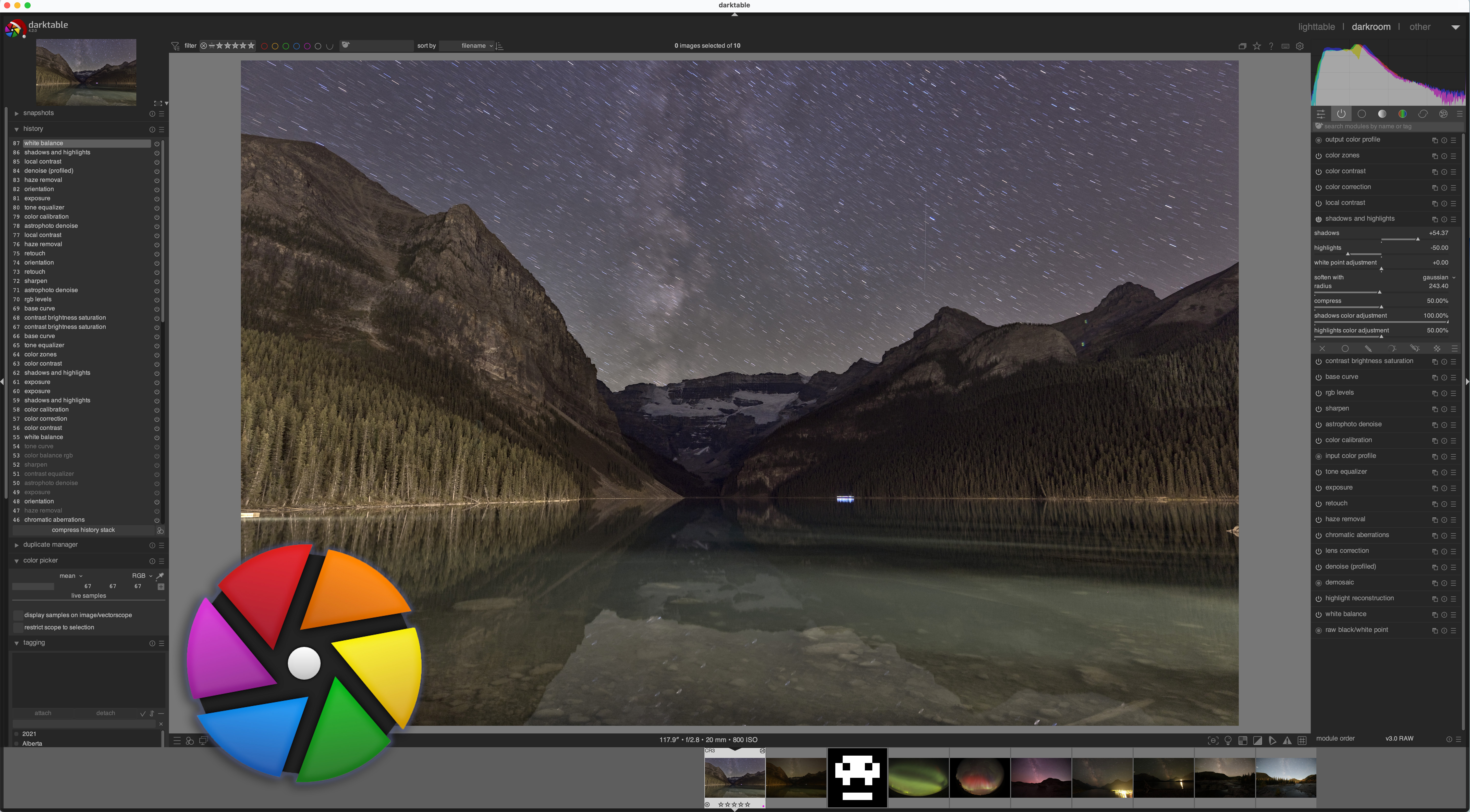

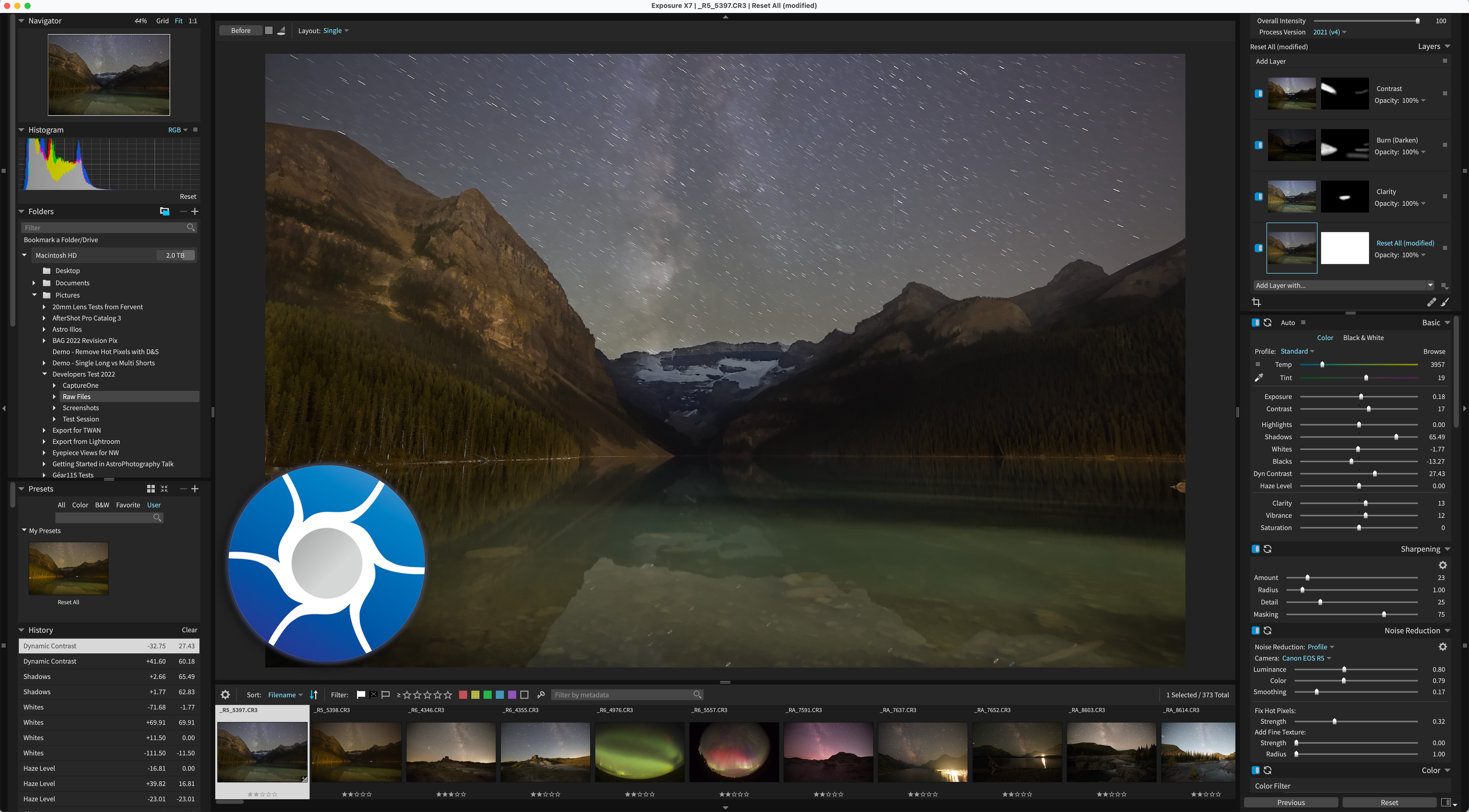
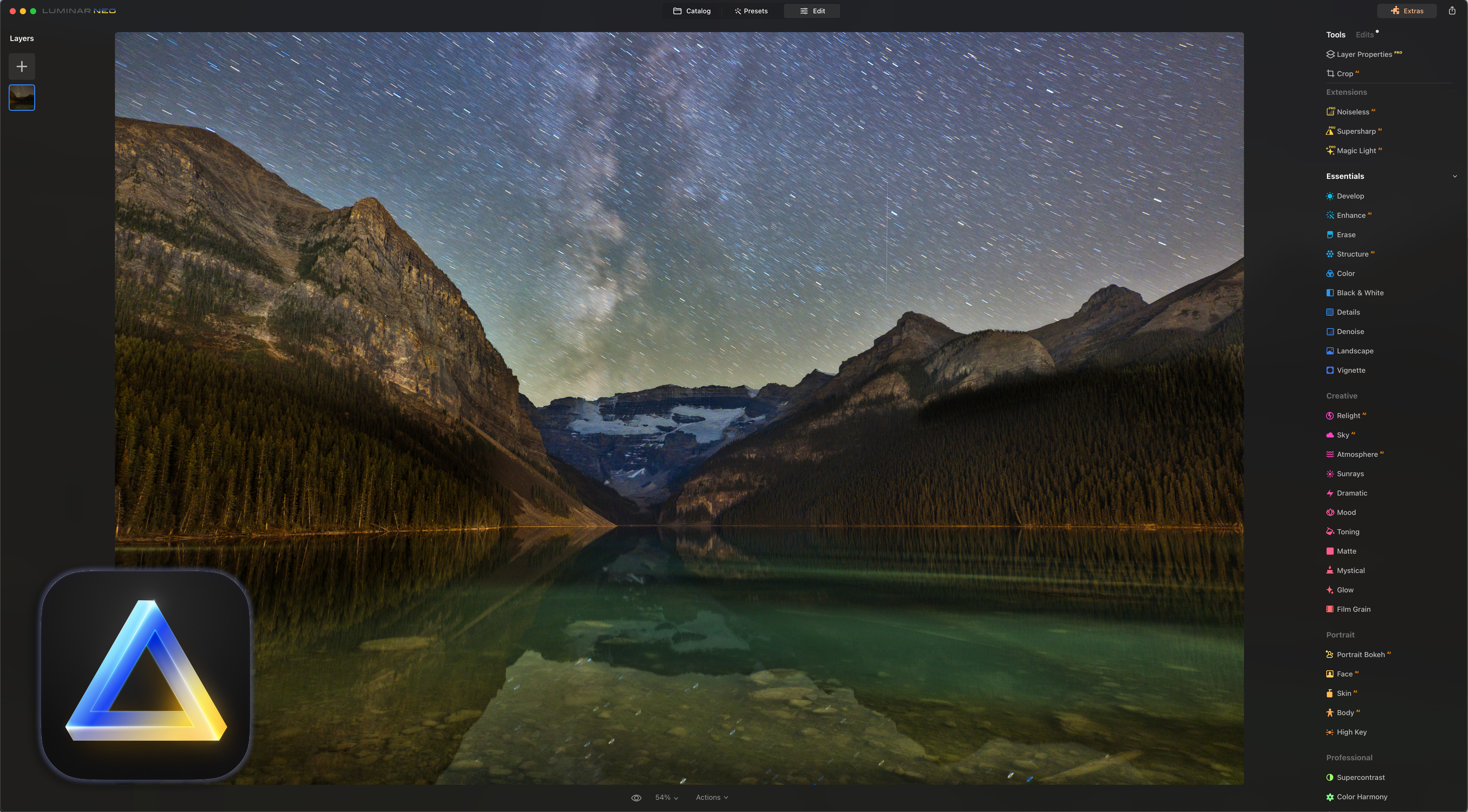

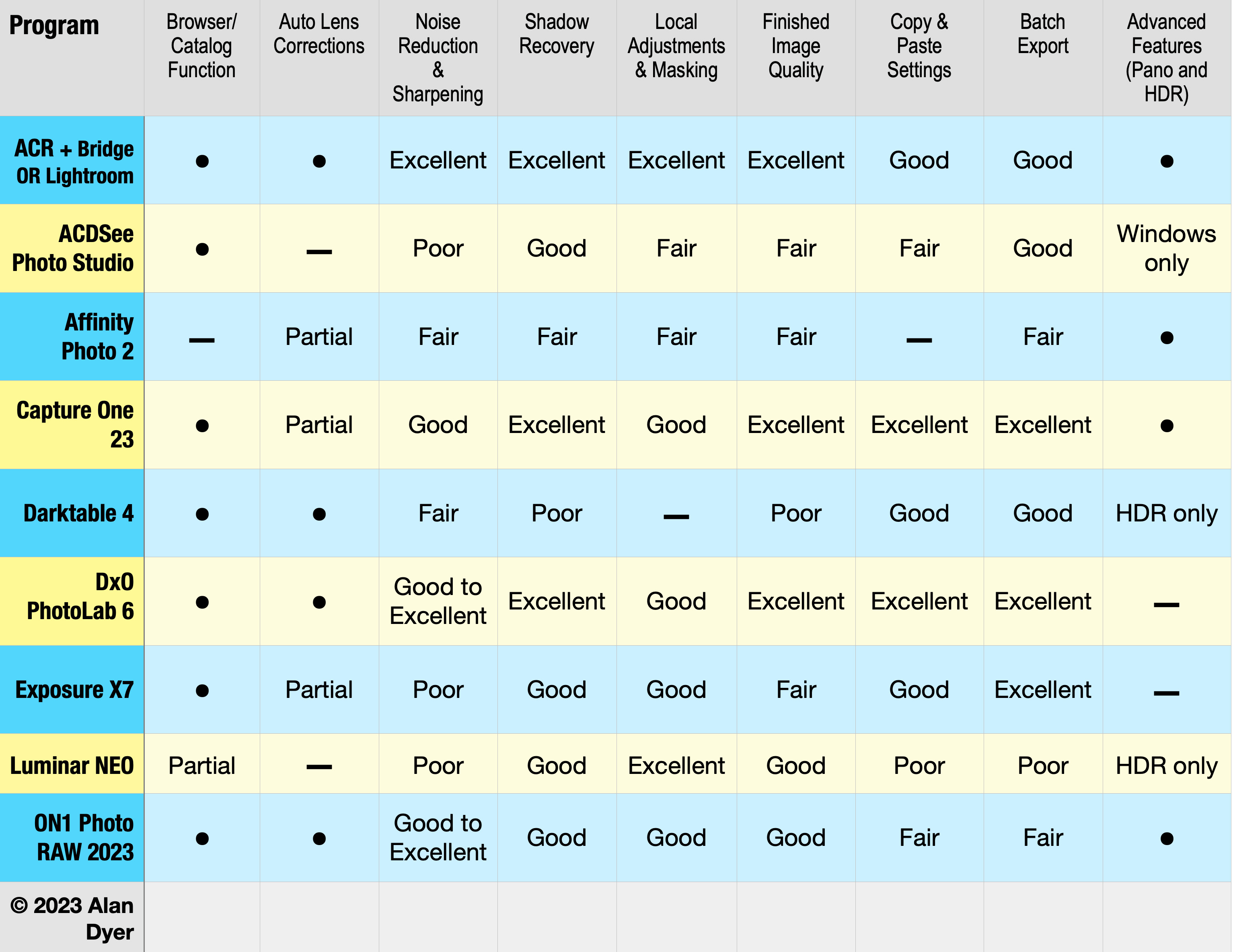


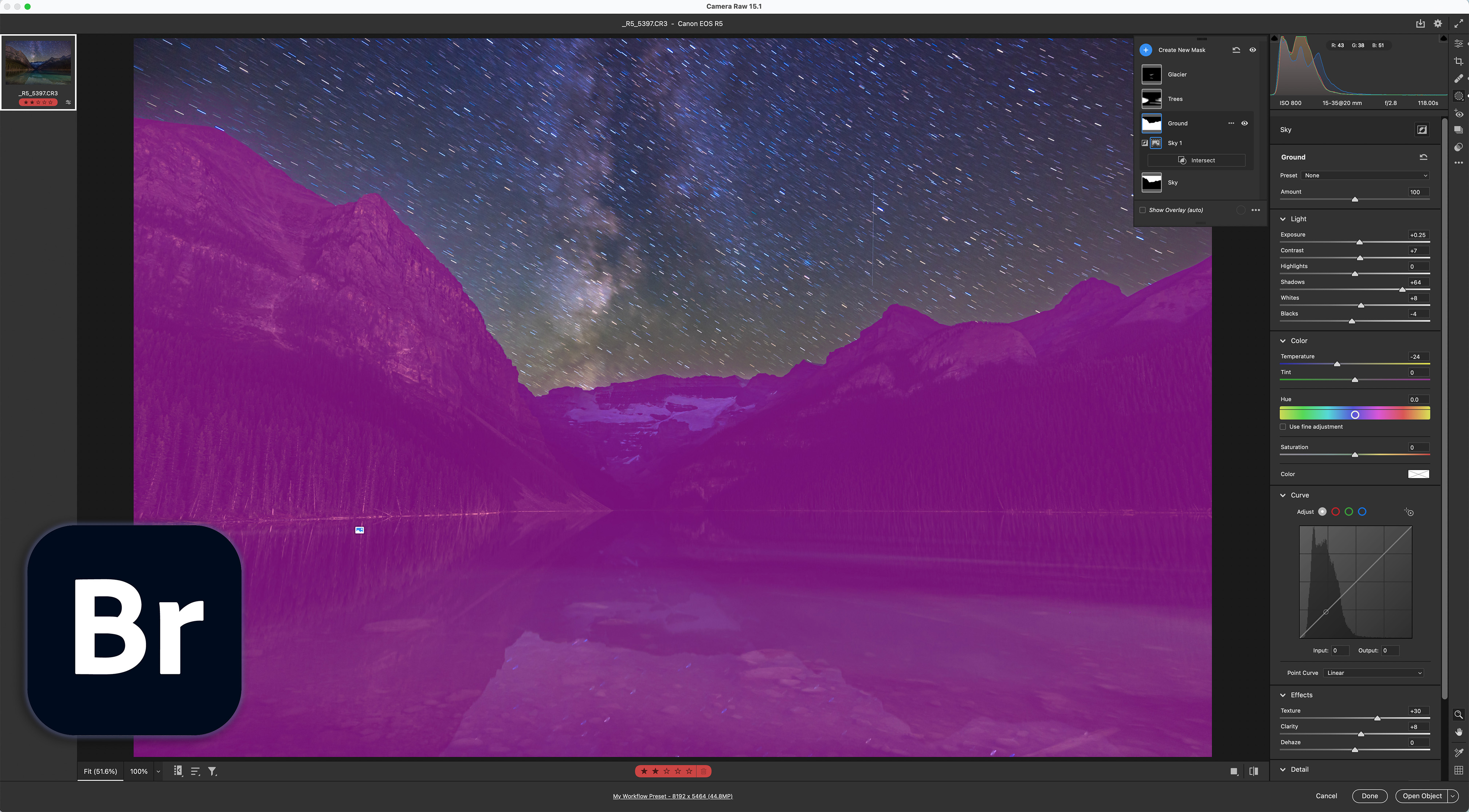

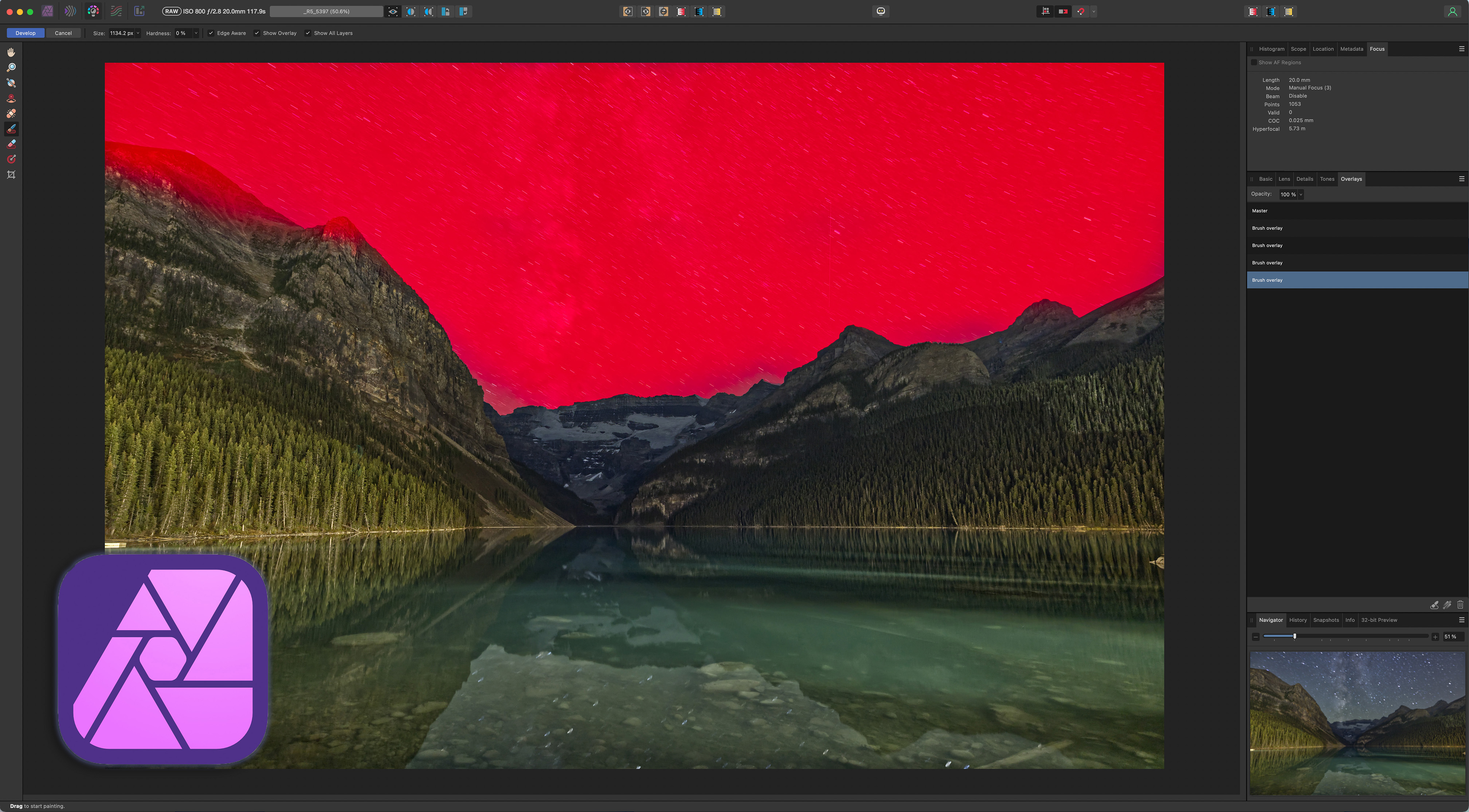


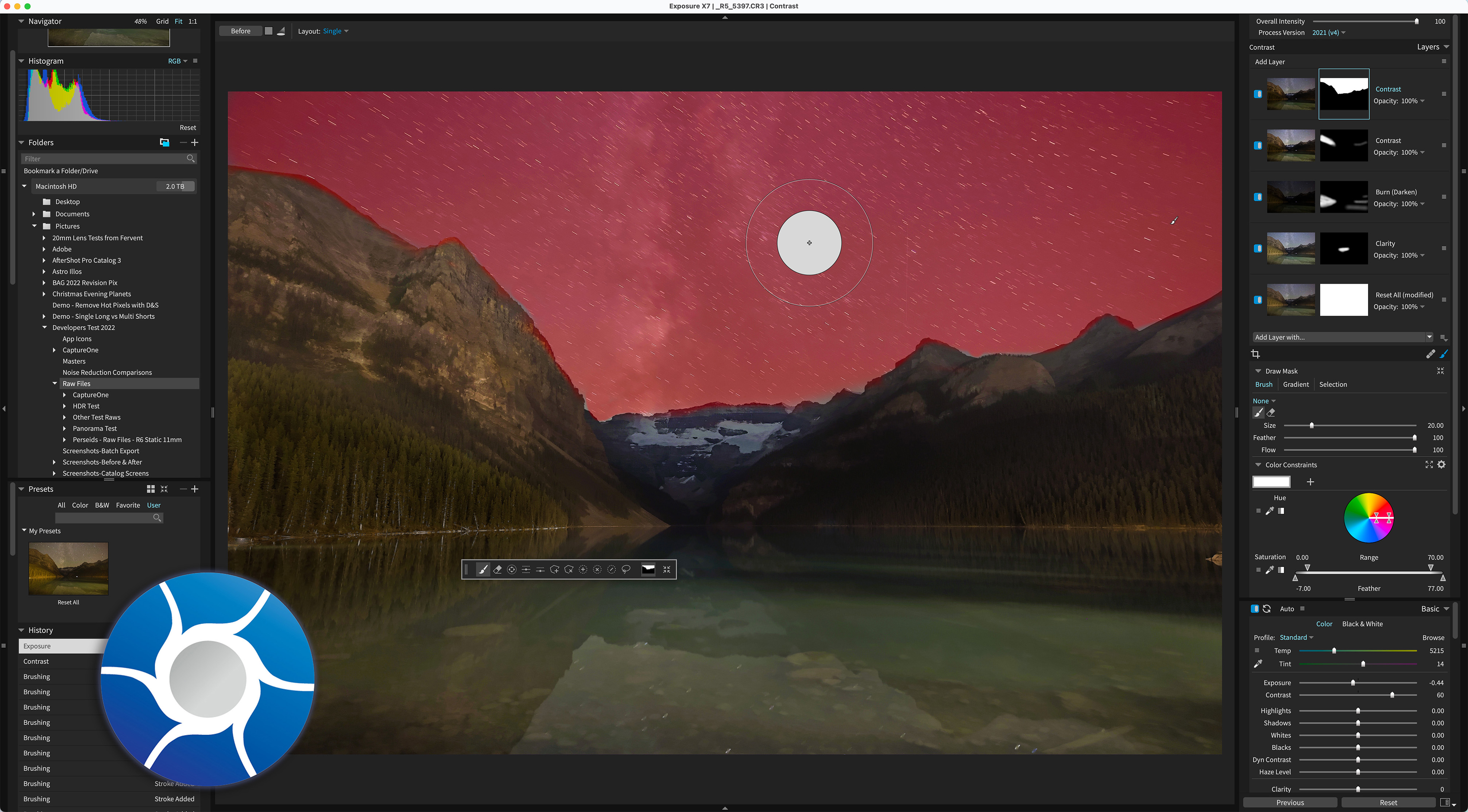


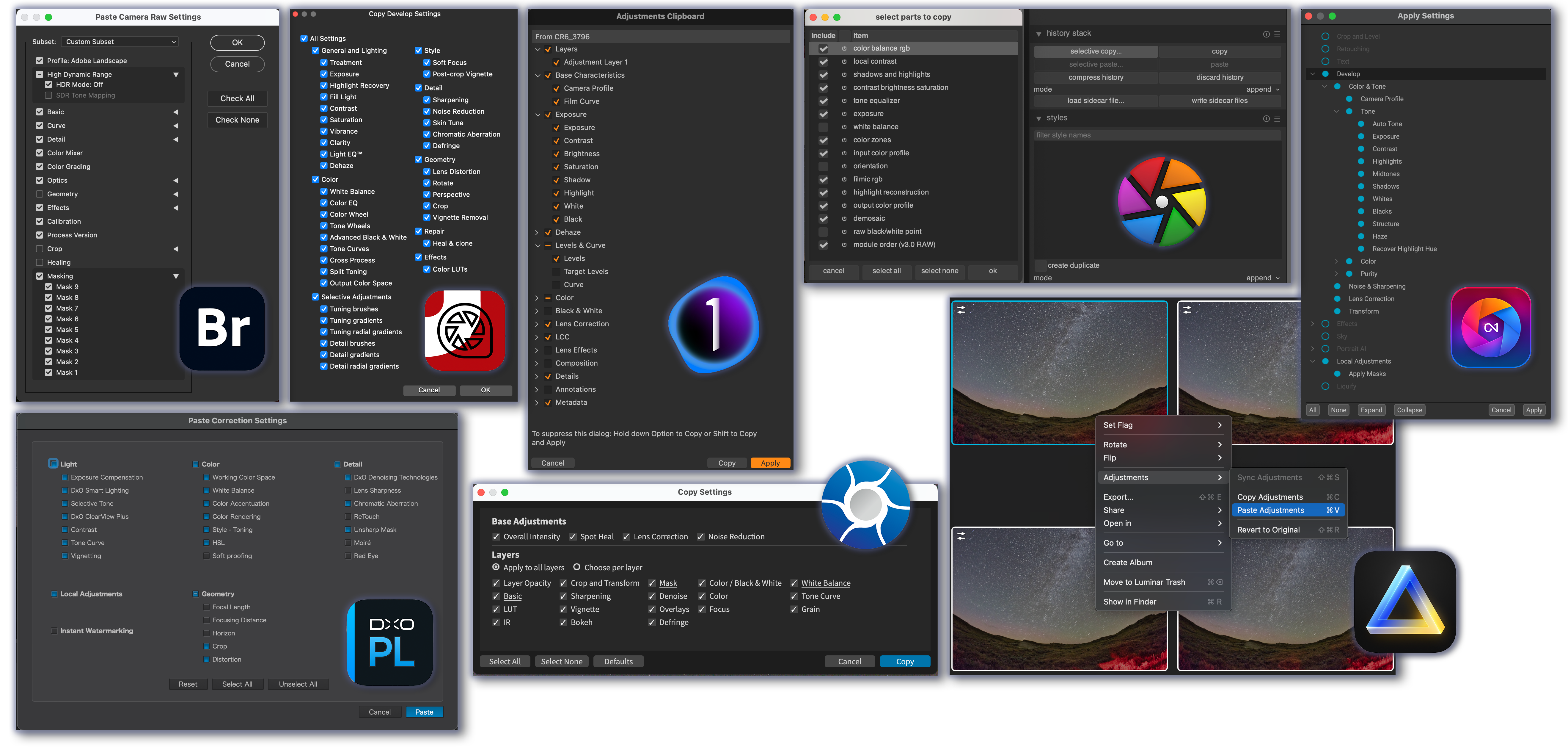
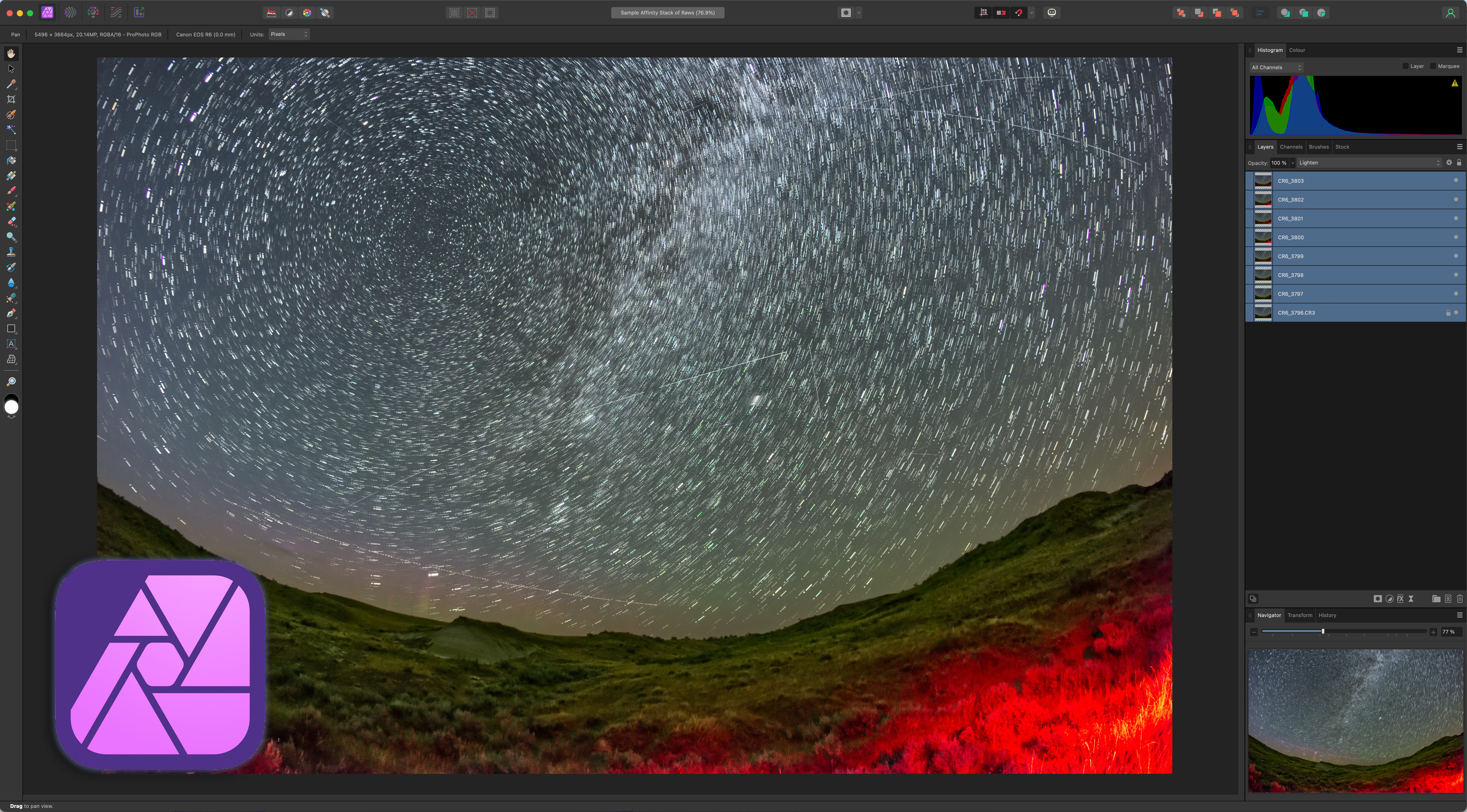
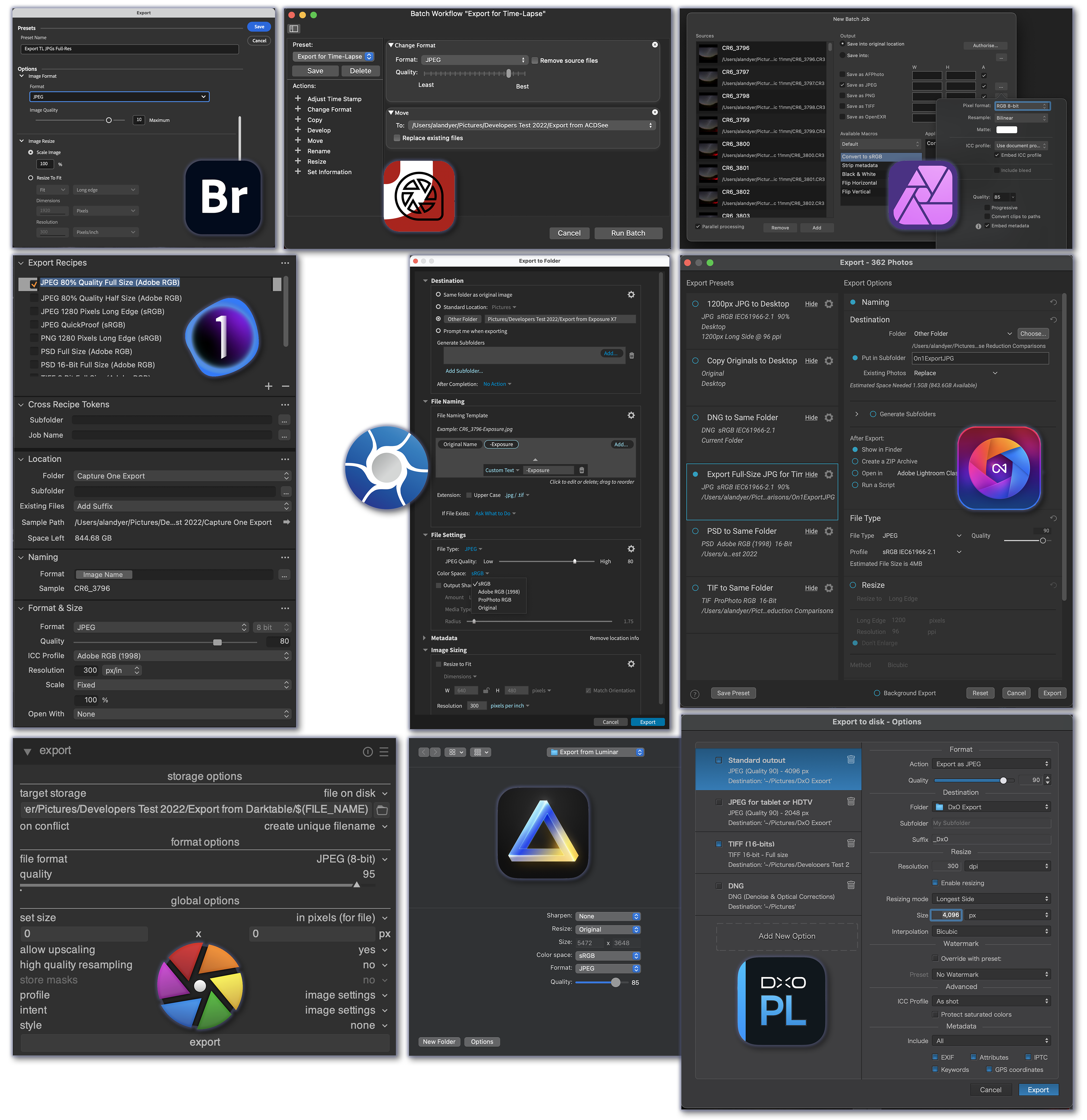
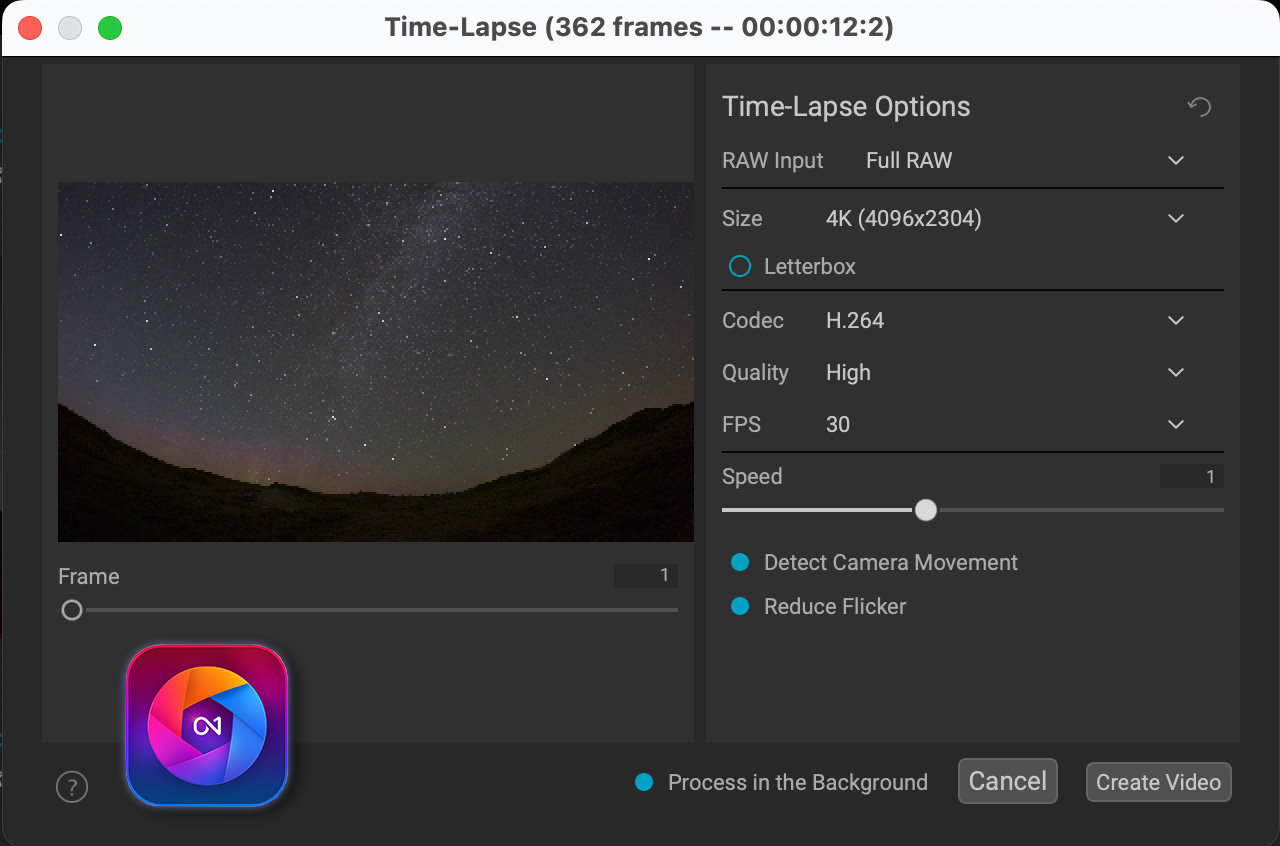
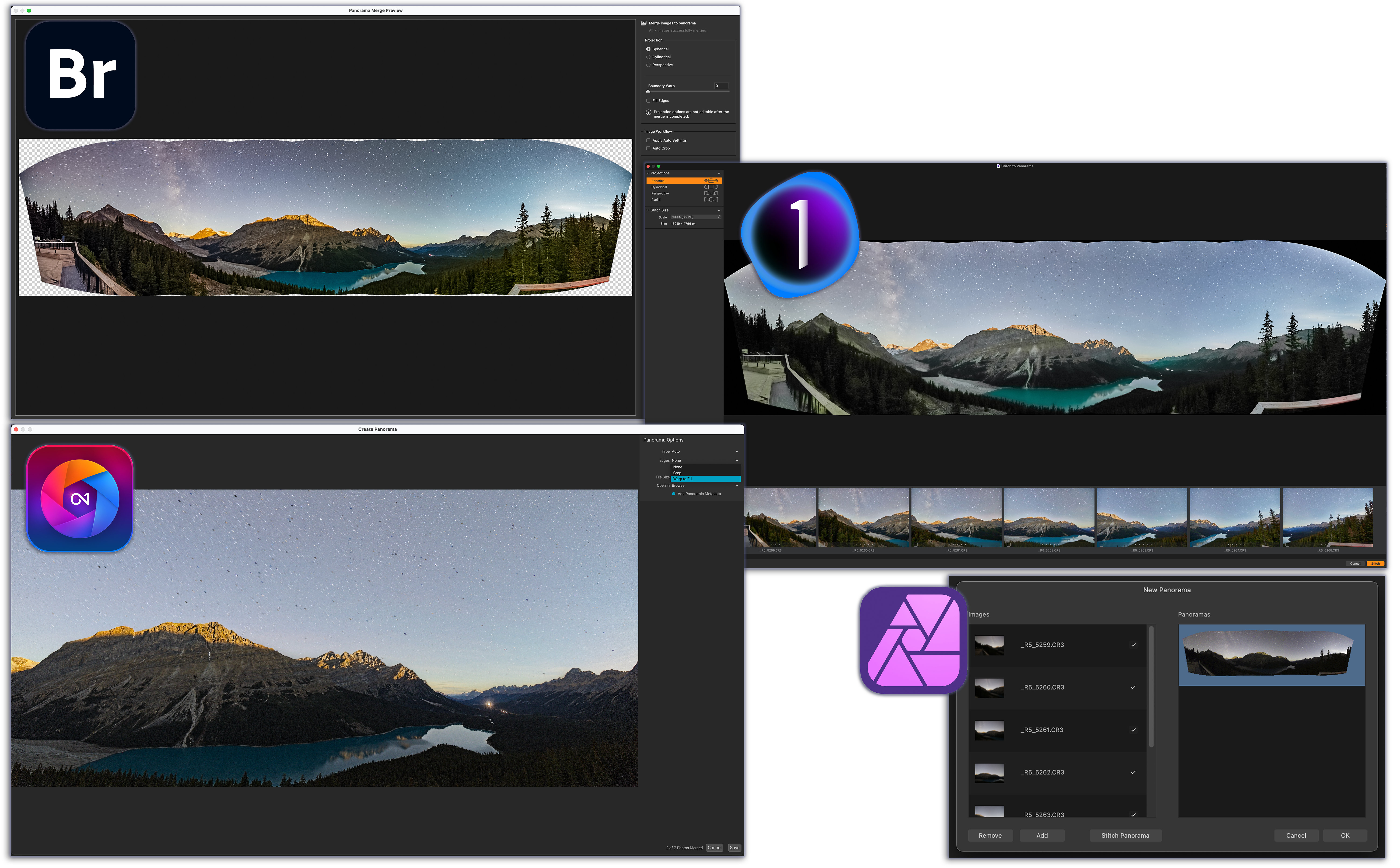


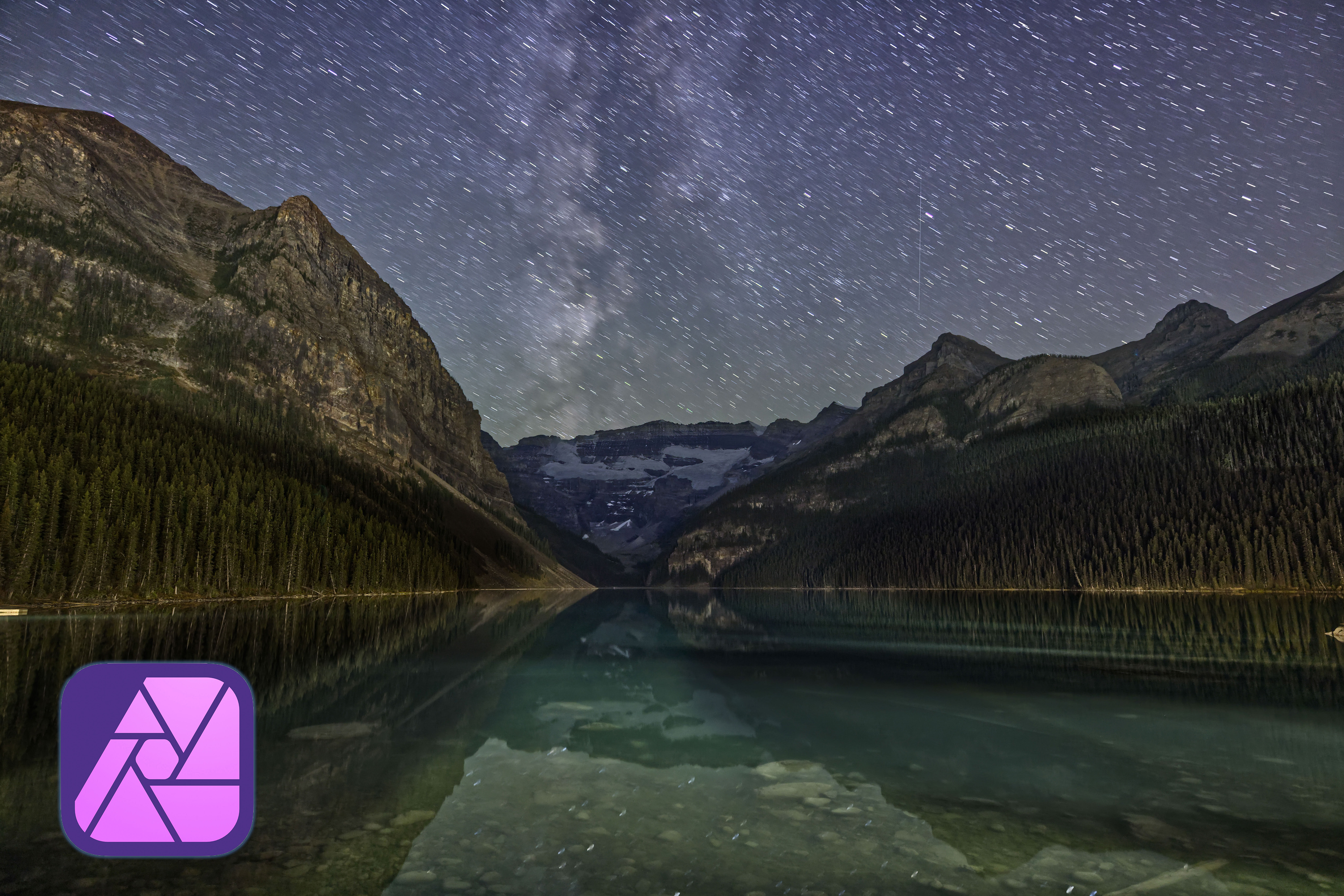
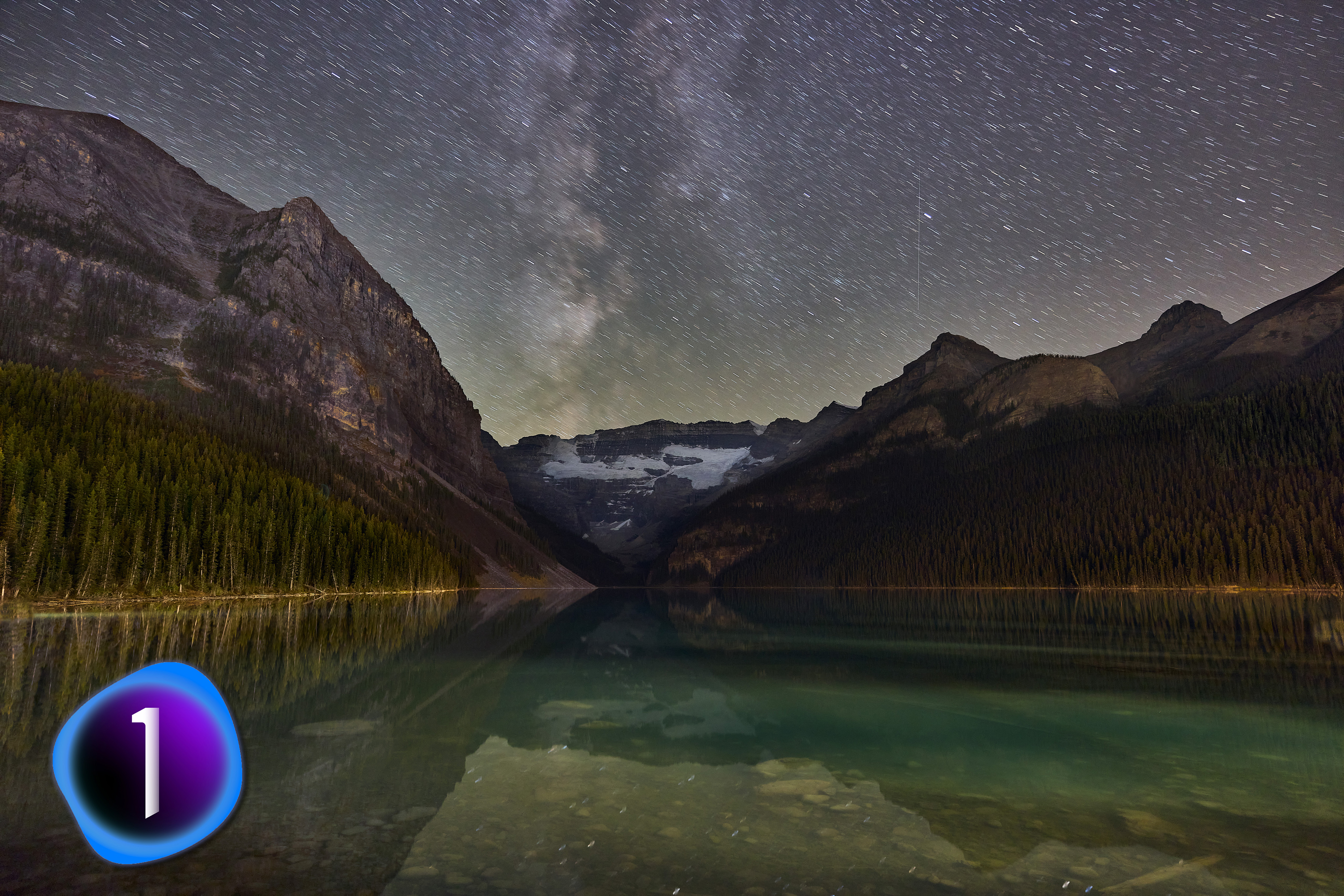



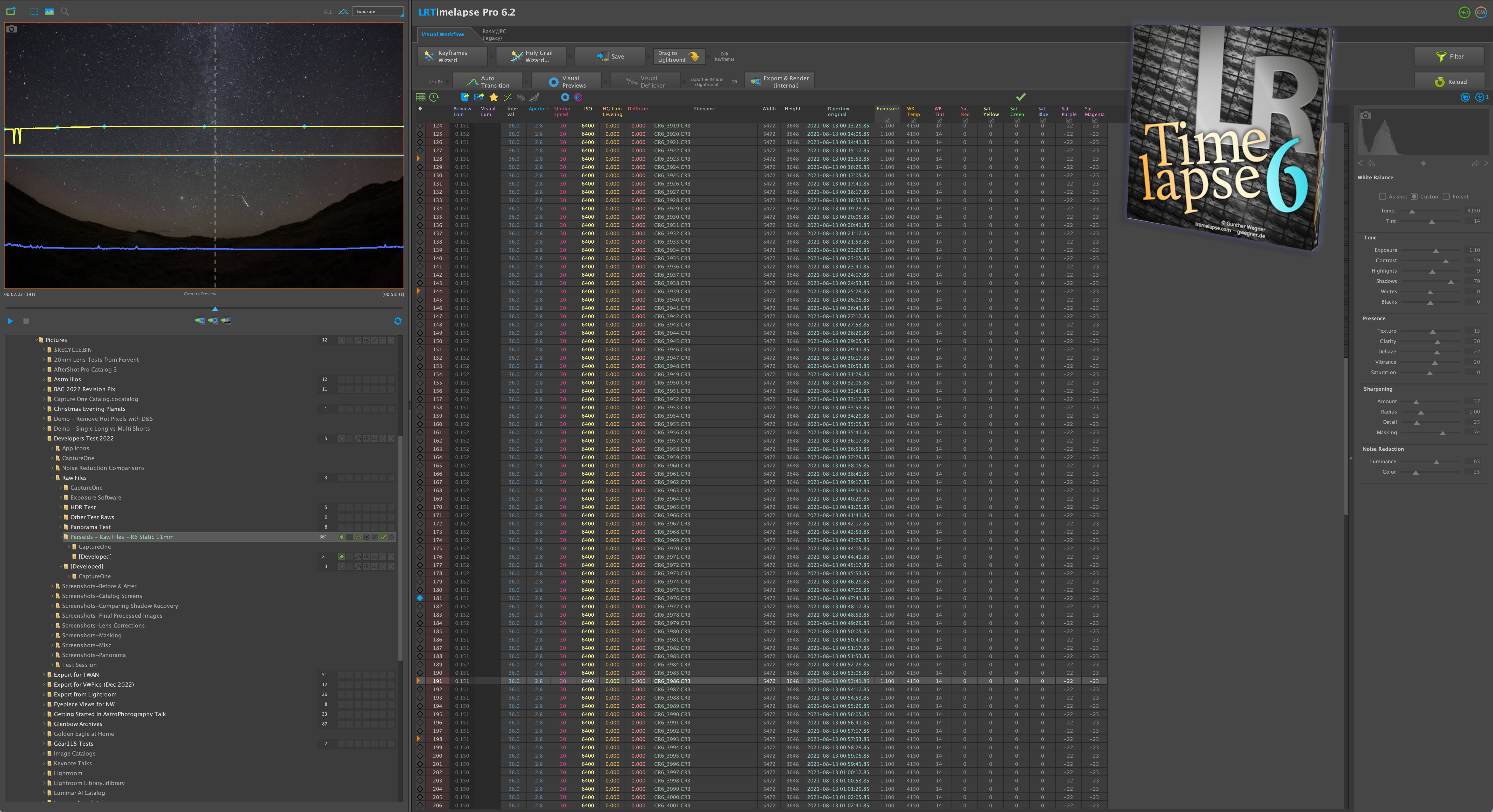

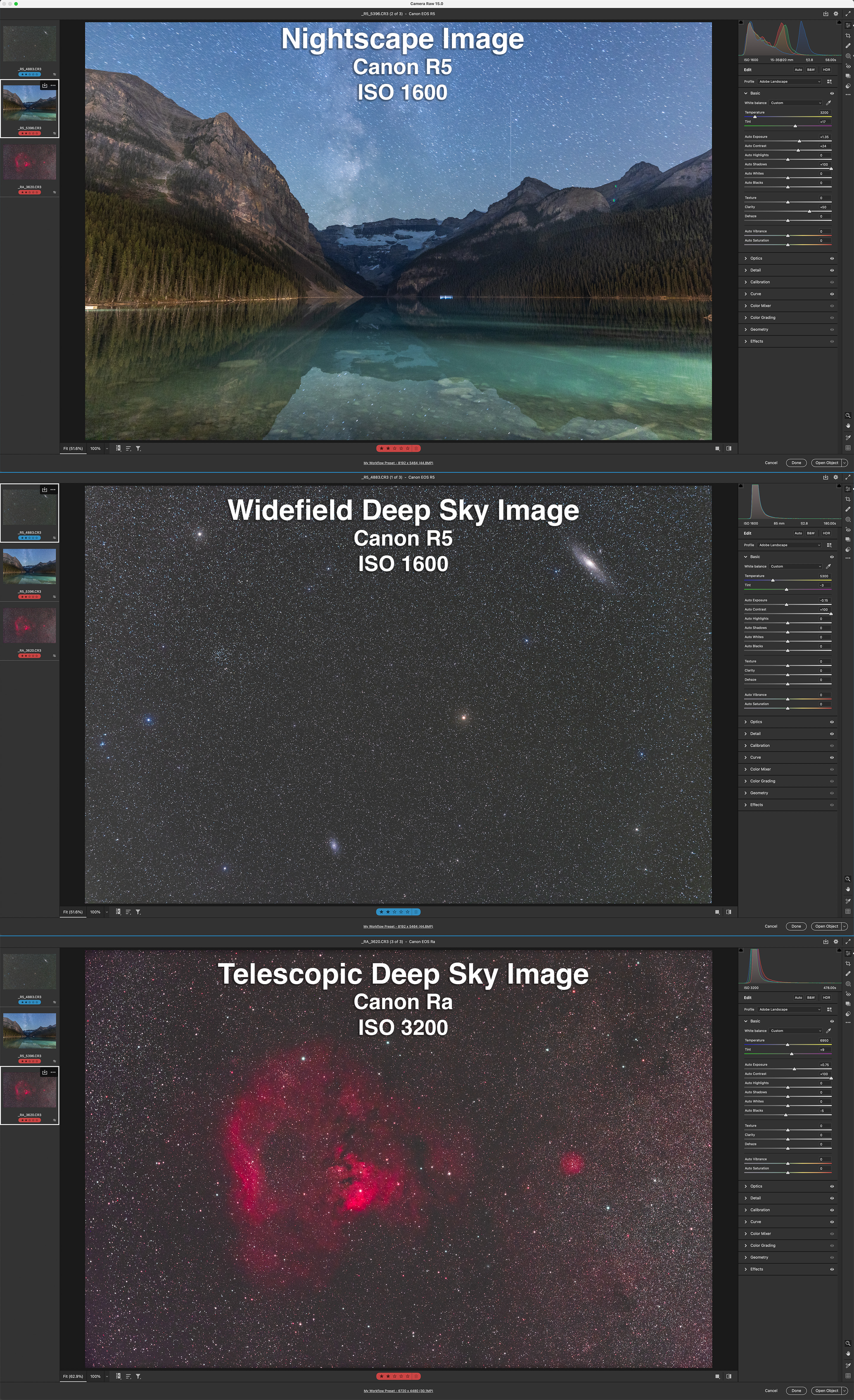

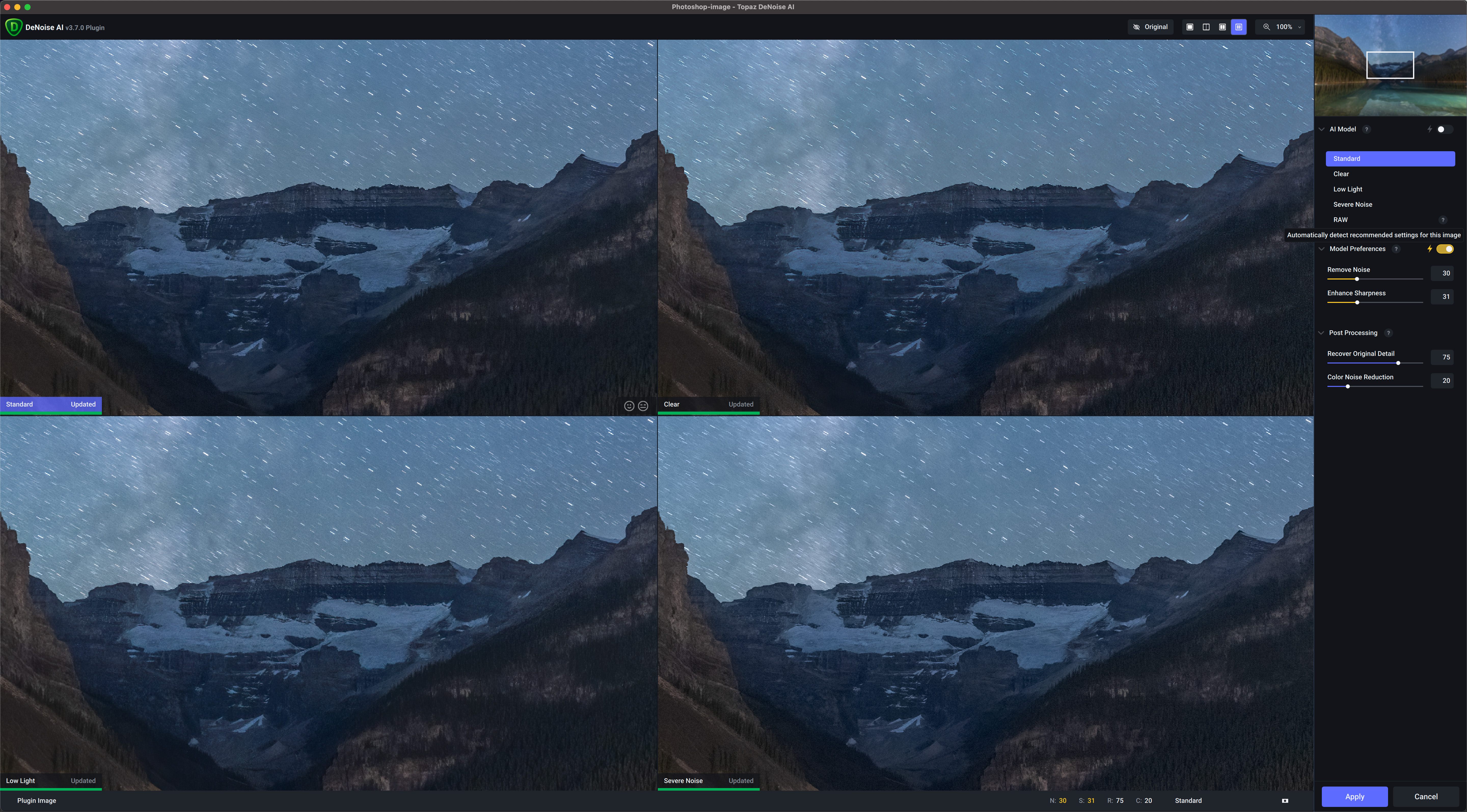
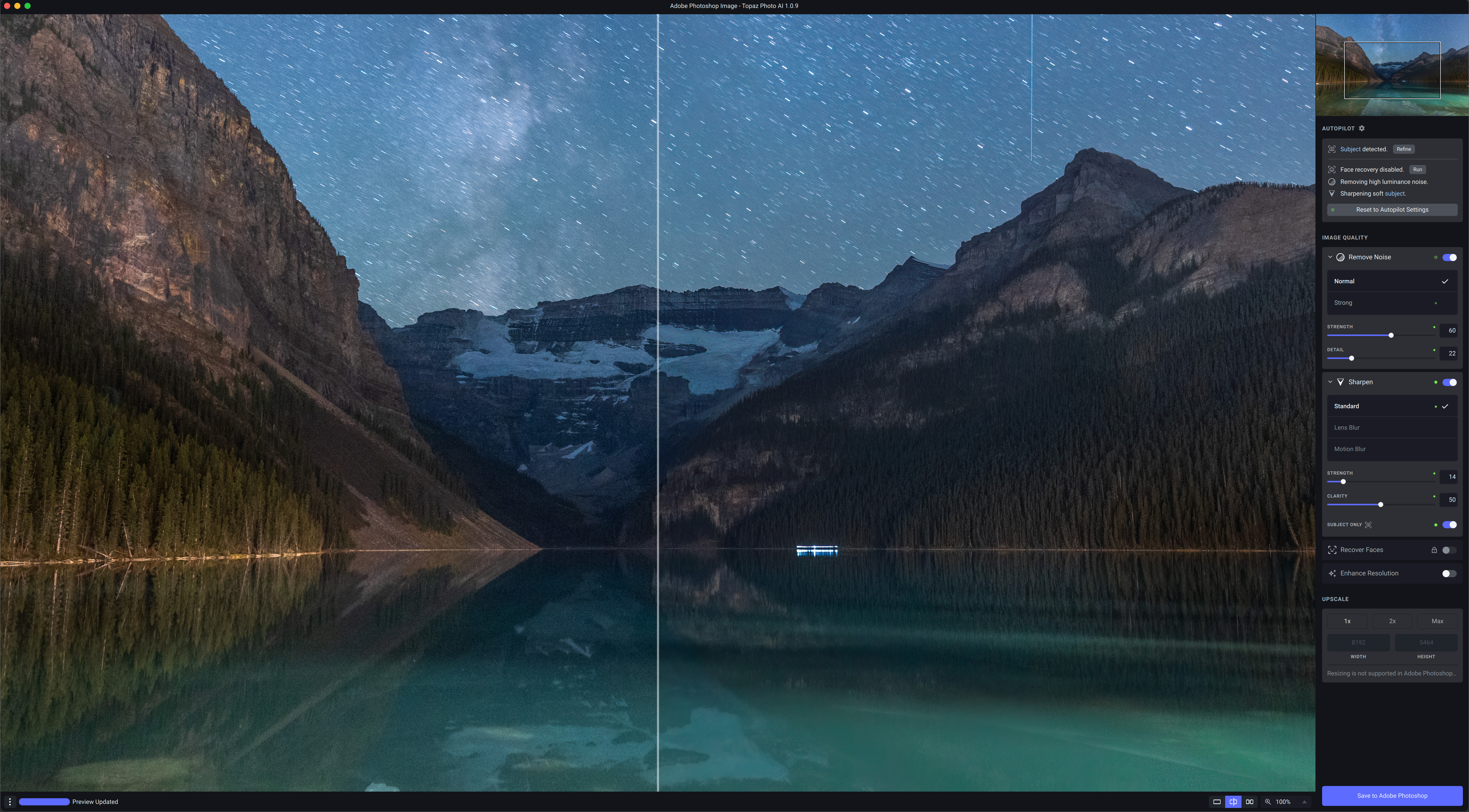
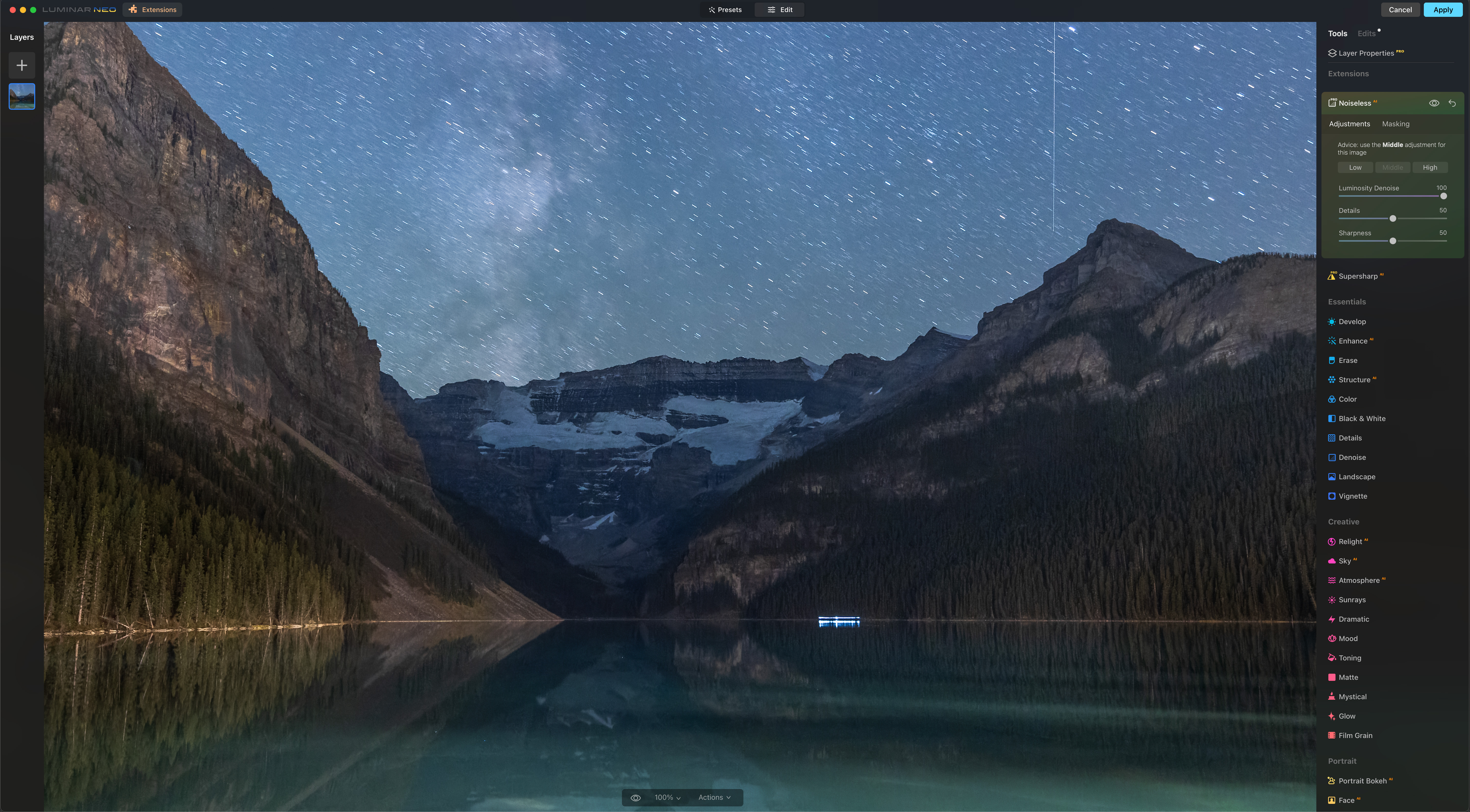
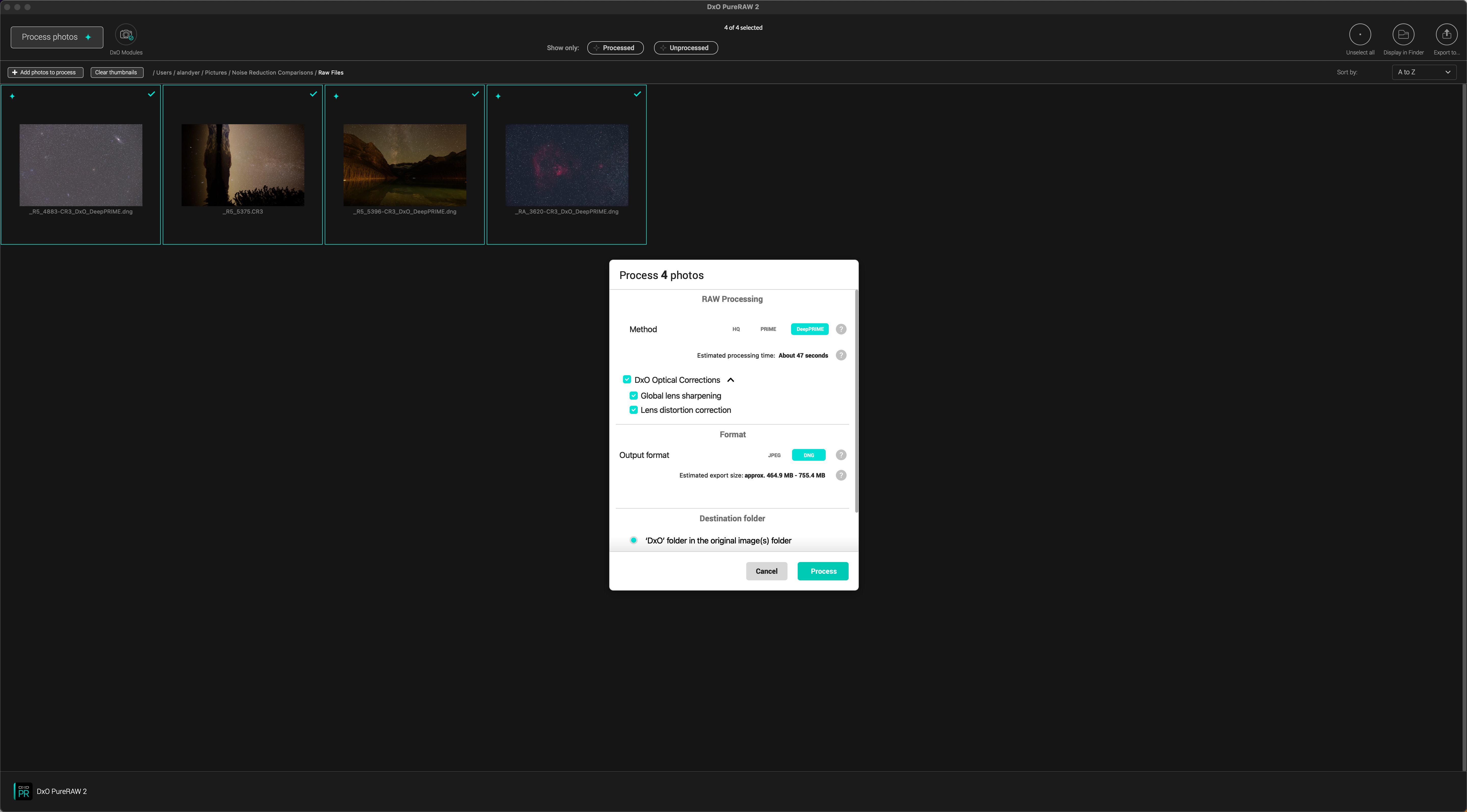
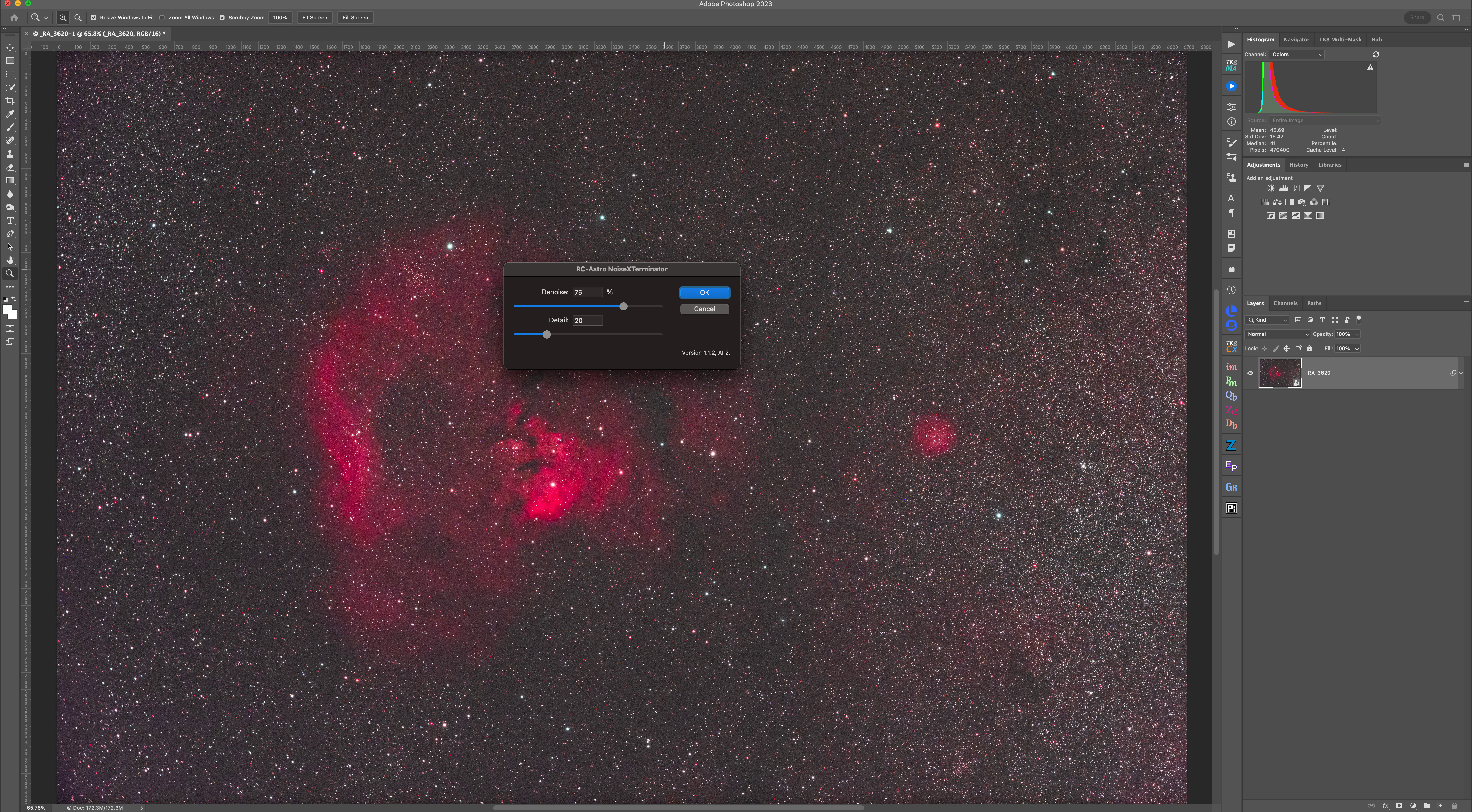

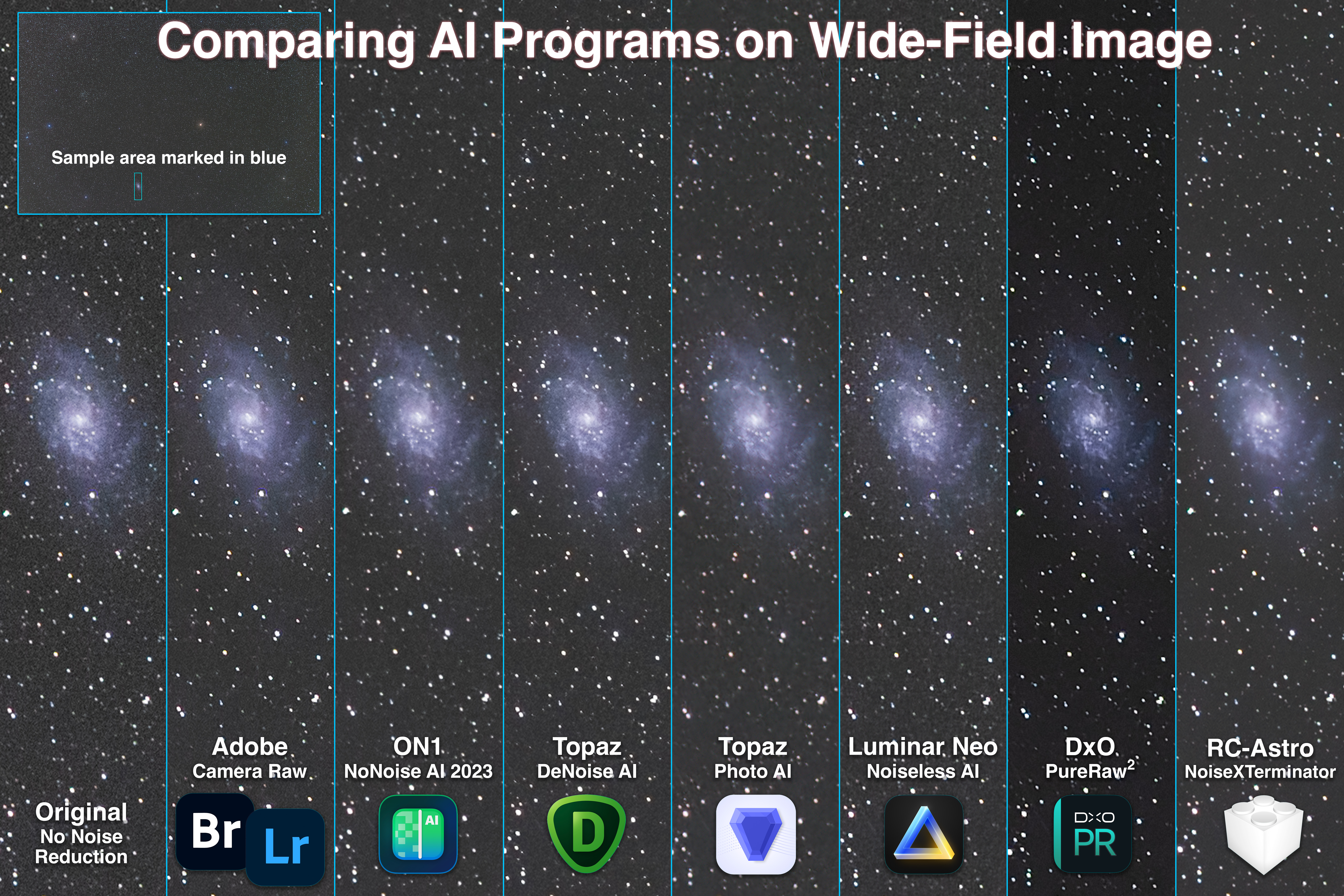
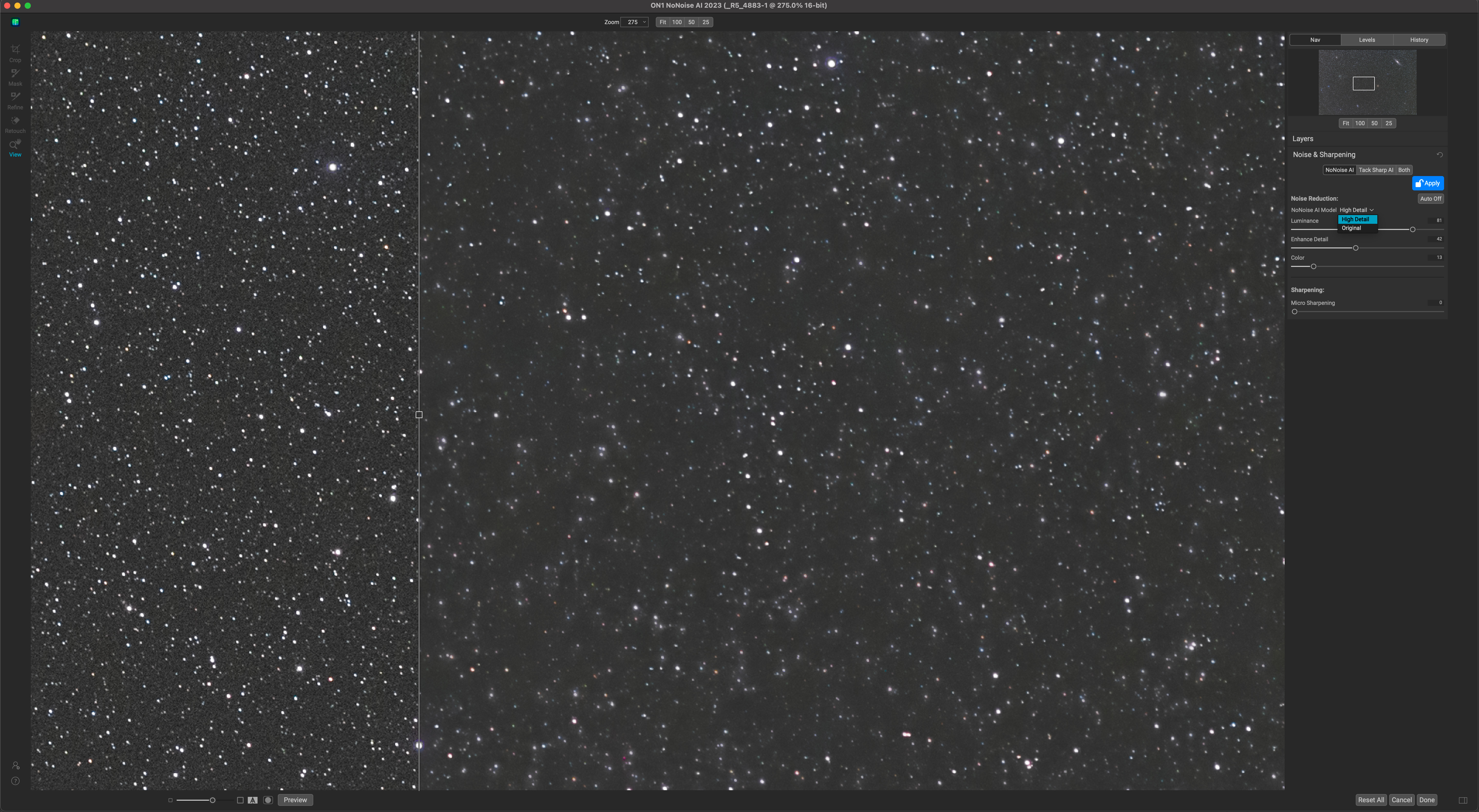


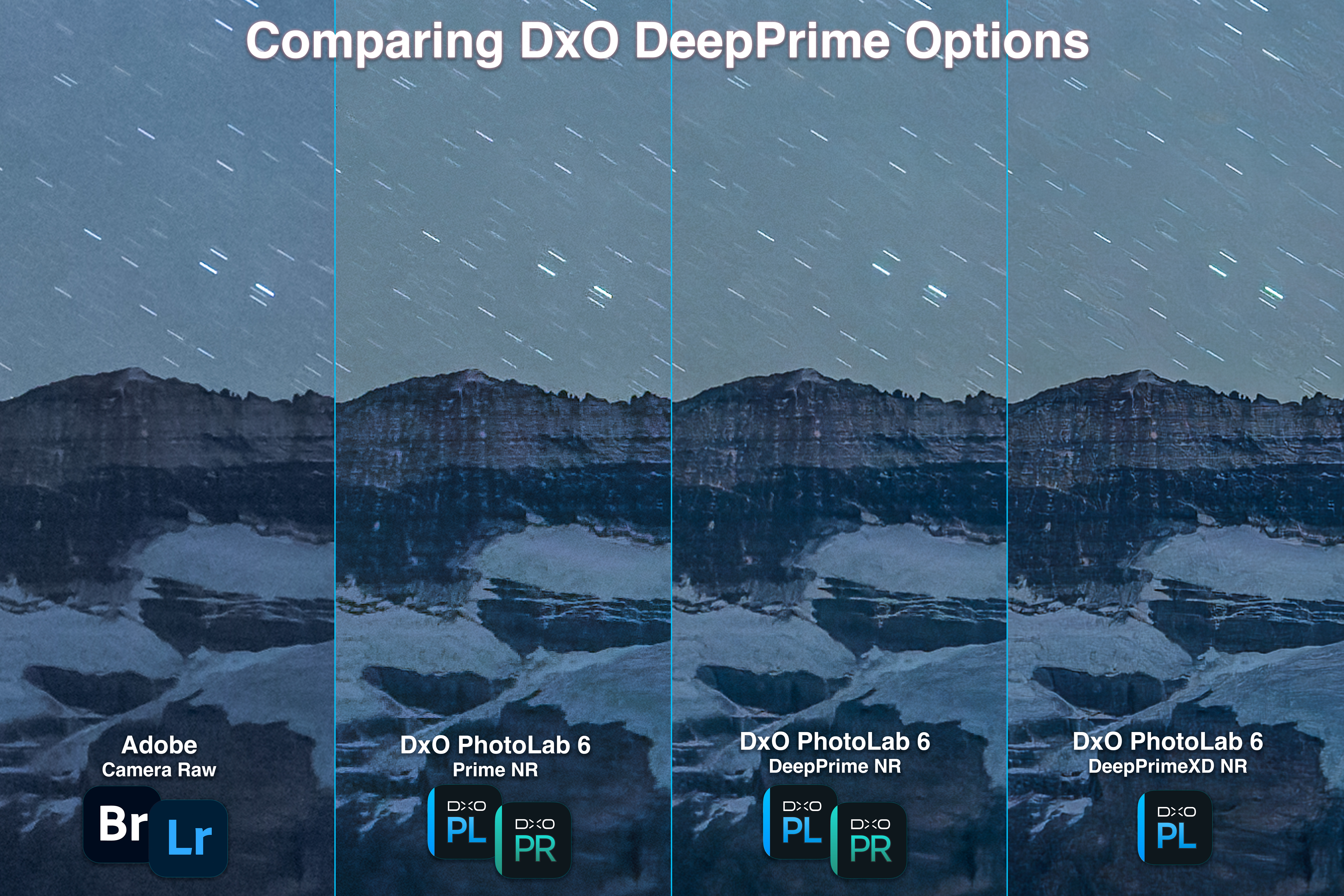
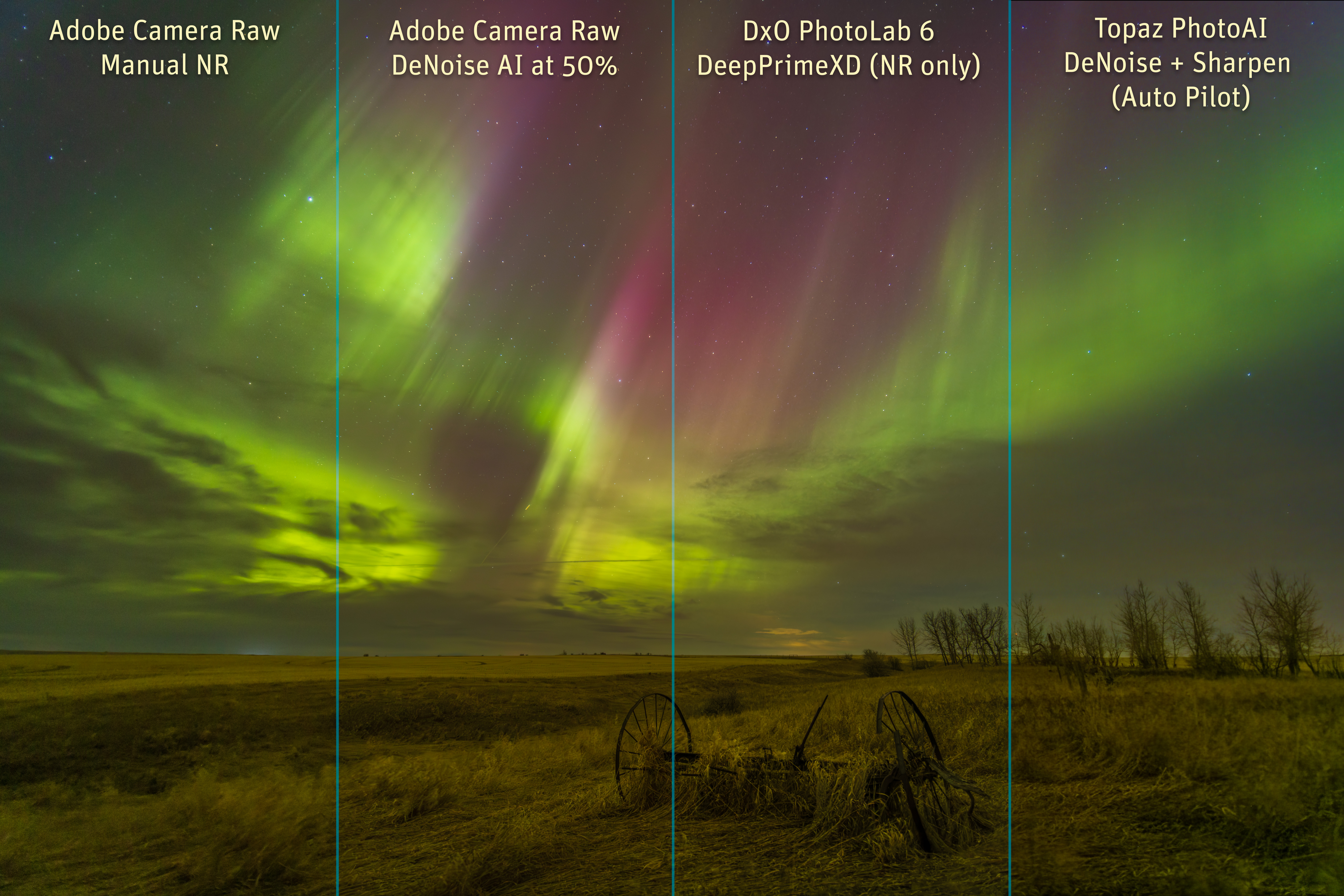
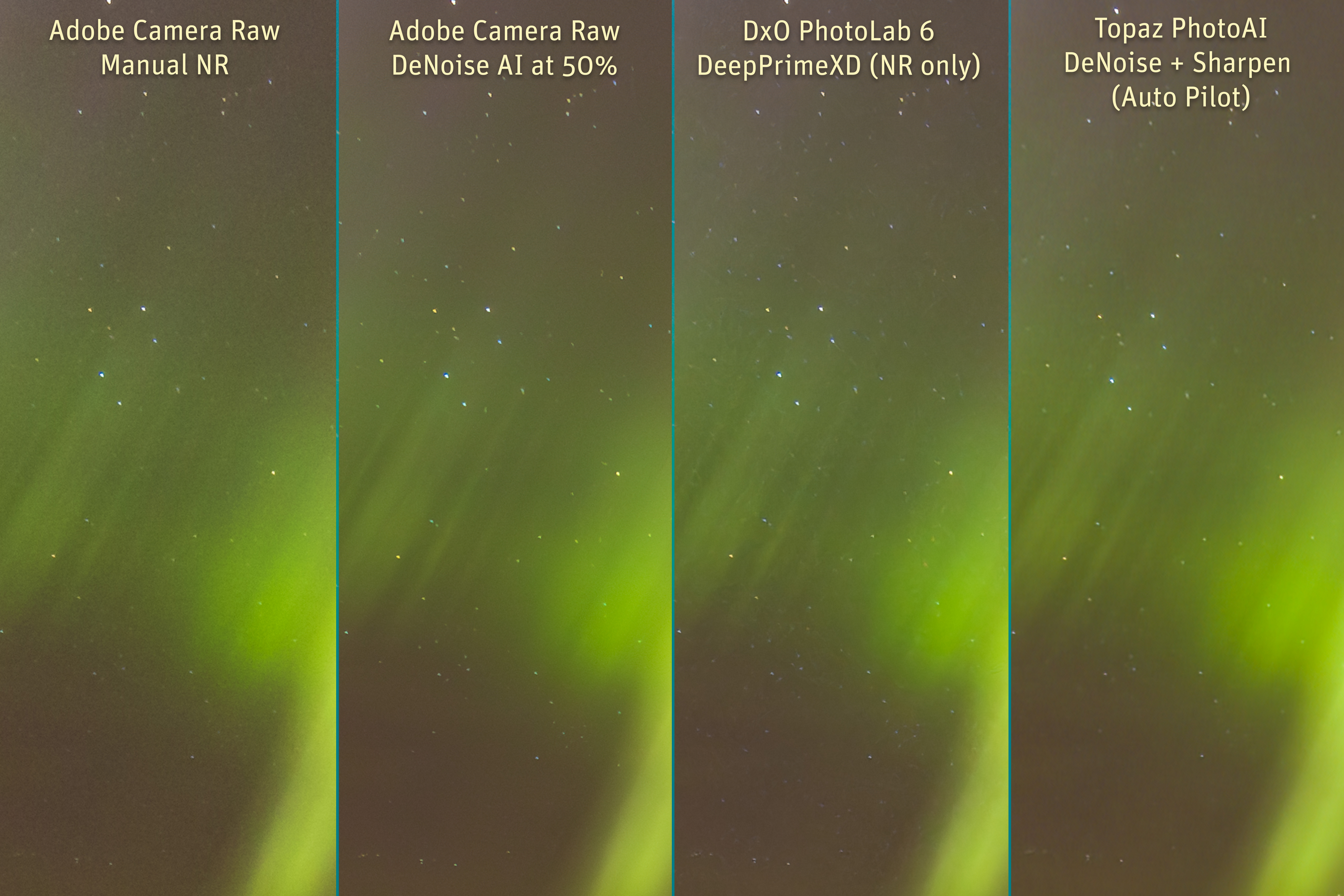

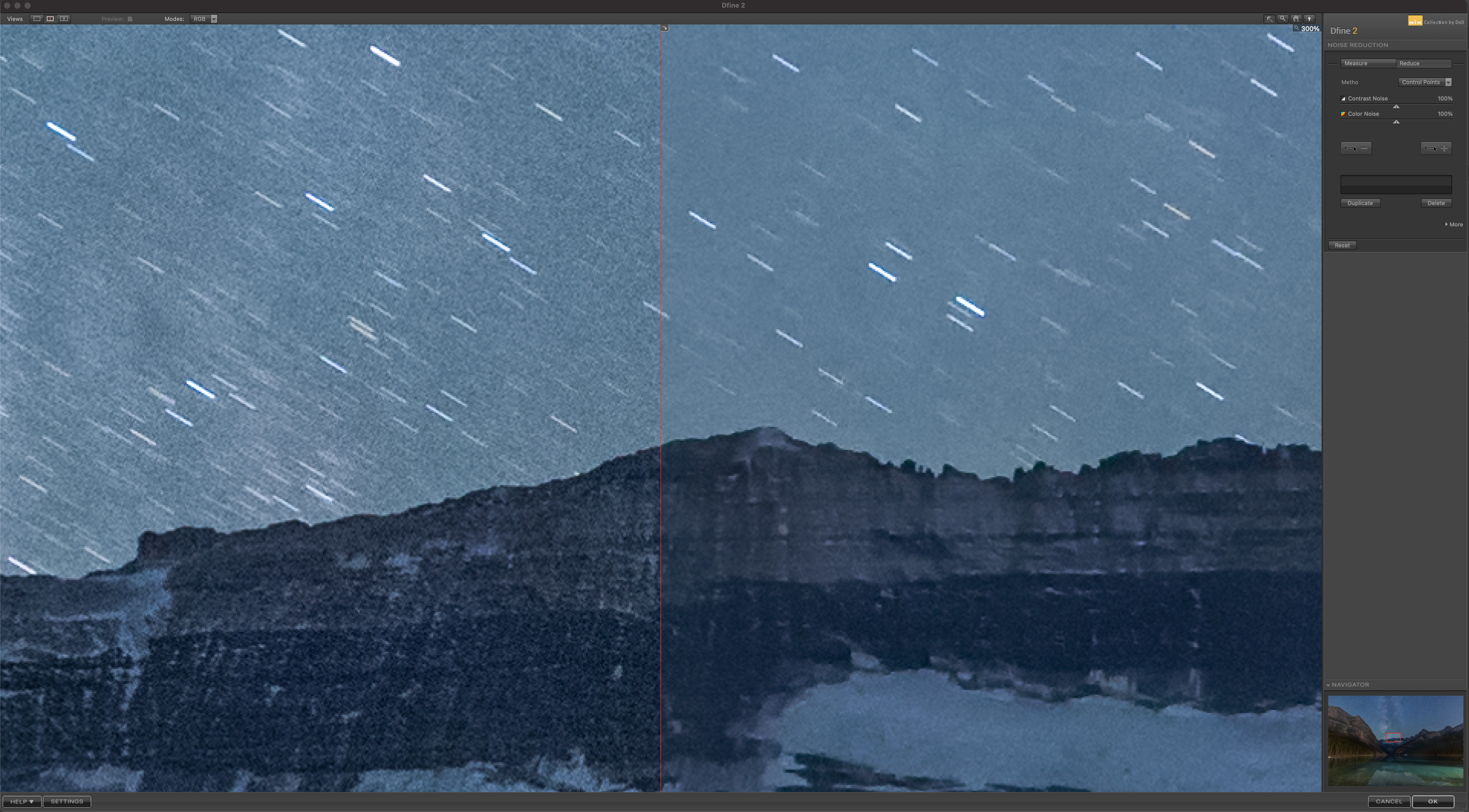
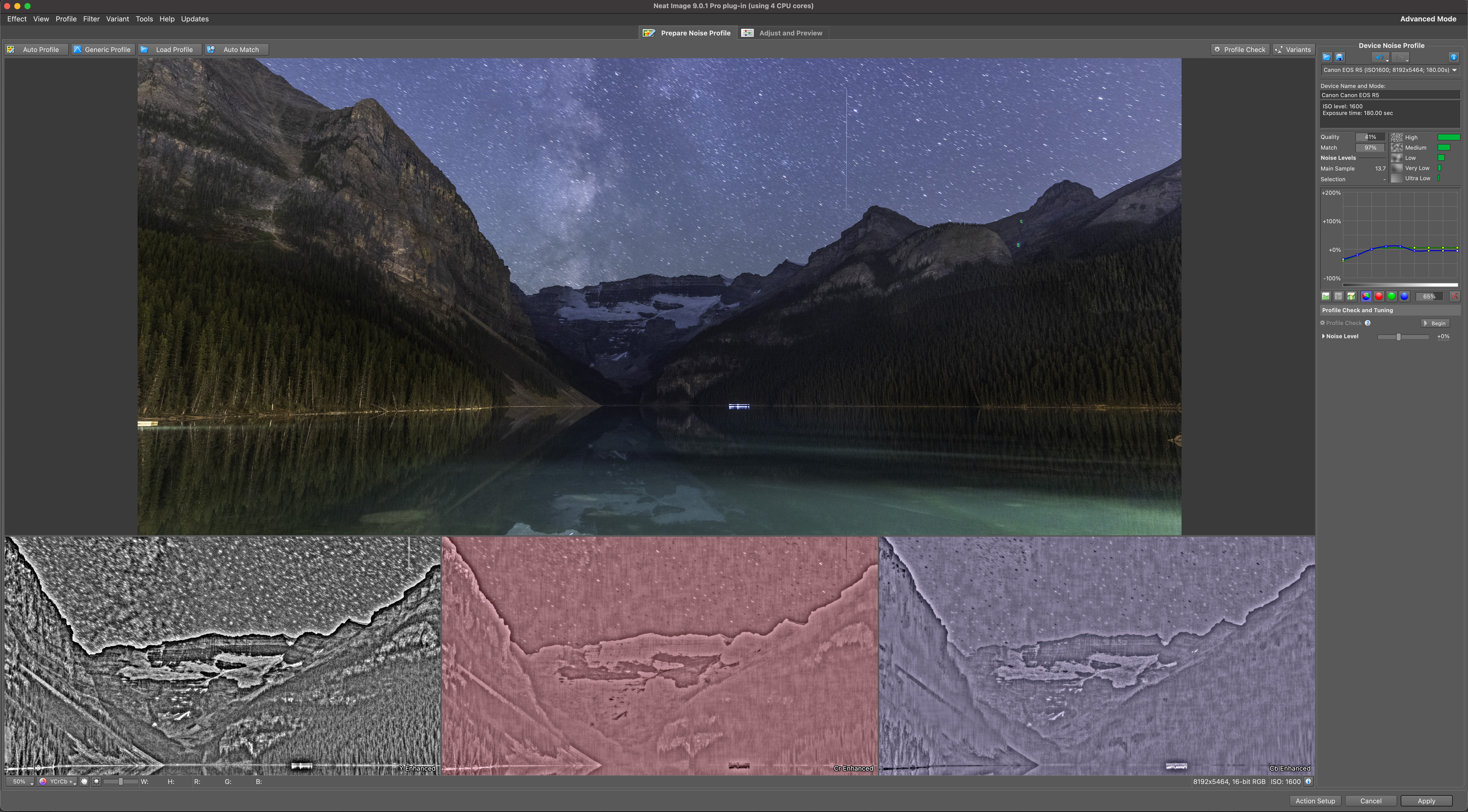

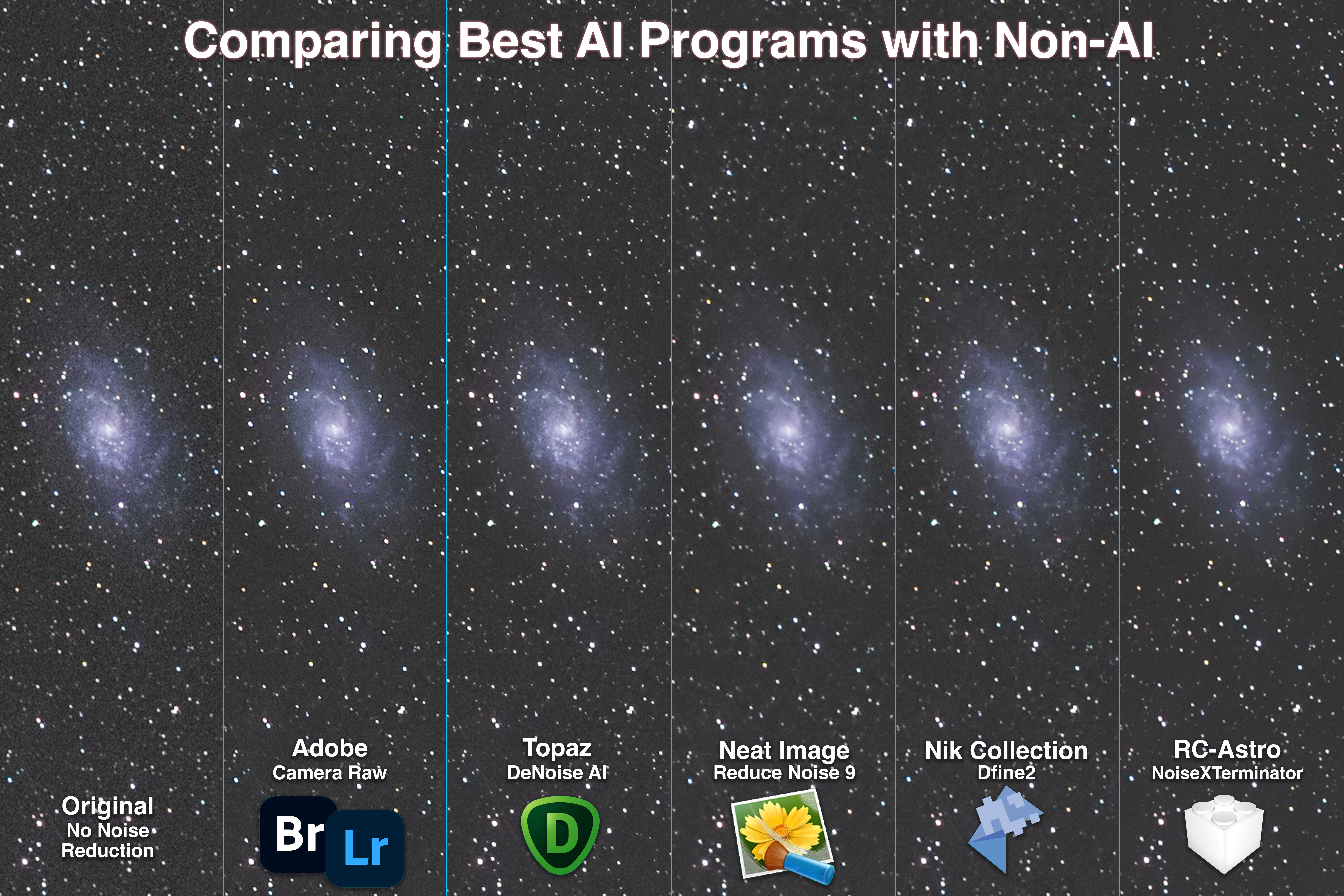


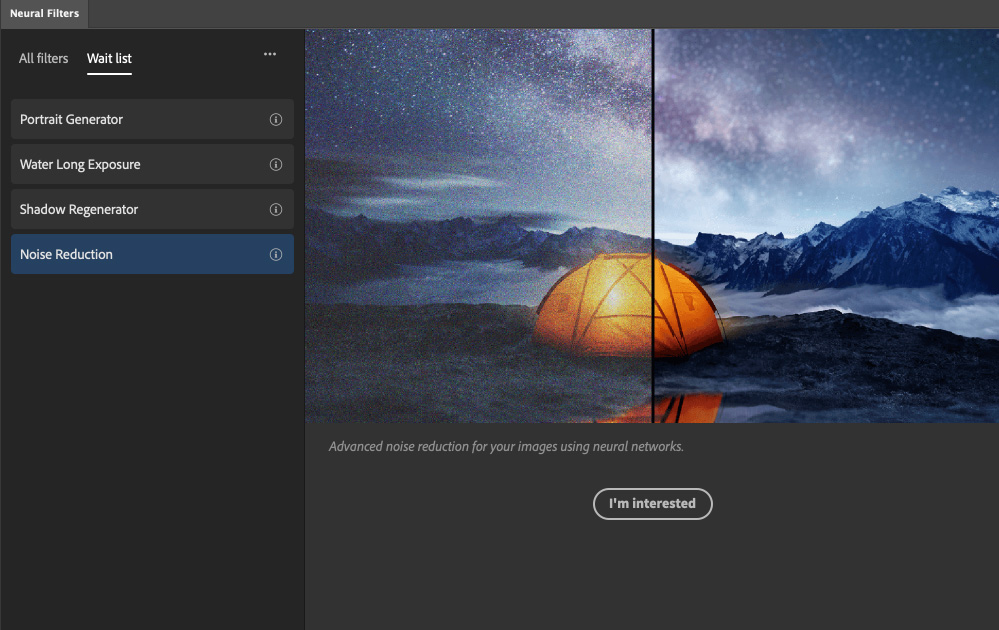



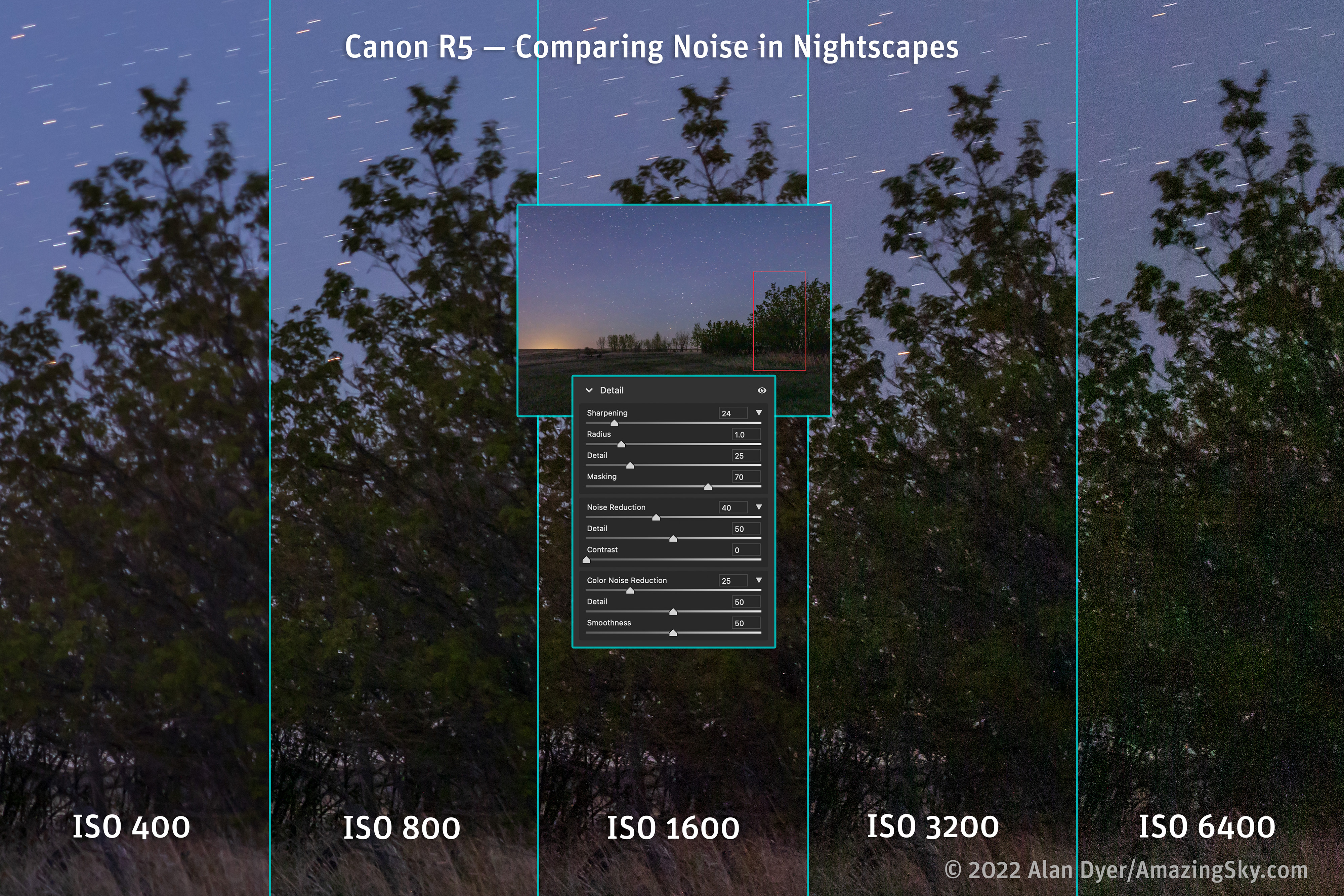





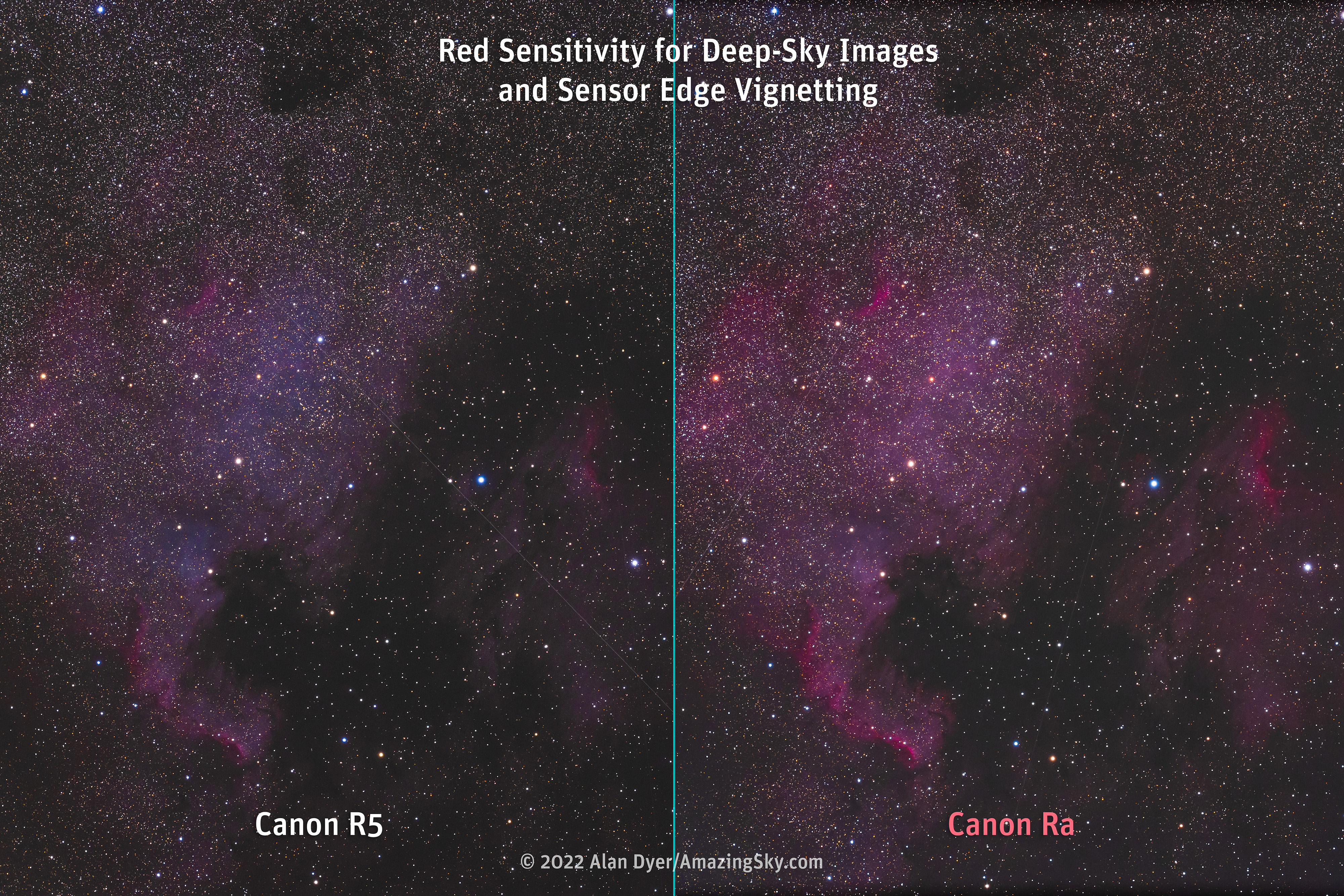
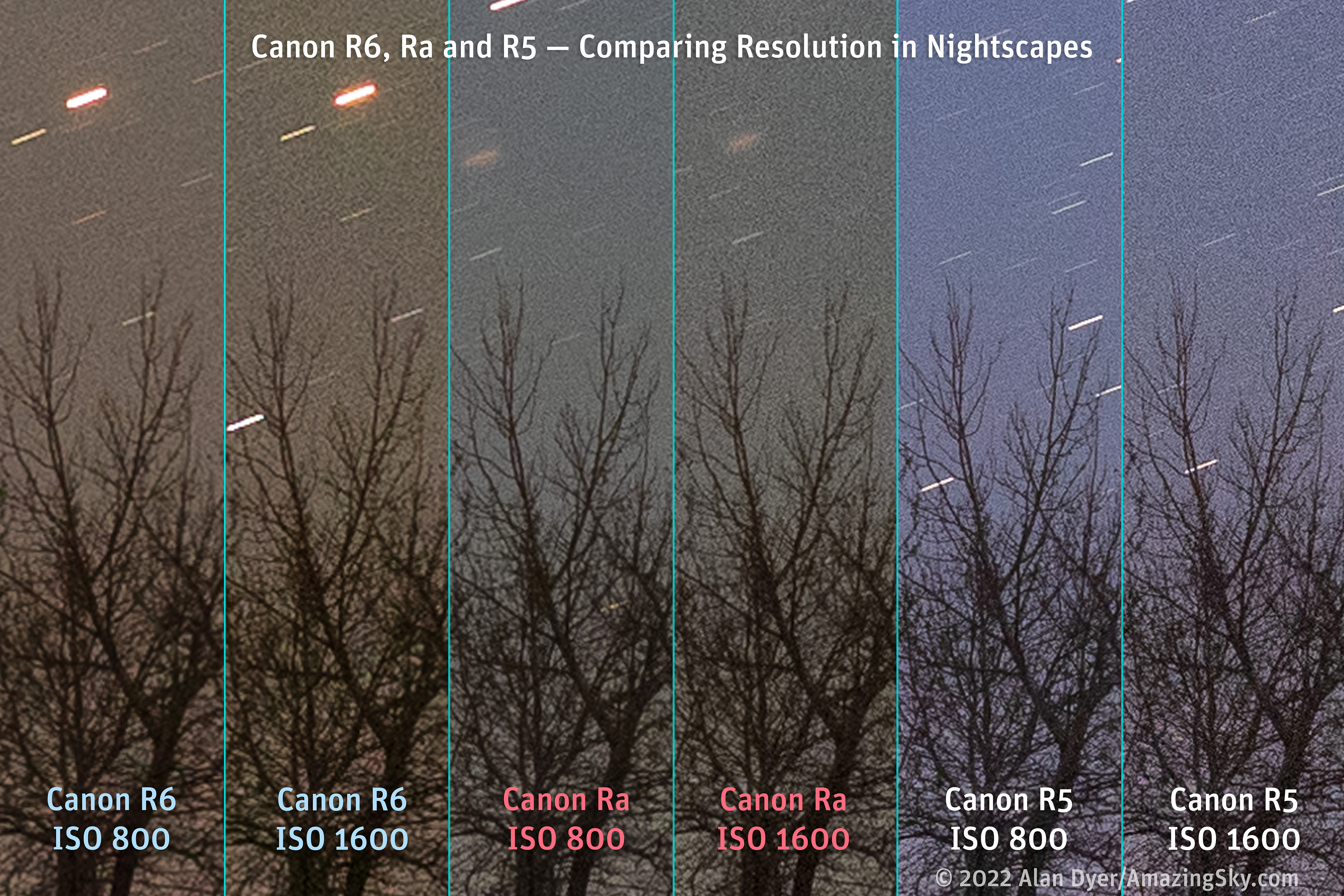

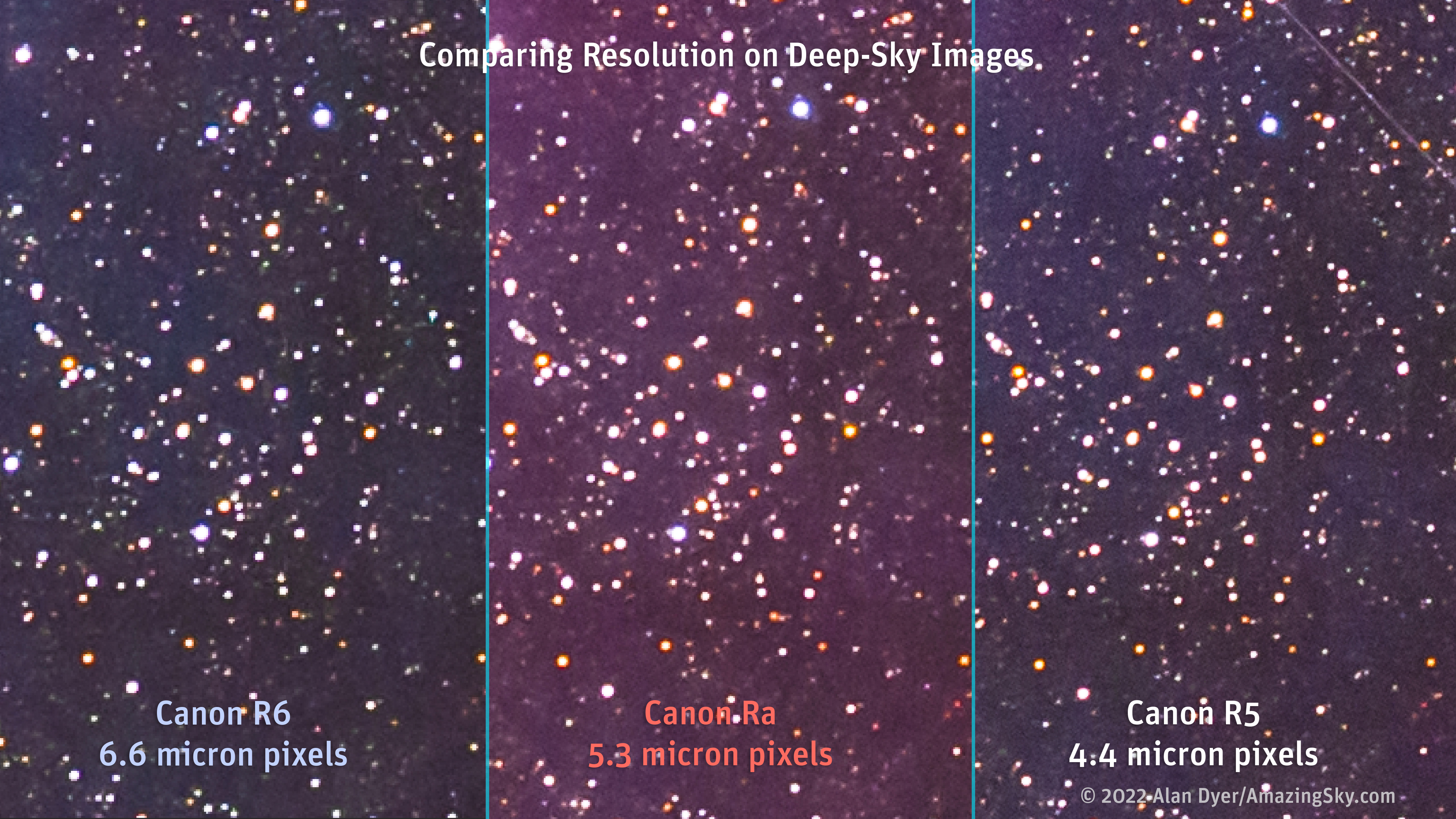
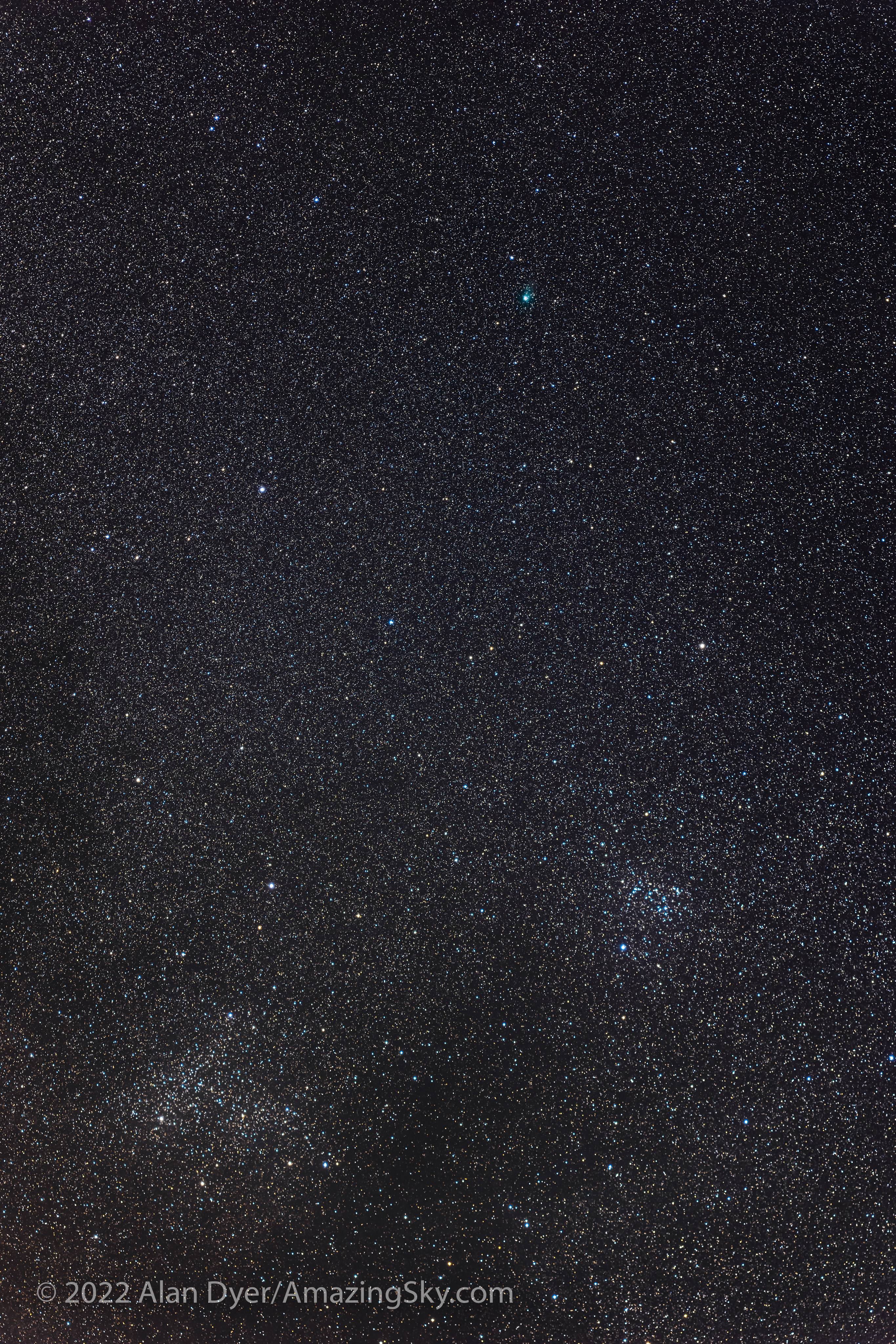
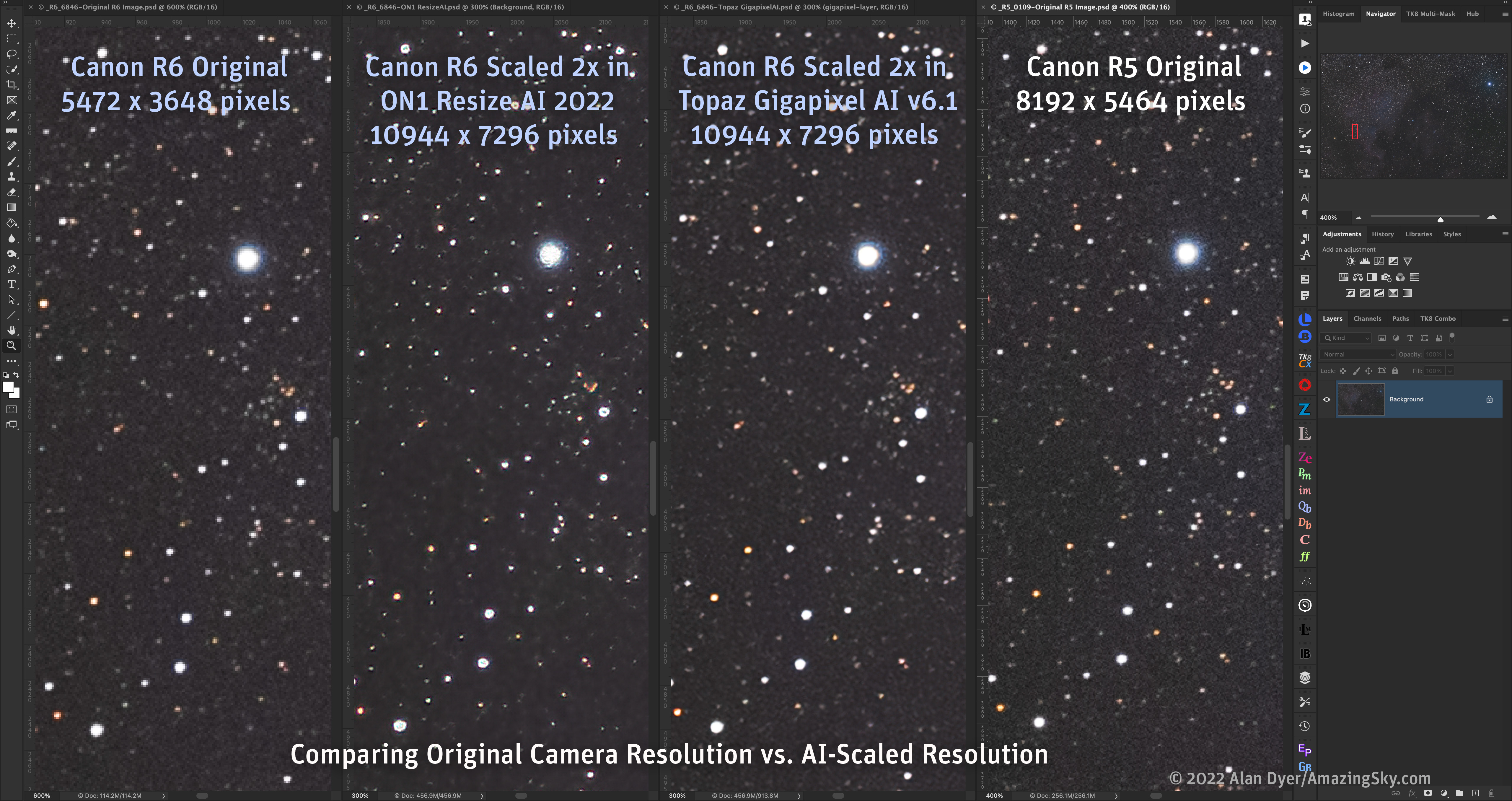


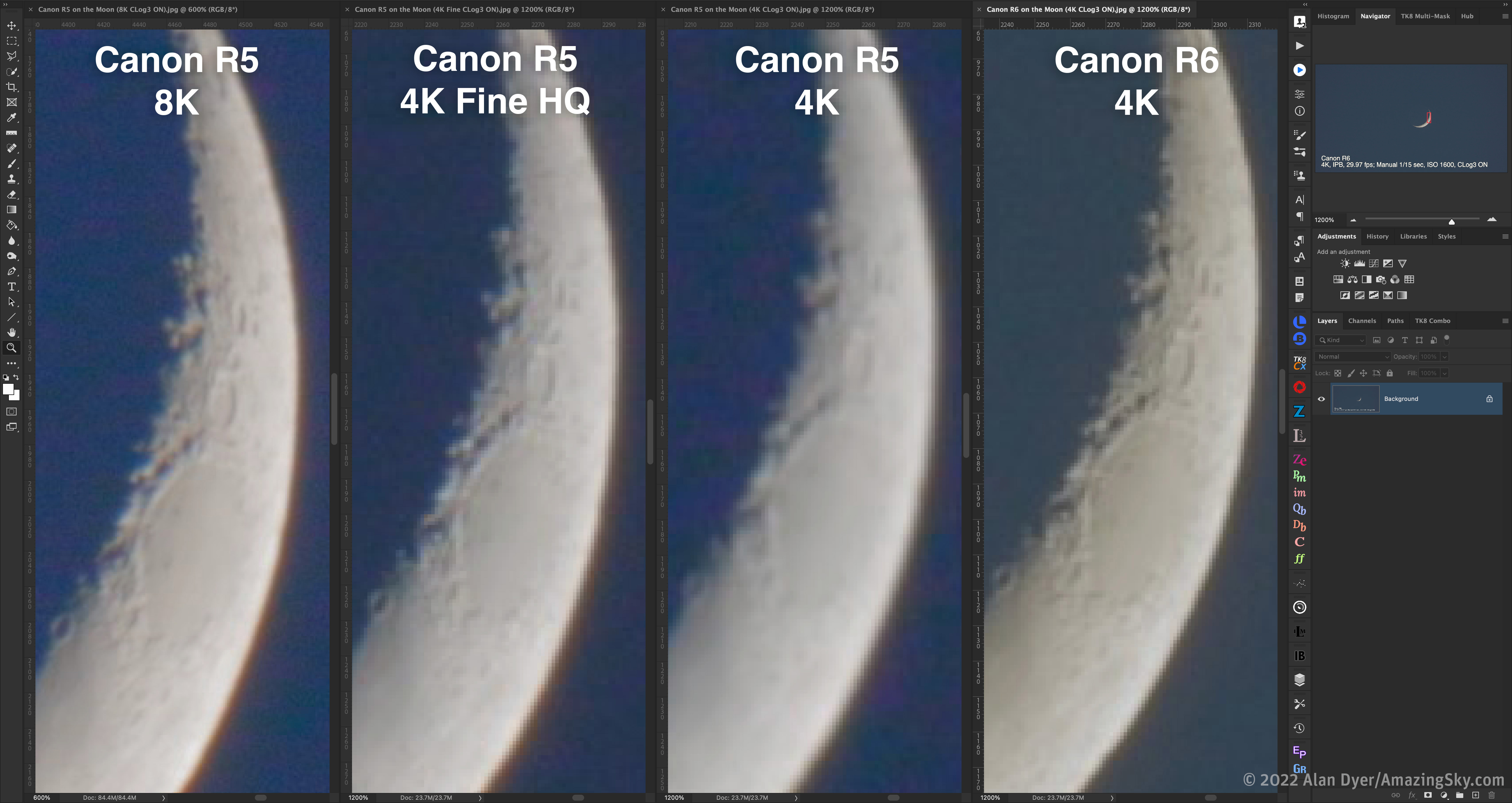

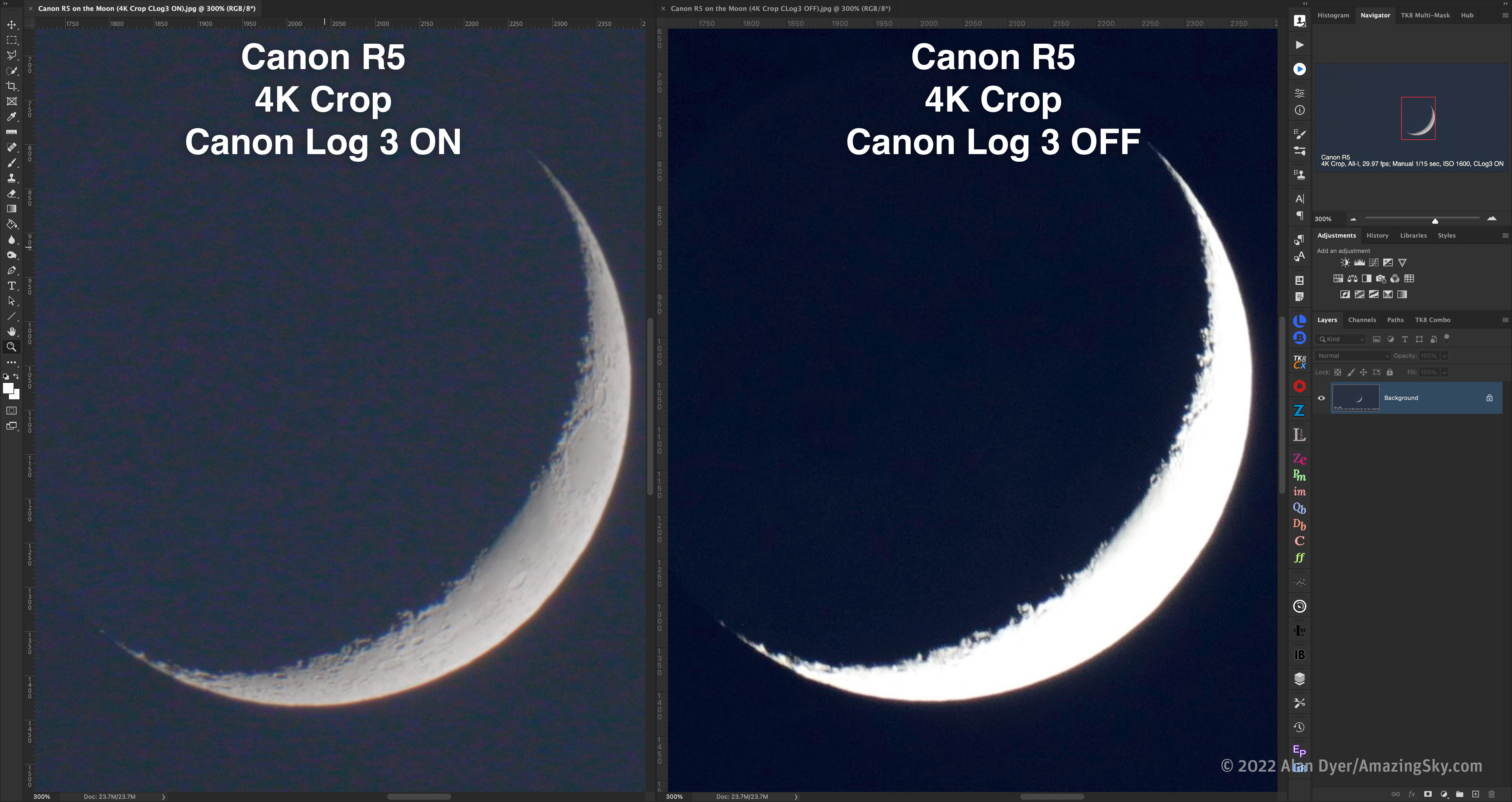
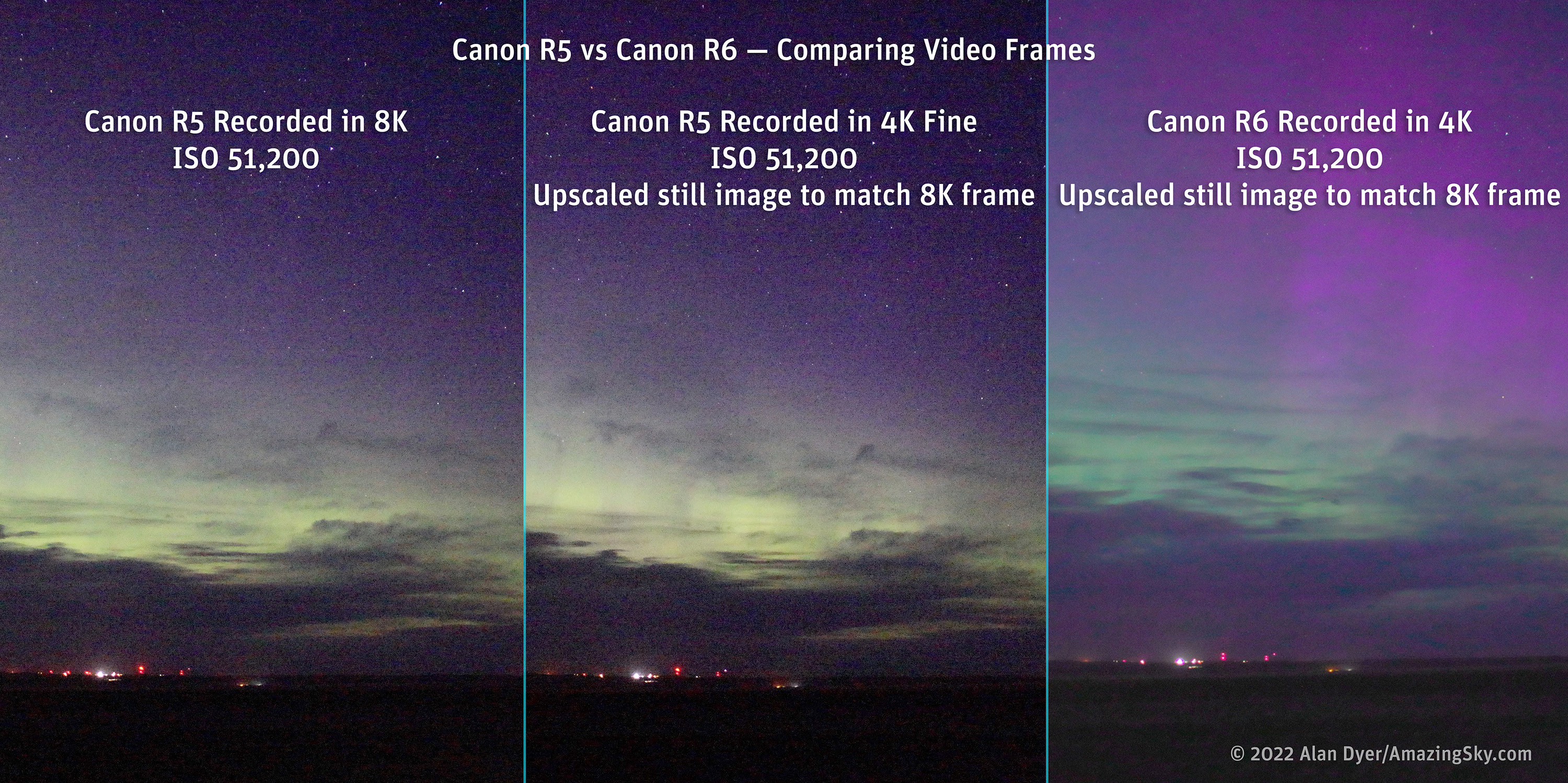
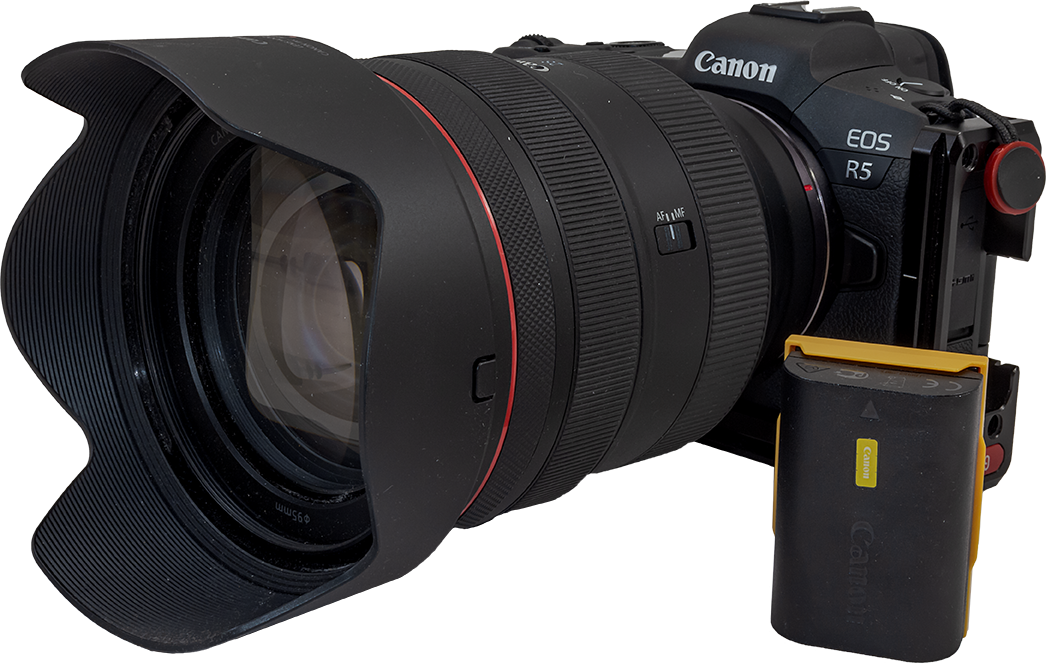
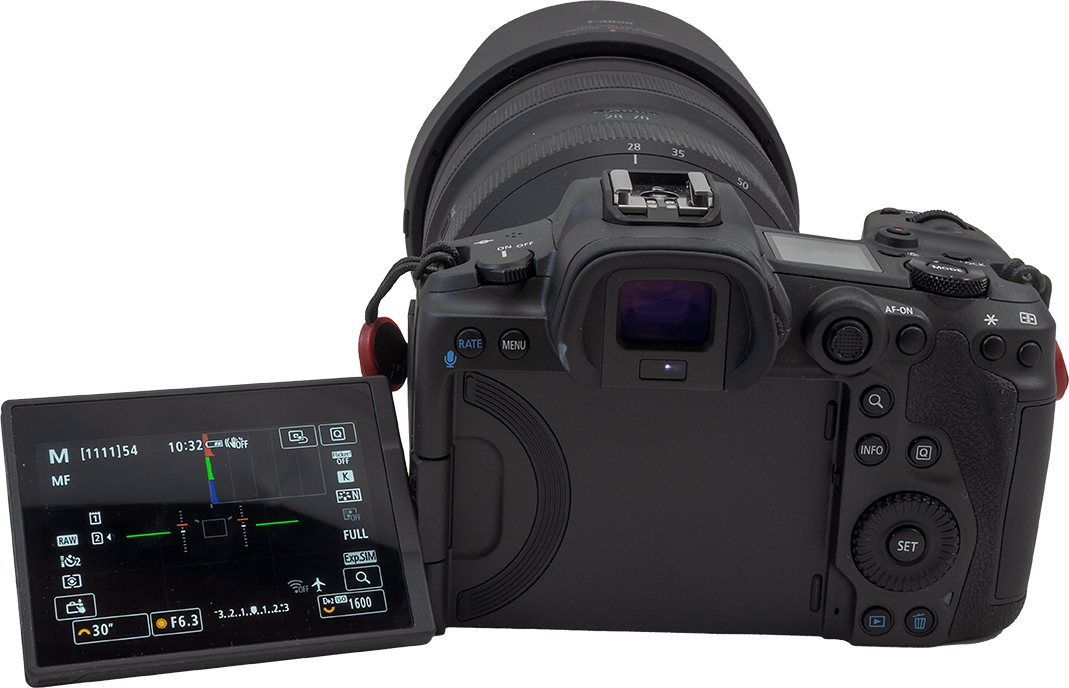

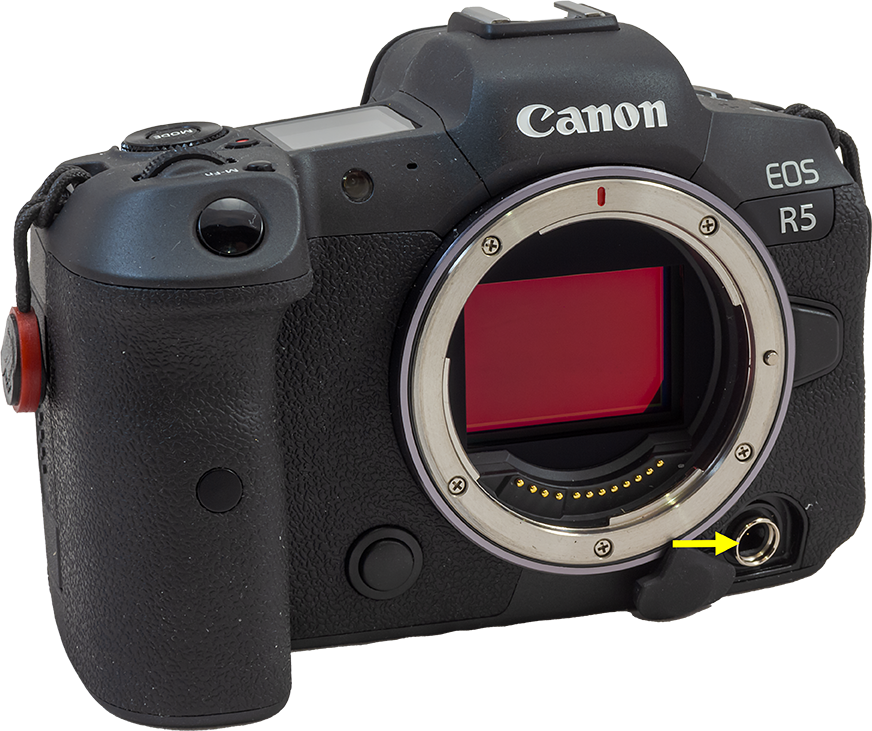
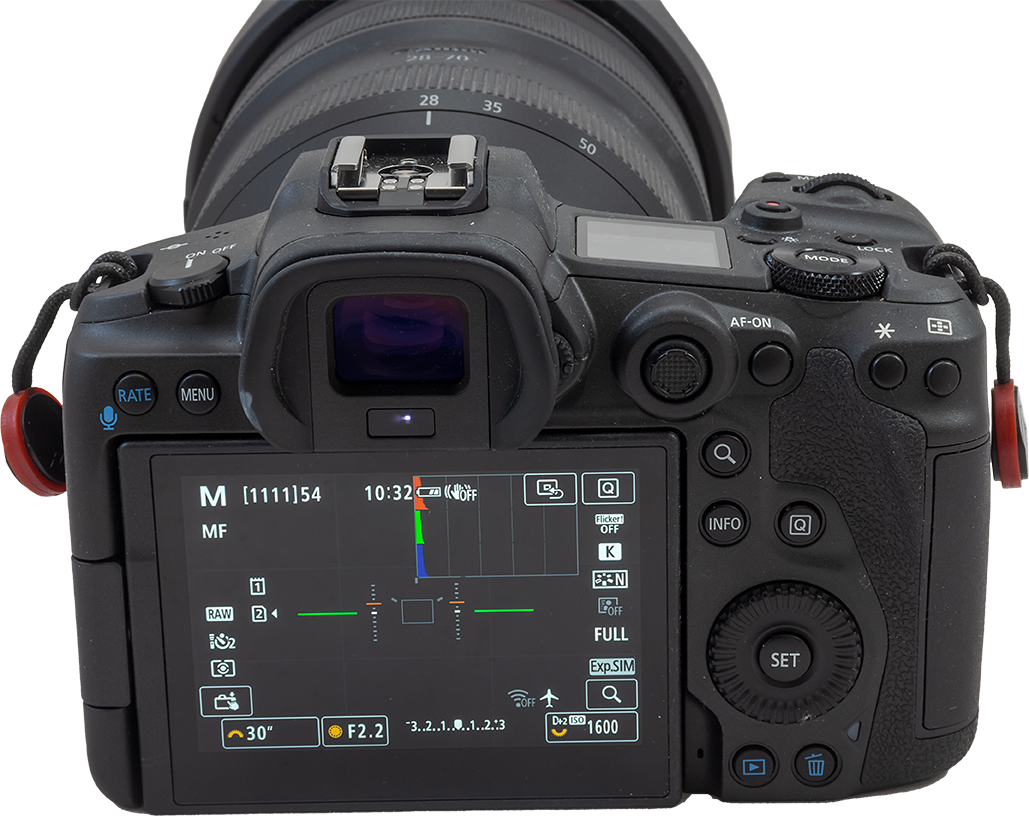
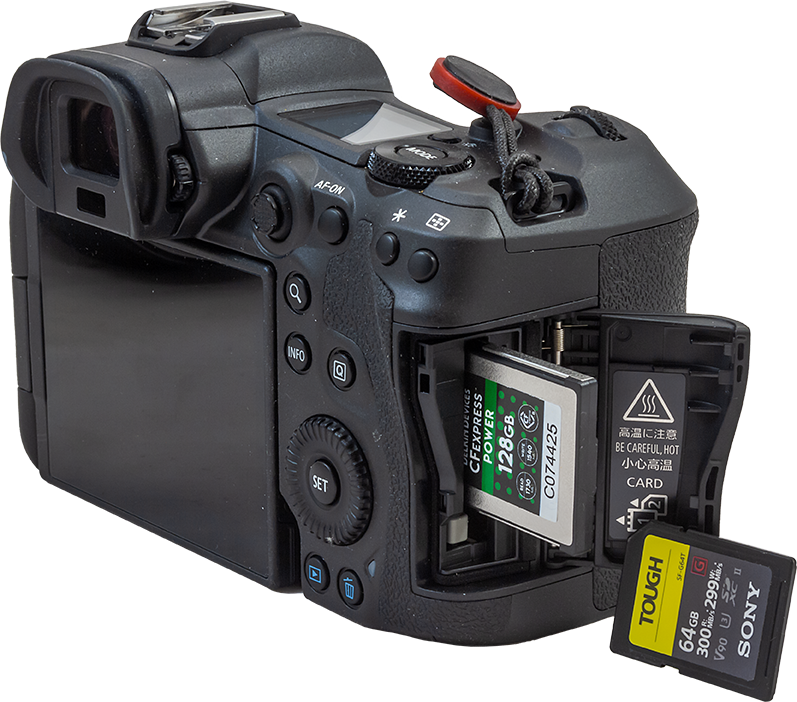







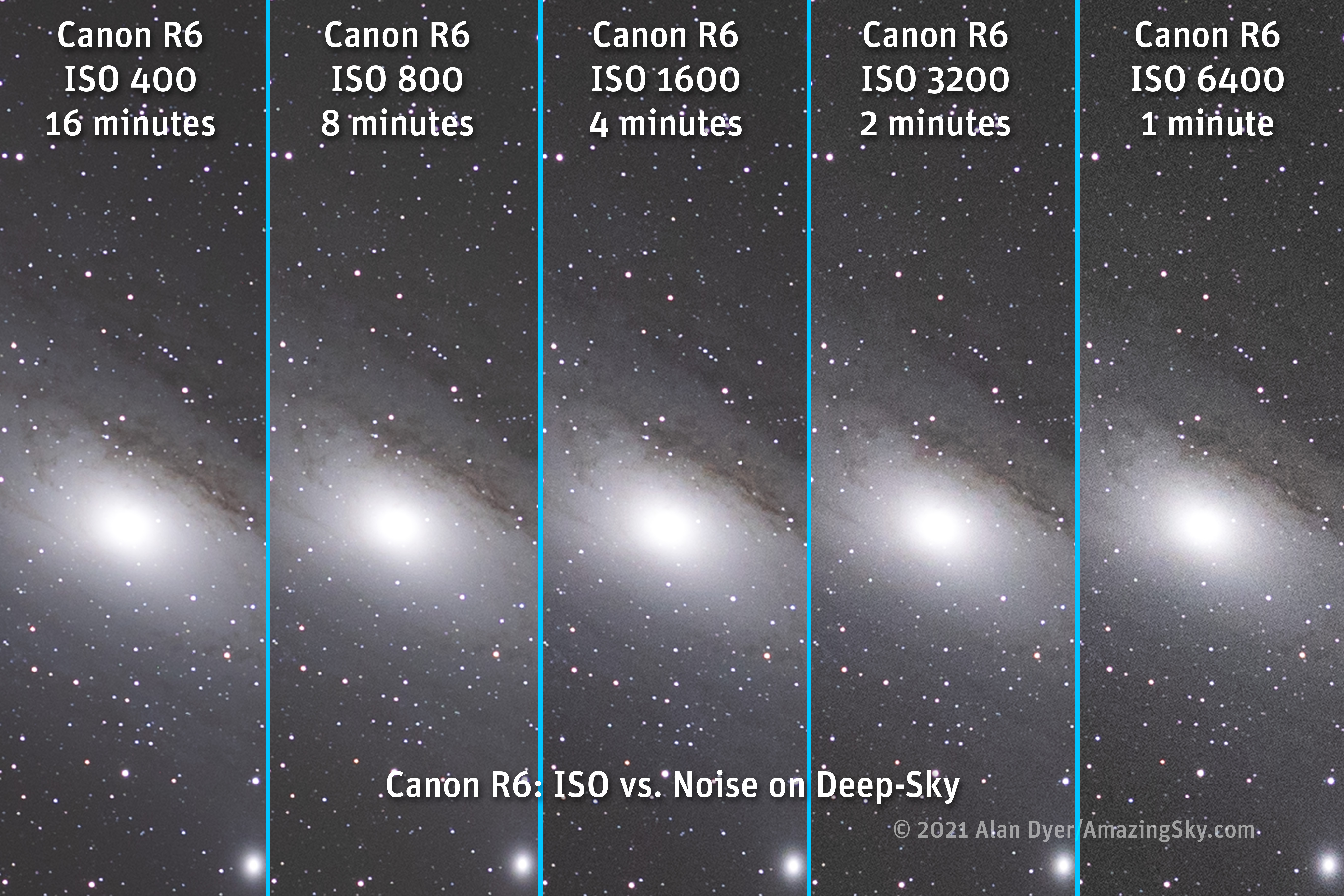
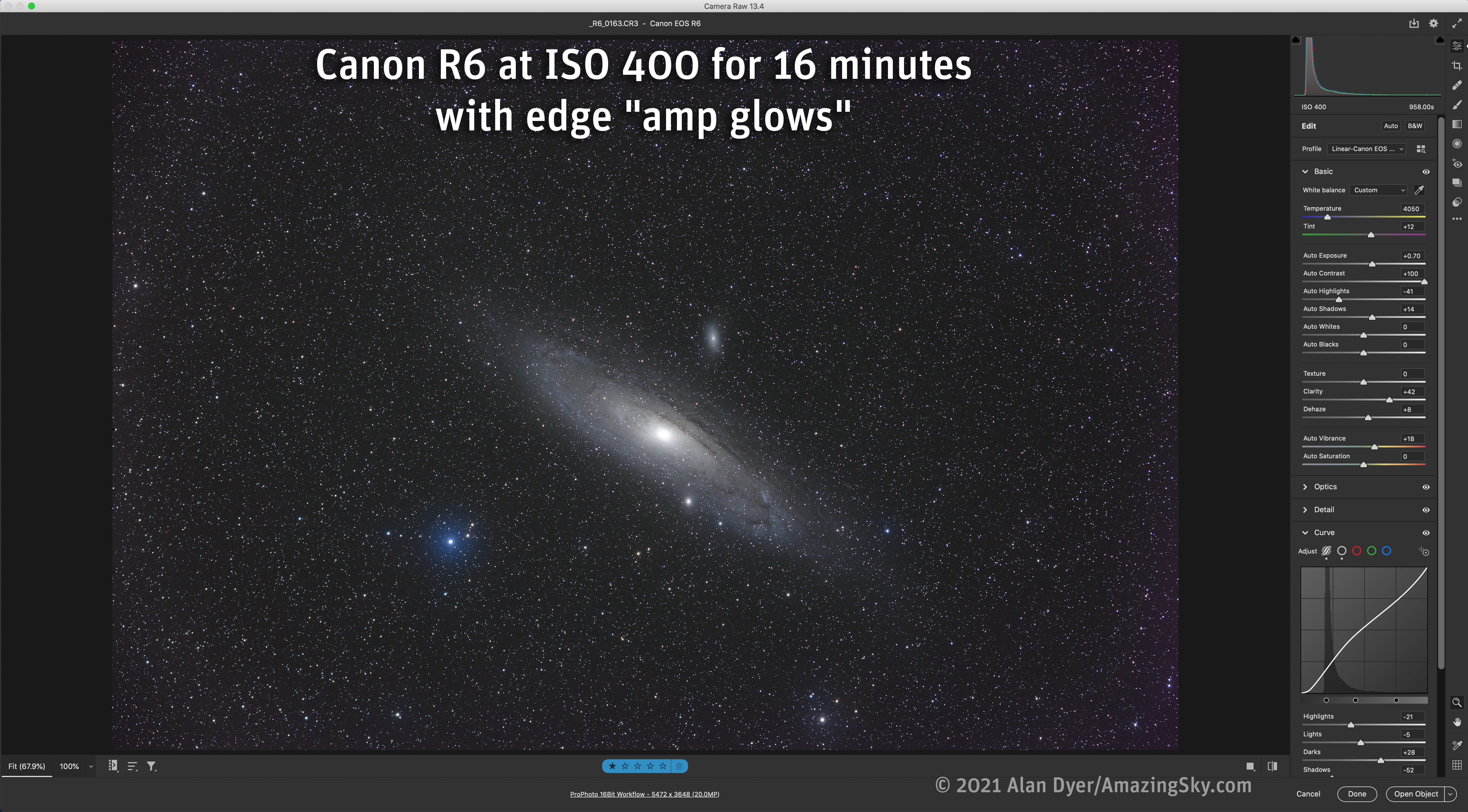
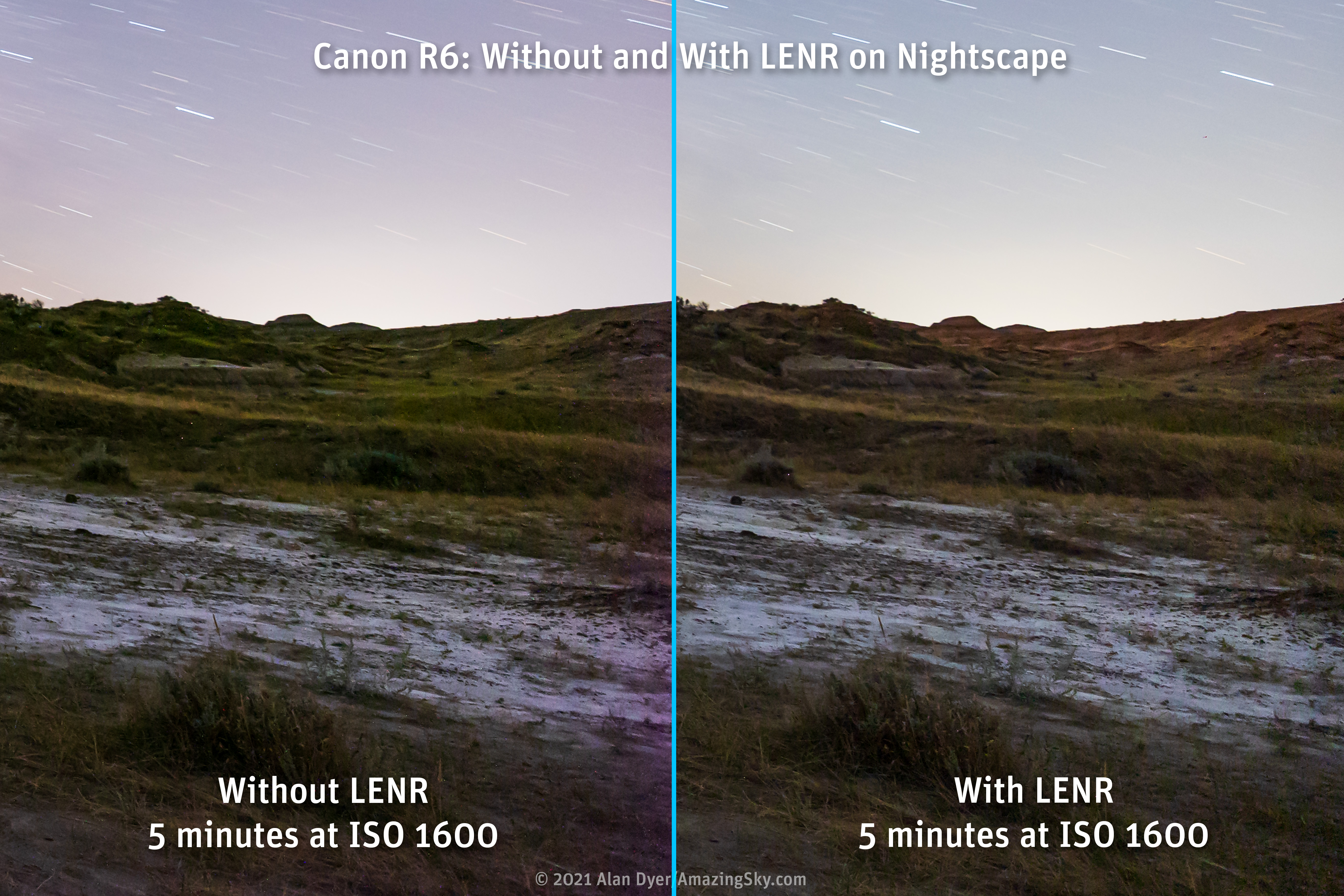
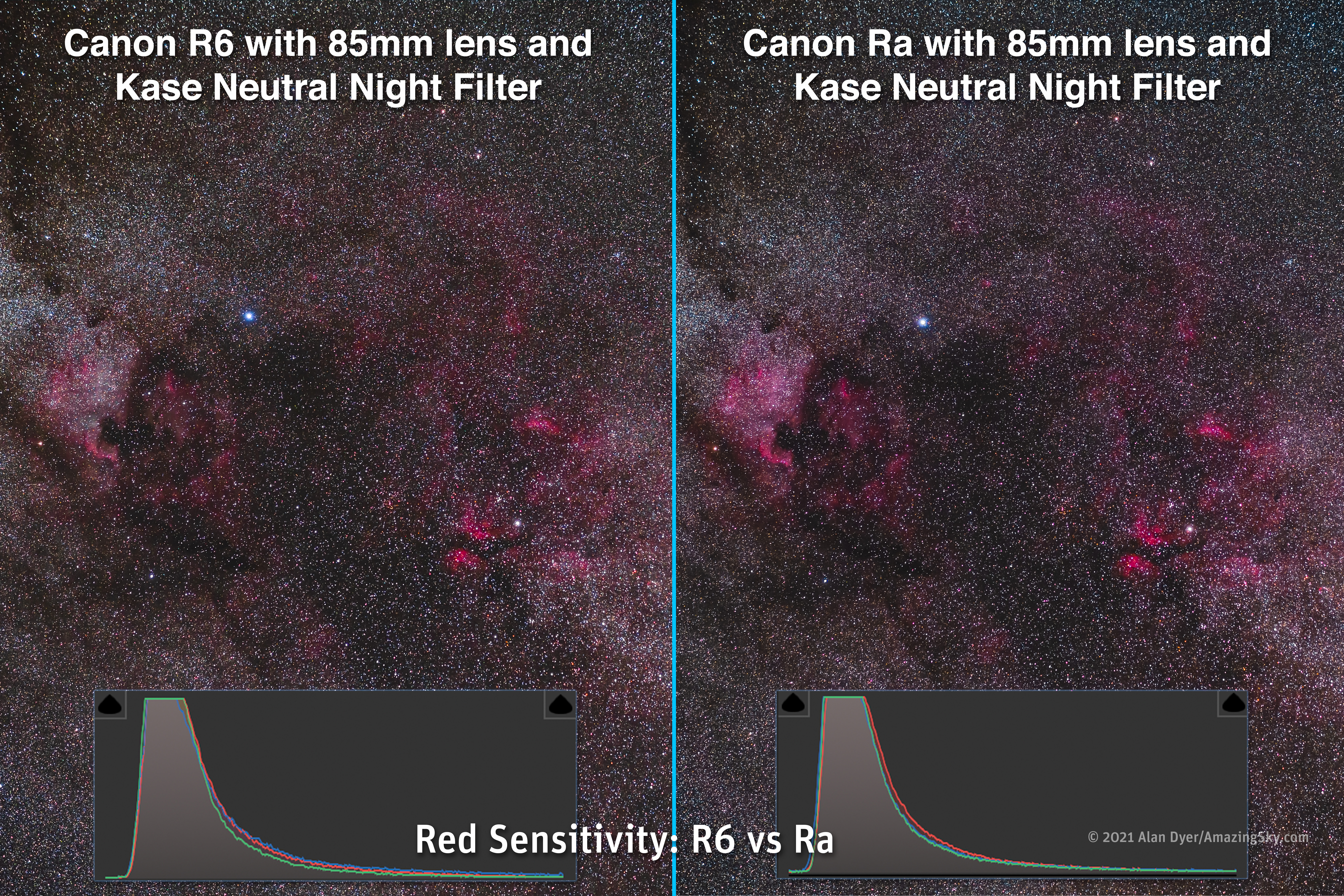





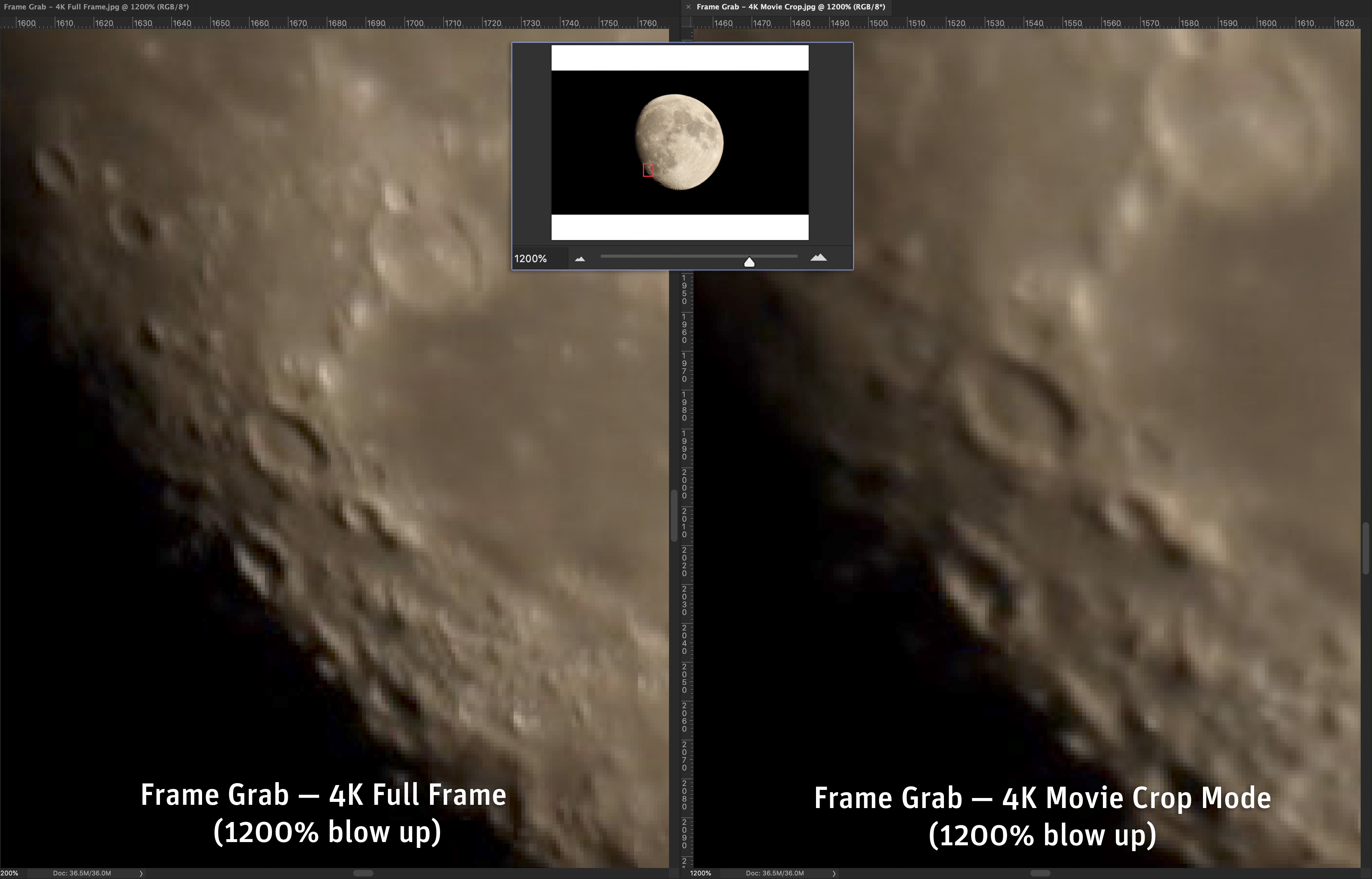

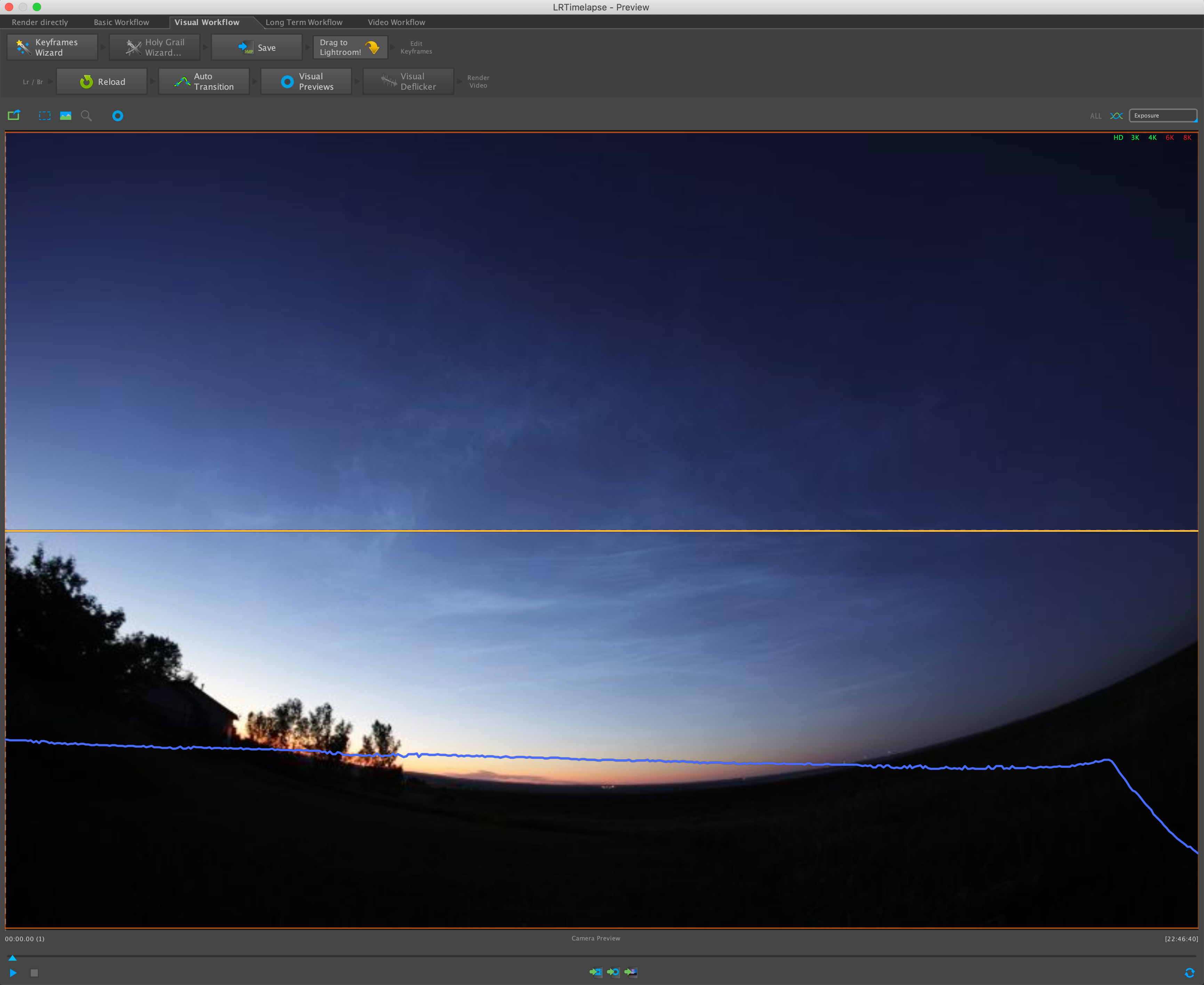
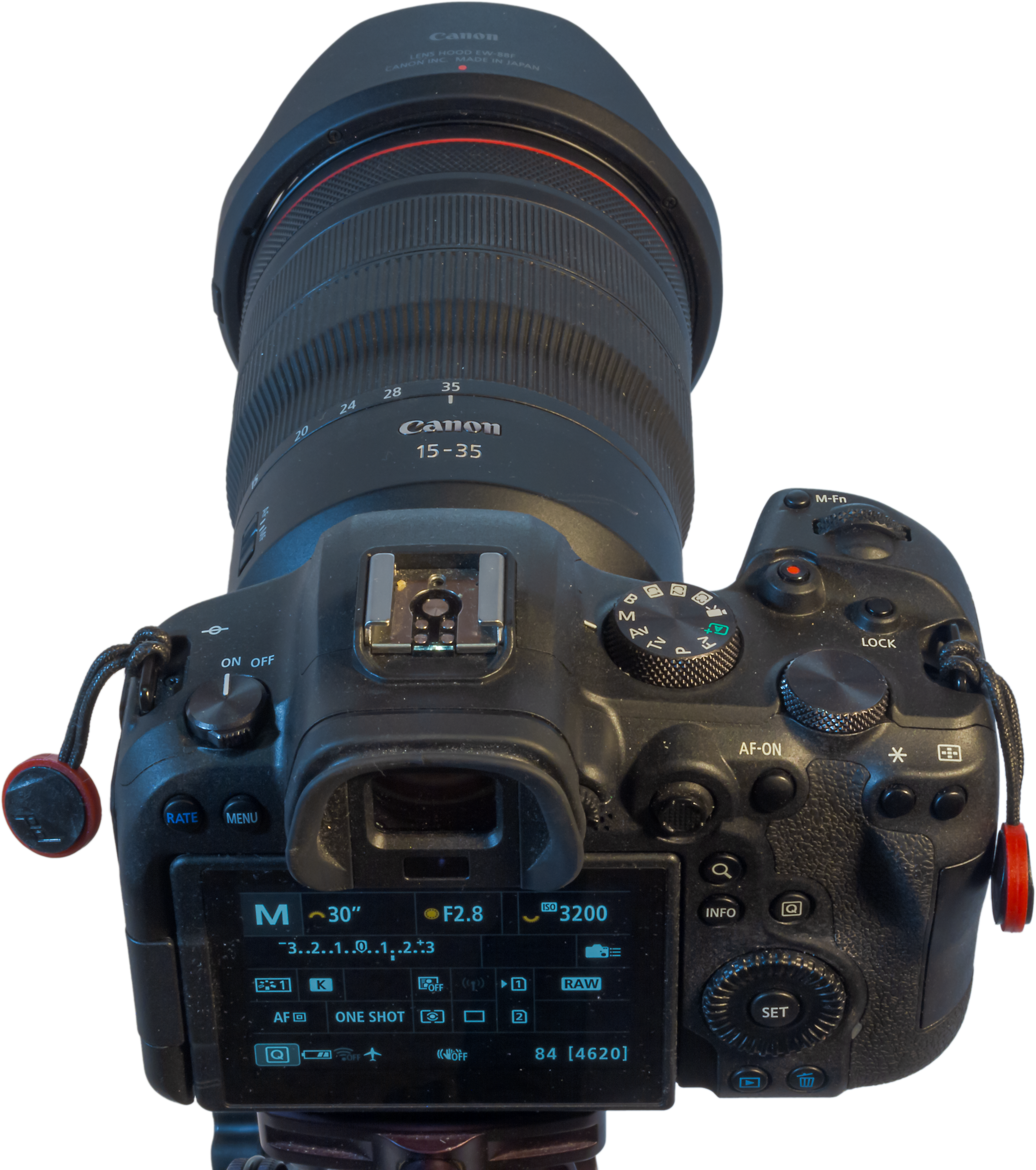


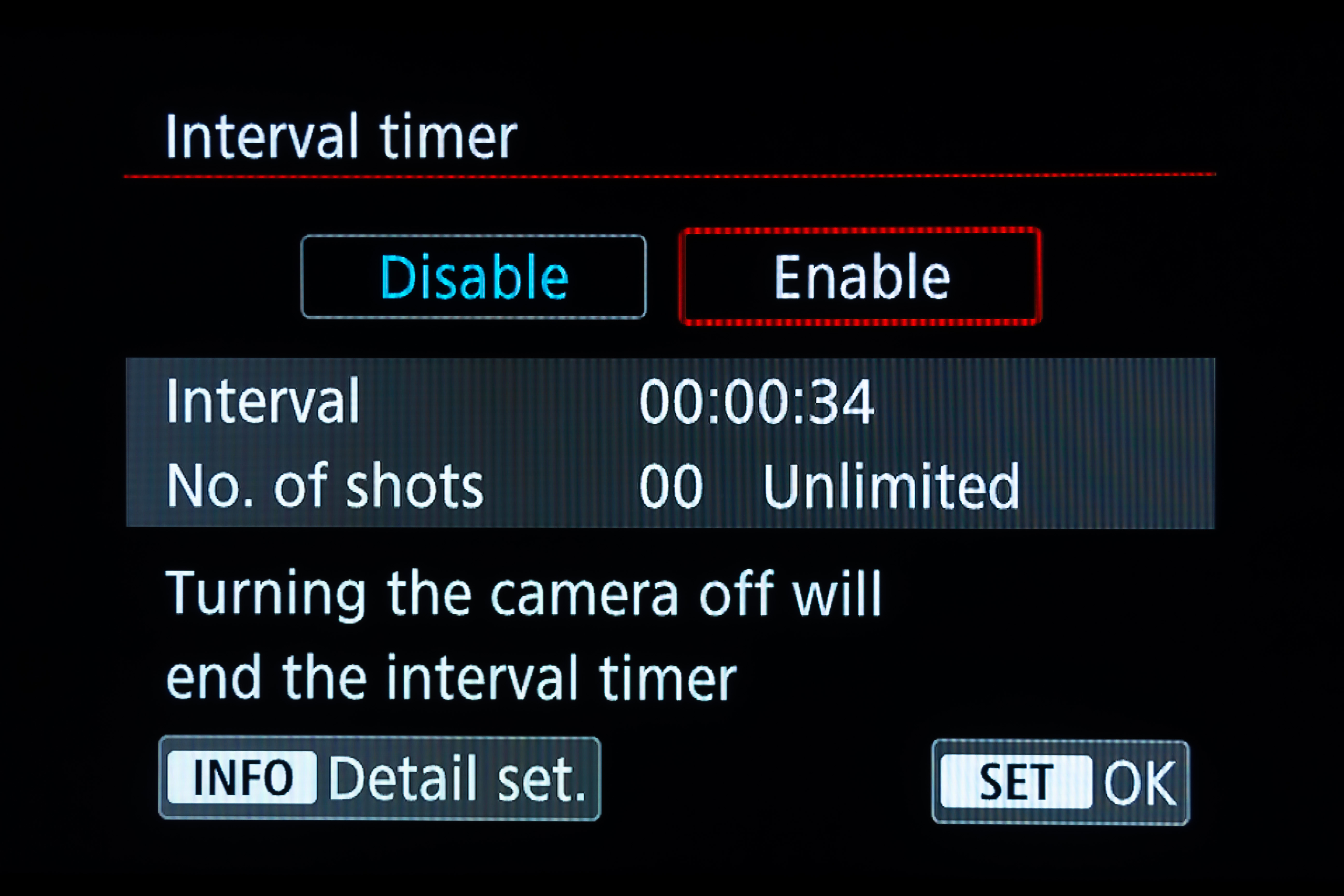
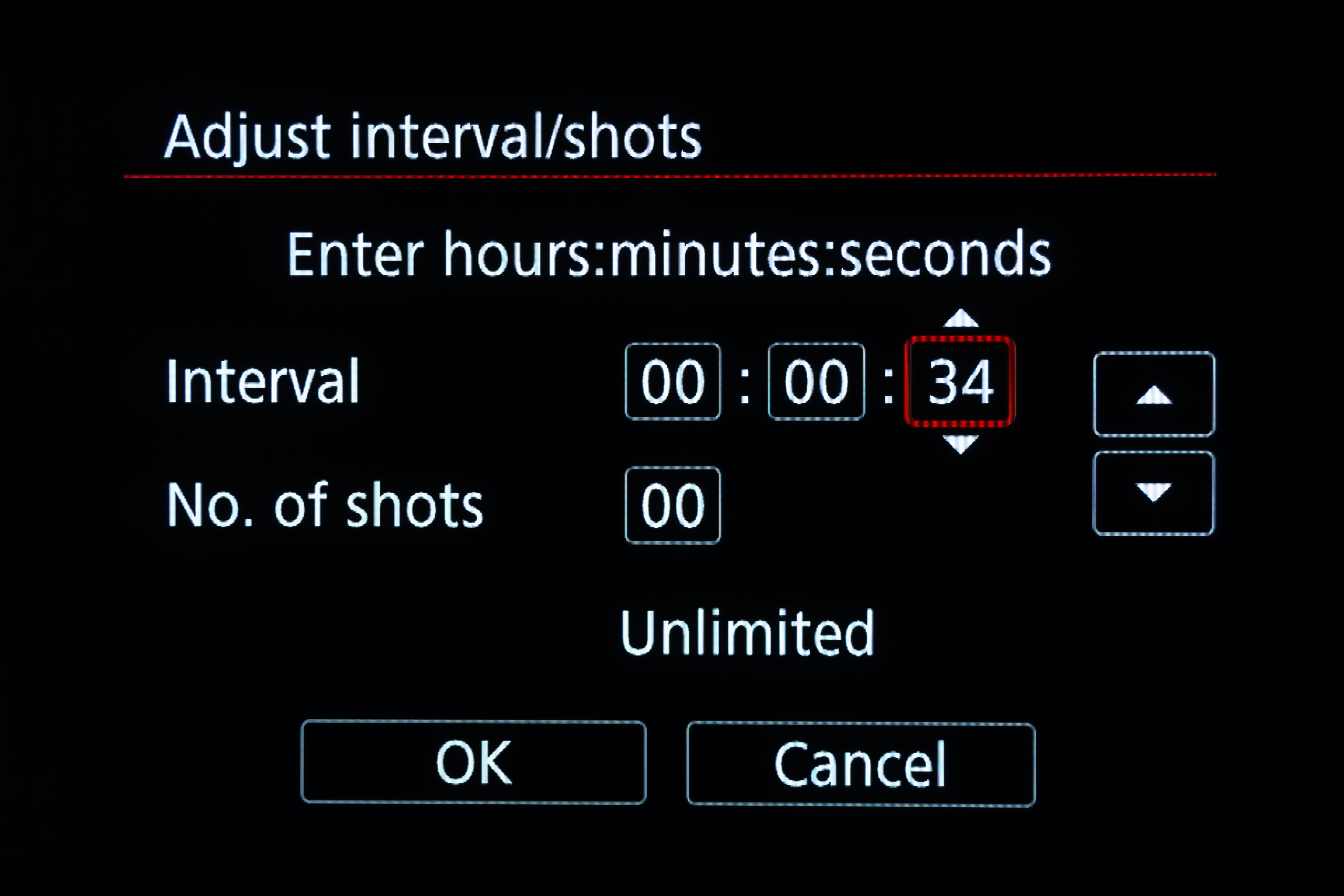

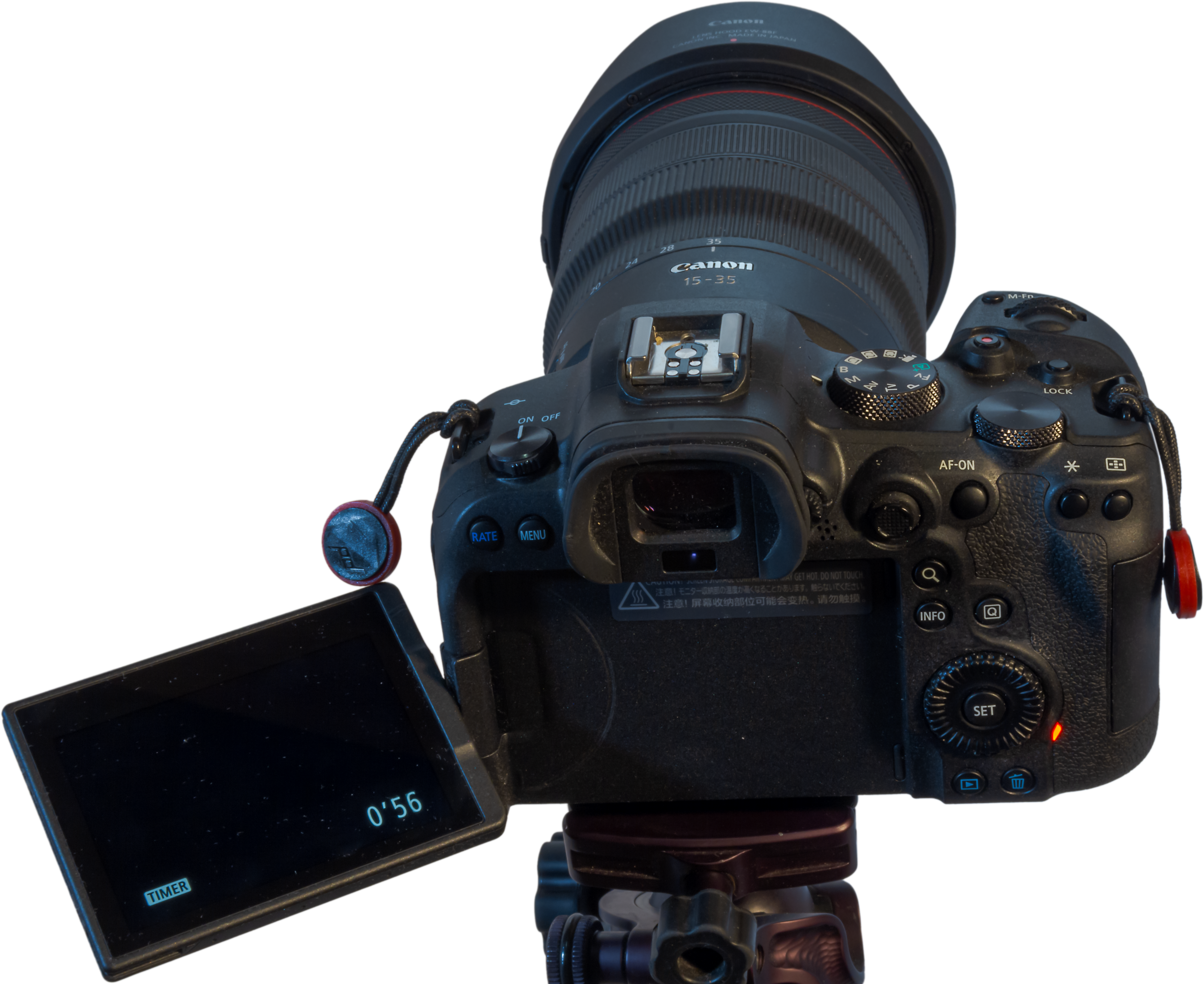
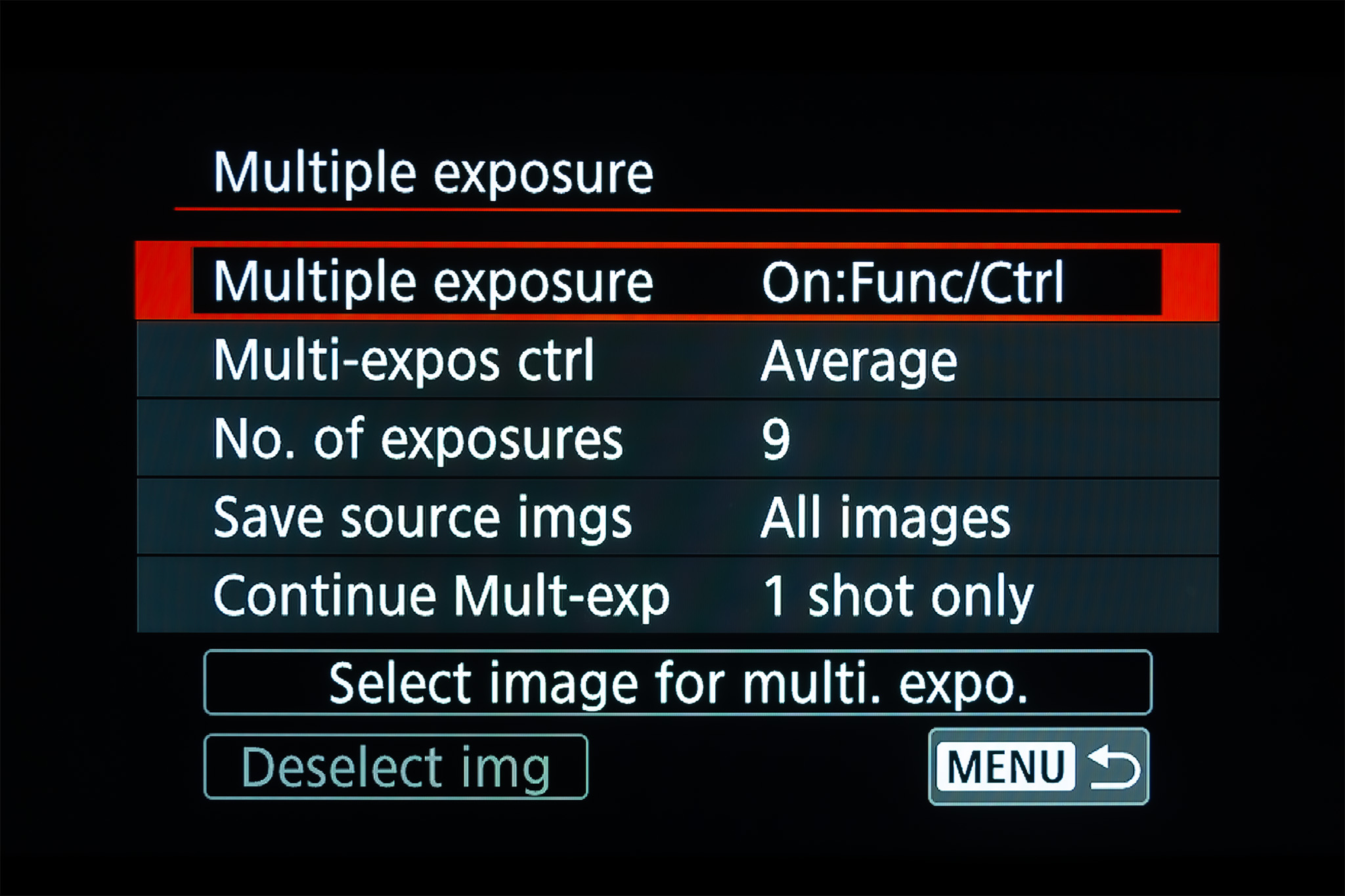
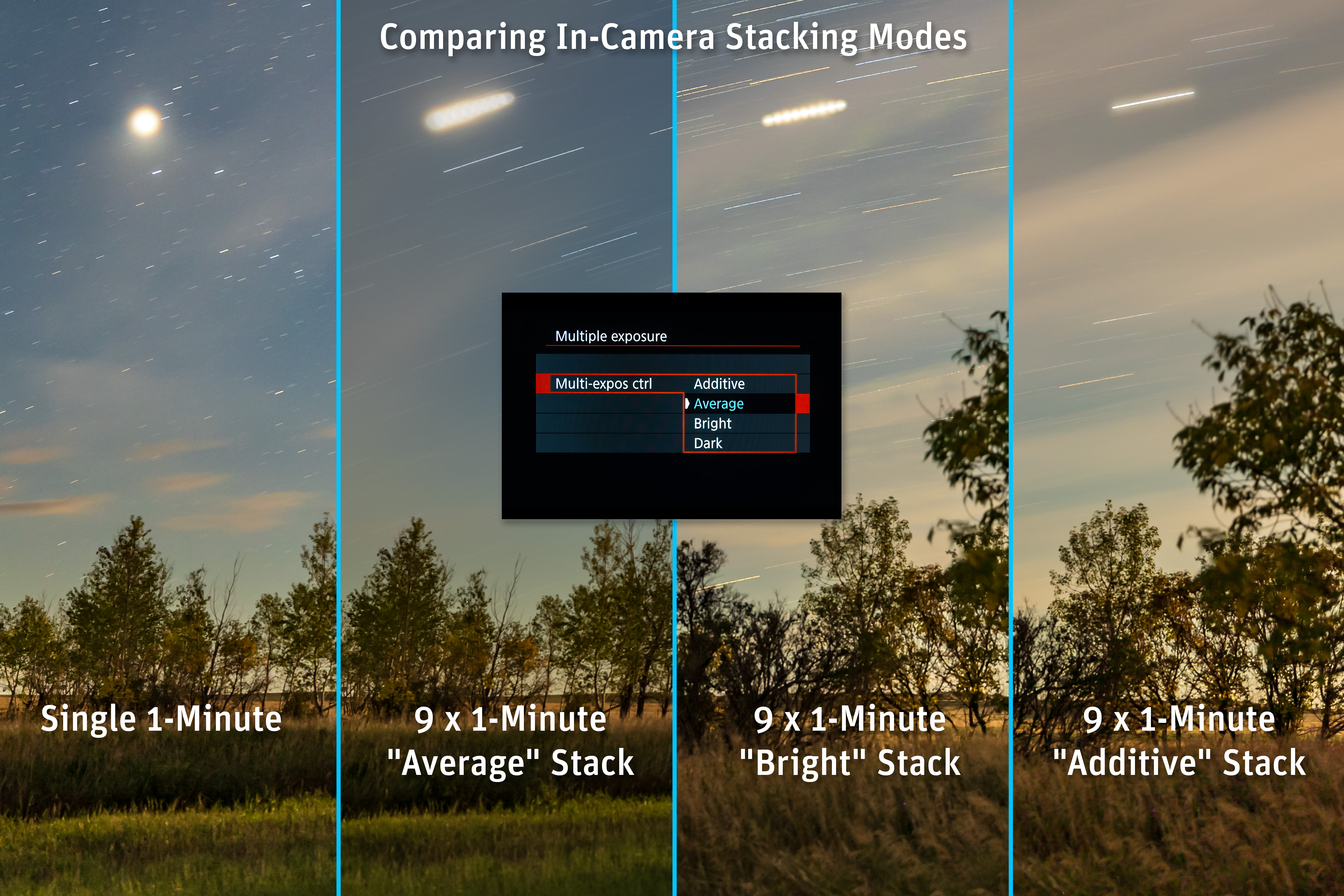
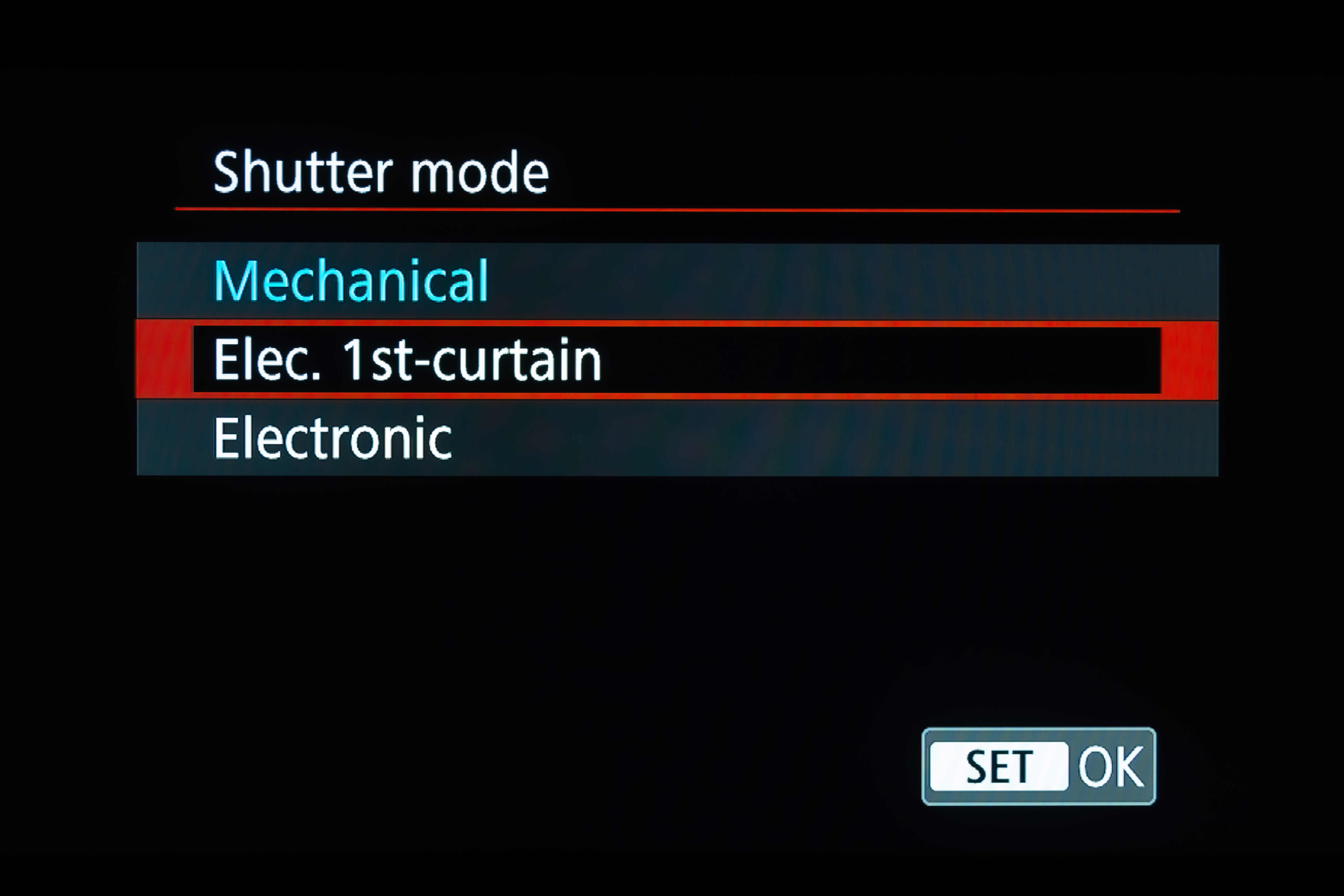


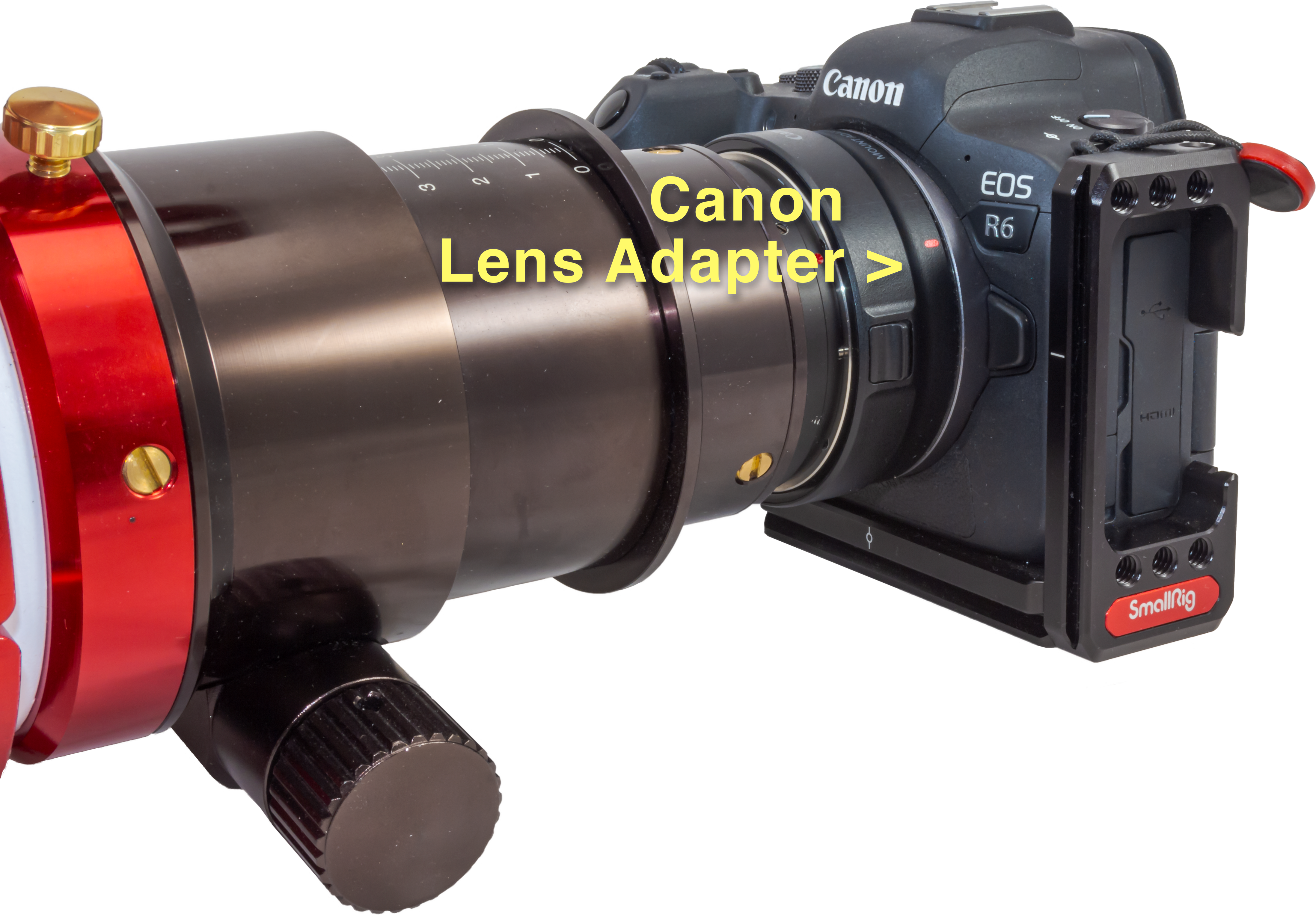

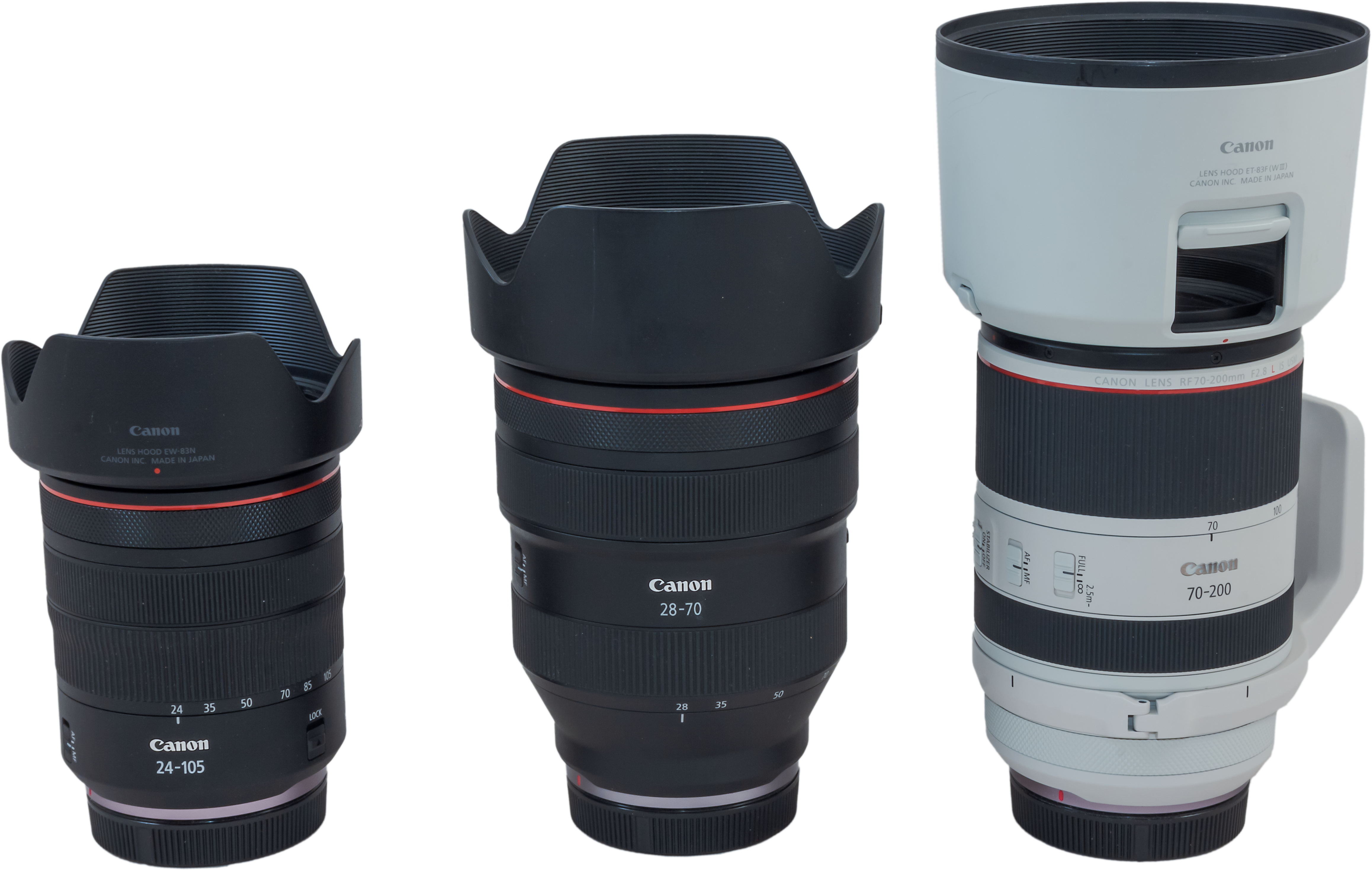
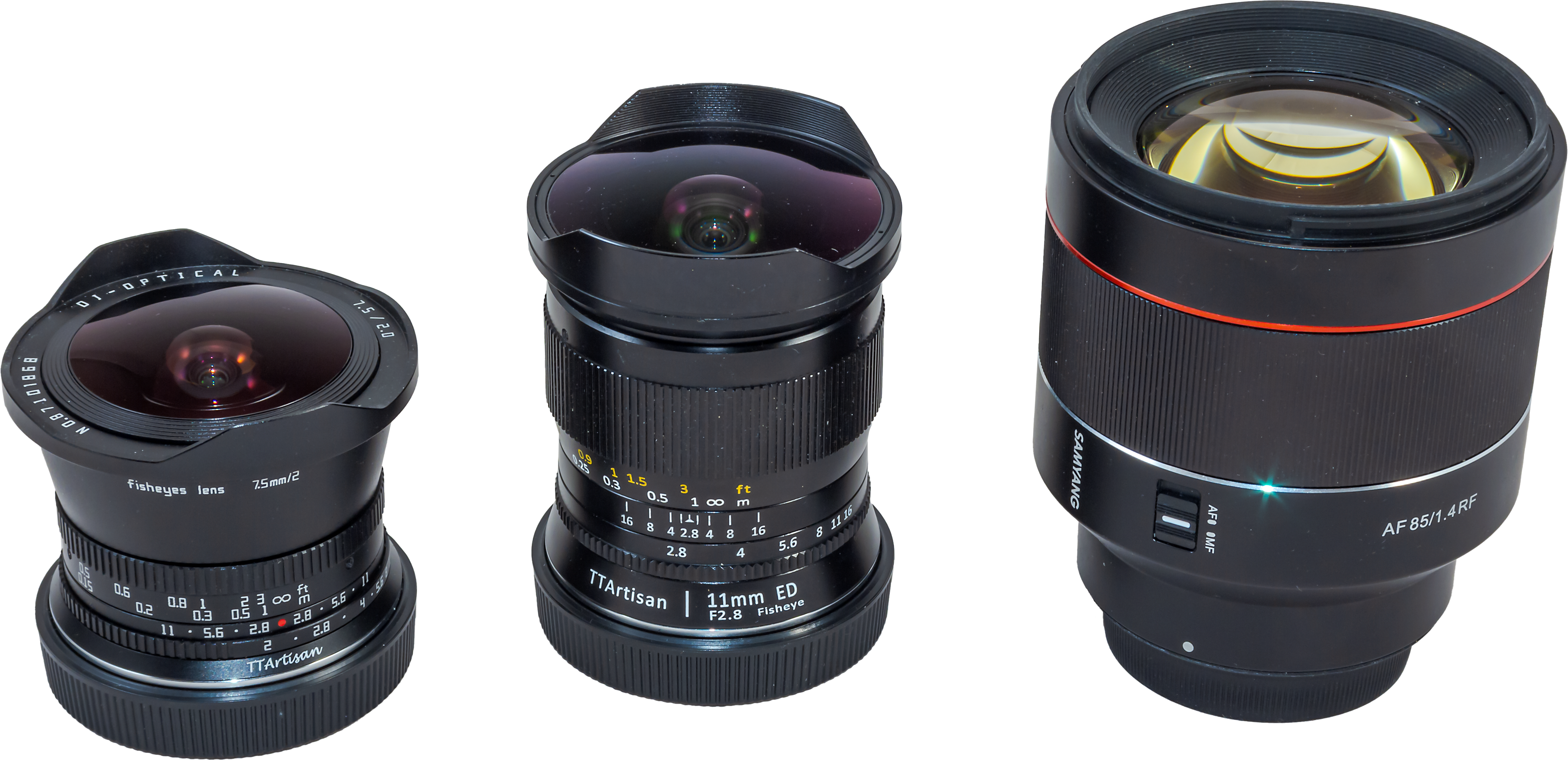
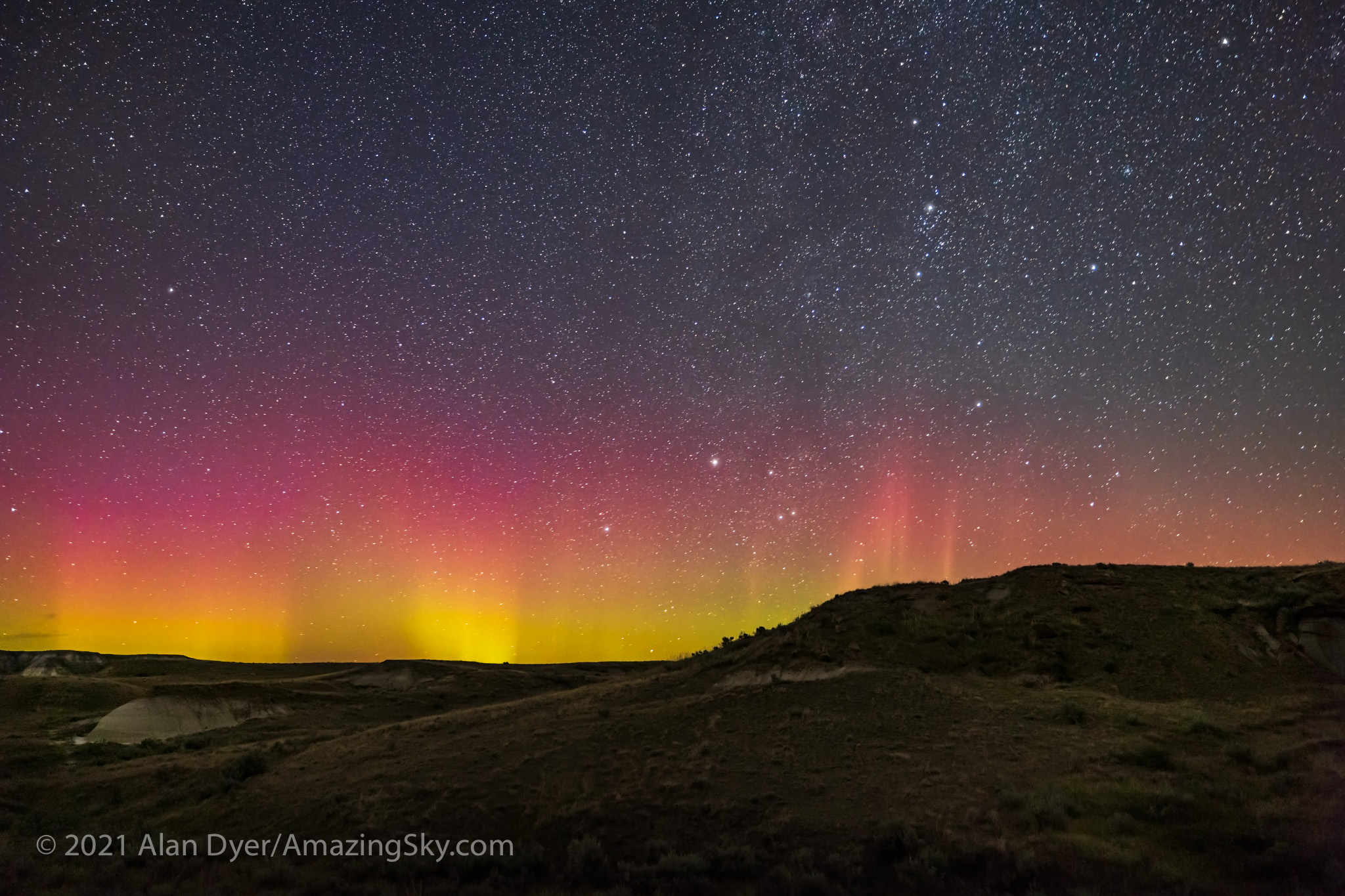
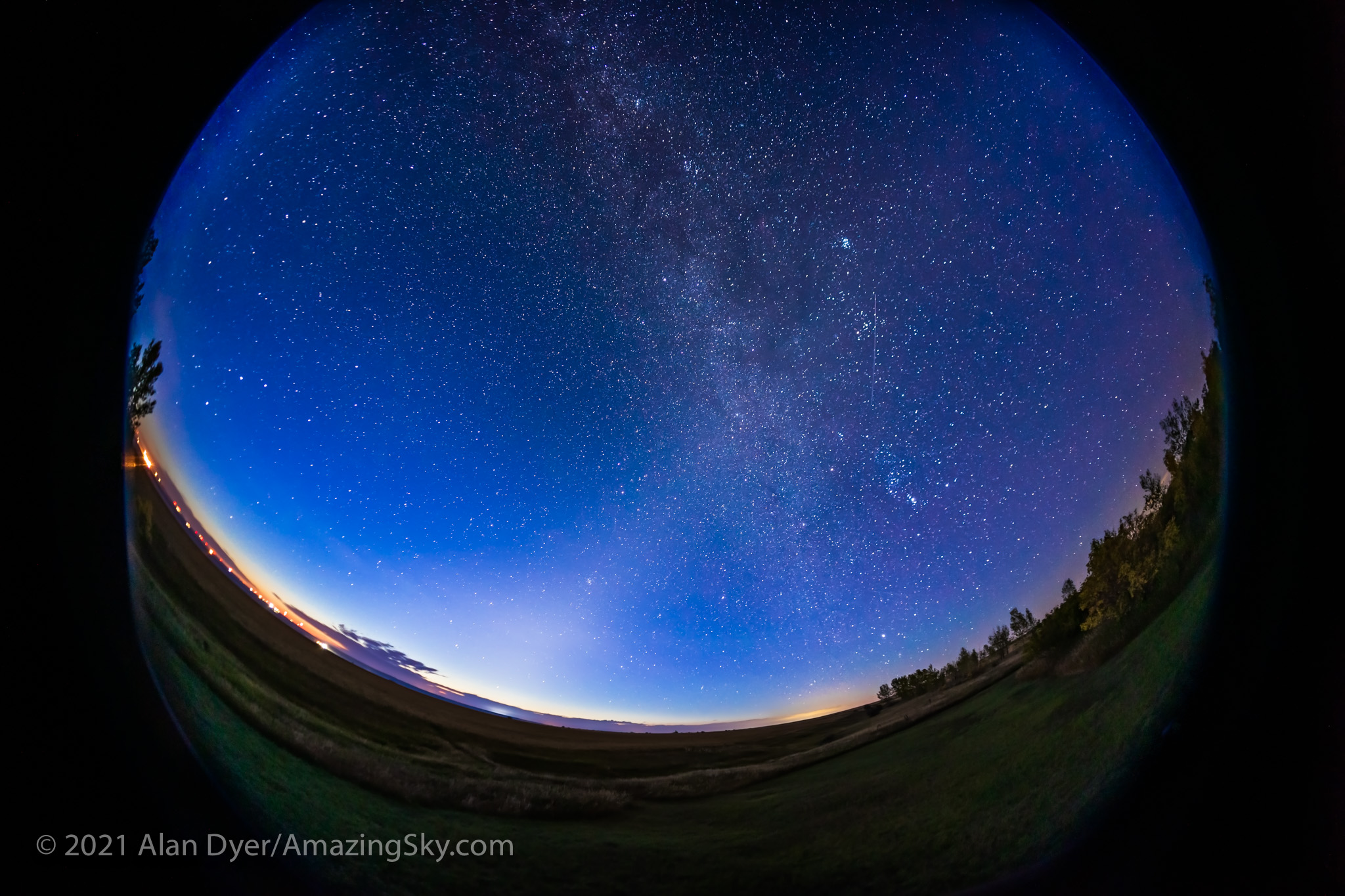
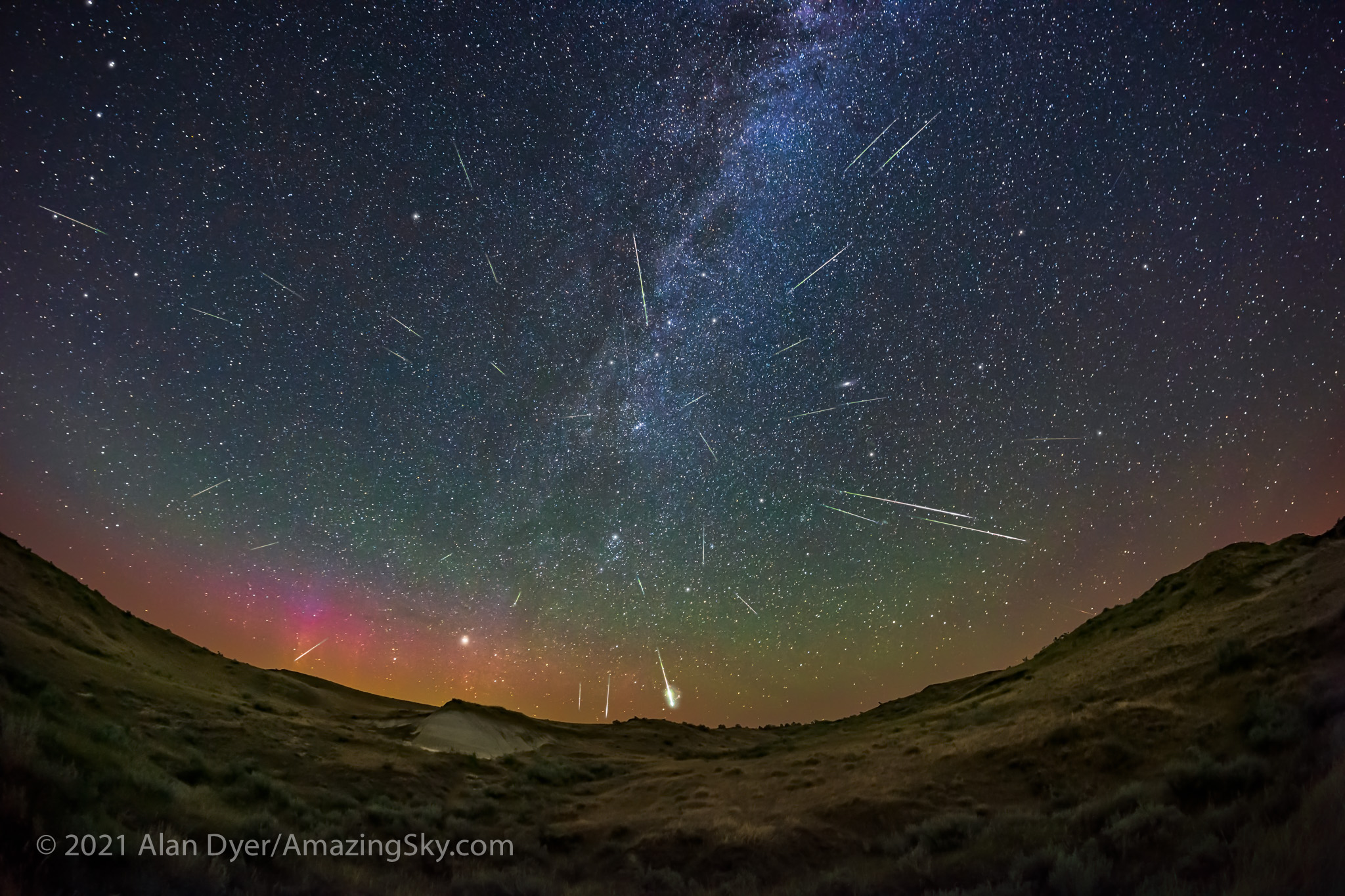


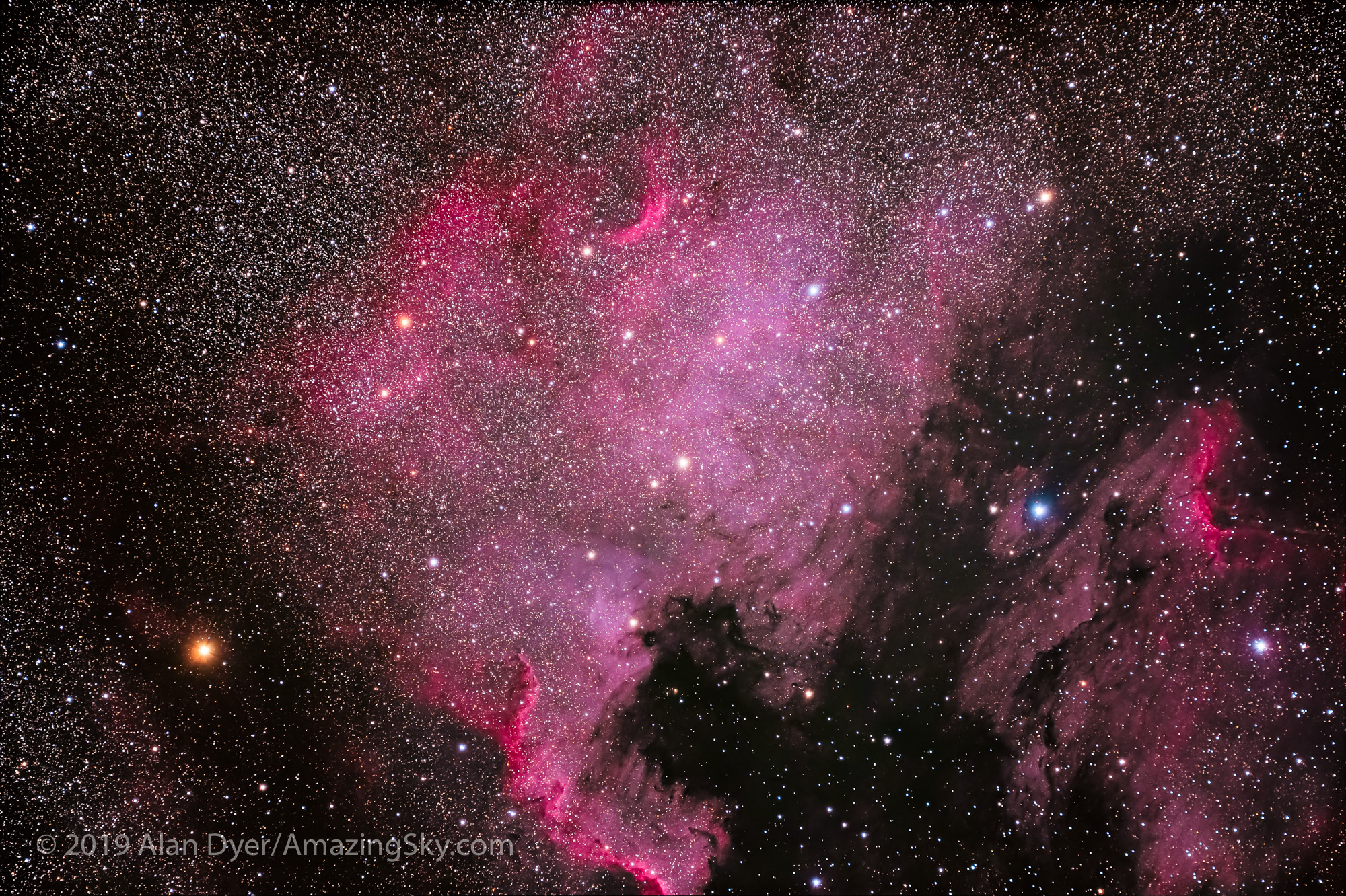
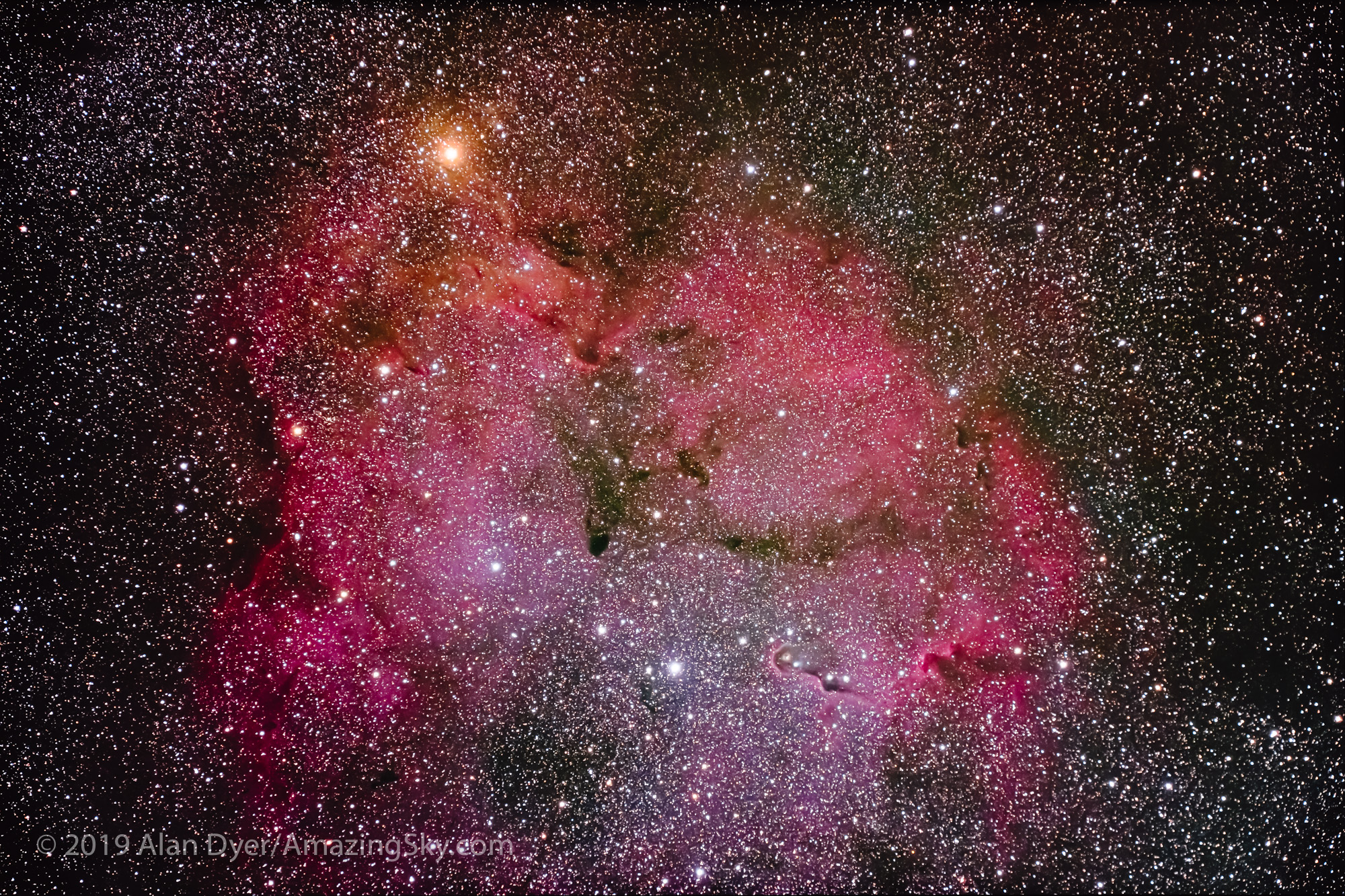


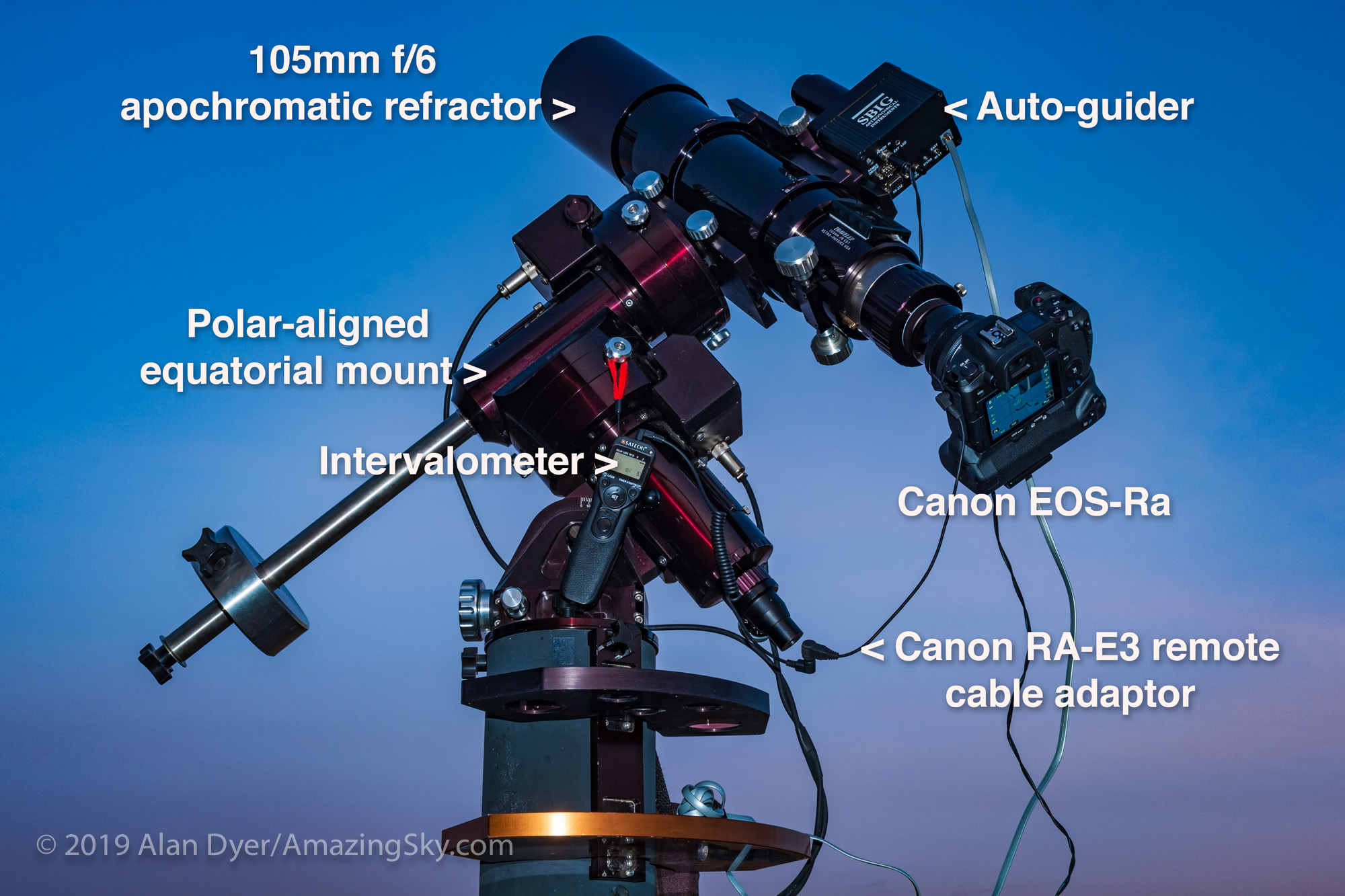

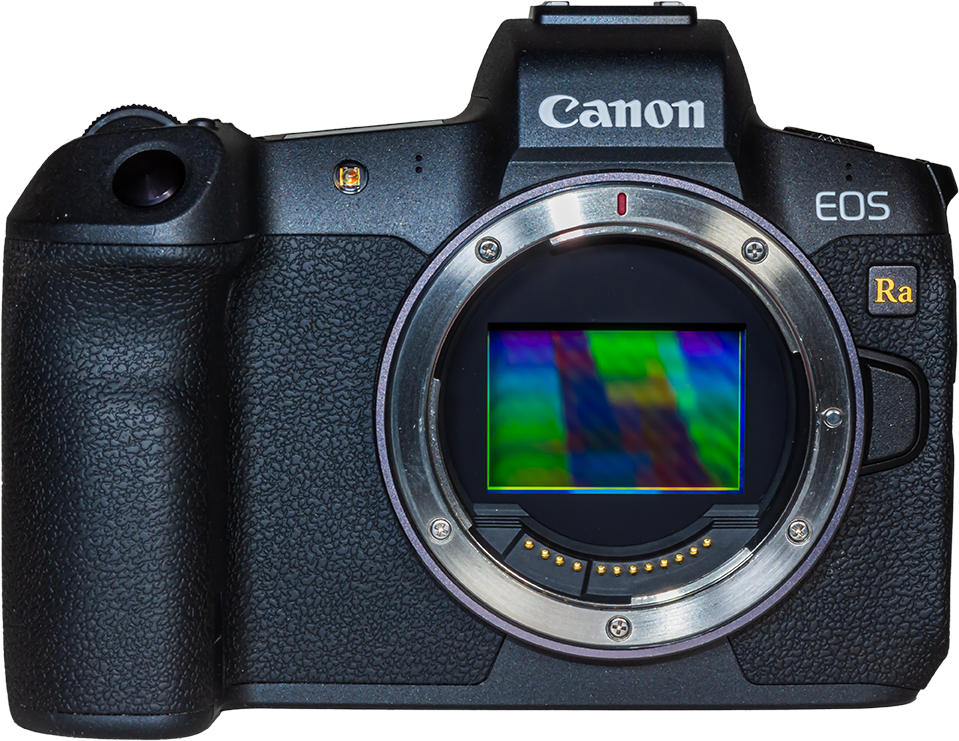
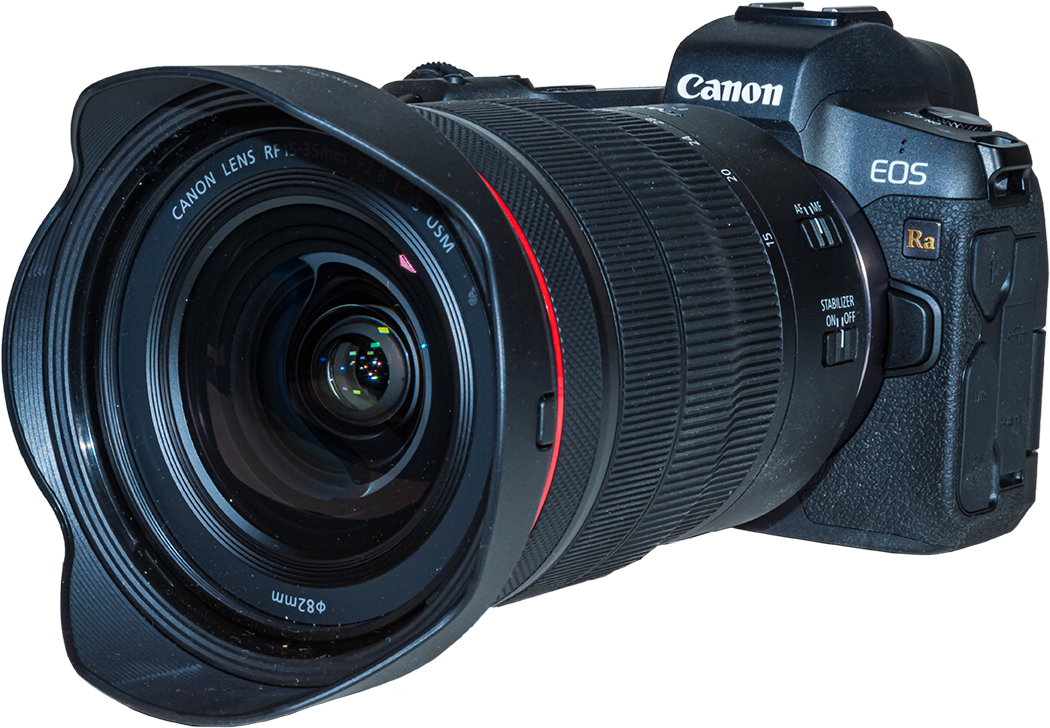
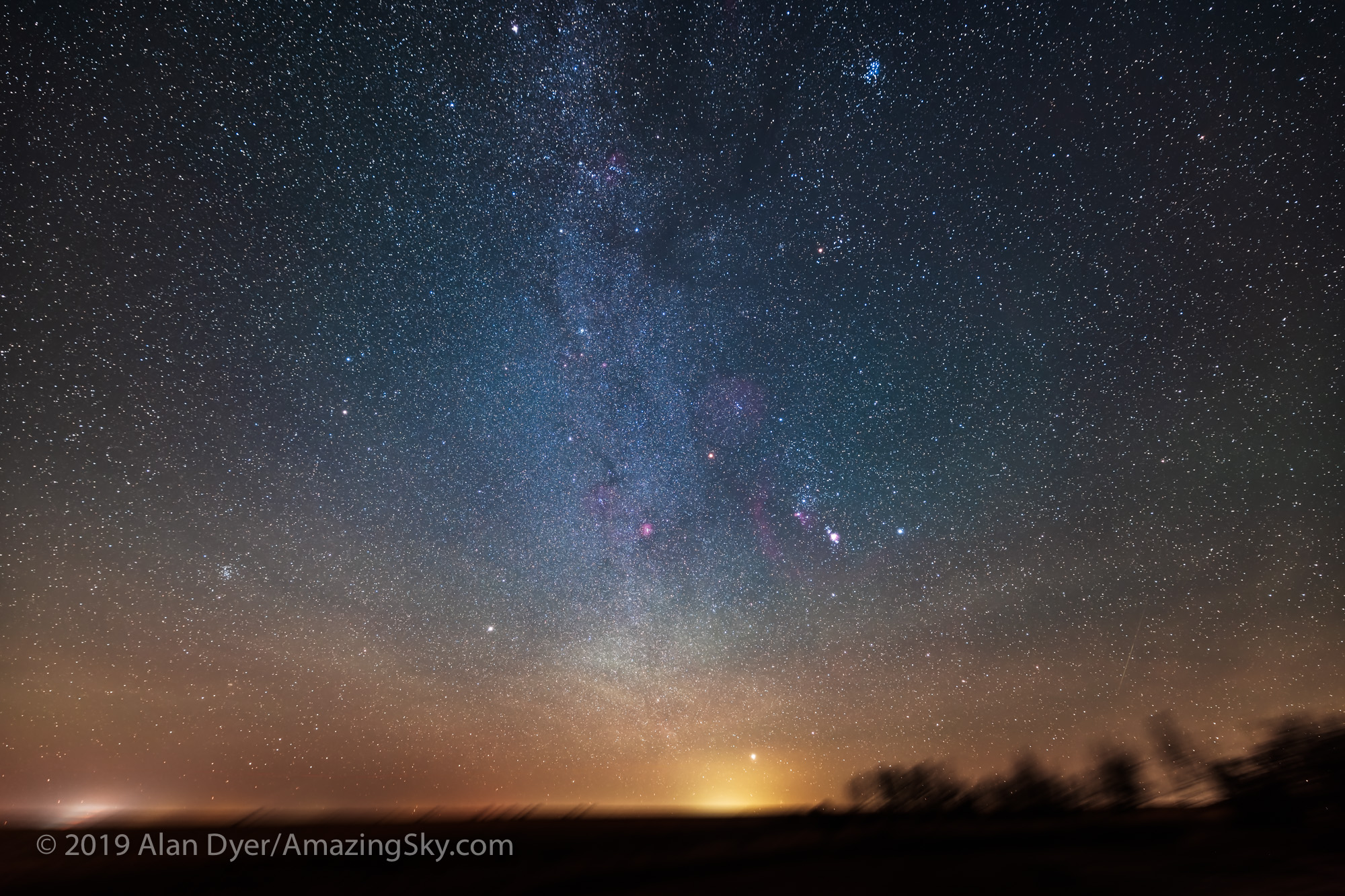
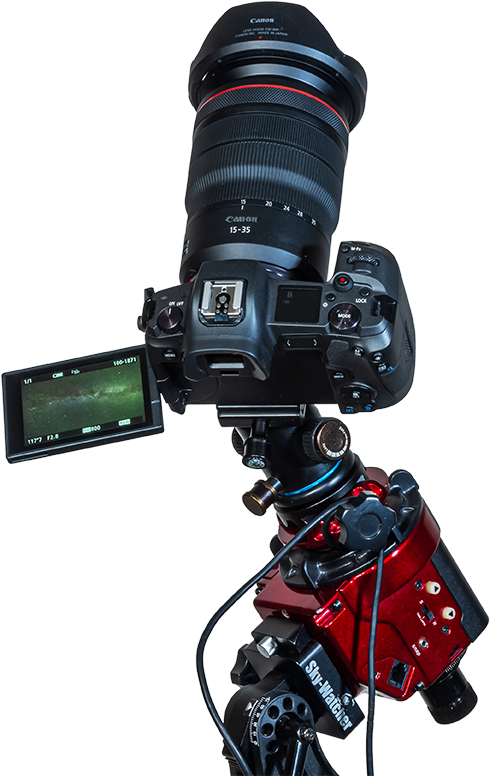
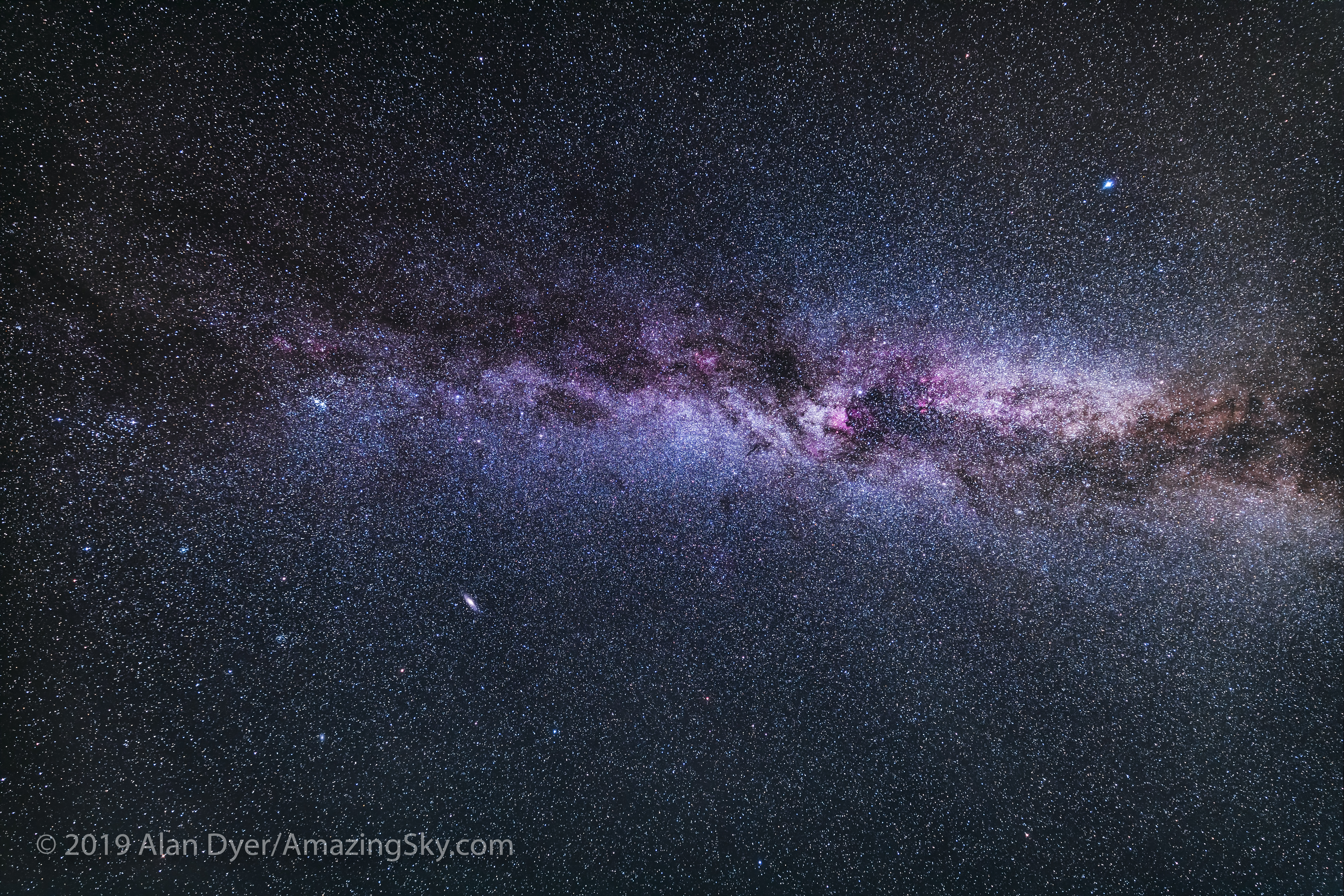
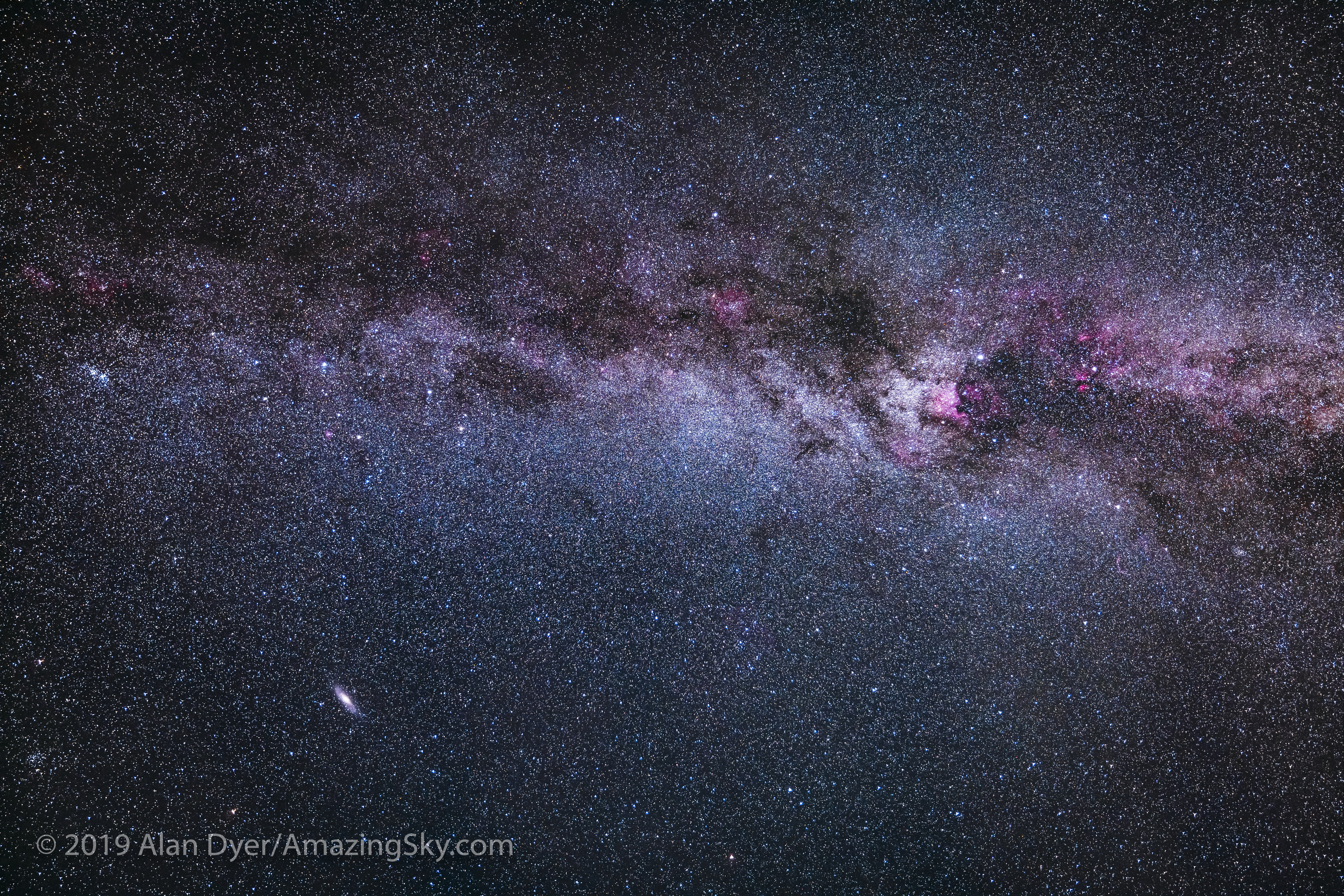
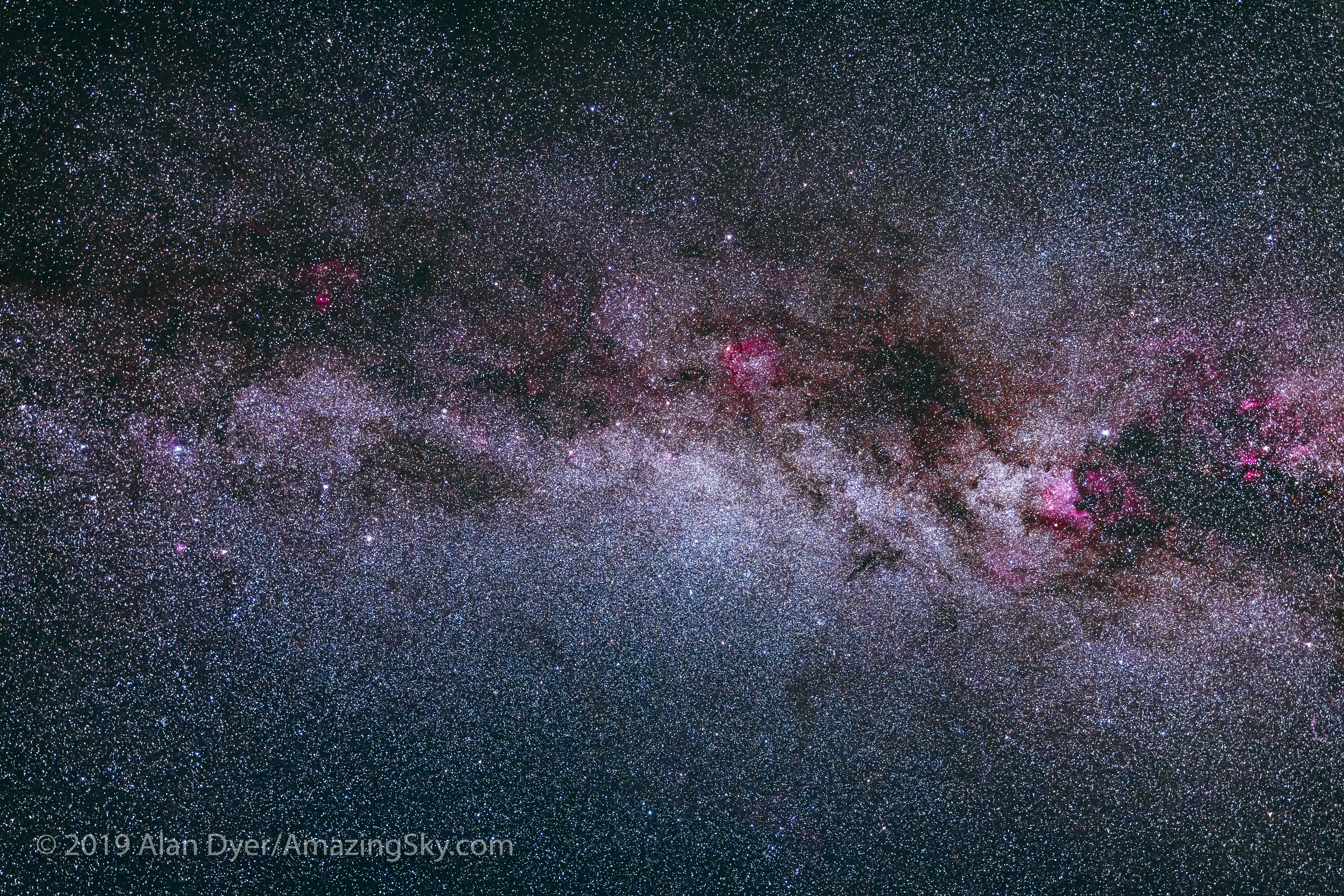
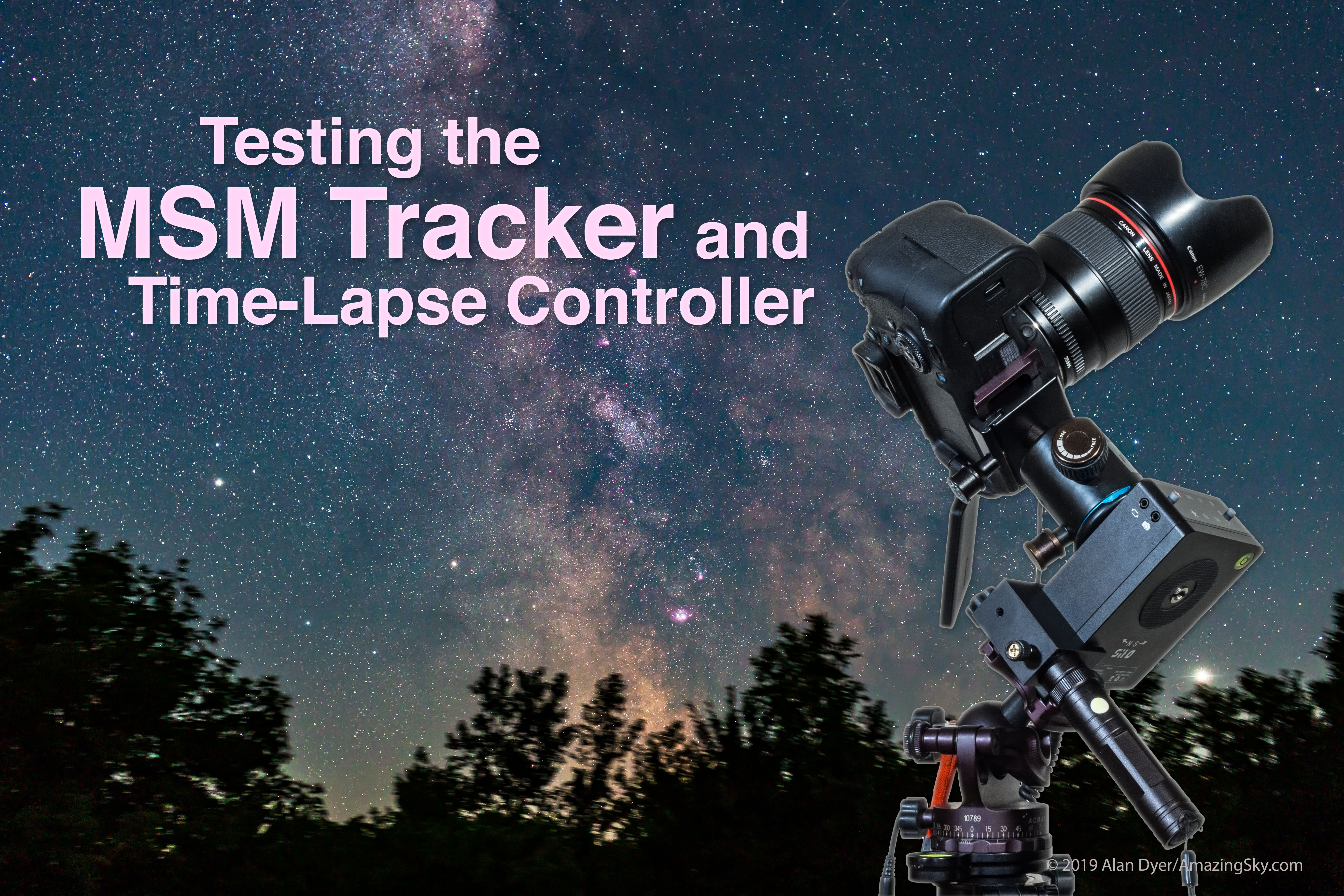
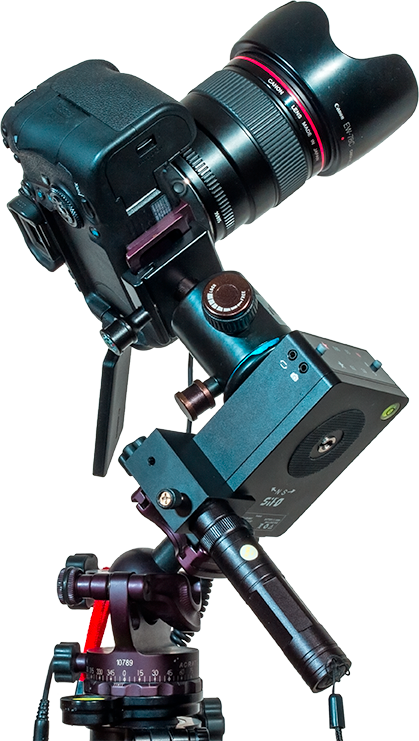
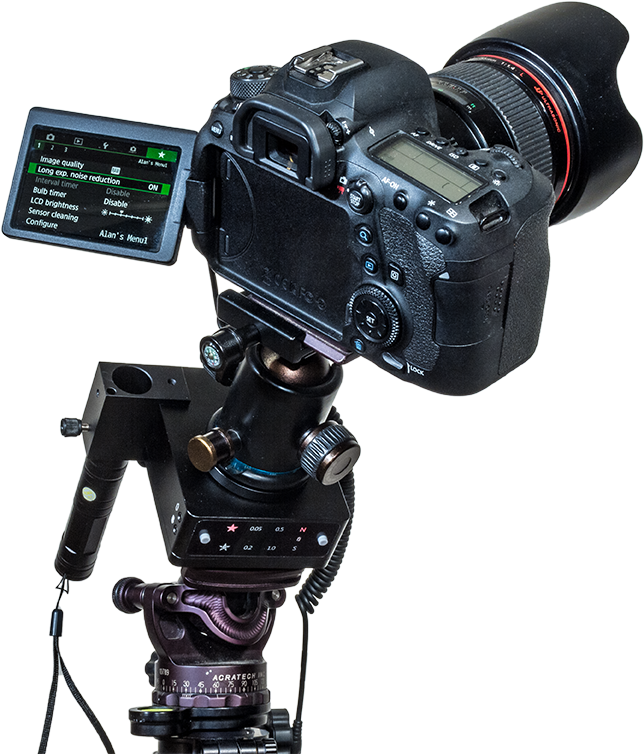
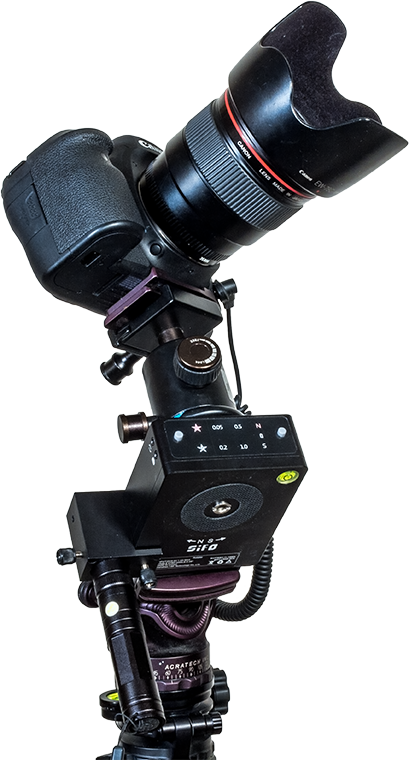

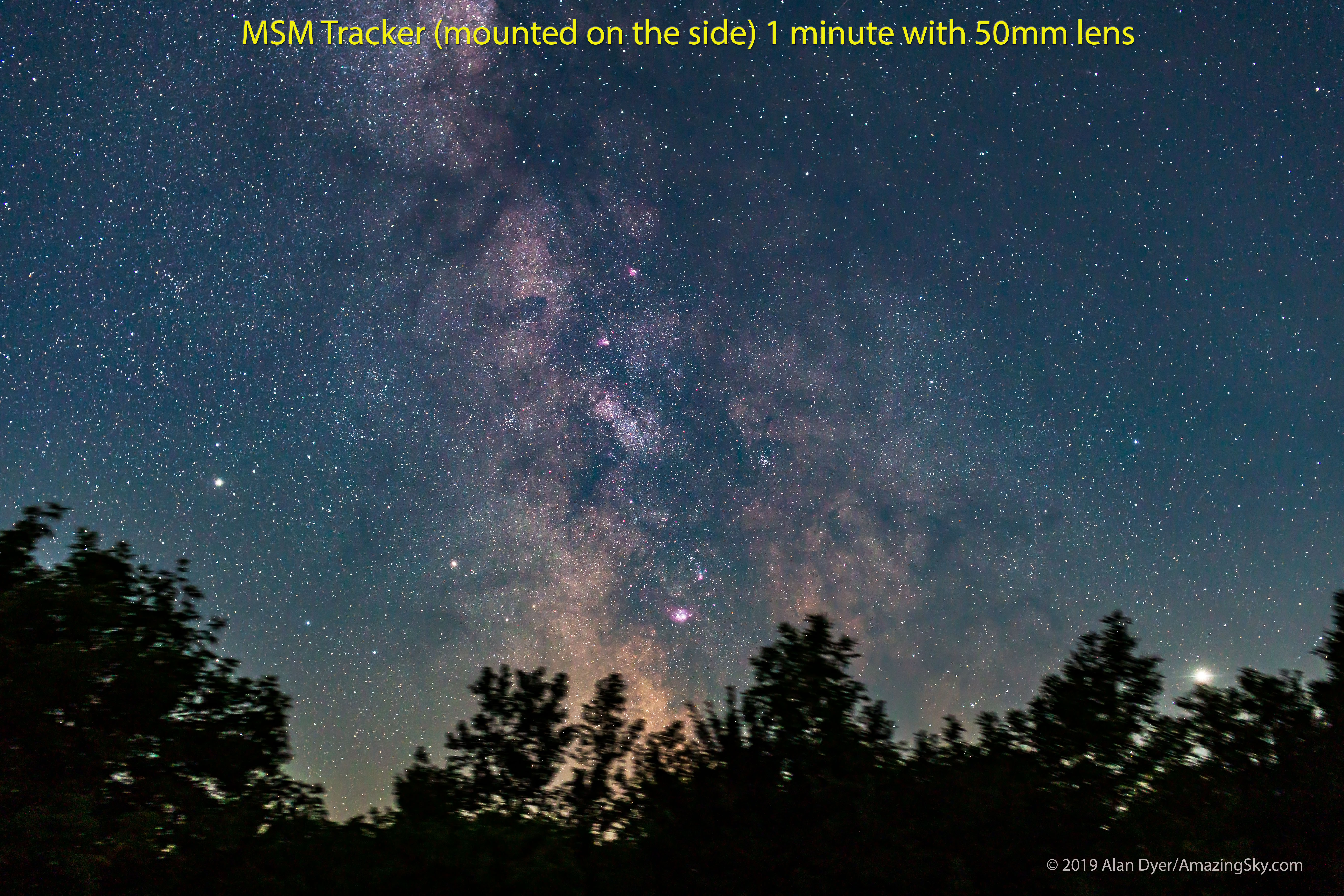
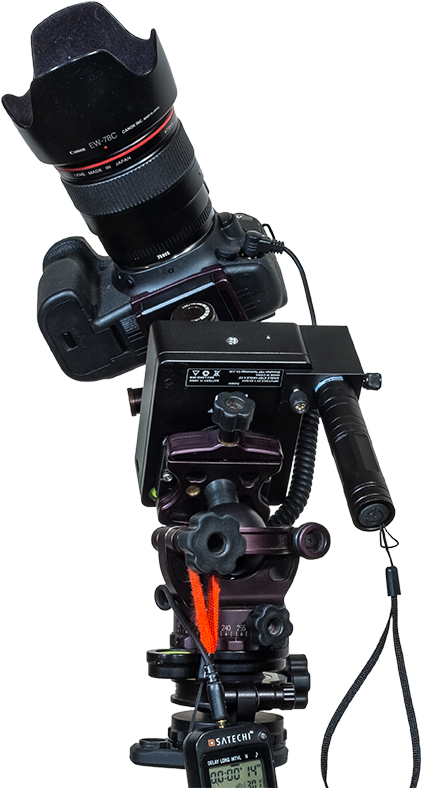

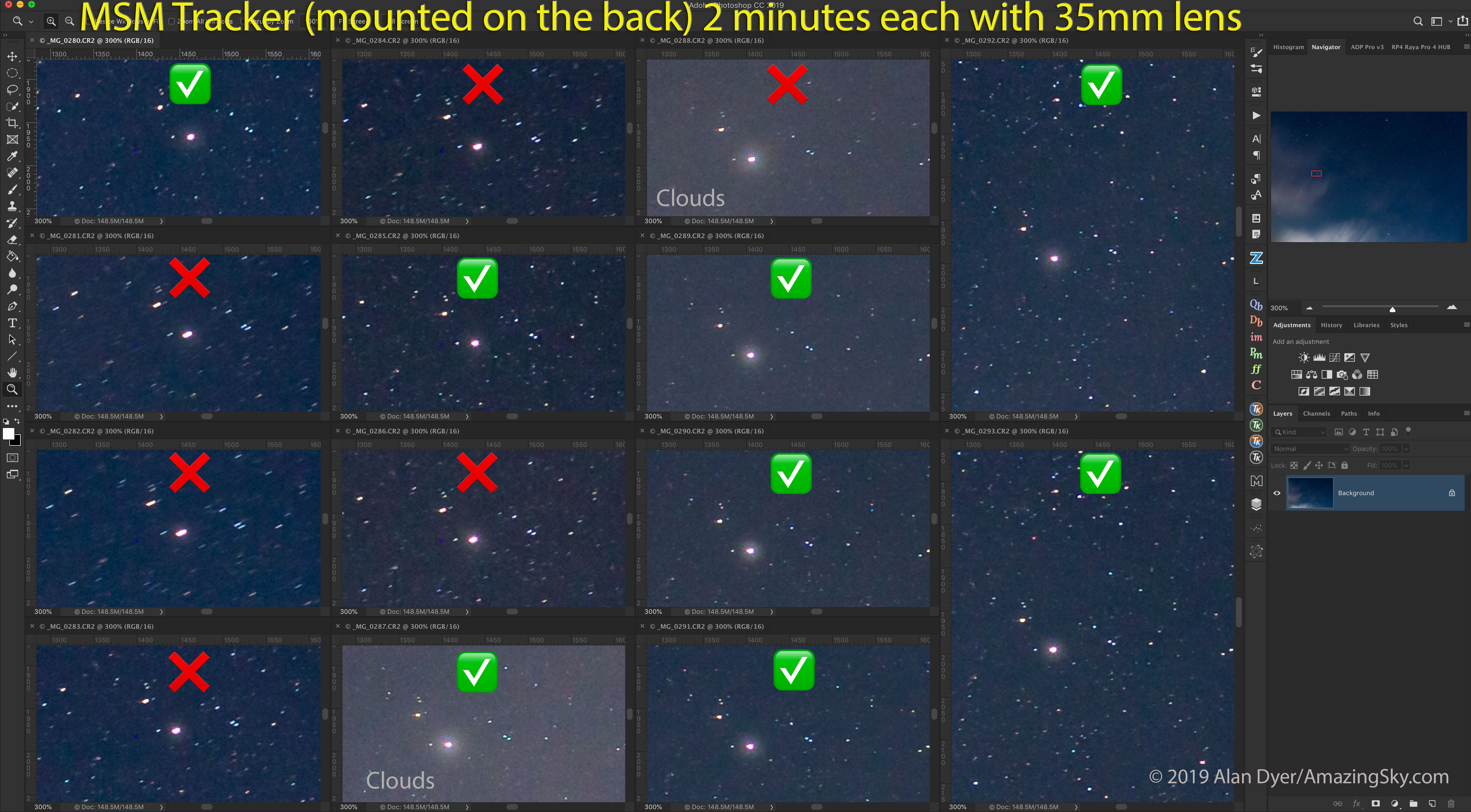
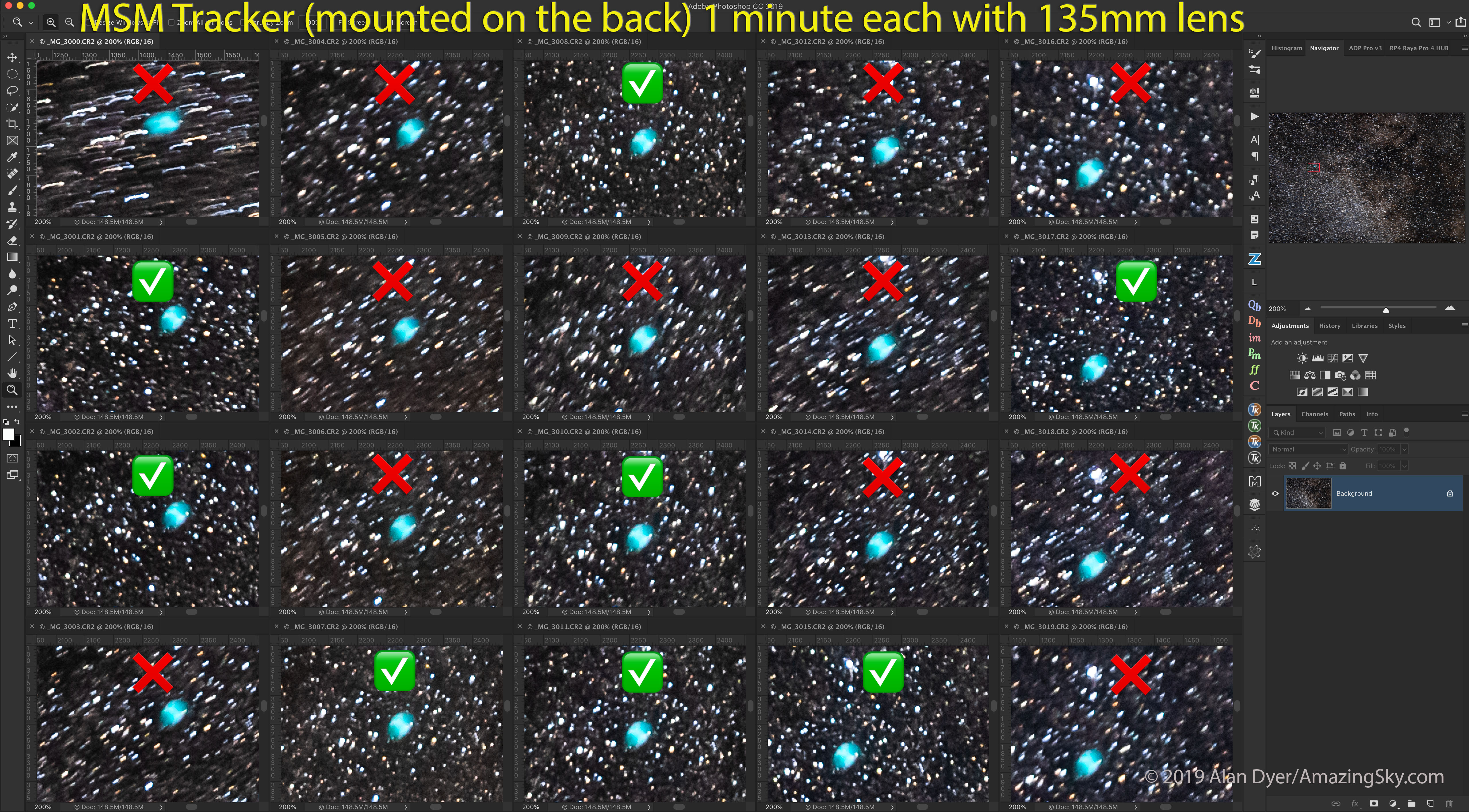
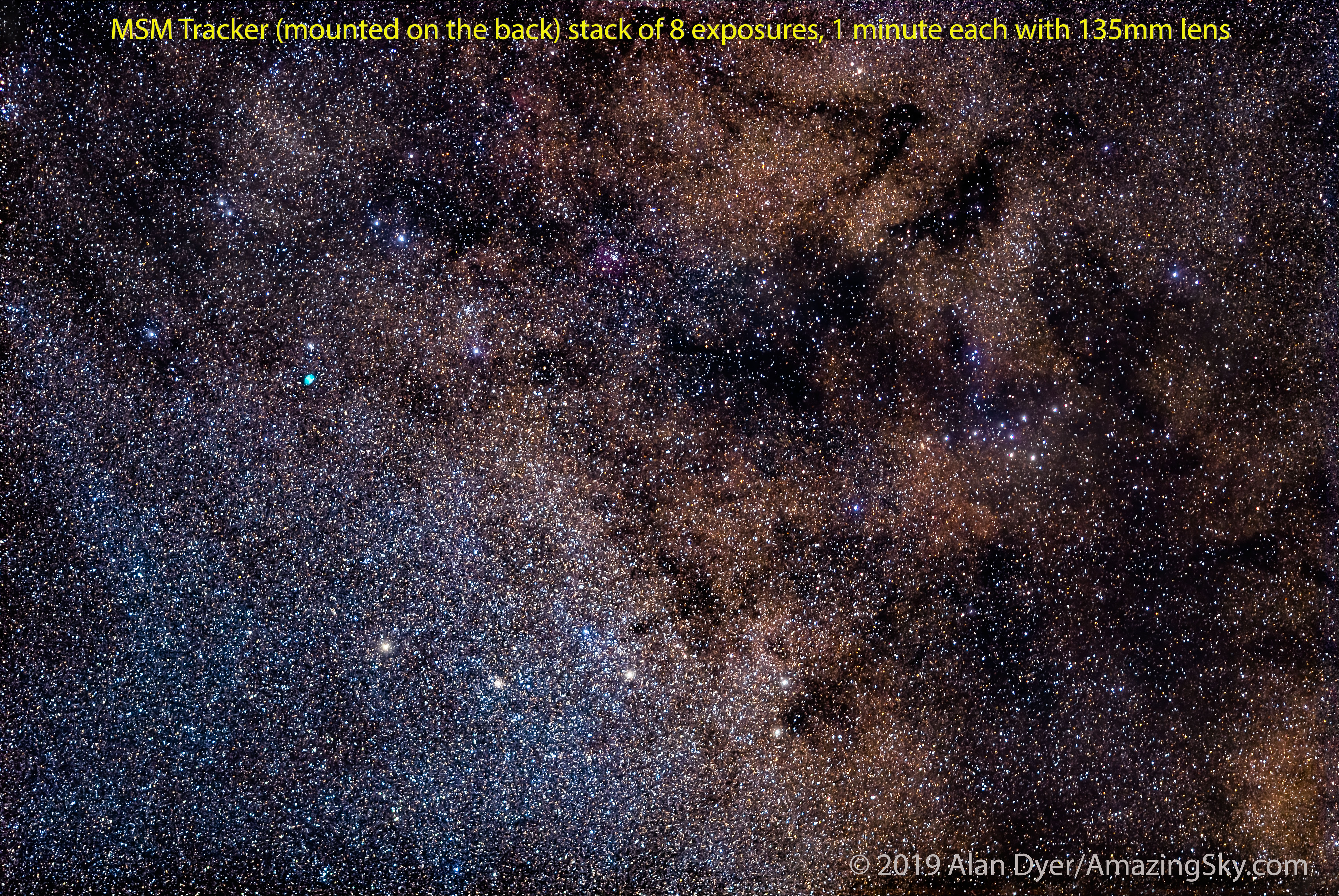

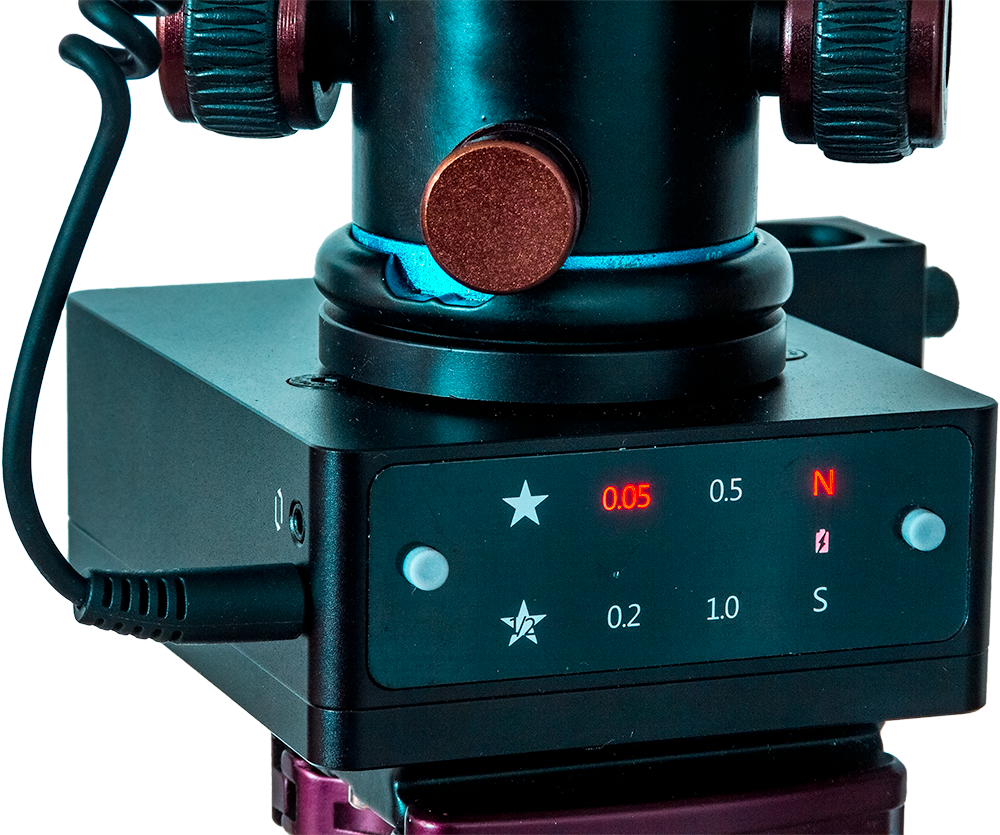
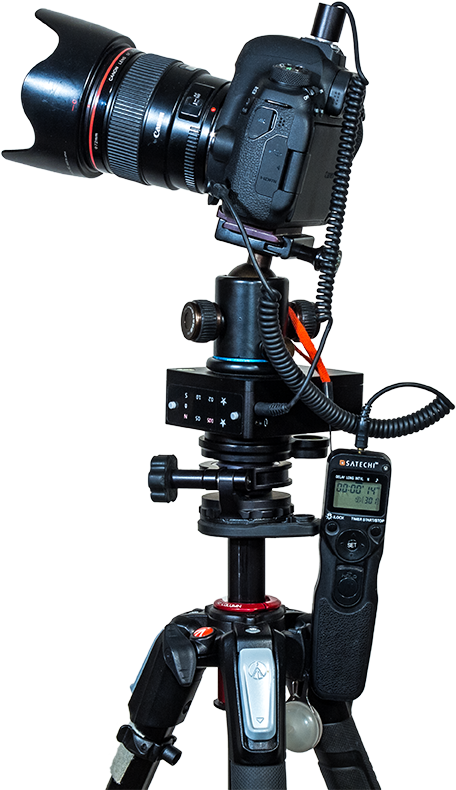
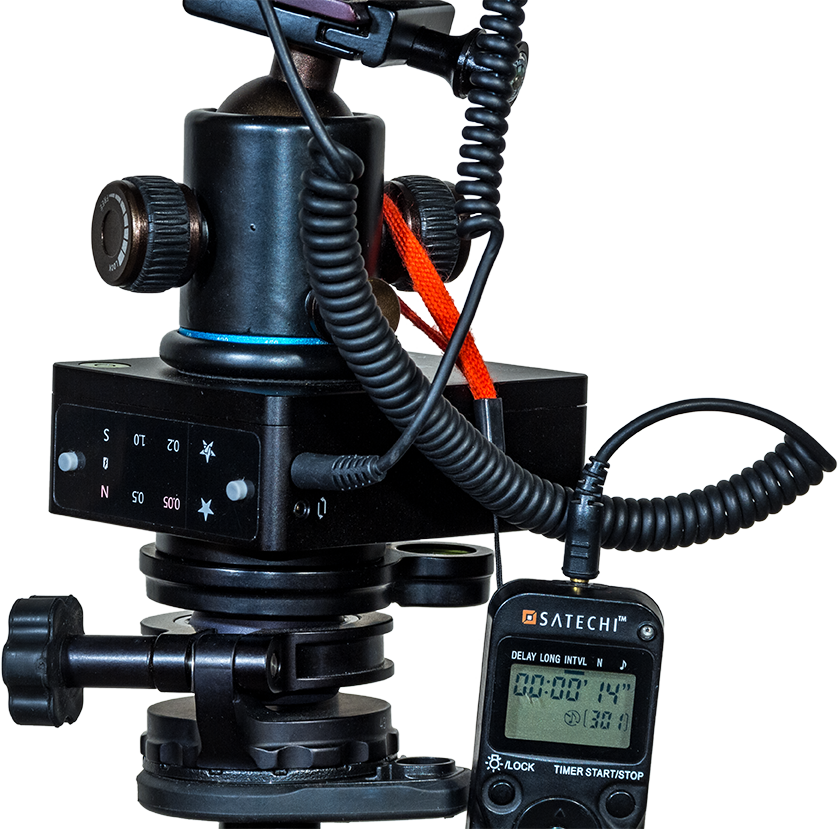
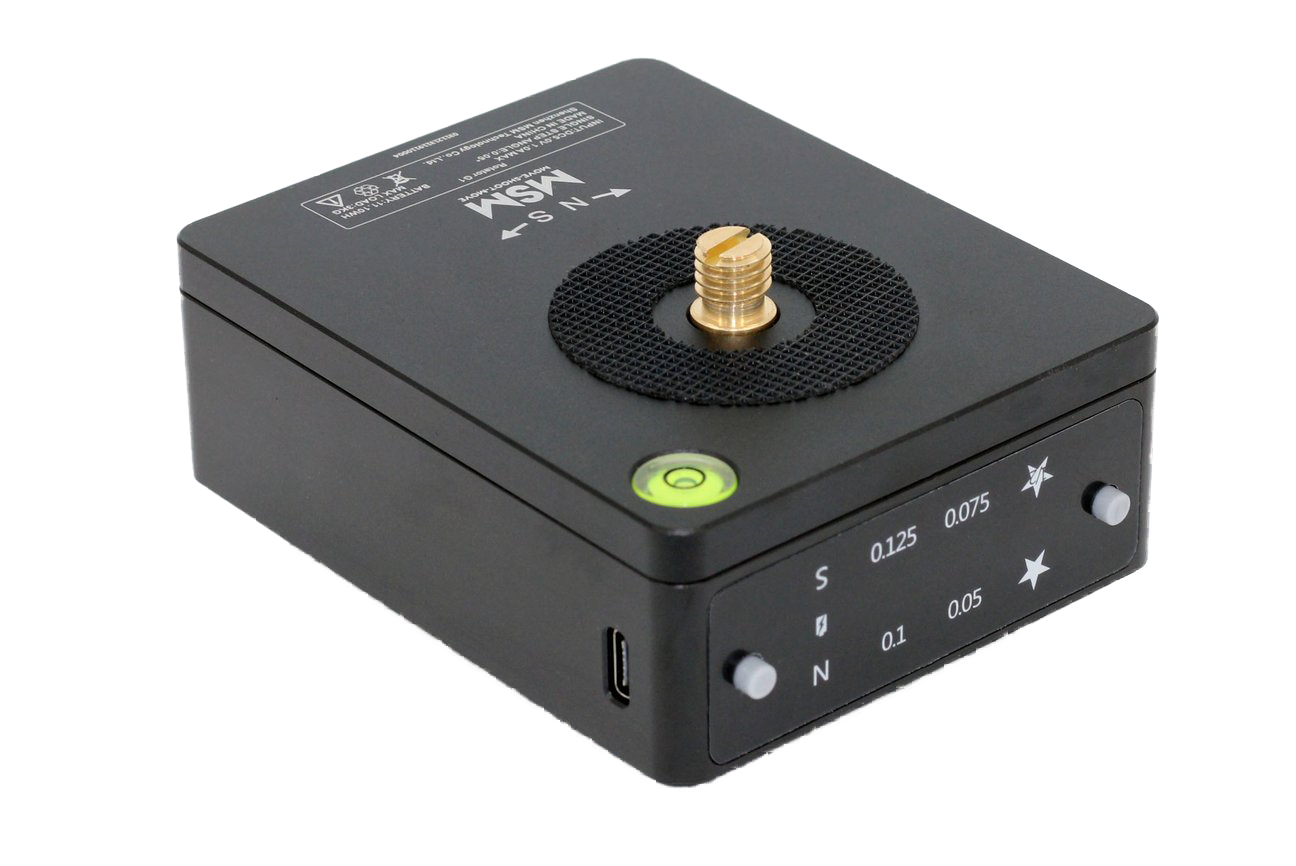
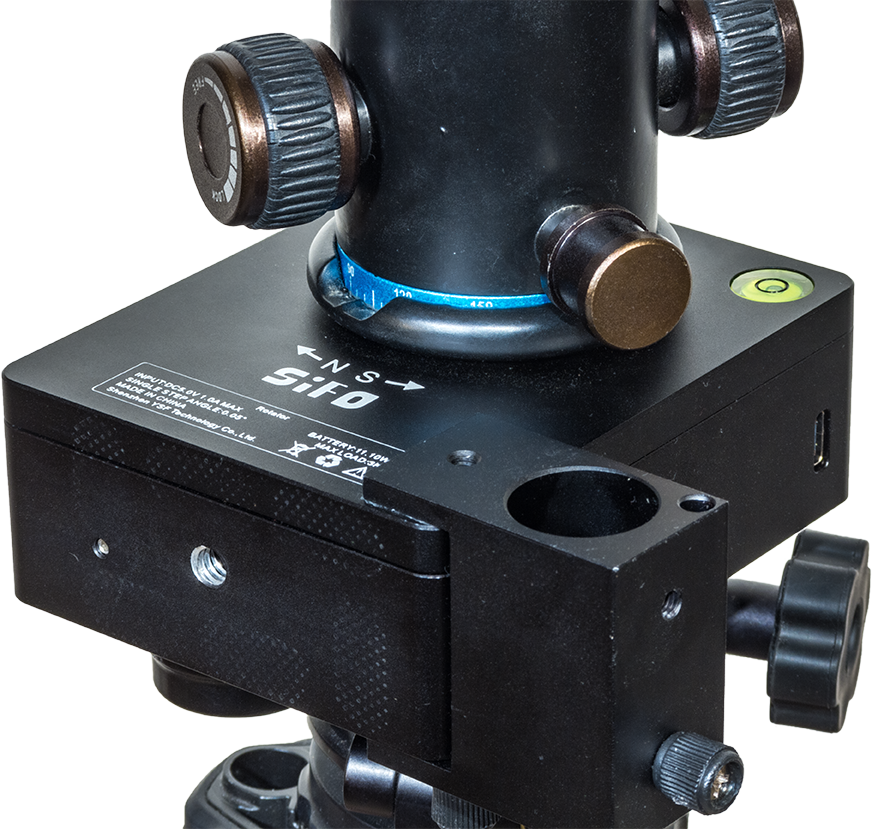

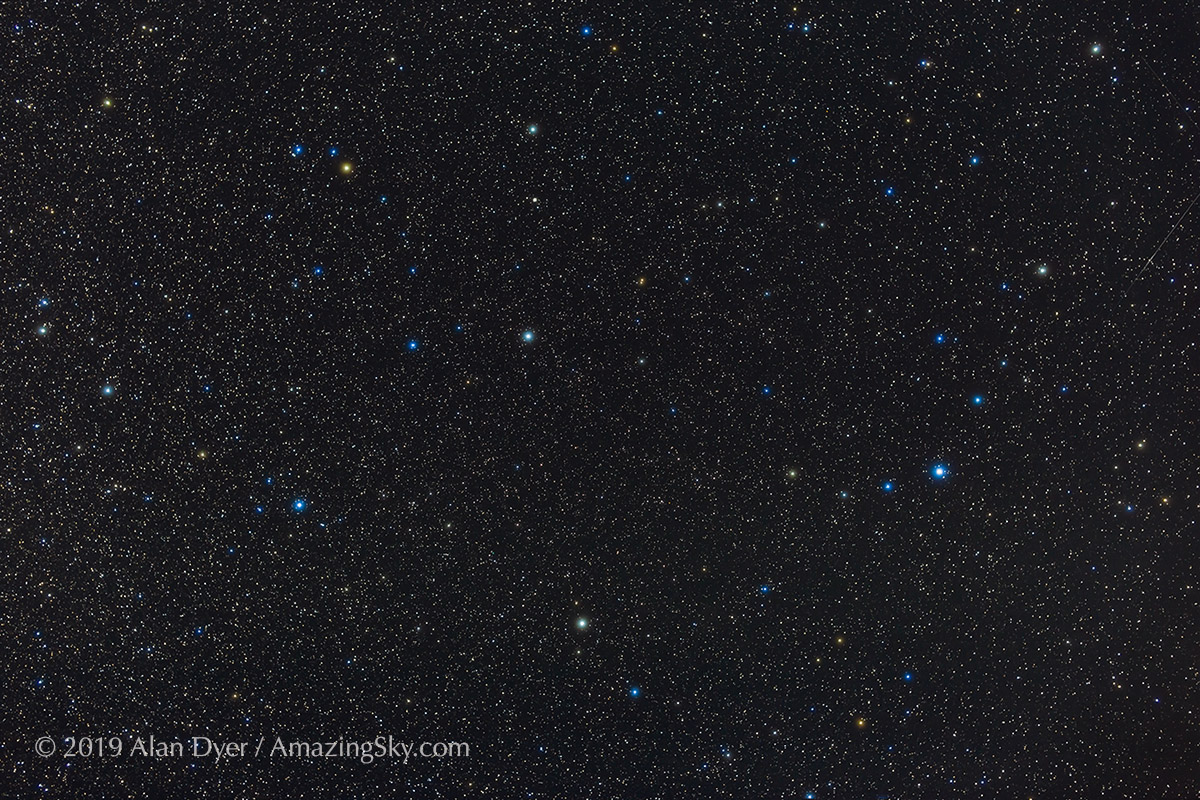
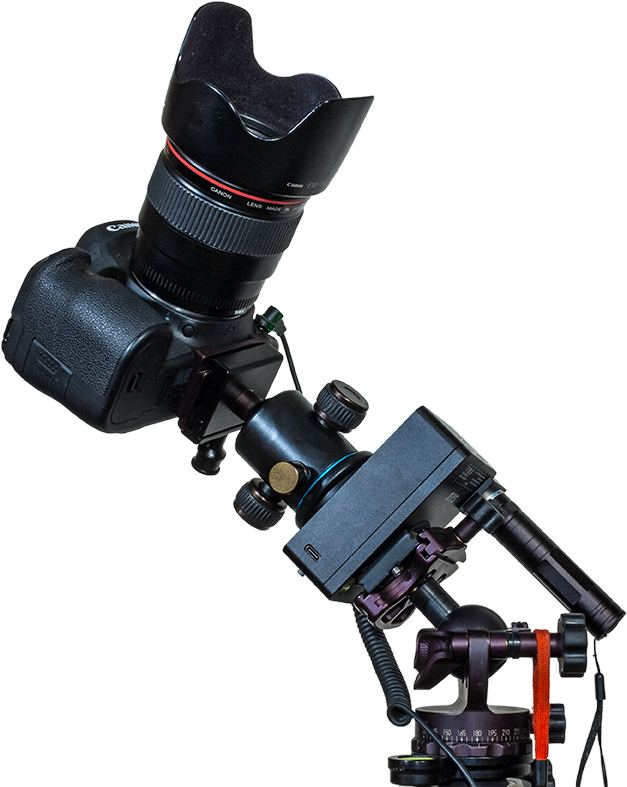


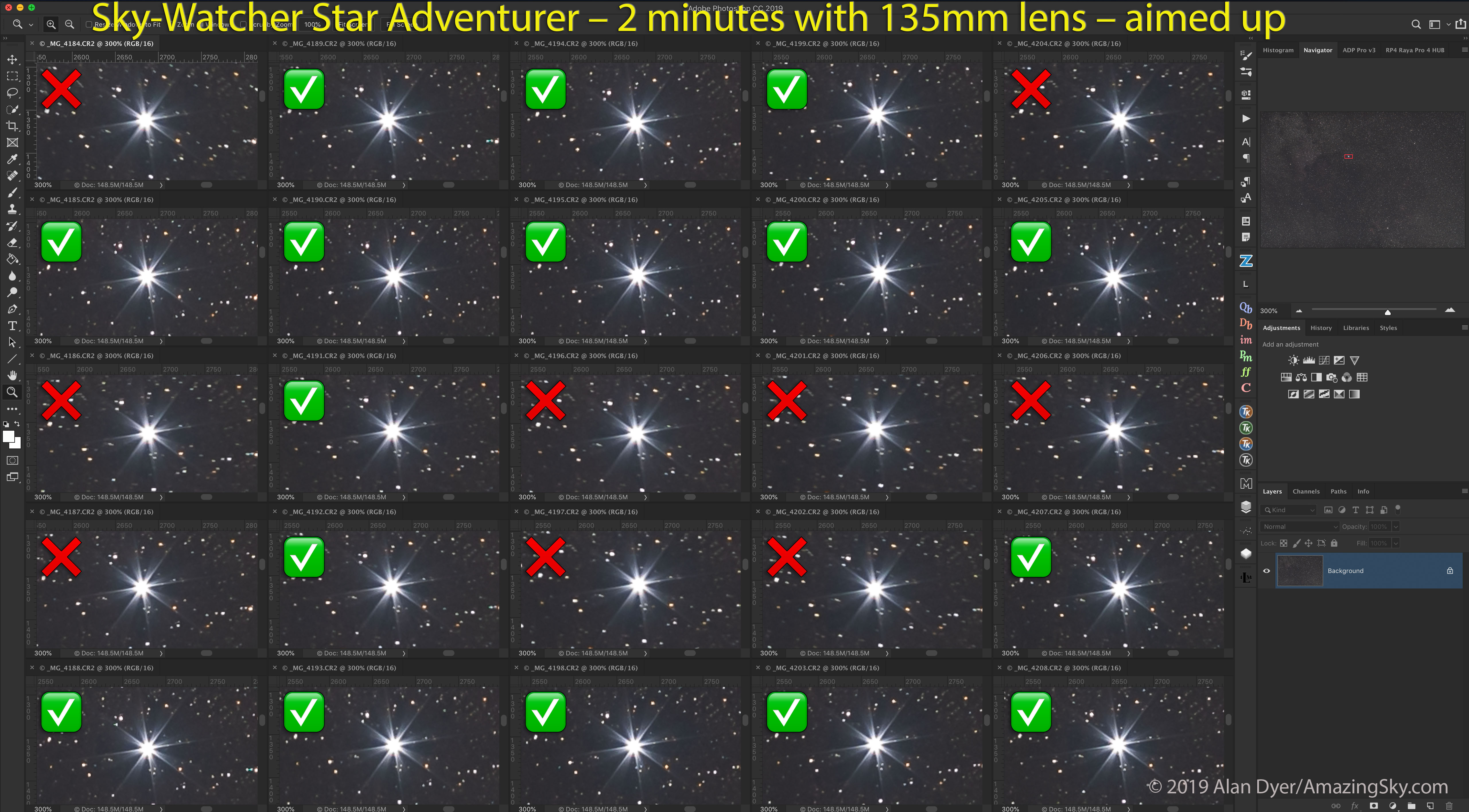
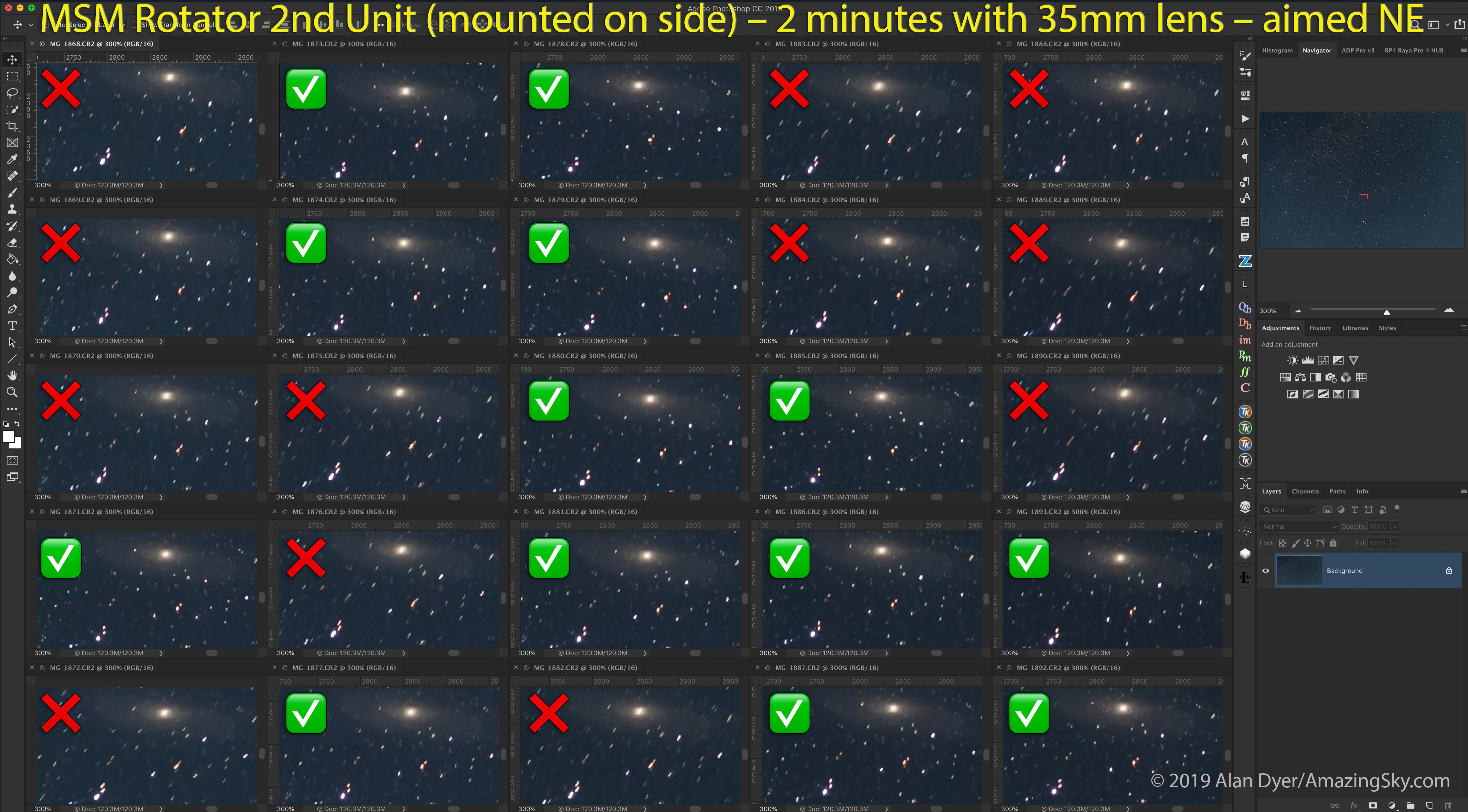


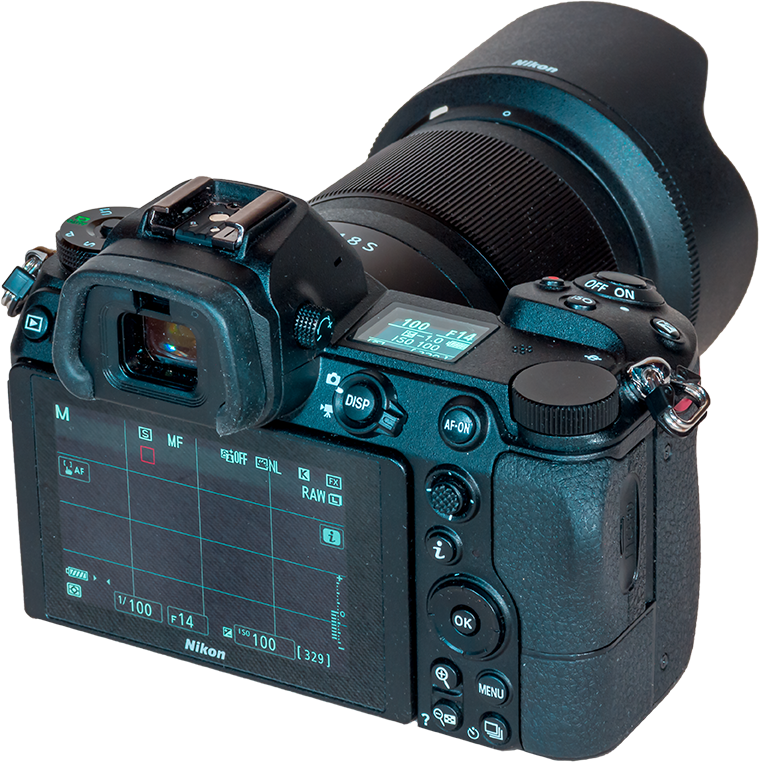


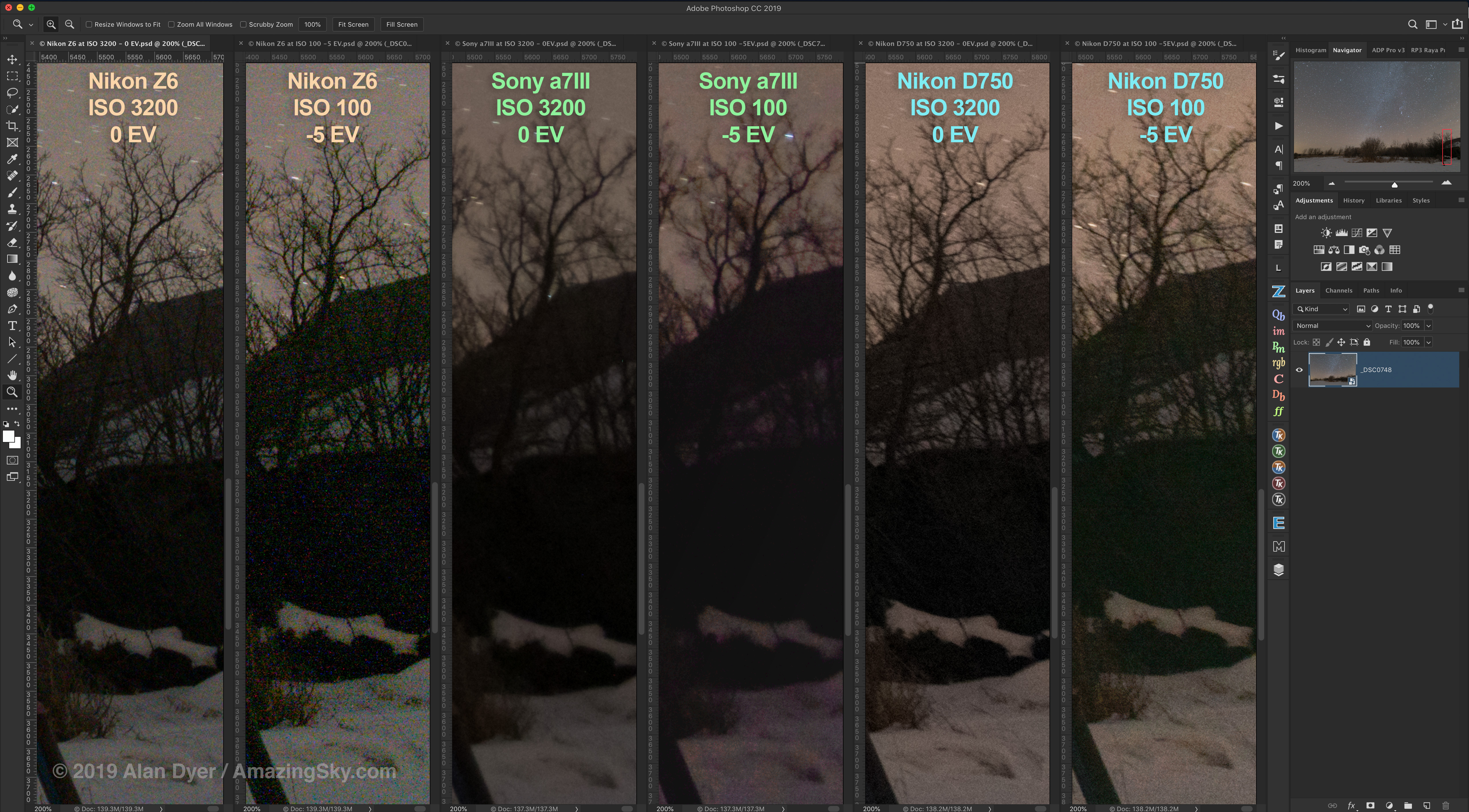


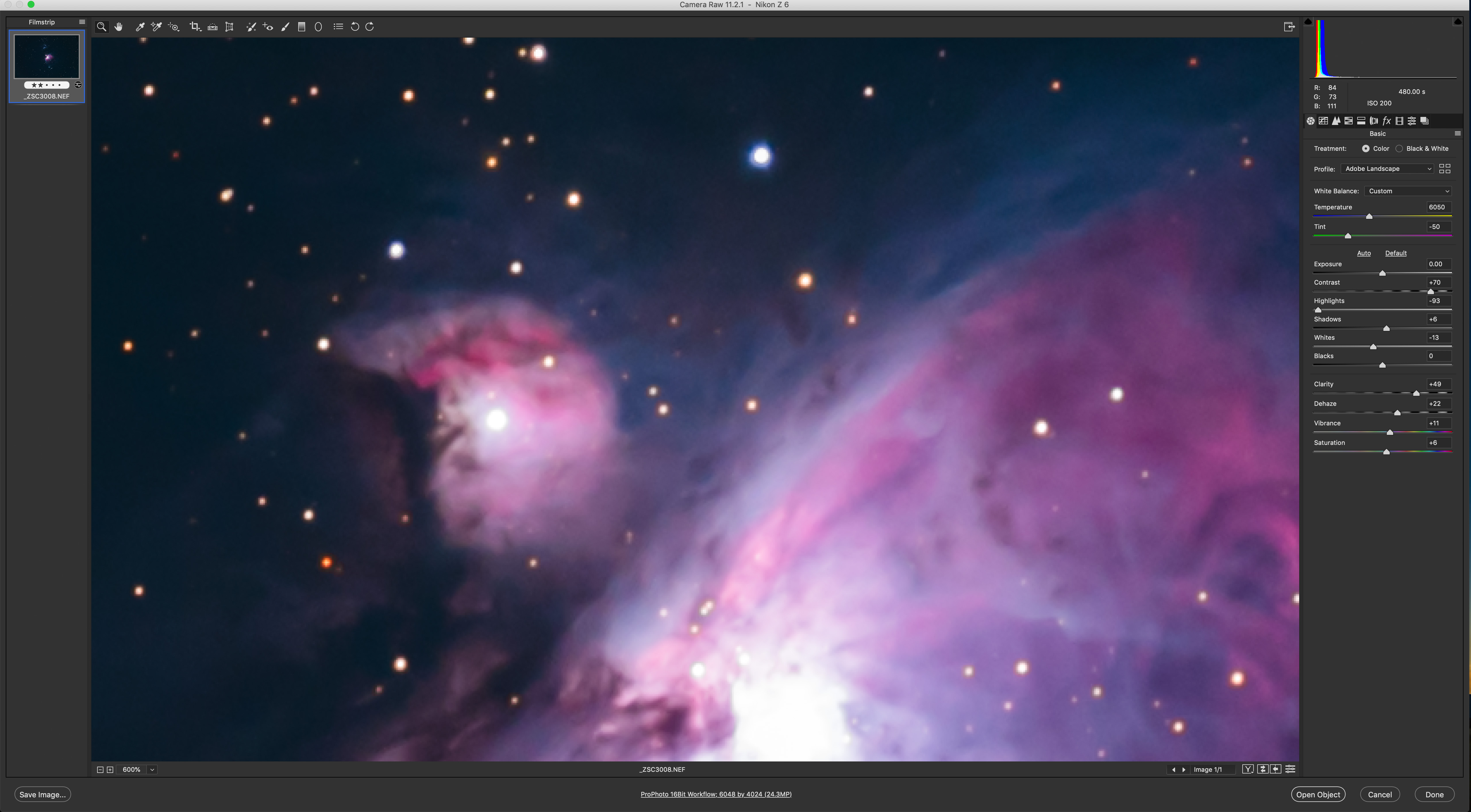


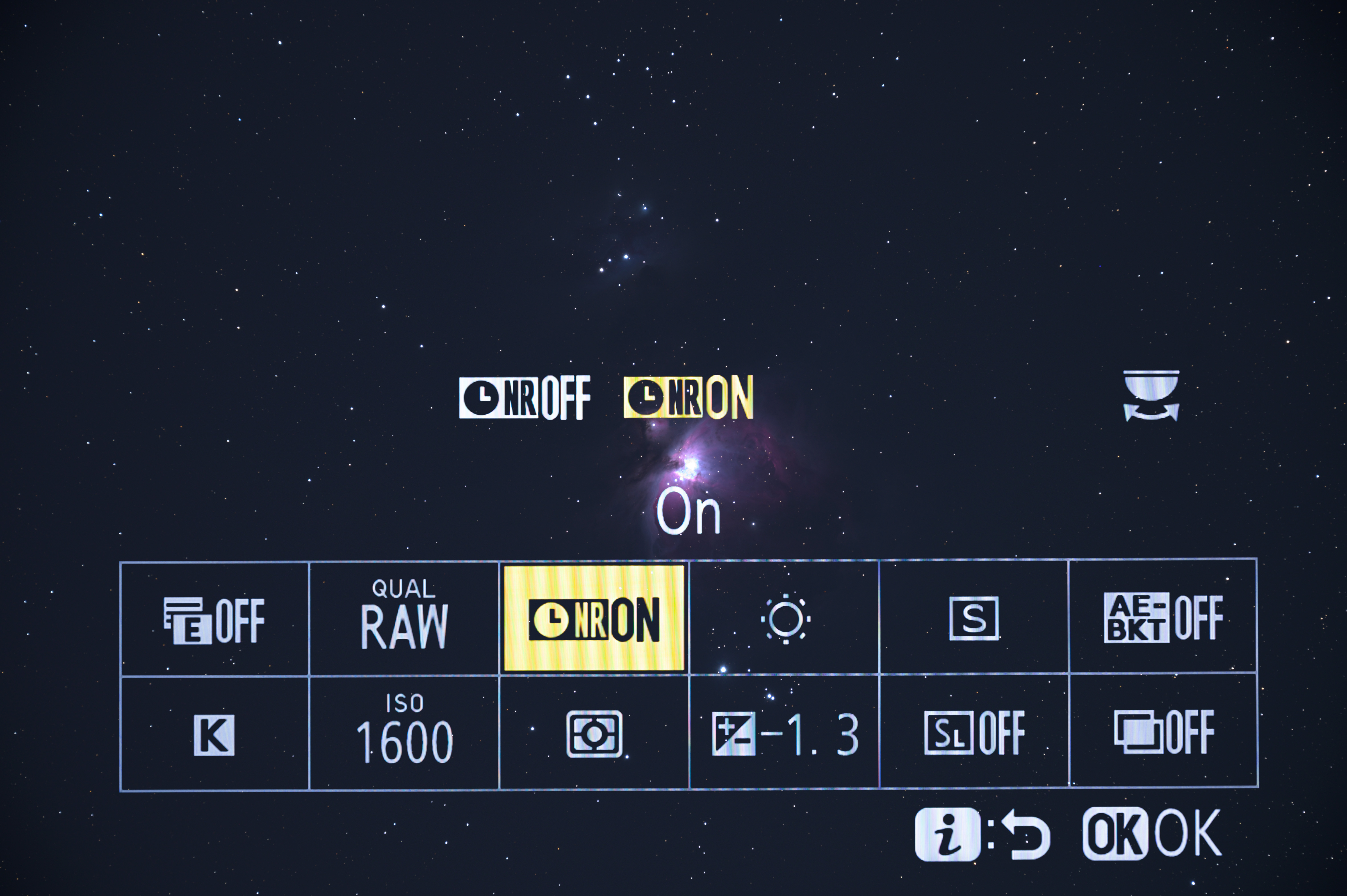
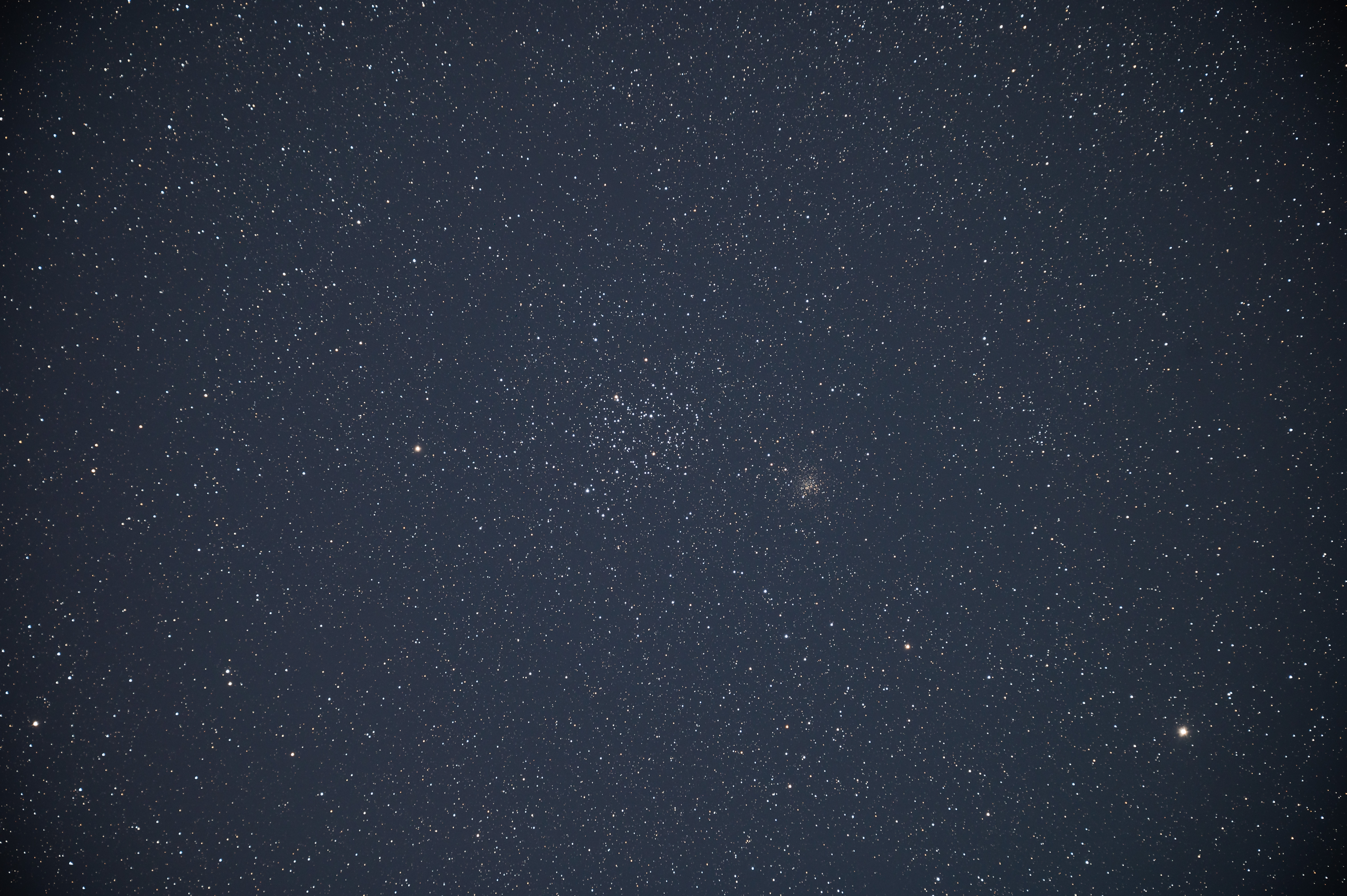


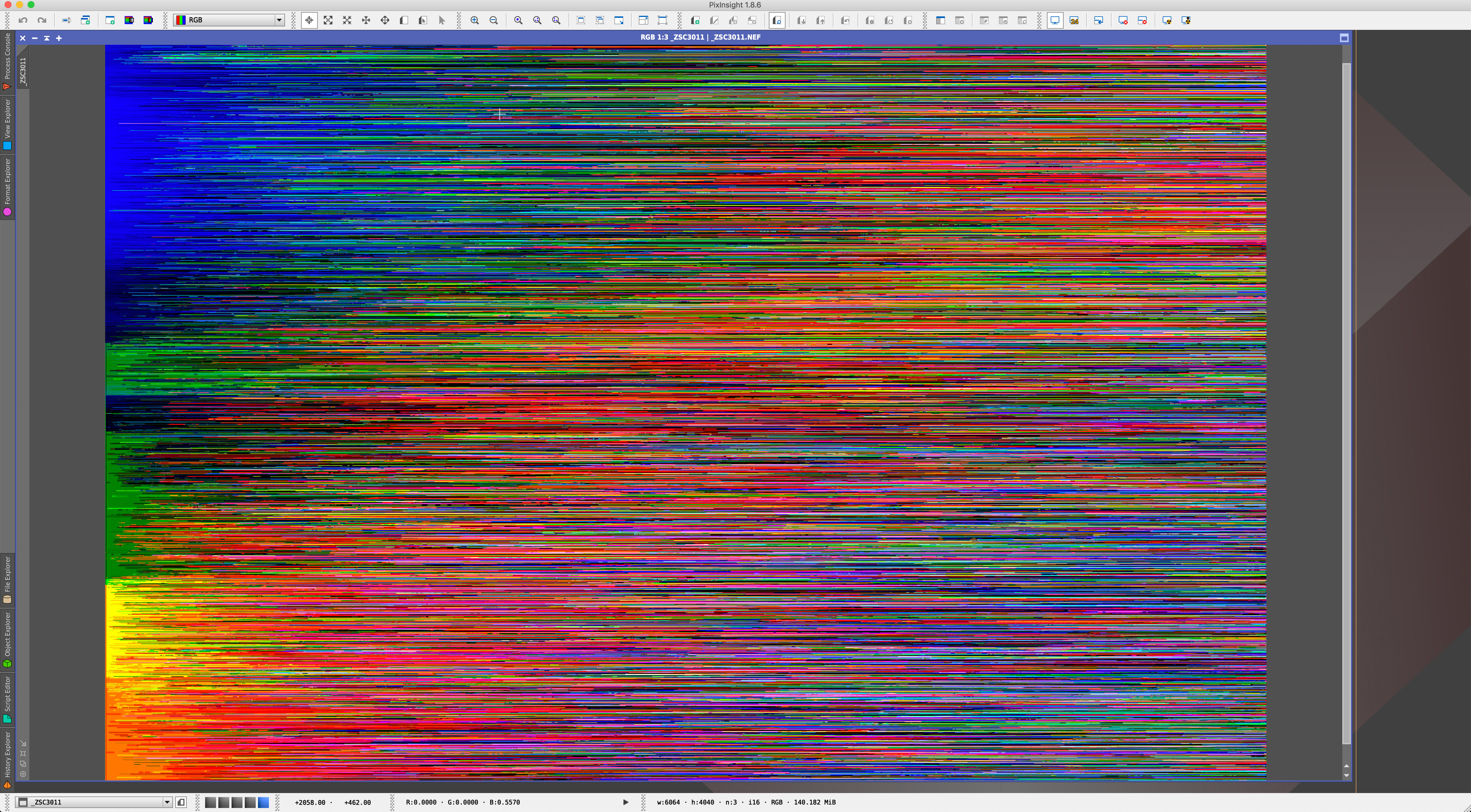


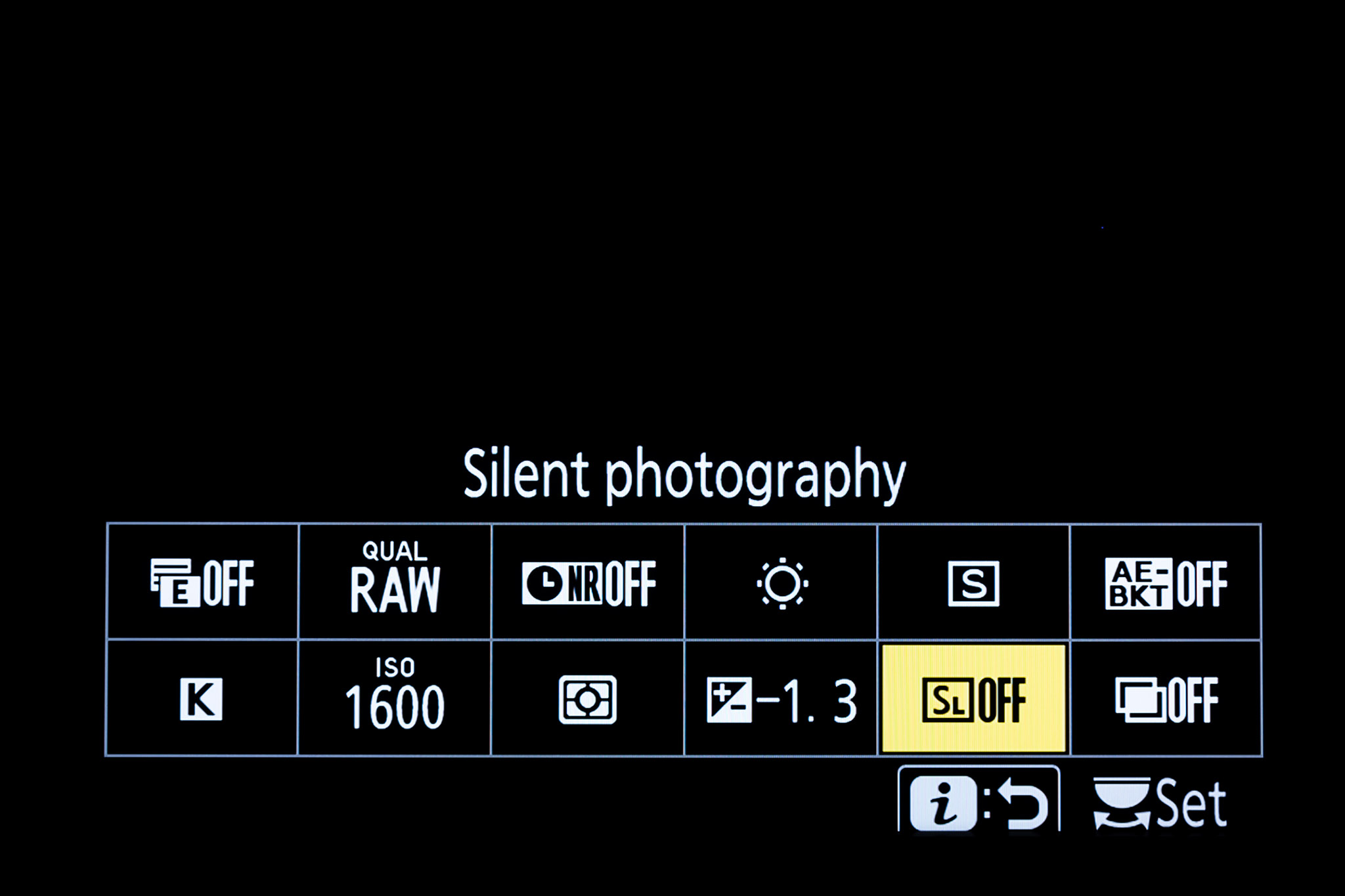
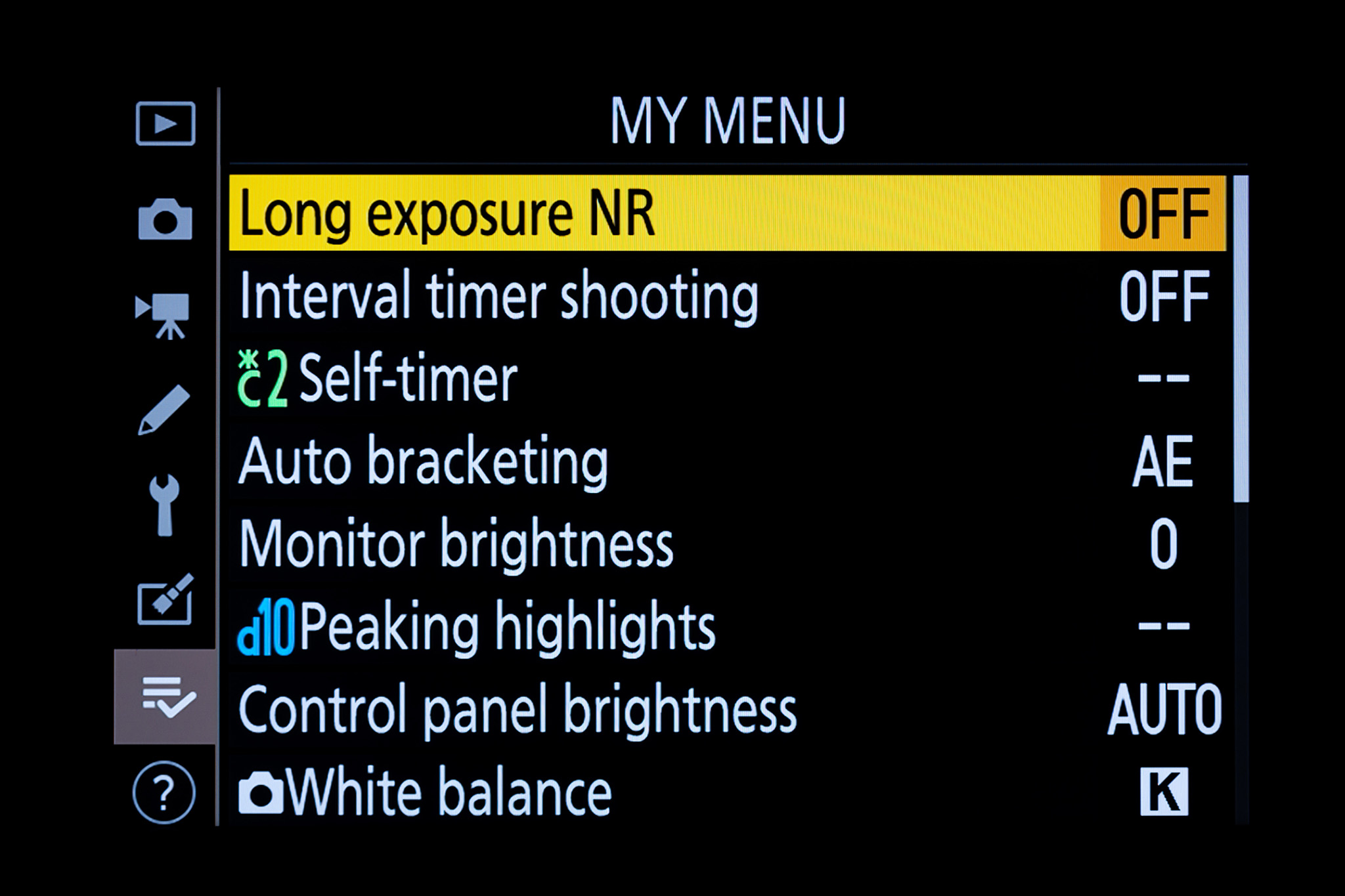
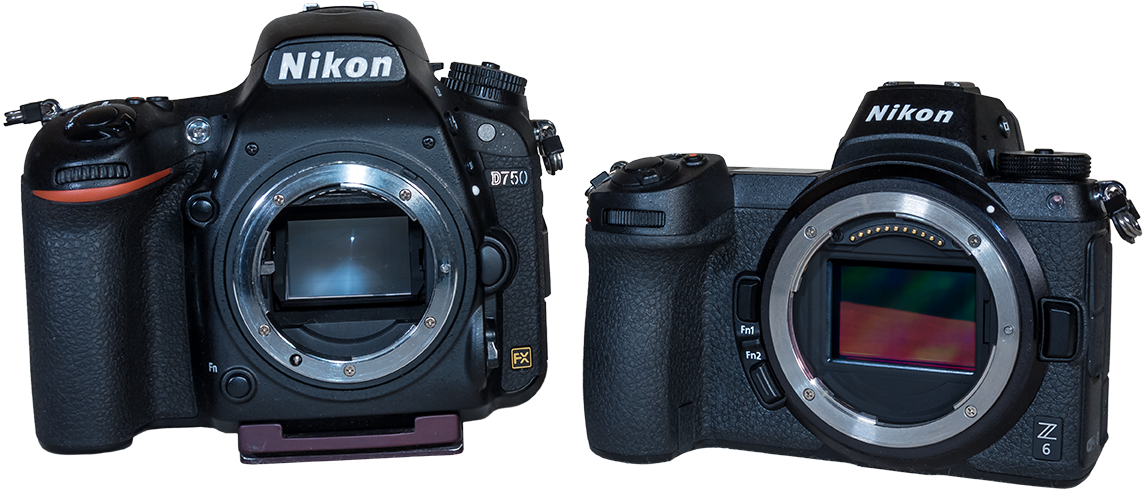



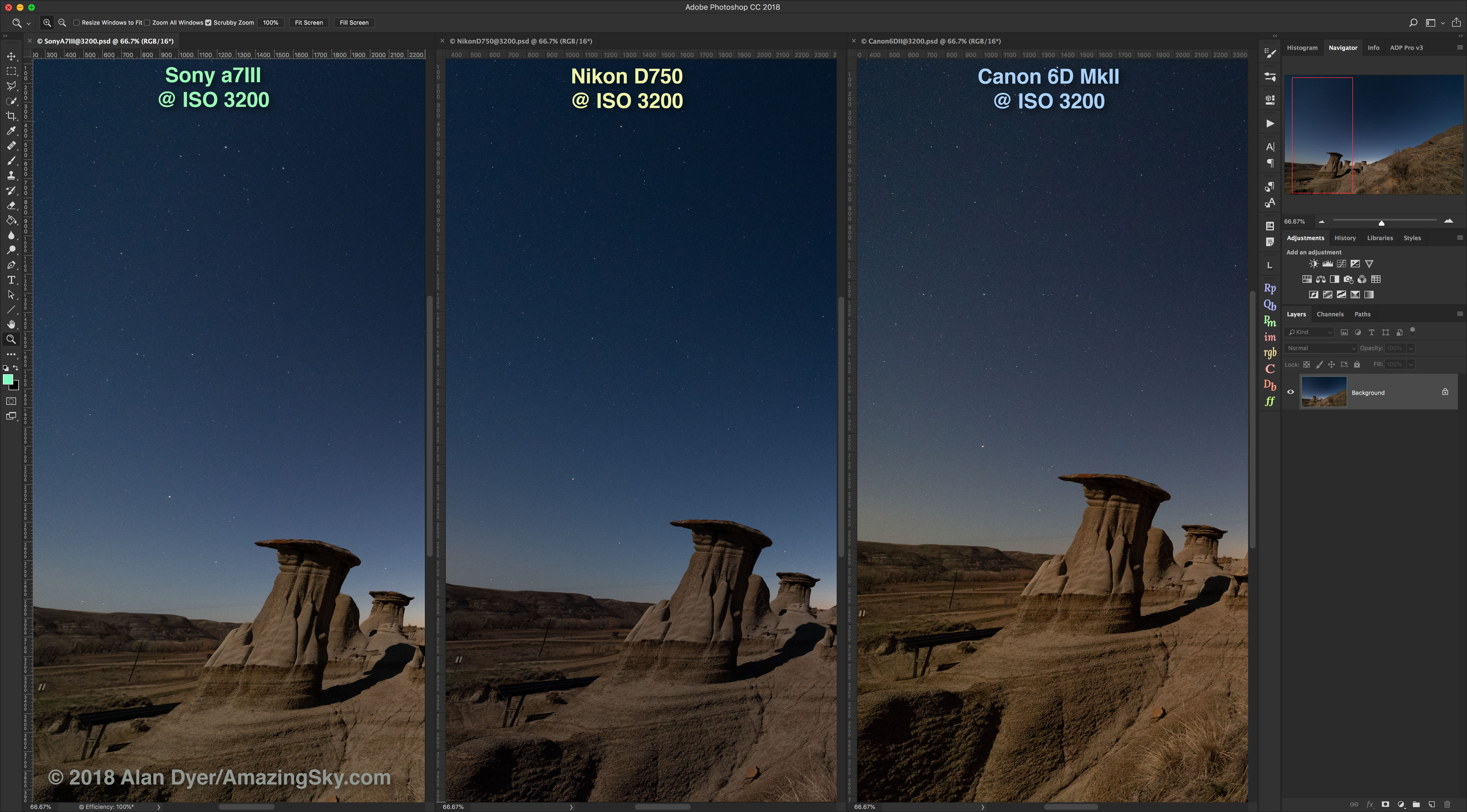

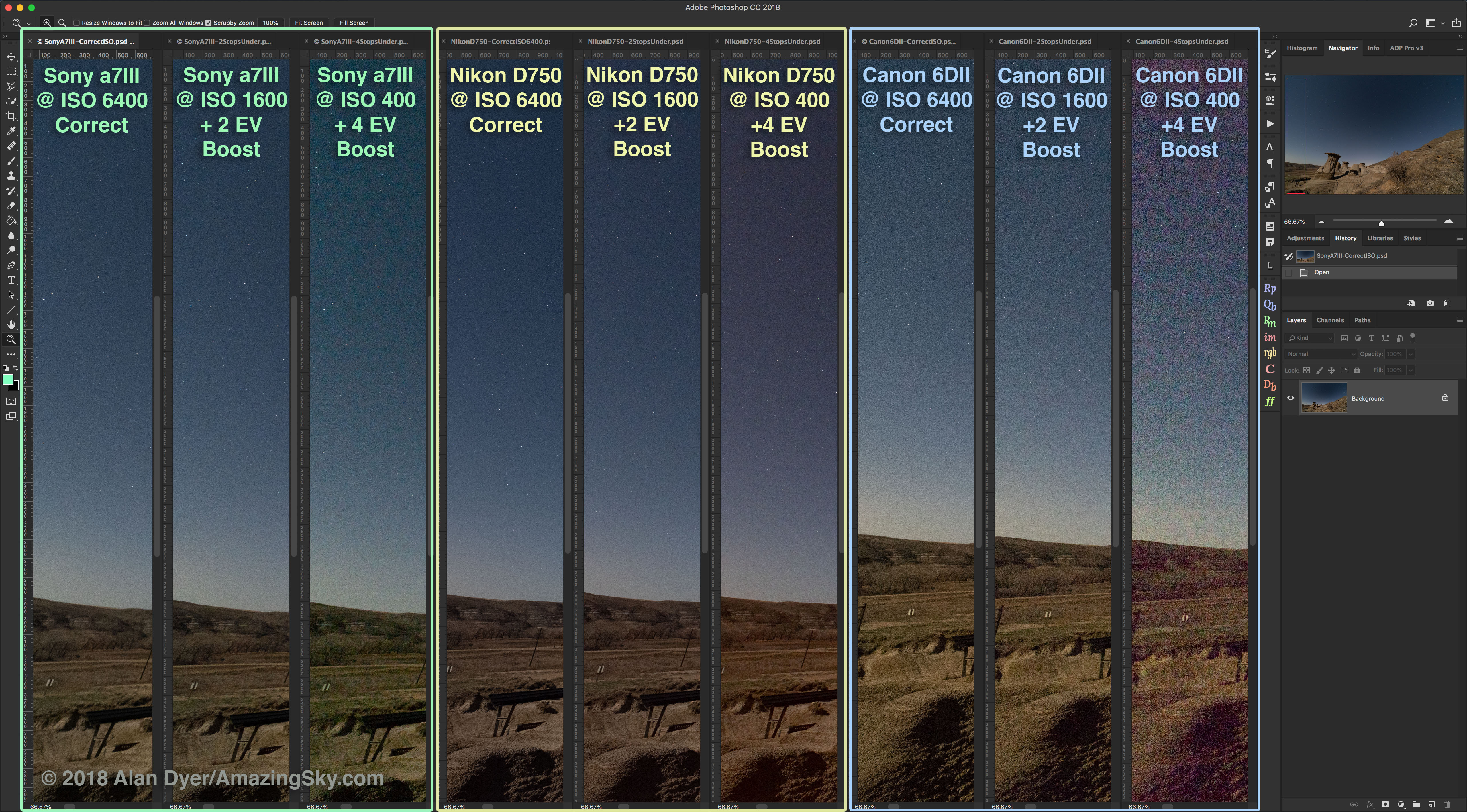

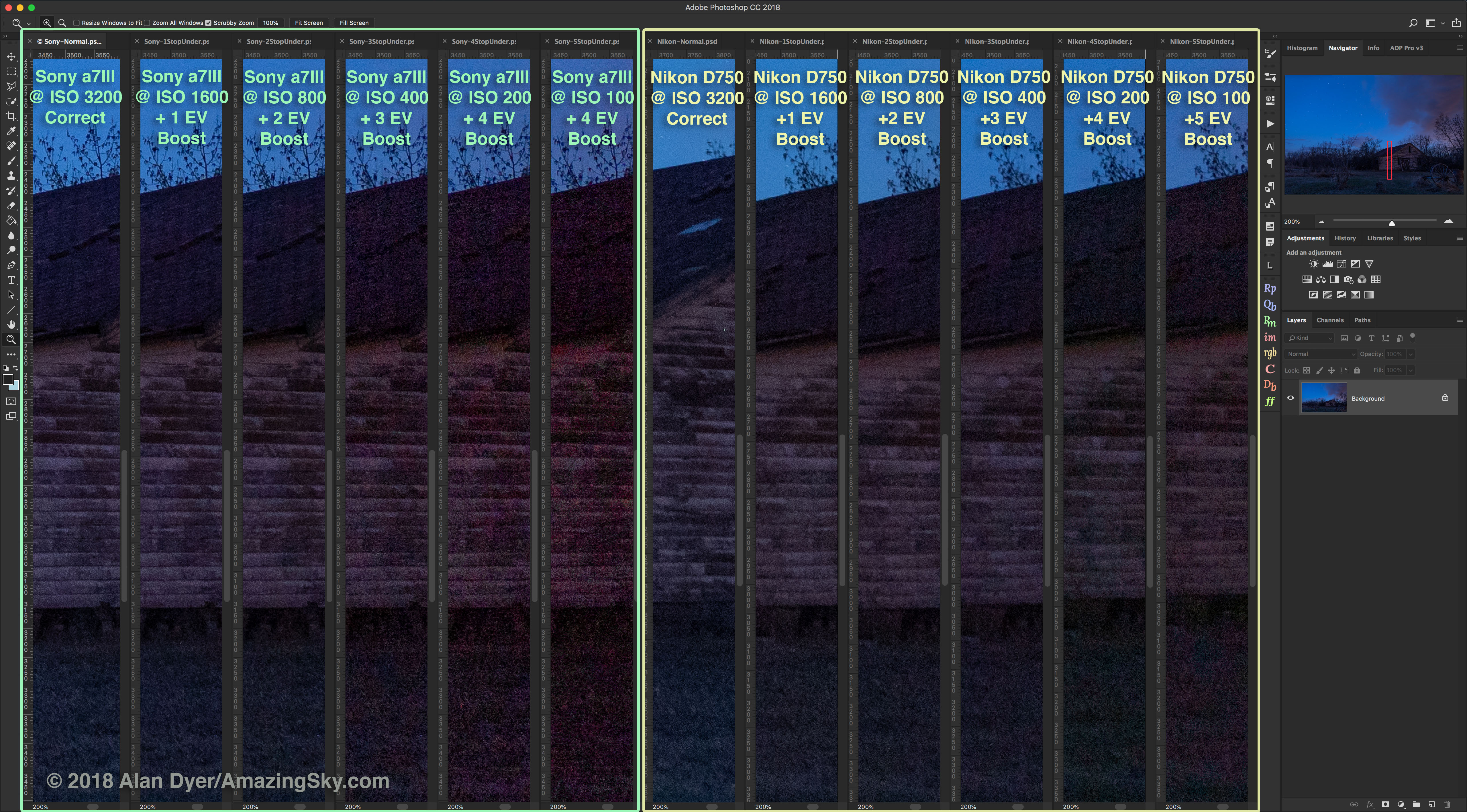
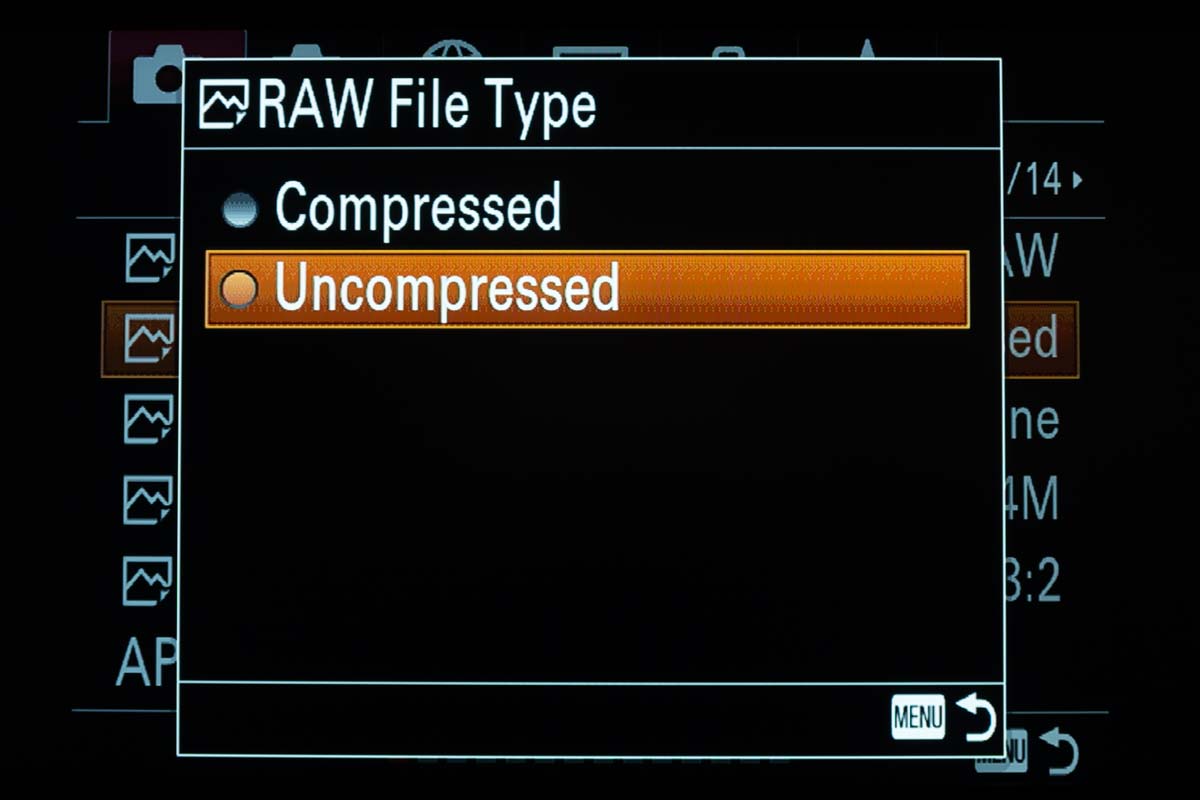
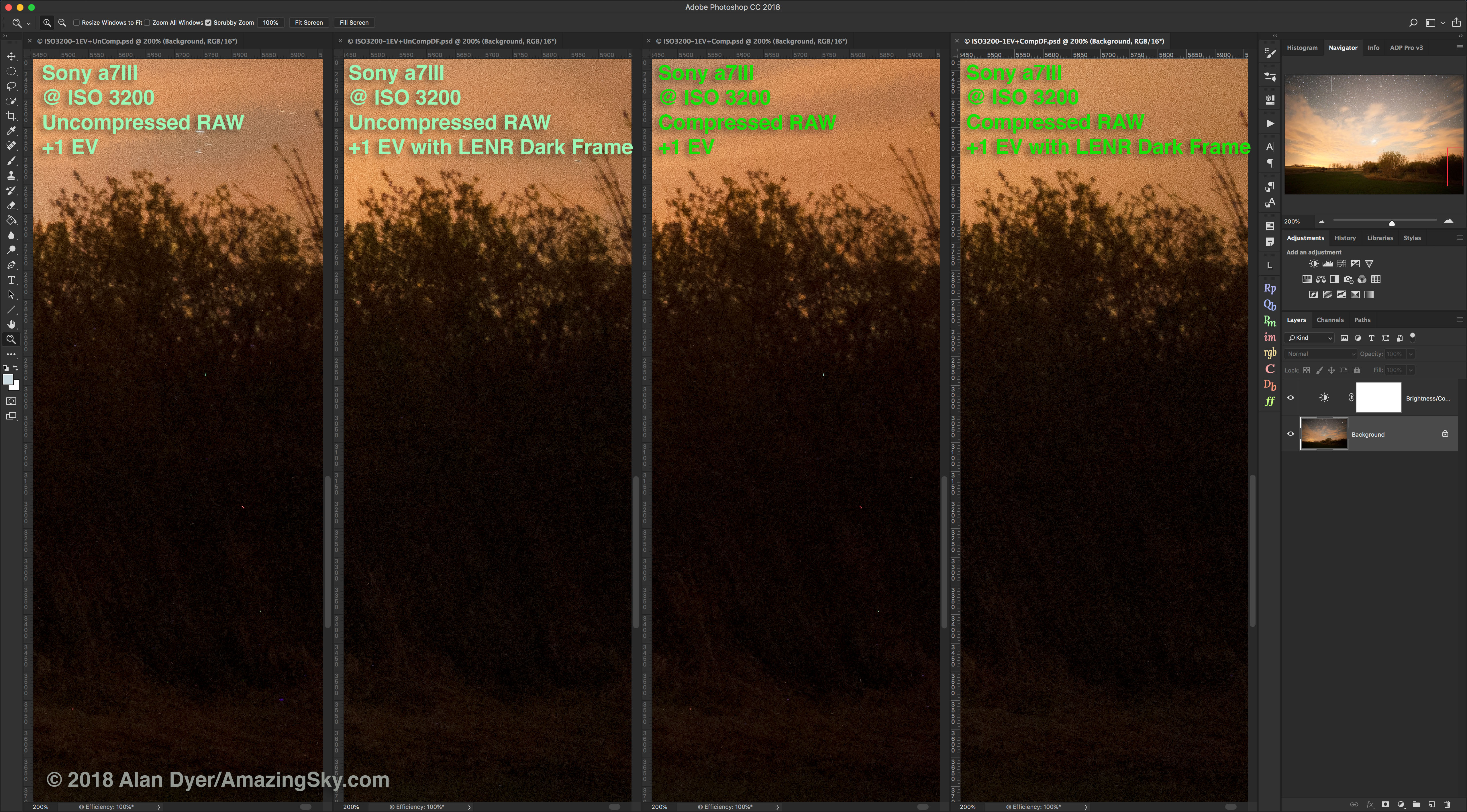
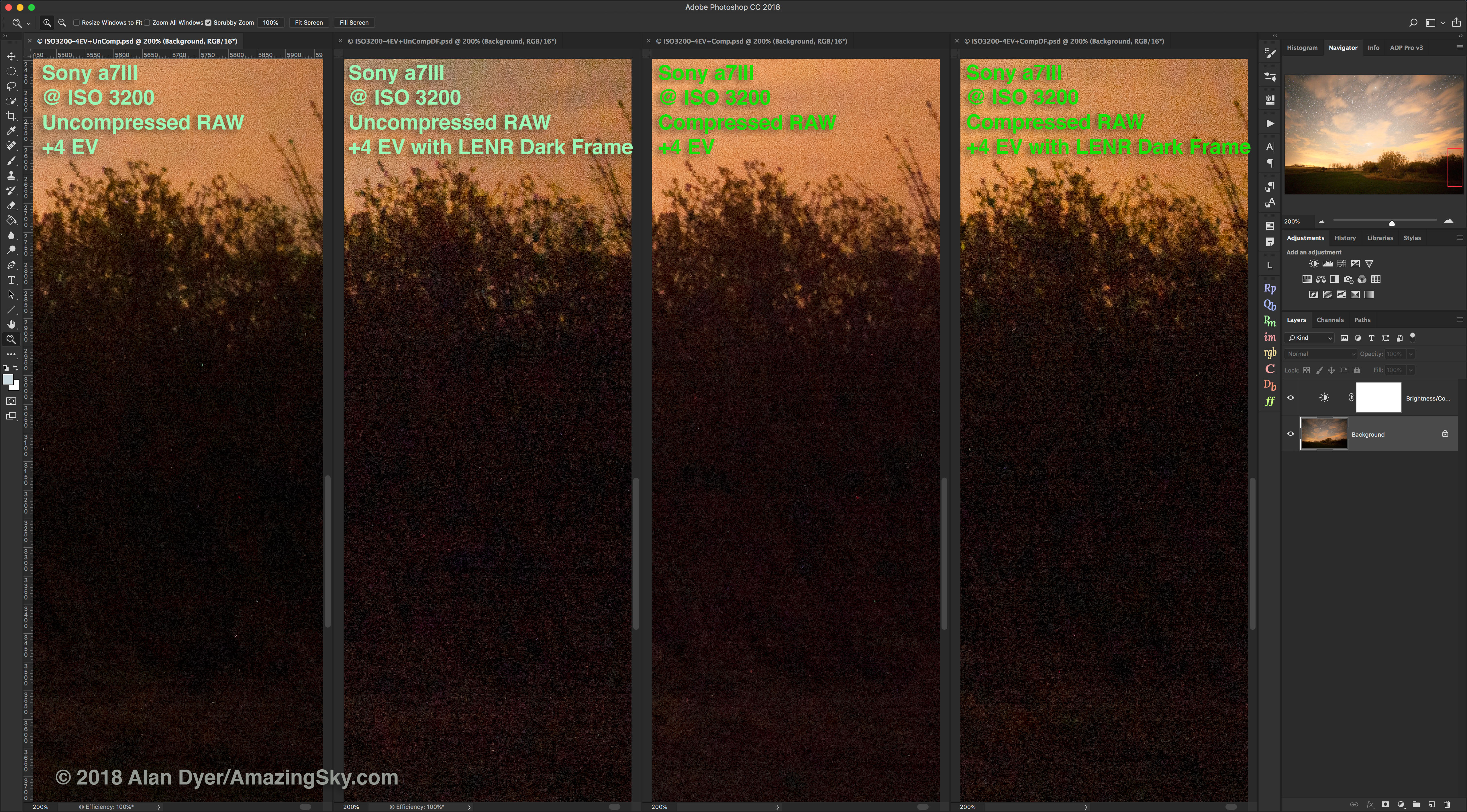
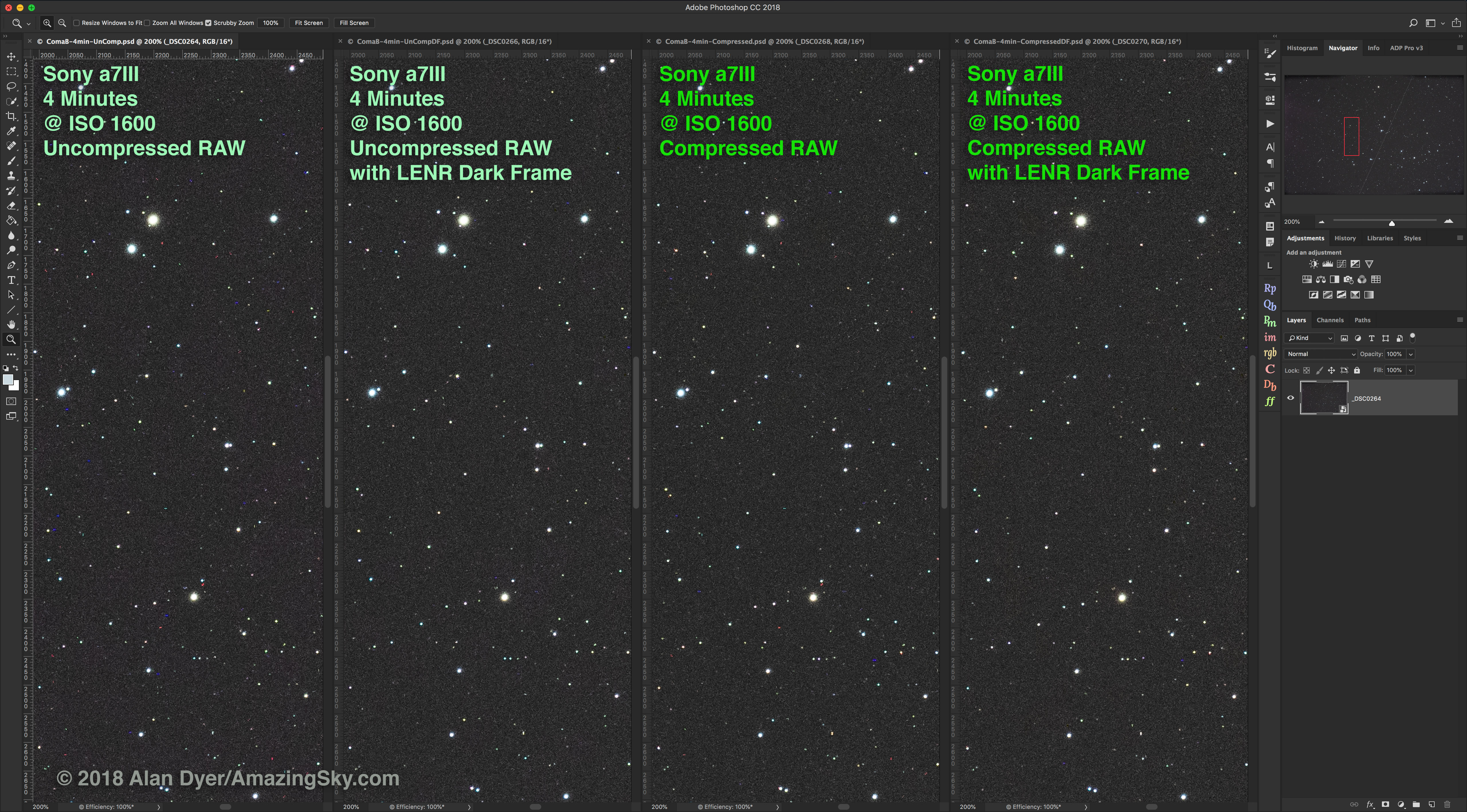

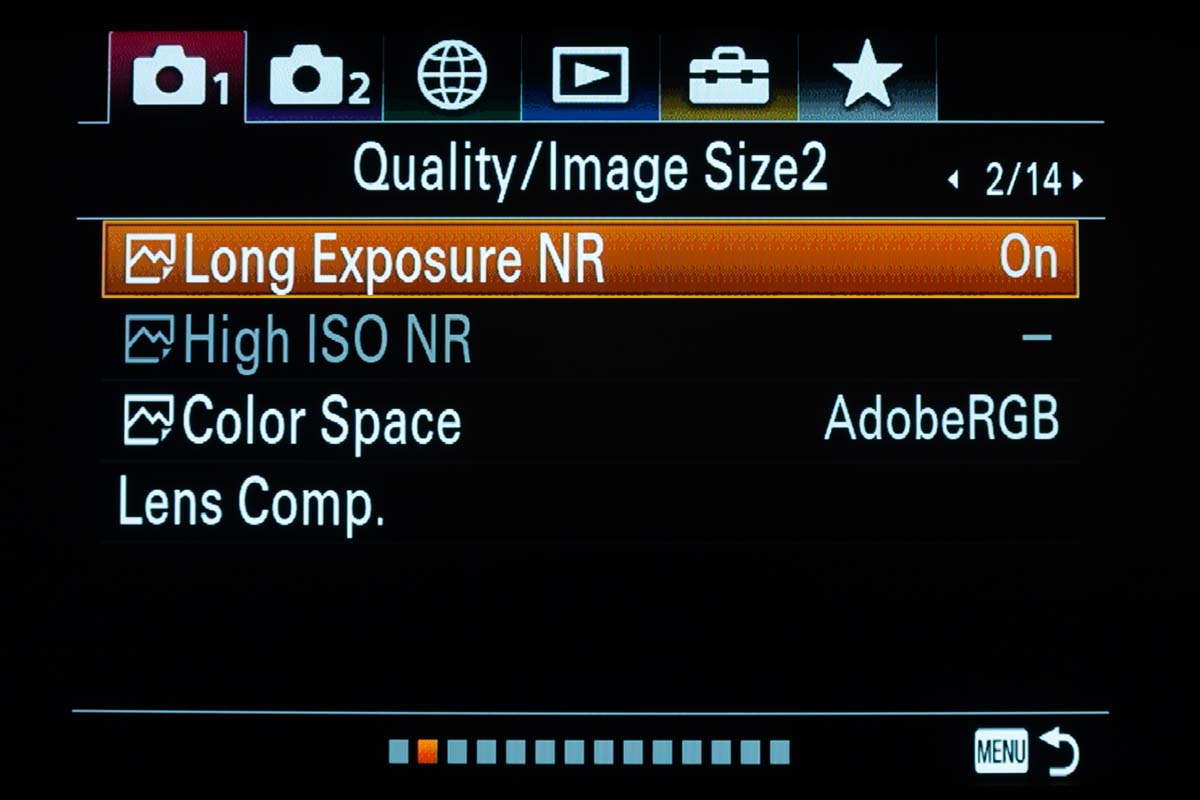
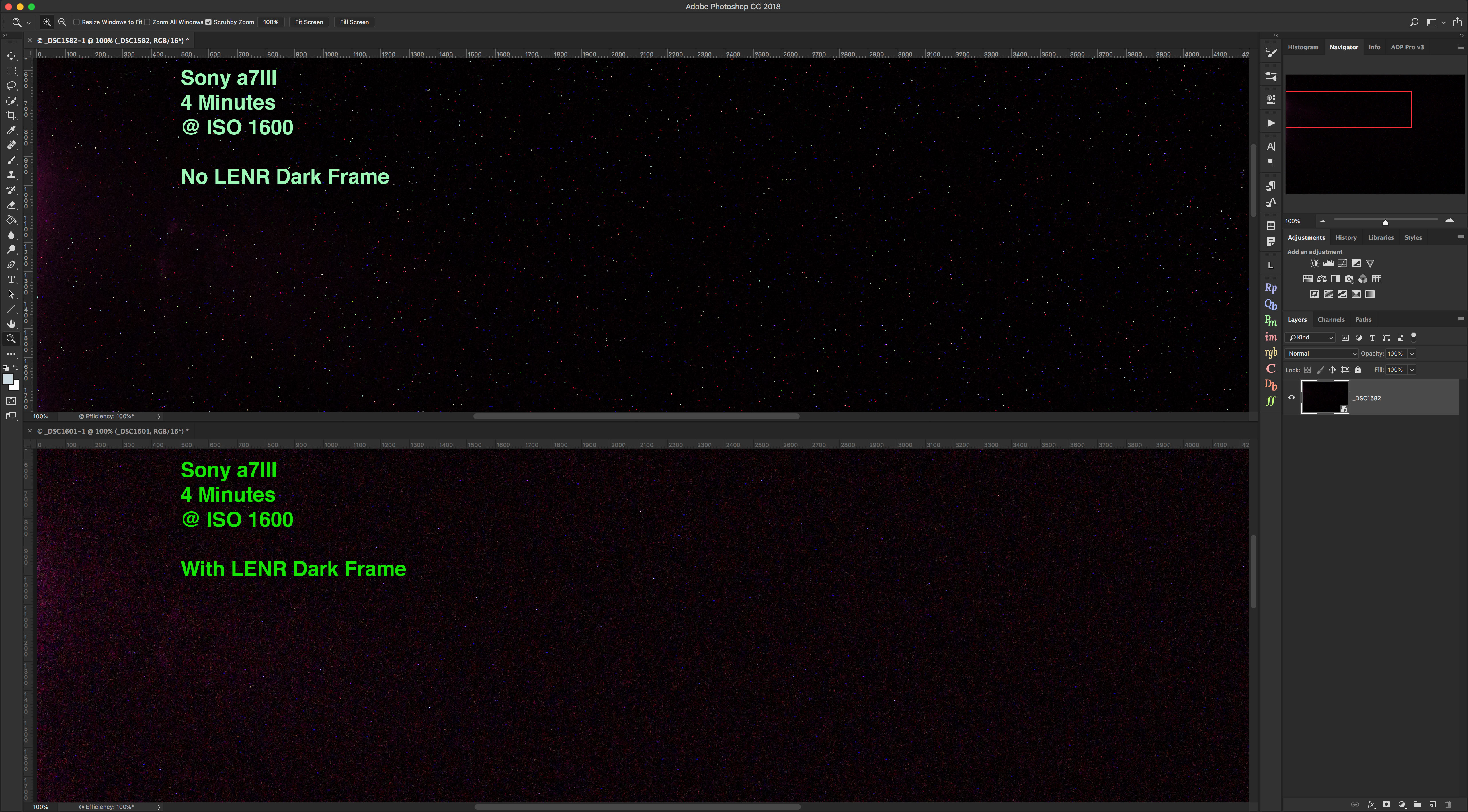
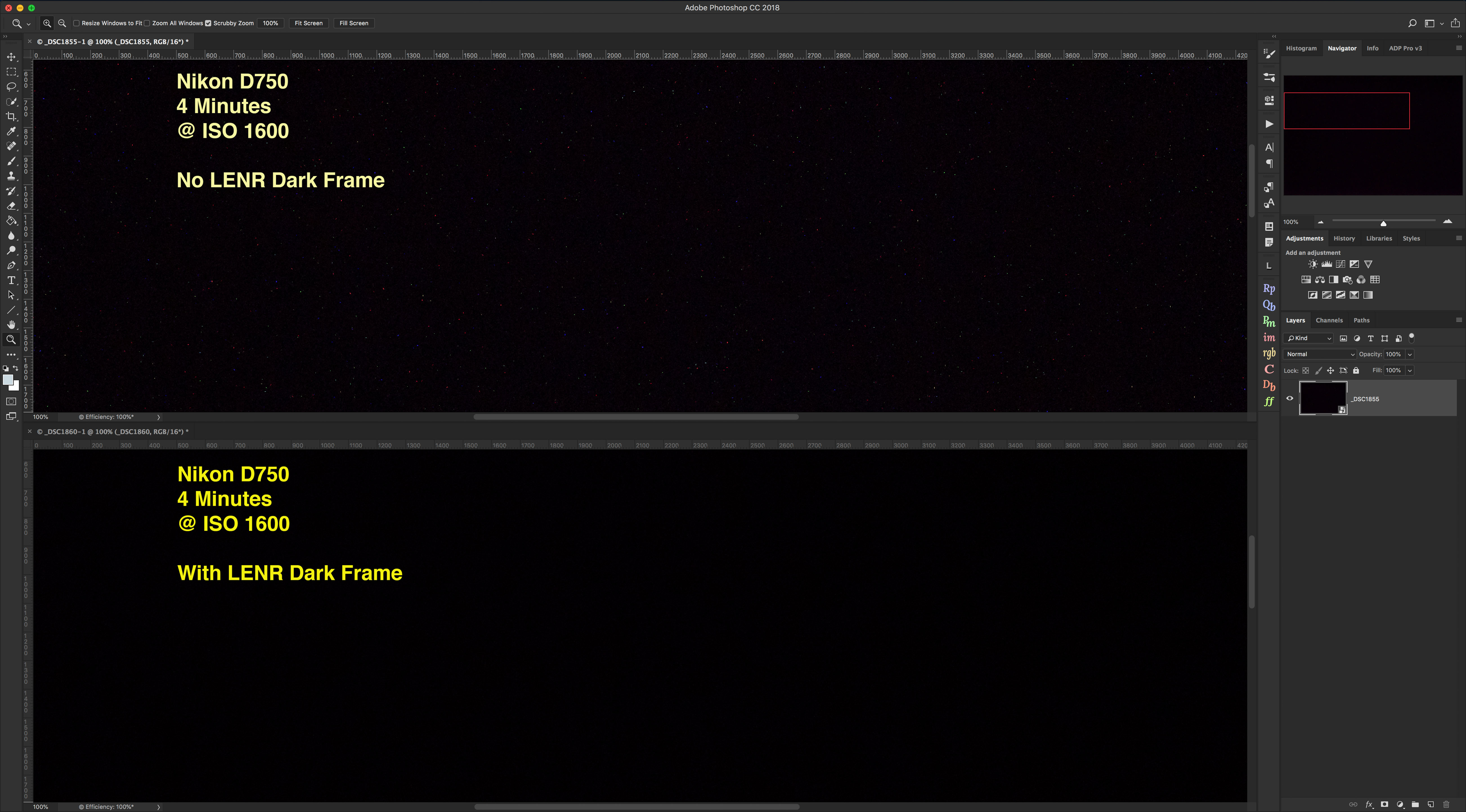


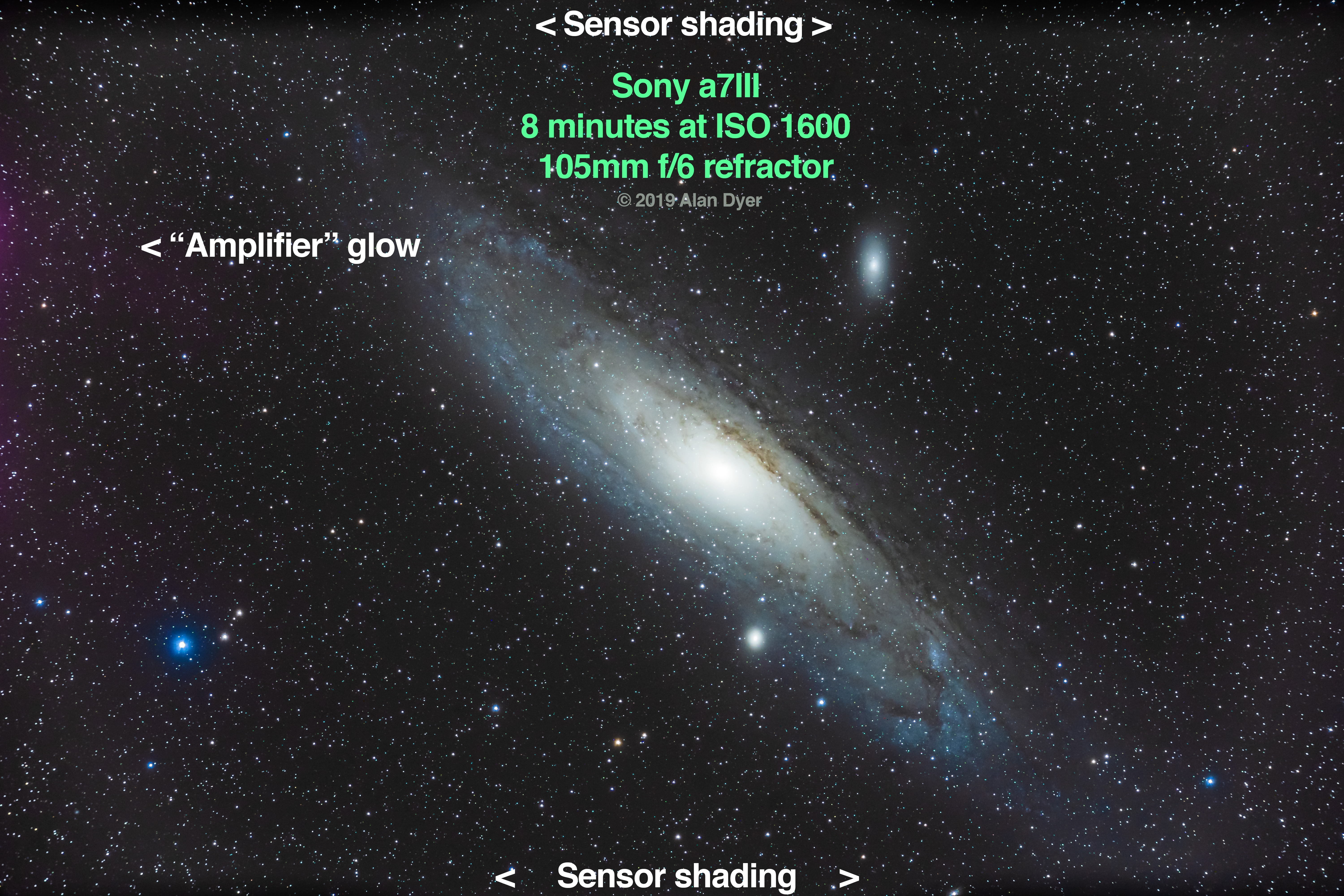

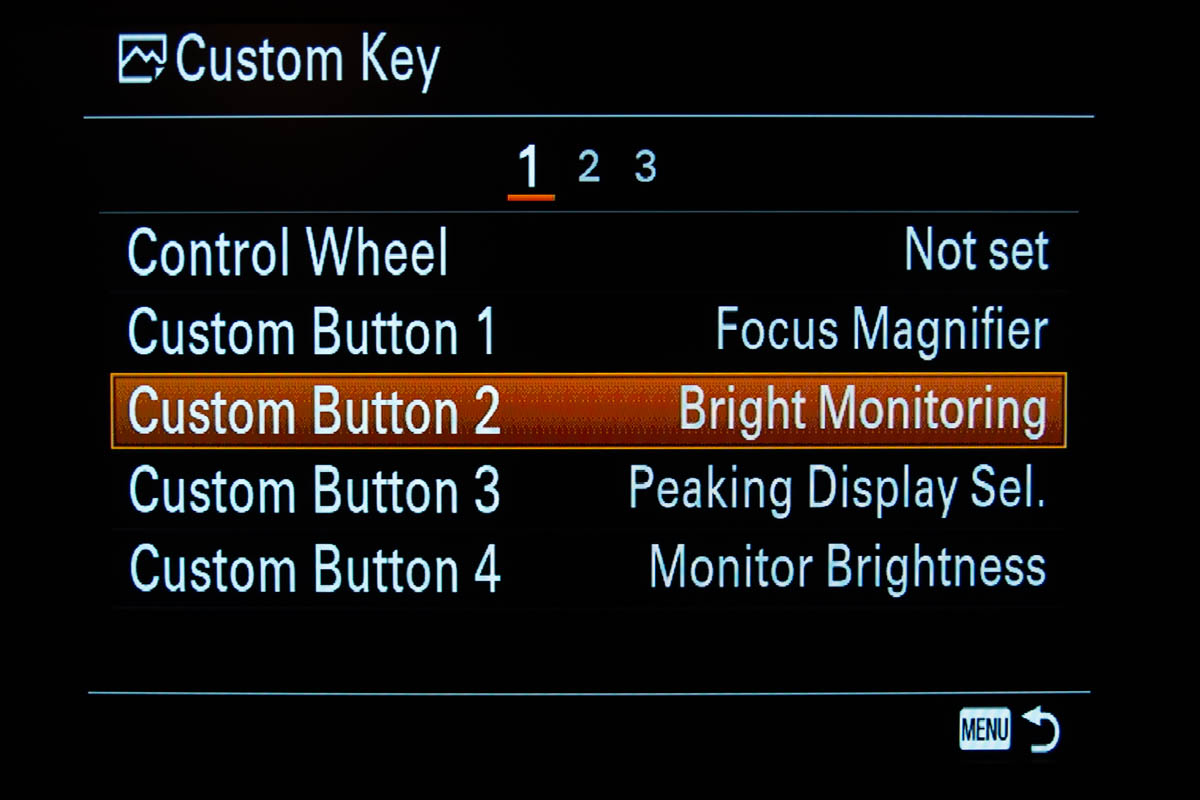
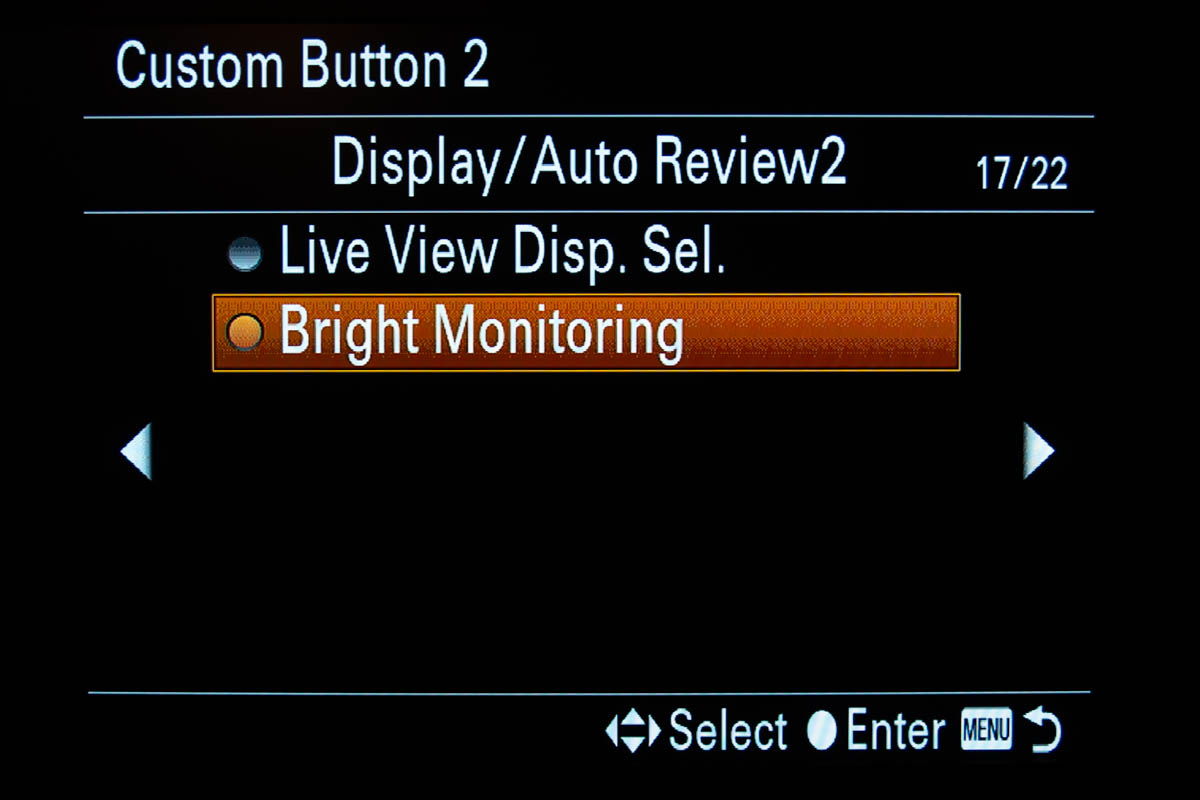

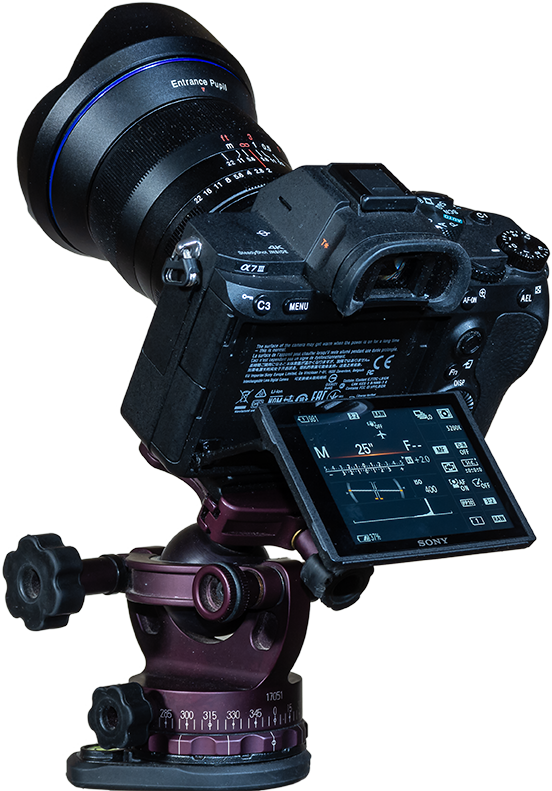

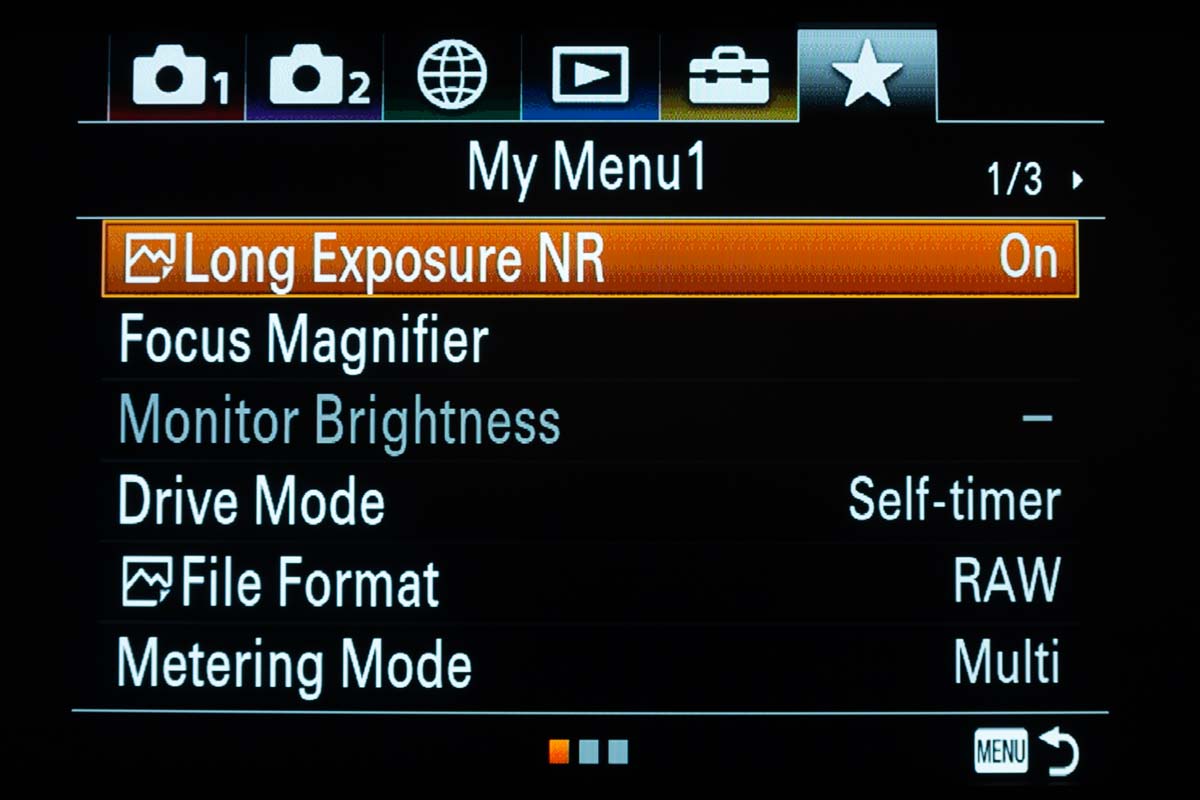



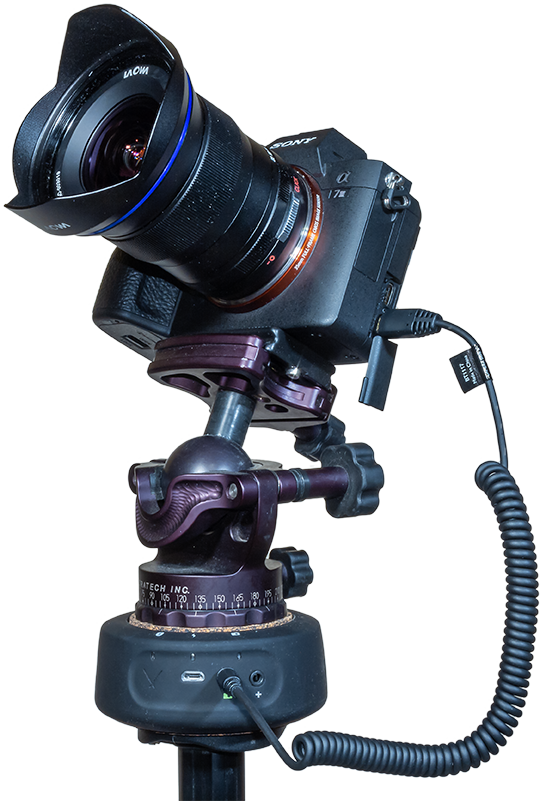

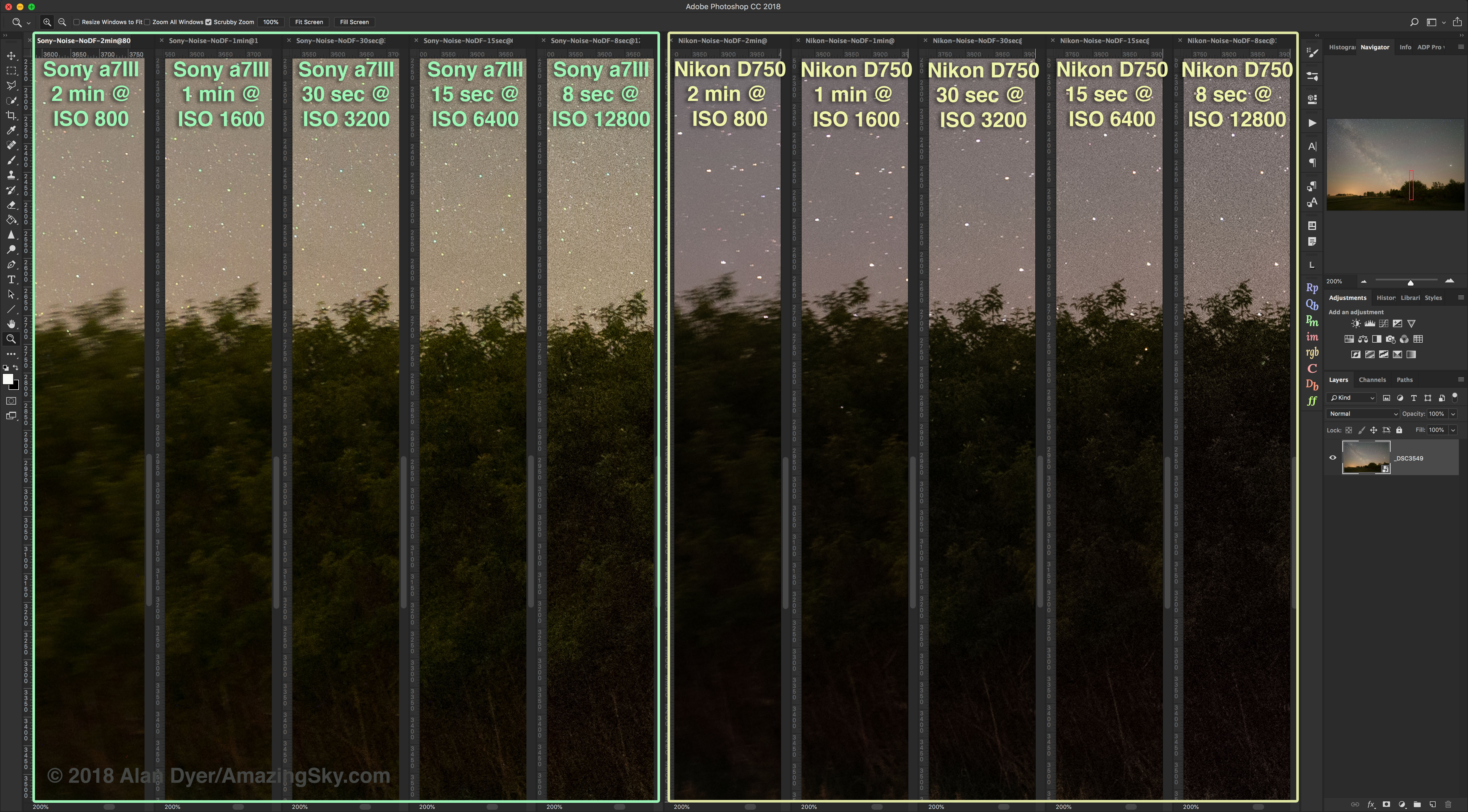
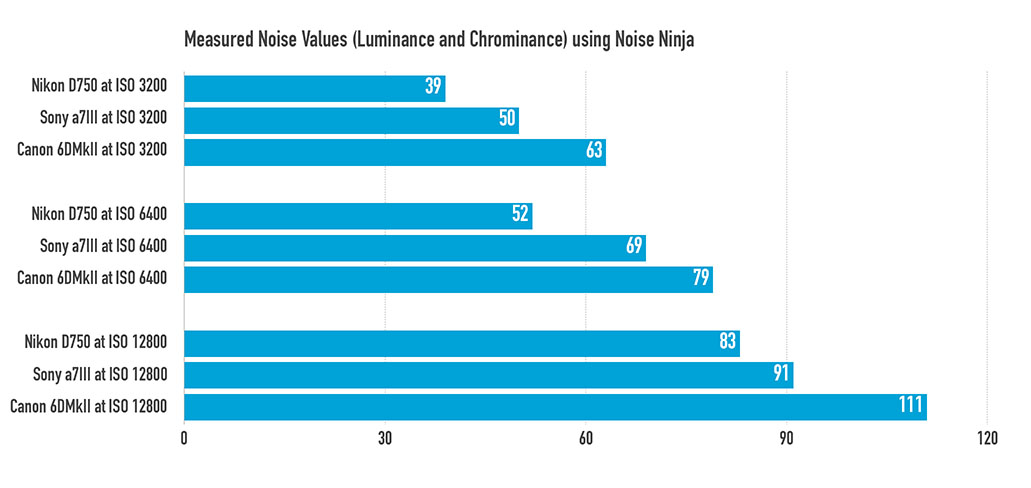

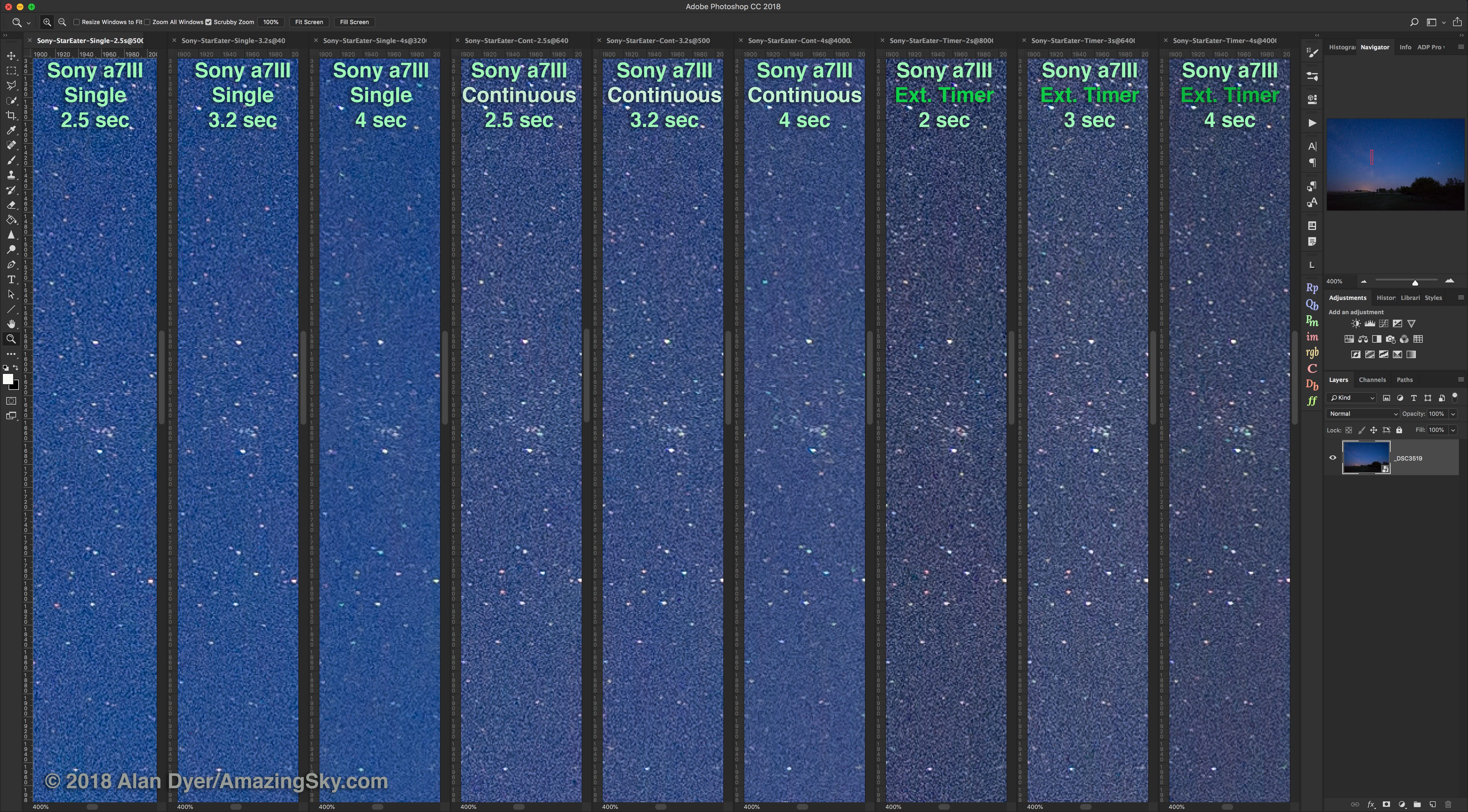
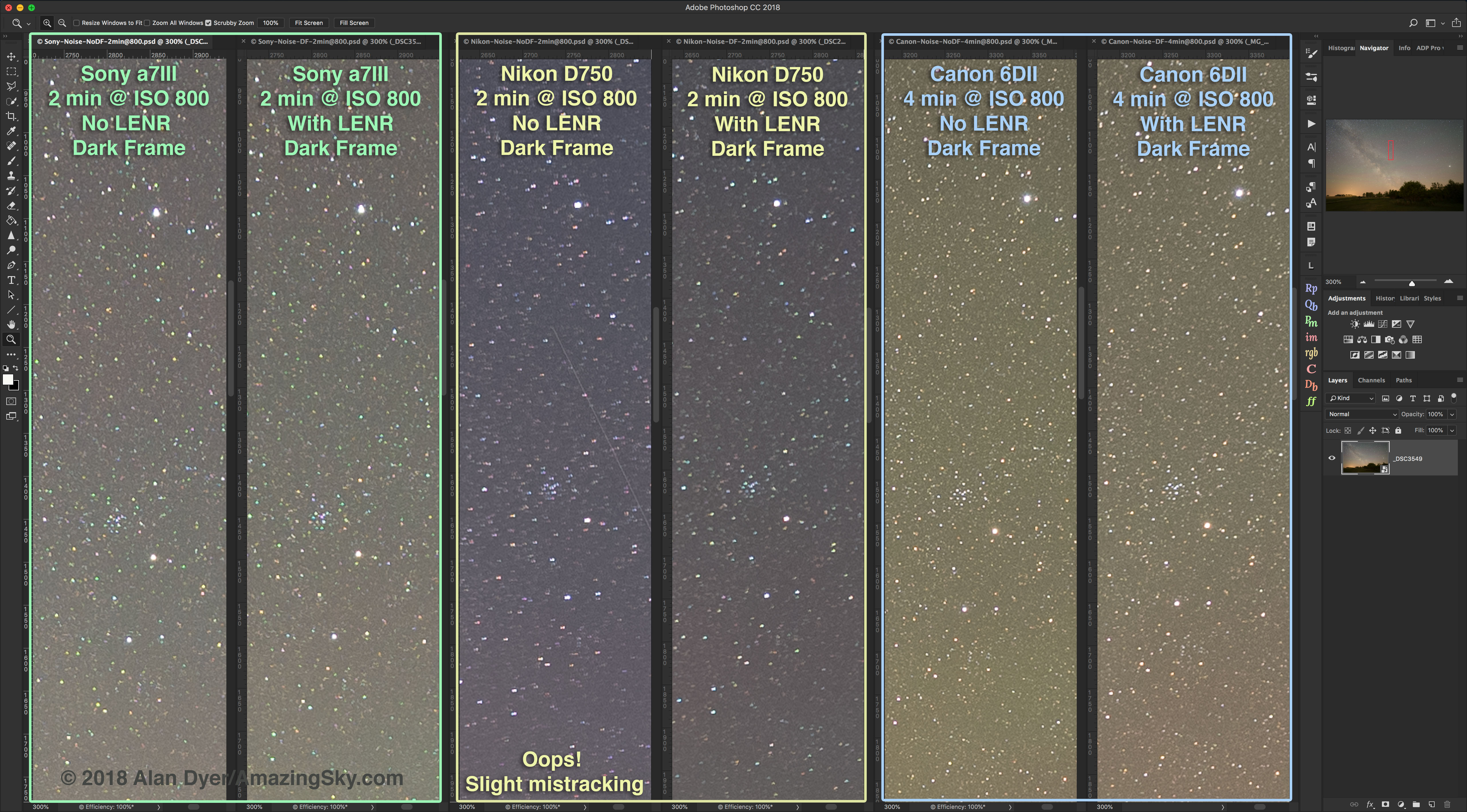
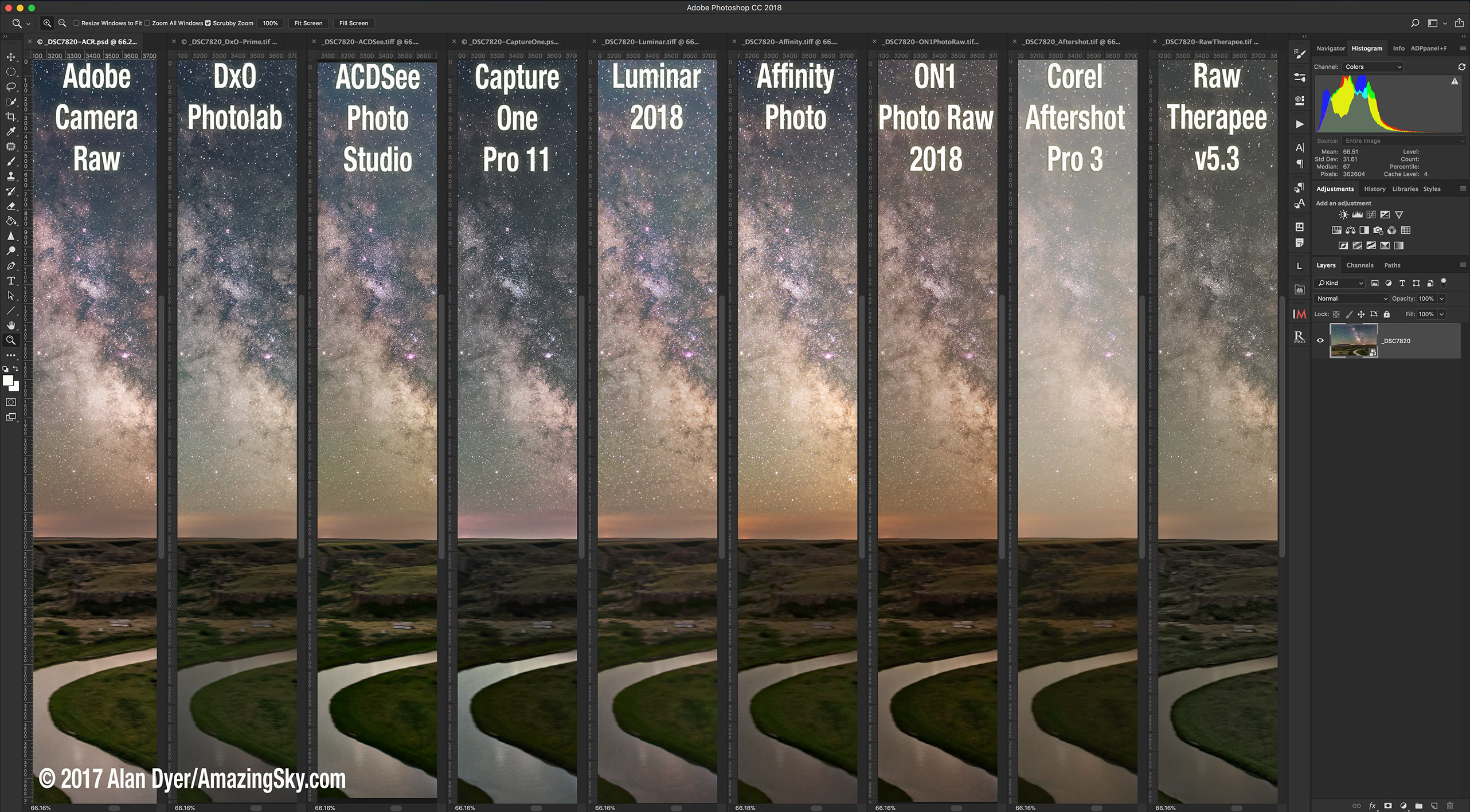


 Lightroom Contenders: Five Raw Developers
 Photoshop Contenders: Four Raw Developers with Layering/Compositing
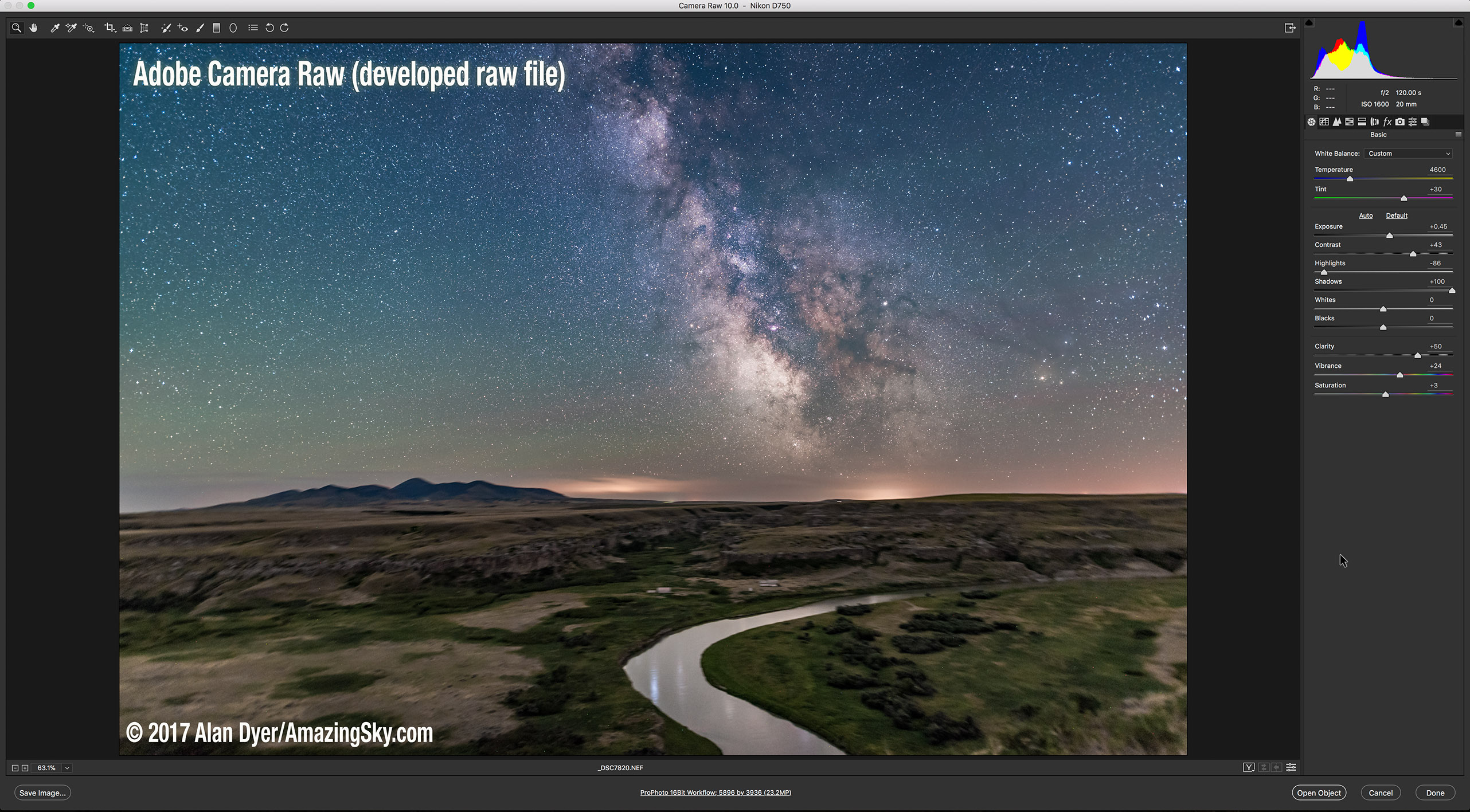

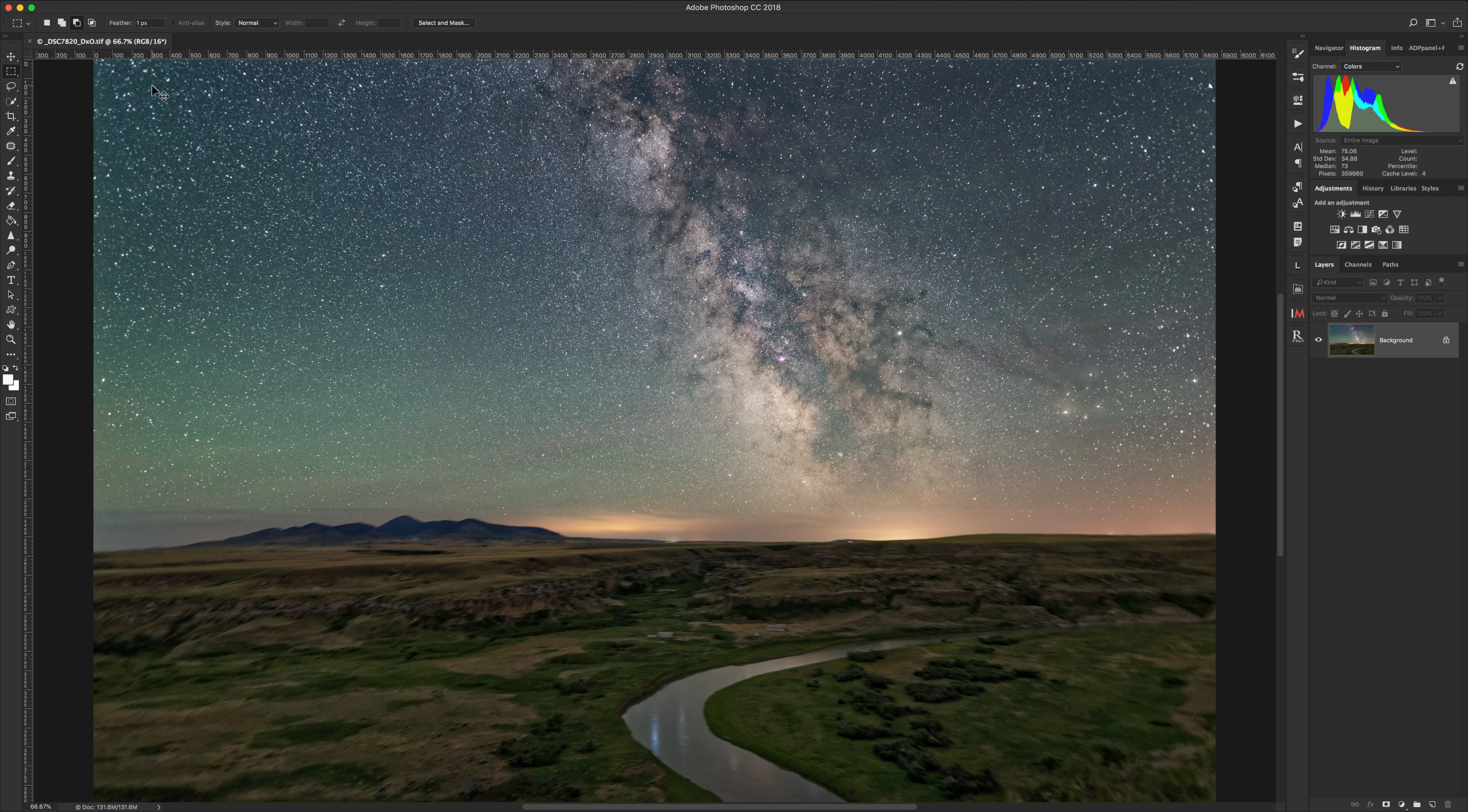


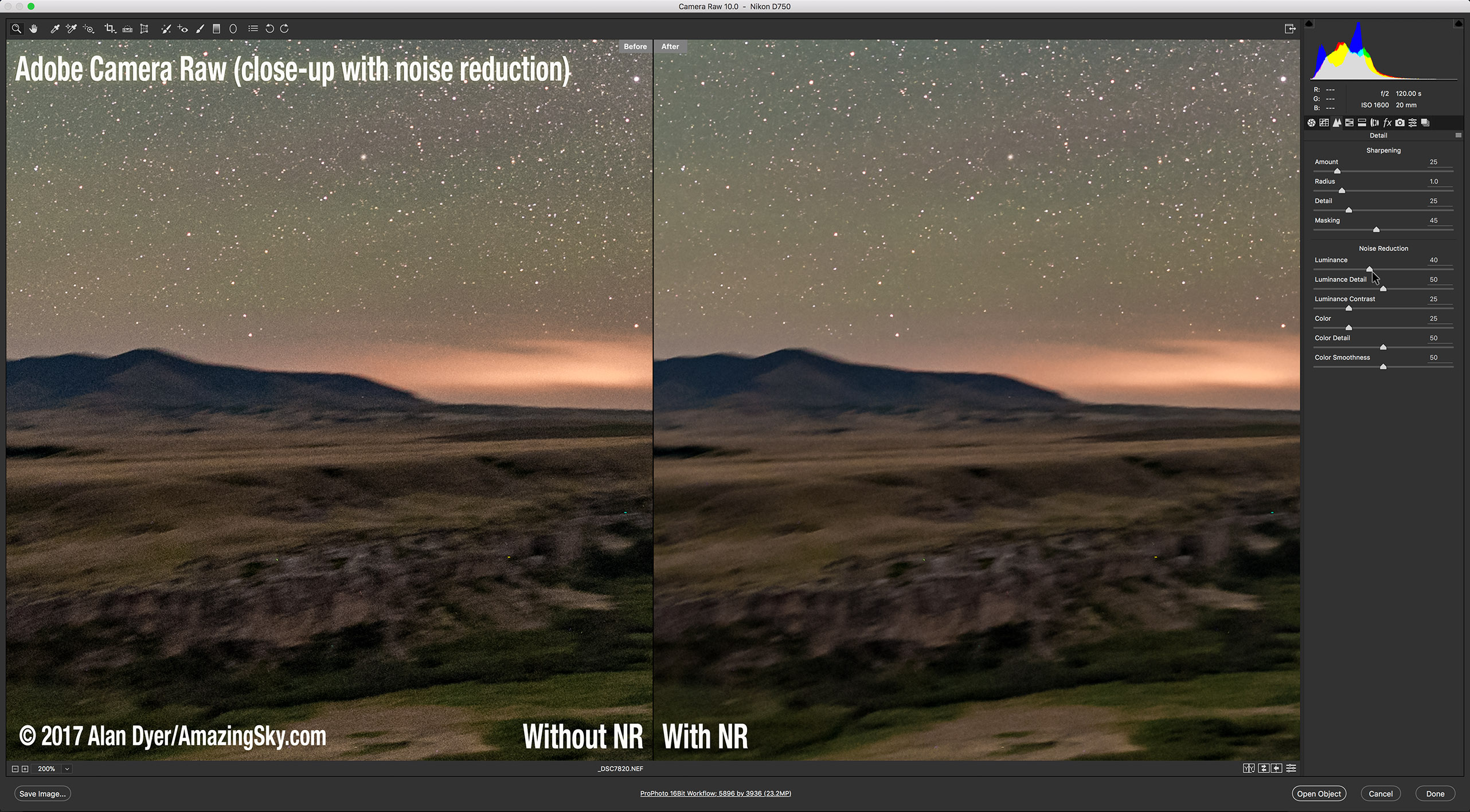
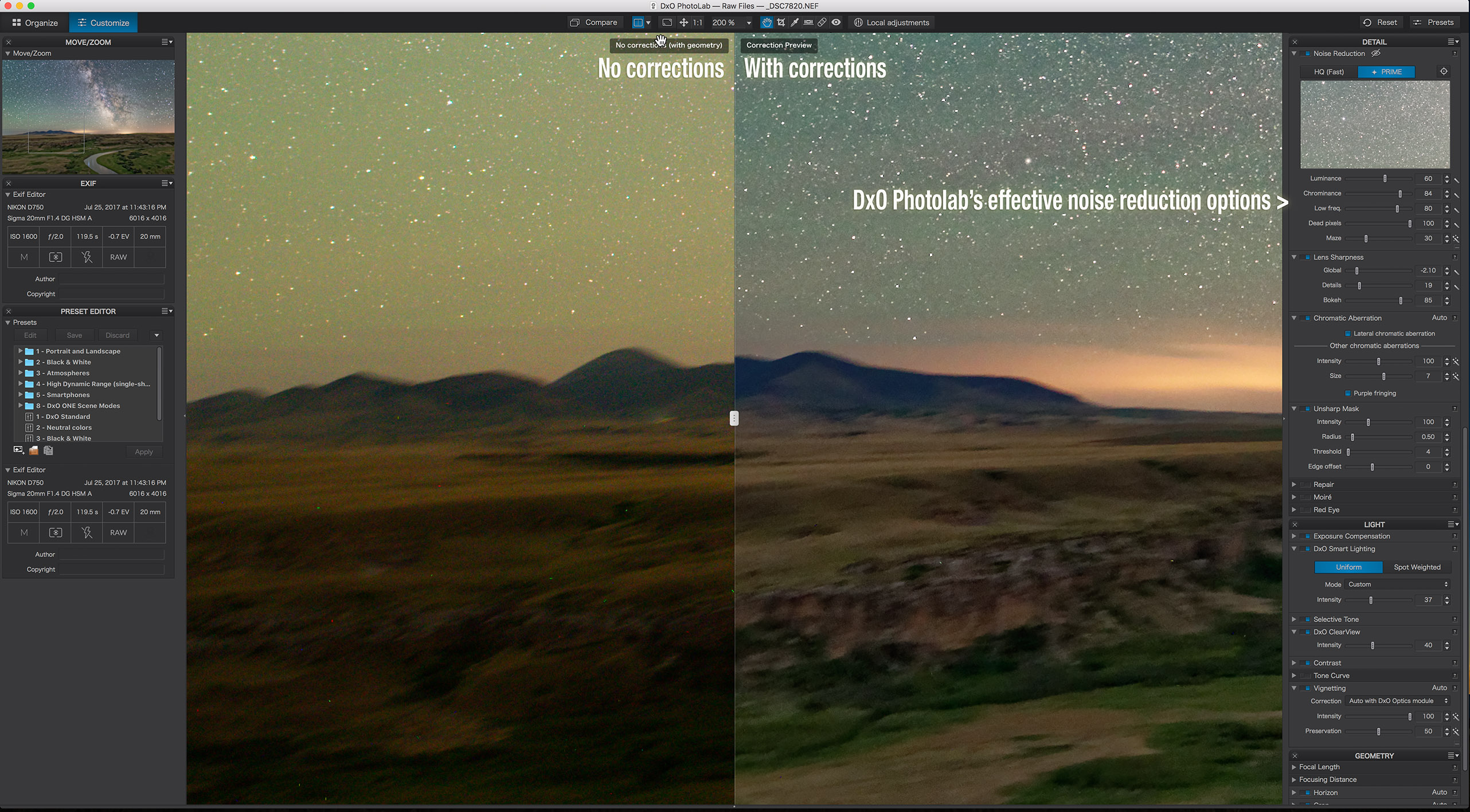

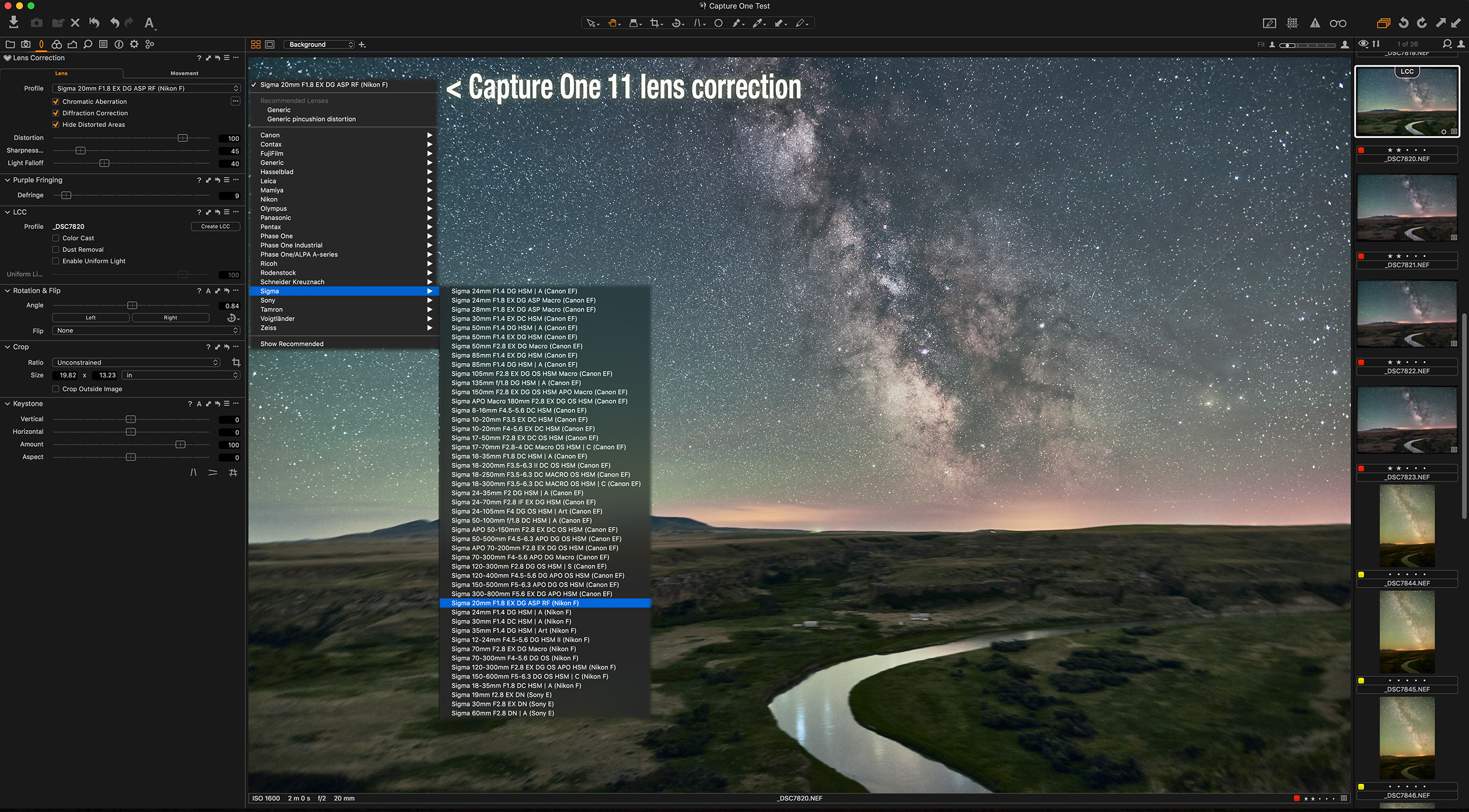

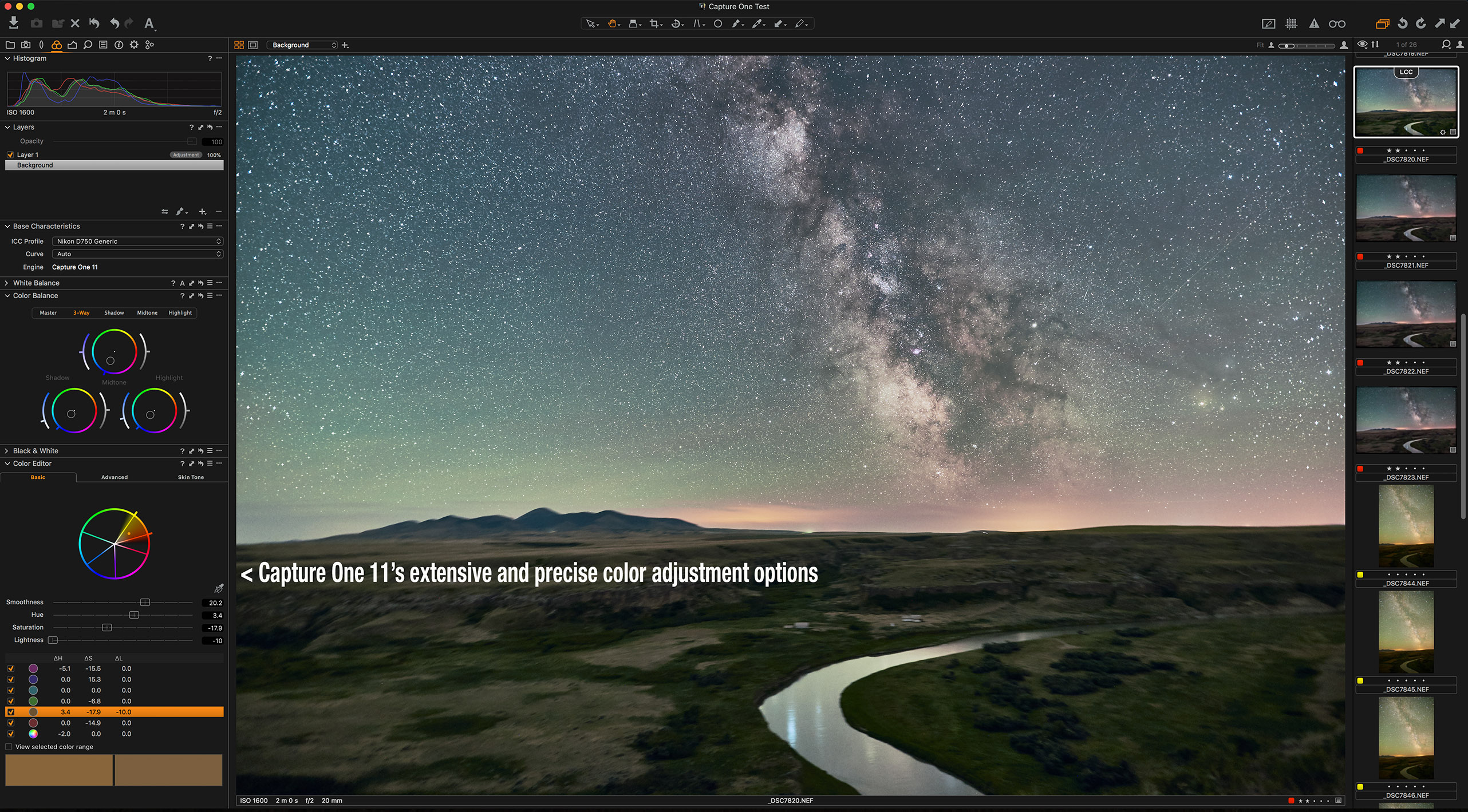
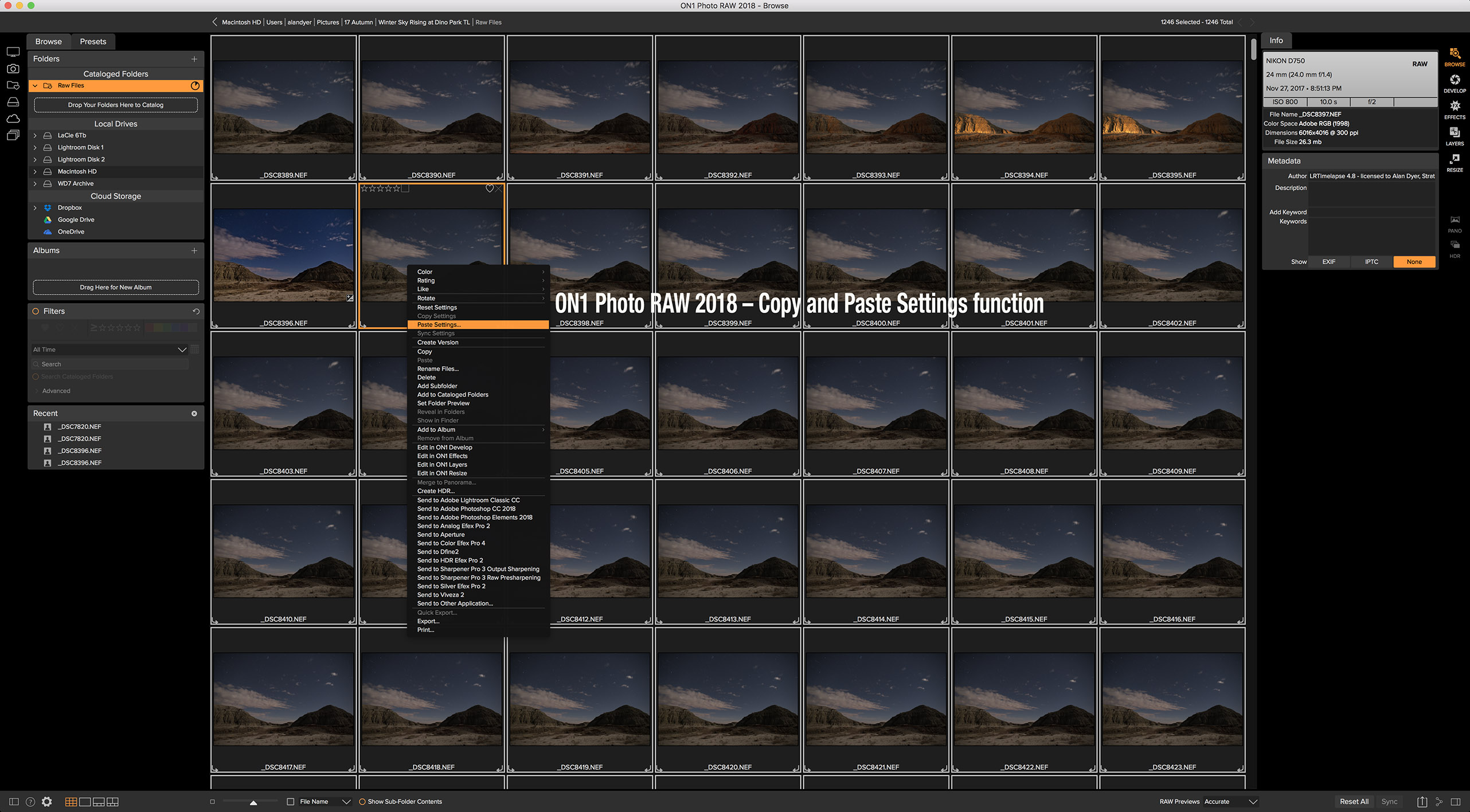
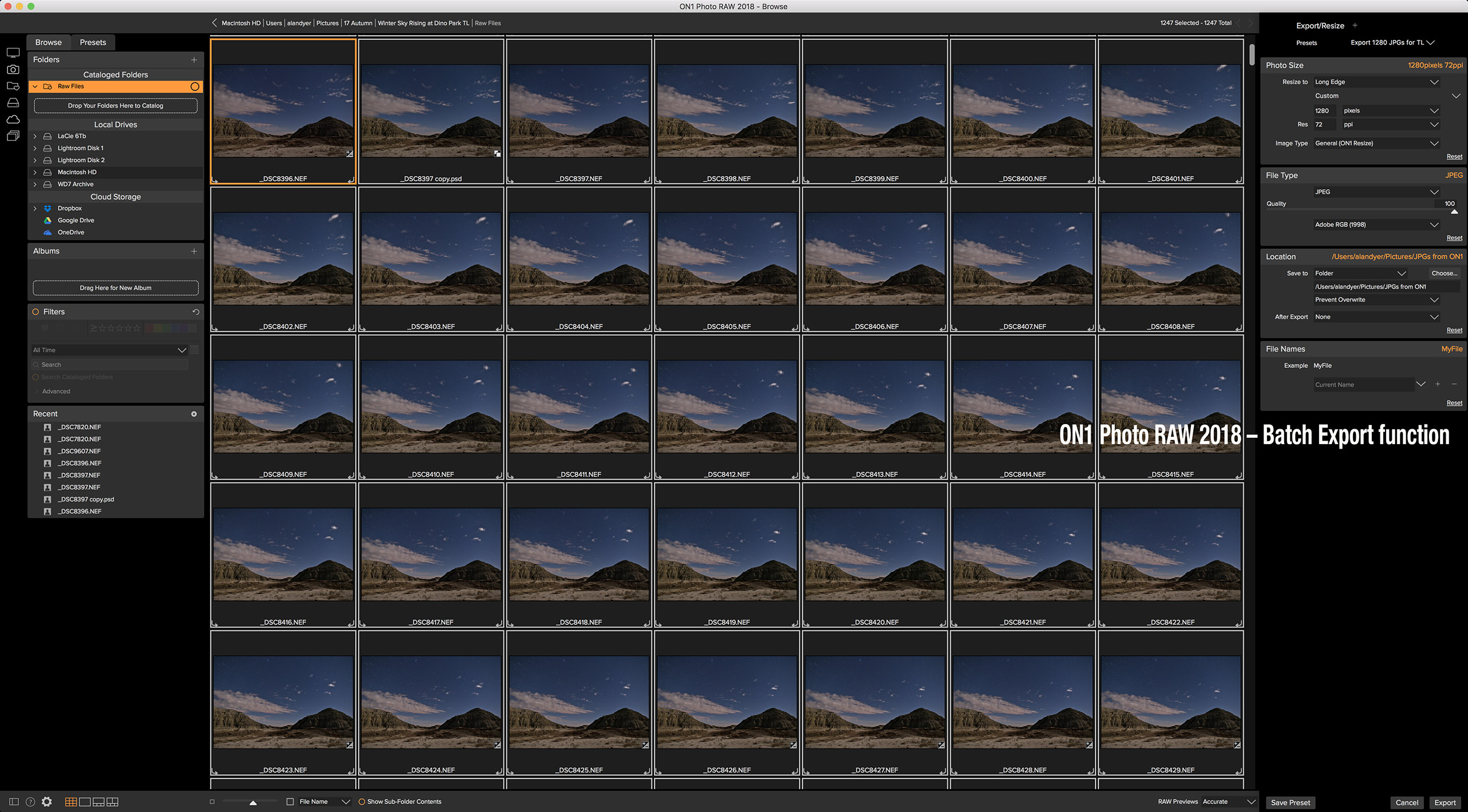
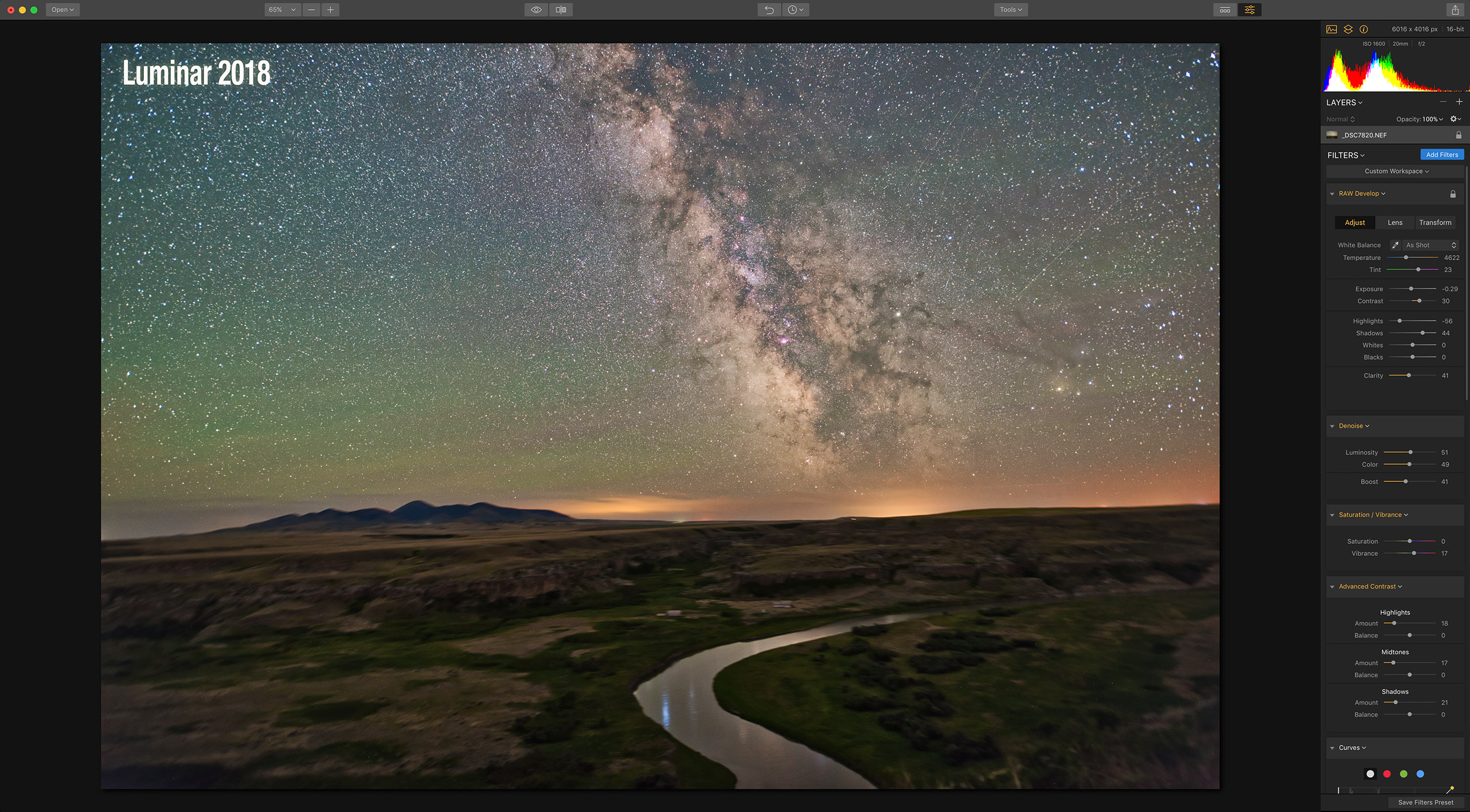
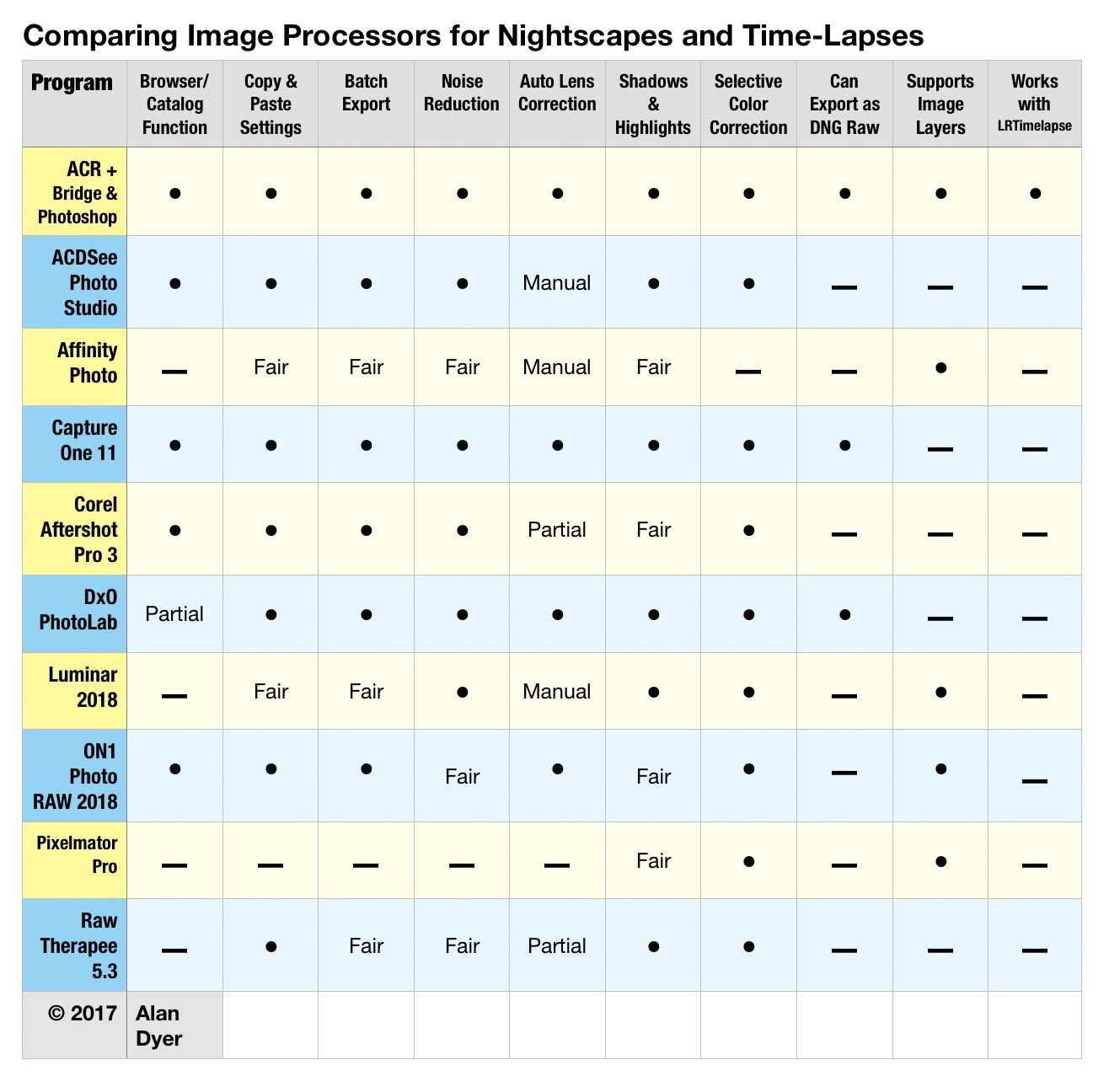


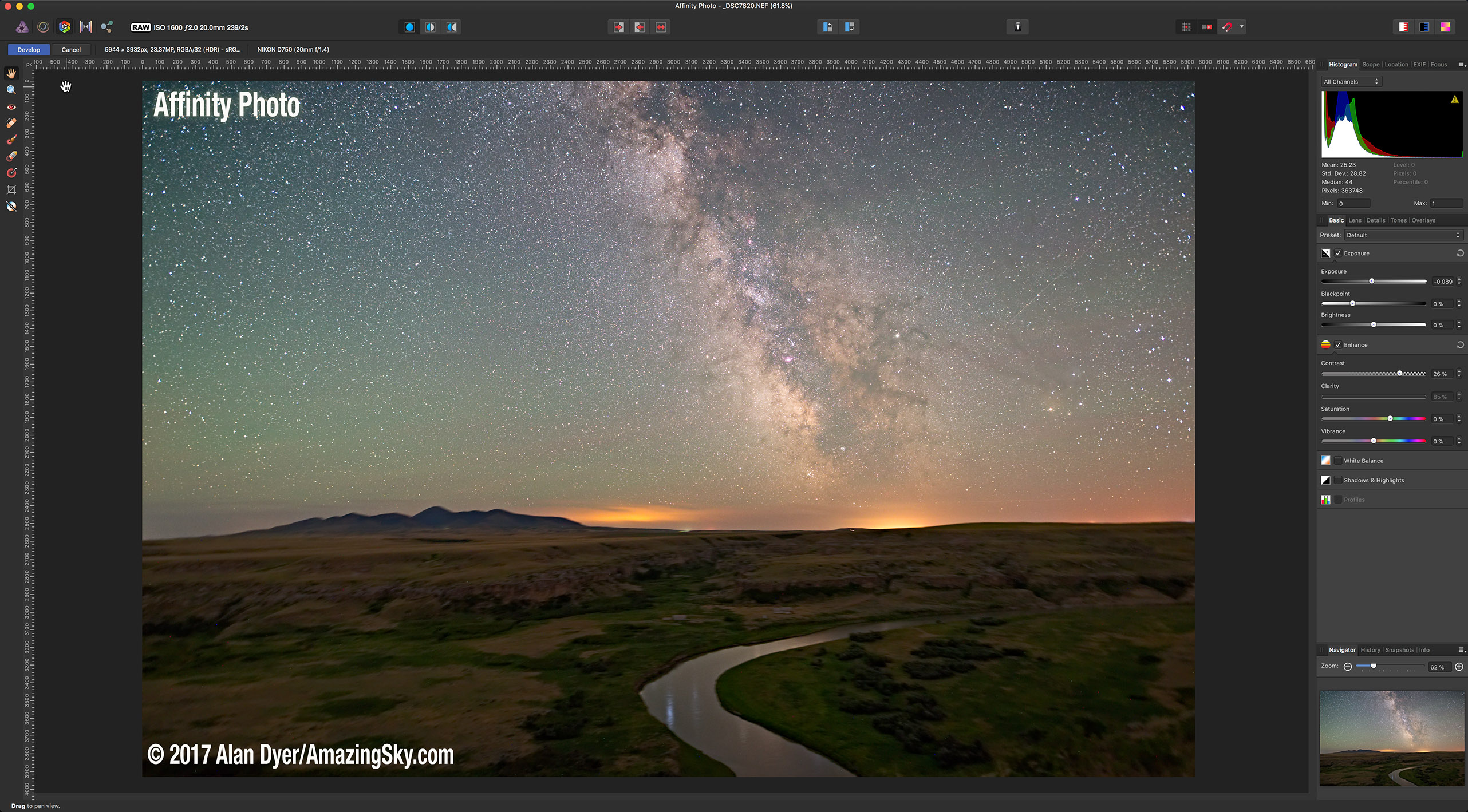

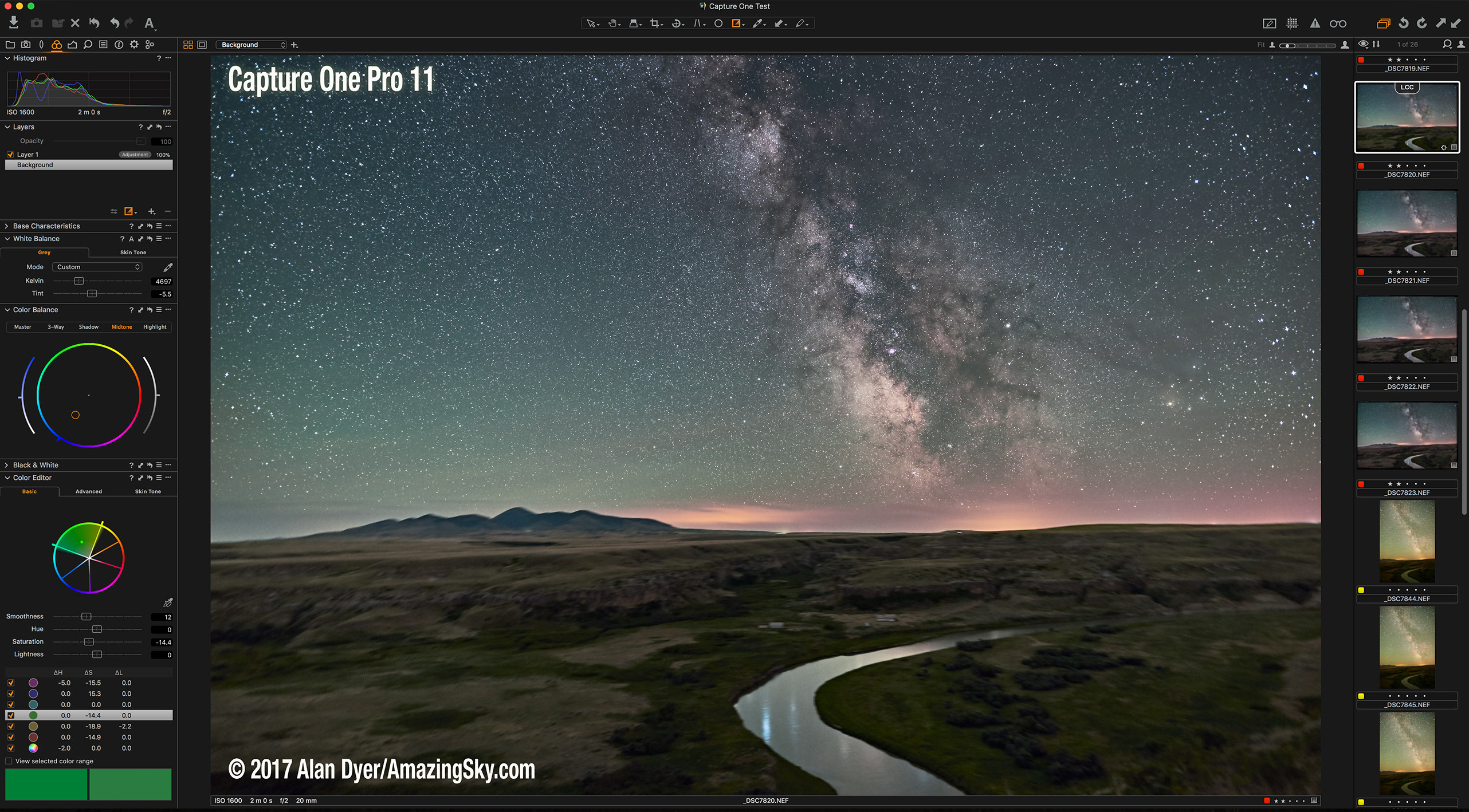
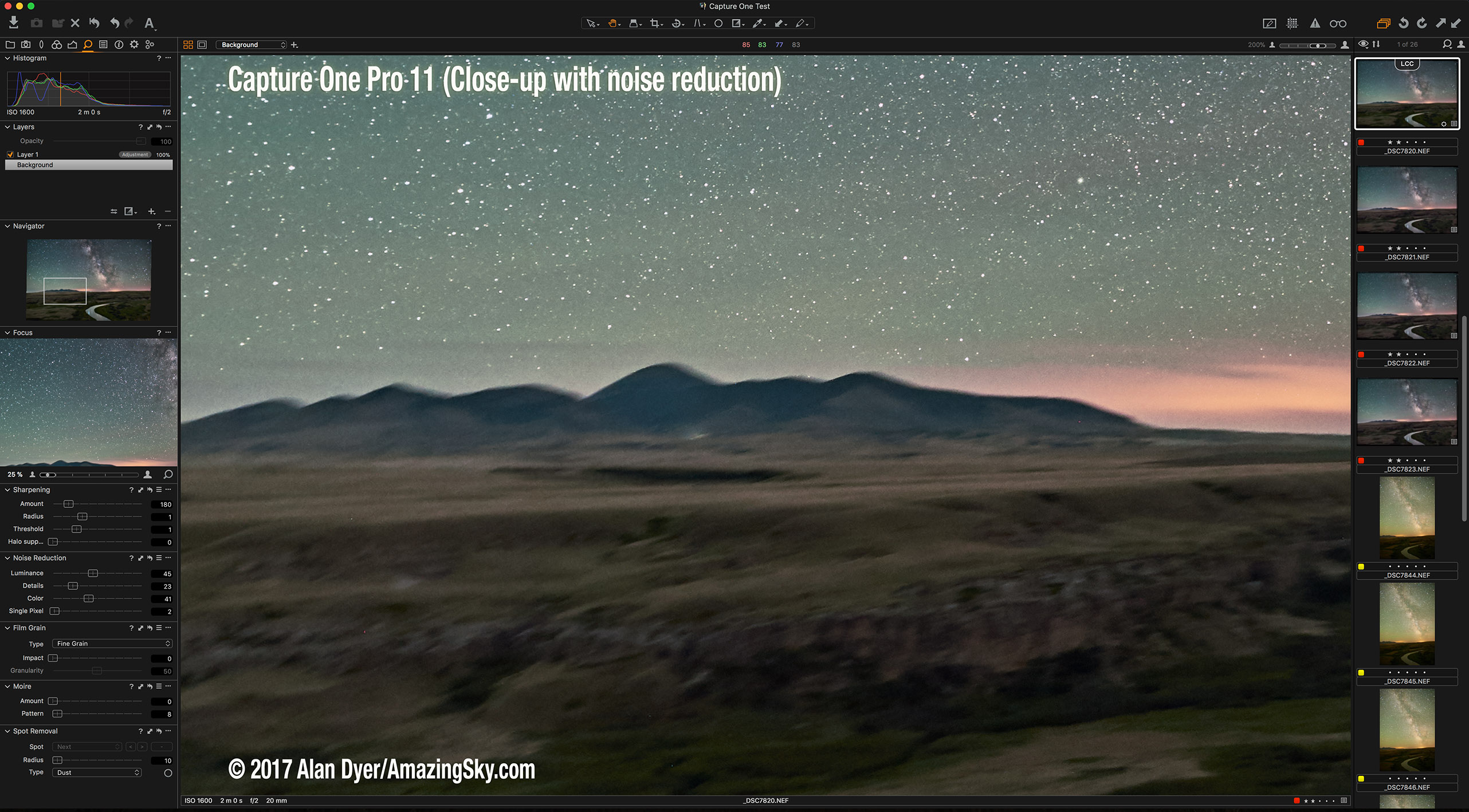
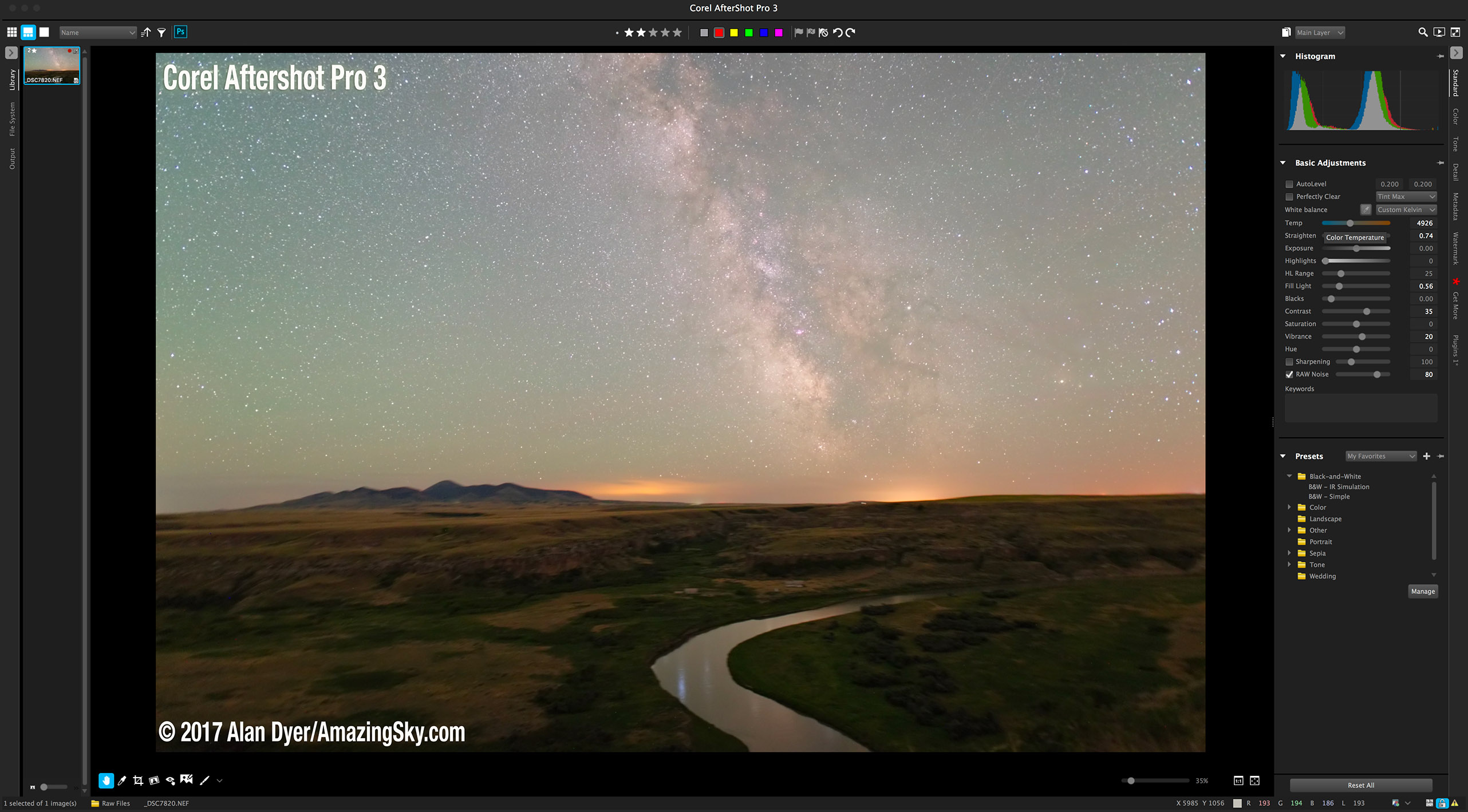


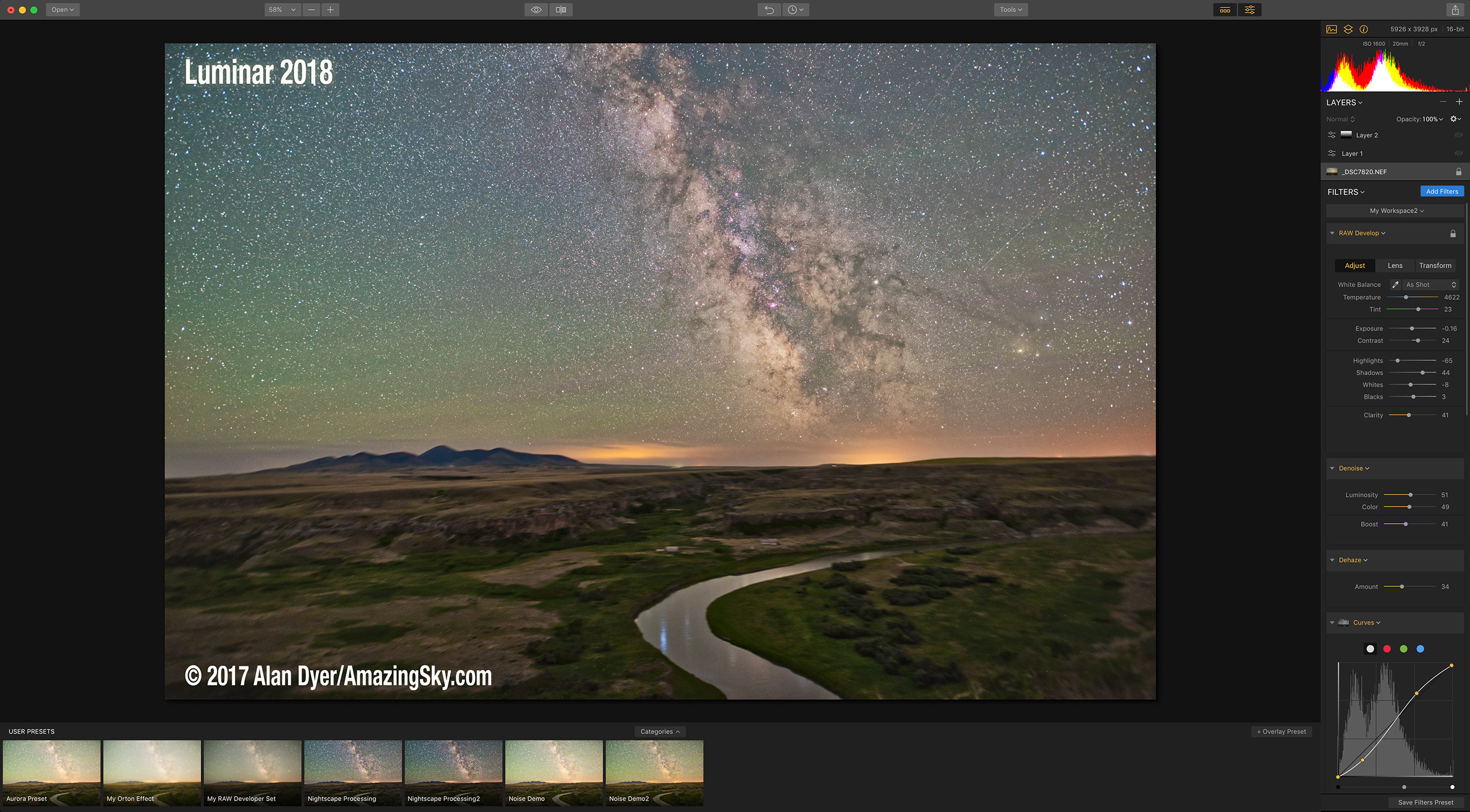
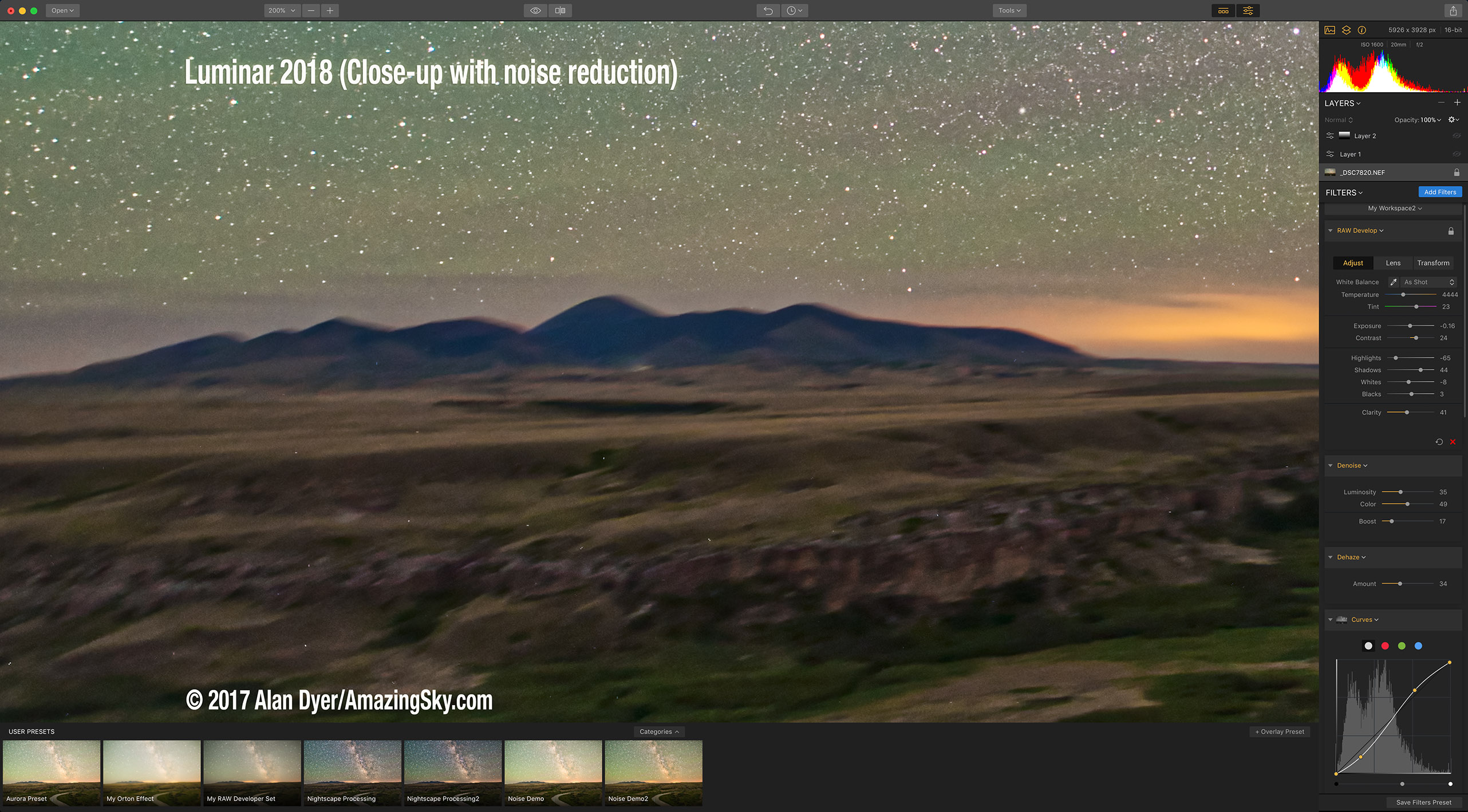
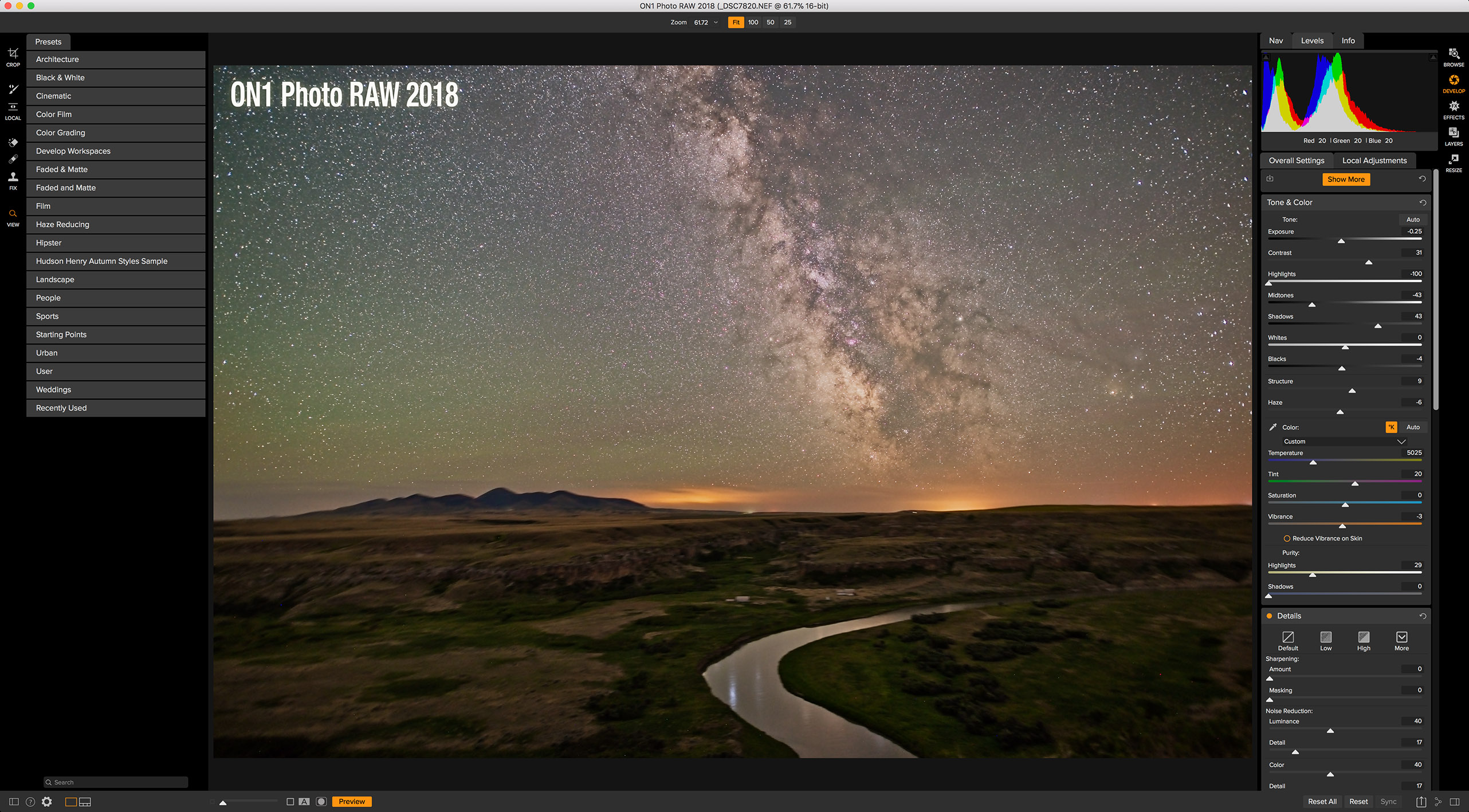
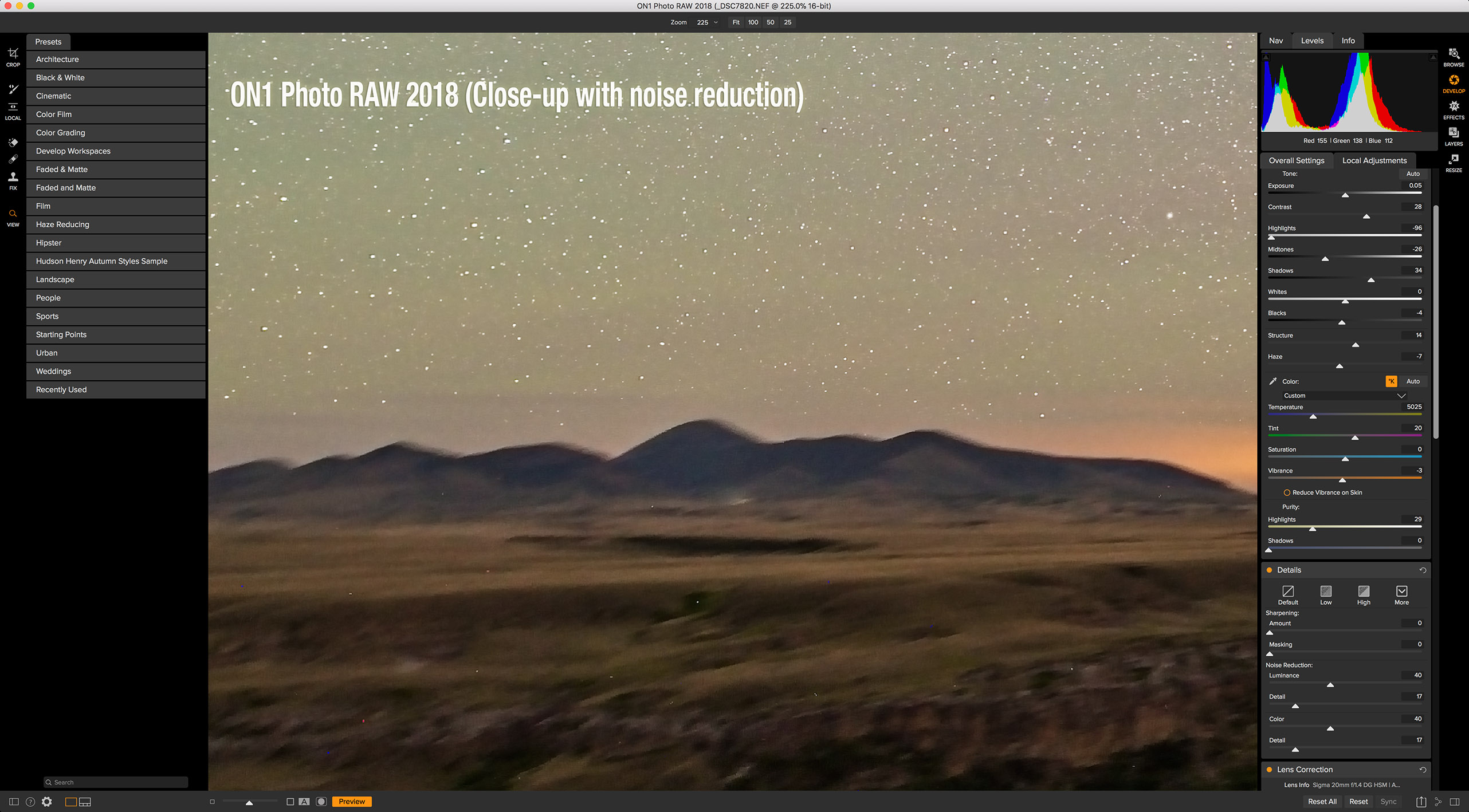
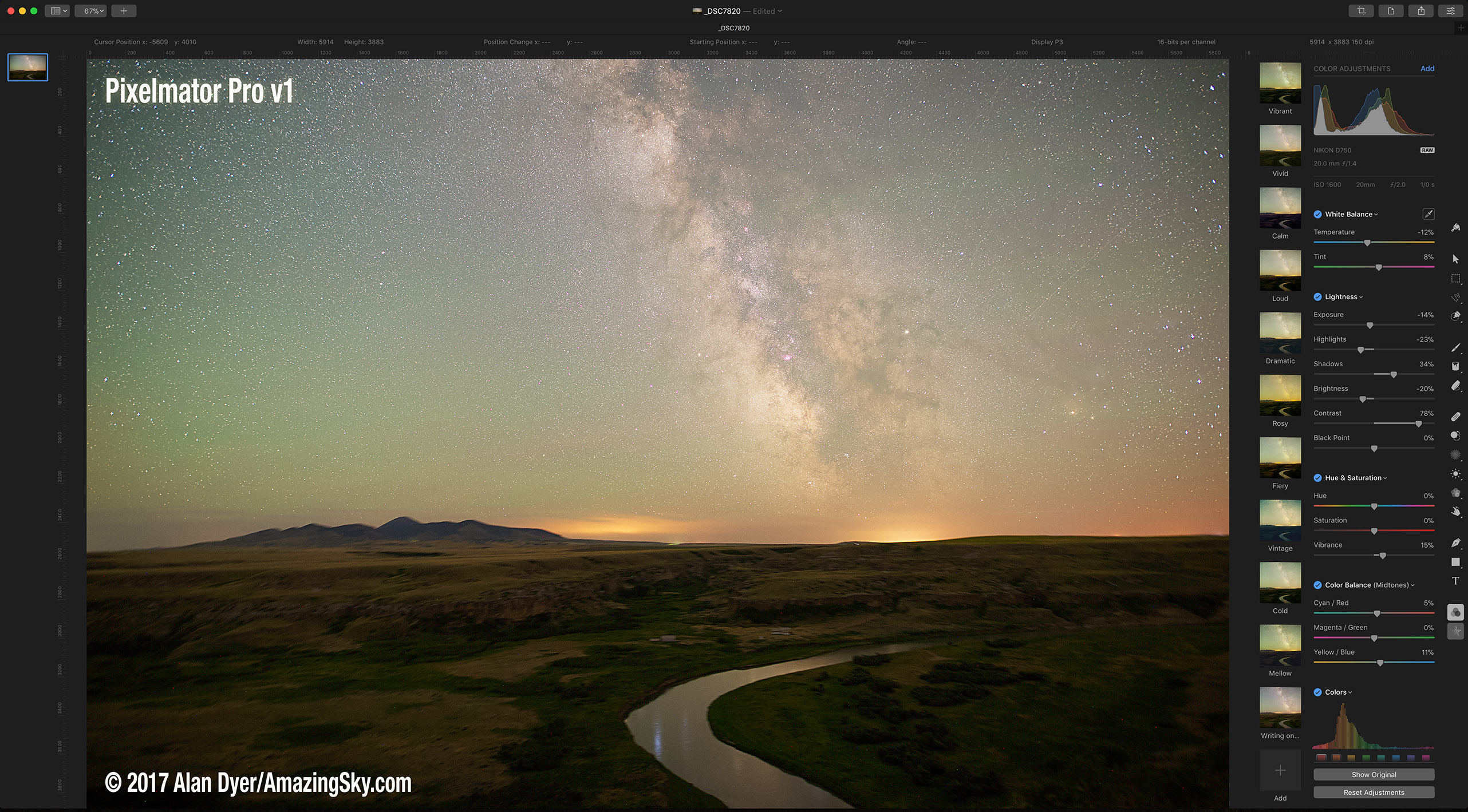
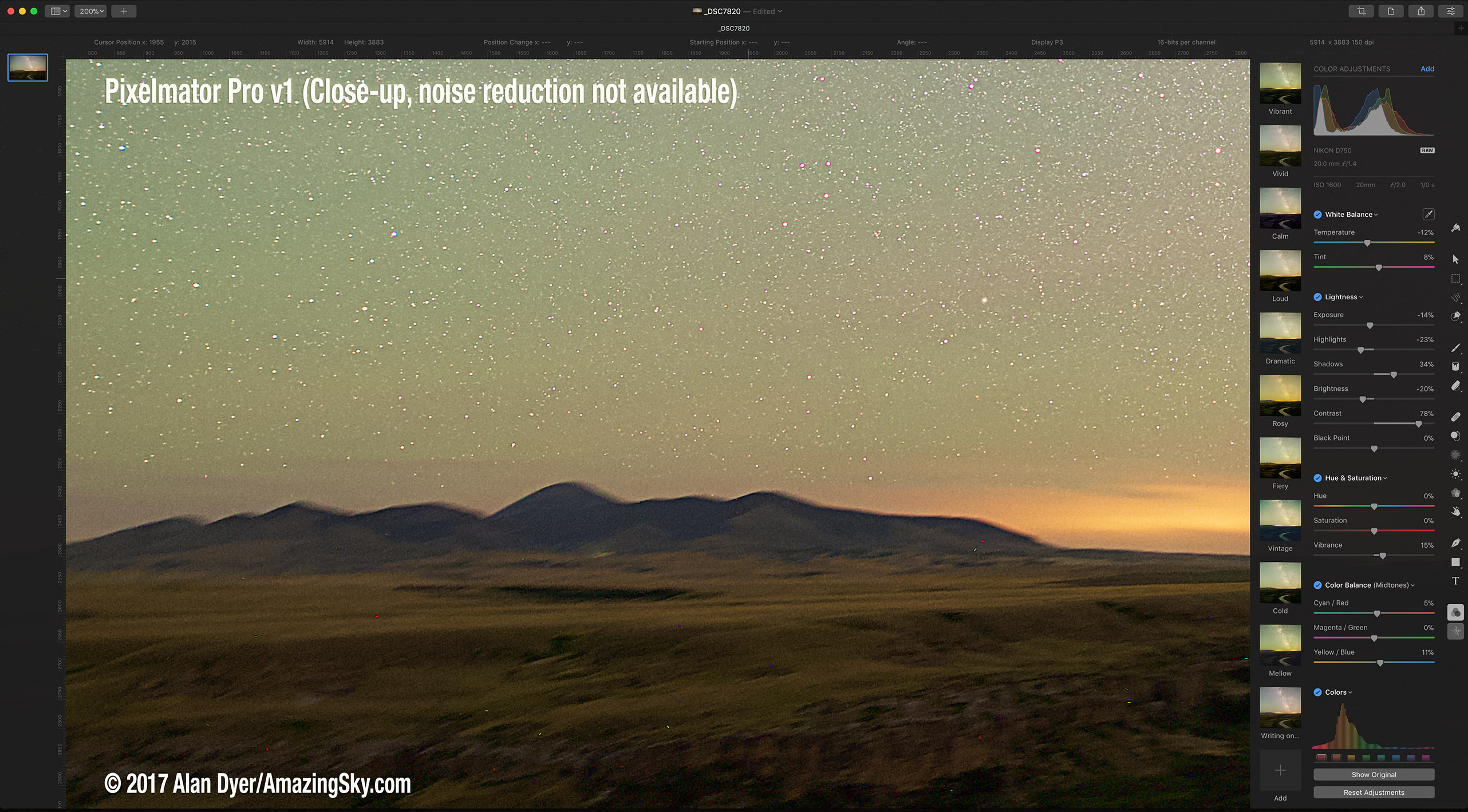
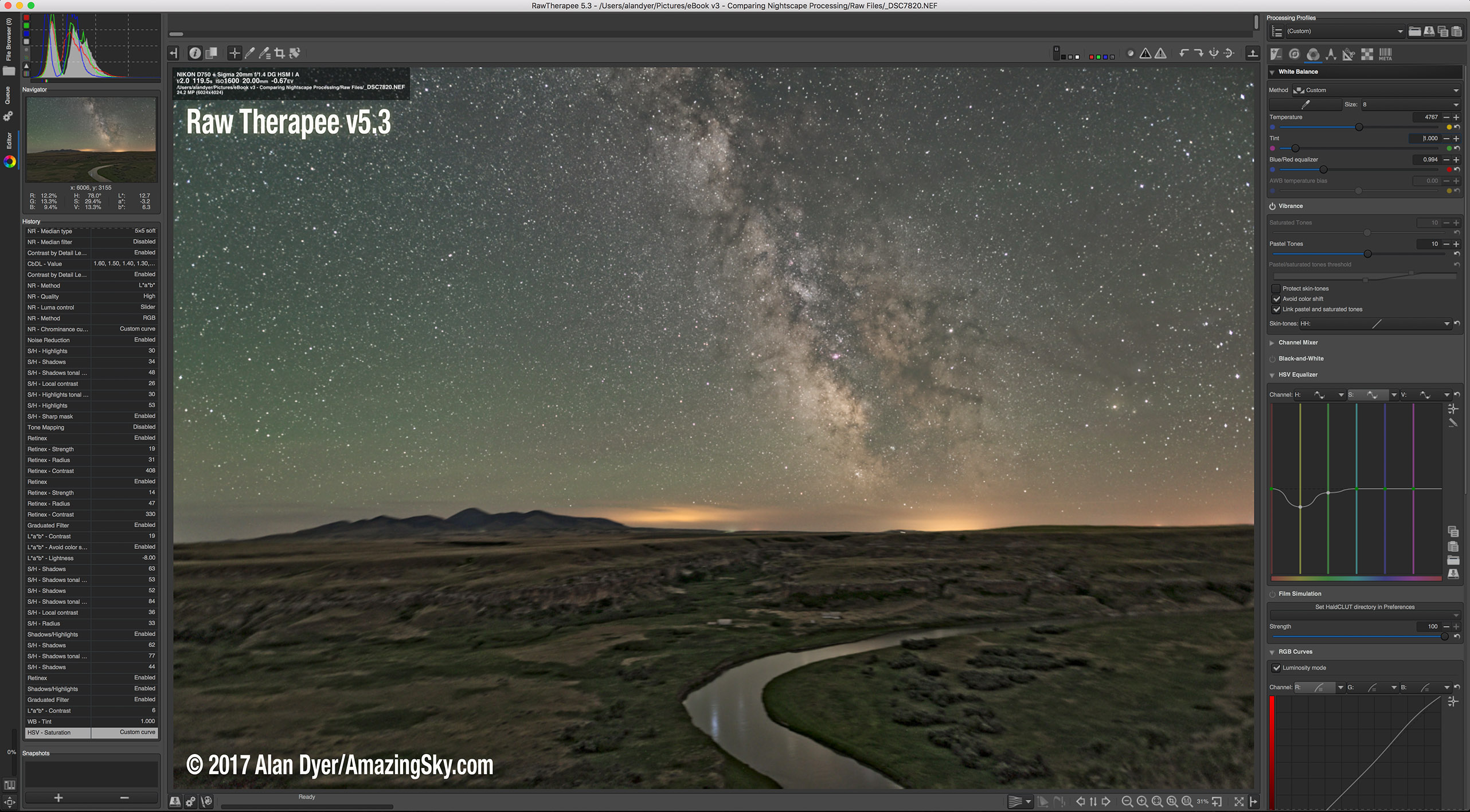
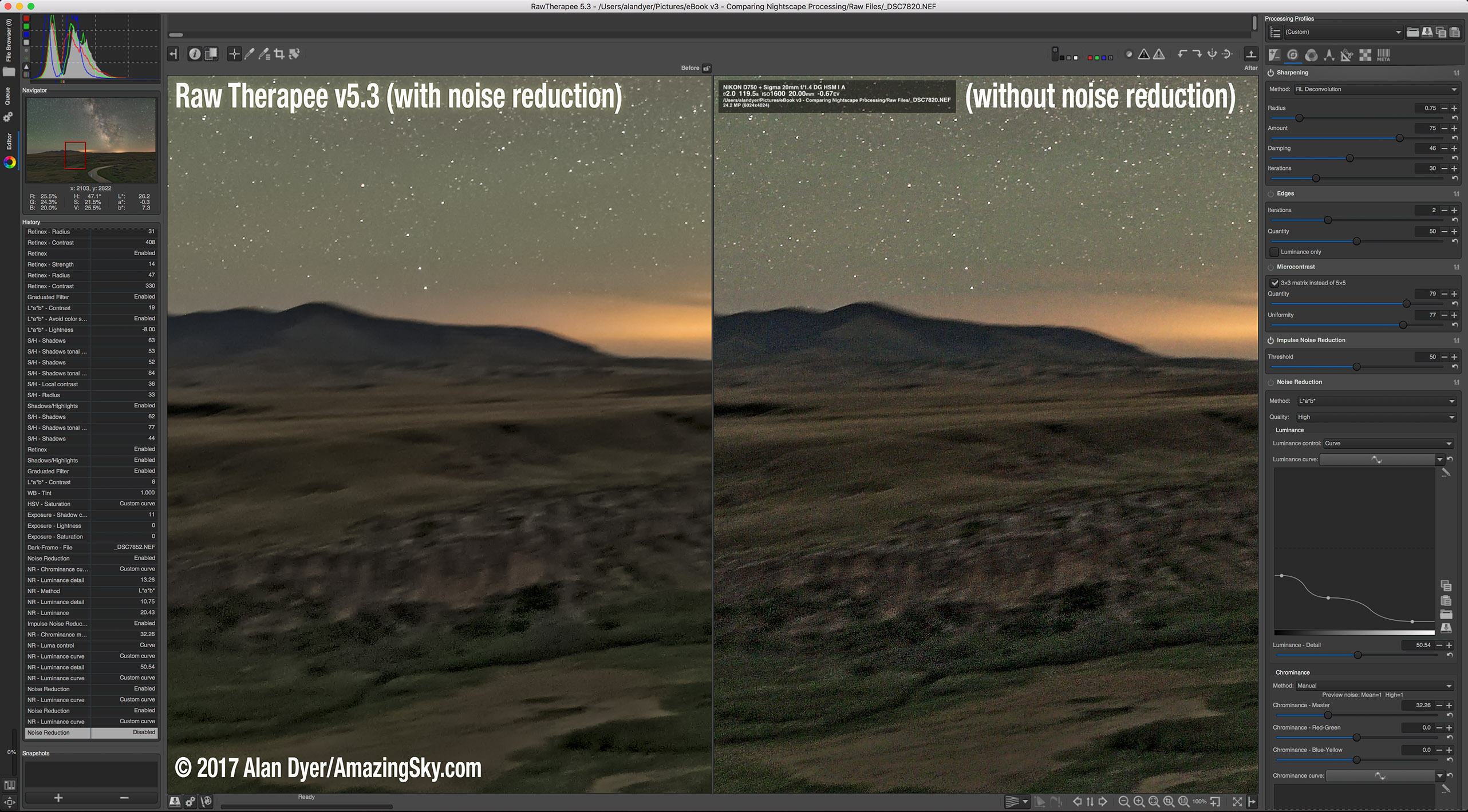


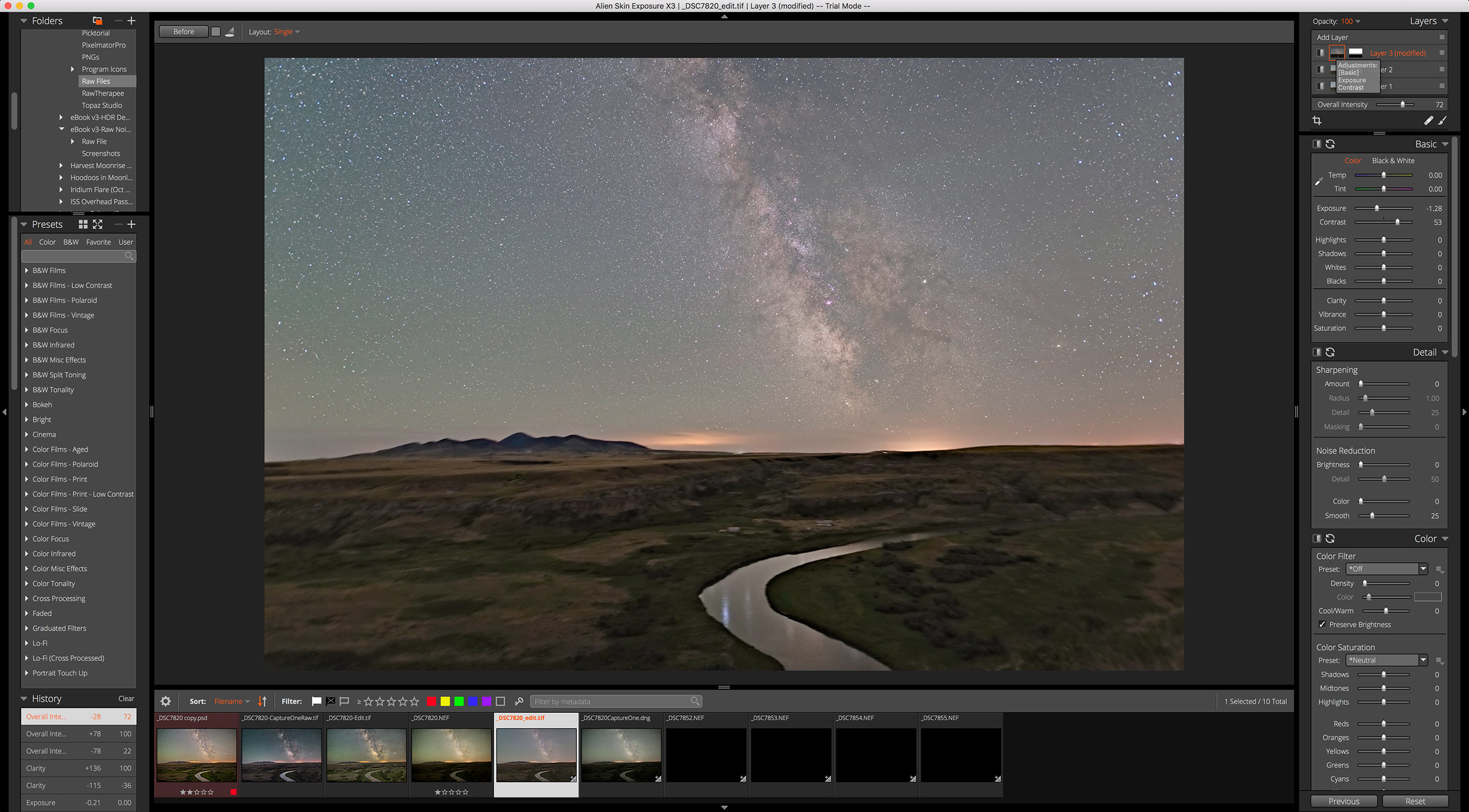
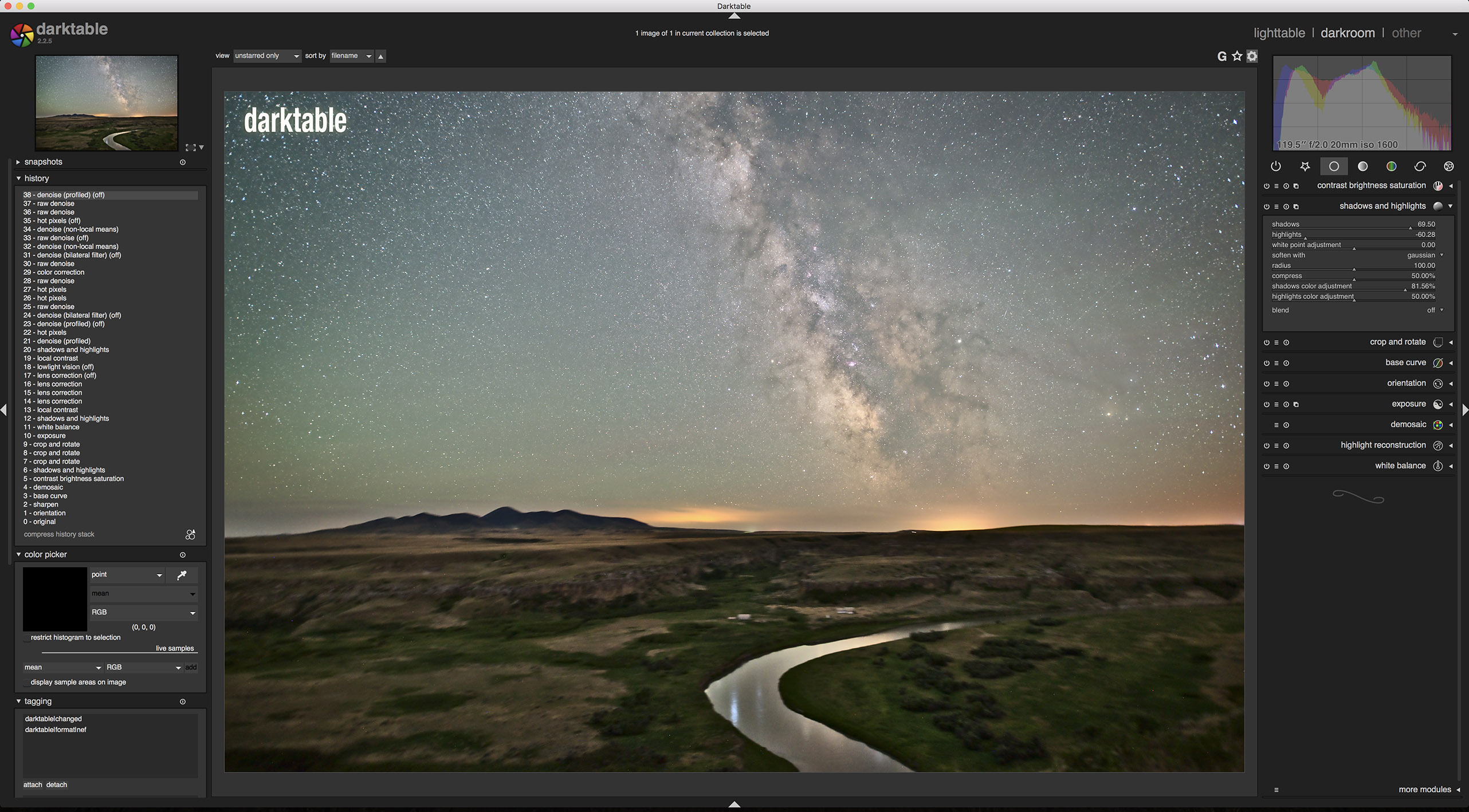
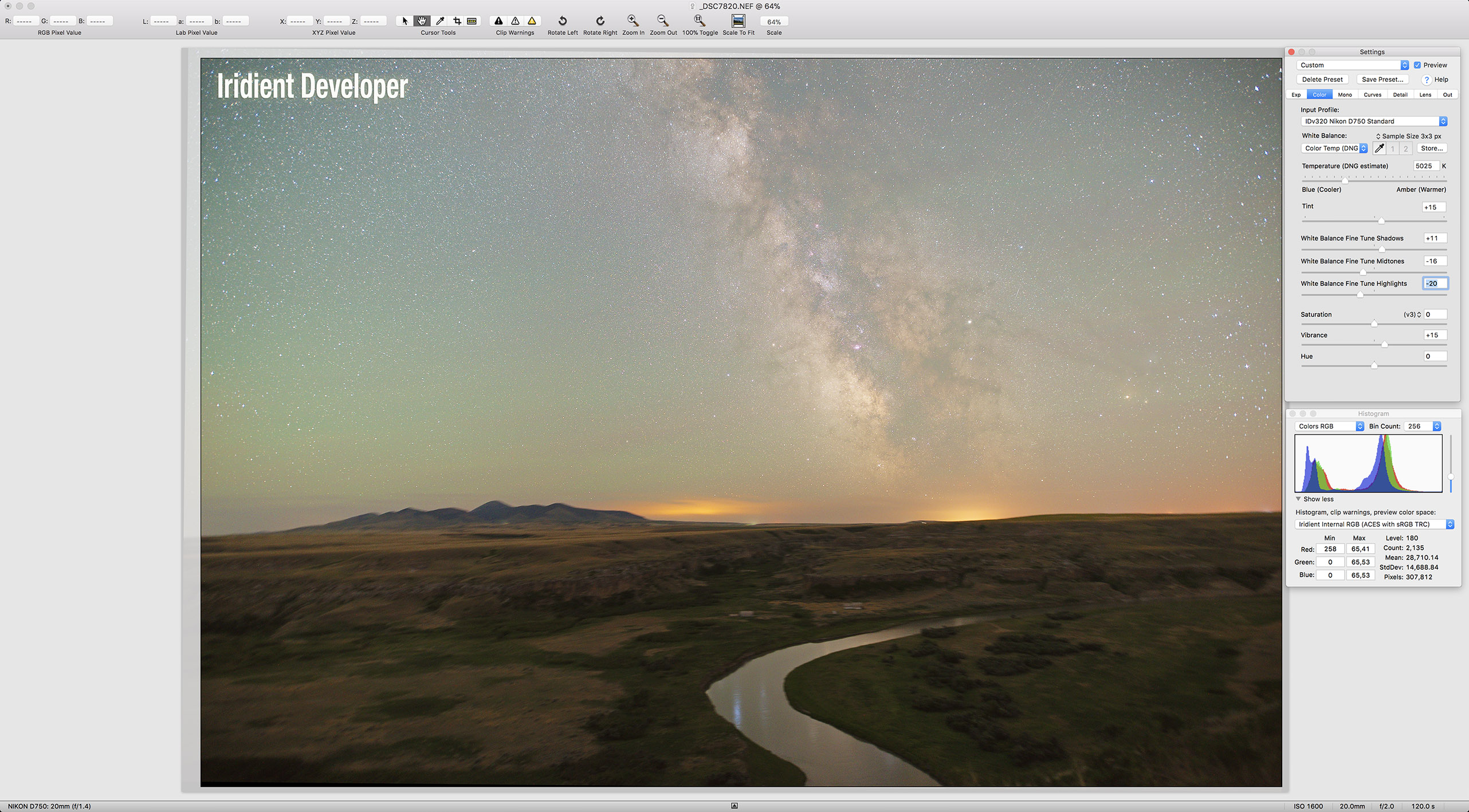
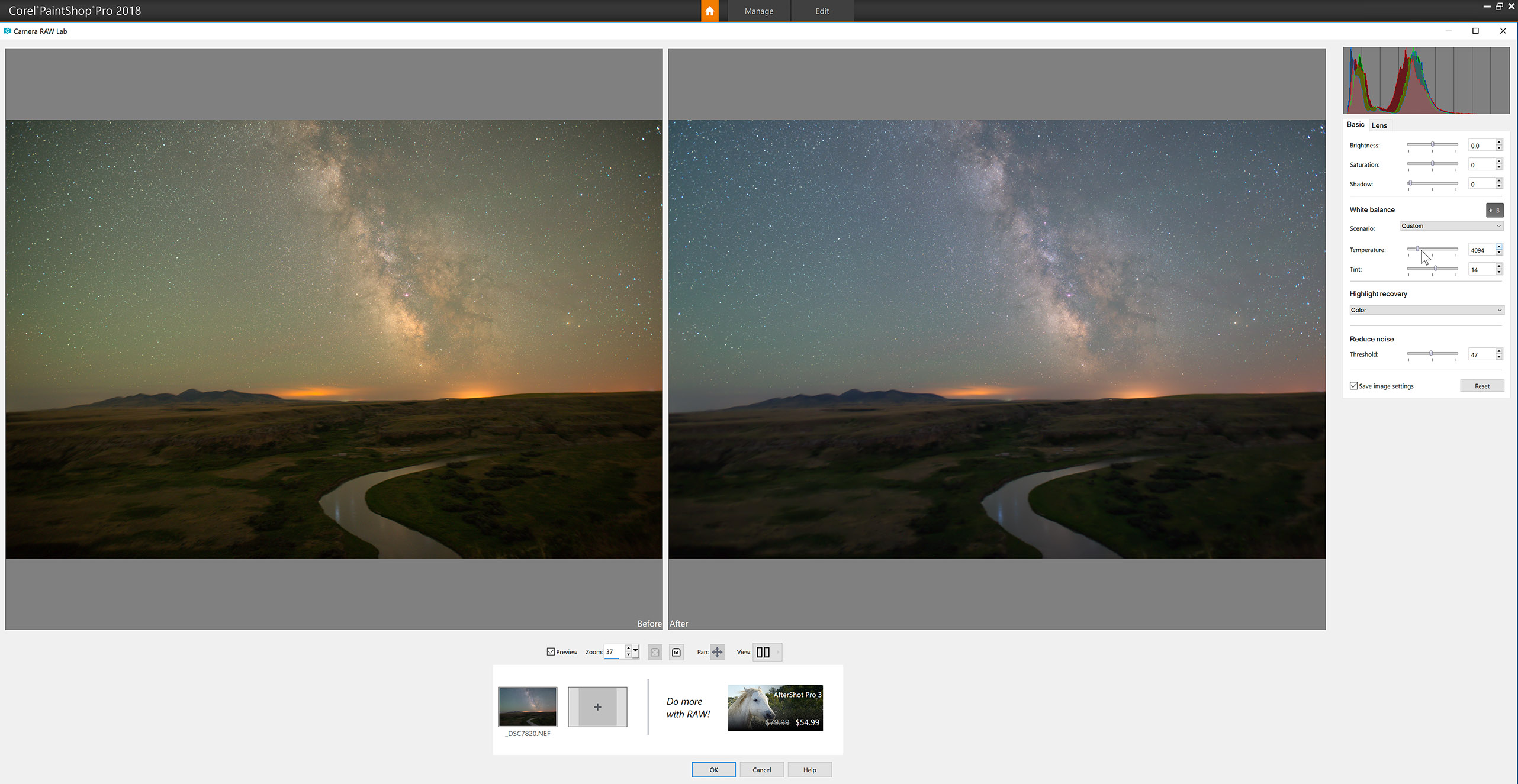
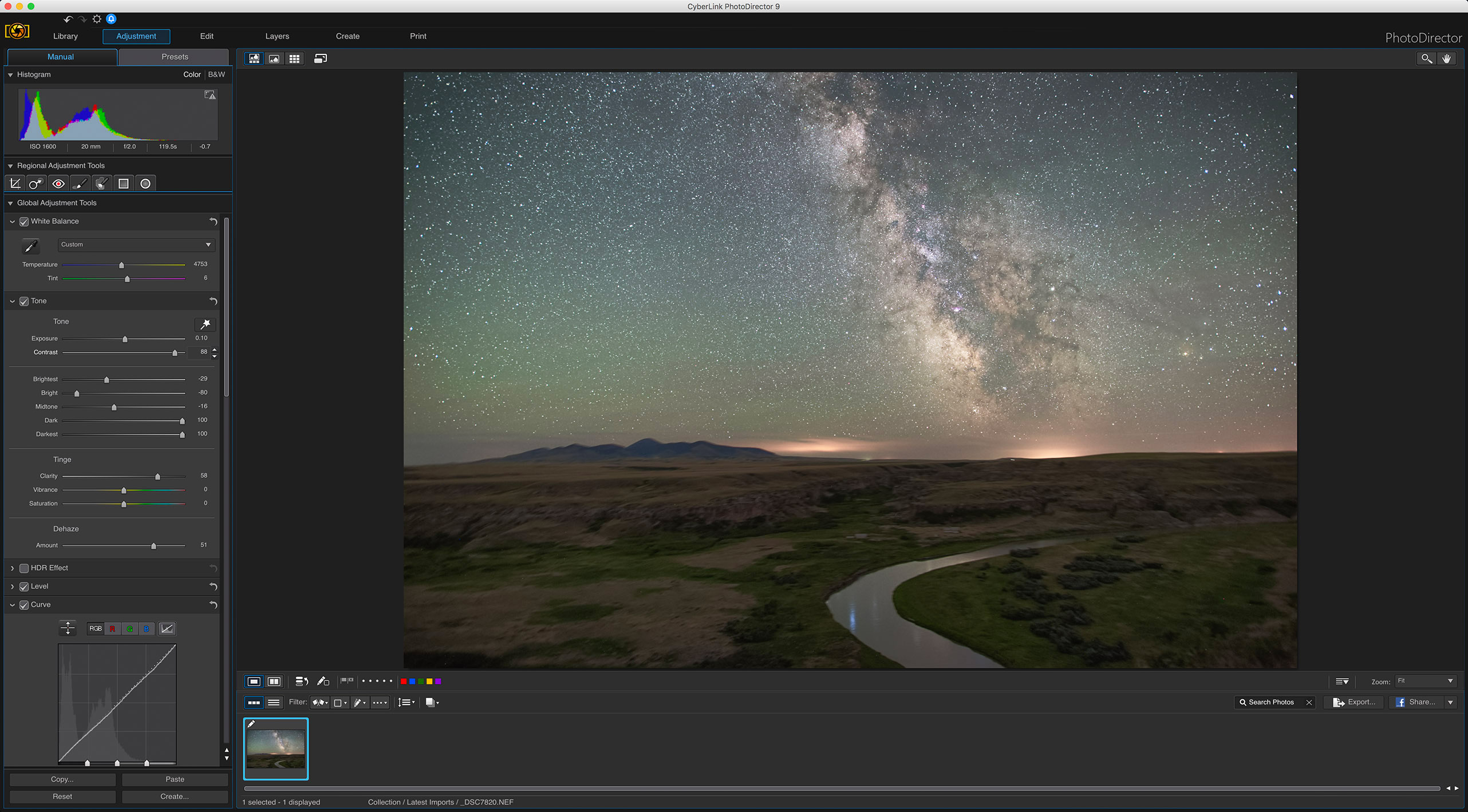
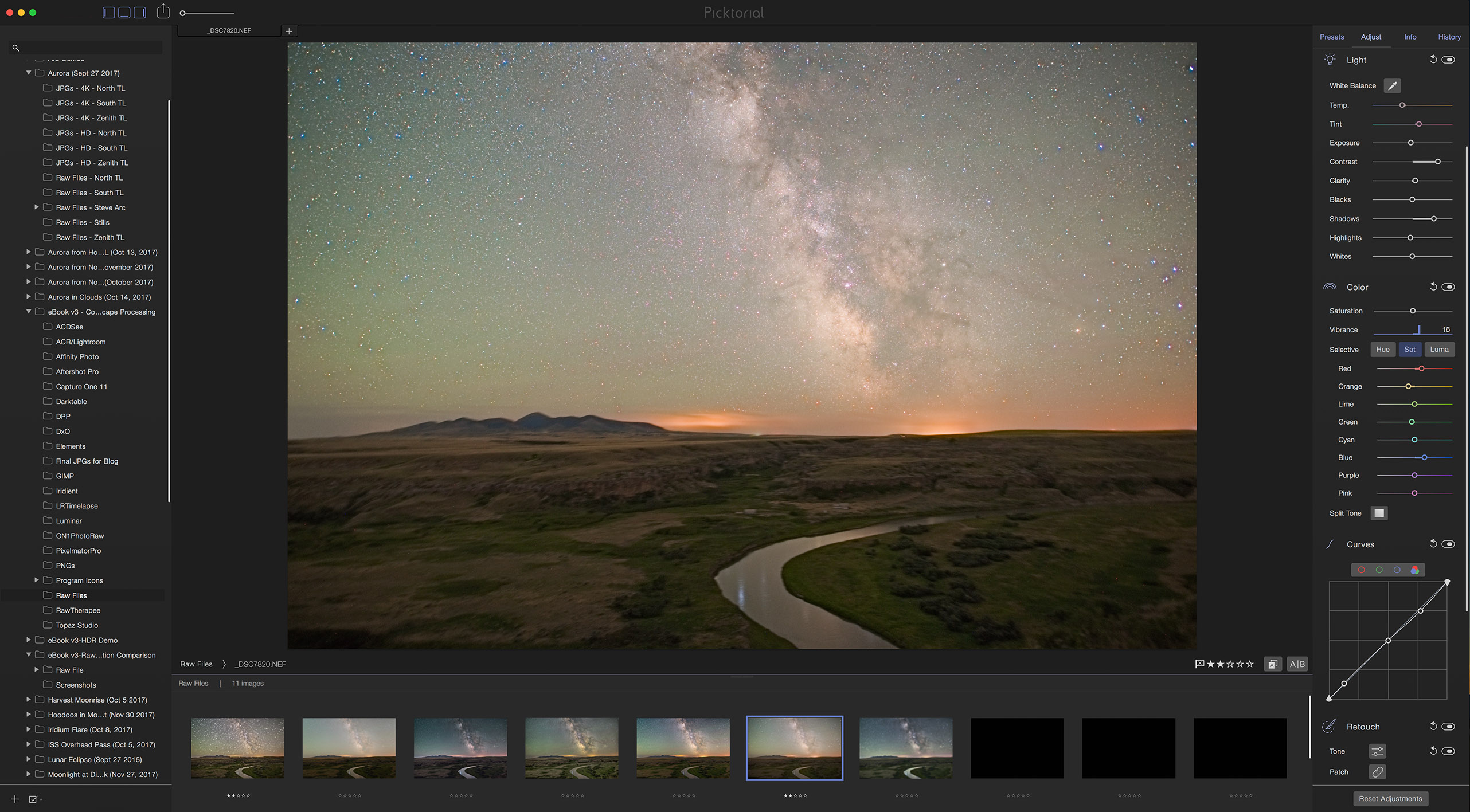
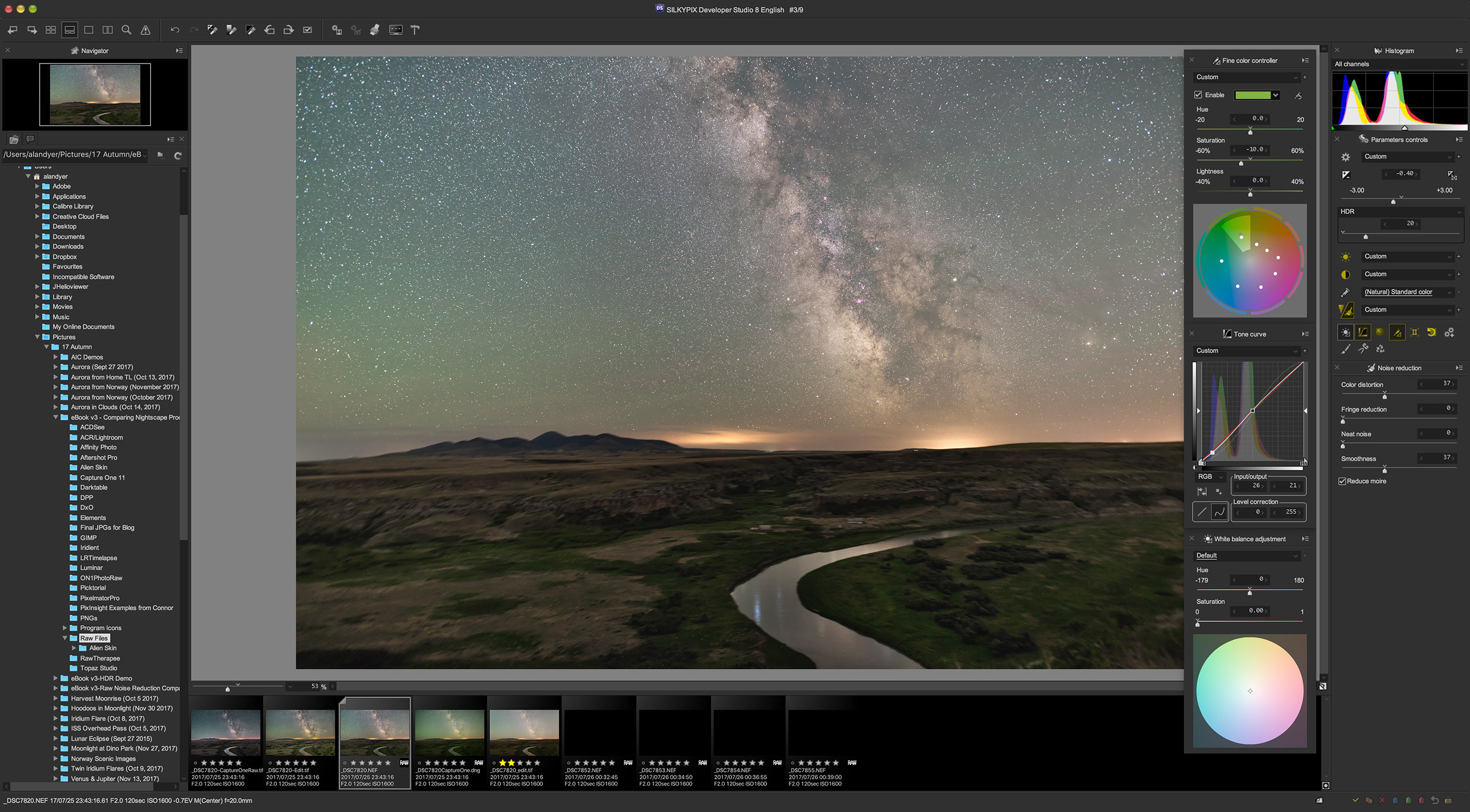
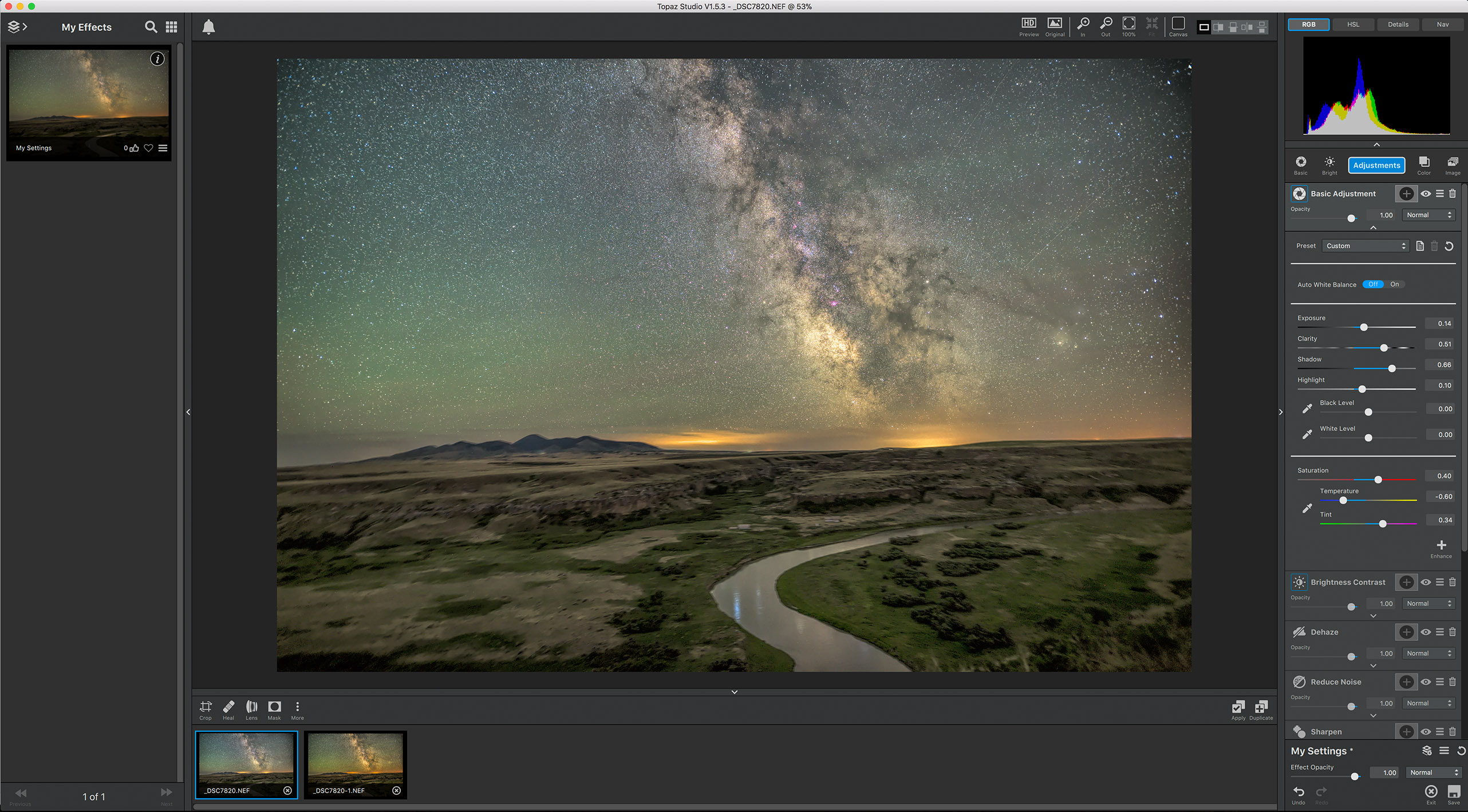
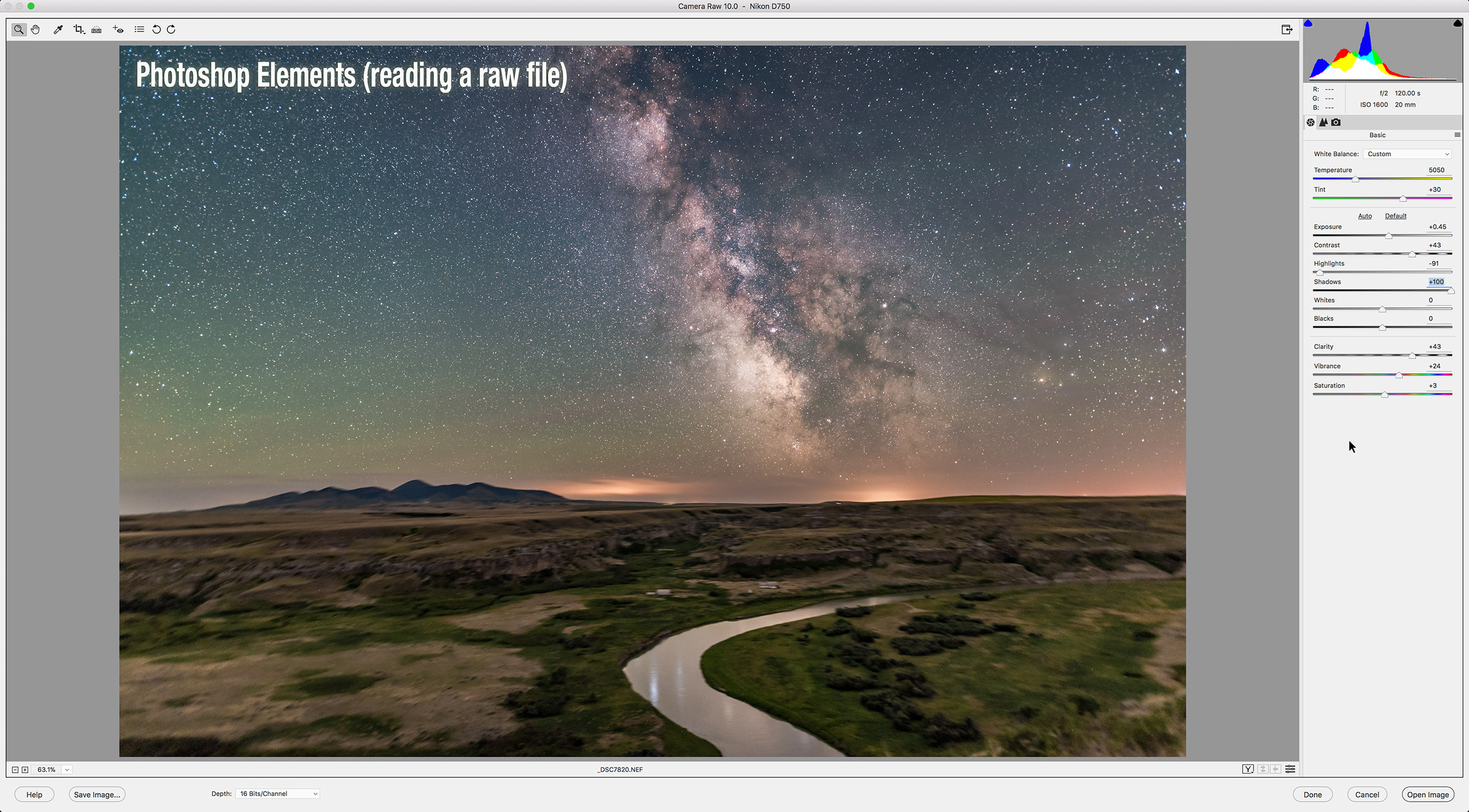

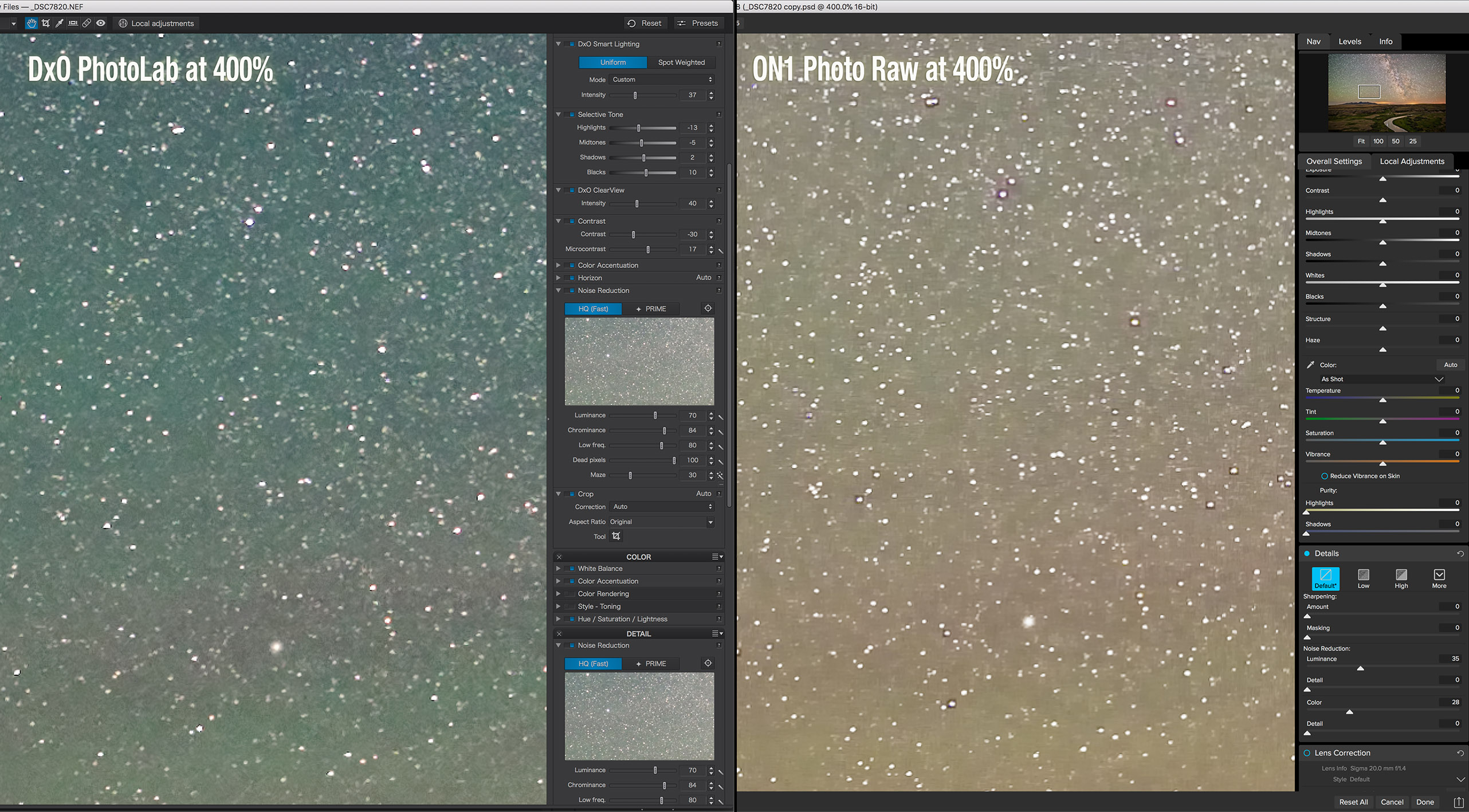
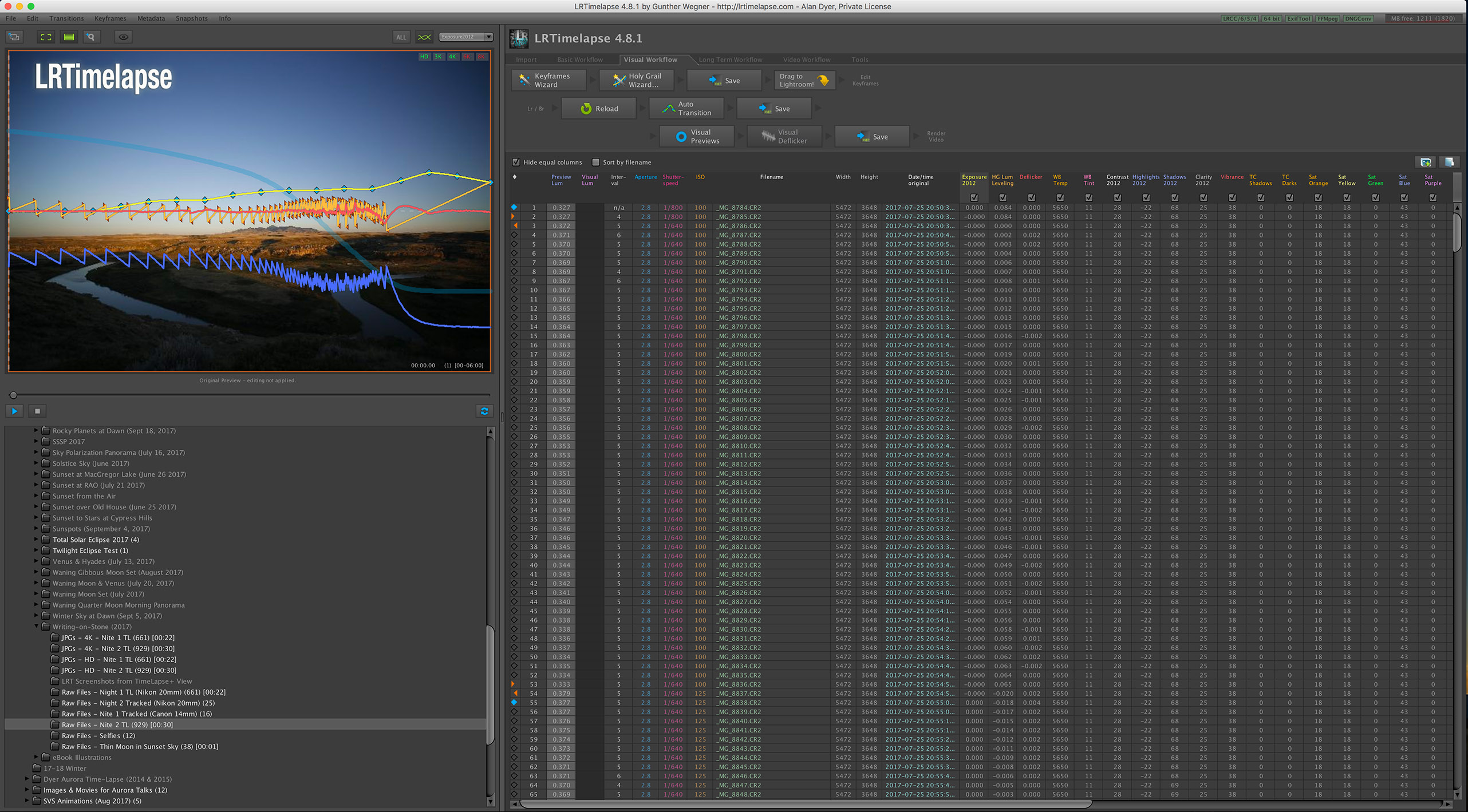
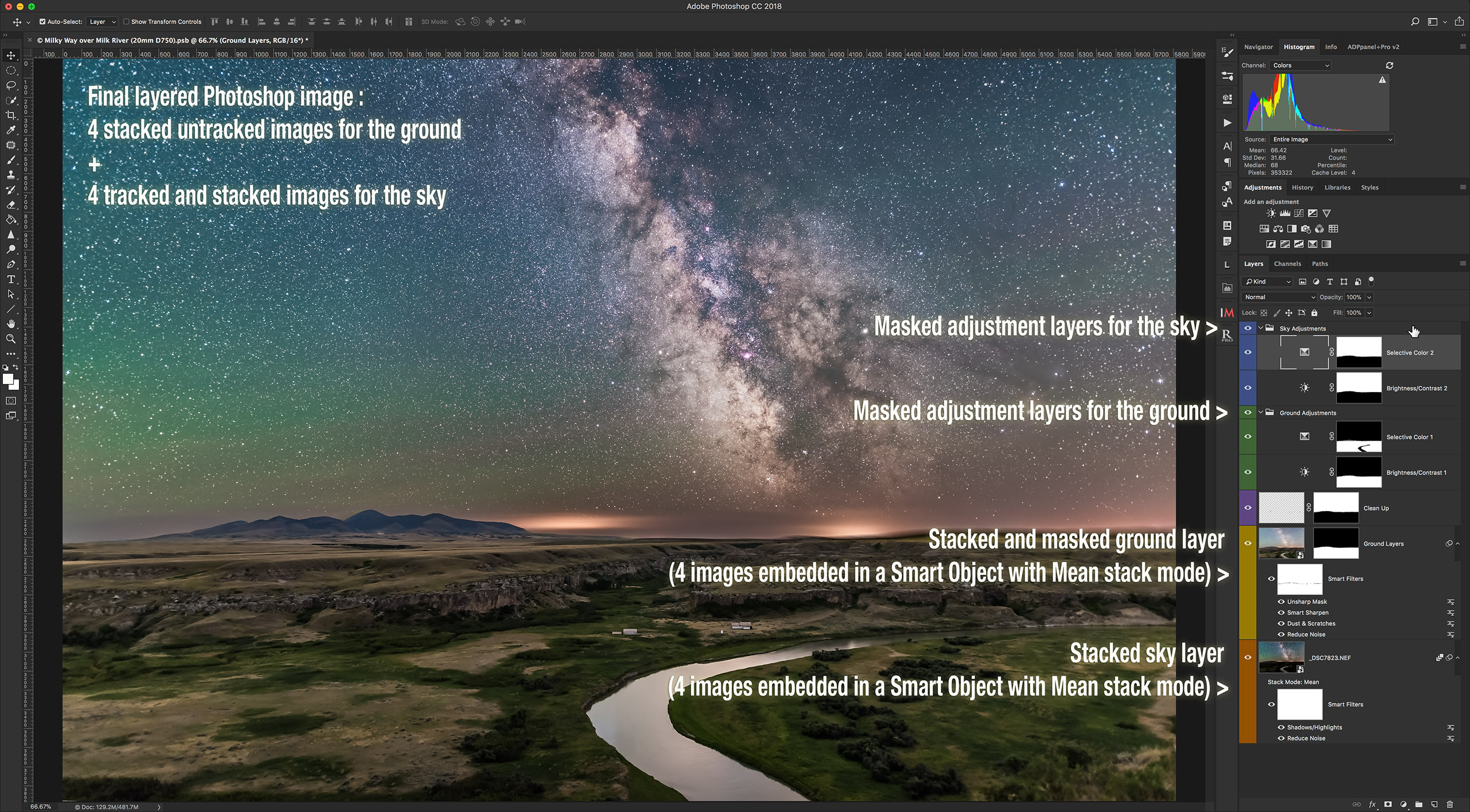
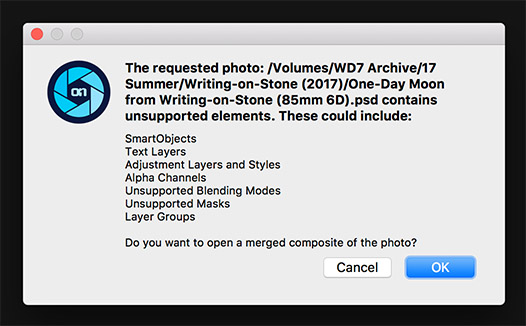
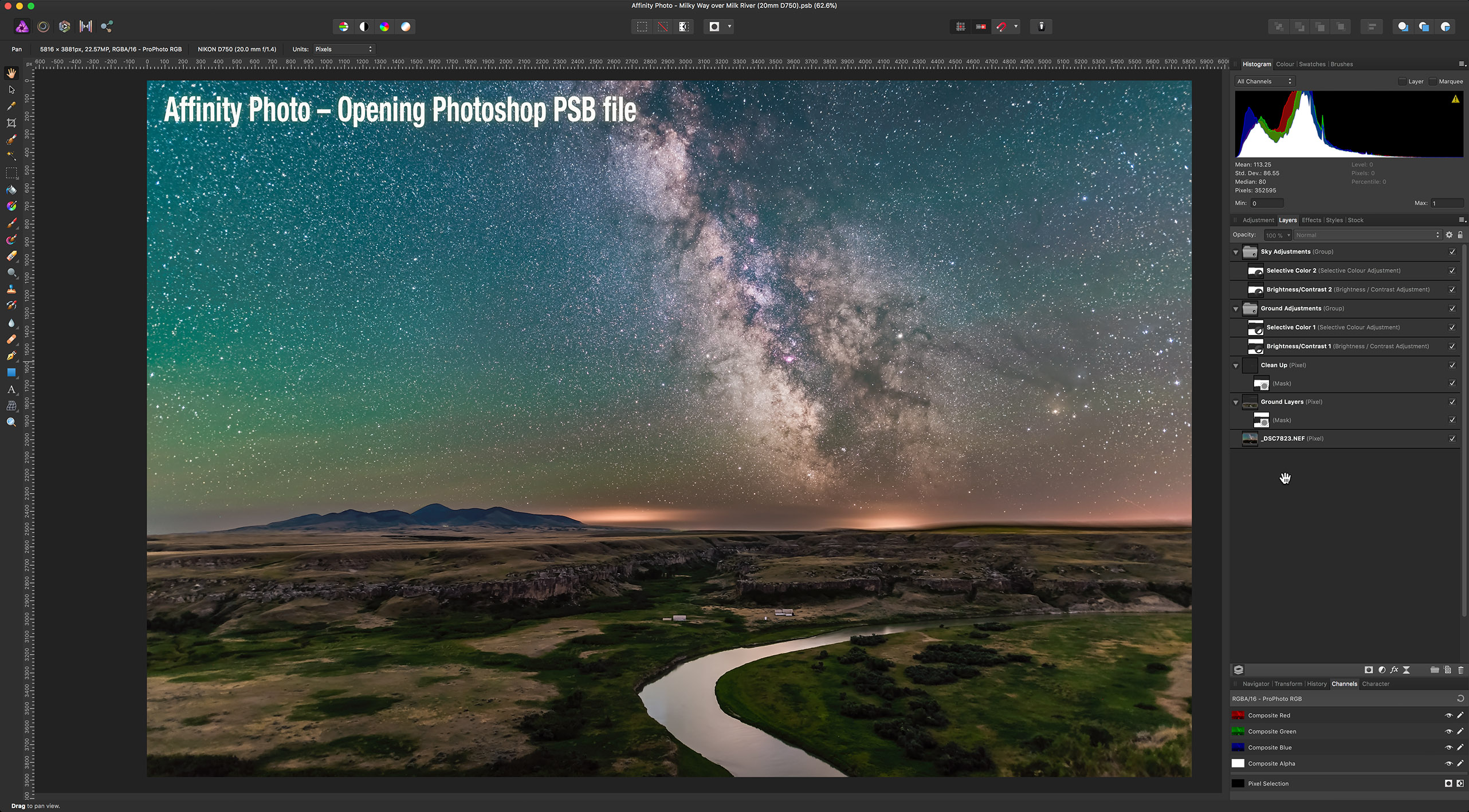
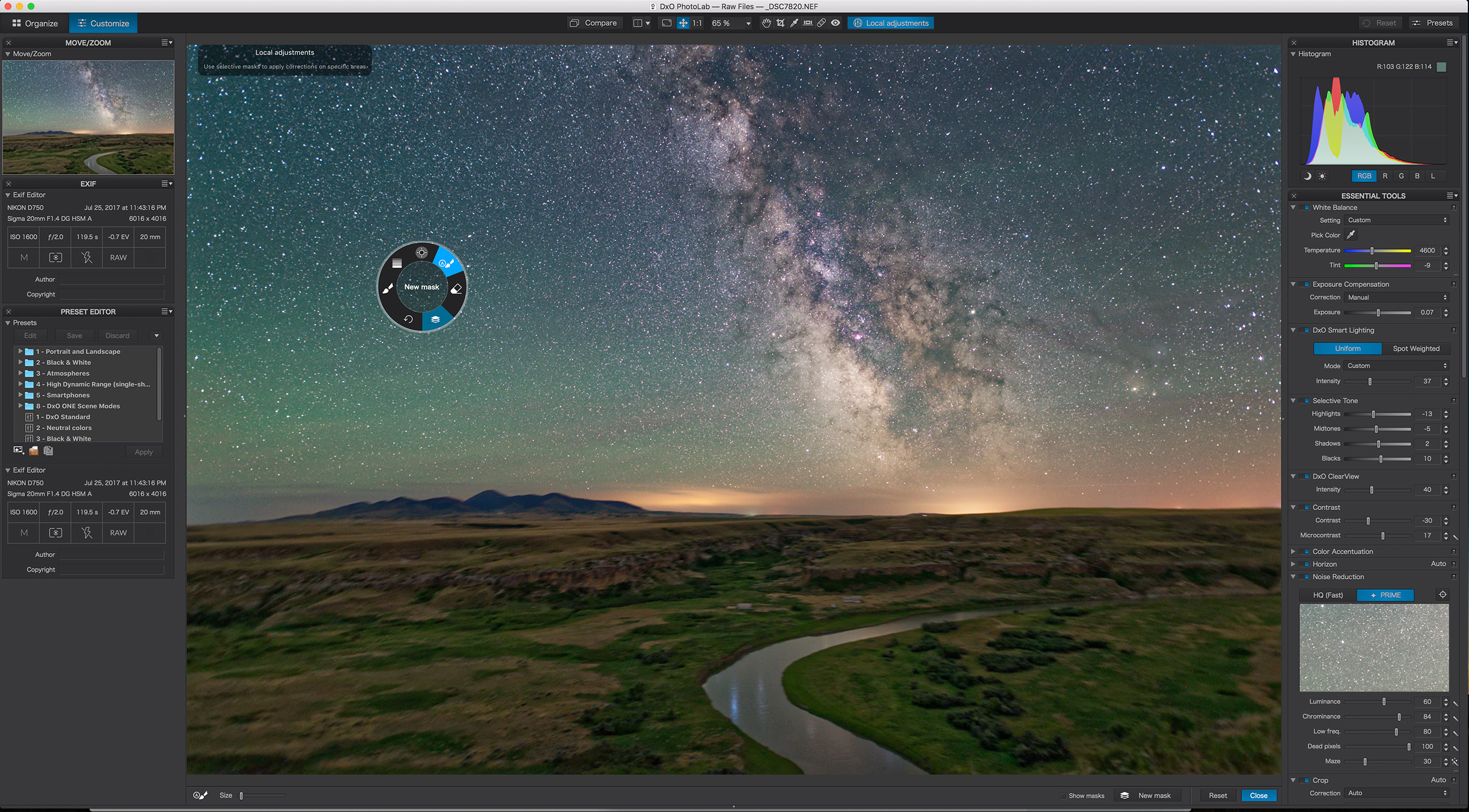
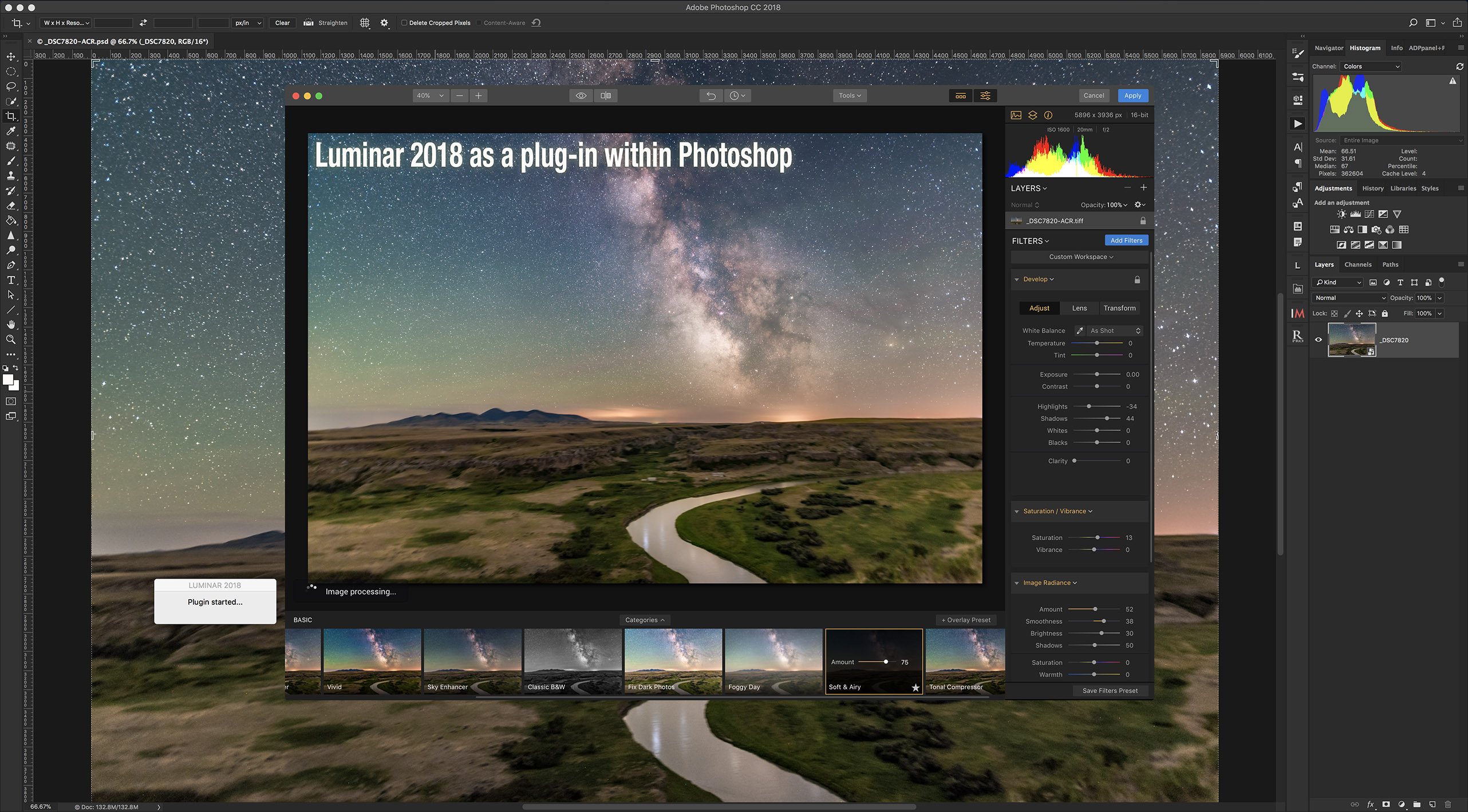
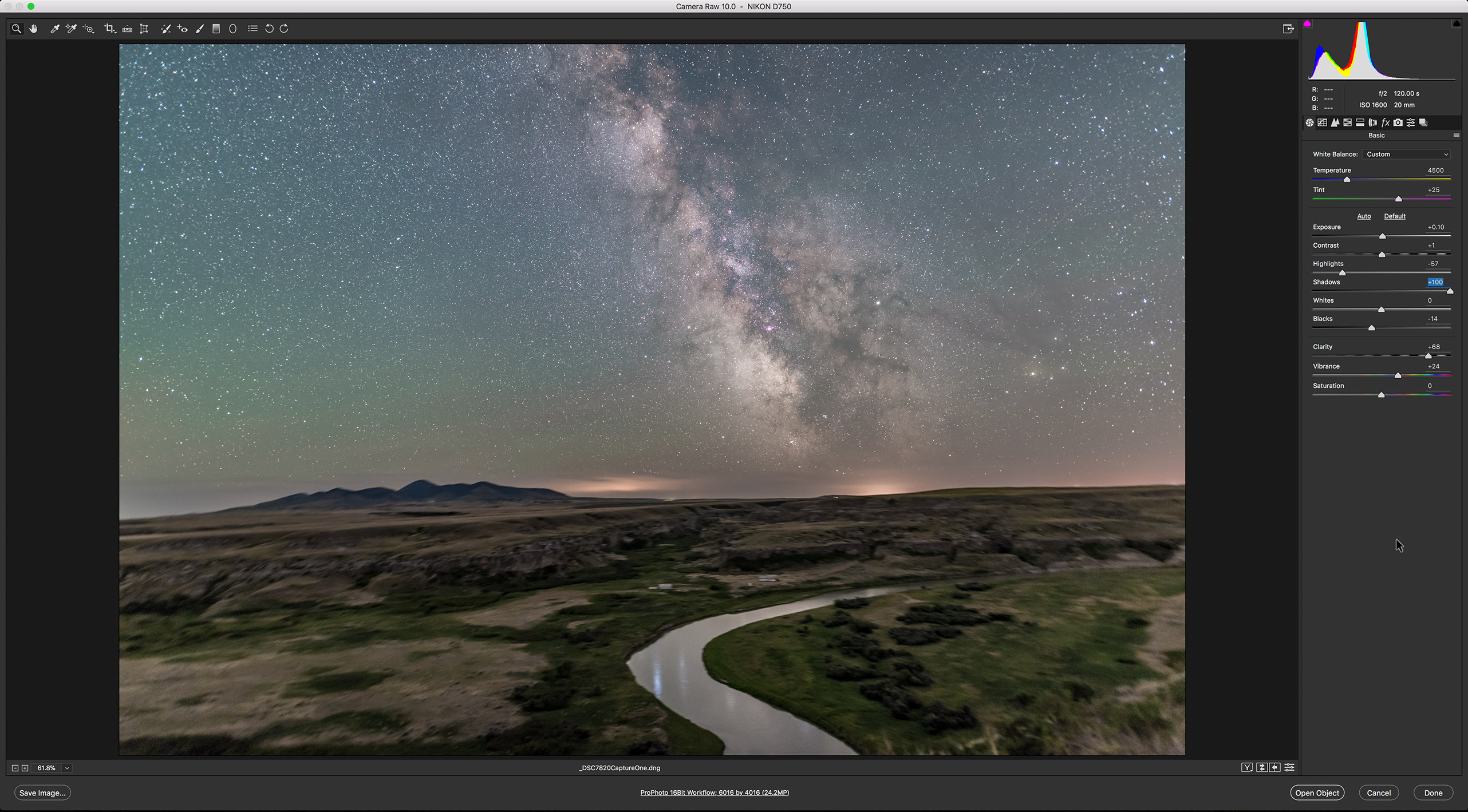

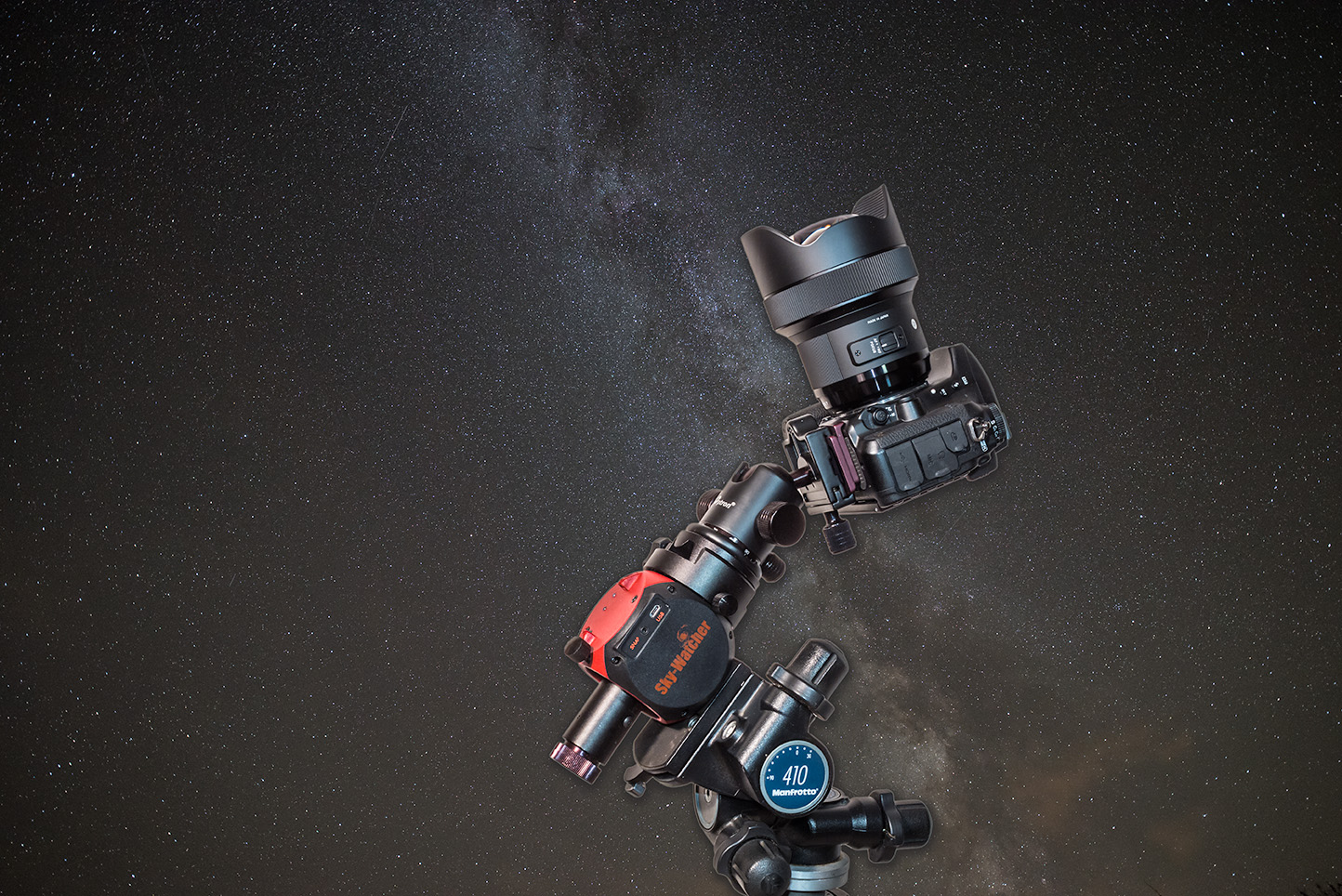
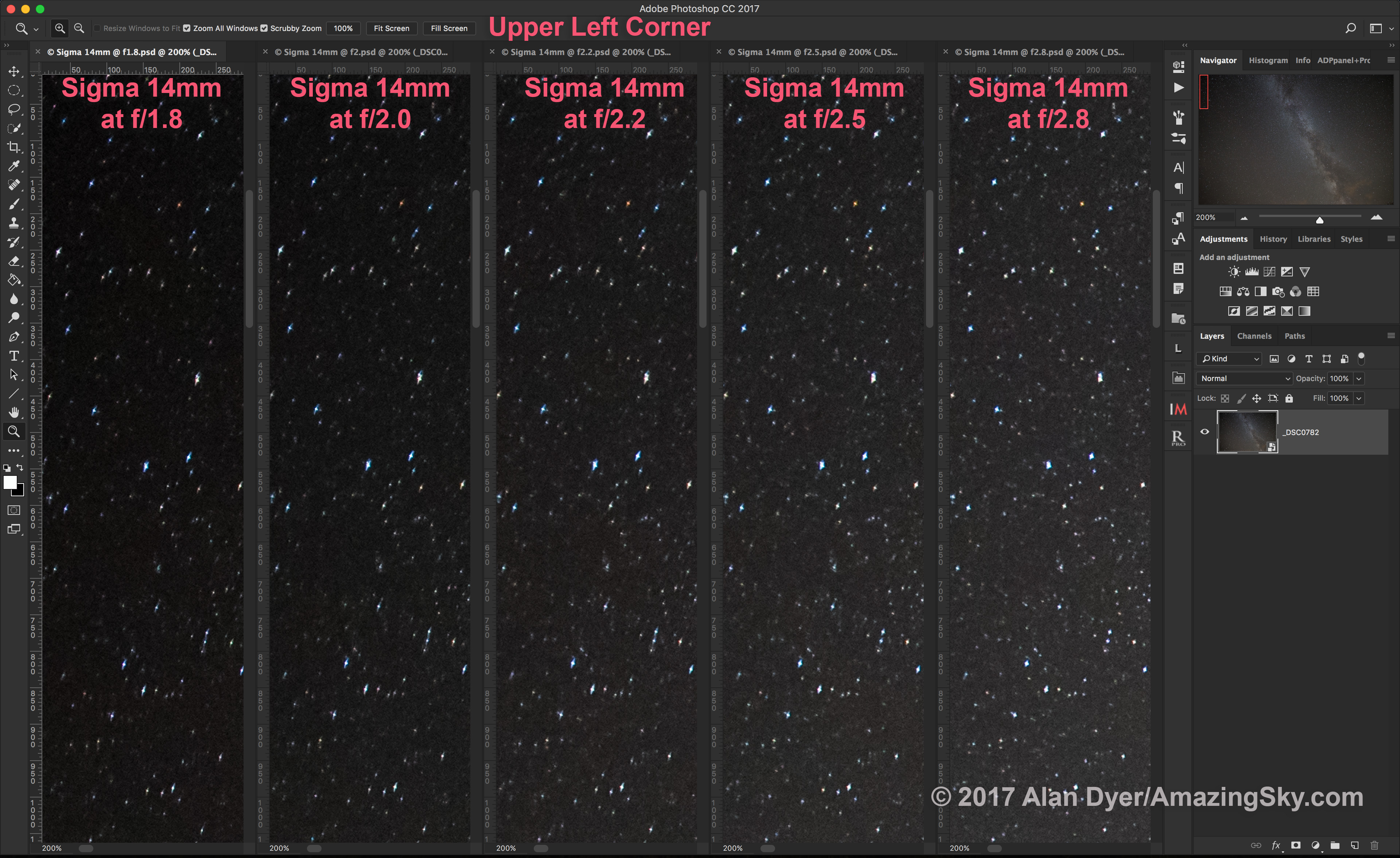

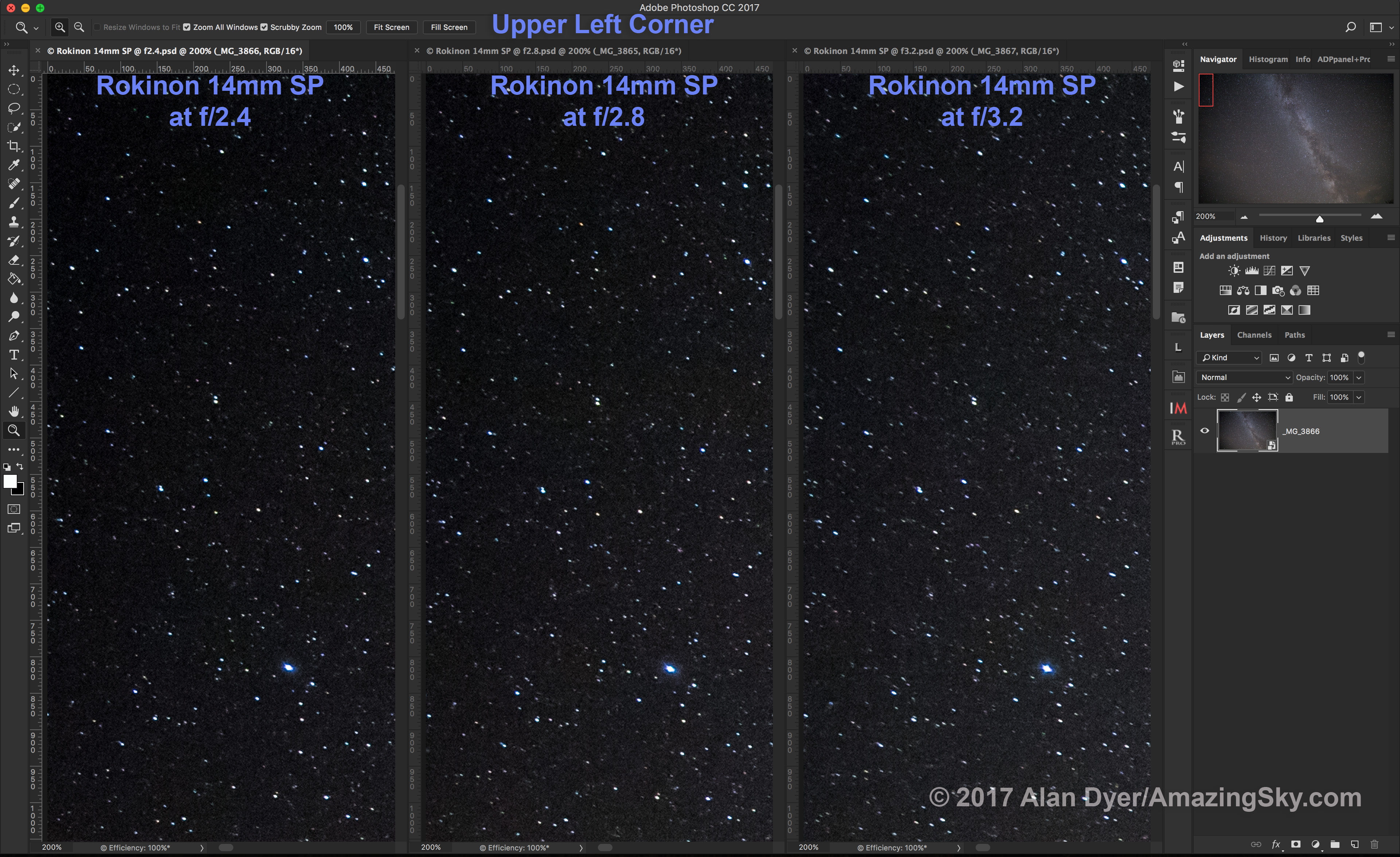
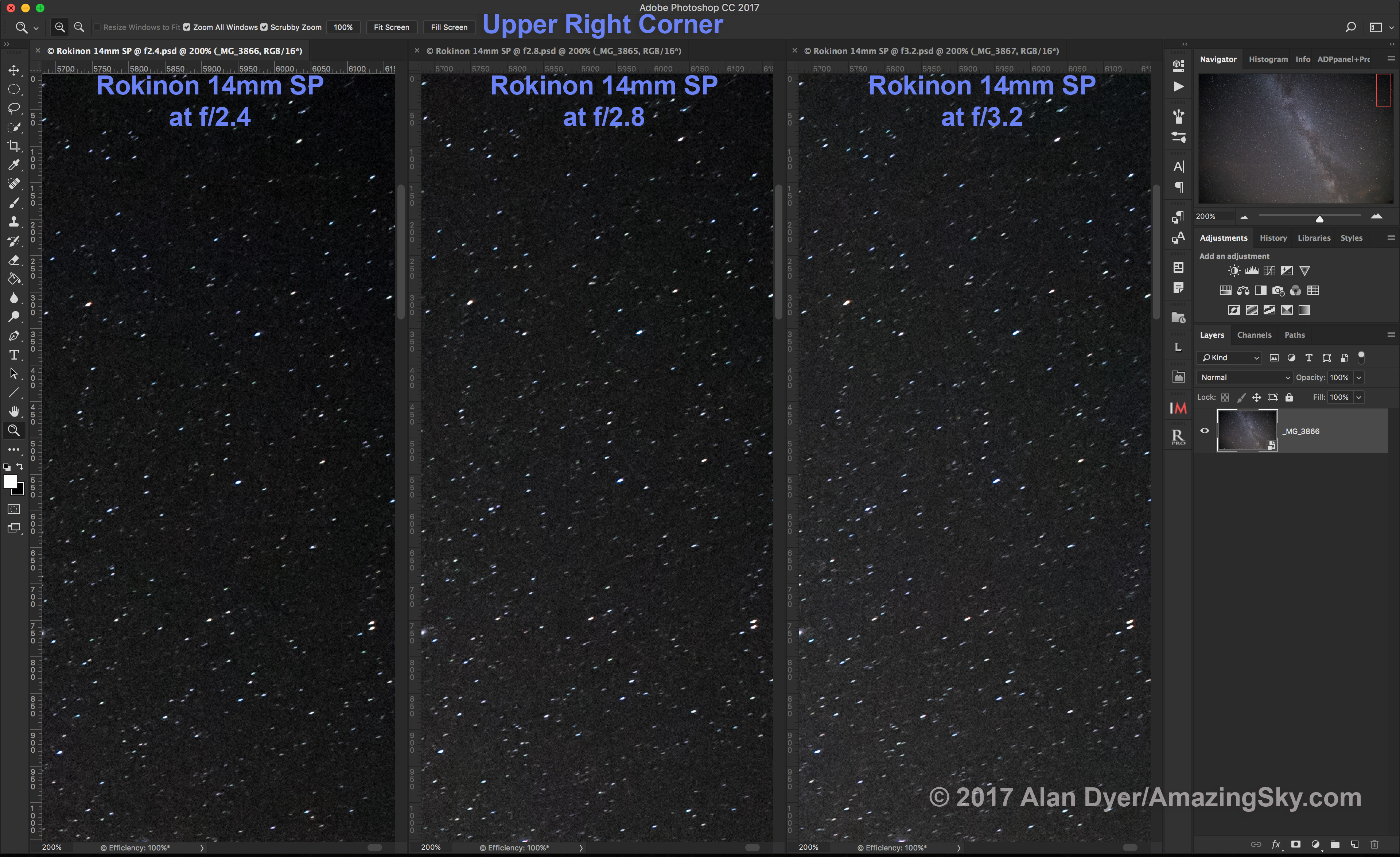






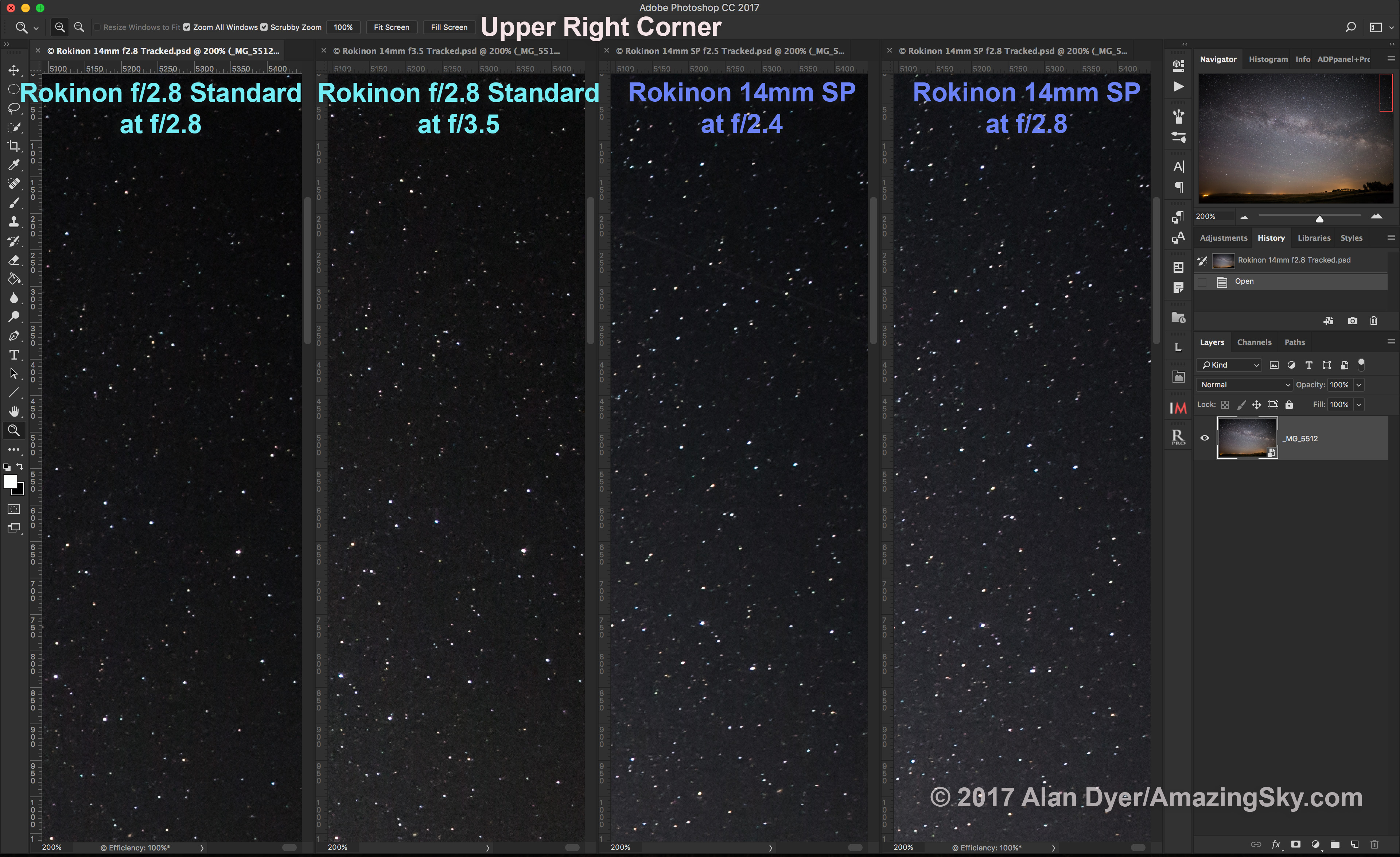
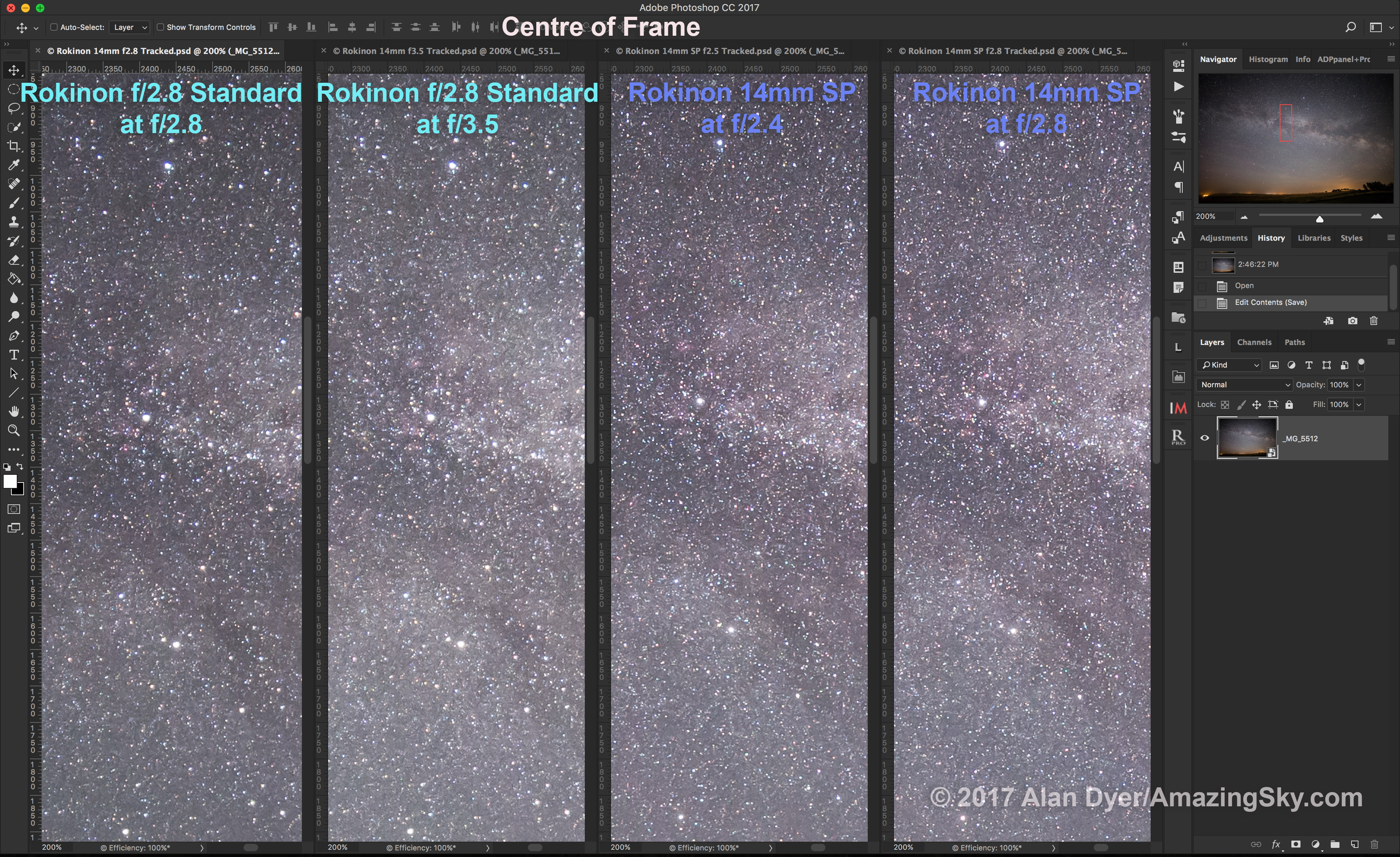
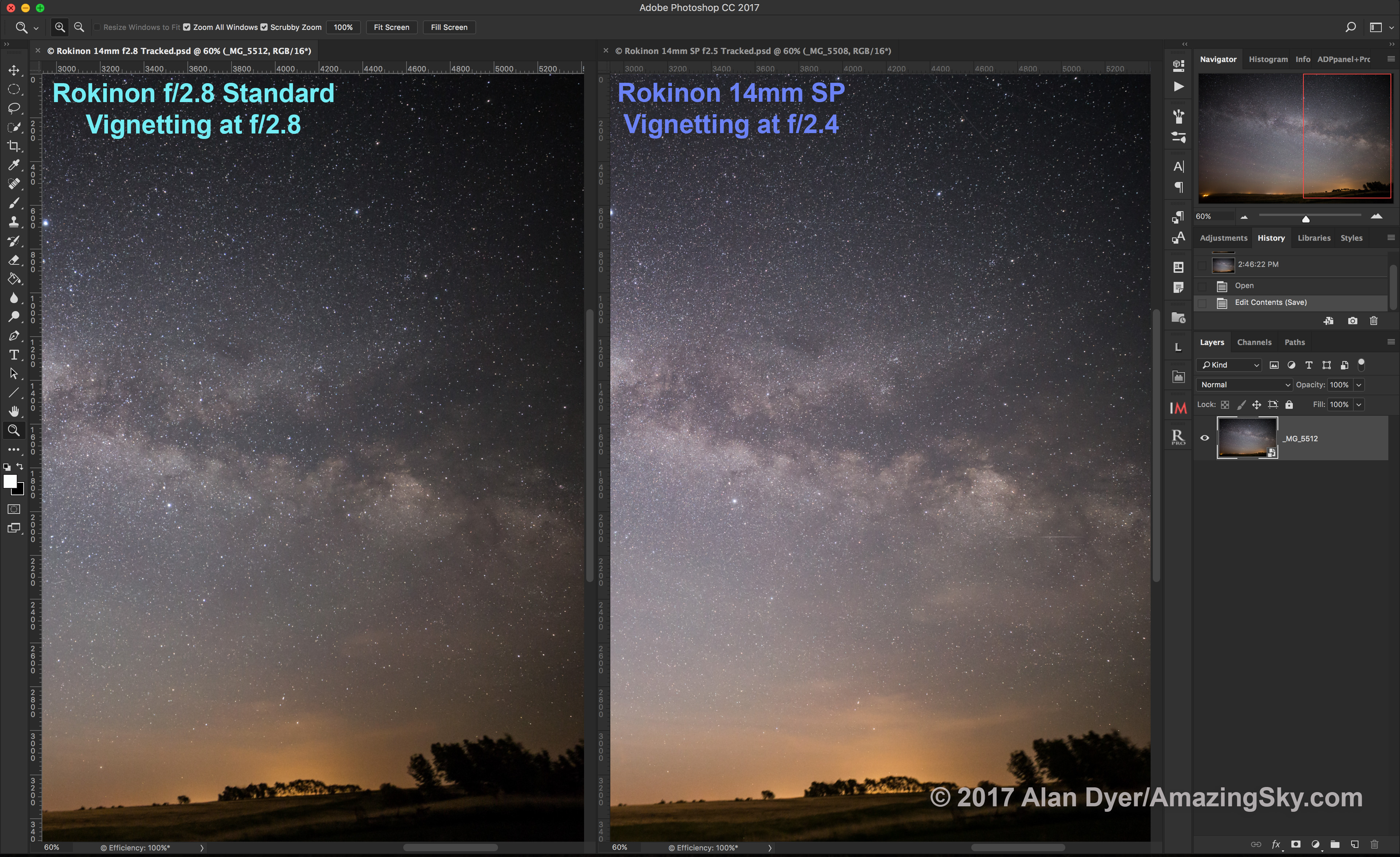
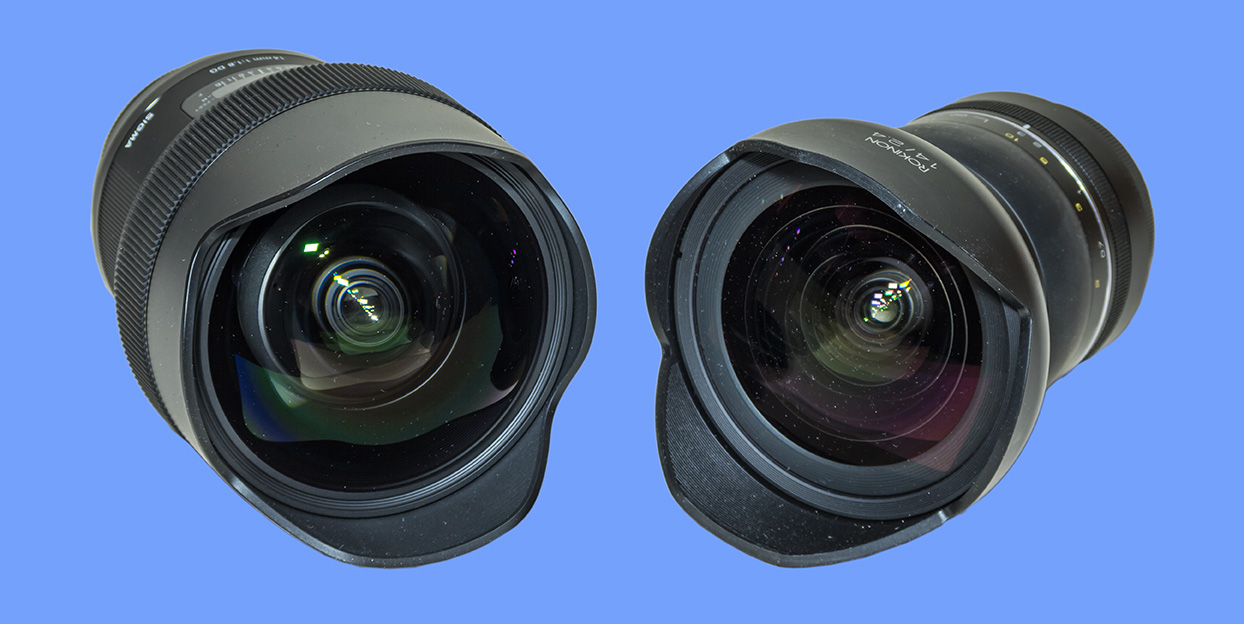








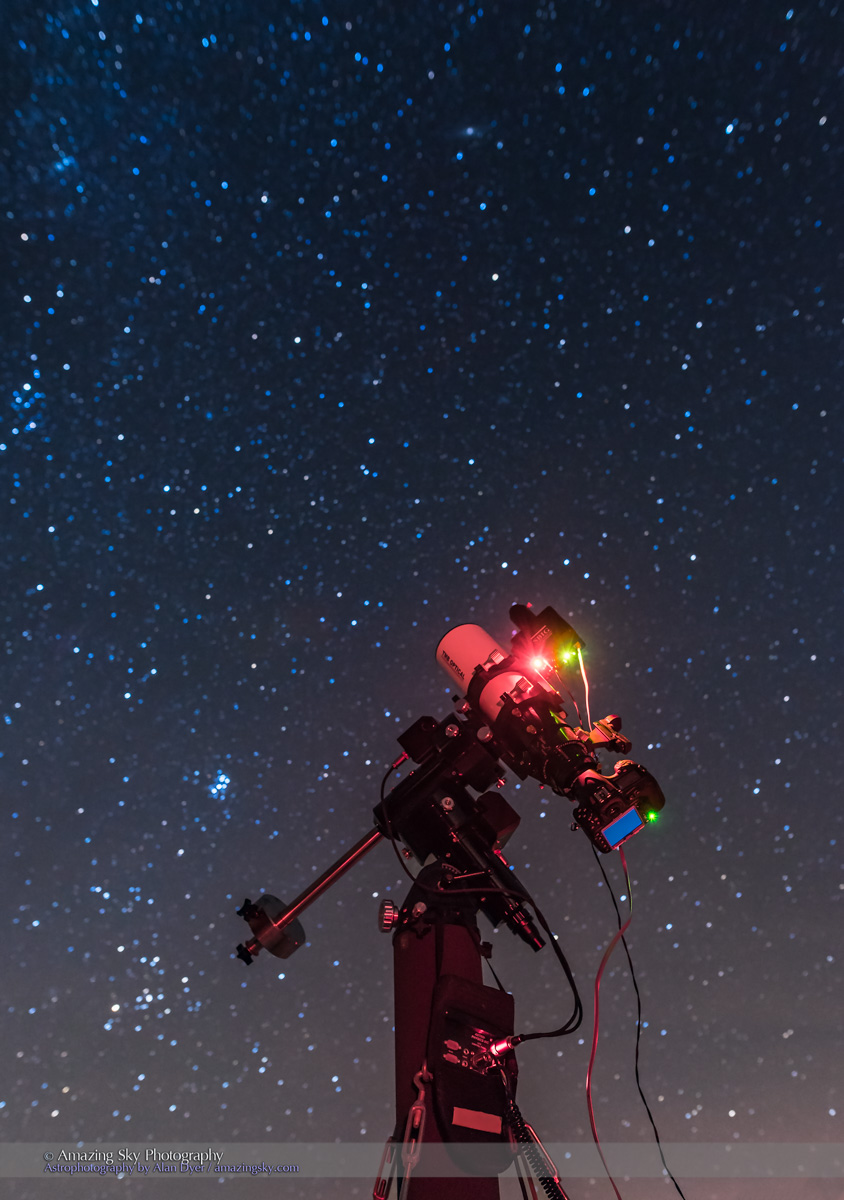

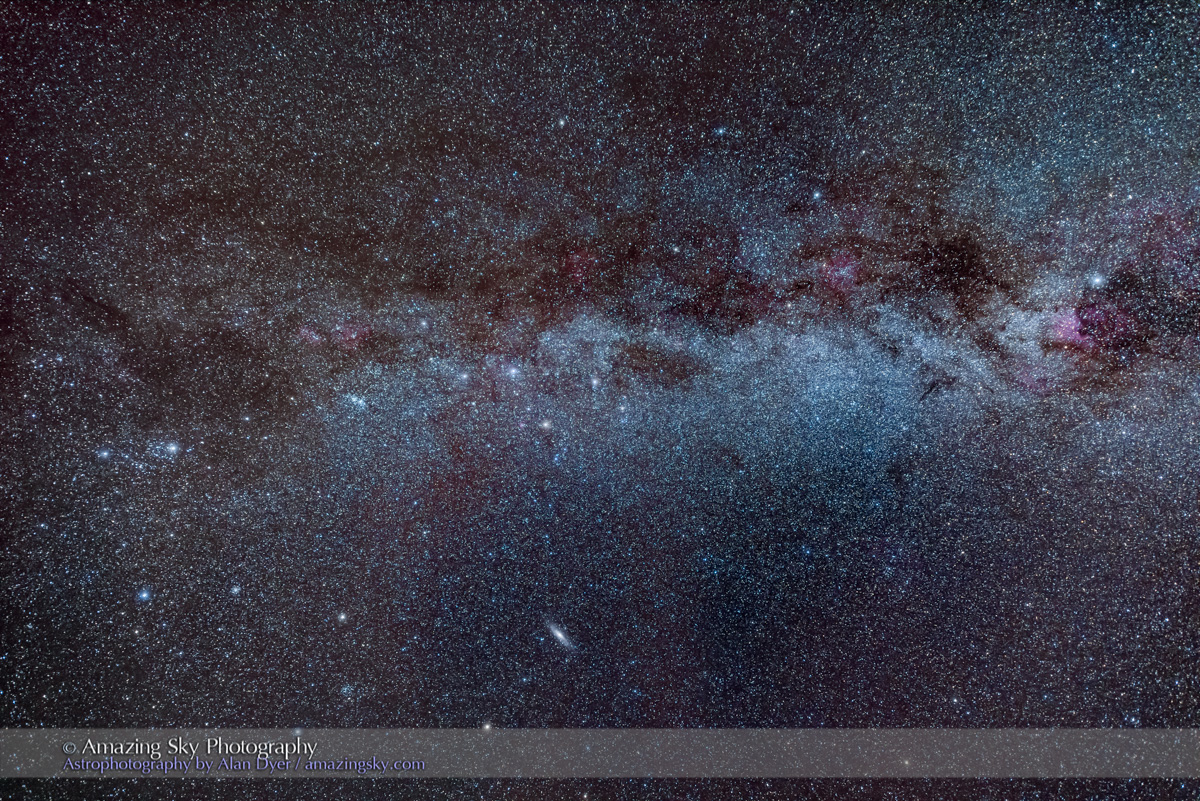
 The Amazing Sky