2024 โ€” The Greatest Year of Stargazing ?


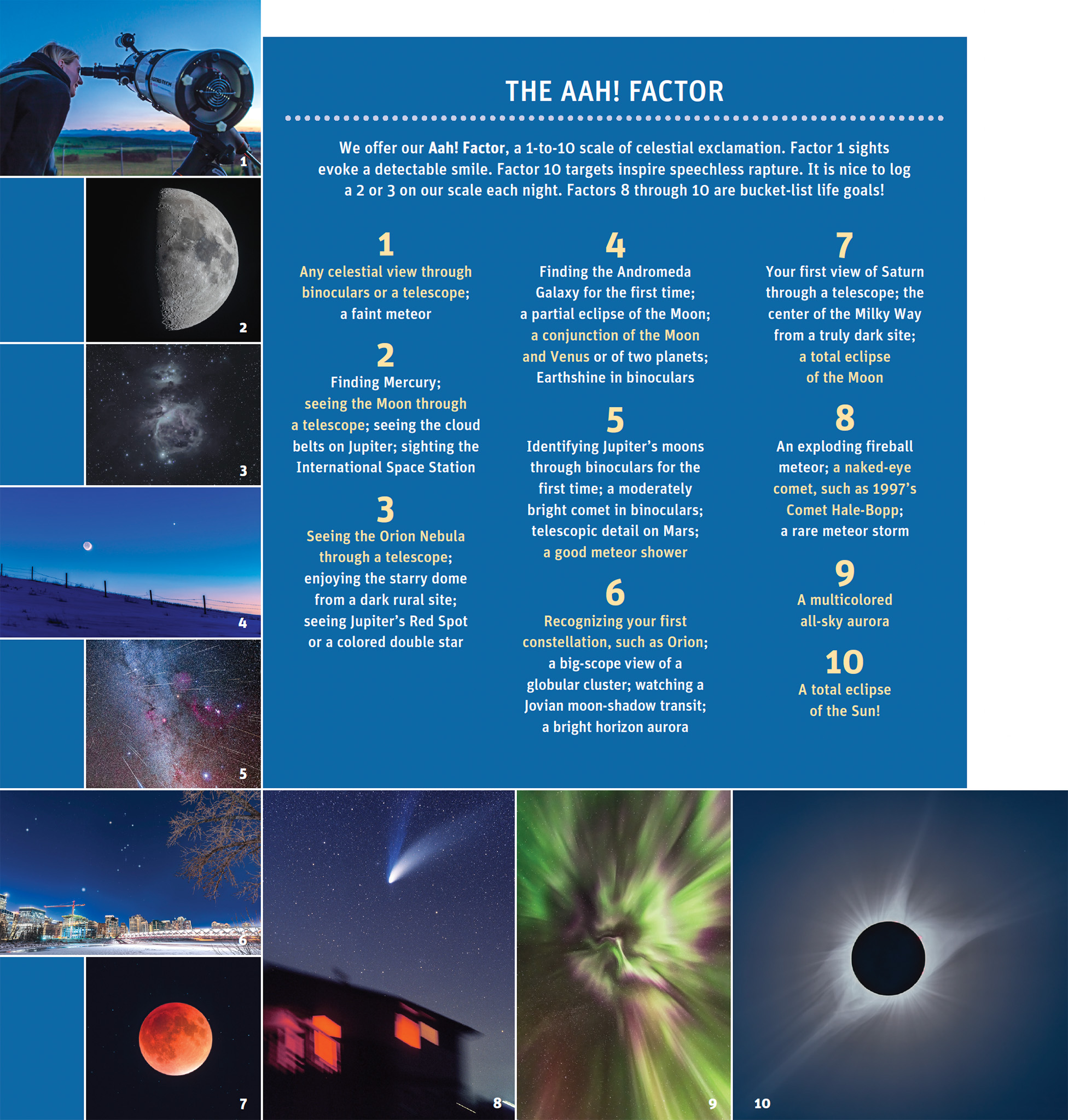
In our book The Backyard Astronomerโ€™s Guide (which we revised this year), Terence Dickinson and I created an Aah! Factor scale with various celestial sights ranked from: 

โ€ข   1, evoking just a smile, to โ€ฆ

โ€ข 10, a life-changing event! 

Our book’s Aah! Factor Scale in Chapter 1

Coming in at an 8 is a naked-eye comet. Deserving a 9 is an all-sky display of an aurora. The only sight to rate a top 10 is a total eclipse of the Sun. 

2024 brought all three, and more! 

Hereโ€™s my look back at what I think was one of the greatest years of stargazing. 


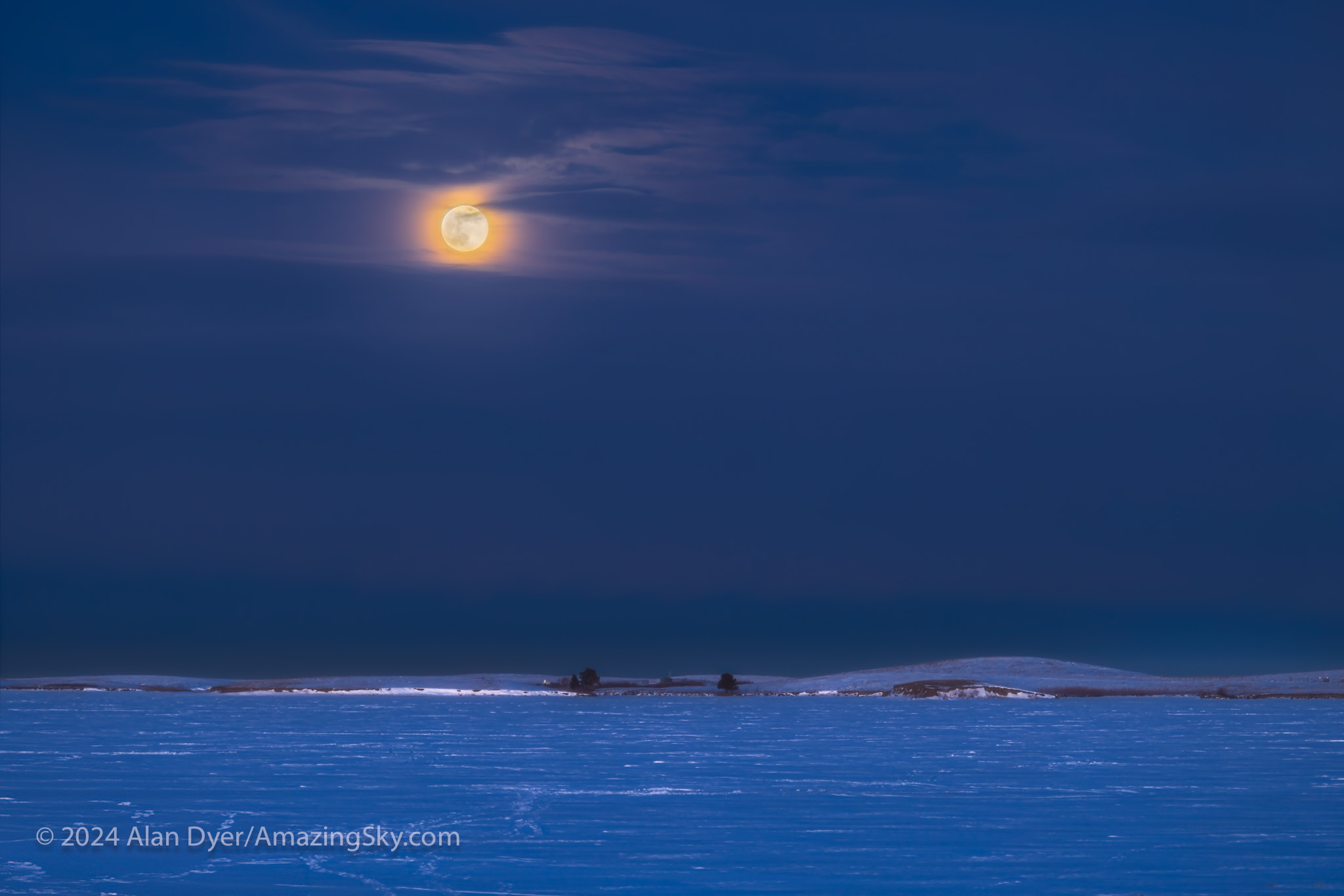
A Winter Moonrise to Begin the Year 

The rising of the winter “Wolf” Moon, the Full Moon of January, over the frozen Crawling Lake Reservoir, in southern Alberta.

Now, this was not any form of rare event. But seeing and shooting any sky sight in the middle of a Canadian winter is an accomplishment. This is the rising of the Full Moon of January, popularly called the Wolf Moon, over a frozen lake near home in Alberta, Canada ๐Ÿ‡จ๐Ÿ‡ฆ. 

It serves to bookend the collection with a Full Moon I captured eleven months later in December. 


Auroras from Churchill, Manitoba 

Had this been my only chance to see the Northern Lights fill the sky this year, I would have been happy. As we often see in Churchill, the aurora covered the sky on several nights, a common sight when you are underneath the main band of aurora borealis that arcs across the northern part of the globe. 
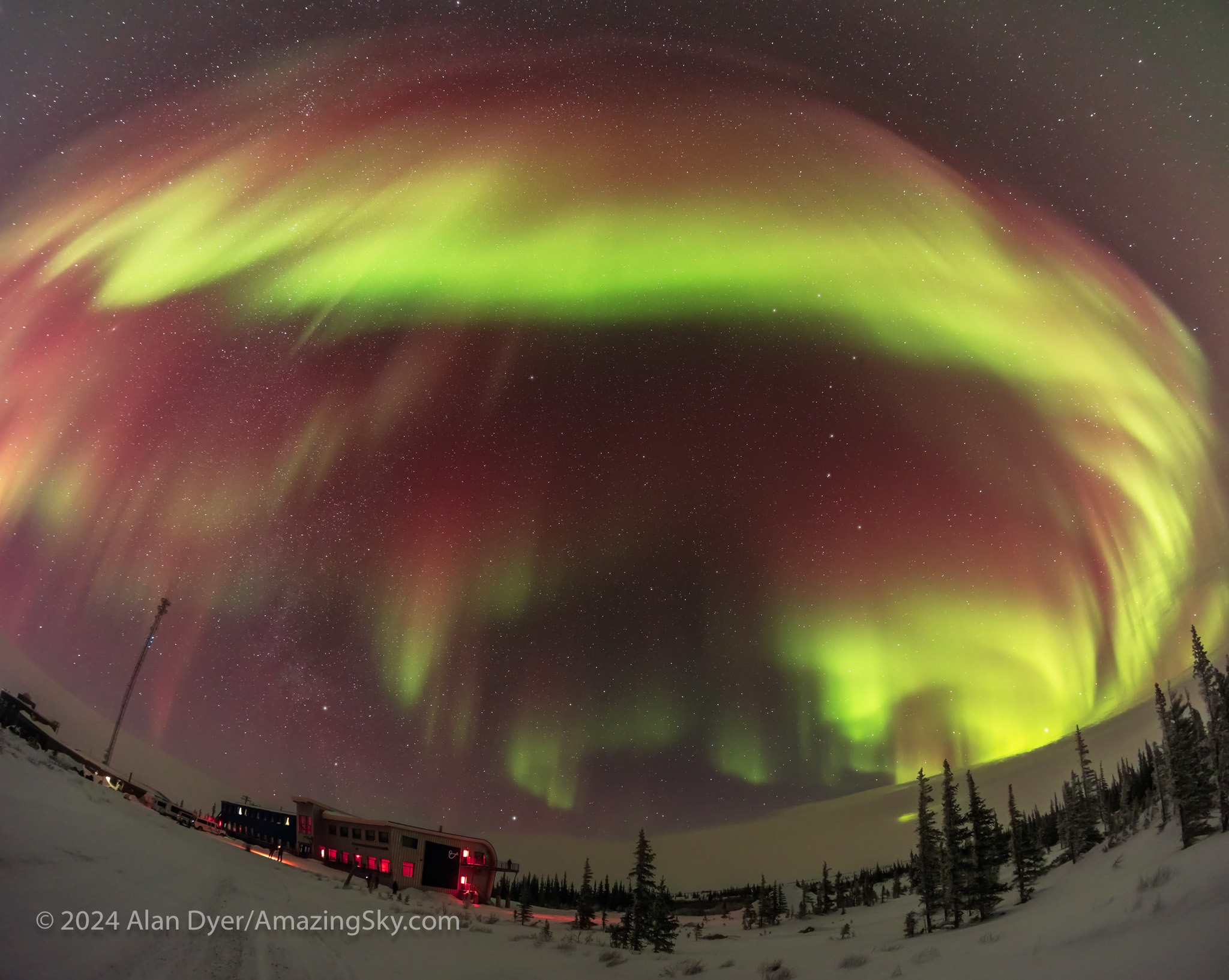
This is a vertical panorama of the sky-filling aurora of February 10, 2024, as seen from the Churchill Northern Studies Centre, in Churchill, Manitoba.

I attended to two aurora tour groups at the Churchill Northern Studies Centre who both got good displays to check โ€œseeing the Northern Lightsโ€ off their bucket list. Join me in 2025!


Under the Austral Sky

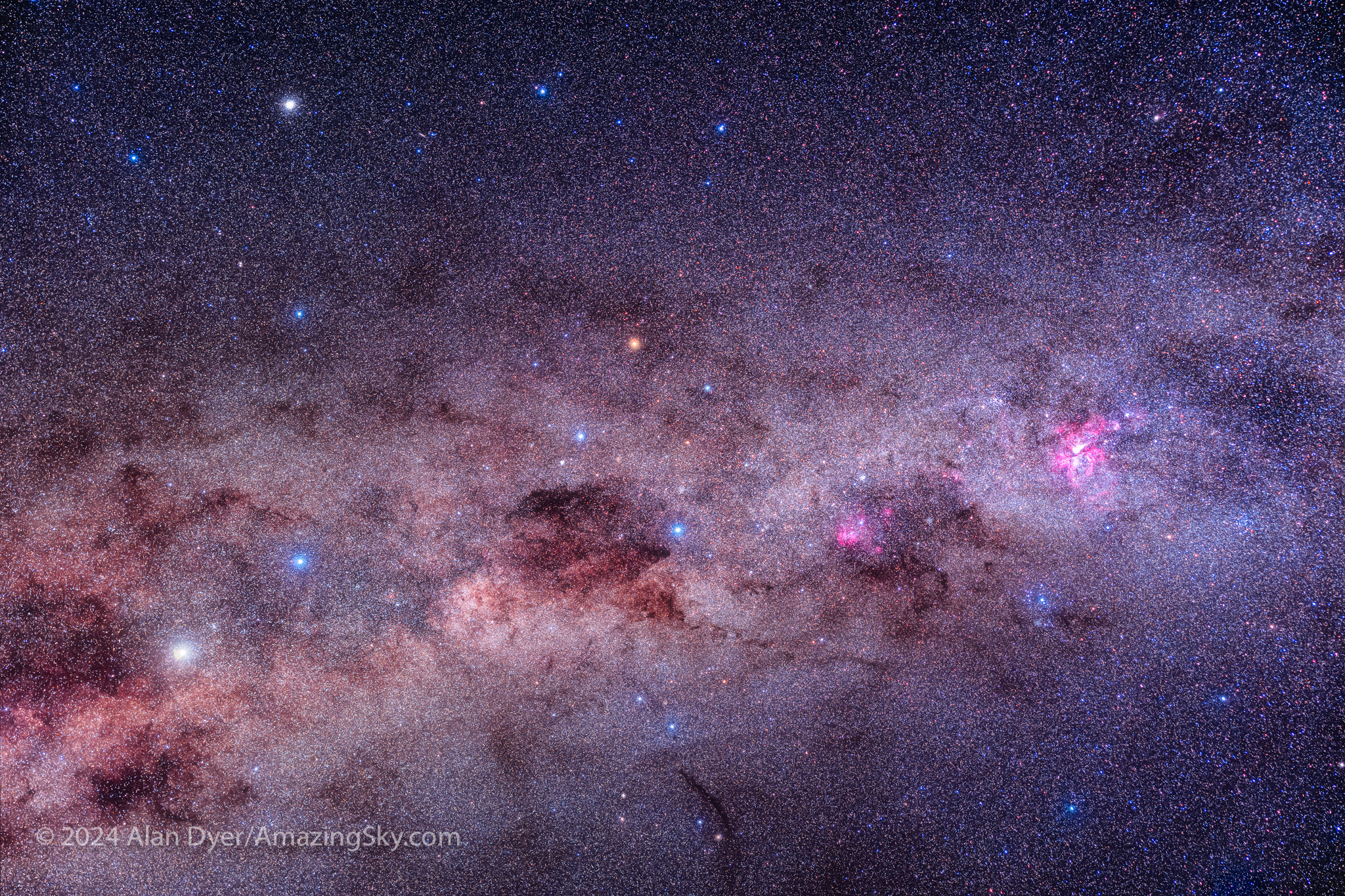
Ranking a respectable 7 on our Aah! Factor scale is the naked-eye sight of the galactic centre overhead, with the Milky Way arcing across the sky. Thatโ€™s possible from a latitude of about 30ยฐ South. Thatโ€™s where I went in March, back to Australia ๐Ÿ‡ฆ๐Ÿ‡บ for the first time since 2017. 

This is a framing of the most spectacular area of the southern Milky Way, from Centaurus at left, to Carina at right, with Crux, the Southern Cross, at centre.

I wrote about it in my previous blog, where I present a tour along the southern Milky Way, and wide-angle views of the Milky Way (the images here are framings of choice regions). 
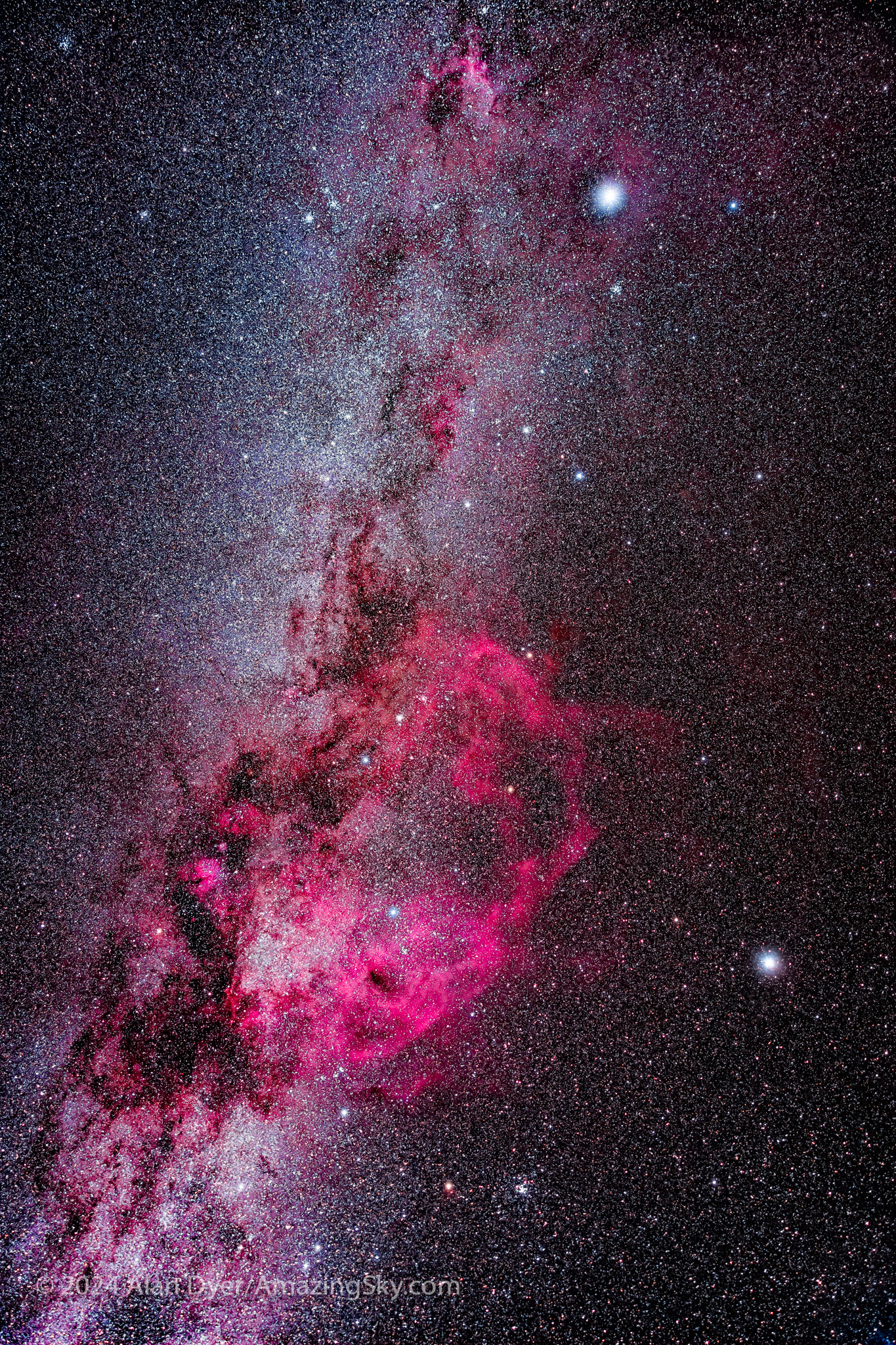
This frames the southern Milky Way from Canis Major and its bright star Sirius at top, to Carina and its bright star Canopus at bottom, the two brightest stars in the night sky. The large red complex is the Gum Nebula.

It is a magical latitude that all northern astronomers should make a pilgrimage to, if only to just lie back and enjoy the view of our place in the outskirts of the Galaxy. I was glad to be back Down Under, to check this top sky sight off my bucket list for 2024. 


A Total Eclipse of the Sun 

No sooner had I returned home from Oz, when it was time to load up the car with telescope gear and drive to the path of the April 8 total solar eclipse, the first “TSE” in North America since 2017, which was the last total eclipse I had seen, in a trip to Idaho

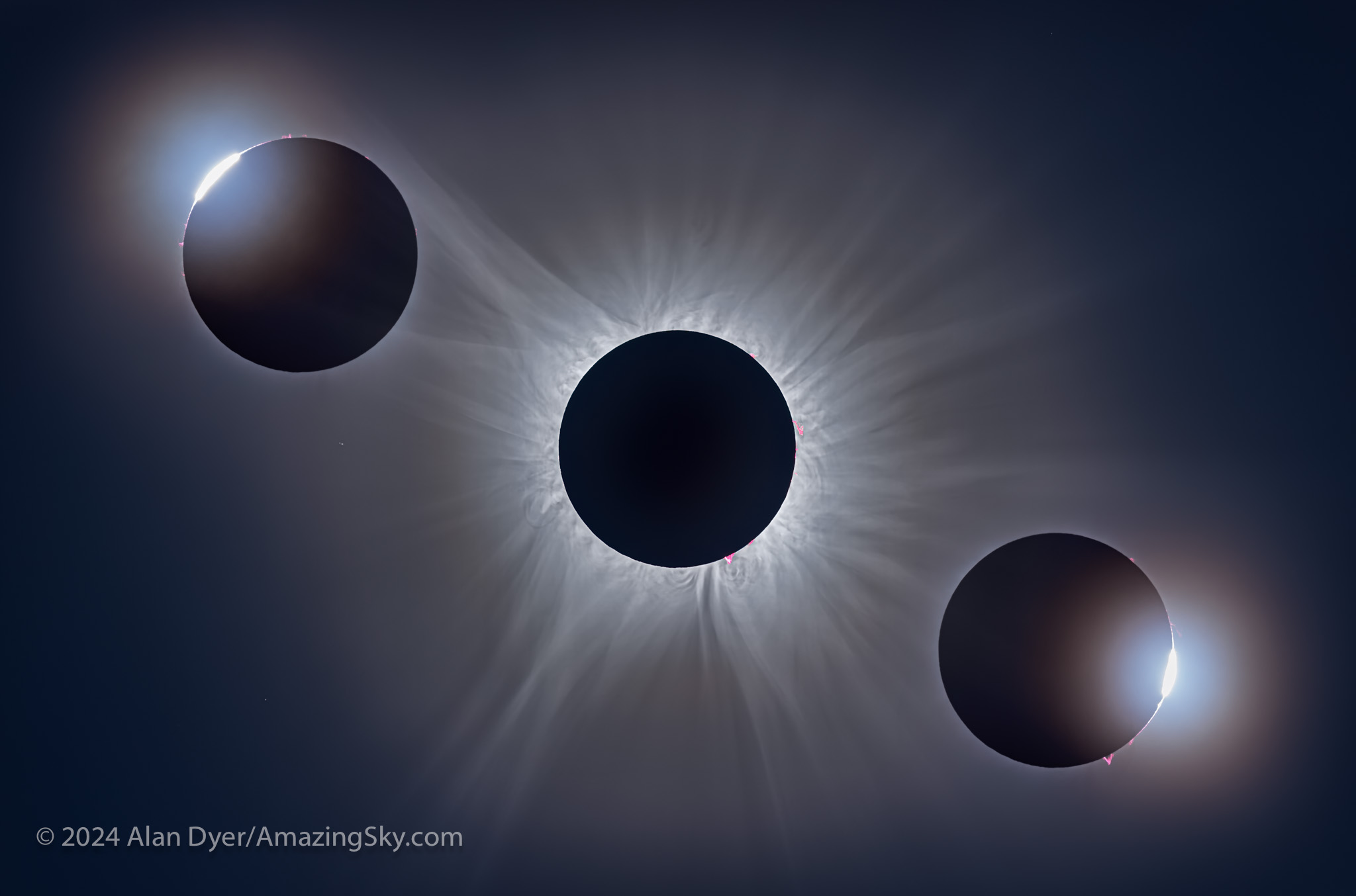
This is a composite of telescopic close-ups of the April 8, 2024 total eclipse, with a multi-exposure blend for the corona at centre, flanked by the diamond rings.

But where? I started south to Texas, my Plan A. Poor weather forecasts there prompted a hasty return to Canada, to drive east across the country to โ€ฆ I ended up in Quรฉbec. My blog about my cross-continental chase is here. My final edited music video is linked to below.

It was gratifying to see a total eclipse from “home” in Canada, only the third time Iโ€™ve been able to do that (previously in 1979 โ€“ Manitoba, and 2008 โ€“ Nunavut). If the rest of the year had been cloudy except for this day I wouldnโ€™t have complained. Much.

This definitely earned a 10 on the Aah! Factor scale. Total eclipses are overwhelming and addictive. Iโ€™ve made my bookings for 2026 in Spain ๐Ÿ‡ช๐Ÿ‡ธ and 2027 in Tunisia ๐Ÿ‡น๐Ÿ‡ณ. 


The Skyโ€™s On Fire

It had been several years since I had seen an aurora from my backyard with colours as vivid and obvious as they were this night. But on May 10, the sky erupted with a fabulous display of aurora that much of the world saw, as aurora borealis in the north and aurora australis in the south. 
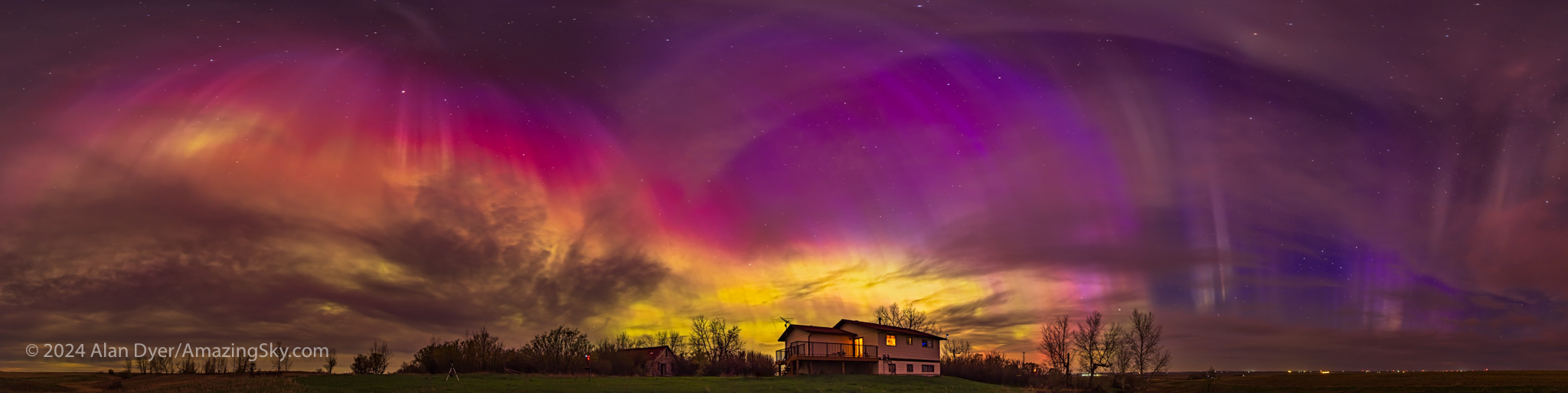
This is a 300ยบ panorama of the May 10, 2024 Northern Lights display, when the Kp Index reached 8 (out of 9), bringing aurora to the southern U.S.

This was the first of several all-sky shows this year. I blogged about the yearโ€™s great auroras here, where there are links to the movies I produced that capture the Northern Lights as only movies can, recording changes so rapid it can be hard to take it all in. Check off a 9 here! 

So not even half way through the year, I had seen three of the top sky sights: the Milky Way core overhead (7), an all-sky aurora (9), and a total eclipse of the Sun (10). 

But there was more to come! Including an Aah! Factor 8


World Heritage Nightscape Treks

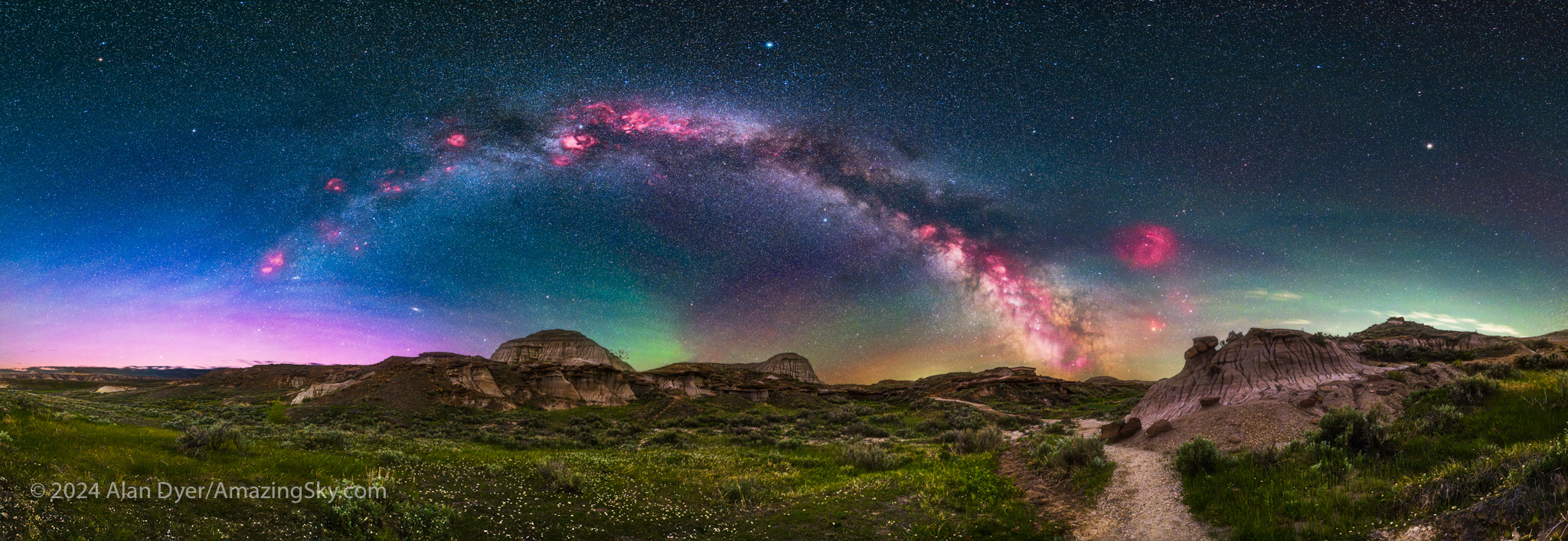
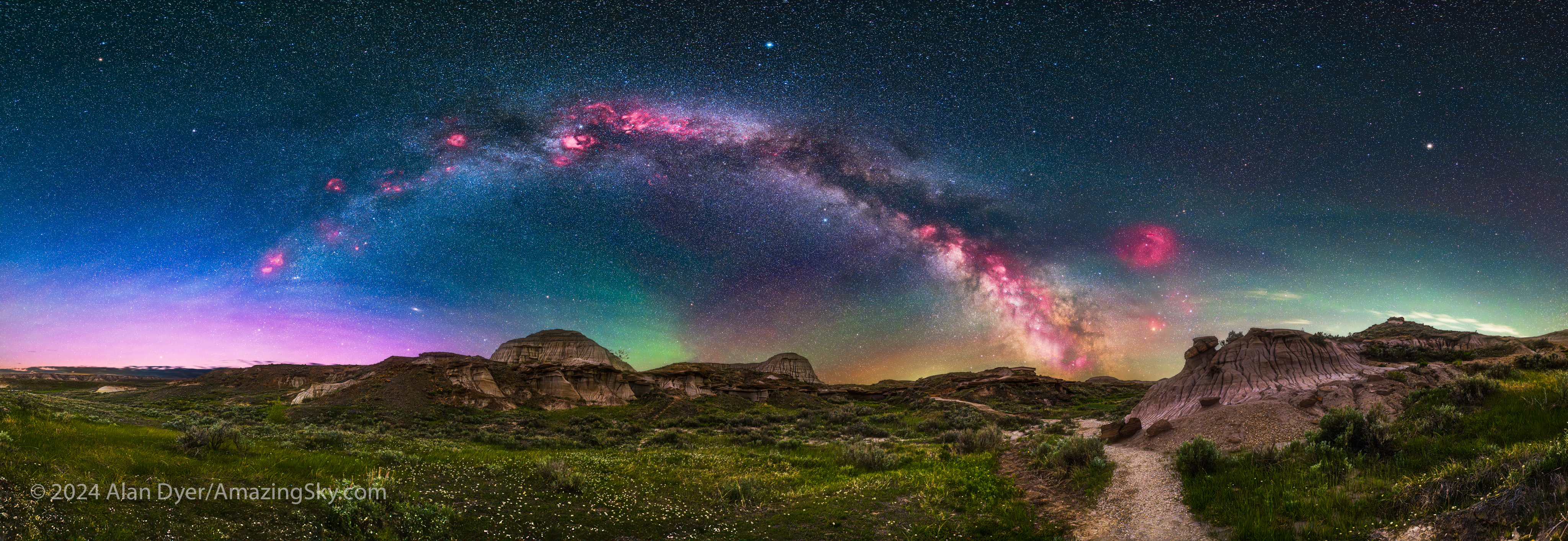
This is a panorama of the arch of the Milky Way rising over the Badlands of Dinosaur Provincial Park, Alberta, with a sky tinted with twilight and airglow.

The sky took a break from presenting spectacles, allowing me to head off on short local trips, to favourite nightscape sites in southern Alberta, which we have in abundance. The Badlands of Dinosaur Provincial Park are just an hour away, the site for the scene above. 
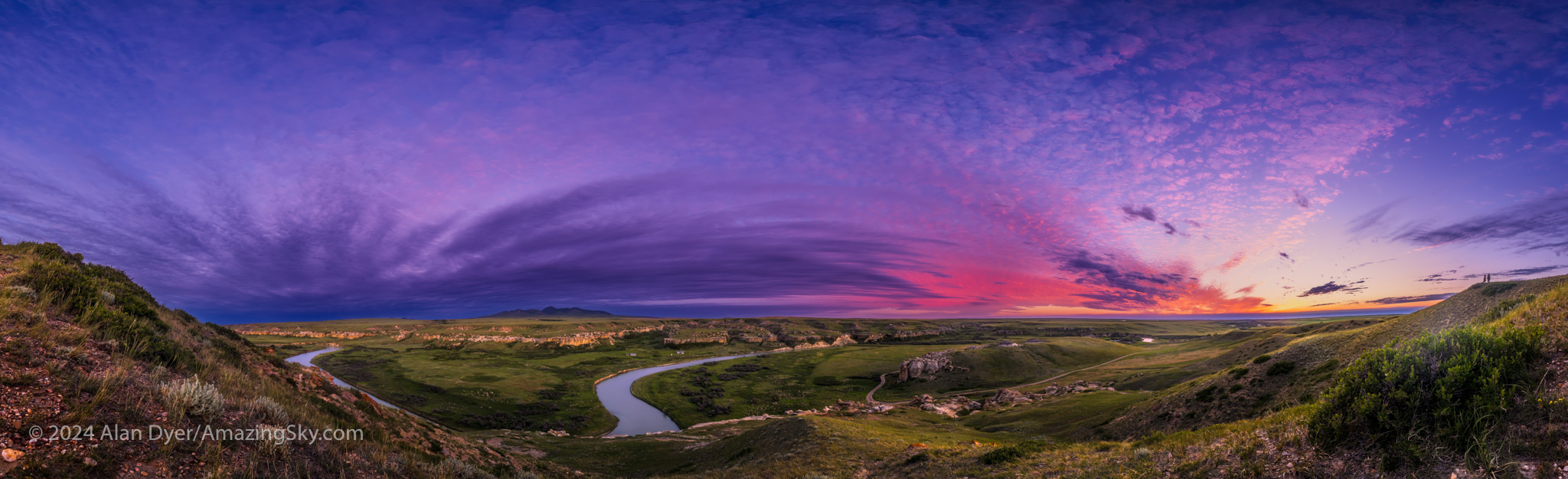
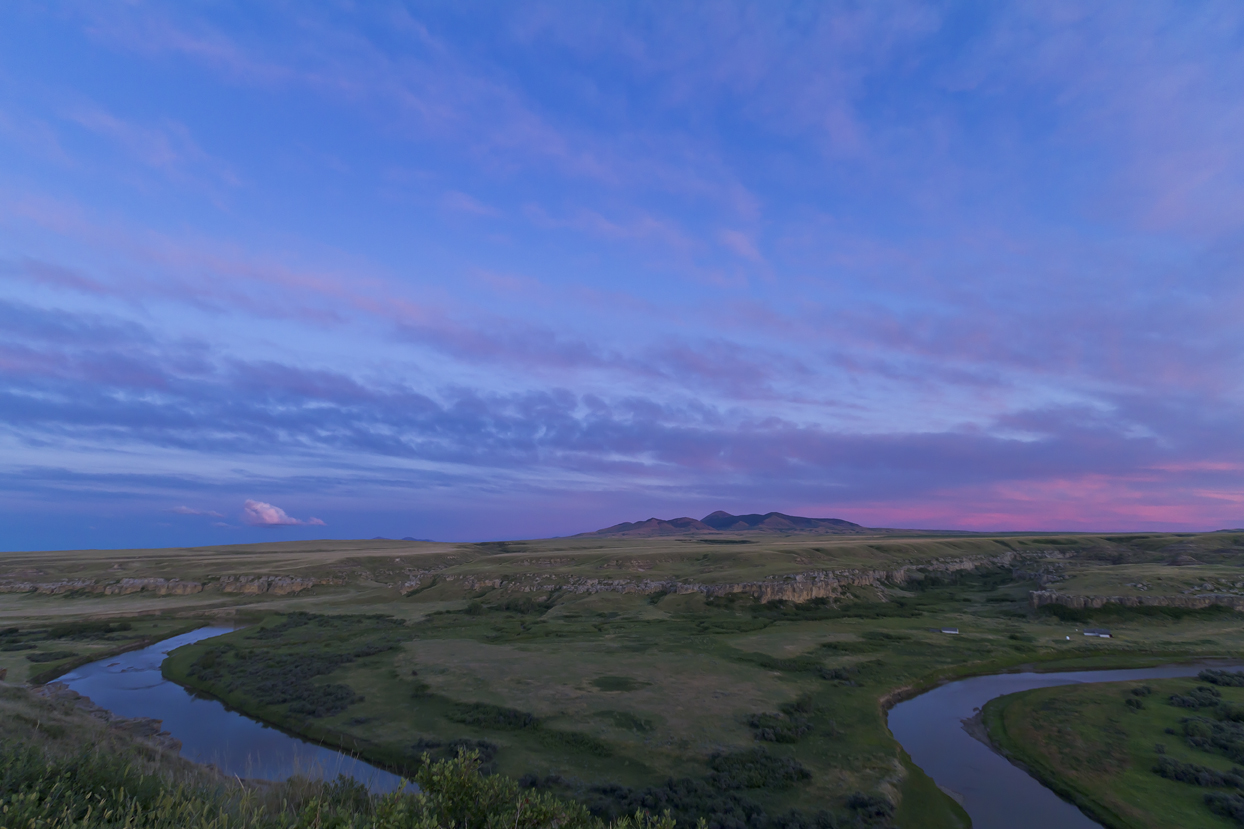
A panorama at sunset at Writing-on-Stone Provincial Park (รรญsรญnai’pi) in Alberta, with the Milk River below and the Sweetgrass Hills in the distance in Montana. Note the people at far right.

The rock formations of Writing-on-Stone Provincial Park are a bit farther, requiring a couple of days commitment to shoot. Clouds hid the main attraction, the Milky Way, this night, but did provide a fine sunset. 
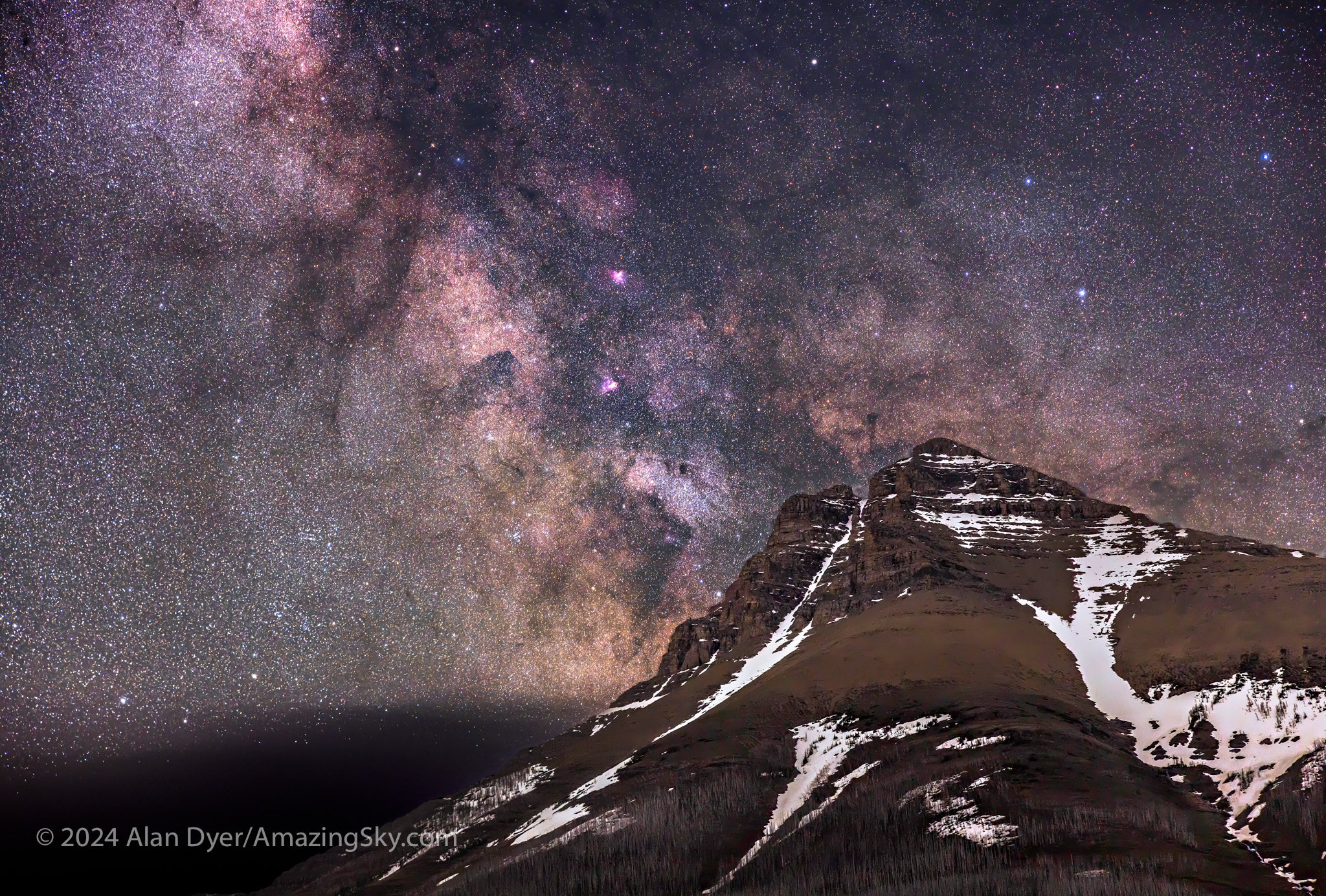
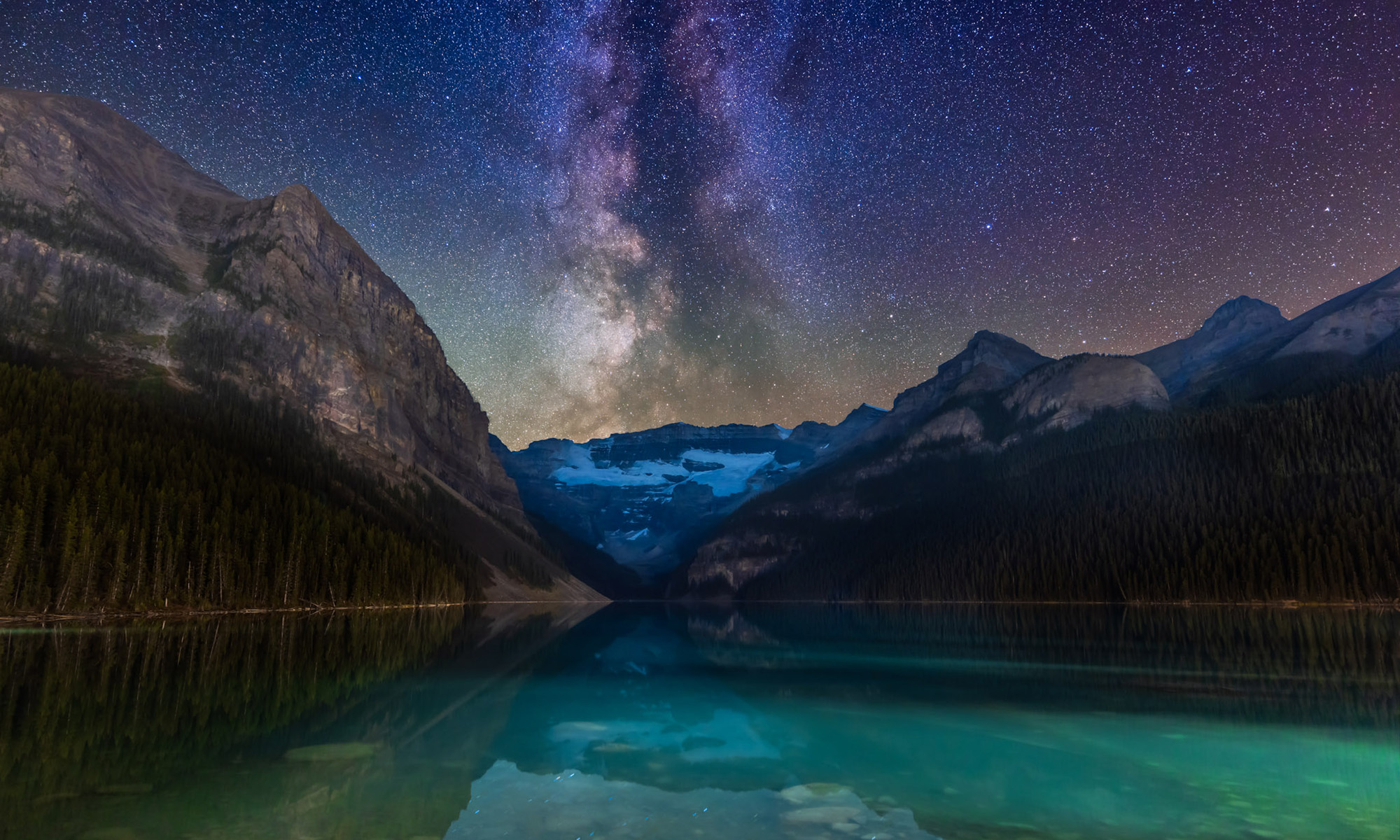
The Milky Way rises over Mt. Blakiston, in Waterton Lakes National Park, Alberta. This was June 10, 2024, so snow remains at high altitudes.

A little further west down the highway is Waterton Lakes National Park, another great spot I try to visit at least once each year. 

All locations I hit this month are U.N. World Heritage Sites, thus the theme of my blog from June. People travel from all over the world to come here, to sites I can visit in a few hours drive. 


Mountains by Starlight

In summer we now often contend with smoke from forest fires blanketing the sky, hiding not just the stars by night, but even the Sun by day. 
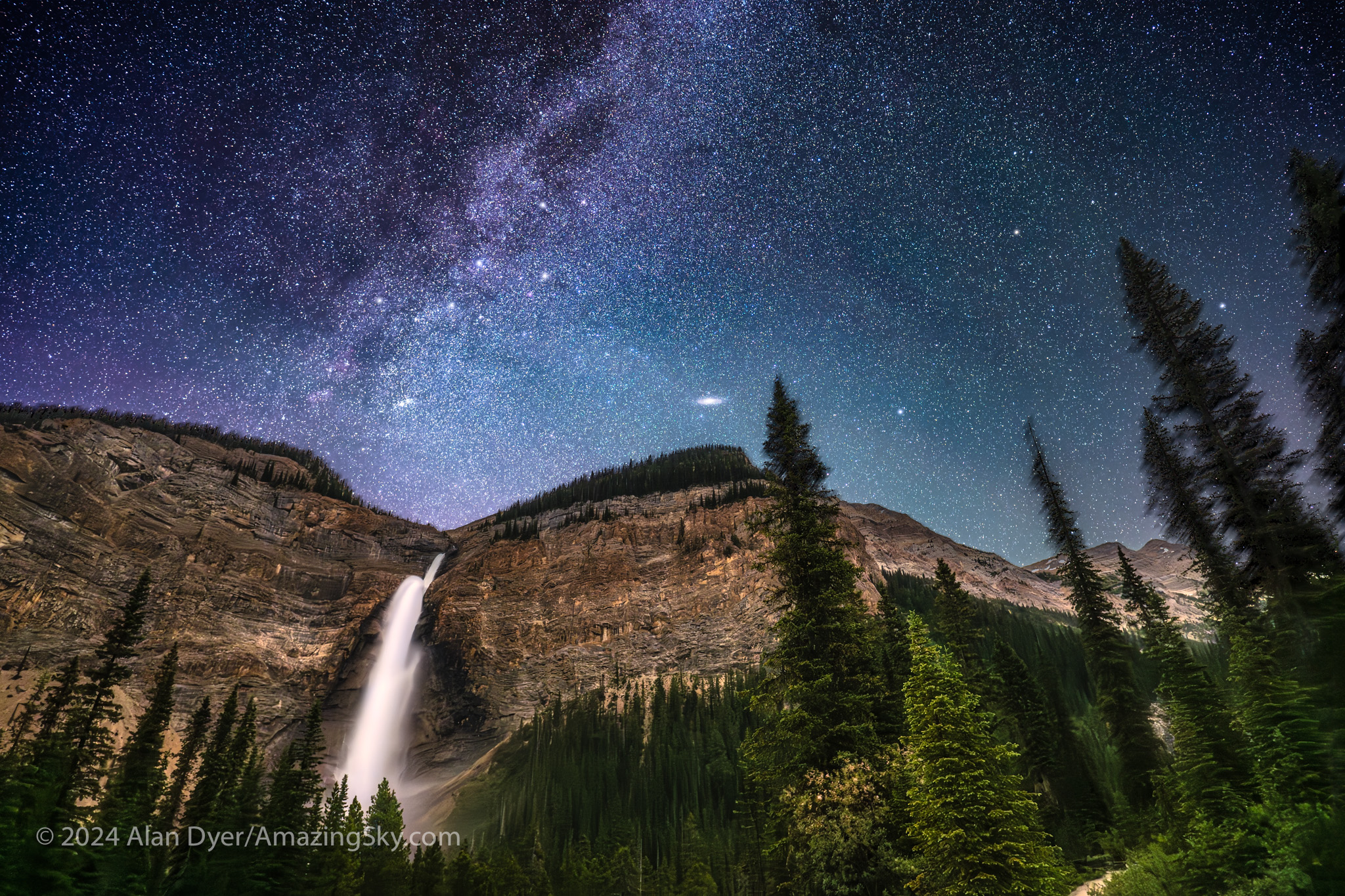
The Andromeda Galaxy at centre is rising above Takakkaw Falls, in Yoho National Park. Above is the W of stars marking Cassiopeia.

But before the smoke rolled in this past summer I was able to visit a spot, Yoho National Park in British Columbia, that had been on my shot list for several years. The timing with clear nights at the right season and Moon phase has to work out. In July it did, for a shoot by starlight at Takakkaw Falls, among the tallest in Canada. 
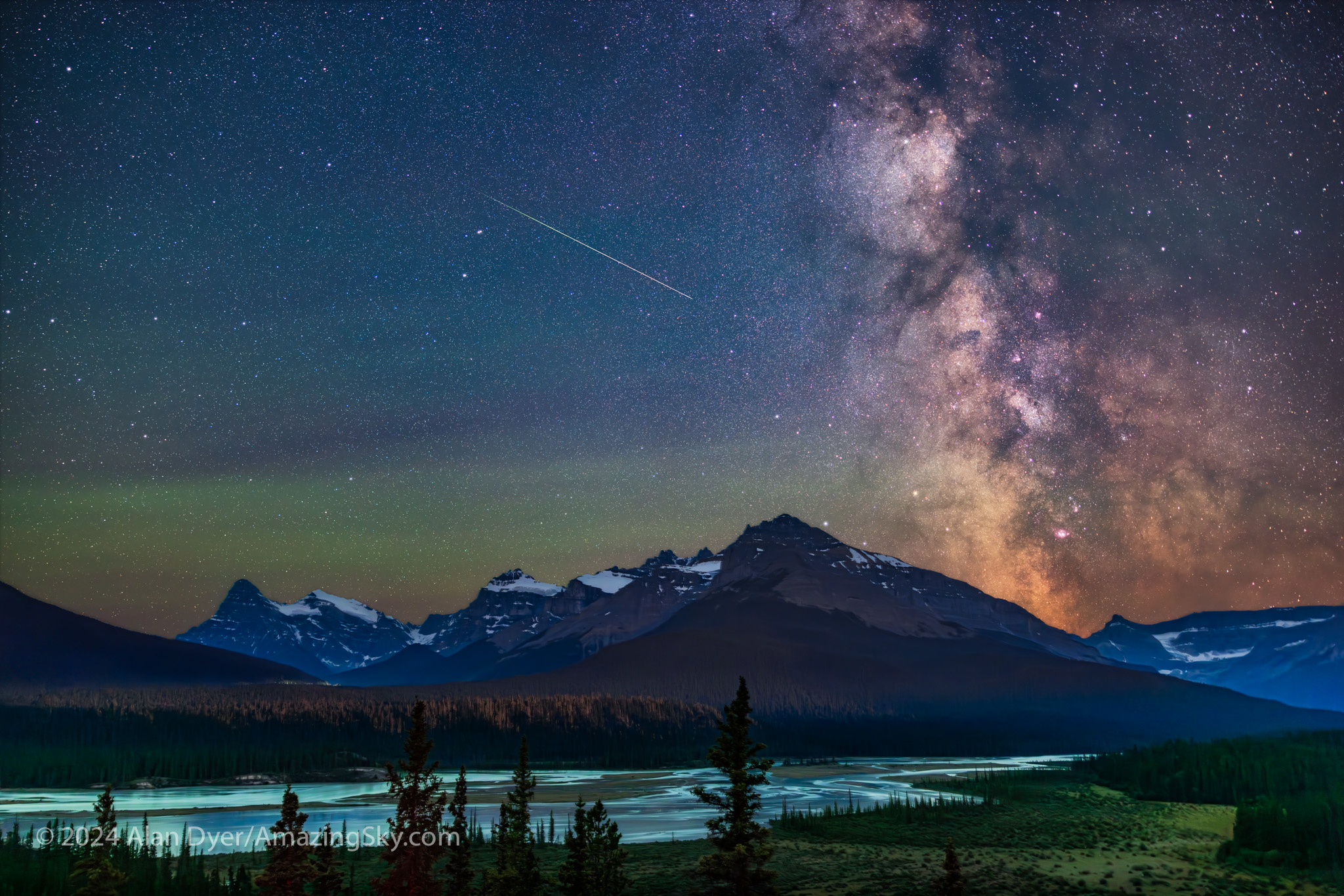
This is the Milky Way core and a bonus meteor over the peaks and valleys at Saskatchewan River Crossing, in Banff National Park, Alberta.

The following nights I was in Banff National Park, at familiar spots on the tourist trail, but uncrowded and quiet at night. It was a pleasure to enjoy the world-class Rocky Mountain scenery under the stars on perfect nights. 


The All-Sky Auroras Return 

In August I headed east to Saskatchewan and the annual Summer Star Party staged by the astronomy clubs in Regina and Saskatoon. It is always a pleasure to attend the SSSP in the beautiful Cypress Hills. The sky remained clear post-party for a trip farther east to the little town of Val Marie, where I stayed at a former convent, and had a night to remember out in Grasslands National Park, one of Canadaโ€™s first, and finest, dark sky preserves.
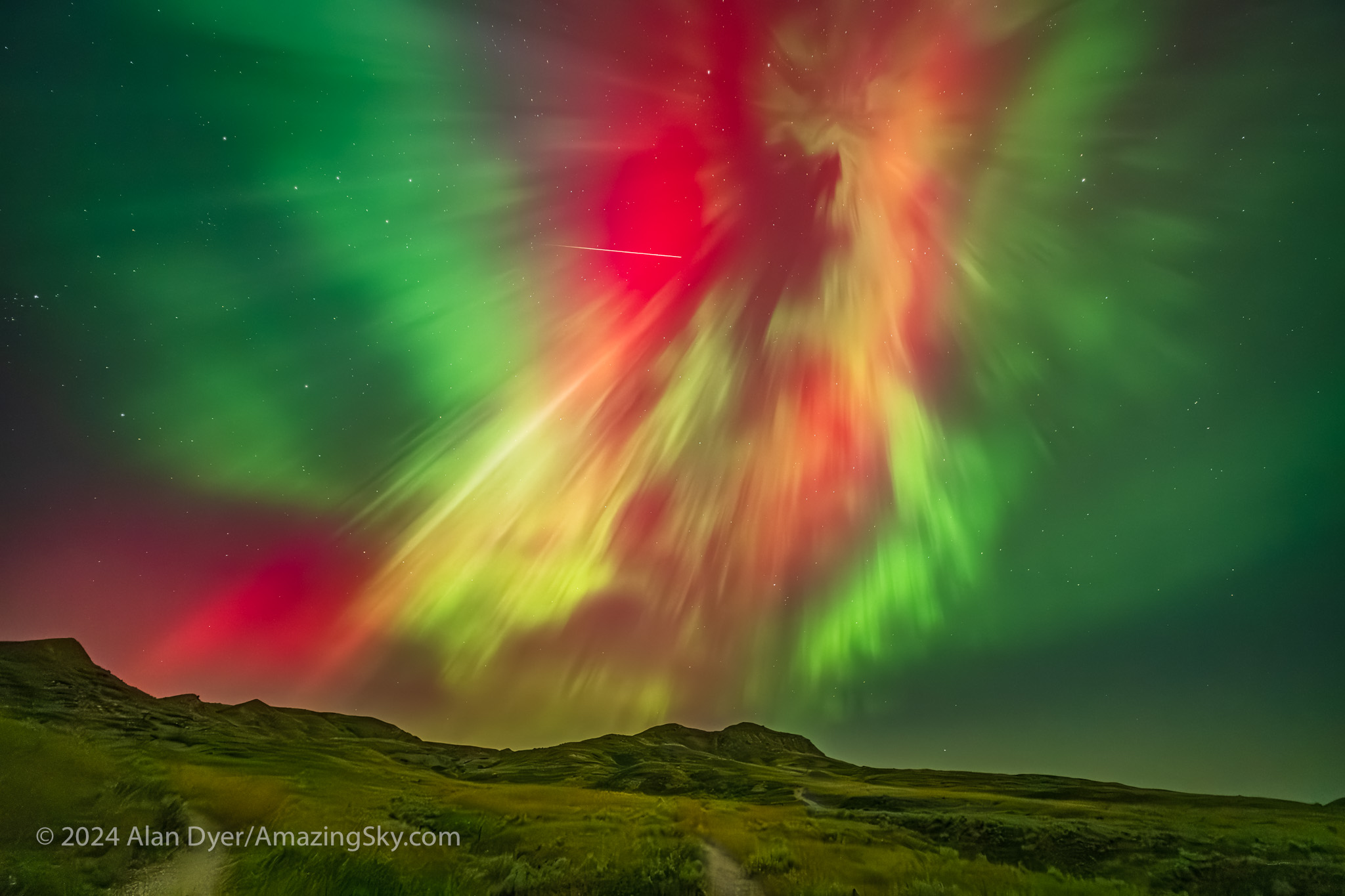
The Northern Lights in a superb all-sky Kp6 to 7 display on August 11-12, 2024, in Grasslands National Park, Saskatchewan.

The plan was to shoot the August 11 Perseid meteor shower, but the aurora let loose again for a stunning show over 70 Mile Butte. My earlier blog has more images and movies from this wonderful month of summertime Northern Lights. 

We are fortunate in western Canada ๐Ÿ‡จ๐Ÿ‡ฆ to be able to see auroras year-round, even in summer. Farther north at the usual Northern Lights destinations, the sky is too bright at night in summer. 


Back to Deep Sky Wonders

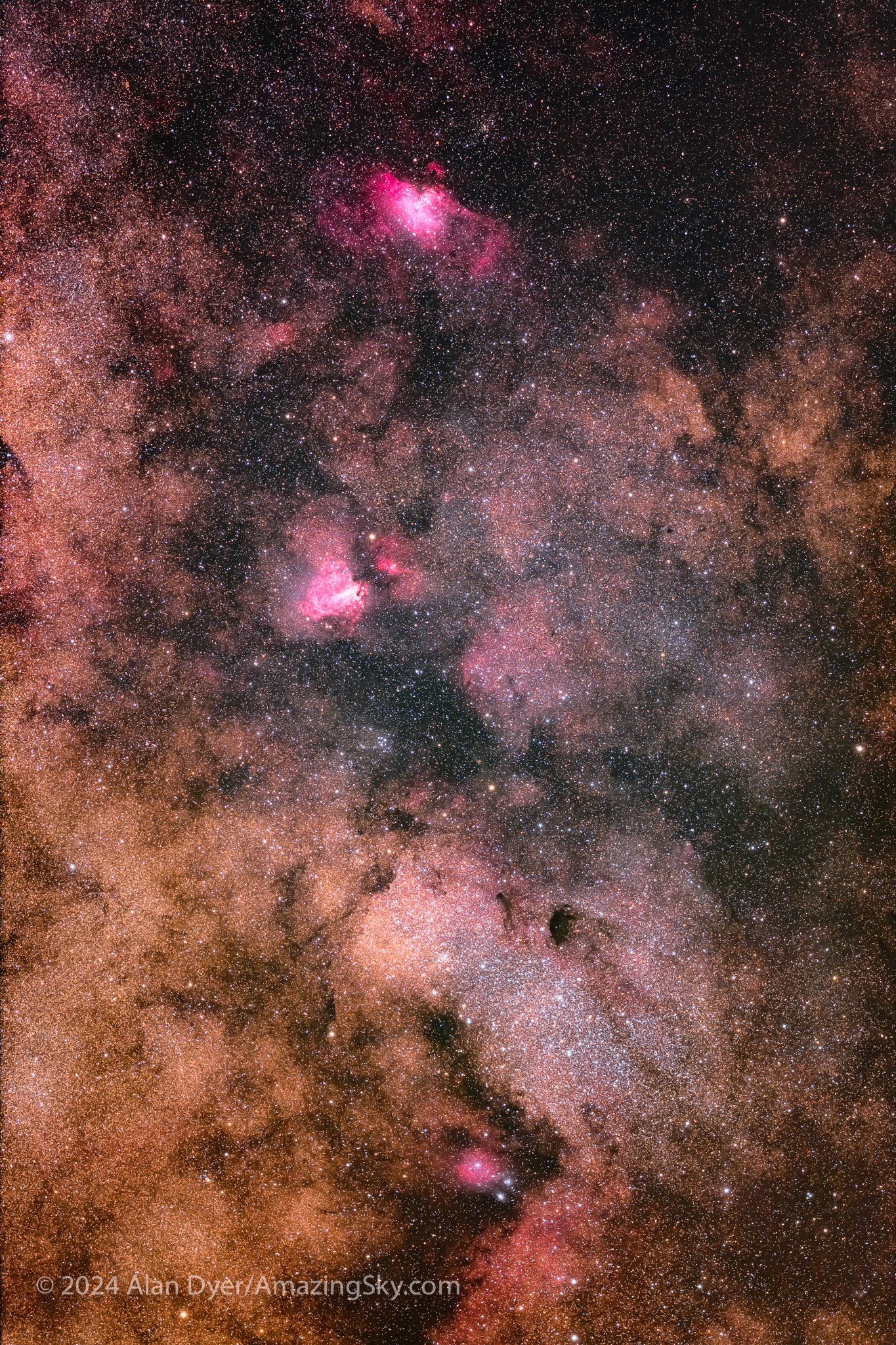
This is a framing of the rich starfield in Sagittarius and Serpens containing a mix of bright star clouds, glowing nebulas, and dark dust in the Milky Way.

September is the month for another astronomical party in the Cypress Hills, but on the Alberta side. At the wonderful Southern Alberta Star Party under its very dark skies, I was able to shoot some favourite deep-sky fields along the Milky Way with new gear I was testing at the time. 
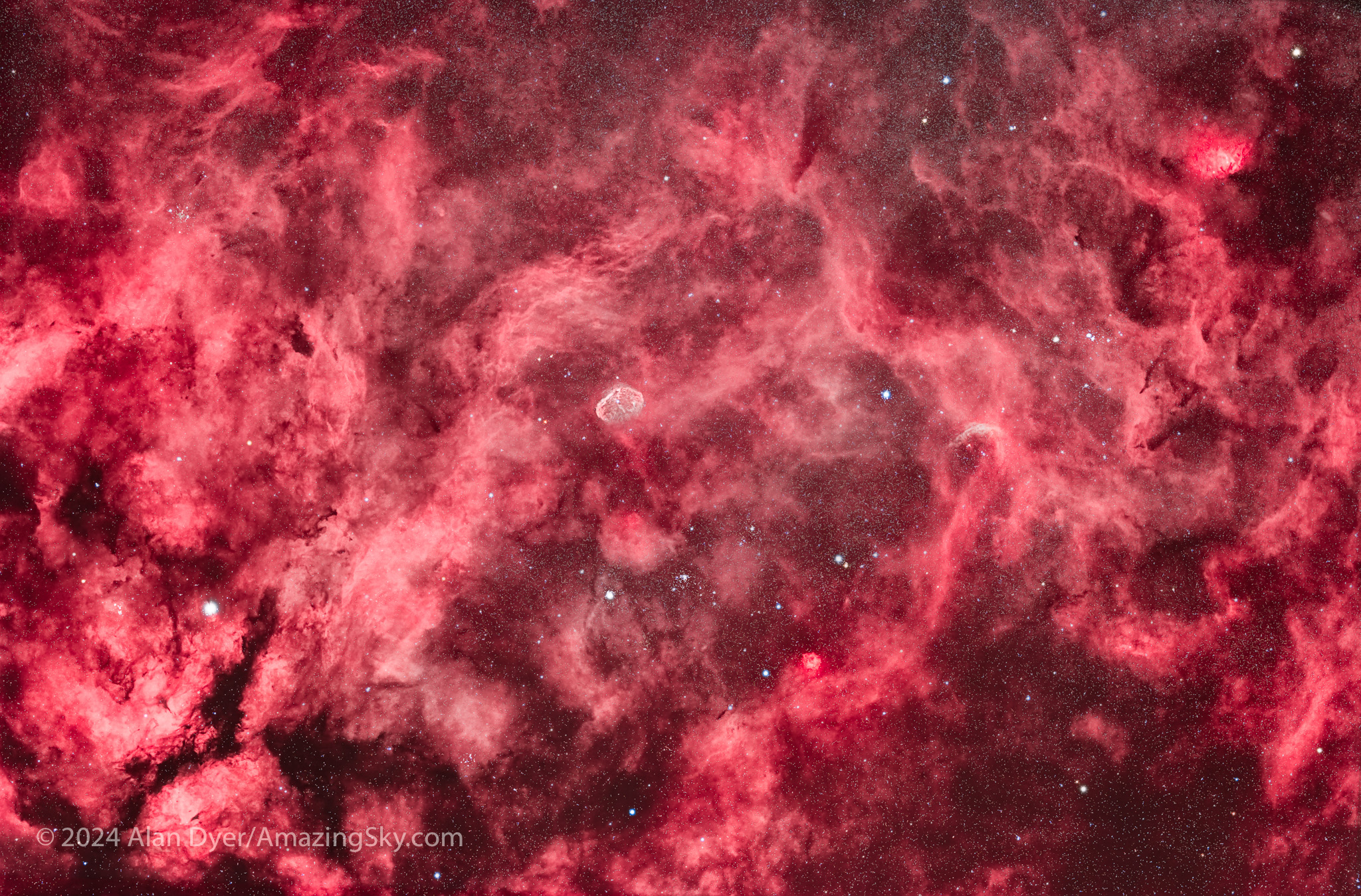
This frames the complex region of emission nebulas in central Cygnus near the star Gamma Cygni, at lower left. The Crescent Nebula is at centre.

And from home, September brought skies dark and clear enough (at least when there was no aurora!) for more captures of colourful nebulas (above and below) along the summer Milky Way. 
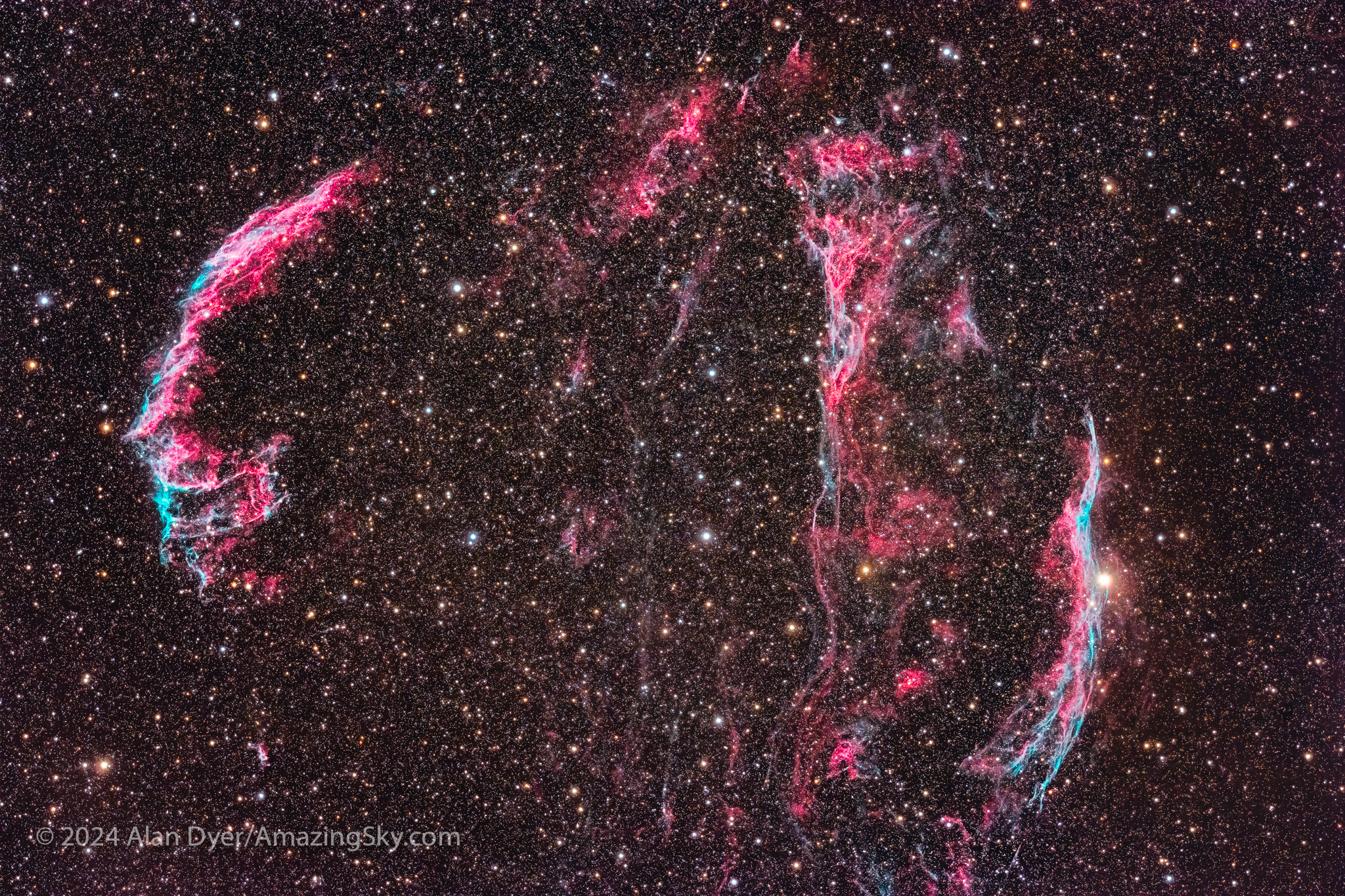
This frames all the photogenic components of the bright Veil Nebula in Cygnus, a several-thousand-year-old supernova remnant.

We invest a lot of money into the kind of specialized gear needed to shoot these targets (and Iโ€™m not nearly as โ€œcommittedโ€ as some are, believe me!), only to find the nights when it all comes together can be few and far between. 

Plus, A Very Minor Eclipse of the Moon 

I had to include this, if only for stark contrast with the spectacular solar eclipse six months earlier. 

We had an example of the most minor of lunar eclipses on March 24, 2024, with a so-called โ€œpenumbralโ€ eclipse of the Moon, an eclipse so slight itโ€™s hard to tell anything unusual is happening. (So I’ve not even included an image here, though I was able to shoot it.)
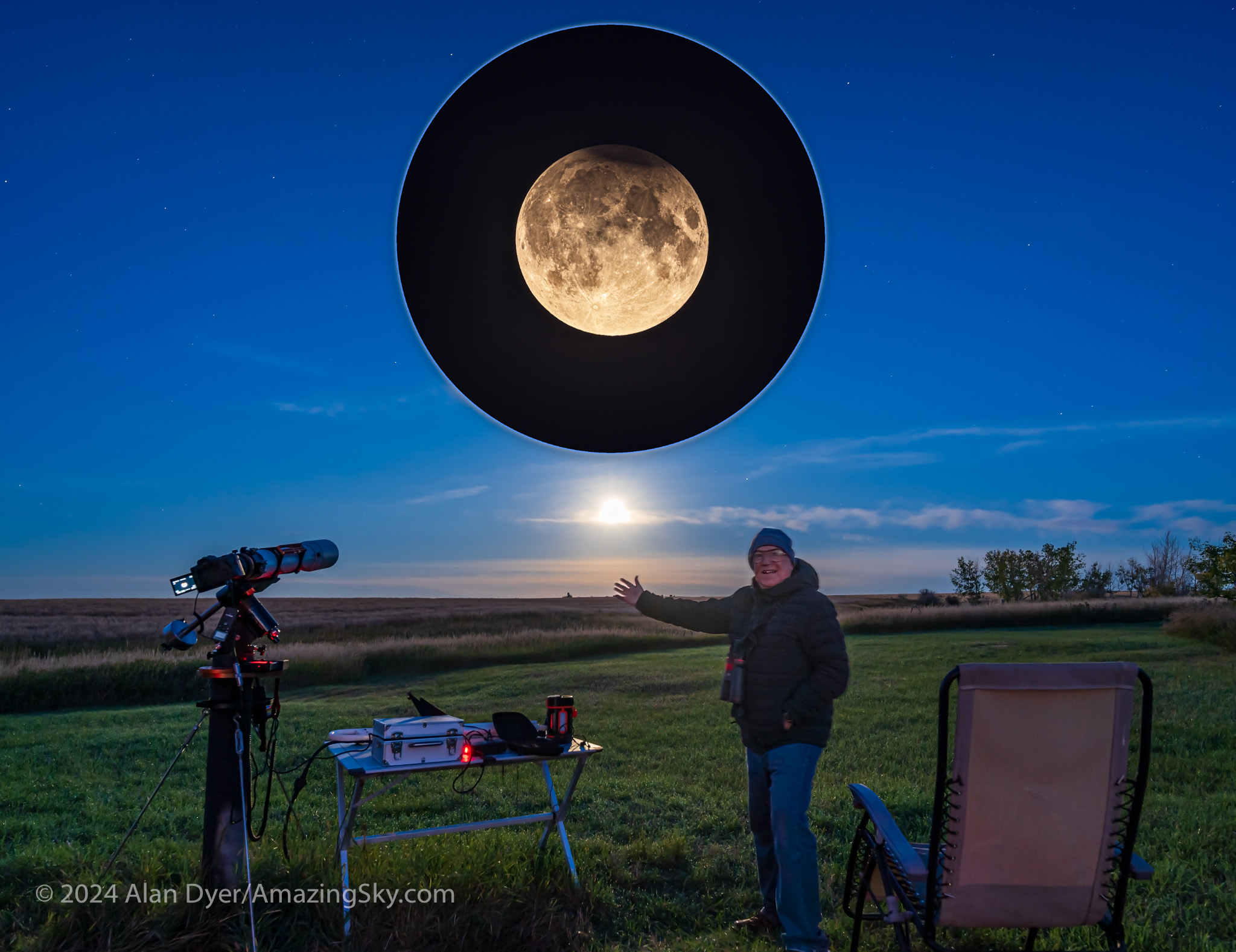
Me at another successful eclipse chase โ€ฆ to my backyard to capture the partial lunar eclipse on September 17, 2024. The Moon is rising in the southeast.

On September 17, we had our second eclipse of the Moon in 2024. This time the Earthโ€™s umbral shadow managed to take a tiny bite out of the Full Moon. Nothing spectacular to be sure. But at least this eclipse expedition was to no farther away than my rural backyard. A clear eclipse of any kind, even a partial eclipse, especially one seen from home, is reason to celebrate. I did!

Of course, a total eclipse of the Moon, when the Full Moon is completely engulfed in Earthโ€™s umbra and turns red, is what we really want to see. They rate a 7 on our Aah! Factor scale. We havenโ€™t had a “TLE” since November 8, 2022, blogged about here.

The next is March 14, 2025. (The link takes you to Fred Espenak’s authoritative web page.)


A Bright Comet At Last!

We knew early in 2024 that the then newly-discovered Comet Tsuchinshan-ATLAS had the potential to perform this month. I planned a trip south to favourite spots in Utah and Arizona to take advantage of what we hoped would be a fine autumn comet. 
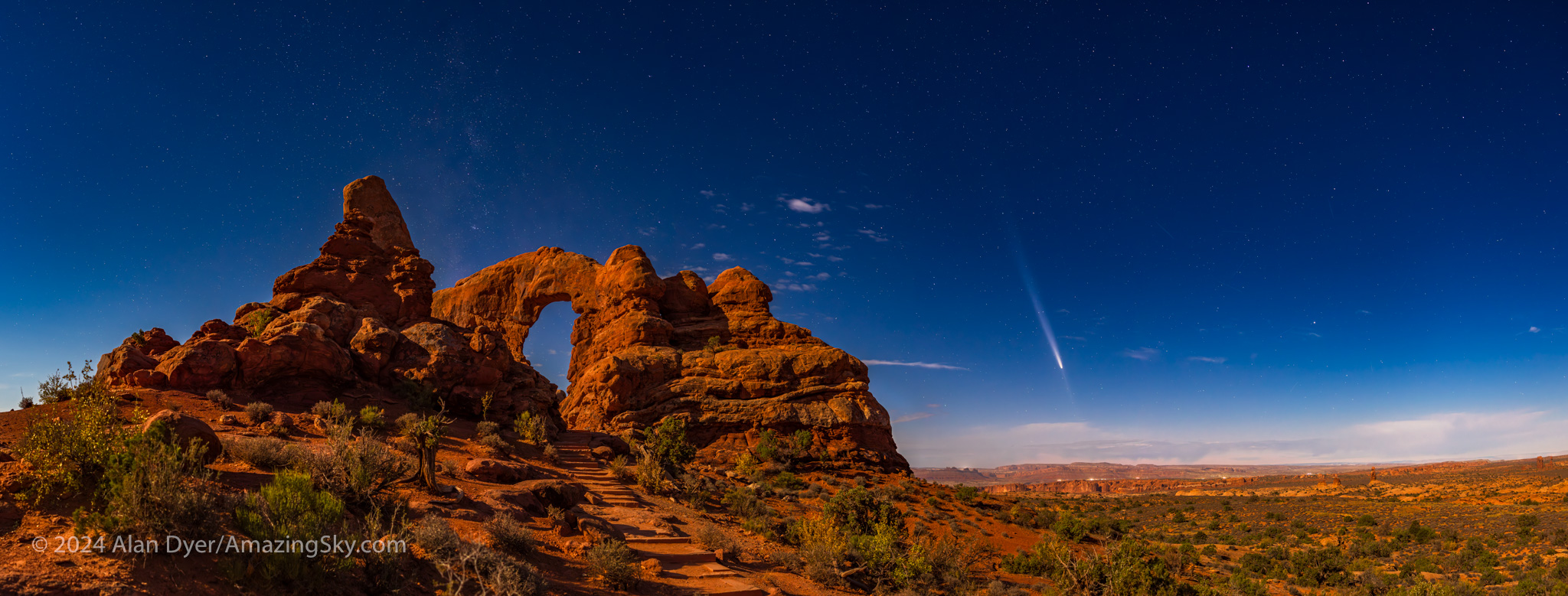
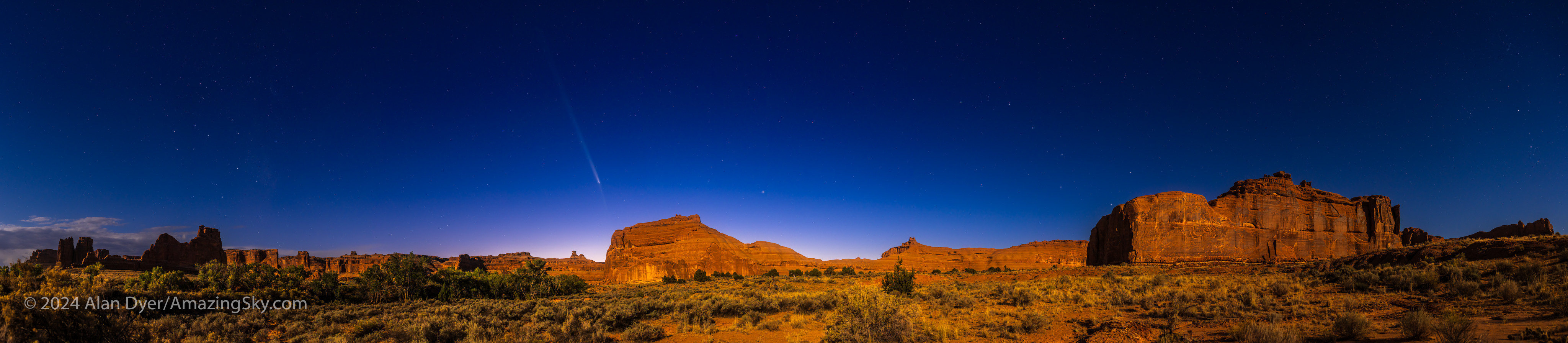
This is Comet Tsuchinshan-ATLAS (C/2023 A3) at its finest in the evening sky, on October 14, two days after its closest approach to Earth, and with it sporting a 10ยบ- to 15ยบ-long dust tail, and a short narrow anti-tail pointed toward the horizon. The location was Turret Arch in the Windows area of Arches National Park, Utah.

It blossomed nicely, especially as it entered into the evening sky in mid-October, as above. Despite the bright moonlight, it was easy to see with the unaided eye, a celestial rarity we get only once a decade, on average, if we are lucky. My blog of my comet chase is here

This is a panorama of Comet Tsuchinshan-ATLAS over Arches National Park, Utah, on a moonlit night, October 15, 2024, with the comet easy to see with the unaided eye.

A naked-eye comet ranks an 8 on our Aah! Factor scale. So now 2024 had delivered all four of our Top 4 sky sights. 
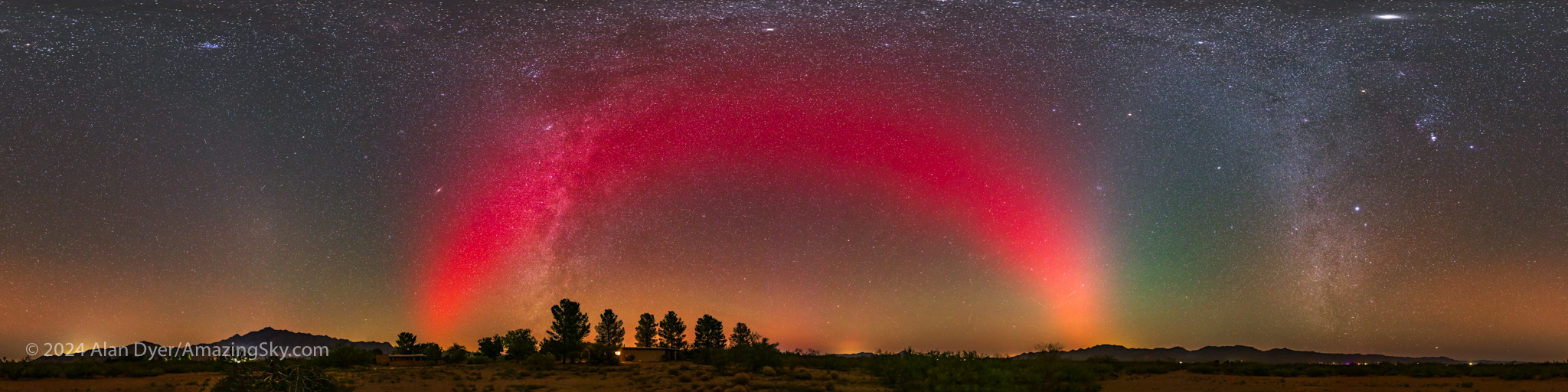
This 360ยฐ panorama captures a rare SAR (Stable Auroral Red) arc across the Arizona sky in the pre-dawn hours of October 11, 2024. The SAR arc was generated in the high atmosphere as part of the global geomagnetic storm of October 10/11, 2024, with a Kp8 rating that night.

But … just as a bonus, there was another fabulous aurora on October 10, seen in my case from the unique perspective of southern Arizona, with an appearance of a bright “SAR” arc more prominent than I had ever seen before. So that view was a rarity, too, so unusual it doesn’t even make our Aah! list, as SARs are typically not visible to the eye.


Back to Norway for Northern Lights

2024 was notable for travel getting โ€œback to normal,โ€ at least for me, with two long-distance drives, and now my second overseas trip. This one took me north to Norway ๐Ÿ‡ณ๐Ÿ‡ด, which I had been visiting twice a year as an enrichment lecturer during pre-pandemic years. 
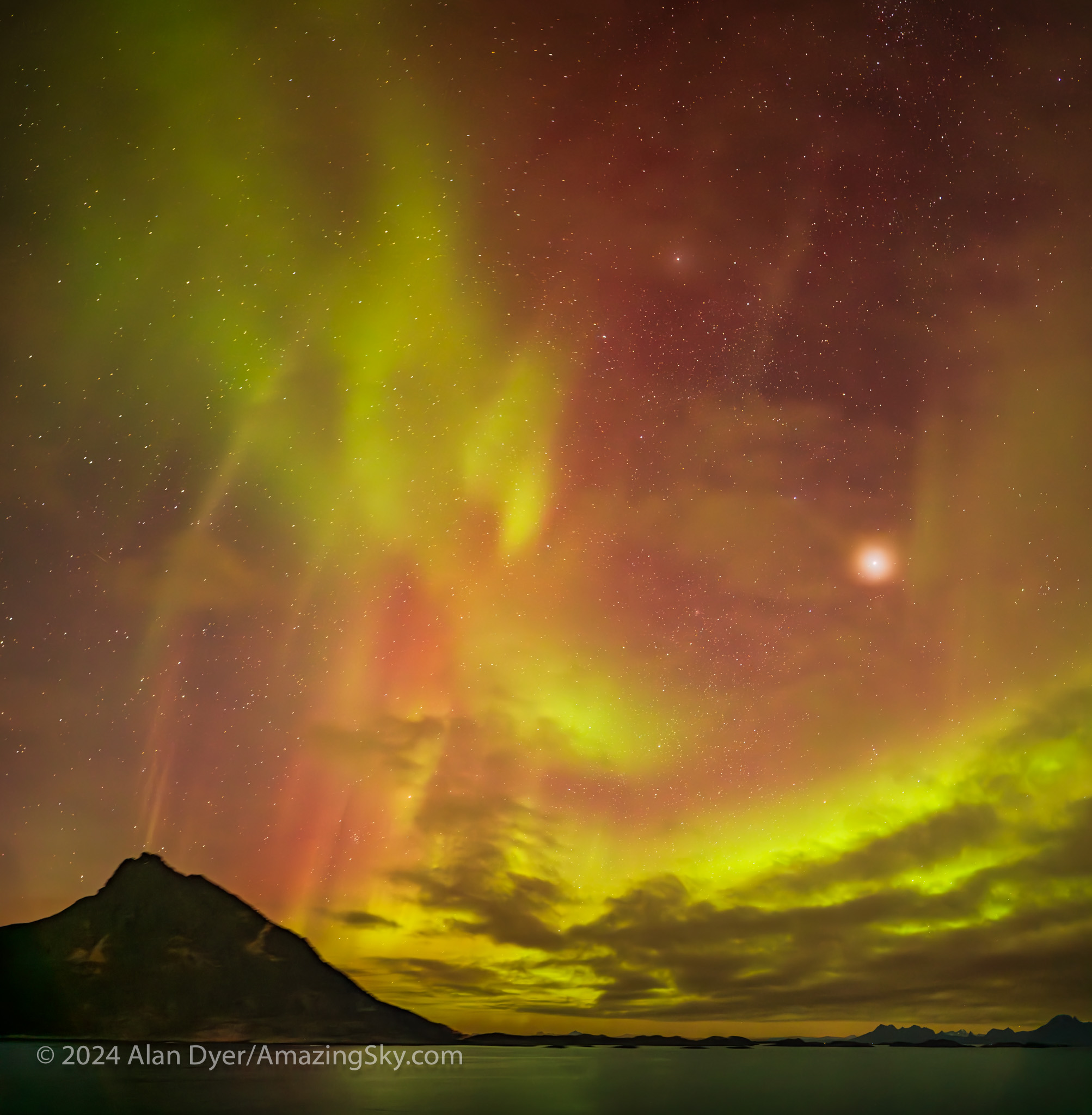
A green and red aurora appears over the coast of Norway, with Jupiter bright at right. This was from the Hurtigruten ship m/s Nordkapp on November 10, 2024, on a coastal cruise with a Road Scholar tour group.

The auroras were excellent, though nothing like the great shows of May and October. But the location sailing along the scenic coast and fjords makes up for any shortfall in the Lights. It was good to be back. I plan to return in 2025 for two cruises in October. Join me there, too!


A Winter Moonrise to End the Year

As I write this, December has been nothing but cloud. Almost. A clear hour on Full Moon night allowed a capture of the โ€œCold Moon,โ€ with the Moon near Jupiter, then at its brightest for the year. So thatโ€™s the other lunar bookend to the year, shot from the snowy backyard. 
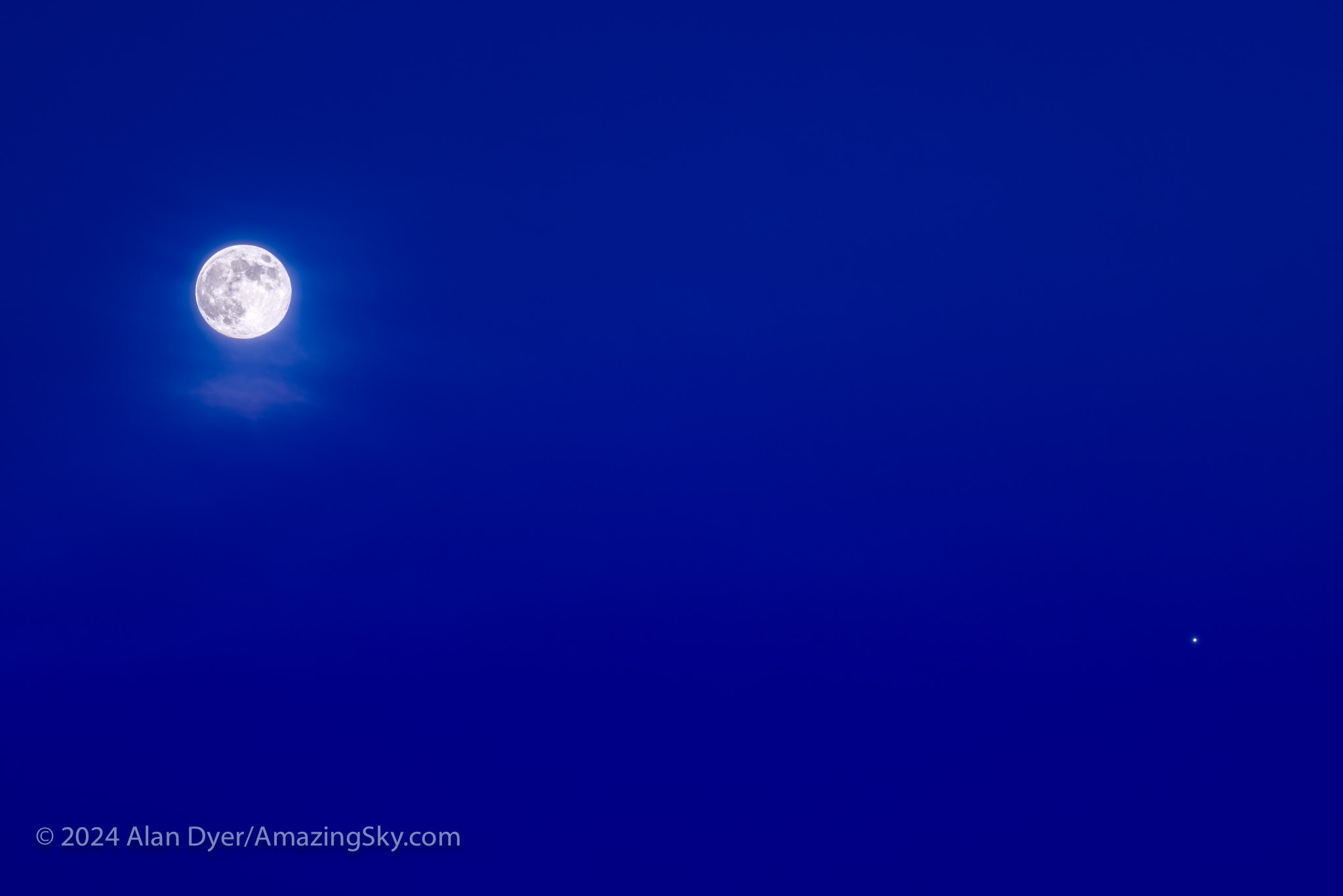
This is the Full Moon of December 14, 2024, near the planet Jupiter at lower right. Both were rising into the eastern sky in the early evening.

However, I did say after the clear total eclipse in April that if the rest of 2024 had been cloudy I wouldnโ€™t complain. So Iโ€™m not. 

And thereโ€™s no reason to, as 2024 did deliver the best year of stargazing I can remember. 2017 had a total solar eclipse. 2020 had a great comet. But we have to go back to 2003 for aurora shows as widespread and as a brilliant as weโ€™ve seen this year. 2024 had them all. And more!

We might see more auroras in 2025. And we have a total eclipse of the Moon. Two in fact, if youโ€™re willing to travel to the other hemisphere. 
My 2025 Calendar cover. Go to https://www.amazingsky.com/Books

My 2025 Amazing Sky Calendar lists my picks for the best sky events of the coming year, with the emphasis on events viewable from North America. For a free PDF download of my Calendar, go to my website here

Clear skies to all, in a Happy New Year! 

โ€” Alan, December 21, 2024 / amazingsky.com 
Nights at World Heritage Sites


I present a selection of new images taken at local World Heritage Sites, along with some advanced nightscape shooting tips.

I’m fortunate in living near scenic landscapes here in southern Alberta. Many are part of UNESCO World Heritage Sites that preserve regions of unique scenic and cultural significance. In early June I visited several to shoot nightscapes of starry skies over the scenic landscapes.

I also took the opportunity to experiment with some new shooting techniques. So I’ve included some tips and techniques, most of the advanced variety.


First up was Dinosaur Provincial Park.

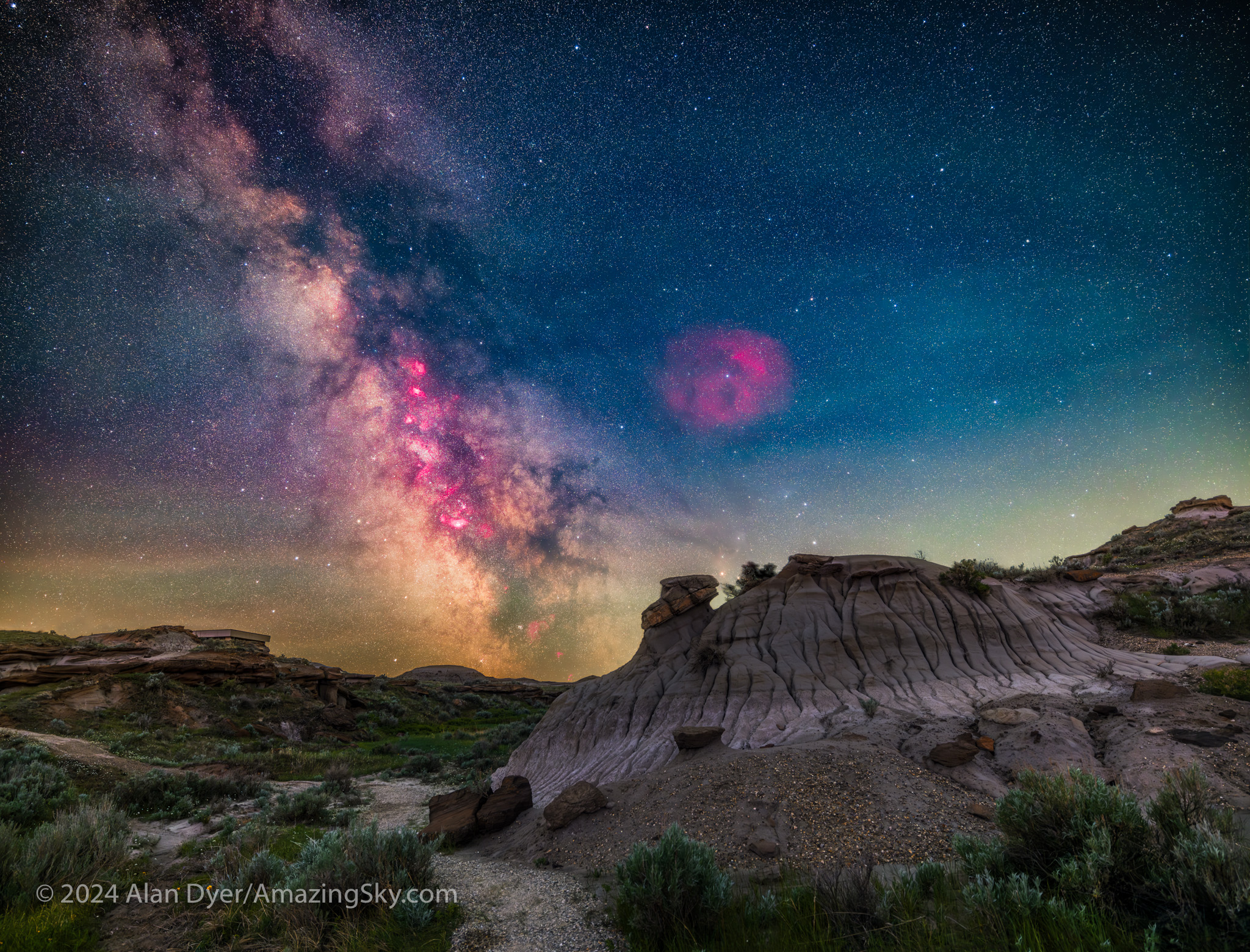
The Milky Way and its core region in Sagittarius and Scorpius is here low over the Badlands landscape of Dinosaur Provincial Park, Alberta.

After nearly a month of rain and clouds, the night of May 31/June 1 proved wonderfully clear at last. I headed to a favourite location in the Red Deer River valley, amid the eroded badlands formations of Dinosaur Provincial Park, site of late-Cretaceous fossil finds.

The bright core of the Milky Way in Sagittarius would be in the south. With the night only three weeks before summer solstice, from the Park’s latitude of 50.5ยฐ N the sky would not get astronomically dark. But it would be dark enough to show the Milky Way well, as above in this framing looking south on the Trail of the Fossil Hunters.

However, May and June are “Milky Way Arch” months, at least for the northern hemisphere. The full sweep of the northern Milky Way, from Perseus in the northeast to Sagittarius in the southeast, then stretches across the sky โ€” high enough to be impressive, but low enough (unlike later in summer) to be framable in a horizontal panorama.

This is a 200ยฐ panorama of the arch of the northern Milky Way rising over the Badlands landscape of Dinosaur Provincial Park, Alberta.

To capture the arc of the Milky Way I shot a panorama โ€” in fact three:

  • one exposed for the ground
  • one exposed for the sky, but with the camera now tracking the sky to keep stars pinpoint
  • and a final sky panorama but with a specialized filter installed in front of the camera sensor to let through only the deep red light emitted by nebulas along the Milky Way
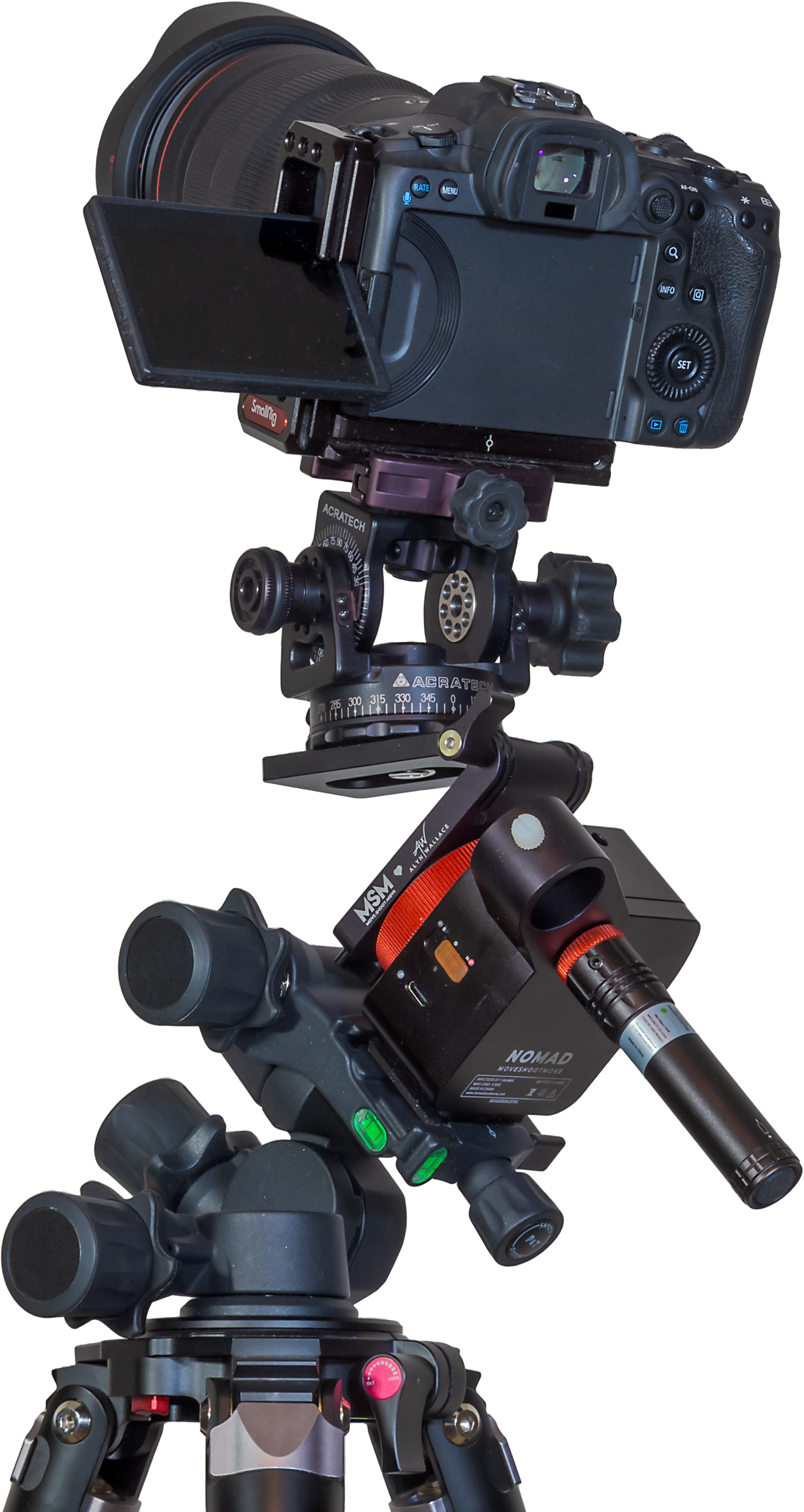
Rig for tracked panoramas with the MSM Nomad tracker

The image above shows my rig for taking tracked panoramas. The rectangular box is the little Nomad sky tracker from Move-Shoot-Move (MSM), here equipped with its accessory laser pointer to aid the “polar alignment” that is needed for this or any tracker to follow the turning sky properly.

A review of the MSM Nomad will be forthcoming (subscribe to my blog!). However, I’ve found it works very well, much better than MSM’s original Rotator tracker, which was entirely unreliable!

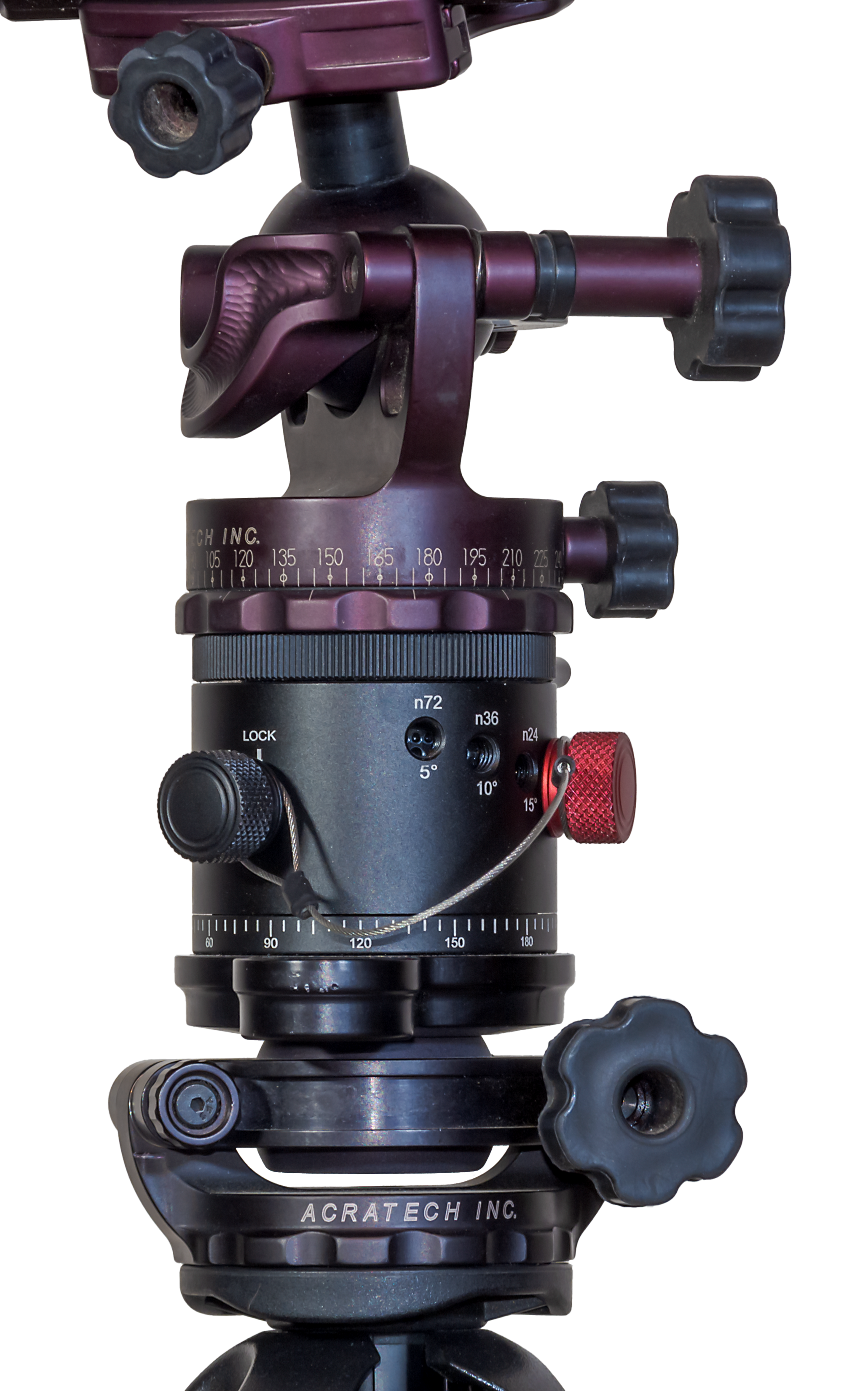
On top of the little Nomad is an Acratech pano head, so I can turn the camera by a specific angle between each pano frame, both horizontally from segment to segment, and vertically if needed when raising the camera from the ground pano to the sky pano.

The pano head is on a “V-Plate” sold by MSM and designed by the late, great nightscape photographer (and engineer by trade), Alyn Wallace. The V-Plate allows the camera to turn parallel to the horizon when on a tipped-over tracker. The entire rig is on a Benro 3-Axis tripod head (also sold by MSM, but widely available) that makes it easy to precisely aim the tracker for polar alignment and then hold it rock steady.

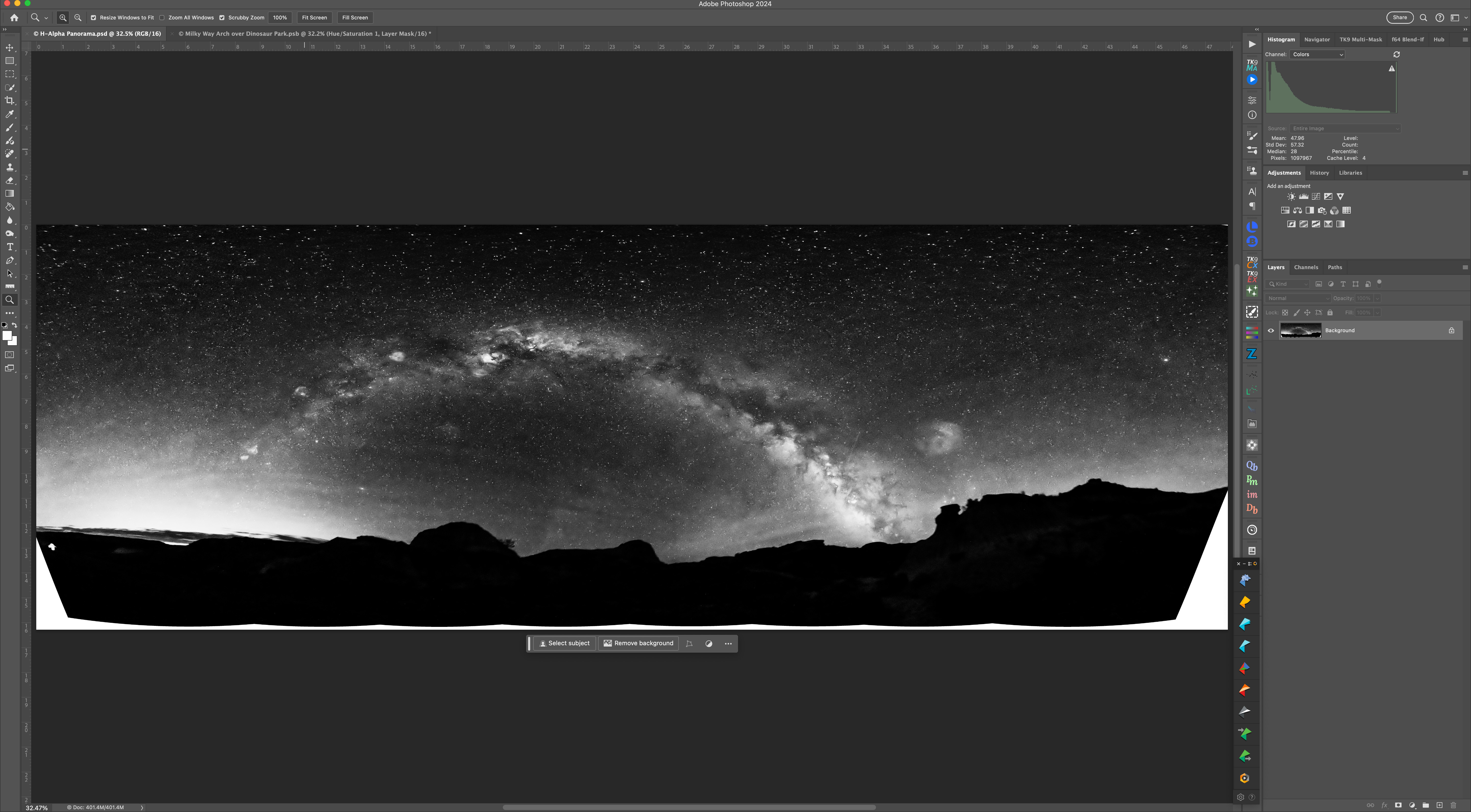
The H-Alpha Panorama rendered in monochrome

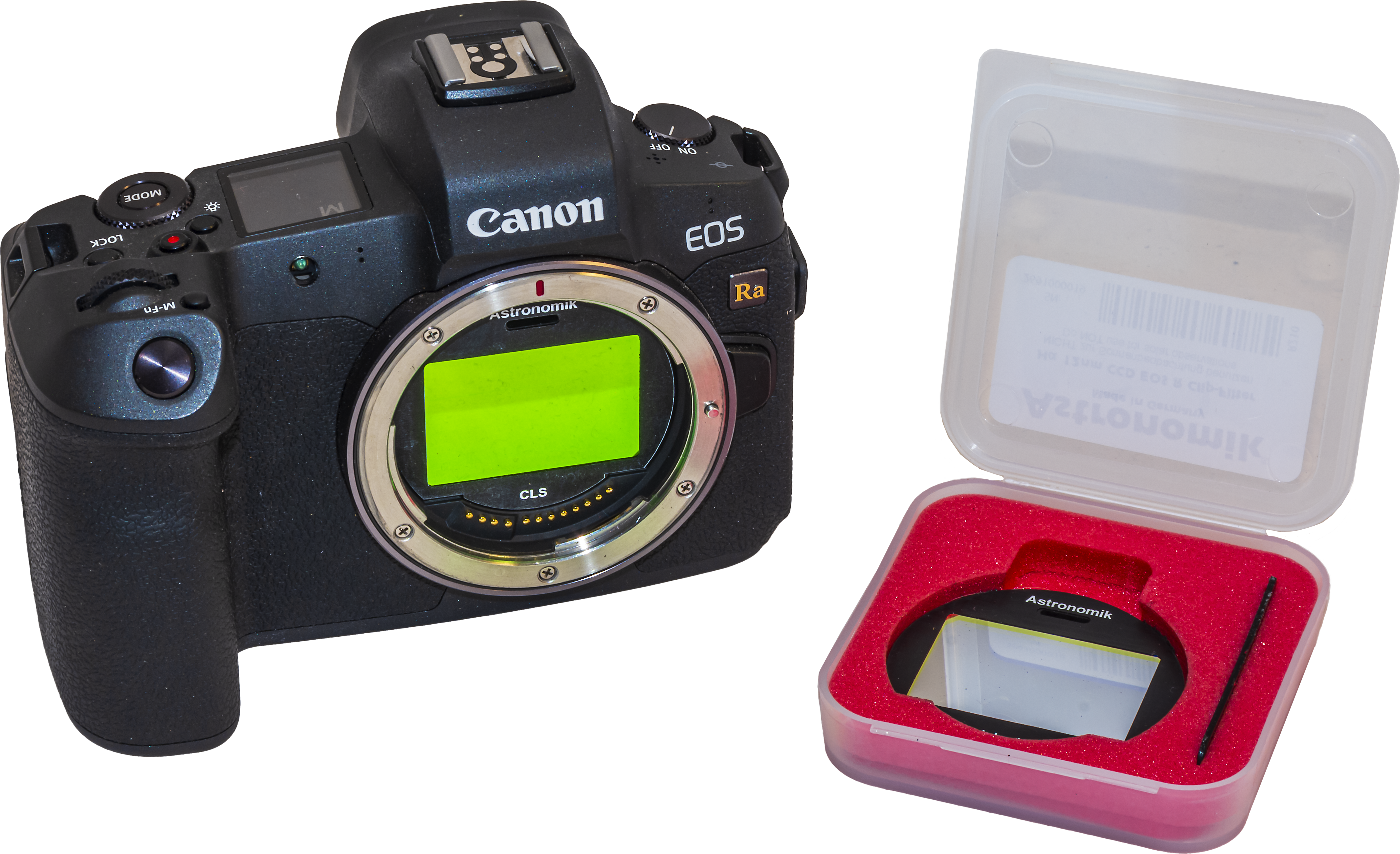
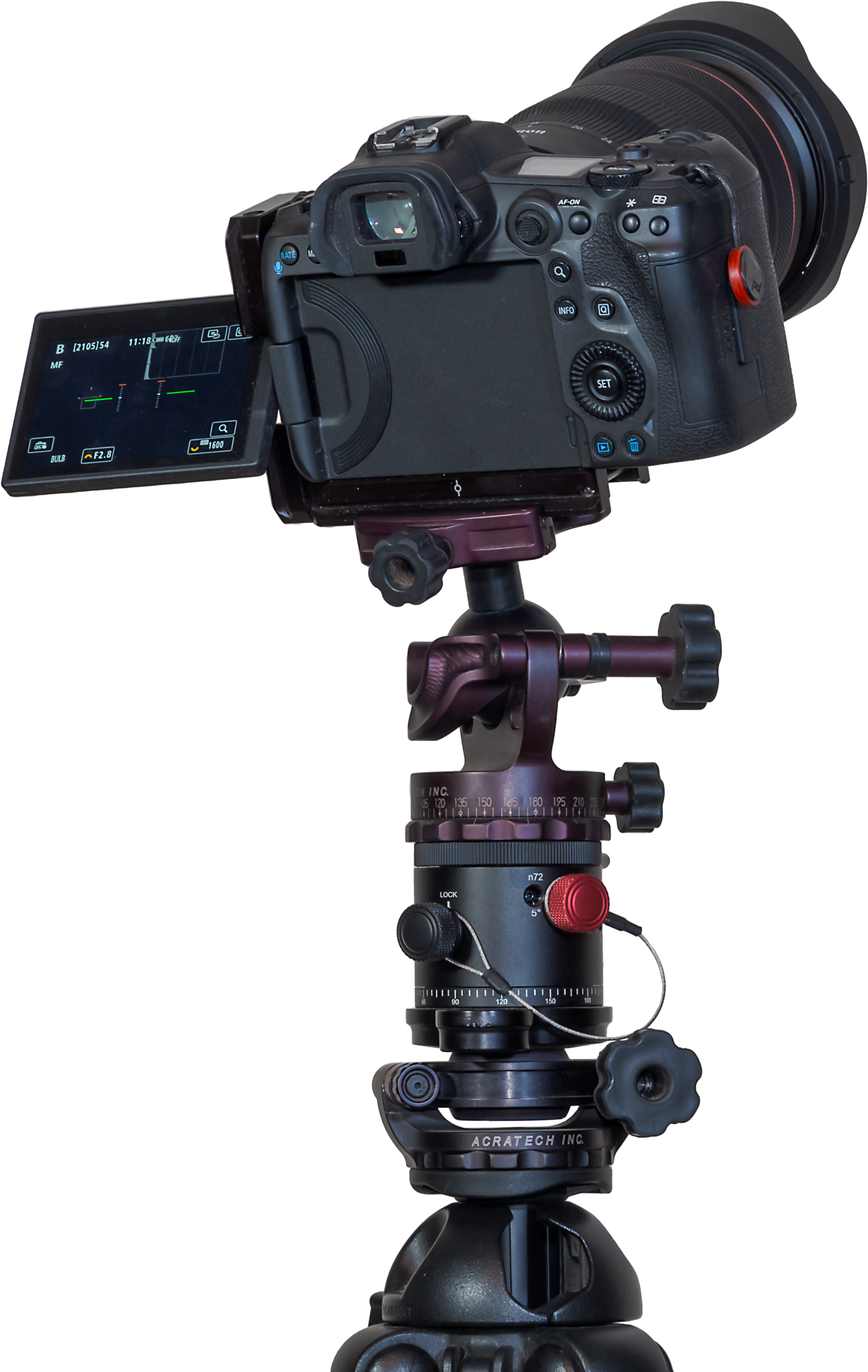
I’d taken many panos before using sets of untracked ground and tracked sky panoramas. New this night was the use a “narrowband” Hydrogen-Alpha filter to take a final pano that brings out the red nebulas. I used a filter from Astronomik that clips into the camera in front of the sensor. Such a filter has to be used on a camera that has been modified to be more sensitive to deep red light, as the Canon Ra shown below is (or was, as Canon no longer makes it).

While a modded camera brings out the nebulas, using an H-Alpha filter as well really shows them off. But using one is not easy!

Astronomik clip-in filters, the 12nm H-a on the right

The clip-in placement (unlike a filter in front of a lens) requires that the lens be refocused โ€” infinity focus now falls at the 3 to 6 metre point (the focus shift varies with the lens and focal length โ€” the wider the lens the greater the shift). With the image so dark and deep red, seeing even a bright star to manually focus on is a challenge.

Shifting the lens focus also changes the overall image size (called “focus breathing”) and often introduces more off-axis lens aberrations, again depending on the lens.

So, blending the H-Alpha pano (which I rendered out in monochrome, above) into the final stack is tough, requiring lots of manual alignment, image warping, BlendIf adjustments, and masking. This is where I added in the red colouration to taste. Careful here, as the “Saturation Police” patrolling social media will issue tickets if they judge you have exceeded their “speed limit.”

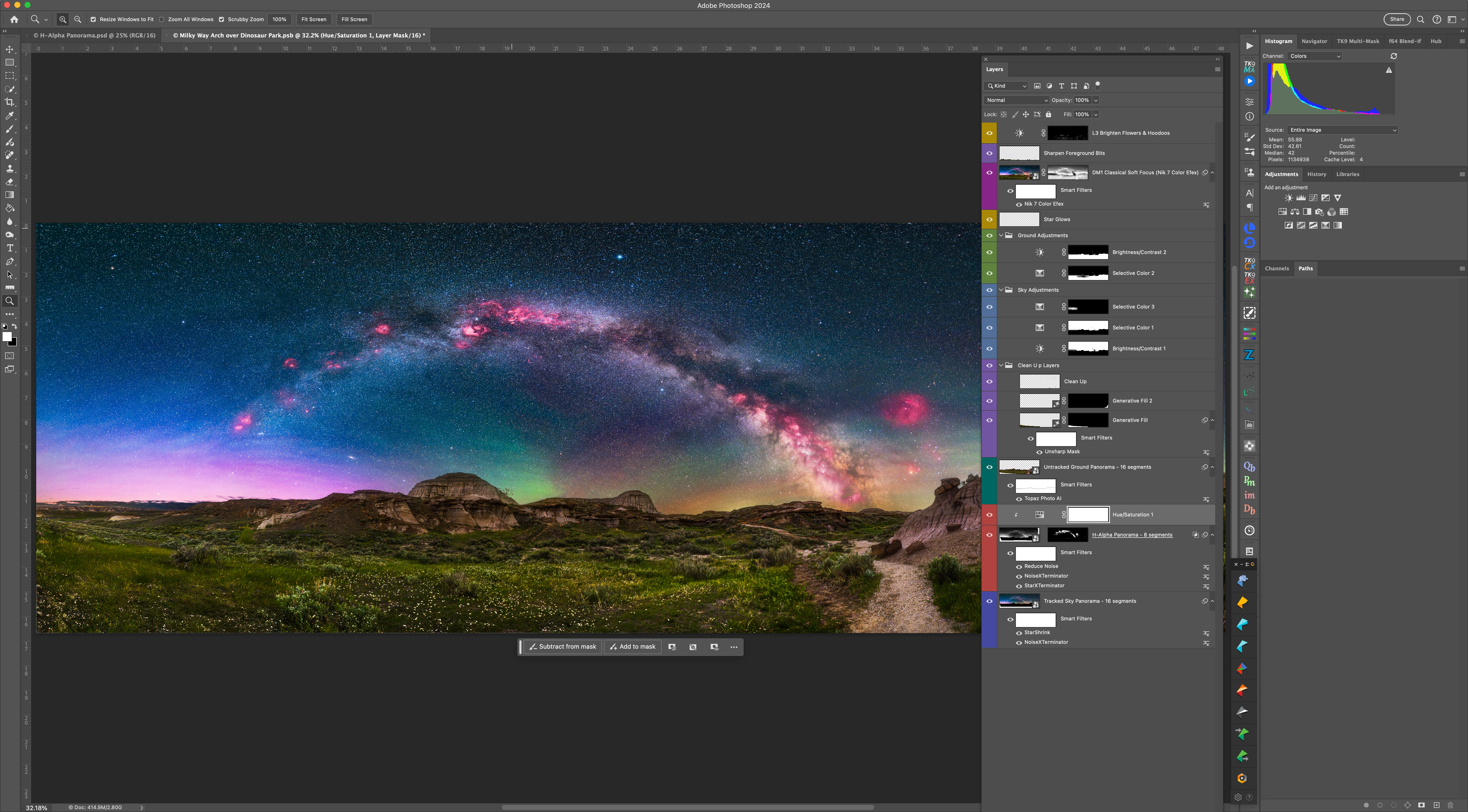
The complete panorama with Photoshop layers and adjustments

The final pano required a complex blend of image and adjustment layers, all applied non-destructively, so the many elements of the scene can be individually tweaked at any time.

The work was worth it, as the final pano records the deep red nebulas contrasting with the deep blue of a sky still lit partly by twilight, a magenta aurora to the north, and bands of green and yellow airglow, all above the earth tones of the Badlands. It is one of my favourite nightscape panoramas.

As a further note on software: For stitching panos I try to use Adobe Camera Raw first. It can work very well. But complex panos, especially taken with very wide lenses, often require the specialized program PTGui, which offers more choice of pano projection methods, cleaner stitching, and control of panorama framing and levelling.


Next up was Writing-on-Stone Provincial Park.

A week later, with the waxing Moon beginning to appear in the western sky and the promise of clear nights, I headed south to the 49th parallel borderlands of the Milk River and Writing-on-Stone Provincial Park, known as รรญsรญnai’pi to the Blackfoot First Nation who revere the site as sacred.

My plan was a framing of the galactic centre over the Milk River valley and distant Sweetgrass Hills in Montana, perhaps using the H-Alpha filter again. But clouds got in the way!

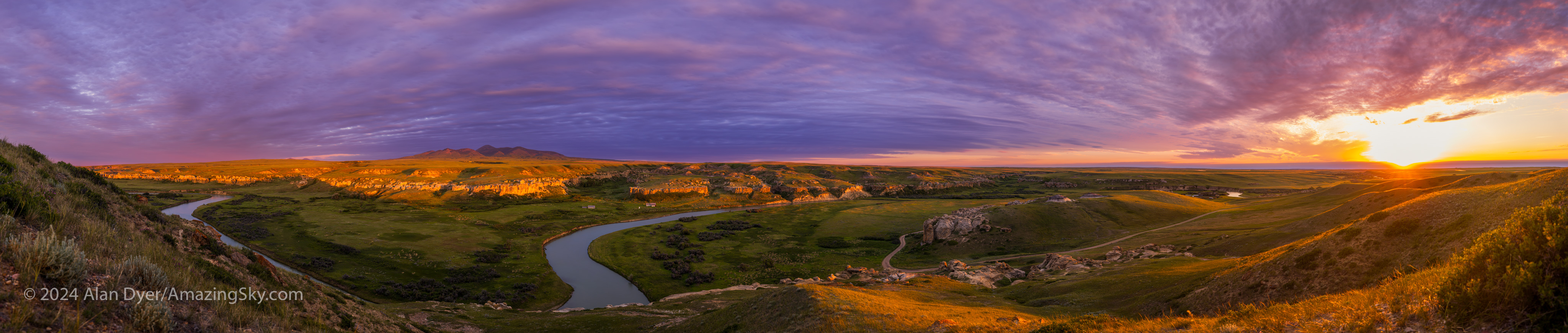
A 13-segment panorama of the landscape and sky just as the Sun sets over Writing-on-Stone Provincial Park (รรญsรญnai’pi) in Alberta.

When you are faced with a cloudy sky, you make use of it for a colourful sunset. I like shooting panoramas at such sites as they capture the grand sweep of the “big sky” and prairie landscape. Above is the scene at sunset.

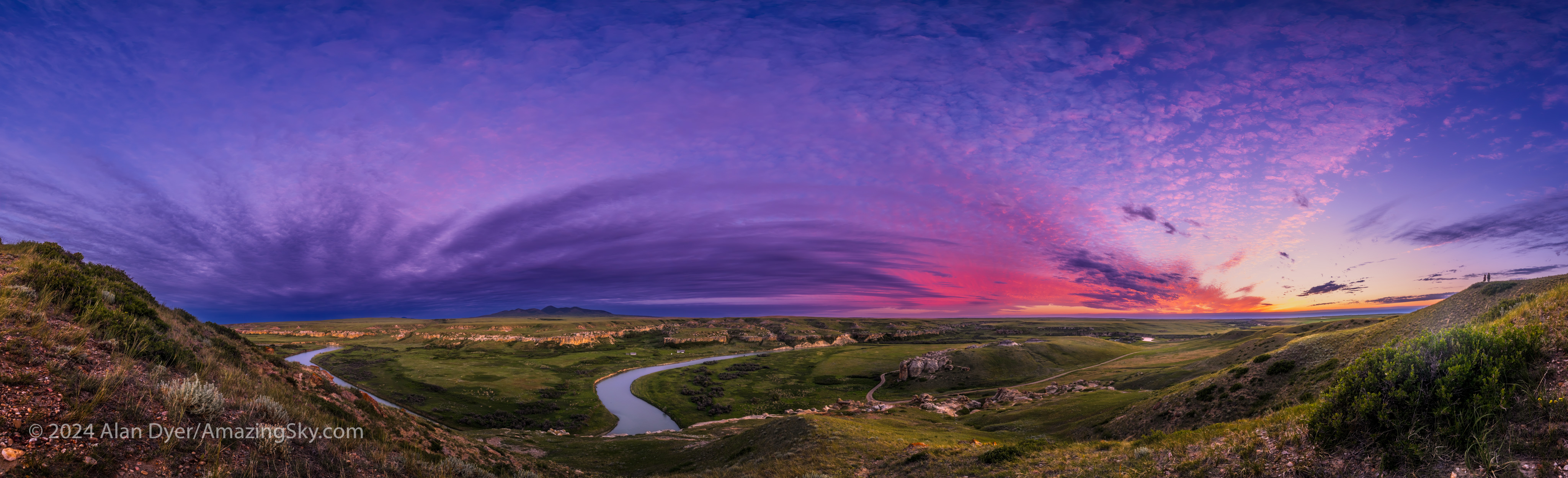
A 14-segment panorama of the landscape and sky at sunset at Writing-on-Stone Provincial Park.

Above is the same scene a few minutes later as the Sun, though now set, still lights the high clouds with its red light, mixing with the blue sky to make purples. On the hill at right, a couple admires the sunset, adding a human scale to the vast skyscape.

This pano was with the Canon RF15-35mm lens at 15mm and the camera in portrait orientation to capture as much of the sky and ground as possible in a single-row pano.

A 13-segment panorama of the sandstone landscape in blue-hour twilight at Writing-on-Stone Provincial Park.

I finished the evening with another panorama, but using a Canon RF70-200mm telephoto lens at 70mm to zoom in on the Sweetgrass Hills in the deepening twilight.

For these panoramas, exposures were short, so I didn’t need to track the sky. I used another combination of gear shown above. An Acratech ball head sits atop another style of panorama head that has adjustable click stops to make it easy to move the camera from segment to segment at set angles. When the lighting is changing by the second, it helps to be quick about shooting all the pano segments. Such pano heads are readily available on Amazon.

That pano head sits atop an Acratech levelling head (there are many similar units for sale), an essential addition that makes it easy to level the pano head so the camera turns parallel to the horizon. Any tilt will result in a panorama that waves up and down, likely requiring fussy warping or cropping to correct. Avoid that; get it right in-camera!

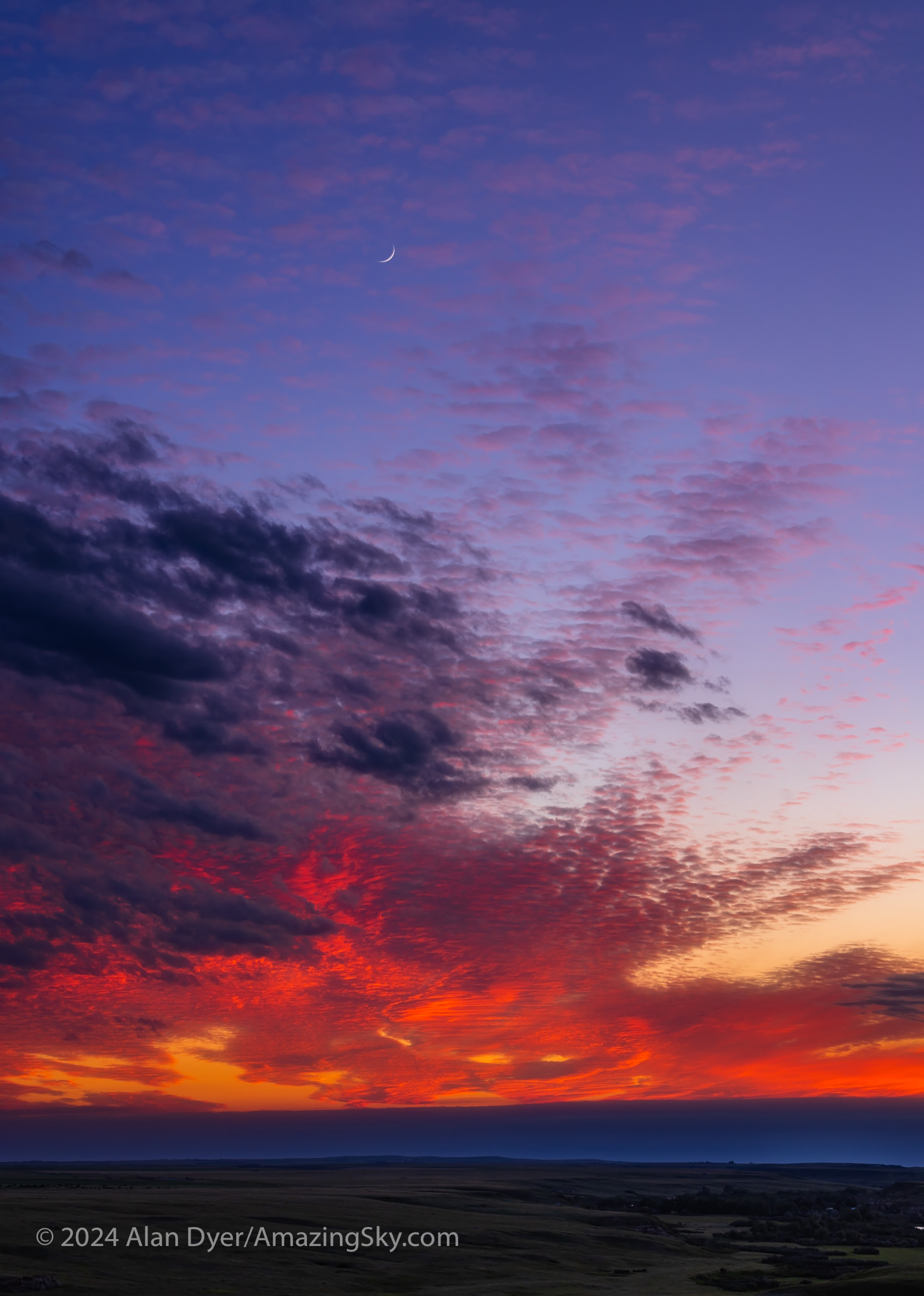
A single-image portrait of a sunset sky with the waxing two-day-old crescent Moon amid colourful clouds over the prairie.

As the sky lit up, I also shot the crescent Moon above the sunset clouds and prairie scene. While the clouds made for a fine sunset, they did not clear off, thwarting my Milky Way plans this night. I headed back to Milk River, to travel farther west the next day.


From Writing-on-Stone I drove along scenic Highways 501 and 5 to Waterton Lakes National Park.

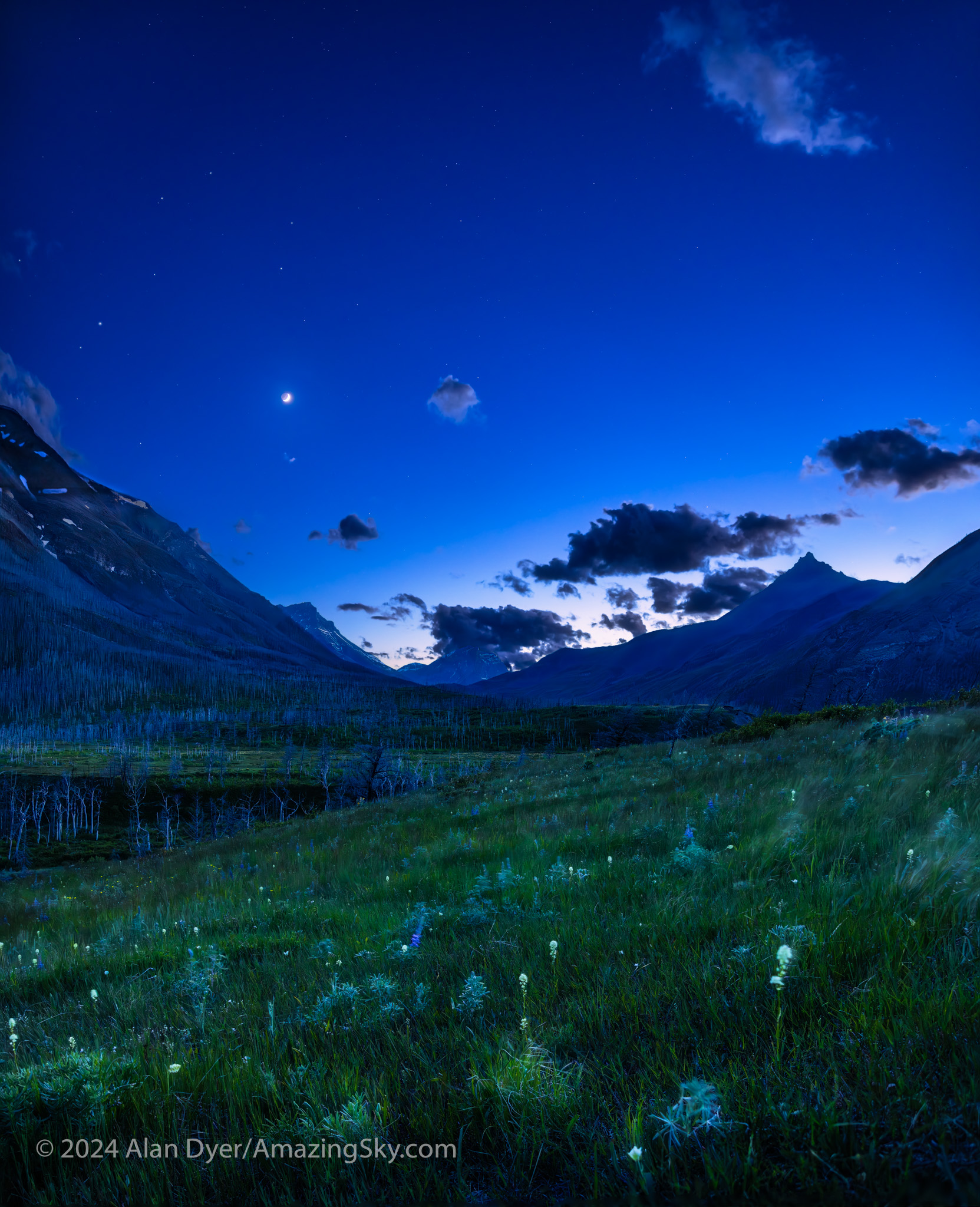
A nightscape scene under a twilight “blue-hour” sky, on the Red Rock Canyon Parkway in Waterton Lakes National Park, Alberta, looking west toward the sunset with the four-day-old crescent Moon.

After an initial cloudy night, I made use of the (mostly) clear night on June 10 to shoot twilight scenes with the now four-day-old crescent Moon in the evening sky. Here I wanted to play with another technique I had not used much before: focus stacking.

To keep exposures short (here to minimize the blurring effects of the constant wind at Waterton) you have to shoot at wide apertures (f/2 in this case). But that produces a very shallow depth of field, where only a small area of the image is in focus.

So I shot a series of six images, shifting the focus from near (for the foreground flowers) to far (for the mountains and sky). Photoshop has an Auto Blend function that will merge the images into one with everything in focus. I also shot separate images exposed for the bright sky, shooting a vertical panorama โ€” dubbed a “vertorama” โ€” moving the camera up from frame to frame.

I shot an additional short exposure just for the Moon, to prevent its disk from overexposing too much, as it did in the twilight sky images.

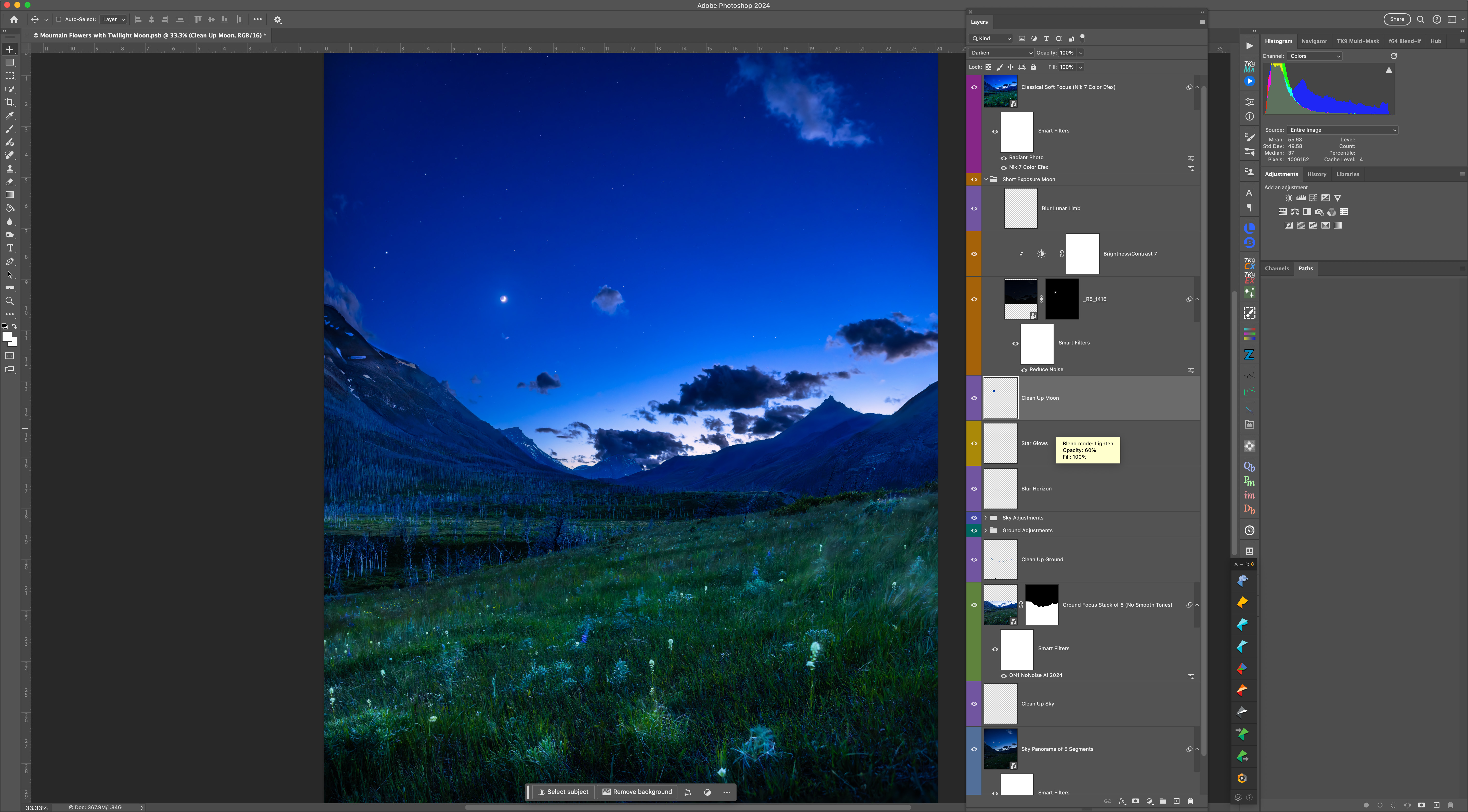
Twilight sky assembly and layers in Photoshop

So what looks like a simple snapshot of a twilight scene is actually a complex blend of focus-stacked ground images, panoramic sky images, and a single short image of the Moon replacing its otherwise overly bright disk. But the result better resembles what the eye saw, as single exposures often cannot record the range of brightness the eye can take in.

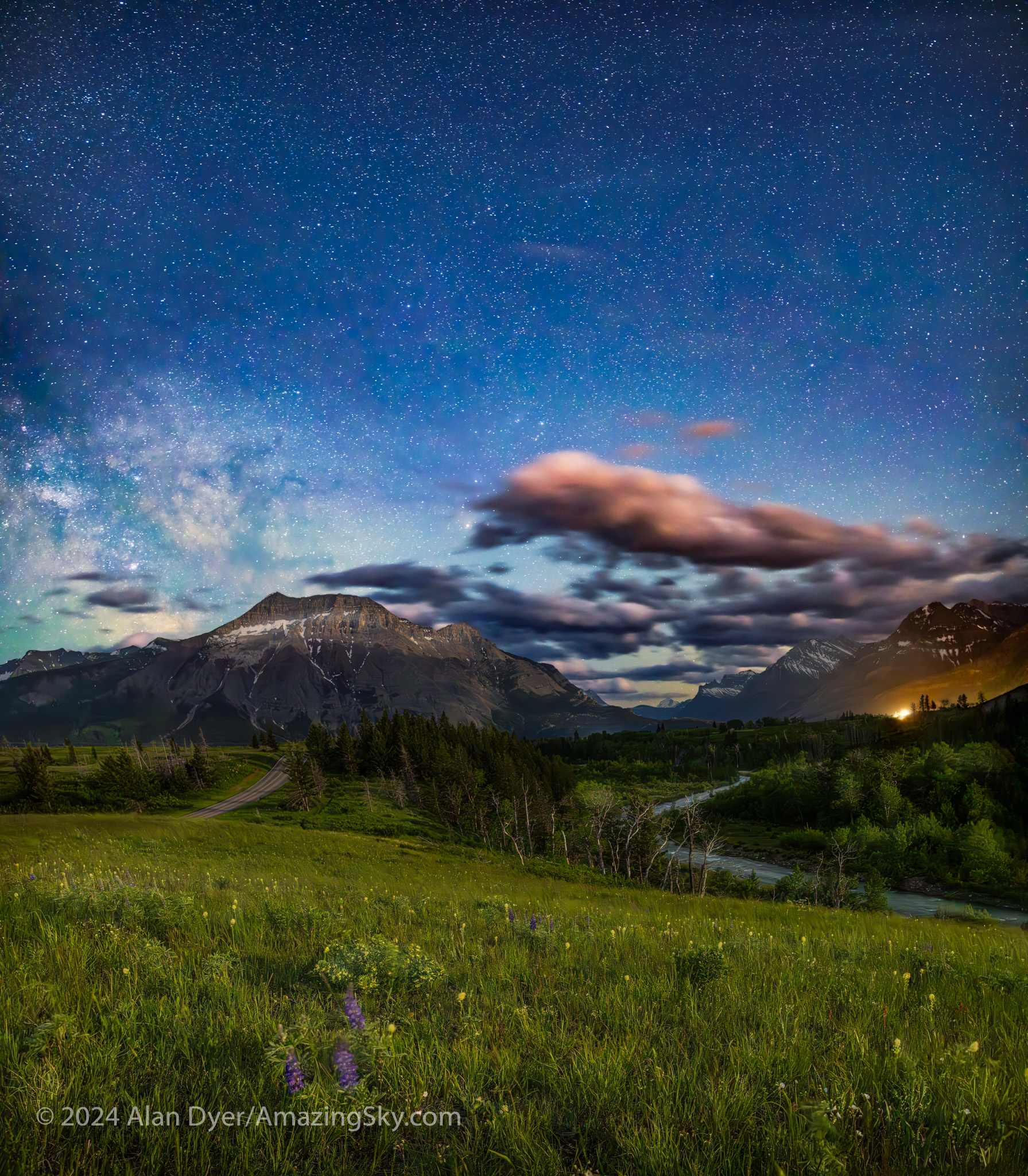
A nightscape scene under a moonlit sky, on the Red Rock Canyon Parkway in Waterton Lakes National Park, Alberta, looking back along Pass Creek to the south, with the Milky Way rising at left.

About an hour later, from the same location, I shot the other way, toward the Milky Way rising over Vimy Peak, but the sky still lit blue by moonlight. This, too, is a blend of focus-stacked ground and panorama sky images. But the camera was on a fixed tripod for exposures no longer than 15 seconds. So I didn’t use the tracker.

And here the longer exposures do pick up more (colours, fainter stars, and brighter ground detail) than was visible to the eye. Revealing more than the eye can see is the essence and attraction of astrophotography.

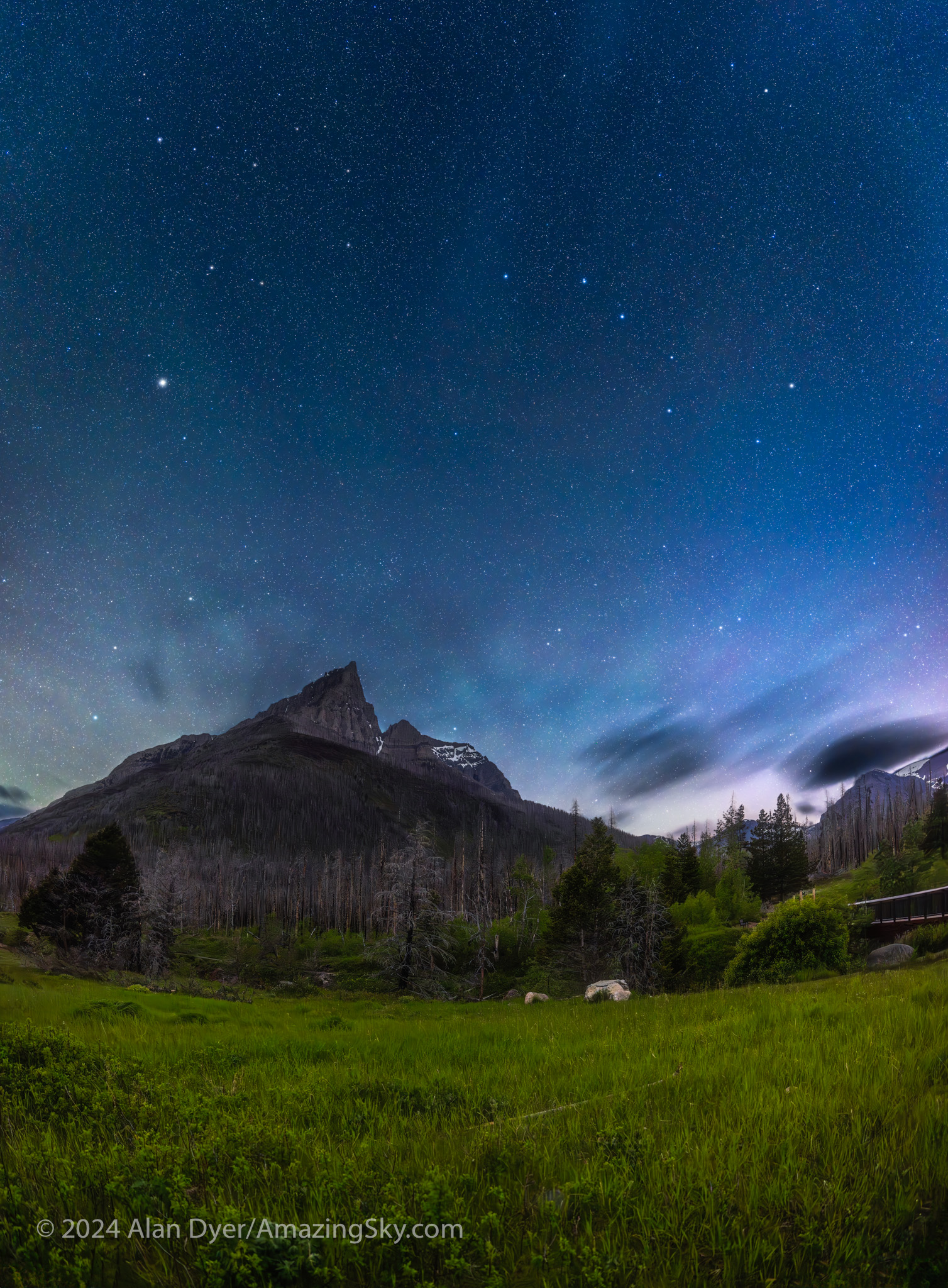
A vertical panorama of the moonlit spring sky with the Big Dipper and Arcturus over the jagged outline of Anderson Peak at the Red Rock Canyon area of Waterton Lakes National Park, Alberta.

Heading down the Red Rock Canyon Parkway, I set up the tracker rig for the darker sky, now that the Moon was nearly setting. I shot a vertical panorama, with two untracked ground segments and four tracked sky segments, to capture Arcturus and the Big Dipper over the iconic Anderson Peak.

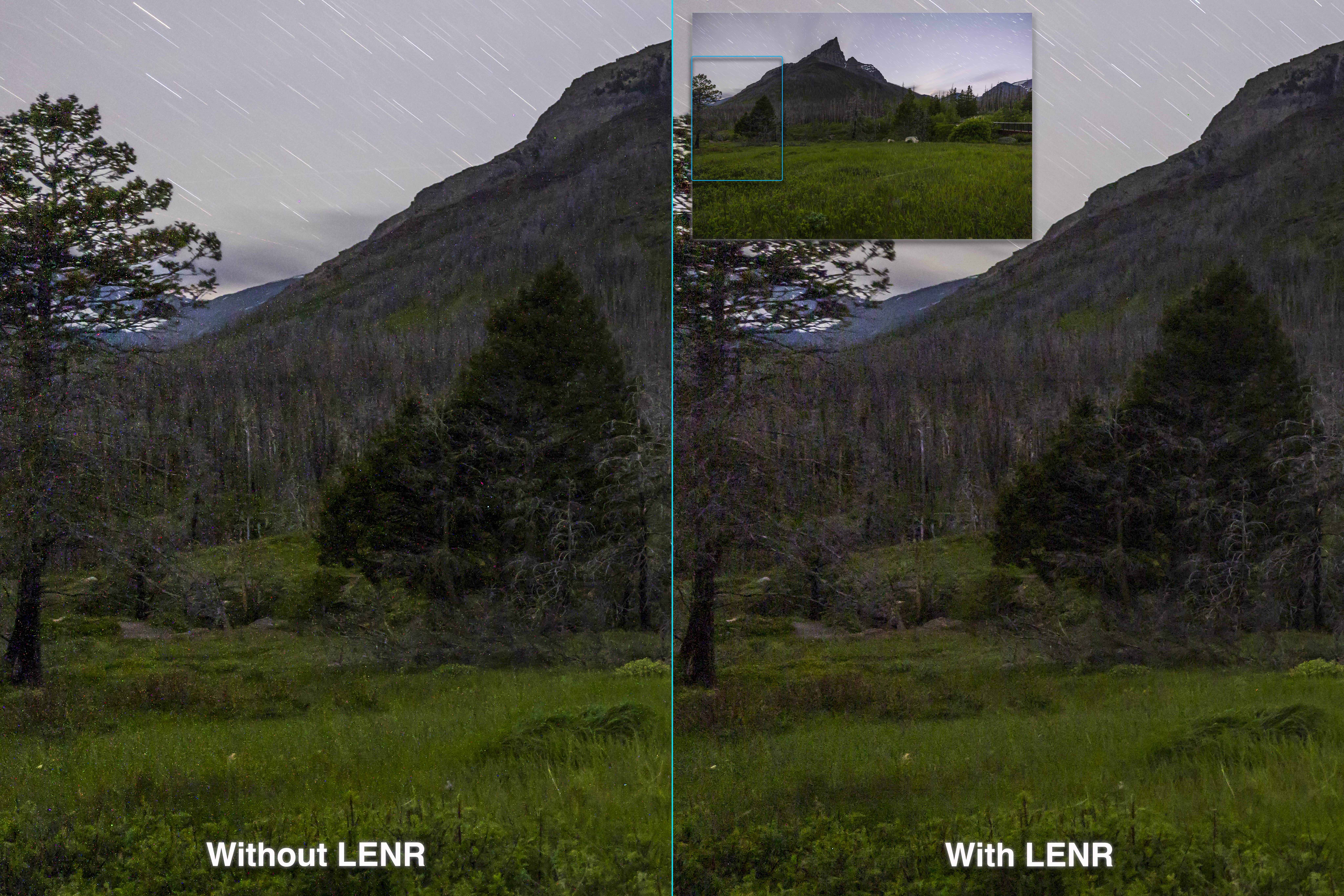
Comparing without and with LENR โ€“ Lots of coloured specks without LENR! Tap to zoom up.

For all the images at Waterton and Writing-on-Stone I used the 45-megapixel Canon R5 camera, great for high resolution, but prone to noise, especially colourful thermal hot pixels. (See my review here.)

For all the long exposures I turned on Long Exposure Noise Reduction, a feature most cameras have. LENR forces the camera to take a “dark frame,” a second exposure of equal length, but with the shutter closed. The camera subtracts the dark frame (which records only the hot pixels) from the previous light frame. The final image takes twice as long to appear, but is much cleaner, as I show above. So a two-minute exposure requires four minutes to complete.

While there are clever ways to eliminate hot pixels later in processing (using Photoshop’s Dust and Scratches filter), doing so can blur details. I’ve long found that doing it “in-camera” always produces better results.

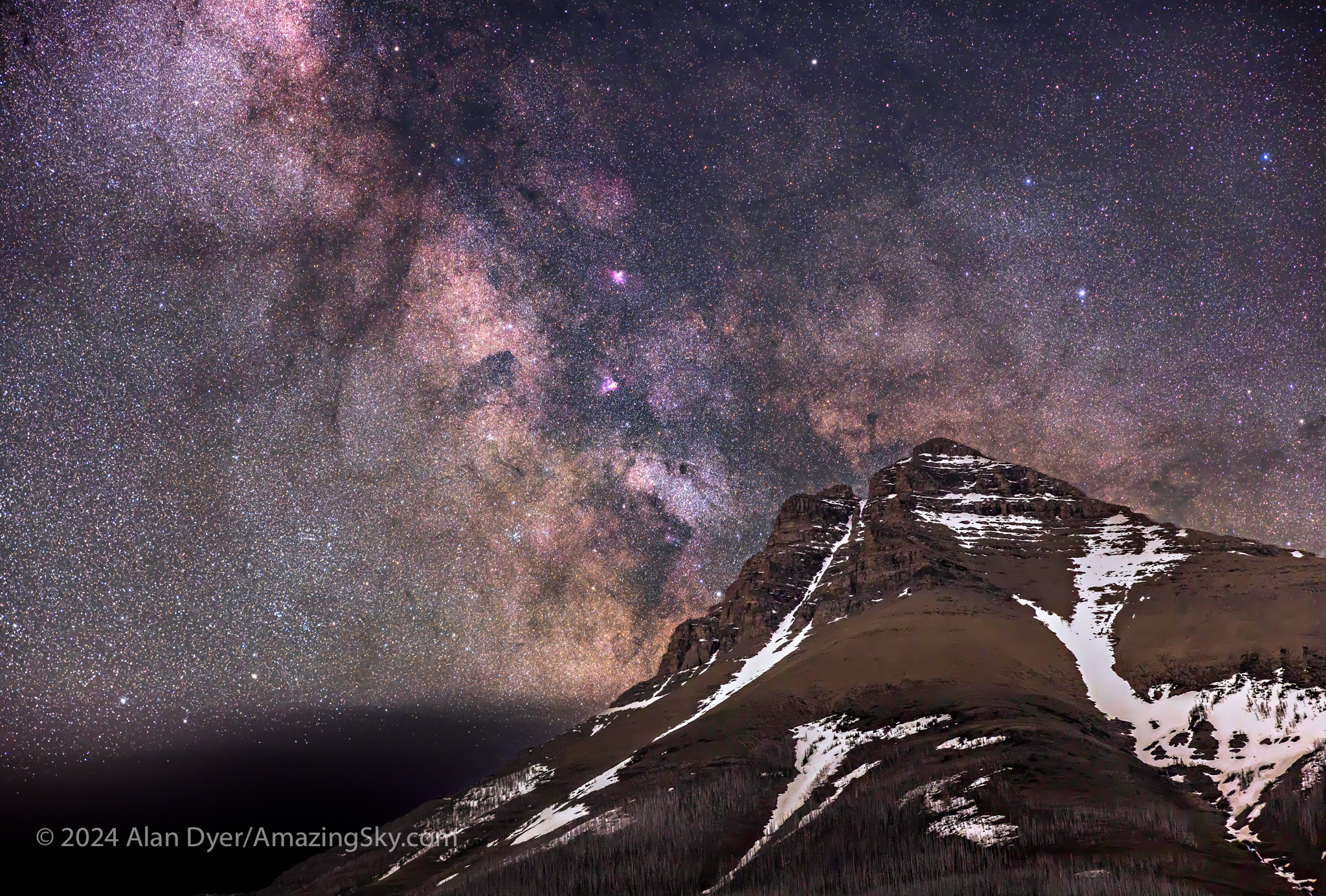
The Milky Way rising over the peak of Mt. Blakiston, in Waterton Lakes National Park, Alberta, Canada.

With the Moon now down, I turned the camera the other direction toward Mt. Blakiston, to capture the star clouds of the summer Milky Way rising behind the mountain, in an example of a “deepscape,” a nightscape with a telephoto lens. This is another technique I’ve not used very often, as the opportunities require good location planning and timing, transparent skies, and a tracker. Apps like ThePhotographersEphemeris coupled with TPE3D, and PlanItPro can help.

Deepscapes frame landscape fragments below some notable deep-sky objects and starfields, in this case a region with several “Messier objects” โ€” nebulas and star clusters well-known to amateur astronomers.

This was a blend of one untracked and one tracked exposure, again on the Nomad. Taking more frames for stacking and noise reduction, while a common practice, was not practical here โ€” at this focal length of 70mm the sky was moving enough that the mismatch between sky and ground would make blending tough to do.

And the reality is that today’s AI-trained noise reduction software (see my test report here) is so good, image stacking is not as essential as it once was.

For many of the Waterton images I used the Canon RF28-70mm lens, usually wide open at f/2. For the image below I used the RF15-35mm lens at its maximum aperture of f/2.8. (See my test report on these lenses here.)

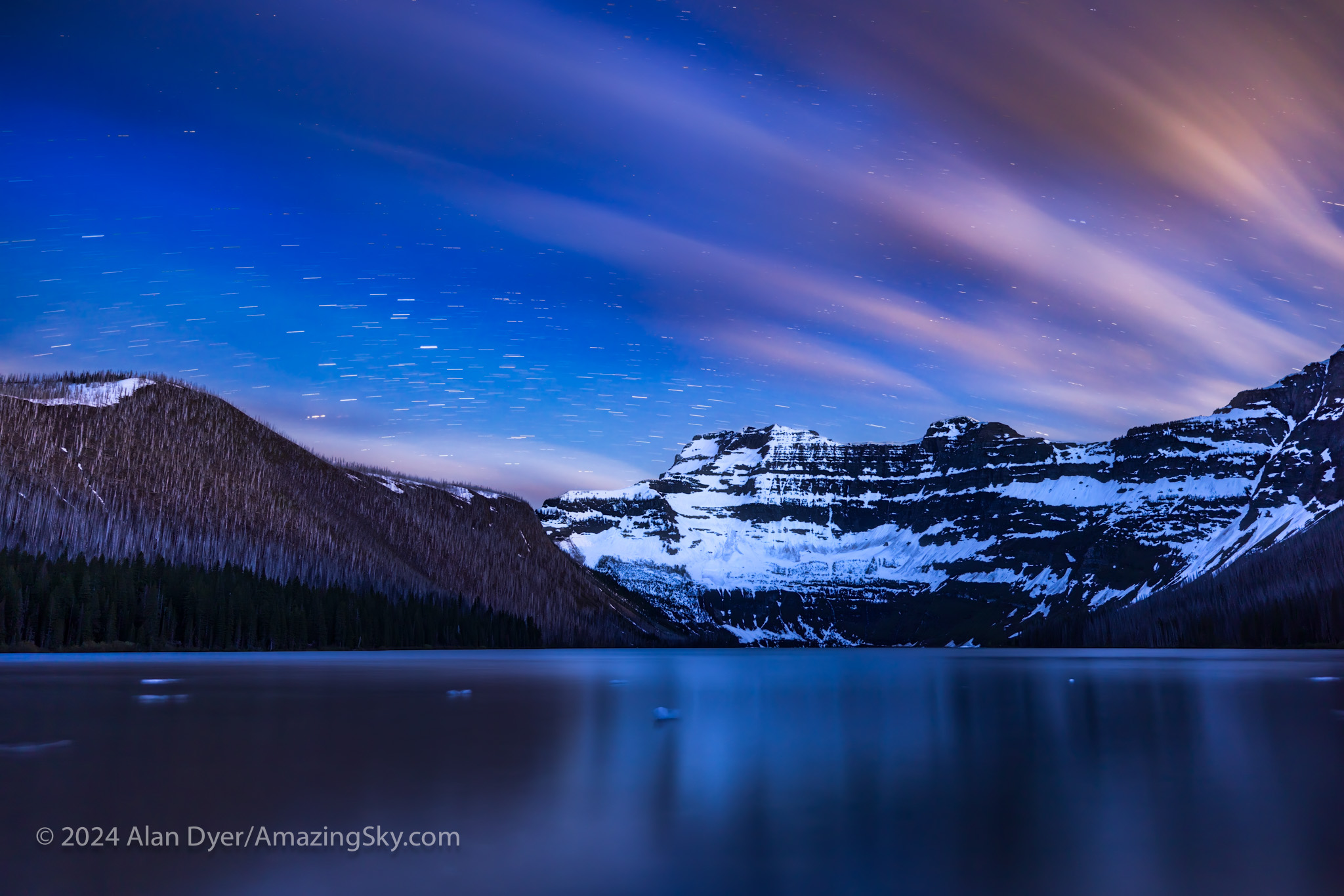
The stars and clouds trail across the sky over Cameron Lake in Waterton Lakes National Park, Alberta, and Mt. Custer across the border in Glacier National Park in Montana.

On my final night in Waterton I drove the Akamina Parkway to Cameron Lake, located in extreme southwest Alberta on the borders with British Columbia and Montana. The glaciated peak to the south is Mt. Custer in Glacier National Park, Montana.

Again, I had hoped to get a deepscape of the photogenic starfields in Scorpius above Mt. Custer. But as is often the case at this site, clouds wafting over the Continental Divide defeated those plans. So Plan B was a set of long exposures of the clouds and stars trailing with the last light of the low Moon lighting parts of the scene. Chunks of ice still drift in the lake.

This is a blend of separate multi-minute exposures for the ground and sky, all at the slow ISO of just 100, and all untracked to purposely create the star trails, not avoid them.

So over a total of four nights at these wonderful World Heritage Sites, I was able to try out some new shooting techniques:

  • H-Alpha blending
  • Focus stacking
  • Deepscapes
  • As well as panoramas, both horizontal and vertical

Every nightscape outing is a learning process. And you have to be prepared to change plans as the clouds dictate. I didn’t get all the shots I had hoped to, but I still came away with images I was very pleased with.

I hope you enjoyed them. Clear skies!

โ€” Alan Dyer / AmazingSky.com

Red Moon over Writing-on-Stone


Red Moon over Writing-on-Stone

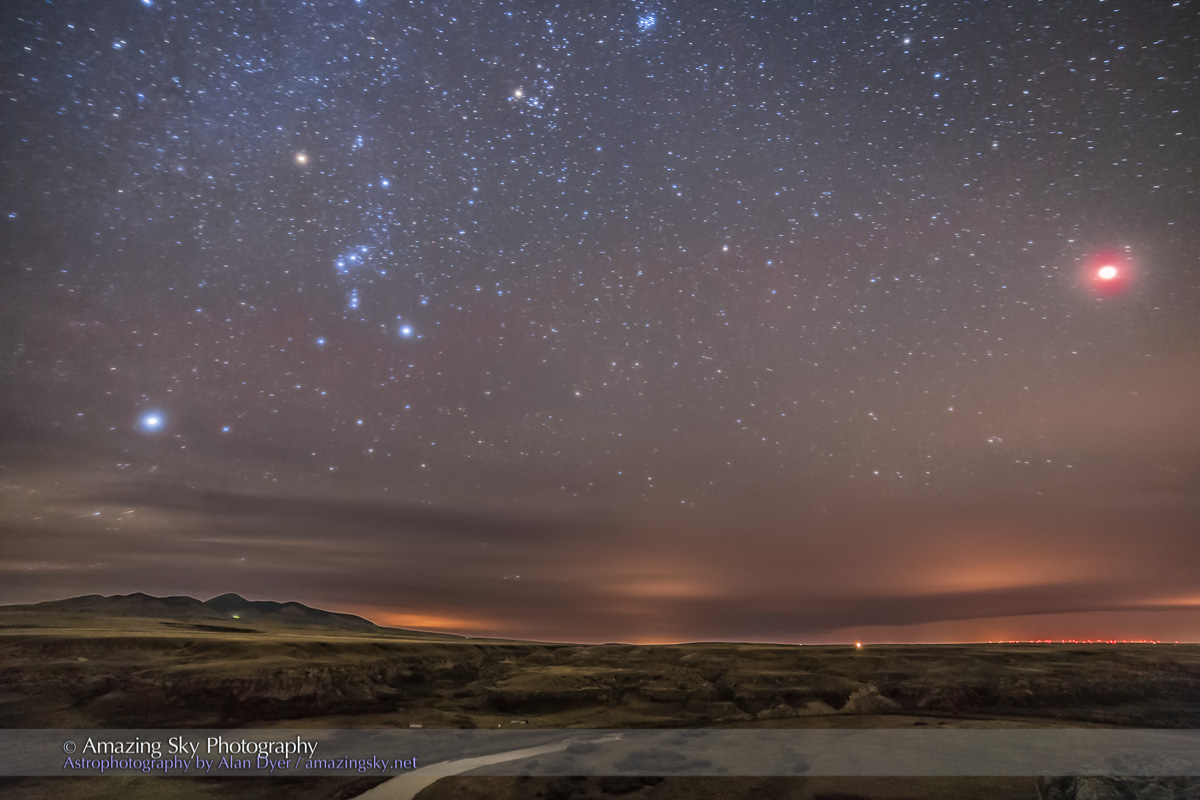
The red eclipsed Moon shines over the Milk River, with Orion over the Sweetgrass Hills.

This was the scene at 4:45 this morning, October 8, from my observing site for the lunar eclipse, Writing-on-Stone Provincial Park in southern Alberta.

The eclipsed red Moon shines at far right over the Milk River and sandstone formations of Writing-on-Stone Park, home to ancient petroglyphs, and a sacred site to First Nations people.

At left are the Sweetgrass Hills across the border in Montana. Above shine the stars of Orion, withย his Dog Star Sirius below. Aboveย is Taurus, with Aldebaran and the Pleiades cluster.

The night was fairly clear for the hourย of totality, though with high haze fuzzing the stars and Moon. But considering the cloud I had driven 3 hours to escape I was happy.

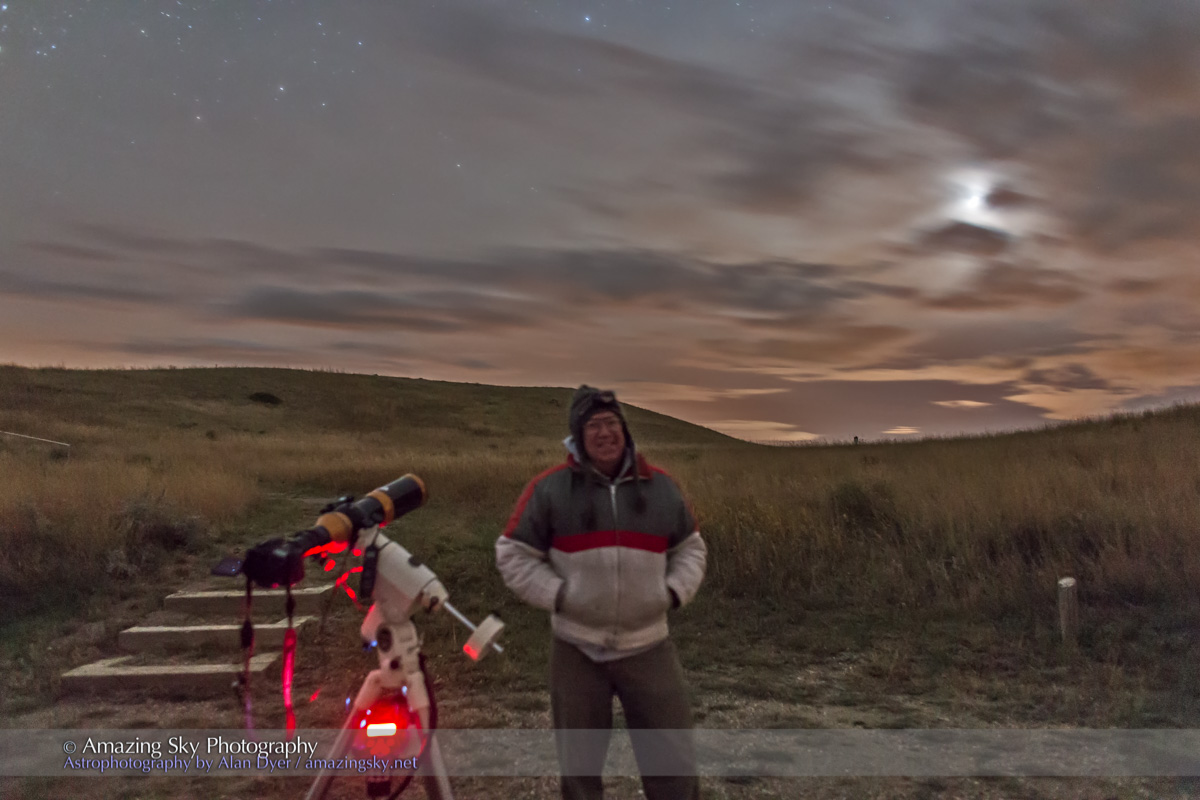
Self-Portrait at Oct 8, 2014 Total Lunar Eclipse

Here I am in a 5:30 a.m. selfie by starlight and moonlight, with the clouds I had escaped now rolling in to cover the Moon as it began to emerge from Earth’s shadow.

No matter. I had capturedย what I had come for: the nightscape above (with a 14mm lens), and close-ups shot through this telescope gear, one of which I featured in myย previous post.

โ€“ Alan, October 8, 2014 / ยฉ 2014 Alan Dyer


Eclipse of the Hunter’s Moon


Total Eclipse of the Hunter's Moon

The Hunter’s Moon of 2014 turned deep red during a total lunar eclipse.

It wouldn’t be an eclipse without a chase!

To see and shoot this total eclipse of the Hunter’s Moon I had to chase clear skies, seeking out the only clear area for hundreds of miles around, requiring a 3-hour drive to the south of me in Alberta, to near the Canada-US border, at Writing-on-Stone Provincial Park.

It was worth the midnight trek, though I arrived on site and got set up with just 10 minutes to go before the start of totality.

But I was very pleased to see the skyย remain mostly clear for all of totality, with only some light haze adding the glow around the eclipsed Moon. Remarkably, the clouds closed in and hid the Moon just after totality ended.

This is a single 15-second exposure at ISO 400 with a Canon 60Da, shooting through an 80mm apo refractor at f/6 and on an equatorial mount tracking the sky at the lunar rate. I shot this shortly after mid-totality. It shows how the Moon’s northern limb, closest to the edge of the umbral shadow, remained bright throughout totality.

It shows lots of stars, with the brightest being greenish Uranus at the 8 o’clock position left of the Moon, itself shining in opposition and at a remarkably close conjunction with the Moon at eclipse time.

More images are to come! But this is the result of fast processing after a dawnย drive back home and an all-nighter chasing and shooting an eclipse.

โ€“ Alan, October 8, 2014 / ยฉ 2014 Alan Dyer


Time-Lapse โ€“ Alberta Skies 2013


It was a good year for time-lapse photography at home. Here’s my compilation of Alberta time-lapses in a 3-minute music video.

For a year-end look back at 2013 I assembled these highlights of my year of shooting time-lapse movies of the Alberta sky, by day and night.ย 

I’ve included clips shot around home in rural southern Alberta, and further afield at popular photo spots around the province such as Waterton Lakes National Park, Banff, Writing-on-Stone Provincial Park, and Cypress Hills Provincial Park.ย 

I hope you enjoy it! Be sure to maximize the video screen and select HD. ย Or for a better grade version check out my Vimeo channel.

________________________________________________

Some technical background:

I shot all the frames for the movies (150 to 300 frames for each clip) with either a Canon 5D MkII or a Canon 60Da camera, equipped with various lenses from 8mm to 200mm. For many of the clips the cameras were on motion control devices: the Radian azimuth panning unit, an Orion TeleTrack mount, or a Dynamic Perception Stage Zero dolly unit. You see the latter in action behind the credits.ย 

For image processing and movie assembly I used Adobe Camera Raw, Photoshop, LRTimeLapse, Sequence, Panolapse/RawBlend utility, and for some of the star trails either StarStax or Star Circle Academy’s Advanced Stacker Actions.

I demonstrate all these in my Nightscapes workshops.ย The next one is in Edmonton, January 25!

To edit the movie I used the new OS10 Mavericks iMovie.ย 

โ€“ Alan, December 29, 2013 / ยฉ 2013 Alan Dyer

The Milky Way over Milk River


Milky Way over Writing-on-Stone Park #2 (Sept 1, 2013)

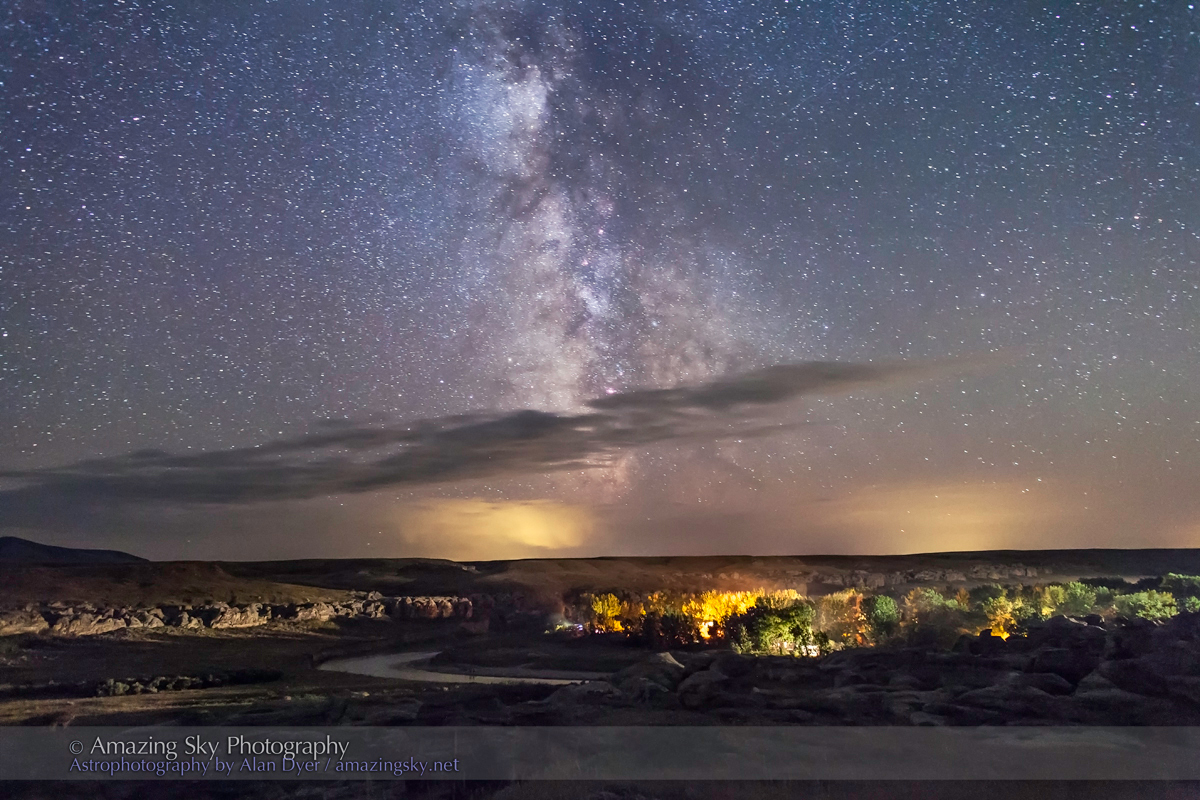
The summer Milky Way sets over the Milk River on the last weekend of the summer.

This was the view last night, Sunday, September 1, from the Visitor Centre hill overlooking the spectacular Milk River valley and the sandstone formations of Writing-on-Stone Provincial Park, Alberta.

The Milk River winds around the park’s campsite, filled on a beautiful long weekend with campers enjoying the clear skies and temperatures in the 30s by day. At night, conditions were perfect. Warm, dry, no bugs, no wind. The best.

I set up two cameras: one for a day-to-night time lapse and one for a time-lapse panning the scene as the Milky Way moved to the west. These two images are frames from the latter.

Above is a shot from later in the evening when the sky was dark …

Milky Way over Writing-on-Stone Park (Sept 1, 2013)

… while this image is from earlier in the shoot, when the last of the blue twilight still lit the sky and the camera was aimed a little more to the east.

On the horizon at left in the image above lie the Sweetgrass Hills of Montana, a prominent landmark in southern Alberta.ย The yellow sky glows are from towns in northern Montana.

Lights from the campground and car headlights illuminate the landscape and the eroded hoodoo formations.

Writing-on-Stone Park preserves ancient rock petroglyphs that record scenes from before and after contact with Europeans. It is a sacred site to First Nations people and is a marvellous place for stargazing.

โ€“ Alan, September 2, 2013 / ยฉ 2013 Alan Dyer


Sacred Site: The Movie


Here’s my time-lapse sequence of the hoodoos at Writing-on-Stone Park lighting up as the Moon rises and the Milky Way sets.

The sky starts off dark but lights up as the waning Moon, off frame behind the camera, rises and lights up the foreground and sky. The sequence ends as the sky brightens with the onset of dawn.

Waning moons are great nights for this type of shooting as the changing lighting produces dramatic effects as the landscape lights up at moonrise. The problem is, the Moon doesn’t rise till very late, making for a long night of shooting.

I assembled this sequence from 290 frames, each a 60-second exposure, taken at 1-second intervals over about 4 hours. The camera was the Canon 7D and the lens the 10-22mm Canon EF-S zoom at 10mm. I also shot a matching sequence simultaneously with the 8mm fish-eye and Canon 5D MkII camera, for an all-sky sequence for planetarium use.

โ€” Alan, July 30, 2011 / Movie ยฉ 2011 Alan Dyer

Sacred Site


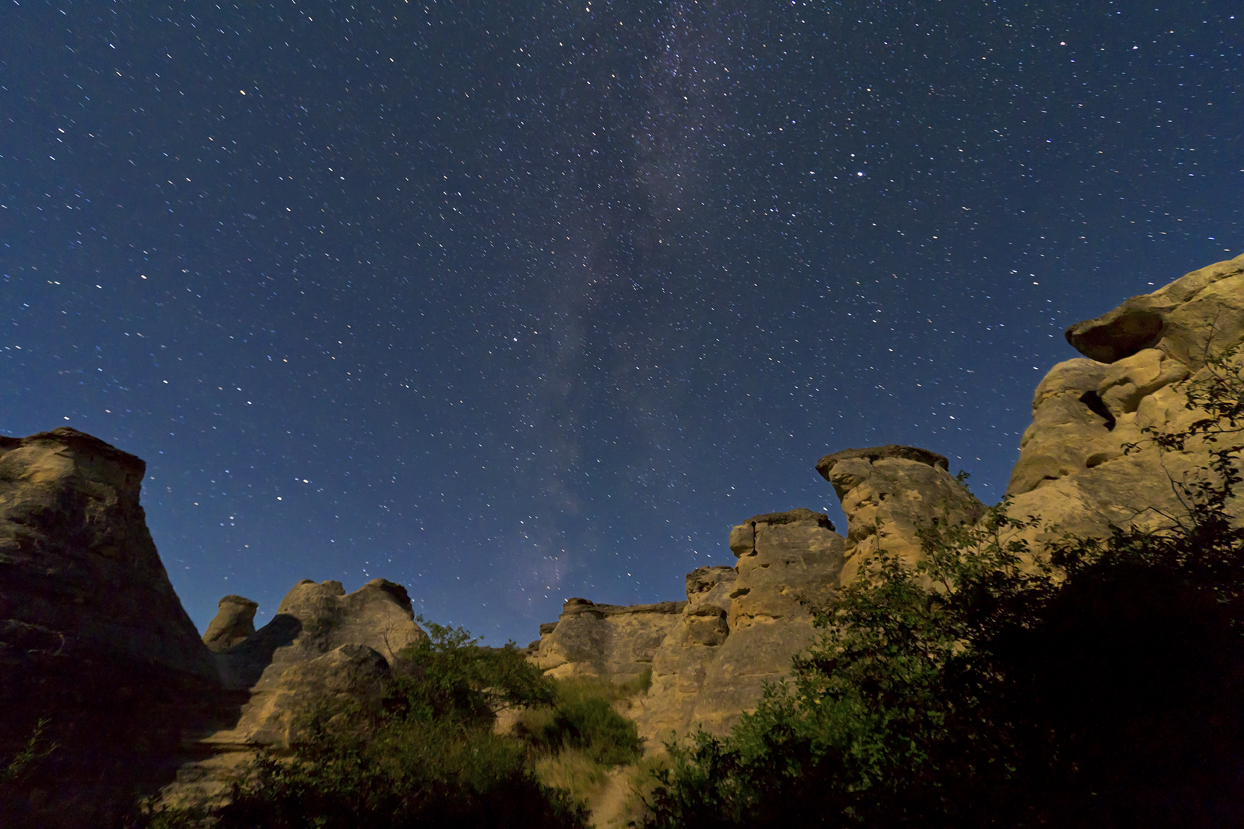
Standing among these “hoodoo” rock formations at night with moonlight and starlight for illumination was a magical moment. This is a scene at Writing-on-Stone Provincial Park in southern Alberta, that I took last Saturday night, July 23, 2001 at 3 a.m.

It shows the summer Milky Way arching over the sandstone formations, with the rocks lit by the light of the rising waning Moon in the east.

Writing-on-Stone is a sacred site for First Nations people, a place to connect to the spirit world through dreamquests. No one lived here โ€” it was a place haunted by the spirits โ€” people only visited at special times. The rocks were also used to record visions and historic events, in the form of carved petroglyphs that are among the best preserved and most extensive of any archaeological sites in North America. By day or by night, Writing-on-Stone is an inspiring location, carved in the rocks on the banks of the Milk River (see the previous blogs for some panoramic sunset views of the area).

This is one frame of about 300 taken as part of a time-lapse movie, and is a 60-second exposure with the Canon 7D and 10-22mm lens.

โ€” Alan, July 30, 2011 / Image ยฉ 2011 Alan Dyer

The Great Lone Land


This is one of the great places for evoking the wide open spaces of the high plains. Here we are looking south over the Milk River and the rock formations of Writing-on-Stone Provincial Park in Alberta to the peaks of the Sweetgrass Hills in Montana. The buildings at right are the modern reconstructions of the late 1800’s North West Mounted Police outpost that guarded Canada from the illegals from the U.S. (!) coming up Police Coulee smuggling whiskey from Montana into Canada.

The time is just after sunset, as the last light of the Sun still illuminates the clouds. This is the magic hour for photography, and for taking in the solitude of the “Great Lone Land” as author William Francis Butler described it in his book of that title in 1872.

As Butler wrote, “No ocean of water in the world can vie with its gorgeous sunsets; no solitude can equal the loneliness of a night-shadowed prairie…”

โ€” Alan, July 27, 2011 / Image ยฉ 2011 Alan Dyer