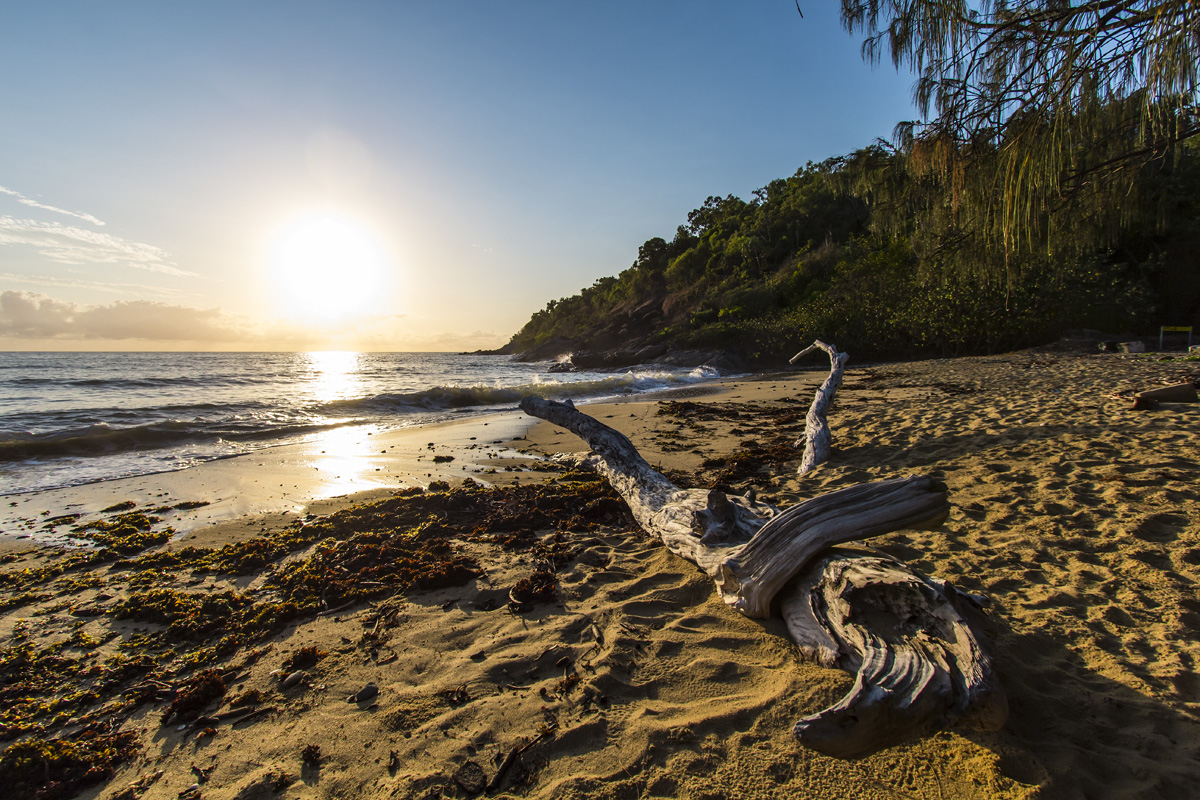
Skies and spirits brightened this morning as we were greeted to a wonderfully clear sunrise.
I took this moments ago on the morning of Sunday, November 11, three days before the total eclipse. If the eclipse had been this morning we would have seen it in grand style.
Nevertheless, we will continue our scouting of inland locations over the Dividing Range, at sites some 2 to 3 hours drive away. If the weather forecast looks gloomy the day before we will make a run for it inland but will have to make that call the afternoon before the eclipse to avoid driving in the dark with roos on the road. The eclipse happens an hour after sunrise on Wednesday, with the Sun a little higher than its position here. Ideally, we watch the eclipse from where I took this photo! But one must always have a Plan B and C in pocket.
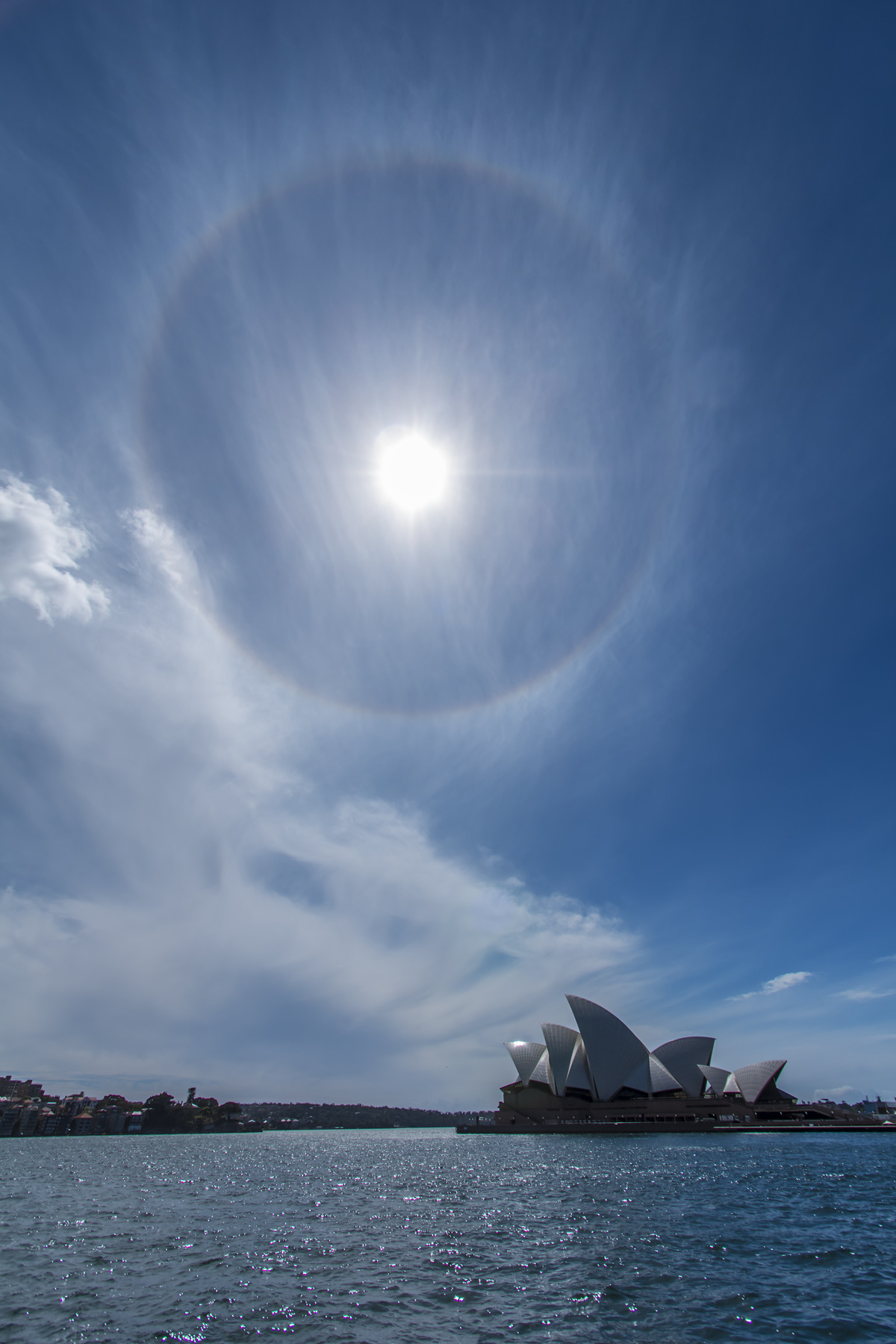
Here’s my first astrophoto from the land down under in 2012.
I’m in Australia for the solar eclipse, now two weeks away. With luck we will see the Sun disappear in a spectacular early morning event. But for now, here’s the Sun creating a solar halo shining in the sky over the icon of Australia, the Sydney Opera House.
After a couple of days in Sydney I head up the coast, collect and check out my telescope gear in storage for the last couple of years, and then begin the long drive up to northern Queensland and the rendezvous with friends … and the Moon’s shadow.
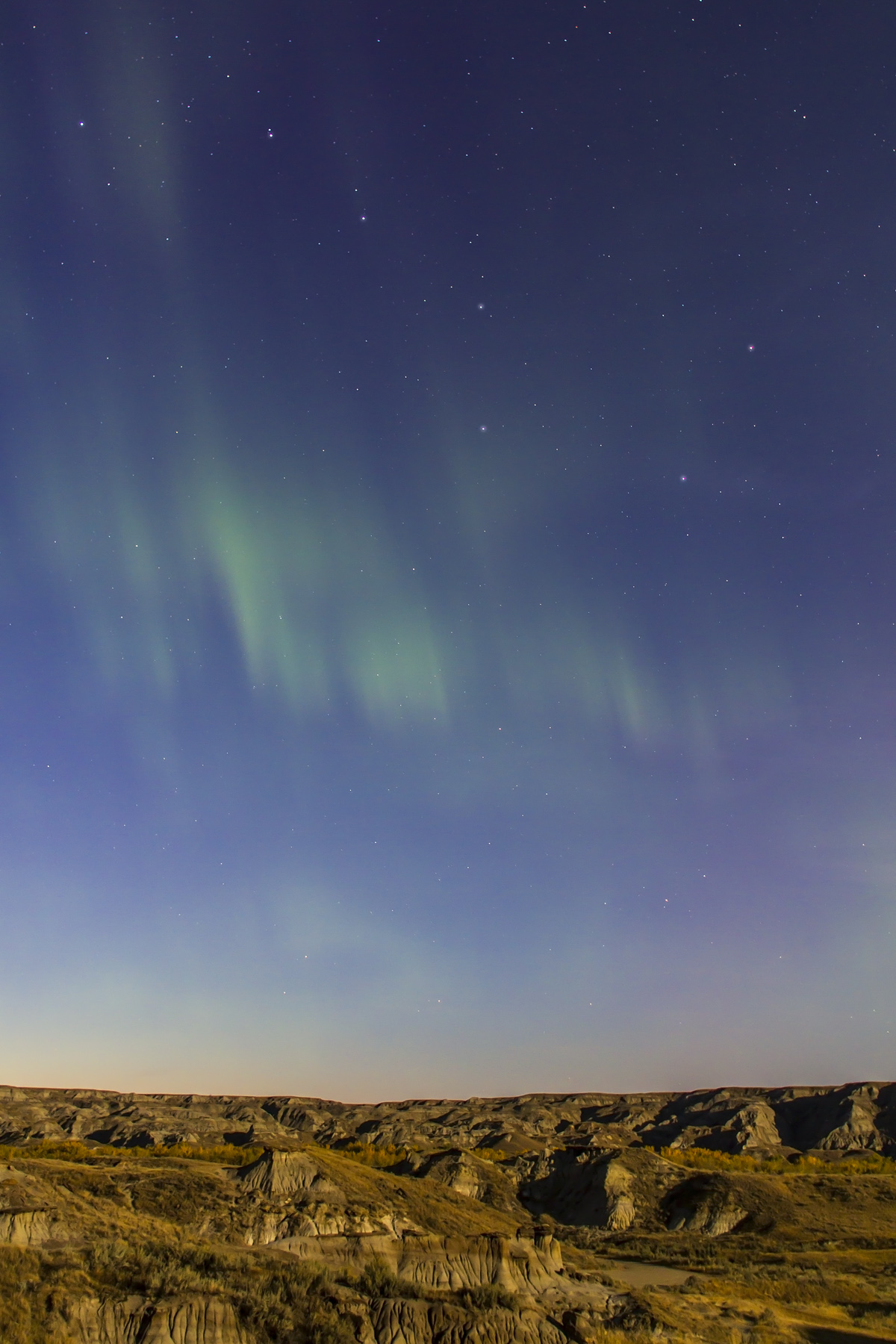
The Big Dipper swings low over the Badlands of Dinosaur Provincial Park, with an aurora added for good measure.
This another shot from my very productive night last Sunday out at Dinosaur Park, 100 km east of me. Here the curtains of aurora that made the news that evening shimmer below the iconic seven stars of the Big Dipper, now low in the northern sky on autumn evenings.
Light from the Full Moon provides the illumination. People wonder how we astrophotographers can take pictures of the stars in the daytime. We don’t. We take them at night, letting the Moon light the scene. Its light is just reflected sunlight, so a long enough exposure (and in this case it was only 8 seconds) records the landscape looking as if it were daytime, complete with blue sky, but with stars – and this night an aurora – in the sky.
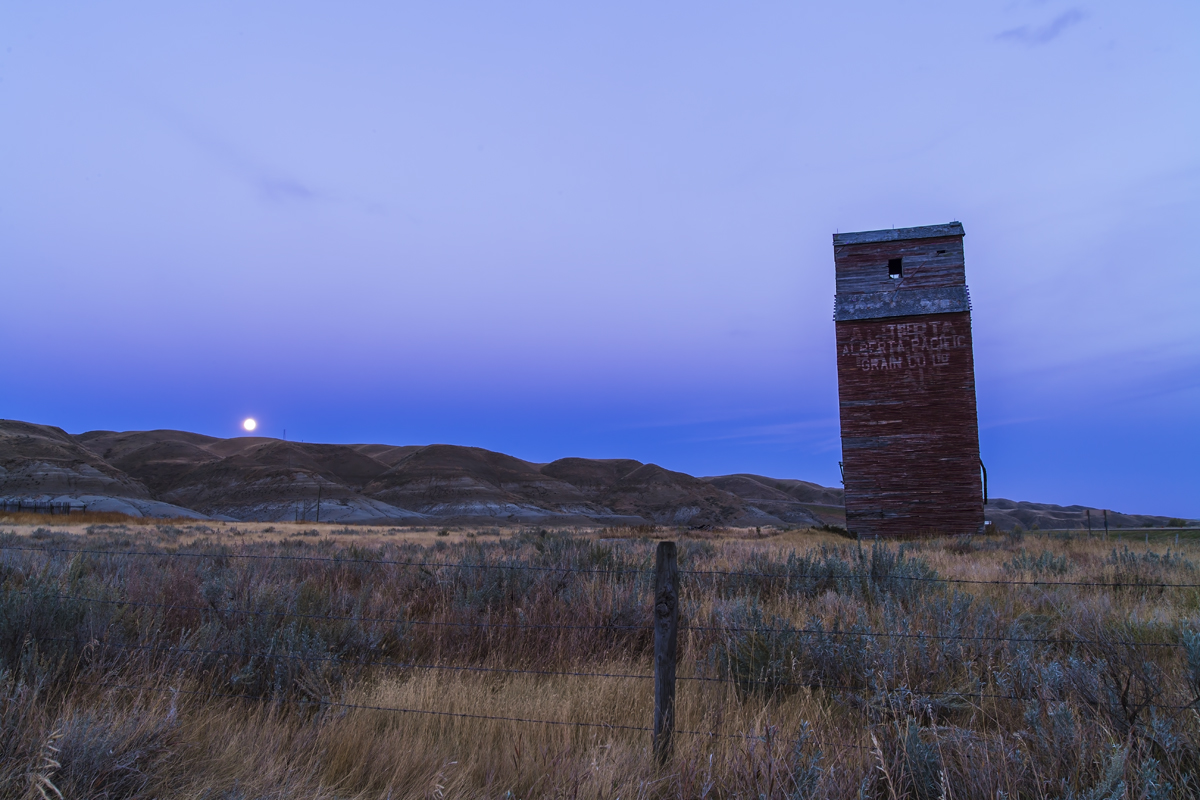
The annual Harvest Moon shines over a scene from pioneering farm days.
One of the last remaining wood grain elevators still stands as a historic roadside attraction near the little hamlet of Dorothy, Alberta. It’s seen better days.
But in its time it took part in many a harvest in the Red Deer River valley. There were once no less three grain elevators here and railway tracks to take away the bountiful harvest. That was back in the 1910s and 1920s when Dorothy was a little boom town. But the prosperity waned in the Depression Years, and never returned. In the 1960s, the railway tracks were pulled up, and two of the elevators torn down.
Now, Dorothy is one of the ghost towns amid the badlands of the Red Deer River valley.
I shot this Saturday night, as the Full “Harvest” Moon rose over the hills, shining in the blue shadow of the Earth. This is one frame of 450 in a time-lapse sequence.
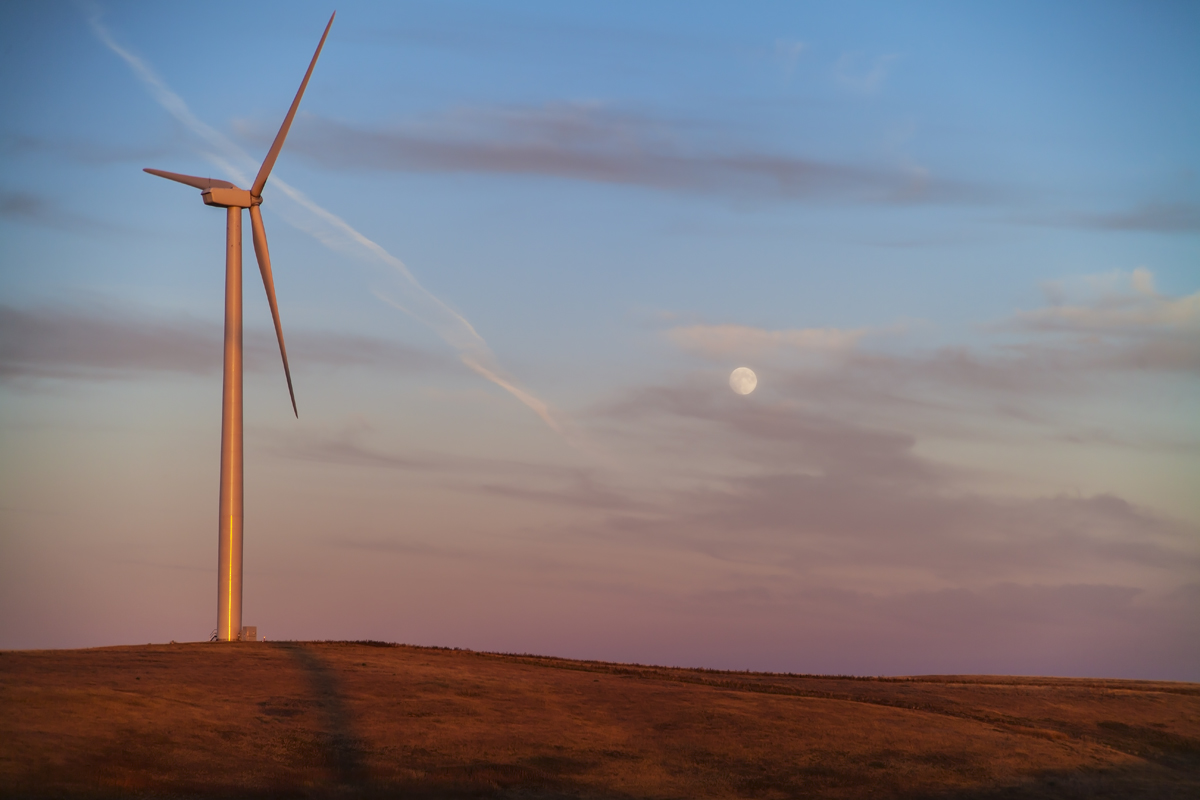
The Harvest Moon rises behind a new crop, a wind turbine harvesting the wind.
I shot this Friday evening, September 28, technically the day before Full Moon and the annual Harvest Moon. The location is amid the Wintering Hills Wind Farm northeast of me and south of Drumheller, Alberta.
This is one frame of 450 in a time-lapse sequence going from sunset into twilight with the Moon rising through the clouds. The changing colours were wonderful.
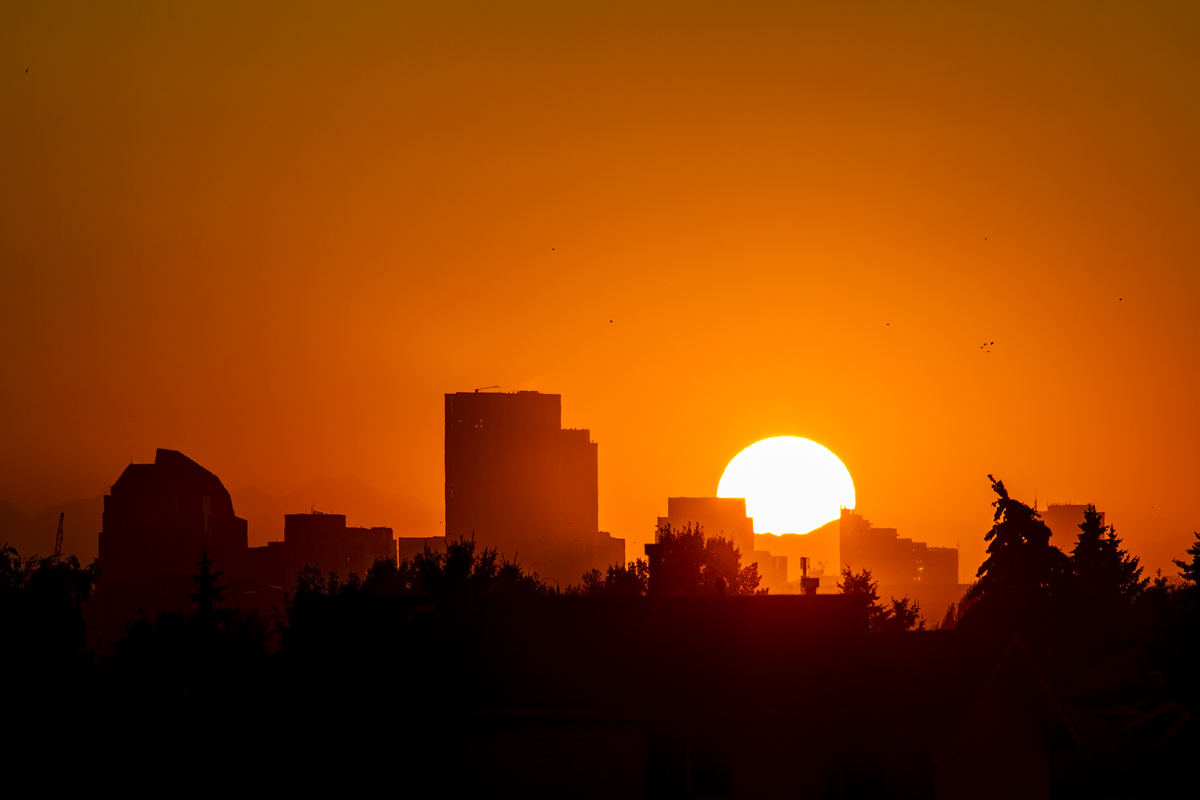
The Sun sets in a ball of fire behind the skyline of Calgary.
For this shot on September 27 I found a spot on an overpass on the Ring Road east of Calgary to look west. Using an app for the iPad, LightTrac, I was able to locate the exact spot where the Sun would set behind the skyline, including the new 50-storey Bow Tower.
Getting the Sun big compared to the buildings means shooting from a distance with a telephoto lens. I used a 200mm and 1.4x extender here.
It would have been nice to have shot from a higher altitude but such places are hard to find east of Calgary where the land flattens out onto the prairie. However, this was a good test of the technique for lining up a rising or setting Sun or Moon with a photogenic foreground. That’ll come in handy this weekend for the Harvest Moon.
Smoke reddened the Sun and turned it into a ball of fire setting into the west.
This was Monday night, September 24, looking toward the hills in the west end of Calgary. I positioned myself on the north side of the Bow River across from the downtown core, at the top of the river valley to catch the Sun in this telephoto shot. The other camera was taking a time-lapse sequence in a wider scene with the Bow River in view.
We are certainly having some fine sunsets of late, thanks to forest fire smoke.
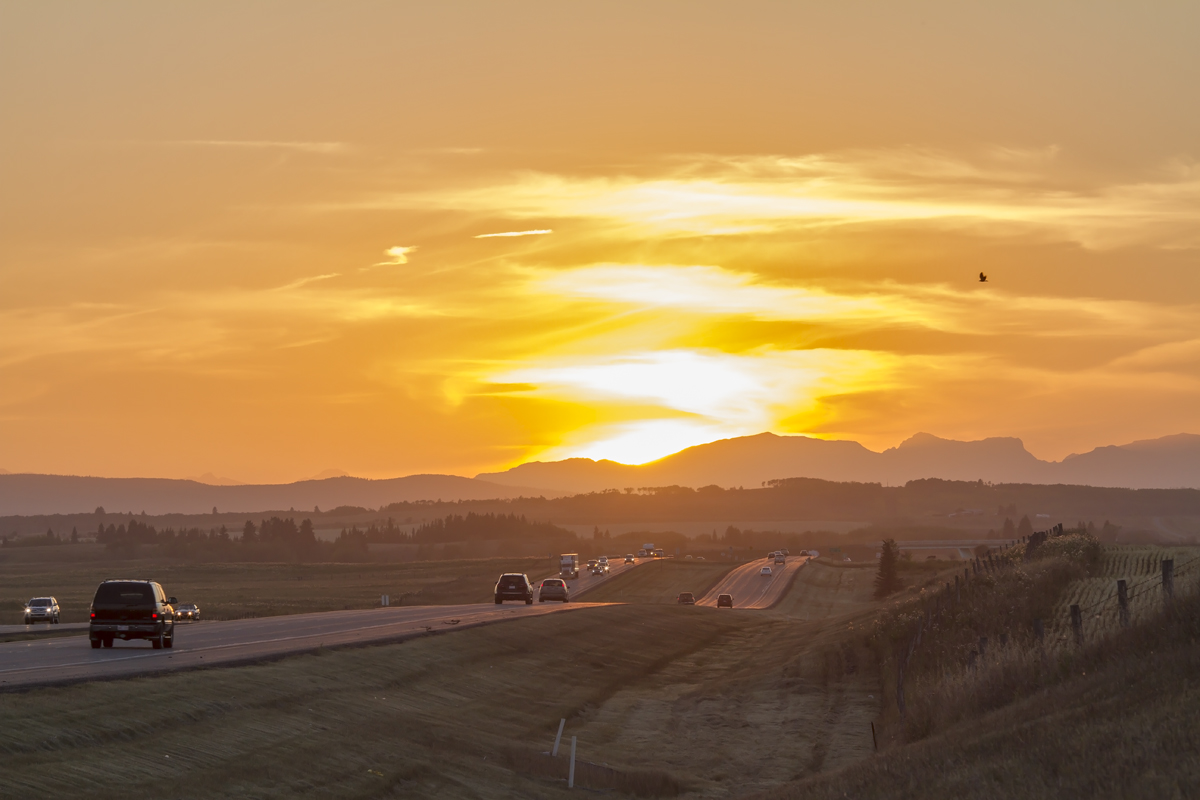
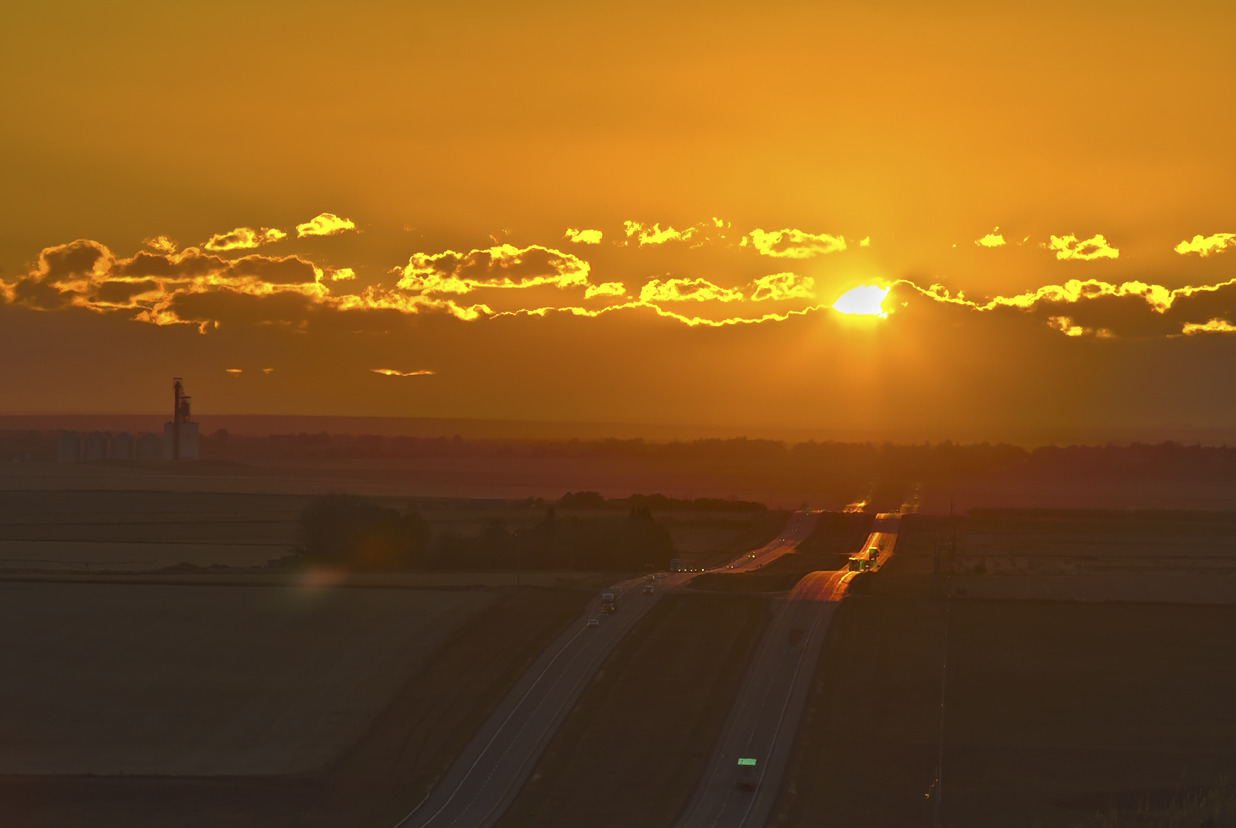
At equinox the Sun sets due west and shines into the eyes of drivers heading west into the sunset.
This was the scene Friday night on Highway 1, heading to Banff out of Calgary. I set up beside the highway to catch the scene of the Sun going down at the end of the road. I was hoping for more smoke and haze to dim the Sun to a clearly defined disk rather than deal with a bright glow. But you shoot what the sky gives you.
This is one frame from a 315-frame time-lapse movie of the traffic madly moving down Highway 1 (a true to life recording!) and the Sun glow setting behind the Rockies.
Saturday night was a fine evening for witnessing the geometry of the night sky.
This is sunset on the evening of the autumnal equinox, September 22, 2012, with a first quarter Moon in the sky. The image illustrates the geometry of the quarter Moon’s position, which is always 90° away from the Sun, a quarter of the way around its orbit in its monthly cycle.
In this case, because the Sun (at right) was on the equinox position on the ecliptic, it was setting due west this night (something it does only on the dates of the fall or spring equinox). This put the quarter Moon (at left) 90° away, due south at sunset.
Draw a line from the Moon to your eye (the camera) and then back out to the Sun and it forms a 90° right angle. This geometry holds true for any quarter Moon, but being equinox the Sun and Moon were nicely aligned due west and south, making their right angle arrangement more obvious.
I took this shot from the grounds of the Rothney Astrophysical Observatory on the occasion of their monthly Open House.
A hundred or so stargazers were treated to a beautiful sunset in the badlands of the Red Deer River valley on Saturday night.
This was the setting for the annual Alberta Star Party, at a campground north of Drumheller, Alberta, amid the late Cretaceous sediments of the badlands. This is big sky country.
Earlier in the week the night sky was clear and inviting. But this night the clouds served only to provide a fine sunset. They failed to disappear after nightfall. However, on a such a night, a good time is still had by all as everyone enjoys the company of fellow stargazers during the last of the fine weather before star party season ends for another year.
I took this 360° panorama with a handheld camera, and stitched the segments in Adobe Photoshop CS6.
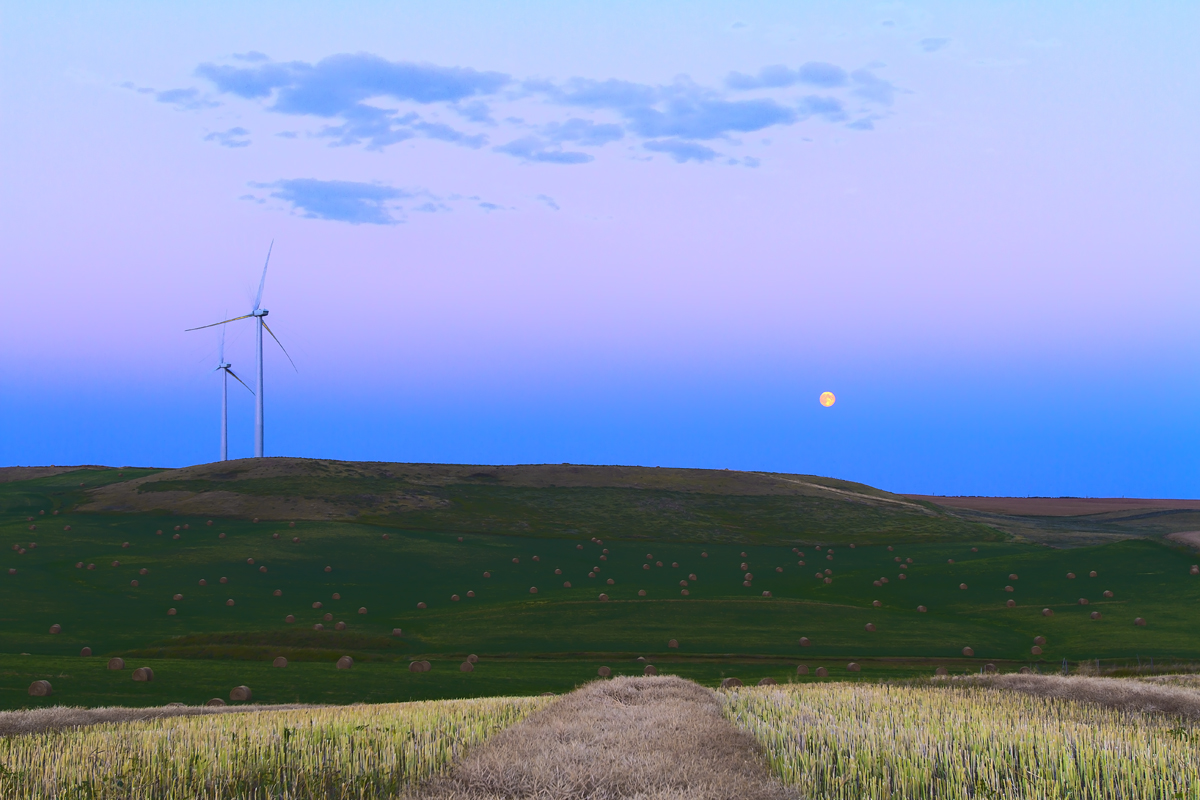
This was the Full Moon rising on the night of another much-publicized “Blue Moon.” This was moonrise on Friday, August 31, 2012.
Of course, the Moon doesn’t look blue. Indeed, smoke and dust in the air made it look a dim yellow. Though this wasn’t the official Harvest Moon (that comes next month), it should have been, as around here in southern Alberta the harvest is well underway, thus the swathed fields and hay bales.
The Full Moon sits in the blue band of Earth’s shadow, rimmed on the top by the pink twilight effect called the Belt of Venus, caused by sunlight illuminating the high atmosphere to the east.
A couple of windmills from the large Wintering Hills wind farm add to the evening scene. I’ve spent the last couple of evenings shooting in the wind farm. More images are to come!
For this image, I combined six exposures in a High Dynamic Range stack to compress the wide range of brightnesses. Boosting the colour vibrancy also brings out the twilight colours.
This image depicts a 360° panorama of the field and sky at the Saskatchewan Summer Star Party.
This was my first time shooting a nighttime panorama but it was easy. Just 12 exposures taken at 30° intervals panning around on a levelled tripod, in classic planetarium panorama style. Each exposure was 30 seconds at f/2 and ISO 3200 with the Canon 5D MkII and 24mm lens. It helps to have a high-quality fast lens.
North is at centre, south on either end.
The sky contains some interesting and subtle features that show up well in a wide-angle panorama like this:
– The bright summer Milky Way is setting at left in the southwest while the fainter winter half of the Milky Way is rising opposite, at right in the northeast.
– Jupiter and the Pleiades rise at right just off the Milky Way
– A meteor streaks over the trees at centre
– At centre, to the north, glows a faint yellow and magenta aurora
– The larger green glow left of centre is, I suspect, airglow rather than aurora. It has a striated structure, particularly at right of centre above the trees where it appears as subtle green and red bands arching across the northeast.
The sky this night was dark but did have a brighter than usual background, likely due to the presence of this faint airglow that the camera picks up better than the eye.
Even so, I can see another faint glow:
– A whitish band coming up from the northeast passing through Jupiter and below the Pleaides. That’s the Zodiacal Band, an extension of the brighter Zodiacal Light and caused by sunlight reflecting off cometary dust in the ecliptic plane.
The location of the panorama and star party was the Cypress Hills Interprovincial Park in southwest Saskatchewan, one of the darkest places in southern Canada.
This wonderful rainbow lasted only a few minutes, as most do, shining in the brief interval when sunlight and raindrops are at their combined best.
I captured this rainbow off the back deck, on June 2, as a storm receded to the east and the Sun broke through in the west, ideal circumstances for catching a rainbow, at least photographically.
This was a classic bow, showing the inner main bow and the fainter outer secondary bow with colours reversed. The sky is bright inside the the inner bow from scattered light from the raindrops, and darker between the two bows where there is an absence of scattered light, a phenomenon called Alexander’s Dark Band after the ancient Greek astronomer who first described it.
I used a Canon 60Da and 10-22mm lens for this, at 10mm for wide-angle coverage of almost the entire rainbow.
Following up on my previous post, here is the wide-angle scene of that same winter moonrise, taken at sunset on January 8, 2012.
This was a spectacular and truly “amazing sky,” with the last rays of the setting Sun illuminating the clouds and the rising Full Moon coming up in the pinks and blues of twilight. It is the big prairie sky at its best.
The wide scene captures dark cloud shadows converging toward the point opposite the Sun, near where the Full Moon sits. These are “crepuscular rays,” a common sight at sunset or sunrise.
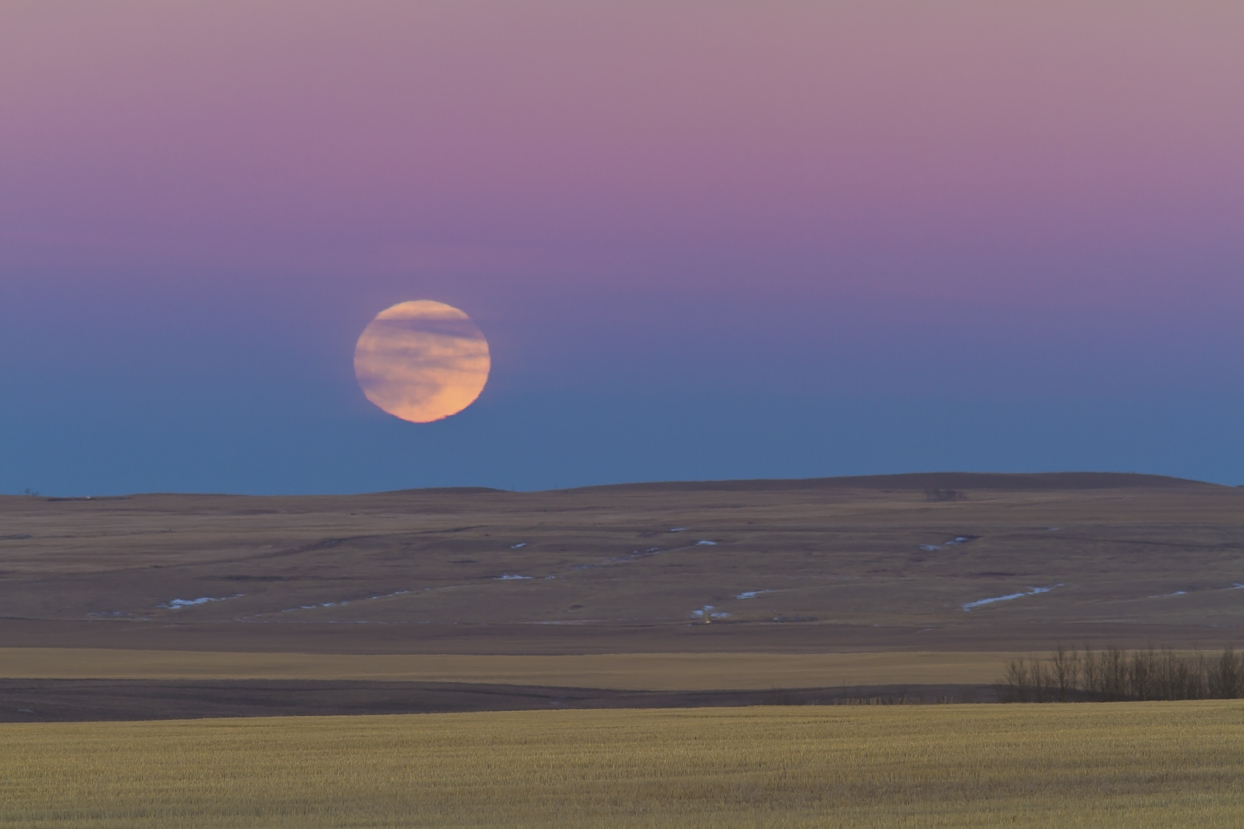
Here is the January 2012 Full Moon rising above a decidedly un-January landscape in southern Alberta. A recent spell of unseasonably mild weather has eaten most of the snow, leaving the fields yellow-brown, and a fine colour contrast with the twilight sky.
On January 8 the Full Moon rose into clear skies over the prairie landscape east of my home. This shot captures the pink glow of twilight on the upper atmosphere, above the rising blue rim of Earth’s shadow just on the horizon. A month ago, the Full Moon was in that shadow out in space, being eclipsed at sunrise. Here it is rising at sunset, one lunar cycle later.
I like the prairies, not only for the flat horizons and big open skies they provide, but also for the wonderful palette of colours on Earth and sky.
This is a shot I’ve been after for several years, usually from this same location, looking west toward the setting Sun.
This is sunset at the autumnal equinox, with the Sun going down due west, something it does only at the two equinoxes. September’s usually the one with clear skies, as it was this night, Sept 23, 2011. Except for some annoying clouds at the horizon over the Rockies to the west. I was hoping for a clear shot of the Sun right at sunset at the end of Highway 1, the Trans-Canada Highway. But it’s close. Better luck next year!
After today, the Sun will be setting south of west, and the days will become shorter than the nights.
This is a 6-image HDR stack to capture both the bright and dark parts of the scene. It worked, but Photoshop refused to properly remove the “ghosts” — images from cars moving from shot to shot. But if I hadn’t told you about it, you might not have noticed!
This is the kind of sky that makes astronomers smile. Clear and painted with twilight colours.
This was the scene two weekends ago, on August 26, at the annual Starfest star party in southern Ontario. Starfest is Canada’s biggest annual astronomy gathering and this year attracted about 700 people, filling the campground with tents, trailers and telescopes.
I was fortunate enough to be able attend this year, as one of the guest speakers in a pretty full program of afternoon and evening talks. I presented two talks, on the “Great Southern Sky” and on “Ten Tips for Better Pix,” plus presented a laser tour of “my sky” after dark on the Friday.
Starfest, as with other star parties I’ve been to lately, hasn’t fared well for weather in the last few years, but this year the clouds (mostly!) stayed away and people enjoyed a fabulous weekend under the Milky Way and summer stars.
This is a roughly 180° panorama taken at twilight, showing the rising dark blue arc of Earth’s shadow at left, with a strangely bright glow in the atmosphere above it. At right is the glow of sunset and some crepuscular rays (shadows from distant clouds) visible as bright and dark bands across the sky.
Starfest is a great star party. Anyone in eastern Canada interested in astronomy should make a point of attending. Next year’s event is August 16-19, 2012.
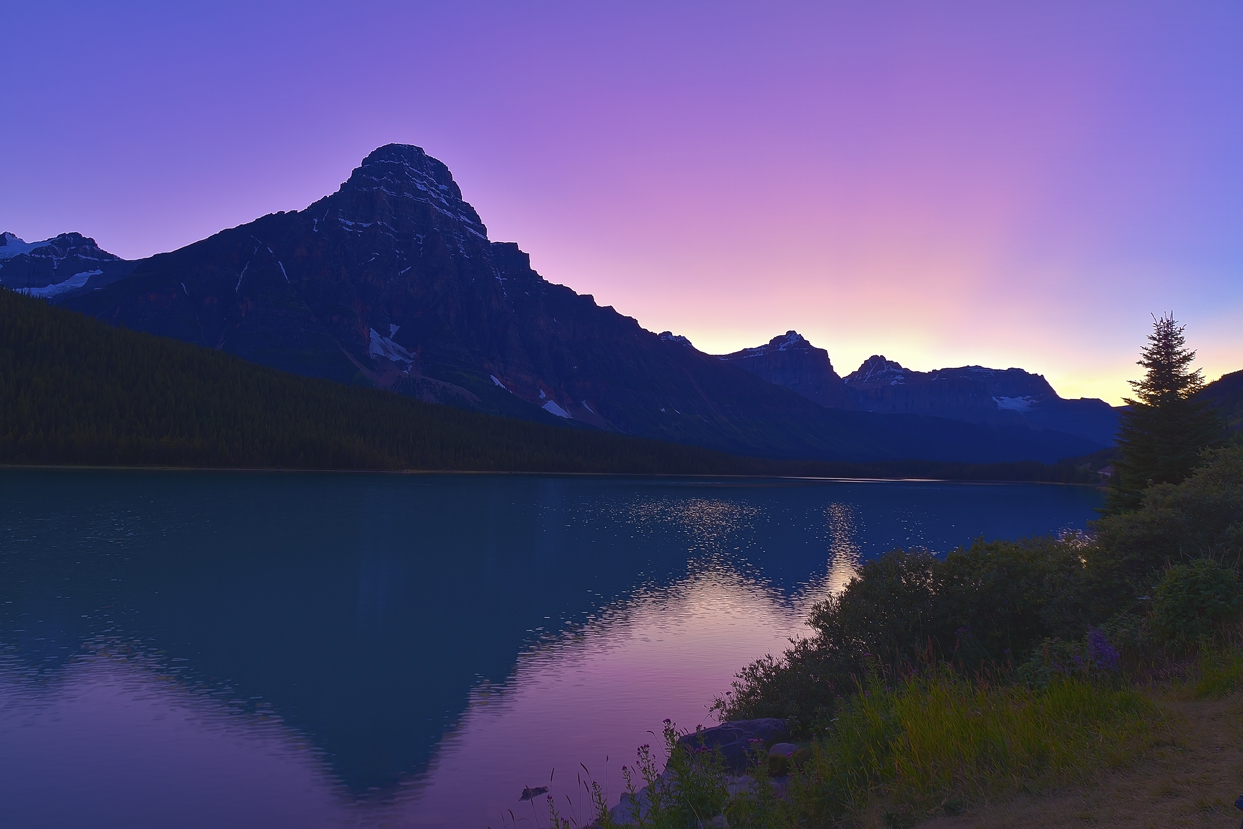
About half an hour after I took the previous blog entry image, I was here on Sunday evening, farther down the Icefields Parkway, at the shore of Lower Waterfowl Lake. The peak is Mt. Cephren.
The Sun had set and the sky was now filled with the purple glow of twilight marking the beginning of an exceptionally clear night.
Capturing this scene as the eye saw it took a stack of 7 different exposures, combined in what is known as a High Dynamic Range image, that blends the shadows details in the foreground without losing the subtle tints of the bright sky.
This is how the night started, on Sunday evening, September 4 — as clear a night as you could ask for in the mountains. A quarter Moon hangs over the peaks of the Continental Divide, with alpen glow, the last rays of the Sun, illuminating the mountains around Saskatchewan River Crossing, in Banff.
The North Saskatchewan River flows east out of the mountains here, after being joined by the Mistaya and Howse rivers. It was here, in the early 1800s, that David Thompson and his party of fur traders from the North West Company entered the Rockies and heading up over Howse Pass off frame to the right, to trade with the Kootenays in the interior of what is now British Columbia.
This is David Thompson country, named for one of the world’s greatest geographers and mapmakers. He mapped most of western Canada and down into the Oregon Territory. All using compasses, sextants, a Dolland refractor telescope (to observe the moons of Jupiter for telling time), and his skills as an astronomer. The Kootenays called him Koo-Koo-Sint — the man who watches the stars.
It was also here, on these open river plains, that James Hector, mapping southern Alberta with the Palliser Expedition, observed Comet Donati in September 1858.
This is a place in the Rockies with many ties to history and to astronomy.
One of the trickiest subjects for a time-lapse sequence is a smooth and seamless day-to-night transition. Exposure times vary from fractions of a second before sunset to several seconds at night fall.
How to do it? Manually shifting exposures is too much work and prone to error. Putting the camera on Automatic can work but inevitably results in an effect known in the time-lapse world as “flickering.” The camera’s automatically-judged exposures aren’t consistent from frame to frame so the final movie shows minor bright/dark flickering, making it look jerky.
For this test sequence of sunset over the Calgary skyline, I tried a new toy for the first time, as a solution.
The device is called the Little Bramper (for Bulb Ramping). It is a custom-made intervalometer that fires the camera shutter every few seconds (at whatever interval you desire). Nothing new there. But what’s unique is that it can be set to slowly increment the exposure time by as little as 1/1000th of a second from frame to frame, gradually increasing the exposure (“ramping” it) to accommodate the darkening scene. The result is a smooth transition from day to night with no flickering.
This was my first use of the Bramper and it wasn’t without its glitches. The shortest exposure the Bramper can provide (it always controls the camera thru its Bulb setting) is about 1/10th of a second (I had no idea camera shutters can fire as quickly as that even on Bulb).
But at the beginning of a sequence like this, with a bright sky, achieving that exposure (still quite long) means using a small f-stop, a slow ISO speed, or a neutral density filter, or all of the above. But as the sky darkens and exposures lengthen, exposures would become too long to fit within the desired interval between frames (typically no more than 5 to 10 seconds for a smooth sequence). So, to shorten the exposures you then have to open up the lens, switch to a faster ISO, or remove the ND filter, while also commanding the Bramper to quickly reduce its exposure time, all in one exposure cycle (i.e. 5 to 10 seconds) so as not to lose or ruin frames. Takes some coordination and practice (hit the Bramper’s button, adjust the camera, all within 5 seconds), and I didn’t get it right the first couple of times.
But overall, for a first test, the sequence turned out very well. The $80 Little Bramper does the job, though it does take careful monitoring through the sequence, not just to perform the exposure swaps, but to also watch that the ramping rate (adjustable on the fly) matches what the scene is doing and you aren’t under- or over-exposing. It’ll take a little more practice, but the results certainly are worth it.
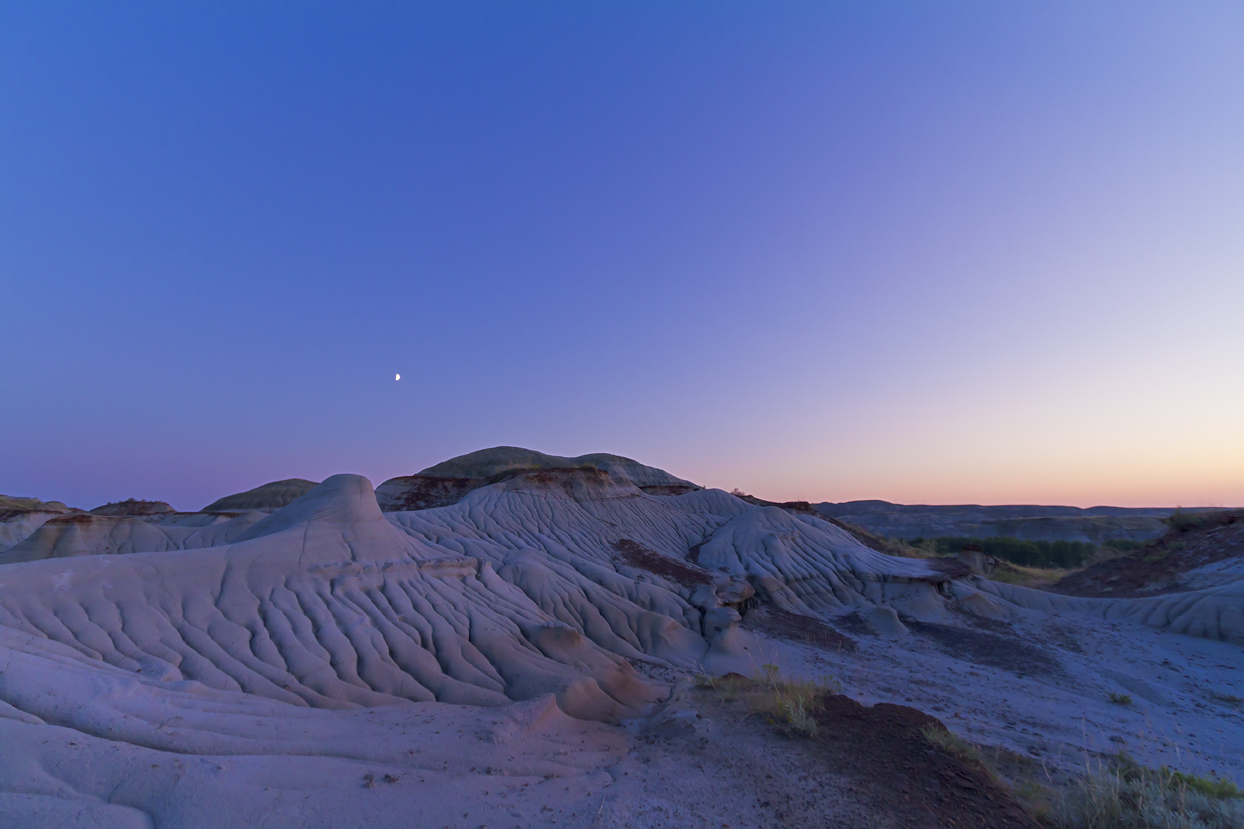
As all the other sunset photographers were packing up for the night, I was just getting started. This is the scene last night, with the waxing Moon hanging over the moonscape of Dinosaur Provincial Park in southern Alberta.
I took this in deep twilight, when the sky is tinted with subtle colours complementing the earth tones of the landscape below.
Dinosaur Park is the world’s best repository of late Cretaceous fossils, being unearthed as the terrain made of ancient volcanic ash erodes away with every rainstorm. Though the formations date from the Cretaceous some 70 million years ago when this area of Alberta was a bayou-like swamp, the badlands landscape we see today was created at the end of the last ice age when glacial floods poured over the landscape, carving the channels occupied by rivers today, like the Red Deer River that flows through Dinosaur Park.
It’s a favourite spot of mine, just an hour east of where I live, to shoot sunsets and moonrises, and twilight landscapes like this one.
My previous blog featured a still frame from a time-lapse movie I took of sunset on the Sweetgrass Hills and Writing-on-Stone Provincial Park. Here’s the full movie, taken at sunset on July 22, 2011.
I assembled the movie in Photoshop Extended CS5 from 678 frames taken over nearly an hour, at 5-second intervals, beginning before sunset and continuing until well after sunset. The camera was the Canon 7D and lens the 10-22mm lens at 10mm.
Putting the camera into automatic Aperture-priority mode keeps the exposure uniform as the lighting level drops but does induce some slight flickering from minor shot-to-shot variations in exposure. That can be fixed in “post!” But it’ll be a while before I get around to that!
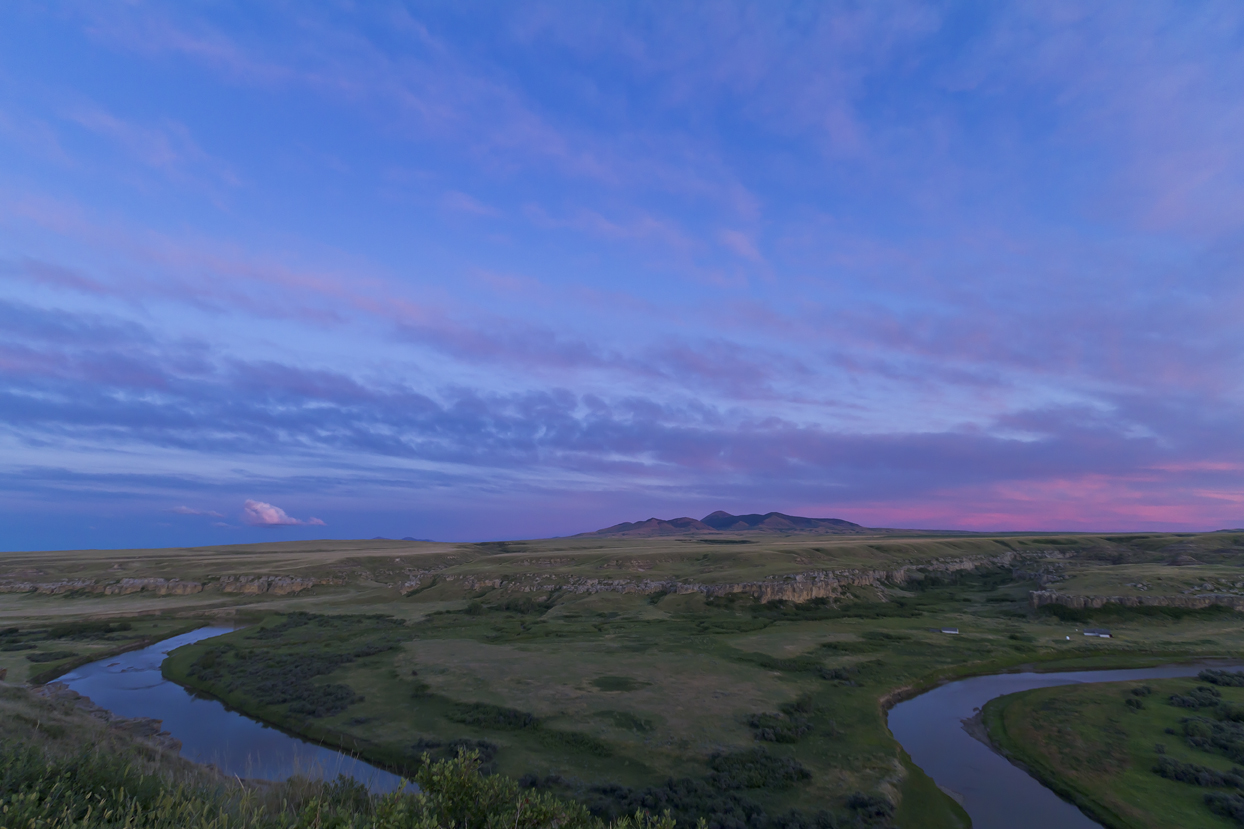
This is one of the great places for evoking the wide open spaces of the high plains. Here we are looking south over the Milk River and the rock formations of Writing-on-Stone Provincial Park in Alberta to the peaks of the Sweetgrass Hills in Montana. The buildings at right are the modern reconstructions of the late 1800’s North West Mounted Police outpost that guarded Canada from the illegals from the U.S. (!) coming up Police Coulee smuggling whiskey from Montana into Canada.
The time is just after sunset, as the last light of the Sun still illuminates the clouds. This is the magic hour for photography, and for taking in the solitude of the “Great Lone Land” as author William Francis Butler described it in his book of that title in 1872.
As Butler wrote, “No ocean of water in the world can vie with its gorgeous sunsets; no solitude can equal the loneliness of a night-shadowed prairie…”
Clouds aren’t usually the astronomer’s friend, but at this time of year they become the objects of our attention. For the past few nights, my Alberta prairie skies have been beautifully clear and filled with the clouds of solstice.
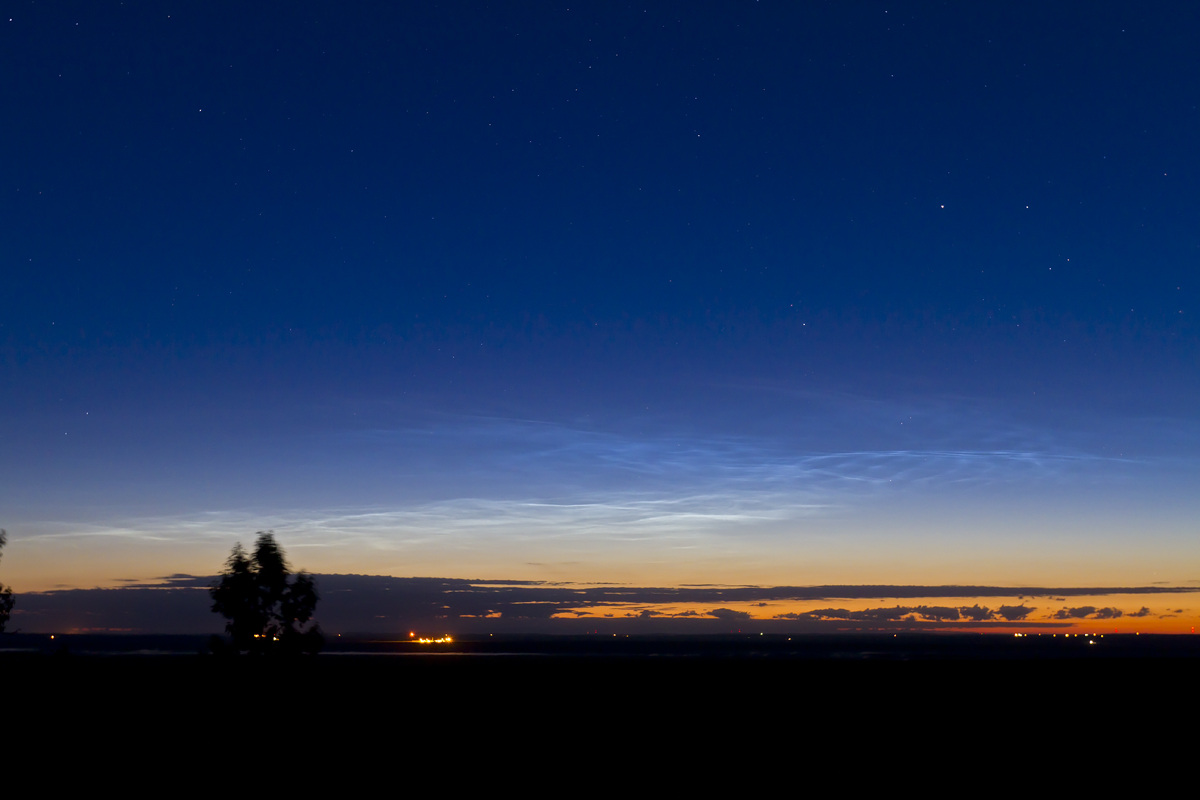
Last night, July 6, began at twilight with the best display of noctilucent clouds so far this season — and we’re now at peak season for this northern sky phenomenon. This was the scene at about 11:30 pm local time, with the wispy high-altitude clouds at their most extensive and fully lit by sunlight. Over the next hour or so, as the Sun set further below the horizon, the display disappeared as darkness came to the high atmosphere and the Sun no longer illuminated these clouds suspended over the Arctic. Here’s a diagram of the geometry of how they get lit up. If you are curious to learn more, check this NASA page.
I took a time-lapse movie of the fall of darkness on the clouds, which you can view here at my SmugMug gallery at AmazingSky.ca. The video shows how the clouds begin the night fully illuminated by the Sun but over the hour duration of the video they disappear from top to bottom. You can see a curtain of darkness moving down the clouds, caused by the Sun dropping farther below the horizon. As it does so its illumination seems to drop toward the horizon as night falls, leaving only clouds closest to the horizon (and farthest north) still illuminated. The video also shows that the edge of the illumination appears reddish — that’s because clouds on the edge of the descending dark shadow are being lit only by a low red Sun setting below the limb of the Earth. Pretty neat, and something I’ve not seen before in any image or movie. (The movie is HD quality and will take a while to load, sorry!)
However, tonight normal, everyday weather clouds moves in, curtailing any late night NLC watch. Tomorrow, I head to the Rockies to do some time-lapse nightscape shooting in the mountains. Yes, I know I’ll miss seeing Duke and Duchess Will and Kate start off the Calgary Stampede Parade. Royalty will just have to get on without me.
We were treated to a good display of noctilucent clouds last night. Or should I say early this morning! At this time of year, many a night is spent keeping a watchful vigil for noctilucent clouds. They often appear at their best before dawn.
That was the case July 5/6. The night started with a decent display of these northern sky clouds in the northwest after sunset and just before midnight. But then as the Sun dropped lower below the horizon, the lighting angles changed and the clouds disappeared. A low aurora display took their place through most of the night.
Then, at 3 am or so, as the lighting from the rising Sun hit the right angle coming over the Pole, the Arctic ice clouds reappeared, now in the northeast. Sequences of shots showed a rapid east to west motion of the clouds, driven by winds at the edge of space, at the clouds’ extreme altitude of 80 km or so.
This shot is with a 16-35mm zoom, set to 24mm and takes in the bright star Capella at upper right, a useful “survey marker” for measuring angles and cloud altitudes. I took this at about 3:30 am. MDT.
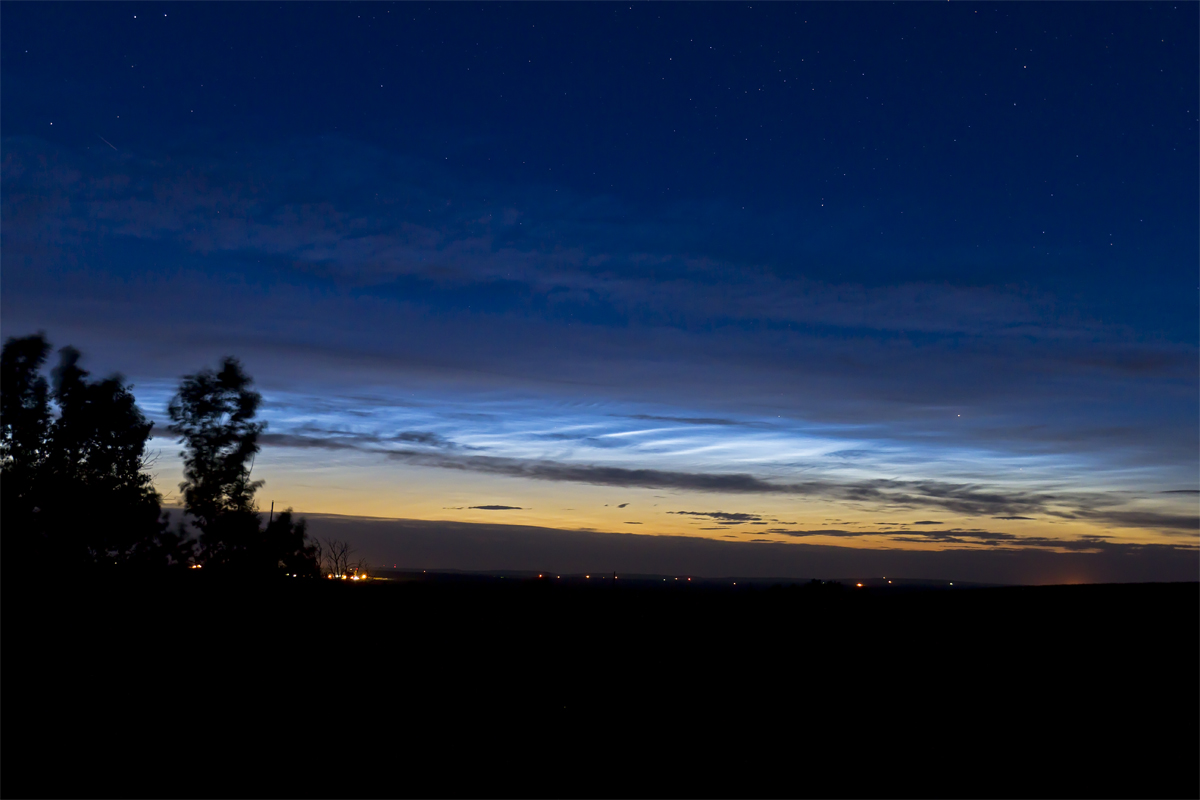
The glowing clouds of solstice have appeared. This was my first sighting of “noctilucent clouds” for the season.
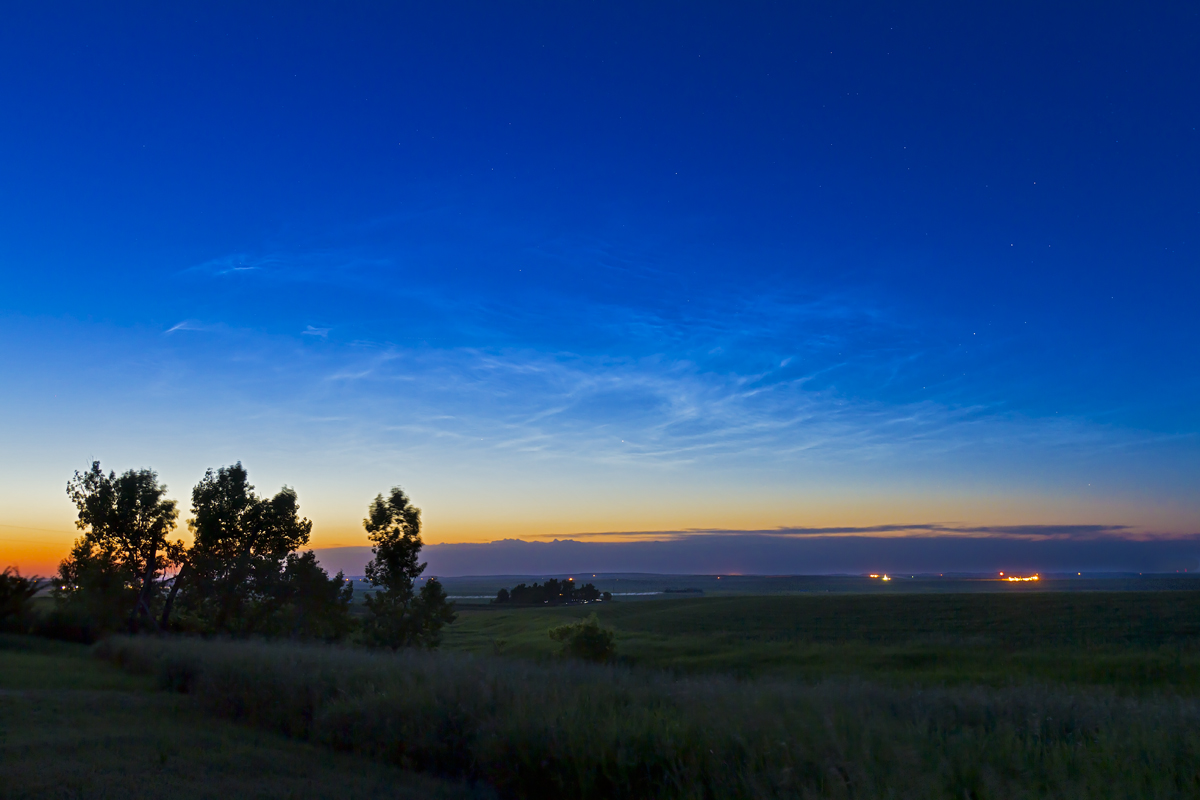
Every northern summer in late June and early July we are often treated to bright pearly clouds glowing along the northern horizon long after sunset. Their origin remains somewhat of a mystery. These clouds form almost at the edge of space, so high there shouldn’t be much for clouds to form around. But their height is what makes them visible, as they catch sunlight streaming over the pole even in the middle of the night.
I took this shot Tuesday, June 28 just before midnight. The noctilucent clouds are the blue-white wavy bands just above the orange twilight. In front of them lie dark normal clouds low in our troposphere. But the NLCs shine from an altitude of some 80 km, well into the mesosphere. They are located over the Northwest Territories but, like aurora, their height allows us to see them even from more southerly latitudes.
The bright star Capella, circumpolar from my latitude of 51° North, shines through the clouds at right.
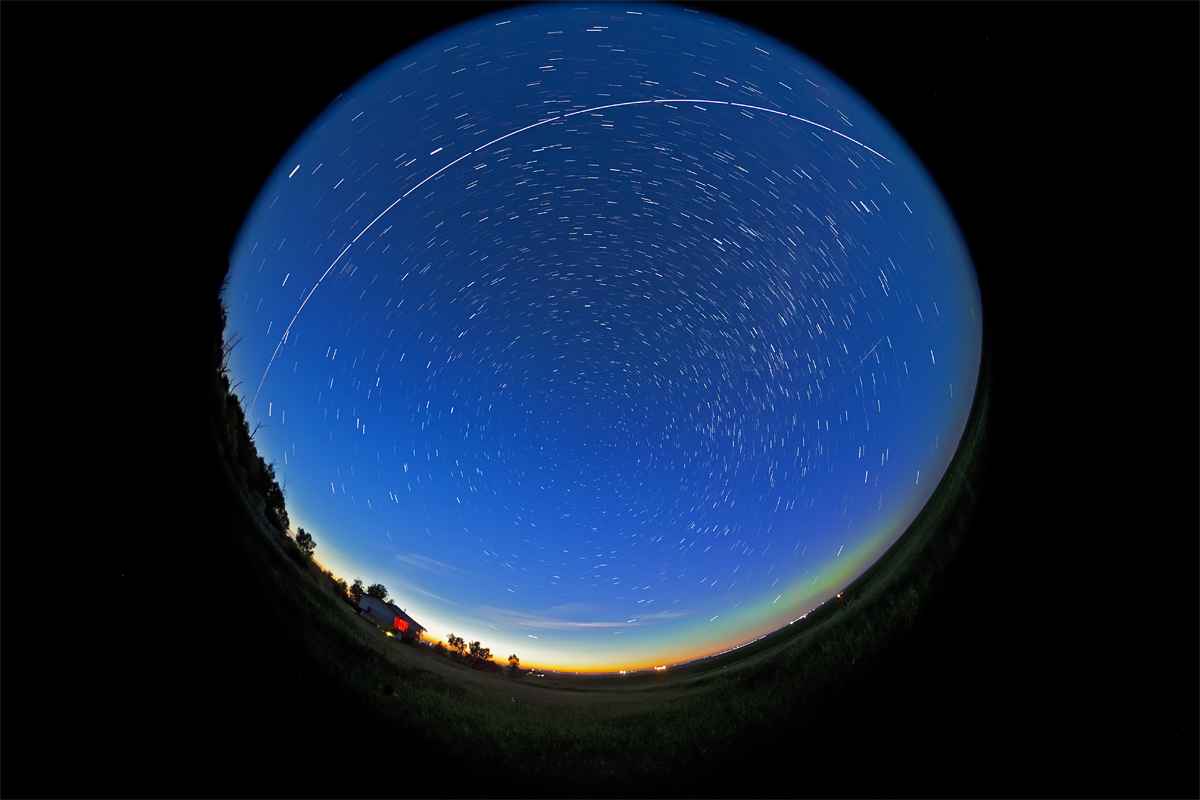
Here’s a capture of the Space Station, coming over in a darker, clearer sky than last night’s shot (in the previous blog). This was June 22, 2011, a fine solstice night on the Canadian Prairies.
The time was just before midnight, with no Moon. Yet the sky is blue and the northern horizon tinged with the orange glow of twilight. It never gets truly dark now, as summer begins. To the right, on the northeast horizon, a low green aurora kicks up.
The Space Station, the dashed arc at top, tonight passed from west to southeast, across the southern sky at the top of this fisheye 360° frame.
This is a stack of 28 18-second exposures at f/4 and ISO 1600 with the Canon 5D MkII and Sigma 8mm lens.
This was the scene we were treated to each evening at the Atacama Lodge in Chile. Quite an amazing skyline, with 5,900-metre-high Licancabur Volcano, here at sunset.
The sky colour comes from a phenomenon known as the Belt of Venus, a magenta/pinkish glow from sunlight lighting up the upper atmosphere after the Sun has set for us on the ground. The dark blue rimming the horizon is the rising shadow of the Earth.
I have punched up the colour saturation here to bring out the colours, but not so much as to be faked — the colours are real!
This is a shot with the 50mm lens and Canon 7D camera, taken on one of the nights we had dinner back at the lodge, in this case with a group of Québec amateur astronomers also here this week who were great observing friends on the field.
This shot took getting up early (rather than staying up all night) to shoot the sky at 5 a.m. The main subject here is a subtle tower of light rising up vertically from the eastern horizon. That’s the Zodiacal Light, best seen from low latitudes.
The glow is from sunlight reflected off dust particles deposited in the inner solar system by passing comets. While it looks like dawn twilight coming on, the light actually comes from out in space and heralds the brightening of the sky by true twilight.
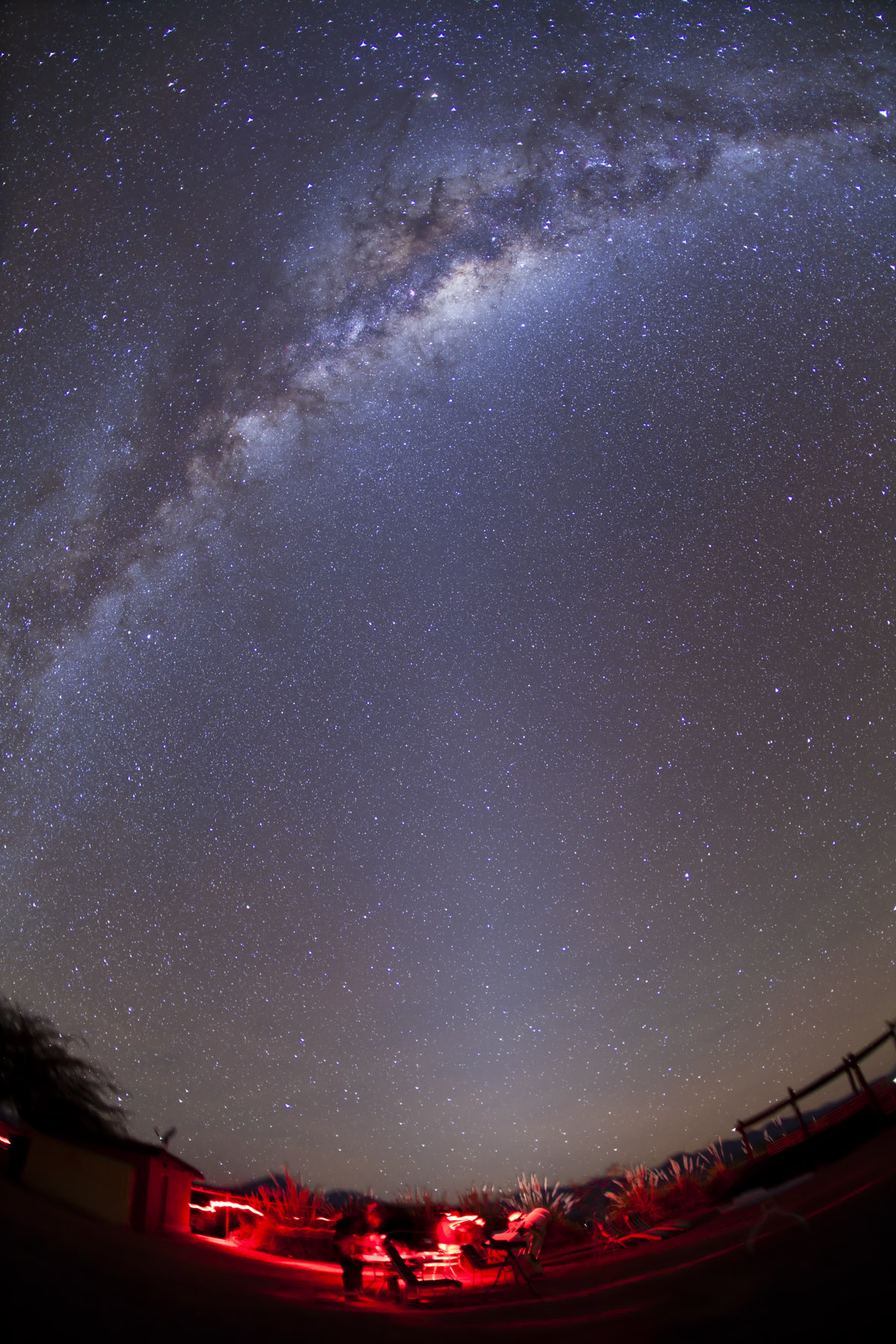
After a week of gazing in the evening sky, a number of us observers took the opportunity this morning to snooze through part of the night and get up prior to dawn to see a new set of objects. At that time of night, and at this time of year, the centre of the Milky Way sits straight overhead, and shows up here in an ultrawide shot from horizon to zenith.
I shot this with the 15mm lens at f/2.8 and the Canon 5D MkII at ISO 800. It’s a stack of two 3-minute exposures.
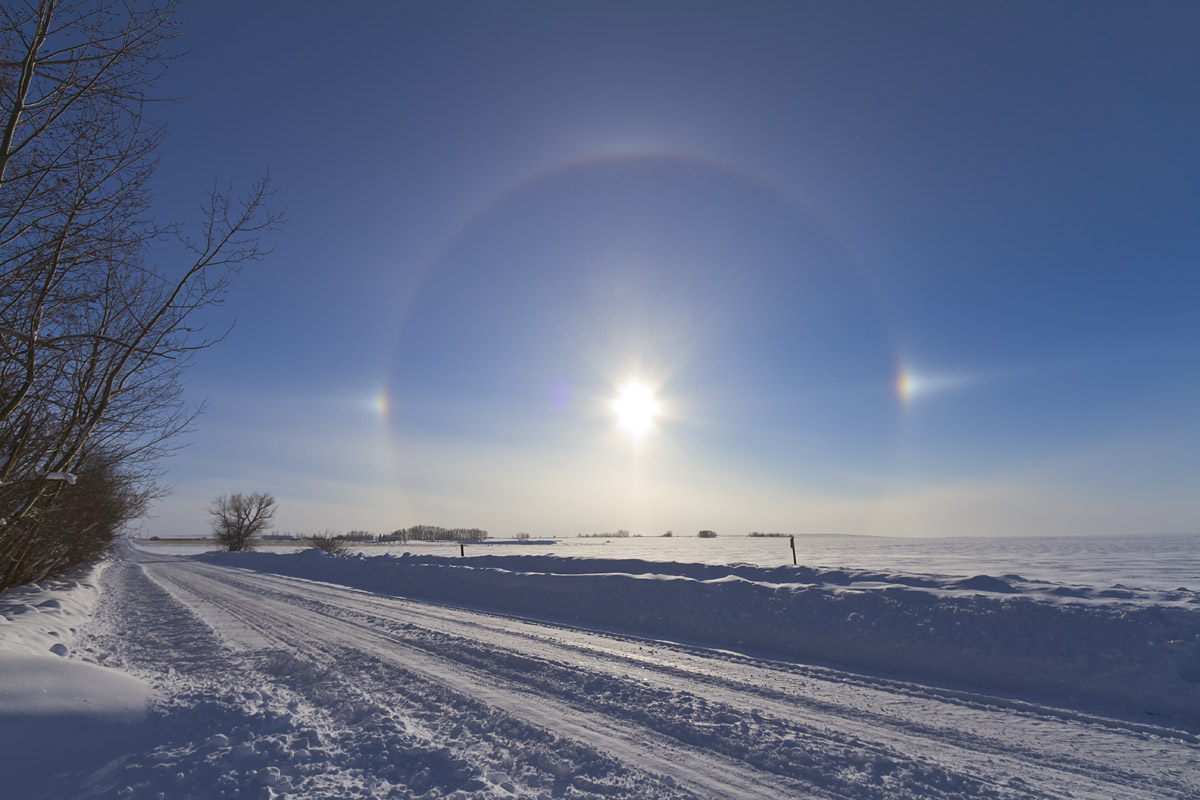
We’ve certainly had our share (more than our share!) of snowstorms and blizzards so far this winter, though nothing like people down east have experienced. The one saving grace is that after the storm the sky often clears beautifully. In this case, on January 30, 2011 we had very clear blue skies, but filled with ice crystals of just the right shape (hexagonal) and orientation to produce a classic solar halo, with prominent sundogs on the 22° halo and a hint of an upper tangent arc, or is it an upper Parry arc? A trace of a circumhorizontal arc is also visible parallel to the horizon. Solar haloes are fascinating and often unique — each one can display a slightly different set of halo phenomena.
The website Atmospheric Optics gives great information and reference works.









 The Amazing Sky