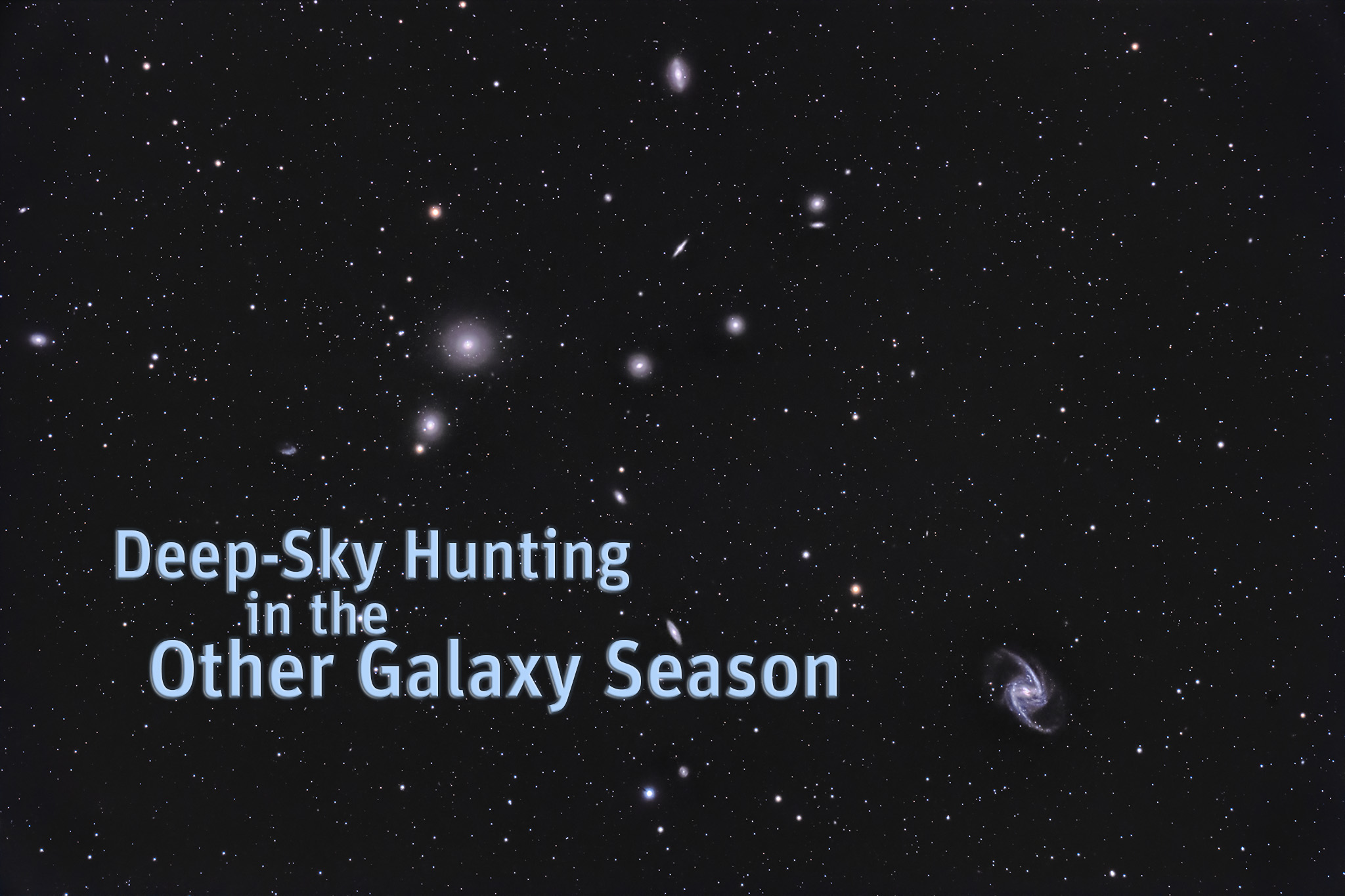
Deep-Sky Hunting in the Other Galaxy Season


Each season brings a different and rich set of targets to view through telescopes. Summer and winter skies are dominated by the Milky Way and its assortment of glowing nebulas and sparkling star clusters, objects not far away within our Galaxy’s spiral arms. 

We live in a galaxy that is a flattened disk โ€” though, as shown in this artwork based on data from the European Space Agency’s recently concluded Gaia mission, that disk is warped. 
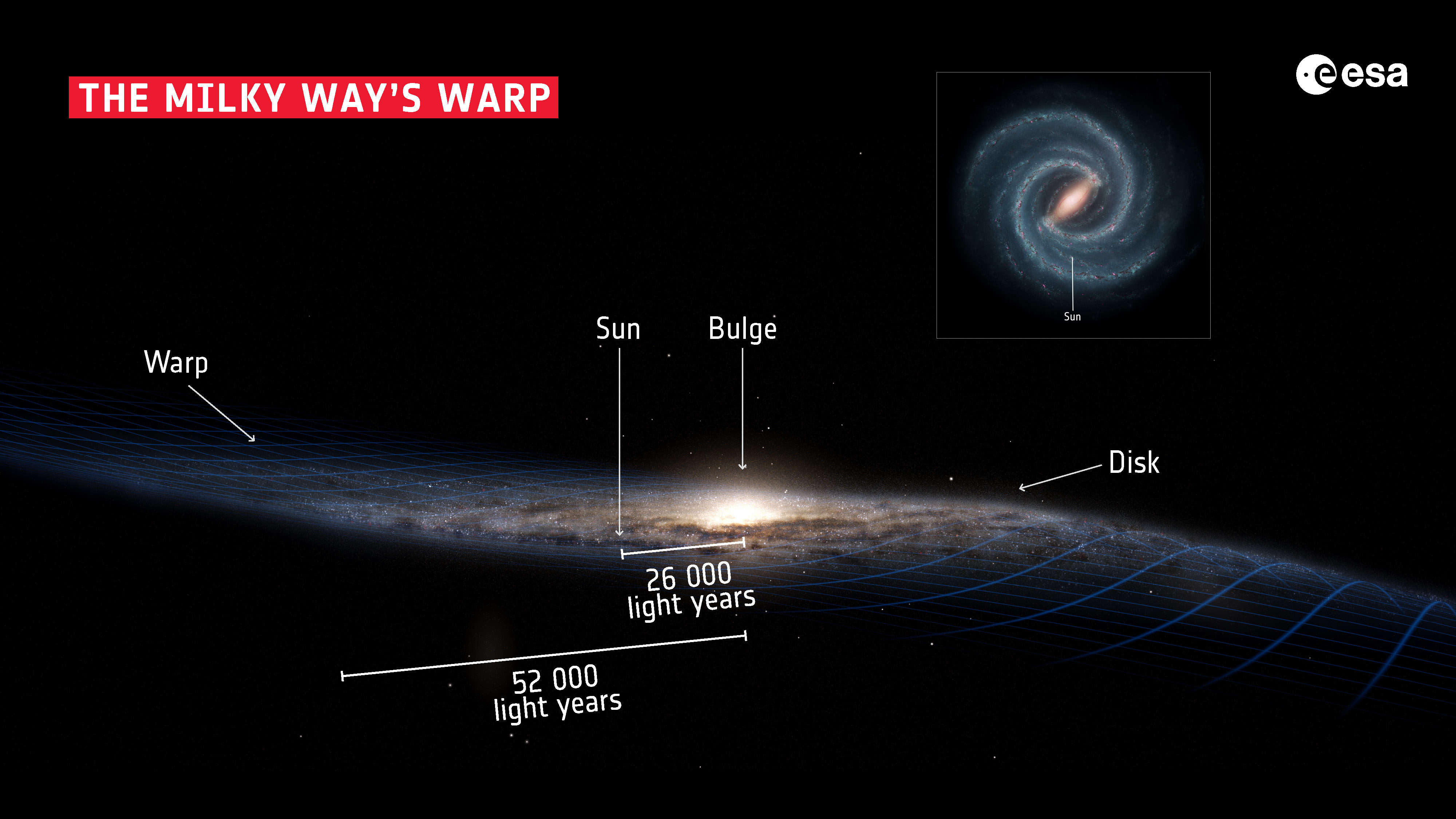
Image courtesy ESA

In summer and winter, as viewed from our location halfway from the centre to the edge of our Galaxy, we look into its disk, to see our Galaxy as the “Milky Way,” the misty band across the night sky. 

But in spring we look straight out of the disk, into intergalactic space filled with other distant galaxies. In northern hemisphere spring we look “up” in this illustration, out of the disk toward the North Galactic Pole, and the rich collections of galaxies in Coma Berenices, Leo, and Virgo.

In southern hemisphere spring โ€” and from the southern hemisphere โ€” we look “down” in the diagram, toward the assortment of galaxies around the South Galactic Pole, in and around the lesser-known constellations of Eridanus, Fornax and Sculptor. 
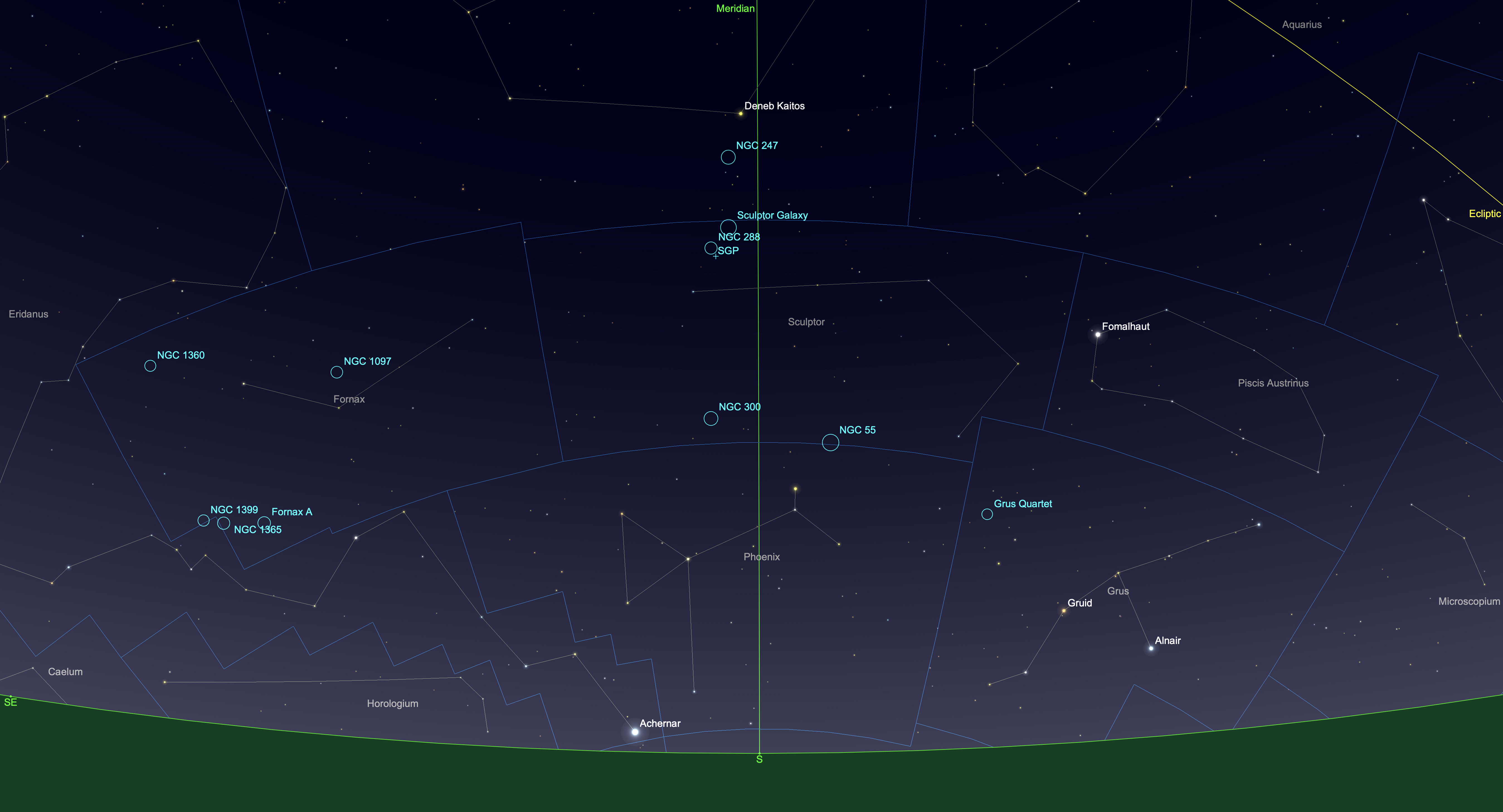
A SkySafari chart showing some of the targets on the tour, low in the south from Arizona’s latitude in autumn.

But, as I show above, that area of sky is accessible from sites in the northern hemisphere, when it is autumn. (The marker for SGP is the South Galactic Pole.) As you can see, the galaxy-filled constellations lie low in the southern sky. It takes travelling to a site as far south as possible to see them well.

That’s what I did in October 2024, to a favourite spot just north of the Mexican border near Portal, Arizona (latitude 32ยบ N). I blogged about that trip earlier.

Here I provide a tour of some of the deep-sky delights I shot on that trip, during autumn “galaxy season,” the other galaxy hunting time. All these galaxies are bright, rivalling the better-known northern targets in the popular 18th-century Messier Catalogue. But French astronomer Charles Messier never observed from this far south to see them. And yet, some of these targets are large and bright enough to be visible in binoculars, ranking them as “showpiece” objects. 

NOTE: You can tap or click on all images to bring them up full screen.

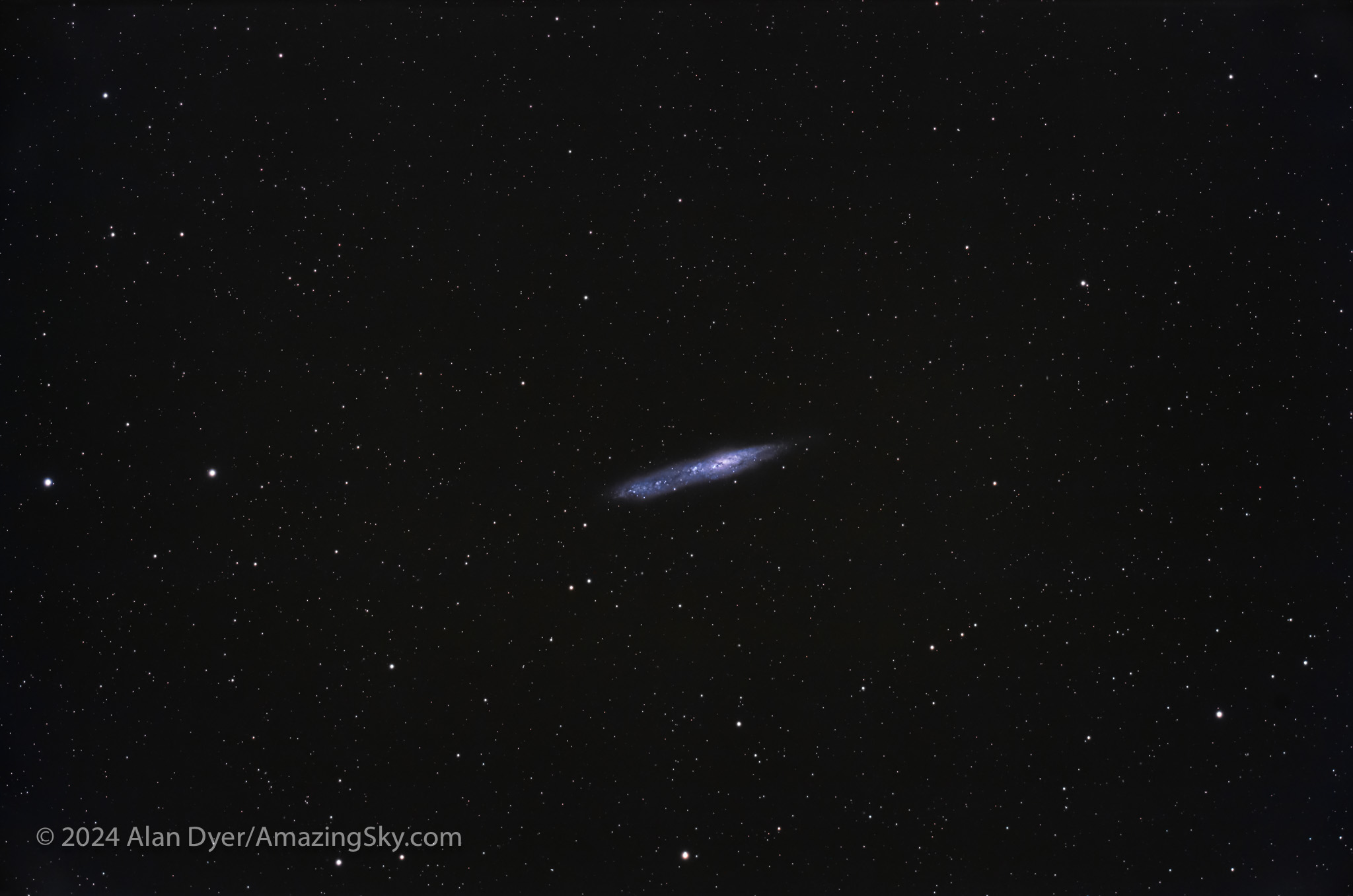
NGC 55 in Sculptor

This is a stack of 16 x 4 minute exposures with the Askar APO120 refractor at f/5.6 (with its 0.8x Reducer) and the Canon Ra at ISO 1000.

This bright (8th magnitude) edge-on galaxy is big, almost 1/2ยบ across (as wide as a Full Moon diameter โ€” the field here is 2ยบ by 3ยบ). NGC 55 lies on the border of the obscure southern constellations Sculptor and Phoenix.

The galaxy was discovered by James Dunlop from Australia in 1826. It is one of the brightest members of the Sculptor Group of galaxies near the South Galactic Pole, though some consider it a member of our own Local Group of neighbour galaxies. It has an asymmetrical shape and is crossed by dark dust lanes. It is classed as a barred spiral, though that shape is hard to discern; we’ll see better examples later in the tour. 

NGC 247, the Dusty Spiral in Cetus
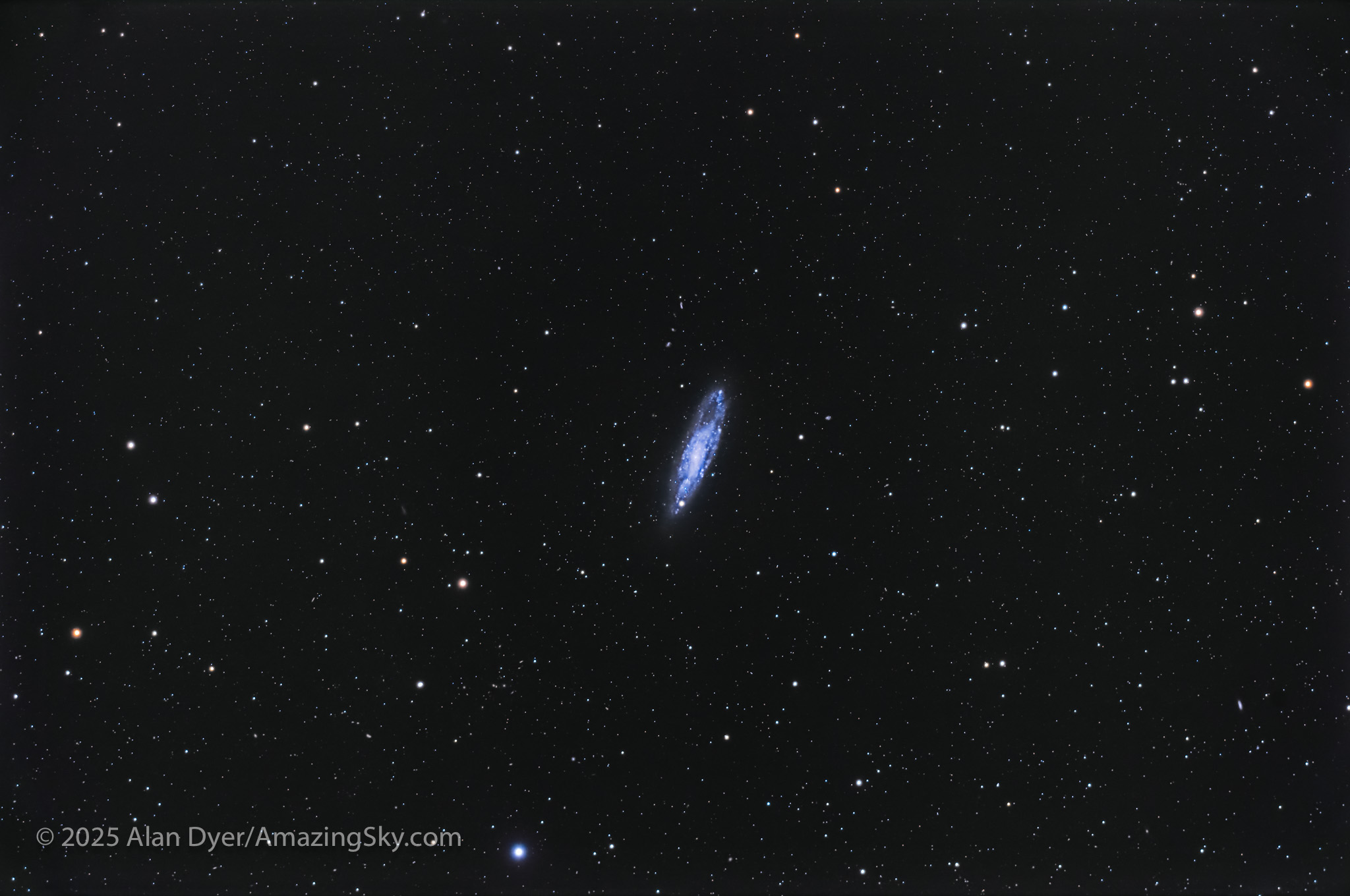
This is a stack of 16 x 4 minute exposures with the Askar APO120 refractor at f/5.6 with its 0.8x Reducer, and the Canon Ra at ISO 800.

This is the bright (9th magnitude) and moderately large spiral galaxy NGC 247 in southern Cetus, the Whale. It is known as the Dusty Spiral and is #62 in Sir Patrick Moore’s Caldwell Catalogue of notable non-Messier objects.

It is also a member of the Sculptor Group of nearby galaxies close to our own Local Group that surrounds the Milky Way. A group of tiny and faint 14th to 16th magnitude “PGC” galaxies (from the Principal Galaxies Catalogue) called Burbidge’s Chain lies just above NGC 247. 

NGC 253, the Silver Coin, with NGC 288, a Pairing in Sculptor
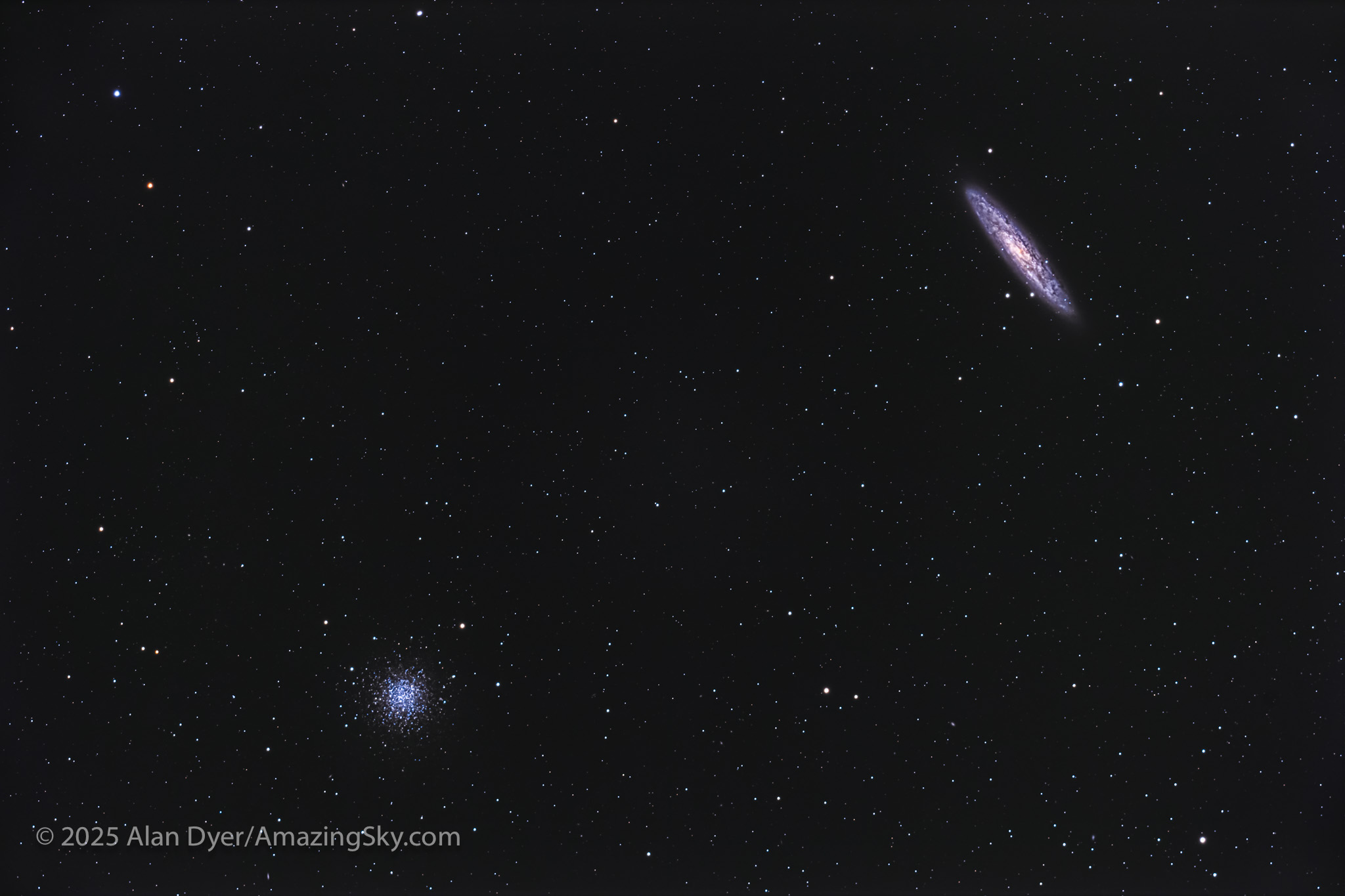
This is a stack of 20 x 3-minute exposures with the APO120 refractor with its 0.8x Reducer for 560mm focal length and f/5.6, and the Canon Ra at ISO 1600. No filter was employed.

Here, sitting right next to the South Galactic Pole, we get a two-for-one field. This is the pairing of the bright and large edge-on spiral galaxy NGC 253 (upper right) with the large and loose globular star cluster NGC 288 (lower left). The latter is easily resolved into its constituent stars.

The two are just 1.75 degrees apart in Sculptor, but are actually 12 million light years apart in space, with NGC 288 belonging to our Milky Way, while NGC 253 is another galaxy altogether, one of the brightest in the sky (at magnitude 7) and a member of the Sculptor Group. 

NGC 253 is also known as the Silver Coin Galaxy, and is Caldwell 65 on Sir Patrick Moore’s list. However, it was discovered by Caroline Herschel in 1783, from England! Her brother William discovered nearby NGC 288.

NGC 300, the Sculptor Pinwheel

This is a stack of 16 x 4 minute exposures with the APO120 refractor at f/5.6 with its 0.8x Reducer, and the Canon Ra at ISO 800.

This is the bright (8th magnitude) and moderately large (1/2ยบ across) spiral galaxy NGC 300, aka the Sculptor Pinwheel. It’s the southern equivalent of the popular Messier 33 spiral in Triangulum. NGC 300 is also Caldwell 70.

It, too, was discovered in 1826 by James Dunlop. NGC 300 may be a member of the Sculptor Group. Or it might lie closer to us than the Sculptor Group, along with NGC 55, at “only” 6.5 million light years away. 

NGC 1097, a Barred Spiral in Fornax
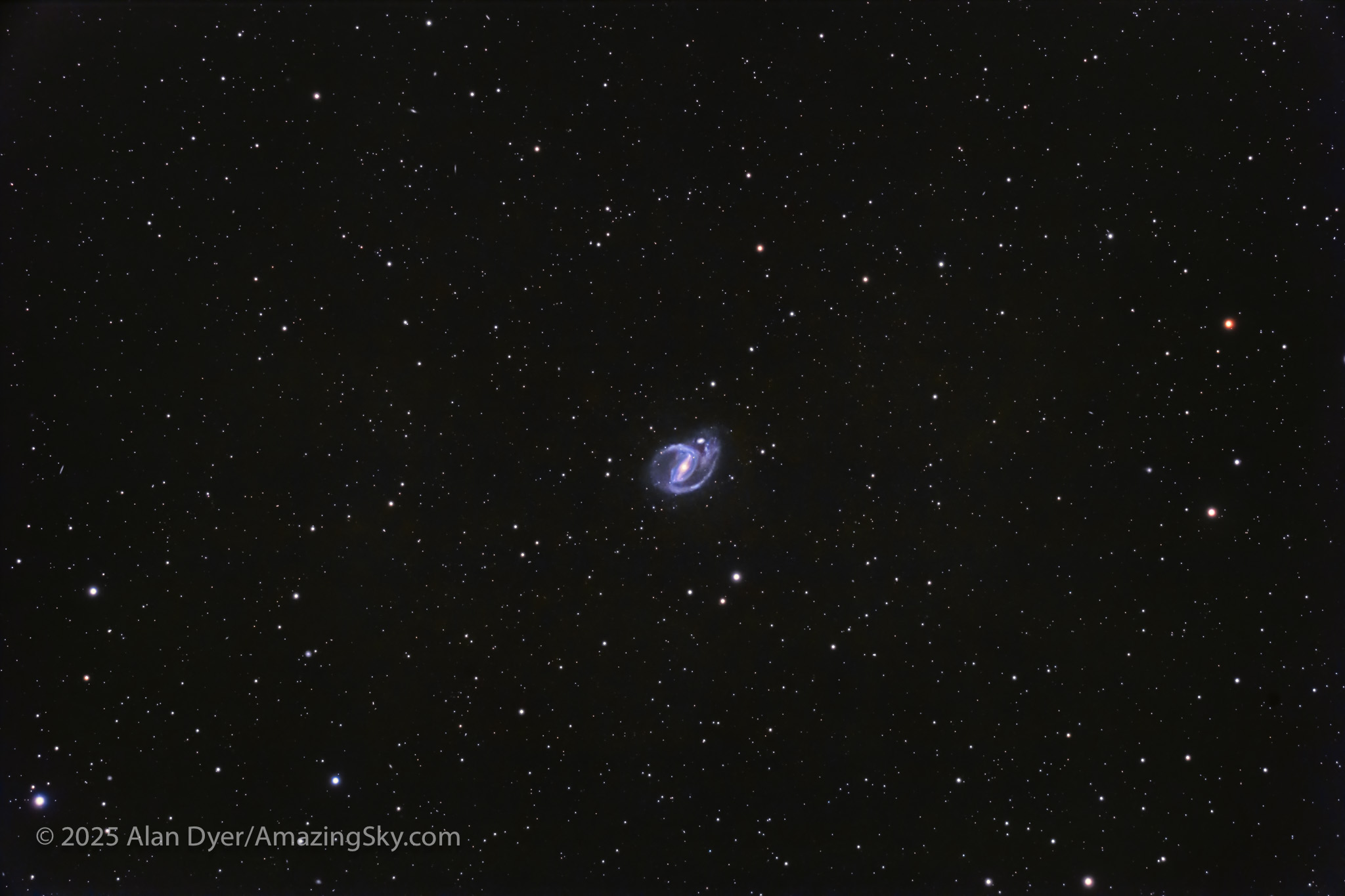
This is a stack of 10 x 6 minute exposures with the APO120 refractor at f/7, with the Canon Ra at ISO 1600.

We trek farther east into the next constellation over from Sculptor, to Fornax the Furnace, to find NGC 1097. This is the realm of bright (magnitude 9.5 in this case) barred spiral galaxies. This class of galaxy has arms emanating from a long bar at the core. This area of sky is replete with bright barred spirals, far more so than any area we find “up north.”

NGC 1097 is also classified as a Seyfert galaxy, a type with an active quasar-like nucleus, housing a massive black hole. NGC 1097 is also Caldwell 67. Just on its northern edge sits the little companion galaxy NGC 1097A. 

NGC 1316 in Fornax, also with a Black Hole
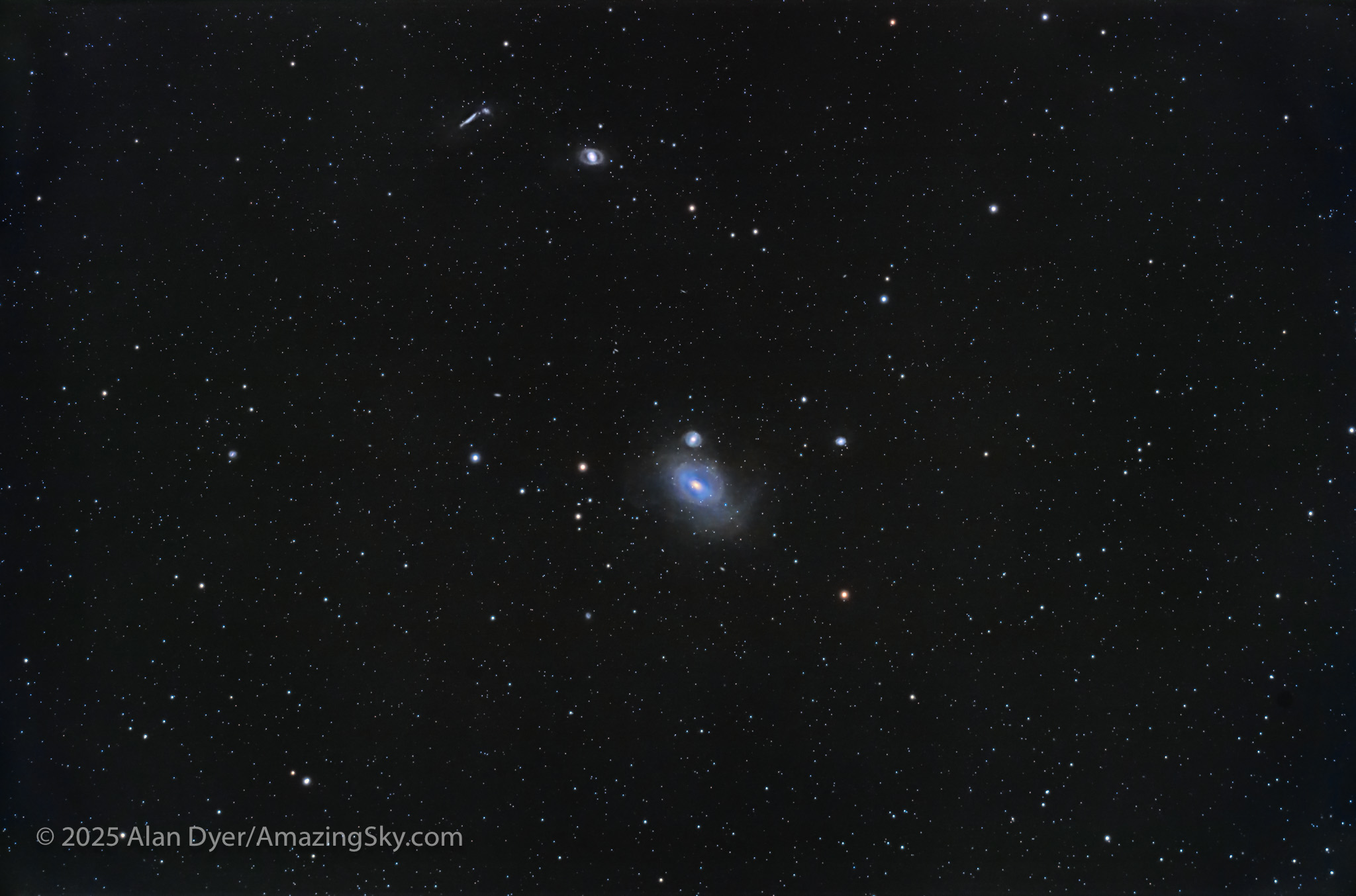
This is a stack of 15 x 4 minute exposures with the APO120 refractor at f/5.6 with its 0.8x Reducer, with the Canon Ra at ISO 800.

This bright (magnitude 8.5) elliptical galaxy is also catalogued by radio astronomers as Fornax A, because NGC 1316 is also a “bright” source of radio waves, thought to be generated by a supermassive black hole at its core.

Elliptical galaxies are notorious for being cannibal galaxies, eating others nearby. Sure enough, the galaxy is surrounded by faint tidal streams of stars, just recorded here, the result of collisions and mergers with unfortunate companions that wandered too close by. NGC 1316 is about 75 million light years away, and belongs to the Fornax 1 Galaxy Cluster. Despite its uniqueness and brightness, it is not in the Caldwell Catalogue. 

Just above it is the smaller elliptical NGC 1318. At top is the trio of: the edge-on spiral NGC 1326A and companion NGC 1326B, and the barred spiral NGC 1326 with an odd ring shape. 

NGC 1365 and NGC 1399, at the Heart of the Fornax Cluster
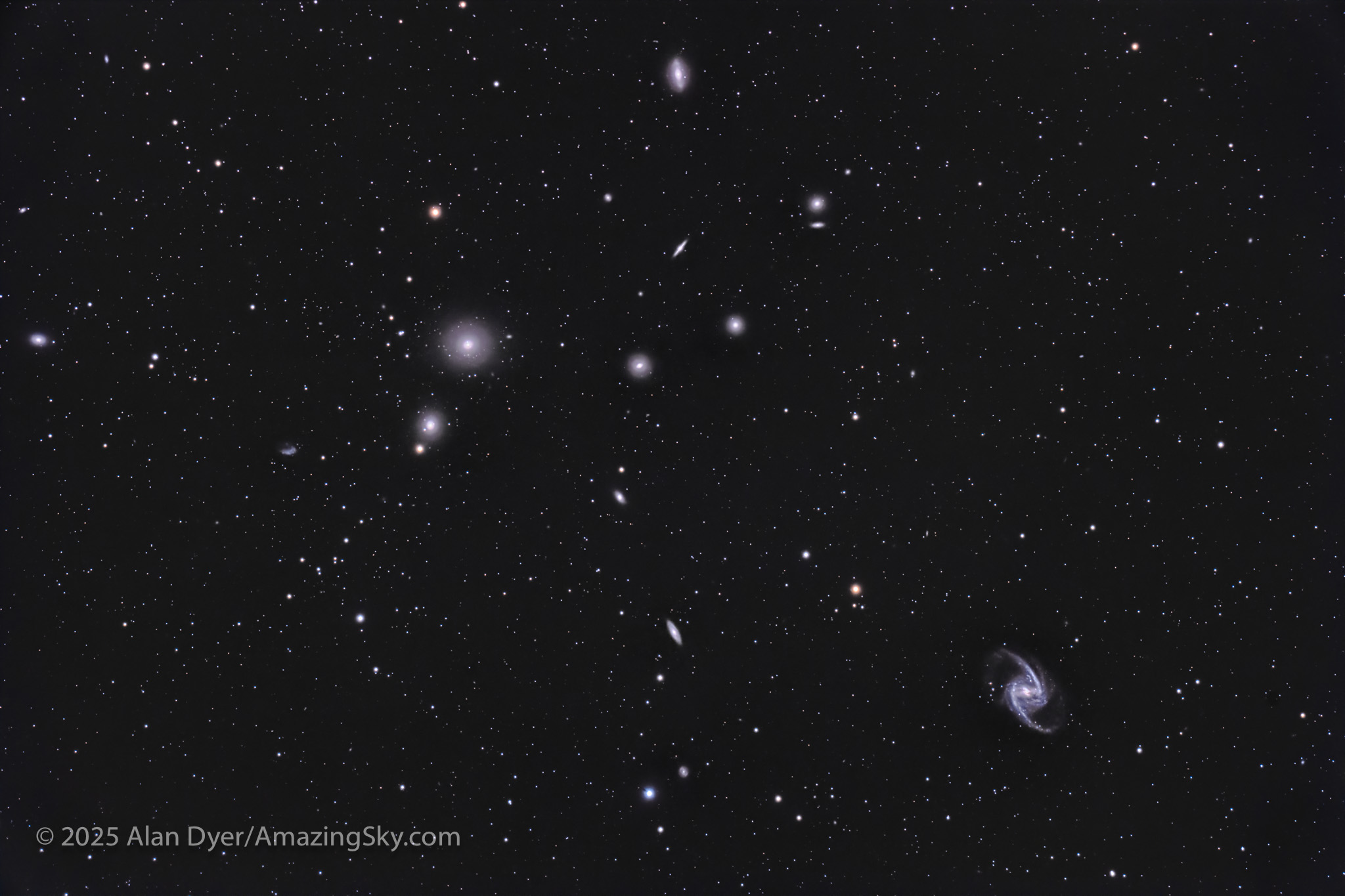
This is a stack of just 10 x 6 minute exposures through the APO120 refractor at f/7 and the Canon Ra at ISO 1600.

This frames the main members of the populous Fornax Galaxy Cluster, second only perhaps to the northern sky’s Coma-Virgo Galaxy Cluster, and its Markarian’s Chain area, for having the most bright galaxies in one low-power telescope field. (The field here is 1.6ยบ by 2.4ยบ.) It is a “must see” sight for galaxy fans.

The two brightest Fornax cluster members are:
– the giant elliptical galaxy NGC 1399 at upper left, paired with smaller NGC 1404,ย 
– and the barred spiral galaxy NGC 1365 at lower right, considered one of the best barred spirals in the sky.ย There’s nothing quite like it up north. Like NGC 1399, it is 58 million light years away.

The odd shaped galaxy at left is the irregular galaxy NGC 1427A, with NGC 1427 itself at the far left edge. The elongated spiral galaxy at top is NGC 1380. Numerous other NGC and tiny, faint PGC galaxies populate the field, down to magnitude 15 or so.ย 

While autumn’s galaxy season has lots to offer the galaxy hunter, there are some wonderful nebulas down south as well. In my sampling, all are “planetaries.” 

NGC 246, the Skull Nebula in Cetus
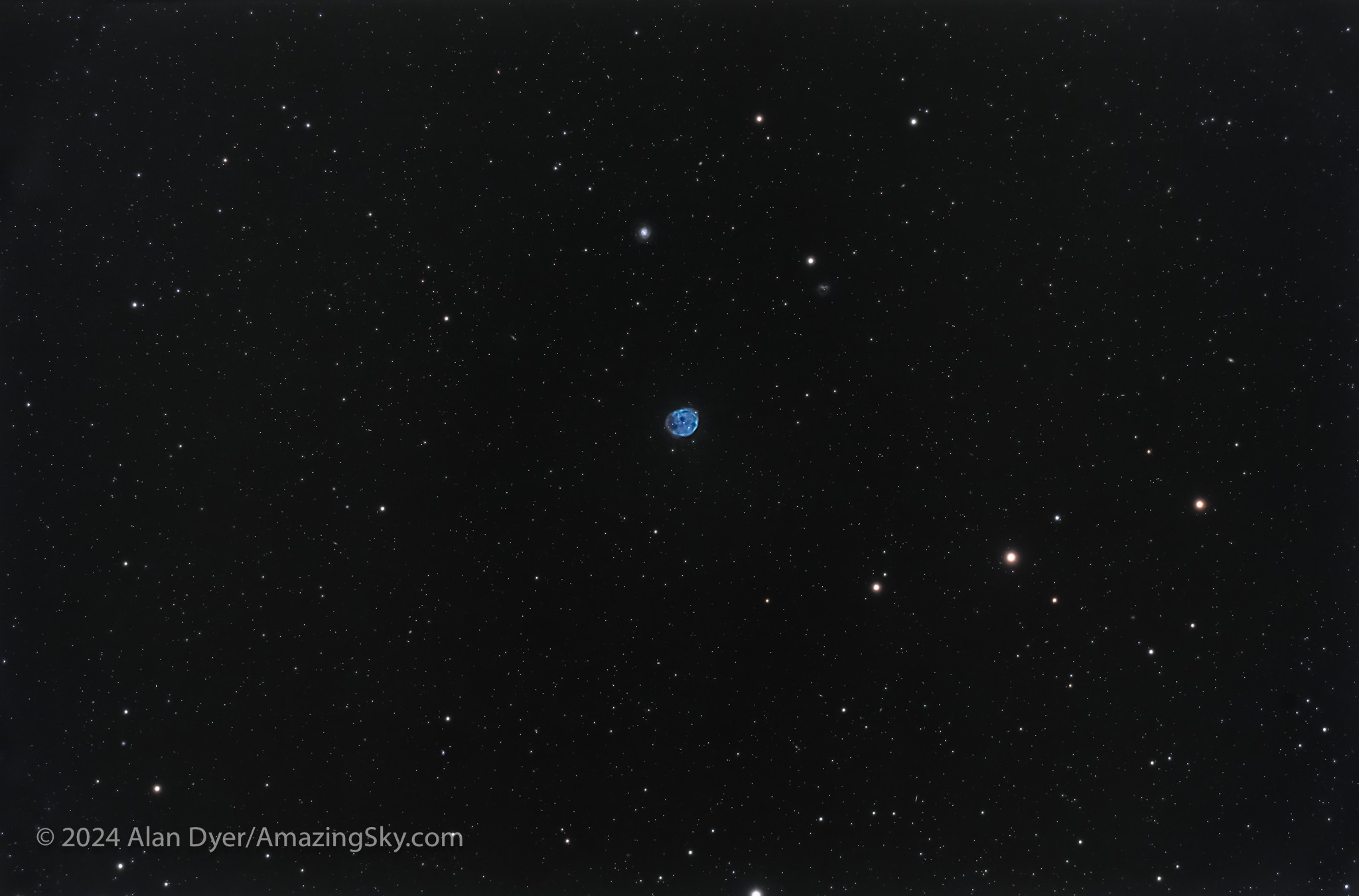
This is a stack of 16 x 4 minute exposures with the Askar APO120 refractor at f/5.6 with its 0.8x Reducer, with the Canon Ra at ISO 1600.

This is the nebula NGC 246, aka the Skull Nebula, in Cetus. It’s an example of a planetary nebula, so-called because this type of object with their small blue-green disks reminded William Herschel of the planet Uranus that he discovered in 1781. NGC 246 was discovered by Herschel four years later in 1785.

NGC 246 has a mottled disk, giving it its fanciful name, and a 12th magnitude central star that has ejected the nebula as part of its end-of-life eruptions, the origin of all planetaries. They have nothing to do with planet formation; they are the products of star death.

NGC 246 lies about 1,600 light years away. Just above it is the small galaxy NGC 255. 

NGC 1360, the Robin’s Egg Nebula in Fornax
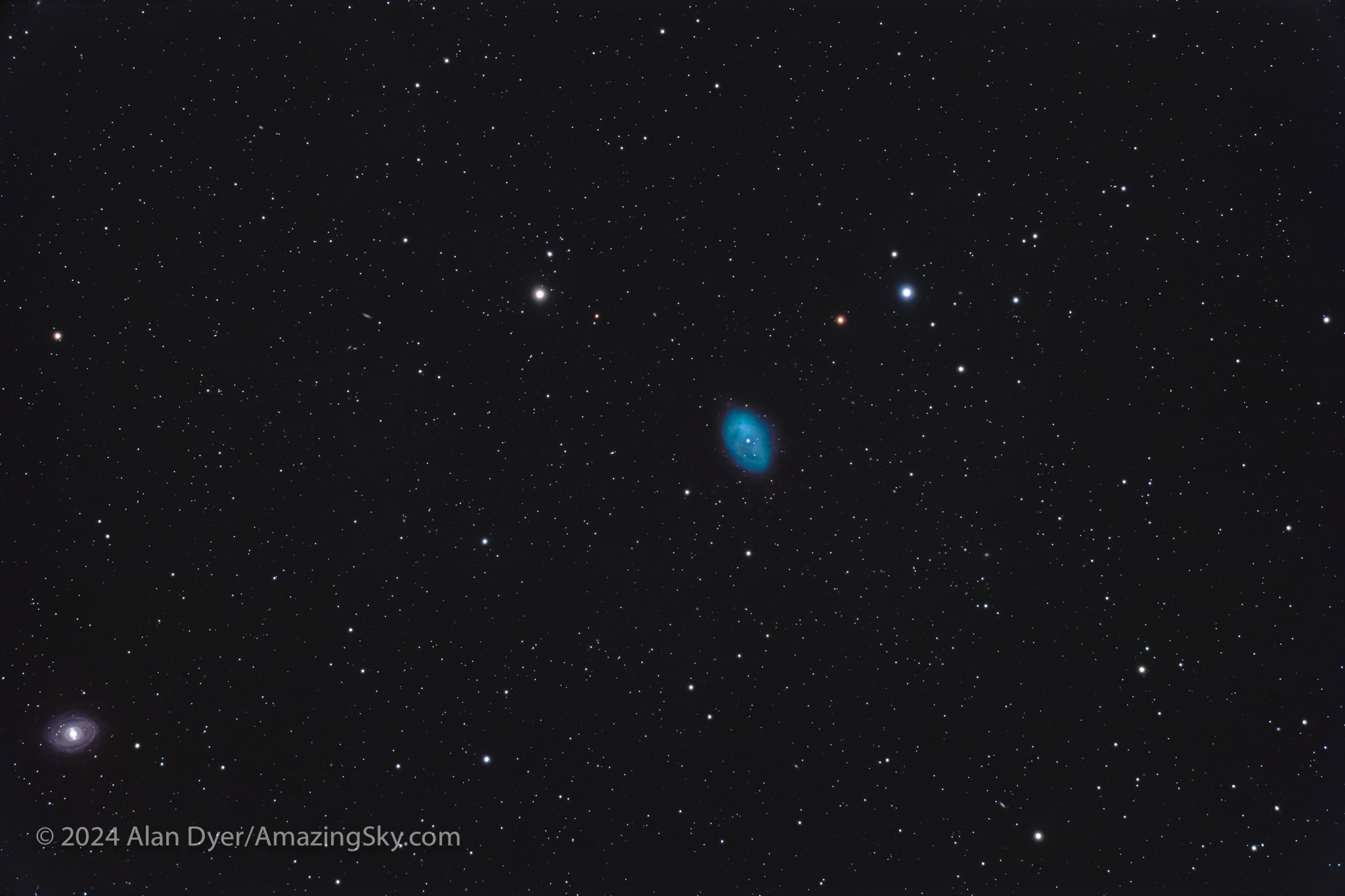
This is a stack of 10 x 6 minute exposures with the Askar APO120 refractor at f/7 and with the Canon Ra at ISO 1600.

This, too, is a planetary nebula, but an odd one, in that it is a more uniform disk than is usual for planetaries, lacking the ring or bi-polar shape of most such objects. It was only recently classified as a planetary, one with an 11th magnitude central star responsible for expelling the nebula.

NGC 1360 is bright (at 9th magnitude), large, and blue-green, giving it the nickname the Robin’s Egg Nebula. The barred spiral galaxy (there are lot of them down here!) NGC 1398 is at lower left. 

NGC 7293, the Helix Nebula in Aquarius
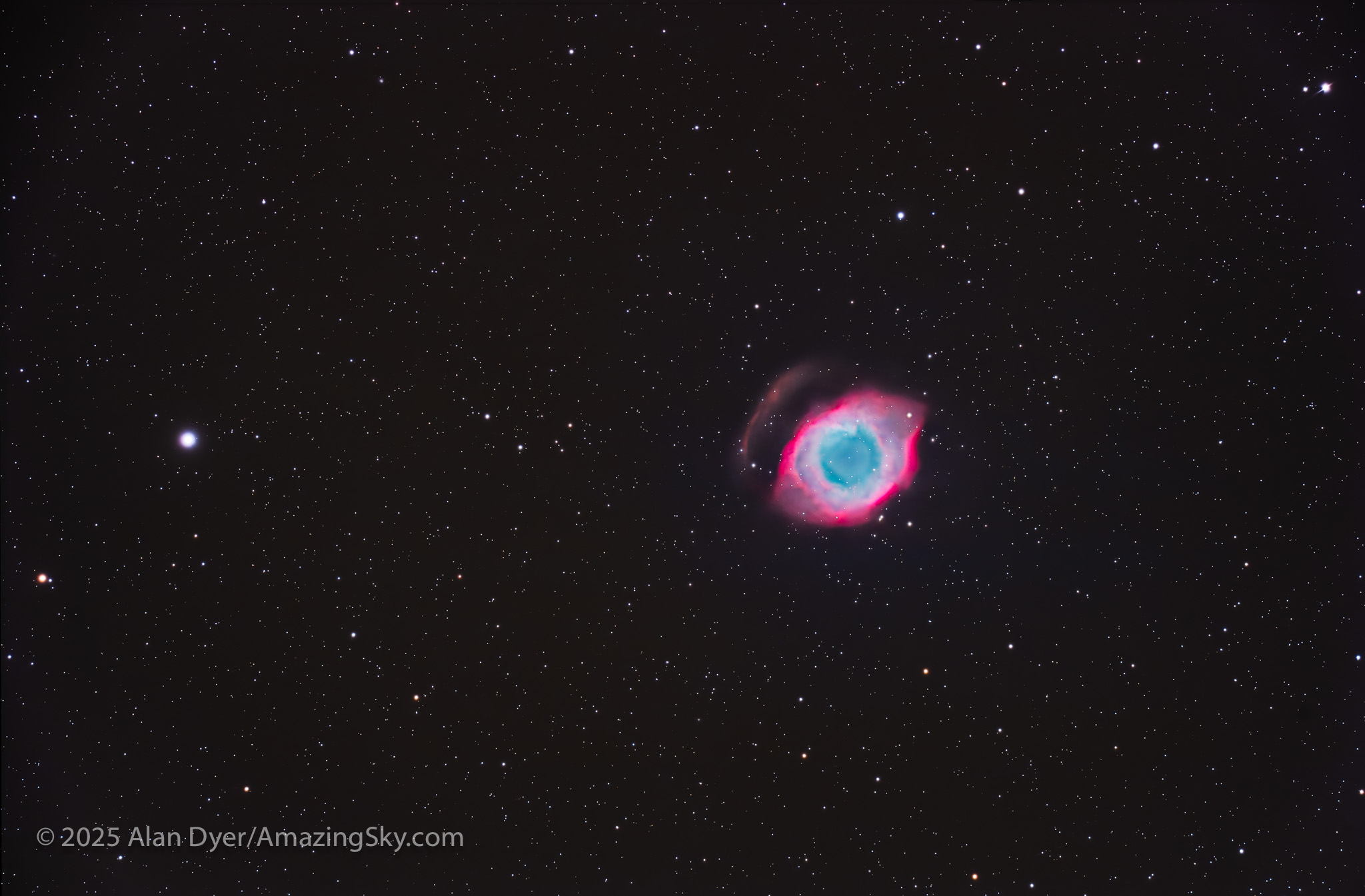
This is a blend of: a stack of 24 x 8 minute exposures with no filter, with a stack of 20 x 12 minute exposures with an IDAS NBX narrowband filter to isolate just the green Oxygen III and red Hydrogen alpha light. All through the APO120 at f/7, taken over 2 nights as the object was not well-placed long enough for all the images to be taken in one night. Shot using the Canon Ra, at ISO 3200 for the filtered frames and ISO 1600 for the unfiltered shots.

This is the large and bright (magnitude 7.6) planetary nebula catalogued as NGC 7293, but better known as the Helix Nebula, in Aquarius. But the internet has also dubbed in “The Eye of God.”

While this target lies farther north than most of the objects here, making it easy to see from northern latitudes, William Herschel working in England missed it. His telescopes were too powerful! It wasn’t discovered until 1824 (or thereabouts) by Karl Ludwig Harding in Germany. It is #63 in the Caldwell Catalogue. 

NGC 7293 is thought to be one of the closest planetary nebulas to us, at only 650 light years away, thus its large size, nearly 1/4ยบ across, half the size of the Moon’s disk. There’s an outer halo that is twice that size, but only the brightest portion of it is recorded here as a partial arc. It takes exposures of many hours, and more patience than I have, to pick up this nebula’s full extent.

The bright star at left is 5th magnitude star Upsilon Aquarii, which I composed to be in the frame and not on the edge if the Helix had been centered. 

As per the tech details in the captions, I shot all the images from southern Arizona during a wonderful marathon of astrophotography in October 2024, at the Quailway Cottage, a favorite spot of mine for an astronomy retreat.

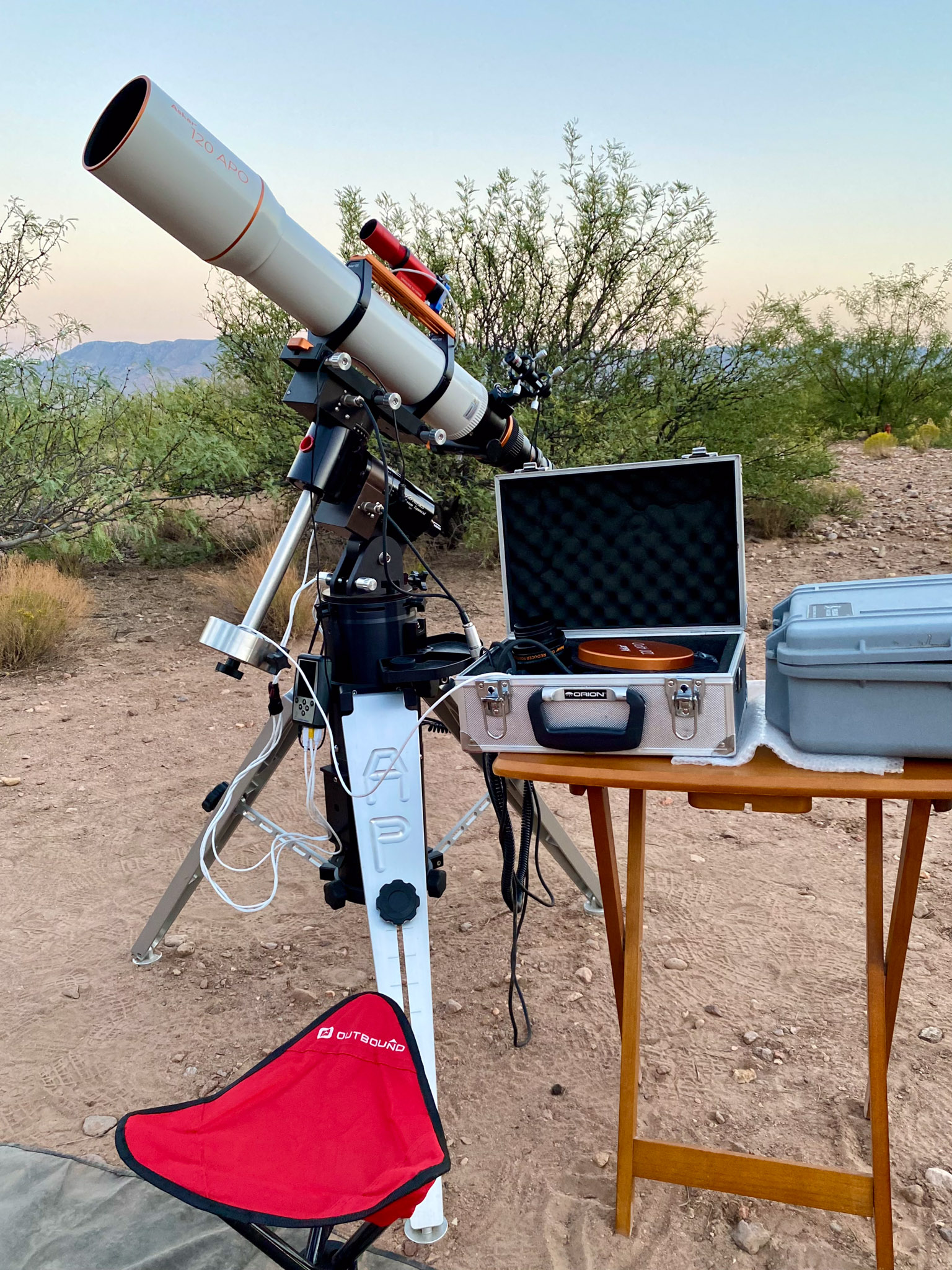
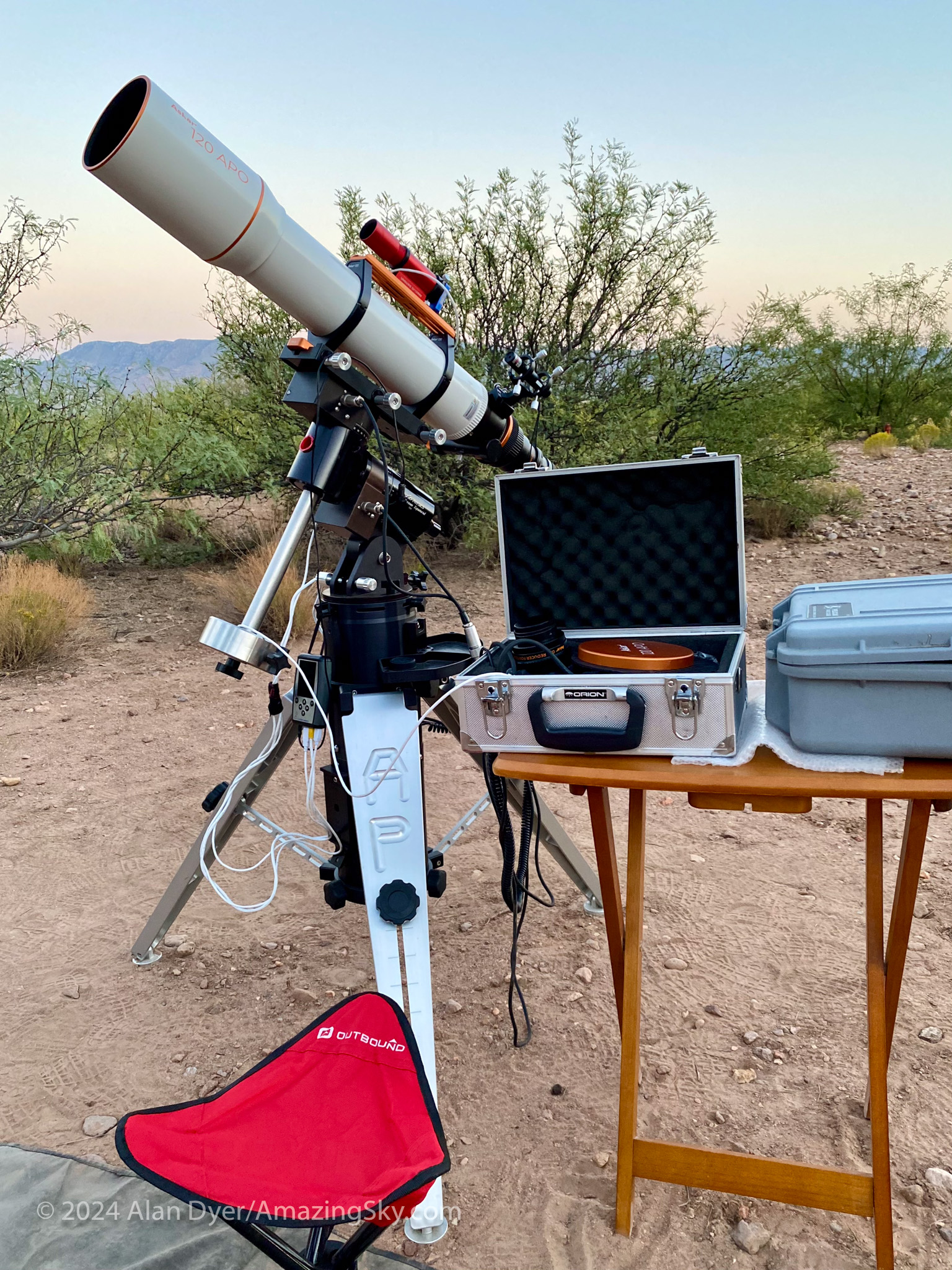
I used an Askar APO120 refractor, at either its native f/7 for a focal length of 840mm, or with its 0.8x Reducer lens for a faster f/5.6 focal ratio and shorter 670mm focal length, yielding a wider field and shorter exposure times for each “sub-frame.” Most images have a similar “plate scale,” so the difference in object size is due to their actual size on the sky.

The camera was the astro-modified 30-megapixel Canon Ra. The mount was the venerable Astro-Physics AP400, which returned earlier in 2024 from its 20-year stay in Australia. I used the Lacerta MGEN3 stand-alone auto-guider, for app- and computer-free guiding which I prefer. The MGEN3 performs “dithering,” shifting the framing by a few pixels between each exposure, to aid elimination of thermal noise when stacking images.

While it looks impressive, the telescope is still not the best for small, detailed targets like the galaxies and planetaries here. They demand even more focal length (= bigger and heavier telescopes) than I prefer to shoot with.

Even so, I plan to take the same rig to New Mexico this year in May to shoot targets in the “other half of the sky,” during spring galaxy season.

โ€” Alan, January 24, 2025 / AmazingSky.com
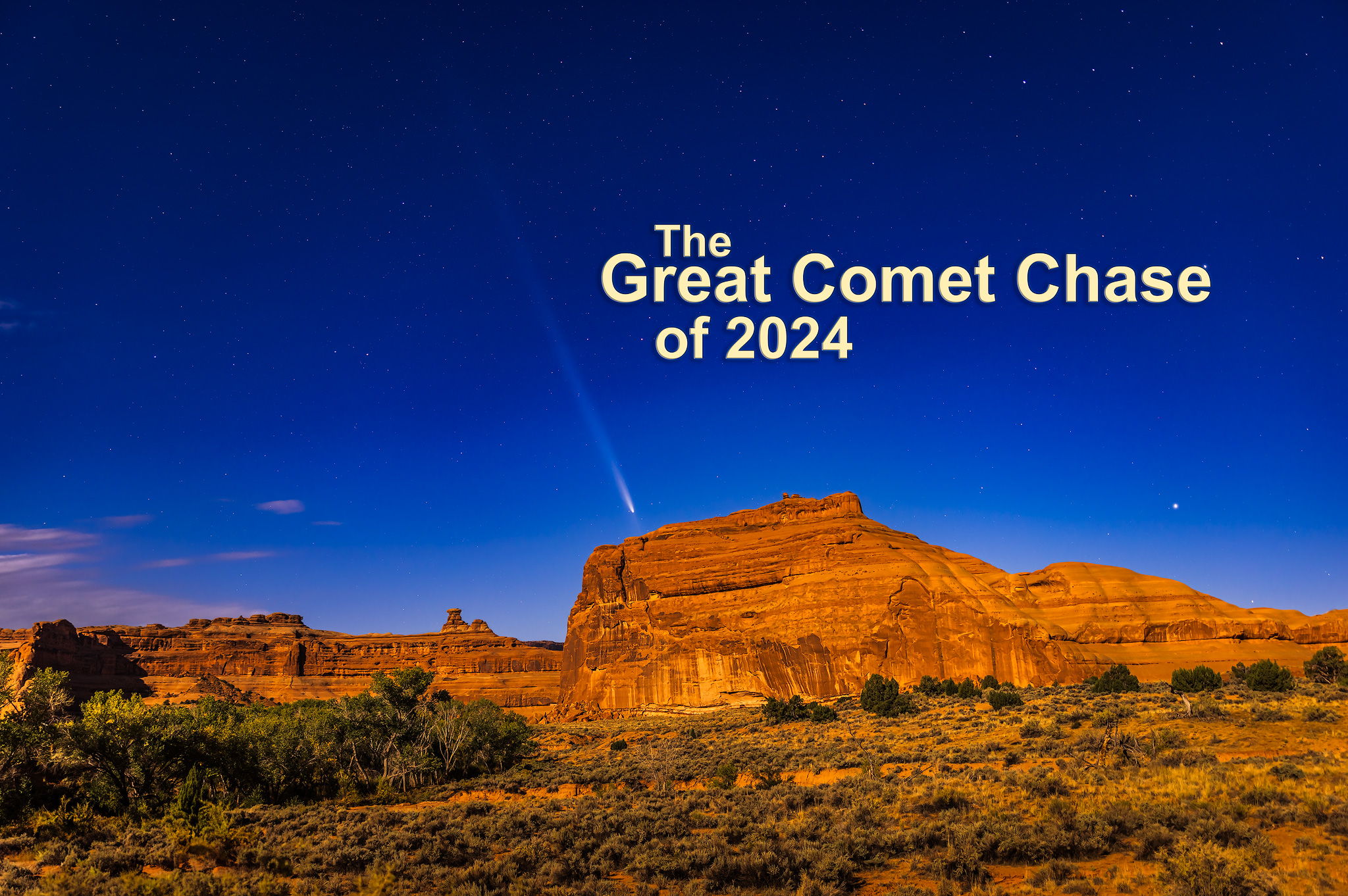
The Great Comet Chase of 2024


A plan to shoot the promised bright comet of 2024 paid off, with fine views at dawn and at dusk of the best comet since 2020. 

Comets are always a gamble. Any new comets discovered, the ones that usually become the brightest, have no track record of performance. Predictions of how bright a new comet might appear are based on what a typical comet should do. But comets can outperform expectations and dazzle us, or they can fizzle and fade away. 

In late 2023 it was clear that a then newly-discovered comet, C/2023 A3, named Tsuchinshan-ATLAS after the observatories where it was co-discovered, had the potential to perform in late 2024.ย 

The low angle and position of the comet from home in Canada in the late September dawn sky, simulated in StarryNight software.

Knowing where it would be in the sky (that trait of a comet can be predicted with accuracy!) I planned a field trip to the U.S. desert Southwest for late September and early October 2024. From farther south the comet would be higher than it would be from home (shown above), and over spectacular landscapes. 

I had visions of another Comet NEOWISE from July 2020. As my blog from 2020 shows, we saw that photogenic comet well from our northern latitude in Canada, as it skimmed across the northern horizon. Tsuchinshan-ATLAS would require a chase south.ย 


September 26 & 27 โ€” at Bryce Canyon, Utah

In late September 2024 the comet would be inbound, approaching the Sun and in the morning sky. What better eastern scene than overlooking Bryce Canyon in Utah, where I had been a year before, for the October 14, 2023 annular eclipse of the Sun in the morning sky. (Click the link for my eclipse chase blog.)

I was fortunate to get two clear mornings, both from the Fairyland Canyon viewpoint, just a short walk from the parking lot to carry camera gear and tracking mounts. 

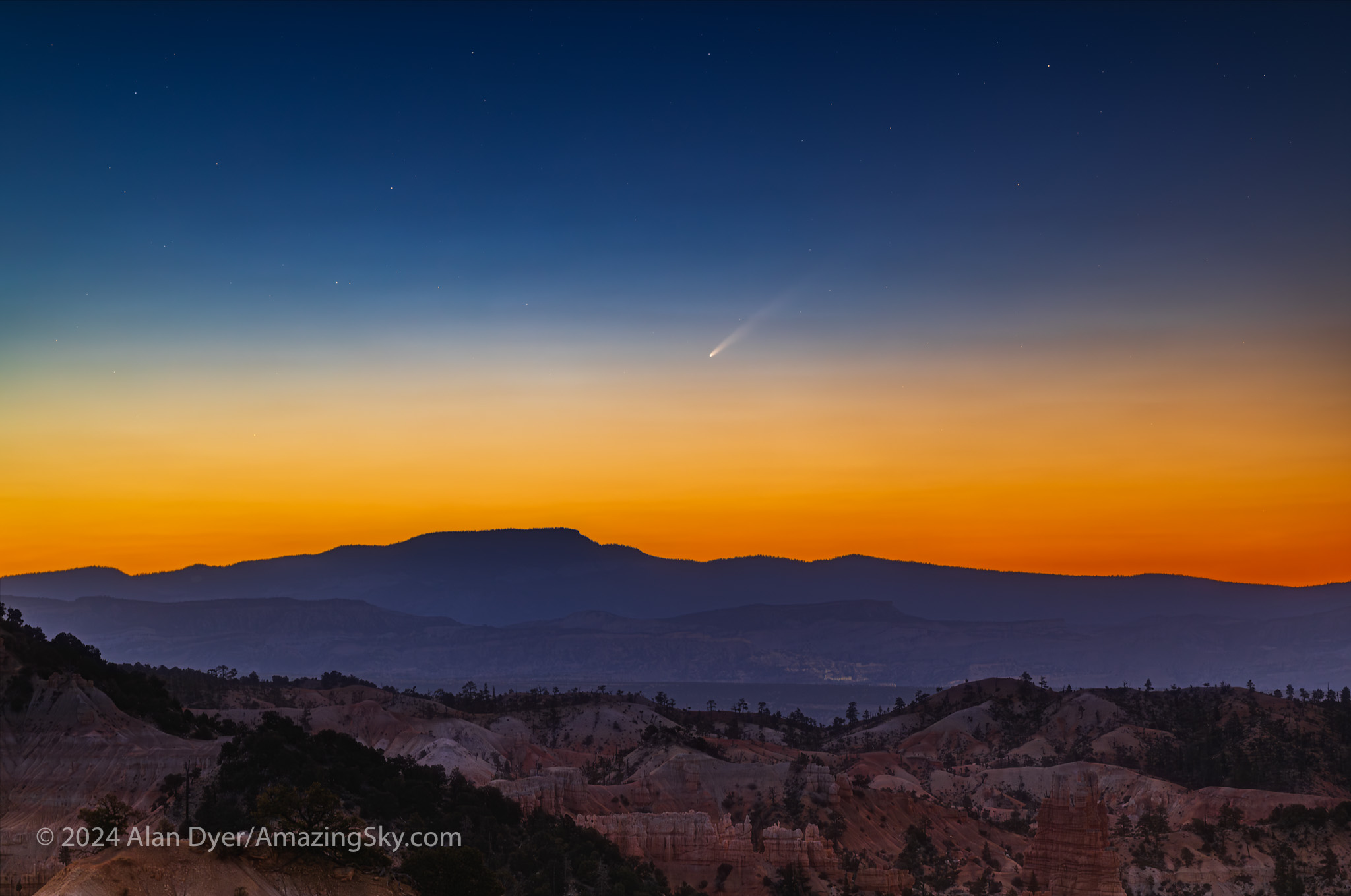
Comet C/2023 A3, Tsuchinshan-ATLAS, at dawn over Bryce Canyon, on the morning of September 27, 2024.

My first look at the comet on September 27 was on the day the comet was at perihelion, closest to the Sun in its orbit, though not in the sky at our viewing angle from Earth. 

The comet was just visible to the unaided eye, but was obvious on the camera view screen, even amid the bright twilight. I had to shoot fast as the window between โ€œcomet riseโ€ and the sky brightening too much was only a few minutes long. 

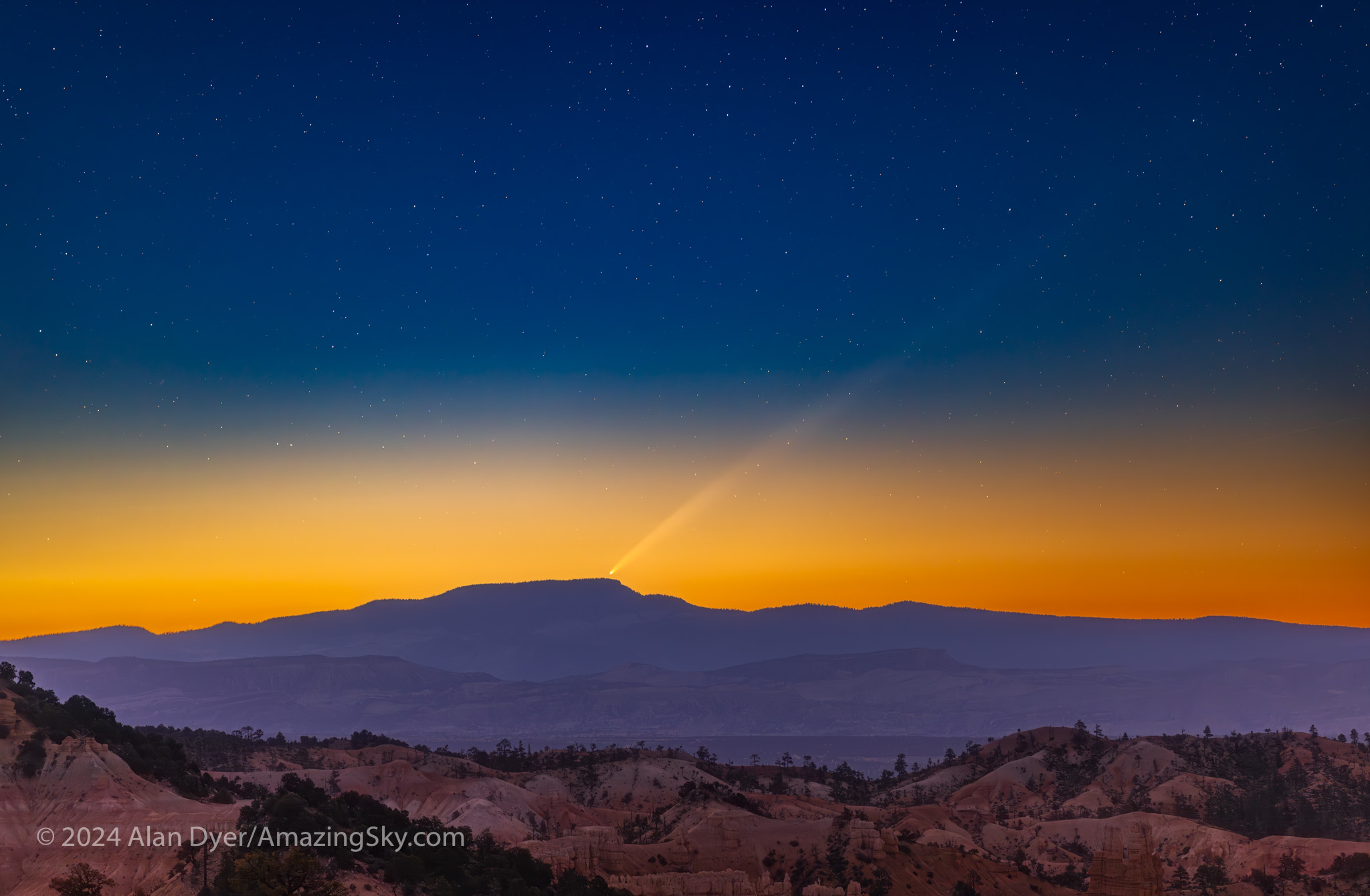
Comet C/2023 A3, Tsuchinshan-ATLAS, rising in the twilight over Bryce Canyon, on September 28, 2024.

Knowing better what to look for, I caught the comet a little sooner the next morning on September 28, and so the tail appeared longer and more impressive as it rose above the distant mountains. A group of other local photographers arrived just a few minutes too late both mornings, and so struggled to just sight the comet, let alone photograph it. 

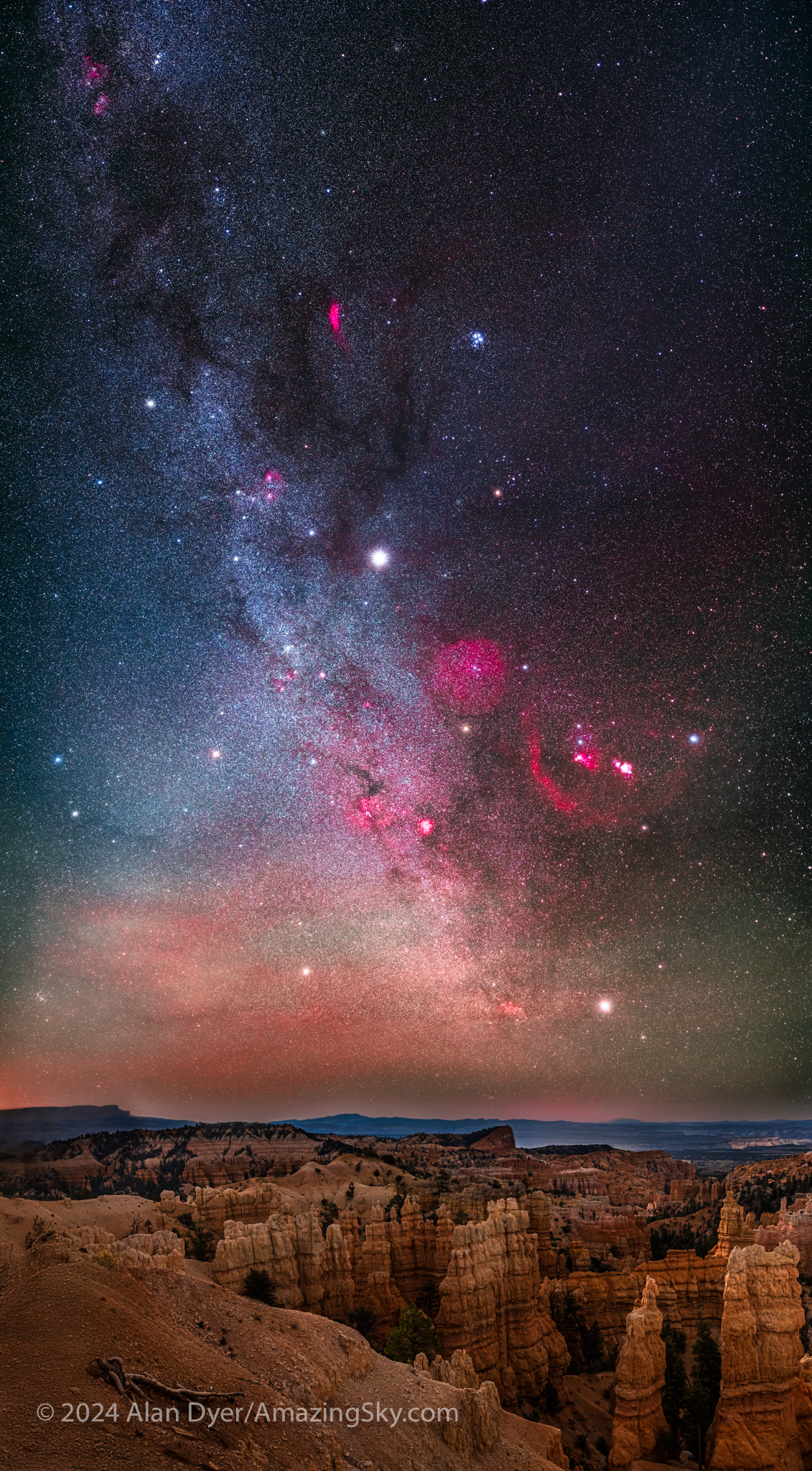
This vertical panorama takes in the nebula-rich northern winter Milky Way over the formations of Bryce Canyon National Park, from the Fairyland Canyon viewpoint.

But I had arrived extra early, to shoot a vertical panorama (above) of the winter Milky Way over the canyon formations below. This and the comet images were shot with the aid of a sky tracker to follow the stars, but with the tracker off for separate shots of the ground. 

So I had bagged the comet at Bryce! On to the next stop.


September 28 & 29 โ€” at Monument Valley, Utah

Thereโ€™s no more iconic or famous landscape in the American West than the buttes of Monument Valley, on the Navaho Tribal Lands on the Arizona/Utah border. 

This panorama from the Navaho Tribal Park at Monument Valley shows the evening twilight sky looking east opposite the sunset to the rising dark blue arc of Earth’s shadow cast on the atmosphere. The shadow is rimmed with a pink “Belt of Venus” tint from sunlight still hitting the upper atmosphere.

A clear first evening provided a fabulous view of the arc of Earthโ€™s shadow across the eastern sky from the viewpoint near the aptly named The View Hotel. 

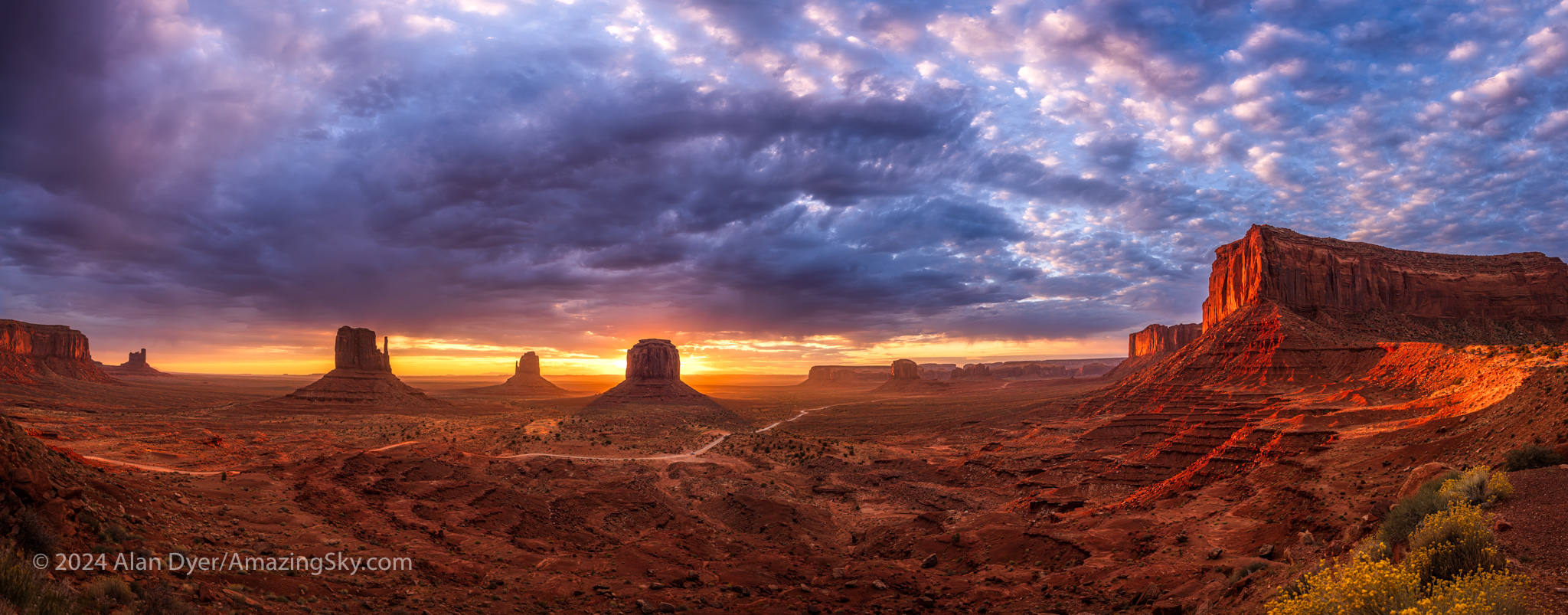
This is a panorama of the sunrise scene at the Navaho Tribal Park, Monument Valley, Arizona, taken just after sunrise with the low Sun lighting the iconic buttes and mesas of the Valley. The West and East Mittens are at left; the Sun was behind Merrick Butte at centre, and lighting Mitchell Mesa at right.

A wonderful sunrise on my second morning there made for a spectacular panorama. But while clouds created fine sunrise lighting, they arenโ€™t conducive to seeing comets!

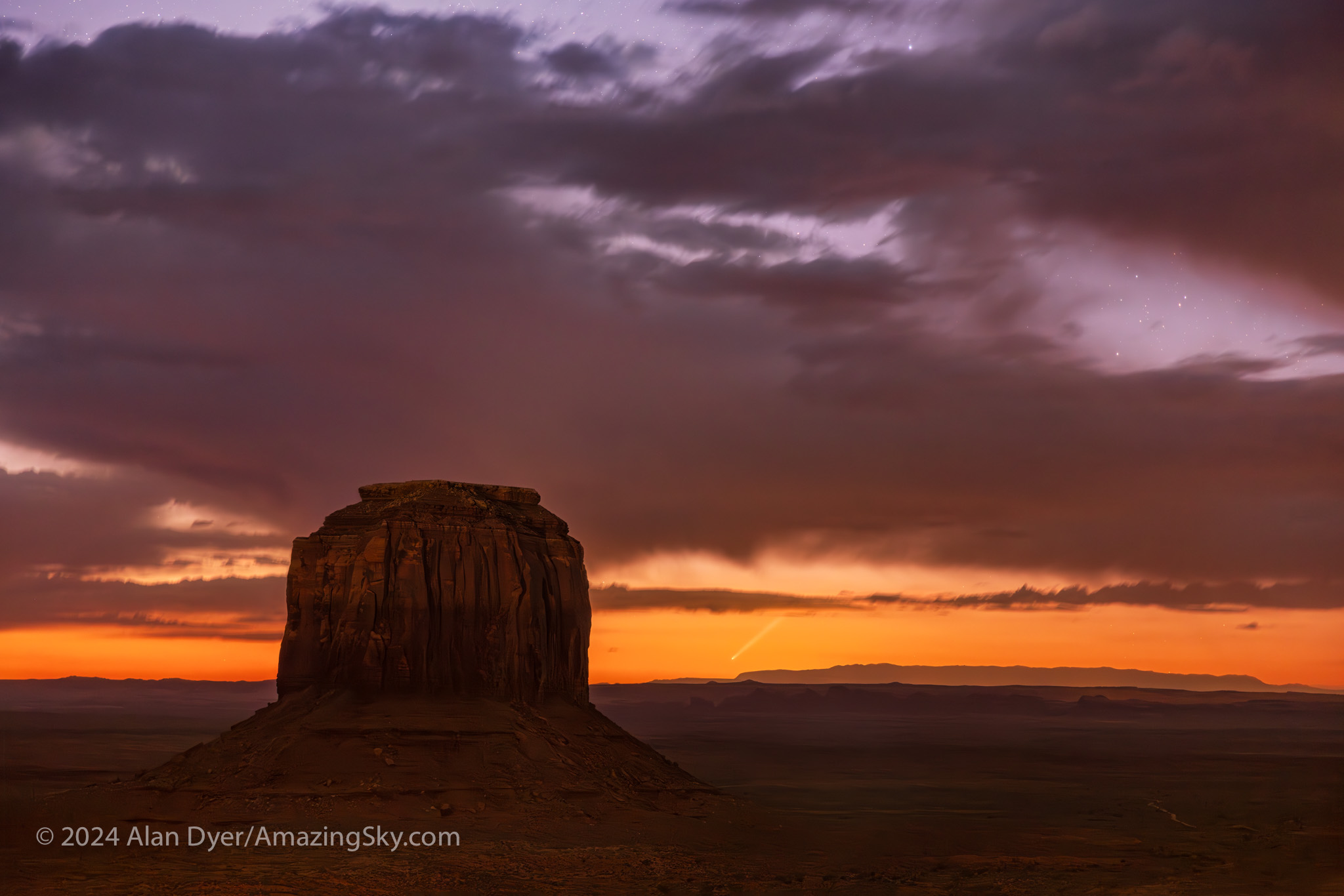
Comet C/2023 A3, Tsuchinshan-ATLAS (at centre), is rising in the dawn twilight over Monument Valley, Arizona on the morning of September 30, 2024. The comet is rising just south (right) of Merrick Butte.

A band of clear sky near the horizon allowed me to catch the comet rising to the right of Merrick Butte, as seen from a spot south of The View from where I had calculated the comet would rise in the right position. From the usual Valley viewpoint farther north the comet would have been behind the butte. 

While the planning worked, the result was not quite the spectacle I had envisioned. The comet was nice, but was starting to become lost in the bright sky as it descended toward the Sun. 

There were only a couple of mornings left to catch the comet at dawn before it disappeared completely into the daytime sky close to the Sun. 


October 1 to 11 โ€” at Quailway Cottage, Arizona

The major block of time in my trip was booked for an astrophoto retreat at a cottage Iโ€™d rented twice before but not since late 2017. The Quailway Cottage, popular among birders, is also ideal for stargazing as it is in one of the darkest areas of the Southwest, north of Douglas, Arizona, and just across the Arizona/New Mexico border. 

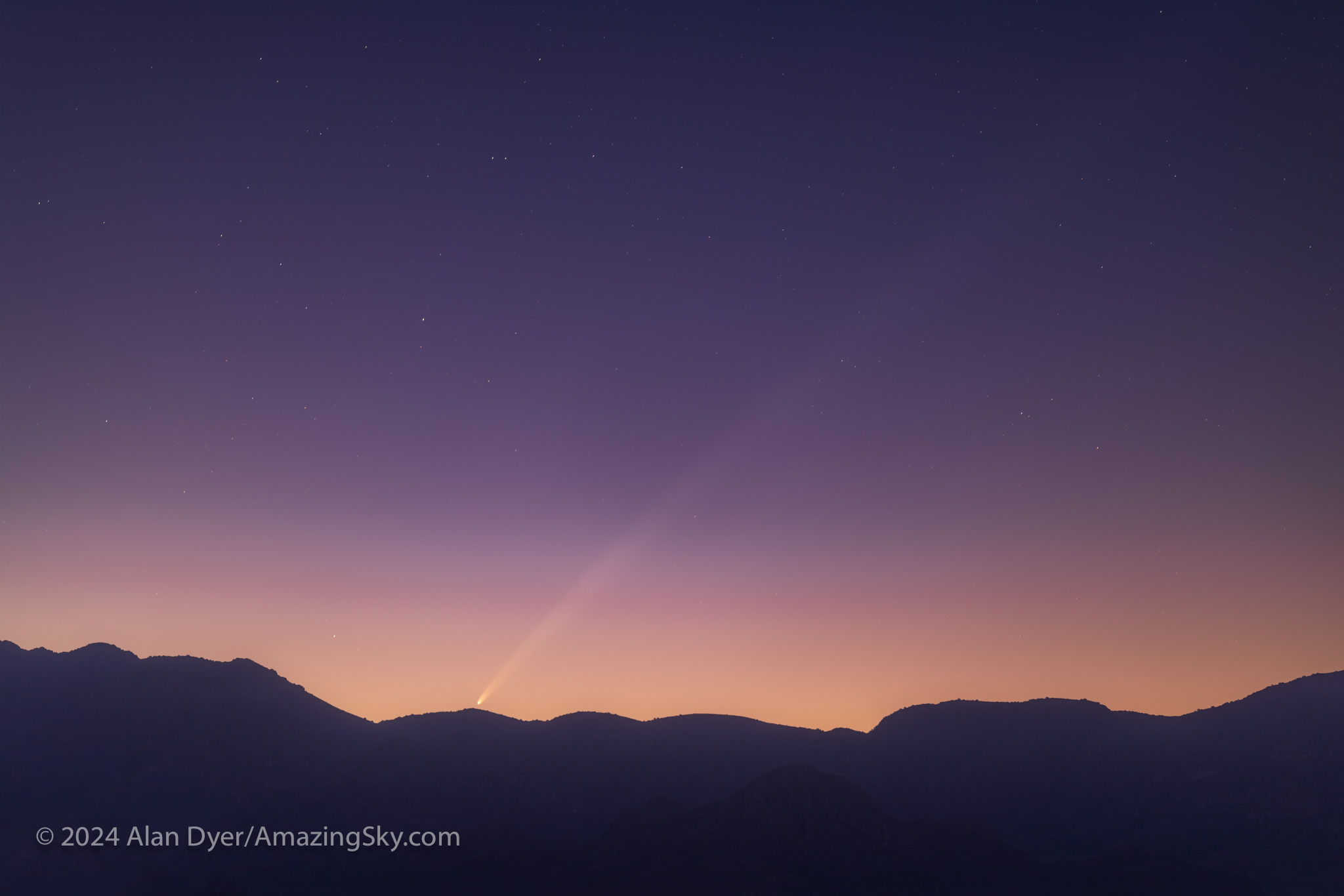
This captures both the glow of Zodiacal Light in the eastern dawn sky (the band of light extending up across the frame) and the dust tail of Comet Tsuchinshan-ATLAS rising from behind the Pelloncillo mountains, at dawn on October 2, 2024.

When I arrived the comet was putting in its last show in the dawn sky. In fact, on October 2 I managed to capture a dawn scene with the morning Zodiacal Light created by sunlight reflecting off cometary dust in the inner solar system, and just the tail of the comet rising before the bright comet head appeared.

Comet C/2023 A3, Tsuchinshan-ATLAS, is rising in the dawn twilight over the Pelloncillo Mountains in New Mexico, on October 2, 2024.

An image taken a little later showed the entire comet, now sporting a more impressive tail. It was blossoming into a fine comet indeed. But we were about to lose sight of it for more than a week. 

Arizona Deep-Sky Imaging 

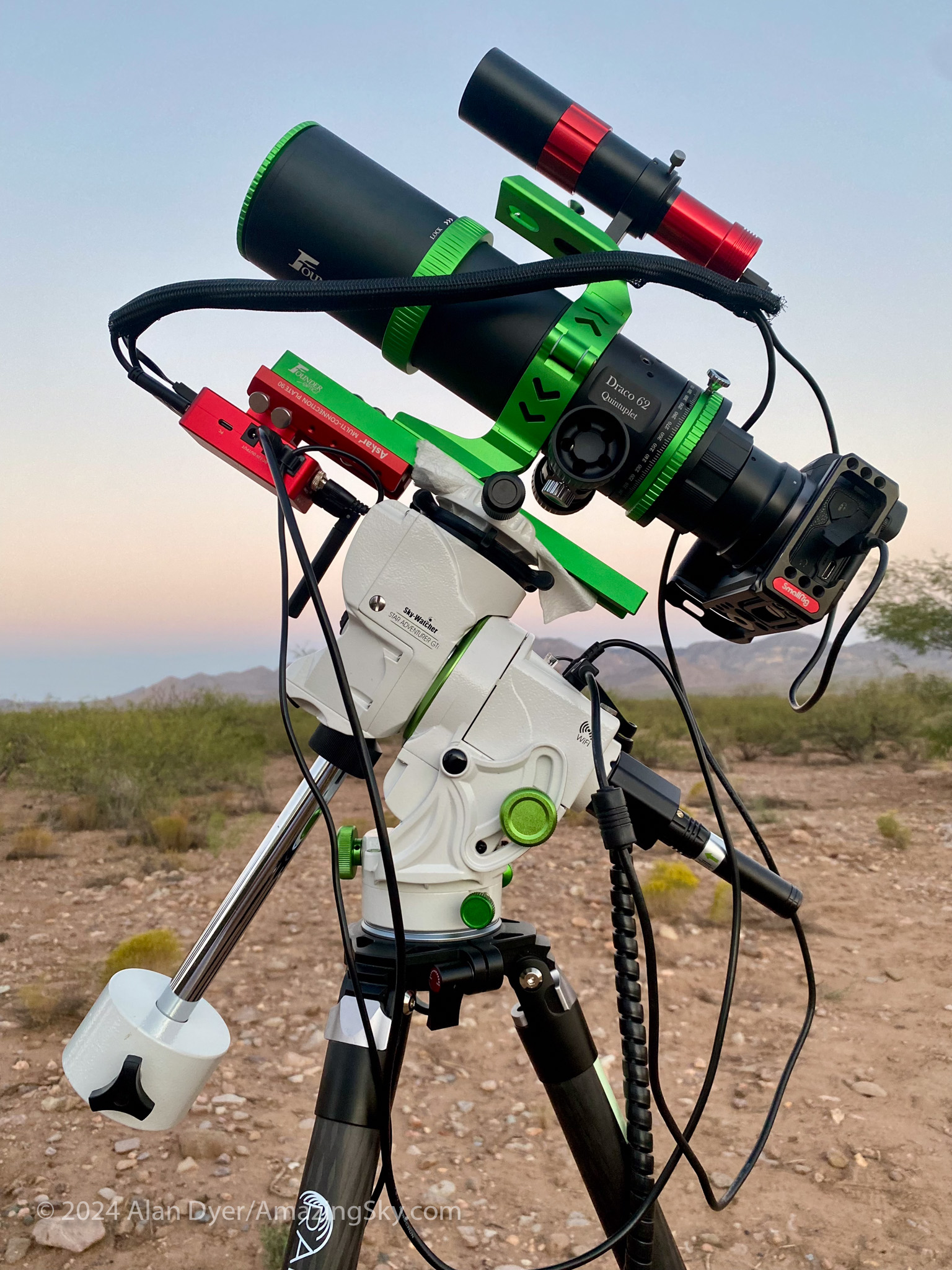
While at Quailway I had clear skies every night. And so, as planned, I went to town shooting all kinds of โ€œdeep-skyโ€ objects and fields with two astrophoto rigs I had brought with me: a longer-focal length 120mm refractor for small targets, and a short-focal length refractor for wide fields in the Milky Way. I had reviewed both new telescopes in recent months. 

I concentrated on shooting targets low in the south that are impossible to get from home in Canada, and that Iโ€™ve missed shooting, or have not shot well, during my visits to Australia.ย See my blog here about my latest trek Down Under.

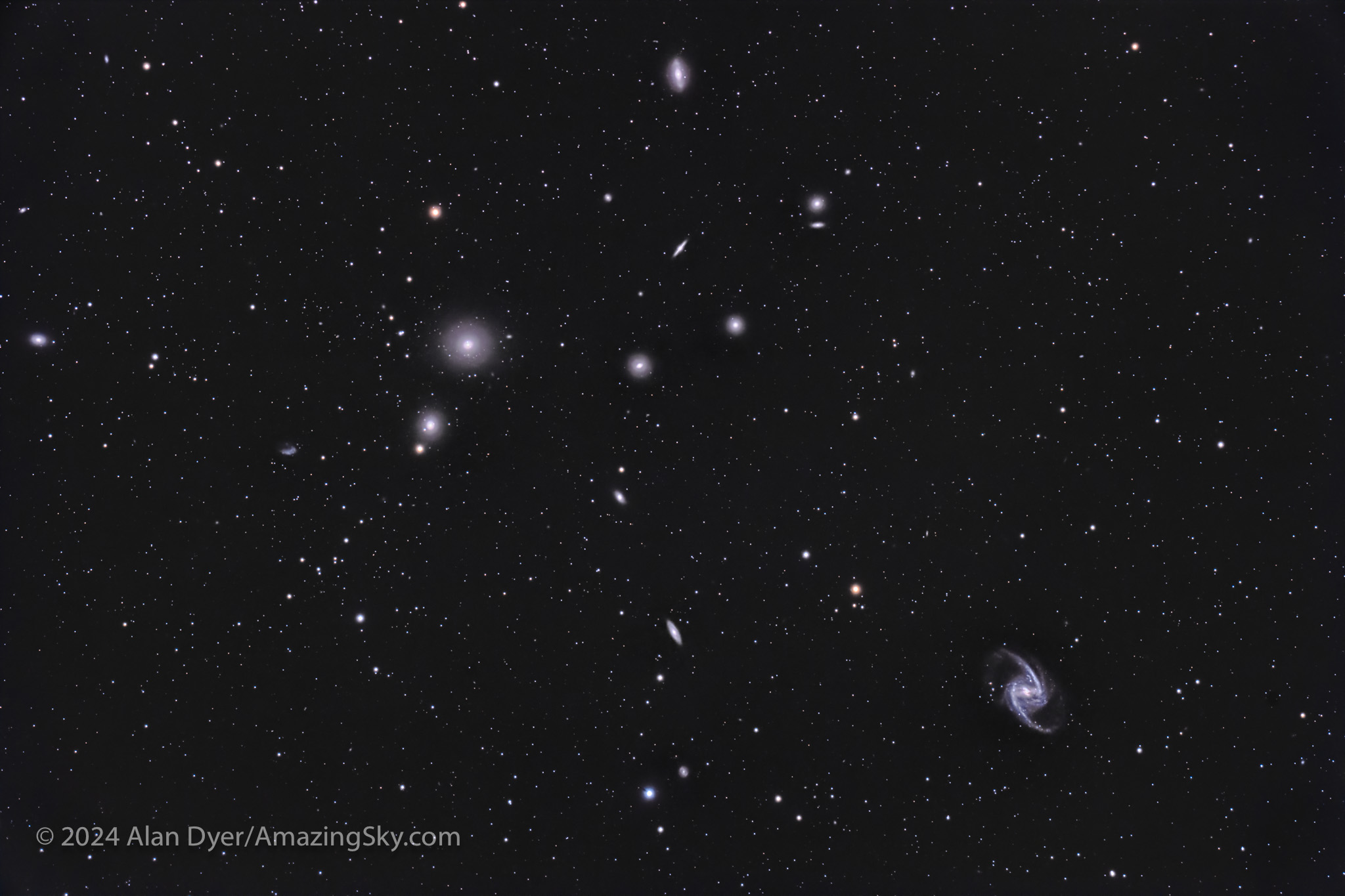
The two brightest Fornax cluster members are the elliptical galaxy NGC 1399 at upper left, paired with smaller NGC 1404, and the galaxy NGC 1365 at lower right, considered one of the best barred spirals in the sky.

Hereโ€™s an example, above, with the larger Askar 120APO: a field of galaxies in the constellation of Fornax that rivals the better-known Markarianโ€™s Chain of galaxies in Coma Berenices in the northern spring sky.

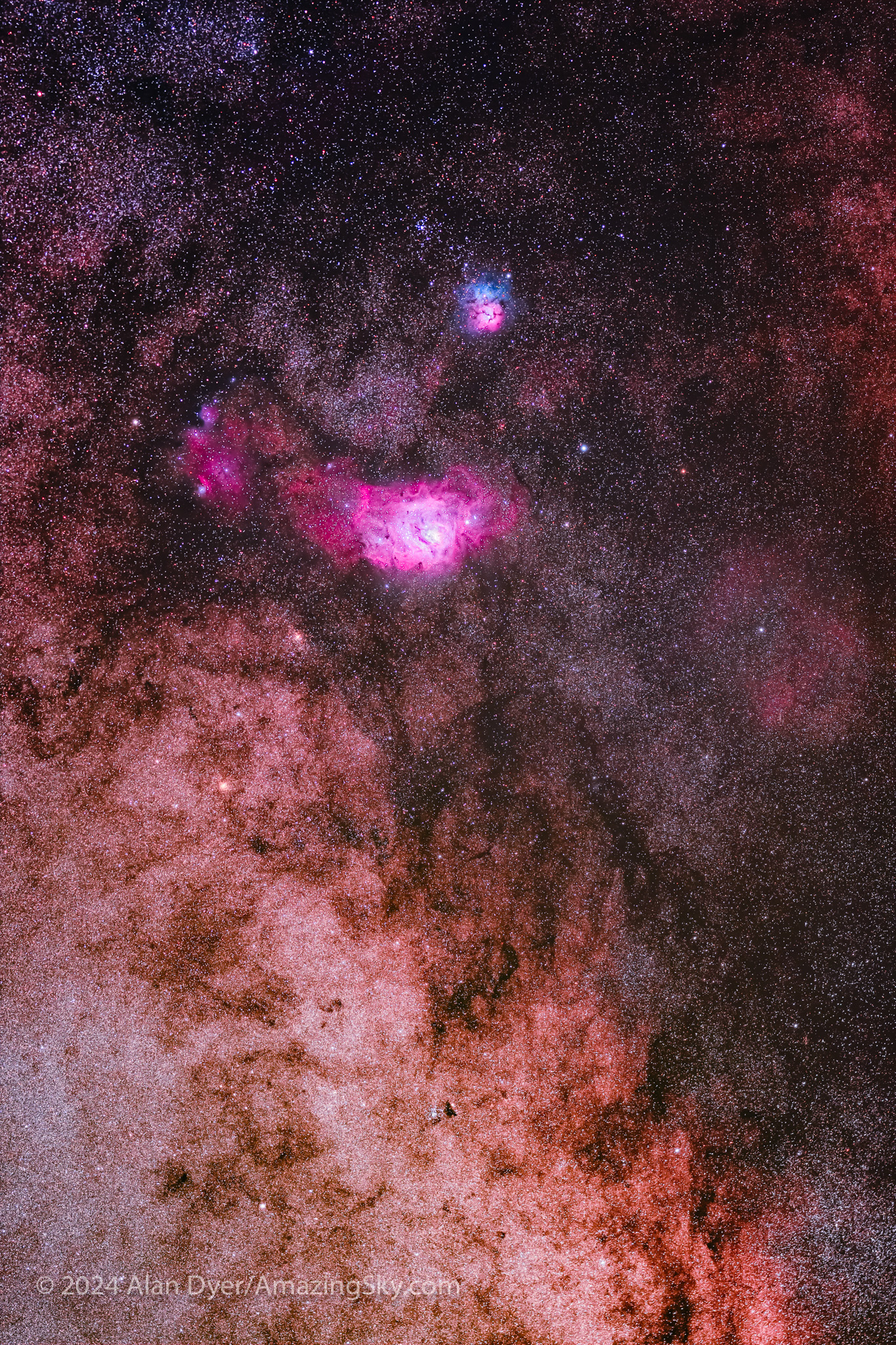
This frames the spectacular region of the Milky Way near the direction of the galactic centre in Sagittarius.

And hereโ€™s a field (above) with the small Founder Optics Draco 62mm scope, framing the rich Sagittarius Starcloud punctuated with the small dark Ink Spot Nebula, all below the bright Lagoon and Trifid Nebulas. 

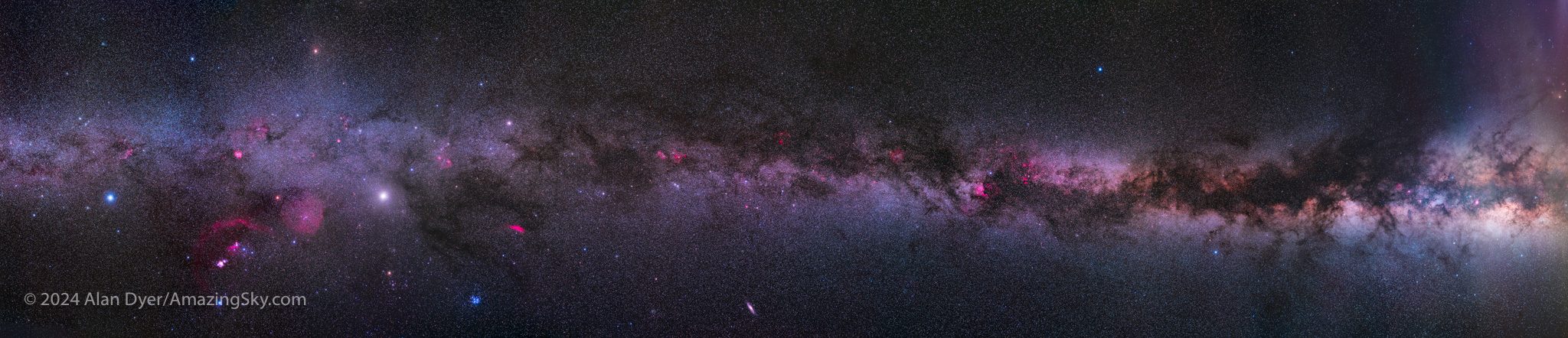
This panorama extends for about 240ยบ along the northern half of the Milky Way, from Orion at left, to Sagittarius at right, and centered on the Galactic Equator.

In autumn the Milky Way is up all night. So I used a simple star tracker, the MSM Nomad reviewed here on my blog, and a 28-70mm lens at 35mm to shoot a panorama from dusk to dawn along the Milky Way โ€” from the summer stars of Sagittarius and Cygnus (at right, above), through the autumn constellations overhead in Cassiopeia and Perseus (at centre), and down into the pre-dawn sky with the winter stars in and around Orion (at left). 

A Bonus Aurora from Arizona 

I was just north of the Mexican border, at a latitude 32ยฐ North, more than 20ยฐ farther south than at home in Alberta. But what should appear in my sky but โ€ฆ aurora! 

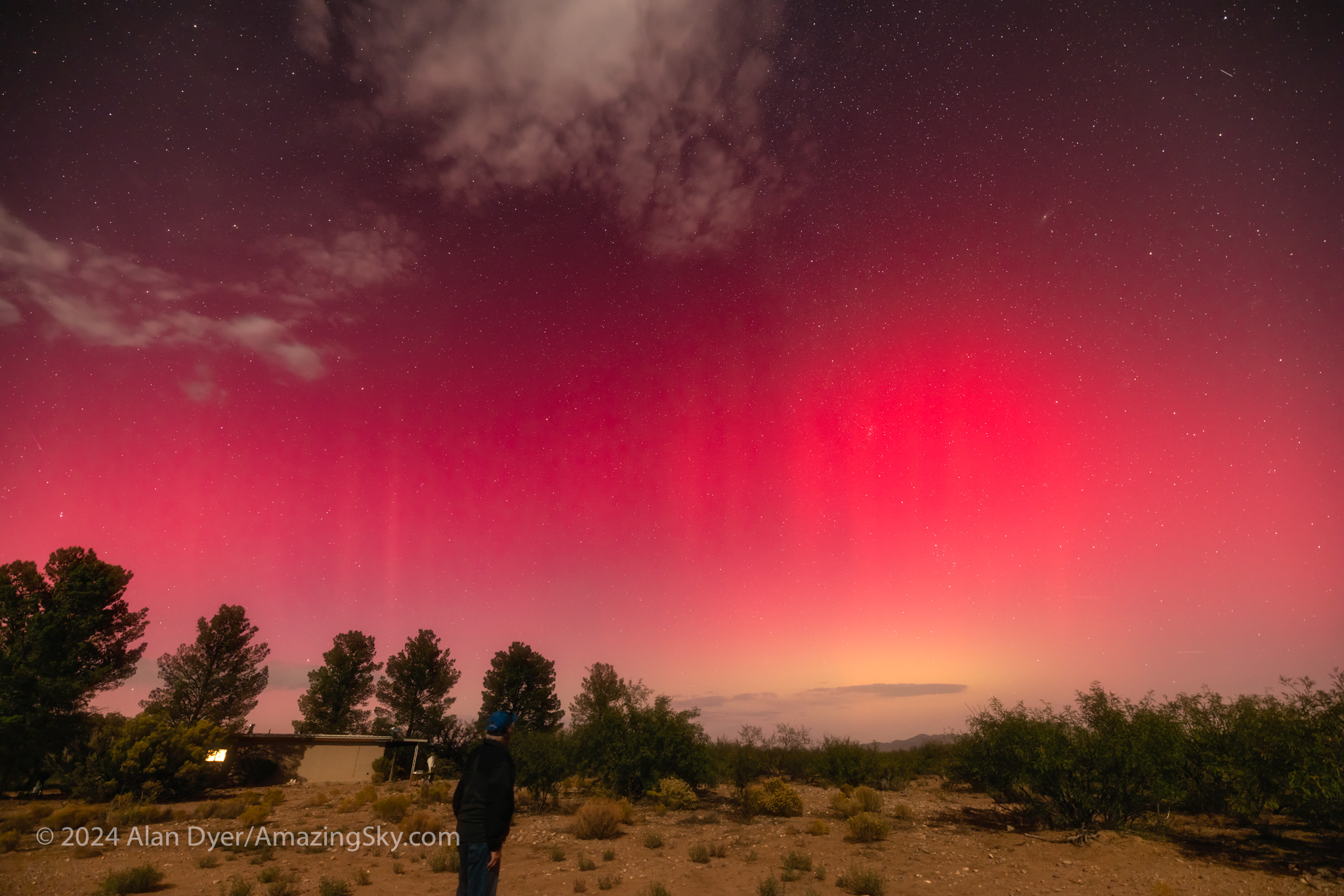
A selfie of me observing the great red aurora of October 10, 2024, from southern Arizona.

On October 9, and then again more so on October 10, a great solar storm brought Northern Lights down to me. And indeed across all of Canada and the U.S. The result for me was a red glow to the north โ€” the tops of distant auroral curtains I would have seen filling my sky at home. 

A time-lapse of an Arizona aurora, using a 15mm wide-angle lens shooting nearly 400 forty-second exposures. View it in-line here. Enlarge to a full screen view. There is no sound.

Above is a time-lapse video of the aurora that night, from a camera aimed due north for four hours. The red curtains come and go through the night.

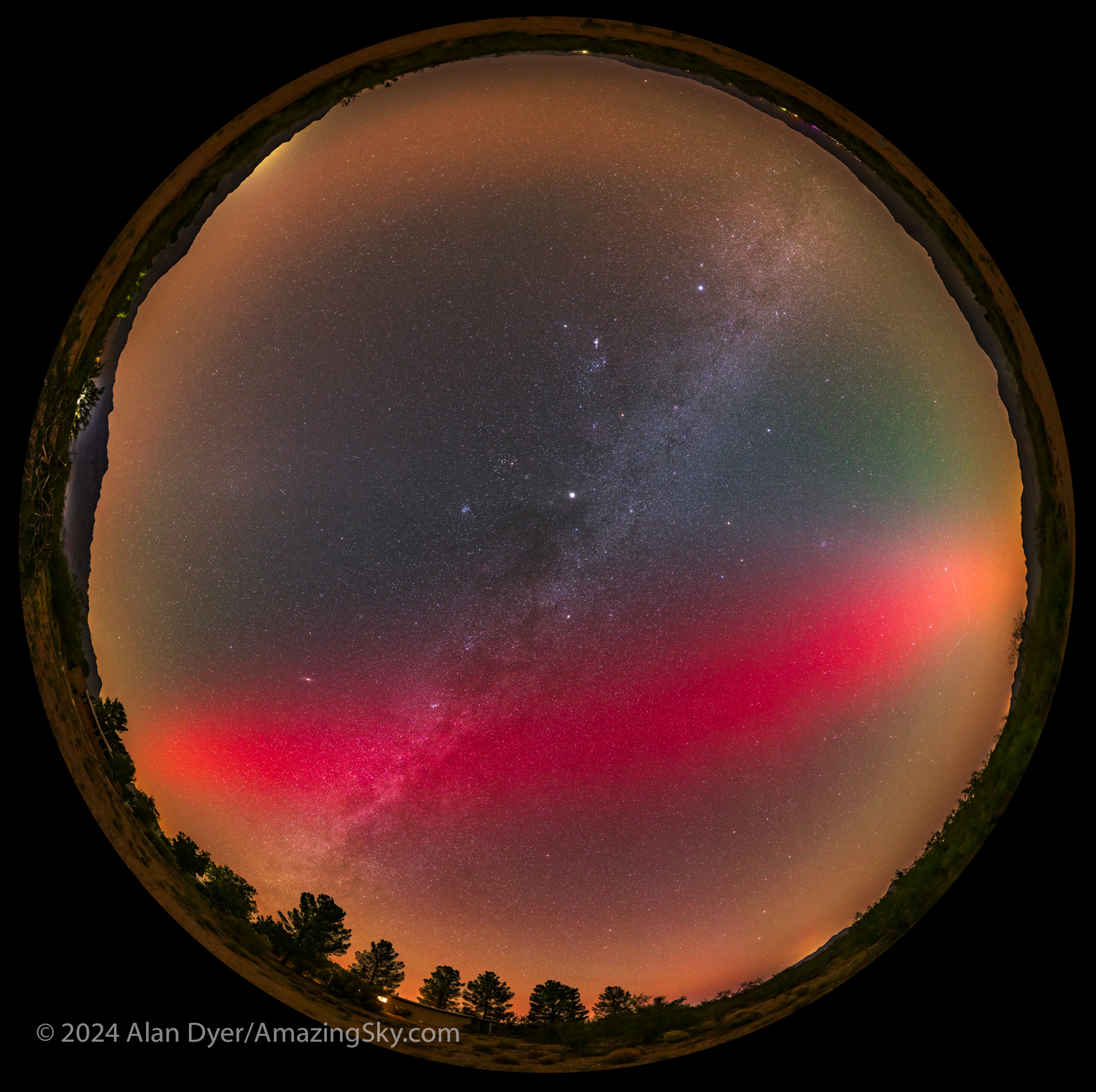
This is a 360ยฐ panorama covering the entire sky and extending up to the zenith at centre, capturing a rare SAR arc across the Arizona sky in the pre-dawn hours of October 11, 2024.

The remarkable feature that night, October 10/11, was not the aurora, but what is called a SAR (Stable Auroral Red) arc that persisted all night. It appeared as a diffuse red band across the sky, created by heat energy leaking into the upper atmosphere during the solar storm. SAR arcs can accompany an aurora but are not auroras themselves. 

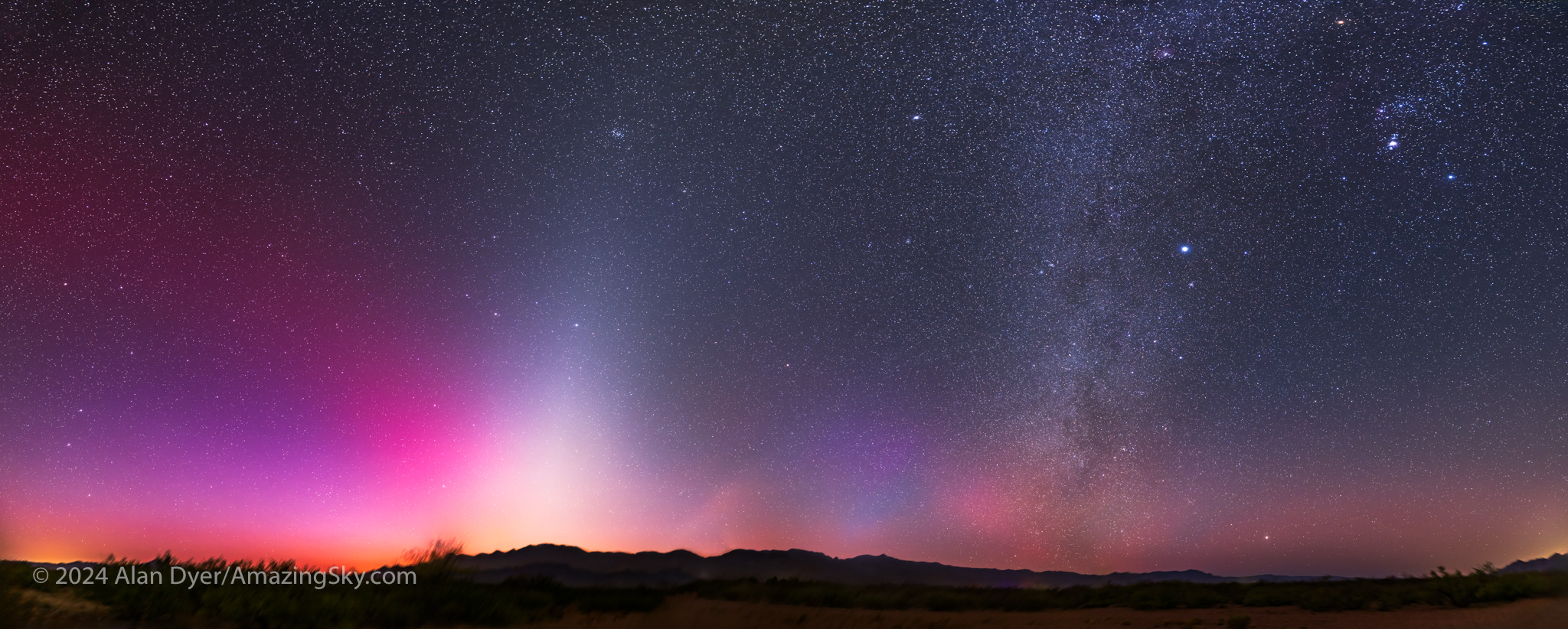
This panorama takes in a rare confluence of skyglows in a colourful dawn sky.

By dawn the next morning, now October 11, the tall Zodiacal Light was prominent alongside the magenta SAR arc to the north (left) and the winter Milky Way to the south (right). Thereโ€™s even a short pillar of light that might be an aurora fragment, or the tail of the comet!  

The Comet Returns 

However, toward the end of my 11-night marathon of deep-sky imaging, the bright head of the comet was to be rising into the evening sky for Part 2 of its apparition. Below is a shot from the evening of October 11, my last at Quailway. Yes, there it was, just above the Chiricahua Mountains. But it was a blip, barely visible in binoculars and to the camera. I had hoped for more. 

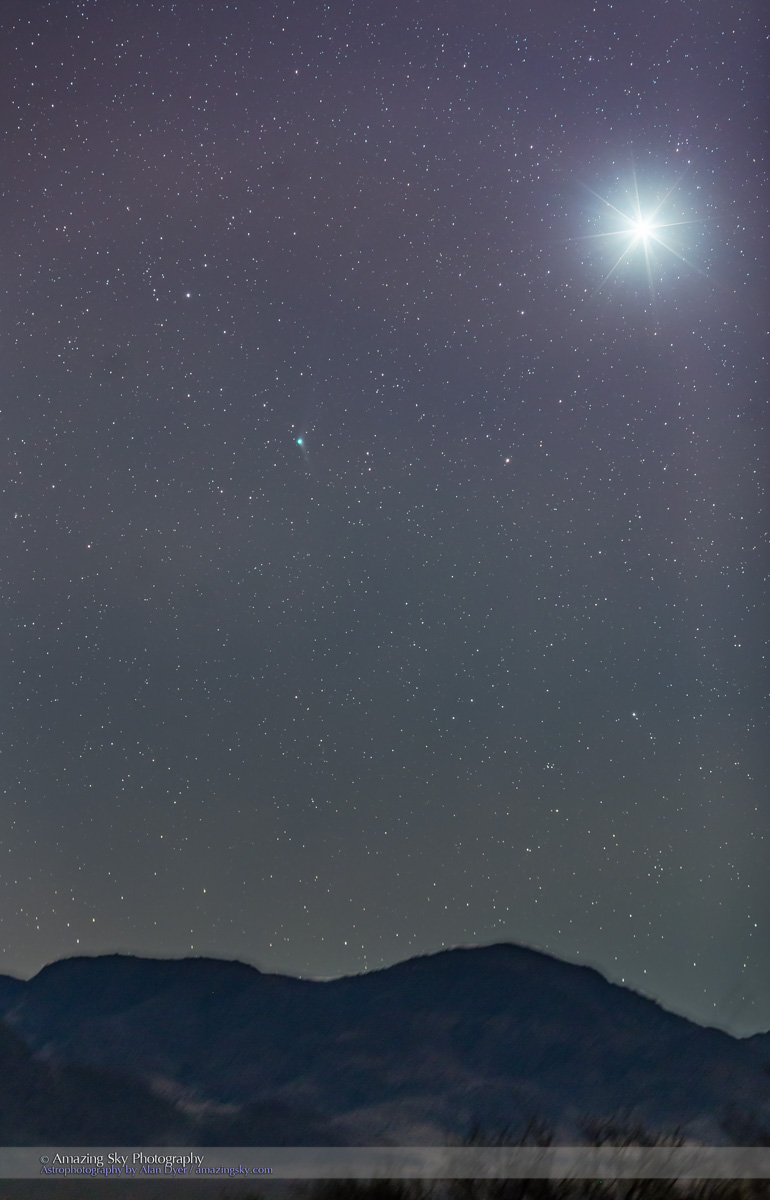
This is Comet Tsuchinshan-ATLAS (C/2023 A3) at far right, barely visible emerging into the evening sky and low in the twilight, on October 11, 2024. This view includes Venus at left. Venus was obvious; the comet was not!

With the Moon now waxing into the evening sky, my plan was to head back north, stopping at scenic spots on the trip home, to catch the comet over moonlit landscapes to the west in the dusk sky.

My first two nights, October 12 and 13, at the VLA Radio Observatory near Socorro, New Mexico, then farther north near Canyon de Chelly, Arizona, were both beset by clouds to the west. From images posted on-line, I knew the comet was improving. But it was eluding me. 


October 14 & 15 โ€” at Arches National Park, Utah

The next stop was Arches National Park in Utah, which I last visited in April 2015. The first nightโ€™s forecast for October 14 also looked to be cloudy. But October 15 was supposed to be clear. So I extended my stay by an extra night, thinking that might be my only chance.ย 

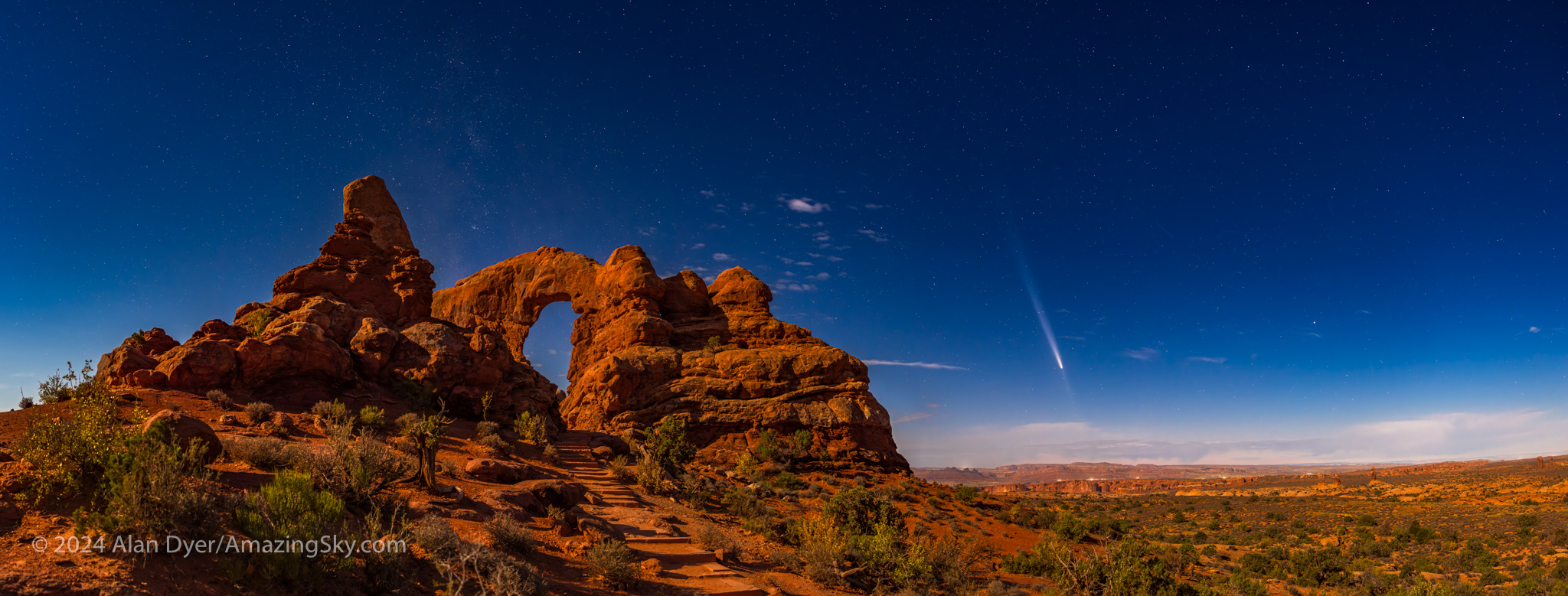
As it turned out October 14 was fabulous (below). The comet was easily visible to the unaided eye as a classic comet in the west. I pointed it out to folks walking by at the Windows Arches area. And I could hear other people commenting on it. At last a comet! One that anyone could see โ€” though it helped to be at a clear sky site like Arches. 

Comet Tsuchinshan-ATLAS at its finest in the evening sky, two days after its closest approach to Earth, and with it sporting a 10ยบ- to 15ยบ-long dust tail, and a narrow anti-tail pointed toward the horizon.

By then the Moon was well advanced in age to a bright gibbous phase, so the sky was by no means dark. It was deep blue in photos.

Still the comet showed up brilliantly; it had blossomed a lot in a couple of nights. Above, I framed it beside moonlit Turret Arch.

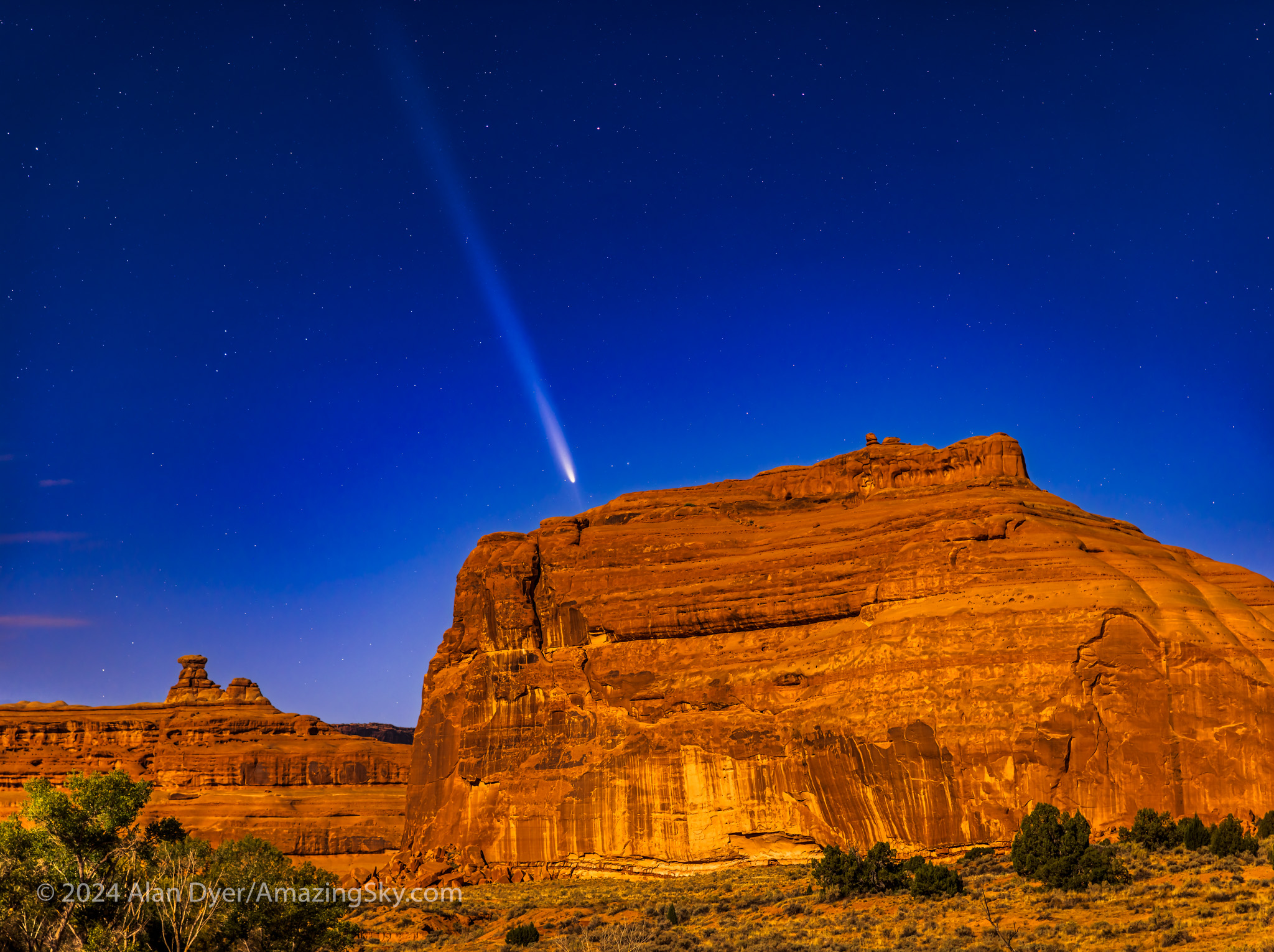
Below is a scene from the next night, October 15, my โ€œback-upโ€ night. The comet was certainly performing well after all. Even in the moonlight. In binoculars the tail stretched for the same length as the camera recorded it, some 15ยฐ. 

This is a telephoto close-up Comet Tsuchinshan-ATLAS over the red rocks of Arches National Park, Utah, on a superb moonlit night, October 15, 2024.

Indeed, that was my last view of the comet for a while, as clouds prevented any more shooting on the rest of my journey north through Idaho and Montana.ย I even hit a snowstorm in southern Montana.


Late October โ€” Back at Home in Alberta

But the comet was not done yet! Through October, while it receded from us in distance, it climbed higher into our sky, placing it into a dark sky with the Moon now out of the way.ย 

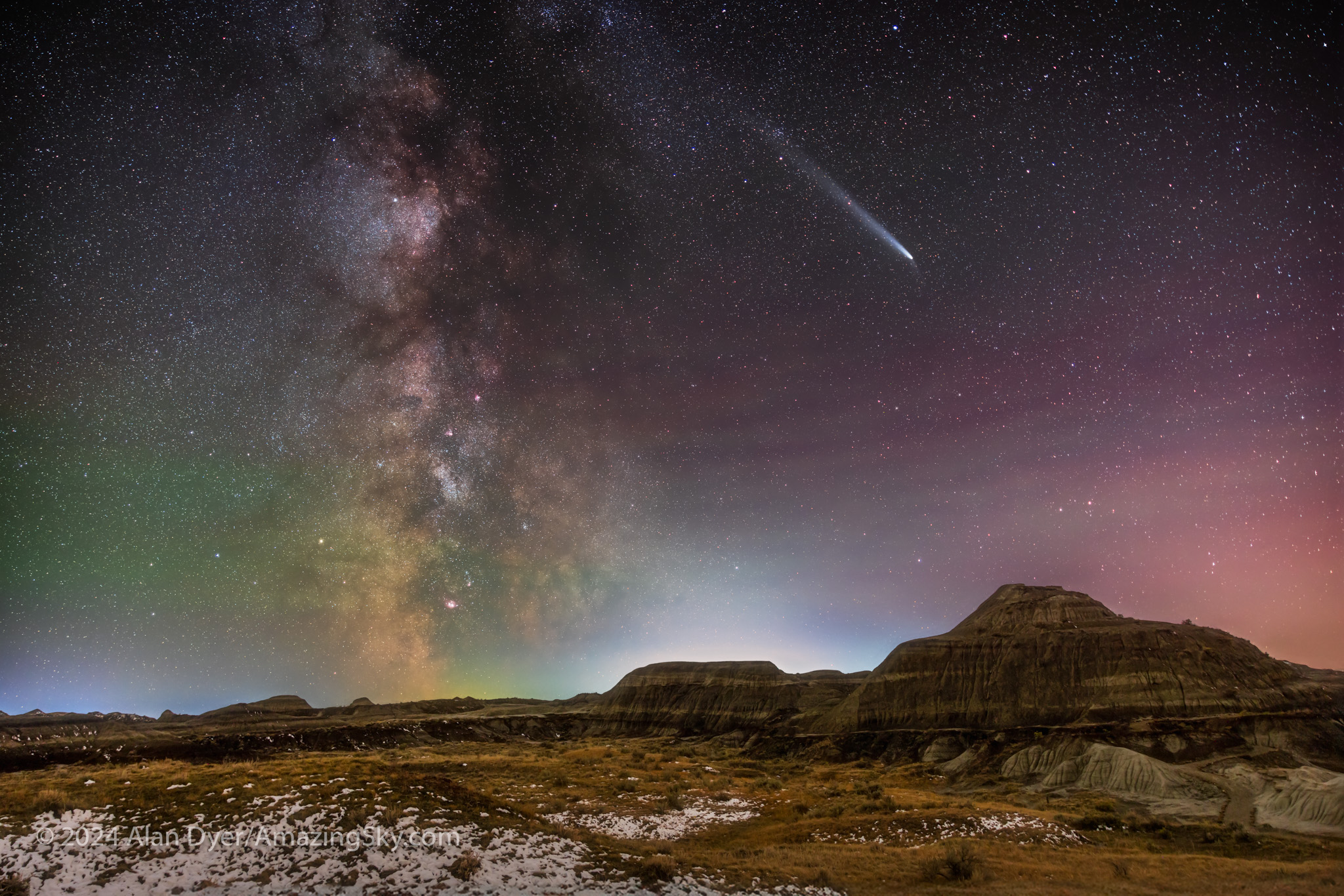
This is Comet Tsuchinshan-ATLAS in a wide-angle nightscape scene over the Badlands of Dinosaur Provincial Park, Alberta, on October 23, 2024.

On October 23, a short trip out to Dinosaur Provincial Park east of home allowed me to shoot the comet over the Alberta Badlands landscape, beside the setting summer Milky Way. 

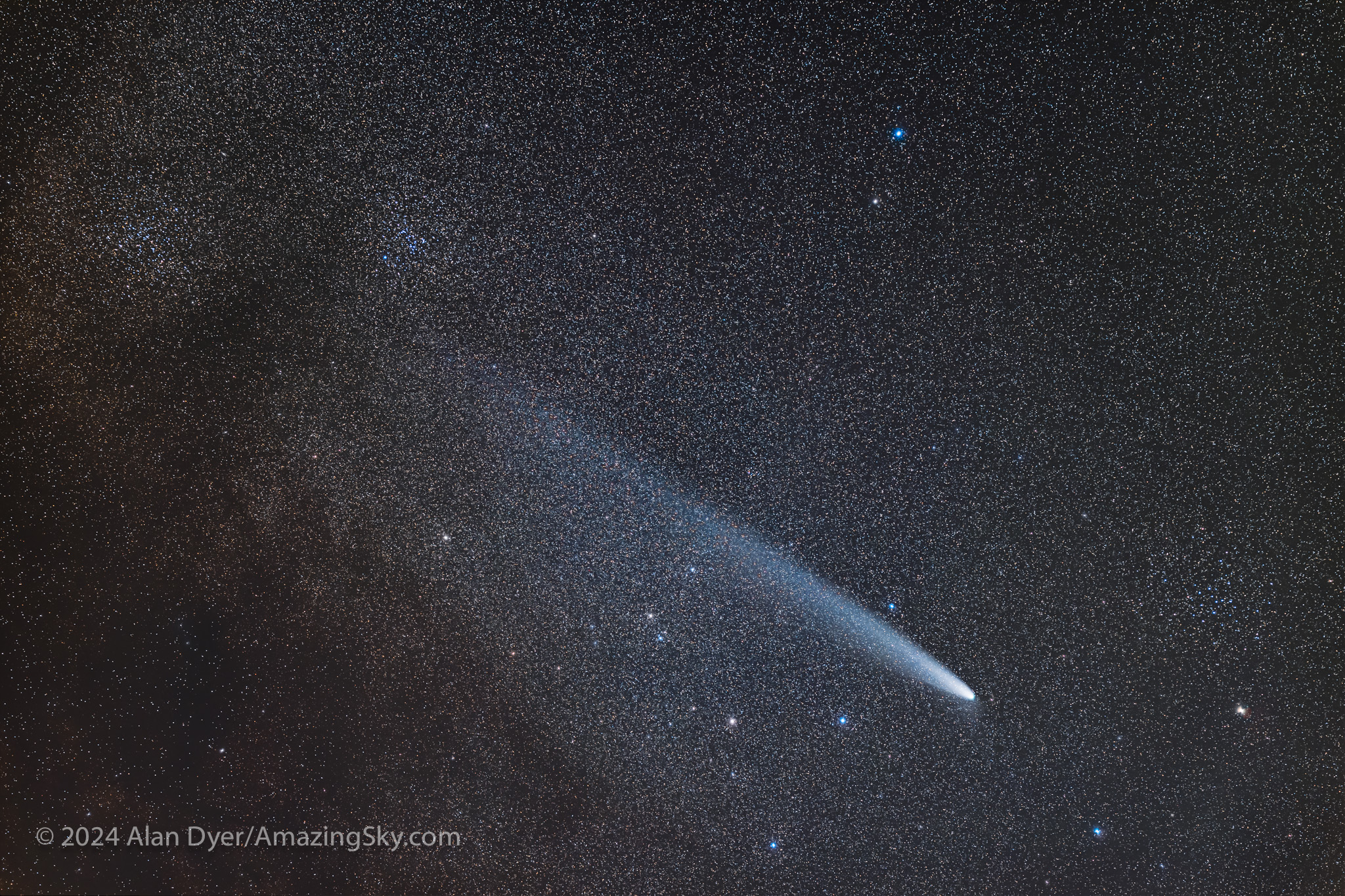
This is a telephoto lens framing of Comet Tsuchinshan-ATLAS in Ophiuchus on the night of October 30, 2024 near several large star clusters. The field of view is 15ยบ by 10ยบ so the tail extends for about 6ยบ to 8ยบ.

By a week later, on October 30, the comet had diminished in size and brightness, but still looked like a classic comet, here framed in a telephoto close-up as it passed near some bright star clusters. This was from my front yard. The chase was over. 

Clouds and a trip to Norway starting November 4 prevented more opportunities to shoot the comet. (My travel schedule also kept me from writing this blog until now!)

It had been a good chase over a month, yielding images I was happy with. The photos from Utah and Arizona I could not have taken at home, even if the skies had been clear during the cometโ€™s prime-time. (They werenโ€™t!) And it was great to finally get back to my favourite haunts in southern Arizona and New Mexico after an absence of seven years.

In all, Comet Tsuchinshan-ATLAS provided a fine finale to what has been a superb year of stargazing events and celestial sights. 

โ€” Alan, December 9, 2024 โ€” AmazingSky.com ย 

Chasing Meteors


Geminid Meteor Radiant in Gemini

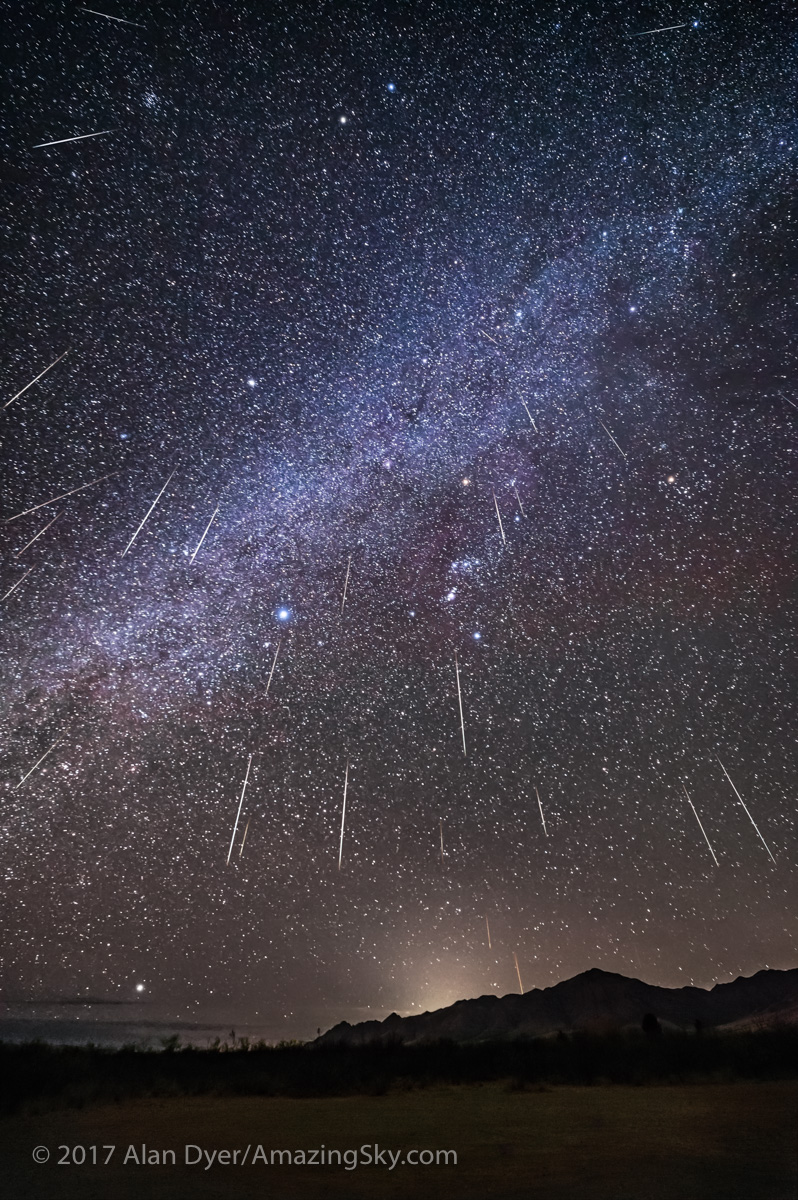
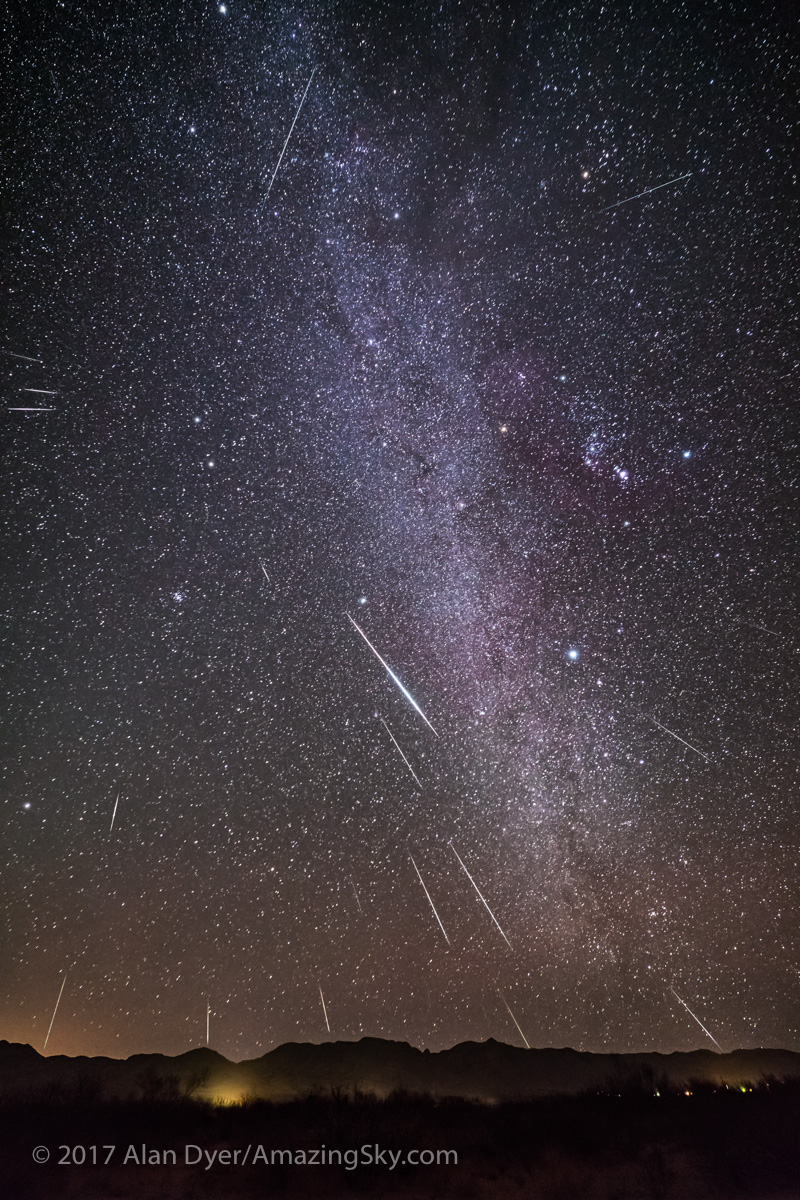
Meteors were raining down the sky on the peak night of the Geminid meteor shower.

Back in August, when I wrote my column for the November-December issue of our Canadian magazine SkyNews, I noticed how good the circumstances were this year for the annual Geminid meteor shower. Normally one of the best showers of the year, if not the best, the Geminids were really going to perform in 2017.

The Moon was near new so its light would not interfere. For western North America, the peak of the shower was also timed for midnight on the night of December 13/14, just when the radiant of the shower was high in the sky.

Raining Geminid Meteors
The Geminids rain down the sky from the radiant in Gemini high overhead on peak night.

So in August when I saw the favourable combination of circumstances, I decided a meteor chase was in order. While the shower would be visible from home, Geminid peak night in December is often bitterly cold or cloudy at home in Alberta.

So I planned a trek to Arizona, for the shower and the winter sky.

While skies at home proved decent after all, it was still a chase worth making, with the shower visible under the perfectly clear and dry skies of southeast Arizona.

My chosen site was the Quailway Cottage near the Arizona Sky Village, the chosen dark sky site for many amateur astronomers, and at the foot of the Chiricahua Mountains. Skies are dark!

Sky Dust - Interplanetary and Interstellar
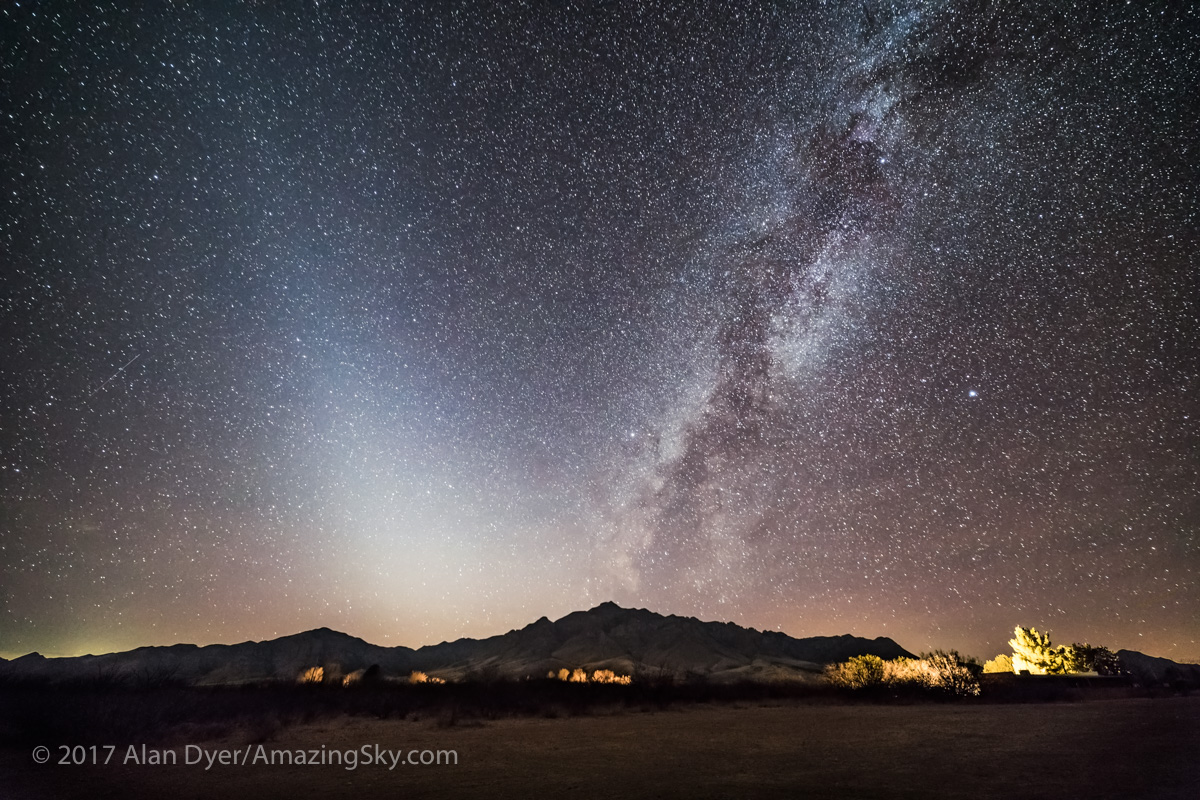
The Zodiacal Light (left) and Milky Way over the Chiricahuas.

The Zodiacal Light was brilliant in the southwest sky for several hours after sunset. A tough sighting at this time of year from most sites, this glow was obvious in the Arizona sky. It is sunlight reflecting off cometary dust particles in the inner solar system.

Geminid Meteor Shower in the Winter Milky Way
Geminids streaking from Gemini as the winter sky rises.

On the peak night, the visual impression was of meteors appearing at a rate of at least one a minute, if not more frequently.

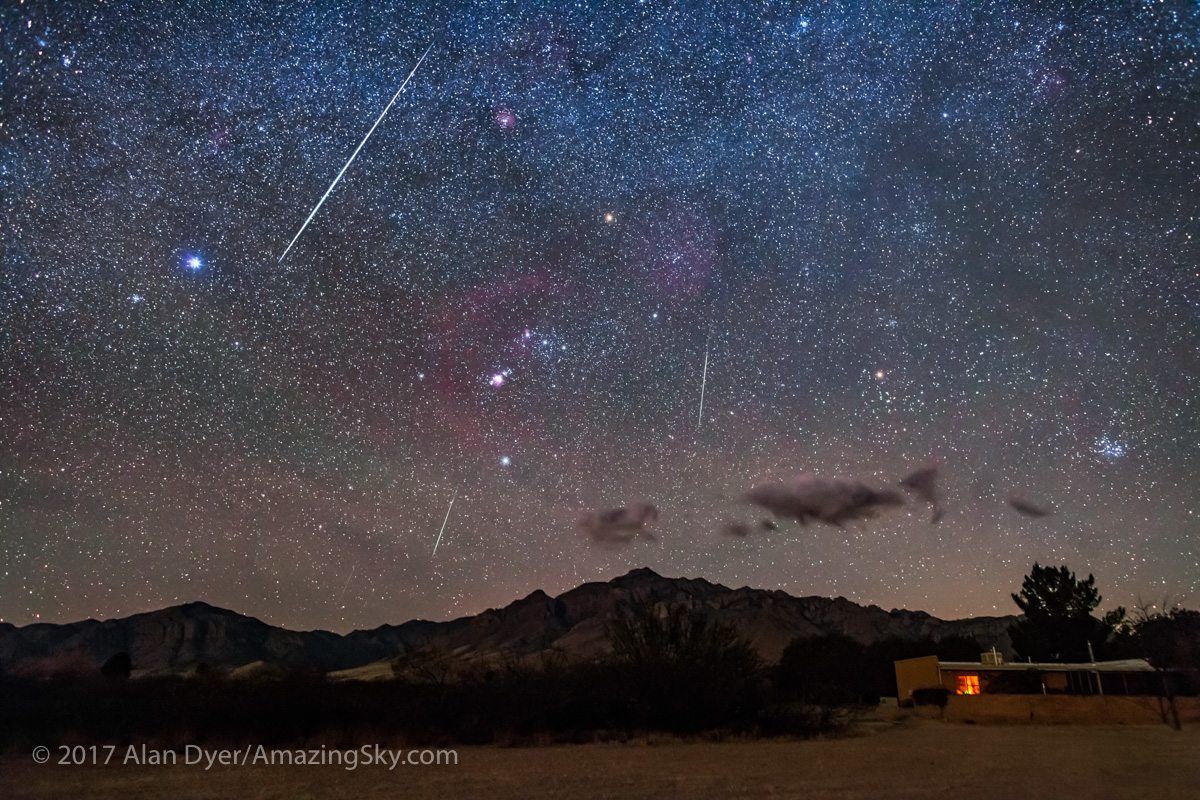
Geminid Meteor Radiant in Gemini
A tracked composite looking up toward Orion and Gemini.

The images here are all composites of dozens of exposures taken over 2 to 5 hours, stacking many meteors on one frame. So they do provide an exaggerated record of the shower. Meteors weren’t filling the sky! But you certainly did not have to wait long for one to appear, making this one of the best meteor showers in many years.

Geminid Meteors over the Chiricahuas
Geminids falling over the Chiricahuas as Orion sets at the end of the peak night.

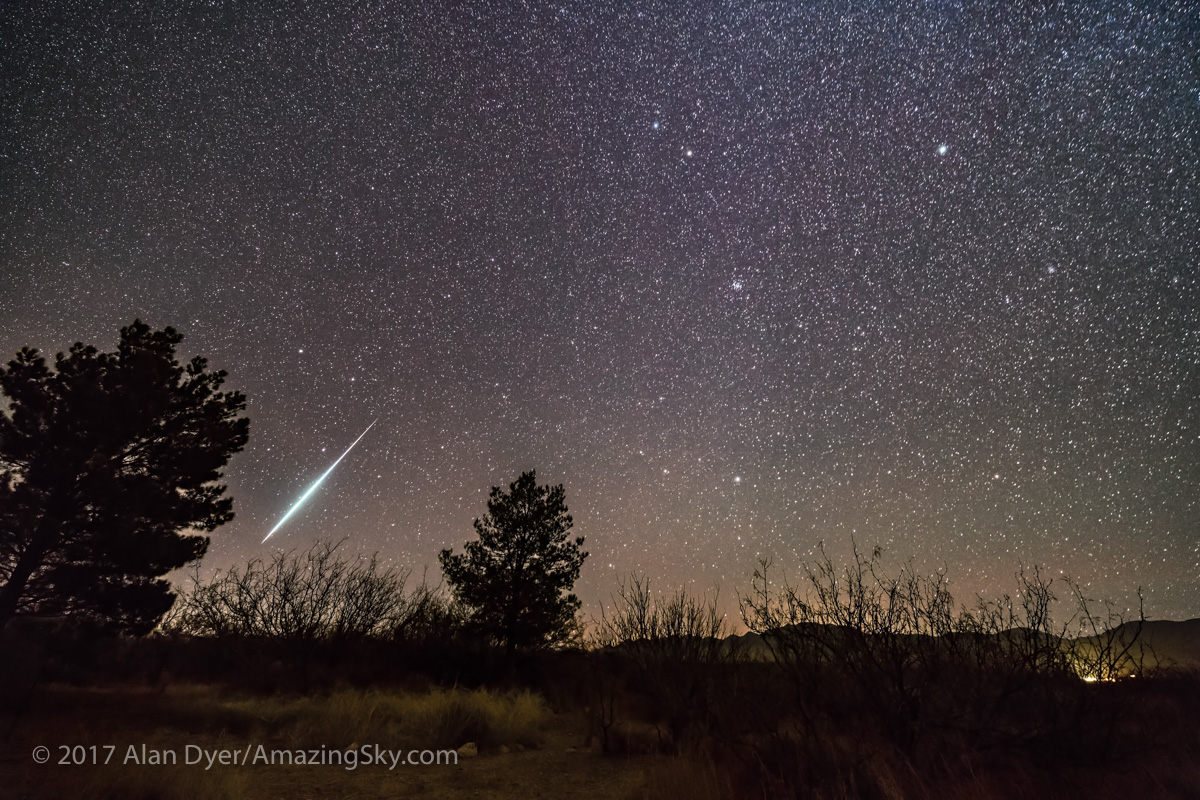
Most of the Geminids were of average brightness. I didn’t see, nor did the camera catch many very bright “bolides,” the really brilliant meteors that light up the ground.

Bright Geminid Meteor Descending
A bright Geminid pierces Ursa Major.

Nevertheless, this was a night to remember, and a fine way to end what has been a superlative year of stargazing, with a total solar eclipse, great auroras, and for me, a wonderful stay under southern skies on an April trip to Australia.

All the best of the season to you and your family and friends. Clear skies!

Here’s to 2018, which begins with a total eclipse of the Moon on January 31.

โ€” Alan, December 23, 2017 / ยฉ 2017 Alan Dyer / AmazingSky.com
 

The Moving Stars of the Northern Hemisphere


Arizona Star Trails - Circumpolar Looking North

I present a montage of time-lapses illustrating the motion of the sky in the Northern Hemisphere.ย 

Any stargazer should be familiar with how the sky moves, with stars rising in the east and setting in the west.

From the northern hemisphere, when we look north we see the sky rotating counter-clockwise around the North Celestial Pole, near Polaris. As you’ll see in the video, even Polarisย moves, though not much over the night. The stars that never set, but just moveย across the northern horizon, are the circumpolar stars.

When we look south we see the seasonal constellations, the ones that rise and set, and change over the seasons.

I shot the images for these sequences from southern Arizona, in early December 2015.

So the night starts with the summer stars setting in the west and the autumn stars dominating the sky. But then Orion and the winter stars rise and march across the sky over the night, setting before dawn, as the spring stars rise.

The south-looking movie is a dusk-to-dawn sequence. Note the Zodiacal Light in the west at right in the early evening, then reappearing in the east at left before dawn brightens the sky, and as Venus and the Moon rises.

Also note the moving bands of red and green airglow, a natural phenomenon of the upper atmosphere.


I posted a matching set of movies in my previous blog post, shot from the Southern Hemisphere. But here’s the link to the movie.


Both sets of movies were shot from nearly identical latitudes โ€“ about 31ยฐ, but 31ยฐ N for Portal, Arizona and 31ยฐ S for Coonabarabran, Australia.

As such the Celestial Poles appear at equal altitudes above the horizon. And the angles that the stars rise and set at in relation to the horizon are the same.

But the direction they move is opposite. When looking 180ยฐ away from the Pole, the seasonal stars move from left to right in the Northern Hemisphere, but from right to left in the Southern Hemisphere.

Visitors from one hemisphere to the other are bound to get turned around!

โ€” Alan, August 25, 2016 / ยฉ 2016 Alan Dyer / AmazingSky.com


A Panorama of the Entire Northern Milky Way


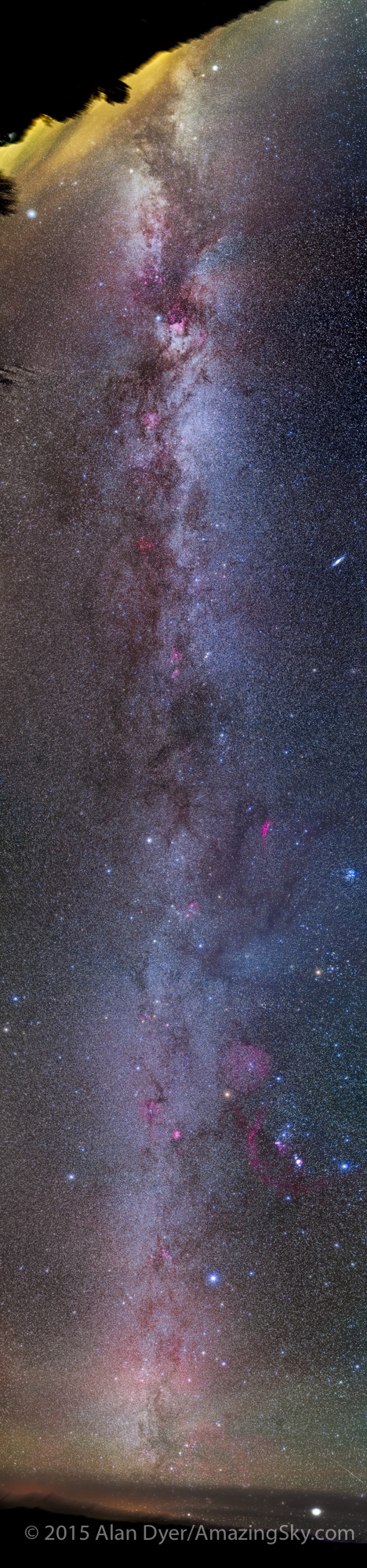
Panorama of the Northern Milky Way

In a sweeping panorama, here is the entire northern hemisphere Milky Way from horizon to horizon.

This is the result of one of theย major projects onย my recent trek to Arizona and New Mexico โ€“ a mosaic of images shot along the Milky Way over several hours.

The goal is a complete 360ยฐ panorama of the entire Milky Way, and I’ve got most of the other segments in previous shoots from Alberta, Australia and Chile. But I did not have good shots of the northern autumn segments, until now.

The panorama sweeps from Cygnus (at top, setting in the western sky in the evening), across the sky overhead in Perseus, Auriga and Taurus (in the middle), and down into Orion, Canis Major, and Puppis (at bottom, low in the southern sky at midnight).

The view is looking outward to the near edge of ourย Milky Way, in the direction opposite the centre of ourย Galaxy. In this direction the Milky Way becomes dimmer and less defined. Notable are the many red H-alpha emission regions along the Milky Way, as well as the many lanes of dark interstellar dust nearby and obscuring the more distant stars.

However, a diffuseย glow in Taurus partly obscures its Taurus Dark Clouds โ€” thatโ€™s the Gegenschein, caused by sunlight reflecting off cometary dust particles directly opposite the Sun and marking the anti-solar point this night, by coincidence then close to galactic longitude of 180ยฐ opposite the galactic centre.

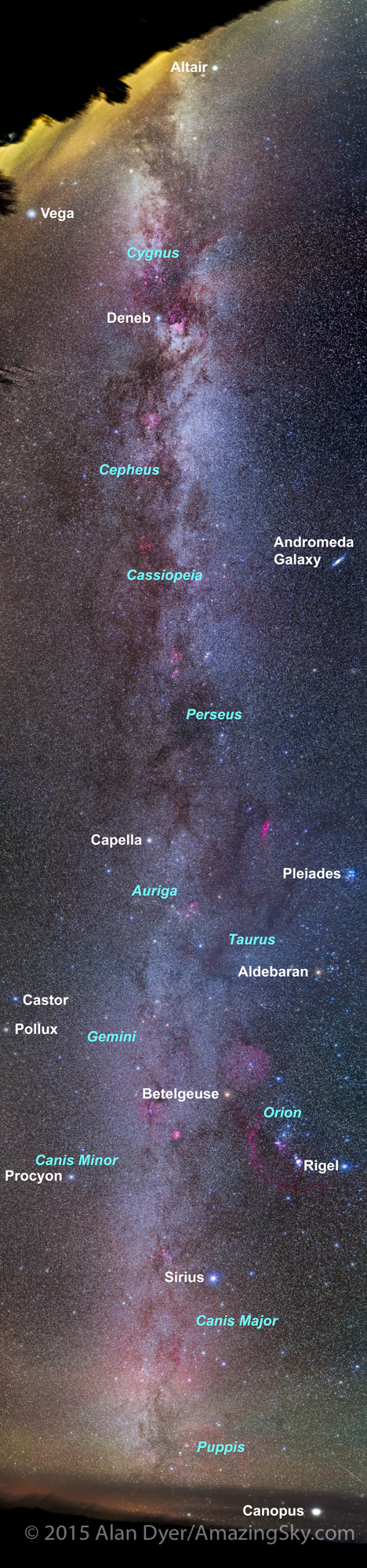
Panorama of the Northern Milky Way (with Labels)

Here I provide a guided map of the mosaic. Orion is at lower right, while the Pleiades and Andromeda Galaxy lie near the rightย edge. The Andromeda Galaxy is the only thing in this image that is not part of the Milky Way.

The bright star Canopus is just rising at bottom, in haze. Vega and Altair are just setting at the very top. So the panorama sweepsย from Altair to Canopus.

The sky isn’t perfect! Haze and airglow in our atmosphere add discolouration, especially close to the horizon. In my final 360ยฐ pan, I’ll use only the central portions of this panorama.

Now let’s put the horizon-to-horizon panorama into cosmic perspective…

Illustration of the Northern Milky Way Panorama

In this diagram, based on art from NASAโ€™s Spitzer Space Telescope Institute, I show my Northern Milky Way Panorama in perspective to the โ€œbig pictureโ€ of our entire Galaxy, using artwork based on our best map of how our Galaxy is thought to look.

We are looking in a โ€œgodโ€™s eyeโ€ viewย across our Galaxy from a vantage point on the far side of the Galaxy.

Where we are is marked with the red dot, the location of our average Sun in a minor spiral arm called the Orion Spur.

The diagram places my panorama image in the approximate correct location to show where its features are in our Galaxy. As such it illustrates how my panorama taken from Earth shows our view of the outer portions of our Galaxy, from the bright Cygnus area at right, to Perseus in the middle, directly opposite the centre of the Galaxy, then over to Orion at left.

The panorama sweeps from a “galactic longitude” of roughly 90ยฐ at right in Cygnus, to 180ยฐ in Perseus, over to 240ยฐ in Orion and Canis Major at left.

In the northern autumn and early winter seasons we are looking outward toward the outer Perseus Arm. So the Milky Way we see in our sky is fainter than in mid-summer when we are looking the other way, toward the dense centre of the Galaxy and the rich inner Norma and Sagittarius arms.

Yet, this outer region contains a rich array of star-forming regions, which mostly show up as the red nebulas. But this region of the Milky Way is also laced with dark lanes of interstellar “stardust.”

NOTE:

For larger images, see my Flickr site atย https://www.flickr.com/photos/amazingsky/

TECHNICAL:

The panorama is composed of 14 segments, most beingย stacks 5 x 2.5-minute exposures with the filter-modified Canon 5D MkII at ISO 1600 and 35mm lens at f/2.8.

The end segments near the horizons at top and bottom are stacks of 2 x 2.5-minute exposures.

Each segment also has an additional image shot through a Kenko Softon filter to add the star glows, to make the bright stars show up better.

The camera was oriented with the long dimension of the frame across the Milky Way, not along it, to maximize the amount of sky framed on either side of the Milky Way.

The camera was on the iOptron Sky-Tracker. I shot the segments for this pan from Quailway Cottage, Arizona on December 8/9, 2015, with the end segments taken Dec 10/11, 2015. I decided to add in the horizon segments for completeness, and so shot those two nights later when sky conditions were a little different.

โ€” Alan, December 19, 2015 / ยฉ 2015 Alan Dyer / www.amazingsky.com
The Wonder-Filled Winter Sky


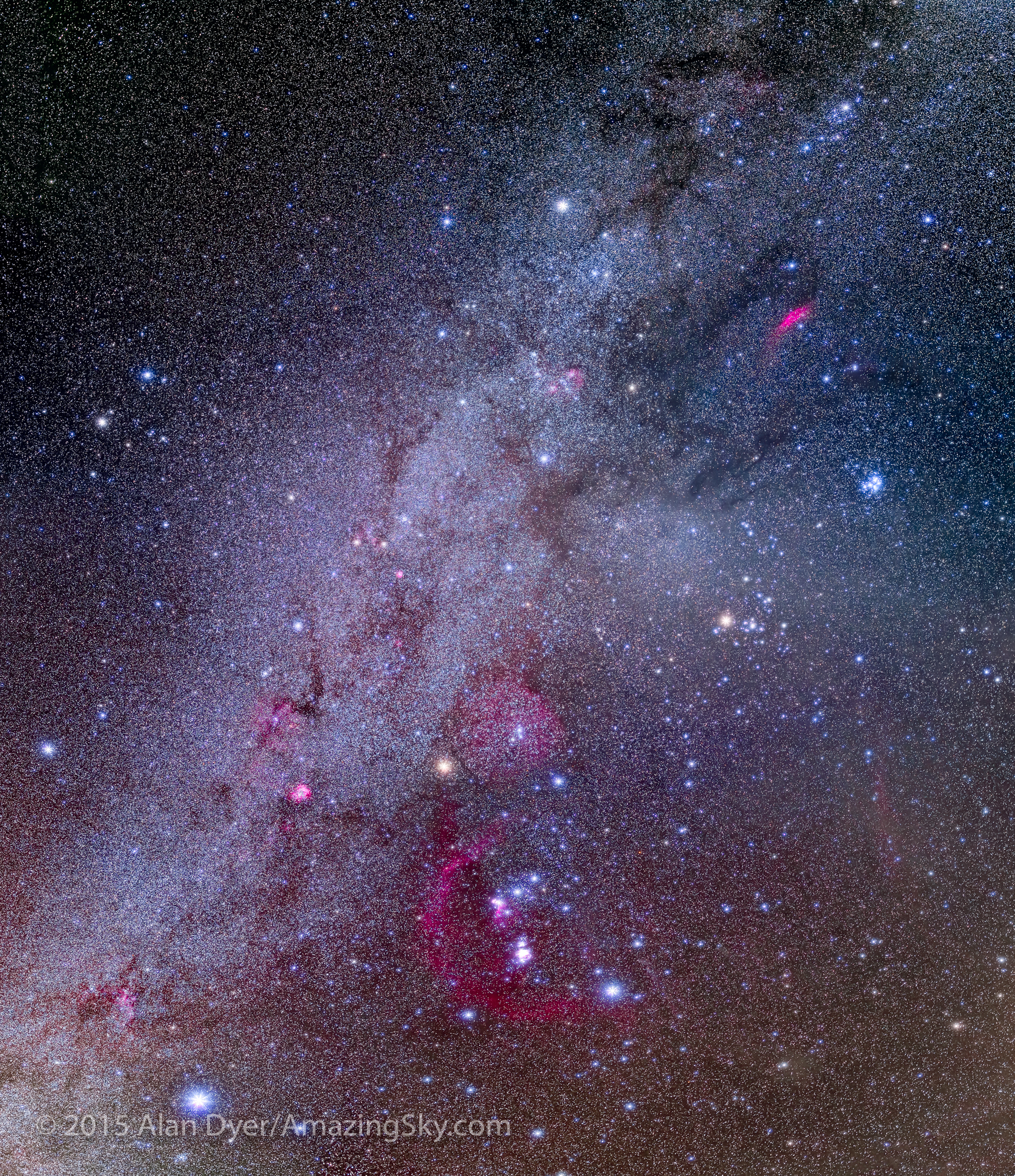
Mosaic of the Wonder-filled Winter Milky Way

The sky of December contains an amazing array of bright stars and deep-sky delights.

At this time of year we peer out toward the edge of our Galaxy, in the direction opposite to what we see in July and August. Even though we are looking away from the centre of our Galaxy, the Milky Way at this time of year contains a stunning collection of sights โ€“ for the naked eye, binoculars or a telescope.

I can’t list them all here, but most are in the lead image above! The image is aย mosaic of the northern winter Milky Way, including the brilliant stars and constellations in and around Orion the Hunter.

The Milky Way extends from Perseus in the north at top, to Canis Major in the south at bottom. Throughout the scene are dark lanes and dust clouds, such as the Taurus Dark Clouds at upper right.

The Milky Way is dotted with numerous red โ€œhydrogen-alphaโ€ regions of emission nebulosity, such as the bright Rosette Nebula at lower left and the California Nebula at upper right. The curving arc of Barnardโ€™s Loop surrounds the east side of Orion. Orion is below centre, with Sirius, the night sky’s brightest star, at lower left.

The constellation of Taurus is at upper right and Gemini at upper left. Auriga is at top and Perseus at upper right.

There’s an unusually bright area in Taurus just right of centre in the mosaic which I thought might be an image processing artifact. No. It’s the Gegenschein – a glow of sunlight reflected off cometย dust directly opposite the Sun.

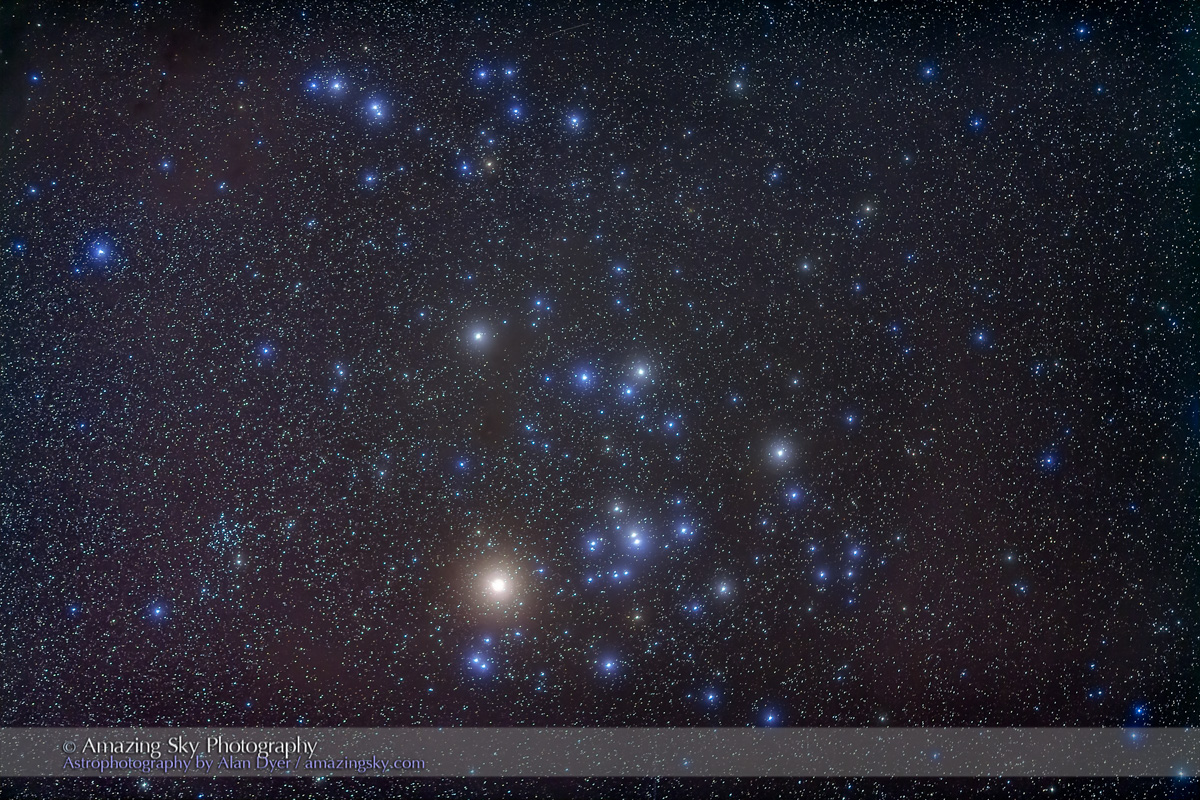
Two highlights of this sky that are great regions for binoculars are the Hyades cluster in Taurus ….

The Hyades Cluster with Aldebaran
The Hyades open star cluster in Taurus with the bright star Aldebaran, not a part of the cluster iteslf. The smaller and more distant cluster NGC 1647 is at left. This is a telephoto lens image taking in a field similar to binoculars, and is a stack of 5 x 2.5-minute exposures with the 135mm lens at f/2 and Canon 5D MkII camera at ISO 800, plus two other exposures taken through the Kenko Softon filter to add the star glows. Taken from Quailway Cottage on Dec 7, 2015 using the iOptron Sky-Tracker.

…and the Belt and Sword of Orion.

The Hyades โ€“ the face of Taurus โ€“ is one of the nearest and therefore largest open star clusters.

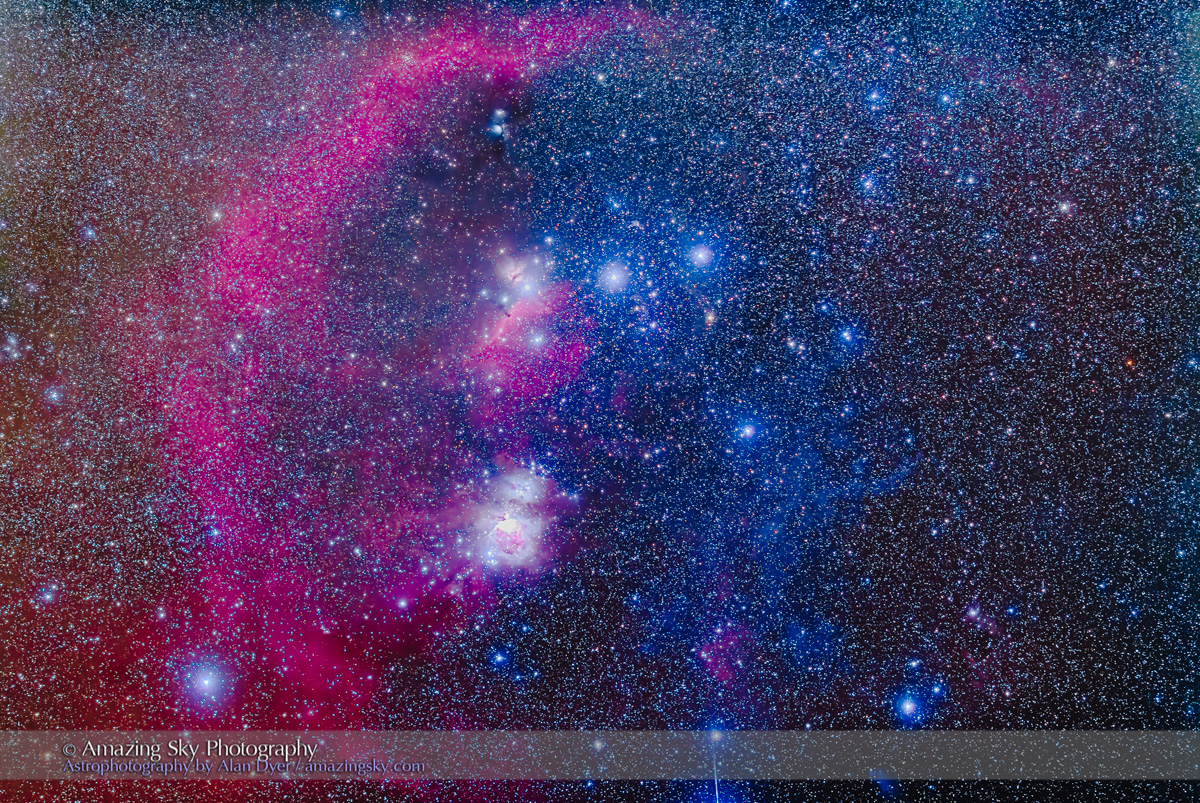
Orion the Hunter, who battles Taurus in the sky, contains the famous Orion Nebula, here overexposed in order to bring out the much fainter nebulosity in the region.

The magenta and blue arcs in the image belowย are photographic targets, but the bright Orion Nebula in Orion’s Sword is easy in binoculars, shining below the trio of his Belt Stars.

Orion Belt and Sword Mosaic
A mosaic of the Sword and Belt region of Orion the Hunter, showing the diverse array of colourful nebulas in the area, including: curving Barnardโ€™s Loop, the Horsehead Nebula below the left star of the Belt, Alnitak, and the Orion Nebula itself as the bright region in the Sword. Also in the field are numerous faint blue reflection nebulas. The reflection nebula M78 is at top embedded in a dark nebula, and the pinkish NGC 2024 or Flame Nebula is above Alnitak. The bright orange-red star at far right is W Orionis, a type M4 long-period variable star. This is a 4-panel mosaic with each panel made of 5 x 2.5-minute exposures with the 135mm Canon L-series telephoto wide open at f/2 and the filter-modified Canon 5D MkII at ISO 1250. The night was somewhat hazy which added natural glows on the stars. No filter was employed here. The camera was on the iOptron Sky-Tracker for tracking but no guiding. Shot from outside Quailway Cottage near Portal, Arizona, Dec 7, 2015. All stacking and stitching performed in Photoshop CC 2015. Stacking done with median combine stack mode to eliminate geosat trails through the fields.

For us in the northern hemisphere, Orion and company are winter sights. But for those down under, in the southern hemisphere, this is the summer sky. So pardon the northern chauvinism in the title!

Either way, on a dark, moonless night, get out and explore the sky around Orion.

TECHNICAL:

I shot the segments for the main mosaic at topย on a very clear night on December 5, 2015 from the Quailway Cottage at Portal, Arizona. This is a mosaic of 8 segments, in two columns of 4 rows, with generous overlap. Each segment was made of 4 x 2.5-minute exposures stacked with mean combine stack mode to reduce noise, plus 2 x 2.5-minute exposures taken through the Kenko Softon filter layered in with Lighten belnd mode to add the star glows. Each segment was shot at f/2.8 with the original 35mm Canon L-series lens and the filter-modified (by Hutech) Canon 5D MkII at ISO 1600, riding on the iOptron Sky-Tracker. All stacking and stitching in Photoshop CC 2015. The soft diffusion filter helps bring out the star colors in this area of sky rich in brilliant giant stars.

โ€” Alan, December 11, 2015 / ยฉ 2015 Alan Dyer / www.amazingsky.com
Venus and the Comet


Comet Catalina near Venus (Dec 9, 2015)

Comet Catalina sports two tails as it moves past Venus in the dawn sky.

This was the view this morning, December 9, from my site in Arizona, of Comet Catalina near Venus in the dawn sky. This is a telephoto lens shot that provides a view similar in size to what binoculars show.

However, the blue ion tail visible here stretching back several degrees is mostly a photographic target. Visually, just Catalina’sย short, stubby dust tail at lower right is obvious.

The ion tail points away from the Sun, while the dust tail extends along the cometโ€™s orbit, showing where the comet has been.

The view, both visually and photographically, of the comet will improve as it climbs higher into the eastern morning sky and as it moves away from the glare of Venus. The Moon is also now gone from the dawn, at least for the next couple of weeks.

The comet is dimmer than expected but should at least maintain this brightness for the next month or so.

Technical:

This is a stack of 5 x 90-second exposures, taken with the 135mm telephoto and 1.4x extender for a focal length of 190mm, at f/2.8 and with the Canon 5D MkII at ISO 1600, tracked on the iOptron Sky-Tracker. Two other exposures, of 15s and 1s, were blended in with luminosity masks to reduce the glare of Venus to a smaller size.

โ€” Alan, December 9, 2015 / ยฉ 2015 Alan Dyer / www.amazingsky.com
Comets, Conjunctions, and Occultations, Oh My!


The Moon, Venus and Comet Catalina

What a morning of sky sights, both before dawn and after sunrise.

December 7 โ€“ This was the prime day I came to Arizona to enjoy, to be better assured of clear skies. As it turned out this will likely be the cloudiest day of the week here, but skies were clear enough for a fine view of a conjunction and an occultation. The comet was a bonus.

Waning Moon and Venus Rising in Conjunction
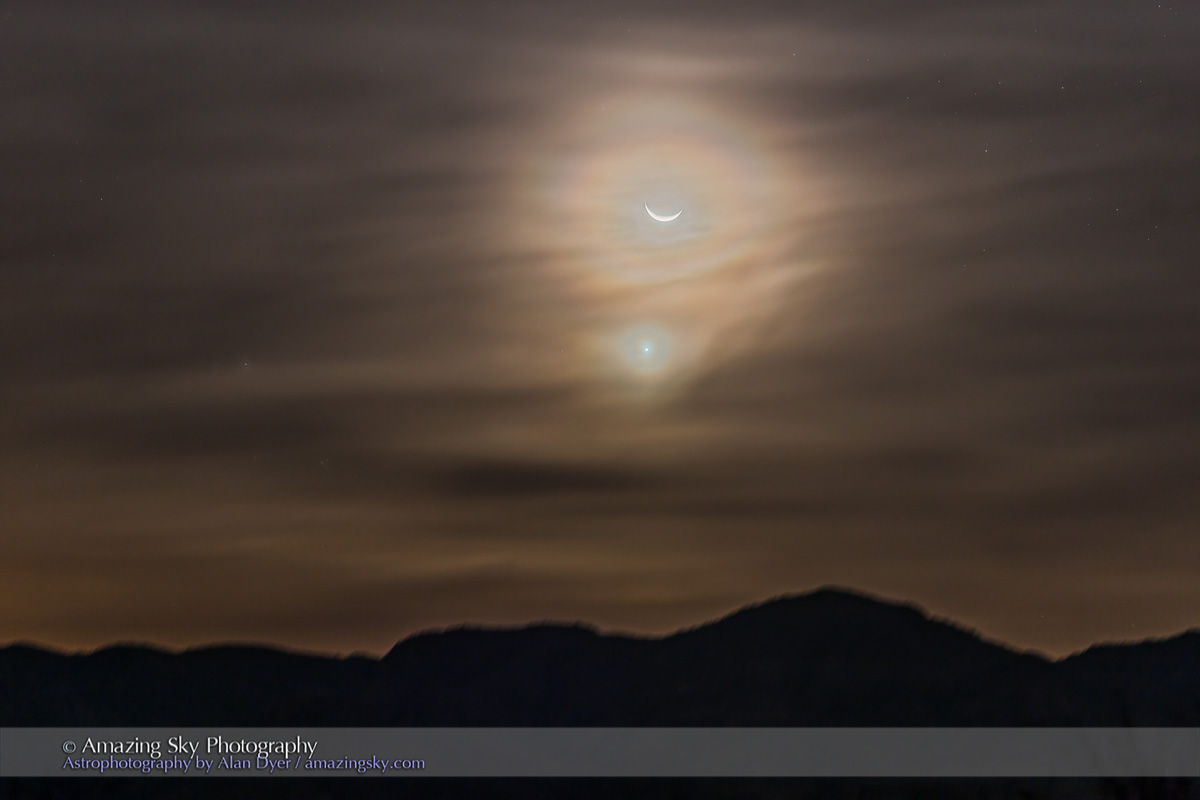
This is a stack of 5 exposures: 30, 8, 2, 0.5 and 1/8s, blended with luminosity masks as HDR would not blend images with such a large range of brightness and content, with the shortest exposures having almost no content execept for two bright objects! The camera was on the iOptron Sky-Tracker to follow the sky and keep the sky targets stationary and aligned, thus the blurred foreground. All with the 135mm lens at f/2.8 and Canon 6D at ISO 400.

At 4 a.m. the waning crescent Moon rose accompanied by Venus, as the two worlds appeared in close conjunction in the pre-dawn sky. The view above captures the scene as the Moon and Venus rose over the Peloncillo Mountains of New Mexico. Comet Catalina is in this scene but barely visible.

The Moon, Venus and Comet Catalina
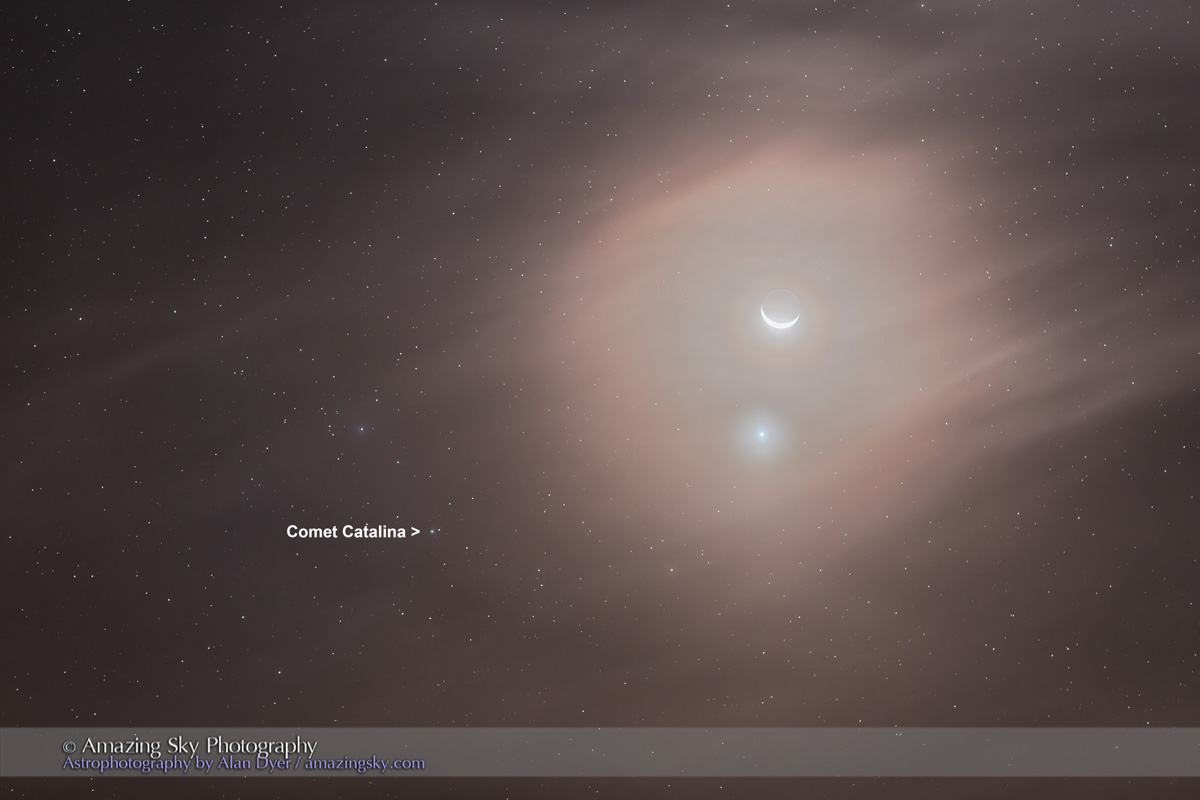
This is a stack of 6 exposures: 30, 8, 2, 0.5, 1/8s and 1/30s, blended with luminosity masks as HDR would not blend images with such a large range of brightness and content, with the shortest exposures having almost no content execept for two bright objects! The camera was on the iOptron Sky-Tracker to follow the sky and keep the sky targets stationary and aligned. All with the 135mm lens at f/2.8 and Canon 6D at ISO 800.

An hour or so later, with the Moon and Venus higher and with skies a little less cloudy, I was able to capture this scene, above, that included Comet Catalina, as a tiny blue dot next to Venus and the Moon. But if I hadnโ€™t labeled it, you wouldnโ€™t know it was there! The comet is proving to be less wonderful than anticipated, and any cloud dims the view even more.

I had hoped for a superb scene of a bright comet next to the two brightest objects in the night sky. But comets do what comets do โ€” surprise people with unexpected brightness (as Comet Lovejoy did last January) or with disappointing dimness … or by disappearing altogether, as Comet ISON did two years ago. I came here in December 2013, to this same location on the Arizona-New Mexico border, to catch ISON but no luck there at all!

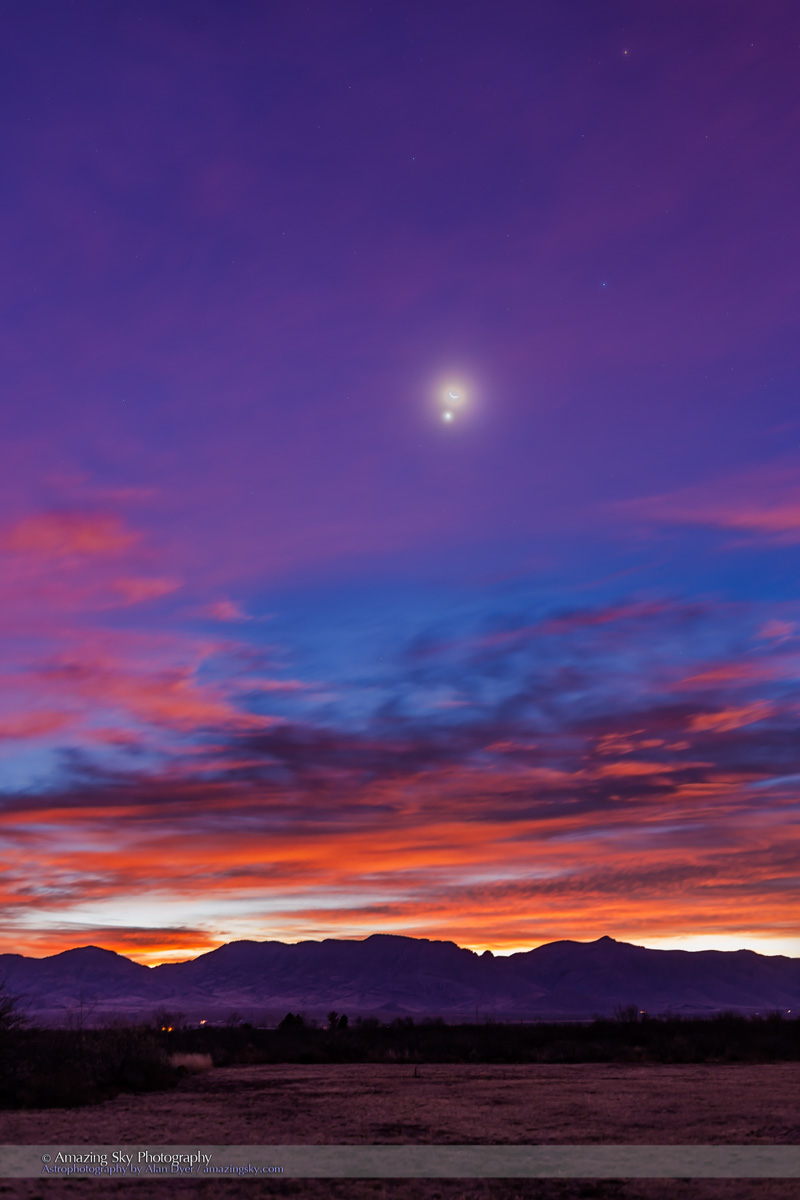
Moon & Venus Conjunction at Sunrise (Dec 7, 2015)
This is a stack of 7 exposures from 10 seconds to 0.3 seconds at 1 stop intervals and blended with luminosity masks, to compress the huge range in brightness from the bright Moon and Venus, plus horizon sky, and the darker sky and sunrise clouds. All with the 35mm lens and Canon 6D.

Regardless of the comet, the conjunction of the Moon and Venus was stunning, about as good as such events get. Hereโ€™s the view, above, an hour later again, with the eastern sky brightening in the dawn twilight. The only thing that would have made this event even more spectacular is if the Moon had actually covered up Venus in this twilight sky. Not quite.

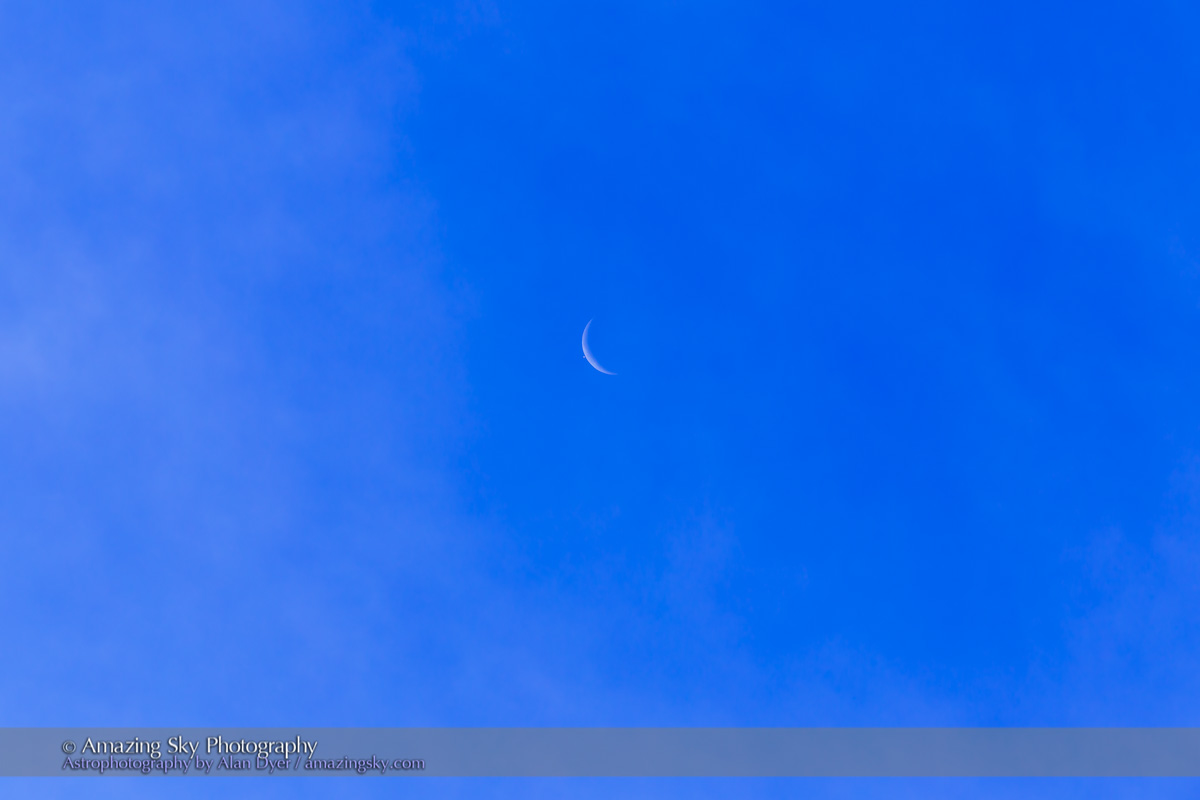
Daytime Occultation of Venus (Dec 7, 2015)
The occultation of Venus by the waning crescent Moon in the daytime on Monday, December 7 at 9:30 am local time. This is just about 3 minutes before the actual occultation as the advancing Moon is about to cover Venus on the bright limb of the Moon. This is a frame from a 100-frame time lapse. Unfortunately, as I shot this on my trip to Arizona, I did not have more focal length than the 135mm and 1.4x extender used here.

For the occultation itself, we had to wait until well after sunrise for an event in the blue daytime sky, at 9:30 a.m. local time.

All of North America got to see this fairly rare occultation of Venus by the Moon, albeit in the daytime. Nevertheless, the two objects are so bright, this was visible to the unaided eye, even with some cloud about. In binoculars it was wonderful.

To shoot it, all I had was a telephoto lens, so the image scale doesnโ€™t do the event justice. But the image above provides a good impression of the binocular view, with Venus as a brilliant jewel on the โ€œringโ€ of the Moon.

โ€” Alan, December 7, 2015 / ยฉ 2015 Alan Dyer / www.amazingsky.com
Capturing Comet Catalina


Comet Catalina with Venus at Dawn

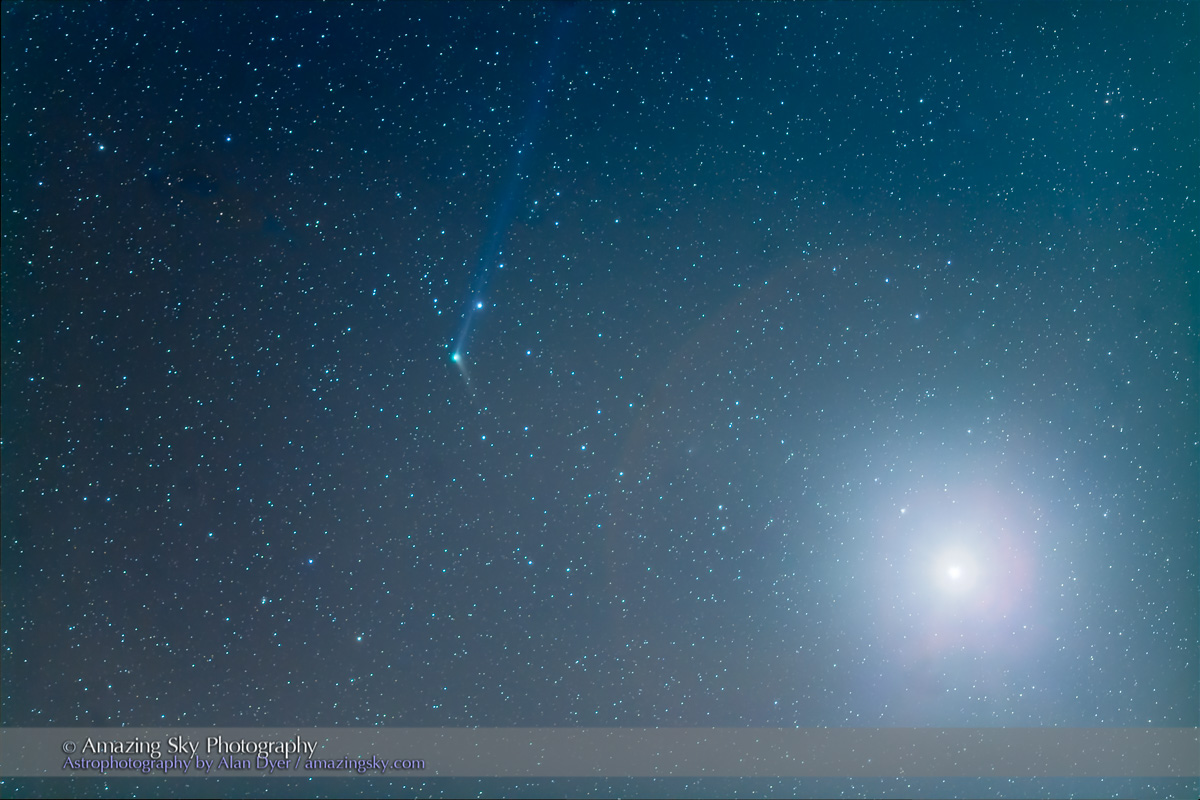
I got the comet but it isn’t what was hoped for โ€“ a faint fuzzball in binoculars.

This was Comet Catalina (aka C/2013 US10) in the dawn sky this morning, December 6, with the comet appearing as a fuzzy star below brilliant Venus in binoculars, and just revealing its two short tails in photos. It’s the cyan-colored object near the centre. Venus is the brilliant object.

This image is with a telephoto lens, and coversย a little more of the sky than typical binoculars would show. I knew this would be a binocular comet at best, but it’s barely that. This is more a comet for telescopes.

But as the Moon departs the scene and the comet climbs higher the view may improve. Still, if you are pining for views of Comet Catalina and are stuck under cloudy winter skies at home, don’t be worried. You aren’t missing too much. Except …

Arch of the Autumn Milky Way
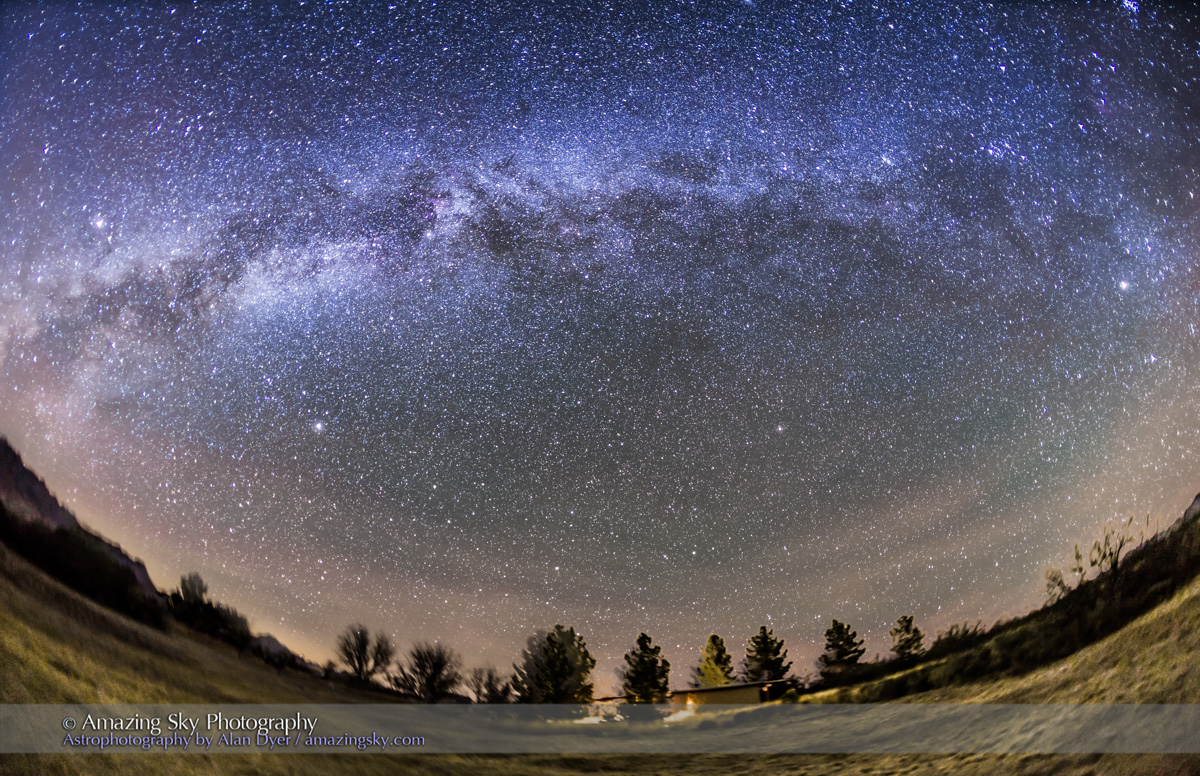
The arch of the Milky Way in the northern autumn and early winter sky, from Arizona on December 5, 2015. The Milky Way extends from Aquila to the left, in the southwest to Cassiopeia at top right, to Perseus and Auriga at far right, in the northeast. I shot this from the Quailway Cottage near Portal, Arizona, latitude +32ยฐ N. The view is looking north toward the celestial pole. Polaris is just right of lower centre. This is a stack of 8 tracked exposures, each 3 minutes at f/2.8 with the 15mm lens and Canon 6D at ISO 1600, with the ground coming from one exposure to minimize blurring. The camera was on the iOptron Sky-Tracker.
This was the view of the autumn Milky Way from here in Arizona last night. Pretty impressive under nearly perfect sky conditions. And then there’s this …

Winter Sky Setting over the Chiricahuas
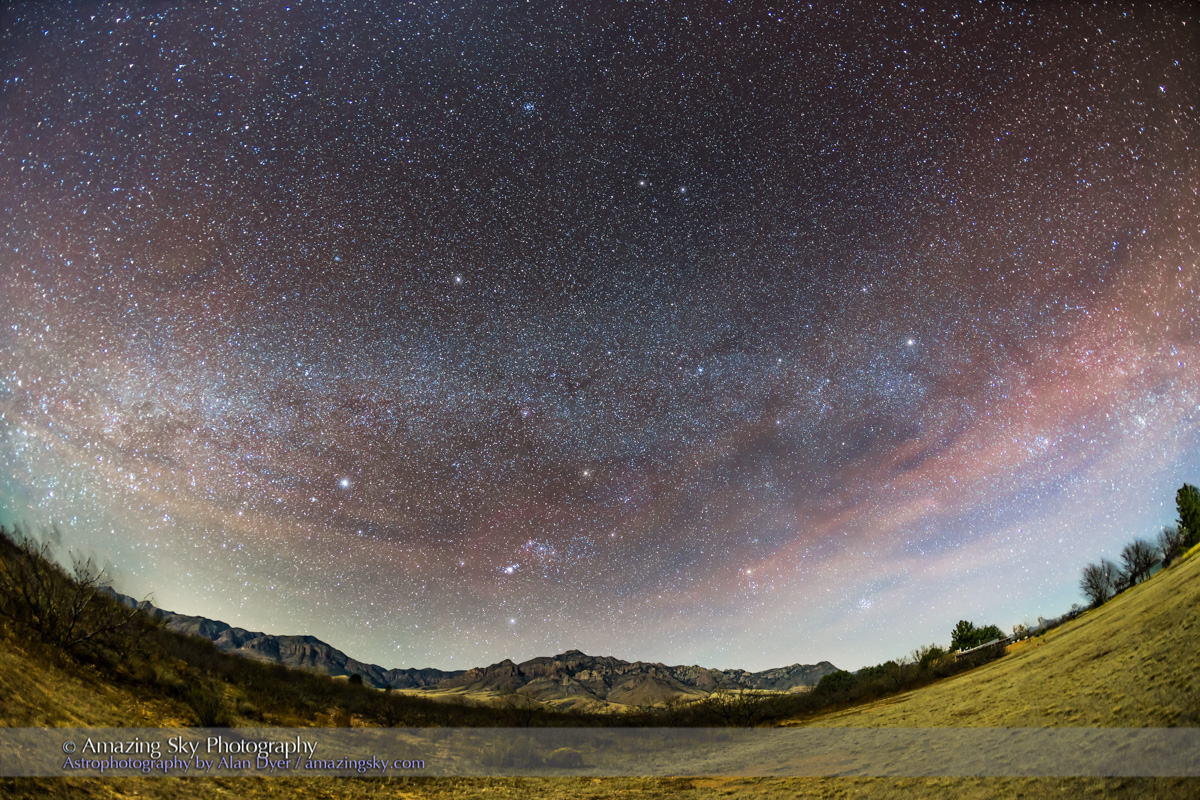
Orion and the northern winter constellations and Milky Way setting at dawn over the Chiricahua Mountains of southwest Arizona, near Portal, AZ. The waning crescent Moon in the west provided the illumination in this dawn shot from December 6, 2015. Orion is just above the main peak at centre, with Sirius, in Canis Major, to the left and Aldebaran, in Taurus, to the right. The Pleiades are setting at right. The star cluster at top is the Beehive, M44, in Cancer. Bands of airglow add the red streaks. The site is the Quailway Cottage near Portal, Arizona. This is a stack of 4 x 2 minute exposures, tracked, at f/3.5 with the 15mm full-frame fish-eye lens and Canon 6D at ISO 1250, for the sky, and the same specs for 4 exposures, untracked for the ground. Each set was mean-combined stacked to reduce noise.

This was the winter Milky Way with Orion setting into the west over the Chiricahuas at dawn. Turn around from looking at the comet and thisย was the view. So who cares if the comet isn’t too great? There’s lots more to see and shoot. With no snow, no frost, no dew.

More to come this week I trust!

โ€” Alan, December 6, 2015 / ยฉ 2015 Alan Dyer / www.amazingsky.com

Circles and Lines in the Dawn Sky


A classic 22ยฐ ice crystal halo around the waning crescent Moon, here overexposed, with the Moon between Jupiter and Mars in the morning sky on December 5, 2015. Seeing a halo around a crescent Moon is somewhat rare as they usually require the brighter light of the Full Moon. Venus is the brightest object at bottom closest to the horizon. The three planets, along with the stars Spica (above Venus) and Regulus (at top of frame) define the line of the ecliptic here in the dawn late autumn / early winter sky. I captured this scene from southeast Arizona near the Arizona Sky Village at Portal. This is a stack of 4 exposures from long to short (8s to 1/2s) to encompass the great range in brightness and not overexpose the crescent Moon too much. Images were layered in Photoshop and masked with luminosity masks. Automatic HDR techniques did not work well as the shortest image was too dark for ACR to find content to register in Merge ot HDR, and in Photoshop the HDR Pro module left visible edge artifacts. The camera was on the iOptron Sky Tracker to follow the sky and register the sky for all the exposures, thus the slightly blurred ground. Taken with the Canon 6D and 15mm full-frame fish-eye lens.

Cloud hid Comet Catalina but added a halo around the waning Moon, intersected by the line of the ecliptic.

I’m in Arizona, just inside the state lineย with New Mexico, on a quest to shoot Comet Catalina at dawn. Clouds prevented any view of the faint comet this morning but provided a fine consolation prize.

The waning crescent Moon was surrounded by an ice crystal halo, a rare sight around a thin Moon. The Moon was between Mars and Jupiter, heading toward a conjunction with Venus, below, on December 7.

The line of Venus, Mars, the Moon, and Jupiter, plus the stars Spica and Regulus defined the line of the ecliptic beautifully in the pre-dawn sky.

A classic 22ยฐ ice crystal halo around the waning crescent Moon, here overexposed, with the Moon between Jupiter and Mars in the morning sky on December 5, 2015. Seeing a halo around a crescent Moon is somewhat rare as they usually require the brighter light of the Full Moon. Venus is the brightest object at bottom closest to the horizon. The three planets, along with the stars Spica (above Venus) and Regulus (at top of frame) define the line of the ecliptic here in the dawn late autumn / early winter sky. I captured this scene from southeast Arizona near the Arizona Sky Village at Portal. This is a stack of 4 exposures from long to short (8s to 1/2s) to encompass the great range in brightness and not overexpose the crescent Moon too much. Images were layered in Photoshop and masked with luminosity masks. Automatic HDR techniques did not work well as the shortest image was too dark for ACR to find content to register in Merge ot HDR, and in Photoshop the HDR Pro module left visible edge artifacts. The camera was on the iOptron Sky Tracker to follow the sky and register the sky for all the exposures, thus the slightly blurred ground. Taken with the Canon 6D and 15mm full-frame fish-eye lens.
This is a stack of 4 exposures from long to short (8s to 1/2s) to encompass the great range in brightness and not overexpose the crescent Moon too much. Images were layered in Photoshop and masked with luminosity masks. Automatic HDR techniques did not work well as the shortest image was too dark for ACR to find content to register in Merge ot HDR, and in Photoshop the HDR Pro module left visible edge artifacts.
The camera was on the iOptron Sky Tracker to follow the sky and register the sky for all the exposures, thus the slightly blurred ground. Taken with the Canon 6D and 15mm full-frame fish-eye lens.

It was a show of circles and lines, real and imagined, in the morning sky.

With luck, clouds will clear to reveal Comet Catalina, which is likely fainter and less spectacular than hoped. But such is the way of comets. Regardless of what the comet does, it is a good time to be in the desert southwest, typing this blog on a sunny front porch under blue desert skies.

โ€” Alan, December 5, 2015 / ยฉ 2015 Alan Dyer /ย www.amazingsky.com


Moonlighting at Monument Valley


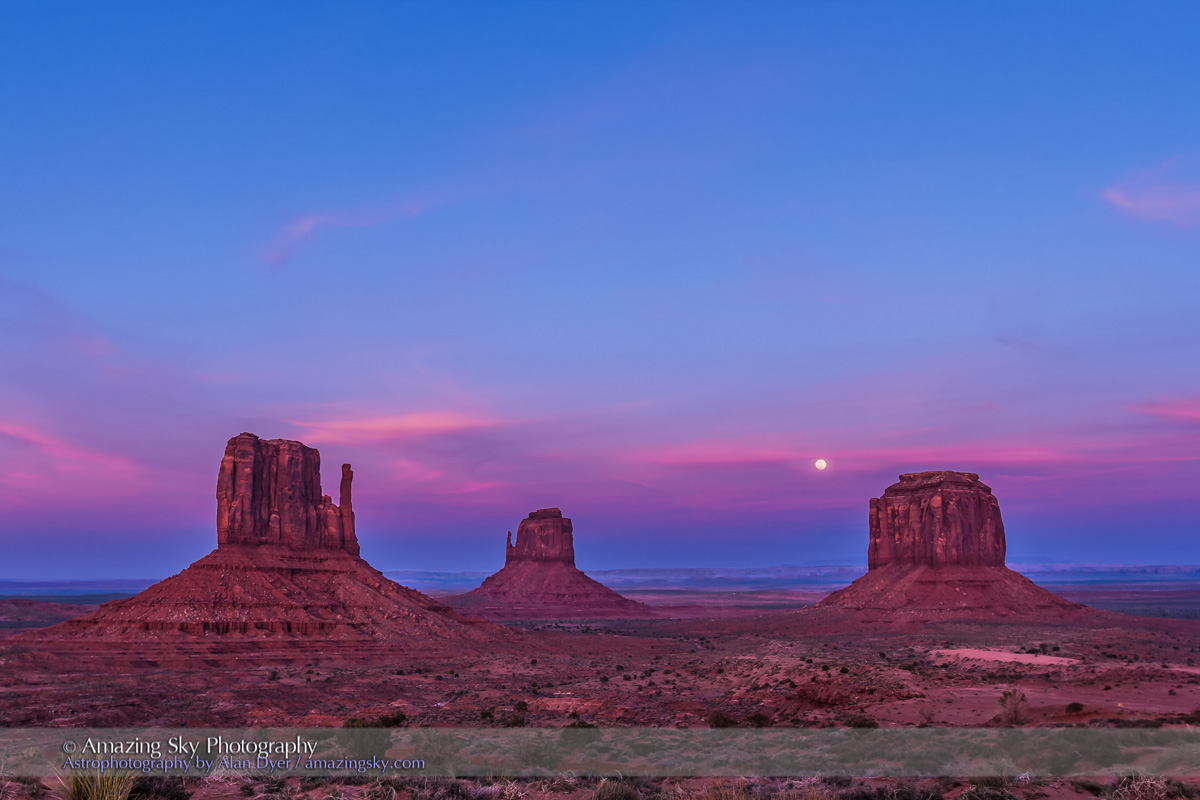
Moonrise Behind the Mittens at Monument Valley (#1)

The Full Moon rises behind the famous Mitten buttes at Monument Valley.

I spent a fabulous weekend capturing sunsets and nightscapes at the iconic Monument Valley on the Utah/Arizona border,ย the photogenic outdoor setย of dozens movies over the decades.

On the eve of the total lunar eclipse I shot the nearly Full Moon rising behind the West (left)ย and East (centre)ย Mittens and Merrick Butte (at right). On the evening of Friday, April 3 the Moon rose and sat amid the sunlit clouds with the Sun still up.

The alignment that would place the Moon directly opposite the Sun to create the eclipse was still 11 hours away.

Note how the butte’s shadows point almost, but not quite directly, at the nearly Full Moon. They point at the place in the sky the Moon would be before dawn at the end of that night.

Indeed, on eclipse morning on Saturday, April 4 the Moon set exactly as the Sun rose (see my photos in my previous blog).

But on eclipse eve the Moon rose 30 minutes before the Sun set, providing a chance to catch the Moon behind the still sunlit red buttes.

Moonrise Behind the Mittens at Monument Valley (#2)

I shot this image about 20 minutes after sunset on April 3, so the foreground is now in shadow but the Moon appears in a more richly tinted twilight sky.

Orion and Venus Setting at Monument Valley

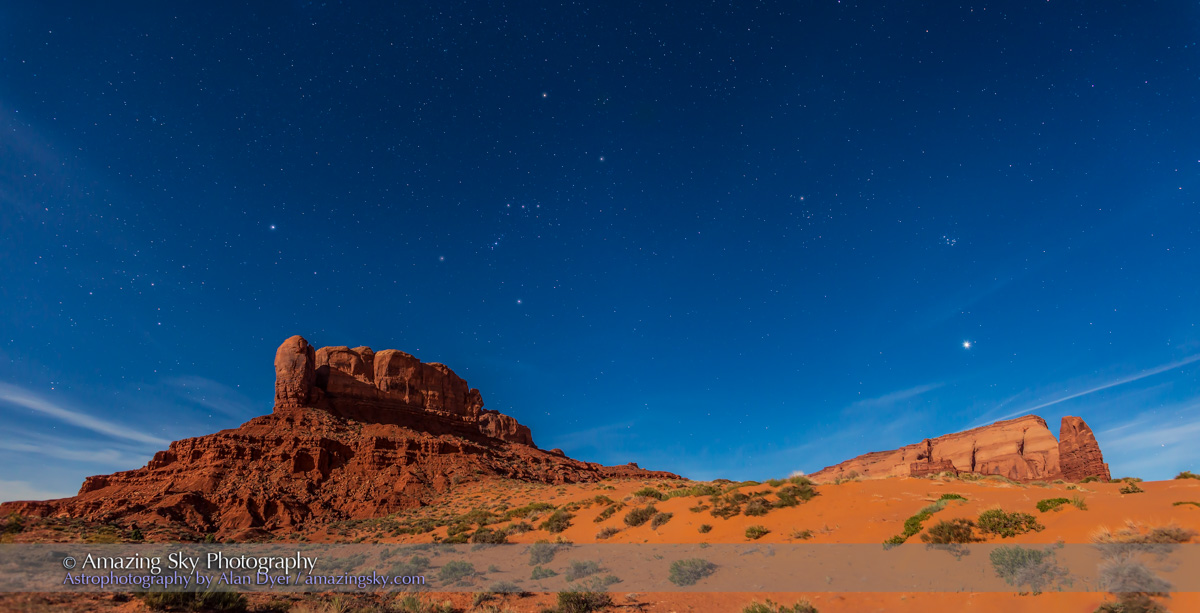
Later on April 3 I captured this scene, with the Tear Drop and Rock Door Mesas now lit by a bright Full Moon, and with the stars of the winter sky setting into the west. Canis Major and Orion are at left, while Taurus, including the Pleiades star cluster and brilliant Venus, are at right.

The Orion & Venus image is a 2-panel panorama.

Moonbeams at Monument Valley

On the evening of April 4, clouds thwarted plans for a long star trail sequence above a moonlit foreground.

Instead, I shot toward the Moon and clouds, to capture subtle moonbeams radiating out from the Moon, now some 14 hours after the eclipse, rising behind Merrick Butte. I shot this from the dusty Loop Road that winds through the valley floor.

Big Dipper over West Mitten, Monument Valley

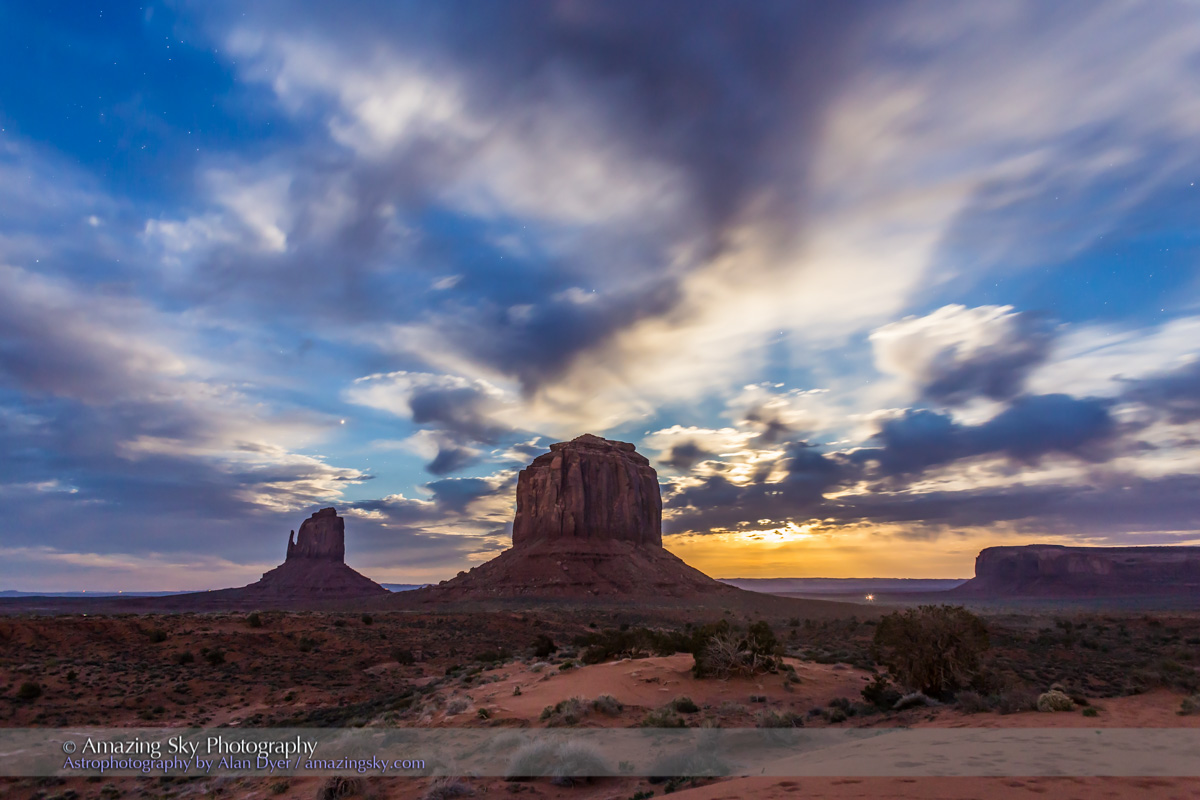
Instead of lots of images for a star trail composite, I was content to shoot this one image, catching the Big Dipper in a brief hole in the drifting clouds, hanging in the sky over the West Mitten butte. The foreground is lit by the partly obscured Full Moon. The long exposure streaks the moving clouds.

Night or day, it’s hard not to take a great photo here, clouds or not!

Sunset Panorama at Monument Valley

On my final evening at Monument Valley, high winds common to the area, blowing dust, and the closed Loop Road, scuttled plans again for long star trail sequences from the valley floor.

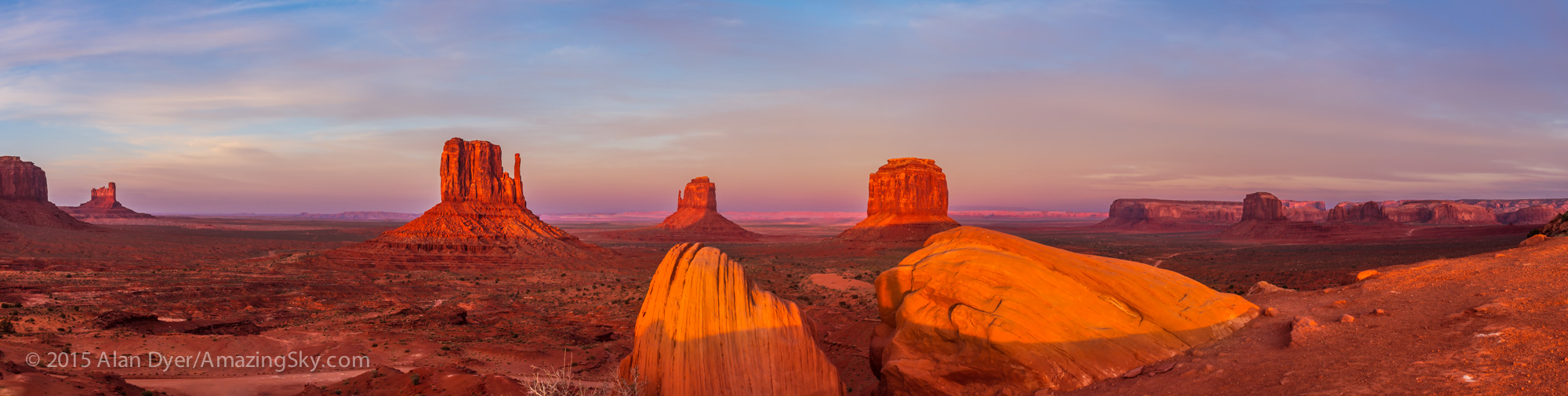
So on Easter Sunday, April 5, I settled for a panorama from the classic viewpoint showing the setting Sun lighting the buttes and mesas of Monument Valley.

It is an amazing place, but one that still requires patience to wait out the clouds and dust storms.

โ€“ Alan, April 6, 2015 / ยฉ 2015 Alan Dyer / www.amazingsky.com

Open Road, Open Sky


Open Road and Open Sky

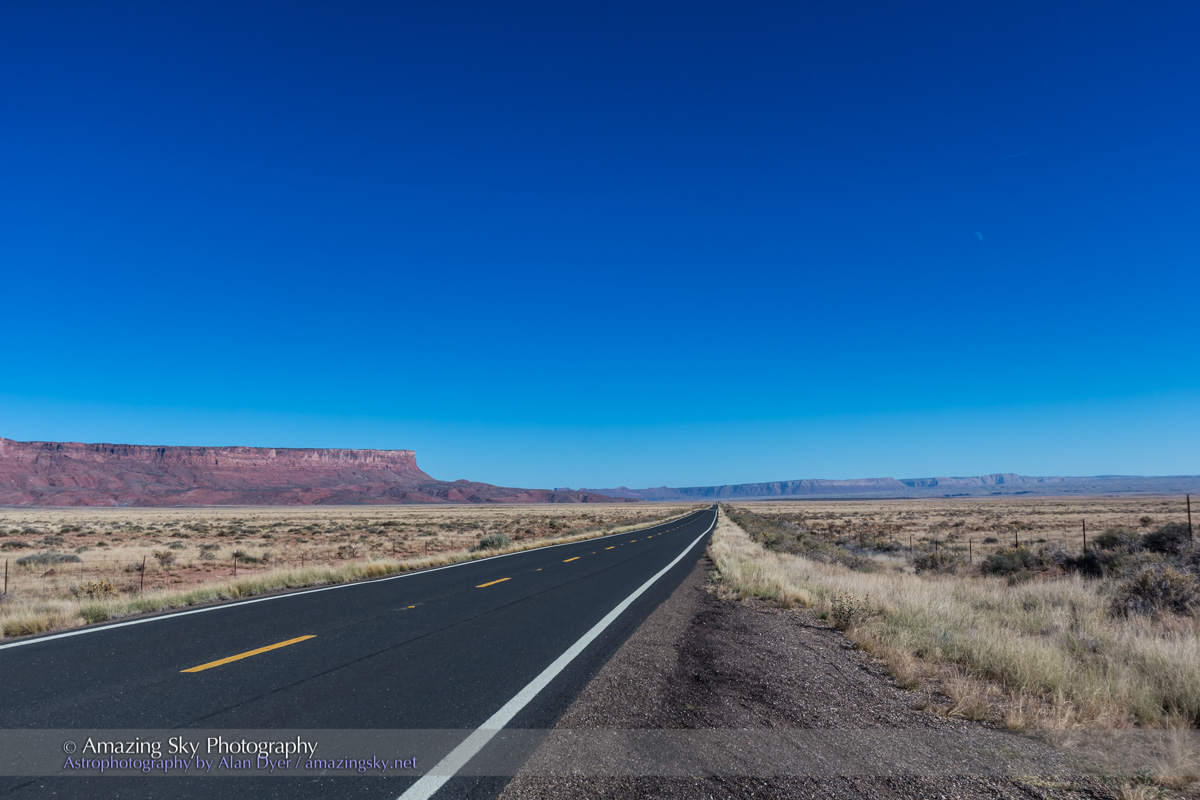
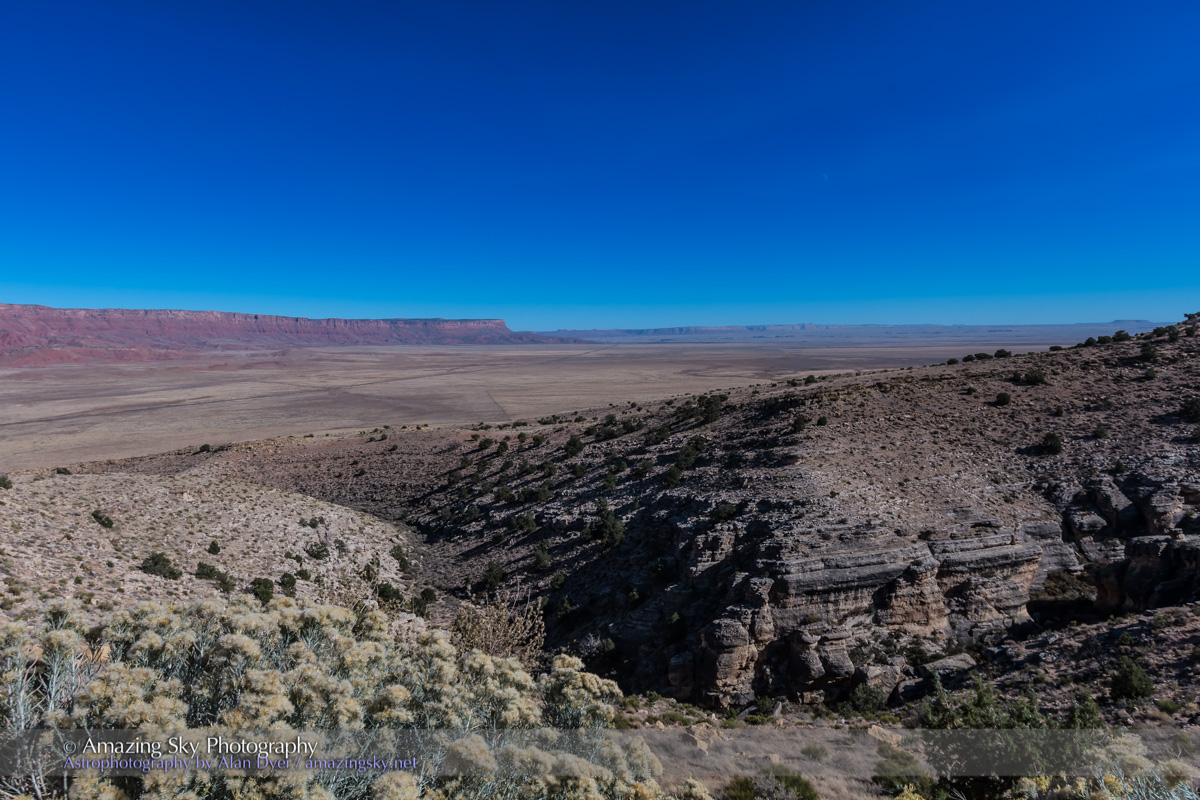
A desert highway leads off into anย open blue sky with theย waxing Moon.

This week I’m on the road heading south for the winter. Today, I was on US 89, one of the most spectacular roads on the continent, passing through southern Utah and northern Arizona.

At left are the Vermilion Cliffs in Arizona, contrasting with the blue sky and the quarter Moon rising in the east at right.

Waxing Moon over Vermilion Cliffs

I took this view minutes earlier, from a viewpoint above the desert as US 89 descends from the Kaibab Plateau and the area around the North Rim of the Grand Canyon.

I have not driven through this area of theย U.S. Southwest in 20 years. I’ll be back through here in spring, when I hope to shoot the April 4 total lunar eclipse from the Four Corners area.

โ€“ Alan, October 30, 2014 / ยฉ 2014 Alan Dyer

Goodbye Winter Sky โ€“ 2014 Edition


Orion Setting & Zodiacal Light (24mm 6D)

After a brutal winter for most of us in the northern hemisphere, we’re glad to see the last of the winter sky.

This was the scene on Tuesday night, April 29 as the last of the winter sky descended into the evening twilight.

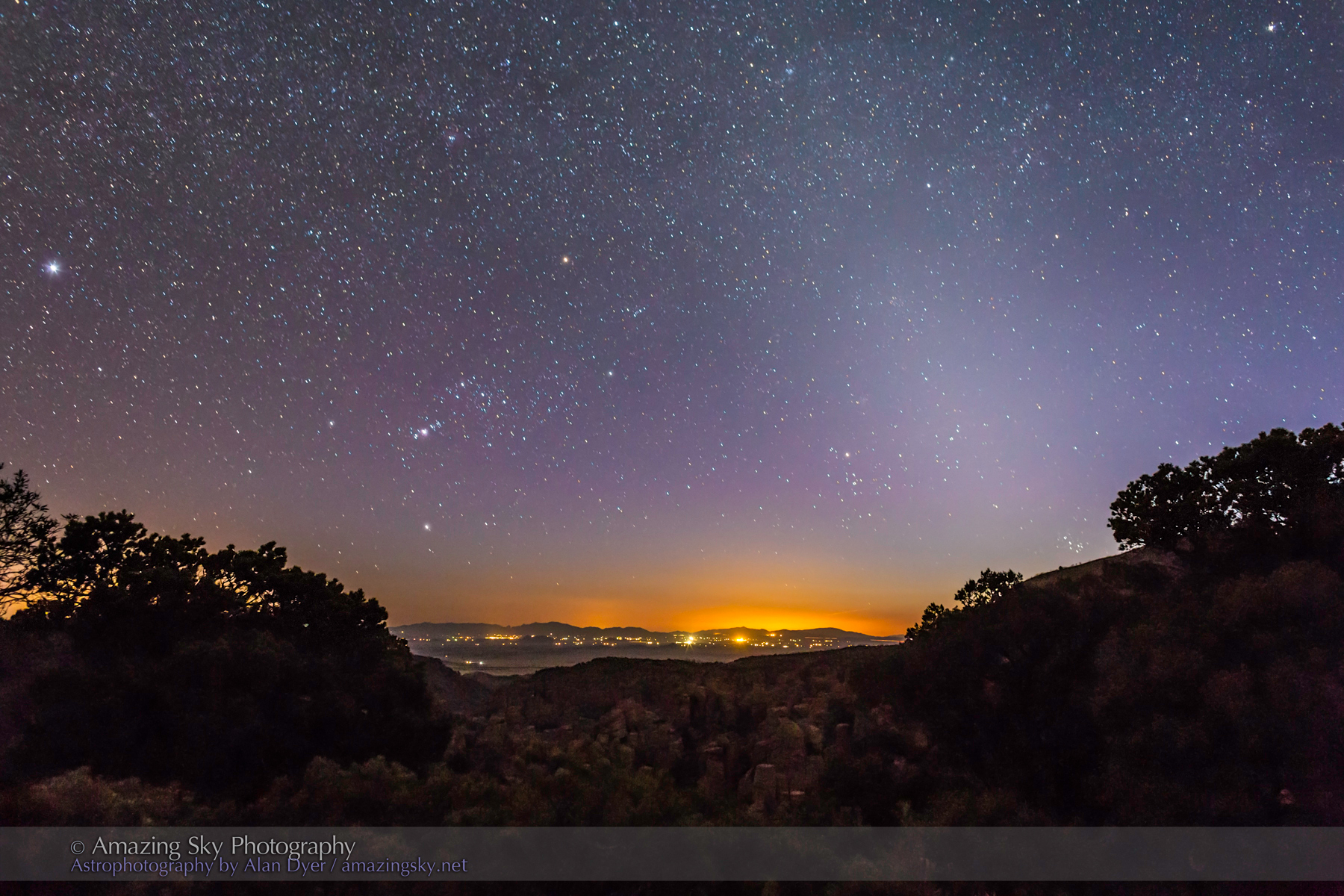
Here, Orion (left of centre) sets into the western sky, next to the gossamer glow of the zodiacal light (right of centre). The stars of Taurus sit amid the zodiacal light, with the Pleiades just about to set behind the ridge. Sirius, the sky’s brightest star, shines at far left.

The zodiacal light is the glow of sunlight reflecting off cometary dust particles in the inner solar system. It is a glow from interplanetary space, not from our atmosphere. Spring is the best time to see it in the evening sky, no matter your hemisphere. It also helps to be in the desert of the U.S. Southwest!

I tookย this parting shot of the winter sky from a favourite observing haunt from years’ past, Massai Point, at 6800 feet altitude in the Chiricahua Mountains of southeastern Arizona. The skyย was perfectly clear and the night warm and windless. I’m back in Arizona and New Mexico for a few days, checking out accommodations for a long-term stay next winter, so I won’t have to endure the snow and cold that plagued us last winter. Good bye winter sky! Good bye winter!

โ€“ Alan, April 29, 2014 / ยฉ 2014 Alan Dyer


Venus in the Moonlight


Venus at Chiricahua National Monument (Dec 15, 2013) #3

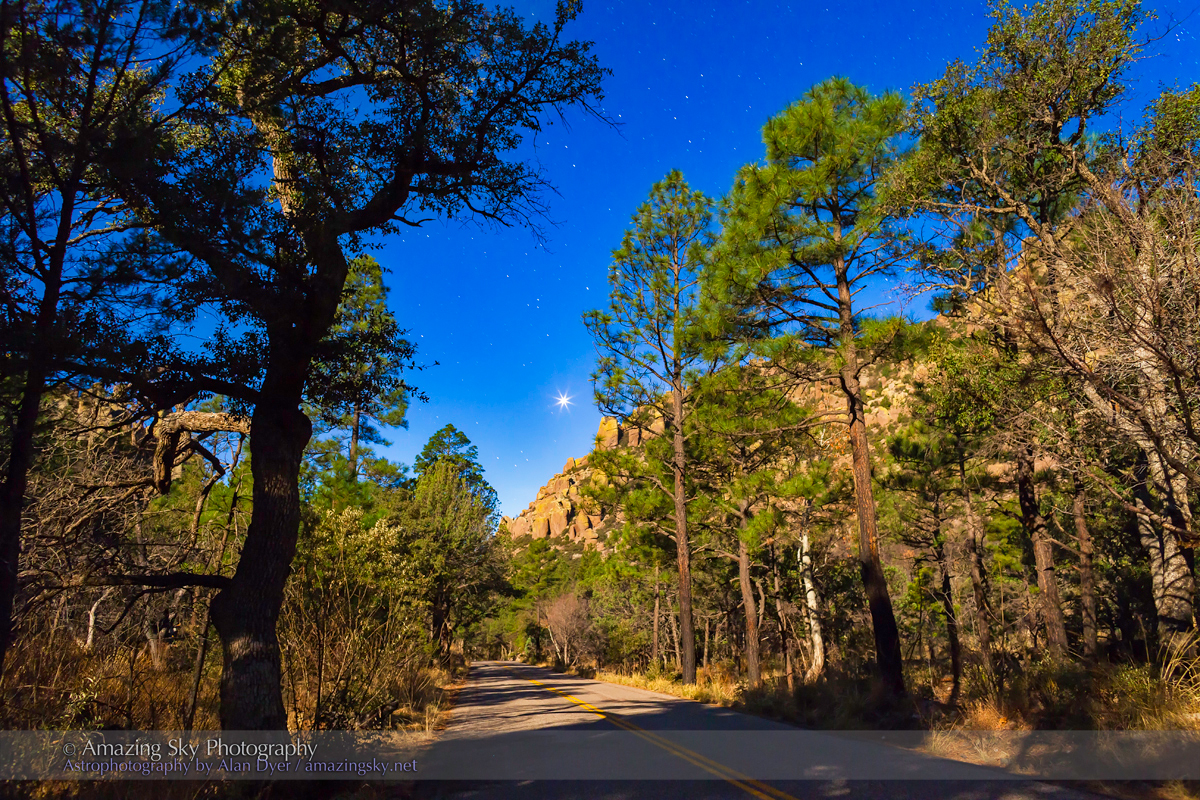
Venus blazes brightly in the moonlit sky in the Chiricahua Mountains of Arizona.

This was the view last night, from Massai Point at the summit of the Chiricahua Mountains, looking southwest toward Venus in the blue moonlit sky. A bright waxing gibbous Moon provided the illumination, turning night into day in these long exposures.

I started my trek around Arizona and New Mexico here, at Chiricahua National Monument two weeks ago, on December 3, when I took some sunset shots.

Venus at Chiricahua National Monument (Dec 15, 2013) #1

I end my trip by returning to the Chiricahuas, but now with a nearly Full Moon in the sky.

I saw this scene two weeks ago but didn’t shoot it then. So I returned to capture Venus at the end of a moonlit road, shining above the volcanic rock formations that are the distinctive feature of the National Monument.

Now, it’s home to Alberta and the snow and cold.

โ€“ Alan, December 16, 2013 / ยฉ 2013 Alan Dyer


Moon over the Chiricahuas


Moon over the Chiricahua Mountains #1

The waxing gibbous Moon rises over the Chiricahua Mountains of southeast Arizona.

This was the stunning scene on Sunday night, December 15, as I drove out to Chiricahua National Monument south of Willcox, Arizona for some moonlight photography. I stopped on Highway 186 to catch the colourful twilight in the east with the Moon rising over the desert mountains.

Moon over the Chiricahua Mountains #4

This image, taken a few minutes later, shows a darker sky but with more prominent crepuscular rays โ€“ shadows cast by distant clouds to the west where the Sun set. A photogenically placed windmill adds to the scene.

I love the contrast of Earth tones and twilight tints โ€“ a very desert-like palette.

โ€“ Alan, December 15, 2013 / ยฉ 2013 Alan Dyer


Twilight in the Chiricahuas


Evening Twilight in the Chiricahuas, Arizona (Dec 3, 2013)

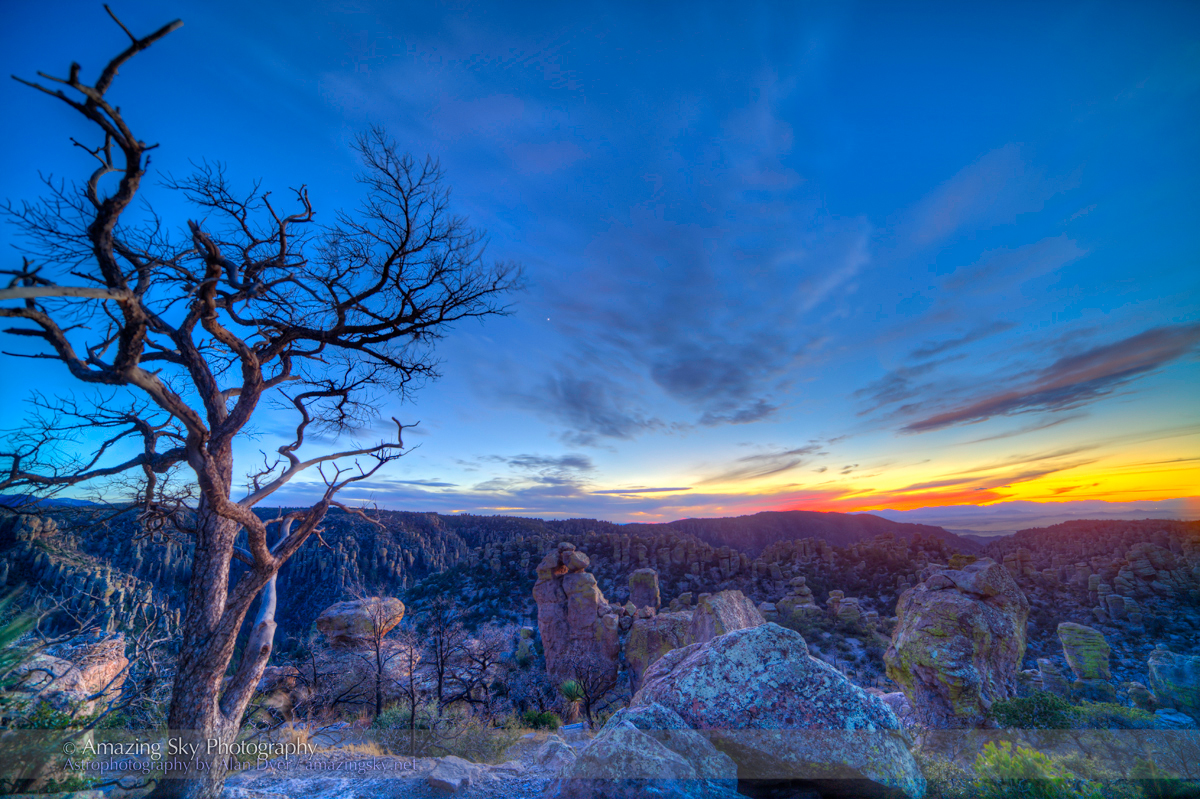
The colours of twilight illuminate the eroded rock formations of Chiricahua National Monument in southeast Arizona.

This was the scene tonight, Tuesday, December 3, as night fell over the Chiricahua Mountains in Arizona. The landscape below is a maze of eroded towers of ancient volcanic ash. The sky above is one of the finest on the continent for stargazing.

I spent a week or so here back in May 1995, stargazing with friends from the parking lot at Massai Point at the summit of the Chiricahuas. Tonight was my first visit back to that parking lot in 18 years. The evening was just as windy as I remember it in 1995. And as it was back then, Venus was in the western sky tonight.

Sunset in the Chiricahuas, Arizona (Dec 3, 2013)

This was sunset a few minutes earlier when the clouds were lit red by the setting Sun. I used a 24mm lens for this shot but a 14mm lens for the main image above.

Both shots are 7- to 8-frame “high dynamic range” composites that stack images taken in quick succession over a range of exposures from 2 stops under to 2 stops overexposed. The stack of images, when merged with HDR software, captures what one exposure cannot, due to the huge contrast between the bright sky and the dark foreground at twilight. I used Photomatix Pro software to do the merging and tonal balancing. Such amazing digital tools were unheard of and undreamed of in 1995!

โ€” Alan, December 3, 2013 / ยฉ 2013 Alan Dyer