I’ve been visiting Churchill, Manitoba during winter aurora season since 2014. But this was my last year for standing under its fabulous Northern Lights.
From February 21 to March 4, 2025 I was at the Churchill Northern Studies Centre for my annual visit serving as an instructor to visiting aurora tourists. I’d been doing the program for ten years, with a year off in 2021 when no one visited!
But I decided this was to be my last year, as it was time to “retire” and turn over the program to a new generation of instructors.
So here I present my last look at the Churchill auroras.
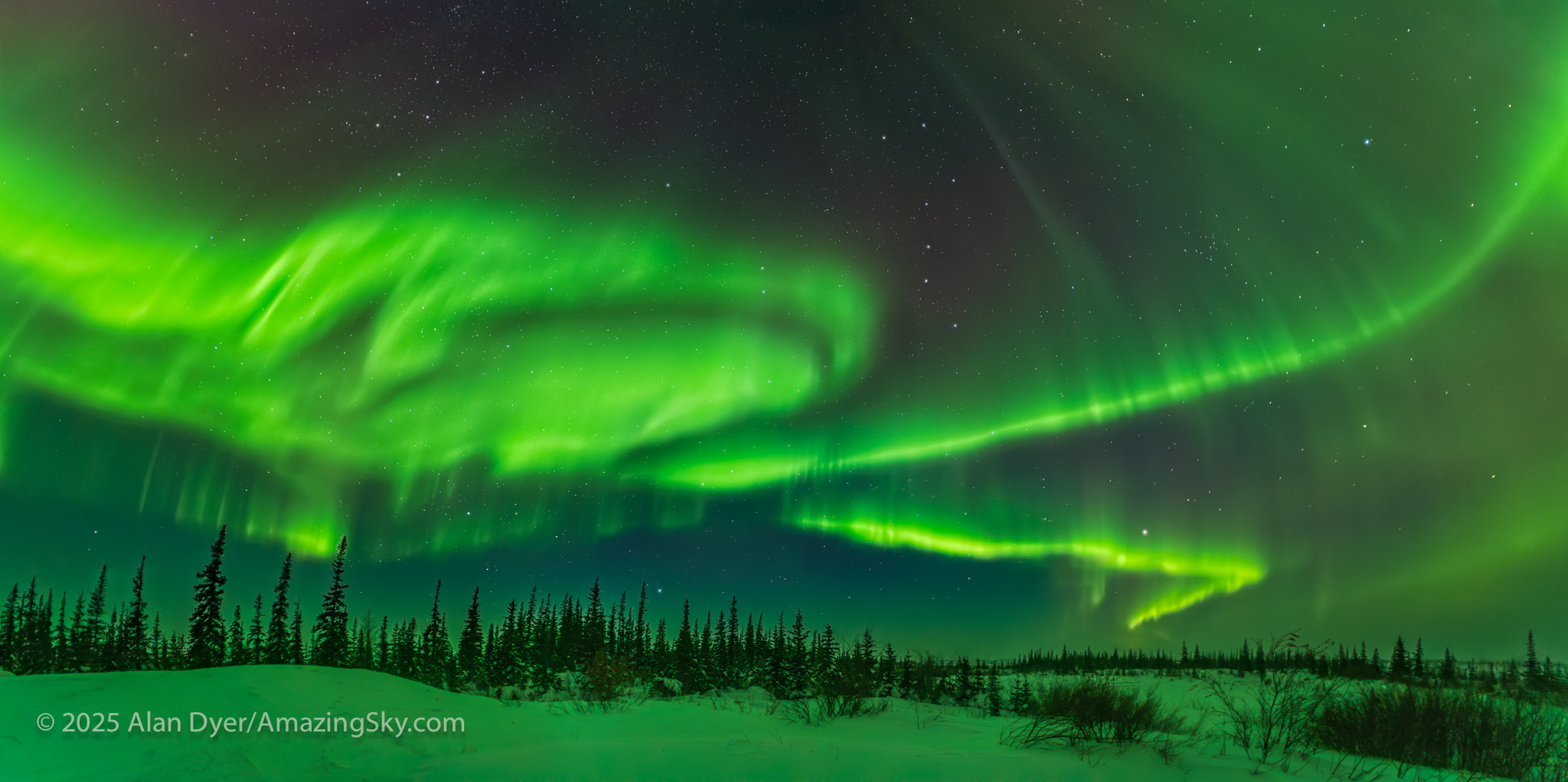
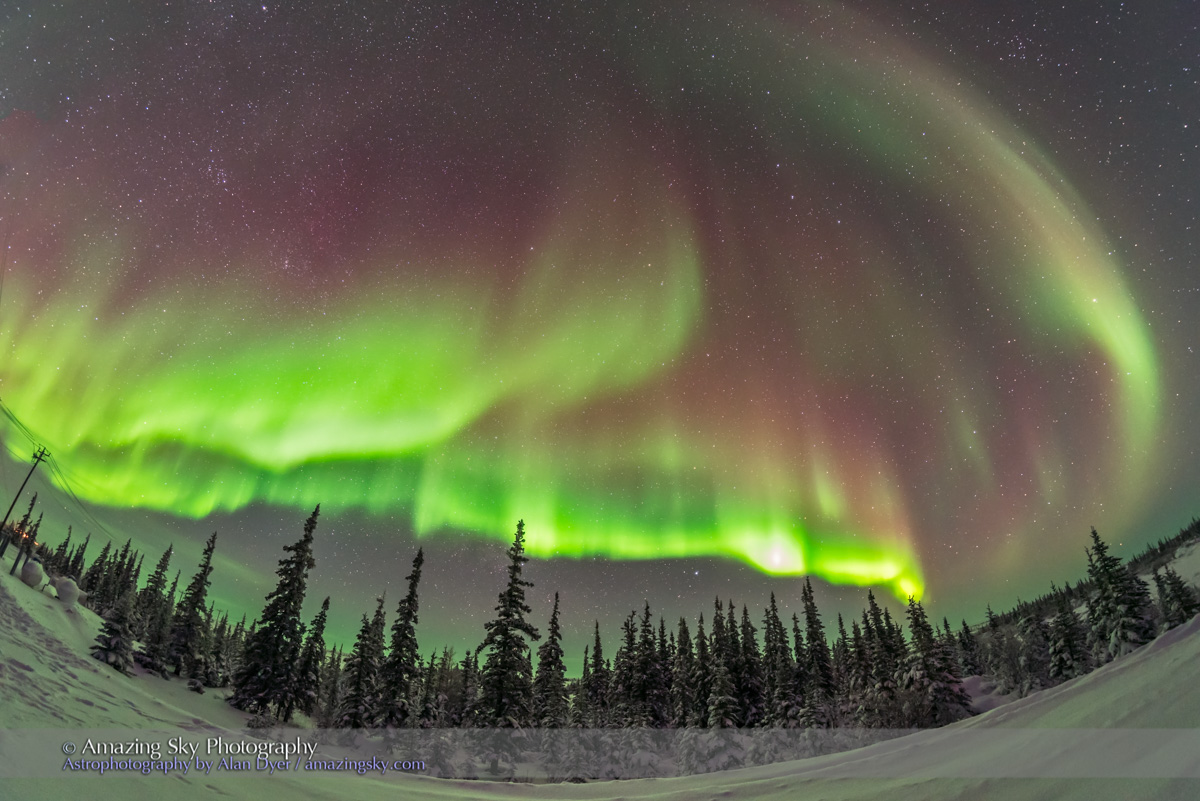
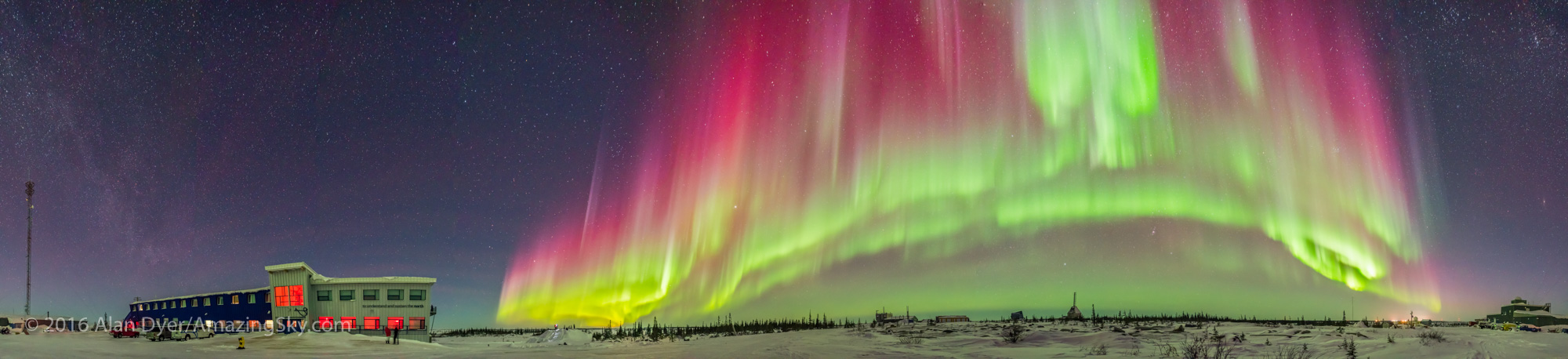
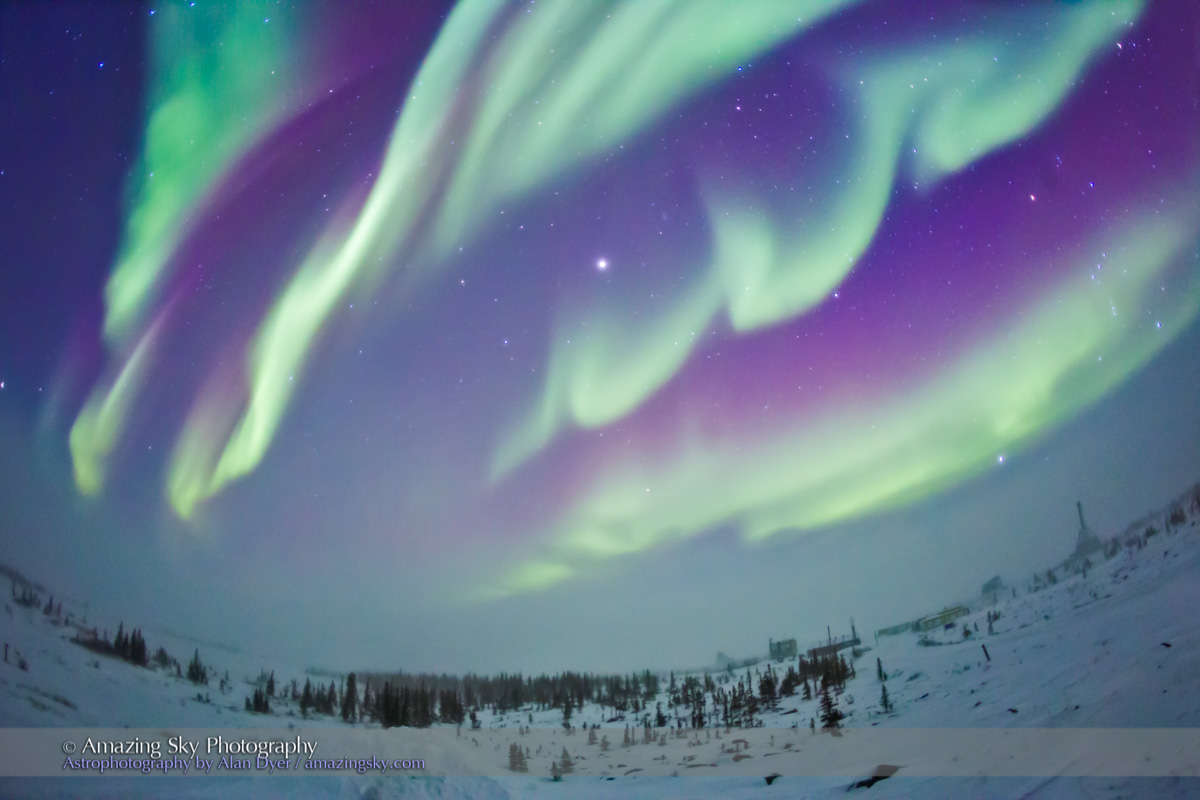
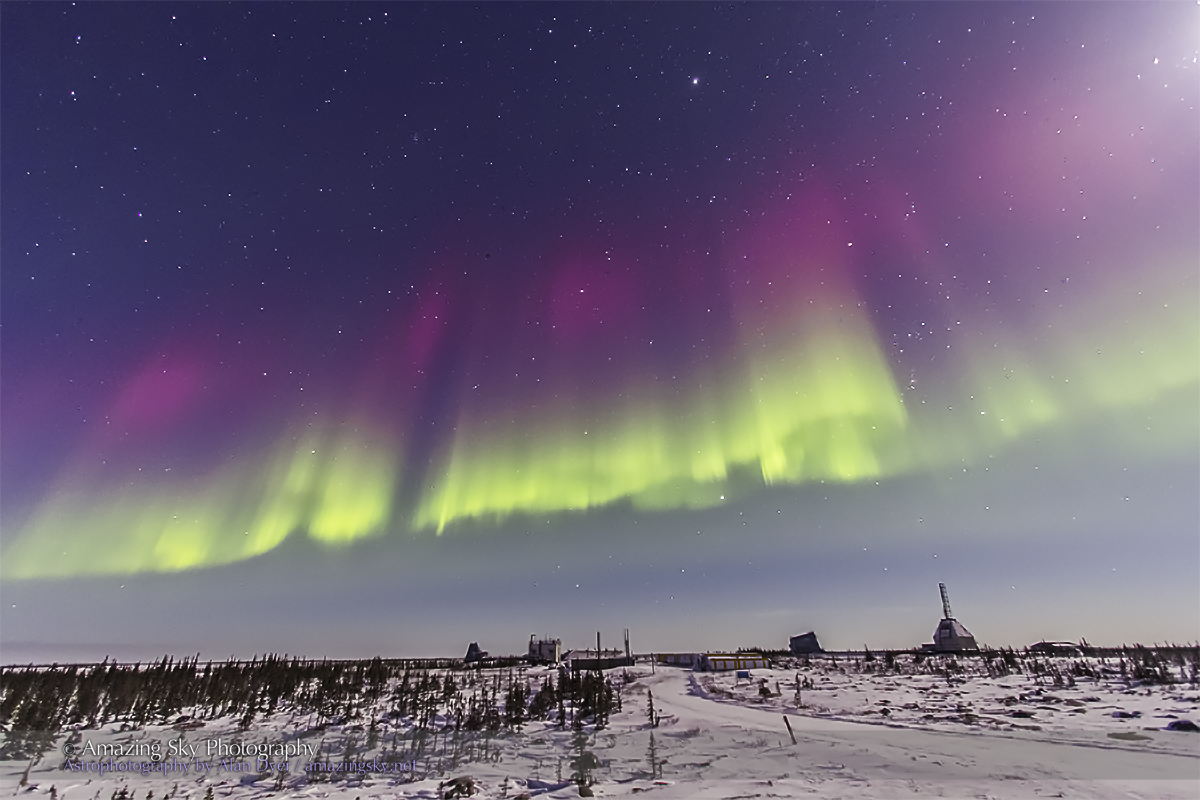
A 180º panorama across the north during an all-night display of Northern Lights, from the Churchill Northern Studies Centre, in Churchill, Manitoba, on February 22, 2025. A panorama of 7 segments, each 13-second exposures with the Viltrox 16mm lens at f/2 on the Nikon Z6III at ISO 1600.
Churchill, Manitoba is on the shore of Hudson Bay at a latitude of 58º North in the sub-Arctic.
It lies under the normal location of the “auroral oval,” the ring around the North Geomagnetic Pole where there is almost always some aurora happening, even on a quiet night. Churchill is as far south as the auroral oval appears in the world when the oval is in its normal state.
By visiting a site under the oval, aurora tourists are almost guaranteed a show, provided the sky is clear.
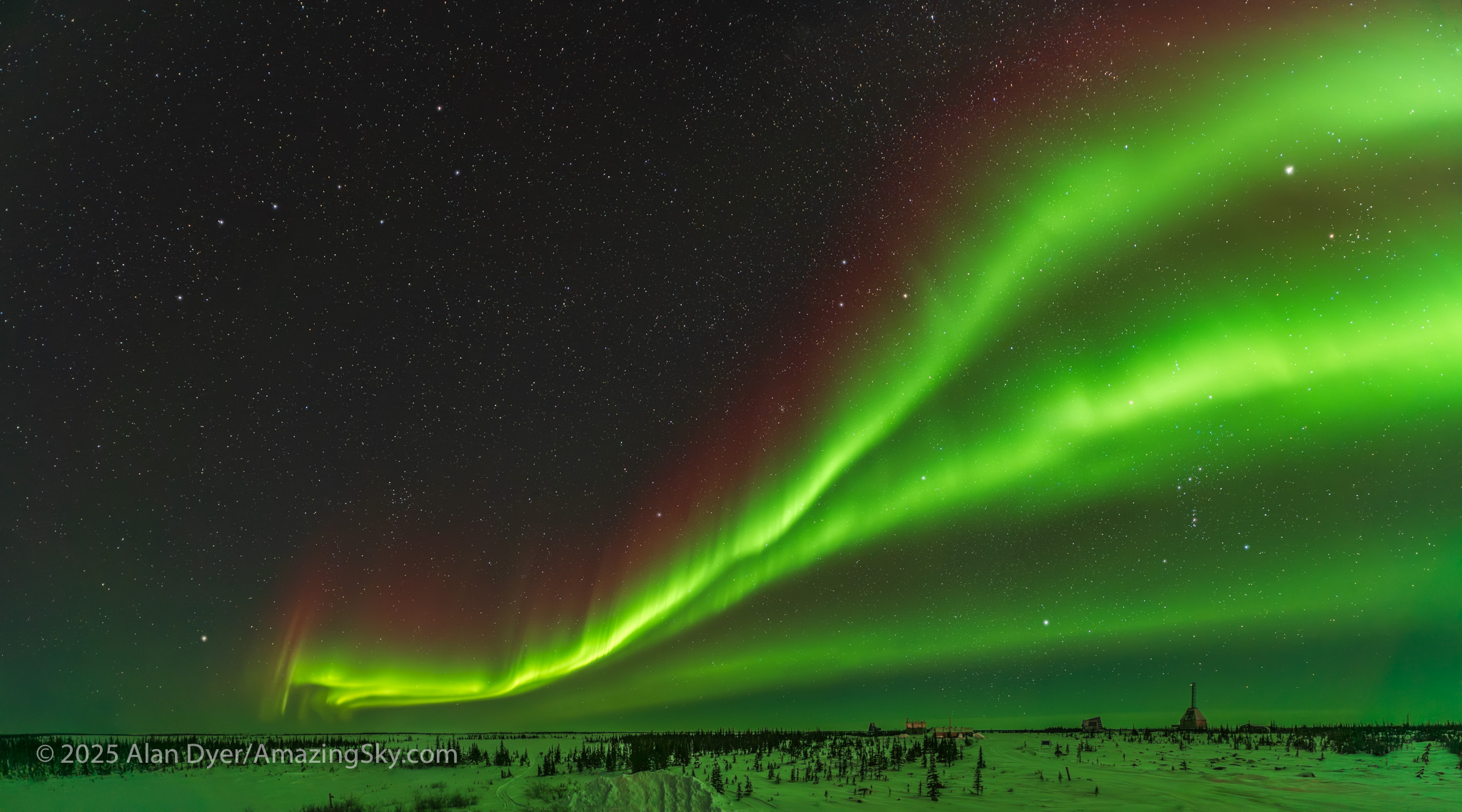
This is a 180º panorama of the Northern Lights across the northern, eastern and southern sky on February 27, 2025 during a Kp4-level display. This is a panorama of 3 segments, each 13-second exposures at f/2.8 with the Laowa 10mm lens on the Nikon Z6III at ISO 1600.
In winter in Churchill, the cold usually brings clear skies. In a decade of conducting programs I’ve only ever had one group clouded out for all five nights of the program. That’s a far better average than locations such as Iceland.
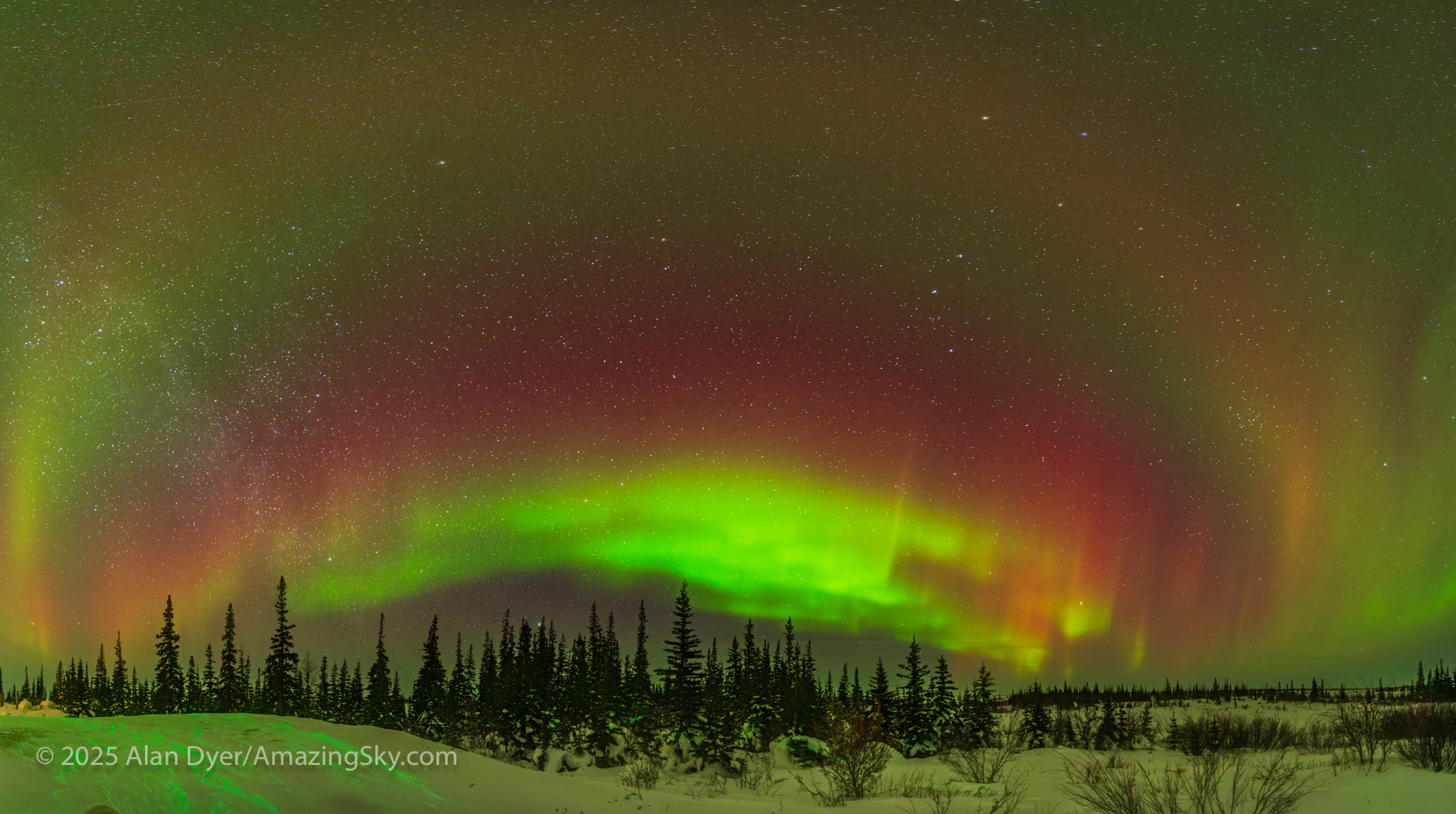
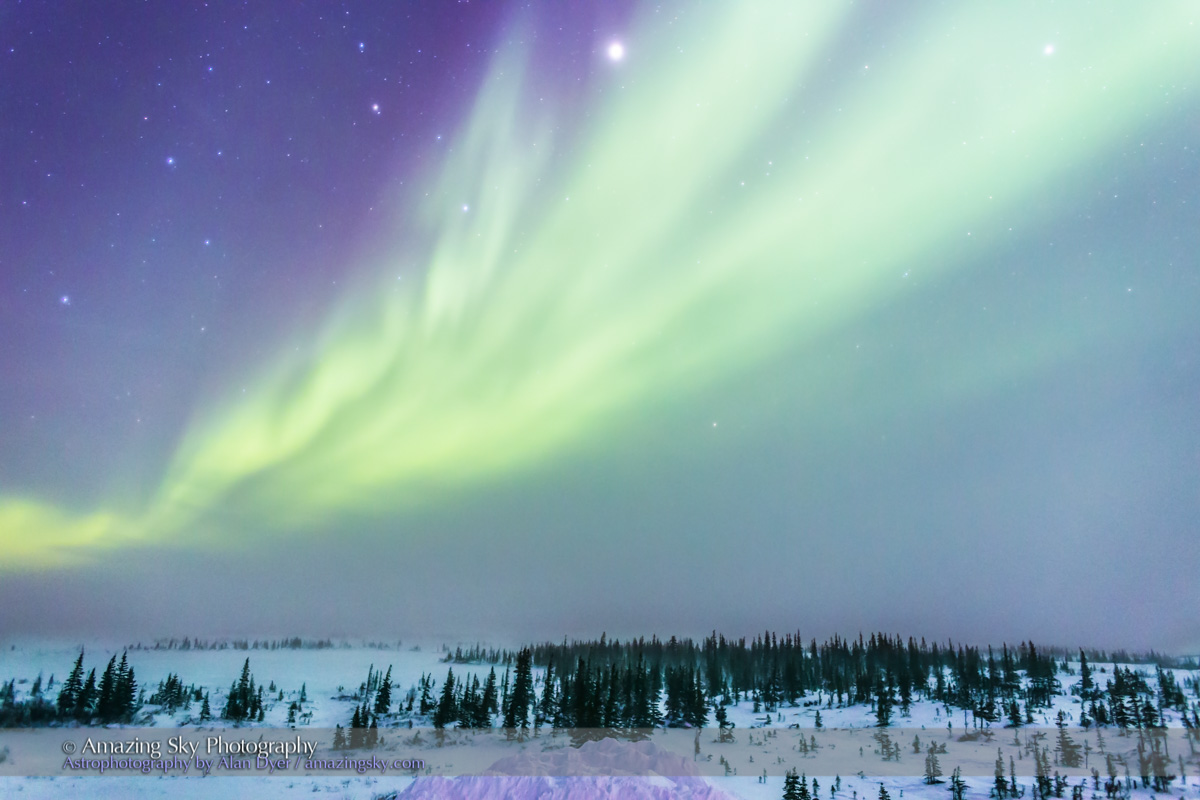
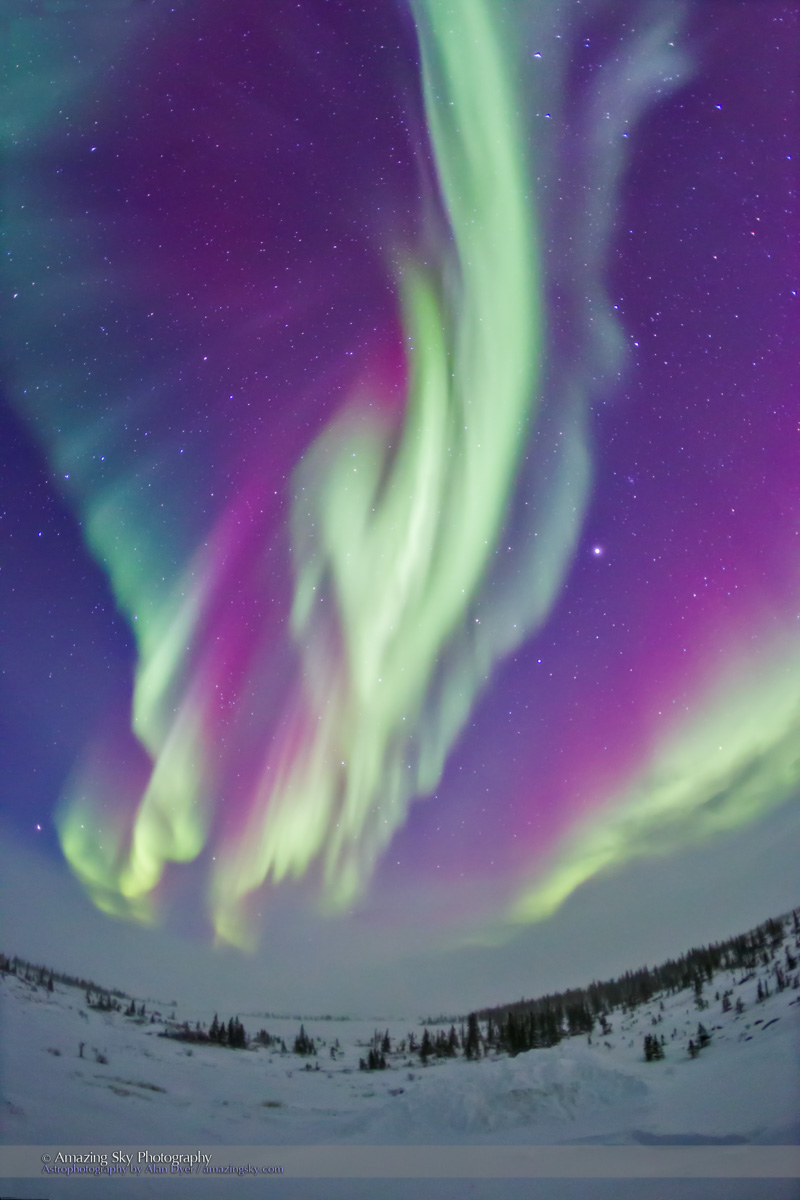
This is a 120º panorama of the Northern Lights across the northern sky on February 26, 2025 during a Kp3-level display. This shows some fine ray structure in the curtains. This is a panorama of 2 segments, each an 8-second exposure at f/2.8 with the Laowa 10mm lens on the Nikon Z6III at ISO 1600.
While several excellent travel companies and local businesses offer aurora tours to Churchill, signing up to one offered by the Northern Studies Centre offers some major advantages.
Notably, guests stay at the Centre, some 20 kilometres outside of Churchill on the site of the old Rocket Range. That makes the site dark and free of light pollution.
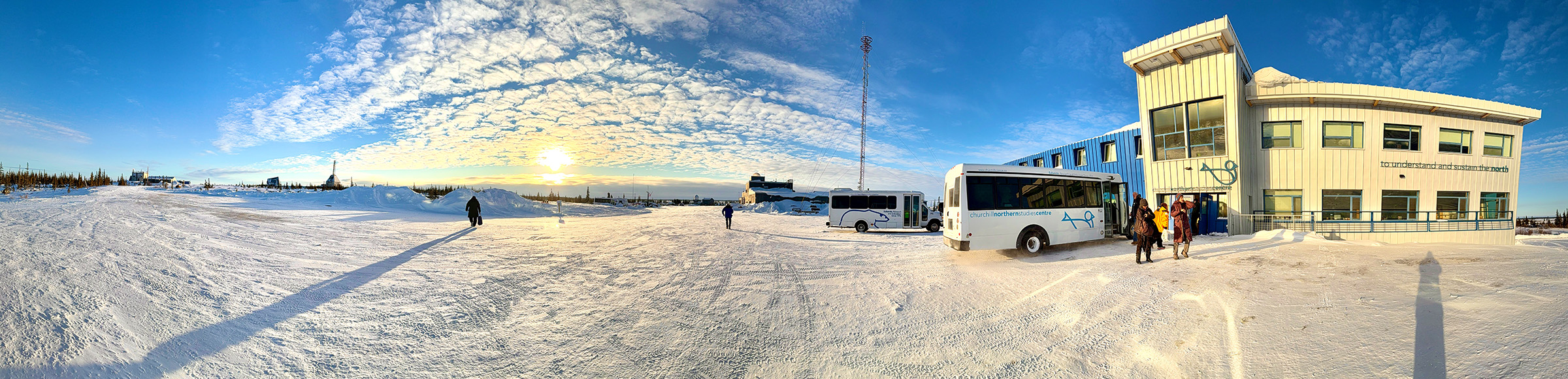
A panorama of the Northern Studies Centre. It has dorm rooms, a cafeteria, classrooms, lounges, a fitness room, library, and all the comforts needed for a great stay under the Lights.
And convenient. Guests sleep on site and need only dress up warm to quickly head outside when the “Lights are out!” call comes. Instructors wake up guests when the Lights don’t appear until late at night, as can often be the case. There’s no driving out to dark sites to wait for the Lights to appear.
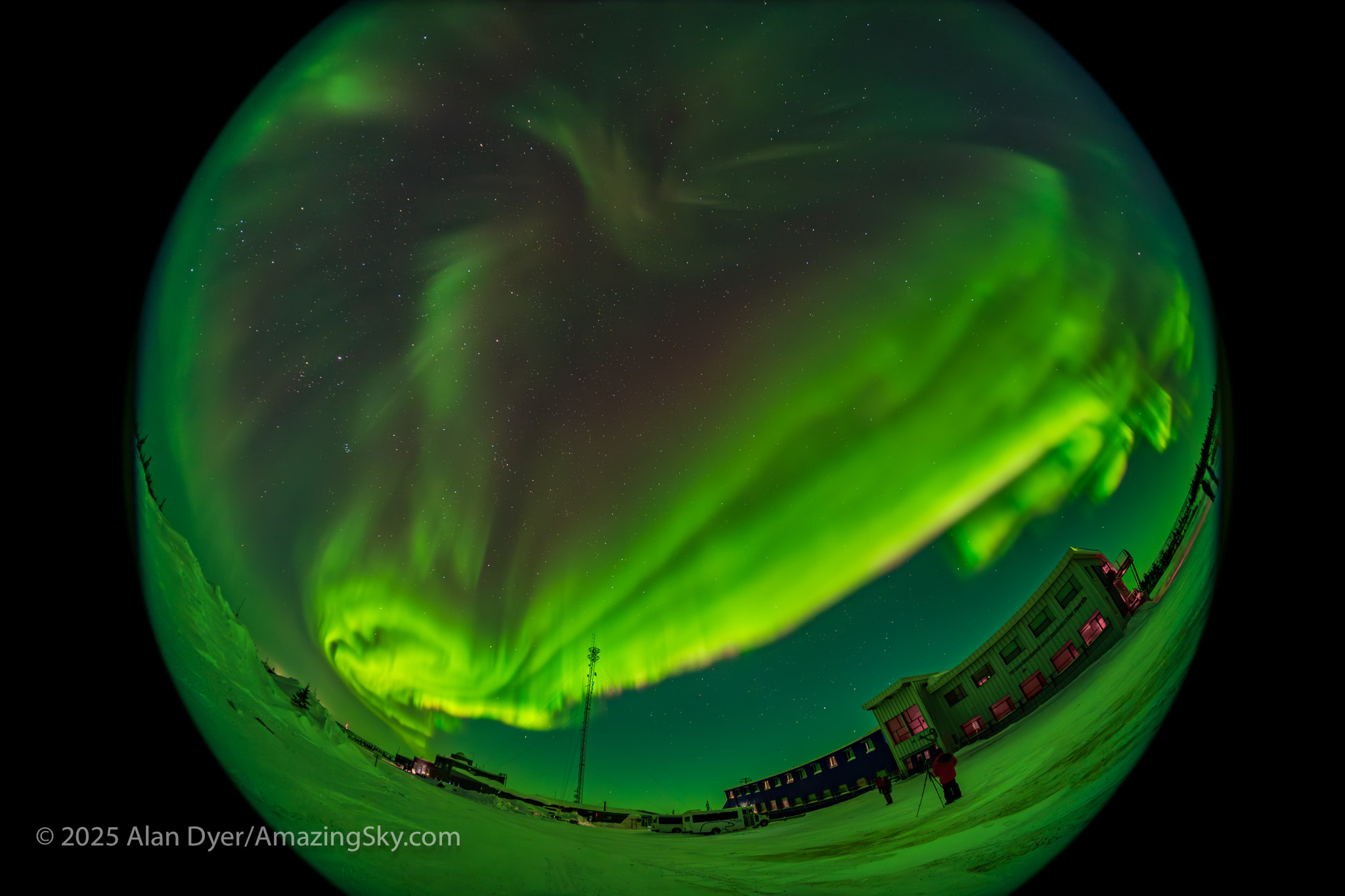
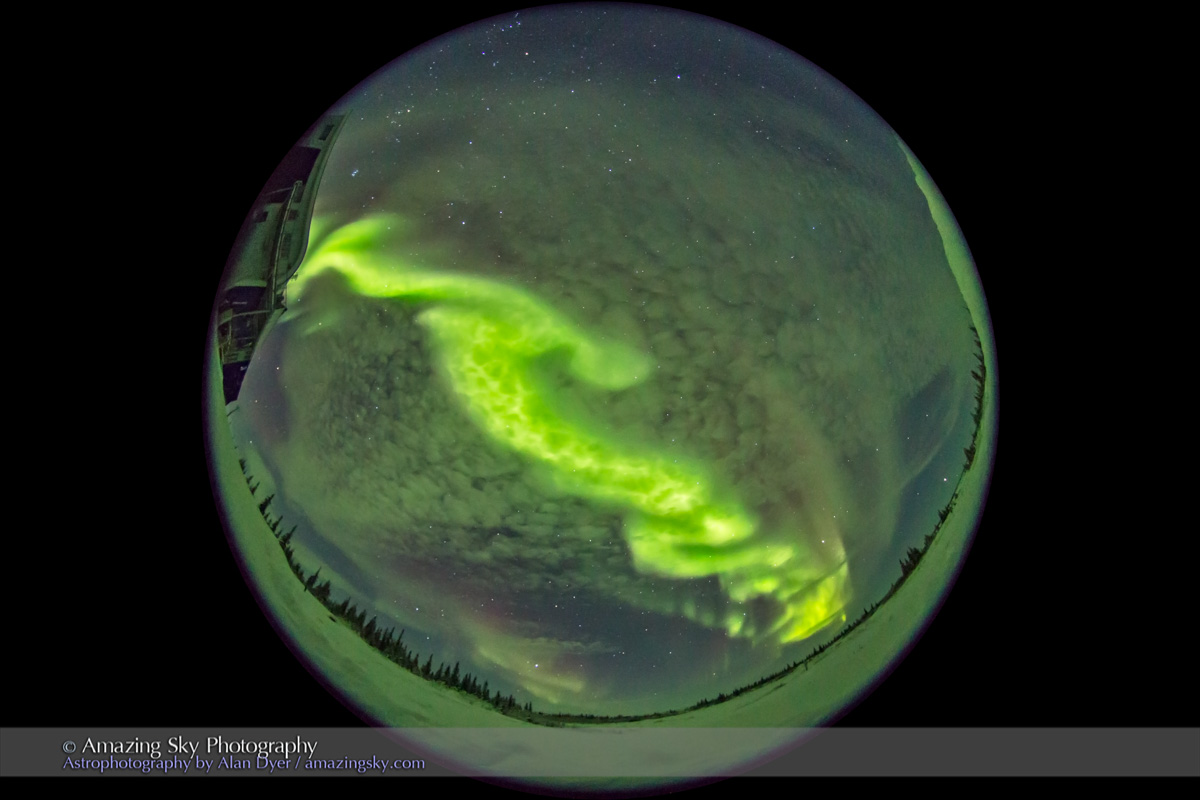
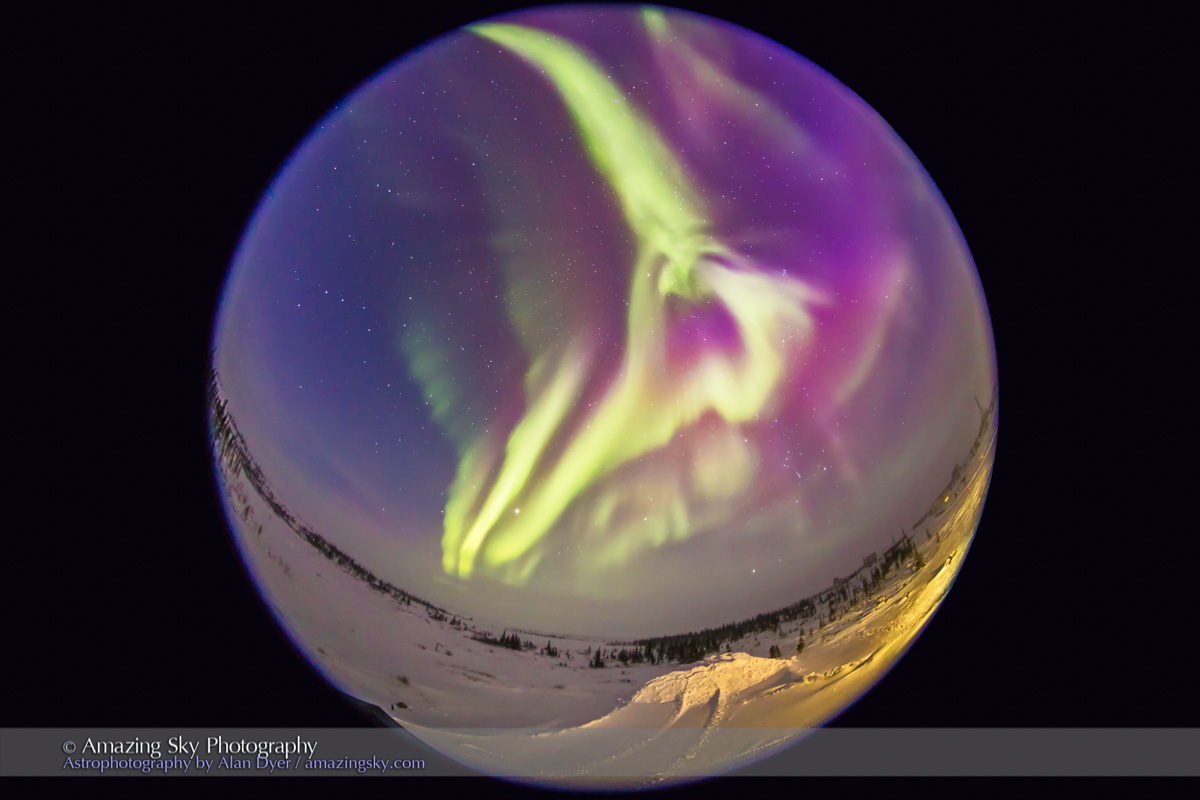
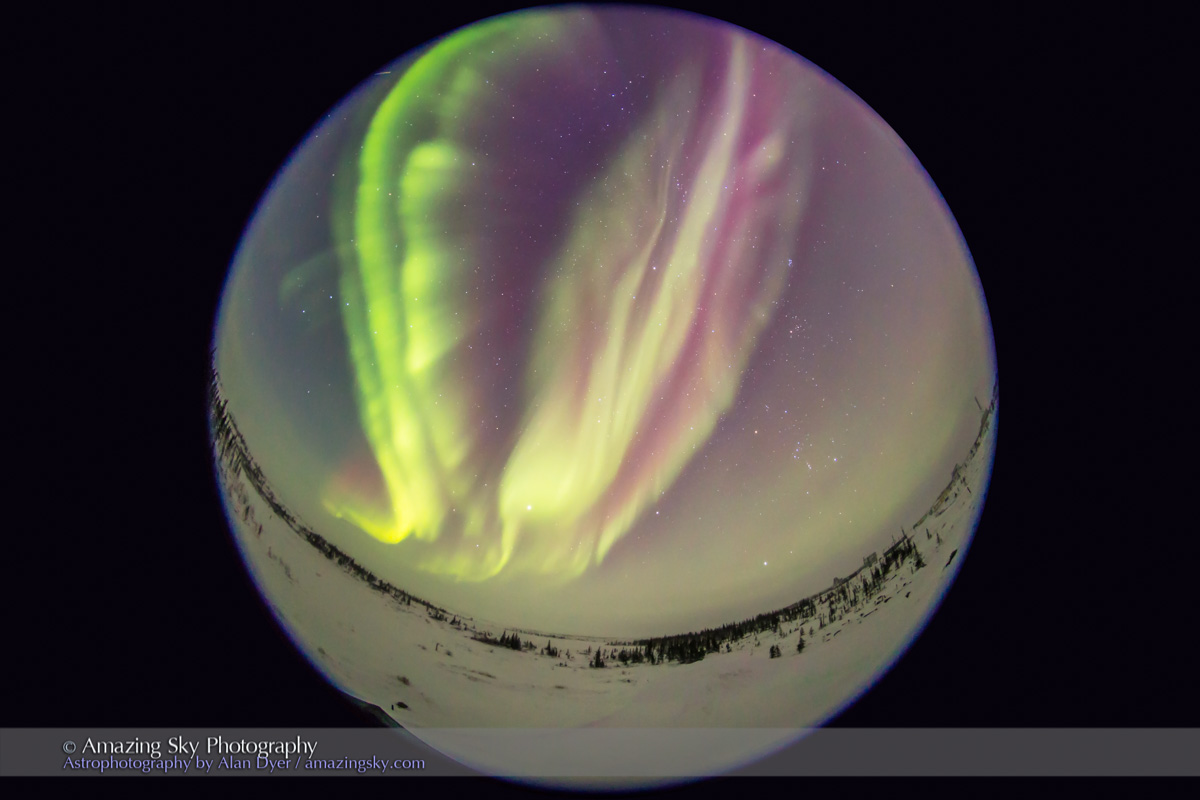
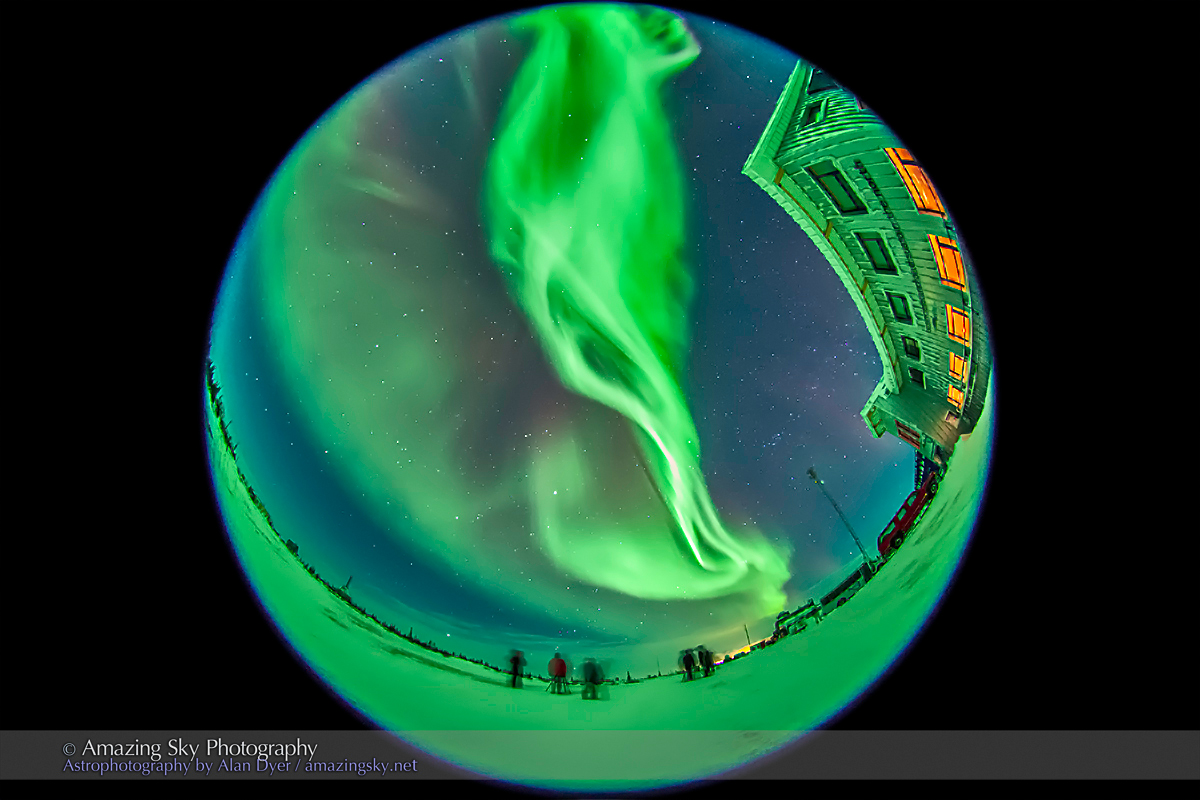
A fish-eye 360° view of the fine display of Northern Lights on February 25, 2025, during a substorm outburst with bright curtains to the north. A single 2.5-second exposure with the TTArtisan 7.5mm fish-eye lens at f/2.
An option is also to head up to the CNSC’s rooftop aurora dome for viewing the Lights in warm shirt-sleeve comfort.
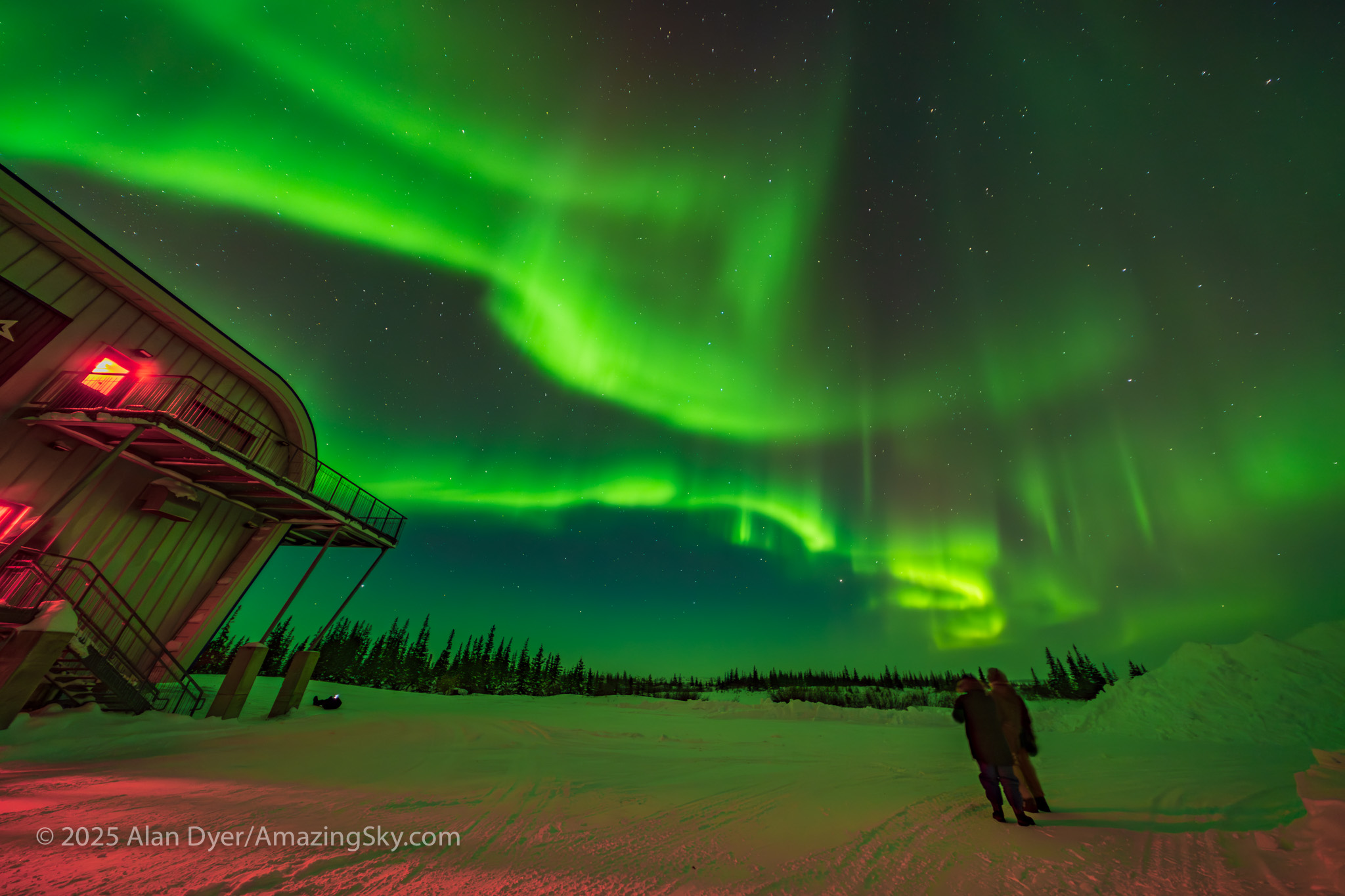
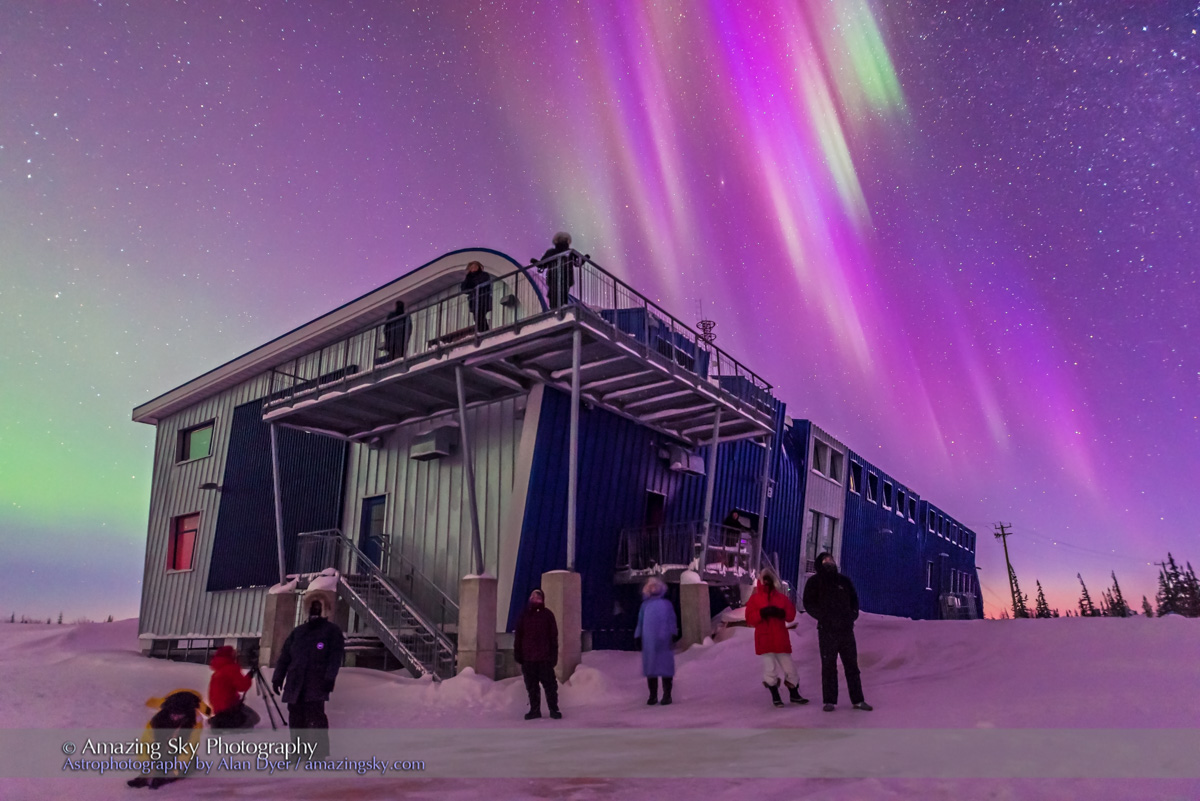
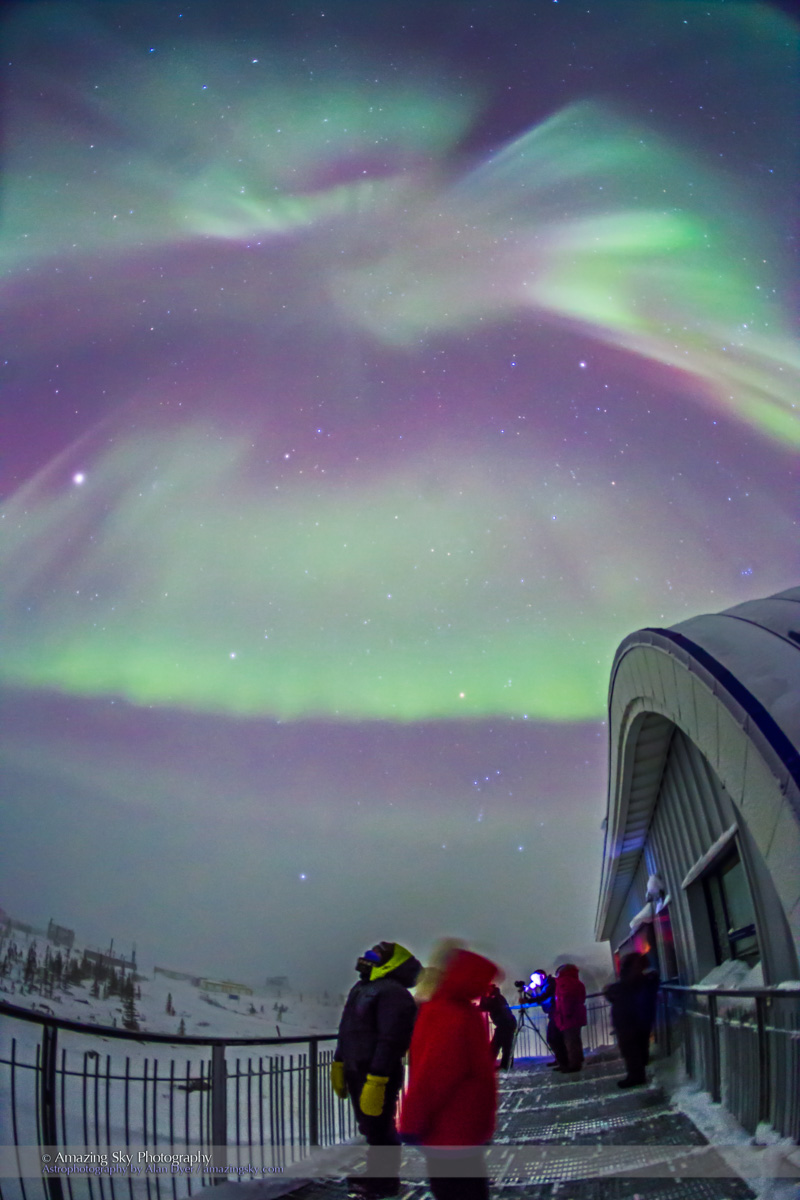
Aurora tourists enjoy the show at the Churchill Northern Studies Centre, February 26, 2025. This was the Learning Vacations tour group in late February 2025. This is a single 8-second exposure with the Laowa 10mm lens at f/2.8 and Nikon Z6III at ISO 1600.
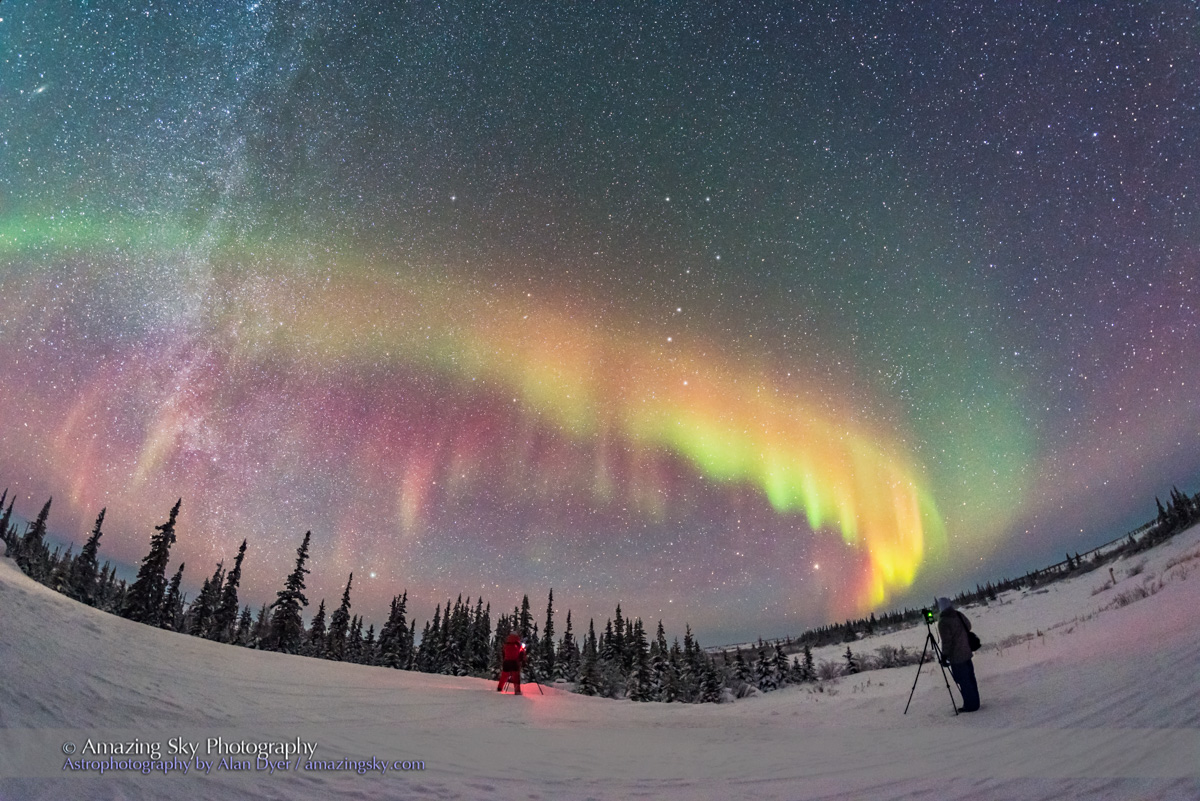
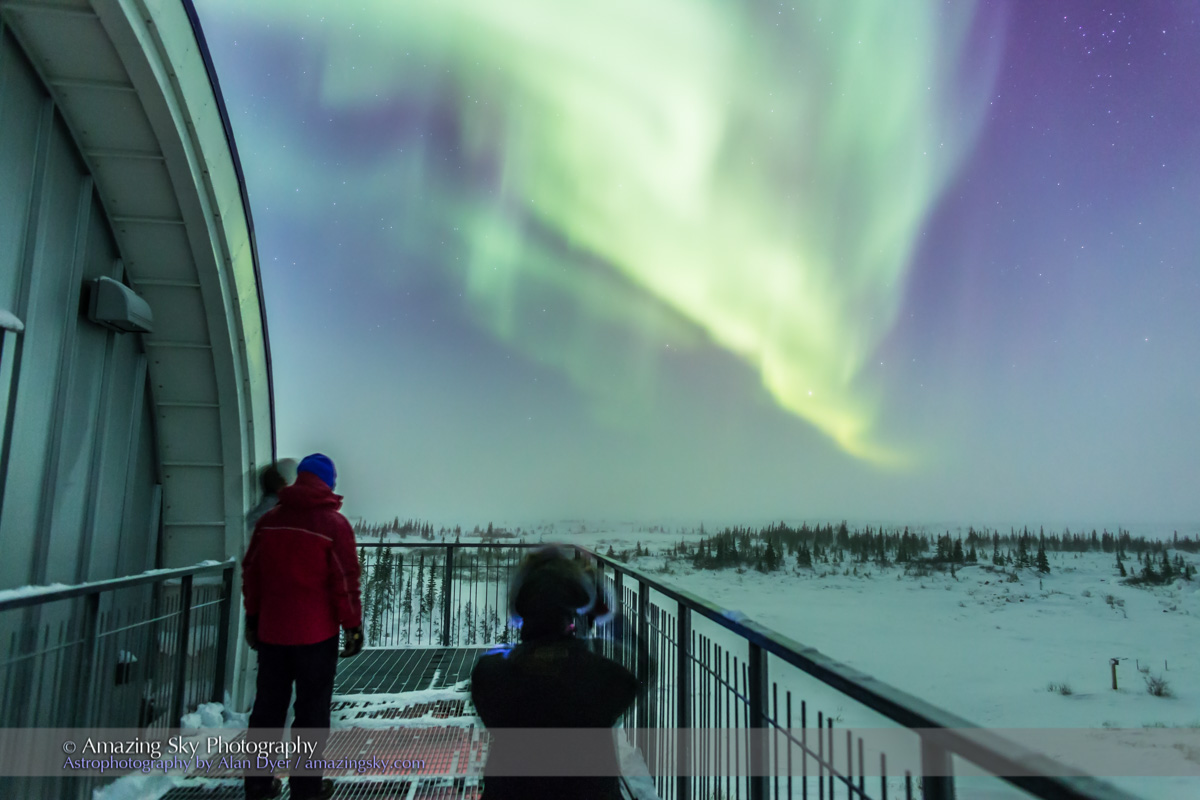
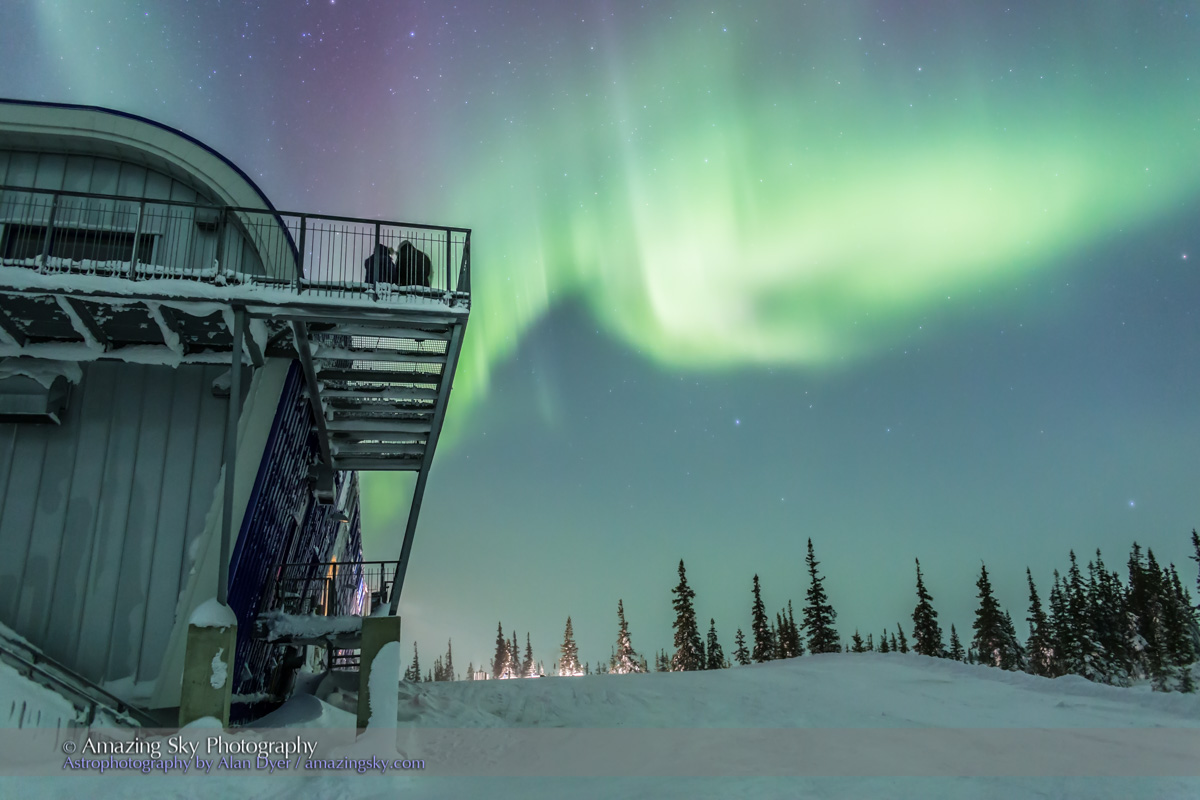
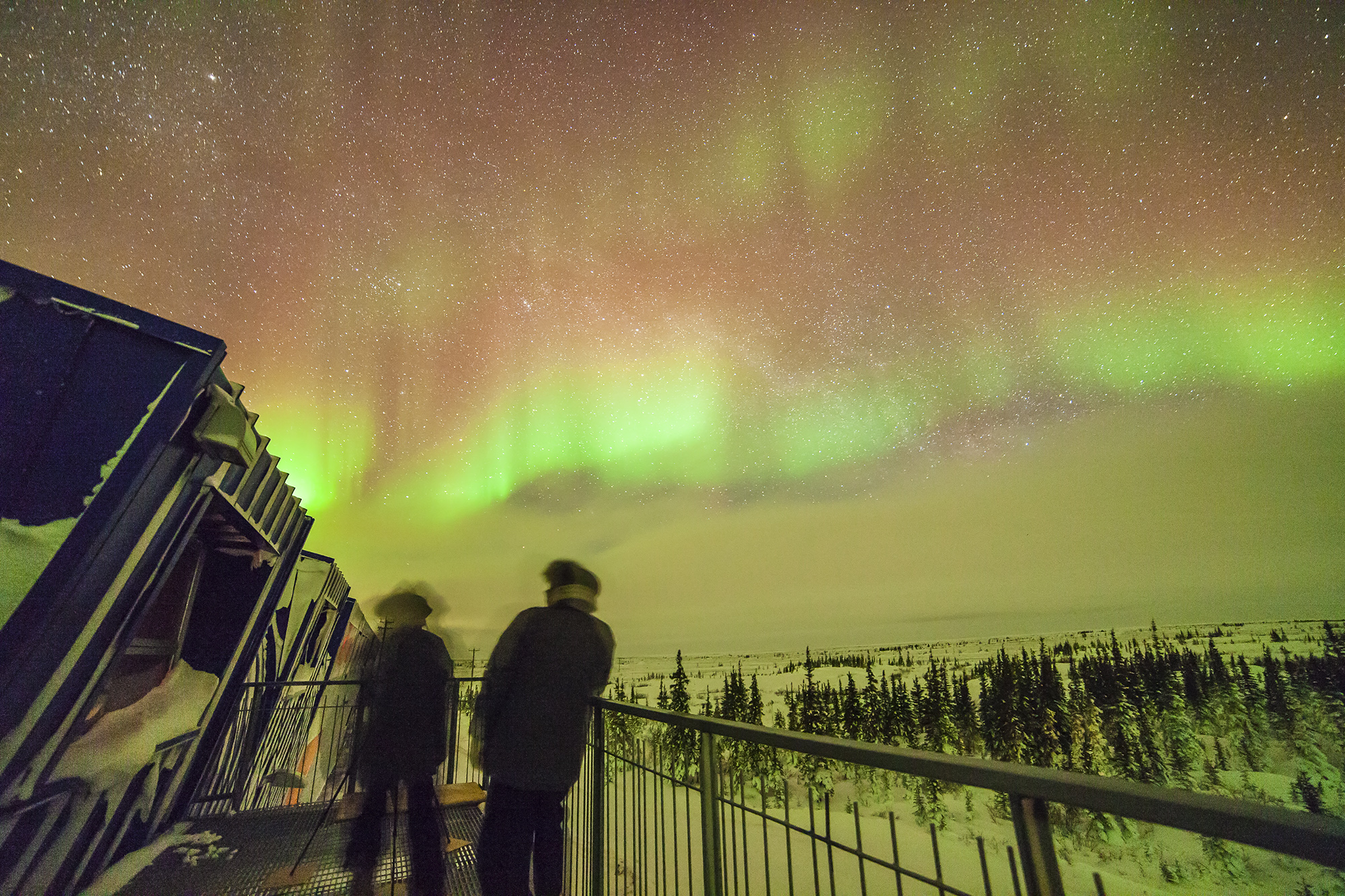
But most guests opt to bundle up and brave the cold for the best experience and unobstructed views of the Lights filling the sky. A convenient option is the second floor observation deck, shown above, and in an image taken from the deck, below.
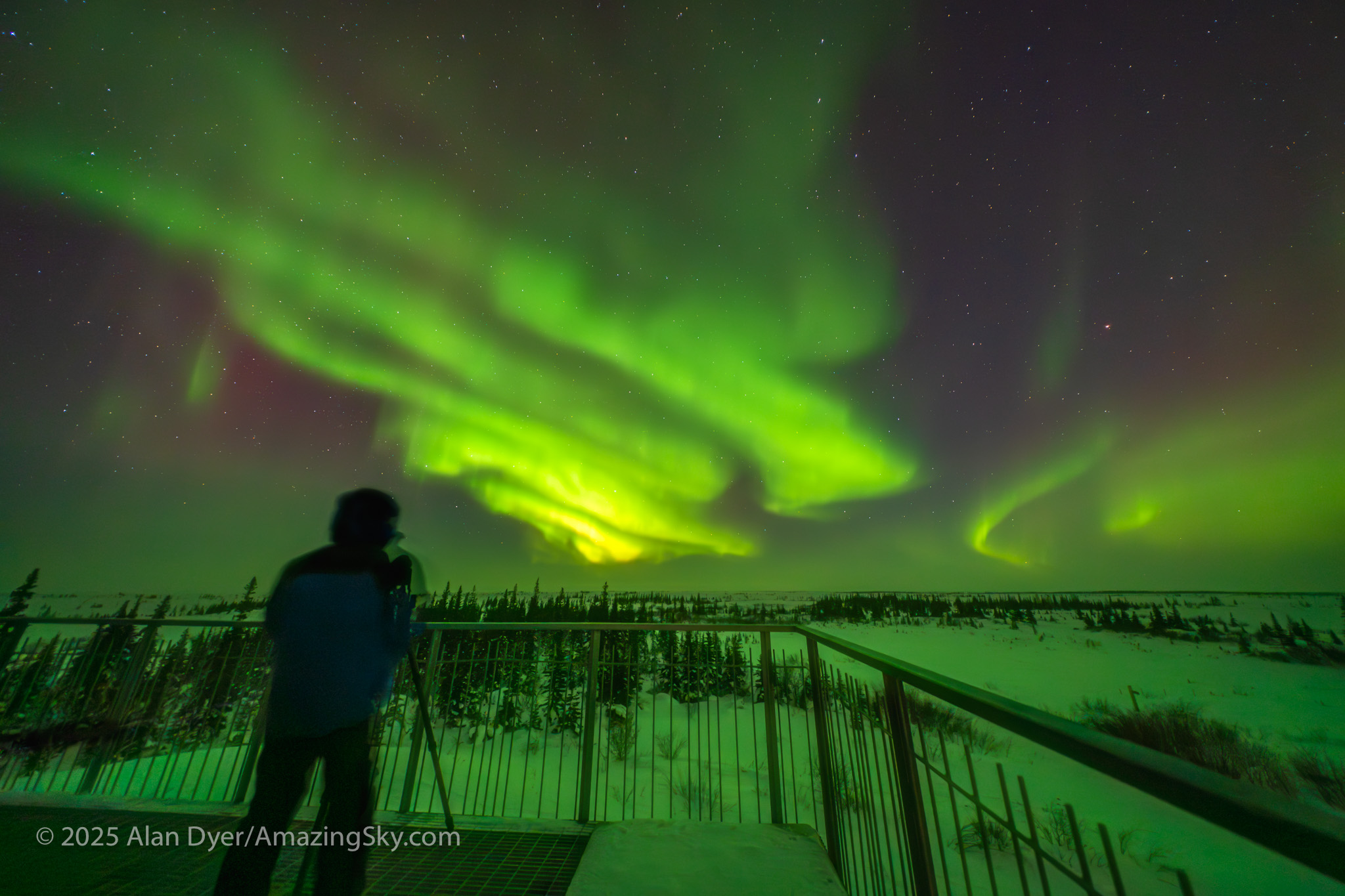
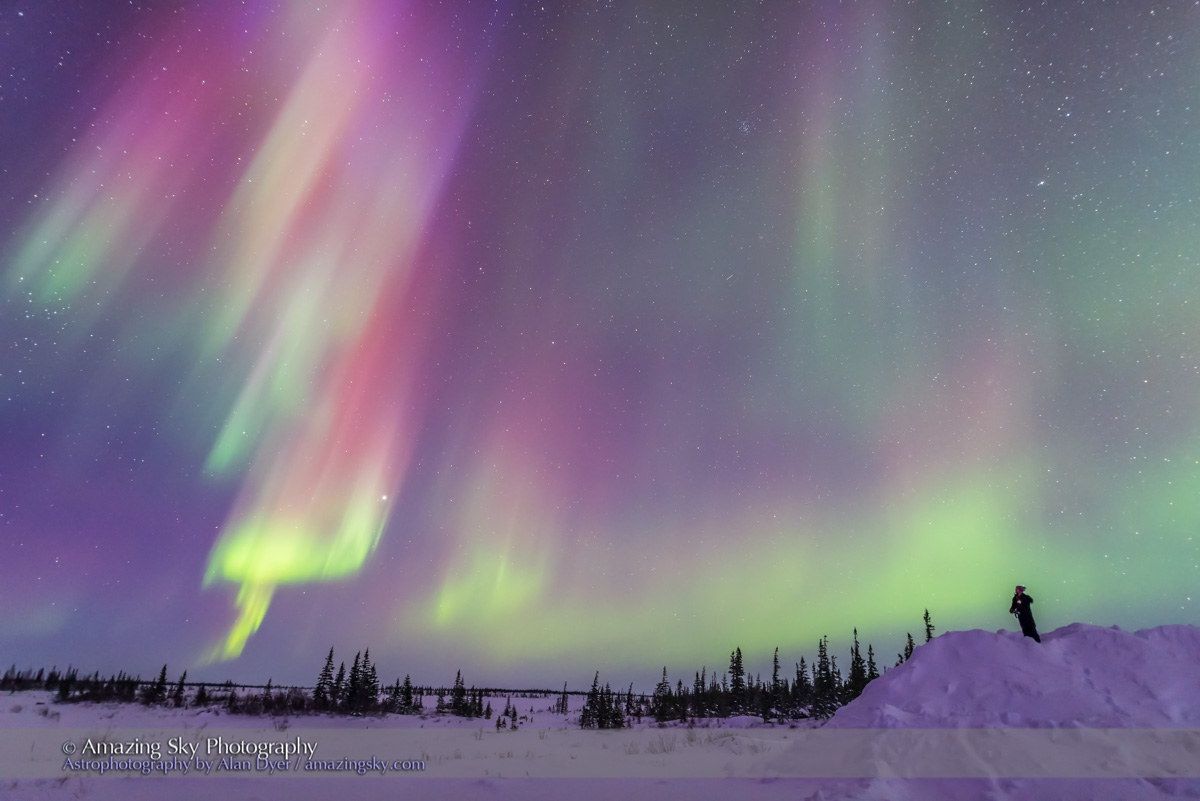
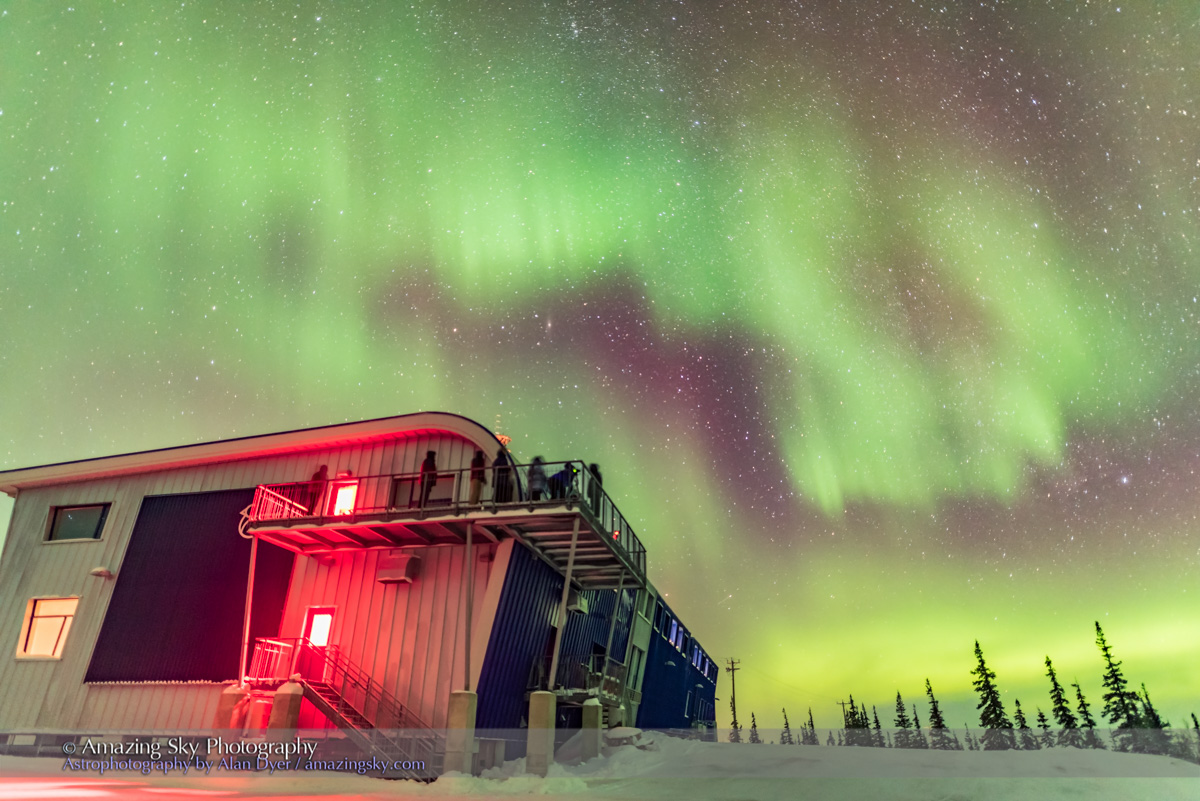
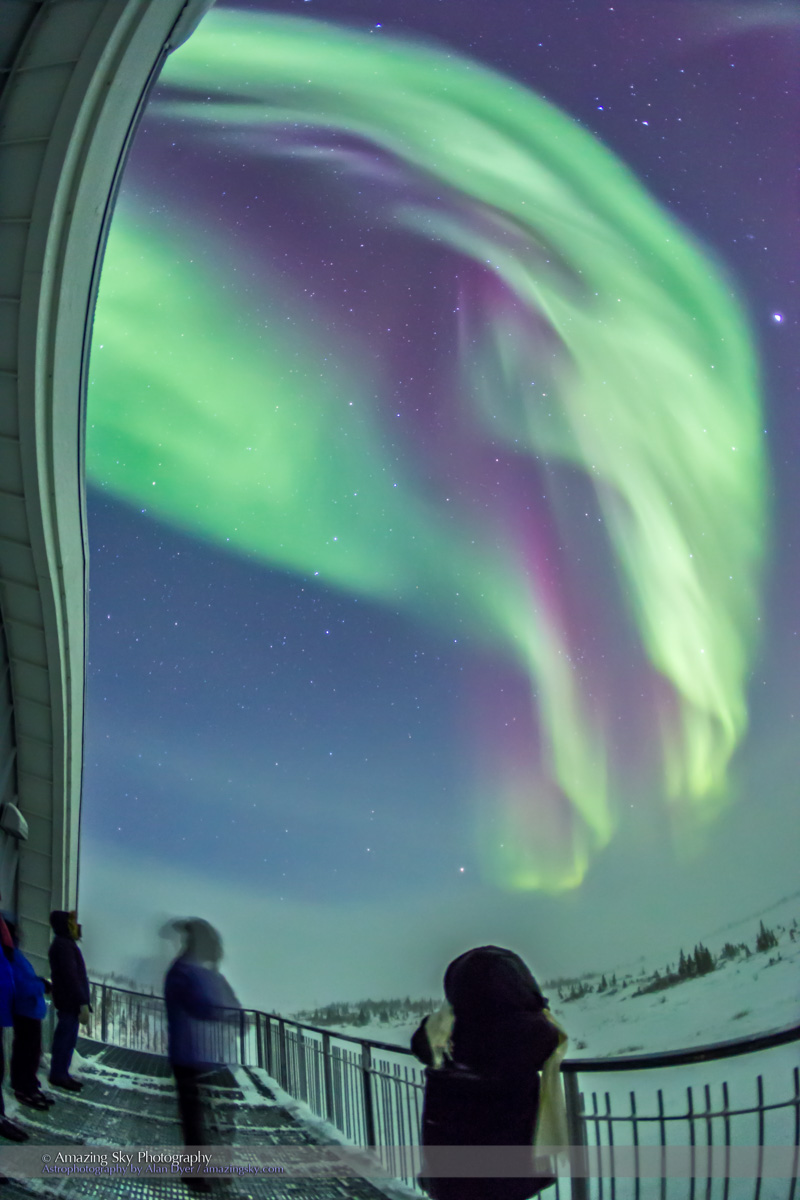
A photographer is capturing a bright display of Northern Lights at the Churchill Northern Studies Centre. This was the first night of a five-night session for aurora tourists from the Road Scholar education travel company. This is a single 4-second exposure with the Laowa 10mm lens at f/2.8 and Nikon Z6III at ISO 3200.
The program includes nightly science talks about the aurora and night sky. The daytime program includes dogsledding, snowshoeing, a tour of the old Rocket Range, and visits to sites in Churchill such as the murals and museums. It’s a very full five days of programming and learning.
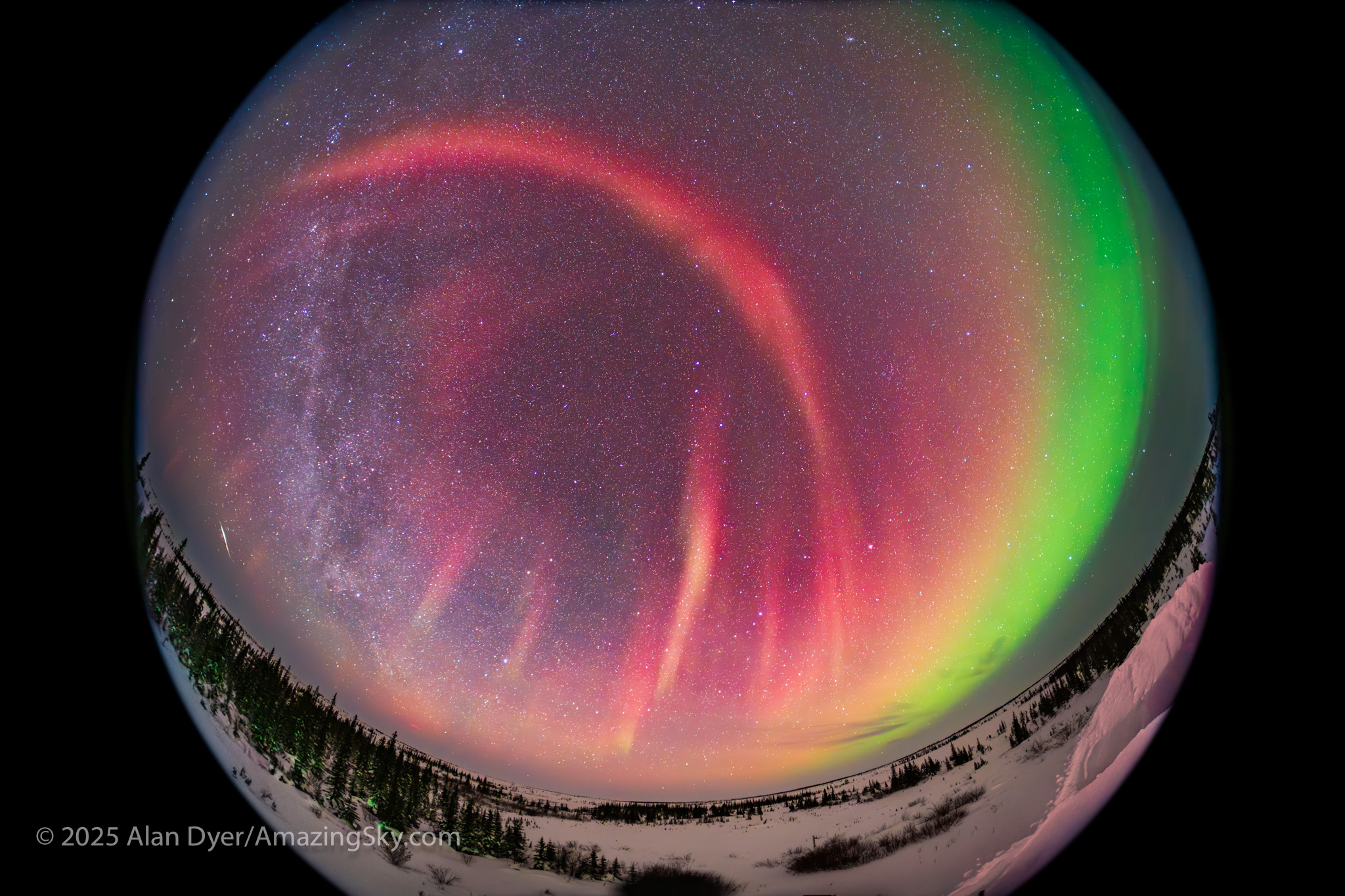
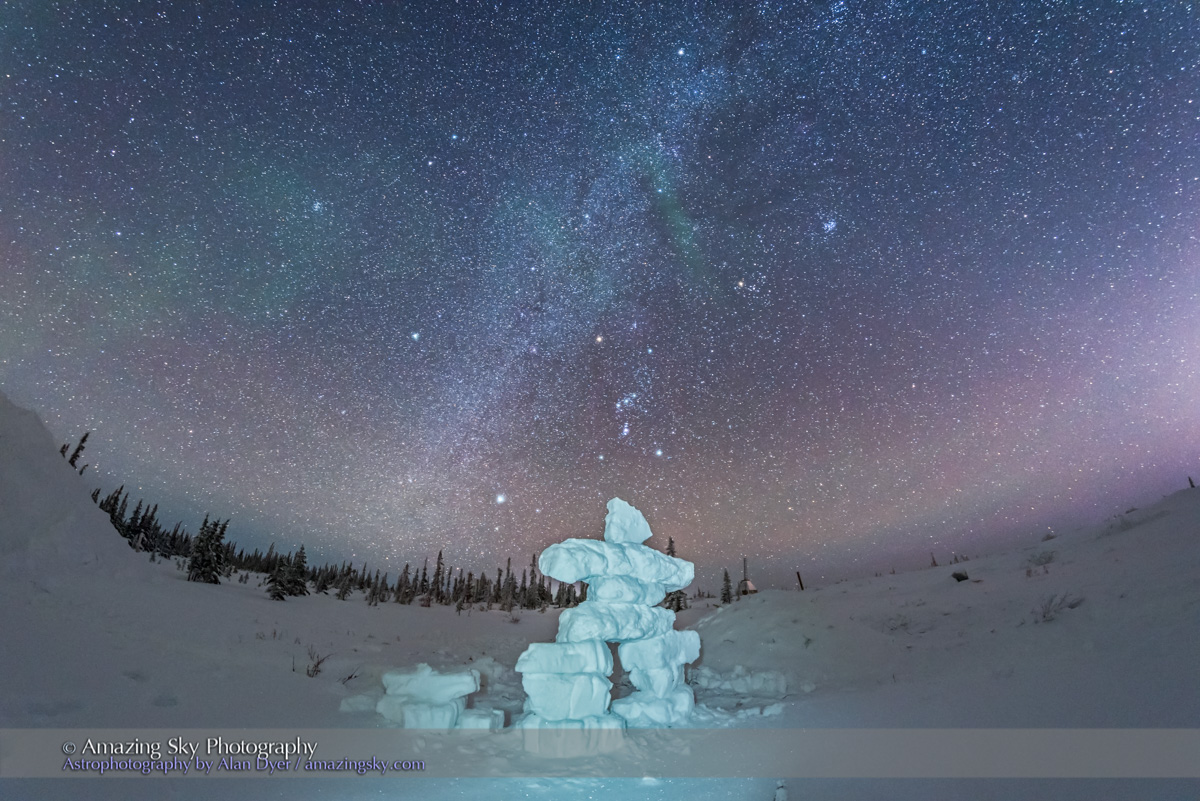
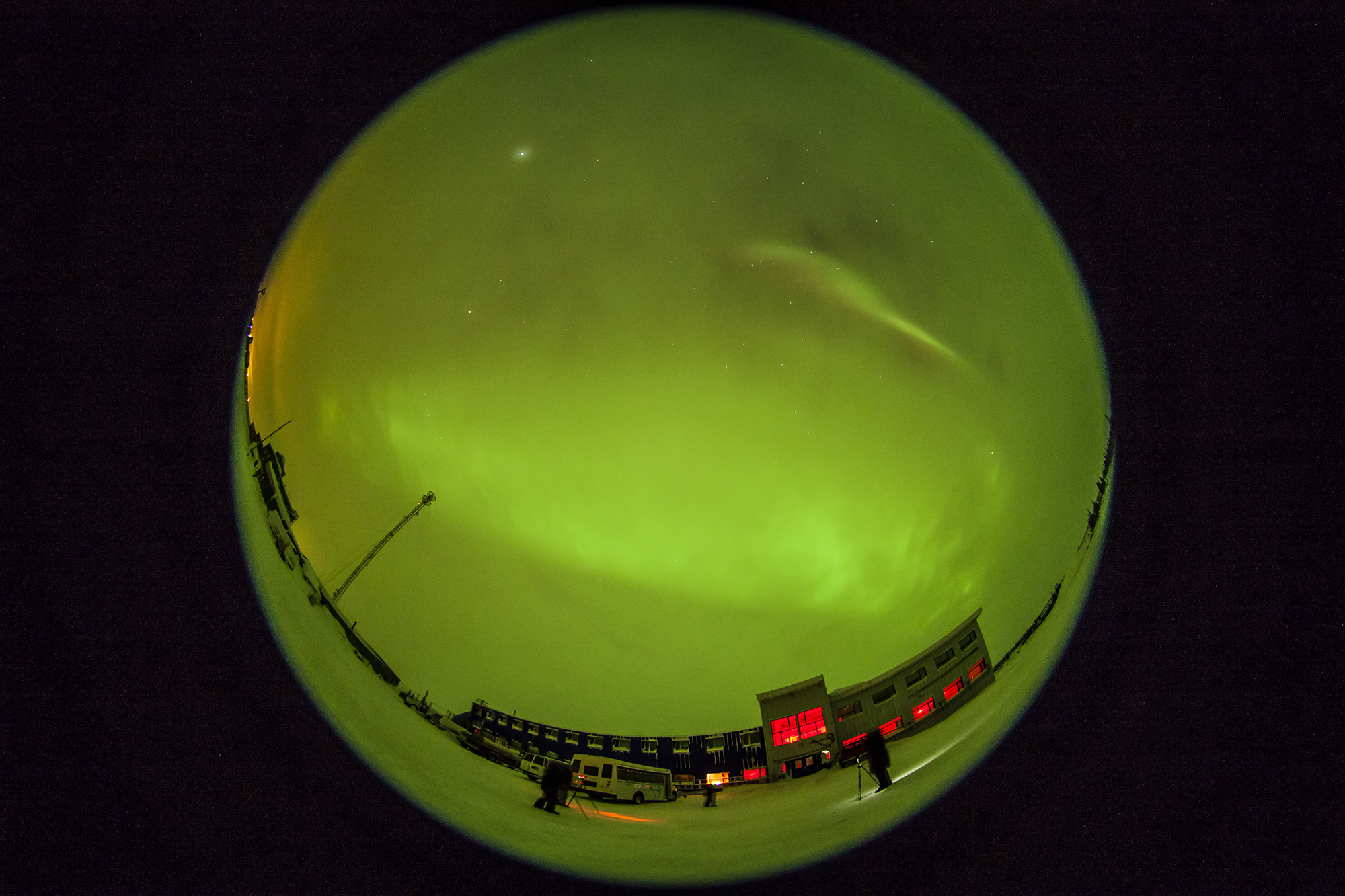
A fish-eye 360° view of a dim and weak display of Northern Lights on February 24, 2025, showing a green diffuse band to the south and a dim red curtain overhead with rays to the east. This red aurora was just visible to the eye as a grey streak. A single long 30-second exposure with the TTArtisan 7.5mm fish-eye lens wide open at f/2 on the Nikon Z6III at ISO 1600.
The main attraction, the aurora, can vary from night to night. However, even when the aurora is weak, as it was this night, above, it can still put on a fine show for the camera, glowing in red colours that only long exposures reveal.
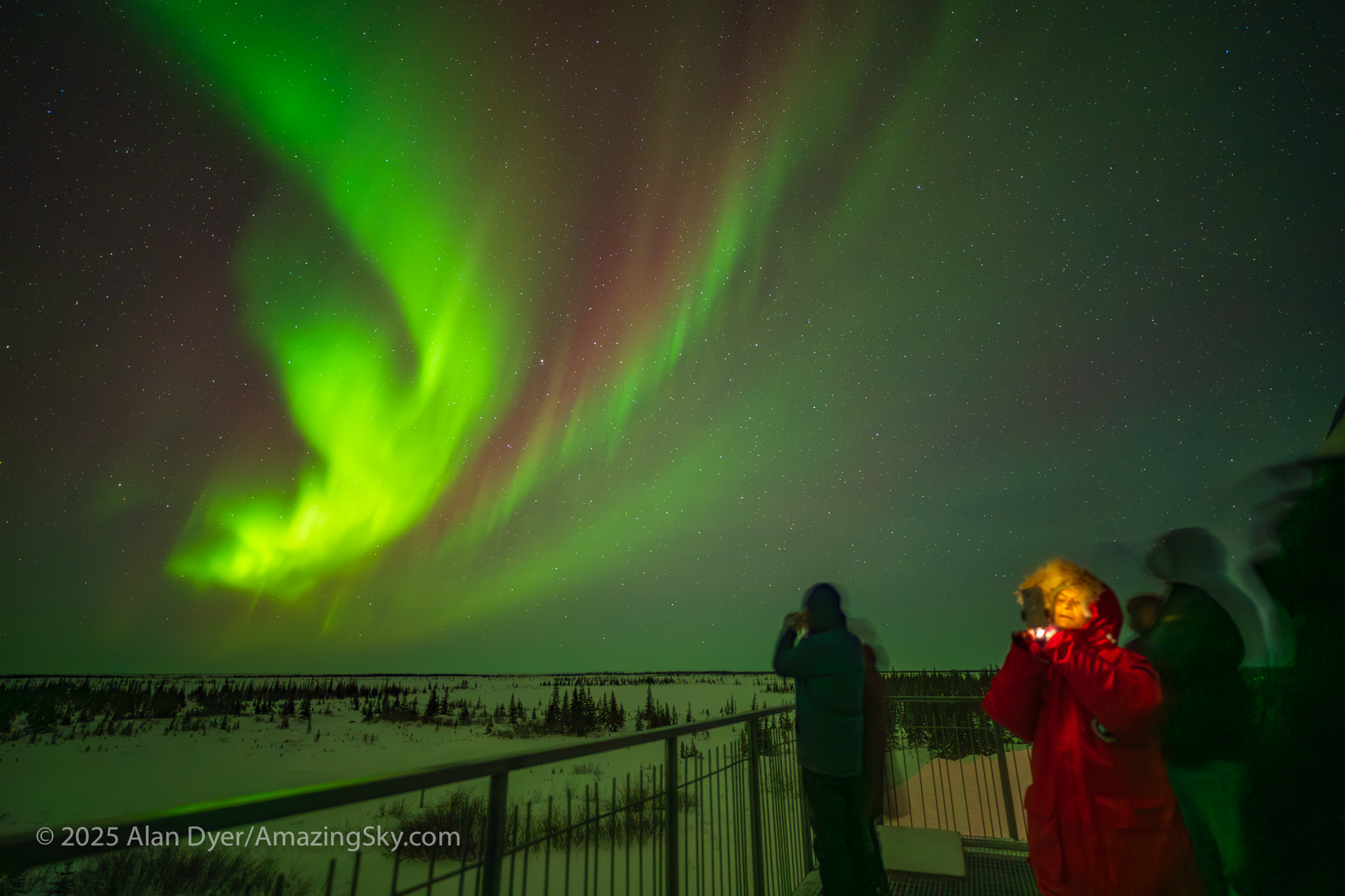
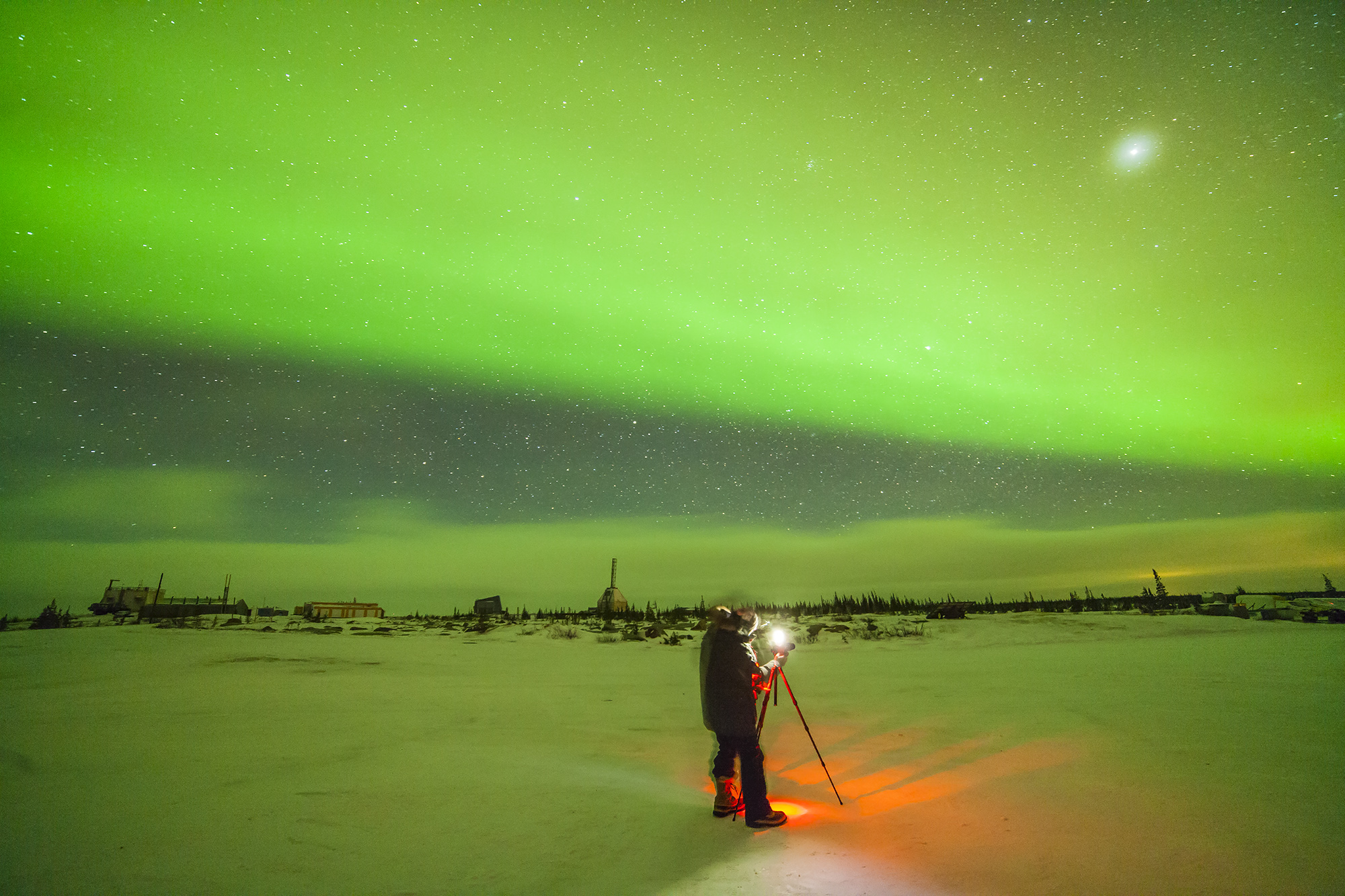
Aurora tourists from the Road Scholar travel company enjoy the show of Northern Lights at the Churchill Northern Studies centre in Churchill, Manitoba, March 1, 2025. This is a 6-second exposure at f/1.8 with the Viltrox 16mm lens on the Nikon Z6III at ISO 1600.
While I use high-end cameras and fast lenses, I’ve been impressed with how well today’s phone cameras can capture the Lights very simply and easily, as a guest is doing above, especially when the aurora is bright.
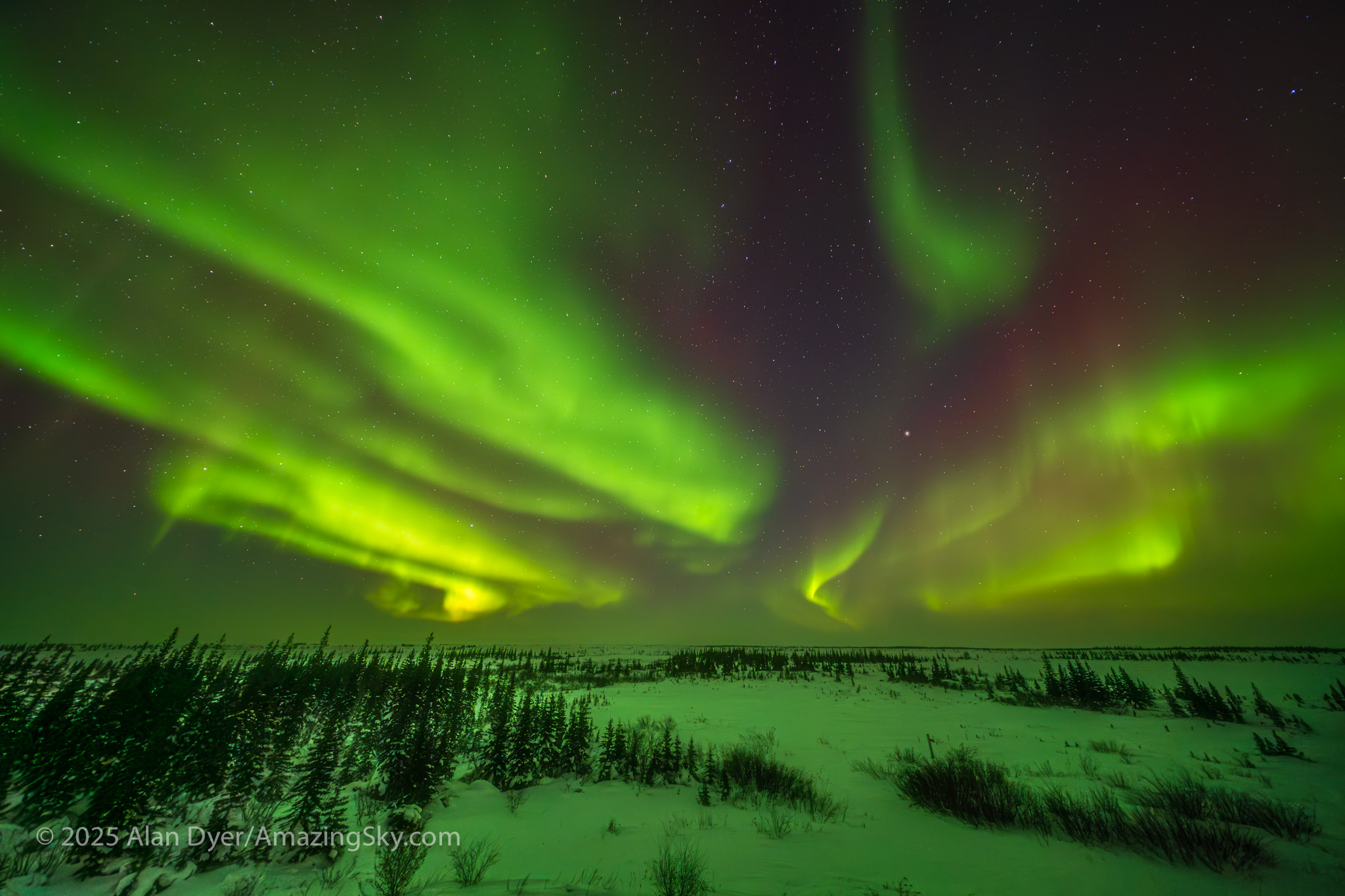
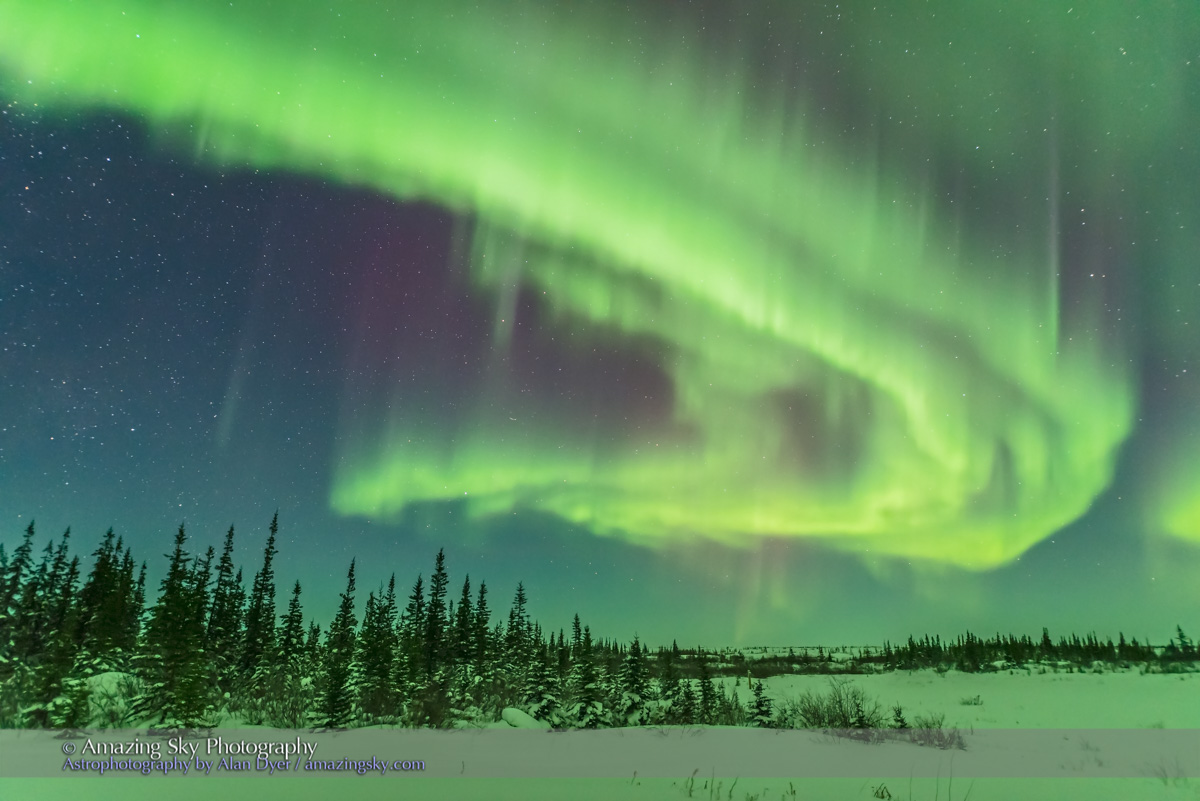
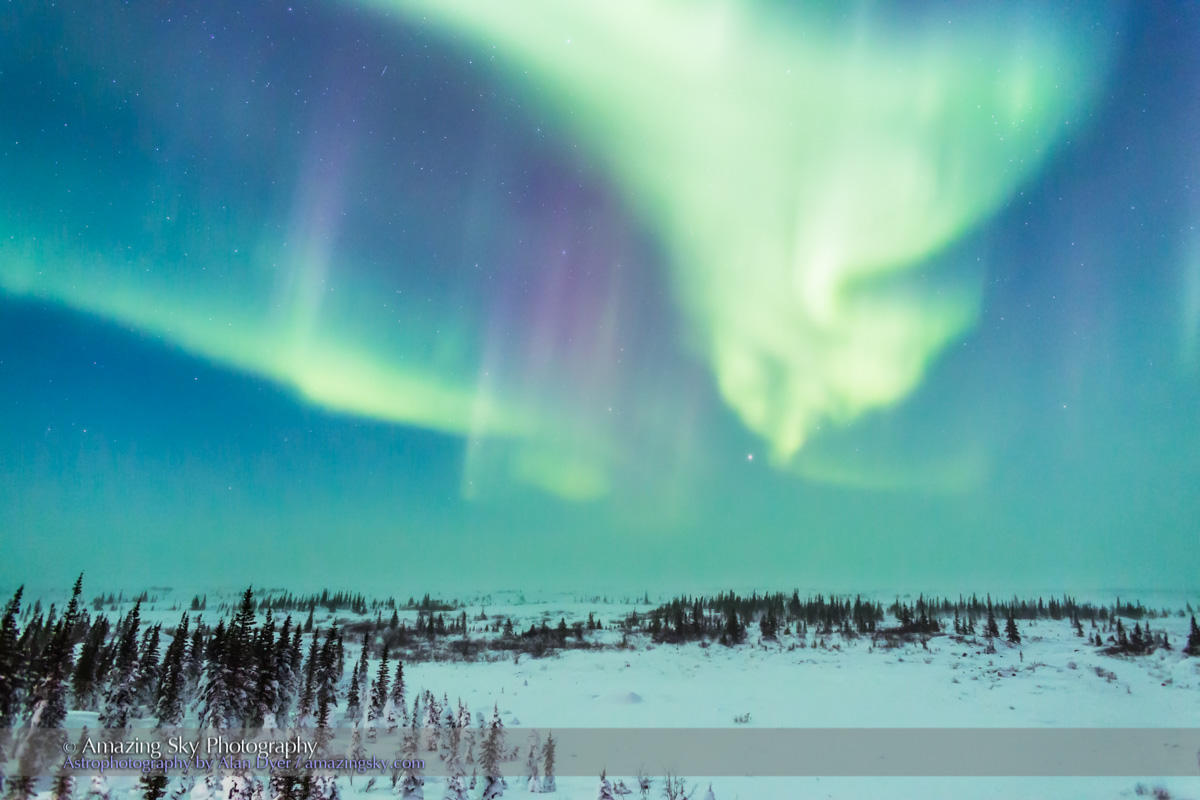
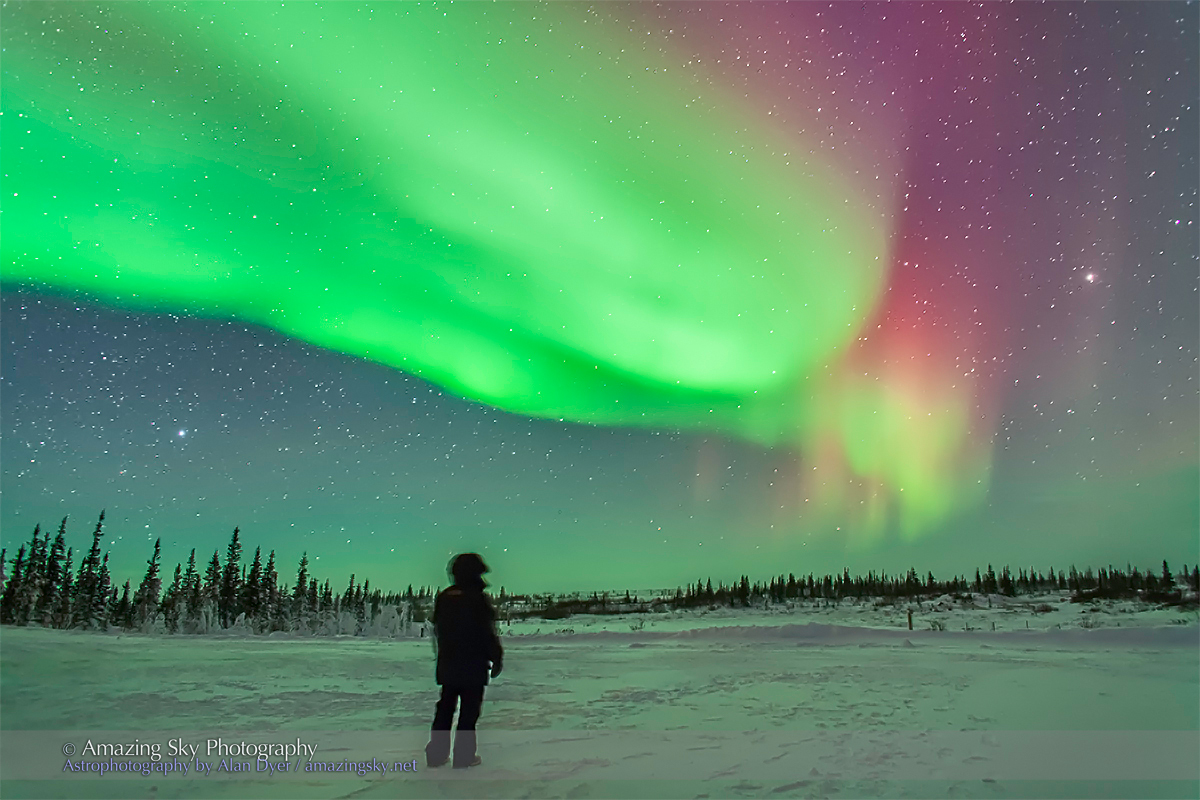
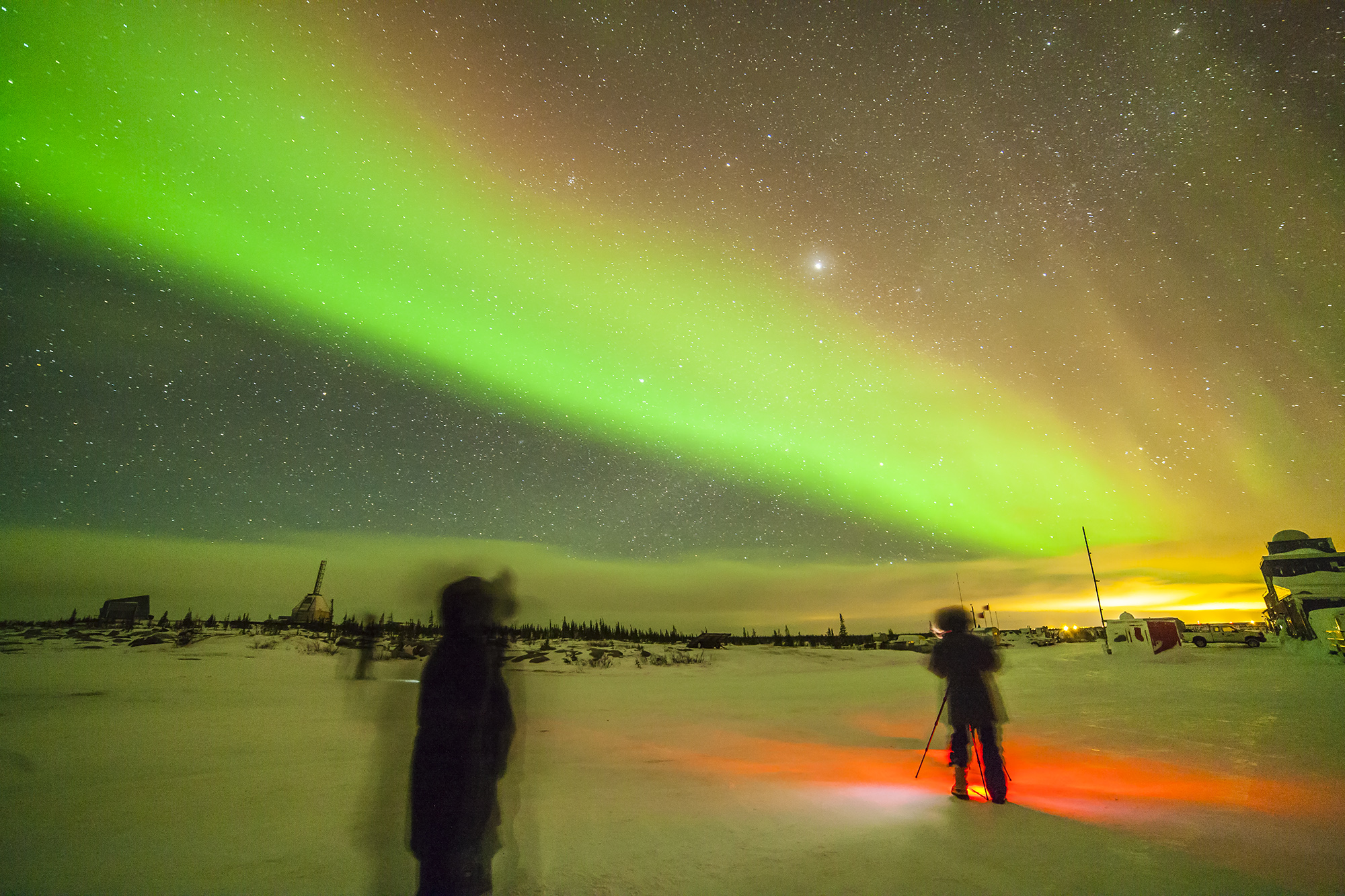
A band of bright green aurora appears here with some subtle red rays at right and magenta upper curtains at left, with the green glow lighting the snow green. A 10-second exposure with the Laowa 10mm lens at f/2.8 on the Nikon Z6III at ISO 1600.
When the aurora brightens, greens and sometimes pinks are visible to the eye, and not just to the camera. And the aurora exhibits rapid rippling and waving motions (check the video below).
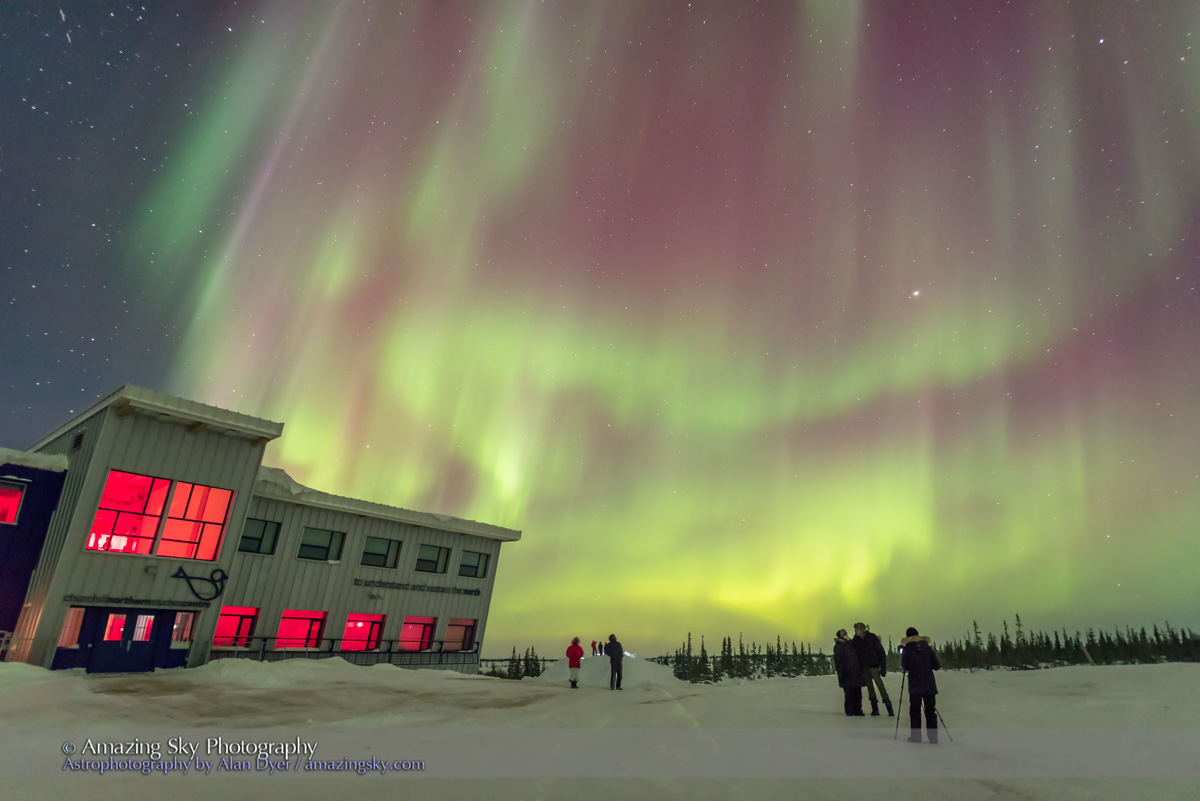
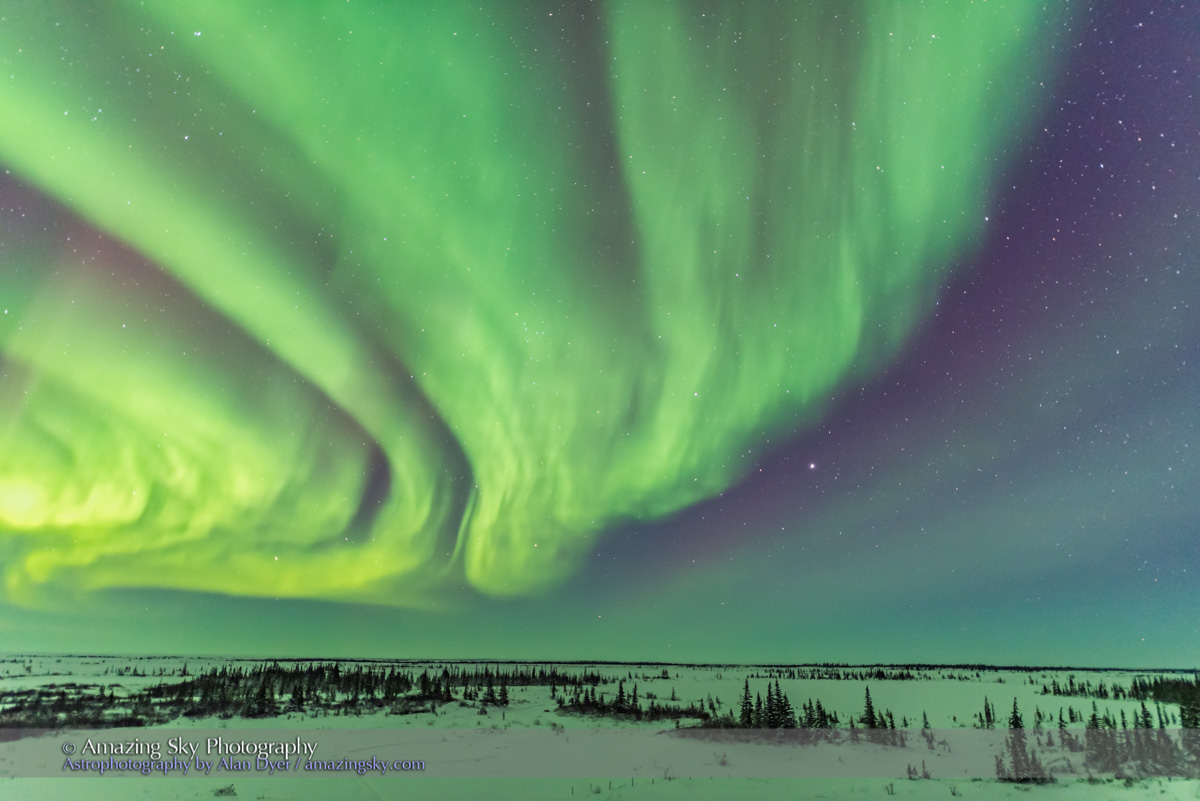
A bright display of colourful curtains of Northern Lights at the Churchill Northern Studies Centre. This is looking northeast toward the direction of the midnight sector where the auroras usually brighten from. This is a single 8-second exposure with the Laowa 10mm lens at f/2.8 and Nikon Z6III at ISO 1600.
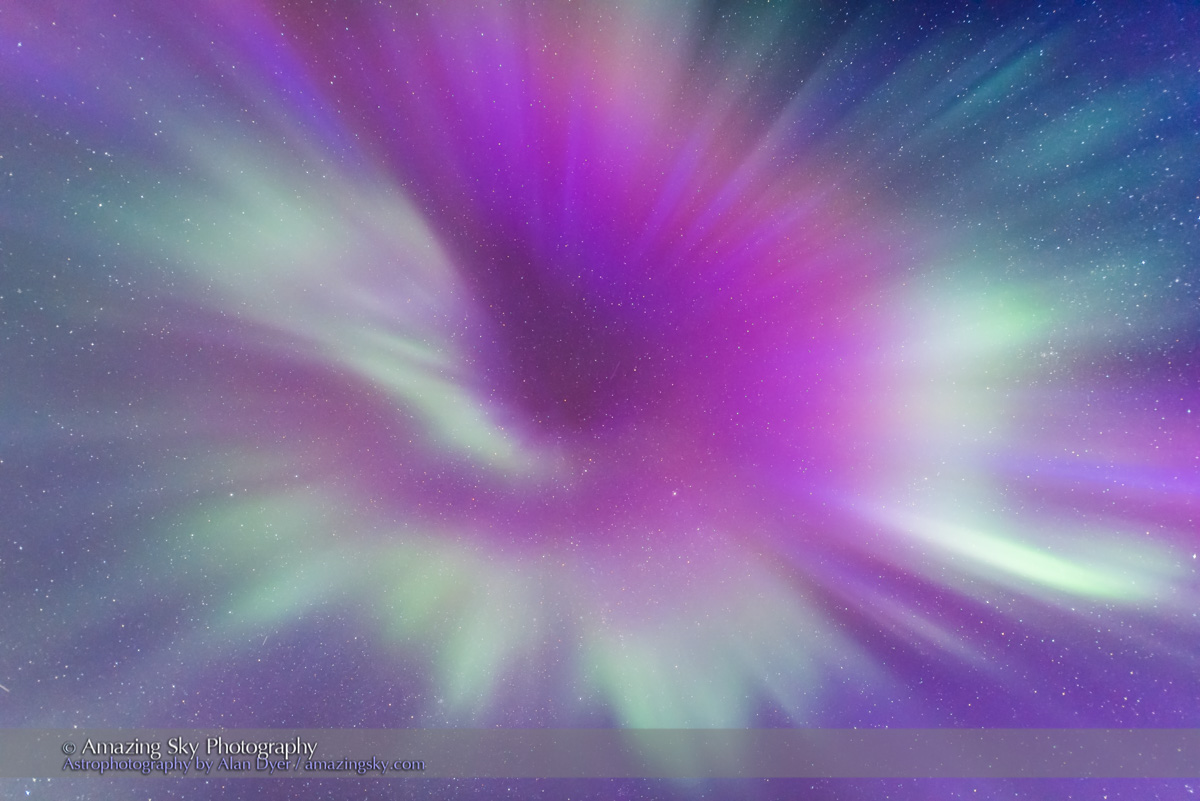
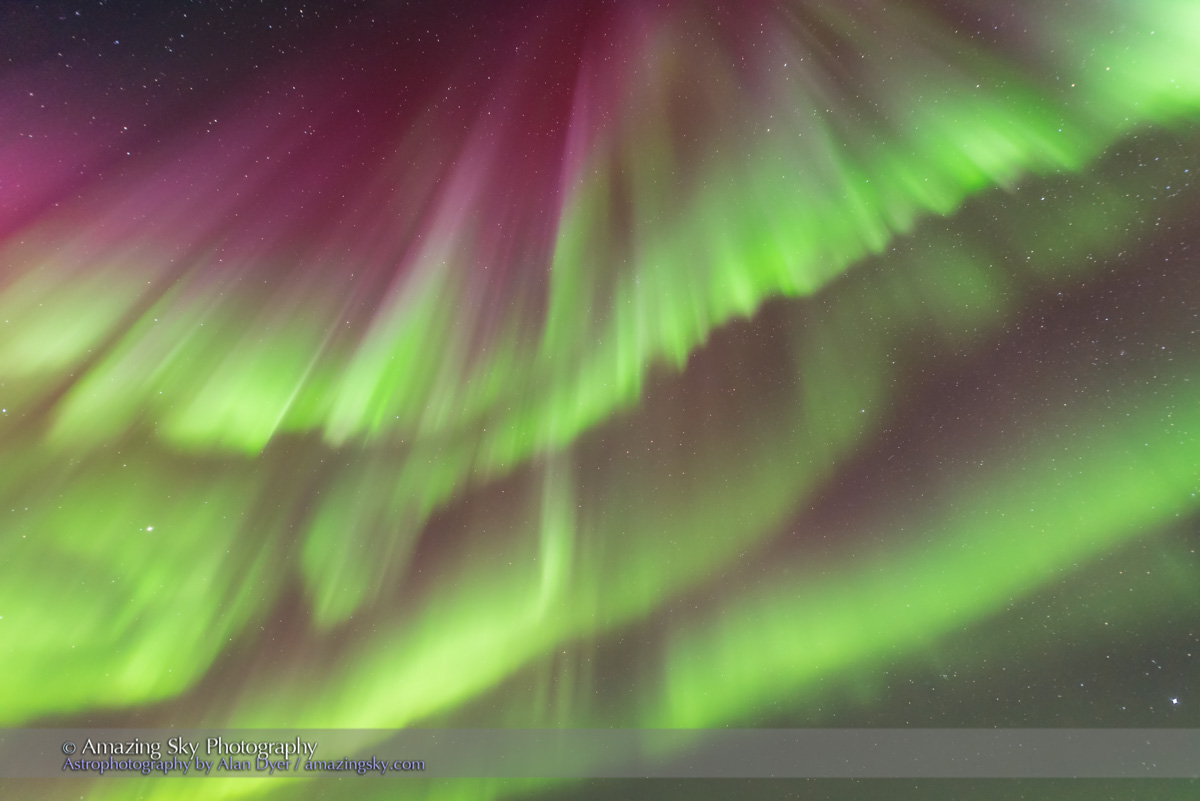
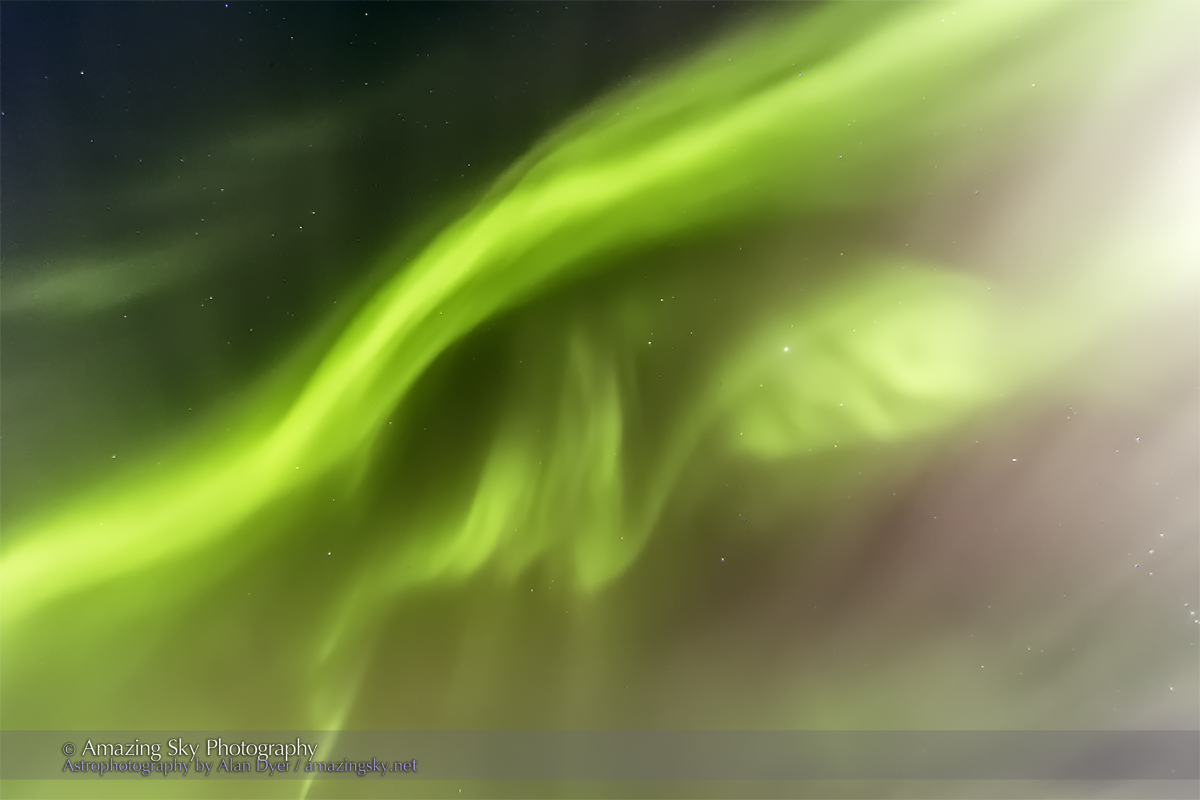
The finest sight is when the aurora curtains converge overhead at the zenith for a “coronal outburst.” The effect can be fleeting but the sight is unforgettable. It is one of the finest sights the sky can offer, ranking with a total eclipse of the Sun.
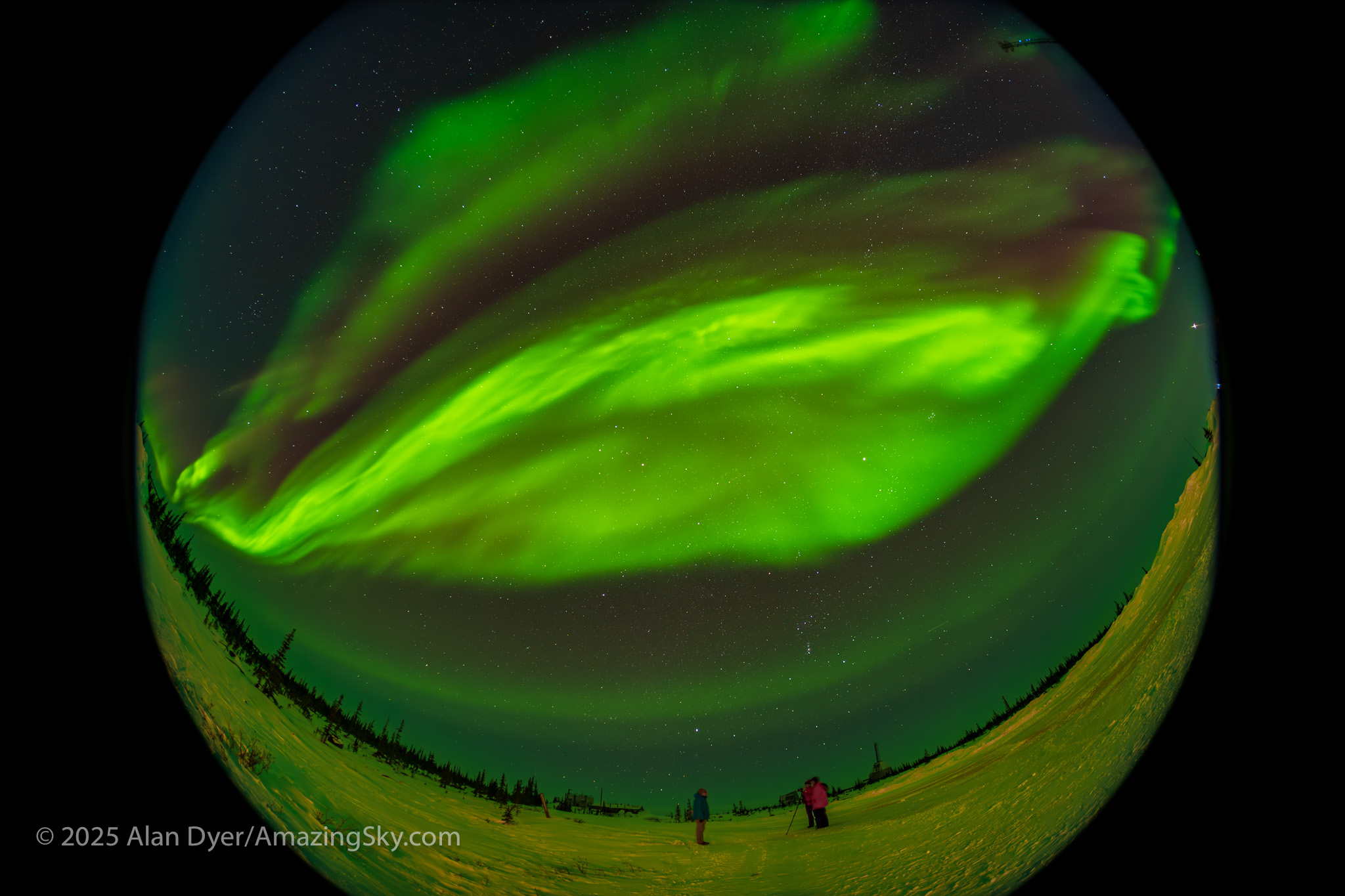
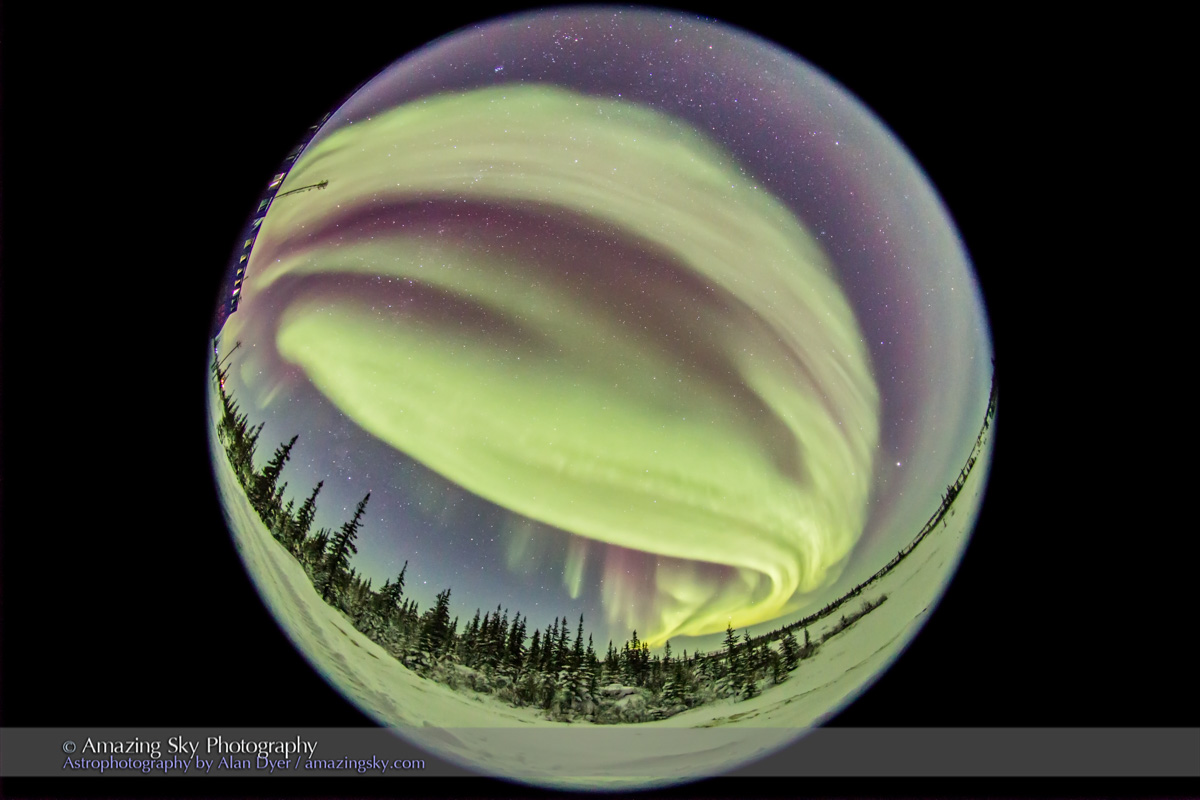
A fish-eye 360° view of the fine display of Northern Lights on February 25, 2025, with a complex of curtains passing overhead and across the sky from northeast (at lower left) to southwest (at upper right), with Venus setting at far right. Orion and Sirius are at bottom centre to the south. A single 10-second exposure with the TTArtisan 7.5mm fish-eye lens at f/2 on the Nikon Z6III at ISO 1600.
Indeed, on most nights the aurora, which might begin as a low arc across the north, moves south to fill the sky with swirling and curling curtains, as below.
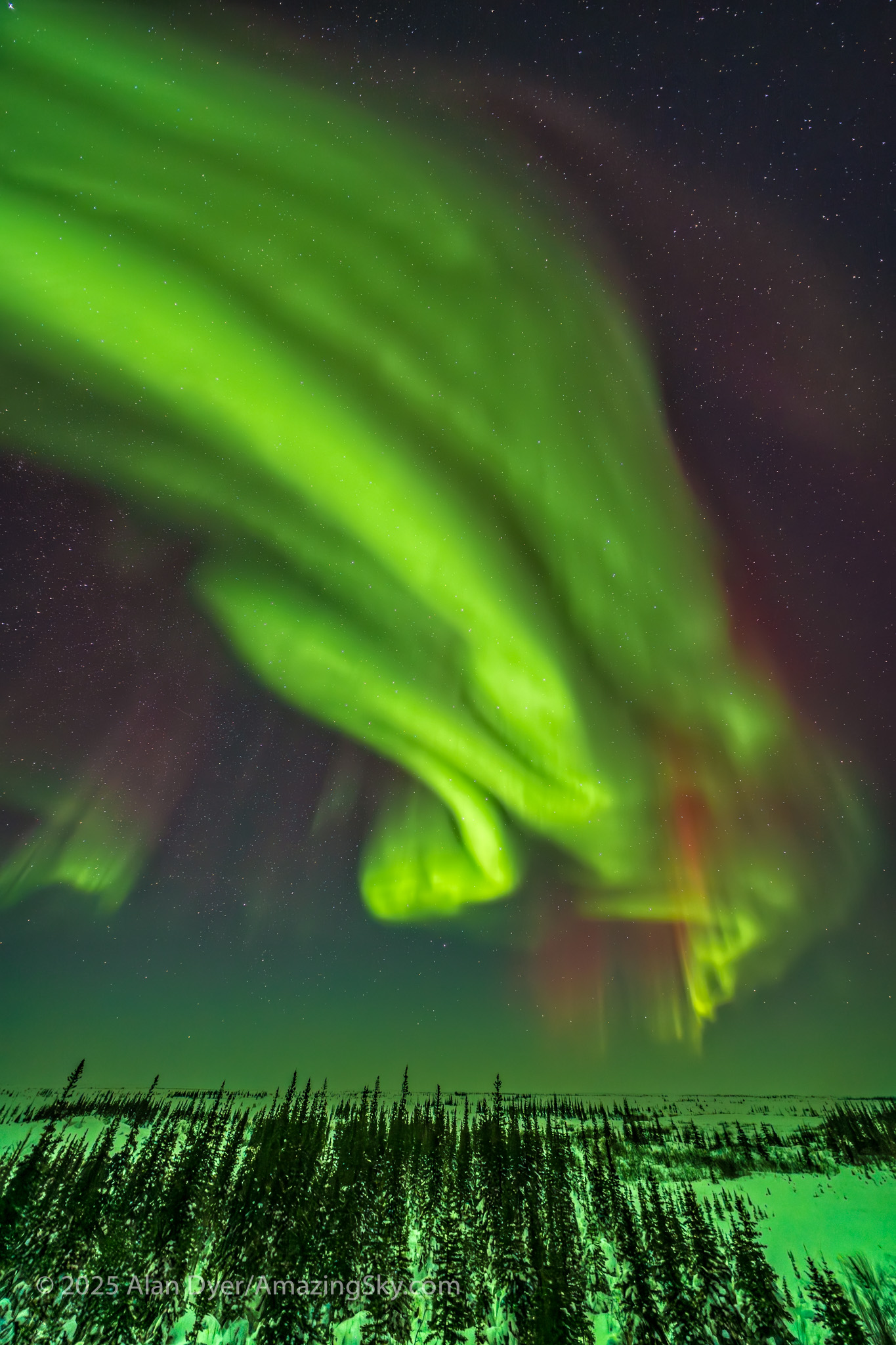
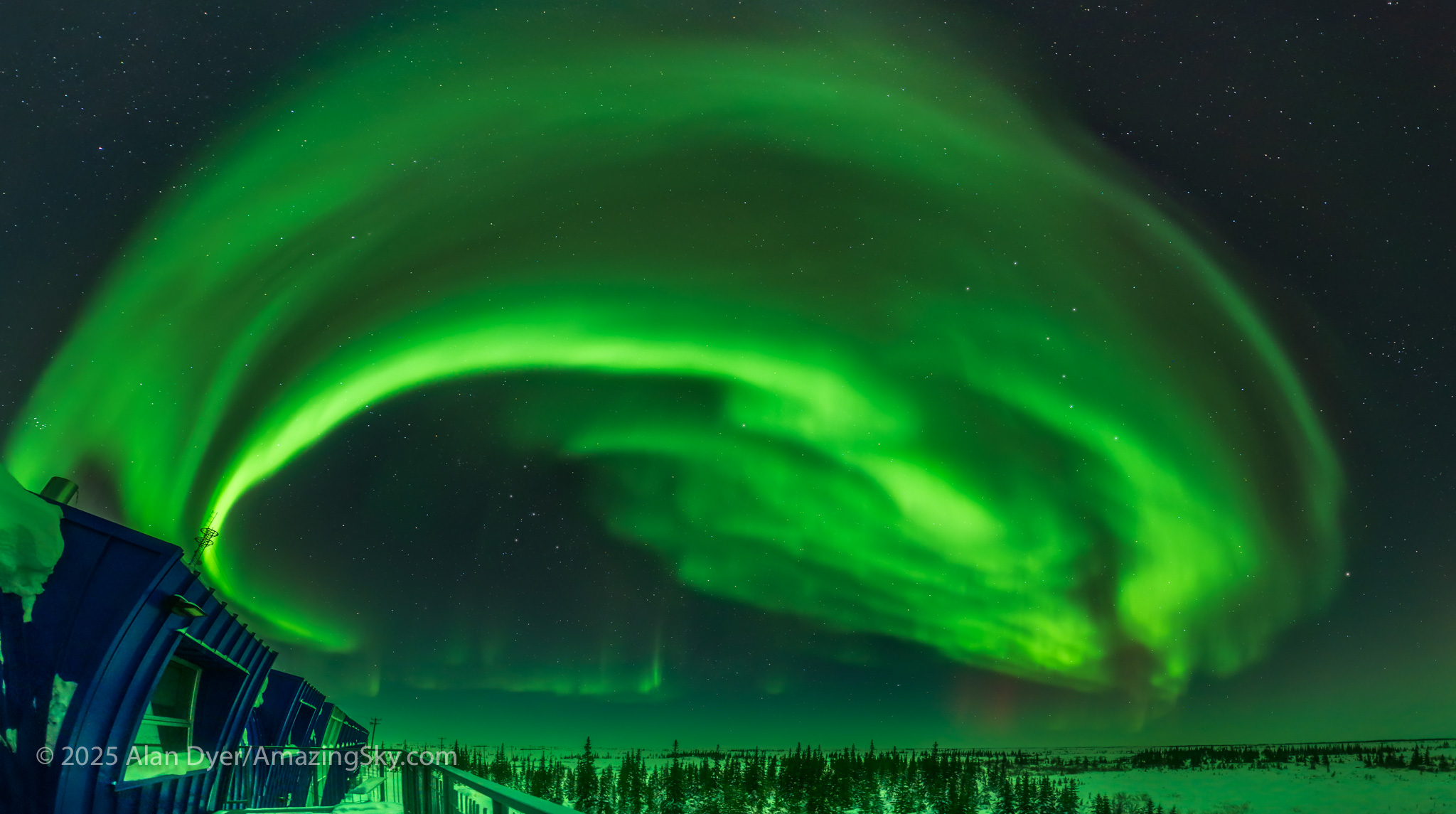
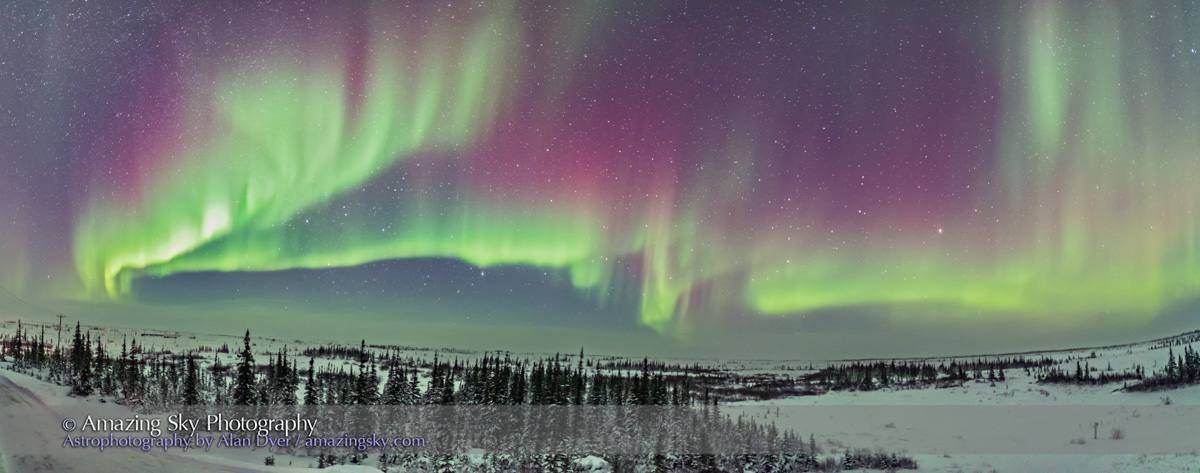
This is a 180º panorama of the Northern Lights across the northern sky on February 27, 2025 during a Kp4-level display. The field extends from the horizon up to well past the zenith. This is a panorama of 6 segments, each an 8-second exposure at f/2.8 with the Laowa 10mm lens on the Nikon Z6III at ISO 1600.
A gallery of my images from Churchill from this year and from past years is on my main AmazingSky.com website here.
A musical collage of still images and real-time videos I shot this year is viewable here on YouTube.
Click through to YouTube for more information about the video.
It’s been a great ten years taking in the wonderful Northern Lights in Churchill. While this was my last year, I encourage you to visit to see the sights for yourself.
Everyone goes away with great memories, able to check the aurora off their bucket list of experiences.
2024 brought us a total eclipse of the Sun, superb auroras, and a naked-eye comet, three top highlights of a wonderful year of celestial attractions. Maybe the best!
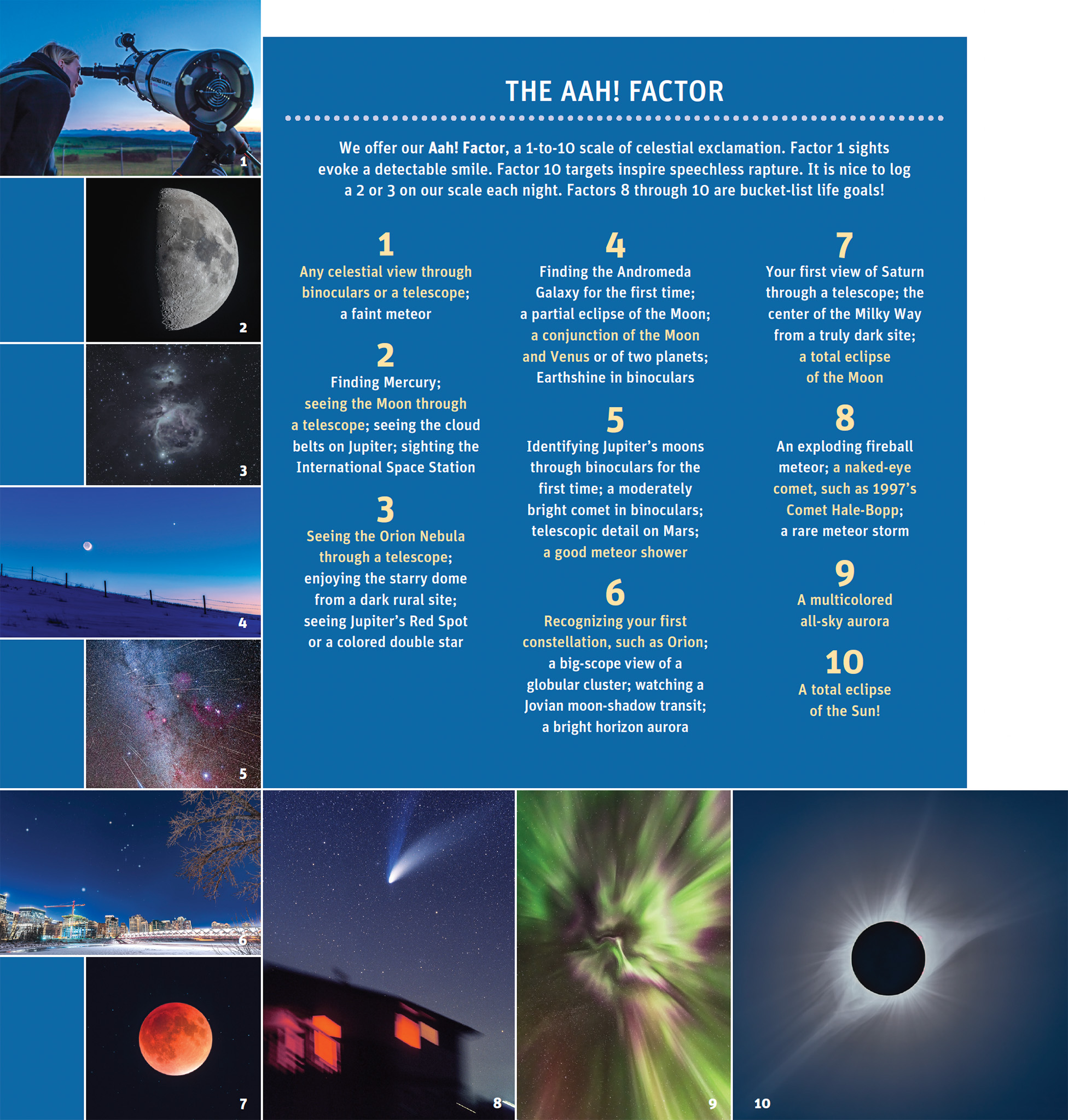
In our book The Backyard Astronomer’s Guide (which we revised this year), Terence Dickinson and I created an Aah! Factor scale with various celestial sights ranked from:
• 1, evoking just a smile, to …
• 10, a life-changing event!
Our book’s Aah! Factor Scale in Chapter 1
Coming in at an 8 is a naked-eye comet. Deserving a 9 is an all-sky display of an aurora. The only sight to rate a top 10 is a total eclipse of the Sun.
2024 brought all three, and more!
Here’s my look back at what I think was one of the greatest years of stargazing.
NOTE: The images might take a while to all load. All can be enlarged to full screen. Just click or tap on them.
January
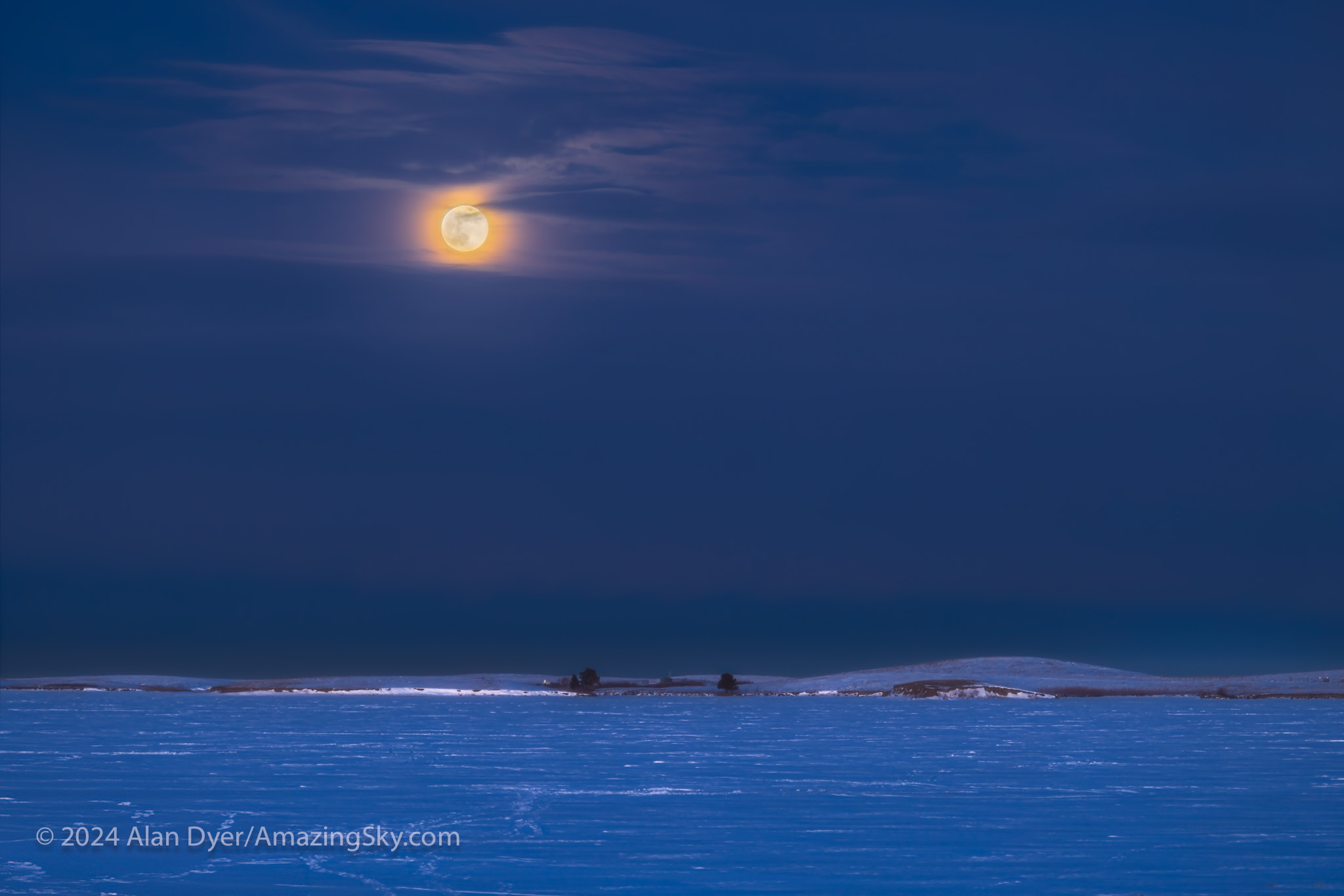
A Winter Moonrise to Begin the Year
The rising of the winter “Wolf” Moon, the Full Moon of January, over the frozen Crawling Lake Reservoir, in southern Alberta.
Now, this was not any form of rare event. But seeing and shooting any sky sight in the middle of a Canadian winter is an accomplishment. This is the rising of the Full Moon of January, popularly called the Wolf Moon, over a frozen lake near home in Alberta, Canada 🇨🇦.
It serves to bookend the collection with a Full Moon I captured eleven months later in December.
February
Auroras from Churchill, Manitoba
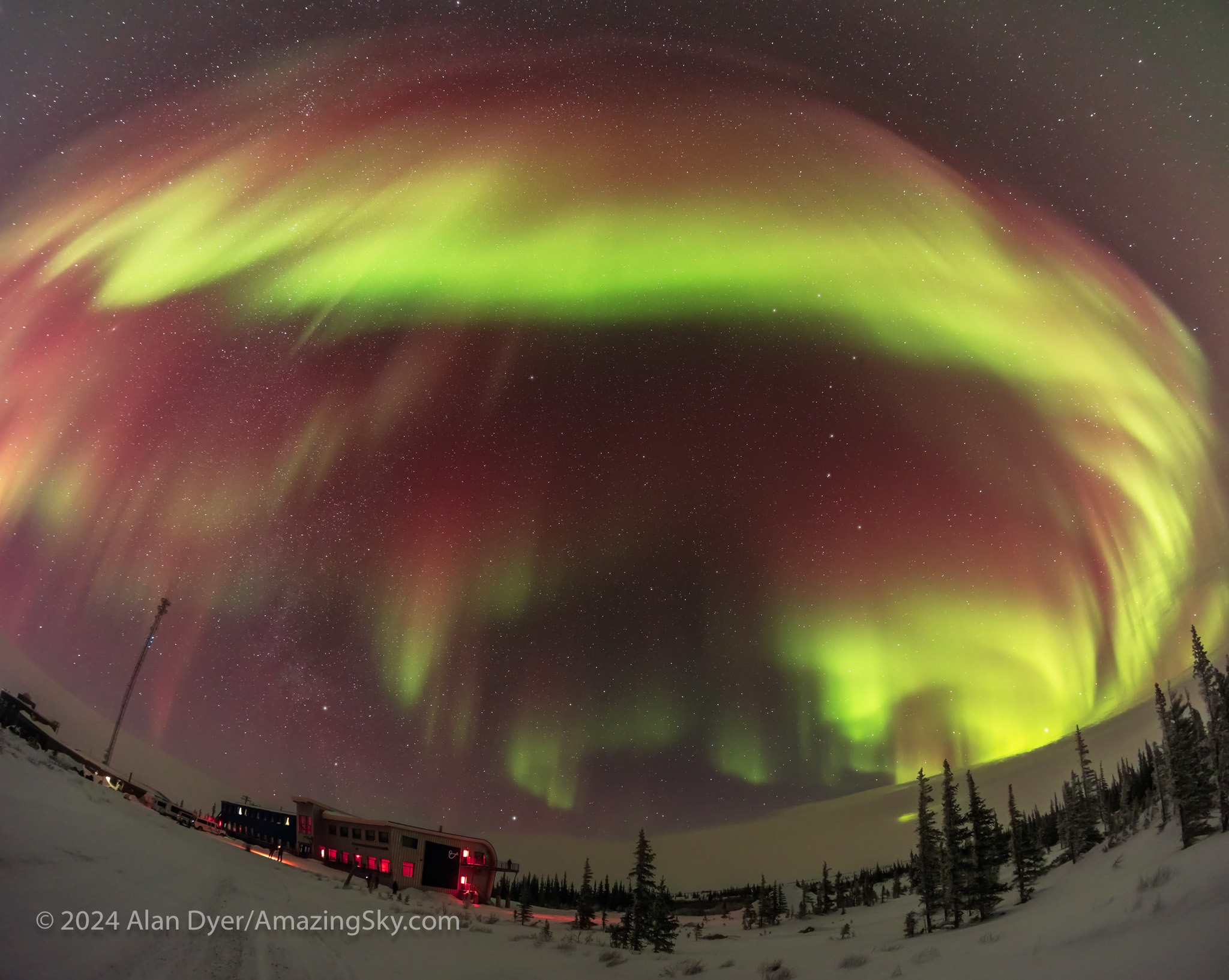
Had this been my only chance to see the Northern Lights fill the sky this year, I would have been happy. As we often see in Churchill, the aurora covered the sky on several nights, a common sight when you are underneath the main band of aurora borealis that arcs across the northern part of the globe.
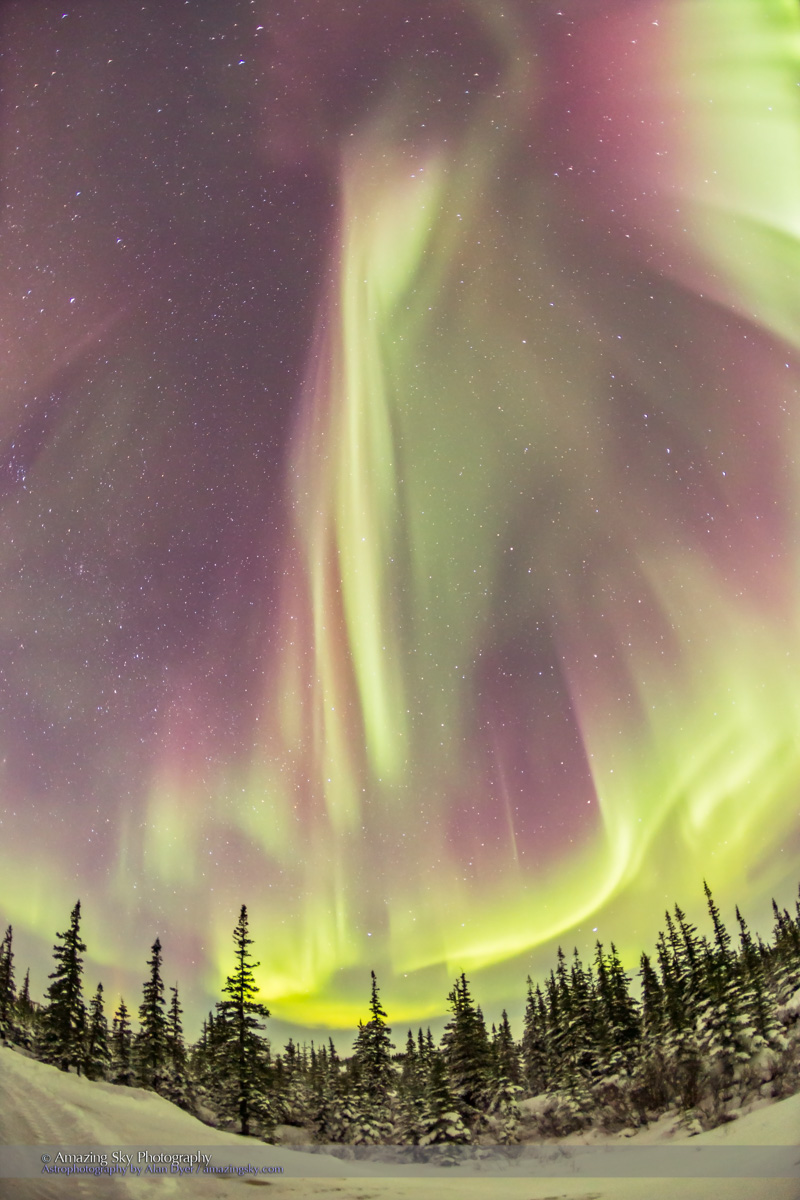
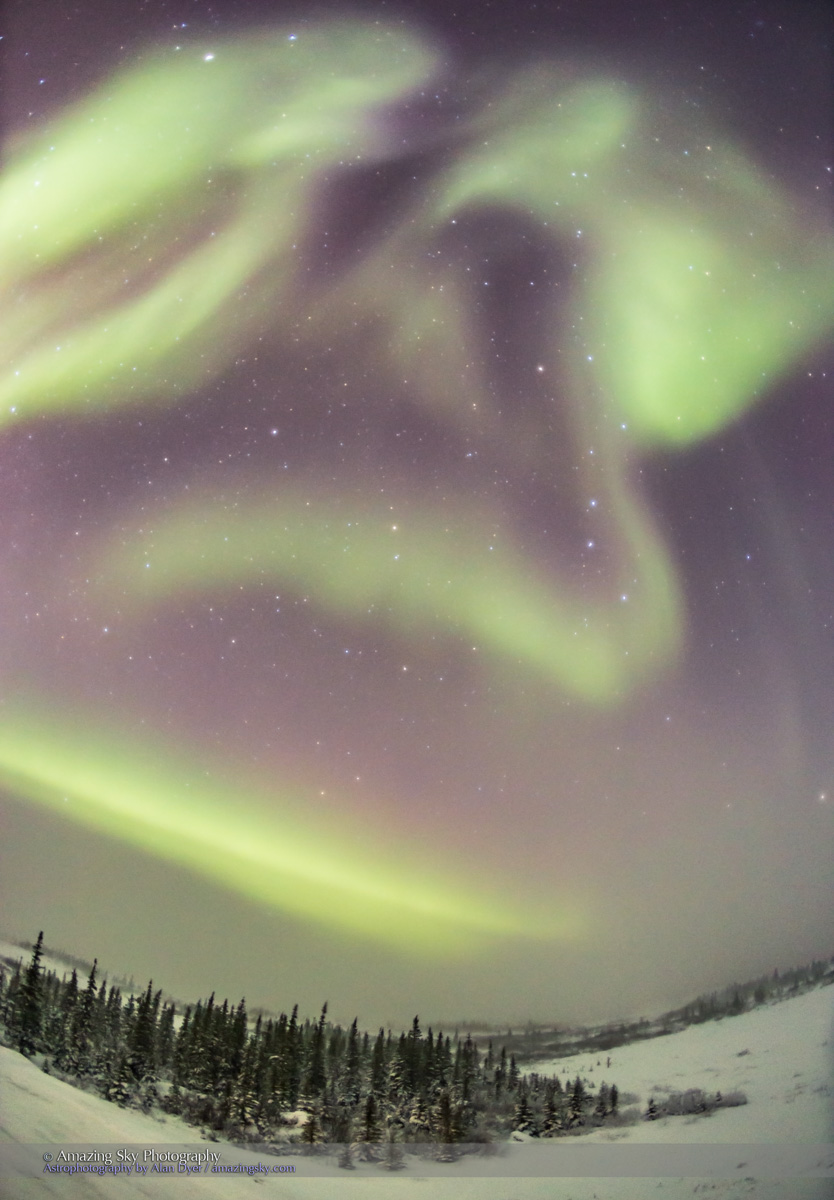
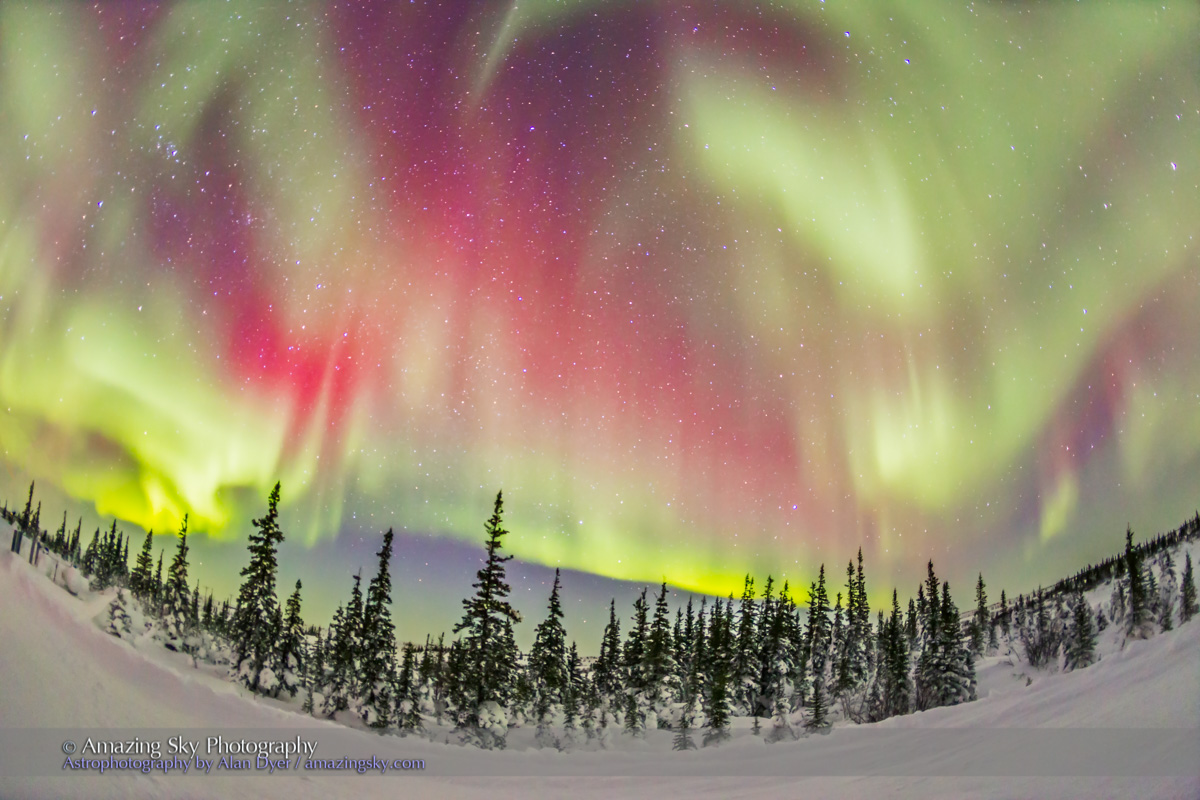
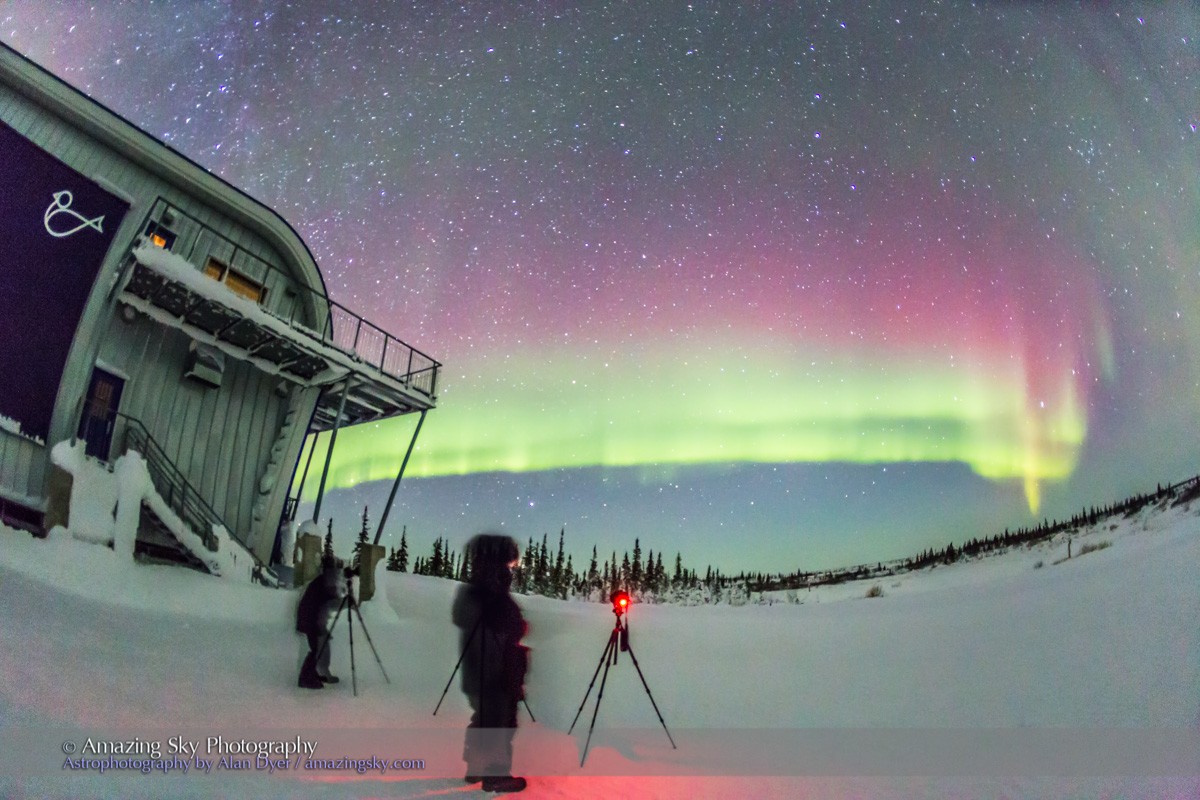
This is a vertical panorama of the sky-filling aurora of February 10, 2024, as seen from the Churchill Northern Studies Centre, in Churchill, Manitoba.
I attended to two aurora tour groups at the Churchill Northern Studies Centre who both got good displays to check “seeing the Northern Lights” off their bucket list. Join me in 2025!
March
Under the Austral Sky
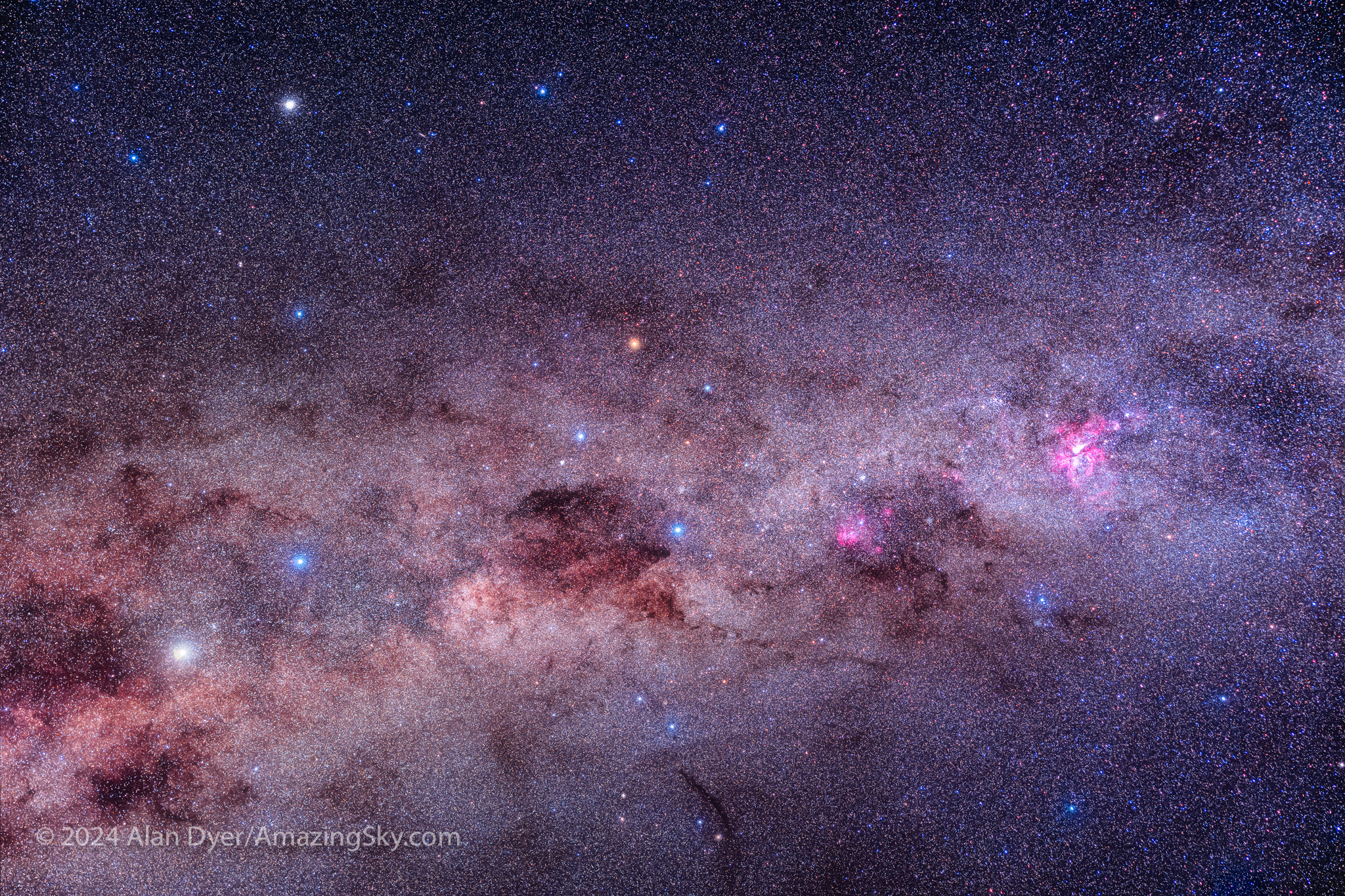
Ranking a respectable 7 on our Aah! Factor scale is the naked-eye sight of the galactic centre overhead, with the Milky Way arcing across the sky. That’s possible from a latitude of about 30° South. That’s where I went in March, back to Australia 🇦🇺 for the first time since 2017.
This is a framing of the most spectacular area of the southern Milky Way, from Centaurus at left, to Carina at right, with Crux, the Southern Cross, at centre.
I wrote about it in my previous blog, where I present a tour along the southern Milky Way, and wide-angle views of the Milky Way (the images here are framings of choice regions).
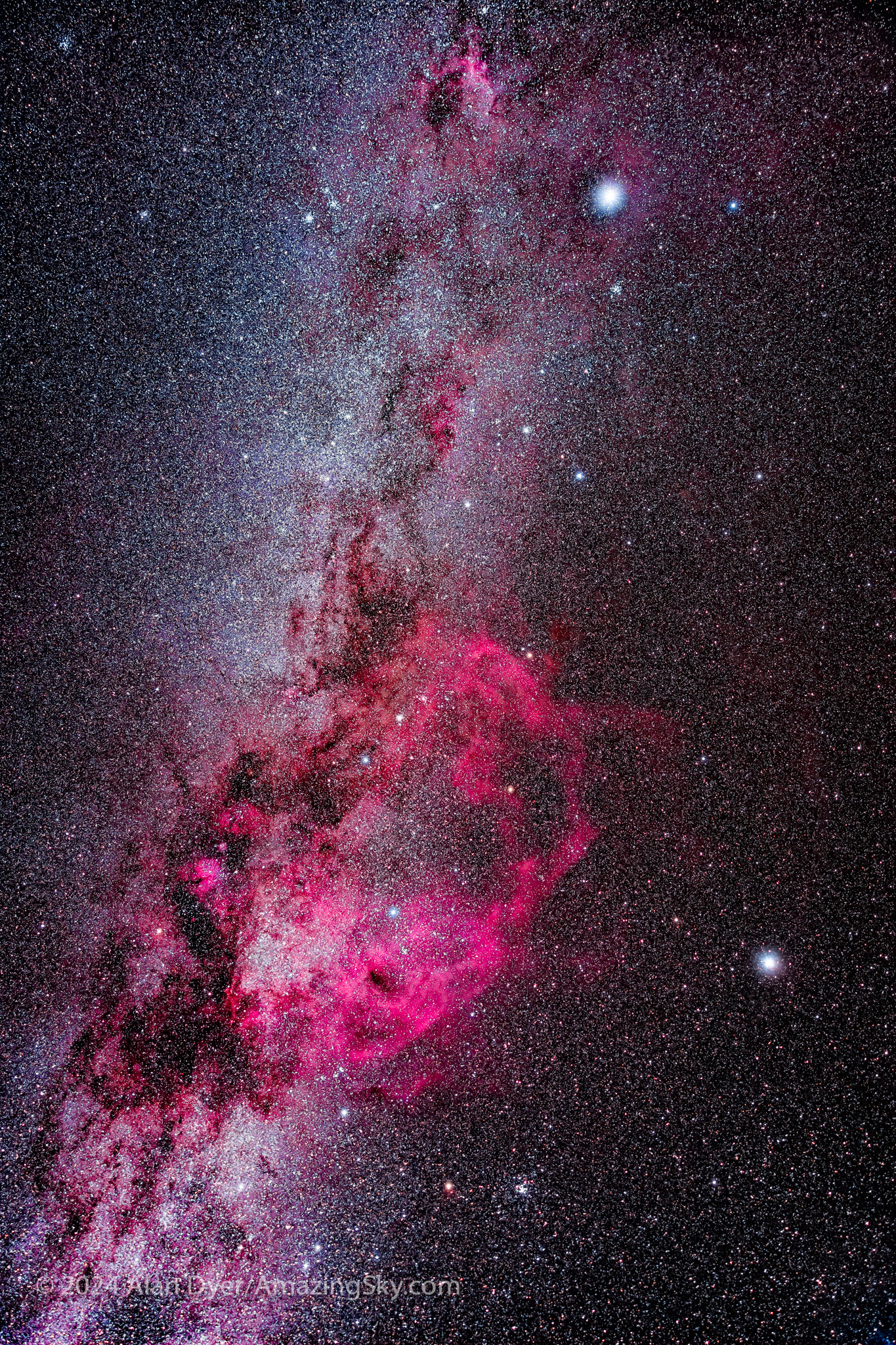
This frames the southern Milky Way from Canis Major and its bright star Sirius at top, to Carina and its bright star Canopus at bottom, the two brightest stars in the night sky. The large red complex is the Gum Nebula.
It is a magical latitude that all northern astronomers should make a pilgrimage to, if only to just lie back and enjoy the view of our place in the outskirts of the Galaxy. I was glad to be back Down Under, to check this top sky sight off my bucket list for 2024.
April
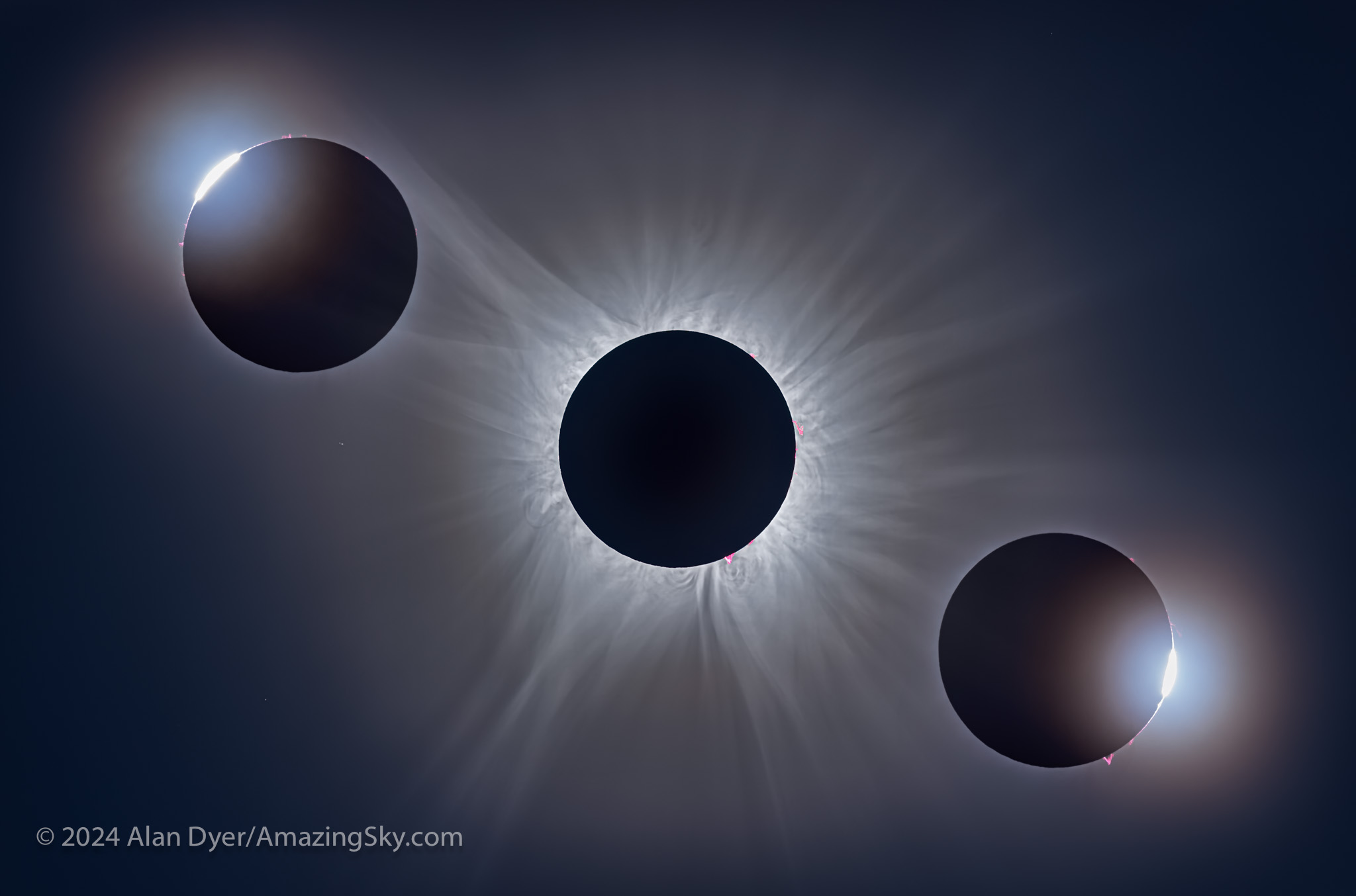
A Total Eclipse of the Sun
No sooner had I returned home from Oz, when it was time to load up the car with telescope gear and drive to the path of the April 8 total solar eclipse, the first “TSE” in North America since 2017, which was the last total eclipse I had seen, in a trip to Idaho.
This is a composite of telescopic close-ups of the April 8, 2024 total eclipse, with a multi-exposure blend for the corona at centre, flanked by the diamond rings.
But where? I started south to Texas, my Plan A. Poor weather forecasts there prompted a hasty return to Canada, to drive east across the country to … I ended up in Québec. My blog about my cross-continental chase is here. My final edited music video is linked to below.
It was gratifying to see a total eclipse from “home” in Canada, only the third time I’ve been able to do that (previously in 1979 – Manitoba, and 2008 – Nunavut). If the rest of the year had been cloudy except for this day I wouldn’t have complained. Much.
This definitely earned a 10 on the Aah! Factor scale. Total eclipses are overwhelming and addictive. I’ve made my bookings for 2026 in Spain 🇪🇸 and 2027 in Tunisia 🇹🇳.
May
The Sky’s On Fire
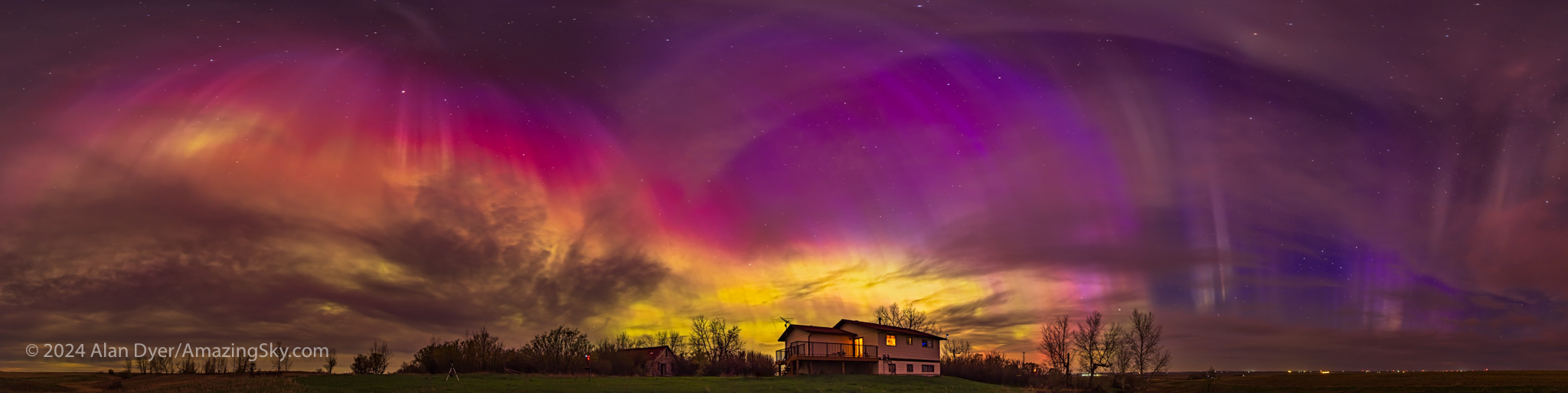
It had been several years since I had seen an aurora from my backyard with colours as vivid and obvious as they were this night. But on May 10, the sky erupted with a fabulous display of aurora that much of the world saw, as aurora borealis in the north and aurora australis in the south.
This is a 300º panorama of the May 10, 2024 Northern Lights display, when the Kp Index reached 8 (out of 9), bringing aurora to the southern U.S.
This was the first of several all-sky shows this year. I blogged about the year’s great auroras here, where there are links to the movies I produced that capture the Northern Lights as only movies can, recording changes so rapid it can be hard to take it all in. Check off a 9 here!
So not even half way through the year, I had seen three of the top sky sights: the Milky Way core overhead (7), an all-sky aurora (9), and a total eclipse of the Sun (10).
But there was more to come! Including an Aah! Factor 8.
June
World Heritage Nightscape Treks
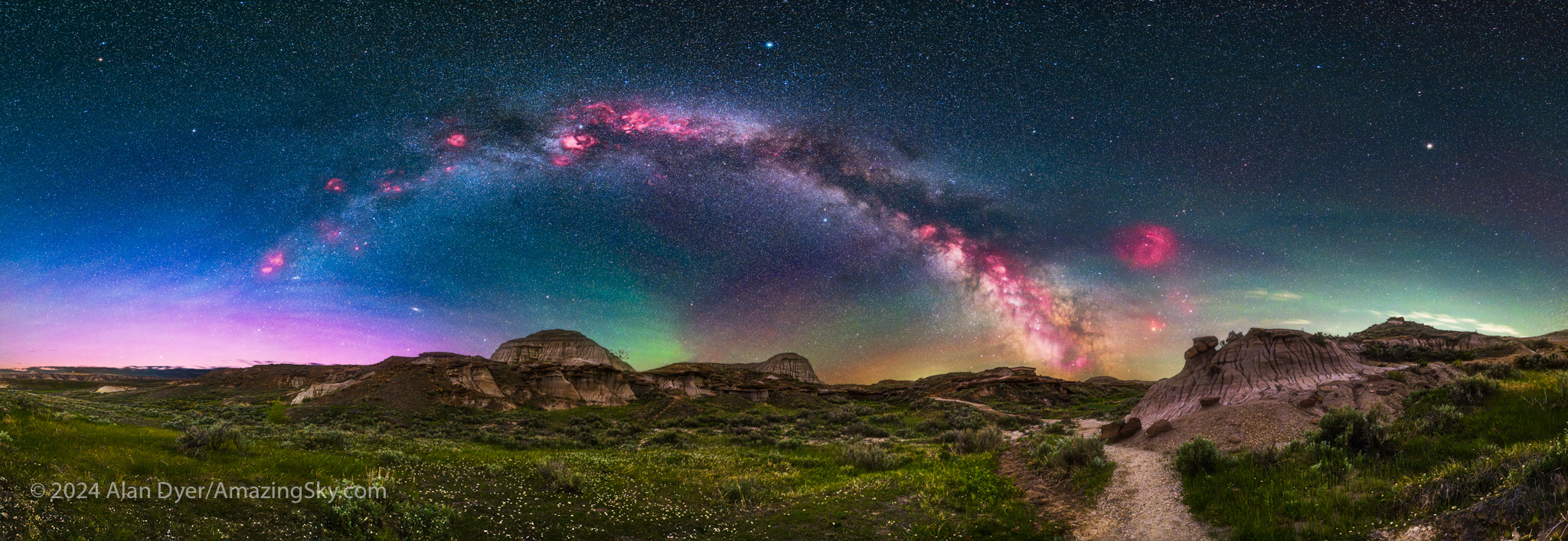
This is a panorama of the arch of the Milky Way rising over the Badlands of Dinosaur Provincial Park, Alberta, with a sky tinted with twilight and airglow.
The sky took a break from presenting spectacles, allowing me to head off on short local trips, to favourite nightscape sites in southern Alberta, which we have in abundance. The Badlands of Dinosaur Provincial Park are just an hour away, the site for the scene above.
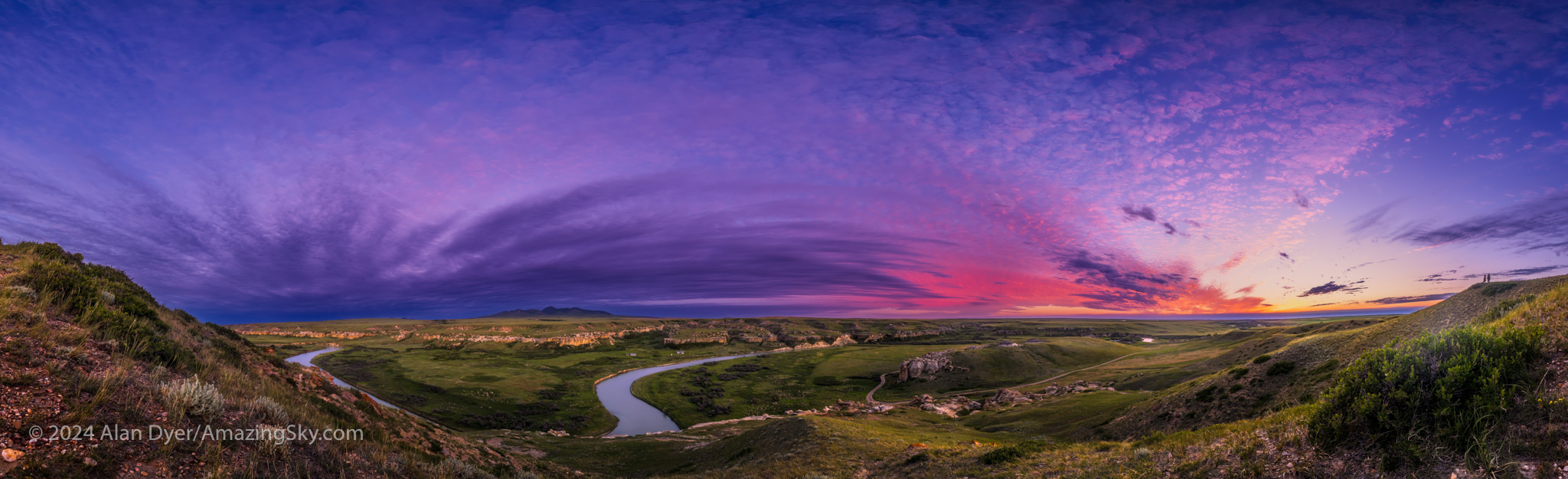
A panorama at sunset at Writing-on-Stone Provincial Park (Áísínai’pi) in Alberta, with the Milk River below and the Sweetgrass Hills in the distance in Montana. Note the people at far right.
The rock formations of Writing-on-Stone Provincial Park are a bit farther, requiring a couple of days commitment to shoot. Clouds hid the main attraction, the Milky Way, this night, but did provide a fine sunset.
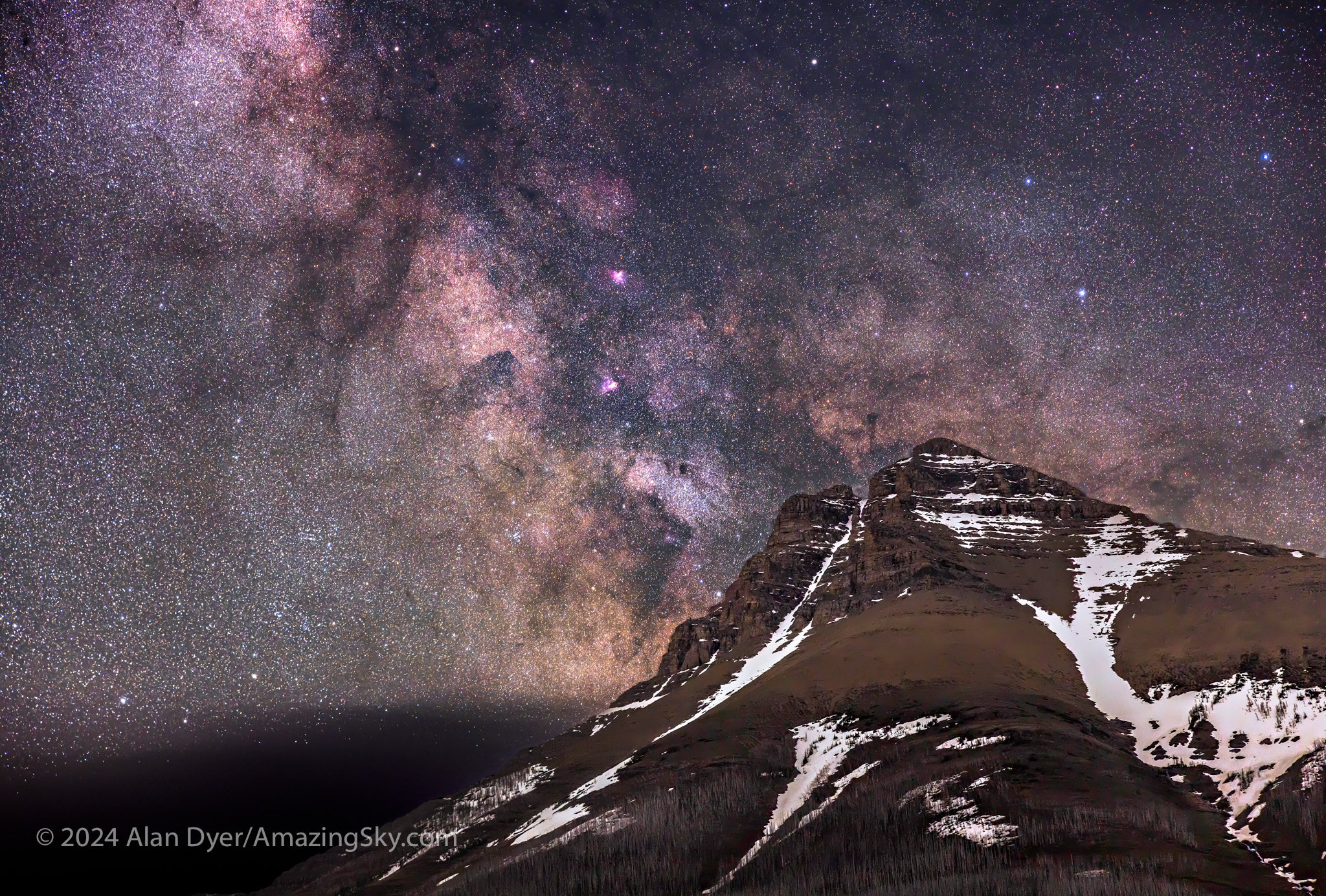
The Milky Way rises over Mt. Blakiston, in Waterton Lakes National Park, Alberta. This was June 10, 2024, so snow remains at high altitudes.
A little further west down the highway is Waterton Lakes National Park, another great spot I try to visit at least once each year.
All locations I hit this month are U.N. World Heritage Sites, thus the theme of my blog from June. People travel from all over the world to come here, to sites I can visit in a few hours drive.
July
Mountains by Starlight
In summer we now often contend with smoke from forest fires blanketing the sky, hiding not just the stars by night, but even the Sun by day.
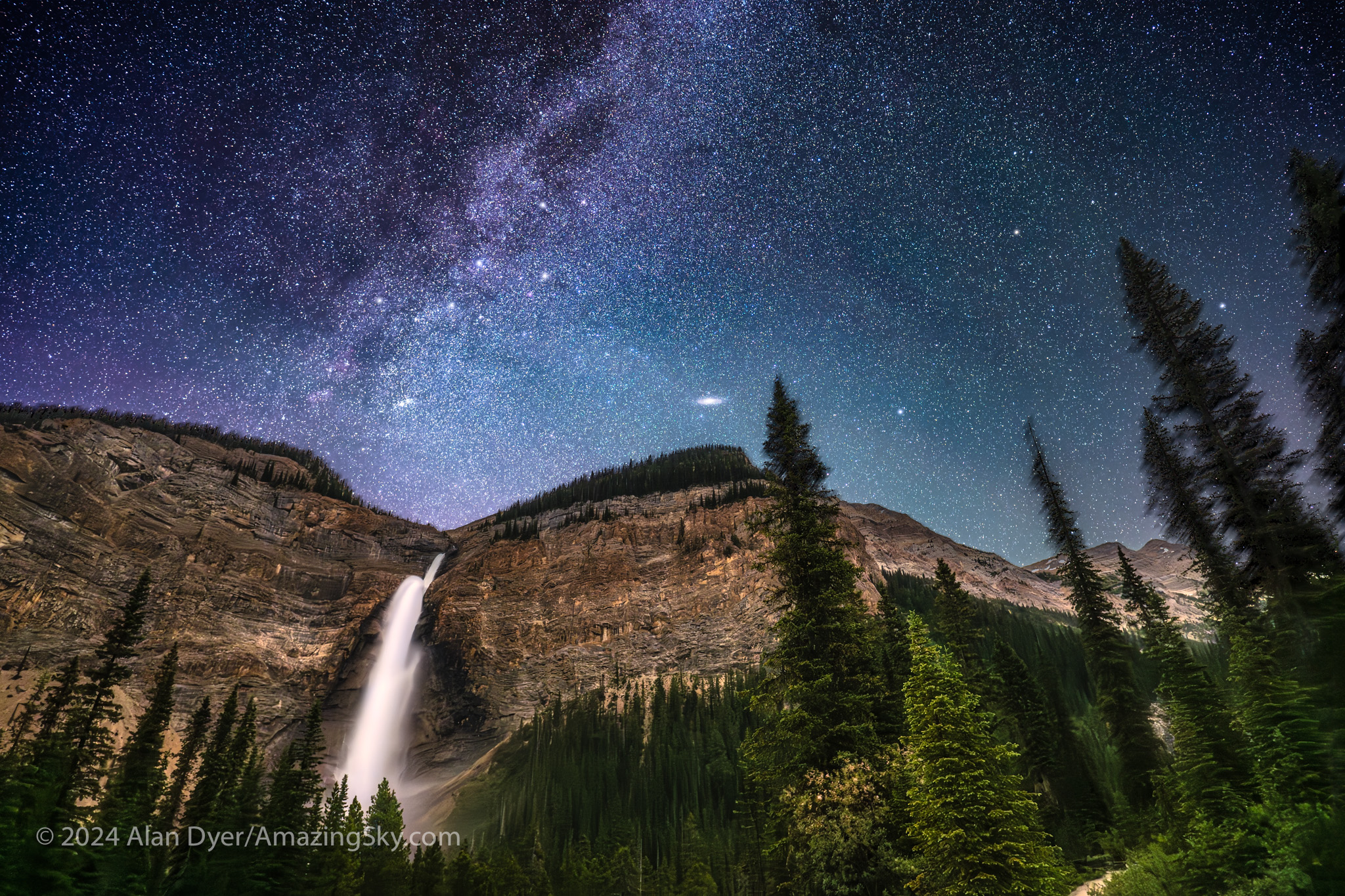
The Andromeda Galaxy at centre is rising above Takakkaw Falls, in Yoho National Park. Above is the W of stars marking Cassiopeia.
But before the smoke rolled in this past summer I was able to visit a spot, Yoho National Park in British Columbia, that had been on my shot list for several years. The timing with clear nights at the right season and Moon phase has to work out. In July it did, for a shoot by starlight at Takakkaw Falls, among the tallest in Canada.
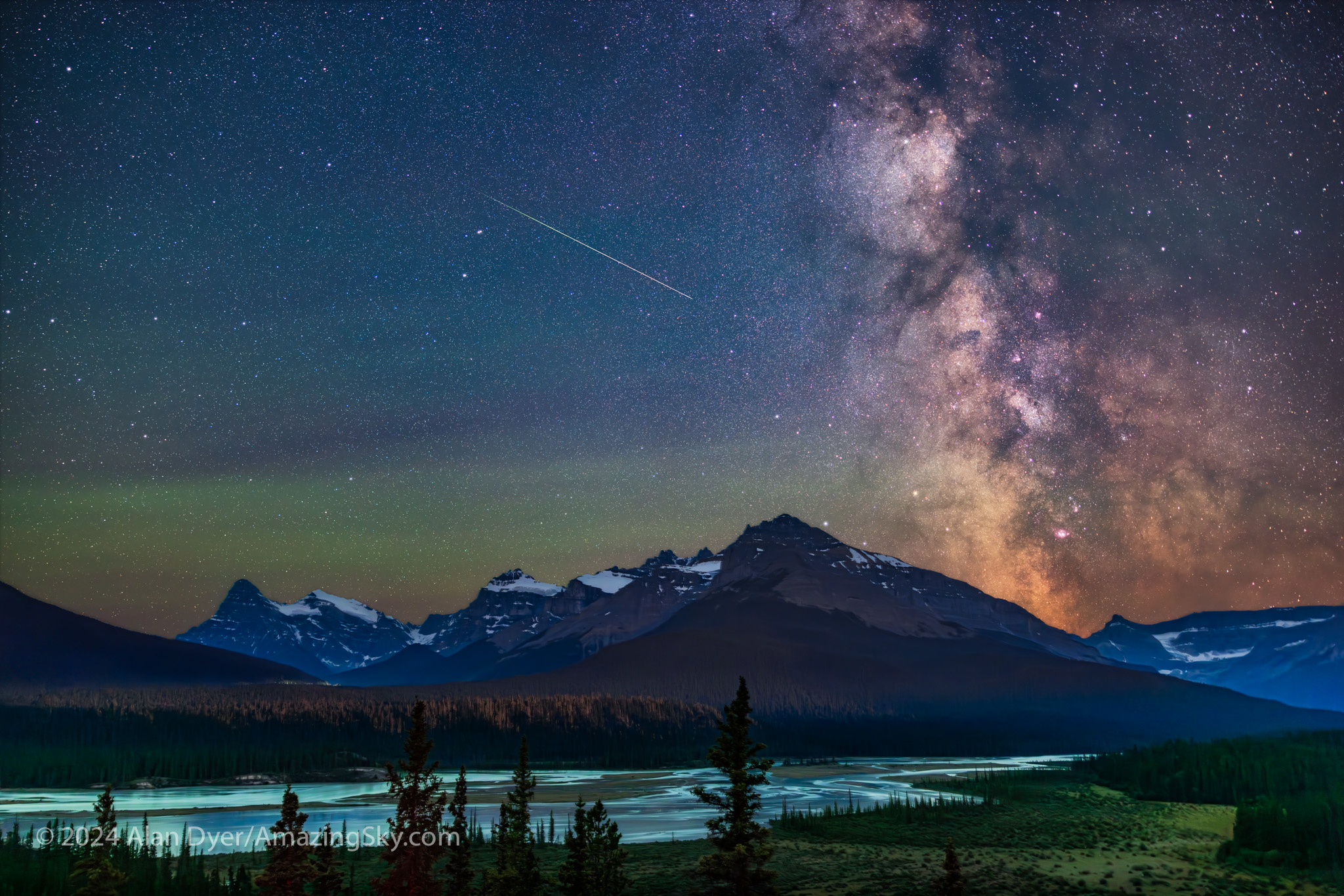
This is the Milky Way core and a bonus meteor over the peaks and valleys at Saskatchewan River Crossing, in Banff National Park, Alberta.
The following nights I was in Banff National Park, at familiar spots on the tourist trail, but uncrowded and quiet at night. It was a pleasure to enjoy the world-class Rocky Mountain scenery under the stars on perfect nights.
August
The All-Sky Auroras Return
In August I headed east to Saskatchewan and the annual Summer Star Party staged by the astronomy clubs in Regina and Saskatoon. It is always a pleasure to attend the SSSP in the beautiful Cypress Hills. The sky remained clear post-party for a trip farther east to the little town of Val Marie, where I stayed at a former convent, and had a night to remember out in Grasslands National Park, one of Canada’s first, and finest, dark sky preserves.
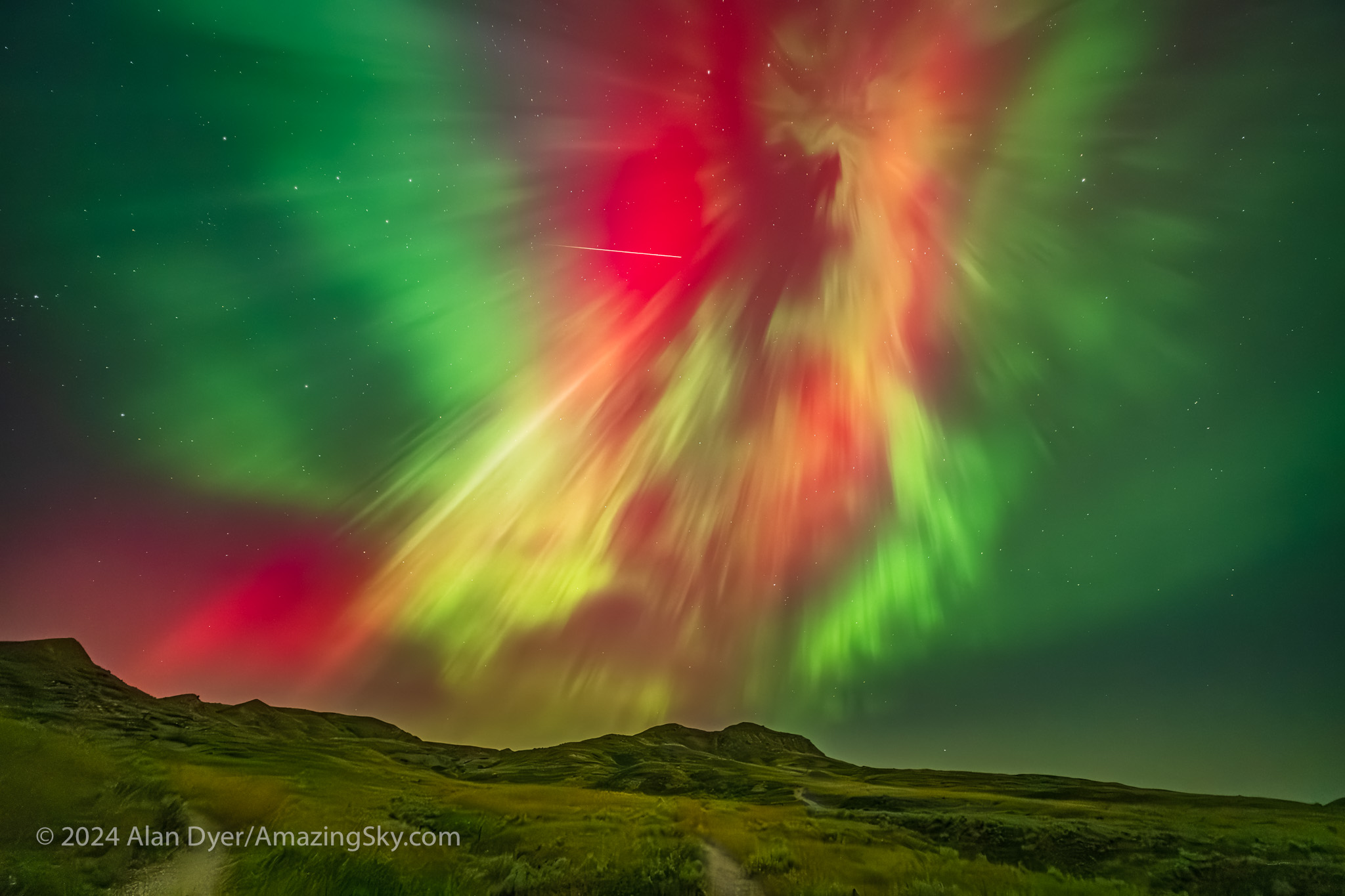
The Northern Lights in a superb all-sky Kp6 to 7 display on August 11-12, 2024, in Grasslands National Park, Saskatchewan.
The plan was to shoot the August 11 Perseid meteor shower, but the aurora let loose again for a stunning show over 70 Mile Butte. My earlier blog has more images and movies from this wonderful month of summertime Northern Lights.
We are fortunate in western Canada 🇨🇦 to be able to see auroras year-round, even in summer. Farther north at the usual Northern Lights destinations, the sky is too bright at night in summer.
September
Back to Deep Sky Wonders …
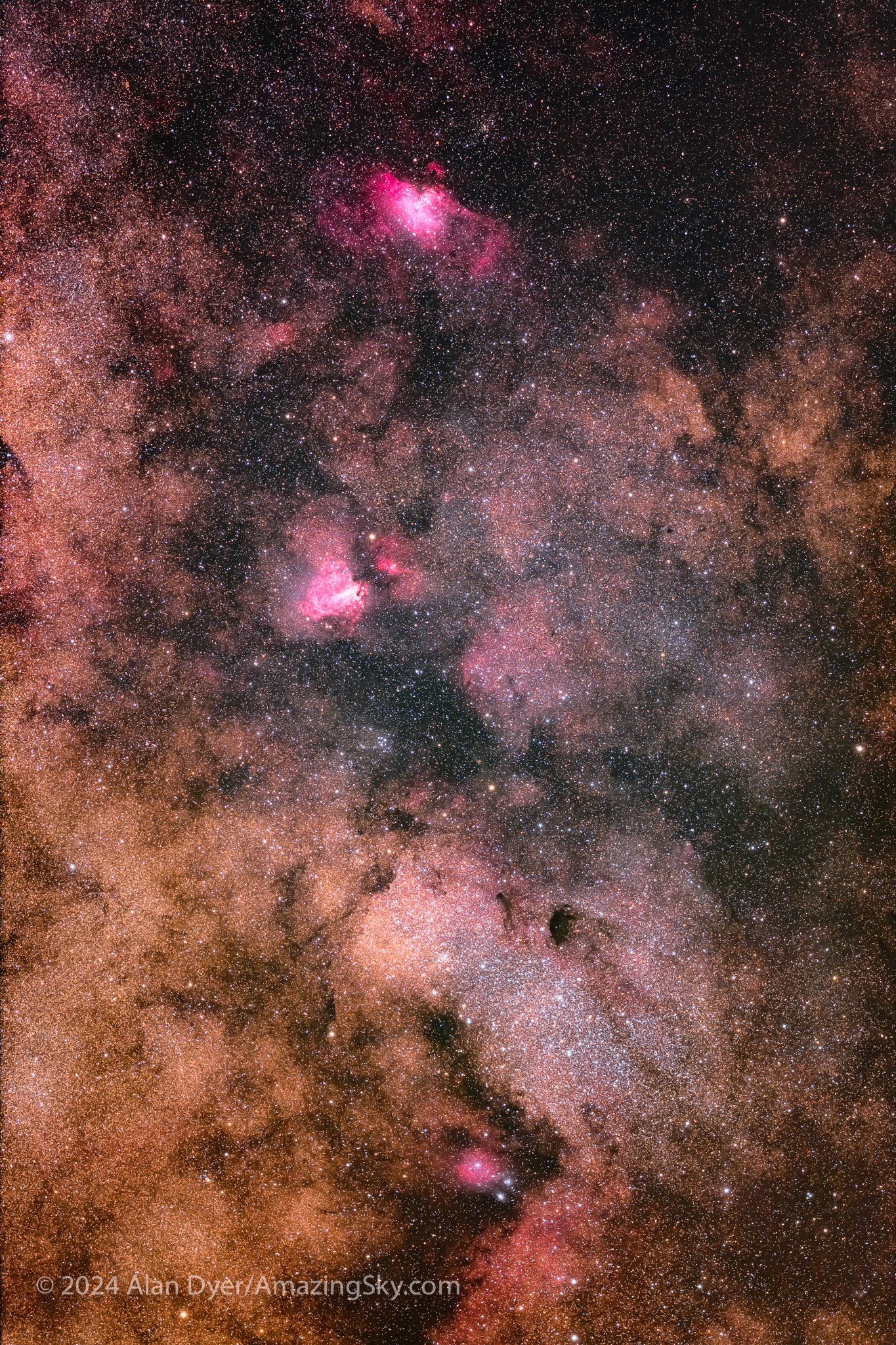
This is a framing of the rich starfield in Sagittarius and Serpens containing a mix of bright star clouds, glowing nebulas, and dark dust in the Milky Way.
September is the month for another astronomical party in the Cypress Hills, but on the Alberta side. At the wonderful Southern Alberta Star Party under its very dark skies, I was able to shoot some favourite deep-sky fields along the Milky Way with new gear I was testing at the time.
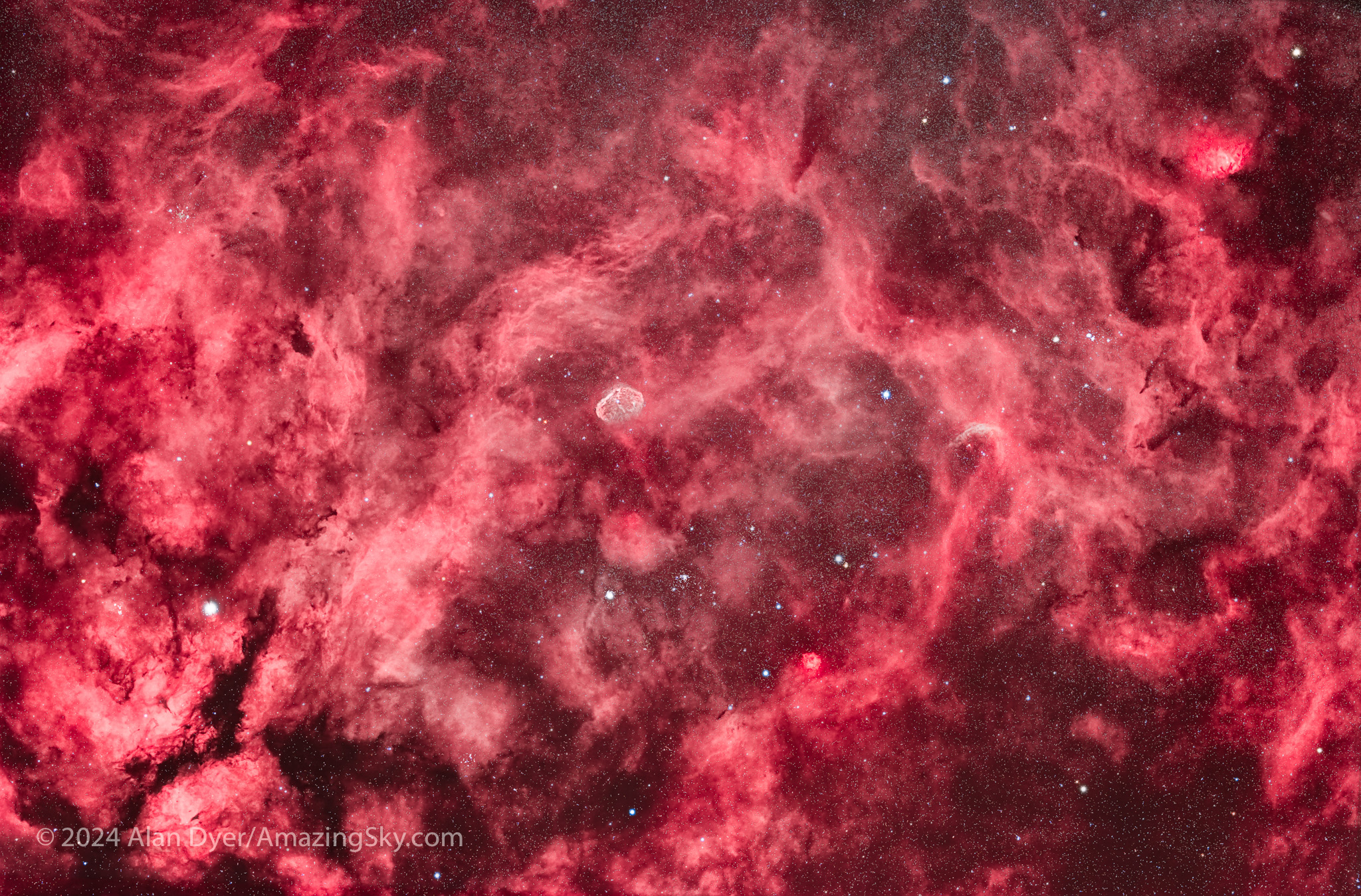
This frames the complex region of emission nebulas in central Cygnus near the star Gamma Cygni, at lower left. The Crescent Nebula is at centre.
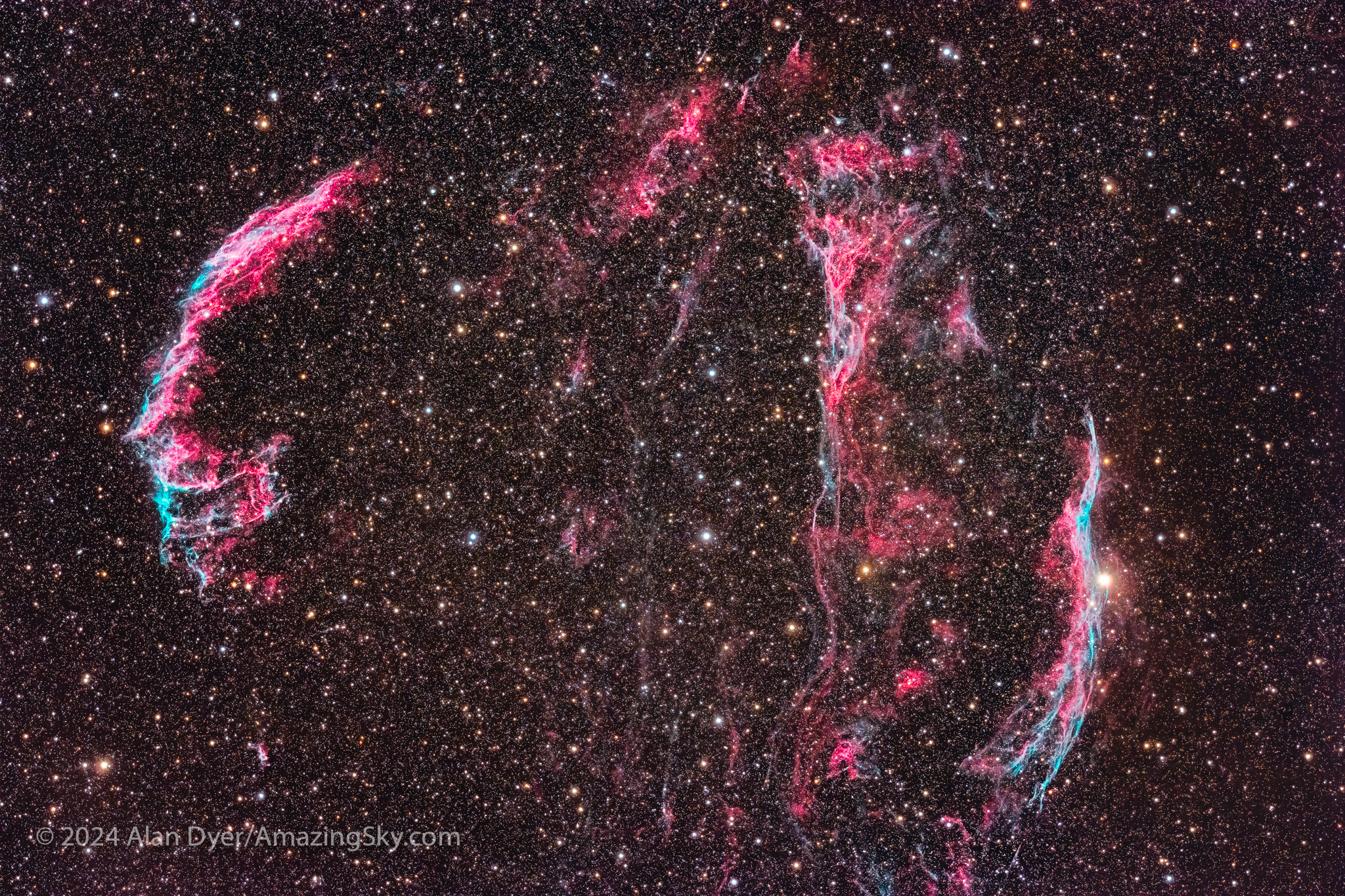
And from home, September brought skies dark and clear enough (at least when there was no aurora!) for more captures of colourful nebulas (above and below) along the summer Milky Way.
This frames all the photogenic components of the bright Veil Nebula in Cygnus, a several-thousand-year-old supernova remnant.
We invest a lot of money into the kind of specialized gear needed to shoot these targets (and I’m not nearly as “committed” as some are, believe me!), only to find the nights when it all comes together can be few and far between.
… Plus, A Very Minor Eclipse of the Moon
I had to include this, if only for stark contrast with the spectacular solar eclipse six months earlier.
We had an example of the most minor of lunar eclipses on March 24, 2024, with a so-called “penumbral” eclipse of the Moon, an eclipse so slight it’s hard to tell anything unusual is happening. (So I’ve not even included an image here, though I was able to shoot it.)
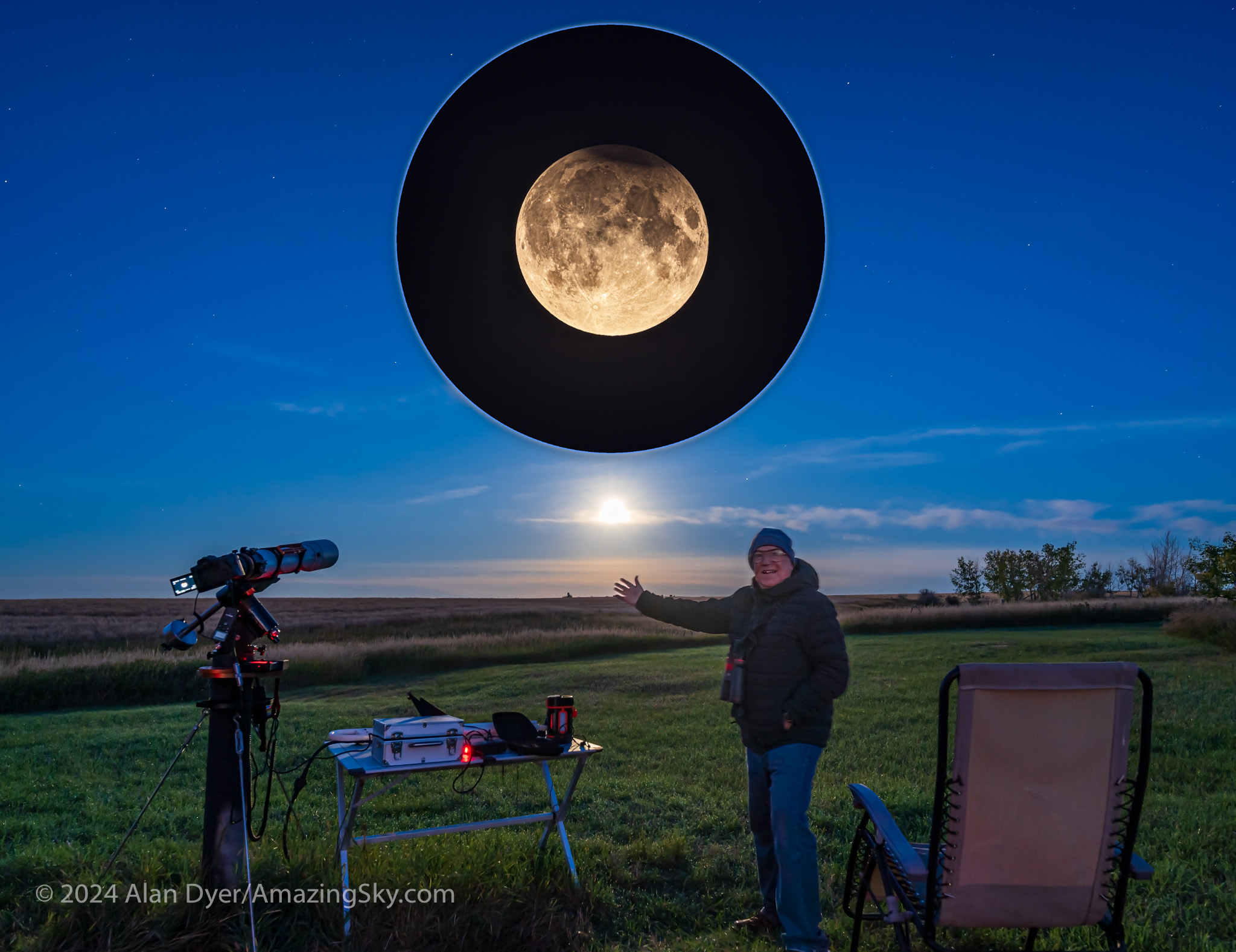
Me at another successful eclipse chase … to my backyard to capture the partial lunar eclipse on September 17, 2024. The Moon is rising in the southeast.
On September 17, we had our second eclipse of the Moon in 2024. This time the Earth’s umbral shadow managed to take a tiny bite out of the Full Moon. Nothing spectacular to be sure. But at least this eclipse expedition was to no farther away than my rural backyard. A clear eclipse of any kind, even a partial eclipse, especially one seen from home, is reason to celebrate. I did!
Of course, a total eclipse of the Moon, when the Full Moon is completely engulfed in Earth’s umbra and turns red, is what we really want to see. They rate a 7 on our Aah! Factor scale. We haven’t had a “TLE” since November 8, 2022, blogged about here.
We knew early in 2024 that the then newly-discovered Comet Tsuchinshan-ATLAS had the potential to perform this month. I planned a trip south to favourite spots in Utah and Arizona to take advantage of what we hoped would be a fine autumn comet.
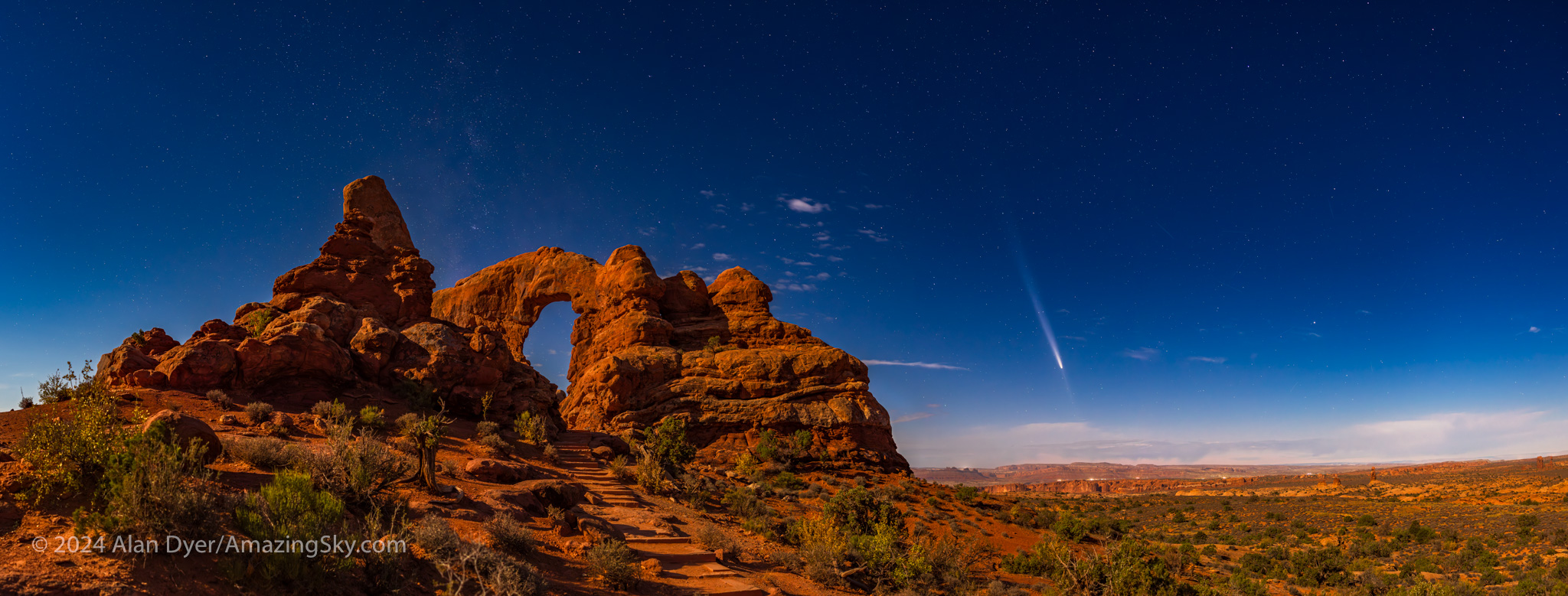
This is Comet Tsuchinshan-ATLAS (C/2023 A3) at its finest in the evening sky, on October 14, two days after its closest approach to Earth, and with it sporting a 10º- to 15º-long dust tail, and a short narrow anti-tail pointed toward the horizon. The location was Turret Arch in the Windows area of Arches National Park, Utah.
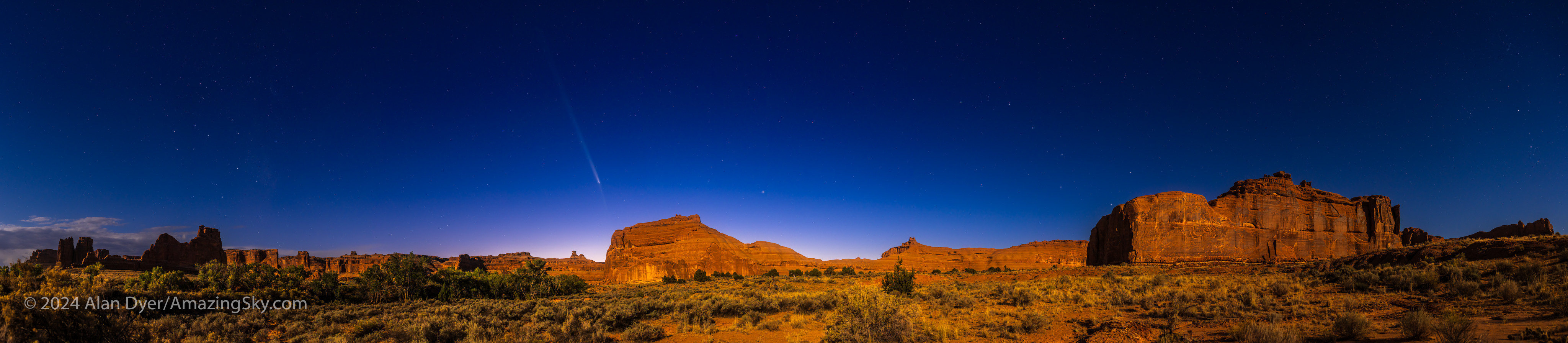
It blossomed nicely, especially as it entered into the evening sky in mid-October, as above. Despite the bright moonlight, it was easy to see with the unaided eye, a celestial rarity we get only once a decade, on average, if we are lucky. My blog of my comet chase is here.
This is a panorama of Comet Tsuchinshan-ATLAS over Arches National Park, Utah, on a moonlit night, October 15, 2024, with the comet easy to see with the unaided eye.
A naked-eye comet ranks an 8 on our Aah! Factor scale. So now 2024 had delivered all four of our Top 4 sky sights.
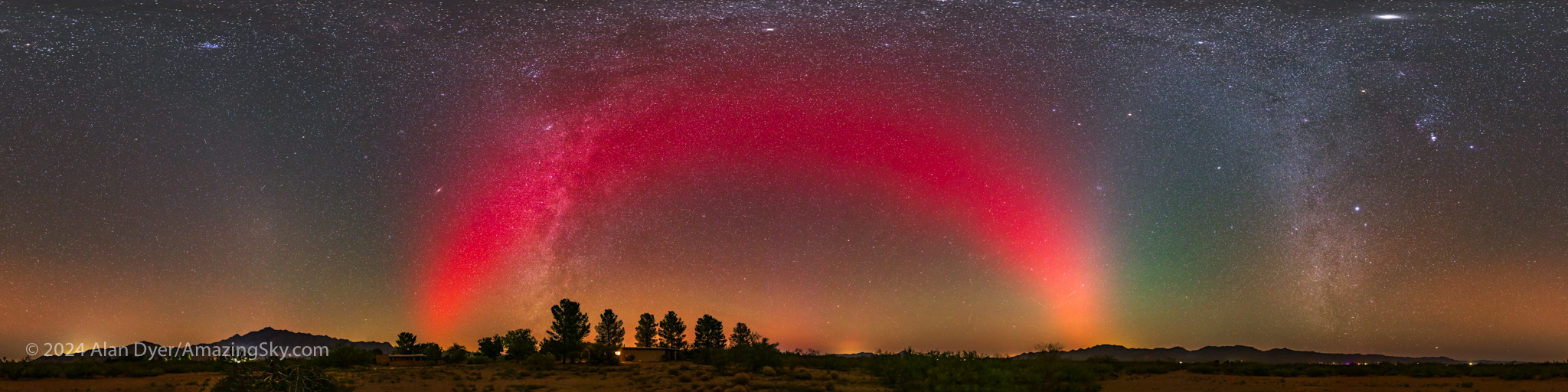
This 360° panorama captures a rare SAR (Stable Auroral Red) arc across the Arizona sky in the pre-dawn hours of October 11, 2024. The SAR arc was generated in the high atmosphere as part of the global geomagnetic storm of October 10/11, 2024, with a Kp8 rating that night.
But … just as a bonus, there was another fabulous aurora on October 10, seen in my case from the unique perspective of southern Arizona, with an appearance of a bright “SAR” arc more prominent than I had ever seen before. So that view was a rarity, too, so unusual it doesn’t even make our Aah! list, as SARs are typically not visible to the eye.
November
Back to Norway for Northern Lights
2024 was notable for travel getting “back to normal,” at least for me, with two long-distance drives, and now my second overseas trip. This one took me north to Norway 🇳🇴, which I had been visiting twice a year as an enrichment lecturer during pre-pandemic years.
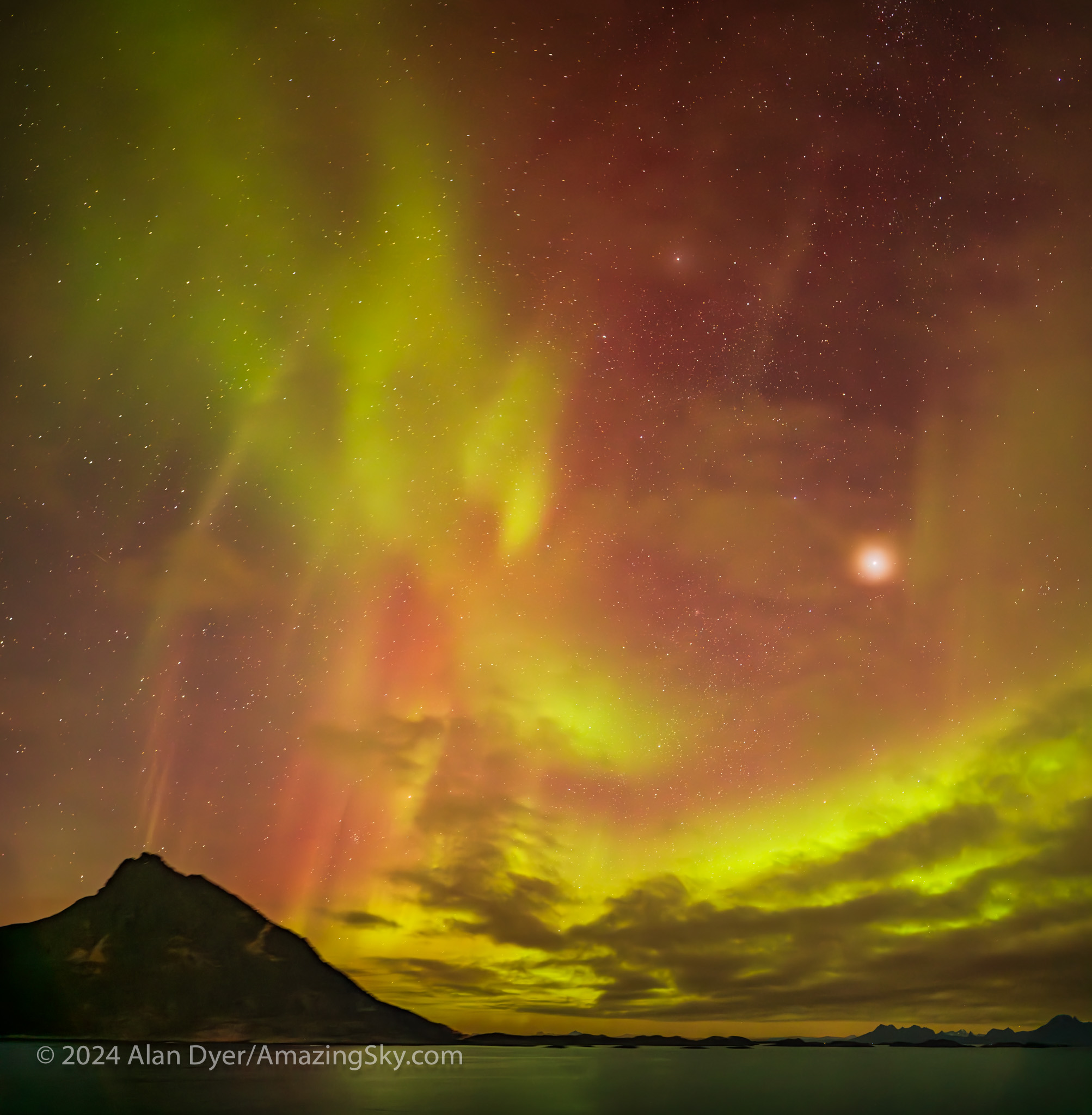
A green and red aurora appears over the coast of Norway, with Jupiter bright at right. This was from the Hurtigruten ship m/s Nordkapp on November 10, 2024, on a coastal cruise with a Road Scholar tour group.
The auroras were excellent, though nothing like the great shows of May and October. But the location sailing along the scenic coast and fjords makes up for any shortfall in the Lights. It was good to be back. I plan to return in 2025 for two cruises in October. Join me there, too!
December
A Winter Moonrise to End the Year
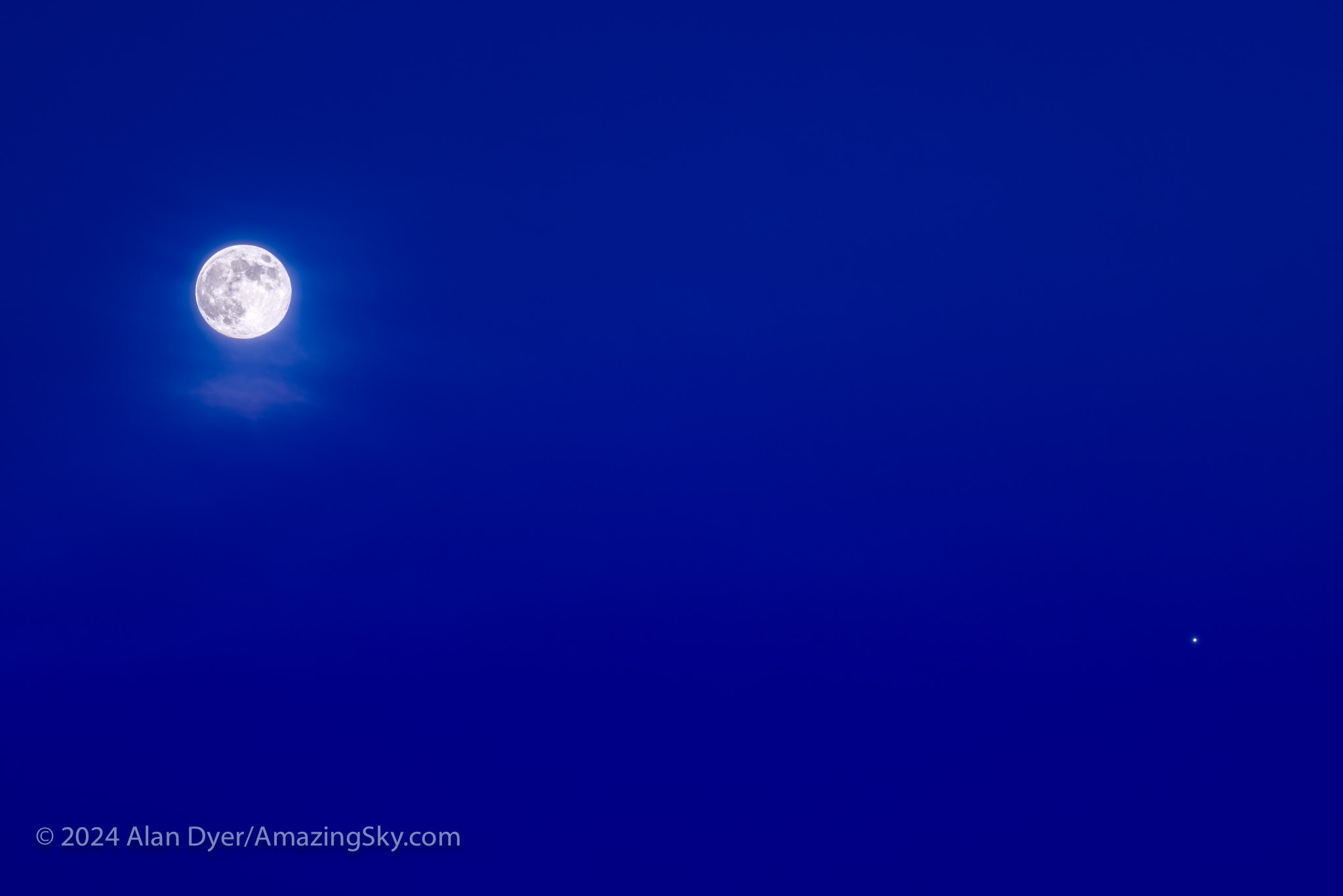
As I write this, December has been nothing but cloud. Almost. A clear hour on Full Moon night allowed a capture of the “Cold Moon,” with the Moon near Jupiter, then at its brightest for the year. So that’s the other lunar bookend to the year, shot from the snowy backyard.
This is the Full Moon of December 14, 2024, near the planet Jupiter at lower right. Both were rising into the eastern sky in the early evening.
However, I did say after the clear total eclipse in April that if the rest of 2024 had been cloudy I wouldn’t complain. So I’m not.
And there’s no reason to, as 2024 did deliver the best year of stargazing I can remember. 2017 had a total solar eclipse. 2020 had a great comet. But we have to go back to 2003 for aurora shows as widespread and as a brilliant as we’ve seen this year. 2024 had them all. And more!
For 11 non-stop nights in February we had clear skies and Northern Lights in Churchill.
Every year in winter I visit Churchill, Manitoba to attend to groups of aurora tourists at the Churchill Northern Studies Centre. Few groups (indeed only two over the 35 years the program has been offered) go away having not seen the Lights during the 5-night program.
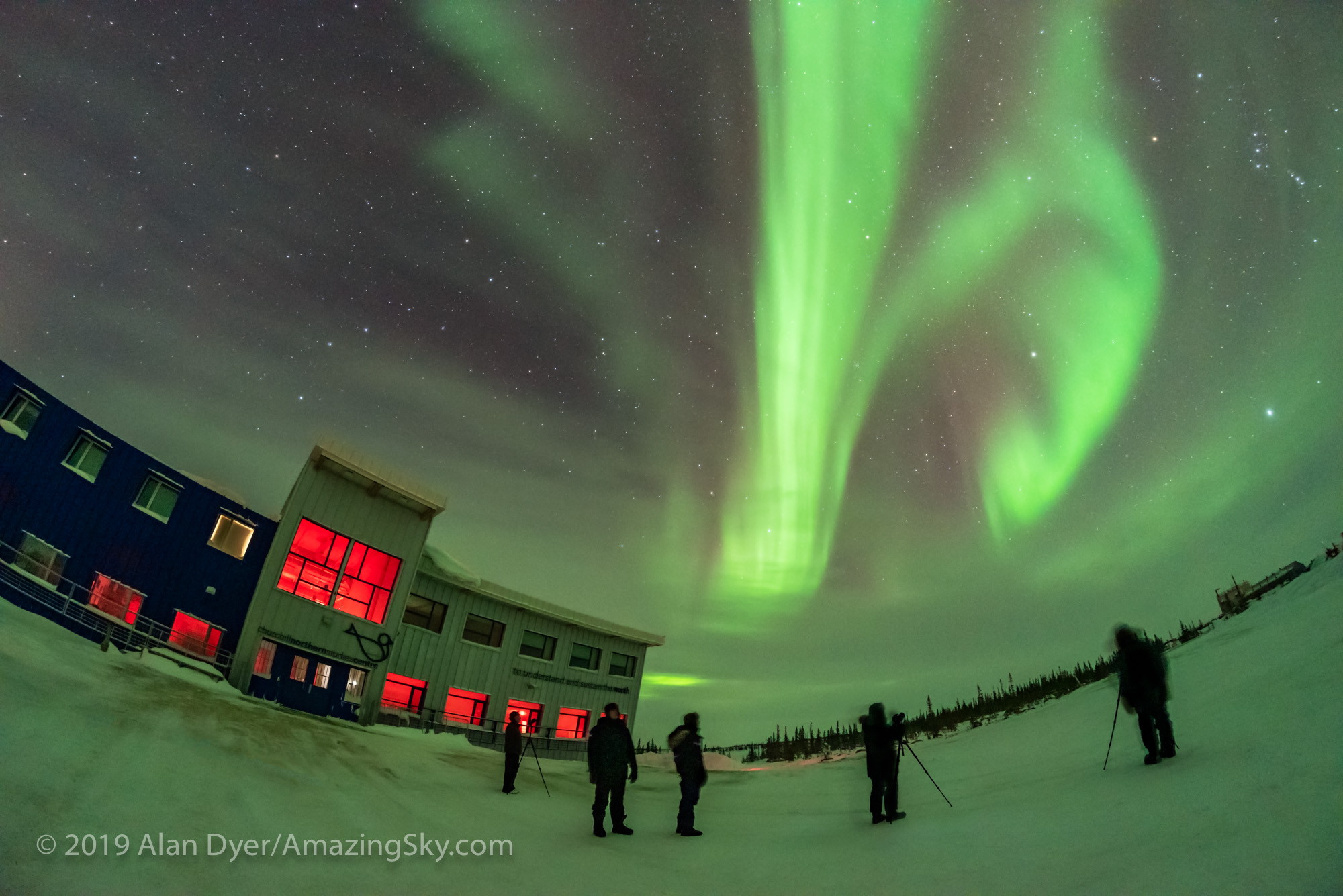
Guests in the Learning Vacations program at the Churchill Northern Studies Centre view the aurora on their first night of the program for 2019 on January 31. This is looking east, with the Big Dipper at left and Orion at right.
But this year was the opposite exception. Even locals were impressed by the run of clear nights and displays in early February. It was non-stop Northern Lights!
A photographer and volunteer at the Churchill Northern Studies Centre (Brian) shoots the aurora from up the Rocket Range Road at the Centre. This was Feb 8, 2019 on a brutal night with brisk winds and high wind chills. This is a single exposure with the 15mm lens and Sony a7III.
Having auroras in Churchill isn’t unusual. It is located right under the auroral oval, so if it’s clear it would be unusual not to have some level of auroral activity.
One of a short series of images showing the development of an aurora display from a classic arc into a more complex pattern of concentric arcs and with loops and swirls. This was Feb 5, 2019 from the Churchill Northern Studies Centre. The outburst lasted only 5 minutes or so and might have been due to the Bz interplanetary field turning south briefly. After this series, the display faded and fractured into faint arcs and a diffuse glow across the sky. This is a single exposure with the 12mm Rokinon full-frame fish-eye and Nikon D750.
But particles from a coronal hole at the Sun fired up the lights and gave us good shows every night, often starting early in evening, rather than at midnight as is typically the case. The shows pre-empted my evening lectures!
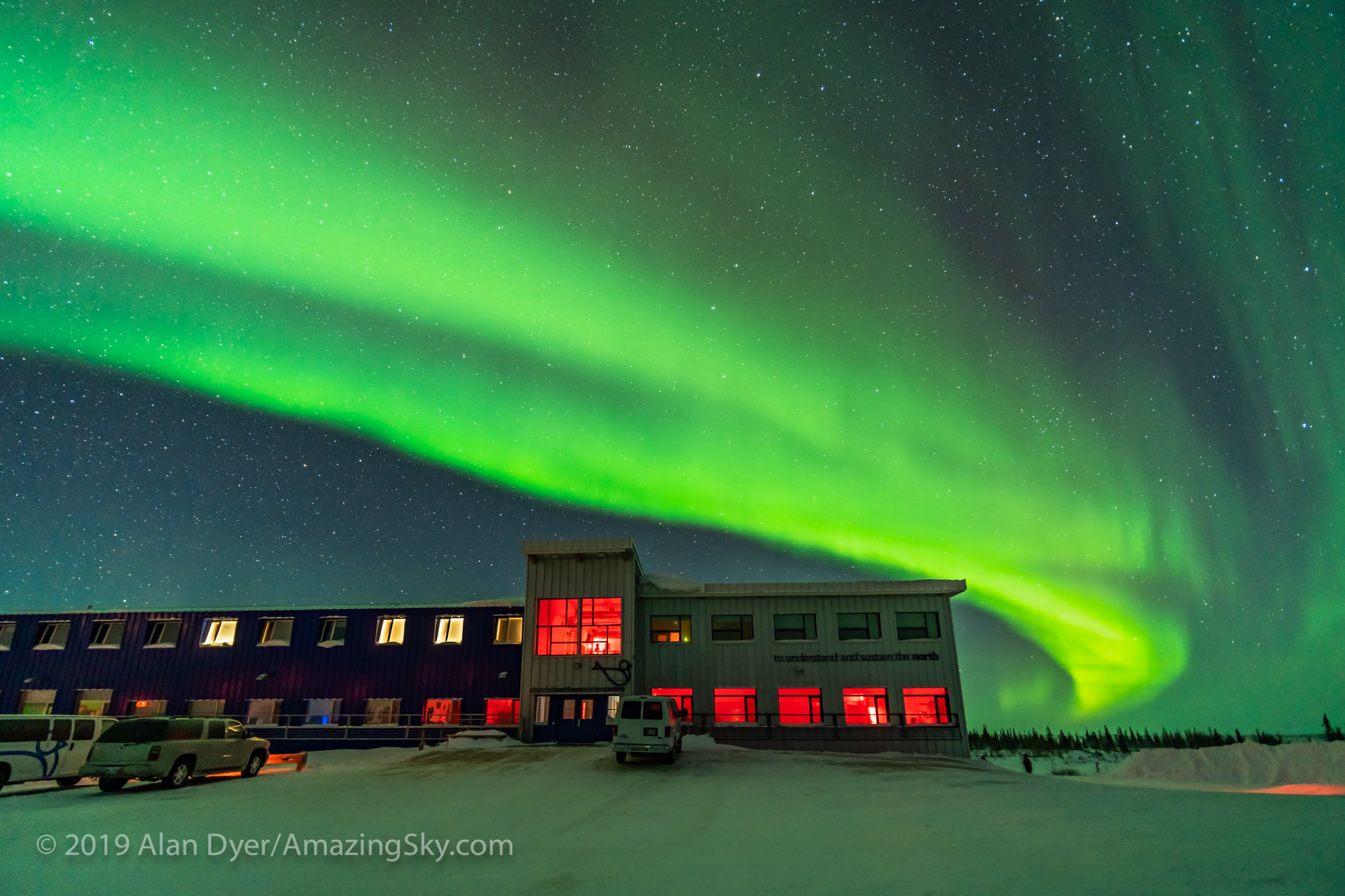
A classic arc of aurora over the Northern Studies Centre near Churchill, Manitoba, on Feb 8, 2019. This was a night when both our Road Scholar group and a visiting Natural Habitat group was here. This is a single exposure with the 15mm lens and Sony a7III.
With shows every night, people soon got pretty fussy about what they’d get excited about. Some nights people viewed displays just from their bedroom windows!
A view of the weak (by Churchill standards) aurora display on Feb 3, 2019 as seen through my dormitory window at the Churchill Northern Studies Centre, to demonstrate how you can see the Lights from your room looking north.
Displays that on night one they would be thrilled with, by night four they were going back to bed awaiting a call later when “it gets really good!”
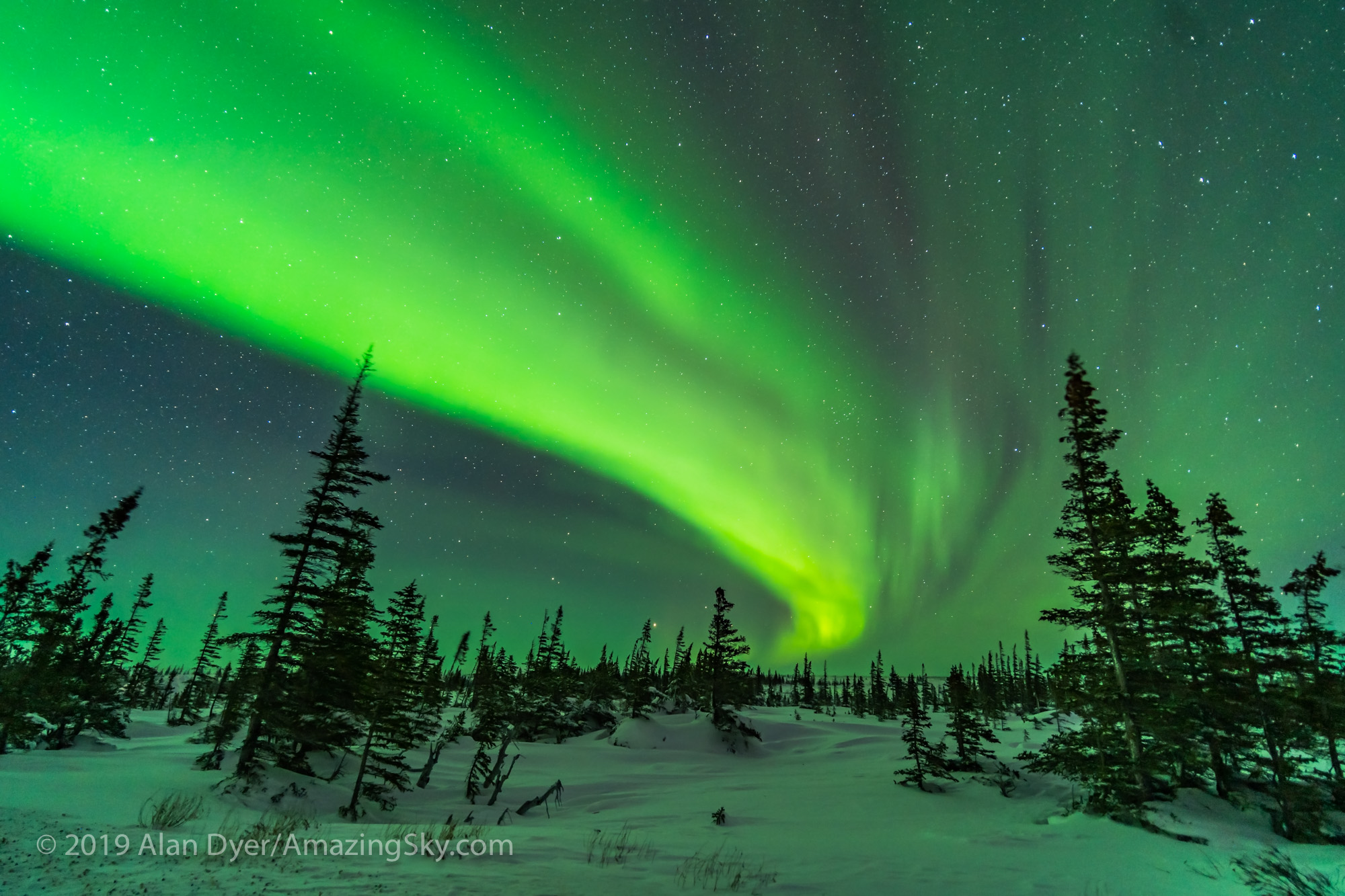
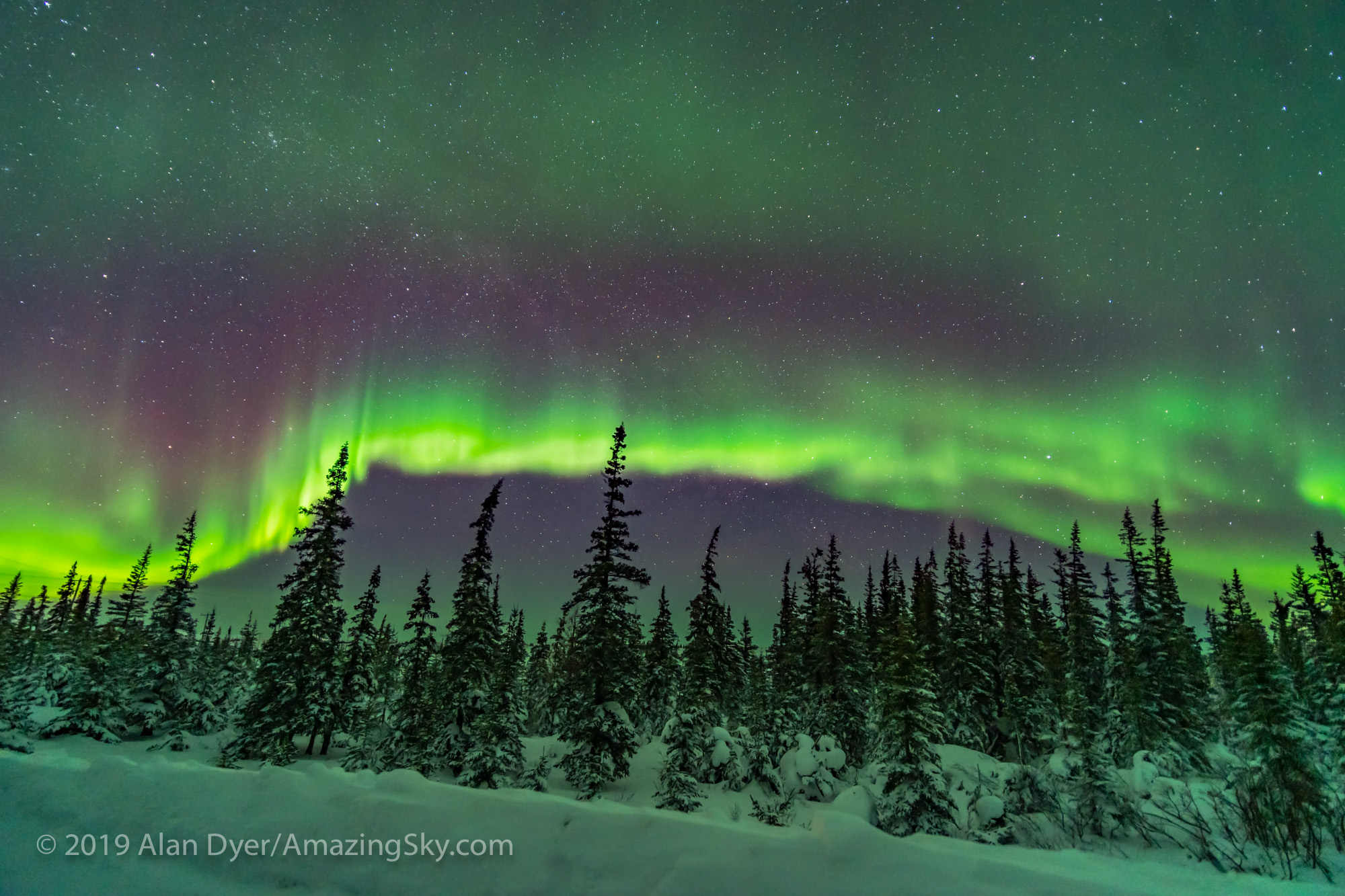
A band of subtly coloured aurora over the snowy trees of the northern boreal forest, Churchill, Manitoba. This was Feb 9/10, 2019. Cassiopeia is at left. This is looking north. This is a single 6-second exposure with the Venus Optics 15mm lens at f/2 and Sony A7III at ISO 3200.
While auroras were active every night, the Lights showed little in the way of varied colours. Notably absent was any of the deep red from high altitude oxygen. The aurora particles were just not energetic enough I presume, a characteristic of solar minimum displays.
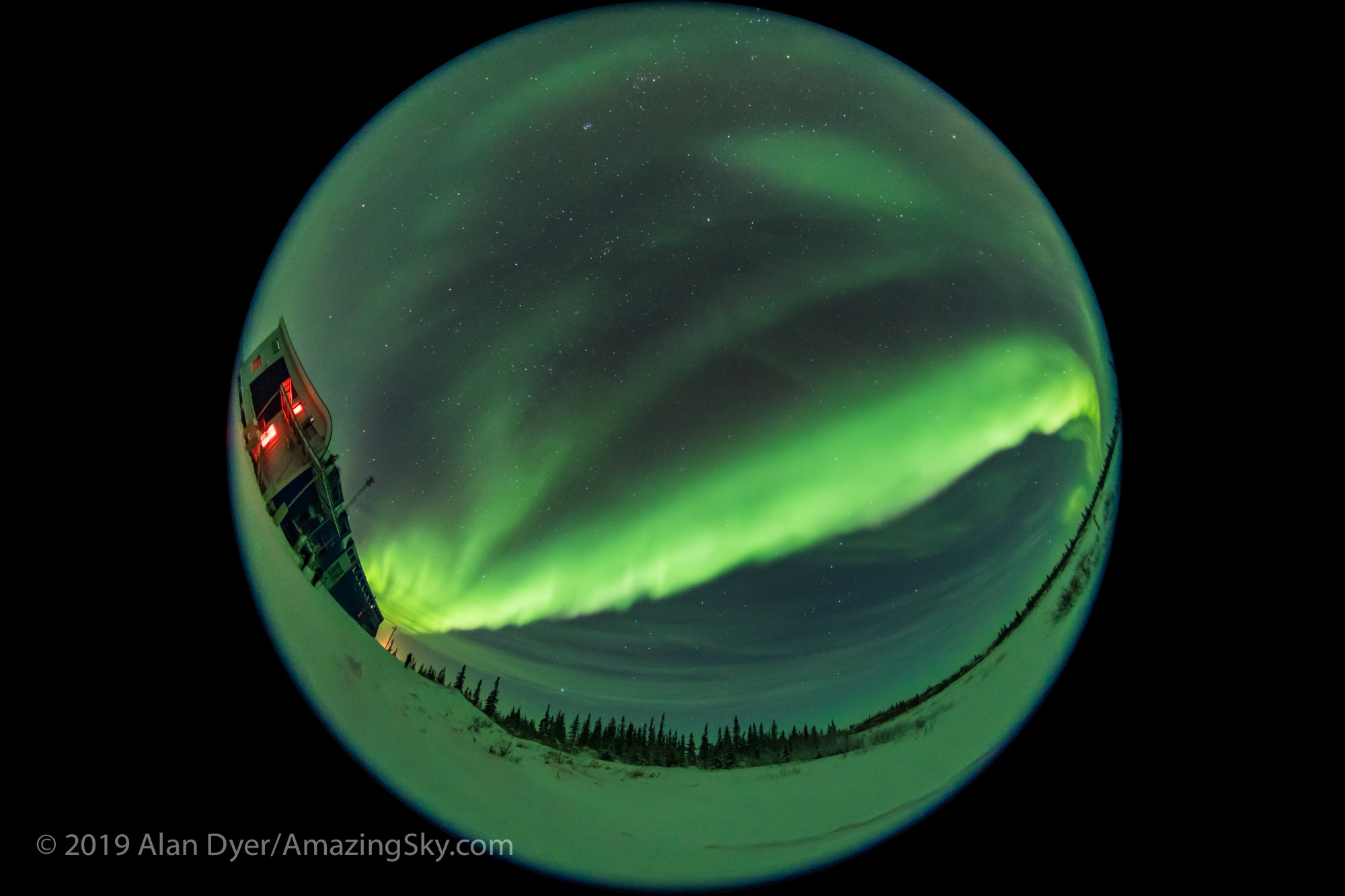
An all-sky aurora over the Churchill Northern Studies Centre, captured with a fish-eye lens, Feb 2, 2019. This is looking northwest. This is a single 8-second exposure with the Sigma 8mm lens at f/3.5 and Sony a7III at ISO 3200.
Increasingly, as we enter into the depths of solar minimum, with a prolonged lull expected for the next few years, aurora chasers will have to travel north to the Arctic and to the auroral oval to see displays on demand. The Lights won’t come to us!
A display of subtly coloured curtains over the Churchill Northern Studies Centre, on February 9, 2019. The curtains exhibited rapid rippling this night. This is 6 seconds at f/2 with the 15mm Venus Optic lens and Sony a7III at ISO 3200.
We did see fringes of pink at times along the bottom of the auroral curtains from glowing nitrogen molecules, but even this was subtle to the eye, though obvious to the camera.
The nitrogen pinks are usually accompanied by rapid dancing motions that are amazing to watch.
The music video linked to below provides the best view of what we saw. It is made entirely of real-time video, not time-lapses, of the Lights as seen over several nights from the Studies Centre.
The video is in 4K, so do click through for the best viewing. And the Vimeo page provides more details about the video and the techniques.
Enjoy!
The Sky is Dancing from Alan Dyer on Vimeo.
If you are interested in attending one of the CNSC’s sessions — where you eat, sleep, learn, and view the Lights from a well-appointed and comfortable research centre at a dark site, check out the Study Centre’s “Learning Vacations” offerings.
The next sessions for the aurora are a year from now in February and March 2020. I’ll be there!
The Northern Lights once again performed beautifully from Churchill, Manitoba, making the sky dance with colours.
As I do each winter, I spent time in Churchill, Manitoba at the wonderful Churchill Northern Studies Centre, attending to groups of “aurora tourists” there to check an item off their bucket list – seeing the Northern Lights.
In the 30 years the courses have been presented only one group has ever come away not seeing the Lights. Well, make that two now. A bout of unseasonably warm weather in my first week brought clouds every night. Mild temperatures to be sure. But we want it to be -25° C! That’s when it is clear.
Our first clear night was very clear, affording us a wonderful view of the winter Milky Way before the Lights came out. Such a view is unusual from the North, as the Lights usually wash out the sky, which they did later this night. Even here, you can see some wisps of green aurora.
Normal temperatures didn’t return until week 2 of my stay. The second group fared much better, getting good displays on 4 of their 5 nights there, more typical of Churchill.
A few determined die-hards from Group 1 (here shooting the Lights) stayed on a couple of more nights, and were rewarded with the views they had come for. They were happy!
In the images here, at no time did the auroral activity exceed a level of Kp 3 (on a scale of 0 to 9) and was often just Kp 1 or 2. Farther south no one would see anything. But at latitude 58° N Churchill lies under the auroral oval where even on quiet nights the aurora is active and often spectacular.
In speaking to a Dene elder who presents a cultural talk to each of the CNSC groups, Caroline said that to the Dene of northern Canada their word for the Lights translates to “the sky is dancing.” Wonderful! It did for us.
The Auroras of Churchill from Alan Dyer on Vimeo.
This music video presents a montage of time-lapse movies I shot over four nights, from January 25 to 29, 2017. They provide an idea of what we saw under the dancing sky.
As usual, choose HD and enlarge to full screen to view the movie. Or go to Vimeo with the V button.
My latest music video includes images, time-lapses and real-time videos of the Northern Lights shot in February and March 2016 in Churchill.
While I’ve posted my recent images of the aurora here and at many social media sites, all the videos I shoot take more work before they are ready to unveil to the public. Videos work best when set to music.
In this case, I’m very pleased to have received permission from EverSound Music to incorporate the music of one of my favourite artists, John Adorney, in my latest music video montage. The selection is If a Rose Could Speak, from his 2013 album The Wonder Well. It features vocals by Daya.
The video incorporates still images, as well as time-lapse sequences, and real-time videos of the Northern Lights.
The all-sky time-lapses are intended to be projected in digital planetarium theatres, recreating the scene on their 360° domes.
Please click on the V for Vimeo button to really see the video well. And select 1080p HD for the best image quality. And do share!
ABOUT THE VIDEO
I shot all scenes at the Churchill Northern Studies Centre, near Churchill, Manitoba, on the shore of Hudson Bay at a latitude of 58° North. Churchill’s location places it under the usual location of the auroral oval, providing spectacular displays of Northern Lights even on nights when locations to the south are seeing nothing.
I was at the CNSC to present sets of 5-night aurora viewing programs to guests from across North America. Click the link above for more details on their programs. The 2016 aurora season is over, but we’ll have more aurora programs in January and February of next year.
TECHNICAL
I shot all images with Canon 6D and Nikon D750 DSLR cameras, usually at ISO 3200. The fish-eye all-sky sequences were with a Sigma 8mm lens on the Canon, while most of the still images and other full-frame time-lapses were with the Sigma 20mm Art lens on the Nikon. For the “rapid-cadence” time-lapses I used 1- to 2-second exposures at an interval of one second.
The real-time video clips were with the Nikon – set to ISO 25600 – and the Sigma wide open at f/1.4. While these clips are prone to digital noise, they do record the fast movement and subtle colour of the aurora much as the eye saw it. See my earlier music video with real-time clips shot February 12 for more examples of these.
The all-sky sequences were processed through LRTimelapse v4 software, to handle the huge range in brightness of the Lights. Real-time video clips were processed in Photoshop with the Camera Raw filter.
Temperatures ranged from a bitter -35° C to just (!) -15° C on most nights.
I kept the long-duration, all-sky, time-lapse camera going by placing it in a Camera Parka (www.atfrostedlens.com) and inserting disposable hand warmer packs inside the insulated parka. It worked very well, making it possible to shoot for up to 3 hours. Without it, the battery died after an hour.
It was a night to remember, when the sky exploded with a jaw-dropping display of Northern Lights.
Warnings went out around the world and the aurora meters were hitting high numbers. By sunset we were charged up with high expectations of seeing the aurora in high gear dancing in the twilight. We were not disappointed.
From our location at the Churchill Northern Studies Centre near Churchill, Manitoba (latitude 58° North), we see aurora almost every clear night, even when indicators are low.
But this night, the Index was reading 7 on the scale of 0 to 9. I was afraid, after all the effort to come north to see the Lights, the Lights would abandon us and head south. Not so!
The night did start with the Lights in the south, as shown in the panorama image at top. It takes in a full 360°, with the aurora arcing from east to west across the southern sky in Orion. The north over the Centre is clear.
But the curtains soon moved back north and engulfed most of our sky for most of the rest of the night.
Participants in our aurora tour group took their aurora “selfies,” and just looked up in awe at one of nature’s great sky shows. When the last of the group turned in at 2:30 a.m. the Lights were still going.
What follows is a selection — just a few! — of the still shots I took. I also shot time-lapse sequences and real-time videos. All those will take more editing to turn them into a music video, still to come.
Enjoy!
A lone observer gazes skyward at the start of a wonderful aurora display on March 6, 2016, as the curtains begin to appear and dance in the deep blue twilight. This was at the Churchill Northern Studies Centre, Churchill, Manitoba.
A lone observer gazes at an array of colourful curtains of aurora during an active display, March 6, 2016, with curtains in the evening twilight adding blue tints to the sky and tops of the curtains, as well as the greens and reds from oxygen. Curtains toward the horizon are more yellow due to atmospheric extinction. Jupiter is rising at left, then near opposition.
Auroral curtains converge at the zenith in the evening twilight during a Kp Index 7 night of aurora in Churchill, Manitoba. Blue twilight adds the blue tints to the sky and curtains.
Our group of Learning Vacations tourists enjoy the start of a fine display of Northern Lights at the Churchill Northern Studies Centre, March 6, 2016. As curtains appear to the east, another array of curtains shines to the west behind them with a strong purple tint lighting the sky and ground. The Andromeda Galaxy sits amid the curtains.
Aurora watchers looking south to a bright curtain of Northern Lights while other curtains rippled behind them to the north. This was a fabulous all-sky display, March 6, 2016. The temperature was about -25° C.
The green aurora lights the ground and snow green in a spectacular display March 6, 2016. This is looking northeast from the Churchill Northern Studies Centre, Churchill, Manitoba.
A series of curtains of aurora, in a layered series across the sky, from the March 6, 2016 display in Churchill, Manitoba,
The aurora over the Churchill Northern Studies Centre building, home to Arctic research and to many programs for tourists about northern ecology and science. The March Learning Vacations aurora tour group experienced a fabulous display this night, March 6, 2016.
Some of our group of Learning Vacations aurora tourists outside the Churchill Northern Studies Centre enjoying the sky show on March 6, 2016 on a night with a Level 5 to 7 aurora.
What do you see in the swirling patterns of aurora curtains at the zenith? They rapidly take many forms as they move about. This was the wonderful display of March 6, 2016.
My 10-minute video captures the Northern Lights in real-time video – no time-lapses here!
I hadn’t tried this before but the display of February 12, 2016 from Churchill, Manitoba was so active it was worth trying to shoot it with actual video, not time-lapse still frames.
I used very high ISO speeds resulting in very noisy frames. But I think the motion and colours of the curtains as they ripple and swirl more than overpower the technical limitations. And there’s live commentary!
Select HD and Enter Full Screen for the best quality.
Scenes have been edited for length, and I did not use all the scenes I shot in the final edit. So the scenes you see in the 10-minute video actually took place over about 20 minutes. But each scene is real-time. They show the incredibly rapid motion and fine structure in the auroral curtains, detail blurred in long multi-second exposures.
I used a Nikon D750 camera at ISO speeds from 12,800 to 51,200. While it is certainly very capable of shooting low-light video, the D750 is not optimized for it. A Sony a7s, with its larger pixels and lower noise, would have been a better camera. Next time!
The lens, however, was key. I used the new Sigma 20mm Art lens which, at f/1.4, is the fastest lens in its focal length class. And optical quality, even wide open, is superb.
The temperature was about -30 degrees C, with a windchill factor of about -45 C. It was cold! But no one in the aurora tour group of 22 people I was instructing was complaining. Everyone was outside, bundled up, and enjoying the show.
It was what they had traveled north to see, to fulfill a life-long desire to stand under the Northern Lights. Everyone could well and truly check seeing the aurora off their personal bucket lists this night.
For more information about aurora and other northern eco-tourism tours offered by the Churchill Northern Studies Centre, see churchillscience.ca
From Churchill, Manitoba the Northern Lights dance almost every night over the boreal forest.
This year, as in the last two years, I have traveled to the shores of a frozen Hudson Bay and to the town of Churchill, Manitoba to view and photograph the aurora borealis.
I’m instructing two tour groups at the Churchill Northern Studies Centre, one this week and one last week, in the science and sagas of the aurora and on how to shoot the Lights. The participants in the groups are fabulous, keenly interested and unfazed by the cold and wind.
From Churchill’s latitude of 58° N, we are under the main auroral oval almost every night. Even on nights with low official activity levels, as they were on all the nights I shot these images, we still get sky-filling displays.
Here’s a selection of still images from the last week of shooting, with clear skies on all but a couple of nights. There’s still room in our March sessions!
Circumpolar star trails and aurora over the boreal forest at the Churchill Northern Studies Centre, Churchill, Manitoba, on Feb 9, 2016. This is a stack of 250 frames shot over one hour (until the battery died) for a time-lapse but here stacked for a single image star trail using the Advanced Stacker Plus actions and Long Streaks effect. Each exposure was 15 seconds at f/2.8 with the 15mm lens and Canon 6D at ISO 6400.
An all-sky aurora display of multiple curtains of aurora borealis over the boreal forest at the Churchill Northern Studies Centre, in Churchill, Manitoba, taken on Feb 5, 2016. The view is looking almost due north. Jupiter is at right. The Big Dipper is at centre frame. This is one frame from a 380-frame time-lapse sequence shot for digital dome projection in planetariums. This is a 20-second exposure at f/5 (stopped down by accident — should have been f/3.5) with the 8mm Sigma fish-eye lens and Canon 6D at ISO 3200. Temperature was -35° C. But no wind!
Participants in the Arctic Skies tour and course observe and photograph the Northern Lights from the upper level observing deck at the Churchill Northern Studies Centre, Churchill, Manitoba on Feb 10, 2016, the first night of their tour. A Level 1 to 2 display provided a good first night show though with bitterly cold temperatures and wind chills of near -50° C. This is a single exposure of 8 seconds at f/1.4 with the 20mm Sigma Art lens and Nikon D750 at ISO 3200.
The Northern Lights over the Churchill Northern Studies Centre on Feb 8/9, 2016 during a weak all-sky display. The arcs lay primarily in the south when the display was at its best this night. Orion and the Pleiades are just setting in the west over the town of Churchill. This is a 20 second exposure at f/2.8 with the 15mm full-frame fish-eye lens and Canon 6D at ISO 3200.
A panorama across the northern horizon of the sweeping curtains of the aurora, taken from the observation deck of the Churchill Northern Studies Centre, Manitoba. I shot this on Feb 10, 2016 on the first night of the Arctic Skies tour group week. Vega is low in the north at left of centre, Arcturus is the bright star at right of centre. This is a 4-segment panorama, stitched with Adobe Camera Raw, with each segment 5 seconds at f/1.4 with the 20mm Sigma lens and Nikon D750 at ISO 3200.
Curtains of the aurora looking northeast and east toward Leo rising (at upper right) and Jupiter (at right), over the boreal forest of the Hudson Bay Lowlands near Churchill, Manitoba, on Feb 5, 2016. This is a single frame from a 680-frame time-lapse. This is a 4-second exposure at f/1.4 with the Sigma 20mm Art lens and Nikon D750 at ISO 3200.
Vertical curtains of aurora converging to the zenith overhead over the snowy boreal forest at the Churchill Northern Studies Centre, Churchill, Manitoba. I shot this Feb 4, 2016 on a night with temperatures of -35° C with a slight wind. The Big Dpper is at right. Exposure was 10 seconds at f/2.8 with the 15mm lens anf Canon 6D at ISO 3200.
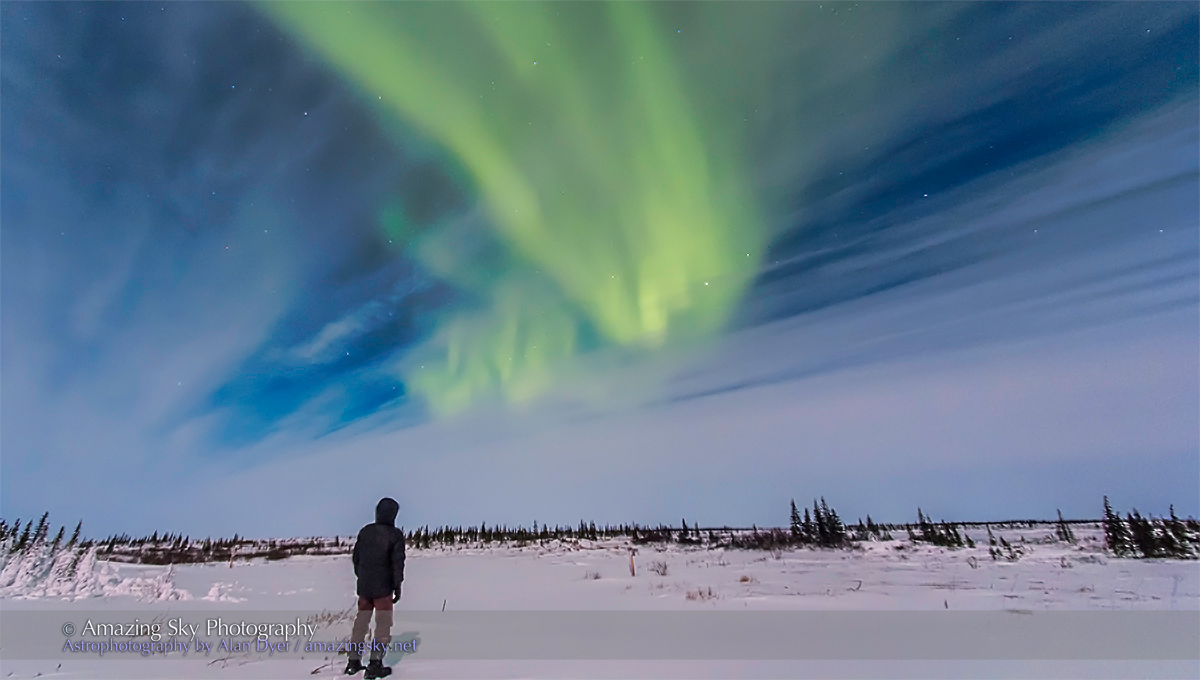
A lone figure gazes skyward at the aurora over the Churchill Northern Studies Centre, Churchill, Manitoba. I shot this Feb 4, 2016 on a night with temperatures of -35° C with a slight wind. Exposure was 13 seconds at f/2.8 with the 15mm lens anf Canon 6D at ISO 3200.
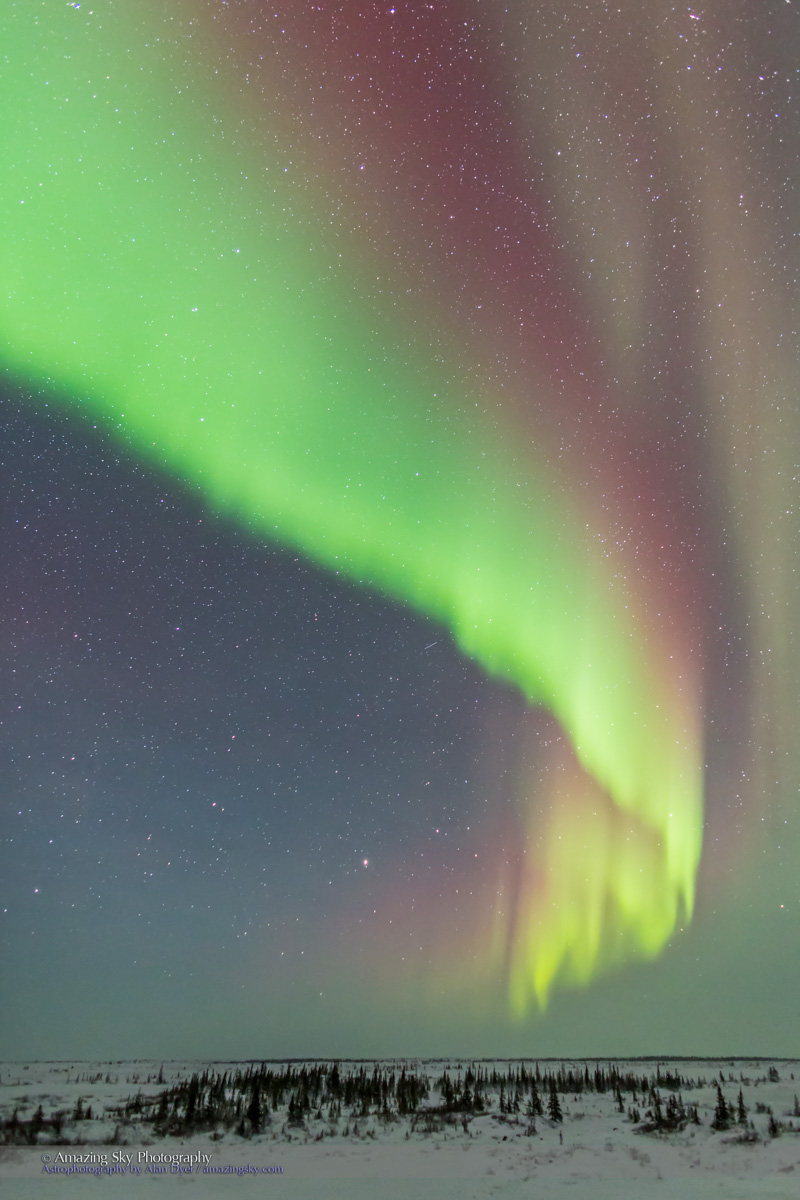
A wide vertical portrait of the Northern Lights in the northern sky, with the stars of the Big Dipper and Polaris above centre. Shot from the upper deck of the Churchill Northern Studies Centre on a very windy night with wind chills of -50°, so standing in the wind to take this image was bitter! You grab a few images and retreat! This is a single 15-second exposure at f/2.8 with the 15mm lens and Canon 6D at ISO 3200.
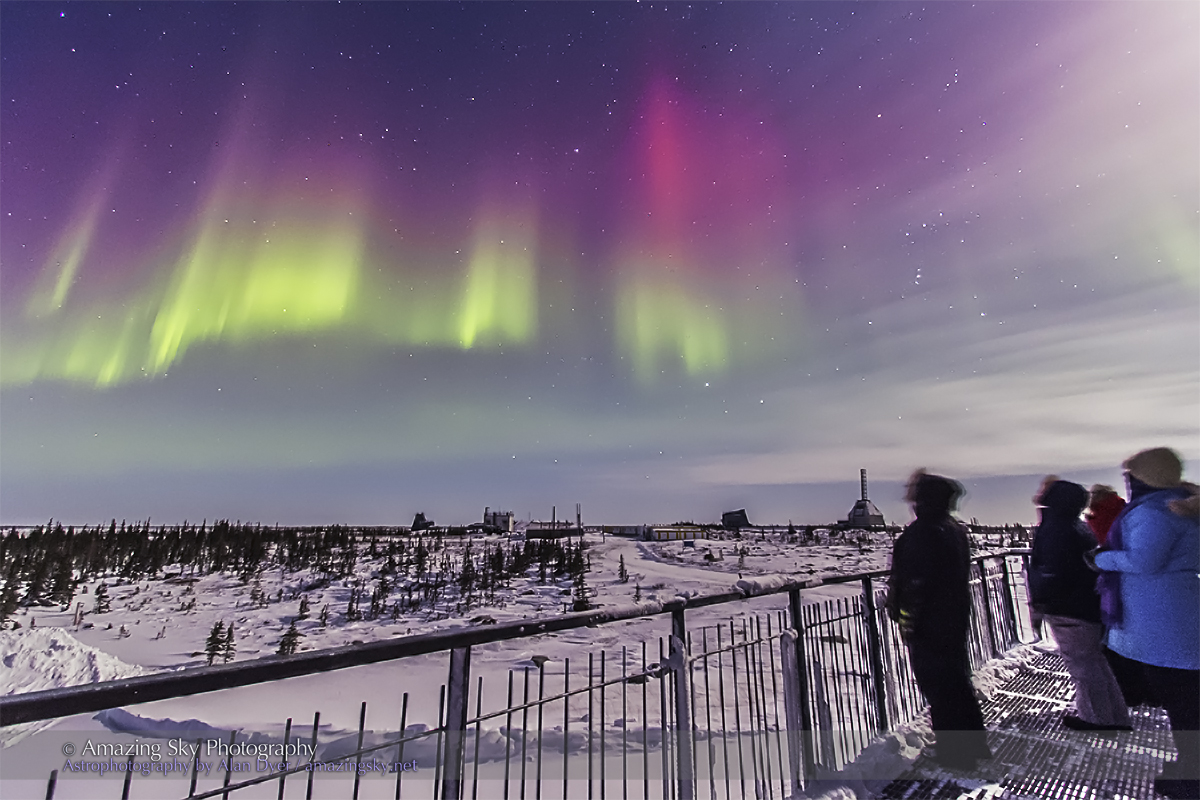
The February Arctic Skies tour group watching and photographing the aurora from the second floor deck of the Churchill Northern Studies Centre, where it is out of the wind, which this night was producing -50° C wind chills. This is a single 6-second exposure at f/2.8 with the 15mm lens and Canon 6D at ISO 6400.
A self-portrait of me watching the Northern Lights from the upper deck of the Churchill Northern Studies Centre, looking south to the winter stars of Orion, Gemini and Auriga. This was Feb 11, 2016, a very windy, almost blizzard night with blowing snow and reduced visibility. However the aurora did appear through the haze and clouds. In the distance are the buildings of the old Churchill Rocket Range. This is a single 15-second exposure at f/2.8 with the 15mm lens and Canon 6D at ISO 3200.
My new 3-minute music video compiles still and time-lapse imagery of the aurora I shot in February 2015 from Churchill, Manitoba.
Churchill’s location at 58° North on the shore of Hudson Bay puts it directly under the main auroral oval, the zone of greatest auroral activity. Over the 9 nights, 2 were cloudy, with a roaring blizzard.
But on the 8 clear nights we saw aurora every night. I shot time-lapses on 6 of those nights, shooting about 3,500 frames, most of which appear in the final cut of this movie.
Despite the amazing displays we saw, on no night was the auroral activity index (on a scale of 0 to 9) higher than 2 or 3. These were all “normal” quiet nights for auroras in Churchill. Anyone farther south would have seen little in their sky on most of these nights.
I shot many of the time-lapses with an 8mm spherical fish-eye lens, to create sequences suitable for projection in digital planetarium domes. One other time-lapse sequence (the last in this movie) I shot with a 15mm full-frame fish-eye. Even it is not wide enough to take in the entire display when the Lights fill the sky.
Exposures were typically 10 to 15 seconds at f/3.5 and ISO 1600 to 4000, all with the Canon 6D. I powered it from its lone internal battery. Amazingly, despite temperatures that were considered extreme even for Churchill (often -32° C at night) the batteries lasted 90 to 150 minutes allowing me to take lots of frames with no battery change or perhaps just one battery change. Churchill is very dry and only on one night did I have an issue with the lens frosting up.
Music is by Dan Phillipson, his composition “Into the Unknown,” purchased for royalty-free use through Triple Scoop Music. I edited the movie in Apple Aperture, with a title sequence created in Photoshop. Processing of the original images was with Adobe Camera Raw, Photoshop, and LRTimelapse, with assembly of movie frames done with Sequence for MacOS.
I hope you enjoy it! Do click on the Enlarge button to watch it full screen. It may take a while to start playing.
Last night the sky exploded with waves of green and pink as the Northern Lights danced in the bitter cold.
With blizzard conditions forecast for the next two days, last night might have been our last for viewing the aurora from Churchill. But if so, we ended on a high note.
The aurora appeared on schedule again at about 9 to 9:30 p.m., following my evening lecture, as it has done every clear night for the last couple of weeks. It began as a sweeping arc to the north, as above, then moved south to encompass the entire sky.
About 11 p.m. the sky burst open with waves of green arcs, but with generous tints of red and magenta that the camera picks up easily. To the eye, the reds are barely visible unless the aurora gets very bright.
Despite the bitterly cold temperatures of -34° C with a -50° wind chill, everyone in the tour group braved the night to take in the sight. And many managed to work their cameras and tripods, no small feat under such conditions, to get great shots.
The groups this week and last saw aurora every clear night, with clear nights on at least 3 out of the 5 nights of each course. Not a bad take, fulfilling everyone’s “bucket list” dream of standing under the aurora borealis.
It was a bitterly cold night for watching the dancing Northern Lights.
When Environment Canada issues Extreme Cold warnings for Churchill, you know its cold! With temperatures at -32° C and with high winds last night, the wind chill equivalent was -50° C.
But that didn’t stop us from watching the Lights!
I nicely finished my evening lecture at 9 pm when the Lights appeared on cue. They were faint at first, but then brightened nicely by 10 pm. The show was over by midnight, a well-timed and convenient display.
The 22 participants in this week’s course all bundled up and headed out, onto the second floor viewing deck and out onto the ground for views and photos of the aurora.
This was not a brilliant display – the official activity level was still reading only 1 or 2 on scale of 0 to 9. But it provided us with some beautiful curtains and lovely colours. The hazy appearance is from high clouds and local blowing snow.
The views from the Deck overlooking the boreal forest make for some nice photo opportunities, from a spot largely out of the constant westerly winds.
We have three more nights here, though snow is forecast for the last two. Tonight may be our last night to enjoy the Northern Lights. But all are happy with what they have seen and shot so far.
The Northern Lights have performed beautifully the last few nights, presenting curtains of light dancing across the sky.
Two nights ago in Churchill, Manitoba we were treated to a “storm level” show of aurora, with the Lights all across the sky in green curtains waving and curling before our eyes.
The curtains tower several hundred kilometres up into the atmosphere, from the lower edge at about 80 km up (still high above the stratosphere) to the curtain tops at about 400 km altitude at the edge of space.
The camera picks up the colours far better than the eye can, recording not only the predominant green hues but also shades of pink, magenta and red.
The magentas and reds come from the sections of the curtains at the highest altitudes, from the top of the auroral curtains. Here, where the atmosphere is a near vacuum, sparse oxygen atoms can glow with a red emission line.
However, there must be a blue component as well, leading to the magenta or pink tones, as in my photos here. Nitrogen can glow in blues and purples and might be contributing to the colours.
The top two photos are from Tuesday night, Feb 17, when storm levels of 5 were in effect worldwide.
Lower down, at about 100 km altitude, the air is denser and oxygen glows with a brighter green hue, which the eye can detect more easily.
The photo above from last night, with an activity level of just 2, also shows most of the sky covered with a faint emission, with a patchy appearance, with dark “holes” also moving and flowing in the time-lapse movies I shot.
Closer to the horizon, and far to the north, the aurora brightens into the more characteristic green snaking curtains.
This image from three nights ago shows an usually coloured aurora at the start of the night, glowing mostly a deeper red and orange.
The green was still off in the distance far to the east. It arrived a few minutes later as green curtains swept in over us.
But the initial red was from low-energy electrons lighting up just high-altitude oxygen. Only when the higher energy particles arrived did the sky light up green.
I shot all these images with an 8mm fish-eye lens as frames in time-lapse sequences intended for use projected in digital planetarium domes, where the 360° “all-sky” scene would be recreated on the dome as it was in real life.
If you are with a planetarium, contact me if you’d like to get aurora clips.
Our second group of aurora tourists has arrived today at the Churchill Northern Studies Centre, and the weather is warming to a high of -20° C. Balmy!
We’re hoping for more fine displays, though the space weather forecast calls for a quiet magnetic field in the next few days.
Beautiful curtains of light draped across the sky despite the blizzard blowing below.
Last night, February 16, was the last night for aurora viewing for the first aurora tour group hosted by the Churchill Northern Studies Centre.
Despite predictions calling for an active display, we had given up hope of seeing anything, as a blizzard had been raging all day and into the evening. But about 10 pm I knocked on doors down the hall — get up! The Lights are out!
Against all odds, skies cleared enough to reveal a wonderful all-sky display of Northern Lights, with multiple curtains of light snaking over the sky.
The view above overlooks the now derelict launch buildings of the abandoned Churchill Rocket Range, in use from the late 1950s until the 1980s. Some 3500 rockets were fired from here in its heyday, shot into the active auroras that occur here almost nightly under the auroral oval.
This view overlooks the boreal forest on the frozen shore of Hudson Bay, and shows the multiple curtains that twisted and turned across the sky.
Tonight’s display was marked by fringes of magenta, rather than the deeper reds we observed 2 nights ago.
Winds were howling and snow was blowing, but from the shelter of the Centre’s second floor observing deck we could view the display in windless comfort, despite the -30° C temperatures.
The group was delighted at having this bonus viewing night. Now the concern is whether the blizzard will abate enough to allow flights in and out of Churchill Airport. The group might get another night under the Lights!
The Northern Lights dance overhead each night from Churchill, Manitoba.
If you really want to see the Northern Lights, don’t wait for them to come to you. Instead, you go to them.
For the second year in a row I’ve been able to participate as an instructor during week-long aurora courses and tours at the Churchill Northern Studies Centre on the shore of Hudson Bay. The site is at 58° latitude, far enough north to place us directly under the main auroral oval, the prime location for viewing the Northern Lights.
If it’s clear, a view of dancing arcs and curtains of aurora is almost guaranteed. Two nights ago we had a marvellous display, despite official indicators of aurora strength and geomagnetic activity all reading low or even zero.
Still, the Lights came out and danced across the sky.
The top photo is selfie of me standing the display in a 360° all-sky image shot for use in a planetarium. The research centre building is at left. The view is generally looking north.
This view is from the second floor deck of the centre, usually a bit more sheltered from the wind. It allows a good view to the north and east, where displays typically start, as they did this night. Feb. 13.
As the display developed the curtain rose up into the sky to arc from east to west across heavens.
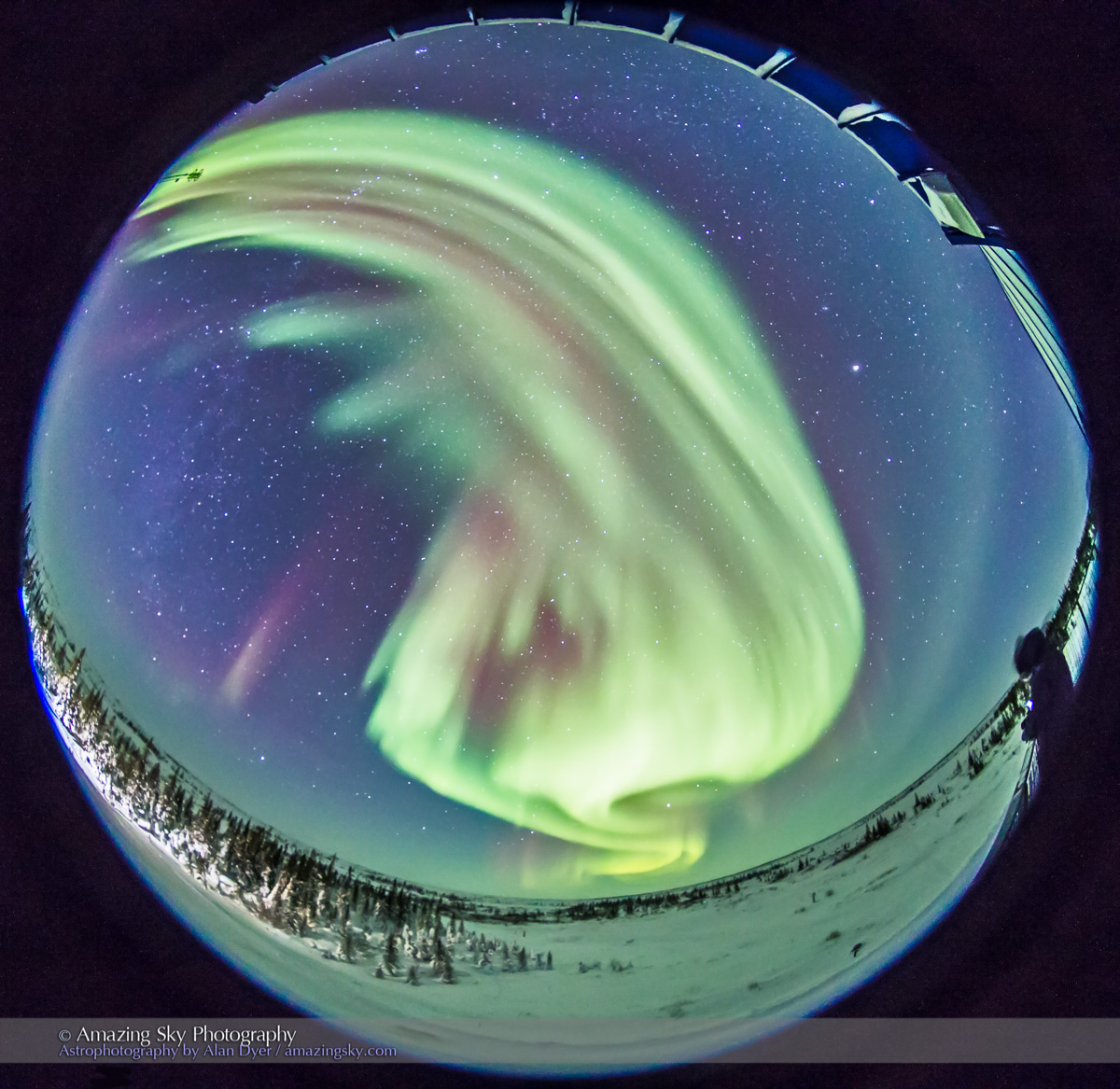
This image, also a 360° fish-eye image taken with an 8mm lens, shows the display at its best, with rippling curtains hanging overhead. It’s part of a time-lapse sequence.
The next night, February 14, was marked by fainter but an unusually red aurora, appropriate for Valentine’s Day perhaps. Or the 50th anniversary of our red and white Canadian flag.
The sky was a little hazier, but the aurora shone through, initially only with a red and orange tint, colours we could just see with the unaided eye – the long exposures of the camera really bring out the colours the eye can only just perceive when the aurora is dim.
The green curtains, seen here in the distance, did arrive a few minutes later, lighting up the curtains in the more usual green colour, with just upper fringes of red.
It seems the red is from low-energy electrons exciting oxygen only in the upper atmosphere. Only later did the more energetic electrons arrive to excite the green oxygen transition that occurs at lower altitudes.
With luck, I’ll have more nights to stand under the auroral oval and look up in wonder at the Northern Lights.
An ice crystal halo surrounds the Moon while a jet contrail crosses the sky.
On our last nights earlier this week at the Churchill Northern Studies Centre we had a bright gibbous Moon in our sky (as did everyone in the world!). We also had high-altitude clouds filled with ice crystals, the source of the “ring around the Moon” effect. This is a lunar halo, created by moonlight shining through six-sided ice crystals. This halo exhibits rainbow-like colours as well.
But this night, conditions were also ideal for seeing the contrails from jets flying overhead on polar routes from Europe to North America. In the main image above, you can see the jet departing to the west at lower right. Its high-altitude contrail is casting a dark shadow onto the lower cloud deck.
This view, taken earlier in the evening shows a more pronounced lunar halo with a horizon-to-horizon contrail shooting straight across the Moon and also casting a shadow.
I used an 8mm fish-eye lens to capture this 360° image of the entire sky. I was able to shoot this image in shirt-sleeve comfort through the rooftop plexiglas viewing dome at the Centre.
In this image, taken outside at -25° C, the sky is clearer but still contains enough ice crystal cloud to create a bright lunar halo. When I took this image on February 9 the Moon was to the right of bright star-like Jupiter, and in the middle of the winter stars and constellations, such as Orion just below the Moon.
Lunar haloes can be seen at any season. On any night with a nearly Full Moon embedded in high haze, look up!
The northern lights – the aurora borealis – shine above the trees of the northern forest – the boreal forest.
This was the scene on Sunday night, February 9, 2014, as the aurora intensified for a few minutes making for a photogenic backdrop to the snow-covered pine trees of the boreal forest.
The landscape looks like daylight but is actually being lit by the light of the bright waxing Moon in the south. These scenes are looking north.
I shot these images as part of my stay at the Churchill Northern Studies Centrewhere I have been presenting enrichment lectures to two groups of tourists here to see the northern lights during week-long stays. Both groups have been successful in seeing the lights on at least one to two nights of their stay, with the displays usually appearing as sky-spanning arcs overhead.
Here I took the time to take a “selfie” under the northern lights, as the curtains began to wave early in the evening.
In all, it has been a fantastic experience, to witness the lights from a site right under the active auroral oval at 58° north.
Watch waves of aurora wash over the sky rising out of the west to swirl overhead.
This was the spectacle we saw Friday night at the Churchill Northern Studies Centre, as the northern lights filled our sky. I set up my camera on the east side of the main building, out of the bitterly cold west wind. The fish-eye lens is aimed west but its view takes in most of the sky.
The bright object at lower left is the Moon.
The still image above is a frame from the 349-frame time-lapse movie below.
Each frame is a 7-second exposure at f/3.5 and ISO 1250. The interval is 1 second.
The movie covers about 45 minutes of time, compressed into 30 seconds. It shows the aurora peaking in intensity, then fading out behind the ever-present thin cloud drifting through all night.
What amazes me are the waves and loops of auroral curtains that come at us from the west (bottom behind the building) then swirl around the zenith overhead. They move off to the east and north at the top of the frame.
Even watching this in real-time the scene was astonishing. The curtains rippled so quickly, forming and reforming over the sky, you didn’t know where to look. As the image above shows, people just stood amazed.
Last night, February 7, the Northern Lights danced for us again, starting with a curtain of green and pink in the south.
Our second tour group at the Churchill Northern Studies Centre has been here a couple of days, all under what looked like hopeless cloud. But last night the clouds cleared unexpectedly to reveal a moonlit winter sky.
I completed my evening talk all about the Sun and aurora, during which we were monitoring the auroral activity indicators on SpaceWeather.com. Sure enough, about 9:30 pm, right on cue and perfectly timed for convenience, a curtain of light began to dance across the southern sky, appearing in Orion. The gibbous Moon is just off frame to the right. We began the viewing from the Centre’s second floor viewing deck which looks east and southeast.
This view shows the auroral curtain over the derelict launch towers of the Churchill Rocket Range. Built in 1957 for the International Geophysical Year, the Rocket Range was in use until the mid-1980s as Canada’s only launch facility. Hundreds of sounding rockets, many of them Canadian-built Black Brants, were launched from here, shooting up into the ionosphere on nights just like this to study the aurora.
Orion is at right. While we saw this curtain in our southern sky, others farther south in Canada were seeing it in their northern sky. The greens were easy to see with the eye but the magentas were visible only by the camera and I have punched up their intensity here.
This night, as the aurora display developed it moved north to the zenith, shown here, with the sky also lit by moonlight and with some high haze. But the combination makes for a wonderful abstract swirl of light and colour.
Orion and Sirius shine over the abandoned launch towers of the Churchill Rocket Range.
This was the view Monday night, during a lull in the aurora display when I took a few moments to shoot the stars. You can see Orion at centre, with his trio of Belt stars pointing left and down to Sirius, the Dog Star in Canis Major, and the brightest star in the night sky. The Belt stars point up and right to Aldebaran, the brightest star in Taurus the bull.
They look closer to the horizon than you might be used to as this is from 58° north latitude.
These winter stars shine above some of the launch structures of the old Churchill Rocket Range. Built in 1957 for the International Geophysical Year, the Rocket Range served for many years as Canada’s only launch facility. No satellites were launched here. Instead the towers were used to launch sub-orbital sounding rockets into the ionosphere to explore the aurora.
Some of the rockets were repurposed military missiles, like Nikes and Aerobees. But many were Black Brants, civilian research rockets still being built in Winnipeg by Bristol Aerospace.
But no Black Brants take off from here now. The Rocket Range was shut down in the mid-1980s as Canada’s space program focused on satellites, the Space Shuttle, and sending astronauts into space. Attempts by private companies to revive the site have all failed and the structures are now becoming derelict, being too costly to remove.
The sky simply does not get any more amazing than this, as the Northern Lights dance across the heavens.
On the last night for our first aurora tour group of the season, the sky performed perfectly. Clouds cleared to reveal a star-filled winter sky, and after the evening talks and farewell drinks, the aurora began to appear. First it was a bright arc across the north, prompting me to try some self-portraits, as below.
But at about 2 a.m. a diffuse arc across the zenith exploded into activity, with rapidly waving and weaving curtains.
Everyone was awestruck. Some cheered and hollered. Others just watched in stunned silence. Some were busy with cameras. Others just enjoyed the view of a lifetime.
It was a cold night, but the aurora kept performing in waves, dimming for a time – allowing us to retreat to the warm cafeteria for hot chocolate. Then the display would brighten again to the west and a new wave of intensity would sweep across the sky to the east.
You didn’t know quite where to look to take it all in. The sight was overwhelming. Here the curtains ripple through Orion, Taurus and Auriga, all setting into the west.
The Churchill Northern Studies Centre has a new building opened in 2011 that is ideally set up for aurora watching. The building can go dark, and is located far enough from Churchill that local light pollution is not an issue. On the roof is a plexiglas dome where several people can view the Northern Lights and the entire sky in shirtsleeve comfort. The image is good enough for wide-angle photography. Sheer luxury!
But there’s nothing like being outside on a cold Arctic night, looking up and seeing this sight – thin curtains of light twisting and turning more quickly than you can take in and comprehend. It is one of nature’s greatest shows. And what a fantastic place to see it.
Tonight the aurora shone so brightly for a time it was visible through the cloud.
Here at the Churchill Northern Studies Centre we’ve been battling clouds all week. But on several nights the clouds have cleared for 30 minutes or more, enough to give us glimpses of the aurora and stars. Tonight, February 2/3, the clouds never did clear away enough for a great view. This was as good as it got, with the Northern Lights shining through haze and cloud but nevertheless filling the sky.
Remarkably, this was on a night when the usual indicators of auroral activity were registering all quiet. This shows the benefit of traveling north to stand right under the auroral oval, the zone of maximum activity. In this case I’m at 58° North, in Churchill, Manitoba. Even on a quiet night the Churchill sky can be filled with curtains of dancing colours.
Our tour group to see the Northern Lights finally saw what they traveled north to experience – the aurora borealis dancing across the sky.
This week and next I’m helping to lead some tour groups who have come to Churchill, Manitoba to see the aurora. We’ve been here 3 nights so far but last night was the first with clearing skies and when the Northern Lights appeared above us.
Our home base is the beautiful Churchill Northern Studies Centre, far enough from the main townsite to give us dark skies. Being able to sleep, eat and take in lectures (or for me, give lectures) right where we can see the aurora is a tremendous luxury and convenience. The Centre is perfectly set up for aurora viewing, with a rooftop dome, and the ability to “go dark” with all lights off.
Here in Churchill, on the shores of Hudson Bay, we are at a latitude of 58° north. But critically, we are right under the usual position of the auroral oval, the main band of Northern Lights that circles the world at high latitudes.
As such, even though last night the various aurora and magnetic field indicators were registering a quiet display with little disturbance in the field, we still saw a beautiful display. It wasn’t very active but did display curtains and rays shooting up to the zenith.
As seen here, for much of the time the main band of aurora was actually in the south. That’s Jupiter glowing through the aurora and thin clouds at upper right.
We’ve been fighting clouds all week but last night skies cleared for long enough and it seemed at just the right time to coincide with the brightest outburst of this display. After I took these images, the aurora died down to a more diffuse glow then the clouds thickened in again. By then it was 3 am and we all retired to our rooms.




























 The Amazing Sky