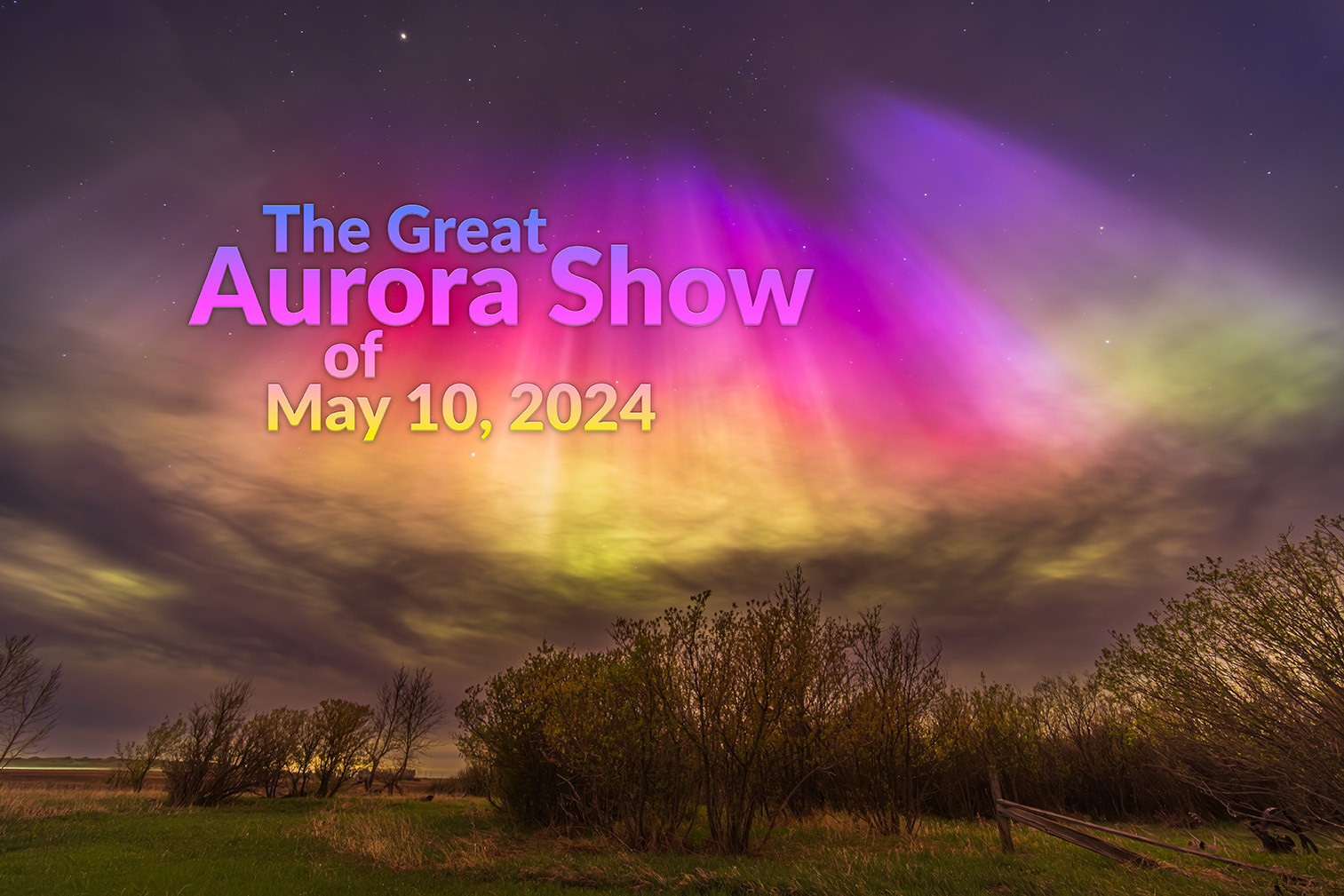
The Great Aurora Show of May 10, 2024


It has been many years since we were treated to an aurora as widely seen as the show on May 10, 2024. Here’s my tale of the great display.

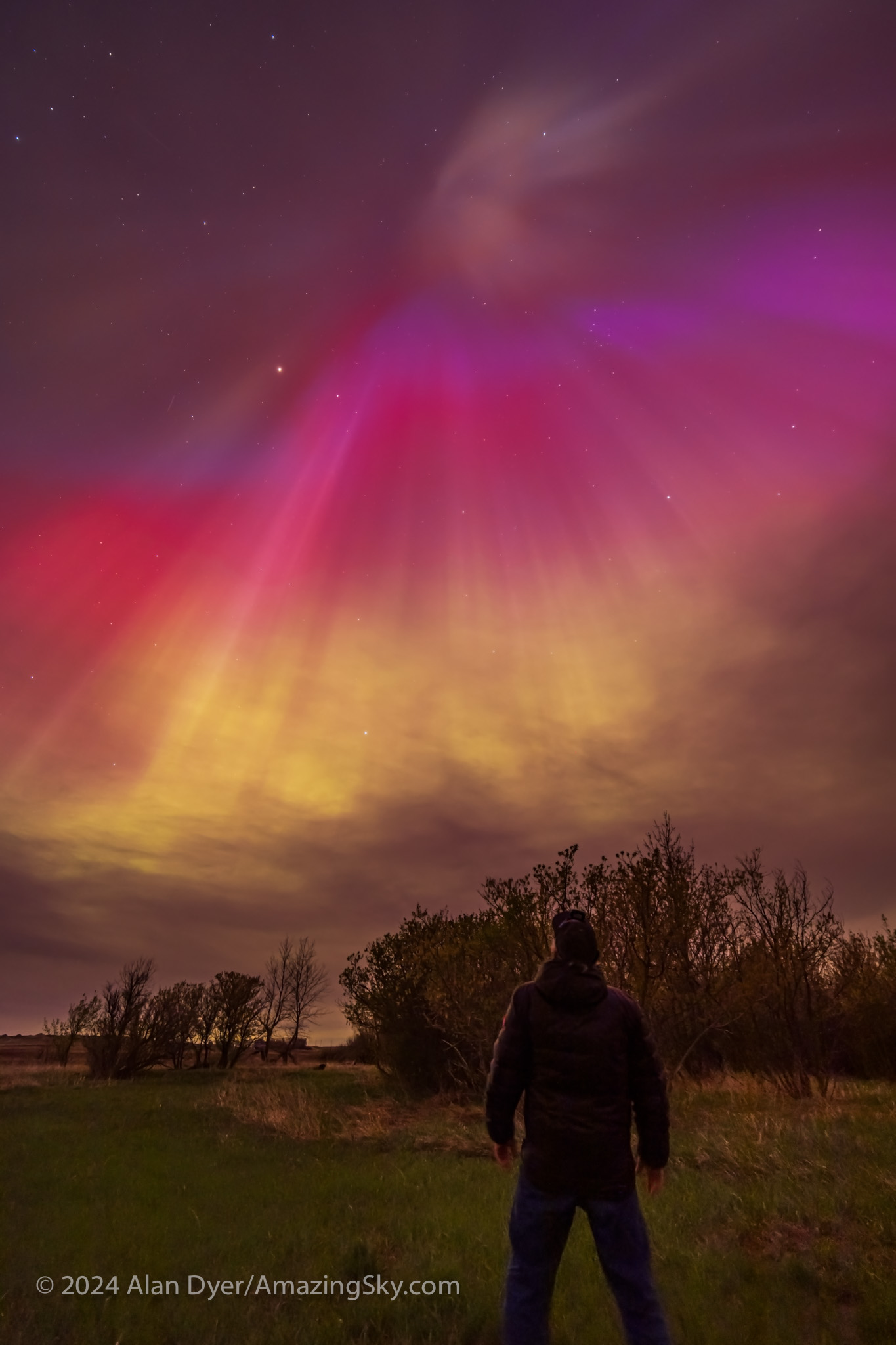
As the sky darkened around the world on May 10/11, 2024, sky watchers in both the northern and southern hemispheres were amazed to see the sky lit by the deep reds, greens and pinks of a massive display of aurora. For me, this was my first Kp8 to 9 show (to use one measure of aurora intensity) in more than 20 years, back in the film era!

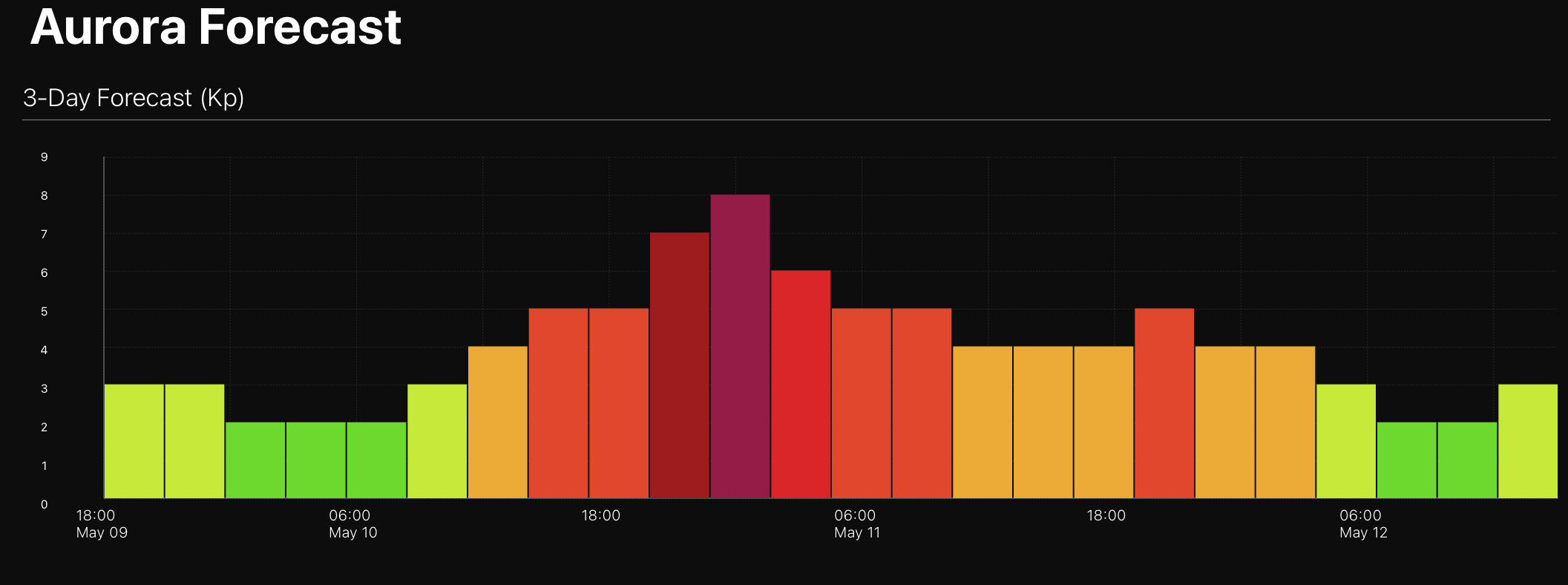
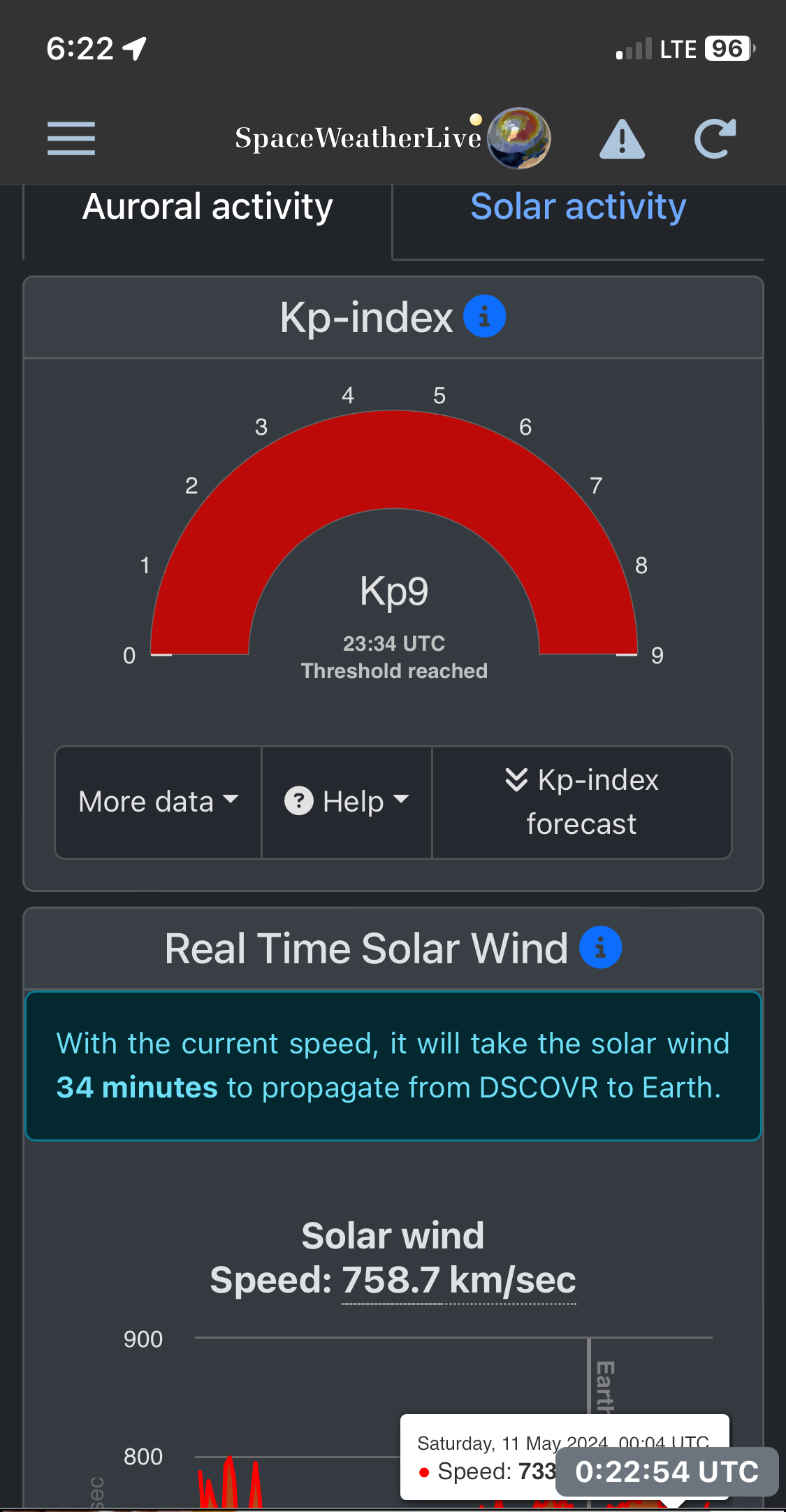
Throughout the day, aurora chasers’ phones (mine included) had been beeping with alerts of the arrival of a major solar storm, with the usual indicators of auroral activity pinned to the top of the scale.
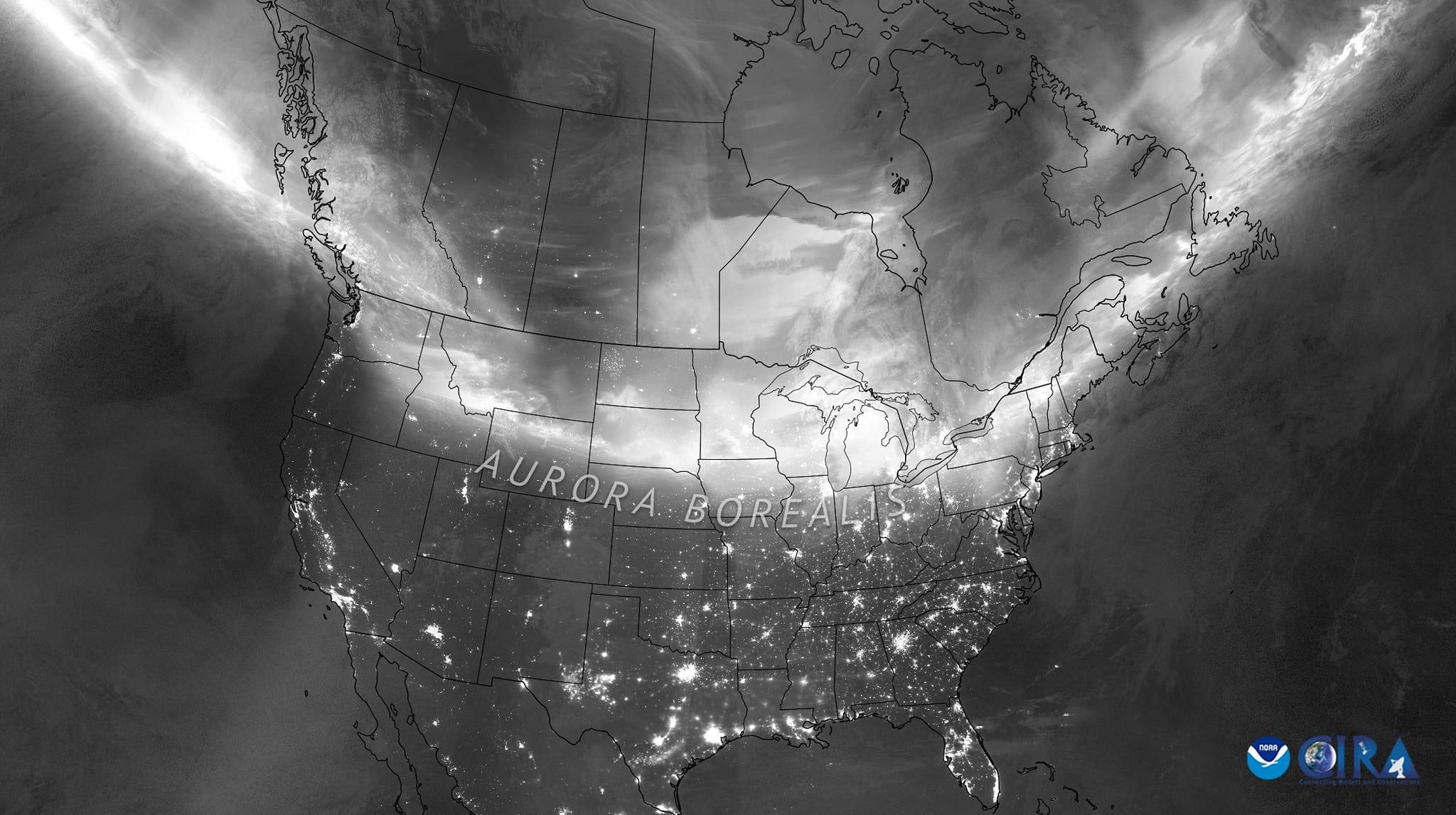
A NOAA satellite’s eye view of the ring of aurora May 10/11, showing it south of me in Alberta, and across the northern U.S. People in the southern U.S. saw it to their north.

As I show below, the graphic of the intensity of the band of aurora, the auroral oval, was lit up red and wide. This was a night we didn’t have to chase north to see the Northern Lights or aurora borealis — they were coming south to meet us (as I show above).
Observers in the southern hemisphere had the normally elusive aurora australis move much farther north than usual, bringing the Southern Lights even to tropical latitudes in Australia, South America and Africa.

The cause was a massive sunspot group on the Sun which had let off several intense solar flares.
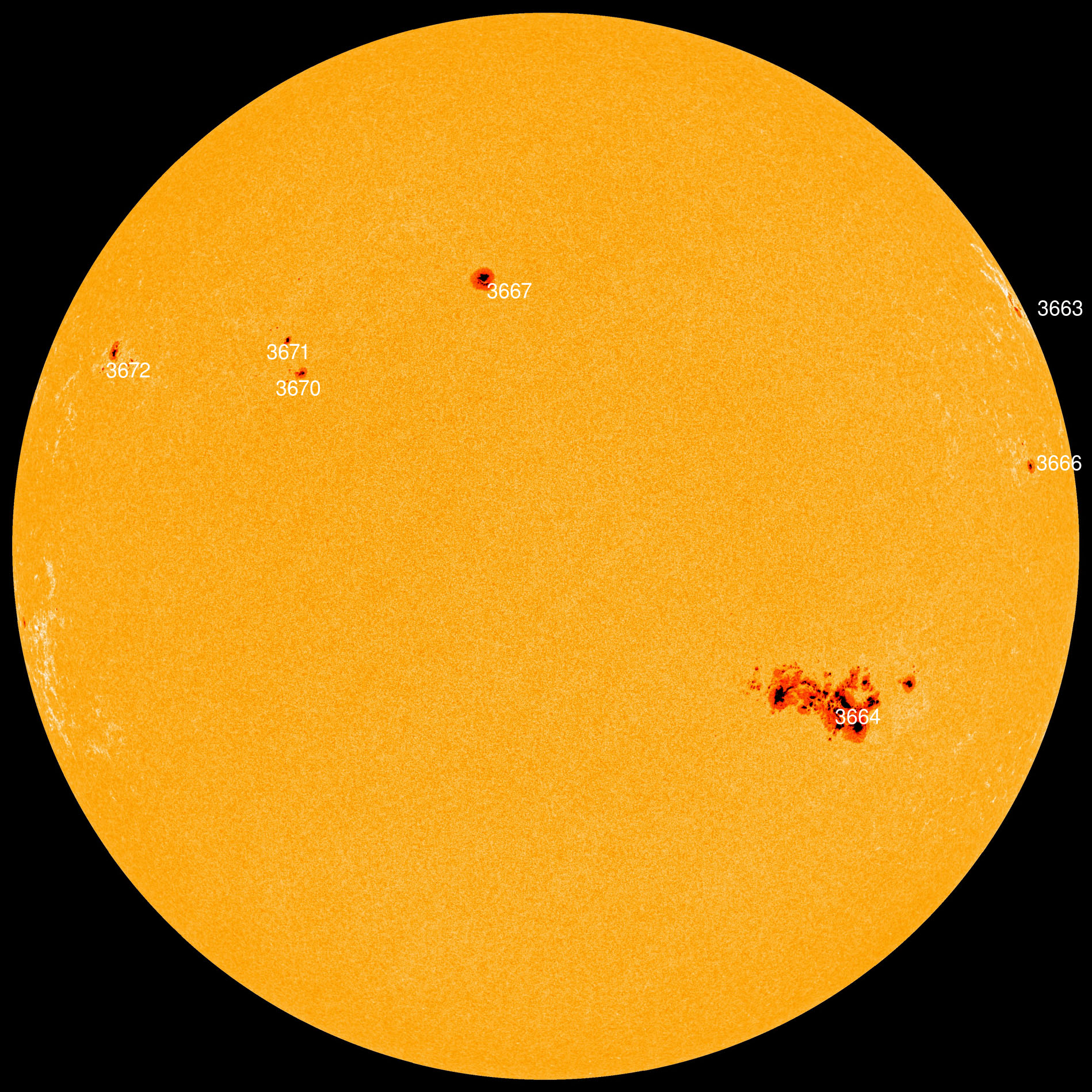
Sunspot group 3664 was so big it could be seen with the naked eye, using solar eclipse glasses. Photo courtesy NASA.

The flares had in turn blown off parts of the Sun’s atmosphere, the corona, that anyone who saw the total eclipse a month earlier had admired so much. But a month later, the corona was being blown our way, in a series of Coronal Mass Ejections (CMEs), to collide with Earth.

A movie of six CMEs blasting toward Earth, captured by the SOHO satellite. Courtesy NASA/ESA.

As it happened I was scheduled to give a community talk in the nearby town early in the evening of May 10, on the topic of The Amazing Sky! Watching the indicators, I could more or less promise the audience that we would indeed see an amazing sky later that evening as it got dark.

Post talk, I hurried home to get the cameras ready, choosing to forgo more hurried driving out to a scenic site in southern Alberta, for the convenience of shooting from my rural backyard. As the sky darkened, the clouds were lit purple, and curtains of aurora appeared in the clear patches.
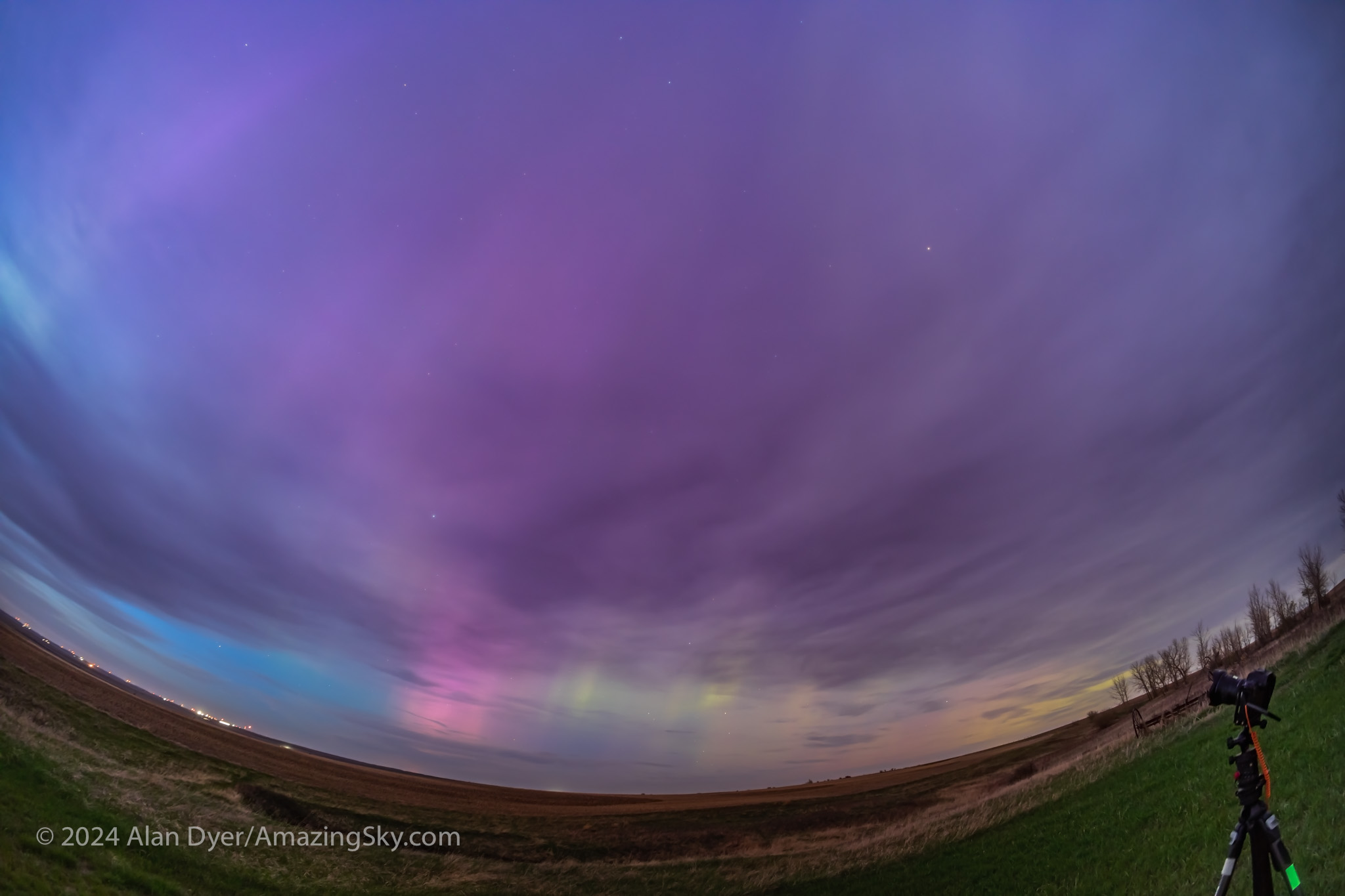
Clouds and aurora in twilight with the 11mm TTArtisan full-frame fish-eye lens.
A bright arc of aurora shining through the purple clouds, with the 7.5mm TTArtisan circular fish-eye lens.

Something big was going on! This was promising to be the best show of Northern Lights I had seen from home in a year. (Spring 2023 had three great shows at monthly intervals, followed by an aurora drought for many months. See The Great April Aurora.)

A selfie at the start of the great aurora show of May 10, 2024.

I shot with four cameras (a Canon EOS R, Ra, R5 and R6) — two for time-lapses, one for real-time movies, and one for still images. I used the latter to take many multi-image panoramas, as they are often the best way to capture the wide extent of an aurora across the sky.
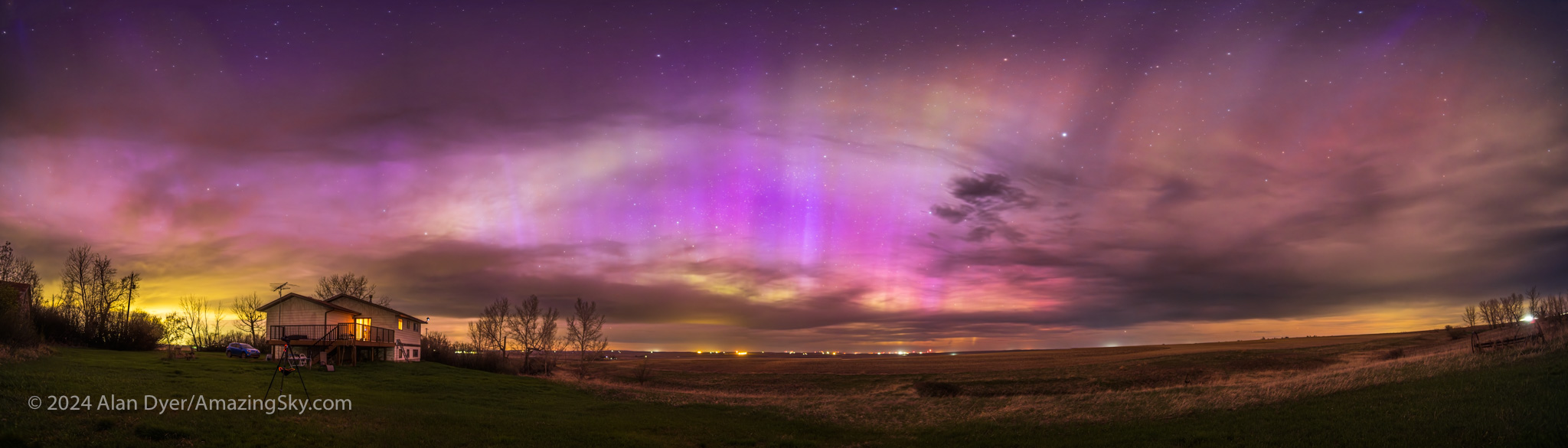
The arc of aurora in purple and white across the northern sky from home in Alberta at the start of the great display (about 11:30 p.m. MDT).

Early in the evening the arc of aurora wasn’t the usual green from oxygen, but shades of purple, pink, and even white, likely from sunlit nitrogen. The panorama above is looking north toward a strangely coloured arc of nitrogen (?) aurora.

Then after midnight a more normal curtain appeared suddenly, but toward the south, brightening and rising to engulf much of the southern sky and the sky overhead.

Looking south with the 15mm wide-angle lens.

It is at local midnight to 1 a.m. when substorms usually hit, as we are then looking straight down Earth’s magnetic tail, toward the rain of incoming aurora particles bombarding the Earth. During a substorm, the rain turns into a deluge — the intensity of the incoming electrons increases, sparking a sudden brightening of the aurora, making it dance all the more rapidly.
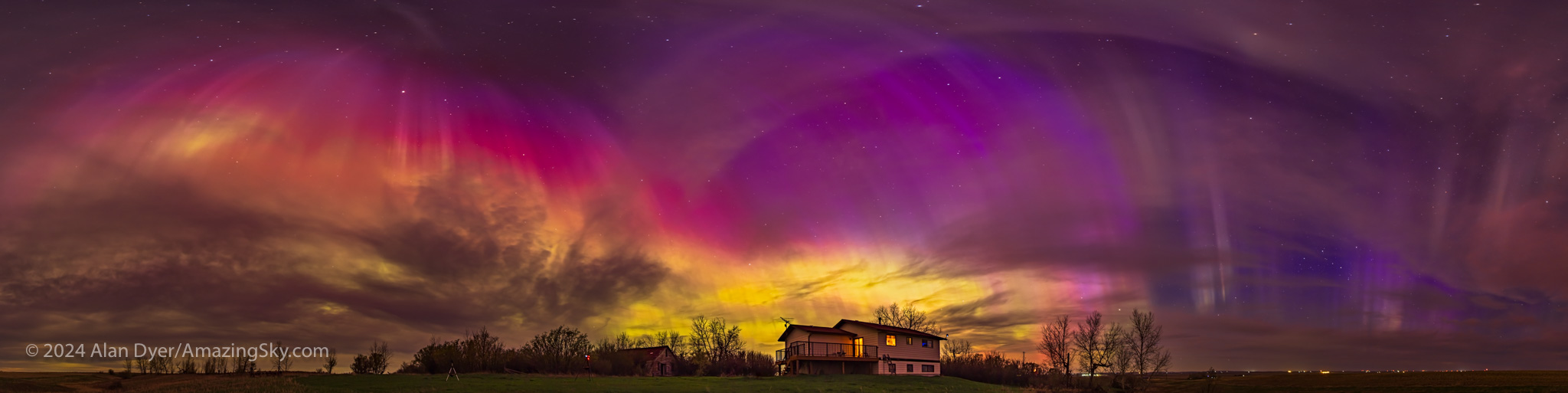
This is a 300° panorama of my home sky now filled with colourful curtains.

As the aurora explodes in brightness it often swirls up to the zenith (or more correctly, the magnetic zenith) to form one of the sky’s greatest sights, a coronal outburst. Rays and beams converge overhead to form a tunnel effect. It is jaw-dropping.

I’ve seen this many times from northern sites such as Churchill and Yellowknife, where the aurora often dances straight up. And from my latitude of 51° N in western Canada, the aurora does often come down to us.

But this night, people at latitudes where, at best, the aurora might be seen just as a glow on the horizon, saw it dance overhead in a corona show to rival the solar eclipse, and that other corona we saw on April 8!
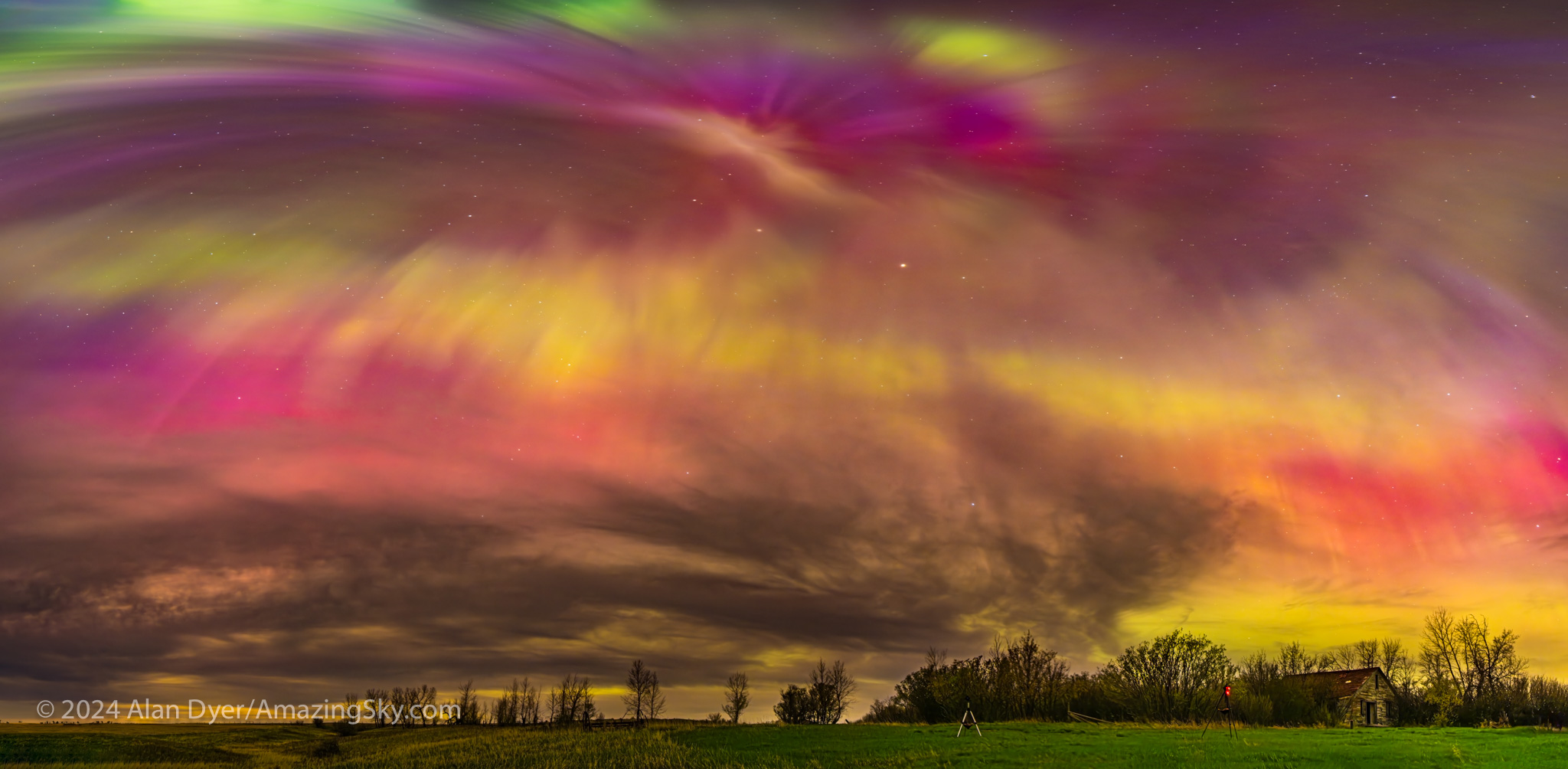
This is a panorama of a substorm outburst creating an overhead corona with rays converging to the magnetic zenith (south of the true zenith), and amid clouds. The rays show a rich mix of oxygen greens and reds, as well as nitrogen blues blending to create purples. Some greens and reds are mixing to make yellows.

Yes, the long exposures of aurora photos (even those taken with phone cameras) show the colours better than your eye can see them (insensitive as our eyes are to colour in dim light). But this night portions of the arcs and rays were bright enough that greens and pinks were easily visible to the naked eye.
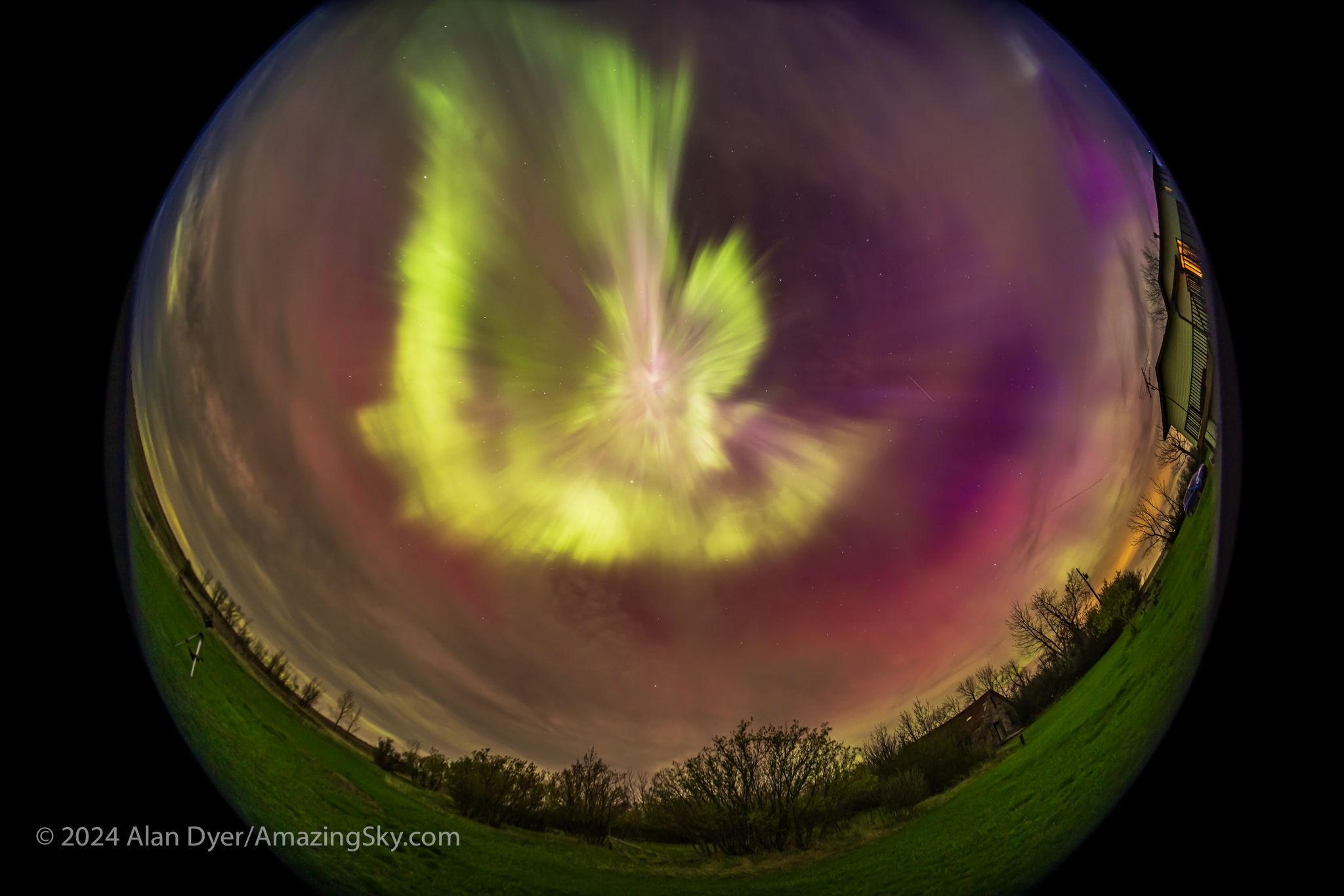

This is a single 9-second exposure of the peak of a bright outburst at 1 a.m. MDT. It was with the Laowa 7.5mm circular fish-eye lens at f/2 on the Canon R5 at ISO 800. It is one frame from a time-lapse sequence.

At its peak the show was changing rapidly enough, I couldn’t get to all the cameras to aim and frame them, especially the movie camera. The brightest outburst at 1 a.m. lasted just a minute — the time-lapse cameras caught it. The sequence below shows the view in 9-second exposures taken consecutively just 1 second apart.

This series shows a brief outburst of bright aurora at the magnetic zenith overhead. The time between these 7 consecutive 9-second exposures is only 1 second, so this bright outburst did not last long (little more than a minute). With the TTArtisan 7.5mm f/2 fish-eye lens on the Canon R5. Click or tap to enlarge to full screen.

Here’s another sequence of frames taken as part of a time-lapse sequence with the 11mm lens. It shows the change in the aurora over the 80 minutes or so that it was most active for me at my site.
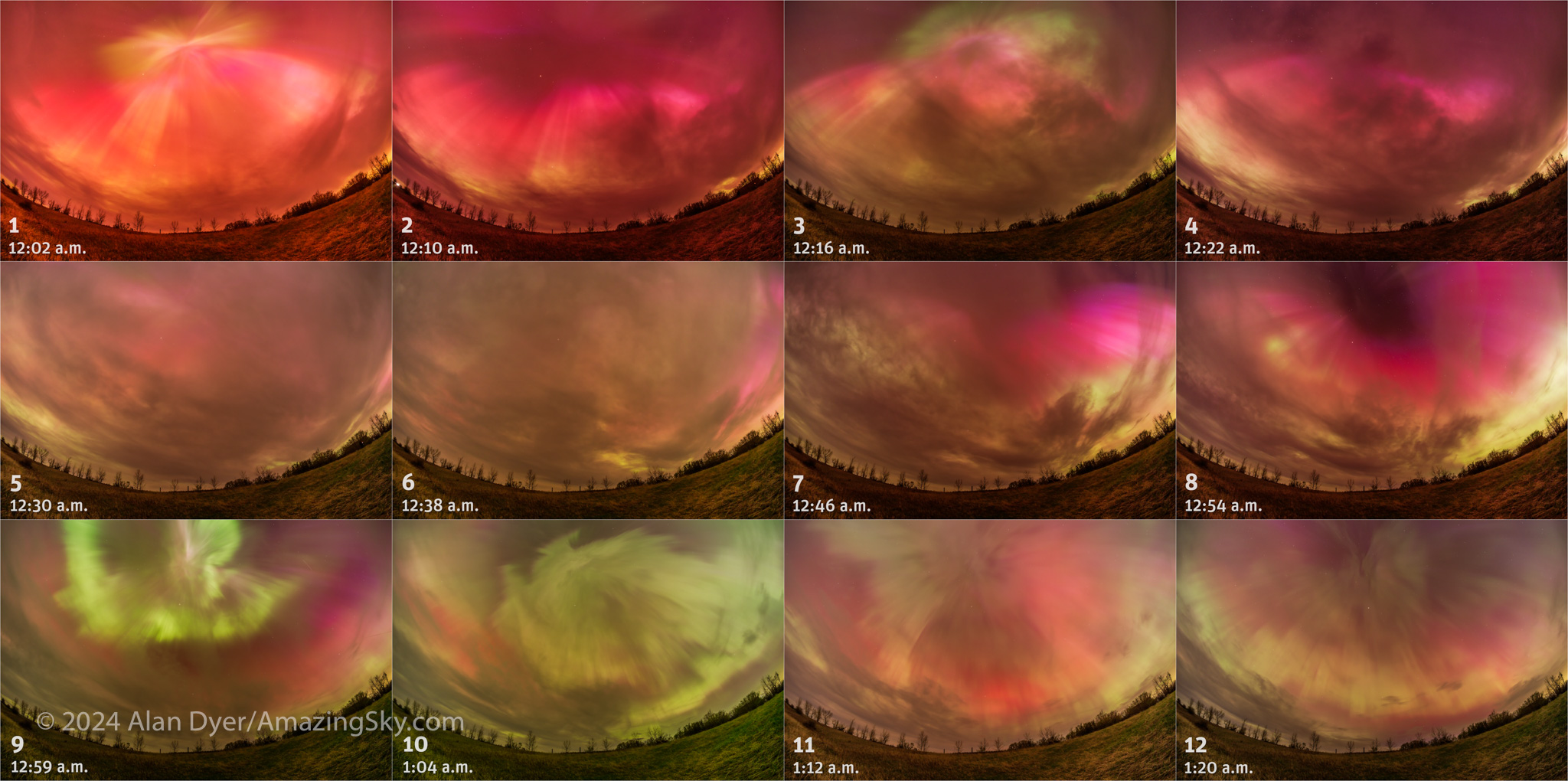

The time between these 12 images is usually 8 minutes, though to include some interesting activity at a bright outburst, the interval is 5 minutes for three of the images around 1 a.m. Each is a 7- or 9-second exposure taken as part of a time-lapse sequence using the 11mm TTArtisan lens at f/2.8 on the Canon R at ISO 800 or 1600.

Shooting time-lapses with fish-eye lenses captures the show with a minimum of attention needed (except to adjust ISO or exposure times when the aurora brightens!). I could use the still camera (with the Laowa 15mm f/2 lens) to take individual shots, such as more selfies and home shots.
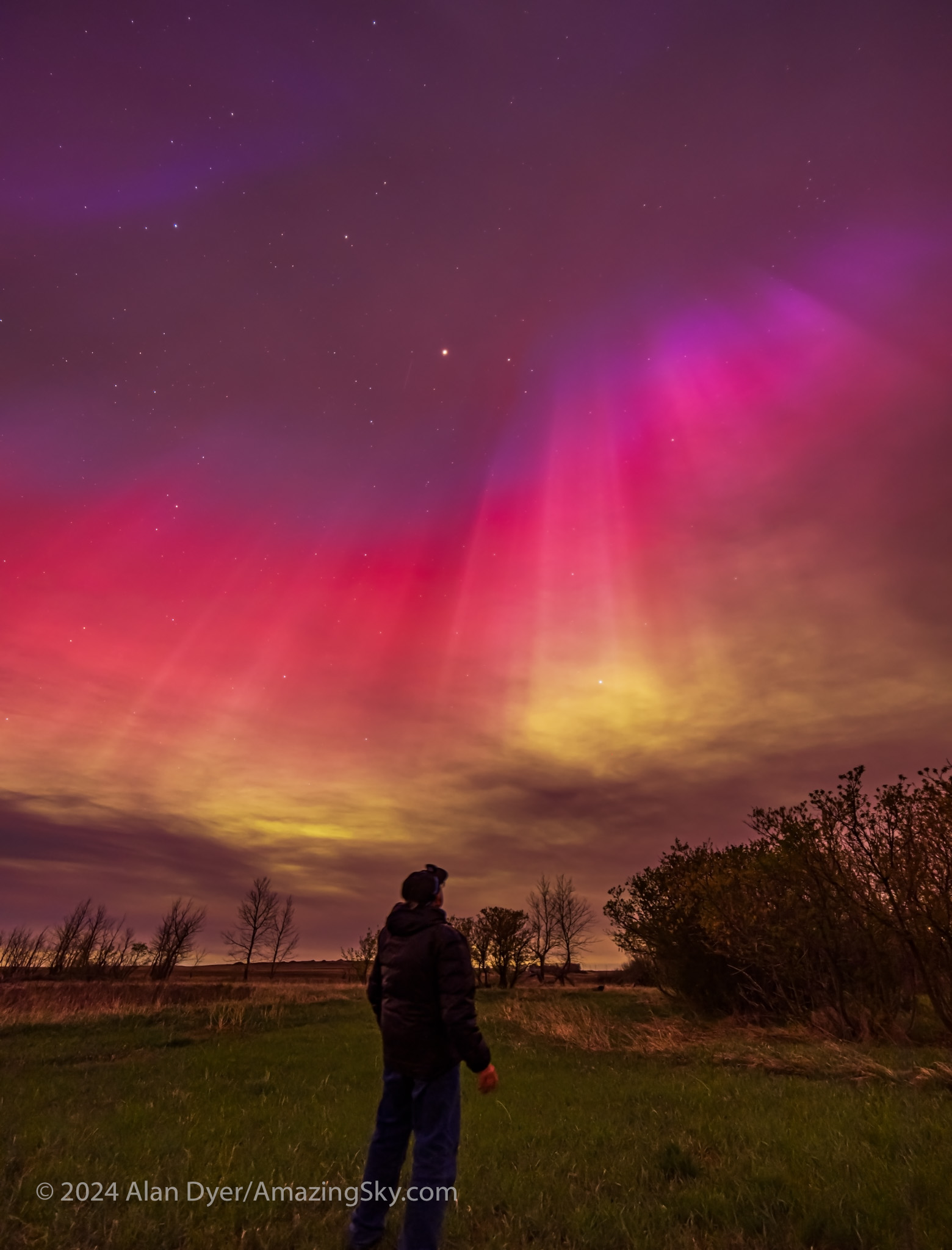
This is a single 8-second exposure with the Laowa 15mm lens at f/2 on the Canon Ra at ISO 800. Another camera taking a time-lapse is in the scene. I had four going this night.

As colourful as the aurora was at its best between midnight and 1:30 a.m., I think the most unique shots came after the show had subsided to appear just as faint rays across the north again, much as it had begun. To the eye it didn’t look like much, but even on the camera’s live screen I could see unusual colours.

I took more panoramas, to capture one of the most unusual auroral arcs I’ve even seen — a blue and magenta aurora across the north, similar to how the night started.
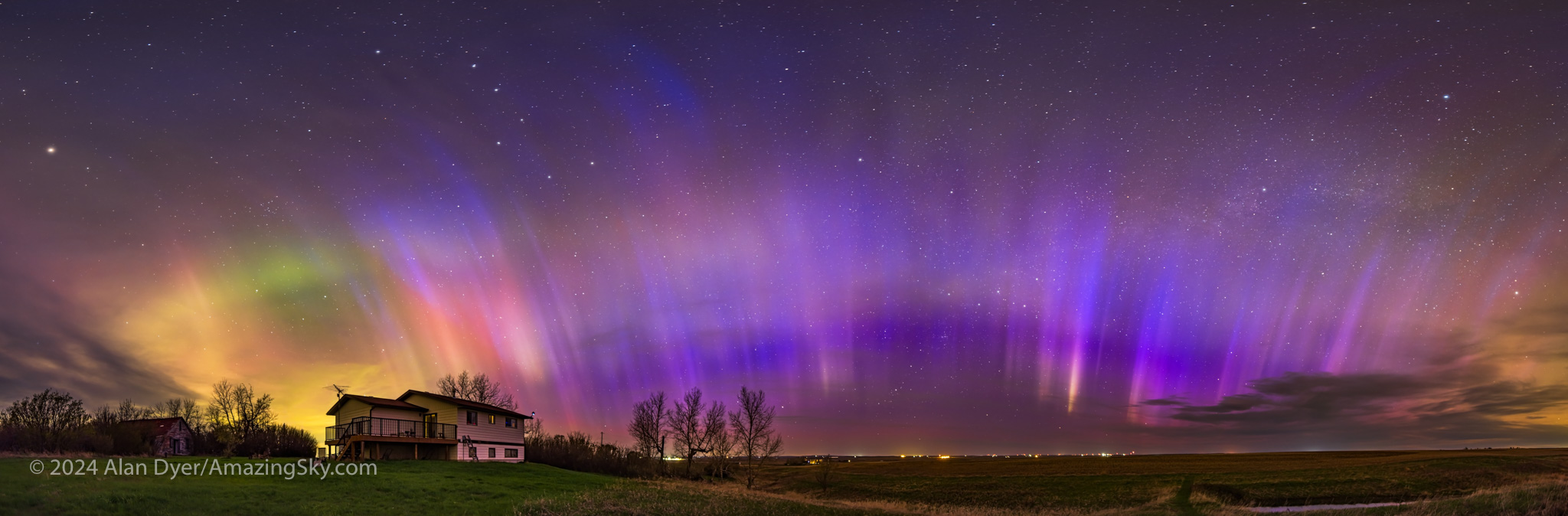
This a stitch of 11 segments, each 13-second exposures, with the Laowa 15mm lens at f/2 on the Canon Ra camera at ISO 800, and turned to portrait orientation. Processed in Camera Raw and stitched with PTGui.

The colours may be from nitrogen glowing, which tends to light up in blues and purples, especially when illuminated by sunlight at high altitudes. At 2 to 2:30 a.m. the Sun might have been illuminating the aurora at a height of 150 to 400 km, and far to the north.

I’d seen blue-topped green auroras before (and there’s a green aurora off to the west at left here). But this was the first time I’d seen an all-blue aurora, no doubt a product of the intense energy flowing in the upper atmosphere this night. And the season and my latitude.
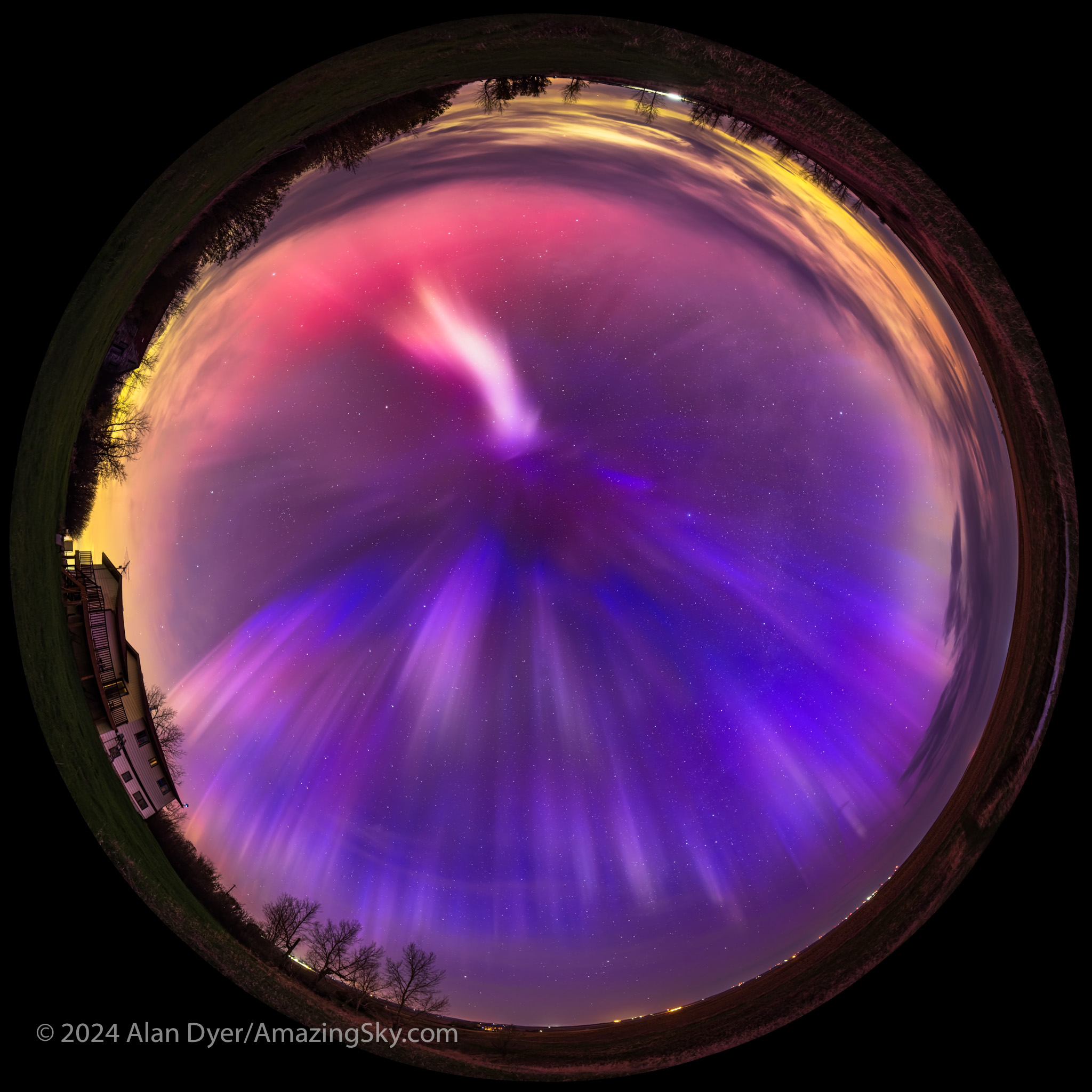
The panorama is a spherical projection spanning 360º, and reaching to the zenith 90° high at centre. This a stitch of 20 segments, each 13-second exposures, with the Laowa 15mm lens at f/2 on the Canon Ra camera at ISO 800, and turned to portrait orientation. Processed in Camera Raw and stitched with PTGui.

The weirdest aurora was at 2:30 a.m., when in addition to the blue rays of nitrogen, an odd white and magenta patch appeared briefly to the south. What was that??

The lesson here? During a bright show do not go back to sleep when things seem to be dying down. Interesting phenomena can appear in the post-storm time, as we’ve learned with STEVE and other odd red arcs and green proton blobs that we aurora photographers have helped document.

I end with a finale music video, mostly made of the time-lapses I shot this night.

Enjoy!

Bring on more aurora shows as the Sun peaks in activity, perhaps this year. But the best shows often occur in the 2 or 3 years after solar max. So we have several more years to look forward to seeing the Lights dance in our skies.

Watch in full screen and in 4K if you can. For all the tech details click through to YouTube and check the description below the video.

Thanks and clear skies!

— Alan, May 18, 2024 amazingsky.com
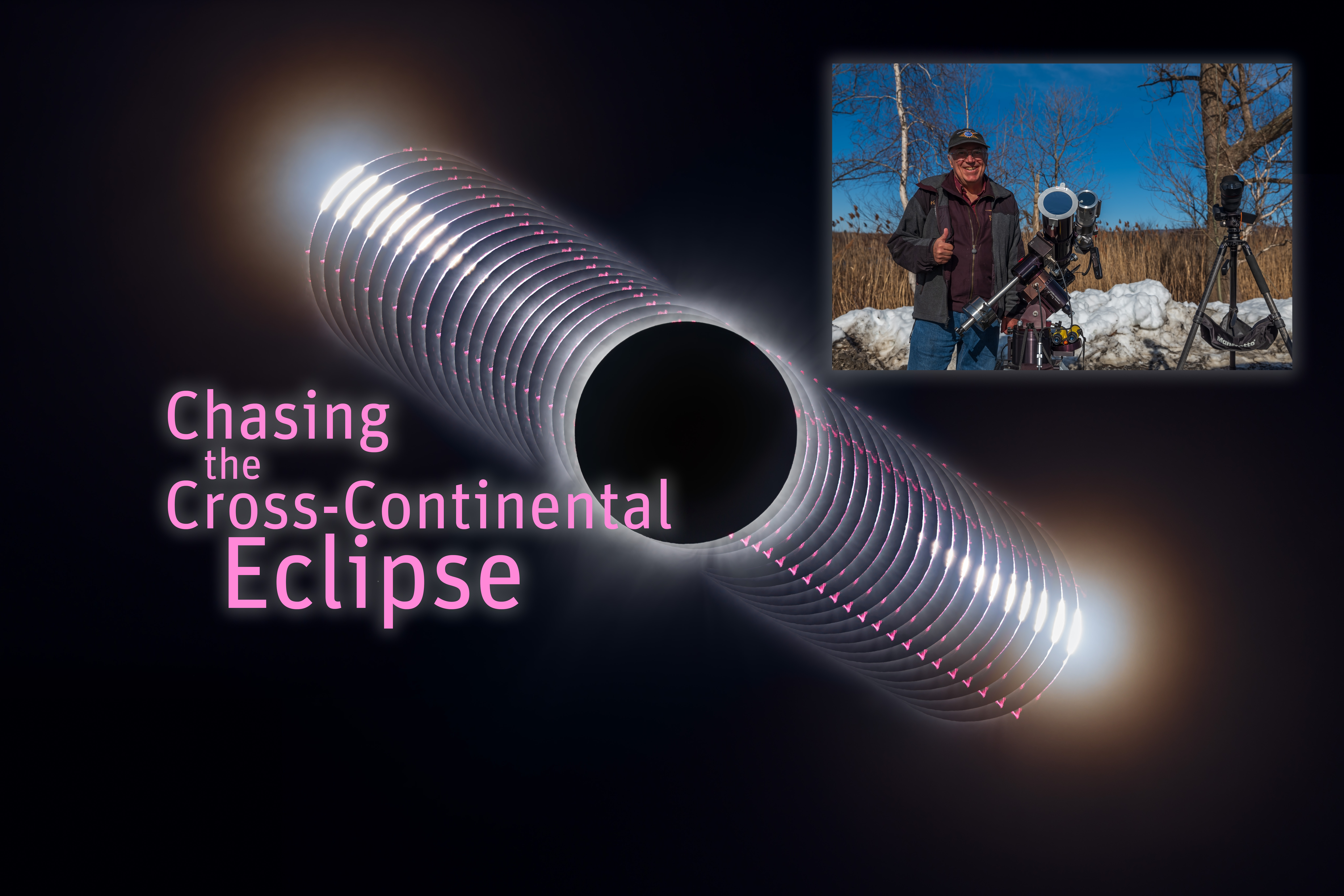
Chasing the Cross-Continental Eclipse


I had always planned to drive to the April 8, 2024 total eclipse of the Sun. But to where? I ended up on the other side of the continent than originally planned.

It is not often the path of the Moon’s shadow crosses your home country, let alone continent. Only once before in recent years, on August 21, 2017, did the narrow shadow path pass near enough to my home in Alberta to allow me to drive to a total eclipse. They almost always require flying. 

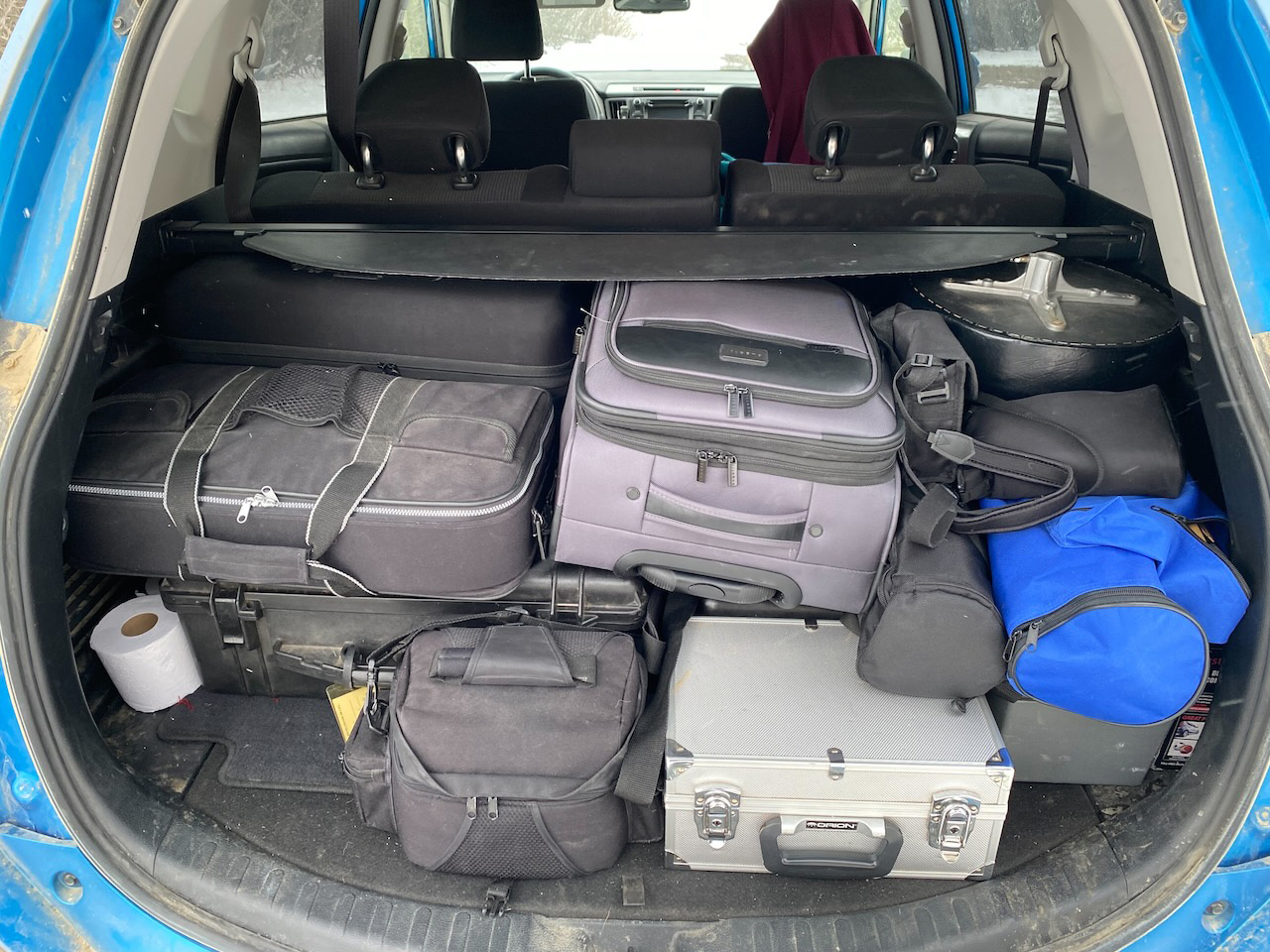
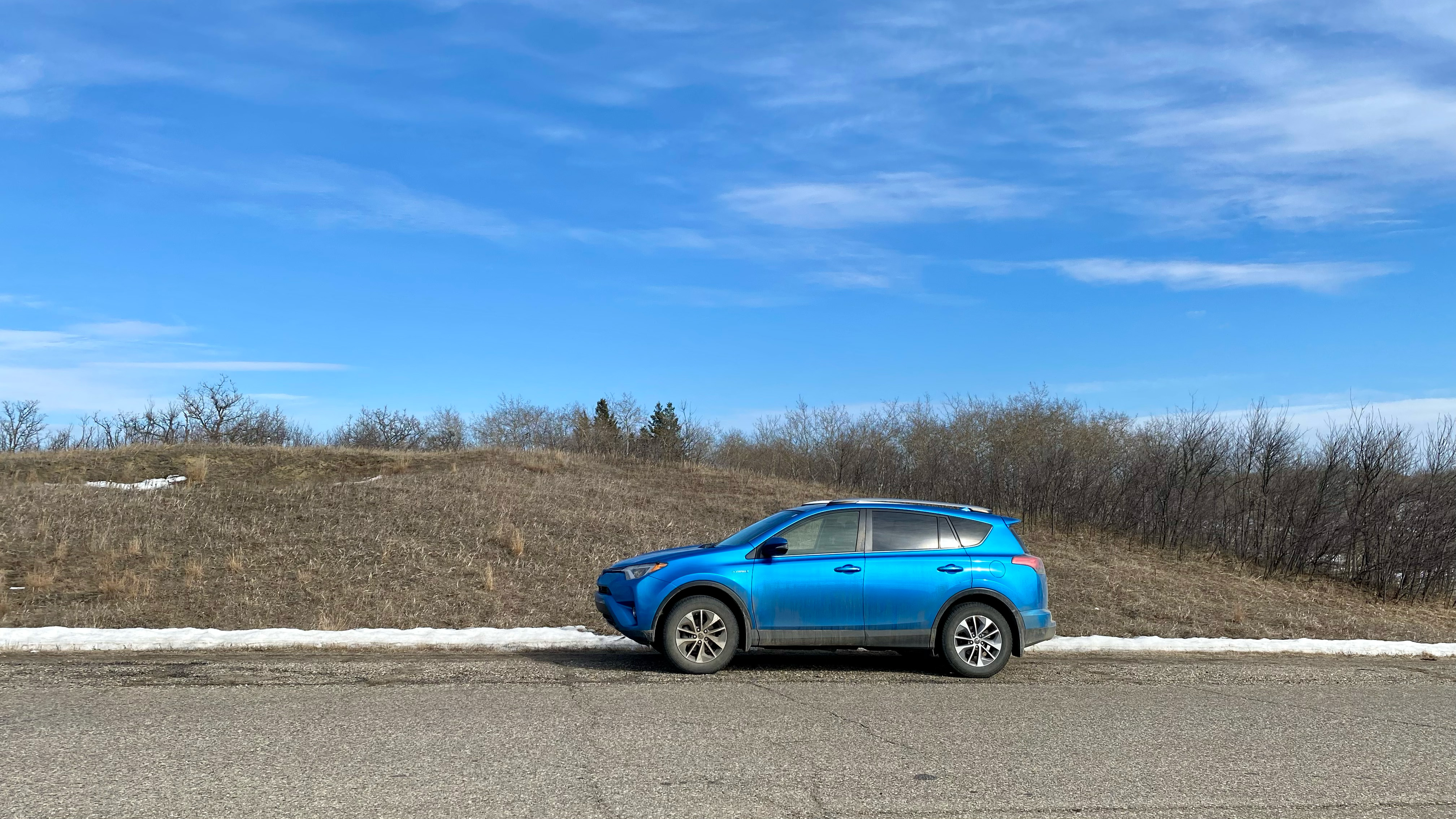
Packed and ready to hit the highway for a long eclipse trip.

Yes, while I could drive to the April 8, 2024 eclipse, it was going to demand a much longer drive than in 2017. But driving allowed me to take a carload of telescope and camera gear. So that was the plan. 

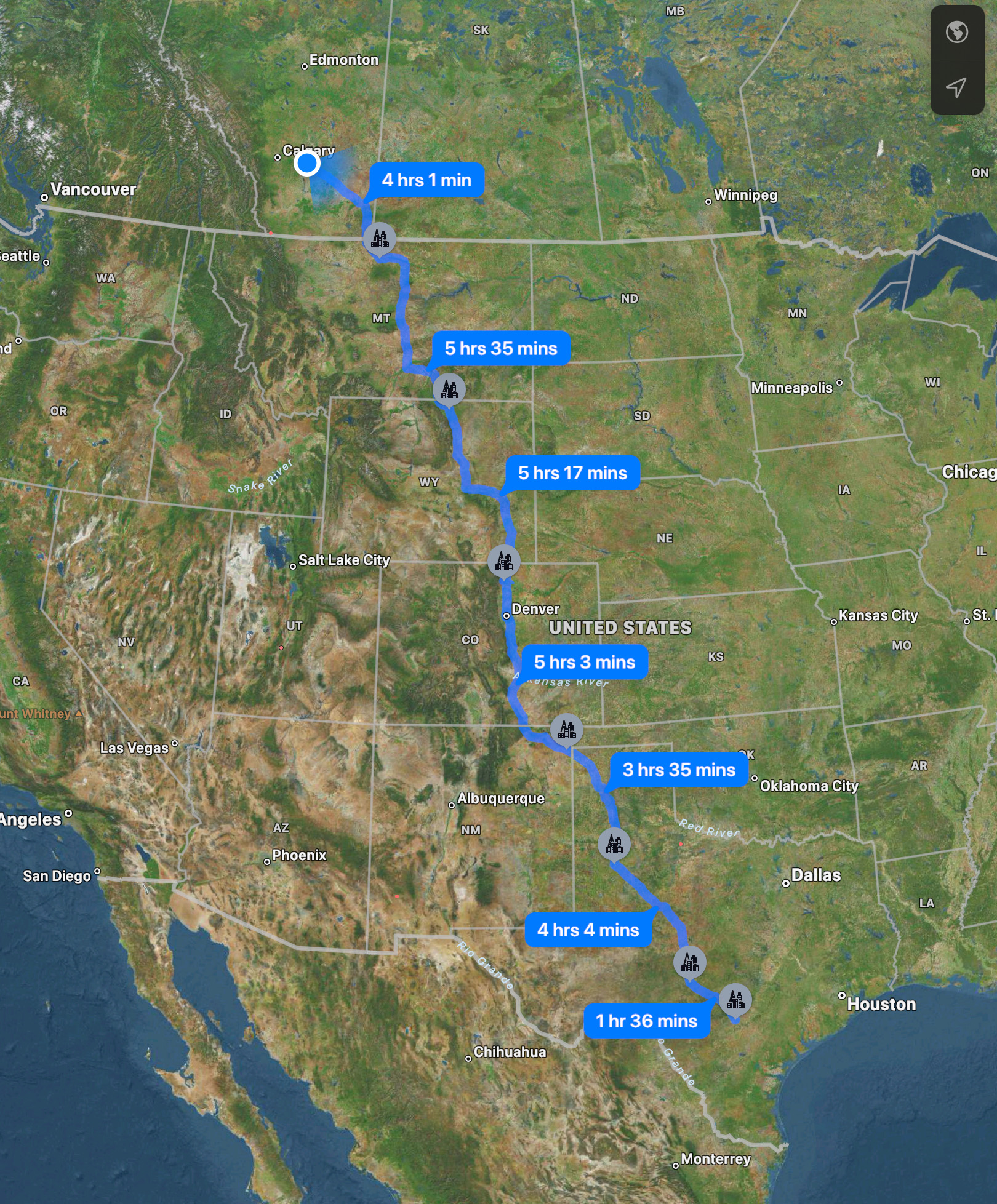
My destination was San Antonio, Texas. That’s where I had made a hotel booking more than a year earlier. The weather prospects in Texas were forecast to be best (at least according to the long-term averages) of any locations along the path in the U.S. or Canada. (I did not want to drive into Mexico.) 

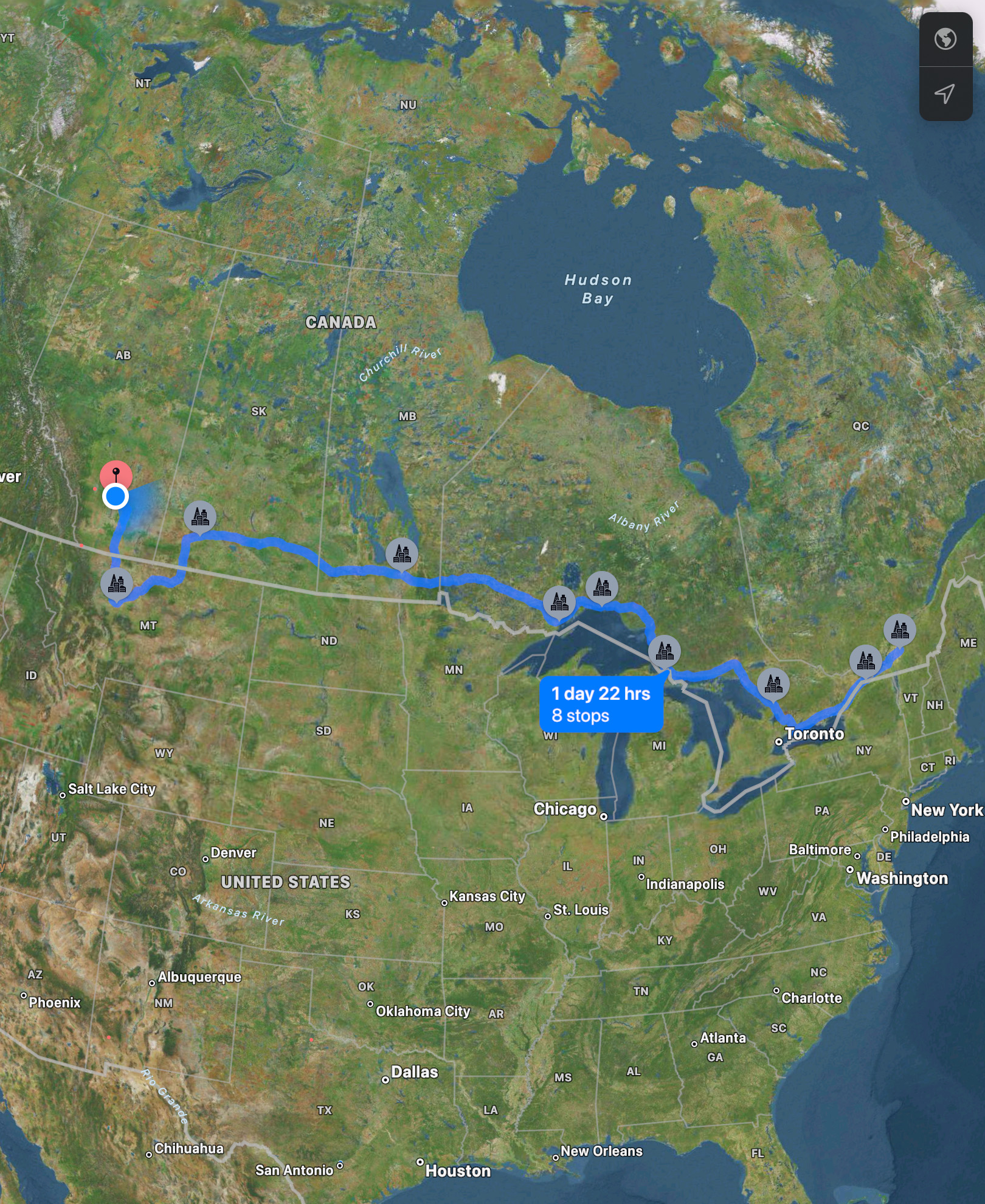
On March 30, with some trepidation, I set out down I-15 heading south. I got as far as Great Falls, Montana, my stop for night one. But it was to be a move in the wrong direction.

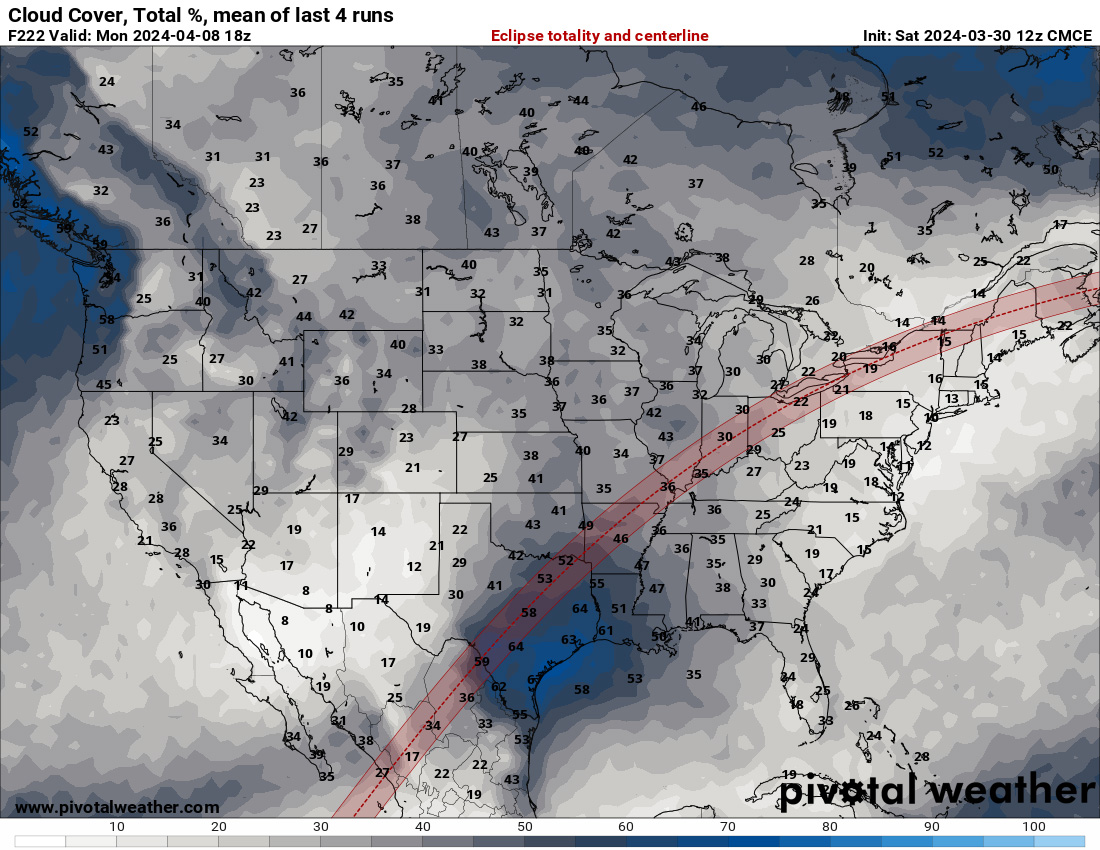
The forecast for Eclipse Day as of March 30. Blue is bad; white is good!

The various long-range weather models were all agreeing, even 10 days in advance, that Texas (covered in blue above) was looking poor for eclipse day. But eastern Canada looked good! That was the exact opposite of what had been expected. 

So on Easter Sunday, I turned around and headed north, crossing back into Canada at a lonely border post in southwest Saskatchewan. 

I proceeded east along the TransCanada, Highway 1. I decided against a route across the northern U.S. and around the southern end of Lake Michigan, to avoid severe weather forecast for the middle of the U.S. 

One of my daily Facebook travelogue posts with a beer of the day.

Along the way I posted my beer-du-jour travel reports, as above from Day 8, that day from within the shadow path at last!

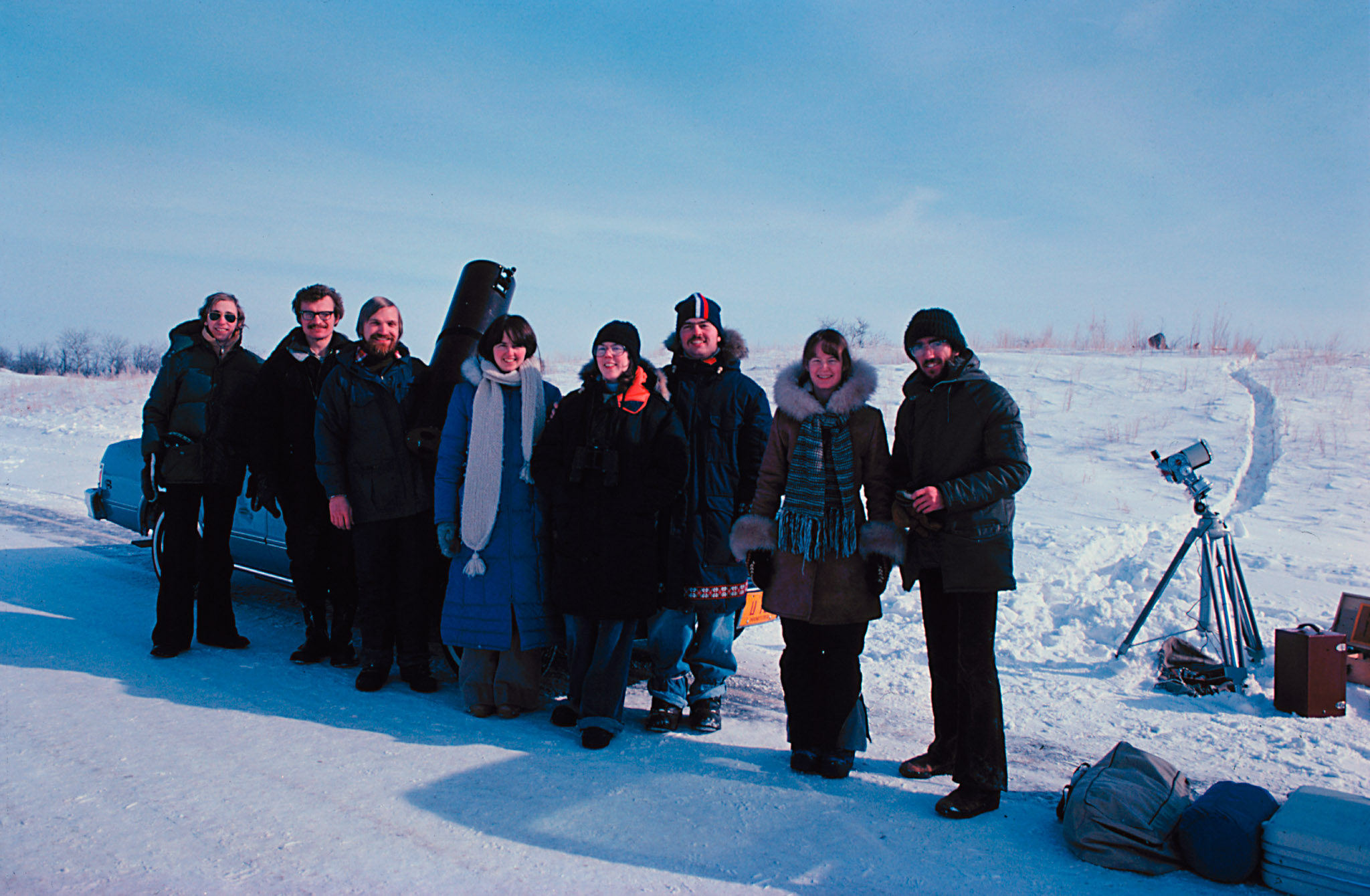
I also stopped at the only total eclipse site, of the 16 I had seen previously, I have ever been able to re-visit. On February 26, 1979 I and a small band of friends from Edmonton viewed the mid-winter eclipse (the last one visible from southern Canada) from a median road (Firdale Road as it is now called) on the TransCanada Highway near Carberry, Manitoba. I found the spot again, where I saw (and shot with my Questar telescope) my first total eclipse of the Sun. 

However, a day after entering Ontario, the bad weather caught up with me, forcing an extra night north of Lake Superior while the only highway across the region, Highway 17, was cleared of snow and re-opened at Wawa, the usual cross-Canada choke point. 

My new destination (after abandoning the site in the Texas Hill Country) was to be southern Ontario. 

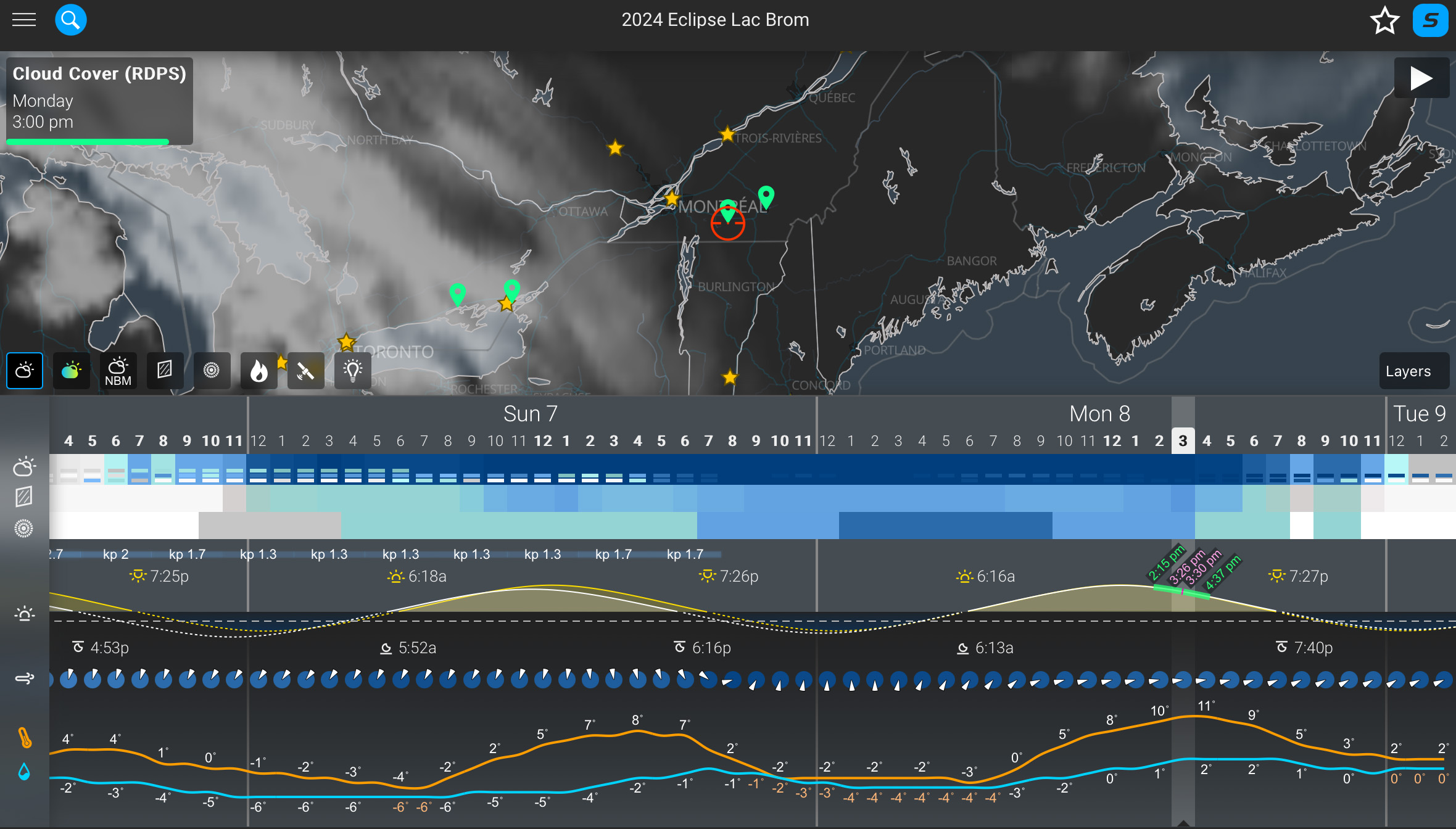
However, as eclipse day approached and the weather predictions became more precise, it was apparent that Ontario would also be under some cloud. Southern Québec was looking better. So the Eastern Townships became my new Plan A site! I was running out of time!

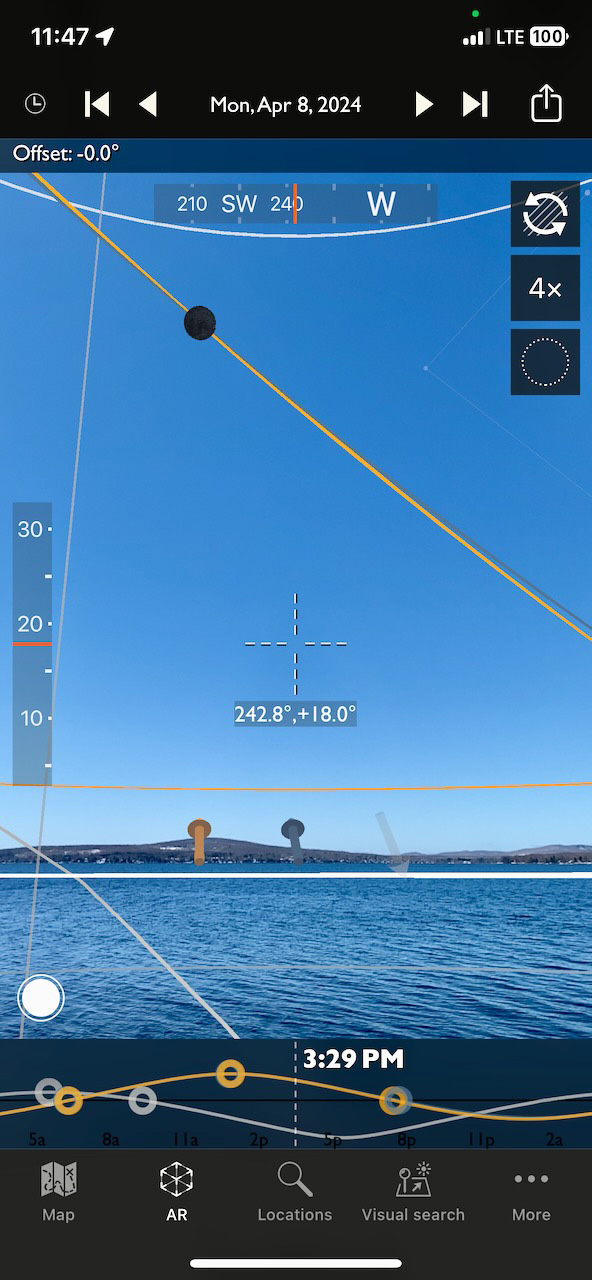
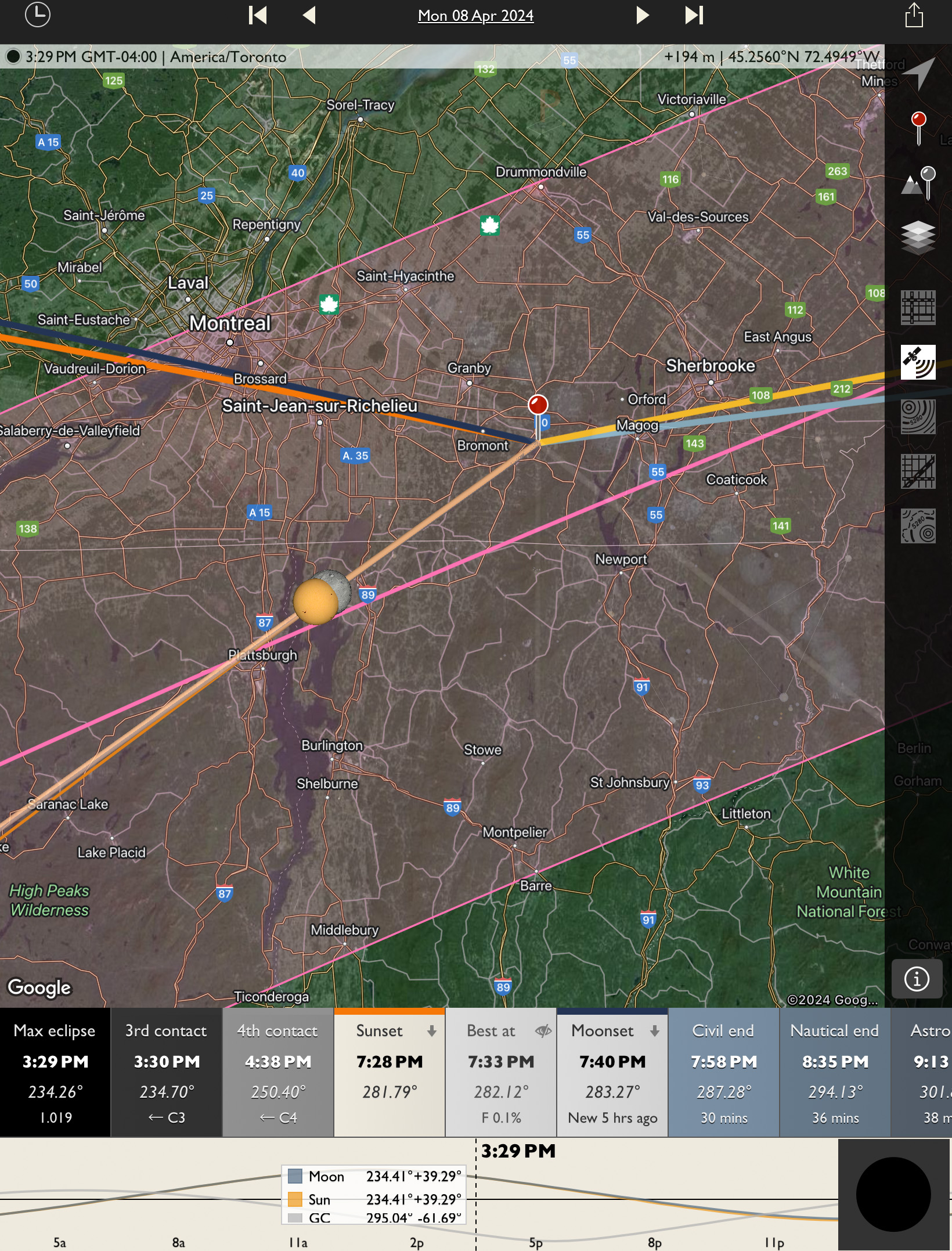
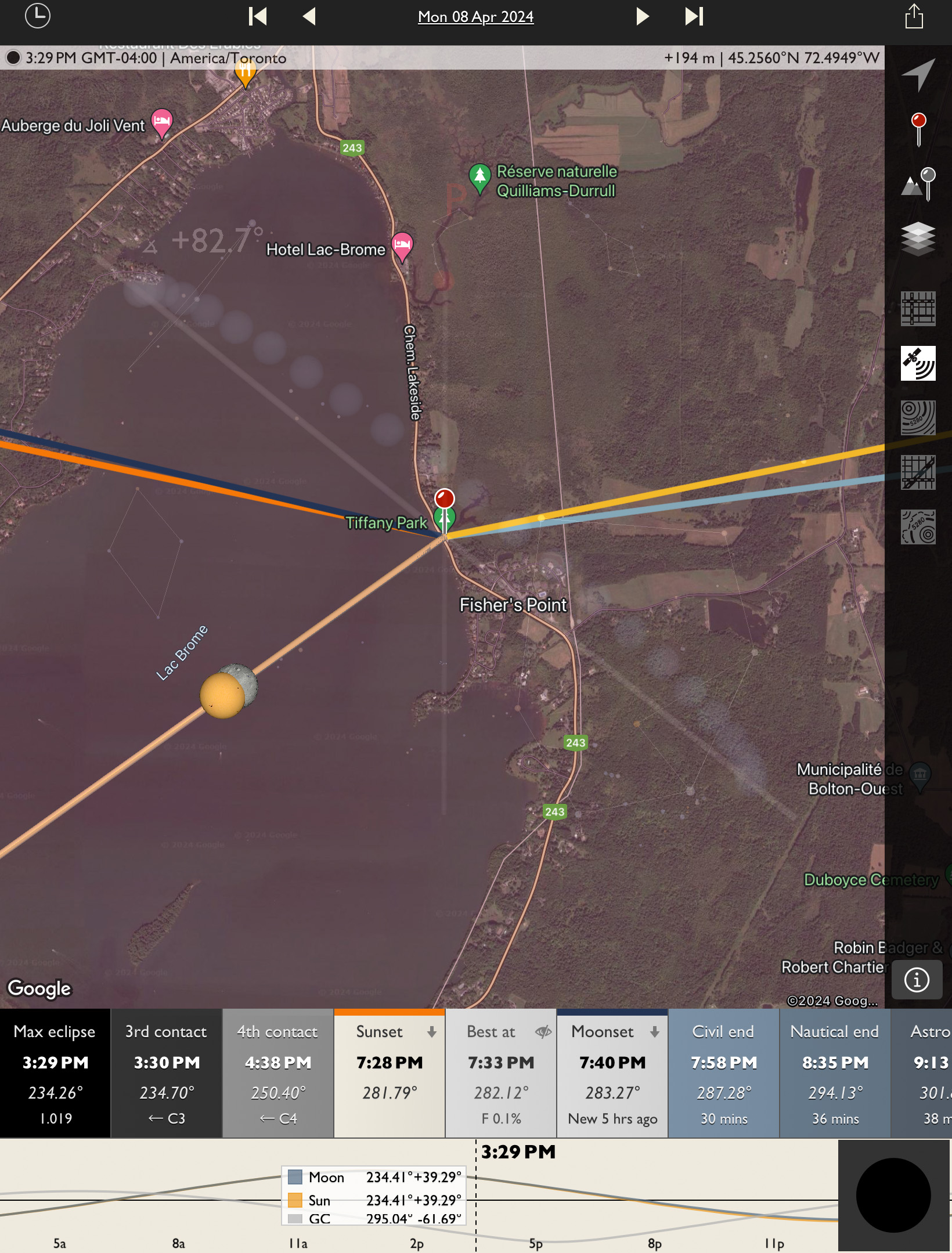
Using the TPE app to check the Sun’s location once on site, the day before the eclipse.

I arrived on site in Québec with only a day to spare to check out the location I had found by exploring Google maps. 

With the Sun lower in the mid-afternoon sky in Québec compared to the high-noon Sun in Texas, I decided to shoot a wide-angle scene of the eclipse over a lake, preferably with open water, not ice! That required a site with public parking on an eastern lakeshore.

The site I found, then checked out on April 7, was on Lac Brome. It proved ideal — except for the thin cloud that was now predicted to drift through during the eclipse. 

Sure enough, that’s just what happened. The cloud detracted from the eclipse only in preventing long-exposure images recording the outermost streamers in the Sun’s atmosphere. 

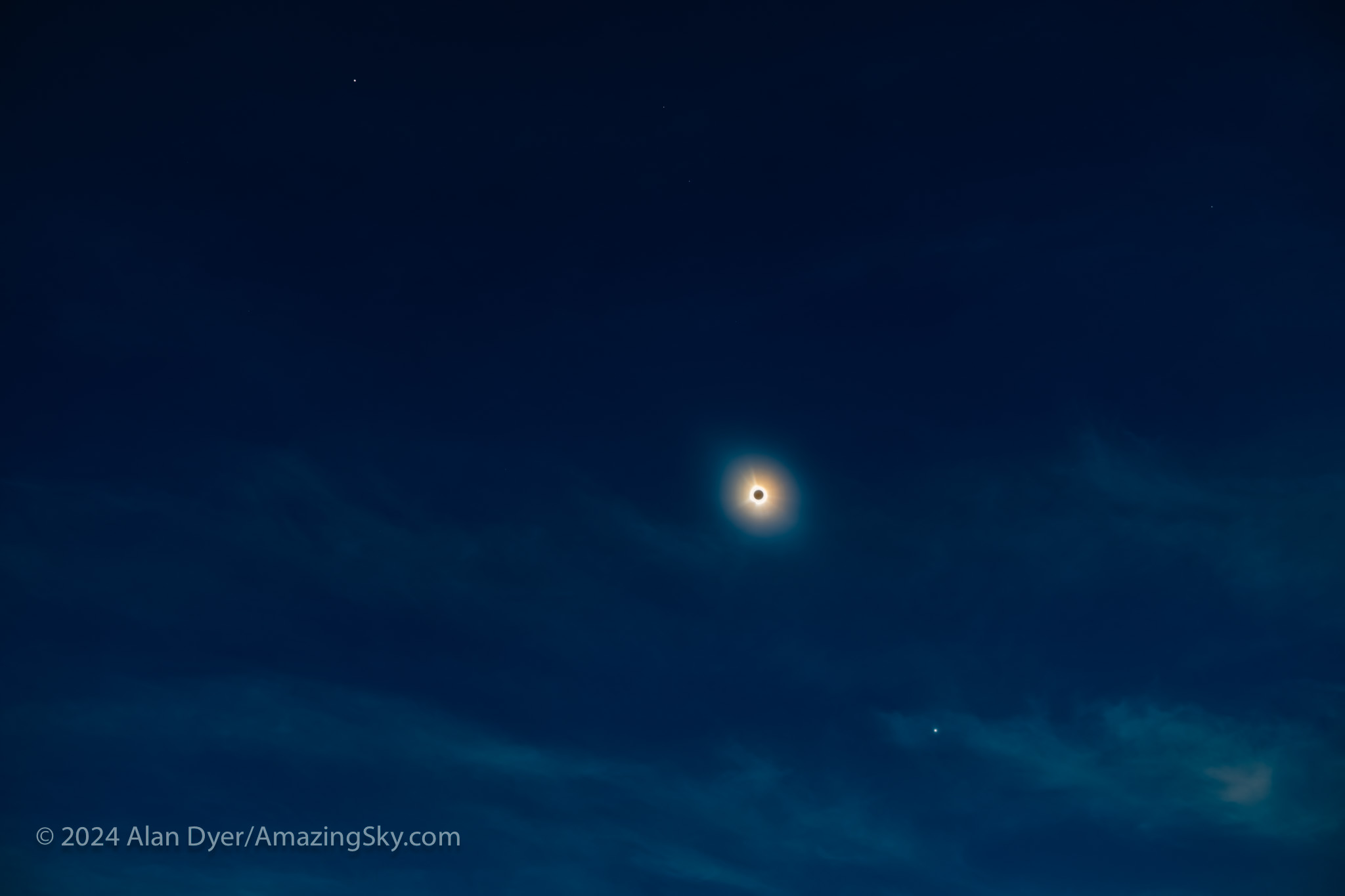
A wide-field view of the eclipse of the Sun, taking in the bright planets Jupiter (at top) and Venus (below) that were easily visible to the unaided eye during totality.

I could have sought out clearer skies by going even farther east, but I was in a crunch for time and hotel rooms! As it was I was able to get rooms everywhere I wanted and at normal “non-eclipse” rates! 

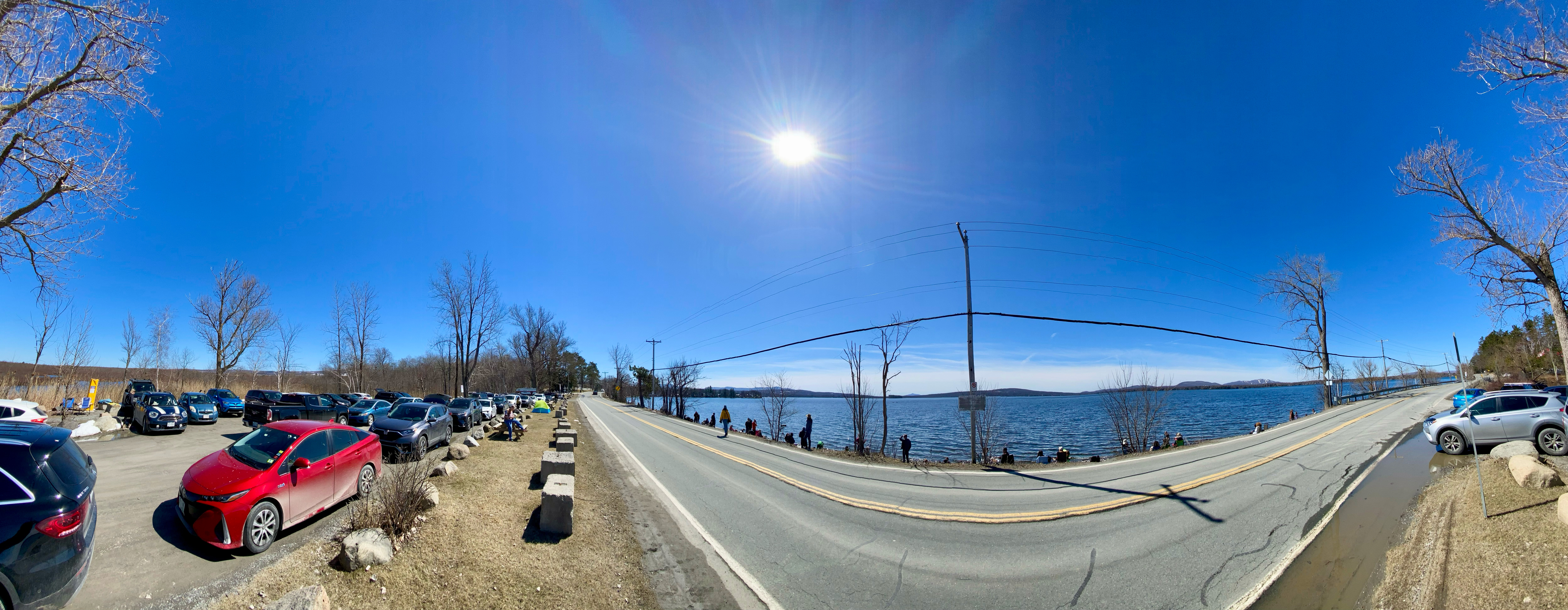
A panorama of the lakeside parking area at Lac Brome prior to the eclipse.

The Lac Brome site filled with cars during the day, with people from Québec and Ontario, but also from Alberta, and from Pennsylvania, Massachusetts and Maine – at least those were the homes of the folks I enjoyed meeting on eclipse day. 

Everyone had a great time and had a superb eclipse experience. 

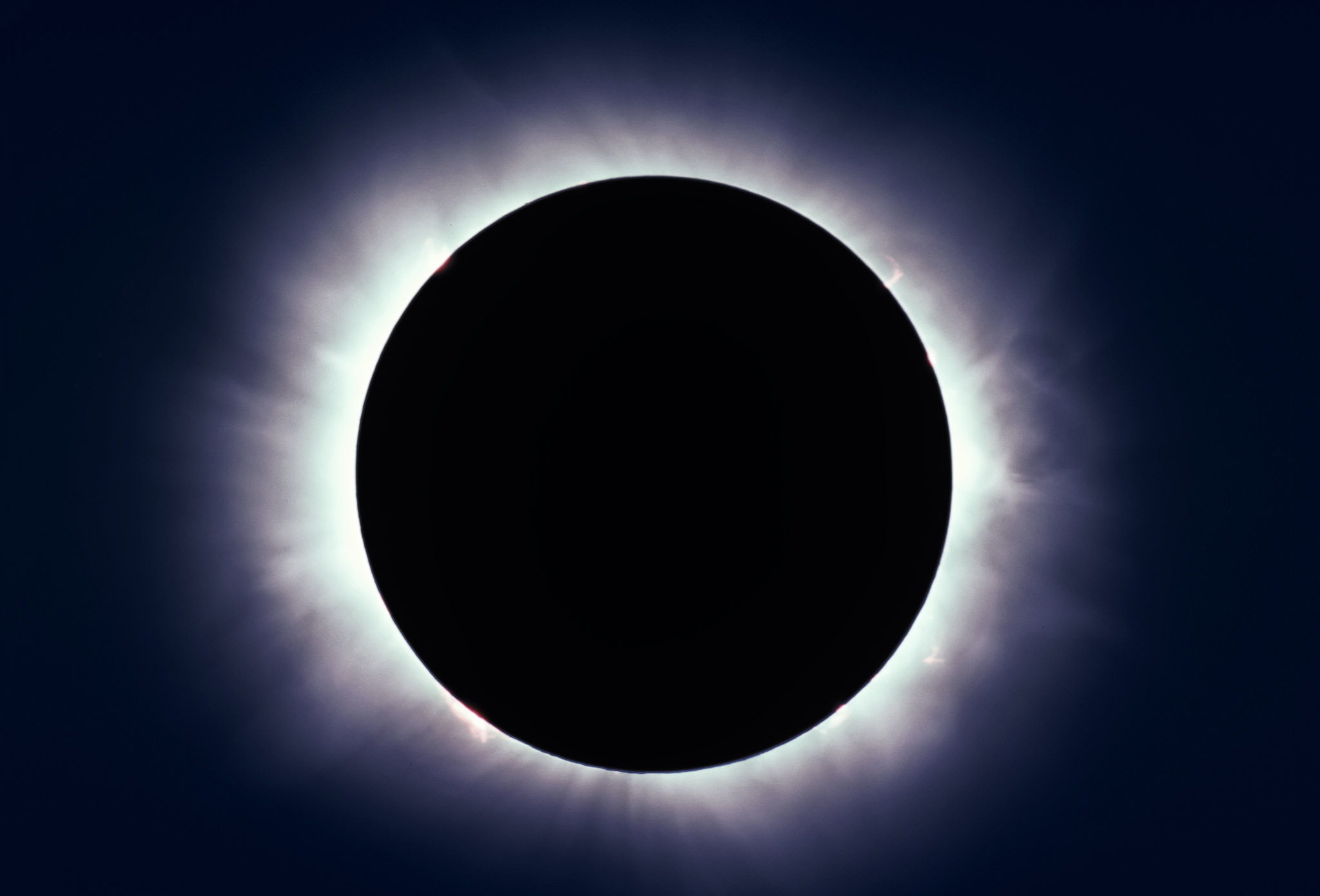
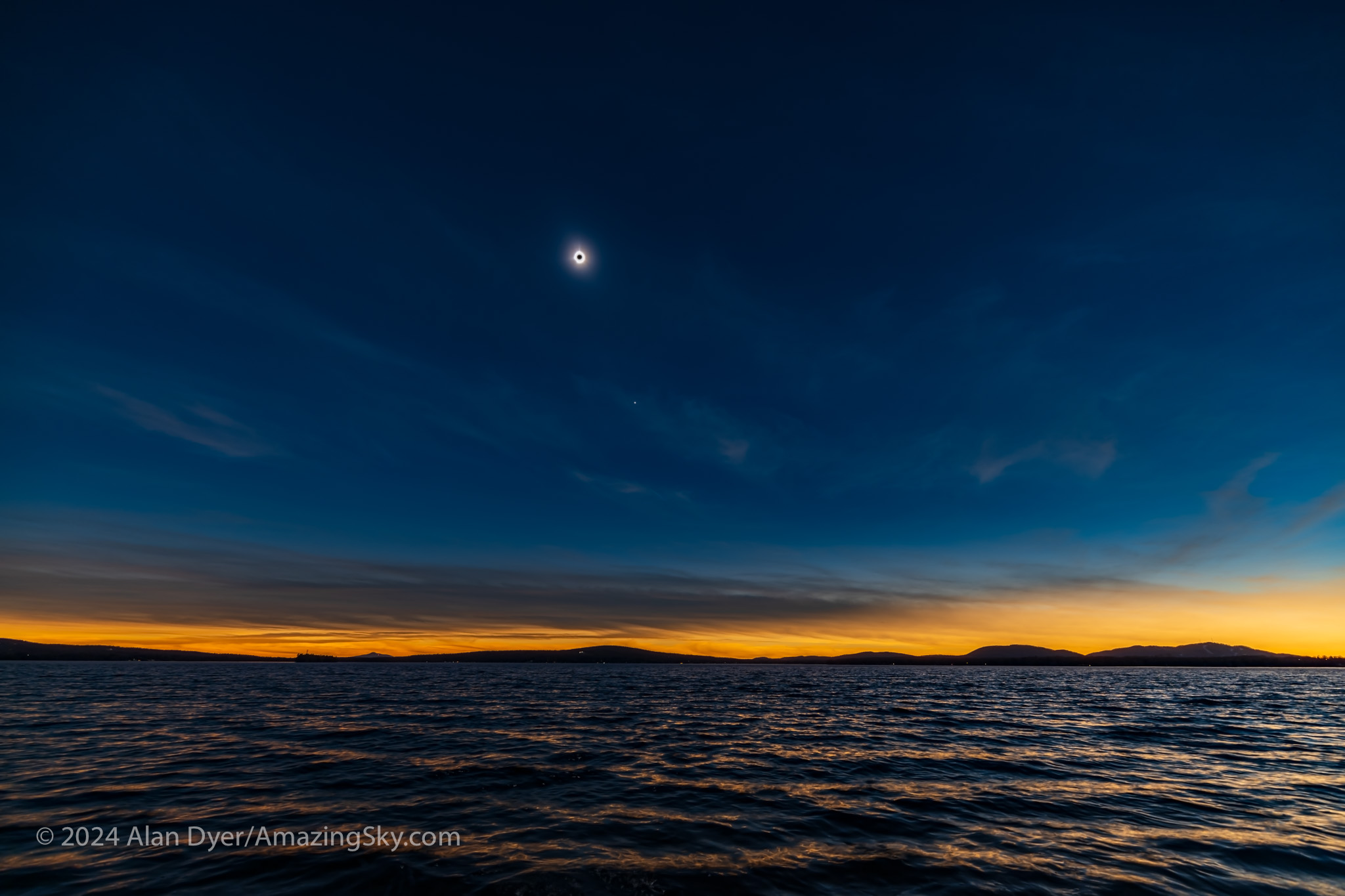
The total eclipse of the Sun over the waters of Lac Brome, in the Eastern Townships of Quebec, Canada. The twilight colours come from sunlight from outside the shadow path.

The lunar shadow arrived from the southwest, from the direction of the Sun, appearing as a dark cloud racing toward us. At the end of the eclipse the sky brightened first in that same direction, as the trailing edge of the shadow shot up across the sky. The clouds helped make the shadow edge more visible. 

A time-lapse of the arrival and departure of the lunar shadow, made of 1200 frames each 1 second apart.

I shot with five cameras, just as I had done in 2017, possible only because I drove. 

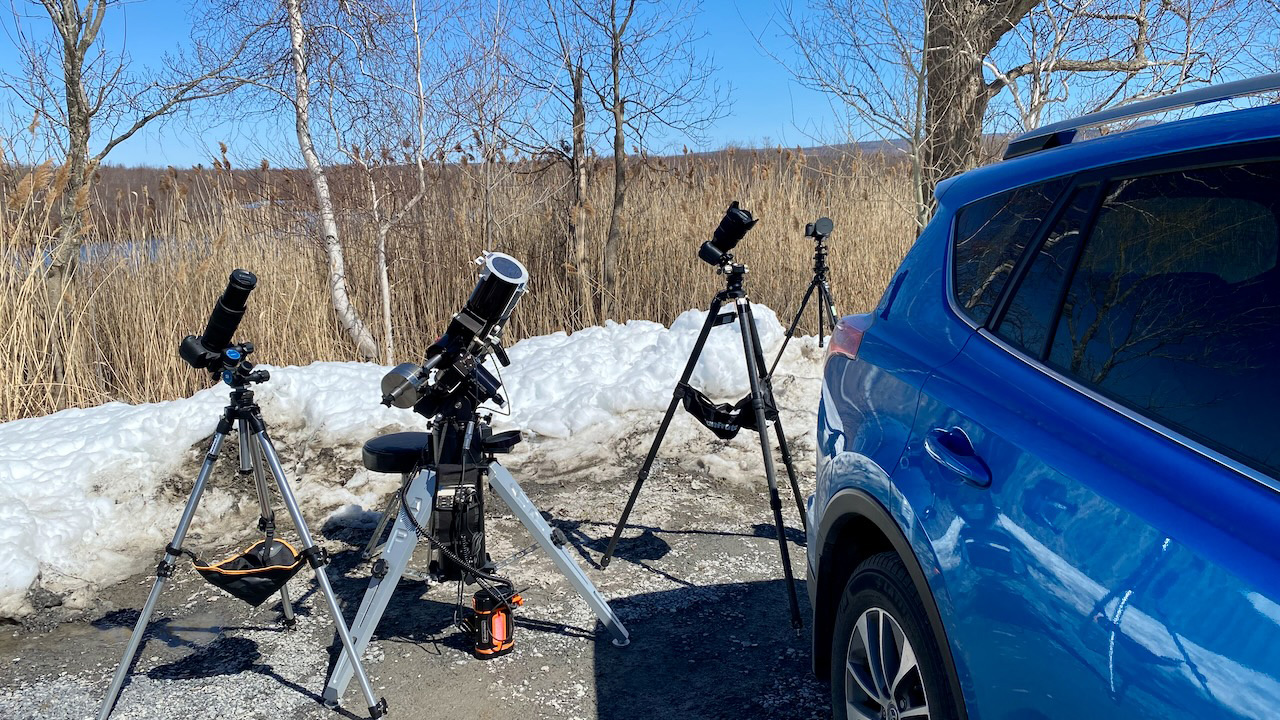
The main rig was my faithful Astro-Physics Traveler, a 105mm refractor telescope the company owner designed for his personal use at the 1991 eclipse in Mexico. 

My main eclipse rig, with a 60mm visual scope on the 105mm photo scope, on an equatorial tracking mount.

My Traveler, bought in 1992, has lived up to its name, having now been to six central solar eclipses: the annular eclipses of 1994 (Arizona) and 2023 (Utah), and the total eclipses of 1998 (Curaçao), 2012 (Queensland, Australia), 2017 (Idaho), and now 2024 in Québec, Canada. I paired it with the wonderful matching AP400 mount, which I had only just brought back with me the month before from Australia, where it had spent the last two decades. 

All the gear worked great. Unlike six months earlier for the October 14, 2023 annular eclipse in Utah, this time I remembered all the cables needed to have the telescope mount track the Sun.

I did mess up on a couple of settings (such as not framing the 4K movie camera as I should have – in pre-eclipse excitement I just forgot to check my chart). But none of the errors were serious. 

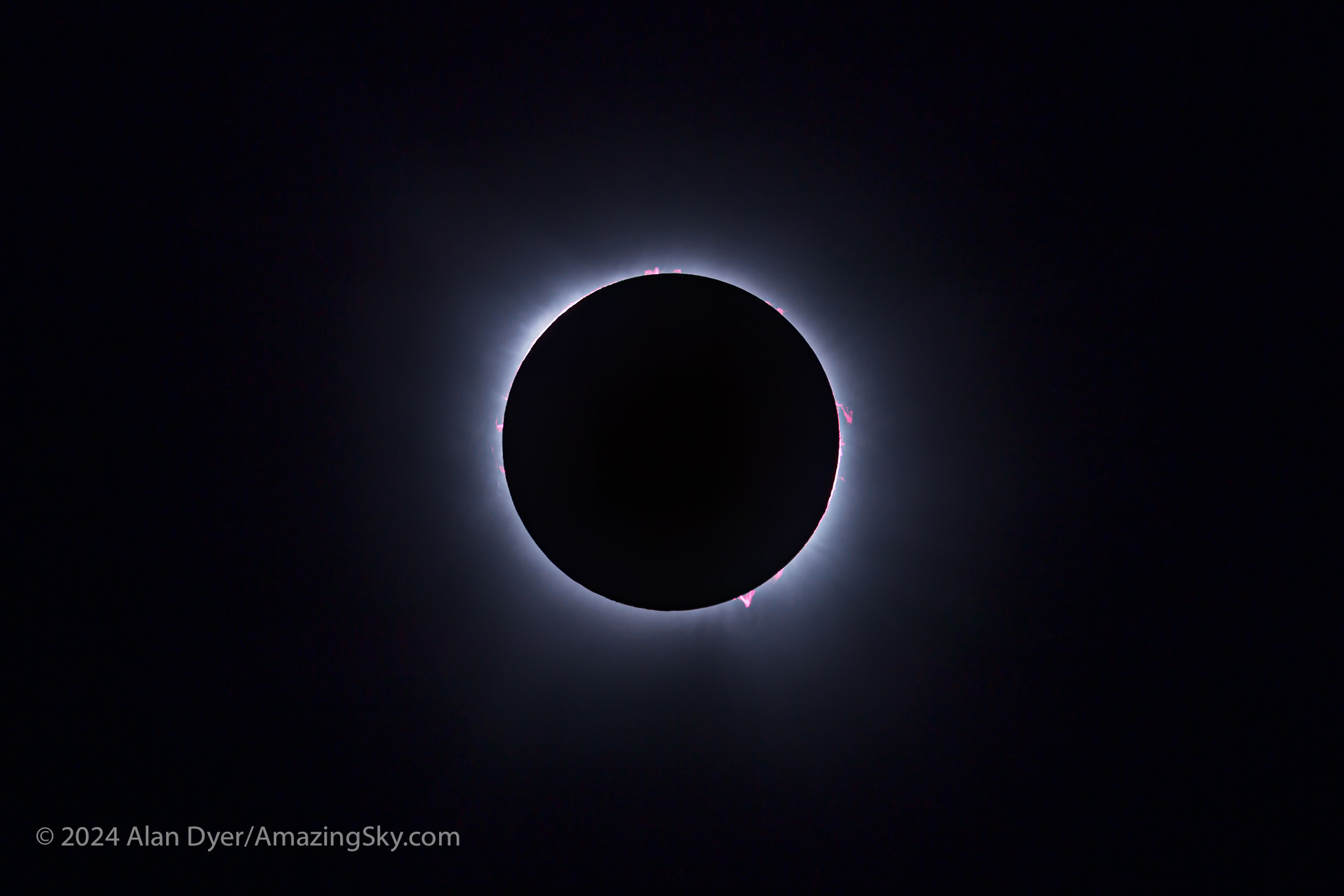
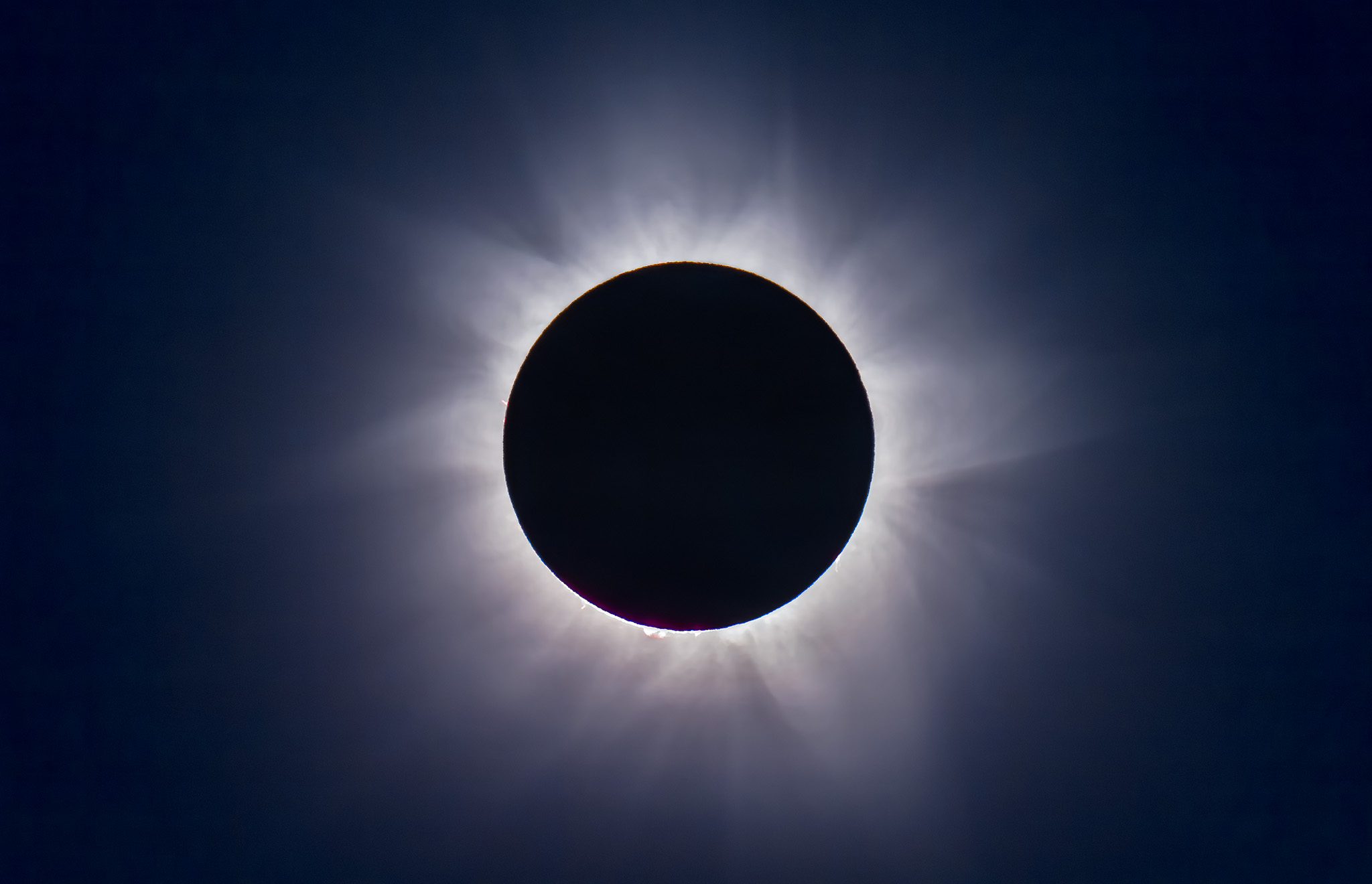
The eclipse in a blend of two exposures to display all the fiery pink prominences that were visible during totality around the lunar disk in one image, set against the bright inner corona of the Sun with the dark disk of the Moon in silhouette in front of the Sun.

Once started all my cameras, except for the one on the Traveler, ran unattended. 

At this eclipse I was determined to get a good look at it through the small visual scope I had piggybacked onto the Traveler photo scope. While I had used a similar rig in 2017, I only thought to look through the visual scope 20 seconds before totality ended. 

Not this year. 

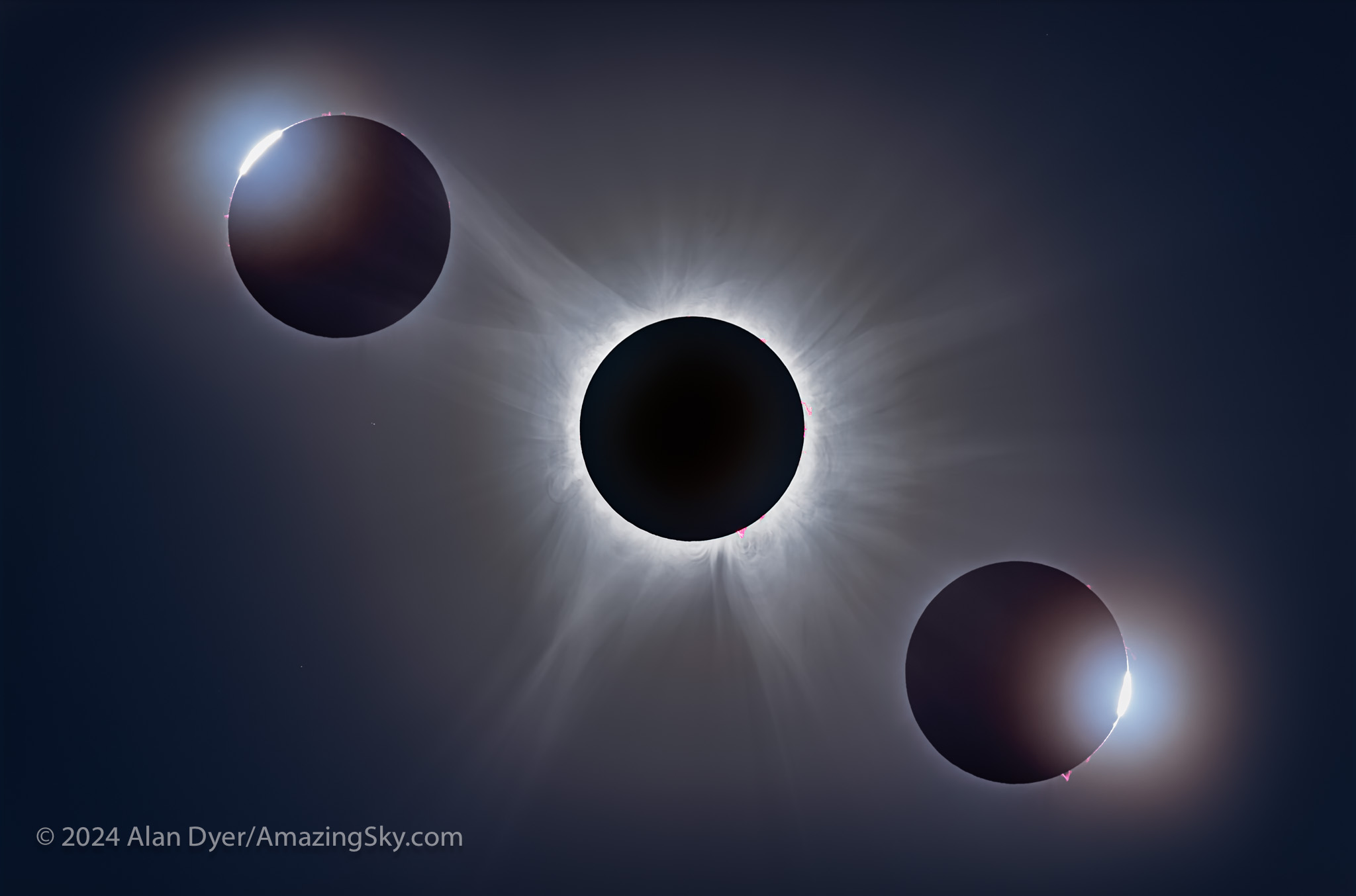
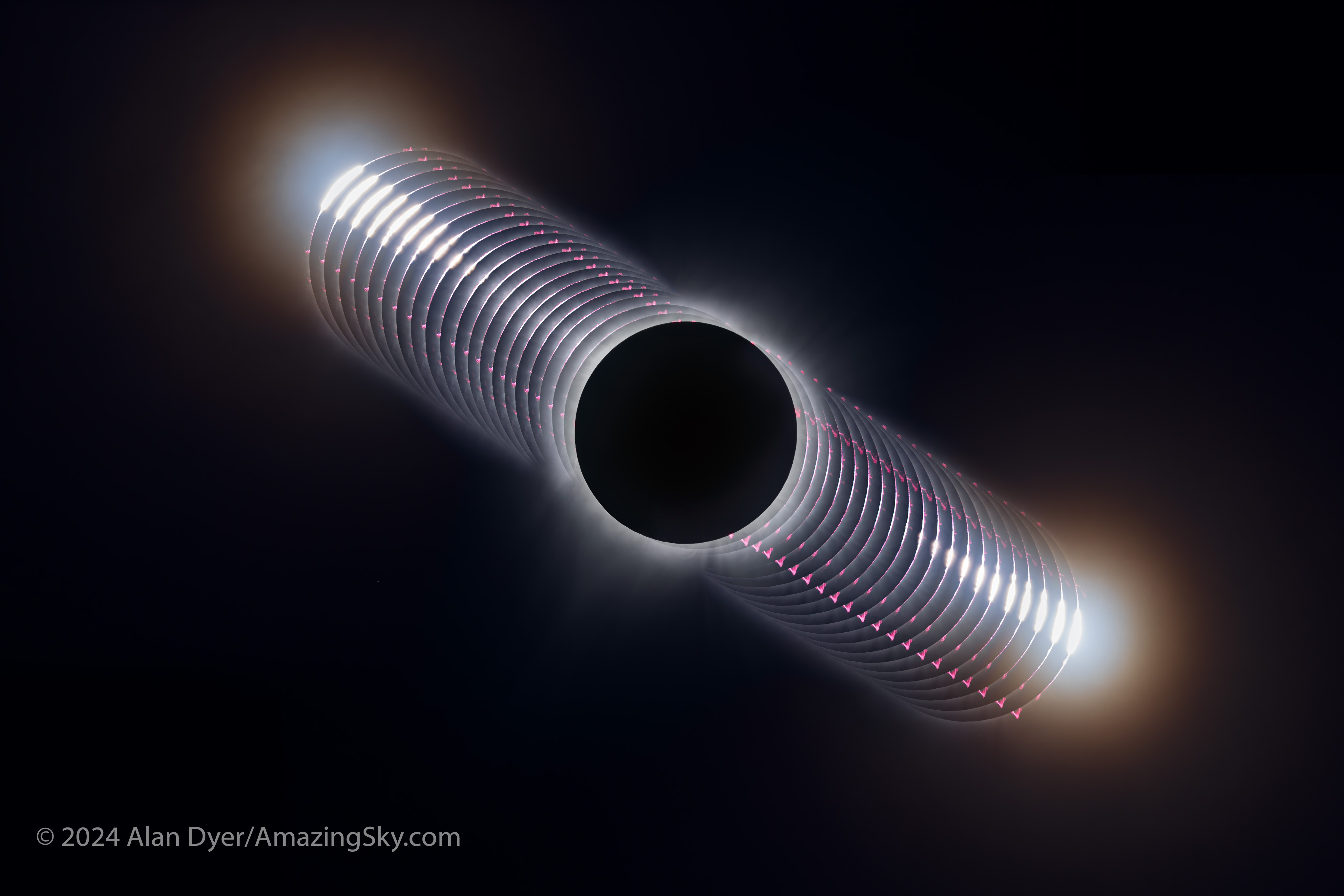
A telescopic close-up of the eclipsed Sun. Onto the central blend of images for totality I layered in single images of each of the diamond rings before and after totality. They are when the last or first burst of sunlight shines through lunar valleys. The first diamond ring is at top left, the last at bottom right, so time runs from left to right.

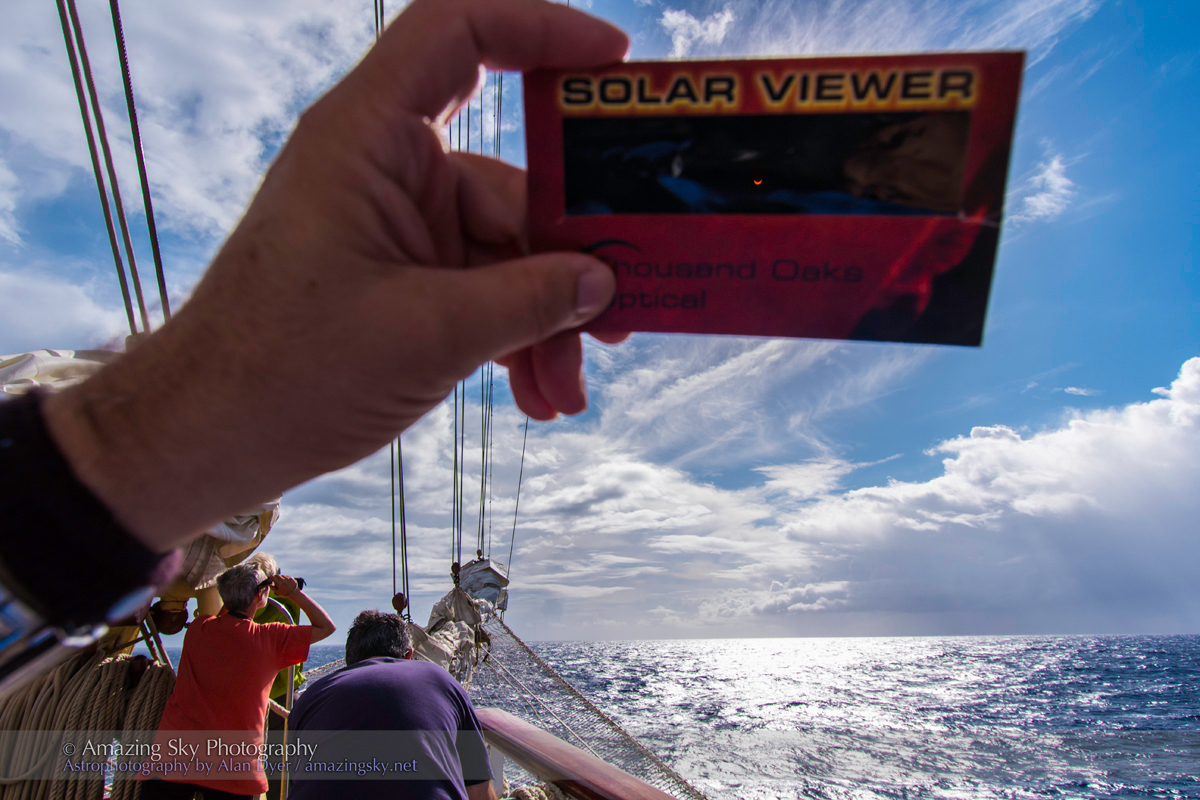
I got a great look at the eclipsed Sun, its corona structures, flaming pink prominences, and breakout of the red chromosphere layer just as totality ended. (You can’t easily see the chromosphere at the start of totality as it can be risky looking too soon through optics when the Sun’s blindingly bright photosphere is still in view.) 

This is a composite showing the sequence of events surrounding totality, from just before totality (at upper left) to just after totality (at lower right), with totality in the middle. The contact images were taken 0.6 seconds apart.

And yet, as at all eclipses, I found the naked eye view the most compelling. The “black hole” Sun looked huge and unearthly. While I had binoculars handy, the same 12×36 image-stabilized binoculars I bring to most eclipses, I completely forgot to look though them, just as I forget at most eclipses! 

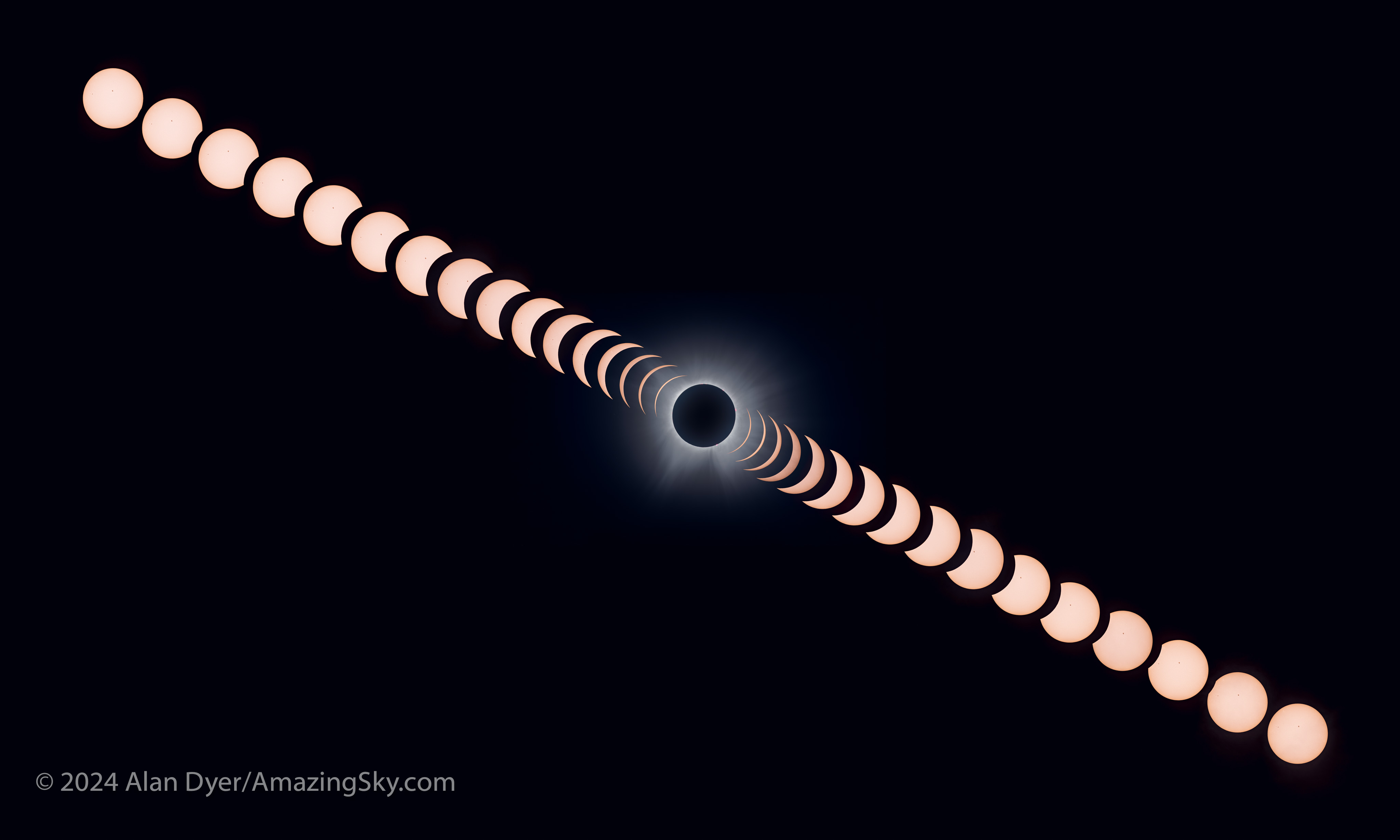
This is a composite showing the complete sequence of the April 8, 2024 eclipse of the Sun, from first contact (at upper left) to last contact (at lower right), with totality at mid-eclipse in the middle.

I shot all the images with the Astro-Physics Traveler 105mm refractor at 630mm focal length and f/6, with the Canon R5 at ISO 100. The partial phases are 1/800 or 1/400 second exposures through a Kendrick/Baader solar filter.

Wanting to record the full sequence, I shot the partial phases until the bitter end. But post-eclipse, people came over and had a look through my scope (I think mine was the only telescope on site). We had a great time exchanging impressions. The hand-held phone camera photos people showed me looked fabulous! 

I looked for fleeting shadow bands just before and after totality (I laid out a white sheet on the ground for the purpose) but saw none, a negative observation confirmed by a fellow eclipse chaser at the site. 

Time-lapse movies of the second and third contact (start and end of totality) diamond rings, shot through the telescope with the Canon R5 in continuous burst mode for hundreds of frames each.

I did two live interviews for CBC Radio, for the Edmonton and Calgary stations, but not until after the eclipse ended. By the time I did those and finished packing away my carload of gear, it was 6:30 p.m., three hours after totality. 

I was the last to leave the site, with fishermen now arriving for an evening’s catch.

I was in that shadow as the Space Station flew over. Astronauts saw the elliptical shadow moving over eastern Canada.
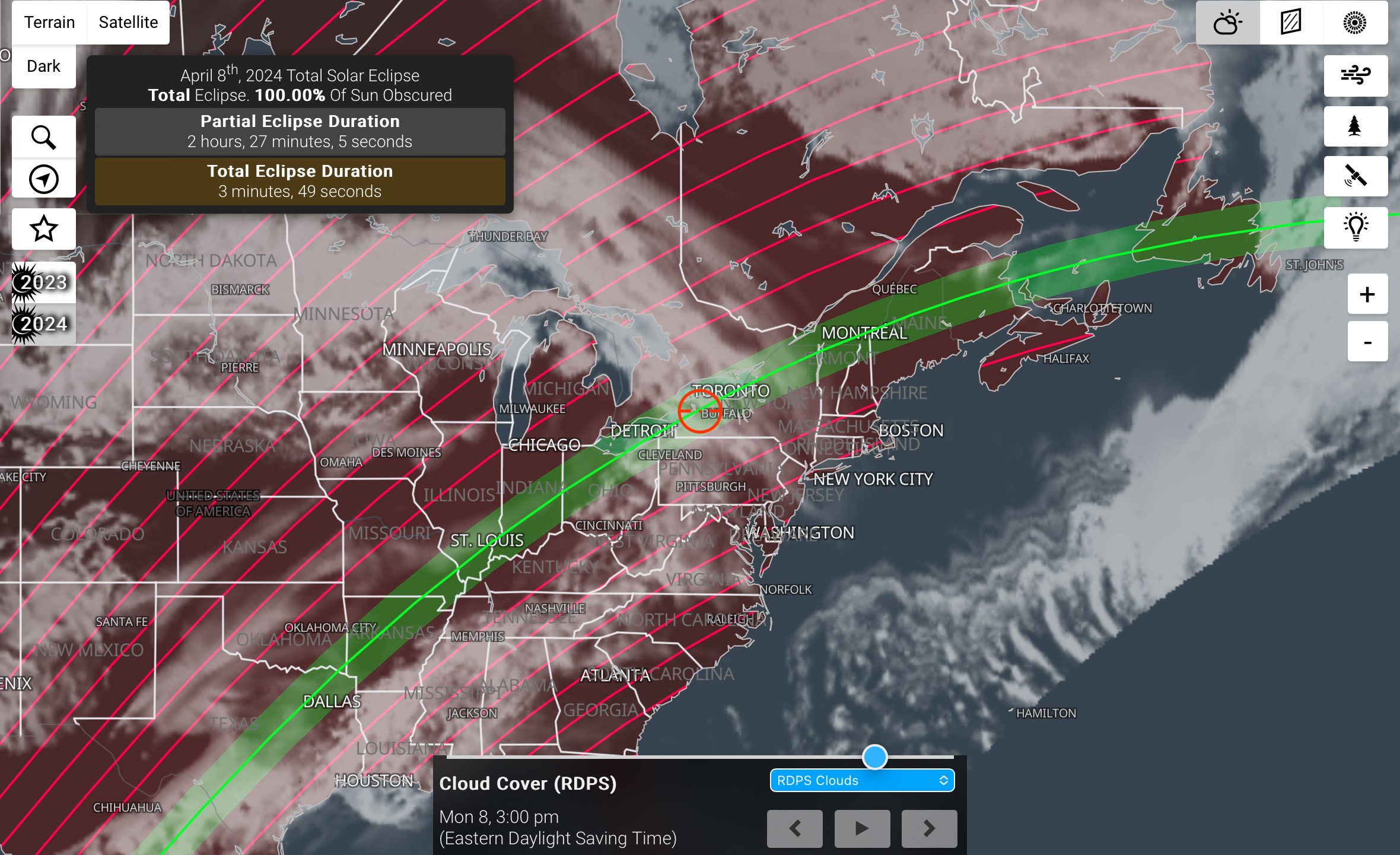
The passage of the lunar shadow across the continent, showing where the clouds were. I was under the wispy clouds at upper right in Québec.

I faced no traffic jams heading back to the hotel at Ste. Helen-de-Bagot. I processed and posted one eclipse image that night. And I revised the price (down to $2.99 U.S.) and description of my How to Photograph the Solar Eclipses ebook, as now only the big processing chapter is of any value, post-eclipse. It continues to sell. 

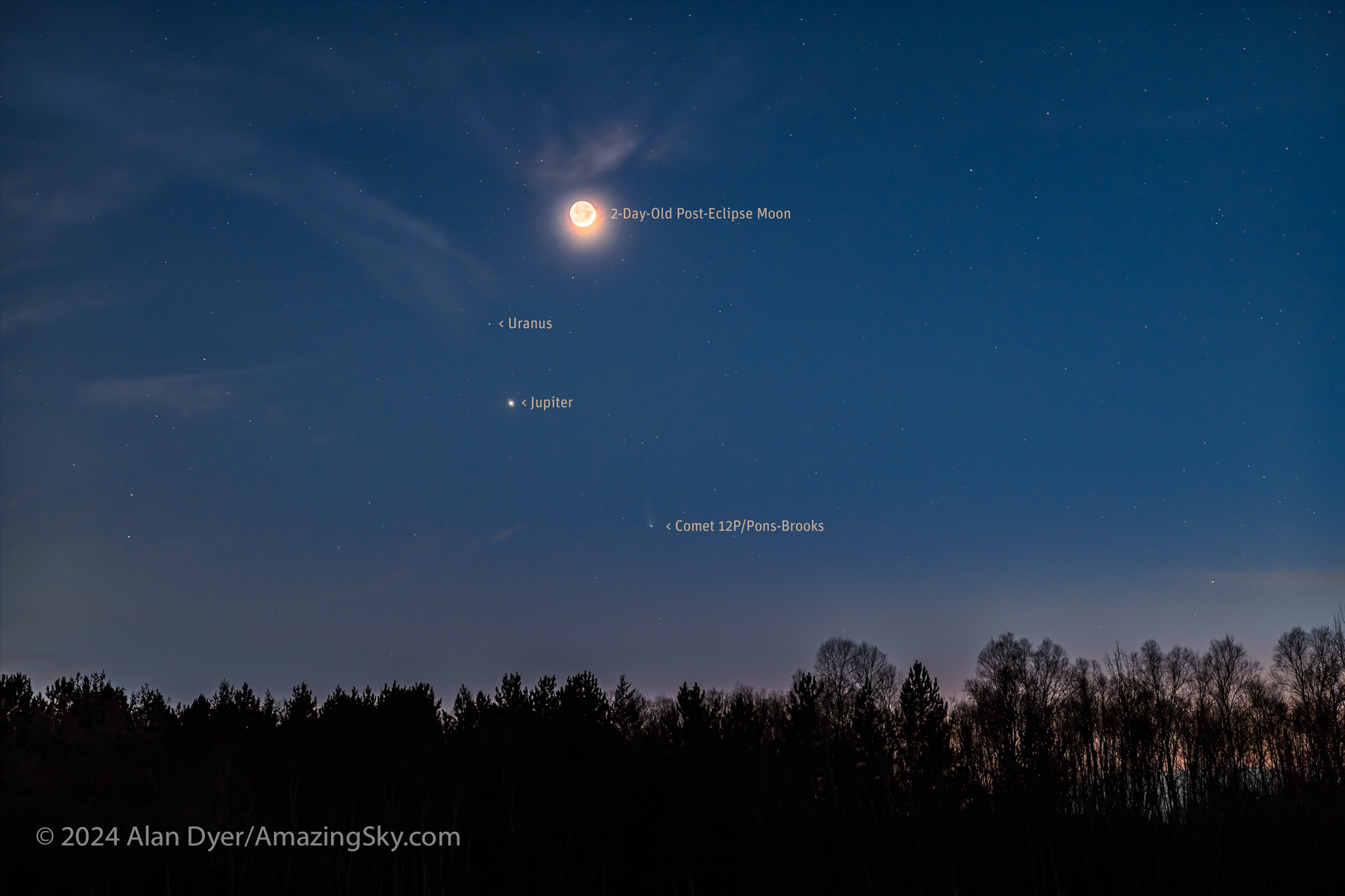
This is the waxing crescent Moon on April 10, 2024, two days after it eclipsed the Sun, and with it above the bright planet Jupiter, with it also near Uranus. Below the solar system worlds is the faint Comet 12P/Pons-Brooks, visible here as a fuzzy star with a stubby tail..

On the long drive back to Alberta, with the pressure of having to make time now gone, I spent pleasant evenings stopping to see friends and family on the road home. So I didn’t start work on the complex blends and composite images I show here until I got home a week after the eclipse. 

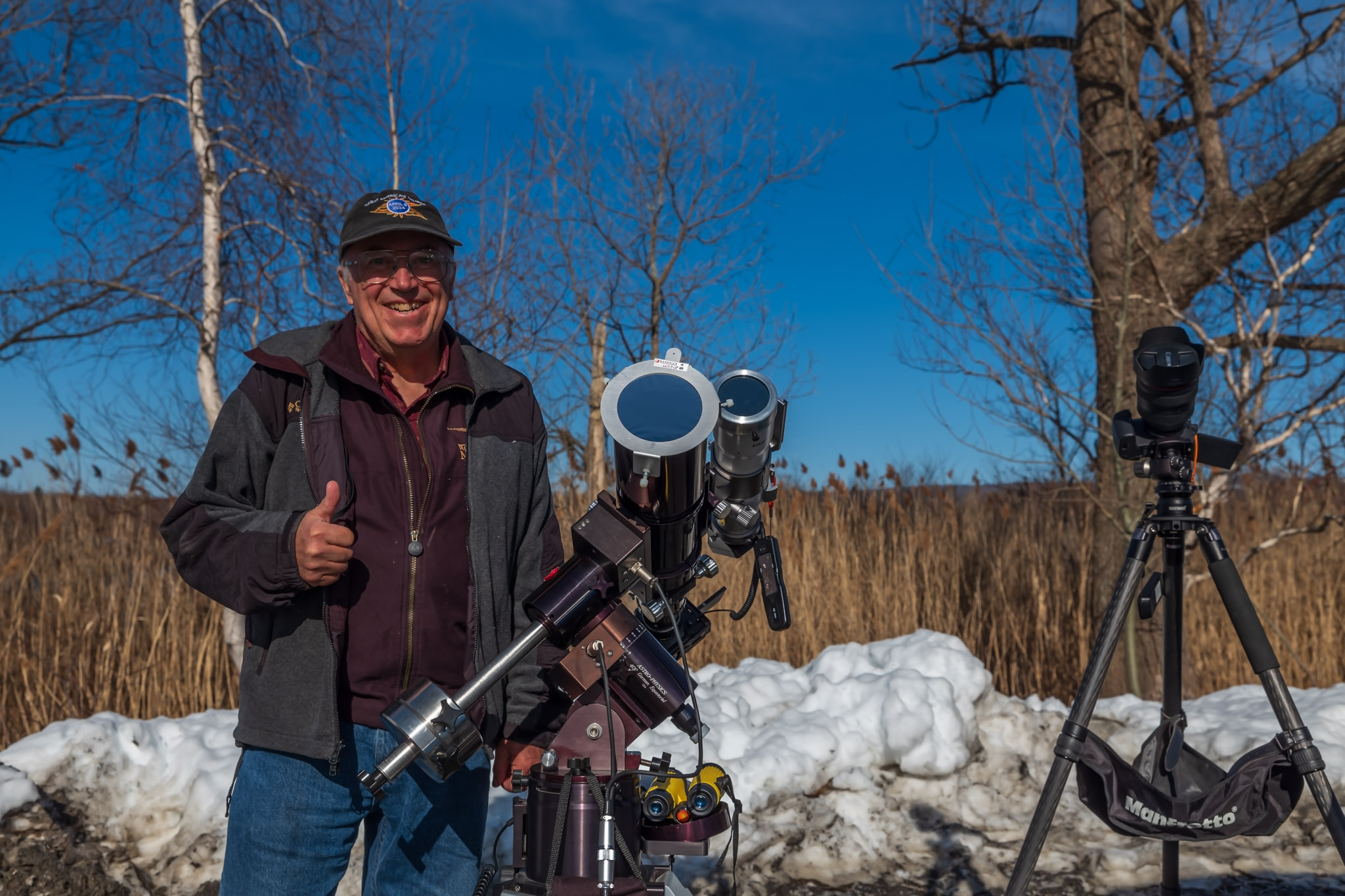
The happy eclipse chaser having bagged his game!

The 17-day-long drive was nearly 9,000 km over 100 hours behind the wheel. Was it worth it? Of course! 

Would I do it again? It’s a moot question as none of the upcoming eclipses allows for a cross-continent drive. Except perhaps in July 2028 in Australia. But I suspect just heading inland a day or two over the Great Dividing Range will be enough to get away from winter coastal cloud in New South Wales. (Sydney is in the path, but so is a cottage I rented last month near Coonabarabran for my superb March stay under the southern skies!)

The next total eclipse of the Sun visible from anywhere in Canada will be August 22, 2044. I won’t have to drive anywhere, as it passes right over my house! But I will have to live that long to enjoy a eclipse from my own backyard. 

I suspect this was my last chance to see – and drive to – a total eclipse in Canada.

— Alan, © 2024 amazingsky.com 

Ten Tips for the Solar Eclipse


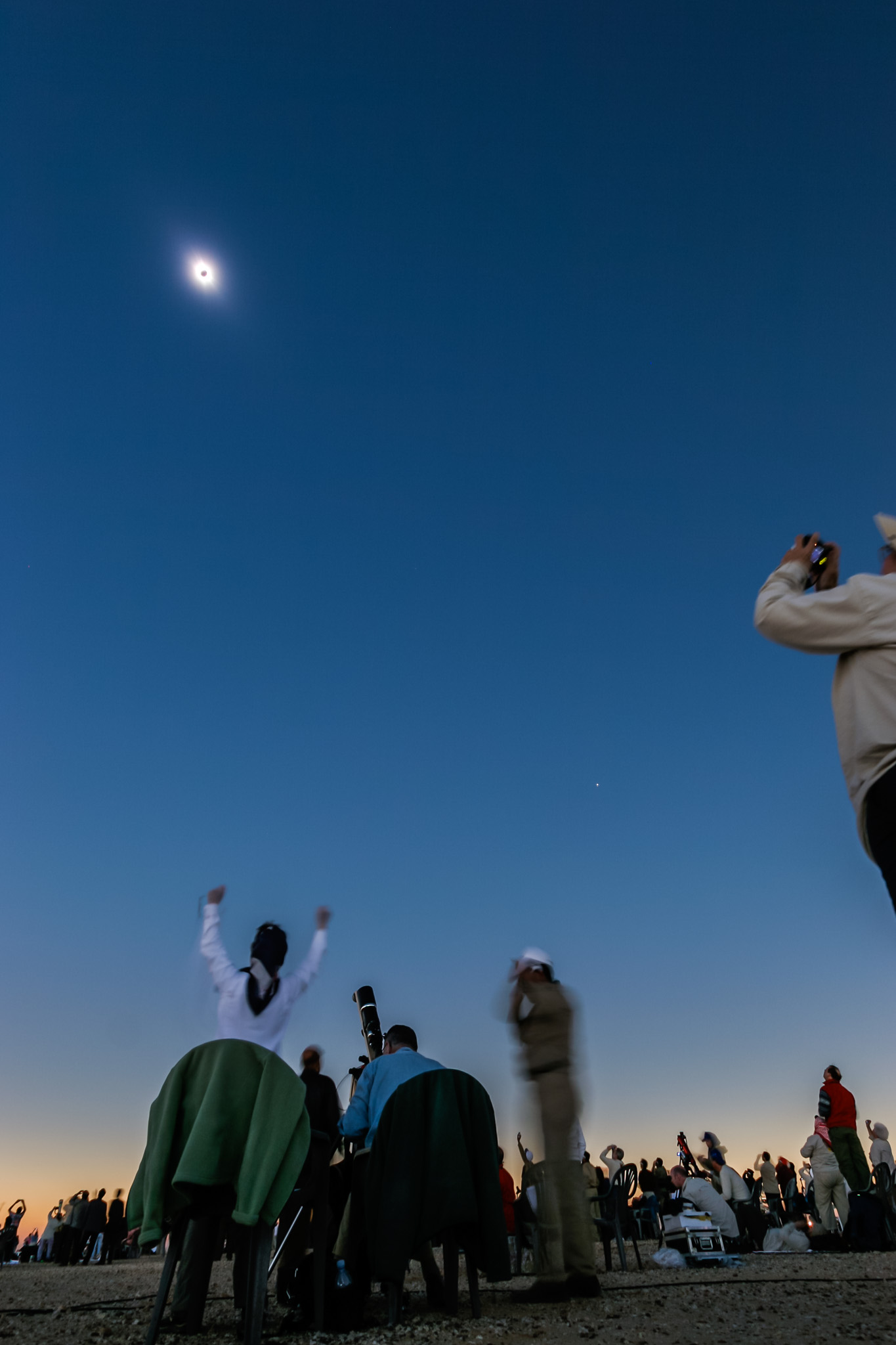
Total Eclipse from Libya 2006I present my Top 10 Tips for photographing the August 21 total eclipse of the Sun.

If the August total eclipse will be your first, then you could heed the advice of many and simply follow “Tip #0:” Just don’t photograph it! Look up and around to take in the spectacle. Even then, you will not see it all.

However, you might see less if you are operating a camera.

But I know you want pictures! To help you be successful, here are my tips for taking great photos without sacrificing seeing the eclipse.


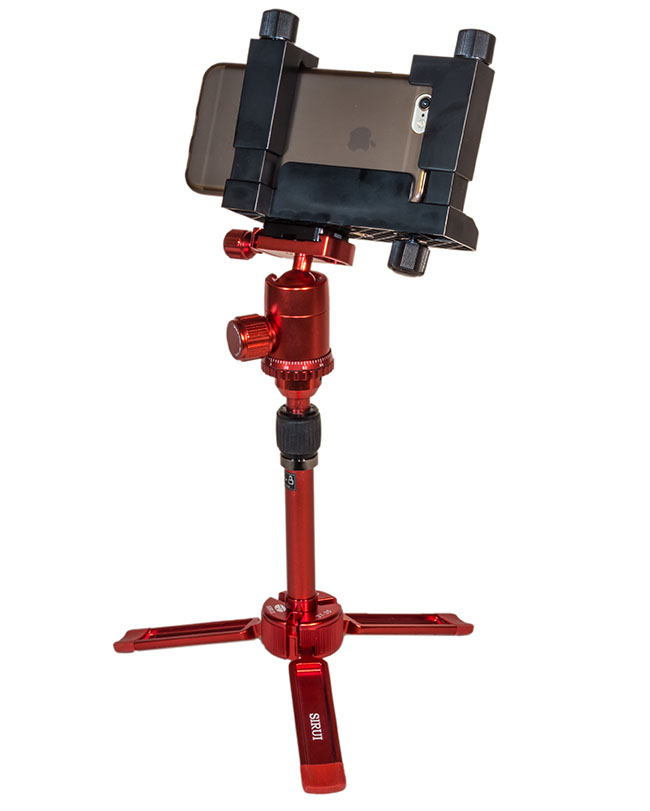
TIP1-iPhone on Siriu Tripod
An iPhone in a tripod bracket and on a small tabletop tripod.

TIP #1: Keep It Simple

During the brief minutes of totality, the easiest way to record the scene is to simply hold your phone camera up to the sky and shoot. Zoom in if you wish, but a wide shot may capture more of the twilight effects and sky colors, which are as much a part of the experience as seeing the Sun’s gossamer corona around the dark disk of the Moon.

Better yet, use an adapter to clamp your phone to a tripod. Frame the scene as best you can (you might not be able to include both the ground and Sun) and shoot a time-lapse, or better yet, a video.

Start it 2 or 3 minutes before totality (if you can remember in the excitement!) and let the camera’s auto exposure take care of the rest. It’ll work fine.

That way you’ll also record the audio of your excited voices. The audio may serve as a better souvenir than the photos. Lots of people will have photos, but nobody else will record your reactions!

Just make sure your phone has enough free storage space to save several minutes of HD video or, if your camera has that feature, 4K video.


TIP2-2006 Libya Wide-Angle
A wide shot of the 2006 eclipse in Libya with a high altitude Sun. 10mm lens on a cropped-frame Canon 20Da camera.

TIP #2: Shoot Wide With a DSLR

For better image quality, step up to this hands-off technique.

Use a tripod-mounted camera that accepts interchangeable lenses (a digital single lens reflex or a mirrorless camera) and use a lens wide enough to take in the ground below and Sun above.

Depending on where you are and the sensor size in your camera, that’ll likely mean a 10mm to 24mm lens.

By going wide you won’t record details in the corona of the Sun or its fiery red prominences. But you can record the changing sky colors and perhaps the dark shadow of the Moon sweeping from right to left (west to east) across the sky. You can also include you and your eclipse group silhouetted in the foreground. Remember, no one else will record you at the eclipse.


TIP3-2012 Eclipse Movie Clip
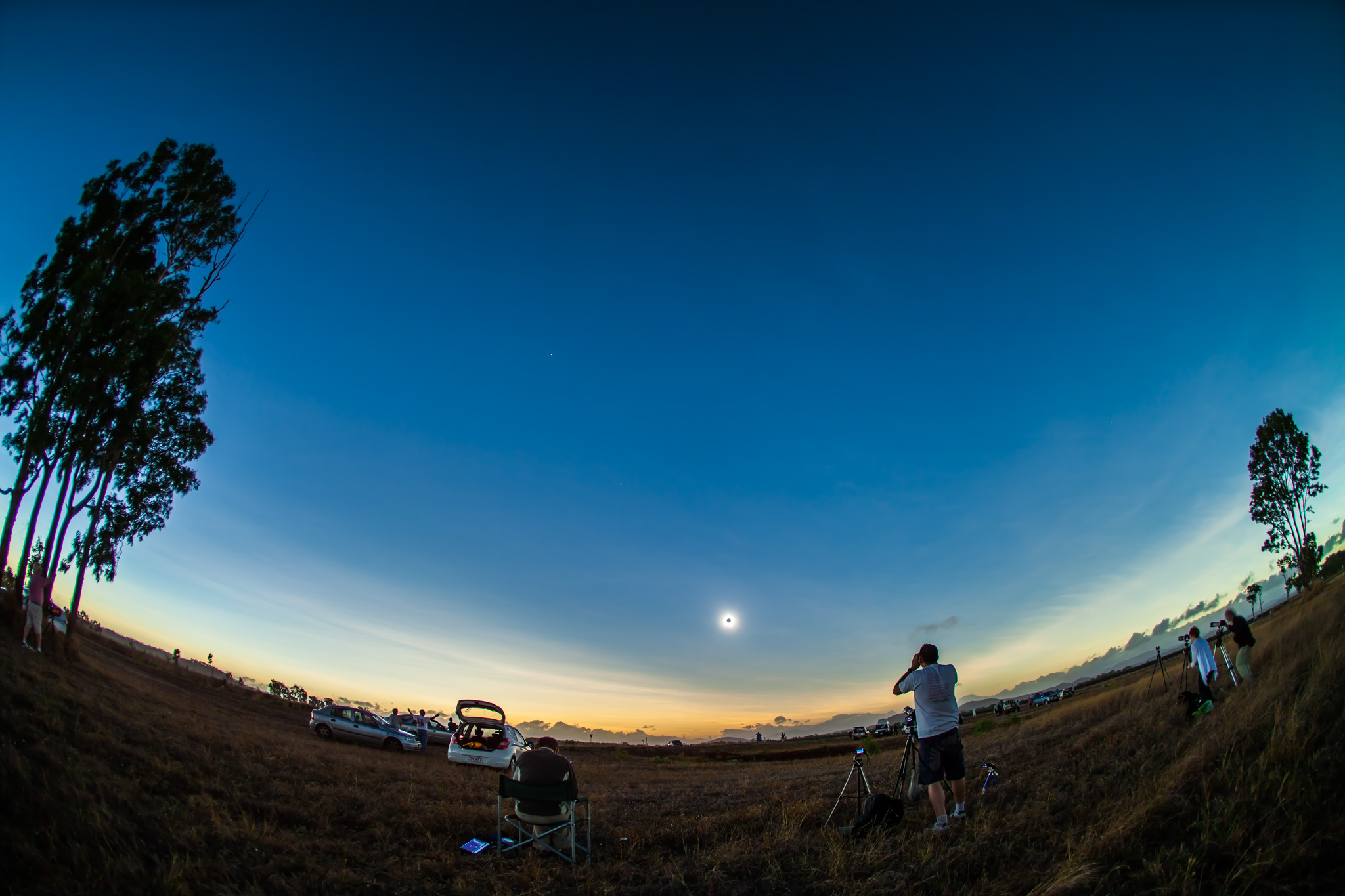
A sequence of shots of the 2012 eclipse from Australia, with a wide 15mm lens and camera on Auto Exposure showing the change of sky color.

Total Eclipse of the Sun, Mid-Eclipse (Wide-Angle)
The total eclipse of the Sun, November 14, 2012, from a site near Lakeland Downs, Queensland, Australia. Shot with the Canon 5D Mark II and 15mm lens for a wide-angle view showing the Moon’s conical shadow darkening the sky and the twilight glow on the horizon. Taken near mid-eclipse.

TIP #3: Shoot on Auto Exposure

For wide shots, there’s no need to attend to the camera during the eclipse. Set the camera on Auto Exposure – Aperture Priority (Av), the camera ISO between 100 to 400, and your lens aperture to f/2.8 (fast) to f/5.6 (slow).

Use a higher ISO if you are using a slower lens such as a kit zoom. But shoot at ISO 100 and at f/2.8 if you have a wide lens that fast.

In Av mode the camera will decide what shutter speed to use as the lighting changes. I’ve used this technique at many eclipses and it works great.


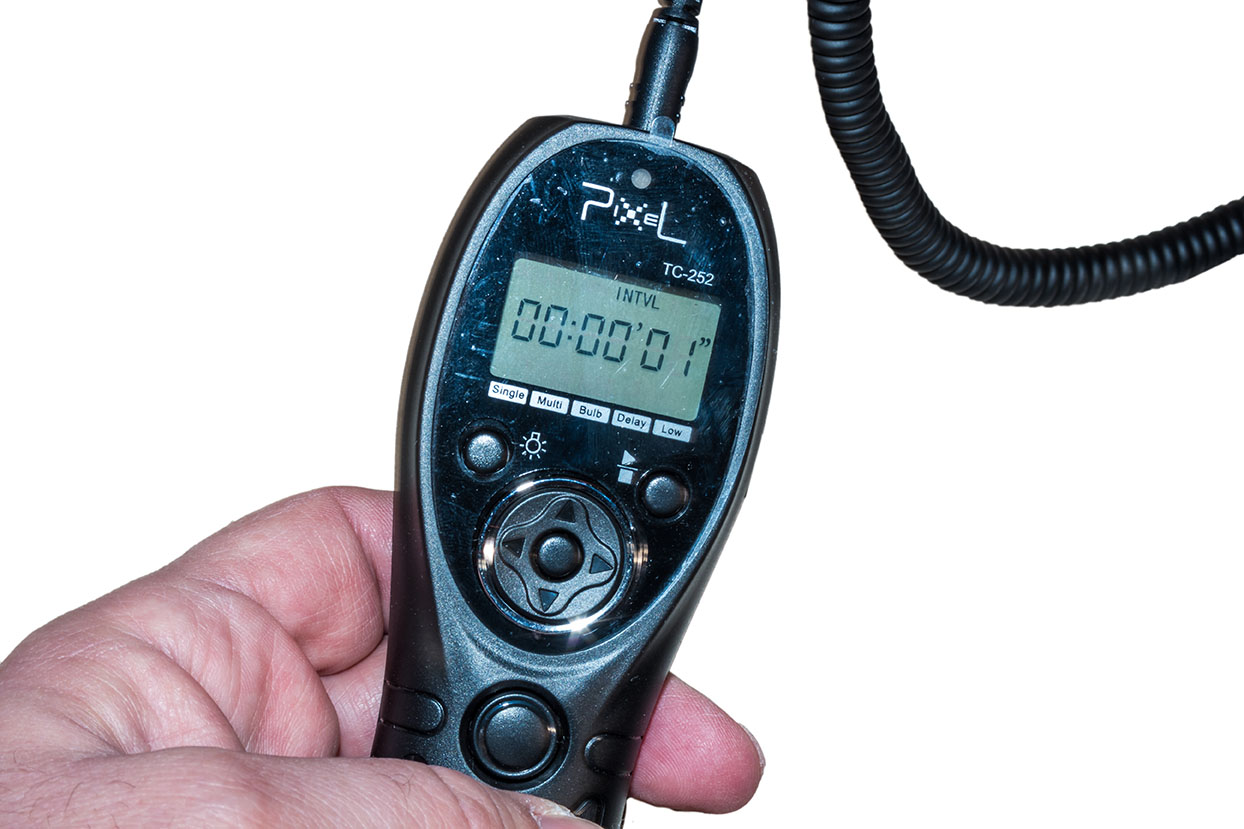
TIP4-Pixel Intervalometer CU
An accessory intervalometer set for an interval of 1 second.

TIP #4: Let the Camera Do the Shooting

To make this wide-angle technique truly hands-off use an intervalometer (either built into your camera or a separate hardware unit) to fire the shutter automatically.

Once again, start the sequence going 3 to 5 minutes before totality, with the intervalometer set to fire the shutter once every second. Don’t shoot at longer intervals, or you’ll miss too much. Shutter speeds won’t likely exceed one second.

Again, be sure your camera’s memory card has enough free space for several hundred images. And don’t worry about a solar filter on your lens. It’ll be fine for the several minutes you’ll have it aimed up.

Out of the many images you’ll get, pick the best ones, or turn the entire set into a time-lapse movie.


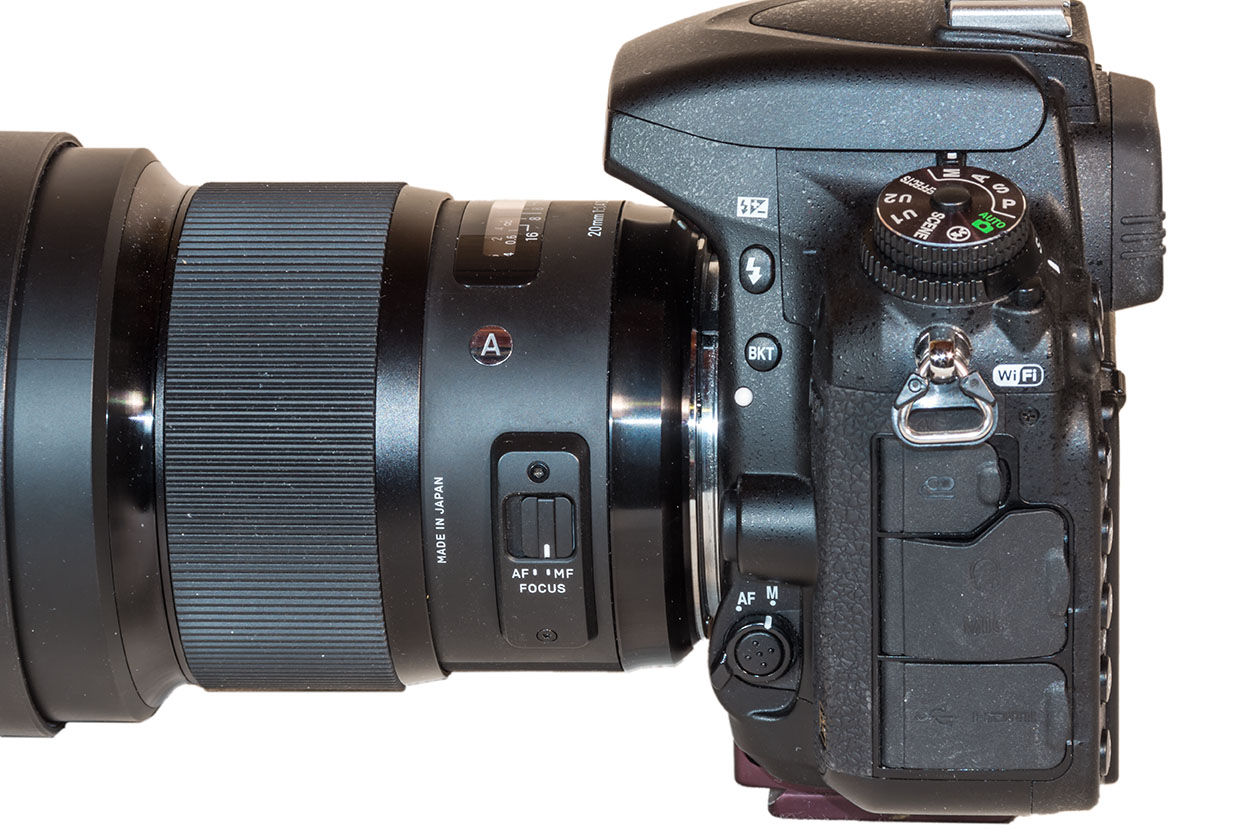
TIP5-Manual Focus Switches Nikon
A Nikon DSLR and lens set to Manual Focus.

TIP #5: Shoot on Manual Focus

Use Auto Exposure and an intervalometer. But … don’t use Auto Focus.

Switch your lens to Manual Focus (MF) and focus on a distant scene element using Live View.

Or use Auto Focus to first focus on something in the distance, then switch to Manual and don’t touch focus after that. If you leave your lens on Auto Focus the shutter might not fire if the camera decides it can’t focus on the blank sky.


TIP6-Lightoom Wide-Angle
A comparison of a Raw image as it came from the camera (left) and after developing in Lightroom (right).

TIP #6: Shoot Raw

For demanding subjects like a solar eclipse always shoot your images in the Raw file format. Look in your camera’s menus under Image Quality.

Shoot JPGs, too, if you like, but only Raw files record the widest range of colors and brightness levels the camera sensor is capable of detecting.

Later in processing you can extract amazing details from Raw files, both in the dark shadows of the foreground, and in the bright highlights of the distant twilight glows and corona around the Sun. Software to do so came with your camera. Put it to use.


TIP7-200mm Lens on Tripod
A 200mm telephoto and 1.4x Extender, with the camera on a sturdy and finely adjustable tripod head.

TIP #7: OK, Use a Telephoto Lens! But …

If you really want to shoot close-ups, great! But don’t go crazy with focal length. Yes, using a mere 135mm or 200mm lens will yield a rather small image of the eclipsed Sun. But you don’t need a monster 600mm lens or a telescope, which typically have focal lengths starting at 600mm. With long focal lengths come headaches like:

 Keeping the Sun centered. The Earth is turning! During the eclipse that motion will carry the Sun (and Moon) its own diameter across your frame from east to west during the roughly two minutes of totality. While a motorized tracking mount can compensate for this motion, they take more work to set up properly, and must be powered. And, if you are flying to the eclipse, they will be much more challenging to pack. I’m trying to keep things simple!

 Blurring from vibration. This can be an issue with any lens, but the longer your lens, the more your chances of getting fuzzy images because of camera shake, especially if you are touching the camera to alter settings.

An ideal focal length is 300mm to 500mm. But …

When using any telephoto lens, always use a sturdy tripod with a head that is easy to adjust for precise aiming, and that can aim up high without any mechanical issues. The Sun will be halfway, or more, up the sky, not a position some tripod heads can reach.


Total Solar Eclipse (2012 from Australia)
A re-processed version of a still frame of the total solar eclipse of November 14, 2012 taken from our site at Lakeland Downs, Queensland, Australia. This is a still frame shot during the shooting of an HD video of the eclipse, using the cropped-frame Canon 60Da and Astro-Physics Traveler 4-inch apo refractor telescope at f/5.8 (580mm focal length). The image is 1/60th second at ISO 100. This is a full-sized still not a frame grab taken from the movie.

TIP8-Eclipse Movie Clip 2012
A sequence from a movie showing the camera adjusting the exposure automatically when going from a filtered view (left) to an unfiltered view of the diamond ring (right).

TIP #8: Use Auto Exposure, or … Shoot a Movie

During totality with your telephoto, you could manually step through a rehearsed set of exposures, from very short shutter speeds (as short as 1/4000 second) for the diamond rings at either end of totality, to as long as one or two seconds at mid-totality for the greatest extent of the corona’s outermost streamers.

But that takes a lot of time and attention away from looking. Yes, there are software programs for automating a camera, or techniques for auto bracketing. But if this is your first eclipse an easier option is to simply use Auto Exposure/Aperture Priority and let the camera set the shutter speed. Again, you could use an intervalometer to fire the shutter so you can just watch.

Don’t use high ISO speeds. A low ISO of 100 to 400 is all you need and will produce less noise. The eclipsed Sun is still bright. You don’t need ISO 800 to 3200.

Even on Auto Exposure, you’ll get good shots, just not of the whole range of phenomena an eclipsed Sun displays.

Or, once again and better yet – put your camera into video mode and shoot an HD or 4K movie. Auto Exposure will work just fine, allowing you to start the camera then forget it.

Place the Sun a solar diameter or two to the left of the frame and let the sky’s motion drift it across the frame for added effect. Start the sequence running a minute or two before totality with your solar filter on. Then just let the camera run … except …


TIP9-66mm on Stellarvue
A small refractor telescope with a solar filter over the front aperture. That filter has to be removed for totality.

TIP #9: Remember to Remove the Filter!

You will need a safe solar filter over your lens or telescope to shoot the partial phases of the eclipse, and to frame and focus the Sun. This cannot be a photo neutral density or polarizing filter. It must be a filter designed for observing and shooting the Sun, made of metal-coated glass or Mylar plastic. Anything else is not safe and likely far too bright.

But you do NOT need the filter for totality.

Remove it … when?

The answer: a minute or so before totality if you want to capture the first diamond ring just before totality officially starts. Set a timer to remind you, as visually it is very difficult to judge the right moment with your unaided eye. The eclipse will start sooner than you expect.

If you have your camera on Auto Exposure, it will compensate just fine for the change in brightness, from the filtered to the unfiltered view.

But don’t leave your unfiltered camera aimed at the Sun. Replace the filter no more than a minute or so after totality and the second diamond ring ends.


Partial Solar Eclipse and Sunspot #2
The partial eclipse of the Sun, October 23, 2014, shot through a mylar filter, on the front of the 66mm f/7 apo refractor shown above (450mm focal length), using a cropped-frame Canon 60Da camera for 1/8000 second exposure at ISO 100. Focus on the sharp tips of the crescent Sun or a sunspot if one is present.

TIP #10: Focus!

Everyone worries about getting the “best exposure.” Don’t! You’ll get great looking telephoto eclipse close-ups with any of a wide range of exposures.

What ruins most eclipse shots, other than filter forgetfulness, is fuzzy images, from either shaky tripods or poor focus.

Focus manually using Live View on the filtered partially eclipsed Sun. Zoom up on the edge of the Sun or sharp tip of the crescent. Re-focus a few minutes before totality, as the changing temperature can shift the focus of long lenses and telescopes.

But you needn’t worry about re-focusing after you remove the filter. The focus will not change with the filter off.


Me at 2006 Eclipse
Me in Libya in 2006 with my eclipse setup: a small telescope on an alt-azimuth mount.

TIP #1 AGAIN: Keep It Simple!

I’ll remind you to keep things simple for a reason other than giving you time to enjoy the view, and that’s mobility.

You might have to move at the last minute to escape clouds. Complex photo gear can be just too much to take down and set up, often with minutes to spare, as many an eclipse chaser can attest is often necessary. Keep your gear light, easy to use, and mobile. Committing to an overly ambitious and inflexible photo plan and rig could be your undoing.

To help ensure success, check out my next blog entry, Top 10 Tips for Practicing for the Eclipse.

By following both my “Ten Tips” advice blogs you should be able to get great eclipse images to wow your friends and fans, all without missing the experience of actually seeing … and feeling … the eclipse.

However … may I recommend …


How to Photograph the Solar Eclipse
My 295-page ebook on photographing the August 21 total eclipse of the Sun is now available. See http://www.amazingsky.com/eclipsebook.html  It covers all techniques, for both stills, time-lapses, and video, from basic to advanced, plus a chapter on image processing. And a chapter on What Can Go Wrong?! The web page has all the details on content, and links to order the book from Apple iBooks Store (for the best image quality and navigation) or as a PDF for all other devices and platforms. Thanks! Clear skies on eclipse day, August 21, 2017.

For much more detailed advice on shooting options and techniques, and for step-by-step tutorials on processing eclipse images, see my 295-page eBook on the subject, available as an iBook for Apple devices and as a PDF for all computers and tablets.

Check it out at my website page

Thanks and clear skies on August 21!

— Alan, June 23, 2017 / © 2017 Alan Dyer / amazingsky.com


Eclipse on the Atlantic – Success!


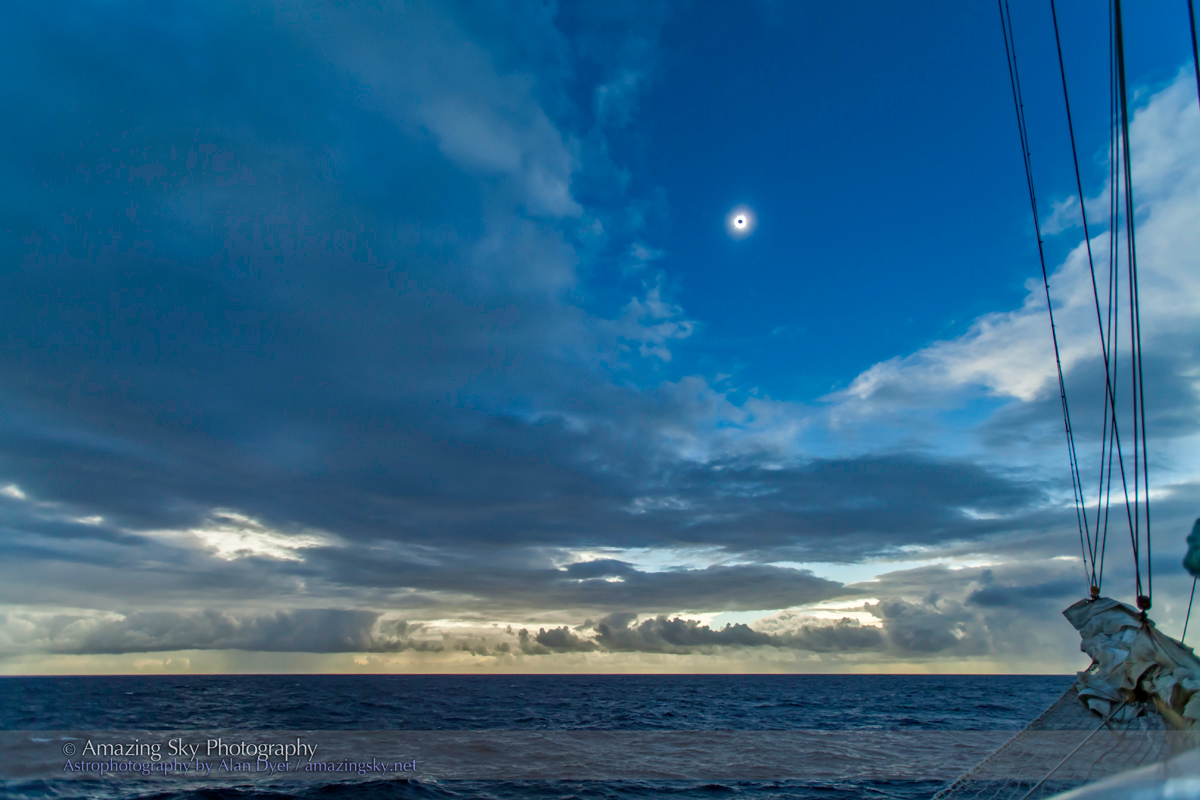
Total Eclipse of the Sun from the Atlantic (Nov 3, 2013)With minutes to go until totality it was unclear – literally! – if we were going to see the eclipse.

We have a happy ship of 150 eclipse chasers. On Sunday, November 3 a morning of gloomy faces gave way to smiles and exclamations of joy as the captain of spv Star Flyer piloted our ship into a clear hole in the clouds. We enjoyed a stunningly clear view of totality – all 49 seconds of it – with the eclipsed Sun set in a deep blue sky.

My image above captures some aspects of the scene as it appeared off the port bow of the ship.

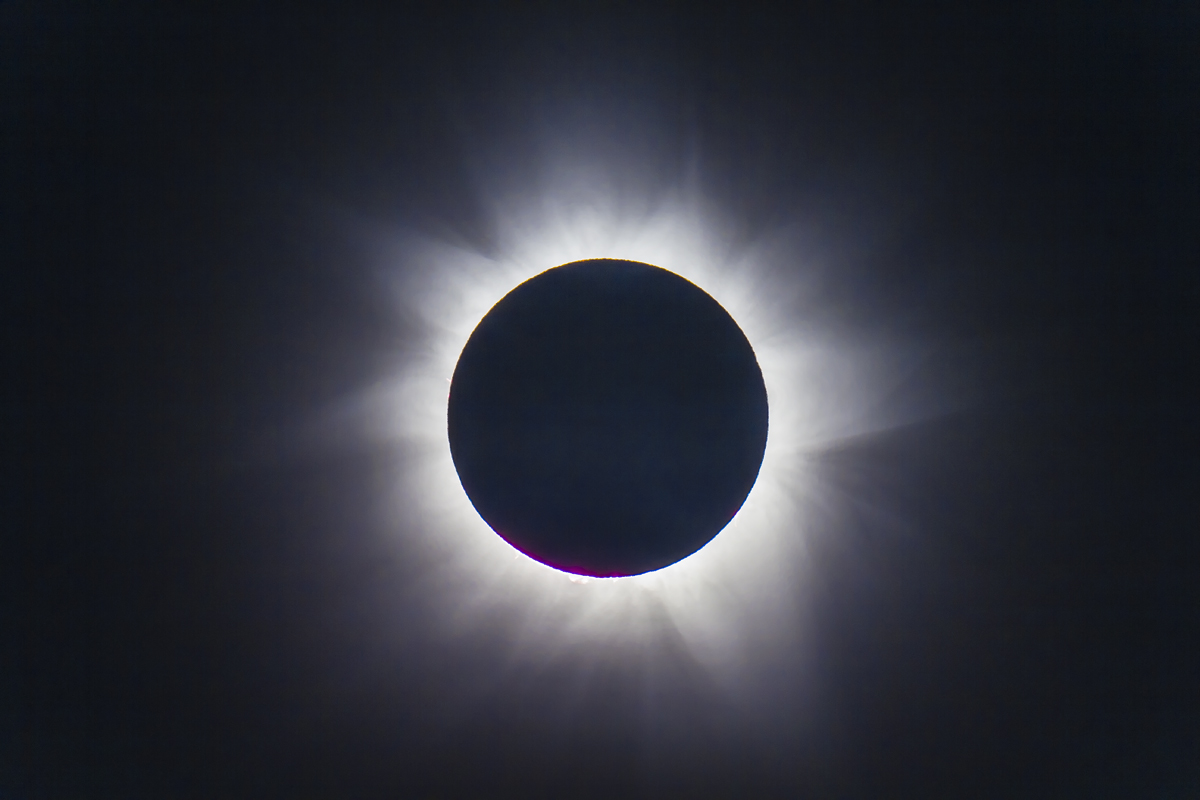
But it fails to show just how colourful this eclipse was. Because it was a short eclipse, with the Moon’s disk barely large enough to cover the Sun, the hallmark of this eclipse was the brilliant pink chromosphere that was visible all around the Sun during the entire eclipse, with bits of prominences sticking out.

The pink ring was set amid the silvery-white and symmetrical corona, which in turn was set in a dark blue sky, above the yellow twilit horizon. The naked eye view and the view through binoculars was stunning. It was the most colourful eclipse I can recall, and this was total eclipse #15 for me.

This was also the first eclipse where we had the ability to adjust its time to suit our schedule. We should have been in the -3h GMT time zone at our longitude in the mid-Atlantic. But in a pre-eclipse planning meeting we decided to keep the ship’s clocks on -1 GMT until after the eclipse. This put totality at 10:30 a.m. our time, making it convenient for everyone to have breakfast before the eclipse and not interfere with lunch! That’s the luxury of being on a small ship dedicated to seeing the eclipse. The captain and crew have been fantastic.

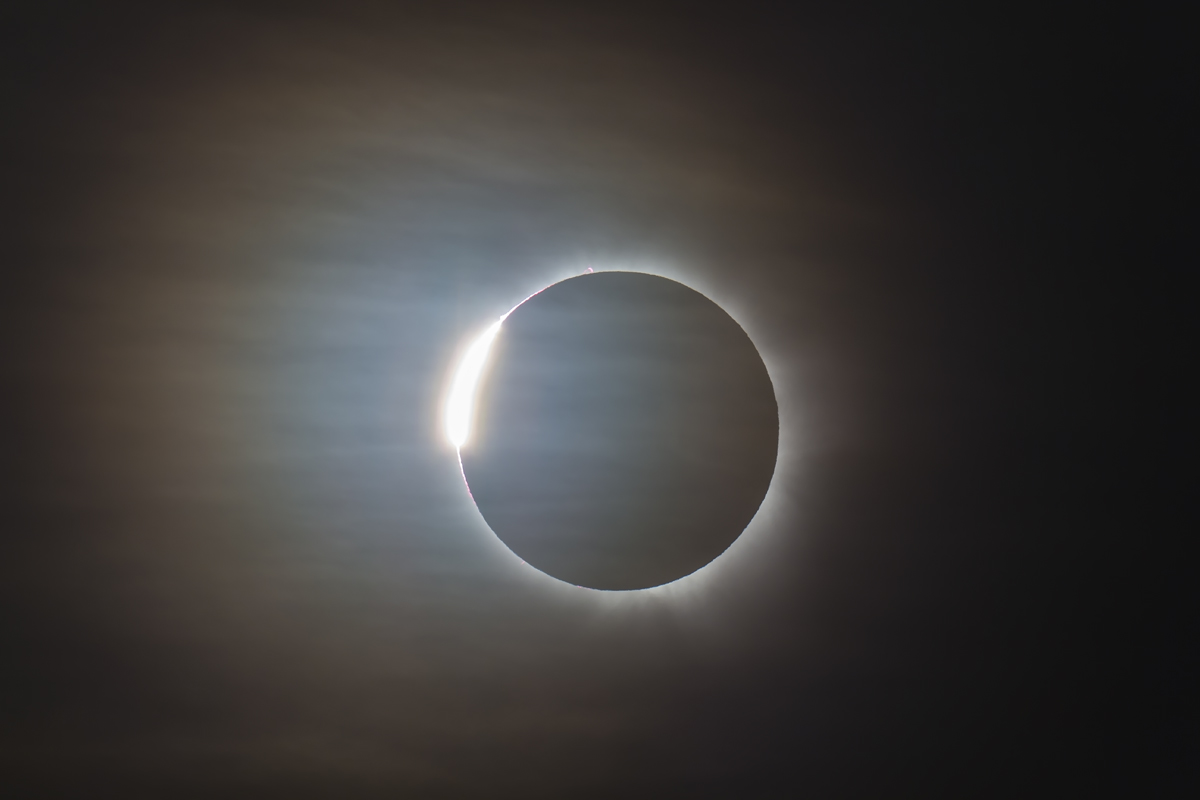
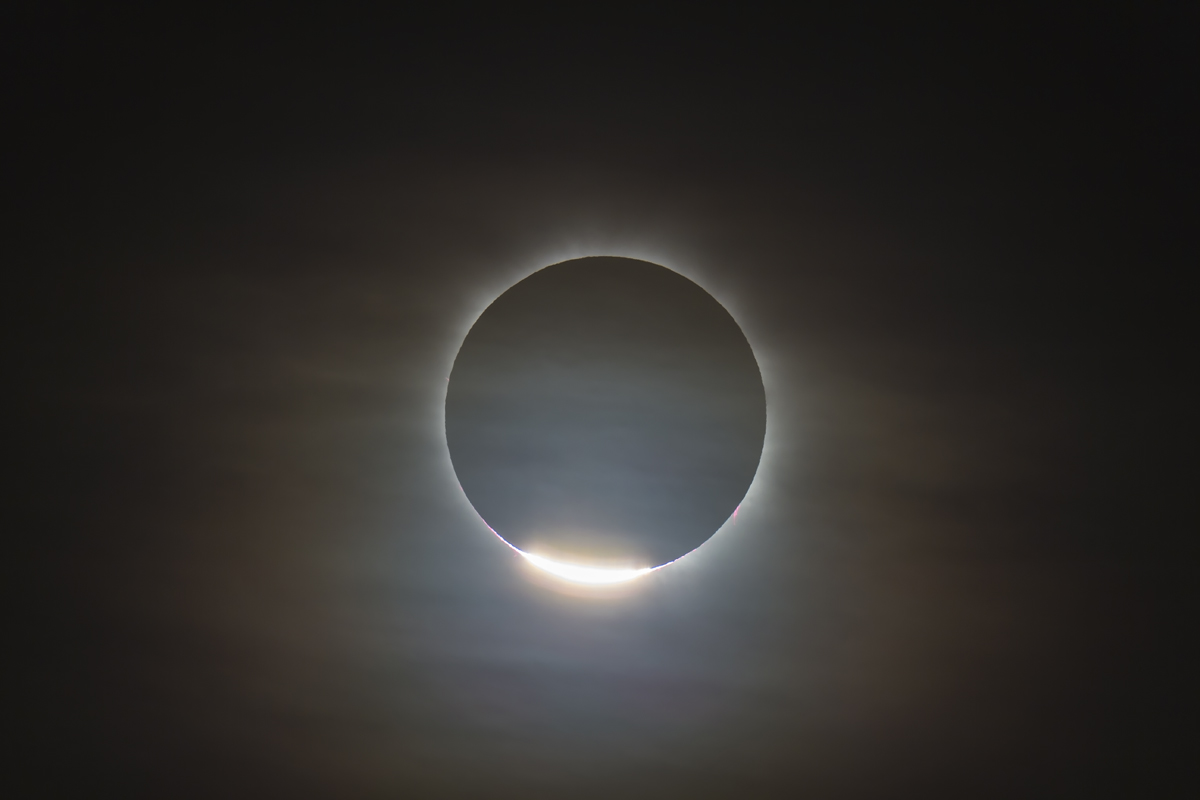
The second contact diamond ring was prolonged, with the last bits of the Sun breaking up into beads of light as the Sun disappeared behind valleys and craters on the Moon. The third contact diamond ring appeared as a sharp, tiny but brilliant point of light exploding off the top edge of the Moon. It happened all too soon.

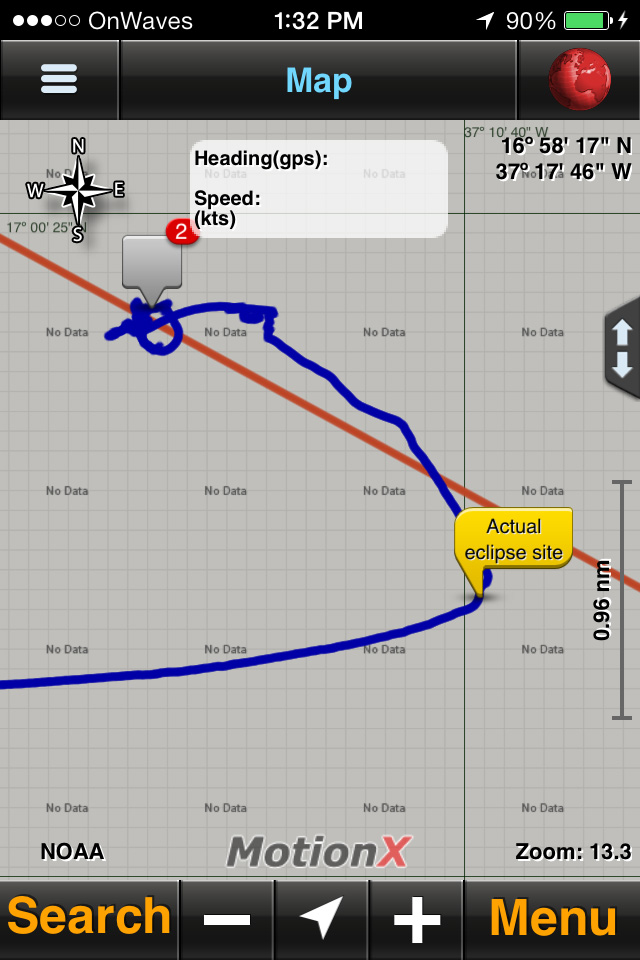
In the days leading up to the eclipse we worked with Captain Yuriy Slastenin to choose a new intercept point 160 nautical miles east of our original site, one that would give us another 6 seconds of totality but still allow us to maintain our schedule of reaching Barbados on Sunday, November 10.

Our new site was 17° 0’ 0” North and 37° 11’ 56” West, smack on the centreline. The captain got us to that precise spot about an hour before sunrise, exactly when planned.

But after a week of beautifully clear skies on the sail down from the Canary Islands, the sky on eclipse morning was filled with cloud and unsettled weather. We had rain showers and rainbows Sunday morning, but with tantalizing clear holes coming and going all morning and dappling the ocean with spots of sunlight in the distance.
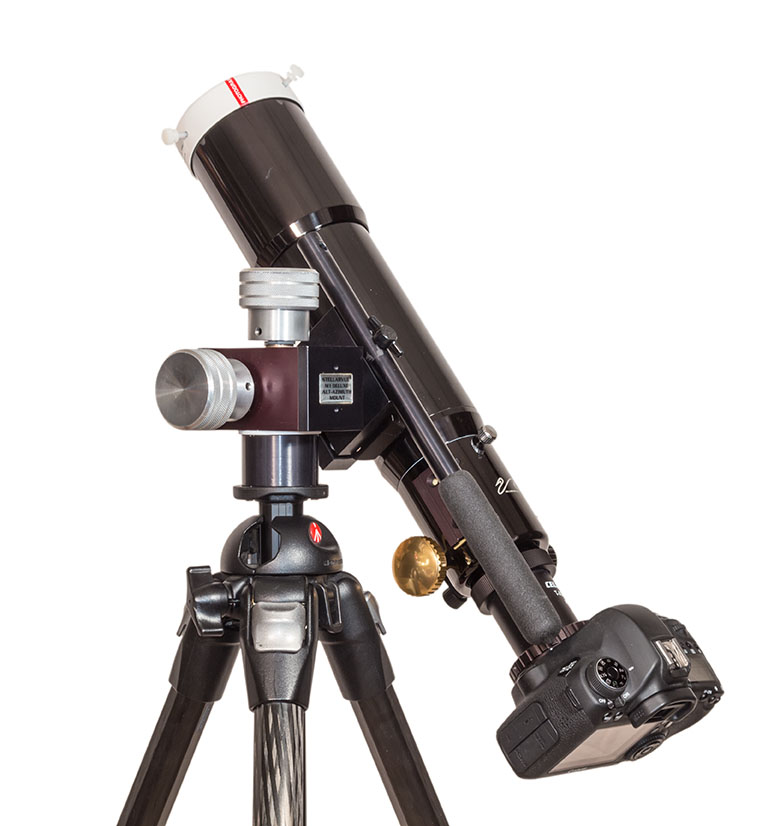
Partial Eclipse Through Filter (Nov 3, 2013)

I shot this view during one of the clear breaks leading to totality when the Sun and spirits brightened, only to be dashed again as clouds rolled in. The weather took us on an emotional roller coaster all morning.

In the minutes leading up to totality the captain was at the helm and propelled us under full engine power into a clear hole that opened up just before totality. We ended up 1.7 nautical miles east of our choice position and slightly south of the centre line, but with the same 49 seconds of totality.

Eclipse Site Map

The image above shows our ship’s track during the eclipse, from the intended site, first drifting around the intercept point, then heading southeast toward clear skies. The track then heads straight west, as we set sail again toward Barbados soon after totality while the champagne was being served.

Our success speaks to the maneuvering advantage of a ship in tropical climates. I’ve now seen three total eclipses from ships at sea at tropical latitudes, and we’ve always had to move at the last minute to get into clear holes.

Of course, the worst weather we’ve encountered so far on the voyage was on eclipse day and the day after, yesterday. As I write this, on Tuesday, November 5, the day is hot and sunny, and the ocean as calm as we’ve seen it. (I’ve not been able to post anything until now as our ship’s connection to the internet via the Inmarsat satellite has been off-line for the last few days.)

As totality ended the Sun went into thin cloud again. From then on that morning we saw the Sun only briefly during the final partial phases.

But no one cared. We saw what we had sailed across the Atlantic to see. It is a happy ship of shadow chasers.

The trip was organized by Betchart Expeditions who chartered the Star Flyer, a 4-masted sailing ship, one of three sailing ships in the Star Clipper line. I’m serving as one of the guest speakers on a program packed with speakers and great talks. After all, we are at sea for two full weeks, crossing the Atlantic from the Canaries to Barbados, with nothing but a limitless horizon in view for all that time. And the eclipse!

– Alan, November 5, 2013 / © 2013 Alan Dyer

The Great Australian Eclipse – The Closeup Movie


This is the “director’s cut” movie of the November 14 total eclipse of the Sun in Australia, unabridged and unedited.

I shot this movie of the eclipse through a telescope to provide a frame-filling closeup view of totality. This is the entire eclipse, from just before totality until well after. So it includes both diamond rings: at the onset of totality and as totality ends.

A few seconds into the movie I remove the solar filter which produces a flash of light until the camera readjusts to the new exposure. Then you really see the eclipsed Sun!

We got 1m28s of totality from our viewing site near Lakeland Downs, Queensland. But the movie times out at slightly less, because at several points where you hear a shutter click, I took a still frame which interrupts the movie. You can see some of those still images in earlier blog posts.

My timing was a little off, as I opened up the exposure to reveal more of the outer corona only moments before the end of totality, so the first moment of the final diamond ring is a little overexposed. During totality I was looking with binoculars, and made the mistake of going over and checking on my other wide-angle time-lapse camera. That wasted time needlessly. I should have spent more time attending to the movie camera and taking more stills at various exposures. No eclipse every goes quite as planned. Losing 30 seconds of totality in order to seek out clearer skies did cost me some images and enjoyment time in the umbra. But our experience was far less stressful than those who dodged clouds (or failed to miss the clouds, in some cases) at sites closer to or at the coast.

The original of this movie is in full 1920 x 1080 HD, shot with the Canon 60Da through the 105mm f/5.8 Astro-Physics apo refractor, on an equatorial mount tracking the Sun. I rarely have the luxury of shooting an eclipse through such extravagant gear, as I would never haul that type of hefty gear now on an aircraft to remote sites. But this equipment emigrated to Australia in 2002 for the total eclipse in South Australia and has been here down under ever since. So this is its second Australian eclipse. Mine, too!

– Alan, November 21, 2012 / © 2012 Alan Dyer


The Great Australian Eclipse – The Shadow Movie


This is 6 minutes of pre- and post-eclipse – and the all too short eclipse itself – compressed into 30 seconds. You can see the dark blue shadow of the Moon sweeping across the sky.

The long oval shadow comes in from behind us from the west and comes down to meet the Sun which is rising in the east. That moment when the shadow edge meets the Sun is second contact when totality begins in a diamond ring effect, and the Sun is entirely hidden behind the Moon.

The shadow then moves off to the right. As its left edge hits the Sun, the Sun emerges in another diamond ring and the eclipse is over. All too soon. Even at mid-eclipse the Sun is not centred in the oval shadow because we were not centred in the path of the shadow but instead drive well north of the centreline, to avoid cloud farther south. We saw 1m28s of totality, 30 seconds less than people at the centreline or on the coast. But we had no annoying clouds to worry about.

Also note Venus at upper left. And the hugs and kisses at the end!

– Alan, November 15, 2012 / © Alan Dyer 2012


The Great Australian Eclipse – Second Diamond Ring


This is the sight eclipse chasers hate to see, yet celebrate the most! It is the diamond ring that ends totality.

This was the “third contact” diamond ring when the Sun returned in an explosion of light from behind the edge of the Moon.

Compare this view to my earlier blog, and you’ll see that the second diamond ring at the end of totality did not happen opposite the first diamond ring. That’s because we were well off the centreline of the Moon’s shadow, so from our perspective the Moon travelled across the Sun’s disk slightly off-centre.

From where we ended up in our chase for clear skies, we experienced 1m28s of totality, well under the 2 minutes maximum that others saw near the centreline. But we felt 1m28s of clear skies was better than 2 minutes under partly cloudy skies. Indeed, some on the coast saw the Sun only briefly during totality, or not at all.

Instead, while the last minute move was stressing, once we were set up, we had relaxed assurance we were going to see the whole show!

– Alan, November 14, 2012 / © 2012 Alan Dyer

The Great Australian Eclipse – Outer Corona


For this shot I overexposed the inner corona on purpose to reveal more of the extent of the streamers in the Sun’s outer corona.

The pink at left is the chromosphere layer shining from behind the Moon just before the Moon uncovered the blindingly bright photosphere with a burst of light, the diamond ring.

It takes a lot of specialized processing, far beyond what I’ve done here, and stacking of multiple exposures to reveal the delicacy of structures that you can see with your aided eyes during a total eclipse. There is nothing more astonishing in the sky for its complexity and yet subtleness than the Sun’s corona. It is the main attraction at any total solar eclipse. You have not lived astronomically until you have seen the corona of the Sun with your own eyes.

– Alan, November 14, 2012 / © 2012 Alan Dyer


The Great Australian Eclipse – Inner Corona


Taken shortly into totality, this shot shows some of the complex structure of the Sun’s corona, and a cluster of red prominences peaking out from behind the bottom edge of the Moon.

For the November 14, 2012 eclipse I shot two cameras. One, with a wide-angle lens, was automatically taking a frame every second. Three of those frames are in a previous blog. For this shot I used a second camera looking through a 4-inch refractor telescope I keep stored in Australia. It worked great! I seldom get to shoot an eclipse through a telescope, as so many eclipses are in remote locations where carting a telescope and mount are impractical. But for an Oz eclipse (I’ve seen two from Australia now, in 2002 and now in 2012) I get to use my Oz gear.

Because the Sun is nearing solar maximum its corona appeared evenly distributed around the Sun, with streamers reaching out in all directions. At solar minima eclipses the corona extends just east-west with little over the poles.

This image, like the other closeups I’m posting, are still frames shot while the camera was taking an HD movie. Firing the shutter while the movie is recording interrupts the movie but records a full-resolution still frame, a very nice way to get two forms of media with one camera.

– Alan, November 14, 2012 / © 2012 Alan Dyer


The Great Australian Eclipse – Diamond Ring #1


The last bit of the Sun shines from behind the ragged edge of the Moon as the total eclipse begins in Australia.

This is “second contact,” and the first diamond ring effect that heralds the start of totality. The Moon (the dark disk) is just about to completely cover the Sun. You can see the pink chromosphere layer of the Sun’s surface and a flame-like prominence at 4 o’clock position. The Sun’s atmosphere, the corona, is just beginning to show.

I took this November 14, 2012 from a site near Lakeland Downs, Queensland, Australia. While we did look through some thin cirrus clouds, they didn’t hamper viewing at all, and were not the concern that the thicker clouds were at other sites, especially at the beaches.

– Alan, November 14, 2012 / © 2012 Alan Dyer

The Great Australian Eclipse – Success!


It wouldn’t be an eclipse without a chase. But in the end we had a nearly perfect and cloudless view of the entire eclipse — the Great Australian Eclipse. We were ecstatic!

This collage of wide-angle shots shows the motion of the Moon’s conical shadow. At top, you can see the bottom edge of the shadow just touching the Sun. This was second contact and the diamond ring that begins totality. The middle frame was taken near mid-eclipse and shows the bright horizon beyond the Moon’s shadow. However, the Sun is not centred on the shadow because we ended up well north of the centreline, sacrificing as much as 30+ seconds of totality to get assured clear skies. The bottom frame was taken at the end of totality as the first bit of sunlight bursts out from behind the Moon at third contact and the final diamond ring. Notice the Sun sitting at the well-defined left edge of the Moon’s shadow. The shadow moved off to the right.

Why did we end up off-centre? Clouds! The day before, at our 11 am weather briefing meeting, we decided not to stay on the beach but to move inland to one of the sites we selected from the previous day’s reconnaissance. The forecast was not even accurately “predicting” the current conditions at the time, saying the sky should then have been clear. It was raining. We did not trust the predictions that skies would clear by eclipse time on Wednesday morning.

We drove inland on Tuesday afternoon, getting to our choice site at the James Earl Lookout on the Development Road about 4 pm, to avoid driving in the dark and to get there before the parking area filled up. It was a good plan. We arrived to find a few people there but with room for all our cars filled with 20+ Canadians. We staked our ground with tripods, did a little stargazing after dark, then settled in to spend the night in our cars.

At dawn we got everything ready to go, only to see puffs of orographic clouds forming over the hills in the direction of the Sun. I did not like it. So with an hour to go before totality we packed up and moved down onto the plains away from the hills to a site near Lakeland Downs, the site you see here. Apart from some high cirrus clouds, skies were superb.

As it turned out, folks a few miles away at the Lookout did see it, but by the skin of their teeth. Clouds obscured the Sun just before and just after totality. That’s too nerve-wracking for me. And from the beaches, some people were clouded out, others saw all of totality, others saw just a portion of the main event. It was hit and miss. From home at Oak Beach we might have seen it but only just. We were very happy with our decisions to move and flexibility to be able to do so.

I’ll post some close-up shots of the eclipse shortly.

Tonight, we party!

– Alan, November 14, 2012 / © 2012 Alan Dyer