Nightscapes of Southern Saskatchewan


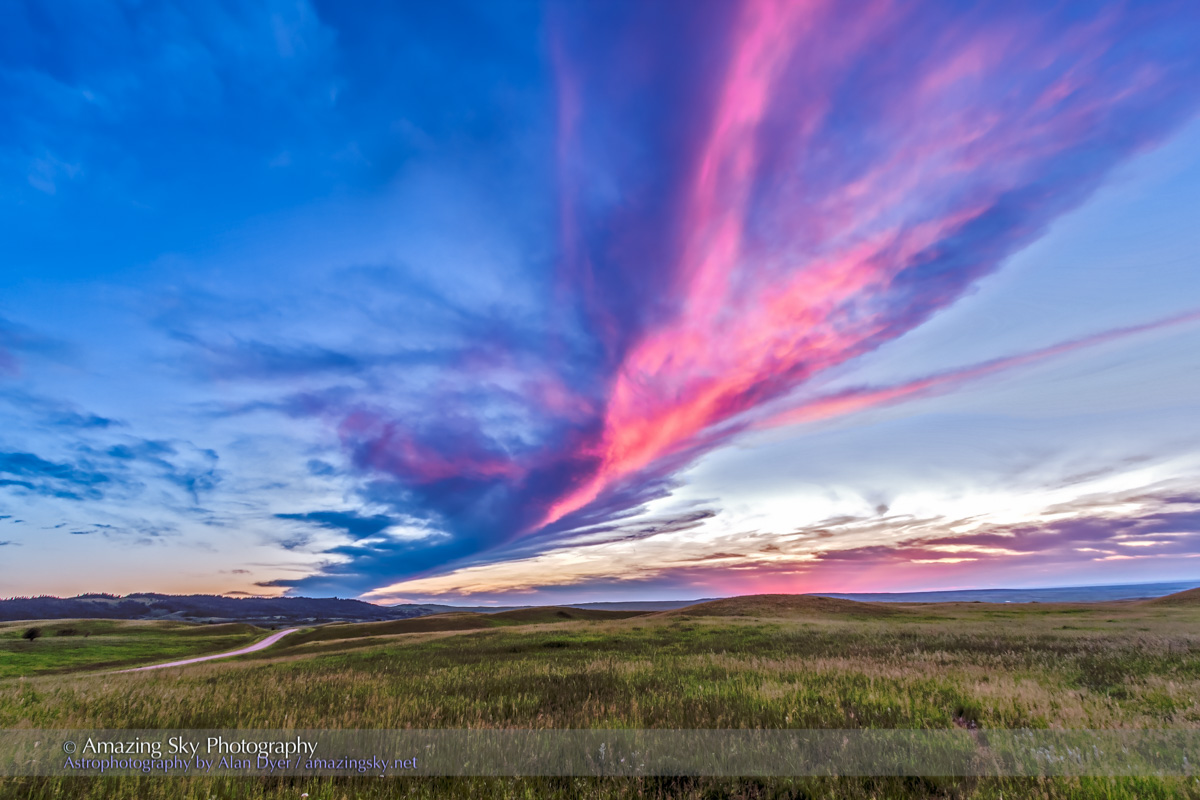
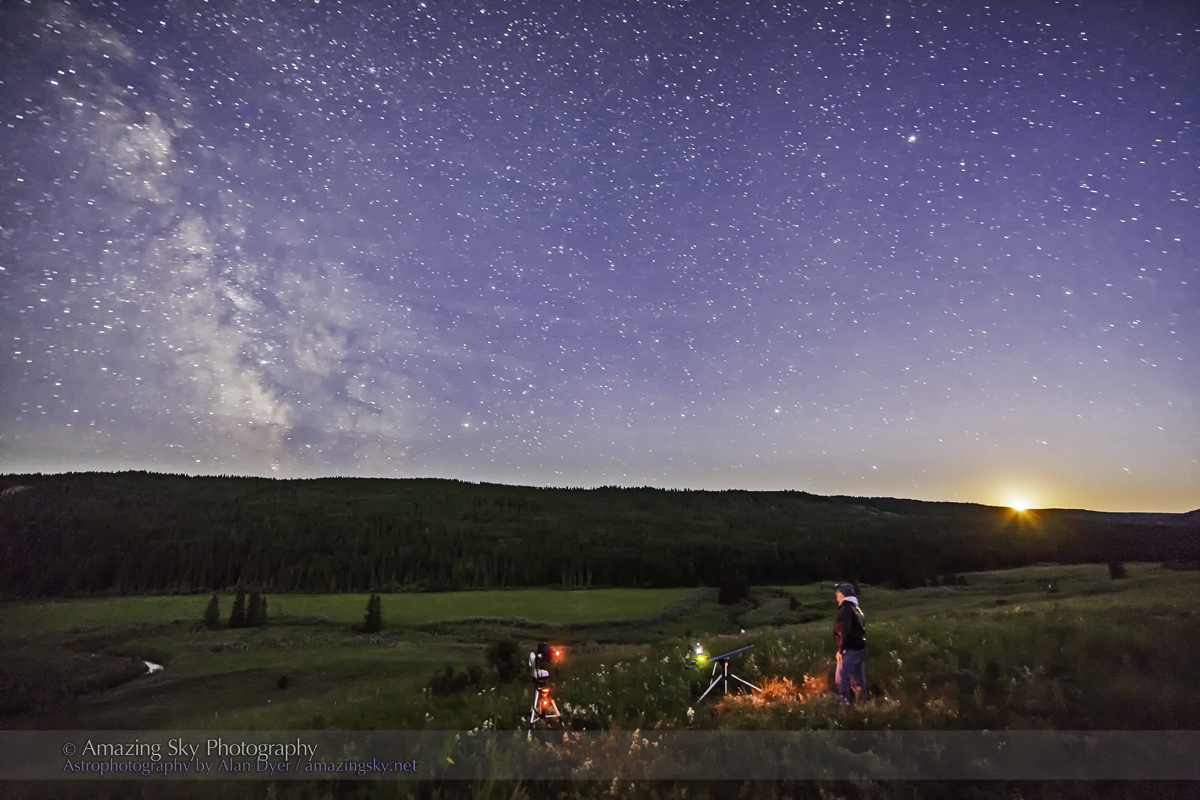
Southern Saskatchewan is a fine place to capture nightscapes of the Milky Way over the grand prairie landscape.

In late August 2025 I took a short road trip around southwest Saskatchewan, taking advantage of a run of wonderfully clear nights to shoot “nightscapes” at some of my favourite locations.

Southern Saskatchewan, and more specifically Southwest Saskatchewan, is a stargazing paradise. The skies are dark and there’s nothing to get in the way of seeing them! Yet, the landscapes have their unique beauty.

And in the case of Grasslands National Park the landscape preserves the endangered realm of original short-grass prairie. It is what the land was like long ago, even including some bison at large.

Grasslands National Park
Technical:
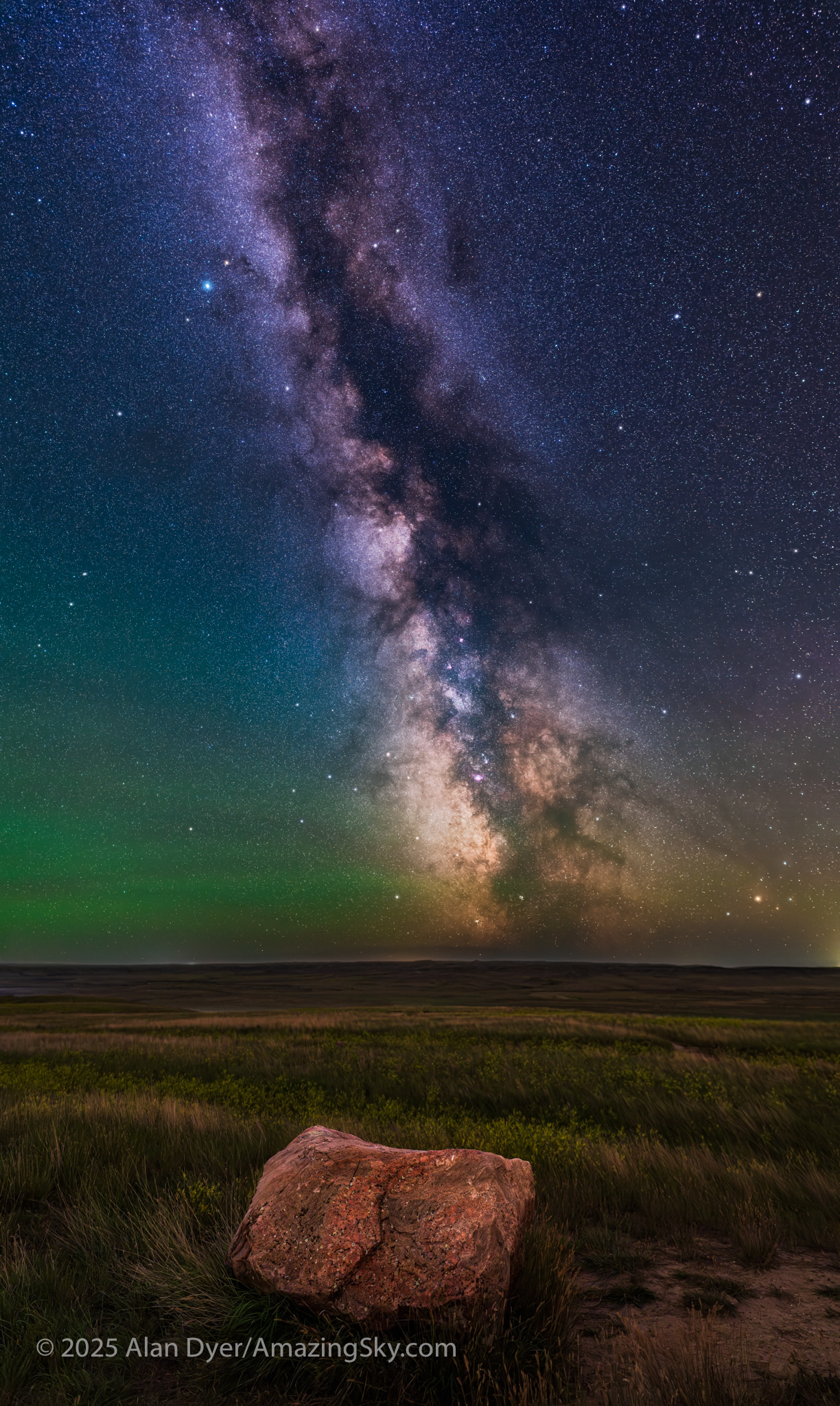
This is a blend of tracked and stacked sky exposures with a single untracked ground exposure:
– 7 x 60 seconds at f/2 tracked and focused for the sky, plus
– 1 x 4 minutes at f/2.8 untracked and focused for the foreground to bring out the details lit only by starlight. No light painting was employed here.
– All with the Nikon Z8 at ISO 800 and Nikkor 20mm S lens, on the MSM Nomad tracker. And all from the same tripod position. However, the camera was reframed upward for the sky shots.

In fact, my main destination on my visit to Grasslands this year was to revisit a site I had intended to shoot from in 2019 โ€“ the Bison Rubbing Stone overlooking the Frenchman Creek Valley, with the Milky Way as a backdrop.

In 2019 I had to drive through the herd of bison to get there. With the herd only a few hundred metres away, I thought better of setting up at their scratching post. So that year I headed down into the valley to shoot at the 76 Ranch Corral. You can see some images from that location taken on an earlier trip to Grasslands here.

This year I was assured the bison were in the outback, so I set up at their rubbing stone. This is one of the many glacial erratic boulders the Ice Age left scattered across the prairies. With no trees about, the bison have long loved to use them to scratch an itch. But the connection with the stars is that one legend of the sky told by Blackfoot First Nations describes the Milky Way as the “Buffalo Trail,” the dust left by a cosmic herd of bison.

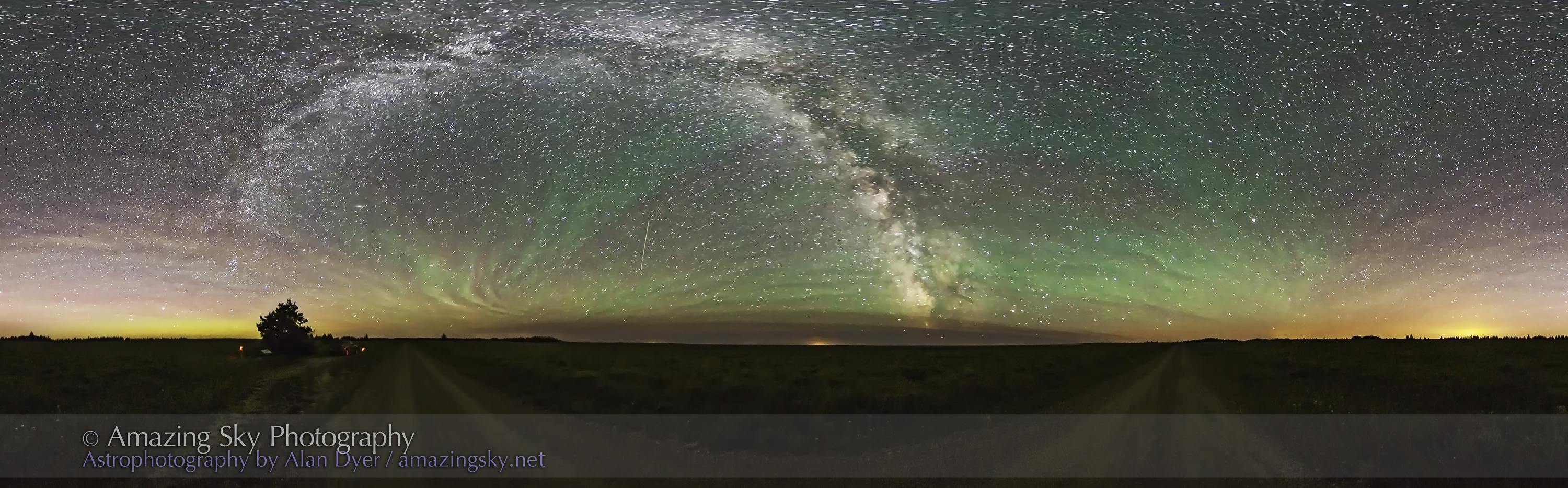
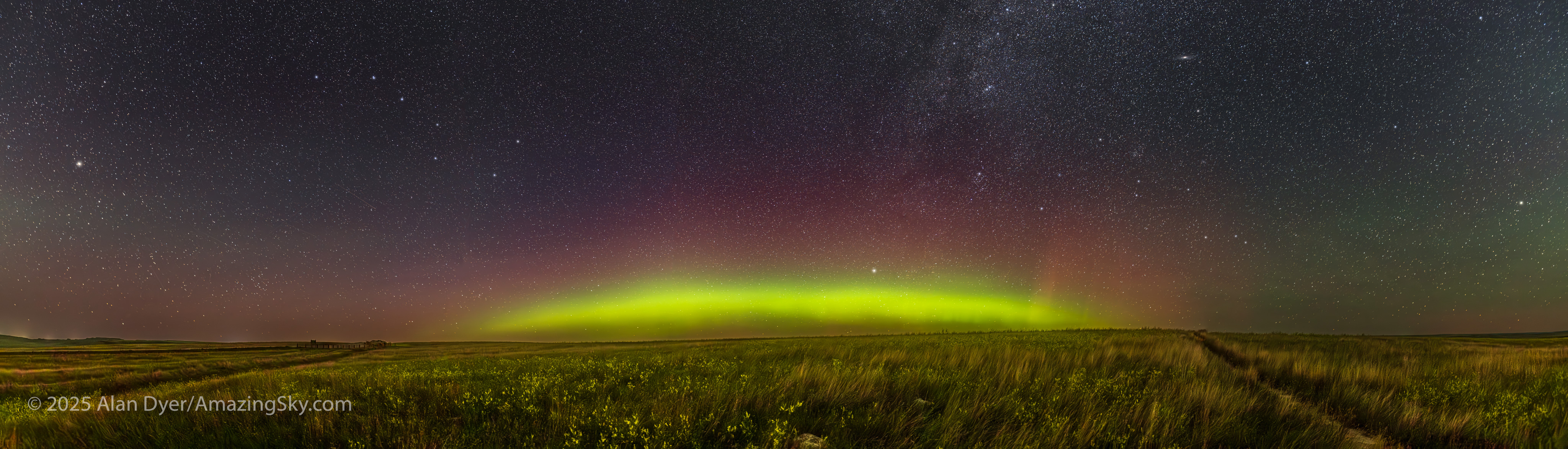
I got the shot! Then all I had to do was turn the camera around to face north to get this scene.
Technical:
This is a panorama of 5 segments, each 30 seconds untracked at f/2 with the Nikkor 20mm S-Line lens and Nikon Z8 at ISO 1600. Stitched with Adobe Camera Raw. I removed aircraft trails, but at left I retained the many faint satellite trails in the northwest still lit by twilight, as this was early at about 10:30 pm CST. I did not focus stack these frames. Nor was the camera tracking the stars.

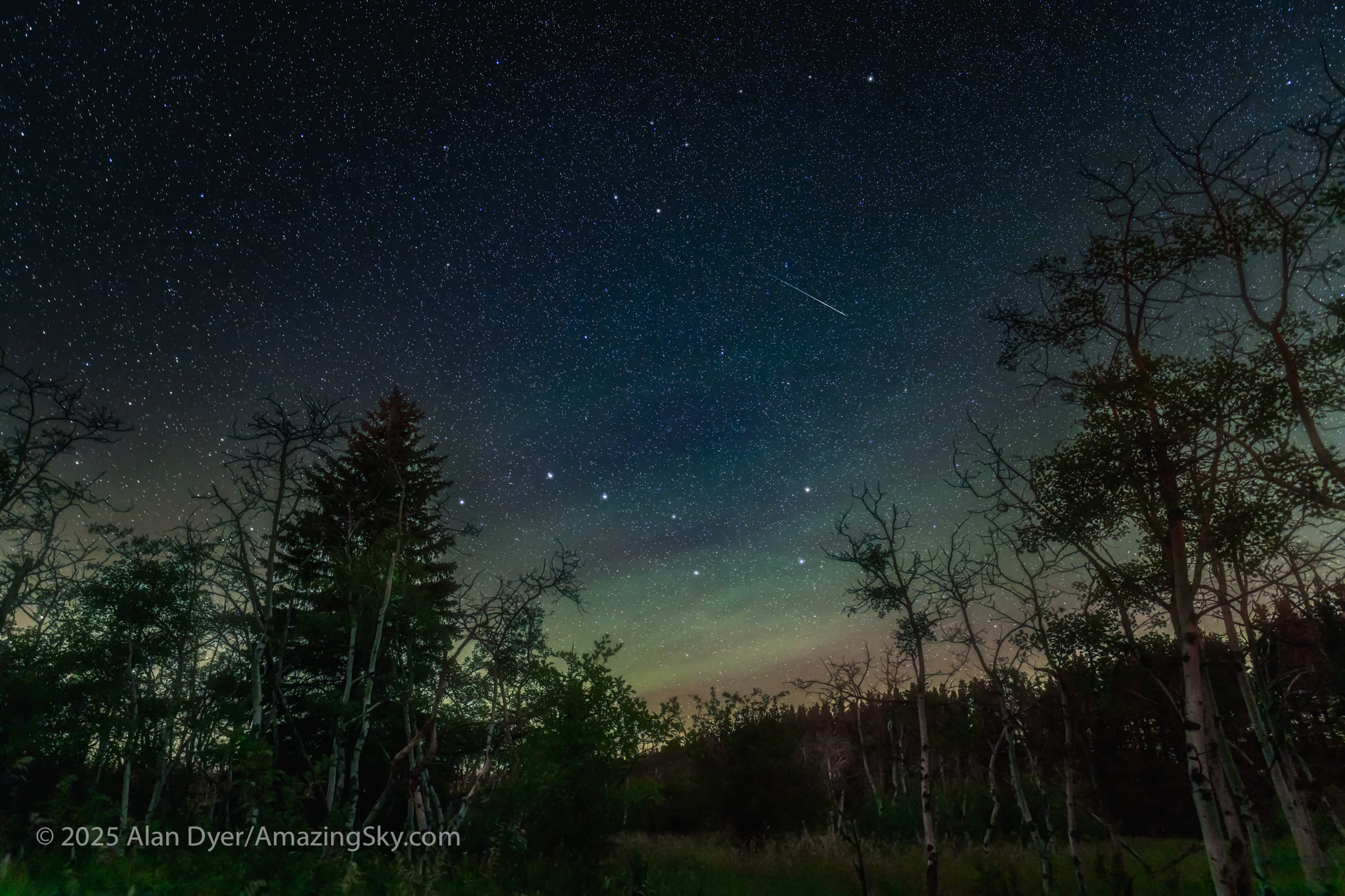
A mild aurora appeared in a classic arc across the north, and framed between the hiking trail, with the Big Dipper to the left and the Milky Way rising to the right. This is the wonderful sky that awaits in the “big sky” country of Grasslands. On the horizon only 3 distant lights could be seen. Grasslands is a Dark Sky Preserve. May it always be so!
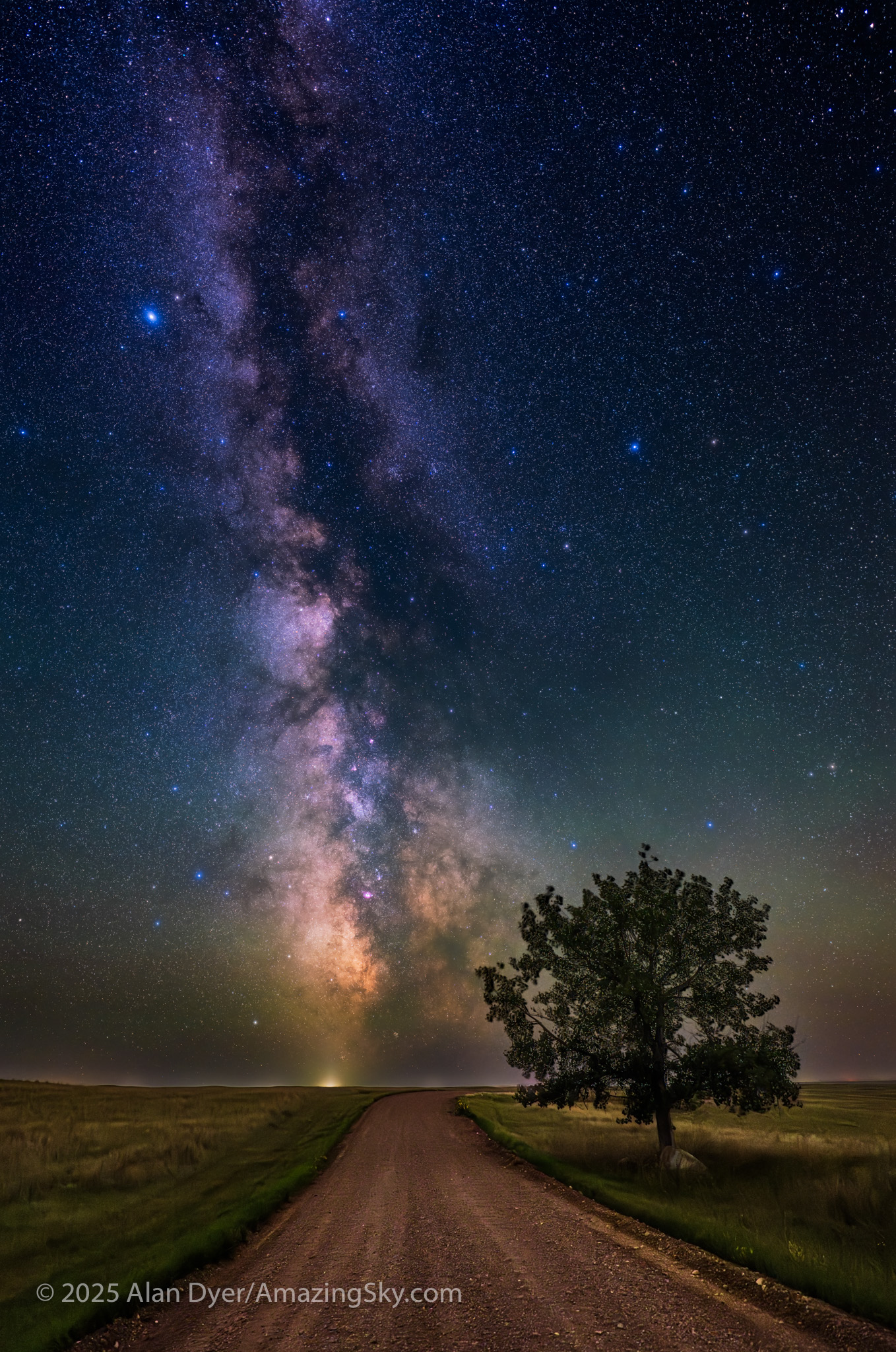
Technical:
This is a blend of tracked and stacked sky exposures with a single untracked ground exposure:
– 4 x 30 seconds at f/2 tracked for the sky, plus
– 1 x 2 minutes at f/2.8 untracked for the ground to bring out the details lit by starlight, plus
– A single 30-second tracked exposure through a Tiffen Double Fog 3 filter layered in, to add the star glows.
– All with the Nikon Z8 at ISO 800 and Nikkor 20mm S lens, on the MSM Nomad tracker. And all from the same tripod position. The camera was not moved for the sky photos.

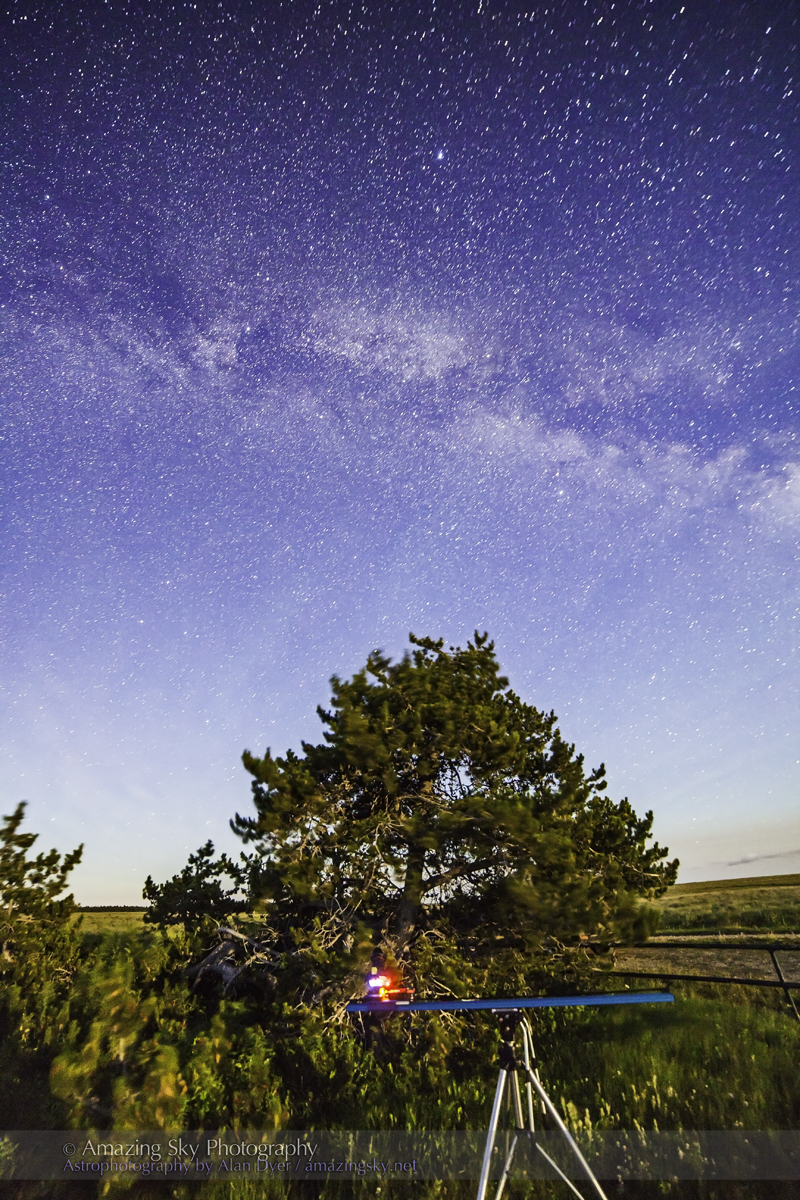
The night before I headed south out of the little town of Val Marie to a favourite spot high on the hill overlooking the Park. It is called Two Trees, but now only one tree remains! It made a fine foreground for the classic “lone tree and Milky Way” nightscape.

In August the galactic centre lies in the southwest quickly setting in the early evening. But from this latitude of 49ยบ N even with it at its highest, the Milky Way core lies low in the south, making for good compositions with foregrounds below.
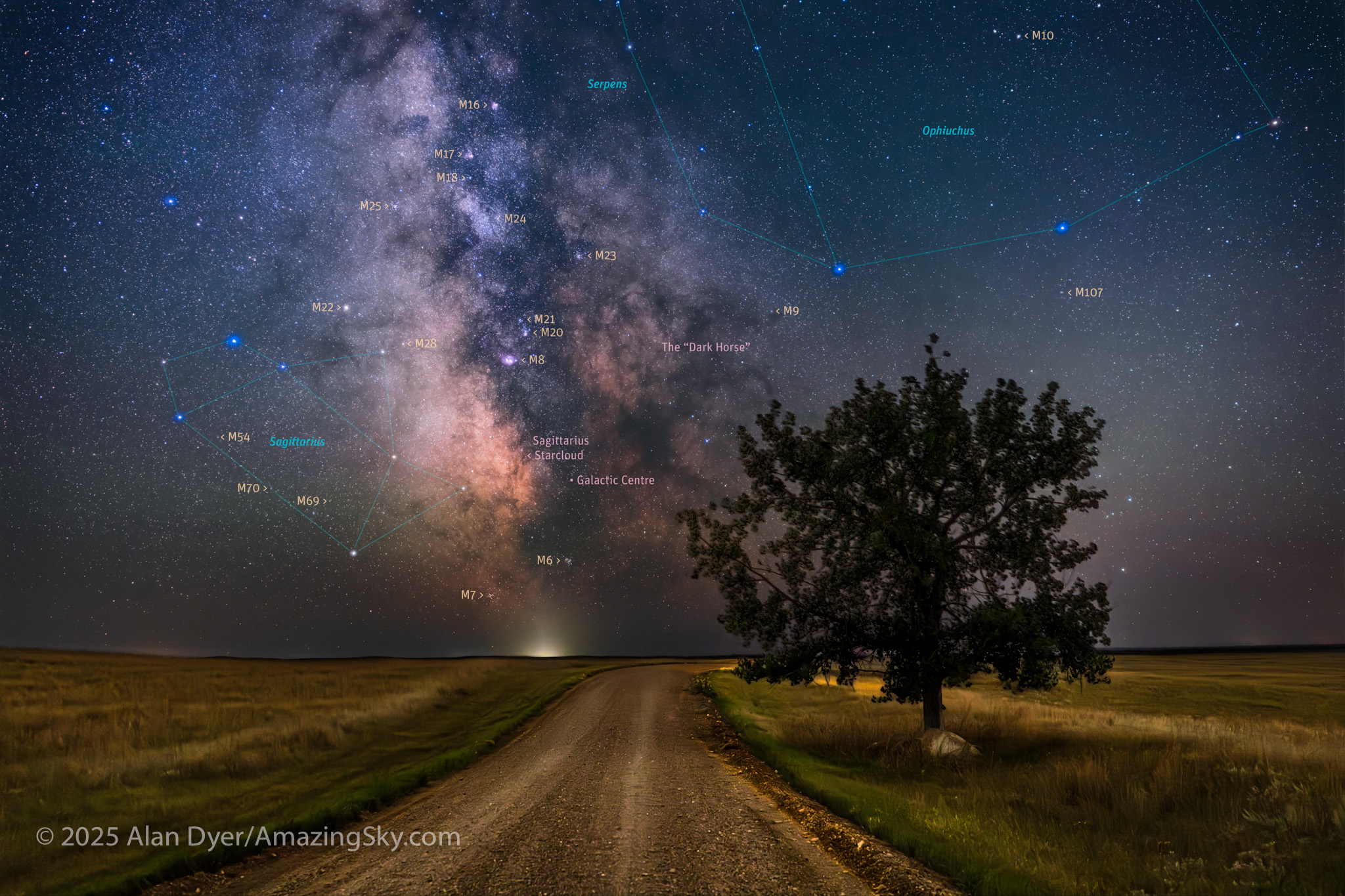
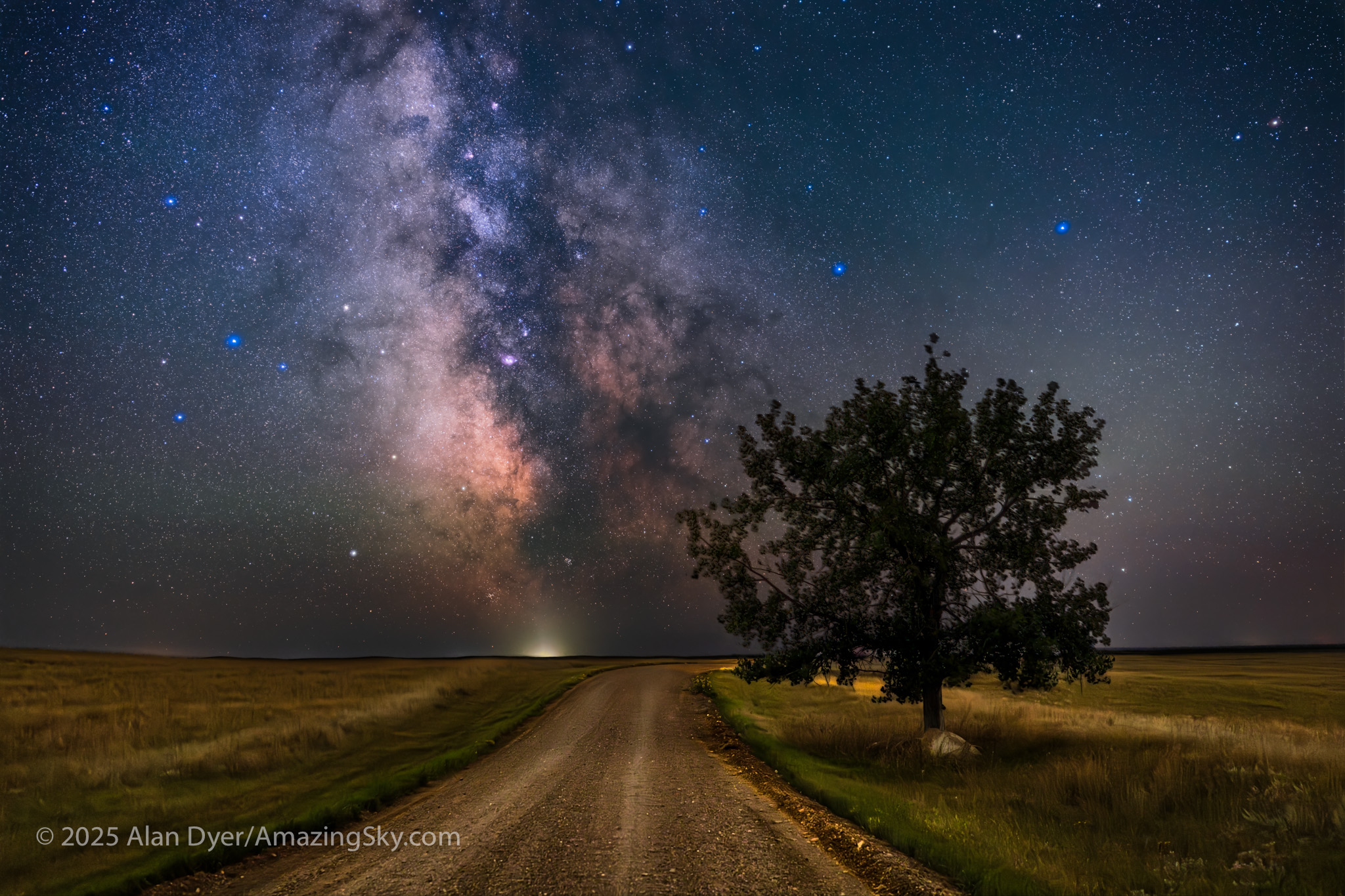
Here I present a “landscape” version of the image above, in versions with and without labels to indicate all the rich nebulas and star clusters in this area of sky in Sagittarius the Archer, home of the Milky Way core. Tap on the images to bring them up full screen.

Similarly, below I present views looking east to the autumn constellations rising over the prairie. This was from the valley below Two Trees Hill, at the Riverwalk day use site. Here there were absolutely no lights visible, and hardly a sky glow on the horizon from towns and light pollution. This was paradise for a stargazing session.
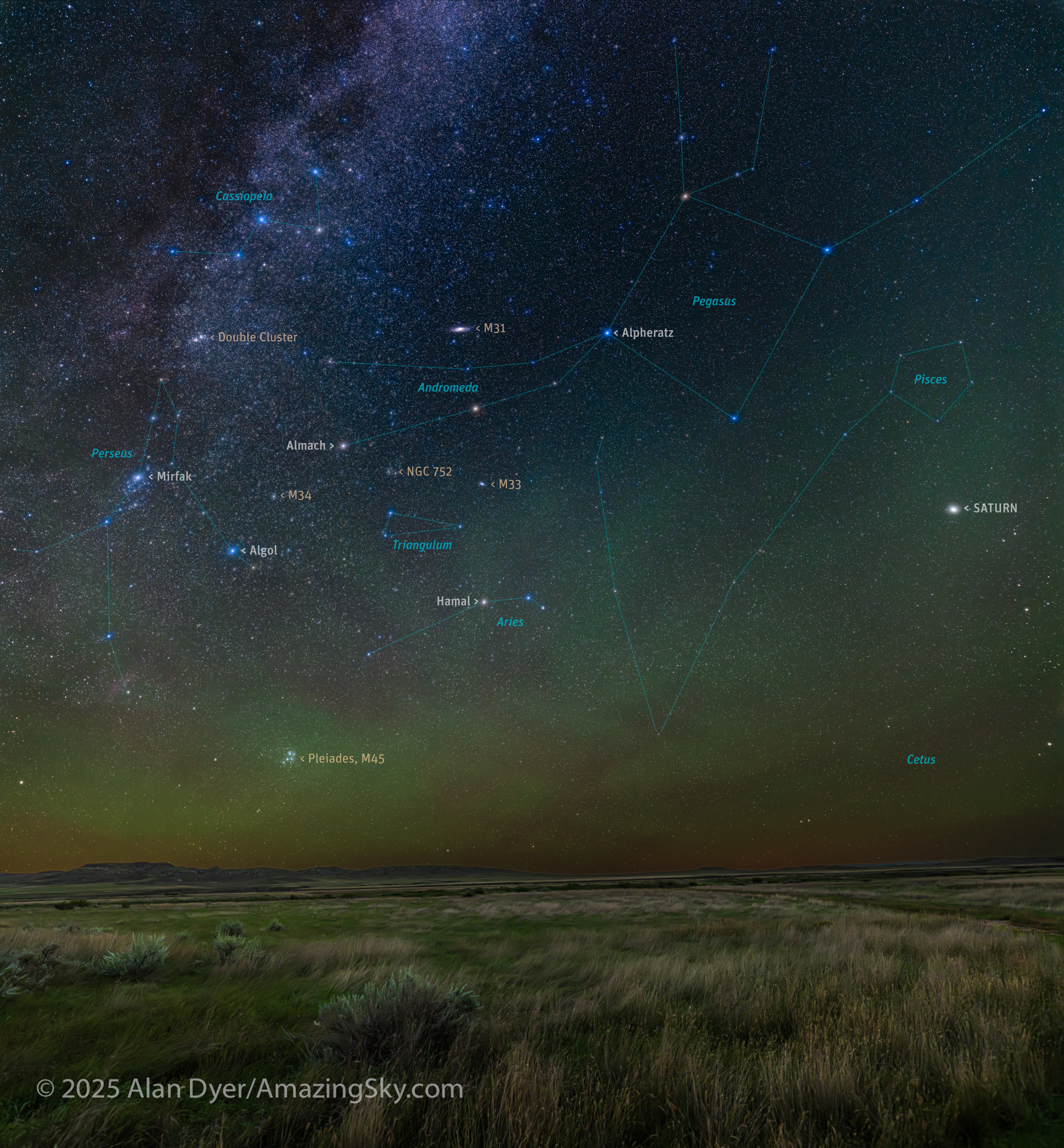
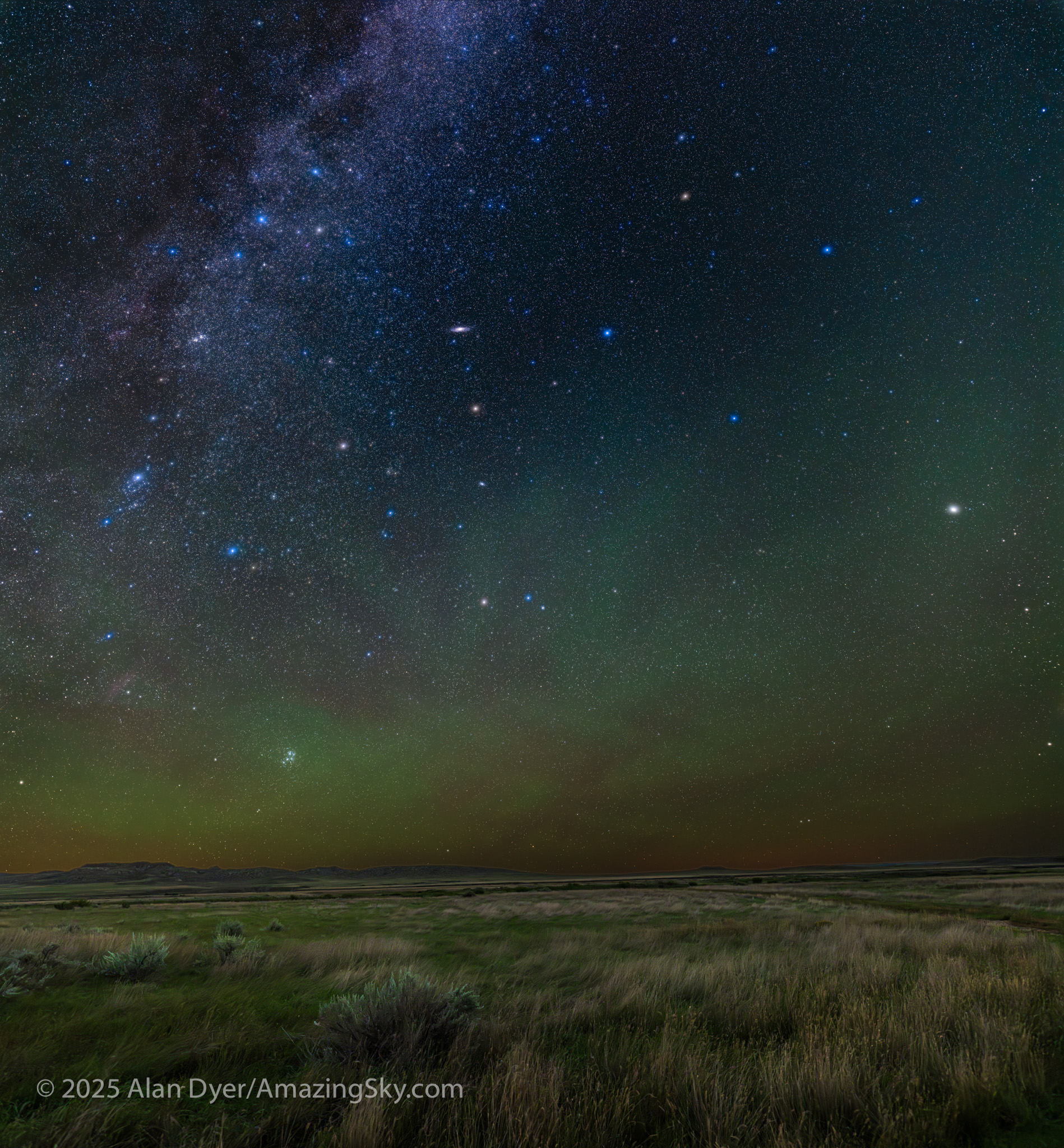
The constellations in this area of sky are the ones made famous in the classic tale of the hero Perseus riding on Pegasus the Flying Horse to rescue the lovely Princess Andromeda from Cetus the Sea Monster, while vain Queen Cassiopeia looks on.

Here the sky was also tinted green, not with aurora but airglow, a natural effect caused by high-altitude oxygen fluorescing at night, giving off energy it has absorbed by day. It discolours the sky but it belongs there! It is visible only at dark sky sites.

The Great Sand Hills

From Grasslands I ventured north to the little town of Leader, Saskatchewan, one of the jumping off points to visit the Great Sand Hills nearby. You have to have a local map to find them, but the sand dunes are extensive, and an oddity on the prairie, another Ice Age relic.

They are not a Park but are an ecological reserve, with limited access. I shot from the main spot with parking for visitors and a trail off into the dunes.

Here is another pair of images with annotations, looking north from the main dune field toward Ursa Major and the Big Dipper.
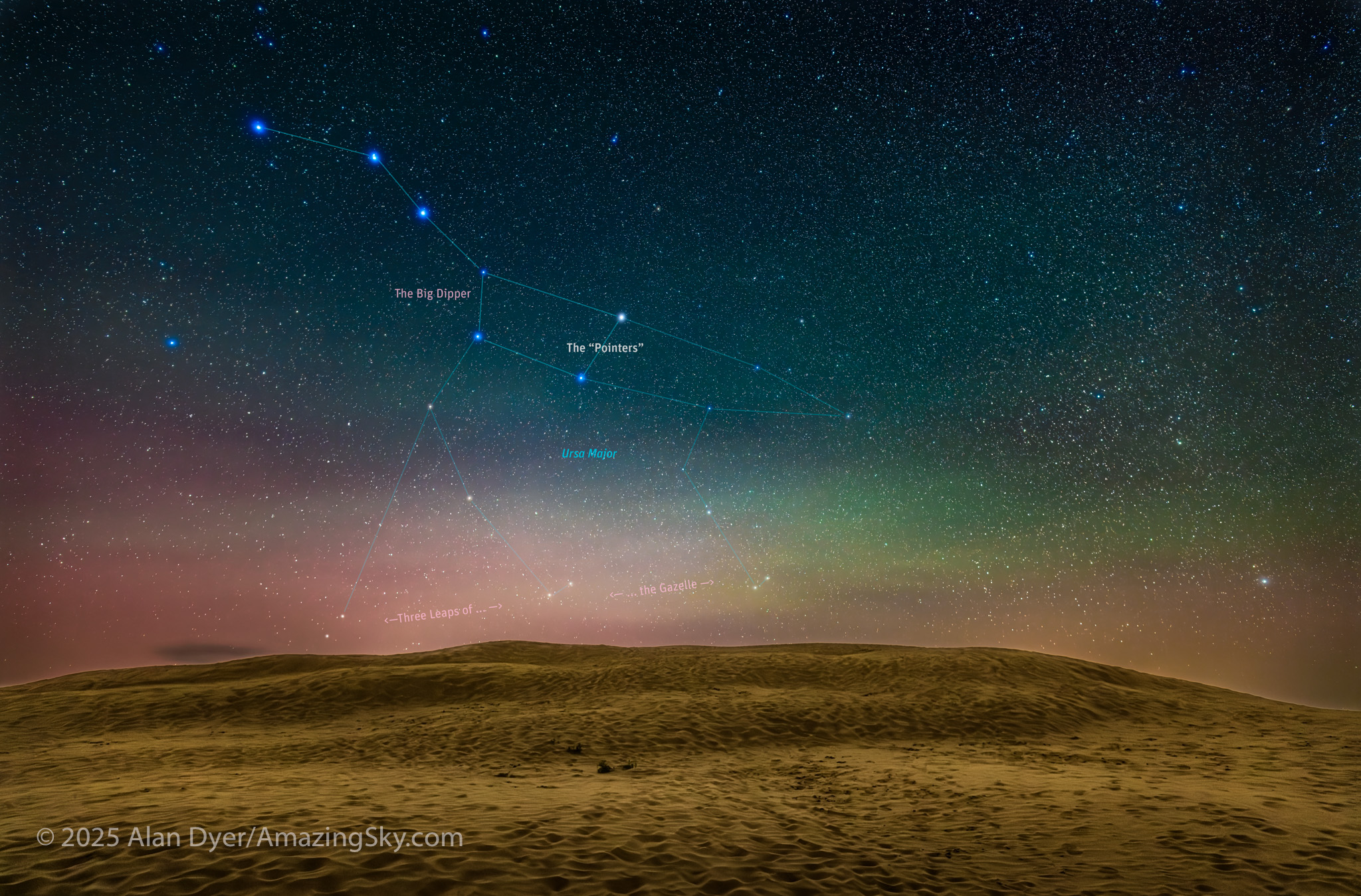
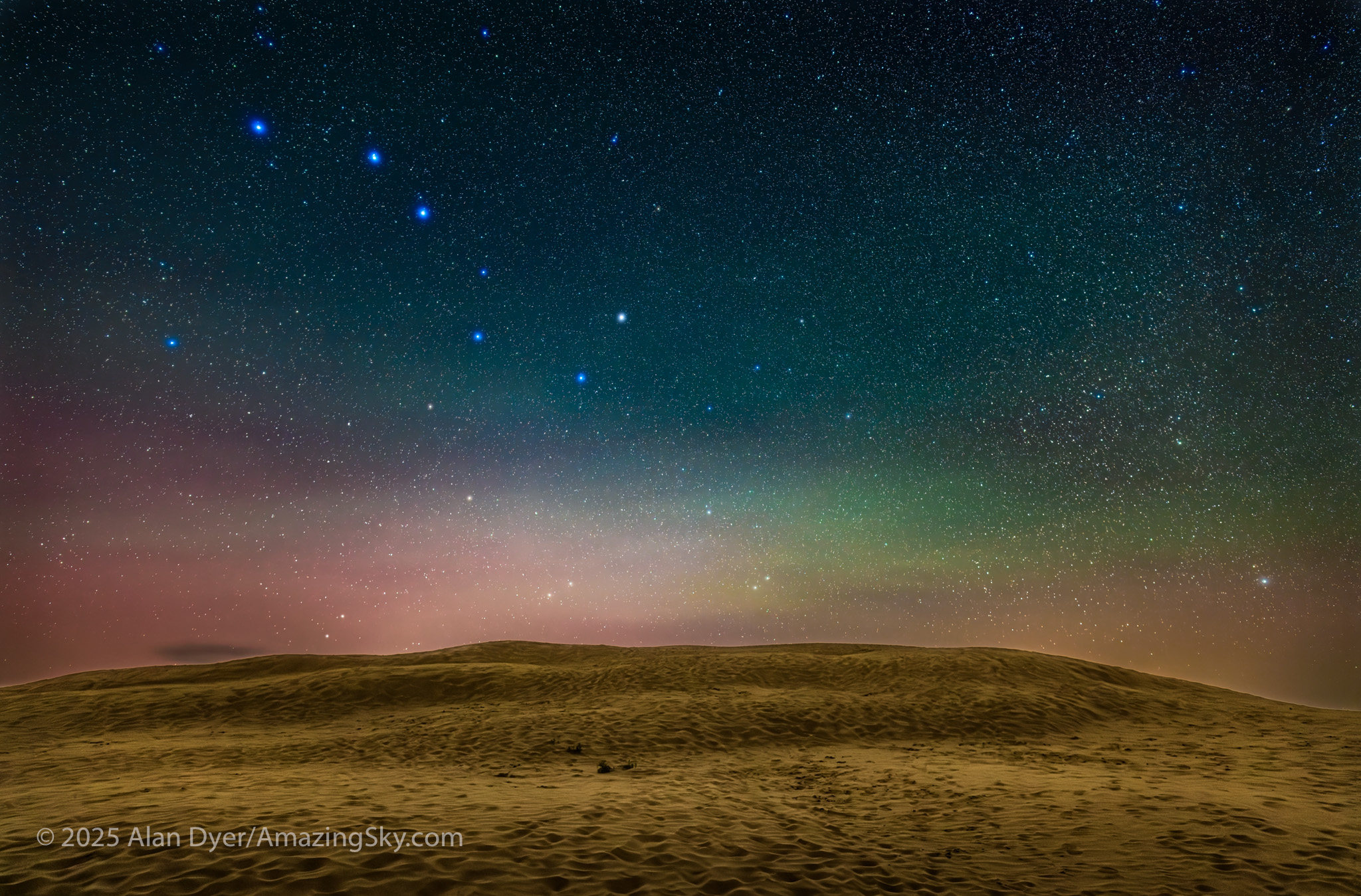
An extensive display of airglow also tints the sky, at least I think that’s the source, and not aurora.
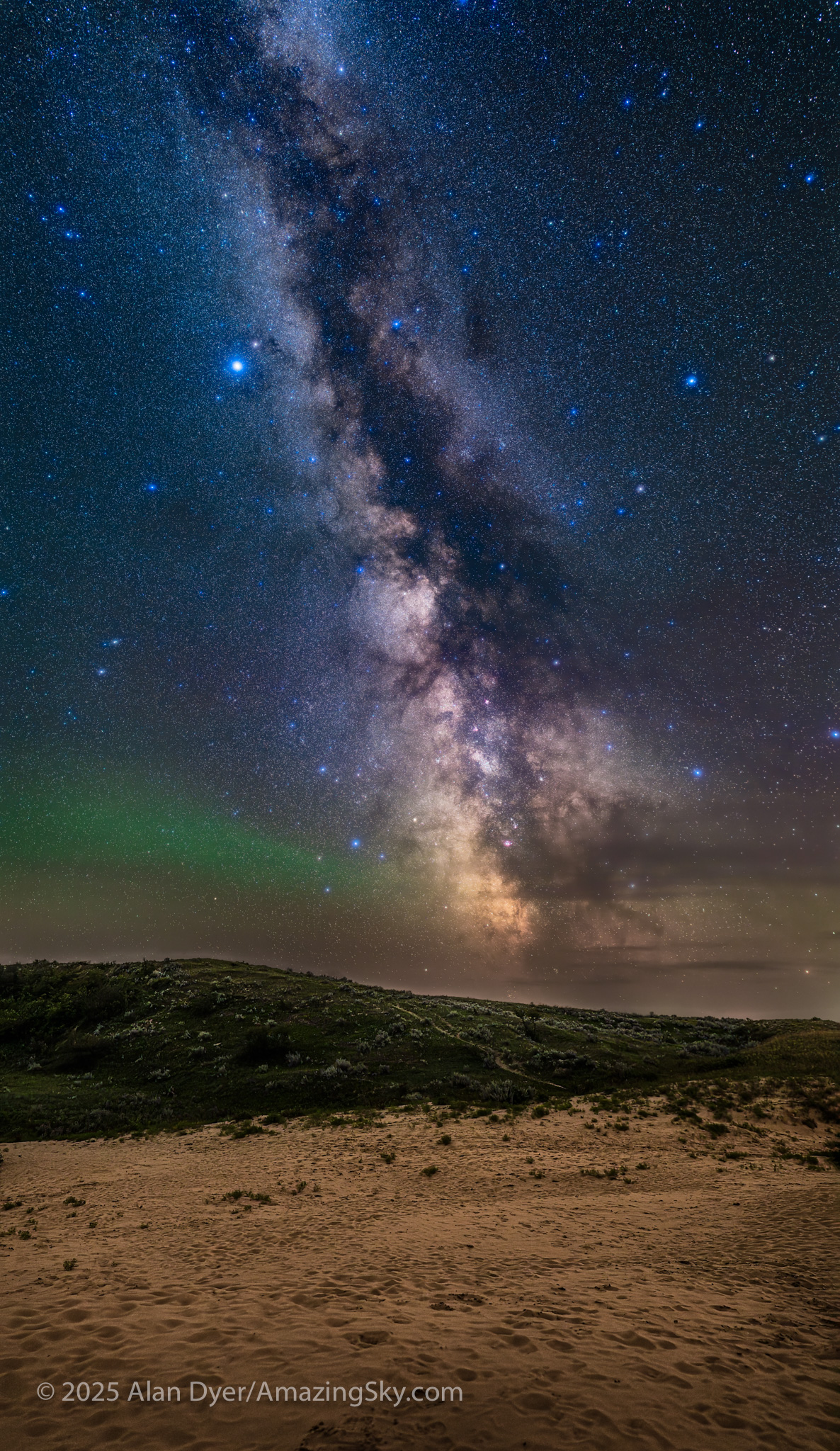
Technical:
This is a blend of tracked and stacked sky exposures with a single untracked ground exposure:
– A stack of 4 x 60 seconds at f/2 tracked for the sky, plus
– 1 x 4 minutes at f/2.8 untracked for the ground, plus
– A single 60-second tracked exposure through a Tiffen Double Fog 3 diffusion filter layered in, to add the star glows.
– All with the Nikon Z8 at ISO 800 and Nikkor 20mm S lens, on the MSM Nomad tracker. And all from the same tripod position. However, the camera framing was changed for the sky and ground shots, tilting it up it to include more of the sky up the northern Milky Way.

Turning around to face south again frames the sweep of the summer Milky Way over the well-trodden dunes. Not quite the Saharan or Namibian scene you might want, but this is Saskatchewan and having even this scene on the prairies is unique. The only other dune fields are far up north and not readily accessible.
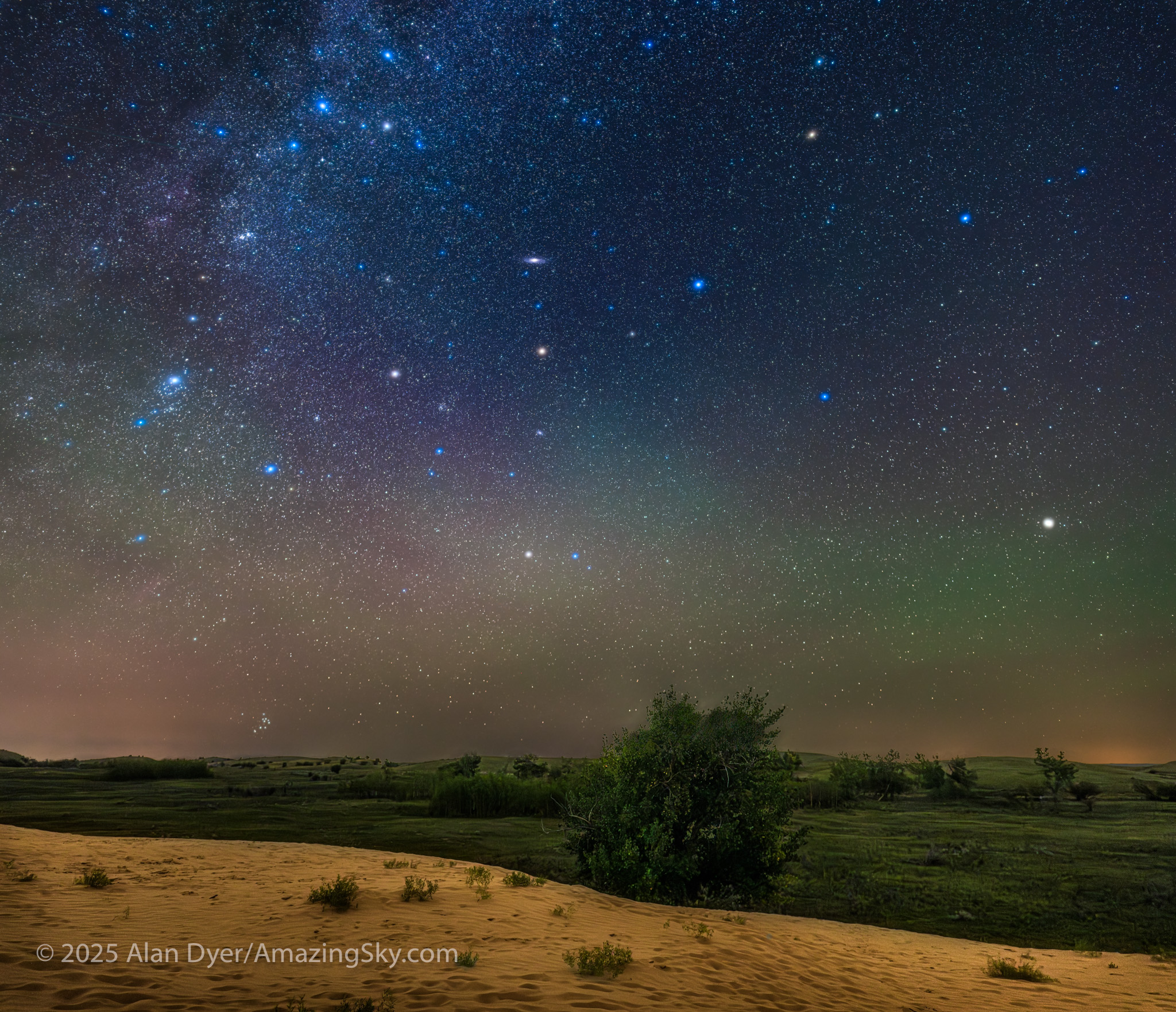
Technical:
This is a blend of tracked and stacked sky exposures with a single untracked ground exposure:
– A stack of 4 x 60 seconds at f/2 tracked for the sky, plus
– 1 x 3 minutes at f/2.8 untracked for the ground to bring out the details lit only by starlight, plus
– A single 60-second tracked exposure through a Tiffen Double Fog 3 diffusion filter layered in, to add the star glows.
– All with the Nikon Z8 at ISO 800 and Nikkor 20mm S lens, on the MSM Nomad tracker. And all from the same tripod position. However, the camera framing was changed for the sky and ground shots, tilting it up it to include all the constellations in one frame but with just a sliver of ground in the frame.

Looking east from the dune again frames the mythological autumn constellations, with the “W” of Cassiopeia at top amid the Milky Way. The bright “star” at lower right is Saturn. The Pleiades are just rising at left.

The Cypress Hills

I had started my Saskatchewan journey in the Cypress Hills, another formation created by the Ice Age, or rather left untouched by the glaciers creating a high wooded oasis on the prairie. I was there for the annual Saskatchewan Summer Star Party, the subject of my previous blog here.
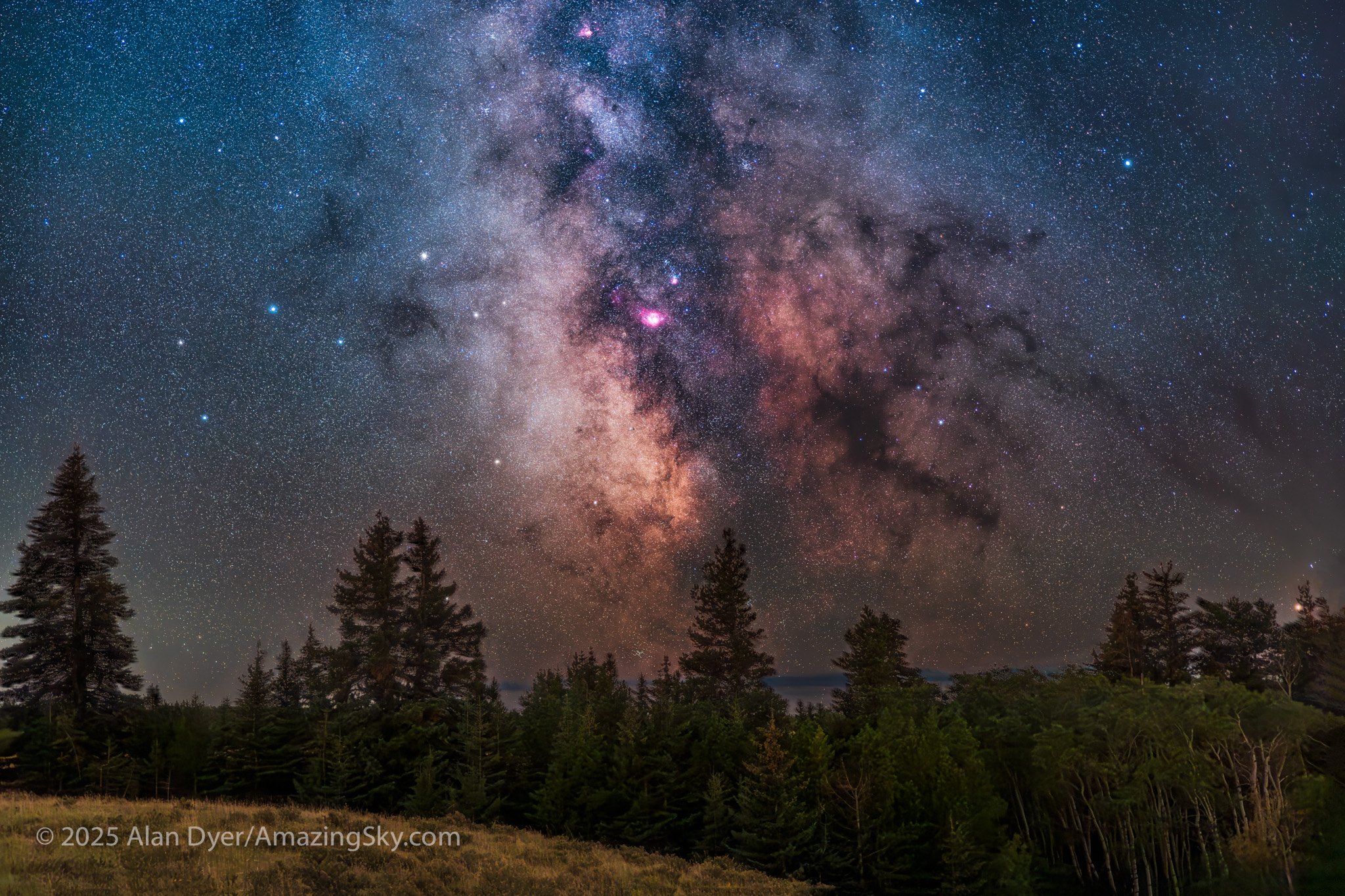
Technical:
This is a blend of:
– A stack of 4 x 1 minute exposures, tracked, for the sky with …
– A stack of 2 x 1-minute exposures, untracked, for the ground,
– All with the Canon RF 28-70mm lens at f/2 and set to 48mm, on the astro-modified Canon EOS R at ISO 1600, and on the MSM Nomad tracker. No filters were employed here.
Masking and blending all the images, with the trees in the foreground was a challenge! The camera was not moved โ€” all images were from the same tripod position.

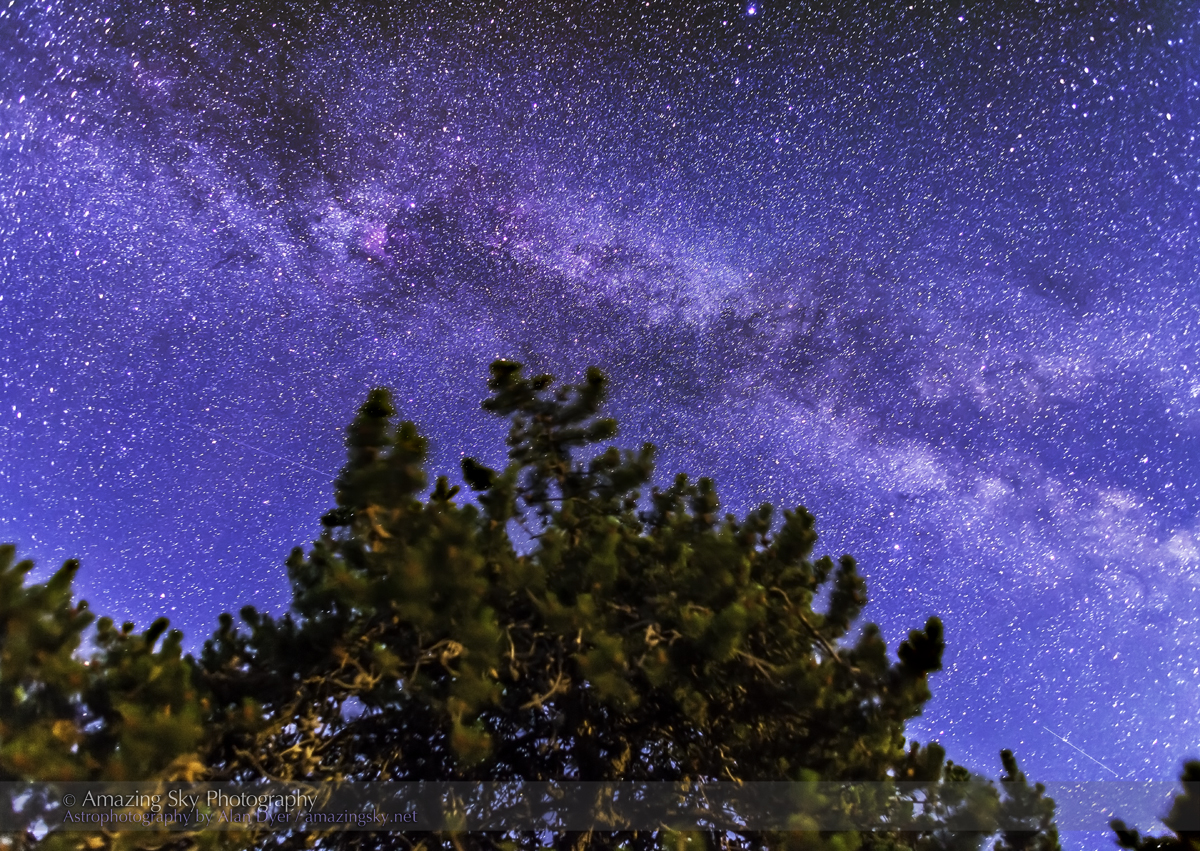
But on the first couple of nights, with the entire four nights of the Party promising to be clear, I left the Party and headed off on my own to shoot some nightscapes over the pine trees at Lookout Point, to again catch the photogenic galactic core in its last appearance for the season.

For the image below, I employed a special filter that isolates the deep red light emitted by the many hydrogen-gas nebulas toward the Milky Way core.
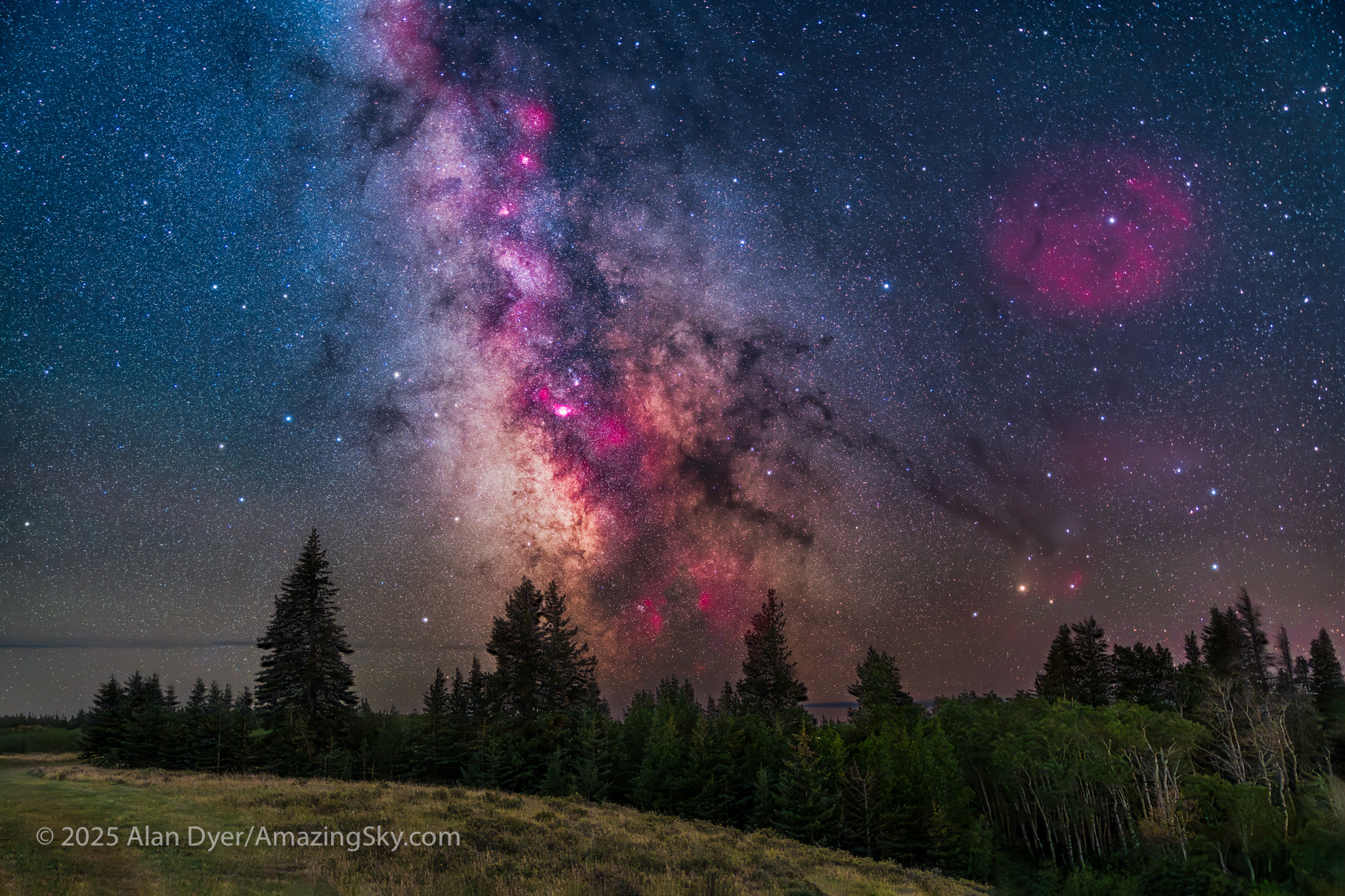
Technical:
This is a blend of:
– A single 2-minute exposure, untracked, for the ground, blended with โ€ฆ
– A stack of 5 x 1 minute exposures, tracked, for the sky, plus โ€ฆ
– An additional tracked 2-minute exposure layered in, taken at the end of the set through an Astronomik “narrowband” H-Alpha clip-in filter, to add the red nebulas.
– All with the Canon RF 28-70mm lens at f/2 and set to 35mm, on the astro-modified Canon EOS R at ISO 1600 (3200 for the Ha shot), and on the MSM Nomad tracker.
Masking and blending all the images, with the trees in the foreground was a challenge! The camera was not moved โ€” all images were from the same tripod position.

This is a technique borrowed from “deep-sky” imaging but now popular among nightscape photographers to create an even more enhanced night sky than a normal unfiltered view.

But even without the filter the long exposures used for the sky record far more detail and colours than even dark-adapted eyes could see. The filter takes that even further.

But those nebulas are there, and they do glow red. Just like the airglow that unaided eyes usually cannot see, the long exposures reveal the unseen, in this case some of the wonderful content of our Galaxy.

And that’s the attraction of astrophotography, to reveal the otherwise elusive or invisible structure of the sky, and in this case juxtaposed over familiar earthly landscapes below.

I can highly recommend Southwest Saskatchewan for anyone interested in stargazing and astrophotography. It’s always been one of my favourite destinations.

โ€” Alan, September 17, 2025 / ยฉ 2025 AmazingSky.com
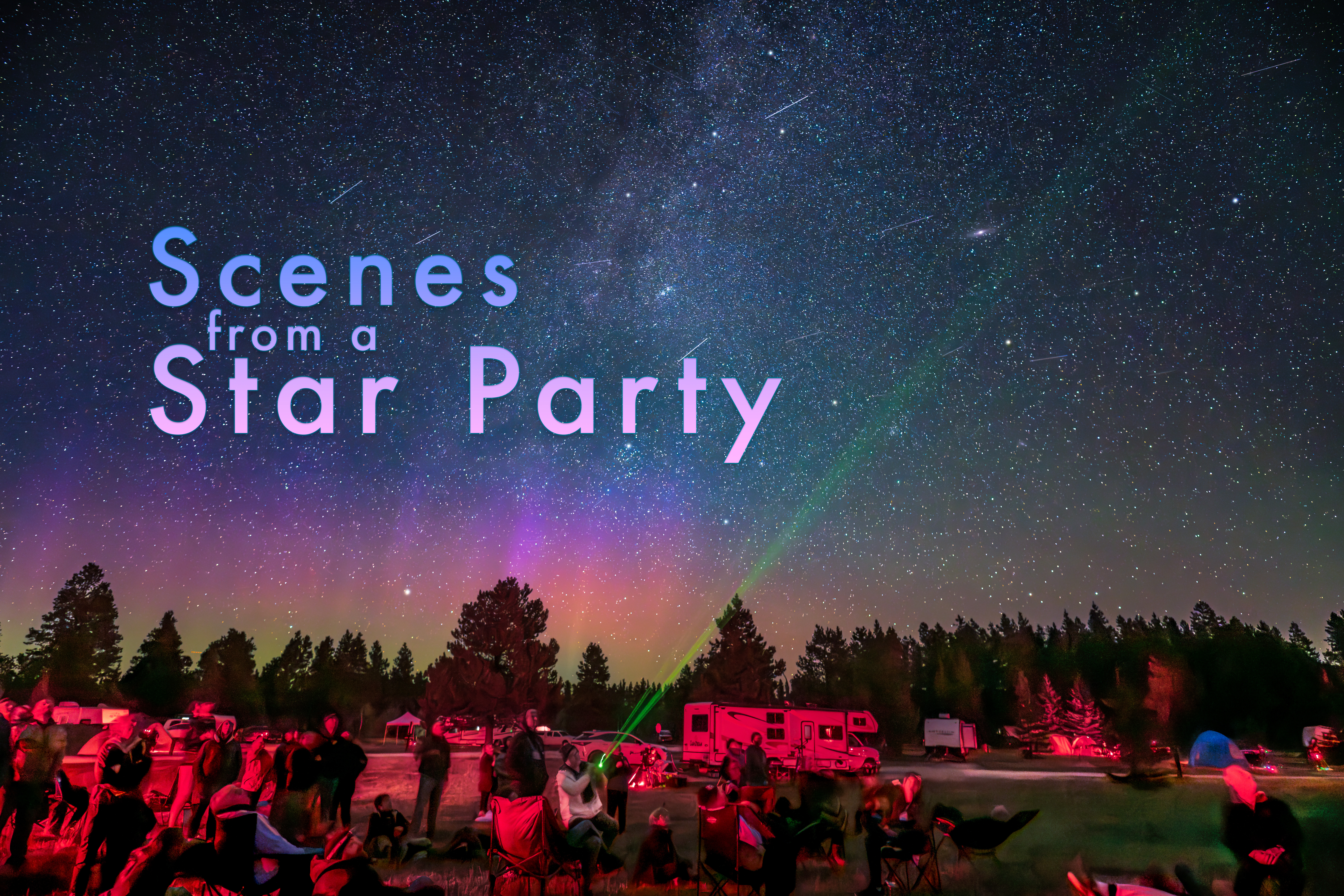
Scenes from a Star Party


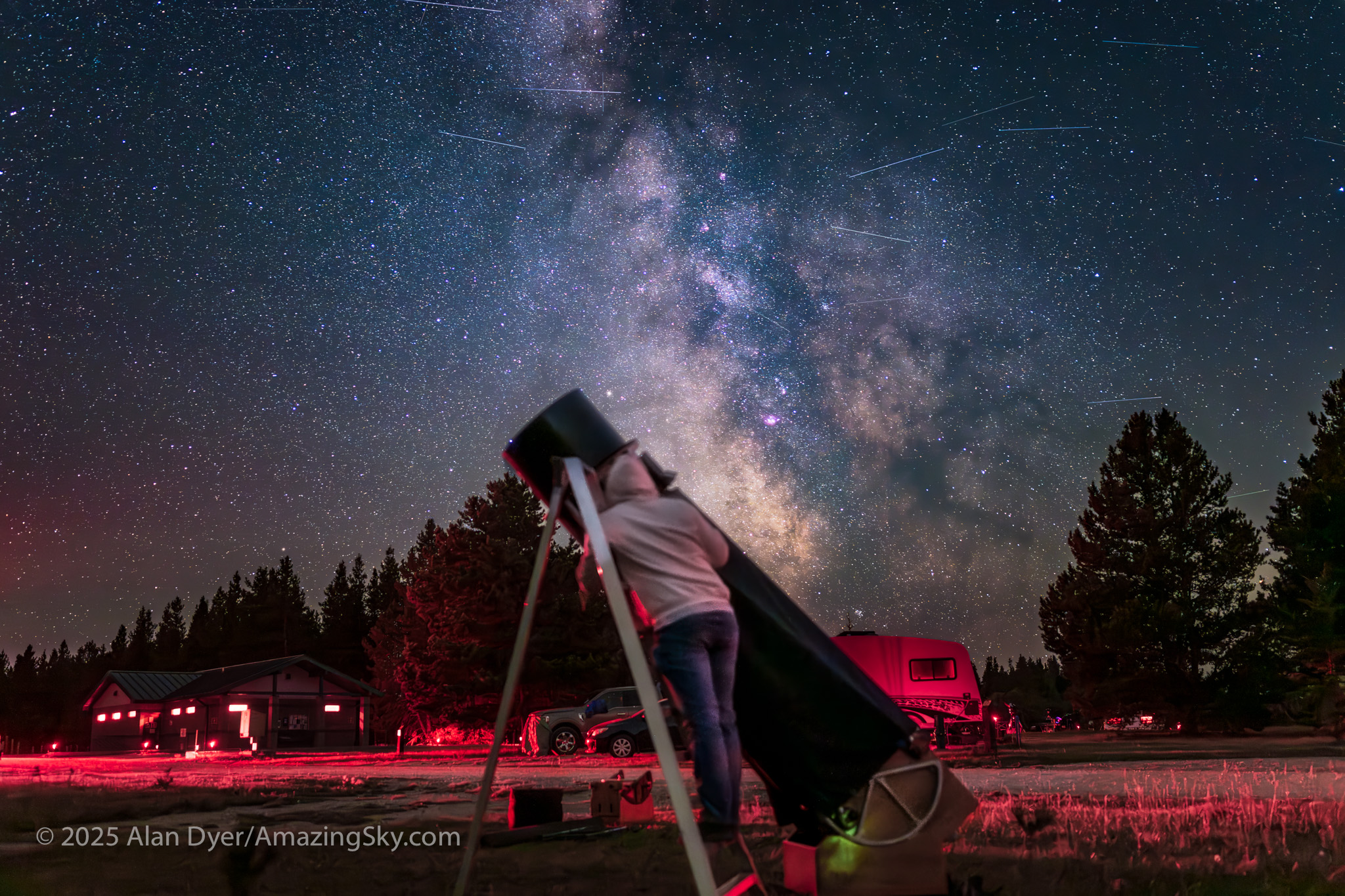
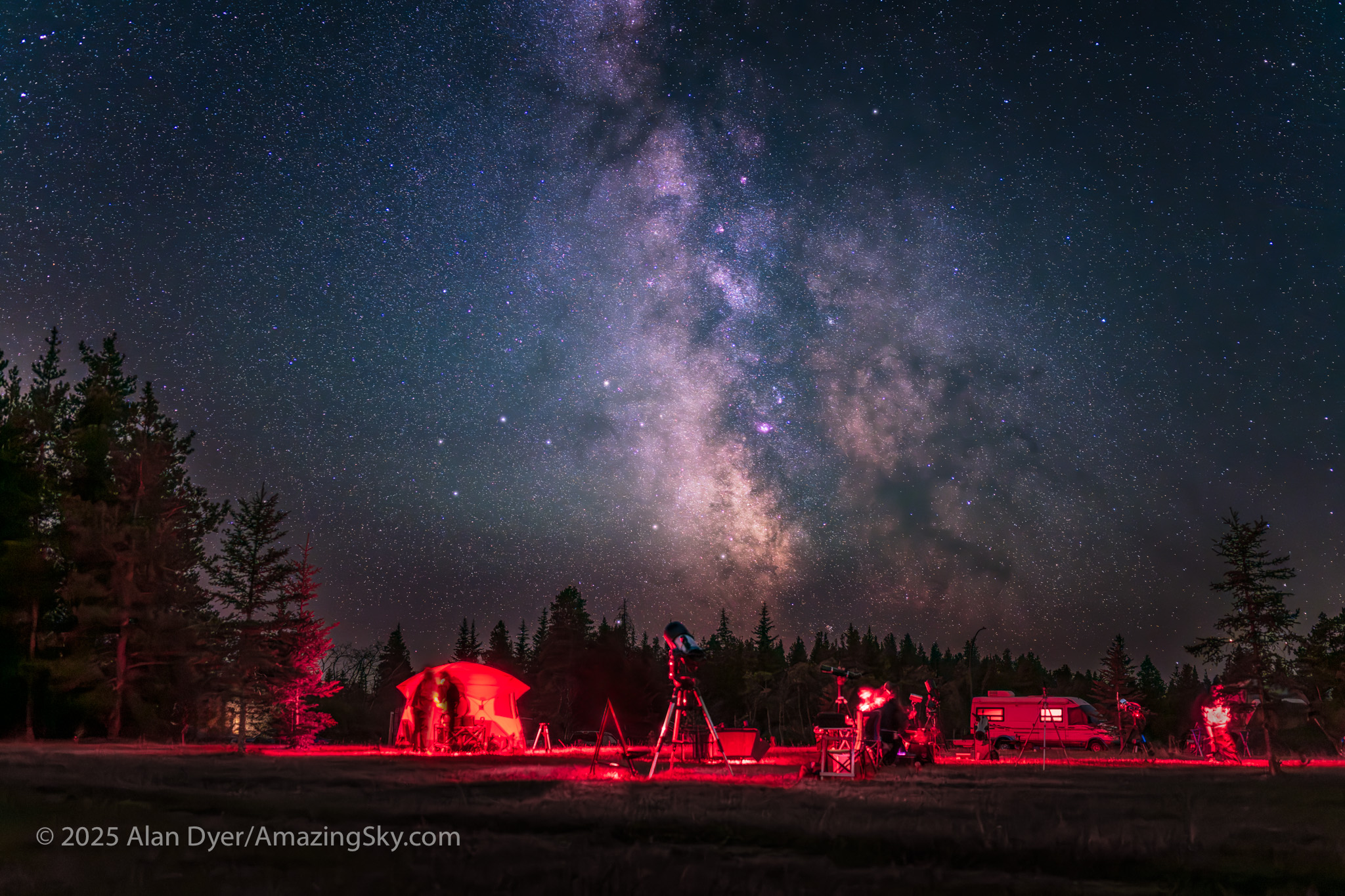
Amateur astronomers like nothing more than spending time under a dark night sky with a field of friends.

Star parties are a popular part of the hobby of amateur astronomy. They’re chances for stargazers to get under dark skies and meet up with others who love the night sky.

Each year I attend the biggest such event in my area in western Canada, the Saskatchewan Summer Star Party. It usually attracts about 320 sky lovers to the very dark skies of southwest Saskatchewan.

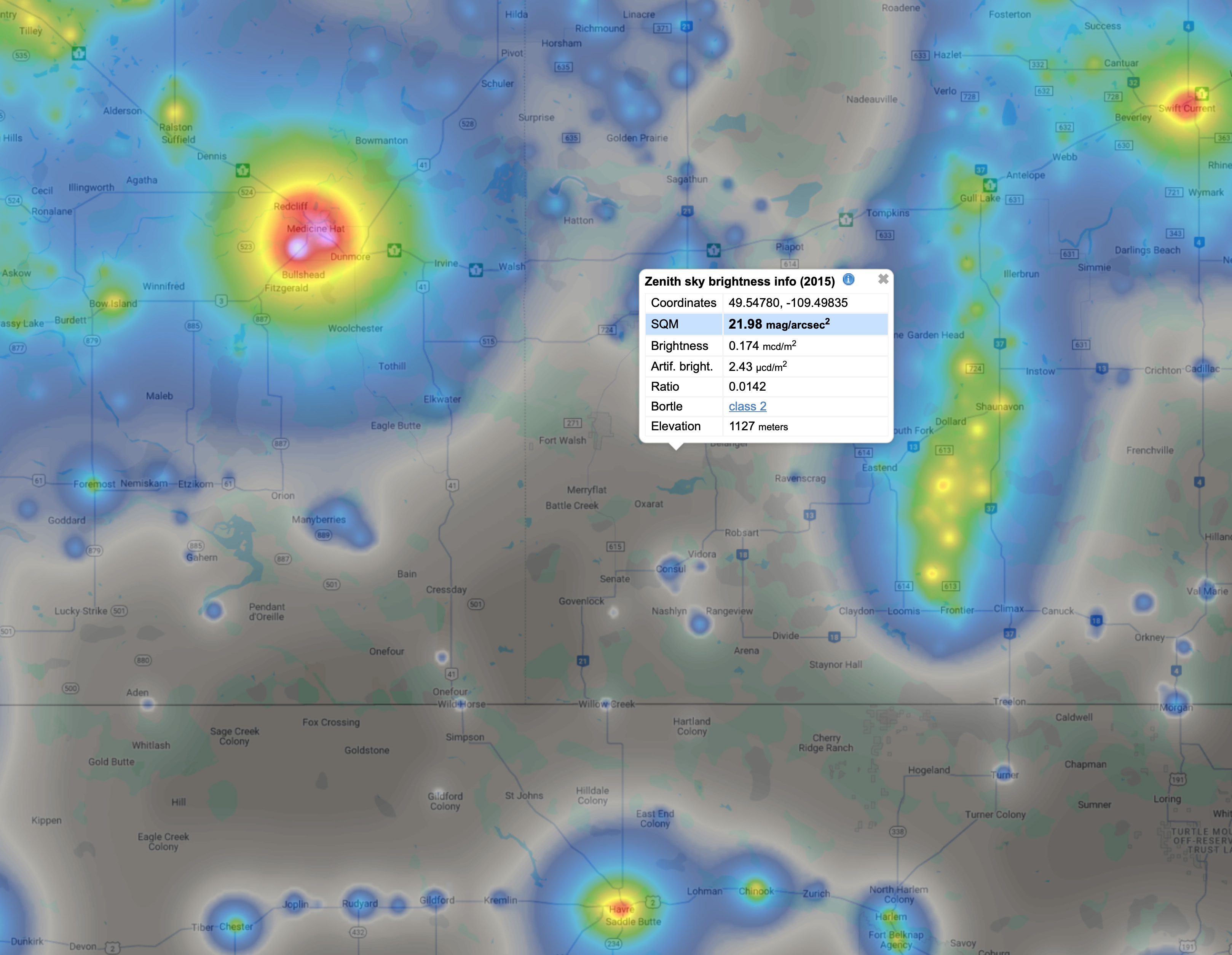
A light pollution map where grey = good!

The label marks the spot for the Party, in the Cypress Hills, and in the Cypress Hills Interprovincial Park, that straddles the border of Saskatchewan and Alberta. As per its name, the SSSP is held on the Saskatchewan side of the Park, in the Centre Block south of Maple Creek. (A complementary Southern Alberta Star Party is held on the Alberta side of the Cypress Hills, in September. I’ll be there!)

As the map shows, the Cypress Hills are far from any light pollution and offer “Bortle 2-class” skies โ€” 1 being the darkest, and 9 being downtown Las Vegas!

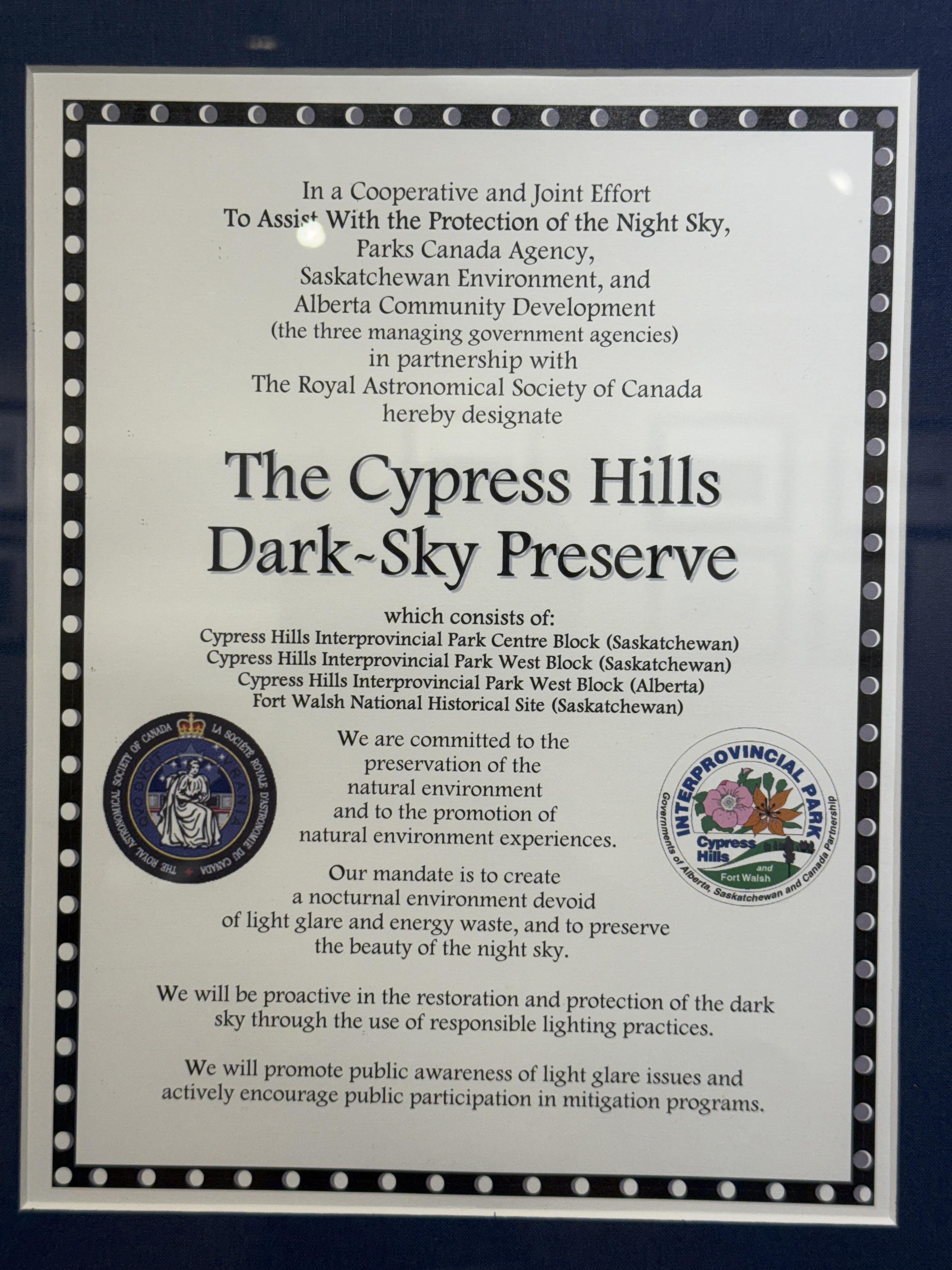
In fact, the Park is a Dark Sky Preserve, a designation awarded in 2004. Parks are increasingly aware of their role in not only conserving flora, fauna, and historical sites, but also the increasingly threatened night sky. As the saying goes, “Half the Park is after dark!”

The DSP Declaration

The Dark Sky Preserve designation, and efforts to refit what lighting is in the Park to “dark-sky friendly” fixtures, came about as a direct result of the Park, and Star Party, being the site of a comet discovery three years earlier.

It was at the Star Party in August 2001 that Regina amateur astronomer Vance Petriew discovered a comet, an observing feat that merits a comet being named for the discoverer.

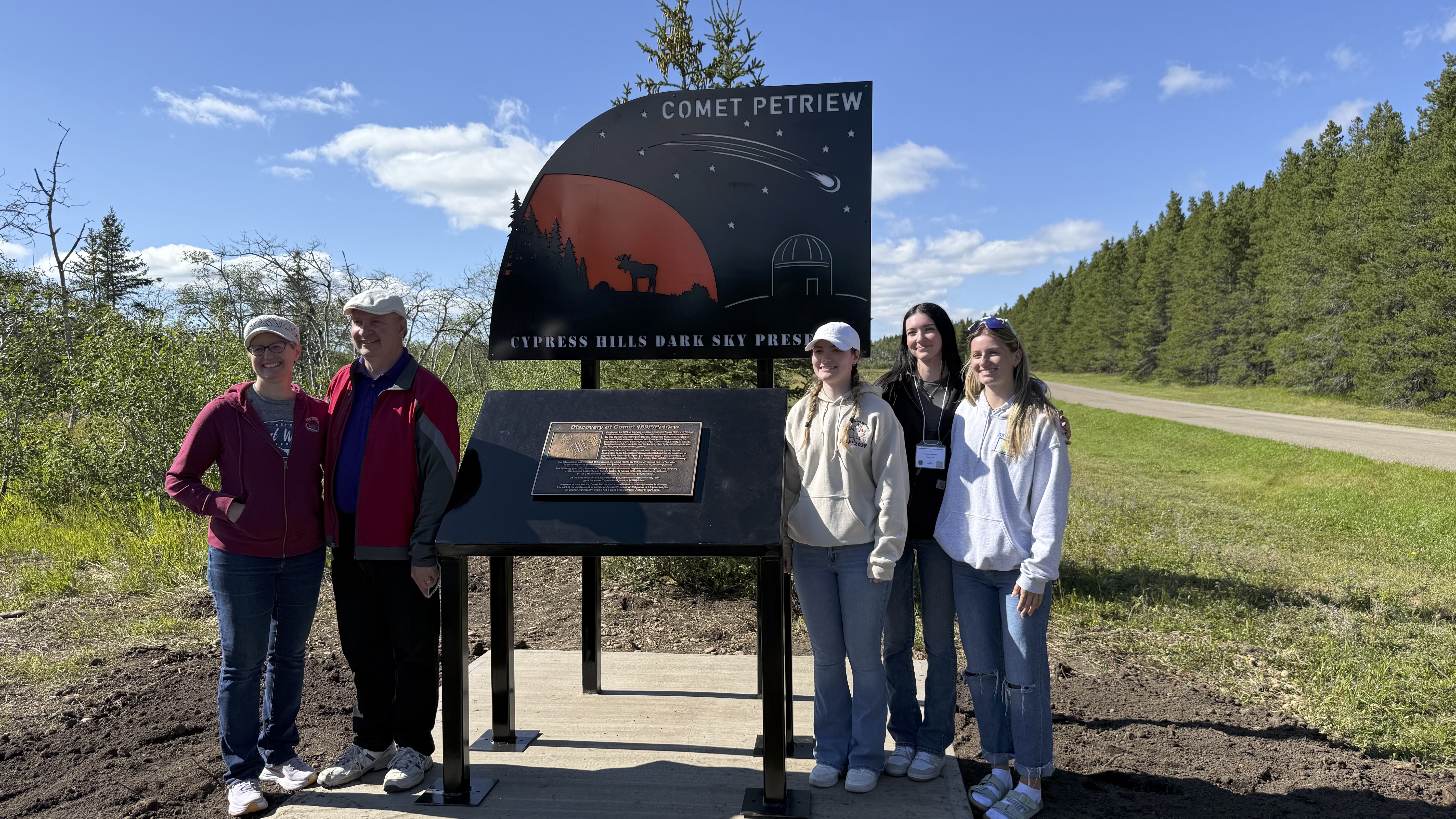
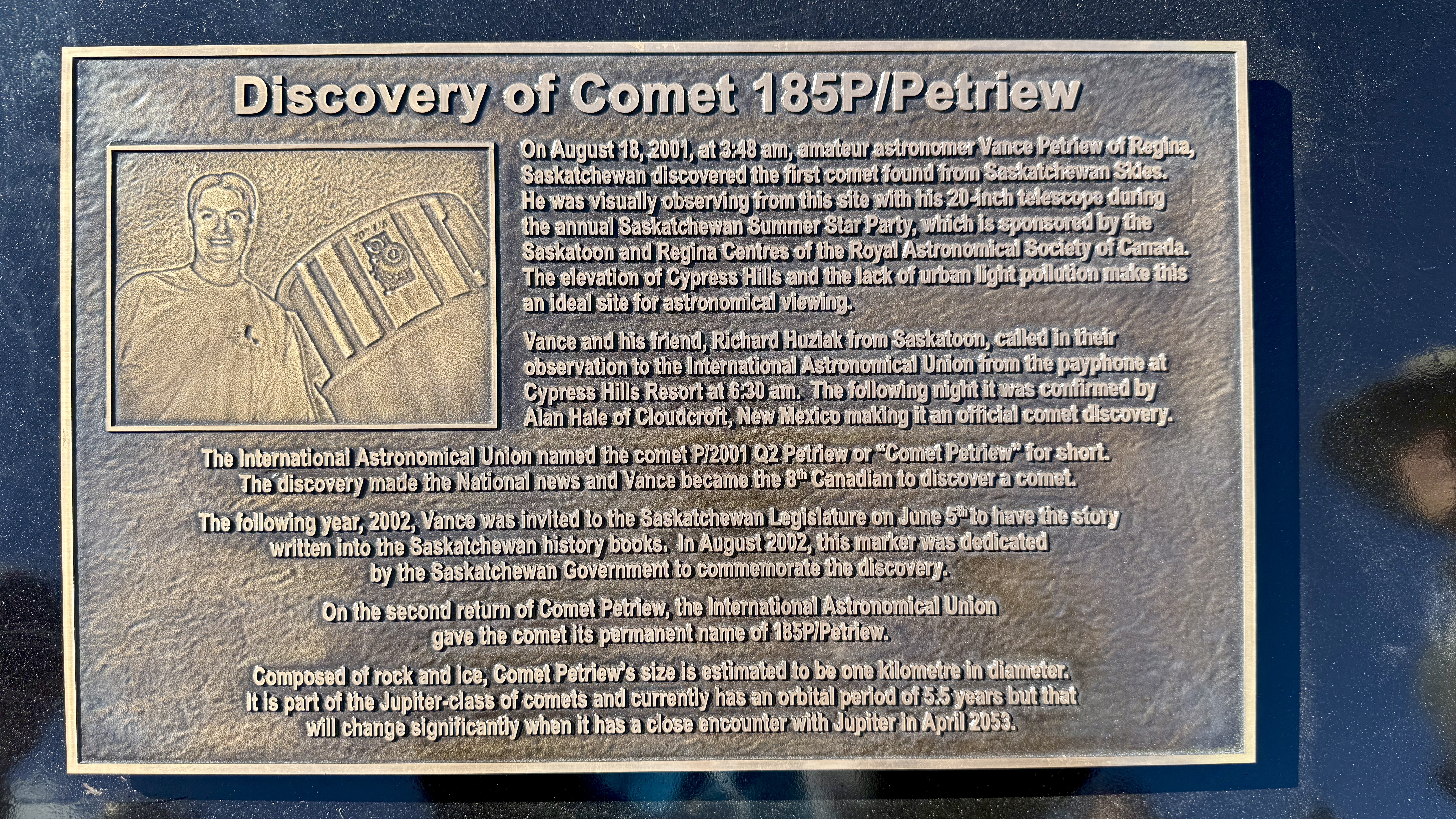
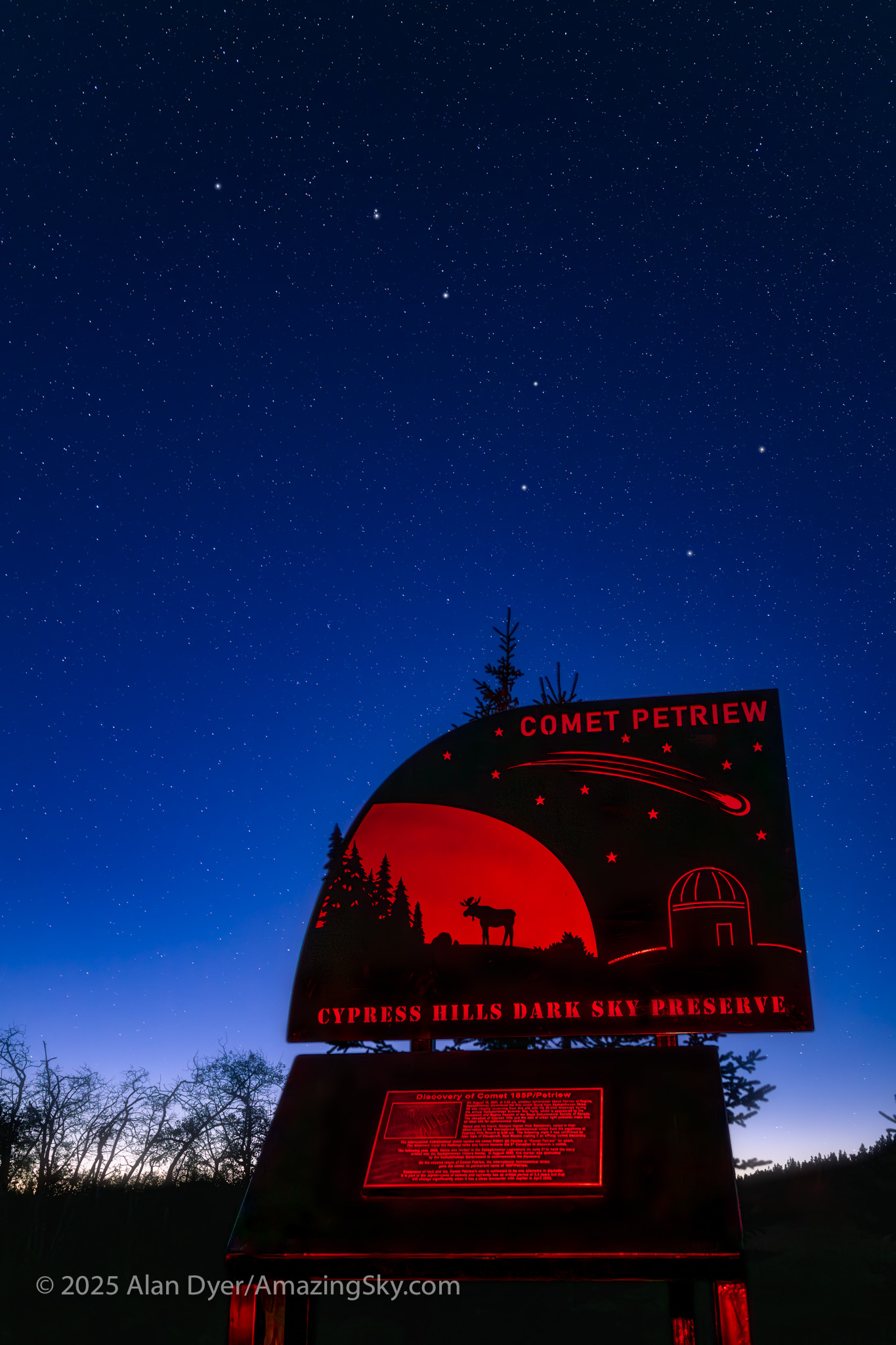
This year, a new sign and plaque were unveiled commemorating the discovery, replacing a cairn that had fallen into disrepair over 20 years. Here is the unveiling โ€”

Park officials, fellow astronomers and Vance unveil the sign.

This was a fine event with all the star party folks in attendance, many of whom were there in 2001! โ€” including the now adult daughters of the Petriew family.

Click on the images below to bring the photos up full screen.

While that was a highlight of the week, the real show was the sky above. The Milky Way was on display in a sky clearer and darker than we had seen it for many years. No clouds, no smoke, and little dew and bugs! The Cypress Hills are a mecca for stargazing!

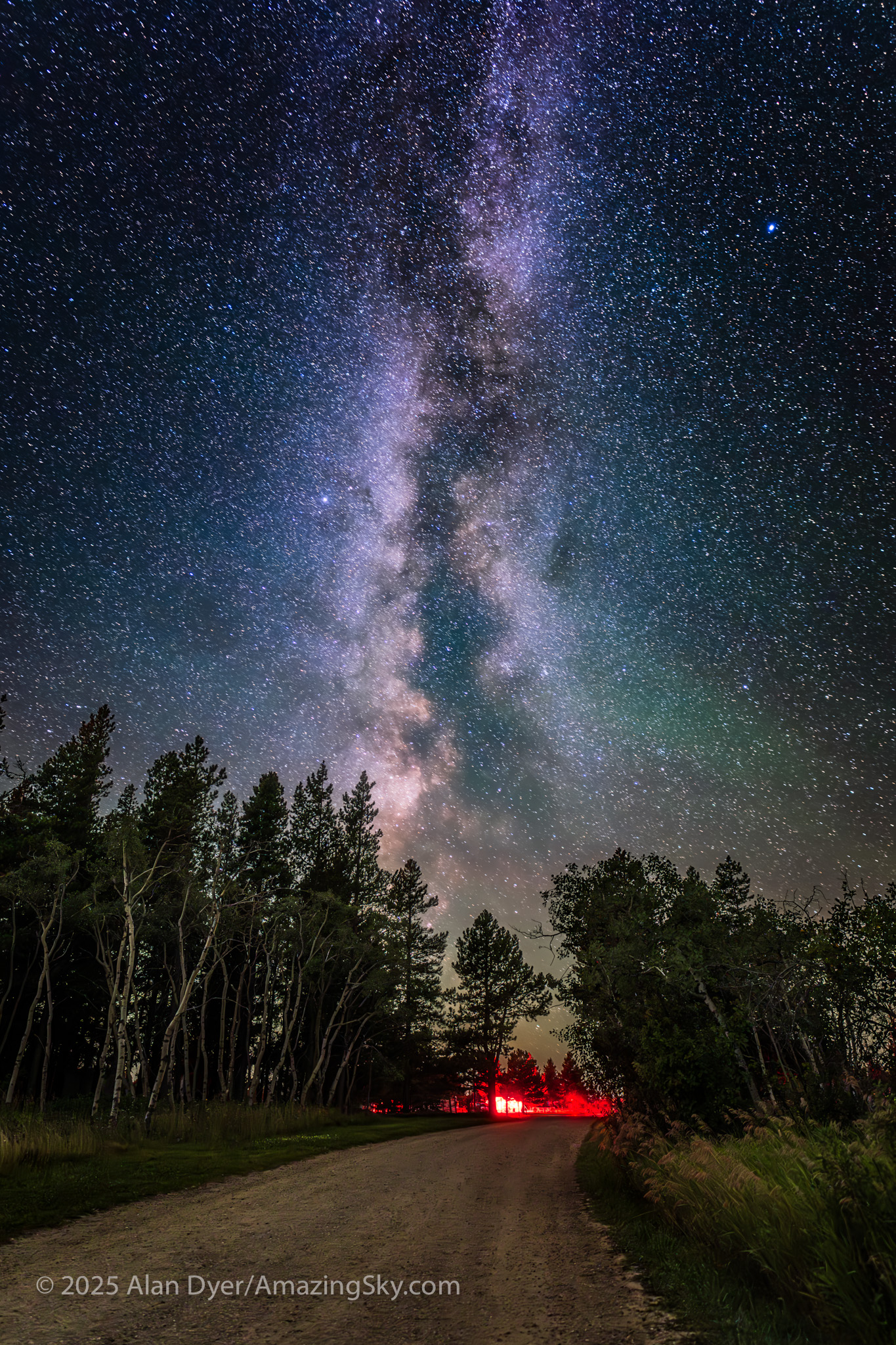
The road into the Meadows Campground, home to the Saskatchewan Summer Star Party. The SSSP is organized by the Royal Astronomical Society of Canada centres in Regina and Saskatoon.

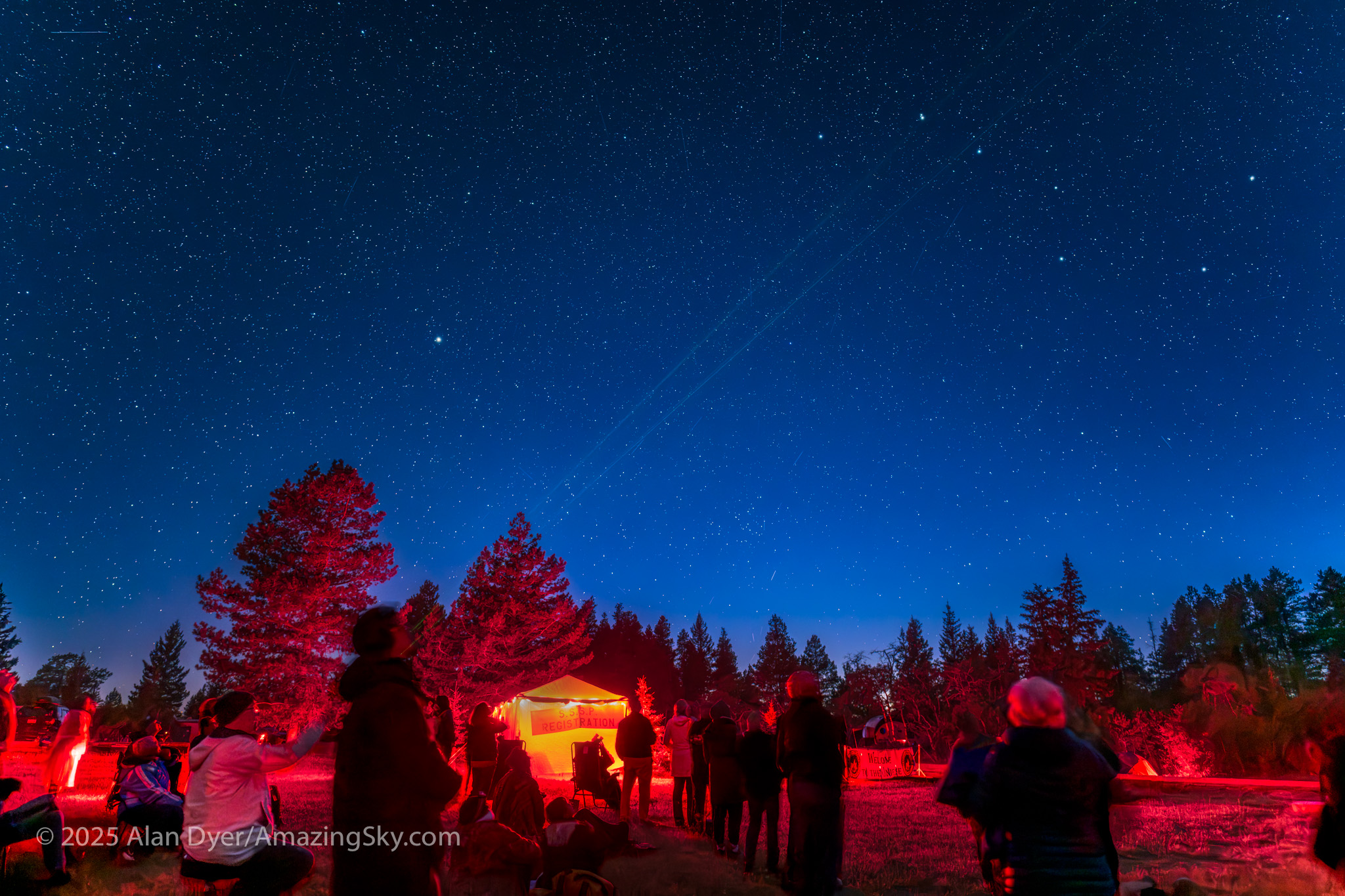
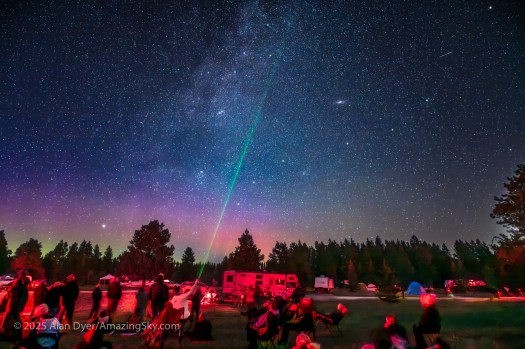
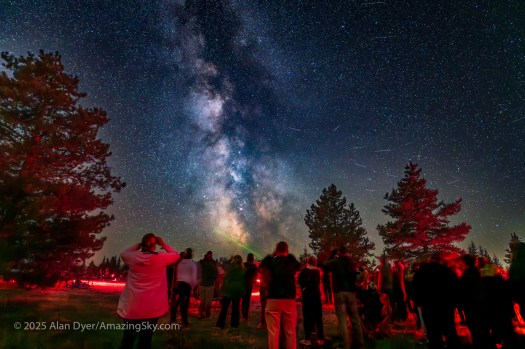
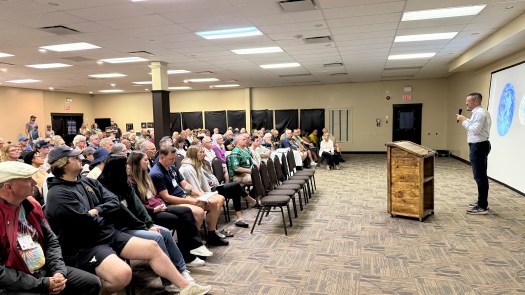
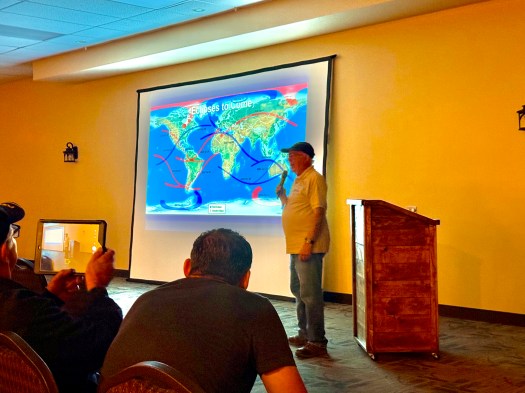
A popular part of this star party, as it is at many such events, is a laser-guided tour of naked-eye sights, where a guide points out the constellation patterns, and highlights objects that need nothing more than binoculars to see well.

In a slide show below, astronomer Ron Waldron from Saskatoon conducts the 2025 Friday night “star walk.” It’s BYOB โ€” Bring Your Own Binoculars!

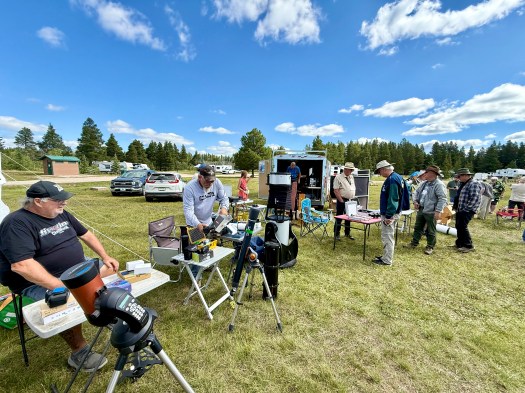
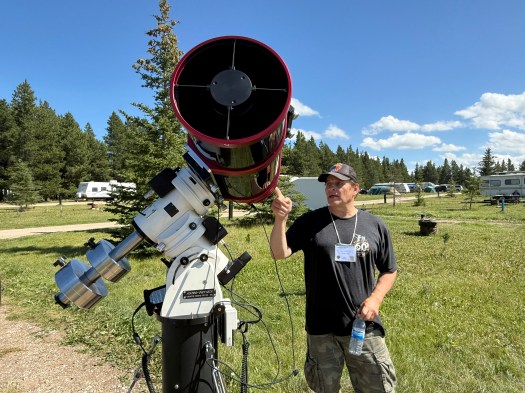
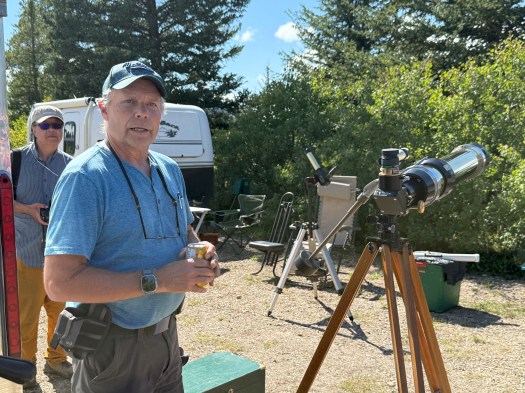
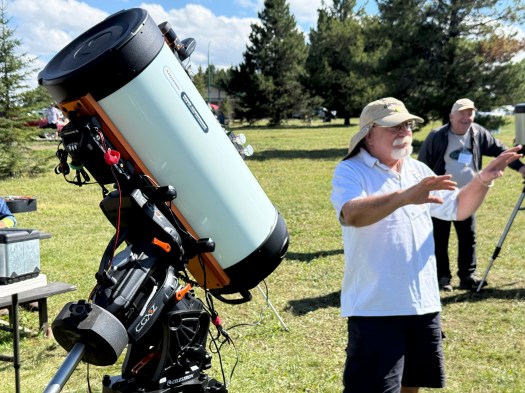
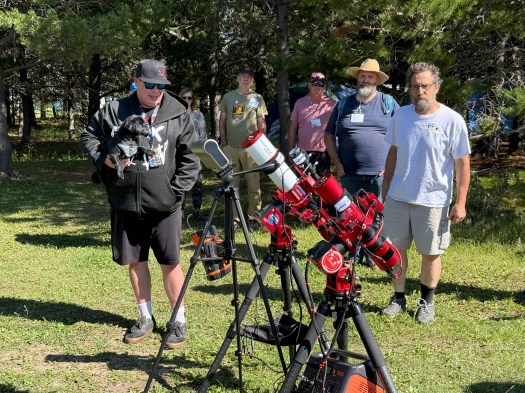
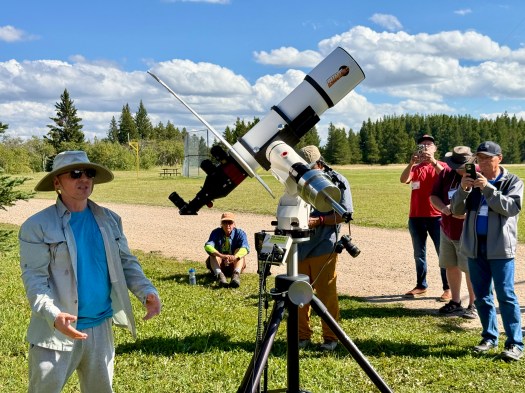
While participants stay up until the wee hours to enjoy all that the sky has to offer, every star party offers a range of daytime activities (but not happening too early!). Star parties are great places to see fields of telescopes of every description. This year the program included a formal “show-and-shine” tour of some notable gear for all to admire. And there’s the ever-popular swap meet with bargains on offer.

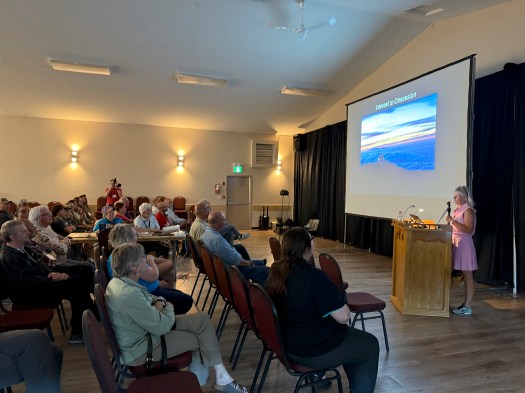
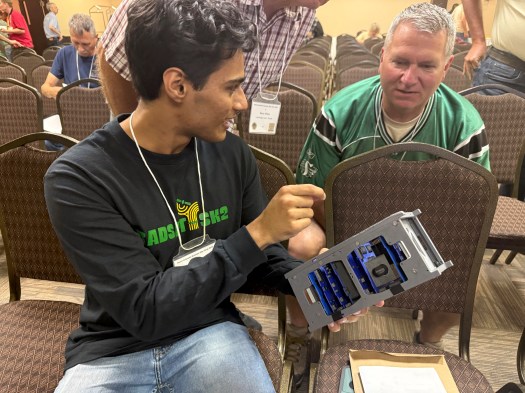
We enjoyed several talks on a range of astronomy topics, not just stargazing, but also the latest in science research. We heard about a satellite being built in Saskatchewan by U of S and U of R students, and about how the Mars Perseverance rover collects samples, in a talk from one of the researchers involved with the NASA mission.

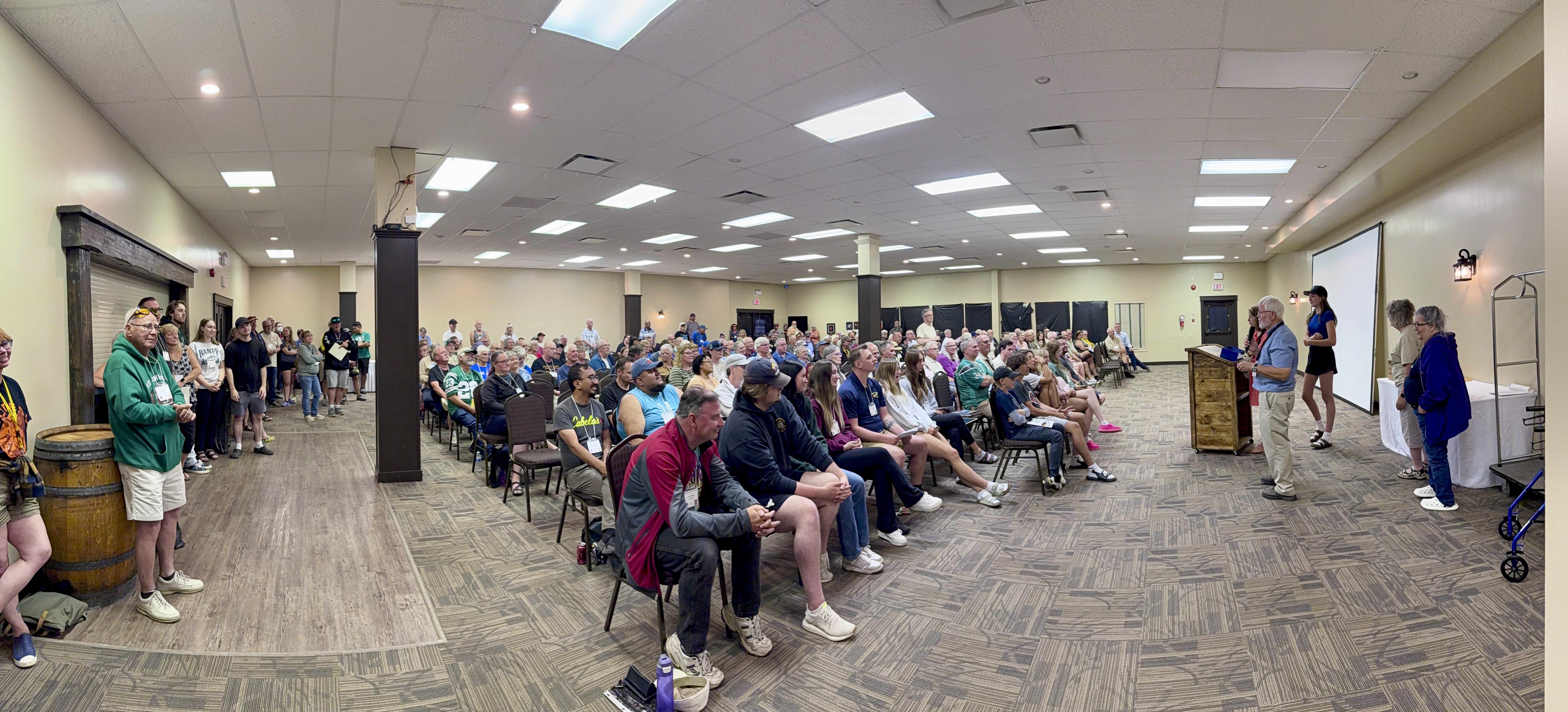
And of course there were awards and door prizes to be won! Always to a capacity crowd at the Cypress Resort conference room.

The door prizes being handed out. You must be in the room to win!

It was a superb 4 days of astronomy and stargazing. If you are in the area, I highly recommend attending. Next year’s SSSP will be August 12 to 15 inclusive โ€” it’s always at New Moon. The website is here but won’t be updated for the 2026 event details until next year.

I won’t be there in 2026, as August 12 is the date of the next total eclipse of the Sun, which I discuss in my previous blog. I plan to be in Spain!

This is the new sign and plaque commemorating the discovery in 2001 of a comet here in the Cypress Hills Interprovincial Park by Vance Petriew.

But I highly recommend attending in 2026. As most people do, you may find yourself enjoying the weekend so much you make it an annual event in your calendar. I shall miss my annual August ritual of the SSSP in 2026 and in 2027 โ€” there’s an eclipse that August, too!

But 2025 was certainly a fine year to enjoy all that the Cypress Hills have to offer under the stars.

โ€” Alan, September 6, 2025 / AmazingSky.com
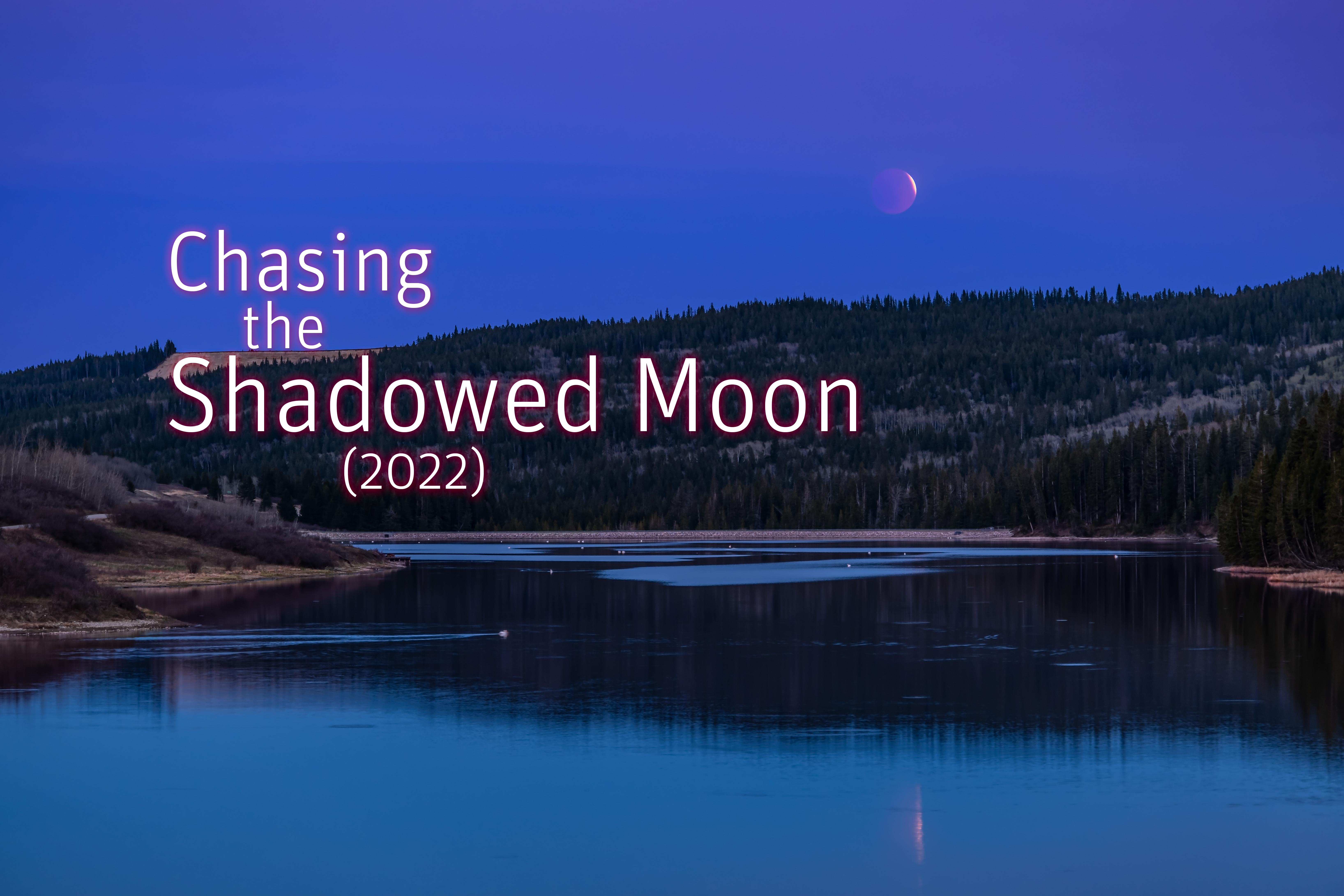
Chasing the Shadowed Moon (2022)


Once again, catching the eclipsed Moon required a chase to clear skies.

As with every previous eclipse of the Moon visible from my area in the last decade, I didn’t have the luxury of watching it from home, but had to chase to find clear skies.
(See my previous tales of the November 19, 2021 and May 26, 2021 eclipses.)

However, the reward was the sight of the reddened Moon from one of my favourite locations in Alberta, Reesor Lake, in Cypress Hills Interprovincial Park.

The eclipse in question was the total lunar eclipse of May 15/16, 2022. As with any eclipse, planning starts with a look at the weather forecasts, or more specifically cloud forecasts.

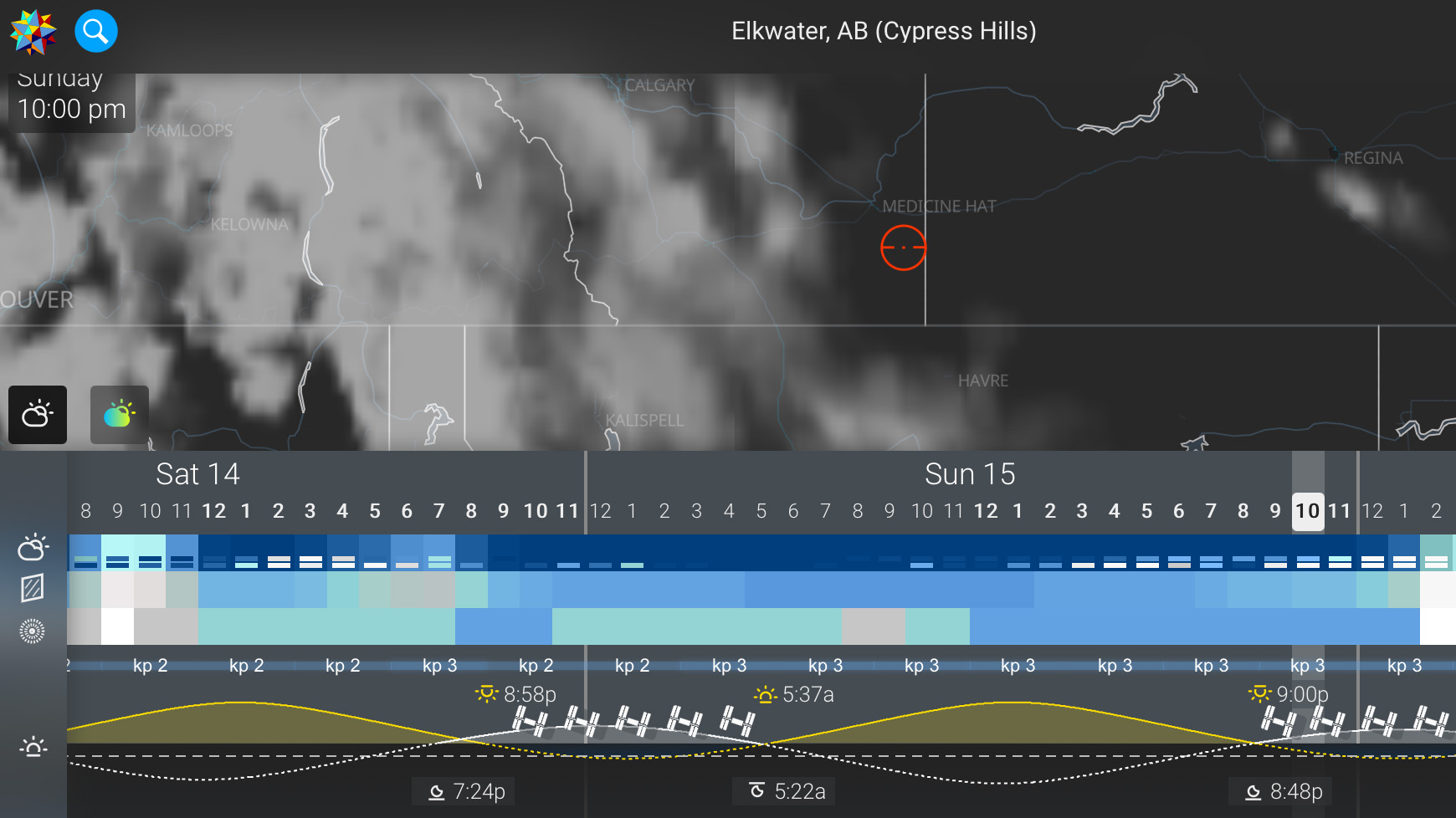
A few days prior, conditions didn’t look good from my home, to the west of the red marker.

Cloud forecast two days prior.

But as the chart from the app Astrospheric shows, very clear skies were forecast for southeast Alberta, in the Cypress Hills area, where I have shot many times before.

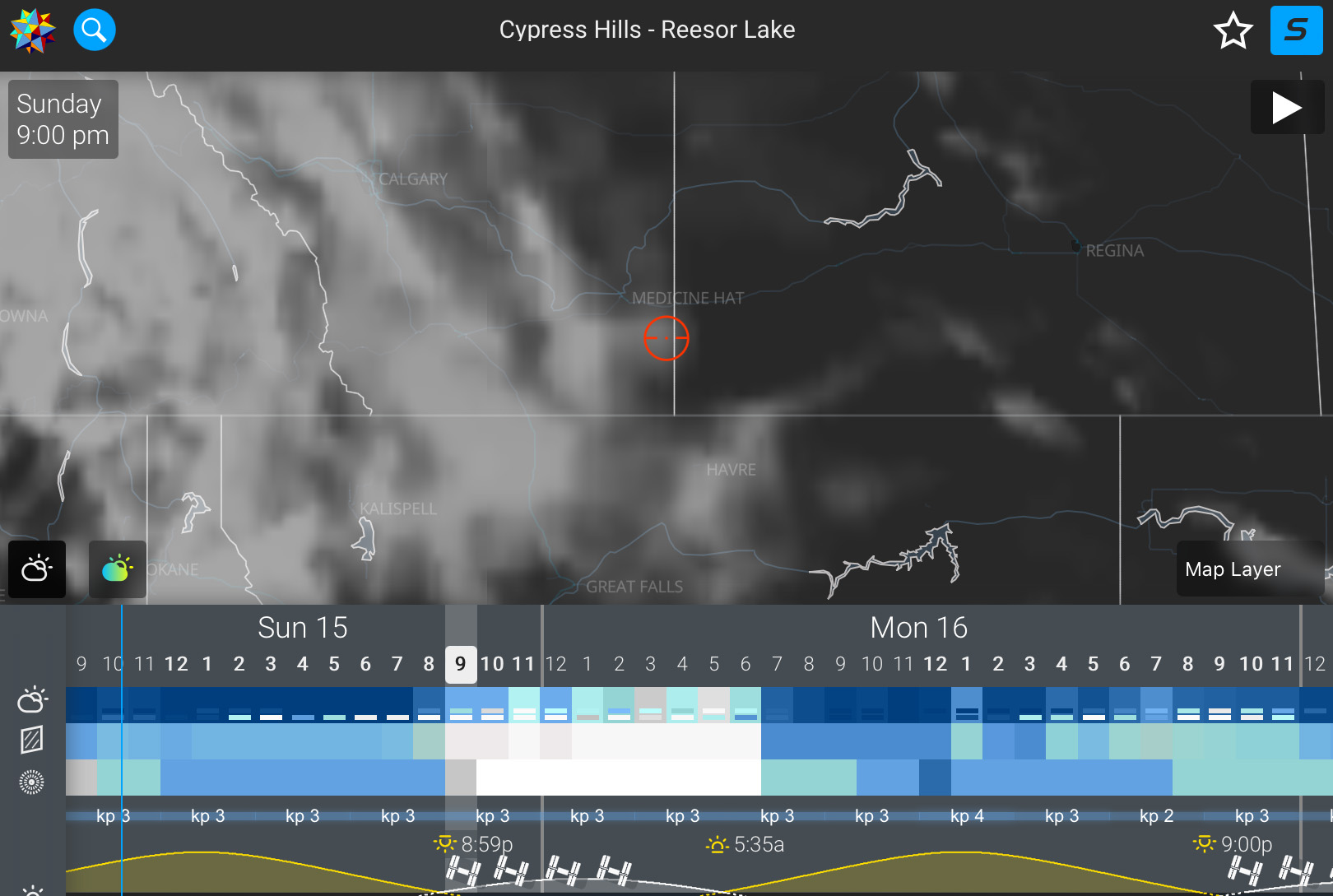
Except as eclipse evening drew closer, the forecast got worse. Now, the clouds were going to extend to my chosen site, with a particularly annoying tongue of cloud right over my spot. Clouds were going to move in just as the total eclipse began. Of course!

Cloud forecast the morning of the eclipse.

I decided to go for it anyway, as the Moon would be to the east, in the direction of the clear skies. It didn’t need to be clear overhead. Nor did I want to drive any farther than I really needed, especially to another location with an unknown foreground.

The spot I chose was one I knew well, on the west shore of scenic Reesor Lake, near the Alberta/Saskatchewan border, but on the Alberta side of Cypress Hills Interprovincial Park.

I used the app The Photographer’s Ephemeris (TPE) to help plan the shoot, to ensure the Moon would be well situated over the lake.

A screen shot from TPE

Handily, TPE provides moonrise times and angles for the chosen location, as well as eclipse times for that time zone.

The companion app, TPE 3D, provides a preview of the scene in 3D relief, with the hills depicted, as a check on Moon altitude and azimuth with respect to the horizon below.

TPE 3D’s simulation

As you can see the simulation matched reality quite well, though the image below was from an earlier time than the simulation, which was for well after mid-totality.

The eclipse over Reesor Lake, in the last stages of the partial eclipse.

However, true to the predictions, clouds were moving in from the west all during the eclipse, to eventually obscure the Moon just as it entered totality and became very dim. Between the clouds and the dark, red Moon, I lost sight of it at totality. As expected!

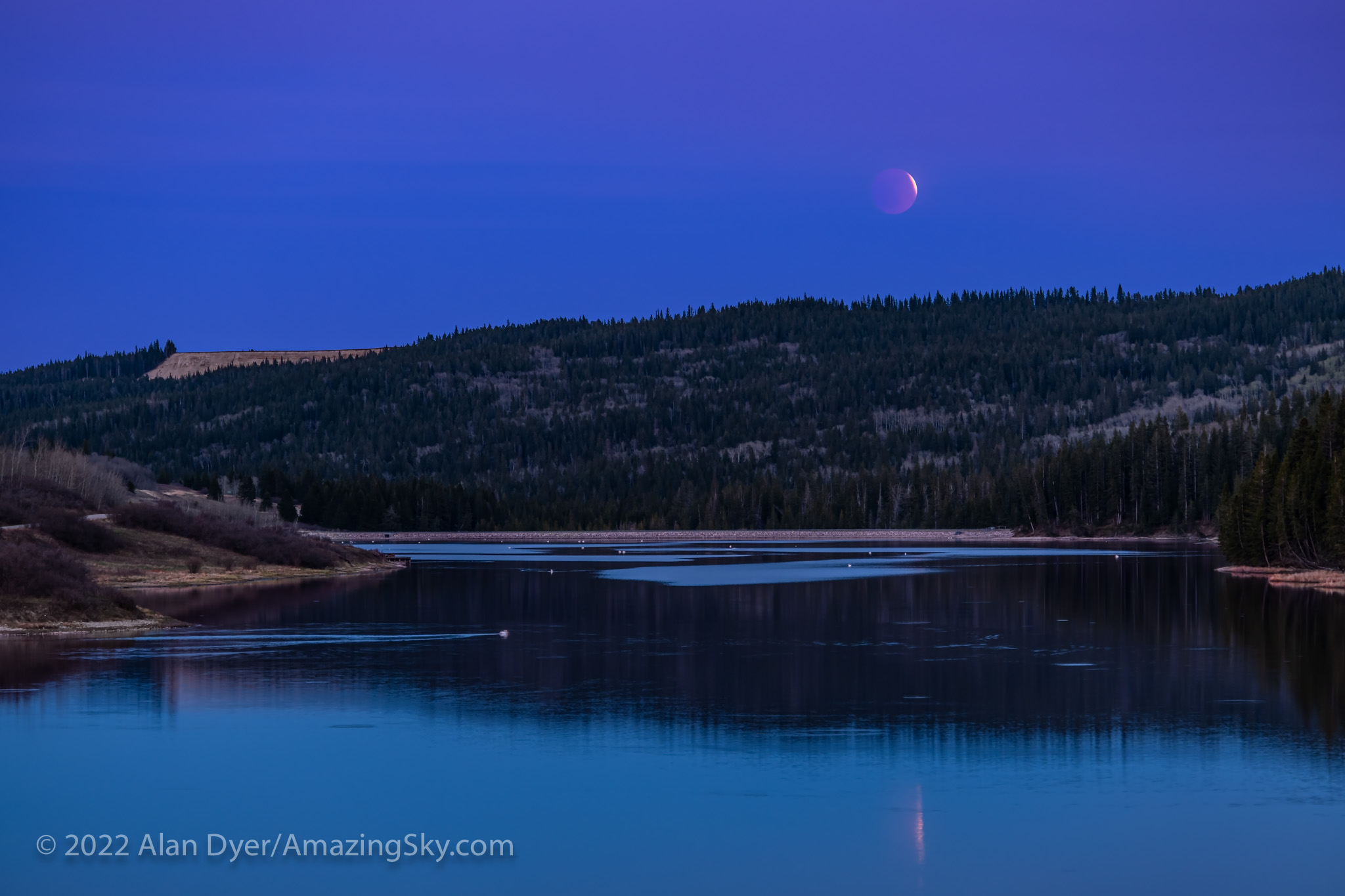
Below is my last sighting, just before totality began.

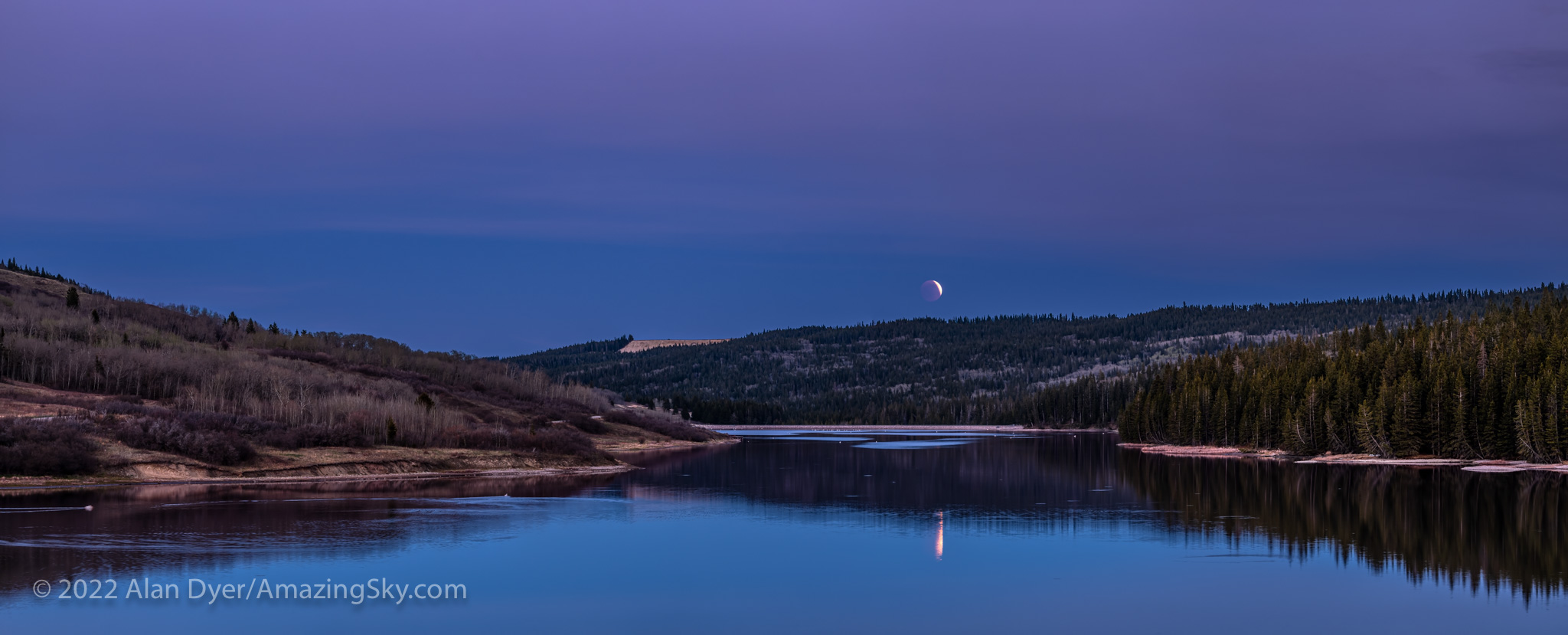
The eclipsed Full Moon rising over Reesor Lake in Cypress Hills Interprovincial Park, Alberta, on May 15, 2022.

However, I was content at having captured the eclipse from a photogenic site. More images of a complete eclipse would have been nice, but alas! I still consider the chase a success.

A panorama of the eclipsed Full Moon rising over Reesor Lake in Cypress Hills Interprovincial Park, Alberta, on May 15, 2022.

Just for fun, I shot a quick panorama of three segments, and it turned out to be my favourite image from the eclipse, capturing the scene very well. Pelicans and geese were plying the calm waters of the lake. And owls were hooting in the woods. It was a fabulous evening!

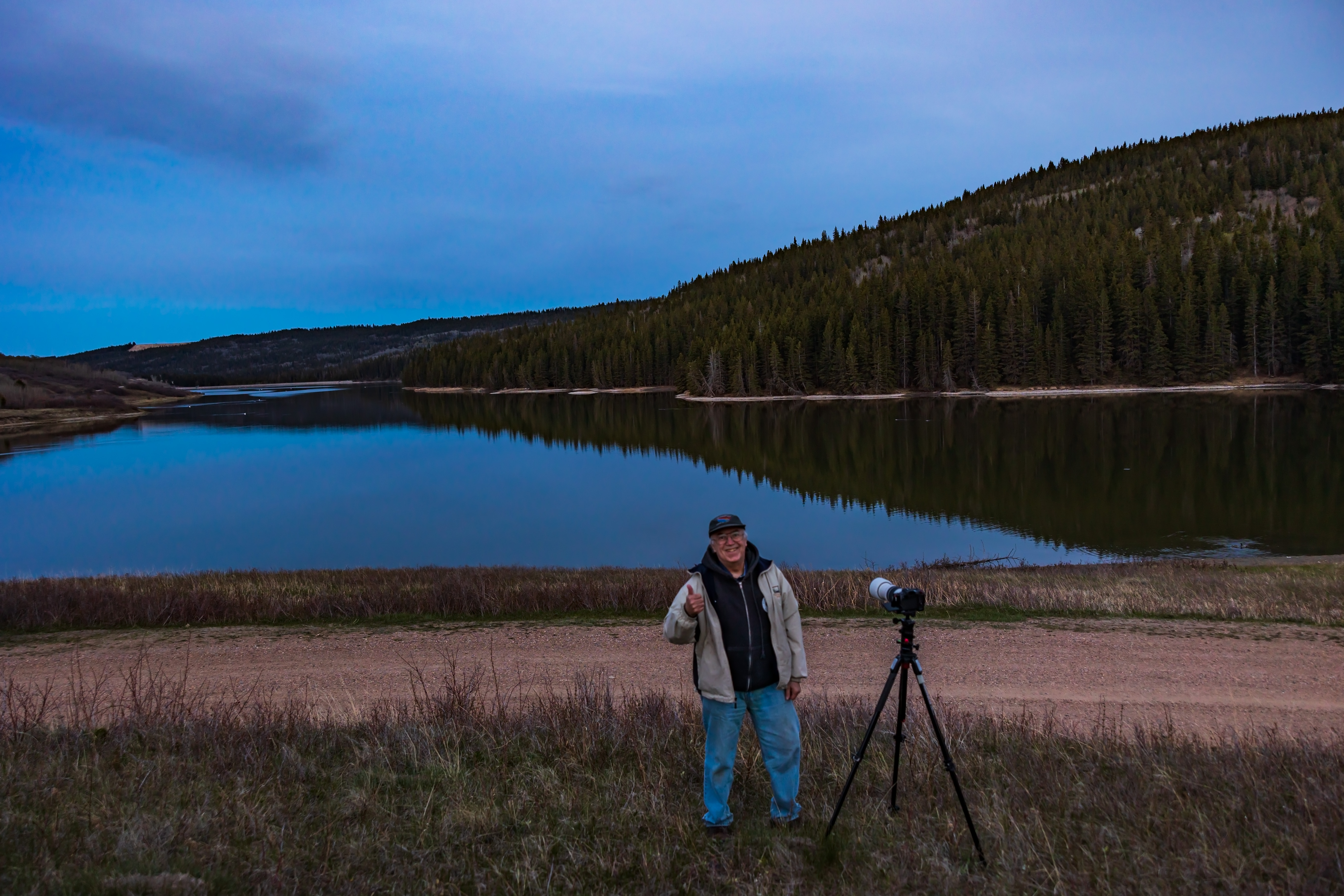
Me at Reesor Lake after shooting the lunar eclipse of May 15, 2022, with the Moon now in clouds behind me.

Before departing, I took my customary “trophy” shot, of the eclipse hunter having bagged his game.


Interestingly, this eclipse was a close repeat of one 19 years earlier to the day, because of the so-called Metonic Cycle where eclipses of the Sun and Moon repeat at 19-year intervals on the same calendar day, at least for 2 or 3 cycles.

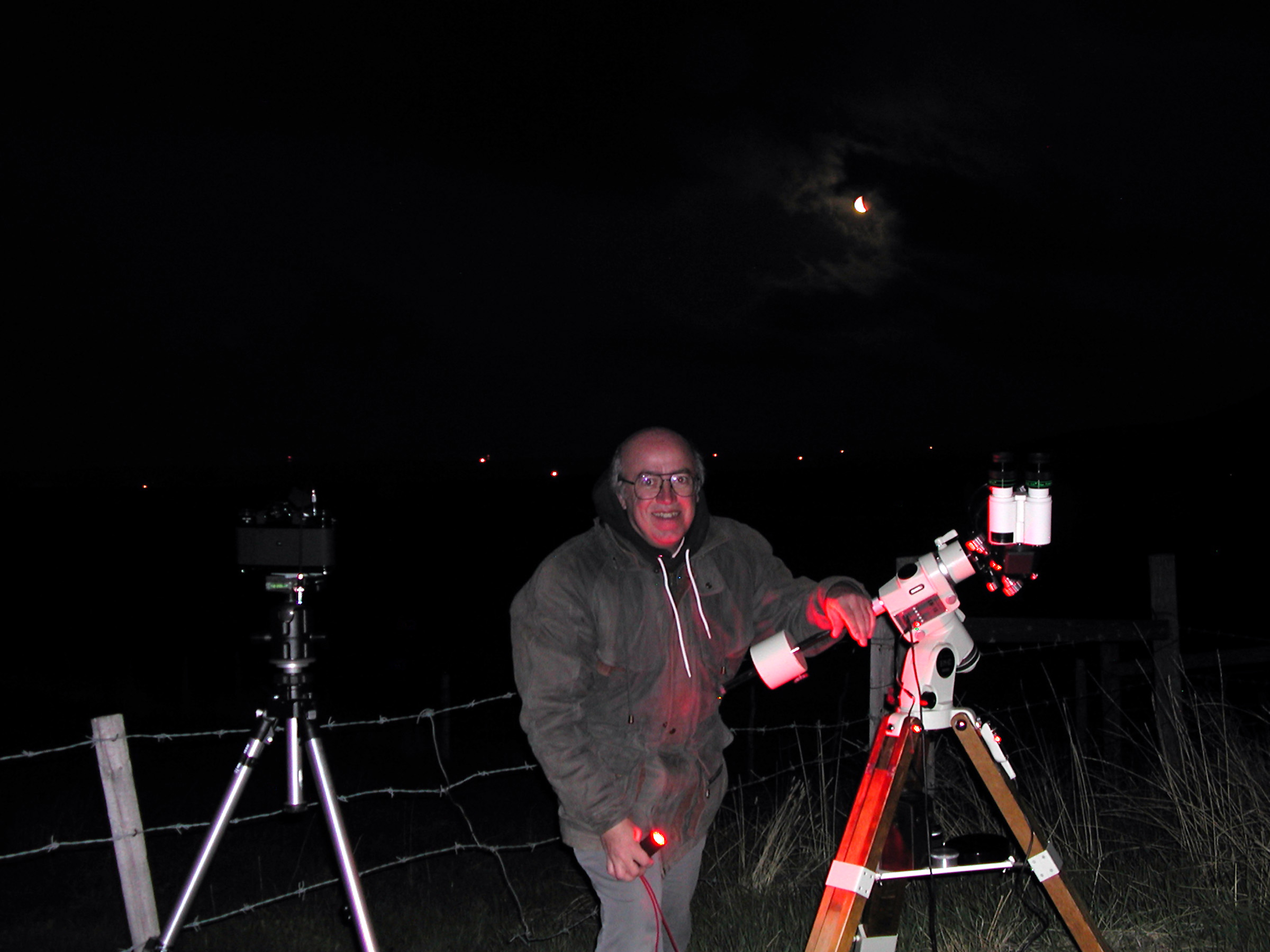
The trophy shot from May 15, 2003.

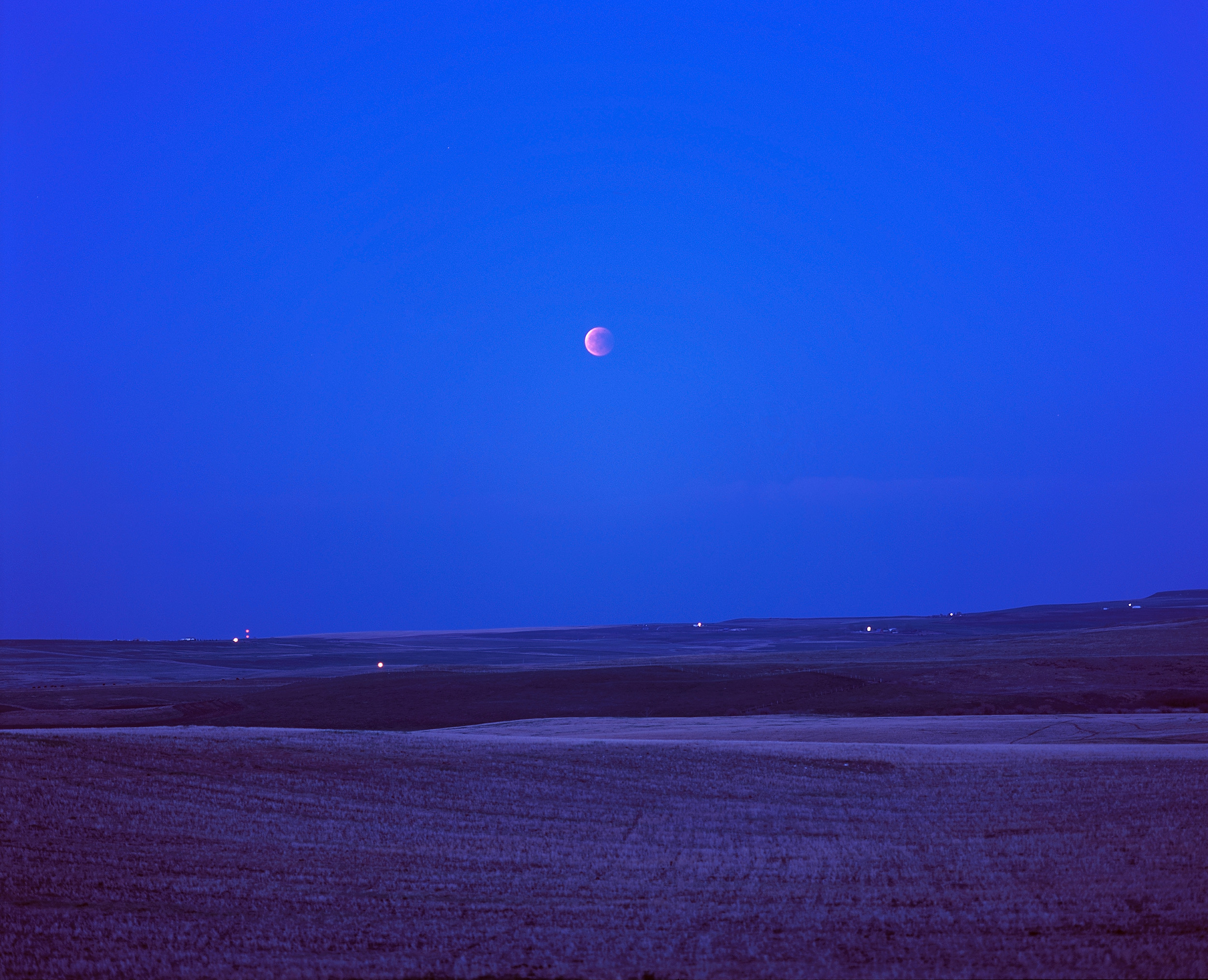
On May 15, 2003, we also had a total lunar eclipse in the early evening, with the eclipsed Moon rising into a spring twilight sky. I also chased clear skies for that one, but in the opposite direction from home, to the southwest, to the foothills. At that time it was all film, and medium format at that.

Total eclipse of the Moon seen May 15, 2003 from southern Alberta (from a site west of Nanton). The Moon rose as totality started so was deep into totality by the time it was high enough to see and sky dark enough to make it stand out. Pentax 67 camera with 165mm lens at f/2.8 with Fujichrome 100F slide film.

So it was another (partially!) successful eclipse chase.

The next opportunity is on the night of November 7/8, 2022, a time of year not known for clear skies!

Just once I would like to see one from home, to make it easier to shoot with various telescopes and trackers, as the reddened Moon will be west of the photogenic winter Milky Way, and very close to the planet Uranus. Plus for me in Alberta the November eclipse occurs in the middle of the night, making a home eclipse much more convenient. After that, the next chance is March 13/14, 2025.

But no matter the eclipse, I suspect another chase will be in order! It just wouldn’t be a lunar eclipse without one.

โ€” Alan, May 19, 2022 (amazingsky.com)


The Living Skies of Saskatchewan


Gazing at the Milky Way in Grasslands National Park

I spent a wonderful week touring the star-filled nightscapes of southwest Saskatchewan.

On their license plates Saskatchewan is billed as the Land of Living Skies. I like the moniker that Saskatchewan singer-songwriter Connie Kaldor gives it โ€“ the sky with nothing to get in the way.

Grasslands National Park should be a mecca for all stargazers. It is a Dark Sky Preserve. You can be at sites in the Park and not see a light anywhere, even in the far distance on the horizon, and barely any sky glows from manmade sources.

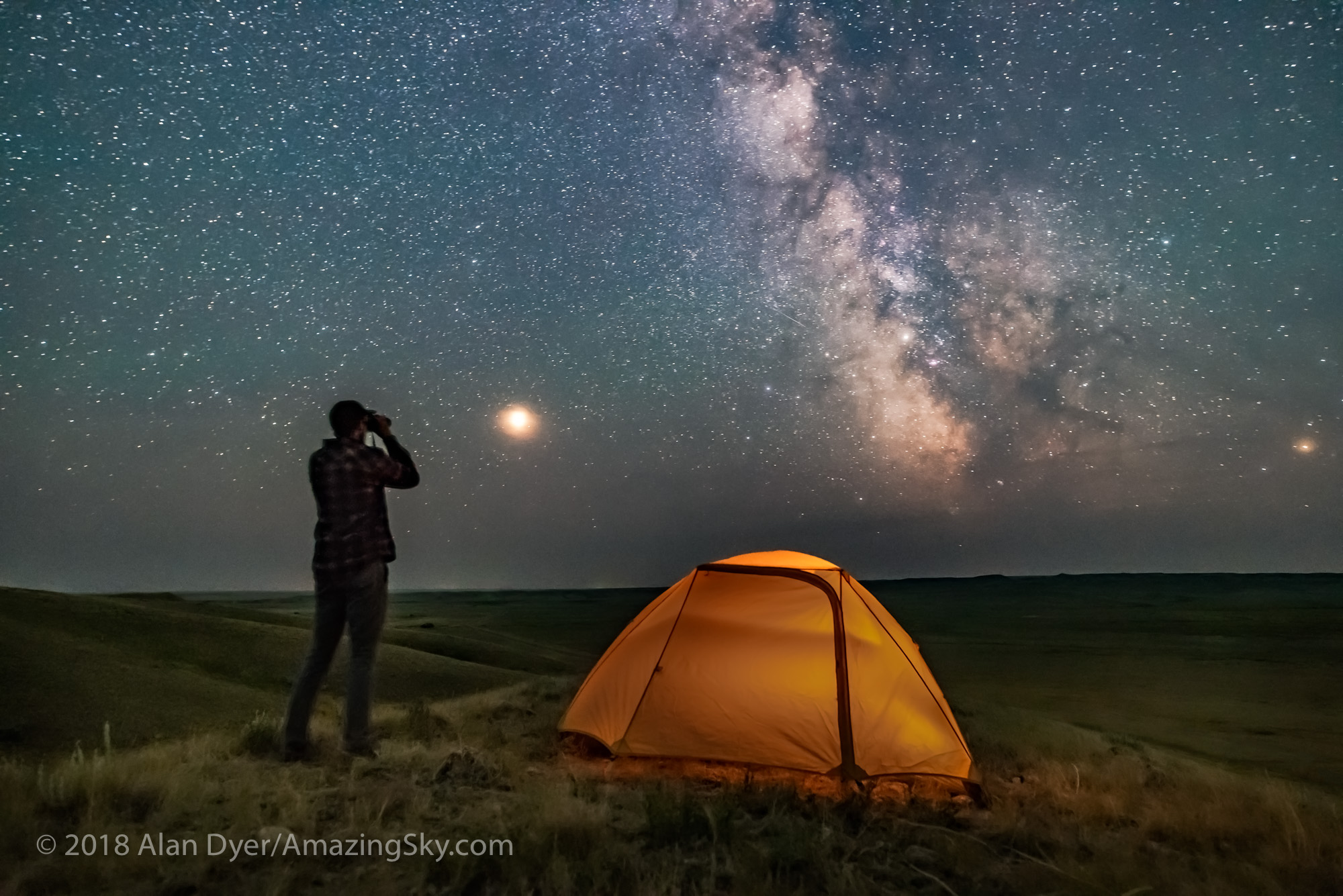
The lead image shows the potential for camping in the Park under an amazing sky, an attraction that is drawing more and more tourists to sites like Grasslands.

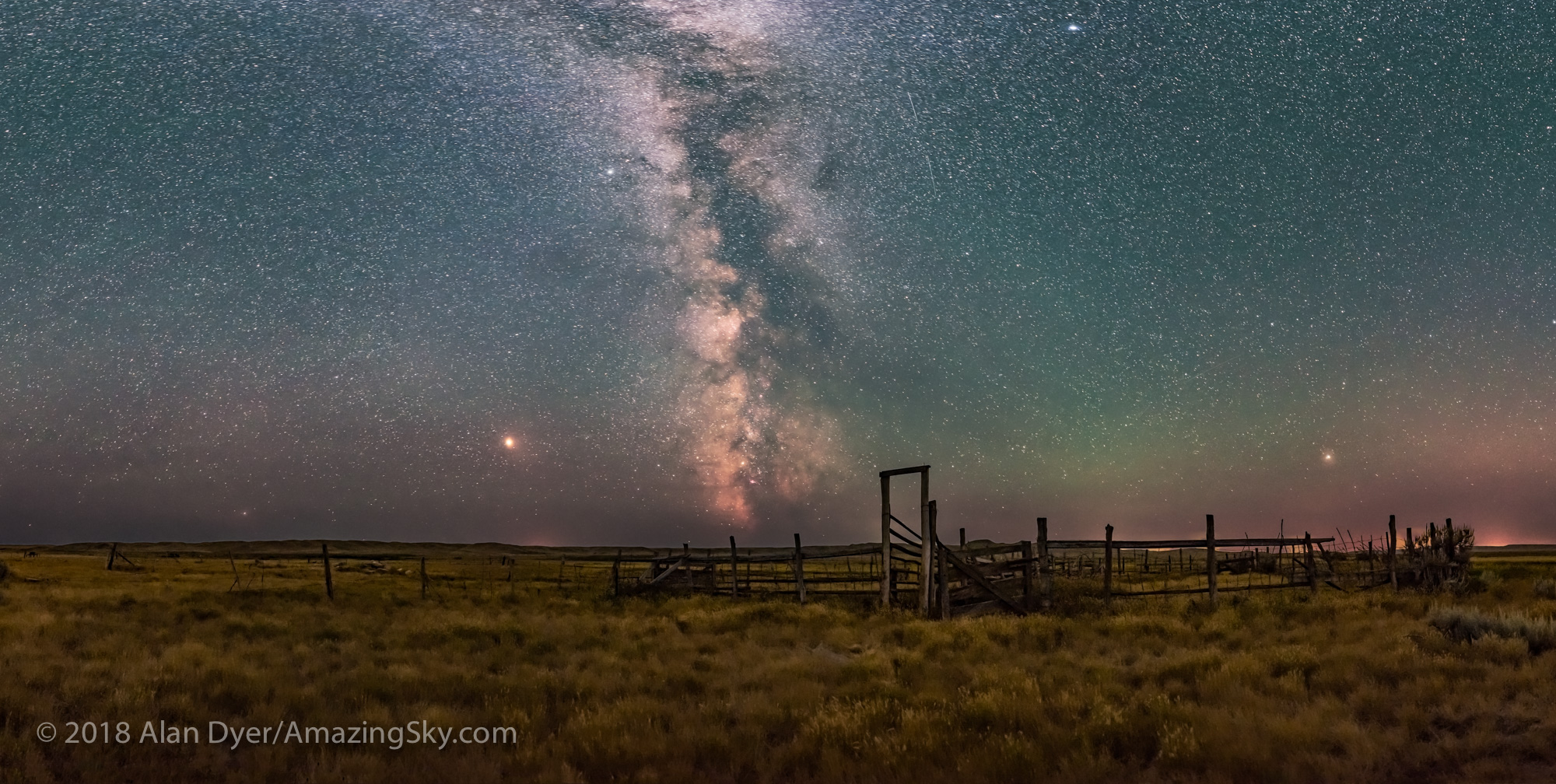
Milky Way Panorama at 76 Ranch Corral

This is a multi- panel panorama of the Milky Way over the historic 76 Ranch Corral in the Frenchman River Valley, once part of the largest cattle ranch in Canada. Mars shines brightly to the east of the galactic core.

At the Two Trees site visitors can stay in the tipis and enjoy the night sky. No one was there the night I was shooting. The night was warm, windless, and bug-less. It was a perfect summer evening.

Twilight Panorama at SSSP 2018

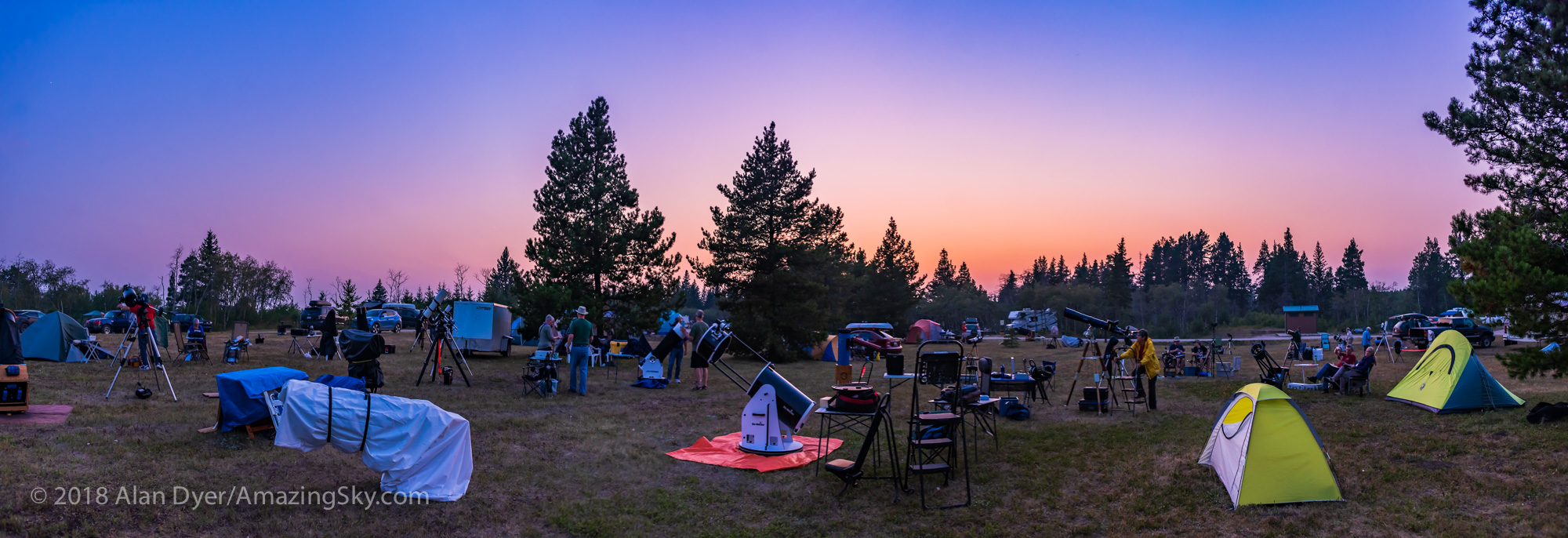
From Grasslands I headed west to the Cypress Hills along scenic backroads. The main Meadows Campground in Cypress Hills Interprovincial Park, another Dark Sky Preserve, is home every year to the Saskatchewan Summer Star Party. About 350 stargazers and lovers of the night gather to revel in starlight.

This year coincided with the annual Perseid meteor shower and we saw lots!

Most nights were clear, and warmer than usual, allowing shirt-sleeve observing. It was a little bit of Arizona in Canada. Everyone enjoyed the experience. I know I did!

SSSP and Cypress Hills are stargazing heaven in Canada.

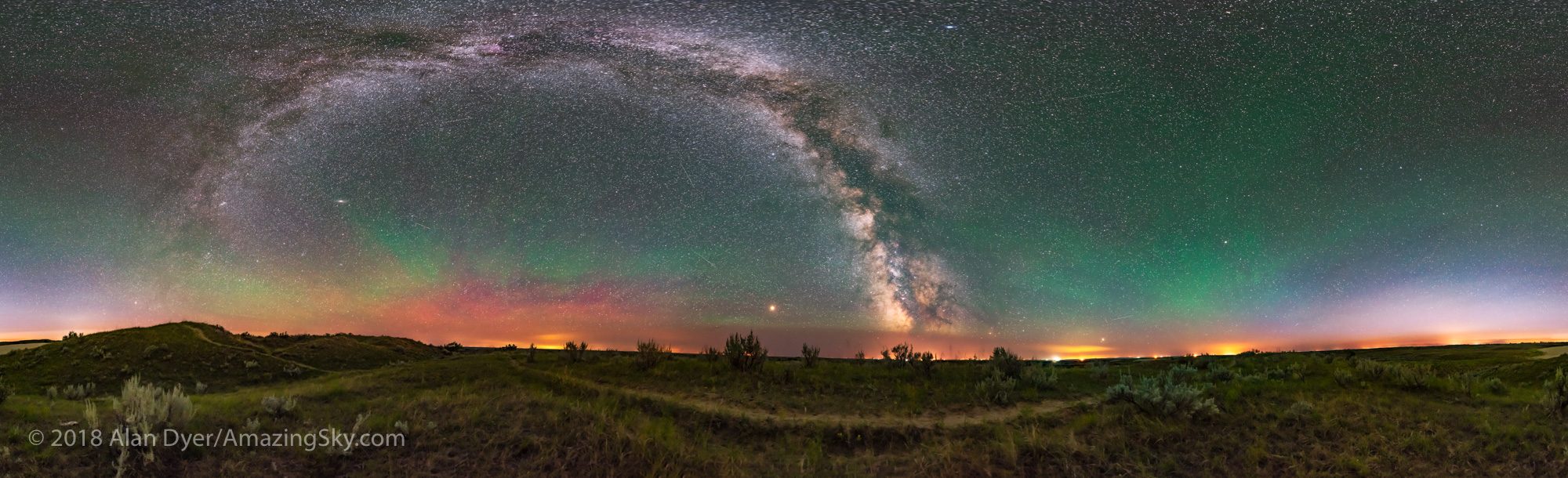
Panorama of the Milky Way over the Great Sandhills

From Cypress Hills I drove due north to finally, after years of thinking about it, visit the Great Sandhills near Leader, Saskatchewan. Above is a panorama from the “Boot Hill” ridge at the main viewing area.

The Sandhills is not a provincial park but is a protected eco zone, though used by local ranchers for grazing. However, much of the land remains uniquely prairie but with exposed sand dunes among the rolling hills.

There are farm lights in the distance but the sky above is dark and, in the panorama above, colored by twilight and bands of red and green airglow visible to the camera. It’s dark!

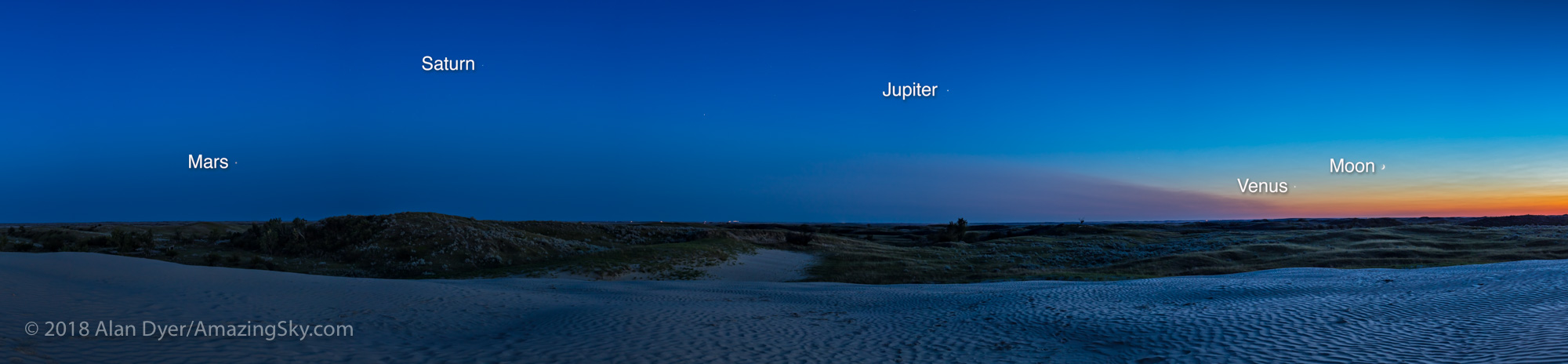
Four Planets Along the Ecliptic at Great Sandhills

In the twilight, from the top of one of the accessible sand dunes, I shot a panorama of the array of four planets currently across the sky, from Venus in the southwest to Mars in the southeast.

This is the kind of celestial scene you can see only where the sky has nothing to get in the way.

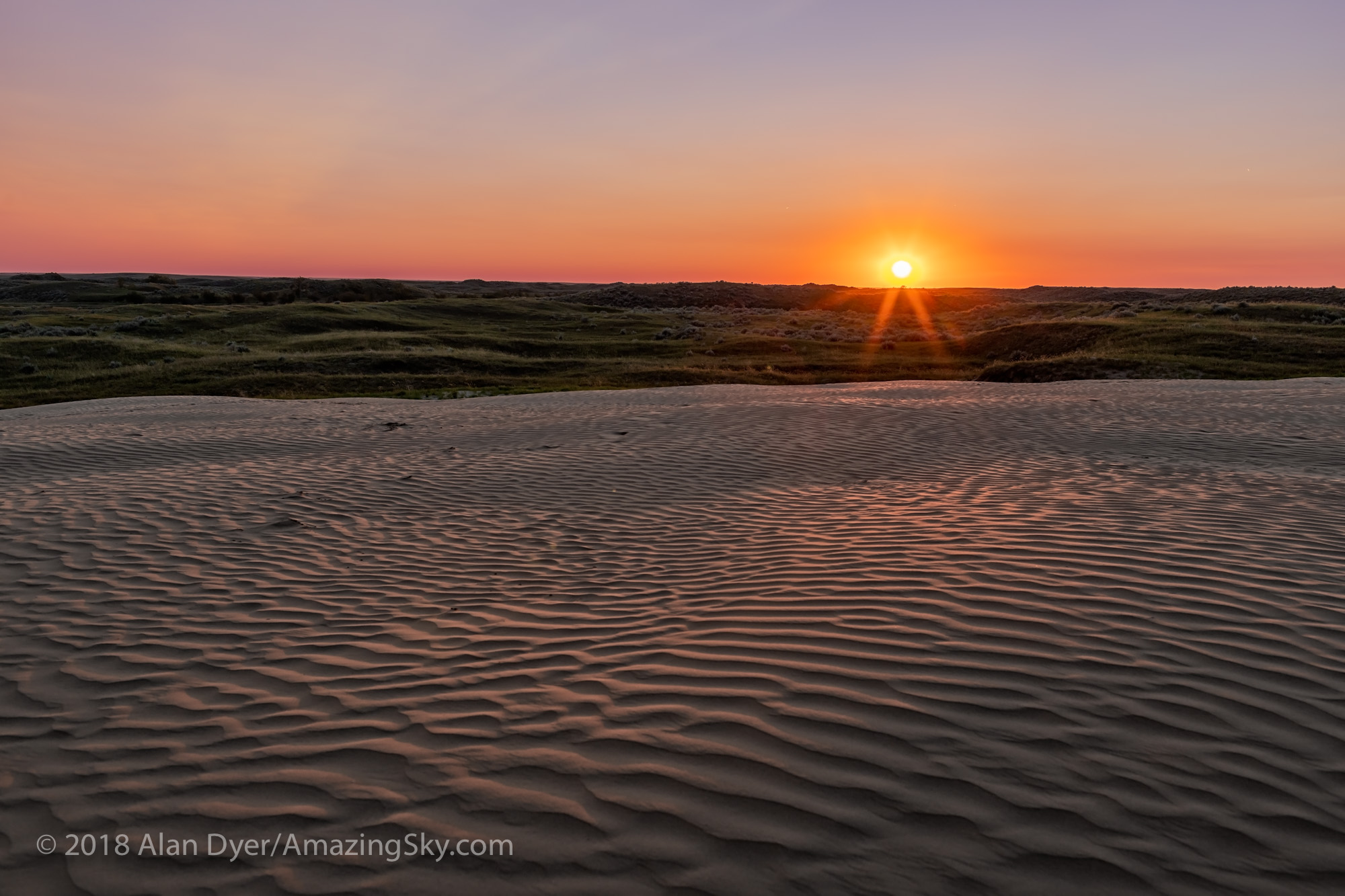
Sunset at Great Sandhills

If you are looking for a stellar experience under their “living skies,” I recommend Saskatchewan.

โ€” Alan, August 26, 2018 / ยฉ 2018 Alan Dyer / AmazingSky.comย 


Sunset over the Lonely Log Cabin


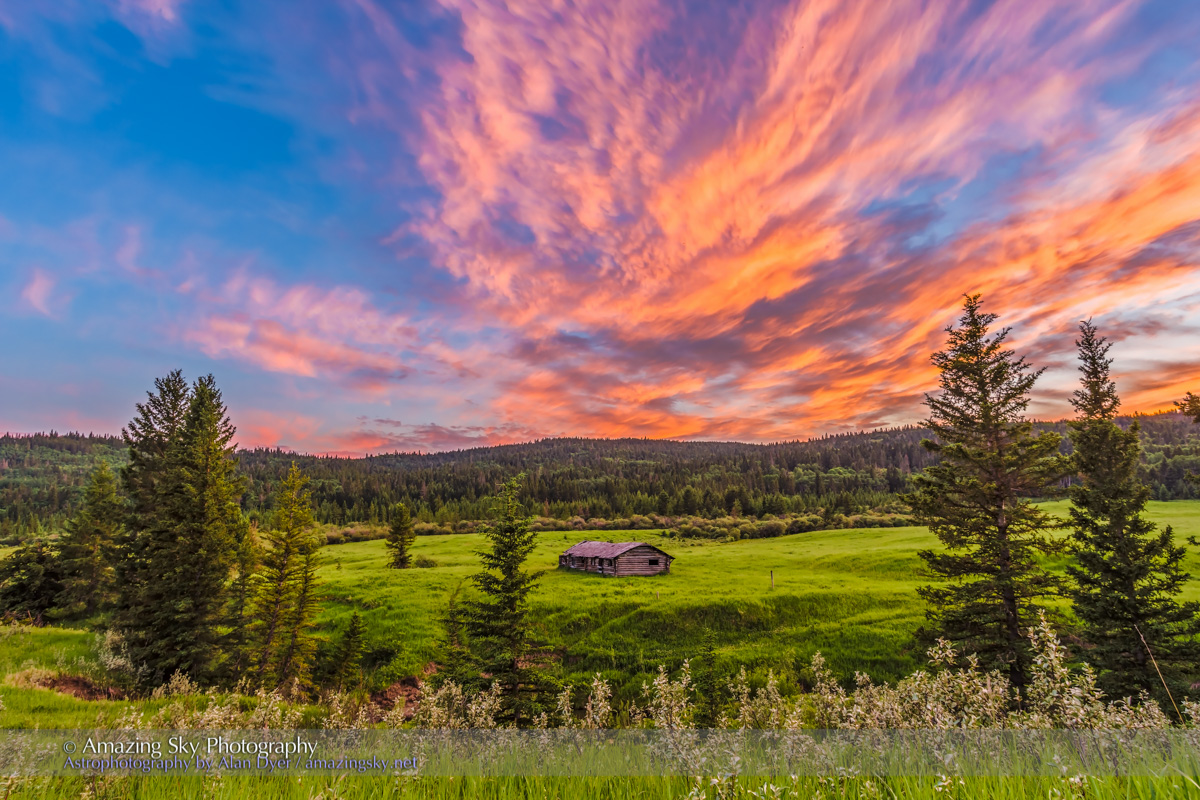
Log Cabin at Sunset

The clouds paint the skyย at sunset over a pioneer cabin in the Cypress Hills.

This is a scene the original resident of this cabin would have enjoyed โ€“ and painted.

This lonely log cabin in theย Battle Creek valley was built by Robert David Symons, renowned as a rancher, naturalist, game warden, and painter, in the style of western artists such as Charlie Russell.

The cabin looks like it datesย from the pioneer days of the first European settlement of the area, in the late 19th century. But Symons settled here and built this log cabin in 1939, during the time he worked as a game warden in the Hills, posted at the Battle Creek Ranger Station. He lived in the cabinย for only threeย yearsย before selling it to Albert and Sylvia Noble in 1942.

The Nobles expanded the cabin to accommodate their family. They lived here for 10 years, working a sawmill in the area.

Today the cabin is a scenic stop on the rough and often muddy Battle Creek Road that winds from the Alberta to the Saskatchewan side of Cypress Hillsย Interprovincial Park. Travelling it is like being back in the 1940s, when roads were no better than improved cartย tracks.

Shooting Time-Lapses at Cypress Hills Log Cabin

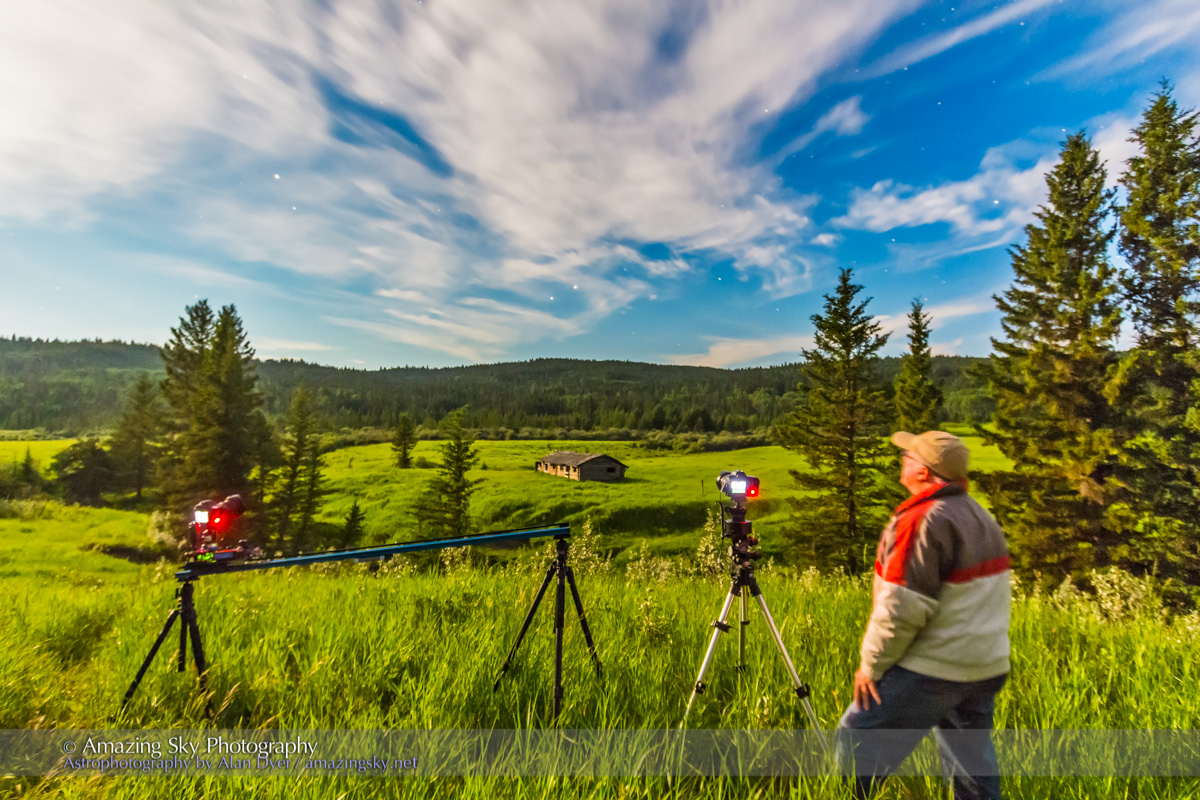
I spent an evening here two nights ago on a perfect summer night, shooting the sunset and then the cabin scene by moonlight using time-lapse cameras and gear.

The main scene at top is a high dynamic range stack of 6 images to preserve details in the bright sky and dark foreground.

The self-portrait is a single shot taken by moonlight. Mars and Spica are just setting as a pair of stars over the hills across the valley.

It was a magical night in the Hills.

โ€“ Alan, July 11, 2014 / ยฉ 2014 Alan Dyer


Circling Stars Over the Open Range


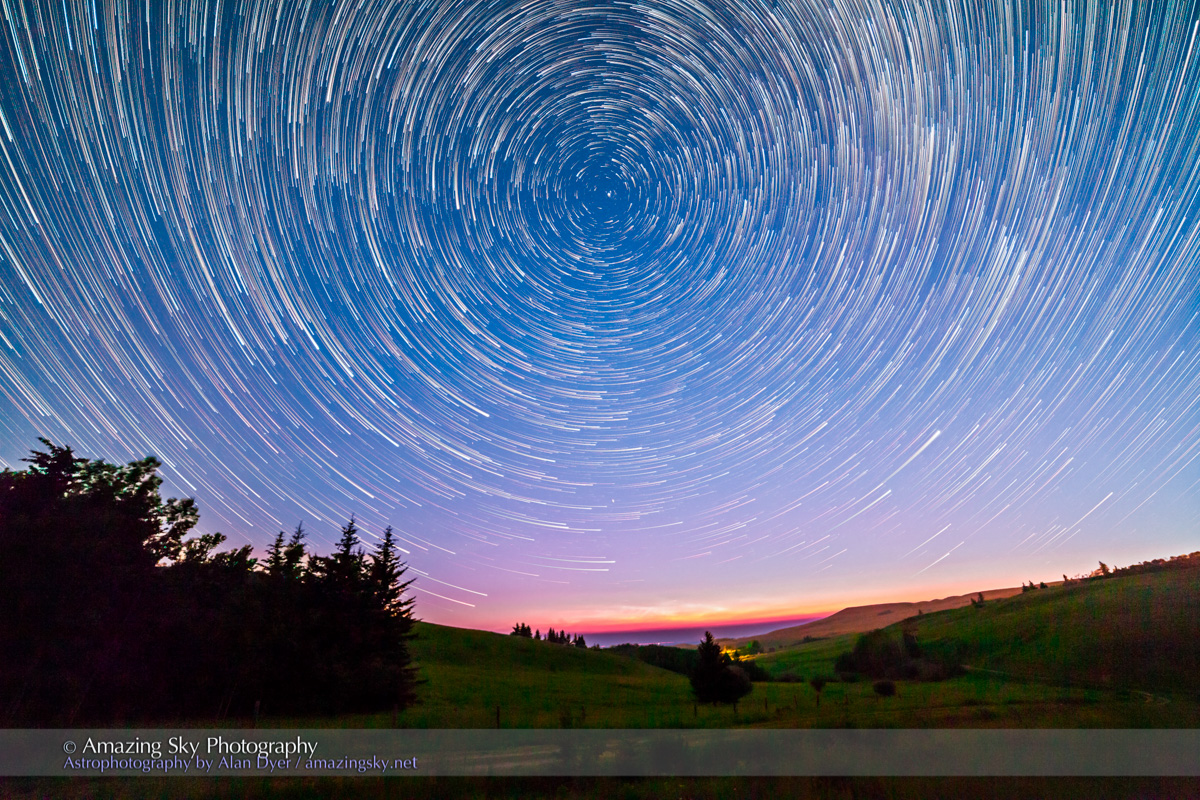
Reesor Ranch Circumpolar Star Trails

The stars swirl in circles above the big sky country of the Canadian Prairies.

Forย these images I set the camera to take hundreds of images over the course of aboutย 4ย hours, then stacked about 100 frames for each of the composites. I stacked the images with the application StarStax.ย 

The result shows the stars circling the North Celestial Pole and Polaris in the northern sky. The top image is from earlier in the night when the Moon was still up lighting the landscape.

Reesor Ranch Circumpolar Star Trails v2

The image above is from late in the night, after moonset, and with the glow of dawn beginning to brighten the northern sky. Some low noctilucent clouds are also appearing on the horizon.

This was a beautiful night at Reesor Ranch in Saskatchewan, on the edge of Cypress Hills Interprovincial Park, on the Alberta-Saskatchewan border. I’ve just wrapping up a week of shooting here with clear nights every night but two. The hard drives are full!

โ€“ Alan, July 11, 2014 / ยฉ 2014 Alan Dyer


Wild Rose Sunset


Wild Rose Sunset

The sky lights up pink to match the wild roses in Cypress Hills.

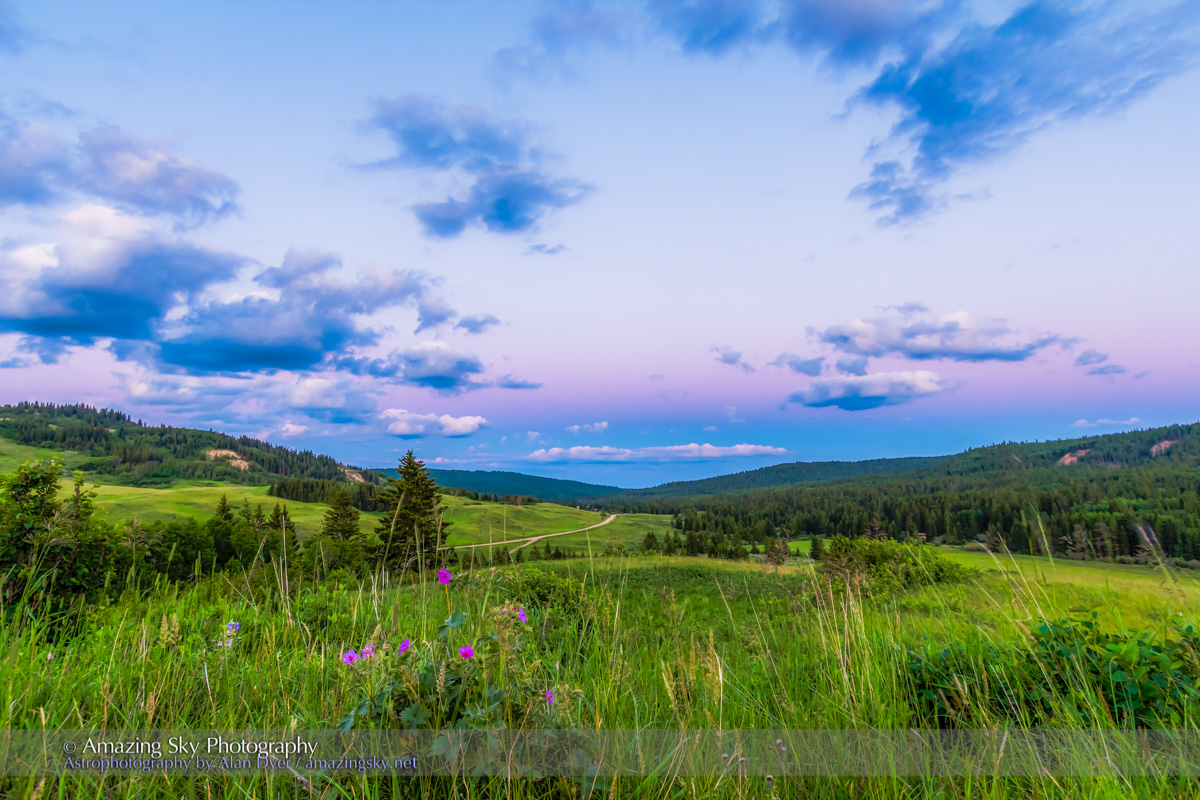
Last night the twilight sky over the Cypress Hills was simply stunning. The clouds contrasted with the blues and pinks of twilight. On the way out to an evening shoot I stopped to take this image of the darkening sky colours behind the bloomingย wild roses, the floral emblem of Alberta.

In this photograph I’m looking east, opposite the sunset. The dark blue on the horizon is the shadow of the Earth rising. Above the shadow is a fringe of pink, the Belt of Venus, from red sunlight still lighting the upper atmosphere in that direction. Its colour nicely matchesย the pink roses โ€“ Earth and sky in colour coordination.

This is a high dynamic range stack of 6 exposures, to capture the bright sky and darker foreground in one image, to render the scene as the eye saw it but the camera could not, at least not with a singleย exposure.

โ€“ Alan, July 8, 2014 / ยฉ 2014 Alan Dyer


Moon on the Water


Reesor Lake Moon HDR

The Moon shines over the still waters of a prairieย lake.

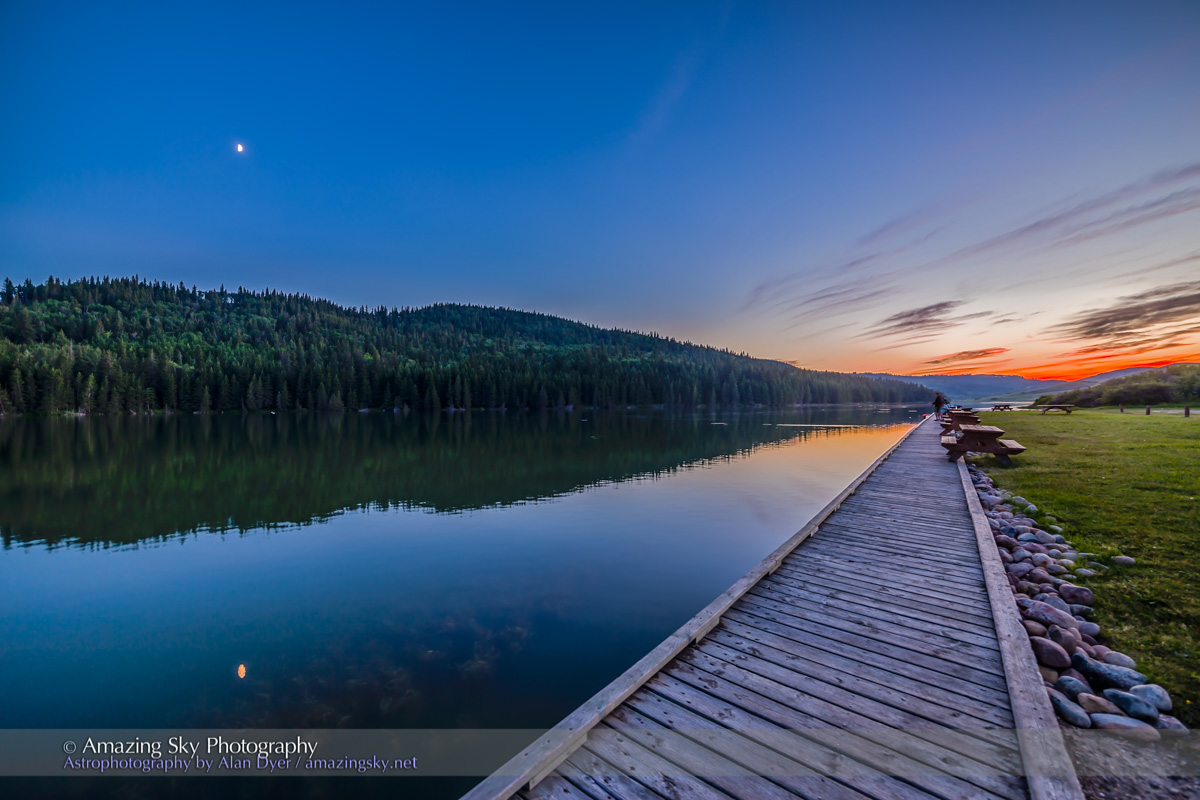
On Saturday, July 5, the Moon put on a super show in the twilight sky. The Moon was exactly at first quarter phase 90ยฐ from the Sun, and it shoneย between Mars and the star Spica, for a tidy 3-world conjunction in the evening sky.

For these shots I was at one of my favourite places for nightscape shooting, Reesorย Lake in Cypress Hills Interprovincial Park. These are still shots taken with one camera while two others were shootingย time lapses of the fall of night and the Moon movingย over the lake.

Moon on Reesor Lake #5

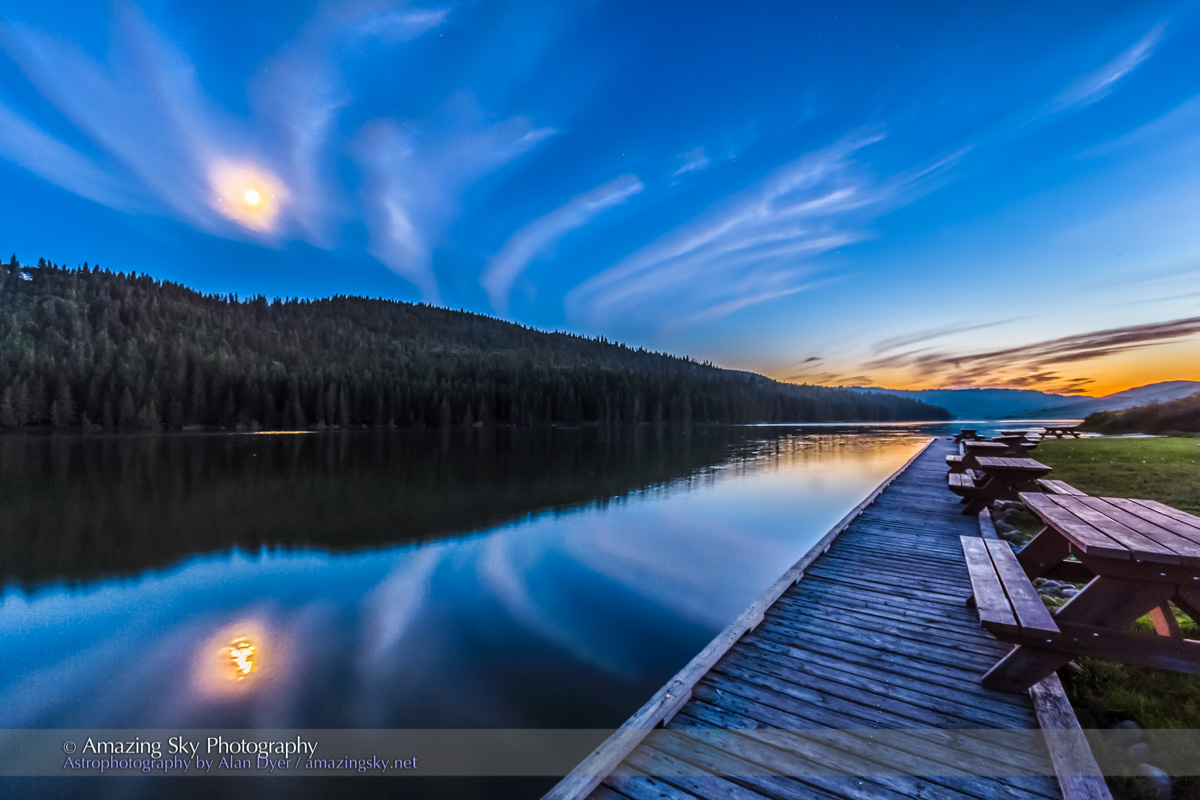
Later in the evening, some photogenic cirrus clouds movedย through the scene, nicely filling out the composition.

Moon on Reesor Lake #6

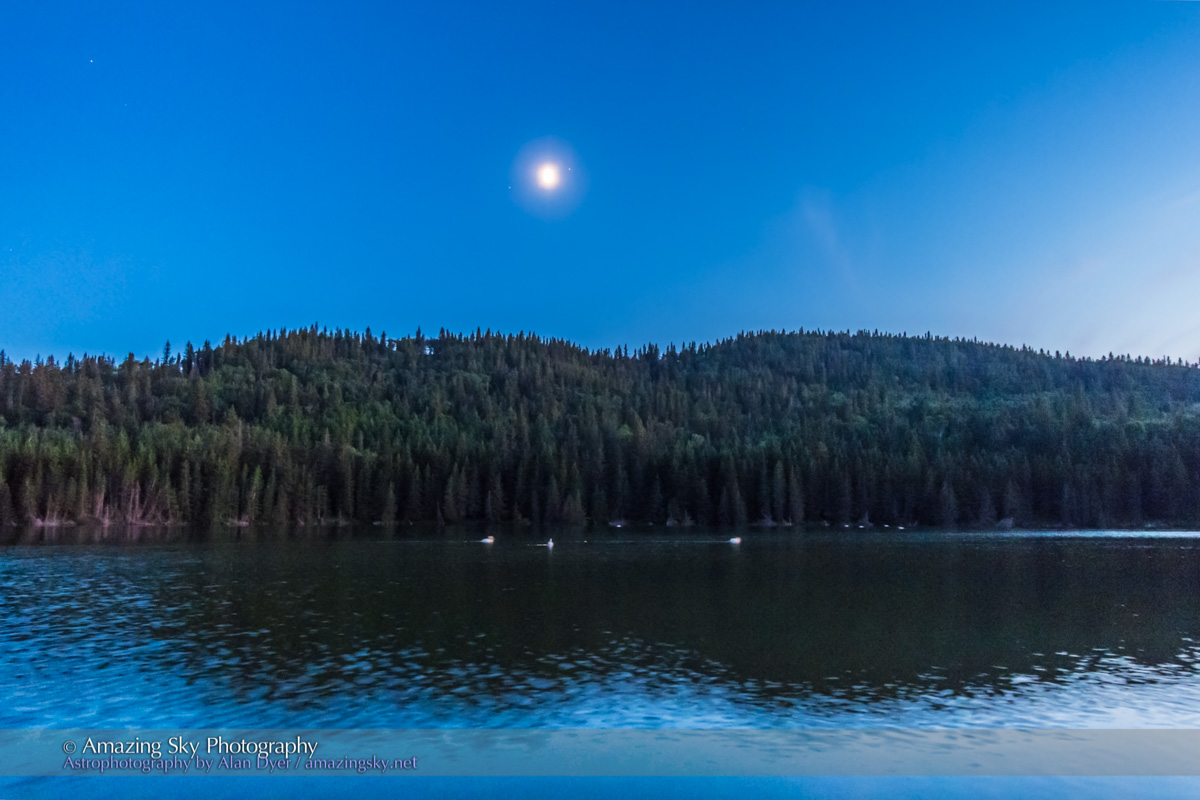
Here, you can see Mars to the right of the Moon and Spica to the left of the Moon. Below, on the water swim three white American pelicans that frequent the prairie lakes around here.

This was a perfect night. The anglers weren’t catching too much despite the fish leaping from the water every few seconds. But I managed to catch some nice photos and movies. It was a fine summer night to enjoy the sky.

โ€“ Alan, July 7, 2014 / ยฉ 2014 Alan Dyer


Sunset on the Range


Sunset on the Range

The setting Sun provided a fine light show on the open range of the Canadian Prairies.

This was the scene Friday evening, July 4, as the Sun lit up the clouds in the big sky of the Historic Reesor Ranch.

I’m here for a week of intensive shooting and writing. On the first night the setting Sun put on a fine show, captured in still images, like the high dynamic range composite above, and in time-lapses captured with the motion control gear below.

Reesor Ranch Sunset Shoot #4

When I took these shots I was likely right on the 105th meridian, the line of longitude that marks the boundary of Alberta and Saskatchewan. Either way, the land is expansive and stunning.

Just to the south the land rises to the Cypress Hills and the namesake provincial park where I’m spending most nights shooting stills and time-lapses. More to come this week I’m sure!

โ€“ Alan, July 7, 2014 / ยฉ 2014 Alan Dyer


Hunting the Elusive Camelopardalids


Aurora & Light Pollution from Cypress Hills Park, Alberta

The Milky Way, an odd aurora, and the glow of urban light pollution lit the sky. But alas, no meteors!

On Friday afternoon, May 23 I headed 3 hours east of home toward the clearest skies in the province. The quest was for sightings of the Camelopardalid meteors, the new and much publicized meteor shower from Comet LINEAR, 209/P that had been predicted for tonight.

I had very good skies for the first couple of hours of darkness, from a viewpoint looking north over the prairies on the high rim of the Cypress Hills, Alberta. Clouds did move in about 12:30 a.m., about the time the shower was to be peaking. But up to that point I had sighted just a handful of meteors and many were likely random ones, as they didn’t seem to be streaking out of the radiant point. A few other people who had converged at the site saw other meteors toย the south that might have been shower members.

Perhaps the peak came later under cover of clouds. But up to 12:30 a.m.ย I saw littleย sign of an active shower. Still, it was worth taking the chance to chase into clear skies in hopes of bagging a herd of Camelopardalids.

I shot hundreds of frames with two cameras and none picked up a Cam meteor โ€“ lots of satellites, like the streak at lower centre. And for a few minutes this strange white auroral curtain appeared, slowly drifting from east to west across the northern sky, like a searchlight, above the magenta horizon glow of low-level aurora. To the northwest glowed the lights of Medicine Hat, illuminatingย the clouds toxic yellow in a classic demonstration of light pollution.

โ€“ Alan, May 24, 2014 / ยฉ 2014 Alan Dyer


Time-Lapse โ€“ Alberta Skies 2013


It was a good year for time-lapse photography at home. Here’s my compilation of Alberta time-lapses in a 3-minute music video.

For a year-end look back at 2013 I assembled these highlights of my year of shooting time-lapse movies of the Alberta sky, by day and night.ย 

I’ve included clips shot around home in rural southern Alberta, and further afield at popular photo spots around the province such as Waterton Lakes National Park, Banff, Writing-on-Stone Provincial Park, and Cypress Hills Provincial Park.ย 

I hope you enjoy it! Be sure to maximize the video screen and select HD. ย Or for a better grade version check out my Vimeo channel.

________________________________________________

Some technical background:

I shot all the frames for the movies (150 to 300 frames for each clip) with either a Canon 5D MkII or a Canon 60Da camera, equipped with various lenses from 8mm to 200mm. For many of the clips the cameras were on motion control devices: the Radian azimuth panning unit, an Orion TeleTrack mount, or a Dynamic Perception Stage Zero dolly unit. You see the latter in action behind the credits.ย 

For image processing and movie assembly I used Adobe Camera Raw, Photoshop, LRTimeLapse, Sequence, Panolapse/RawBlend utility, and for some of the star trails either StarStax or Star Circle Academy’s Advanced Stacker Actions.

I demonstrate all these in my Nightscapes workshops.ย The next one is in Edmonton, January 25!

To edit the movie I used the new OS10 Mavericks iMovie.ย 

โ€“ Alan, December 29, 2013 / ยฉ 2013 Alan Dyer

The Great Lone Land … and Great Big Sky


The Gap Road Panorama (Cypress Hills Park)

A vast blue sky and summer storm clouds arch over a prairie landscape.

This is a place where you are out on the vast open plains, looking much as they would have appeared hundreds of years ago. This is big sky country, in southwest Saskatchewan. I shot this 360ยฐ panorama last Sunday, on a road I get to take every few years that is one of the great drives in western Canada.

Some years it is too wet and impassable. Other years it is too dry and closed because of the fire hazard.

This is the Gap Road, a mud track at times between the Saskatchewan and Alberta units of Cypress Hills Interprovincial Park. The road crosses private rangeland but the cattle are the only giveaway that this is a modern scene and not one from the 19th century.

In 1872 the British explorer and adventurer William Francis Butler crossed the prairies and northern plains in the last days of the buffalo culture, before the cattle and ranchers arrived. He called it then The Great Lone Land. You feel that sense in a place like this, out on the open treeless plains. 150 years ago great herds of bison roamed here. And it was here that the North West Mounted Police set up their first outpost in the area, at Fort Walsh, to stop the incursions of the American “wolfers.”

The sky dominates the scene. I spent an hour here, shooting a time-lapse of the approaching thunderstorm, at right, coming toward me from miles away, until it filled the sky and threatened to turn the road back into mud.

It was a wonderful day spent crossing the prairies, and traveling back in time.

โ€“ Alan, August 16, 2013 / ยฉ 2013 Alan Dyer


Sunset from the Cypress Hills


Horseshoe Canyon Sunset (August 11, 2013)

The Sun sets over the pines and prairie of Cypress Hills, Alberta.

Tonight it was too cloudy for meteors. But the sky did provide a very fine sunset.

I was at the Horseshoe Canyon viewpoint on the Alberta side of Cypress Hills Interprovincial Park, to catch a deep-red Sun going down into haze and cloud. This is looking northwest, from the pine-covered hills out over prairie plains of southern Alberta. The image is a high-dynamic range stack of 7 images.

The viewpoint also had an interpretive sign explaining the virtues of dark sky preservation โ€“ Cypress Hills Park is a large dark sky preserve โ€“ and I was pleased to see one of my photos used as an illustration on the sign. I had sent it to the Park several years ago.

But alas, no meteors in view tonight. And while there were a few visible the night before at the star party, out of 200+ shots I took, not one recorded a decent Perseid meteor! Of course!

โ€“ Alan, August 11, 2013 / ยฉ 2013 Alan Dyer


Space Station Over a Star Party


ISS Pass Over Star Party (August 10, 2013)

The Space Station flies over a campground of astronomers awaiting the fall of darkness.

Last night was the main night for summer star parties, being a dark-of-the-Moon Saturday in August. As I usually am each year, I was in Cypress Hills, Saskatchewan, attending the annual Saskatchewan Summer Star Party. About 330 attended this year, a near record year.

The night was partly cloudy but stayed clear enough for long enough to allow great views. As the sky was getting dark the International Space Station flew over from horizon to horizon, west to east, passing nearly overhead. I had a camera and ultra-wide lens ready and caught the pass in 10 exposures, each 30 seconds long, here stacked in Photoshop. The accumulated exposure time also makes the stars trail in circles around the North Star at upper right.

It was one of many fine sky sights hundreds of stargazers enjoyed this weekend at the SSSP, and no doubt at dozens of other star parties around the continent this weekend.

โ€“ Alan, August 11, 2013 / ยฉ 2013 Alan Dyer

Star Rain


Star Rain - Big Dipper Star Trails

The sky seems to swirl in a rainstorm of stars.

I’ve combined several exposures of the stars in the northern sky to create a “comet trail” effect, showing them turning about the celestial pole. The top photo looks northwest to the stars around the Big Dipper and picks up the purple light of a faint aurora.

For the photo below, taken on a different night, I used a fish-eye lens to capture the entire sky, but looking north. You can see how the sky turns counterclockwise about the Pole Star. The Milky Way also appears as a blurred band of light.

Circumpolar Comet Star Trails (July 16, 2013)

I shot these last week from the cabin at Reesor Ranch in Saskatchewan during a wonderful week of nightscape photography in the Cypress Hills.

To create these images I used the Advanced Stacking Actions fromย Star Circle Academy.

โ€“ Alan, July 25, 2013 / ยฉ 2013 Alan Dyer


Wild Rose Stars


Wild Roses and Stars on the Reesor Ranch

The floral emblem of Alberta, the wild rose, appears in front of a twilit starry sky.

Last night was another good one on the Ranch! I had three cameras shooting from my log cabin front yard โ€“ I had no ambition to travel farther afield this night, after 6 nights in a row of shooting around the Cypress Hills. This is a scene from one of the time-lapses taken from “home,” of prairie flowers in front of a prairie sky.

Milky Way over Log Cabin at Reesor Ranch (July 16, 2013)

I also took the opportunity to reshoot the popular “Milky Way over Log Cabin” scene, getting better results I think than the shot I posted from the first night I was here a week ago. This was with the specially-modified camera that picks up the red nebulosity in the Milky Way better. The colours are much nicer.

Reesor Ranch Night Sky Panorama (July 16, 2013)

Finally, this is a 360ยฐ panorama of the scene from last night, taken before the Moon set but when it was behind the trees out of sight. Its light still illuminates the sky blue, yet the Milky Way still stands out. The red lights are from two other cameras shooting time-lapses. This is big sky country for sure!

It’s been a wonderful week of shooting on the century-old Reesor Ranch in the Cypress Hills. I highly recommend the location for anyone who wants an authentic western experience in a stunning setting. I’m sure I’ll be back.

โ€“ Alan, July 17, 2013 / ยฉ 2013 Alan Dyer


High Plains Panorama of the Night Sky


Cypress Hills Night Panorama (July 15, 2013)

The silvery Milky Way and green bands of airglow stretch across the high plains and big sky of the Cypress Hills.

The Moon had long set and the night looked as dark as it could be. No lights interrupted the flat clear horizon. These are the high plains of the Cypress Hills, the highest place in Canada between Labrador and the Rockies.

And yet, in the panoramic photos I took last night the sky revealed its true colours.

In the 360ยฐ panorama above, the Milky Way arches overhead from northeast to southwest. It was obvious to the naked eye. But stretching across the sky from east to west are also bands of green and red airglow that were completely invisible to the eye, except perhaps for making the sky look more grey than it might have otherwise.

These aren’t aurora but are emissions of light caused by oxygen atoms fluorescing as they give off some of the energy they absorbed by day. Time-lapse sequences show these bands moving slowly across the sky.

Shooting the Survivor Tree (July 15, 2013)

I drove up the Graburn Road last night, to the plateau of Cypress Hills, to shoot a time-lapse of the Milky Way moving above this lone tree on the plains. It’s called the Survivor Tree, subject to drought, blizzards fire, cattle, and even being cut down at one time. But still it survives. With a cold wind blowing last night I had a taste of what this tough Lodgepole Pine has had to endure.

Survivor Tree and Milky Way (July 15, 2013)

This is one frame from the final movie clip, with the tree and sky still lit by the light of the setting waxing Moon. An enduring tree beneath the timeless stars.

Noctilucent Clouds from Cypress Hills (July 15, 2013)

Early in the evening the northern sky was also marked by another sky phenomenon, noctilucent clouds โ€“ very high altitude clouds still lit by sunlight long after the Sun has set locally. These clouds made for a nice photo for a few minutes but soon faded from view as the Sun set even as seen from where these clouds live at the edge of space.

The night was left dark, with no aurora tonight โ€“ just the Milky Way and the faint wisps of airglow over the high plains of southern Alberta.

โ€“ Alan, July 16 2013 / ยฉ 2013 Alan Dyer

Road to the Northern Lights


Northern Lights Down the Road (July 14, 2013)

A country road winds off into the dancing Northern Lights.

The sky put on another fine show last night, the fourth in a row with some level of aurora activity. This was the scene Sunday night as a display blossomed for a while, dancing at the end of the back road through the Cypress Hills on the Alberta-Saskatchewan border.

I had one camera shooting north and devoted to the Northern Lights, while, as you can see below, I had two other cameras on rigs to shoot time-lapse movies looking south.

Self Portrait at Battle Creek, Cypress Hills (July 14, 2013)

This was the scene at the overlook to the Battle Creek valley, with the Moon setting and me getting the time-lapse gear going, to shoot the Milky Way moving over the hills. One camera was on a mount to pan across the landscape following the stars. The other camera was on a motion control dolly to travel down a track over the 3 hours of the shoot. I spent a lot of time in the car listening to BBC Desert Island Discs and The Life Scientific podcasts last night — the thrill of time-lapse shooting!

Milky Way over Battle Creek (July 14 2013)

This is one frame from one of the movies. Streaks of green and red airglow tint the sky around the Milky Way. Amazingly, the scene is lit only by starlight and by the aurora. You could never have done this with film. It’s the sensitivity of digital cameras that makes such scenes possible, though it takes some clever processing (such as Shadow Detail recovery in Raw, Shadows and Highlights, & masked Adjustment Layers) to balance Earth and sky in the final image.

โ€“ Alan, July 15, 2013 / ยฉ 2013 Alan Dyer


Milky Way Over a Misty Lake


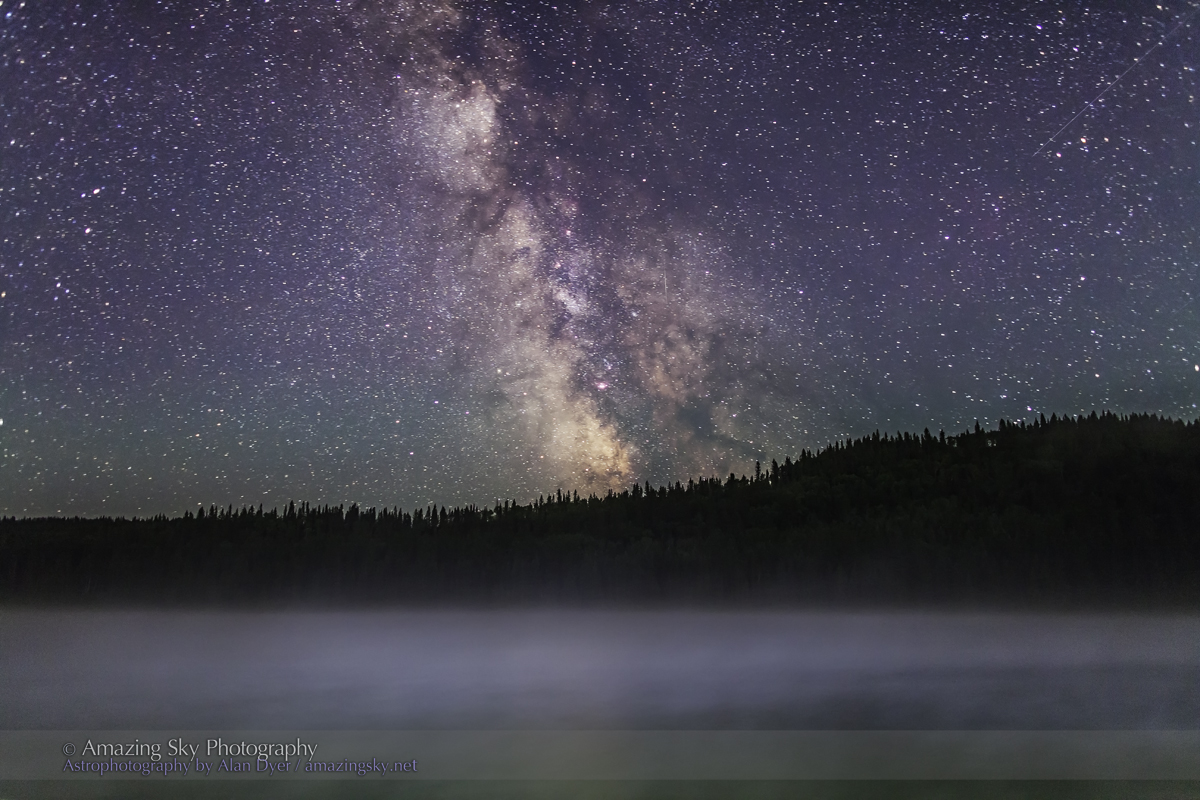
Milky Way over Misty Lake (July 13, 2013)

The misty starclouds of the Milky Way shine above the misty waters of Reesor Lake.

This was certainly a magical scene โ€“ the stars above the still waters of a misty lake. Above the tree-lined hills lies the constellation of Sagittarius and the heart of the Milky Way. The dark structure comes from interstellar dust, the stuff we’re made of. Everything in the foreground on Earth comes from the stuff you can see in the sky.

I shot this Saturday night, on a beautiful, if damp, night for nightscape photography in the Cypress Hills, Alberta. I helped the scene along by “painting” the mist with a white flashlight.

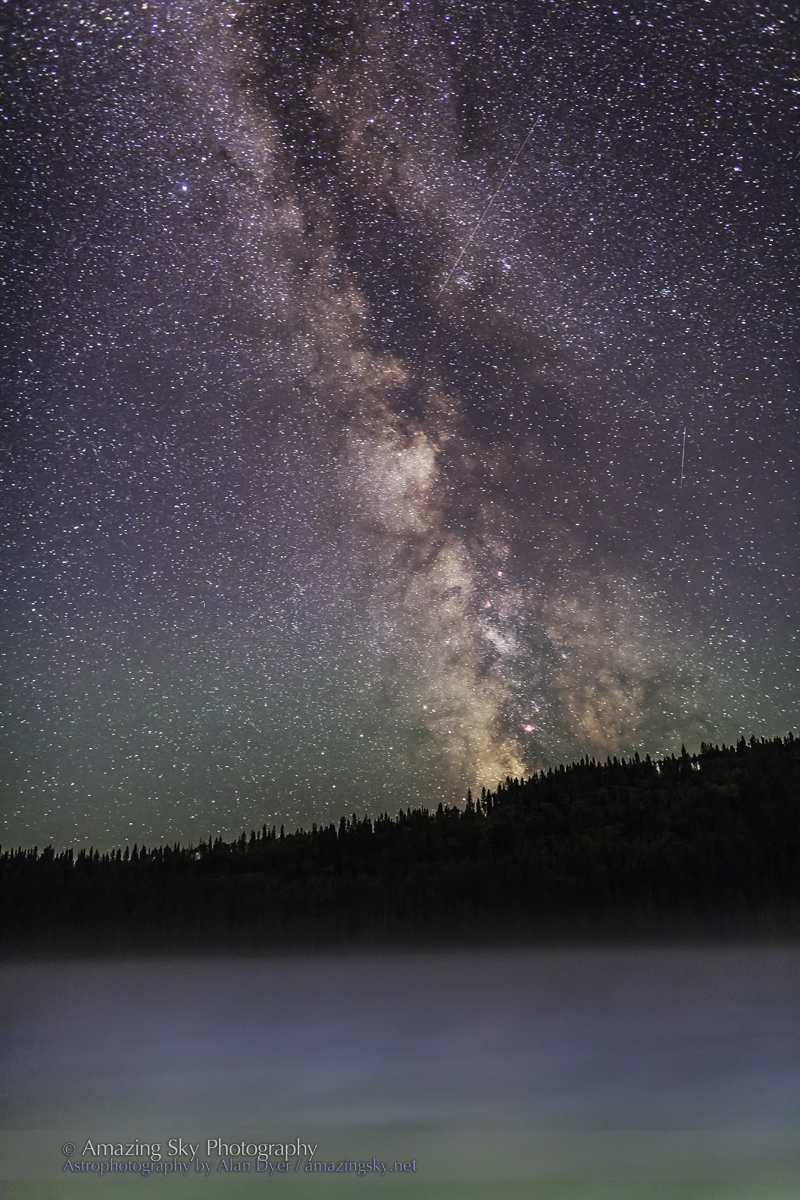
Milky Way over Misty Lake (July 13, 2013)

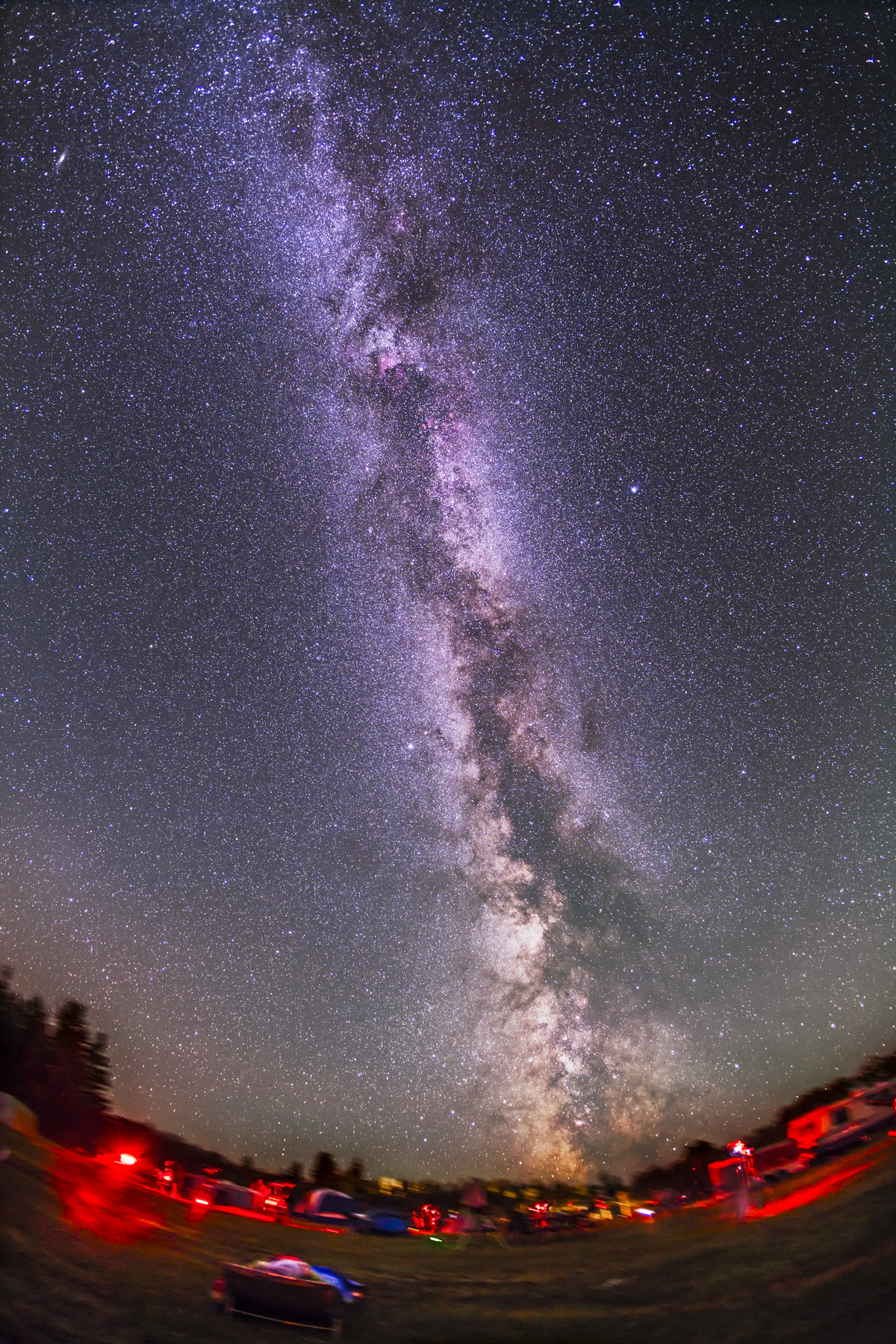
For those who like their Milky Way images in portrait mode, here’s one of the same scene, showing more of the sweep of the summer Milky Way up from the southern horizon, from Sagittarius to Aquila.

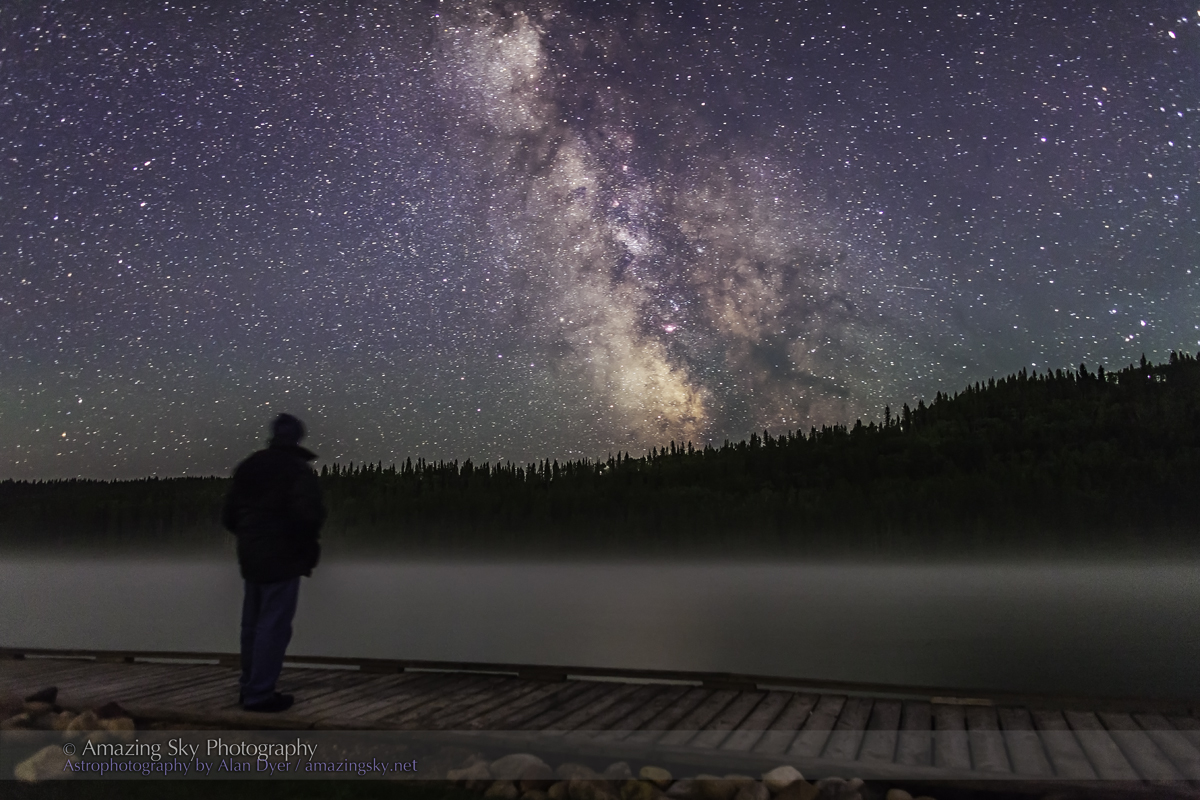
Self Portrait at Reesor Lake (July 13, 2013)

And while I don’t often take shots of people in scenes, I couldn’t resist getting into the photo myself here, standing on the boardwalk gazing at the centre of the Galaxy.

โ€“ Alan, July 15, 2013 / ยฉ 2013 Alan Dyer


Moonset on a Misty Lake


Moonset on a Misty Lake (35mm)

What a marvelous night for a moonset!ย 

Saturday night was one of the finest nights for nightscape shooting I’ve had in a long time. I started with shots of the waxing Moon setting overย Reesor Lake, one of the lakes in Cypress Hills Interprovincial Park, on the Alberta side. Water from this lake drains into the Milk River and then into the Missouri, and Gulf of Mexico. It one of the few bodies of water in Alberta that feed the Mississippi watershed, with the Cypress Hills acting as a continental divide.

I set up two cameras, each shooting a twilight-to-night time-lapse sequence showing the Moon setting behind the hills and the stars coming out. I filled up one card with 600 images. Luckily, the other camera still had space left for what was still to come later that night. One sight was the beautiful auroral arc I featured in my previous blog post. I’ll have more tomorrow, of the Milky Way over the lake.

Moonset on a Misty Lake

It had rained earlier in the day so the air was humid. Mist covered the lake as night fell. In the scene above, a small fleet of American pelicans also glide by.

Watching the peaceful scene while monitoring the cameras clicking away provided one of those magical moments that makes doing this photography worthwhile, regardless of the results. The mist was swirling, the stars were coming out, I put on some music on the iPhone and on came a Chopin nocturne. Perfect.

โ€“ Alan, July 14, 2013 / ยฉ 2013 Alan Dyer

The Grand Sweep of the Auroral Oval


Aurora Panorama #4 from Reesor Ranch (July 13, 2013)

The Northern Lights sweep across the northern horizon in a classic arc of green and magenta curtains.

The aurora on the night of July 13/14 never got very bright but the sweep of the auroral oval still made for an interesting panoramic image.

I shot this at about 2 a.m. local time, from the high plains of southwest Saskatchewan, right on the Alberta-Saskatchewan border, on the rolling hills of the historic Reesor Ranch.ย The only man-made light visible is a glow on the horizon just left of the auroral arc, from the city of Medicine Hat, Alberta.

The panorama takes in about 180ยฐ of sky, framing the sweep of the auroral oval across the northern horizon from northeast to northwest. In fact, you can see the gravel road I was on at far left and far right. The main band of green from glowing oxygen is topped by curtains of magenta, from oxygen and nitrogen atoms.

If you could see this display from space you would see it as an oval of light across the top half of North America. From my perspective on Earth, I could see just a portion of the complete oval, as an arc across the northern sky.

To create this image I shot 6 segments at 30ยฐ spacings, each a 30-second exposure with a 24mm lens at f/2.8 on a Canon 5D MkII at ISO 1600. I used Photoshop to stitch the segments. It blended them seamlessly.

โ€“ Alan, July 14, 2013 / ยฉ 2013 Alan Dyer


Star and Satellite Trails


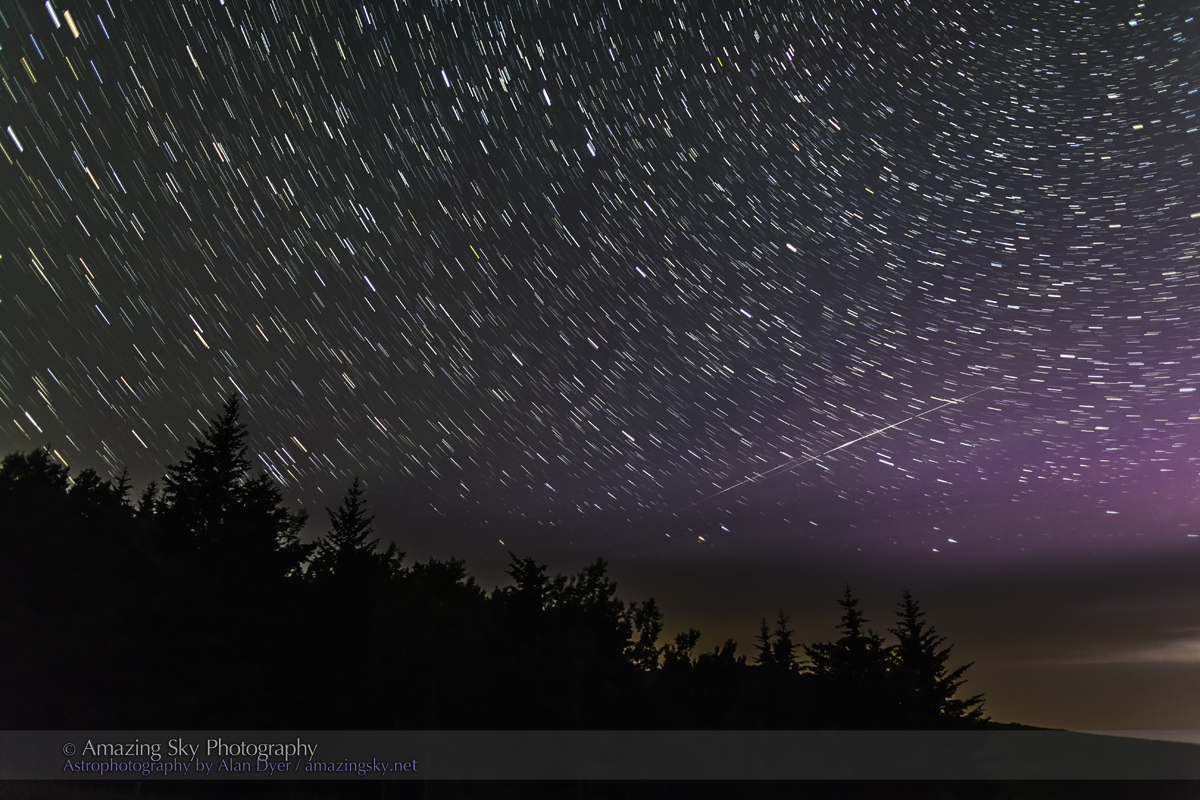
Big Dipper Star Trails and Iridium Flares (July 12, 2013)

A long exposure captures streaks from the turning stars and passing satellites.

This was a busy sky. The feature photo stacks a dozen images taken over 6 minutes.

During that time the northern stars around the Big Dipper turned about the celestial pole just off frame at upper right.

Meanwhile, two satellites passed through the field, both flaring in brightness briefly, tracing tapered streaks from left to right above the treetops. These may have been Iridium satellites, infamous for producing sunglint flares as they momentarily reflect the Sun from their mirror-like antenna panels.

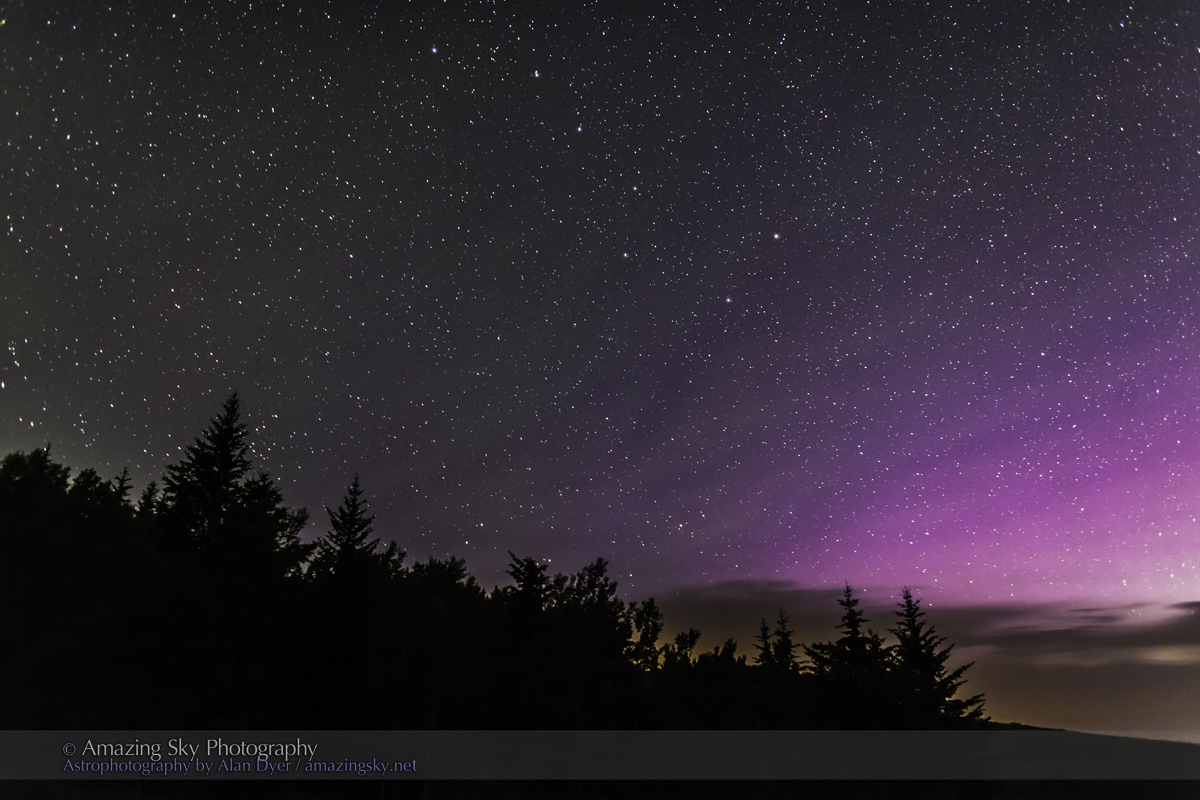
A magenta aurora tints the northern sky as well.

Big Dipper & Purple Aurora (July 12, 2013)

This image is from the same sequence of 300 or so I took last night for a time-lapse movie, but this is a single 30-second exposure so the stars look more natural and pinpoint. Now you can make out the familiar pattern of the Big Dipper.

I shot several sequences last night, until the clouds rolled in and curtailed photography. However, skies are clearing again and the forecast is for several clear nights to come over the Cypress Hills. I’ve got a few locations picked out for time-lapse shooting if the skies cooperate.

โ€“ Alan, July 12, 2013 / ยฉ 2013 Alan Dyer

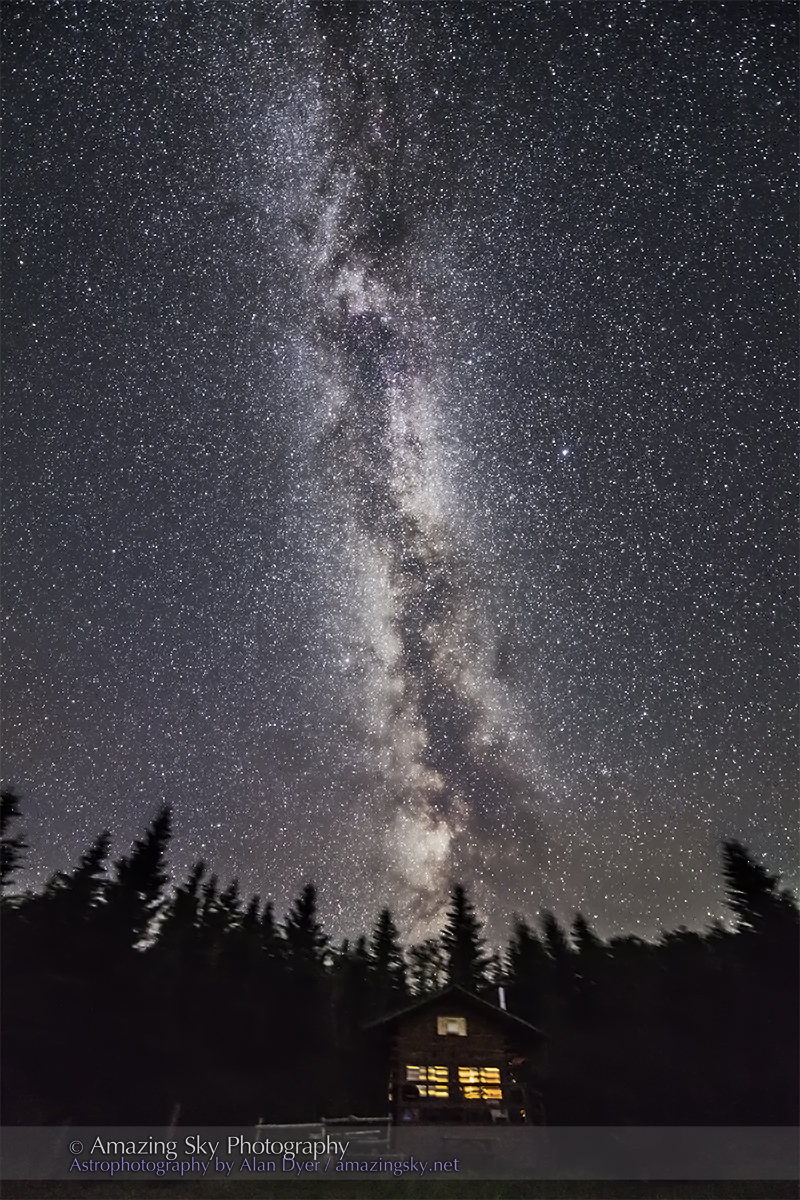
Log Cabin in the Milky Way


Milky Way over Log Cabin (July 11, 2013)

The summer Milky Way shines over a log cabin in the woods of the Cypress Hills.

This was the view this morning, at 2 a.m., as the Milky Way of northern summer shone over my vacation log cabin on the Reesor Ranch in Saskatchewan. After the clouds cleared the sky was beautifully dark for a while before the early dawn twilight came on.

The view here takes in the Milky Way from the Scutum star cloud above the trees to the dark dust clouds of northern Cygnus overhead. The trio of Summer Triangle stars, Deneb, Vega and Altair, flank the Milky Way.

This is a composite of five tracked and stacked images for the sky and one image for the foreground shot with the iOptron Skytracker running at half speed to minimize the blurring from the tracking motion. The lens was the 14mm Samyang at f/2.8.

โ€“ Alan, July 12, 2013 / ยฉ 2013 Alan Dyer


Goodness Gracious! A Great Ball of Stars!


This is what half a million stars look like when packed into one big ball.ย 

This is the globular star cluster called Messier 22, in Sagittarius. It’s the biggest and best such object visible from Canadian latitudes, though it always sits low in our summer sky. M22 is one of 150 or so such spherical clusters of stars that orbit our Milky Way. This one sits 10,000 light years away from us, toward the centre of the Galaxy. Those half million stars are packed into a sphere 100 light years across. In our sky it appears as big as the Full Moon, though not as bright of course. But just imagine the sky if you can view it from the centre of M22. The heavens would be ablaze with stars.ย 

I shot this with the 130mm refractor at f/6. It’s a stack of just three 4-minute exposures with the Canon 7D. Though M22 was low above the southern horizon from the Cypress Hills where I shot this, the final image turned out pretty well.ย 

โ€“ Alan, August 30, 2012 / ยฉ 2012 Alan Dyer


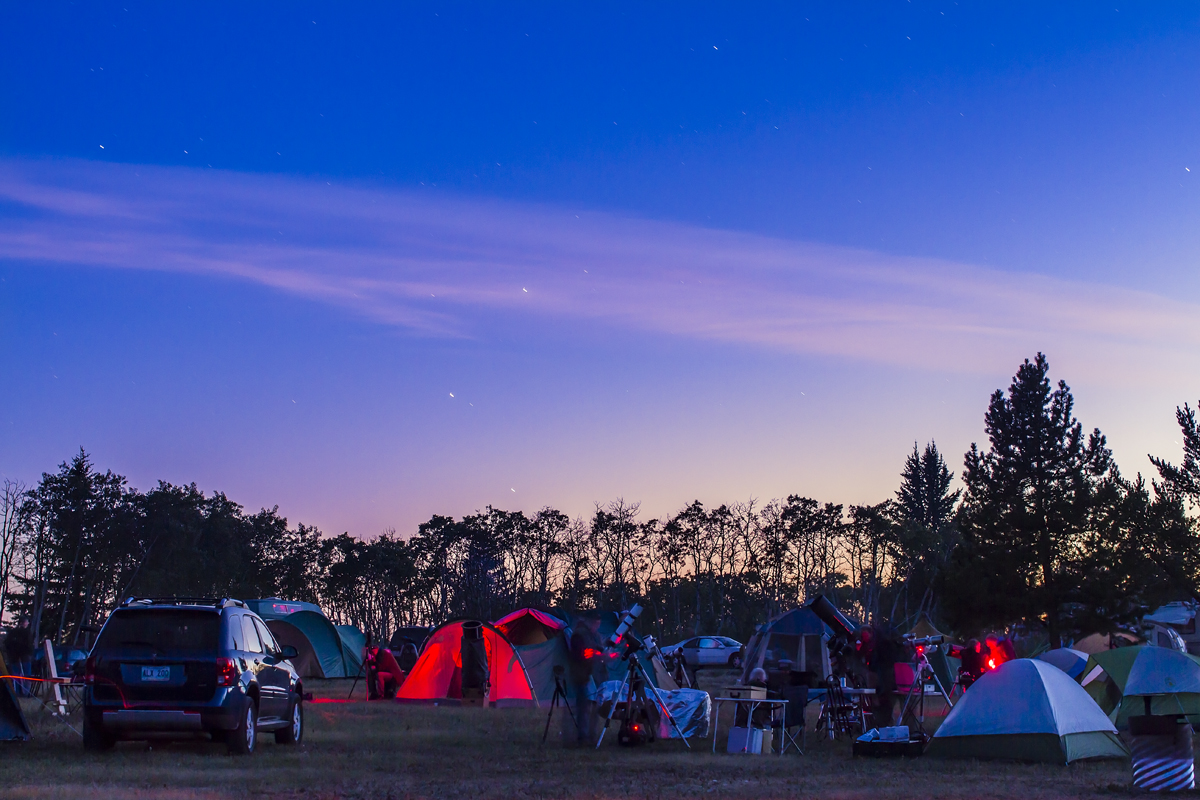
Camping Under the Planets


Here’s a final scene from the recent big star party, of campers under Mars and Saturn, two planets setting into the twilight.

Saturn is just in the clouds, Mars is below, and just above the treetops is Spica, the brightest star in Virgo. The three objects were in close conjunction through mid-August but set early in the evening.

I shot this at the recent Saskatchewan Summer Star Party in Cypress Hills. Most of my blogs of the last 10 days have featured shots from the star party or of the star party. It was a super weekend for stargazing.

โ€“ Alan, August 27, 2012 / ยฉ 2012 Alan Dyer

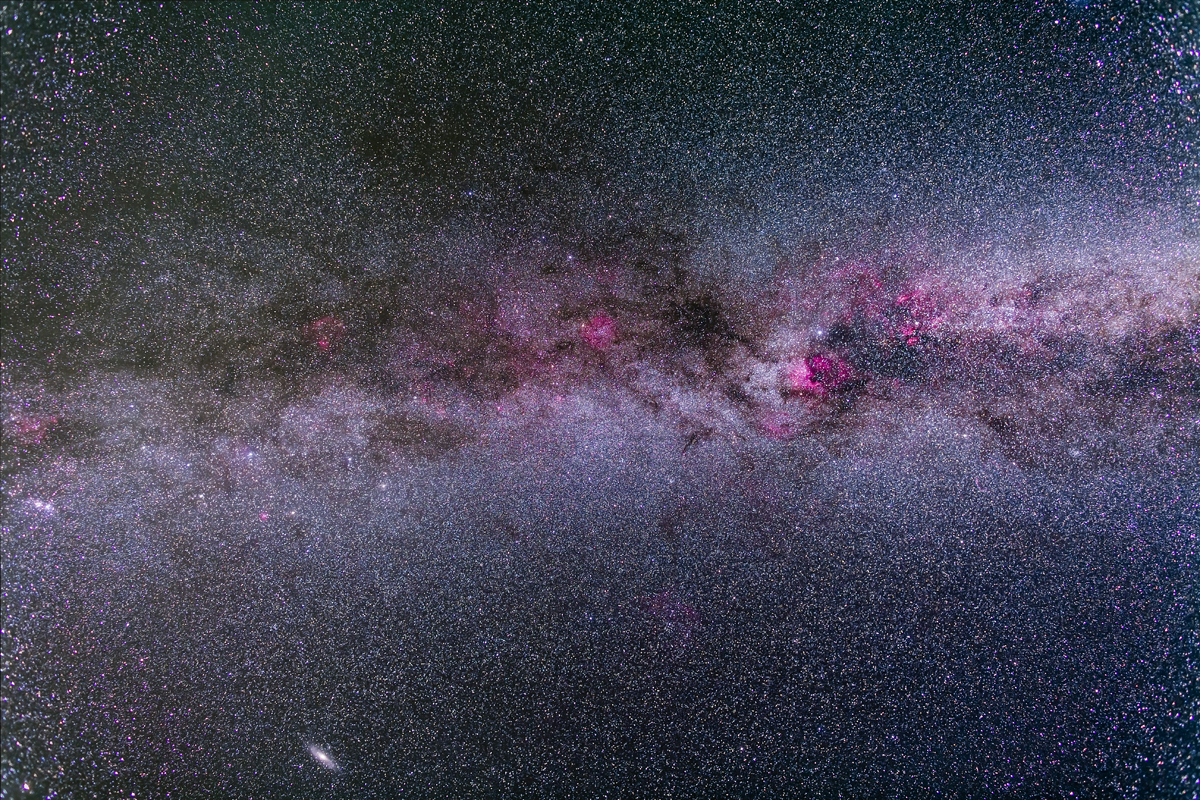
The Northern Nebulas of the Milky Way


This is the prime celestial real estate above us now on northern summer nights.

This wide-angle shot takes in the Milky Way from Cygnus at right to Perseus at left, an area populated by lots of nebulas, both bright and dark. A couple of previous posts (The Subtle Shades of Cepheus and The Dark Clouds of Cygnus) featured close-up views of sections of this sky, the areas at centre in this wider context image in northern Cygnus and southern Cepheus.

At bottom is the elliptical glow of the Andromeda Galaxy, another “milky way” beyond ours.

I boosted the contrast and colour more than I normally do for astrophotos, to punch out the nebulas and the subtle dark lanes of dust that permeate this part of the Milky Way. I shot this last weekend from the star party in Cypress Hills, Saskatchewan. With three clear nights it was a productive weekend!

โ€“ Alan, August 26, 2012 / ยฉ 2012 Alan Dyer

Star Gazing


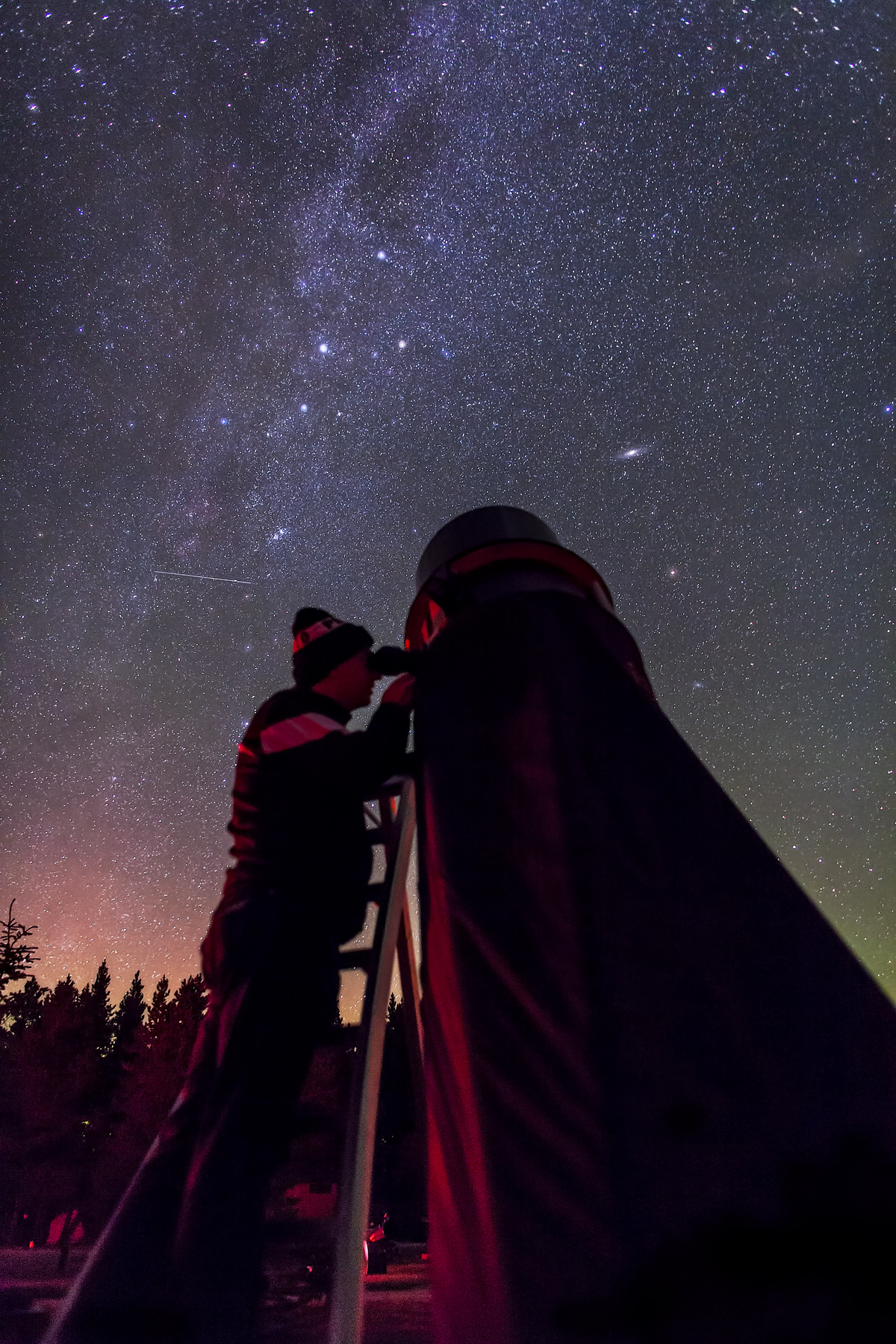
Happiness is a big telescope under a dark sky.

This is Regina astronomer Vance Petriew, gazing skyward at the Milky Way in Cassiopeia. Vance is the discoverer of Comet 185/P, aka Comet Petriew. This year, his comet returned to the August sky as a faint glow in Gemini, close to where it was when Vance found it exactly 11 years to the day before this image was taken, and at the very same spot in the campsite at Cypress Hills Interprovincial Park in Saskatchewan.

We all revelled in the Saskatchewan comet’s return, staying up till 4 am to see it through Vance’s 20-inch telescope, a reflector made by the small company called Obsession. (When you have an Obsession, you are a serious observer!) Enjoying the view early that morning before dawn were ย Vance’s three daughters, only one of whom was around 11 years ago and then as a baby. But this year even the four-year-old was able to see Dad’s comet up close.

At the afternoon talks Vance recounted the story of how the comet’s discovery changed his life, and led to immense changes at the Park. As a result of the media and political attention the comet brought, the Park has become a Dark Sky Preserve, one of the first in Canada, leading a nationwide movement, while astronomy programming is now an integral part of the Park’s interpretive programs, as it is becoming at other provincial and national parks. There is now a permanent public observatory and lecture hall nearby in Cypress Hills, just a short walk away from where the comet was found.

Comets can have quite an impact!

โ€” Alan, August 24, 2012 / ยฉ 2012 Alan Dyer

Horizon to Horizon Milky Way


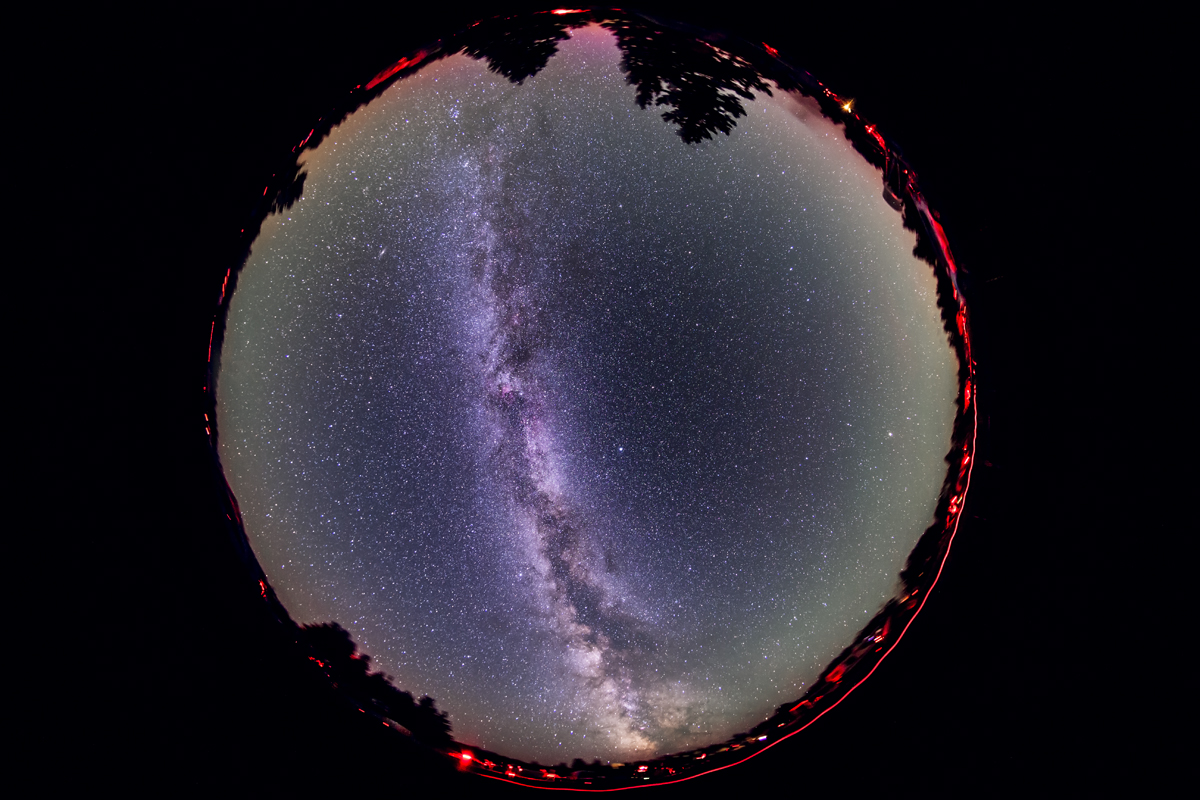
The view doesn’t get any wider than this. This fish-eye image takes in the entire night sky and summer Milky Way.

I shot this last weekend at the Saskatchewan Summer Star Party in Cypress Hills. Red lights of observers streak along the horizon around the perimeter of the circular image. At centre is the zenith, the point in the sky straight overhead.

The sky was very dark, but the sky close to the horizon is tinted with the faint glows of aurora and airglow.

The Milky Way is the main feature of the summer sky, here stretching from Sagittarius in the south at bottom to Perseus at top in the north. Wide shots like this really put the giant lanes of dust into proper context; you can see their full structure and faint tendrils extending well off the Milky Way band.

For these fish-eye shots (suitable for projection in a planetarium) I used a Sigma 8mm fish-eye lens and a full-frame Canon 5D MkII camera. This is a stack of five 5-minute exposures, all tracked. The landscape is from just one of the images, to minimize blurring of the ground.

โ€” Alan, August 23, 2012 / ยฉ 2012 Alan Dyer

The Dark Clouds of Cygnus


Stare into the starfields of Cygnus and ponder what lies undiscovered in our part of the Milky Way.

You are looking down the spiral arm we live in, into clouds of stars seemingly packed together. Every one of those specks is a sun like ours. With planets? Very likely, as we now know.

Amid the stars float glowing red clouds of hydrogen gas. The North America Nebula shines at lower right.

Snaking northward from the “arctic” region of the bright nebula is a river of dust that broadens into a delta of dark nebulosity. Once thought to be holes in the sky allowing us to see deeper into space, we know now that these dark nebulas are really foreground dust clouds filled with the soot of dying stars, carbon dust that absorbs starlight and obscures the more distant parts of the Milky Way.

This dust cloud is called Le Gentil 3, named for the 18th century French astronomer who first noted its position in the sky. Le Gentil’s dust cloud is one of the easiest features of the summer Milky Way to see. Look north of Deneb, the bright star at the right of the image, and with the unaided eye on a dark moonless night you’ll see what looks like a dark hole in the Milky Way. That’s Le Gentil 3.

I use this dust cloud as a measure of sky brightness. On a truly dark night, Le Gentil 3 looks darker than any other area of sky, even relatively starless regions off the Milky Way. Most of the sky brightness we see from a dark site is really starlight. But Le Gentil’s proximity and opaqueness makes it appear darker than the more distant starlit sky background.

This image covers about the width of a binocular field. I shot it from the Cypress Hills in Saskatchewan this past weekend, using the Canon 5D MkII at ISO 1600 and Canon 135mm telephoto lens at f/2.8. It’s a stack of 10 five-minute exposures.

โ€” Alan, August 22, 2012 / ยฉ 2012 Alan Dyer

Lost in the Milky Way


Just lie back and lose yourself in the Milky Way.

That’s what one person is doing here, under the starry skies of Cypress Hills, Saskatchewan. In summertime the Milky Way is the main attraction at night. Here, it rises from the south, a region containing the centre of our Galaxy in Sagittarius, to climb up overhead through the star clouds of Scutum and Aquila, then into Cygnus in our local spiral arm, and on into Cassiopeia at the top of the frame in the north.

As in most deep sky photos, I’ve boosted the contrast and colour to make a dramatic image. To the eye the Milky Way appears in subtle shades of grey painted with the dark brushstrokes of dust lanes winding through the bright clouds of stars. But your eye does see much of this structure.

I like these types of ultra-wide images. They capture the mind’s eye impression of what the Milky Way looks like across the vault of heaven.

This is a stack of four 5-minute exposures, all tracked on a small equatorial mount, the Kenko SkyMemo, and all taken with the Canon 5D MkII at ISO 800 and Canon’s ultra-wide 15mm lens at f/4, as you can see from the photo data at left. I retained the ground from just one image, to minimize the blurring from the slowly moving camera tracking the stars. I masked out the ground in the other 3 images. They help smooth out noise in the sky.

โ€” Alan, August 21, 2012 / ยฉ 2012 Alan Dyer

Star Party Panorama


This image depicts a 360ยฐ panorama of the field and sky at the Saskatchewan Summer Star Party.

This was my first time shooting a nighttime panorama but it was easy. Just 12 exposures taken at 30ยฐ intervals panning around on a levelled tripod, in classic planetarium panorama style. Each exposure was 30 seconds at f/2 and ISO 3200 with the Canon 5D MkII and 24mm lens. It helps to have a high-quality fast lens.

North is at centre, south on either end.

The sky contains some interesting and subtle features that show up well in a wide-angle panorama like this:

– The bright summer Milky Way is setting at left in the southwest while the fainter winter half of the Milky Way is rising opposite, at right in the northeast.

– Jupiter and the Pleiades rise at right just off the Milky Way

– A meteor streaks over the trees at centre

– At centre, to the north, glows a faint yellow and magentaย aurora

– The larger green glow left of centre is, I suspect, airglow rather than aurora. It has a striated structure, particularly at right of centre above the trees where it appears as subtle green and red bands arching across the northeast.

The sky this night was dark but did have a brighter than usual background, likely due to the presence of this faint airglow that the camera picks up better than the eye.

Even so, I can see another faint glow:

– A whitish band coming up from the northeast passing through Jupiter and below the Pleaides. That’s the Zodiacal Band, an extension of the brighter Zodiacal Light and caused by sunlight reflecting off cometary dust in the ecliptic plane.

The location of the panorama and star party was the Cypress Hills Interprovincial Park in southwest Saskatchewan, one of the darkest places in southern Canada.

โ€” Alan, August 20, 2012 / ยฉ 2012 Alan Dyer

Party Under the Stars


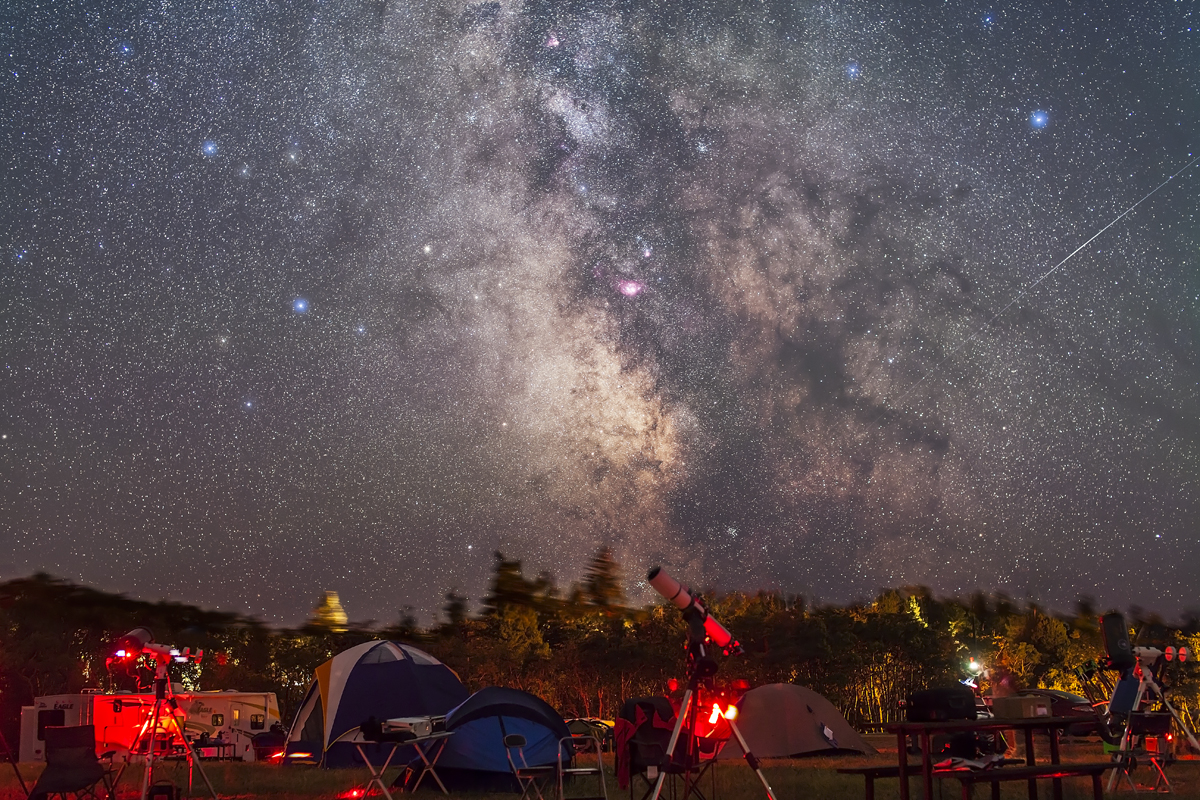
For astronomers this is party central โ€“ under the starclouds of the summer Milky Way.

Over the past weekend, August 16-18, I attended the annual Saskatchewan Summer Star Party, held in the Cypress Hills of southwestern Saskatchewan. Skies could not have been better.

This was the scene Friday night, with telescopes under the Milky Way. About 350 people attended, and nearly as many telescopes it seemed! This is one small section of the observing and camping field.

Cypress Hill Park has been declared a Dark Sky Preserve, in recognition of the Park’s role in preserving and presenting the dark skies that are as much a part of our natural world as are the flora and fauna of the Earth. Every year astronomers converge on the Hills to revel in their pristine skies … and party โ€“ quietly! โ€“ under the Milky Way. Wandering the field you could overhear “Hey, look at this!”, “Wow!”, “O-o-o-h!”, “I found the __ nebula!” and many more exclamations of joy and wonderment.

My image is a composite of a single untracked exposure for the sharp foreground and a stack of 5 tracked exposures for the sky and Milky Way. All were 2 minute exposures, taken moments apart. Boosting the contrast makes the Milky Way stand out with far more detail and colour than the eye can see. Nevertheless, the Milky Way was a grand sight and the main attraction over the Cypress Hills this past weekend.

โ€“ Alan, August 19, 2012 / ยฉ 2012 Alan Dyer