Partial Solar Eclipse — from Calgary


This was the first significant solar eclipse in many years that I did not travel to. For the May 20, 2012 eclipse I was content to stay at home on the sidelines and take in the partial eclipse of the Sun.

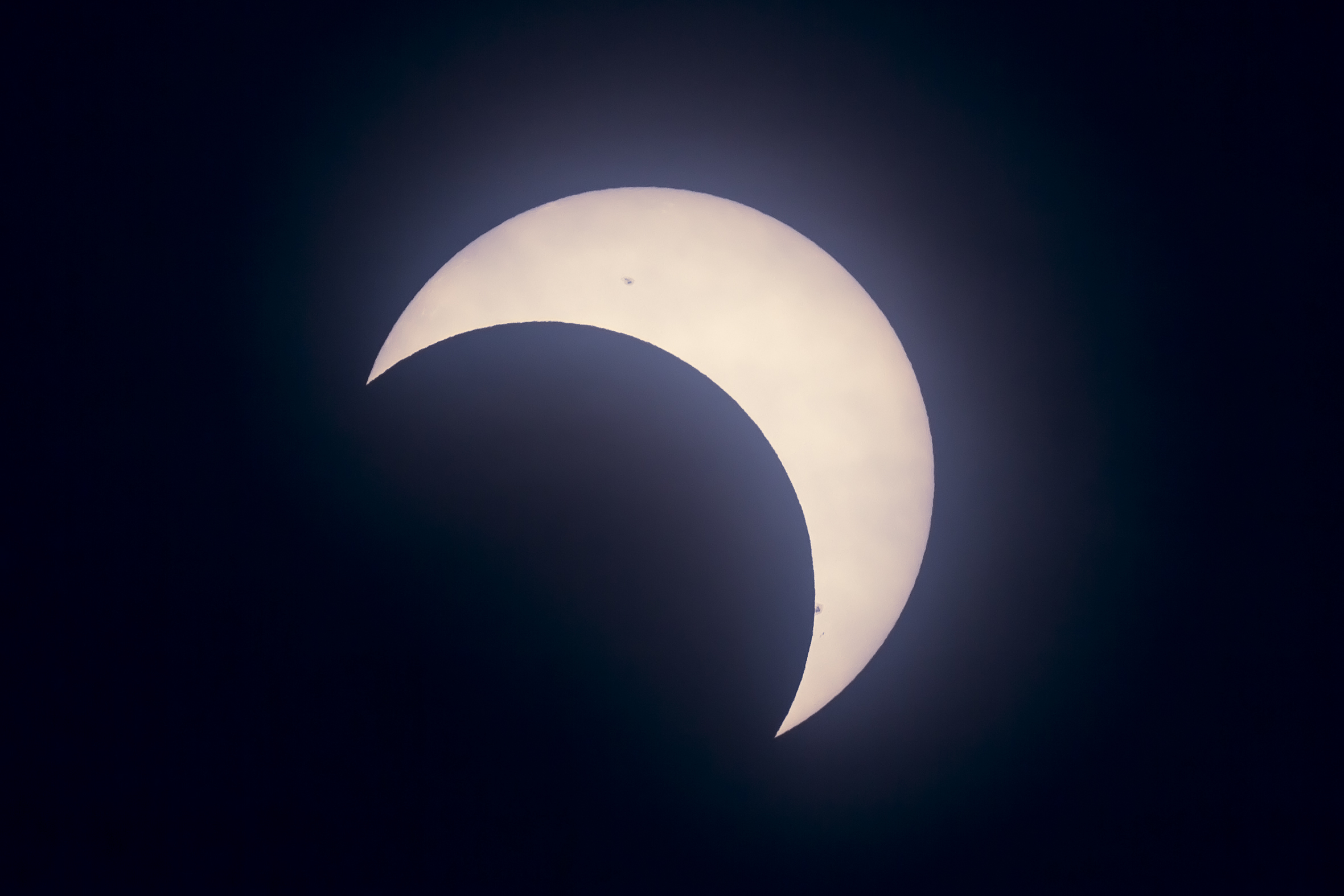
From Calgary, the Moon covered about 62% of the Sun at mid-eclipse, which this shot captures, taken at maximum eclipse for us. Here, a big sunspot group is just being uncovered by the passing Moon. Having lots of spots on the Sun this day made the partial eclipse all the more interesting, though still no comparison to the annular eclipse visible over the spectacular landscapes of the southwestern U.S.

I would have been there, in the Moon’s ant-umbral shadow, had it not been for the fact that at home I am very much involved in the opening of a new planetarium and digital dome theatre at the science centre, TELUS Spark, where I work. This is a milestone event in one’s life, one I’ve had the privilege of experiencing twice before, in 1984 in Edmonton with the opening of its new science centre and planetarium, and in 1996 when we converted the old Calgary Centennial Planetarium into a then state-of-the-art tilt-dome theatre. Oddly coincidental, I missed seeing the May 15, 1984 annular eclipse in the SE United States due to the imminent opening of the Edmonton theatre. History repeats itself — a Saros cycle of science centres perhaps?

For this eclipse we conducted a public viewing session and managed to grab excellent views once clouds cleared away before mid-eclipse. Eclipse anxiety was running high leading up to and through the initial minutes of the eclipse as it looked like clouds were going to skunk us. But wonder of wonders, the sky cleared and the eclipsed Sun was revealed, to my great relief. Missing the annular eclipse is bad enough; I didn’t want to miss the partial eclipse, too!

Now, we just need clear skies on June 5 for the transit of Venus.

— Alan, May 20, 2012 / © 2012 Alan Dyer

Snow Moon over the Science Centre


Here’s the Full Moon of February rising over the place I work, the science centre in Calgary, called TELUS Spark.

I took this Tuesday evening, February 7, on the night of what is sometimes called the Snow Moon. I knew the Full Moon would rise in the northeast and worked out, with the help of a useful iPad app, just where to stand on the hill above the science centre to get the Moon rising over the science centre. Though it did take a last minute move of a hundred feet to place the Moon over the front entrance!

The building glows from the light of banks of LEDs that can be programmed to slowly change colour. The parking lot lights are all nicely shielded, as any astronomically friendly place should be, to prevent light spilling upward. The odd structure to the left contains the new digital dome theatre, which opens this spring. The dome screen is being installed this month. The dome will feature a Digistar 4 projection system with two pairs of very high-end Sony 4K video projectors, for interactive star shows and full-dome movies. Maybe even laser shows!

Should be fun!

— Alan, February 8, 2012 / © 2012 Alan Dyer


Winter Moon Rising


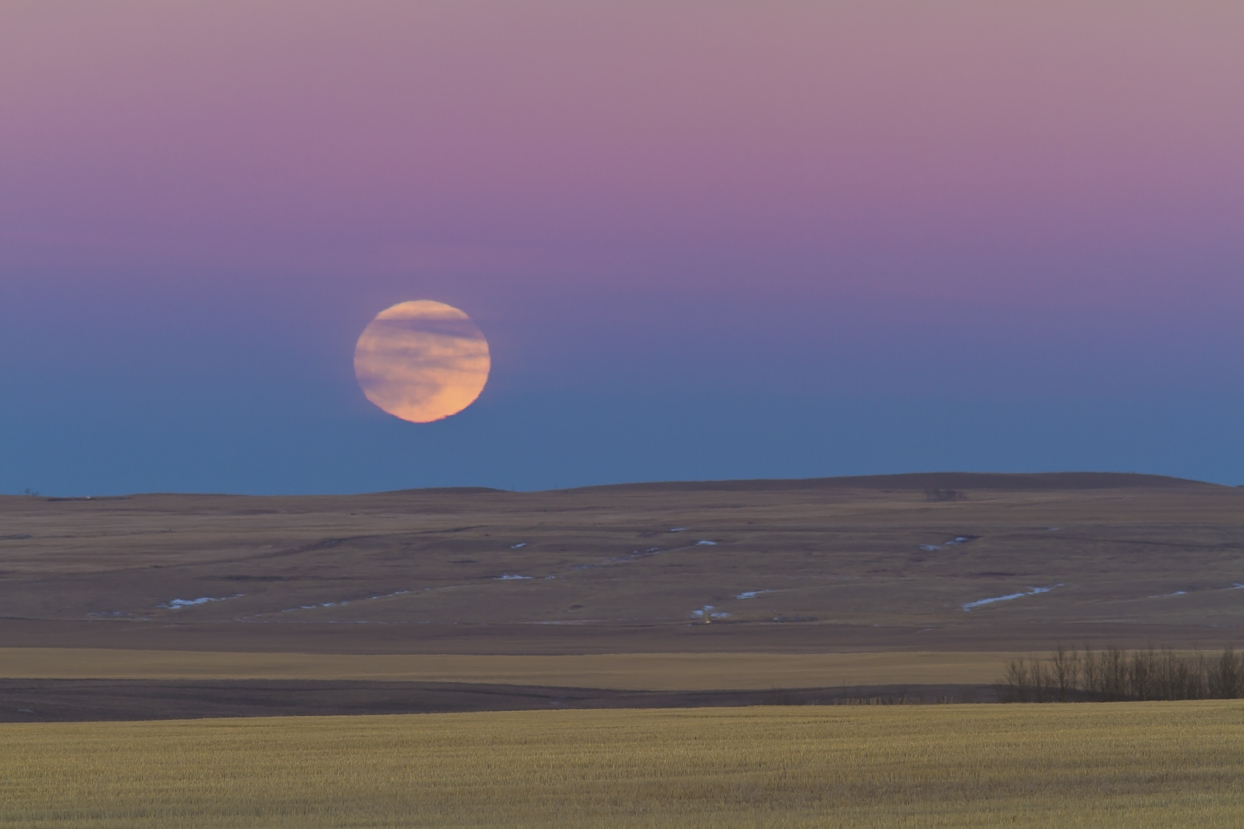
Here is the January 2012 Full Moon rising above a decidedly un-January landscape in southern Alberta. A recent spell of unseasonably mild weather has eaten most of the snow, leaving the fields yellow-brown, and a fine colour contrast with the twilight sky.

On January 8 the Full Moon rose into clear skies over the prairie landscape east of my home. This shot captures the pink glow of twilight on the upper atmosphere, above the rising blue rim of Earth’s shadow just on the horizon. A month ago, the Full Moon was in that shadow out in space, being eclipsed at sunrise. Here it is rising at sunset, one lunar cycle later.

I like the prairies, not only for the flat horizons and big open skies they provide, but also for the wonderful palette of colours on Earth and sky.

— Alan, January 8, 2012 / Image © 2012 Alan Dyer


New Year’s Moon


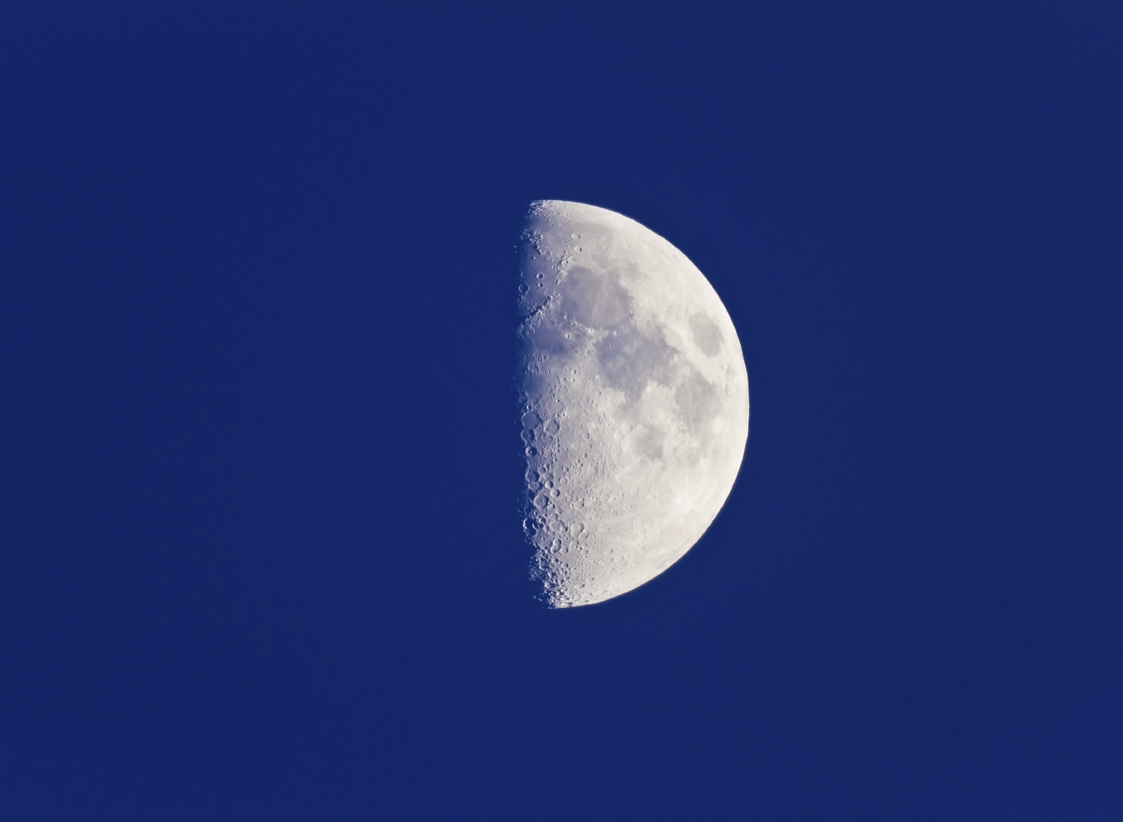
Happy New Year to all! To mark the first day of 2012 here is a view of the quarter Moon as it appeared in the early evening twilight on January 1, 2012.

The coming year promises to be a superb one for stargazing with:

• a wonderful evening appearance of Venus in March and April, including a rare passage through the Pleiades star cluster on April 3

• an array of 5 planets in the evening sky in March

• a partial eclipse of the Sun May 20 (annular if you travel to the SW United States)

• a partial eclipse of the Moon June 4 (at dawn for western North America)

• an amazingly rare transit of Venus on June 5 (North American time)

• a fine year for the Perseid meteors August 12/13

• a daytime occultation of Venus on August 13 (for North America)

• a total eclipse of the Sun from Australia and the South Pacific

• a host of fine Moon and planet conjunctions throughout the year

• and no doubt some fine displays of Northern Lights as the Sun picks up in activity toward its predicted 2013 maximum.

So there should be lots to shoot and blog about in 2012. In 2011, since I started this blog in February, my Amazing Sky blog has served up 103 posts and 14,000 image views, seen by people on 6 continents — I have yet to break into Antarctica! Perhaps in 2012.

Clear skies to all!

— Alan, January 1, 2012 / Image © 2012 by Alan Dyer


Moon in the Mountains


I’ve been chasing the Moon this week. I caught up with it last Thursday night, August 4, in Banff, with the waxing crescent Moon low in the southwest at dusk.

The location is the upper Vermilion Lake just outside the Banff townsite. The golden reflection of the low Moon on the water, the slope of the mountainside and its reflection, the dock and steps, and the tail lights from a vehicle on Highway 1 just up the hill (I decided to leave them in!) make for what I think is an interesting composition of converging lines.

I got set up and in position just in time to catch the scene at the magic hour of twilight, when the sky is dark enough the show deep colours and the Moon’s entire disk shows up, but before the sky gets too dark and the Moon too bright to make an interesting scene.

Even so, the contrast in such a scene is still very high. So to capture it more as your eye would have seen it I used a stack of five exposures, taken in rapid succession, each 2/3rds of an f-stop apart. I then merged the frames with Photoshop’s High Dynamic Range routine to create a scene that brings out detail in the foreground without overexposing the Moon and sky.

A technical method to capture a simple scene of serenity in the mountains.

— Alan, August 7, 2011 / Image © 2011 Alan Dyer

Moonscape


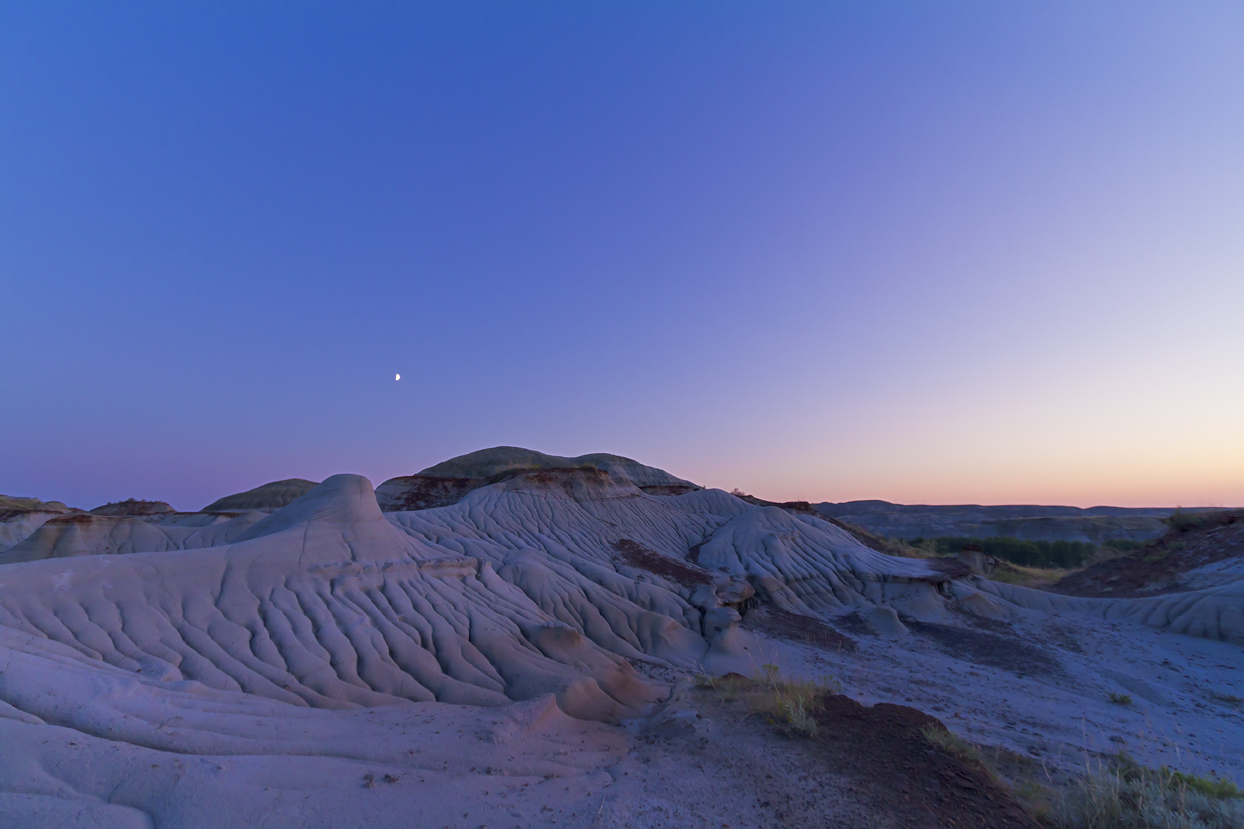
As all the other sunset photographers were packing up for the night, I was just getting started. This is the scene last night, with the waxing Moon hanging over the moonscape of Dinosaur Provincial Park in southern Alberta.

I took this in deep twilight, when the sky is tinted with subtle colours complementing the earth tones of the landscape below.

Dinosaur Park is the world’s best repository of late Cretaceous fossils, being unearthed as the terrain made of ancient volcanic ash erodes away with every rainstorm. Though the formations date from the Cretaceous some 70 million years ago when this area of Alberta was a bayou-like swamp, the badlands landscape we see today was created at the end of the last ice age when glacial floods poured over the landscape, carving the channels occupied by rivers today, like the Red Deer River that flows through Dinosaur Park.

It’s a favourite spot of mine, just an hour east of where I live, to shoot sunsets and moonrises, and twilight landscapes like this one.

— Alan, August 7, 2011 / Image © 2011 Alan Dyer


Moon Over Banff Springs Hotel


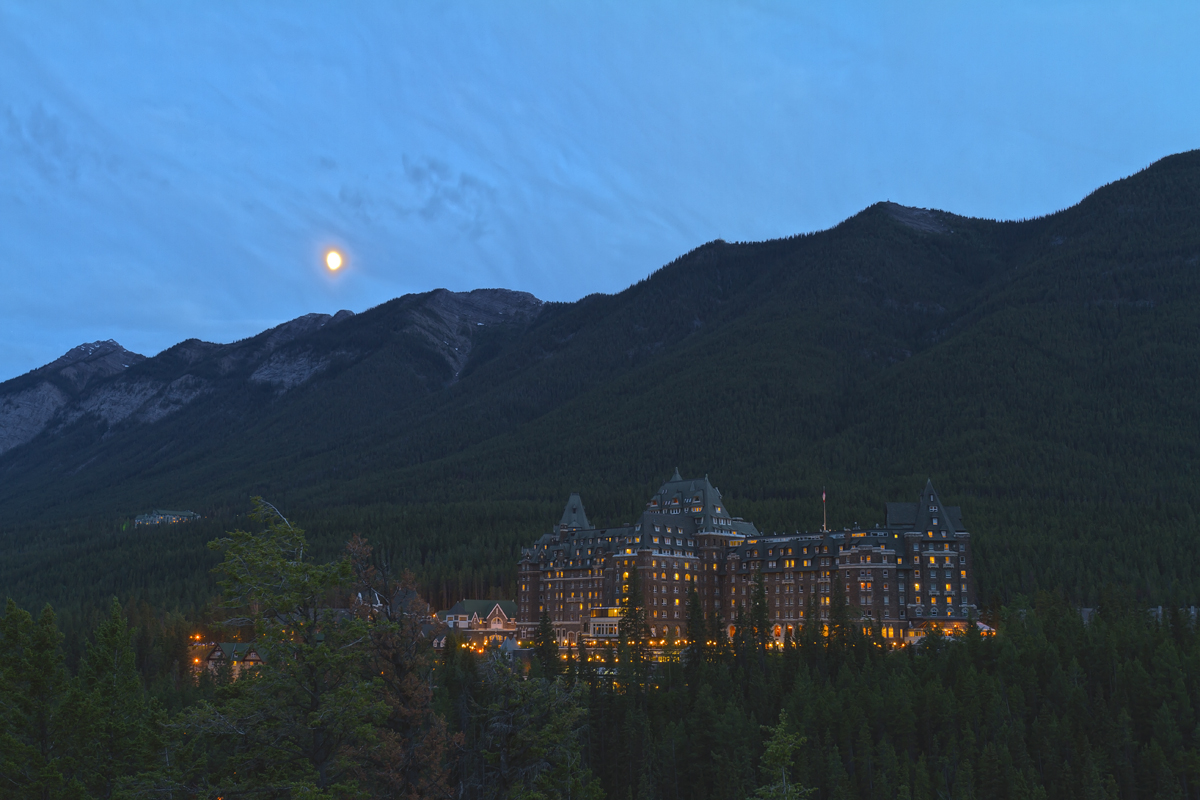
A weekend in Banff National Park — but three cloudy nights foiled the array of starry time-lapse shots I had hoped to take. But on Sunday night, July 10, I did get a nice evening shot of the Moon over the most famous Banff landmark.

This is the Banff Springs Hotel, in the deepening twilight as the gibbous Moon shone over Sulphur Mountain behind the hotel. I shot this from the overlook across the Bow River on Tunnel Mountain Drive, a popular spot by day for tourists to disembark by the busload and get their requisite shot. But at this time of night, about 11 p.m., I was the only one there. That’s the beauty of nightscape photography — you have the scene to yourself! And the bears.

Banff Springs is the epitome of a grand hotel. Opened in 1888 but since reconstructed and added to several times, the hotel was built by the Canadian Pacific Railway as the focal point for the tourists it planned to bring into the new Rocky Mountain Park, to take “the waters” in the Park’s sulphur hot springs and enjoy mountain wilderness in genteel splendour. I had the pleasure of staying there one night, in an upper room, courtesy of the Hotel as part of an astronomy outreach program we did there for Earth Hour in 2010. It was truly splendid!

For this shot, I combined three different exposures (1/2 second, 1.3 seconds and 3.4 seconds) in a High Dynamic Range stack, to bring out dark foreground detail but retain the still bright sky, and prevent the Moon from becoming too overexposed. So some Photoshop trickery was involved. But unlike many picture postcard scenes of the Moon sitting above a landmark, this one is real and has not had the Moon pasted into place, usually in a spot and orientation that is astronomically impossible! We astronomers hate that!

— Alan, July 11, 2011 / Image © 2011 Alan Dyer

The Moon in June


On one of the few clear nights of late I took the opportunity to shoot the Moon. It’s a familiar subject to be sure, but one I don’t shoot very often. Pity really, as it is rich in detail and makes for dramatic photos.

I took this shot June 12, about 4 days before the Full Moon of June, so this is a waxing gibbous Moon. Lots of terrain (lunain?) shows up at left along the terminator, including the wonderful semi-circular bay at about 10 o’clock called Sinus Iridum. At the bottom is the bright Tycho crater, with its distinctive splash of rays spreading out across most of globe. Imagine the devastating impact that caused that feature! It isn’t that old either — estimates suggest Tycho is just 100 million years old, putting its formation smack dab in the middle of the Cretaceous Period when dinosaurs ruled the Earth. They would have seen that impact, little knowing another similar-sized impact 35 million years hence, but aimed at Earth, would do them in.

For this shot I used the Astro-Physics 130mm apo refractor with a 2x Barlow lens to increase the effective focal length to 1600mm, a combo that exactly fills the frame of the Canon 7D with no room to spare. I processed this image for high contrast, to bring out the subtle tonal and colour variations in the dark lunar seas, an effect due to different mineral content of the lava that oozed out forming the lunar plains. Judicious use of Highlight Recovery (in Camera Raw) and Shadows and Highlights (in Photoshop) brings out the detail across a subject with a huge dynamic range in brightness. A liberal application of Smart Sharpening also helps snap up detail.

— Alan, June 18, 2011 / Image © Alan Dyer 2011


Sailin’ Toward the Moon


For the past week I was on a cruise ship in the Caribbean, on a “cruise and learn” voyage, serving as one of the guest speakers to a group of astronomy enthusiasts who wanted an immersive vacation learning about the latest in astronomy research and, in my presentations, about the hobby side: choosing a telescope and doing astrophotography. The cruise was organized by Insight Cruises and by Sky and Telescope magazine.

The trip went great, with fabulous weather all along, and a welcome break to an awful winter in the north. However, a cruise ship is not the best place to actually do astrophotography!

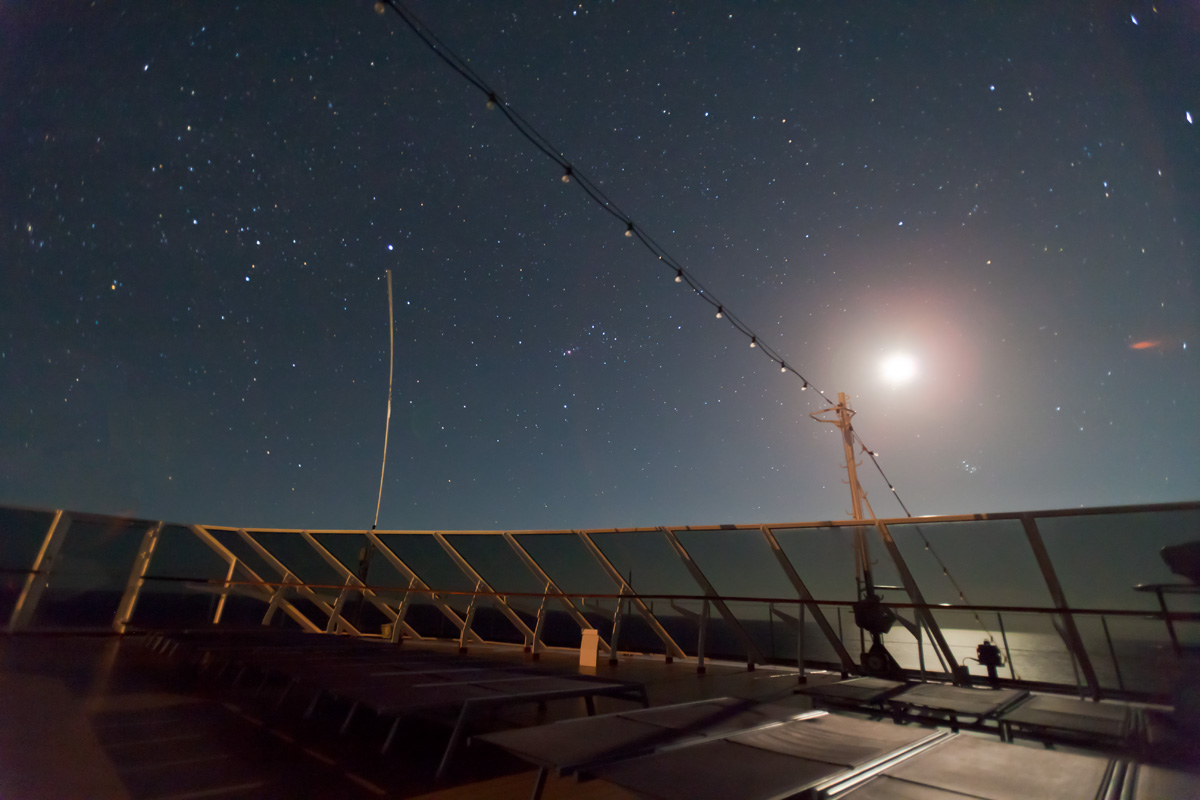
This is a shot taken on Friday, March 11, from the upper deck and bow of the ship, the Holland America Line’s “Nieuw Amsterdam,” as we sailed on a northwest course back to Fort Lauderdale from our most southerly port of call in St. Maartens in the eastern Caribbean. The Moon is overexposed at right, and is directly ahead of us, making it look like we were sailing toward the Moon. At left is Orion and Canis Major, tipped over on their sides compared to our northerly view. This was from a latitude of about 20° North.

To keep the stars looking like stars (and not seagulls) and freeze the rolling of the ship, I had to bump the camera up to ISO 6400 and use a 5 second exposure at f/2.8 (wide open) with the 16-35mm lens. Not the best combination of settings, but it’s what it took to capture the “seascape” night scene.

— Alan, March 13, 2011 / Image © 2011 Alan Dyer