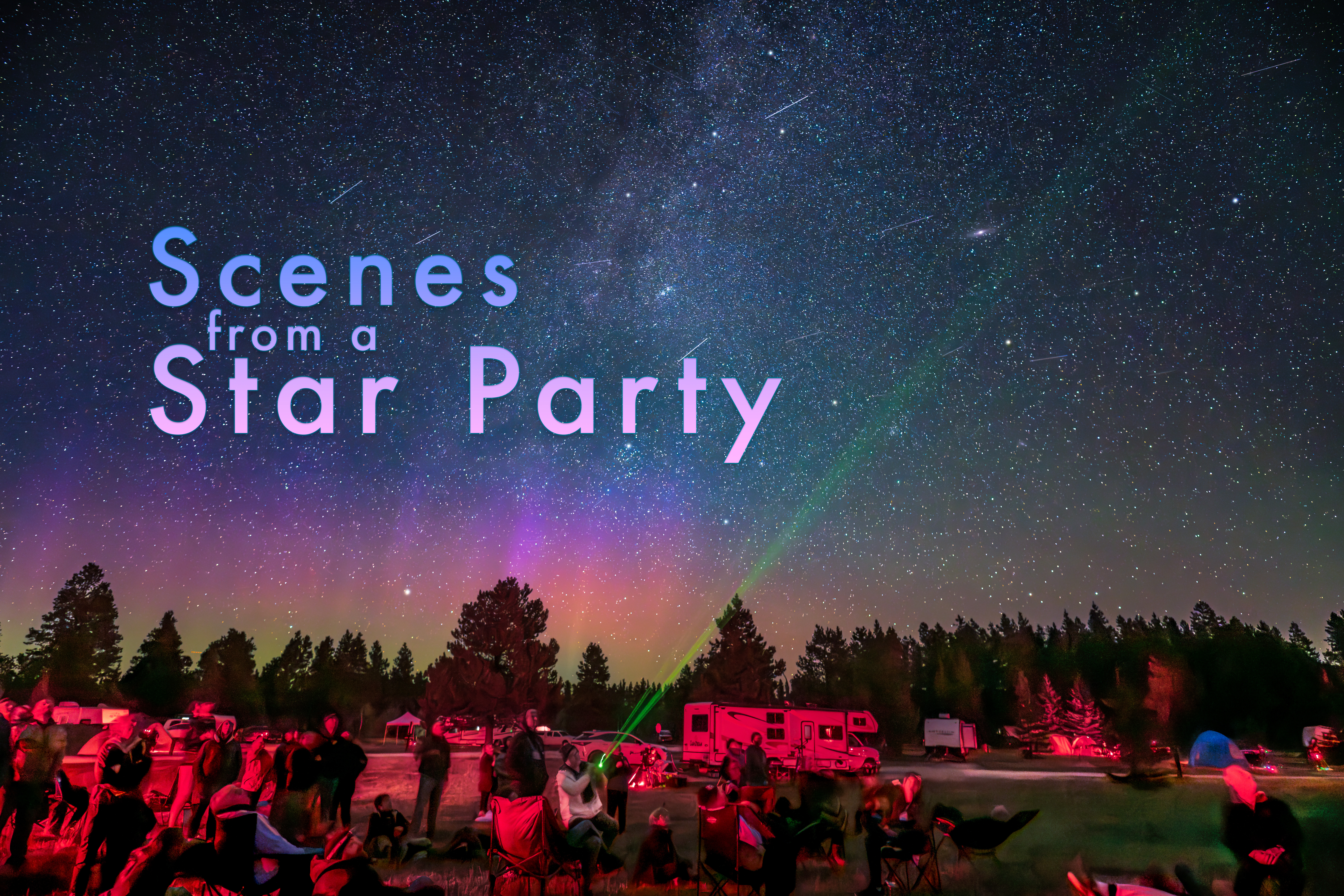
Amateur astronomers like nothing more than spending time under a dark night sky with a field of friends.
Star parties are a popular part of the hobby of amateur astronomy. They’re chances for stargazers to get under dark skies and meet up with others who love the night sky.
Each year I attend the biggest such event in my area in western Canada, the Saskatchewan Summer Star Party. It usually attracts about 320 sky lovers to the very dark skies of southwest Saskatchewan.
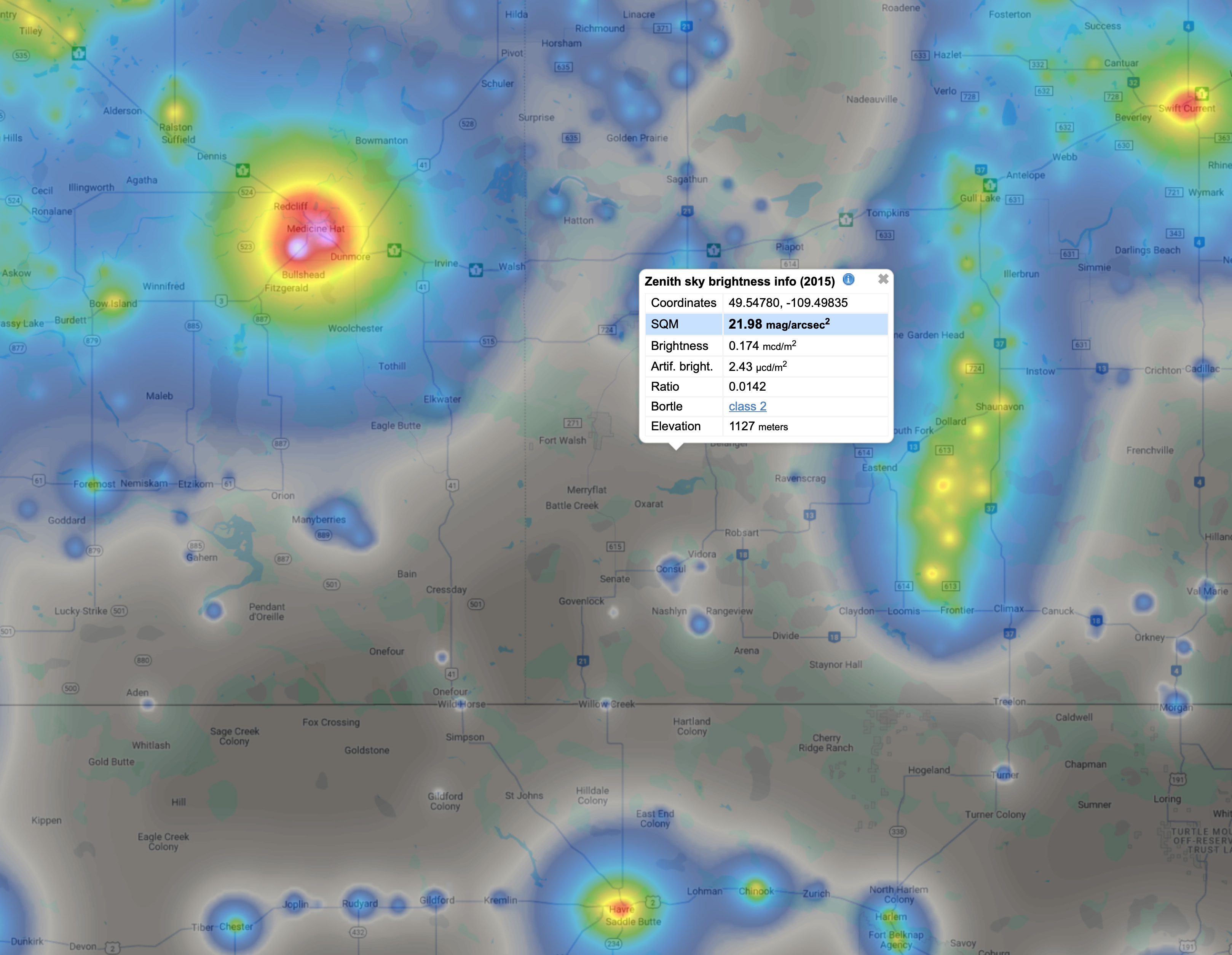
A light pollution map where grey = good!
The label marks the spot for the Party, in the Cypress Hills, and in the Cypress Hills Interprovincial Park, that straddles the border of Saskatchewan and Alberta. As per its name, the SSSP is held on the Saskatchewan side of the Park, in the Centre Block south of Maple Creek. (A complementary Southern Alberta Star Party is held on the Alberta side of the Cypress Hills, in September. I’ll be there!)
As the map shows, the Cypress Hills are far from any light pollution and offer “Bortle 2-class” skies — 1 being the darkest, and 9 being downtown Las Vegas!
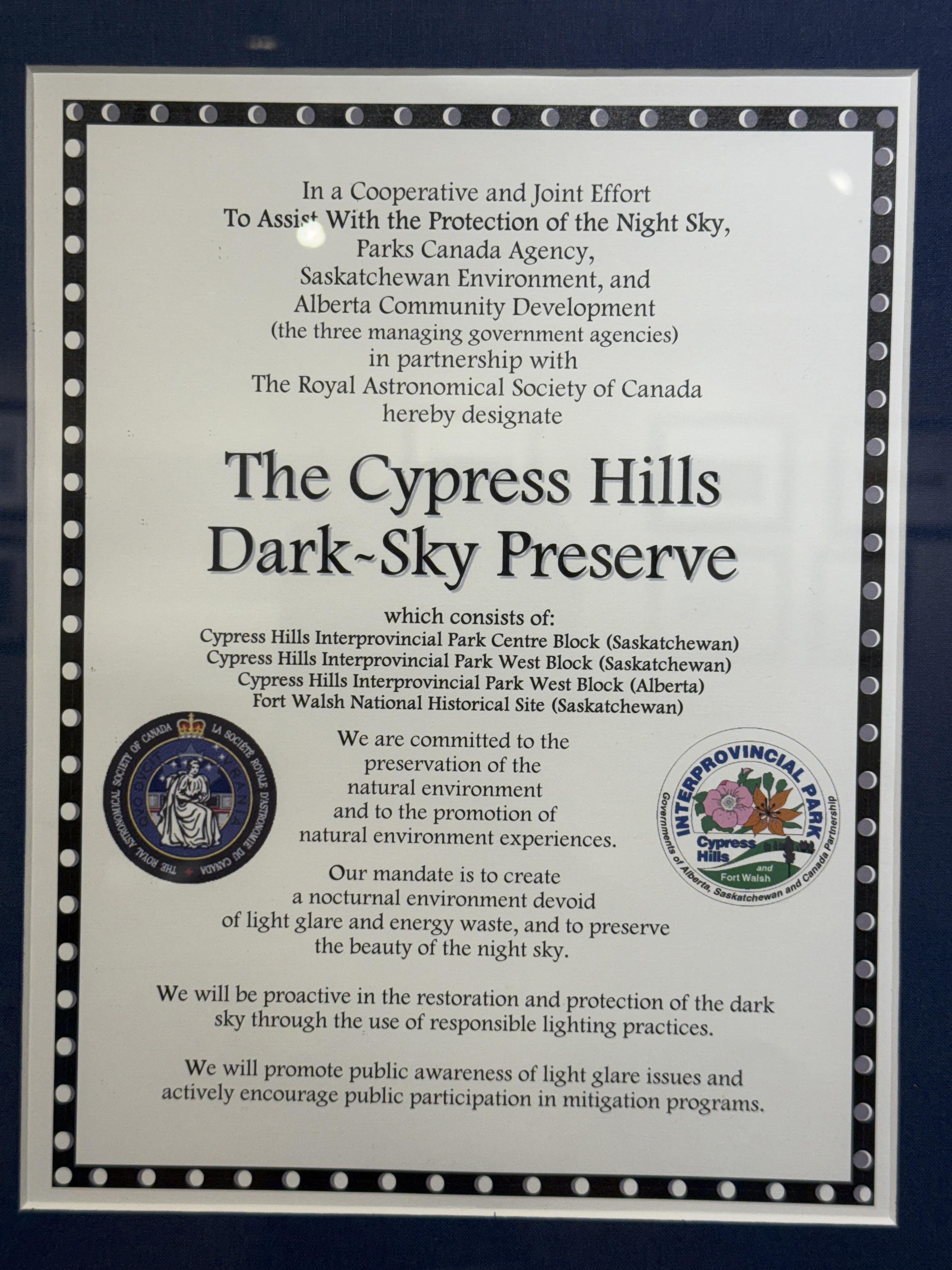
In fact, the Park is a Dark Sky Preserve, a designation awarded in 2004. Parks are increasingly aware of their role in not only conserving flora, fauna, and historical sites, but also the increasingly threatened night sky. As the saying goes, “Half the Park is after dark!”
The DSP Declaration
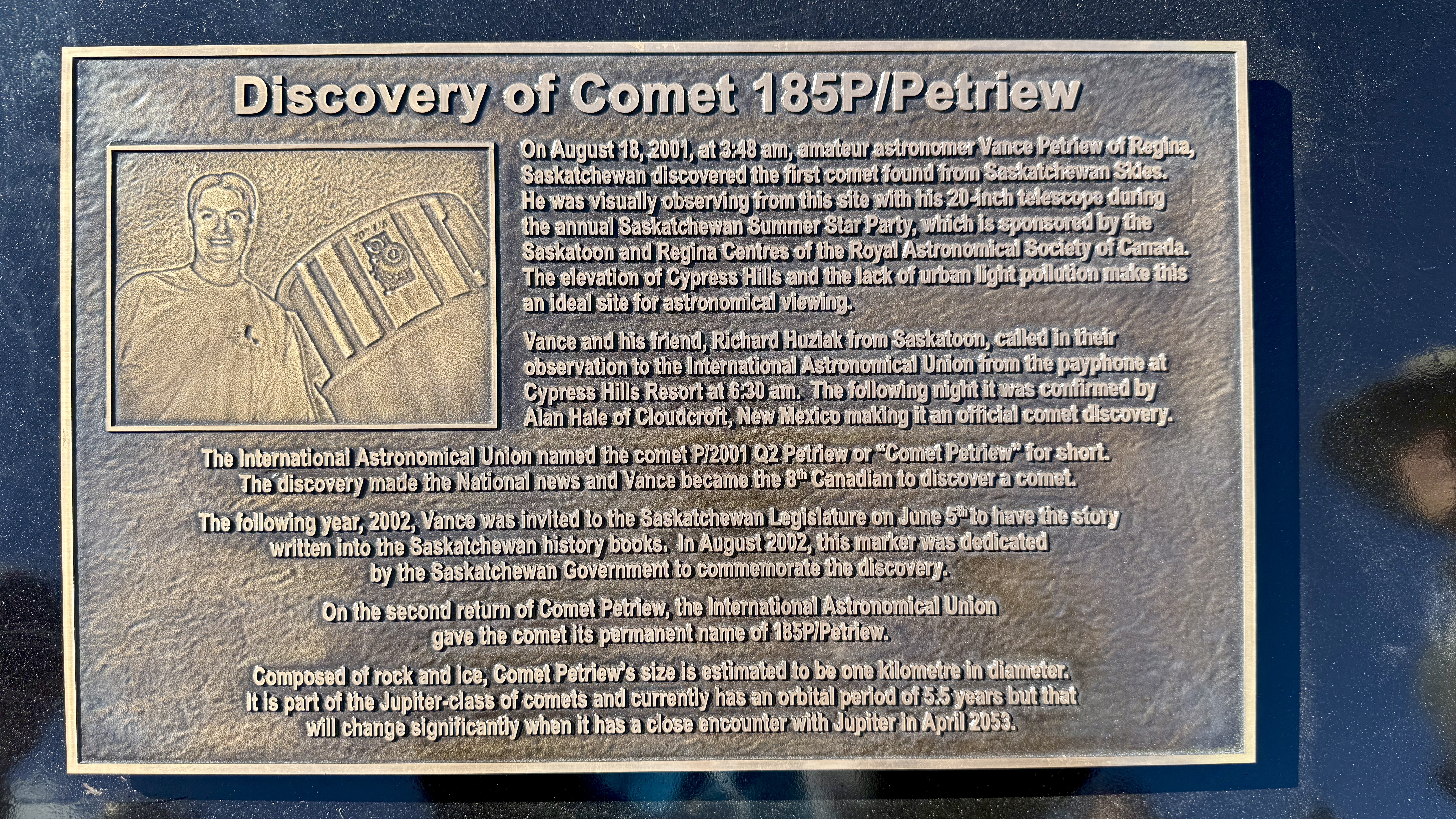
The Dark Sky Preserve designation, and efforts to refit what lighting is in the Park to “dark-sky friendly” fixtures, came about as a direct result of the Park, and Star Party, being the site of a comet discovery three years earlier.
It was at the Star Party in August 2001 that Regina amateur astronomer Vance Petriew discovered a comet, an observing feat that merits a comet being named for the discoverer.
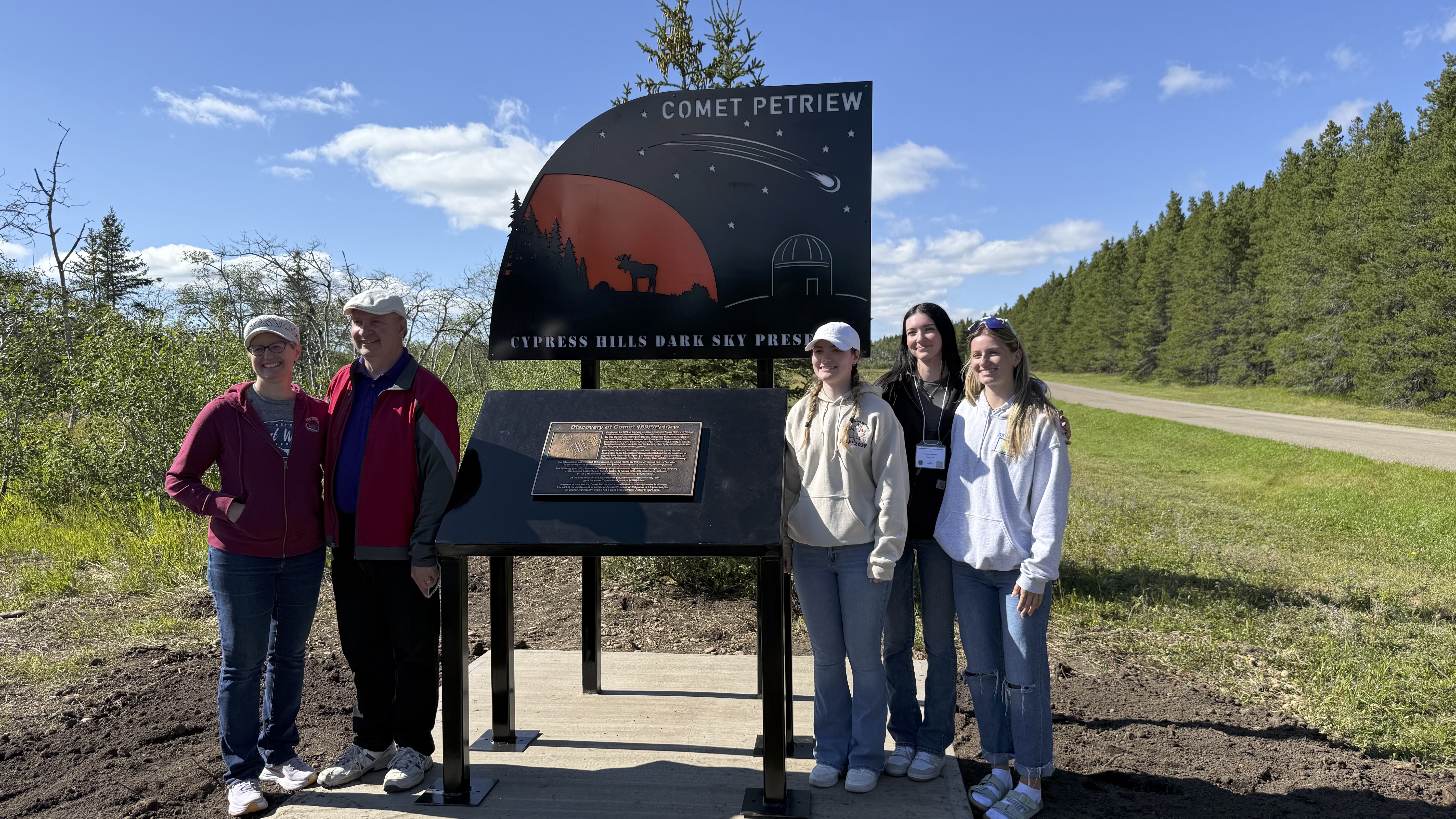
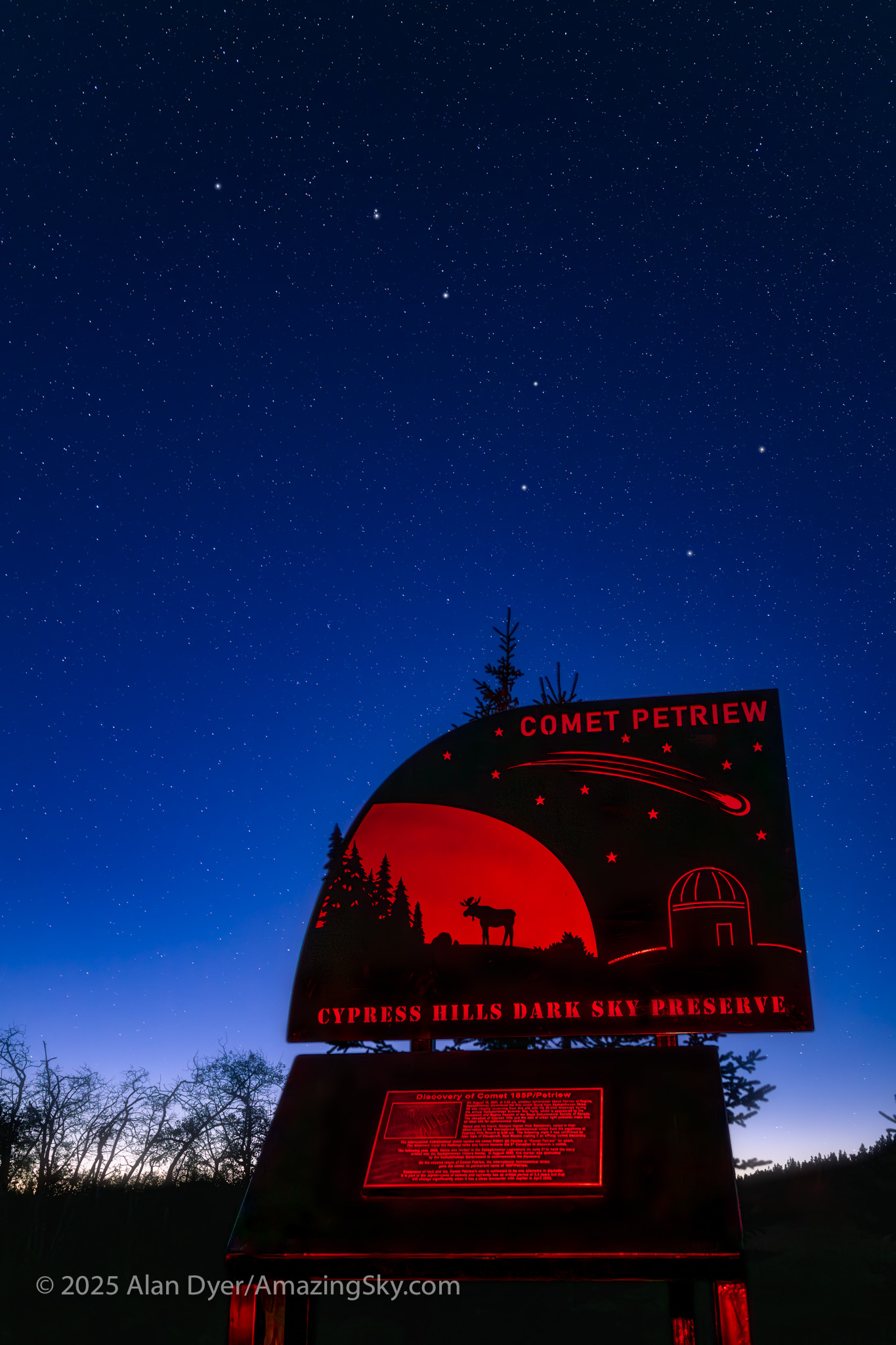
This year, a new sign and plaque were unveiled commemorating the discovery, replacing a cairn that had fallen into disrepair over 20 years. Here is the unveiling —
Park officials, fellow astronomers and Vance unveil the sign.
This was a fine event with all the star party folks in attendance, many of whom were there in 2001! — including the now adult daughters of the Petriew family.
Click on the images below to bring the photos up full screen.
The Petriew FamilyThe comet scope in 2025.Comet Petriew plaque
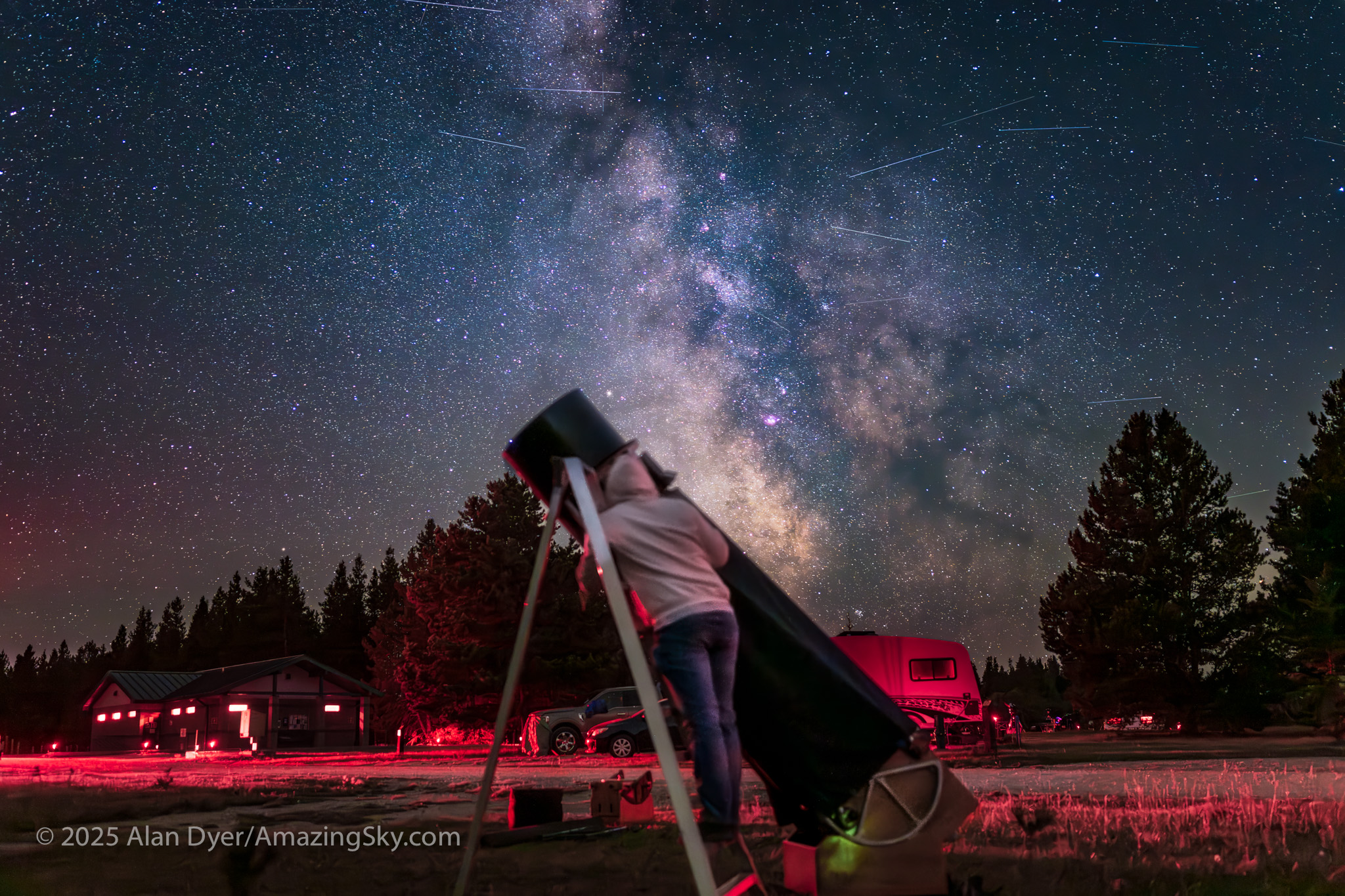
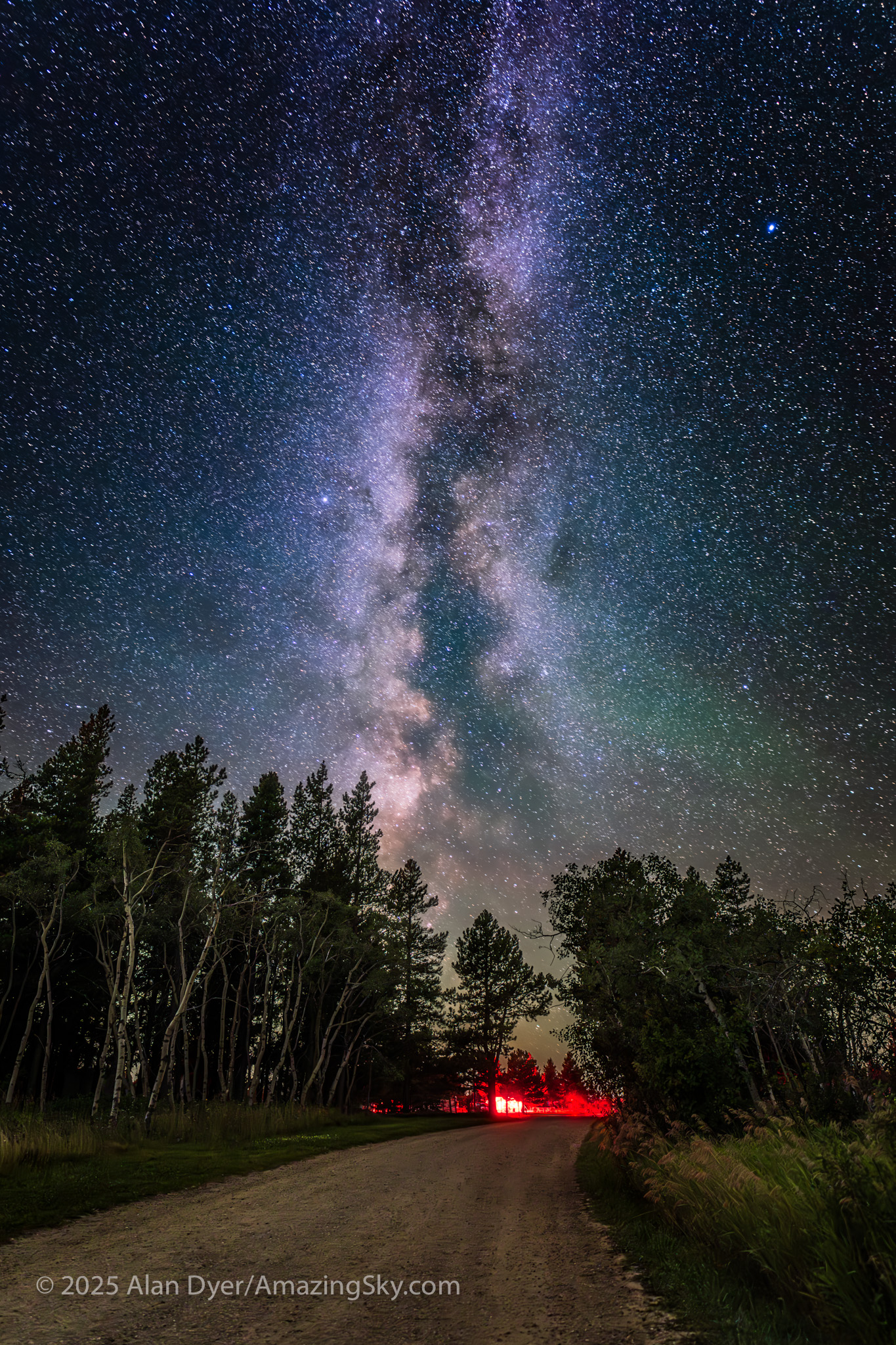
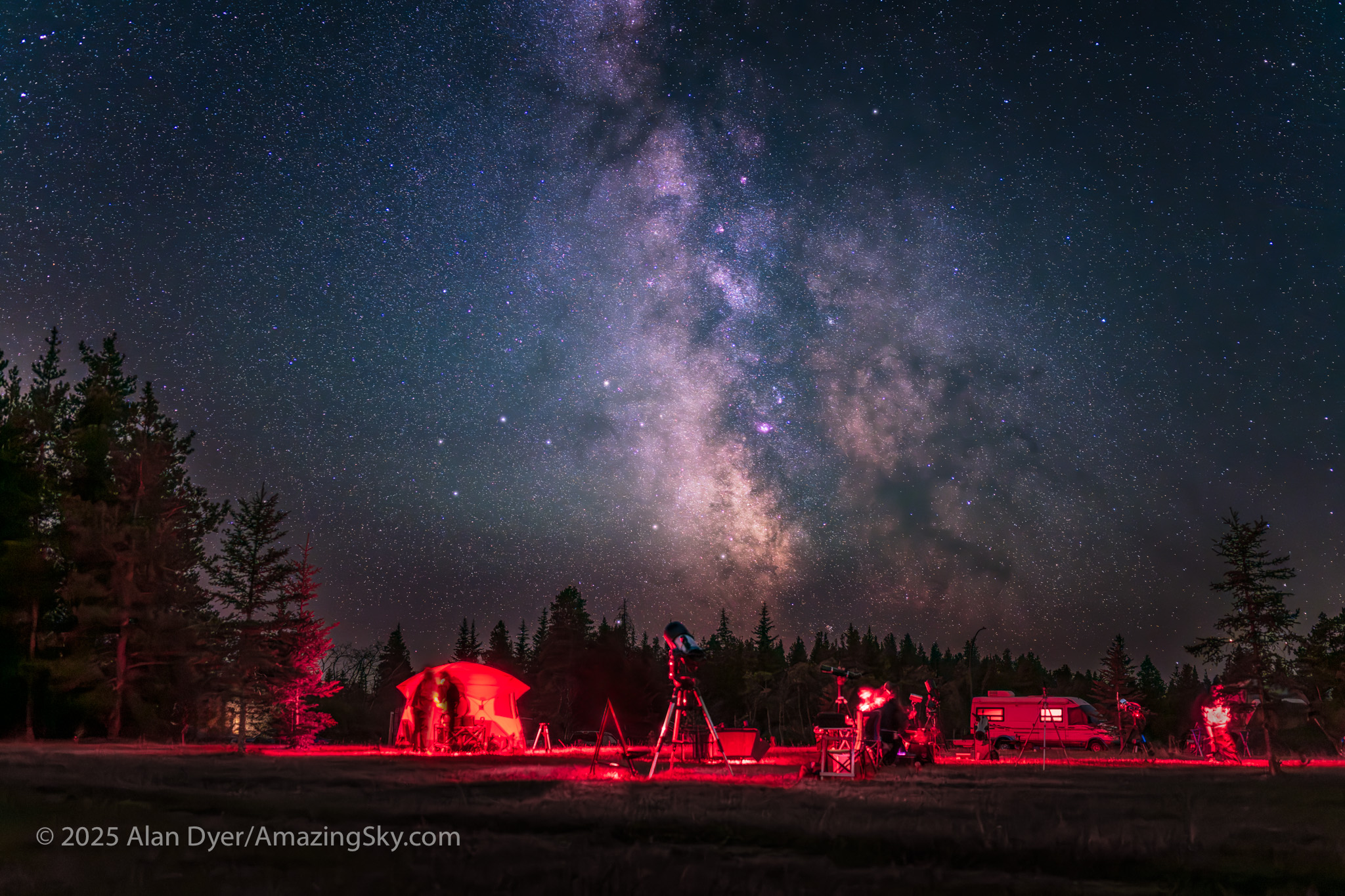
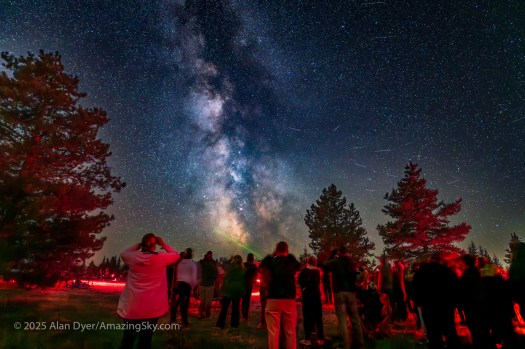
While that was a highlight of the week, the real show was the sky above. The Milky Way was on display in a sky clearer and darker than we had seen it for many years. No clouds, no smoke, and little dew and bugs! The Cypress Hills are a mecca for stargazing!
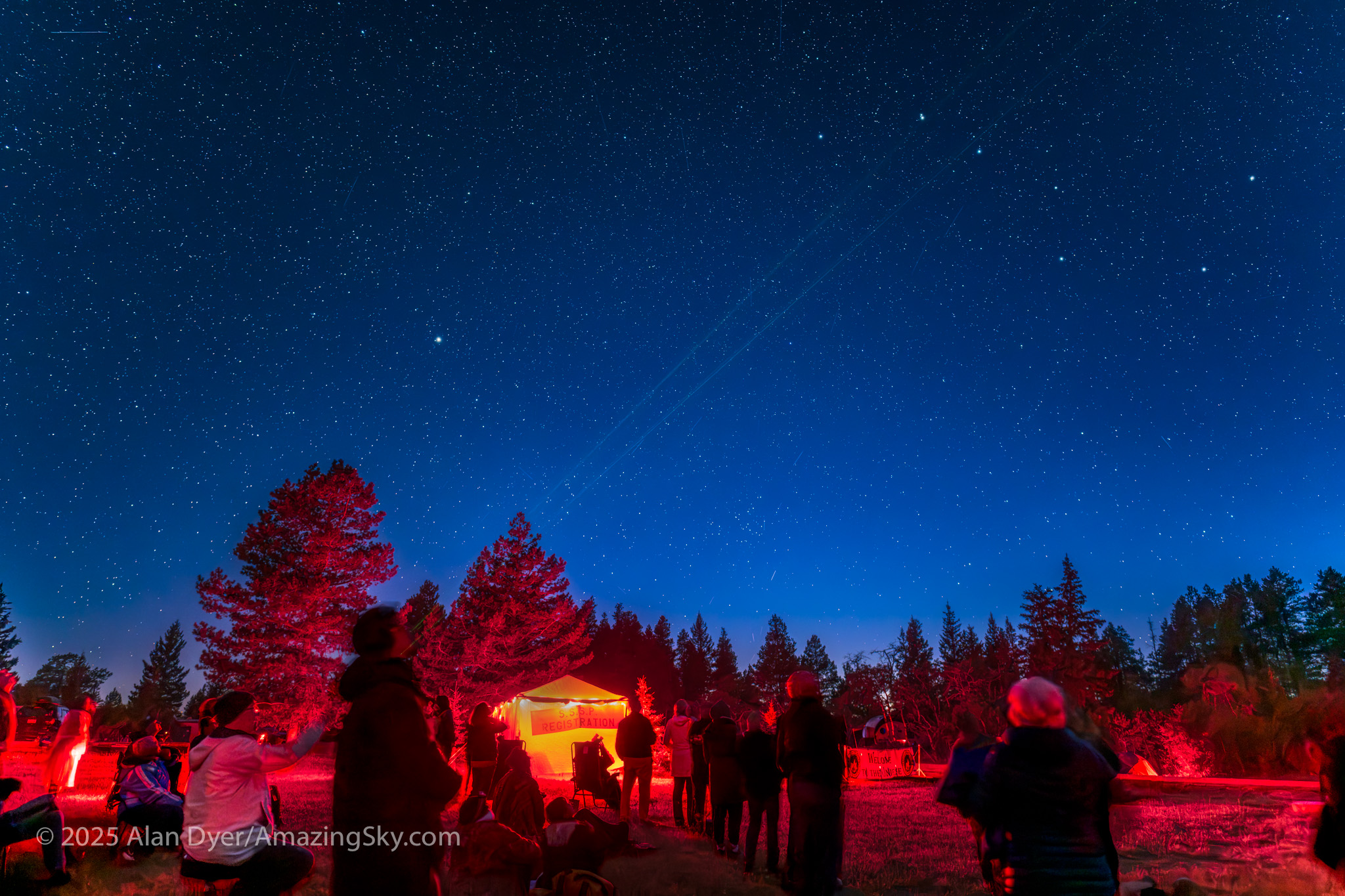
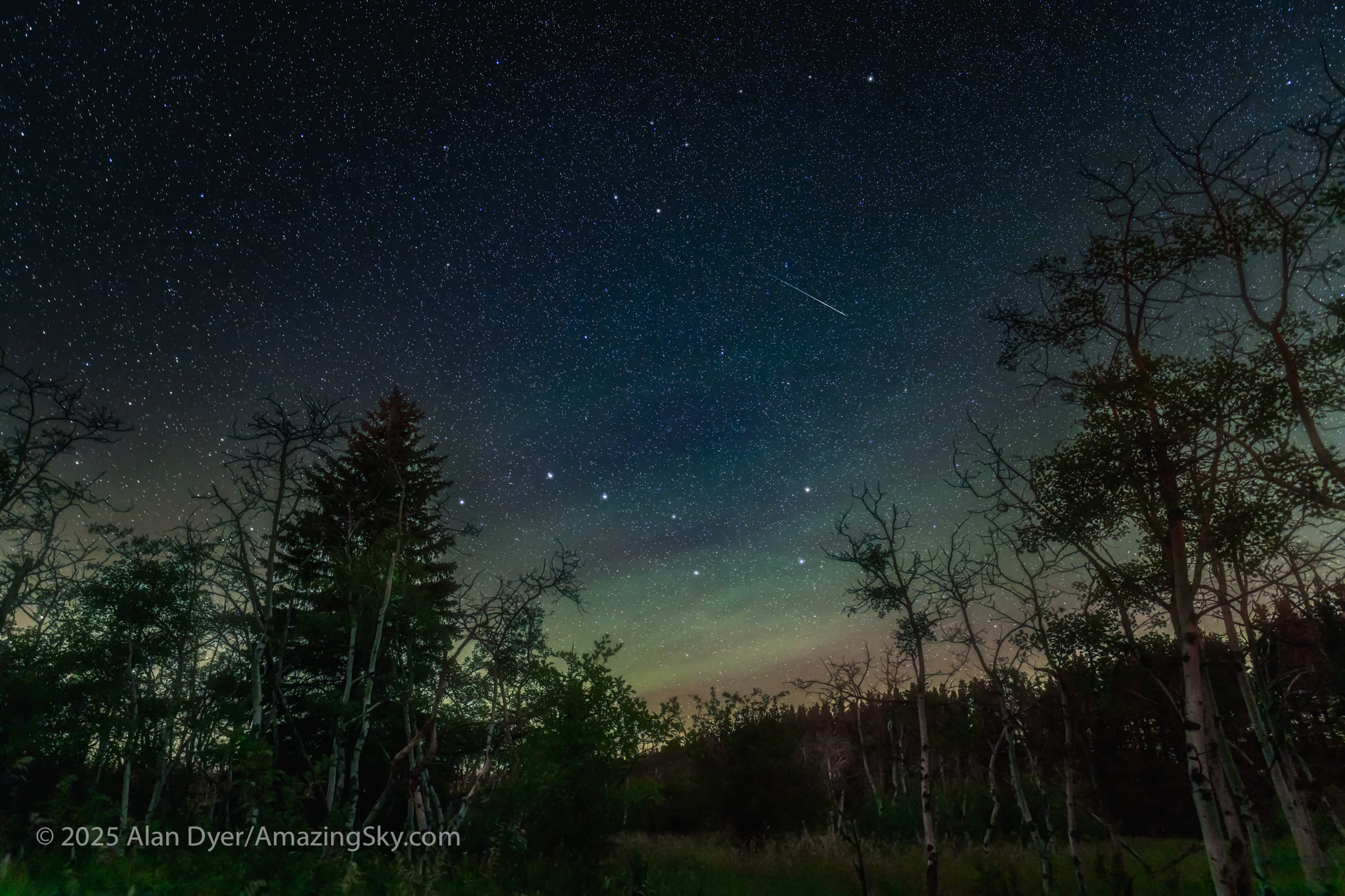
The road into the Meadows Campground, home to the Saskatchewan Summer Star Party. The SSSP is organized by the Royal Astronomical Society of Canada centres in Regina and Saskatoon. Telescopes and tents under the Milky Wa.yA sky tour in the early evening with blue twilight.The Big and Little Dippers in the Cypress Hills
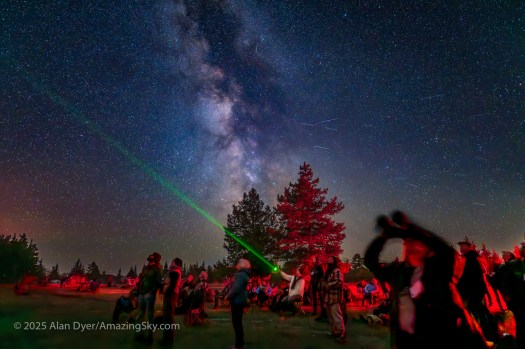
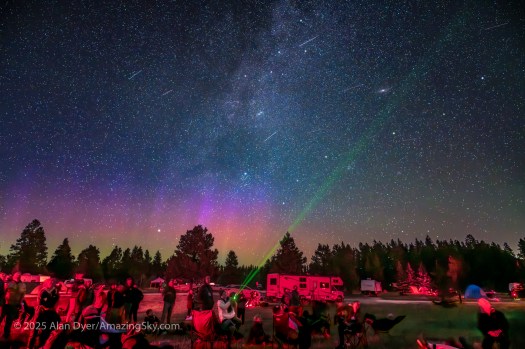
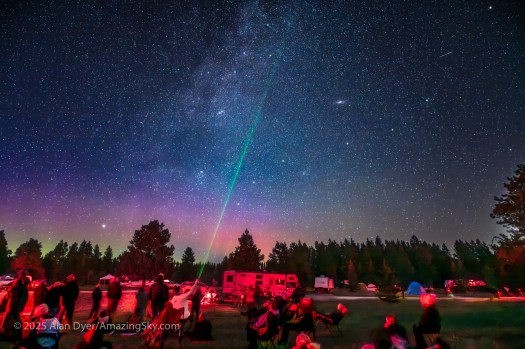
A popular part of this star party, as it is at many such events, is a laser-guided tour of naked-eye sights, where a guide points out the constellation patterns, and highlights objects that need nothing more than binoculars to see well.
In a slide show below, astronomer Ron Waldron from Saskatoon conducts the 2025 Friday night “star walk.” It’s BYOB — Bring Your Own Binoculars!
Laser touring the sky
Yes, there was an aurora
Look up! Look way up!
Peering into the Galactic Core
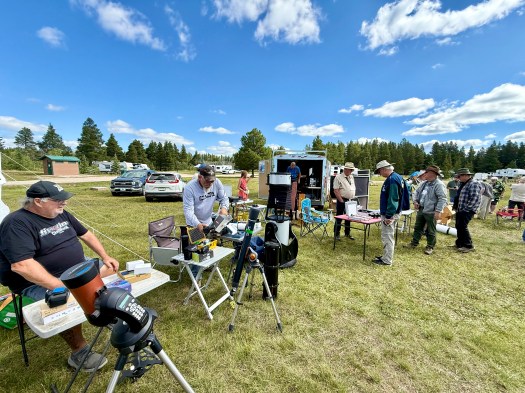
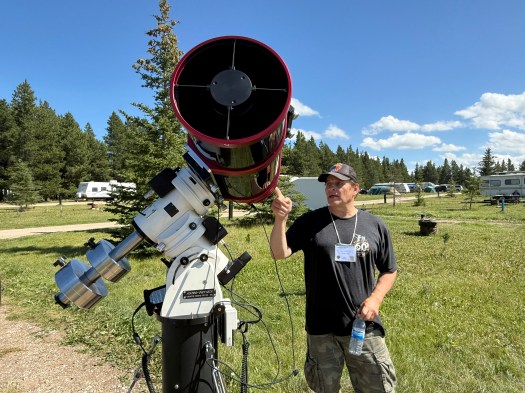
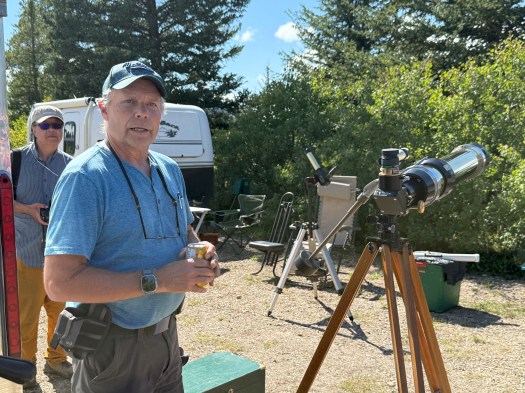
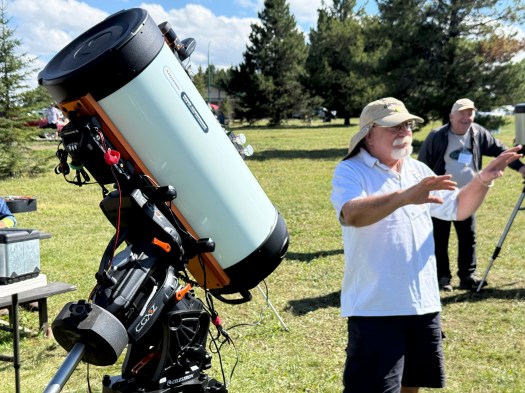
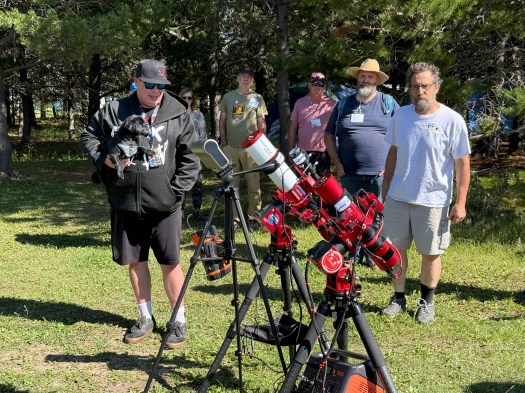
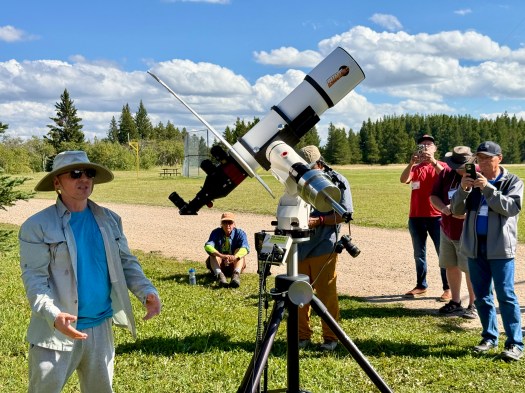
While participants stay up until the wee hours to enjoy all that the sky has to offer, every star party offers a range of daytime activities (but not happening too early!). Star parties are great places to see fields of telescopes of every description. This year the program included a formal “show-and-shine” tour of some notable gear for all to admire. And there’s the ever-popular swap meet with bargains on offer.
The Swap Meet
Kevin’s astrophoto rig
Wade’s classic refractor
Ed’s super astrophoto scope
Nick’s astrophoto array
Dan’s super solar scope
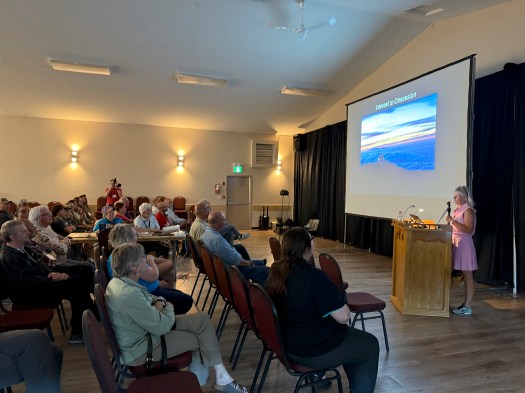
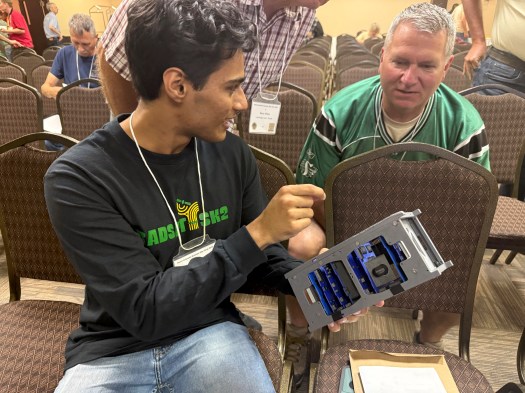
We enjoyed several talks on a range of astronomy topics, not just stargazing, but also the latest in science research. We heard about a satellite being built in Saskatchewan by U of S and U of R students, and about how the Mars Perseverance rover collects samples, in a talk from one of the researchers involved with the NASA mission.
Kimberly Sibbald delivered the opening keynote on her amazing astrophotos.
Dr. Chris Herd from the U of A explained Mars sample collection.
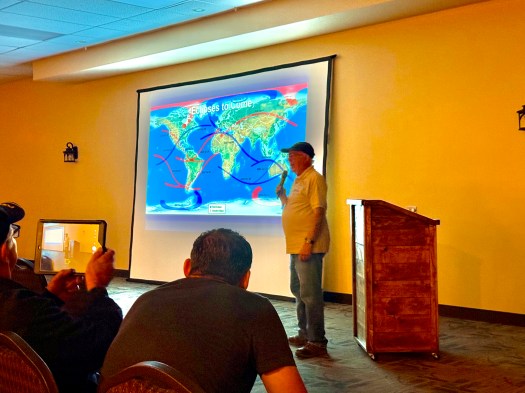
And I gave a short talk about eclipses coming up.
A 3D model of the Sask Sat
And of course there were awards and door prizes to be won! Always to a capacity crowd at the Cypress Resort conference room.
The door prizes being handed out. You must be in the room to win!
It was a superb 4 days of astronomy and stargazing. If you are in the area, I highly recommend attending. Next year’s SSSP will be August 12 to 15 inclusive — it’s always at New Moon. The website is here but won’t be updated for the 2026 event details until next year.
I won’t be there in 2026, as August 12 is the date of the next total eclipse of the Sun, which I discuss in my previous blog. I plan to be in Spain!
This is the new sign and plaque commemorating the discovery in 2001 of a comet here in the Cypress Hills Interprovincial Park by Vance Petriew.
But I highly recommend attending in 2026. As most people do, you may find yourself enjoying the weekend so much you make it an annual event in your calendar. I shall miss my annual August ritual of the SSSP in 2026 and in 2027 — there’s an eclipse that August, too!
But 2025 was certainly a fine year to enjoy all that the Cypress Hills have to offer under the stars.
Join me in a guided tour of the famous (and not so well known!) constellations of the northern spring sky.
The northern spring sky lacks the splendour of bright patterns such as winter’s Orion or summer’s Cygnus, but it is still well worth getting to know. The Milky Way is out of sight, and in its absence we are left with fewer bright stars to dazzle us at night. But we are treated to the year’s best views of famous constellations such as Ursa Major, Leo and Virgo.
Now, I am talking about the sky of the northern hemisphere, where April and May brings spring, and places the Big Dipper high overhead. While some of these constellations can be seen from the southern hemisphere, they appear to the north, low and “upside-down” from the views I present here. And April and May are autumn months.
Let’s start with the “big picture.” (Tap on images to bring them up full screen.)
NOTE: I shot all these images during a run of fine nights in mid-April 2025 with a 15-35mm zoom lens on a Canon EOS R camera, and on a Star Adventurer tracker. Separate exposures through a Tiffen Double Fog 3 filter added the star glows.
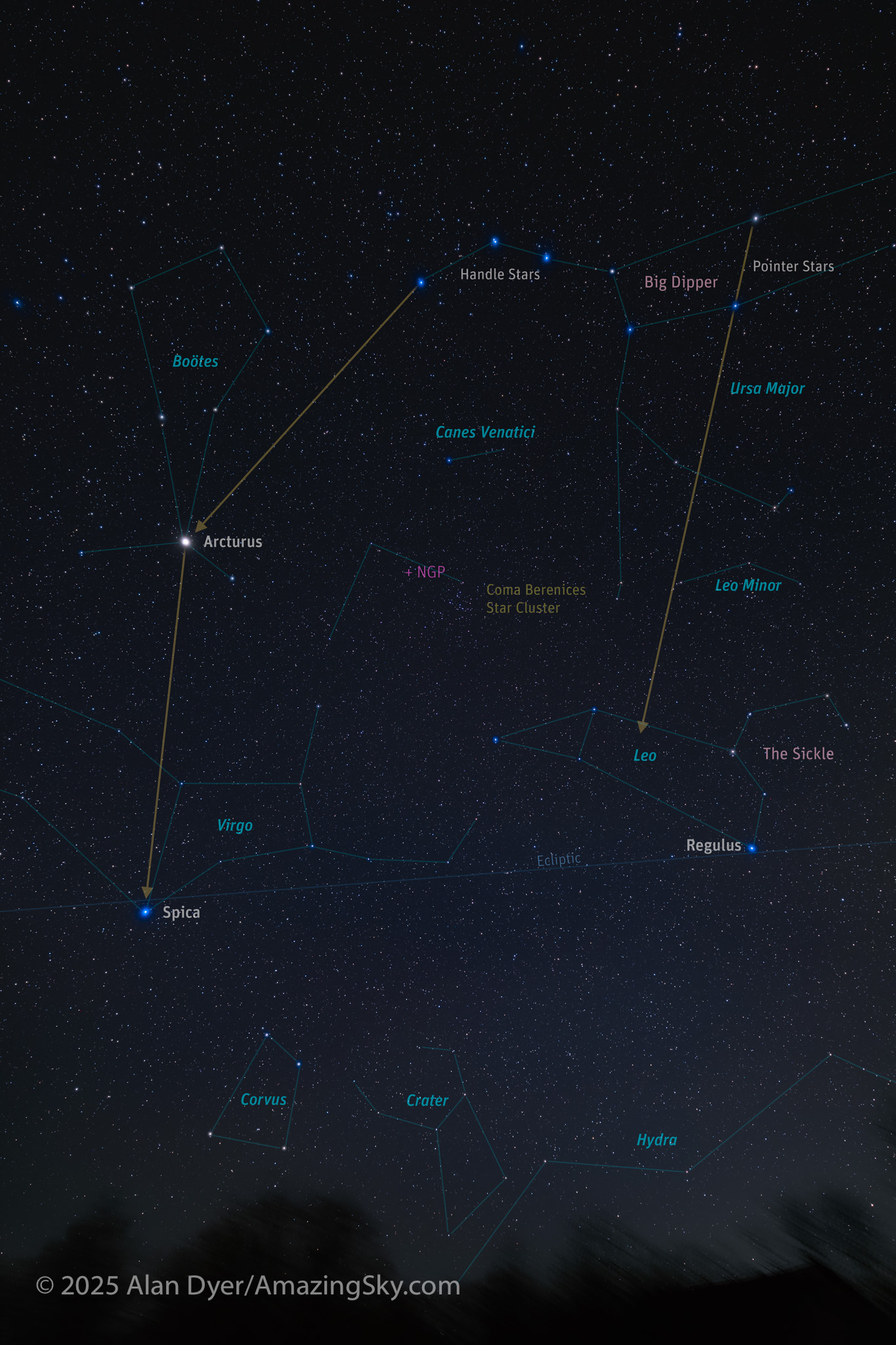
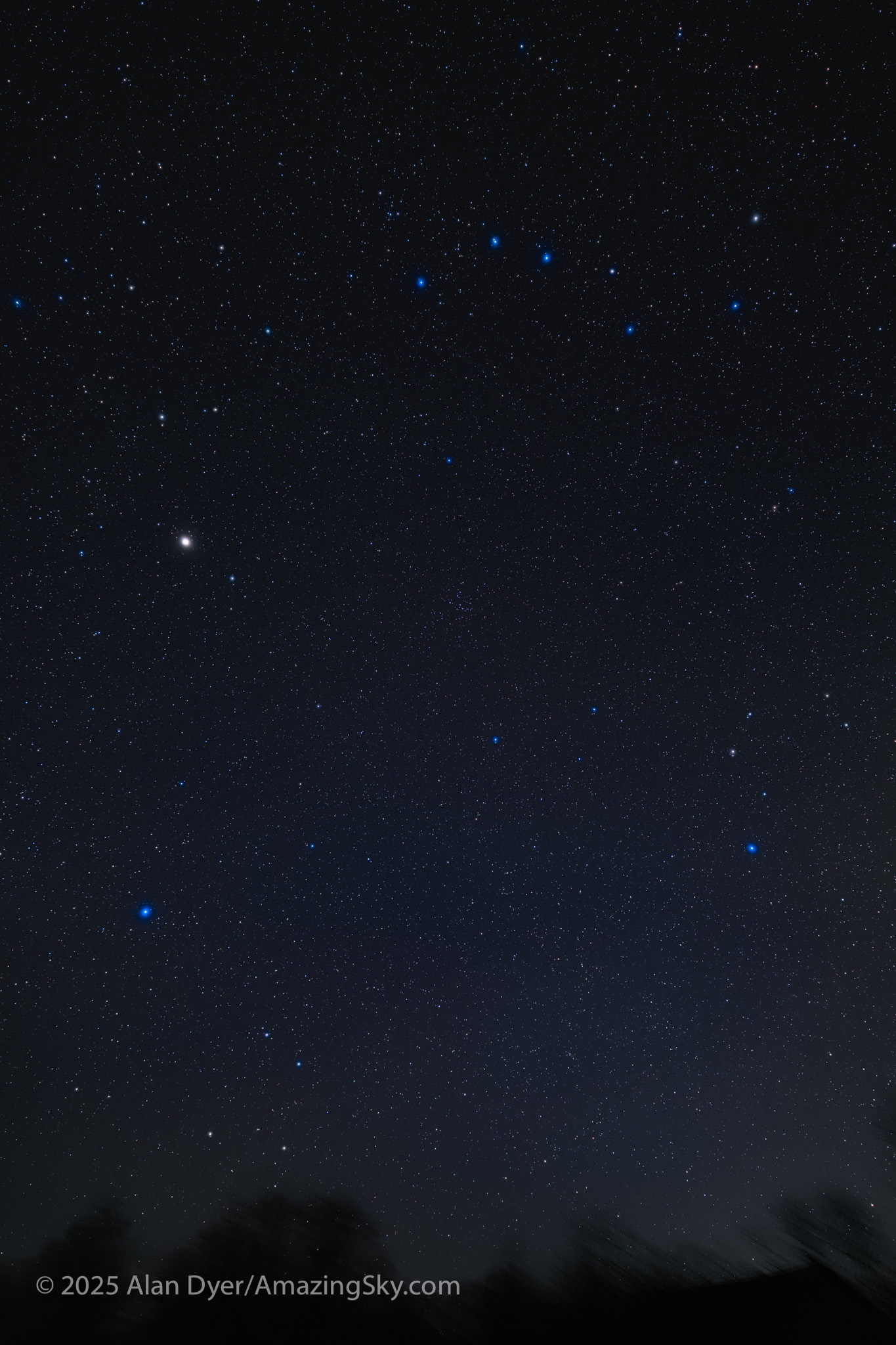
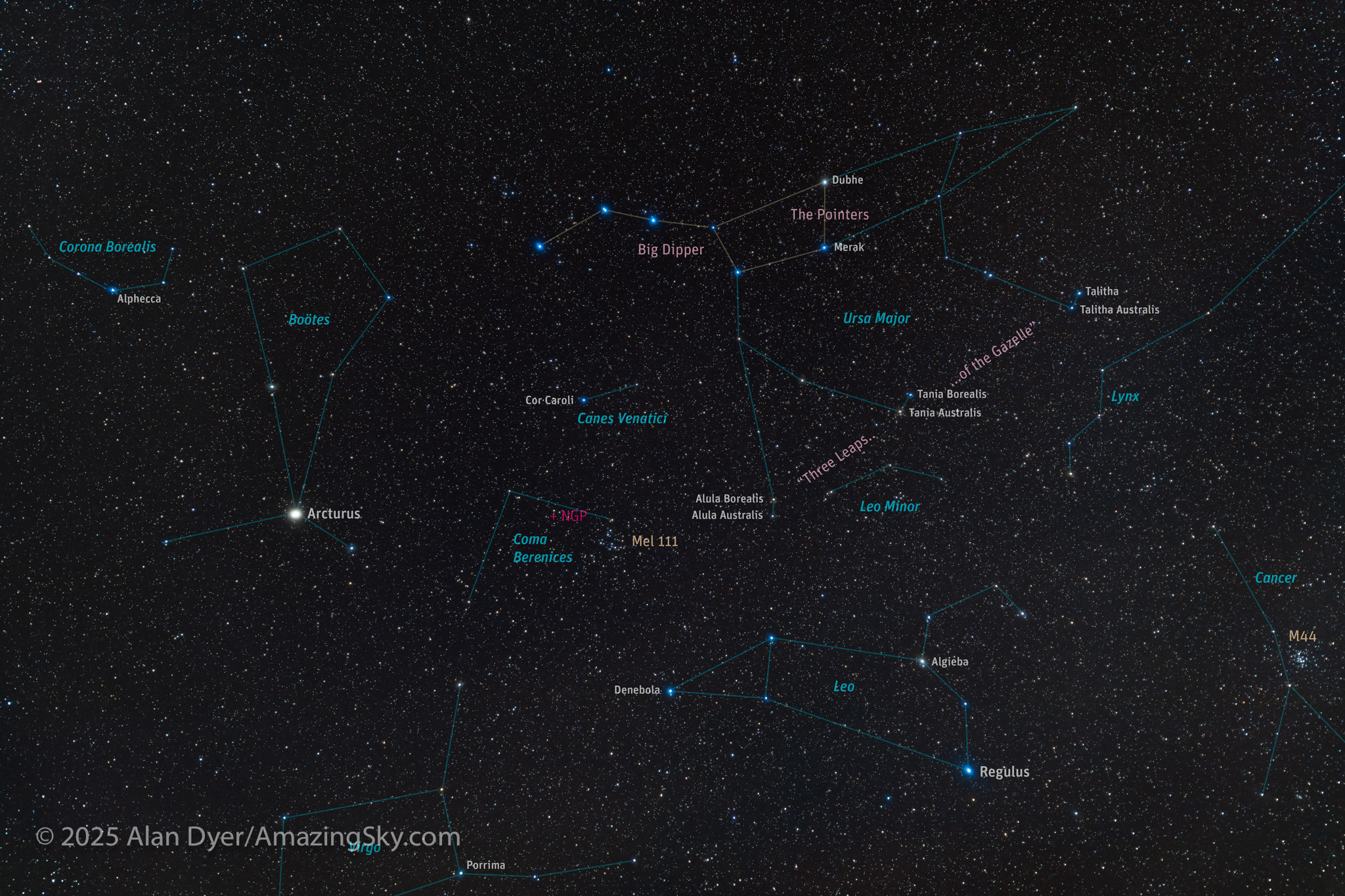
This image, in labeled and unmarked versions, presents a wide view of the spring sky from horizon to well past the zenith overhead. The key pattern to look for is the Big Dipper, at its highest in northern spring. In the UK and Europe it is known as the Plough or Wagon. Look way up to find it first.
Its Pointer Stars in the Bowl famously point north to Polaris. But here I show the other pointer line off the Bowl, to the south, to Leo the Lion. It is well known as one of the constellations of the Zodiac. Leo is marked by one of the brightest spring stars, Regulus.
Use the Handle of the Dipper to arc downward, to locate the brightest star of spring, Arcturus, shining with a yellow light. Keep that line going south and you’ll come to a dimmer and bluer star shining in the south. That’s Spica, the brightest star in Virgo, the Zodiac constellation east of Leo.
Now let’s take a closer look at selected areas.
Ursa Major, Leo and Boötes
This is still a wide view, looking up and high in the south. There’s the Big Dipper/Plough at top. It is not a constellation. It is an “asterism” of seven stars within the large constellation of Ursa Major, the Great Bear. With a little imagination you can join the dots to make a bear (many northern cultures did so). Except we draw him with a long tail, which bears do not have!
The paws of the Bear are marked by a trio of double stars: Alula Borealis and Australis, Tania Borealis and Australis, and Talitha and Talitha Australis. The names come from Arabic words for “first,” “second,” and “third” as these sets of double stars are collectively called the Three Leaps of the Gazelle in Arabic sky lore. Once you see them you’ll be surprised at how distinctive they are.
Below Ursa Major is Leo, a pattern that does look a little like a sitting cat. Its bright star Regulus was named by Copernicus, from a Latin word for “little king.” But Regulus has long been known as the heart of the Lion.
To the east lies brighter Arcturus, a name that means “bear watcher,” as it and its host constellation Boötes, the Bear Herdsman, are tied to Ursa Major and Minor in Greek mythology.
Leo, Cancer and flanking clusters
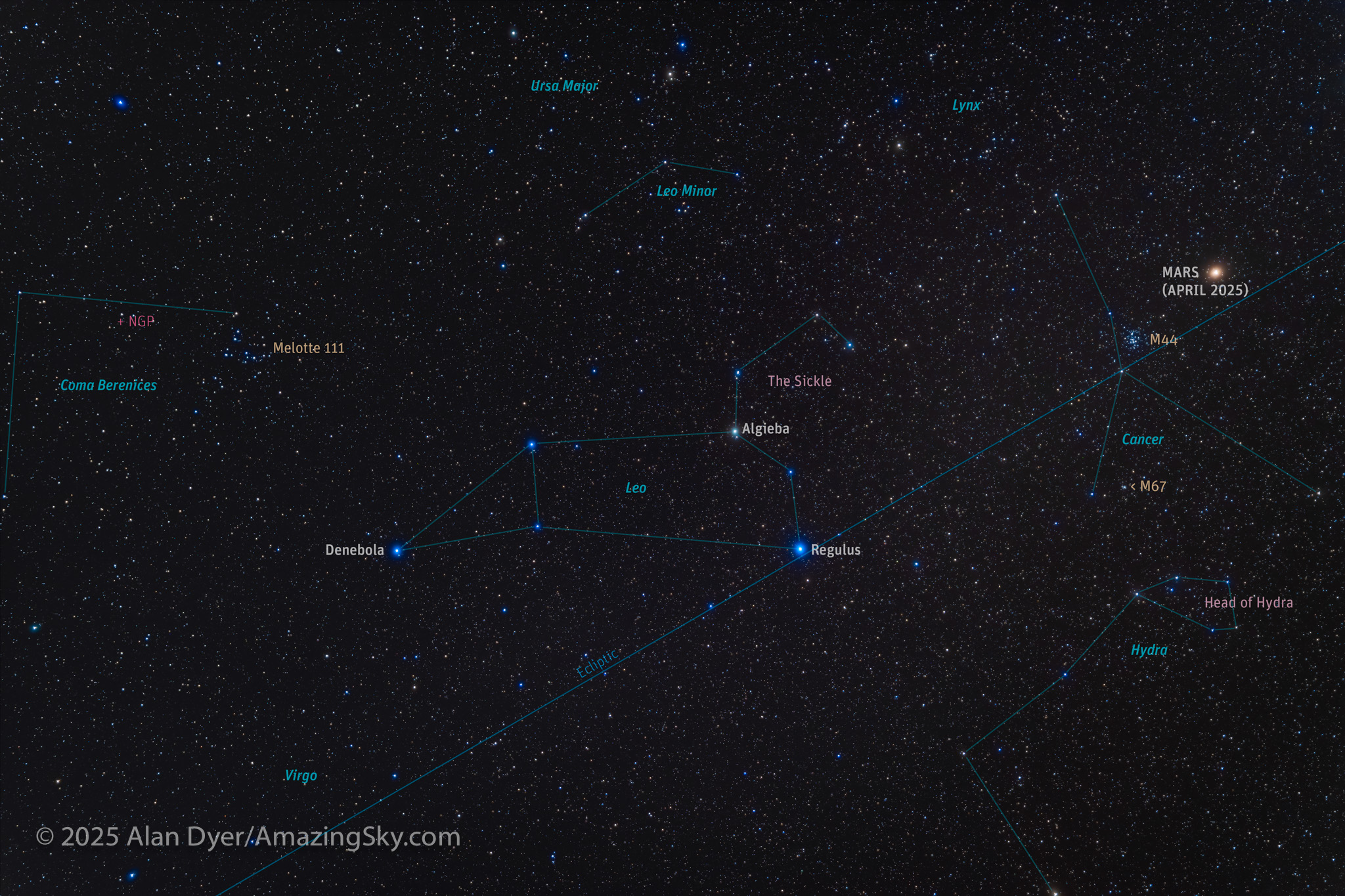
Here I frame Leo, but also two of the constellations that flank him: Cancer the Crab to the right (or west) and Coma Berenices to the left (or east). Each contains a bright naked eye cluster of stars:
Messier 44 or the Beehive cluster in Cancer, the faint Zodiac pattern west of Leo. When I shot this image in mid-April 2025 red Mars was just entering Cancer.
and Melotte 111 in Coma Berenices. At one time this clump of stars easily visible to the naked eye was considered part of Leo, as the tuft on the end of his tail. The area was broken off as its own constellation in the 3rd century BCE, and named for Queen Berenice of Egypt, and for her legendary hair (“coma”).
Together, the obvious pattern of Leo and the star clusters that flank him form one of the spring sky’s most notable sights.
Leo and Leo Minor
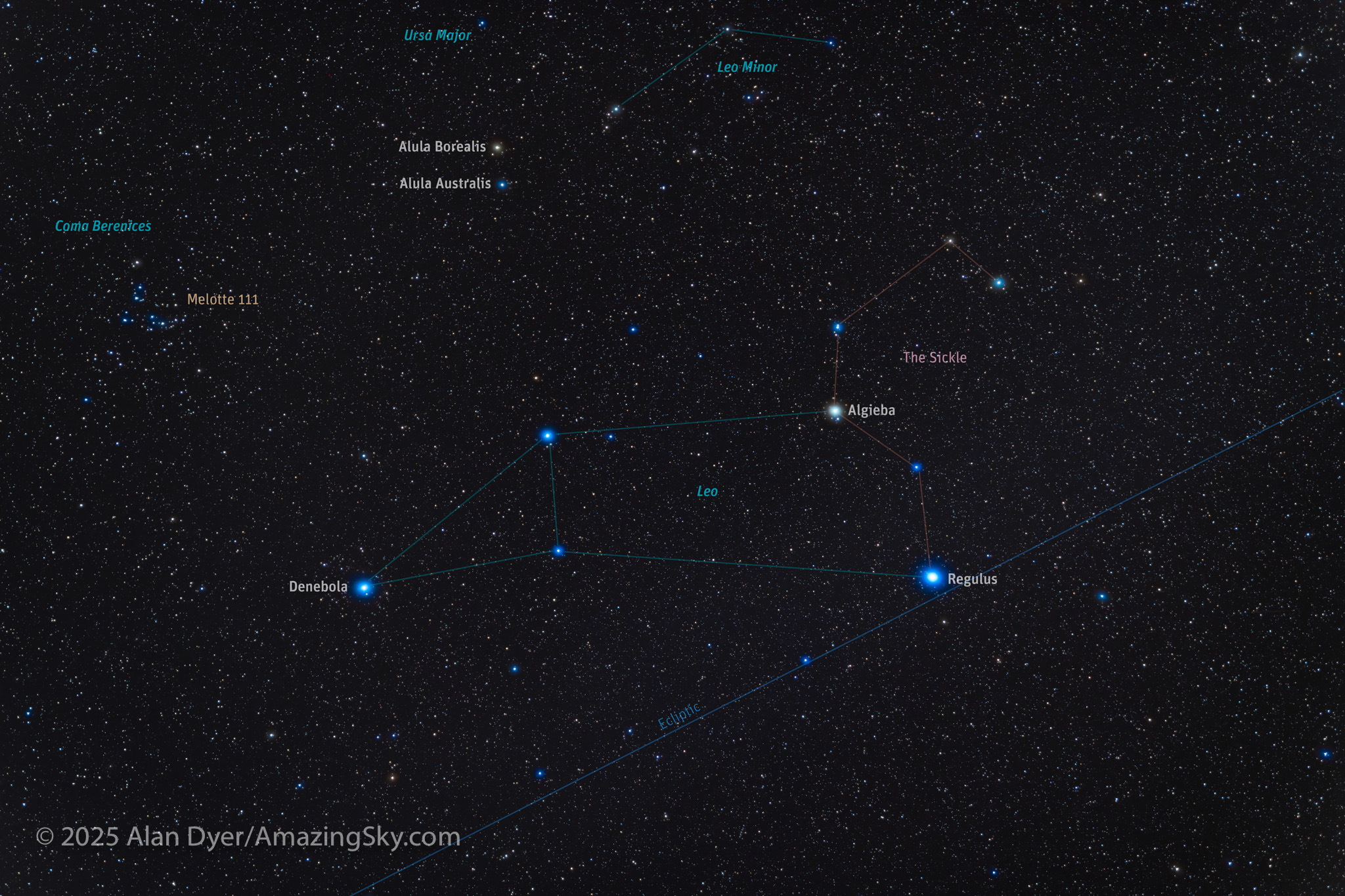
The head of Leo is marked by a curving arc of stars popularly called The Sickle. Or it is thought of as backwards Question Mark, with Regulus the dot at the bottom. Leo is one of the oldest constellations, as there are records of this pattern dating back to 4000 BCE in Mesopotamia.
More modern is the obscure pattern above it, Leo Minor, the Little Lion. It was invented by 17th century star chart maker Johannes Hevelius, to fill in a blank area of sky. Even in a dark sky, it is tough to make out its innocuous pattern between Leo and Ursa Major.
Canes Venatici, Coma Berenices and Boötes
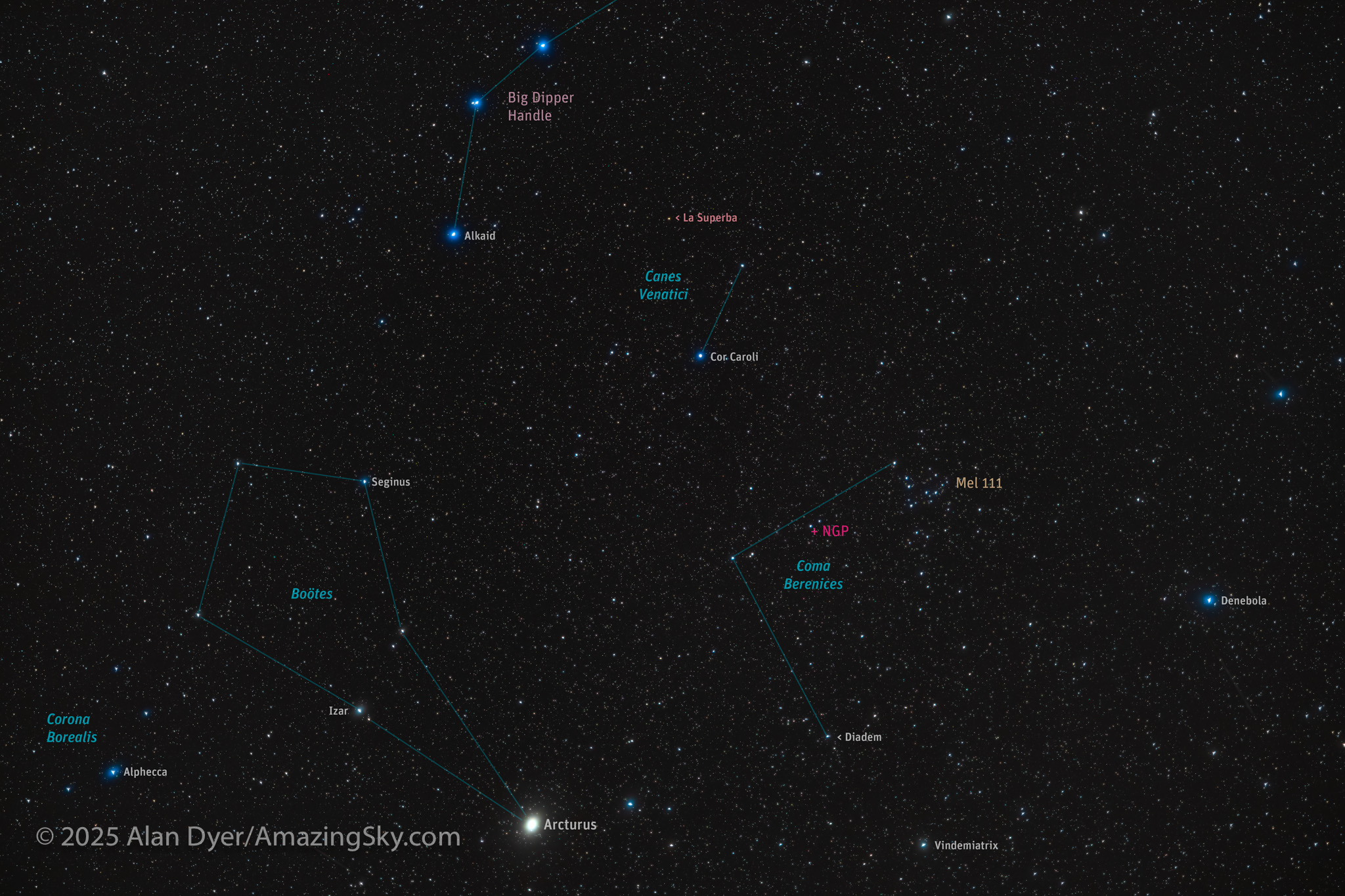
Another obscure pattern created by Hevelius lies below the Handle of the Big Dipper. A sparse pattern of stars marks Canes Venatici, the Hunting Dogs that belong to Boötes to help him herd bears! While not much to look at with the naked eye, Canes Venatici does have superb targets for telescopes, such as the double star Cor Caroli and very red star La Superba.
Below the Dogs lies Berenices’ Hair, home to the star cluster Mel 111, but also the North Galactic Pole (NGP). This is the point 90º away from the plane of the Milky Way and the Galactic Equator seen in our winter and summer skies. But in spring we look straight up out of our Galaxy, to many other telescopic galaxies that inhabit Coma and Virgo, our next stop.
Virgo, Corvus, Crater and Hydra
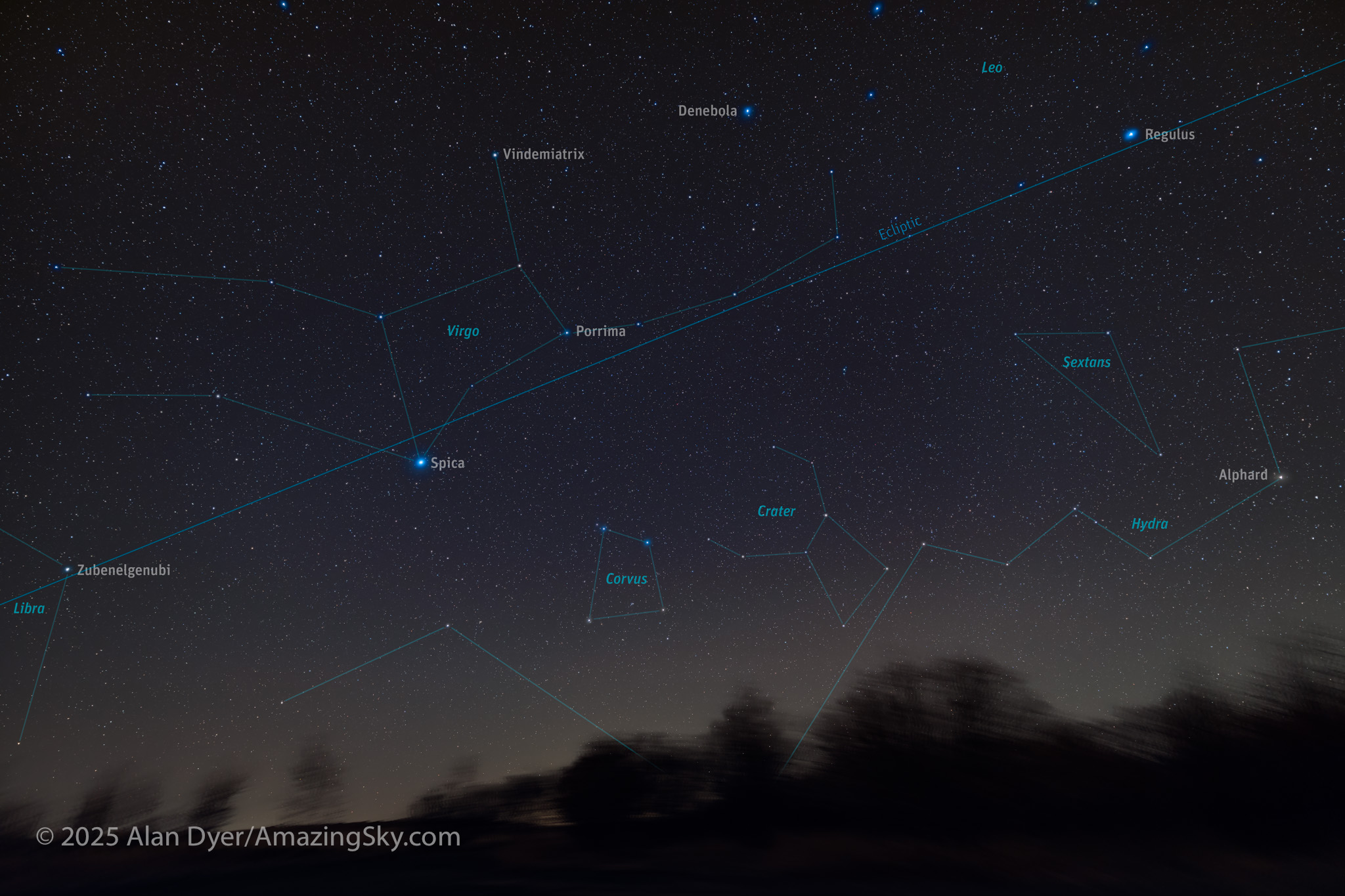
Below Leo and Boötes lies the Zodiac pattern of Virgo, usually thought of as the reclining Greek goddess of agriculture and the harvest. Spica is easy to see, but the sprawling pattern of the rest of Virgo is not so obvious. It takes a dark sky to pick out the other fainter stars of the goddess.
Easier to see, despite its low altitude from northern latitudes (it skims my horizon), is the quadrilateral pattern of Corvus the Crow, a constellation that dates from the 2nd century CE and the star catalogue of Ptolemy. The Crow sits on the tail of Hydra the Water Snake, a long zig-zag line of stars that is only partly contained here. The head of Hydra, off frame to the right here, is in the earlier image of Leo and Cancer.
Another pattern riding the back of Hydra is Crater the Cup, associated with Corvus and Hydra in a Greek myth in which the Crow is sent to fetch water for Apollo but fails. Apollo flings the Crow, Cup and Snake into the sky. Angering the gods could get you immortalized in the sky!
Boötes, Corona Borealis and Hercules
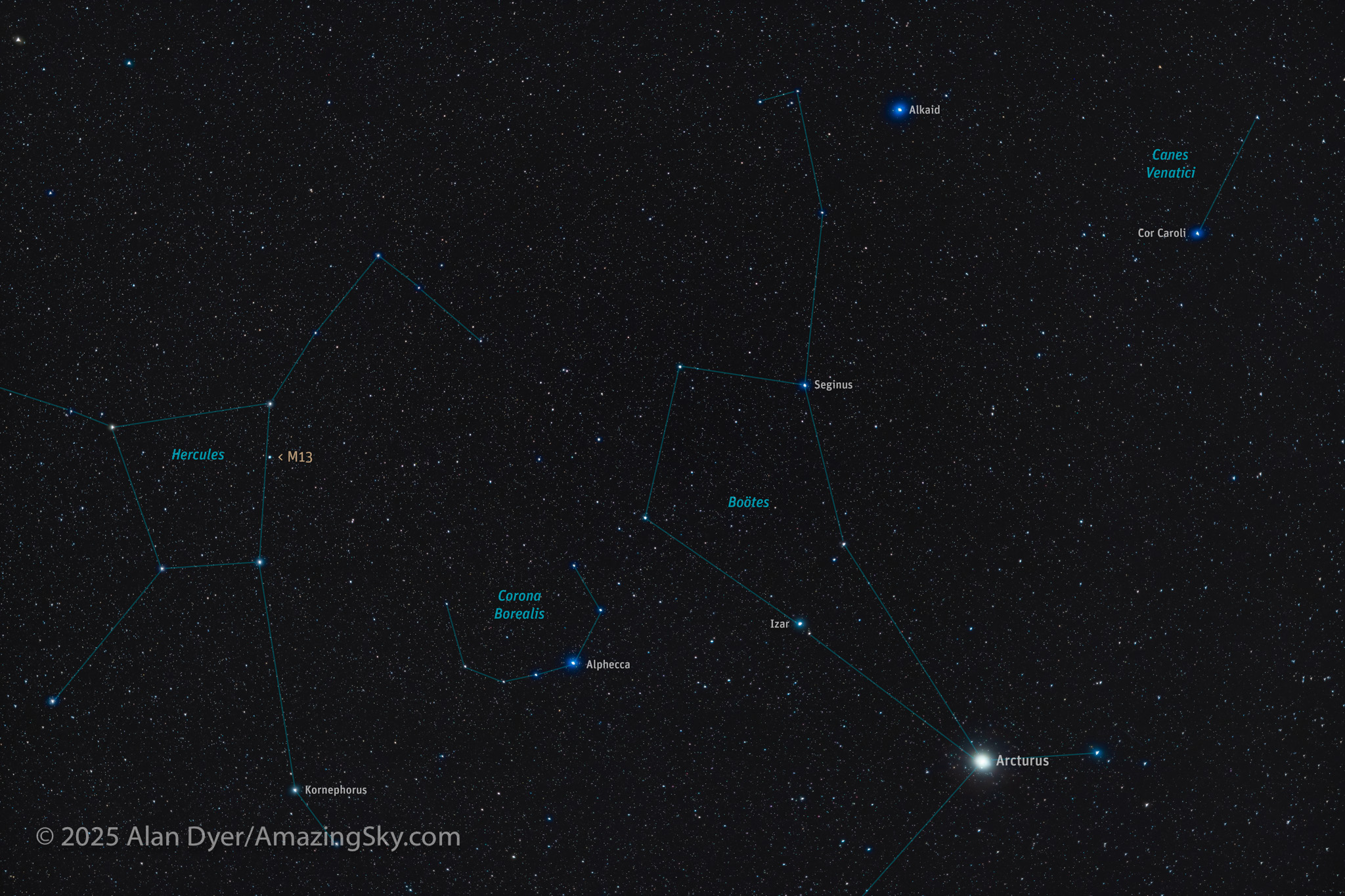
Heading back north above Virgo, we return to the kite-shaped pattern of Boötes above Arcturus, the brightest star in the northern half of the sky. Coming up later on spring evenings, and to the left is a semi-circle of faint stars, the Northern Crown, or Corona Borealis, another of Ptolemy’s patterns from the 2nd century. The crown belongs to the princess Ariadne.
Astronomers have been watching Corona Borealis closely in recent months, waiting for a recurrent nova star to explode and add a new jewel to the Crown. So far, no luck. T CorBor remains stubbornly dim.
To the east of Corona is the H-shaped pattern of Hercules, the Roman name for the Greek hero Heracles. Among his many labours and conquests, he slewed Cancer the Crab and Leo the Lion.
Libra and Scorpius
Returning down south and scraping the horizon from my northern latitude late on spring nights are the next two constellations of the Zodiac east of Virgo: Libra the Scales and Scorpius the Scorpion.
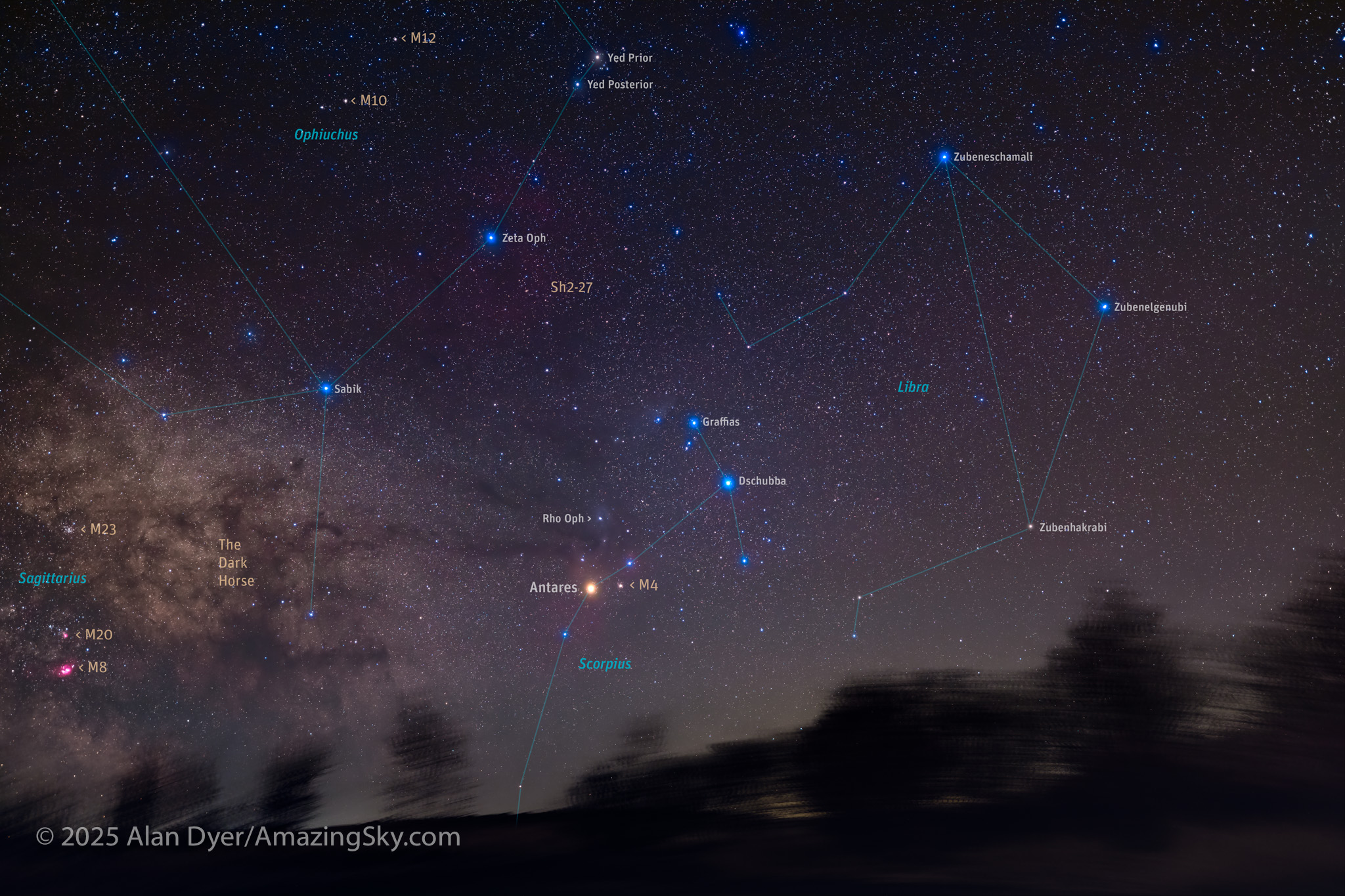
Libra is a faint pattern but with the wonderfully named stars Zubeneschamali and Zubenelgenubi, meaning the northern and southern claws, as these stars were once considered part of the Scorpion. However, Libra has long been seen as a balance or scales for meting out justice. It is the only Zodiac constellation that is an inanimate object.
Scorpius is one of the few patterns that looks like what it is supposed to be, though here I see only the northern part of the constellation. His curving tail has yet to rise as the Milky Way comes into view low in the south just before dawn this night. The bright orange star is Antares, the heart of the Scorpion, set in an area rich in dark and colourful nebulas.
The appearance of Scorpius signals the return of the Milky Way to the sky, and the rise of the summer constellations.
But no astronomical life is complete without getting to know the patterns of spring. Clear skies and happy stargazing!
2024 brought us a total eclipse of the Sun, superb auroras, and a naked-eye comet, three top highlights of a wonderful year of celestial attractions. Maybe the best!
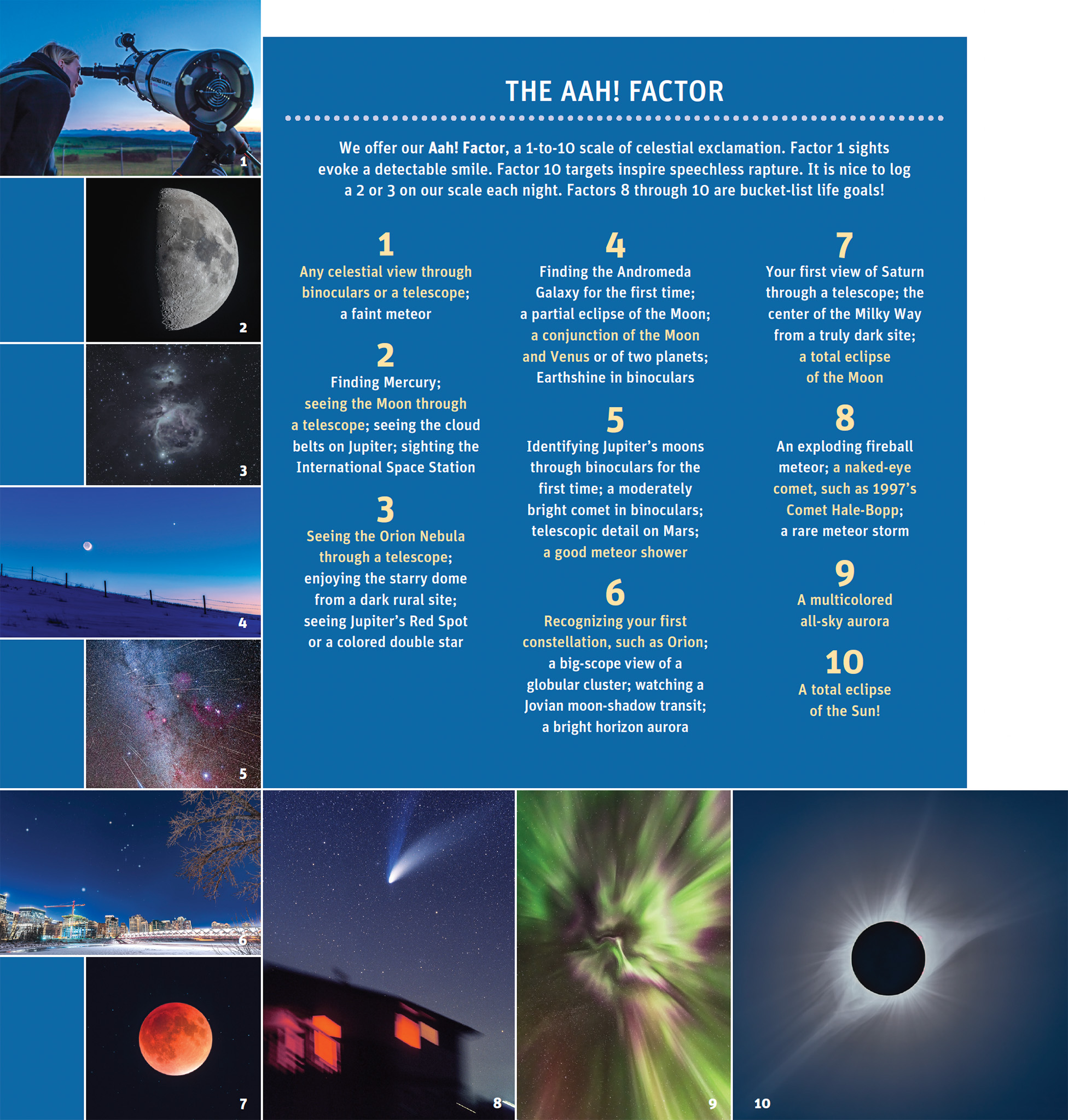
In our book The Backyard Astronomer’s Guide (which we revised this year), Terence Dickinson and I created an Aah! Factor scale with various celestial sights ranked from:
• 1, evoking just a smile, to …
• 10, a life-changing event!
Our book’s Aah! Factor Scale in Chapter 1
Coming in at an 8 is a naked-eye comet. Deserving a 9 is an all-sky display of an aurora. The only sight to rate a top 10 is a total eclipse of the Sun.
2024 brought all three, and more!
Here’s my look back at what I think was one of the greatest years of stargazing.
NOTE: The images might take a while to all load. All can be enlarged to full screen. Just click or tap on them.
January
A Winter Moonrise to Begin the Year
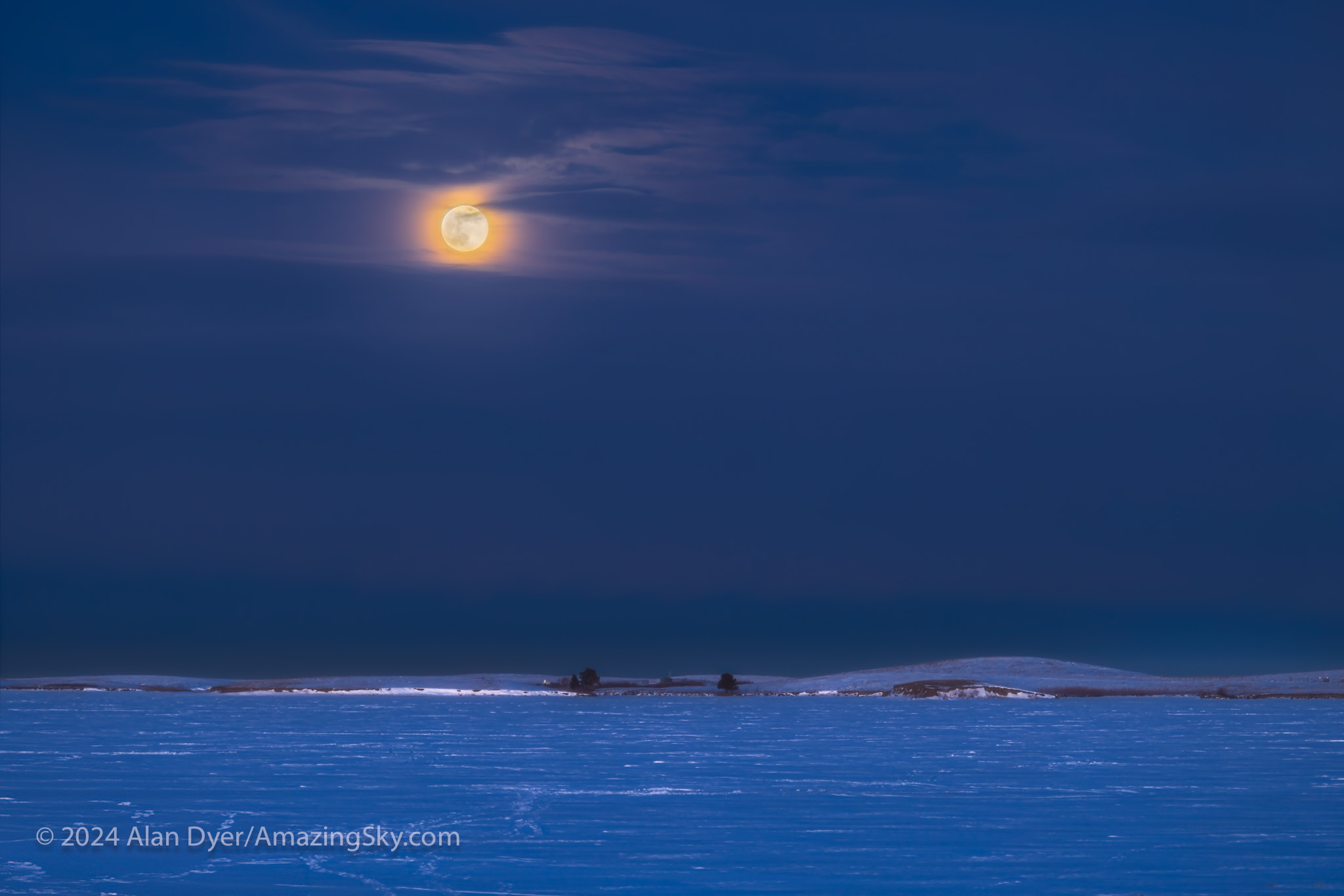
The rising of the winter “Wolf” Moon, the Full Moon of January, over the frozen Crawling Lake Reservoir, in southern Alberta.
Now, this was not any form of rare event. But seeing and shooting any sky sight in the middle of a Canadian winter is an accomplishment. This is the rising of the Full Moon of January, popularly called the Wolf Moon, over a frozen lake near home in Alberta, Canada 🇨🇦.
It serves to bookend the collection with a Full Moon I captured eleven months later in December.
February
Auroras from Churchill, Manitoba
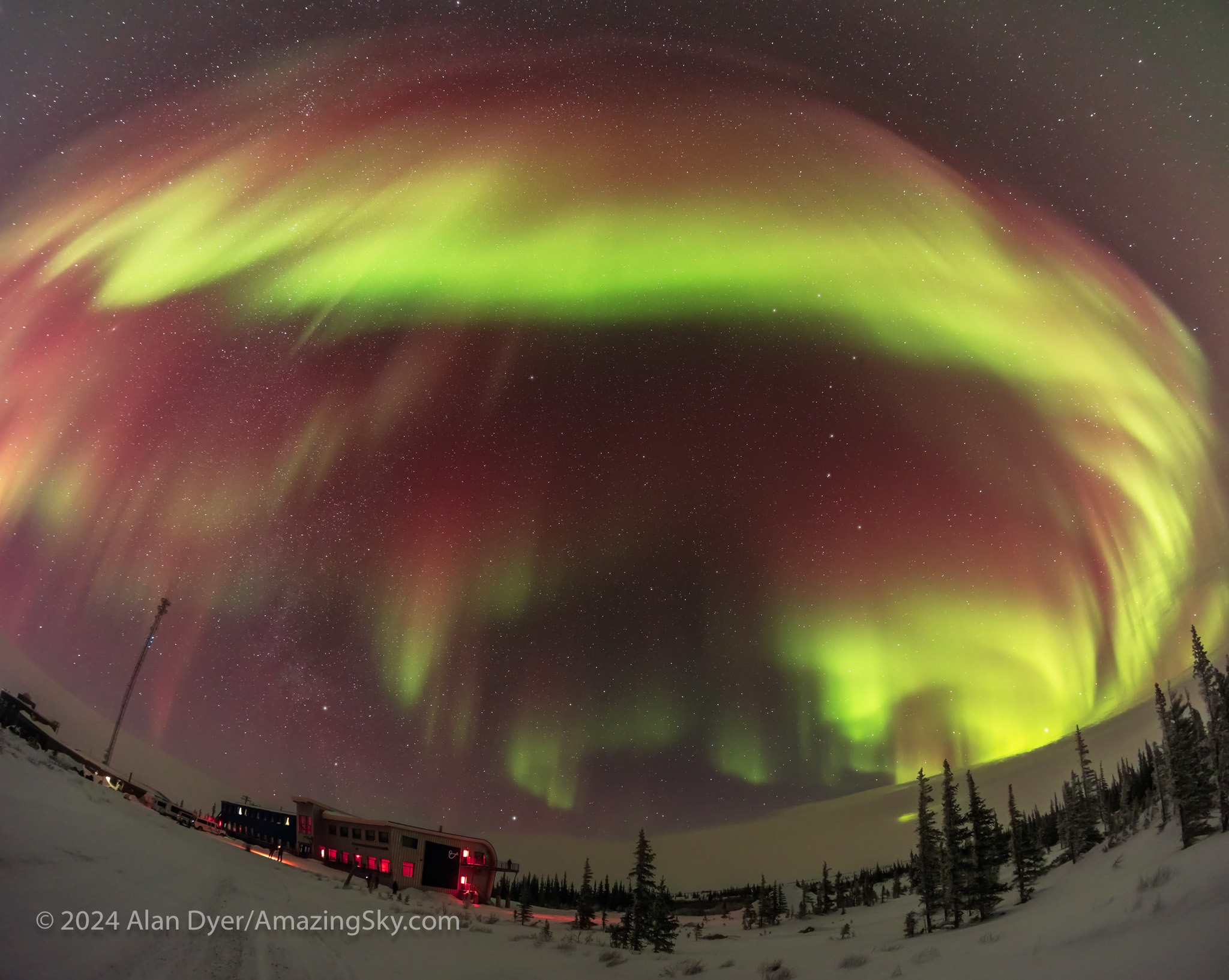
Had this been my only chance to see the Northern Lights fill the sky this year, I would have been happy. As we often see in Churchill, the aurora covered the sky on several nights, a common sight when you are underneath the main band of aurora borealis that arcs across the northern part of the globe.
This is a vertical panorama of the sky-filling aurora of February 10, 2024, as seen from the Churchill Northern Studies Centre, in Churchill, Manitoba.
I attended to two aurora tour groups at the Churchill Northern Studies Centre who both got good displays to check “seeing the Northern Lights” off their bucket list. Join me in 2025!
March
Under the Austral Sky
Ranking a respectable 7 on our Aah! Factor scale is the naked-eye sight of the galactic centre overhead, with the Milky Way arcing across the sky. That’s possible from a latitude of about 30° South. That’s where I went in March, back to Australia 🇦🇺 for the first time since 2017.
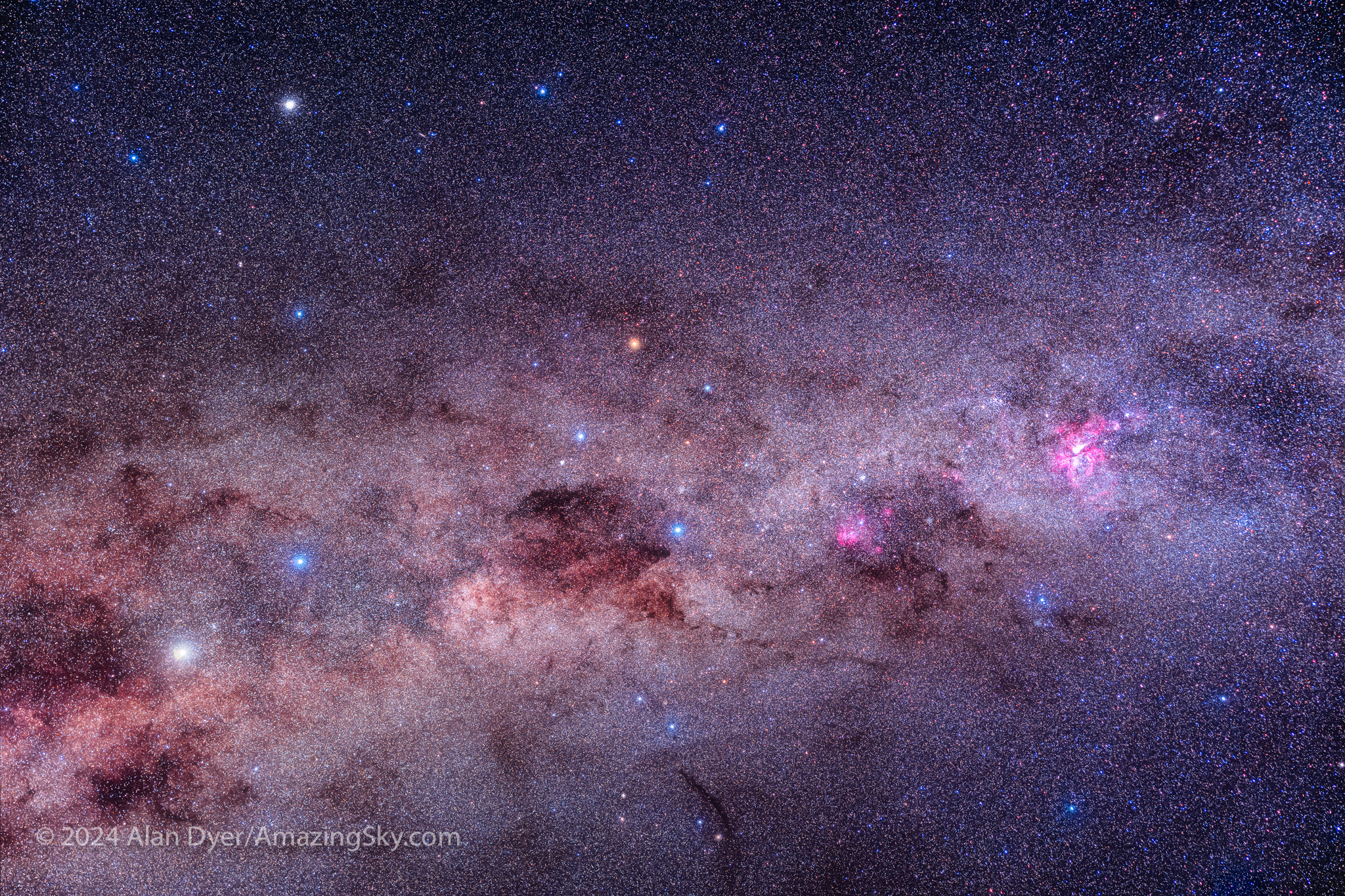
This is a framing of the most spectacular area of the southern Milky Way, from Centaurus at left, to Carina at right, with Crux, the Southern Cross, at centre.
I wrote about it in my previous blog, where I present a tour along the southern Milky Way, and wide-angle views of the Milky Way (the images here are framings of choice regions).
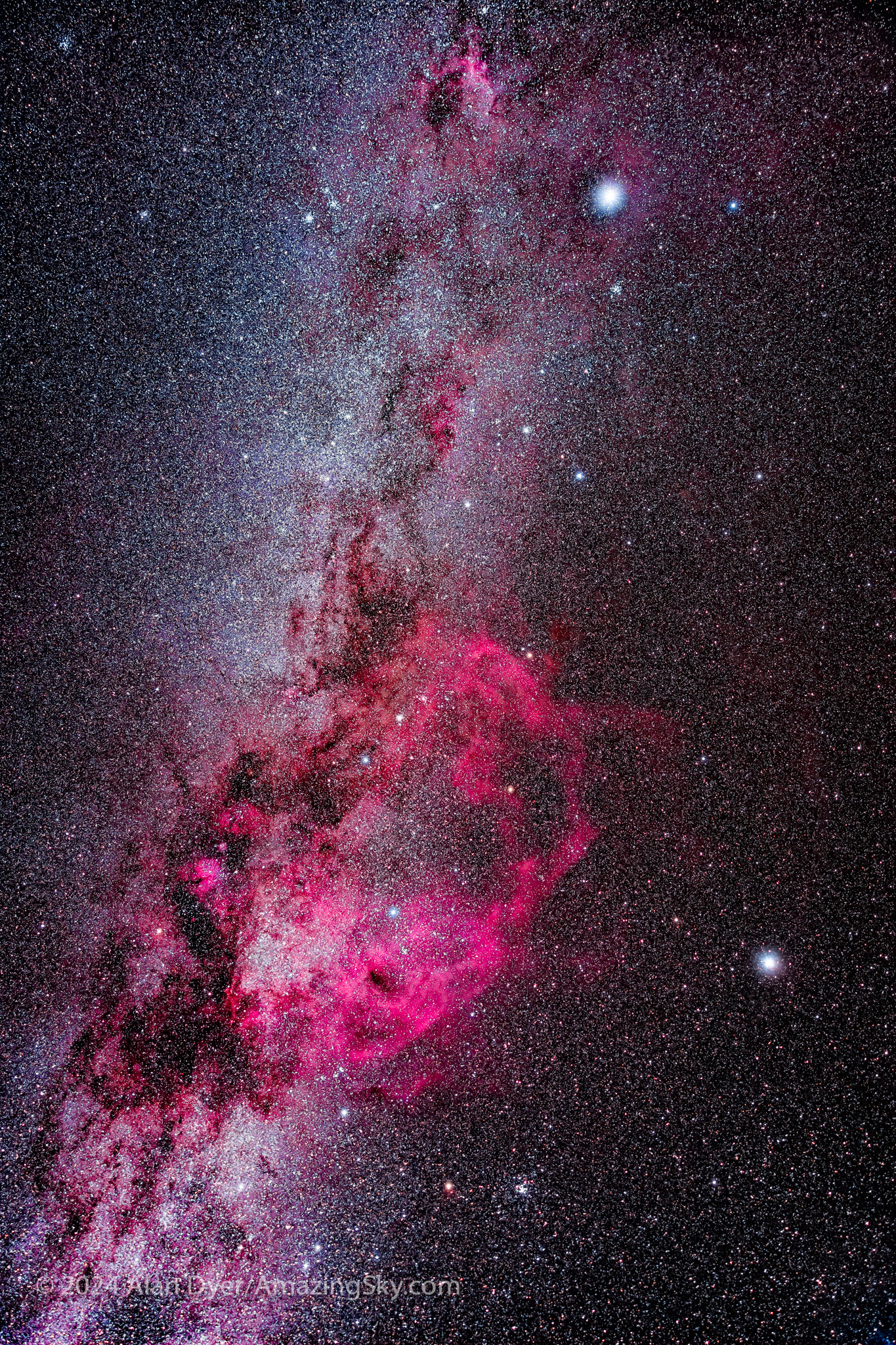
This frames the southern Milky Way from Canis Major and its bright star Sirius at top, to Carina and its bright star Canopus at bottom, the two brightest stars in the night sky. The large red complex is the Gum Nebula.
It is a magical latitude that all northern astronomers should make a pilgrimage to, if only to just lie back and enjoy the view of our place in the outskirts of the Galaxy. I was glad to be back Down Under, to check this top sky sight off my bucket list for 2024.
April
A Total Eclipse of the Sun
No sooner had I returned home from Oz, when it was time to load up the car with telescope gear and drive to the path of the April 8 total solar eclipse, the first “TSE” in North America since 2017, which was the last total eclipse I had seen, in a trip to Idaho.
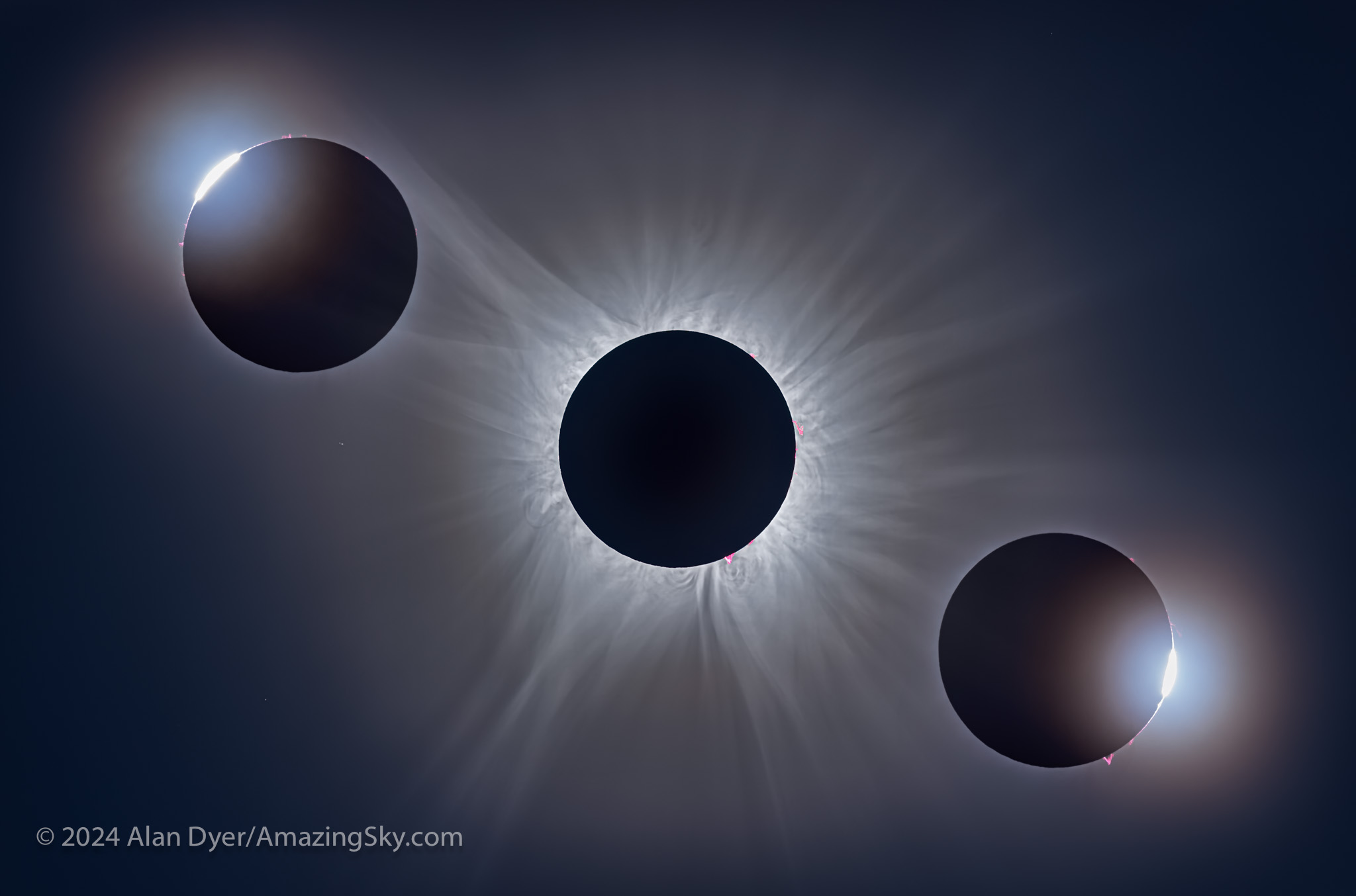
This is a composite of telescopic close-ups of the April 8, 2024 total eclipse, with a multi-exposure blend for the corona at centre, flanked by the diamond rings.
But where? I started south to Texas, my Plan A. Poor weather forecasts there prompted a hasty return to Canada, to drive east across the country to … I ended up in Québec. My blog about my cross-continental chase is here. My final edited music video is linked to below.
It was gratifying to see a total eclipse from “home” in Canada, only the third time I’ve been able to do that (previously in 1979 – Manitoba, and 2008 – Nunavut). If the rest of the year had been cloudy except for this day I wouldn’t have complained. Much.
This definitely earned a 10 on the Aah! Factor scale. Total eclipses are overwhelming and addictive. I’ve made my bookings for 2026 in Spain 🇪🇸 and 2027 in Tunisia 🇹🇳.
May
The Sky’s On Fire
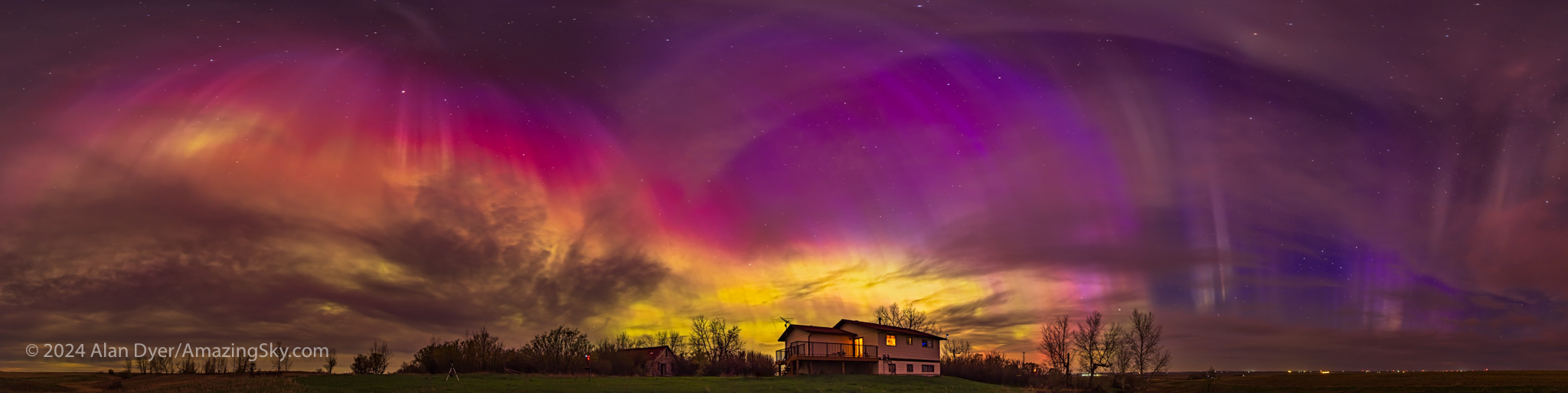
It had been several years since I had seen an aurora from my backyard with colours as vivid and obvious as they were this night. But on May 10, the sky erupted with a fabulous display of aurora that much of the world saw, as aurora borealis in the north and aurora australis in the south.
This is a 300º panorama of the May 10, 2024 Northern Lights display, when the Kp Index reached 8 (out of 9), bringing aurora to the southern U.S.
This was the first of several all-sky shows this year. I blogged about the year’s great auroras here, where there are links to the movies I produced that capture the Northern Lights as only movies can, recording changes so rapid it can be hard to take it all in. Check off a 9 here!
So not even half way through the year, I had seen three of the top sky sights: the Milky Way core overhead (7), an all-sky aurora (9), and a total eclipse of the Sun (10).
But there was more to come! Including an Aah! Factor 8.
June
World Heritage Nightscape Treks
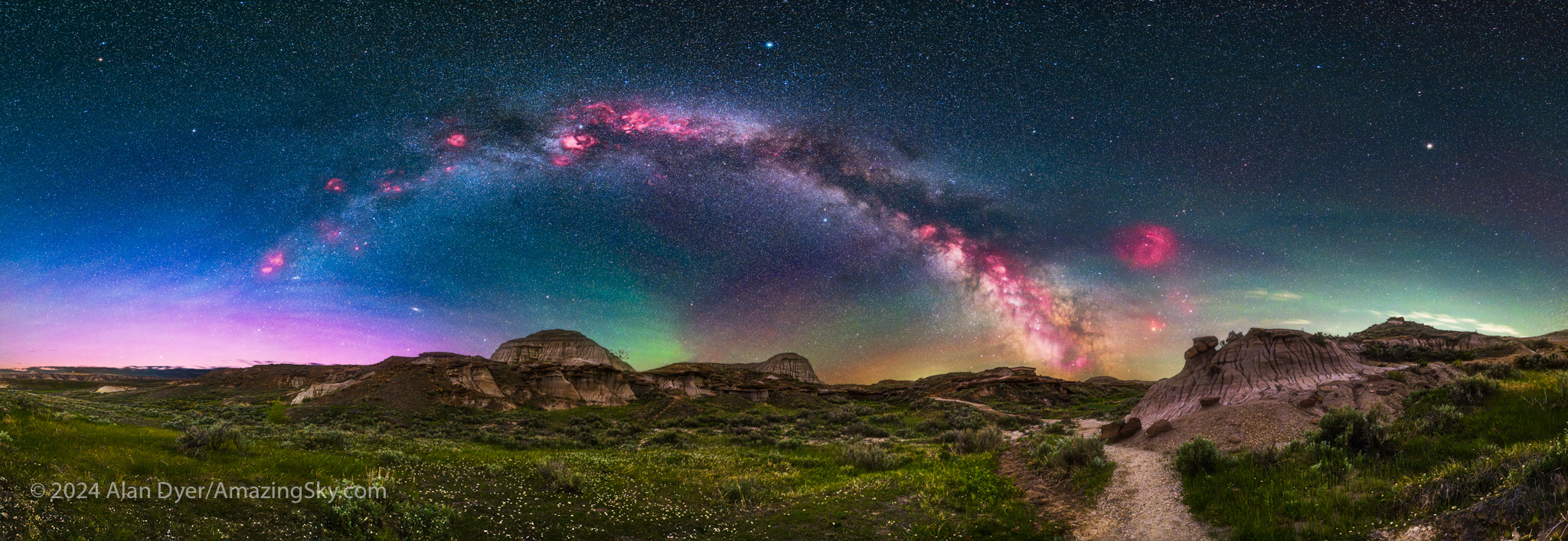
This is a panorama of the arch of the Milky Way rising over the Badlands of Dinosaur Provincial Park, Alberta, with a sky tinted with twilight and airglow.
The sky took a break from presenting spectacles, allowing me to head off on short local trips, to favourite nightscape sites in southern Alberta, which we have in abundance. The Badlands of Dinosaur Provincial Park are just an hour away, the site for the scene above.
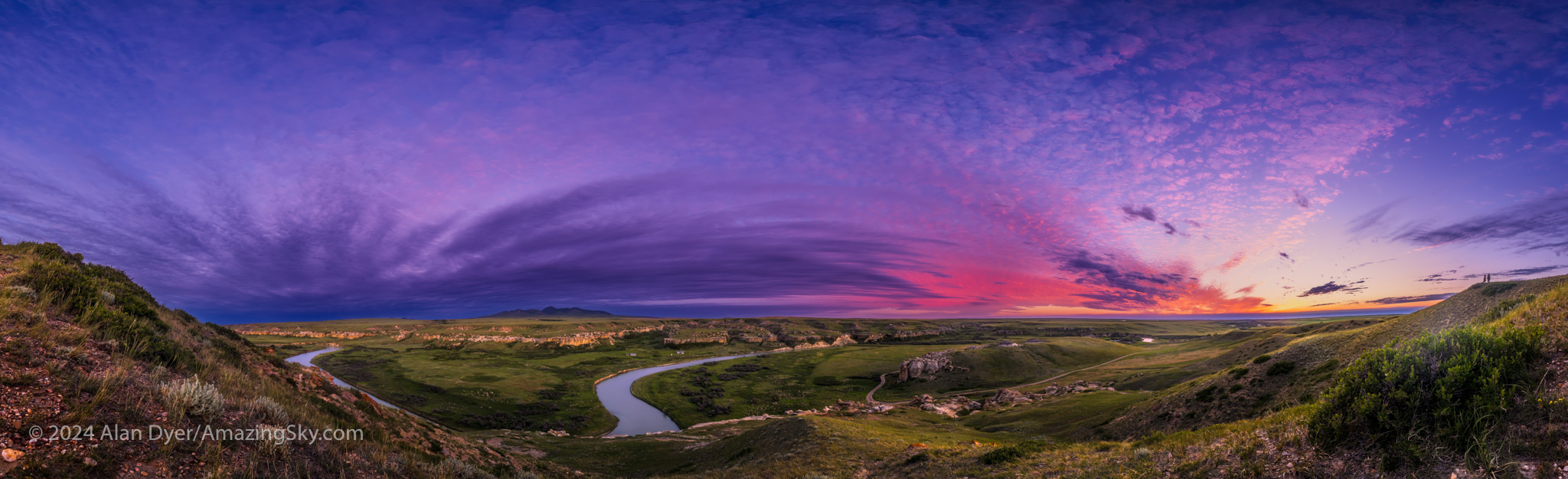
A panorama at sunset at Writing-on-Stone Provincial Park (Áísínai’pi) in Alberta, with the Milk River below and the Sweetgrass Hills in the distance in Montana. Note the people at far right.
The rock formations of Writing-on-Stone Provincial Park are a bit farther, requiring a couple of days commitment to shoot. Clouds hid the main attraction, the Milky Way, this night, but did provide a fine sunset.
The Milky Way rises over Mt. Blakiston, in Waterton Lakes National Park, Alberta. This was June 10, 2024, so snow remains at high altitudes.
A little further west down the highway is Waterton Lakes National Park, another great spot I try to visit at least once each year.
All locations I hit this month are U.N. World Heritage Sites, thus the theme of my blog from June. People travel from all over the world to come here, to sites I can visit in a few hours drive.
July
Mountains by Starlight
In summer we now often contend with smoke from forest fires blanketing the sky, hiding not just the stars by night, but even the Sun by day.
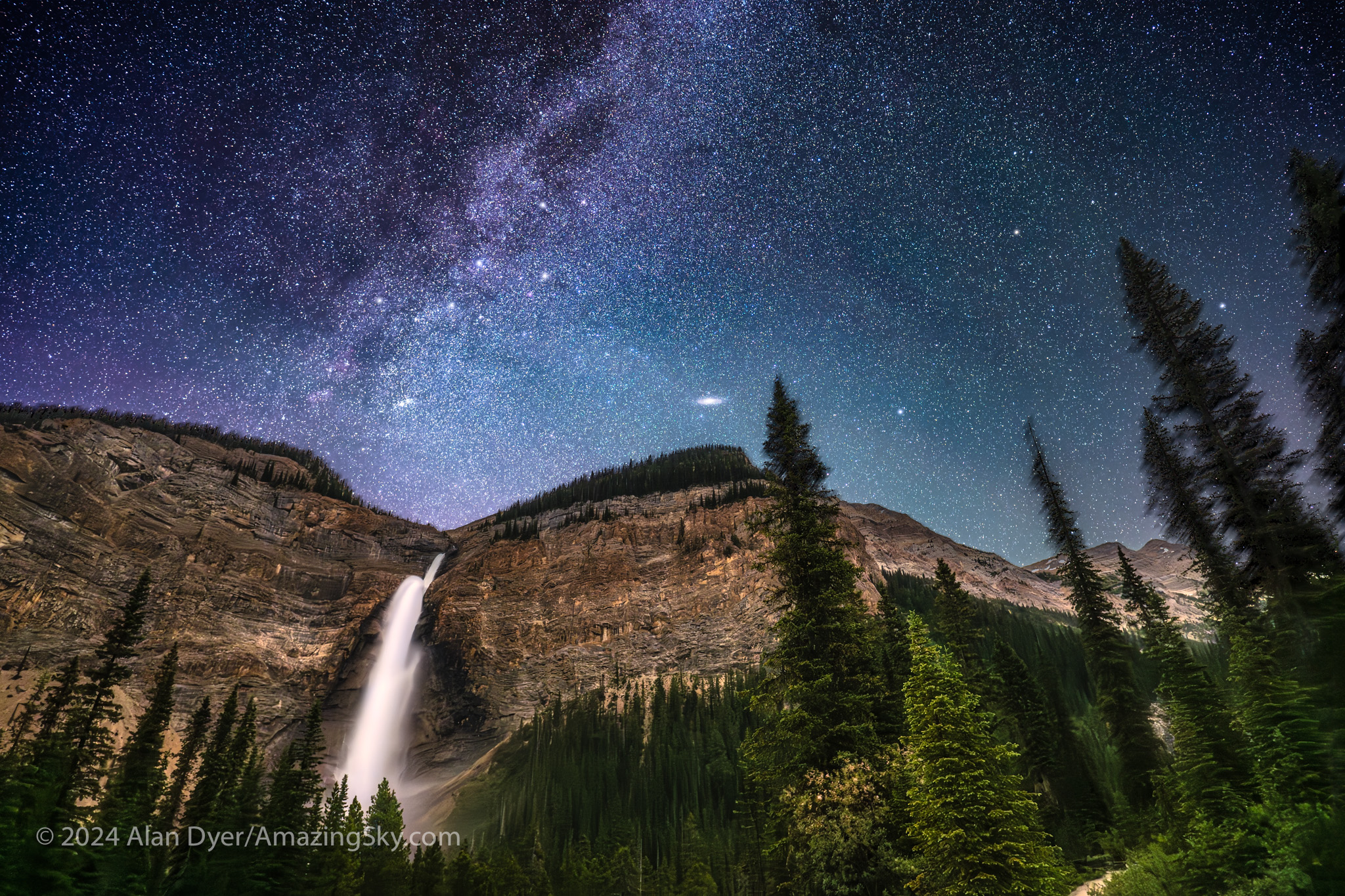
The Andromeda Galaxy at centre is rising above Takakkaw Falls, in Yoho National Park. Above is the W of stars marking Cassiopeia.
But before the smoke rolled in this past summer I was able to visit a spot, Yoho National Park in British Columbia, that had been on my shot list for several years. The timing with clear nights at the right season and Moon phase has to work out. In July it did, for a shoot by starlight at Takakkaw Falls, among the tallest in Canada.
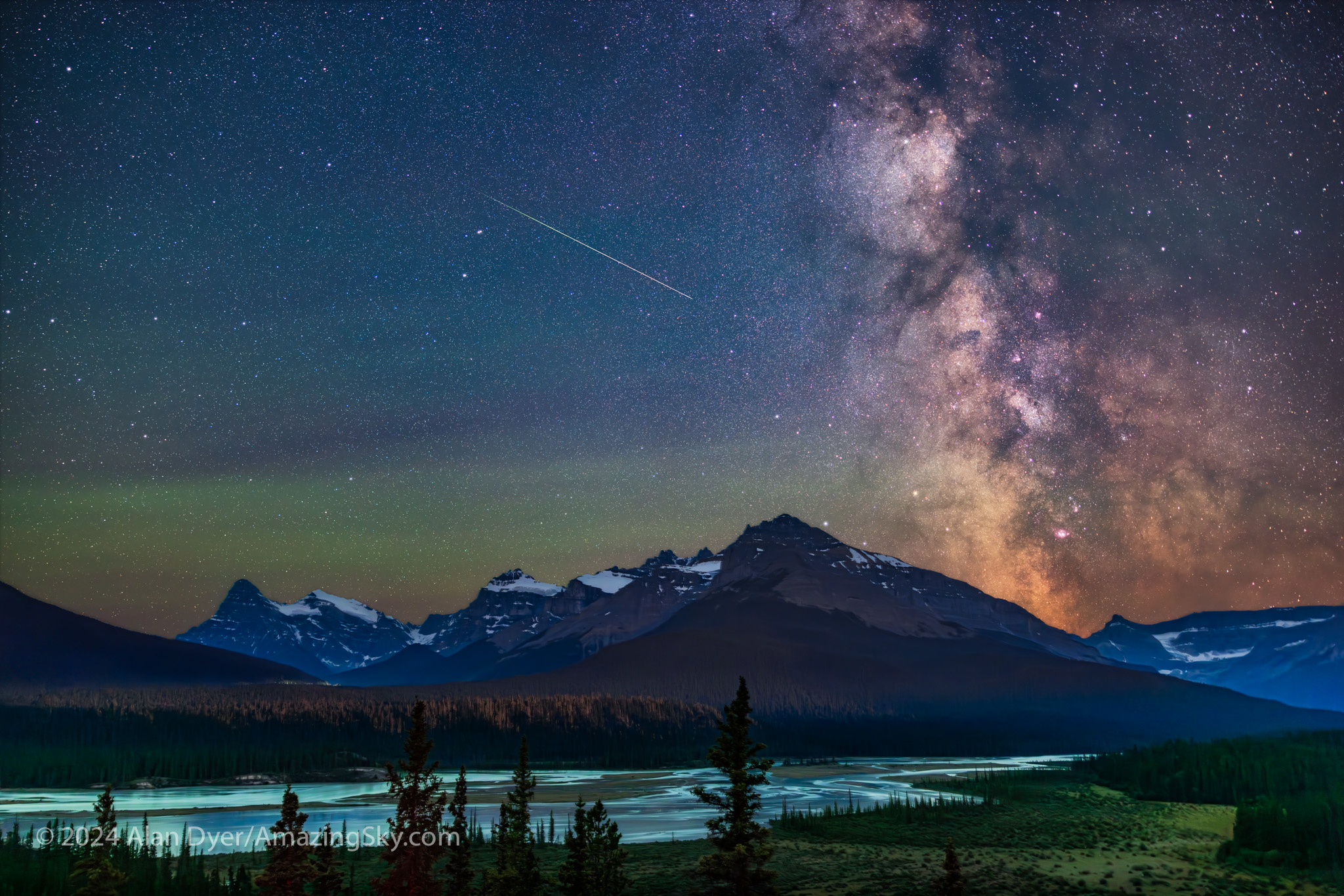
This is the Milky Way core and a bonus meteor over the peaks and valleys at Saskatchewan River Crossing, in Banff National Park, Alberta.
The following nights I was in Banff National Park, at familiar spots on the tourist trail, but uncrowded and quiet at night. It was a pleasure to enjoy the world-class Rocky Mountain scenery under the stars on perfect nights.
August
The All-Sky Auroras Return
In August I headed east to Saskatchewan and the annual Summer Star Party staged by the astronomy clubs in Regina and Saskatoon. It is always a pleasure to attend the SSSP in the beautiful Cypress Hills. The sky remained clear post-party for a trip farther east to the little town of Val Marie, where I stayed at a former convent, and had a night to remember out in Grasslands National Park, one of Canada’s first, and finest, dark sky preserves.
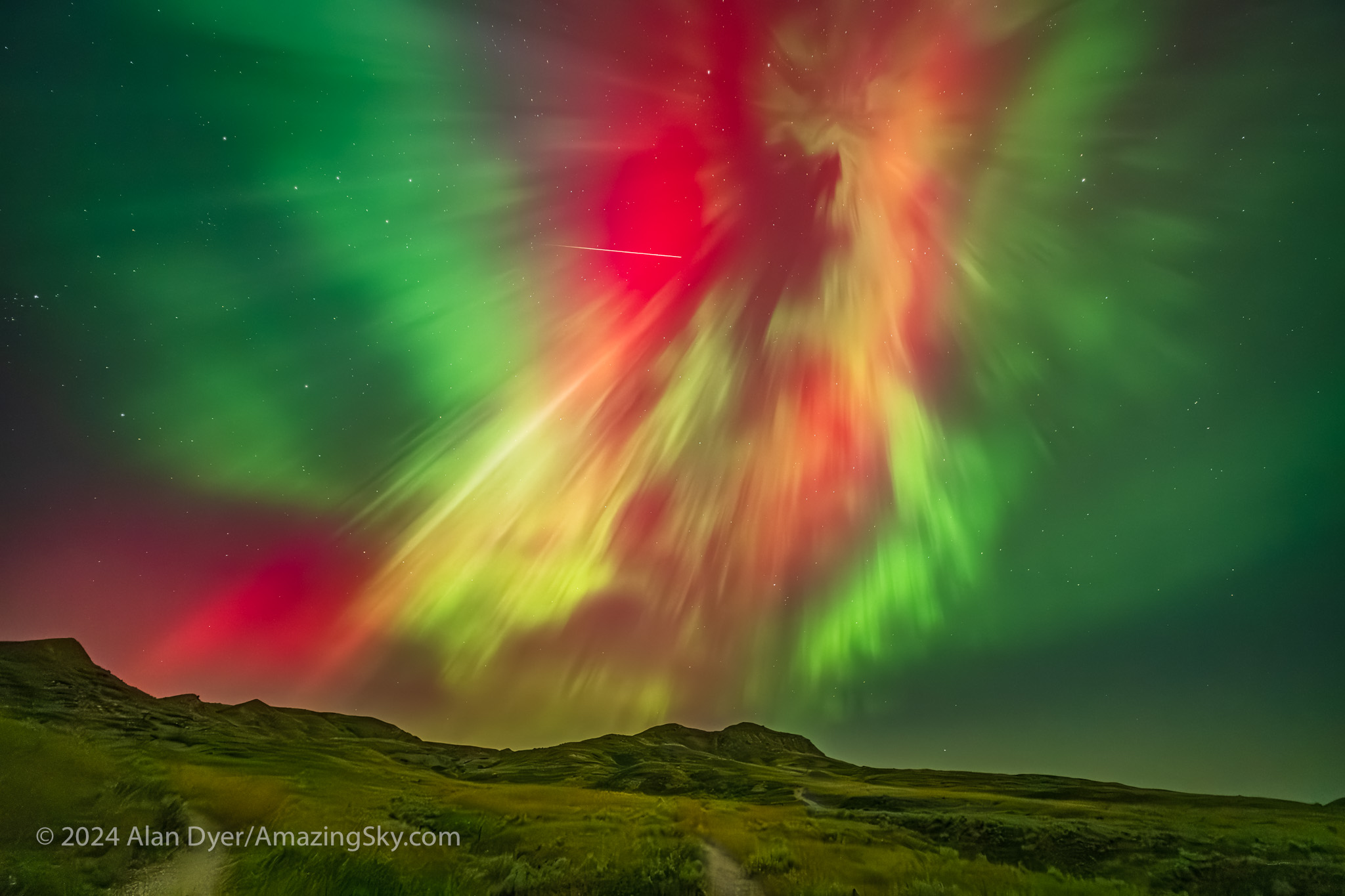
The Northern Lights in a superb all-sky Kp6 to 7 display on August 11-12, 2024, in Grasslands National Park, Saskatchewan.
The plan was to shoot the August 11 Perseid meteor shower, but the aurora let loose again for a stunning show over 70 Mile Butte. My earlier blog has more images and movies from this wonderful month of summertime Northern Lights.
We are fortunate in western Canada 🇨🇦 to be able to see auroras year-round, even in summer. Farther north at the usual Northern Lights destinations, the sky is too bright at night in summer.
September
Back to Deep Sky Wonders …
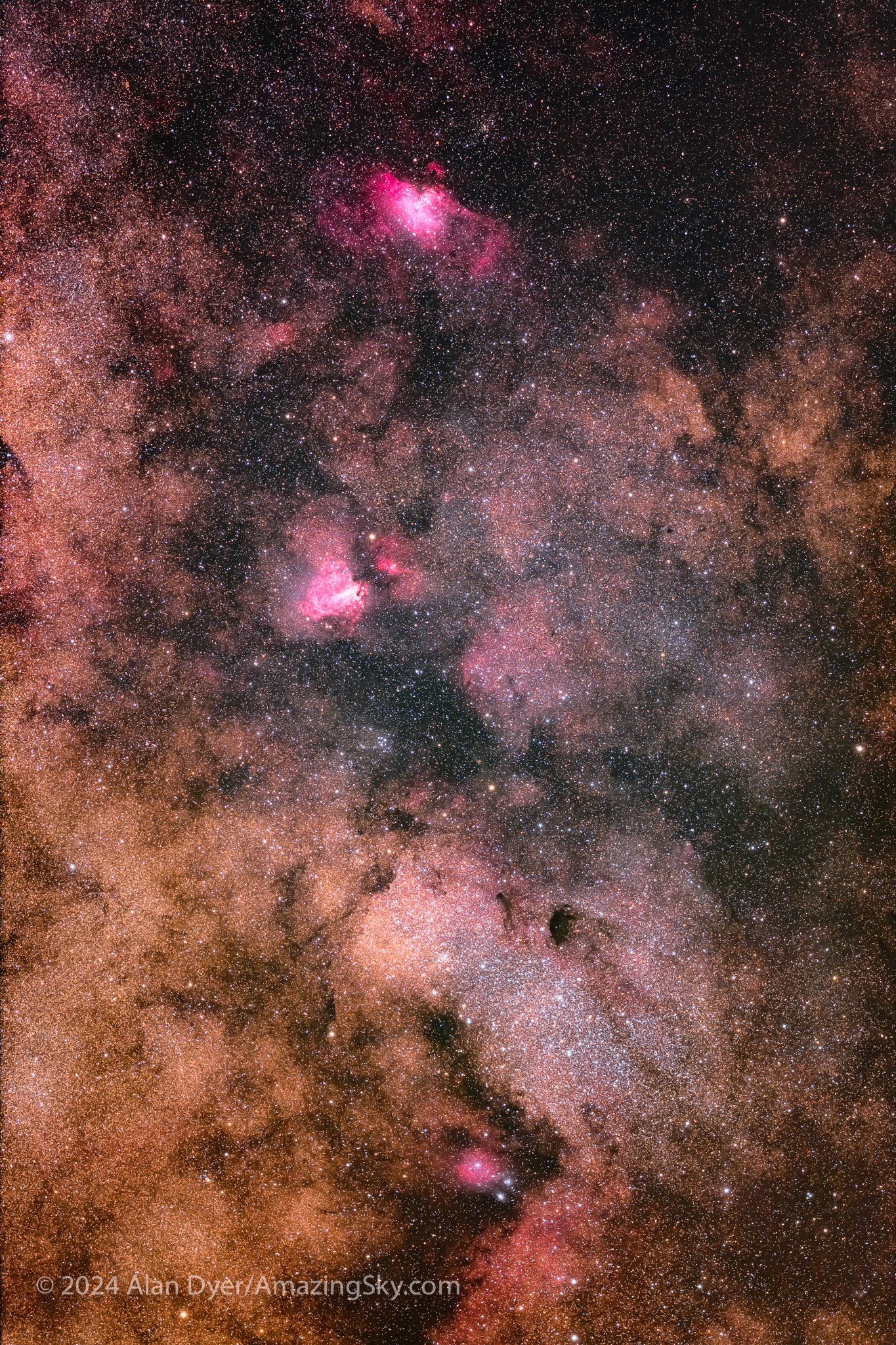
This is a framing of the rich starfield in Sagittarius and Serpens containing a mix of bright star clouds, glowing nebulas, and dark dust in the Milky Way.
September is the month for another astronomical party in the Cypress Hills, but on the Alberta side. At the wonderful Southern Alberta Star Party under its very dark skies, I was able to shoot some favourite deep-sky fields along the Milky Way with new gear I was testing at the time.
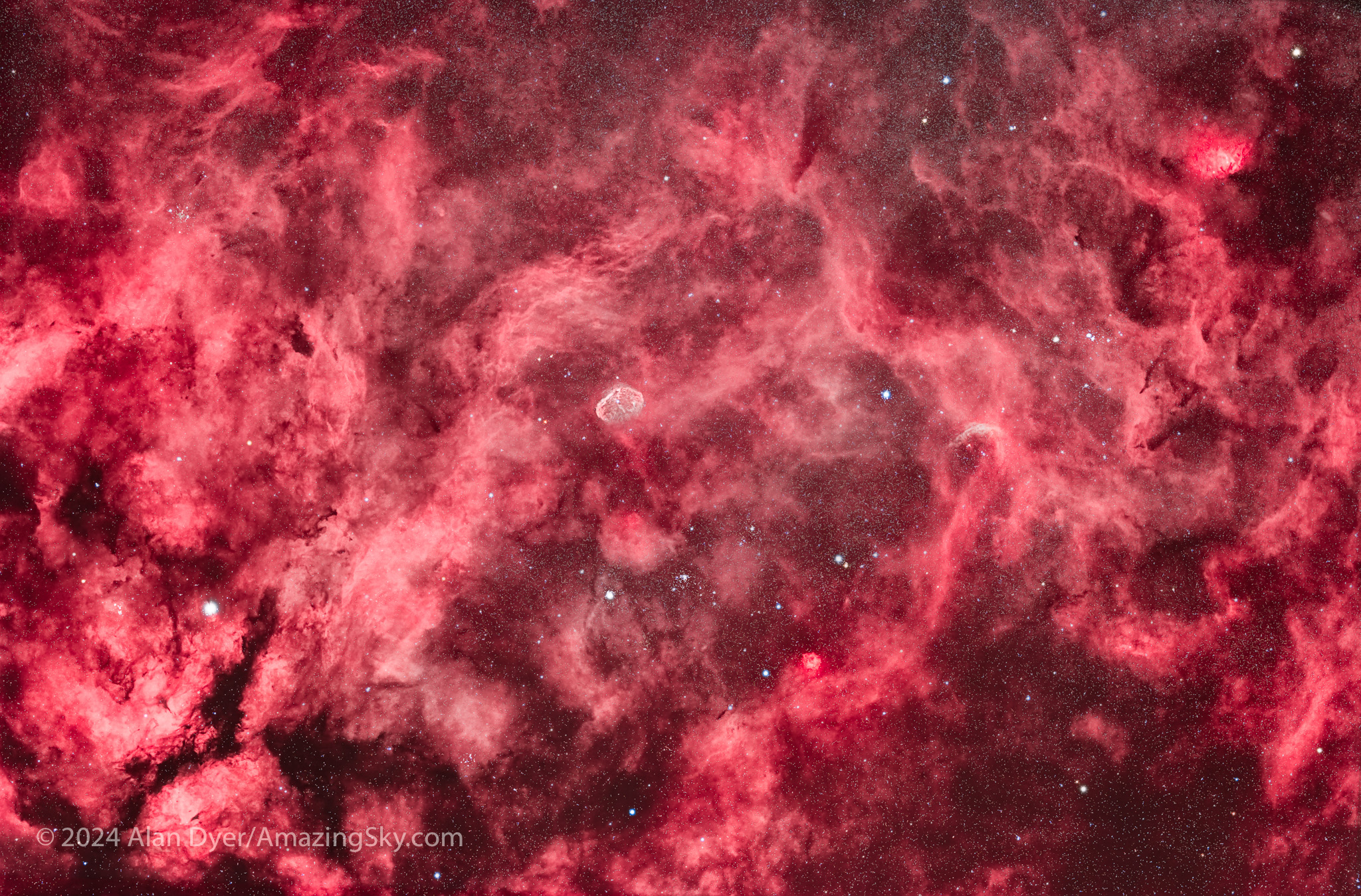
This frames the complex region of emission nebulas in central Cygnus near the star Gamma Cygni, at lower left. The Crescent Nebula is at centre.
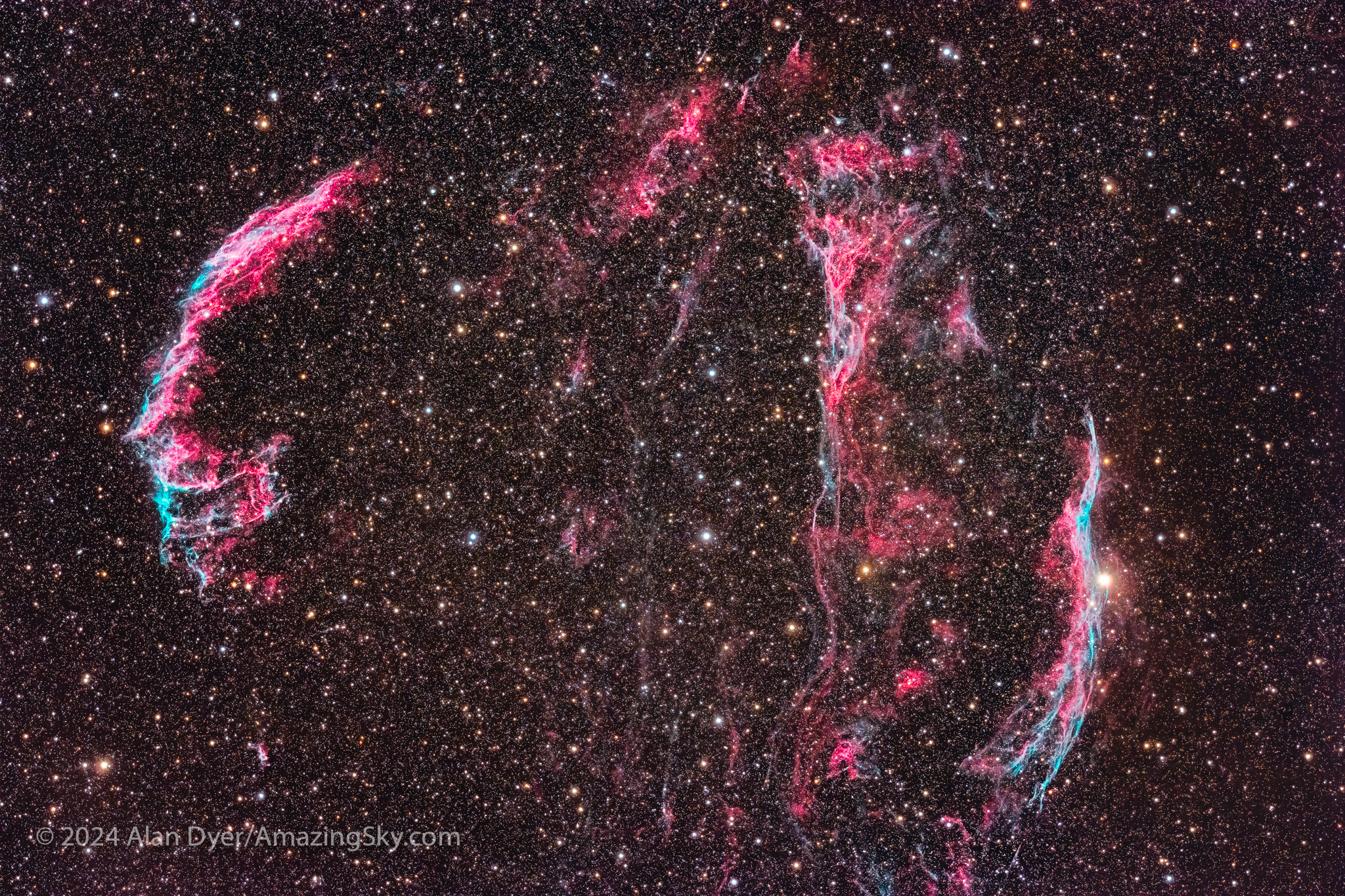
And from home, September brought skies dark and clear enough (at least when there was no aurora!) for more captures of colourful nebulas (above and below) along the summer Milky Way.
This frames all the photogenic components of the bright Veil Nebula in Cygnus, a several-thousand-year-old supernova remnant.
We invest a lot of money into the kind of specialized gear needed to shoot these targets (and I’m not nearly as “committed” as some are, believe me!), only to find the nights when it all comes together can be few and far between.
… Plus, A Very Minor Eclipse of the Moon
I had to include this, if only for stark contrast with the spectacular solar eclipse six months earlier.
We had an example of the most minor of lunar eclipses on March 24, 2024, with a so-called “penumbral” eclipse of the Moon, an eclipse so slight it’s hard to tell anything unusual is happening. (So I’ve not even included an image here, though I was able to shoot it.)
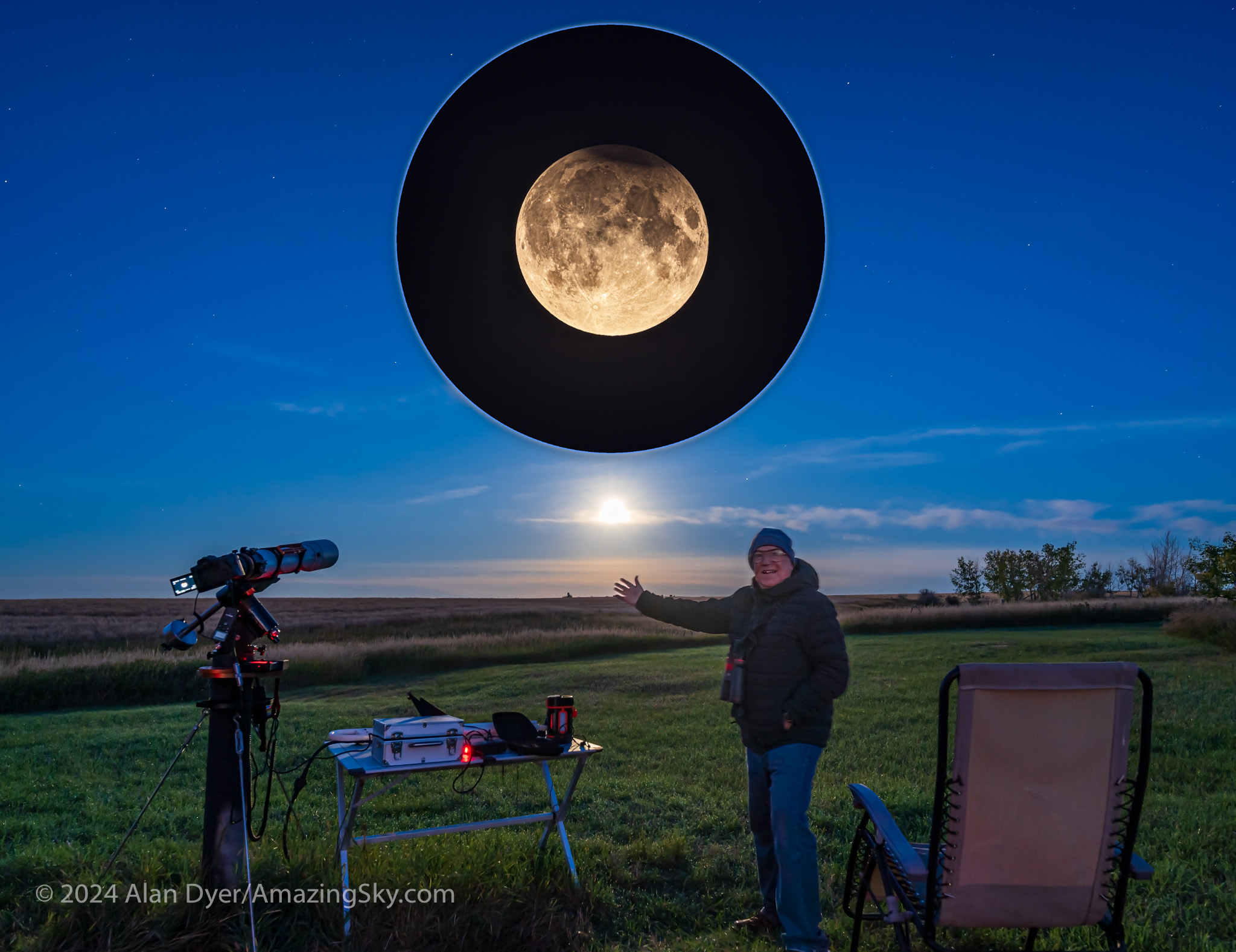
Me at another successful eclipse chase … to my backyard to capture the partial lunar eclipse on September 17, 2024. The Moon is rising in the southeast.
On September 17, we had our second eclipse of the Moon in 2024. This time the Earth’s umbral shadow managed to take a tiny bite out of the Full Moon. Nothing spectacular to be sure. But at least this eclipse expedition was to no farther away than my rural backyard. A clear eclipse of any kind, even a partial eclipse, especially one seen from home, is reason to celebrate. I did!
Of course, a total eclipse of the Moon, when the Full Moon is completely engulfed in Earth’s umbra and turns red, is what we really want to see. They rate a 7 on our Aah! Factor scale. We haven’t had a “TLE” since November 8, 2022, blogged about here.
We knew early in 2024 that the then newly-discovered Comet Tsuchinshan-ATLAS had the potential to perform this month. I planned a trip south to favourite spots in Utah and Arizona to take advantage of what we hoped would be a fine autumn comet.
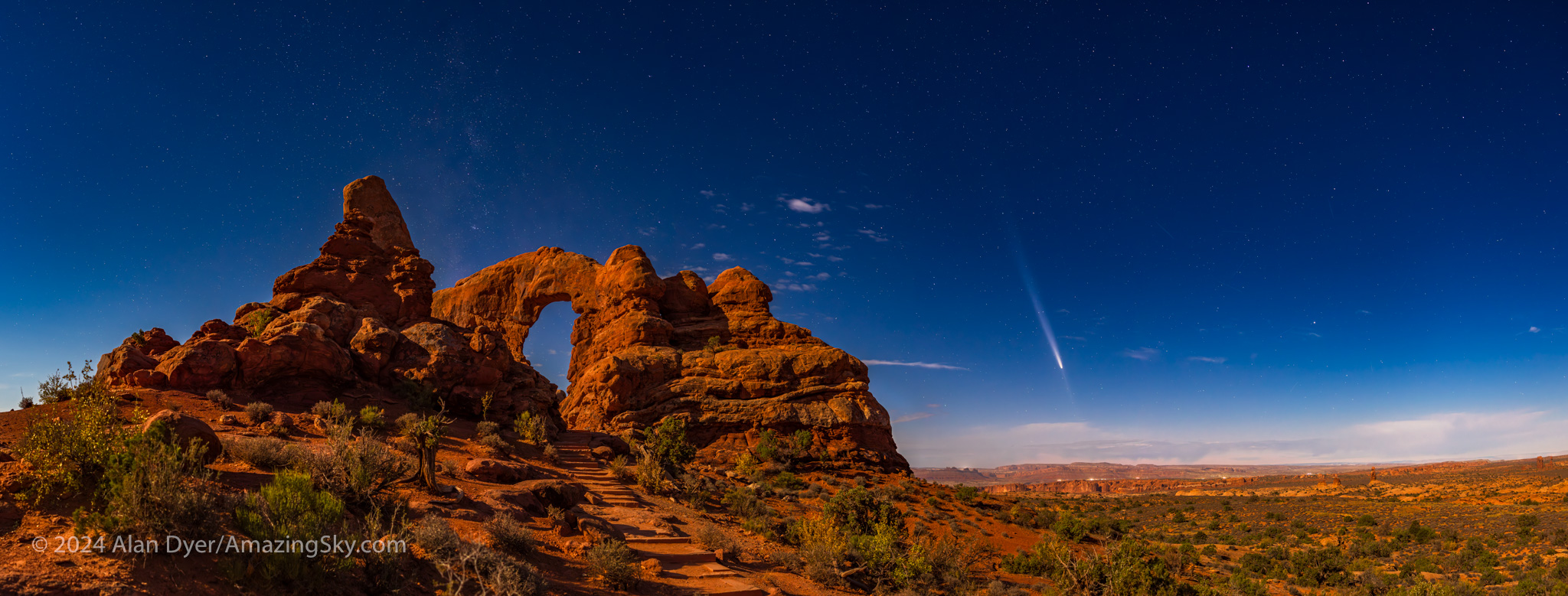
This is Comet Tsuchinshan-ATLAS (C/2023 A3) at its finest in the evening sky, on October 14, two days after its closest approach to Earth, and with it sporting a 10º- to 15º-long dust tail, and a short narrow anti-tail pointed toward the horizon. The location was Turret Arch in the Windows area of Arches National Park, Utah.
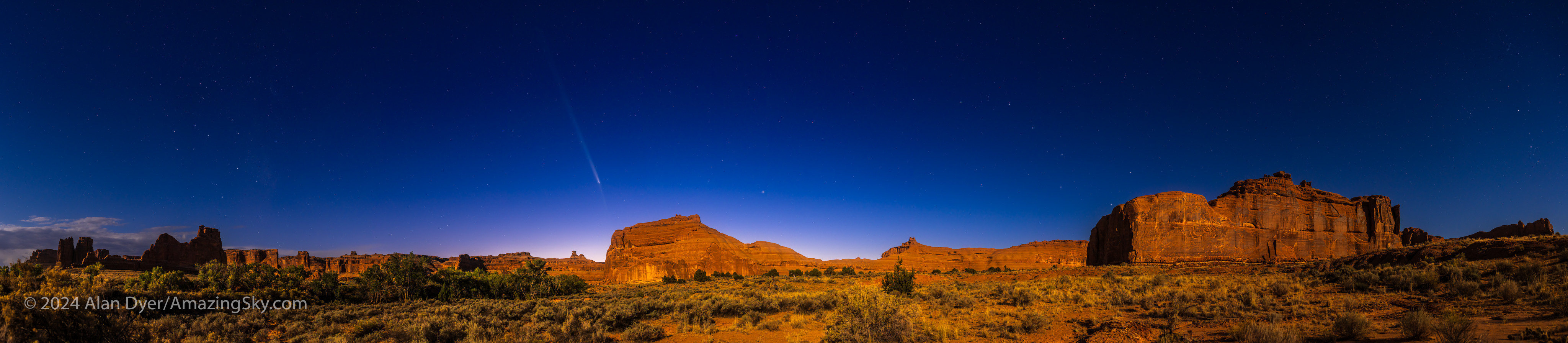
It blossomed nicely, especially as it entered into the evening sky in mid-October, as above. Despite the bright moonlight, it was easy to see with the unaided eye, a celestial rarity we get only once a decade, on average, if we are lucky. My blog of my comet chase is here.
This is a panorama of Comet Tsuchinshan-ATLAS over Arches National Park, Utah, on a moonlit night, October 15, 2024, with the comet easy to see with the unaided eye.
A naked-eye comet ranks an 8 on our Aah! Factor scale. So now 2024 had delivered all four of our Top 4 sky sights.
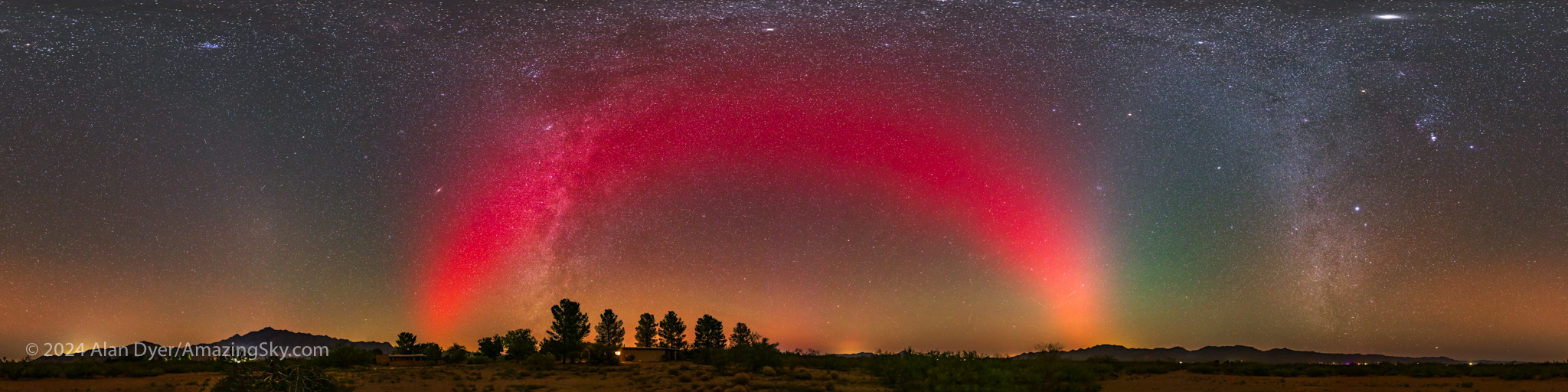
This 360° panorama captures a rare SAR (Stable Auroral Red) arc across the Arizona sky in the pre-dawn hours of October 11, 2024. The SAR arc was generated in the high atmosphere as part of the global geomagnetic storm of October 10/11, 2024, with a Kp8 rating that night.
But … just as a bonus, there was another fabulous aurora on October 10, seen in my case from the unique perspective of southern Arizona, with an appearance of a bright “SAR” arc more prominent than I had ever seen before. So that view was a rarity, too, so unusual it doesn’t even make our Aah! list, as SARs are typically not visible to the eye.
November
Back to Norway for Northern Lights
2024 was notable for travel getting “back to normal,” at least for me, with two long-distance drives, and now my second overseas trip. This one took me north to Norway 🇳🇴, which I had been visiting twice a year as an enrichment lecturer during pre-pandemic years.
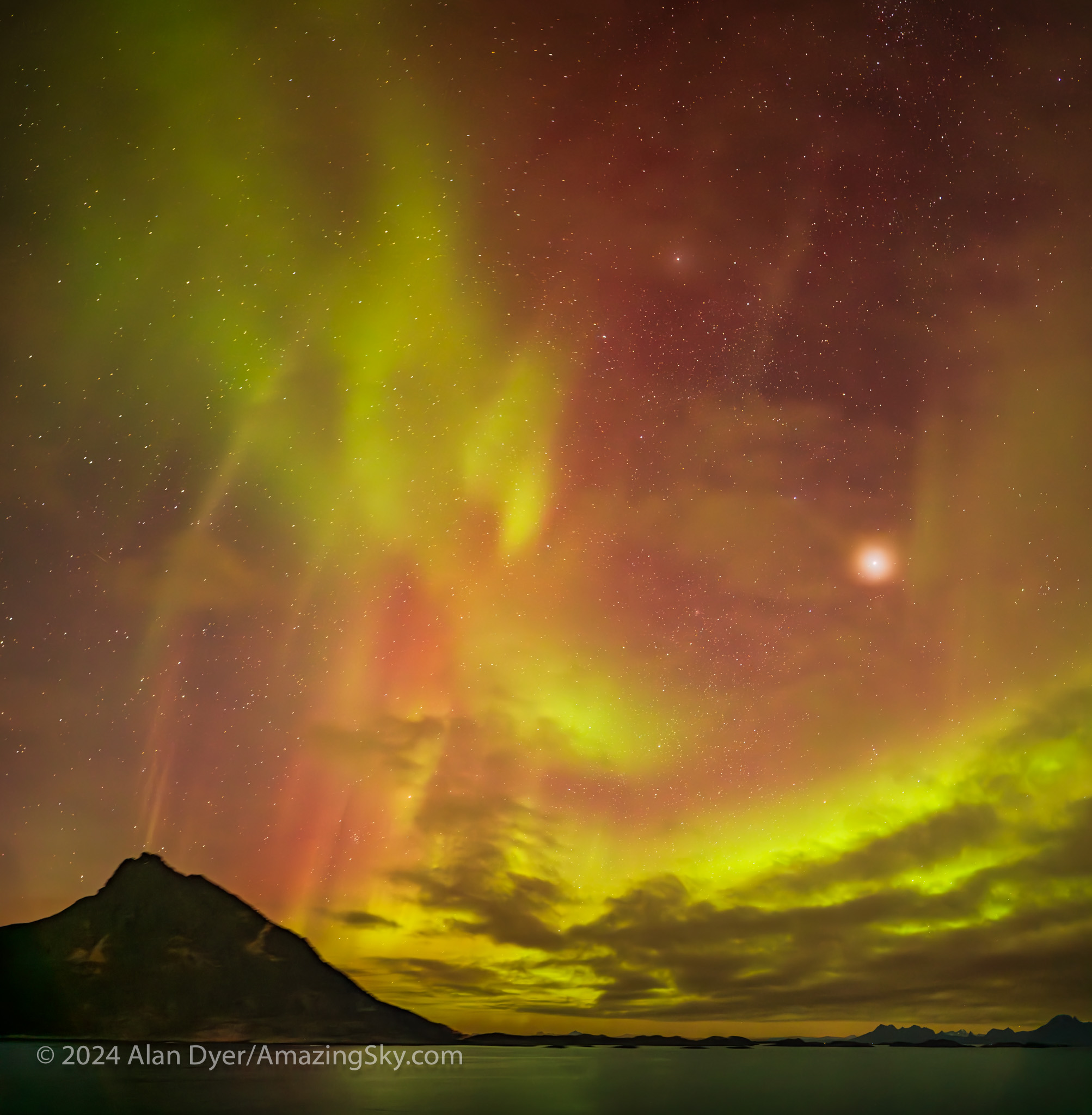
A green and red aurora appears over the coast of Norway, with Jupiter bright at right. This was from the Hurtigruten ship m/s Nordkapp on November 10, 2024, on a coastal cruise with a Road Scholar tour group.
The auroras were excellent, though nothing like the great shows of May and October. But the location sailing along the scenic coast and fjords makes up for any shortfall in the Lights. It was good to be back. I plan to return in 2025 for two cruises in October. Join me there, too!
December
A Winter Moonrise to End the Year
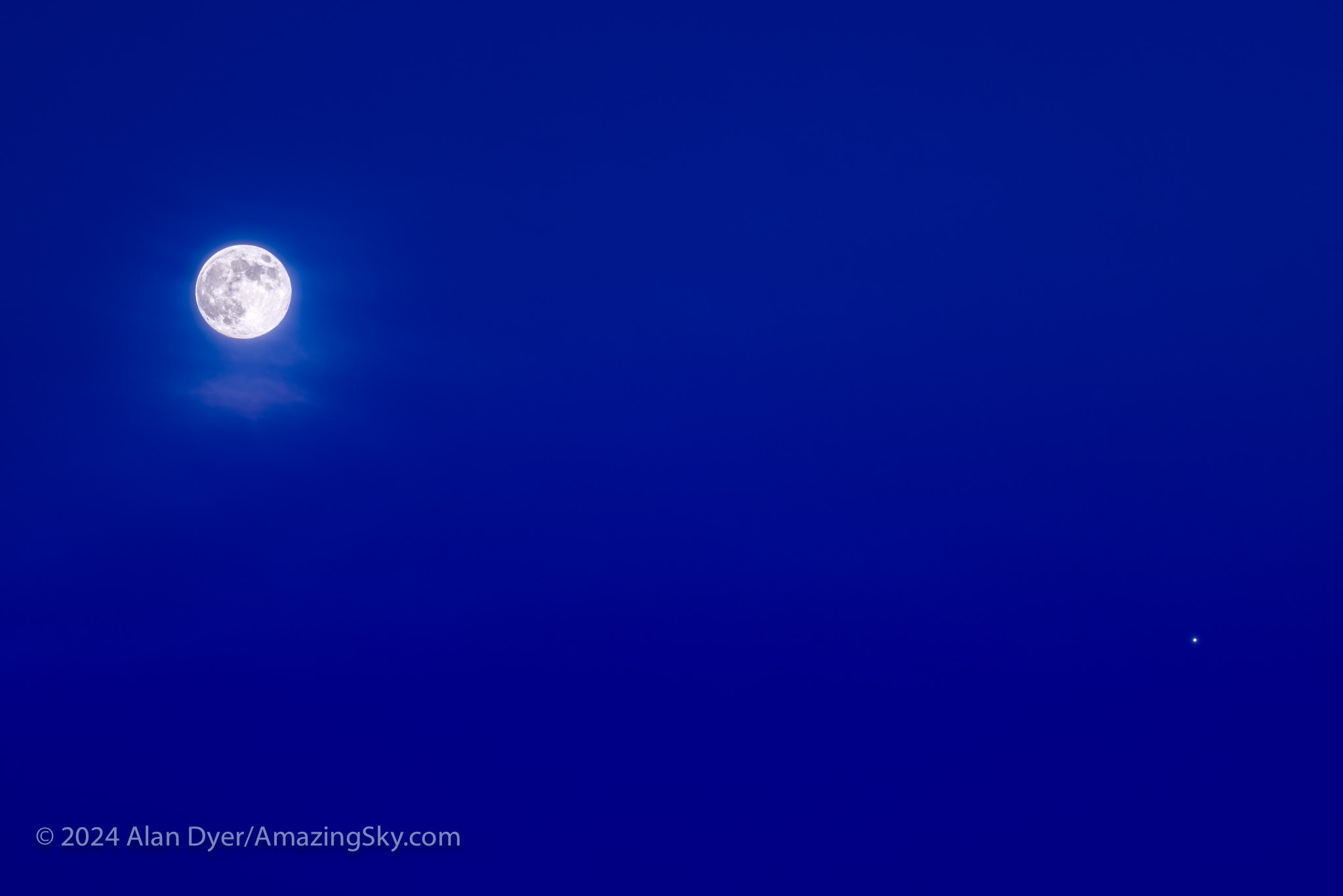
As I write this, December has been nothing but cloud. Almost. A clear hour on Full Moon night allowed a capture of the “Cold Moon,” with the Moon near Jupiter, then at its brightest for the year. So that’s the other lunar bookend to the year, shot from the snowy backyard.
This is the Full Moon of December 14, 2024, near the planet Jupiter at lower right. Both were rising into the eastern sky in the early evening.
However, I did say after the clear total eclipse in April that if the rest of 2024 had been cloudy I wouldn’t complain. So I’m not.
And there’s no reason to, as 2024 did deliver the best year of stargazing I can remember. 2017 had a total solar eclipse. 2020 had a great comet. But we have to go back to 2003 for aurora shows as widespread and as a brilliant as we’ve seen this year. 2024 had them all. And more!
May 10, 1994 Annular Eclipse taken from a site east of Douglas, Arizona showing “reverse” Bailey’s Beads —lunar mountains just touching Sun’s limb 4-inch f/6 apo refractor at f/15 with Barlow lens Ektachrome 100 slide film.
Here’s my preview of some of the best celestial events for 2023. Mine is certainly not an exhaustive list. I’ve picked just one event per month, and I’ve focused on events best for unaided eyes or binoculars, and visible from North America. (So the solar eclipse of April 20 visible from Australia and the South Pacific, and the two minor lunar eclipses this year don’t make the cut!)
Click or tap on any of the illustrations to bring up a full-screen view with more detail and readable labels!
JANUARY
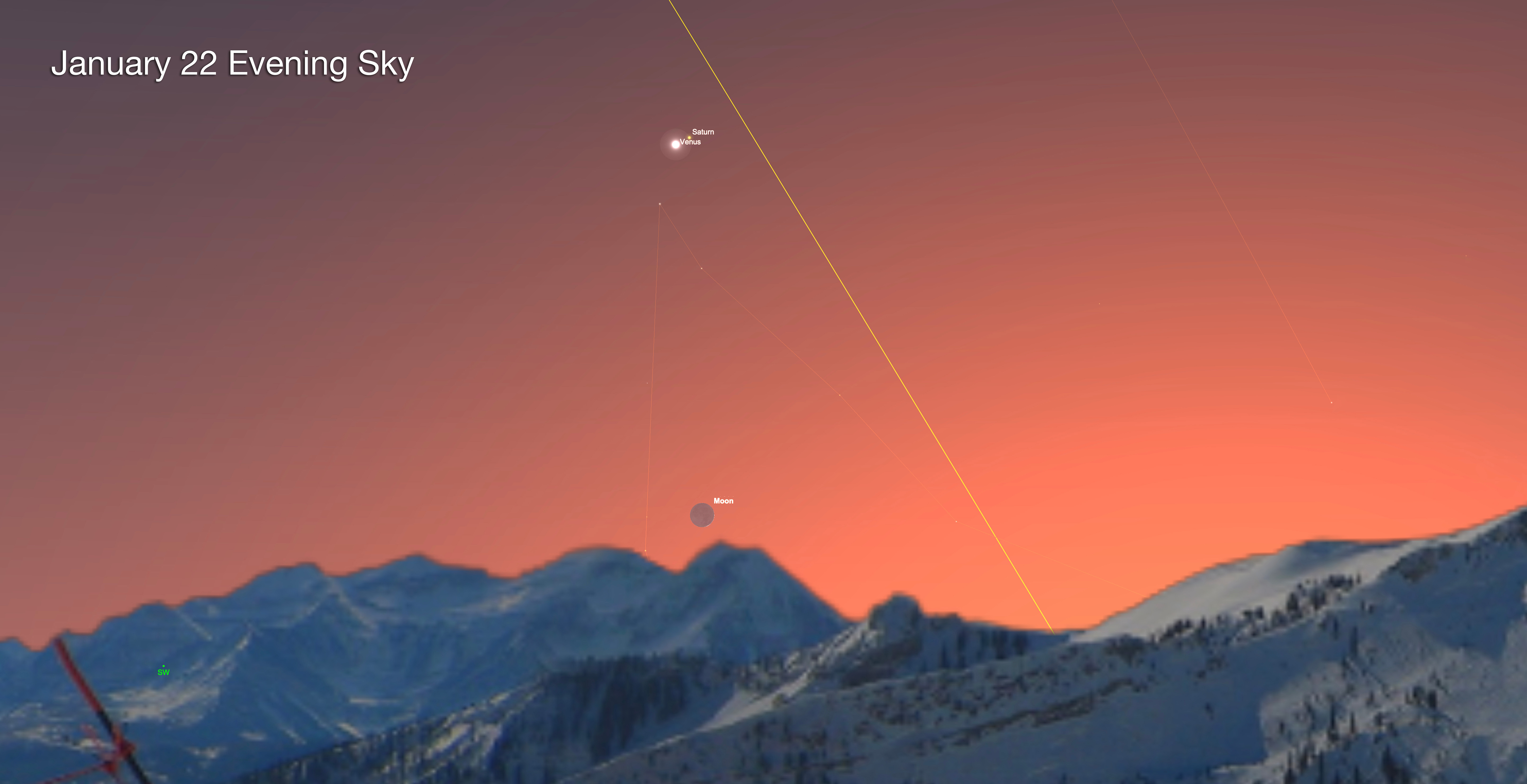
As 2023 opens, Venus is beginning its climb into the evening sky, while Saturn is sinking into the sunset. The two planets pass each other on Sunday, January 22, when they appear just one-third of a degree apart in the twilight. Use binoculars to pick out dimmer Saturn. And look for the thin day-old crescent Moon just over a binocular field below the planet pair.
FEBRUARY
A month later, on Wednesday, February 22, Venus has now ascended higher, preparing to meet up with descending Jupiter. But before they meet, the crescent Moon, with its dark side lit by faint Earthshine, joins the planets in a particularly close conjunction with Jupiter. They will appear about 1° (two Moon diameters) apart, with Venus about a binocular field below.
MARCH
Here’s a date to circle on your calendar. On Wednesday, March 1 the sky’s two brightest planets, Venus and Jupiter, pass within half a degree of each other, in arguably the year’s best conjunction. They’ll be close enough to frame nicely at medium power in a telescope, though the featureless gibbous disk of Venus will appear small, about the third the size of Jupiter’s banded globe. But Venus is by far the brighter of the two worlds.
APRIL
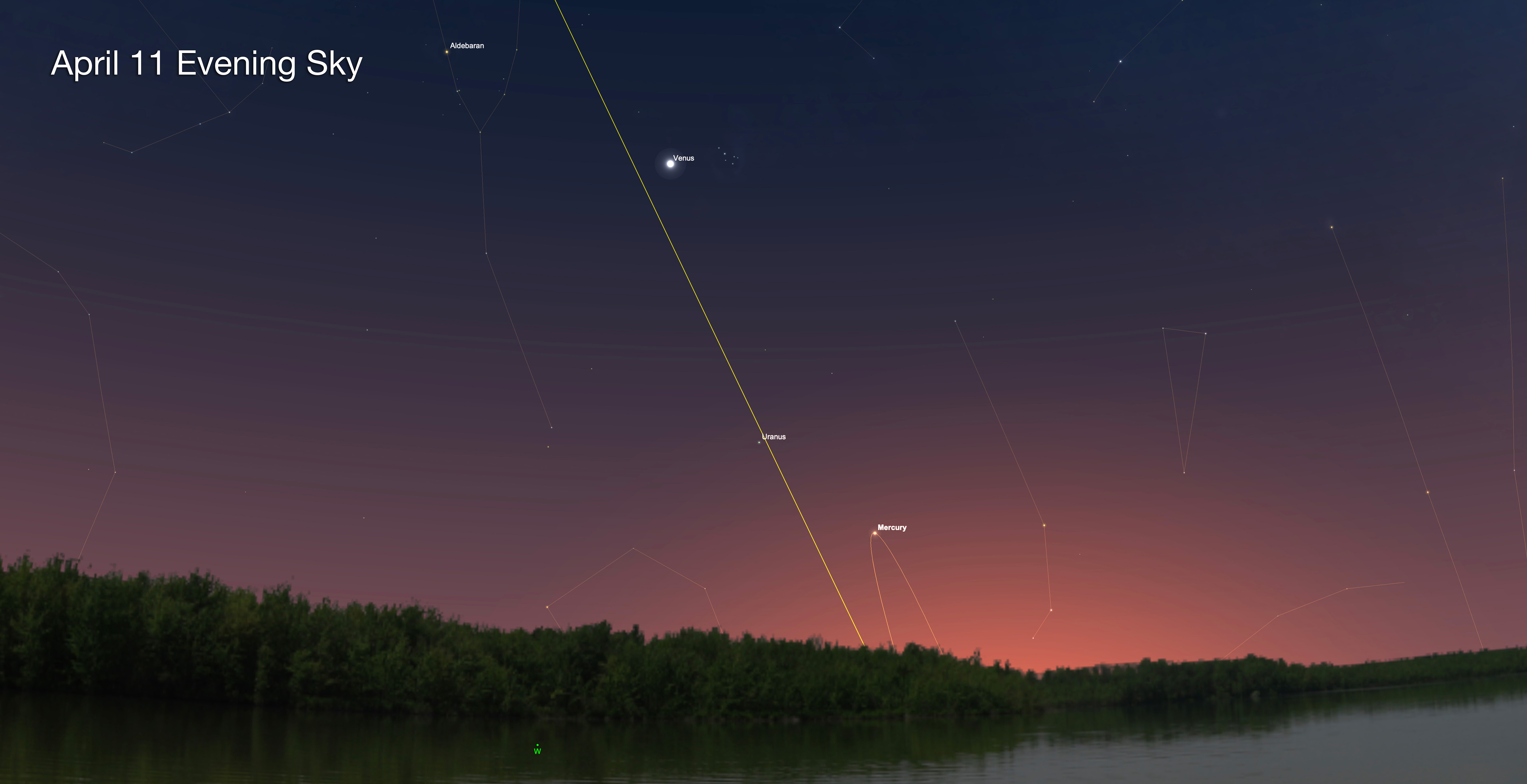
If you want to check Mercury off your sighting list this year, this is a good week to do it. On April 11 Mercury reaches its greatest angle away from the Sun in the evening sky, and for northern hemisphere viewers, is angled at its highest in the western sky. Even so, look just a binocular field above the horizon. While you’re at it, look higher for the fine sight of Venus near the Pleiades star cluster.
MAY
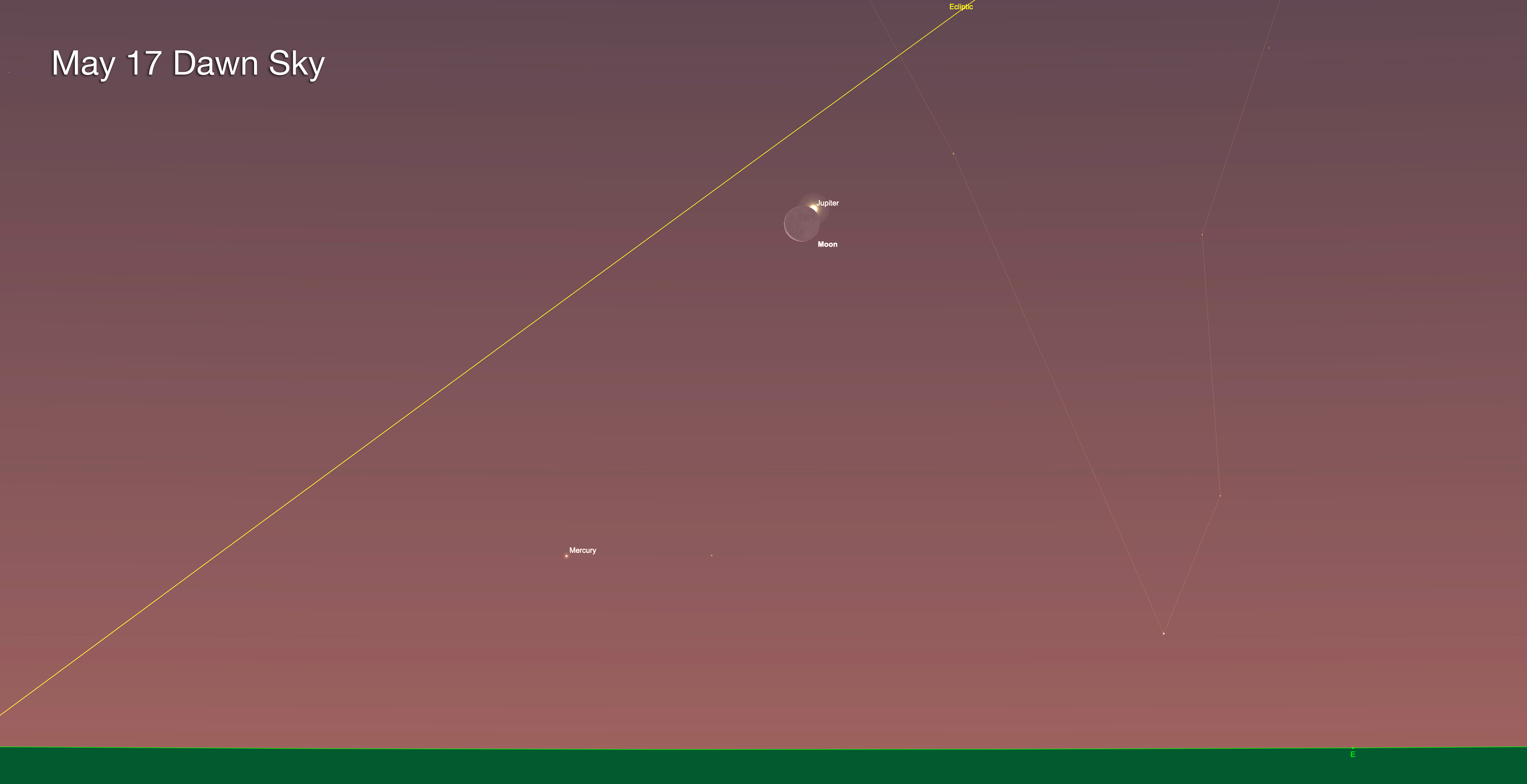
Wednesday, May 17 brings a chance to see the crescent Moon pass in front of Jupiter. But it will be a tricky event to catch. While most of North America and parts of Northern Europe can see the occultation, it occurs in the daytime sky with the Moon only 25° west of the Sun. However, locations along the West Coast of North America can see either the start or end of the occultation in a bright pre-dawn sky. Vancouver, Canada sees Jupiter disappear before sunrise, while Los Angeles – the view shown above – sees Jupiter reappear just before sunrise. Other locations will see a close conjunction of the Moon and Jupiter low in the dawn sky.
JUNE
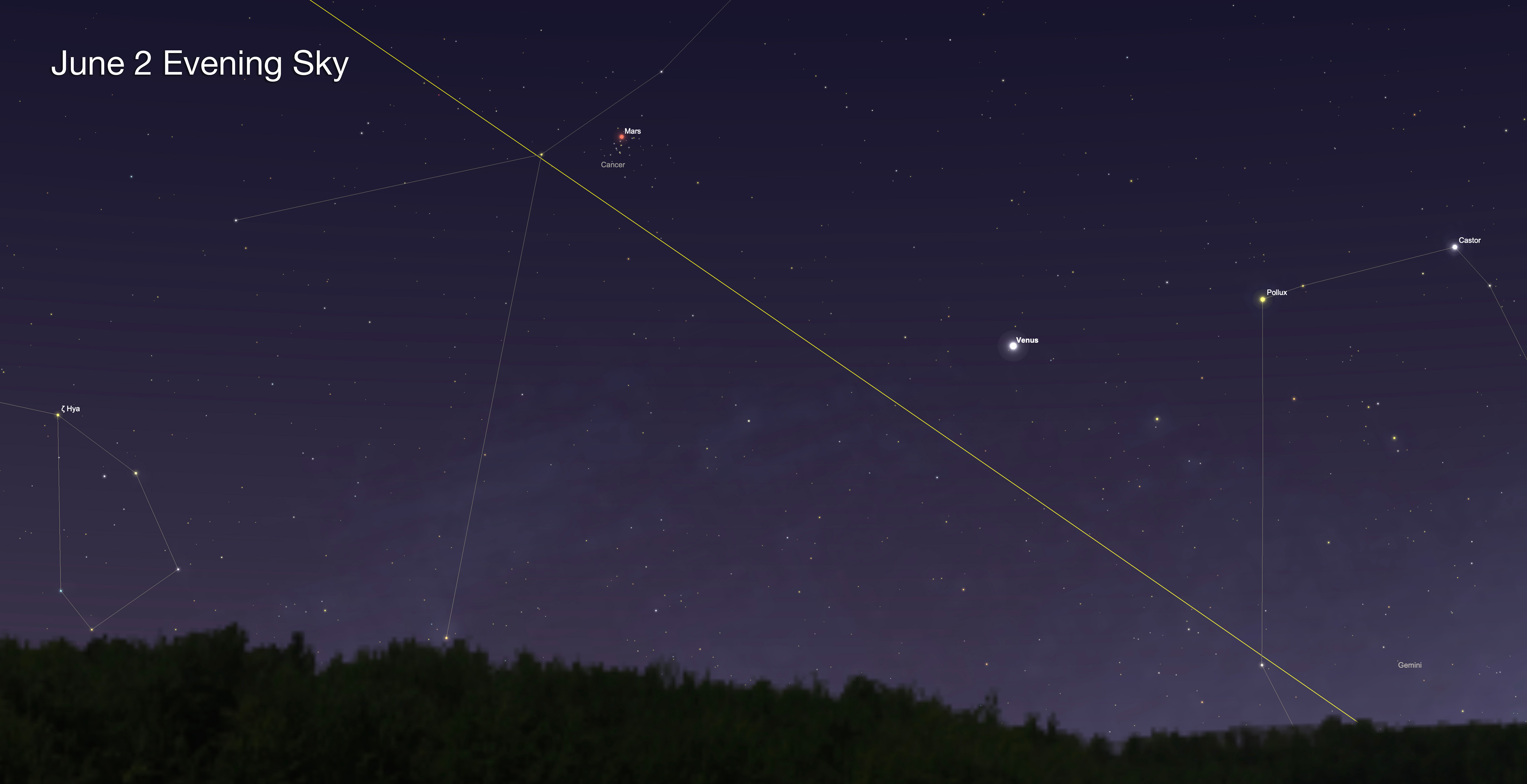
As June opens we have Venus still shining brightly in the evening below much dimmer Mars, now far from the Earth and tiny in a telescope. But it’ll be worth a look this night even in binoculars as the red planet passes in front of the Beehive star cluster, also known as Messier 44. If you miss June 2, Mars will be close to the Beehive the night before and after.
JULY
Venus has been bright all spring, but on July 7 it officially peaks at its maximum brilliance, reaching a blazing magnitude of -4.7. It reached its greatest angle from the Sun a month earlier on June 4 and is now dropping closer to the Sun each evening. But you still can’t miss it. What you might miss is dim Mars above, now close to the star Regulus in Leo. Mars passes 3/4 of a degree above Regulus on July 9 and 10. You’ll need binoculars to pick out the pairing.
AUGUST
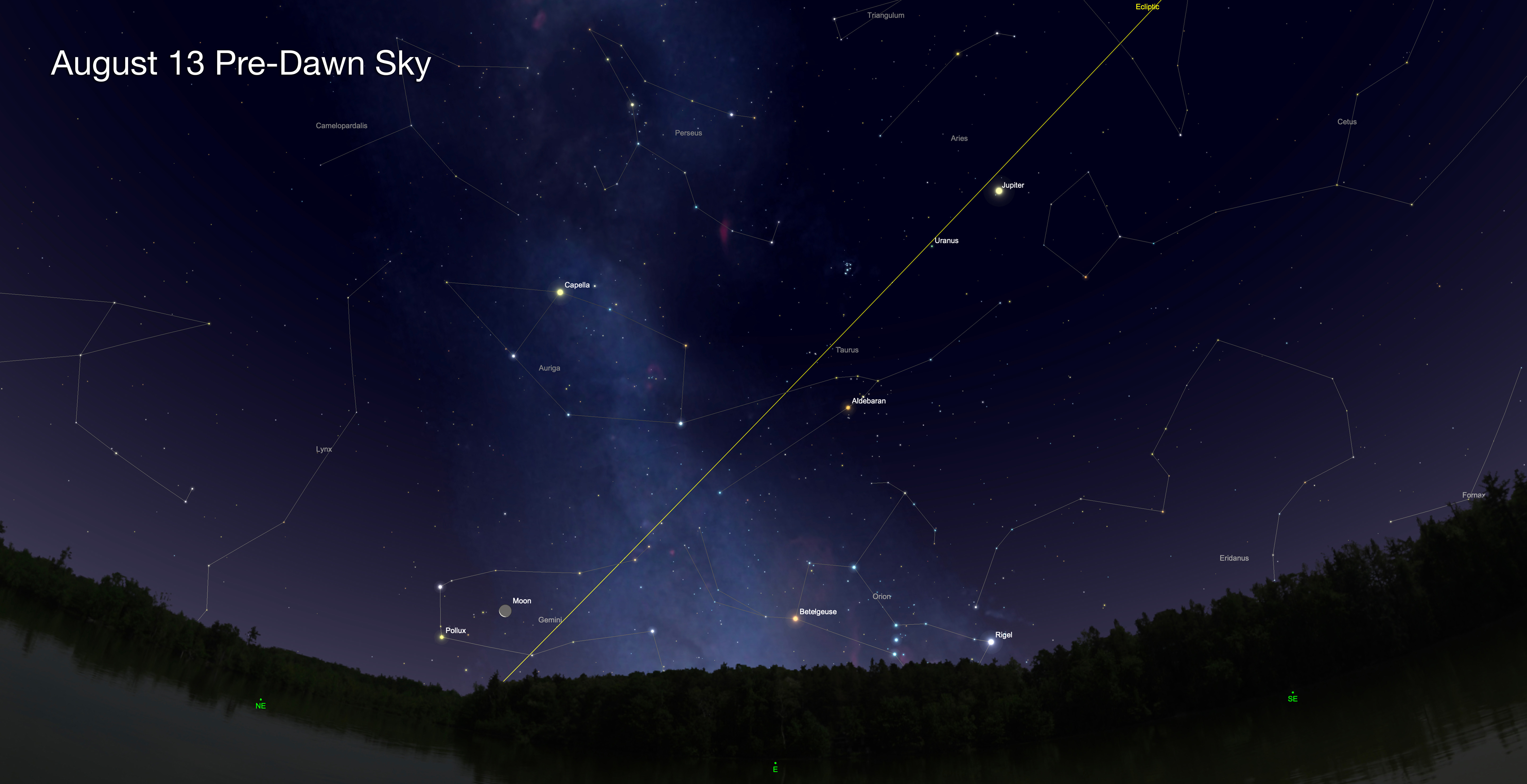
Everyone looks forward to the annual summer stargazing highlight – watching the Perseid meteor shower. This is a good year, with the peak hour of the shower falling in the middle of the night of August 12/13 for North America. That’s a Saturday night! But most importantly, the waning Moon doesn’t rise until the wee hours, as shown here, so its light won’t wash out the meteors. Plan to be at a dark site for an all-night meteor watch.
SEPTEMBER
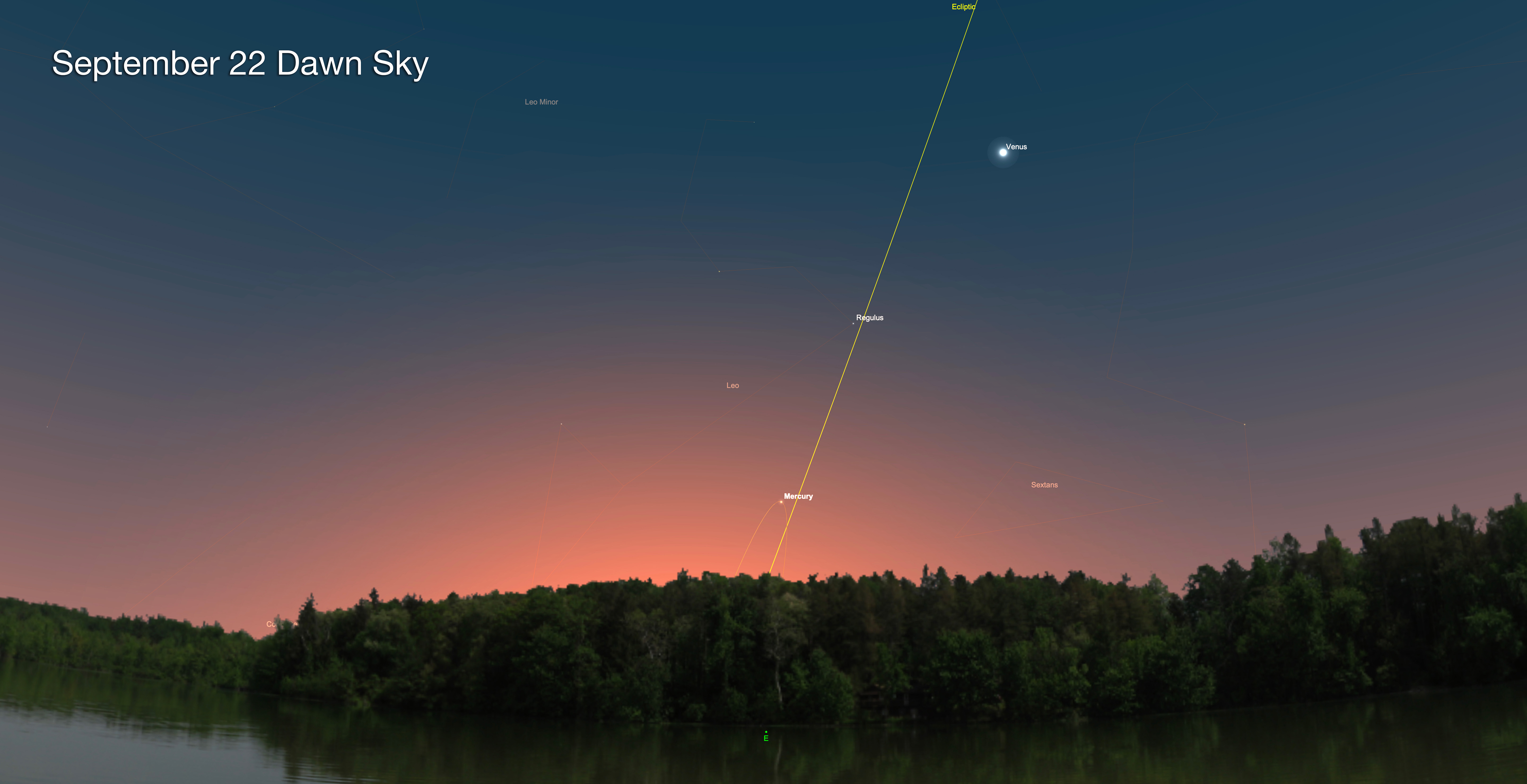
By September Venus has made the transition into the morning sky and shines at its greatest dawn-sky brilliance on September 19. It will then be joined by Mercury, with the inner planet reaching its greatest angle away from the Sun on September 22 shown here. This is the best morning appearance of Mercury for Northern Hemisphere observers. The view this morning bookends the view five months earlier on April 11. If you are away from urban light pollution, also look for the faint glow of Zodiacal Light in the pre-dawn sky before Mercury rises.
OCTOBER
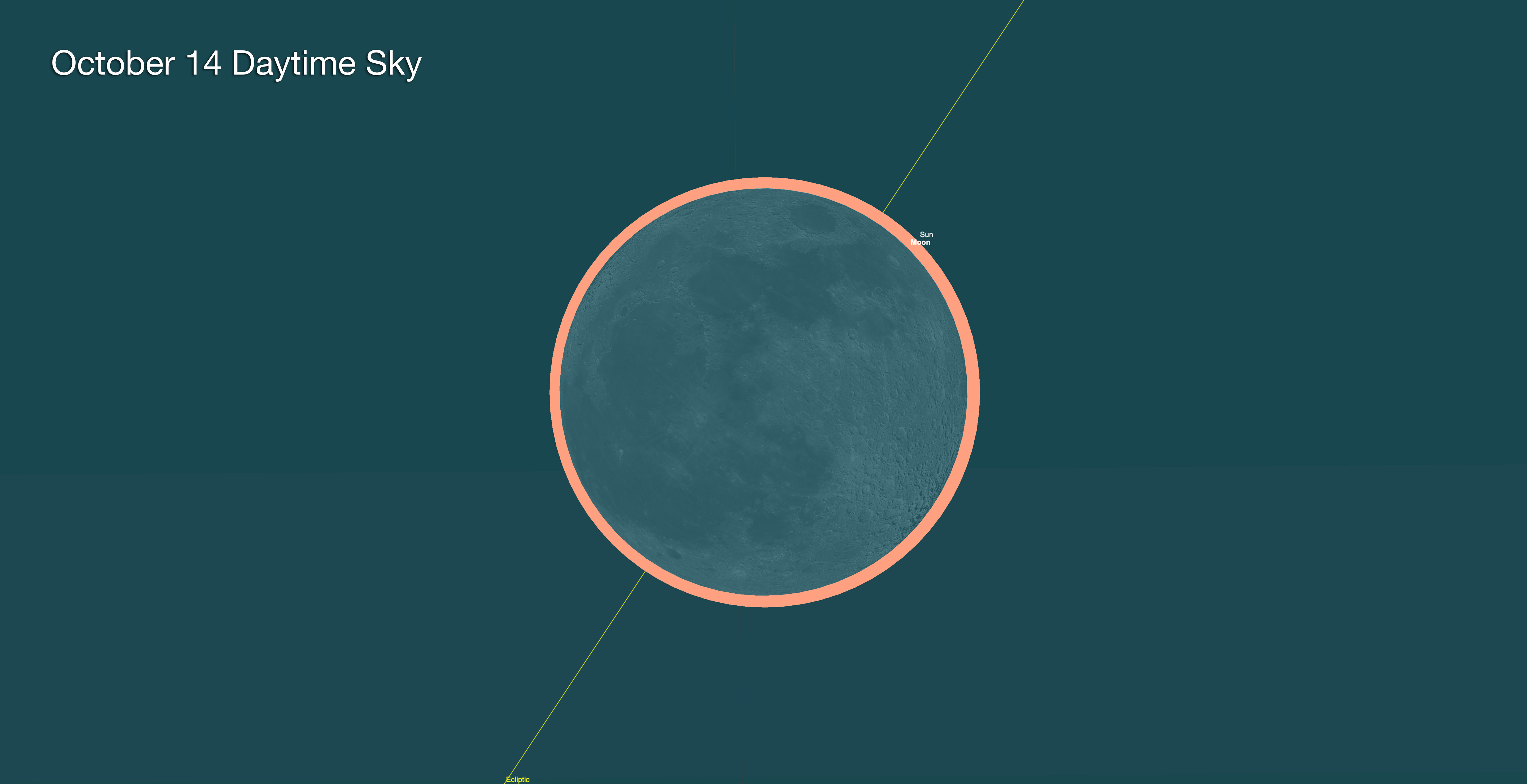
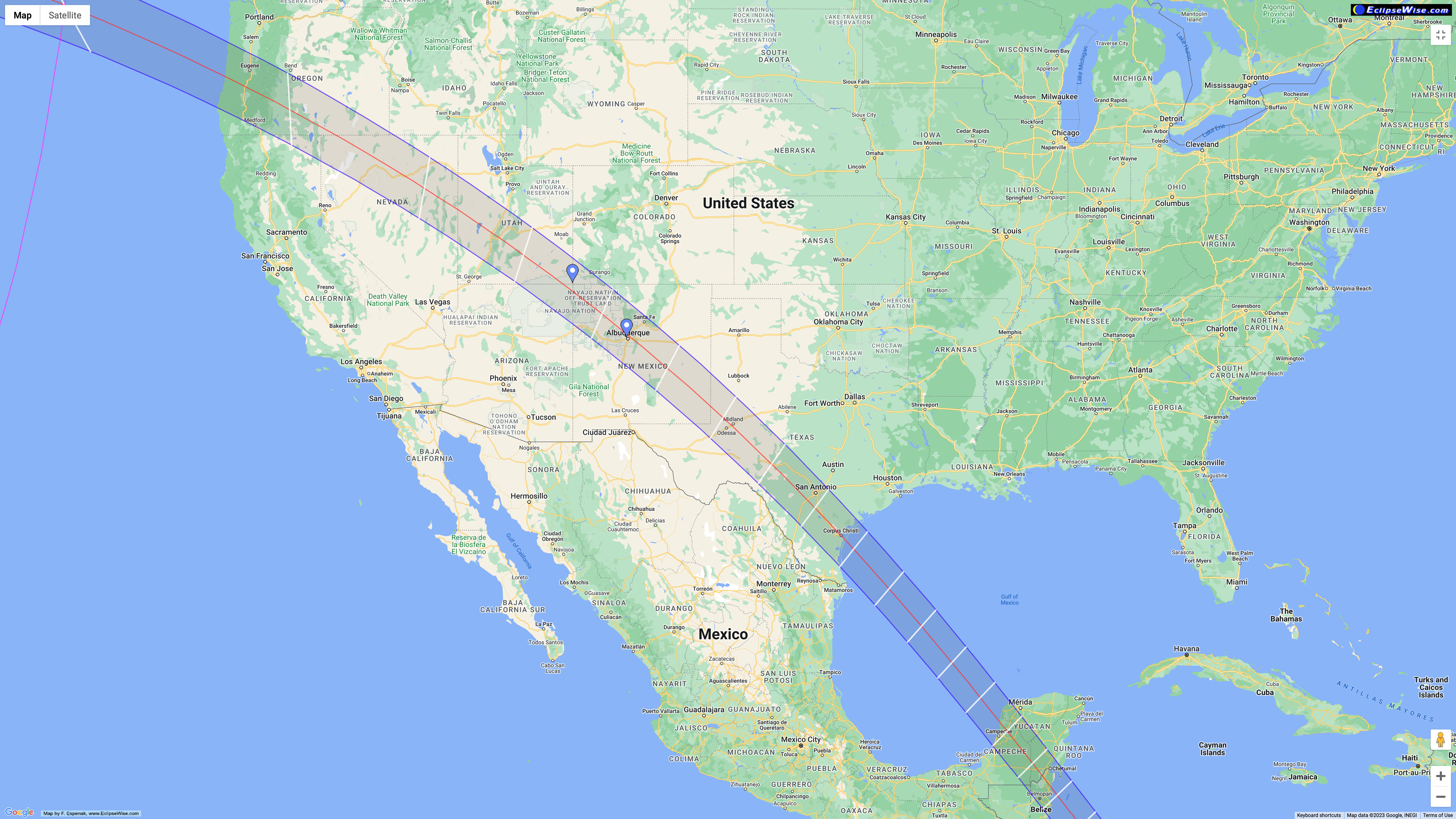
October is solar eclipse month! On Saturday, October 14 the shadow of the Moon passes across all of North America and most of South America. Everyone on those two continents sees a partial eclipse of the Sun. But those along a narrow path sweeping across the western U.S. and down into Mexico, Central America and across northern South America can see a rare “ring of fire” eclipse as the Moon’s dark disk eclipses the Sun, but isn’t quite large enough to totally cover it. This is an “annular” eclipse. The view above is from Albuquerque, New Mexico, one of the largest U.S. cities in the path of annularity, second only to San Antonio, Texas.
This is the path of annularity across the western U.S. To see the Moon pass centrally across the Sun (the “ring of fire”) you have to be somewhere in that grey path. Outside the path you will see only a partial eclipse of the Sun. For detailed and zoomable eclipse path maps like the one above, please visit EclipseWise.com.
NOVEMBER
Close conjunctions between the crescent Moon and Venus are always notable. Get up early on Thursday, November 9 to see the 26-day-old Moon shining only a degree below Venus. Venus reached its greatest angle away from the Sun on October 23. It is now descending back toward the Sun, but remains high in the morning sky in early November.
DECEMBER
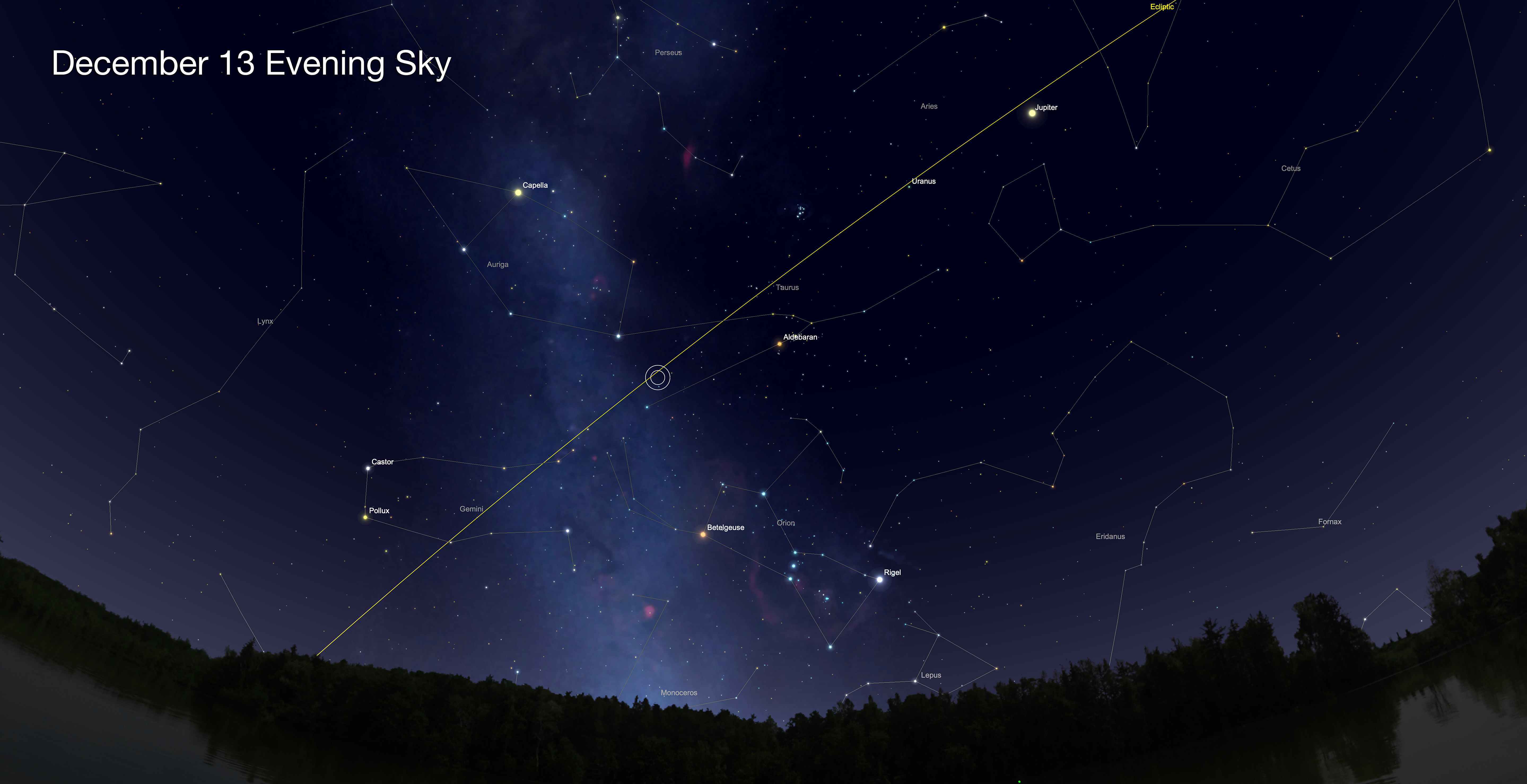
Though it usually puts on a better show than the summer Perseids, the Geminid meteor shower is not as popular because it’s cold! But this is also a good year for the Geminids as it peaks only two days after New Moon. The best night might be Thursday, December 14, but a good number of meteors should be zipping across the sky the night before on December 13, shown here. Start watching at nightfall and go as long as you can in the chill of a December night.
To download my free Amazing Sky 2023 Calendar in PDF format, go to my website at https://www.amazingsky.com/Books The PDF file can be printed out at home or taken to an office supply shop to be printed and bound.
Good luck in your stargazing and clear skies for 2023!
It’s been a marvelous few months following Venus rise and fall across the evening sky, in its best show in eight years.
Venus is now gone from our western sky, but since late 2019 until late May 2020 it had dominated the sky as a brilliant evening star.
Here’s a gallery of Venus portraits I shot during its wonderful show these last few months.
The show began in November 2019 when rising Venus met declining Jupiter on November 23 for a fine conjunction of the two brightest planets in the evening twilight.
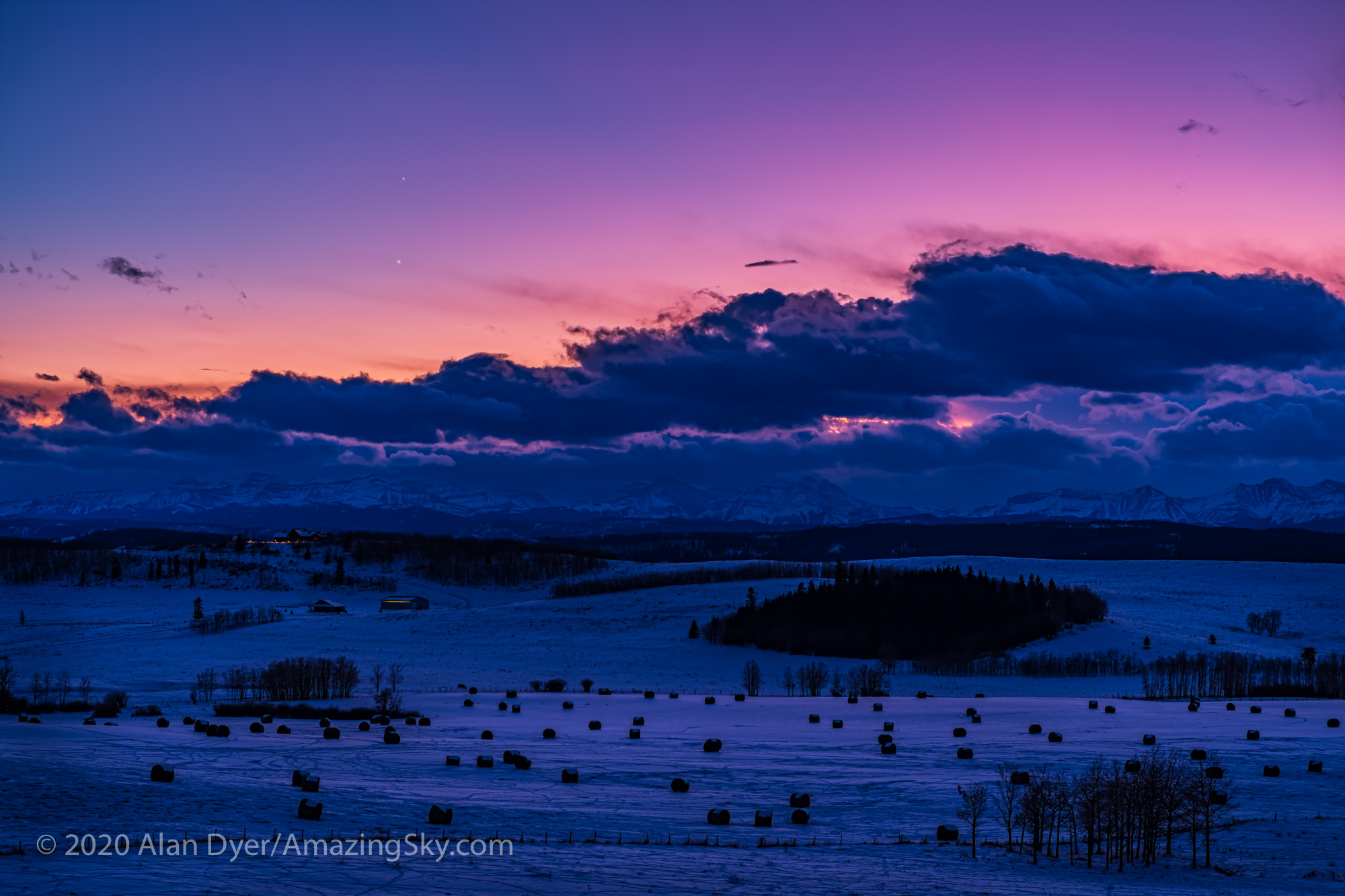
The conjunction of Venus and Jupiter of November 23, 2019, as seen over the foothills and front ranges of the Rocky Mountains in southwest Alberta. I shot this from the Rothney Astrophysical Observatory, prior to their monthly Open House event that night with about 400 in attendance. But at this time it was just me and one other ardent photographer present to shoot this scene. This is an HDR blend (stacked using Adobe Camera Raw) of 5 exposures at 2/3-stop intervals, with the Rokinon 85mm lens at f/4 on the red-sensitive Canon EOS Ra camera at ISO 100.
A week later I captured the line of the then three evening planets and the Moon across the southwest, defining the path of the ecliptic across the evening sky.
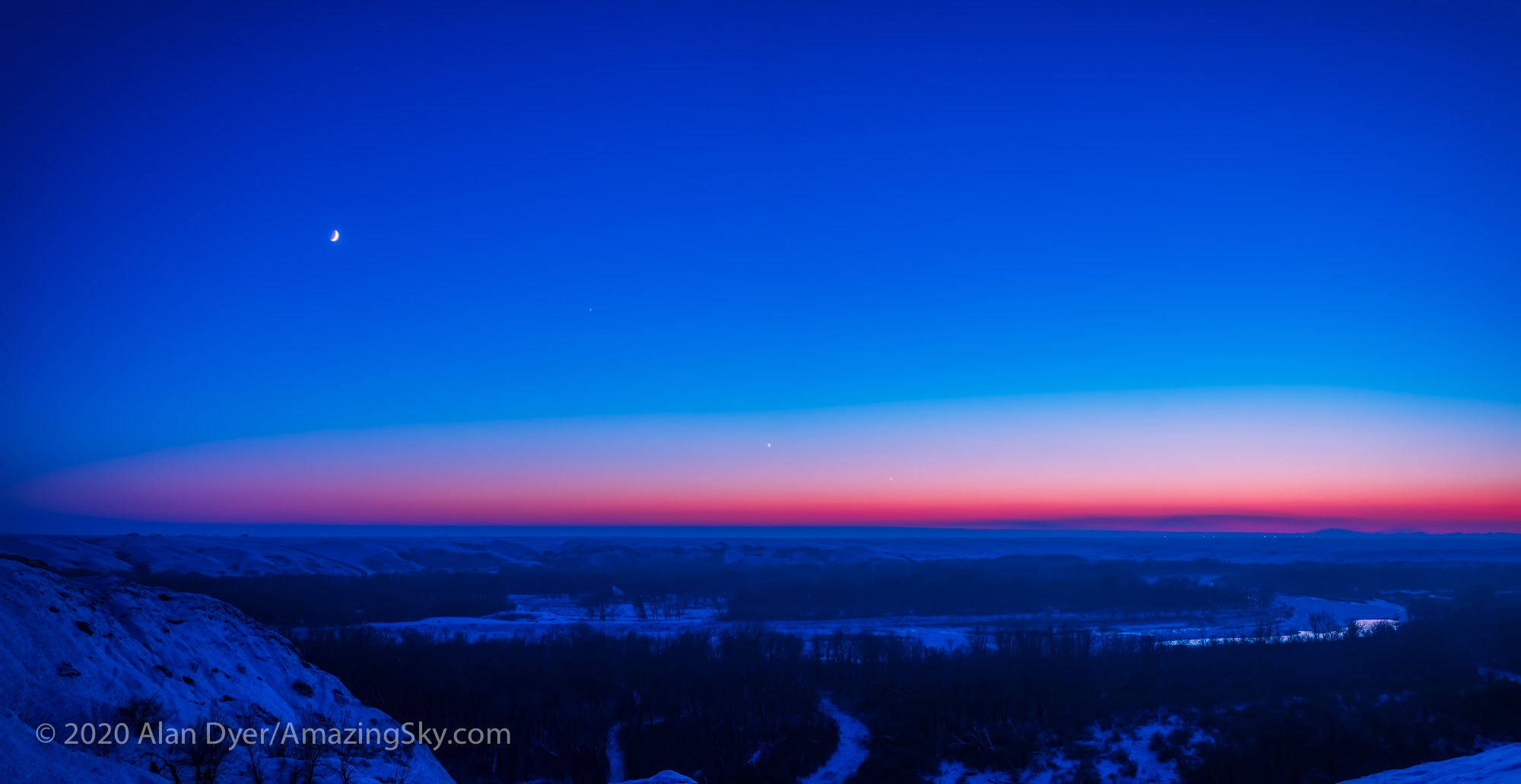
The waxing crescent Moon and three planets in a line across the southwestern evening sky on Nov. 30, 2019, a chilly and frosty night. Saturn is below and to the right of the Moon, Venus is brightest at centre, while Jupiter is to the lower right of Venus just above the horizon. Those two planets were in conjunction a week earlier. The line of Moon and planets visibly defines the ecliptic low across the late autumn evening sky. This is from latitide 51° N. I shot this from the viewpoint at Blackfoot Crossing overlooking the Bow River in Alberta.
A week after that I took the opportunity to shoot some selfies of me with binoculars looking at Venus, as it met Saturn in a wide conjunction, with Venus then still low in the southwest. It was just beginning its climb up into the western sky.
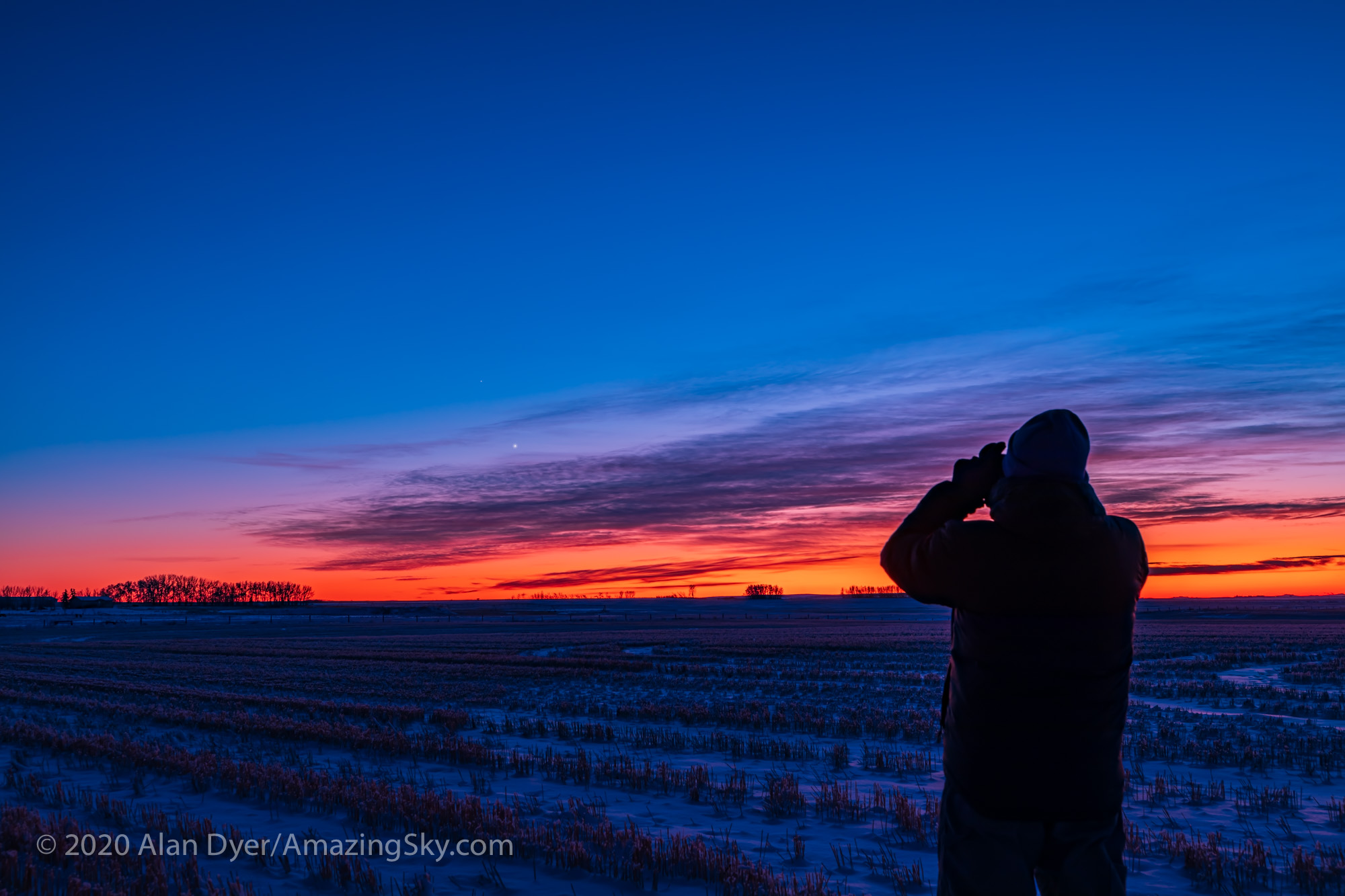
A selfie of me observing the grouping of Venus and Saturn in the evening twilight on Dec 8, 2019, using binoculars. They were closest to each other two nights later.
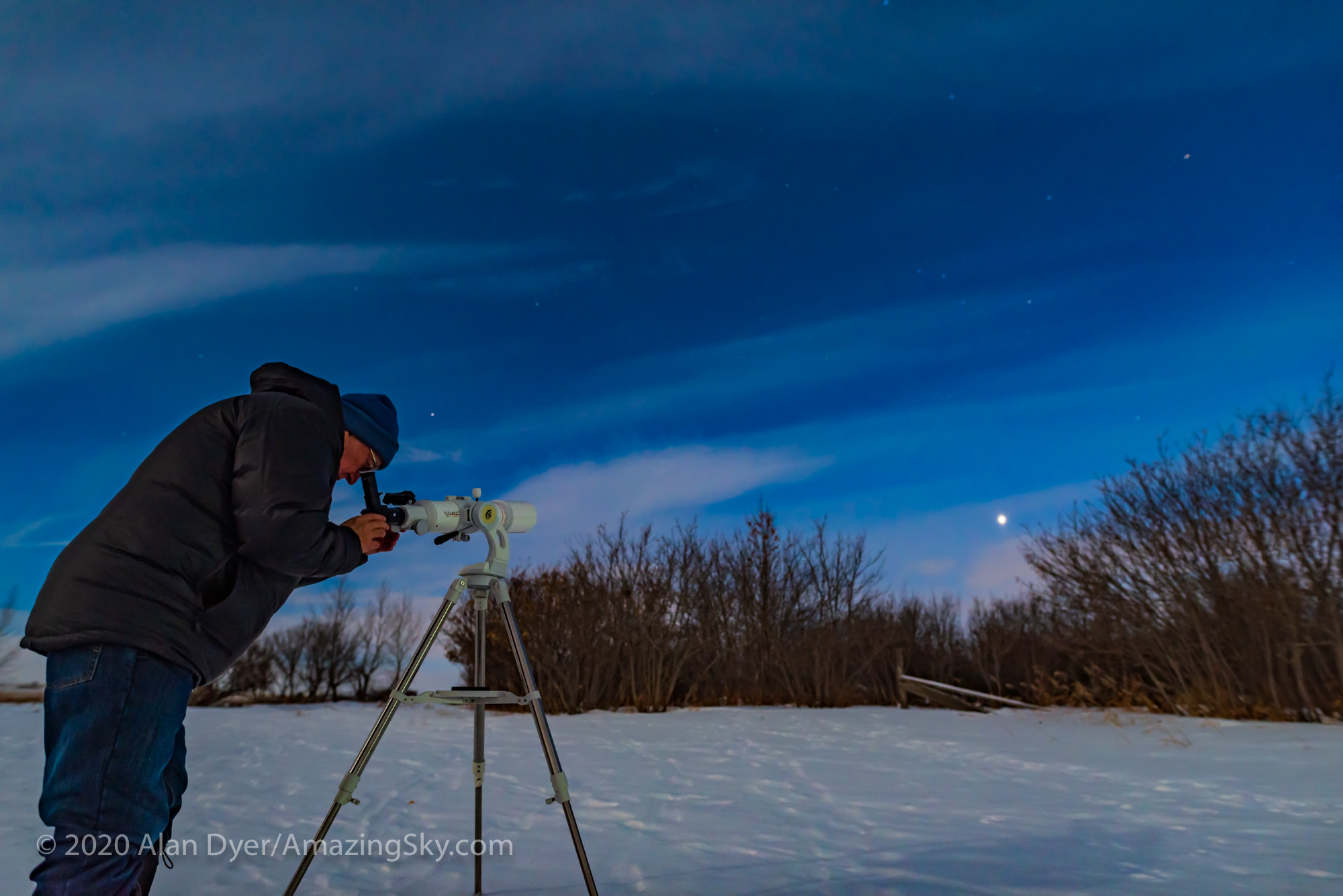
A month later in mid-winter, Venus was still rather low but brilliant even in a hazy moonlit sky, as I posed for another selfie, this time with a small telescope. These images are always useful for illustrations in books and magazines. And blogs!
A selfie of me observing Venus in clouds and in the moonlight. I am using the Explore Scientific 80mm refractor on the Twilight Nano alt-az mount. This was January 9, 2020.
By the end of February Venus had climbed high into the west, and was appearing monthly near the waxing crescent Moon. This is another binocular selfie from February 27.
A selfie looking at the waxing crescent Moon near Venus on Feb 27, 2020, using the Celestron SkyMaster 15×70 Pro binoculars on the Sky-Watcher AZ5 mount for a steady view. This is a single shot with the Nikon D750 and Sigma 24mm lens, using the flash on the camera.
In March I visited Churchill, Manitoba just as the lockdown and travel restrictions were coming into effect. But our lone and last tour group at the Churchill Northern Studies Centre saw some fine auroras, as here on this evening with the Northern Lights appearing even in the twilight. And what’s that bright star? Venus, of course!
The Northern Lights in the evening twilight on March 18, 2020, as the aurora appeared in the early evening sky. Orion is at far left in this panorama, with Cassiopeia at top centre. Part of the Big Dipper is at far right. The bright object over the Centre is Venus, with the Pleiades above. This is a panorama of 8 segments with the Venus Optics 15mm lens at f/2 and Sony a7III at ISO 800 for 1.6 seconds each. Stitched with Photoshop.
Upon my return home to Alberta, I was able to shoot more panoramas on the prairies of the wonderful early spring sky with Orion setting into the twilight and Venus in Taurus shining below the iconic Pleiades star cluster.
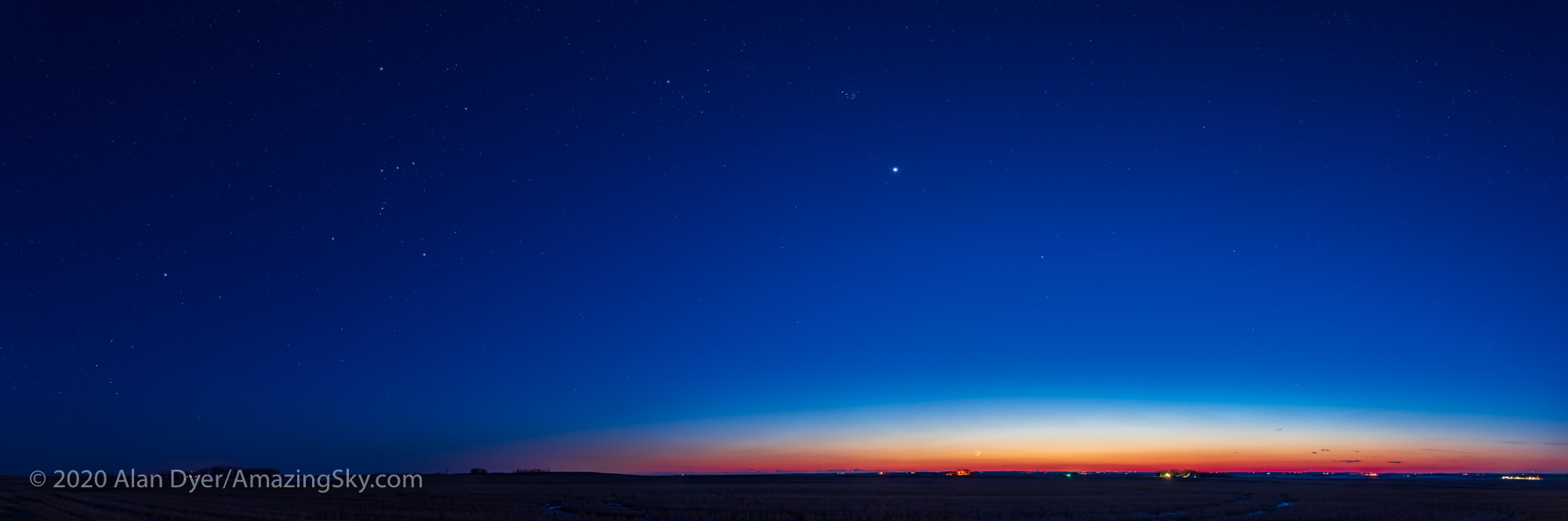
This is a panorama of the evening sky on March 25, 2020, with brilliant Venus high in the west at centre just after the date (March 24) of its greatest elongation in the evening sky for 2020. It appears here about as high as it can get with the ecliptic tipped up to a high angle in spring. To the left is Orion and the winter stars in the twilight, including Sirius at far left. Just above the horizon right of centre in the bright twilight is the day-old thin crescent Moon about to set. Above Venus are the Pleiades and Hyades star clusters. This is a panorama of 5 segments with the Nikon D750 and 24mm Sigma lens, stitched with PTGui. Each segment was 8 seconds at ISO 400 and f/2.8.
March 26 was a superb night for catching Venus now at its highest and almost at its brightest at this appearance, as the waxing Moon appeared below it.
The evening scene on March 26, 2020 of the setting waxing crescent Moon below Venus which is below the Pleiades star cluster. At top centre is the Hyades star cluster and Aldebaran in Taurus. At left is Orion sinking into the twilight of a spring evening. The setting is the old farmstead near home.
This is a stack of 7 exposures for the ground to smooth noise, and one for the sky, all 10 seconds at f/2.8 with the 24mm Sigma lens and Nikon D750 at ISO 400.
The waxing crescent Moon with Earthshine and (above) Venus shine in the evening twilight sky over an icy pond near home, on March 26, 2020. Venus was just past greatest elongation from the Sun, and being spring with the high angle of the ecliptic, Venus was as high as it can get this year in an evening apparition. The Pleiades is at very top.
This is a stack of 7 exposures for the ground to smooth noise and one for the sky, all 2.5 seconds at f.4 with the Sigma 24mm lens and Nikon D750 at ISO 200.
The highlight of the spring Venus season was its close approach to the Pleiades, which it passes only every 8 years. Here I am viewing the conjunction two days before the closest approach, with Orion over my shoulder.
A selfie of me viewing the close approach of Venus to the Pleiades star cluster on April 1, 2020, using big 15×70 Celestron SkyMaster Pro binoculars mounted on a Canadian-built Starlight Innovations binocular mount, a parallelogram-style mount. Orion is over my left shoulder; the Hyades is at centre above the mount. The waxing gibbous Moon provided the illumination. This is a stack of 4 images for the ground to smooth noise and 1 image for the sky to minimize trailing, all 13 seconds at f/5.6 with the Sigma 24mm lens and Nikon D750 at ISO 1600. Topaz Sharpen AI and DeNoise AI applied.
The night of closest approach, April 3, was cloudy, but here is a consolation closeup taken the next night with brilliant Venus departing the Seven Sisters.
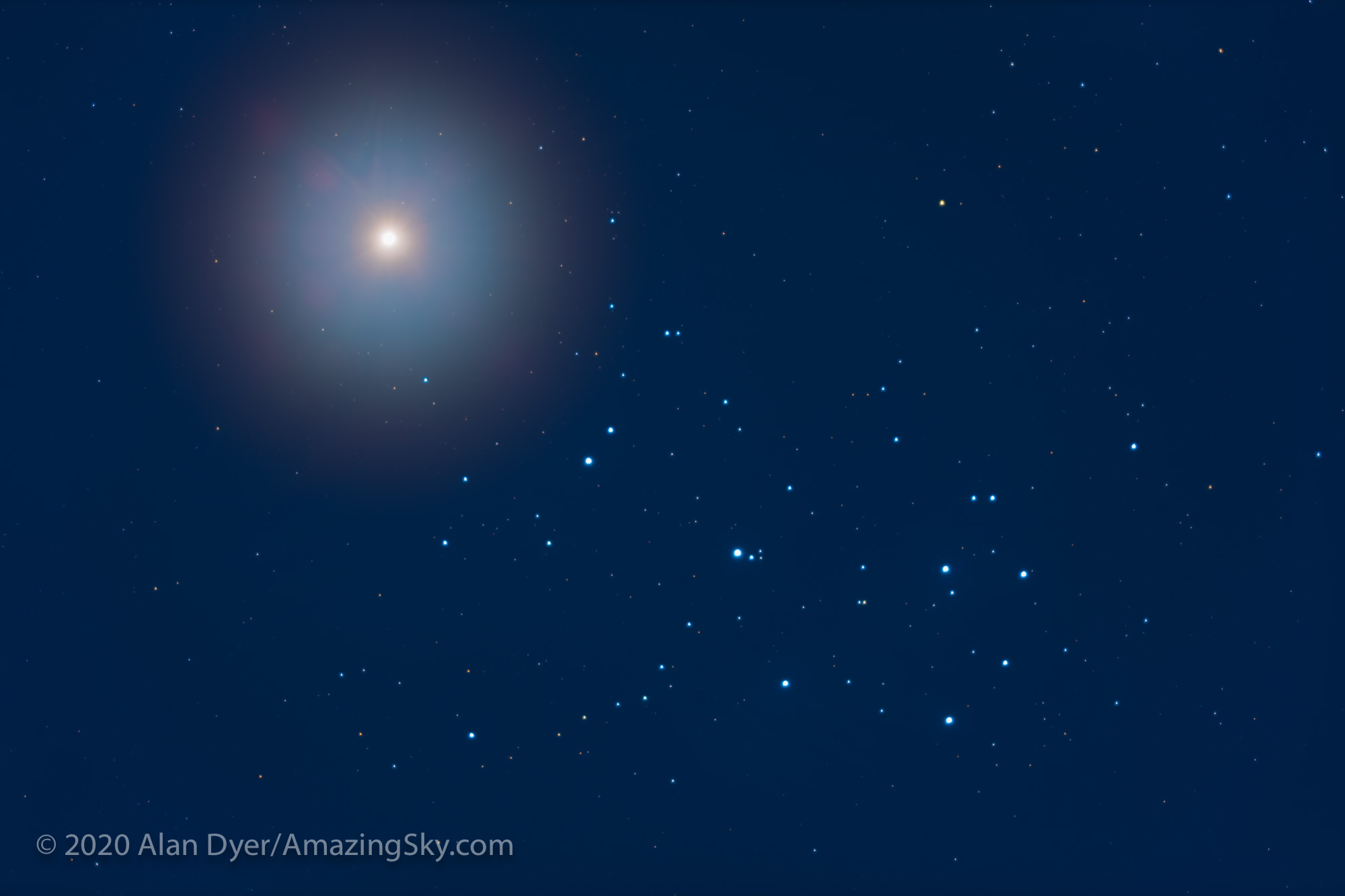
Venus above the Pleiades star cluster, M45, on April 4, 2020, in the twilight and moonlight. Light from the gibbous Moon illuminated the sky, so no long exposure would reveal much detail in and around the Pleiades. Venus passes close to the Pleiades only every 8 years. Some light cloud this night added the glow. This is a stack of multiple exposures of varying lengths: 2 minutes, 30 seconds, 10 seconds and 2 seconds, blended with masks to prevent Venus from being too blown out while still recording the stars. All were with the SharpStar 140mm PH apo refractor with the 0.73x flattener/reducer for f/4.8 and at ISO 400 with the Canon EOS Ra.
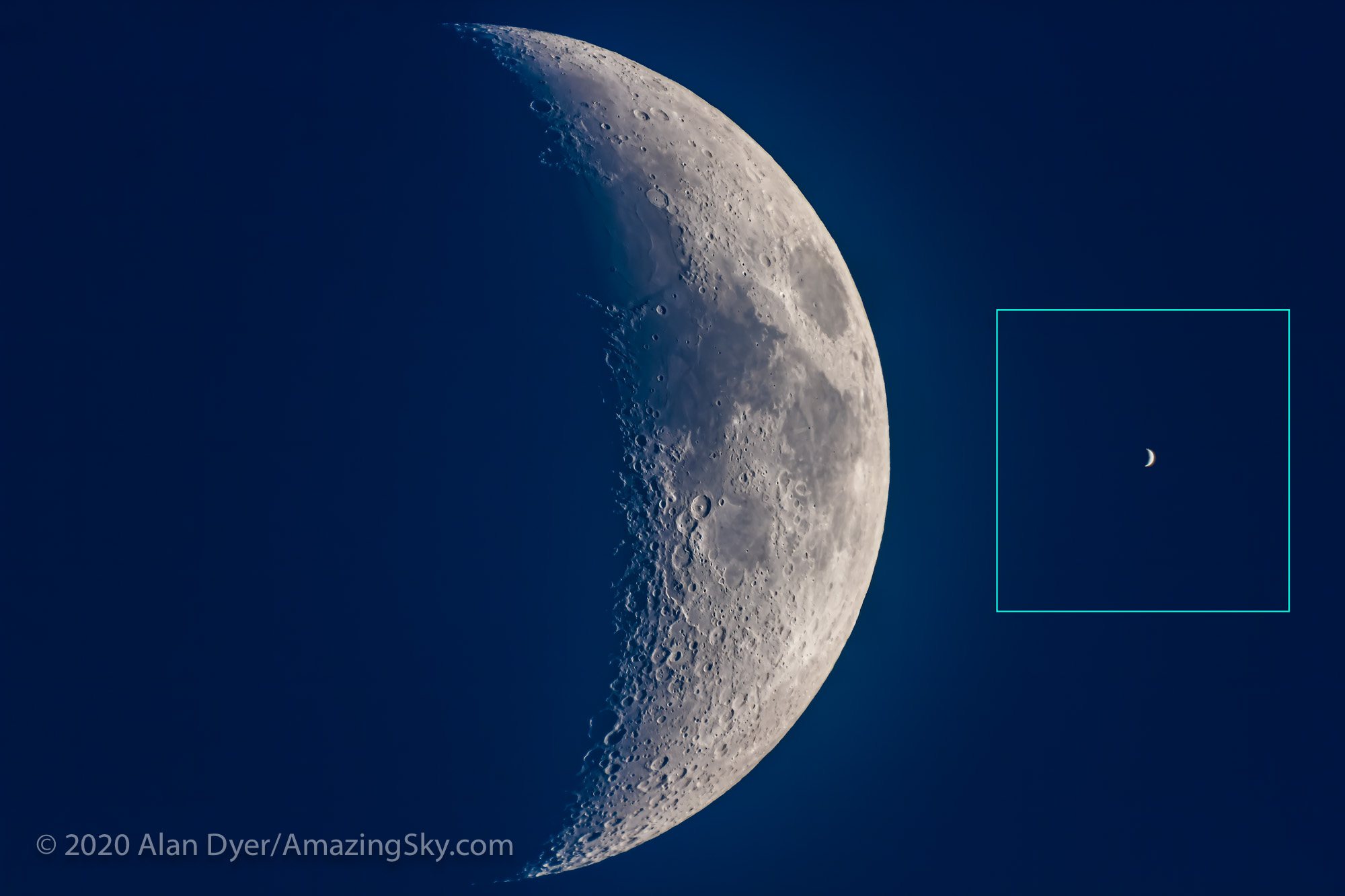
Later in April Venus reached its greatest brilliancy, at magnitude -4.7, the date when the size of is disk, phase, and proximity to Earth converge to make Venus as bright as possible. On this night I shot the Moon, then 30° away from Venus and the planet with the same gear to show their relative sizes and similar crescent phase this night. The caption provides more details.
A collage of two images of the Moon and Venus taken minutes apart on April 28, 2020, to show the similarity in their phases this night, April 28, 2020. Both images were shot with the same focal length and camera and so are identical in image scale, to compare their apparent sizes. I have not enlarged Venus, but I have put a frame around it to emphasize that its image has been layered in as a composite. The Moon was a 5.6-day-old waxing crescent this night, 32% illuminated. Venus was at its greatest brilliancy, or Greatest Illuminated Extent, with a disk 38 arc seconds across and 27% illuminated, so slightly less. Taken with the 130mm Astro-Physics refractor with a 2X Barlow lens for an effective focal length of 1600mm and with the Canon 60Da APS-sensor camera. The Moon image is the full frame of the sensor, uncropped. Both images are single short exposures at ISO 100.
A week later, with Venus just past its point of greatest brilliancy, I shot the planet by daylight in the early evening sky, using a telescope to zoom into the planet to show its waning crescent phase. By this time the phase was obvious in binoculars.
Venus in the daytime sky and through some thin clouds, on May 5, 2020, with Venus at a very high apparition. This was at about 7 pm with the Sun still well up in the early evening, to show how well Venus can be seen in the daytime sky when it is at a wider angle from the Sun; and indeed is often the best time to view it as the planet’s brilliance is muted. This is a single 1/400-second exposure at ISO 100 with the Canon 60Da through the Astro-Physics 130mm refractor and 2X Barlow for f/12 and 1600mm focal length.
But Venus was now dropping rapidly from sight. By May 23, it was low in the twilight and below Mercury, then at its best for 2020 for an evening appearance from my latitude. Note the thin Moon below the planets. This was a superb sight for binoculars.
On May 23, 2020, the very thin crescent Moon (then 34 hours old) shines below bright Venus (10 days before its inferior conjunction with the Sun) and above it dimmer Mercury , then 10 days before its greatest elongation from the Sun in the evening sky. All were beautifully visible to the naked eye and a great sight in binoculars, looking very much like this scene captured with a 135mm telephoto lens. Venus was magnitude -4.4, Mercury was -0.7. This is a single shot at f/2.8 and 1/ 5 second at ISO 100 with the Canon EOS Ra which does bring out the sunset reds well.
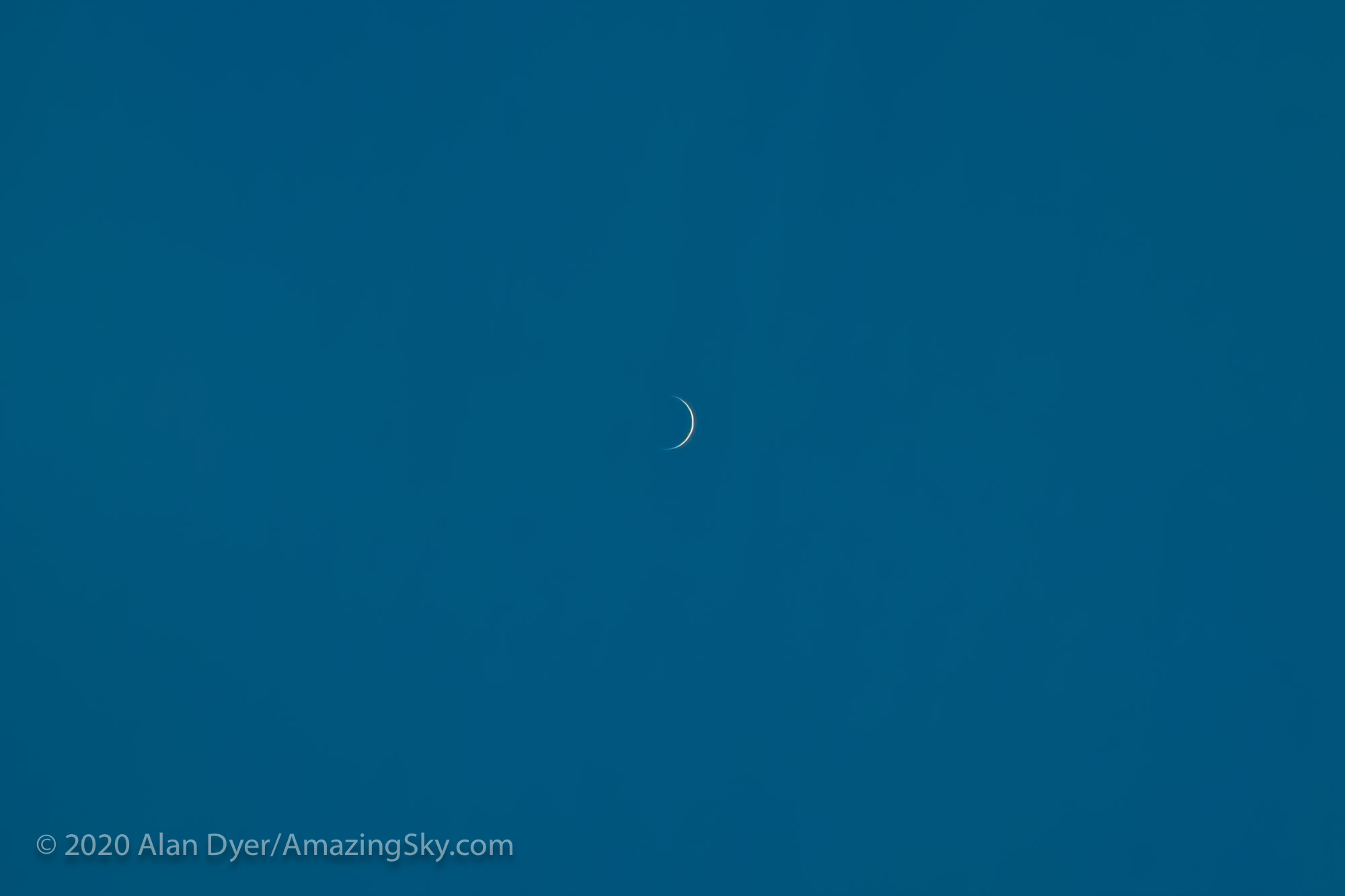
By May 29, Venus was now tough to pick out of the evening sky, and a challenge to shoot even by day, as it then stood only 8° away from the Sun. What was once obvious to the naked eye now took a computerized telescope to pick out of the noon-day blue sky. A telescope showed the now razor-thin crescent as Venus approached its June 3 “inferior conjunction” — its passage between Earth and the Sun.
Venus as a razor-thin crescent and only 8° east of the Sun on May 29, 2020, five days before its June 3 inferior conjunction. The crescent is extending a little beyond 180° here due to scattering in the Venusian clouds. The disk was 57 arc seconds across and 0.9% illuminated. The magnitude was -3.9. This was at midday, shot with the 130mm Astro-Physics f/6 refractor with a 2X Barlow and the Canon 60Da camera, but the frame cropped further in processing. This is a single 1/1250th second exposure at ISO 100, the sharpest of 70 still frames taken.
I shot and narrated video footage of the thin crescent Venus, my parting shots of Venus for its evening appearance in 2020.
But in June, post inferior conjunction, it will rise very quickly into our morning sky, providing a mirror-image repeat performance as a morning star for the rest of 2020.
Venus Near Inferior Conjunction from Alan Dyer on Vimeo.
I wish you all the best and a safe and healthy time in 2020. Take some solace in what the sky can show us and in the beauty of the night.
My free Amazing Sky Calendar for 2018 is now available for download! Plan your astronomical year!
As in recent years, I have prepared a free 12-month Calendar listing loads of celestial events, Moon phases, highlighted space events, and with small charts to show what’s happening in the sky for the coming year. The monthly pages are illustrated with my favourite images from 2017.
You can download it as a 25-megabyte PDF at my website at
My free Amazing Sky Calendar for 2017 is now available for download! Plan your astronomical year!
Once again, I have prepared a free 12-month Calendar listing loads of celestial events, Moon phases, highlighted space events, and with small charts to show what’s happening in the sky for the coming year. Plus a set of my favourite images from 2016.
Nothing amazes even the most inveterate skywatcher more than traveling to another hemisphere and seeing sky move. It moves the wrong way!
Whether you are from the southern hemisphere traveling north, or as I do, travel south from the Northern Hemisphere, watching how the sky moves can be disorienting.
Here I present a video montage of time-lapses shot last April in Australia, at the annual OzSky Star Party near Coonabarabran in New South Wales.
Select HD and Enlarge button to view at full screen at best quality.
You’ll see the sky set in the west but traveling in arcs from right to left, then in the next clip, rise in the east, again moving from right to left. That’s the wrong angle for us northerners.
Looking north you see the seasonal constellations, the ones that rise and set over a night and that change with the seasons. In this case, the night starts with Orion (upside-down!) to the north but setting over in the west, followed by Leo and bright Jupiter. The sky is moving from east to west, but that’s from right to left here. The austral Sun does the same thing by day.
Looking south, we see the circumpolar constellations, the ones that circle the South Celestial Pole. Only there’s no bright “South Star” to mark the pole.
The sky, including the two Magellanic Clouds (satellite galaxies to the Milky Way) and the spectacular Milky Way itself, turns around the blank pole, moving clockwise – the opposite direction to what we see up north.
I shot the sequences over four nights in early April, as several dozen stargazers from around the world revelled under the southern stars, using an array of impressive telescopes supplied by the Three Rivers Foundation, Australia, for us to explore the southern sky.
It’s Perseid meteor shower time. Here are tips for seeing and shooting the meteors.
What are the Perseids?
They are an annual meteor shower, perhaps the most widely observed of the year, that peak every year about August 12. They are caused by Earth passing through a dust stream left by Comet Swift-Tuttle, last seen near Earth in 1992.
Each “shooting star” is really a bit of comet dust burning up in our atmosphere as it ploughs into us at 200,000 kilometres an hour. They don’t stand a chance of surviving – and none do.
All Perseid particles burn up. None reach Earth.
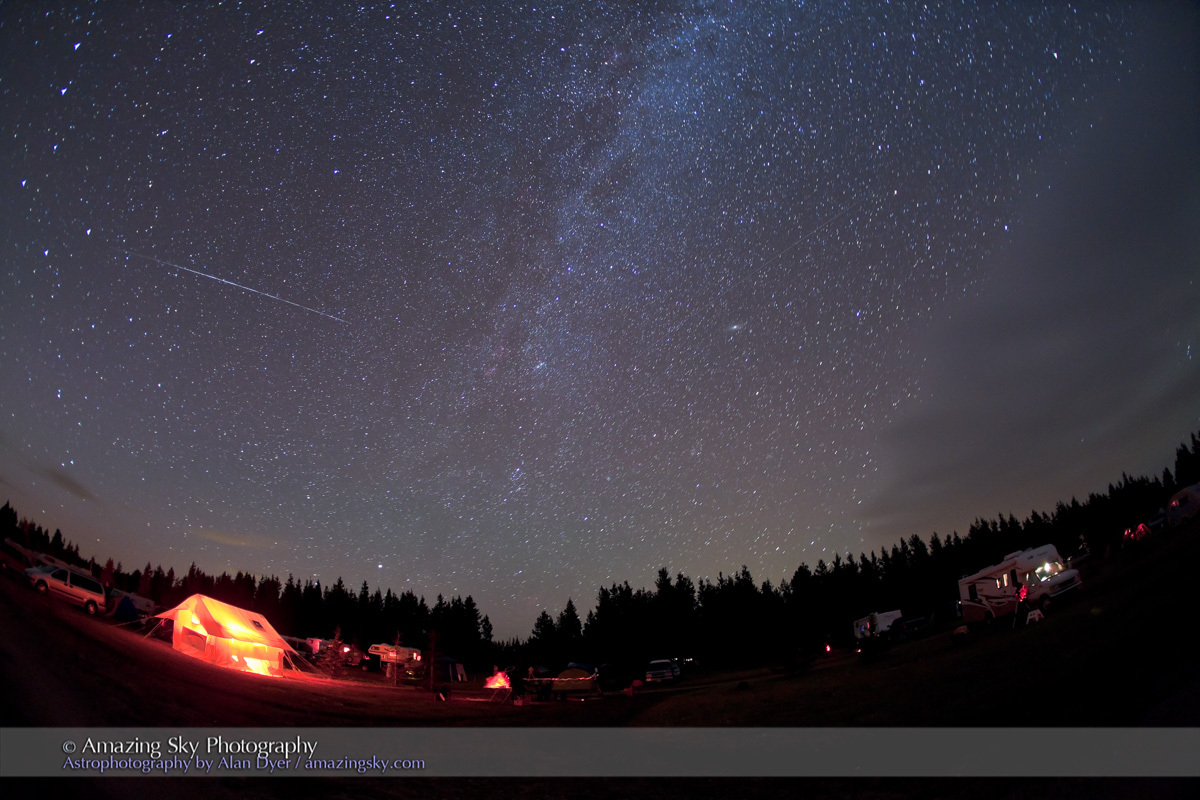
Perseid meteor caught night of August 12-13 2009 from Cypress Hills Prov Park in Saskatchewan at the annual Saskatchewan Summer Star Party. One frame of 250 shot as part of a time-lapse movie. Taken with Canon 5D MkII and 24mm lens at f/2.5 for 30s at ISO1600.
When are the Perseids?
The peak night of the Perseids this year is the night of Wednesday, August 12 into the early morning hours of August 13, with the peak hour occurring about midnight Mountain Daylight Time or 2 a.m. on the 13th for Eastern Daylight Time.
For North America, this is ideal timing for a good show this year. However, a good number of meteors will be visible the night before and night after peak night.
Even better, the Moon is near New and so won’t interfere with the viewing by lighting up the sky.
In all, except for the mid-week timing, conditions this year in 2015 couldn’t be better!
Perseid meteor caught night of August 12-13 2009 from Cypress Hills Prov Park in Saskatchewan at the annual Saskatchewan Summer Star Party. One frame of 260 shot as part of a time-lapse movie. Taken with Canon 20Da and 15mm lens at f/2.8 for 45s at ISO1600.
What do they look like?
Any meteor looks like a brief streak of light shooting across the sky. The brightest will outshine the brightest stars and are sure to evoke a “wow!” reaction.
However, the spectacular Perseids are the least frequent. From a dark site, expect to see about 40 to 80 meteors in an hour of patient and observant watching, but of those, only a handful – perhaps only 1 or 2 – will be “wow!” meteors.
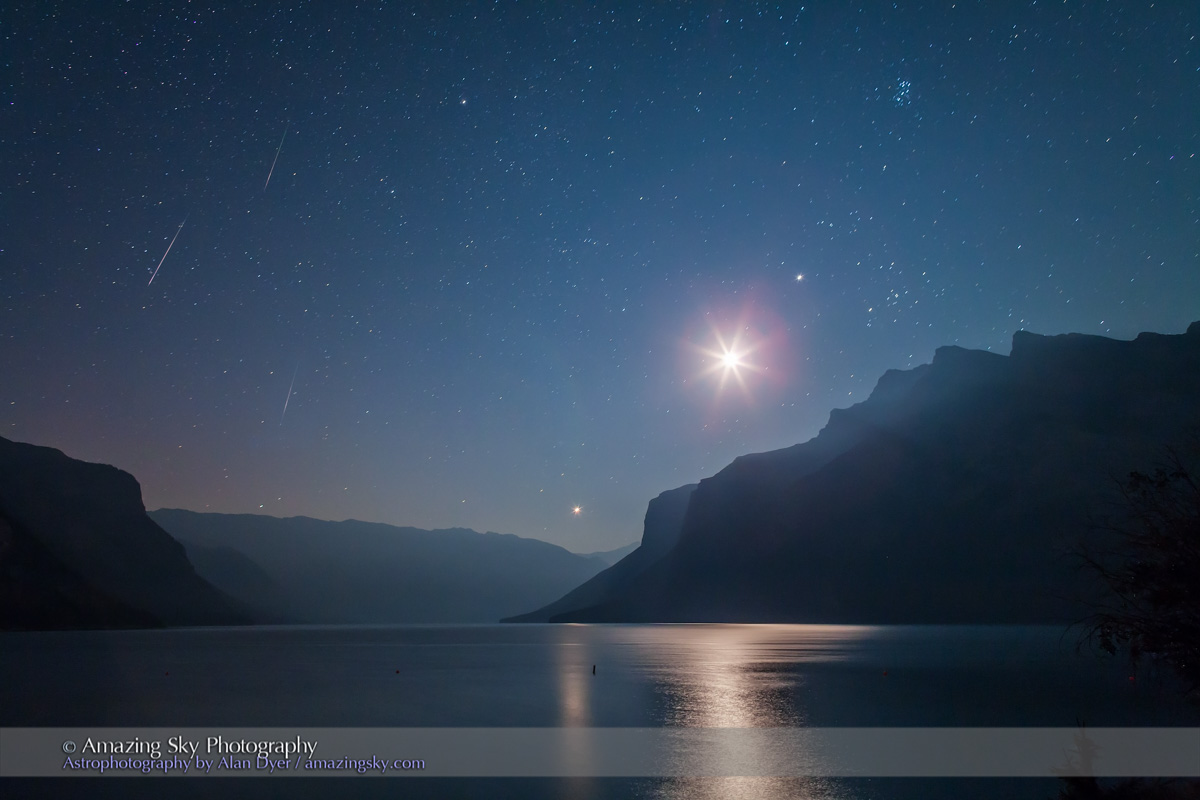
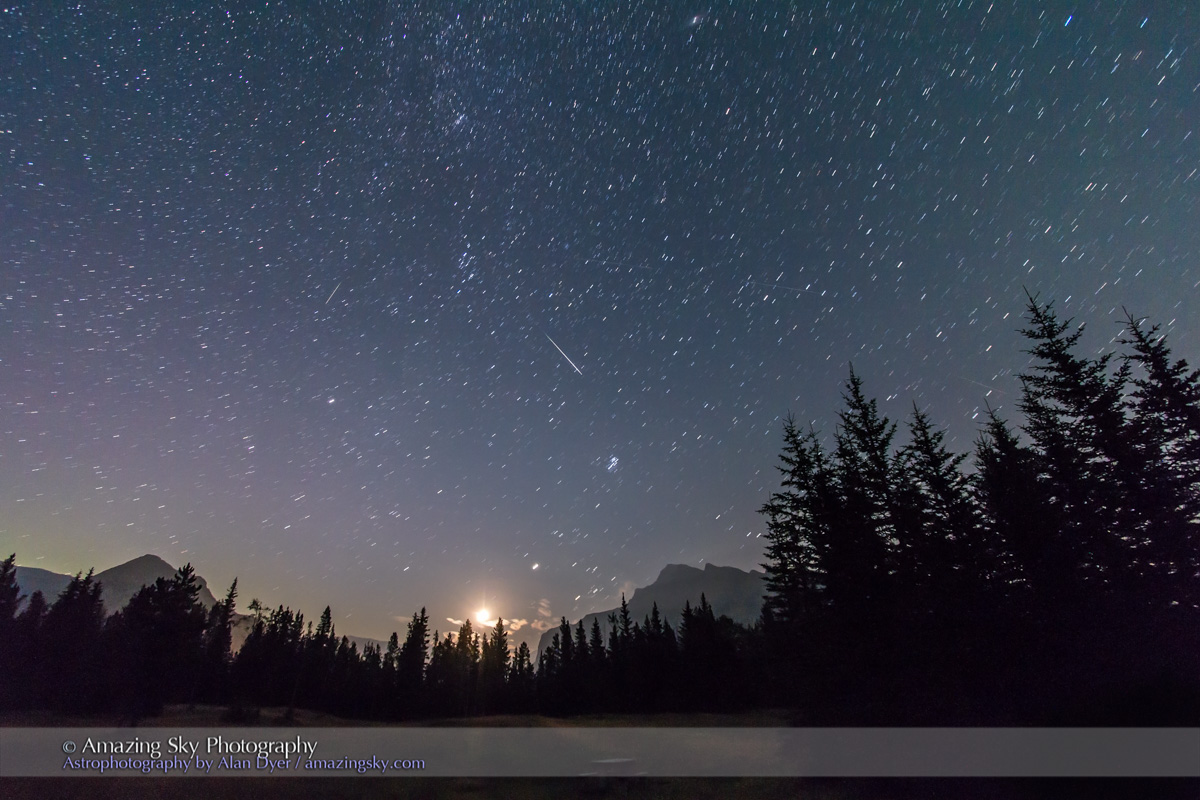
A pair of Perseid meteors shoot at left in the late night sky at the Upper Bankhead parking lot in Banff National Park. The waning crescent Moon is just rising above the trees. Taken the night of Saturday, August 11 into the wee hours of Sunday, August 12, 2012 with the Canon 7D and 10-22mm Canon lens. This is a stack of two exposures, one for each meteor, each for 60 seconds at ISO 1250 and f/4.
Where do I look?
All the meteors will appear to radiate from a point in the constellation of Perseus in the northeastern sky in the early hours of the night, climbing to high overhead by dawn.
So you can face that direction if you wish, but Perseids can appear anywhere in the sky, with the longest meteor trails often opposite the radiant point, over in the southwest.
Shows unusual Perseid meteor varying in brightness? Or is this a satellite that mimics Perseid for position (it comes right out of the radiant point). Taken at Saskatchewan Star Party, August 14, 2010, using Canon 5D MkII and 15mm lens.
How do I look?
Simple – just lie back on a comfy lawn chair or patch of grass and look up!
But … you need to be at a dark location away from city lights to see the most meteors. You’ll see very little in a city or light-polluted suburbs.
Head to a site as far from city lights as you can, to wherever you’ll be safe and comfortable.
How do I take pictures?
To stand any chance of capturing these brief meteors you’ll need a good low-noise camera (a DSLR or Compact System Camera) with a fast (f/2.8 or faster) wide-angle lens (10mm to 24mm).
Sorry, keep your point-and-shoot camera and phone camera tucked away in your pocket – they won’t work.
Set up you camera on a tripod, open the lens to f/2.8 (wide open perhaps) and the ISO to 800 to 3200) and take a test exposure of 20 to 40 seconds. You want a well-exposed image but not over-exposed so the sky is washed out.
Set your exposure time accordingly – most cameras allow a maximum exposure of 30 seconds. Exposures longer than 30 seconds require a separate intervalometer to set the exposure, with the camera set on Bulb (B).
Take lots of pictures!
To up your chances of catching a meteor, you need to set the camera to shoot lots of frames in rapid succession.
Use an intervalometer to take shots one after the other with as little time between as possible – because that’s when a meteor will appear!
Barring an intervalometer, if you have standard switch remote control, set the camera on High Speed Continuous, and the shutter speed to 30 seconds, then lock the remote’s switch to ON to keep the camera firing. As soon as one exposure ends it’ll fire another.
Twin Perseids in this photo? Or are these satellites? Taken at SSSP, August 14, 2010, using Canon 5D MkII and 15mm lens.
What else do I need to know?
• Focus the lens carefully so the stars are sharp – the Live Focus mode helps for this. Focus on a bright star or distant light.
• Aim the camera to take in a wide swath of the sky but include a well-composed foreground for the most attractive shot.
• Aim northeast to capture meteors streaking away from the radiant. But you can aim the camera to any direction that lends itself to a good composition and still capture a meteor.
• To increase your chances, shoot with two or more cameras aimed to different areas of the sky. Meteors always appear where your camera isn’t aimed!
• Be patient! Despite shooting hundreds of frames only a handful will record a meteor, as only the brightest will show up.
Can I track the sky?
If you have a motorized equatorial mount or a dedicated sky tracking device (the iOptron Sky Tracker and Sky-Watcher Star Adventurer, each about $400, are popular), you can follow the stars while taking lots of shots. This avoids the stars trailing and allows you to use longer exposures.
The video above shows a Star Adventurer tracking the sky as it turns about its polar axis which is aimed up to a point near Polaris. Click the Enlarge and HD buttons to view the video properly.
Polar align the tracker, but then perhaps aim the camera to frame the summer Milky Way overhead. Take lots of 1- to 3-minute exposures, again at f/2.8 and ISO 800 to 1600. Some exposures will pick up meteors – with luck!
Tracking then stacking
Later, in processing, because the sky has remained fixed on the frame, it’s then possible to stack the images (using a “Lighten” blend mode on each image layer) so that the final composite frame contains more meteors, for an image with lots of meteors captured over an hour or more of shooting.
While it is possible to stack shots taken on a static tripod to produce such a meteor composite, doing so requires a lot of manual cutting, pasting and aligning of meteor images by hand. The result is a bit of a fake, though I’ve done it myself – the image at top is an example, though with only a trio of meteors.
The stars at night shine big and bright, deep in the heart of Texas.
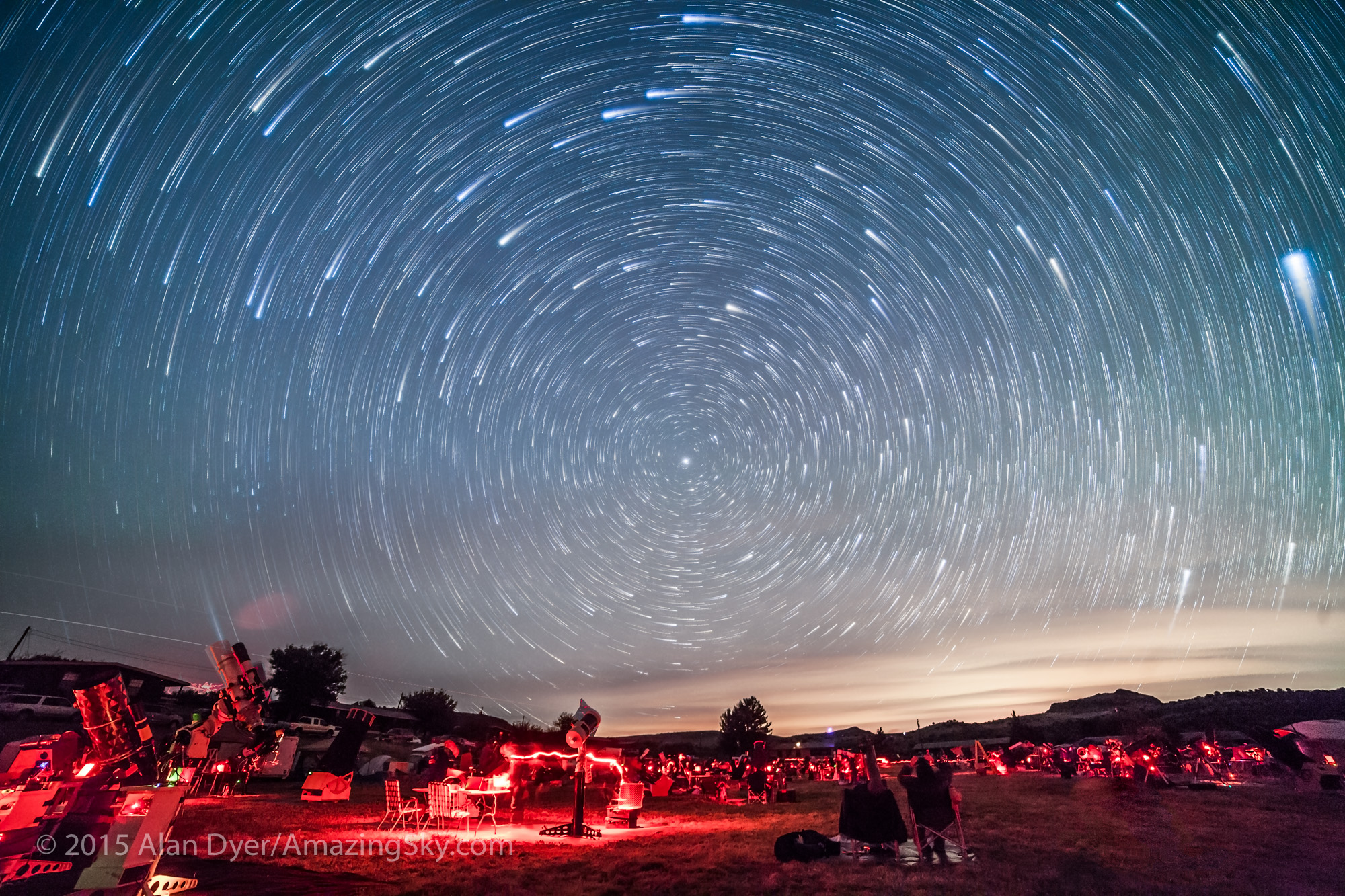
Last week several hundred stargazers gathered under the dark skies of West Texas to revel in the wonders of the night sky. I was able to attend the annual Texas Star Party, a legendary event and a mecca for amateur astronomers held at the Prude Ranch near Fort Davis, Texas.
Some nights were plagued by clouds and thunderstorms. but here are some scenes from a clear night, with several hundred avid observers under the stars and Milky Way. Many stargazers used giant Dobsonian reflector telescopes to explore the faintest of deep-sky objects in and beyond the Milky Way.
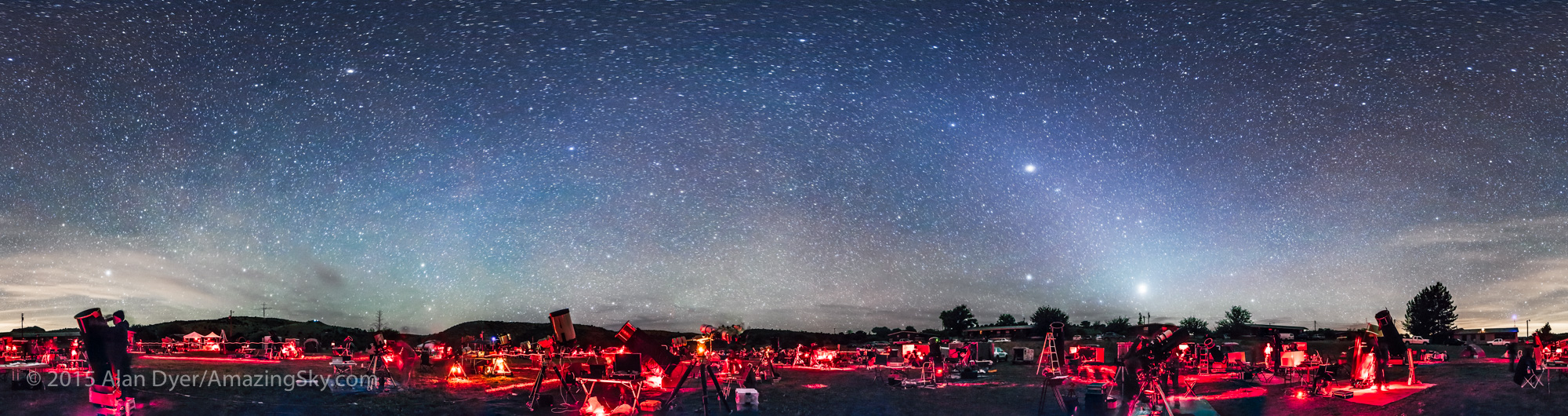
A 360° panorama of the upper field of the Texas Star Party at the Prde Ranch near Fort Davis, TX, May 13, 2015, taken once the sky got astronomically dark. The panorama shows the field of telescopes and observers enjoying a night of deep-sky viewing and imaging. Venus is the bright object at right of centre and Jupiter is above it. The Zodiacal Light stretches up from the horizon and continues left across the sky in the Zodiacal Band to brighten in the east (left of centre) as the Gegeneschein. I shot this with a 14mm lens, oriented vertically, with each segment 60 seconds at f/2.8 and with the Canon 5D MkII at ISO 3200. The panorama is made of 8 segements at 45° spacings. The segments were stitched with PTGui software.
Observers at the Texas Star Party explore the wonders of the deep sky under the rising Milky Way, in May 2015. Sagittarius and Scorpius are in the background, with the centre of the Galaxy rising in the southeast. This is a single 30-second exposure at f/2 with the 24mm lens and Canon 5D MkII at ISO 4000.
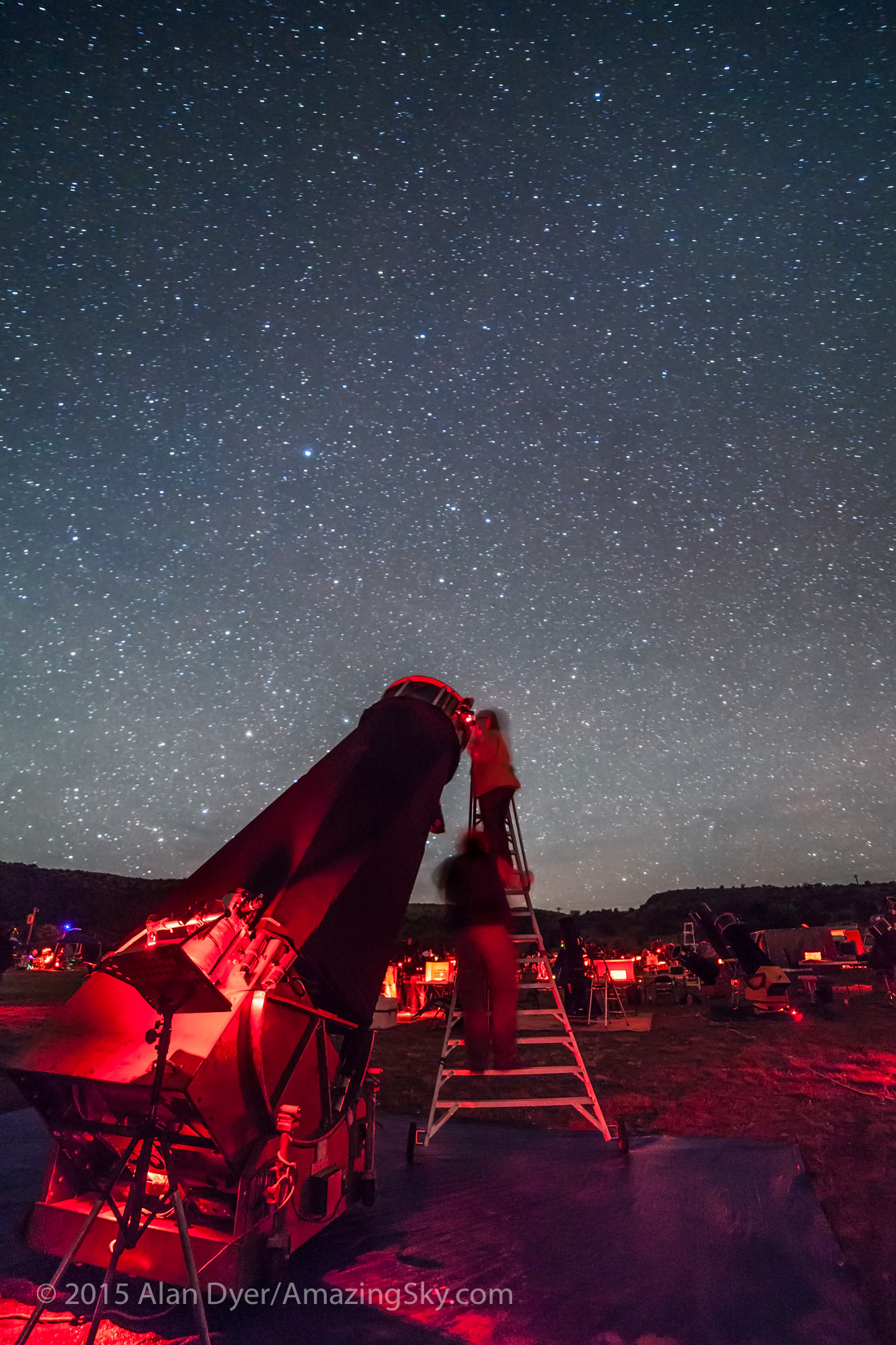
Expert deep-sky observers Larry Mitchell and Barbara Wilson gaze skyward with Larry’s giant 36-inch Dobsonian telescope at the Texas Star Party, May 2015. This is a single 60-second exposure with the 14mm lens at f/2.8 and Canon 5D MkII at ISO 3200.
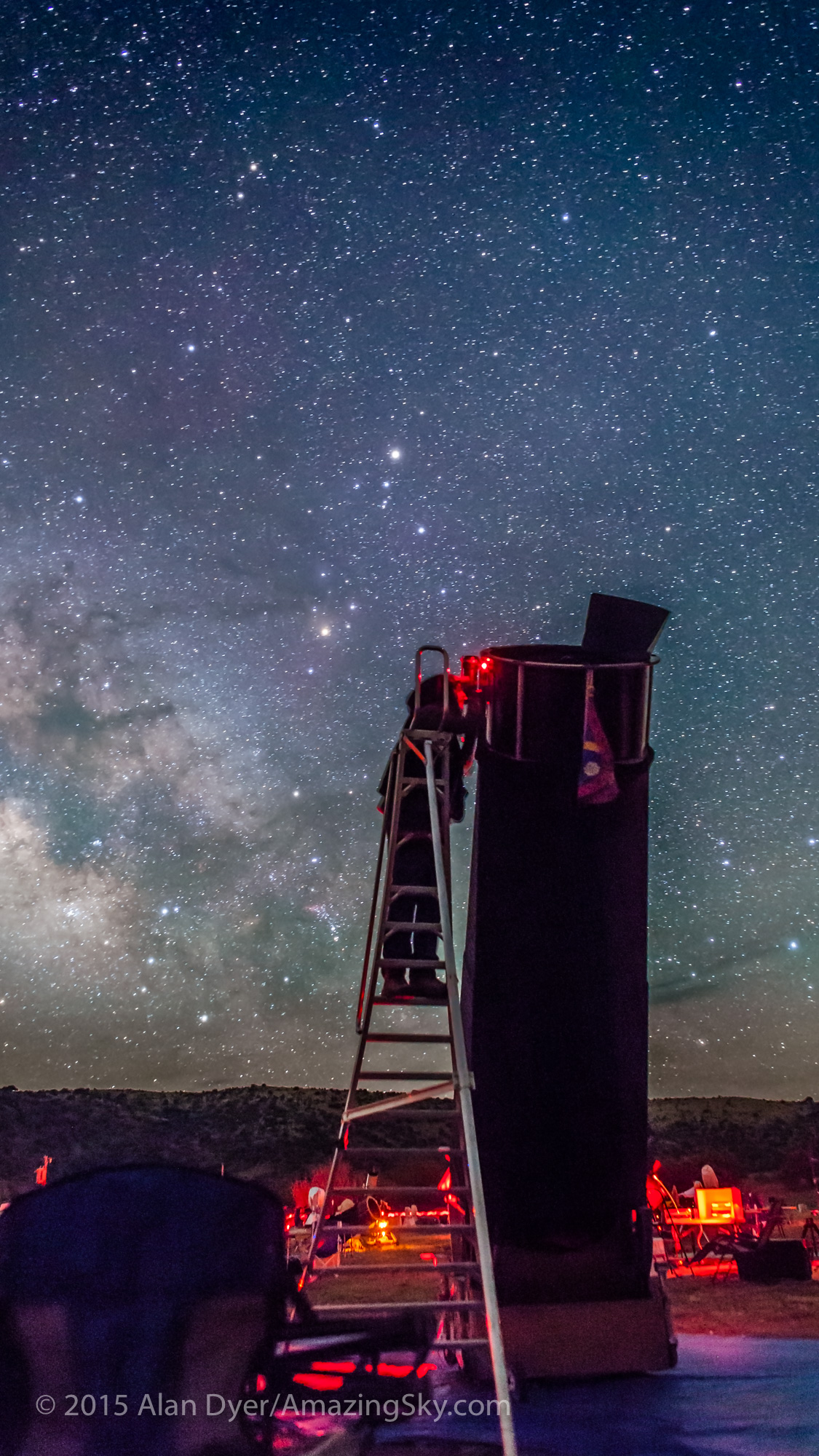
A deep-sky observer at the top of a tall ladder looking through a tall and large Dobsonian telescope, at the Texas Star Party, May 2015. Scorpius is rising in the background; Saturn is in the head of Scorpius as the bright star above centre. Anatares is just below Saturn. This is a single 30-second exposure at f/2.5 with the 24mm lens and Canon 5D MkII at ISO 6400.
Circumpolar star trails over the upper field of the Texas Star Party, May 13, 2015. I aimed the camera to look north over the field to capture the stars circling around Polaris in circumpolar trails over about 1 hour. Some cloud and haze obscured parts of the sky. Lights from cities to the north add the sky glow at right. The streaks at top are from the stars of the Big Dipper. This is a stack of 55 exposures, each 1 minute long, at f/2.8 with the 14mm lens and Canon 5D MkII at ISO 3200. The foreground comes from a single image in the series, masked and layered in Photoshop. The images were stacked using the Long Trails tapering effect with the Advanced Stacker Actions from Star Circle Academy.
I extend my thanks to the organizers for the great event, and for the opportunity to speak to the group as one of the featured evening speakers. It was great fun!
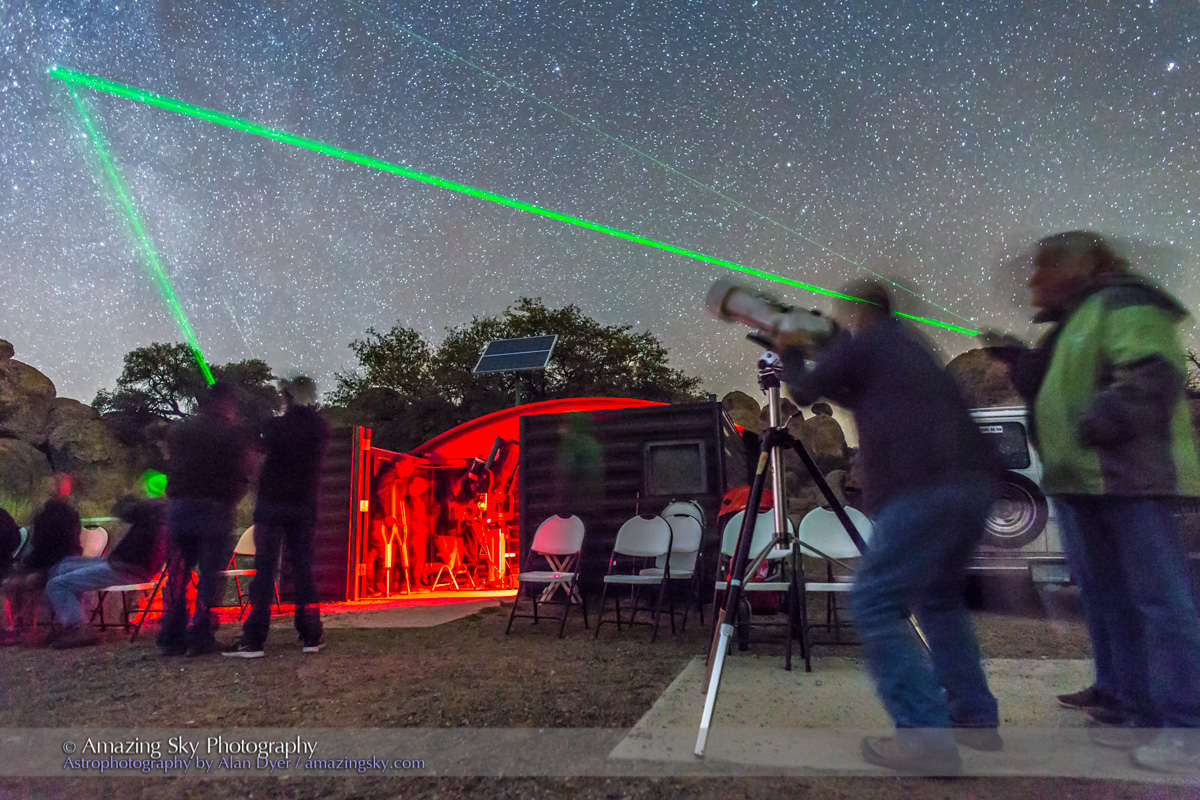
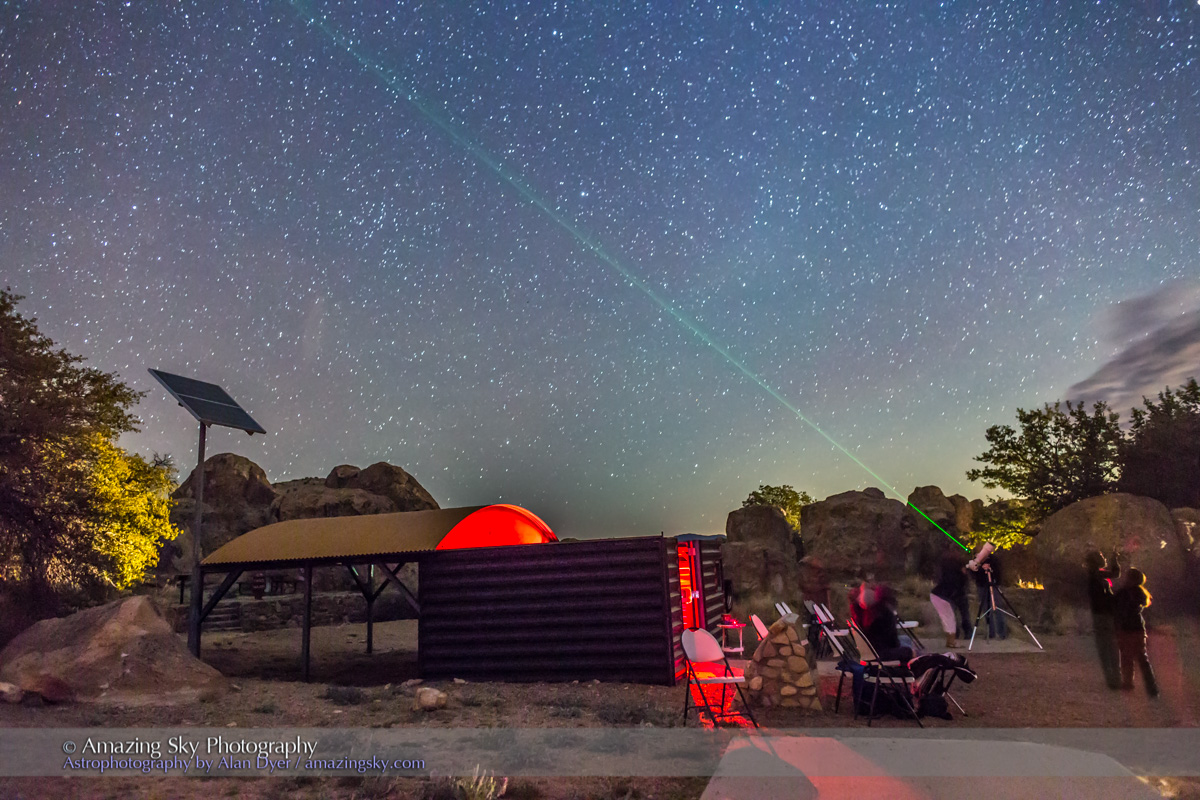
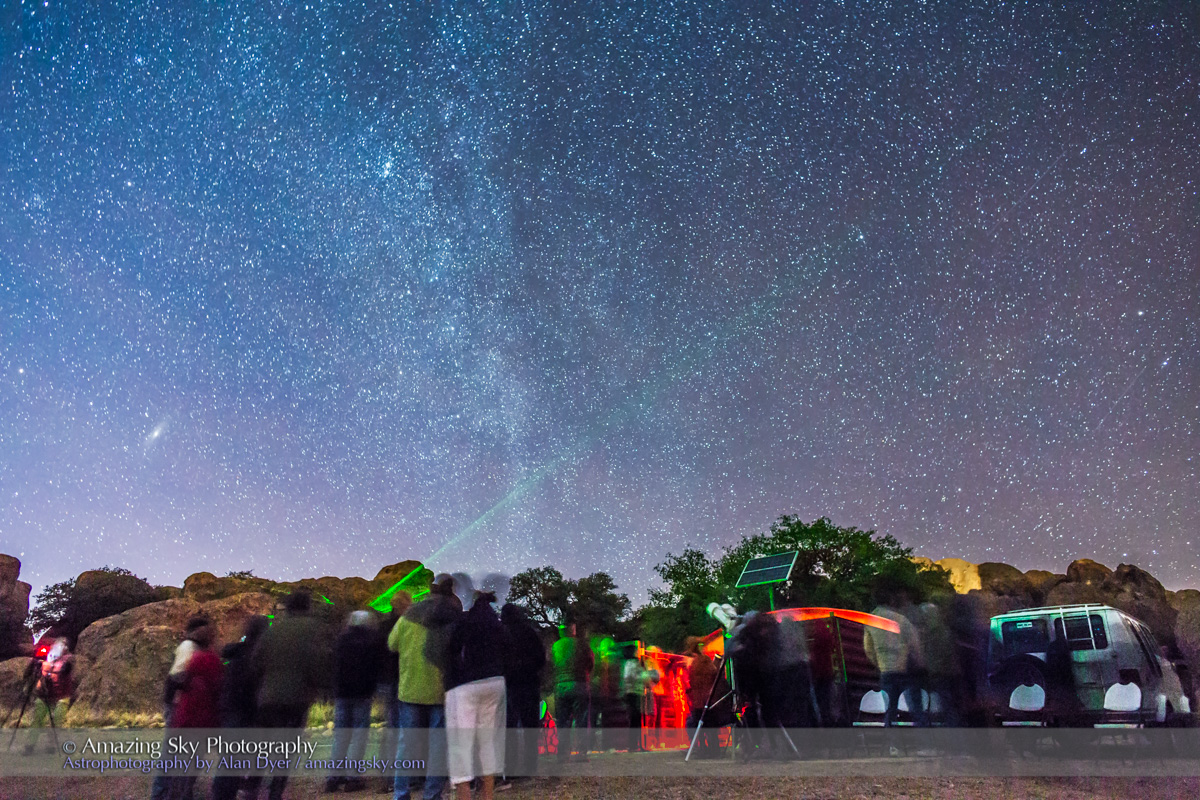
Laser beams point out Comet Lovejoy at a public star party at City of Rocks State Park.
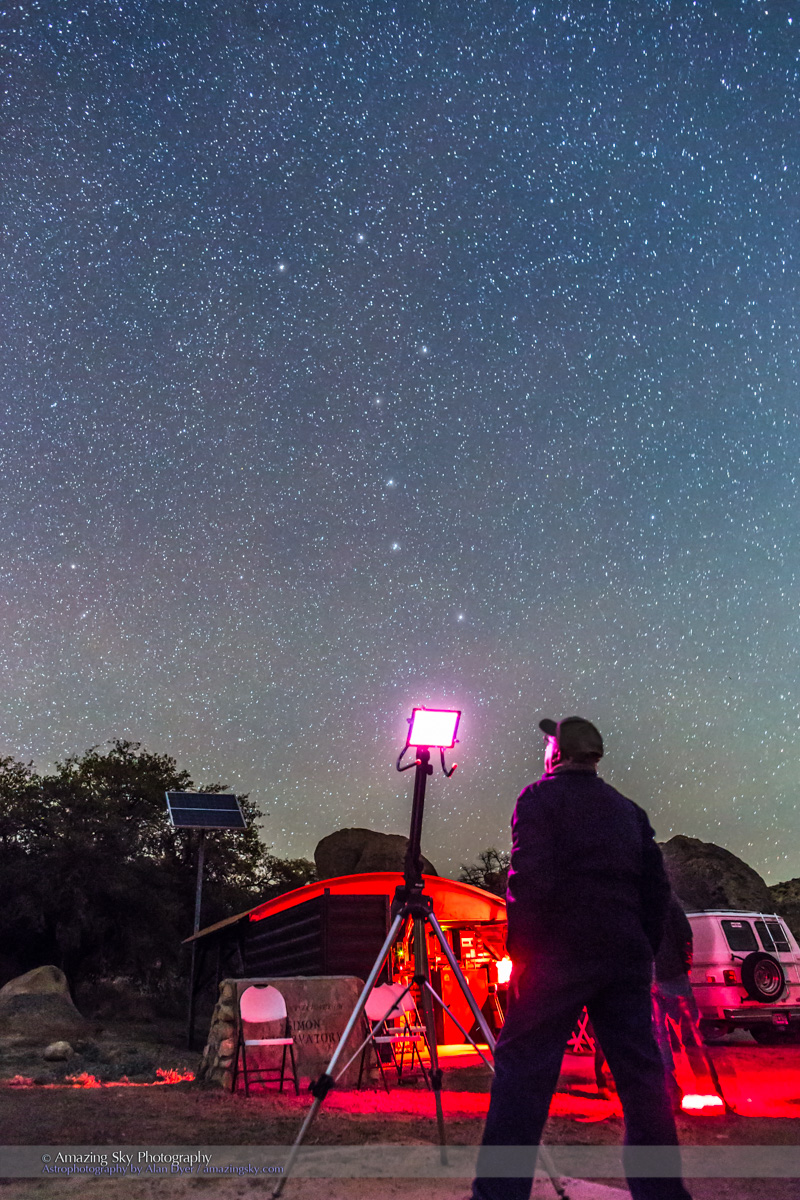
It was a perfect night last night for public stargazing. I headed out to the State Park for the monthly star party, held at the Orion group campground (with Orion nicely placed in the sky above) and home to a fine public observatory.
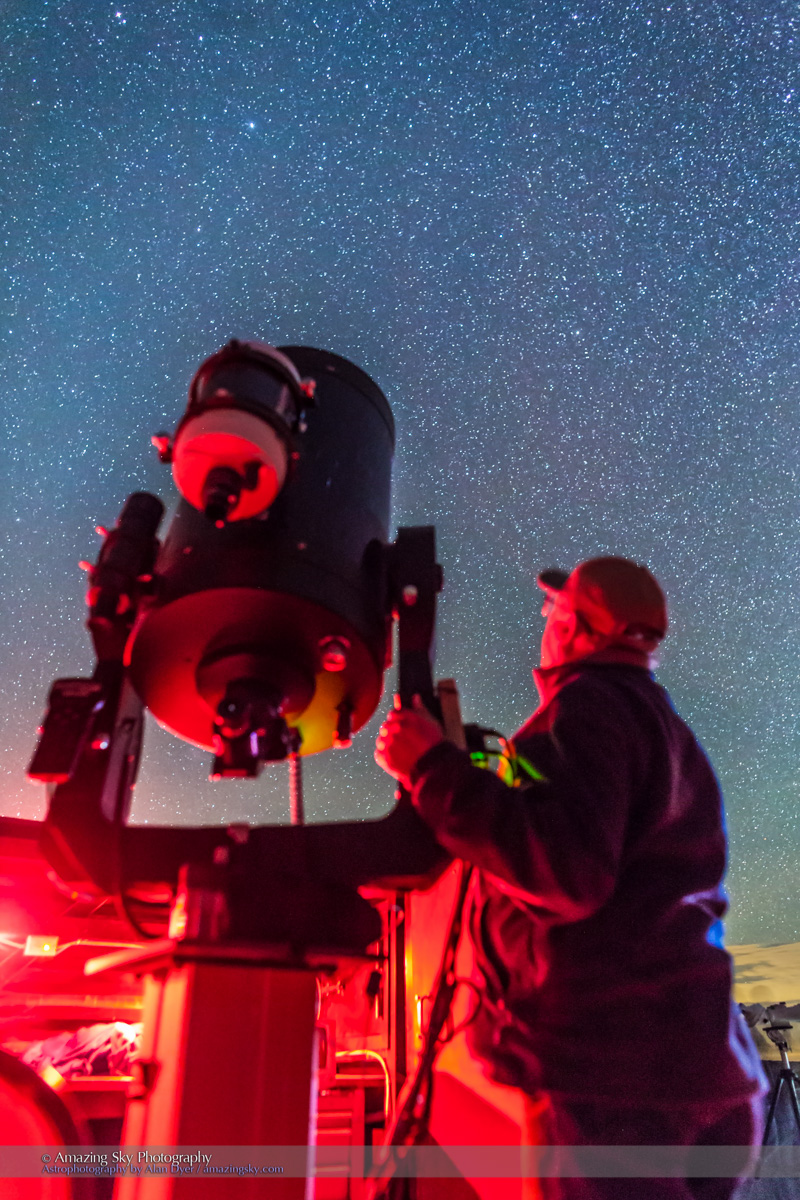
The Gene and Elizabeth Simon Observatory features a Meade 14-inch Schmidt-Cassegrain telescope which gave great views of Jupiter with one of its moons, Callisto, in transit as a dark dot on the face of the planet.
About 70 people turned out, from the Park’s campground and from the nearby communities. Here Matt starts the night with a laser guided tour of the constellations. These bright lasers are wonderful for public events like this but when in the wrong hands they can be dangerous.
Another technical innovation popular at the City of Rocks Star Parties is an iPad running Sky Safari software, and on a tripod with handles so people can move it about the sky to identify stars and constellations for themselves. It works great. Here, I pose with it for a staged photo, with the Big Dipper in the background.
Here I pose with the Observatory’s 14-inch telescope.
In all, it was a superb night at surely one of the finest places on the planet for public stargazing. I recommended to the Park officials that they should apply for official Dark Sky Preserve status. They would qualify without question.
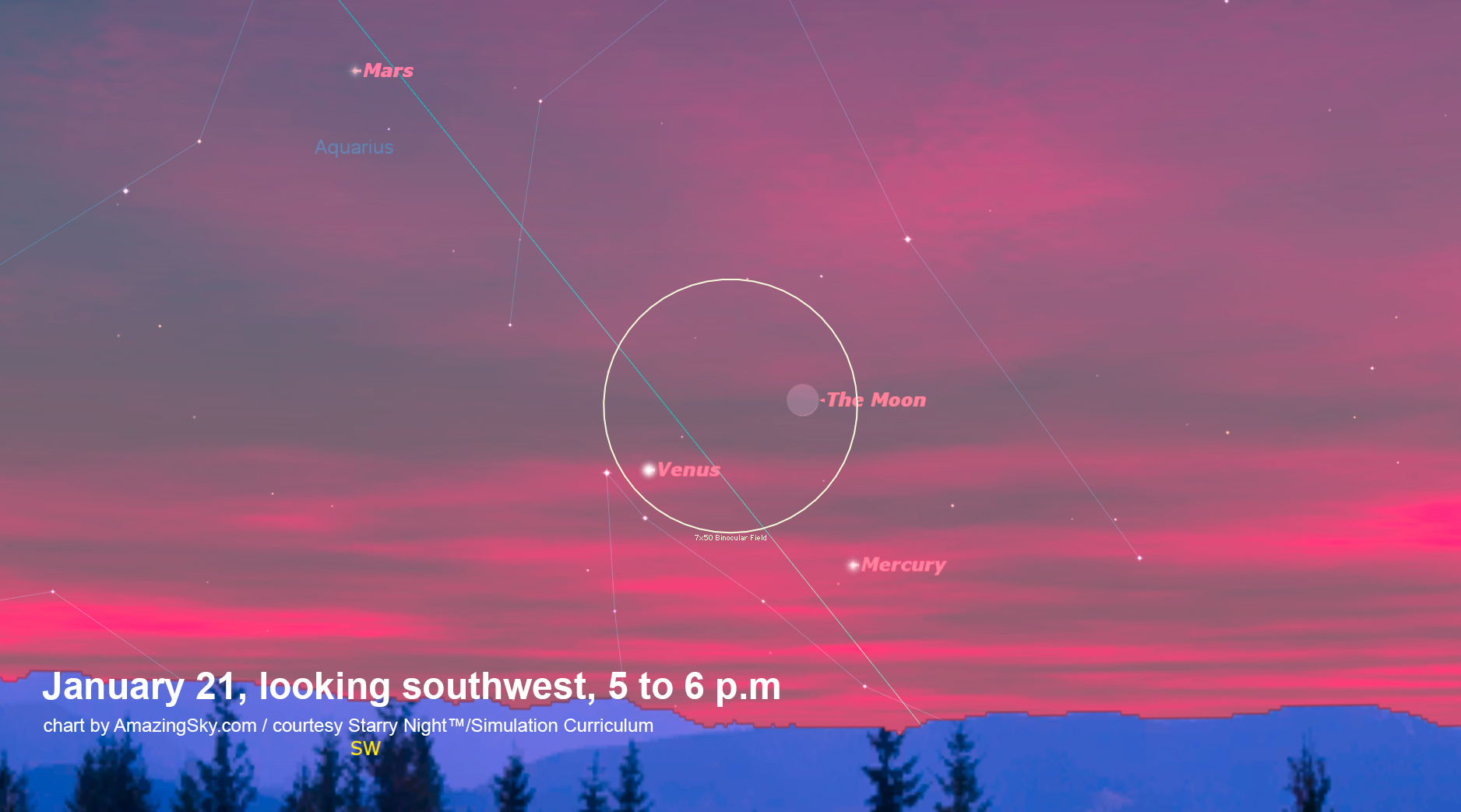
On Wednesday, January 21 look low in the southwest for a conjunction of the Moon and inner planets.
Mercury is ending its brief evening appearance and proximity to Venus. But this week you can still spot it a binocular field or so below Venus as it descends back toward the Sun.
On Wednesday, January 21, look low in the southwest to sight the thin waxing crescent Moon sitting near Venus and Mercury, forming a wide triangle of inner rocky worlds.
The other rocky planet in the inner solar system, Mars, shines higher up in the evening twilight as a moderate brightness reddish star. The next night, January 22, the waxing Moon will sit beside Mars in a wide conjunction.
Catch the Moon-Mercury-Venus trio early, as they will set an hour or so after local sunset.
What a wonderful night for stargazing under the Milky Way and amid the rock formations of southern New Mexico.
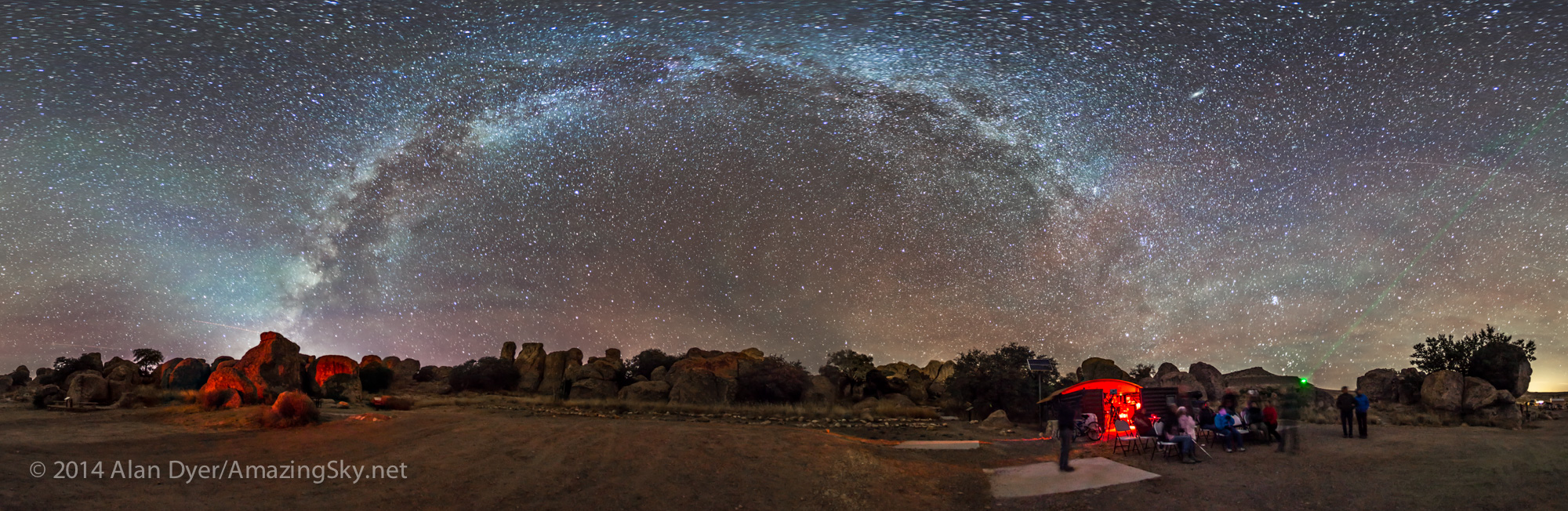
This was the scene last night, November 22, at a monthly stargazing session hosted by the City of Rocks State Park and the local Silver City Astronomy Club. You couldn’t ask for a better night … and site.
The Milky Way swept overhead, from Sagittarius setting in the west at left, to Taurus rising in the east at right. The faint glow of Zodiacal Light sweeps up from the last glow of western twilight to the left. Some faint green bands of airglow that only the camera can capture are also visible near the horizon.
Matt is doing a laser tour, following which the group convened to the beautiful roll-off roof observatory that houses a Meade 14-inch telescope. It was a fine evening indeed.
Technical notes:
The panorama, which spans about 300° (I cropped the edges a little from the full 360°) consists of 8 segments, shot at 45° spacings, with a 15mm full-frame fish-eye lens at f/2.8, for 1 minute untracked exposures for each frame at ISO 800 with the Canon 6D. I stitched the segments in PTGui software, but processed them in Adobe Camera Raw and Photoshop.
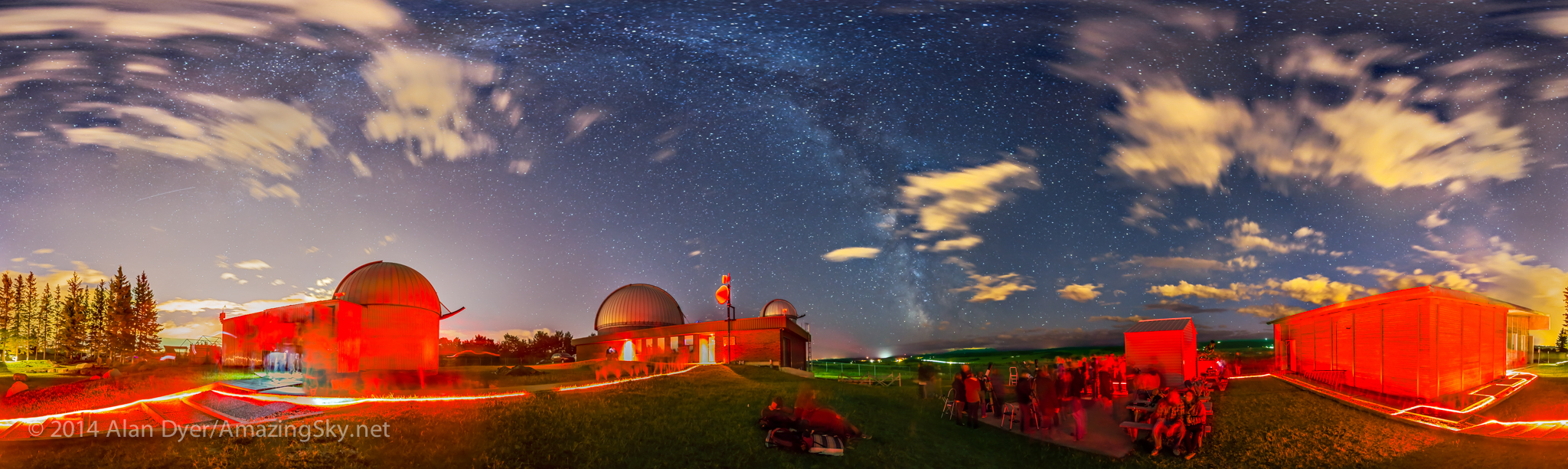
People gather at a rural observatory to gaze at the Milky Way on a summer night.
The clouds drifted through now and then but skies were mostly clear for the last of the Rothney Astrophysical Observatory‘s annual Milky Way Nights for 2014.
A tradition since 2009 and the Year of Astronomy, these dark-of-the-moon nights at the Observatory have proven hugely popular each summer despite the 10 p.m. start and 2 a.m. finish!
The main image at top shows a 360° panorama as people were gathering at the portable telescopes and lining up – in a blur – for a look inside the observatory domes.
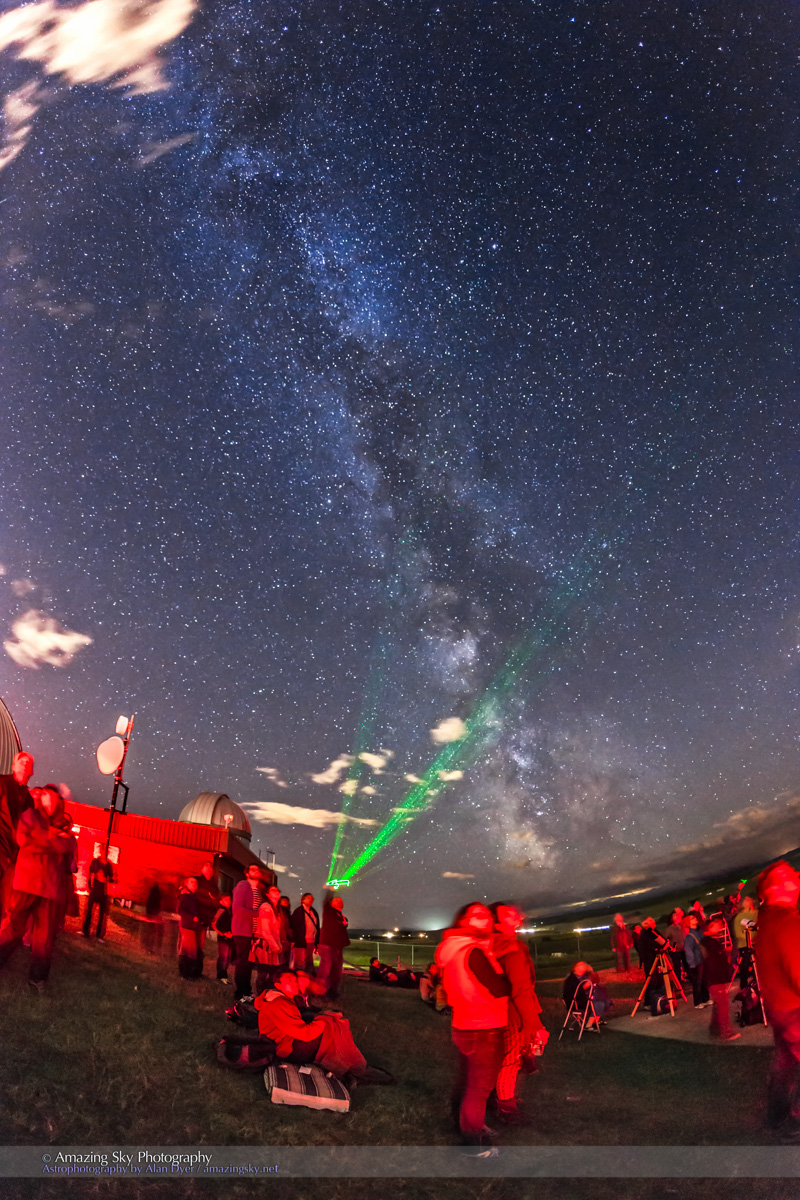
Roland from the Royal Astronomical Society of Canada provided laser-guided star tours. How did we point out the stars and constellations before green lasers? In the hands of responsible astronomers they are a great tool for public education.
Here he’s pointing out Vega and the stars of the Summer Triangle. Look way up!
About 400 people attended on Saturday night, the last in a trio of nights this past week. As you can see, the event attracts people of all ages. It’s even a popular date night attraction.
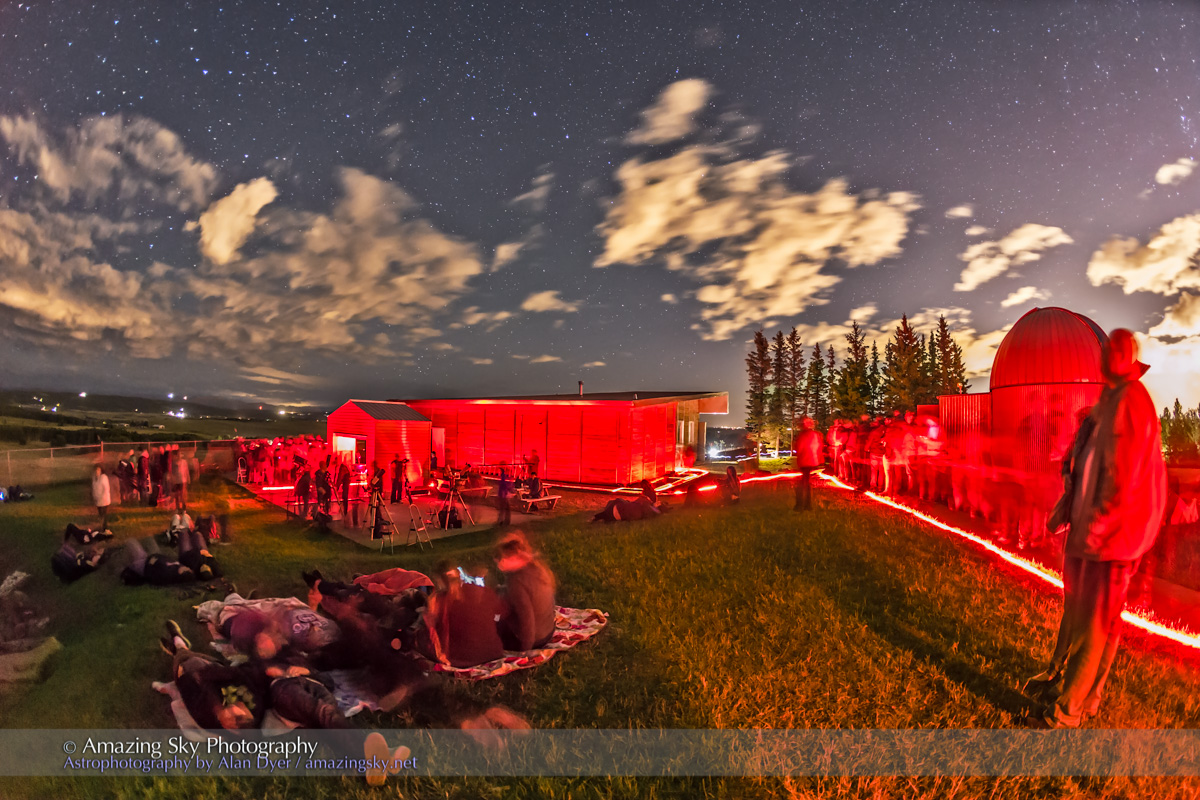
At these summer stargazing sessions many people bring blankets to just lie back and look up, at a site away from the ugly glow of the city, here lighting up the clouds to the north.
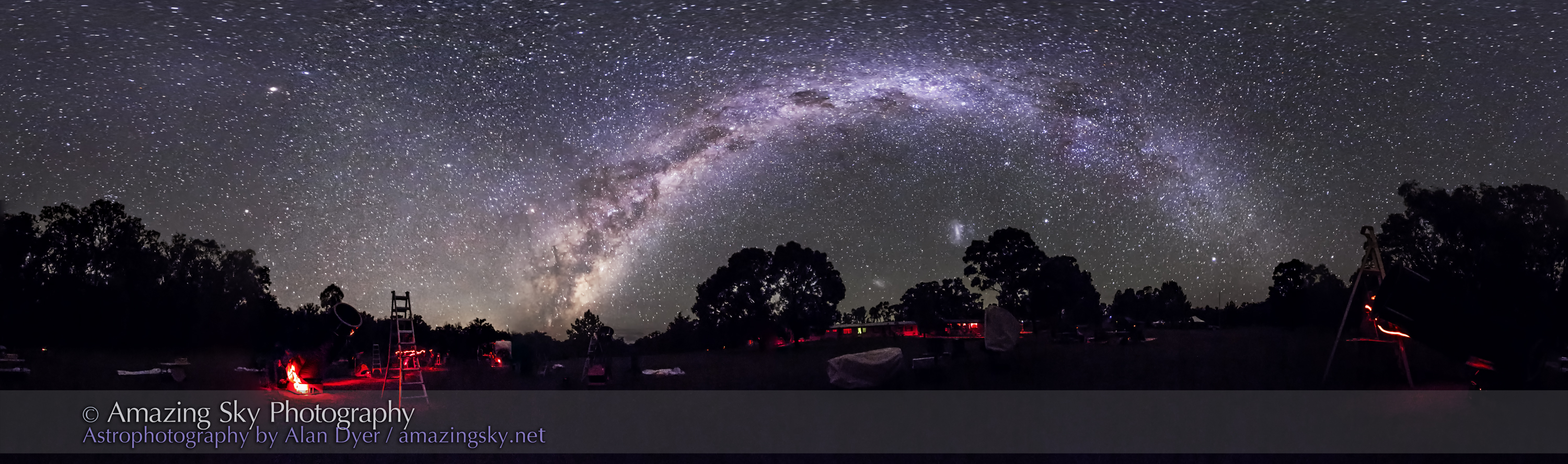
The Milky Way arches over our observing field at the OzSky star party in Australia.
What an amazing few nights it has been. We’ve enjoyed several clear nights under the fabulous southern Milky Way. About 40 people from around the world have had access to telescopes from 14-inch to 30-inch aperture to explore the wonders of the southern sky from a dark site near Coonabarabran, New South Wales.
I’ve seen lifetime-best views of the Tarantula Nebula, the Carina Nebula, the Horsehead Nebula, the Omega Centauri cluster, and on and on! But the views of Mars have been incredible, the best I’ve seen the planet in a decade as it is now close to Earth and high in our southern sky.
The panorama above is a stitch of 6 untracked segments taken with a Canon 60Da and 8mm fish-eye lens. Each segment is a 60-second exposure at ISO 3200.
The 360° panorama takes in the Milky Way from Canis Major setting at right, over to Scorpius and Sagittarius and the centre of the Galaxy rising at left. At top centre is the wonderful Carina and Crux area. The two Magellanic Clouds are just above the trees at centre.
At upper left is Mars, and just to the left of it is a diffuse glow – the Gegenschein, sunlight reflected of comet dust in the direction opposite the Sun. Mars is near that point now. You can just see a faint band running from the Gegenschein to the Milky Way — the Zodiacal Band of comet dust.
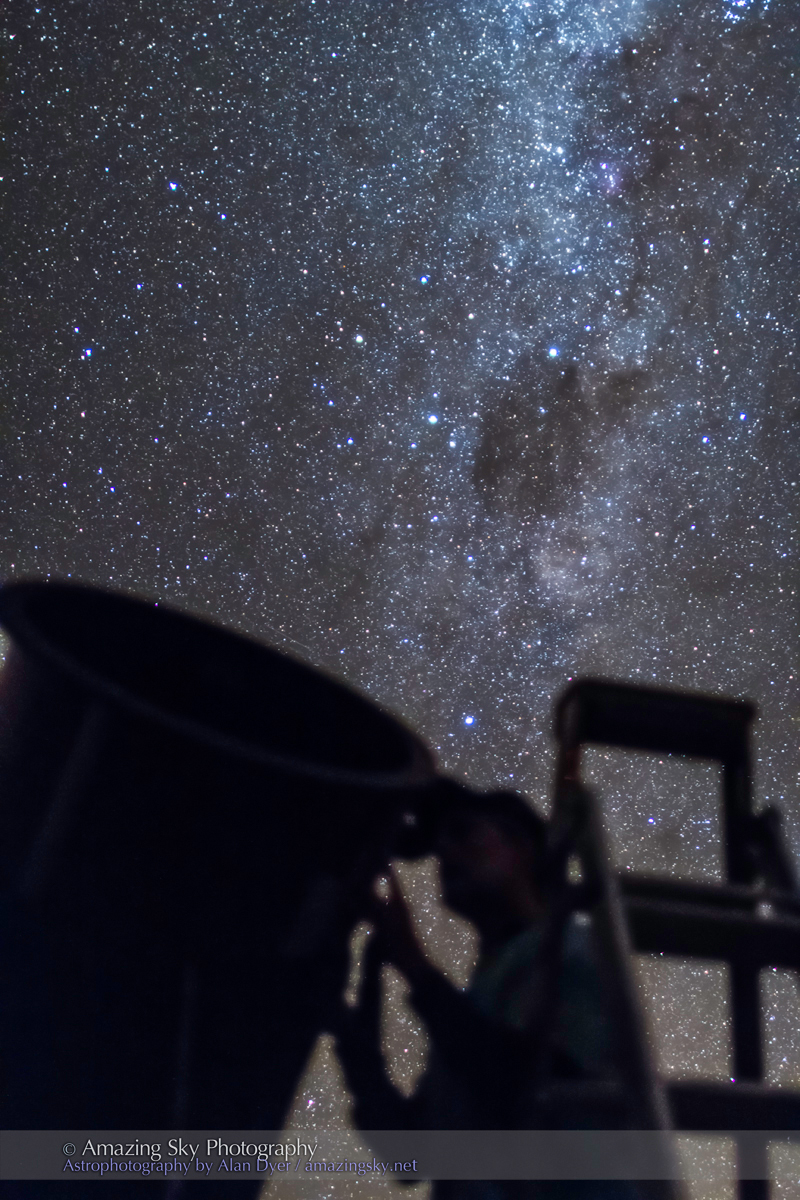
Here, one of our observers takes in a view through a 24-inch reflector telescope under the stars of the Southern Cross, the pattern in the Milky Way behind him.
The nights have been warm and wonderful, though a little damp and dewy after midnight. However, rain is in the forecast again, a welcome relief for most local residents who want the rain. They can have it now. We’re happy!
My 2-minute music video looks back at some of the celestial highlights of 2013, in images and videos I captured.
Some of the events and scenes I show were accessible to everyone who looked up. But some required a special effort to see.
• In 2013 we had a couple of nice comets though not the spectacle hoped for from Comet ISON.
• Chris Hadfield became a media star beaming videos and tweets from the Space Station. We on Earth could look up and see his home sailing through the stars.
• The sky hosted a few nice conjunctions of planets, notably Mars, Venus and Jupiter in late May.
• The Sun reached its peak in solar activity (we think!) unleashing solar storms and some wonderful displays of northern lights.
• Locally, record rain storms in Alberta unleashed floods of devastating consequences in June, with a much publicized super moon in the sky.
• For me, the summer proved a productive one for shooting the “star” of the summer sky, the Milky Way.
• But the year-end finale was most certainly the total eclipse of the Sun on November 3. Few people saw it. I did, from a ship in the Atlantic Ocean. The video ends with that sight and experience, the finest the sky has to offer.
I hope you enjoy this music video mix of time-lapse, real-time video and still images, shot from Alberta, New Mexico and from the Atlantic.
You can watch a better quality version of this video at my Vimeo channel.
Barbados is soon to have a new state-of-the-art public observatory for promoting astronomy.
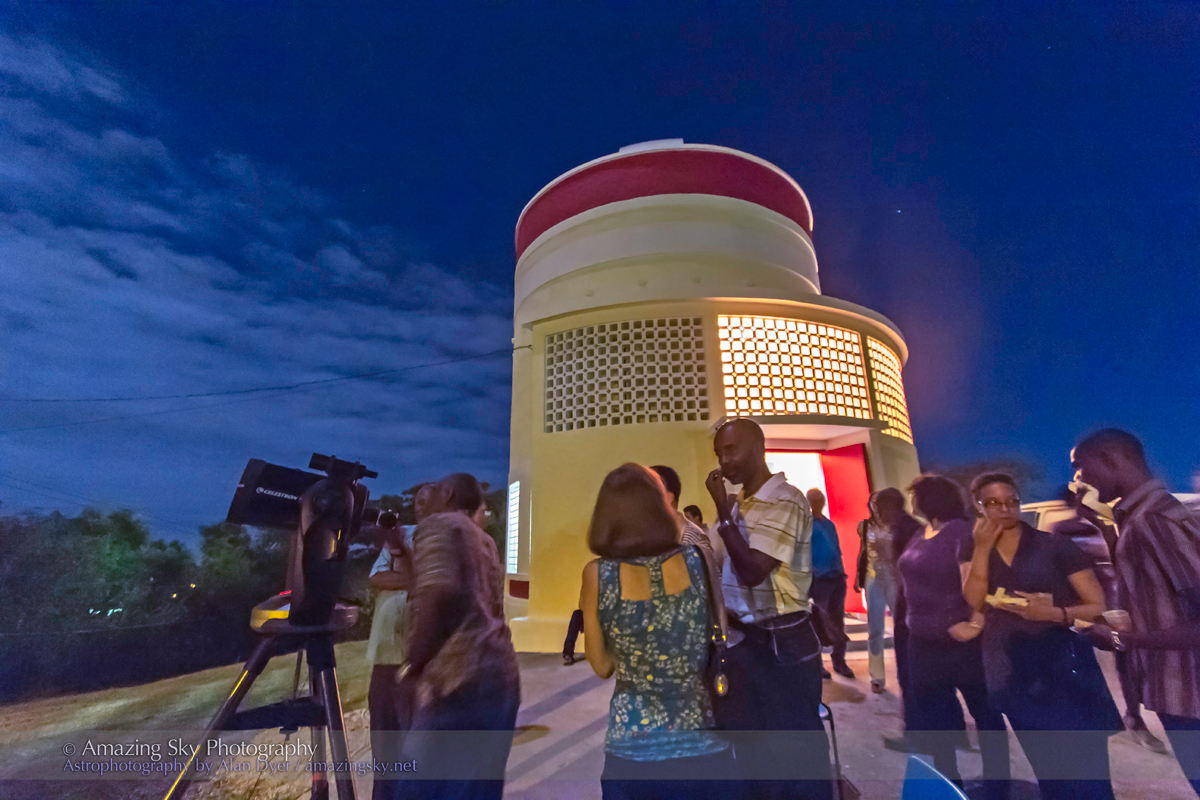
On Saturday night, November 16, I was fortunate and privileged to be the guest speaker at the first event at the newly refurbished Harry Bayley Observatory in Bridgetown, Barbados. A grant from an educational foundation in the UK has allowed the Barbados Astronomical Society to renew the aging 50-year-old facility with a fresh new interior, and all the high-tech fittings of a modern public observatory.
A new dome was lifted into place on top of the 3-storey structure earlier in the week, and the painting and interior finishing was completed just a day or two before my talk, in time for a public RSVP event Saturday night.
I gave a talk on The Amazing Sky, showing images and movies from the November 3 total eclipse, among many other photos of the sights anyone can see in the day and night sky. I gave the same talk twice, to two packed houses of 40 people per session in the main floor meeting room/lecture hall. A wonderful spread of local food and drink was served upstairs.
Lots of work remains to complete the refurbishment but the facility was in good enough shape to host a public event. The official opening is in January.
A new Meade 16-inch telescope on a Software Bisque MX2 mount is on its way for installation later this year, equipped with the latest robotic control and digital cameras for public viewing. A hydrogen-alpha solar telescope will also be part of the arsenal of equipment.
This night, members set up a portable Celestron 8-inch telescope outside for viewing the Moon and Jupiter. In contrast to viewing at home at this time of year, observing from 13° North latitude was in shorts and shirt-sleeves.
It was a terrific evening and I’m pleased to have been part of the relaunching of the Observatory and astronomy activities on the island. Many thanks go to my host on the island, Greg Merrick, for making the evening – and my stay this week – possible.
What a hardy bunch we are in Canada, braving winter weather to see Orion and company.
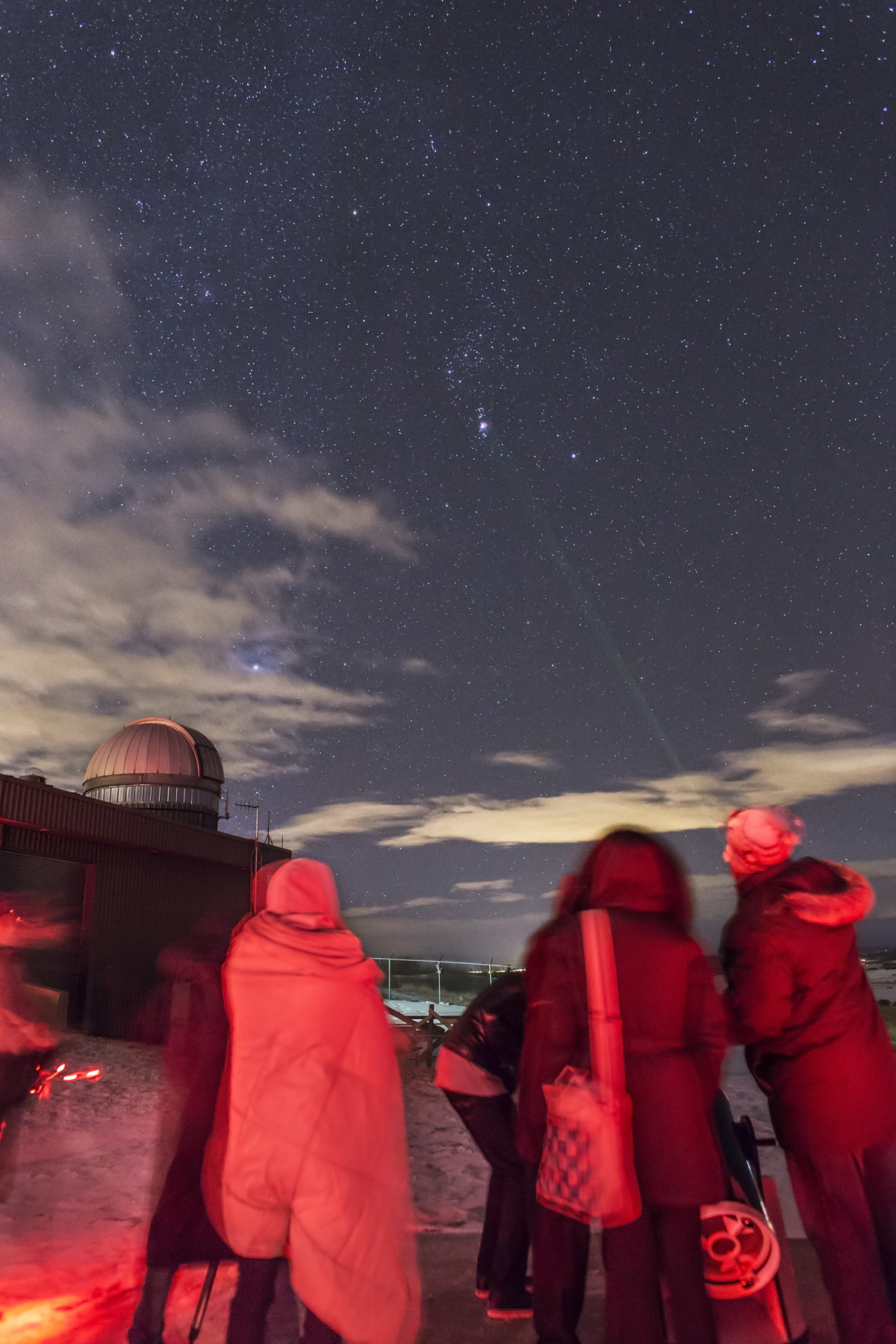
A well-bundled group of sky fans partakes in an impromptu tour of Orion and his famous nebula.
I shot this scene last night, February 9, at the first of a series of monthly stargazing nights at the local university research observatory, the Rothney Astrophysical Observatory. About 120 people and volunteers gathered to take in the sights of the winter sky, as best they could as transient clouds permitted. Inside, speakers presented talks themed to the Chinese New Year, which is governed by the timing of the New Moon each year. As this was a New Moon night, people were able to stargaze under reasonably dark skies to see deep-sky sights such as the Orion Nebula.
Want to know where it is? An astronomy club member points it out rather handily with one of the best tools astronomers have for public outreach, a bright green laser pointer. Controversial and dangerous in the wrong hands, when used responsibly these laser pointers are wonderful for conducting sky tours.
As a side note, this is a 3-second exposure with a new Canon 6D camera at ISO 8000, yet the photo shows very little noise. In just 3 seconds, the Milky Way is beginning to show up! I could have gone to previously unthinkable speeds of ISO 12000+ and still had a presentable shot. This will be a superb camera for nightscapes and available light shots.
A hundred or so stargazers were treated to a beautiful sunset in the badlands of the Red Deer River valley on Saturday night.
This was the setting for the annual Alberta Star Party, at a campground north of Drumheller, Alberta, amid the late Cretaceous sediments of the badlands. This is big sky country.
Earlier in the week the night sky was clear and inviting. But this night the clouds served only to provide a fine sunset. They failed to disappear after nightfall. However, on a such a night, a good time is still had by all as everyone enjoys the company of fellow stargazers during the last of the fine weather before star party season ends for another year.
I took this 360° panorama with a handheld camera, and stitched the segments in Adobe Photoshop CS6.
























 The Amazing Sky