2024 โ€” The Greatest Year of Stargazing ?


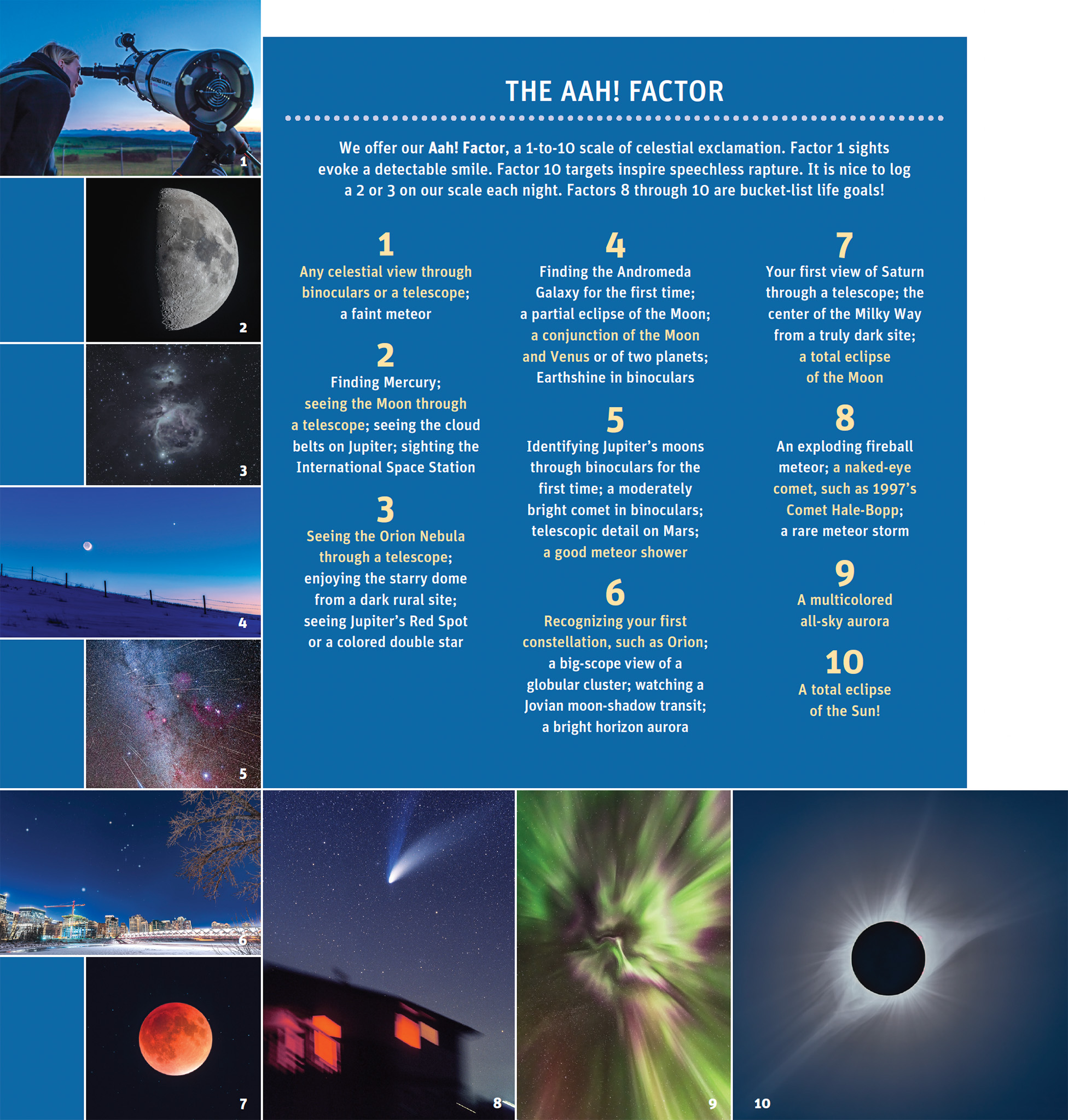
In our book The Backyard Astronomerโ€™s Guide (which we revised this year), Terence Dickinson and I created an Aah! Factor scale with various celestial sights ranked from: 

โ€ข   1, evoking just a smile, to โ€ฆ

โ€ข 10, a life-changing event! 

Our book’s Aah! Factor Scale in Chapter 1

Coming in at an 8 is a naked-eye comet. Deserving a 9 is an all-sky display of an aurora. The only sight to rate a top 10 is a total eclipse of the Sun. 

2024 brought all three, and more! 

Hereโ€™s my look back at what I think was one of the greatest years of stargazing. 


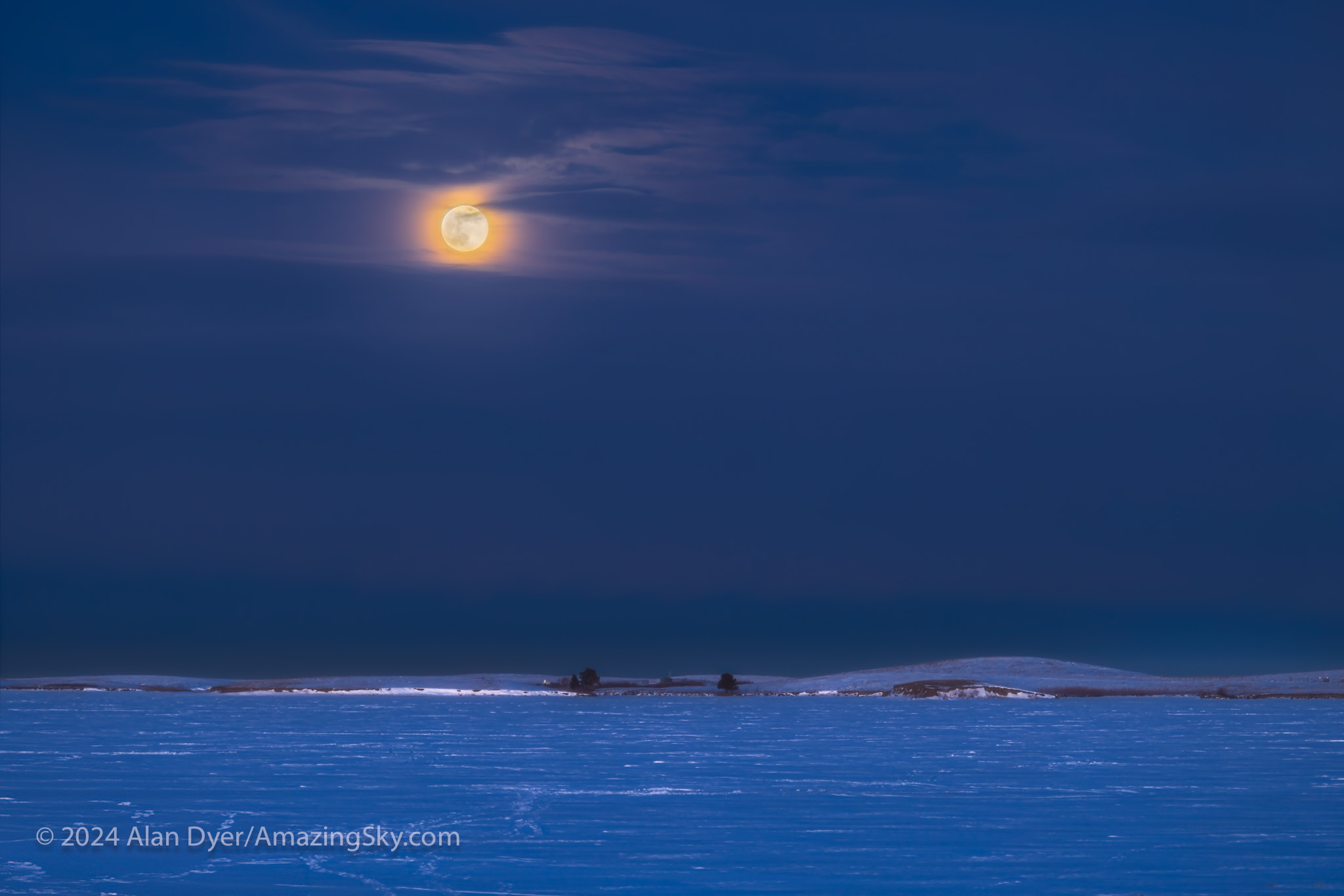
A Winter Moonrise to Begin the Year 

The rising of the winter “Wolf” Moon, the Full Moon of January, over the frozen Crawling Lake Reservoir, in southern Alberta.

Now, this was not any form of rare event. But seeing and shooting any sky sight in the middle of a Canadian winter is an accomplishment. This is the rising of the Full Moon of January, popularly called the Wolf Moon, over a frozen lake near home in Alberta, Canada ๐Ÿ‡จ๐Ÿ‡ฆ. 

It serves to bookend the collection with a Full Moon I captured eleven months later in December. 


Auroras from Churchill, Manitoba 

Had this been my only chance to see the Northern Lights fill the sky this year, I would have been happy. As we often see in Churchill, the aurora covered the sky on several nights, a common sight when you are underneath the main band of aurora borealis that arcs across the northern part of the globe. 
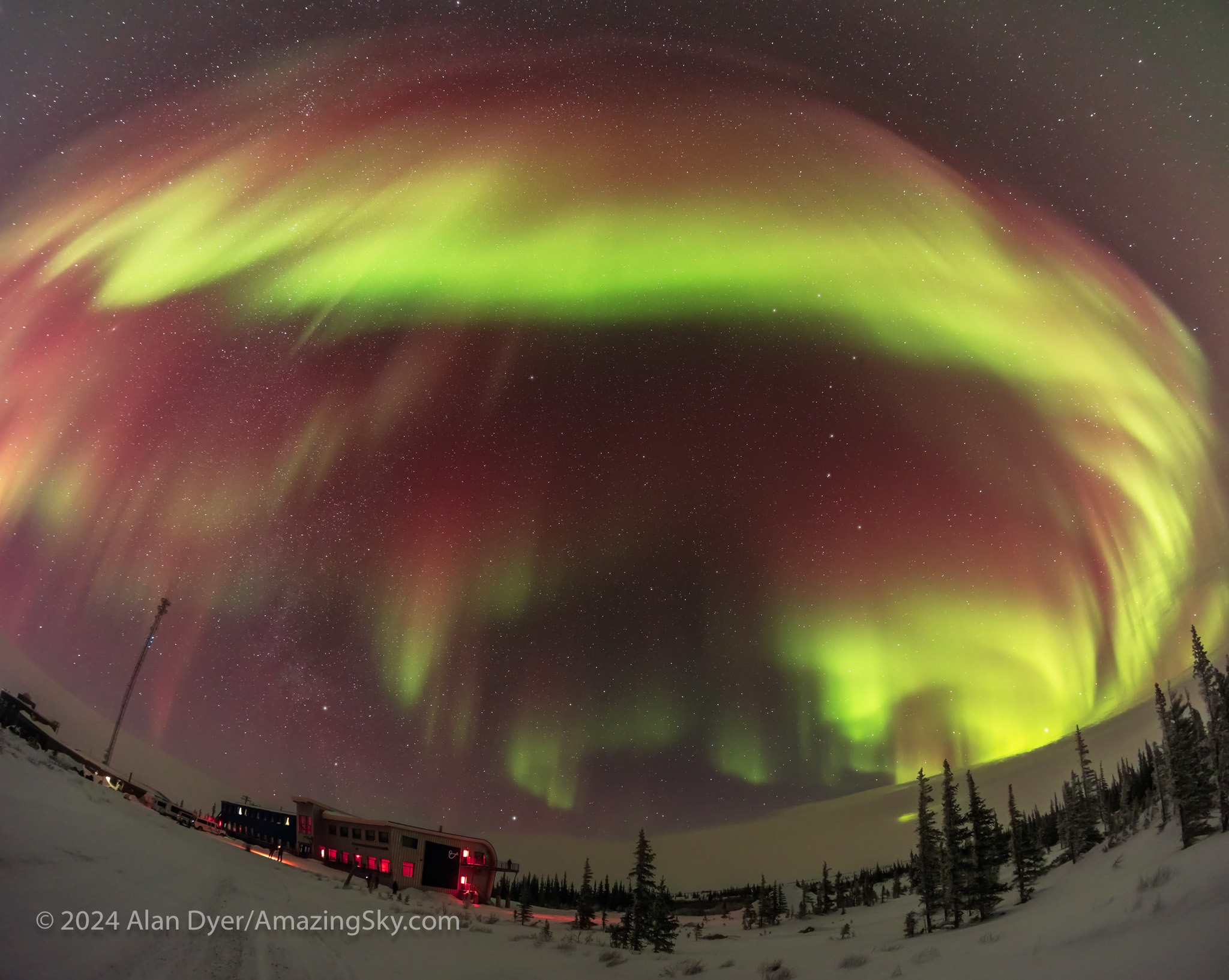
This is a vertical panorama of the sky-filling aurora of February 10, 2024, as seen from the Churchill Northern Studies Centre, in Churchill, Manitoba.

I attended to two aurora tour groups at the Churchill Northern Studies Centre who both got good displays to check โ€œseeing the Northern Lightsโ€ off their bucket list. Join me in 2025!


Under the Austral Sky

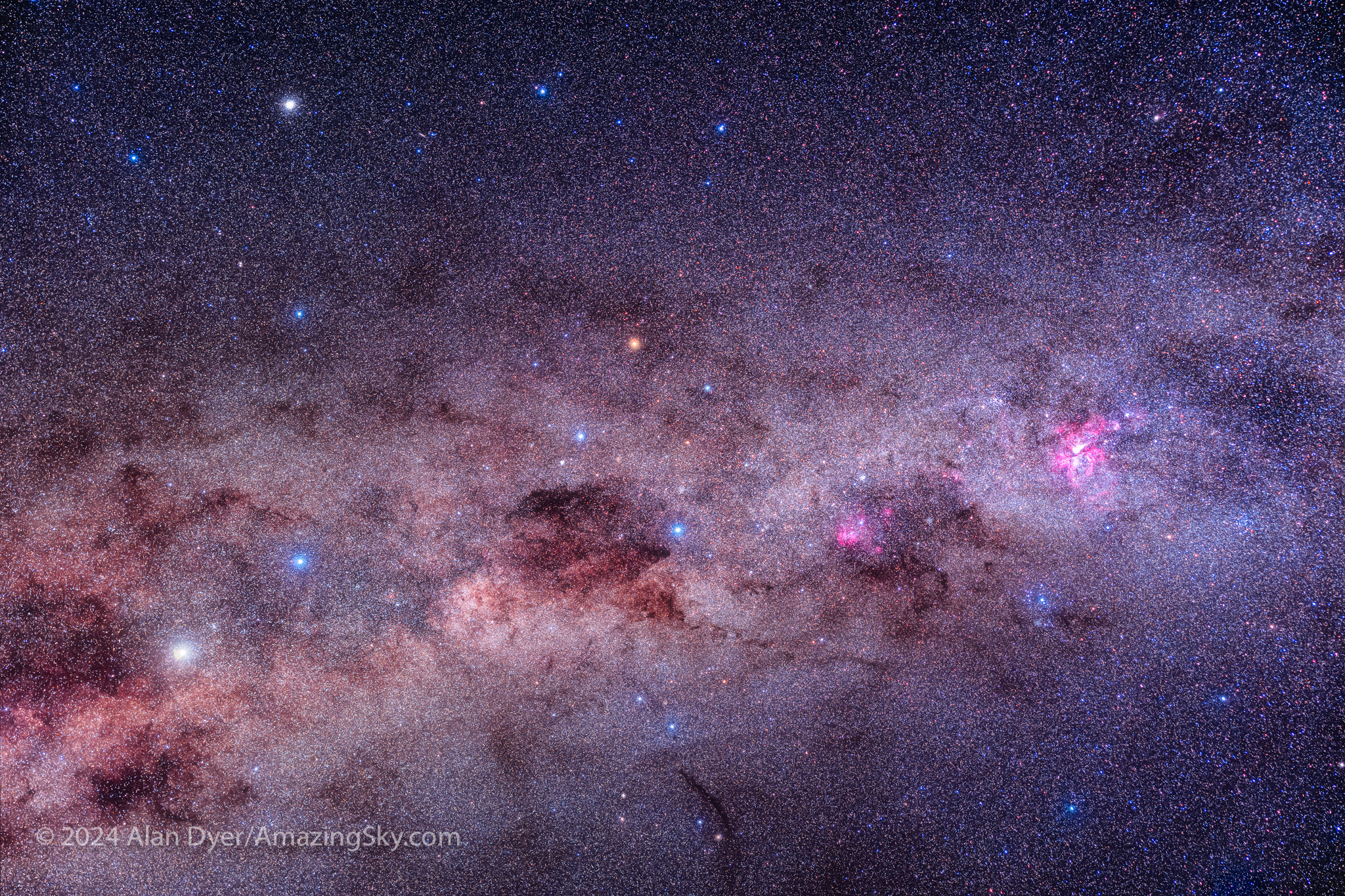
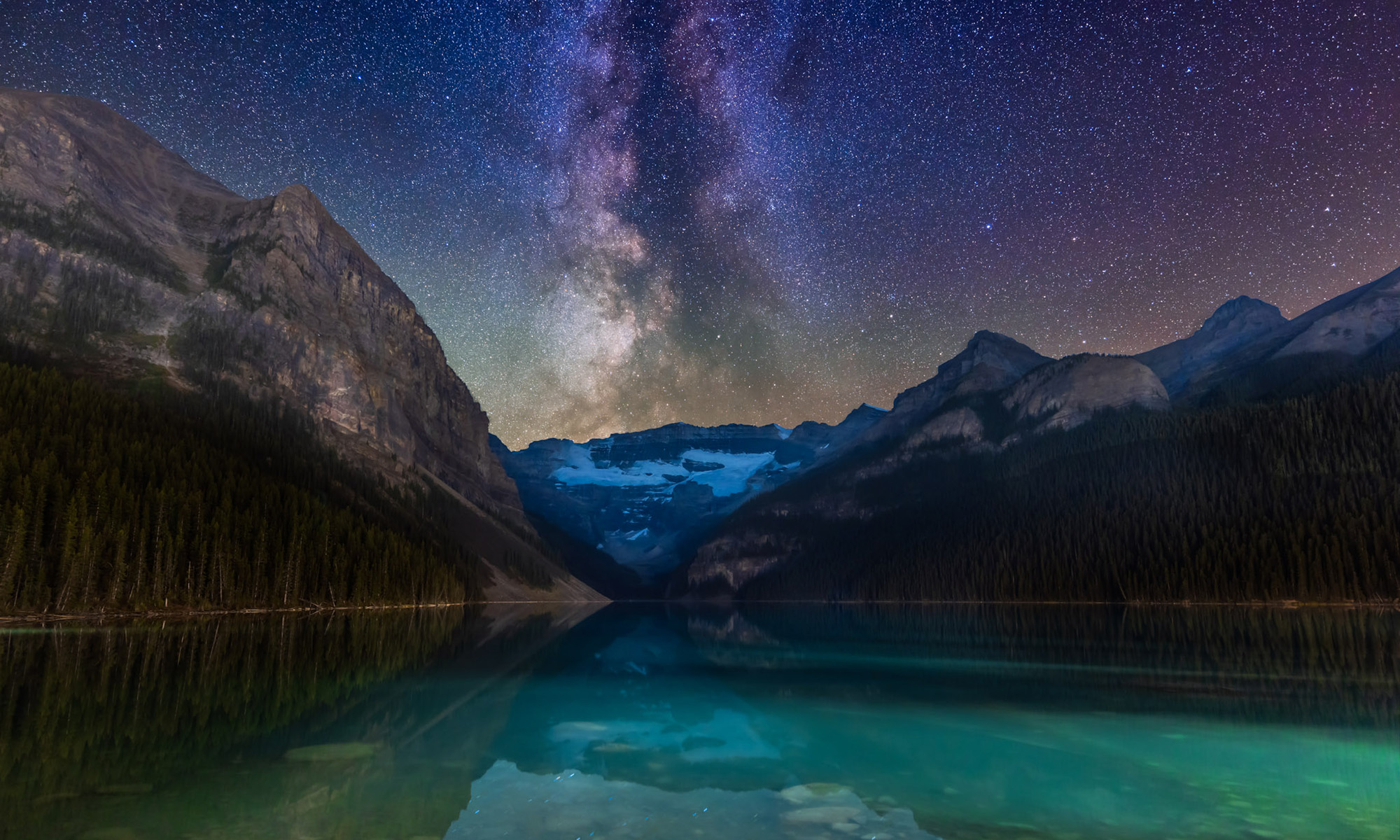
Ranking a respectable 7 on our Aah! Factor scale is the naked-eye sight of the galactic centre overhead, with the Milky Way arcing across the sky. Thatโ€™s possible from a latitude of about 30ยฐ South. Thatโ€™s where I went in March, back to Australia ๐Ÿ‡ฆ๐Ÿ‡บ for the first time since 2017. 

This is a framing of the most spectacular area of the southern Milky Way, from Centaurus at left, to Carina at right, with Crux, the Southern Cross, at centre.

I wrote about it in my previous blog, where I present a tour along the southern Milky Way, and wide-angle views of the Milky Way (the images here are framings of choice regions). 
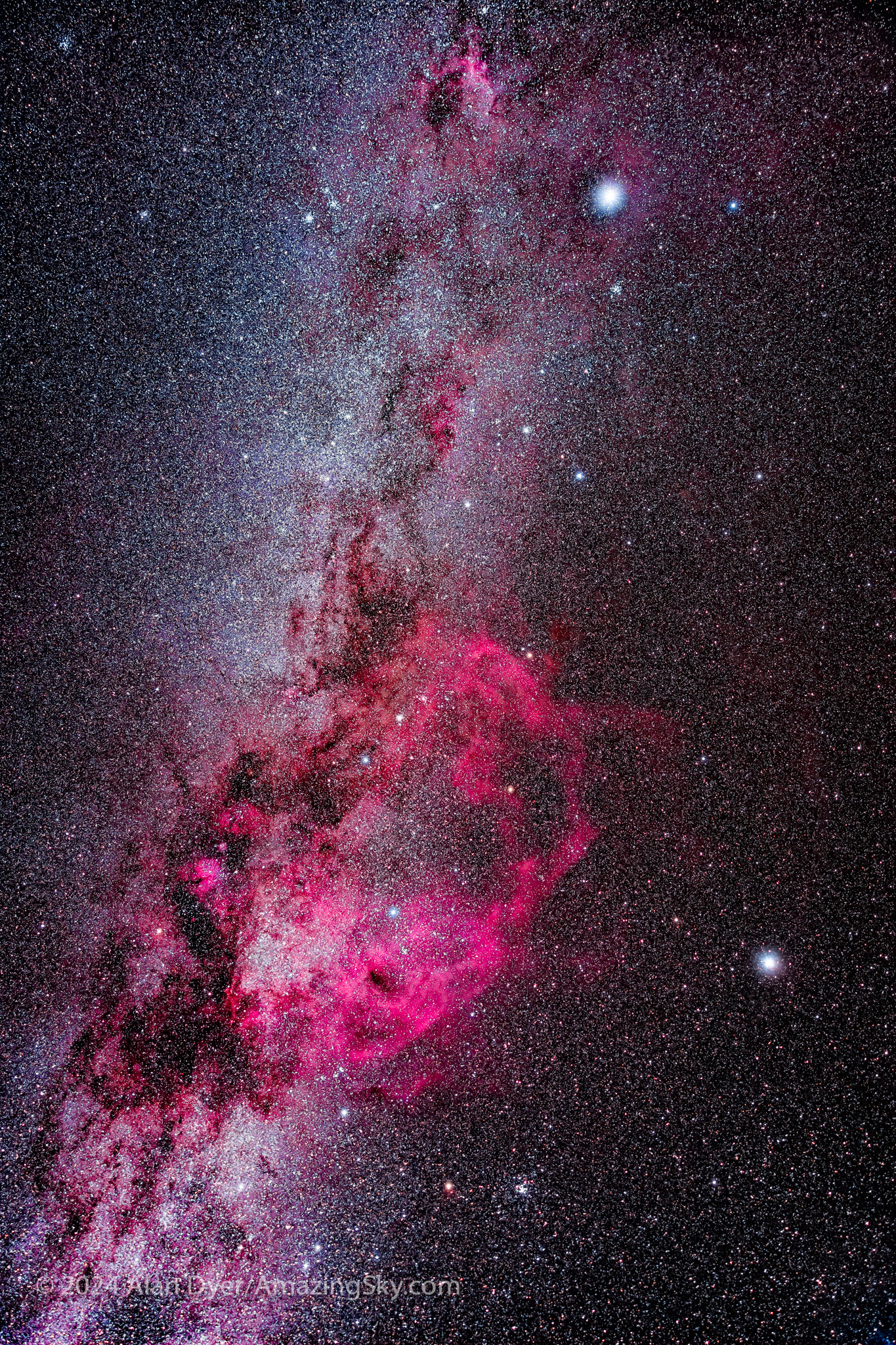
This frames the southern Milky Way from Canis Major and its bright star Sirius at top, to Carina and its bright star Canopus at bottom, the two brightest stars in the night sky. The large red complex is the Gum Nebula.

It is a magical latitude that all northern astronomers should make a pilgrimage to, if only to just lie back and enjoy the view of our place in the outskirts of the Galaxy. I was glad to be back Down Under, to check this top sky sight off my bucket list for 2024. 


A Total Eclipse of the Sun 

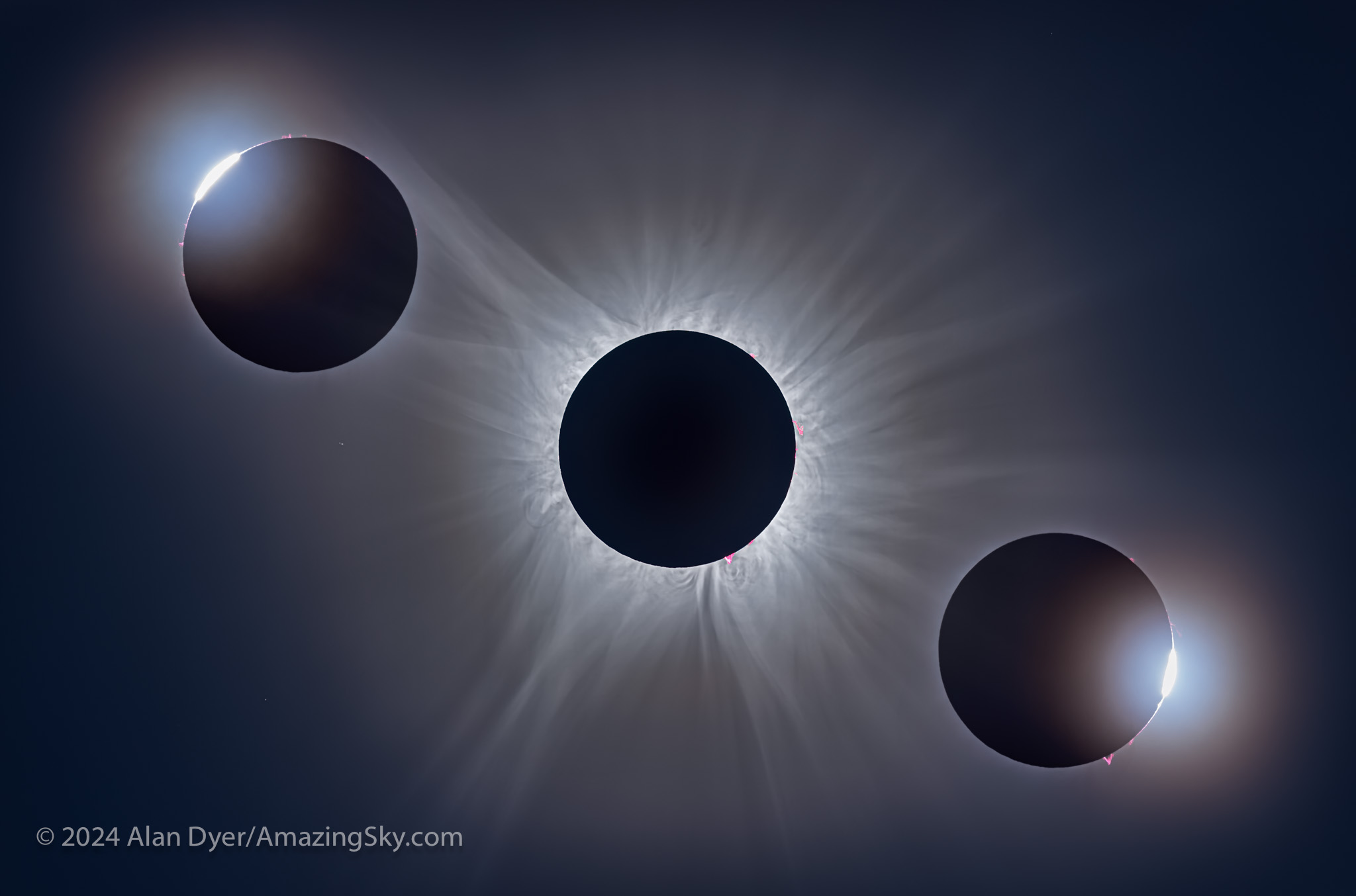
No sooner had I returned home from Oz, when it was time to load up the car with telescope gear and drive to the path of the April 8 total solar eclipse, the first “TSE” in North America since 2017, which was the last total eclipse I had seen, in a trip to Idaho

This is a composite of telescopic close-ups of the April 8, 2024 total eclipse, with a multi-exposure blend for the corona at centre, flanked by the diamond rings.

But where? I started south to Texas, my Plan A. Poor weather forecasts there prompted a hasty return to Canada, to drive east across the country to โ€ฆ I ended up in Quรฉbec. My blog about my cross-continental chase is here. My final edited music video is linked to below.

It was gratifying to see a total eclipse from “home” in Canada, only the third time Iโ€™ve been able to do that (previously in 1979 โ€“ Manitoba, and 2008 โ€“ Nunavut). If the rest of the year had been cloudy except for this day I wouldnโ€™t have complained. Much.

This definitely earned a 10 on the Aah! Factor scale. Total eclipses are overwhelming and addictive. Iโ€™ve made my bookings for 2026 in Spain ๐Ÿ‡ช๐Ÿ‡ธ and 2027 in Tunisia ๐Ÿ‡น๐Ÿ‡ณ. 


The Skyโ€™s On Fire

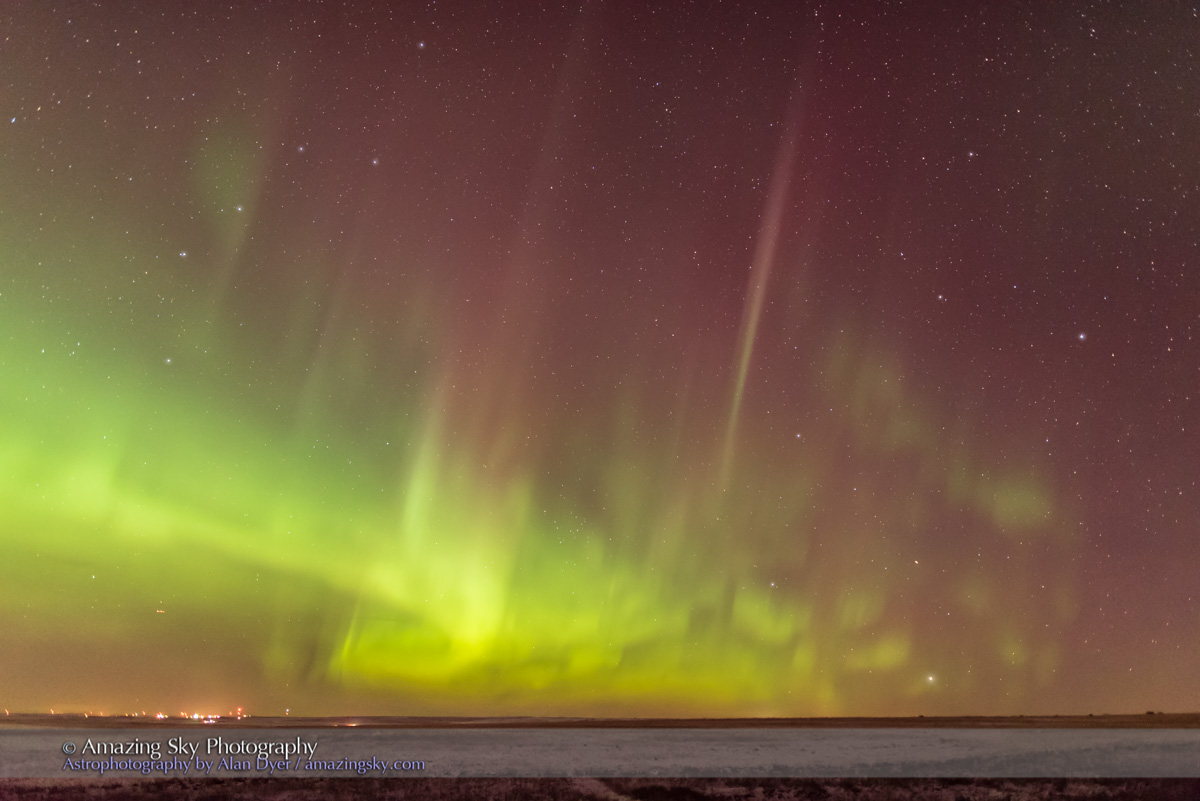
It had been several years since I had seen an aurora from my backyard with colours as vivid and obvious as they were this night. But on May 10, the sky erupted with a fabulous display of aurora that much of the world saw, as aurora borealis in the north and aurora australis in the south. 
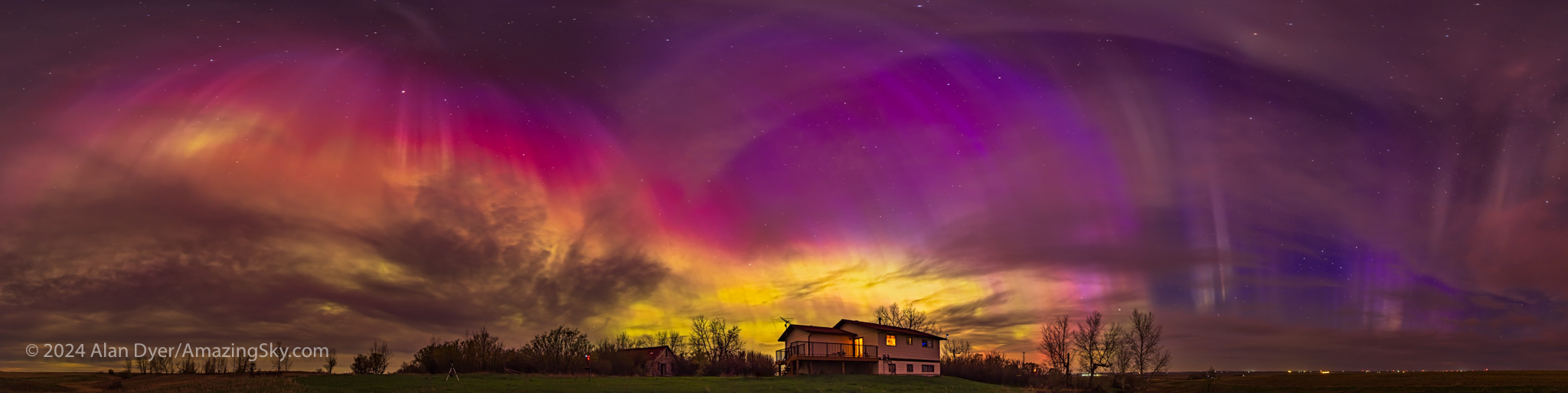
This is a 300ยบ panorama of the May 10, 2024 Northern Lights display, when the Kp Index reached 8 (out of 9), bringing aurora to the southern U.S.

This was the first of several all-sky shows this year. I blogged about the yearโ€™s great auroras here, where there are links to the movies I produced that capture the Northern Lights as only movies can, recording changes so rapid it can be hard to take it all in. Check off a 9 here! 

So not even half way through the year, I had seen three of the top sky sights: the Milky Way core overhead (7), an all-sky aurora (9), and a total eclipse of the Sun (10). 

But there was more to come! Including an Aah! Factor 8


World Heritage Nightscape Treks

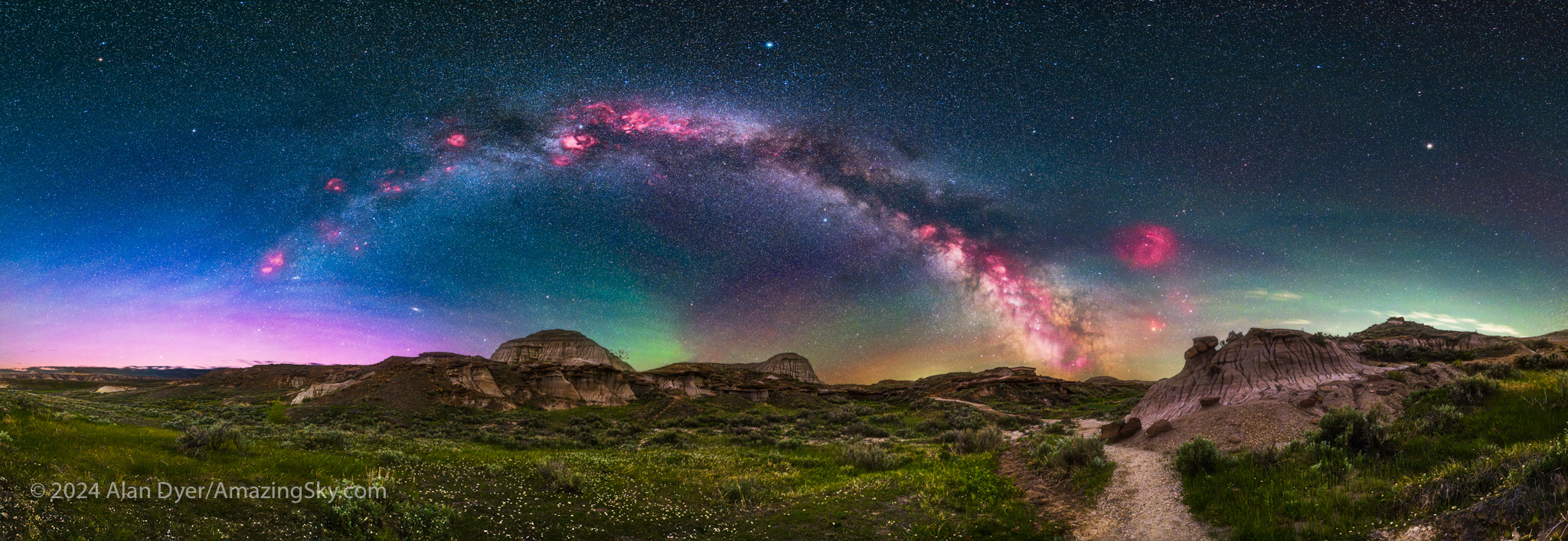
This is a panorama of the arch of the Milky Way rising over the Badlands of Dinosaur Provincial Park, Alberta, with a sky tinted with twilight and airglow.

The sky took a break from presenting spectacles, allowing me to head off on short local trips, to favourite nightscape sites in southern Alberta, which we have in abundance. The Badlands of Dinosaur Provincial Park are just an hour away, the site for the scene above. 
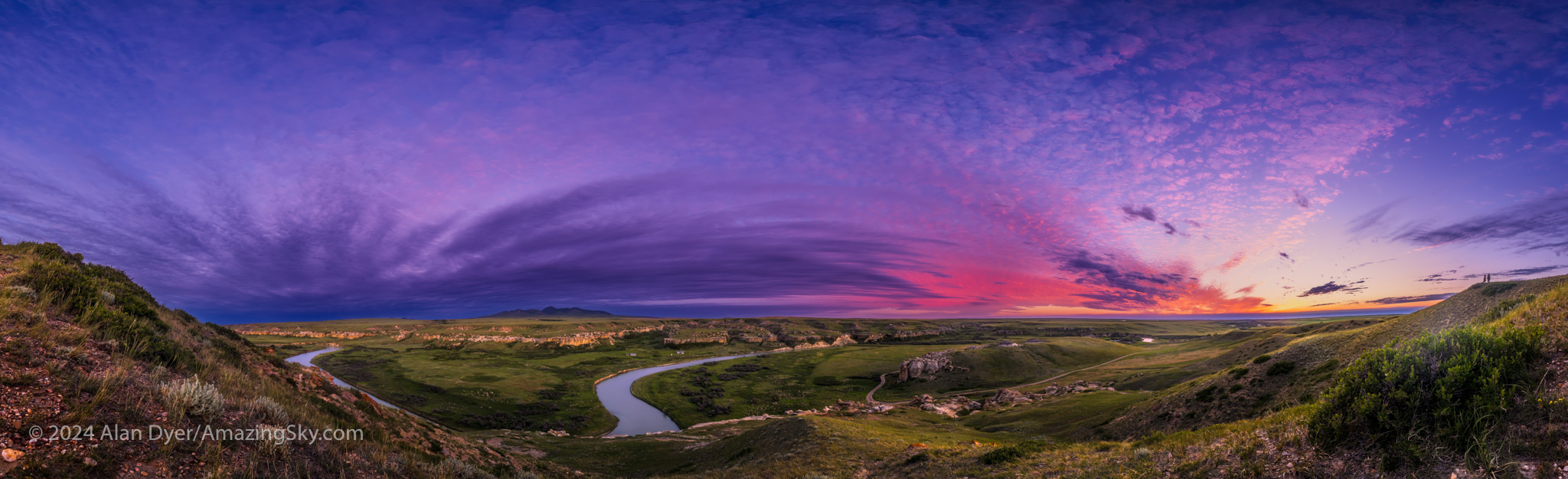
A panorama at sunset at Writing-on-Stone Provincial Park (รรญsรญnai’pi) in Alberta, with the Milk River below and the Sweetgrass Hills in the distance in Montana. Note the people at far right.

The rock formations of Writing-on-Stone Provincial Park are a bit farther, requiring a couple of days commitment to shoot. Clouds hid the main attraction, the Milky Way, this night, but did provide a fine sunset. 
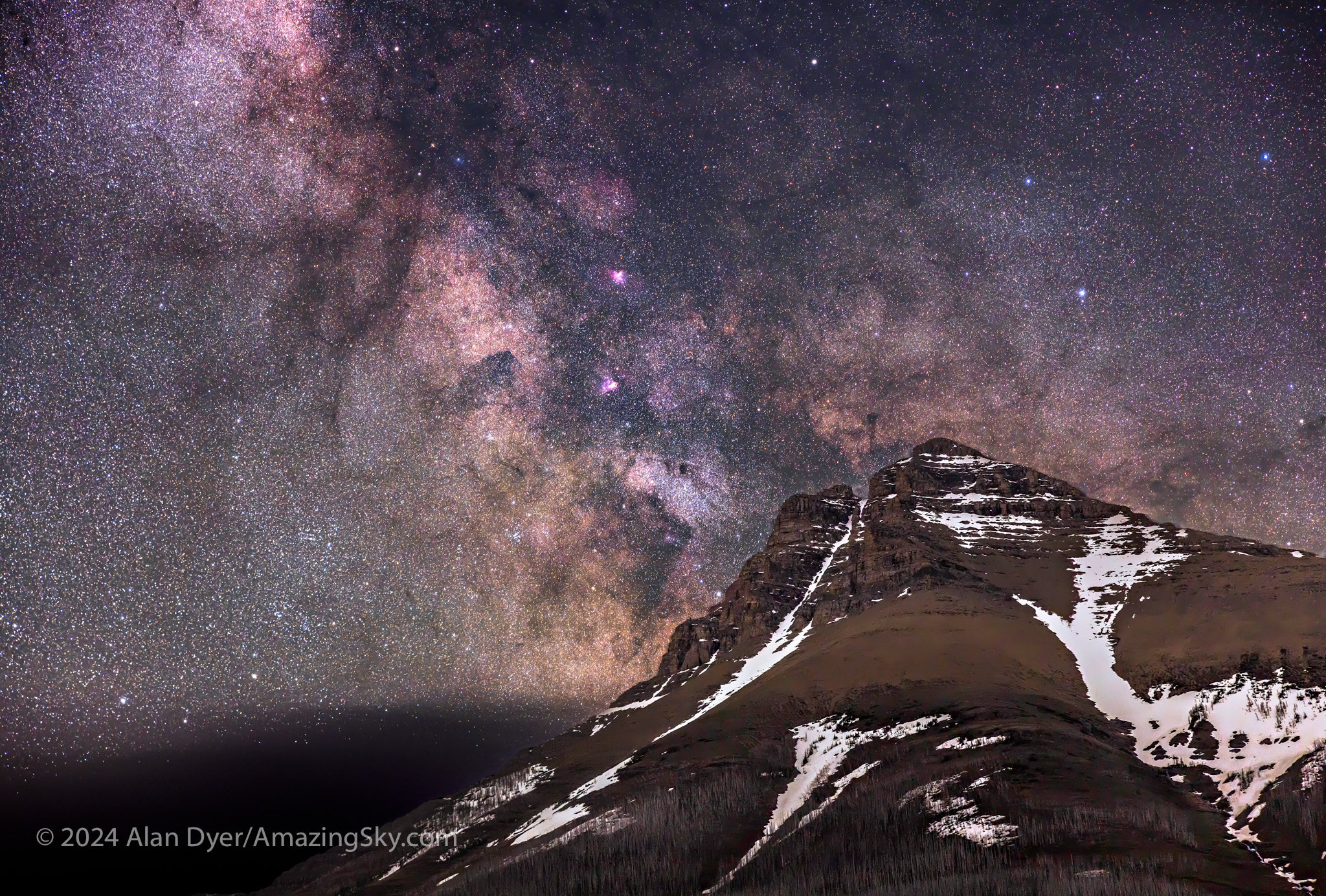
The Milky Way rises over Mt. Blakiston, in Waterton Lakes National Park, Alberta. This was June 10, 2024, so snow remains at high altitudes.

A little further west down the highway is Waterton Lakes National Park, another great spot I try to visit at least once each year. 

All locations I hit this month are U.N. World Heritage Sites, thus the theme of my blog from June. People travel from all over the world to come here, to sites I can visit in a few hours drive. 


Mountains by Starlight

In summer we now often contend with smoke from forest fires blanketing the sky, hiding not just the stars by night, but even the Sun by day. 
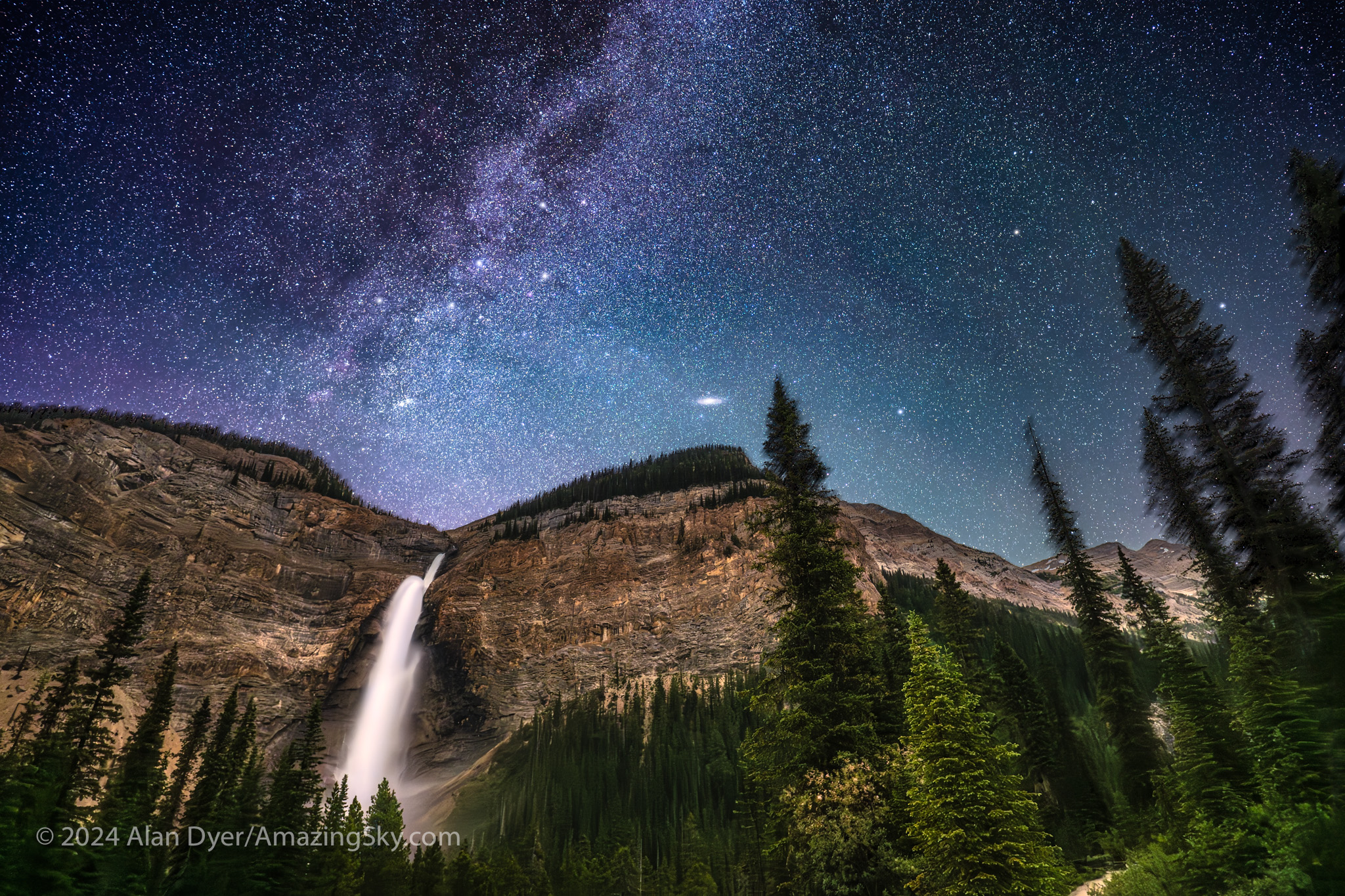
The Andromeda Galaxy at centre is rising above Takakkaw Falls, in Yoho National Park. Above is the W of stars marking Cassiopeia.

But before the smoke rolled in this past summer I was able to visit a spot, Yoho National Park in British Columbia, that had been on my shot list for several years. The timing with clear nights at the right season and Moon phase has to work out. In July it did, for a shoot by starlight at Takakkaw Falls, among the tallest in Canada. 
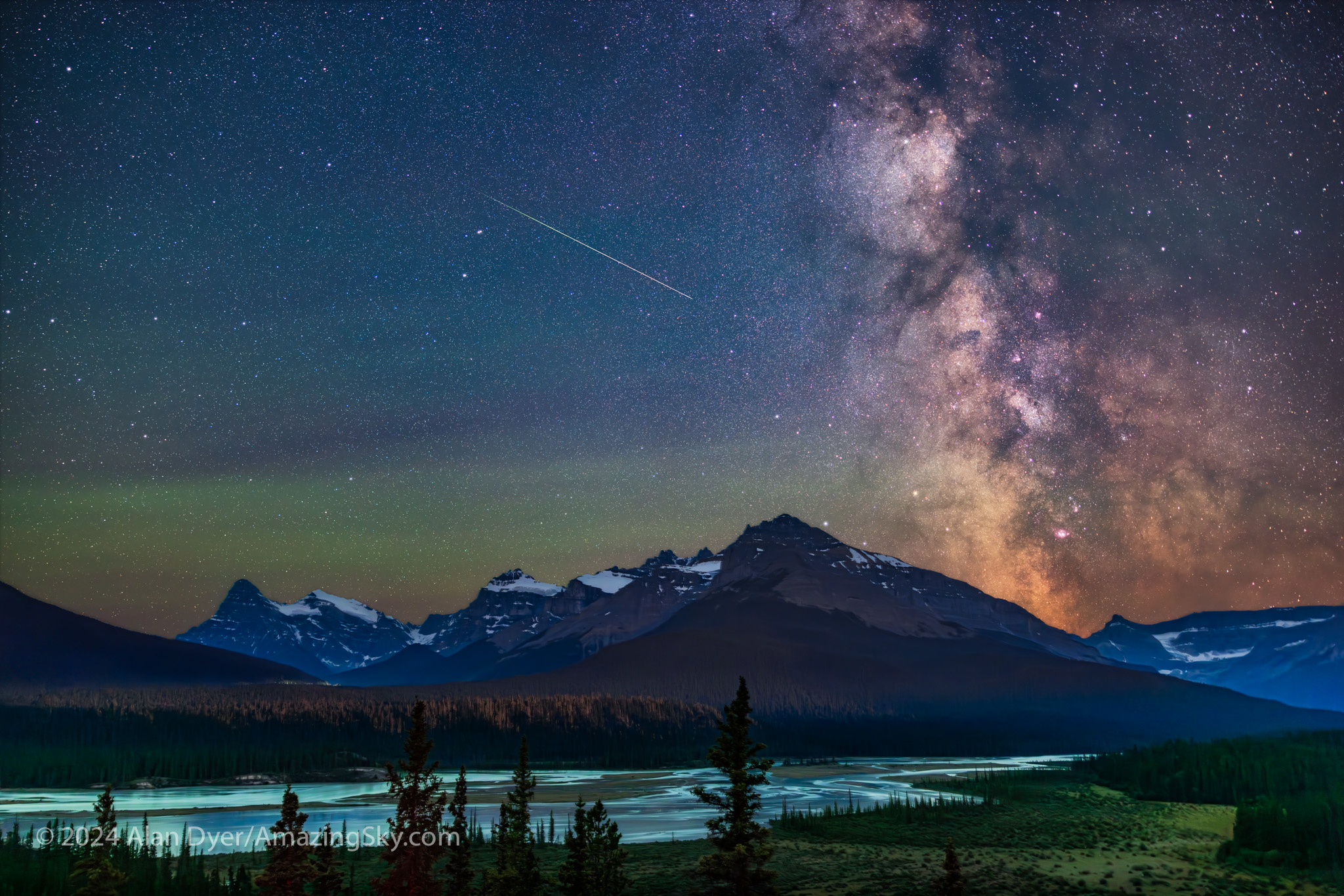
This is the Milky Way core and a bonus meteor over the peaks and valleys at Saskatchewan River Crossing, in Banff National Park, Alberta.

The following nights I was in Banff National Park, at familiar spots on the tourist trail, but uncrowded and quiet at night. It was a pleasure to enjoy the world-class Rocky Mountain scenery under the stars on perfect nights. 


The All-Sky Auroras Return 

In August I headed east to Saskatchewan and the annual Summer Star Party staged by the astronomy clubs in Regina and Saskatoon. It is always a pleasure to attend the SSSP in the beautiful Cypress Hills. The sky remained clear post-party for a trip farther east to the little town of Val Marie, where I stayed at a former convent, and had a night to remember out in Grasslands National Park, one of Canadaโ€™s first, and finest, dark sky preserves.
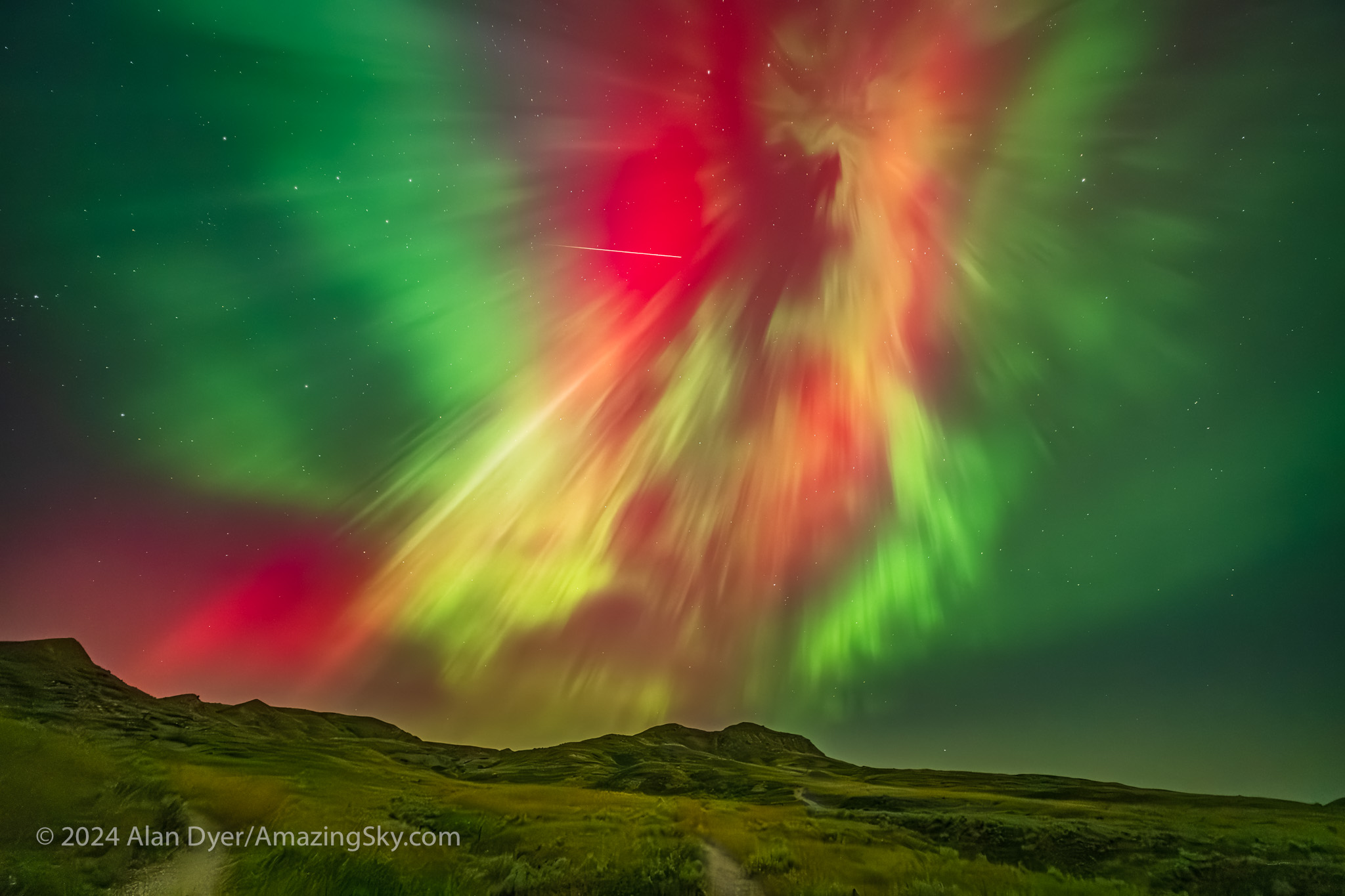
The Northern Lights in a superb all-sky Kp6 to 7 display on August 11-12, 2024, in Grasslands National Park, Saskatchewan.

The plan was to shoot the August 11 Perseid meteor shower, but the aurora let loose again for a stunning show over 70 Mile Butte. My earlier blog has more images and movies from this wonderful month of summertime Northern Lights. 

We are fortunate in western Canada ๐Ÿ‡จ๐Ÿ‡ฆ to be able to see auroras year-round, even in summer. Farther north at the usual Northern Lights destinations, the sky is too bright at night in summer. 


Back to Deep Sky Wonders

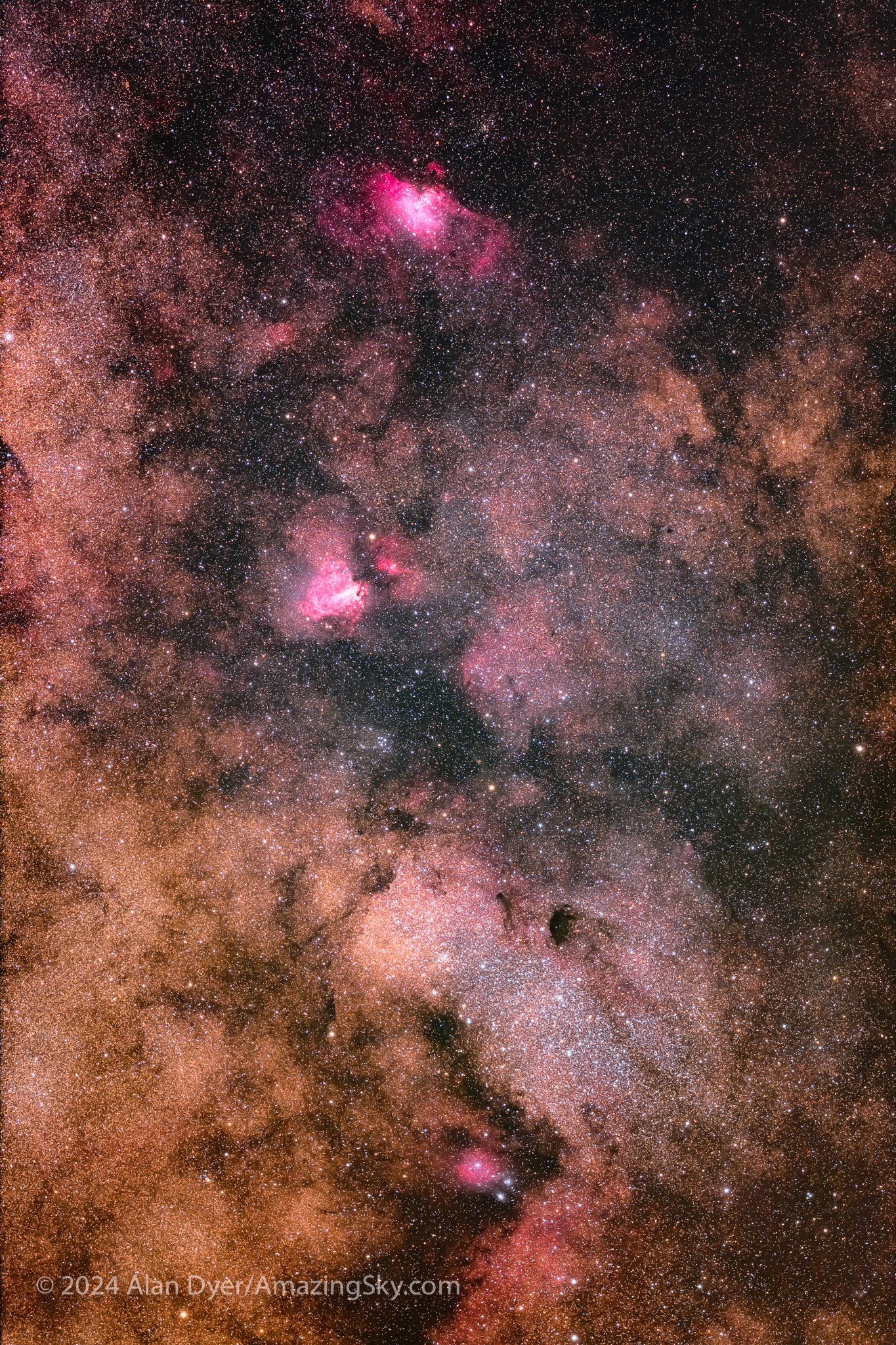
This is a framing of the rich starfield in Sagittarius and Serpens containing a mix of bright star clouds, glowing nebulas, and dark dust in the Milky Way.

September is the month for another astronomical party in the Cypress Hills, but on the Alberta side. At the wonderful Southern Alberta Star Party under its very dark skies, I was able to shoot some favourite deep-sky fields along the Milky Way with new gear I was testing at the time. 
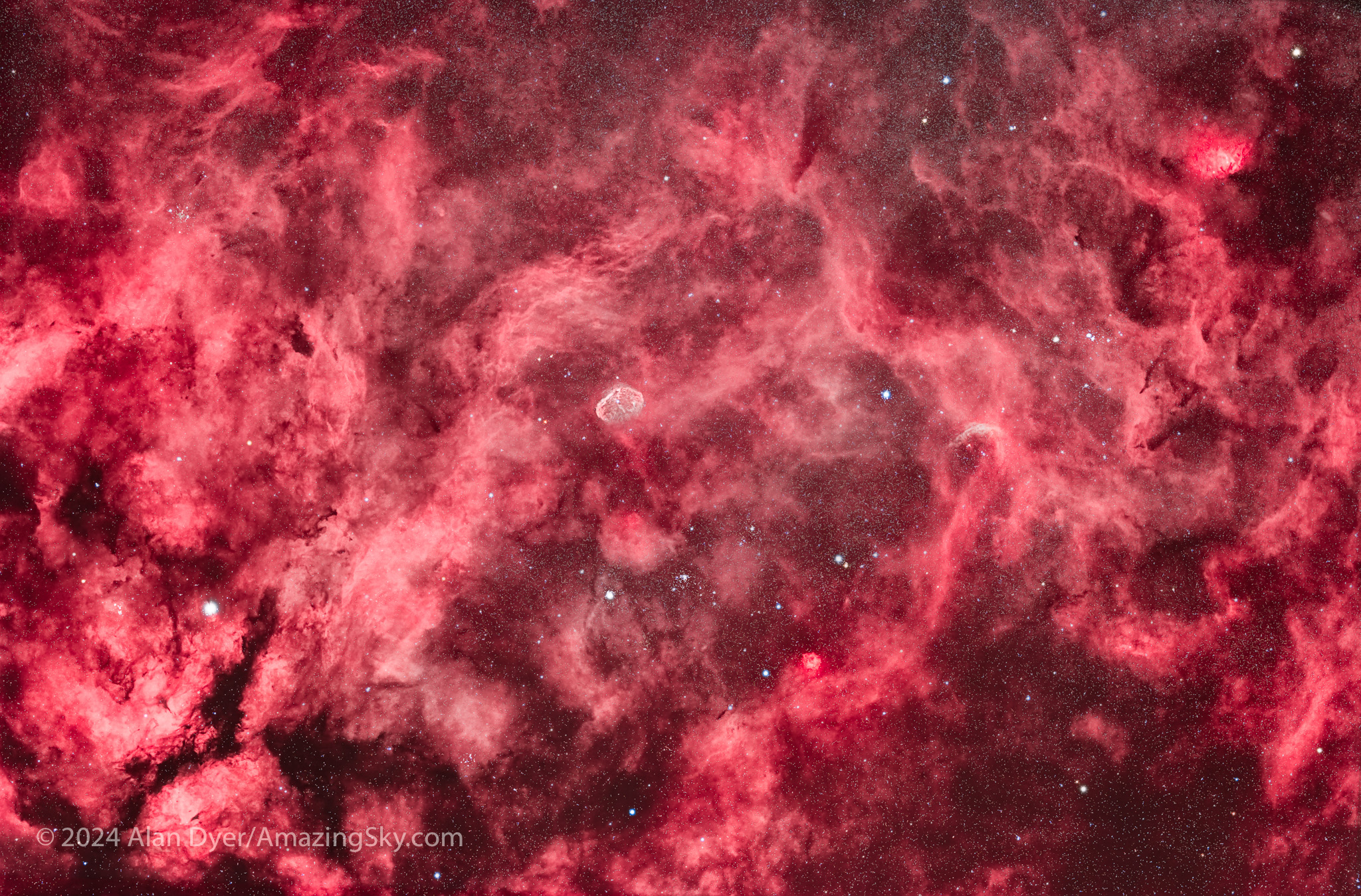
This frames the complex region of emission nebulas in central Cygnus near the star Gamma Cygni, at lower left. The Crescent Nebula is at centre.

And from home, September brought skies dark and clear enough (at least when there was no aurora!) for more captures of colourful nebulas (above and below) along the summer Milky Way. 
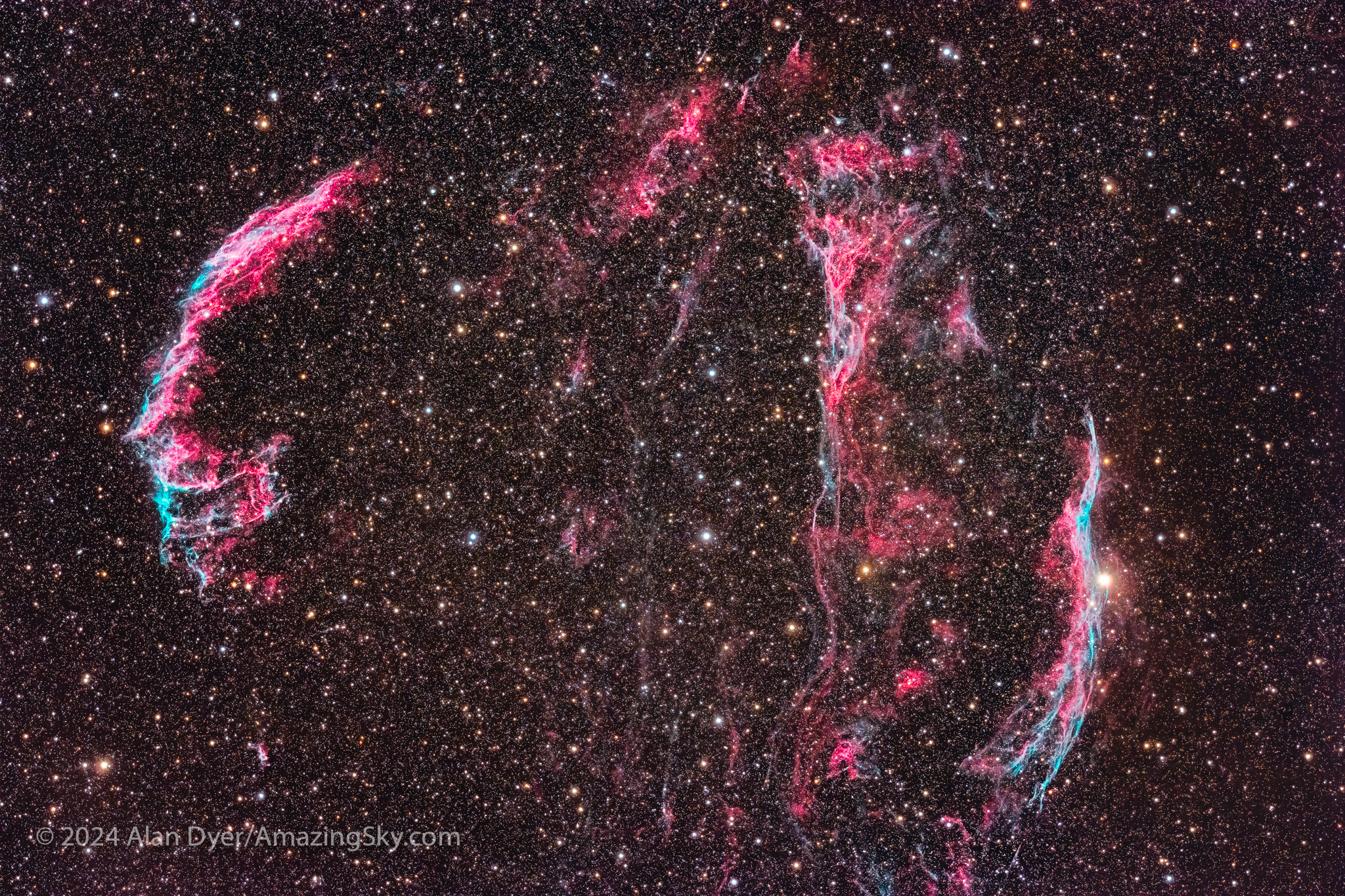
This frames all the photogenic components of the bright Veil Nebula in Cygnus, a several-thousand-year-old supernova remnant.

We invest a lot of money into the kind of specialized gear needed to shoot these targets (and Iโ€™m not nearly as โ€œcommittedโ€ as some are, believe me!), only to find the nights when it all comes together can be few and far between. 

Plus, A Very Minor Eclipse of the Moon 

I had to include this, if only for stark contrast with the spectacular solar eclipse six months earlier. 

We had an example of the most minor of lunar eclipses on March 24, 2024, with a so-called โ€œpenumbralโ€ eclipse of the Moon, an eclipse so slight itโ€™s hard to tell anything unusual is happening. (So I’ve not even included an image here, though I was able to shoot it.)
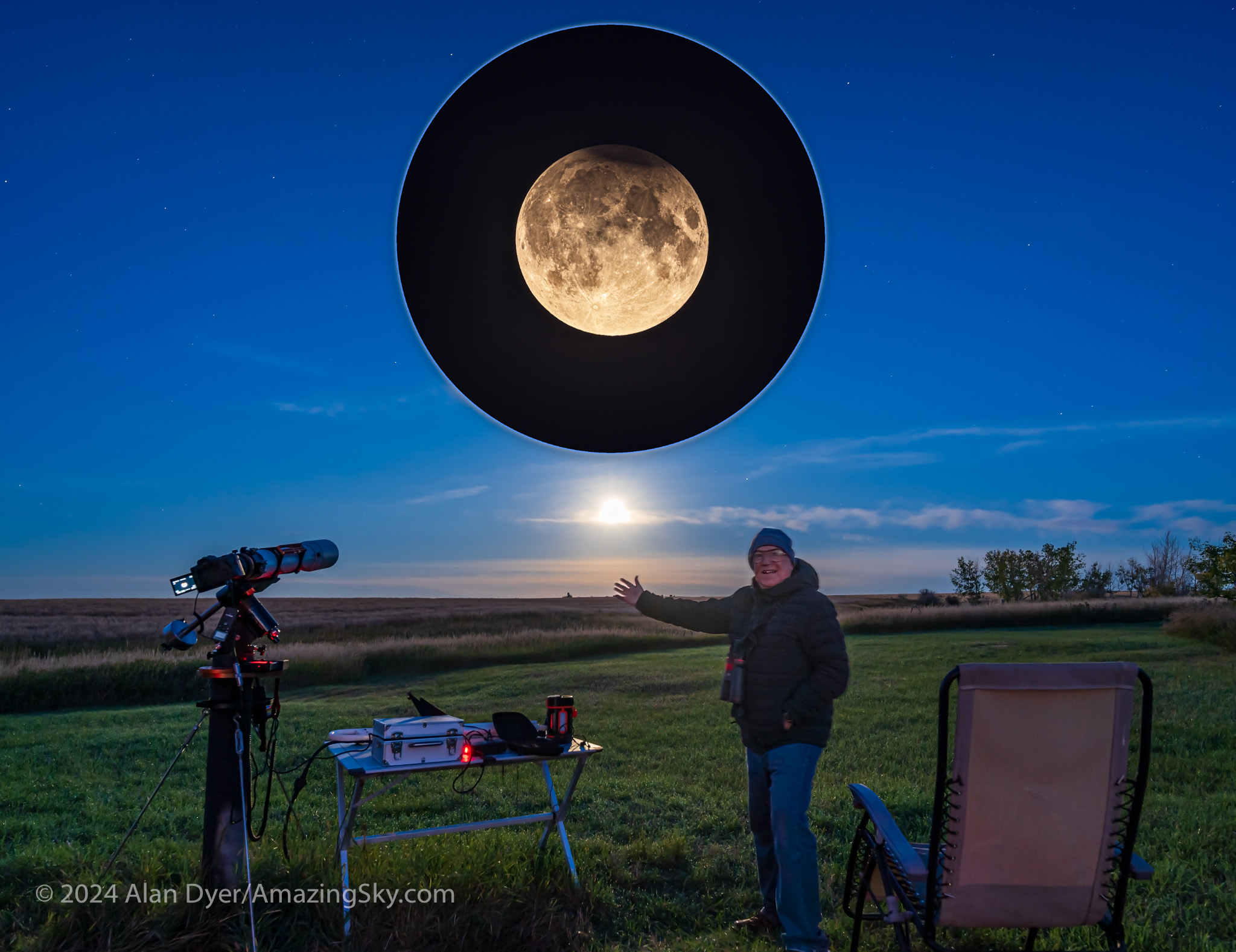
Me at another successful eclipse chase โ€ฆ to my backyard to capture the partial lunar eclipse on September 17, 2024. The Moon is rising in the southeast.

On September 17, we had our second eclipse of the Moon in 2024. This time the Earthโ€™s umbral shadow managed to take a tiny bite out of the Full Moon. Nothing spectacular to be sure. But at least this eclipse expedition was to no farther away than my rural backyard. A clear eclipse of any kind, even a partial eclipse, especially one seen from home, is reason to celebrate. I did!

Of course, a total eclipse of the Moon, when the Full Moon is completely engulfed in Earthโ€™s umbra and turns red, is what we really want to see. They rate a 7 on our Aah! Factor scale. We havenโ€™t had a “TLE” since November 8, 2022, blogged about here.

The next is March 14, 2025. (The link takes you to Fred Espenak’s authoritative web page.)


A Bright Comet At Last!

We knew early in 2024 that the then newly-discovered Comet Tsuchinshan-ATLAS had the potential to perform this month. I planned a trip south to favourite spots in Utah and Arizona to take advantage of what we hoped would be a fine autumn comet. 
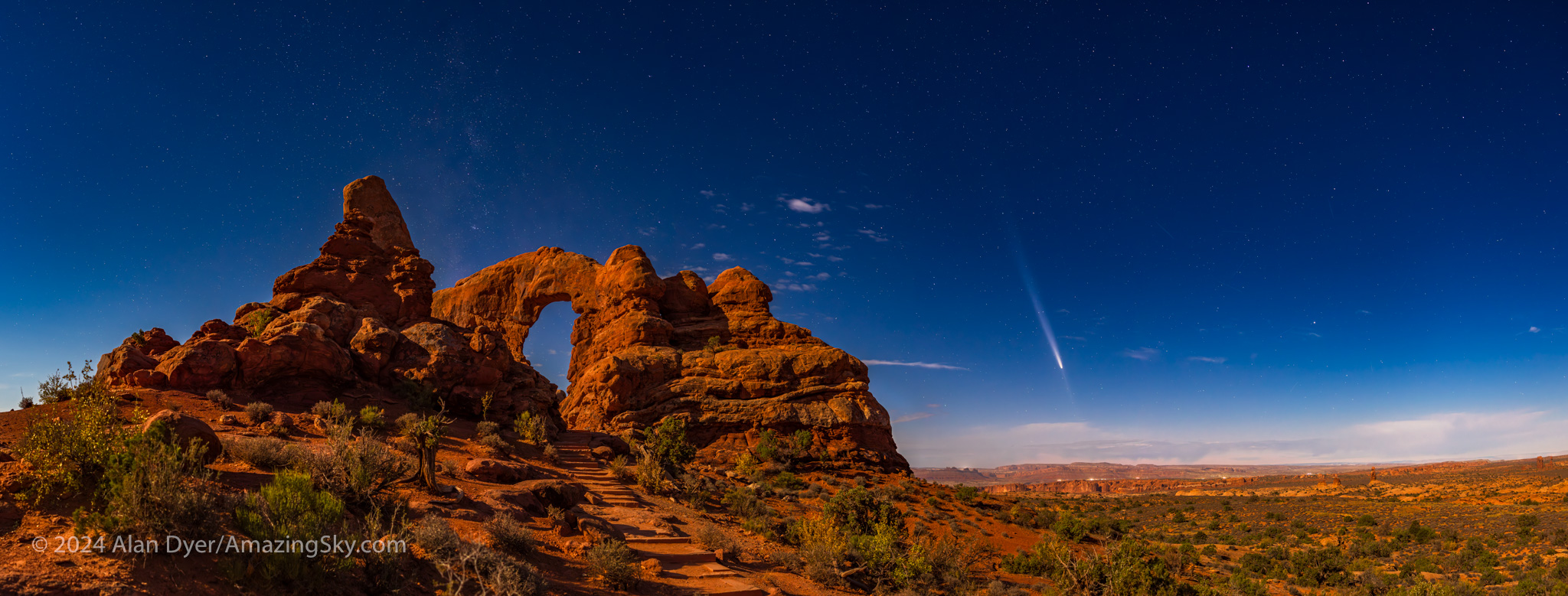
This is Comet Tsuchinshan-ATLAS (C/2023 A3) at its finest in the evening sky, on October 14, two days after its closest approach to Earth, and with it sporting a 10ยบ- to 15ยบ-long dust tail, and a short narrow anti-tail pointed toward the horizon. The location was Turret Arch in the Windows area of Arches National Park, Utah.

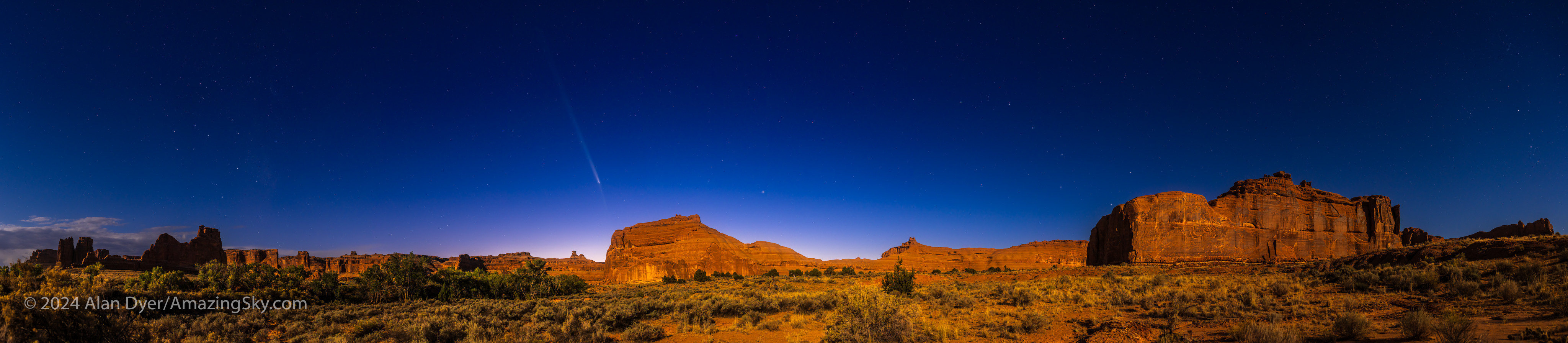
It blossomed nicely, especially as it entered into the evening sky in mid-October, as above. Despite the bright moonlight, it was easy to see with the unaided eye, a celestial rarity we get only once a decade, on average, if we are lucky. My blog of my comet chase is here

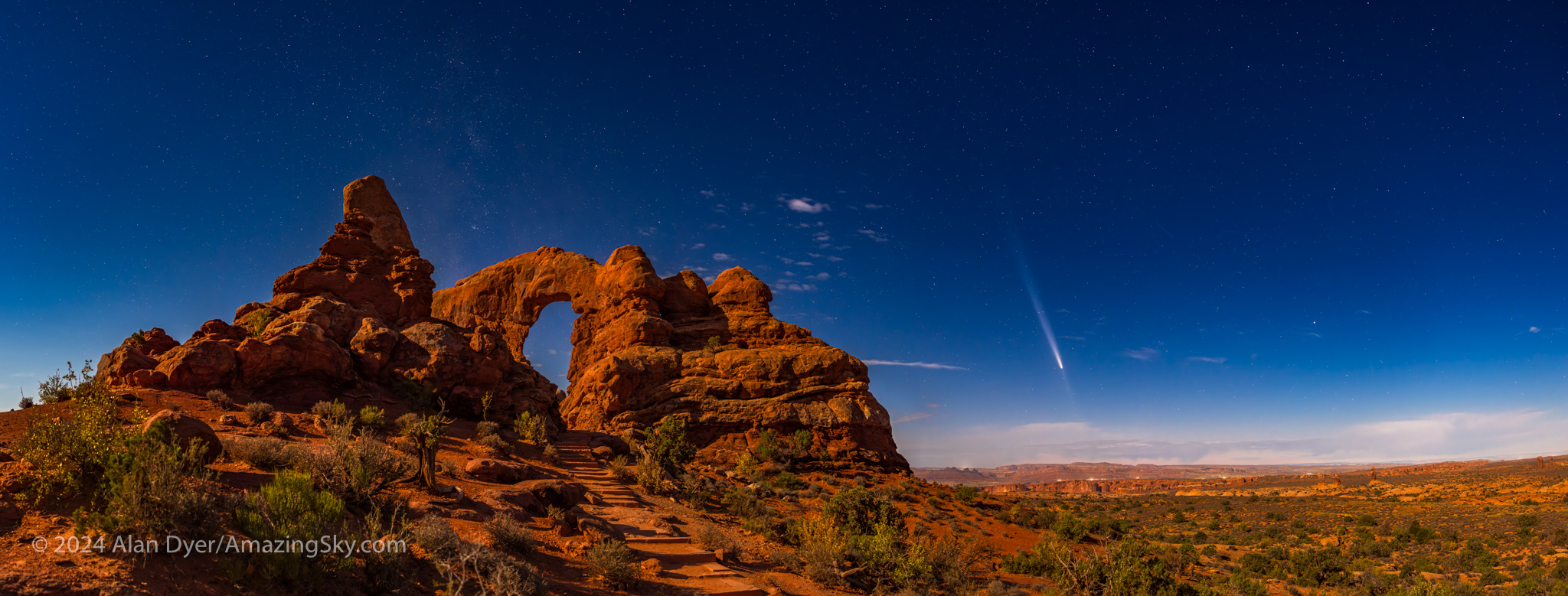
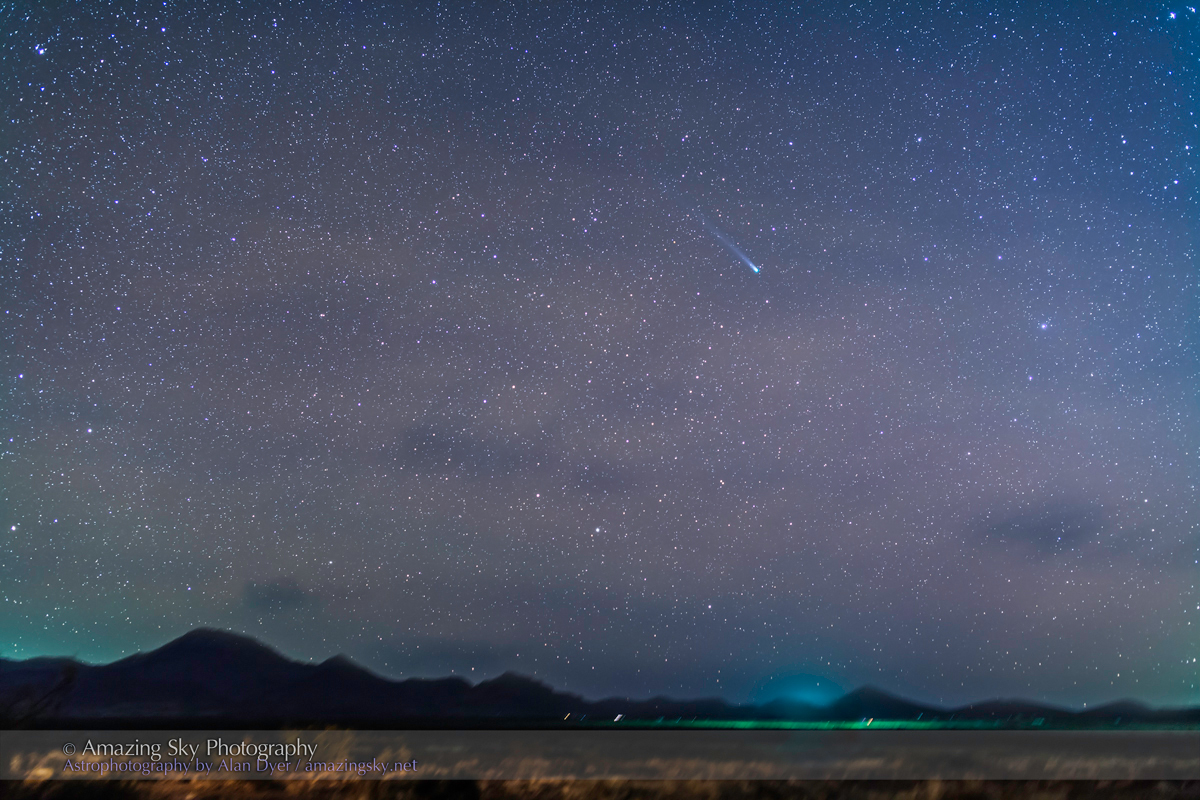
This is a panorama of Comet Tsuchinshan-ATLAS over Arches National Park, Utah, on a moonlit night, October 15, 2024, with the comet easy to see with the unaided eye.

A naked-eye comet ranks an 8 on our Aah! Factor scale. So now 2024 had delivered all four of our Top 4 sky sights. 
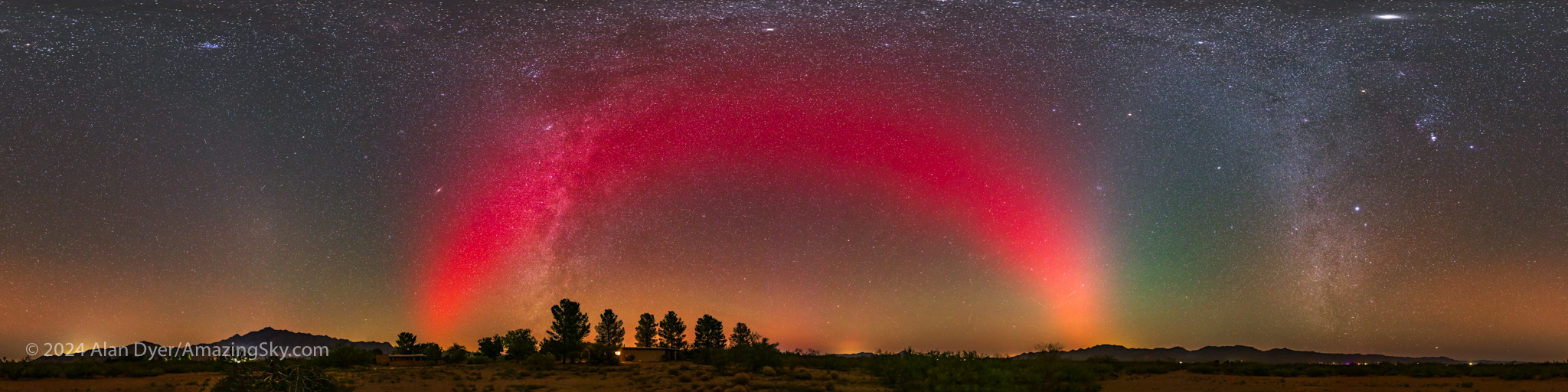
This 360ยฐ panorama captures a rare SAR (Stable Auroral Red) arc across the Arizona sky in the pre-dawn hours of October 11, 2024. The SAR arc was generated in the high atmosphere as part of the global geomagnetic storm of October 10/11, 2024, with a Kp8 rating that night.

But … just as a bonus, there was another fabulous aurora on October 10, seen in my case from the unique perspective of southern Arizona, with an appearance of a bright “SAR” arc more prominent than I had ever seen before. So that view was a rarity, too, so unusual it doesn’t even make our Aah! list, as SARs are typically not visible to the eye.


Back to Norway for Northern Lights

2024 was notable for travel getting โ€œback to normal,โ€ at least for me, with two long-distance drives, and now my second overseas trip. This one took me north to Norway ๐Ÿ‡ณ๐Ÿ‡ด, which I had been visiting twice a year as an enrichment lecturer during pre-pandemic years. 
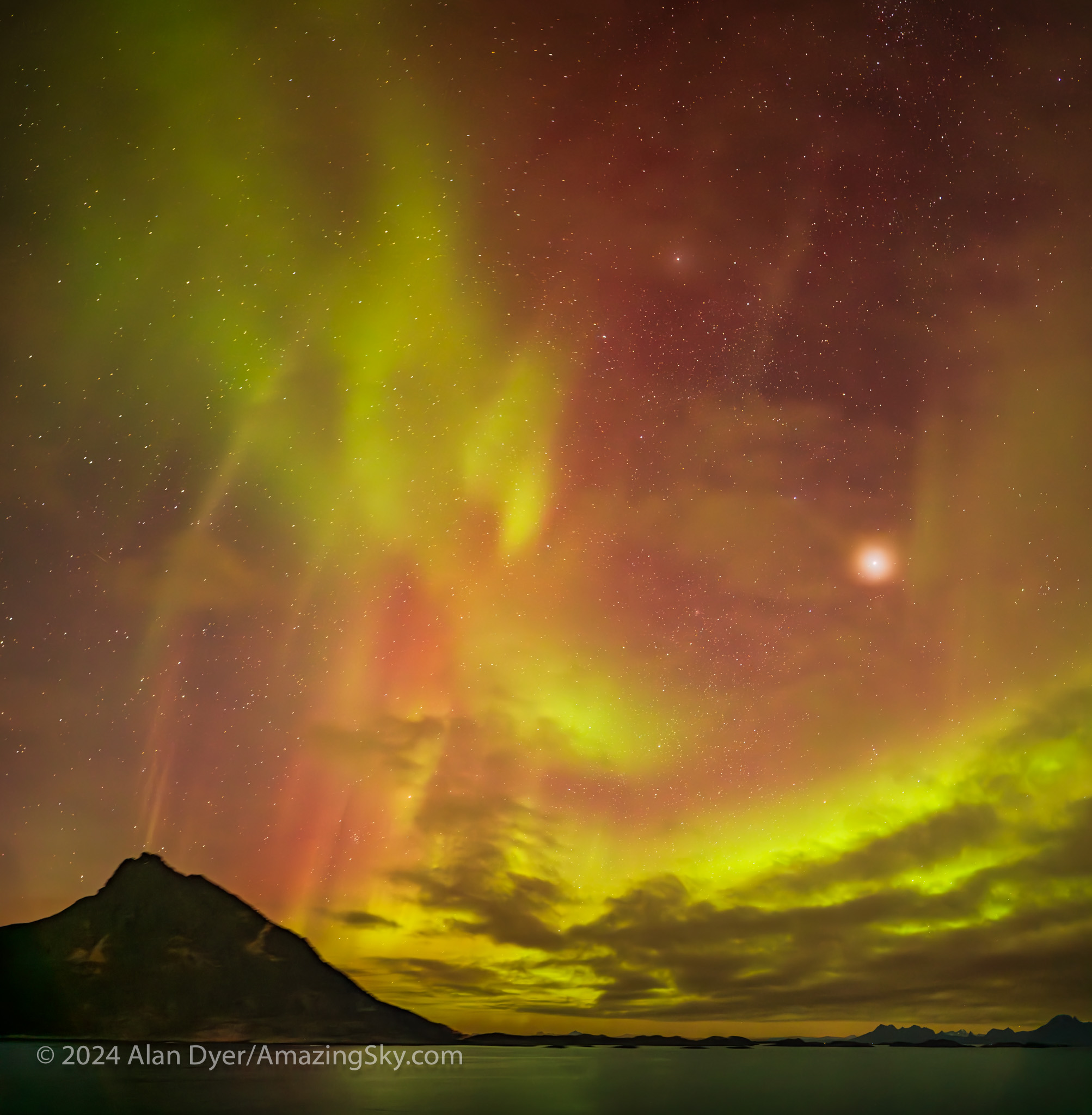
A green and red aurora appears over the coast of Norway, with Jupiter bright at right. This was from the Hurtigruten ship m/s Nordkapp on November 10, 2024, on a coastal cruise with a Road Scholar tour group.

The auroras were excellent, though nothing like the great shows of May and October. But the location sailing along the scenic coast and fjords makes up for any shortfall in the Lights. It was good to be back. I plan to return in 2025 for two cruises in October. Join me there, too!


A Winter Moonrise to End the Year

As I write this, December has been nothing but cloud. Almost. A clear hour on Full Moon night allowed a capture of the โ€œCold Moon,โ€ with the Moon near Jupiter, then at its brightest for the year. So thatโ€™s the other lunar bookend to the year, shot from the snowy backyard. 

This is the Full Moon of December 14, 2024, near the planet Jupiter at lower right. Both were rising into the eastern sky in the early evening.

However, I did say after the clear total eclipse in April that if the rest of 2024 had been cloudy I wouldnโ€™t complain. So Iโ€™m not. 

And thereโ€™s no reason to, as 2024 did deliver the best year of stargazing I can remember. 2017 had a total solar eclipse. 2020 had a great comet. But we have to go back to 2003 for aurora shows as widespread and as a brilliant as weโ€™ve seen this year. 2024 had them all. And more!

We might see more auroras in 2025. And we have a total eclipse of the Moon. Two in fact, if youโ€™re willing to travel to the other hemisphere. 
My 2025 Calendar cover. Go to https://www.amazingsky.com/Books

My 2025 Amazing Sky Calendar lists my picks for the best sky events of the coming year, with the emphasis on events viewable from North America. For a free PDF download of my Calendar, go to my website here

Clear skies to all, in a Happy New Year! 

โ€” Alan, December 21, 2024 / amazingsky.com 
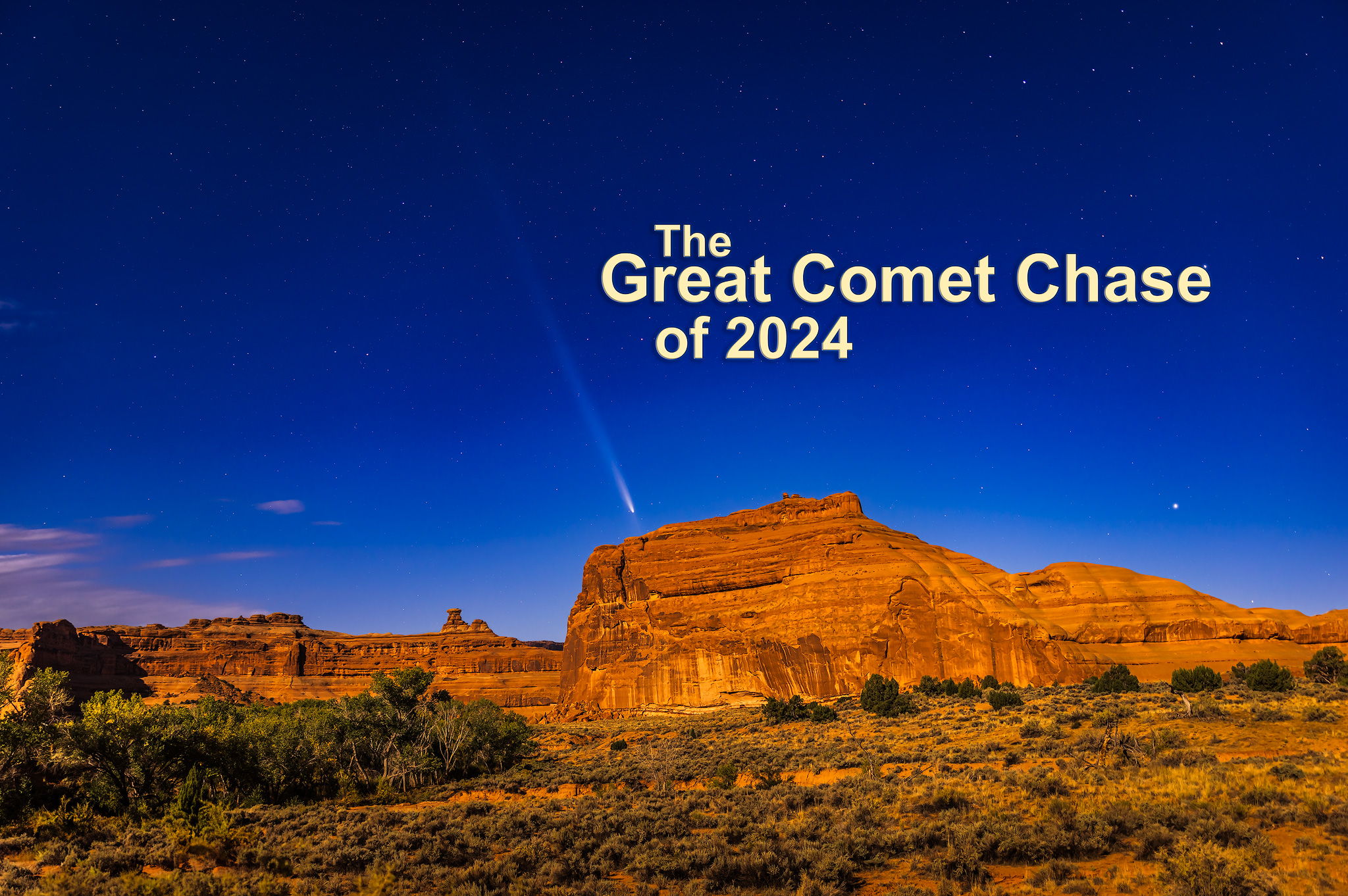
The Great Comet Chase of 2024


A plan to shoot the promised bright comet of 2024 paid off, with fine views at dawn and at dusk of the best comet since 2020. 

Comets are always a gamble. Any new comets discovered, the ones that usually become the brightest, have no track record of performance. Predictions of how bright a new comet might appear are based on what a typical comet should do. But comets can outperform expectations and dazzle us, or they can fizzle and fade away. 

In late 2023 it was clear that a then newly-discovered comet, C/2023 A3, named Tsuchinshan-ATLAS after the observatories where it was co-discovered, had the potential to perform in late 2024.ย 

The low angle and position of the comet from home in Canada in the late September dawn sky, simulated in StarryNight software.

Knowing where it would be in the sky (that trait of a comet can be predicted with accuracy!) I planned a field trip to the U.S. desert Southwest for late September and early October 2024. From farther south the comet would be higher than it would be from home (shown above), and over spectacular landscapes. 

I had visions of another Comet NEOWISE from July 2020. As my blog from 2020 shows, we saw that photogenic comet well from our northern latitude in Canada, as it skimmed across the northern horizon. Tsuchinshan-ATLAS would require a chase south.ย 


September 26 & 27 โ€” at Bryce Canyon, Utah

In late September 2024 the comet would be inbound, approaching the Sun and in the morning sky. What better eastern scene than overlooking Bryce Canyon in Utah, where I had been a year before, for the October 14, 2023 annular eclipse of the Sun in the morning sky. (Click the link for my eclipse chase blog.)

I was fortunate to get two clear mornings, both from the Fairyland Canyon viewpoint, just a short walk from the parking lot to carry camera gear and tracking mounts. 

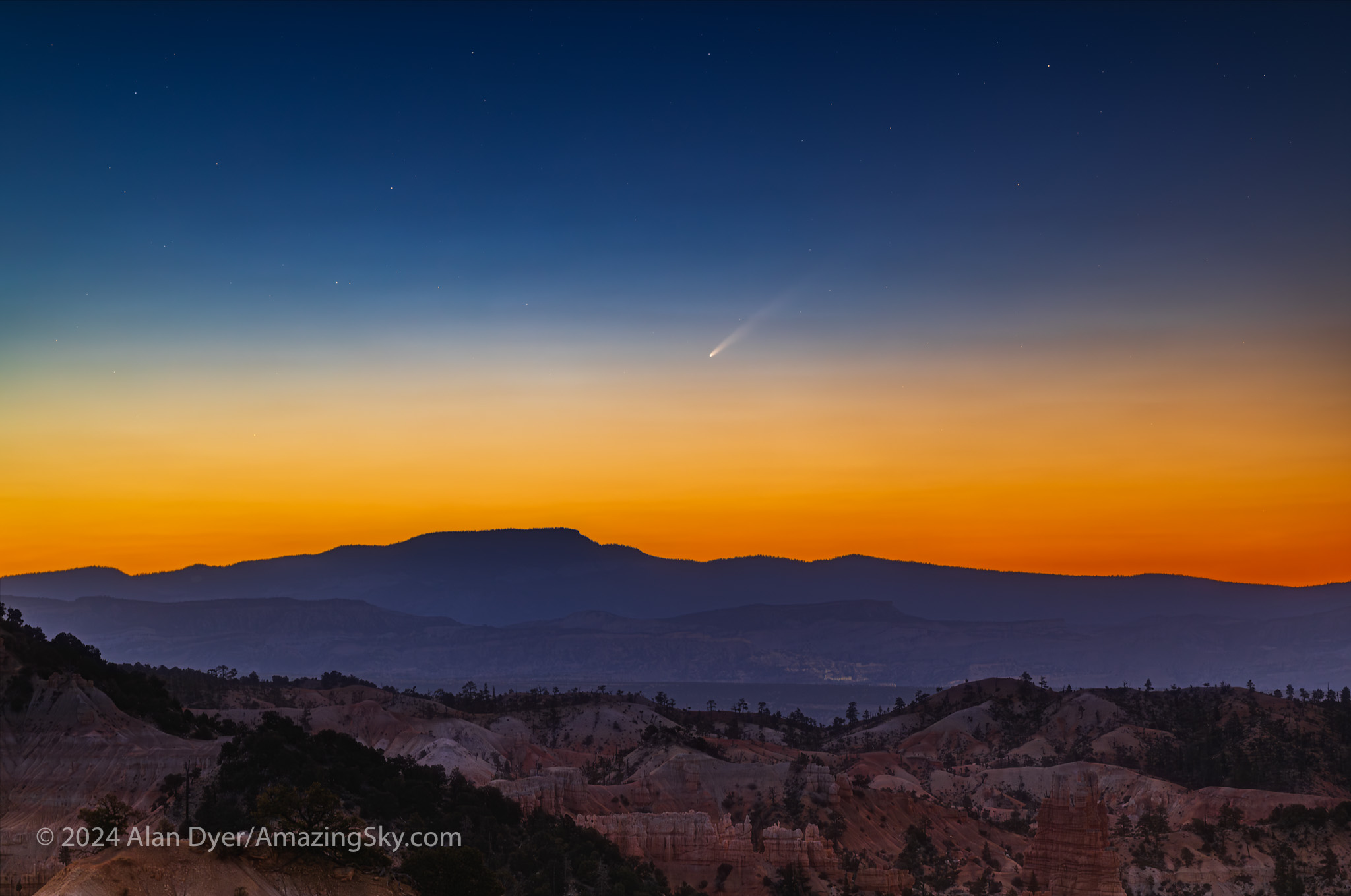
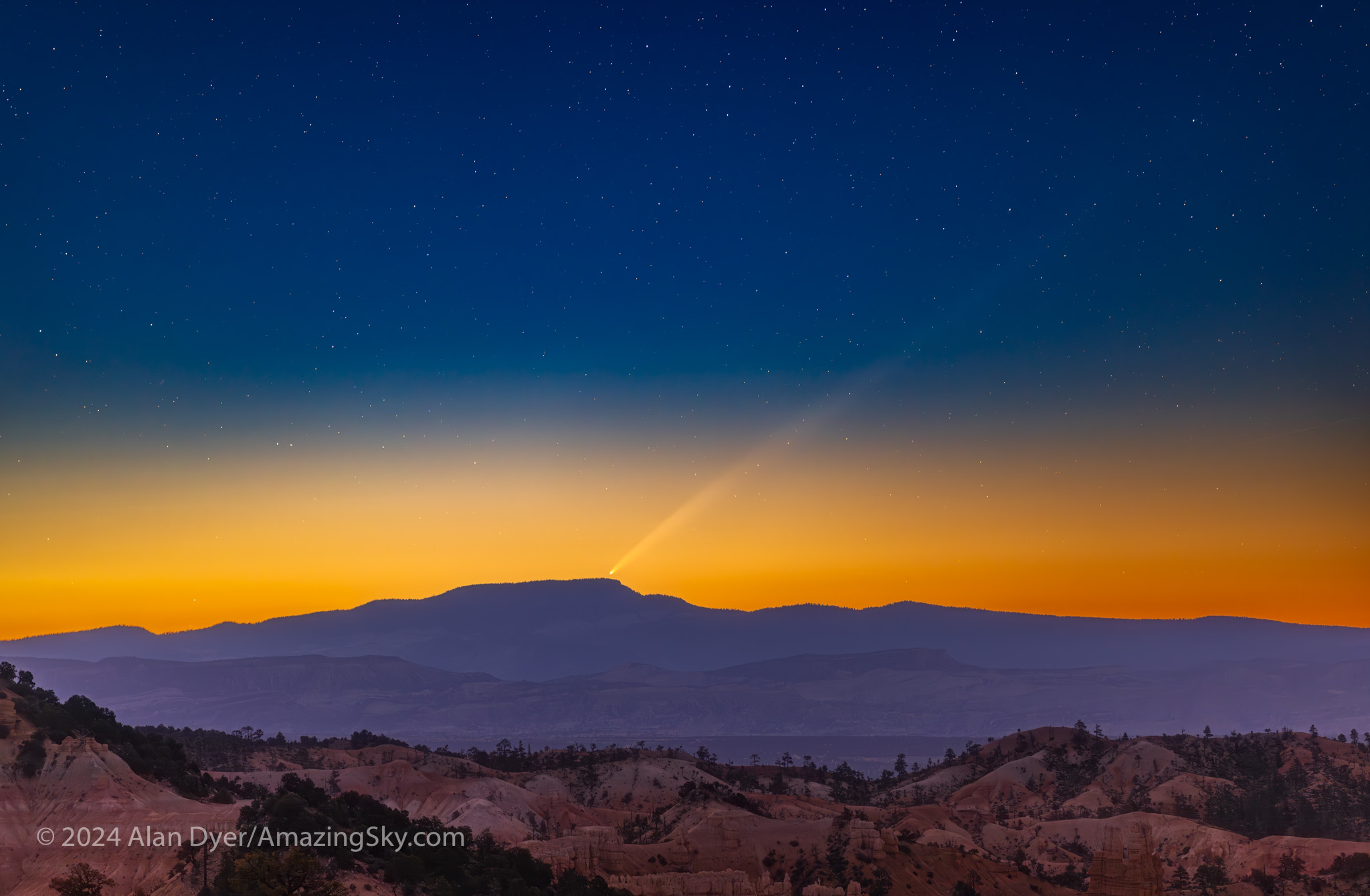
Comet C/2023 A3, Tsuchinshan-ATLAS, at dawn over Bryce Canyon, on the morning of September 27, 2024.

My first look at the comet on September 27 was on the day the comet was at perihelion, closest to the Sun in its orbit, though not in the sky at our viewing angle from Earth. 

The comet was just visible to the unaided eye, but was obvious on the camera view screen, even amid the bright twilight. I had to shoot fast as the window between โ€œcomet riseโ€ and the sky brightening too much was only a few minutes long. 

Comet C/2023 A3, Tsuchinshan-ATLAS, rising in the twilight over Bryce Canyon, on September 28, 2024.

Knowing better what to look for, I caught the comet a little sooner the next morning on September 28, and so the tail appeared longer and more impressive as it rose above the distant mountains. A group of other local photographers arrived just a few minutes too late both mornings, and so struggled to just sight the comet, let alone photograph it. 

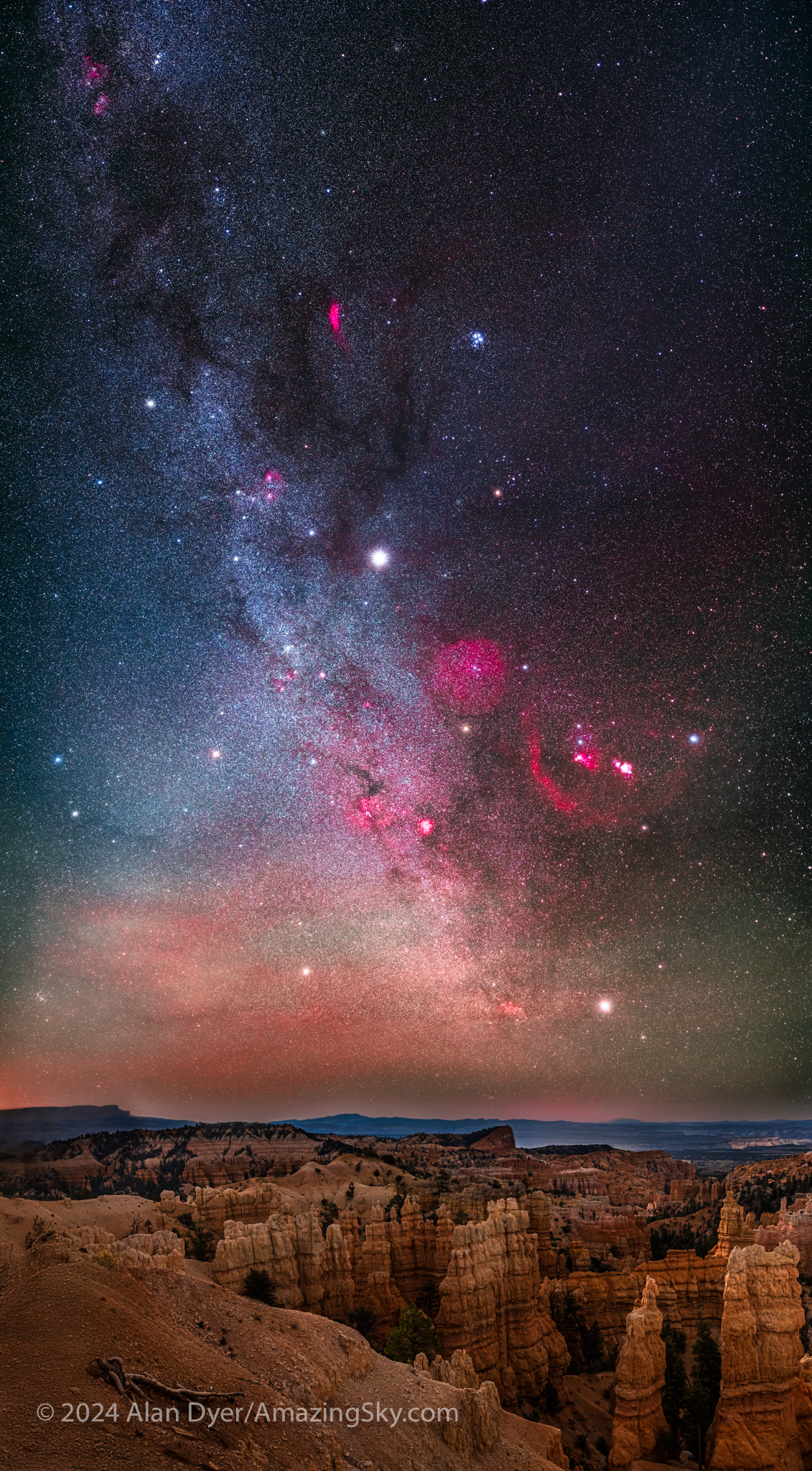
This vertical panorama takes in the nebula-rich northern winter Milky Way over the formations of Bryce Canyon National Park, from the Fairyland Canyon viewpoint.

But I had arrived extra early, to shoot a vertical panorama (above) of the winter Milky Way over the canyon formations below. This and the comet images were shot with the aid of a sky tracker to follow the stars, but with the tracker off for separate shots of the ground. 

So I had bagged the comet at Bryce! On to the next stop.


September 28 & 29 โ€” at Monument Valley, Utah

Thereโ€™s no more iconic or famous landscape in the American West than the buttes of Monument Valley, on the Navaho Tribal Lands on the Arizona/Utah border. 

This panorama from the Navaho Tribal Park at Monument Valley shows the evening twilight sky looking east opposite the sunset to the rising dark blue arc of Earth’s shadow cast on the atmosphere. The shadow is rimmed with a pink “Belt of Venus” tint from sunlight still hitting the upper atmosphere.

A clear first evening provided a fabulous view of the arc of Earthโ€™s shadow across the eastern sky from the viewpoint near the aptly named The View Hotel. 

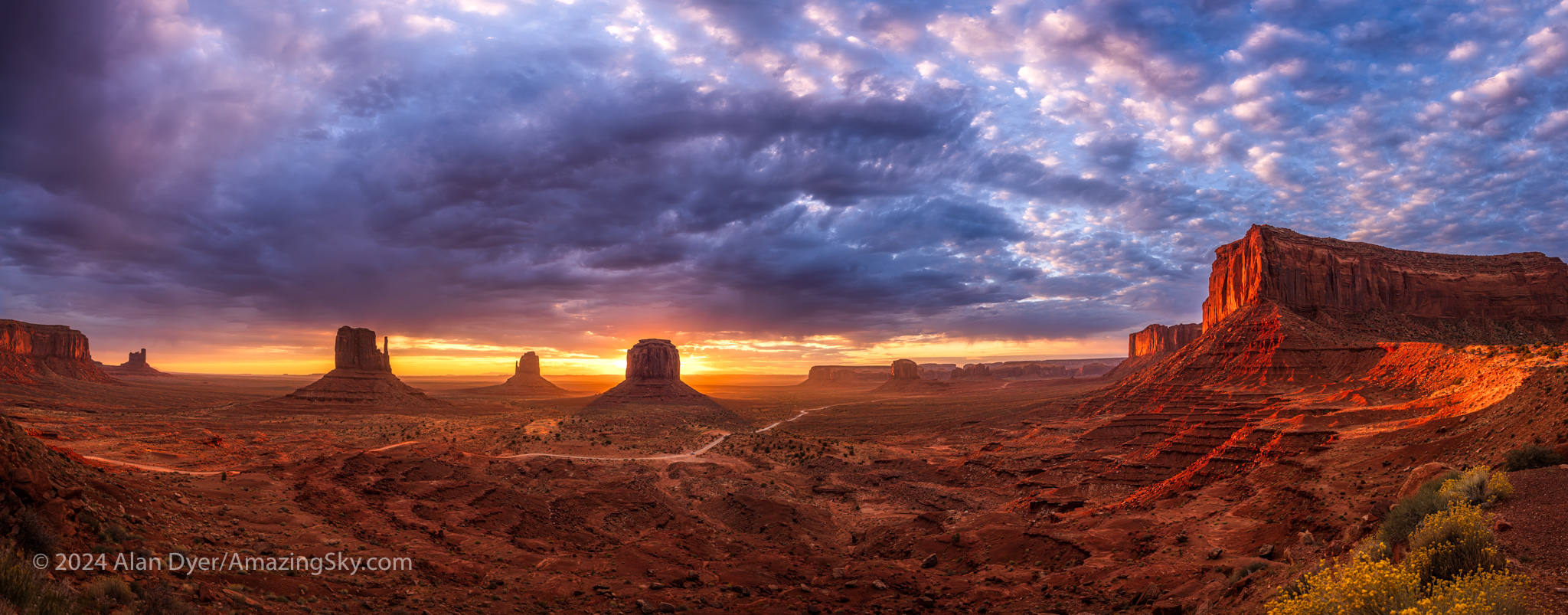
This is a panorama of the sunrise scene at the Navaho Tribal Park, Monument Valley, Arizona, taken just after sunrise with the low Sun lighting the iconic buttes and mesas of the Valley. The West and East Mittens are at left; the Sun was behind Merrick Butte at centre, and lighting Mitchell Mesa at right.

A wonderful sunrise on my second morning there made for a spectacular panorama. But while clouds created fine sunrise lighting, they arenโ€™t conducive to seeing comets!

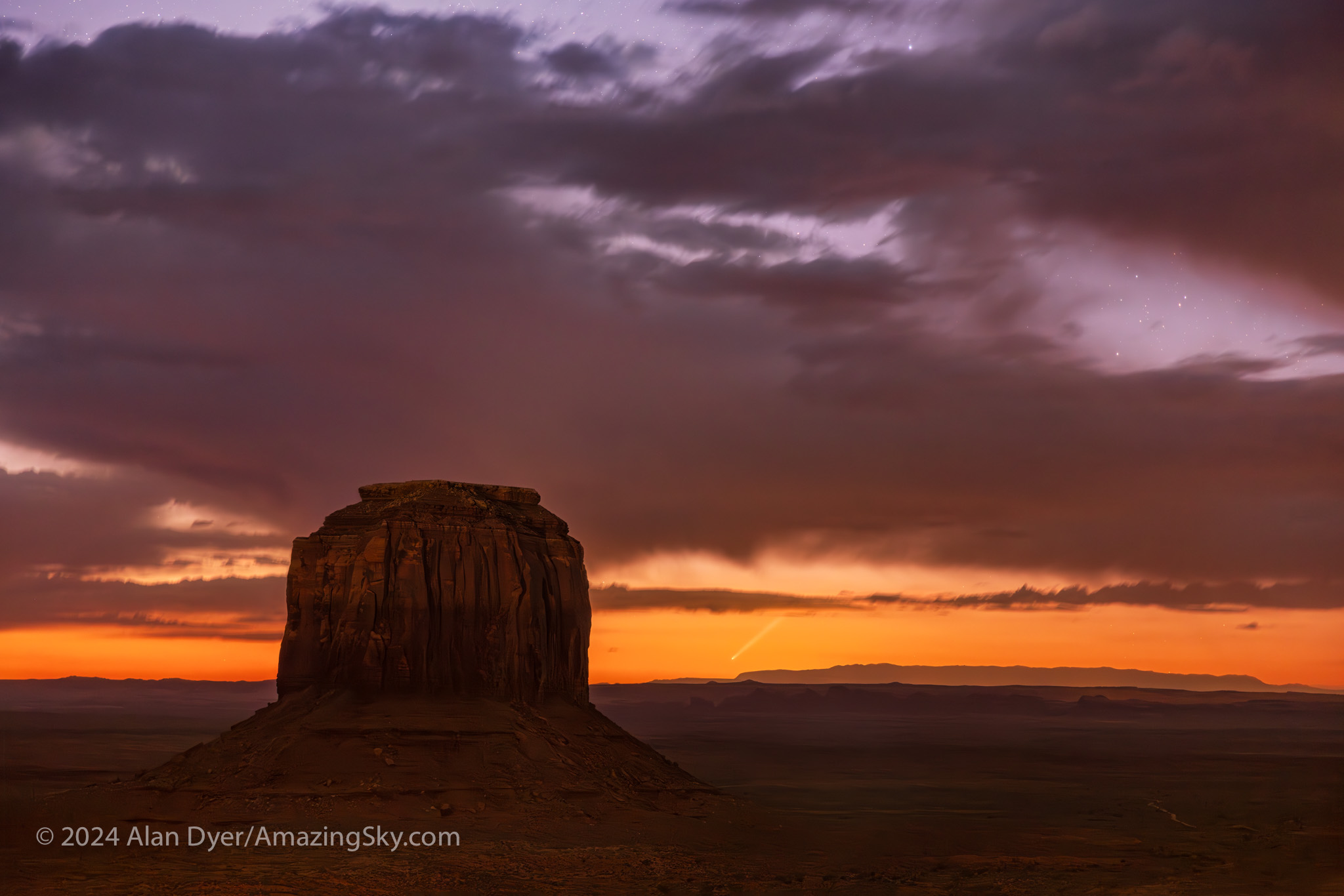
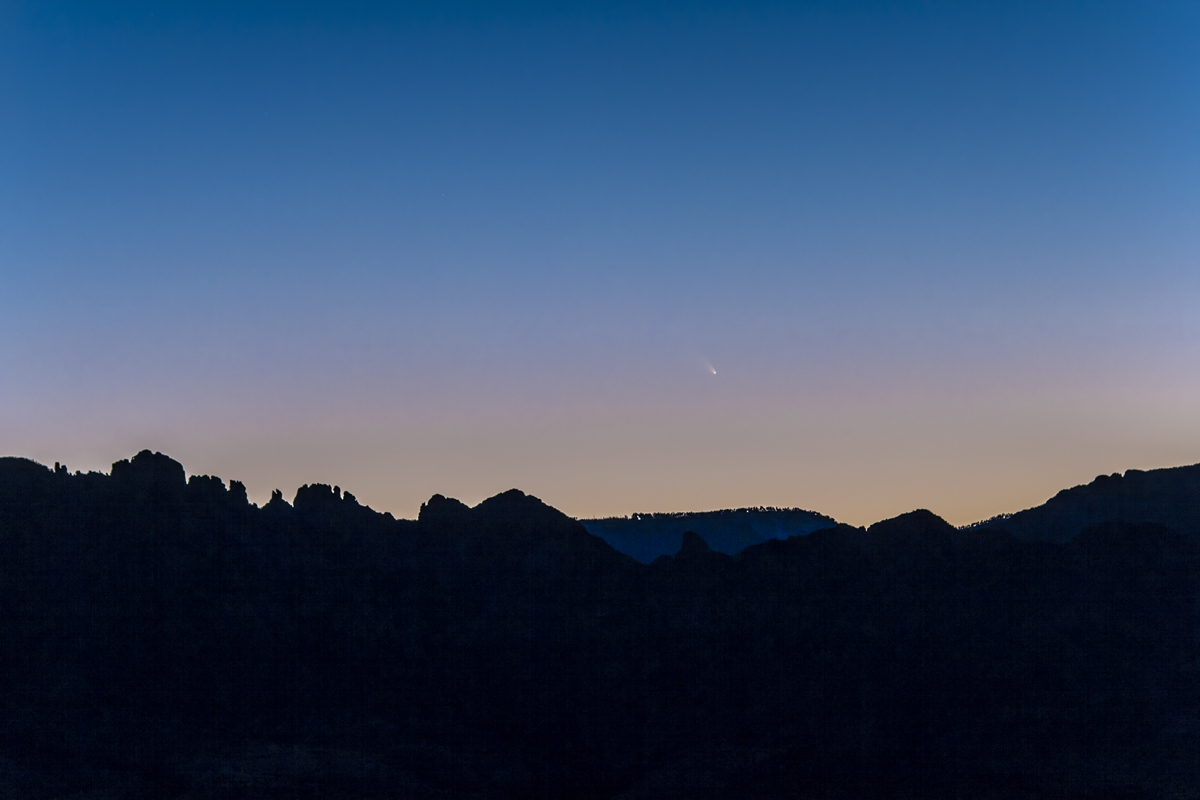
Comet C/2023 A3, Tsuchinshan-ATLAS (at centre), is rising in the dawn twilight over Monument Valley, Arizona on the morning of September 30, 2024. The comet is rising just south (right) of Merrick Butte.

A band of clear sky near the horizon allowed me to catch the comet rising to the right of Merrick Butte, as seen from a spot south of The View from where I had calculated the comet would rise in the right position. From the usual Valley viewpoint farther north the comet would have been behind the butte. 

While the planning worked, the result was not quite the spectacle I had envisioned. The comet was nice, but was starting to become lost in the bright sky as it descended toward the Sun. 

There were only a couple of mornings left to catch the comet at dawn before it disappeared completely into the daytime sky close to the Sun. 


October 1 to 11 โ€” at Quailway Cottage, Arizona

The major block of time in my trip was booked for an astrophoto retreat at a cottage Iโ€™d rented twice before but not since late 2017. The Quailway Cottage, popular among birders, is also ideal for stargazing as it is in one of the darkest areas of the Southwest, north of Douglas, Arizona, and just across the Arizona/New Mexico border. 

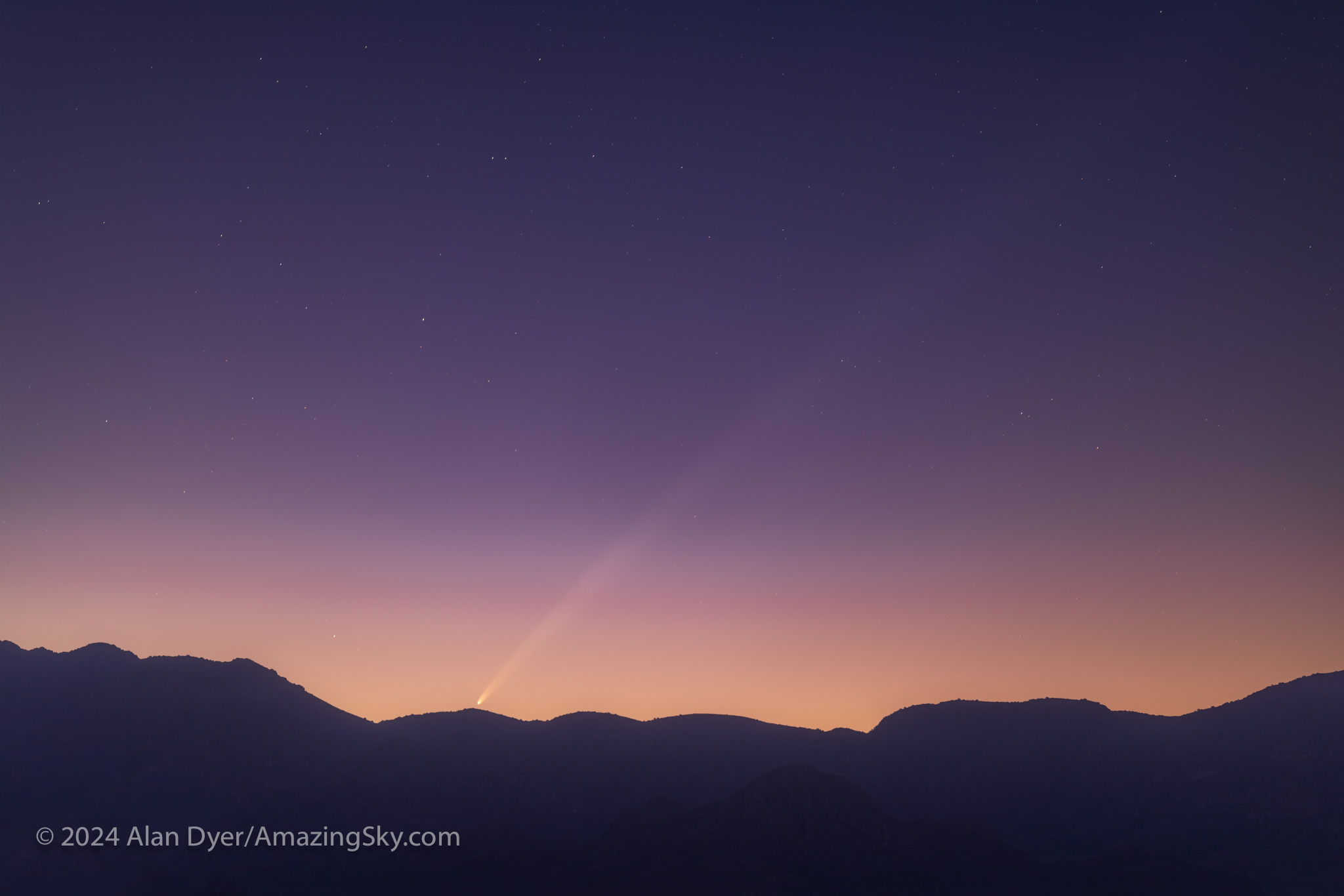
This captures both the glow of Zodiacal Light in the eastern dawn sky (the band of light extending up across the frame) and the dust tail of Comet Tsuchinshan-ATLAS rising from behind the Pelloncillo mountains, at dawn on October 2, 2024.

When I arrived the comet was putting in its last show in the dawn sky. In fact, on October 2 I managed to capture a dawn scene with the morning Zodiacal Light created by sunlight reflecting off cometary dust in the inner solar system, and just the tail of the comet rising before the bright comet head appeared.

Comet C/2023 A3, Tsuchinshan-ATLAS, is rising in the dawn twilight over the Pelloncillo Mountains in New Mexico, on October 2, 2024.

An image taken a little later showed the entire comet, now sporting a more impressive tail. It was blossoming into a fine comet indeed. But we were about to lose sight of it for more than a week. 

Arizona Deep-Sky Imaging 

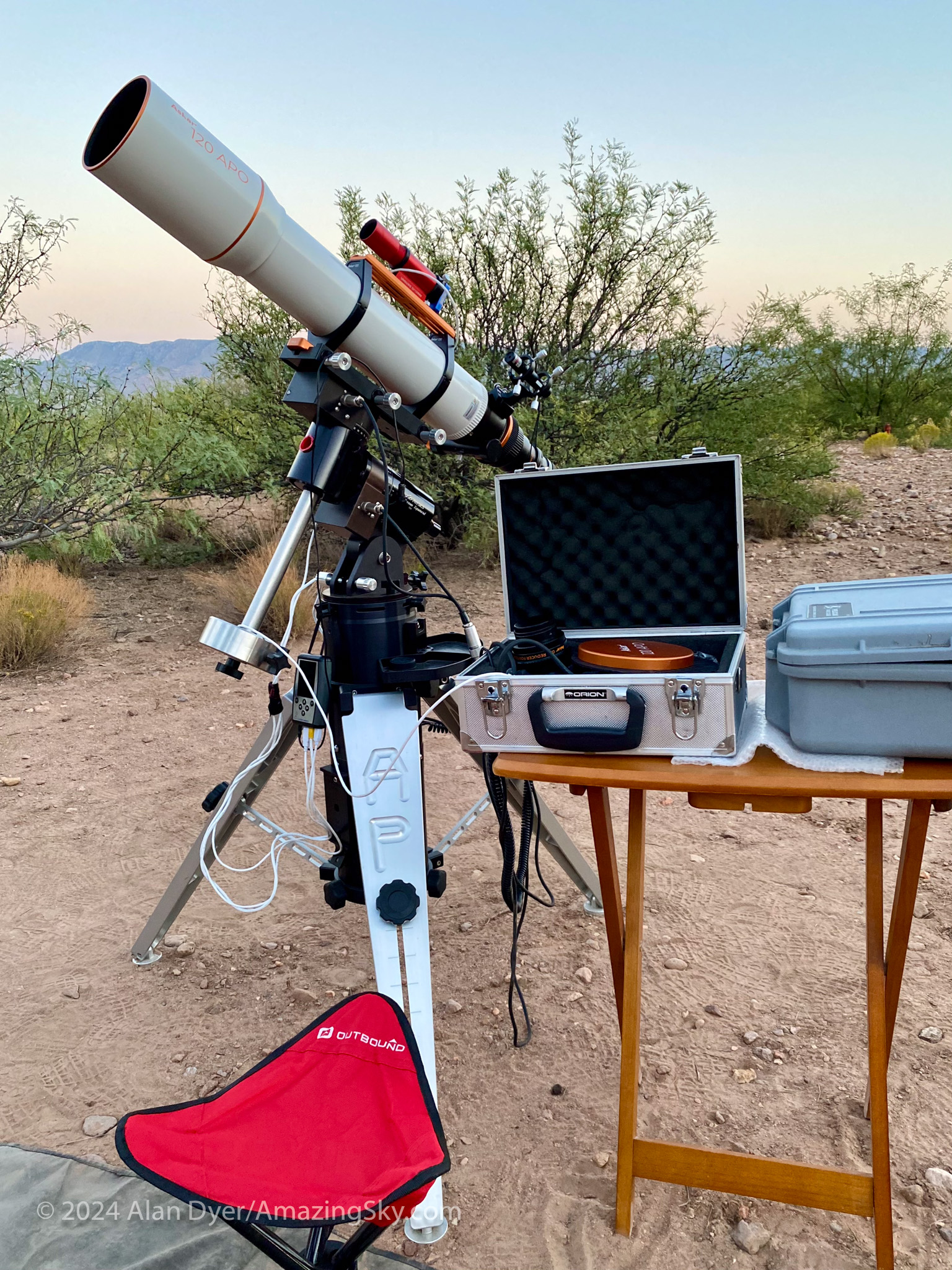
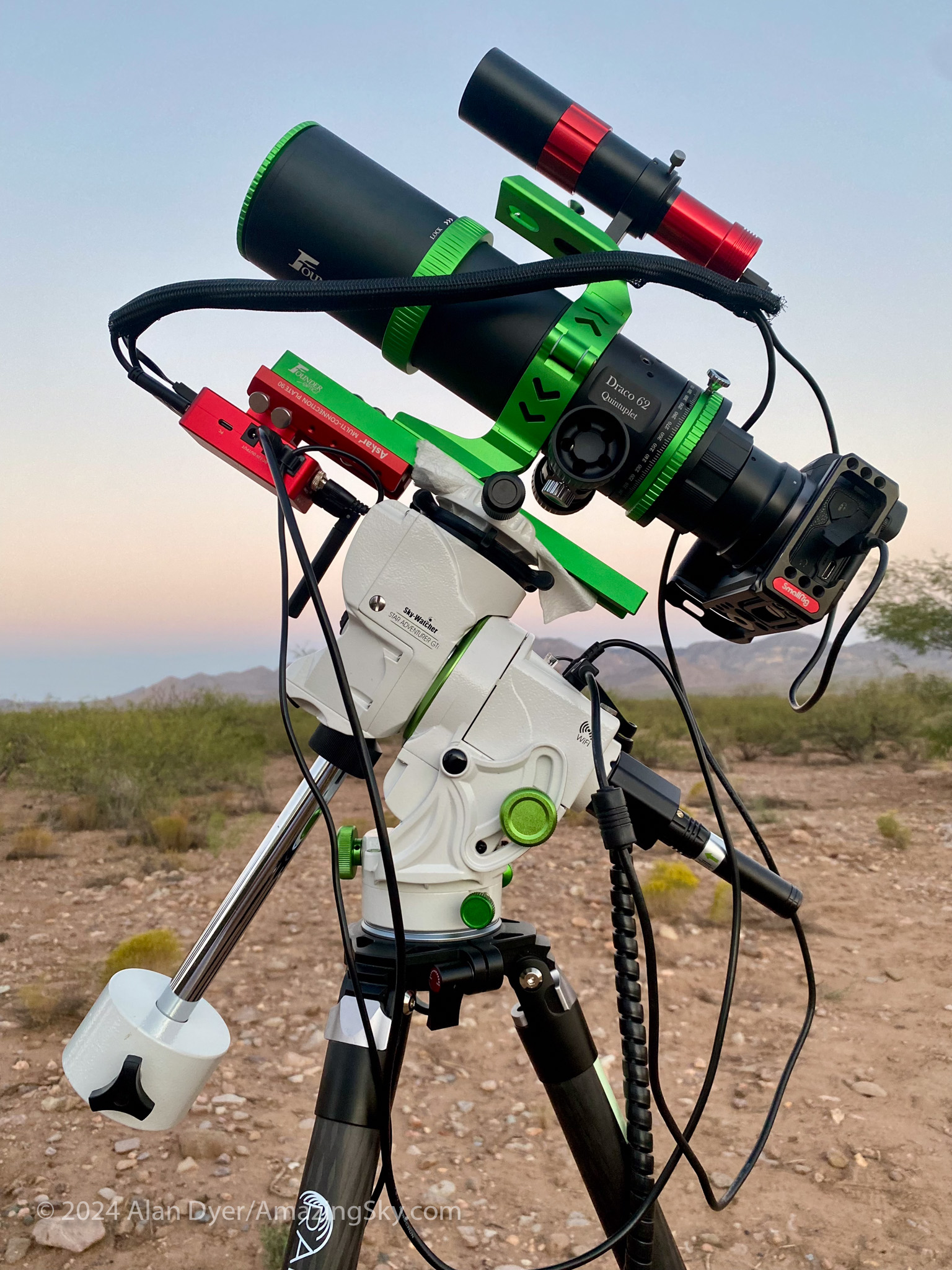
While at Quailway I had clear skies every night. And so, as planned, I went to town shooting all kinds of โ€œdeep-skyโ€ objects and fields with two astrophoto rigs I had brought with me: a longer-focal length 120mm refractor for small targets, and a short-focal length refractor for wide fields in the Milky Way. I had reviewed both new telescopes in recent months. 

I concentrated on shooting targets low in the south that are impossible to get from home in Canada, and that Iโ€™ve missed shooting, or have not shot well, during my visits to Australia.ย See my blog here about my latest trek Down Under.

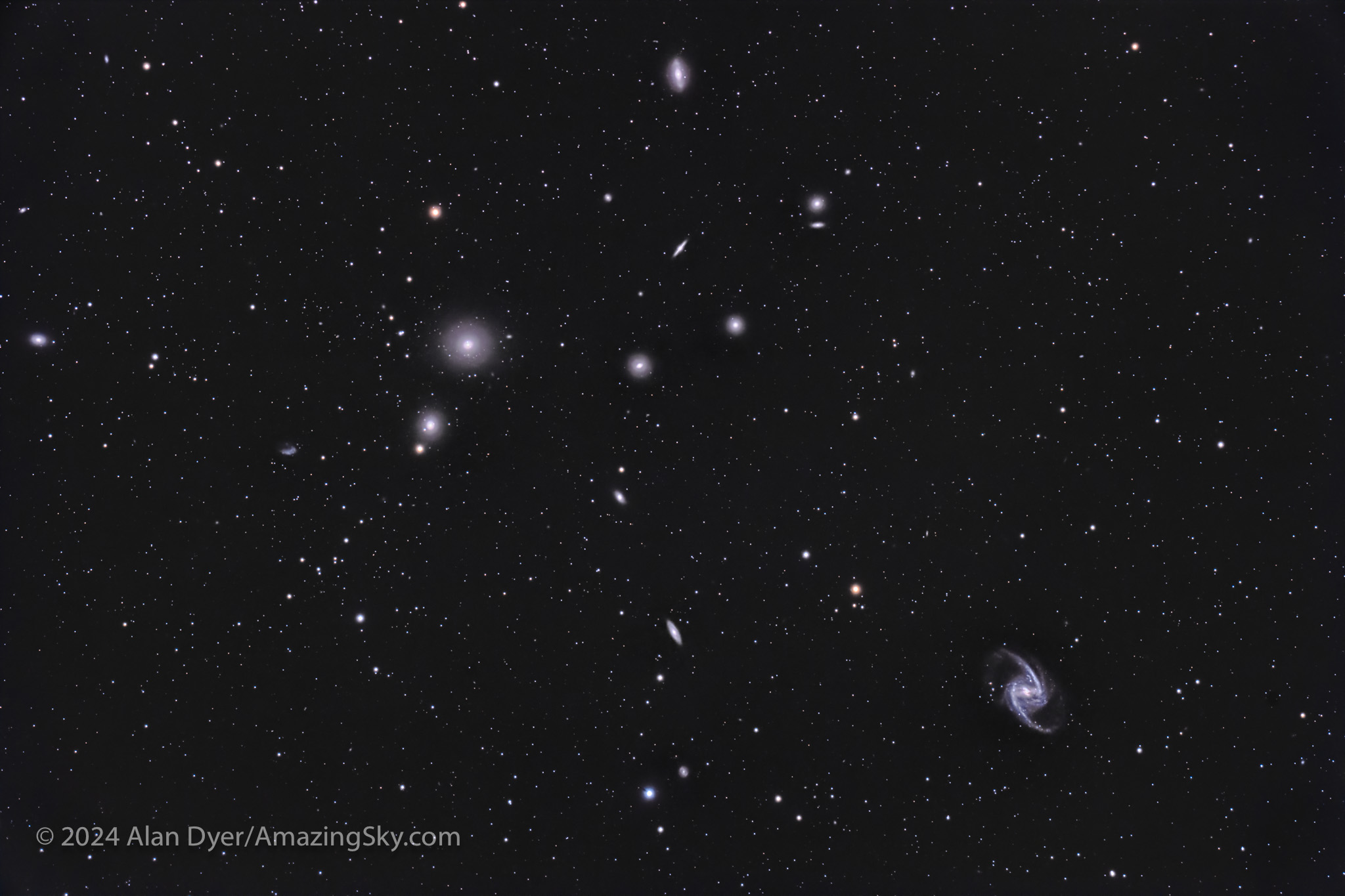
The two brightest Fornax cluster members are the elliptical galaxy NGC 1399 at upper left, paired with smaller NGC 1404, and the galaxy NGC 1365 at lower right, considered one of the best barred spirals in the sky.

Hereโ€™s an example, above, with the larger Askar 120APO: a field of galaxies in the constellation of Fornax that rivals the better-known Markarianโ€™s Chain of galaxies in Coma Berenices in the northern spring sky.

This frames the spectacular region of the Milky Way near the direction of the galactic centre in Sagittarius.

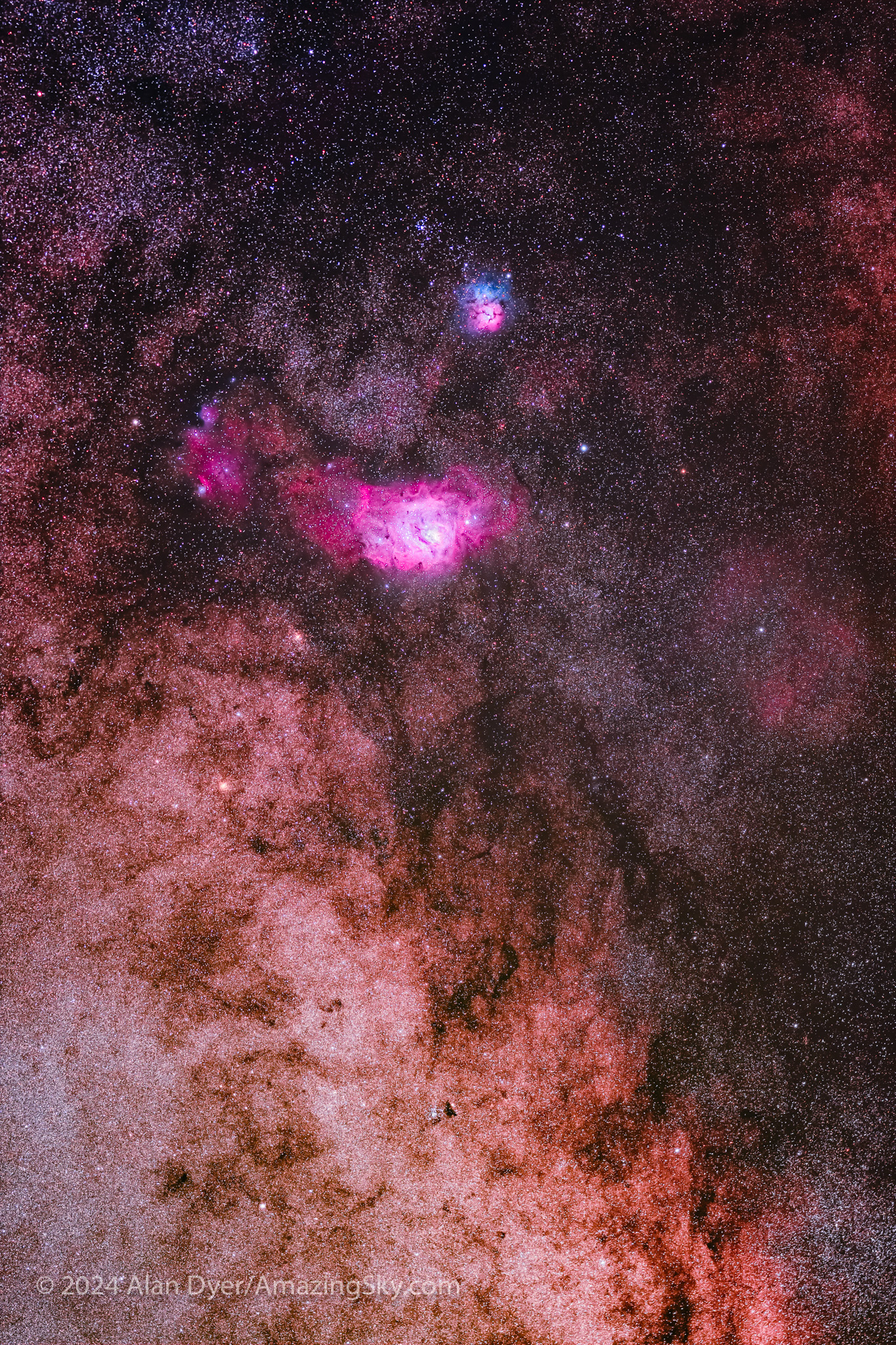
And hereโ€™s a field (above) with the small Founder Optics Draco 62mm scope, framing the rich Sagittarius Starcloud punctuated with the small dark Ink Spot Nebula, all below the bright Lagoon and Trifid Nebulas. 

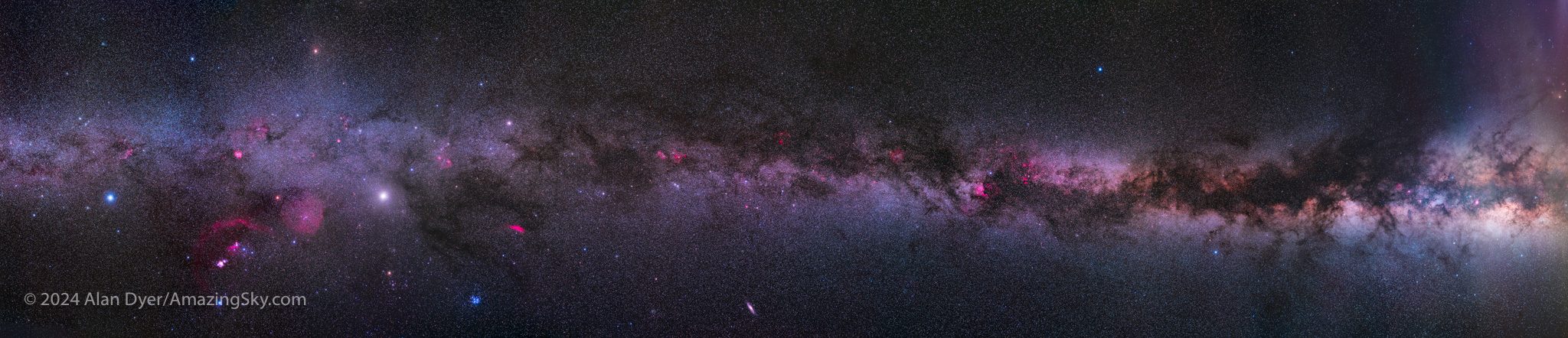
This panorama extends for about 240ยบ along the northern half of the Milky Way, from Orion at left, to Sagittarius at right, and centered on the Galactic Equator.

In autumn the Milky Way is up all night. So I used a simple star tracker, the MSM Nomad reviewed here on my blog, and a 28-70mm lens at 35mm to shoot a panorama from dusk to dawn along the Milky Way โ€” from the summer stars of Sagittarius and Cygnus (at right, above), through the autumn constellations overhead in Cassiopeia and Perseus (at centre), and down into the pre-dawn sky with the winter stars in and around Orion (at left). 

A Bonus Aurora from Arizona 

I was just north of the Mexican border, at a latitude 32ยฐ North, more than 20ยฐ farther south than at home in Alberta. But what should appear in my sky but โ€ฆ aurora! 

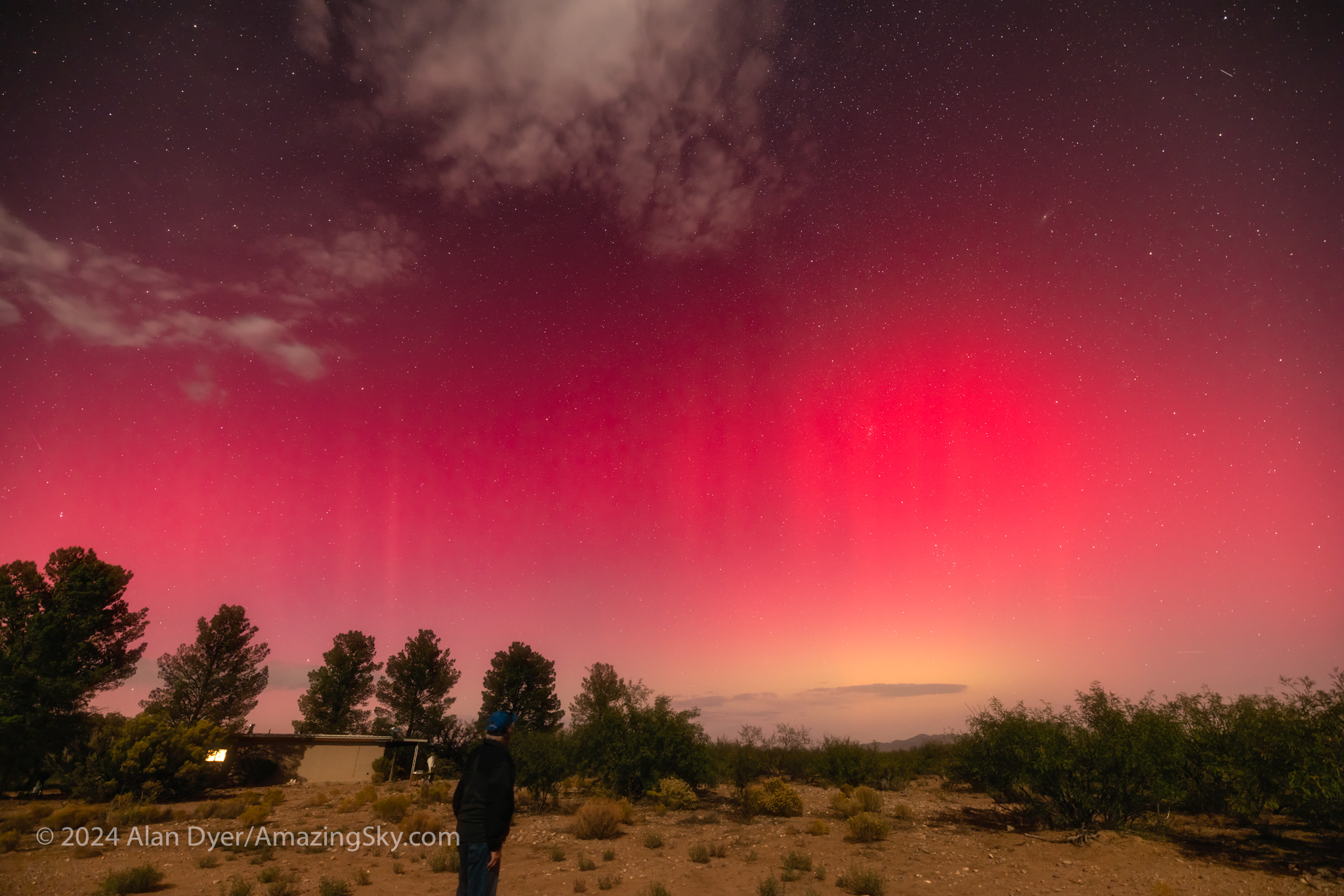
A selfie of me observing the great red aurora of October 10, 2024, from southern Arizona.

On October 9, and then again more so on October 10, a great solar storm brought Northern Lights down to me. And indeed across all of Canada and the U.S. The result for me was a red glow to the north โ€” the tops of distant auroral curtains I would have seen filling my sky at home. 

A time-lapse of an Arizona aurora, using a 15mm wide-angle lens shooting nearly 400 forty-second exposures. View it in-line here. Enlarge to a full screen view. There is no sound.

Above is a time-lapse video of the aurora that night, from a camera aimed due north for four hours. The red curtains come and go through the night.

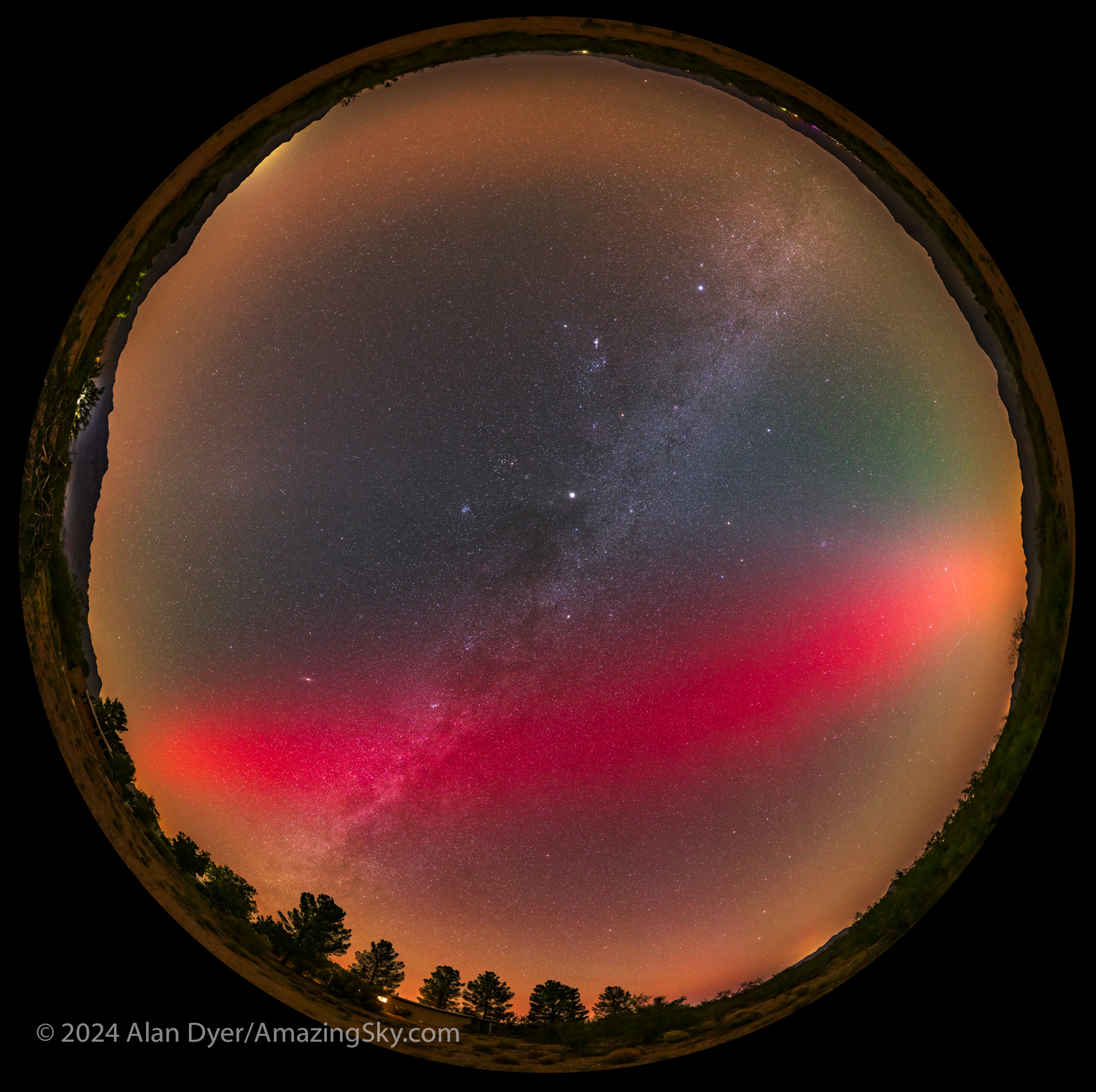
This is a 360ยฐ panorama covering the entire sky and extending up to the zenith at centre, capturing a rare SAR arc across the Arizona sky in the pre-dawn hours of October 11, 2024.

The remarkable feature that night, October 10/11, was not the aurora, but what is called a SAR (Stable Auroral Red) arc that persisted all night. It appeared as a diffuse red band across the sky, created by heat energy leaking into the upper atmosphere during the solar storm. SAR arcs can accompany an aurora but are not auroras themselves. 

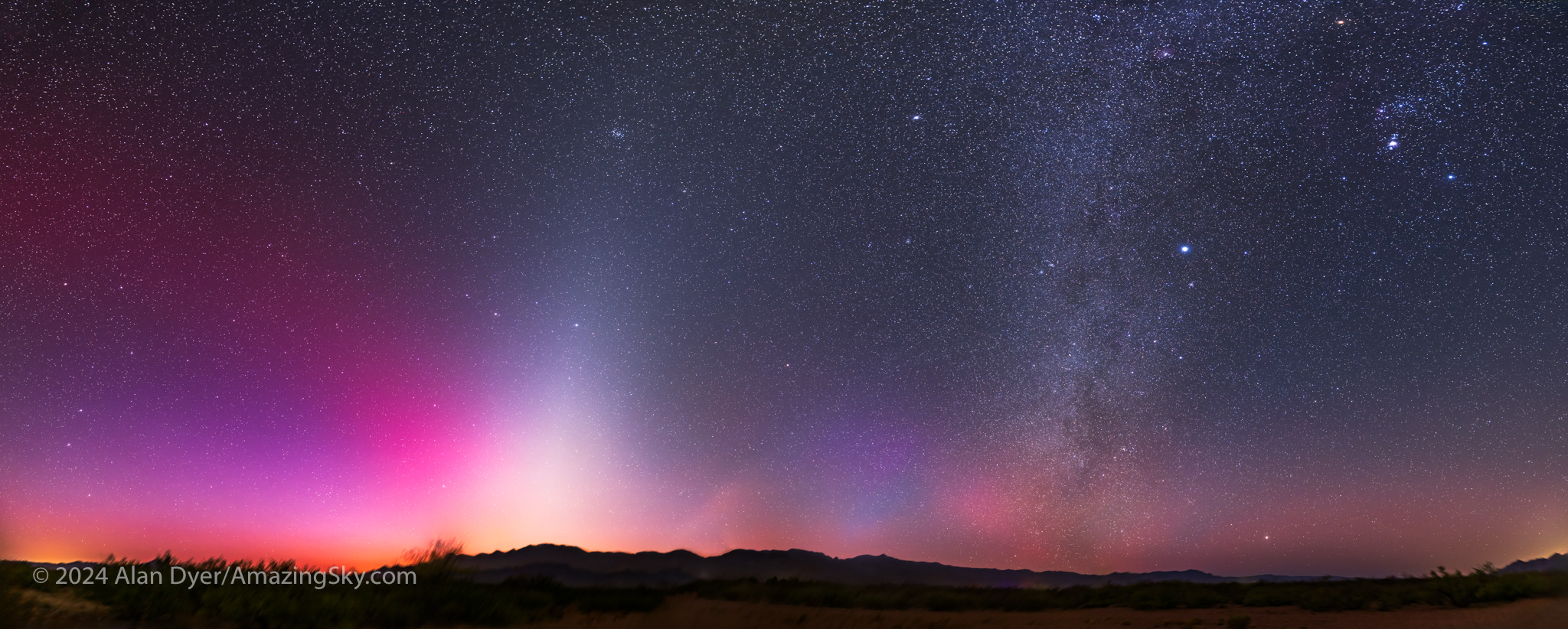
This panorama takes in a rare confluence of skyglows in a colourful dawn sky.

By dawn the next morning, now October 11, the tall Zodiacal Light was prominent alongside the magenta SAR arc to the north (left) and the winter Milky Way to the south (right). Thereโ€™s even a short pillar of light that might be an aurora fragment, or the tail of the comet!  

The Comet Returns 

However, toward the end of my 11-night marathon of deep-sky imaging, the bright head of the comet was to be rising into the evening sky for Part 2 of its apparition. Below is a shot from the evening of October 11, my last at Quailway. Yes, there it was, just above the Chiricahua Mountains. But it was a blip, barely visible in binoculars and to the camera. I had hoped for more. 

This is Comet Tsuchinshan-ATLAS (C/2023 A3) at far right, barely visible emerging into the evening sky and low in the twilight, on October 11, 2024. This view includes Venus at left. Venus was obvious; the comet was not!

With the Moon now waxing into the evening sky, my plan was to head back north, stopping at scenic spots on the trip home, to catch the comet over moonlit landscapes to the west in the dusk sky.

My first two nights, October 12 and 13, at the VLA Radio Observatory near Socorro, New Mexico, then farther north near Canyon de Chelly, Arizona, were both beset by clouds to the west. From images posted on-line, I knew the comet was improving. But it was eluding me. 


October 14 & 15 โ€” at Arches National Park, Utah

The next stop was Arches National Park in Utah, which I last visited in April 2015. The first nightโ€™s forecast for October 14 also looked to be cloudy. But October 15 was supposed to be clear. So I extended my stay by an extra night, thinking that might be my only chance.ย 

As it turned out October 14 was fabulous (below). The comet was easily visible to the unaided eye as a classic comet in the west. I pointed it out to folks walking by at the Windows Arches area. And I could hear other people commenting on it. At last a comet! One that anyone could see โ€” though it helped to be at a clear sky site like Arches. 

Comet Tsuchinshan-ATLAS at its finest in the evening sky, two days after its closest approach to Earth, and with it sporting a 10ยบ- to 15ยบ-long dust tail, and a narrow anti-tail pointed toward the horizon.

By then the Moon was well advanced in age to a bright gibbous phase, so the sky was by no means dark. It was deep blue in photos.

Still the comet showed up brilliantly; it had blossomed a lot in a couple of nights. Above, I framed it beside moonlit Turret Arch.

Below is a scene from the next night, October 15, my โ€œback-upโ€ night. The comet was certainly performing well after all. Even in the moonlight. In binoculars the tail stretched for the same length as the camera recorded it, some 15ยฐ. 

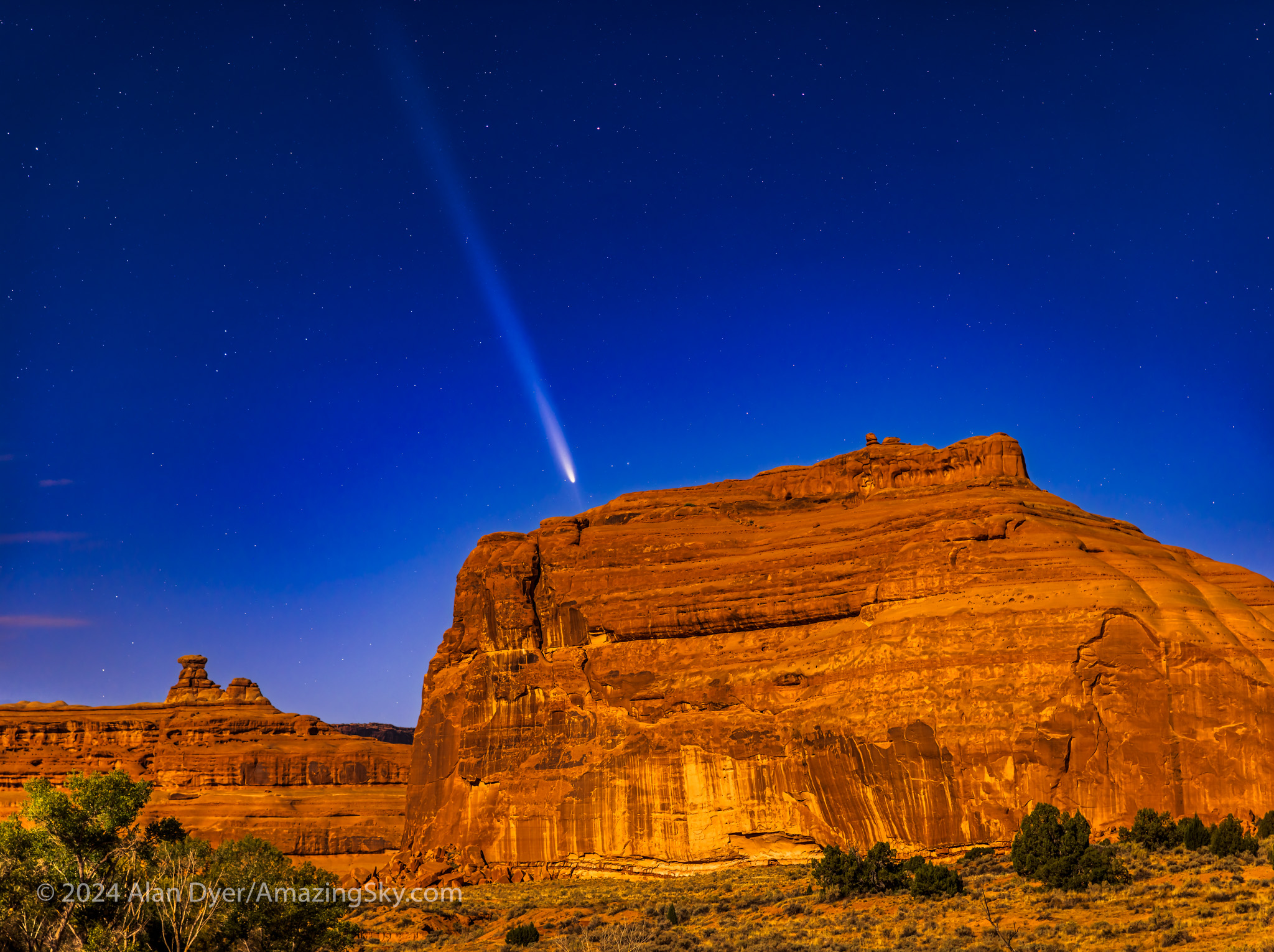
This is a telephoto close-up Comet Tsuchinshan-ATLAS over the red rocks of Arches National Park, Utah, on a superb moonlit night, October 15, 2024.

Indeed, that was my last view of the comet for a while, as clouds prevented any more shooting on the rest of my journey north through Idaho and Montana.ย I even hit a snowstorm in southern Montana.


Late October โ€” Back at Home in Alberta

But the comet was not done yet! Through October, while it receded from us in distance, it climbed higher into our sky, placing it into a dark sky with the Moon now out of the way.ย 

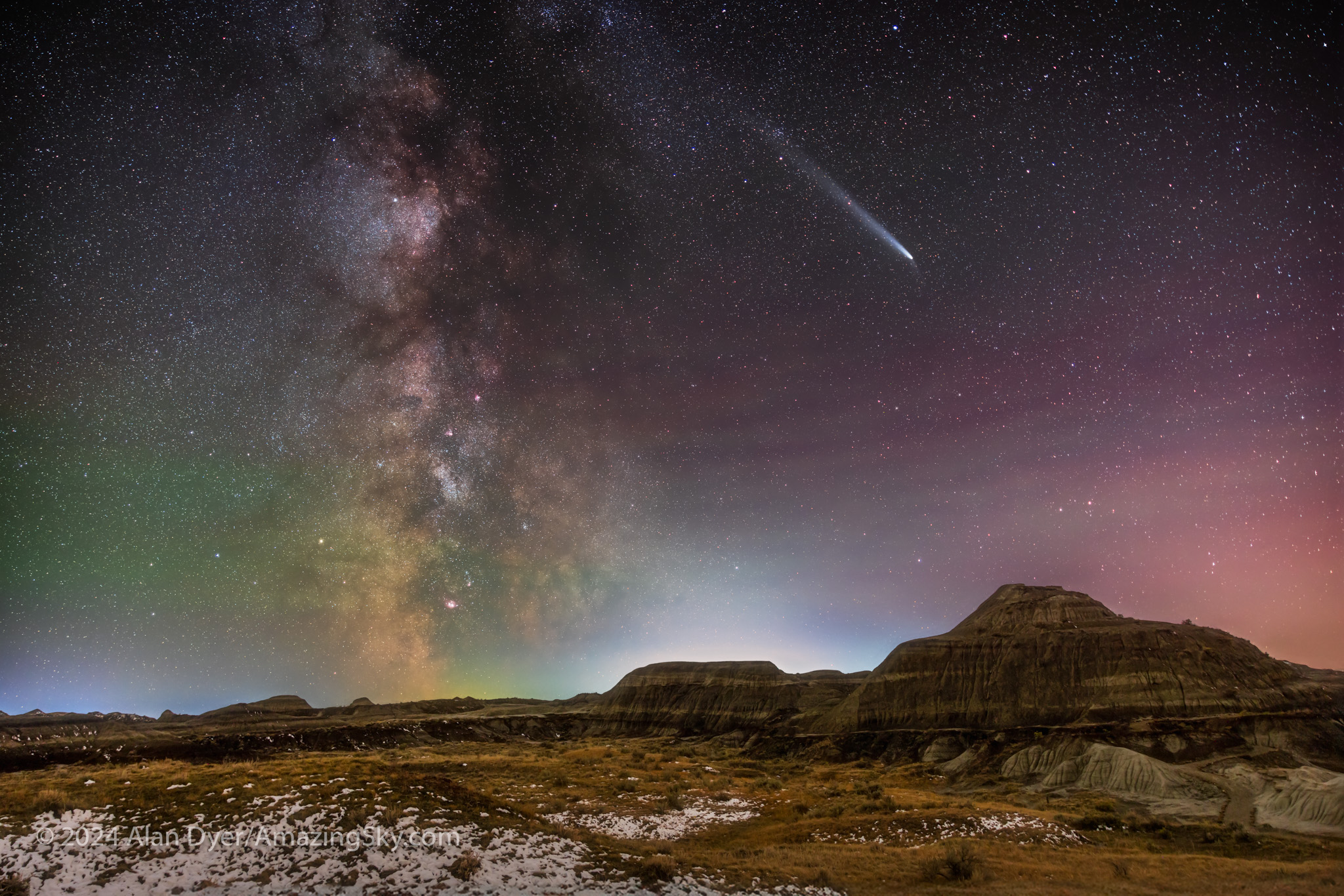
This is Comet Tsuchinshan-ATLAS in a wide-angle nightscape scene over the Badlands of Dinosaur Provincial Park, Alberta, on October 23, 2024.

On October 23, a short trip out to Dinosaur Provincial Park east of home allowed me to shoot the comet over the Alberta Badlands landscape, beside the setting summer Milky Way. 

This is a telephoto lens framing of Comet Tsuchinshan-ATLAS in Ophiuchus on the night of October 30, 2024 near several large star clusters. The field of view is 15ยบ by 10ยบ so the tail extends for about 6ยบ to 8ยบ.

By a week later, on October 30, the comet had diminished in size and brightness, but still looked like a classic comet, here framed in a telephoto close-up as it passed near some bright star clusters. This was from my front yard. The chase was over. 

Clouds and a trip to Norway starting November 4 prevented more opportunities to shoot the comet. (My travel schedule also kept me from writing this blog until now!)

It had been a good chase over a month, yielding images I was happy with. The photos from Utah and Arizona I could not have taken at home, even if the skies had been clear during the cometโ€™s prime-time. (They werenโ€™t!) And it was great to finally get back to my favourite haunts in southern Arizona and New Mexico after an absence of seven years.

In all, Comet Tsuchinshan-ATLAS provided a fine finale to what has been a superb year of stargazing events and celestial sights. 

โ€” Alan, December 9, 2024 โ€” AmazingSky.com ย 

How to Photograph Comet NEOWISE


Comet over Hoodoos at Dinosaur Park in Twilight (July 14, 2020)A bright comet is a once-a-decade opportunity to capture some unique nightscapes. Here are my suggested tips and FAQs for getting your souvenir shot.ย 
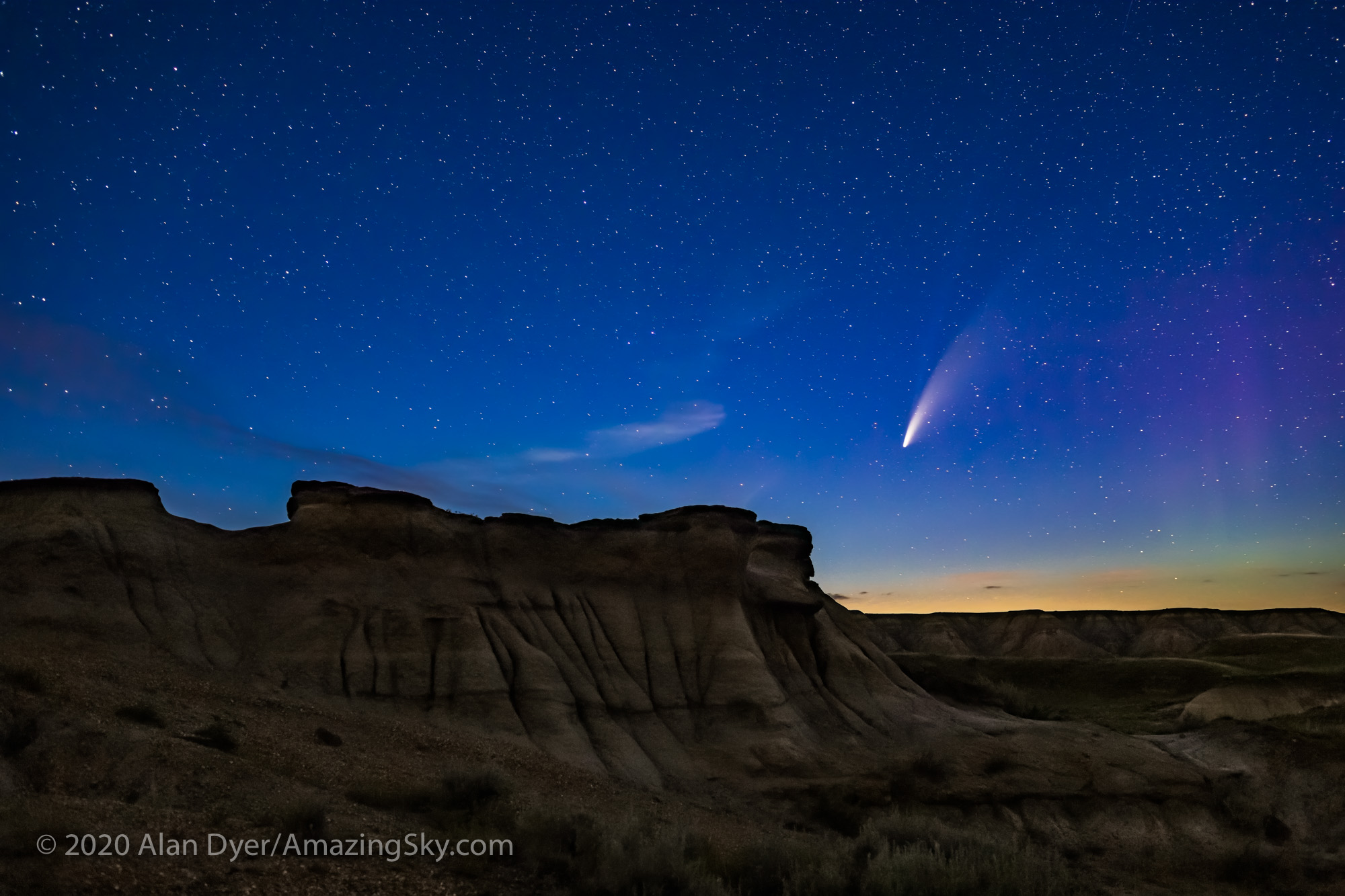
My guide to capturing Comet NEOWISE assumes youโ€™ve done little, if any, nightscape photography up to now. Even for those who have some experience shooting landscape scenes by night, the comet does pose new challenges โ€” for one, it moves from night to night and requires good planning to get it over a scenic landmark.ย 

So here are my tips and techniques, in answers to the most frequently asked questions I get and that I see on social media posts.

Comet over Hoodoos at Dinosaur Park (July 14, 2020)
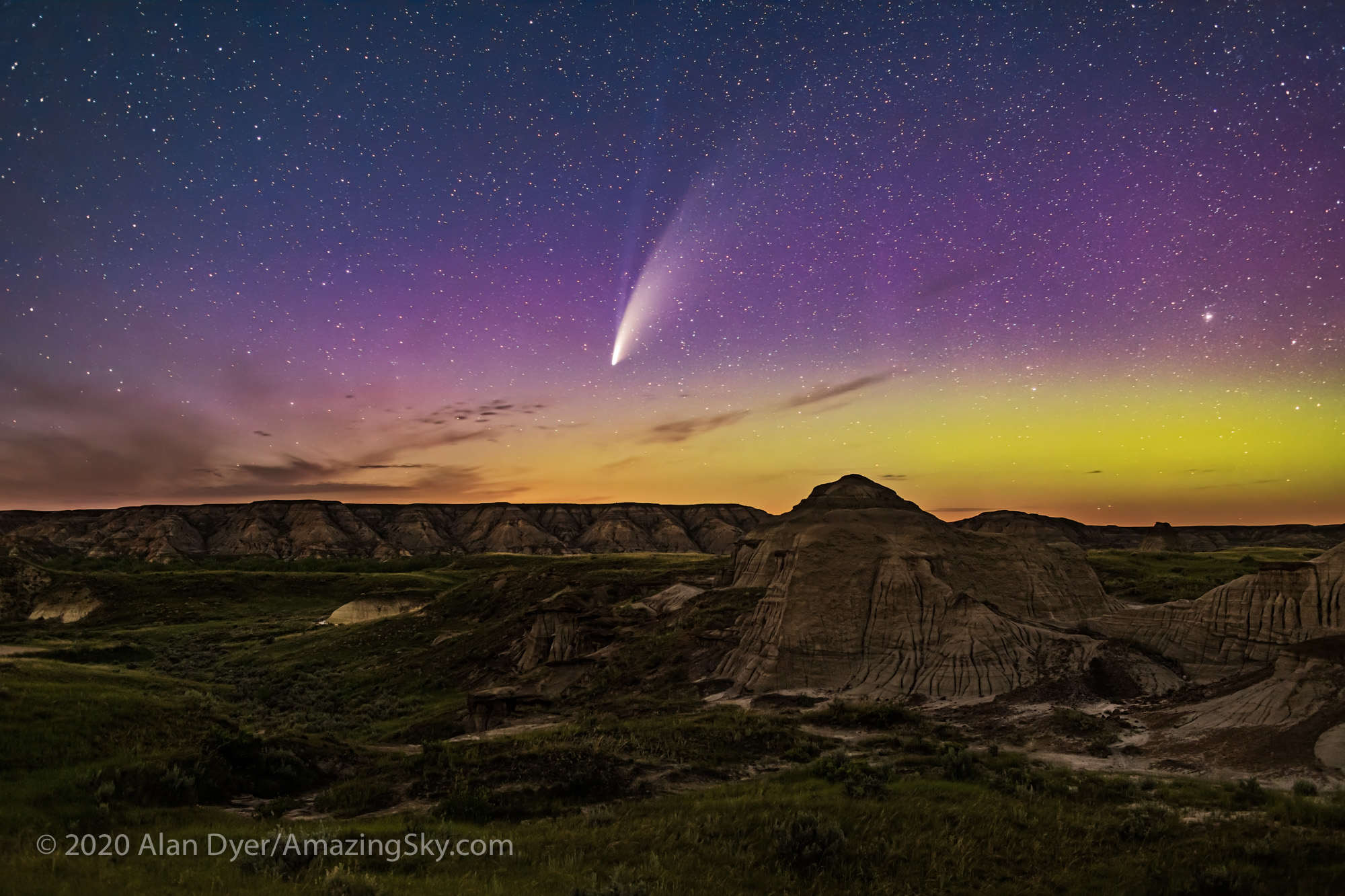
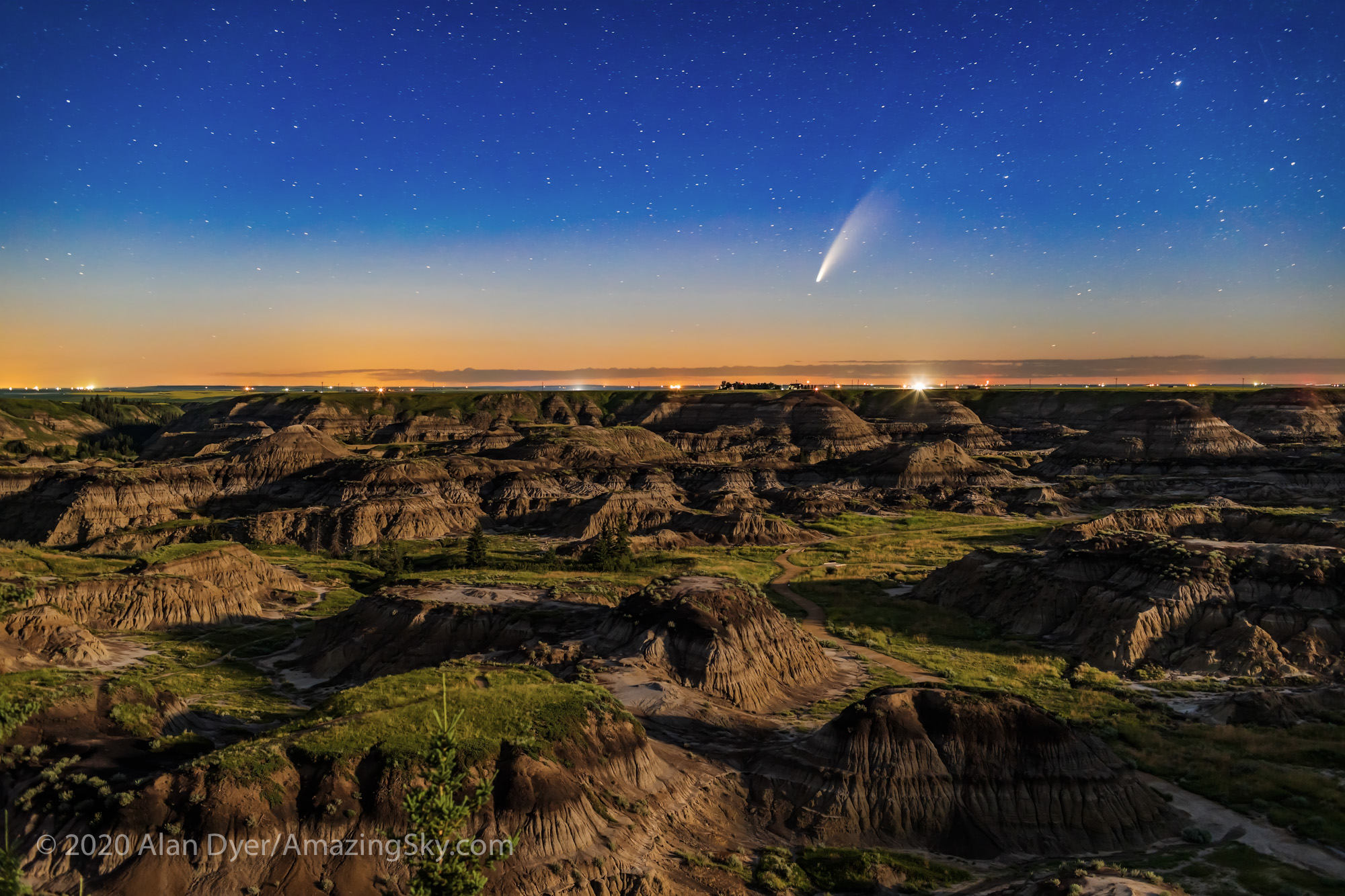
Comet NEOWISE (C/2020 F3) over the eroded hoodoo formations at Dinosaur Provincial Park, Alberta, July 14-15, 2020. A faint aurora is at right. The foreground is lit by starlight only; there was no light painting employed here. This is a stack of 12 exposures for the ground to smooth noise, blended with a single untracked exposure of the sky, all at 20 seconds at f/2.8 and ISO 1600, all with the 35mm Canon lens and Canon 6D MkII camera.


How Long Will the Comet be Visible?

The comet is not going to suddenly whoosh away or disappear. It is in our northern hemisphere sky and fairly well placed for shooting and watching all summer.

But โ€ฆ it is now getting fainter each night so the best time to shoot it is now! Or as soon as clouds allow on your next clear night.ย 

As of this writing on July 18 it is still bright enough to be easily visible to the unaided eye from a dark site. How long this will be the case is unknown.ย 

But after July 23 and its closest approach to Earth the comet will be receding from us and that alone will cause it to dim. Later this summer it will require binoculars to see, but might still be a good photogenic target, but smaller and dimmer than it was in mid-July.ย 

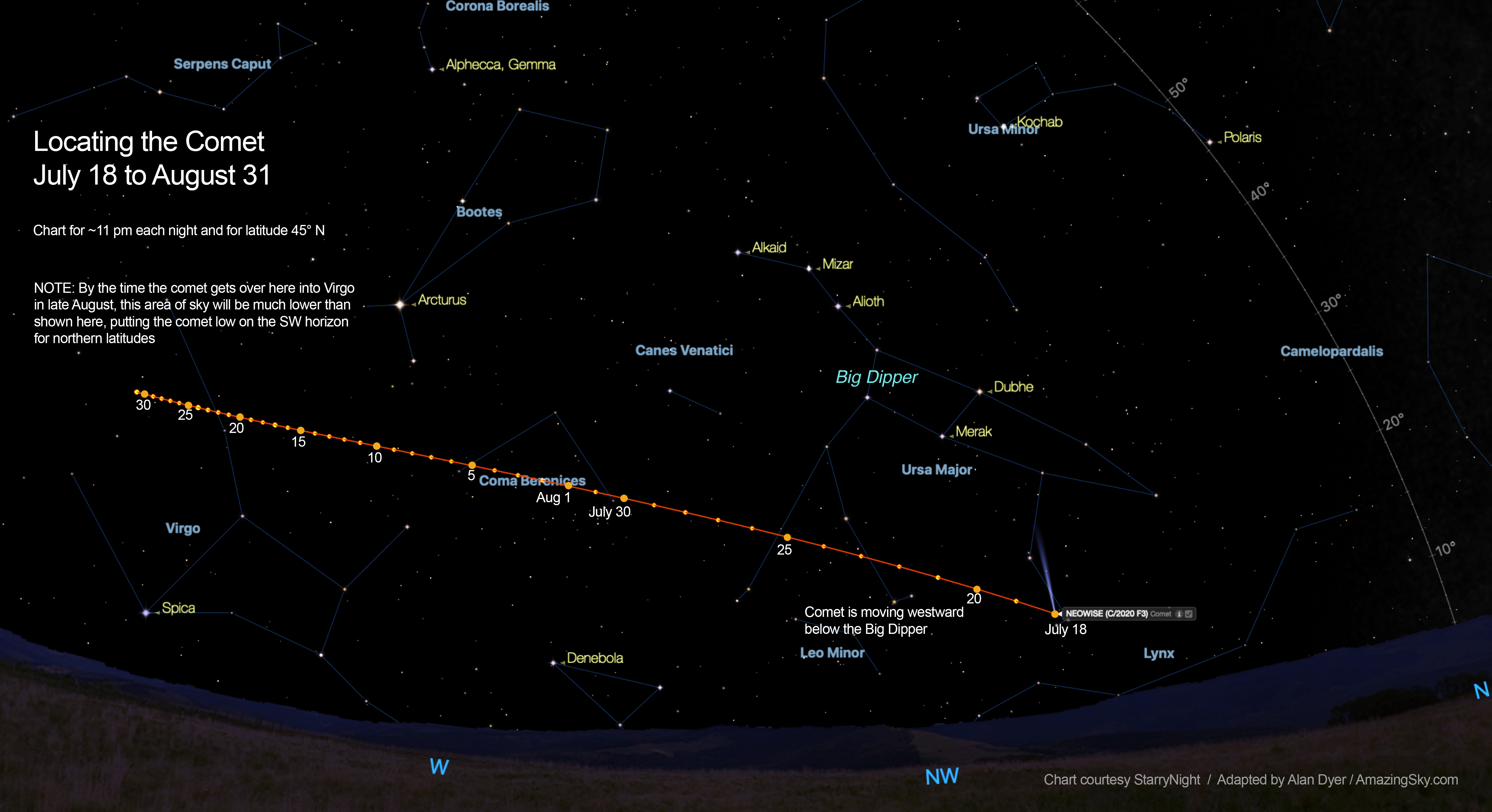
Comet Path
This chart shows the position of Comet NEOWISE at nightly intervals through the rest of the summer. However, the rest of July are the prime nights left for catching the comet at its best. Click or tap on the image to download a full-res copy.


When is the Best Time to Shoot?

The comet has moved far enough west that it is now primarily an evening object. So look as soon as it gets dark each night.ย 

Until later in July it is still far enough north to be โ€œcircumpolarโ€ for northern latitudes (above 50ยฐ N) and so visible all night and into the dawn.ย 

But eventually the comet will be setting into the northwest even as seen from northern latitudes and only visible in the evening sky. Indeed, by the end of July the comet will have moved far enough south that observers in the southern hemisphere anxious to see the comet will get their first looks.ย 

Comet NEOWISE over Red Deer River
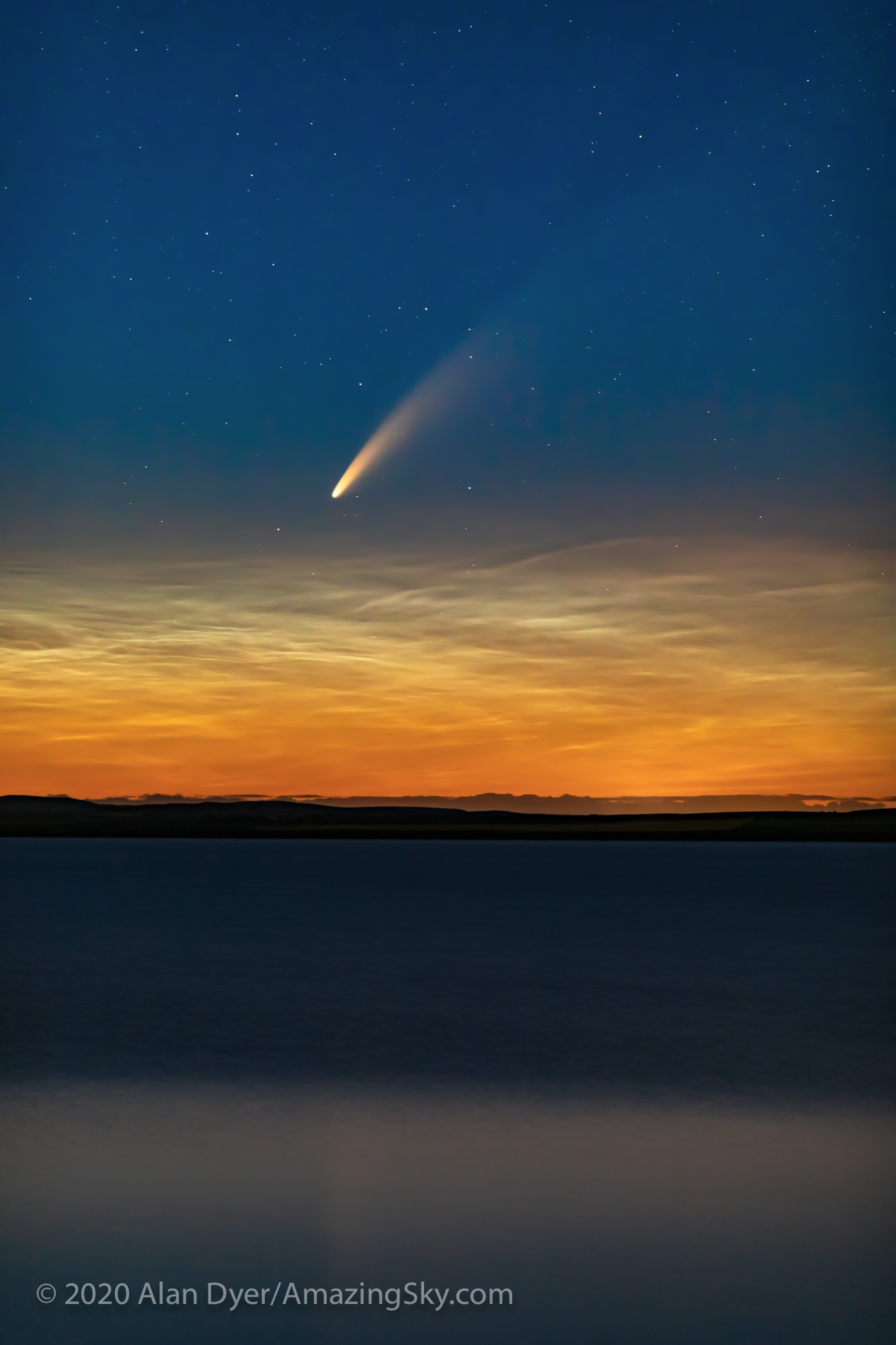
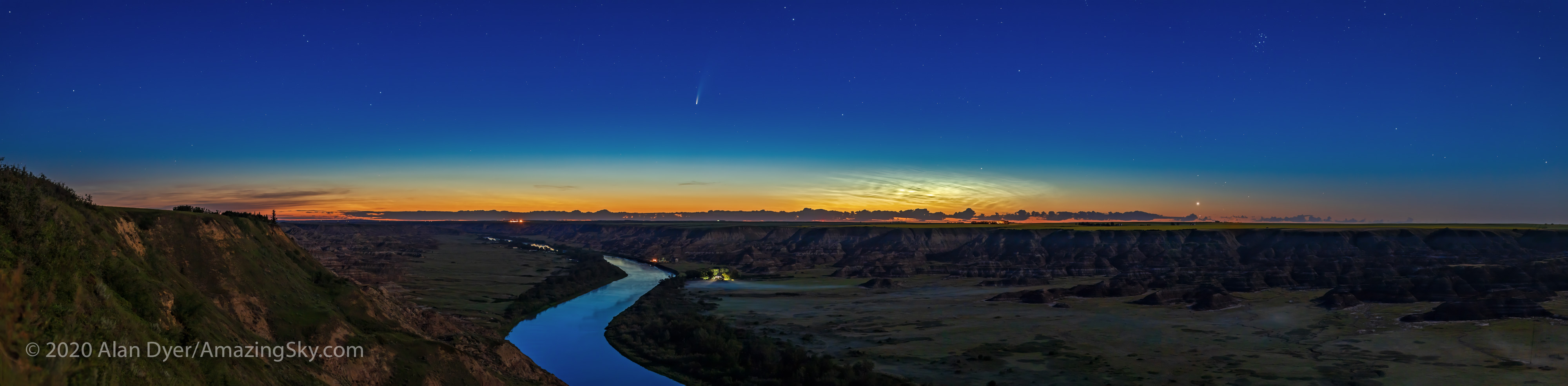
Comet NEOWISE (C/2020 F3) over the Red Deer River from Orkney Viewpoint north of Drumheller, Alberta, on the morning of July 11, 2020. The sky is brightening with dawn twilight and a small display of noctilucent clouds is on the horizon at right. This is a two-segment vertical panorama with the 35mm Canon lens at f/2.8 and Canon 6D MkII at ISO 200 for 13 seconds each. Stitched with Adobe Camera Raw.


Where Do I Look?ย 

In July look northwest below the Big Dipper. By August the comet is low in the west below the bright star Arcturus. By then it will be moving much less from night to night. The chart above shows the comet at nightly intervals; you can see how its nightly motion slows as it recedes from us and from the Sun.ย 

Selfie Observing Comet NEOWISE (July 15, 2020)
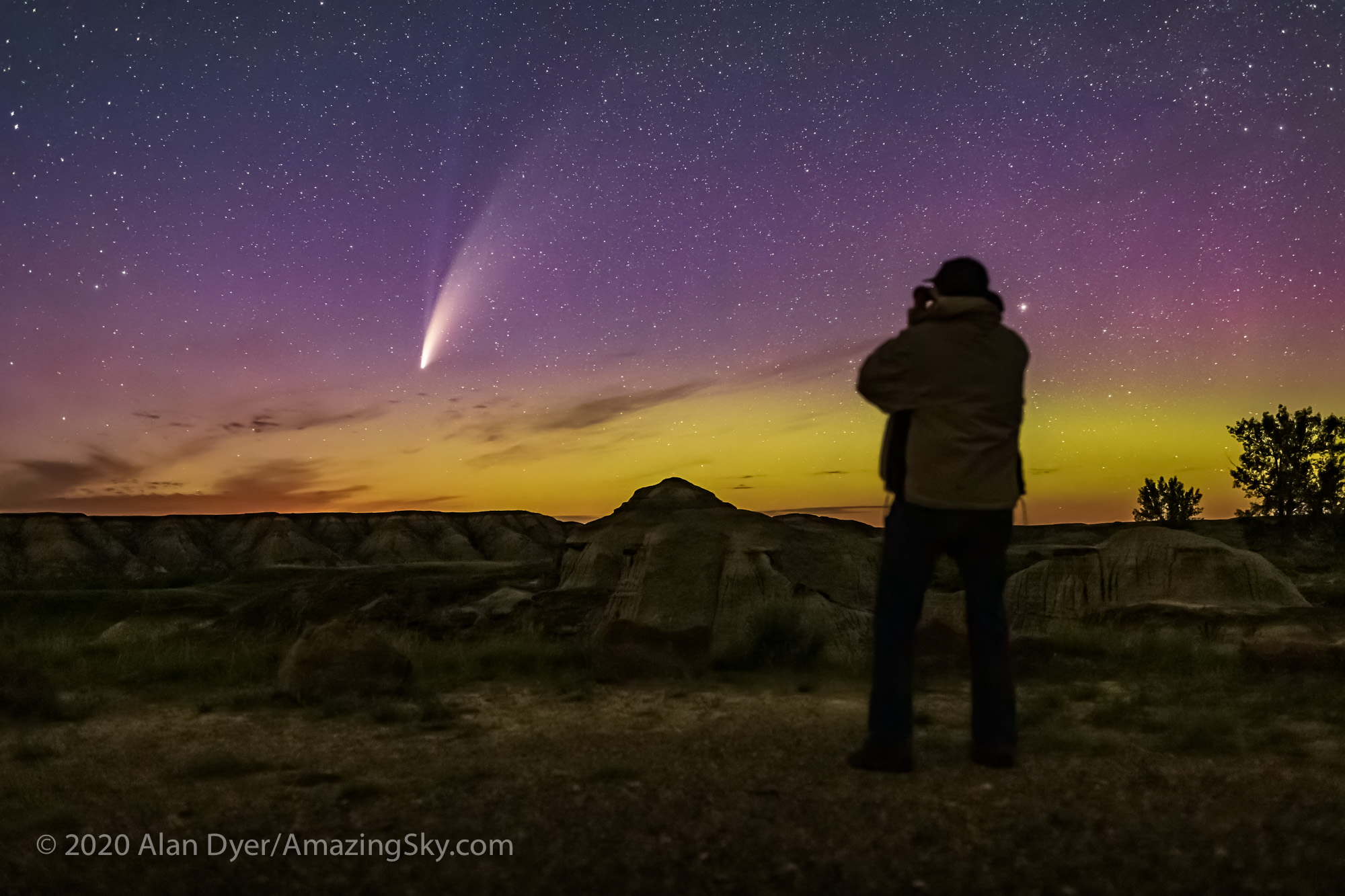
A selfie observing Comet NEOWISE (C/2020 F3) with binoculars on the dark moonless night of July 14/15, 2020 from Dinosaur Provincial Park, Alberta. A faint aurora colours the sky green and magenta. The faint blue ion tail of the comet is visible in addition to its brighter dust tail. The ground is illuminated by starlight and aurora light only. This is a blend of 6 exposures stacked for the ground (except me) to smooth noise, and one exposure for the sky and me, all 13 seconds at f/2.5 with the 35mm lens and Canon 6D MkII at ISO 6400. Topaz DeNoise AI applied.


What Exposures Do I Use?

There is no single best setting. It depends on โ€ฆ

โ€” How bright the sky is from your location (urban vs a rural site).

โ€” Whether the Moon is up โ€” it will be after July 23 or so when the Moon returns to the western sky as a waxing crescent.

โ€” The phase of the Moon โ€” in late July it will be waxing to Full on August 3 when the sky will be very bright and the comet faint enough it might lost in the bright sky.

However, here are guidelines:

โ€” ISO 400 to 1600

โ€” Aperture f/2 to f/4

โ€” Shutter speed of 4 to 30 seconds

Unless you are shooting in a very bright sky, your automatic exposure settings are likely not going to work.

As with almost all nightscape photography you will need to set your camera on Manual (M) and dial in those settings for ISO, Aperture and Shutter Speed manually. Just how is something you need to consult your cameraโ€™s instruction manual for, as some point-and-shoot snapshot cameras are simply not designed to be used manually.

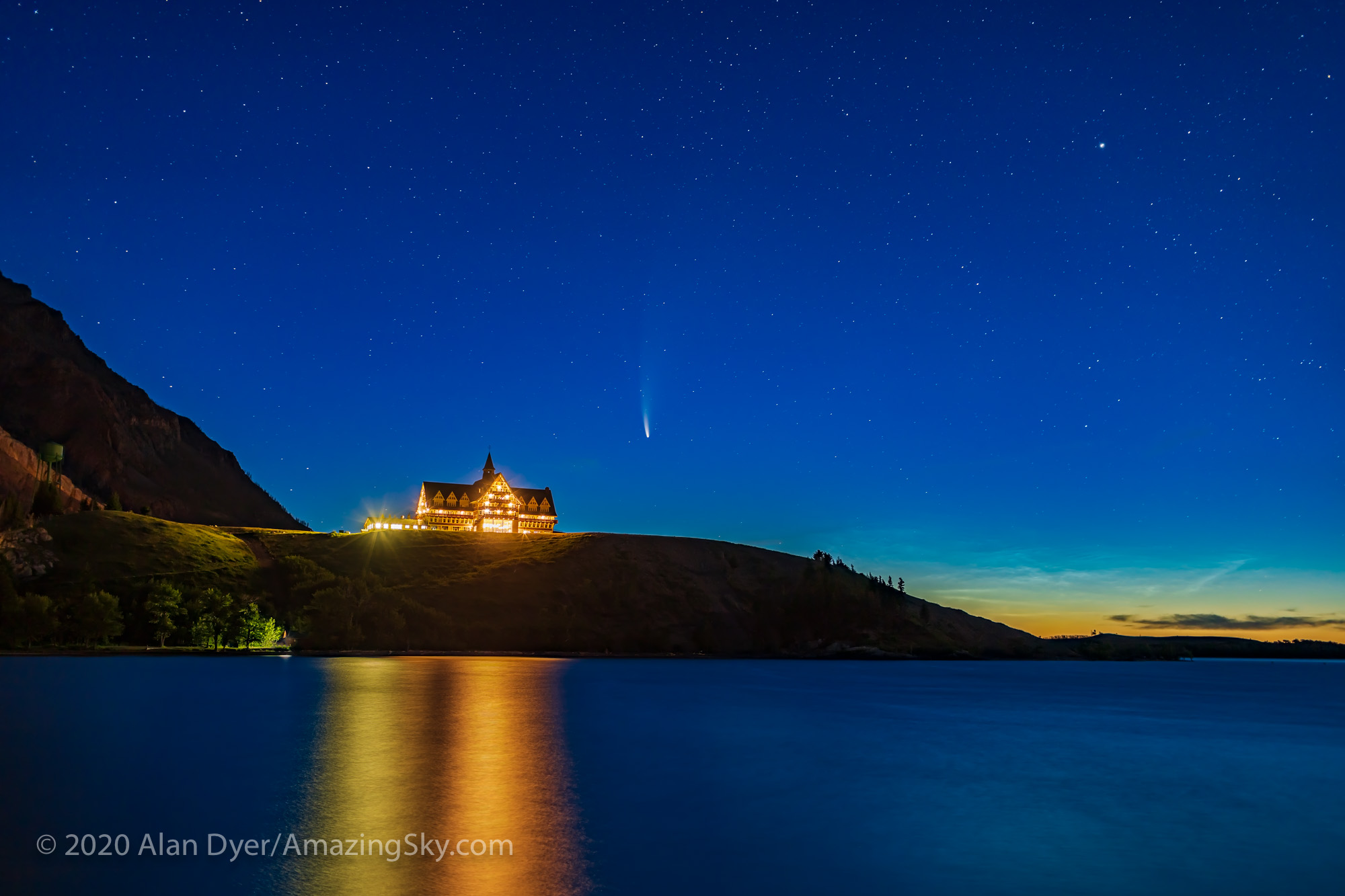
Panorama of Comet NEOWISE Over Prince of Wales Hotel (July 14, 2
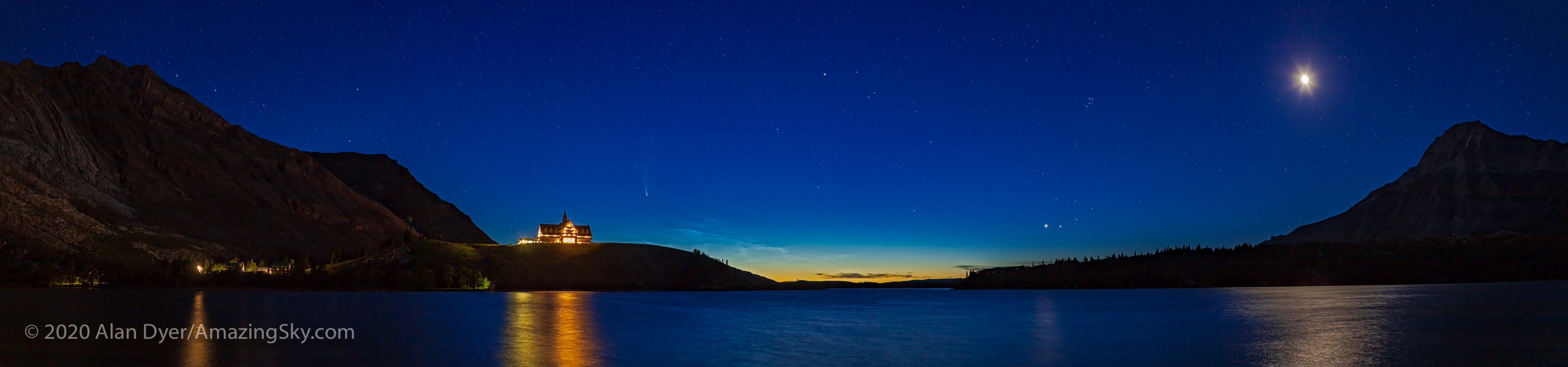
A once-in-a-lifetime scene โ€” A panorama of the dawn sky at 4 am on July 14, 2020 from Waterton Lakes National Park, Alberta, Canada with Comet NEOWISE (C/2020 F3) over the iconic Prince of Wales Hotel. Noctilucent clouds glow below the comet in the dawn twilight. Venus is rising right of centre paired with Aldebaran and the Hyades star cluster, while the Pleiades cluster shine above. The waning quarter Moon shines above the Vimy Peak at far right. The Big Dipper is partly visible above the mountain at far left. Capella and the stars of Auriga are at centre. This is an 8-segment panorama with the 35mm Canon lens at f/2.5 for 15 seconds each at ISO 100 with the Canon 6D MkII and stitched with Adobe Camera Raw.

Exposure Considerationsย 

As a rule you want to โ€ฆ

โ€” Keep the ISO as low as possible for the lowest noise. The higher the ISO the worse the noise. But โ€ฆ do raise the ISO high enough to get a well-exposed image. Better to shoot at ISO 3200 and expose well, than at ISO 800 and end up with a dark, underexposed image.

โ€” Shoot at a wide aperture, such as f/2 or f/2.8. The wider the aperture (smaller the f-number) the shorter the exposure can be and/or lower the ISO can be. But โ€ฆ lens aberrations might spoil the sharpness of the image.ย 

โ€” Keep exposures short enough that the stars wonโ€™t trail too much during the exposure due to Earthโ€™s rotation. The โ€œ500 Ruleโ€ of thumb says exposures should be no longer than 500 / Focal length of your lens.ย 

So for a 50mm lens exposures should be no longer than 500/50 = 10s seconds. Youโ€™ll still see some trailing but not enough to spoil the image. And going a bit longer in exposure time can make it possible to use a slower and less noisy ISO speed or simply having a better exposed shot.ย 

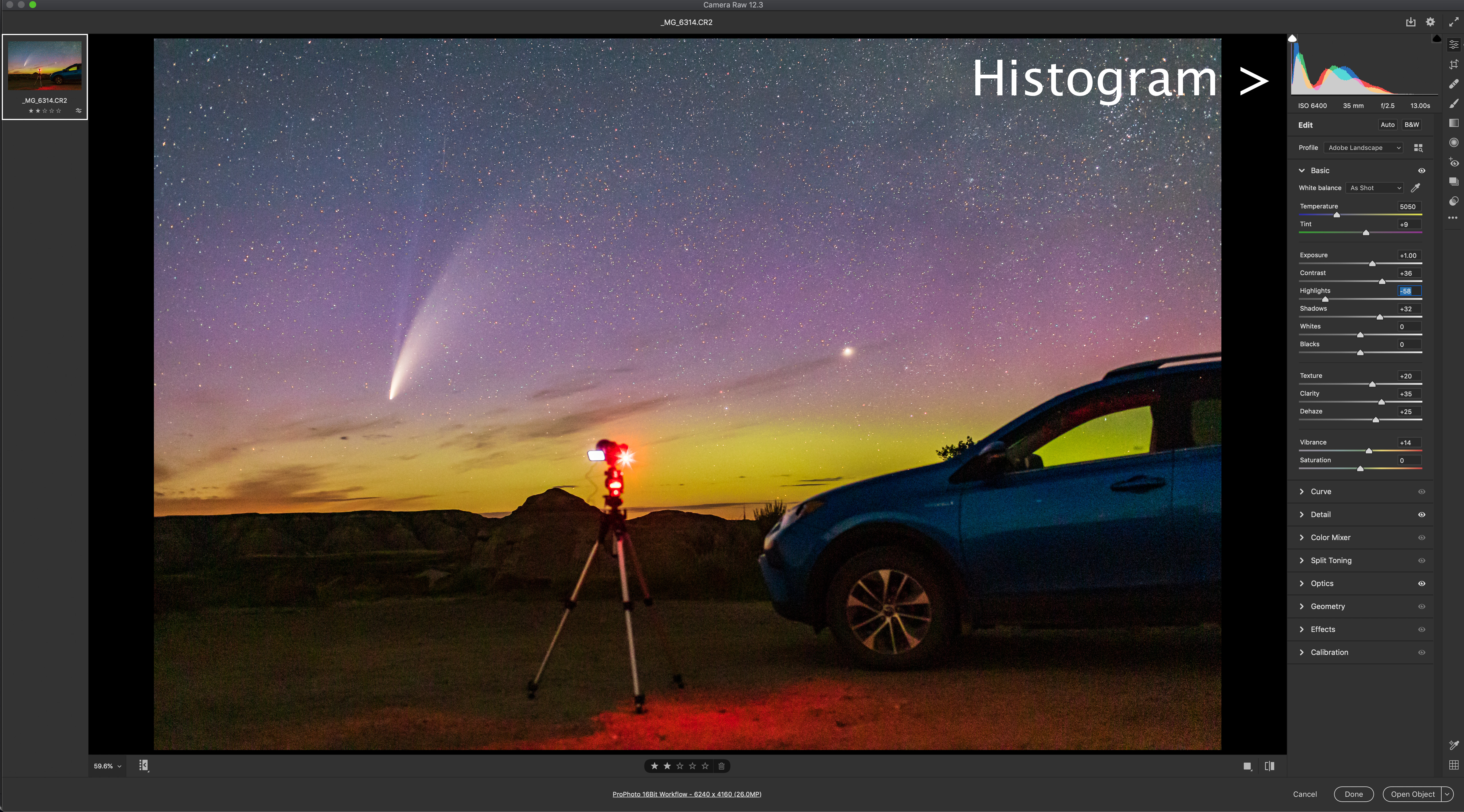
Histogram
The histogram as shown in Adobe Camera Raw. Cameras also display the image’s histogram in the Live View preview and in playback of recorded images. Keep the histogram from slamming to the left.

โ€” Avoid underexposing. If you can, call up the โ€œhistogramโ€โ€” the graph of exposure values โ€” on the resulting image in playback on your camera. The histogram should look fairly well distributed from left to right and not all bunched up at the left.ย 

Comet NEOWISE Over Dinosaur Park (July 15, 2020)
This is Comet NEOWISE (C/2020 F3) over the badlands and formations of Dinosaur Provincial Park, Alberta, on the night of July 14-15, 202. This is a blend of 6 exposures for the ground stacked to smooth noise, with a single exposure for the sky, with the 35mm Canon lens and Canon 6D MkII. The ground exposures are 1- and 2-minutes at ISO 1600 and f/2.8, while the single untracked sky exposure was 20 seconds at ISO 3200 and f/2.5.

My Nightscapes and Time-Lapses ebook shown above provides extensive instruction on the best camera settings for exposure and noise reduction.

Location Considerations

When and where you are will also affect your exposure combination.ย 

If you are at a site with lots of lights such as overlooking a city skyline, exposures will need to be shorter than at a dark site.ย 

And nights with a bright Moon will require shorter exposures than moonless nights.

Take test shots and see what looks good! Inspect the histogram. This isnโ€™t like shooting with film when we had no idea if we got the shot until it was too late!ย 


Whatย Lens Do I Use?

Comet over Canola Field (July 15, 2020)
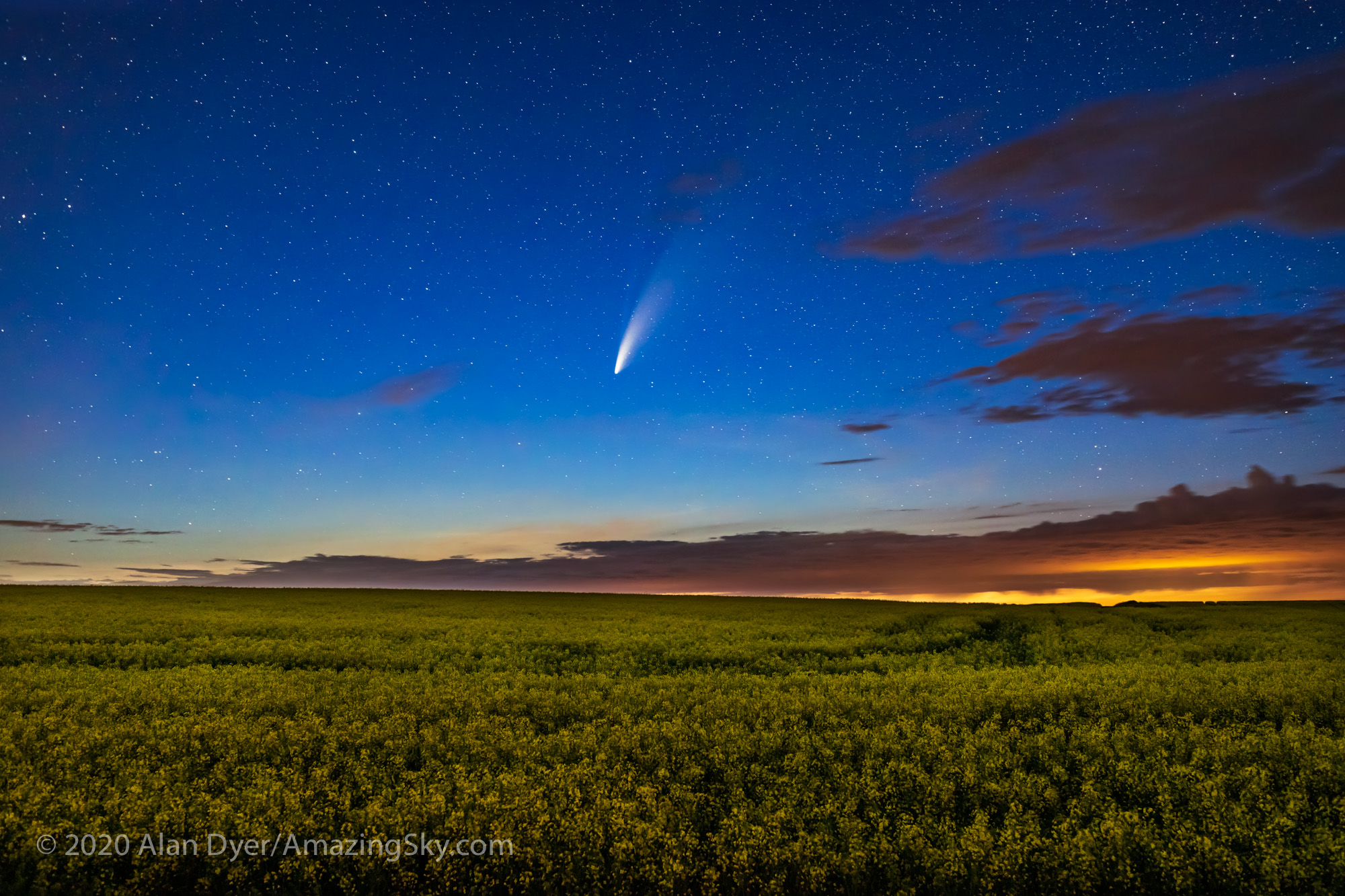
With a 35mm lens. Comet NEOWISE (C/2020 F3) over a ripening canola field near home in southern Alberta, on the night of July 15-16, 2020. This is a blend of a stack of six 2-minute exposures at ISO 3200 and f/5.6 to smooth noise, provide depth of field, and bring out the colours of the canola, blended with a single short 15-second exposure of the sky at f/2.8 and ISO 1600, all with the 35mm lens and Canon 6D MkII camera.

Comet over Canola Field Close-Up (July 15, 2020)
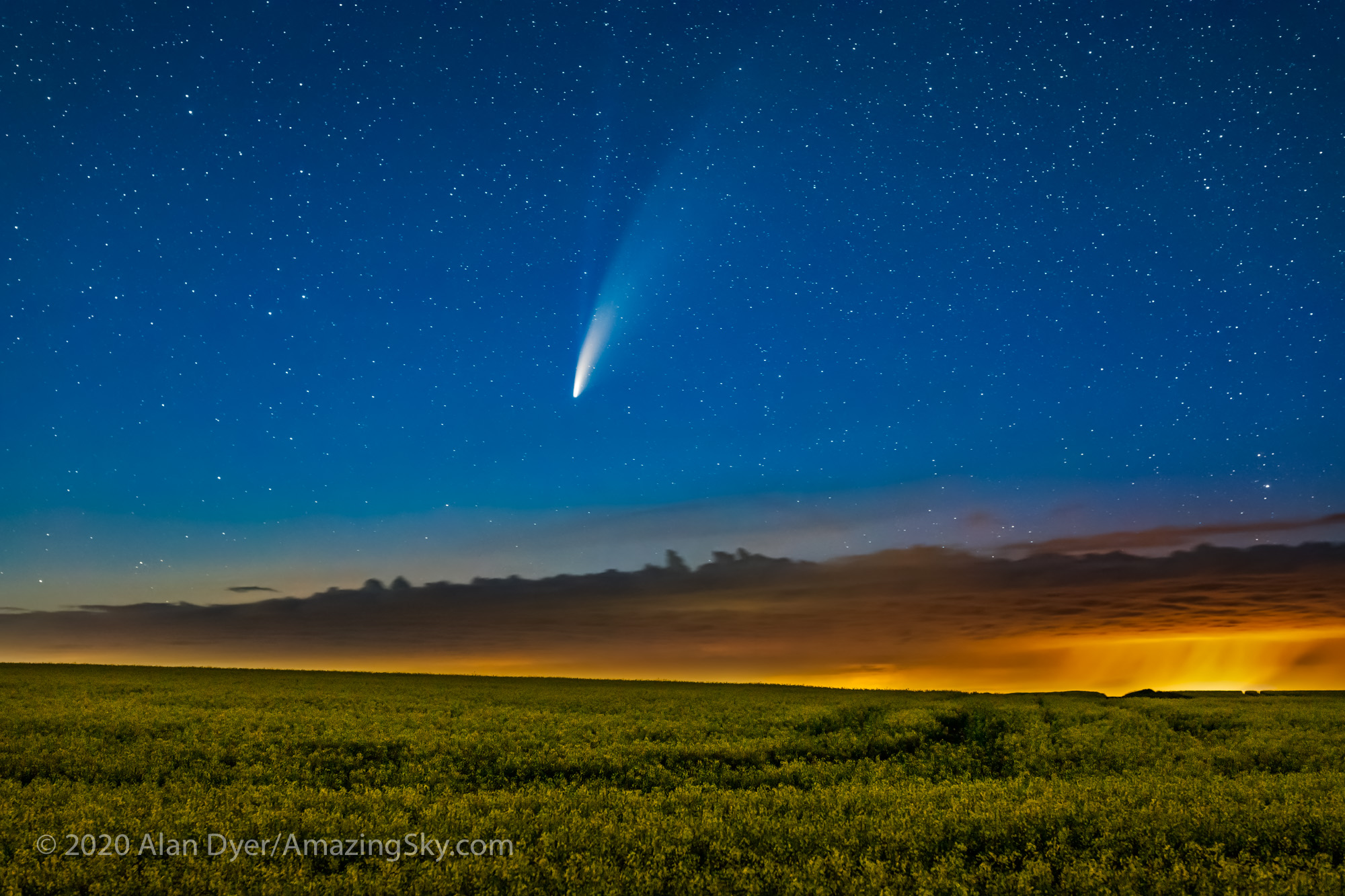
With a 50mm lens. Comet NEOWISE (C/2020 F3) over a ripening canola field near home in southern Alberta, on the night of July 15-16, 2020. This is a blend of a stack of three 2-minute exposures at ISO 1600 and f/5 to smooth noise, provide depth of field, and bring out the colours of the canola, blended with a single short 15-second exposure of the sky at f/2.8 and ISO 3200, all with the 50mm Sigma lens and Canon 6D MkII camera.

Any lens can produce a fine shot. Choose the lens to frame the scene well.ย 
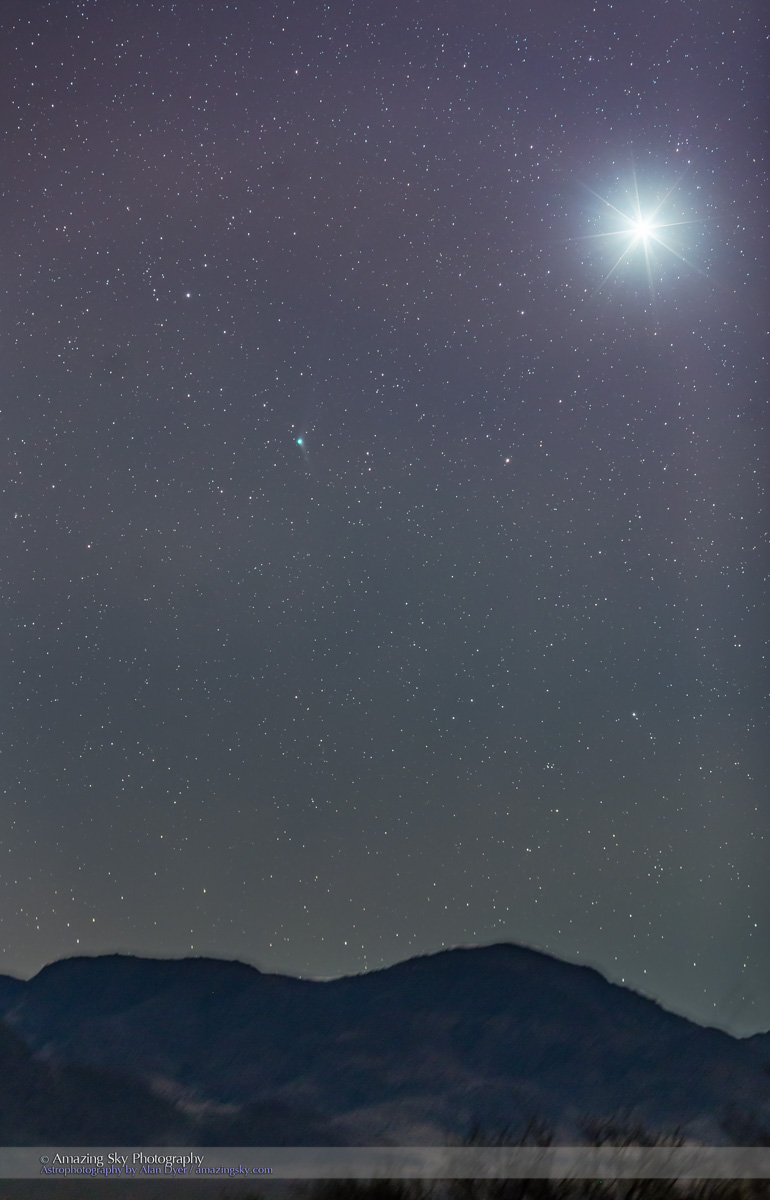
Using a longer lens (105mm to 200mm) does make the comet larger, but โ€ฆ might make it more difficult to also frame it above a landscape. A good choice is likely a 24mm to 85mm lens.

A fast lens is best, to keep exposure times below the 500 Rule threshold and ISO speeds lower. Slow f/5.6 kit zooms can be used but do pose challenges for getting well exposed and untrailed shots.ย 

Shooting with shorter focal lengths can help keep the aperture wider and faster. Long focal lengths arenโ€™t needed, especially for images of the comet over a landscape. Avoid the temptation to use that monster 400mm or 600mm telephoto wildlife lens. Unless it is on a tracker (see below) it will produce a trailed mess. It is best to shoot with no more than a 135mm telephoto, the faster the better, IF you want a close-up.

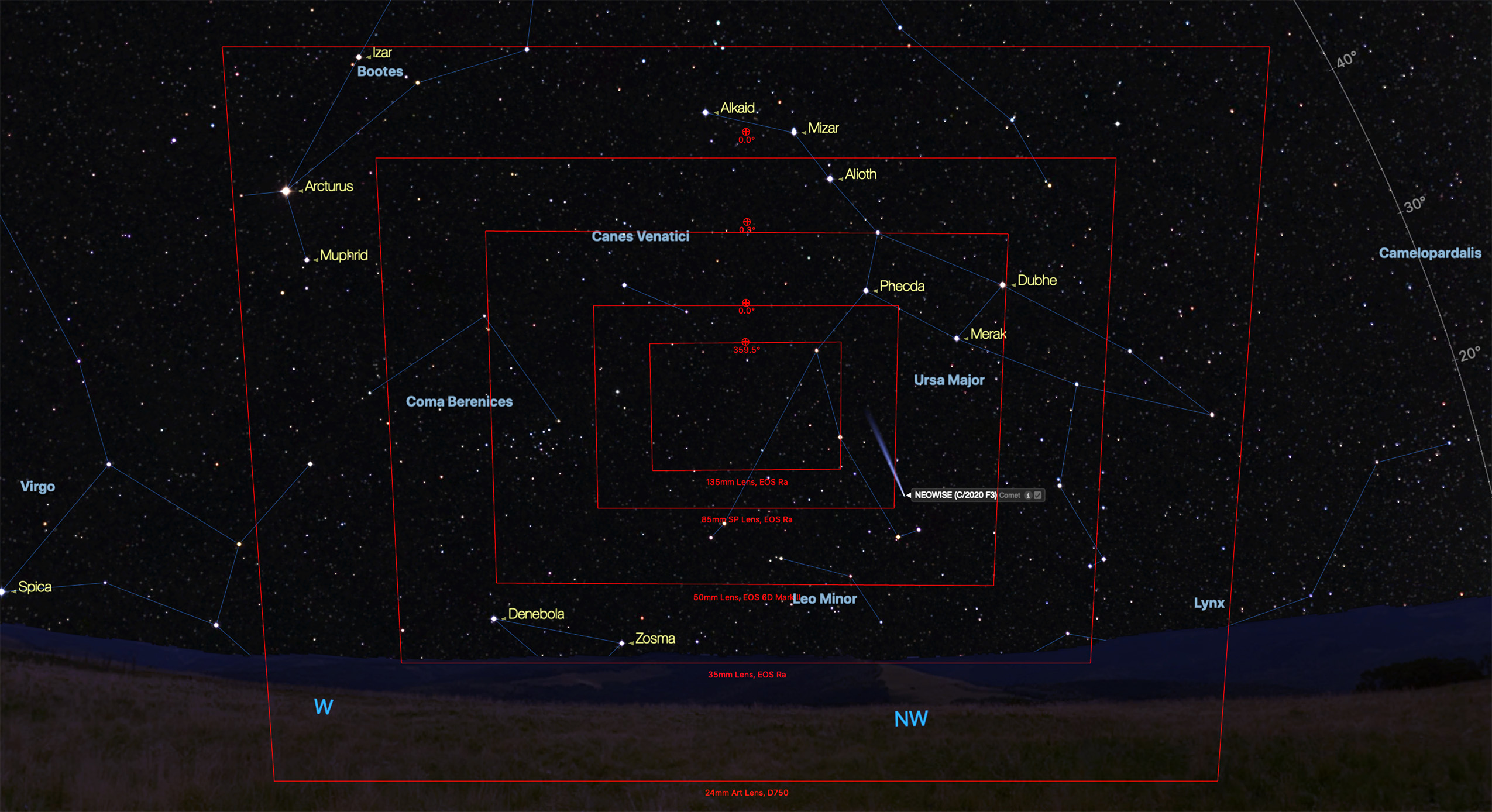
Planetarium programs that I recommend below offer โ€œfield of viewโ€ indicators so you can preview how much of the horizon and sky your camera and lens combination will show.ย 

StarryNightFOV
StarryNightโ„ข and other programs offer “Field of View” indicator frames that can show how the scene will frame with (in this example) lenses from 24mm to 135mm.


Can I Use My [insert camera here] Camera?

Yes. Whatever you have, try it.ย 

However, the best cameras for any nightscape photography are DSLRs and Mirrorless cameras, either full-frame or cropped frame. They have the lowest noise and are easiest to set manually.ย 

In my experience in teaching workshops I find that the insidious menus of automatic โ€œpoint-and-shootโ€ pocket cameras make it very difficult to find the manual settings. And some have such noisy sensors they do not allow longer exposures and/or higher ISO speeds. But try their Night or Fireworks scene modes.ย 

It doesnโ€™t hurt to try, but if you donโ€™t get the shot, donโ€™t fuss. Just enjoy the view with your eyes and binoculars.ย 

But โ€ฆ if you have an iPhone11 or recent Android phone (I have neither!) their โ€œNight sceneโ€ modes are superb and use clever in-camera image stacking and processing routines to yield surprisingly good images. Give them a try โ€” keep the camera steady and shoot.ย 

Comet NEOWISE with NLCs Above Prairie Lake (July 10-11, 2020)
This is Comet NEOWISE (C/2020 F3) over Deadhorse Lake near Hussar in southern Alberta, taken just after midnight on July 10-11, 2020 during its evening appearance. The comet shines just above low noctilucent clouds. This is a blend of nine exposures for the ground stacked to smooth noise and the water, with a single exposure for the sky, all 4 seconds with the 135mm Canon lens at f/2 and Canon 6D MkII at ISO 1600.


What No One Asks: How Do I Focus?

Everyone fusses about โ€œthe bestโ€ exposure.ย 

What no one thinks of is how they will focus at night. What ruins images is often not bad exposure (a lot of exposure sins can be fixed in processing) but poor focus (which cannot be fixed later).

On bright scenes it is possible your cameraโ€™s Autofocus system will โ€œseeโ€ enough in the scene to work and focus the lens. Great.

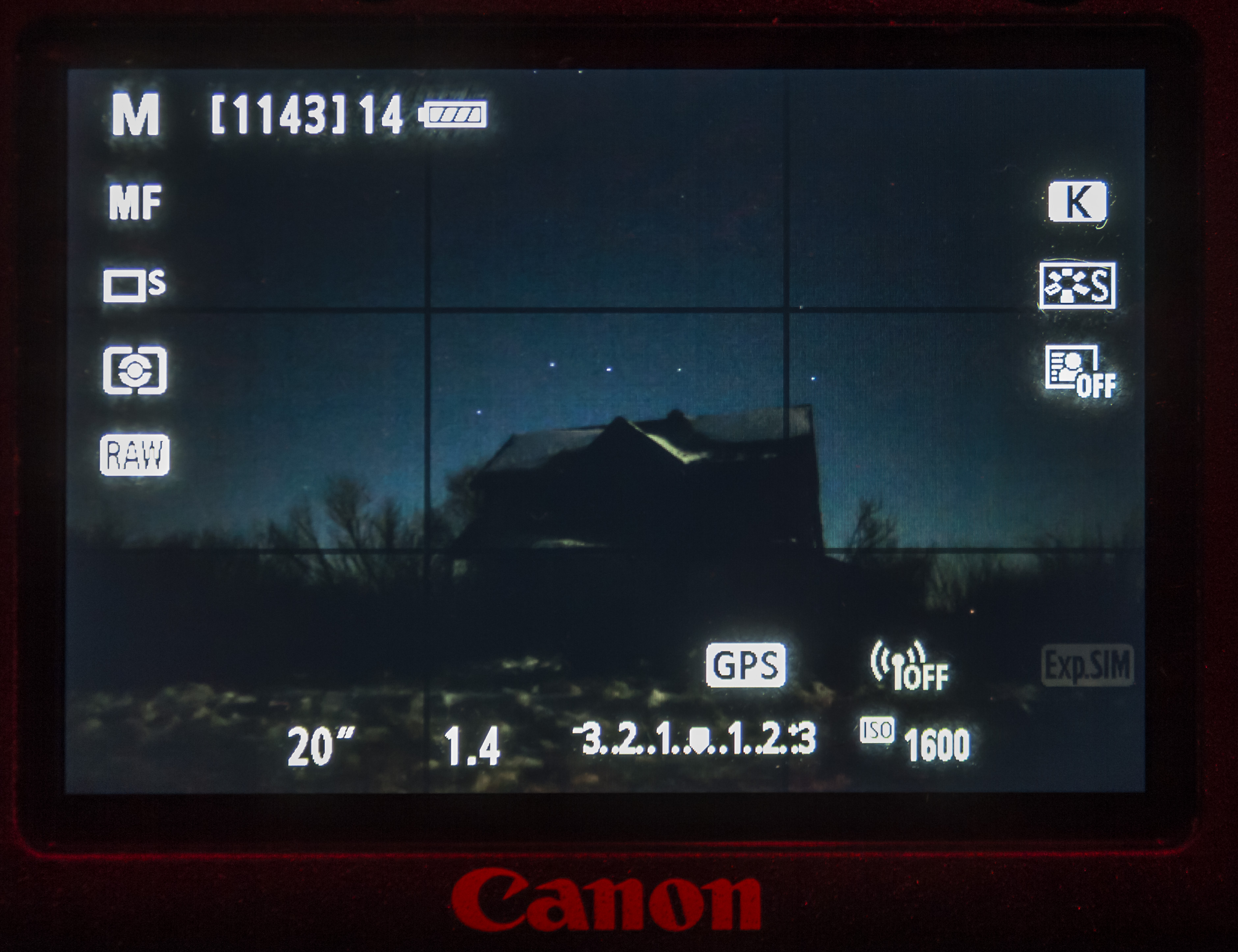
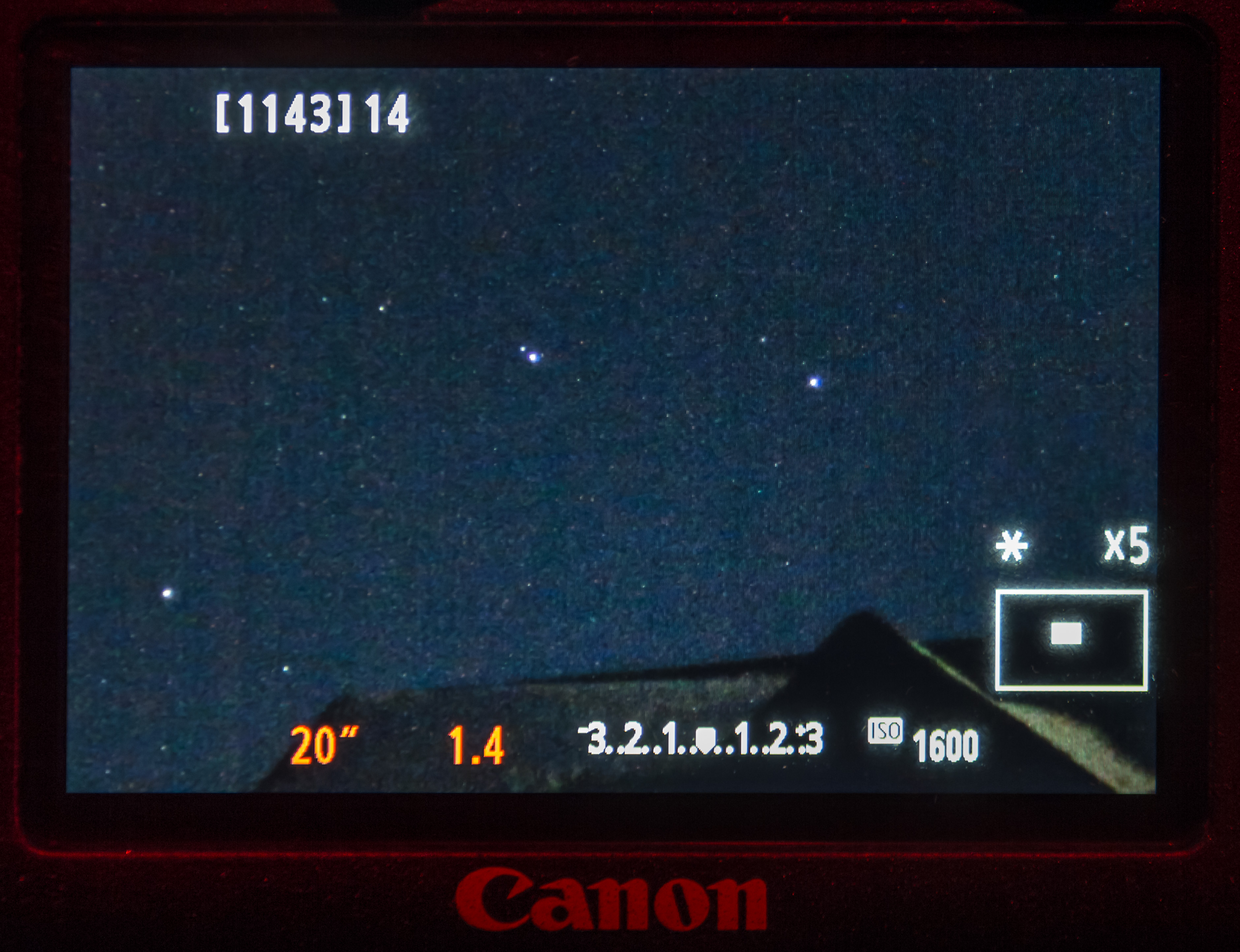
On dark scenes it will not. You must manually focus. Do that using your cameraโ€™s โ€œLive Viewโ€ function (all DSLRs and Mirrorless cameras have it โ€” but check your user manual as on DSLRs it might need to be activated in the menus if you have never used it).ย 
Canon 6D Live View Wide
The Live View screen of a Canon DSLR. Look in your manual for tips on how to boost the Live screen image brightness with the Exposure Simulation option.

Canon 6D Live View Zoom5x
Magnify the image 5x, 10x or more with the Zoom box centred on a star to focus the star to a pinpoint.
Aim at a bright star or distant light and magnify the image 5x or 10x (with the + button) to inspect the star or light. Put the lens on MF (not AF) and focus the lens manually to make the star as pinpoint as possible. Do not touch the lens afterwards.ย 
Practice on a cloudy night on distant lights.

All shooting must be done with a camera on a good tripod. As such, turn OFF any image stabilization (IS), whether it be on the lens or in the camera. IS can ruin shots taken on a tripod.ย 


What Few Ask: How Do I Plan a Shoot?ย 

Good photos rarely happen by accident. They require planning. Thatโ€™s part of the challenge and satisfaction of getting the once-in-a-lifetime shot.ย 

To get the shot of the comet over some striking scene below, you have to figure out:

โ€” First, where the comet will be in the sky,ย 

โ€” Then, where you need to be to look toward that location.ย 

โ€” And of course, you need to be where the sky will be clear!

Stellarium Web
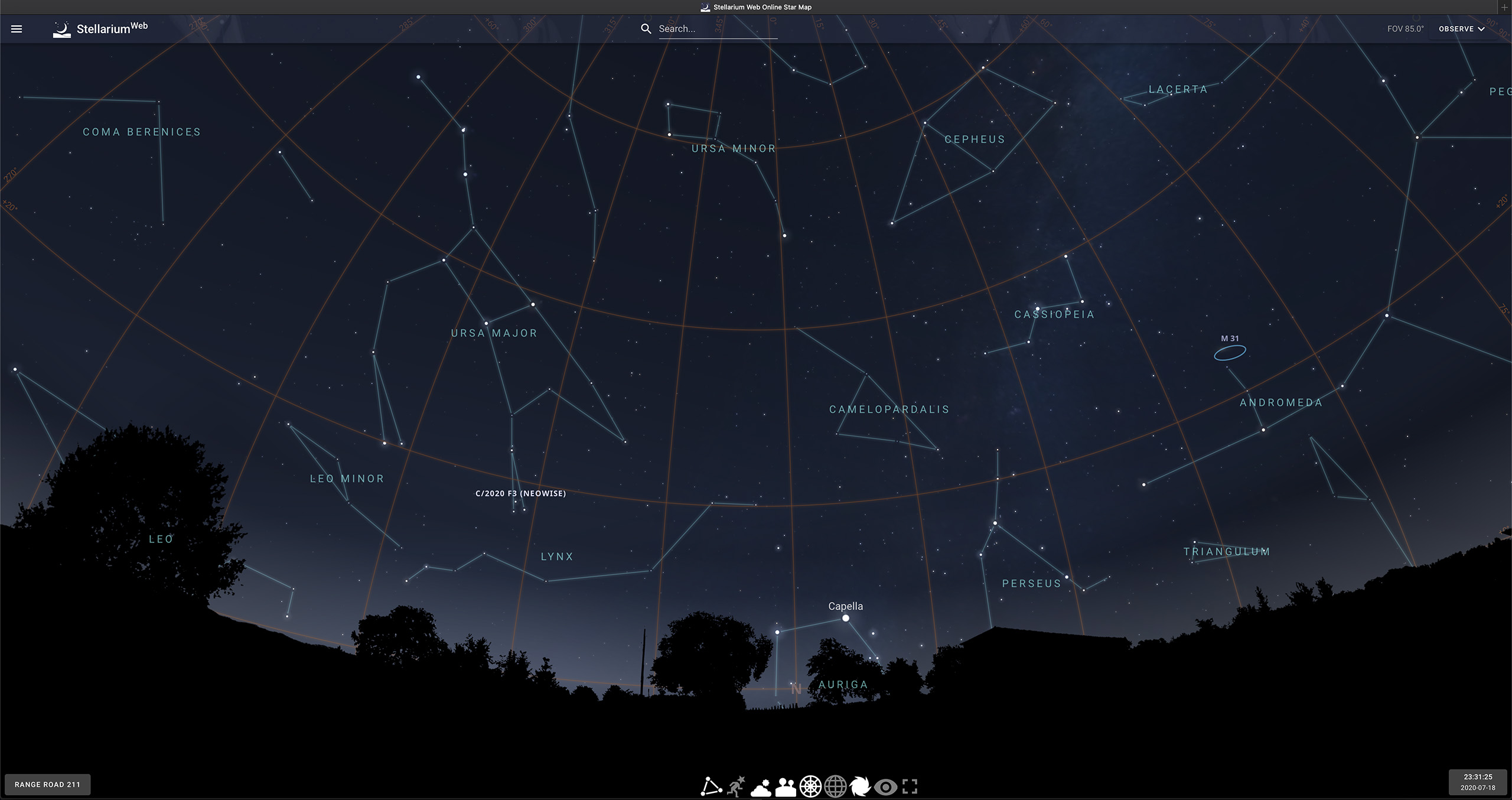
The free web version of Stellarium shows the comet, as do the paid mobile apps.

  1. Planning Where the Comet Will Beย 

Popular planning software such as PhotoPills and The Photographerโ€™s Ephemeris can help immensely, but wonโ€™t have the comet itself included in their displays, just the position of the Sun, Moon and Milky Way.

For previewing the cometโ€™s position in the sky, I use the planetarium programs Starry Night (desktop) or SkySafari (mobile app). Both include comet positions.ย 

The program Stellarium (stellarium.org) is free for desktop while the mobile Stellarium Plus apps (iOS and Android) have a small fee. There is also a free web-based version at https://stellarium-web.orgย  Be sure to allow it to access your location.ย 

Set the programs to the night in question to see where the comet will be in relation to the stars and patterns such as the Big Dipper. Note the cometโ€™s altitude in degrees and azimuth (how far along the horizon it will be). For example, an azimuth of 320ยฐ puts it in the northwest (270ยฐ is due west; 0ยฐ or 360ยฐ is due north, 315ยฐ is directly northwest).ย 

Comet NEOWISE and NLCs over Prince of Wales Hotel (July 14, 2020
Comet NEOWISE (C/2020 F3) with a small display of noctilucent clouds over Emerald Bay and the iconic Prince of Wales Hotel at Waterton Lakes National Park, Alberta, at dawn on July 14, 2020. This is a blend of a stack of four exposures for the ground and water to smooth noise, blended with a single short exposure for the sky, all 20 seconds at f/2.5 and ISO 400. All with the 35mm Canon lens and Canon 6D MkII camera.

  1. Planning Whereย Youย Need To Be

I use The Photographerโ€™s Ephemeris mobile app (https://www.photoephemeris.com) โ€” there is a free web version available. Many like PhotoPills (https://www.photopills.com).

With either you can dial in the time and date and see lines pointing toward where the Sun would be, but below the horizon. Scrub through time to move that line to the same azimuth angle as where the comet will be and then see if the comet is sitting in the right direction.ย 

TPE
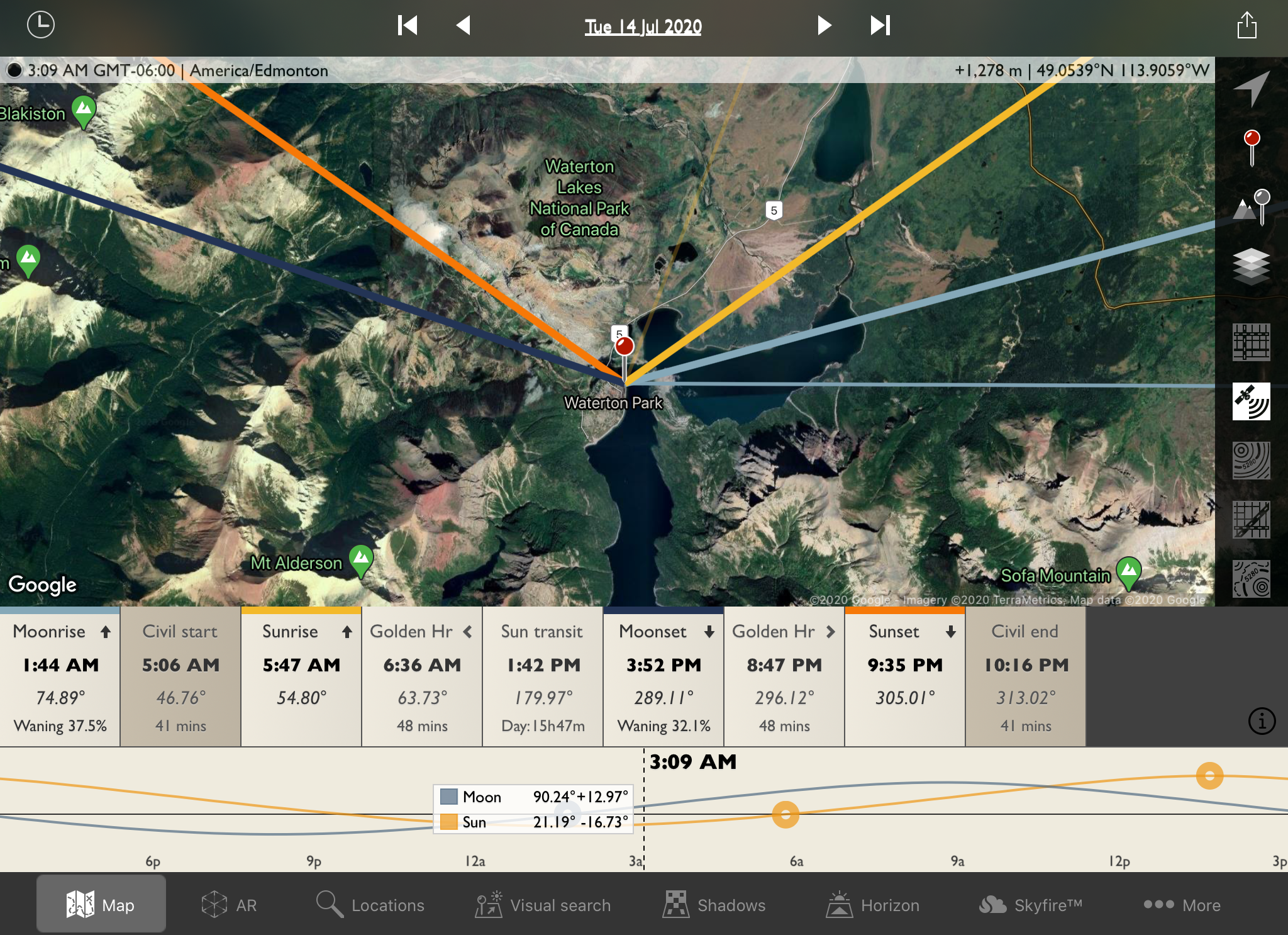
The screen from The Photographer’s Ephemeris app showing the planning map for the image above, with the faint yellow line indicating the line toward the comet’s azimuth.

Move your location to place the line toward the comet over what you want to include in the scene.

TPE 3D
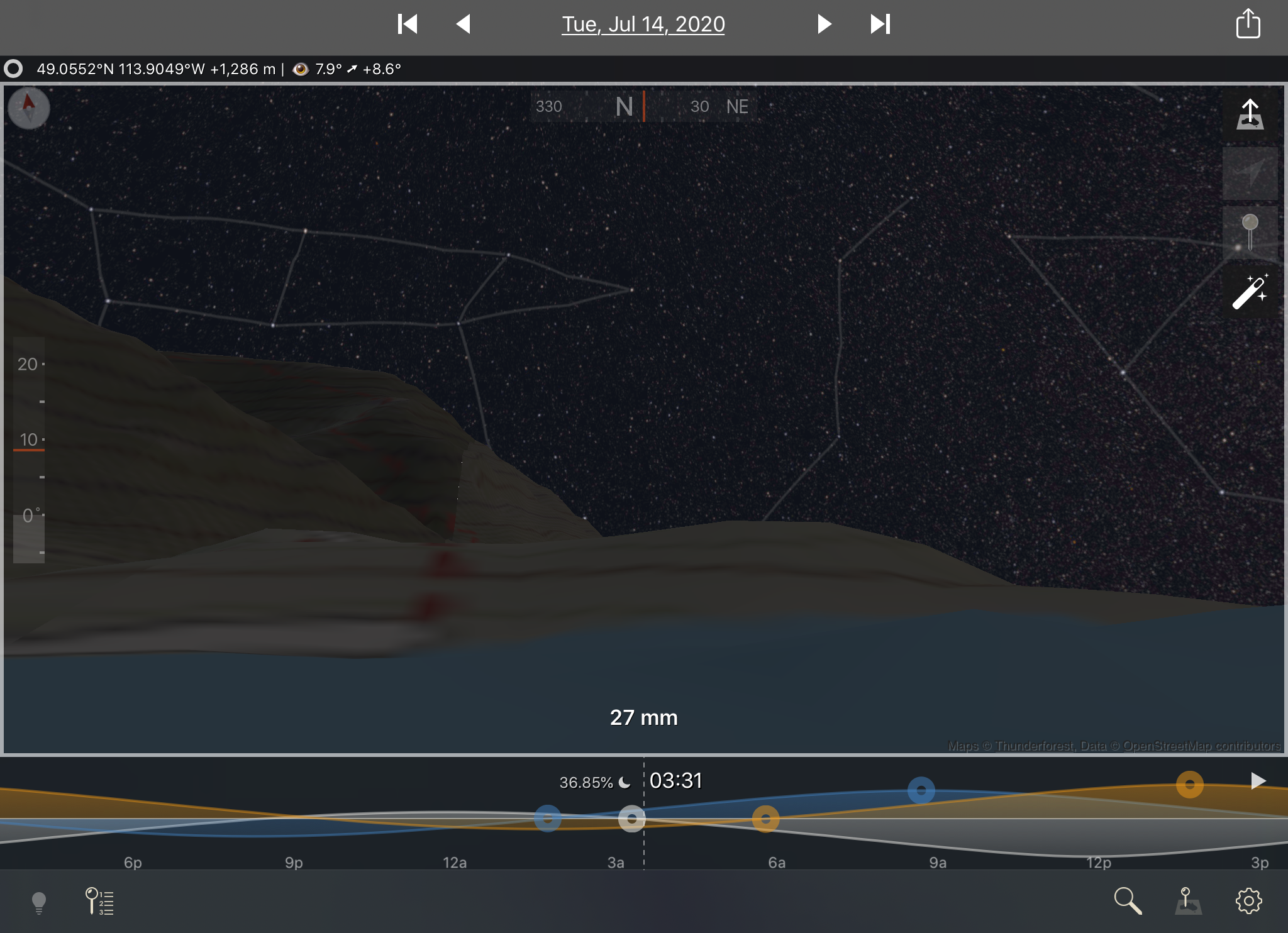
The simulation of the real scene above, of the comet over the Prince of Wales Hotel, using TPE 3D app. The simulation matches the real scene very well!

I like The Photographerโ€™s Ephemeris as it links to the companion app TPE3D that can show the stars over the actual topographic landscape. It wonโ€™t show the comet, but if you know where it is in the sky you can see if if will clear mountains, for example.

Astrospheric
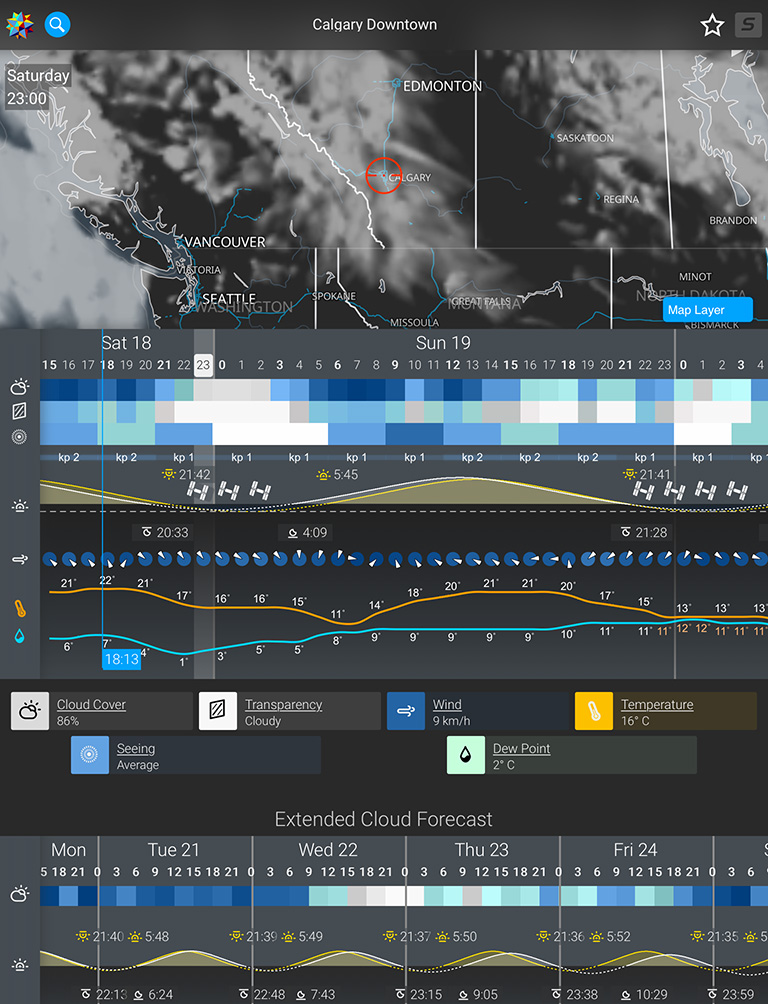
The Astrospheric app prediction of skies for me for the night I prepared this blog. Not great! But clear skies could be found to to east with a fresh hours drive.

  1. Planning for the Weatherย 

All is for nought if the sky is cloudy.ย 

For planning astro shoots I like the app Astrospheric (https://www.astrospheric.com). It is free for mobile and there is a web-based version. It uses Environment Canada predictions of cloud cover for North America. Use it to plan where to be for clear skies first, then figure out the best scenic site that will be under those clear skies.ย 

For sites outside North America, try ClearOutside (https://clearoutside.com)ย 


Advanced Techniquesย 

Be happy to get a well-composed and exposed single shot.ย 

But โ€ฆ if you wish to try some more advanced techniques for later processing, here are suggestions.

Comet NEOWISE and Aurora Panorama (July 13, 2020)
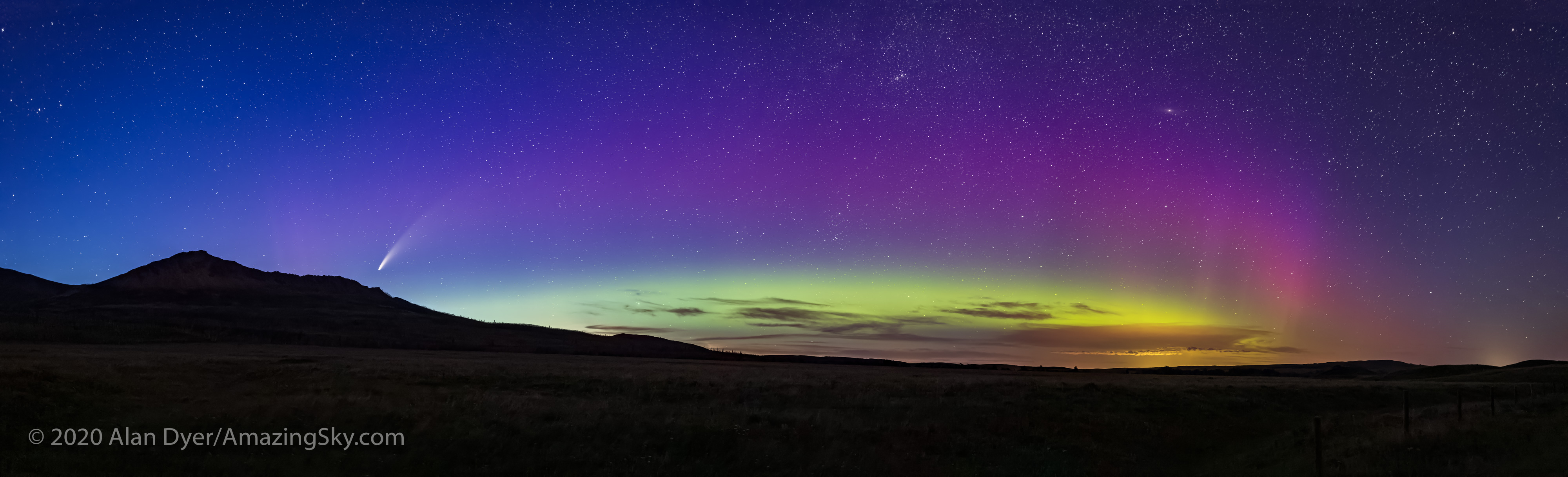
A panorama of the sky just before midnight on July 13, 2020 from Waterton Lakes National Park, Alberta, Canada with Comet NEOWISE (C/2020 F3) over the front range of the Rocky Mountains and an arc of aurora across the north. This is a 6-segment panorama with the 35mm Canon lens at f/2.2 for 25 seconds each at ISO 800 with the Canon 6D MkII and stitched with Adobe Camera Raw.

1. Panoramas

On several nights Iโ€™ve found a panorama captures the scene better, including the comet in context with the wide horizon, sweep of the twilight arch or, as weโ€™ve had in western Canada, some Northern Lights.

Take several identical exposures, moving the camera 10 to 15 degrees between images. Editing programs such as Lightroom, Adobe Camera Raw, ON1 Photo RAW and Affinity Photo have panorama stitching routines built in.ย 

My Nightscapes and Time-Lapses ebook shown above provides tutorials for shooting and processing nightscape panoramas.ย 

Comet NEOWISE over Red Deer River Panorama (July 11, 2020)
What a magical scene this was! This is Comet NEOWISE (C/2020 F3) over the sweep of the Red Deer River and Badlands from Orkney Viewpoint north of Drumheller, Alberta, on the morning of July 11, 2020. Light from the waning gibbous Moon provides the illumination, plus twilight. This nicely shows the arch of the twilight colours. This is a 6-segment panorama with the 50mm Sigma lens at f/2.8 and Canon 6D MkII at ISO 400 for 13 seconds each. Stitched with Adobe Camera Raw. Topaz DeNoise AI and Sharpen AI applied.

2. Exposure Blendingย 

If you have a situation where the sky is bright but the ground is dark, or vice versa, and one exposure cannot record both well, then shoot two exposures, each best suited to recording the sky and ground individually.ย 

For example, on moonless nights Iโ€™ve been shooting 2- to 5-minute long exposures for the ground and with the lens stopped down to f/5.6 or f/8 for better depth of field to be sure the foreground was in focus.ย 

For a video tutorial on how to do the layering and masking in programs such as Photoshop, see my How to Shoot Moonlit Nightscapes video at https://vimeo.com/theamazingsky/moonlighttutorial.ย 

Comet NEOWISE over Horseshoe Canyon (July 11, 2020)
This is Comet NEOWISE (C/2020 F3) over the Horseshoe Canyon formation near Drumheller, Alberta on the night of July 10-11, 2020, taken about 2 a.m. MDT with the comet just past lower culmination with it circumpolar at this time. Warm light from the rising waning gibbous Moon provides the illumination. This is a blend of six 1- and 2-minute exposures for the ground at ISO 800 and 400 stacked to smooth noise, with a single 30-second exposure at ISO 1600 for the sky, all with the 35mm Canon lens at f/2.8 and Canon 6D MkII.

3. Exposure Stackingย 

To reduce noise, it is also possible to shoot multiple exposures to stack later in processing to smooth noise. This is most useful in scenes with dark foregrounds where noise is most obvious, and where I will stack 4 to 8 images.ย 

Just how to do this is beyond the scope of this blog. I also give step-by-step tutorials for the process in my Nightscapes and Time-Lapses ebook shown above. It be done in Photoshop, or in specialized programs such as StarryLandscapeStacker (for MacOS) or Sequator (Windows).ย 

But shoot the images now, and learn later how to use them.ย 

Comet NEOWISE Close-Up (July 15, 2020)
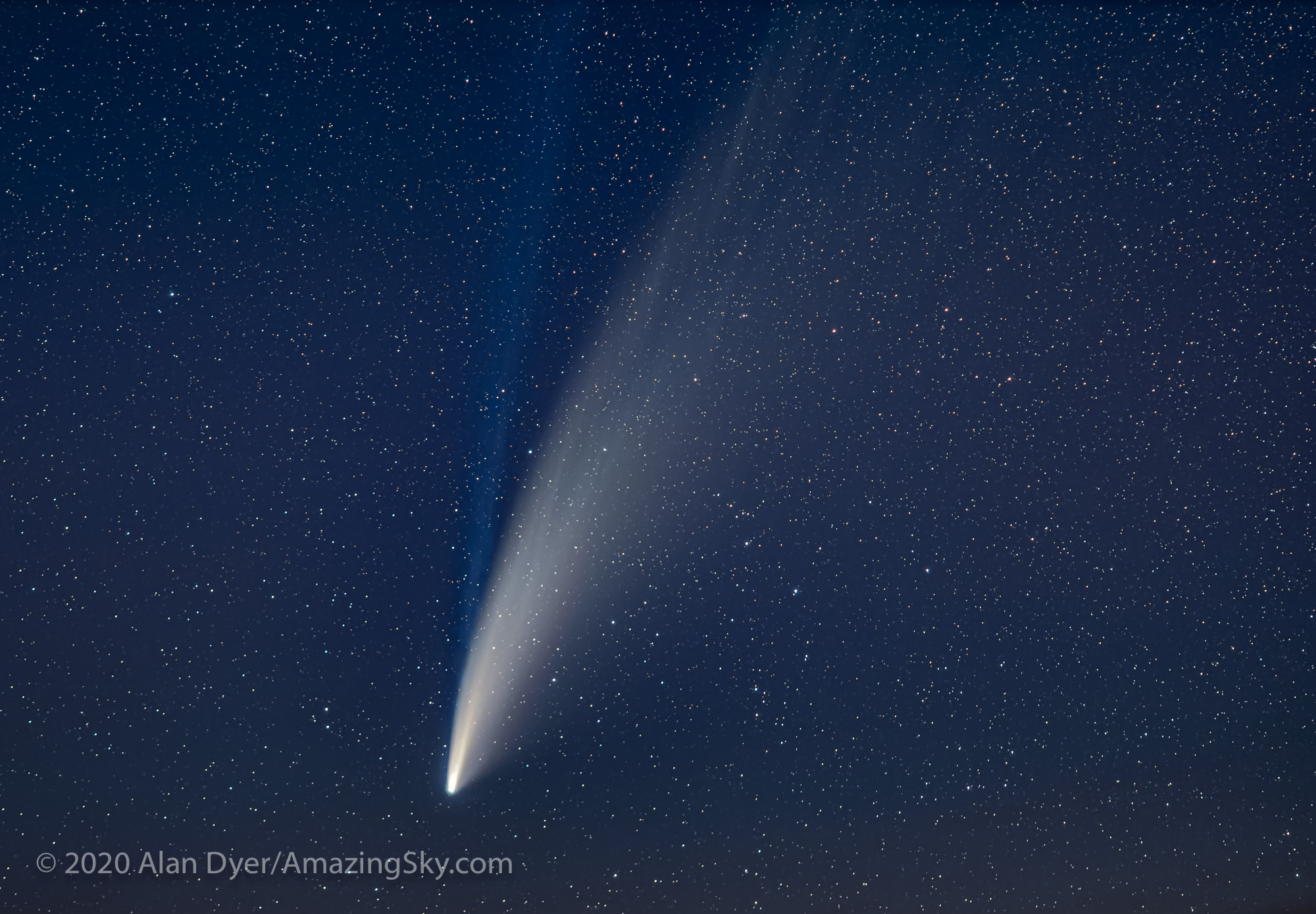
A close-up of Comet NEOWISE (C/2020 F3) on the night of July 14/15, 2020 with a 135mm telephoto lens. This is a stack of nine 1-minute exposures with the 135mm Canon lens wide-open at f/2 and Canon EOS Ra camera at ISO 800. The camera was on the iOptron SkyGuider Pro tracker tracking the stars not the comet. Stacked and aligned in Photoshop.

4. Tracking the Skyย 

If it is close-ups of the comet you want, then you will need to use a 135mm to 300mm telephoto lens (especially later in the summer when the comet is farther away and smaller).ย 

But with such lenses any exposure over a few seconds will result in lots of trailing.ย 

iOptron SkyGuider Pro
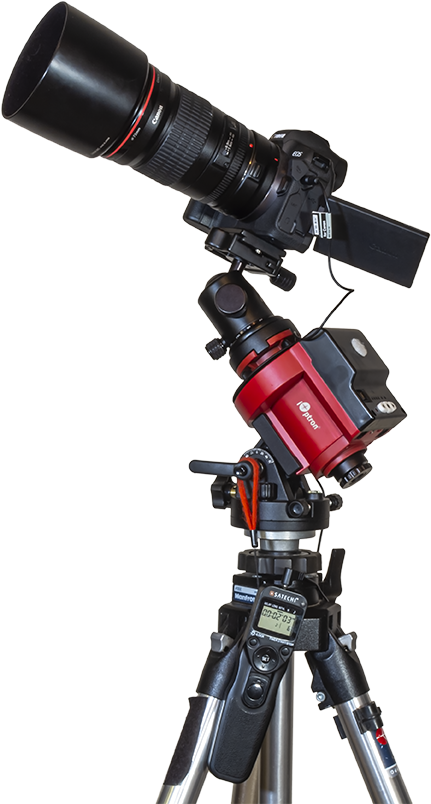
The iOptron SkyGuider Pro and 135mm lens used to take the close-up shot of the comet above.

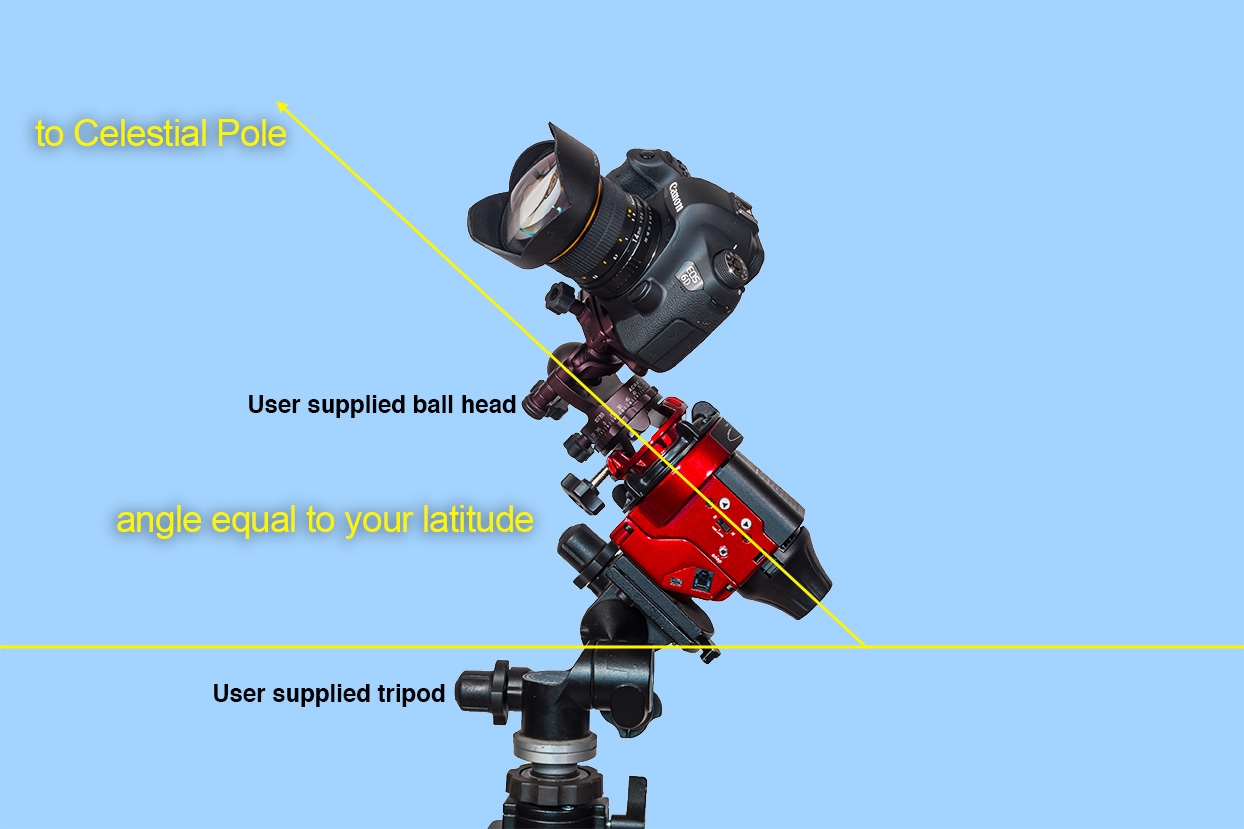
The solution is a tracking device such as the Sky-Watcher Star Adventurer or iOptron SkyGuider. These need to be set up so their rotation axis aims at the North Celestial Pole near Polaris. The camera can then follow the stars for the required exposures of up to a minute or more needed to record the comet and its tails well.ย 

Star Adventurer Polar Axis Angle
This is the Sky-Watcher Star Adventurer. All trackers have a polar axis that needs to be aligned to the Celestial Pole, near Polaris.

Just how to use a tracker is again beyond the scope of this blog. But if you have one, it will work very well for comet shots with telephoto lenses. However, trackers are not essential for wide-angle shots, especially once the Moon begins to light the sky.

But later in the summer when the comet is fainter and smaller, a tracked and stacked set of telephoto lens images will likely be the best way to capture the comet.

Clear skies and happy comet hunting!

โ€” Alan, July 18, 2020 /Revised July 23 / AmazingSky.comย 


Follow Comet Wirtanen


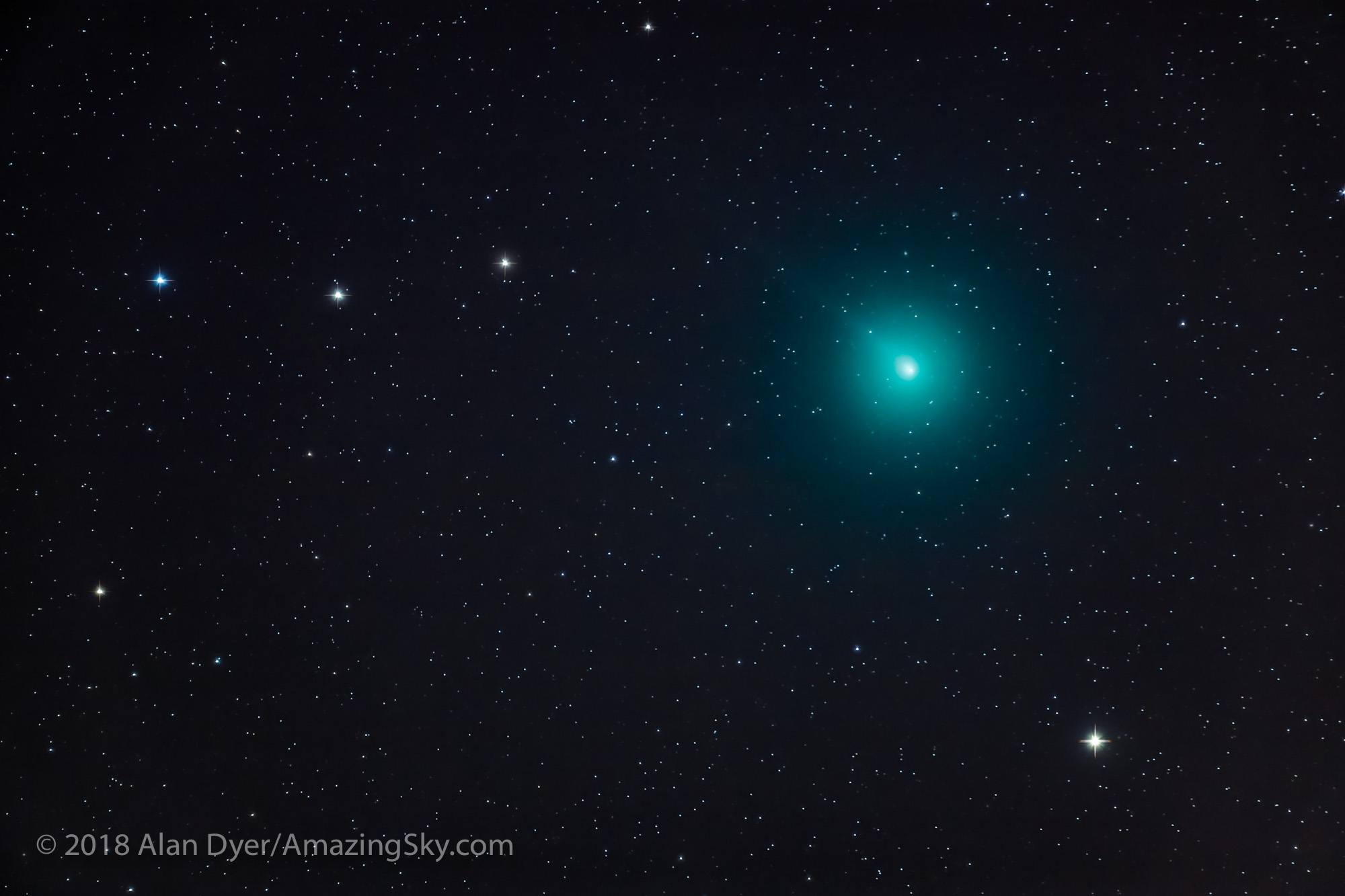
Comet Wirtanen / 46P on December 6, 2018

A well-known comet is making its closest approach to Earth in many years and promises a good show.ย 

Comet Wirtanen is now climbing up the late autumn and winter sky for northern hemisphere viewers, and is already a fine binocular comet. By mid-December it might be bright enough to be visible to the naked eye, but only from a dark rural site.

Discovered in 1948 by Carl Wirtanen at the Lick Observatory, his namesake comet orbits the Sun every 5.4 years. So unlike other recent bright comets that have visited us for the first time, Comet Wirtanen (aka 46P) is well known. It is one of many “Jupiter-family” comets whose orbits have been shaped by the gravity of Jupiter and orbit the Sun about every 6 years.

So since it was discovered, Comet 46P (the 46th comet in the catalog of periodic comets) has been well observed. It isn’t better known because at most returns it never gets bright, and that’s because it never gets closer to the Sun than a little more than the distance from the Earth to the Sun. (Its perihelion distance is 1.06 AU, with 1 AU, or Astronomical Unit, being the average distance from Earth to the Sun.)

However, despite this, we’re expecting โ€“ indeed already enjoying โ€“ a good show at this return.

Due to the quirk of orbital clockwork, on this return the comet reaches its closest point to the Sun just before it is also closest to Earth.

That puts the comet “just” 11,680,000 kilometres from us at its closest approach to Earth on December 16, four days after perihelion, the point when the comet is closest to the Sun.

Comet Wirtanen from Space
The relative position of the Sun, Earth and Comet Wirtanen on December 16, 2018.

Comet Wirtanen will be relatively bright simply by virtue of its proximity.

But it is also an active comet, emitting a lot of gas and dust into a large “coma,” and that’s what we see, not the 1-kilometre-wide icy nucleus itself which is too small and shrouded by the coma. (As a footnote, Comet Wirtanen was to have been the comet that the European Rosetta probe was to visit, but launch delays forced ESA to switch cometary targets.)

Comet Wirtanen is glowing at magnitude 5 to 6, technically making it visible to the naked eye. However, because it is large and diffuse, in practice you need binoculars to see it โ€“ now.

But as it approaches Earth and the Sun, Wirtanen will brighten, perhaps to magnitude 3 (the brightest stars are magnitude 0 to 1), making it easier to see with the unaided eye from a dark site.

The one catch is that as it heads toward its brightest in mid-December the waxing Moon also begins to enter the sky and wash out the comet with moonlight.


The first two weeks of December will be prime time for Wirtanen


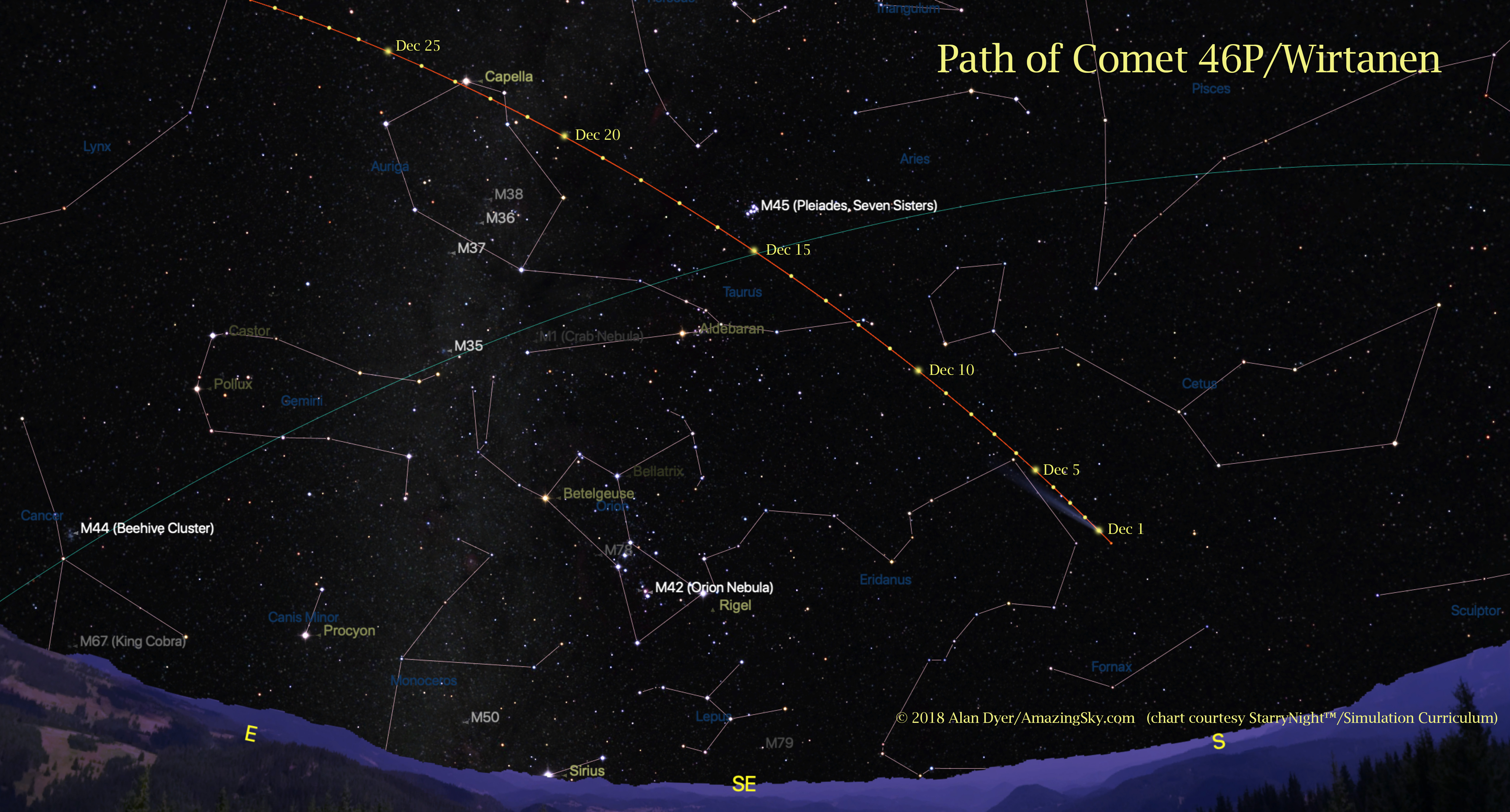
Comet Wirtanen Path
The path of Comet Wirtanen across the sky in December 2018. The yellow dots mark the position of the comet at nightly intervals for late evening (10 p.m.) for North America. While comet will be in the sky most of the night, it will be highest in late evening about 10 p.m. local time when the sky will look as depicted, with the comet high in the south to southeast. Click or tap to download a full-sized version.

The first two weeks of December will be prime time for Wirtanen, with a particularly good opportunity coming on the evenings of December 15 and 16 when it shines below the Pleiades star cluster. The gibbous Moon will set about 1 to 2 a.m. with the comet still high enough for a dark sky view and photos.

Those will be great nights to shoot the comet and the cluster with a telephoto lens, provided the camera is on a tracker for untrailed exposures of 1 to 4 minutes. A 135mm to 300mm lens will frame the pair well.

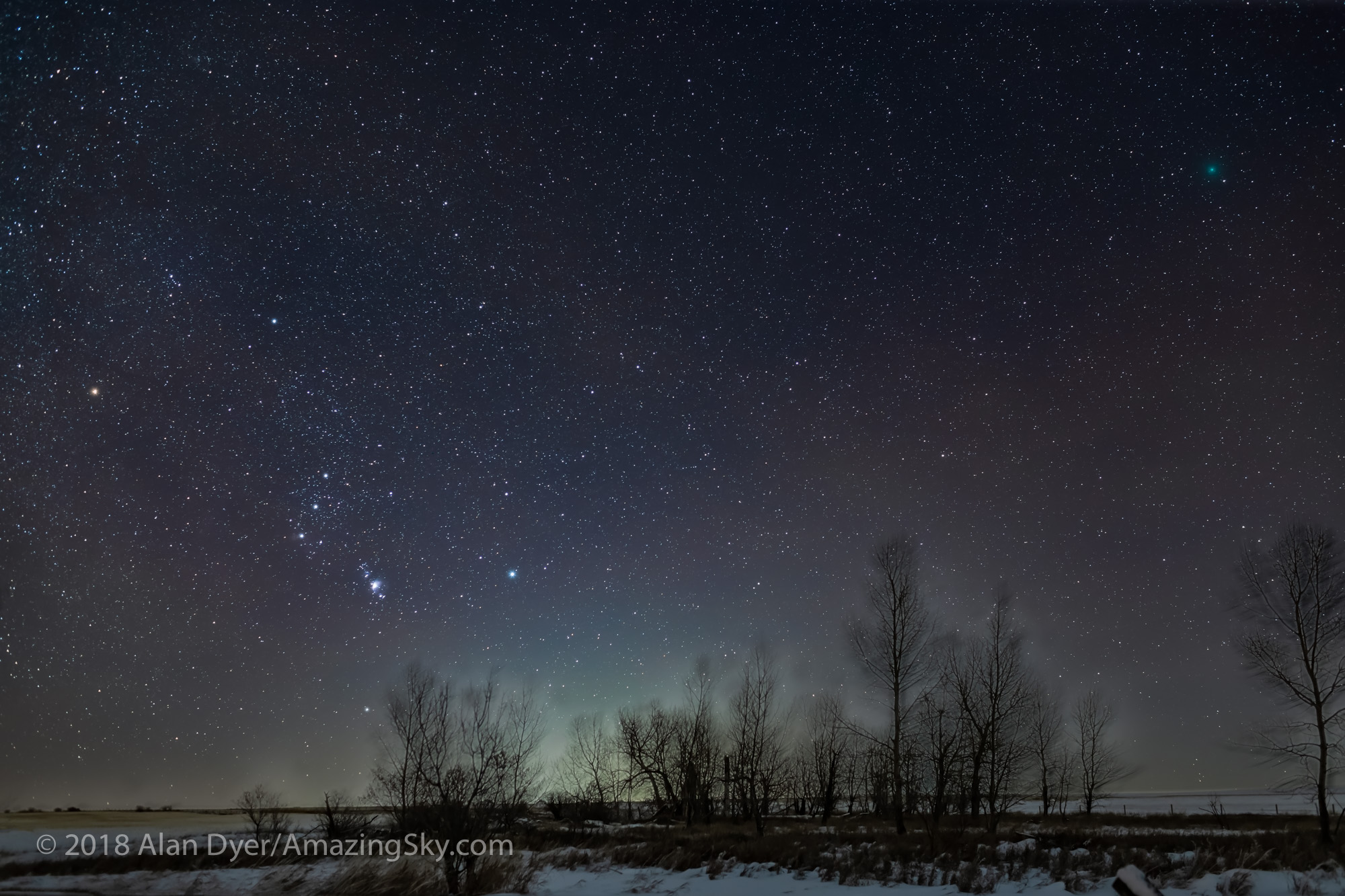
Winter Green Comet with Orion
Comet Wirtanen as a green glow at upper right here in Eridanus. and well to the west of Orion, rising here at left, on the evening of December 6, 2018. I shot this with a wide-angle 35mm lens in a blend of tracked and untracked 1-minute exposures.

After that, through late December, the bright Moon will interfere with ย the view. For example, a close approach of the comet near the star Capella on December 23 happens with the nearly Full Moon not far away.

Comet Wirtanen / 46P on December 6, 2018
Comet Wirtanen in a close-up through a telescope on December 6, 2018 in a stack of short and long exposures.

I took the above close-up photo of Comet Wirtanen on December 6. It is a long-exposure telescopic view, but the comet is easy to see with binoculars. It appears visually and photographically as a diffuse fuzzball, with the camera recording a vivid cyan colour from glowing cyanogen and diatomic carbon molecules. You won’t see that colour with your eyes, even in a telescope.

Comet Wirtanen Path Dec 8 to 16
The path of Comet Wirtanen Dec 8 to 16 superimposed on an actual sky image with the comet taken December 8. The circle indicates the field of view of typical binoculars. On Dec 15 and 16 the comet will be in the same binocular field as the Pleiades star cluster. The positions are for about 10 pm Mountain Standard Time for each of those dates.

Even at the comet’s best in mid-December any tail might be hard to see and even photograph (it appears faintly above) as it will be both faint and pointed directly away from us because, as comet tails do, it will also be pointed away from the Sun.

Look for a large glow which will be grey to the eye but green to the camera.

While you can just take pictures for yourself, astronomers are asking amateur astrophotographers to participate in a worldwide observing campaign to monitor Comet Wirtanen. More details are available here atย wirtanen.astro.umd.eduย and at http://aop.astro.umd.edu/

Clear skies and happy comet hunting!

โ€” Alan, November 30, 2018 (Revised December 6) / ยฉ 2018 Alan Dyer / AmazingSky.comย 

New Year’s Eve Sky: Aurora, Orion, and a Comet


New Year's Eve Winter Sky

The New Year’s sky was filled with Northern Lights, a panorama of stars, and a comet at dawn.

It was a busy night for stargazing as 2015 turned to 2016. A fine display of Northern Lights kicked off the celebrations, as curtains danced in the east as Orion rose (below).

New Year's Eve Aurora, Dec. 31, 2015

Toward midnight the Lights kicked up again, now with Jupiter (on the horizon) and Leo rising in the east (below).

New Year's Eve Aurora #2 (Dec 31, 2015)

I shot hundreds of frames for time-lapse sequences, and assembled them into a short music video. Click on the buttons to enlarge it to HD.


Just before midnight, while the second time-lapse was going and the aurora was still active, but before the Last Quarter Moon rose to light the sky, I shot a set of tracked images taking in the entire winter sky from horizon to well past the zenith.

That image is at top. It takes in the winter sky and northern winter Milky Way,  from Canis Major just above the horizon, up past Orion, then on up to Perseus and Cassiopeia at top right.

It shows how Orion and Sirius, the night sky’s brightest star, stand nearly due south at midnight on New Year’s Eve.


Comet Catalina near Arcturus on New Year's Day
Comet Catalina (C/2013 US10) near Arcturus in the constellation of Bootes, at pre-dawn on the morning of January 1, 2016, with the Last Quarter Moon nearby illluminating the sky. A long, faint ion tail is visible extending 2 to 3 degrees to the right while a brighter but stubby dust tail extends down to the south. Shot from home using the 200mm Canon telephoto and 1.4x extender at f/4.5 for a stack of 8 x 2-minute exposures at ISO 800 with the Canon 6D. Median combined stacked to eliminate satellite trails. The comet is slightly blurred due to its own motion in that time.
The final show of the night, now before dawn on New Year’s Day 2016, was Comet Catalina sitting right next to the bright spring star Arcturus. The comet was visible in the moonlight as a fuzzy object next to brilliant Arcturus, but the photo begins to show its faint tails, just standing out in the moonlit sky.

The comet will become more visible later this month once the waning Moon exits the dawn sky, as Catalina is expected to remain a nice binocular comet for most of the month as it heads high into northern sky.

Happy New Year to all! Have a celestial 2016!


Don’t forget, you can download my free 2016 Sky Calendar as a PDF. See my previous blog for details and the link. 

โ€” Alan, January 1, 2016 / ยฉ 2016 Alan Dyer / amazing sky.com

Venus and the Comet


Comet Catalina near Venus (Dec 9, 2015)

Comet Catalina sports two tails as it moves past Venus in the dawn sky.

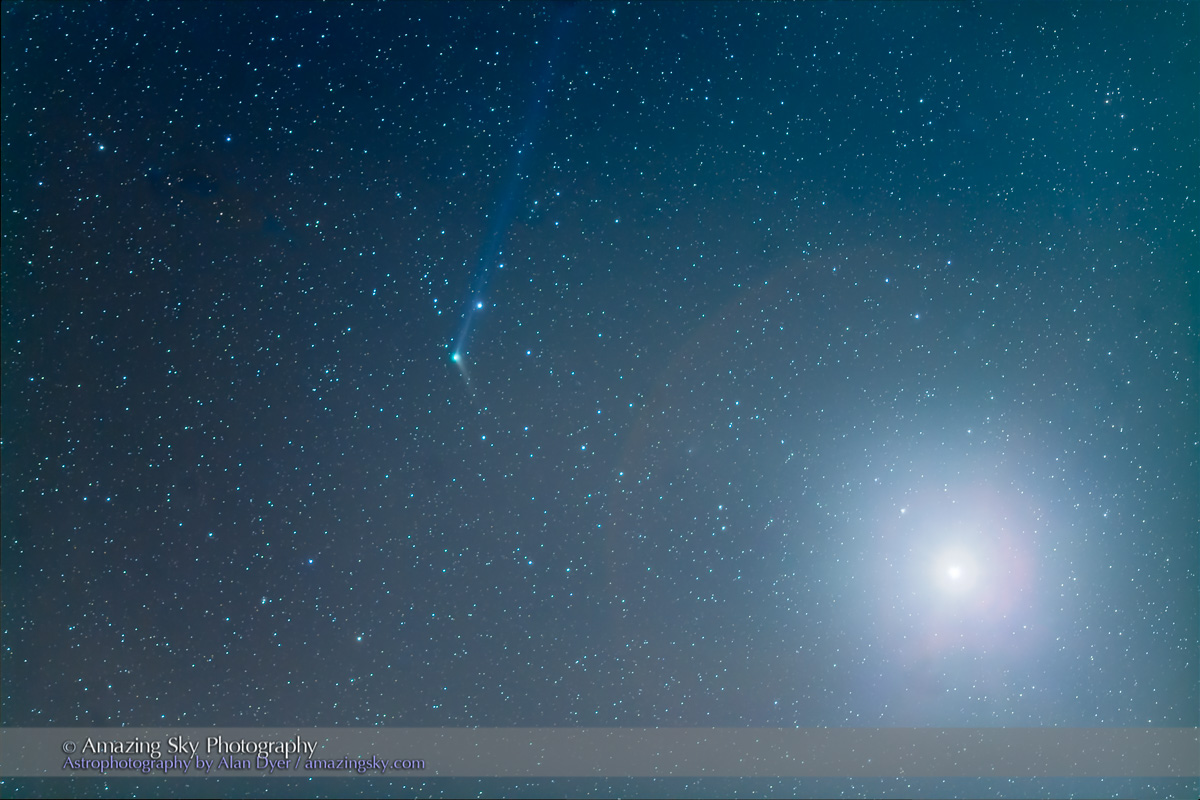
This was the view this morning, December 9, from my site in Arizona, of Comet Catalina near Venus in the dawn sky. This is a telephoto lens shot that provides a view similar in size to what binoculars show.

However, the blue ion tail visible here stretching back several degrees is mostly a photographic target. Visually, just Catalina’sย short, stubby dust tail at lower right is obvious.

The ion tail points away from the Sun, while the dust tail extends along the cometโ€™s orbit, showing where the comet has been.

The view, both visually and photographically, of the comet will improve as it climbs higher into the eastern morning sky and as it moves away from the glare of Venus. The Moon is also now gone from the dawn, at least for the next couple of weeks.

The comet is dimmer than expected but should at least maintain this brightness for the next month or so.

Technical:

This is a stack of 5 x 90-second exposures, taken with the 135mm telephoto and 1.4x extender for a focal length of 190mm, at f/2.8 and with the Canon 5D MkII at ISO 1600, tracked on the iOptron Sky-Tracker. Two other exposures, of 15s and 1s, were blended in with luminosity masks to reduce the glare of Venus to a smaller size.

โ€” Alan, December 9, 2015 / ยฉ 2015 Alan Dyer / www.amazingsky.com

Capturing Comet Catalina


Comet Catalina with Venus at Dawn

I got the comet but it isn’t what was hoped for โ€“ a faint fuzzball in binoculars.

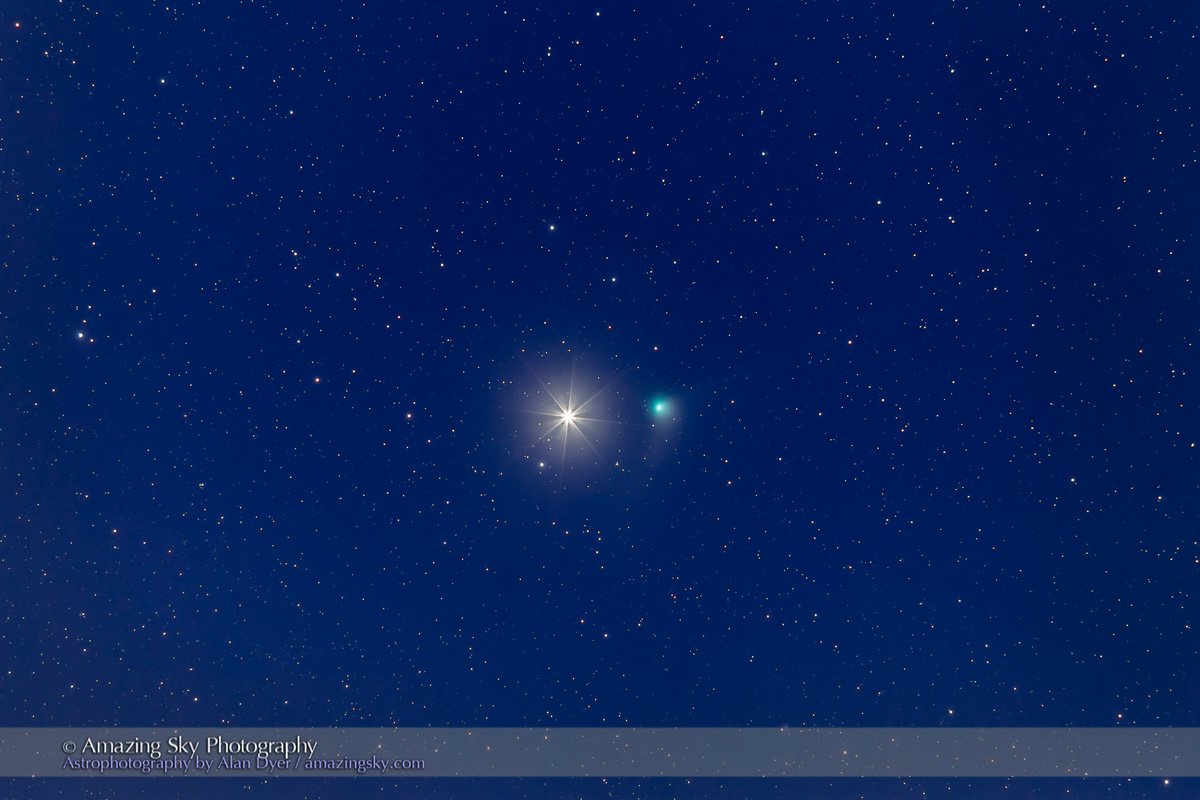
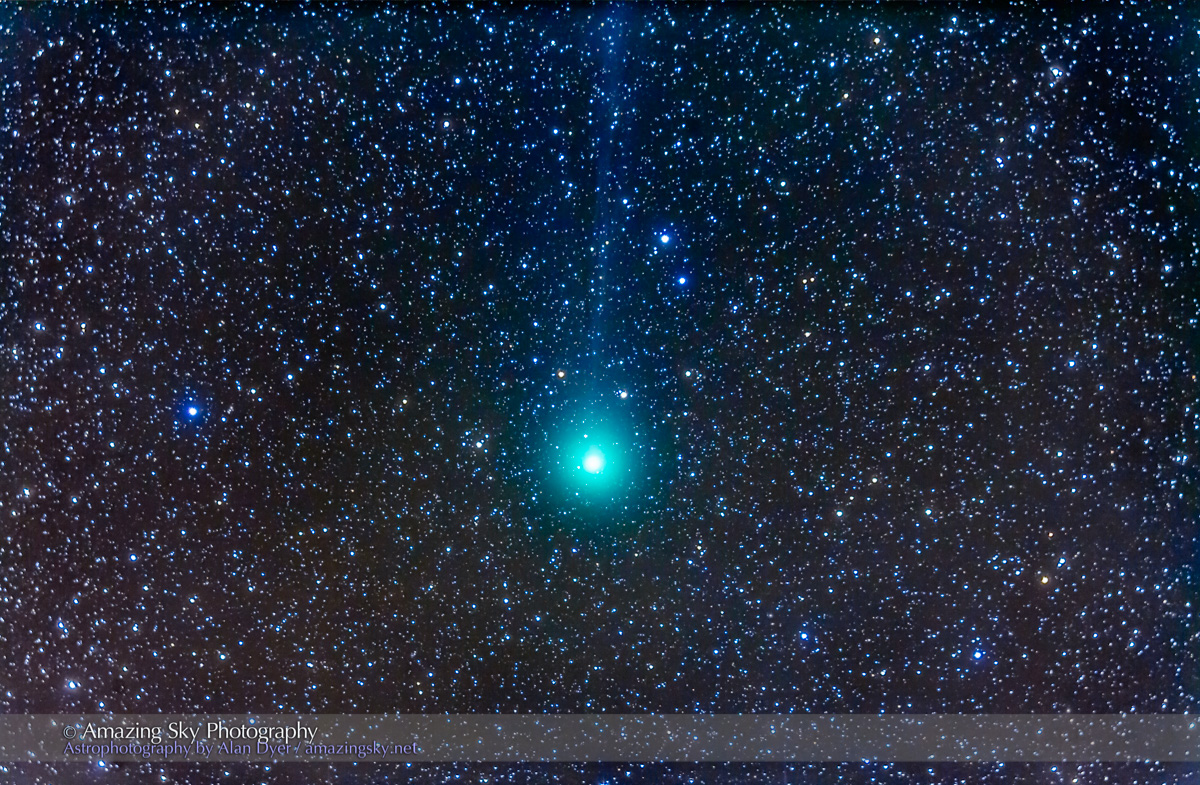
This was Comet Catalina (aka C/2013 US10) in the dawn sky this morning, December 6, with the comet appearing as a fuzzy star below brilliant Venus in binoculars, and just revealing its two short tails in photos. It’s the cyan-colored object near the centre. Venus is the brilliant object.

This image is with a telephoto lens, and coversย a little more of the sky than typical binoculars would show. I knew this would be a binocular comet at best, but it’s barely that. This is more a comet for telescopes.

But as the Moon departs the scene and the comet climbs higher the view may improve. Still, if you are pining for views of Comet Catalina and are stuck under cloudy winter skies at home, don’t be worried. You aren’t missing too much. Except …

Arch of the Autumn Milky Way
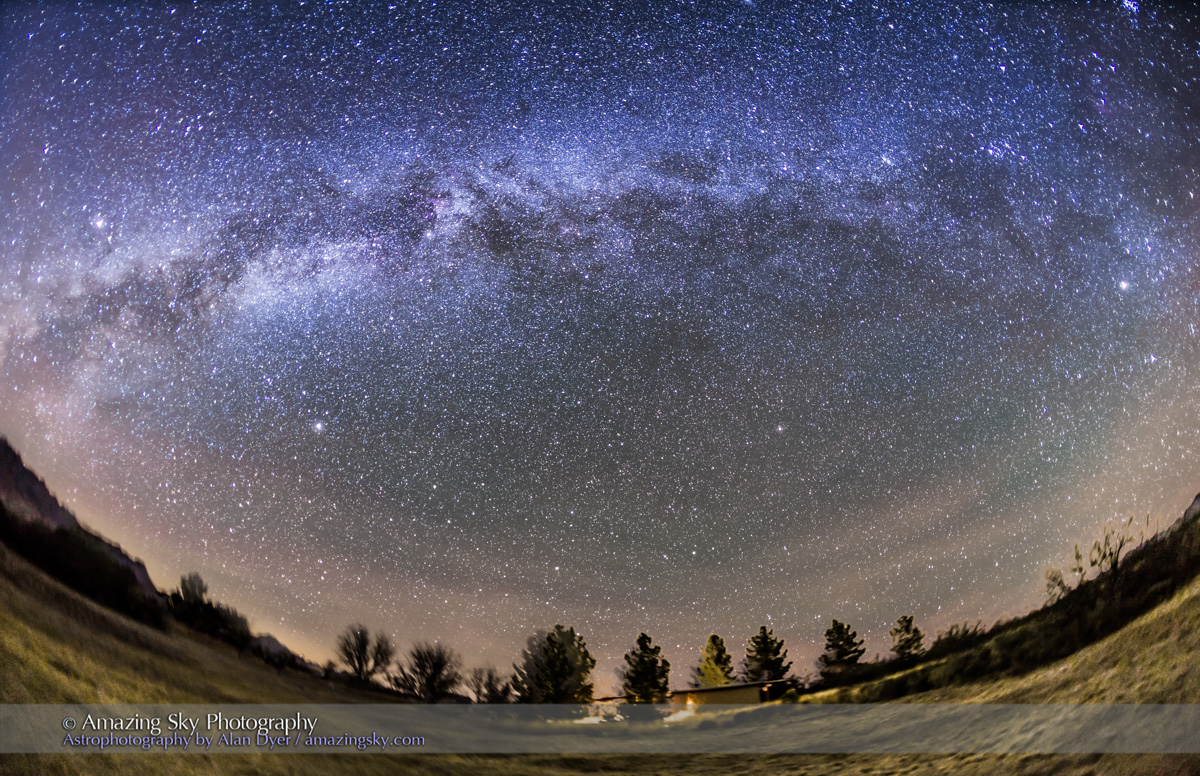
The arch of the Milky Way in the northern autumn and early winter sky, from Arizona on December 5, 2015. The Milky Way extends from Aquila to the left, in the southwest to Cassiopeia at top right, to Perseus and Auriga at far right, in the northeast. I shot this from the Quailway Cottage near Portal, Arizona, latitude +32ยฐ N. The view is looking north toward the celestial pole. Polaris is just right of lower centre. This is a stack of 8 tracked exposures, each 3 minutes at f/2.8 with the 15mm lens and Canon 6D at ISO 1600, with the ground coming from one exposure to minimize blurring. The camera was on the iOptron Sky-Tracker.

This was the view of the autumn Milky Way from here in Arizona last night. Pretty impressive under nearly perfect sky conditions. And then there’s this …

Winter Sky Setting over the Chiricahuas
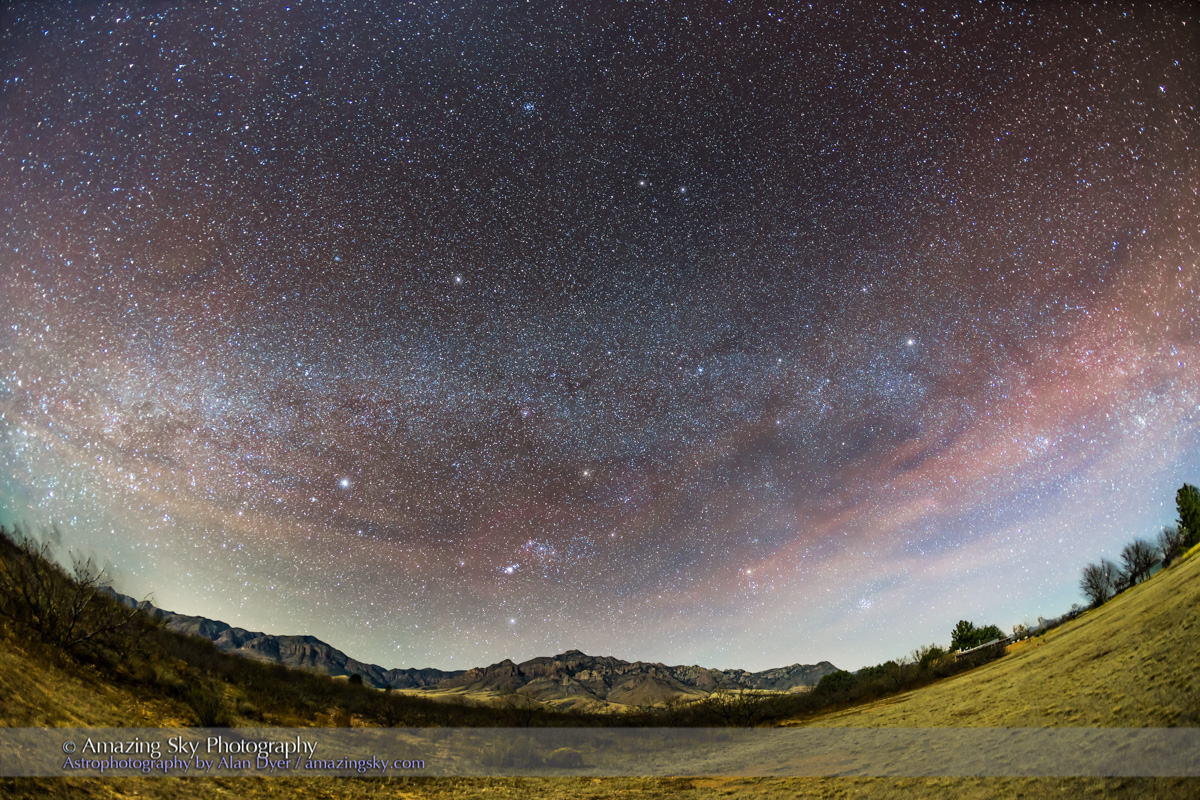
Orion and the northern winter constellations and Milky Way setting at dawn over the Chiricahua Mountains of southwest Arizona, near Portal, AZ. The waning crescent Moon in the west provided the illumination in this dawn shot from December 6, 2015. Orion is just above the main peak at centre, with Sirius, in Canis Major, to the left and Aldebaran, in Taurus, to the right. The Pleiades are setting at right. The star cluster at top is the Beehive, M44, in Cancer. Bands of airglow add the red streaks. The site is the Quailway Cottage near Portal, Arizona. This is a stack of 4 x 2 minute exposures, tracked, at f/3.5 with the 15mm full-frame fish-eye lens and Canon 6D at ISO 1250, for the sky, and the same specs for 4 exposures, untracked for the ground. Each set was mean-combined stacked to reduce noise.

This was the winter Milky Way with Orion setting into the west over the Chiricahuas at dawn. Turn around from looking at the comet and thisย was the view. So who cares if the comet isn’t too great? There’s lots more to see and shoot. With no snow, no frost, no dew.

More to come this week I trust!

โ€” Alan, December 6, 2015 / ยฉ 2015 Alan Dyer / www.amazingsky.com

Heads Up! โ€“ A Comet in the December Dawn


Dec 7 Venus & Moon

A new comet is coming into our morning sky, for our binocular viewing pleasure.

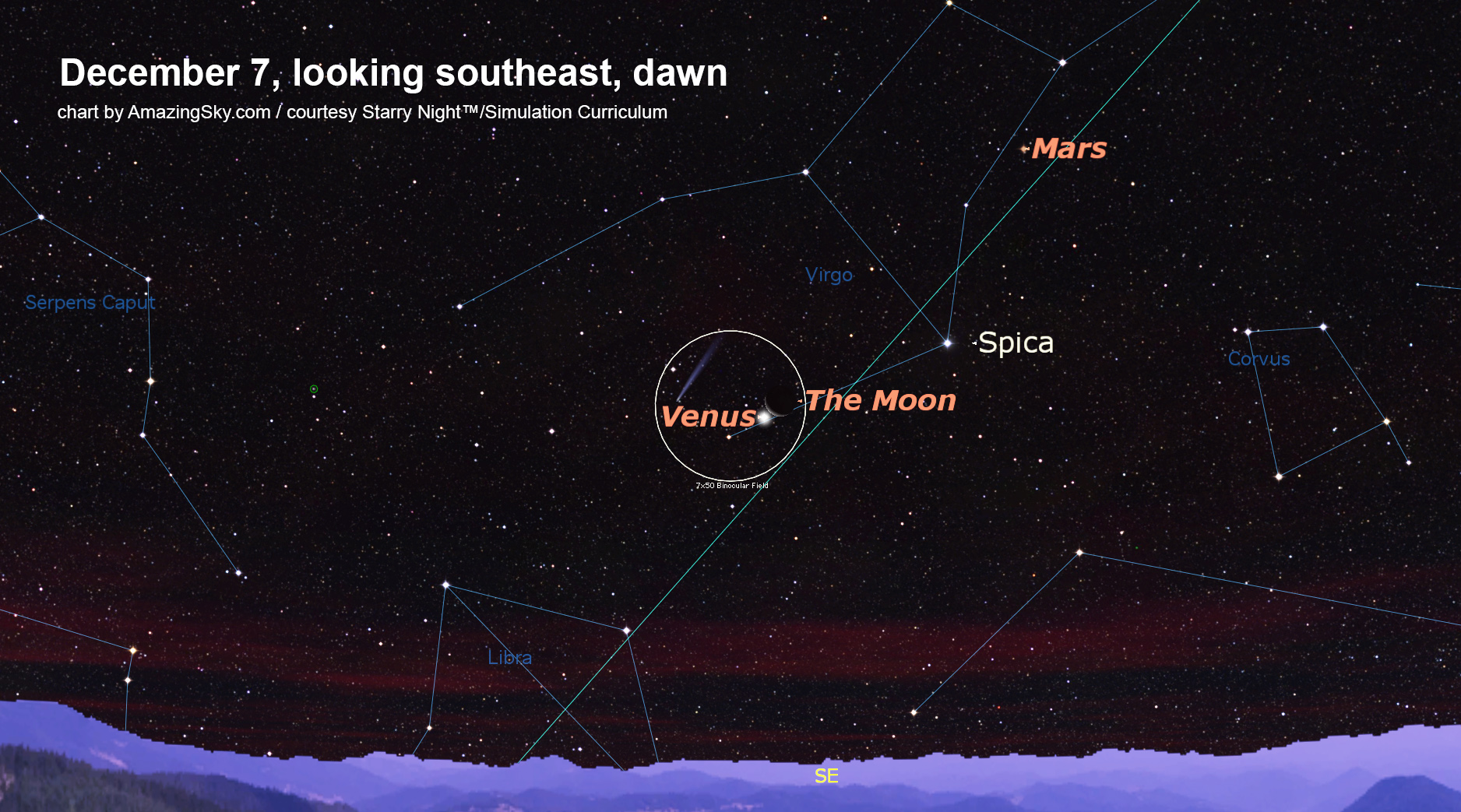
Comet Catalina, aka C/2013 US10, has emerged from behind the Sun and is beginning to rise into our northern hemisphere dawn sky. The new comet promises to be visible in binoculars, but likely won’t be obvious to the unaided eyes.

On the morning of December 7 the comet sits within a binocular field of the waning crescent Moon which itself sits just above brilliant Venus. That in itself will be a remarkable view, best appreciated in binoculars, and a fine photogenic sight for the camera.

The close conjunction of the crescent Moon with Venus alone will be enough of an attraction on December 7, but the comet should add to the scene.

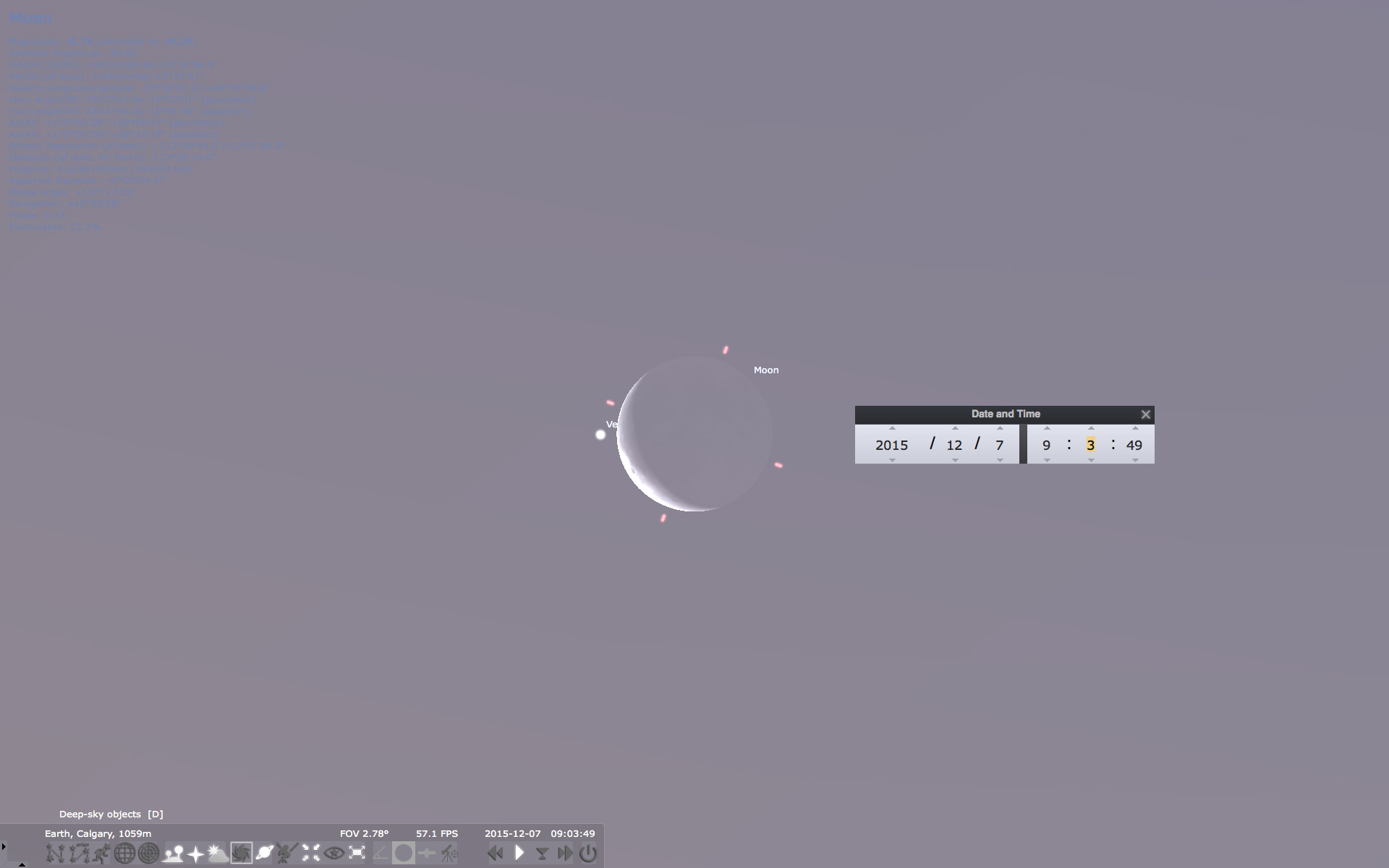
December 7 Venus Occultation

Even more, later in the day the Moon actually passes in front of, or “occults,” Venus in the daytime sky for most of North America.

That occultation happens in the morning for western North America and in the early afternoon for eastern North America. However, you’ll need a telescope to see it well, and very clear blue skies.

Stellarium Occultation

Use planetarium software (the free Stellarium program, for example, shown above, if you do not own astronomy software) to simulate the sky and provide the occultation times for your location. Zoom into the Moon and run time back and forth on December 7 to see when Venus goes behind the Moon and reappears. The screen shot above is for Calgary.

Back to the Comet

Comet Catalina was discovered in October 2013 at the Catalina Observatory in Arizona. The cometย spent the last few months in the southern hemisphere sky, but is now coming north and into our sky, but at dawn.

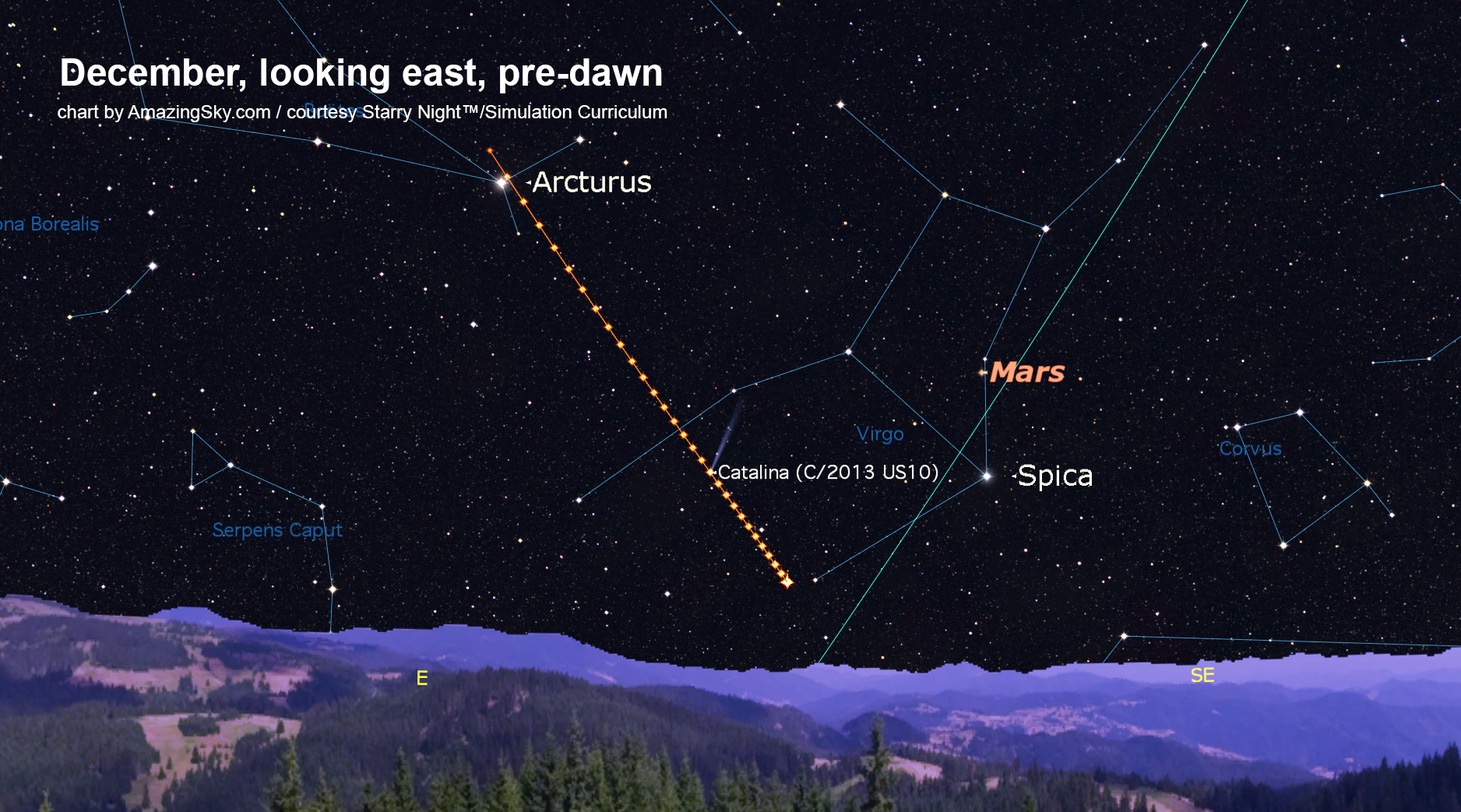
Comet Catalina Path

It rises higher and higher each morning ย through December and into the new year. It may remain at fifth magnitude, bright enough to be easily visible in binoculars from a dark site, but likely not naked eye.

The chart above plots the comet at daily intervals, from December 4 to January 1. The comet is shown for December 15. Note that on the morning of January 1 it sits within a telescope field of the bright star Arcturus.

The distance from Earth to the comet decreases through December and early January, keeping the comet at a constant brightness even as it recedes from the Sun. We are closest to Catalina on January 17, at a far distance of 108 million km. But in late January the cometย fades rapidly to become a telescope target.

To see Comet Catalinaย this month, get up 1 to 2 hours before sunrise and look southeast to east. But you will need dark skies to see it well. This will not be a good urban comet.

Nevertheless, as far asย we know, this will be the best comet of 2016.

โ€” Alan, December 2, 2015 / ยฉ 2015 Alan Dyer / www.amazingsky.com


Catching A Comet


Comet Lovejoy Through a Telescope

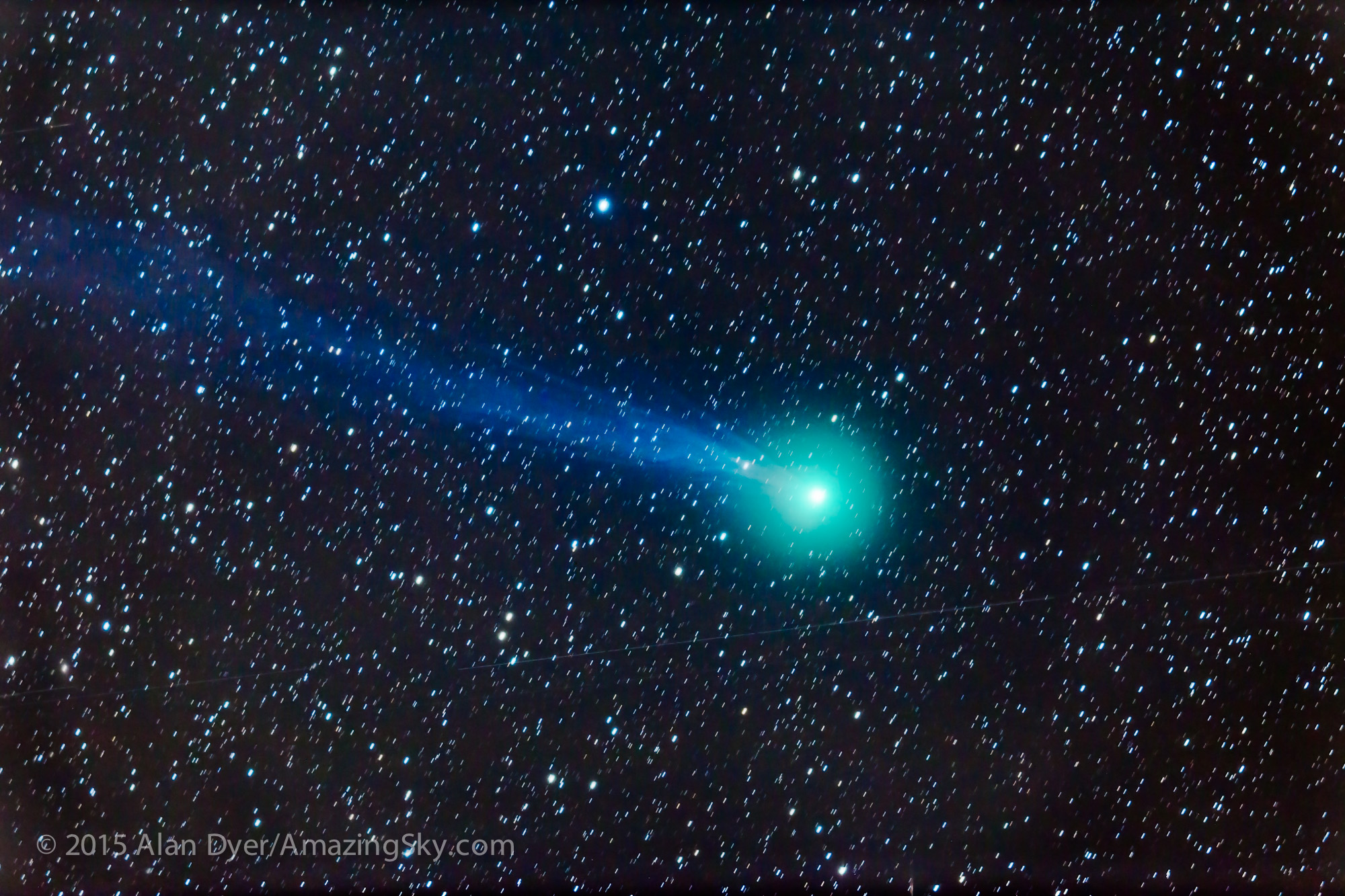
Tonight I caught a close-up of the green head and blue tail of Comet Lovejoy.

Clear skies tonight, Tuesday, January 6, allowed me to shoot Comet Lovejoy from home using a telescope and guiding system for a close-up view. I had just overย half an hour of darkness between end of twilight at 6:30 and moonrise at 7:15 but that’s all I needed to grab several guided exposures.

This telescopic shot takes in a field of about 5 by 3 degrees, a little smaller than what most binoculars would show.

The image is a stack of four 2-minute exposures with the telescope guiding on the fast-moving comet. Comet Lovejoy is now at its closest point to Earth and moving fairly rapidly across the sky. So I guided on the comet, letting the stars trail slightly over the 8 minutes of exposure time.

The head of the comet glows bright green in photos, from glowing diatomic carbon, while the tail glows blue from other ionized gases streaming away from the head, or coma. The source of it all is a tiny icy nucleus completely hidden from view amid the glowing gases.

Comet Lovejoy was easy in binoculars, which showed a bare hint of the tail in dark skies. I could see the comet naked eye, but only by knowing just where to look. It appeared as a slightly fuzzy star, but unless you knew what you were looking at you wouldn’t know it was comet. This is a binocular comet for dark skies. But a very nice binocular comet.

โ€“ Alan, January 6, 2015 / ยฉ 2015 Alan Dyer / AmazingSky.comย 

A Comet for Christmas


Comet Lovejoy (C/2104 Q2) on Dec 23, 2014

Comet Lovejoy has migrated from the southern sky to appear in our northern sky for the holiday season.

This was Comet Lovejoy, aka C/2014 Q2, as it appeared on Tuesday night, December 23. It was low in the south well below Orion in the constellation of Columba the dove. It was easy to see in binoculars as a 5th magnitude fuzzy star. Myย long exposure photo reveals its thin blue ion tail.

I could just see the cometย naked eye, knowing exactly where to look. However, I’m at 32ยฐ North latitude, placing the comet now decently high in my New Mexico sky.

The comet was discovered by Australian amateur astronomer Terry Lovejoy last August when the comet was way down under in the southern sky. But it is now moving rapidly north and brightening, bringing northern observers a binocular comet for the holidays.

However, the Moon is now coming up and will interfere with viewing later in the week. However, in mid-January Comet Lovejoy will be very high in the sky as its moves through Taurus,ย withย the Moon out of the way.

By then the comet may be brighter and a naked eye object from dark sites. But don’t expect it to be anything more than a fuzzy star. This comet never gets close to the Sun, so isn’t likely to grow a bright dust tail.

For more details see the SkyNews magazine web page.

โ€“ Alan, December 24, 2014 / ยฉ 2014 Alan Dyer

Music Video โ€“ Sky Events of 2013


Myย 2-minuteย music video looks back at some of the celestial highlights of 2013, in images and videos I captured.ย 

Some of the events and scenes I show were accessible to everyone who looked up. But some required a special effort to see.

โ€ข In 2013 we had a couple of nice comets though not the spectacle hoped for from Comet ISON.

โ€ข Chris Hadfield became a media star beaming videos and tweets from the Space Station.ย We on Earth could look up and see his home sailing through the stars.

โ€ข The sky hosted a few nice conjunctions of planets, notably Mars, Venus and Jupiter in late May.

โ€ข The Sun reached its peak in solar activity (we think!) unleashing solar storms and some wonderful displays of northern lights.

โ€ข Locally, record rain storms in Alberta unleashed floods of devastating consequences in June, with a much publicized super moon in the sky.

โ€ข For me, the summer proved a productive one for shooting the “star” of the summer sky, the Milky Way.

โ€ข But the year-end finale was most certainly the total eclipse of the Sun on November 3. Few people saw it. I did, from a ship in the Atlantic Ocean. The video ends with that sight and experience, the finest the sky has to offer.

I hope you enjoy this music video mix of time-lapse, real-time video and still images, shot from Alberta, New Mexico and from the Atlantic.

You can watch a better quality version of this video at my Vimeo channel.

Clear skies for 2014!

โ€“ Alan, January 1, 2014 / ยฉ 2014 Alan Dyer

Zodiacal Light and the Phantom Comet


Zodiacal Light at Dawn from New Mexico (Dec 2013)

The Zodiacal Light shines bright in the New Mexico dawn, near where the ill-fated Comet ISON would have been.

This was the dawn sky on the morning of December 6, 2013 looking east from our observing site at the Painted Pony Resort in New Mexico.

The zodiacal light was bright pre-dawn extending up from the horizon to high overhead. This glow is from sunlight reflected off comet dust in the inner solar system.

Adding to that cloud of dust is presumably the remains of Comet ISON (C/2012 S1) โ€“ this image includesย the position where ISON would have appeared had it survived, with its head left of centre, just left of the zodiacal light, and just above the mountain ridge. Its tail would have arched up and to the left, had it grown an extensive dust tail as was hoped.

As it is, there is a comet in the field โ€“ Comet Lovejoy (C/2013 R1) is a tiny blue blip at far left, a minor consolation prize for missing ISON. Pity ISON didn’t work out, as we would have had two photogenic and naked eye comets in the dawn sky together.

The field also contains two planets: Mars in Leo above and right of centre, and Saturn in Libra just coming up over the mountains in the middle of the zodiacal light. Both lie in the zodiacal light because the light follows the ecliptic โ€“ i.e. the plane of the solar system and the orbits of the planets.

โ€“ Alan, December 6, 2013 / ยฉ 2013 Alan Dyer

Enjoying Lovejoy, the Consolation Comet


Comet Lovejoy from New Mexico (Dec 6, 2013)

Comet Lovejoy shines above the New Mexico desert in the pre-dawn sky.ย 

We came here for Comet ISON but have had to settle for Comet Lovejoy, a decent enough comet in the morning sky, but not the spectacle we had hoped for.

This was Comet Lovejoy (C/2013 R1) as it appeared this morning, December 6, under very good New Mexico skies marred only by some scattered clouds and patches of airglow. The main image is a 50mm lens shot of the wide scene looking east.

The comet was visible to the naked eye, but just barely as a fuzzy star. It took the long exposure photos to bring out its blue ion tail, stretching 6ยฐ to 10ยฐ across the sky and pointed down toward the sunrise point in the east.

Comet Lovejoy from New Mexico (Dec 6, 2013) 135mm

I took the close-up shot above with a 135mm telephoto lens showing the bright head and faint ion tail. The tail here measures 6ยฐ long, though a deeper exposure might have picked up more, up to 10ยฐ long. But I thinkย reports of seeing a tail up to 5ยฐ long with theย naked eyeย are wishful seeing. The comet and tail are not that obvious, and we are in superb skies.

Still, Lovejoy makes a fine comet consolation prize, substituting for the ill-fated Comet ISON. It was a beautiful morning to enjoy Lovejoy in the quiet and star-filled New Mexico dawn.

โ€“ Alan, December 6, 2013 / ยฉ 2013 Alan Dyer

Comet ISON at Perihelion (Actual vs. Predicted Paths)


I superimposed the actual footage of Comet ISON passing by the Sun onto a graphic simulating its predicted path around the Sun at perihelion. They match!

This is an animation of Comet ISON at perihelion. I superimposed the actual SOHO satellite movie footage, released Friday, Nov 29, onto a still-image sky background (created with Starry Nightโ„ข software) that shows the scene at the moment ofย perihelion, and that displays the predicted orbital path of ISON plus labels the stars.

You’ll see the star fields (real and simulated) register fairly closely (check Antares at lower left) around the time of perihelion. It’s neat how the comet follows its predicted path! Well, of course! Newtonian gravity stills rules the solar system.

But I am amazed at how well the simulation (which is done from the viewpoint of the surface of Earth) lines up with the real movie (which was taken by the SOHO satellite from the L1 point 1.5 million km away from Earth but in the Earth-Sun line).

Clickย here for aย more recent version using the SOHO footage released November 30, available at my Flickr site.ย 

โ€” Alan, November 29, 2013, revised Nov. 30 /with credit to StarryNightโ„ข/Simulation Curriculum and to NASA/ESA

Comet Lovejoy Beside the Big Dipper


Comet Lovejoy & Big Dipper (Nov 27, 2013)

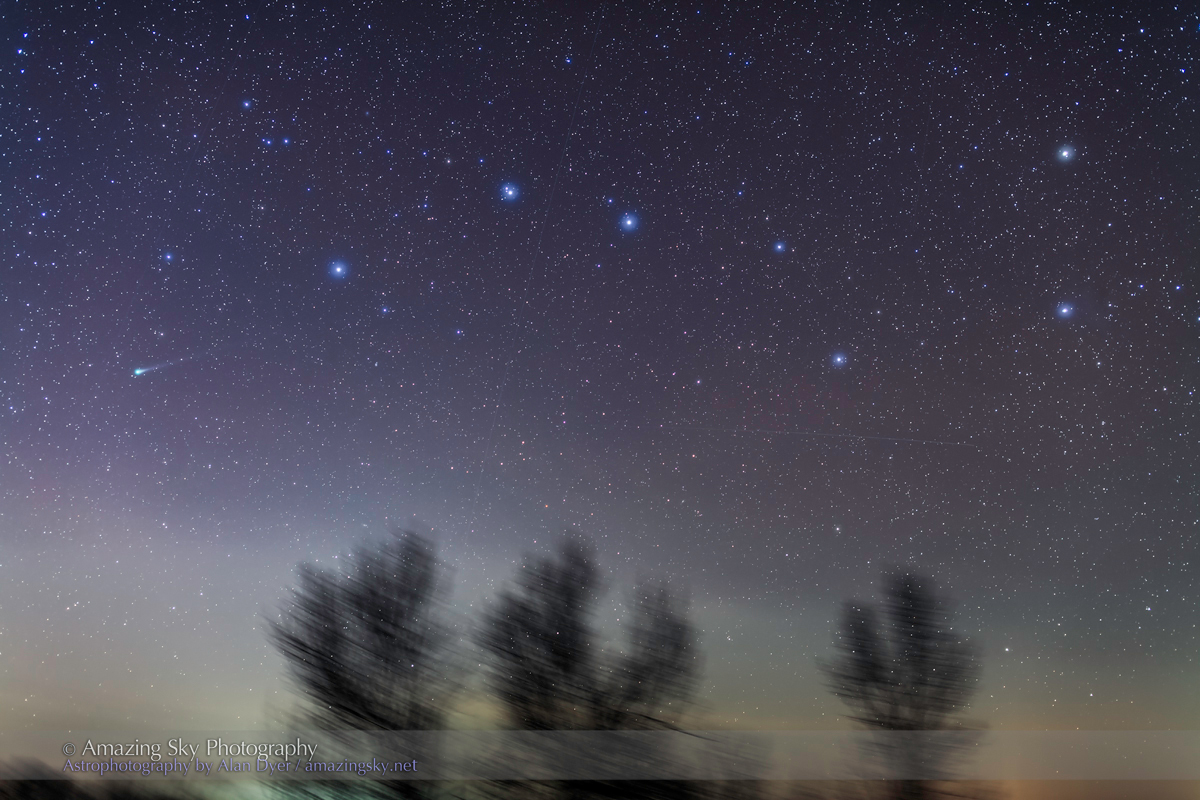
The handle of the Big Dipper seems to point down to Comet Lovejoy, low in the northern sky.

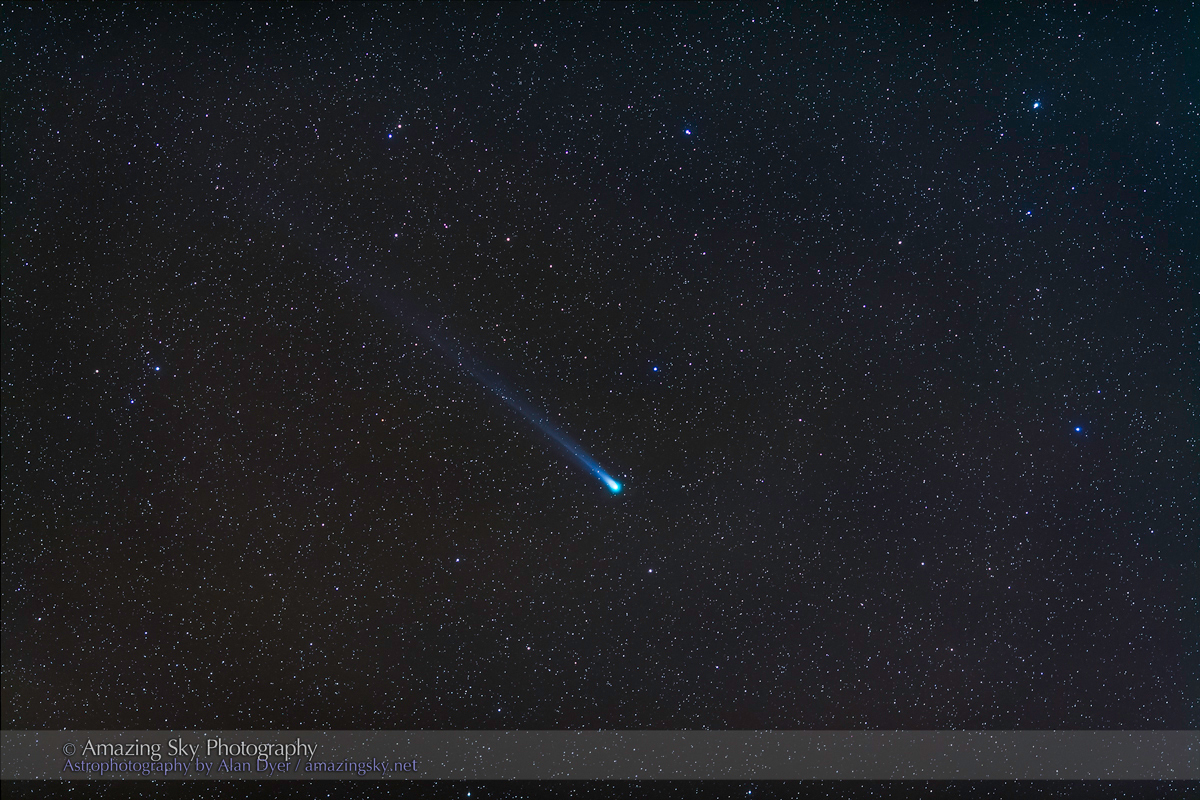
While the astronomy world waits and watches as Comet ISON rounds the Sun in the next day, another comet is appearing in the evening sky.

This is Comet Lovejoy, aka C/2013 R1, captured in a set of exposures I took about 6:30 pm on Wednesday evening, November 27,ย when the comet shone off the handle of the Big Dipper. It was not visible to the naked eye but was easy in binoculars. The photo shows Comet Lovejoy as cyan-tinted star at left with a spiky tail pointed away from the Sun.

From my latitude of 51ยฐ N Comet Lovejoy sits far enough north to be circumpolar, though just barely. However, as it heads south it will become just a morning sky object, especially for those at more southerly latitudes. In the coming days it will join Comet ISON (or what’s left of it) in the December dawn.

โ€“ Alan, November 27, 2013 / ยฉ 2013 Alan Dyer


Comet Caught in the Trees


Comet PANSTARRS (March 31, 2013)

Tonight’s view of the comet is a picture of Earth and sky โ€“ the comet caught in the bare trees of spring.

PANSTARRS is sure a tough comet to shoot! It remains low and skirting the treetops. Tonight, I decided to keep the camera rolling while the comet dropped into the trees. I think it made for a decent enough comet portrait that certainly tells its story.

This is a stack of six 1-minute exposures with the 200mm lens and 1.4x extender for a 280mm f/4 telephoto, on the Canon 60Da and the Kenko SkyMemo tracking platform.

Tomorrow, if skies cooperate, it’ll be a shot of the comet in the same field as the Andromeda Galaxy. I could nicely catch them both in the field of the 7x binoculars tonight. But the photo op nights are this Monday through Wednesday for the comet + galaxy portrait.

โ€“ Alan, March 31, 2013 / ยฉ 2013 Alan Dyer

PANSTARRS Rises into Darkness


Comet PANSTARRS (March 28, 2013)

At last. A view of Comet PANSTARRS in a dark and moonless sky.ย 

Nearly three weeks after first sighting it, I was able to finally look at and shoot the comet in a fairly dark sky, though with it still embedded in deep twilight. But at least the Moon was out of the way and the sky was dark enough to allow the comet to show off its broad fan-shaped dust tail, set against the stars of Andromeda.

The comet will climb a little higher during the next two moonless weeks as it passes the Andromeda Galaxy on April 2 and 3. However, it’s still very low in the northwest and needs binoculars to sight. You have to wait until the sky is dark to spot it. And hope for no clouds low in the northwest. The comet just dodged some here.

I shot this with a 200mm telephoto for a stack of eight 30-second exposures tracking the stars. The star at left is Delta Andromedae while the one above the comet is Pi Andromedae.

โ€“ Alan, March 28, 2013 / ยฉ 2013 Alan Dyer


Comet PANSTARRS at Perihelion


Comet PANSTARRS C/2011 L4 (March 10, 2013)

Got it! After a few days of cloud, the skies cleared perfectly tonight for our first look at Comet PANSTARRS.

This is the comet on March 10, the day it rounded the Sun at perihelion, its closest point to the Sun. The comet, which came from the Oort Cloud, is now on its way back to where it came from. But for the next few days, it will be at its best in our evening sky in the northern hemisphere. Friends down under in the southern hemisphere have been enjoying views of the comet for the last two weeks, but the comet has now moved far enough north it has entered our northern hemisphere skies.

The view is actually best from higher latitudes but I’m here at latitude 31ยฐ N, in southwestern New Mexico, seeking the clearest skies for the comet. We got them tonight. This view is of the comet about 7ยฐ up, just above the rim of the Chiricahua Mountains to the west of us, in Arizona.

The comet will climb higher over the next few days, with a prime night on March 12 when the waxing Moon appears near the comet.

โ€“ Alan, March 10, 2013 / ยฉ 2013 Alan Dyer