Driving to Andromeda


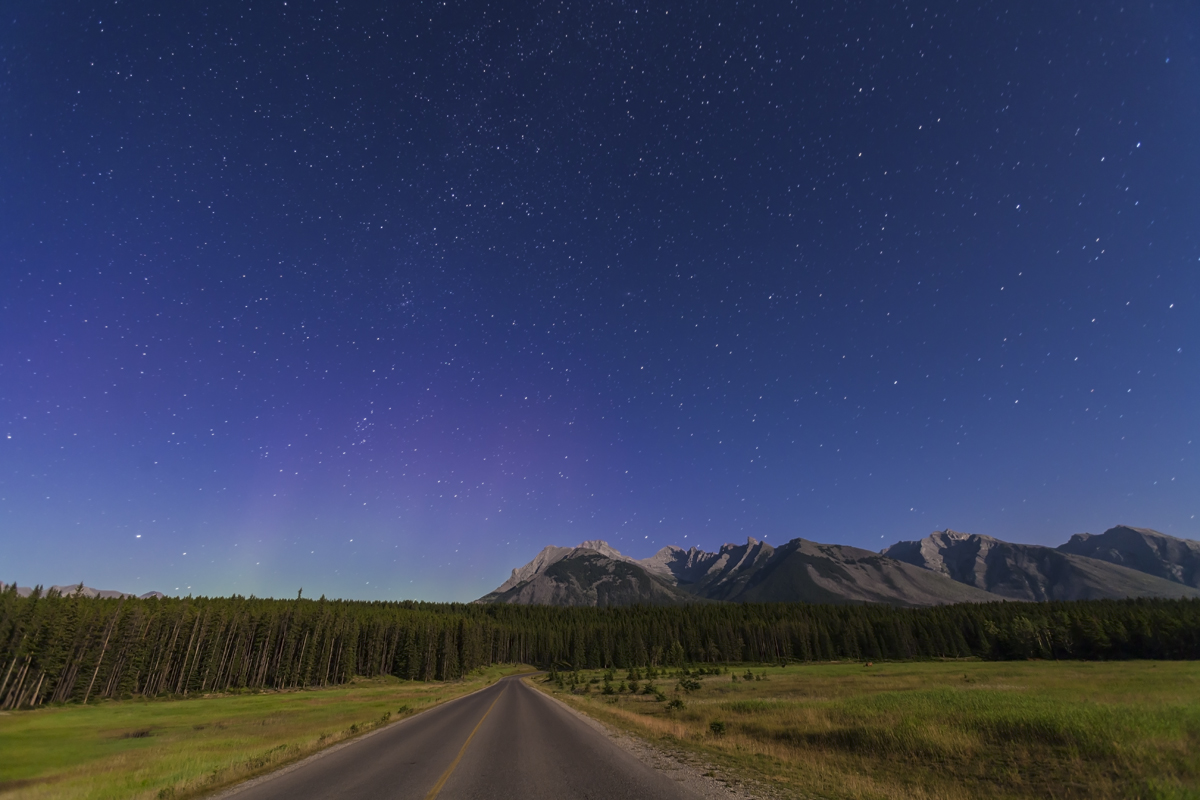
Are we there yet? It would take a long time to get to the end of this road.

A road in Banff appears as if it is heading toward the autumn constellations rising over the peaks of the Fairholme range in the Canadian Rockies. The stars of Andromeda (centre), Pegasus (right), Perseus (left), and Cassiopeia (above left) make up the panorama of mythological heroes populating the northern autumn sky. In the sky above the road the small smudge of the Andromeda Galaxy is visible, shining from 2.5 million light years away. A faint aurora at left adds to the moonlit scene.

I shot this Sunday, July 29, moments after taking the image in the previous blog, which was looking the other way, north toward Cascade Mountain, from the meadows north of Banff. This was a very photogenic spot.

— Alan, August 4, 2012 / © 2012 Alan Dyer
 

Stars over Cascade Mountain, Banff


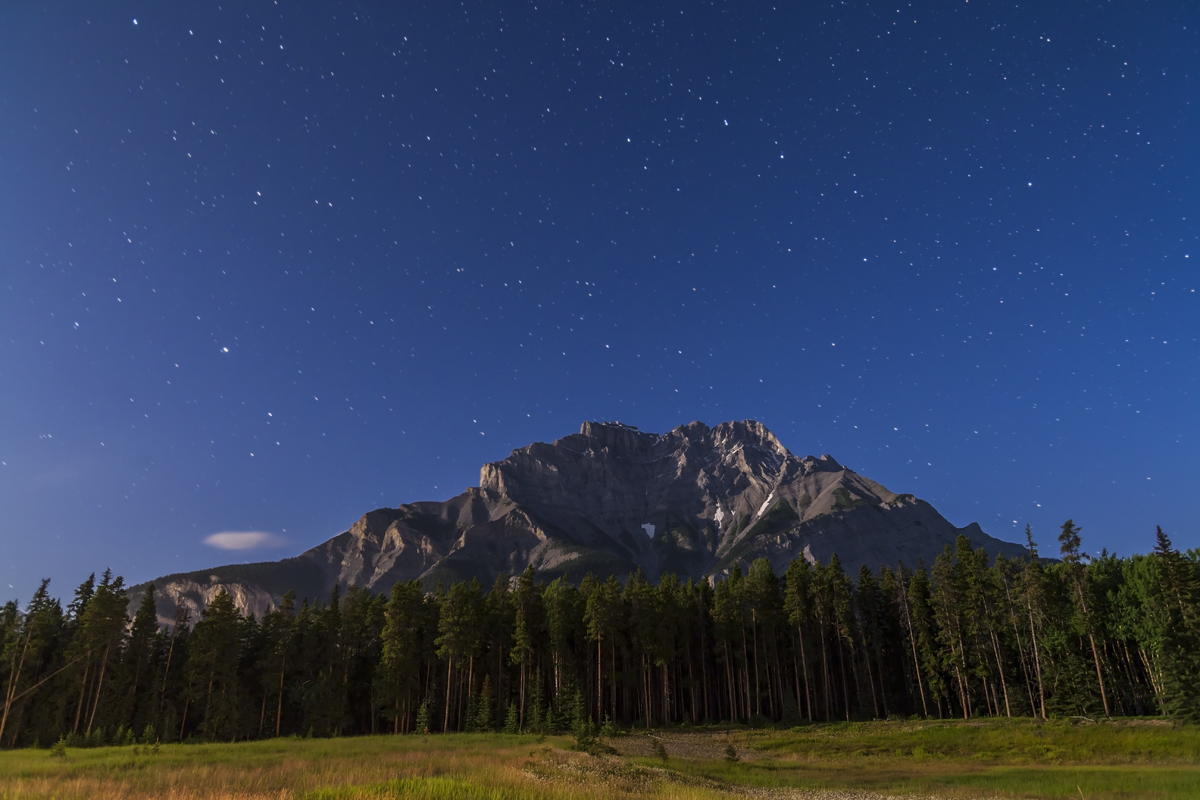
Last Sunday night I was in Banff for a concert at the Banff Centre but ended the night with a round of nightscape shooting near the town.

I shot this from the Lake Minnewanka scenic loop road just north of the townsite. It captures the Big Dipper and Arcturus swinging down over Cascade Mountain, the iconic peak that stands as the background for so many photos of Banff. Moonlight provided ideal side-lighting.

I hope to head back to this area for next weekend’s Perseid meteor shower. The weather prospects look good!

— Alan, August 3, 2012 / © 2012 Alan Dyer


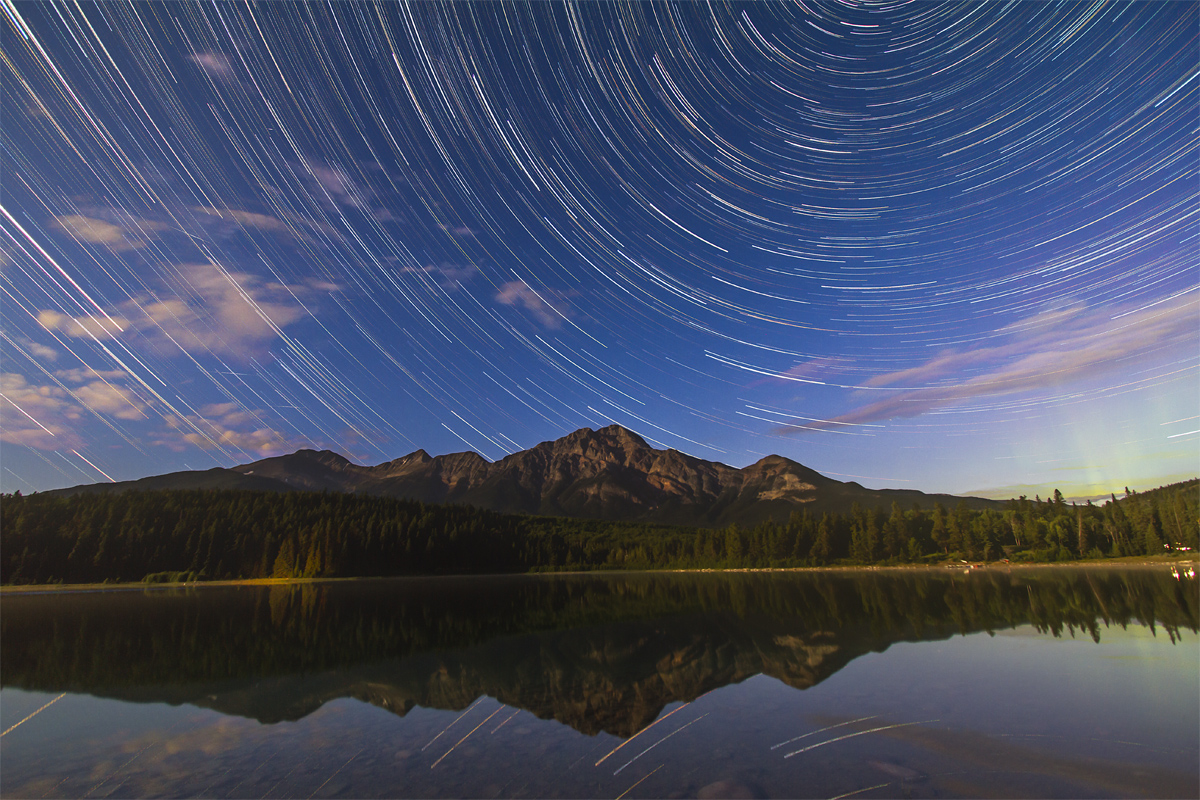
Circling Stars over Pyramid Mountain


The previous post showcased one image taken last Saturday night at Patricia Lake. This is a composite of 98 such frames, producing an image of stars circling the sky.

This is the motion of the northern sky over 75 minutes, as the Big Dipper and other circumpolar stars arc around the celestial pole, just off camera here. A few faint meteors streak at left. And the makings of an aurora appears at right.

Each exposure was 45 seconds long. I used a Photoshop Action to automatically select each frame in turn and stack it on top of the previous image, then change the blend mode to Lighten and flatten the layers. The end result of the computer crunching away is an image that recreates what we used to achieve with film, by stopping down the lens and exposing a slow ISO film for an hour or more onto one frame.

I last shot this same scene a decade ago with just that technique and Fuji Velvia film, a favourite of mine back then for star trails. But these days shooting multiple short exposures digitally provides the advantage of also netting a folder-full of images suitable for a time-lapse movie, something we could never do with film cameras, unless they were modified movie cameras. I like DSLRs better.

— Alan, August 1, 2012 / © 2012 Alan Dyer

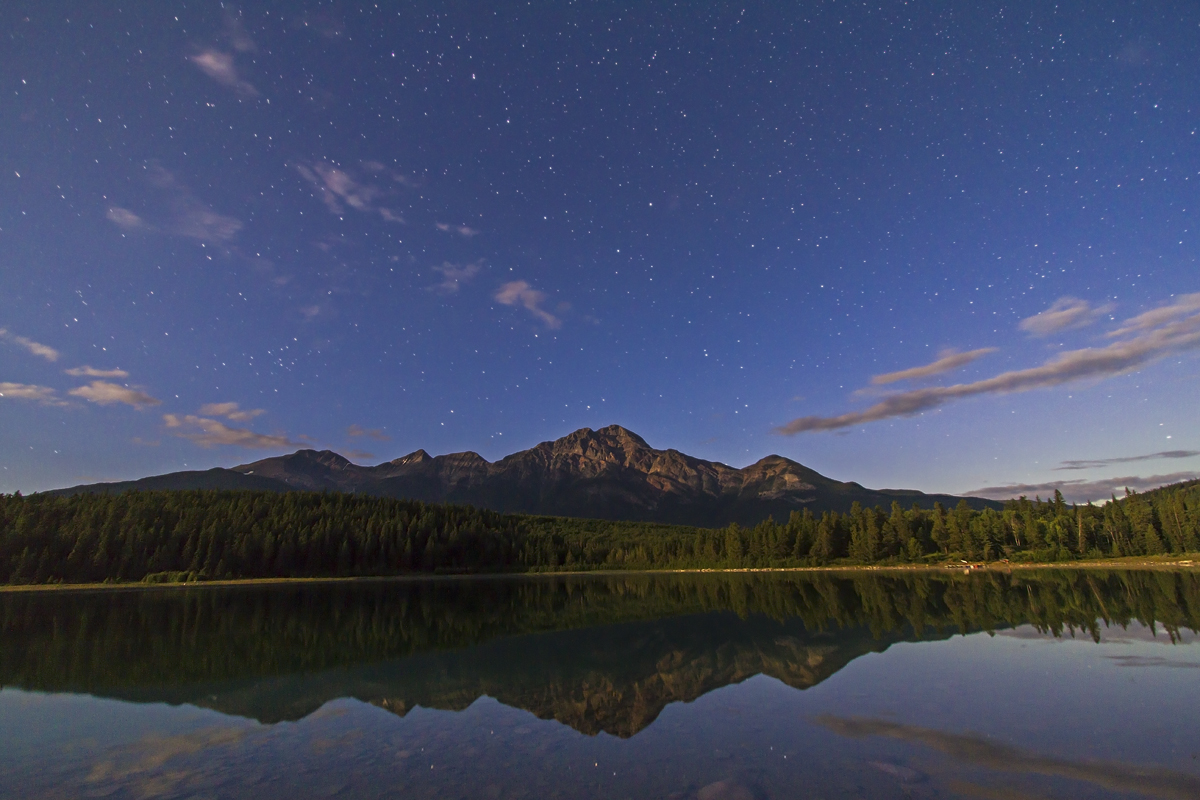
The Big Dipper Over Pyramid Mountain


Pyramid Mountain is Jasper’s iconic peak dominating the skyline of the mountain town in Alberta. The mountain and its foreground lakes are ideally placed for nightscapes of the northern sky.

I took this shot Saturday night, July 28, from the shore of Patricia Lake, one of several that dot the benchlands south of Pyramid Mountain. Small lakes like Patricia have the benefit of often being calm and reflective. Here the stars of the Big Dipper and Ursa Major swing over top of Pyramid Mountain, in the blue moonlit sky. A few well-placed clouds add a welcome perspective. This is one frame of 150 or so in a time-lapse sequence, and that will eventually become a star trail composite as well. But this single frame stands well all on its own.

The last time I was here shooting this same scene I was using Ektachrome and Fujichrome film (each had its unique characteristics, though just what I can’t recall!). That was more than a decade ago. This digital shot with the Canon 7D looks far better than what I got back then.

— Alan, July 30, 2012 / © 2012 Alan Dyer


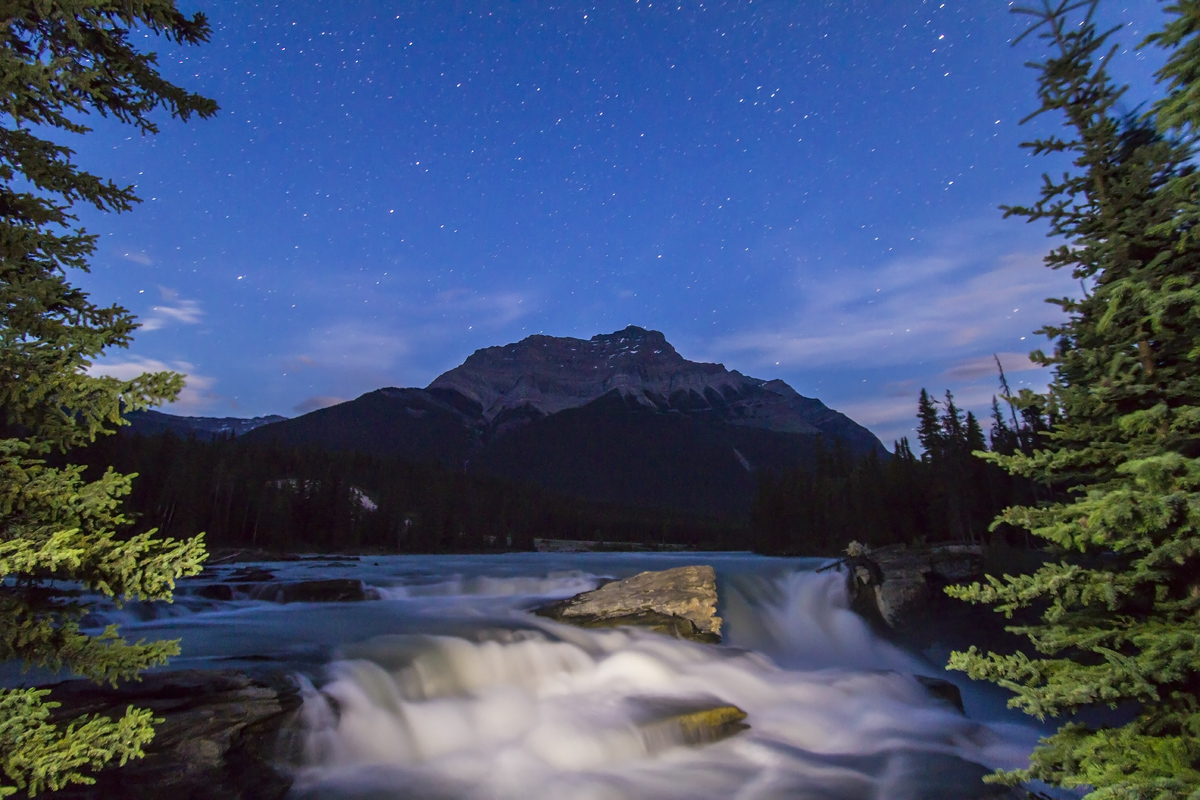
Athabasca Falls by Night


Athabasca Falls is one of the most popular and photographed attractions in Jasper National Park – by day. But by night, the falls on the Athabasca River are deserted.

In the distance, the stars rise behind Mount Kerkeslin. In the foreground, the river plunges into a deep gorge. These waters, with headwaters at the Columbia Glacier in the Icefields to the south, eventually make their way north to the Arctic Ocean.

I was at the Falls last Friday night, to shoot them by moonlight and under the stars. But in this case, I provided added foreground illumination from a flashlight.

As I took this and other shots, flashes of lightning from nearby thunderstorms occasionally lit the night. I had a couple of hours of clear skies before clouds moved in for the night, enough time to get frames for a time-lapse movie and some still frames like this one.

— Alan, July 30, 2012 / © 2012 Alan Dyer

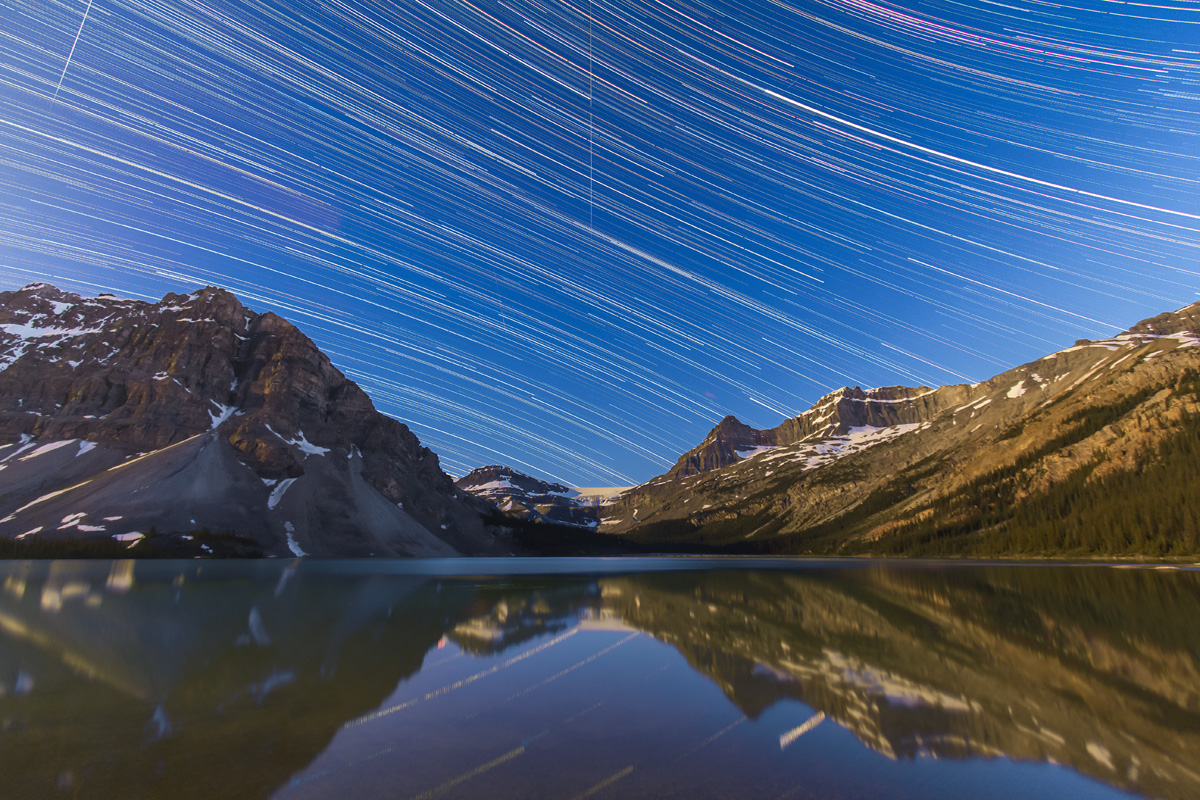
Star Trail Reflections at Bow Lake, Banff


It’s rare to get such a clear night in the mountains, but last weekend, July 6-7, provided a couple of ideal nights.

This image combines about 180 exposures, each 45 seconds long, stacked to create a single image of long star trails setting into the west behind Bow Glacier in Banff. The result records the sky’s motion over nearly two and a half hours. Running at right angles across the descending stars are vertical streaks from a bright meteor (left) and a satellite (top, centre).

Light from the rising waning Moon provides the illumination.

— Alan, July 16, 2012 / © 2012 Alan Dyer

Circling Star Trails in the Rockies


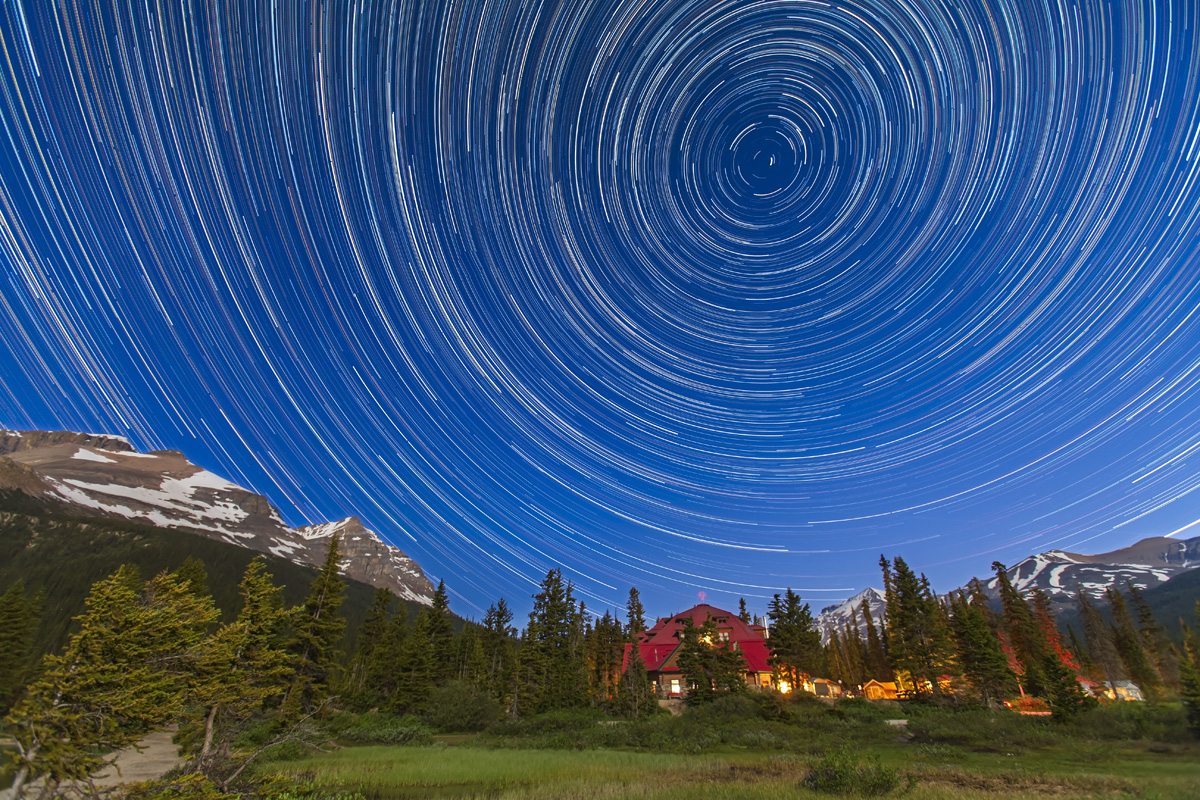
Let the camera shoot for a few hours and this is what you get: stars circling the sky, turning into concentric paths around the North Star.

For this image I stacked 230 short exposures, each 50 seconds long, taken over about 4 hours time on July 7/8. My previous blog entry is one of those individual frames. But in this composite, the stars become trails rotating about the pole of the sky, near Polaris, the North Star, here over Num-Ti-Jah Lodge at Bow Lake in Banff. Moonlight provides the illumination and turns the sky blue, just as in daytime, only much dimmer. But the long exposures bring out the colours and make the scene look like daylight, because the light of the Moon is daylight, just reflected first off the Moon’s neutral grey face.

The same frames used to make this still frame composite can also be used to make a time-lapse movie of the circumpolar stars turning.

— Alan, July 14, 2012 / © 2012 Alan Dyer
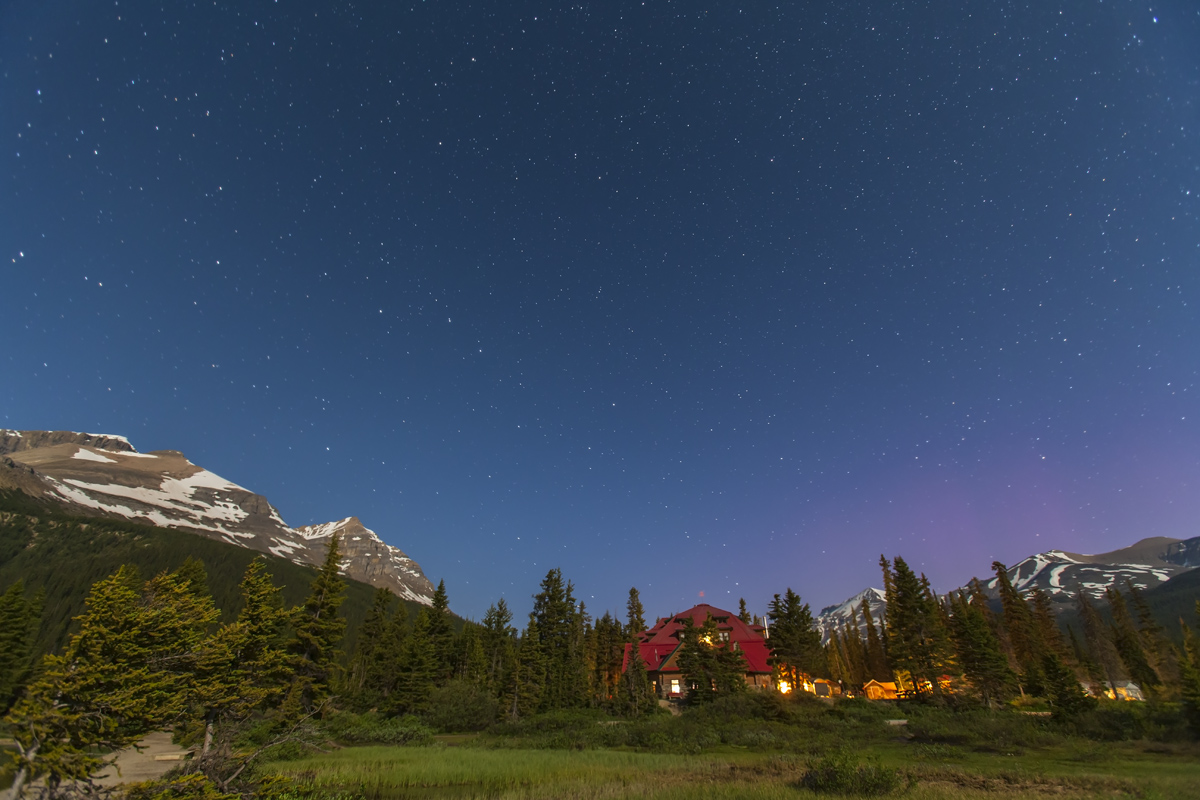
Big Dipper over Num-Ti-Jah Lodge


“Around the fire tonight Jim Simpson said that for his money this campsite was the closest one could get to heaven on Earth. And I reckon he’s not far wrong.” — Bill Peyto at Bow Lake, July 11, 1902.

Peyto penned that description 110 years ago to the day. His friend always said he’d build a shack here one day. And he did. This is Num-Ti-Jah Lodge, a classic wood log building, hand-hewn and assembled by Jimmy Simpson and his family in the 1940s. They ran the lodge for many years.

I was there this past weekend, July 6 and 7, shooting nightscape photos under the waning Moon. This view looks due north, with the Big Dipper and Polaris over the lodge. To the right, in the northeast, glows a faint red aurora. To the northwest stands Mount Jimmy Simpson, named for the pioneer who built his dream lodge at his heaven-on-Earth campsite.

Heaven is not without its dangers however. Earlier in the evening a yearling grizzly bear was wandering around the lodge and had to be scared off by a Parks official. I’m glad he did! Meeting a bear in the dark is a hazard of shooting in the mountains I have yet to encounter, and don’t wish to.

— Alan, July 11, 2012 / © 2012 Alan Dyer

Bow Lake by Moonlight (2012)


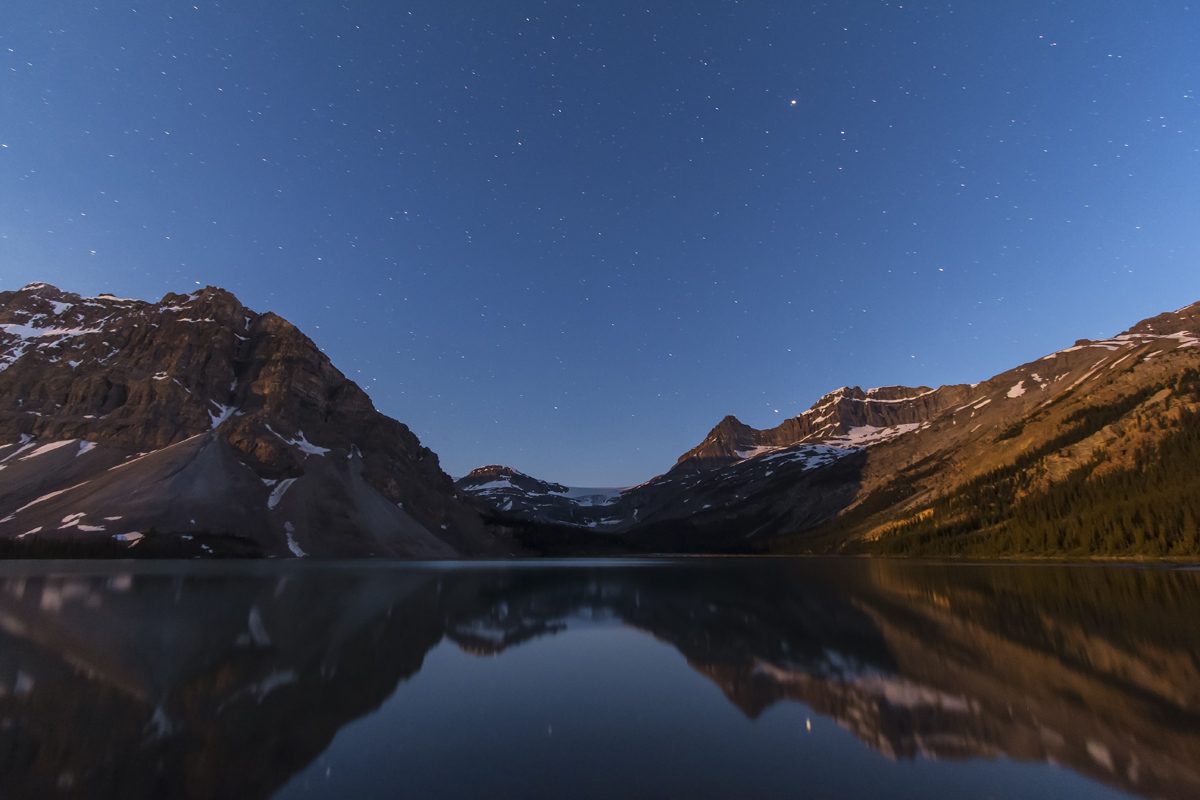
What a fabulous night this was — perfectly clear and the gibbous moon lighting up the mountains. It was a wonderland for nightscape photography.

I took this shot late on Friday, July 6 at Bow Lake in Banff, Alberta. The summer stars shine behind Bow Glacier, and the peaks are illuminated by the rising waning Moon. Saturn, setting behind the continental divide, is reflected in the still waters while Arcturus shines high in the sky.

This is one frame of 320 I took through the night for a time-lapse movie, and for stacking into a long star-trail composite. Those are still to come!

Compare this to the scene I took last summer under a dimmer quarter Moon and later in the season.

— Alan, July 8, 2012 / © 2012 Alan Dyer

Orion Over Our Fence of Mountains


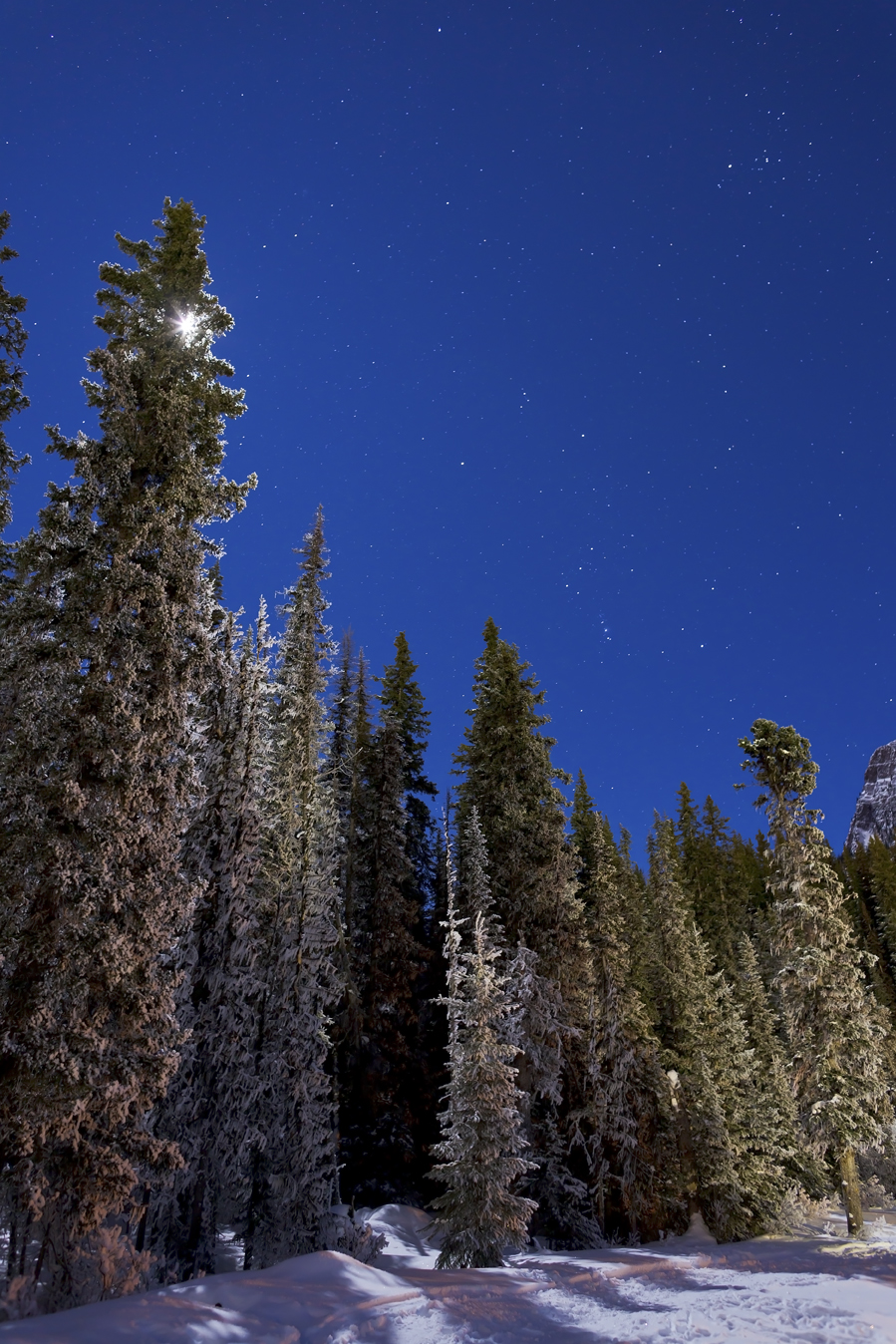
For us in the northern hemisphere, Orion is the very symbol of a winter night, as he stands over snowy landscapes. I took this photo from Lake Louise, in the Rocky Mountains on a chill February night.

Robert Frost, the American poet, describes the inspiring scene of Orion climbing into a winter sky:

“You know Orion always comes up sideways.

Throwing a leg up over our fence of mountains,

And rising on his hands, he looks in on me

Busy outdoors by lantern-light with something

I should have done by daylight, and indeed,

After the ground is frozen, I should have done

Before it froze, and a gust flings a handful

Of waste leaves at my smoky lantern chimney

To make fun of my way of doing things,

Or else fun of Orion’s having caught me.”

_____________________________________

— Alan, February 15, 2012 / © 2012 Alan Dyer

Orion over the Grand Hotel


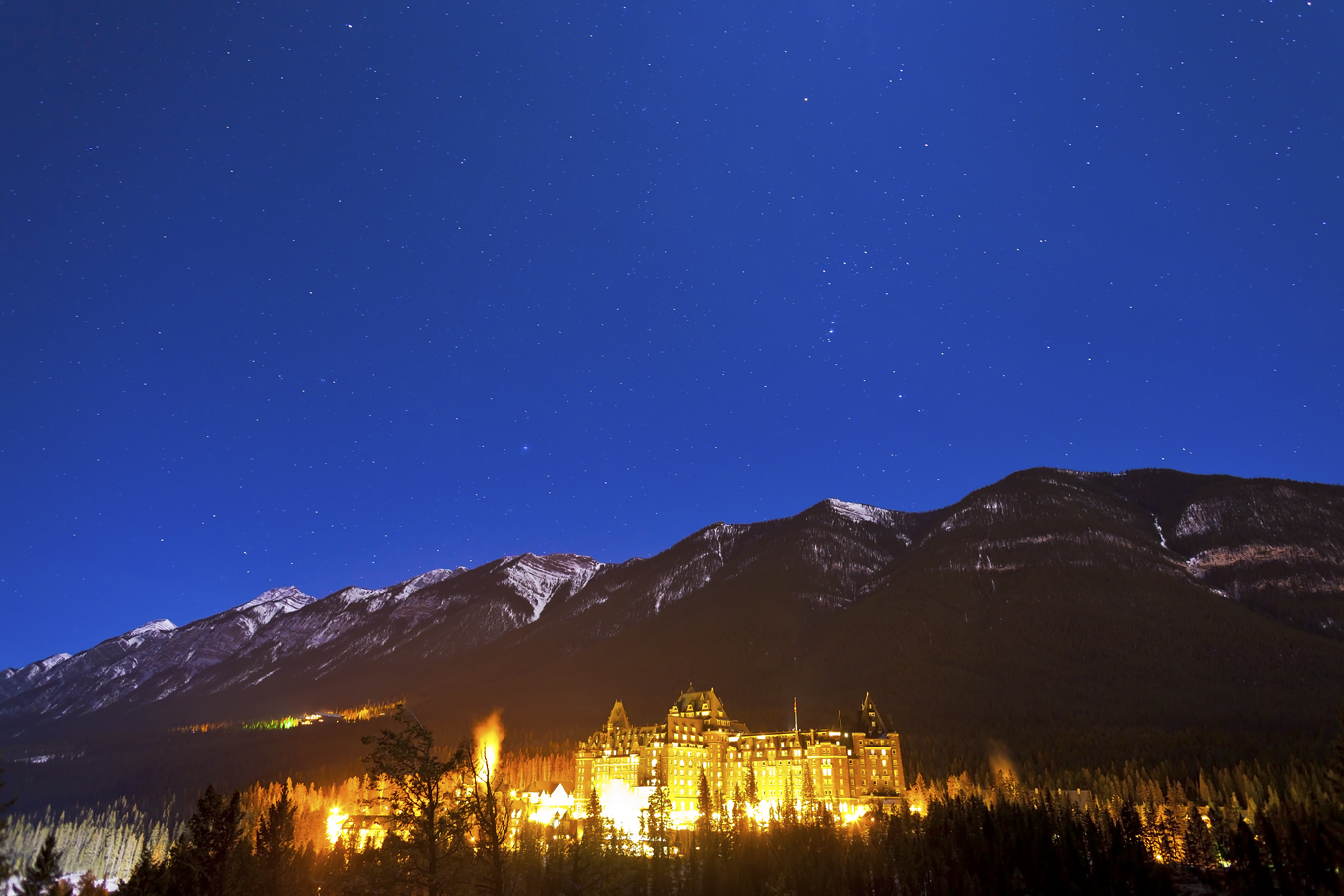
Orion sets over Sulphur Mountain and the Banff Springs Hotel in this nightscape from last weekend, February 3.

This is where Banff National Park – indeed the Canadian National Parks system – started, with the founding of a protected enclave around the hot springs and then the hotel, operated at first by the Canadian Pacific Railway, to serve visiting tourists seeking cure-all remedies from the sulphur springs.

Orion and Sirius shine above the Banff landmark, lit, unfortunately, far too brightly by sodium vapour lights. One day the ethic espoused by commercial interests of conserving the environment will extend to the night sky. When we set up telescopes at the Hotel a couple of years ago in honour of Earth Hour, we had to physically cover some lights — they could not be turned off!

So while this shot shows some of the beauty of the night sky from a site like Banff, it also shows what anyone under the veil of all those lights misses. Half the environment of the mountains.

— Alan, February 10, 2012 / © 2012 Alan Dyer

The Venus Express


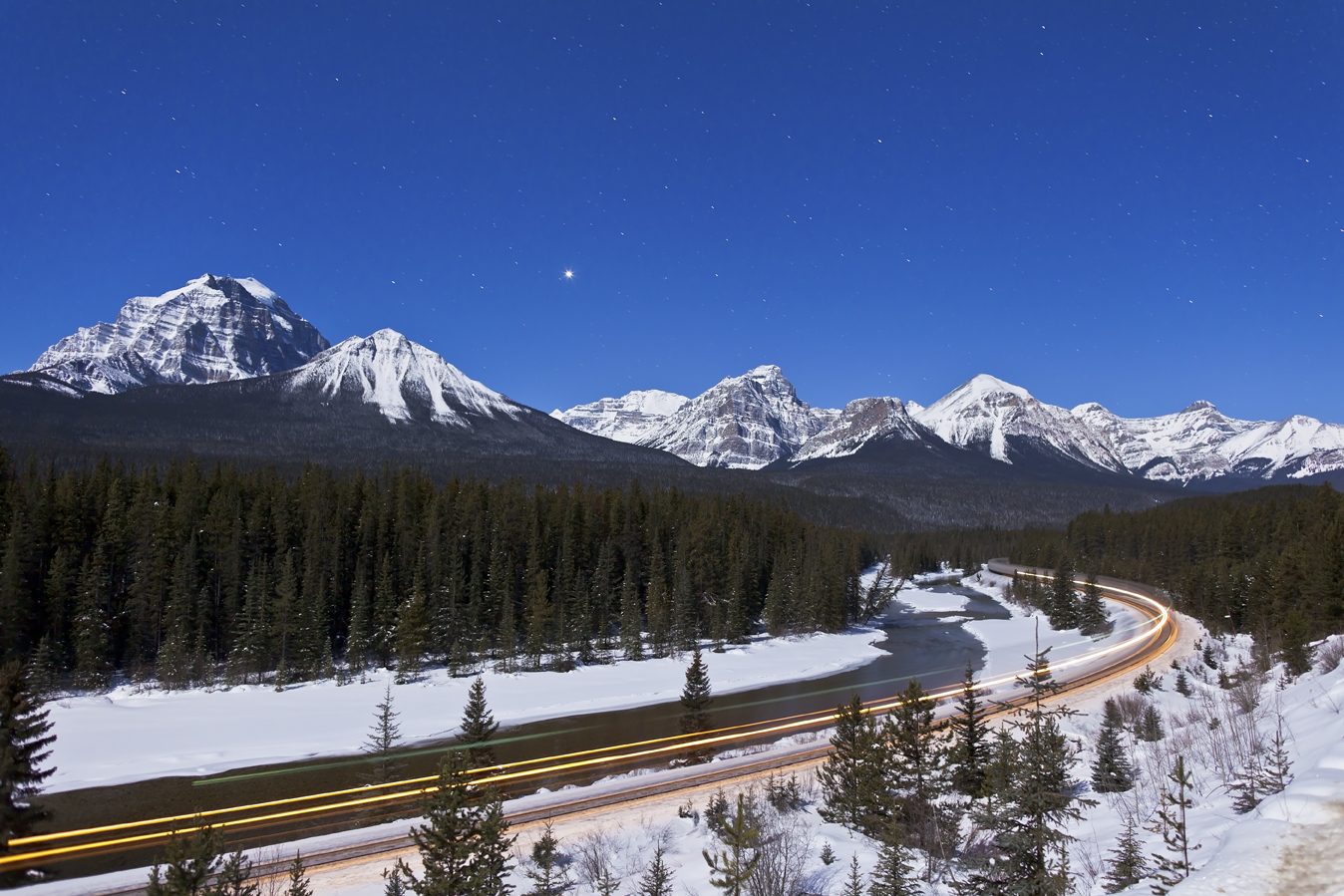
A train winds through the Rockies, seemingly headed for Venus!

I took this shot last Saturday night at one of my favourite photo stops in Banff, the famed Morant’s Curve on the Bow Valley Parkway. This was the spot made famous in the 1930s and 1940s by CPR photographer Nicholas Morant who hauled his large format view camera around western Canada shooting scenes of the Canadian Pacific Railway and classic steam engines at work hauling through the Rockies. At this location the train winds alongside the Bow River heading up to the continental divide marked by the line of peaks in the distance.

On this night, Venus shone brightly over the peaks surrounding Lake Louise. A westbound train heads off into the distance. In a few minutes it’ll be over the divide and descending Kicking Horse Pass into Field, B.C. and Yoho National Park. It’ll never reach Venus!

— Alan, February 7, 2012 / © 2012 Alan Dyer


Trails of Orion Over Fairview


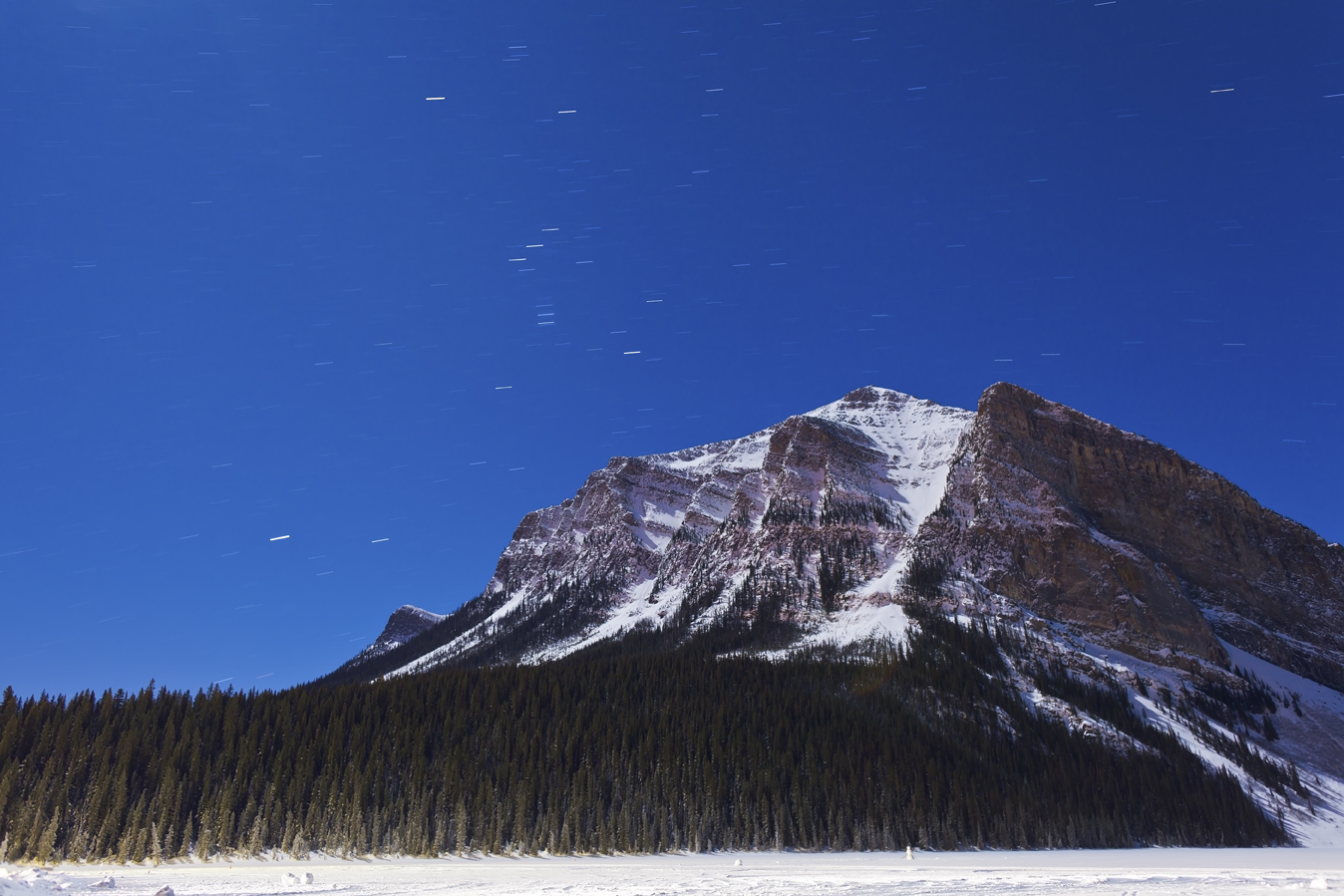
I love the lighting in this shot from Saturday night. I took this by standing out on Lake Louise, from a spot you couldn’t be in summer without getting wet!

Moonlight grazes the east and north slopes of Mount Fairview, while spill from a skating rink flood lamp lights the trees. The sky is deep blue from moonlight making this look like a day scene.

But this is actually a 4-minute exposure, purposely long to allow the stars of Orion and the bright star Sirius at left to trail across the heavens over Fairview.

Unlike most nightscape shots, of necessity taken at high ISO speeds to grab lots of light in a short exposure, I took this shot at ISO 100. Even with the blog’s low resolution images, I think you can see the difference here – this slow-speed shot looks richer and smoother, lacking the fine noise that is inevitable in high ISO shots. It’s just like using slow speed film – in the old days I’d always carry two types of film for trips like this: slow Velvia 50 for long star trail shots, and fast Fuji or Ektachrome 400 for the untrailed nightscapes. I always loved the Velvia shots – they were indeed like smooth velvet.

Now with digital cameras you can switch settings as you like. And see the results instantly. How did we ever manage to get any results with film?

— Alan, February 6, 2012 / © 2012 Alan Dyer

Lake Louise by Moonlight – in Winter


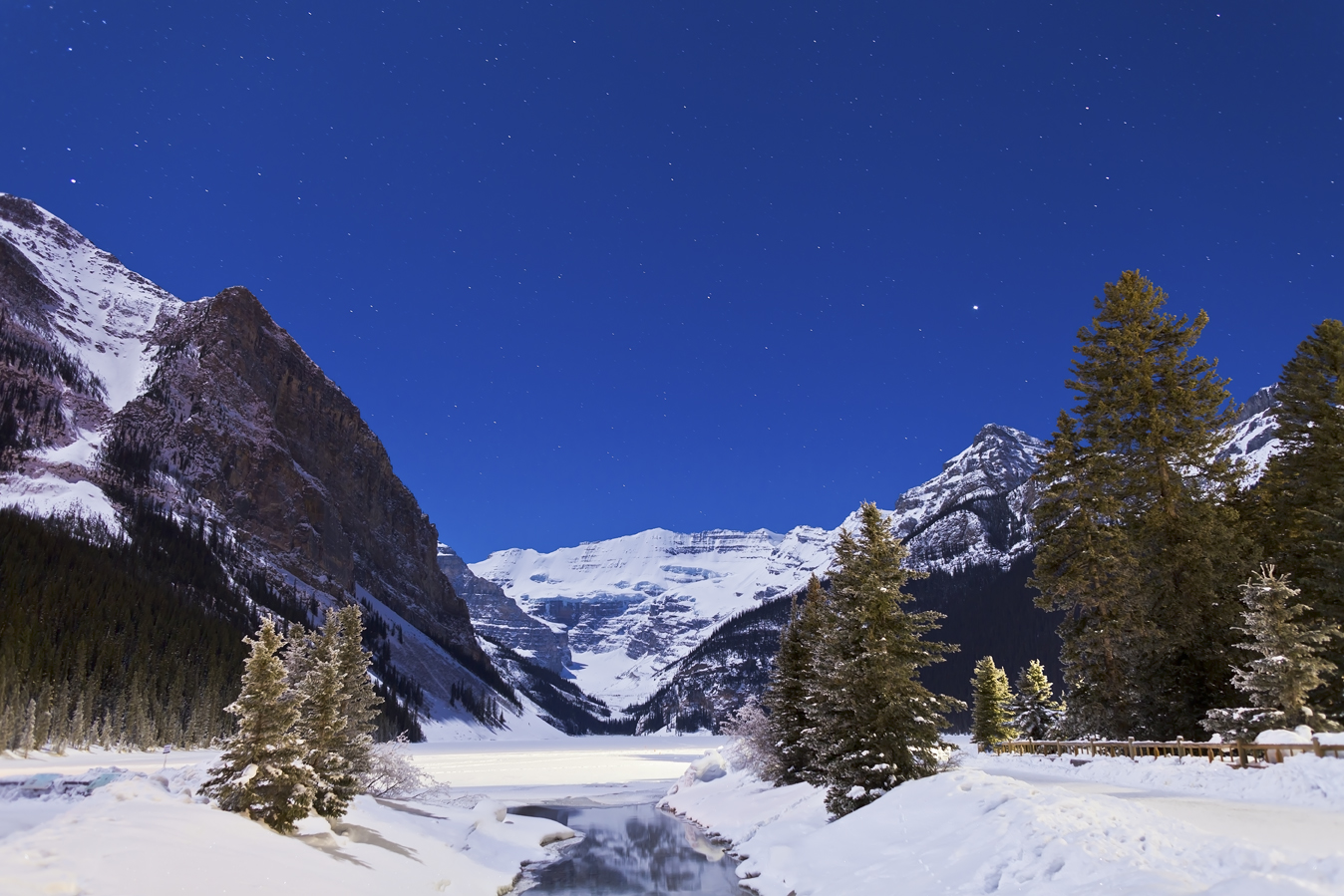
Moments before taking the photo featured in the previous blog I captured this scene, from the footbridge over Louise Creek flowing out of Lake Louise.

This is one of the world’s great photo spots, but here the scene is lit by moonlight and by the Chateau’s and skating rink lights. Jupiter is the bright object above Mt. St. Piran at right.

This was a magical night. Just step away from the artificial lights, let your eyes adjust and a stunning nightscape appeared. Compare this scene to the one I shot from a few steps away but in August and featured in my blog Lake Louise by Moonlight. The blue glacial waters of the summer scene are here replaced by snow and ice.

— Alan, February 5, 2012 / © 2012 Alan Dyer

Little Church on the Prairie


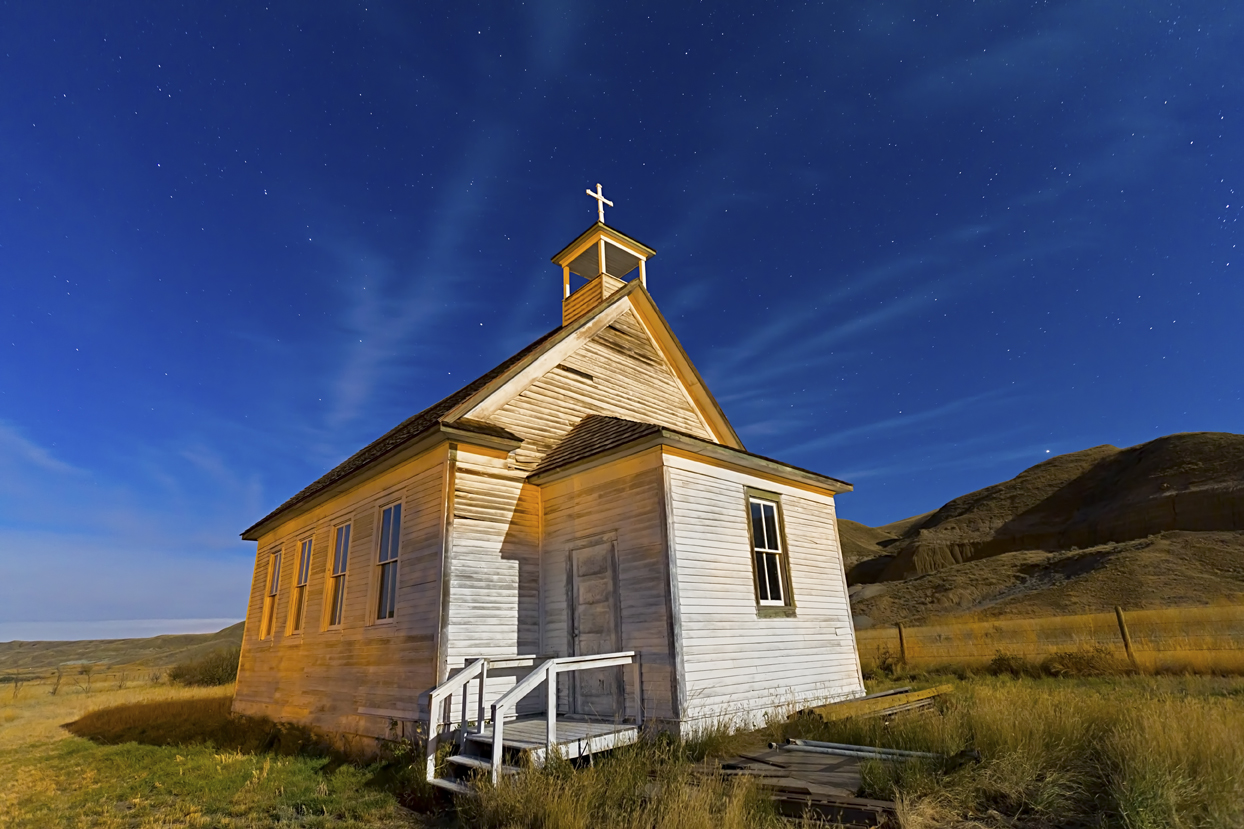
In honour of Canadian Thanksgiving, here’s a shot from last night of a classic little church on the Canadian Prairie.

This is the long abandoned Catholic church at the hamlet of Dorothy, Alberta. The church was built in 1944, but as the coal mines in the Drumheller valley shut down (blame the invention of Diesel trains and the discovery of natural gas in Alberta) the once bustling town of Dorothy decayed into a ghost town. A few people still live there, but its main attractions are its relics of the pioneer age — this church, and the United church next to it (behind the camera), a picturesque grain elevator, and an old store. The companion United church has been restored, but this little church on the prairie, abandoned since 1967, awaits restoration.

The scene is lit by the gibbous Moon, and by a couple of sodium vapour streetlights, ubiquitous even in a ghost town.

In the sky are the stars of the Big Dipper and Polaris above the church.

This is one frame of 300 I shot over three hours as part of a motion-controlled time-lapse movie.

Happy Thanksgiving!

— Alan, October 10, 2011 / Image © 2011 Alan Dyer


Time-Lapse Test: Adding Motion Control


Here’s the movie I show being taken in my previous blog. This is my first attempt at a motion-control time-lapse.

In this movie the camera shifted position during the 3 hours of shooting by sliding along a rail, with the movement controlled by a little computer box that opened and closed the shutter (in this case for 15 seconds for each frame), then between each exposure it pulsed the motor to shift the camera a centimetre or so down the dolly’s rail. 

Pretty nifty! And until this unit, the Stage Zero Dolly, came along this capability would have cost much more money, from some Hollywood cinema supplier.

This was only a test, and I did mess up at one point (where I appear in the frame in the previous blog’s movie) as I tried to adjust the speed in mid-track, resulting in some dead motion for a few frames. So the motion comes to a halt briefly. It will take some learning to know how to set the speed right for the number of frames and exposure times I typically shoot.

But the ramping up in speed at the beginning of this movie is intentional, and is one of the motion control variables you can program in. 

The Stage Zero Dolly unit is from Dynamic Perception LLC. Lots of time-lapse shooters are employing it now, for their cinema-like pans and moves. I’ve been inspired by the work of Randy Halverson at http://dakotalapse.com/ . Amazing stuff — representing a whole new level of time-lapse techniques. 

So now I know what I’ll be doing now on moonlit evenings! 

— Alan, September 12, 2011 / Movie © 2011 Alan Dyer

Time-Lapse of a Time-Lapse


I’ve been taking lots of time-lapse movies of late. But this one is a time-lapse movie of my other camera taking a time-lapse movie.

Here you see my Canon 7D camera riding aboard my latest tool (or toy!), a motion-control dolly. The camera takes its series of still images (that will be later stitched together into a movie) while it tracks down a rail, riding on a motorized cart.

The unit is called the Stage Zero Dolly, from Dynamic Perception LLC. It is a nifty device that fires the camera shutter for the exposure time and interval you desire. In between each exposure it also moves the camera a small amount down the track. The result can be seen in the next blog, a time-lapse movie with a changing perspective, giving a cinema-style dolly shot. Except, I took this one over 3 hours.

While this scene might look like I took it during the day, it is the middle of the night (witness the moving stars). The blue sky is due to moonlight, from an almost Full Moon on September 10.

The Stage Zero Dolly takes some work to set up and program right, but the results open up a whole new dimension (literally!) in time-lapse shooting.

— Alan, September 12, 2011 / Movie © 2011 Alan Dyer

Big Dipper over Peyto Lake


After taking the twilight shots at Waterfowl Lakes on Sunday night (click back to the previous blog), I continued up the Icefields Parkway, ascending to Bow Summit and the viewpoint that overlooks one of the most famous scenes in the Canadian Rockies, Peyto Lake.

Named for legendary mountain man and guide Bill Peyto, the lake was a favourite place for him, to give him solitude away from the madding crowds of Banff.

As with so many of these places, by day this very spot swarms with tourists by the bus load. Peyto would have cringed. But at nightfall, I am the only one there, enjoying the stars coming out in the solitude of the darkening sky.

Here, we look north, to the Big Dipper and Arcturus over the lake in the valley below.

This is a single exposure of 30 seconds at ISO 800 with the Canon 7D and 10-22mm lens.

— Alan, September 5, 2011 / Image © 2011 Alan Dyer

Moon over Saskatchewan River Crossing


This is how the night started, on Sunday evening, September 4 — as clear a night as you could ask for in the mountains. A quarter Moon hangs over the peaks of the Continental Divide, with alpen glow, the last rays of the Sun, illuminating the mountains around Saskatchewan River Crossing, in Banff.

The North Saskatchewan River flows east out of the mountains here, after being joined by the Mistaya and Howse rivers. It was here, in the early 1800s, that David Thompson and his party of fur traders from the North West Company entered the Rockies and heading up over Howse Pass off frame to the right, to trade with the Kootenays in the interior of what is now British Columbia.

This is David Thompson country, named for one of the world’s greatest geographers and mapmakers. He mapped most of western Canada and down into the Oregon Territory. All using compasses, sextants, a Dolland refractor telescope (to observe the moons of Jupiter for telling time), and his skills as an astronomer. The Kootenays called him Koo-Koo-Sint — the man who watches the stars.

It was also here, on these open river plains, that James Hector, mapping southern Alberta with the Palliser Expedition, observed Comet Donati in September 1858.

This is a place in the Rockies with many ties to history and to astronomy.

— Alan, September 5, 2011 / Image © 2011 Alan Dyer

Lake Louise by Moonlight — The Movie


Here is the time-lapse movie I took last Saturday night at Lake Louise, Alberta, under the light of the Full Moon. My previous blog featured a still frame from the beginning of this sequence.

The night starts clear, but as often happens, clouds move in, blowing off the cold icefields of the continental divide. It does make for a nice effect in time-lapse, one of few instances in astronomy where some clouds can be useful!

Also notice how the reflection disappears as the lake breaks up into waves briefly, as wind blows in now and then through the night. The Full Moon is rising behind the camera, causing the lake to light up as moonlight illuminates more of the lake’s surface. Shadows move across the mountainsides. Arcturus is the bright star setting at right. The red object at left is a moored canoe, moving about on the lake.

I took this movie over 4 hours from 10:30 pm to 2:30 am, taking 477 frames with the Canon 7D and 10mm lens. For time-lapse movies like this, I process the full-size RAW files in Adobe Camera Raw and Bridge, then use Photoshop’s Image Processor to export them all to smaller size JPGs. From that set, I use Photoshop CS5 Extended’s “Motion” feature to assemble the folder of JPGs into a movie, in this case at 24 frames per second, a little fast perhaps for this sequence, but it’s easy to change if needed. Photoshop then renders that image file out as a Quicktime movie. What you see here is a tiny version of the final HD-sized video.

— Alan, August 16, 2011 / Movie © 2011 Alan Dyer

Lake Louise by Moonlight


This has to be one of the most photogenic and photographed places in the world. Here it is in a different light, moonlight.

This is Lake Louise, in Banff National Park, Alberta. A few hours before I took this photo on Saturday, August 13, where I stood would have been swarming with thousands of people. But at midnight there was no one about. I had the view to myself.

This looks like a daytime shot, except the stars give it away. Instead, it is the Full Moon, behind the camera, providing the illumination. Contrary to Hollywood lighting clichés, moonlight is not blue. It is the same colour as sunlight, because it is sunlight, just much fainter, reflected off the Moon’s neutral grey surface.

In this view we are looking southwest, toward the stars of the summer sky setting behind the peaks of the continental divide. Arcturus is the bright star at right.

A calm night provided the glassy lake to reflect Mount Victoria and Victoria Glacier.

This is one frame of 477 30-second exposures I took over 4 hours, of the stars turning and eventually clouds blowing in across the sky from the icefields over the divide. It’s rare to get such a perfectly clear night in the Rockies. It was a wonderful to be there, and apparently to be the only one there, to experience it.

— Alan, August 14, 2011 / Image © 2011 Alan Dyer


Sacred Site: The Movie


Here’s my time-lapse sequence of the hoodoos at Writing-on-Stone Park lighting up as the Moon rises and the Milky Way sets.

The sky starts off dark but lights up as the waning Moon, off frame behind the camera, rises and lights up the foreground and sky. The sequence ends as the sky brightens with the onset of dawn.

Waning moons are great nights for this type of shooting as the changing lighting produces dramatic effects as the landscape lights up at moonrise. The problem is, the Moon doesn’t rise till very late, making for a long night of shooting.

I assembled this sequence from 290 frames, each a 60-second exposure, taken at 1-second intervals over about 4 hours. The camera was the Canon 7D and the lens the 10-22mm Canon EF-S zoom at 10mm. I also shot a matching sequence simultaneously with the 8mm fish-eye and Canon 5D MkII camera, for an all-sky sequence for planetarium use.

— Alan, July 30, 2011 / Movie © 2011 Alan Dyer