If you saw the total eclipse in 2024 (or you missed it!) you have three chances in the next three years to see another. But you will have to travel.
Typically, total eclipses of the Sun occur about 18 to 24 months apart. Unusually, in the next three years, we have a trio of total eclipses each only a year apart. Or to be precise, a lunar year — 12 lunar phase cycles — apart.
The map above (courtesy EclipseAtlas.com) plots the paths of all central solar eclipses (annulars, totals and hybrids) from 2021 to 2030. Included are the paths of the 2023 annular and 2024 total in North America you might have seen.
But the next total eclipse in populated North America is not until August 2044, then again in August 2045. To see a total eclipse in the next few years, those of us in the Americas will have to travel.
However, those in Europe can drive to the next eclipse, to their first total eclipse at home since August 1999.
A year from now as I write this, the Moon’s umbral shadow will intercept the Earth for the first time since April 8, 2024. The path of this next total eclipse is unusual in that it starts in northern Russia, travels north over the North Pole, then sweeps down from the north to cross eastern Greenland, nipping the west coast of Iceland, then crossing Spain, to end at sunset over the Balearic Islands of Spain.
Weather prospects are surprisingly good for the several cruise ships planning to be in a Greenland fjord. Iceland is iffy, but had the eclipse been this year (on August 12, 2025) many people would have seen it. Spain was the opposite — statistically it has the best weather prospects along the 2026 path, but on August 12, 2025 most of the country was beset by storms.
From northern Spain, where I intend to be and as I show above, the Sun will be low in the west in the early evening sky, for a relatively short 1m40s of totality. A low eclipse can be spectacular, but riskier as there’s a greater chance of clouds hiding a low Sun.
This and the other images of the Sun’s position at each eclipse are pages from my eclipse ebook, described below.
Twelve new Moons later, the lunar shadow again crosses the Earth, this time passing over North Africa where skies are almost always clear in summer. But the days are hot! The shadow crosses the Strait of Gibraltar and passes over Morocco, Algeria, Tunisia, Libya, Egypt, and Saudi Arabia. In addition to the good weather, the attraction is that this is the longest total eclipse for the rest of the 21st century.
The spectacular temples of Luxor, Egypt are at the point of maximum eclipse, with an unusual 6m23s of totality with the Sun high overhead. Even at Gibraltar, totality is 4m35s, seven seconds longer than the maximum in Mexico in 2024.
From Tunisia, as I show above, the Sun is 55º high over the Mediterranean, and totality is a generous 5m44s.
Another 12 lunar months later, the Moon shadow sweeps across the southern hemisphere, for another generously long eclipse. Remote Western Australia enjoys 5m10s of totality on a winter’s day.
But millions lie in the path in New South Wales, where Sydneysiders can watch a total eclipse over Sydney Harbour lasting 3m48s. The sky scene is below, with a late afternoon winter Sun heading down in the west. From Farm Cove, the eclipsed Sun will be over the Opera House and Harbour Bridge, for a never-to-be-repeated photo op.
The South Island of New Zealand sees a sunset eclipse (the shadow passes over Milford Sound) that lasts 2m55s, longer than the 2017 eclipse in the United States.
Coincidentally, Australia also hosts the next total eclipse to follow, after a gap of 28 months, on November 25, 2030. And the lunar shadow crosses Australia on July 13, 2037 and December 26, 2038 — a Boxing Day eclipse down under. So Australia is the place to be for the next decade or so.
But between 2026 and 2028, Spain is host to three eclipses, as the 2027 total crosses Spanish territory, and the January 26, 2028 annular eclipse ends at sunset in western Spain. At this eclipse the Moon is not large enough to completely hide the Sun, so at mid-eclipse we see a bright ring of light, similar to the annular eclipse here in North America on October 14, 2023.
My Plans
Where will I be? For 2026 I have signed onto a trip to Spain with the well-travelled photo tour company CaptureTheAtlas.com.
They are planning a very photo-centric tour to Spain for viewing the eclipse from a winery near Burgos. I’ll be one of the instructors, among a stellar line-up of eclipse veterans and astrophoto experts. I invite you to check out the details of the tour here at its webpage. We’d love to have you join us!
For 2027 I am planning to be in Tunisia, on the Mediterranean coast, with a tour group from Astro-Trails.com.
The path of totality passes just a few kilometres from Coonabarabran, the “Astronomy Capital of Australia,” as the Siding Spring Observatory is just down the Timor Road in the path. In July the Milky Way is at its best, with the centre of the Galaxy high overhead at nightfall. That’s a sight equal to an eclipse for bucket-list spectacle.
My EBook
The cover of my new 400-page ebook
For 2017’s eclipse I prepared an ebook on how to photograph it. It proved popular, and so for the 2023 and 2024 eclipses I revised it to cover both the annular and total eclipses.
Its popularity prompted me to revise it again, this time to cover the coming trio of eclipses, plus I included pages on the January 2028 annular, as many who visit Spain for the totals may plan to return for the sunset annular (low annulars are also the most spectacular!).
My new ebook is 40 pages larger than the previous edition, with most of the added content in the 100-page chapter on processing eclipse images, from wide-angles, to time-lapses, and to blended exposures of totality close-ups. I include lots of information on choosing the right gear — filters, camera, lenses, telescopes, and tracking mounts.
The slide show above presents images of sample pages. Do page through the gallery for a look at the content.
But for all the details and links to buy the book (from Apple Books or as a PDF for all platforms) see its webpage at my website.
It will be a busy three years for eclipse chasers, as rarely do we get three-in-a-row like this. The diversity of locations and eclipse circumstances make this an exciting trio to chase. But you can just go back to Spain to see most of them!
2024 brought us a total eclipse of the Sun, superb auroras, and a naked-eye comet, three top highlights of a wonderful year of celestial attractions. Maybe the best!
In our book The Backyard Astronomer’s Guide (which we revised this year), Terence Dickinson and I created an Aah! Factor scale with various celestial sights ranked from:
• 1, evoking just a smile, to …
• 10, a life-changing event!
Our book’s Aah! Factor Scale in Chapter 1
Coming in at an 8 is a naked-eye comet. Deserving a 9 is an all-sky display of an aurora. The only sight to rate a top 10 is a total eclipse of the Sun.
2024 brought all three, and more!
Here’s my look back at what I think was one of the greatest years of stargazing.
NOTE: The images might take a while to all load. All can be enlarged to full screen. Just click or tap on them.
January
A Winter Moonrise to Begin the Year
The rising of the winter “Wolf” Moon, the Full Moon of January, over the frozen Crawling Lake Reservoir, in southern Alberta.
Now, this was not any form of rare event. But seeing and shooting any sky sight in the middle of a Canadian winter is an accomplishment. This is the rising of the Full Moon of January, popularly called the Wolf Moon, over a frozen lake near home in Alberta, Canada 🇨🇦.
It serves to bookend the collection with a Full Moon I captured eleven months later in December.
February
Auroras from Churchill, Manitoba
Had this been my only chance to see the Northern Lights fill the sky this year, I would have been happy. As we often see in Churchill, the aurora covered the sky on several nights, a common sight when you are underneath the main band of aurora borealis that arcs across the northern part of the globe.
This is a vertical panorama of the sky-filling aurora of February 10, 2024, as seen from the Churchill Northern Studies Centre, in Churchill, Manitoba.
I attended to two aurora tour groups at the Churchill Northern Studies Centre who both got good displays to check “seeing the Northern Lights” off their bucket list. Join me in 2025!
March
Under the Austral Sky
Ranking a respectable 7 on our Aah! Factor scale is the naked-eye sight of the galactic centre overhead, with the Milky Way arcing across the sky. That’s possible from a latitude of about 30° South. That’s where I went in March, back to Australia 🇦🇺 for the first time since 2017.
This is a framing of the most spectacular area of the southern Milky Way, from Centaurus at left, to Carina at right, with Crux, the Southern Cross, at centre.
I wrote about it in my previous blog, where I present a tour along the southern Milky Way, and wide-angle views of the Milky Way (the images here are framings of choice regions).
This frames the southern Milky Way from Canis Major and its bright star Sirius at top, to Carina and its bright star Canopus at bottom, the two brightest stars in the night sky. The large red complex is the Gum Nebula.
It is a magical latitude that all northern astronomers should make a pilgrimage to, if only to just lie back and enjoy the view of our place in the outskirts of the Galaxy. I was glad to be back Down Under, to check this top sky sight off my bucket list for 2024.
April
A Total Eclipse of the Sun
No sooner had I returned home from Oz, when it was time to load up the car with telescope gear and drive to the path of the April 8 total solar eclipse, the first “TSE” in North America since 2017, which was the last total eclipse I had seen, in a trip to Idaho.
This is a composite of telescopic close-ups of the April 8, 2024 total eclipse, with a multi-exposure blend for the corona at centre, flanked by the diamond rings.
But where? I started south to Texas, my Plan A. Poor weather forecasts there prompted a hasty return to Canada, to drive east across the country to … I ended up in Québec. My blog about my cross-continental chase is here. My final edited music video is linked to below.
It was gratifying to see a total eclipse from “home” in Canada, only the third time I’ve been able to do that (previously in 1979 – Manitoba, and 2008 – Nunavut). If the rest of the year had been cloudy except for this day I wouldn’t have complained. Much.
This definitely earned a 10 on the Aah! Factor scale. Total eclipses are overwhelming and addictive. I’ve made my bookings for 2026 in Spain 🇪🇸 and 2027 in Tunisia 🇹🇳.
May
The Sky’s On Fire
It had been several years since I had seen an aurora from my backyard with colours as vivid and obvious as they were this night. But on May 10, the sky erupted with a fabulous display of aurora that much of the world saw, as aurora borealis in the north and aurora australis in the south.
This is a 300º panorama of the May 10, 2024 Northern Lights display, when the Kp Index reached 8 (out of 9), bringing aurora to the southern U.S.
This was the first of several all-sky shows this year. I blogged about the year’s great auroras here, where there are links to the movies I produced that capture the Northern Lights as only movies can, recording changes so rapid it can be hard to take it all in. Check off a 9 here!
So not even half way through the year, I had seen three of the top sky sights: the Milky Way core overhead (7), an all-sky aurora (9), and a total eclipse of the Sun (10).
But there was more to come! Including an Aah! Factor 8.
June
World Heritage Nightscape Treks
This is a panorama of the arch of the Milky Way rising over the Badlands of Dinosaur Provincial Park, Alberta, with a sky tinted with twilight and airglow.
The sky took a break from presenting spectacles, allowing me to head off on short local trips, to favourite nightscape sites in southern Alberta, which we have in abundance. The Badlands of Dinosaur Provincial Park are just an hour away, the site for the scene above.
A panorama at sunset at Writing-on-Stone Provincial Park (Áísínai’pi) in Alberta, with the Milk River below and the Sweetgrass Hills in the distance in Montana. Note the people at far right.
The rock formations of Writing-on-Stone Provincial Park are a bit farther, requiring a couple of days commitment to shoot. Clouds hid the main attraction, the Milky Way, this night, but did provide a fine sunset.
The Milky Way rises over Mt. Blakiston, in Waterton Lakes National Park, Alberta. This was June 10, 2024, so snow remains at high altitudes.
A little further west down the highway is Waterton Lakes National Park, another great spot I try to visit at least once each year.
All locations I hit this month are U.N. World Heritage Sites, thus the theme of my blog from June. People travel from all over the world to come here, to sites I can visit in a few hours drive.
July
Mountains by Starlight
In summer we now often contend with smoke from forest fires blanketing the sky, hiding not just the stars by night, but even the Sun by day.
The Andromeda Galaxy at centre is rising above Takakkaw Falls, in Yoho National Park. Above is the W of stars marking Cassiopeia.
But before the smoke rolled in this past summer I was able to visit a spot, Yoho National Park in British Columbia, that had been on my shot list for several years. The timing with clear nights at the right season and Moon phase has to work out. In July it did, for a shoot by starlight at Takakkaw Falls, among the tallest in Canada.
This is the Milky Way core and a bonus meteor over the peaks and valleys at Saskatchewan River Crossing, in Banff National Park, Alberta.
The following nights I was in Banff National Park, at familiar spots on the tourist trail, but uncrowded and quiet at night. It was a pleasure to enjoy the world-class Rocky Mountain scenery under the stars on perfect nights.
August
The All-Sky Auroras Return
In August I headed east to Saskatchewan and the annual Summer Star Party staged by the astronomy clubs in Regina and Saskatoon. It is always a pleasure to attend the SSSP in the beautiful Cypress Hills. The sky remained clear post-party for a trip farther east to the little town of Val Marie, where I stayed at a former convent, and had a night to remember out in Grasslands National Park, one of Canada’s first, and finest, dark sky preserves.
The Northern Lights in a superb all-sky Kp6 to 7 display on August 11-12, 2024, in Grasslands National Park, Saskatchewan.
The plan was to shoot the August 11 Perseid meteor shower, but the aurora let loose again for a stunning show over 70 Mile Butte. My earlier blog has more images and movies from this wonderful month of summertime Northern Lights.
We are fortunate in western Canada 🇨🇦 to be able to see auroras year-round, even in summer. Farther north at the usual Northern Lights destinations, the sky is too bright at night in summer.
September
Back to Deep Sky Wonders …
This is a framing of the rich starfield in Sagittarius and Serpens containing a mix of bright star clouds, glowing nebulas, and dark dust in the Milky Way.
September is the month for another astronomical party in the Cypress Hills, but on the Alberta side. At the wonderful Southern Alberta Star Party under its very dark skies, I was able to shoot some favourite deep-sky fields along the Milky Way with new gear I was testing at the time.
This frames the complex region of emission nebulas in central Cygnus near the star Gamma Cygni, at lower left. The Crescent Nebula is at centre.
And from home, September brought skies dark and clear enough (at least when there was no aurora!) for more captures of colourful nebulas (above and below) along the summer Milky Way.
This frames all the photogenic components of the bright Veil Nebula in Cygnus, a several-thousand-year-old supernova remnant.
We invest a lot of money into the kind of specialized gear needed to shoot these targets (and I’m not nearly as “committed” as some are, believe me!), only to find the nights when it all comes together can be few and far between.
… Plus, A Very Minor Eclipse of the Moon
I had to include this, if only for stark contrast with the spectacular solar eclipse six months earlier.
We had an example of the most minor of lunar eclipses on March 24, 2024, with a so-called “penumbral” eclipse of the Moon, an eclipse so slight it’s hard to tell anything unusual is happening. (So I’ve not even included an image here, though I was able to shoot it.)
Me at another successful eclipse chase … to my backyard to capture the partial lunar eclipse on September 17, 2024. The Moon is rising in the southeast.
On September 17, we had our second eclipse of the Moon in 2024. This time the Earth’s umbral shadow managed to take a tiny bite out of the Full Moon. Nothing spectacular to be sure. But at least this eclipse expedition was to no farther away than my rural backyard. A clear eclipse of any kind, even a partial eclipse, especially one seen from home, is reason to celebrate. I did!
Of course, a total eclipse of the Moon, when the Full Moon is completely engulfed in Earth’s umbra and turns red, is what we really want to see. They rate a 7 on our Aah! Factor scale. We haven’t had a “TLE” since November 8, 2022, blogged about here.
We knew early in 2024 that the then newly-discovered Comet Tsuchinshan-ATLAS had the potential to perform this month. I planned a trip south to favourite spots in Utah and Arizona to take advantage of what we hoped would be a fine autumn comet.
This is Comet Tsuchinshan-ATLAS (C/2023 A3) at its finest in the evening sky, on October 14, two days after its closest approach to Earth, and with it sporting a 10º- to 15º-long dust tail, and a short narrow anti-tail pointed toward the horizon. The location was Turret Arch in the Windows area of Arches National Park, Utah.
It blossomed nicely, especially as it entered into the evening sky in mid-October, as above. Despite the bright moonlight, it was easy to see with the unaided eye, a celestial rarity we get only once a decade, on average, if we are lucky. My blog of my comet chase is here.
This is a panorama of Comet Tsuchinshan-ATLAS over Arches National Park, Utah, on a moonlit night, October 15, 2024, with the comet easy to see with the unaided eye.
A naked-eye comet ranks an 8 on our Aah! Factor scale. So now 2024 had delivered all four of our Top 4 sky sights.
This 360° panorama captures a rare SAR (Stable Auroral Red) arc across the Arizona sky in the pre-dawn hours of October 11, 2024. The SAR arc was generated in the high atmosphere as part of the global geomagnetic storm of October 10/11, 2024, with a Kp8 rating that night.
But … just as a bonus, there was another fabulous aurora on October 10, seen in my case from the unique perspective of southern Arizona, with an appearance of a bright “SAR” arc more prominent than I had ever seen before. So that view was a rarity, too, so unusual it doesn’t even make our Aah! list, as SARs are typically not visible to the eye.
November
Back to Norway for Northern Lights
2024 was notable for travel getting “back to normal,” at least for me, with two long-distance drives, and now my second overseas trip. This one took me north to Norway 🇳🇴, which I had been visiting twice a year as an enrichment lecturer during pre-pandemic years.
A green and red aurora appears over the coast of Norway, with Jupiter bright at right. This was from the Hurtigruten ship m/s Nordkapp on November 10, 2024, on a coastal cruise with a Road Scholar tour group.
The auroras were excellent, though nothing like the great shows of May and October. But the location sailing along the scenic coast and fjords makes up for any shortfall in the Lights. It was good to be back. I plan to return in 2025 for two cruises in October. Join me there, too!
December
A Winter Moonrise to End the Year
As I write this, December has been nothing but cloud. Almost. A clear hour on Full Moon night allowed a capture of the “Cold Moon,” with the Moon near Jupiter, then at its brightest for the year. So that’s the other lunar bookend to the year, shot from the snowy backyard.
This is the Full Moon of December 14, 2024, near the planet Jupiter at lower right. Both were rising into the eastern sky in the early evening.
However, I did say after the clear total eclipse in April that if the rest of 2024 had been cloudy I wouldn’t complain. So I’m not.
And there’s no reason to, as 2024 did deliver the best year of stargazing I can remember. 2017 had a total solar eclipse. 2020 had a great comet. But we have to go back to 2003 for aurora shows as widespread and as a brilliant as we’ve seen this year. 2024 had them all. And more!
I present a two-minute video set to music of the April 8, 2024 total solar eclipse.
In my previous blog Chasing the Cross Continental Eclipse I told the tale of my chase to see the total eclipse of the Sun. I ended up under mostly clear skies in the Eastern Townships of Québec, Canada, not Texas, my original destination.
Here I present the result of shooting with four cameras that afternoon, taking still images, time-lapses, and a 4K movie.
Be sure to watch in 4K!
The site worked out very well, as the lower Sun in eastern Canada lent itself to views framing the eclipse over a landscape below, in this case a very wavy lake. But I was lucky to have open water as other lakes in the area were still frozen.
My post-eclipse selfie at the Lac Brome site in Quebec for the April 8, 2024 total eclipse of the Sun.
As it was, a snow storm a few days earlier left lots of snow in the area to be included in my post-eclipse selfie.
This was only the third total solar eclipse I’ve seen from Canada, after February 26, 1979 from Manitoba, and August 1, 2008 from the air out of Cambridge Bay, Nunavut in the Canadian Arctic. The next total eclipse from Canada passes over my home in Alberta. But it is not until August 22, 2044!
I had always planned to drive to the April 8, 2024 total eclipse of the Sun. But to where? I ended up on the other side of the continent than originally planned.
It is not often the path of the Moon’s shadow crosses your home country, let alone continent. Only once before in recent years, on August 21, 2017, did the narrow shadow path pass near enough to my home in Alberta to allow me to drive to a total eclipse. They almost always require flying.
Packed and ready to hit the highway for a long eclipse trip.
Yes, while I could drive to the April 8, 2024 eclipse, it was going to demand a much longer drive than in 2017. But driving allowed me to take a carload of telescope and camera gear. So that was the plan.
My destination was San Antonio, Texas. That’s where I had made a hotel booking more than a year earlier. The weather prospects in Texas were forecast to be best (at least according to the long-term averages) of any locations along the path in the U.S. or Canada. (I did not want to drive into Mexico.)
Where I was going! Where I ended up going!
On March 30, with some trepidation, I set out down I-15 heading south. I got as far as Great Falls, Montana, my stop for night one. But it was to be a move in the wrong direction.
The forecast for Eclipse Day as of March 30. Blue is bad; white is good!
The various long-range weather models were all agreeing, even 10 days in advance, that Texas (covered in blue above) was looking poor for eclipse day. But eastern Canada looked good! That was the exact opposite of what had been expected.
So on Easter Sunday, I turned around and headed north, crossing back into Canada at a lonely border post in southwest Saskatchewan.
I proceeded east along the TransCanada, Highway 1. I decided against a route across the northern U.S. and around the southern end of Lake Michigan, to avoid severe weather forecast for the middle of the U.S.
One of my daily Facebook travelogue posts with a beer of the day.
Along the way I posted my beer-du-jour travel reports, as above from Day 8, that day from within the shadow path at last!
Our 1979 eclipse group in 1979.The 1979 eclipse site in 2024.The February 26, 1979 eclipse.
I also stopped at the only total eclipse site, of the 16 I had seen previously, I have ever been able to re-visit. On February 26, 1979 I and a small band of friends from Edmonton viewed the mid-winter eclipse (the last one visible from southern Canada) from a median road (Firdale Road as it is now called) on the TransCanada Highway near Carberry, Manitoba. I found the spot again, where I saw (and shot with my Questar telescope) my first total eclipse of the Sun.
However, a day after entering Ontario, the bad weather caught up with me, forcing an extra night north of Lake Superior while the only highway across the region, Highway 17, was cleared of snow and re-opened at Wawa, the usual cross-Canada choke point.
My new destination (after abandoning the site in the Texas Hill Country) was to be southern Ontario.
The weather prediction as of April 5.Southern Québec looking good!
However, as eclipse day approached and the weather predictions became more precise, it was apparent that Ontario would also be under some cloud. Southern Québec was looking better. So the Eastern Townships became my new Plan A site! I was running out of time!
Using the TPE app to check the Sun’s location once on site, the day before the eclipse.
I arrived on site in Québec with only a day to spare to check out the location I had found by exploring Google maps.
With the Sun lower in the mid-afternoon sky in Québec compared to the high-noon Sun in Texas, I decided to shoot a wide-angle scene of the eclipse over a lake, preferably with open water, not ice! That required a site with public parking on an eastern lakeshore.
The Photographer’s Ephemeris (TPE) app to check Sun angles.Zooming in with TPE app for my chosen Lac Brome site. .
The site I found, then checked out on April 7, was on Lac Brome. It proved ideal — except for the thin cloud that was now predicted to drift through during the eclipse.
Sure enough, that’s just what happened. The cloud detracted from the eclipse only in preventing long-exposure images recording the outermost streamers in the Sun’s atmosphere.
A wide-field view of the eclipse of the Sun, taking in the bright planets Jupiter (at top) and Venus (below) that were easily visible to the unaided eye during totality.
I could have sought out clearer skies by going even farther east, but I was in a crunch for time and hotel rooms! As it was I was able to get rooms everywhere I wanted and at normal “non-eclipse” rates!
A panorama of the lakeside parking area at Lac Brome prior to the eclipse. My RAV4 and camera array, pre-eclipse.I shot with 4 cameras at the car and one set up lakeside.
The Lac Brome site filled with cars during the day, with people from Québec and Ontario, but also from Alberta, and from Pennsylvania, Massachusetts and Maine – at least those were the homes of the folks I enjoyed meeting on eclipse day.
Everyone had a great time and had a superb eclipse experience.
The total eclipse of the Sun over the waters of Lac Brome, in the Eastern Townships of Quebec, Canada. The twilight colours come from sunlight from outside the shadow path.
The lunar shadow arrived from the southwest, from the direction of the Sun, appearing as a dark cloud racing toward us. At the end of the eclipse the sky brightened first in that same direction, as the trailing edge of the shadow shot up across the sky. The clouds helped make the shadow edge more visible.
A time-lapse of the arrival and departure of the lunar shadow, made of 1200 frames each 1 second apart.
I shot with five cameras, just as I had done in 2017, possible only because I drove.
The main rig was my faithful Astro-Physics Traveler, a 105mm refractor telescope the company owner designed for his personal use at the 1991 eclipse in Mexico.
My main eclipse rig, with a 60mm visual scope on the 105mm photo scope, on an equatorial tracking mount.
My Traveler, bought in 1992, has lived up to its name, having now been to six central solar eclipses: the annular eclipses of 1994 (Arizona) and 2023 (Utah), and the total eclipses of 1998 (Curaçao), 2012 (Queensland, Australia), 2017 (Idaho), and now 2024 in Québec, Canada. I paired it with the wonderful matching AP400 mount, which I had only just brought back with me the month before from Australia, where it had spent the last two decades.
All the gear worked great. Unlike six months earlier for the October 14, 2023 annular eclipse in Utah, this time I remembered all the cables needed to have the telescope mount track the Sun.
I did mess up on a couple of settings (such as not framing the 4K movie camera as I should have – in pre-eclipse excitement I just forgot to check my chart). But none of the errors were serious.
The eclipse in a blend of two exposures to display all the fiery pink prominences that were visible during totality around the lunar disk in one image, set against the bright inner corona of the Sun with the dark disk of the Moon in silhouette in front of the Sun.
Once started all my cameras, except for the one on the Traveler, ran unattended.
At this eclipse I was determined to get a good look at it through the small visual scope I had piggybacked onto the Traveler photo scope. While I had used a similar rig in 2017, I only thought to look through the visual scope 20 seconds before totality ended.
Not this year.
A telescopic close-up of the eclipsed Sun. Onto the central blend of images for totality I layered in single images of each of the diamond rings before and after totality. They are when the last or first burst of sunlight shines through lunar valleys. The first diamond ring is at top left, the last at bottom right, so time runs from left to right.
I got a great look at the eclipsed Sun, its corona structures, flaming pink prominences, and breakout of the red chromosphere layer just as totality ended. (You can’t easily see the chromosphere at the start of totality as it can be risky looking too soon through optics when the Sun’s blindingly bright photosphere is still in view.)
This is a composite showing the sequence of events surrounding totality, from just before totality (at upper left) to just after totality (at lower right), with totality in the middle. The contact images were taken 0.6 seconds apart.
And yet, as at all eclipses, I found the naked eye view the most compelling. The “black hole” Sun looked huge and unearthly. While I had binoculars handy, the same 12×36 image-stabilized binoculars I bring to most eclipses, I completely forgot to look though them, just as I forget at most eclipses!
This is a composite showing the complete sequence of the April 8, 2024 eclipse of the Sun, from first contact (at upper left) to last contact (at lower right), with totality at mid-eclipse in the middle.
I shot all the images with the Astro-Physics Traveler 105mm refractor at 630mm focal length and f/6, with the Canon R5 at ISO 100. The partial phases are 1/800 or 1/400 second exposures through a Kendrick/Baader solar filter.
Wanting to record the full sequence, I shot the partial phases until the bitter end. But post-eclipse, people came over and had a look through my scope (I think mine was the only telescope on site). We had a great time exchanging impressions. The hand-held phone camera photos people showed me looked fabulous!
I looked for fleeting shadow bands just before and after totality (I laid out a white sheet on the ground for the purpose) but saw none, a negative observation confirmed by a fellow eclipse chaser at the site.
Time-lapse movies of the second and third contact (start and end of totality) diamond rings, shot through the telescope with the Canon R5 in continuous burst mode for hundreds of frames each.
I did two live interviews for CBC Radio, for the Edmonton and Calgary stations, but not until after the eclipse ended. By the time I did those and finished packing away my carload of gear, it was 6:30 p.m., three hours after totality.
I was the last to leave the site, with fishermen now arriving for an evening’s catch.
I was in that shadow as the Space Station flew over. Astronauts saw the elliptical shadow moving over eastern Canada.
The passage of the lunar shadow across the continent, showing where the clouds were. I was under the wispy clouds at upper right in Québec.
I faced no traffic jams heading back to the hotel at Ste. Helen-de-Bagot. I processed and posted one eclipse image that night. And I revised the price (down to $2.99 U.S.) and description of my How to Photograph the Solar Eclipses ebook, as now only the big processing chapter is of any value, post-eclipse. It continues to sell.
This is the waxing crescent Moon on April 10, 2024, two days after it eclipsed the Sun, and with it above the bright planet Jupiter, with it also near Uranus. Below the solar system worlds is the faint Comet 12P/Pons-Brooks, visible here as a fuzzy star with a stubby tail..
On the long drive back to Alberta, with the pressure of having to make time now gone, I spent pleasant evenings stopping to see friends and family on the road home. So I didn’t start work on the complex blends and composite images I show here until I got home a week after the eclipse.
The happy eclipse chaser having bagged his game!
The 17-day-long drive was nearly 9,000 km over 100 hours behind the wheel. Was it worth it? Of course!
Would I do it again? It’s a moot question as none of the upcoming eclipses allows for a cross-continent drive. Except perhaps in July 2028 in Australia. But I suspect just heading inland a day or two over the Great Dividing Range will be enough to get away from winter coastal cloud in New South Wales. (Sydney is in the path, but so is a cottage I rented last month near Coonabarabran for my superb March stay under the southern skies!)
The next total eclipse of the Sun visible from anywhere in Canada will be August 22, 2044. I won’t have to drive anywhere, as it passes right over my house! But I will have to live that long to enjoy a eclipse from my own backyard.
I suspect this was my last chance to see – and drive to – a total eclipse in Canada.
As eclipse day approaches here are some tips and video tutorials from me about how best to capture the total eclipse of April 8, 2024.
There are many ways to capture great images and movies of a total eclipse of the Sun. I outline them all in great detail in my 380-page ebook How to Capture the Solar Eclipses, linked to at right.
Originally published in June 2023, I revised the ebook following the October 14, 2023 annular eclipse of the Sun to include “lessons learned at the eclipse,” and some processing tutorials on assembling annular eclipse composites. I’ve also added new content on using software to control cameras and updated information about solar filters.
Brief Tips and Techniques
The August 21, 2017 total solar eclipse over the Grand Tetons as seen from the Teton Valley in Idaho, near Driggs. With the Canon 6D and 14mm SP Rokinon lens at f/2.5 for 1/10 second at ISO 100.
My breakdown of recommend methods, in order from simplest to most complex, and with increasing demands on your time, is generally this:
Use a Phone Camera for a Movie. While they can be used for a quick handheld grab shot during totality, a better method is to place a phone on a tripod using a clamp of some kind. Then a few minutes before totality aim and frame the scene, with no filter over the camera lens. Start it in movie mode to record video of the eclipse and sky changes, and the excited sounds of your group! Just remember to stop the video shortly after the end of totality and aim the phone away from the Sun. Never leave any unfiltered camera aimed at the Sun for a long time.
Shoot a Wide-Angle Time-Lapse. Using a DSLR or mirrorless camera and a wide-angle lens (it might need to be as wide as a 14mm at sites in Mexico and the southern U.S.) aim and frame the camera to include the Sun and landscape below. Focus the lens! And leave it on manual focus. But put the camera into Auto-Exposure Aperture Priority (Av) with wide-area metering and with it set to underexpose by -1 EV Exposure Compensation. With the camera at ISO 100 or 200, use either its internal intervalometer (if it has one) or an external intervalometer to take frames once per second. Start the sequence with no filter on the lens a few minutes before totality. Let it run on its own until a few minutes after totality. The result is hundreds of frames you can turn into a time-lapse movie of the lunar shadow approaching and receding, and of the changes in sky colours. Or you can extract single frames at key points to process individually, as I did for the image above from August 2017. The advantage, as with the phone camera movie method, is that the camera, once going, requires no further attention. You can enjoy the eclipse!
Shoot a Telephoto Video. Use a 300mm to 500mm lens on a DSLR or mirrorless camera to shoot a real-time close-up video of the eclipse. Start the video a minute or two before totality with the Sun positioned to the left of frame centre and with a solar filter over the lens. Use a slow ISO, the lens wide open (typically f/4 to f/5.6) and the camera on Auto-Exposure Aperture Priority (Av). Just be careful to focus precisely on the filtered Sun before starting the video. Poor focus is what spoils most eclipse images, not poor exposure. Just before totality (about 30 seconds prior to Second Contact) remove the filter. The auto-exposure will compensate and provide a proper exposure for the rest of totality. Just let the camera run and the Sun drift across the frame from left to right. Just remember to replace the filter, or cap the lens, and stop the video shortly (~30 seconds) after totality and Third Contact. The video will capture the diamond rings and a well-exposed corona. Vary the exposure compensation during totality if you wish, but that involves more work at the camera. Otherwise, you can just let the camera run. But, as I illustrate in my ebook, it’s important to plan and place the Sun correctly to begin with (using a planetarium app to plan the sequence), so it does not drift off the frame or close to the edge.
Shoot Telephoto Close-Up Stills. Use the same type of gear to shoot still images. While you could shoot stills on Auto-Exposure, it’s better to shoot still images over a range of exposures, from very short (~1/1000 second) for the diamond rings and prominences, to long (~1 second) for the outer corona. No one exposure can capture all that the eye can see during totality. This takes more work at the camera, and with the camera on a static tripod you might have to re-centre the Sun during totality, another thing to fuss with and where things can go wrong. Using the camera’s Auto-Bracketing mode can help automate the shooting, allowing the camera to automatically shoot a set of 7 to 9 exposures at say, one-stop increments in quick succession with just one press of the shutter button (by using the self-timer set to 2 seconds).
Shoot with a Telescope on a Tracking Mount. Telescopes (I like 60mm- to 100mm-aperture apochromatic refractors) allow longer focal lengths, though I would advise against shooting with any optics longer than 600mm to 800mm, so the image frames the corona well. Use similar settings as above, but with the telescope (or a telephoto lens) on a tracking mount to turn from east to west at the same rate as the sky moves. That will ensure the Sun stays centred on its own, provided you have at least roughly polar aligned the mount. (Set it to your site’s latitude and aim the polar axis as due north as you can determine from compass apps.)
Those are brief summaries of the methods I recommend, as they are ones I’ve used with success in the past and plan to use on April 8. My ebook contains much more information, and answers to most of the “But what about using ….?” questions. And I provide lots of information on what can go wrong! Some learned the hard way over 16 previous total solar eclipses.
Video Tutorials
For a video tutorial, check out the webinar I conducted as part of the Kalamazoo Astronomical Society’s excellent Eclipse Series here on YouTube. It is about a 1-hour presentation, plus with lots of Q&A at the end.
KAS Eclipse Series — Part 1: Shooting
Of course, once you have all your images, you need to process them. My ebook’s biggest chapter (at 80 pages) is the one on processing still images and time-lapses.
So, a month after I presented the above webinar on Shooting, I was back on-line again for a follow-up webinar on Processing. You can view that KAS Eclipse Series tutorial here on YouTube.
KAS Eclipse Series — Part 2: Processing
I cover processing single wide-angle images, a wide-angle time-lapse series, single-image close-ups, and blending multiple exposure composites.
A month later, I presented a further webinar to the Astronomical League as part of their AL Live series, again on shooting the eclipse, but now with an emphasis on techniques amateur astronomers and astrophotographers with typical telescope gear might use.
You can view the AL Live webinar here. My presentation begins at the 44-minute mark.
AL Live Webinar — Scrub ahead to 44 minutes
I emphasized that the kinds of gear astrophotographers use these days with great success on deep-sky objects might not work well for the eclipse. The specialized cameras, and software used to control them, are just not designed for the demands of a total eclipse, where exposures have to range over a wide array of settings and change very quickly. Images have to be taken and recorded in rapid succession.
I suspect a lot of ambitious and overly-confident astrophotographers will come away from the 2024 eclipse disappointed — and what’s worse, without having seen the eclipse because they were too wrapped up looking at laptop screens trying to get their high-tech gear working.
The Checklist page from my eBook
Practice, Practice, Practice
In these webinars and in my ebook, my common theme is the importance of practicing.
Don’t assume something will work. Practice with the gear you intend to use, on the Sun now (with proper filters) and on the Moon. The crescent Moon, with dim Earthshine lighting the lunar night side, is a great practice target because of its wide range of brightness. And it moves like the Sun will, to check maximum exposure times vs. image blurring from motion.
Practice with your tripod or mount aimed to the altitude and location in the sky where the Sun will be from the site you have chosen. Set a tracking mount to the latitude you will be at to be sure it will aim at and track the Sun without issues. Some telescope mounts stop tracking when they reach due south, exactly where the Sun will be at totality from southern sites. That’s a nasty surprise you do not want to encounter on eclipse day.
All this and much more is covered in my ebook, available for Apple Books and as a PDF for all platforms here from my website at https://www.amazingsky.com/EclipseBook
Like all eclipses, seeing the October 14 annular eclipse of the Sun was not a certainty. As good luck and planning would have it, the sky and location could not have been better!
Annular eclipses of the Sun don’t present the spectacle of a total eclipse. Because the Moon is near its farthest point from Earth, its disk is not large enough to completely cover the Sun. At mid-eclipse, as I show below, a ring of sunlight (dubbed a “ring of fire”) remains, still too bright to view without a solar filter.
The October 14, 2023 annular solar eclipse, in a single image captured at mid-eclipse, at 10:29 am MDT at the Ruby’s Inn Overlook on the rim of Bryce Canyon, Utah, a site well south of the centreline, with 3m03s of annularity.
While lacking the jaw-dropping beauty of a total, annular eclipses are rare and unique enough that every ardent skywatcher should make a point of seeing one.
Prior to October 14, I had seen only one, on May 10, 1994, from southeast Arizona, an event I captured on film of course back then.
My 1994 annular eclipse setup in ArizonaMy 2023 annular eclipse setup in Utah
A sunset annular on June 10, 2002 that I traveled to Puerto Vallarta, Mexico to see was mostly clouded out. The annular of May 20, 2012 traced a similar path across the U.S. Southwest as the 2023 eclipse. But work commitments at the science centre in Calgary kept me home for that one. A sunrise annular on June 10, 2021 in Northwestern Ontario was essentially out of reach due to COVID travel restrictions.
With no other annular eclipses within easy reach in North America until 2039 and 2046, this was my next, and perhaps last, opportunity to see one, unless I chose to travel the world.
Eclipse site and pathSite close upEclipse details at my final site
I had planned for several months to watch the annular eclipse from southern Utah, ideally from Bryce Canyon National Park, shown above. (Clicking on the images brings them up full screen.) I booked accommodations in January 2023, finding even then that popular hotels in the area were already sold out.
The final spot for the wide-angle composite shown below. The camera had to be next to that very fence post to frame the scene well.
The attraction was the landscape below the morning Sun, for a planned composite image of the eclipse over the hoodoos of Bryce. However, I had learned weeks earlier that traffic was going to be restricted to just park shuttle buses on eclipse day. Should Plan A not work out then Plan B was Kodachrome Basin, a state park nearby, which a park employee assured me would be open to cars well before sunrise on eclipse day.
Seen on I-15 past Salt Lake City. Eclipse ahead!
So I made my plans to drive south, taking with me a carload of telescope and camera gear, an array I would never be able to take to an overseas eclipse. The centrepiece was my venerable Astro-Physics Traveler 105mm (4-inch) refractor, a telescope created for the 1991 total eclipse in Mexico. Since I bought mine in 1992 I’ve used it for five central solar eclipses, including now two annulars. It’s in the 1994 and 2023 site images above.
A week before the eclipse (as above at left), the weather prospects for the entire southwest looked poor. It was to be clouds everywhere. I even considered Plan S – Stay Home! And watch the 60% partial eclipse from Alberta where skies were to be clear.
But undaunted, six days before the eclipse, I headed south on Interstate 15, checking the weather each day, and seeking out Plan C sites in New Mexico or Texas south of the projected mass of clouds. I checked where accommodation could be had at the last minute.
At my stop in Richfield, Utah, four days before the eclipse, I had a crossroads turning point: either continue south to Bryce down US-89 (above), or head east on I-70, then south into New Mexico or Texas, with enough time to get there if needed.
But by now the weather prospects were turning around. By three days out, and with the forecasts now much more reliable, it looked like southern Utah would be in the clear. I continued with my original plan to Bryce. But where exactly?
TPE site overview with anglesTPE 3D showing Sun pathGoogle Earth 3D
I had looked at possible sites on Google Earth and with the Sun-angle planning apps I use (such as The Photographer’s Ephemeris, or TPE) and found one just outside the Park that I hoped would be accessible to drive into.
Upon arriving in the area three days early, the first priority was to inspect the site in person. It looked perfect! Almost too good to be true!
A panorama of the Ruby’s Inn site with the eclipse in progress. My wide-angle camera is at left by that fencepost.
The site, known as the Ruby’s Inn Overlook, provided a great view toward the eclipse with a stunning landscape below, including a river! (Well, it was actually an irrigation channel called the Tropic Ditch.) And I could park right next to my wide-angle landscape camera, to keep an eye on it over the five hours of shooting, while setting up the scope gear next to my car.
I stayed at the Bryce View Lodge on eclipse eve, a hotel just a few hundred metres from the site. So no long pre-dawn drive on eclipse morn. However, the gated site was not going to be open until 7 a.m. on eclipse day. And admission was $20 per car, a cash donation to the Bryce Canyon City school sports teams. Fine!
As it turned out, by the time I got on site and setup the priority wide-angle camera for the base-image sunrise shots at 7:30 a.m., the sky was too bright to polar align the telescope mount on Polaris, for accurate tracking of the Sun across the sky.
It turned out that was the least of my concerns.
My three eclipse cameras: the wide-angle, the one on the 105mm refractor telescope (with a smaller 60mm scope on top for visual views with a Herschel Solar Wedge), and one with a 100-400mm lens on the tripod.
As I unpacked the carload of scope gear at 8 a.m. I realized I had forgotten a crucial cable to connect the mount to the drive electronics. So the mount was not going to be able to track anyway!
So much for my plans for a time-lapse through the scope. I had to manually centre the Sun every minute or so. I took lots of photos, but gave up on any effort to take them at a regular cadence. But I had enough images for the singles and composites shown here.
This is a composite of the October 14, 2023 annular solar eclipse with a sequence of six images showing the Moon advancing across a sunspot, the largest one visible on the Sun that day. The images are placed for a photogenic spacing, with time running forward from lower left to upper right, to reflect the Sun’s motion up across the morning sky.
Of course, once I got home the first thing I did was look downstairs in my scope room. Sure enough there was the cable, mixed up with the similar electronics from another mount I have from the same company, as I had been testing both prior to the eclipse. So much for my checklists! They’re only good if they list every critical bit, and if you use them.
So that was one big user error.
You don’t want to see this at an eclipse!
The other was a camera error, in fact Error70! I had set my main telescope camera to take rapid bursts of images (at up to 20 frames per second) at the crucial second and third contacts when annularity began and ended. With the Moon’s rough limb tangent to the inside edge of the Sun, you see beads of light rapidly form and disappear at the contacts.
This is a composite of the October 14, 2023 annular solar eclipse at second contact. It illustrates the irregular edge of the Moon breaking up the rim of sunlight as the dark disk of the Moon became tangent to the inner edge of the Sun at second contact at the start of annularity. 15 exposures taken over 20 seconds at second contact are combined with a single exposure taken about 1.5 minutes later at mid-annularity.
The camera worked great at second contact, shooting 344 frames over 20 seconds. A composite of 15 of those frames is above, layered to exaggerate the rough lunar limb and its mountain peaks. A time-lapse from those frames is below.
A time-lapse of second contact from 344 frames over ~20 seconds.
And it appeared to be working at third contact three minutes later. Until I looked down and saw the dreaded error message. In checking the camera later, none of the third contact images had recorded to either memory card.
It is a known but intermittent bug in Canon firmware that can happen when the camera is not connected to a Canon lens (it was on a telescope it cannot communicate with). I saw the error once in testing. And I had a hard time reproducing it to take the screen shot above once I got home. But if something can go wrong …!
This is a portrait of the October 14, 2023 annular eclipse of the Sun, captured in a sequence of images taken from the rim of Bryce Canyon, Utah, from sunrise until nearly the end of the eclipse before noon local time. This is a composite blend of unfiltered exposures taken at sunrise for the landscape lit by the rising Sun, and for the dawn sky. Onto the base panorama of the ground and sky I layered in 66 filtered images of the Sun, as it rose into the morning sky, and with the Moon moving across its disk over nearly 3 hours, reaching mid-eclipse at about 10:29 local MDT at upper right. It then appears as a ring, or annulus of light for one frame.
Despite the errors both human and machine, I count eclipse day as successful, considering a week earlier prospects had looked so poor. As it was, apart from some thin but inconsequential cloud that drifted through before mid-eclipse, the sky was perfect.
As was the site. I enabled me to get the main shot I was after, the wide-angle composite, above. It’s a winner! And it accurately depicts the size of the Sun and its motion across the sky, albeit set into a twilight sky taken at sunrise.
As it had been 29 years since my last annular, I wasn’t sure what to expect. But the darkening of the sky and eerie level of sunlight, despite a blazing Sun in the day sky, were impressive. The morning just looked strange! It was a taste of the total to come.
Venus at its widest angle west of the Sun was easy to spot in the deep blue sky. I regret not thinking to shoot even a phone camera image of that sight.
Projecting the solar crescents with a made-on-the-spot pinhole projection sign.
I had pleasant chats with other folks at the site, and enjoyed showing them telescopic views though the smaller visual scope I had piggybacked on the main scope, one that was just for looking through. Plus folks shot phone pix of my camera screen.
The October 14, 2023 annular solar eclipse, in a single image captured at second contact with the Moon tangent to the inside limb of the Sun, at 10:27 am MDT at the site I used.
But at the critical contacts, I was glued to that visual scope for the amazing sight of the horns of the crescent Sun rapidly wrapping around the Moon at second contact, then unwrapping at third contact.
The October 14, 2023 annular solar eclipse, in a series of images captured at second contact with the Moon tangent to the inside limb of the Sun, at 10:27 am MDT at the site I used. The 7 frames here were selected from a set of 344 shot in high-speed continuous mode at 20 frames per second.
The breakup of the rim of sunlight into beads of light along the cratered and mountainous edge of the Moon was also impressive. I was not at the optimum site for seeing those beads, as the landscape dictated my choice of location. But those that I saw at each of the internal contacts were a fine bonus to a memorable morning.
This is a composite that records the sequence around mid-eclipse of the October 14, 2023 annular eclipse of the Sun. This is a blend of 8 exposures each taken 2.25 minutes apart, about the minimum time to keep the disks separate and avoid them overlapping.
A third camera shooting a sequence with an untracked 400mm telephoto lens worked well. I used a subset of its images to create a still-image composite (above) and the full set for a time-lapse (below), with the position and motion of the Sun authentic, produced by the natural east-to-west motion of the sky. But against that you see the Moon’s orbital motion moving its dark disk down across the disk of the Sun.
A time-lapse from 300 frames taken at 4-second intervals with the sky’s motion carrying the Sun across the frame.
As soon as annularity ended, everyone else started to pack up and leave. For them the show was over. Understandably. On many total eclipse tours I’ve been on we’ve been on the road back to the hotel after totality and the requisite happy group shot.
Eclipse success! The trophy shot after everyone else had left.
But at this eclipse my shooting plan dictated that I stick it out. By the end of the eclipse I was the last one standing, alone to enjoy last contact and then lunch, killing time for any road congestion to diminish, as I had to head to another motel for the post-eclipse night, in nearby Panguitch.
I had a celebratory dinner and Moab-brewed beer that night at Cowboy’s, the best restaurant in Panguitch, sporting my Annular 2023 eclipse hat!
But the next day I started the drive north again, for the three-day trek back up I-15 to the border, then home.
Priority one upon getting home was to finish processing images, and to include them in a revised version of my ebook How to Photograph the Solar Eclipses. It is linked to above and here on the title. Images of some sample pages from the revised edition are in the slide show below.
Post-annular, the book’s title remains the same, but I revised the pages in Chapter 4 on planning for the 2023 eclipse with pages on “lessons learned!” And there were several!
I expanded Chapter 11 on processing to include tutorials on assembling annular eclipse composites, now that I actually have some!
Such as the composite of first- to last-contact telescopic close-ups below.
This is a composite of the various stages of the entire October 14, 2023 annular solar eclipse, from start (lower left) to end (upper right), with mid-eclipse at centre. So time runs forward from left to right, with the Suns positioned to reflect the approximate motion of the Sun in the morning sky when this eclipse occured at my site, with it rising higher through the progress of the eclipse. North is up in this image.
The new version of my ebook is 20 pages larger than the pre-annular edition.
An email has gone out from eJunkie to all buyers of the earlier-edition PDF to alert them to the new version, and with a download link. Apple Books readers should get a notice when they open the book on their Mac or iPad in the Books app that a new version is available.
I suspect that will be the last revision of my ebook before the big event – the total eclipse of the Sun on April 8, 2024.
Here’s wishing us all clear skies for that one! That eclipse will indeed require a drive to Texas. This time I’ll remember that damned cable!
With the October 14, 2023 annular eclipse of the Sun only weeks or days away, it’s time to test your equipment, to ensure success on eclipse day.
On October 14 everyone in North America, Central America, and much of South America can see an eclipse of the Sun, as shown in the map below, courtesy GreatAmericanEclipse.com. The closer you are to the “path of annularity” drawn in yellow here, the more of the Sun you see covered by the Moon.
Eclipse map showing area of visibility of the October 14 eclipse courtesy GreatAmericanEclipse.com
However, for the best experience, plan to be in the central path of the Moon’s shadow. In North America, as shown in the map below, that path crosses the western states, passing over the scenic landscapes of the American southwest.
Courtesy GreatAmericanEclipse.com
Those in the main path will see an annular eclipse – the Moon will travel across the center of the Sun’s disk, but won’t be large enough to completely cover the Sun. The result, as shown below, is that the Sun will be reduced to a thin ring or “annulus” of light at mid-eclipse, but only for a few minutes.
The May 10, 1994 annular eclipse of the Sun, with a trio of eclipse rigs.
To view or photograph the annular eclipse well, you need to use a long telephoto lens or a telescope. A focal length of 400mm or longer is required to make the Sun’s and Moon’s disks large enough to show detail well.
As I show above, the lens or telescope can be on a solid tripod, or on an untracked alt-azimuth telescope mount, or on a mount that can track the sky, such as the equatorial mount on the right above. All will work fine, as exposures will always be short, just a fraction of a second.
I go into the many options for photographing the eclipse in my ebook, linked to at right. It contains thorough tutorials on how to shoot the eclipses in 2023 and 2024. In this blog I’m focusing on extolling the need to practice now, with whatever gear you own and intend to use for the eclipse.
An array of solar filers, for unaided eyes, lenses and telescopes
No matter what optics you plan to use, they must be equipped with a safe solar filter mounted over the front of the optics. For the October 14 eclipse, even from sites in the path of annularity, a filter must be used at all times. It will never be safe to look at or shoot the Sun without a filter.
And it must be a filter dense enough and designed for the purpose of aiming at the Sun. Do not use stacked neutral density filters or other jury-rigged arrangements, as other filters can transmit ultraviolet or infrared light that can still damage eyes and cameras.
The eyeglass or handheld style of solar filters are good for unaided eye views, and most are made by American Paper Optics or Rainbow Symphony. A list of recommended filter suppliers is available at the American Astronomical Society’s eclipse website at https://eclipse.aas.org/eye-safety. In addition, many astronomy clubs, planetariums and science centers will offer safe eyeglass-style filters they purchased in bulk from one of the suppliers above.
However, for photography through a lens or telescope you need a filter that either screws onto the lens or clamps over the telescope, as I show below.
Comparing different types of telescope filters – the Baader Mylar worked best in this test.
In my testing, I’ve found that the aluminized Mylar® (or polyethylene) type of filter – one that looks like a silvery sheet – provides the best sharpness and contrast, despite the wrinkles. The most popular type is made by Baader Planetarium, and sold by them or by other dealers and resellers.
While metal-coated glass filters also work very well, in recent years they have become hard to find, with past suppliers of glass filters switching to black polymer plastic material. While safe and good for naked-eye views, I’ve found the image through black polymer filters can be soft and surrounded by lots of light scatter when used for photography at long focal lengths.
TESTING, TESTING!
An eclipse rig under test, with dual scopes for shooting and looking
Once properly equipped, test your setup as soon as possible on the Sun. In the rig above I have piggybacked a smaller telescope onto the larger telescope, both with filters, the latter to shoot through while I look through the smaller scope, good for watching the few minutes of annularity.
The key things to test for are:
Finding the Sun (not as easy as you might think!)
Focusing on the Sun (also critical and can be tough – focus on the edge or on sunspots)
Checking for any focus shift over a couple of hours time
Determining the correct exposures with your filter
Checking for any vibration that can blur the image
Operating your camera to change settings, without vibration
Checking to see how long batteries will last
Seeing how much the Sun moves across the frame during a few minutes time
Following the Sun or keeping it centered
Making a checklist of the gear you need on eclipse day, plus any backups such as a spare battery, and tools for last-minute fixes or adjustments.
The filters from Kendrick Astro Instruments have a handy Sun finder attachment.
You want to test how solid your setup is when aimed up. Your super-telephoto lens and tripod that work great for birds and wildlife might not be as well-suited as you thought when aimed high at the Sun. Best to find out now about any shortcomings in your gear.
A series of images with an 80mm refractor and Kendrick Mylar filter shows a range from under to over-exposed.
Run through a set of exposures to see what produces the best result with your optics and filter. Even with the October 14 eclipse underway, the Sun will be a similar brightness as it is on any normal day.
At best, on eclipse day you might wish to shoot a bracketed set of exposures throughout the eclipse, perhaps a frame taken at your pre-determined “best” exposure, and two others: at one stop and two stops overexposed, to account for the slightly dimmer solar disk when it is mostly covered by the Moon in a deep partial or annular phase.
Alter exposures by changing shutter speeds, not aperture or ISO. Keep the ISO speed low, and the aperture either wide open or at some middle setting such as f/5.6 for the sharpest images.
But also check what exposures might be needed when shooting the Sun through thin clouds. Any cloud or haze will require longer exposures. And you might need to change shutter speeds quickly if the Sun goes into and out of clouds. Practice that – without introducing vibration from handling the camera.
Leave the rig for a couple of hours to test how the focus might shift, as it is certain to do, as the temperature changes through the morning or afternoon. Practice touching up the focus. People fuss over the “best” exposure, when it is poor focus that is the common spoiler of eclipse photos.
You can find more tips for practicing for eclipse close-ups at a blog I wrote for AstronomyByNight.ca.
WIDE-FIELD OPTIONS
May 10, 1994 annular eclipse in a series of multiple exposures every 10 minutes.
An alternative way to shoot the eclipse is with a wide-angle lens, but also equipped with a solar filter, as shown above. Frame the scene to include the expected path of the Sun, determined by using planetarium software such as SkySafari or Stellarium (my ebook also has charts). Take images every minute or so, then layer those onto an unfiltered image of the sky and foreground taken either before the Sun enters the frame or after it leaves it.
A test set for a composite image.
Practice that method now, to shoot images for a test composition as I show above. It layers filtered images taken at 5-minute intervals onto an unfiltered background sky image taken after the Sun left the frame.
However, composite images can be complex to plan and execute.
The partial solar eclipse of October 23, 2014 as seen from Jasper, Alberta, at a public event in Centennial Park as part of the annual Dark Sky Festival. This is a single-exposure image showing the scene near mid-eclipse with telescopes from volunteers from the Royal Astronomical Society of Canada, and the mostly clear skies above with the crescent Sun visible through the handheld polymer solar filter.
A simpler method for grabbing a souvenir eclipse photo is to simply hold a handheld solar filter in front of the lens to dim the Sun but leave the rest of the scene visible.
Again, you can practice that now to see what exposure might be best. For this type of shot I find black polymer filters best as they are less reflective than the Mylar type.
That method, or using a long lens or telescope will work well on eclipse day no matter where you are, either in the path or elsewhere enjoying the partial eclipse, as in the example image below, also from October 23, 2014, shot with my small scope at lower left in the image above.
The partial eclipse of the Sun, October 23, 2014, as seen from Jasper, Alberta, shot under clear skies through a Mylar filter, on the front of a 66mm f/6 apo refractor.
No matter the method and gear you use, success on eclipse day will require practicing beforehand to learn what can go wrong, and what works best for the setup you plan to use. Never assume something will work!
Clear skies on October 14! The annular eclipse that day will serve as a great dress rehearsal for the big eclipse to come – the total eclipse of the Sun on April 8, 2024. That’s the event you really want to get right!
My latest ebook describes in detail the many techniques we can use to capture great still images and movies of the 2023 and 2024 eclipses of the Sun.
In the next few months we have two major eclipses of the Sun visible from North America.
On October 14, 2023 the Moon will cross the disk of the Sun creating a partial eclipse. But from along a narrow path in the western U.S. the Moon’s disk will be centered on the Sun’s disk but not be large enough to completely cover it. For a few minutes, viewers will see an “annular” eclipse, as above, as what remains of the Sun forms a brilliant ring of light around the dark disk of the Moon.
Six lunar months later, the Moon again crosses the Sun but is now large enough to completely cover the Sun’s bright disk. The result is the most spectacular celestial sight, a total eclipse of the Sun, on April 8, 2024. The last such total solar eclipse (TSE) in North America was on August 21, 2017, shown above. After 2024, the next TSE in southern North America will not be until August 23, 2044. (There’s a TSE in northern Alaska on March 30, 2033.)
In 2017 I prepared an ebook about how to shoot that year’s total eclipse. This year I revised and expanded the book extensively to cover both the 2023 annular and 2024 total eclipses. The new 350-page ebook explains how to frame the eclipses depending on where you are along the paths. New information covers the advances in camera gear, with more details added on shooting video. Revised tutorials cover new software and processing techniques.
Above is the ebook’s Contents page, so you can see what topics it covers, over an extensive 350 pages. I provide not only advice on lots of techniques and gear, but also suggestions for what not to do, and what can go wrong!
The Fundamentals
I discuss the filters needed, comparing the various types available, and when to use them, and when to remove them. (A filter is always needed for the annular eclipse, but failing to remove the filter is a common failing at a total eclipse!)
For the 2023 annular eclipse I explain how to shoot close-ups, but also another type of image, the multiple exposure composite. Framing, timing and exposing correctly are crucial.
I do the same for the 2024 total eclipse, as a wide-angle shot of the eclipsed Sun over a landscape is one of the easiest ways to capture the event. It’s possible to set up a camera to take the images automatically, leaving you free to enjoy the view of the event without fussing with gear. I explain how best to do that.
For both eclipses, many people will want to shoot close-ups with telephoto lenses or telescopes. It takes more work and more can go wrong, but I show what’s required for equipment and exposures, and explain how to avoid the common flaws of fuzzy focus and trailed images.
But good exposure is also essential. However, for a total eclipse close-up, no one exposure is best. It takes a range of exposures to record the wide dynamic range of phenomena during totality. That demands work at the camera.
Setting Cameras
I show how we can use a camera’s auto-bracketing function to help automate the process of taking a set of exposures, from short exposures for the prominences, to long for the faint outer corona.
Another option is using a continuous burst mode to capture the fleeting moments of the diamond rings at the start and end of totality in 2024. But this can also be useful for capturing the “reverse Baily’s beads” that appear briefly as the Moon reaches the inner contact points at the start and end of the annular phase of the 2023 eclipse.
Using a tracking mount can help with shooting a set of images during totality. I describe the options for choosing the right mount and telescope, and how to set it up for accurate tracking. I discuss the advantages — and pitfalls — of using a tracking mount.
Shooting Video
Video is now an important feature of many cameras. But the choices of formats and settings can be daunting! 4K, 8K, 4K HQ — what to use? I illustrate the differences, using the best practice target, the crescent Moon.
Choosing the right contrast curve for your video — such as CLog3 here — can also make a big difference to the final video quality. It’s important to get that right. You have only one chance!
I also devote a chapter to shooting time-lapses, with wide-angle lenses and telescopes.
Image Processing
Chapter 11 is the biggest, with 68 pages of tutorials on how to process eclipse images, using the latest software. I show the benefit new AI tools can provide, but also the oddities they can impart to eclipse images.
I illustrate how to use HDR software (comparing sample results from several popular programs) to blend multiple exposures for greater dynamic range.
I illustrate other methods of stacking and blending exposure sets, such as luminosity masks and stack modes. Examples are all with Adobe products, but the methods are applicable to other layer-based programs such as Affinity Photo.
The processing chapter ends with illustrations on how to create layered composites from images taken at multiple stages of an eclipse.
What Can Go Wrong?
The ebook ends with advice for the ambitious (!) on how best to use several cameras to capture different aspects of the eclipse. And I includes lots of tips and checklists to ensure all goes well on eclipse day — or what to do for Plan B if all does not go well!
The ebook is available for Apple Books (for Macs and iPads) and as a PDF for all devices. Links to buy and more details on ebook content are at my website at www.amazingsky.com/EclipseBook.
I’ll be posting more eclipse “tips and techniques” blogs in the coming months, so be sure to subscribe.
Two major eclipses of the Moon and a partial eclipse of the Sun over eastern North America highlight the astronomical year of 2021.
I provide my selection of three dozen of the best sky sights for 2021. I focus on events you can actually see, and from North America. I also emphasize events with the potential for good “photo ops.”
What I Don’t Include
Thus, I’m excluding minor meteor showers and ones that peak at Full Moon, and events that happen with the objects too close to the Sun.
I also don’t include events seen only from the eastern hemisphere, such as the April 17 occultation of Mars by the Moon — it isn’t even a close conjunction for us in North America. The August 15 rare triple transit of three Galilean moons at once on the disk of Jupiter occurs during daylight hours for western North America, rendering it very challenging to see. An outburst on August 31 of the normally quiet Aurigid meteor shower is predicted to happen over Asia, not North America.
I also don’t list the growing profusion of special or “supermoons” that get click-bait PR every year, choosing instead to limit my list to just the Harvest Moon of September as a notably photogenic Moon.
Good Year for Lunar Eclipses
But two Full Moons — in May and in November — do undergo eclipses that will be wonderful sights for the eye and camera. As a bonus, the Full Moon of May is the closest Full Moon of 2021, making it, yes, a “supermoon.”
The New Moon eclipses the Sun on June 10, bringing an annular eclipse to remote regions of northern Canada and the Arctic (including the North Pole!). Eastern North America and all of Europe can witness a partial solar eclipse this day.
Recommended Guides
For an authoritative annual guide to the sky and detailed reference work, see the Observer’s Handbook published each year in Canadian and U.S. editions by The Royal Astronomical Society of Canada. I used it to compile this list.
The RASC has also partnered with Firefly Books to publish a more popular-level guide to the coming year’s sky for North America, in the 2021 Night Sky Almanac, authored by Canadian science writer Nicole Mortillaro. It provides excellent monthly star charts.
However, feel free to print out my blog or save it as a PDF for your personal reference. To share my listing with others, please send them the link to this blog page. Thanks!
January
The year begins with a chance to see three planets together at dusk.
January 10 — Mercury, Jupiter and Saturn within 2 degrees (°)
Even three weeks after their much publicized Great Conjunction, Jupiter and Saturn are still close and visible low in the evening twilight. On January 10 Mercury joins them to form a neat triangle of worlds, but very low in the southwest. Clear skies and binoculars are a must!
NOTE: The red circle on this and most charts represents the 6.5° field of view of a typical 10×50 binocular. So you can see here how binoculars will frame the trio perfectly. All charts are courtesy the desktop app Starry Night™ bySimulation Curriculum.
January 14 — Thin waxing crescent Moon above line of Mercury, Jupiter and Saturn
Saturn disappears behind the Sun on January 23, followed by Jupiter on January 28, so early January is our last chance to see the evening trio of planets, tonight with the crescent Moon.
January 20 — Mars and Uranus 1.6° apart
Uranus will be easy to spot in binoculars as a magnitude 5.8 green star below red Mars, so this is your chance to find the seventh planet. The quarter Moon shines below the planet pair.
January 23 — Mercury at a favourable evening elongation
This and its appearance in May are the best opportunities for northern hemisphere observers to catch the innermost planet in the evening sky in 2021. Look for a bright magnitude -0.8 “star” in the dusk twilight.
February
This is a quiet month with Mars the main evening planet, but now quite small in the telescope.
February 18 — Waxing Moon 4° below Mars
The pairing appears near the Pleiades and Hyades star clusters high in the evening sky.
March
Mars shines high in evening sky in Taurus, while the three planets that were in the evening sky in January begin to emerge into the dawn sky.
A 200+ degree panorama of the arch of the winter Milky Way, from south (left) to northwest (ar right) with the Zodiacal Light to the west at centre. This was from Dinosaur Provincial Park in southern Alberta on February 28, 2017.
March 1 — Zodiacal light “season” begins in the evening
From sites away from light pollution look for a faint glow of light rising out of the southwest sky on any clear evening for the next two weeks with no Moon.
March 3 — Mars 2.5° below the Pleiades
This will be a nice sight in binoculars tonight and tomorrow high in the evening sky, and a good target for tracked telephoto lens shots.
March 4 — Mercury and Jupiter just 1/2° apart
Close to be sure! But this pairing will be so low in the dawn sky it will be difficult to spot. They will appear equally close on March 5 should clouds intervene on March 4.
March 9 — Line of Mercury, Jupiter, Saturn and waning crescent Moon
Three planets and the waxing crescent Moon form a line across the dawn sky but again, very low in the southeast. The even thinner Moon will be below Jupiter on March 10. Observers at low latitudes (south of 35° N) will have the best view on these mornings.
March 20 — Equinox at 5:37 a.m. EDT
Spring officially begins for the northern hemisphere, autumn for the southern, as the Sun crosses the celestial equator heading north. Today, the Sun rises due east and sets due west for photo ops.
March 30 — Zodiacal light season again!
With the Moon out of the way, the faint zodiacal light can again be seen and photographed in the west over the next two weeks, but only from a site without significant light pollution on the western horizon.
April
The inner planets appear in the evening sky, while Mars meets M35.
The arch of the Milky Way over the Red Deer River valley and badlands at Dry Island Buffalo Jump Provincial Park, Alberta, on May 19/20, 2018 just after moonset of the waxing crescent Moon.
April 6 — Milky Way arch season begins
With the waning Moon just getting out of view, this morning and for the next two weeks are good nights to shoot panoramas of the bright summer Milky Way as an arch across the sky, with the galactic core in view to the south. The moonless first two weeks of May, June and July will also work this year, but by August the Milky Way is reaching high overhead and so is difficult to capture in a horizontal landscape panorama.
April 24 — Mercury and Venus 1° apart
The two inner planets will be very low in the western evening sky tonight and tomorrow, but with clear skies this is a chance to catch both at once. Use a telephoto lens for the best image.
April 26 — Mars passes 1/2° north of M35 star cluster
This will be a fine scene for binoculars or a photo op for a tracked telephoto lens or telescope in a long enough exposure to reveal the rich star cluster Messier 35 in Gemini.
May
On May 26 a totally eclipsed Moon shines red in the west before sunrise for western North America.
May 12 — Venus and Moon 1.5° apart
Look low in the western evening sky this night for the pairing of the thin crescent Moon and Venus, and the next night, May 13, for the crescent Moon higher and 4° away from Mercury. These are good nights to capture both inner planets using a short telephoto lens.
May 16 — Mercury at a favourable evening elongation
With Mercury angled up high in the northwest this is the best week of the year to catch it in the evening sky from northern latitudes.
The total lunar eclipse of April 4, 2015 taken from near Tear Drop Arch, in western Monument Valley, Utah. This is a single 5-second exposure at f/2.8 and ISO 400 with the Canon 24mm lens and Canon 6D, untracked. The sky is brightening with blue from dawn twilight.
May 26 — Total Eclipse of the Moon
The first total lunar eclipse since January 20, 2019, this “TLE” can be seen as a total eclipse only from western North America, Hawaii, and from Australia and New Zealand. Totality lasts a brief 15 minutes, with the Moon in Scorpius not far from red Antares. The red Moon in a twilight sky will be beautiful, as it was for the April 4, 2015 eclipse at dawn over Monument Valley, Utah shown above.
Those in western North America will see the totally eclipsed Moon setting into the southwest in the dawn hour before sunrise, as depicted here. Over a suitable landscape this will be a photogenic scene, as even at mid-eclipse the Moon will be bright red because it passes so far from the centre of Earth’s umbral shadow.
Unfortunately, those in eastern North America will have to be content with a view of a partially eclipsed Moon setting in the morning twilight.
A bonus is that this is also the closest and largest Full Moon of 2021, with a close perigee of 357,311 kilometres occurring just 9 hours earlier. So the Full Moon that rises on the evening of May 25 will be the year’s “supermoon.”
See Fred Espenak’s EclipseWise.com page for details on timing and viewing regions. The dark region on this map does not see any of this eclipse.
May 26 — Comet 7/P Pons-Winnecke at perihelion
The brightest comet predicted to be visible in 2021 (as of this writing) is the short-period Comet Pons-Winnecke (aka Comet 7/P). It reaches its closest point to the Sun — perihelion — the night of the lunar eclipse and is well placed in Aquarius high in the southeastern dawn sky above Jupiter and Saturn.
But … it is expected to be only 8th magnitude, making it a binocular object at best, looking like a fuzzball, not the spectacular object depicted here in this exaggerated view of its brightness and tail length.
May 28 — Mercury and Venus less than 1/2° apart
Look low in the northwest evening sky for a very close conjunction of the two inner worlds. A telescope will frame them well, with Mercury a tiny crescent and Venus an almost fully illuminated disk.
June
While eastern North America misses the total lunar eclipse, two weeks later observers in the east do get to see a partial solar eclipse.
May 10, 1994 Annular Eclipse taken from a site east of Douglas Arizona Showing “reverse” Bailey’s Beads — lunar mountains just touching Sun’s limb 4-inch f/6 apo refractor at f/15 with Barlow lens, and with Ektachrome 100 slide film !
June 10 — Annular eclipse of the Sun
Should you manage to get yourself to the path of the Moon’s anti-umbral shadow you will see the dark disk of the Moon contained within the bright disk of the Sun but not large enough to cover the Sun completely. You see a ring of light, as above from a 1994 annular eclipse.
The Moon is near apogee, so its disk is about as small as it gets, in contrast to the perigee Moon two weeks earlier. During the maximum of 3 minutes 51 seconds of annularity the sky will get unusually dark, but none of the dramatic effects of a total eclipse will appear. The annulus of sunlight that remains is still so bright special solar filters must be used at all times, covering the eyes and lenses.
The region with the best accessibility to the path is northwestern Ontario north and east of Thunder Bay. However, the annular phase of the eclipse there occurs at or just after sunrise, so clouds are likely to obscure the view, as are trees!
The eastern seaboard of the U.S. and much of eastern Canada can see a partial eclipse of the Sun, as can most of Europe. For details of times and amount of eclipse see Fred Espenak’s EclipseWise website.
Summer officially begins for the northern hemisphere, winter for the southern, as the Sun reaches its most northerly position above the celestial equator. The Sun rises farthest to the northeast and sets farthest to the northwest, and the length of daylight is at its maximum.
June 22 — Mars passes through the Beehive star cluster
Mars, now at a modest magnitude +1.8, appears amid the Beehive star cluster, aka M44, tonight and tomorrow evening, but low in the northwest in the twilight sky. Use binoculars or a telescope for the best view.
July
Venus and Mars put on a show low in the western twilight.
July 2 — Venus passes through the Beehive star cluster
Venus (at a brilliant magnitude -3.9) follows Mars through the Beehive cluster this evening, but with the pairing even lower in the sky, making it tough to pick out the star cluster.
July 4 — Mercury at a good morning elongation
Though not at its best for a morning appearance from northern latitudes, Mercury should still be easy to spot and photograph in the pre-dawn sky in Taurus, outshining bright Aldebaran.
July 11 — Grouping of Venus, Mars and waxing crescent Moon
Look low in the evening sky for the line of the thin crescent Moon, bright Venus and dim Mars all in the same binocular field. Venus passes 1/2° above Mars on the next two nights, July 12 and 13.
July 21 — Grouping of Venus, Mars and Regulus
The two planets appear with bright Regulus in Leo, all within a binocular field, but again, low in the northwest twilight. The colour contrast of red Mars with white Venus and blue-white Regulus should be apparent in binoculars.
August
The popular Perseid meteors peak, and we can see (maybe!) the extremely close conjunction of Mercury and Mars.
The core of the Milky Way in Sagittarius low in the south over the Frenchman River valley at Grasslands National Park, Saskatchewan.
August 1 — Milky Way core season opens
For southerly latitudes, the first two weeks of May and June are also good, but from the northern U.S. and much of Canada, the nights don’t get dark enough to see and shoot the bright galactic centre until August. The rich star clouds of Sagittarius now shine due south as it gets dark each night over the next two weeks.
August 2 — Saturn at opposition
Saturn is at its closest and brightest for 2021 tonight, rising at sunset and shining due south in Capricornus in the middle of the night.
A composite of the Perseid meteors over Dinosaur Provincial Park on the night of August 12/13, 2017.
August 12 — Perseid meteor shower peaks
The annual Perseid meteor shower peaks tonight with a waxing crescent Moon that sets early, to leave most of the night dark and ideal for watching meteors. Look for the crescent Moon 5° above Venus on August 10.
August 18 — Mars and Mercury only 0.06° apart!
Now this is a very close conjunction, with Mercury passing only 4 arc minutes from Mars (compared to the 6 arc minute separation of the Great Conjunction of Jupiter and Saturn on December 21, 2020). But the planets will be very low in the west at dusk and tough to sight. This will be a conjunction for skilled observers blessed with clear skies and a low horizon.
August 20 — Jupiter at opposition
Jupiter, now in Aquarius, reaches its closest and brightest for 2021 tonight, also rising at sunset and shining due south in the middle of the night. On the night of August 21/22, the Full Moon, also at opposition — as all Full Moons are — appears 4° below Jupiter, as shown above.
September
It’s Harvest Moon time, with this annual special Full Moon occurring close to the equinox this year for an ideal geometry, making the Moon rise due east.
Zodiacal Light at dawn on September 24, 2009. Taken from home in Alberta, with a Canon 5D MkII and 15mm lens at f/4 and ISO 800 for 6 minutes, tracking the sky so the ground is blurred.
September 5 — Zodiacal light “season” begins in the morning
With no Moon for the next two weeks, from sites away from light pollution look to the pre-dawn sky for a faint glow of light rising out of the east before twilight brightens the morning sky.
September 20 — Full “Harvest” Moon
Occurring two days before the equinox, this Full Moon will rise nearly due east (a little to the south of east) at sunset and set nearly due west at sunrise at dawn on September 21, for some fine photo ops.
September 22 — Equinox at 3:21 p.m. EDT
Autumn officially begins for the northern hemisphere, spring for the southern, as the Sun crosses the celestial equator heading south. Today, the Sun rises due east and sets due west for photo ops.
October
Mercury adorns the dawn while Venus shines bright but low at dusk.
October 4 — Zodiacal light “season” begins in the morning
With the Moon out of the way for the next two weeks, the zodiacal light will again be visible in the east in the pre-dawn hours.
October 9 — The Moon 2.5° from Venus
The crescent Moon passes close to Venus this evening, with the pair not far from the star Antares. The low altitude of the worlds lends itself to some fine photo ops. Look for a similar close conjunction on the evening of November 7.
October 25 — Mercury at its most favourable morning elongation
The high angle of the ecliptic — the path of the planets — on autumn dawns swings Mercury up as high as it can get in the morning sky, making this week the best for sighting Mercury as a “morning star” in 2021 from northern latitudes.
October 29 — Venus at its greatest angle away from the Sun
While now farthest from the Sun in our sky, its low altitude at this time of year makes this an unfavourable evening appearance of Venus.
November
The second lunar eclipse brings a mostly red Moon to the skies over North America.
November 3 — Moon and Mercury 2° apart, then a daylight occultation
Before dawn, with Mercury still well-placed in the morning sky, the waning crescent Moon shines 2° above the planet, with Mars below and the star Spica nearby. Later in the day, about noon to early afternoon (the time varies with your location), the Moon will occult (pass in front of) Mercury. This will be a challenging observation even with a telescope, with the pale and thin Moon only 14° east of the Sun. A very clear sky will be essential!
Total lunar eclipse November 8, 2003. Taken through Astro-Physics 5″ Apo refractor at f/6 with MaxView 40mm eyepiece projection into a Sony DSC-V1 5 megapixel digital camera, mounted afocally.
November 19 — 97% Partial Eclipse of the Moon
Though not a total eclipse, this is the next best thing: a 97% partial! And unlike the May 26 eclipse, all of North America gets to see this one.
Mid-eclipse, when the Moon is most deeply embedded in Earth’s umbral shadow, occurs at 4:04 a.m. EST (1:04 a.m. PST) on November 19. While not convenient timing, it ensures that all of the continent can see the entire 3.5-hour long eclipse. The partial umbral phase begins at 3:18 a.m EST (12:18 a.m. PST).
At mid-eclipse, the Moon will resemble Mars — a red world with a bright south “polar cap” caused by the small 3% of the southern edge of the Moon outside the umbra. Its position near the Pleiades and Hyades clusters will make for a great wide-field image.
Remember — this occurs on the night of November 18/19! So don’t miss it thinking the eclipse starts on the evening of November 19. You’ll be a day late!
The year ends with a chance to see four planets together at dusk.
Nov. 23, 2003 total solar eclipse over Antarctica on Qantas/Croydon Travel charter flight out of Melbourne, Australia. Sony DSC-V1 camera. 1/3 sec, f/2.8, 7mm lens, max wide-angle.
December 4 — Total Eclipse of the Sun
I include this for completeness, but this total solar eclipse (TSE) could not be more remote, as the path of totality lies over Antarctica. Only the most intrepid will be there, in expedition ships and in aircraft. (I took this image over Antarctica at the November 23, 2003 total eclipse one 18-year Saros cycle before this year’s TSE.) Even the partial phases are visible only from southernmost Australia and Africa.
December 6 — Moon 2.5° below Venus
With Venus just past its official December 3 date of “greatest brilliancy” (at magnitude -4.7), the waxing crescent Moon appears close below it, with Saturn and Jupiter further along the line of the ecliptic in the southwest. The Moon appears below Saturn on December 7 and below Jupiter on December 8.
A single bright meteor from the Geminid meteor shower of December 2017, dropping toward the horizon in Ursa Major.
December 13 — Geminid meteor shower peaks
The most prolific meteor shower of the year peaks with a waxing 10-day-old gibbous Moon lighting the sky, so not great conditions. But with luck it will still be possible to see and capture bright fireballs.
December 21 — Solstice at 10:59 a.m. EST
Winter officially begins for the northern hemisphere, summer for the southern, as the Sun reaches its most southerly position below the celestial equator. The Sun rises farthest to the southeast and sets farthest to the southwest, and the length of daylight is at its minimum.
December 31 — Four planets in view
As the year ends the same three planets that adorned the evening sky in early January are back, with the addition of Venus. So on New Year’s Eve we can see four of the naked eye planets (only Mars is missing) at once in the evening sky.
I present the final cut of my eclipse music video, from the Teton Valley, Idaho.
I’ve edited my images and videos into a music video that I hope captures some of the awe and excitement of standing in the shadow of the Moon and gazing skyward at a total eclipse.
Totality over the Tetons from Alan Dyer on Vimeo.
The video can be viewed in up to 4K resolution. Music is by the Hollywood session group and movie soundtrack masters, Audiomachine. It is used under license.
Me at the 2017 total solar eclipse celebrating post-eclipse with four of the camera systems I used, for close-up stills through a telescope, for 4K video through a telephoto lens, and two wide-angle time-lapse DSLRs. A fifth camera used to take this image shot an HD video selfie.Never before have I been able to shoot a total eclipse with so many cameras to capture the scene from wide-angles to close-ups, in stills, time-lapses, and videos, including 4K. Details on the setup are in the caption for the video on Vimeo. Click through to Vimeo.
I scouted this site north of Driggs, Idaho two years earlier, in April 2015. It was perfect for me. I could easily set up lots of gear, it had a great sightline to the Grand Tetons, and a clear horizon for the twilight effects. And I had the site almost to myself. Observing with a crowd adds lots of energy and excitement, but also distraction and stress. I had five cameras to operate. It was an eclipse experience I’ll likely never duplicate.
If you missed this eclipse, you missed the event of a lifetime. Sorry. Plain and simple.
A composite of the 2017 eclipse with time running from left to right, depicting the onset of totality at left, then reappearance of the Sun at right. Taken with the 4-inch telescope shown above.If you saw the eclipse, and want to see more, then over the next few years you will have to travel far and wide, mostly to the southern hemisphere between now and 2024.
But on April 8, 2024 the umbral shadow of the Moon once again sweeps across North America, bringing a generous four minutes of totality to a narrow path from Mexico, across the U.S., and up into eastern Canada.
It will be the Great North American Eclipse. Seven years to go!
I present suggestions for how to ensure everything under your control will go well on eclipse day. The secret is: Practice, Practice, Practice!
The techniques I suggest practicing are outlined in my previous blog, Ten Tips for the Solar Eclipse. It’s prerequisite reading.
However, while you can read all about how to shoot the eclipse, nothing beats actually shooting to ensure success. But how do you do that, when there’s only one eclipse?
Here are my “Top 10” suggestions:
Total eclipse of the Sun, November 3, 2013 as seen from the middle of the Atlantic Ocean, from the Star Flyer sailing ship. I took this with a Canon 5D MkII and 16-35mm lens at 19mm for 1/40s at f/2.8 and ISO 800 on a heavily rolling ship.
Wide-Angle Shots – Shoot a Twilight Scene
The simplest way to shoot the eclipse is to employ a camera with a wide lens running on auto exposure to capture the changing sky colors and scene brightness.
Auto Exposure Check in Twilight
If you intend to shoot wide-angle shots of the eclipse sky and scene below, with anything from a mobile phone to a DSLR, practice shooting a time-lapse sequence or a movie under twilight lighting. Does your camera expose properly when set to Auto Exposure? If you are using a phone camera, does it have any issues focusing on the sky? How big a file does a movie create?
With Telephotos and Telescopes – Shoot the Filtered Sun
The toughest techniques involve using long lenses and telescopes to frame the eclipsed Sun up close. They need lots of practice.
Framing and Focusing
You’ll need to have your safe and approved solar filter purchased (don’t wait!) that you intend to use over your lens or telescope. With the filter in place, simply practice aiming your lens or telescope at the Sun at midday. It’s not as easy as you think! Then practice using Live View to manually focus on the edge of the Sun or on a sunspot. Can you get consistently sharp images?
The partial eclipse of the Sun, October 23, 2014, shot through thin cloud, but that makes for a more interesting photo than one in a clear sky. Despite the cloud, this was still shot through a Mylar filter, on the front of telescope with 450mm focal length, using the Canon 60Da for 1/25 sec exposure at ISO 100.
Exposure Times
Exposures of the filtered Sun will be the same as during the partial phases, barring cloud or haze, as above, that can lengthen exposure times. Otherwise, only during the thin crescent phases will shutter speeds need to be 2 to 3 stops (or EV steps) longer than for a normal Sun.
Solar filters that clamp around the front of lenses are easier to remove than ones that screw onto lenses. They will bind and get stuck!
Filter Removal
With the camera aimed away from the Sun (very important!), perhaps at a distant landscape feature, practice removing the filter quickly. Can you do it without jarring the camera and bumping it off target? Perhaps try this on the Moon at night as well, as it’s important to also test this with the camera and tripod aimed up high.
Articulated LCD screens are a great aid for framing and viewing the eclipse in Live View when the camera is aimed up high, as it will be!
Ease of Use
With the Sun up high at midday (as it will be during the eclipse from most sites), check that you can still look through, focus, and operate the camera easily. Can you read screens in the bright daylight? What about once it gets darker, as in twilight, which is how dark it will get during totality.
The east-to-west motion of the sky will carry the Sun its own diameter across the frame during totality, making consistent framing an issue with very long lenses and telescopes.
Sun Motion
If you are using an untracked tripod, check how much the Sun moves across your camera frame during several minutes. For videos you might make use of that motion. For still shots, you’ll want to ensure the Sun doesn’t move too far off center.
An equatorial mount like this is great but needs to be at least roughly polar aligned to be useful.
Aligning Tracking Mounts
If you plan to use a motorized equatorial mount capable of tracking the sky, “Plan A” might be to set it up the night before so it can be precisely polar aligned. But the reality is that you might need to move on eclipse morning. To prepare for that prospect, practice roughly polar aligning your mount during the day to see how accurate its tracking is over several minutes. Do that by leveling the mount, setting it to your site’s latitude, and aiming the polar axis as close as you can to due and true north. You don’t need precise polar alignment to gain the benefits of a tracking mount – it keeps the Sun centered – for the few minutes of totality.
The Full Moon is the same brightness as the Sun’s inner corona.
Telephotos and Telescopes – Shoot Full Moon Closeups
Exposure Check
Shoot the Full Moon around July 8 or August 7. If you intend to use Auto Exposure during totality, check how well it works on the Full Moon. It’s the same brightness as the inner corona of the Sun, though the Moon occupies a larger portion of the frame and covers more metering sensor points. This is another chance to check your focusing skill.
The crescent Moon has a huge range in brightness and serves as a good test object. Remember, the Moon is the same size as the Sun. That’s why we get eclipses!
Telescopes and Telescopes – Shoot Crescent Moon Closeups
Exposure Check
Shoot the waxing crescent moon in the evening sky during the last week of June and again in the last week of July. Again, test Auto Exposure with your camera in still or movie mode (if you intend to shoot video) to see how well the camera behaves on a subject with a large range in brightness. Or step through a range of exposures manually, from short for the bright sunlit crescent, to long for the dark portion of the Moon lit by Earthshine. It’s important to run through your range of settings quickly, just as you would during the two minutes of totality. But not too quickly, as you might introduce vibration. So …
Good focus matters for recording the fine prominences and sharp edge of the Moon.
Sharpness Check
In the resulting images, check for blurring from vibration (from you handling the camera), from wind, and from the sky’s east-to-west motion moving the Moon across the frame, during typical exposures of 1 second or less.
By practicing, you’ll be much better prepared for the surprises that eclipse day inevitably bring. Always have a less ambitious “Plan B” for shooting the eclipse simply and quickly should a last-minute move be needed.
However, may I recommend …
My 295-page ebook on photographing the August 21 total eclipse of the Sun is now available. See http://www.amazingsky.com/eclipsebook.html It covers all techniques, for both stills, time-lapses, and video, from basic to advanced, plus a chapter on image processing. And a chapter on What Can Go Wrong?! The web page has all the details on content, and links to order the book from Apple iBooks Store (for the best image quality and navigation) or as a PDF for all other devices and platforms.
For much more detailed advice on shooting options and techniques, and for step-by-step tutorials on processing eclipse images, see my 295-page eBook on the subject, available as an iBook for Apple devices and as a PDF for all computers and tablets.
The most spectacular sight the universe has to offer is coming to a sky near you this summer.
On August 21 the Moon will eclipse the Sun, totally!, along a path that crosses the continental USA from coast to coast. All the details of where to go are at the excellent website GreatAmericanEclipse.com.
If this will be your first total solar eclipse, you might want to just watch it. But many will want to photograph or video it. It can be easy to do, or it can be very complex, for those who are after ambitious composites and time-lapses.
To tell you how to shoot the eclipse, with all types of cameras, from cell phones to DSLRs, with all types of techniques, from simple to advanced, I’ve prepared a comprehensive ebook, How to Photograph the Solar Eclipse.
It is 295 pages of sage advice, gathered over 38 years of shooting 15 total solar eclipses around the world.
The book is filled with illustrations designed specifically for the 2017 eclipse – where the Sun will be, how to frame the scene, what will be in the sky, how the shadow will move, where the diamond rings will be, what lenses to use, etc.
Here are a few sample pages:
I cover shooting with everything from wide-angle cameras for the entire scene, to close-ups with long telephotos and telescopes, both on tripods and on tracking mounts.
I cover all the details on exposures and camera settings, and on focusing and ensuring the sharpest images. Most bad eclipse pix are ruined not by poor exposure but poor focus and blurry images – the Sun is moving!
A big chapter covers processing of eclipse images, again, from simple images to complex stacks and composites.
For example, I show how to produce a shot like this, from 2012, combining a short diamond ring image with a long-exposure image of the corona.
A final chapter covers “what can go wrong!” and how to avoid the common mistakes.
The ebook is available on the Apple iBooks Store for Mac and iOS devices. This version has the best interactivity (zoomable images), higher quality images (less compression), and easiest content navigation.
However, for non-Apple people and devices, the ebook can also be purchased directly from my website as a downloadable PDF, which has embedded hyperlinks to external sites.
I think you’ll find the ebook to be the most comprehensive guide to shooting solar eclipses you’ll find. It is up to date (as of last week!) and covers all the techniques for the digital age.
Many thanks, and clear skies on August 21, wherever you may be in the shadow of the Moon!
The waning crescent Moon shines with sunlight and Earthlight in the morning sky.
This was the Moon before dawn this morning, March 16, 2015. It’s the waning crescent Moon four days before the New Moon of March 20, when the Moon will eclipse the Sun.
This view shows the sunlit crescent and the dark side of the Moon also lit by sunlight, but sunlight reflecting off the Earth first. The night side of the Moon is lit by blue Earthshine.
To record details in both the bright and dark sides of the Moon I shot six exposures, from 1/160th second to 6 seconds, combining them in a high-dynamic range stack with Photoshop and Adobe Camera Raw for the tone-mapping.
I shot it through my 92mm refractor, shown here in a beauty shot from the evening before.
The upcoming solar eclipse by the Moon is visible as a partial eclipse from much of northern Europe (but not from North America, except from a teenie bit of Newfoundland), and as a total eclipse from a path running up the North Atlantic.
The only landfall for the total eclipse path are the Faroe Islands and the Arctic island of Svalbard.
I’ll be missing this eclipse, the first total solar eclipse I’ve chosen to sit out since 1995, 20 years ago. My next total solar eclipse will be August 21, 2017. At least, that’s the plan!
Clear skies to all my eclipse chasing friends, on land, on the sea, and in the air on Friday morning.
A successful solar eclipse! Always a great thing to celebrate!
Today, several hundred people, including students from the nearby elementary and high schools, enjoyed views of the Moon eclipsing the Sun from Jasper, Alberta. The eclipse event in Centennial Park was part of the Park’s annual Dark Sky Festival, held to celebrate the National Park’s status as a Dark Sky Preserve.
The photo above is a long 1/25 second exposure, though still taken through a solar filter, of the eclipsed Sun dimmed by clouds. The longer exposure enabled me to pick up the clouds and iridescent colours around the Sun.
The photo below is a single exposure capturing the viewing through the many telescopes supplied by volunteers from the Royal Astronomical Society of Canada (Edmonton and Regina Centres), as well as capturing the crescent Sun, seen here though a handheld solar filter.
Clouds came and went over the afternoon, but when they needed to be gone, clouds cleared off around the Sun for great views of the Moon hiding then revealing the giant sunspot that was the highlight of this eclipse.
The image below, which I shot through a small telescope at 1/8000th second through a filter, shows the big spot group about to be hidden by the advancing limb of the Moon.
This event was our last solar eclipse visible from most of Canada until the long-awaited “Great American Eclipse” of August 21, 2017, when the lunar umbral shadow will sweep across the United States, bringing a total eclipse to the U.S. and a substantial partial eclipse to Canada.
My 2-minute music video looks back at some of the celestial highlights of 2013, in images and videos I captured.
Some of the events and scenes I show were accessible to everyone who looked up. But some required a special effort to see.
• In 2013 we had a couple of nice comets though not the spectacle hoped for from Comet ISON.
• Chris Hadfield became a media star beaming videos and tweets from the Space Station. We on Earth could look up and see his home sailing through the stars.
• The sky hosted a few nice conjunctions of planets, notably Mars, Venus and Jupiter in late May.
• The Sun reached its peak in solar activity (we think!) unleashing solar storms and some wonderful displays of northern lights.
• Locally, record rain storms in Alberta unleashed floods of devastating consequences in June, with a much publicized super moon in the sky.
• For me, the summer proved a productive one for shooting the “star” of the summer sky, the Milky Way.
• But the year-end finale was most certainly the total eclipse of the Sun on November 3. Few people saw it. I did, from a ship in the Atlantic Ocean. The video ends with that sight and experience, the finest the sky has to offer.
I hope you enjoy this music video mix of time-lapse, real-time video and still images, shot from Alberta, New Mexico and from the Atlantic.
You can watch a better quality version of this video at my Vimeo channel.
With minutes to go until totality it was unclear – literally! – if we were going to see the eclipse.
We have a happy ship of 150 eclipse chasers. On Sunday, November 3 a morning of gloomy faces gave way to smiles and exclamations of joy as the captain of spv Star Flyer piloted our ship into a clear hole in the clouds. We enjoyed a stunningly clear view of totality – all 49 seconds of it – with the eclipsed Sun set in a deep blue sky.
My image above captures some aspects of the scene as it appeared off the port bow of the ship.
But it fails to show just how colourful this eclipse was. Because it was a short eclipse, with the Moon’s disk barely large enough to cover the Sun, the hallmark of this eclipse was the brilliant pink chromosphere that was visible all around the Sun during the entire eclipse, with bits of prominences sticking out.
The pink ring was set amid the silvery-white and symmetrical corona, which in turn was set in a dark blue sky, above the yellow twilit horizon. The naked eye view and the view through binoculars was stunning. It was the most colourful eclipse I can recall, and this was total eclipse #15 for me.
This was also the first eclipse where we had the ability to adjust its time to suit our schedule. We should have been in the -3h GMT time zone at our longitude in the mid-Atlantic. But in a pre-eclipse planning meeting we decided to keep the ship’s clocks on -1 GMT until after the eclipse. This put totality at 10:30 a.m. our time, making it convenient for everyone to have breakfast before the eclipse and not interfere with lunch! That’s the luxury of being on a small ship dedicated to seeing the eclipse. The captain and crew have been fantastic.
The second contact diamond ring was prolonged, with the last bits of the Sun breaking up into beads of light as the Sun disappeared behind valleys and craters on the Moon. The third contact diamond ring appeared as a sharp, tiny but brilliant point of light exploding off the top edge of the Moon. It happened all too soon.
In the days leading up to the eclipse we worked with Captain Yuriy Slastenin to choose a new intercept point 160 nautical miles east of our original site, one that would give us another 6 seconds of totality but still allow us to maintain our schedule of reaching Barbados on Sunday, November 10.
Our new site was 17° 0’ 0” North and 37° 11’ 56” West, smack on the centreline. The captain got us to that precise spot about an hour before sunrise, exactly when planned.
But after a week of beautifully clear skies on the sail down from the Canary Islands, the sky on eclipse morning was filled with cloud and unsettled weather. We had rain showers and rainbows Sunday morning, but with tantalizing clear holes coming and going all morning and dappling the ocean with spots of sunlight in the distance.
I shot this view during one of the clear breaks leading to totality when the Sun and spirits brightened, only to be dashed again as clouds rolled in. The weather took us on an emotional roller coaster all morning.
In the minutes leading up to totality the captain was at the helm and propelled us under full engine power into a clear hole that opened up just before totality. We ended up 1.7 nautical miles east of our choice position and slightly south of the centre line, but with the same 49 seconds of totality.
The image above shows our ship’s track during the eclipse, from the intended site, first drifting around the intercept point, then heading southeast toward clear skies. The track then heads straight west, as we set sail again toward Barbados soon after totality while the champagne was being served.
Our success speaks to the maneuvering advantage of a ship in tropical climates. I’ve now seen three total eclipses from ships at sea at tropical latitudes, and we’ve always had to move at the last minute to get into clear holes.
Of course, the worst weather we’ve encountered so far on the voyage was on eclipse day and the day after, yesterday. As I write this, on Tuesday, November 5, the day is hot and sunny, and the ocean as calm as we’ve seen it. (I’ve not been able to post anything until now as our ship’s connection to the internet via the Inmarsat satellite has been off-line for the last few days.)
As totality ended the Sun went into thin cloud again. From then on that morning we saw the Sun only briefly during the final partial phases.
But no one cared. We saw what we had sailed across the Atlantic to see. It is a happy ship of shadow chasers.
The trip was organized by Betchart Expeditions who chartered the Star Flyer, a 4-masted sailing ship, one of three sailing ships in the Star Clipper line. I’m serving as one of the guest speakers on a program packed with speakers and great talks. After all, we are at sea for two full weeks, crossing the Atlantic from the Canaries to Barbados, with nothing but a limitless horizon in view for all that time. And the eclipse!
This is the “director’s cut” movie of the November 14 total eclipse of the Sun in Australia, unabridged and unedited.
I shot this movie of the eclipse through a telescope to provide a frame-filling closeup view of totality. This is the entire eclipse, from just before totality until well after. So it includes both diamond rings: at the onset of totality and as totality ends.
A few seconds into the movie I remove the solar filter which produces a flash of light until the camera readjusts to the new exposure. Then you really see the eclipsed Sun!
We got 1m28s of totality from our viewing site near Lakeland Downs, Queensland. But the movie times out at slightly less, because at several points where you hear a shutter click, I took a still frame which interrupts the movie. You can see some of those still images in earlier blog posts.
My timing was a little off, as I opened up the exposure to reveal more of the outer corona only moments before the end of totality, so the first moment of the final diamond ring is a little overexposed. During totality I was looking with binoculars, and made the mistake of going over and checking on my other wide-angle time-lapse camera. That wasted time needlessly. I should have spent more time attending to the movie camera and taking more stills at various exposures. No eclipse every goes quite as planned. Losing 30 seconds of totality in order to seek out clearer skies did cost me some images and enjoyment time in the umbra. But our experience was far less stressful than those who dodged clouds (or failed to miss the clouds, in some cases) at sites closer to or at the coast.
The original of this movie is in full 1920 x 1080 HD, shot with the Canon 60Da through the 105mm f/5.8 Astro-Physics apo refractor, on an equatorial mount tracking the Sun. I rarely have the luxury of shooting an eclipse through such extravagant gear, as I would never haul that type of hefty gear now on an aircraft to remote sites. But this equipment emigrated to Australia in 2002 for the total eclipse in South Australia and has been here down under ever since. So this is its second Australian eclipse. Mine, too!
During last week’s total eclipse, Venus was obvious above the Sun well before the shadow descended and the sky darkened. But during totality other stars and planets appeared.
But I suspect few noticed! During an eclipse your eyes are transfixed on the Sun and its corona. And on the other phenomena of light and shadow happening around you. However, I inspected my wide-angle frames and found faint images of Saturn and the stars Spica, Alpha and Beta Centauri, and three stars of the Southern Cross. I’ve labeled them here but you might not be able to pick them out on screen in the reduced resolution that appears in the blog. Similarly, I doubt anyone saw them visually. If you did you were wasting your time looking at the wrong stuff!
This is 6 minutes of pre- and post-eclipse – and the all too short eclipse itself – compressed into 30 seconds. You can see the dark blue shadow of the Moon sweeping across the sky.
The long oval shadow comes in from behind us from the west and comes down to meet the Sun which is rising in the east. That moment when the shadow edge meets the Sun is second contact when totality begins in a diamond ring effect, and the Sun is entirely hidden behind the Moon.
The shadow then moves off to the right. As its left edge hits the Sun, the Sun emerges in another diamond ring and the eclipse is over. All too soon. Even at mid-eclipse the Sun is not centred in the oval shadow because we were not centred in the path of the shadow but instead drive well north of the centreline, to avoid cloud farther south. We saw 1m28s of totality, 30 seconds less than people at the centreline or on the coast. But we had no annoying clouds to worry about.
Also note Venus at upper left. And the hugs and kisses at the end!
OK, one last eclipse post! Here’s our happy band of Canadian chasers, post-eclipse.
Some were seeing their first eclipse. A few others, myself included, were chalking up eclipse #14. Eclipse virgin or veteran, the experience is always breathtaking and unbelievable. Moments after the eclipse ends you cannot believe you saw what you did – the sight is so unearthly. And you want to see another. The next total eclipse of the Sun is November 3, 2013, in the mid-Atlantic and over central Africa.
This is the sight eclipse chasers hate to see, yet celebrate the most! It is the diamond ring that ends totality.
This was the “third contact” diamond ring when the Sun returned in an explosion of light from behind the edge of the Moon.
Compare this view to my earlier blog, and you’ll see that the second diamond ring at the end of totality did not happen opposite the first diamond ring. That’s because we were well off the centreline of the Moon’s shadow, so from our perspective the Moon travelled across the Sun’s disk slightly off-centre.
From where we ended up in our chase for clear skies, we experienced 1m28s of totality, well under the 2 minutes maximum that others saw near the centreline. But we felt 1m28s of clear skies was better than 2 minutes under partly cloudy skies. Indeed, some on the coast saw the Sun only briefly during totality, or not at all.
Instead, while the last minute move was stressing, once we were set up, we had relaxed assurance we were going to see the whole show!
For this shot I overexposed the inner corona on purpose to reveal more of the extent of the streamers in the Sun’s outer corona.
The pink at left is the chromosphere layer shining from behind the Moon just before the Moon uncovered the blindingly bright photosphere with a burst of light, the diamond ring.
It takes a lot of specialized processing, far beyond what I’ve done here, and stacking of multiple exposures to reveal the delicacy of structures that you can see with your aided eyes during a total eclipse. There is nothing more astonishing in the sky for its complexity and yet subtleness than the Sun’s corona. It is the main attraction at any total solar eclipse. You have not lived astronomically until you have seen the corona of the Sun with your own eyes.
Taken shortly into totality, this shot shows some of the complex structure of the Sun’s corona, and a cluster of red prominences peaking out from behind the bottom edge of the Moon.
For the November 14, 2012 eclipse I shot two cameras. One, with a wide-angle lens, was automatically taking a frame every second. Three of those frames are in a previous blog. For this shot I used a second camera looking through a 4-inch refractor telescope I keep stored in Australia. It worked great! I seldom get to shoot an eclipse through a telescope, as so many eclipses are in remote locations where carting a telescope and mount are impractical. But for an Oz eclipse (I’ve seen two from Australia now, in 2002 and now in 2012) I get to use my Oz gear.
Because the Sun is nearing solar maximum its corona appeared evenly distributed around the Sun, with streamers reaching out in all directions. At solar minima eclipses the corona extends just east-west with little over the poles.
This image, like the other closeups I’m posting, are still frames shot while the camera was taking an HD movie. Firing the shutter while the movie is recording interrupts the movie but records a full-resolution still frame, a very nice way to get two forms of media with one camera.
The last bit of the Sun shines from behind the ragged edge of the Moon as the total eclipse begins in Australia.
This is “second contact,” and the first diamond ring effect that heralds the start of totality. The Moon (the dark disk) is just about to completely cover the Sun. You can see the pink chromosphere layer of the Sun’s surface and a flame-like prominence at 4 o’clock position. The Sun’s atmosphere, the corona, is just beginning to show.
I took this November 14, 2012 from a site near Lakeland Downs, Queensland, Australia. While we did look through some thin cirrus clouds, they didn’t hamper viewing at all, and were not the concern that the thicker clouds were at other sites, especially at the beaches.
Nothing could be farther from an astrophoto than this, but this is what it takes to get a great shot – planning!
Here is our little group of Canadian eclipse chasers sitting around the patio table planning alternate viewing sites that we had inspected earlier that day on the Monday, two days before the eclipse. Maps, photos and weather forecasts all go into the mix to make a decision where best to be for the total eclipse of the Sun.
We found some good inland sites but getting to those would require leaving the comforts of home the afternoon before the eclipse to be in place for dawn on Wednesday and avoid driving the roo and cattle infested outback roads at night. We would prefer to stay on the beach, and weather prospects are improving. But if the eclipse had been this morning we would not have seen it from this location.
Skies and spirits brightened this morning as we were greeted to a wonderfully clear sunrise.
I took this moments ago on the morning of Sunday, November 11, three days before the total eclipse. If the eclipse had been this morning we would have seen it in grand style.
Nevertheless, we will continue our scouting of inland locations over the Dividing Range, at sites some 2 to 3 hours drive away. If the weather forecast looks gloomy the day before we will make a run for it inland but will have to make that call the afternoon before the eclipse to avoid driving in the dark with roos on the road. The eclipse happens an hour after sunrise on Wednesday, with the Sun a little higher than its position here. Ideally, we watch the eclipse from where I took this photo! But one must always have a Plan B and C in pocket.
This is sunrise, four days before the November 14 total eclipse of the Sun, from our preferred viewing site on the coast of Queensland, Australia.
In four days, the Moon, which you can see as a waning crescent at upper left, will pass across the face of the Sun.
We’re here at our Beach House at Oak Beach, just south of Port Douglas, right on the eclipse centreline. The site is fantastic and we may have the beach pretty much to ourselves, or at least just for the residents of the beach houses long Oak Beach Road. However, the clouds are worrying. A system moving through is blanketing the area in cloud but promises to move off by eclipse morning. The total eclipse occurs about an hour after sunrise. So this is the view we’ll have, though we have a kilometre of beach to pick from.
However, we just spent one of several days scouting out alternative Plan B sites along the coast and inland. Mobility is often the key to success when chasing eclipses. It is a chase after all, and being able to see an eclipse right from your front yard (or in our case, front beach) is always the ideal plan. But plans often change.
There are lots of eclipse chasers here — about 40,000 have converged on Port Douglas area, which even at peak tourist season (which it is not now) handles only 10,000 people at a given time.
This was the view Sunday evening as the Sun descended into the northwest sky, accompanied by the Moon covering part of its disk.
I shot this near mid-eclipse with a handheld camera and filter dimming what would have otherwise been a vastly overexposed Sun. A liberal use of Photoshop’s Highlight recovery and Shadow details tools compressed the dynamic range even more, to bring out details in the sky and clouds and in the dark filtered image. But this is a single image, not a composite.
As you can see, even at its best the Sun shone through light cloud, which added somewhat to the scenery of the sky and the weird quality of the light at mid-eclipse. But all told, I’d rather do without clouds at any eclipse. They make for anxious moments I could live without.
I took this shot from the TELUS Spark science centre, where we set up sidewalk telescopes for viewing the eclipse, looking over the parking lot and hill to the west of us. It’s where the Sun will also be for the transit.
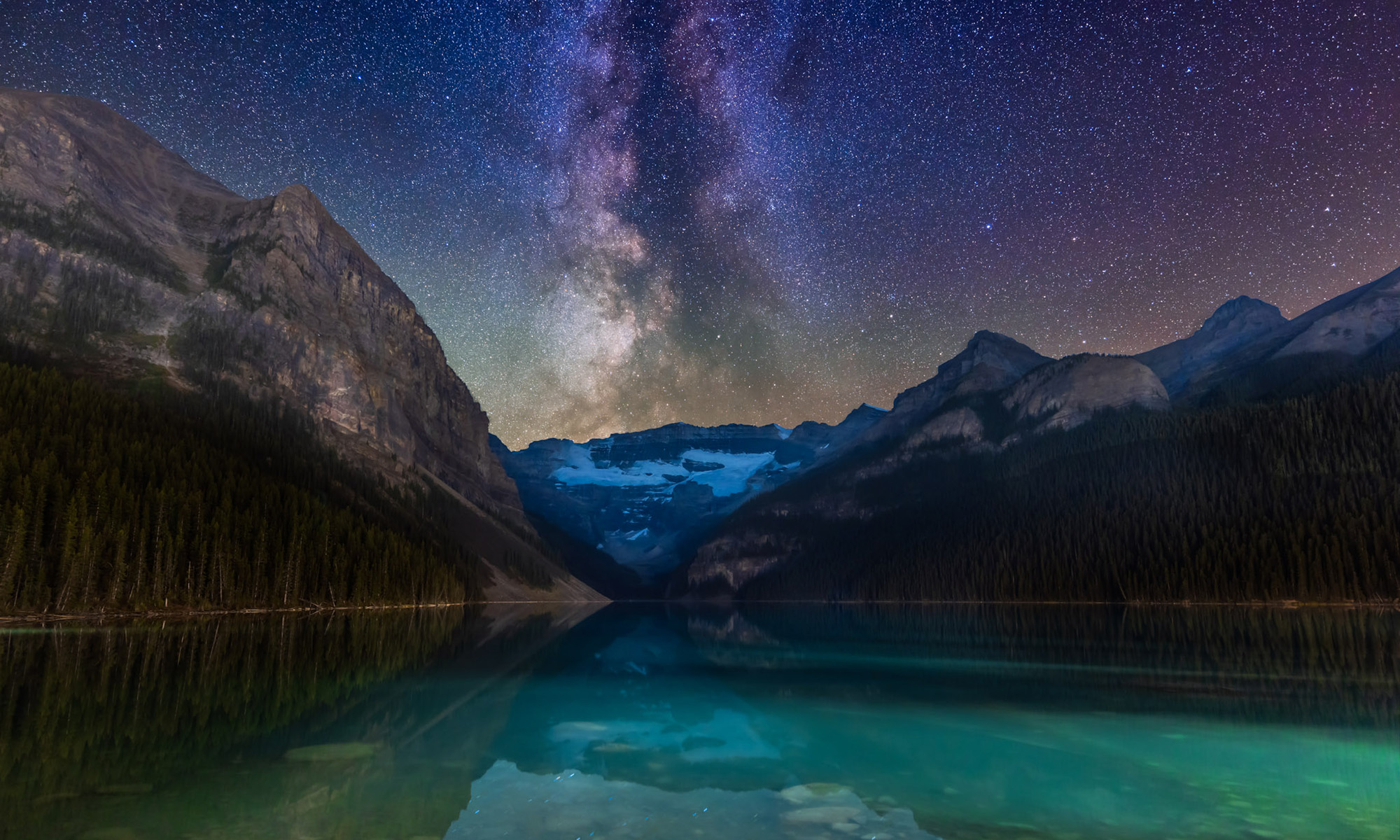
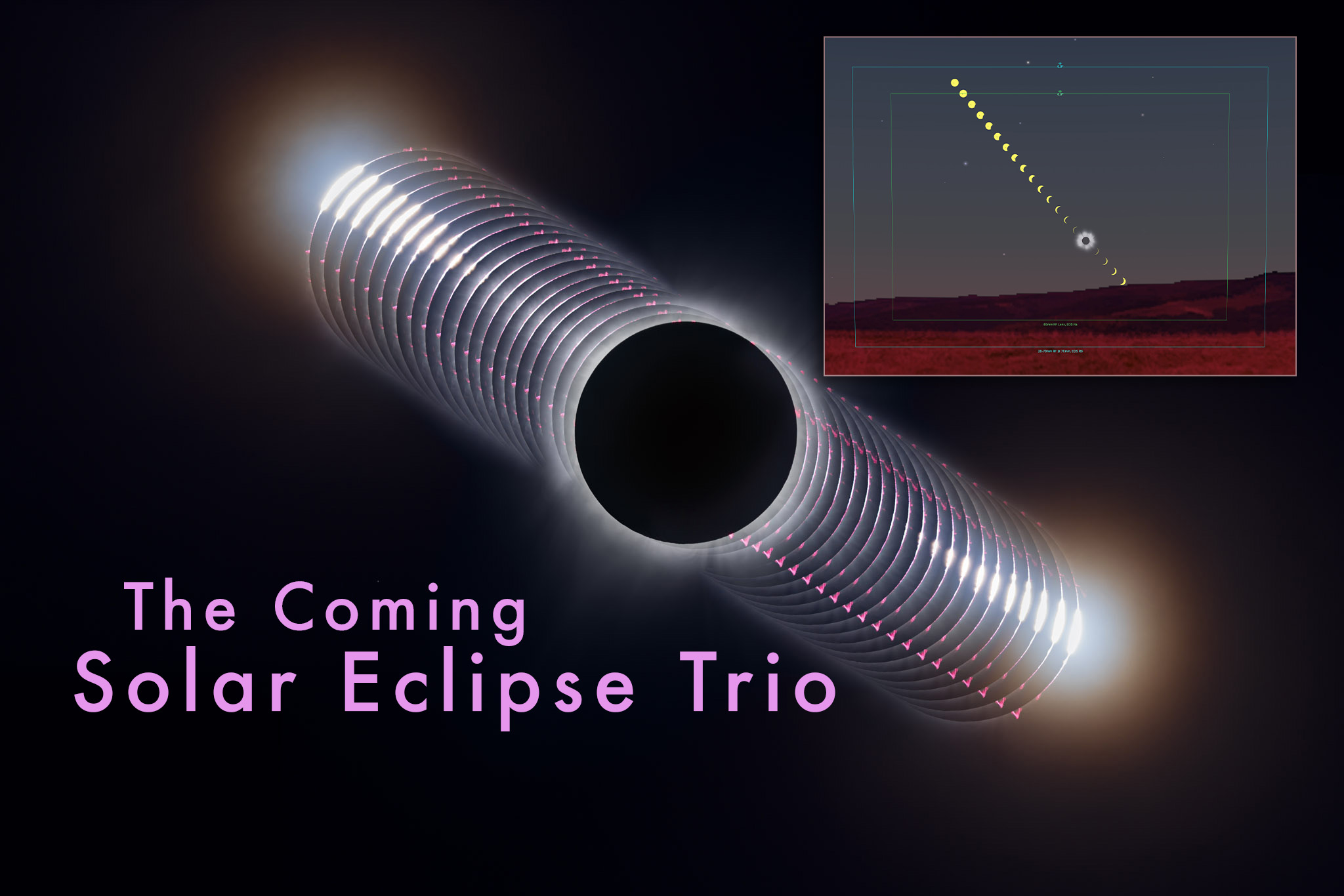
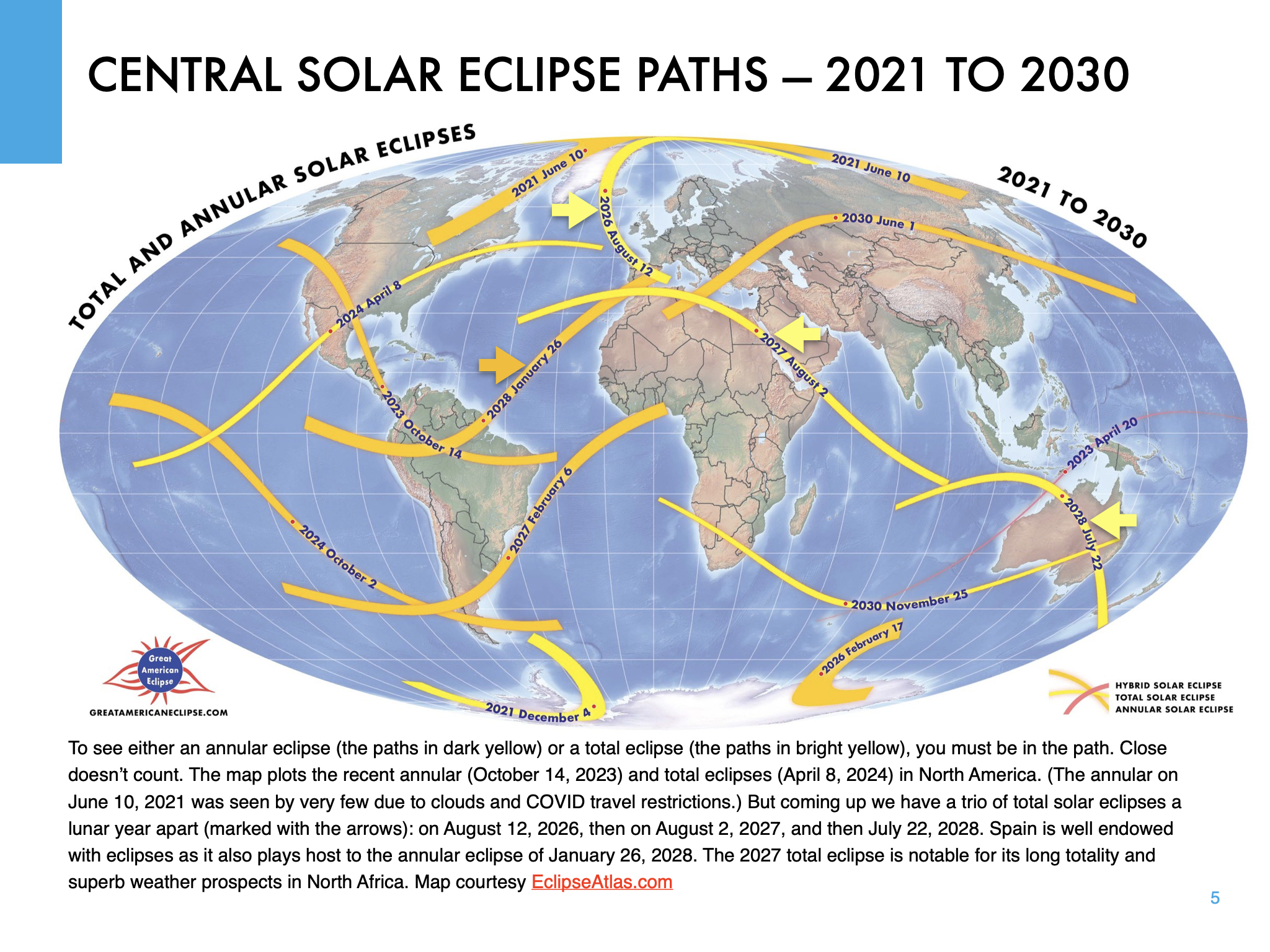
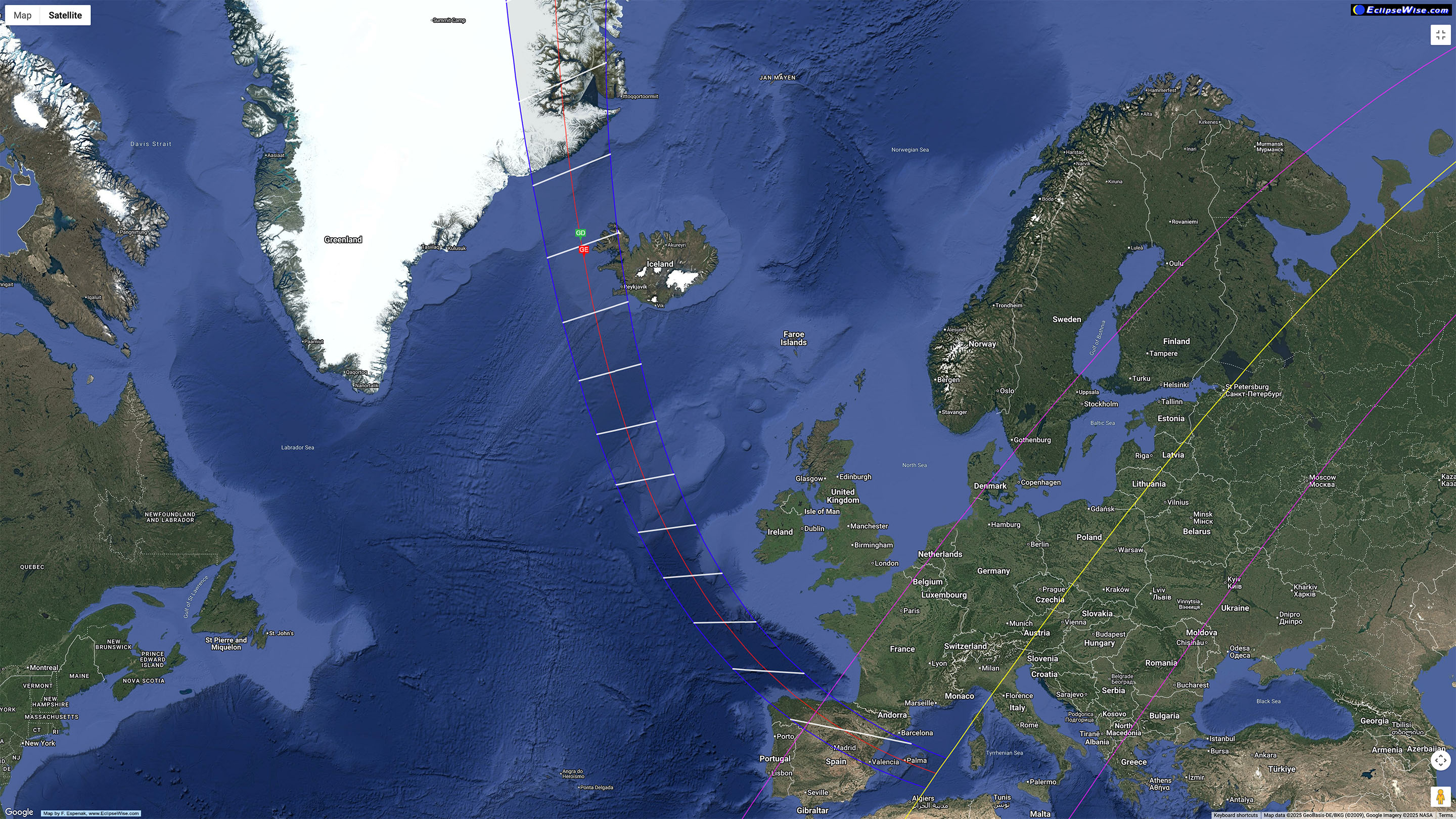
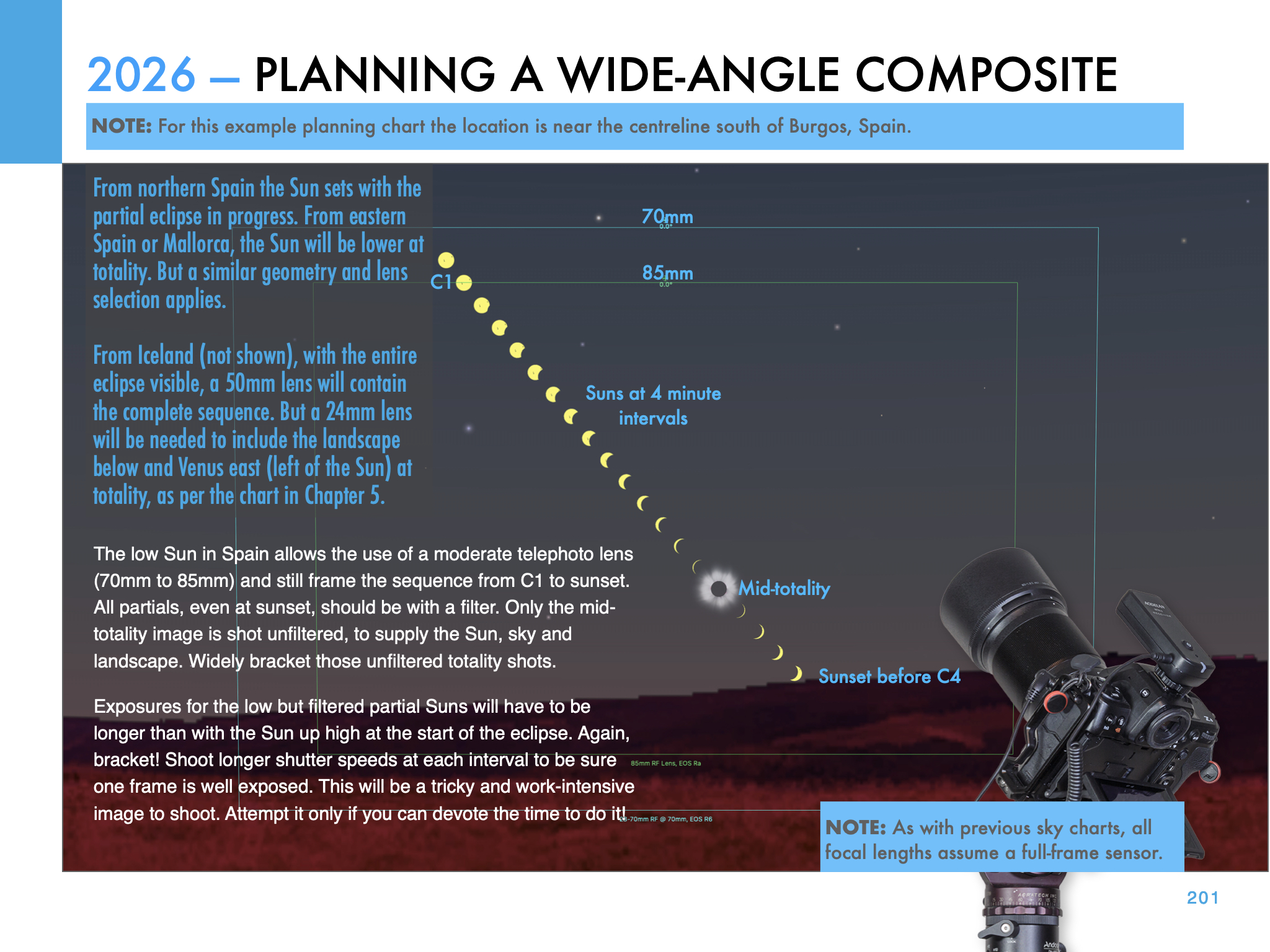
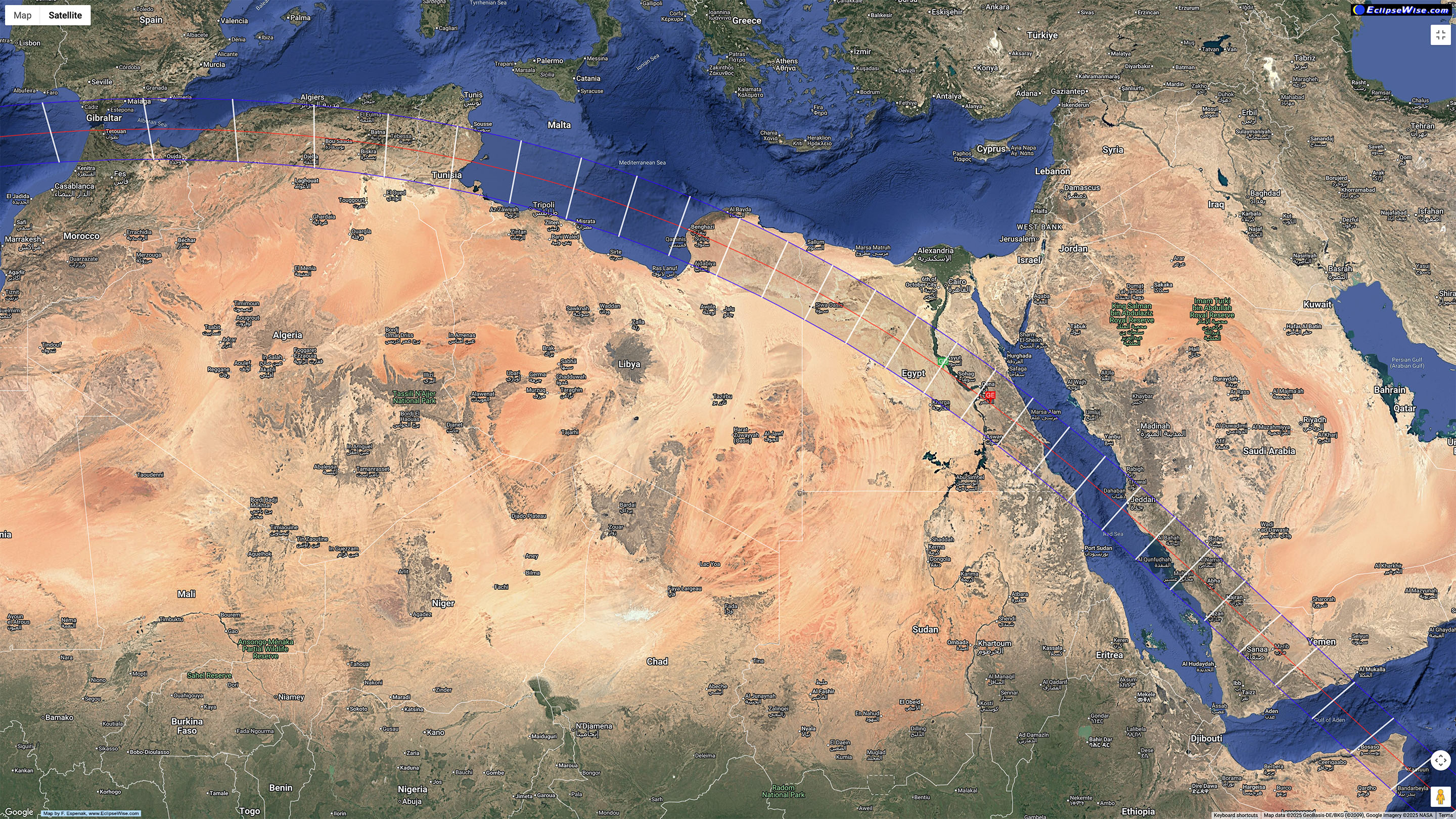
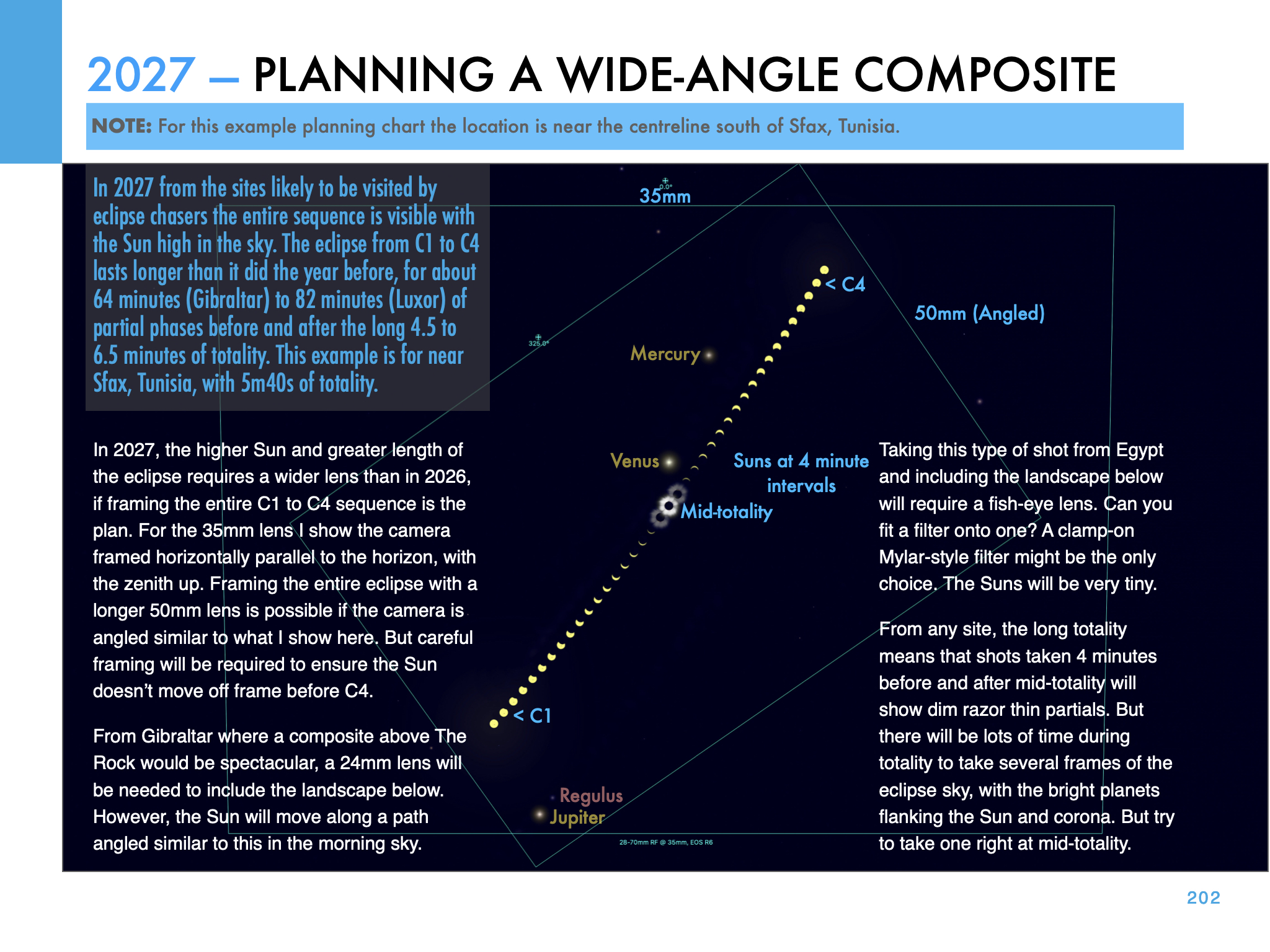
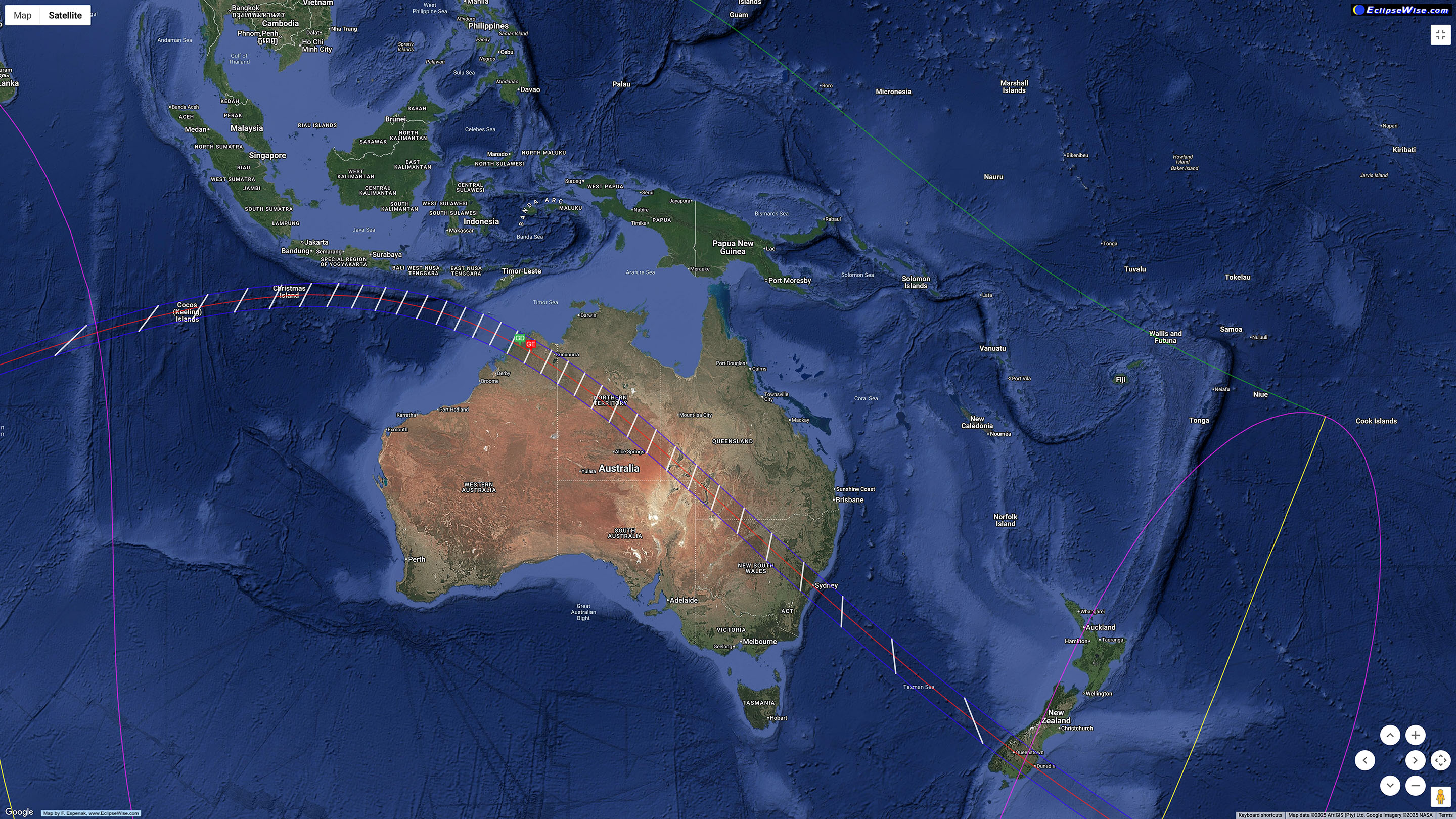
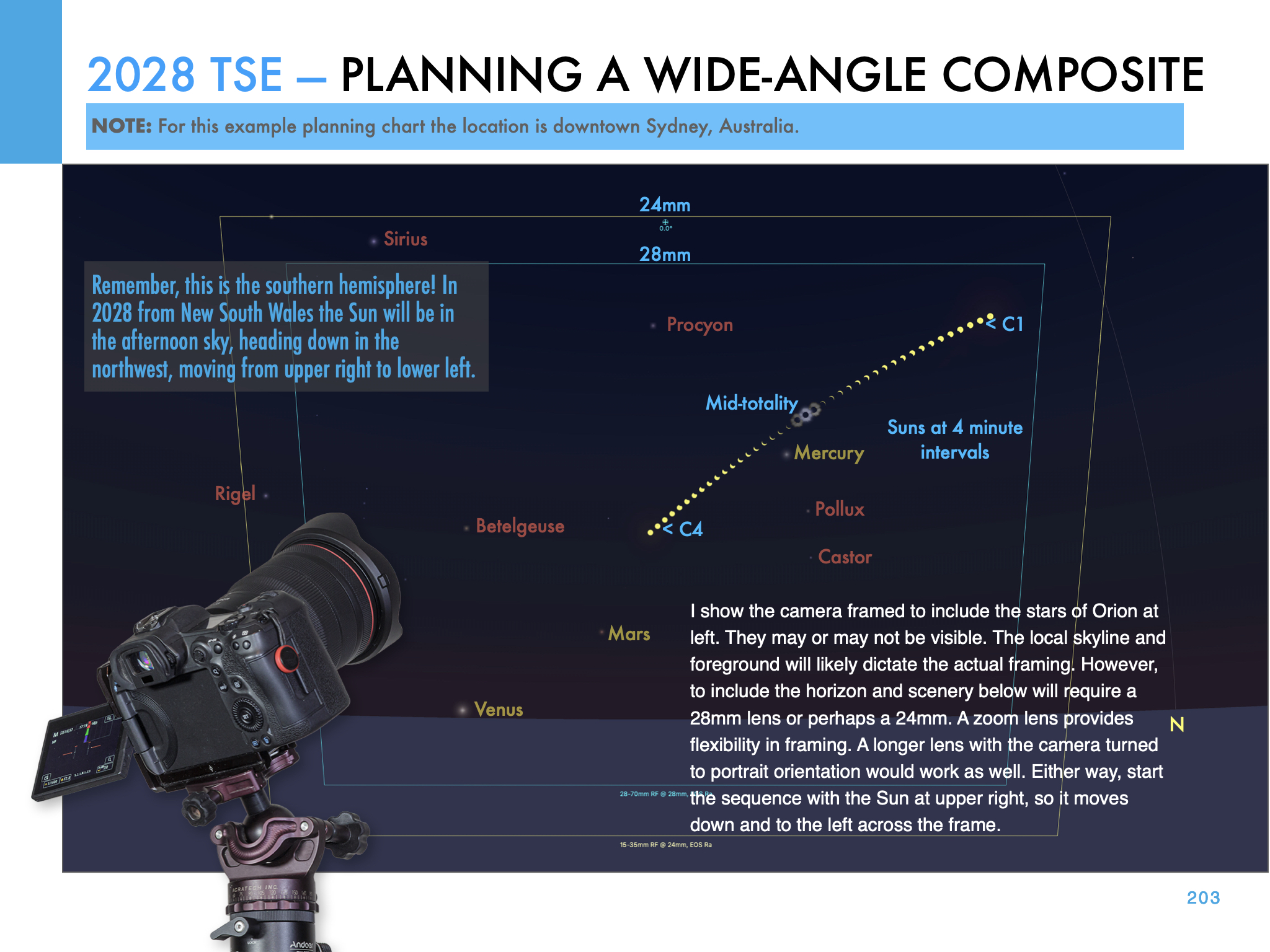
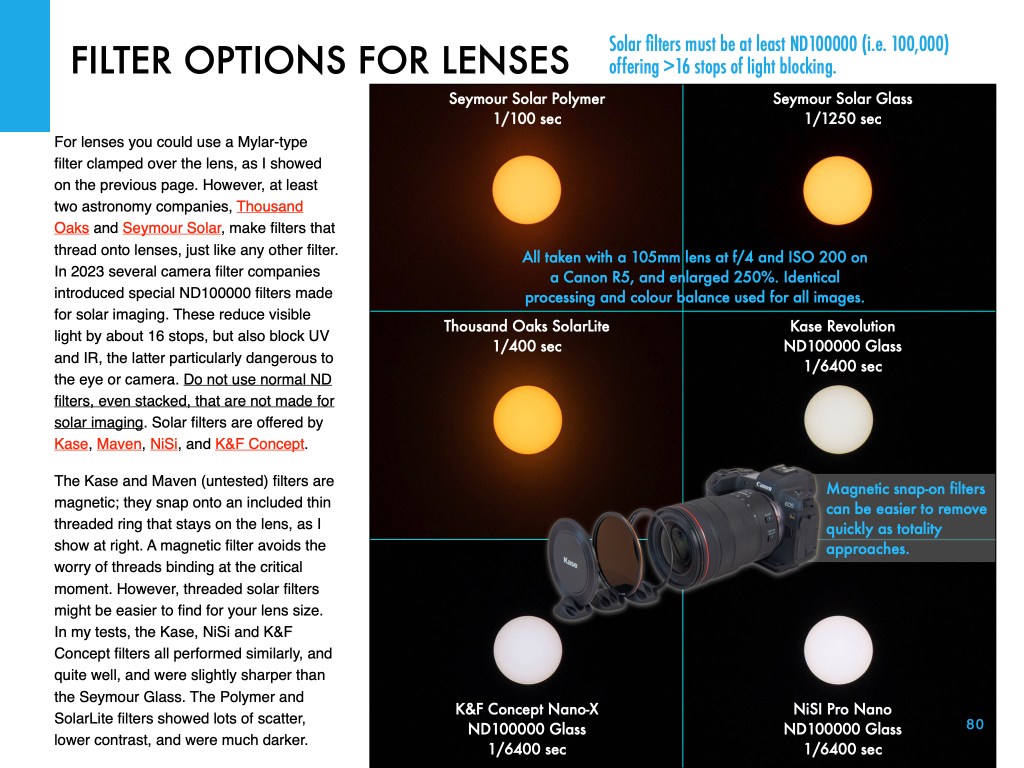
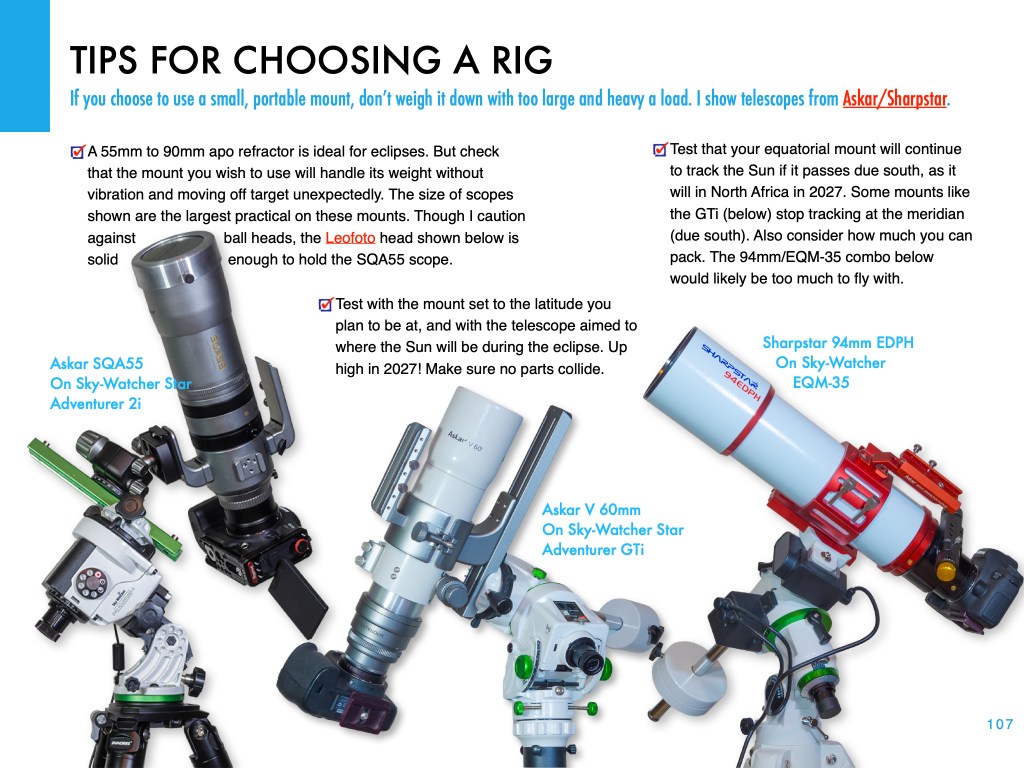
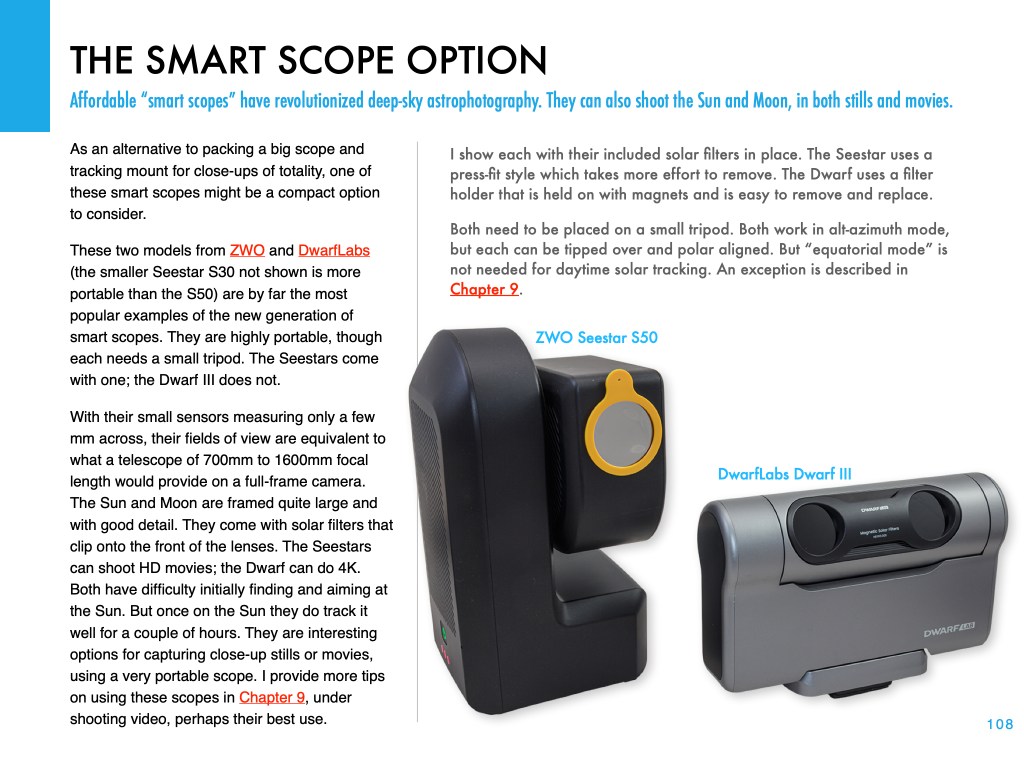
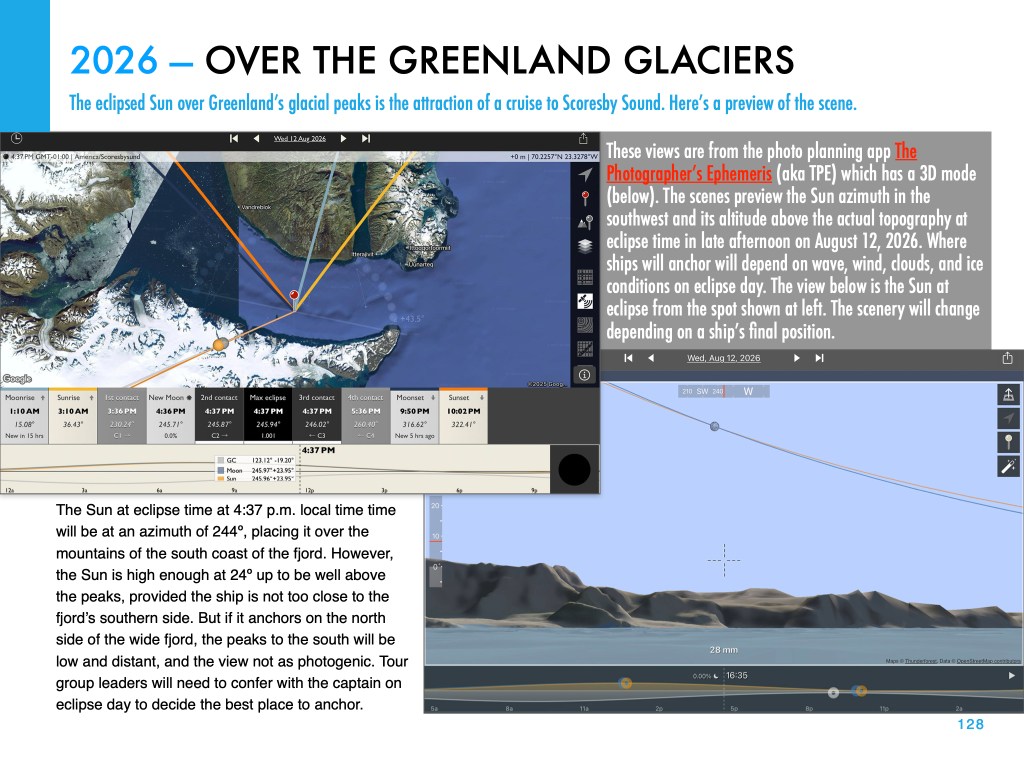
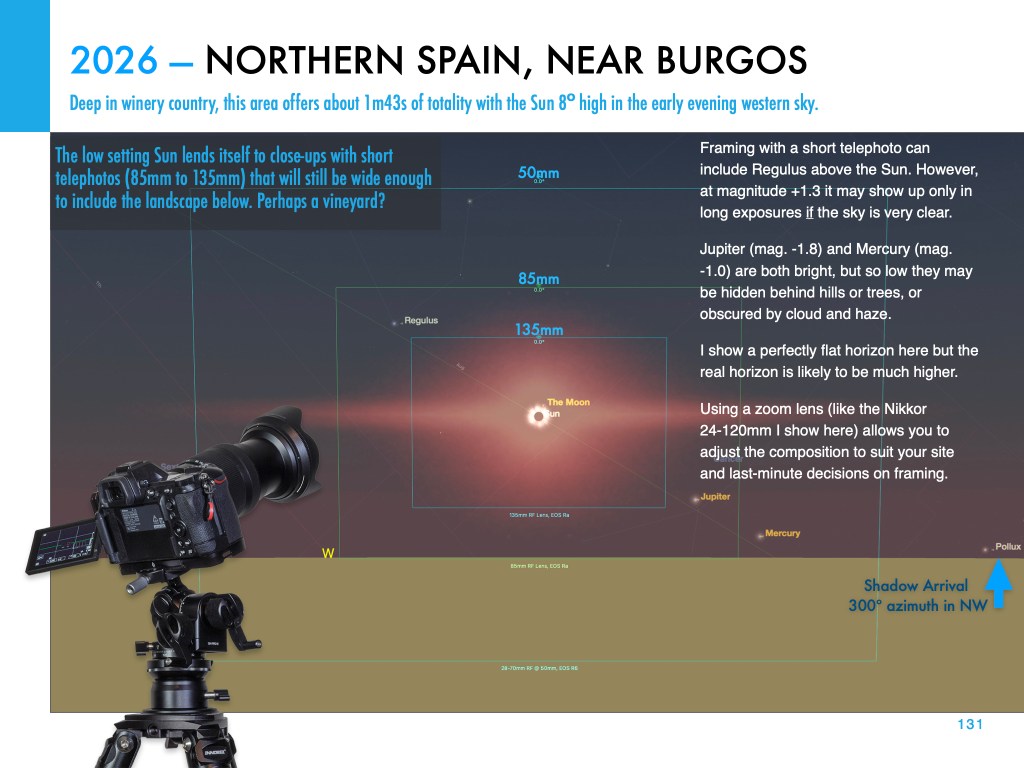
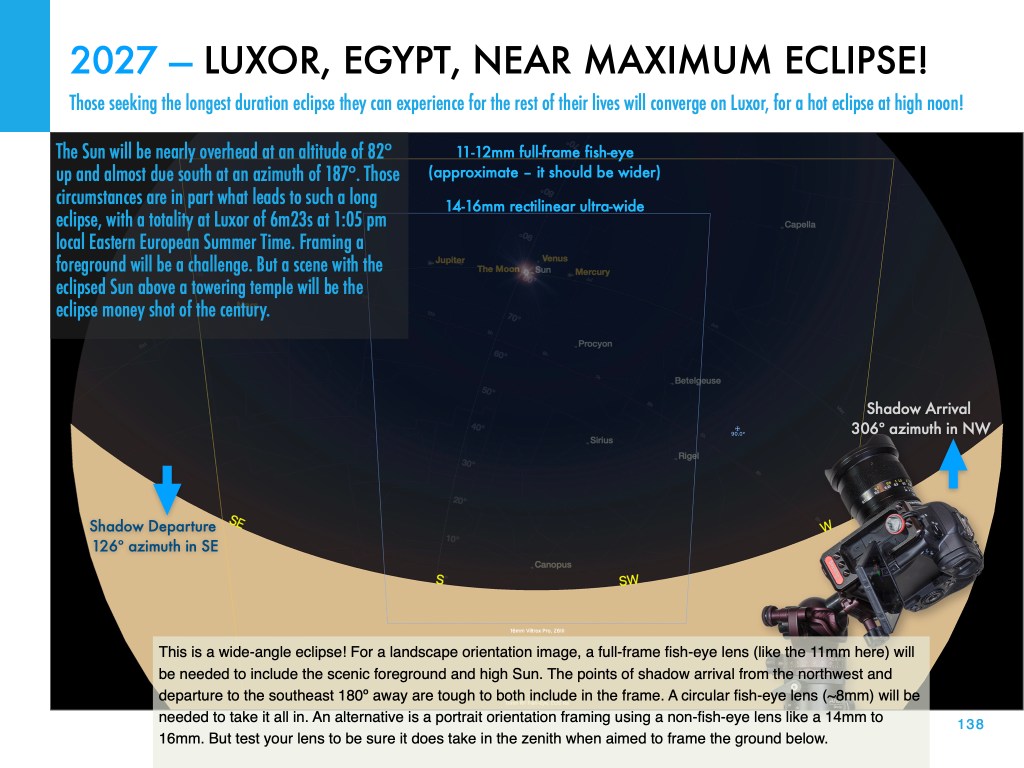
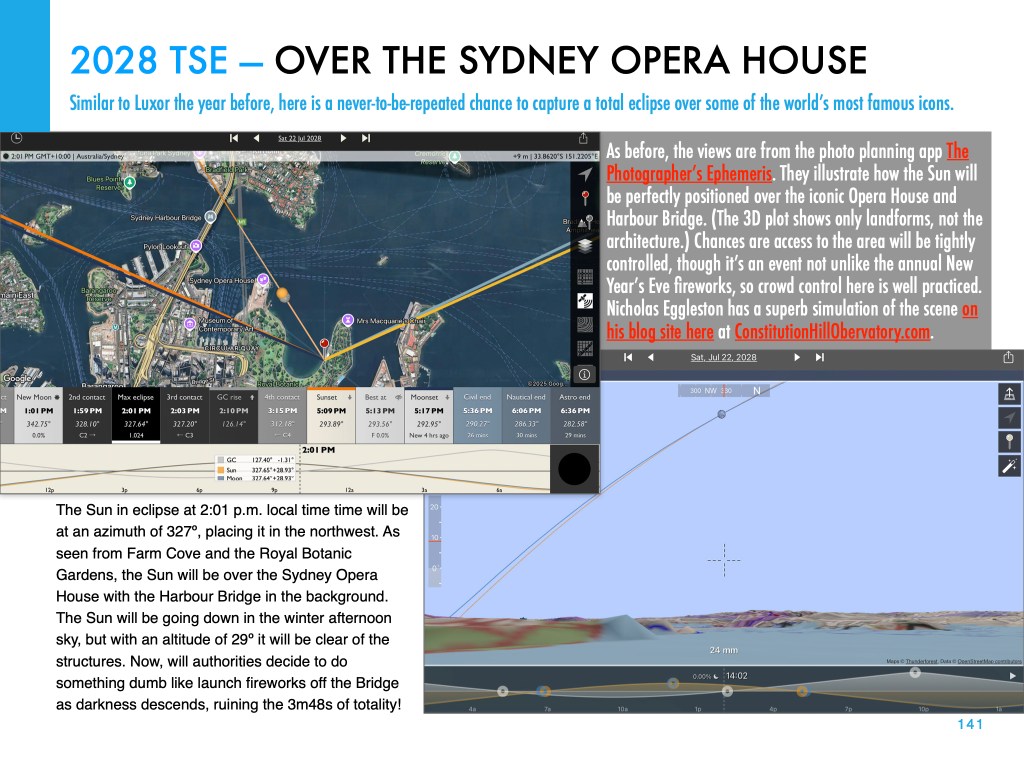
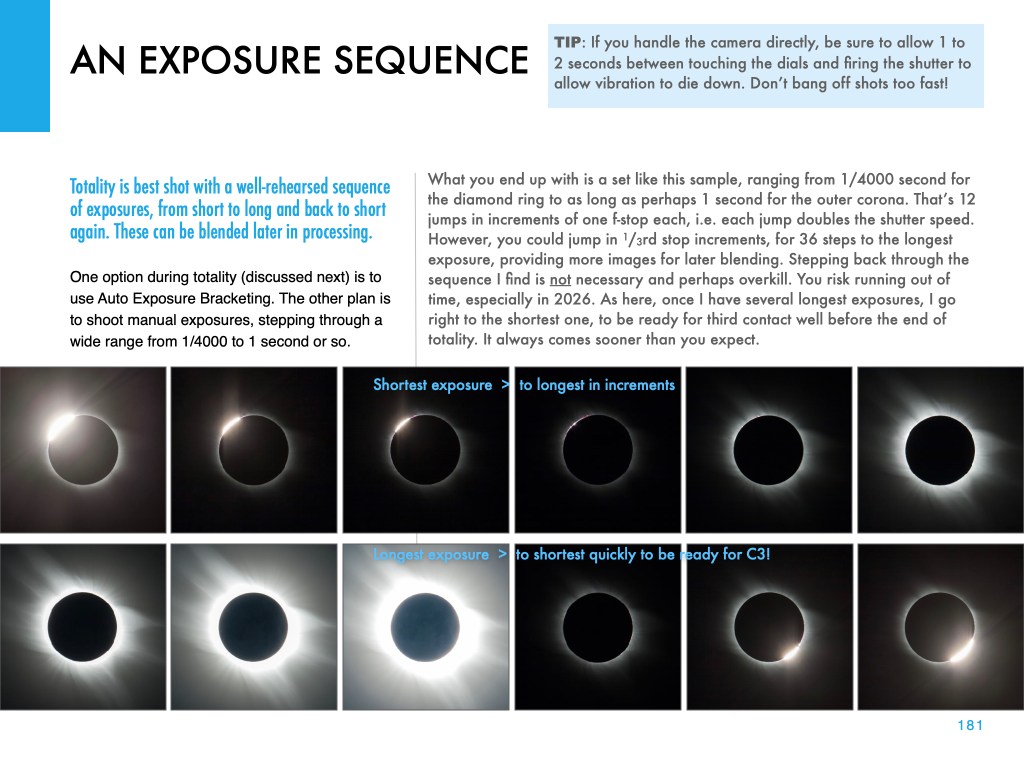
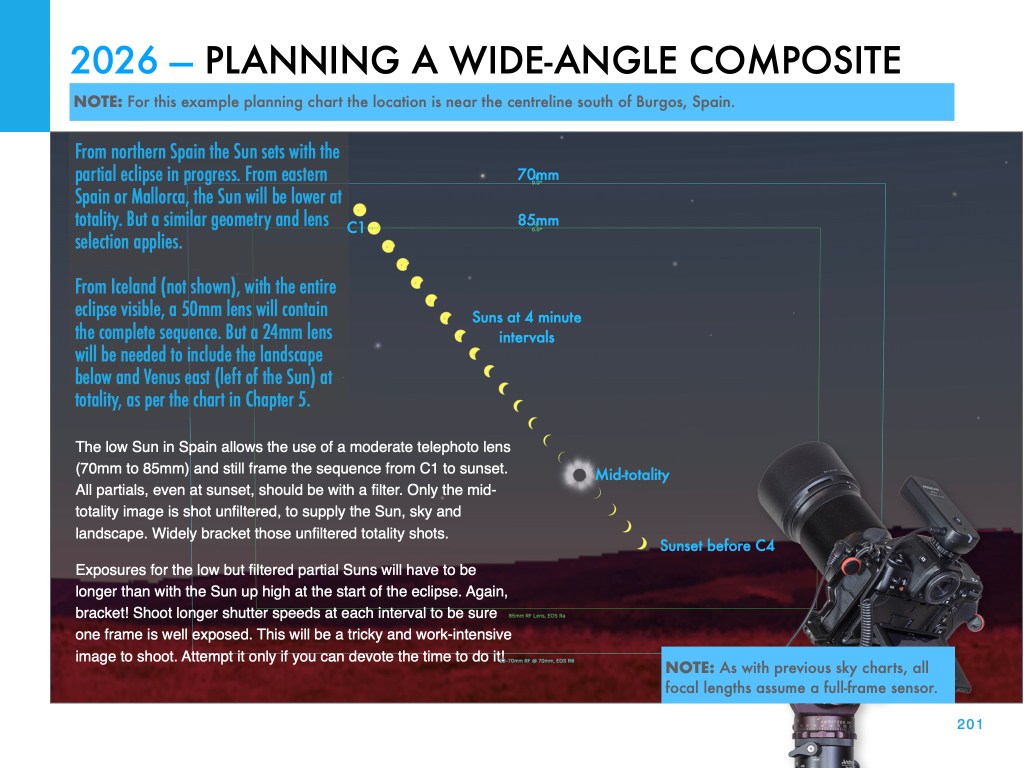
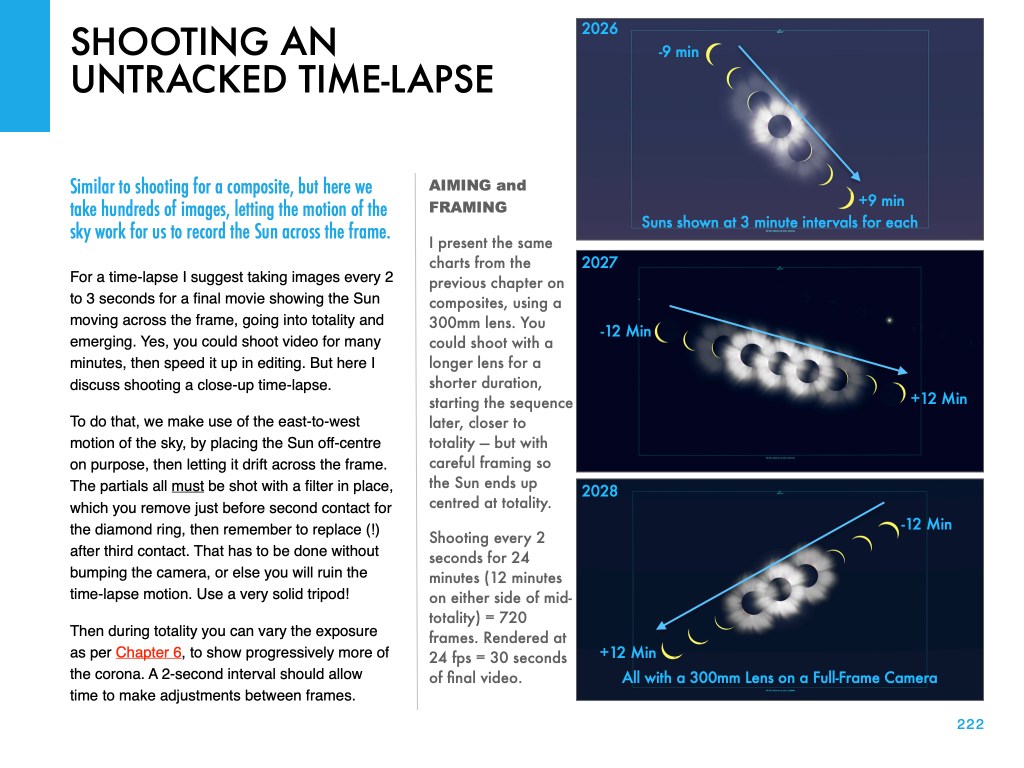
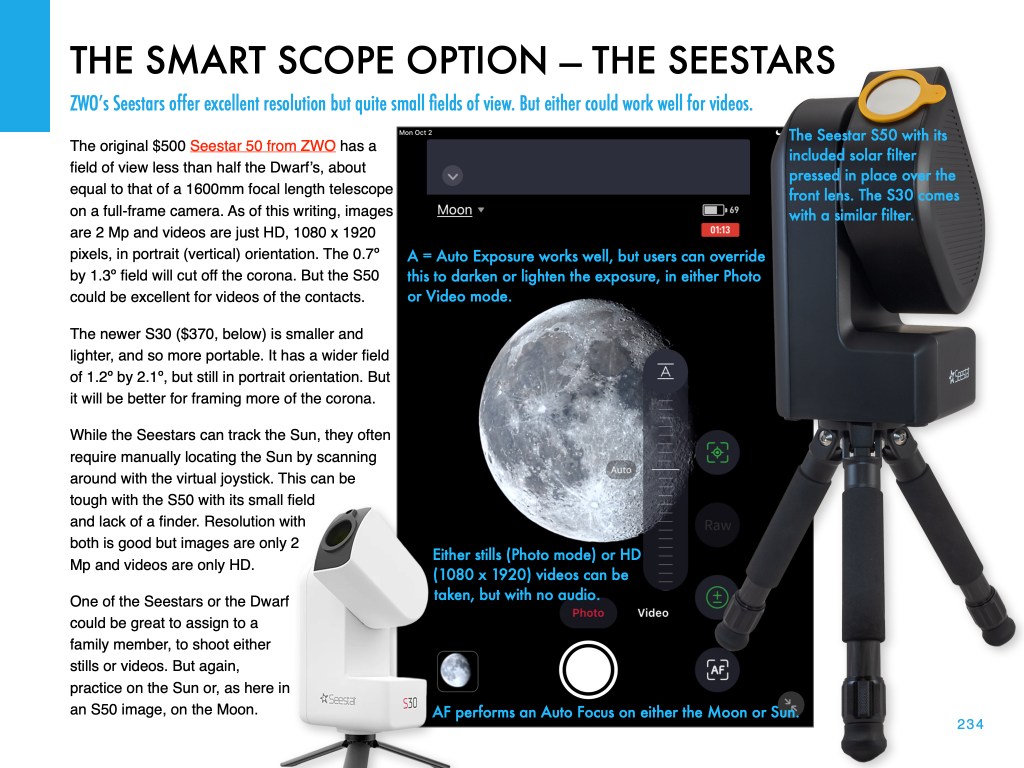
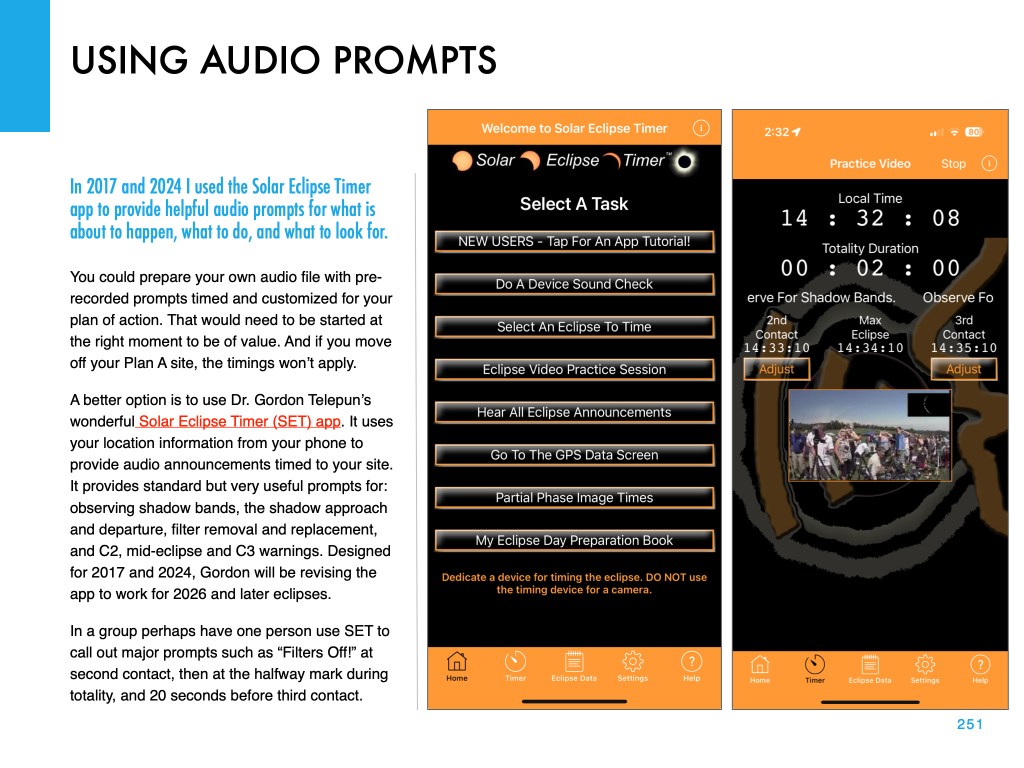
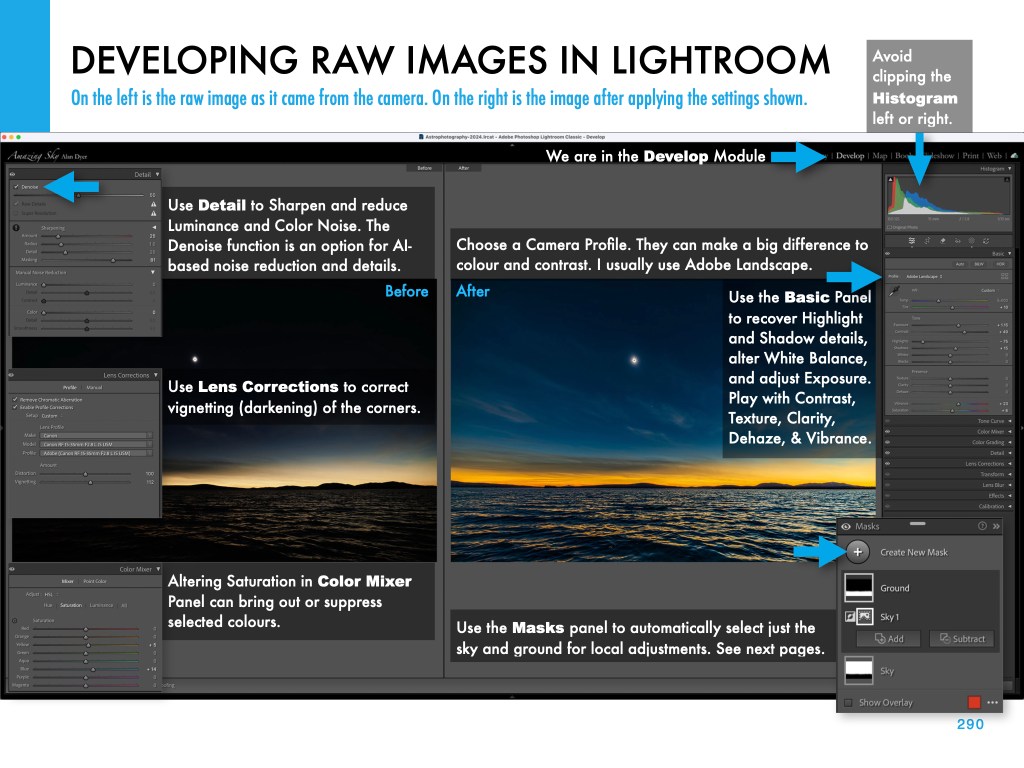
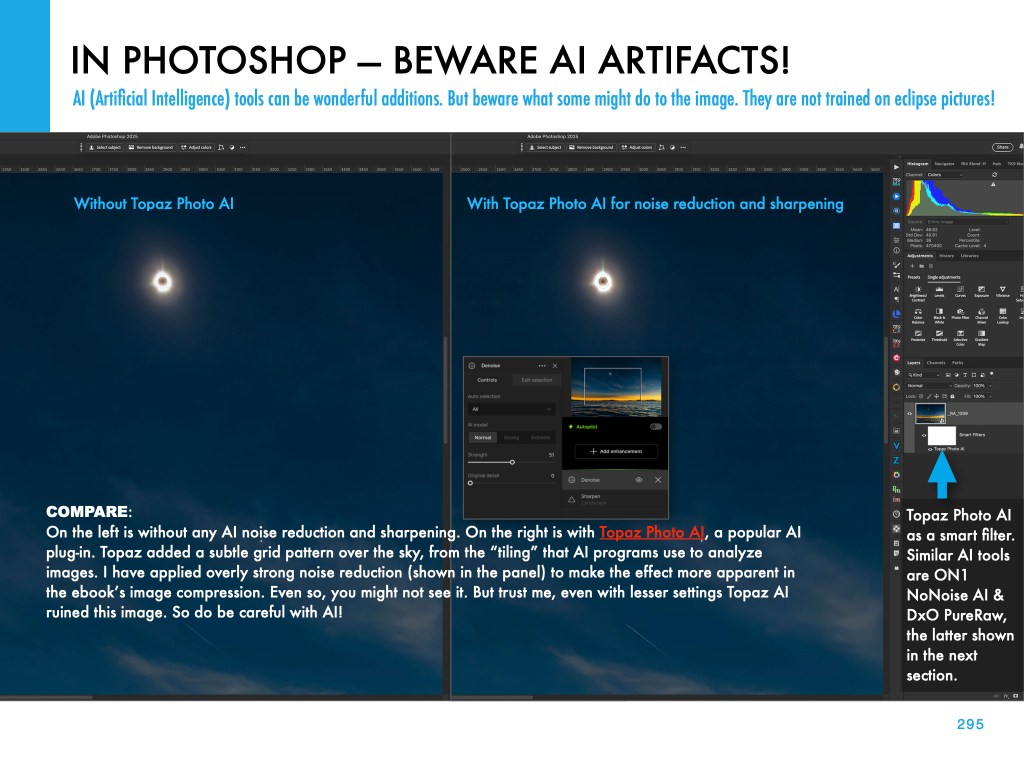
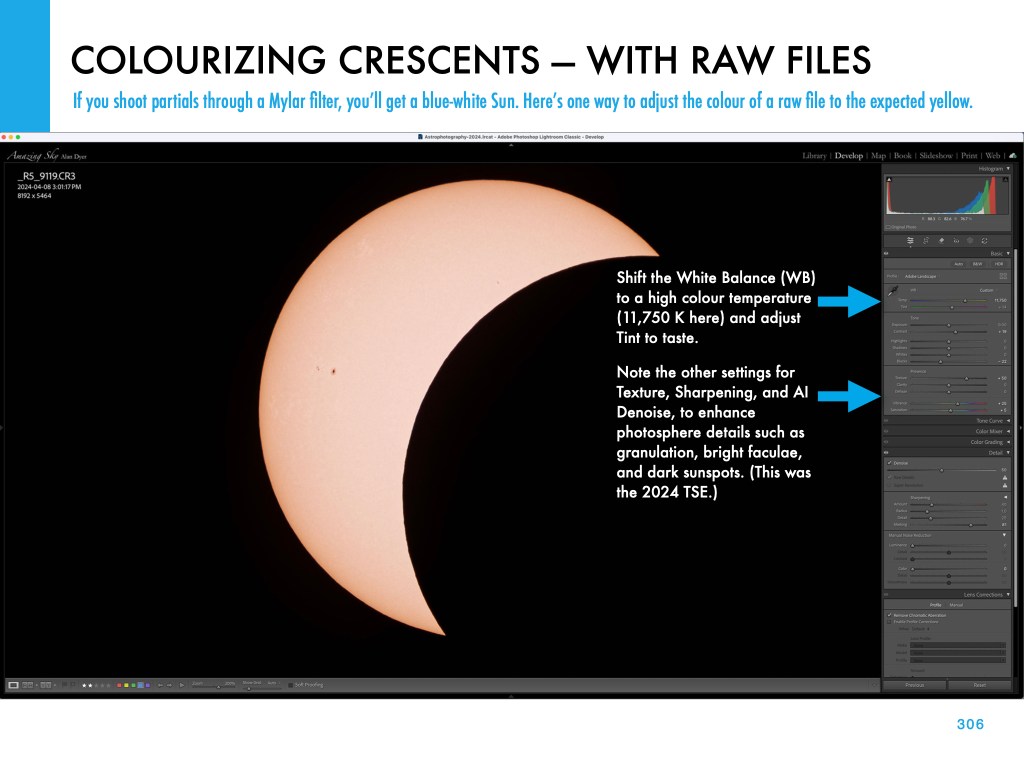
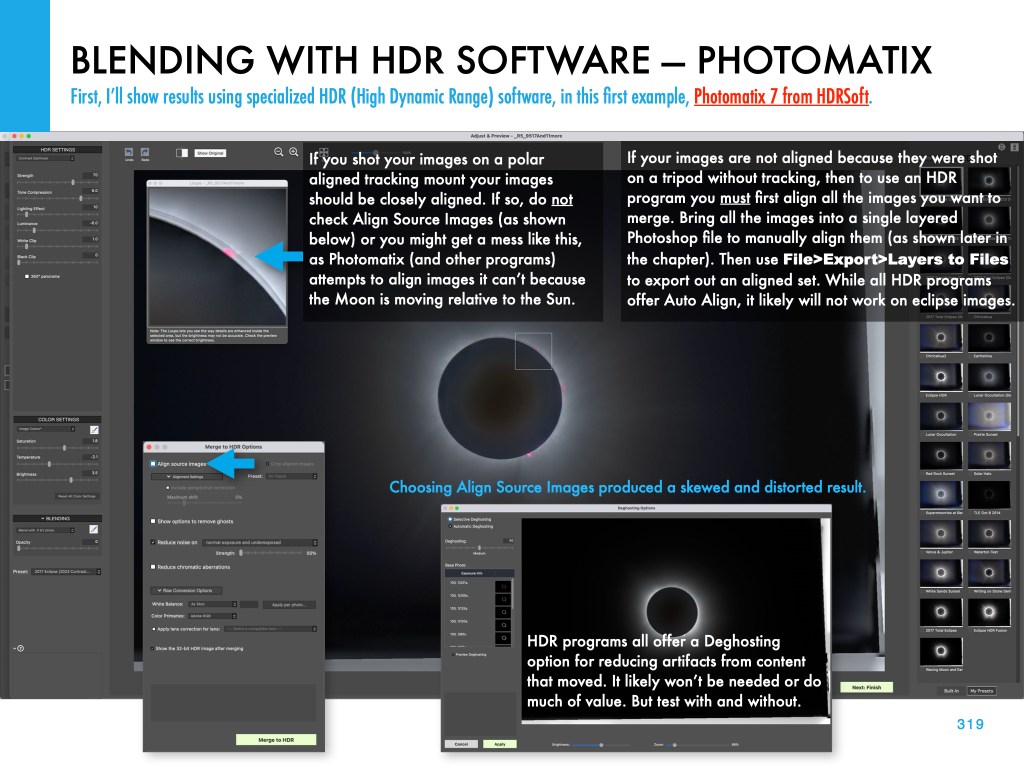
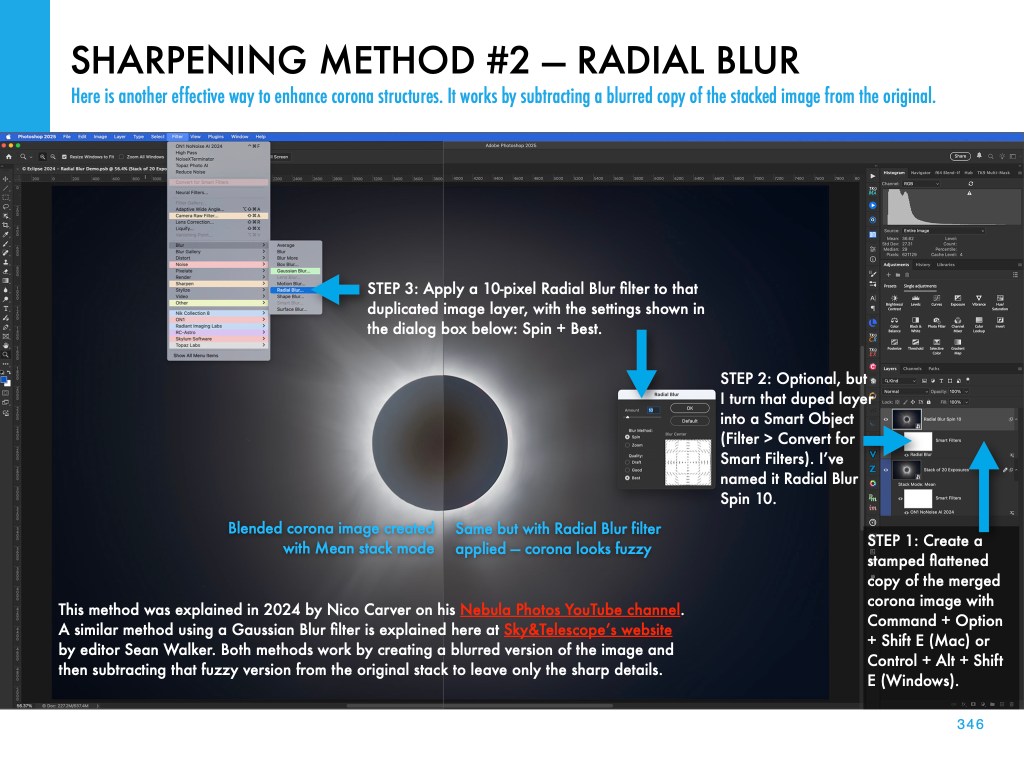
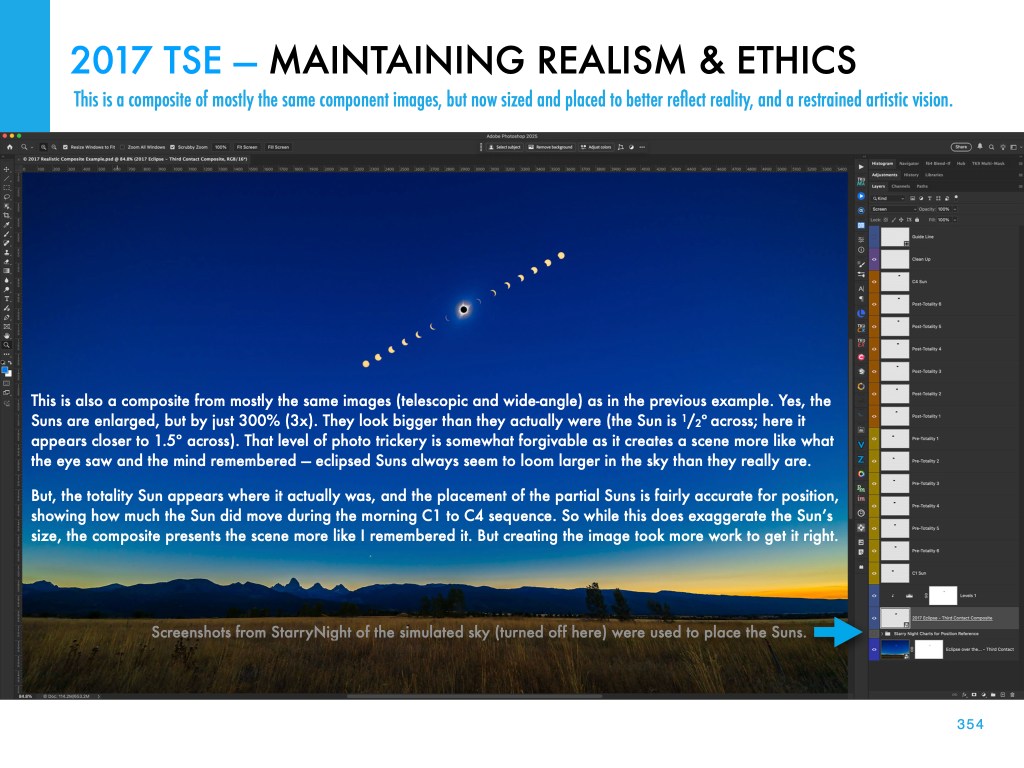
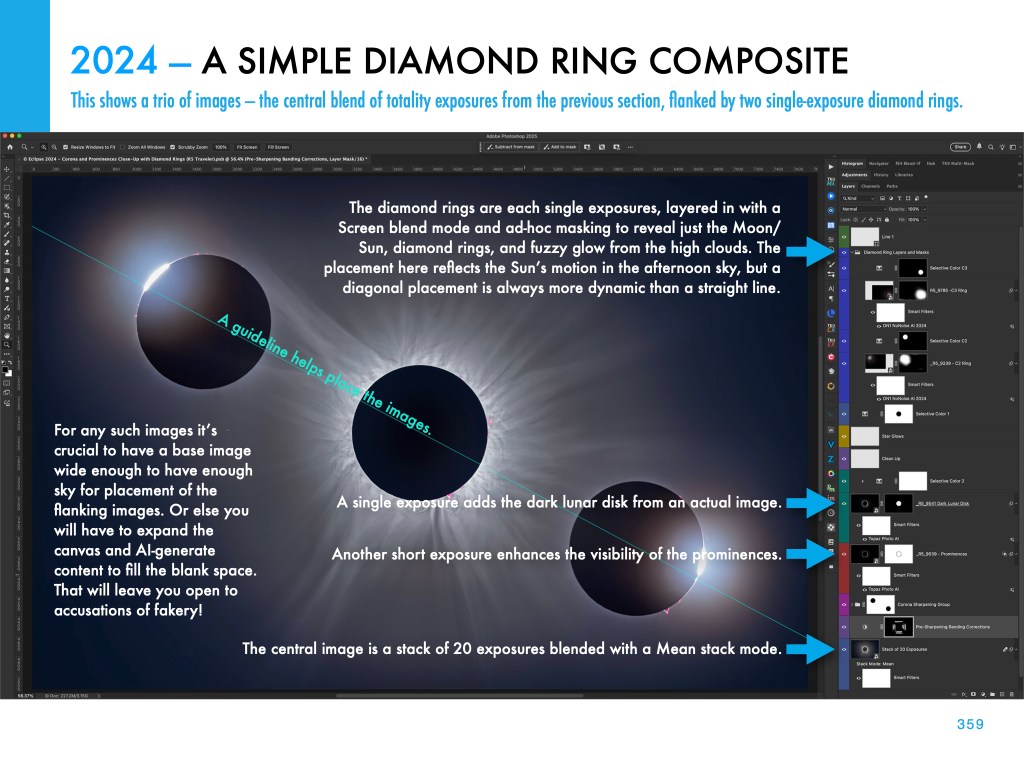

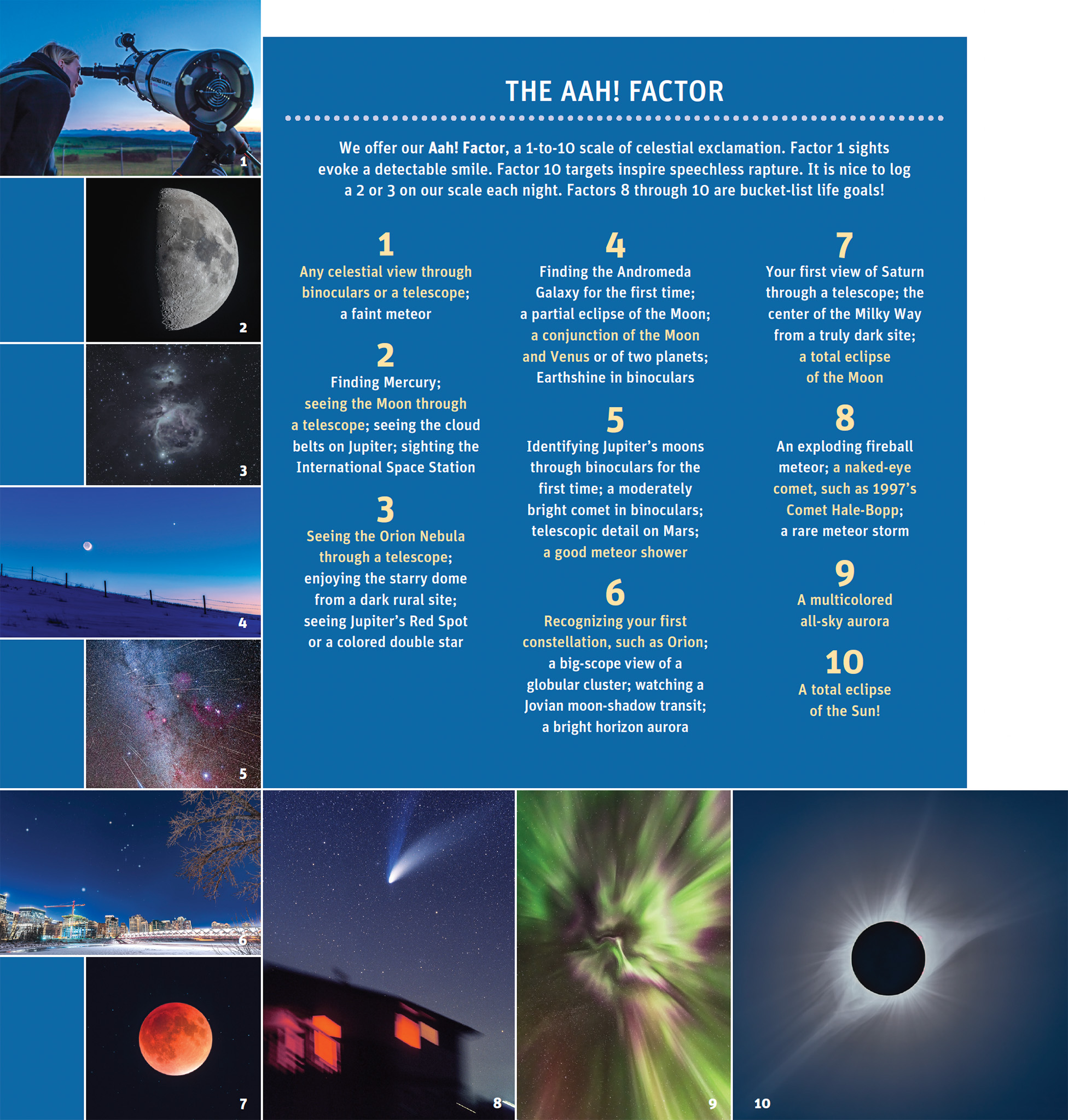
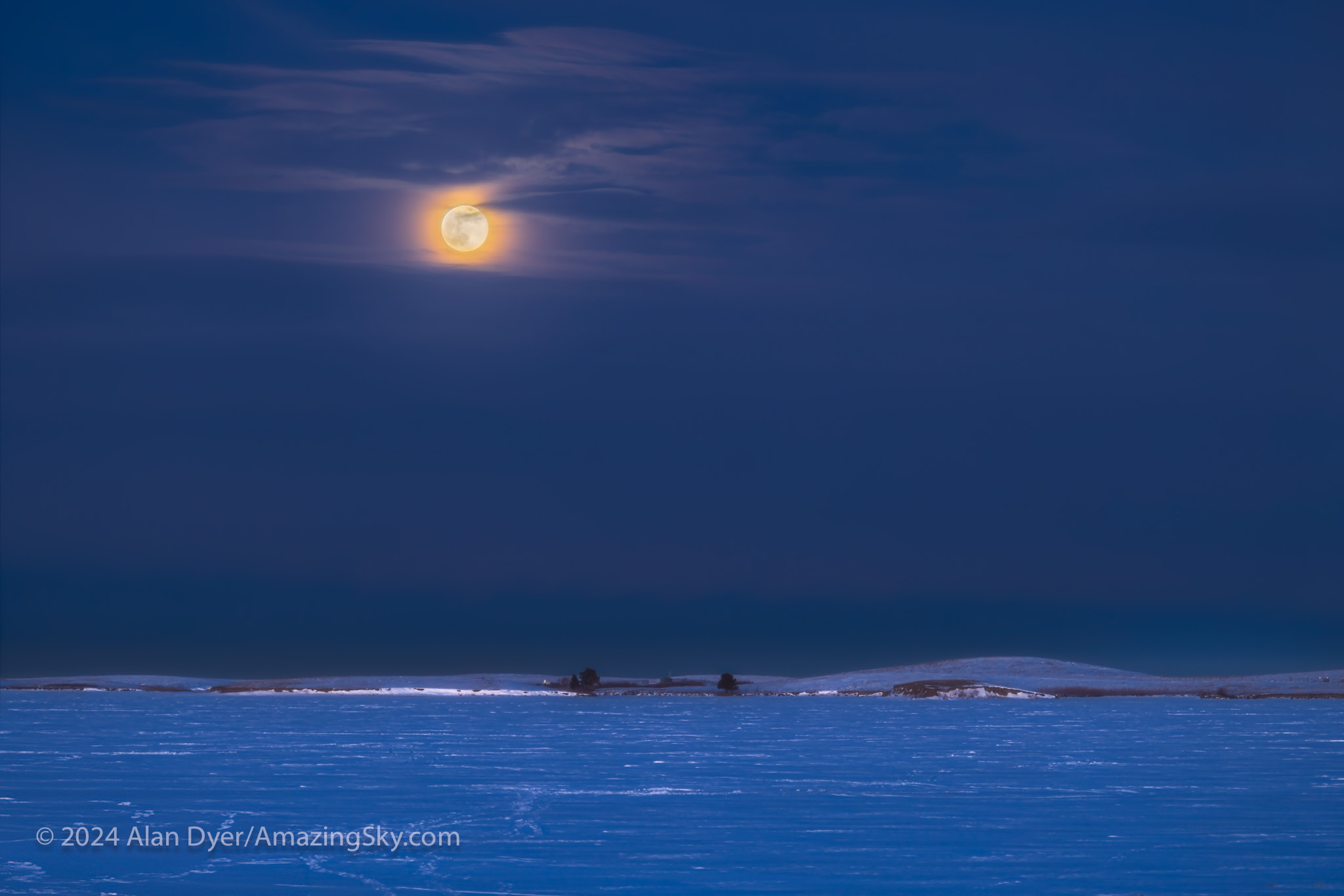
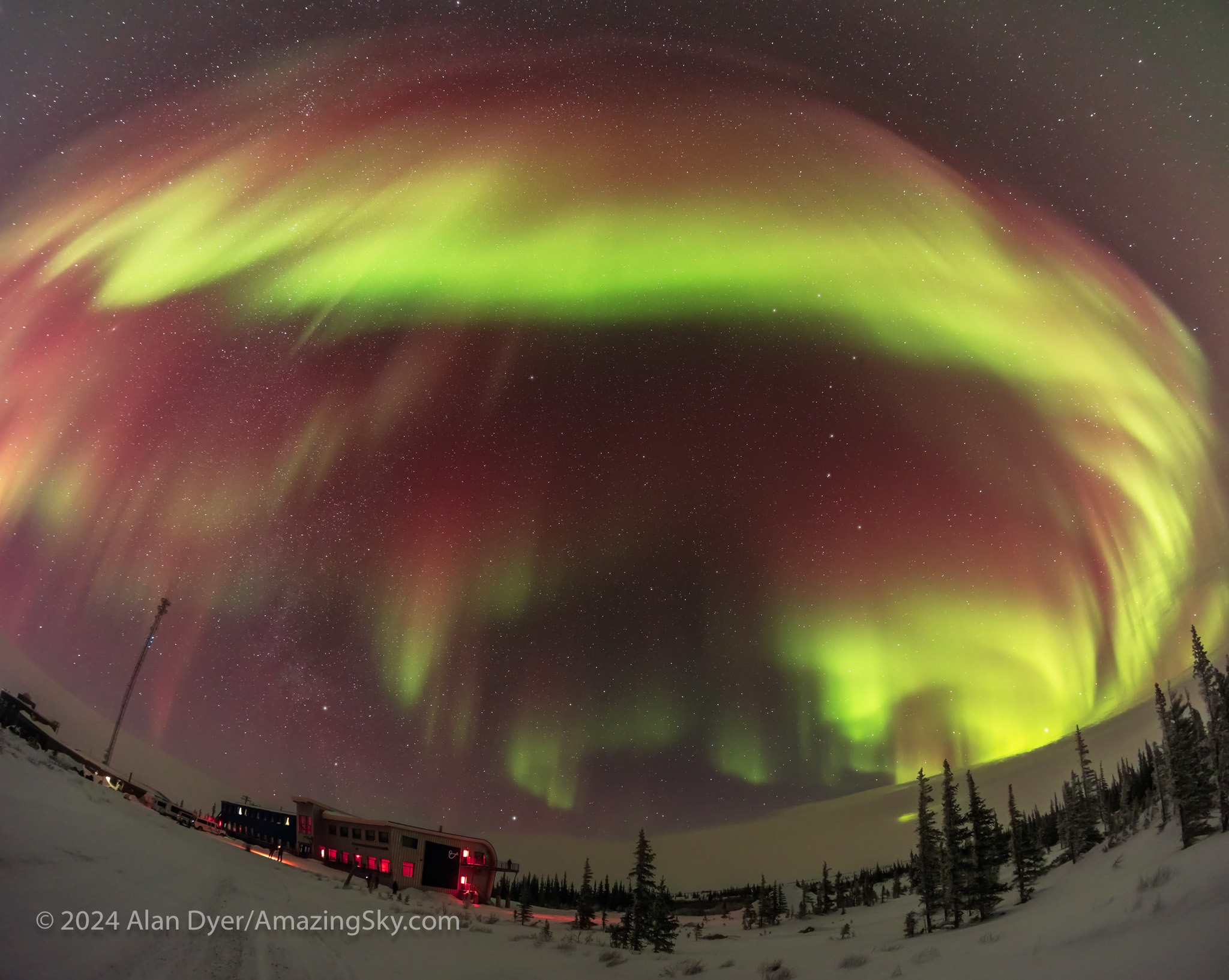
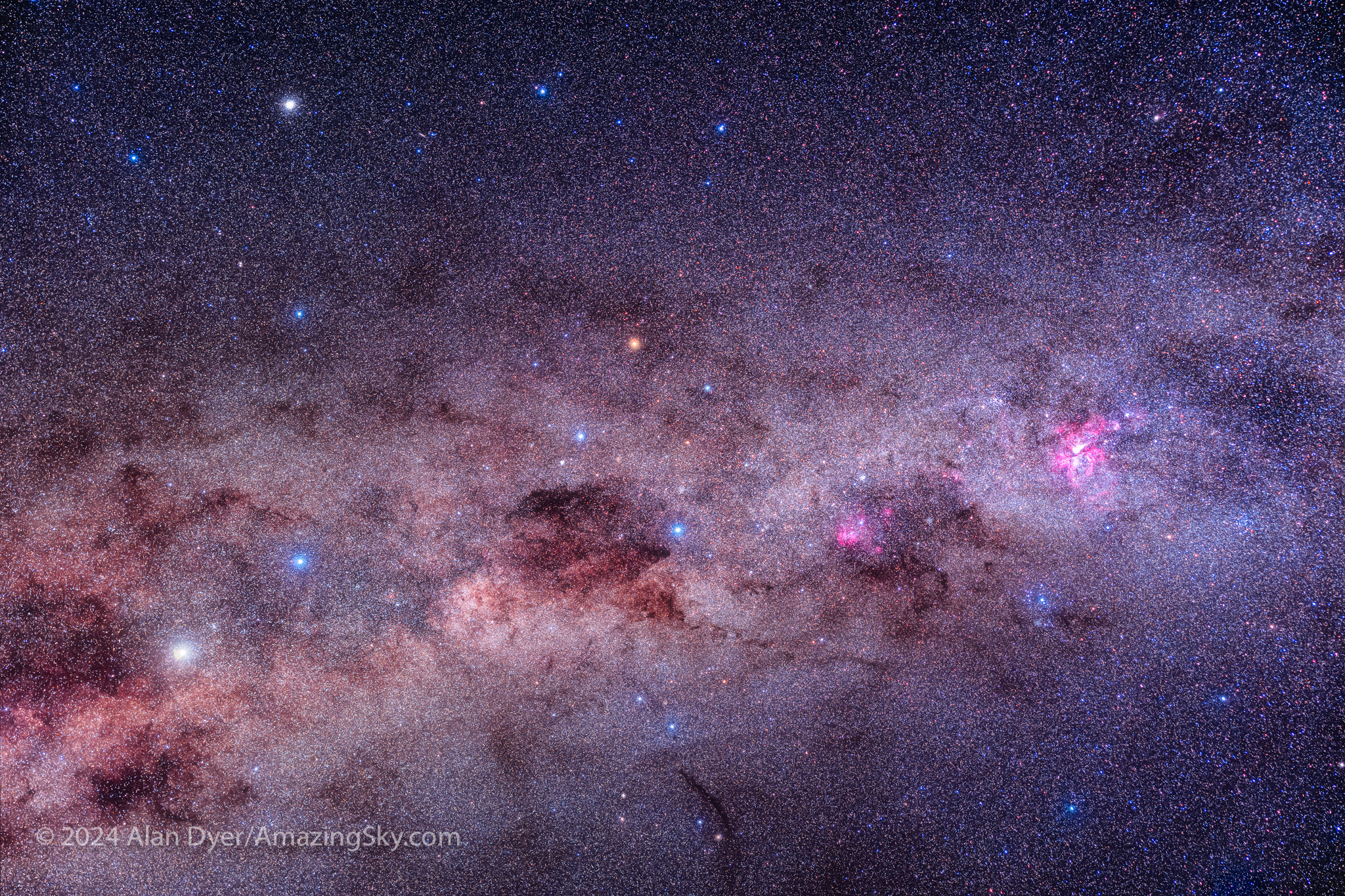
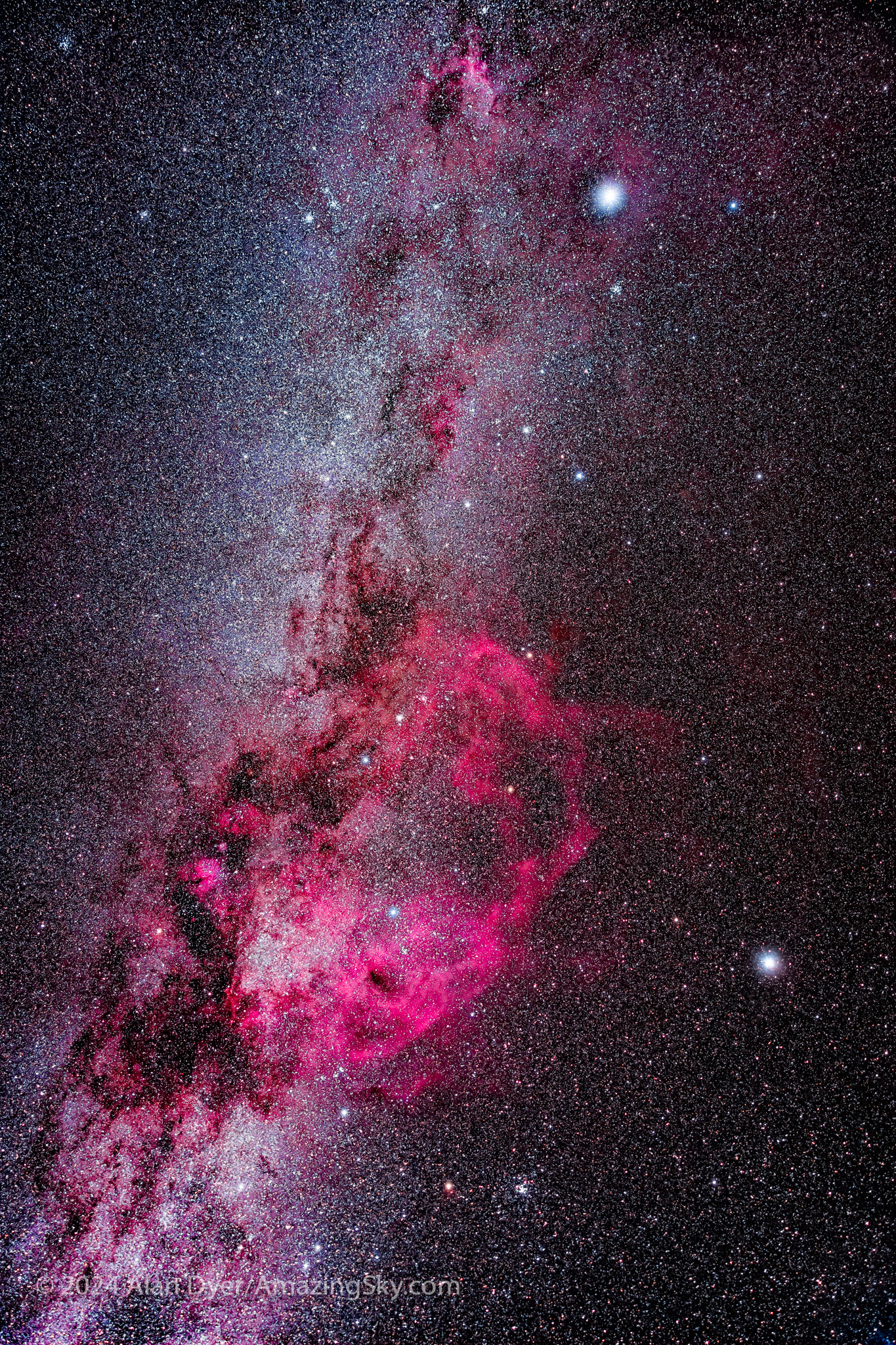
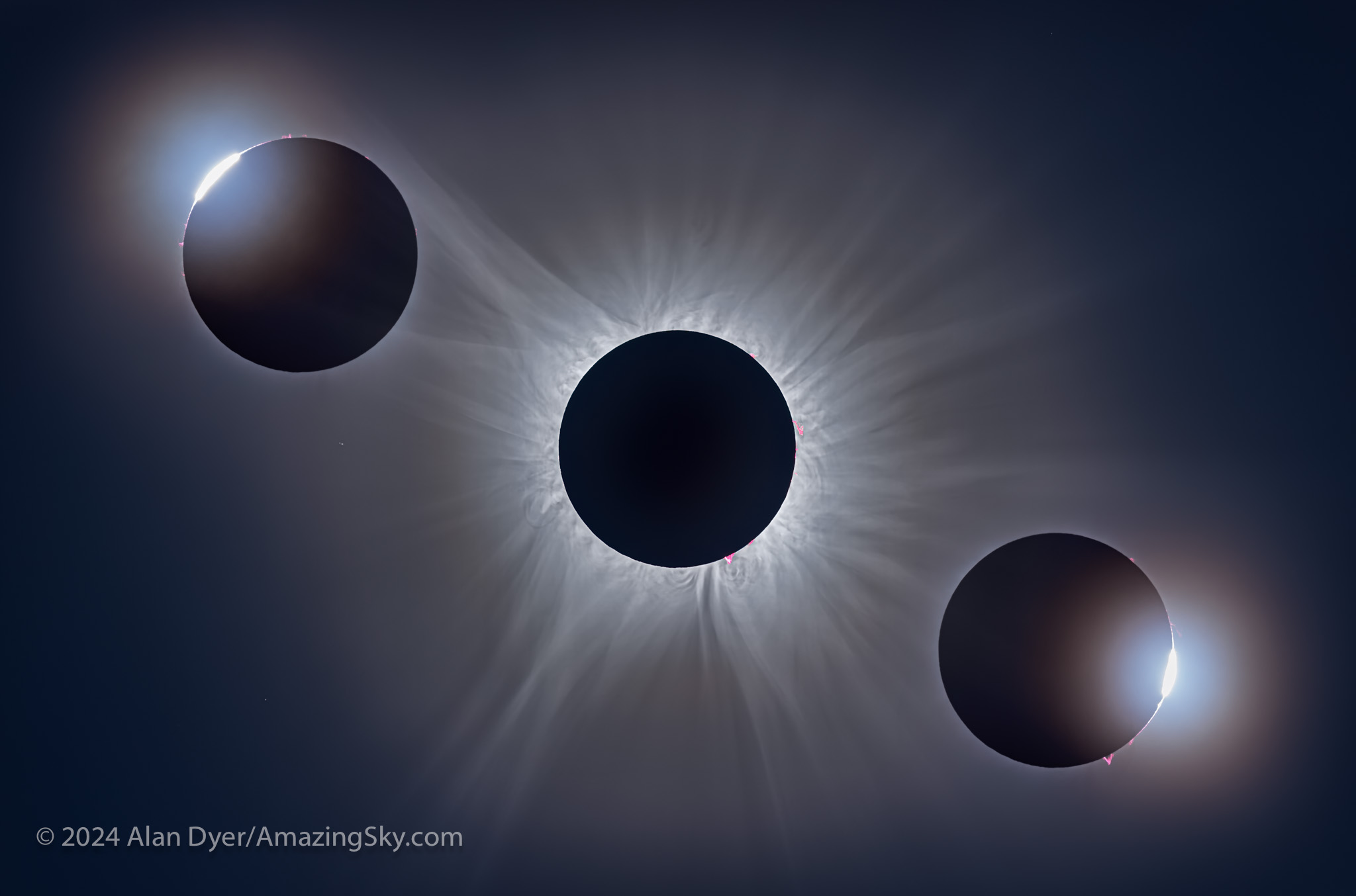
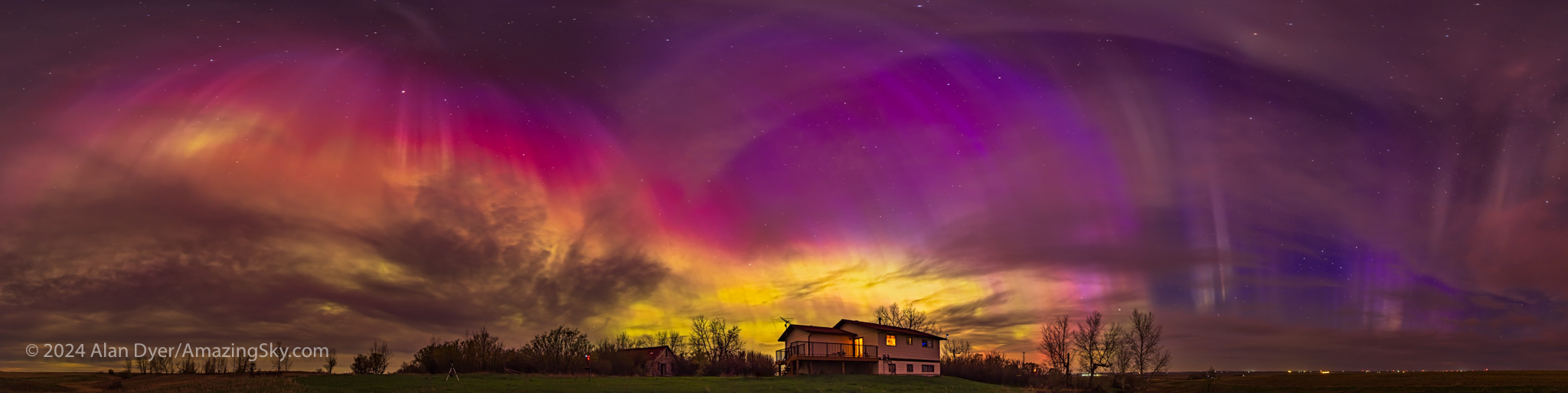
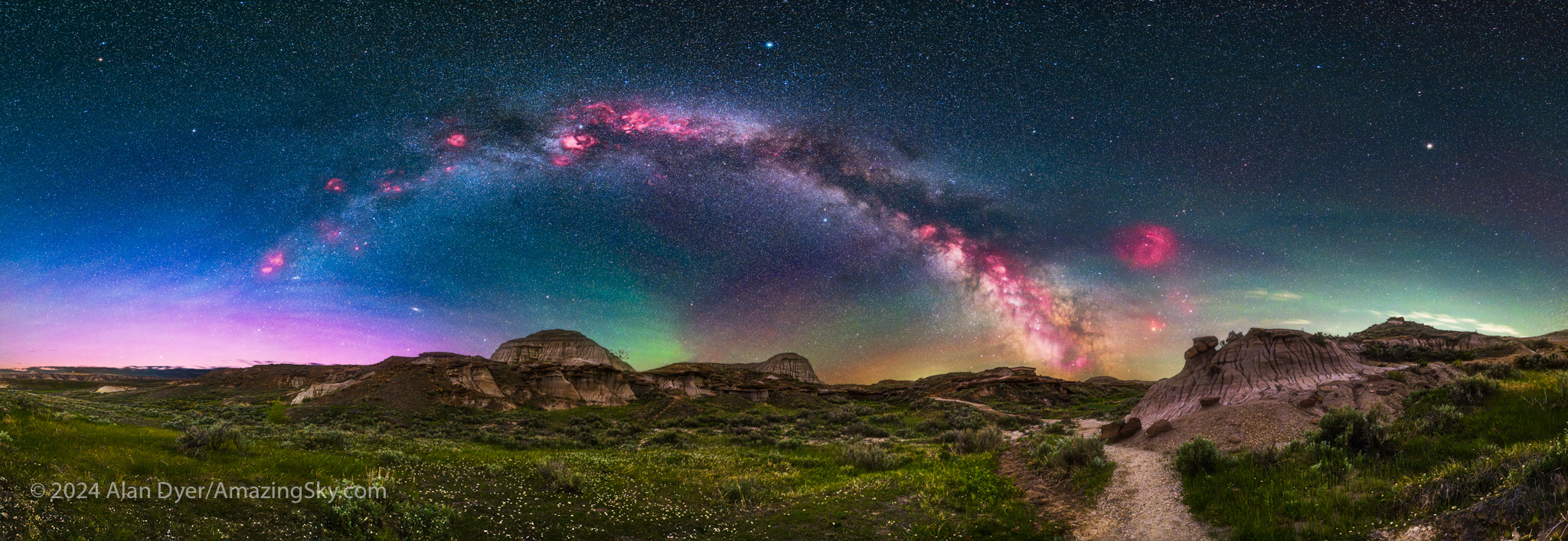
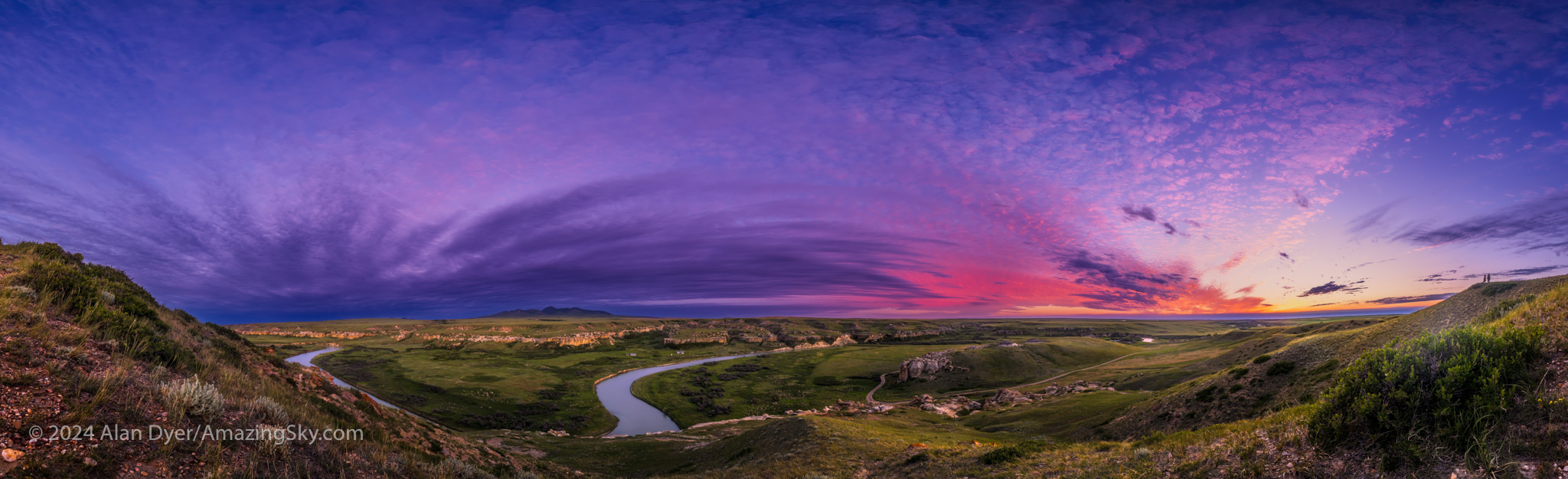
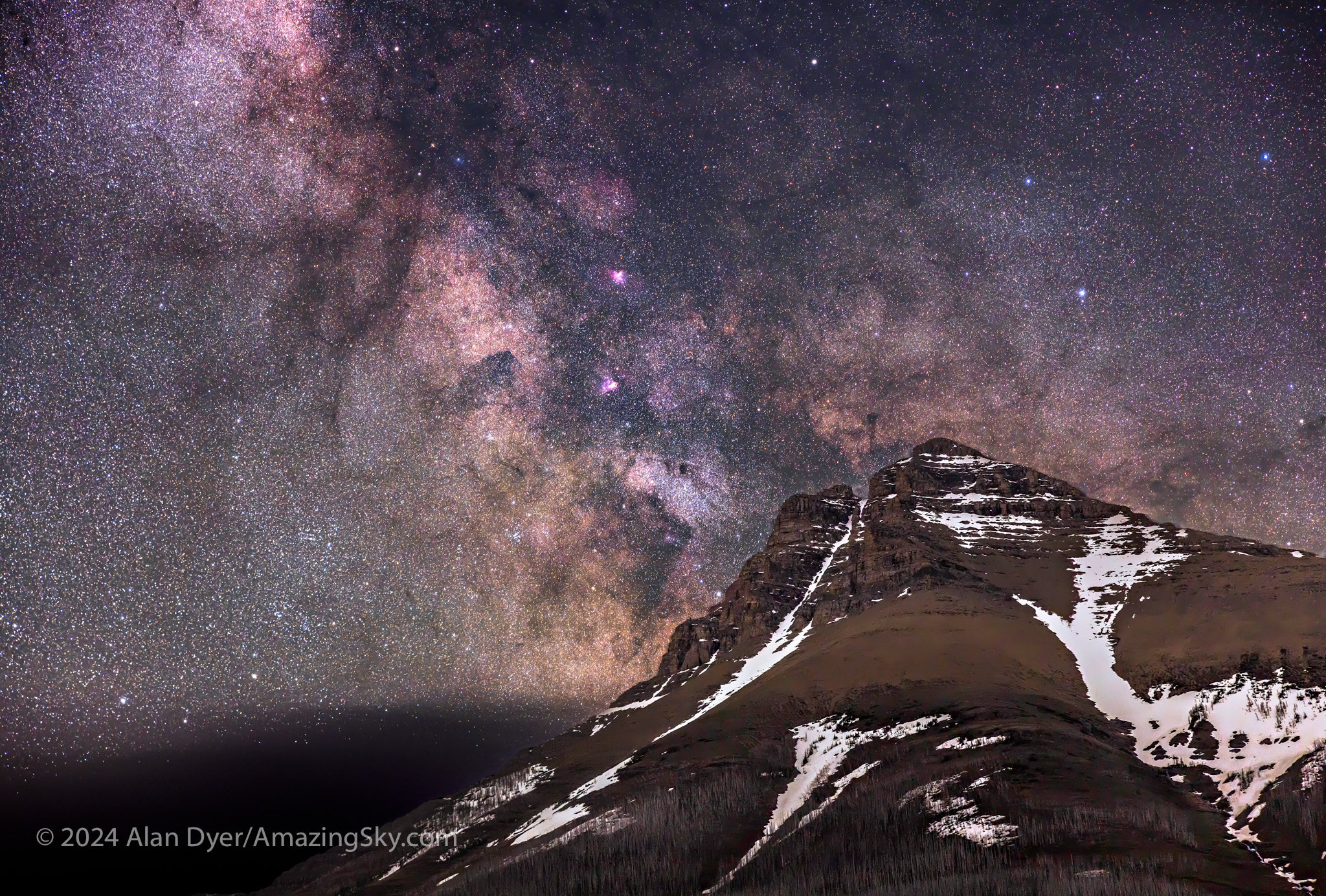
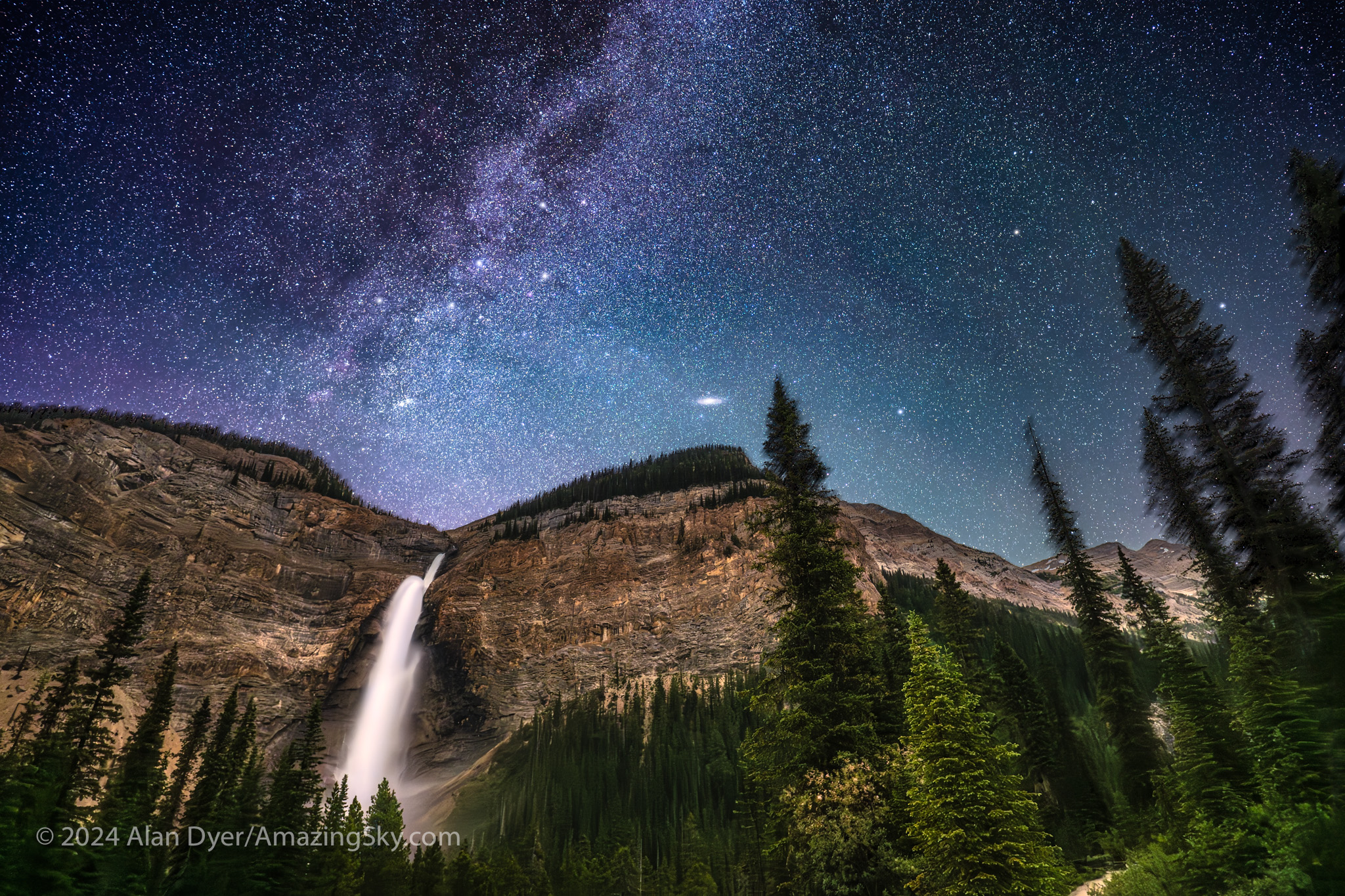
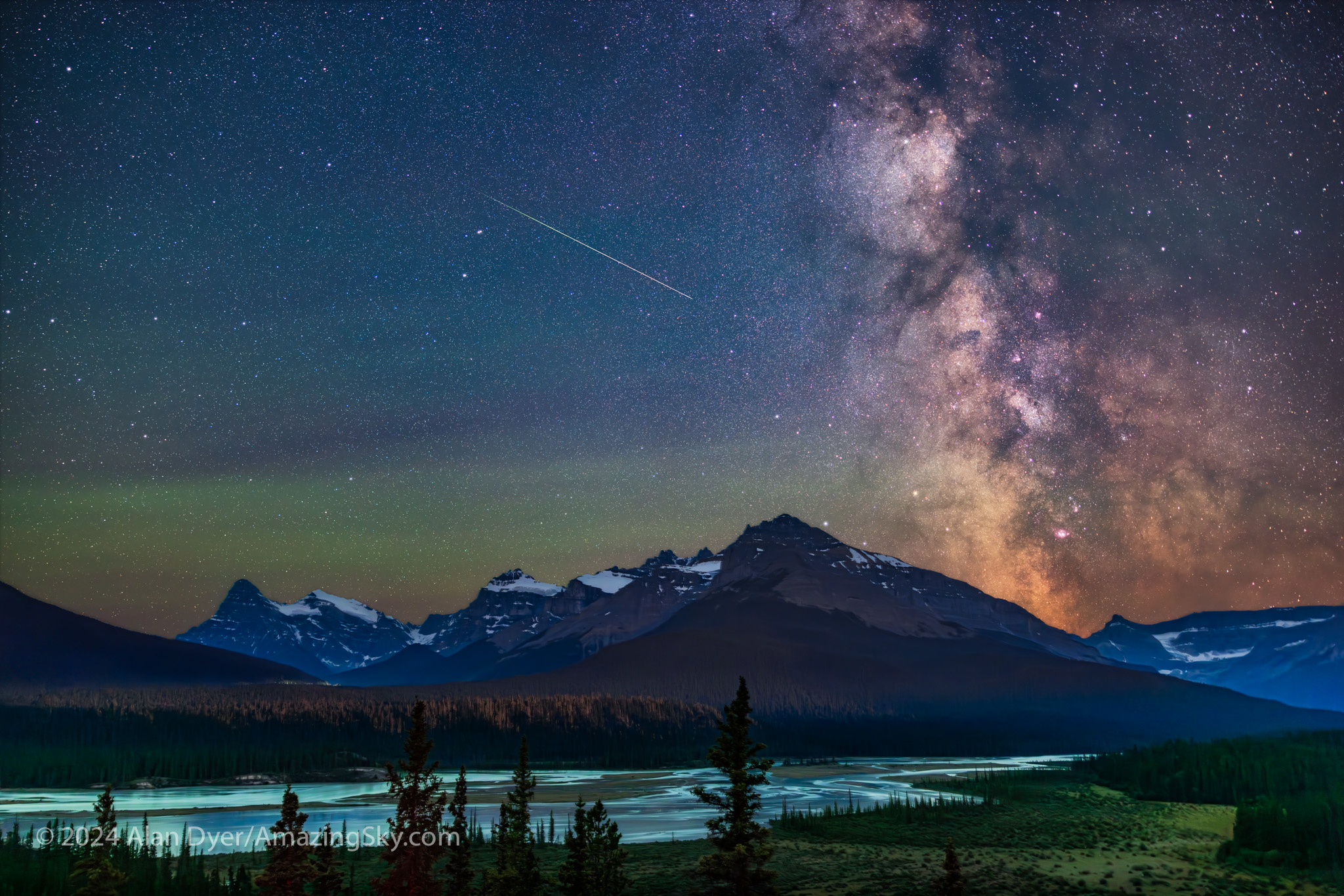
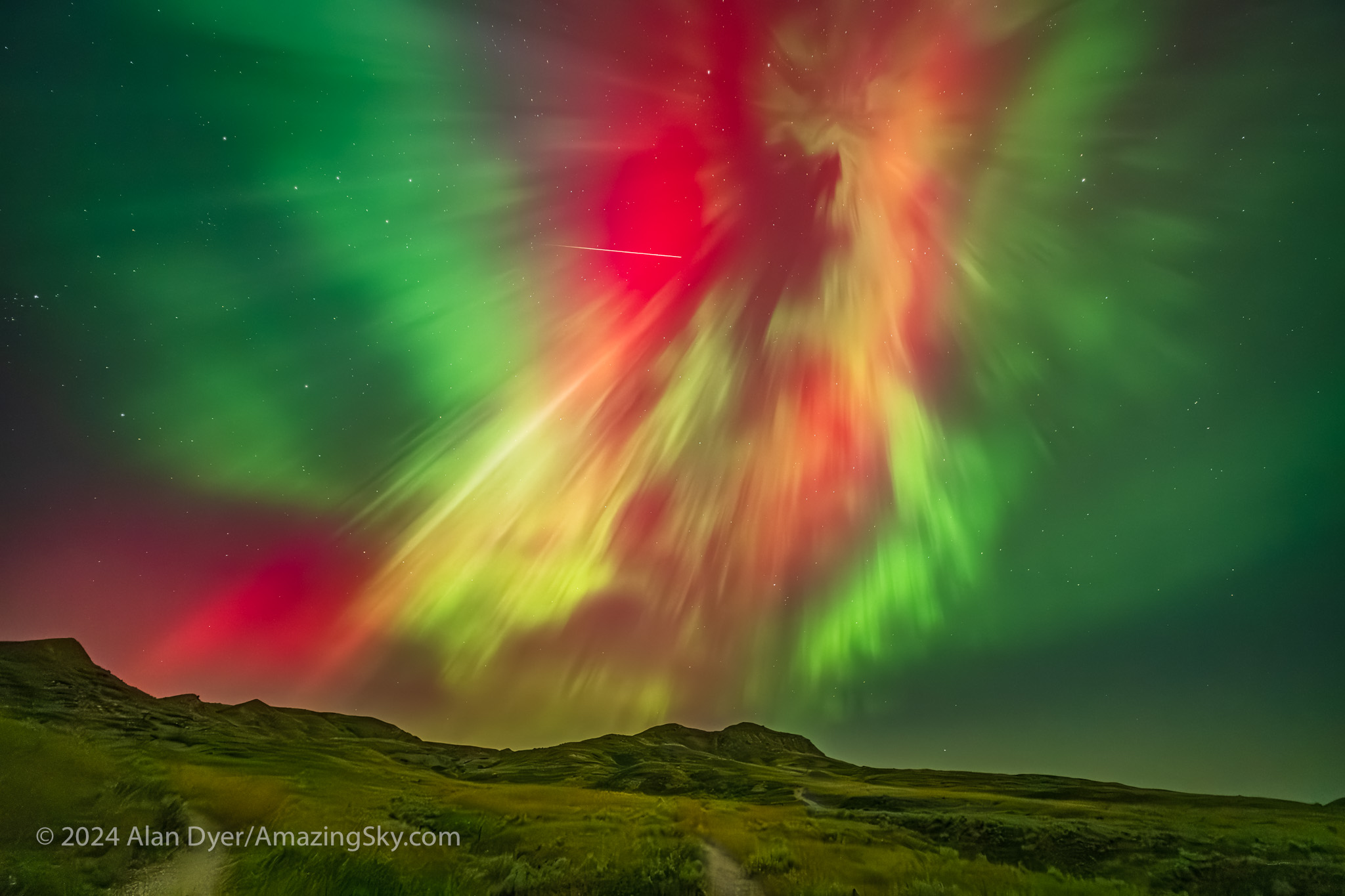
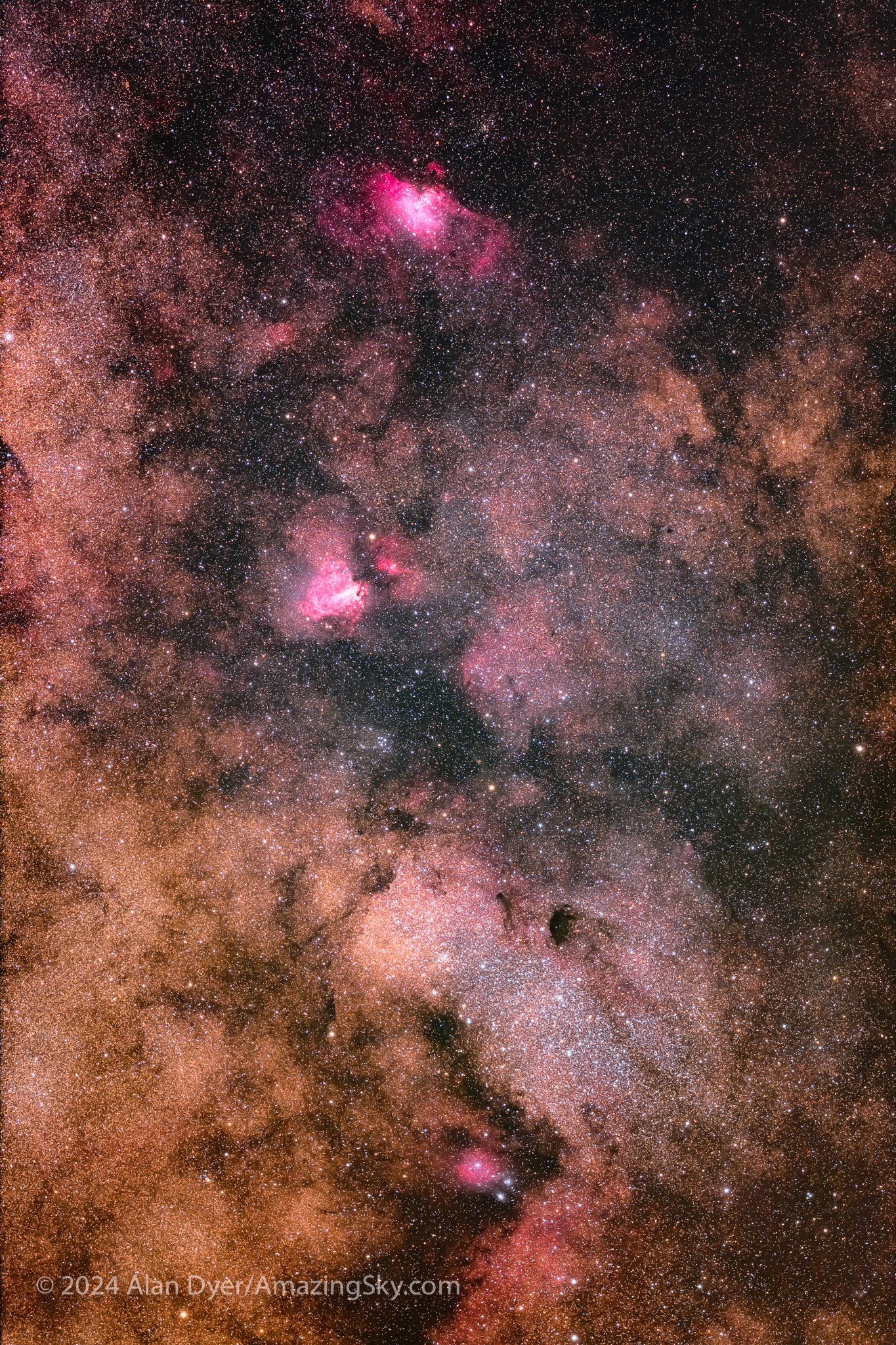
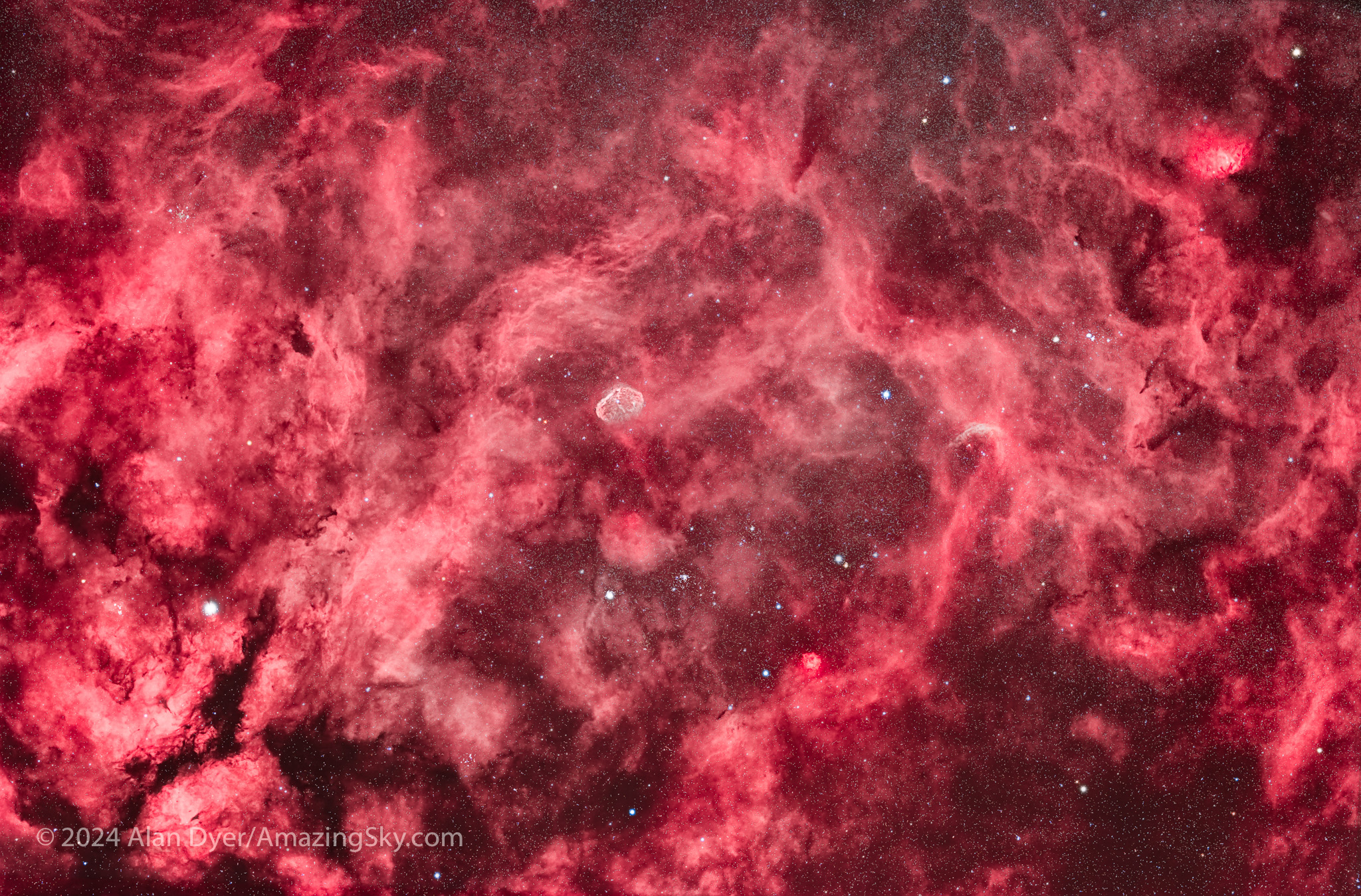
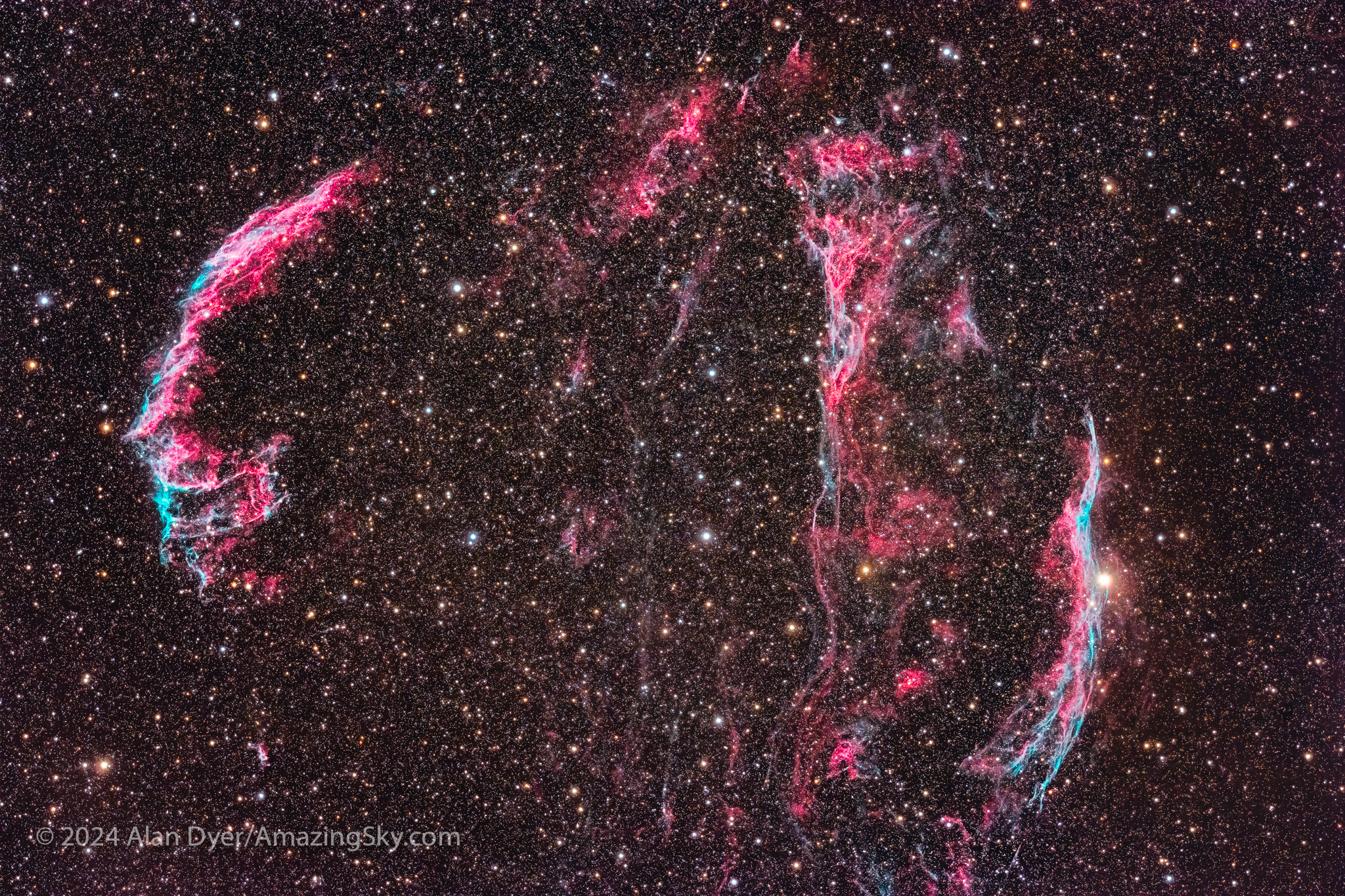
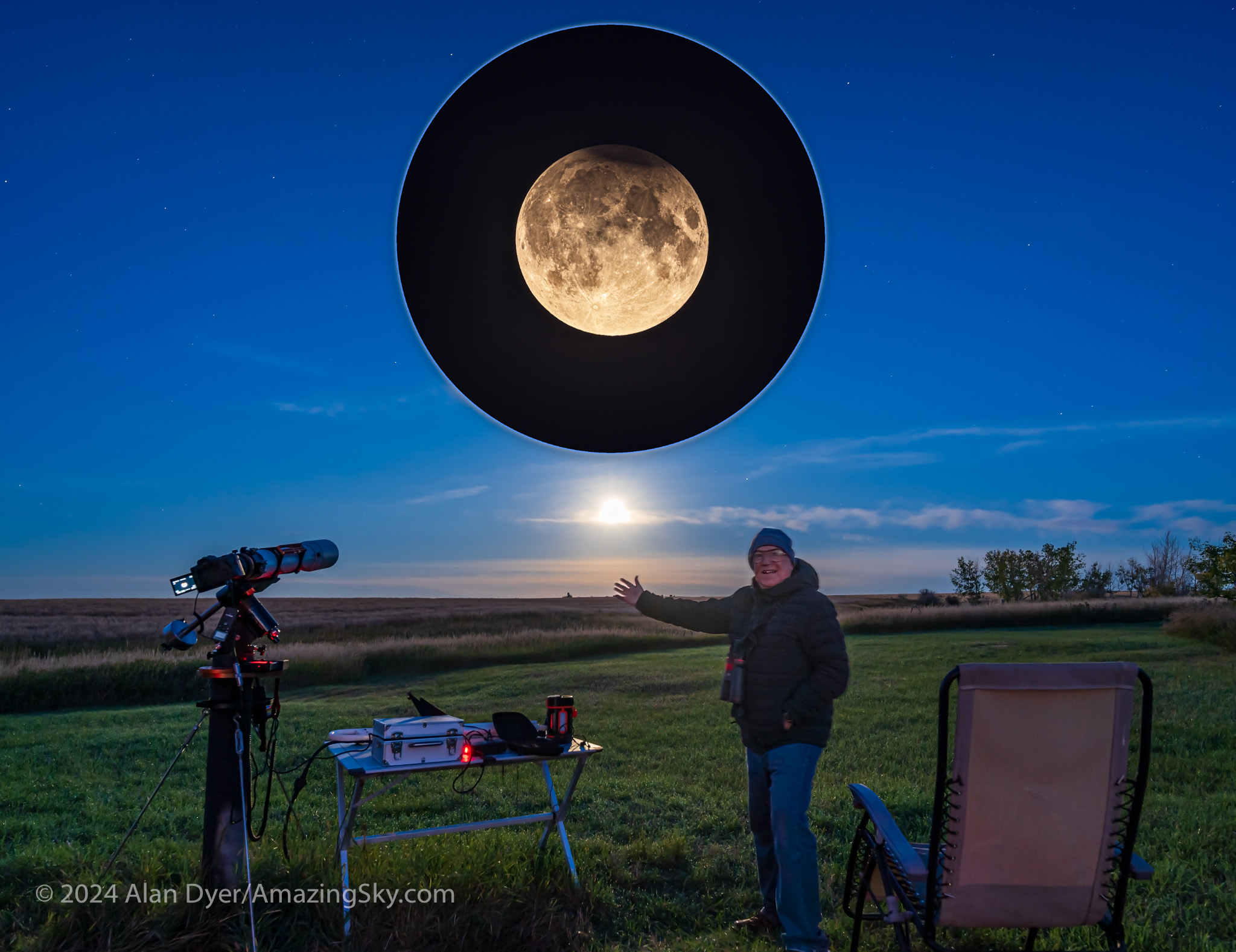
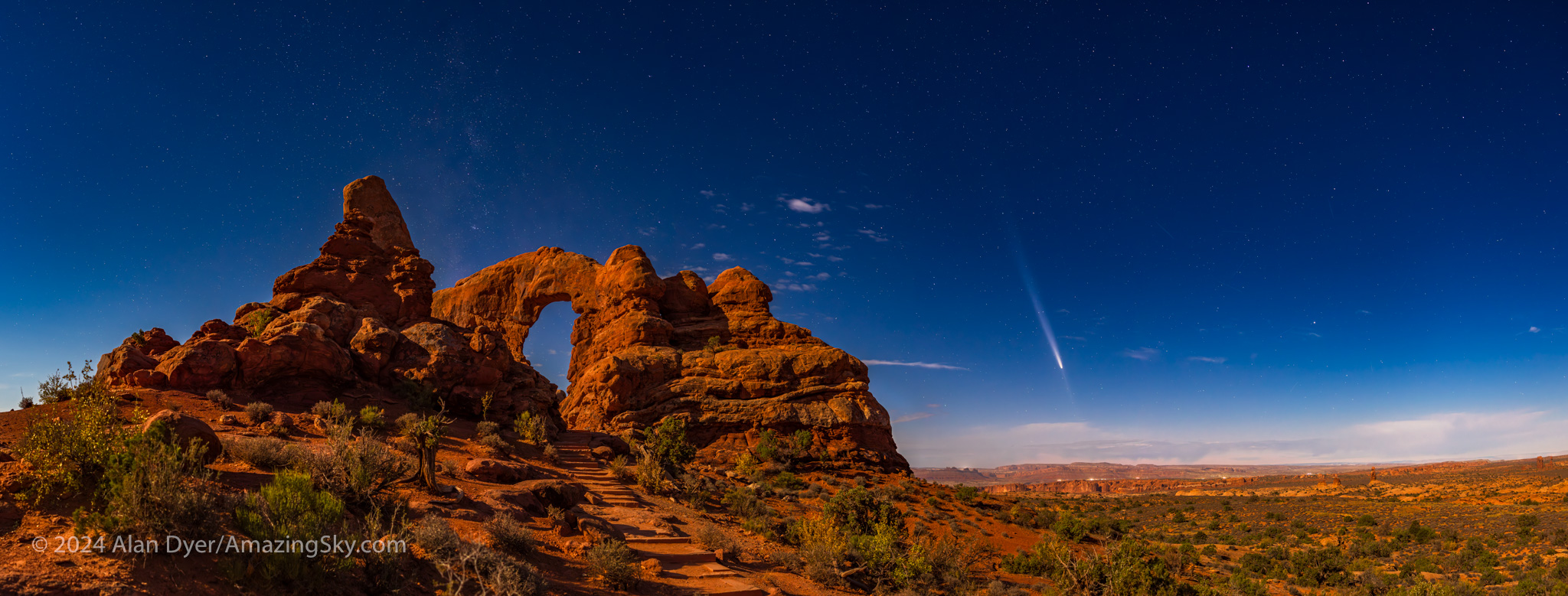
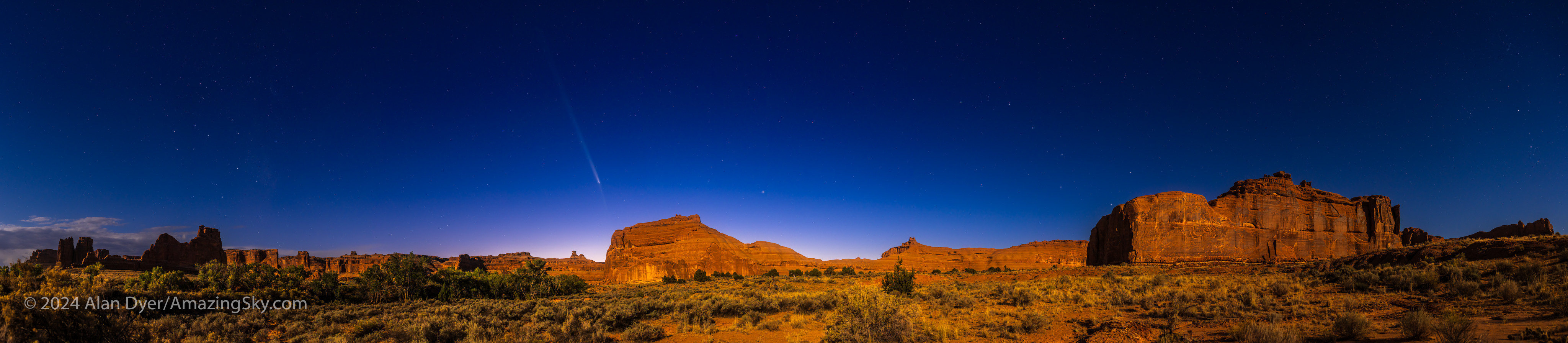
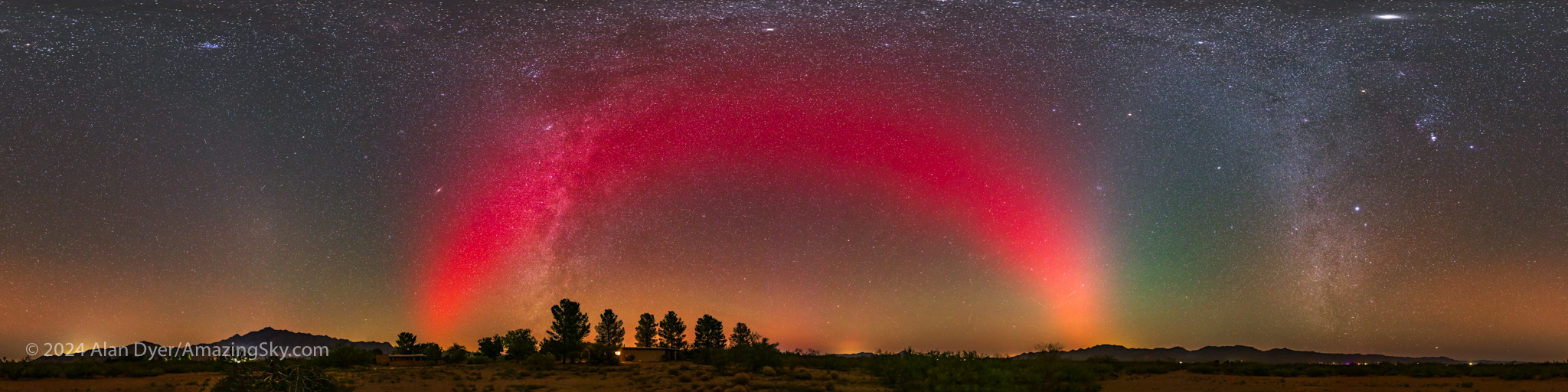
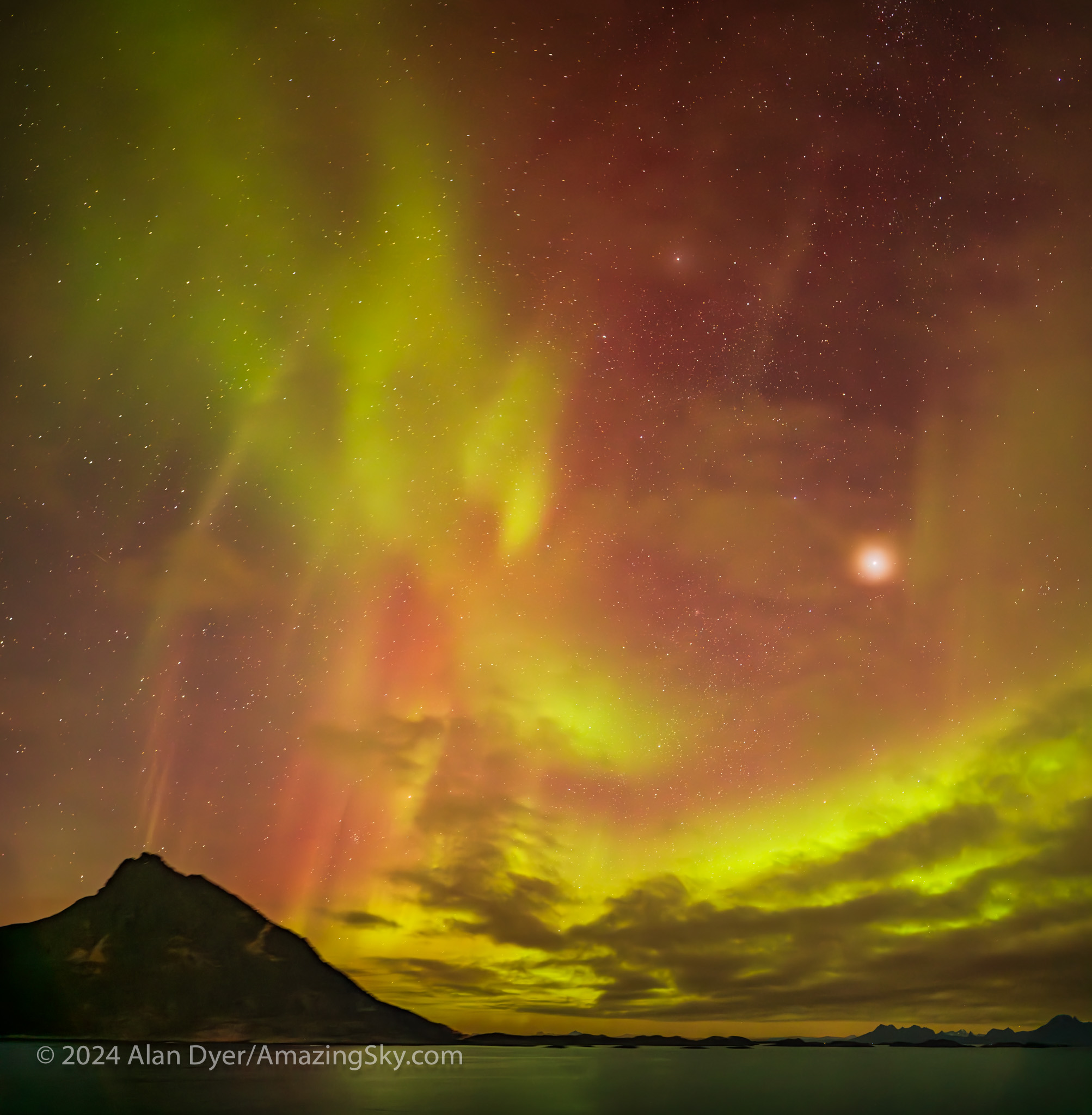
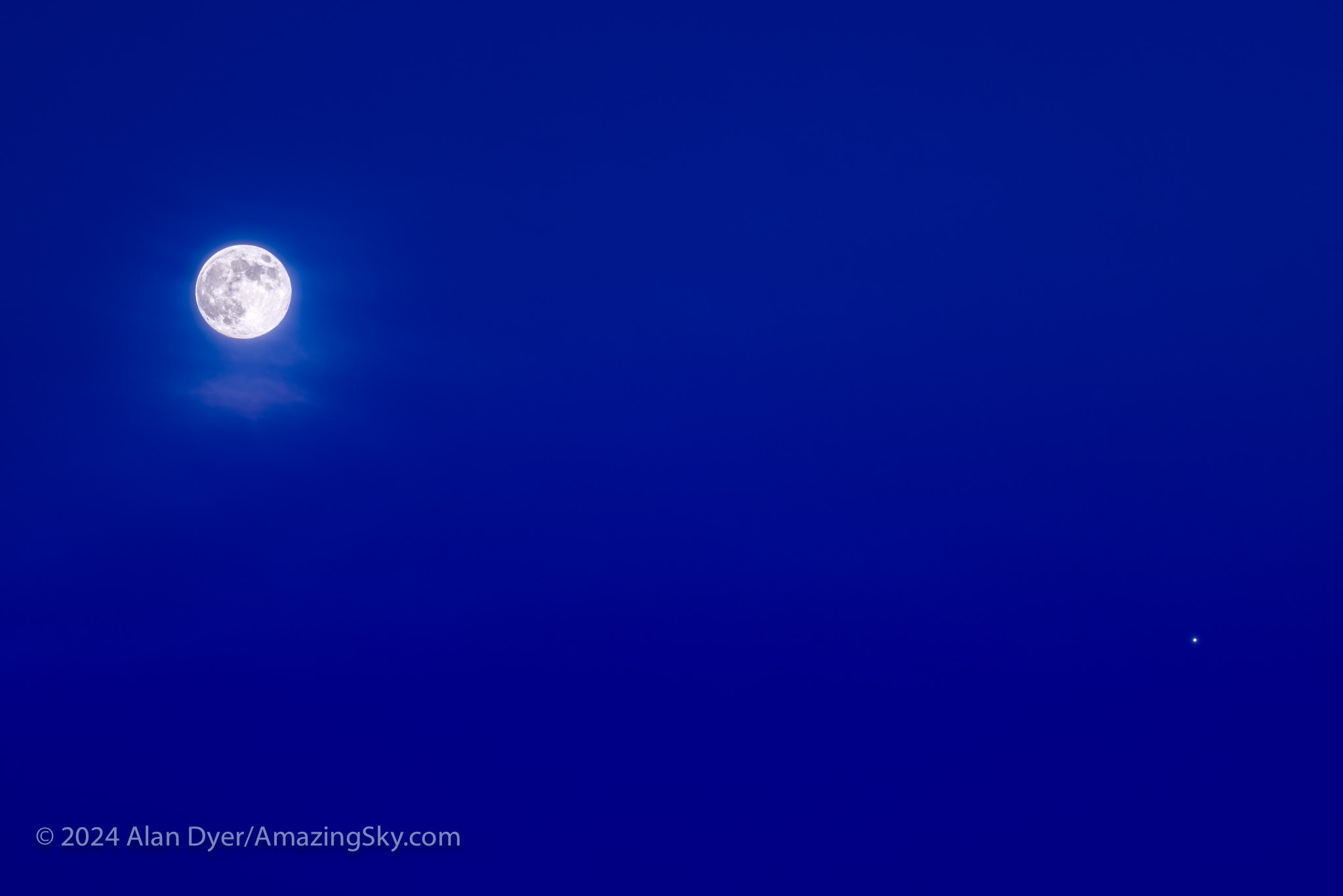
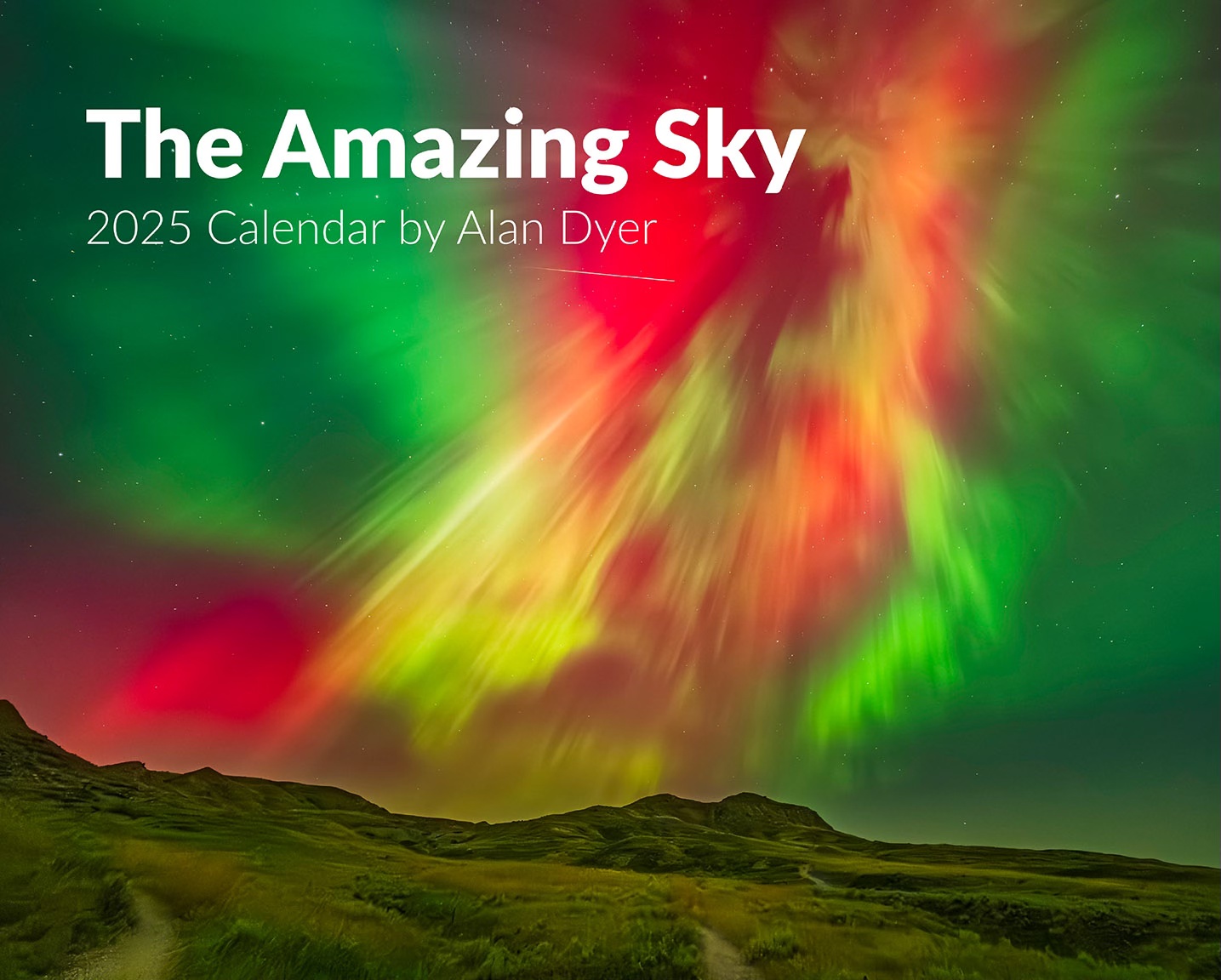

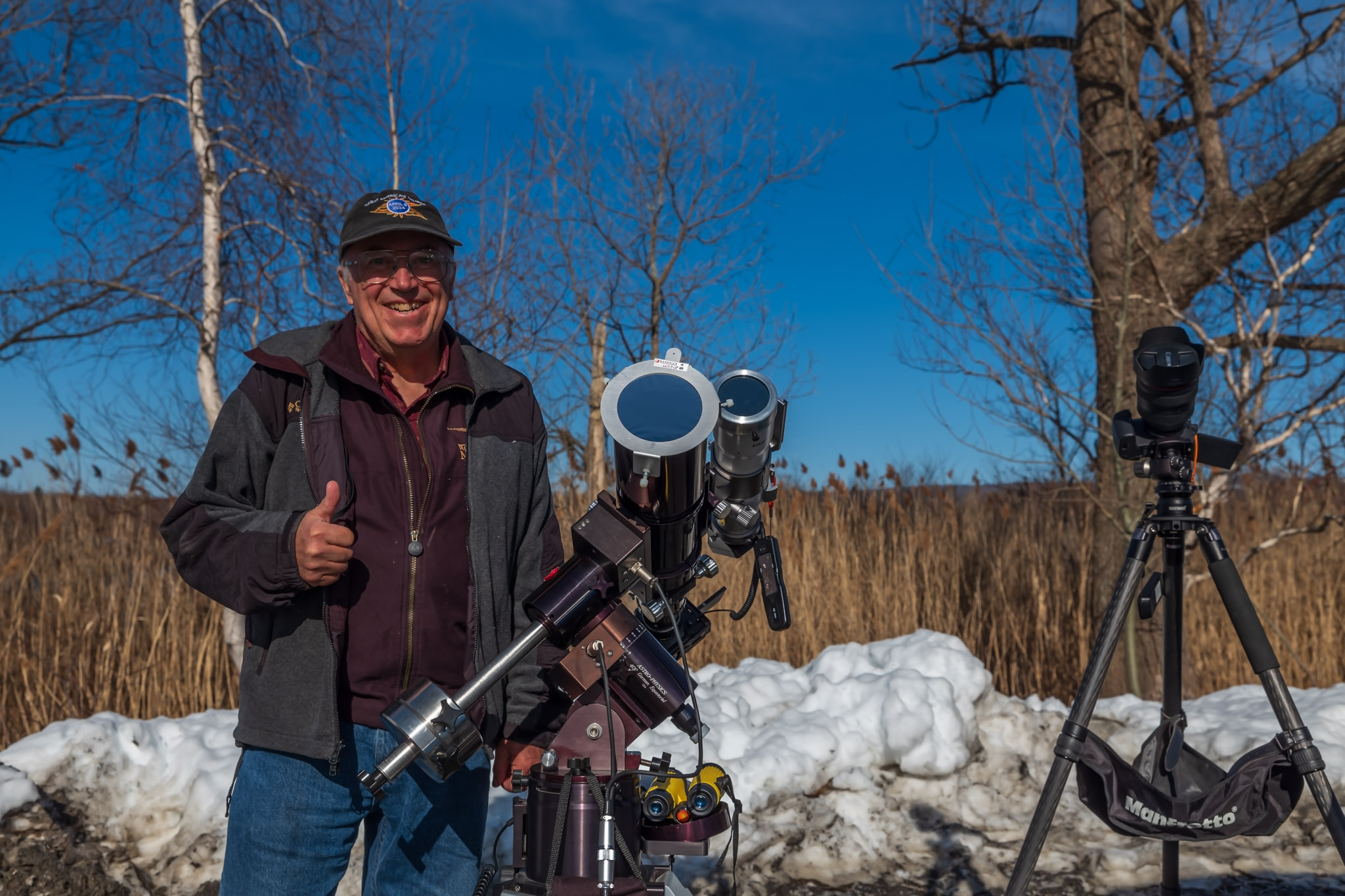
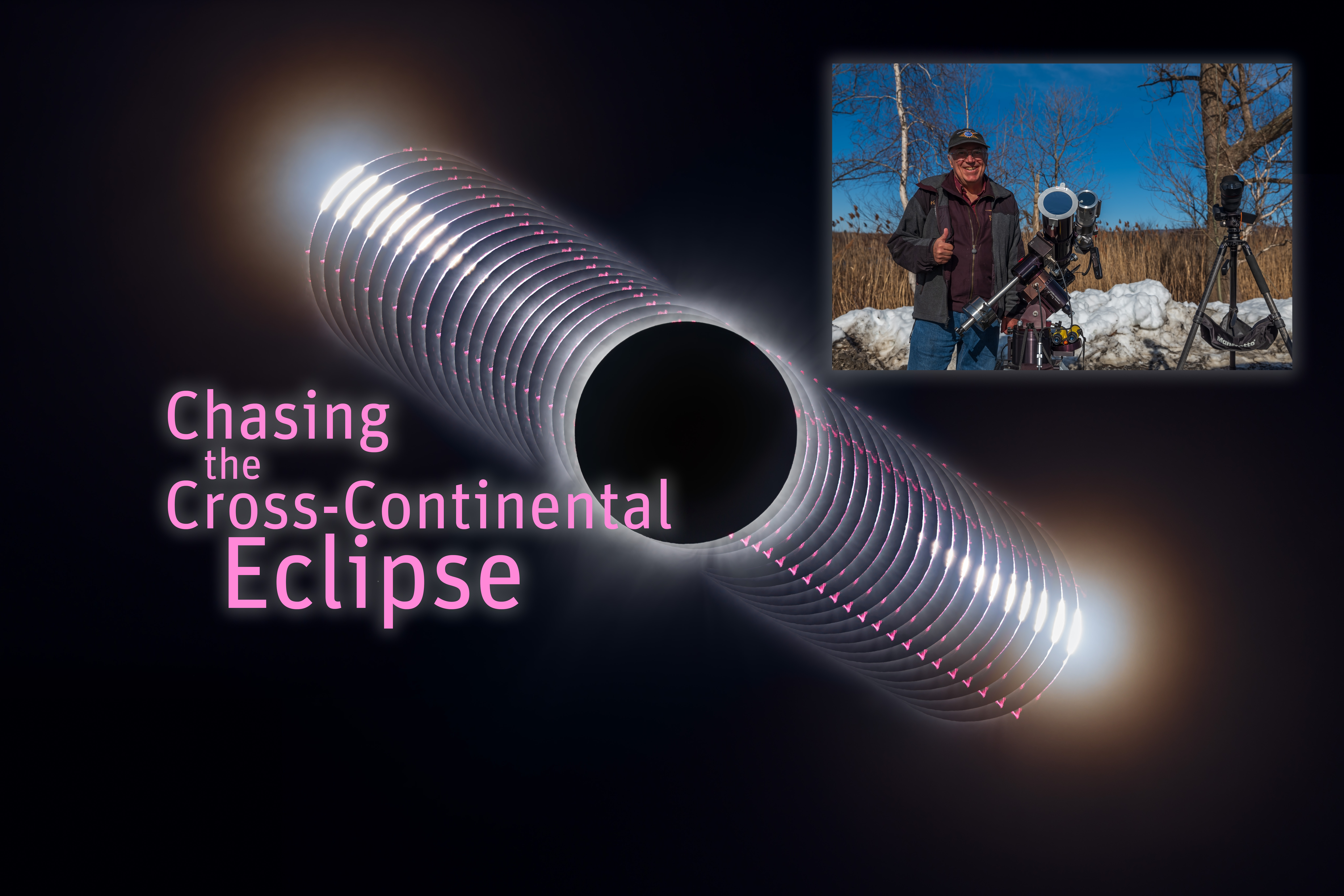
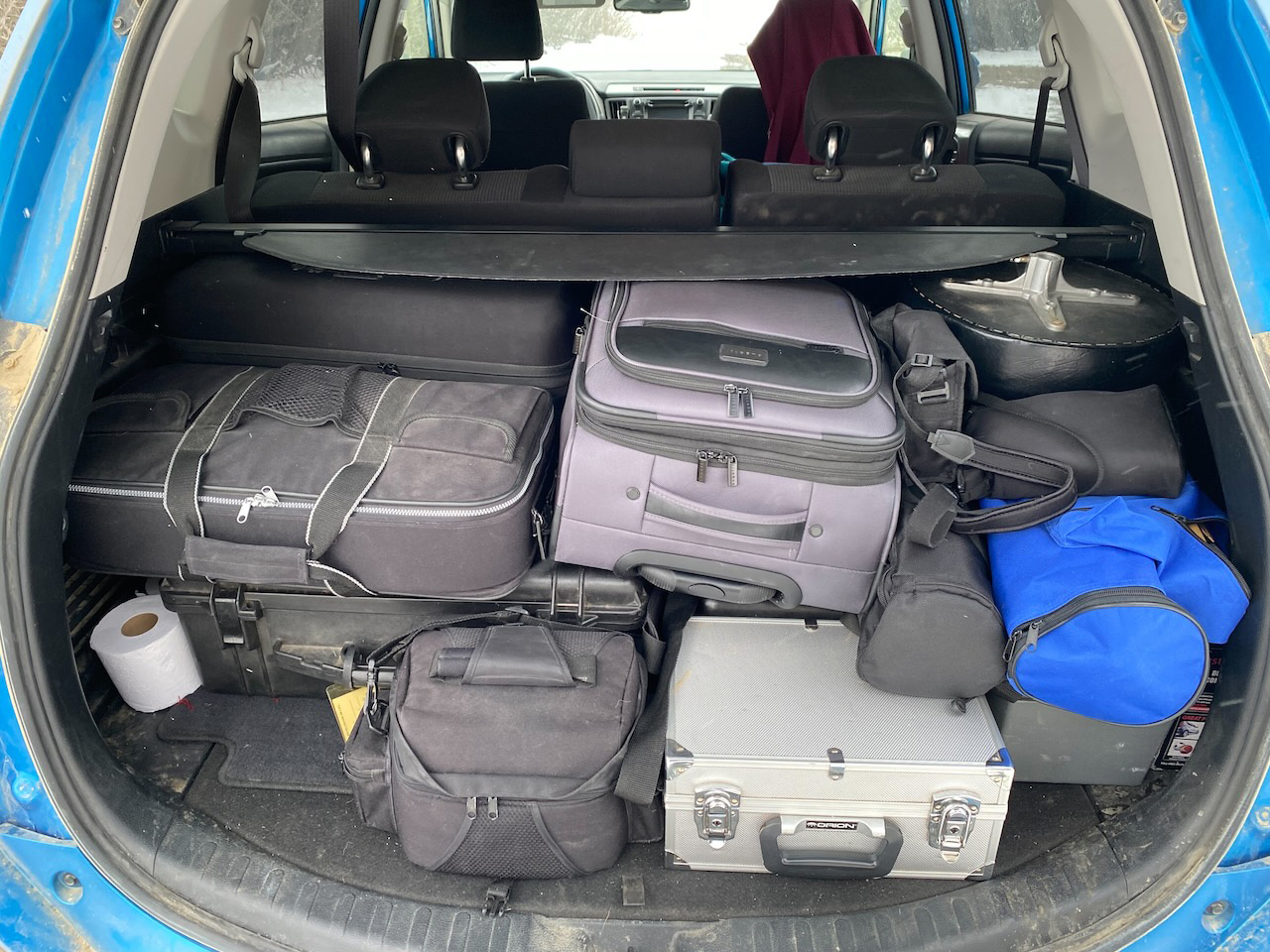
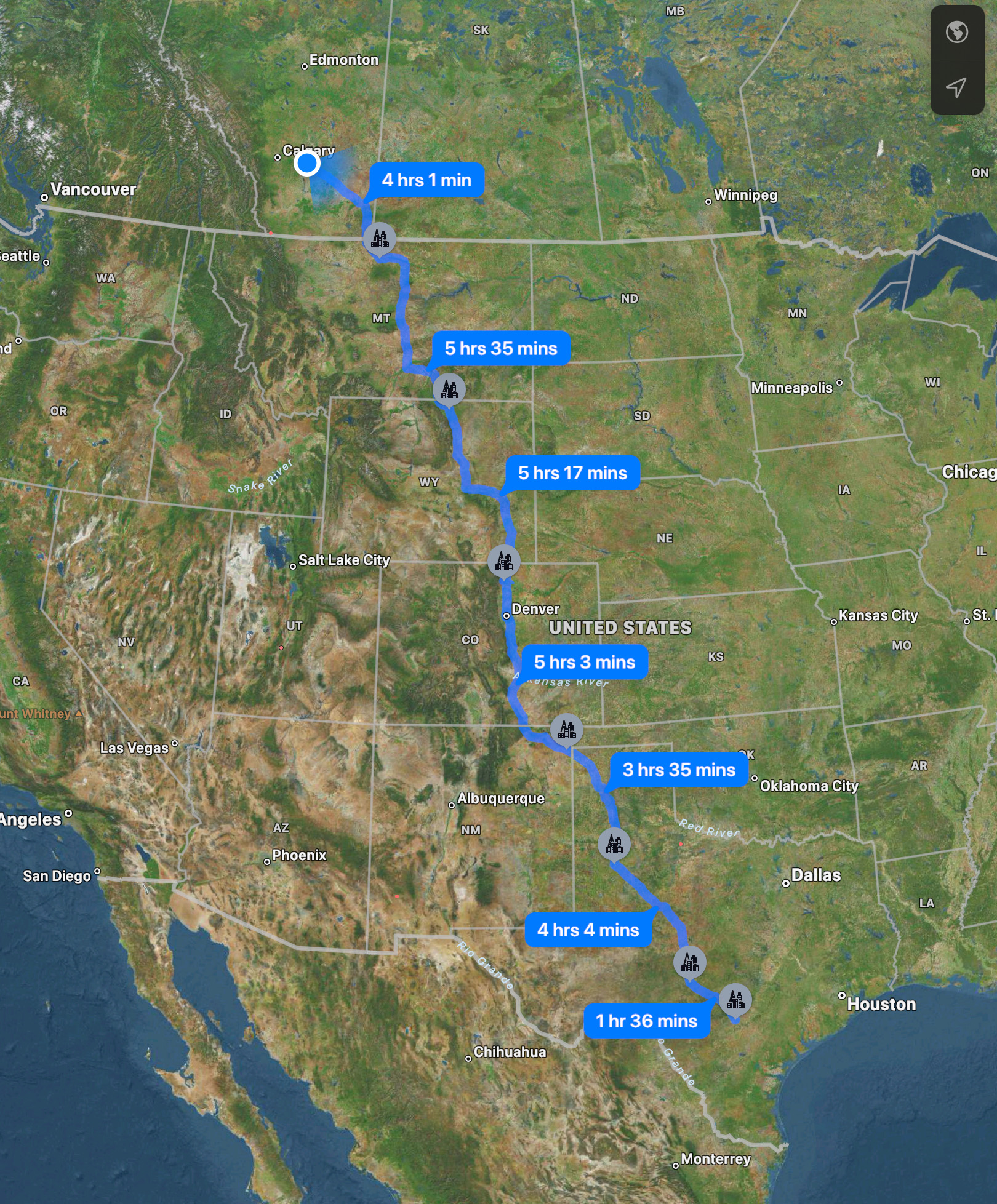
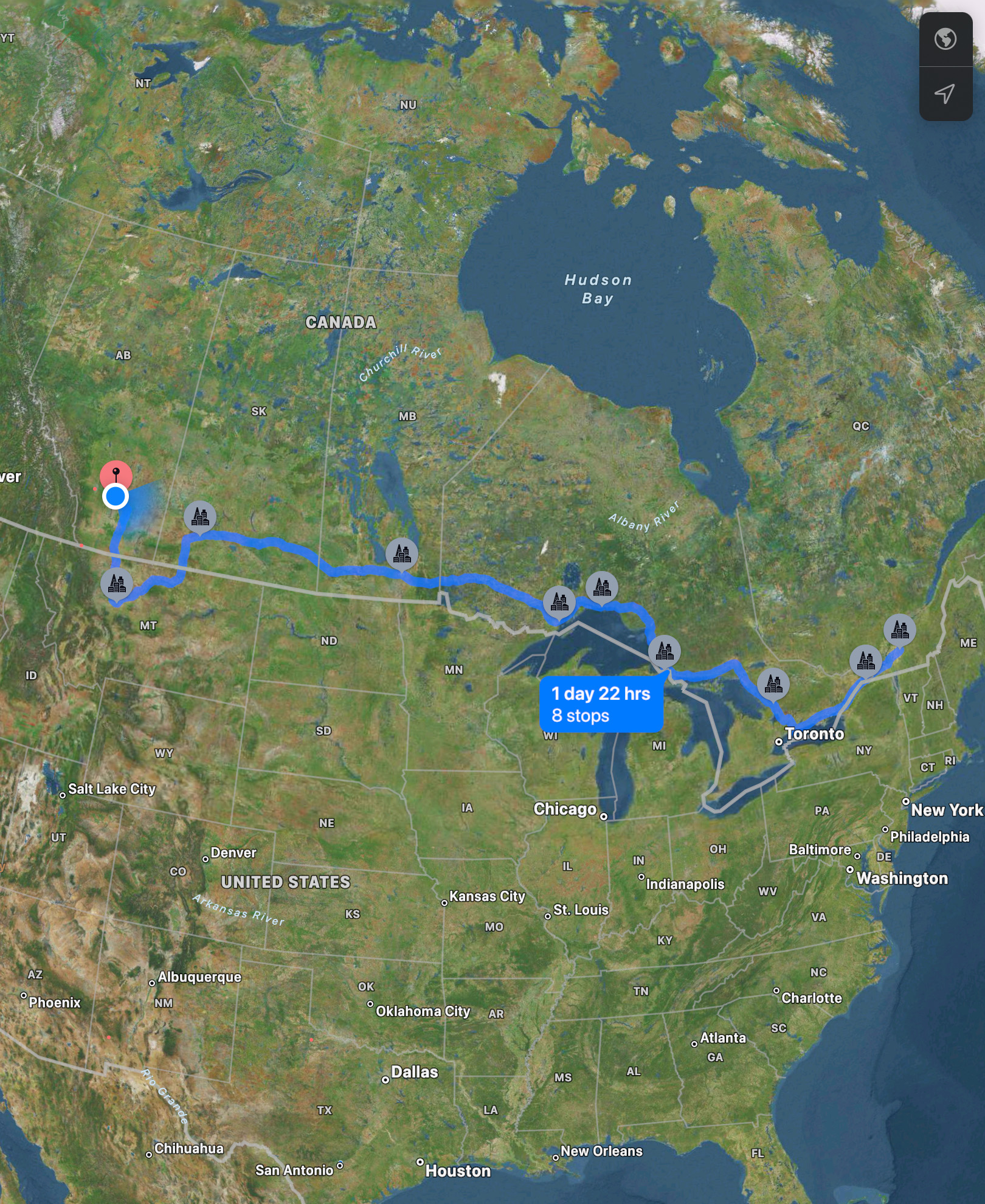
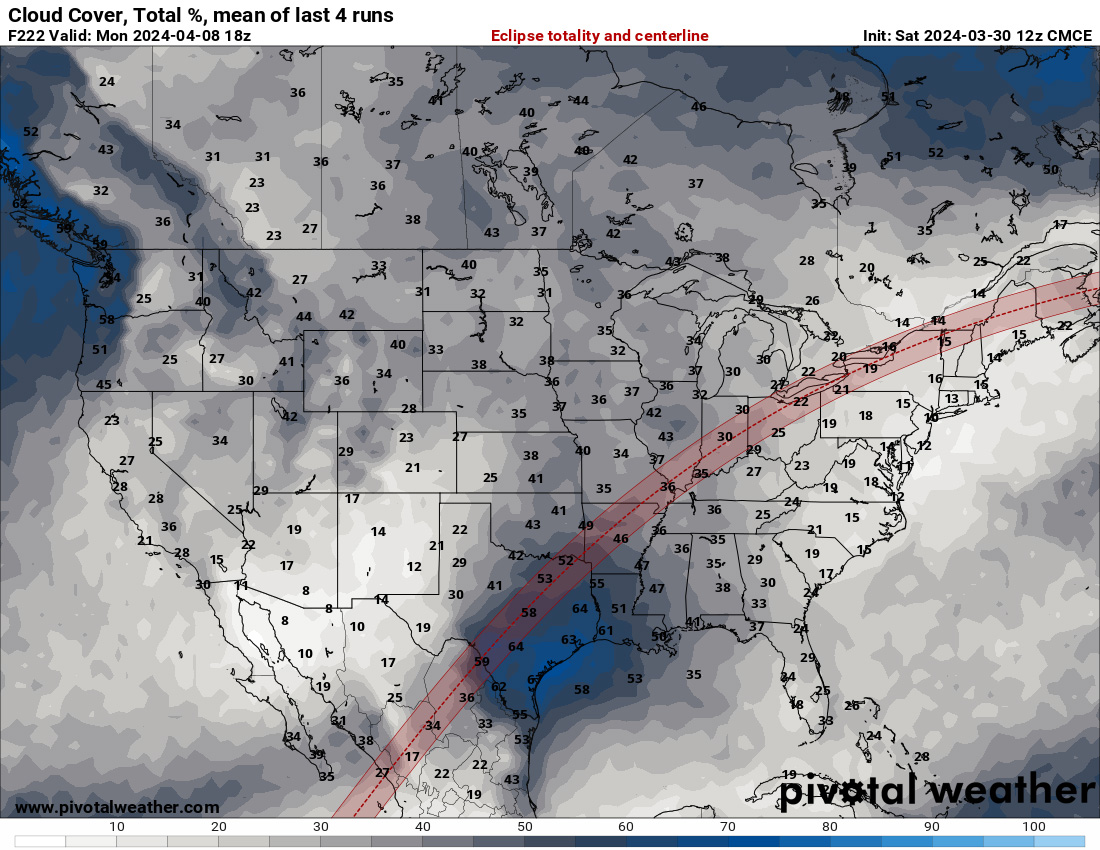

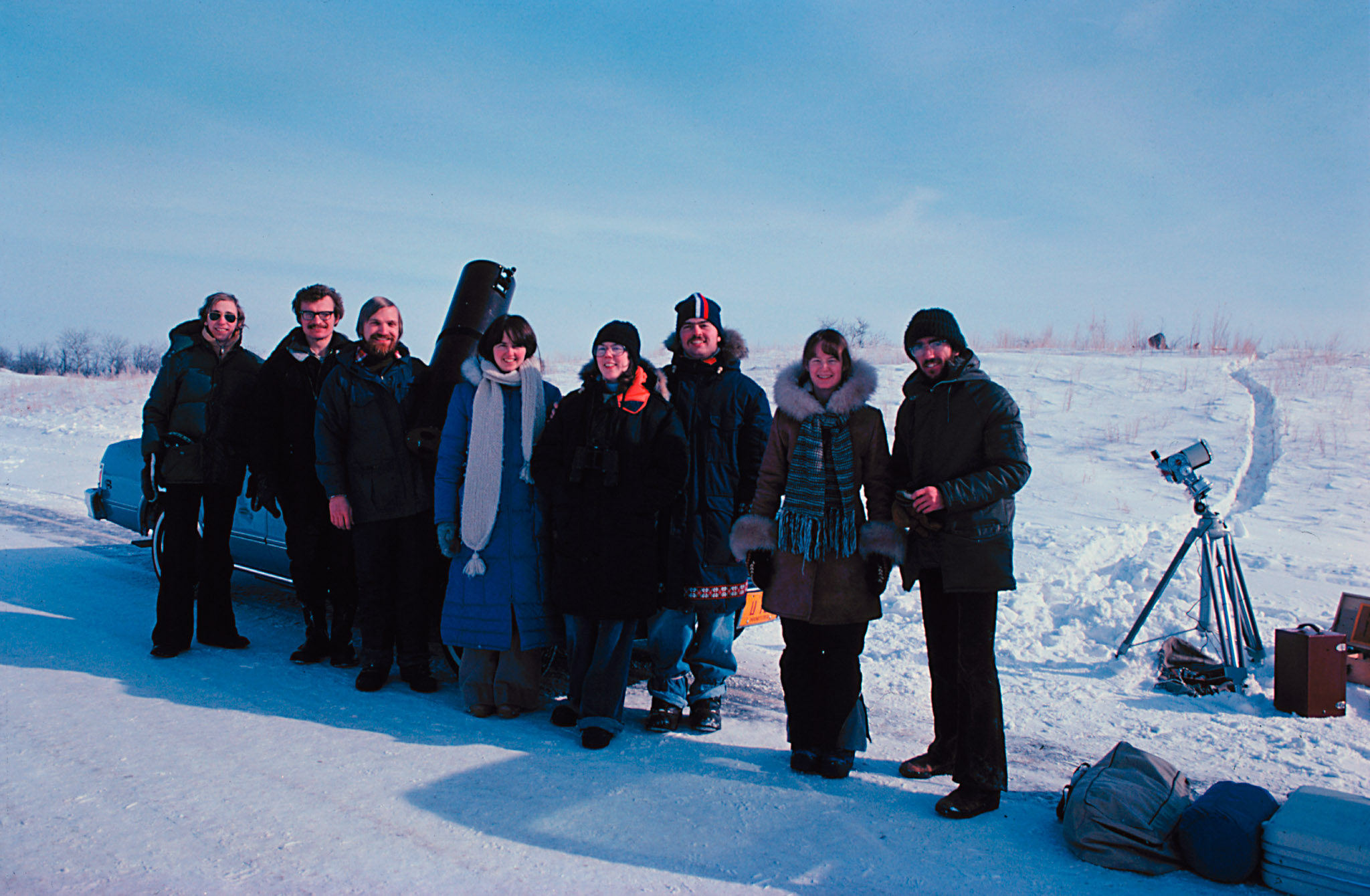
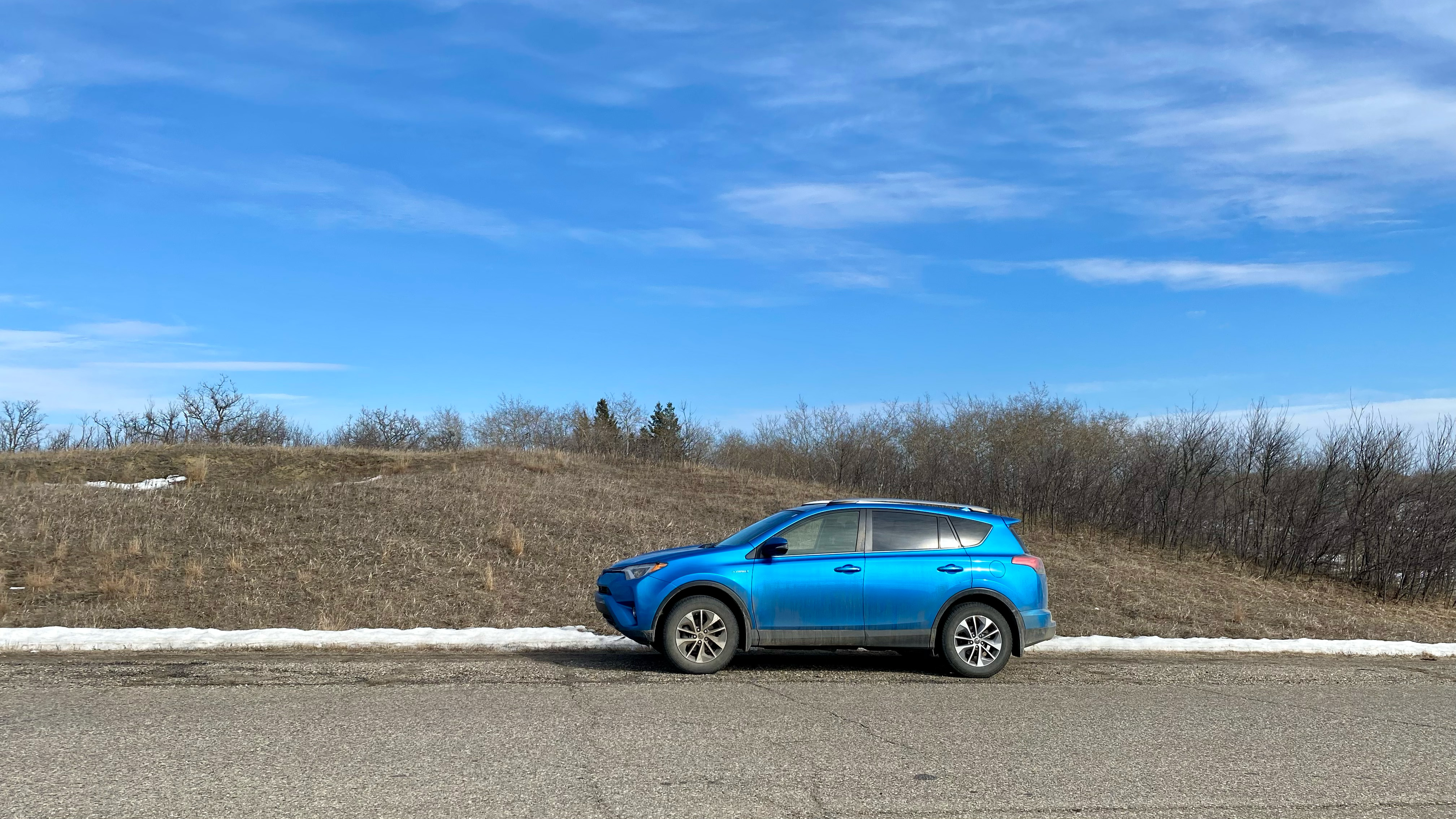
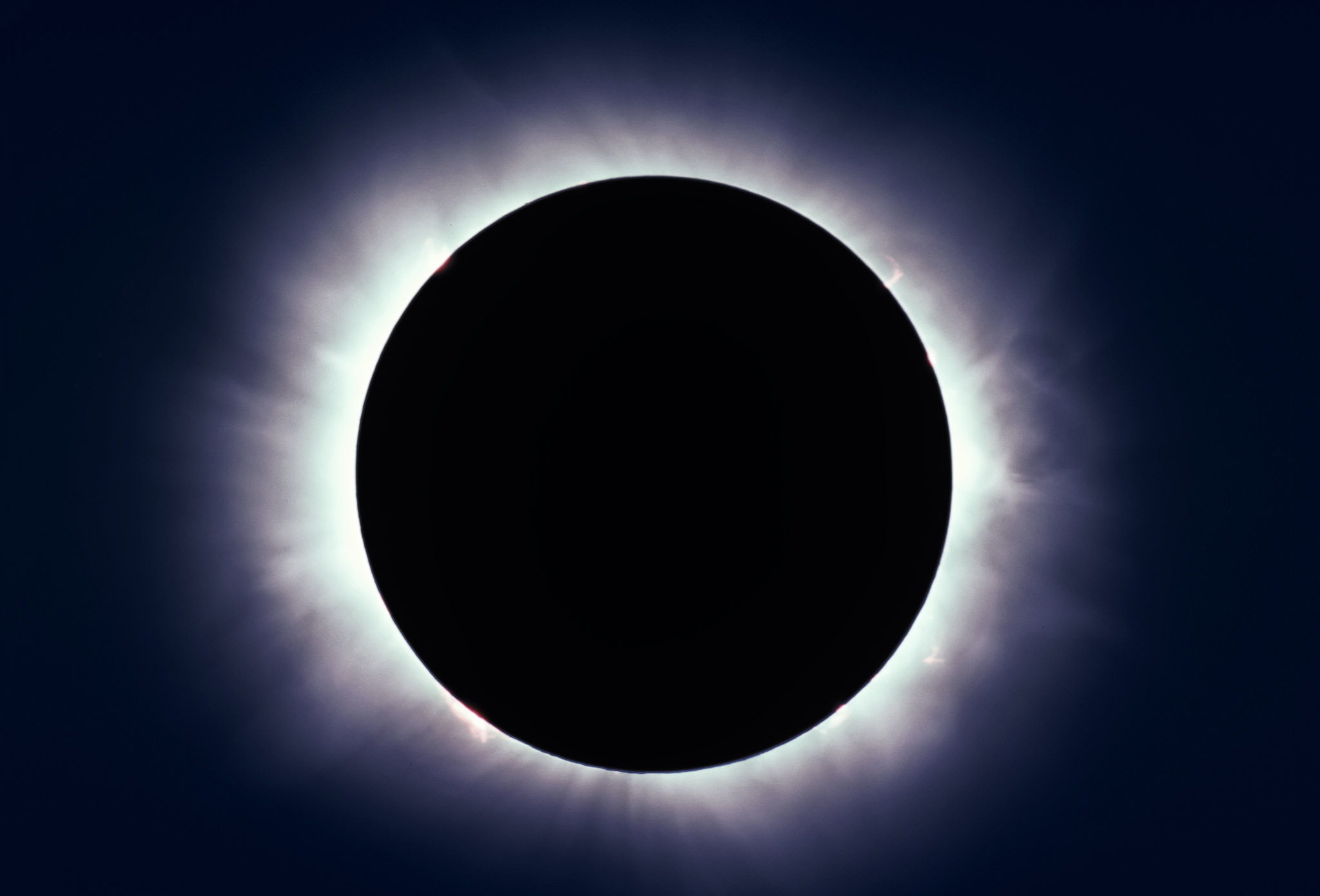
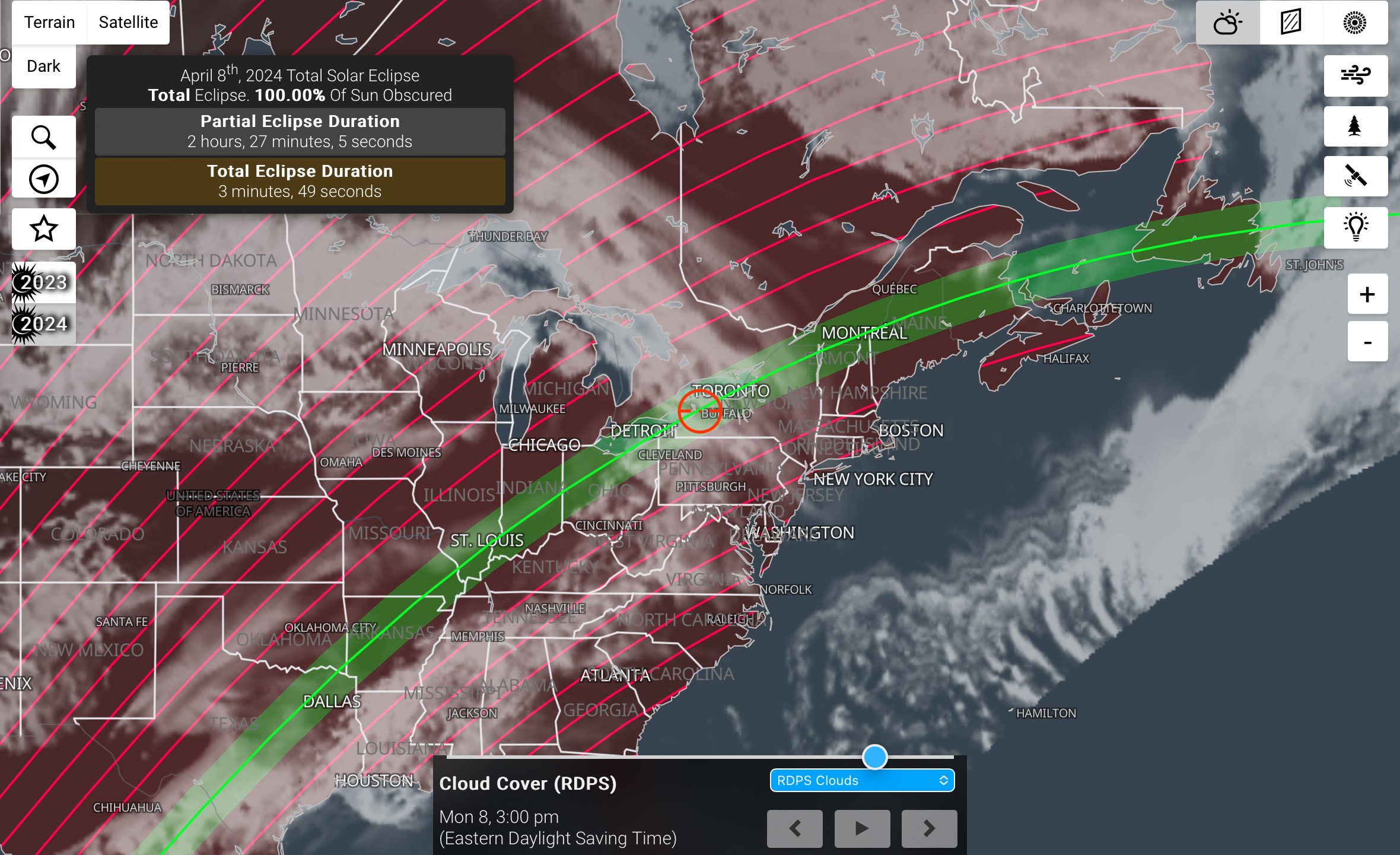
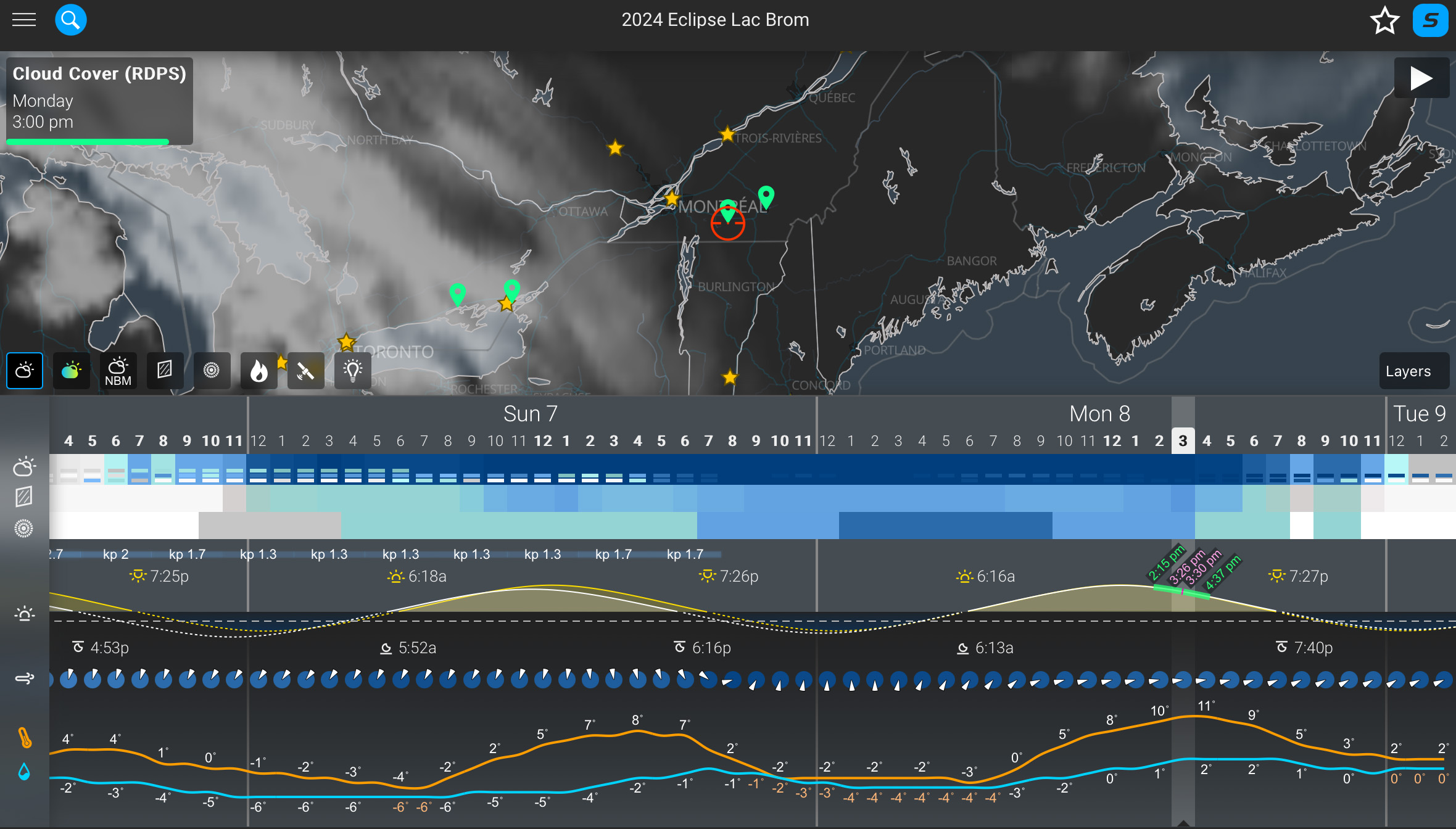
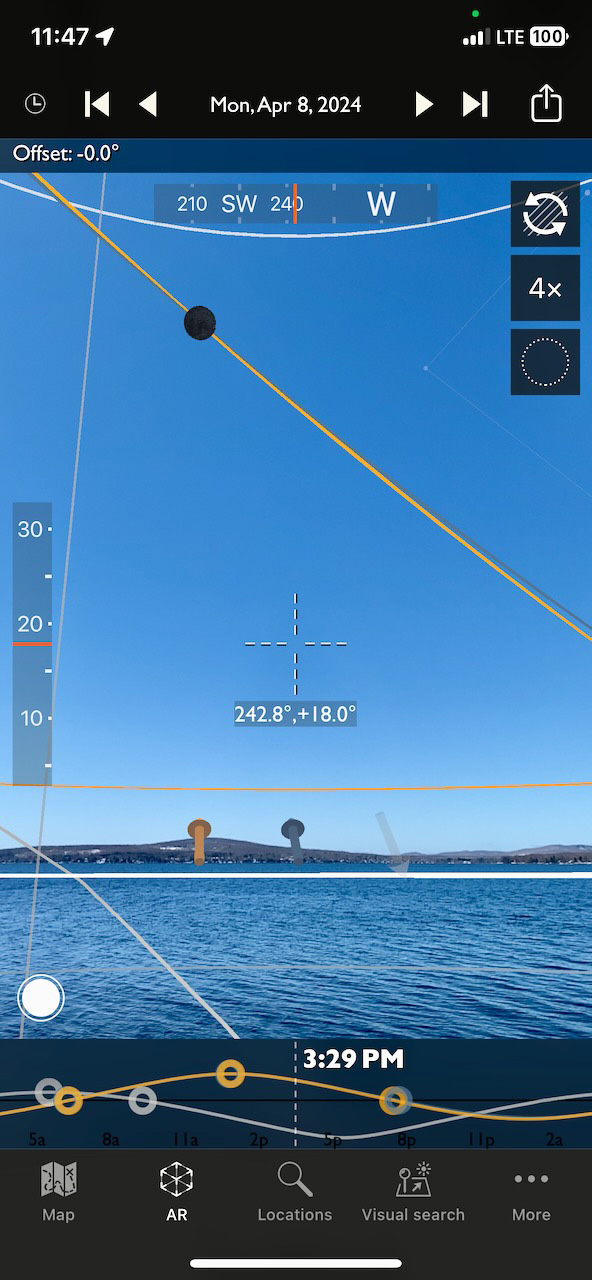
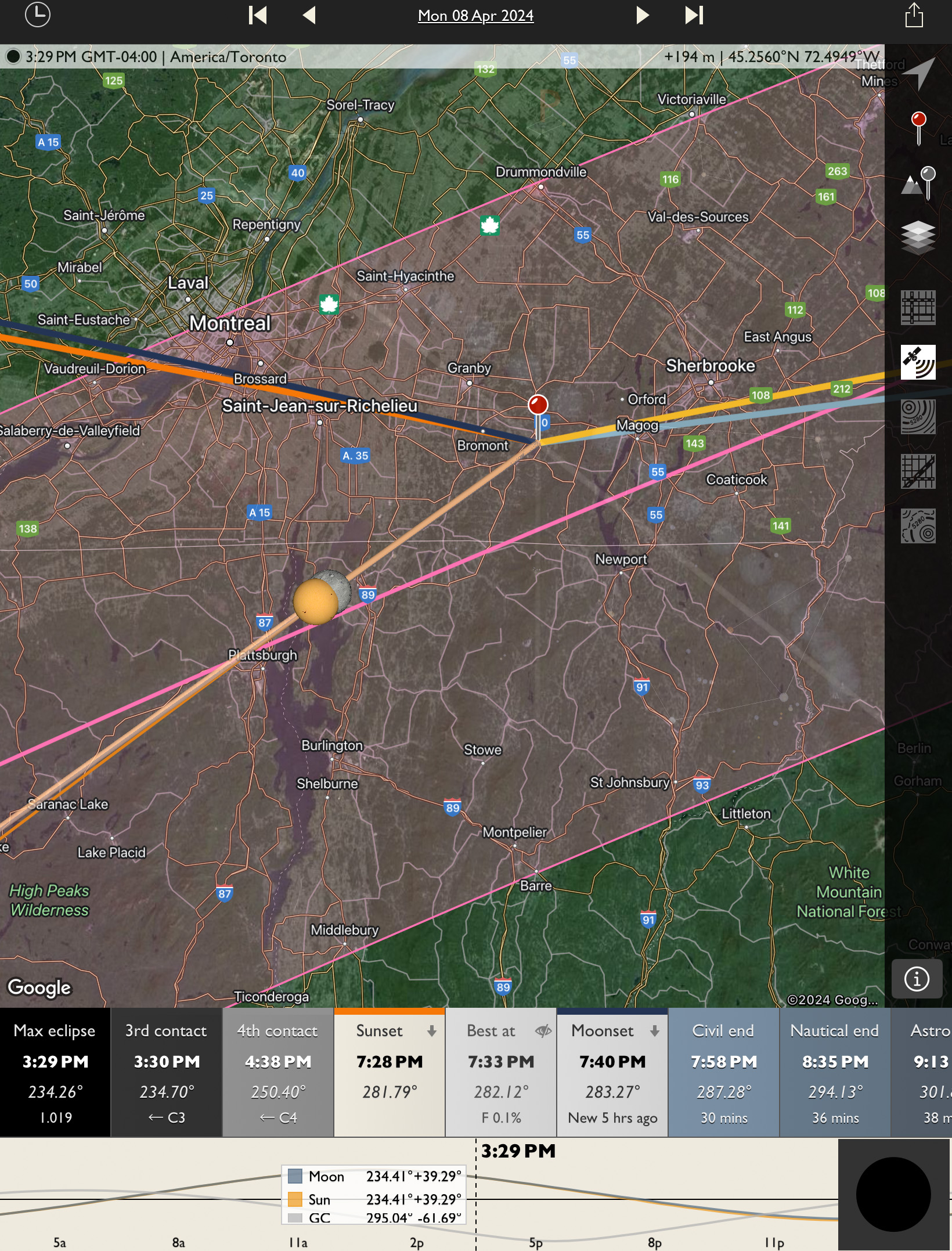
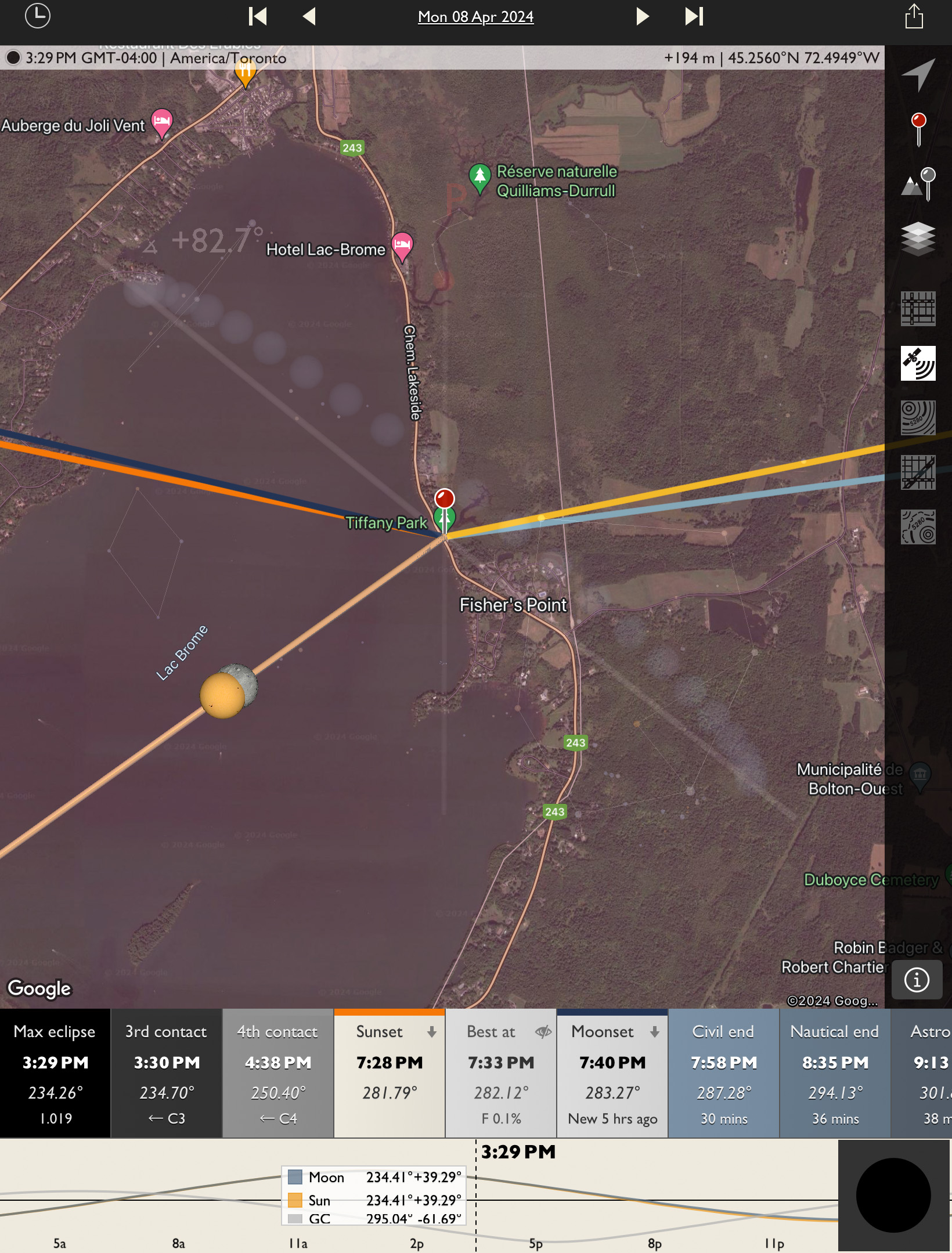
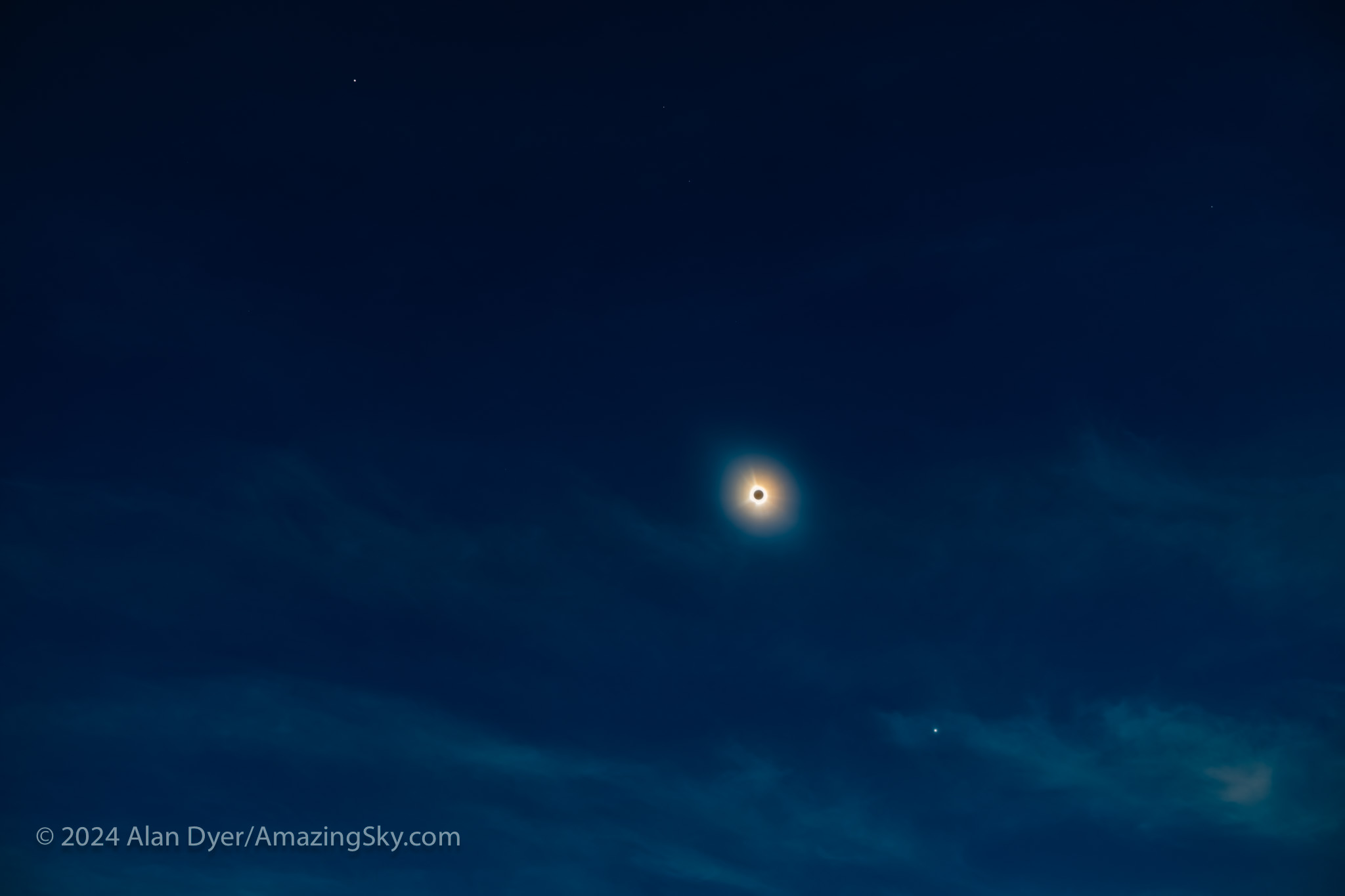
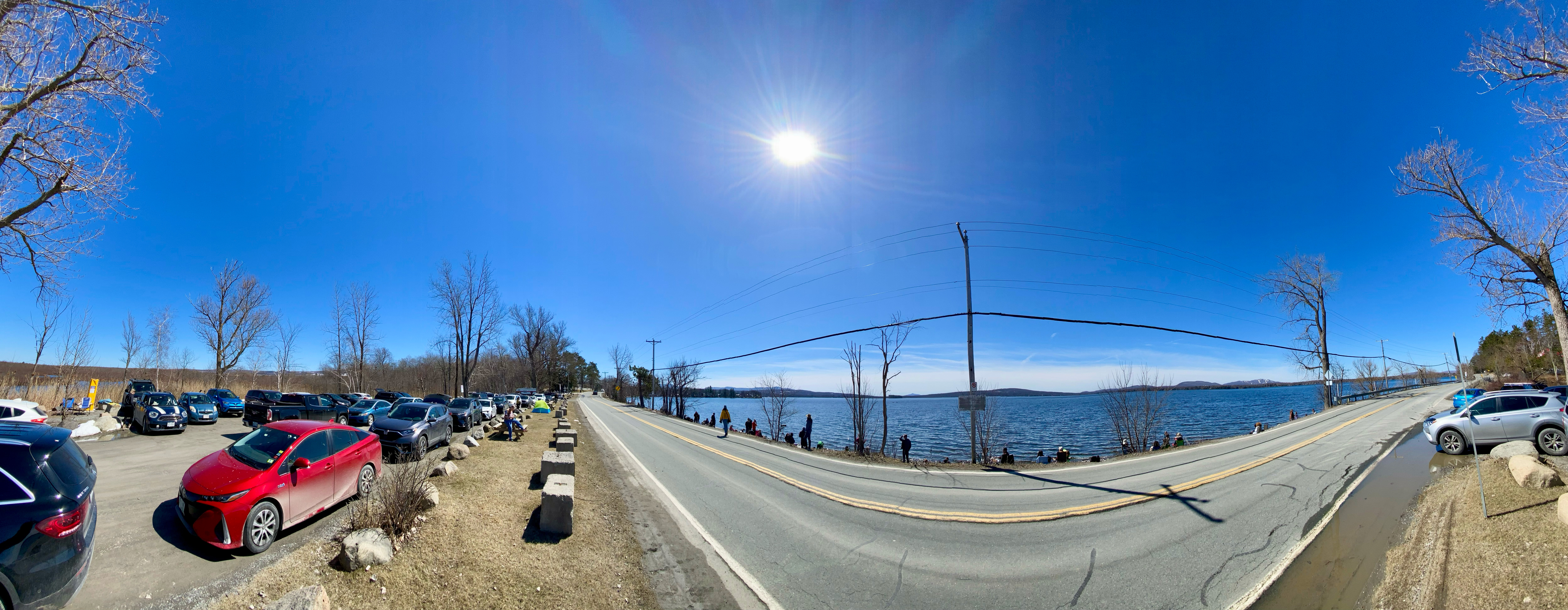

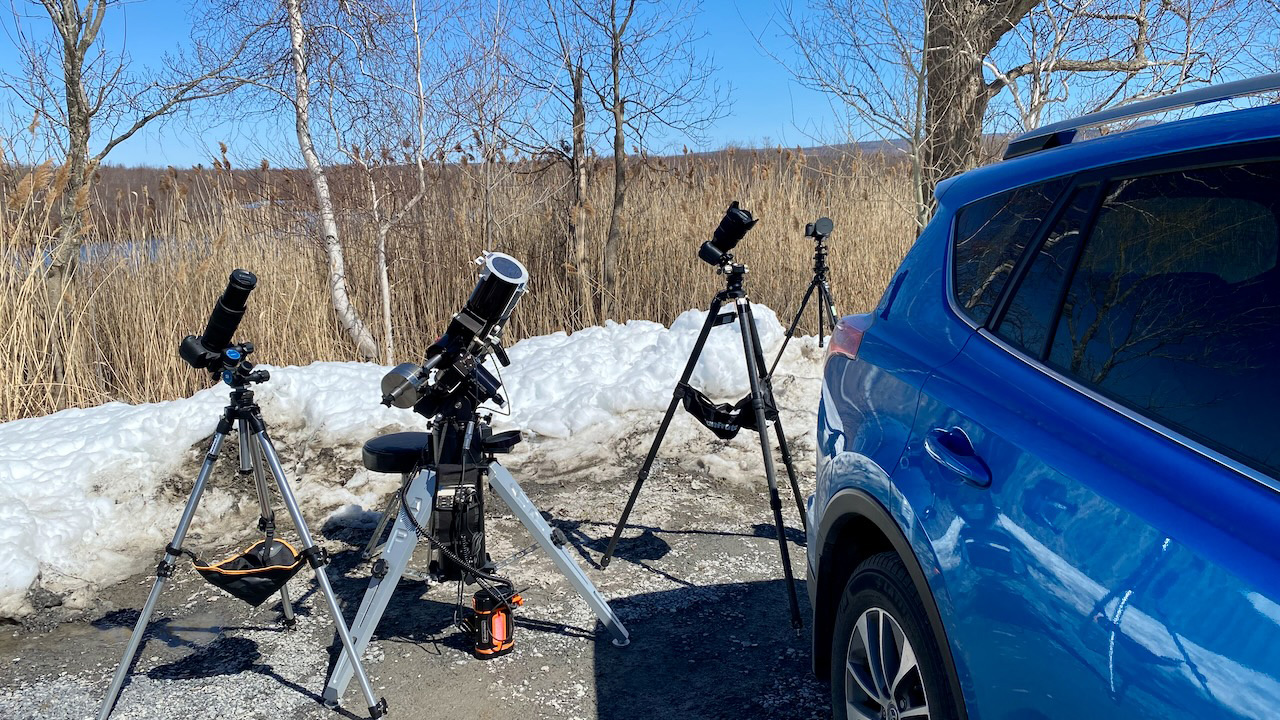
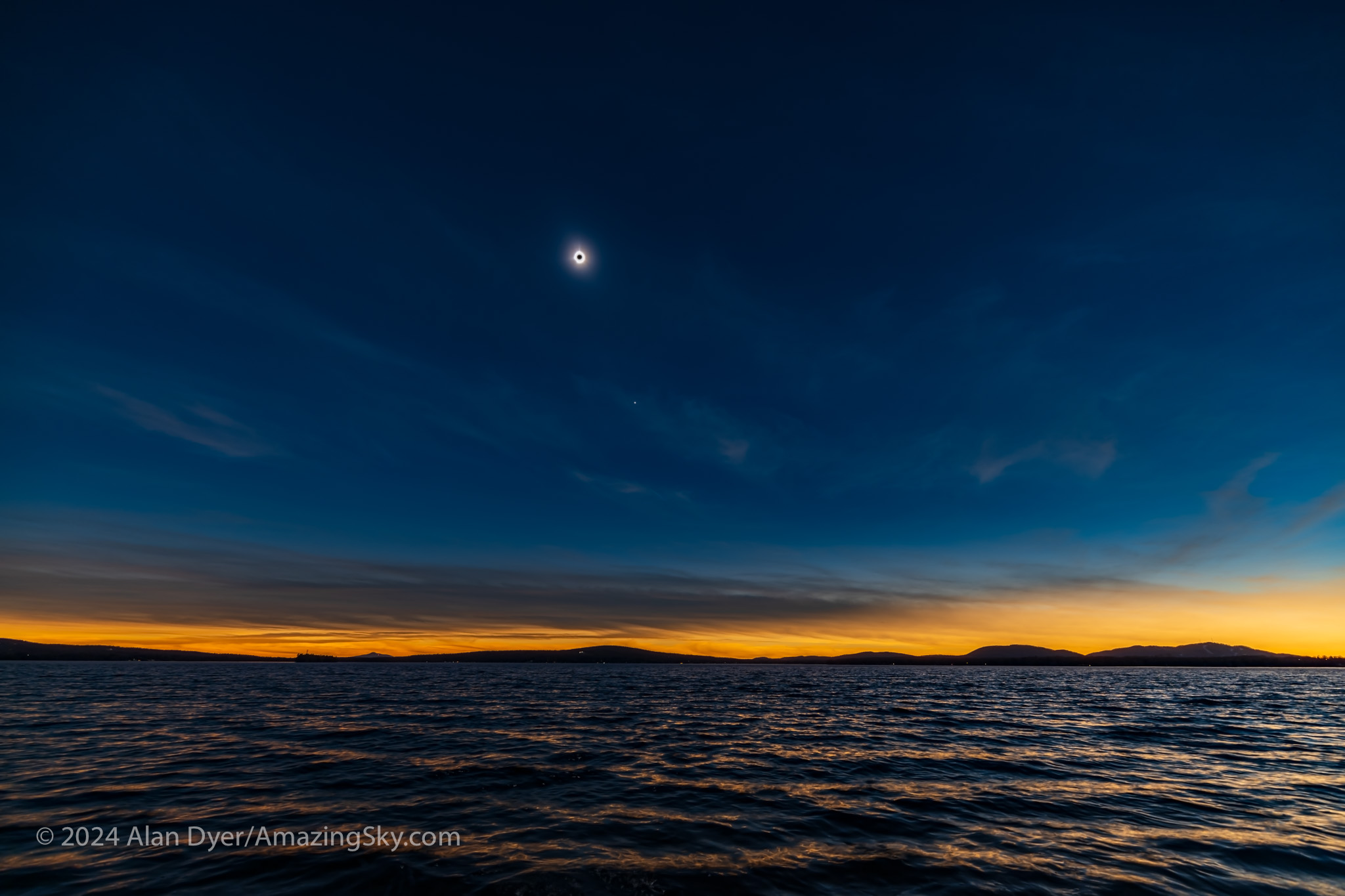

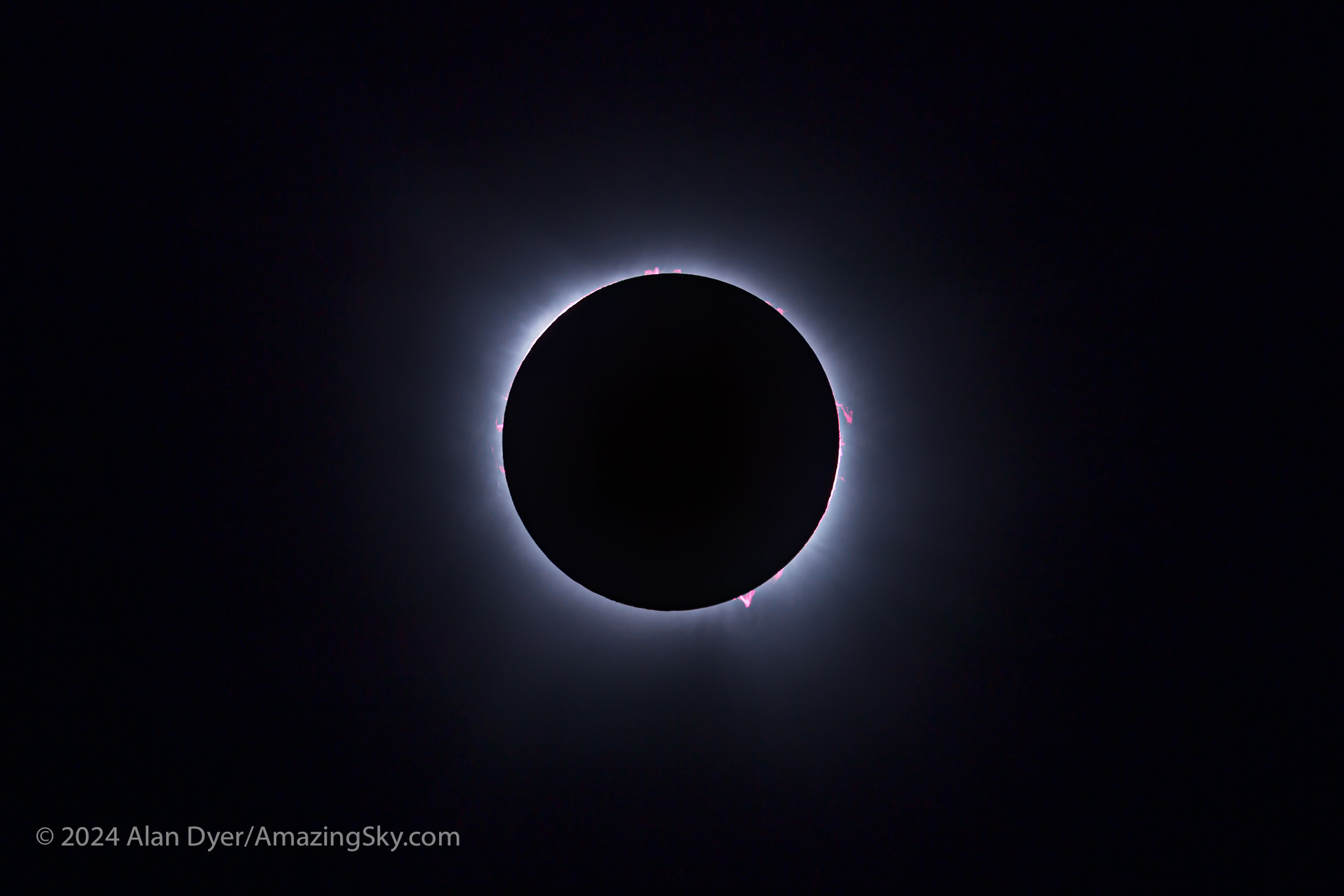
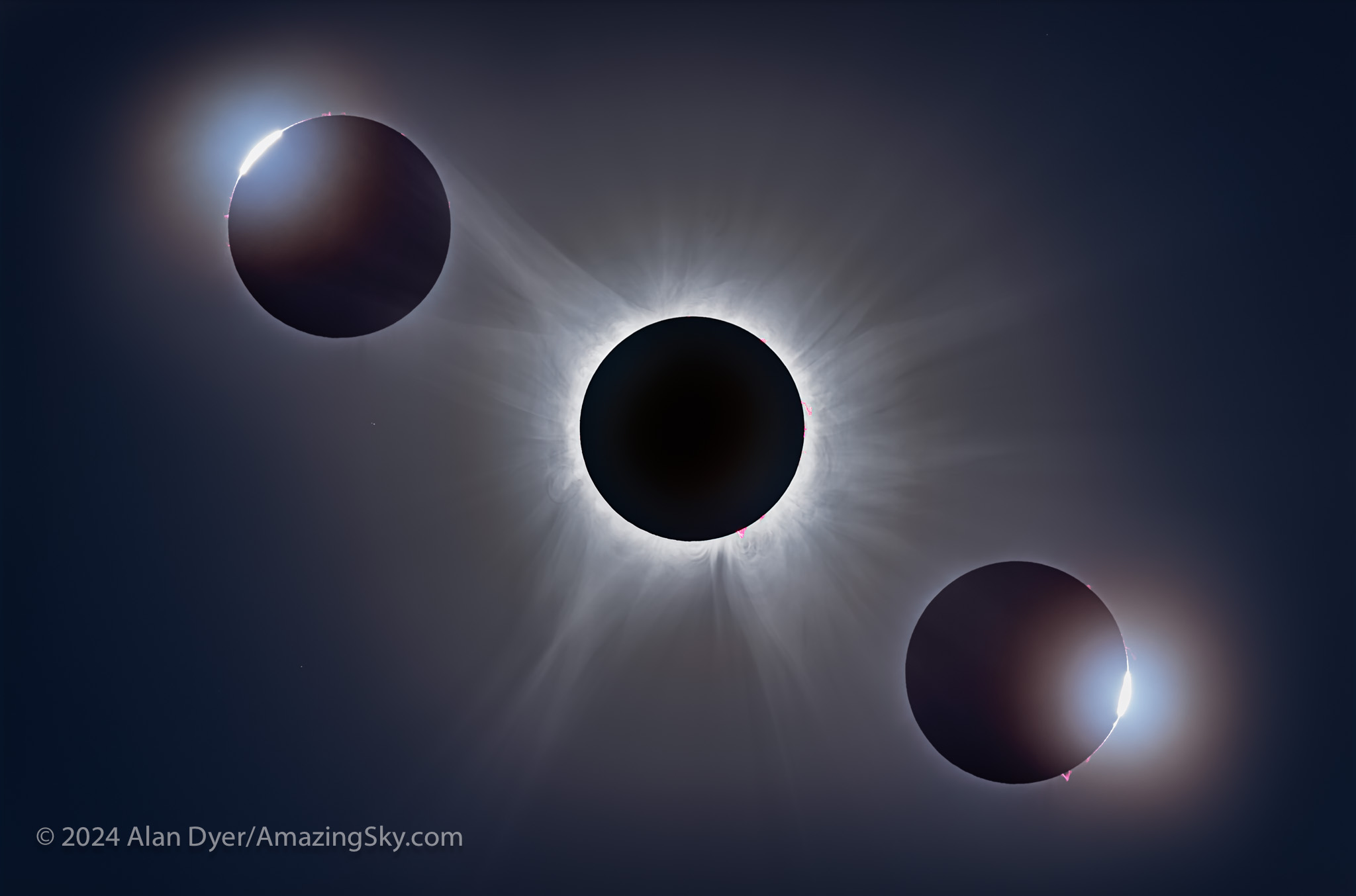
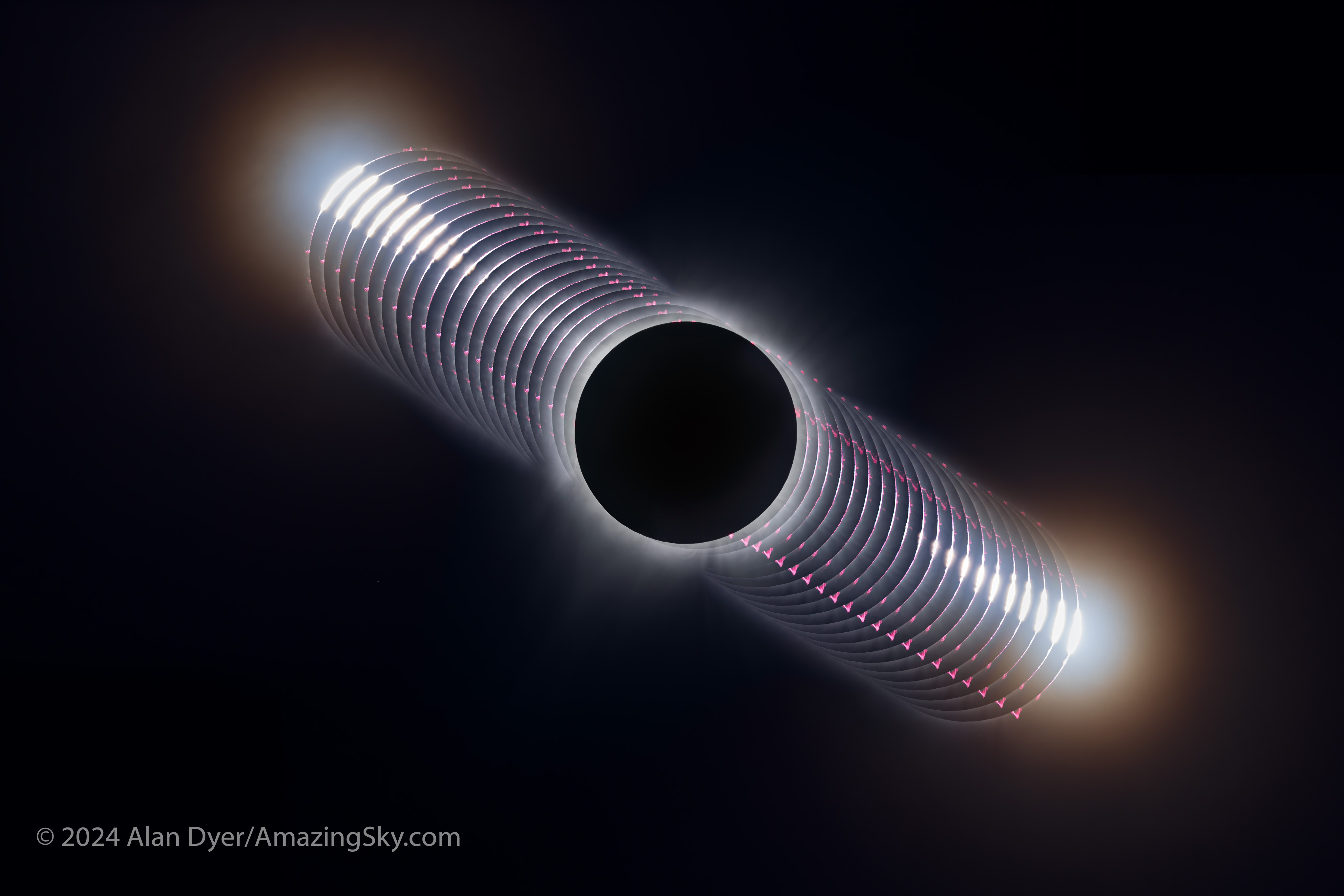
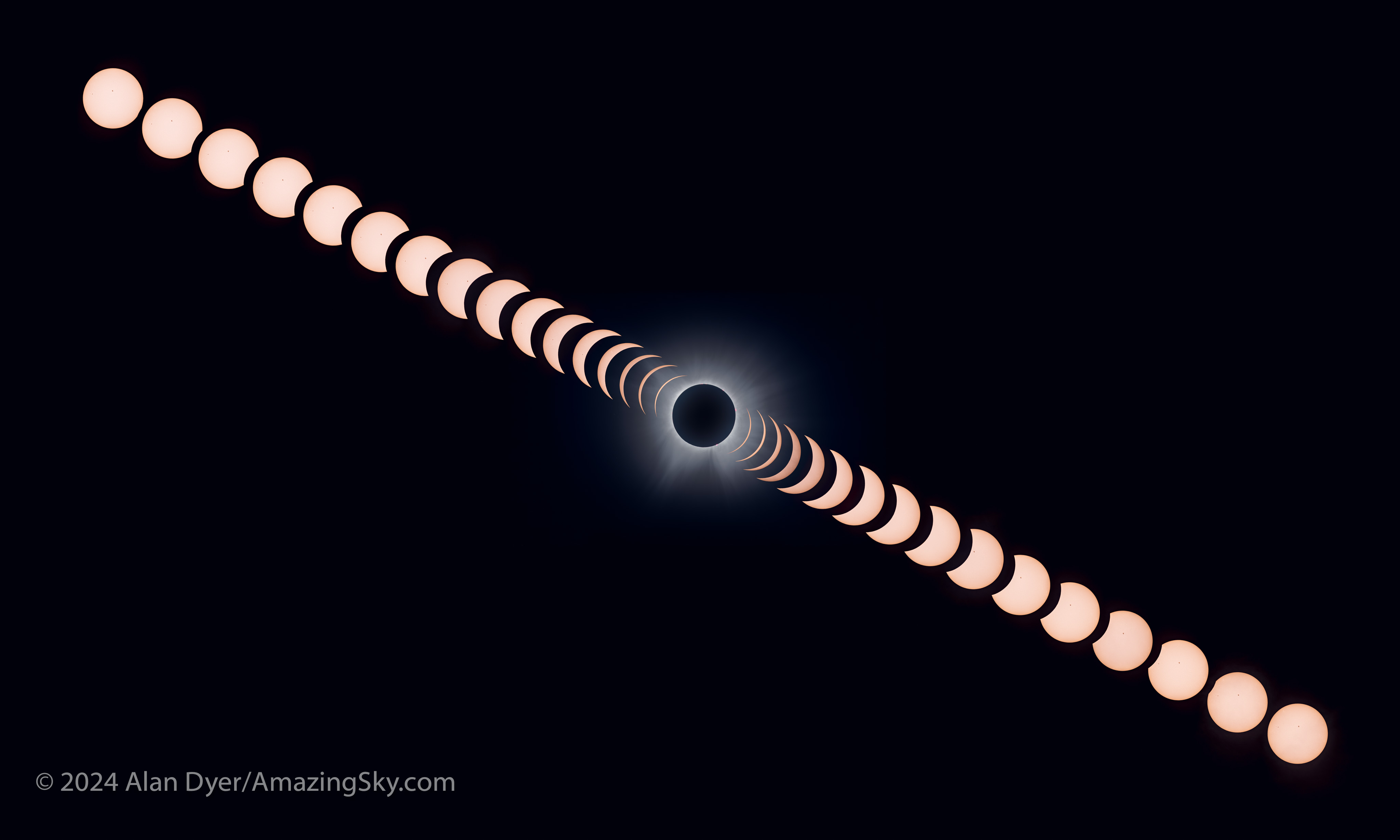

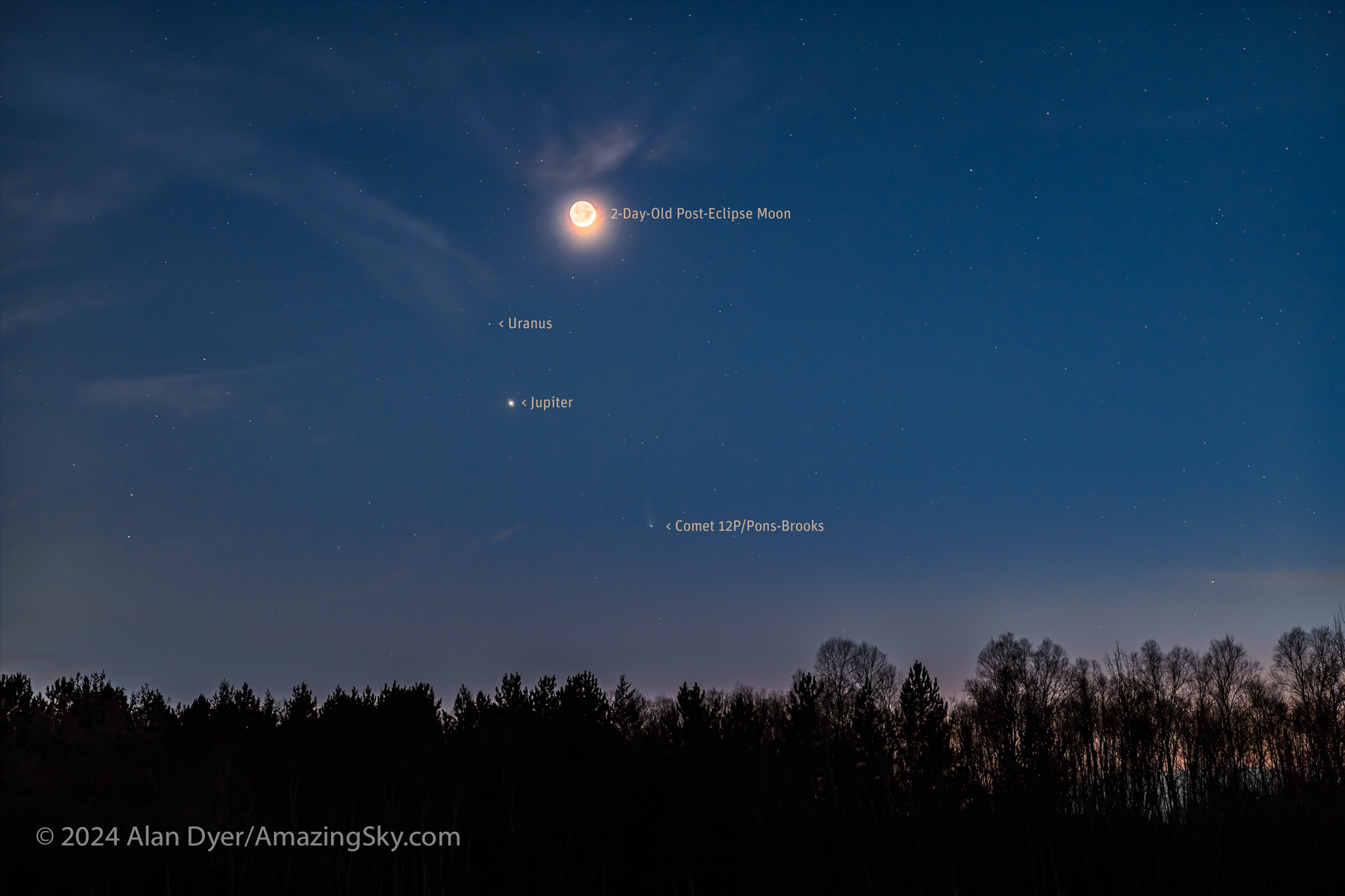


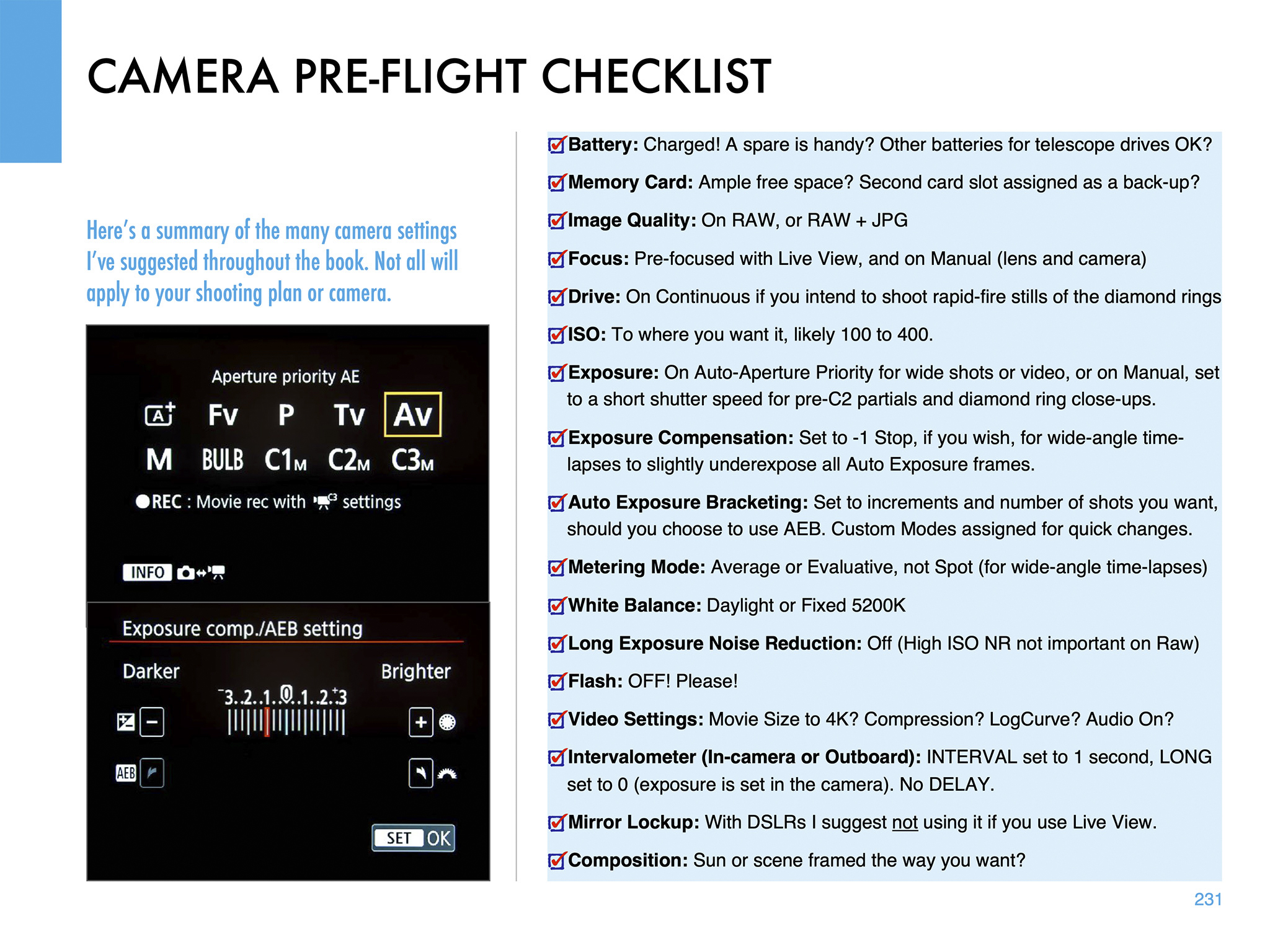


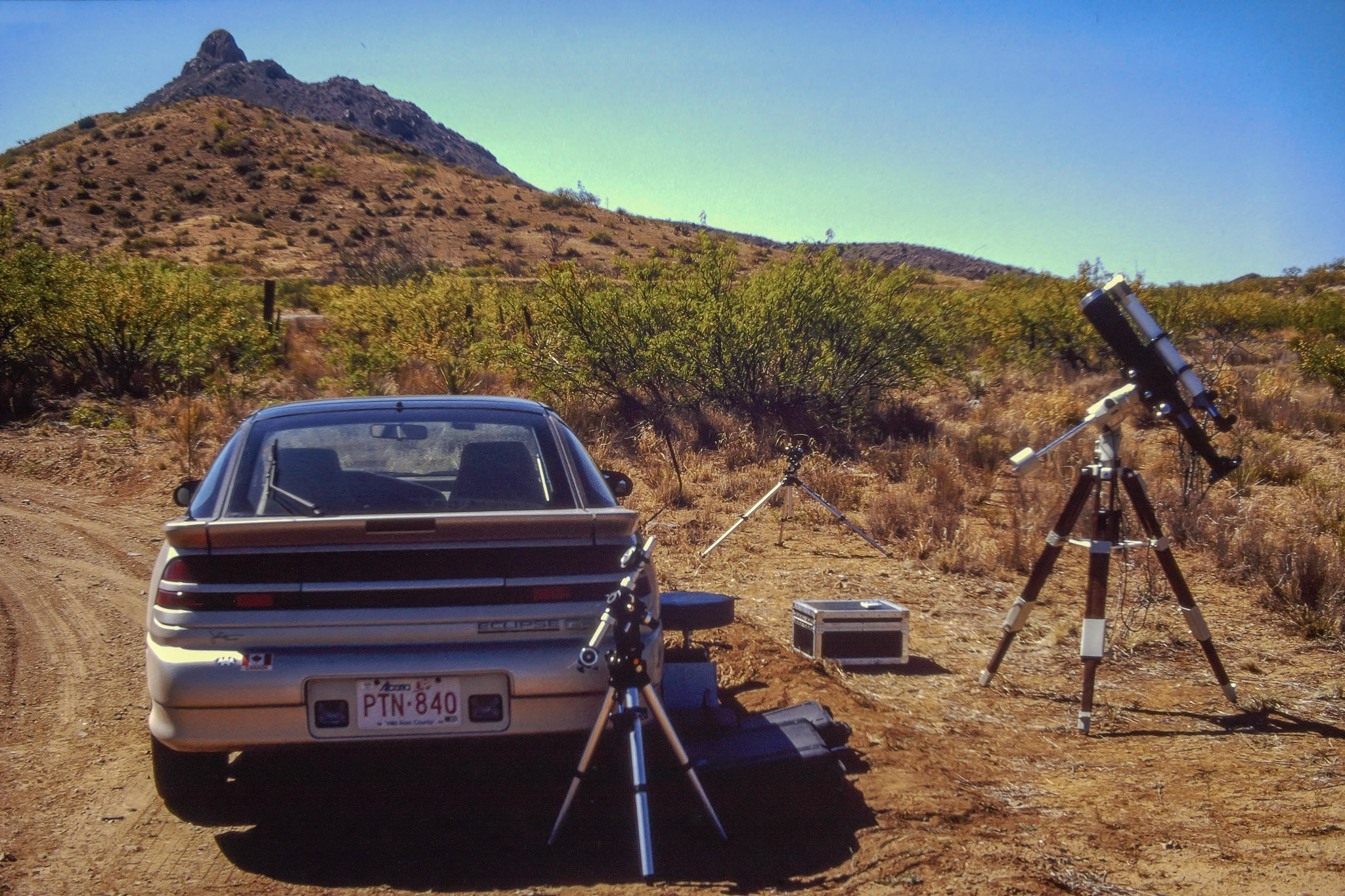
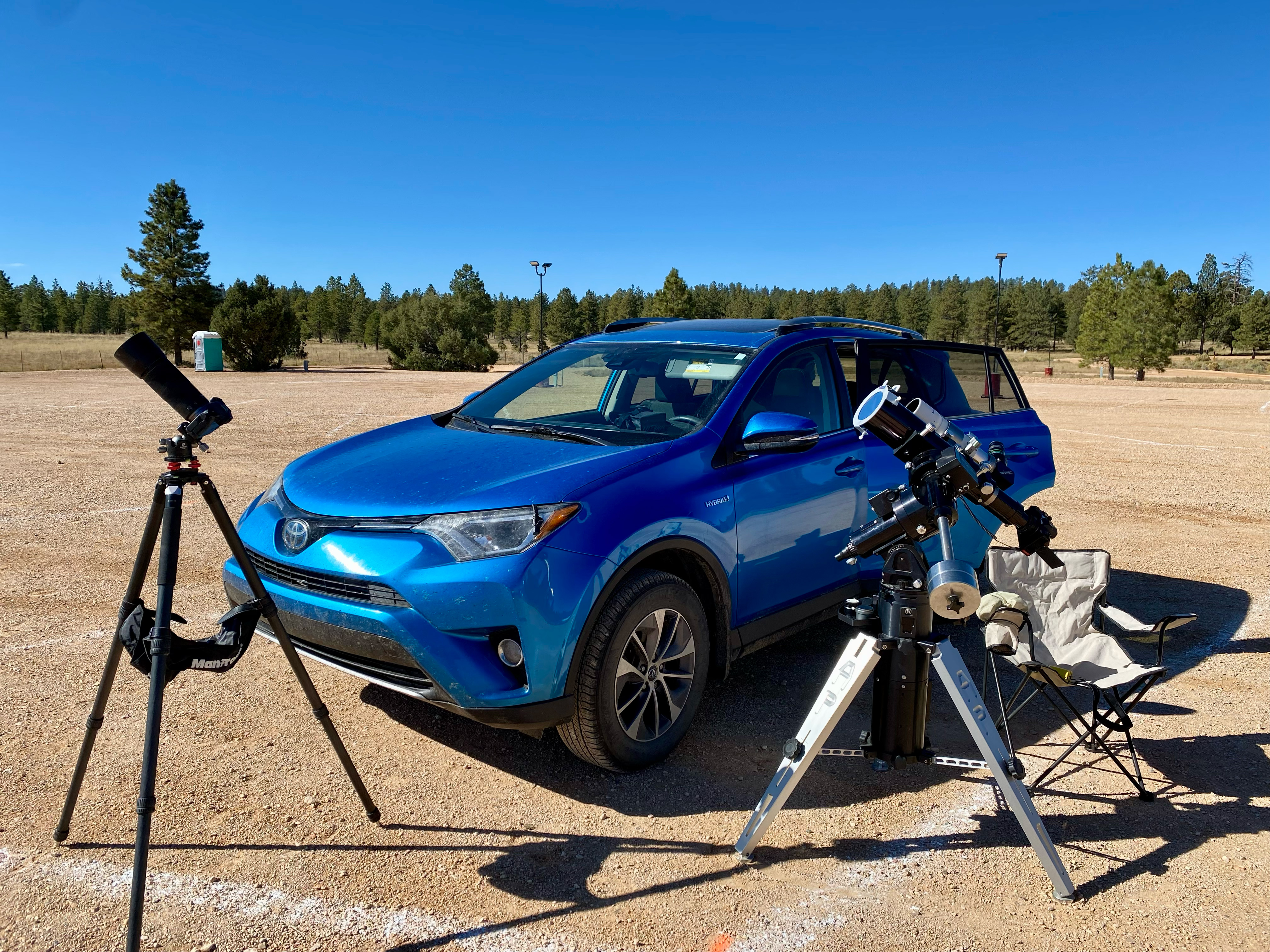

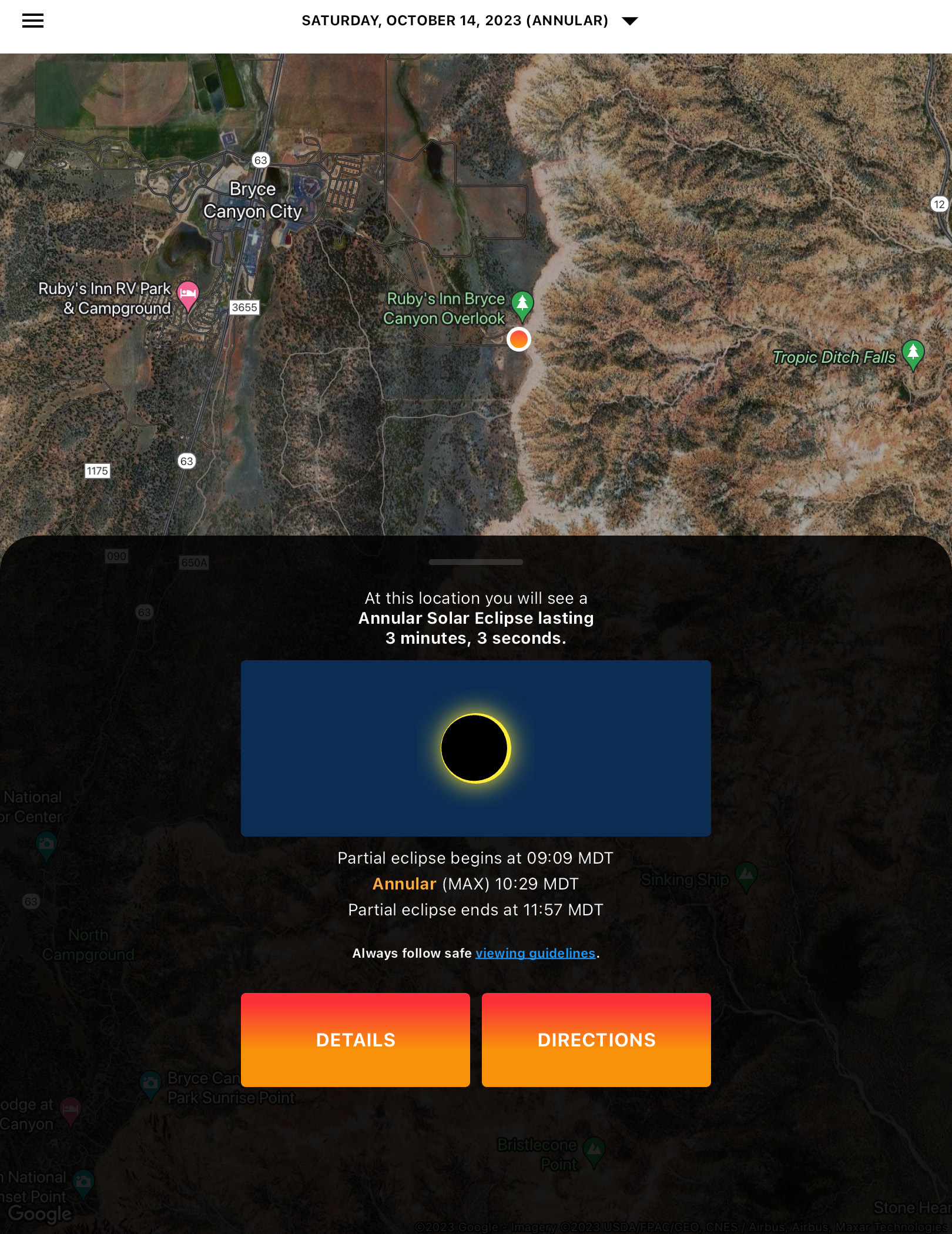


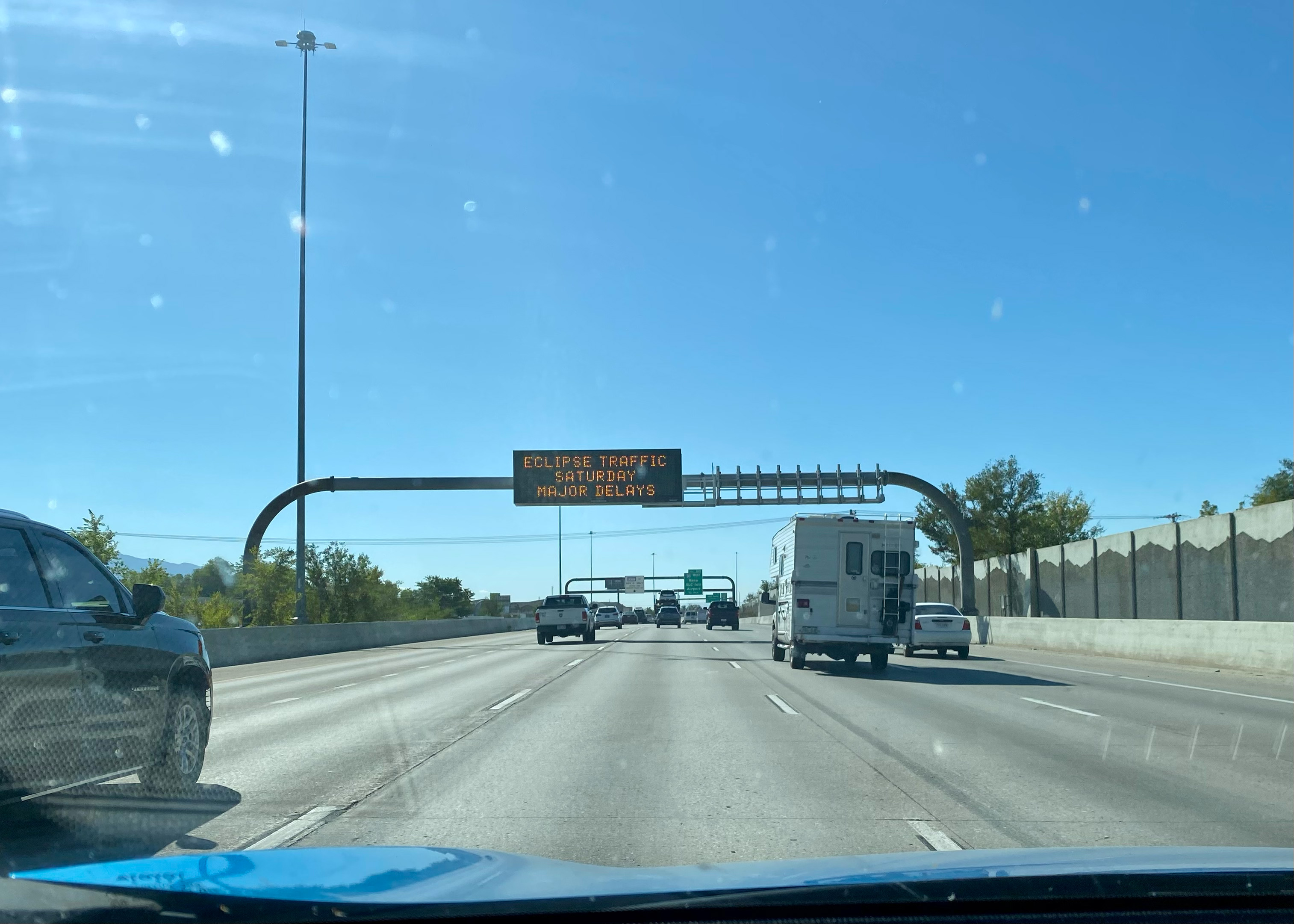
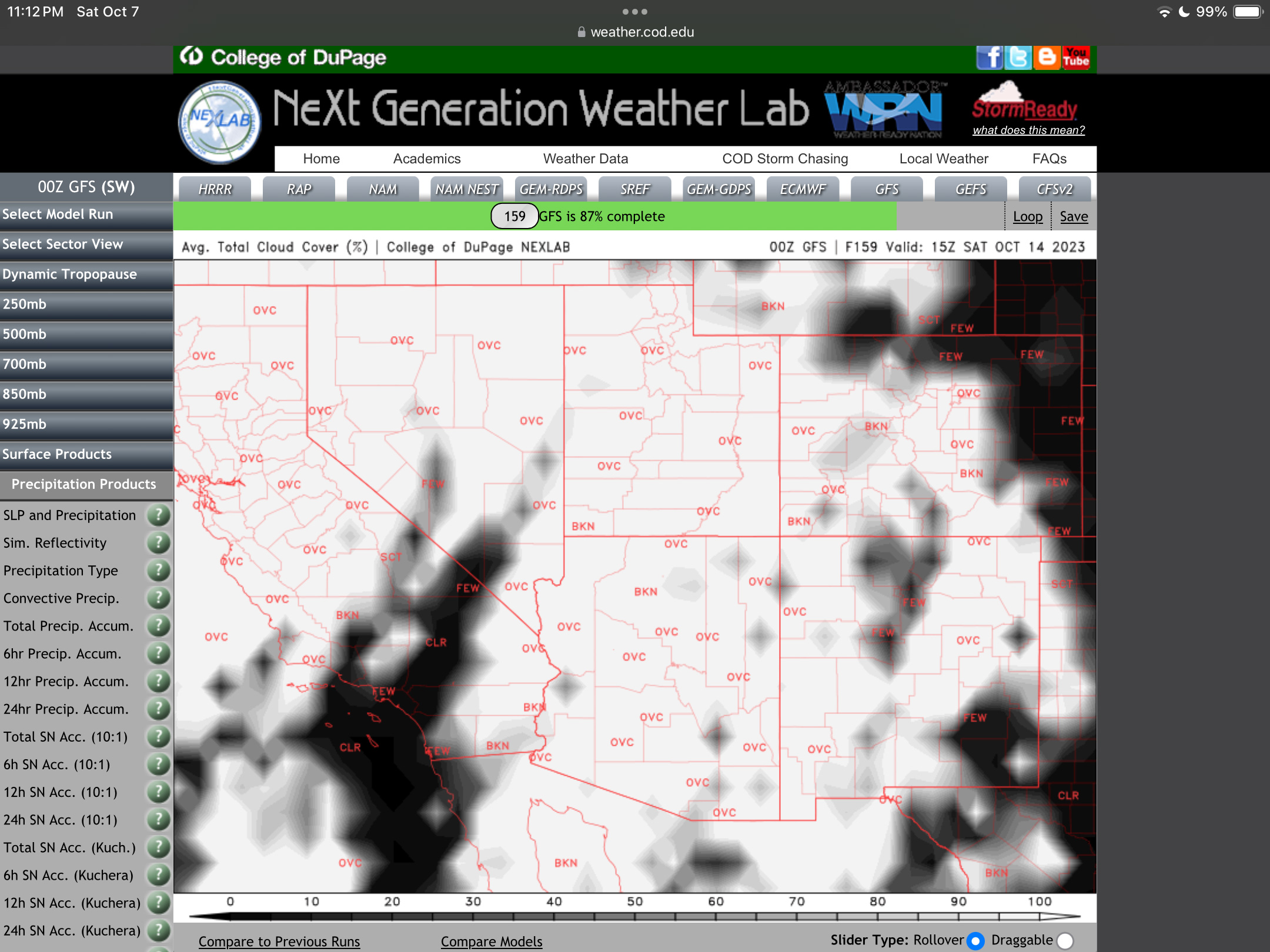
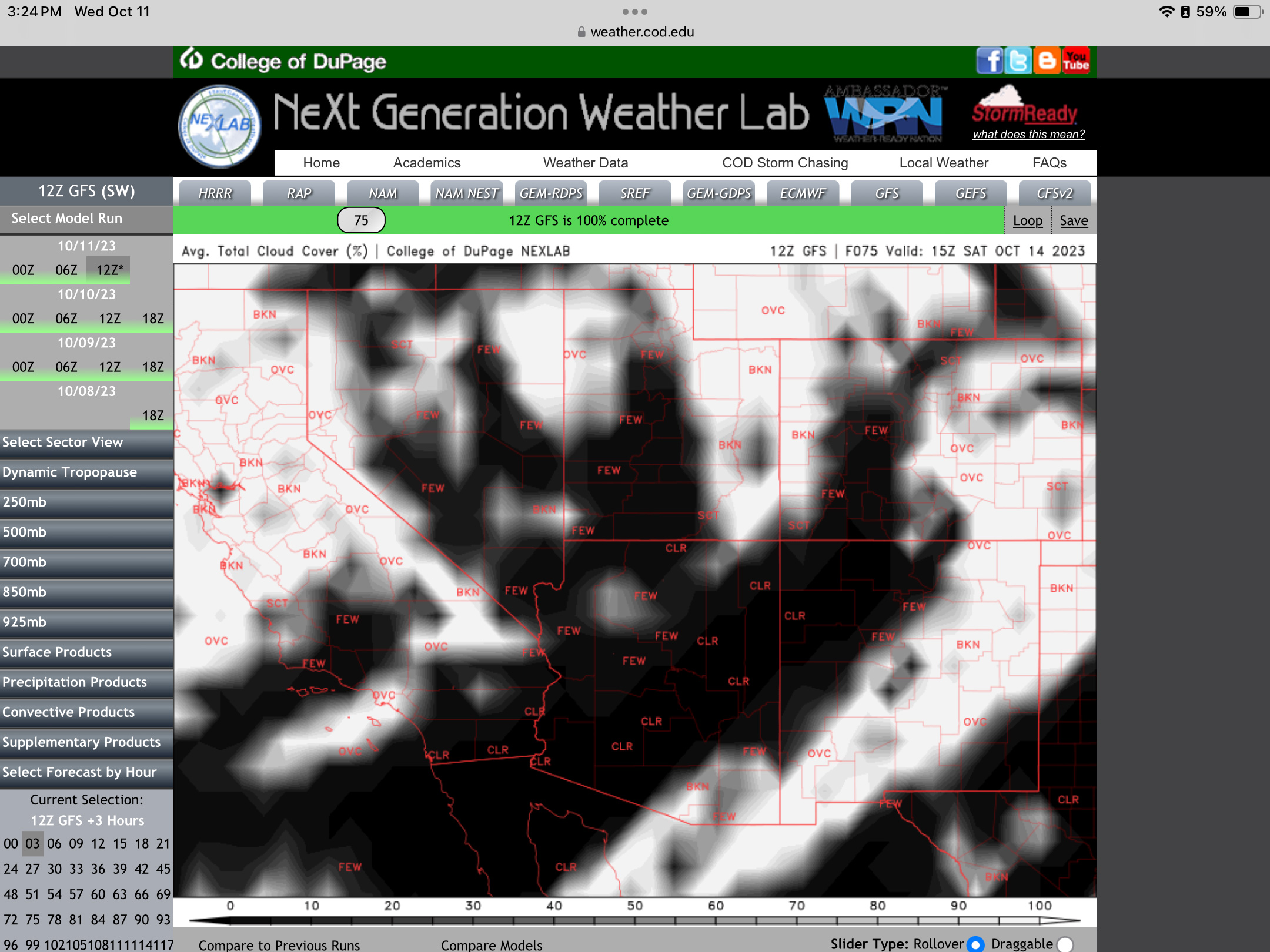
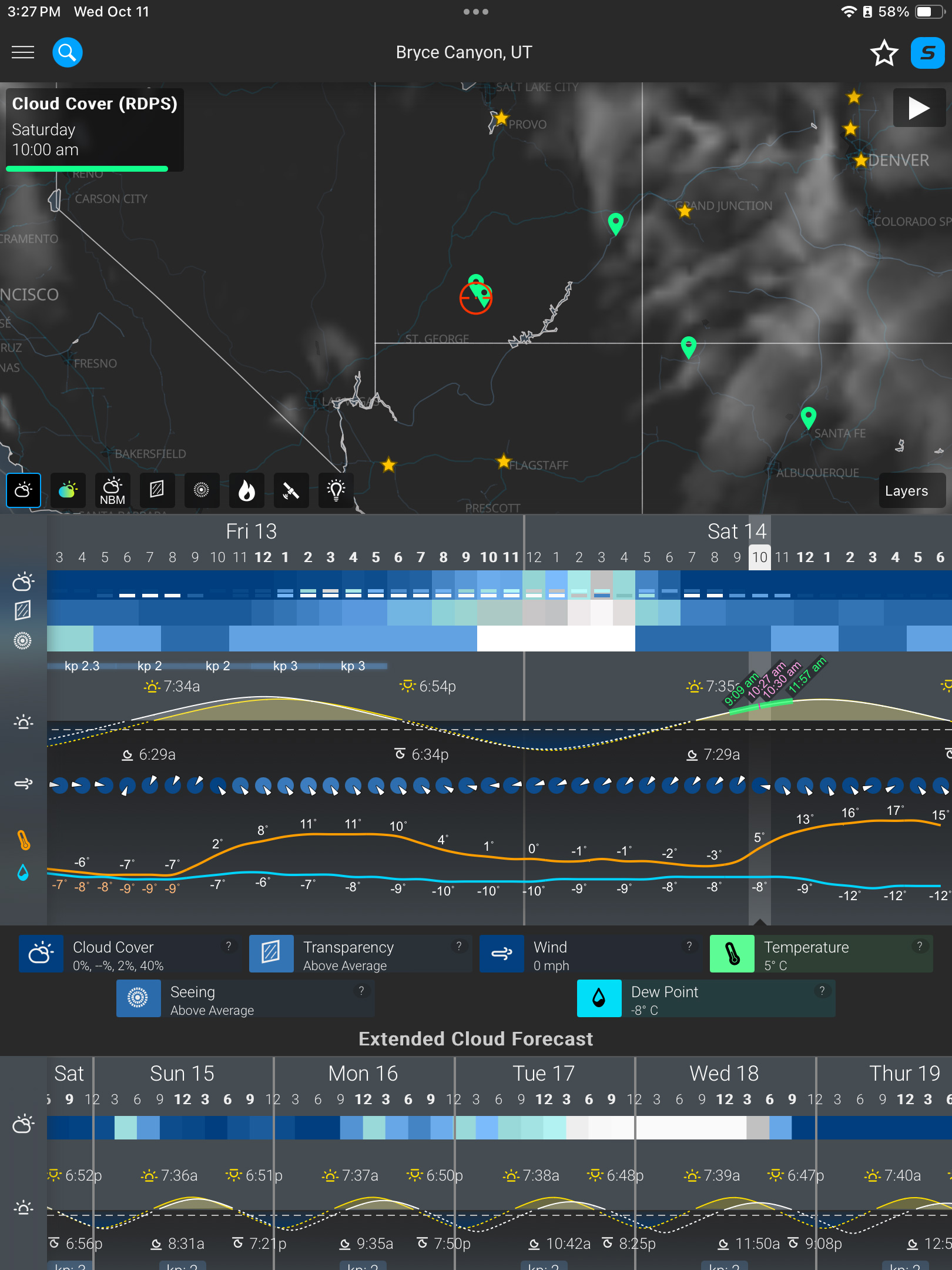

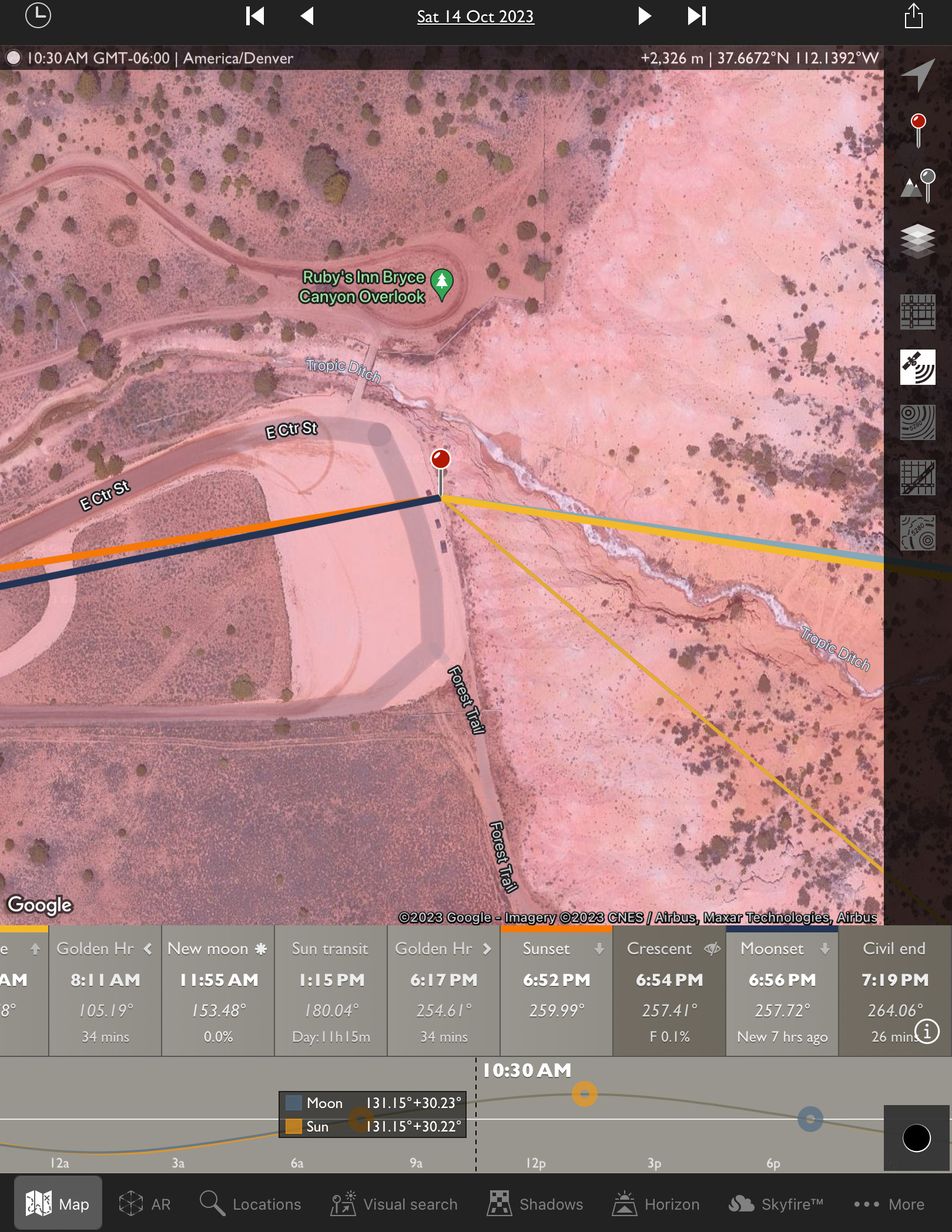
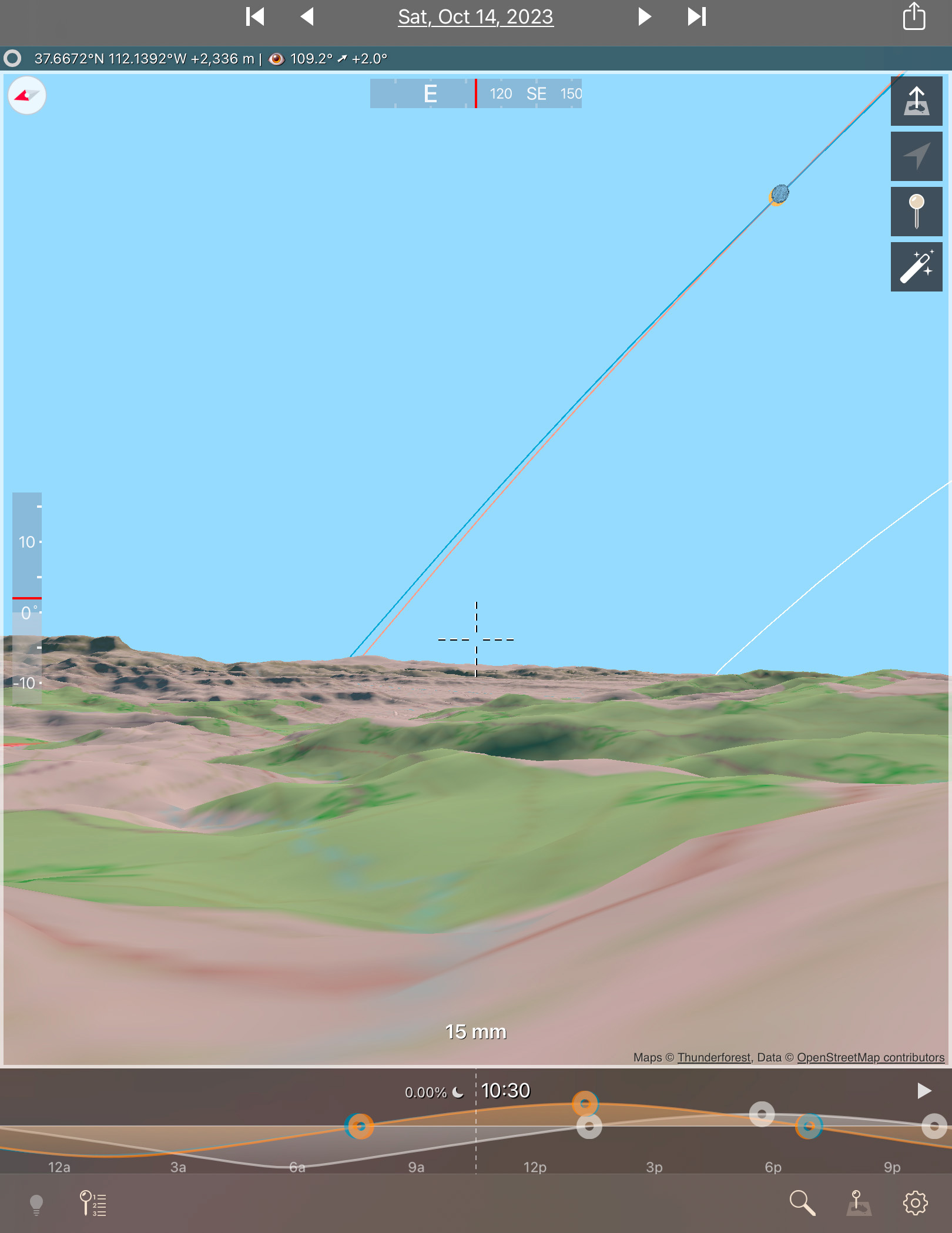
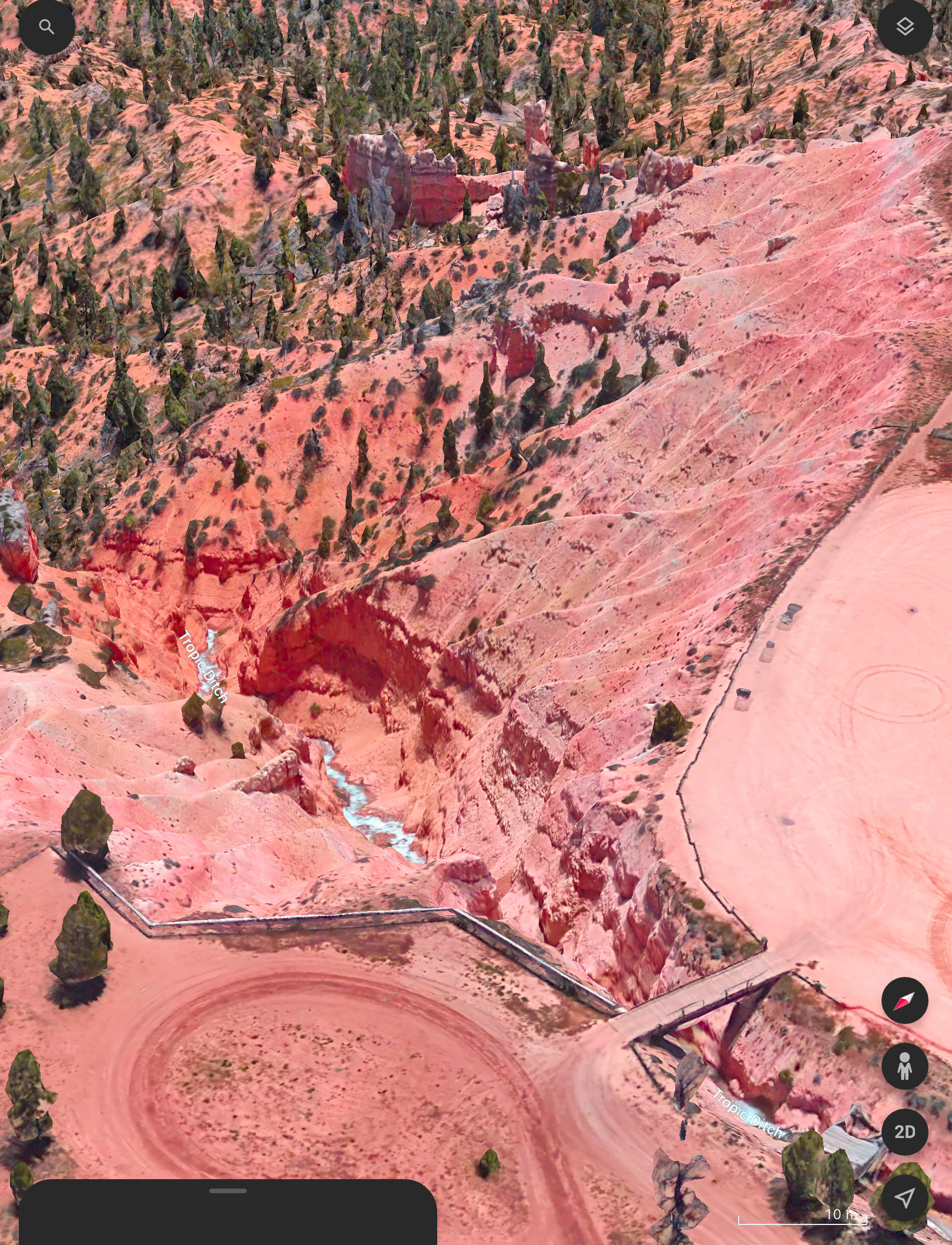
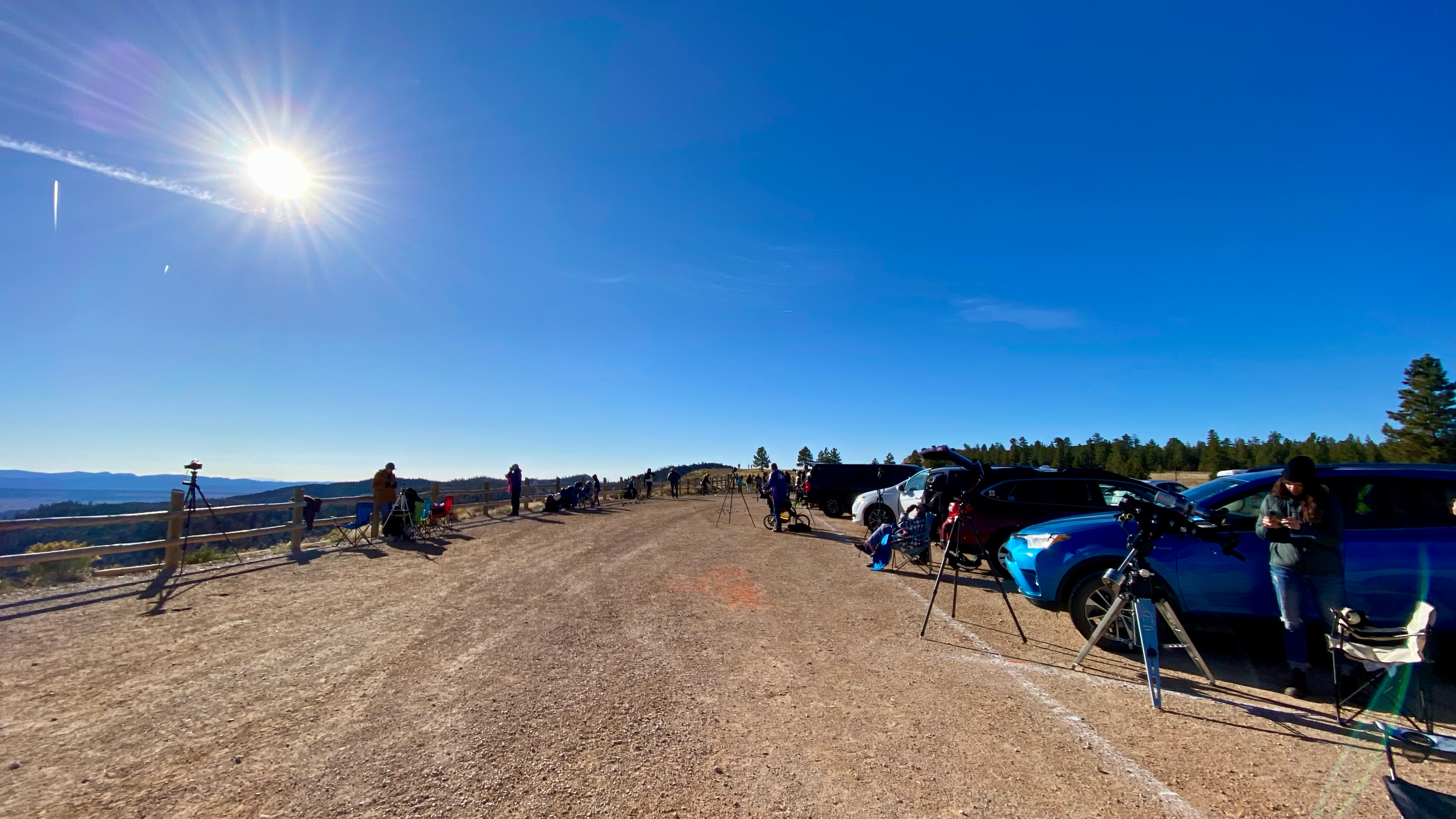


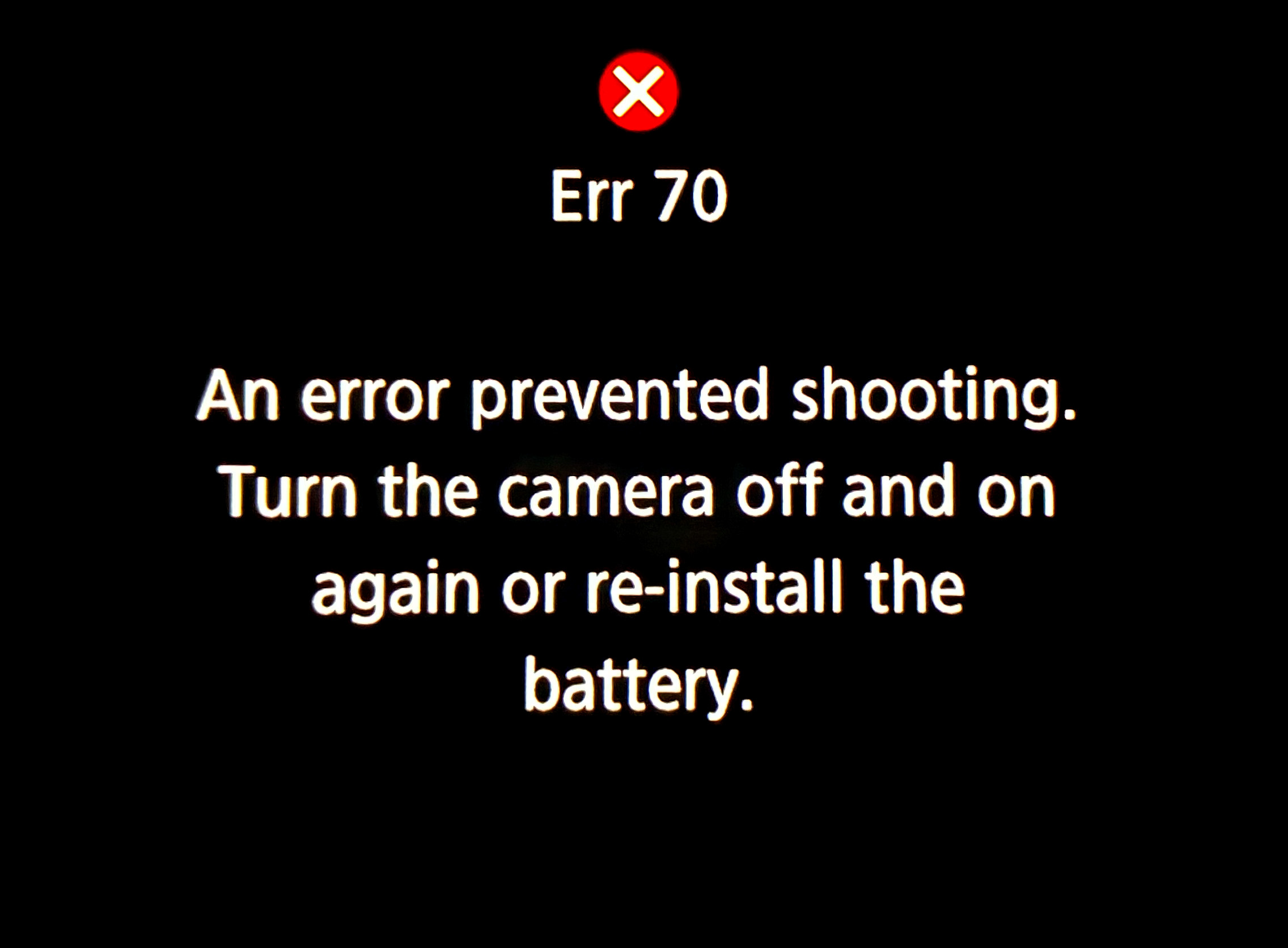

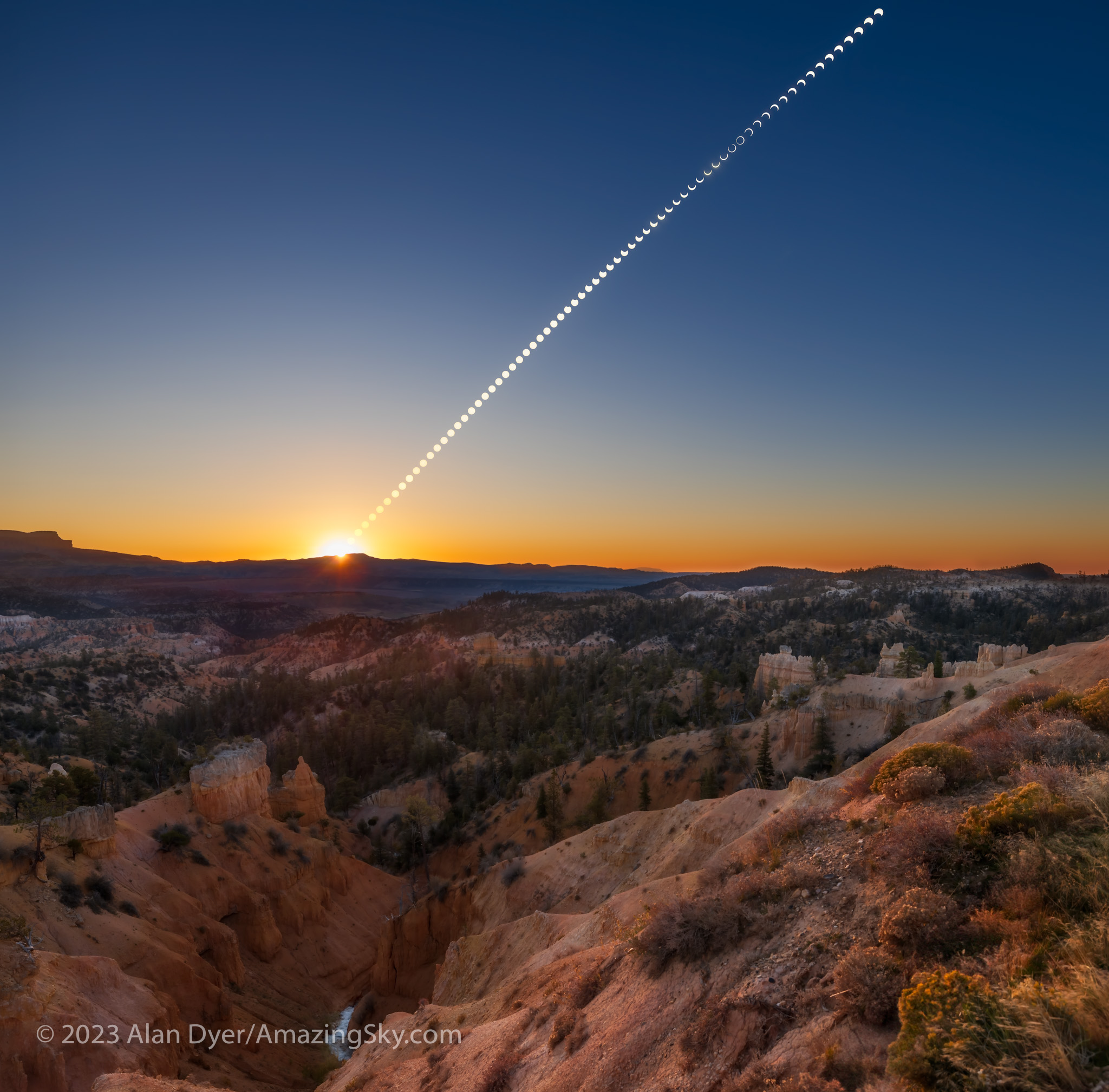
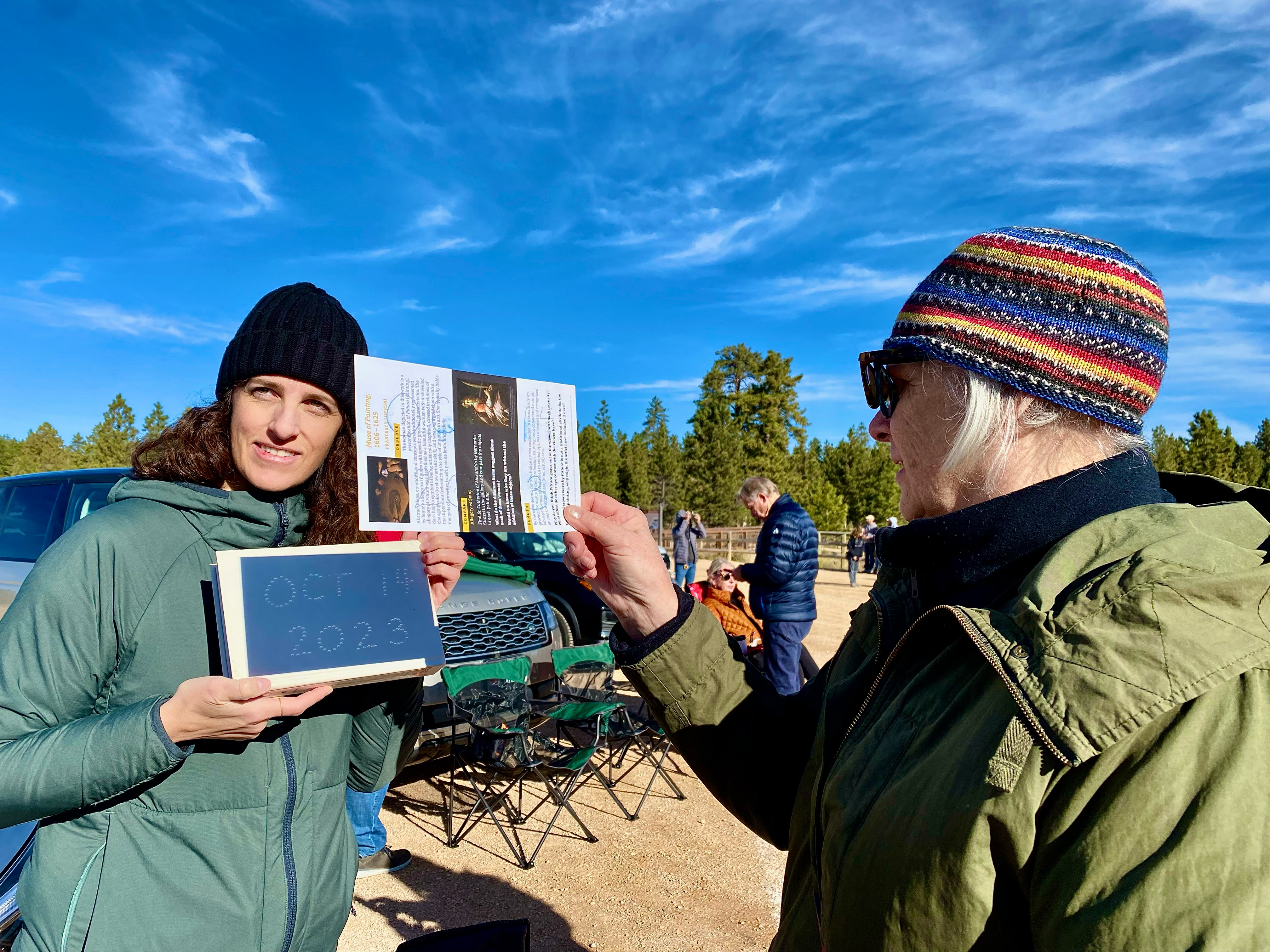
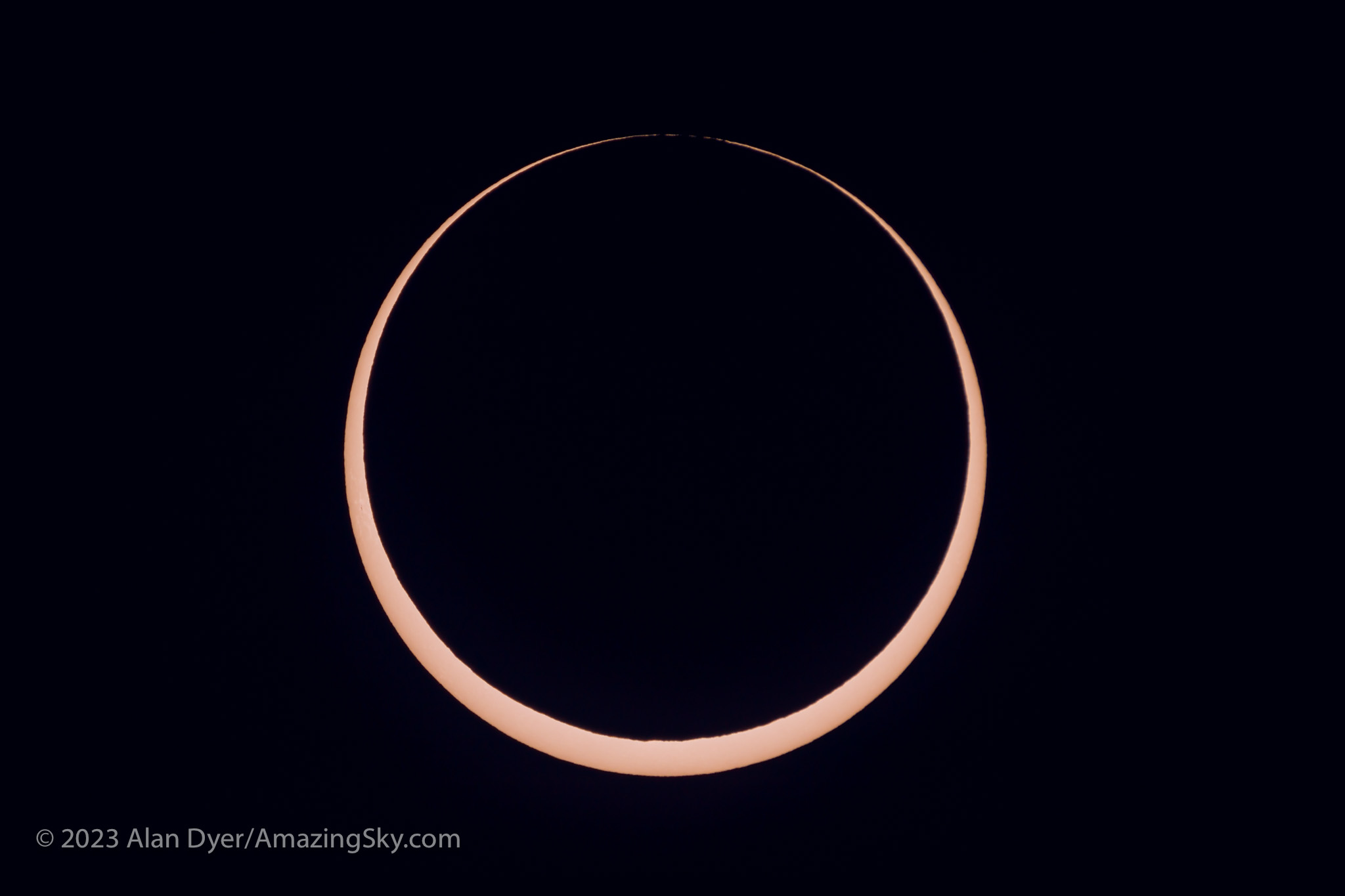

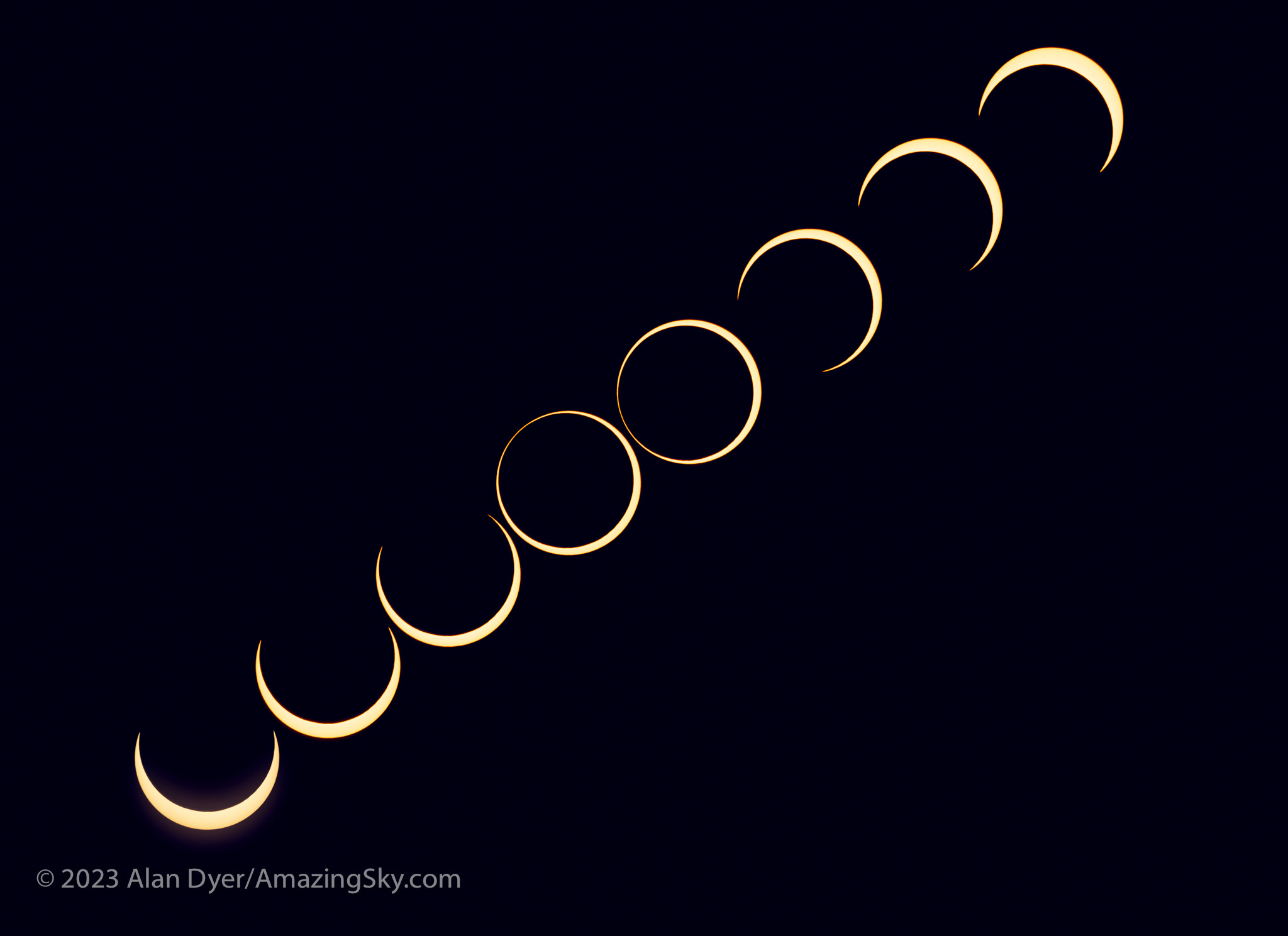
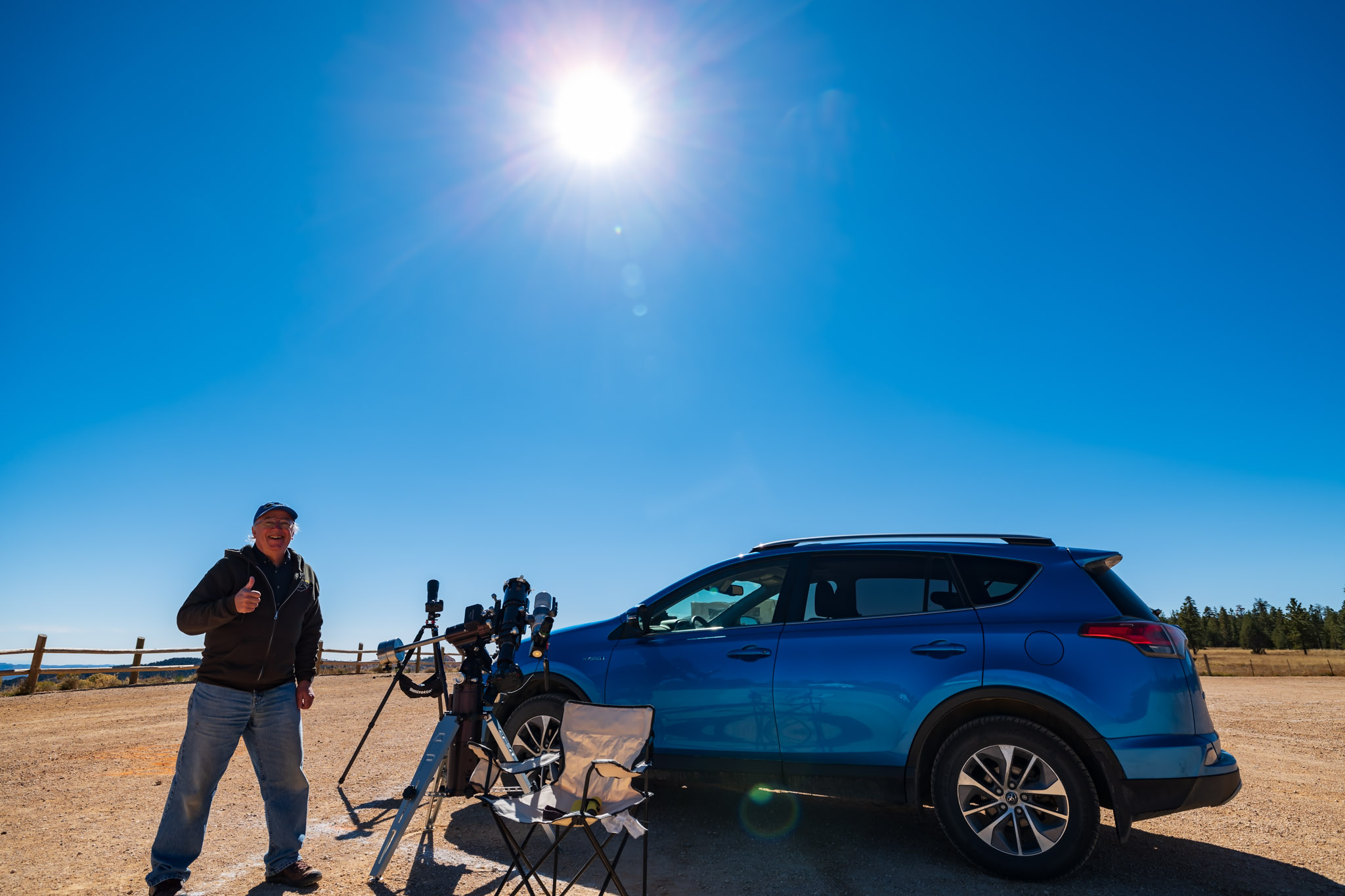

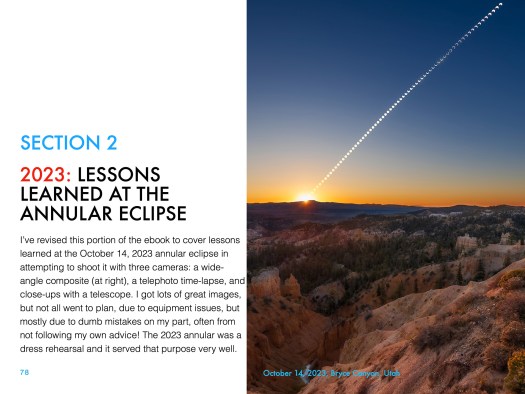

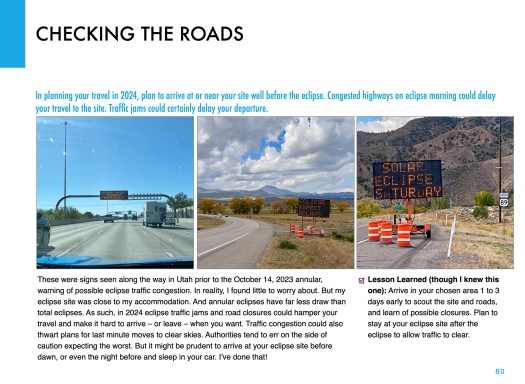

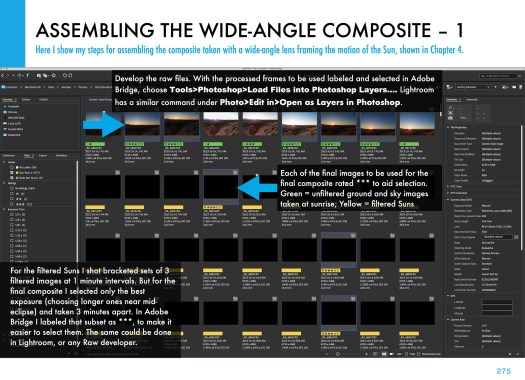

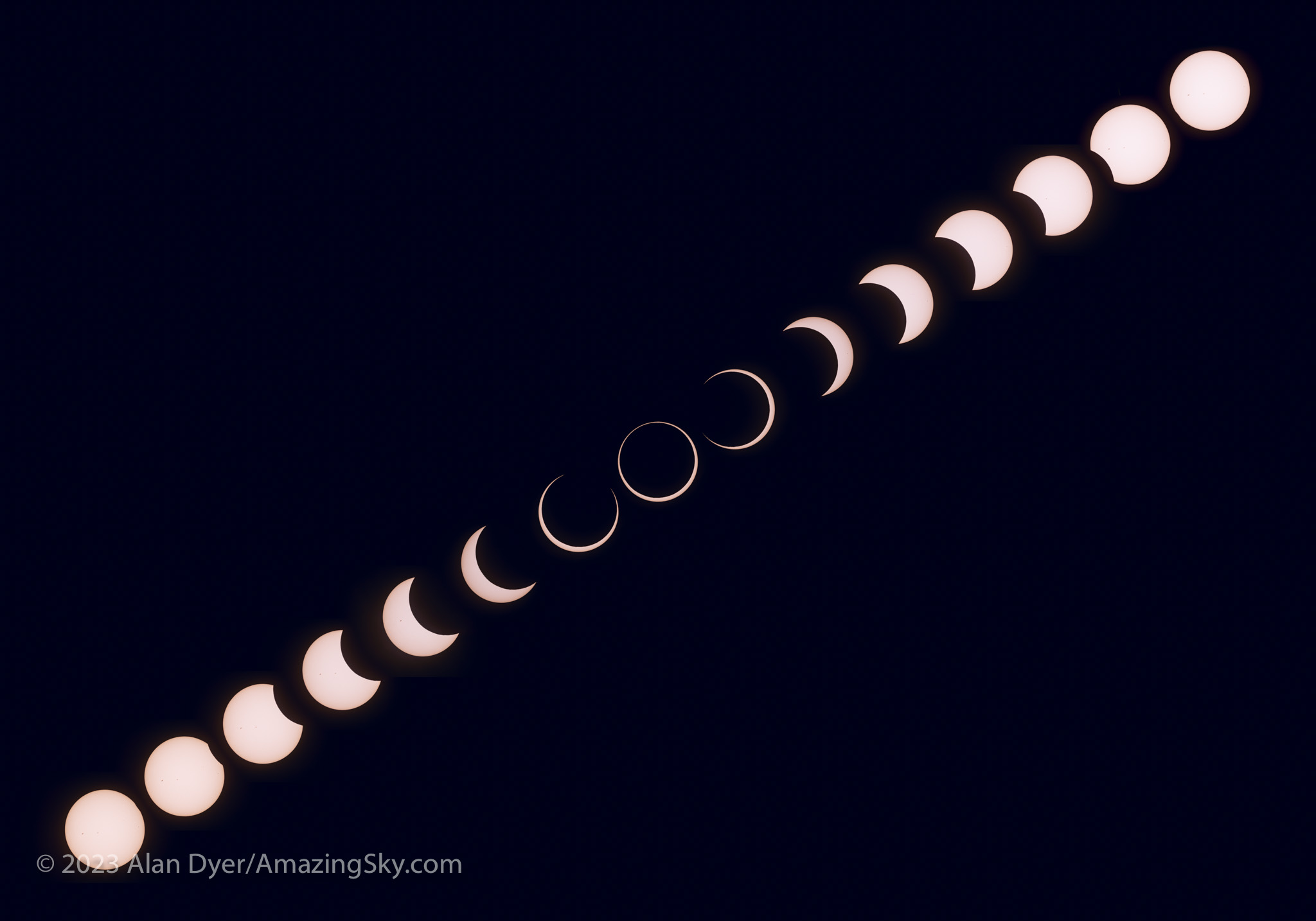


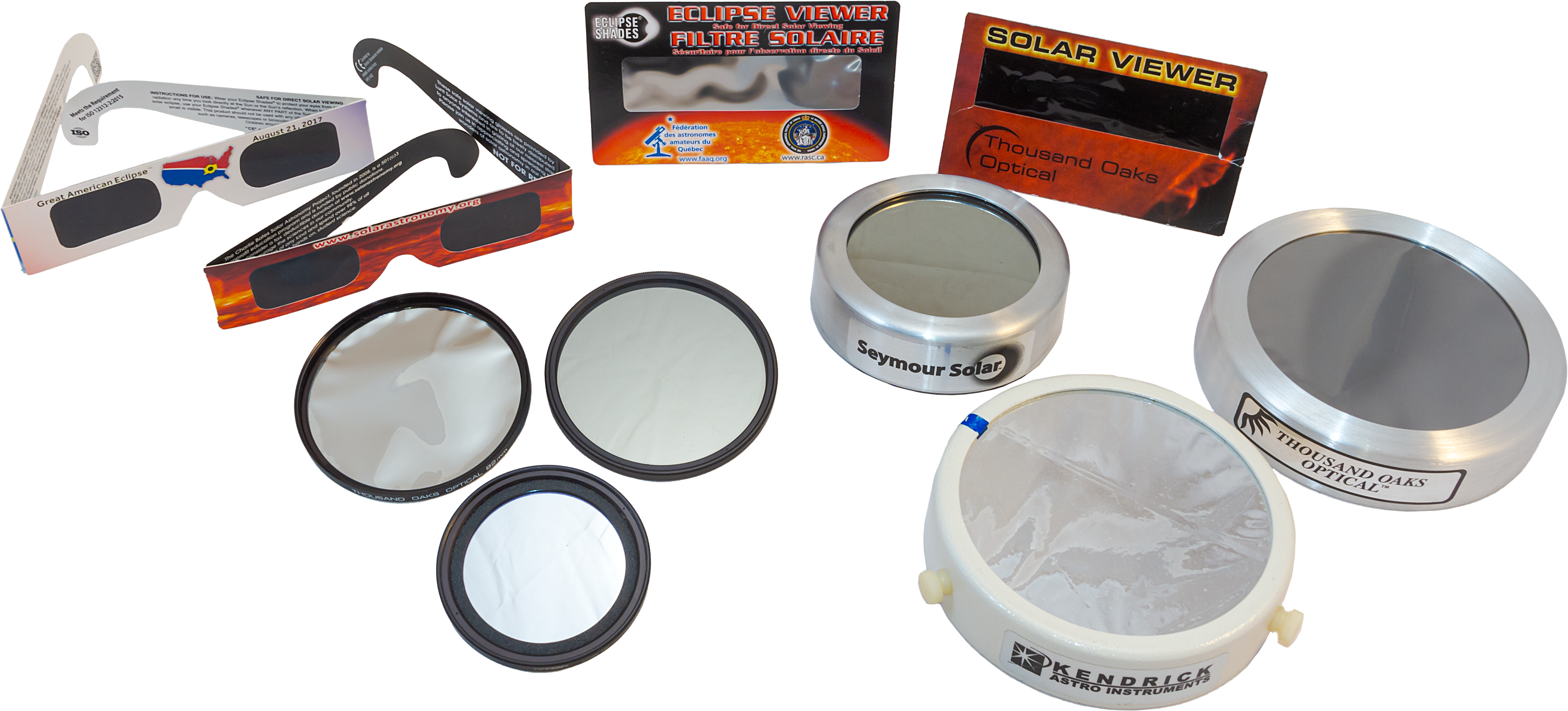

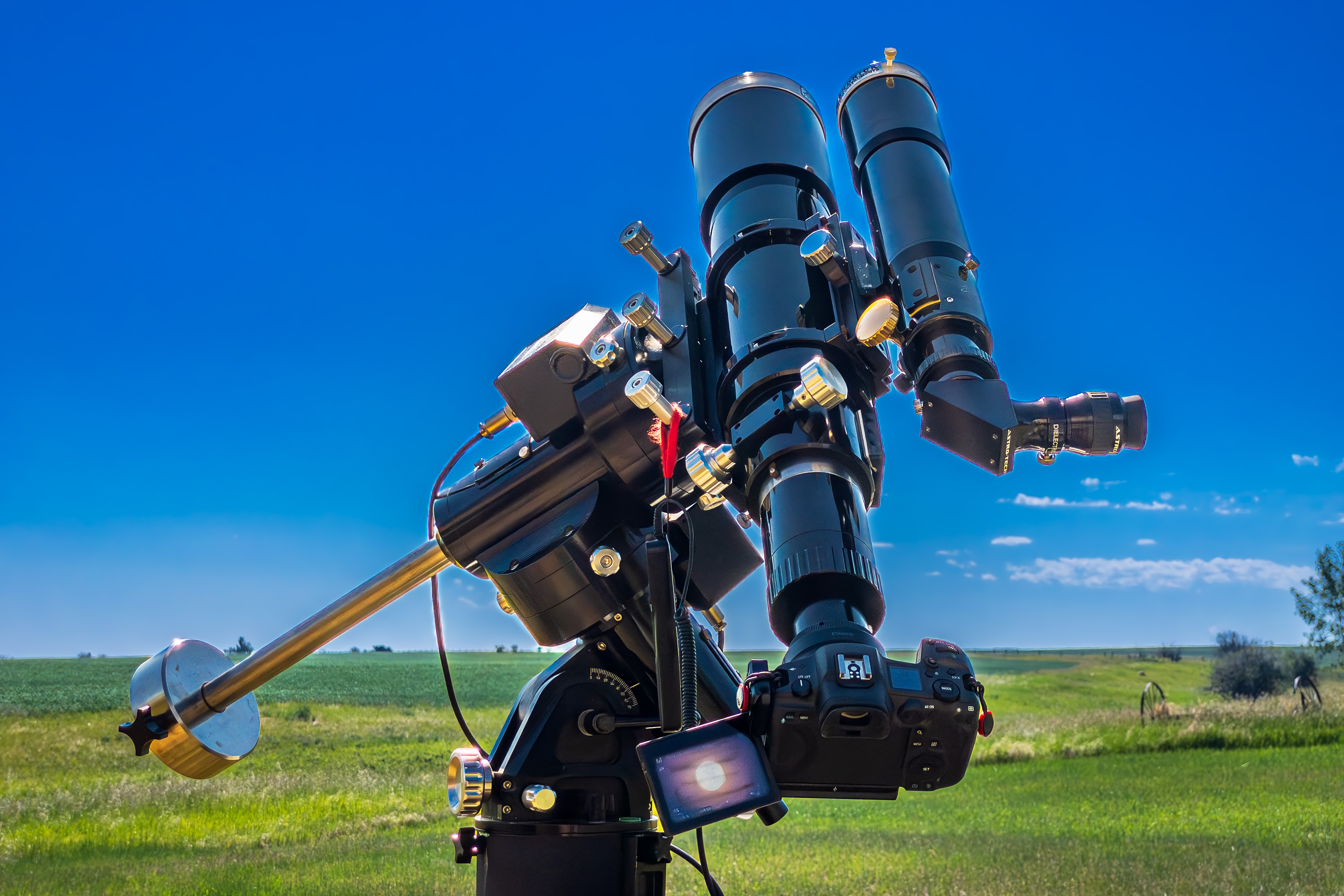
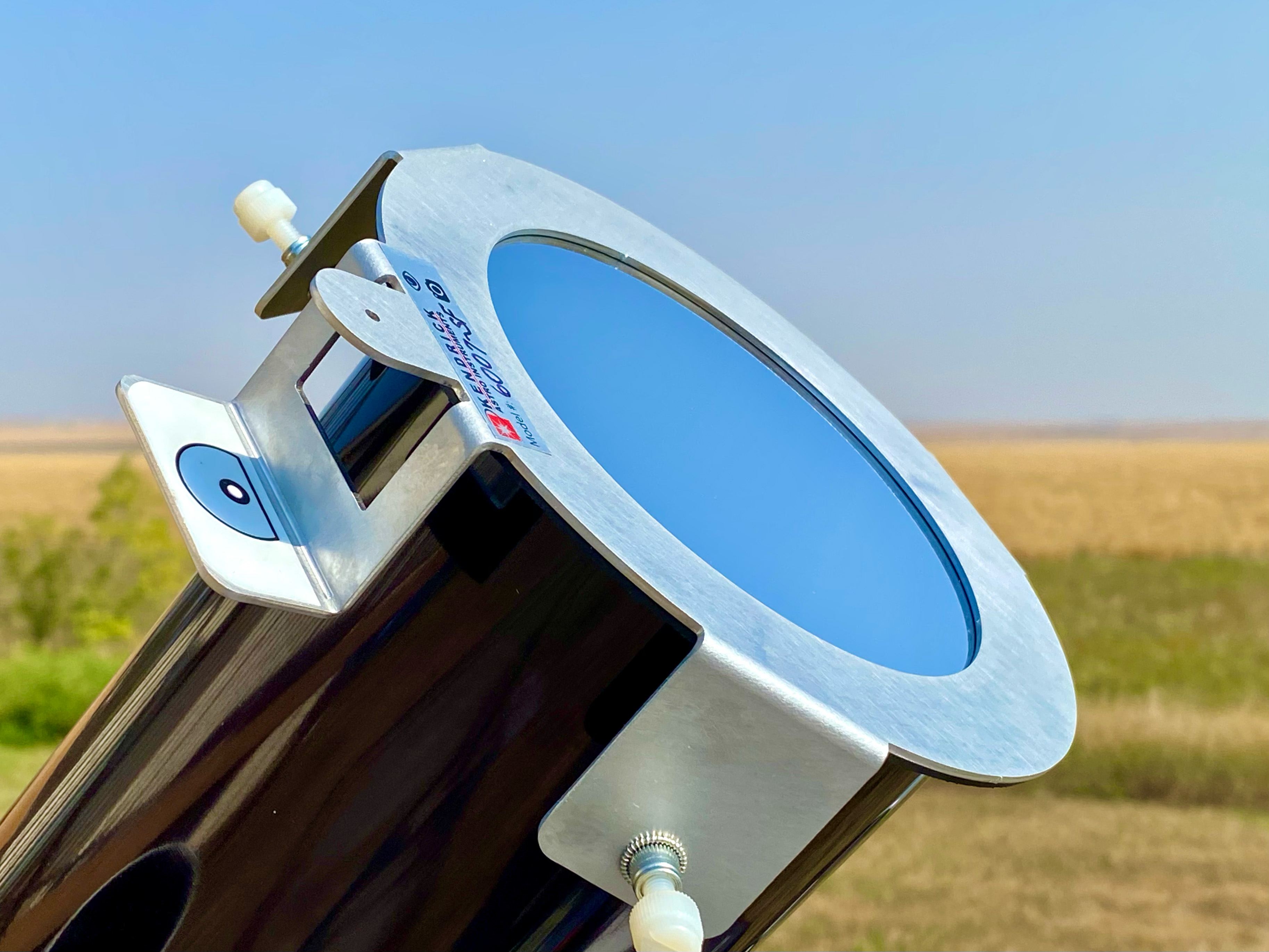

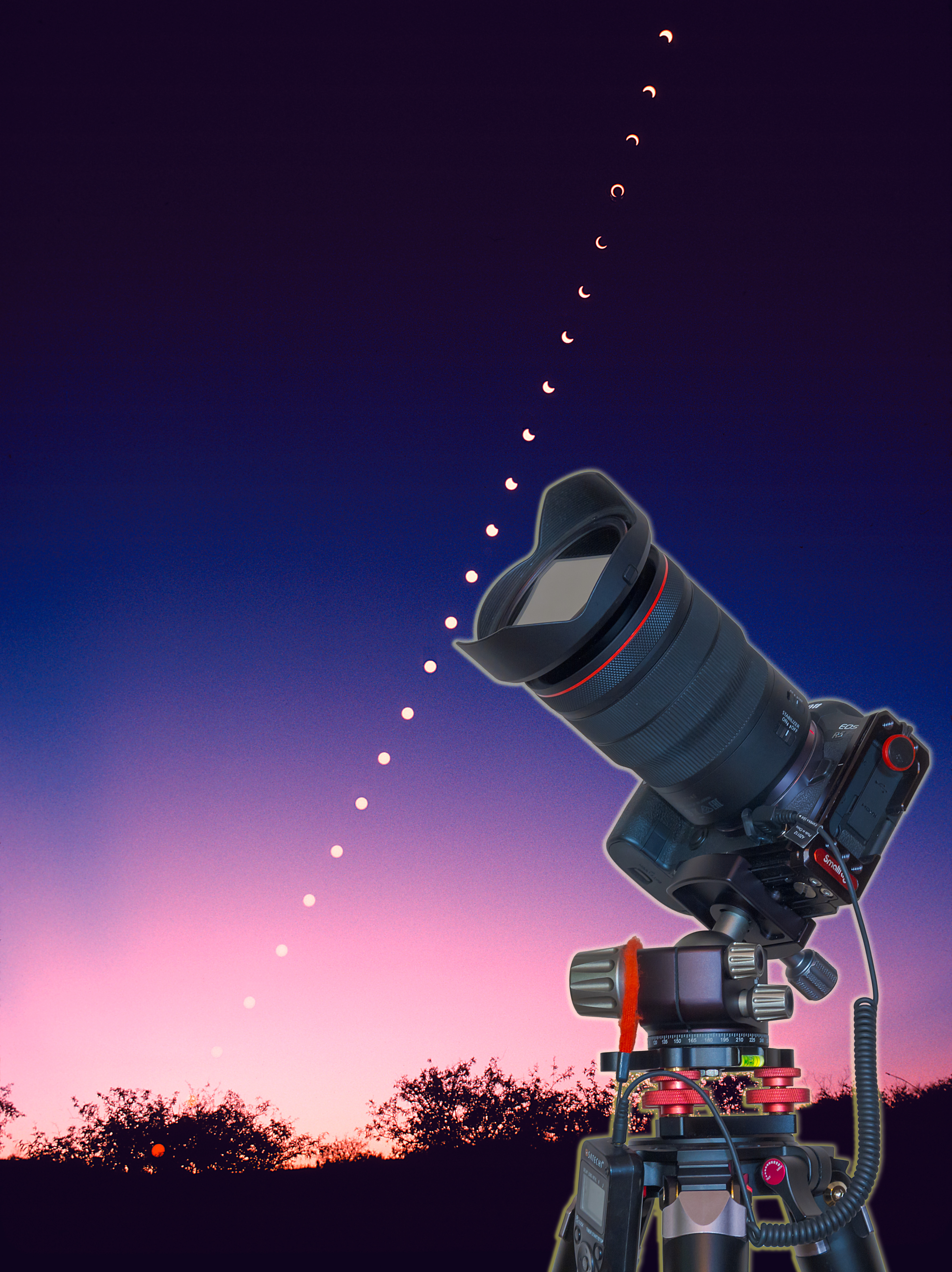


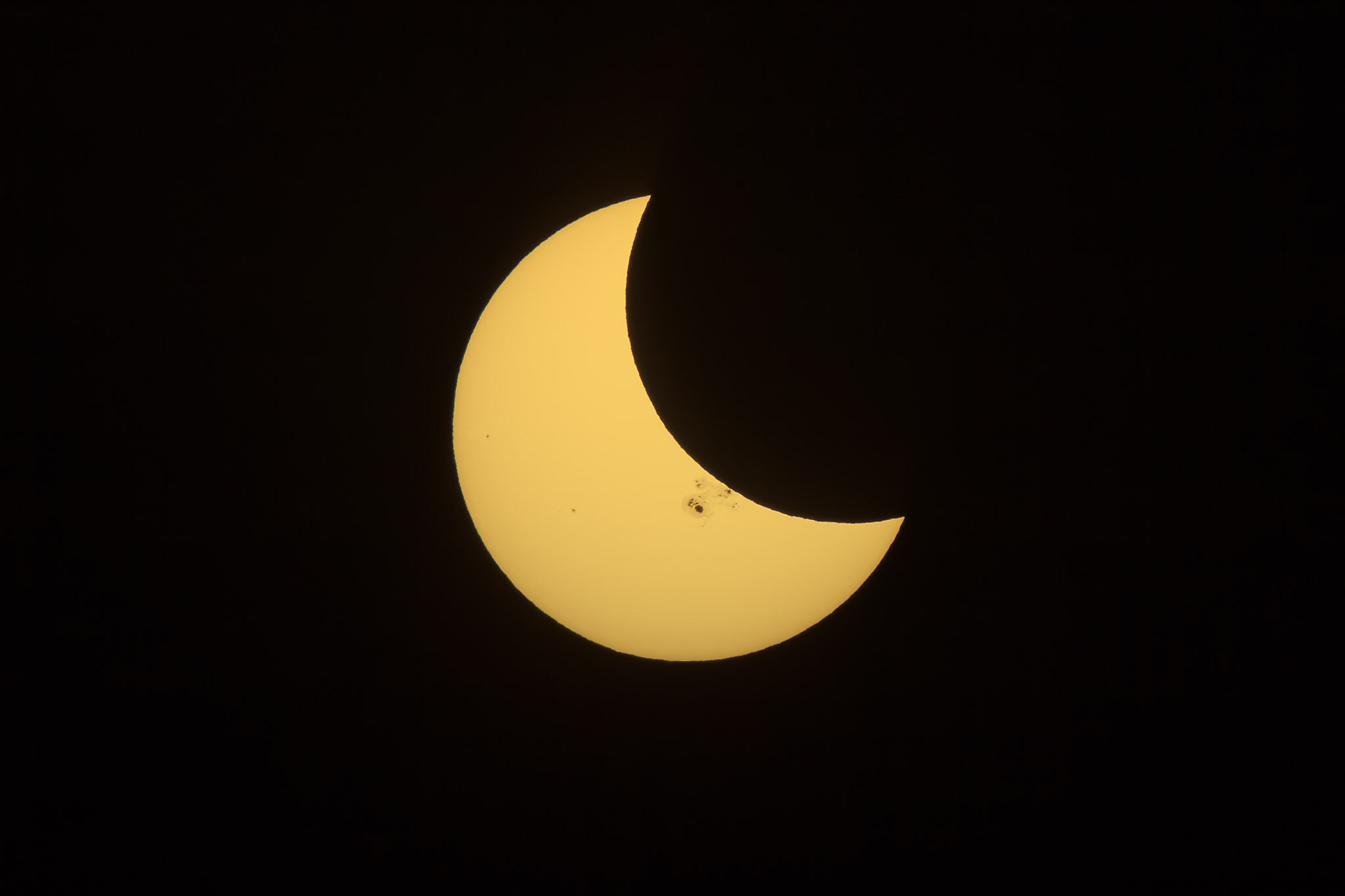


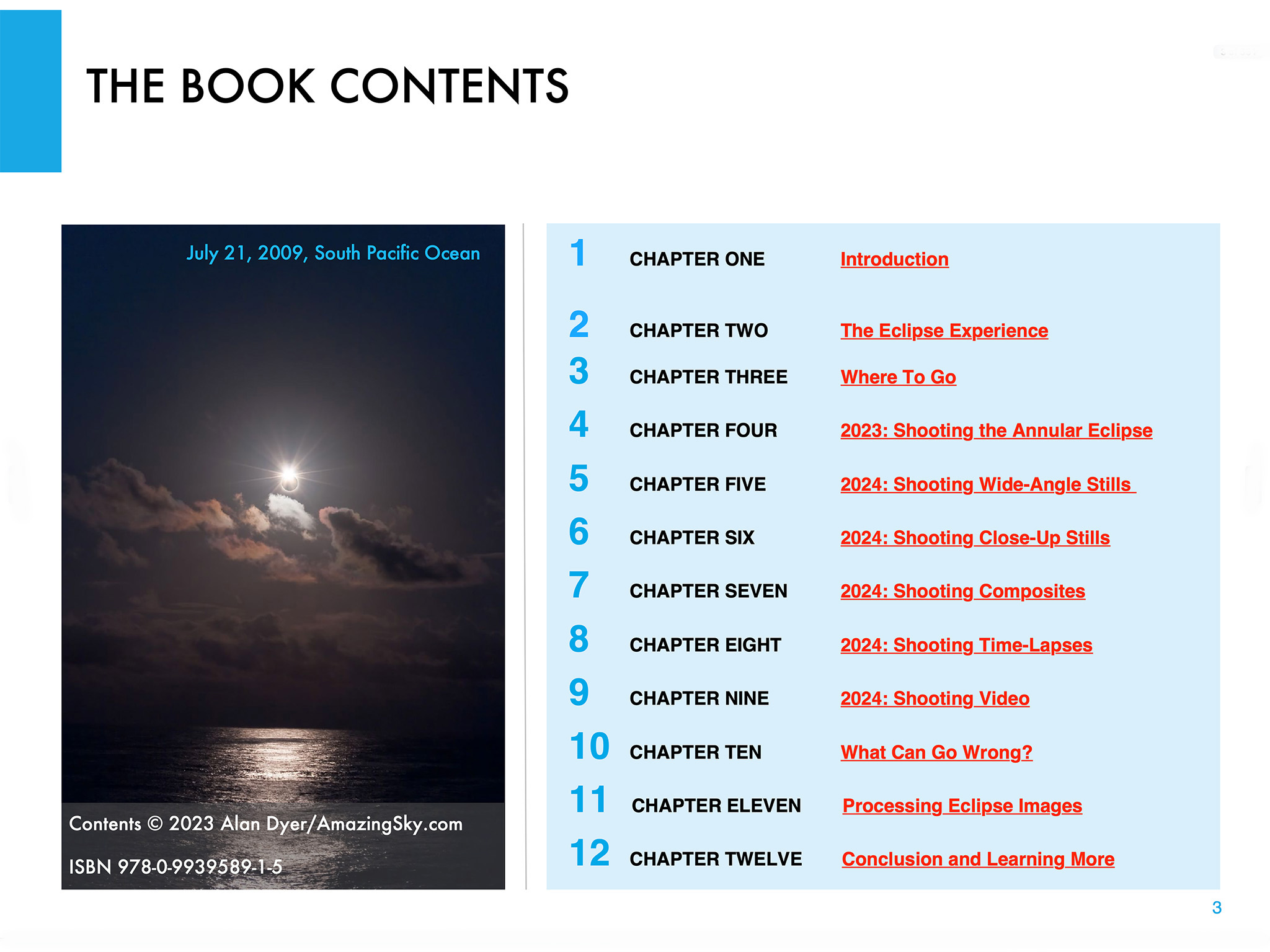


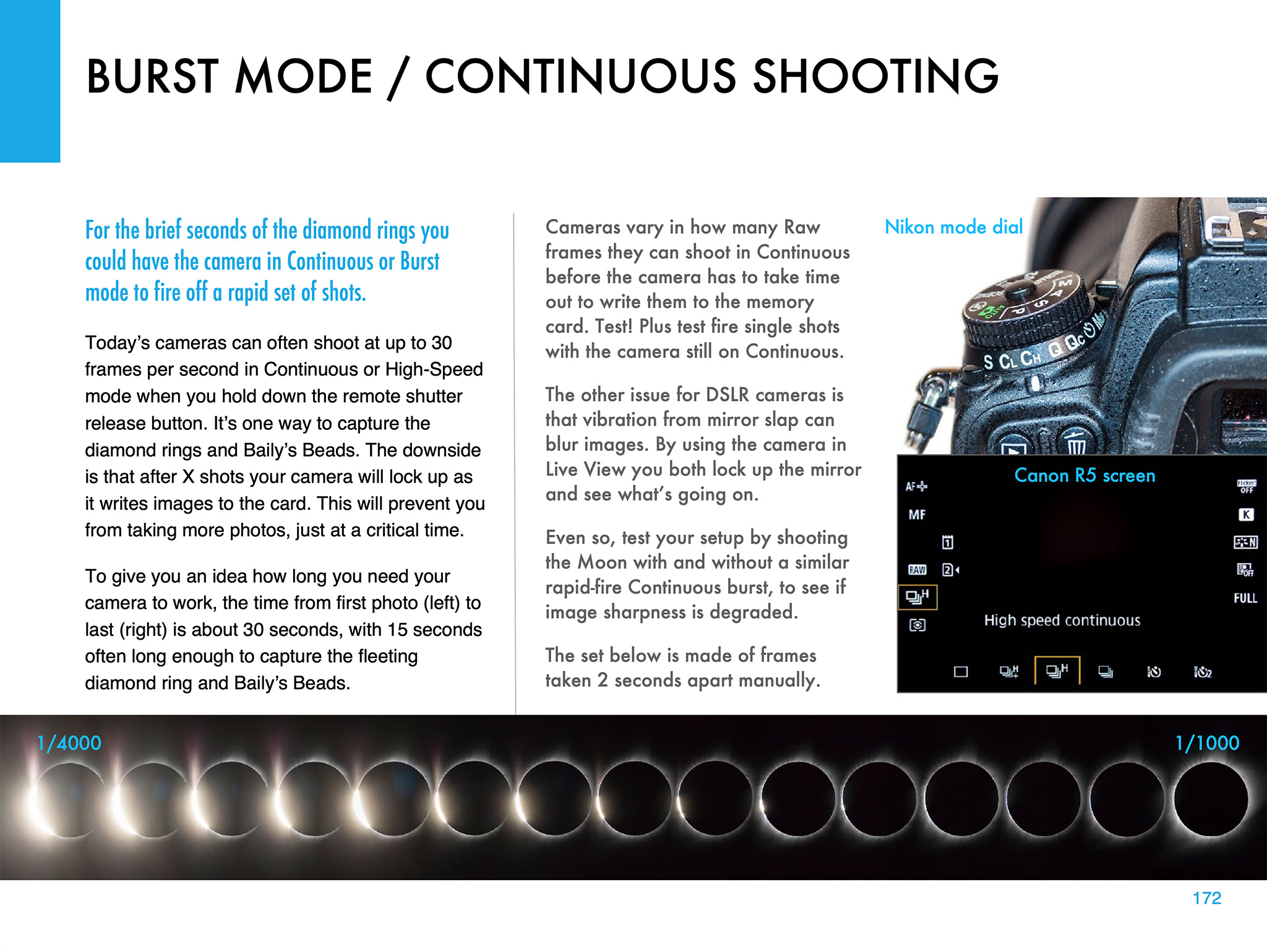

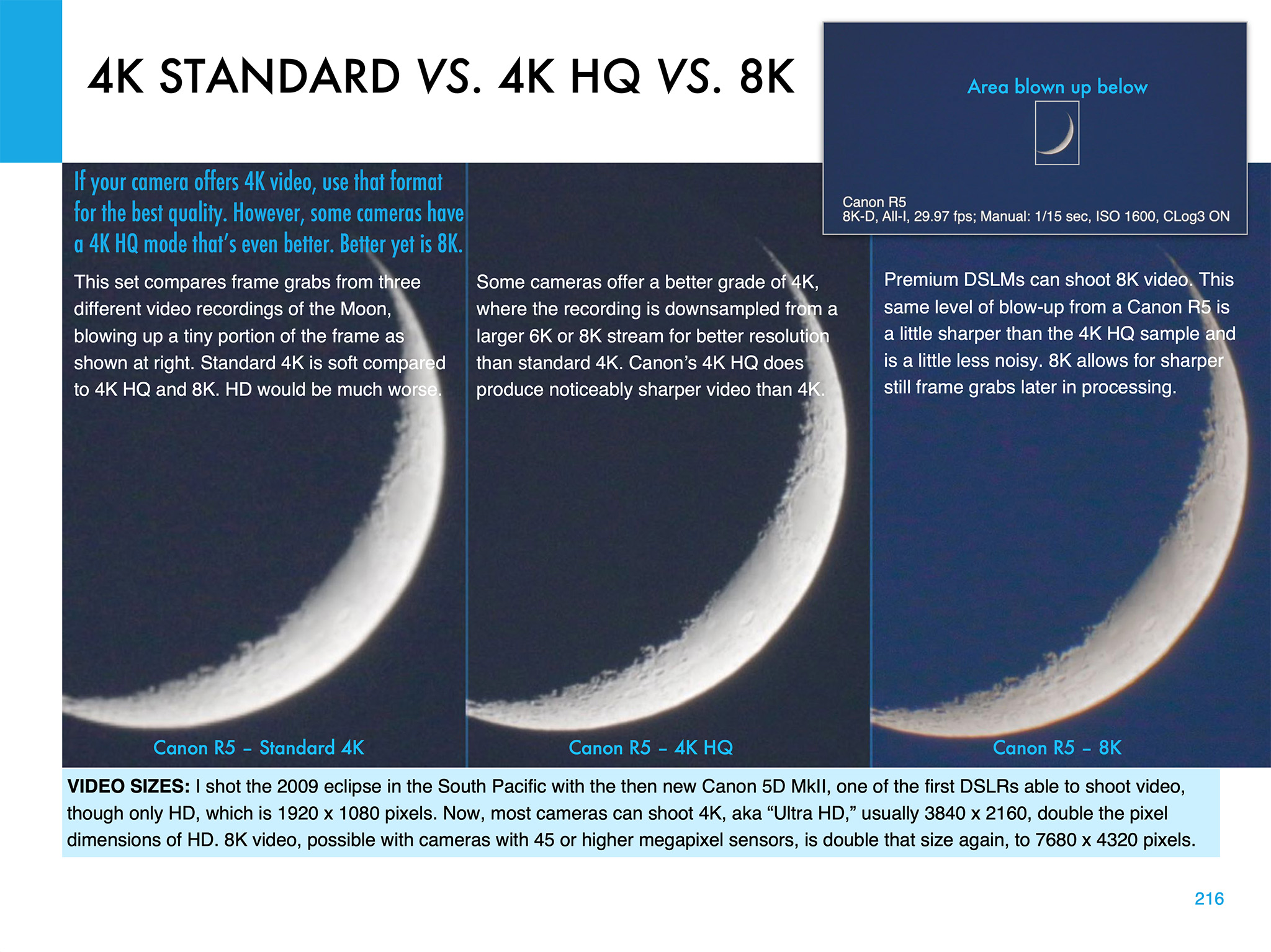
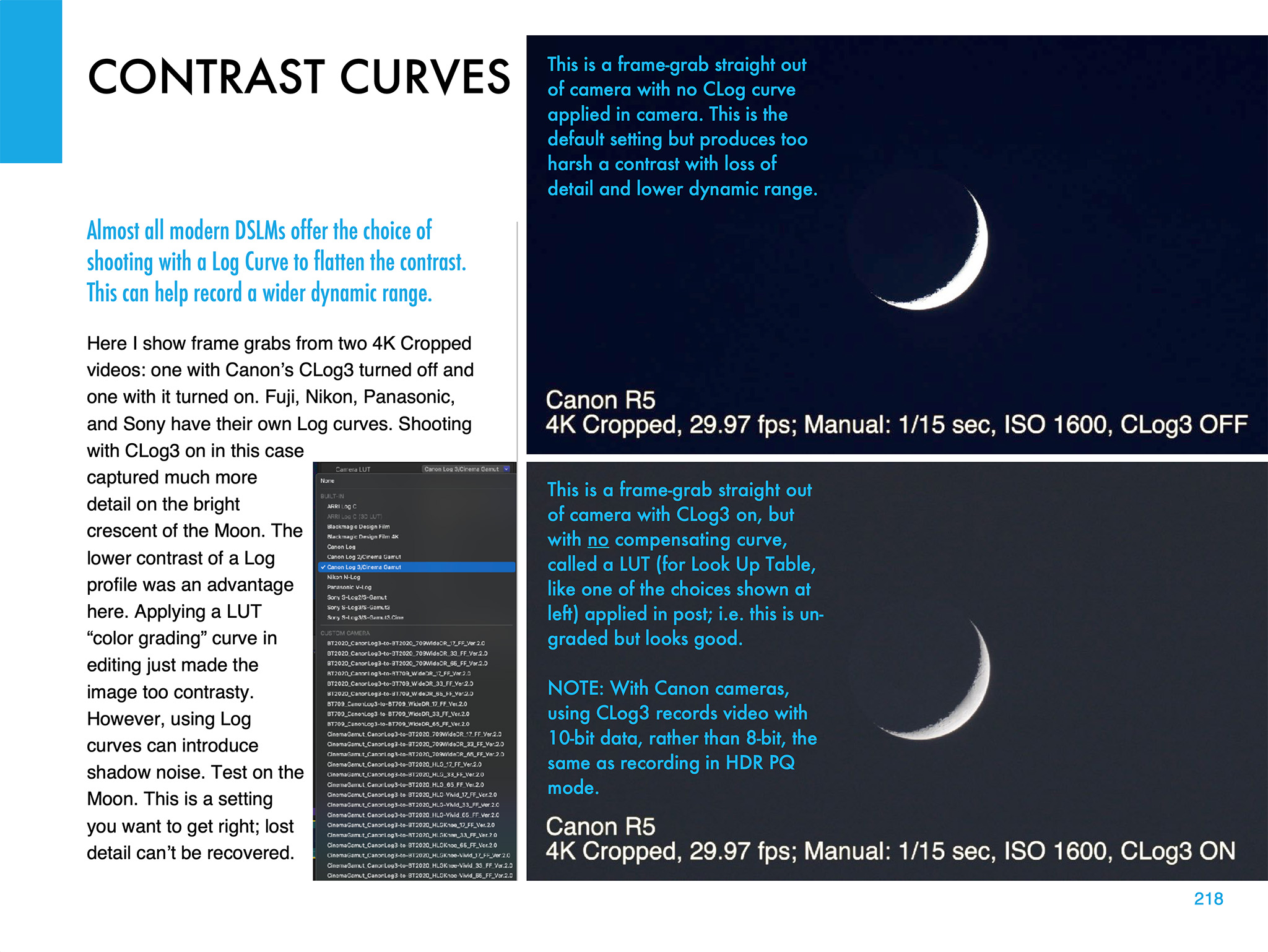
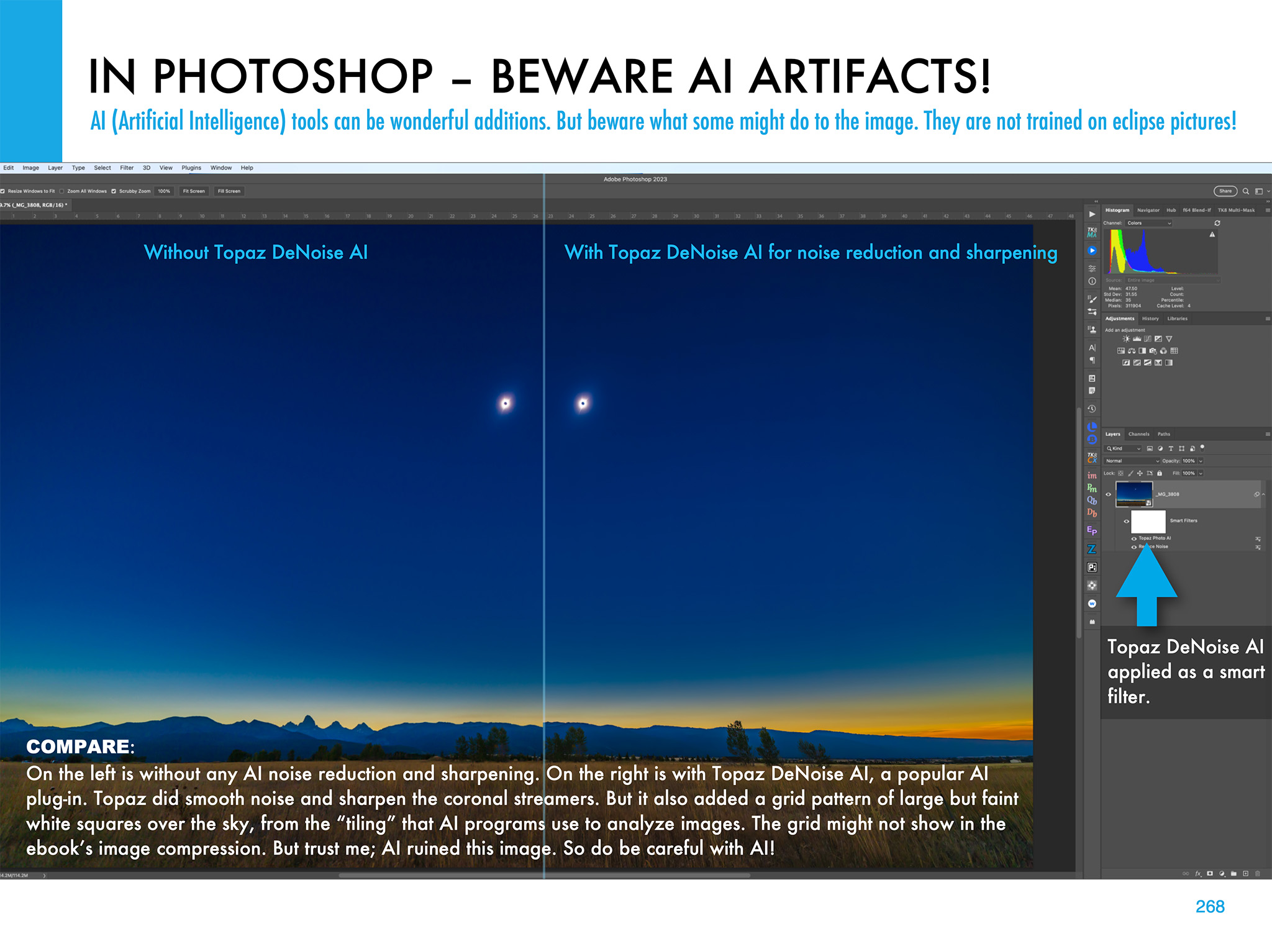

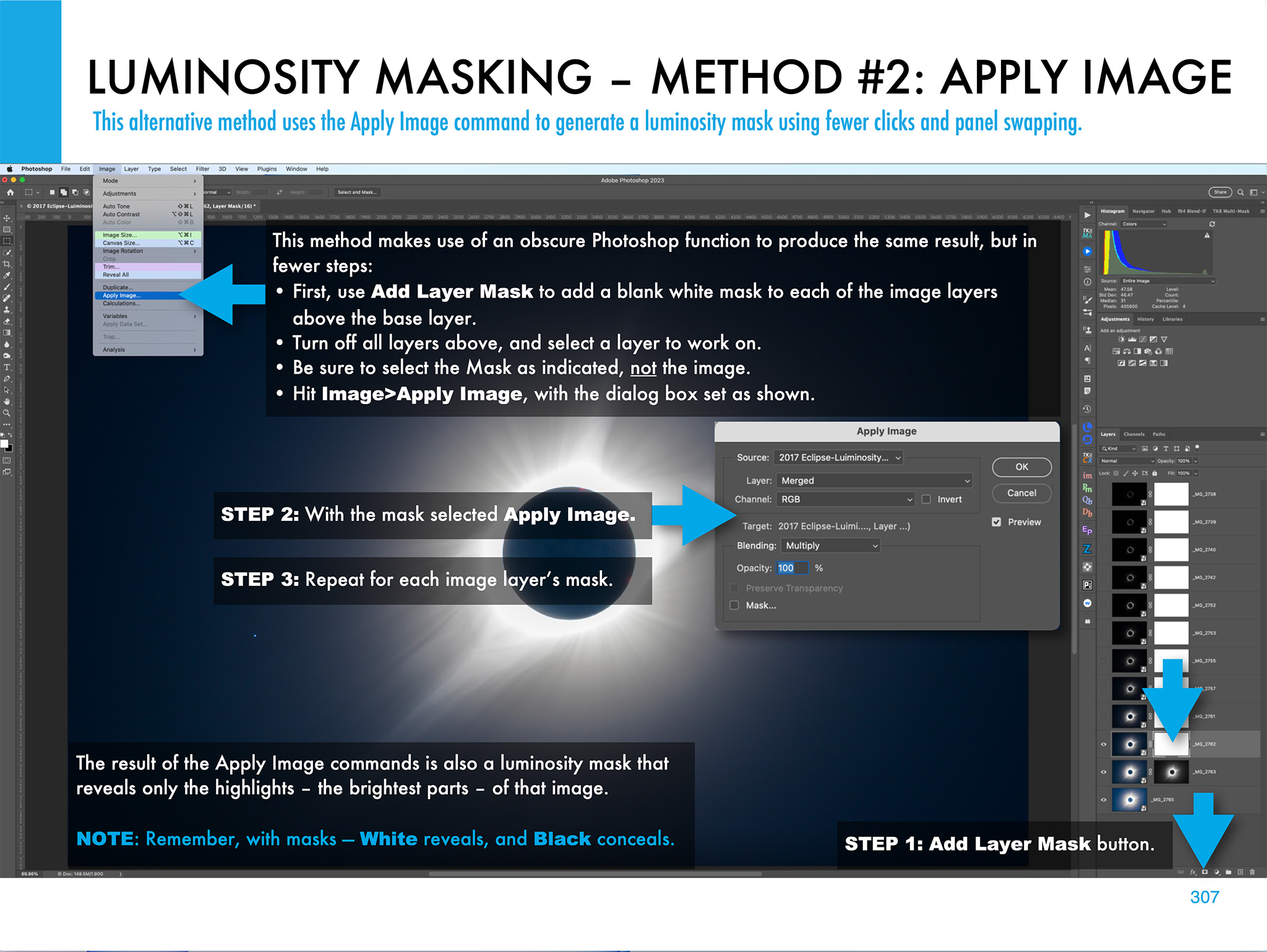
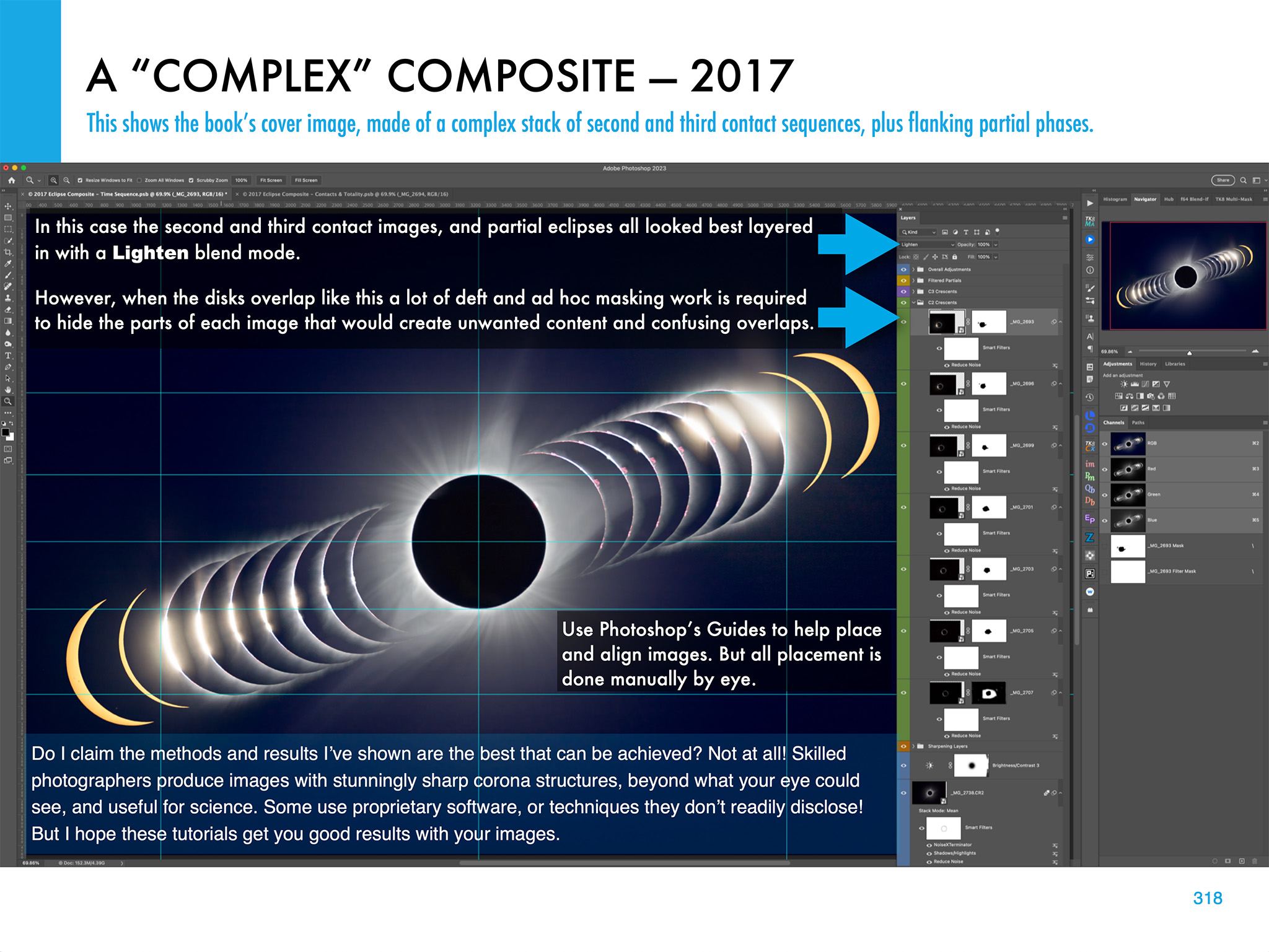
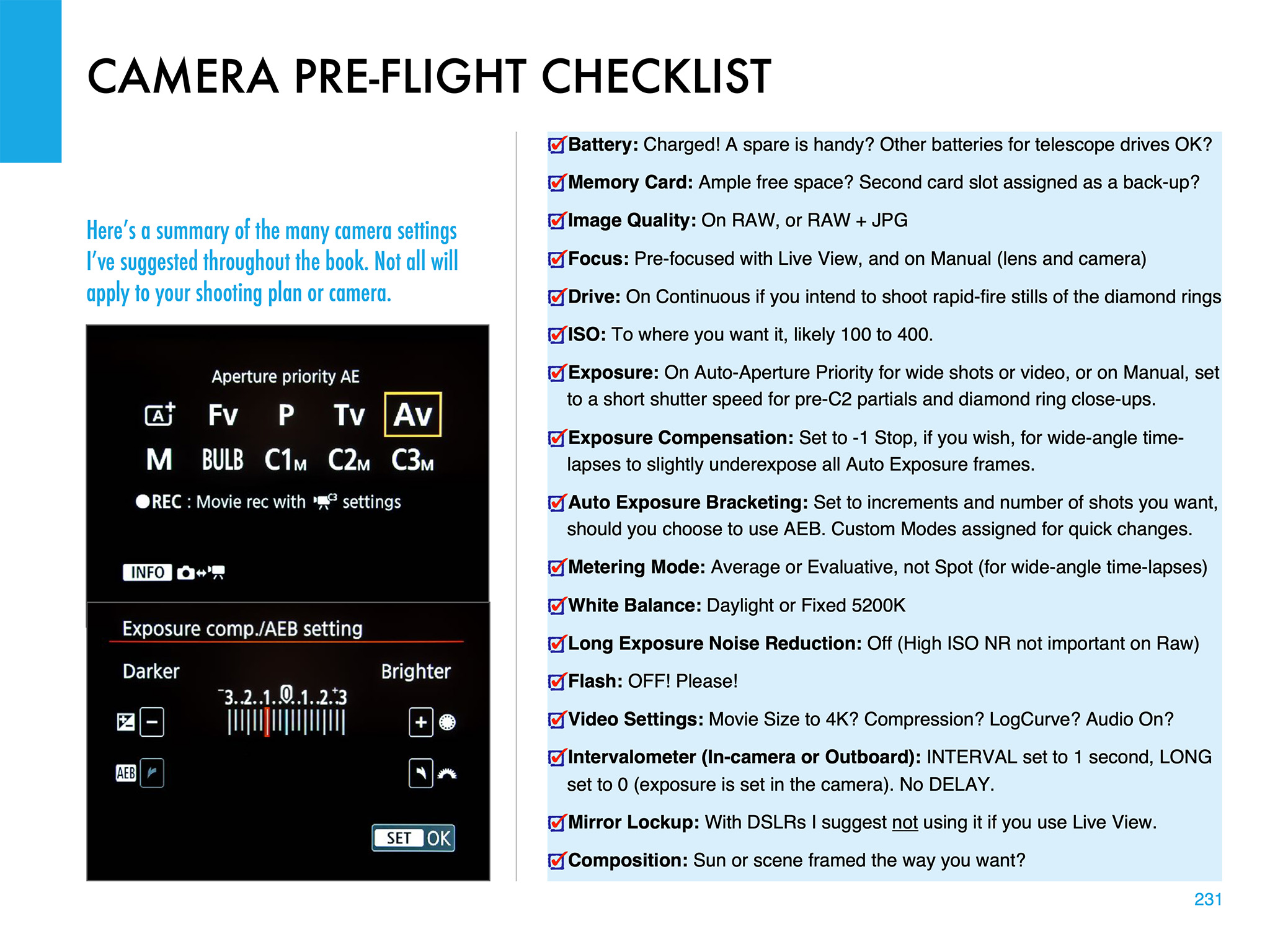
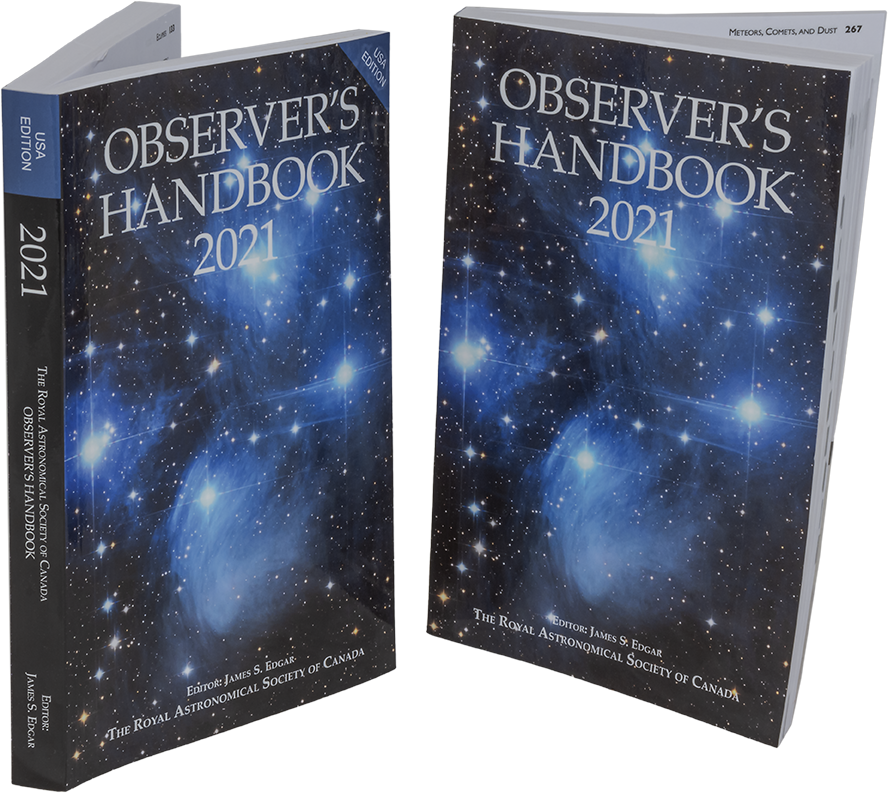
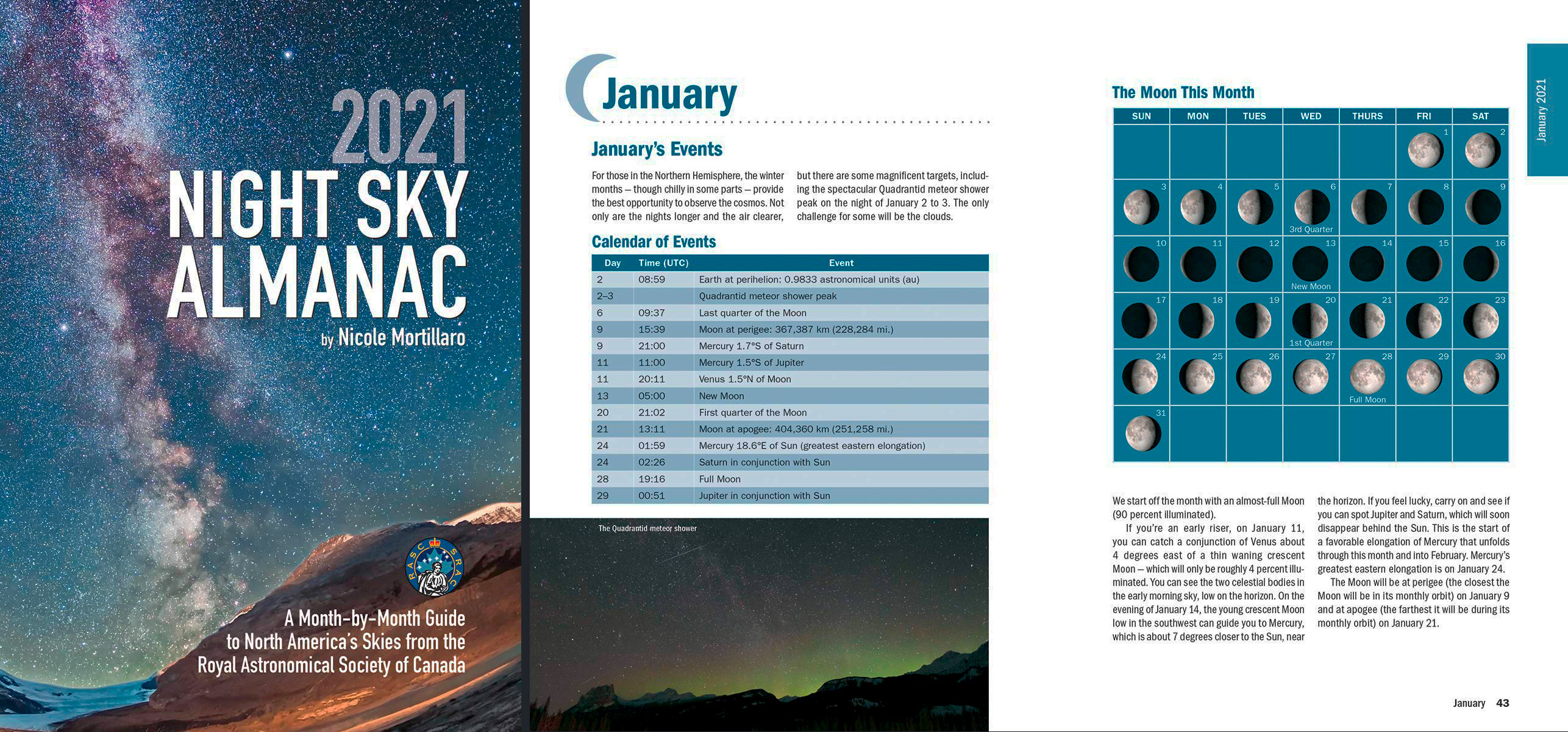
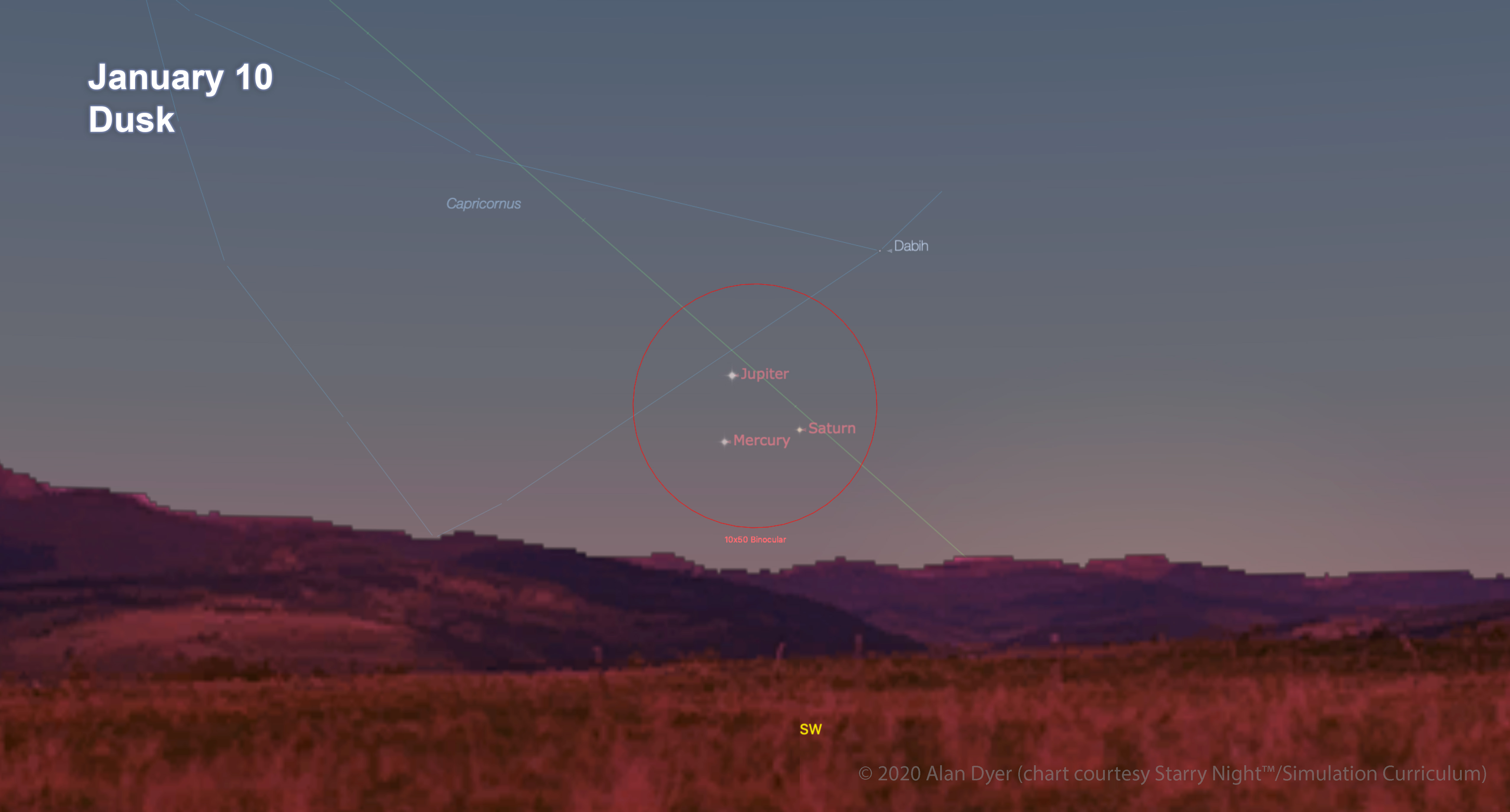
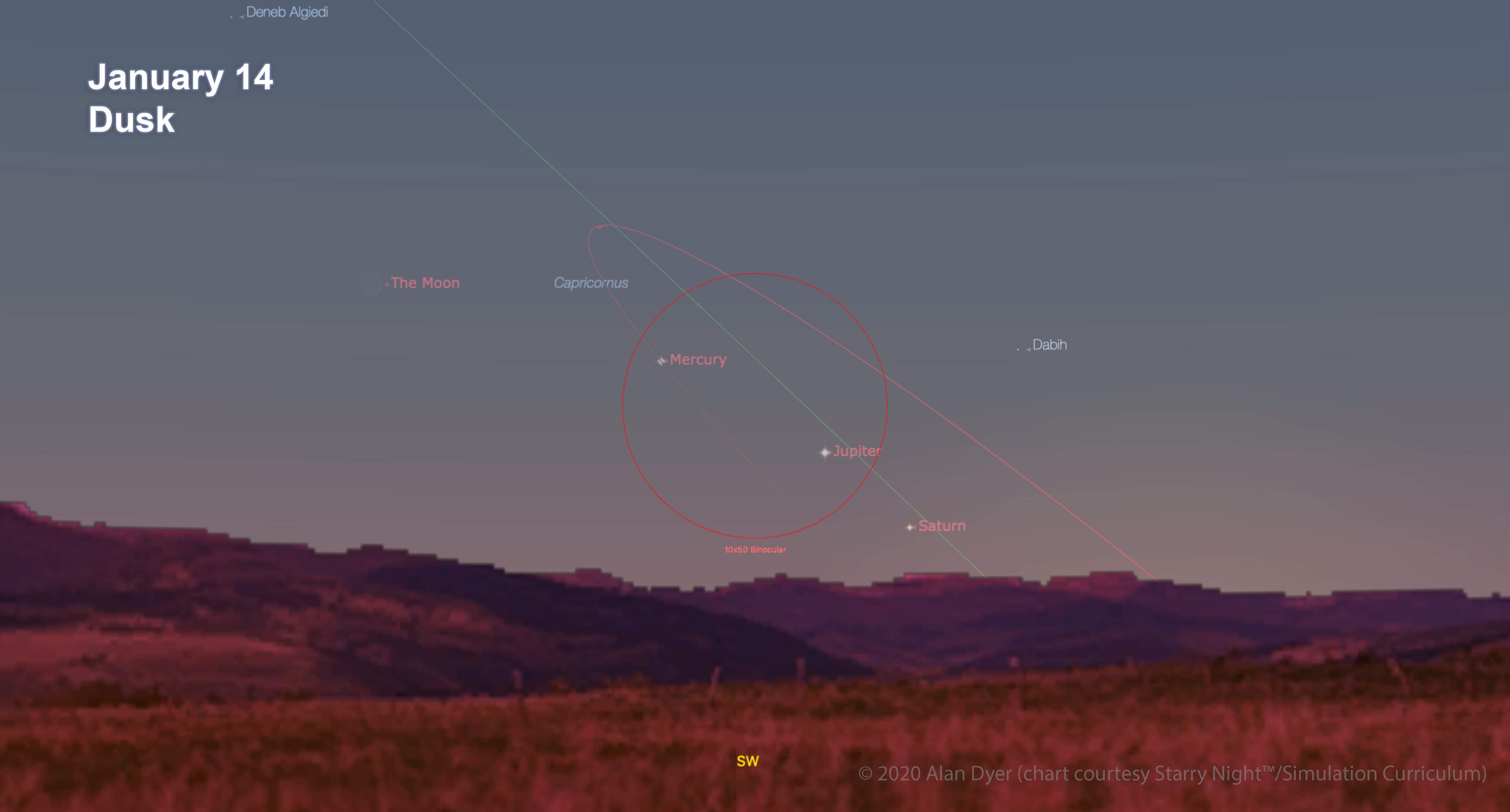
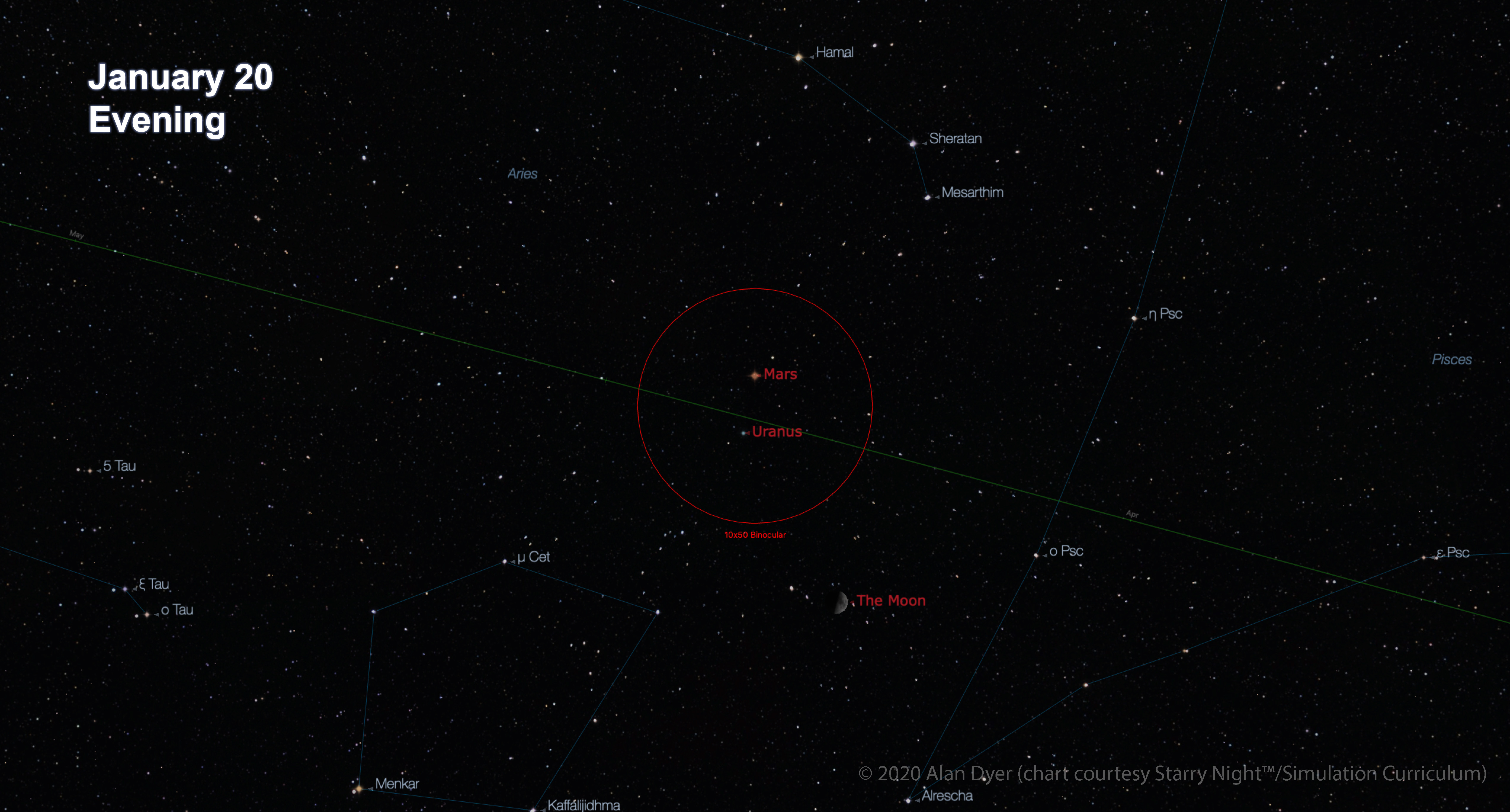
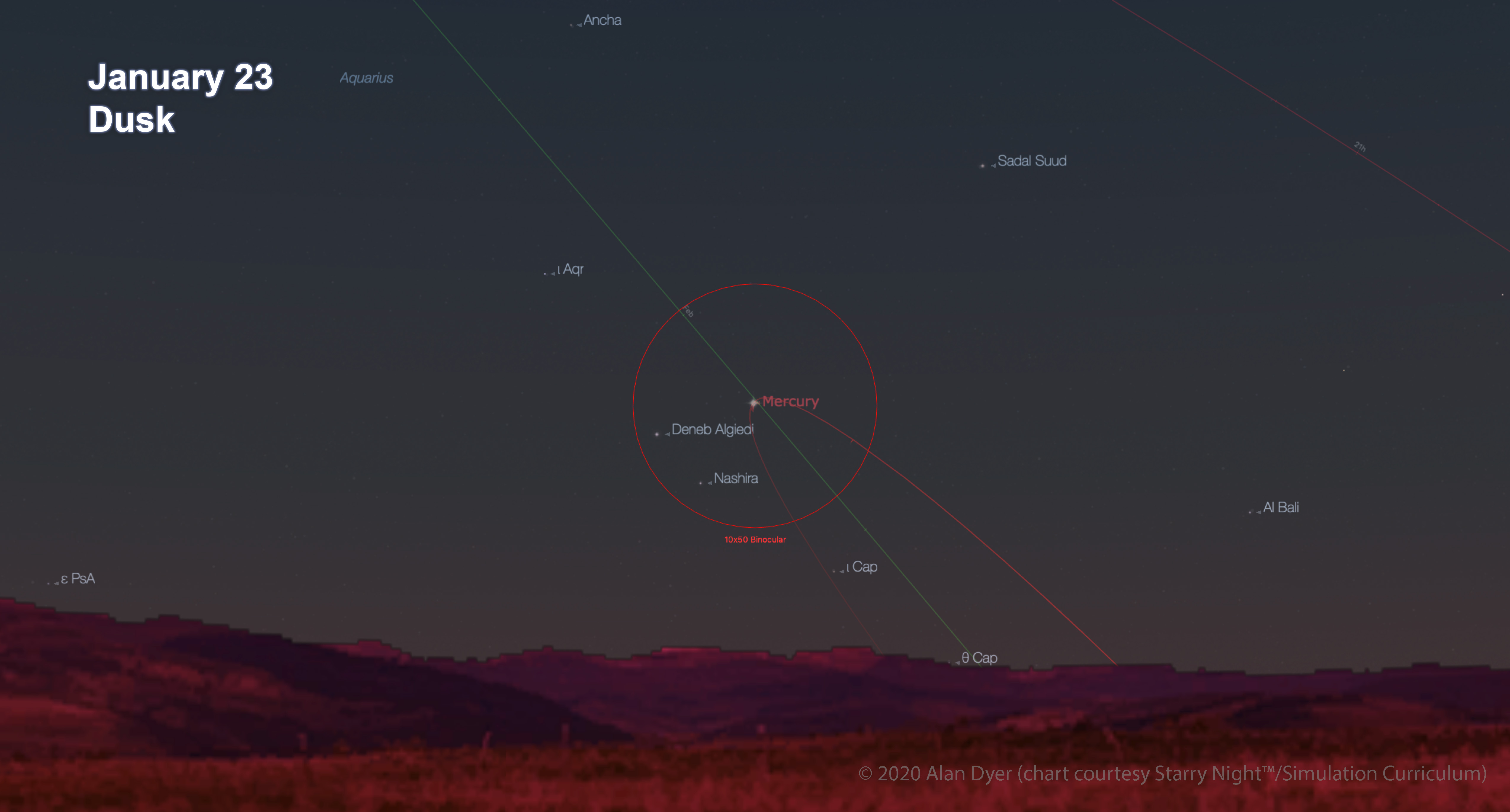
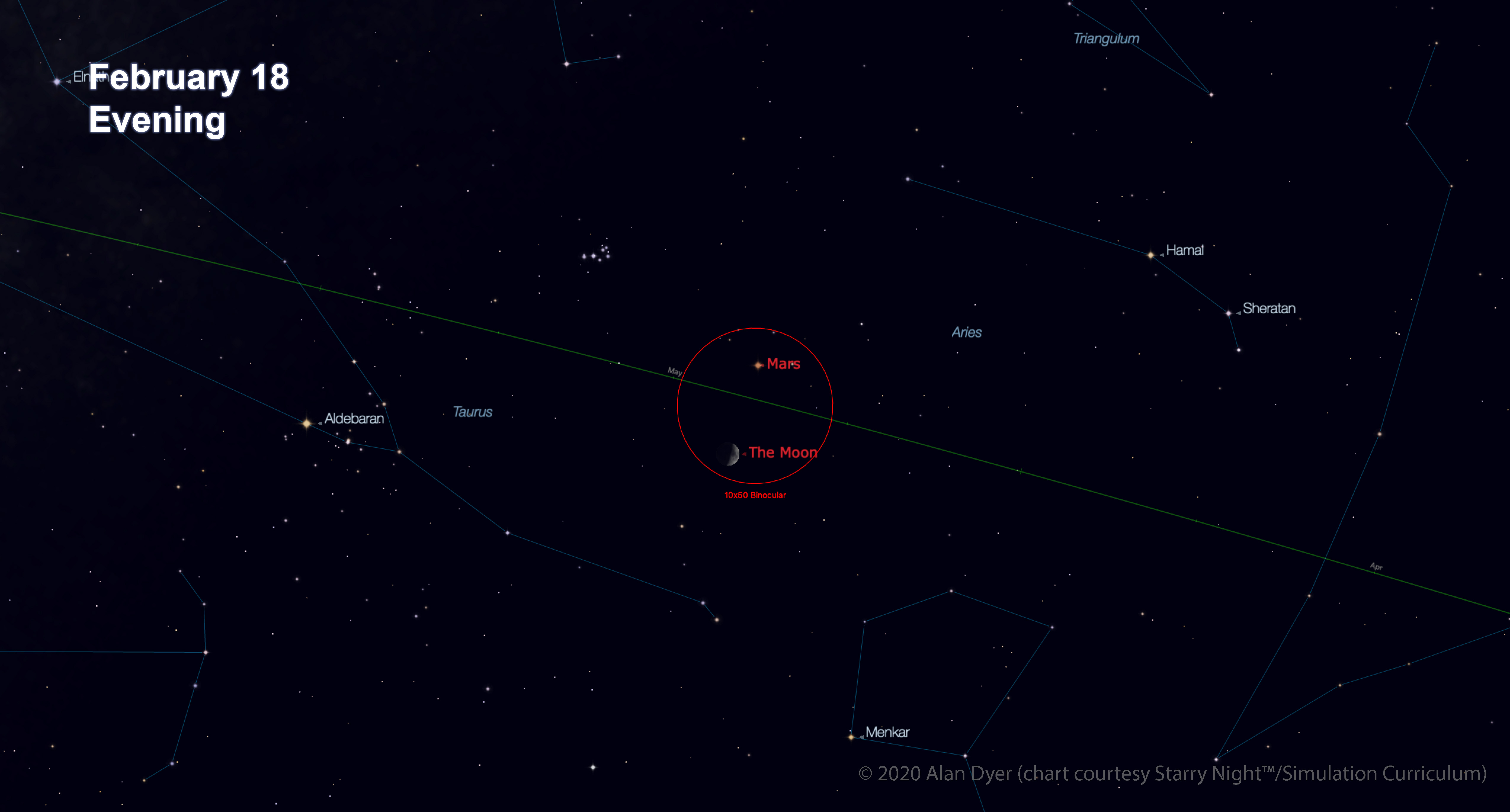
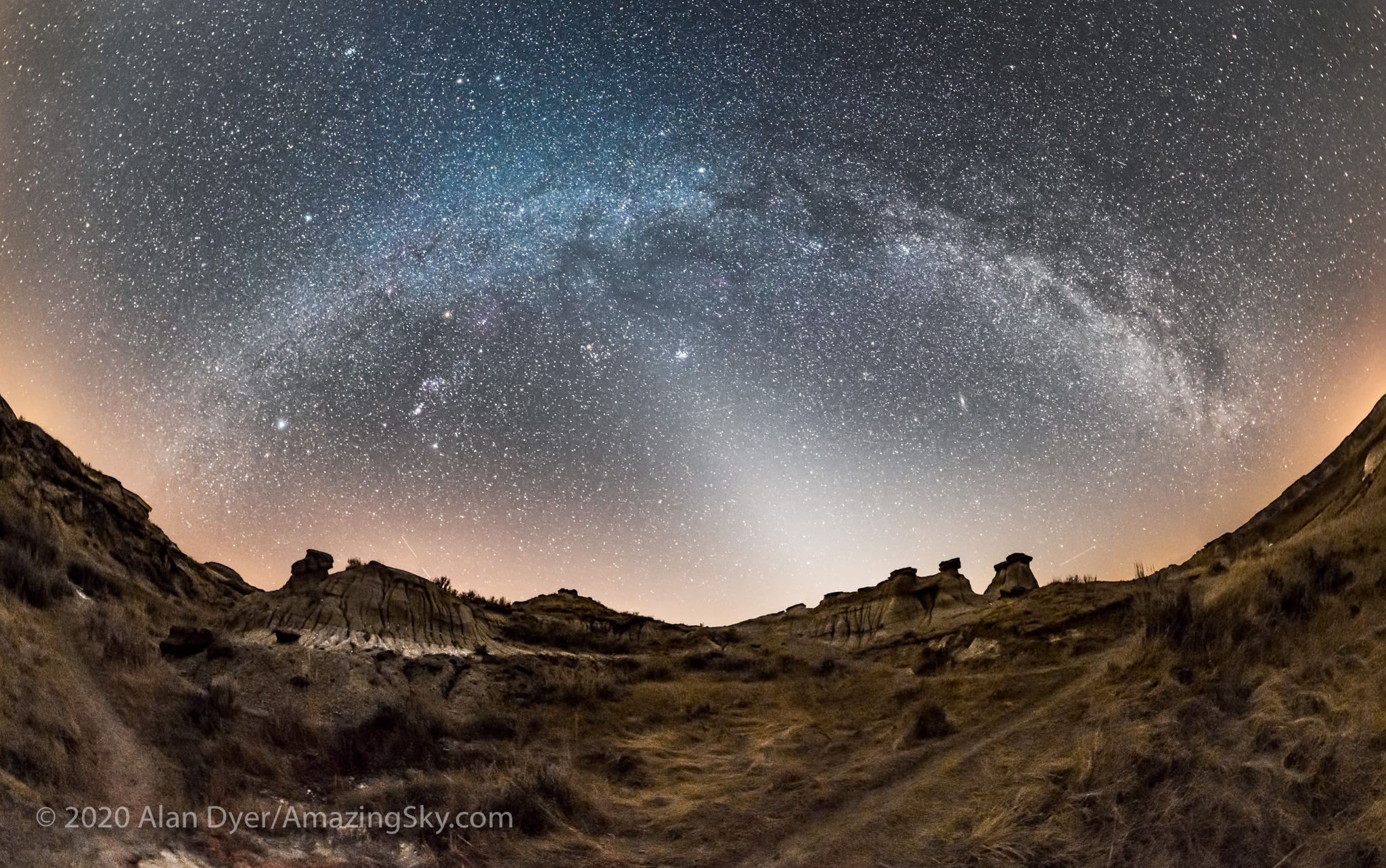
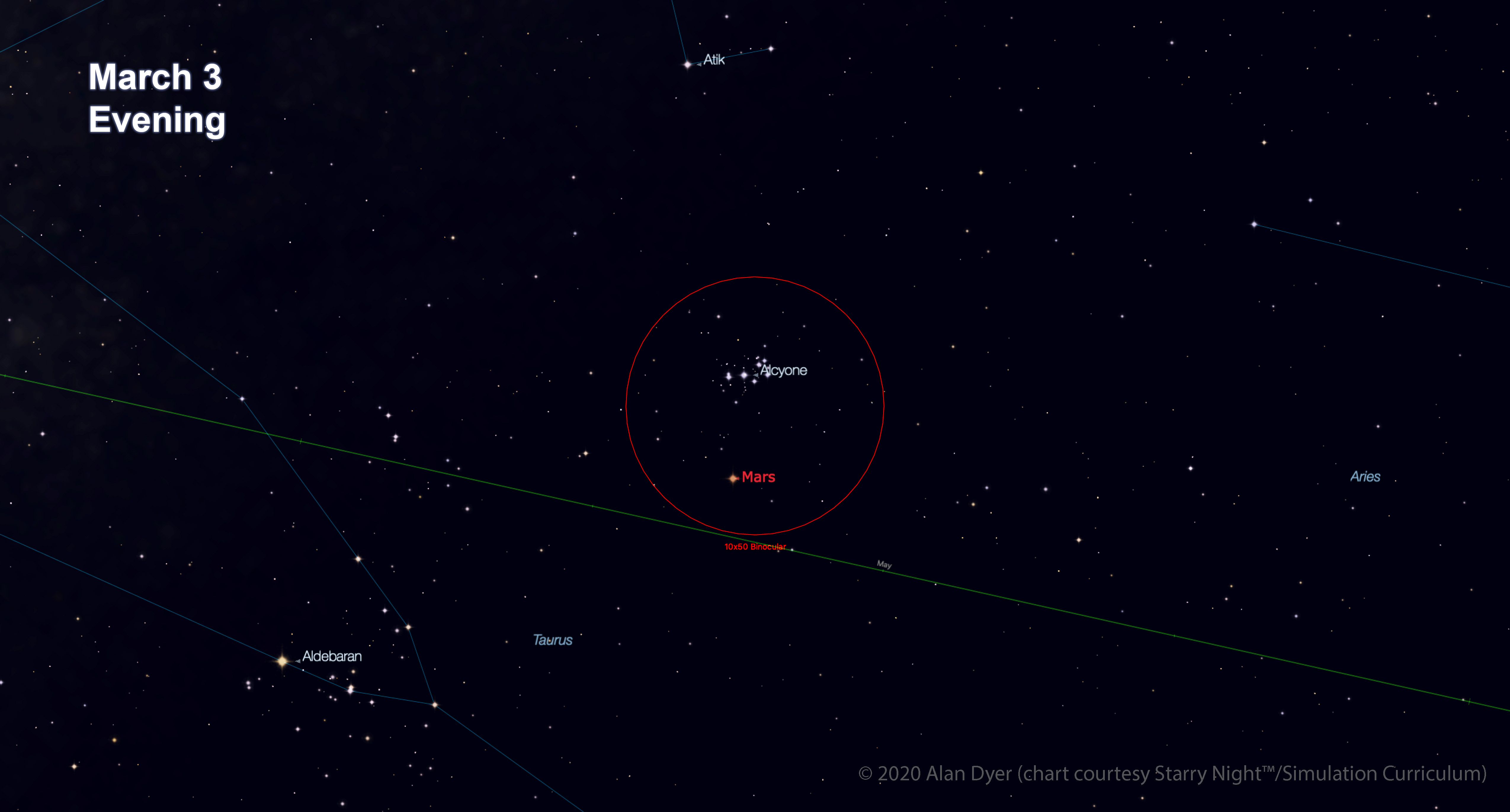
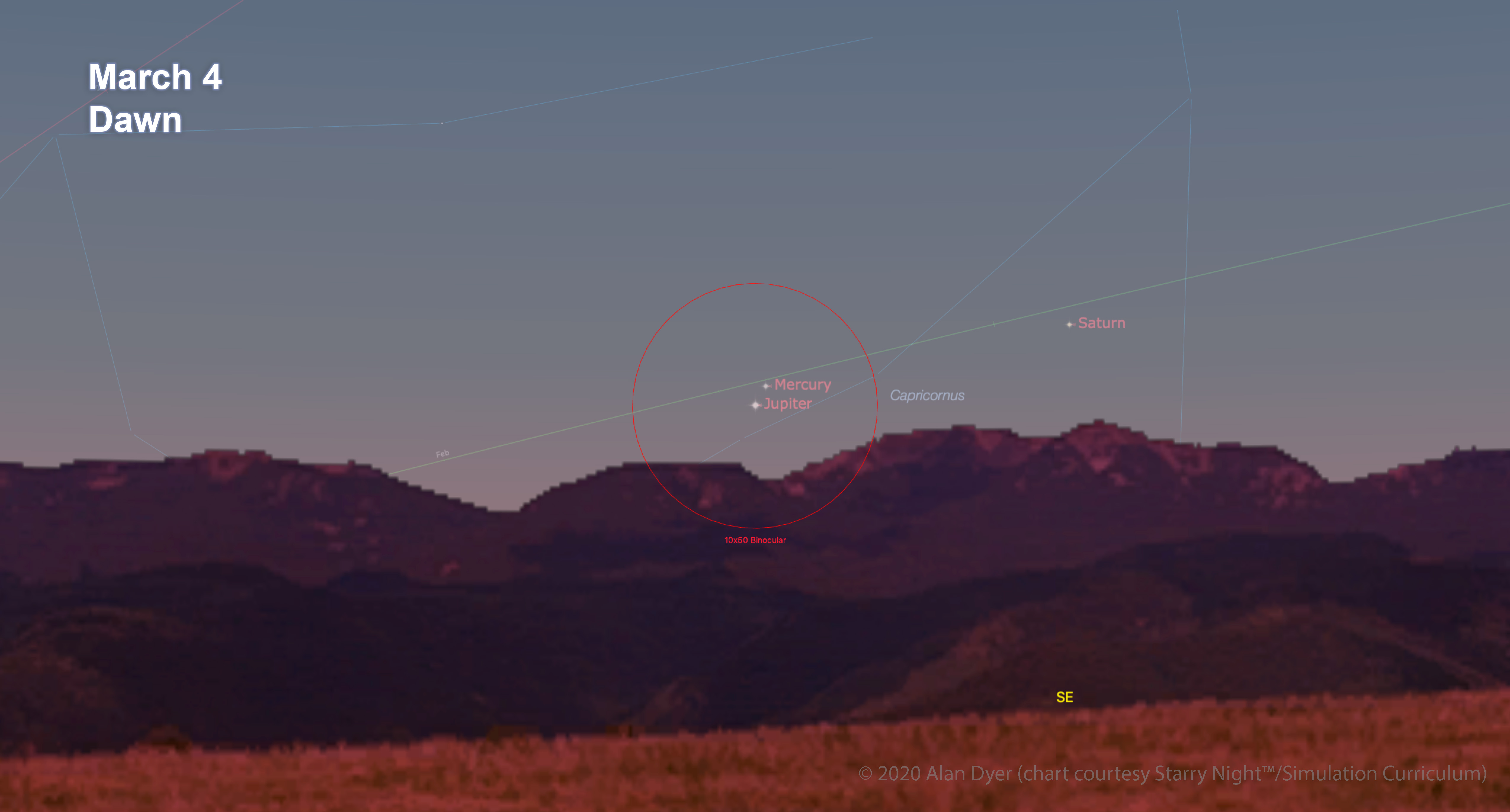
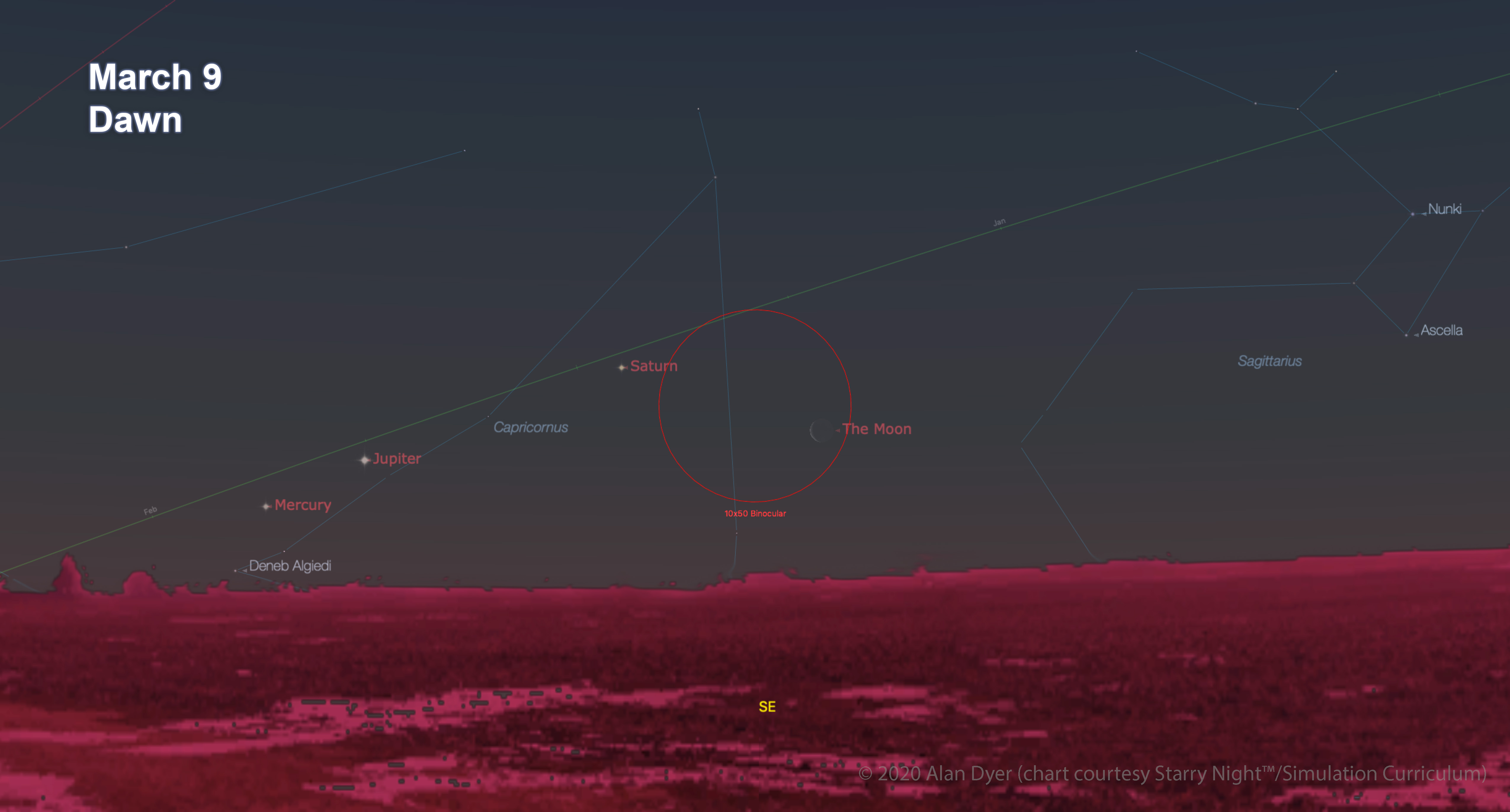
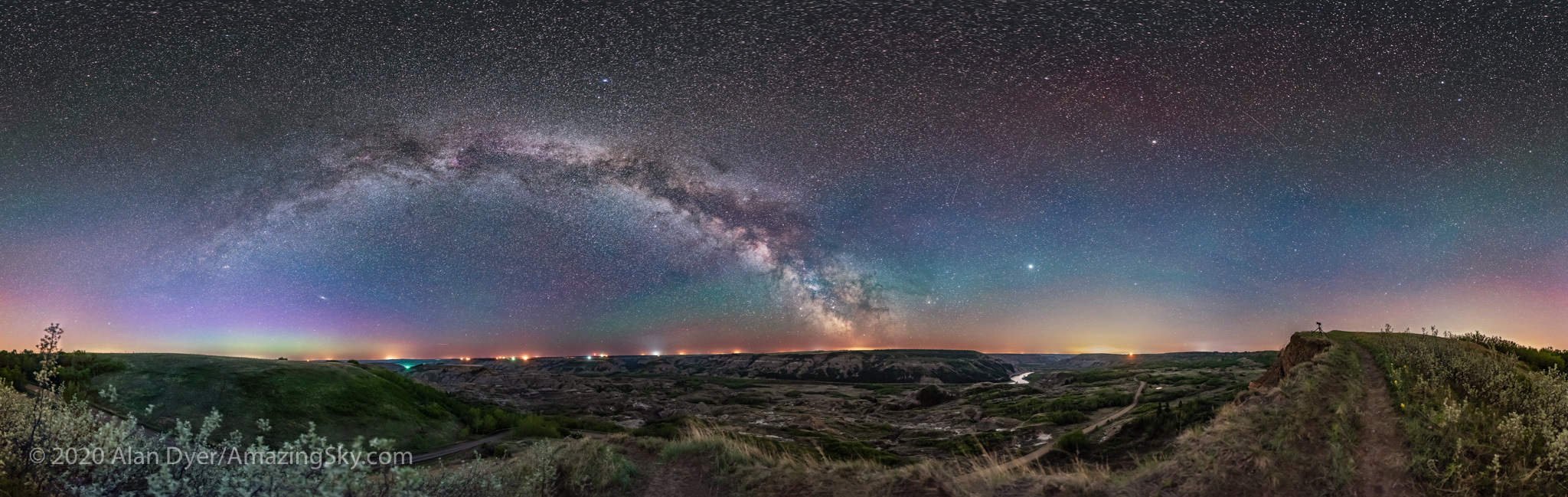
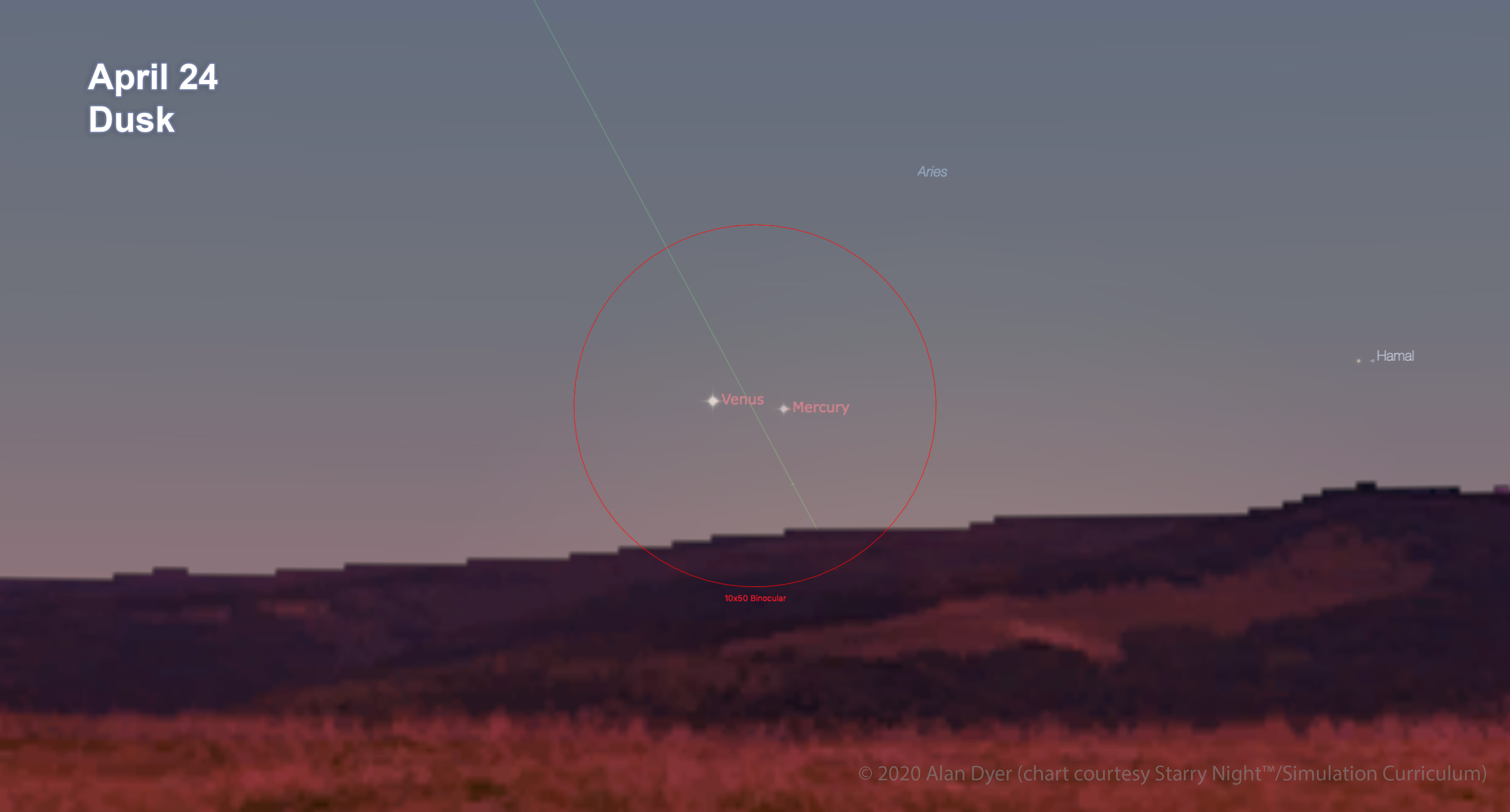
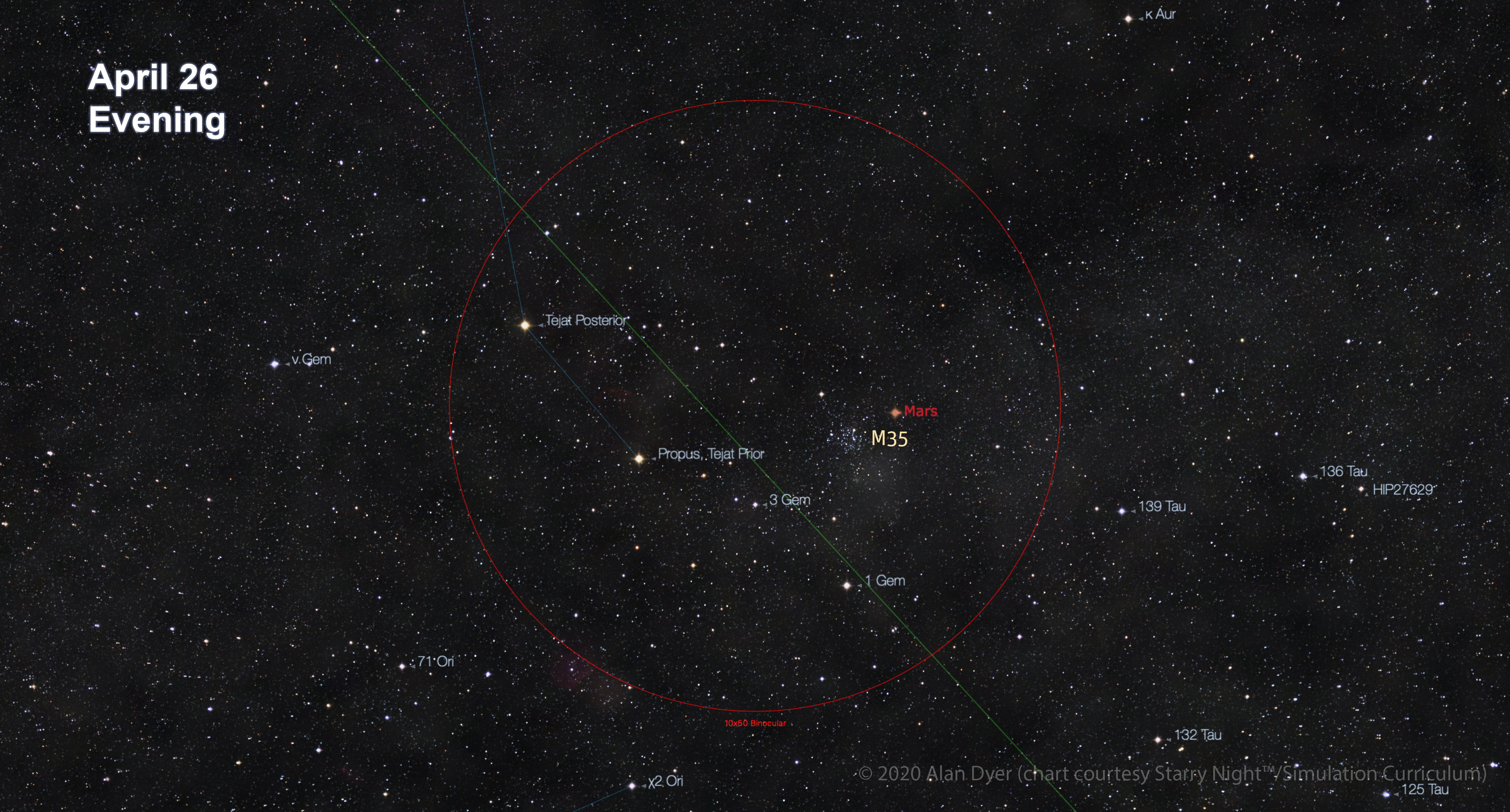
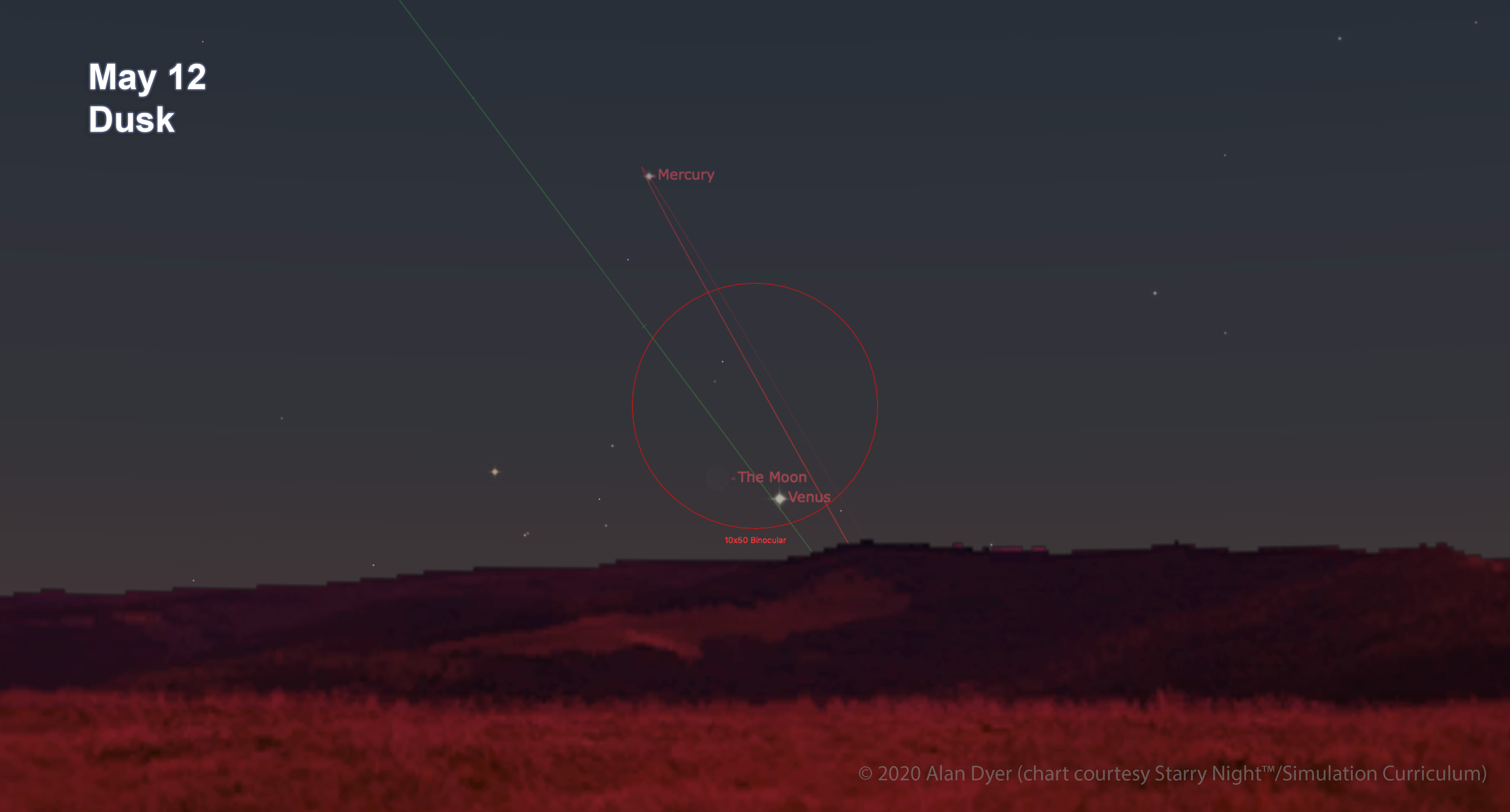
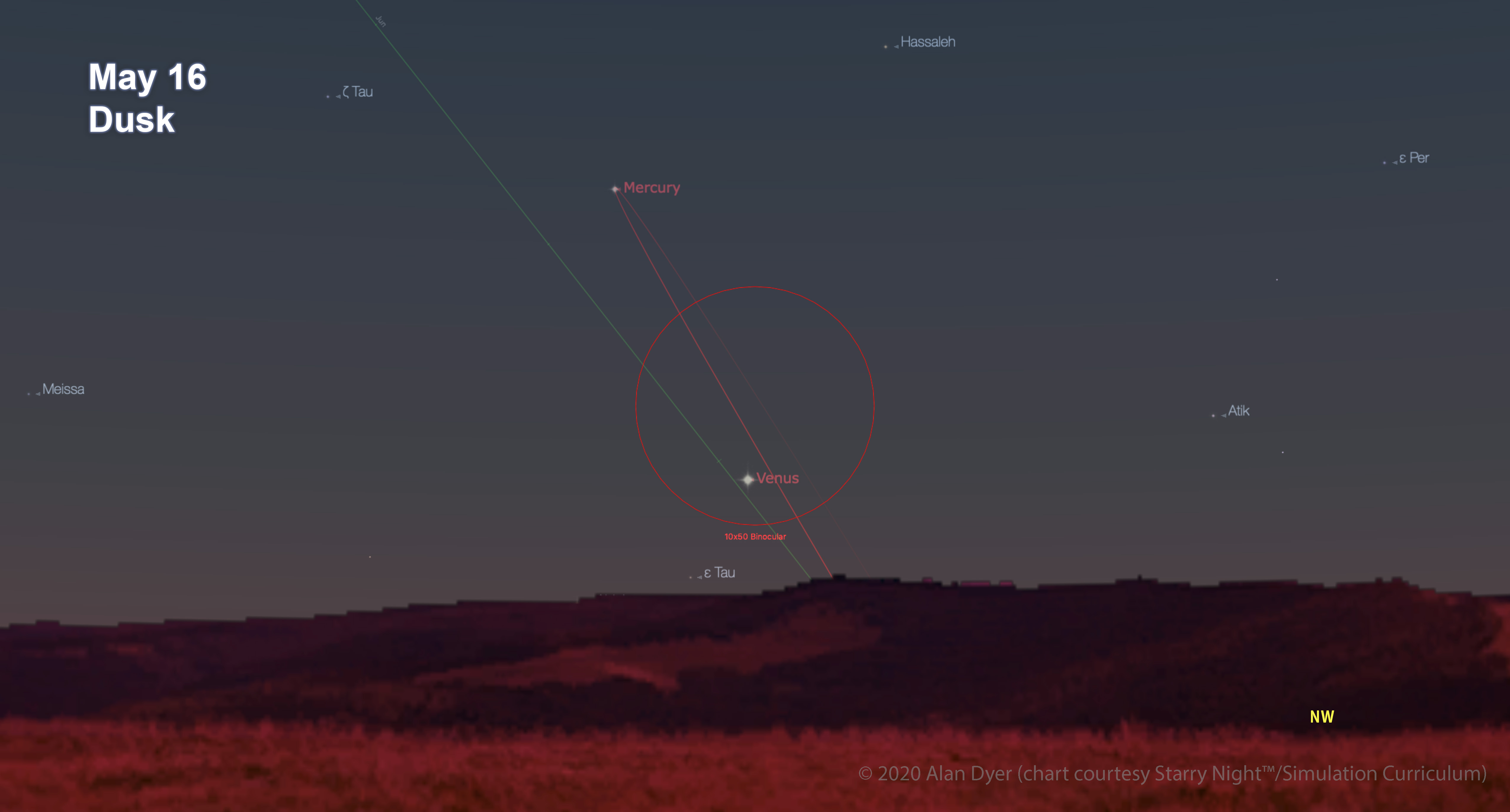
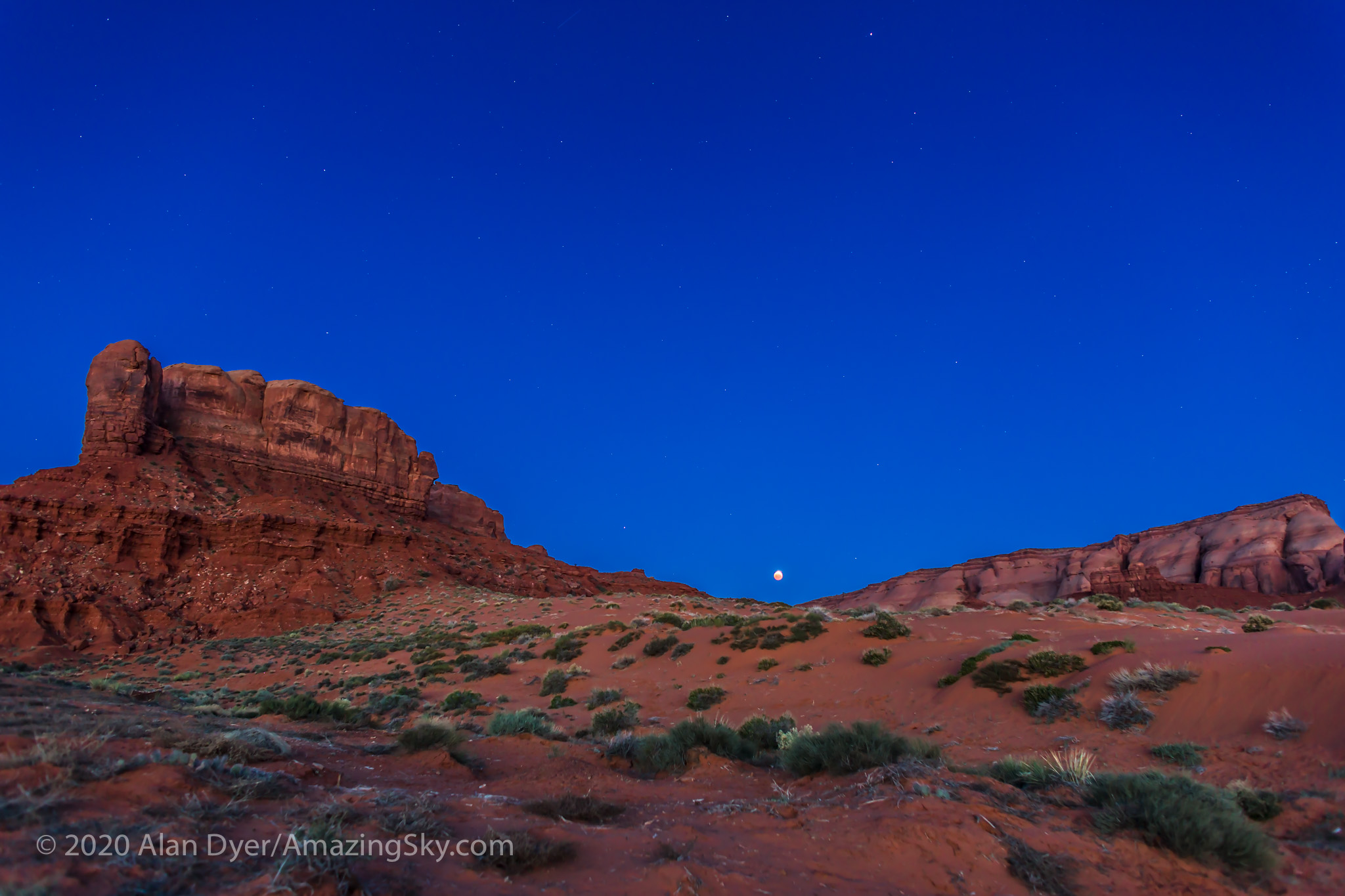
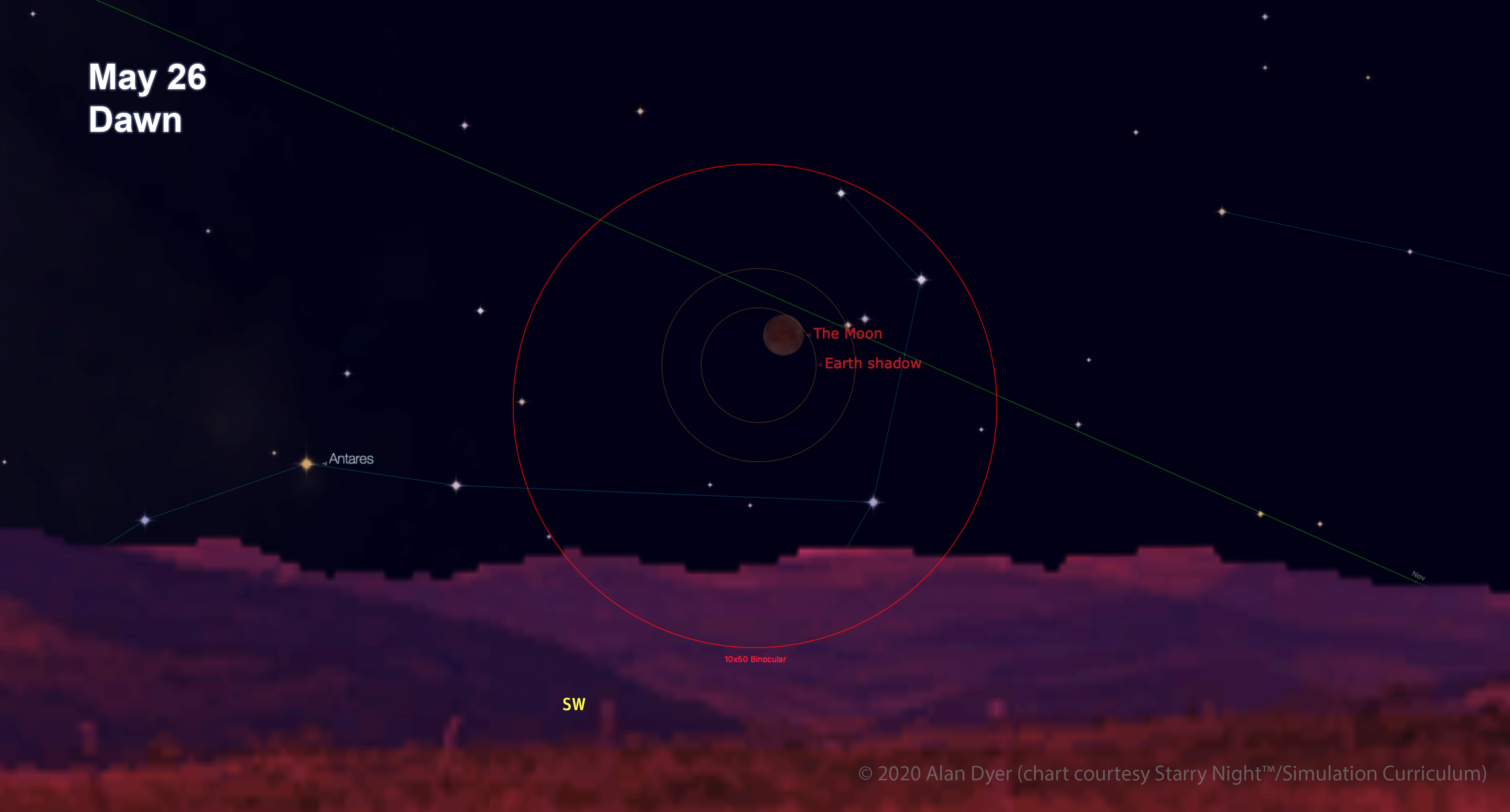
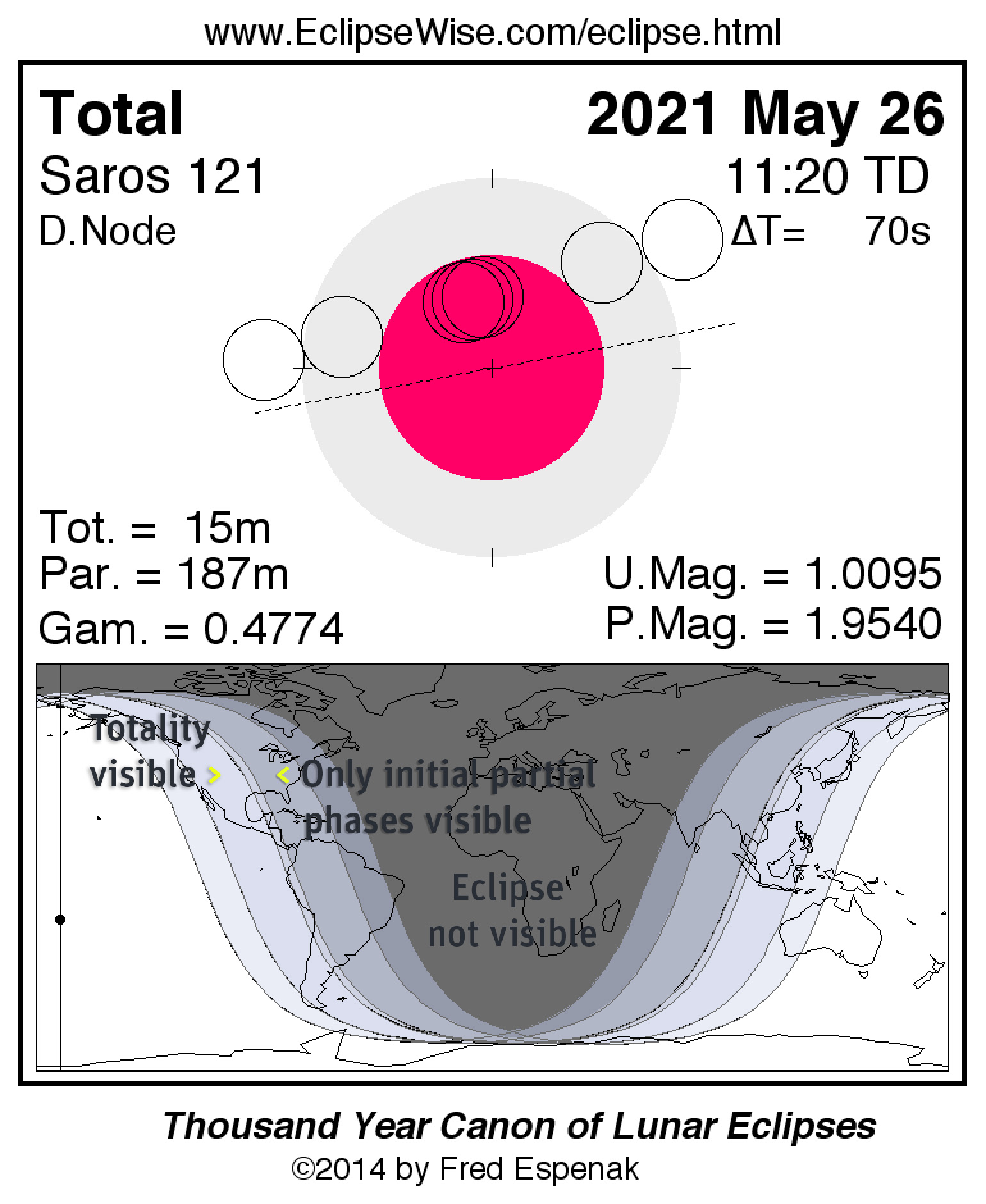
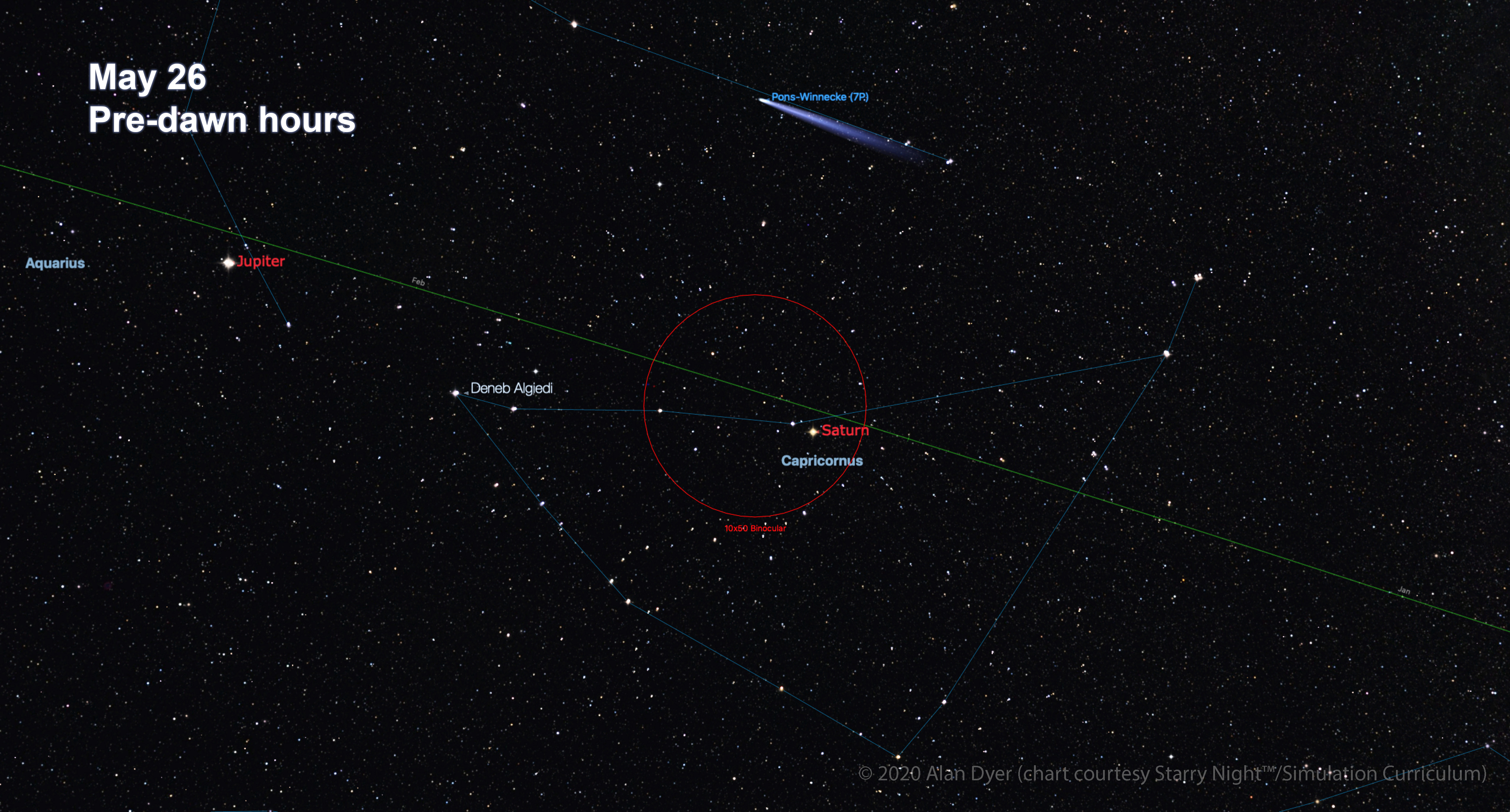
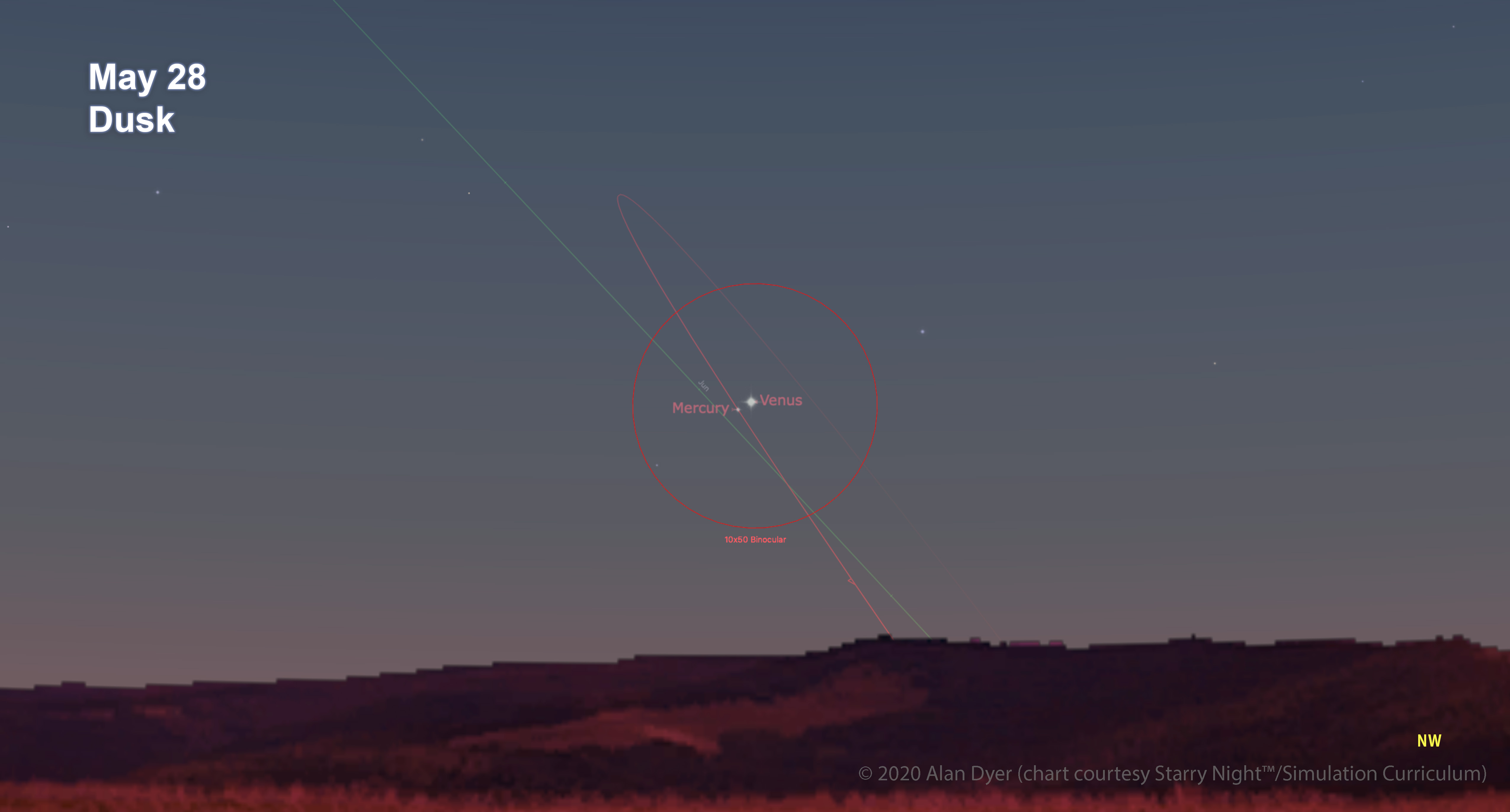
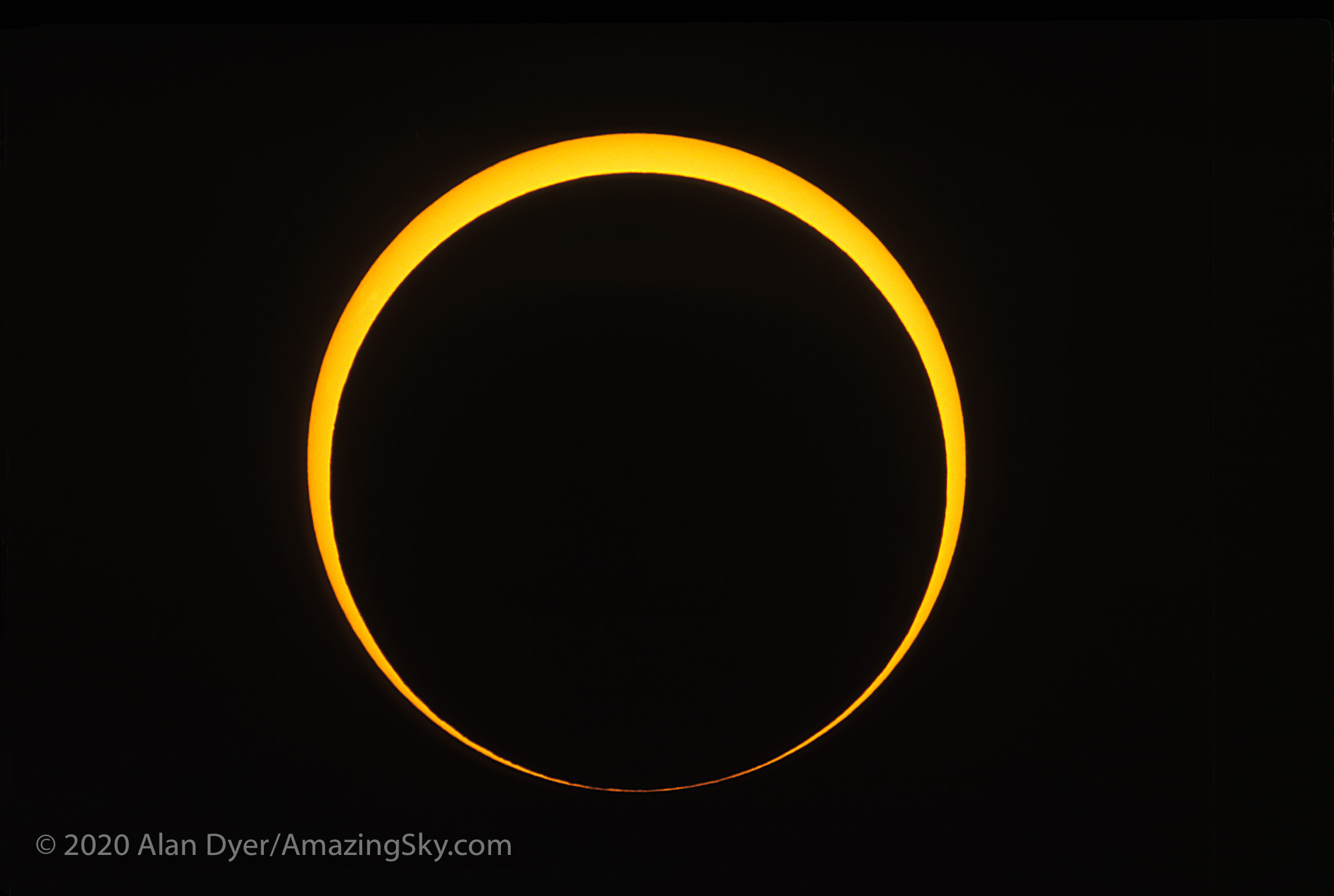
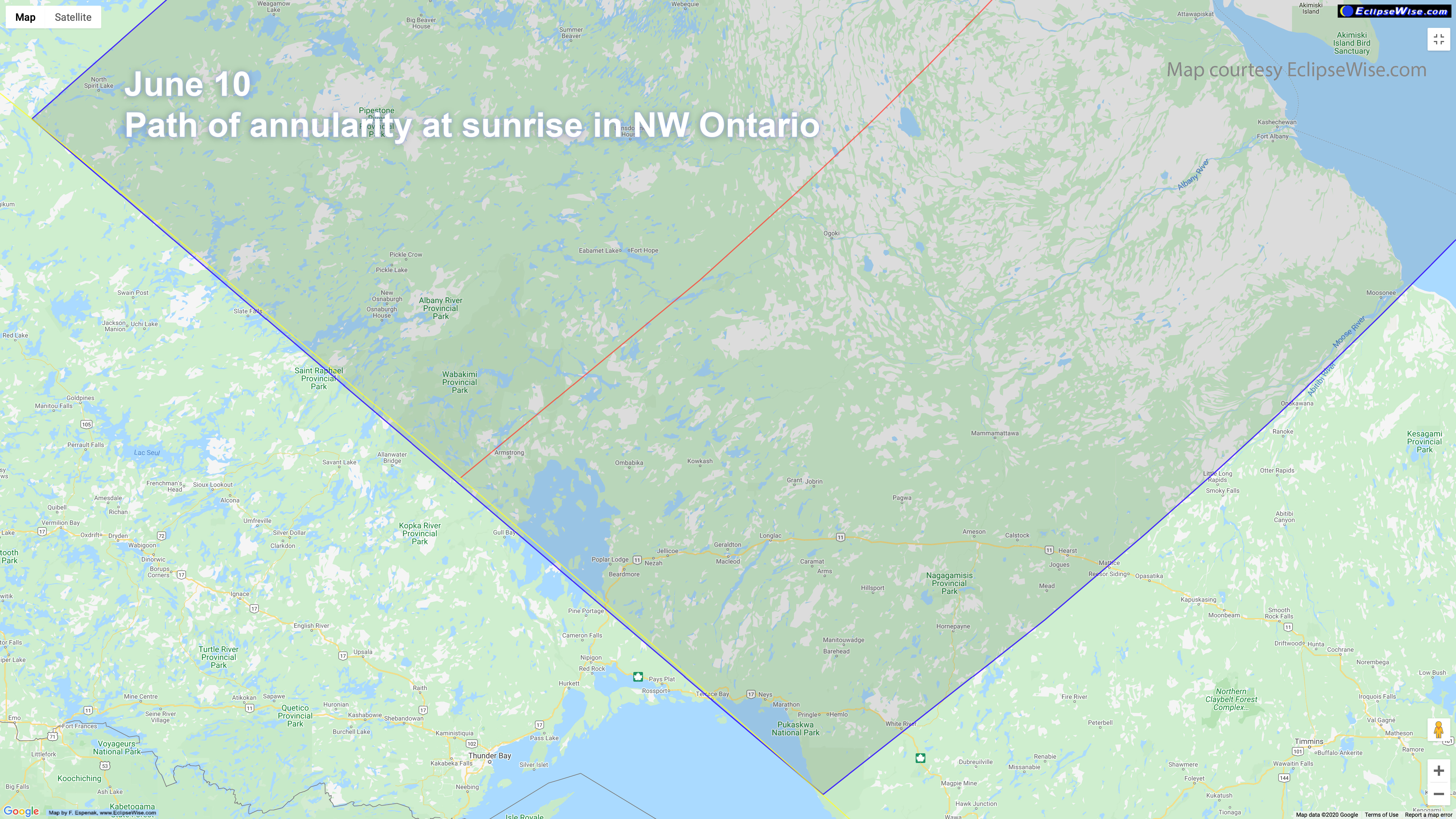
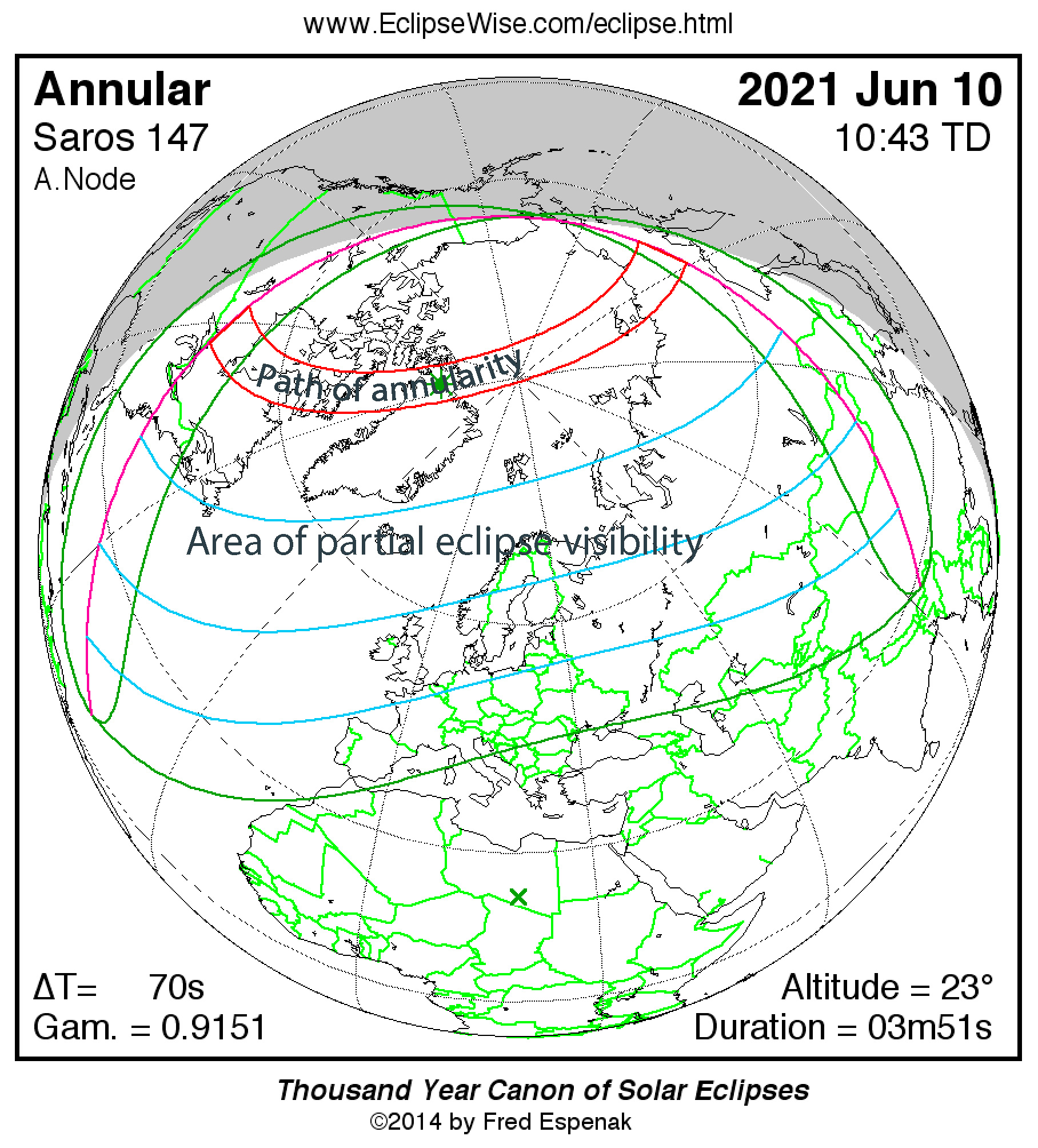

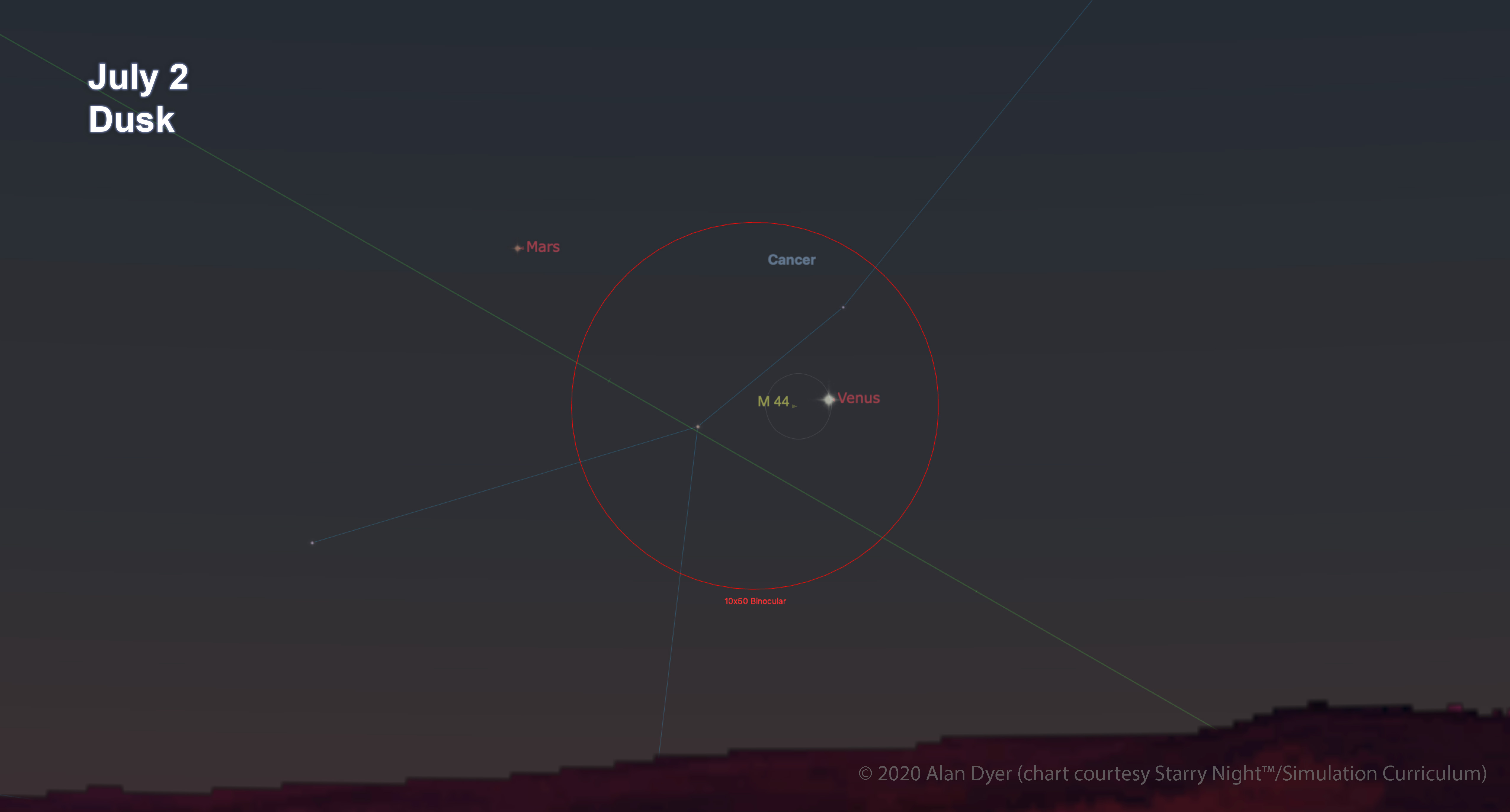

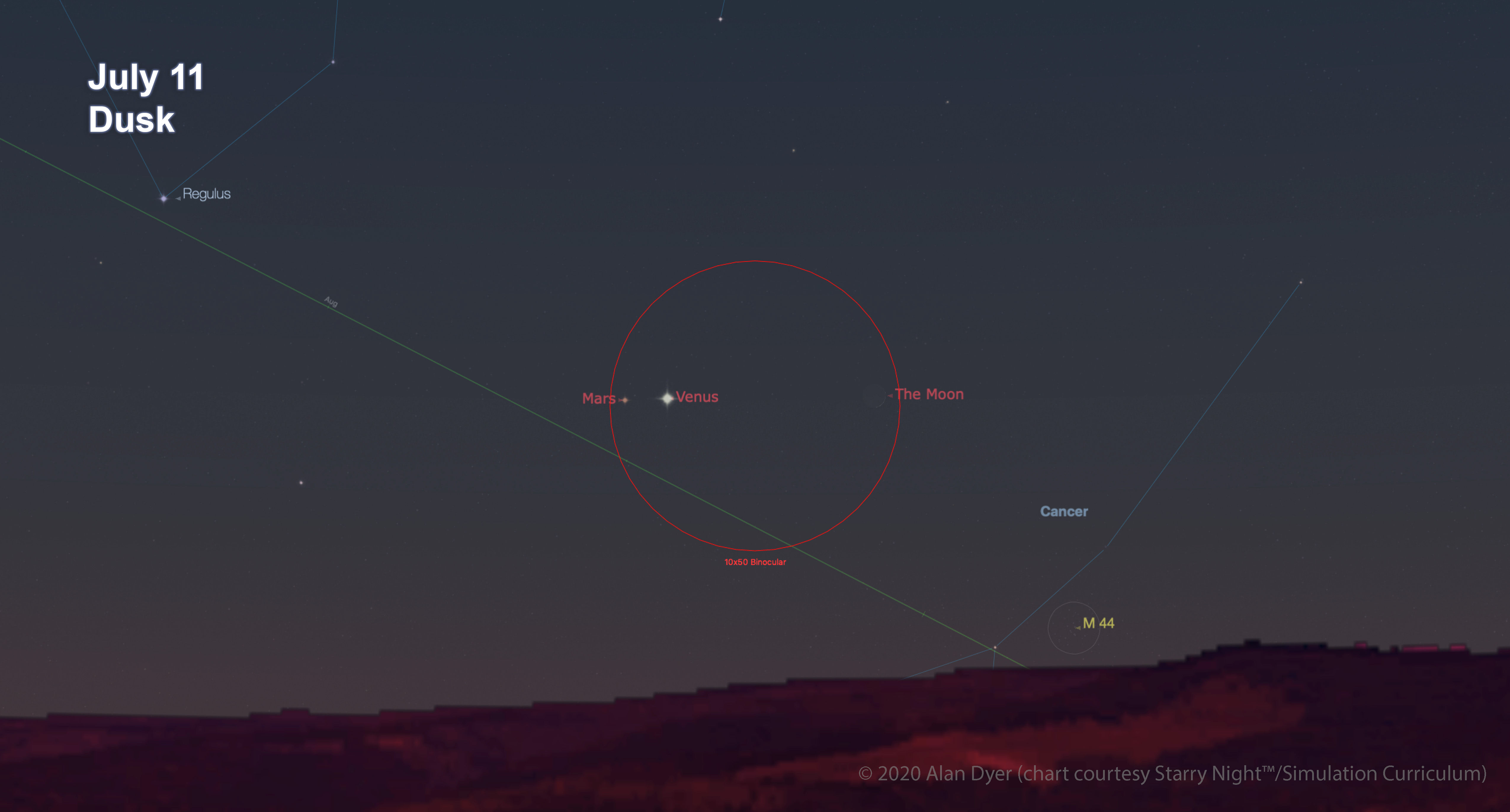
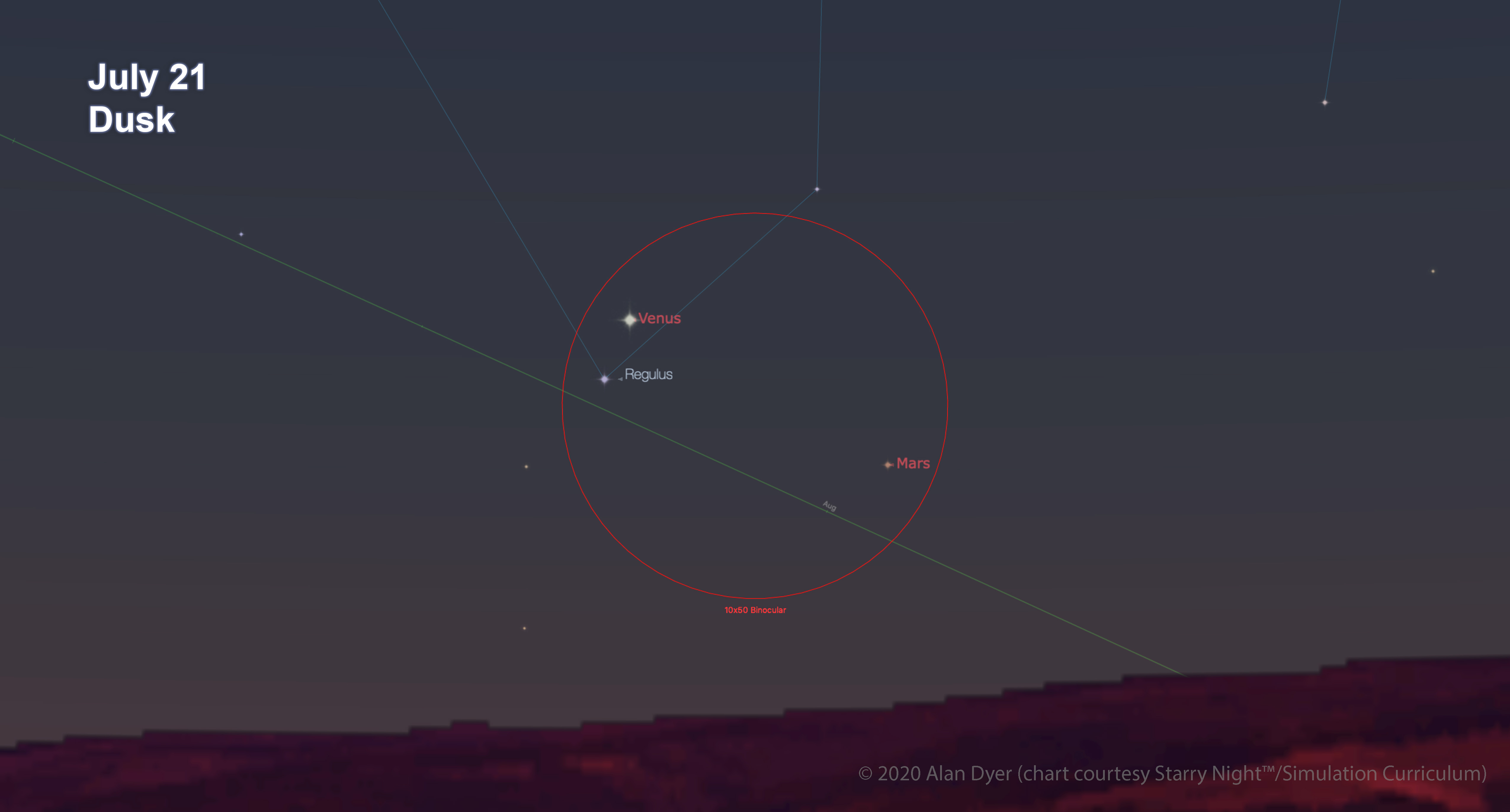
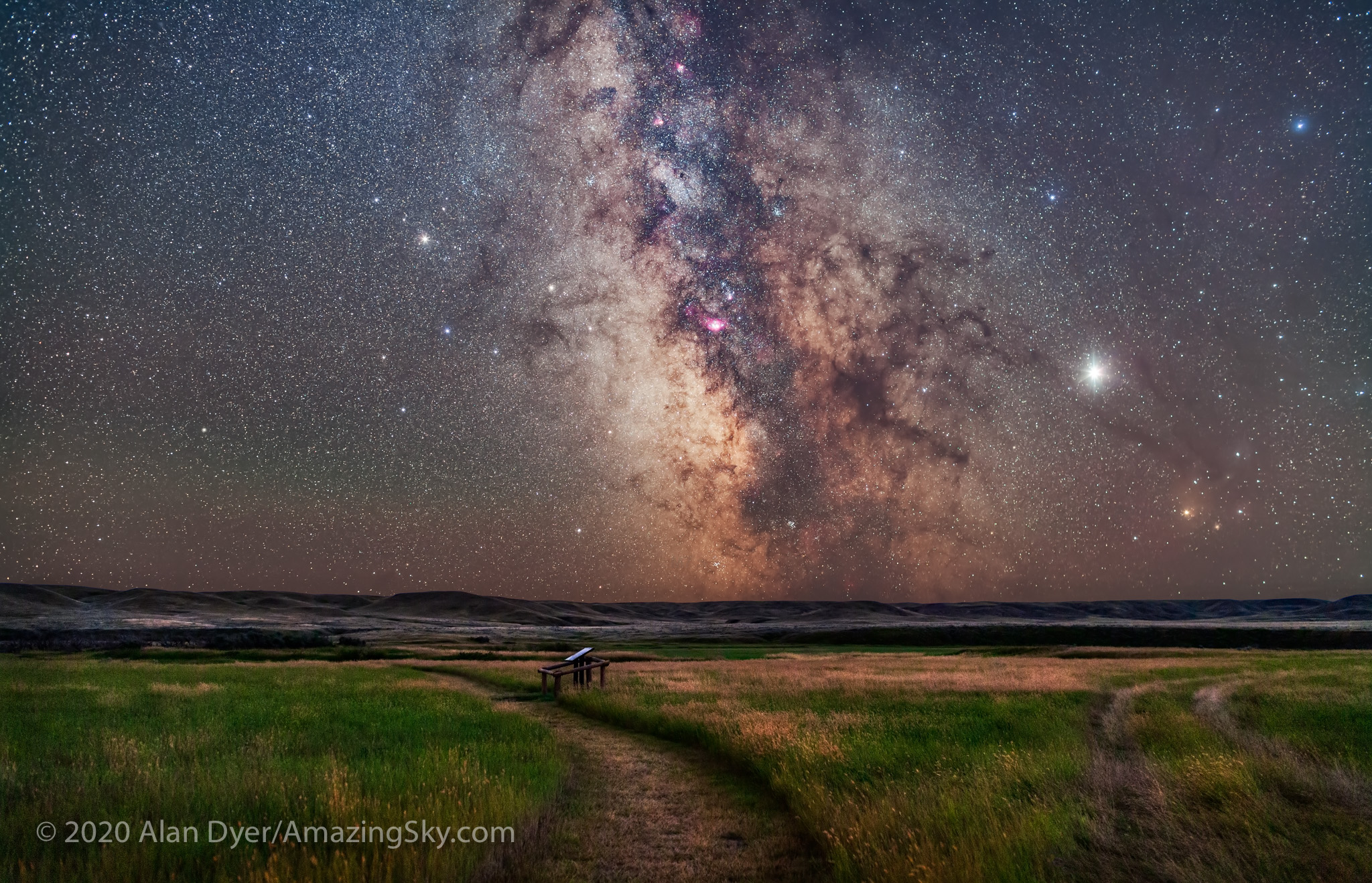
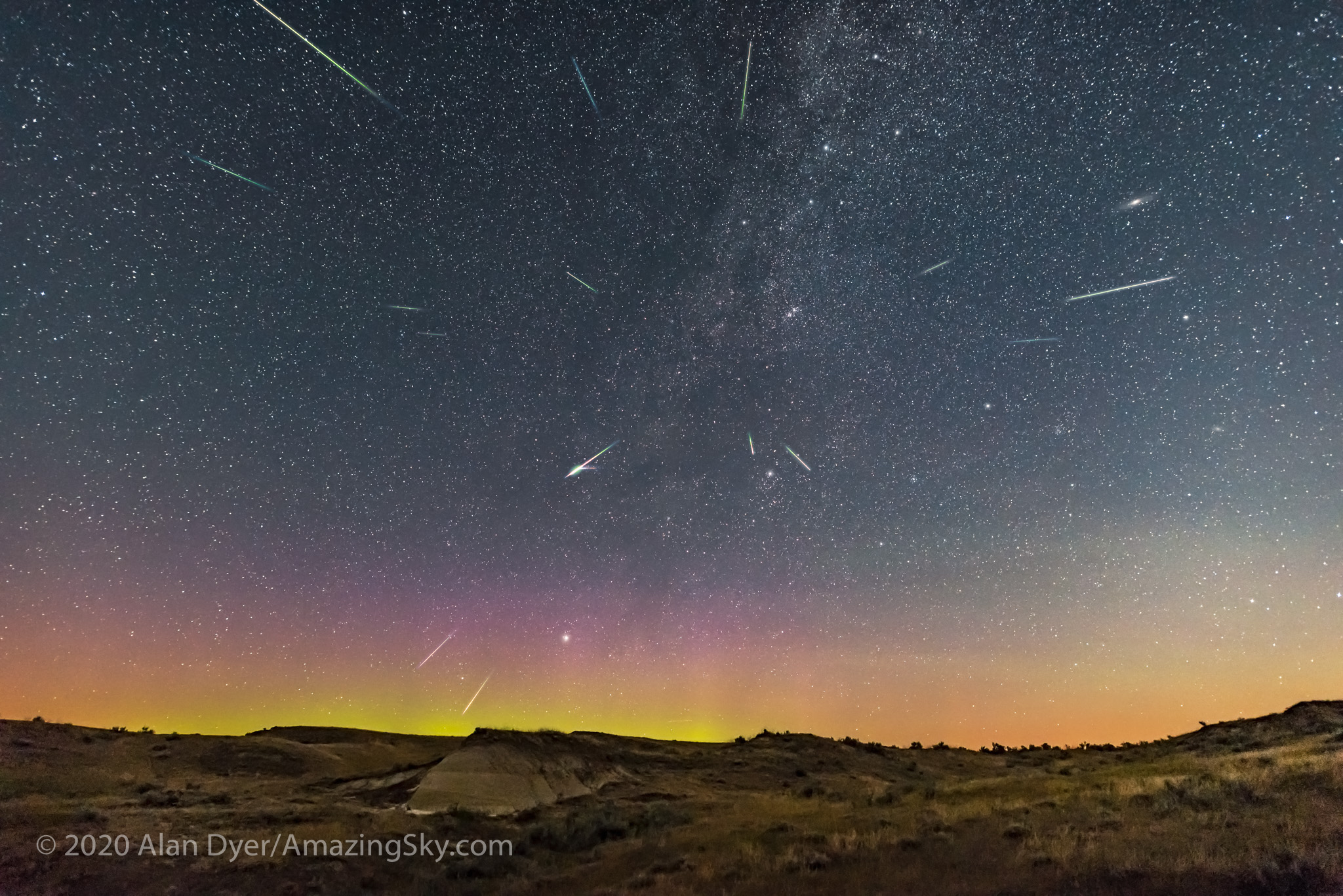
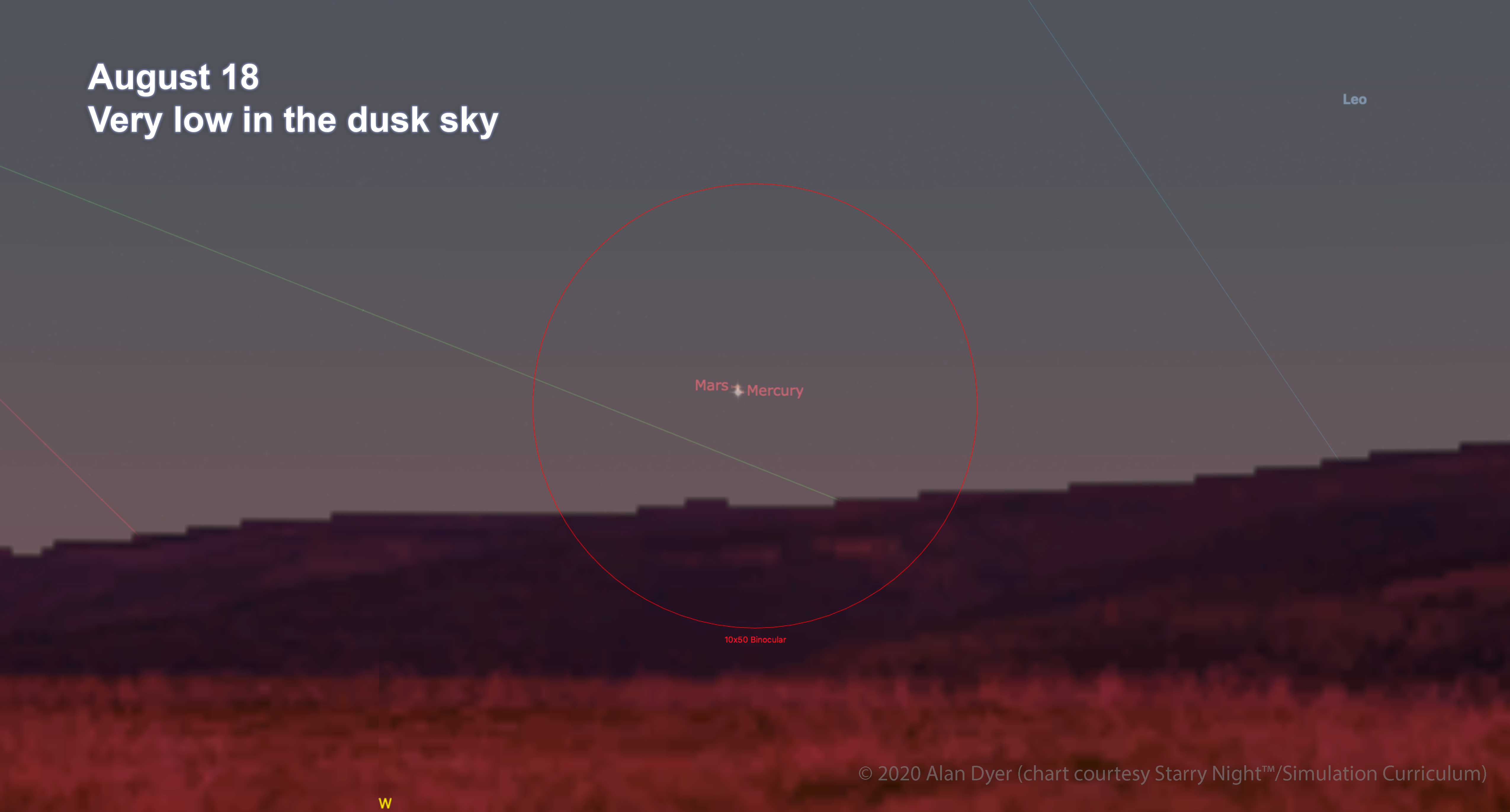
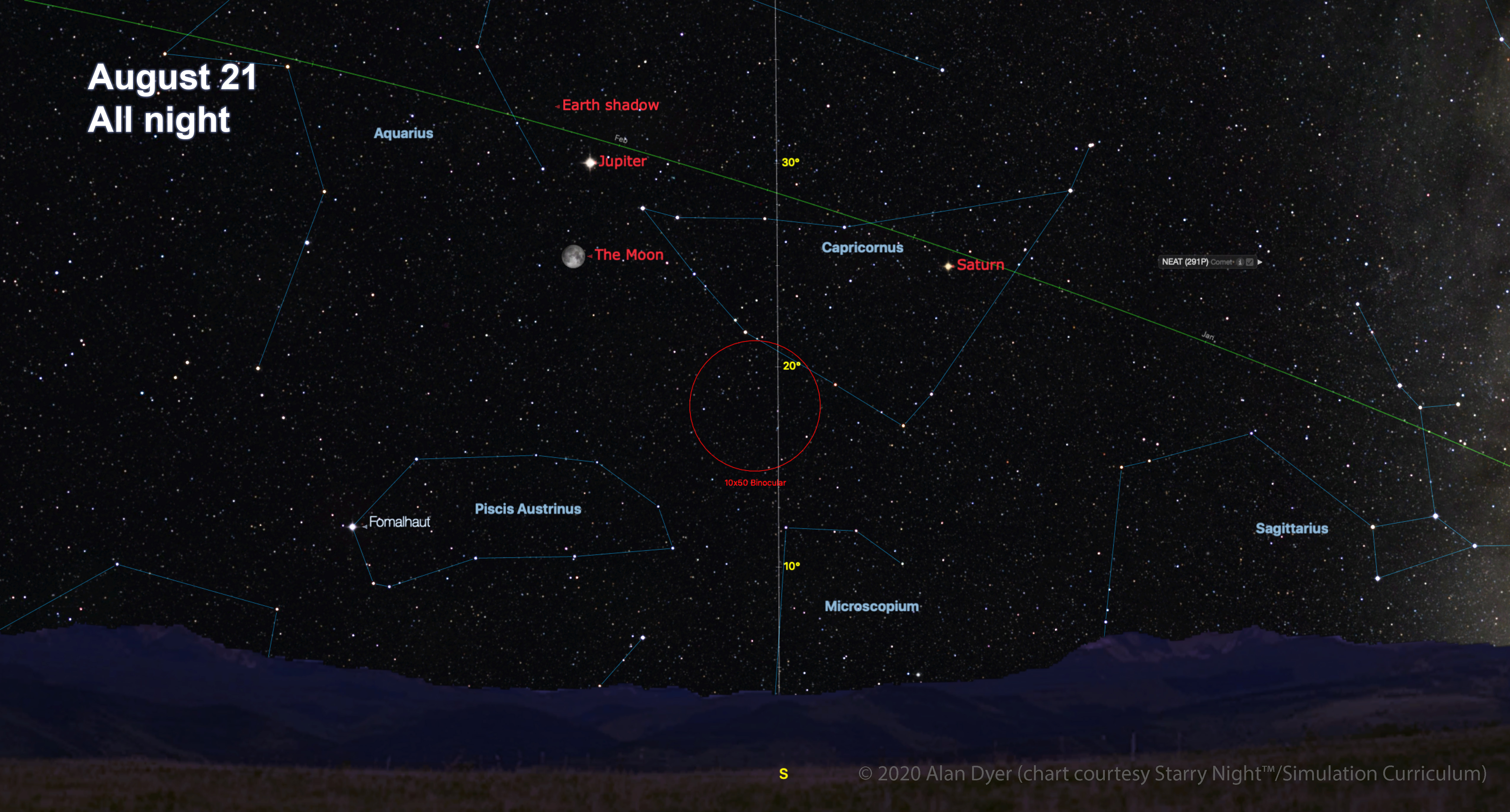
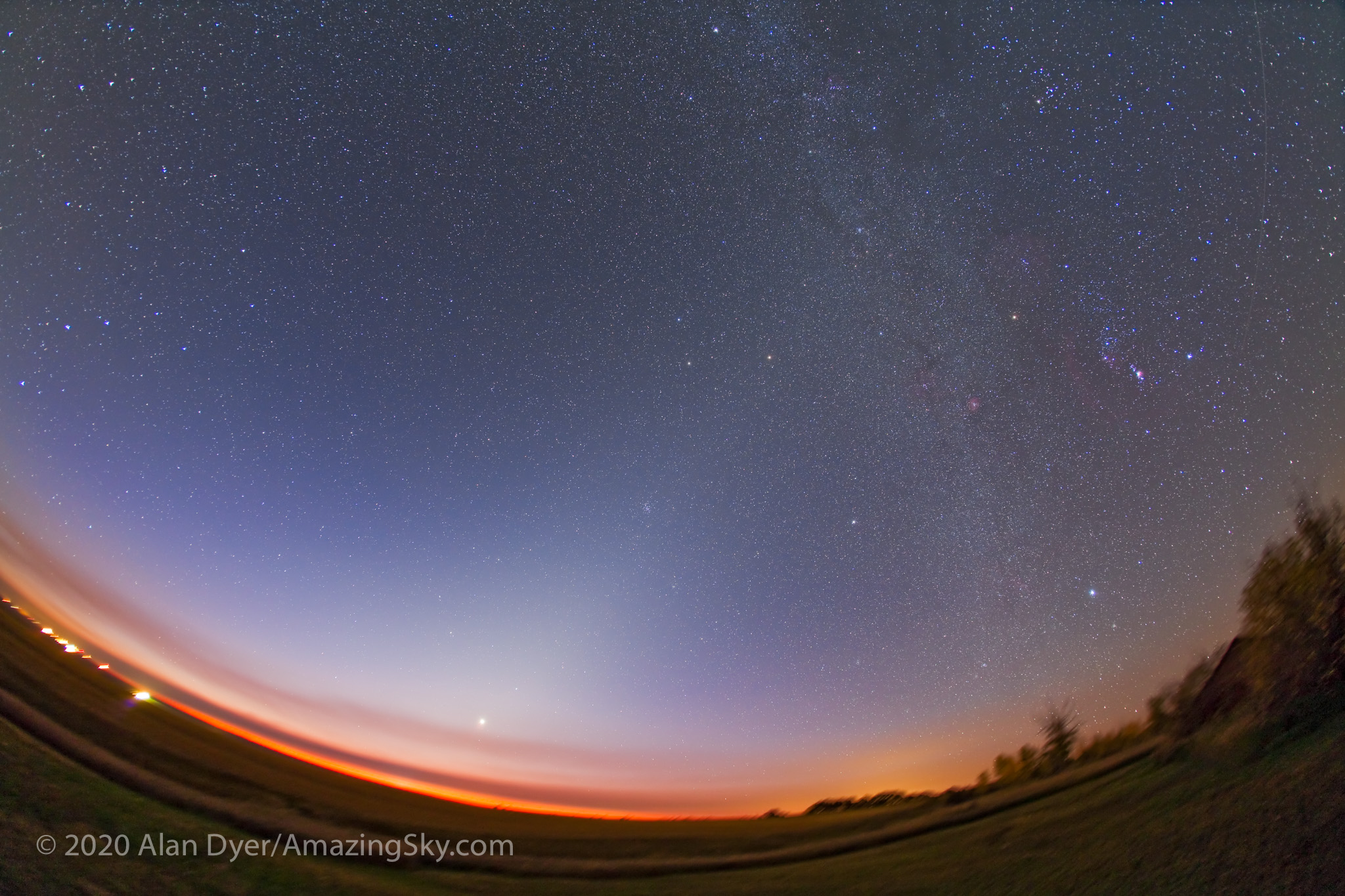
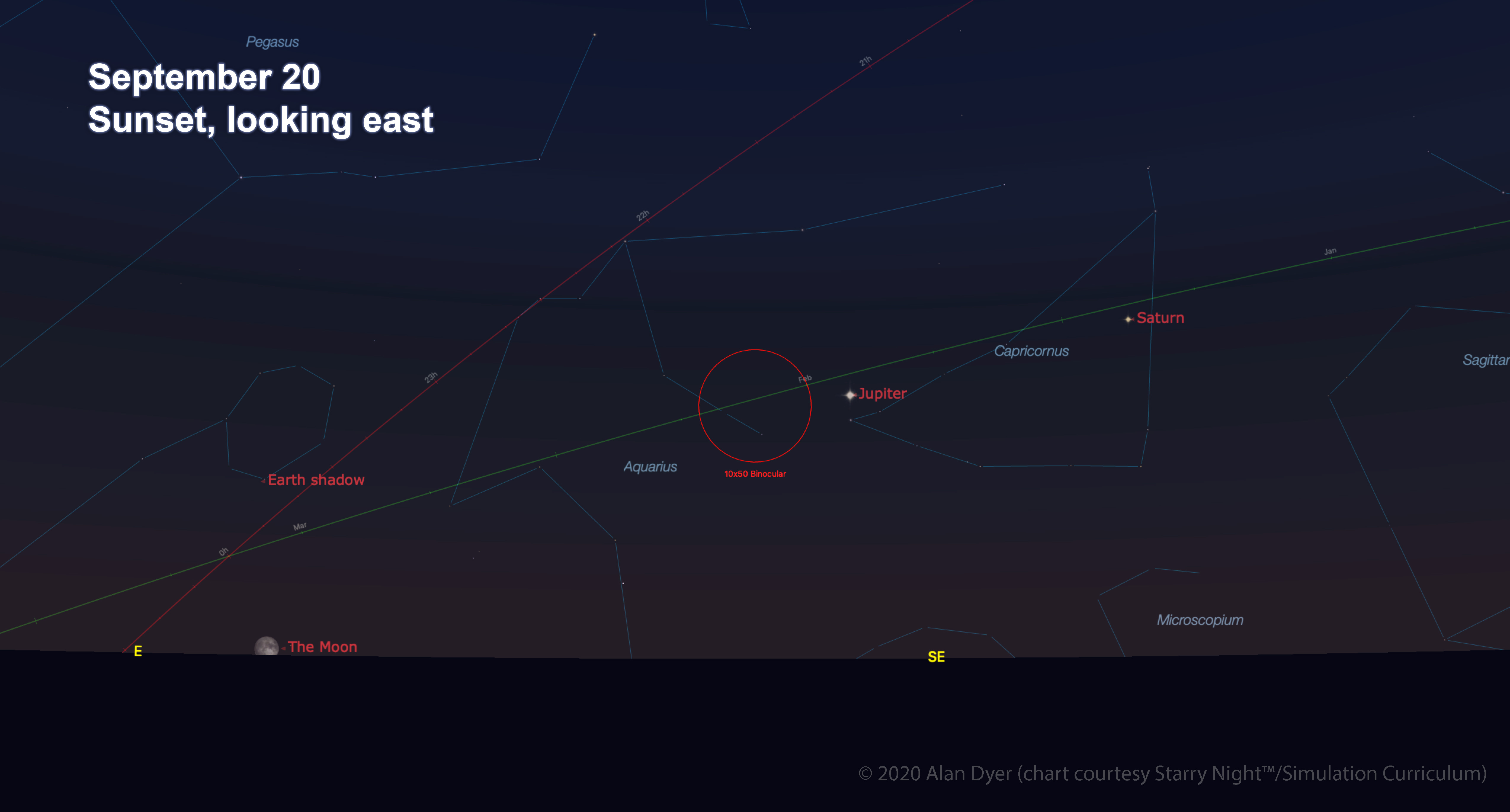
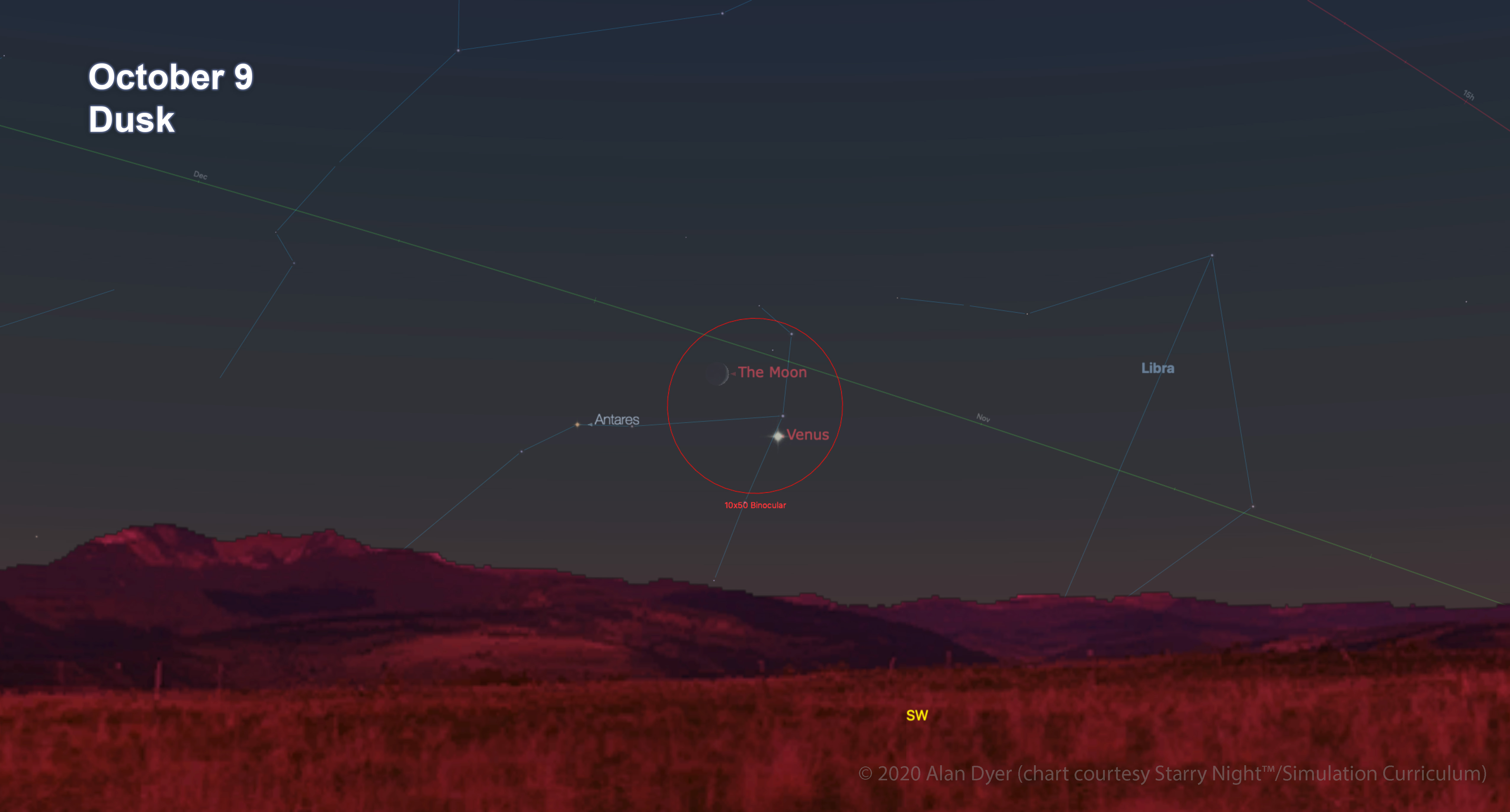
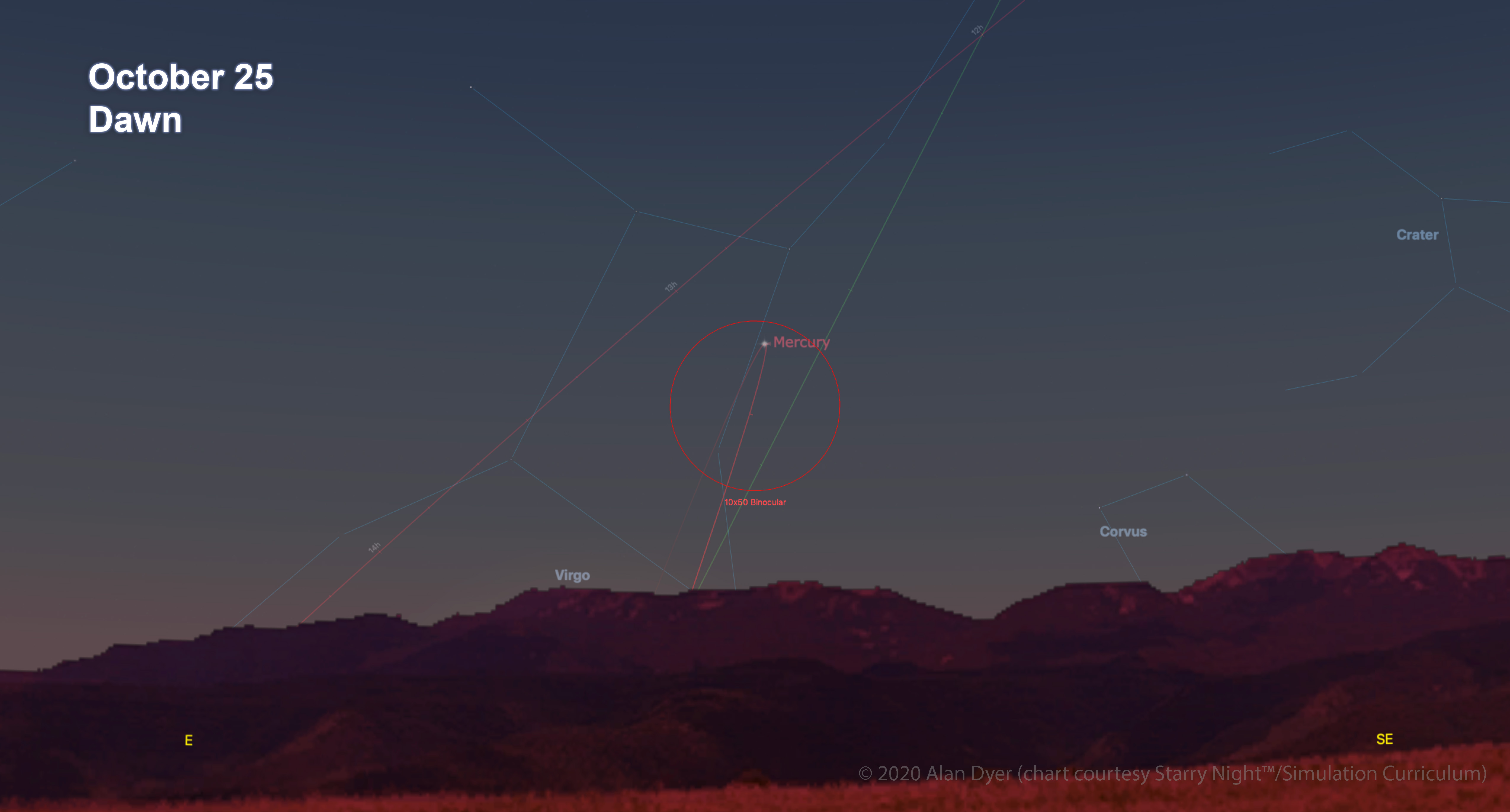
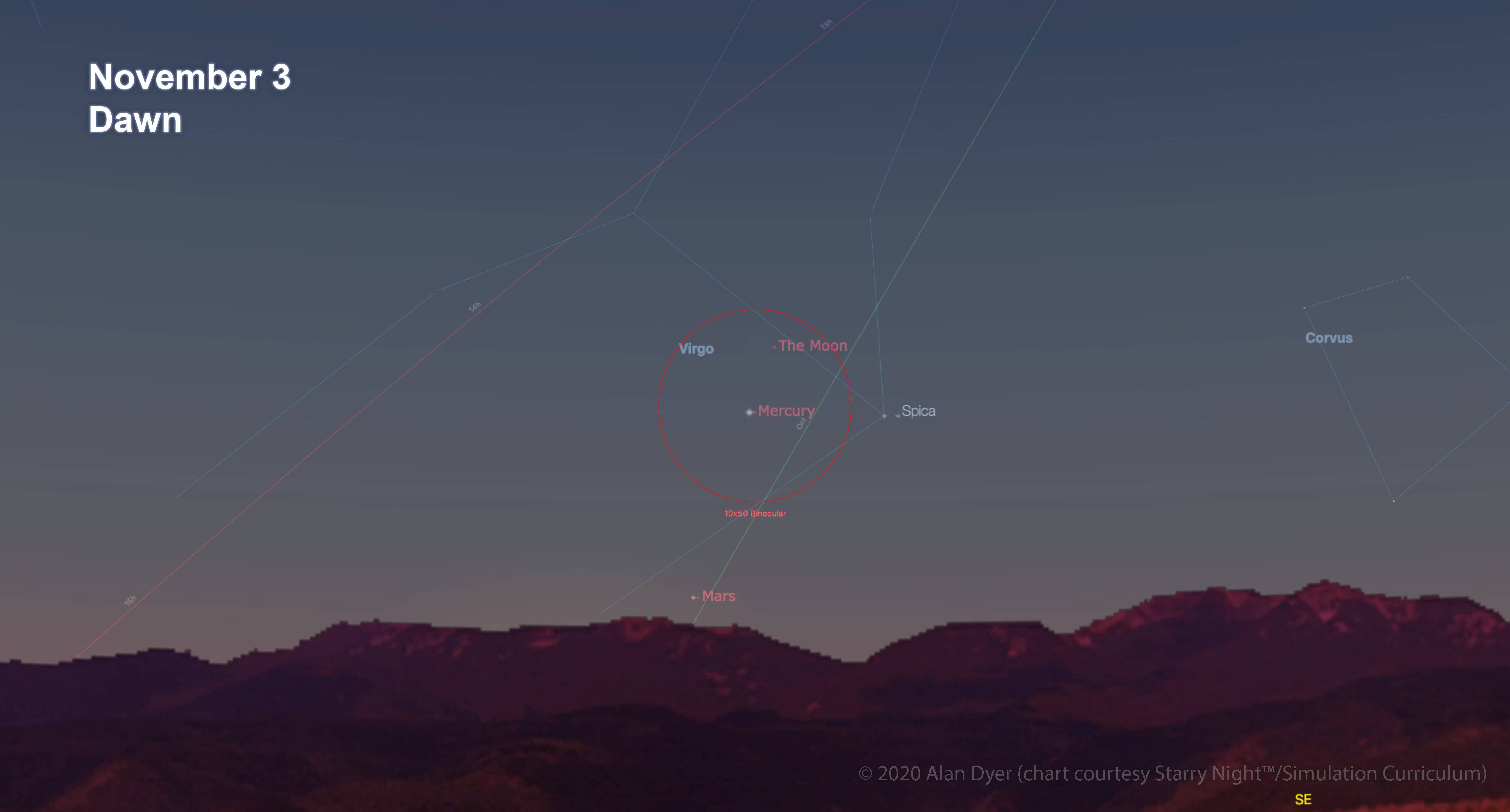
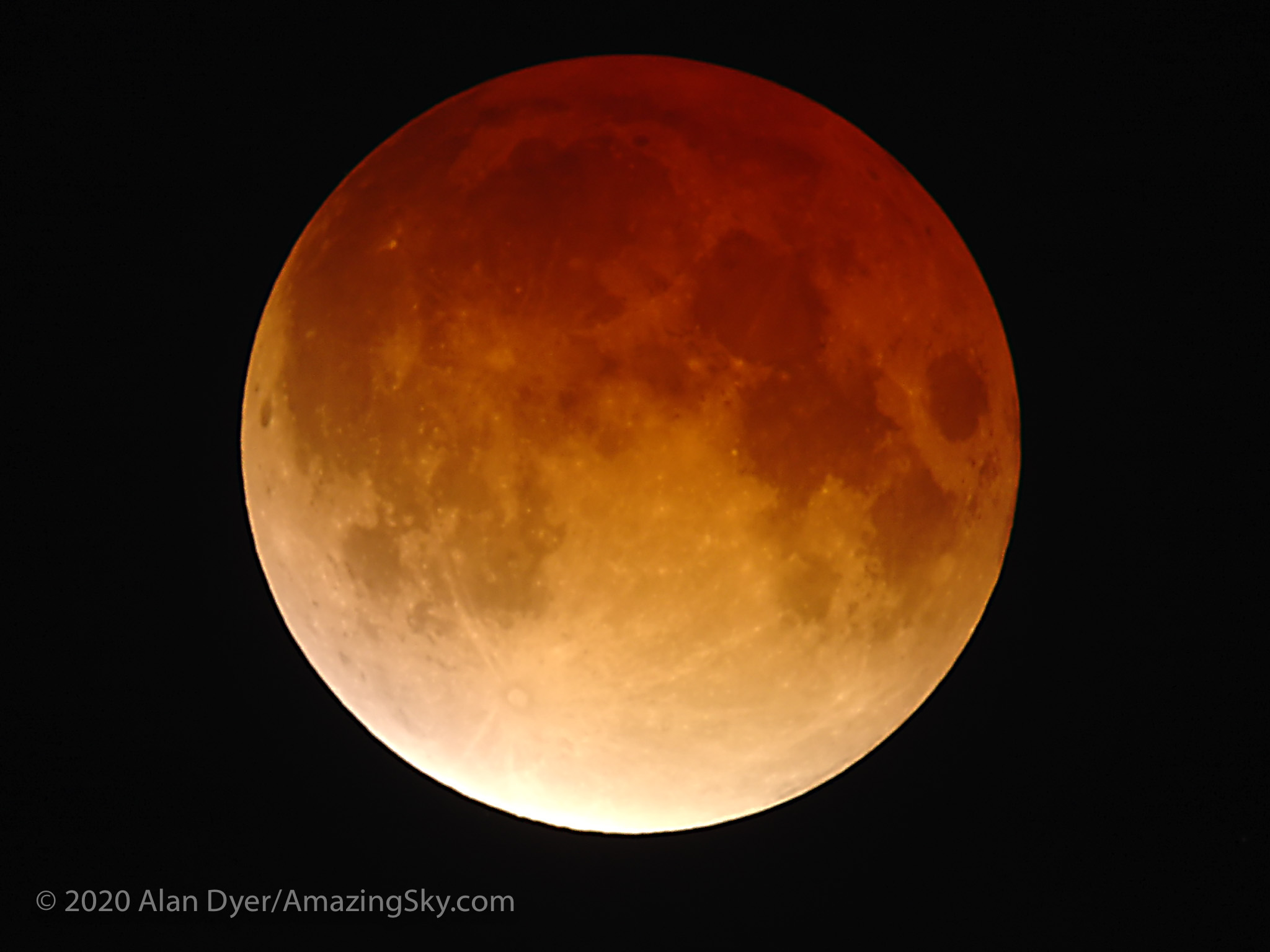
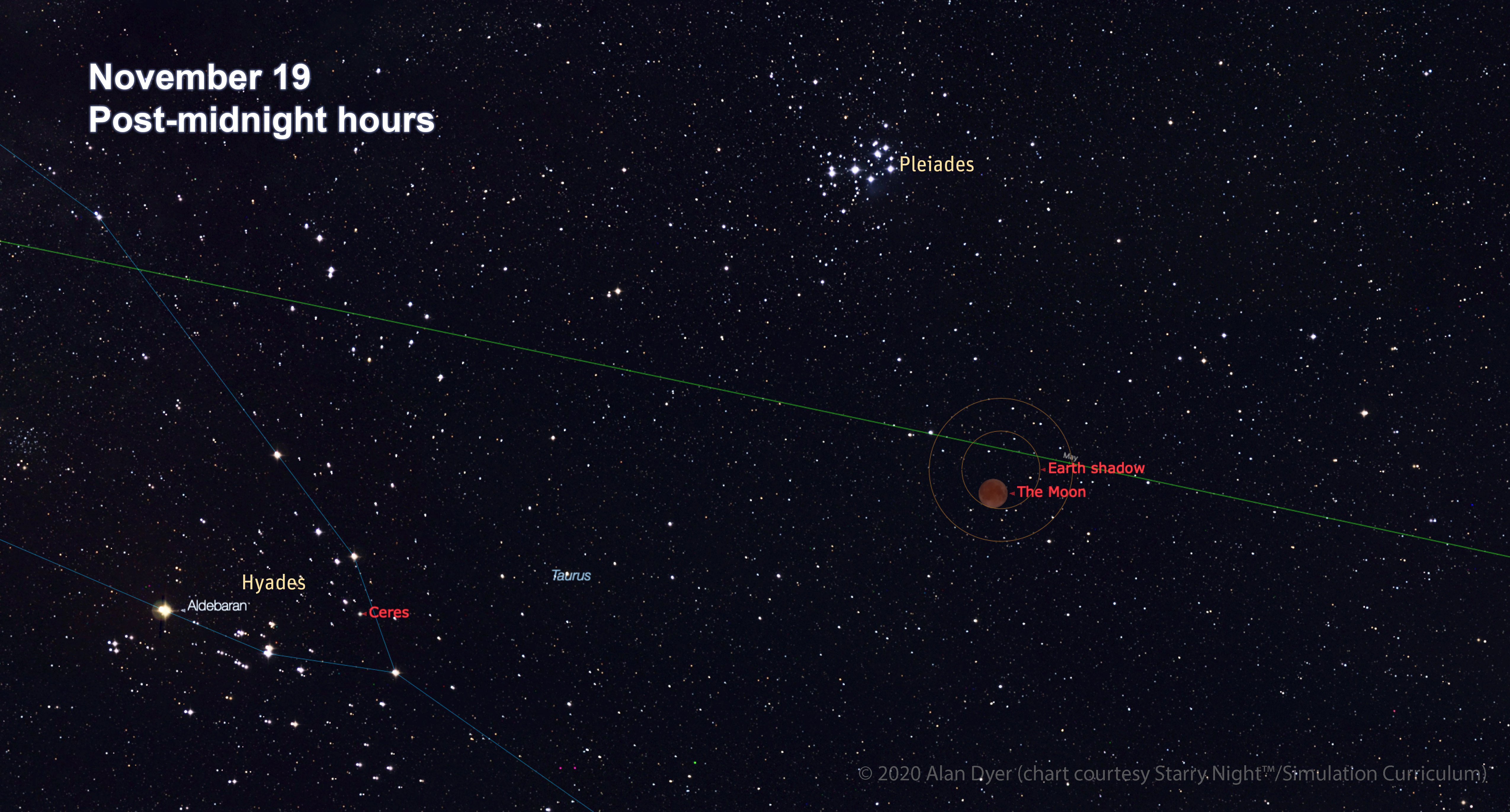
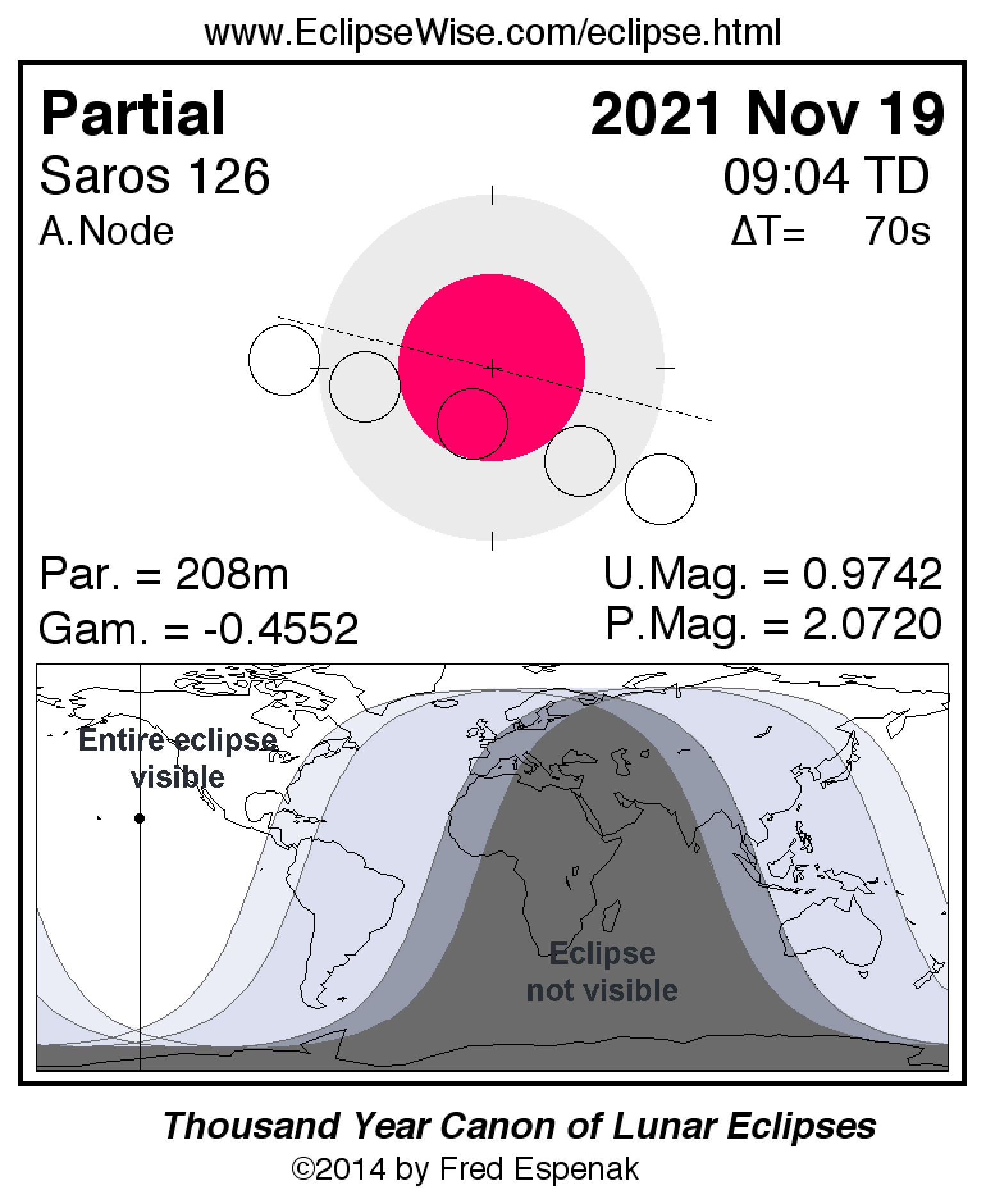
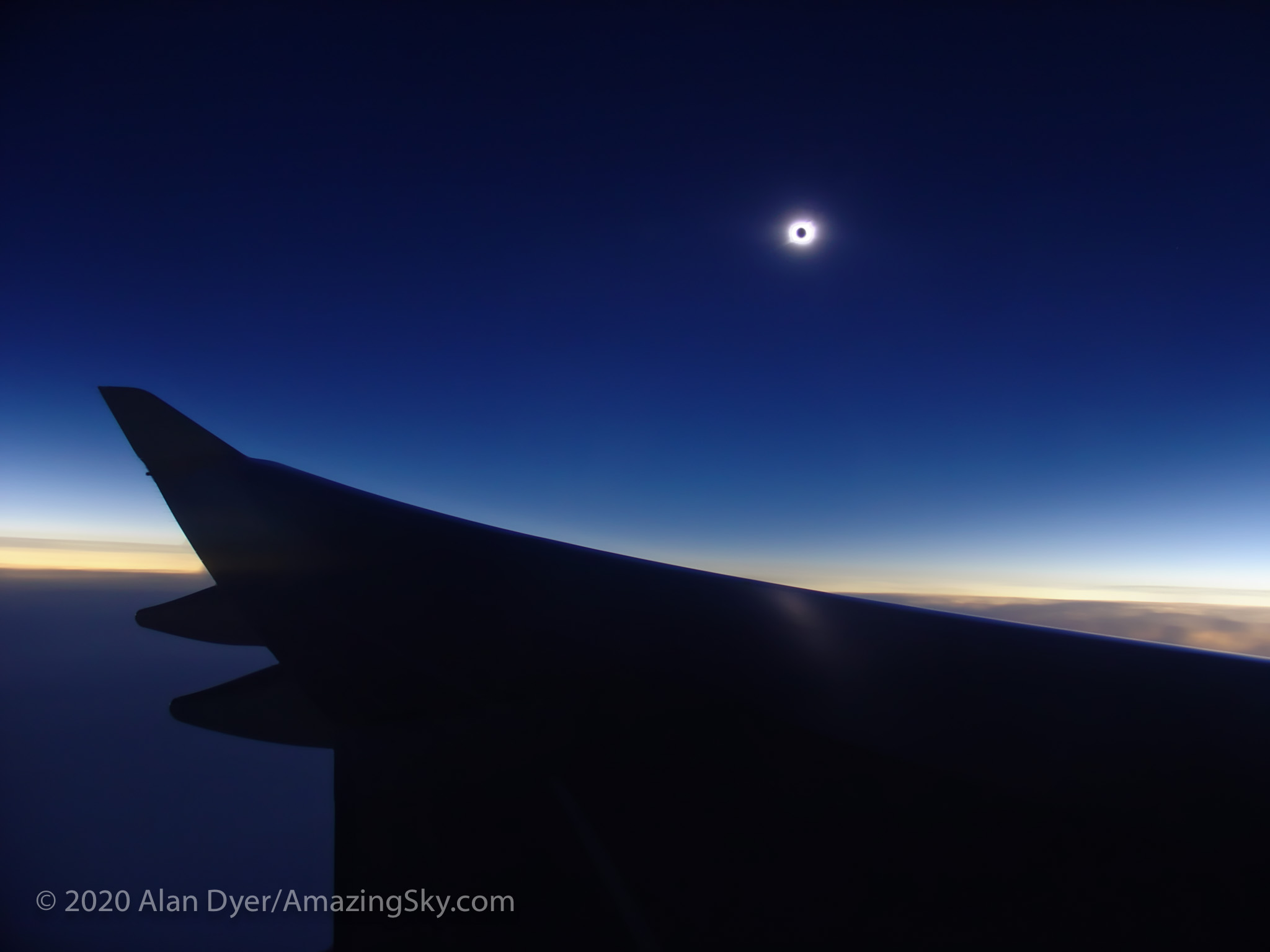
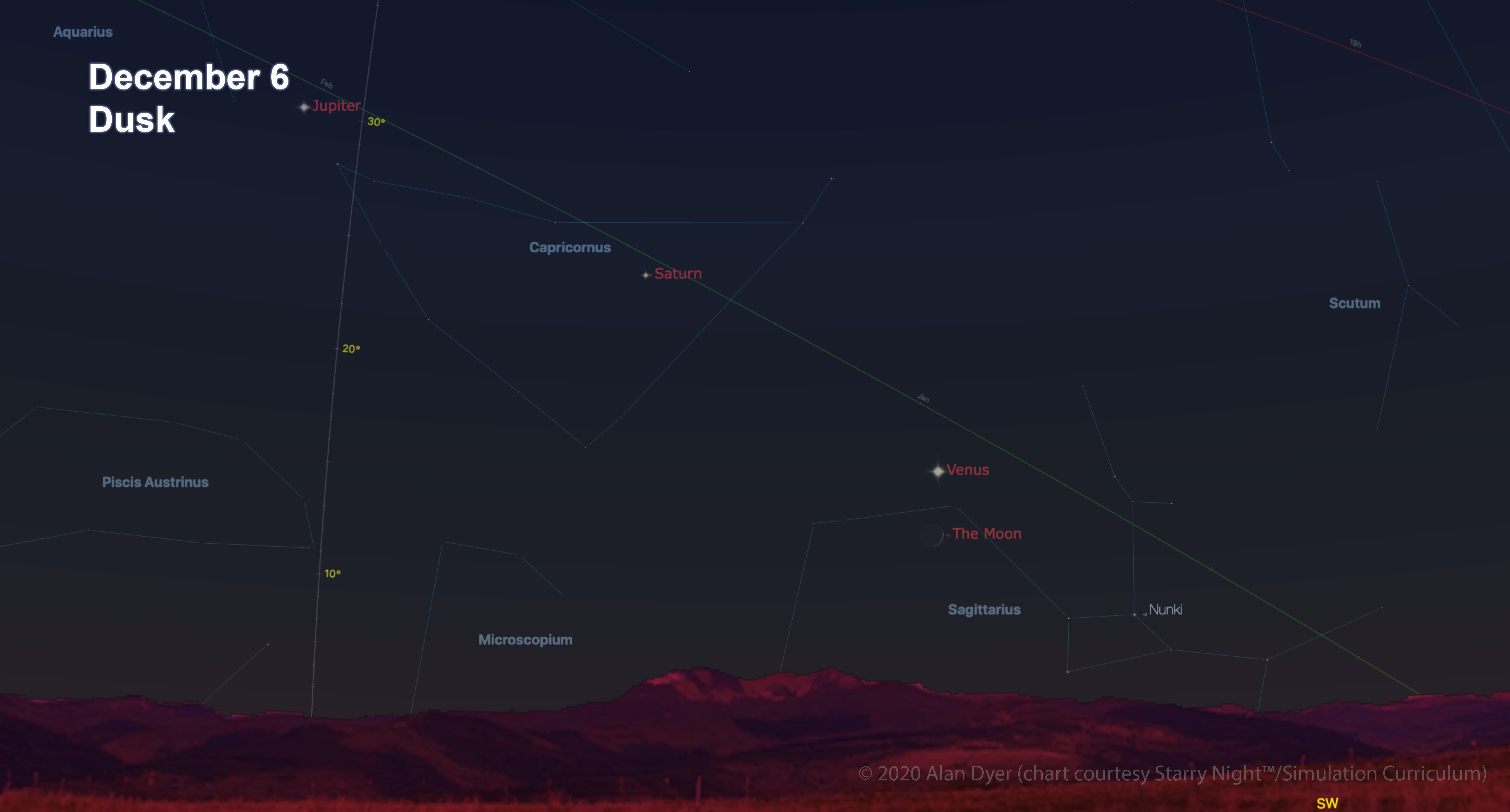
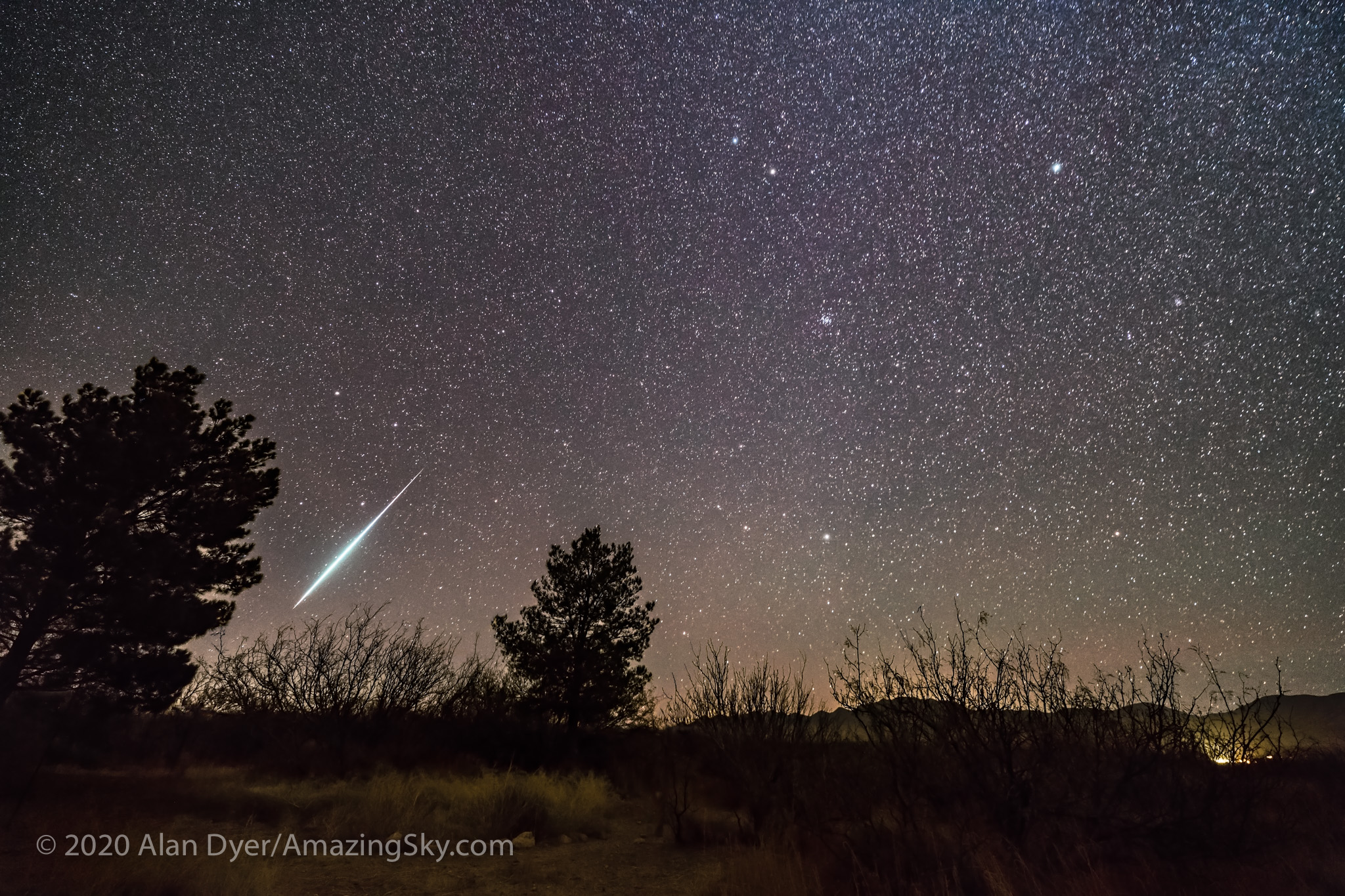
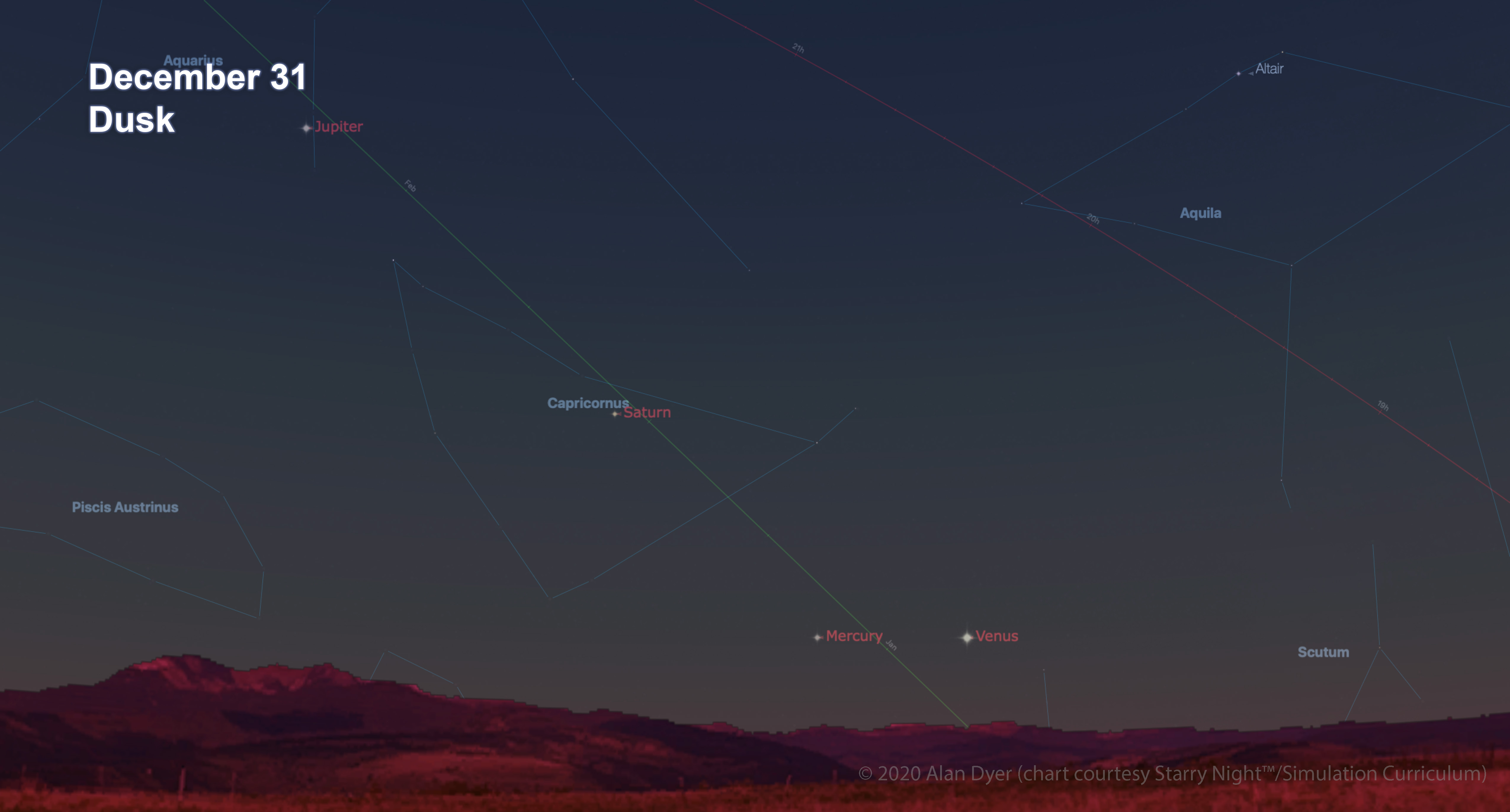
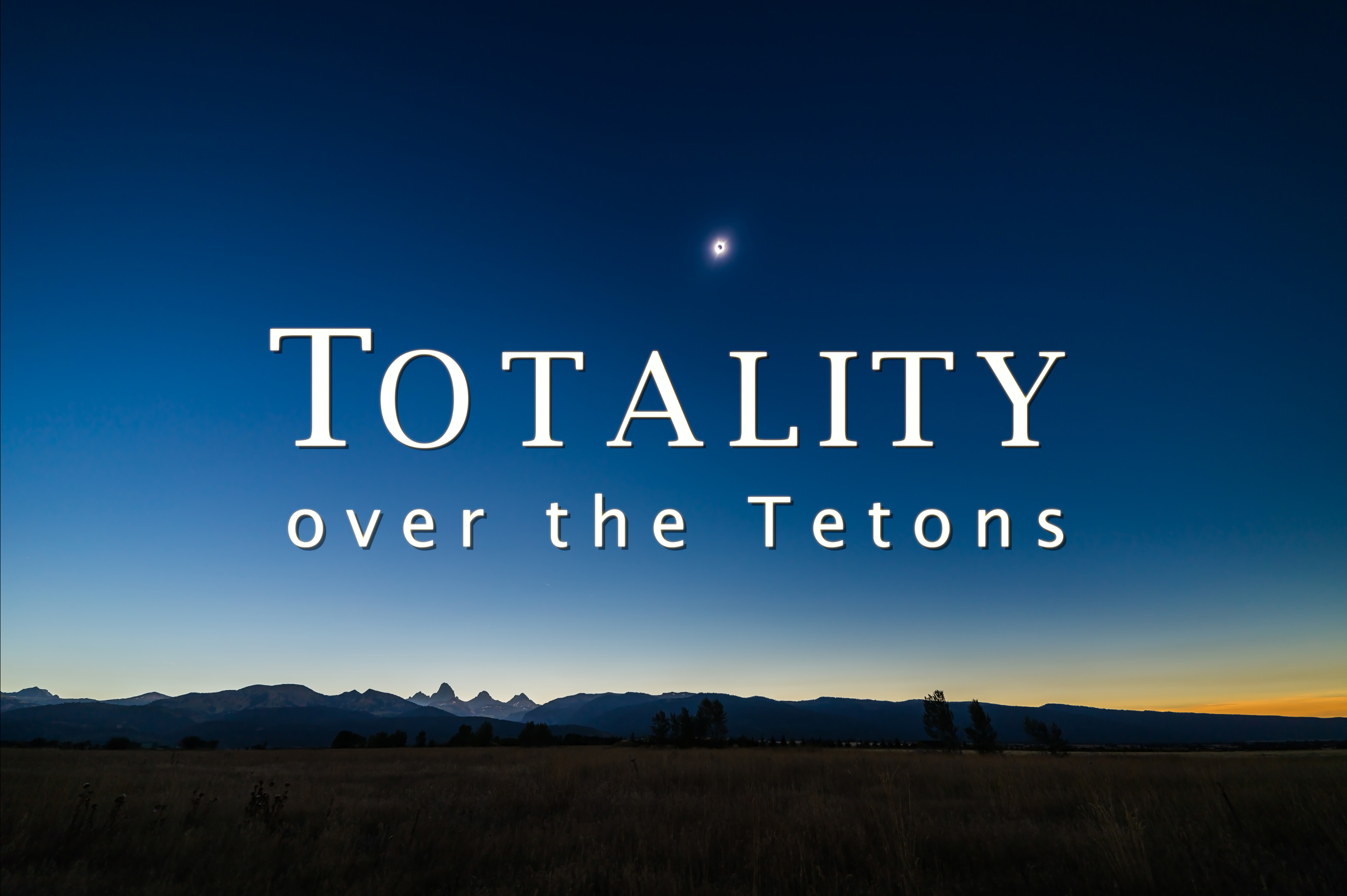
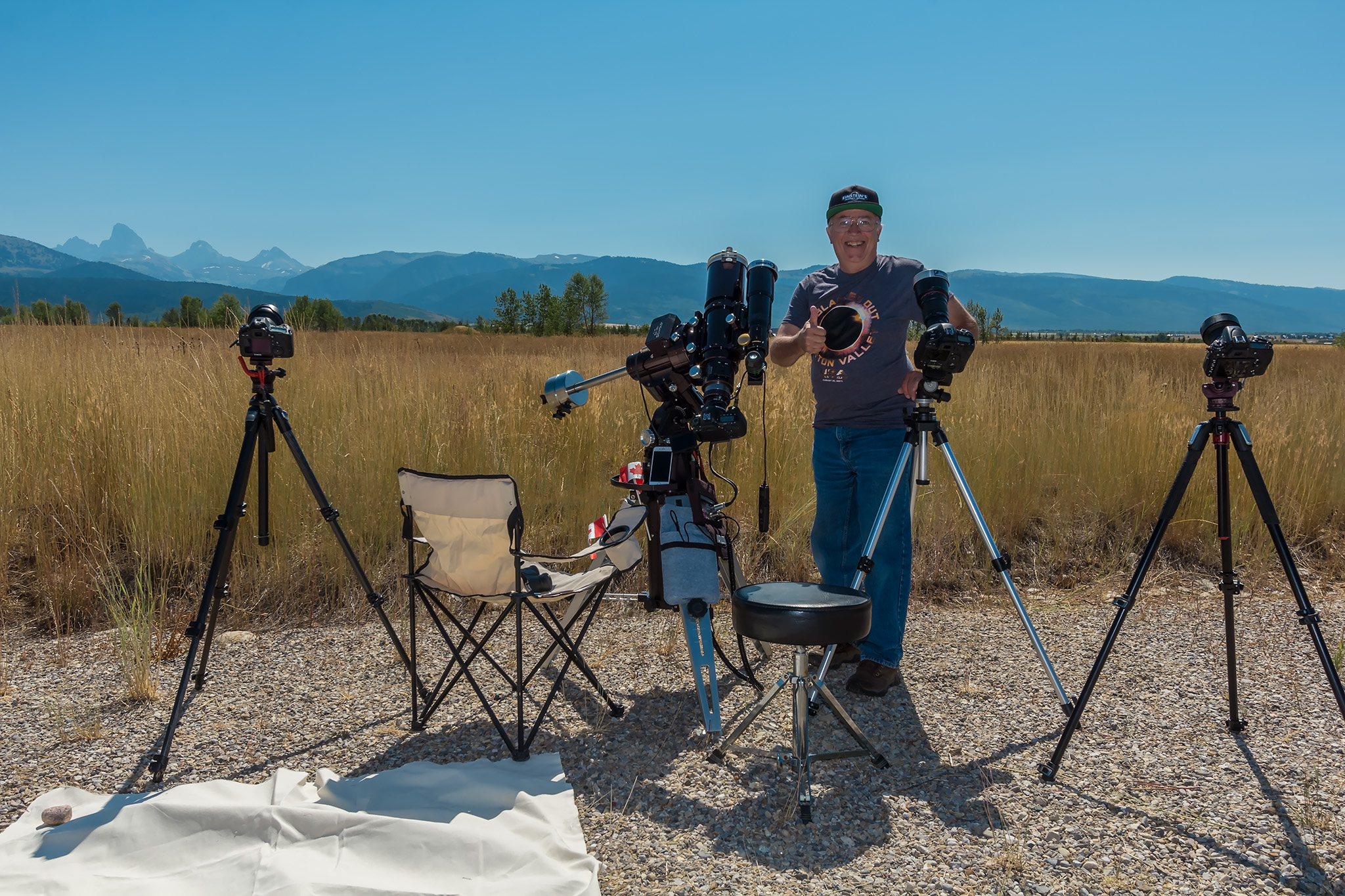
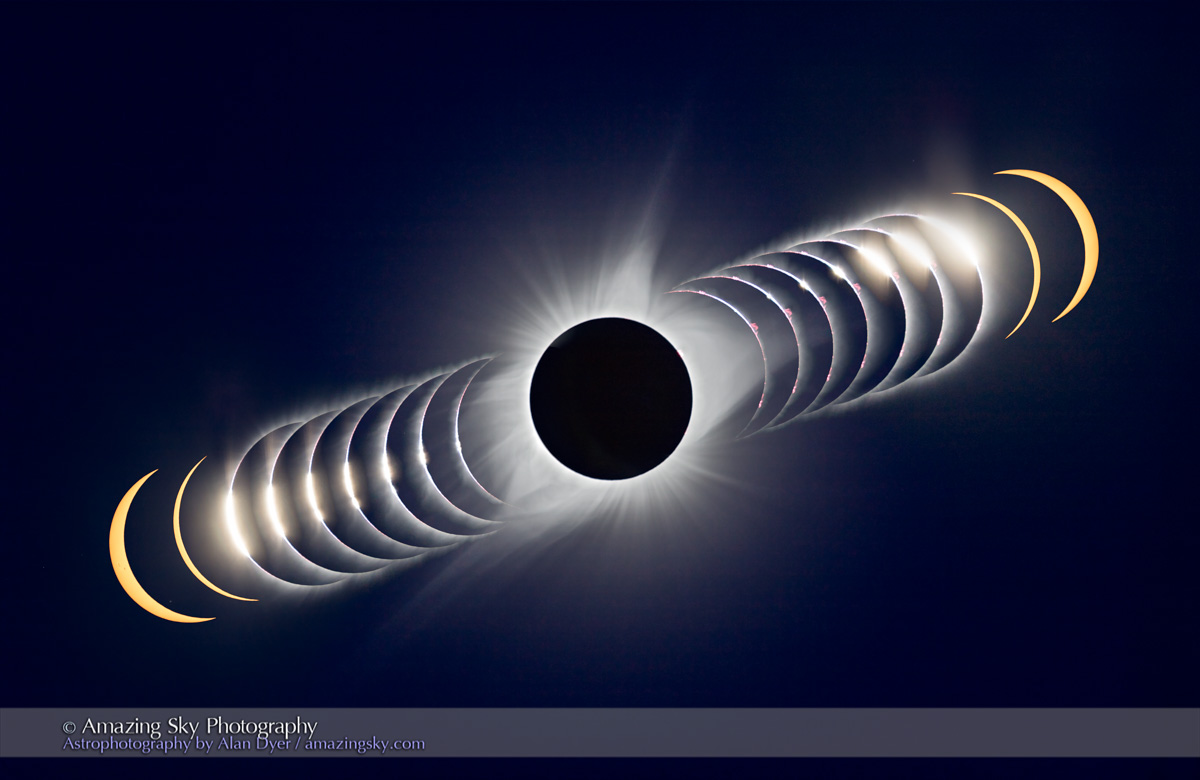
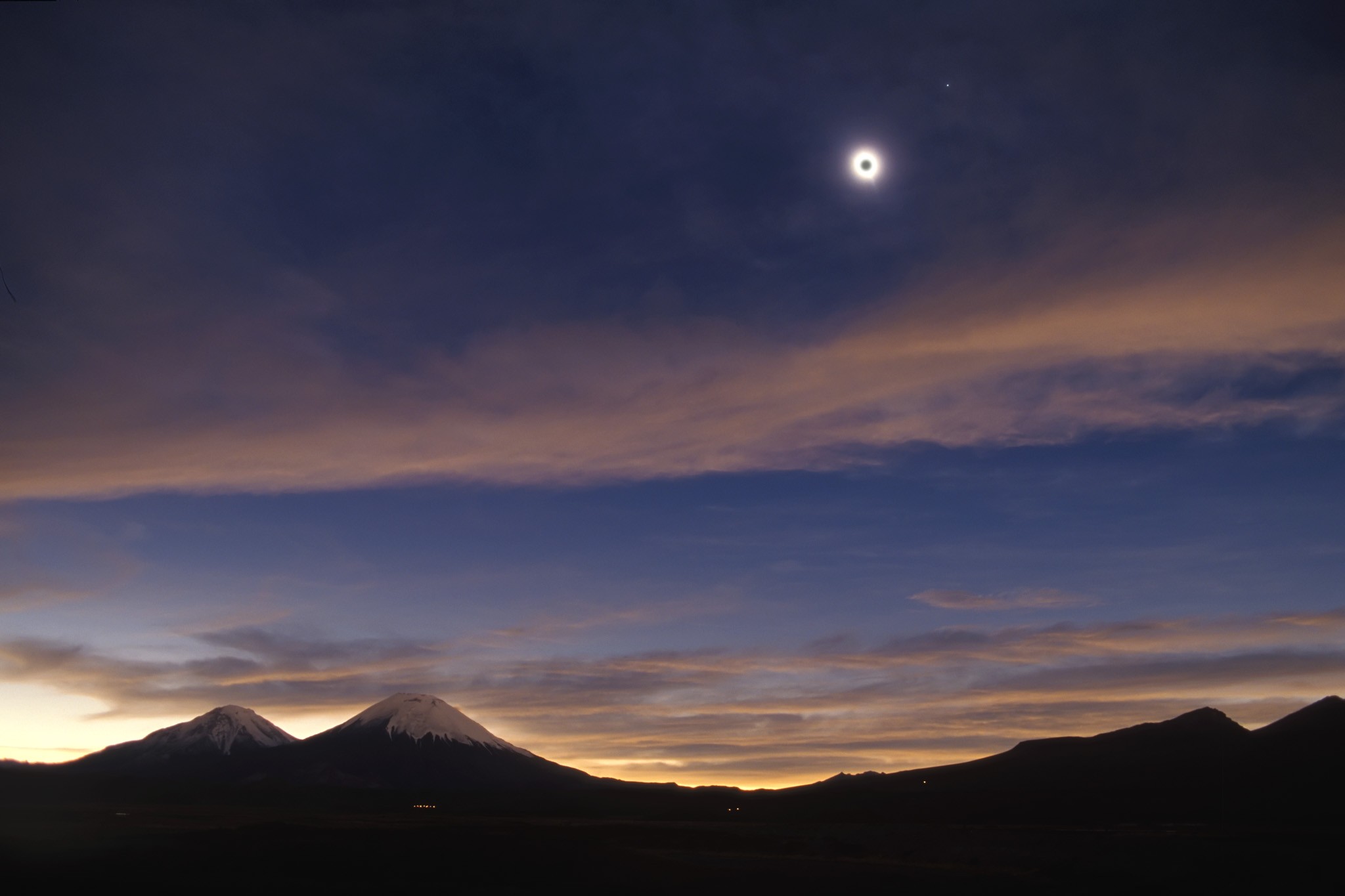
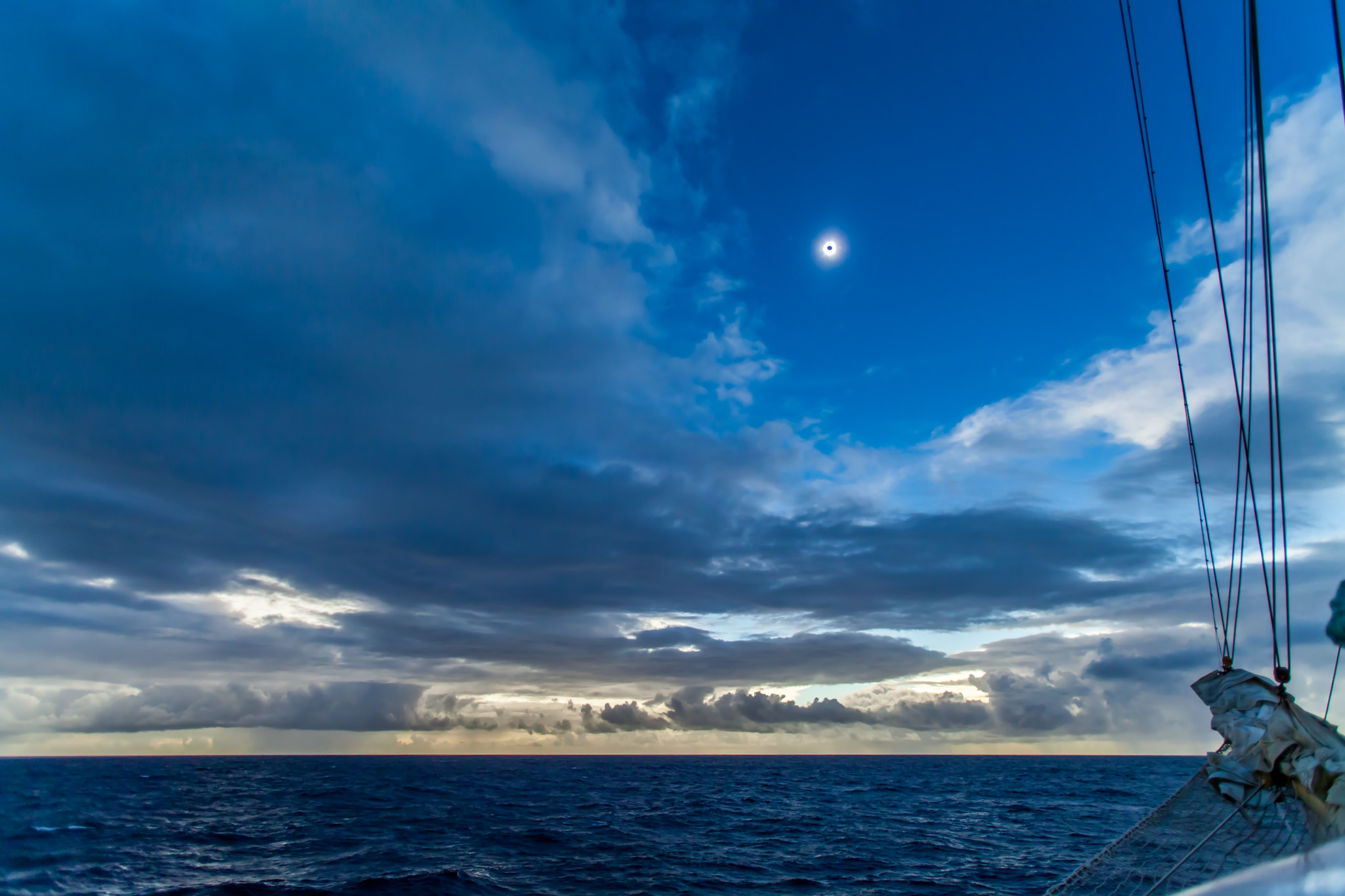
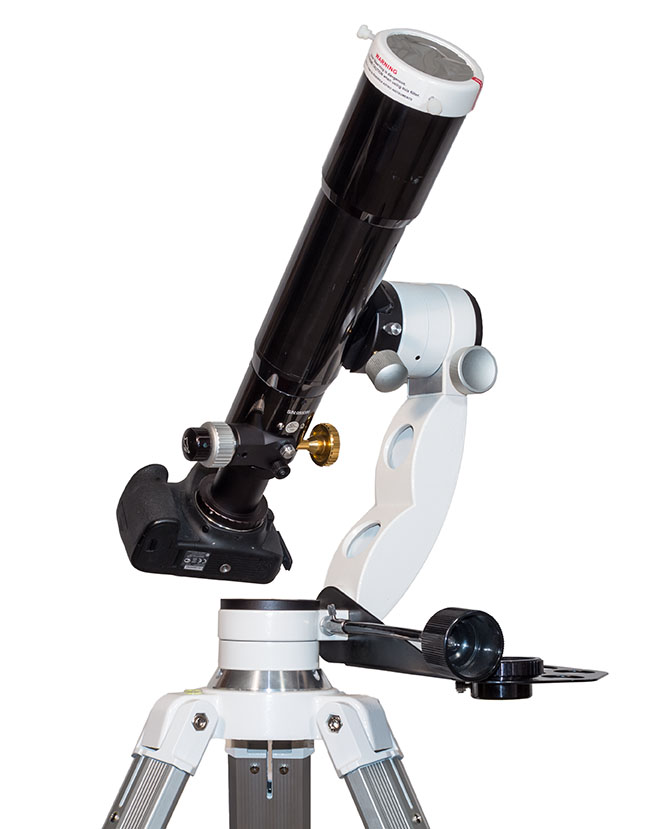
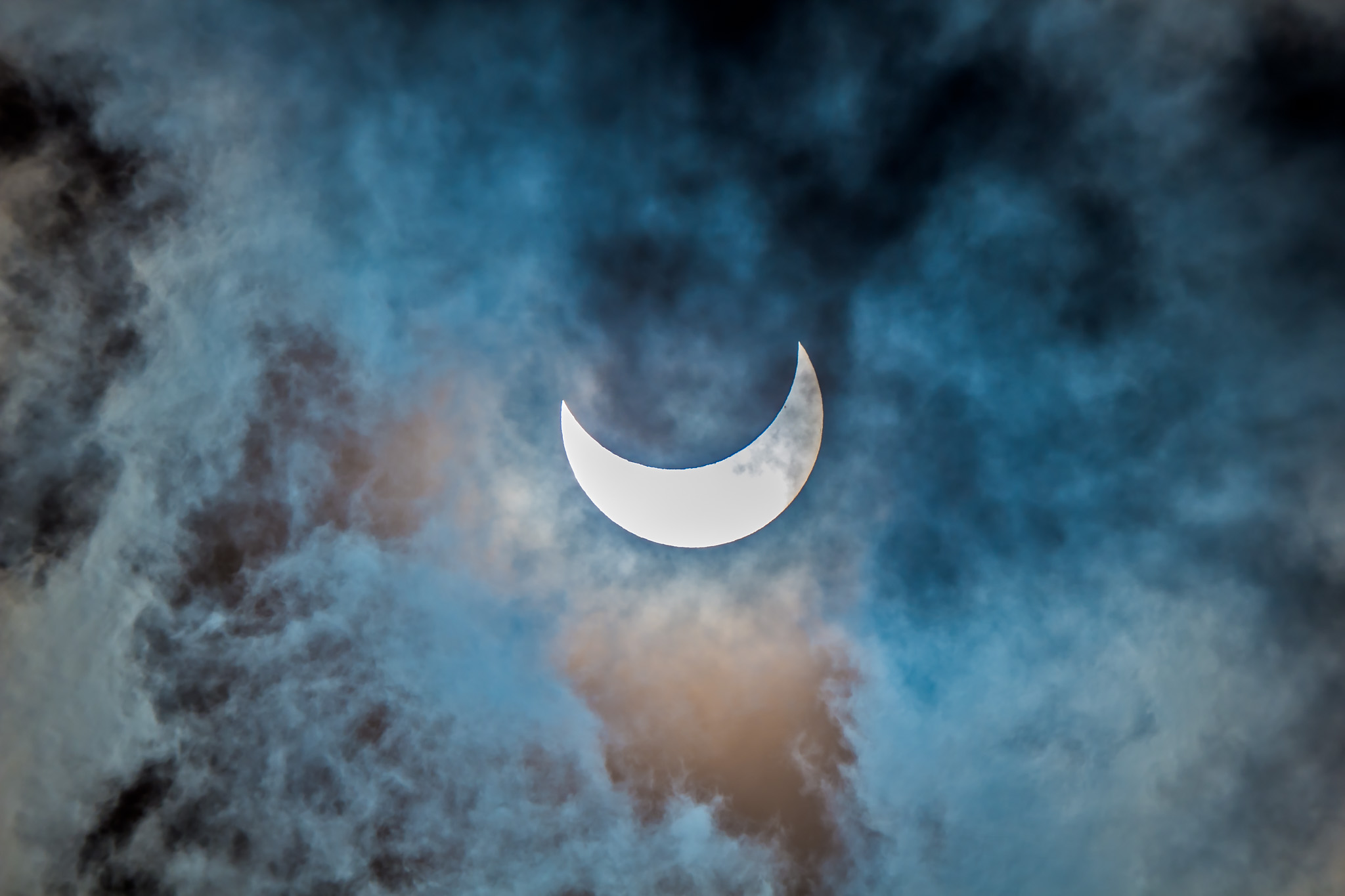
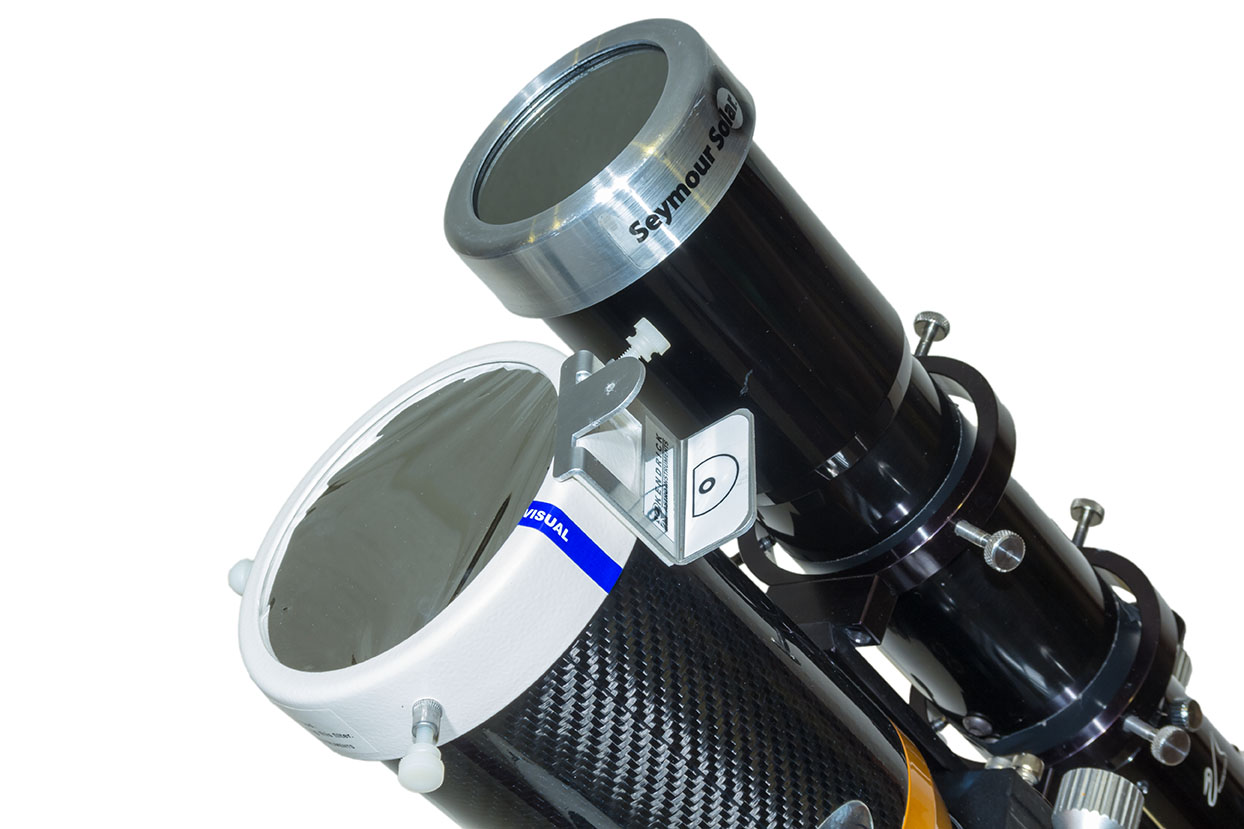
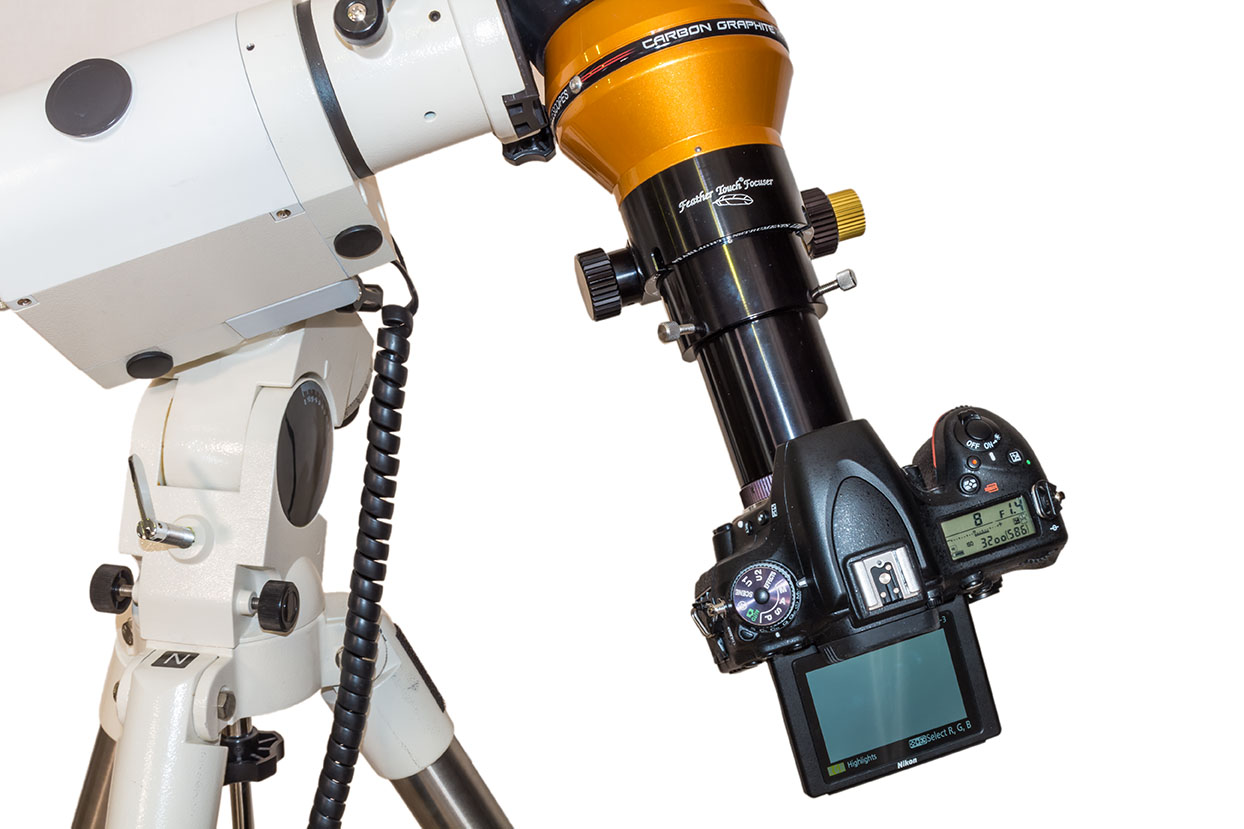
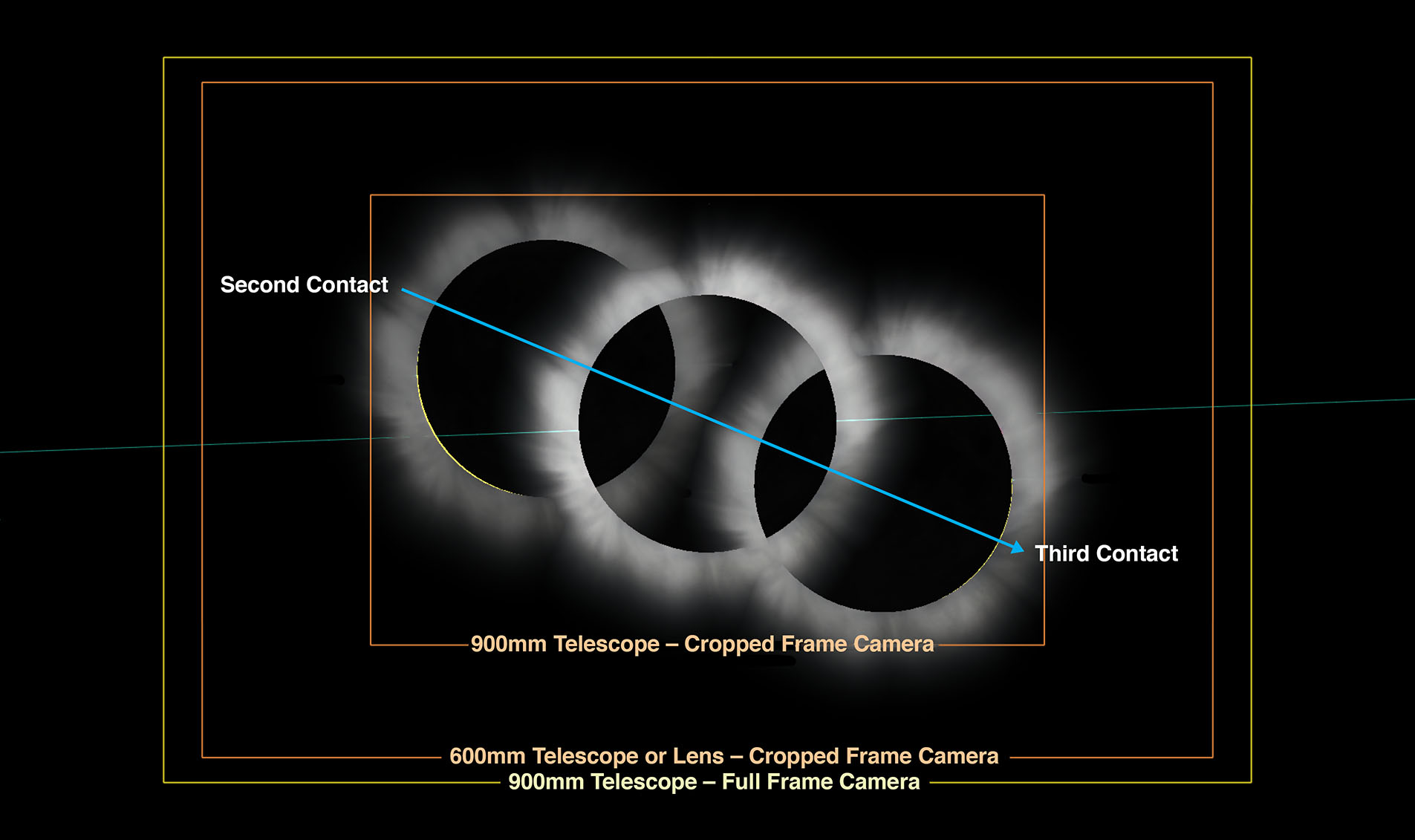
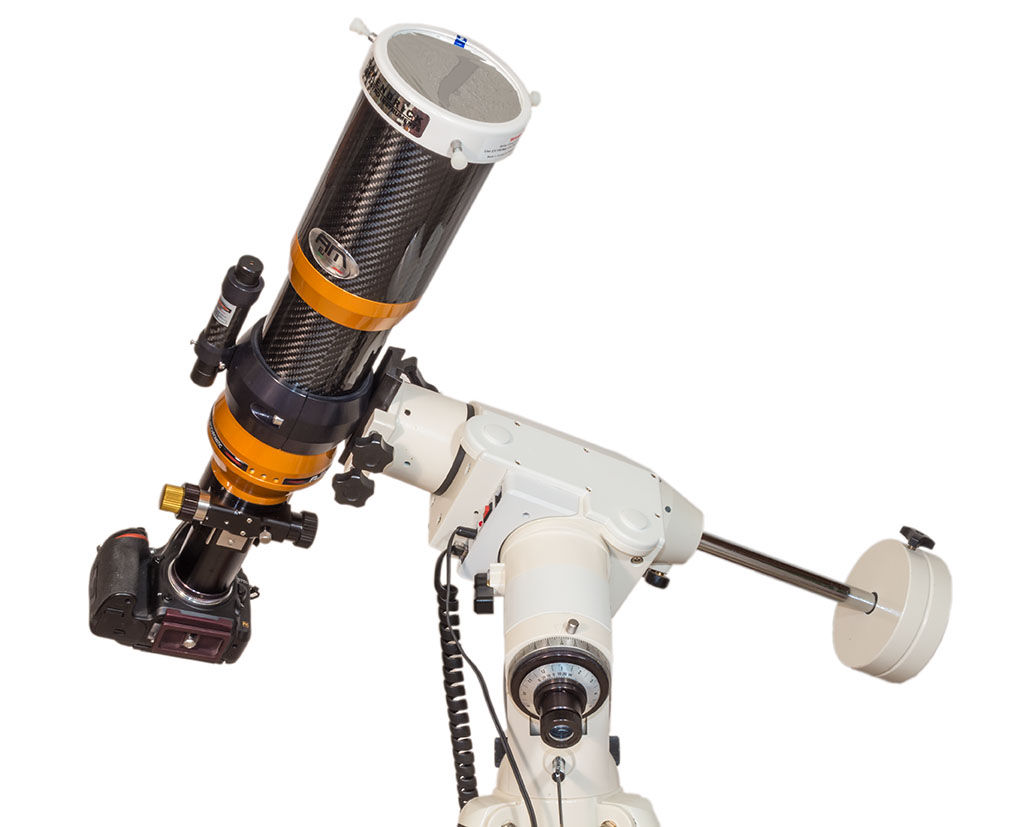
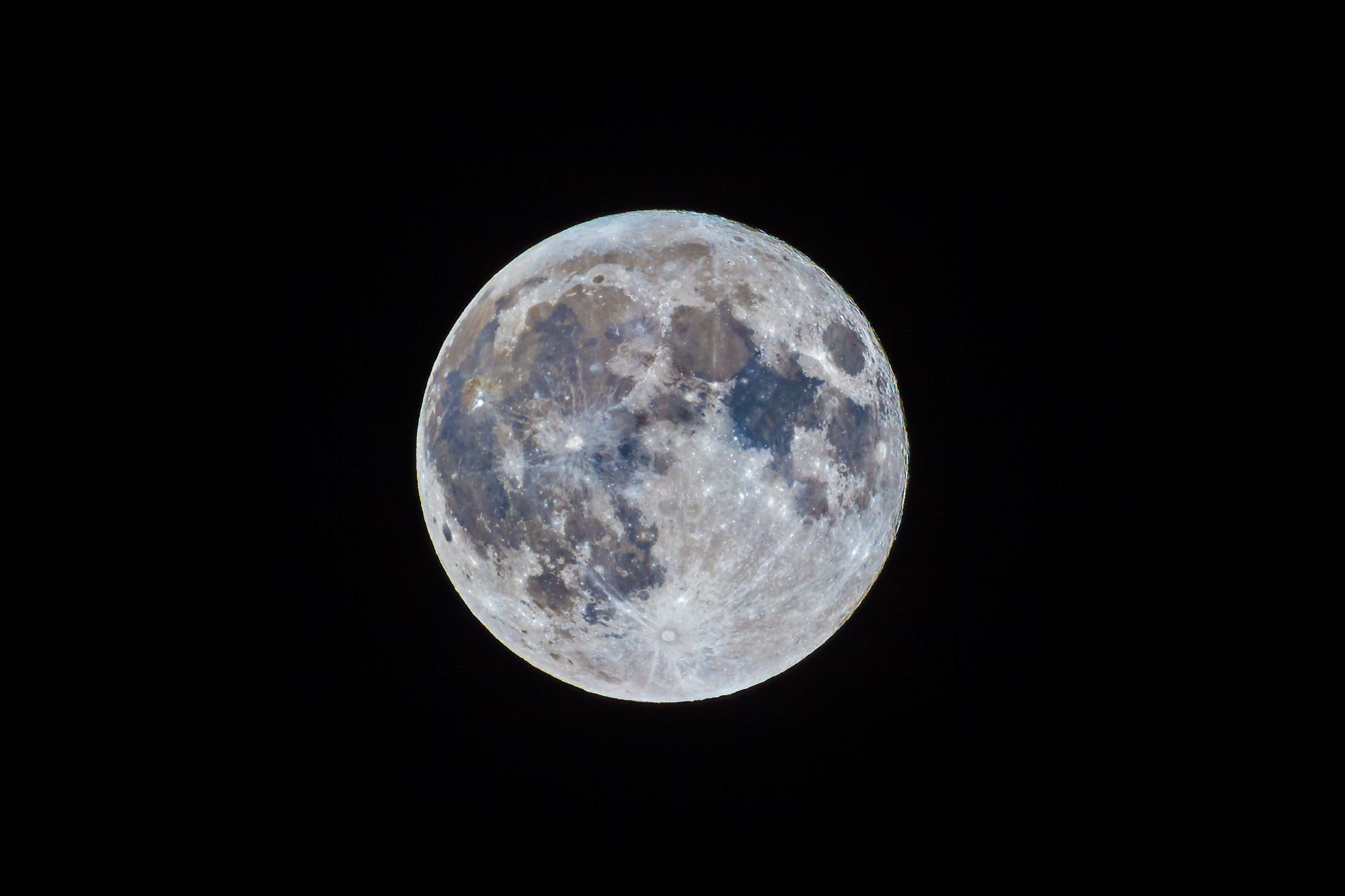
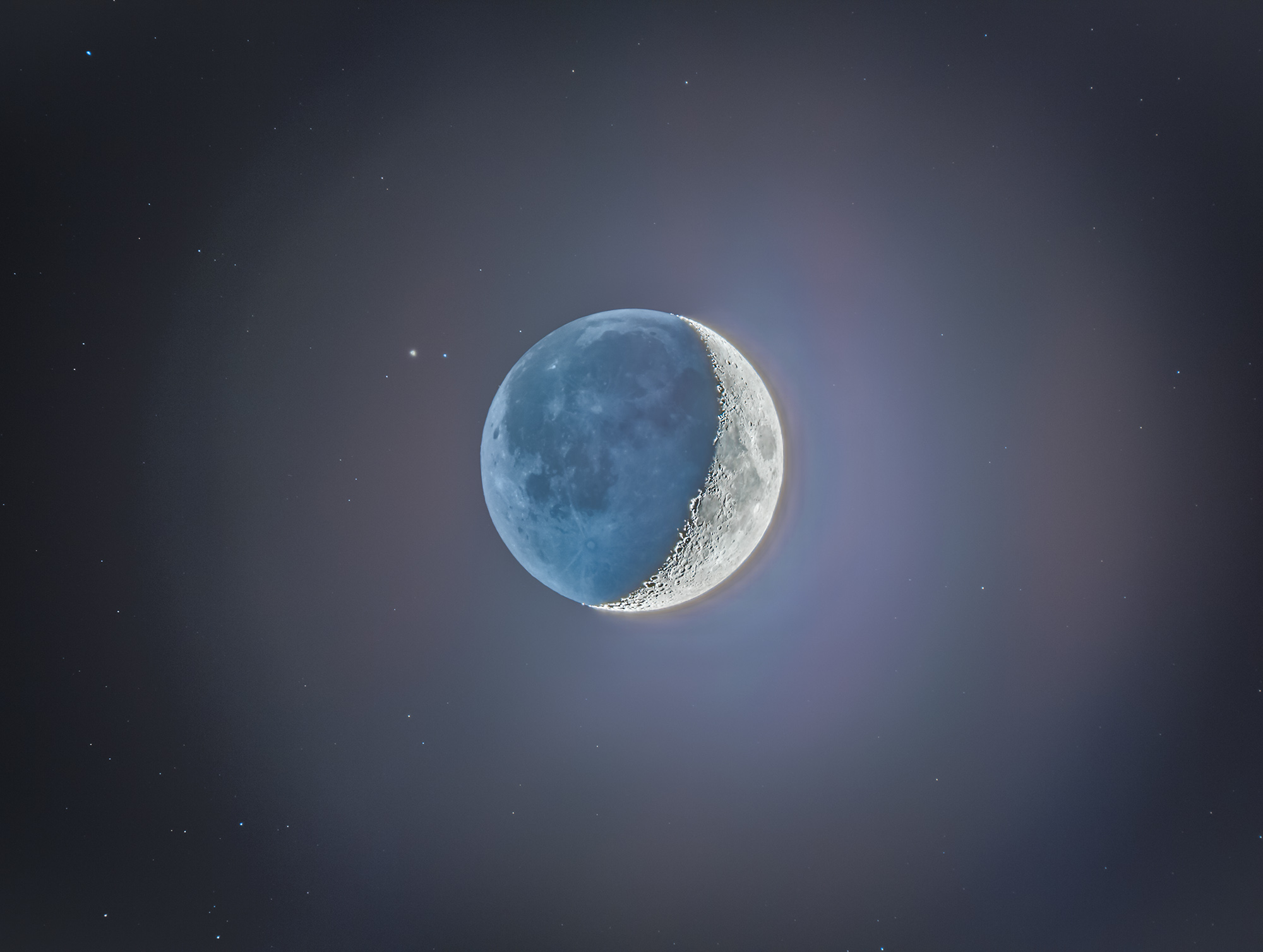
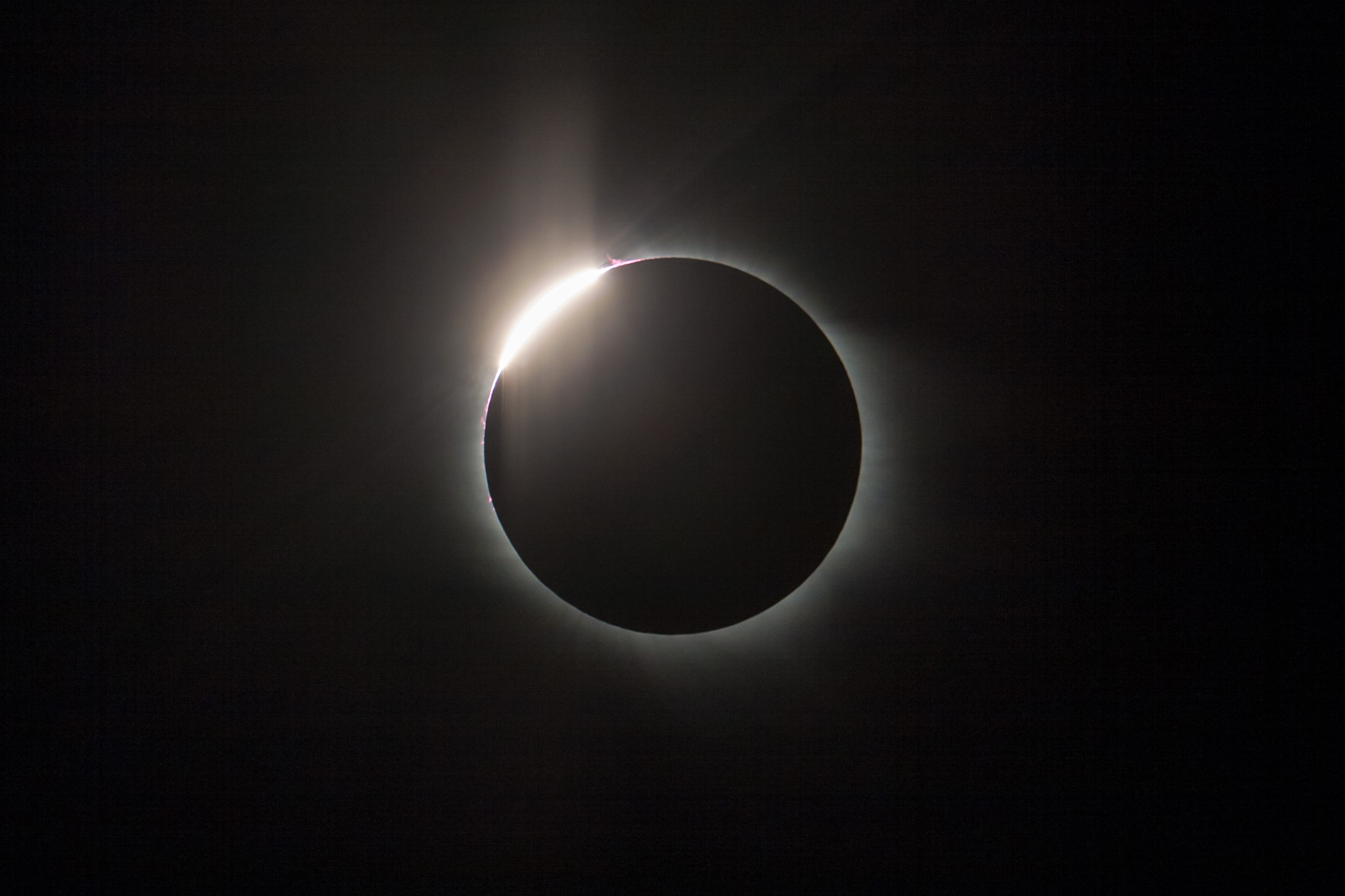

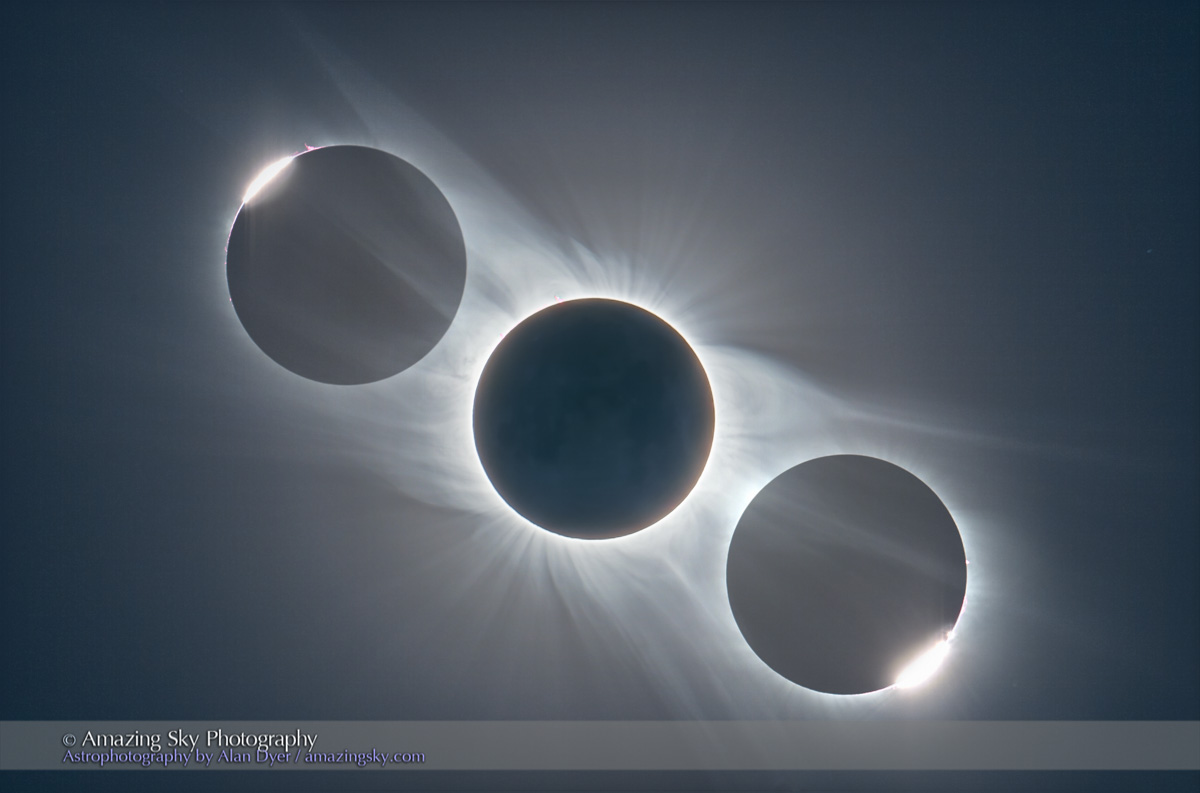

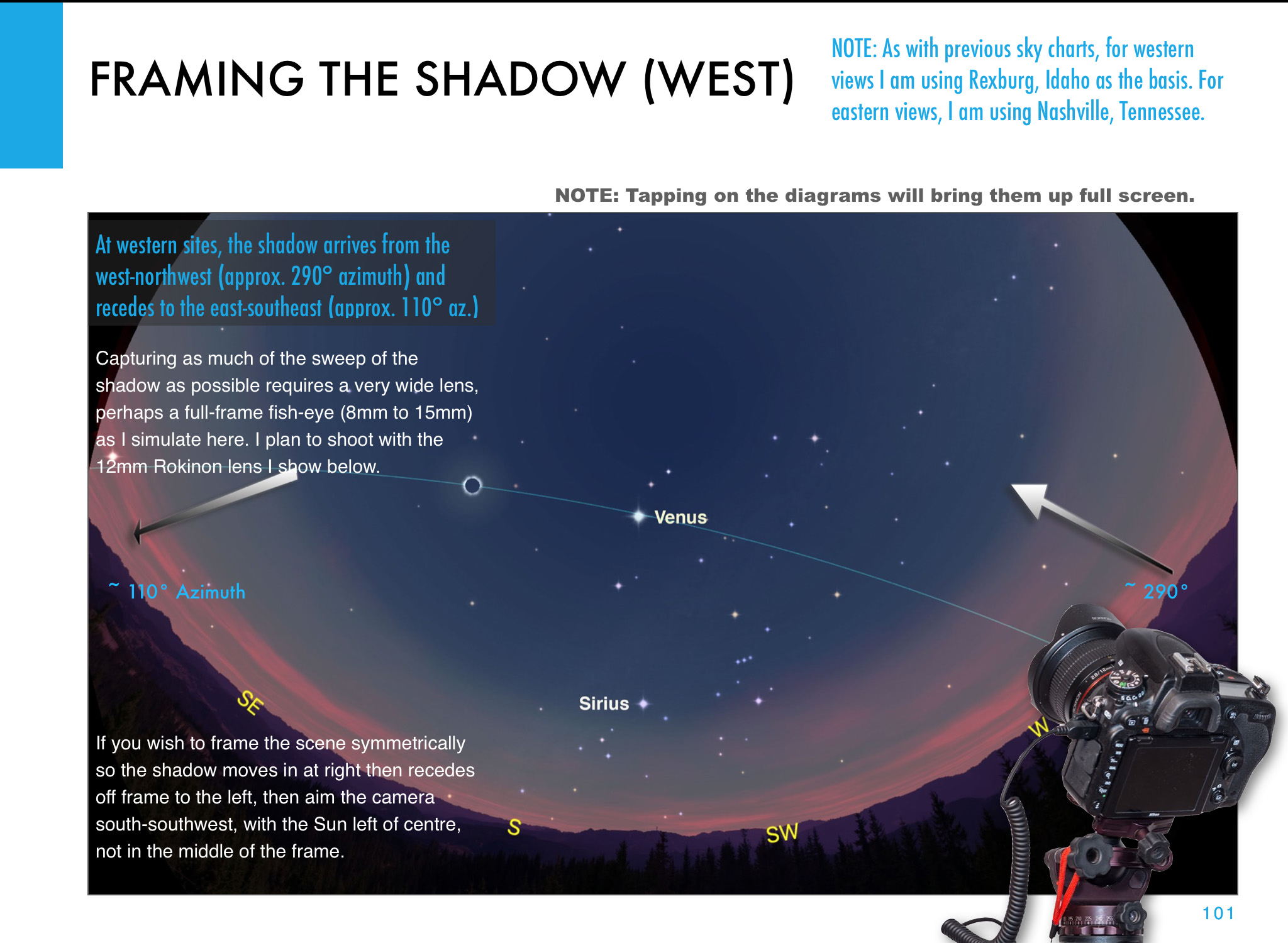
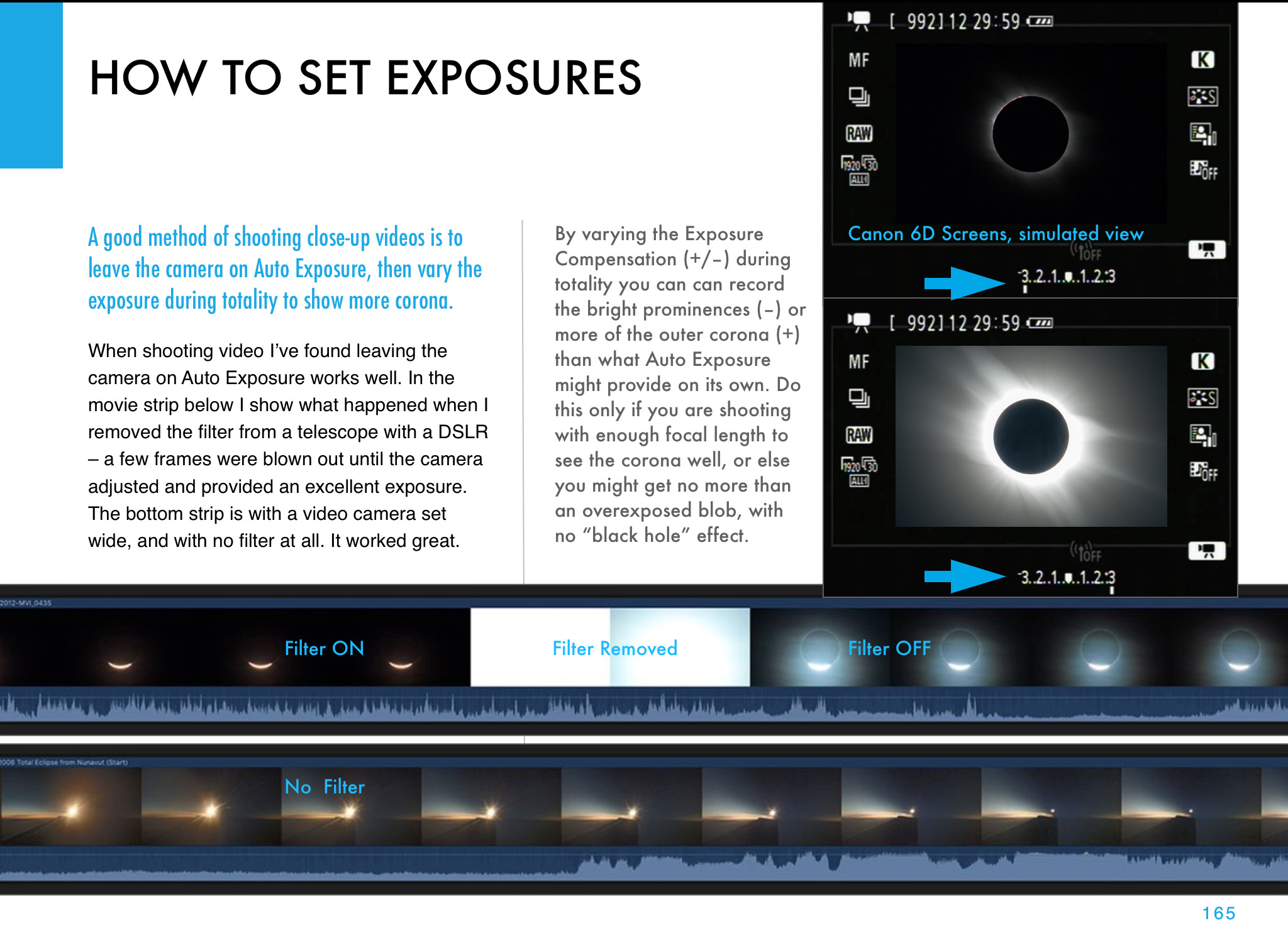

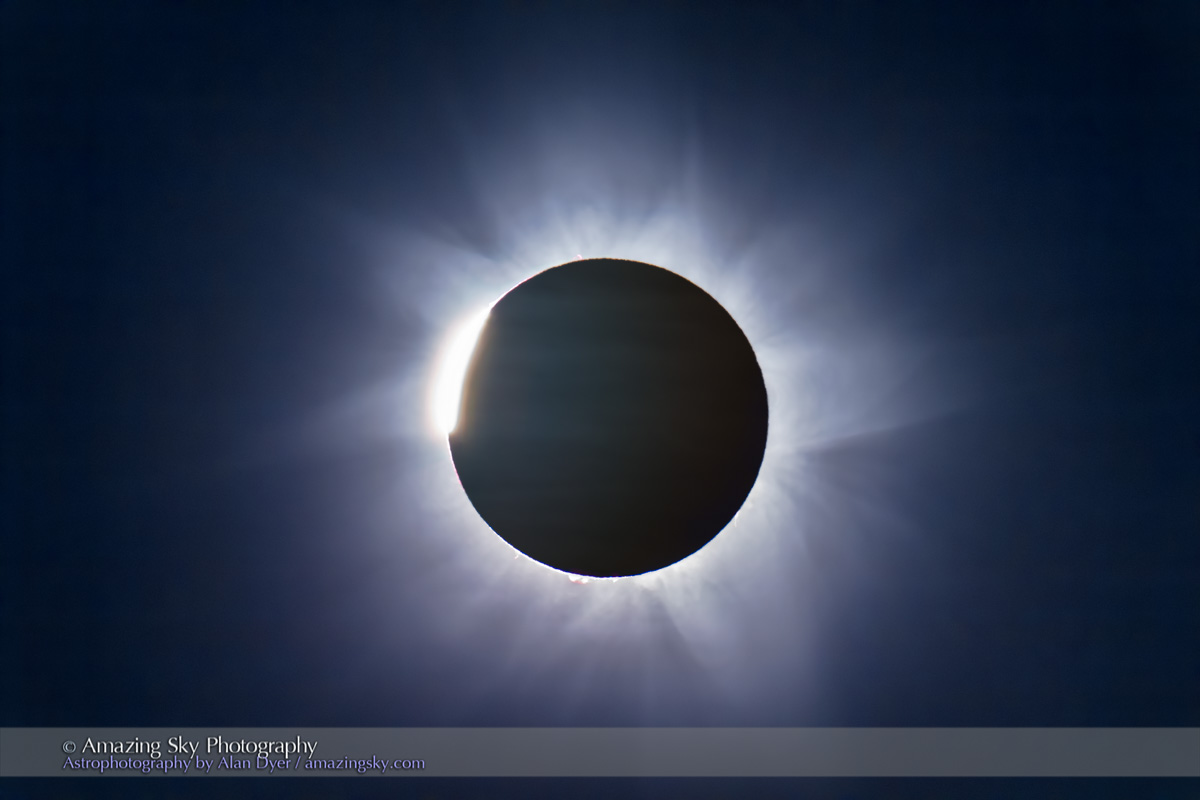
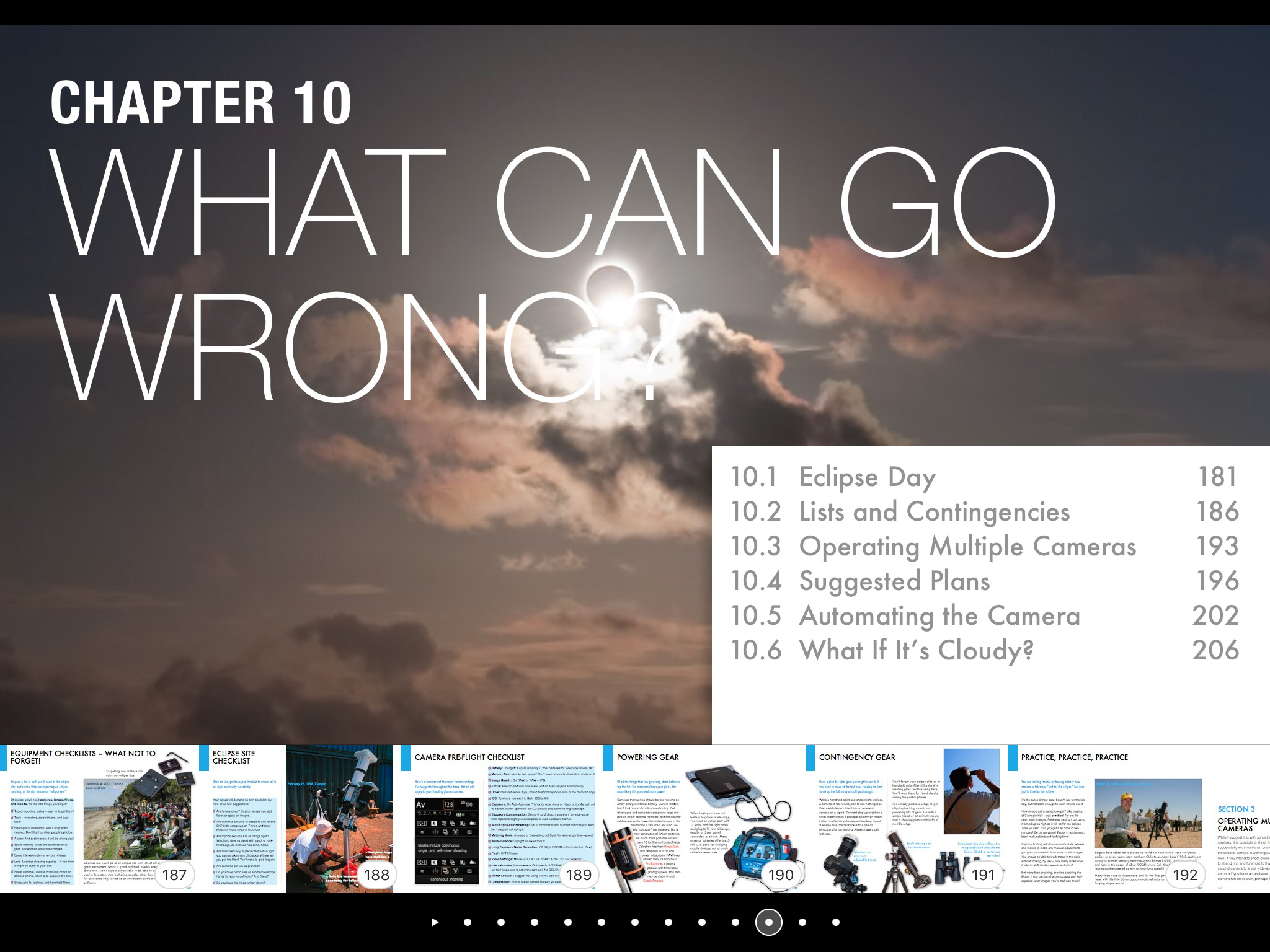
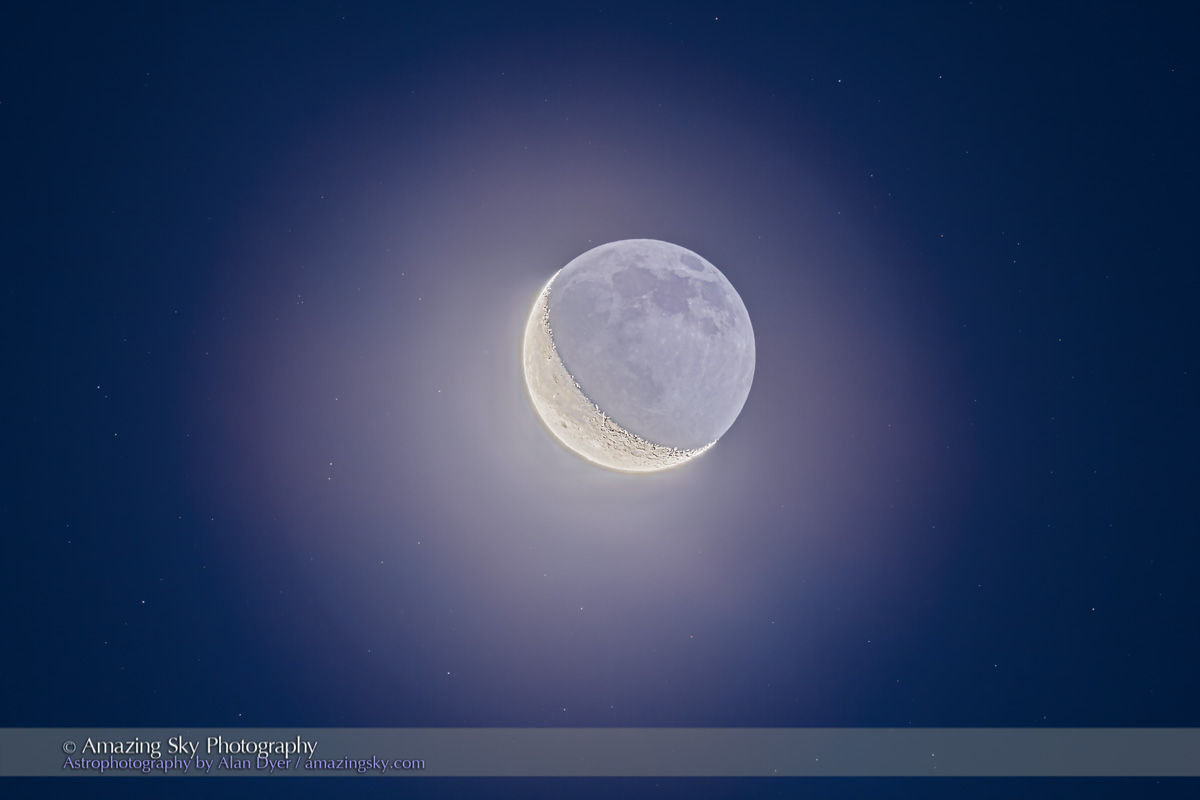


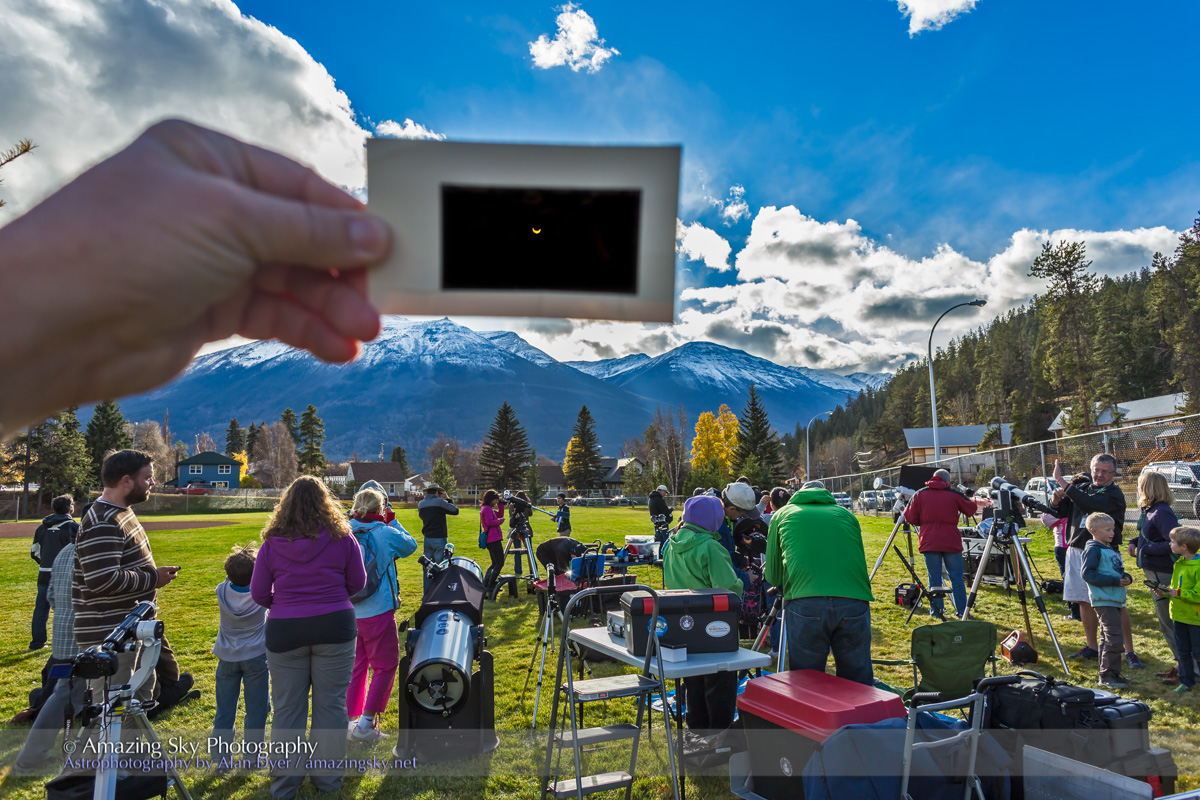
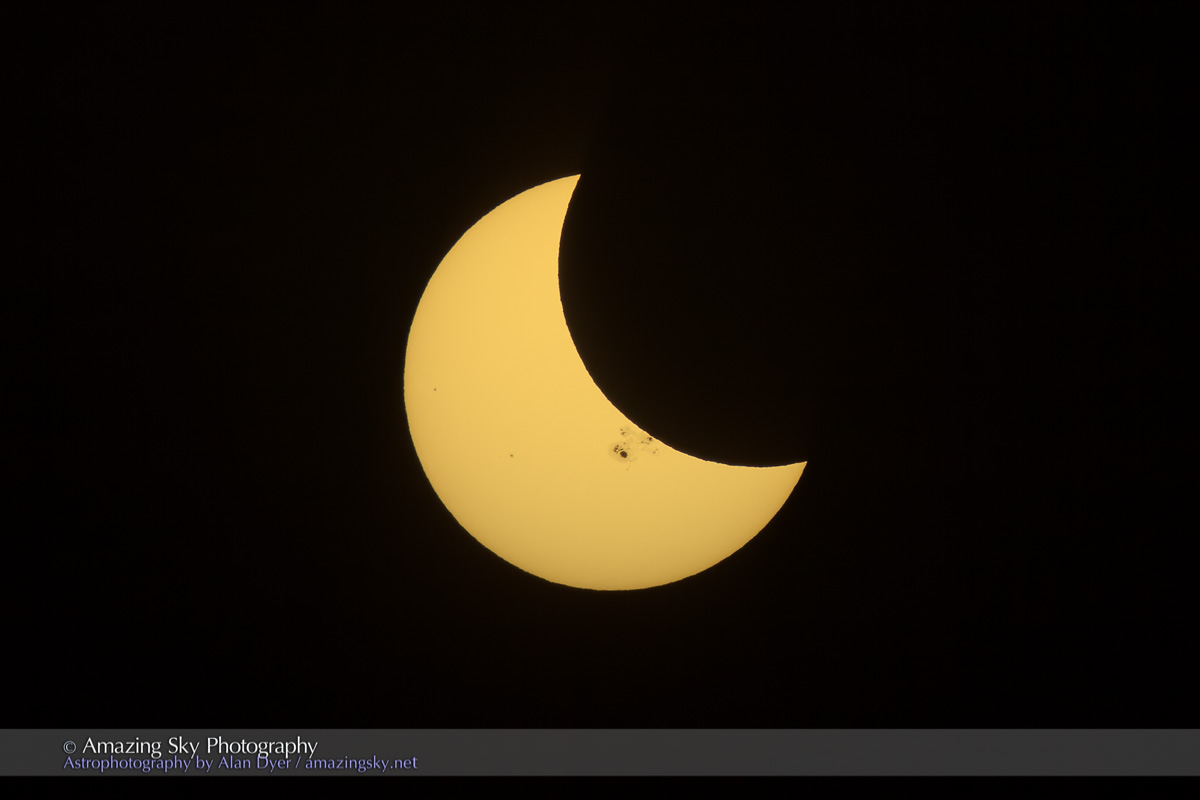
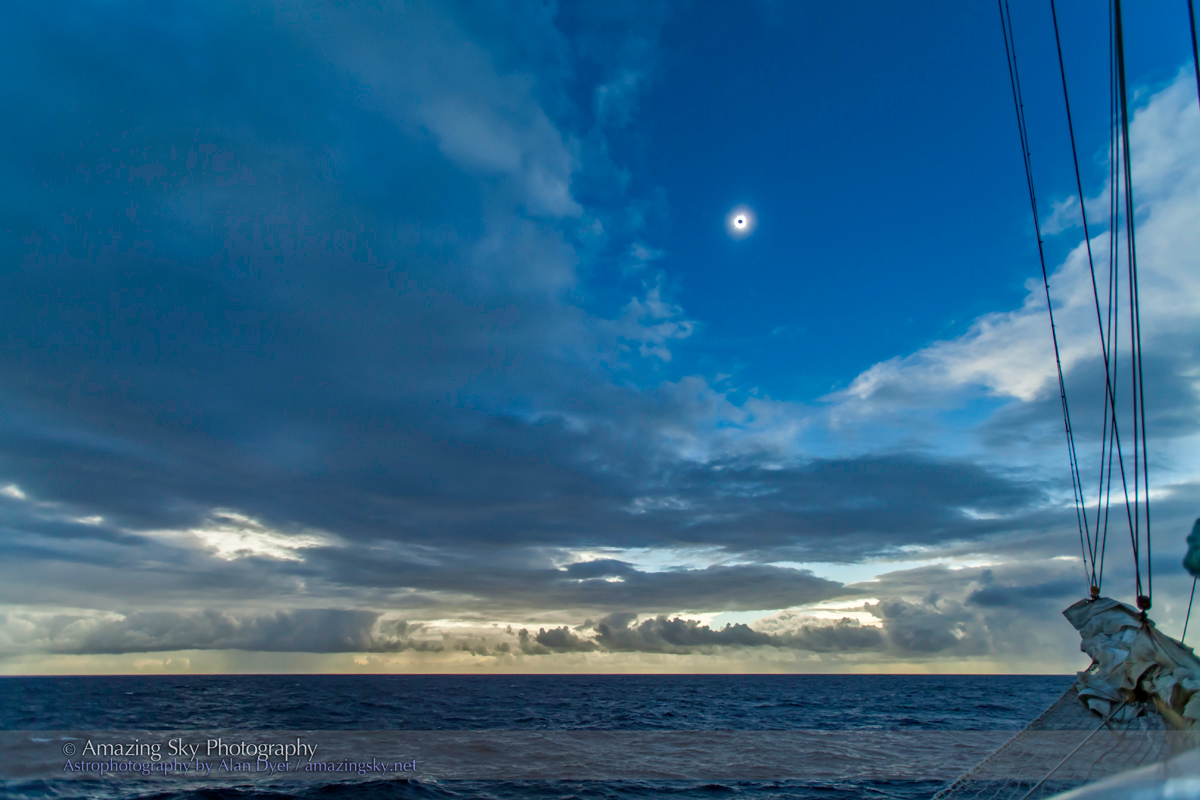
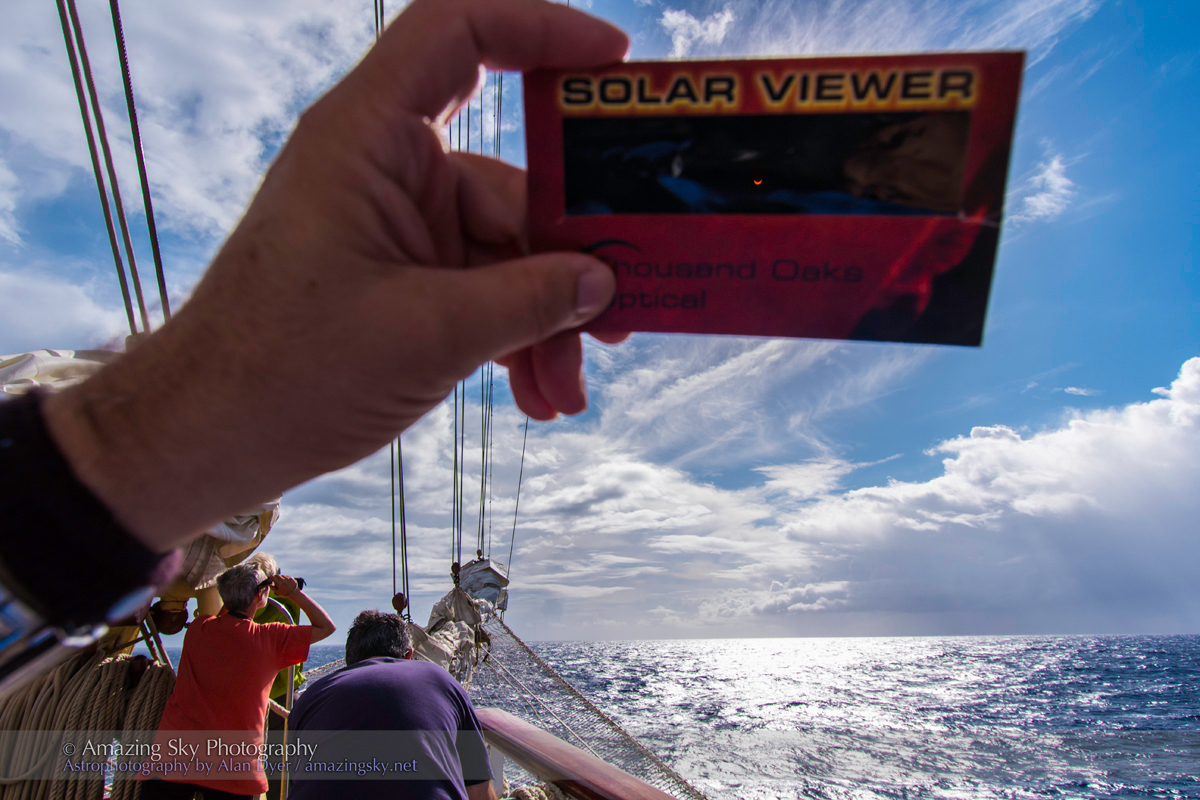
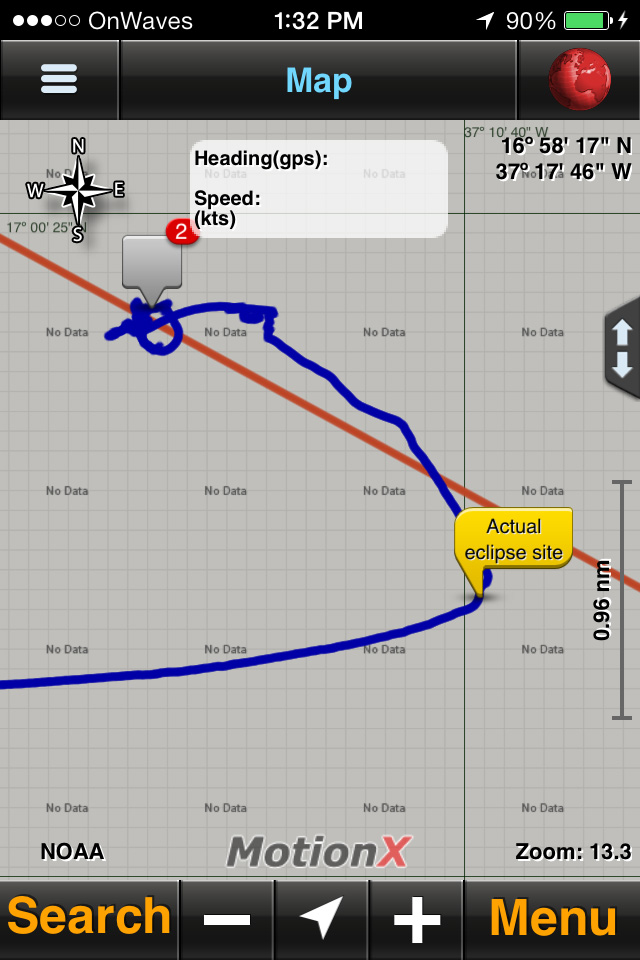


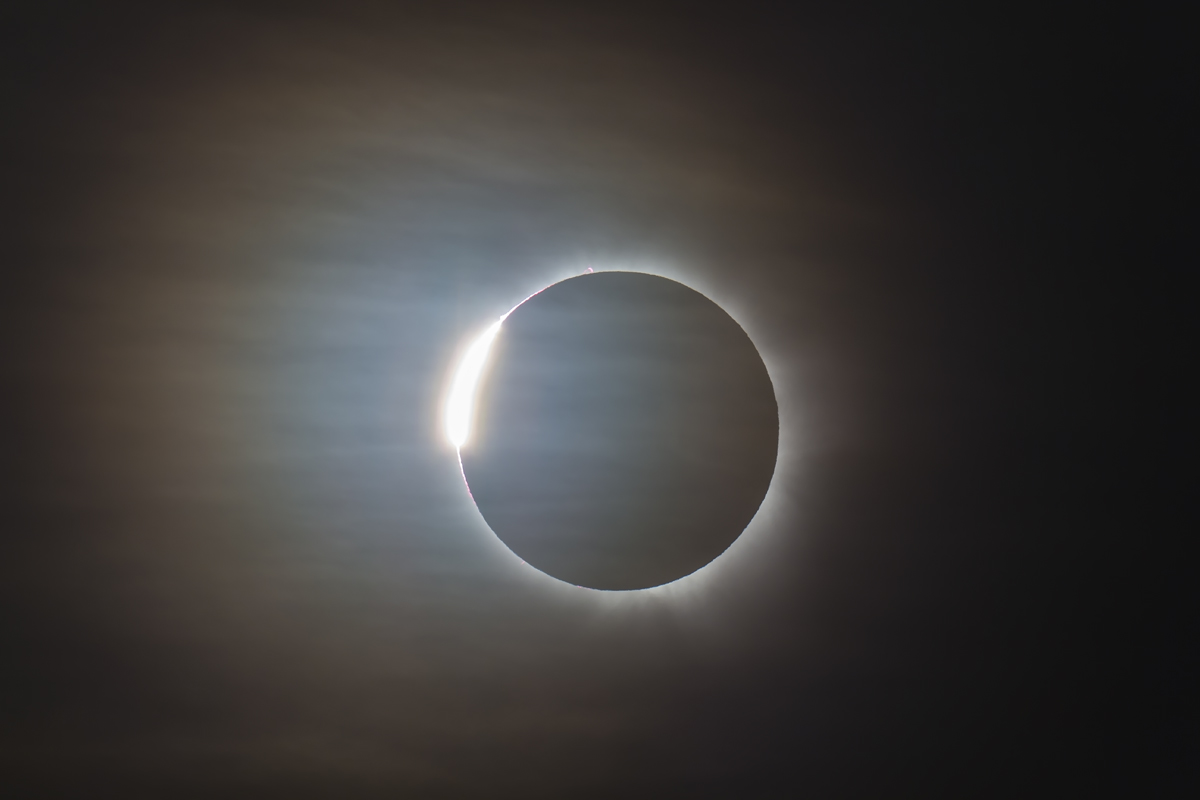

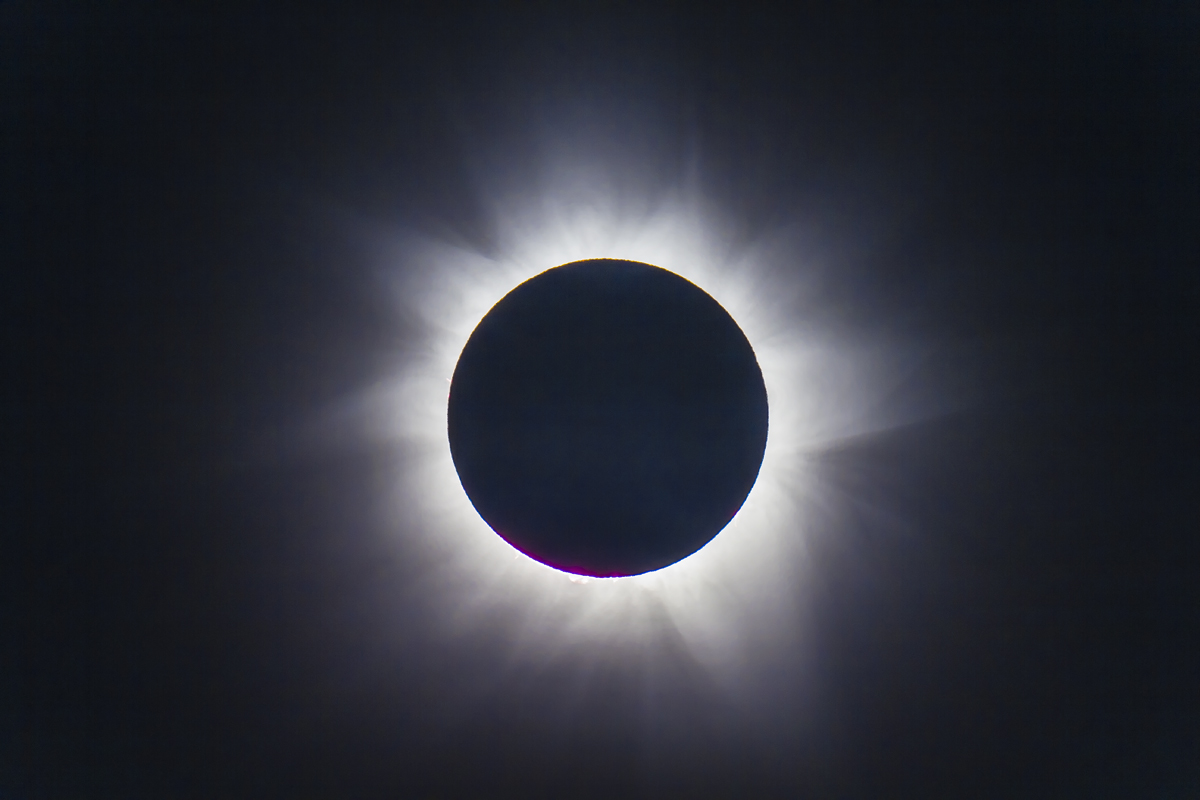
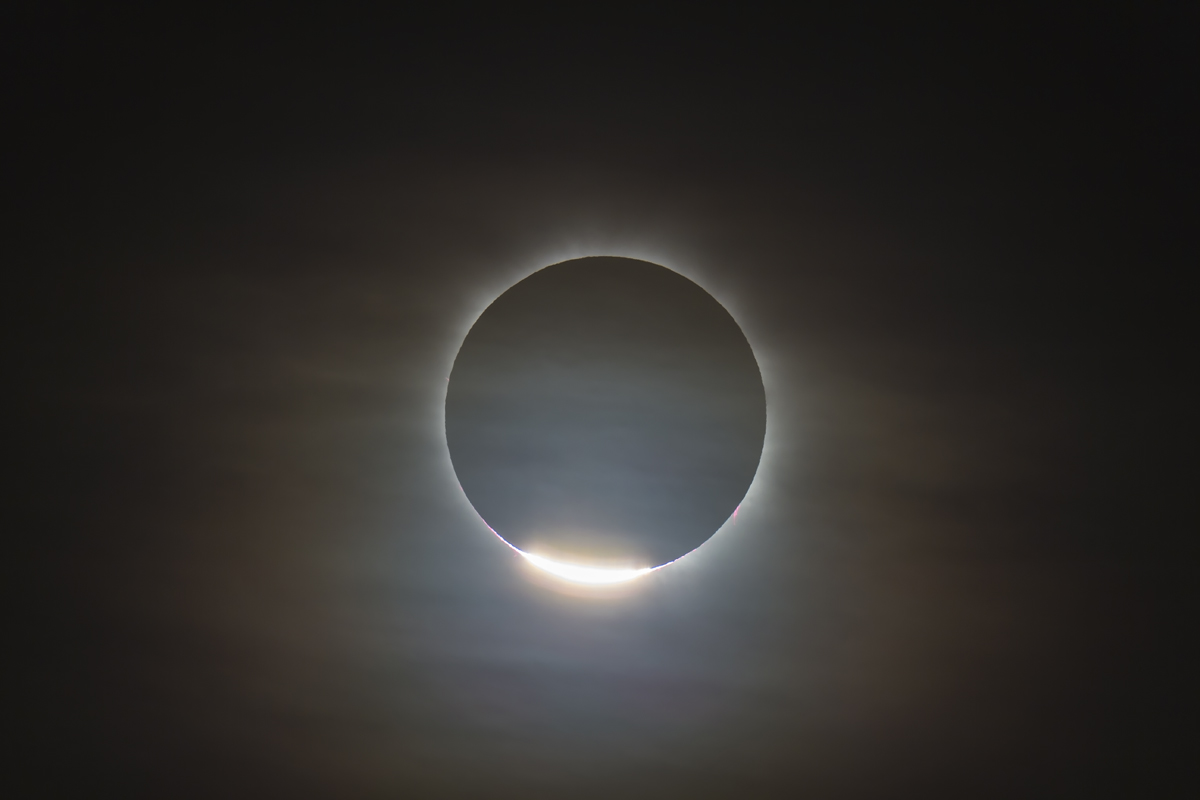



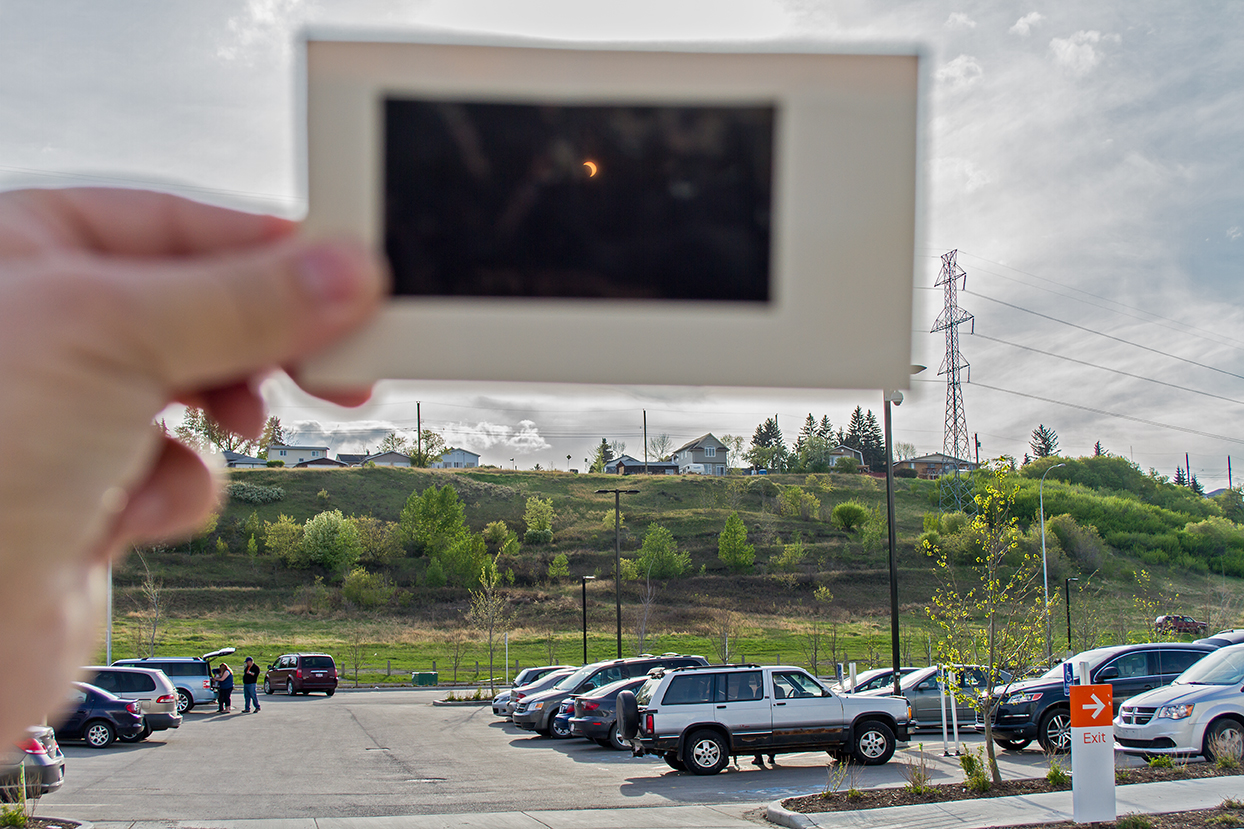
 The Amazing Sky