Springtime Cluster #3: Diamond Tresses in the Sky


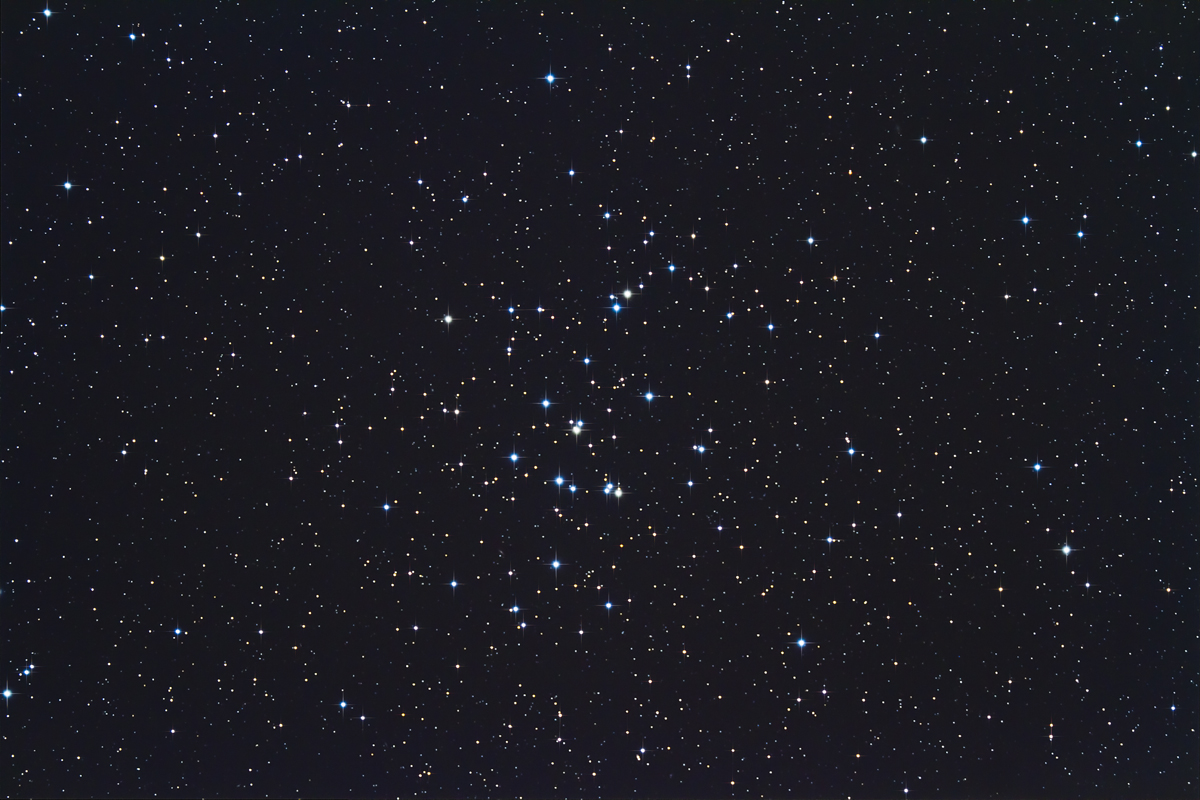
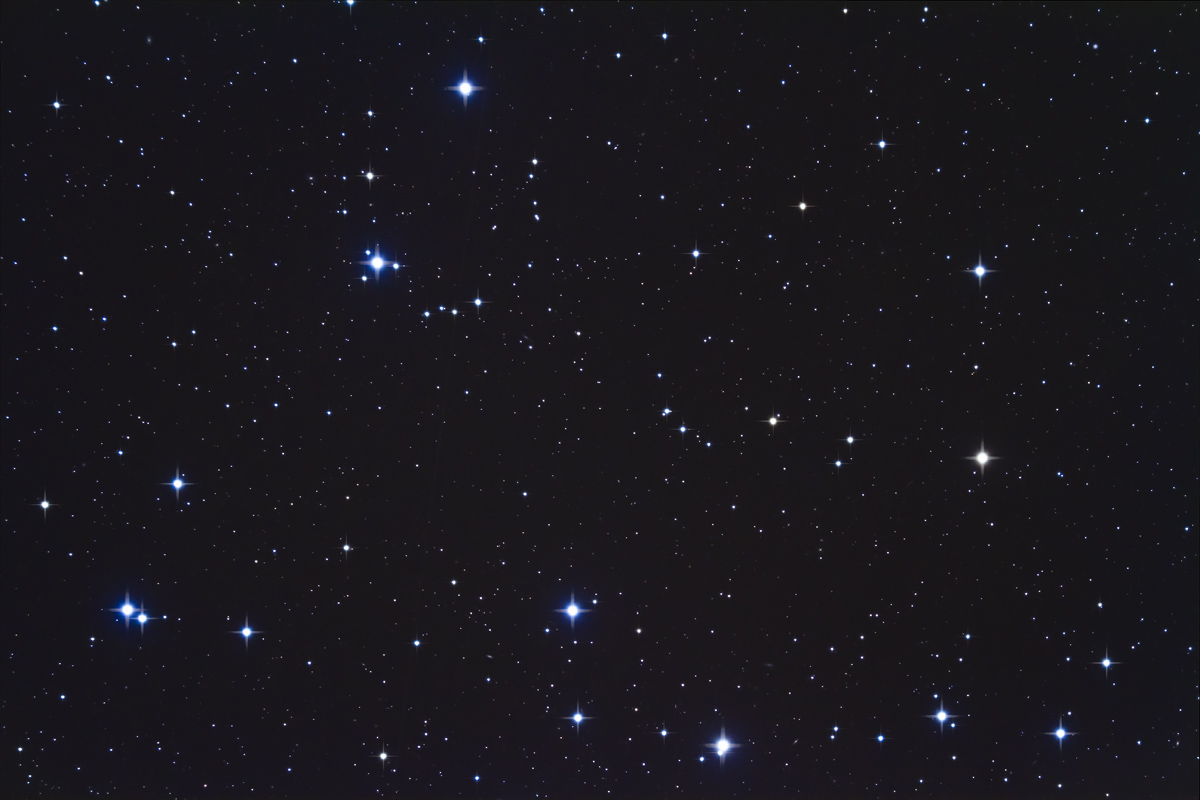
Unlike most deep-sky objects, this one is obvious to the unaided eye. The Coma Star Cluster is so big it barely squeezes into the frame of the wide field telescope I used to take this image. To see it for yourself just look up and due south on northern spring evenings. To the left of Leo, off his back end, shines this loose and scattered grouping of stars obvious to the unaided eye on a dark night. Indeed, I think in olden times this bunch of stars was drawn as the tuft of hair at the end of Leo’s tail.

But now we picture this cluster of stars as the tresses of hair of the late dynasty Egyptian Queen Berenice II, placed in the sky to honour her loyalty to her husband, the Pharaoh Ptolemy. The story has it that the group did not become officially recognized as a constellation until the 16th century.

The constellation of Coma Berenices (hair of Berenices) extends over a larger area of sky than just this grouping, but the Coma star cluster is certainly the most obvious feature of the constellation. Binoculars frame it well (taking in a bit more sky than this image) and are the best way to view it. With their narrow field, telescopes look right through this object.

The cluster is spread over nearly five degrees of sky and contains about 40 stars, so a rather sparse gathering to be sure. Many open clusters, like M67 pictured a couple of blogs back, contain hundreds of stars. Coma is so big in our sky because it is one of the closest star clusters to us, only 288 light years away, and above us toward the north pole of our Galaxy.

Its size and scattered appearance actually meant it hid in plain sight for centuries – yes, it was given a name and people saw it, but astronomers didn’t give it status as an official star cluster until 1938. In 1915 astronomer P.J. Melotte had listed it as object number 111 in his catalogue of star groupings. And so today, we usually refer to this cluster as Mel 111, the most famous entry in “Mel’s” catalog!

I took this shot with the same gear used for the M67 and Beehive M44 shots earlier, so it’s easy to see just how much bigger the Coma Cluster is than just about every other star cluster in the sky. This is a stack of four 6-minute exposures at ISO 1600 with the Canon 7D camera and the 92mm TMB apo refractor.

– Alan, April 2011 / Image © 2011 Alan Dyer
Springtime Cluster #2: Ancient M67


Poor old M67. Does anyone ever look at this cluster? I tend to ignore it, in favour of its brighter and bigger brother, the Beehive Cluster just to the north. Yet, this smaller cluster ranks with the best of the sky’s open star clusters for richness and brilliance. Only a few showpiece star clusters, like the Beehive and the Pleiades, beat M67.

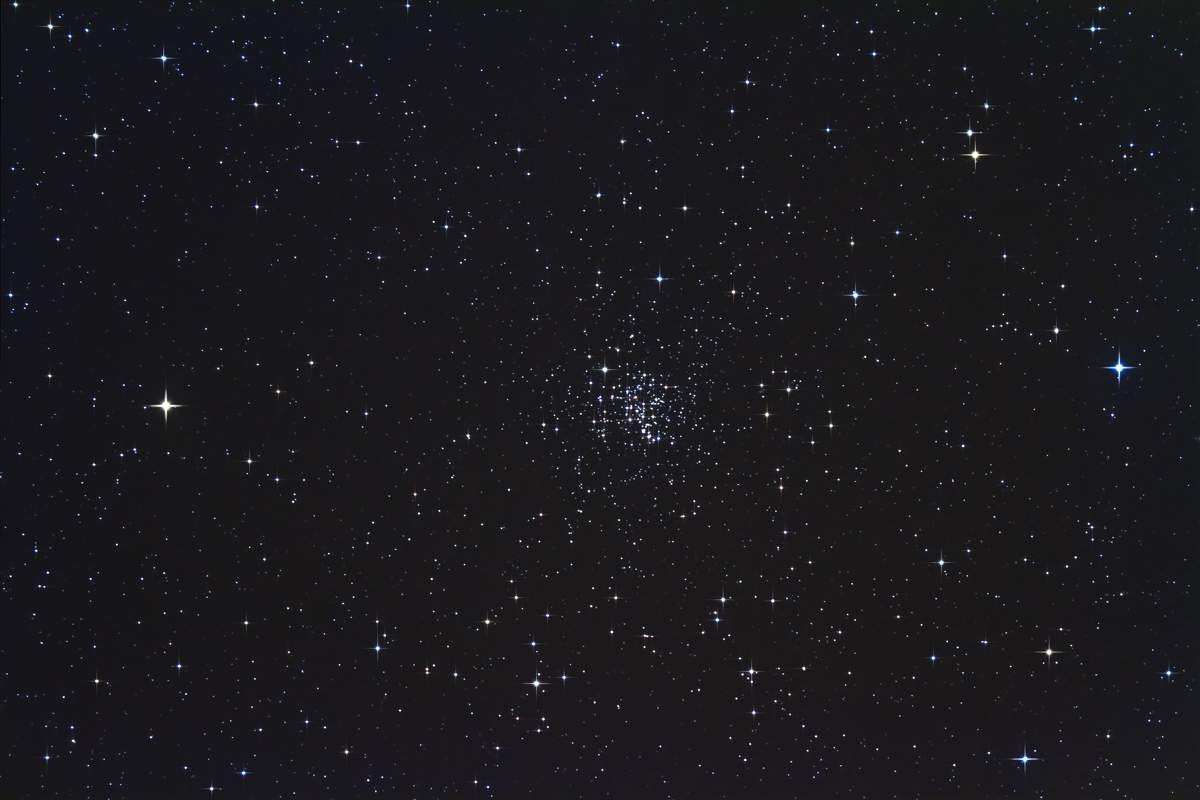
Located in Cancer, M67 really deserves more respect – even a name! – as it stands out as one of the few prominent deep-sky objects in the otherwise sparse spring sky, at least sparse for bright targets for binoculars or a small telescope. Yes, if you love galaxies, the spring sky is heaven! There are thousands of galaxies to hunt down in spring, but most need a decent-sized telescope to do them justice. By contrast, M67 looks just fine in a small telescope. With a few hundred stars packed into an area the apparent size of the Full Moon this is one rich cluster.

M67 is called that because it is #67 in Charles Messier’s catalog of “things not to be confused as comets.” Messier came across this object in April 1780. Messier ‘s object #67 is one of the few open star clusters not embedded in the Milky Way. Like the Beehive, M67 sits well above the disk of our Galaxy’s spiral arms. We look up out of the plane of the Galaxy to view M67, sitting some 2600 light years away, over four times farther away than its neighbour in Cancer, the Beehive. Thus, M67 looks smaller than the Beehive because it is more distant.

M67 holds the distinction of being one of the oldest star clusters known. It’s been around for over 4 billion years. Its position well above the frenzied traffic jam of our Galaxy’s spiral arms helps M67 stay intact and together, an isolated island of stars in our spring sky.

This image was taken right after the M44 Beehive Cluster shot featured in my previous blog post, using the same gear. So the image scale is the same. You can see how much smaller M67 appears than M44. Because M67 was beginning to sink into the west when I took this, I bumped the camera up to ISO 1600 and used shorter 3 minute exposures and stacked five of them to smooth out noise. The telescope was the little 92mm TMB apo riding on the Astro-Physics 600E mount and flawlessly autoguided with the Santa Barbara Instruments SG-4 autoguider. I really love the SG-4 — just press one button and it’s guiding. True “Push Here Dummy” guiding!

— Alan Dyer, April 2011 / Image © 2011 Alan Dyer

Springtime Cluster #1: The Beehive (M44)


At last! A clear night in what so far has been an awful spring. The long-awaited arrival of mild spring nights brings a sky sprinkled with a few naked-eye star clusters. This is the most famous, and appears as a fuzzy glow in the constellation of Cancer the Crab. Indeed, to the unaided eye, there’s not much else to see in Cancer. But this cluster is a dandy in binoculars. Called the Beehive, this is one of the few deep-sky objects known since antiquity. Apparently, the Greek poet Aratos mentioned it in 260 B.C., describing it as a “little mist.” A hundred years later Hipparchus included it in his star catalog, calling it a “cloudy star.”

It wasn’t until 1609 that Galileo, using his pioneering telescope, resolved the cloud into a mass of stars. Any binoculars will do the same today. This close-up view more closely matches the view through a modern telescope, showing its subtly coloured blue and yellow stars.

In 1769 Charles Messier included it as object #44 (the Pleiades was #45) in his first catalog of what we now call deep-sky wonders. To him, however, these fuzzy spots in the sky were just distractions to his goal of hunting the fuzzy things that really mattered – comets.

The stars of M44 really do belong together in a gravitationally-bound cluster of up to 1000 stars, traveling together through space since the time about 600 million years ago when they formed out of what must have been a massive gas cloud. That’s a pretty good age for a star cluster; most break apart and scatter around the Galaxy after just a few tens of millions of years. However, the Beehive sits about 600 light years away, above the main disk of the Milky Way and its spiral arms. Its location makes it partly immune to the disruptive tidal forces of the Galaxy. Because it lies above the galactic plane we see it far off the band of the Milky Way, shining in our spring sky sparsely populated with bright stars and lacking the rich assortment of clusters and nebulas scattered along the winter and summer Milky Way.

For this exposure I used a favourite scope, the TMB 92mm apo refractor, a compact and fast little telescope perfect for imaging big binocular-class objects like this. This is a stack of four 4-minute exposures at ISO 800 with the Canon 7D camera. A Photoshop routine added the diffraction spikes, purely for photogenic value.

– Alan Dyer, April 2011 / Image © 2011 Alan Dyer

The Wonderful Winter Sky


While I took this image a year ago in early 2010, I thought I’d post this up now, with the new blog now underway. This is a mosaic of what surely ranks as one of the most amazing areas of sky — the vast panorama of the night sky visible in the northern hemisphere each winter. Here we see more bright stars than at any other season of the year, in the constellations (in clockwise order) of Orion, Canis Minor, Gemini, Auriga, and Taurus. Canis Major and its luminary, Sirius, are just off the bottom of the frame.

This is a 4-panel mosaic, each panel consisting of four 4-minute exposures plus two 4-minute exposures with a soft diffuser filter to add the star glows. Each was taken at ISO 800 with the Canon 5D MkII and a 35mm lens at f/4. Slight haze, changing sky fog, and changing elevation of the fields make it tough to get consistent colours across the sky during the couple of hours of exposure time needed to grab the images for such a mosaic, especially from my home latitude. But this attempt worked pretty well and records the wealth of bright red and dark nebulosity throughout this area of sky, a region of the Milky Way in our spiral arm but a little farther out from the centre of the Galaxy than where we live.

– Alan, January 2011 / Image © 2010 Alan Dyer

The Neglected Small Magellanic Cloud


It sits not far away in the deep southern sky from its larger counterpart, but it must feel rather inferior and sadly neglected. Pity as this object does have lots to offer.

This is the Small Magellanic Cloud, a satellite galaxy to the Milky Way and a companion to the Large Magellanic Cloud — each is named for Ferdinand Magellan who noted them on his pioneering circumnavigation voyage of the world in the 16th century. The Small Cloud doesn’t contain the number and complexity of nebulas and clusters as does its larger brother, but it does have some lovely offerings, like the complex of cyan-coloured nebulas and related clusters at top.

However, the notable sights in this area of sky aren’t actually part of the SMC. The two globular clusters in the field lie much closer to us. NGC 362 is a nice globular at top, but it pales in comparison (every such object does) next to the amazing object known as 47 Tucanae, or NGC 104, the huge globular cluster at right. It is a wonderful sight in any telescope.

This is a stack of five 7-minute exposures with the Borg 77mm f/4 astrograph and Canon 5D MkII at ISO 800. I took this on my astrophoto trip to Australia in December 2010, a season when this object is ideally placed for viewing. Most times of the year, the SMC is dragging close to the horizon and lost in the murk, as least for shooting. That’s another reason the poor old SMC gets no respect!

— Alan, December 2010 / Image © 2010 Alan Dyer

The Wonder-filled Large Magellanic Cloud


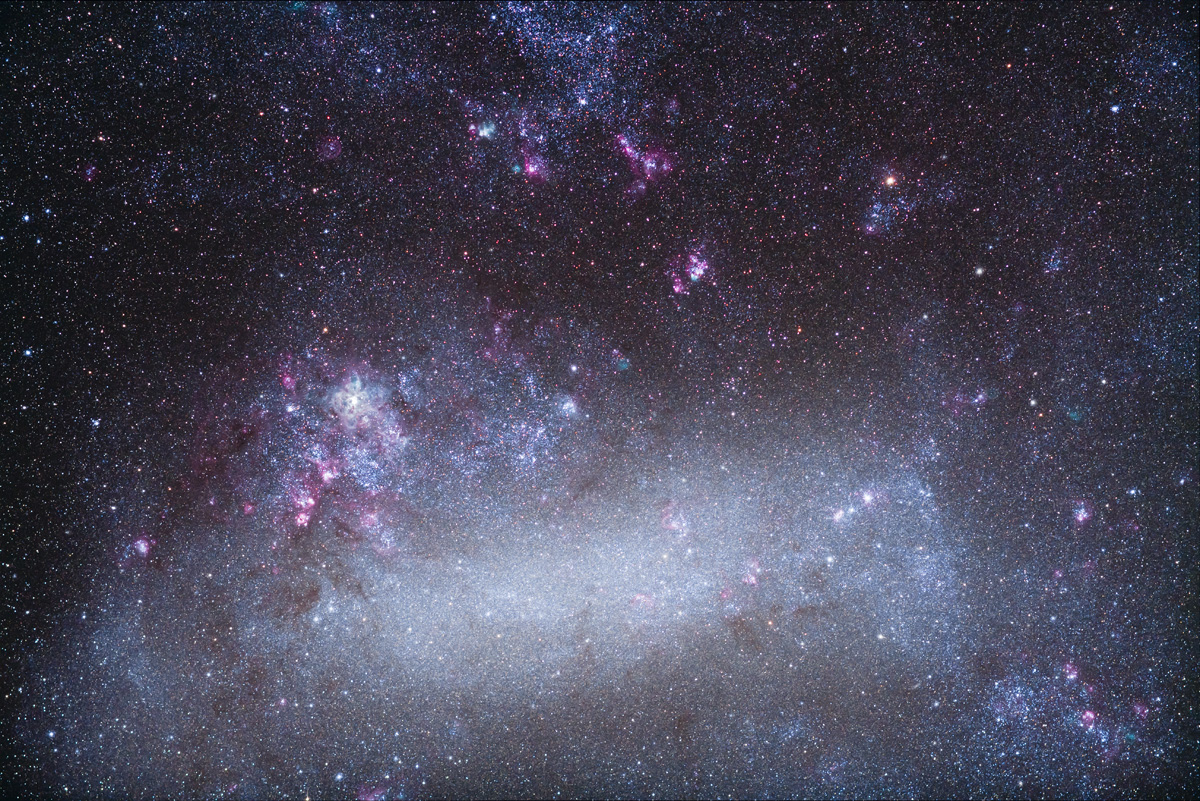
It occupies only a binocular field or two in the sky but … Wow! What a field it is! This is one of the objects that makes a trip to the southern hemisphere for astronomy worth the trek alone. This satellite galaxy of our Milky Way is visible only from south of the equator. It contains so many clusters and nebulas, many in the same telescope field, that just sorting out what you are looking at takes a good star atlas (most don’t plot this region well). This is one of my best shots of the “LMC,” taken on my December Oz trip. It is with the Borg 77mm f/4 astrographic lens/telescope and the filter-modified Canon 5D MkII, that picks up much more red nebulosity (that emits deep red wavelengths) that stock cameras don’t record well.

Even so, I’m always amazed at how so many nebulas in the LMC, and in its smaller counterpart, the nearby Small Magellanic Cloud, record as magenta or cyan, rather than deep red. The most prominent object is the Tarantula Nebula at left of centre. It is an amazing sight in any telescope, especially with a nebula filter.

This is a stack of five 7-minute exposures at ISO 800, with the scope on the AP 400 mount and guided with the SG-4 autoguider. This is a single image, framed to take in all the best stuff of the LMC. But to really get it all in with any detail requires a multi-panel mosaic. I’ve done those on previous trips and was hoping to re-do one on this last trip, with the better, sharper camera, the 5D MkII, and with the LMC higher in the sky than on earlier trips. But the lack of clear nights curtailed my plans.

But I’m happy with this one. Nice and sharp and with oodles of nebulosity. But one can never exhaust what this object has to offer, both for imaging and for just looking with the eyepiece. So there’s always next time!

– Alan, December 2010 / Image © 2010 Alan Dyer

The Dark Clouds of Taurus


An area of sky often neglected but ideal for digital imaging is the region of Milky Way in Taurus and Auriga. Threaded through this area of sky are large lanes of dark interstellar dust, forming cold molecular clouds out of which stars form. This complex is close, only 400 light years away, in our spiral arm of the Galaxy, and so is spread out over a wide area of sky. Only piggybacked cameras with normal and wide-angle lenses capture it. But today’s digital cameras are able to record these kinds of dark nebulae as more than just dark holes in the sky — they have colour, usually shades of reddish-brown.

This is a shot from January 2011 from my home backyard, and takes in all of Taurus, most of Auriga and southern Perseus, with the Pleiades at right and the Hyades below.

— Alan, January 2011 / Image © 2011 Alan Dyer

Hazy Hyades


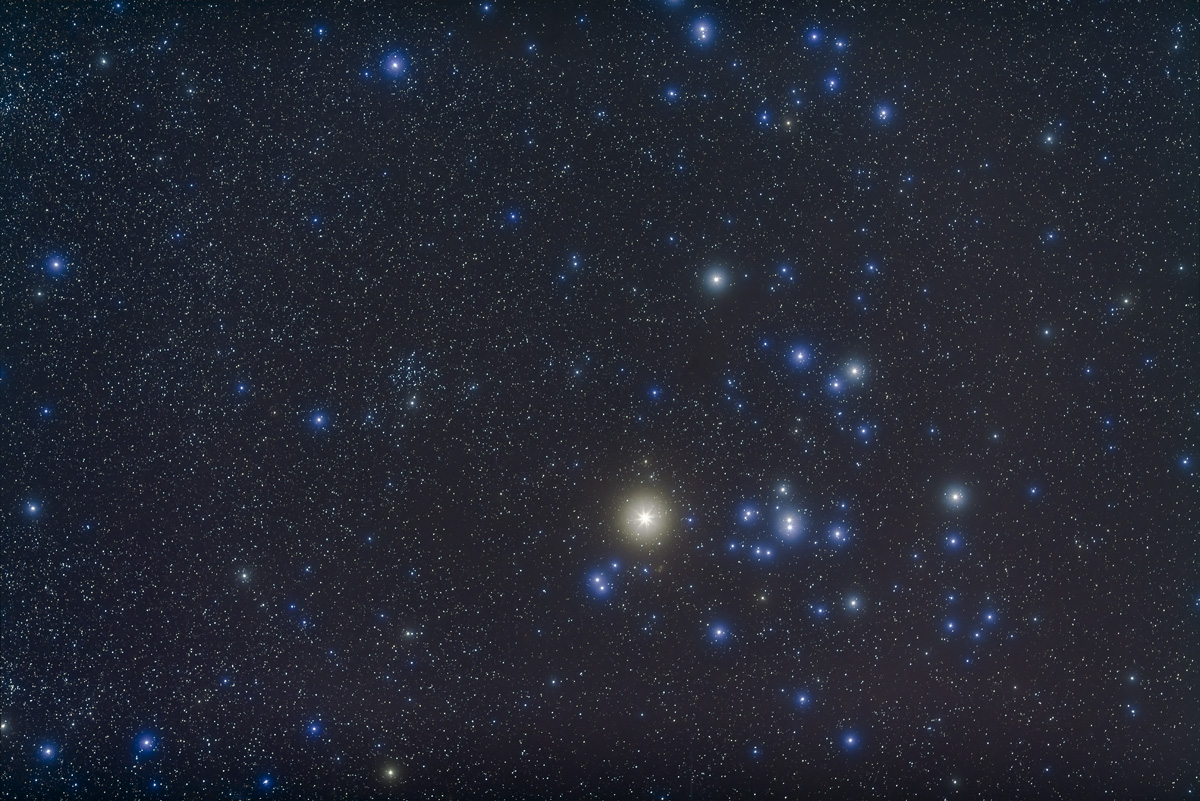
Here’s a photogenic rendering of a classic northern winter sky object, the Hyades star cluster in Taurus. The Kenko Softon filter added the star glows and punched out the subtle colour variations in the stars. Note how the Hyades stars come in shades of blue and white. The yellow star is Aldebaran, the eye of Taurus the Bull and an interloper here — Aldebaran is actually halfway between us and the Hyades, which lie about 150 light years away, and are true cluster of stars moving together through space. Note the much more distant and smaller star cluster, NGC 1647, at left.

— Alan, January 2011 / Image © 2011 Alan Dyer

Orion’s Sword Defeated!


Every astrophotographer has an object or field that seems to defy capture. For me, shooting the Sword of Orion has always been beset by haze, tints from light pollution and low altitude — something has always gone wrong. At last I managed to get a good shot of the region. It was a priority for me on my Australia trip of December 2010. Even though I ended up with only 2 clear nights to do any  serious shooting, out of 15 I was there, I really wanted to grab this area, while Orion was high in the north, and higher in altitude than I can get it from home, so less hindered by sky gradient tints.

This is a shot with the wonderful Borg 77mm f/4 astrograph (which is tack sharp across the field) and the modified full-frame Canon 5D MkII camera — both items purchased from Hutech Scientific, a great source of astrophoto gear. This is a stack of five 7-minute exposures at ISO 800, processed in Photoshop CS5.

– Alan, December 2010 / Image © 2010 Alan Dyer