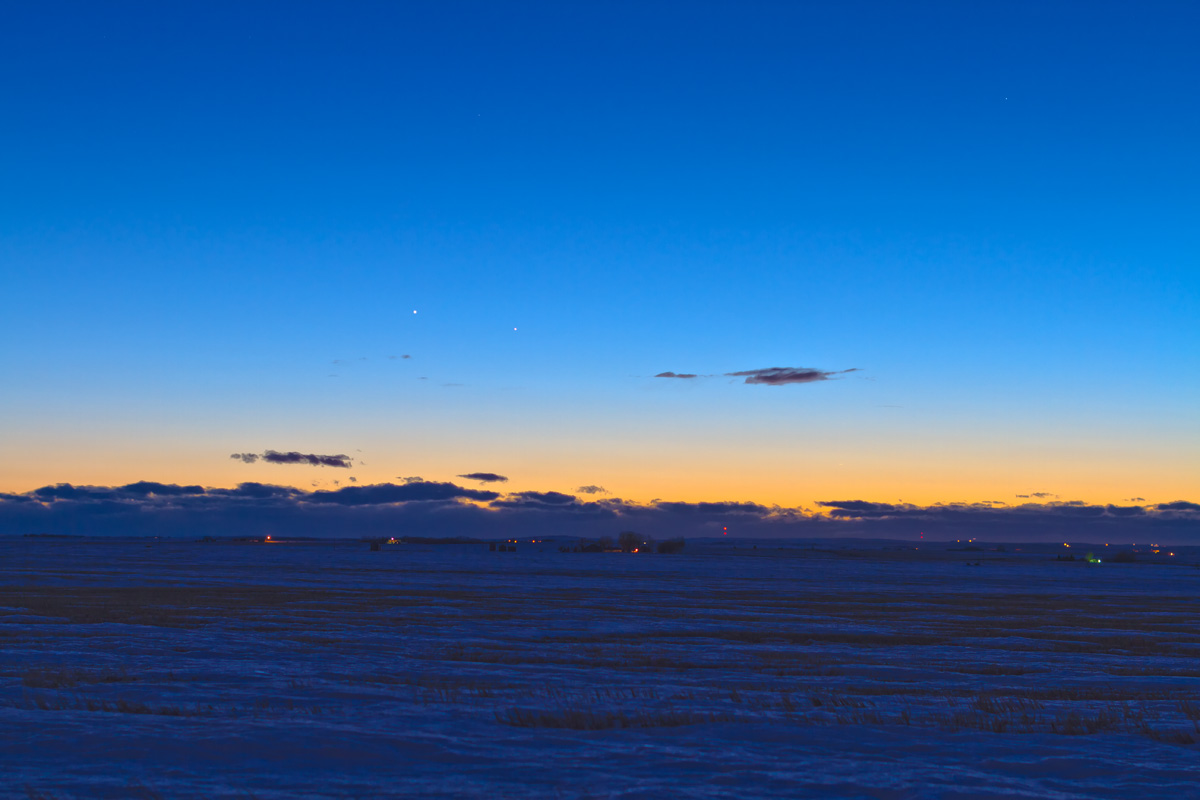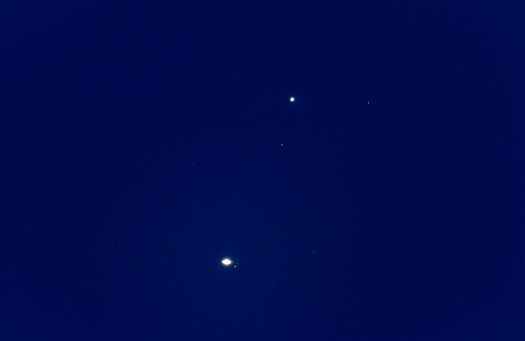
Moon and Venus in the Prairie Twilight


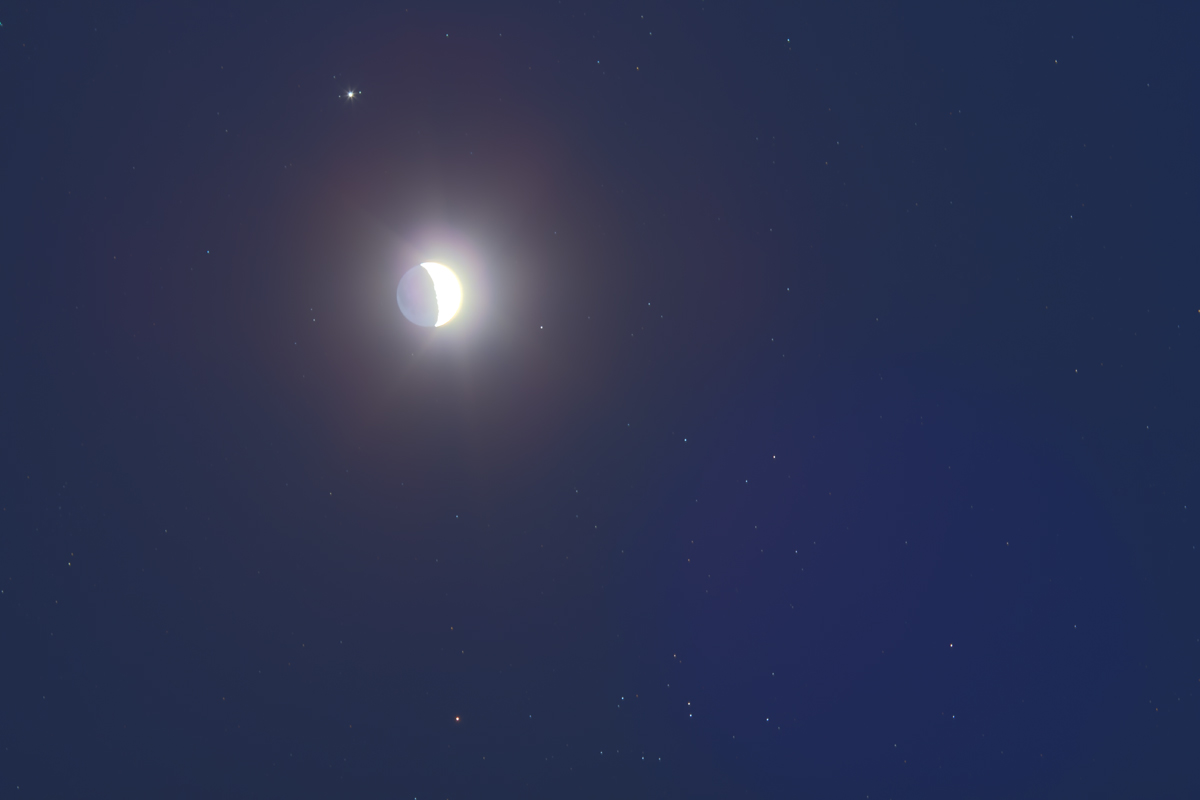
Moon and Venus (Sept 8, 2013)

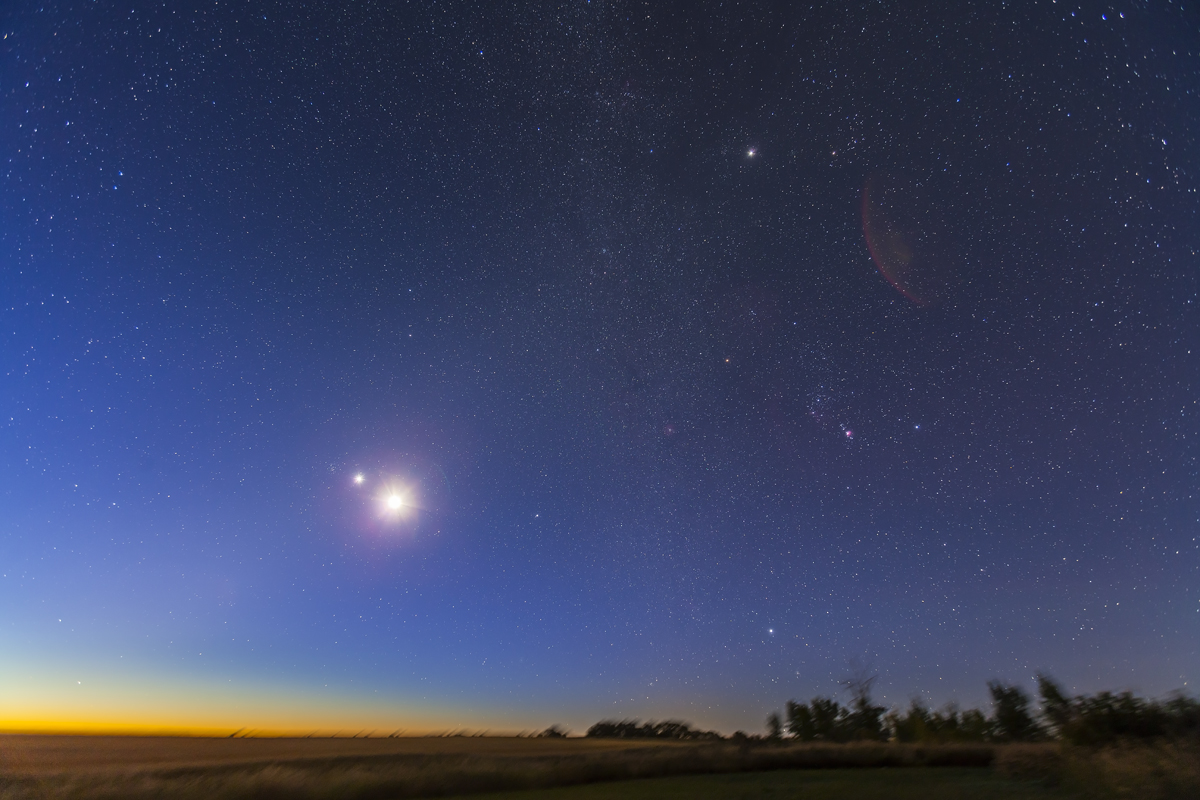
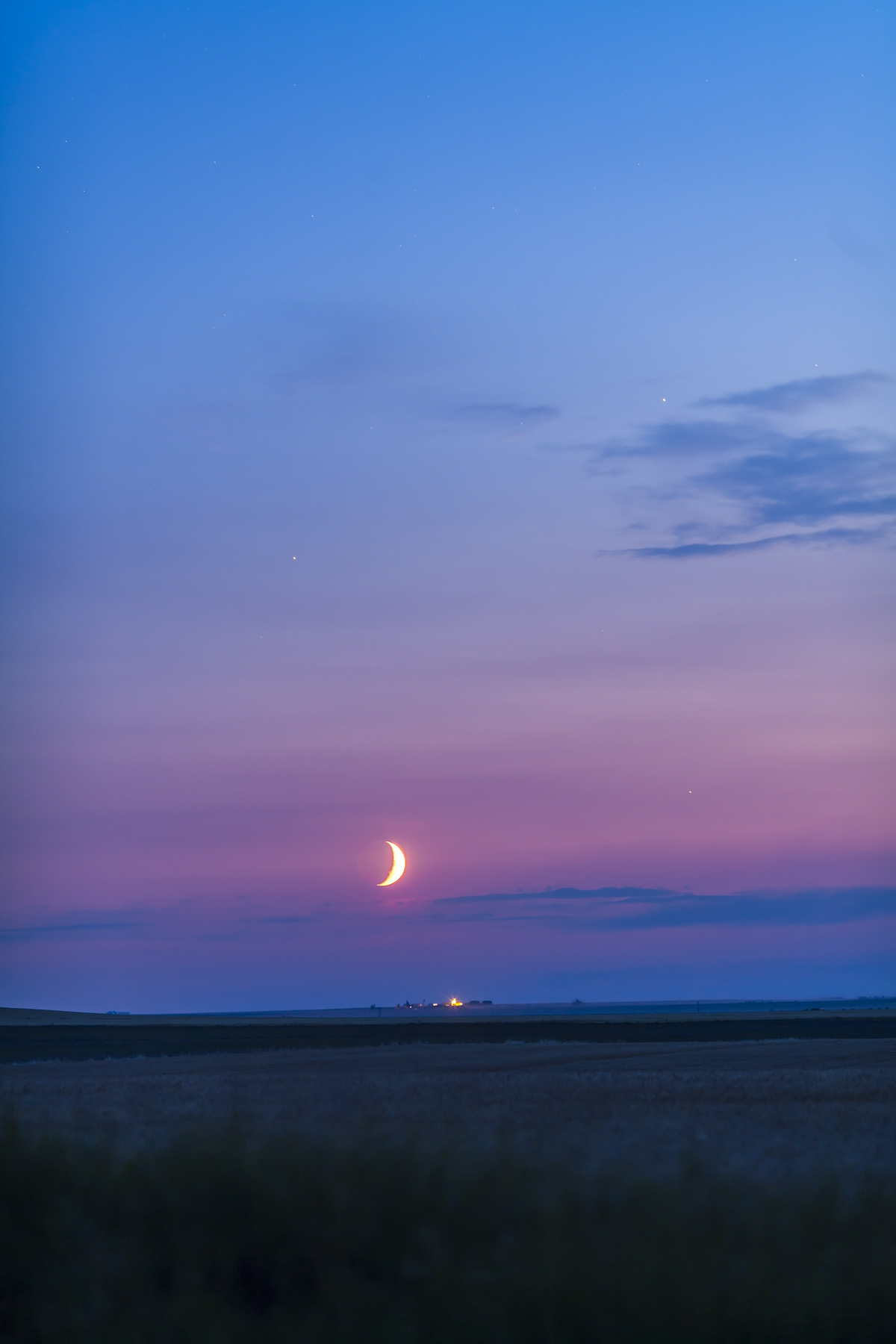
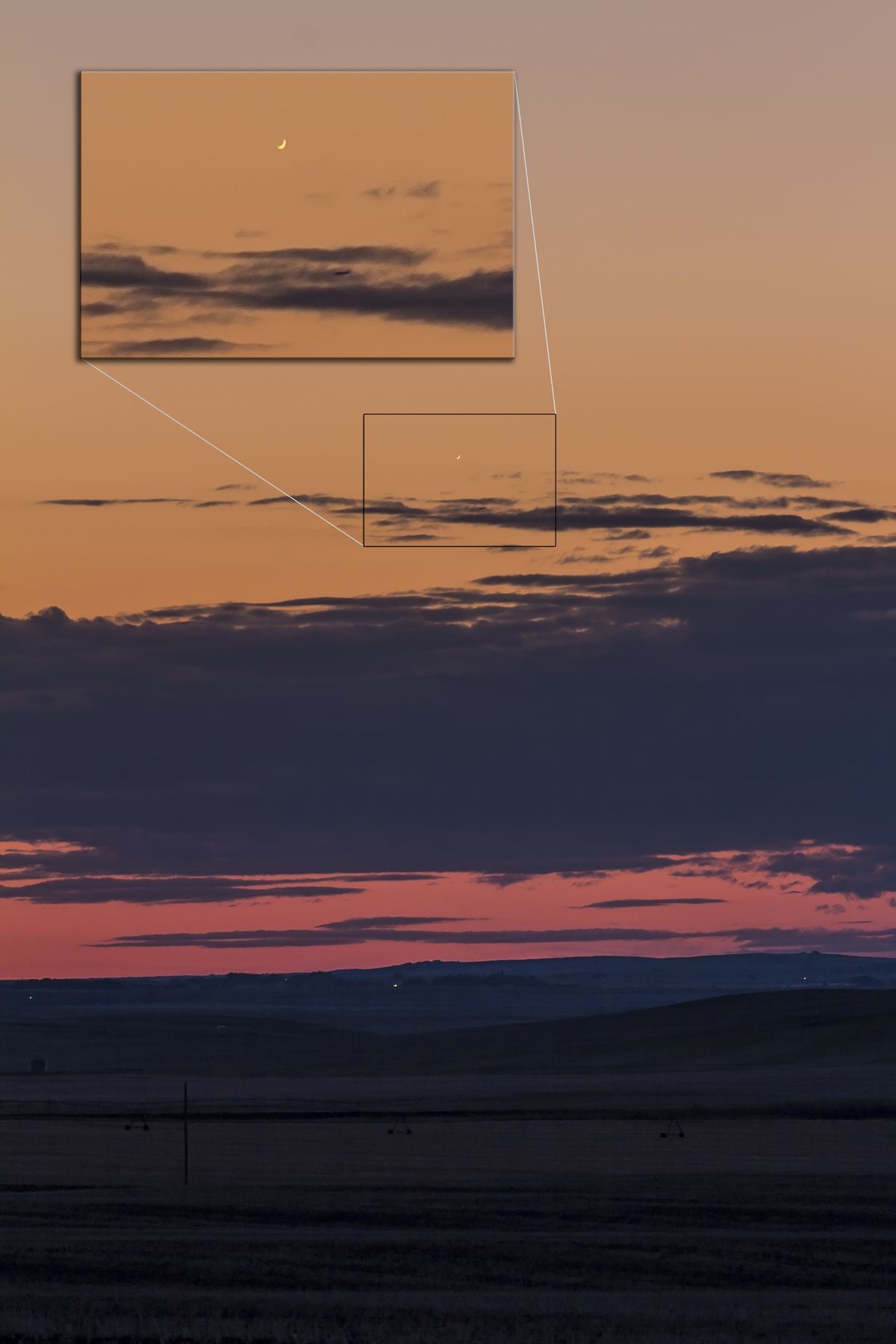
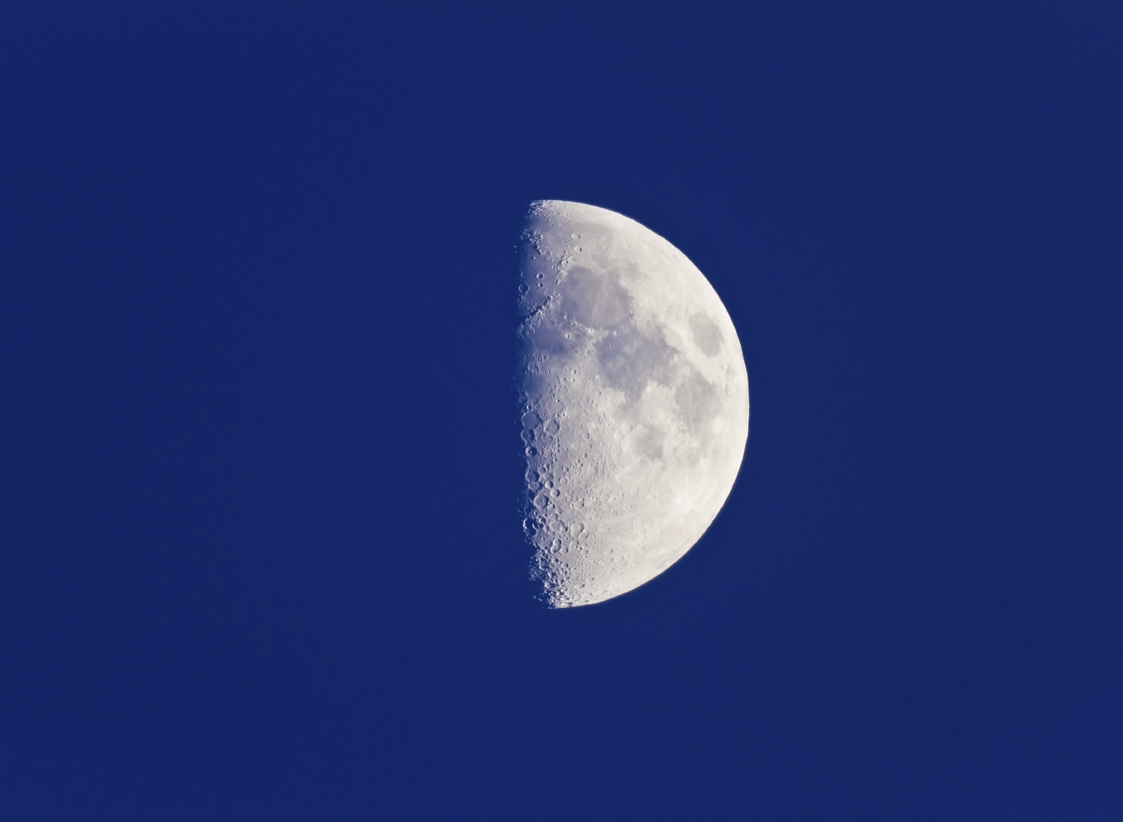
Tonight, the waxing crescent Moon passed by Venus for a close conjunction in the evening twilight.

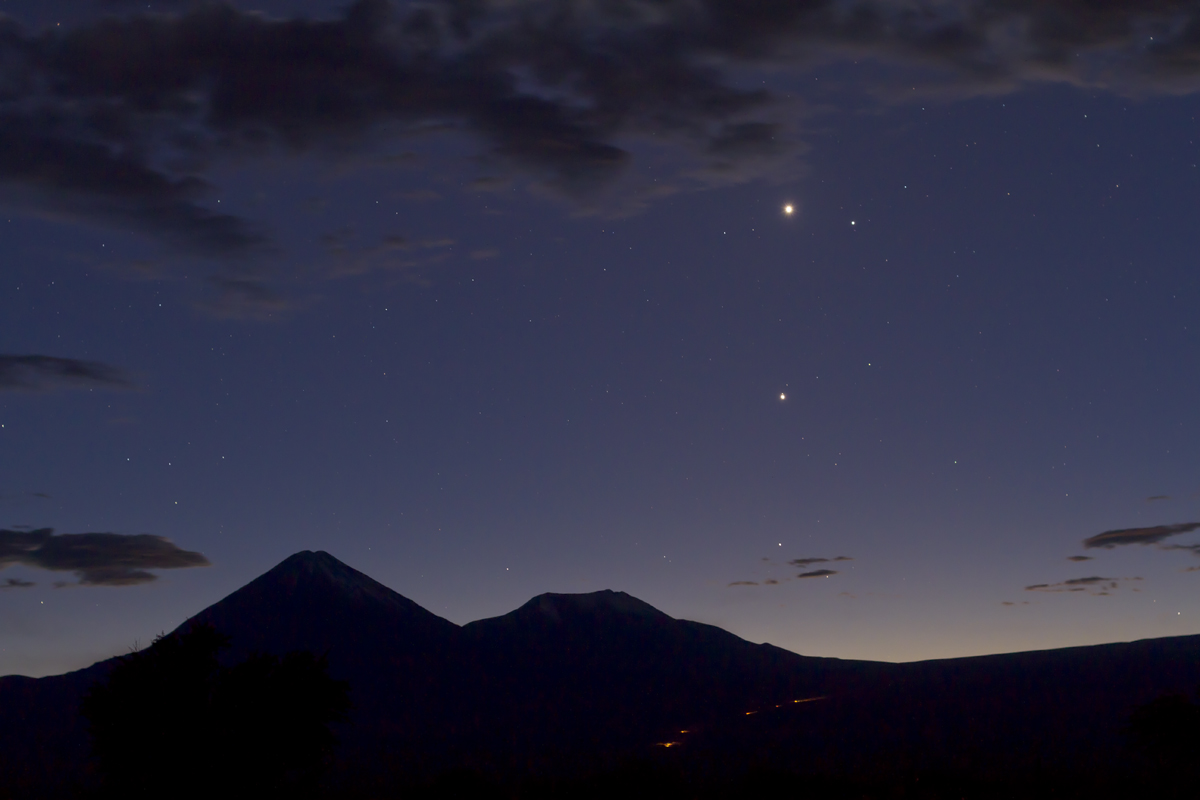
At this time of year from my latitude of 51° north, the evening ecliptic always swings low across the southwest. So any fall evening planets, and the Moon, appear low on the horizon and set early.

That was the case tonight, for the close passage of the Moon past Venus (at right). However, their altitude allowed me to capture them and the prairie horizon in the same telephoto lens field.

It was certainly a beautiful sight over the harvested prairie fields, on what feels like an autumn night, though officially it is still summer.

– Alan, September 8, 2013 / © 2013 Alan Dyer


Dinosaur Moon


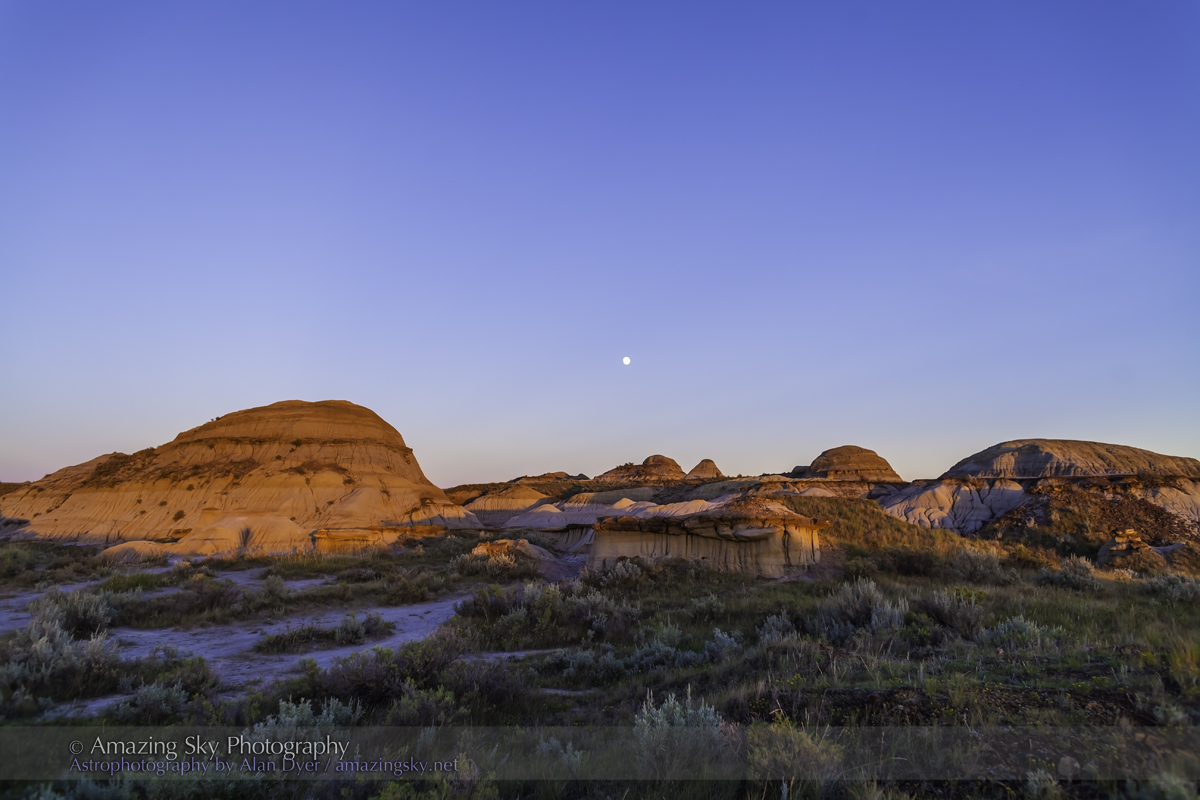
Waxing Moon in Badlands Twilight (August 18, 2013)

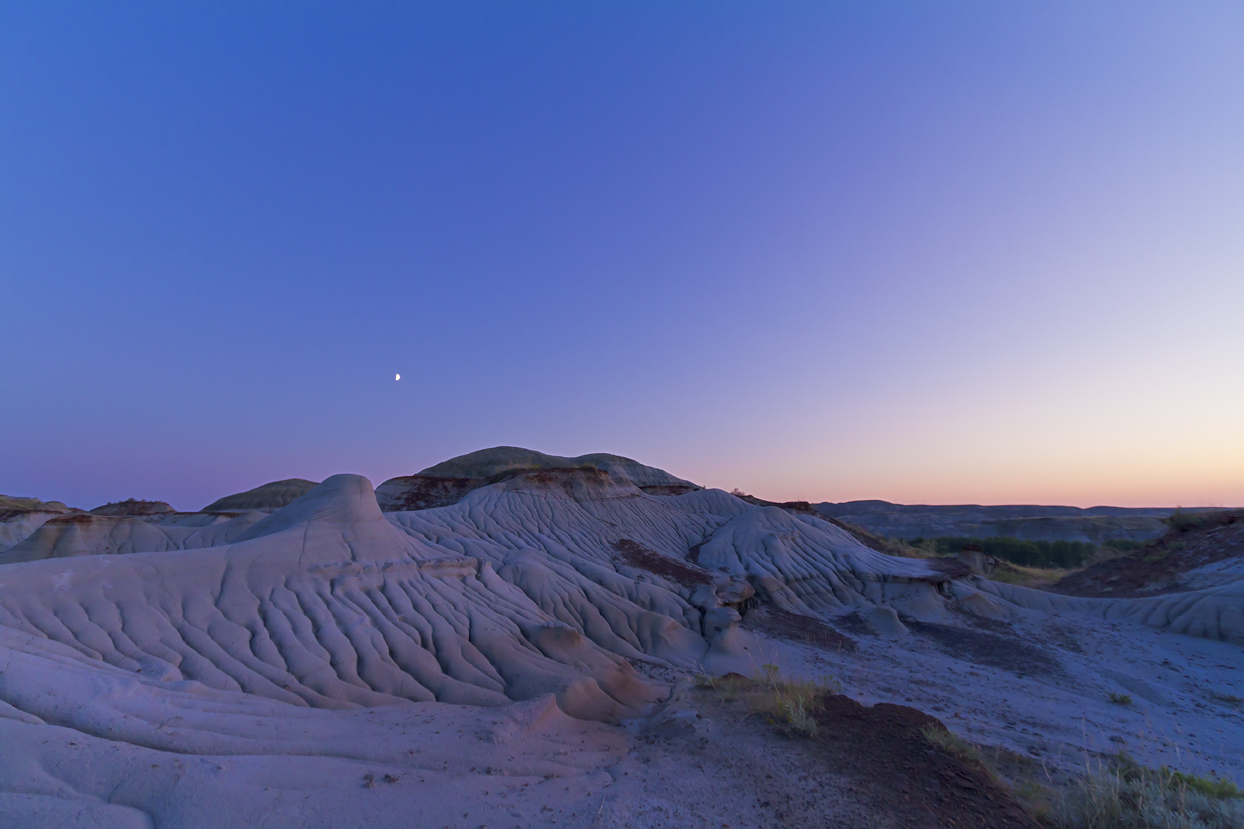
The waxing Moon rises into a colourful twilight sky over the badlands of Dinosaur Provincial Park.

What a great night it was last night! Warm summer temperatures (at last!) allowed for shirtsleeve shooting even well after dark. To shoot on the warm August night I went out to Dinosaur Provincial Park, a magical place to be at sunset and in the summer twilight. The colours on the badlands are wonderful. It’s earth-tones galore, with the banded formations from the late Cretaceous blending with the sagebrush and prairie flowers.

This was the scene after sunset, as the waxing Moon rose into the eastern sky coloured by the blue band of Earth’s shadow, the pink Belt of Venus and dark blue streaks of cloud shadows converging to the point opposite the Sun. That’s where the Moon will be Tuesday night when it’s full. But last night it was a little west of the anti-solar point.

Moon and Sunset Glow at Dinosaur Park (August 18, 2013)

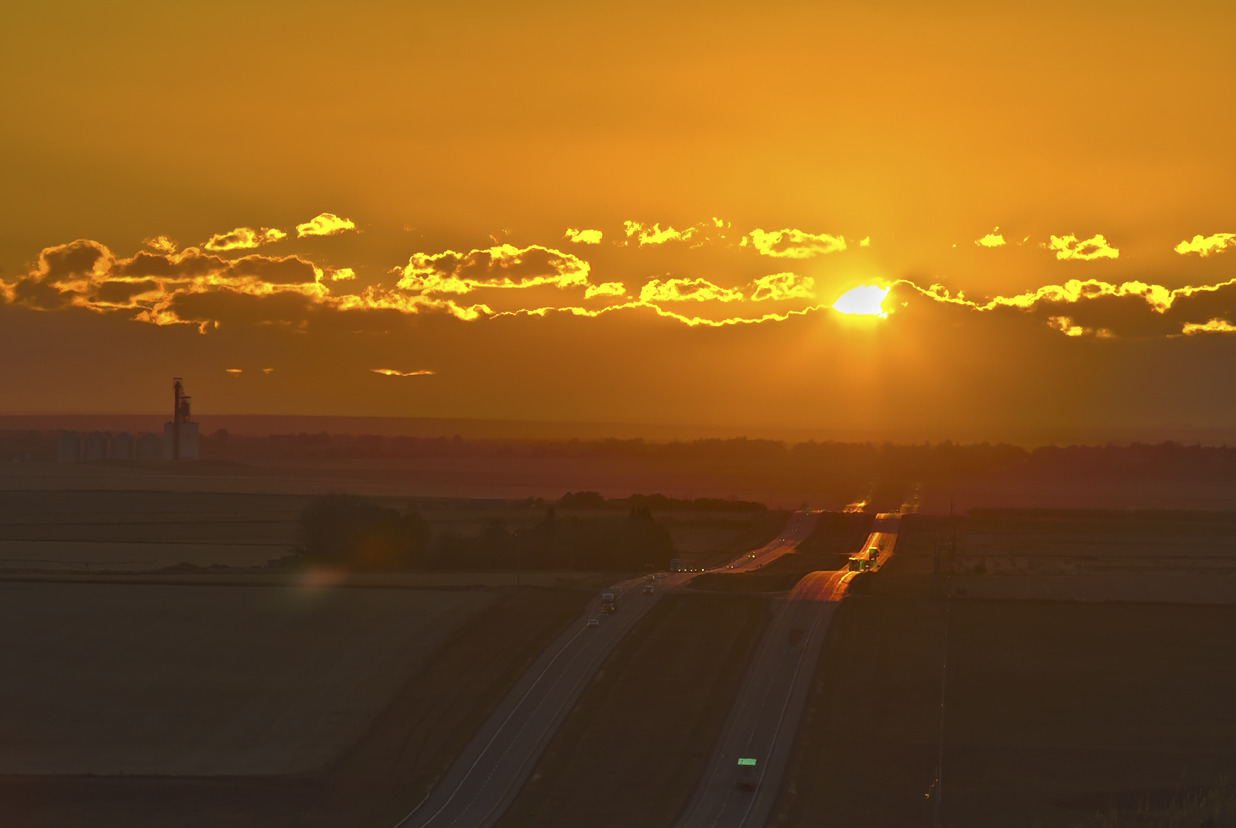
I managed to grab this image as soon as I got to my photo spot on the Badlands Trail, just in time to catch the last rays of the setting Sun illuminating the bentonite hills of the Badlands. Both shots are frames from a 450-frame time-lapse, taken with a device that also slowly panned the camera across the scene over the 90-minute shoot.

It, and three other time-lapses I shot after dark, filled up 40 gigabytes of memory cards. It’s been a terabyte summer for sure!

– Alan, August 19, 2013 / © 2013 Alan Dyer


Sunset from the Cypress Hills


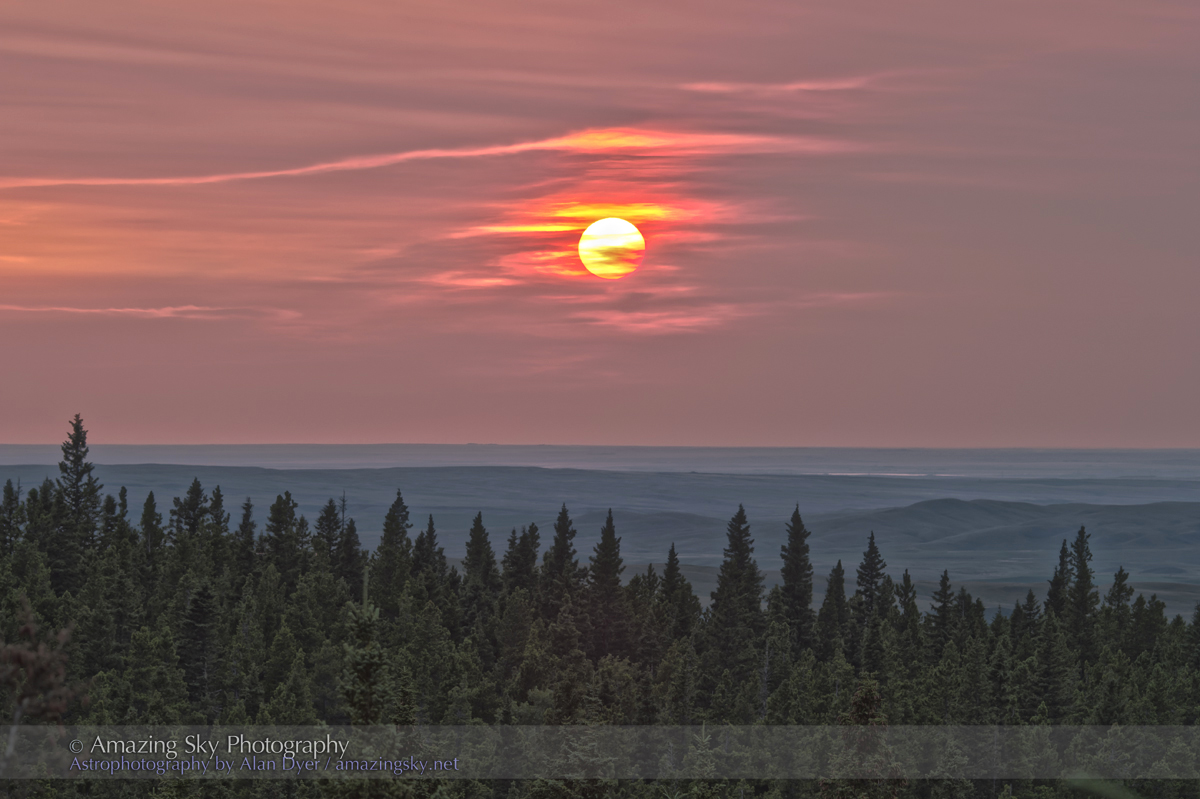
Horseshoe Canyon Sunset (August 11, 2013)

The Sun sets over the pines and prairie of Cypress Hills, Alberta.

Tonight it was too cloudy for meteors. But the sky did provide a very fine sunset.

I was at the Horseshoe Canyon viewpoint on the Alberta side of Cypress Hills Interprovincial Park, to catch a deep-red Sun going down into haze and cloud. This is looking northwest, from the pine-covered hills out over prairie plains of southern Alberta. The image is a high-dynamic range stack of 7 images.

The viewpoint also had an interpretive sign explaining the virtues of dark sky preservation – Cypress Hills Park is a large dark sky preserve – and I was pleased to see one of my photos used as an illustration on the sign. I had sent it to the Park several years ago.

But alas, no meteors in view tonight. And while there were a few visible the night before at the star party, out of 200+ shots I took, not one recorded a decent Perseid meteor! Of course!

– Alan, August 11, 2013 / © 2013 Alan Dyer


Moonshadows and Sunbeams


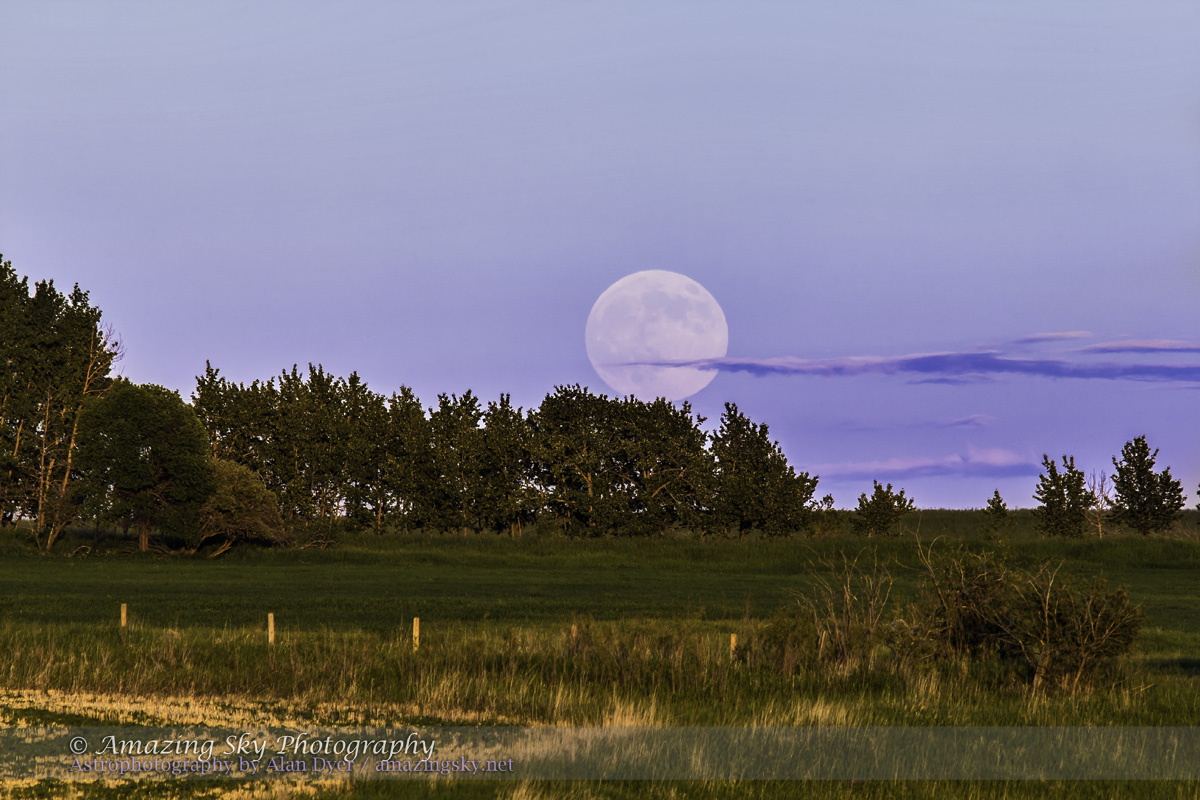
Moonrise Behind Prairie Grain Bins (July 27, 2013)

The play of light and shadow in the open air create wonderful effects by night and day.

The Moon and Sun have each created some wonderful sky scenes of late, aided by clouds casting shadows and sunbeams across the sky.

Above, the rising waning Moon on Saturday night shone its warm light across the prairies. Clouds cast dark shadows diverging away from the Moon.

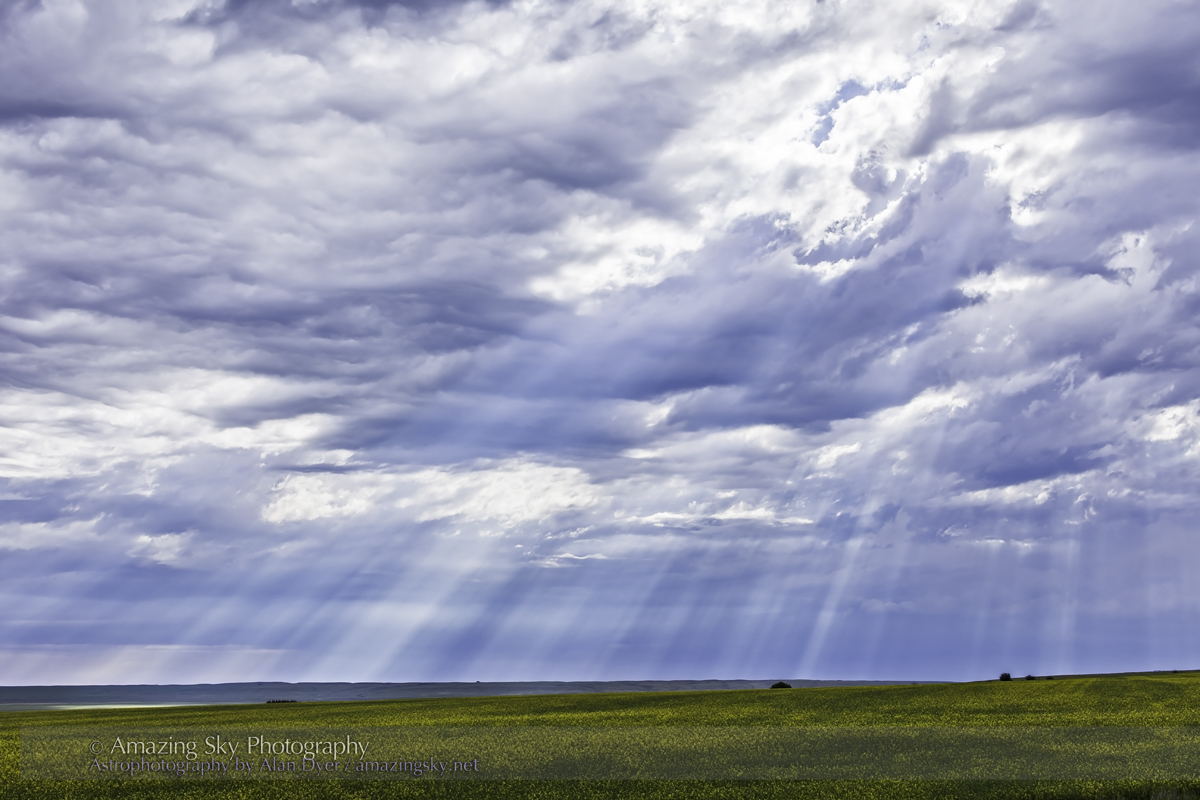
Daytime Crepuscular Rays #4 (July 24, 2013)

By day, clouds created the opposite effect. Holes in the clouds let through beams of sunlight, creating rays descending from the sky dancing across the land.

Both effects are technically known as crepuscular rays. You can read much more about the phenomenon at the wonderful Atmospheric Optics website. Clouds aren’t always the evil presence in the sky astronomers take them for. They can produce stunning effects. Just look up!

– Alan, July 29, 2013 / © 2013 Alan Dyer


Moonset on a Misty Lake


Moonset on a Misty Lake (35mm)

What a marvelous night for a moonset! 

Saturday night was one of the finest nights for nightscape shooting I’ve had in a long time. I started with shots of the waxing Moon setting over Reesor Lake, one of the lakes in Cypress Hills Interprovincial Park, on the Alberta side. Water from this lake drains into the Milk River and then into the Missouri, and Gulf of Mexico. It one of the few bodies of water in Alberta that feed the Mississippi watershed, with the Cypress Hills acting as a continental divide.

I set up two cameras, each shooting a twilight-to-night time-lapse sequence showing the Moon setting behind the hills and the stars coming out. I filled up one card with 600 images. Luckily, the other camera still had space left for what was still to come later that night. One sight was the beautiful auroral arc I featured in my previous blog post. I’ll have more tomorrow, of the Milky Way over the lake.

Moonset on a Misty Lake

It had rained earlier in the day so the air was humid. Mist covered the lake as night fell. In the scene above, a small fleet of American pelicans also glide by.

Watching the peaceful scene while monitoring the cameras clicking away provided one of those magical moments that makes doing this photography worthwhile, regardless of the results. The mist was swirling, the stars were coming out, I put on some music on the iPhone and on came a Chopin nocturne. Perfect.

– Alan, July 14, 2013 / © 2013 Alan Dyer

Sunrise on the Plains


Sunrise on a Canola Field (July 9, 2013)

The Sun rises into a pastel palette of sky and earth tones.

I woke up early, just at sunrise, looked outside and wow!

I grabbed the camera and telephoto and got another nice shot right from my back deck. The canola field next to my yard is proving to be a photogenic foreground now that it’s in full bloom, just in the last couple of weeks.

There was enough haze and humidity in the air to dull the Sun to a fiery orange. The range of shades in earth and sky was wonderful. It was a classic prairie scene worth getting up for.

Being able to see the horizon is why I live on the plains and not in the foothills or mountains. And certainly not in the city!

– Alan, July 9, 2013 / © 2013 Alan Dyer

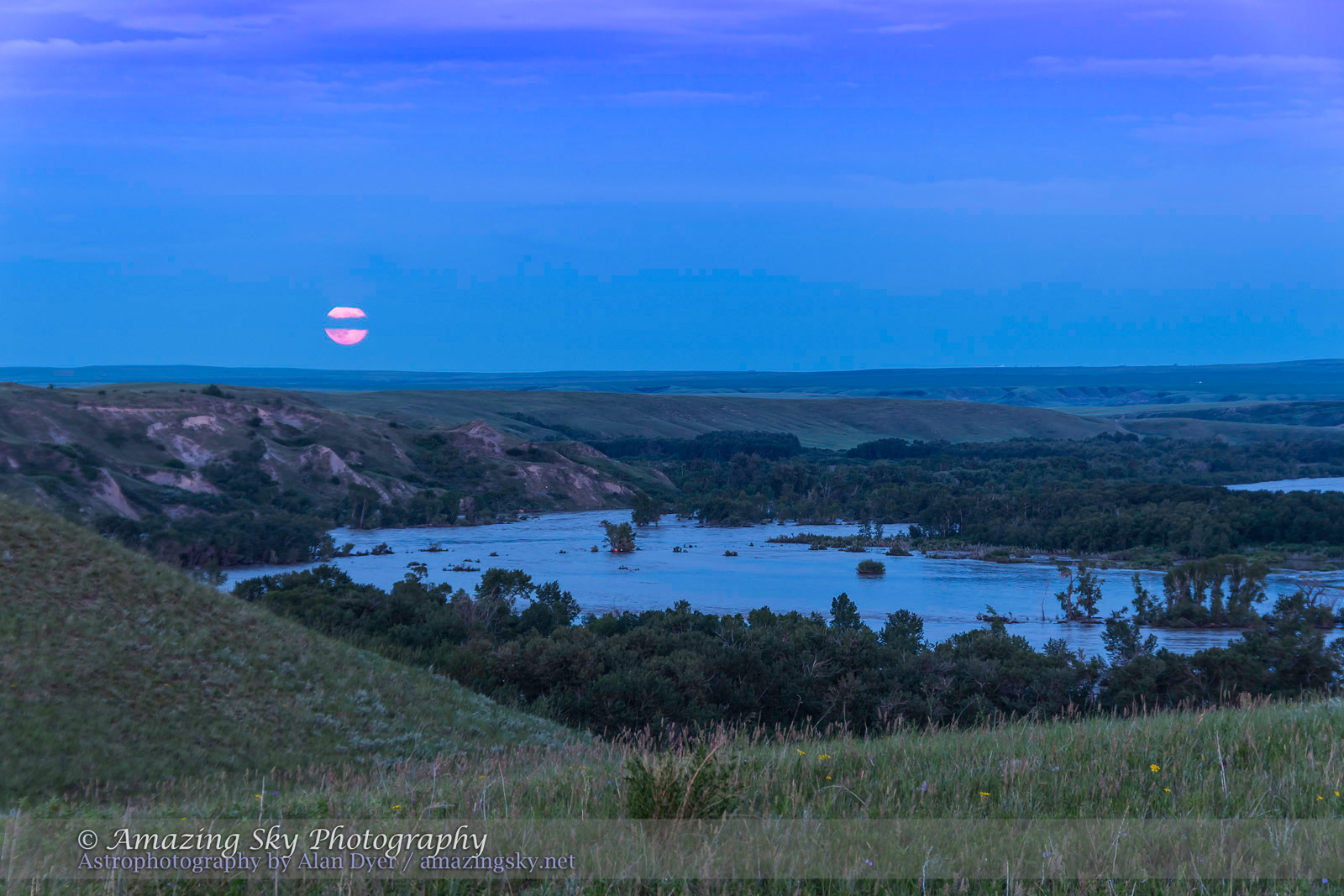
Supermoon over Bow River Floods


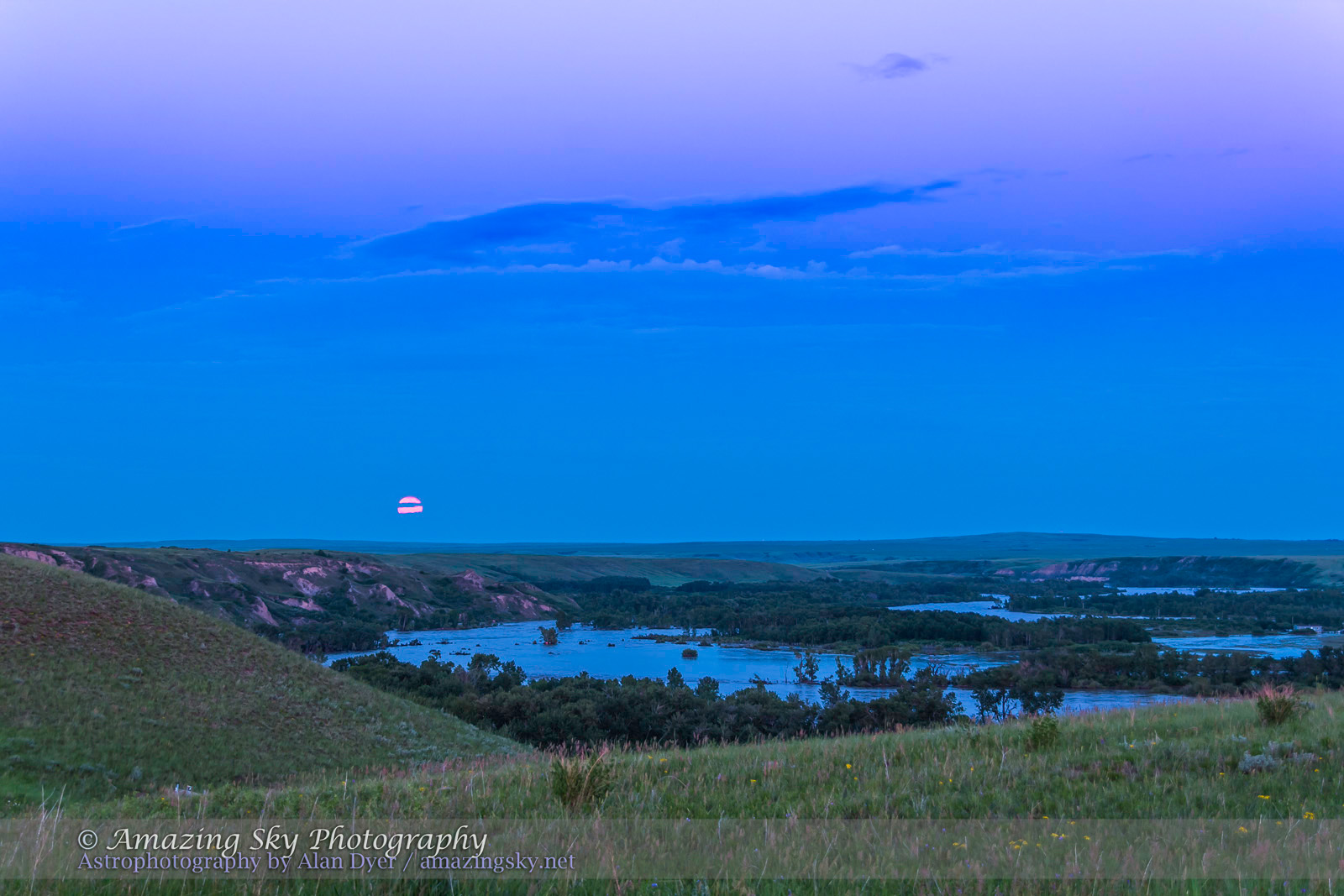
Supermoon Rise over Floodwaters of Bow River (June 23, 2013)

The supermoon of solstice rises over the floodwaters of the raging Bow River.

The peace of the sky contrasts with the destruction being wrought below on Earth. The Bow River is many times wider than normal and has flooded most of the valley, ruining homes and lives.

This view overlooks the Bow River in the area of Blackfoot Crossing, where I was this afternoon shooting daytime panoramas in the previous blog. I returned this evening to catch the Full Moon as it came up in twilight over the floodwaters.

Supermoon Rise over Floodwaters of Bow River #2 (June 23, 2013)

The rosy Moon contrasts with the deep blue of twilight and Earth’s shadow rising, fringed above by the pink “belt of Venus” effect, visible in the wide-angle shot.

Nearby, people were camped on the hill, refugees from their homes in the valley below now surrounded by water. Fortunately the waters are receding.

– Alan, June 23, 2013 / © 2013 Alan Dyer


The Rising of a “Supermoon”


Supermoon Rise (June 22, 2013)

Here is the much hyped Supermoon of 2013 rising into a twilight sky on the wet Alberta prairies.

A clear night for a change, with no storms about. Though one rolled through earlier today. We don’t need any more rain! Thankfully I am high and dry on the Alberta prairie but many friends to the west are not so lucky and have been flooded out, evacuated or have been camping in their homes with power and heat off. Calgary has largely come to a standstill, with the main pastime being watching the rivers rise and fall.

Tonight, after two days of destruction from horrific floods, at least we in southern Alberta were able to enjoy a clear night and the sight of the wonderful solstice Moon rising. This is the closest Full Moon of 2013 and has received an inordinate amount of PR as the “supermoon.”

Supermoon Rise #1 (June 22, 2013)

It certainly did look fine tonight, though in truth no one could ever tell the difference between this “supermoon” and any normal Full Moon.

But perhaps this one is a little special, reminding us that the sky brings beauty as well as destruction.

– Alan, June 22, 2013 / © 2013 Alan Dyer


Planet Triangle in the Twilight


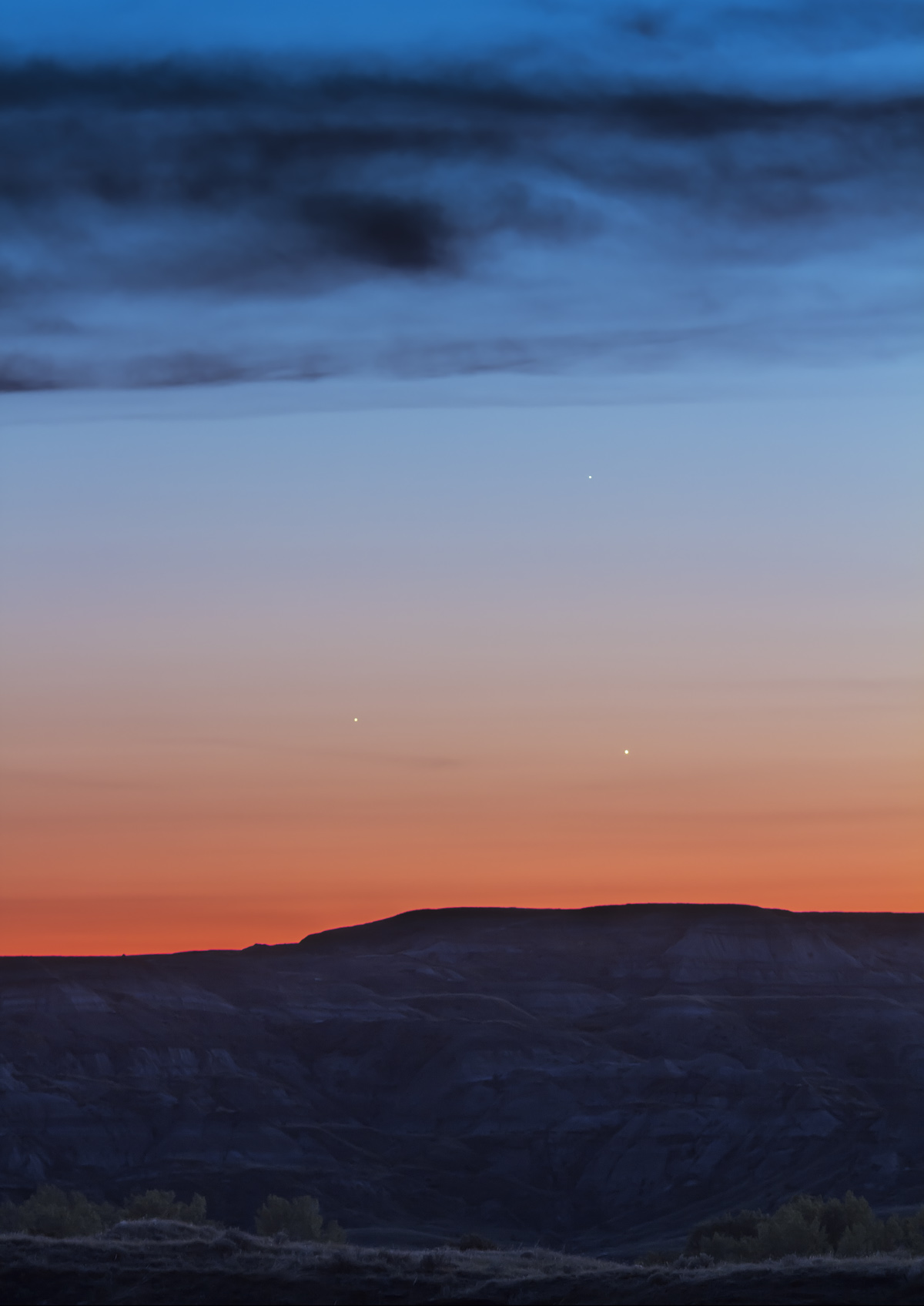
Three-Planet Conjunction (May 26, 2013)

Three planets, Mercury, Venus and Jupiter form a triangle briefly in the evening twilight.

This was the triple-planet conjunction last night, Sunday, May 26, as seen from the badlands of Dinosaur Provincial Park, Alberta. I headed  there, a 90-minute drive east from home, to conduct a night of time-lapse shooting, and to catch the planets low in the western twilight far away from thick clouds that tend to hug the horizon over the mountains.

Skies were nearly perfect and the night ideal for photography. Even with just unaided eyes the planets were obvious, Venus especially so at bottom right. Mercury (at top) and Jupiter (left) were also easy to spot in the twilight glow.

However, binoculars gave a view similar to this telephoto lens shot. I used a short 1/2 second exposure for the sky and a longer 3-second exposure for the ground, to bring out some detail in the badland landscape below the beautiful twilight sky.

– Alan, May 27, 2013 / © 2013 Alan Dyer


The Zodiacal Light from the Desert


Zodiacal Light in Evening Sky (New Mexico)

From a dark site the glow of Zodiacal Light rivals the Milky Way in brightness. 

This was the scene every night last week in the evening sky from our New Mexico observing site. The vertical glow of Zodiacal Light was a source of natural light pollution brightening the western sky. I’ve never see it more obvious in the west and this was the perfect season to see it. In March from the northern hemisphere the ecliptic – the plane of the solar system – is angled high into the western sky, almost vertical from the latitude of southern New Mexico.

The Zodiacal Light lies not in our atmosphere but comes from interplanetary space, and follows the ecliptic. What we were seeing was a glow of sunlight being reflected off fine dust particles orbiting the Sun in the inner solar system, likely spread by passing comets like PANSTARRS. I blogged about the Zodiacal Light last month, in photo taken from home in southern Alberta. You can also read about it at the excellent Atmospheric Optics website.

You don’t need to be in the desert to see it, but you do need dark skies. And no Moon in the sky.

At last week’s dark of the Moon period, Jupiter sat at the apex of the Zodiacal Light, just above the Pleiades star cluster. Near the top, right of centre, you can also see a short satellite trail, likely from a flaring Iridium satellite.

– Alan, March 19, 2013 / © 2013 Alan Dyer


The Moon Meets Jupiter and the Hyades


Moon near Jupiter & Hyades (March 17, 2013)

On Sunday night, March 17, the waxing Moon came very close to Jupiter and the Hyades star cluster for one of the best conjunctions of the year.

This was certainly a night to remember. Minutes after I took the images for this shot, I took the frames for the Comet over the VLA image in the previous post. Here, I caught the Moon shining just below Jupiter (you can see a couple of its moons as well) and just above the Hyades star cluster and the bright yellow star Aldebaran at the bottom of the frame. All are set in the deep blue of twilight.

This is a high dynamic range (HDR) stack of seven exposures ranging from 6 seconds to 1/13 second, to capture the huge range in brightness from the sunlit Moon to the faint stars. Even so, the daylit side of the Moon remains overexposed. But the “dark side of the Moon” lit by Earthshine shows up well. A 135mm telephoto frames the field much as binoculars would show it.

This night recalled a similar evening on April 10, 1997, when Comet Hale-Bopp appeared low in the northwest, much as PANSTARRS is now, and the Moon actually passed in front of Aldebaran. An aurora display also broke loose that night, but not so last night – they are unlikely from New Mexico, though some northern lights were seen the night before from as far south as Colorado.

– Alan, March 18, 2013 / © 2013 Alan Dyer


Comet PANSTARRS Spectacle — With the Waxing Moon


Comet PANSTARRS & the Moon (March 12, 2013)

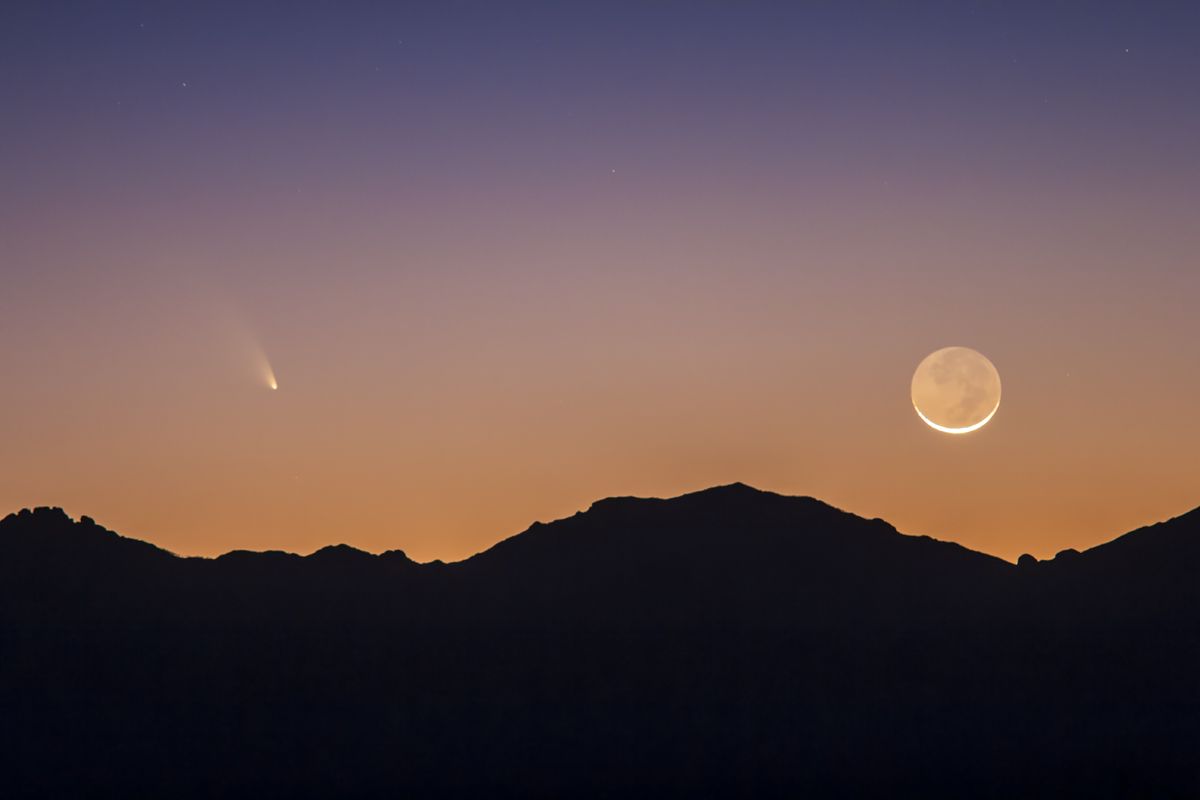
This was the night for Comet PANSTARRS! How often do we get to see a view like this, with a comet sitting beside a thin crescent Moon. Spectacular!

Again tonight, about a dozen visiting and resident Canadians gathered for a roadside star party north of Rodeo, New Mexico, to view the comet and Moon setting together over the Chiricahua Mountains. It was a stunning sight and made for a picture postcard image. The two set almost simultaneously, with the tail of the comet and “dark side of the Moon” lit by Earthshine the last to disappear behind notches in the mountain ridge.

And tonight, with the comet higher, it was visible to the naked eye for the first time, but only just – the sighting was made easier because you knew exactly where to look.

The Moon was just 3o+ hours old, so appeared as a very thin crescent. The entire disk of the Moon was visible, the rest lit by Earthshine, sunlight reflected off the Earth. In the clear New Mexico air, the Earthshine was easy to see even in the bright twilight. But adding in the comet made for a once-a-lifetime view.

As soon as they set together, we all cheered and applauded, almost like at an eclipse. It was a memorable night, the kind you always hope for from a comet. PANSTARRS performed tonight!

– Alan, March 12, 2013 / © 2013 Alan Dyer


Mercury and the Razor-Thin Moon


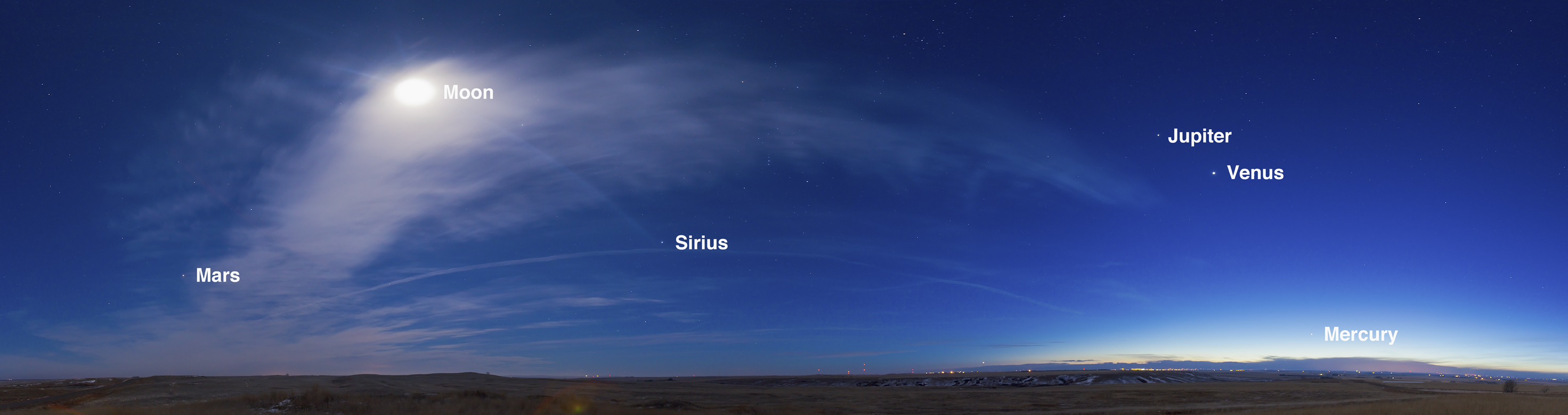
Mercury, Mars and the Thin Crescent Moon (Feb 10, 2013)

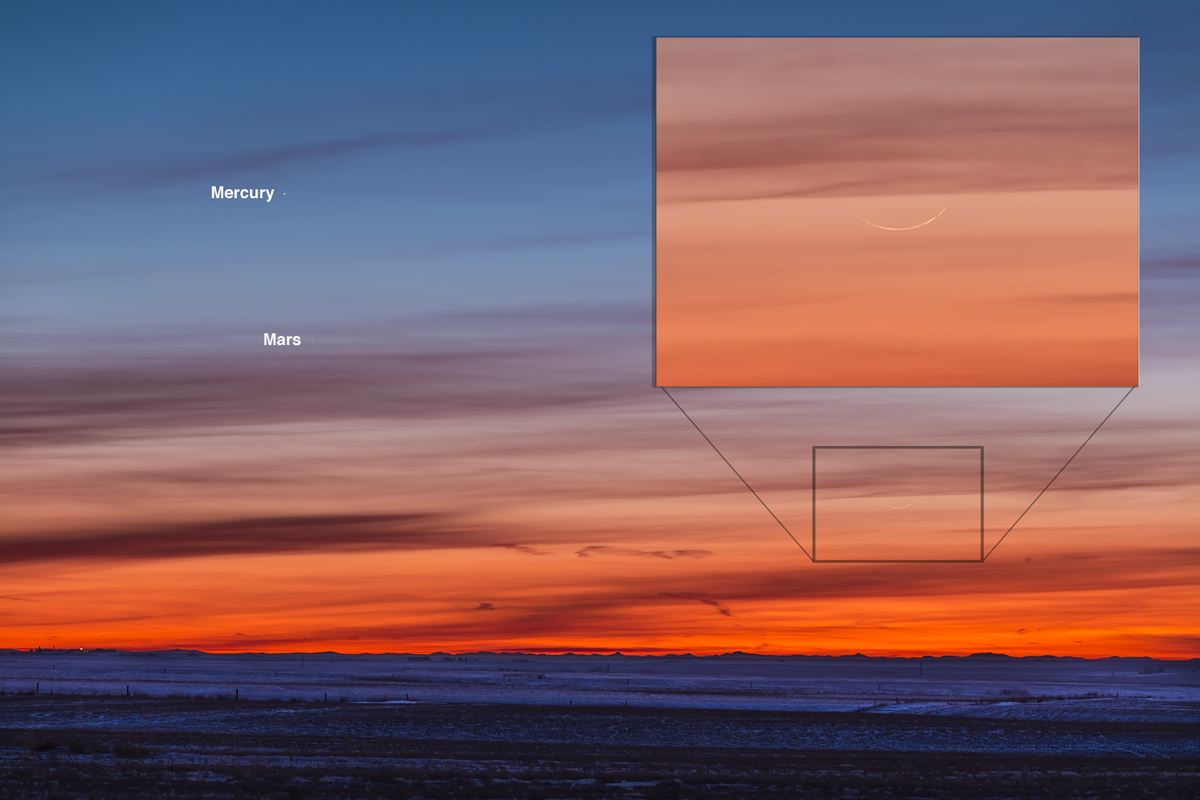
This was the sky scene Sunday night, February 10, as an ultra-thin Moon entered the evening sky, providing me with a “personal best” for sighting a young Moon.

I’ve had to highlight and annotate the subjects here but all the players were obvious in binoculars. Only Mercury, usually the most elusive planet, was obvious to the naked eye. Below it shone dimmer Mars, here embedded in some cloud.

But the real catch of the night was the 18-hour-old crescent Moon, shimmering low in the red twilight. It appears as a razor-thin crescent, magnified in the inset. Sighting any Moon younger than 24 hours old is considered a find, the all-time record being a Moon about 14 hours old. I’m happy with an 18-hour catch!

On Sunday night conditions were nearly ideal, despite the clouds, with the Moon angled about as far from the Sun as it could be from my northern latitude, positioned directly above the sunset point. You can tell that because the crescent, which must be oriented toward the Sun, appears nearly horizontal.

This is the New Moon that also signals the start of the Chinese New Year, the Year of the Snake.  So 迎春接福 !

– Alan, February 12, 2013 / © 2013 Alan Dyer


Moon and Jupiter Amid the Winter Stars


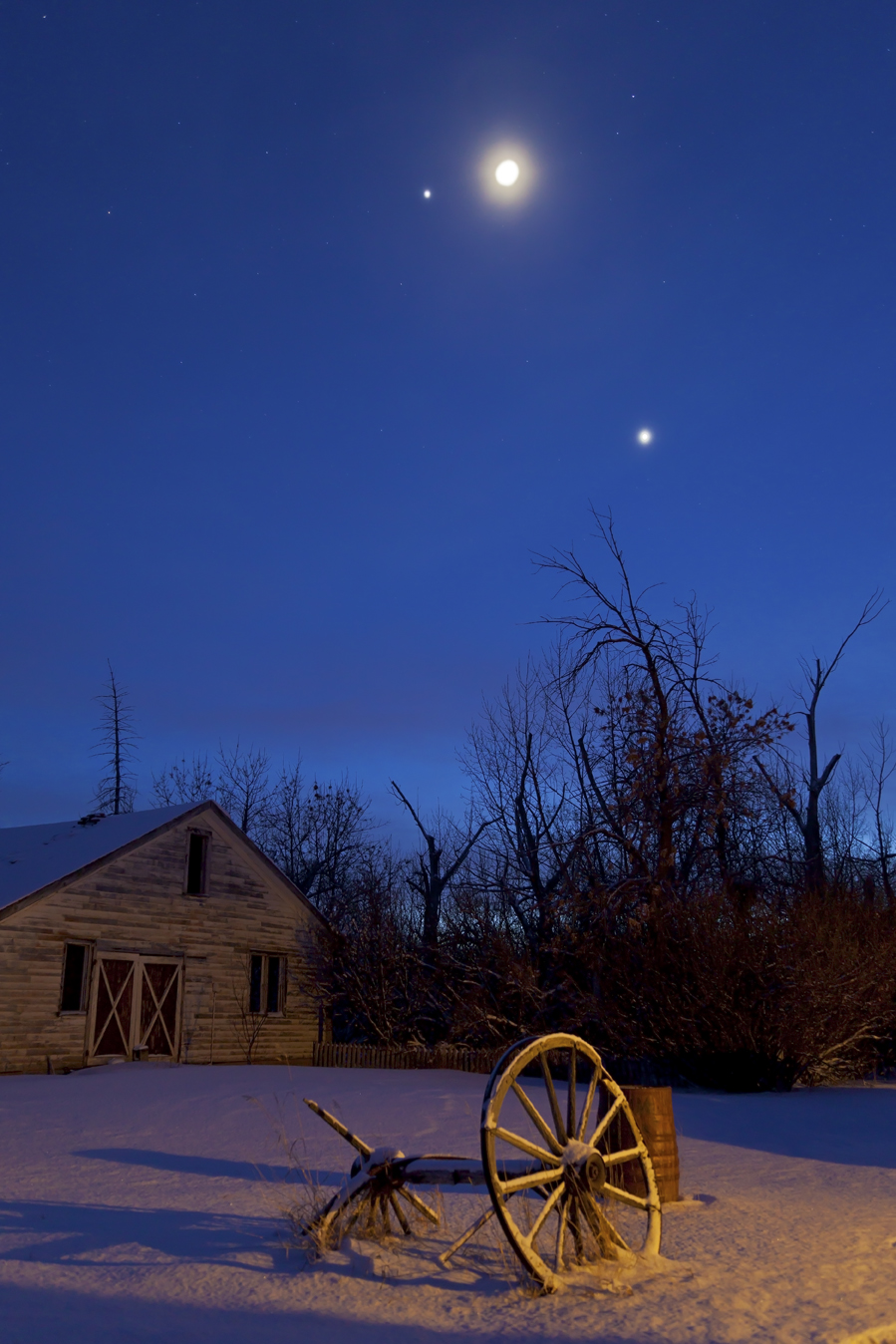
The Moon near Jupiter in the Winter Sky, January 21, 2013

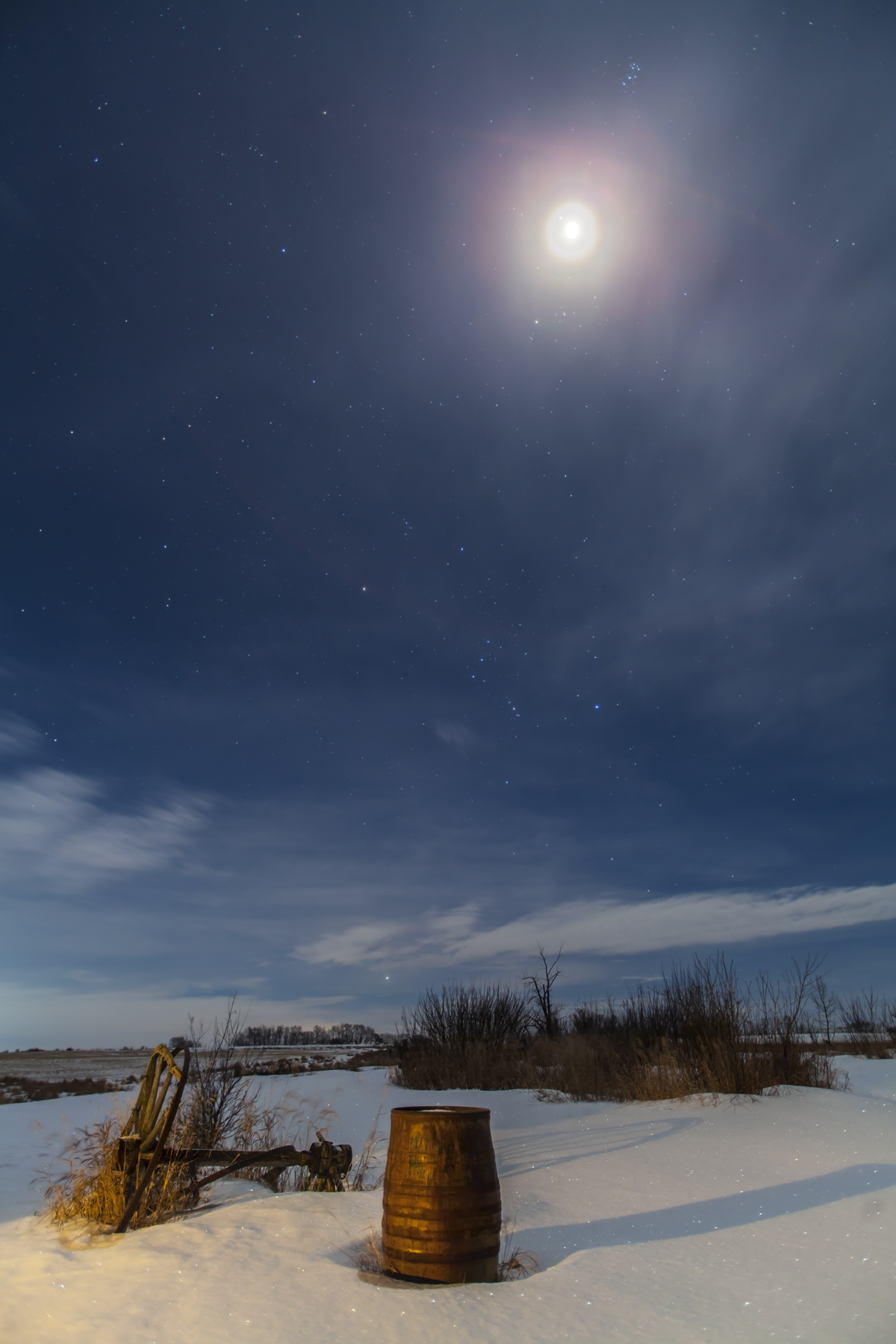
The Moon lights up a sparkling snowscape on the night it was close to Jupiter, as Orion and the winter stars rise.

The Moon is the bright and overexposed glow at upper right. Look carefully and you can just make out Jupiter above the Moon, almost lost in its glare. Below shines Orion, with Sirius the Dog Star just coming up above the distant trees. The Pleiades, at top above the Moon, complete this winter sky scene from Monday, January 21, 2013.

I’m glad I didn’t have to go far to shoot it, just 20 feet out the front door. Standing there for just 15 minutes was a chore, with a wicked east wind blowing in -18° C temperatures. This was a night that would normally fall below my threshold of tolerance for winter observing. But with the Moon so close to Jupiter it was worth a little pain for the gain of a neat winter sky portrait.

The image is a composite of a long and short exposure, in order to capture Jupiter so close to the Moon which, in a single long exposure, would have overexposed so much its light would have swamped Jupiter.

– Alan, January 21, 2013 / © 2013 Alan Dyer

The Moon Meets Jupiter


Moon & Jupiter (Jan 21, 2013) HDR with 320mm

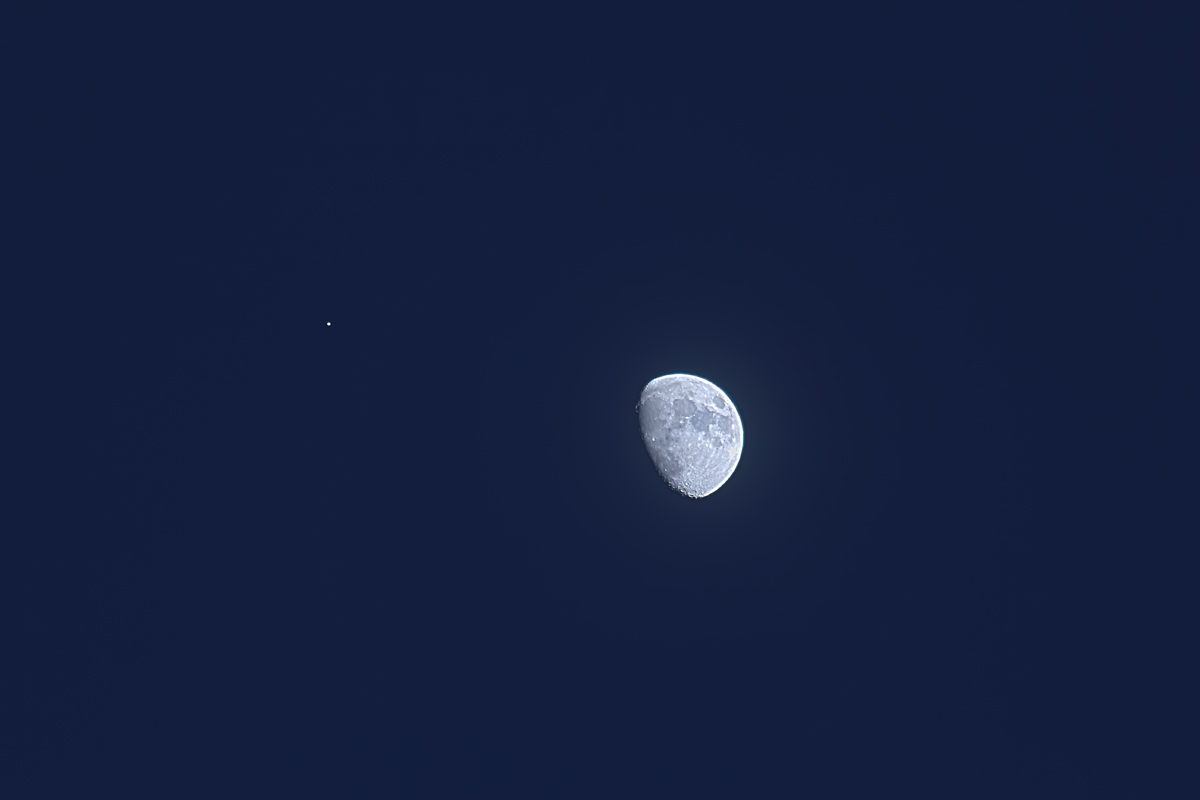
The cool blue of this scene fits the night – a bitterly cold winter night as the gibbous Moon passed below Jupiter.

This was the view as the sky got dark on Monday, January 21, 2013 with a close conjunction of the Moon and Jupiter underway. The Moon was closer to Jupiter later in the evening but I wanted to shoot it at sunset to capture the duo before for the sky got too dark and the Moon too bright and prone to overexposure. Even so, to capture the scene as your binocular-aided eyes saw it, I combined 4 different exposures for an “HDR” stack.

This is the closest we in North America will see the Moon by Jupiter in a darkened sky until 2026. But just next month those in southern Australia get to see a rare occultation, or “eclipse” of Jupiter by the Moon. It doesn’t get any closer than that!

– Alan, January 21, 2013 / © 2013 Alan Dyer

Jupiter Amid the Clusters of Taurus


Jupiter in Taurus (January 4, 2013)

Look up on a clear night this season (winter for us in the northern hemisphere) and you’ll see a bright object shining in Taurus the bull. That’s Jupiter.

This year Jupiter sits in a photogenic region of the sky, directly above the stars of the Hyades star cluster and yellow Aldebaran, the brightest star in Taurus. Above and to the west (right) of Jupiter is the blue Pleiades star cluster.

Over the course of January 2013 you’ll be able to see Jupiter move a little further west each night (to the right in this photo) away from Aldebaran and toward the Pleiades. Jupiter will stop its retrograde motion on January 30. After that it treks eastward to again pass above the Hyades and Aldebaran (returning to where it is now) in early March.

Jupiter’s proximity to Aldebaran and the Hyades makes it easy to follow its retrograde loop over the next few weeks. It’s an easy phenomenon to watch, but explaining it took society hundreds of years and the ultimate in paradigm shifts in thinking, from the self-important arrogance that Earth – and we – were the centre of the universe, to the Sun-centered view of space, with Earth demoted to being just one planet orbiting our star.

I took this image Friday night, January 4, from home as my first astrophoto upon returning to Canada from Australia. It’s a combination of two sets of images: one taken “straight & unfiltered” and one taken through a soft-focus filter to add the glows around the stars and central, brilliant Jupiter. I then blended the filtered images onto the normal images in Photoshop with the Lighten blend mode.

– Alan, January 5, 2013 / © 2013 Alan Dyer

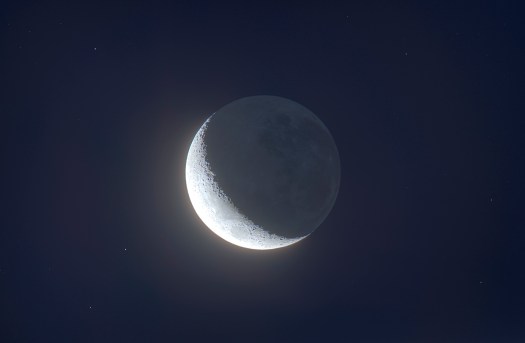
The Down Under Waxing Moon


Earthshine on Australian Waning Crescent Moon (HDR)

To northern eyes this looks like an old Moon in the morning sky, but this is really a young Moon in the evening sky – seen from Australia.

This was the waxing crescent Moon a few nights ago in the early evening sky. Because I took this from a latitude of 30° south, the Moon is turned over almost 90° from the way northern hemisphere viewers would see it from Canada or the northern U.S.

For this image, I shot ten exposures from 1/30s to 15 seconds and merged them into one “high dynamic range” composite using Photomatix Pro software. The result is an image with detail in both the bright sunlit crescent and in the dark side of the Moon visible here lit by Earthshine, sunlight reflected off the Earth. The resulting “HDR image” compressed the wide range of brightness into one image, to show the Moon the way your eye would see it but that photo technology is still not capable of recording in one exposure.

– Alan, December 20, 2012 / © 2012 Alan Dyer


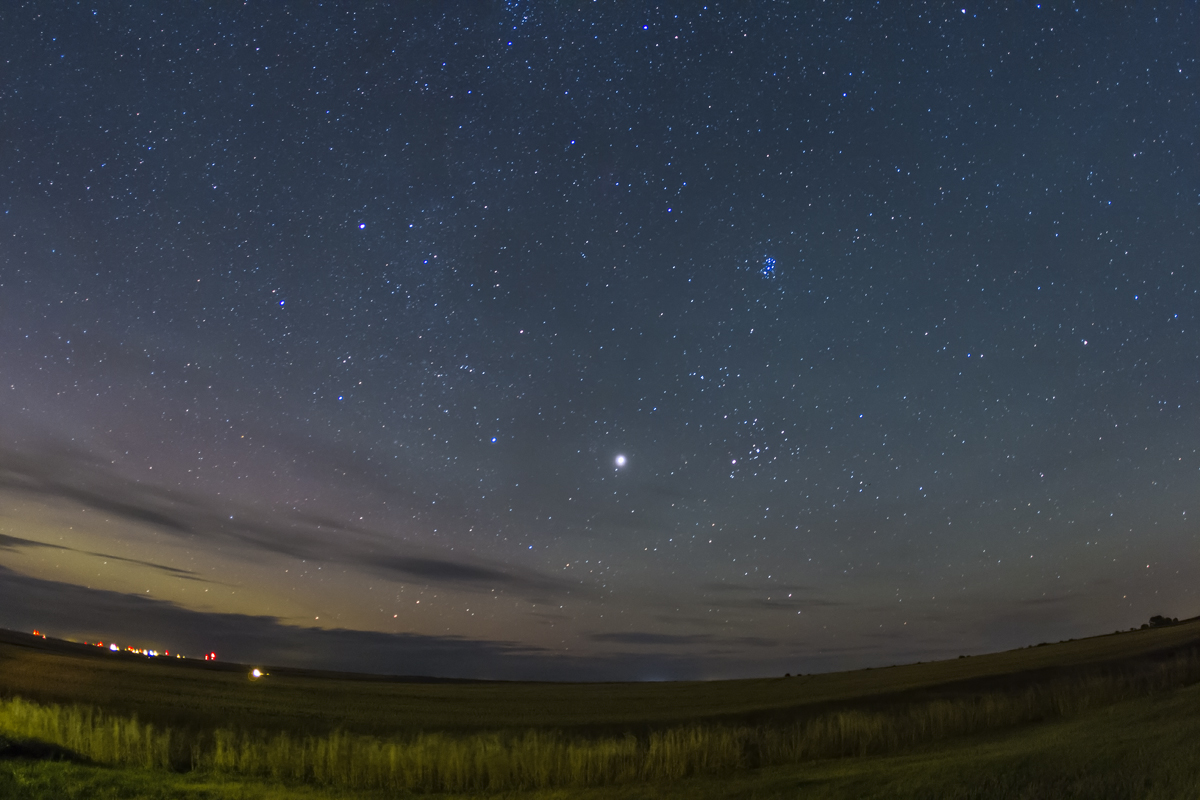
Jupiter Rising


Look east now late at night and you’ll see Jupiter rising amid the stars of Taurus.

I took this shot a week ago from my rural backyard on the last clear night I’ve had. Remarkably, I had  bought a new camera – a Canon 60Da – earlier that day and was actually able to try it out. This is the first real shot I took with it. It shows Jupiter amid the horns of Taurus the bull, and below the Pleiades. A faint aurora lights up the northern sky at left.

There have been some superb aurora displays in the last week but clouds just got in the way.

This is my 200th blog post since I began AmazingSky.net in early 2011. I hope you have enjoyed the images and will continue to do so. Thanks for looking!

– Alan, October 15, 2012 / © 2012 Alan Dyer

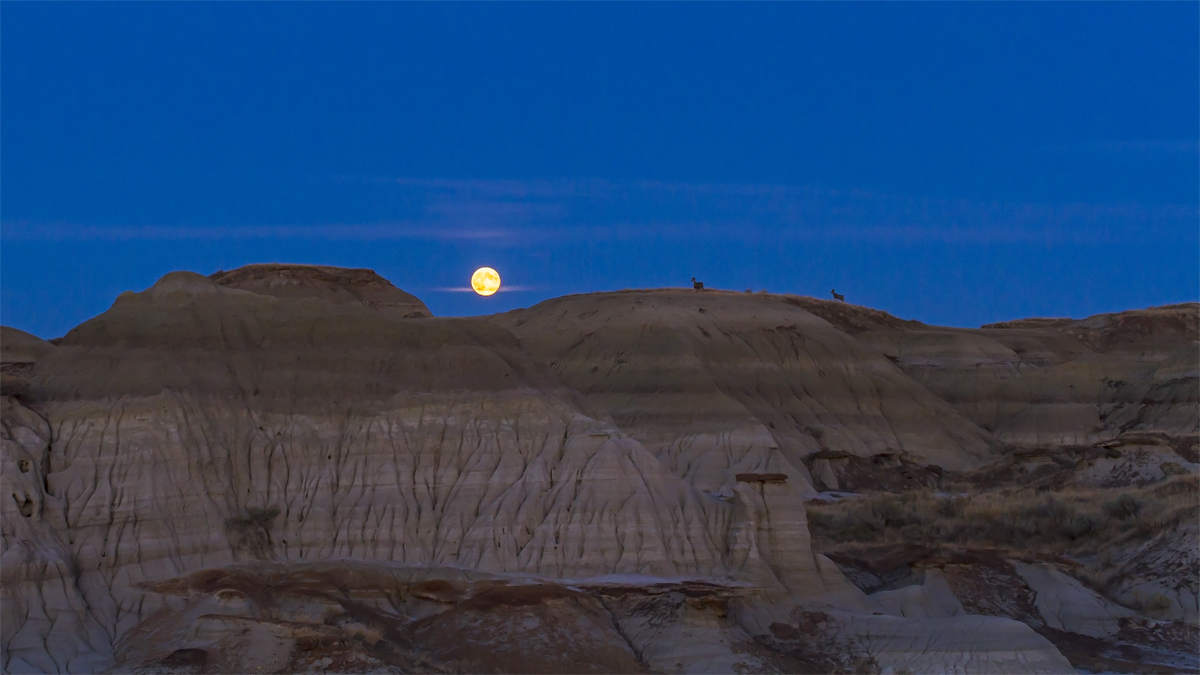
Moonrise on the Badlands


The Moon rises over a lunar-like landscape on Earth.

Well not quite. The badlands of Dinosaur Park, Alberta may look desolate but they were created by forces the Moon has never seen, namely water erosion. And they are “bad” only because we can’t farm them. But to the deer wandering across the top of the hill – and perhaps gazing at the Moon, too – the badlands are a fine place to live.

I shot this image as part of 600-frame time-lapse movie of moonrise, on September 30, the night that produced images for my last few posts. It was a very good night indeed.

– Alan, October 5, 2012 / © 2012 Alan Dyer

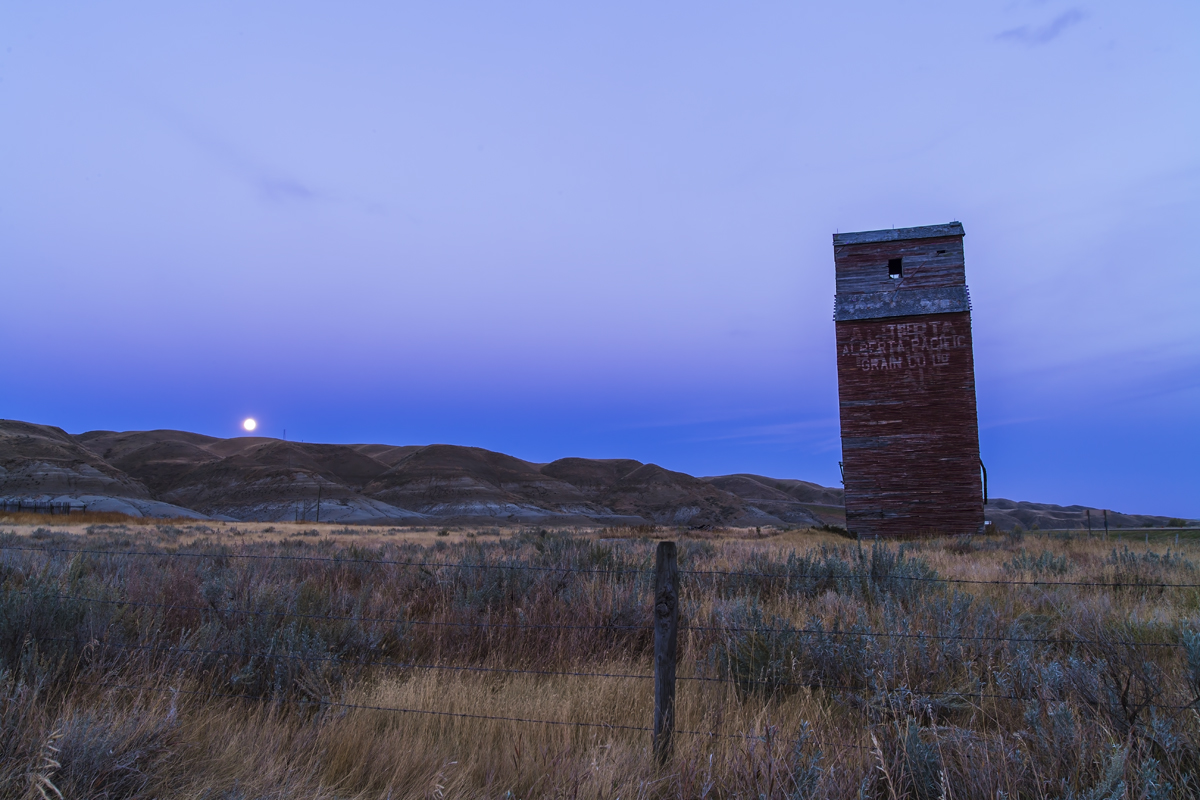
Pioneer Harvest Moon


The annual Harvest Moon shines over a scene from pioneering farm days.

One of the last remaining wood grain elevators still stands as a historic roadside attraction near the little hamlet of Dorothy, Alberta. It’s seen better days.

But in its time it took part in many a harvest in the Red Deer River valley. There were once no less three grain elevators here and railway tracks to take away the bountiful harvest. That was back in the 1910s and 1920s when Dorothy was a little boom town. But the prosperity waned in the Depression Years, and never returned. In the 1960s, the railway tracks were pulled up, and two of the elevators torn down.

Now, Dorothy is one of the ghost towns amid the badlands of the Red Deer River valley.

I shot this Saturday night, as the Full “Harvest” Moon rose over the hills, shining in the blue shadow of the Earth. This is one frame of 450 in a time-lapse sequence.

– Alan, September 30, 2012 / © 2012 Alan Dyer


Harvesting the Wind


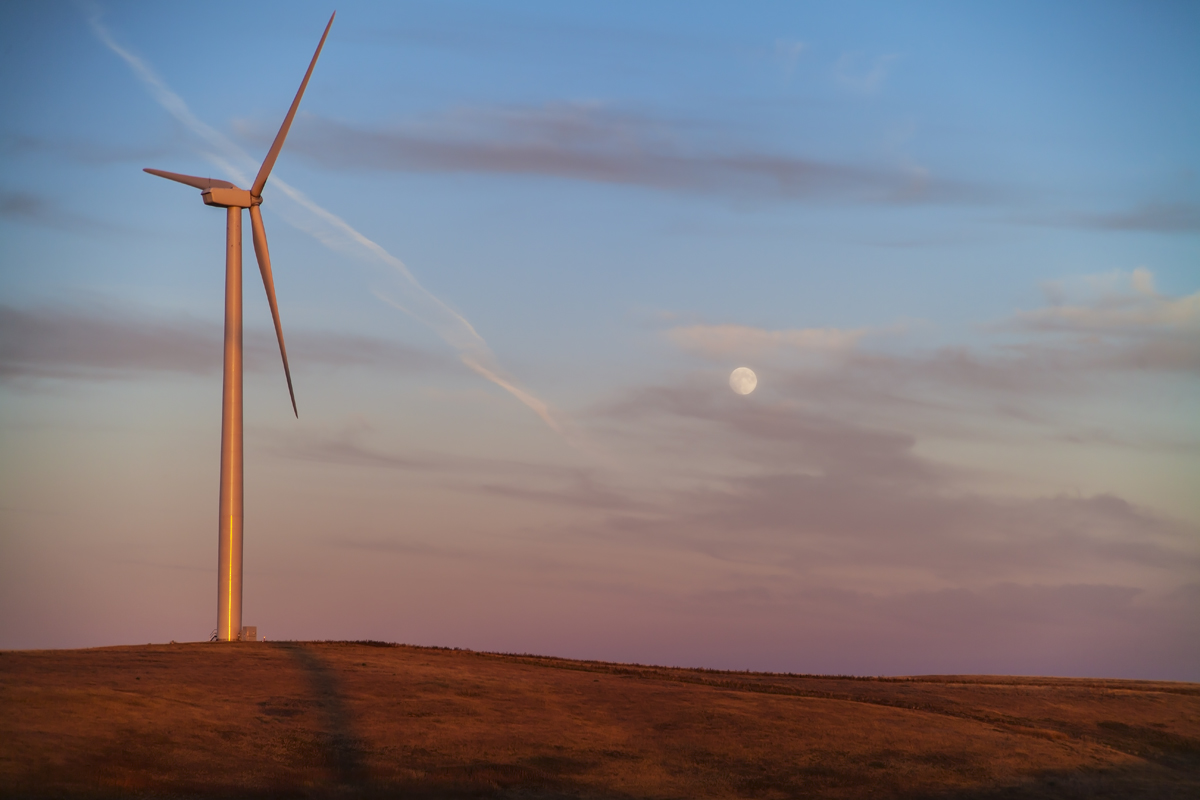
The Harvest Moon rises behind a new crop, a wind turbine harvesting the wind.

I shot this Friday evening, September 28, technically the day before Full Moon and the annual Harvest Moon. The location is amid the Wintering Hills Wind Farm northeast of me and south of Drumheller, Alberta.

This is one frame of 450 in a time-lapse sequence going from sunset into twilight with the Moon rising through the clouds. The changing colours were wonderful.

– Alan, September 29, 2012 / © 2012 Alan Dyer


Sunset on the City


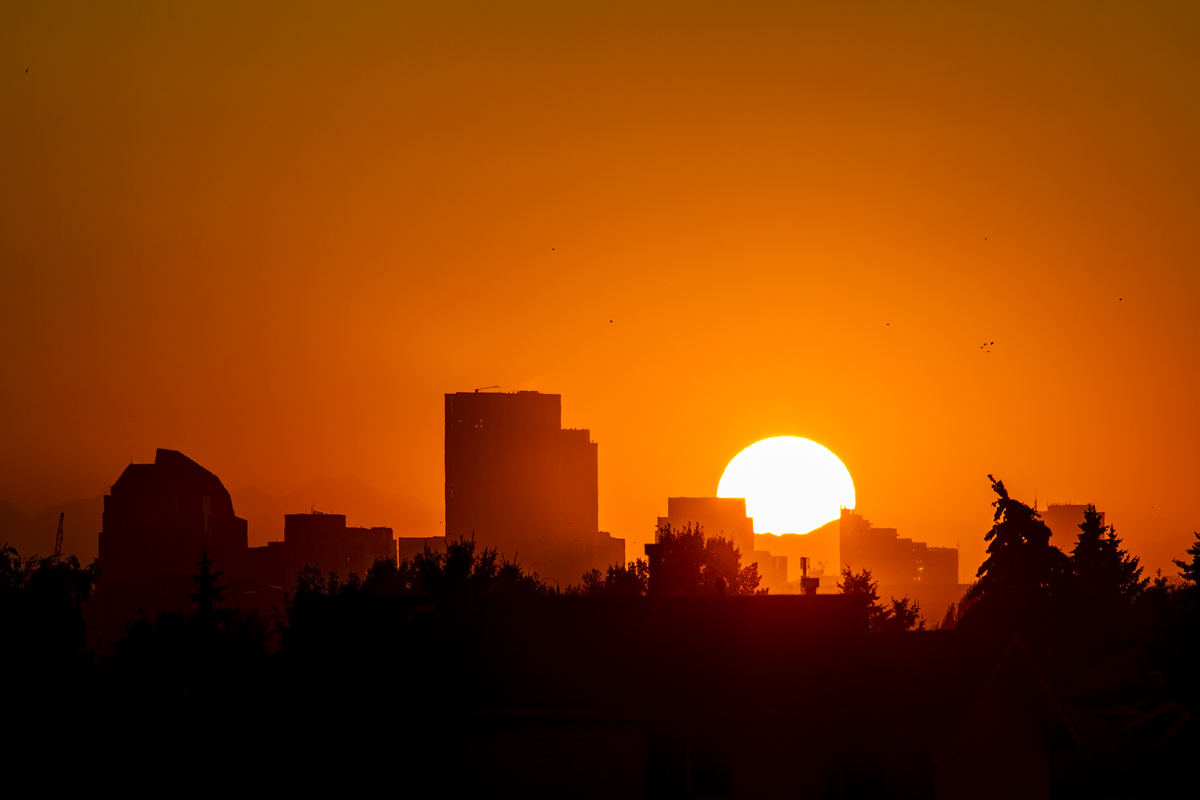
The Sun sets in a ball of fire behind the skyline of Calgary.

For this shot on September 27 I found a spot on an overpass on the Ring Road east of Calgary to look west. Using an app for the iPad, LightTrac, I was able to locate the exact spot where the Sun would set behind the skyline, including the new 50-storey Bow Tower.

Getting the Sun big compared to the buildings means shooting from a distance with a telephoto lens. I used a 200mm and 1.4x extender here.

It would have been nice to have shot from a higher altitude but such places are hard to find east of Calgary where the land flattens out onto the prairie. However, this was a good test of the technique for lining up a rising or setting Sun or Moon with a photogenic foreground. That’ll come in handy this weekend for the Harvest Moon.

– Alan, September 27, 2012 / © 2012 Alan Dyer


A Ball of Fire Descending


Smoke reddened the Sun and turned it into a ball of fire setting into the west.

This was Monday night, September 24, looking toward the hills in the west end of Calgary. I positioned myself on the north side of the Bow River across from the downtown core, at the top of the river valley to catch the Sun in this telephoto shot. The other camera was taking a time-lapse sequence in a wider scene with the Bow River in view.

We are certainly having some fine sunsets of late, thanks to forest fire smoke.

– Alan, September 24, 2012 / © 2012 Alan Dyer


Driving into the Equinox Sun


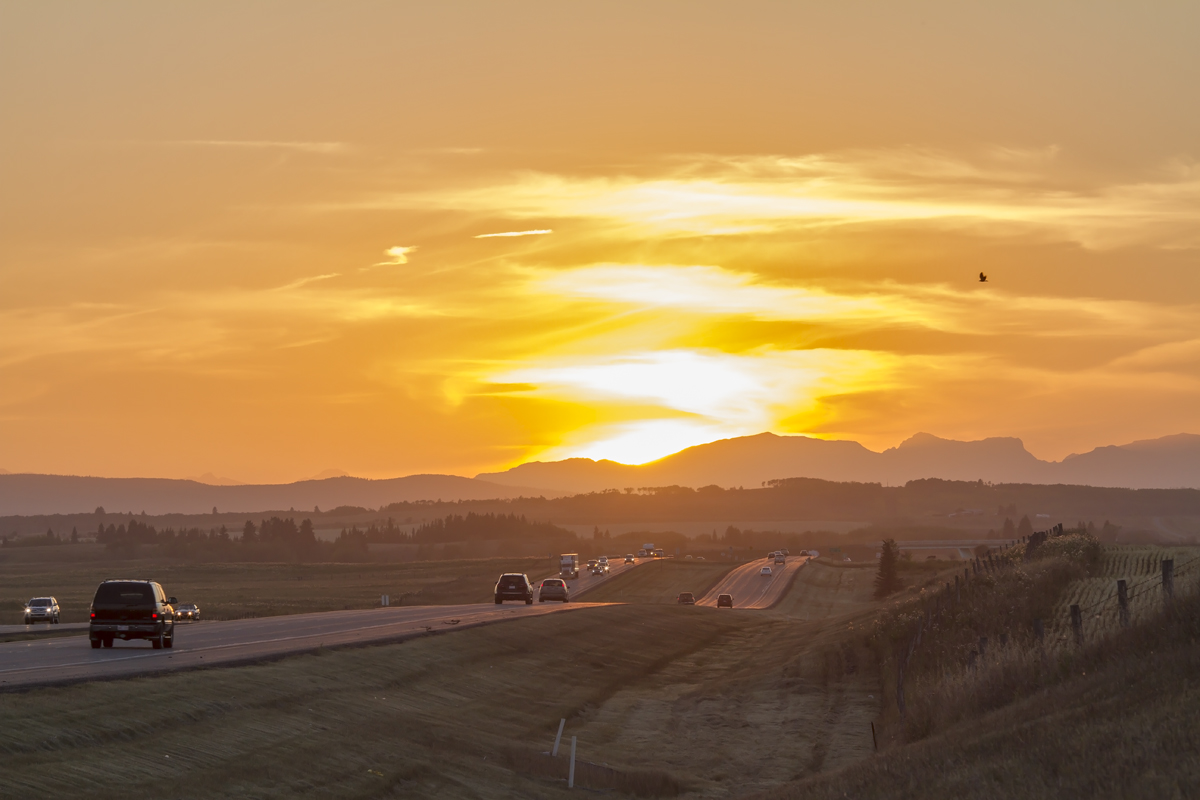
At equinox the Sun sets due west and shines into the eyes of drivers heading west into the sunset.

This was the scene Friday night on Highway 1, heading to Banff out of Calgary. I set up beside the highway to catch the scene of the Sun going down at the end of the road. I was hoping for more smoke and haze to dim the Sun to a clearly defined disk rather than deal with a bright glow. But you shoot what the sky gives you.

This is one frame from a 315-frame time-lapse movie of the traffic madly moving down Highway 1 (a true to life recording!) and the Sun glow setting behind the Rockies.

– Alan, September 23, 2012 / © 2012 Alan Dyer


Right Angle Moon


Saturday night was a fine evening for witnessing the geometry of the night sky.

This is sunset on the evening of the autumnal equinox, September 22, 2012, with a first quarter Moon in the sky. The image illustrates the geometry of the quarter Moon’s position, which is always 90° away from the Sun, a quarter of the way around its orbit in its monthly cycle.

In this case, because the Sun (at right) was on the equinox position on the ecliptic, it was setting due west this night (something it does only on the dates of the fall or spring equinox). This put the quarter Moon (at left) 90° away, due south at sunset.

Draw a line from the Moon to your eye (the camera) and then back out to the Sun and it forms a 90° right angle. This geometry holds true for any quarter Moon, but being equinox the Sun and Moon were nicely aligned due west and south, making their right angle arrangement more obvious.

I took this shot from the grounds of the Rothney Astrophysical Observatory on the occasion of their monthly Open House.

– Alan, September 23, 2012 / © 2012 Alan Dyer


September Dawn


Here was the scene on September 12, with Venus and the Moon in conjunction in the dawn sky.

Orion stands above the trees, and at top is Jupiter amid the stars of Taurus. The star Sirius is just rising below Orion. And both the Moon, here overexposed of necessity, and Venus shine together below the clump of stars called the Beehive star cluster in Cancer. This was quite a celestial panorama in the morning twilight.

This is a stack of two 2-minute exposures taken just as dawn’s light was breaking, so I get the Milky Way and even a touch of Zodiacal Light in the scene, as well as the colours of twilight. Pity I can’t avoid the lens flares!

– Alan, September 12, 2012 / © 2012 Alan Dyer


Blue Moonrise


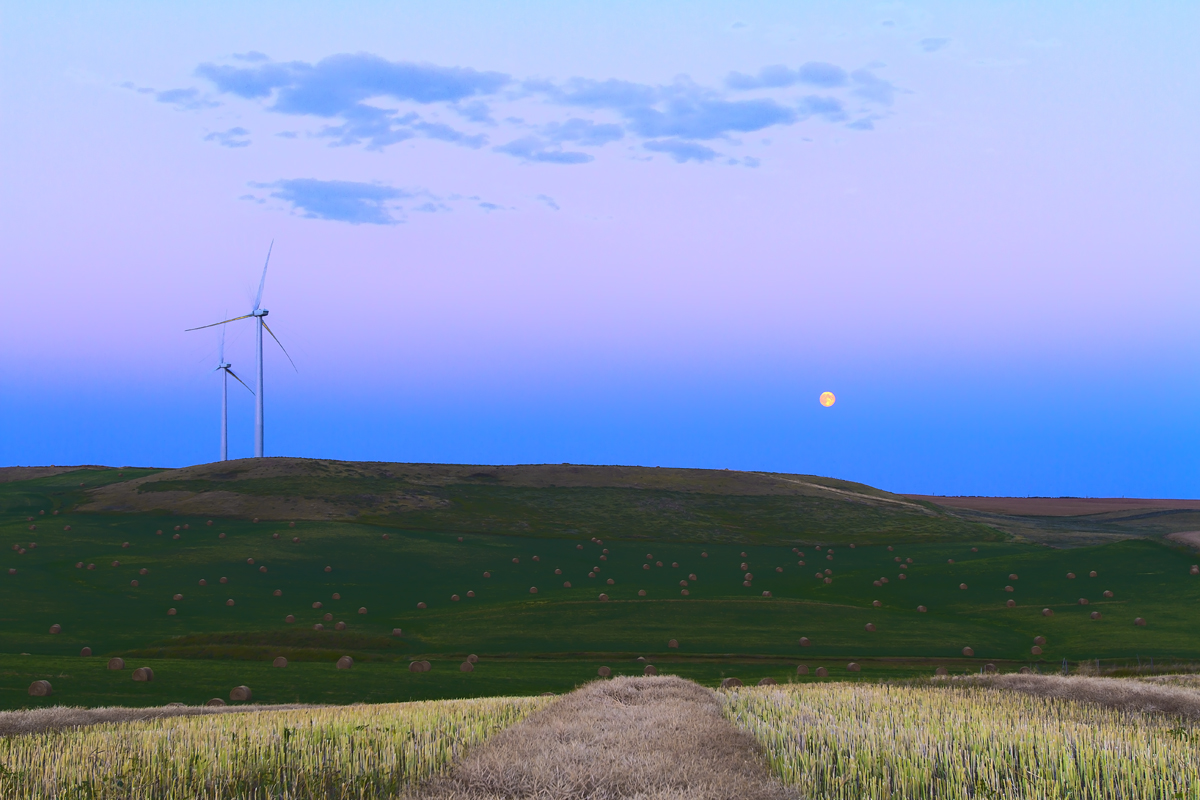
This was the Full Moon rising on the night of another much-publicized “Blue Moon.” This was moonrise on Friday, August 31, 2012.

Of course, the Moon doesn’t look blue. Indeed, smoke and dust in the air made it look a dim yellow. Though this wasn’t the official Harvest Moon (that comes next month), it should have been, as around here in southern Alberta the harvest is well underway, thus the swathed fields and hay bales.

The Full Moon sits in the blue band of Earth’s shadow, rimmed on the top by the pink twilight effect called the Belt of Venus, caused by sunlight illuminating the high atmosphere to the east.

A couple of windmills from the large Wintering Hills wind farm add to the evening scene. I’ve spent the last couple of evenings shooting in the wind farm. More images are to come!

For this image, I combined six exposures in a High Dynamic Range stack to compress the wide range of brightnesses. Boosting the colour vibrancy also brings out the twilight colours.

– Alan, August 31, 2012 / © 2012 Alan Dyer


Camping Under the Planets


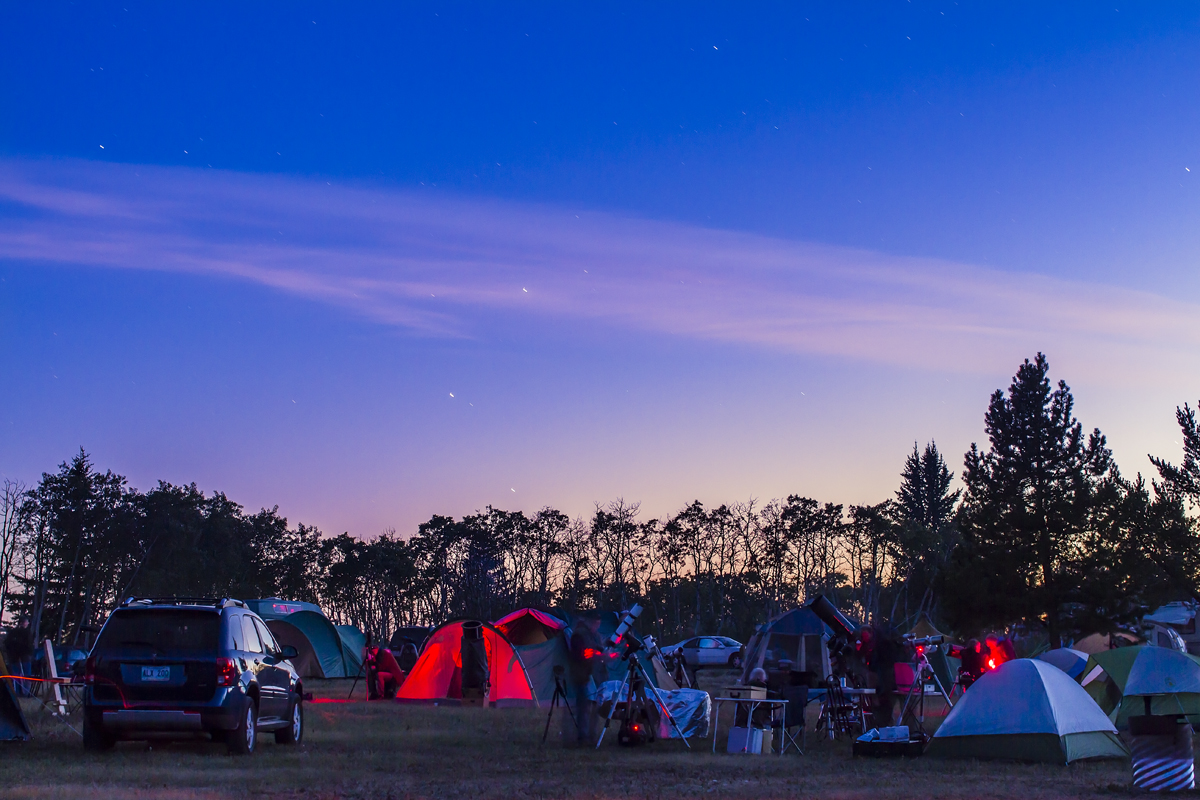
Here’s a final scene from the recent big star party, of campers under Mars and Saturn, two planets setting into the twilight.

Saturn is just in the clouds, Mars is below, and just above the treetops is Spica, the brightest star in Virgo. The three objects were in close conjunction through mid-August but set early in the evening.

I shot this at the recent Saskatchewan Summer Star Party in Cypress Hills. Most of my blogs of the last 10 days have featured shots from the star party or of the star party. It was a super weekend for stargazing.

– Alan, August 27, 2012 / © 2012 Alan Dyer

A Convergence of Worlds in the Sky


The evening planet show we’ve been enjoying all year comes to a close for a while, but in grand style with a convergence of four worlds in the dusk.

This was the scene from my front driveway, Tuesday, August 21, as the waxing crescent Moon shone near Mars (just above the Moon) and Saturn (at top right just above the clouds), and near the star Spica (to the right of the Moon). The four objects formed a somewhat lopsided square in the evening twilight. But from my latitude of 51° North, they were very low and never visible in a dark sky. Enjoying them with the eyes required binoculars to pick them out.

Saturn will disappear behind the Sun shortly, but Mars hangs around in the evening sky for a few more months, but always low and easy to miss.

— Alan, August 21, 2012 / © 2012 Alan Dyer


Planetary Dawn


This was the stunning scene in the dawn sky last Sunday — Venus, the Moon and Jupiter lined up above the Rockies.

Orion is just climbing over the line of mountains at right, while the stars of Taurus shine just to the right of Jupiter at top. I shot this at the end of a productive dusk-t0-dawn night of Perseid meteor photography. Being rewarded with a scene like this is always a great way to cap a night of astronomy.

— Alan, August 15, 2012 / © 2012 Alan Dyer


Venus Disappears


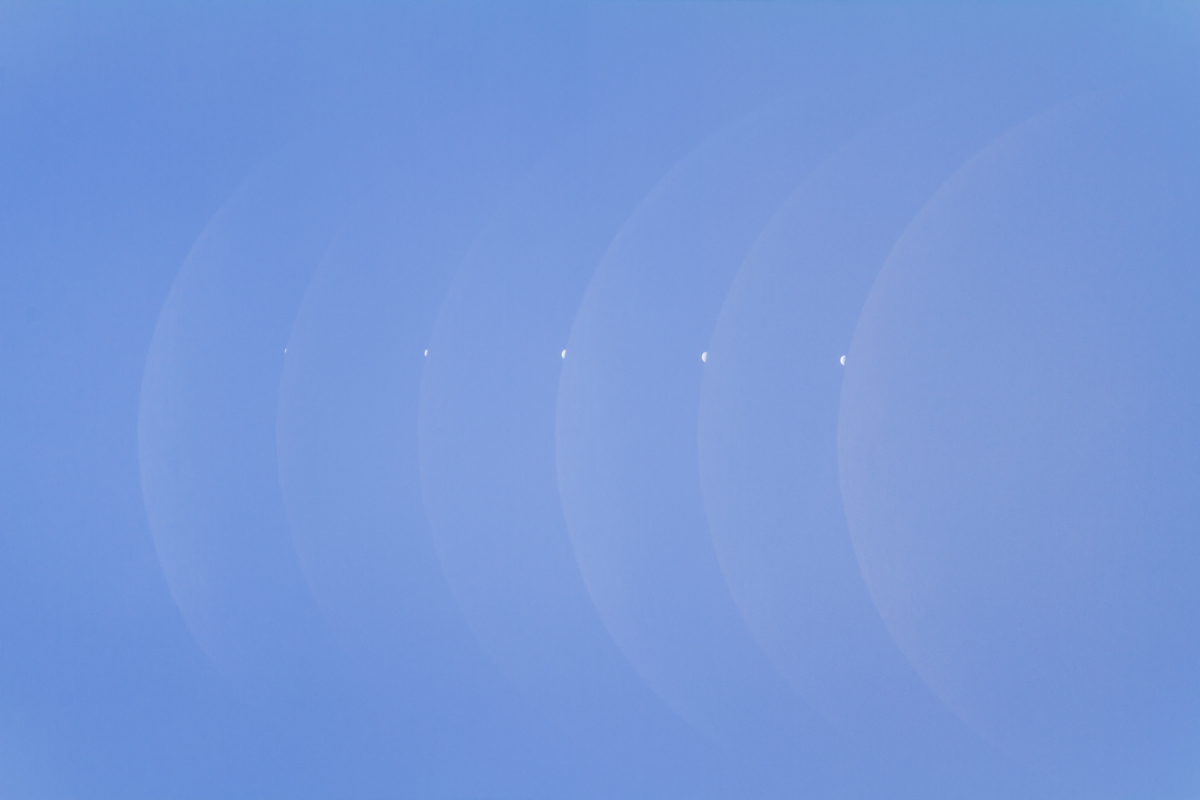
On the afternoon of Monday, August 13 the waning crescent Moon slid in front of Venus in broad daylight. This sequence captures the disappearance.

It was touch and go getting this as high cloud kept moving through. A few minutes earlier the Moon and Venus were in clear blue sky, but at the time of the occultation, haze whitened the sky and cut down the  contrast on an event that takes a telescope to see well. When the sky was clear it was easy to sight the Moon with unaided eyes and therefore focus your eyes on infinity. Venus next to the Moon popped into view, even naked eye. It was a rare chance to easily sight Venus in the daytime. But as it got close to the Moon Venus became harder to see naked eye, and the haze then made it impossible. But through a telescope it was just the opposite — Venus’s bright disk stood out even when the Moon was washed out and invisible.

For southern Alberta the occultation took place at 2:11 pm MDT. I missed seeing it emerge from behind the Moon. I was already inside processing this image.

It has been quite a year for Venus. It’s not over yet, as Venus continues its morning show and has close encounters with the Moon and the star Regulus this autumn.

— Alan, August 14, 2012 / © 2012 Alan Dyer

Perseid Meteors and Planets over a Mountain Lake


It was quite a night, and a wonderful dawn. This was the scene at the end of a night of falling stars.

A trio of Perseid meteors zips down at left, while at right a trio of solar system worlds rises into the pre-dawn sky. The overexposed waning Moon is flanked by Jupiter above and Venus below. Jupiter shines near the Hyades star cluster and below the Pleiades cluster.

I took this shot (it is actually a composite of three shots, each with its own meteor) on the morning of Sunday, August 12 on the peak night of the annual Perseid meteor shower, widely publicized this year due to the lack of a Moon for most of the night, and the convenience of falling on a weekend. The scene is looking east over Lake Minnewanka in Banff National Park, Alberta, one of the few places in this part of the Rockies you can look east to a reasonably unobstructed sky.

Notice the glitter path on the water from not only the Moon but also Venus.

— Alan, August 13, 2012 / © 2012 Alan Dyer

Dawn’s Early Lights II


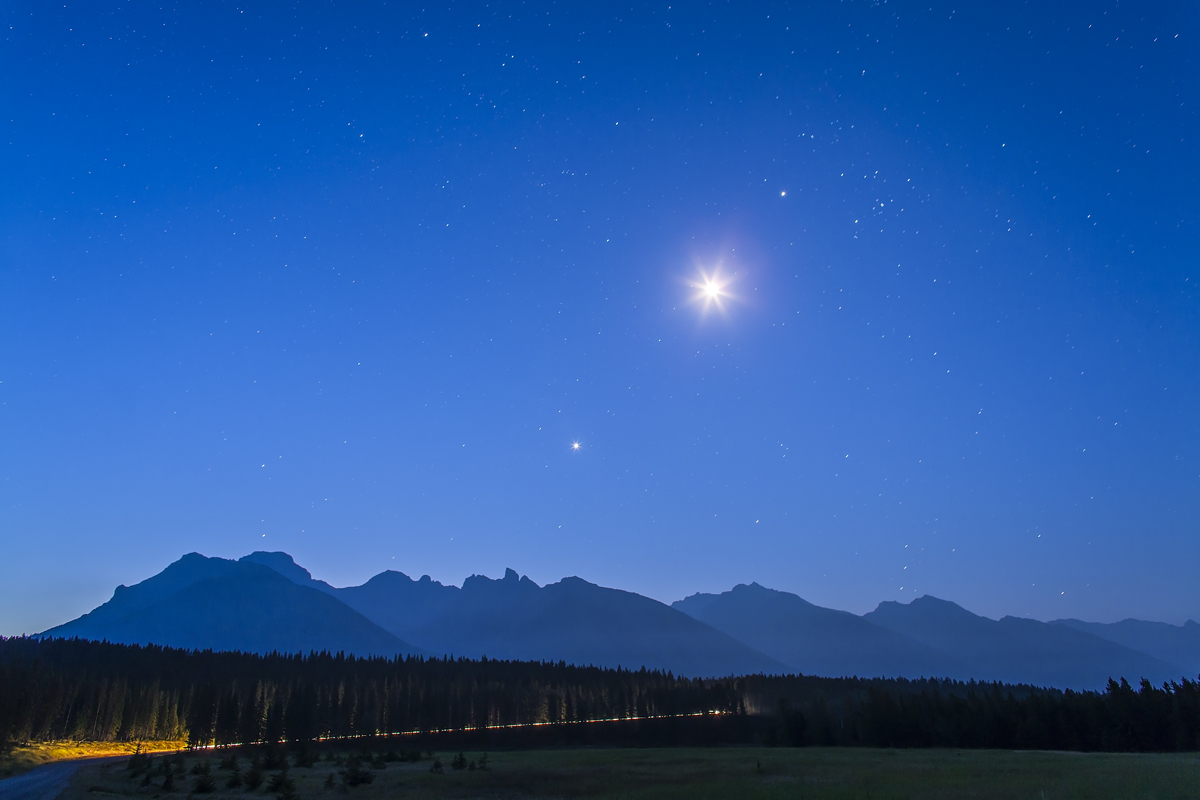
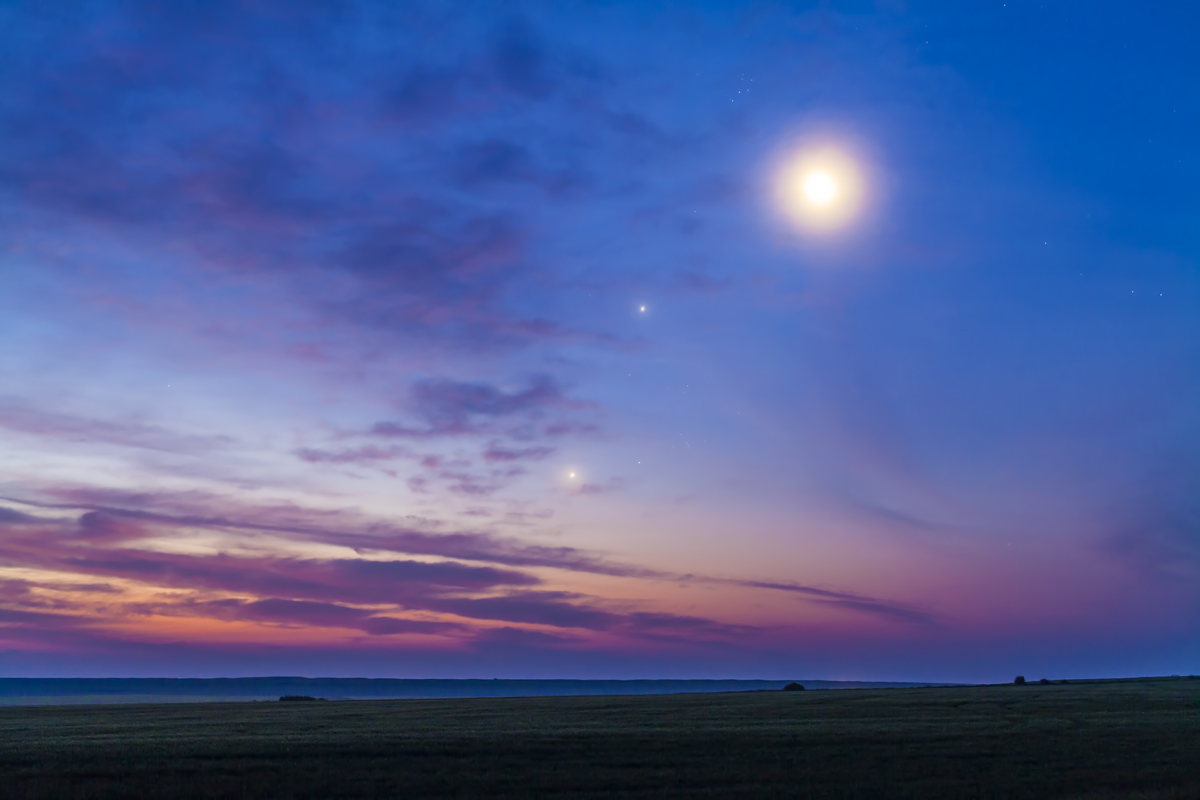
Here’s a wider shot of the Moon-Jupiter-Venus gathering at dawn on July 14.

The clouds parted nicely for a clear view of the sky where it needed to be clear (a rare occurrence!) while adding their colour to the pre-dawn scene. I like cooperative clouds. Let’s see if they behave for tomorrow morning’s closer conjunction.

— Alan, July 14, 2012 / © 2012 Alan Dyer


Dawn’s Early Lights


Venus and Jupiter are reprising their mutual meetings of earlier this spring, but now in the pre-dawn summer sky.

This was the scene at 4 a.m. from home on July 14, with the waning crescent Moon, here overexposed, above Jupiter and Venus at dawn. Next to Venus is the star Aldebaran and the stars of the Hyades star cluster in Taurus. Above the Moon is the Pleiades star cluster.

On July 15, the Moon will appear between Venus and Jupiter for one of the best conjunctions of 2012.

— Alan, July 14, 2012 / © 2012 Alan Dyer


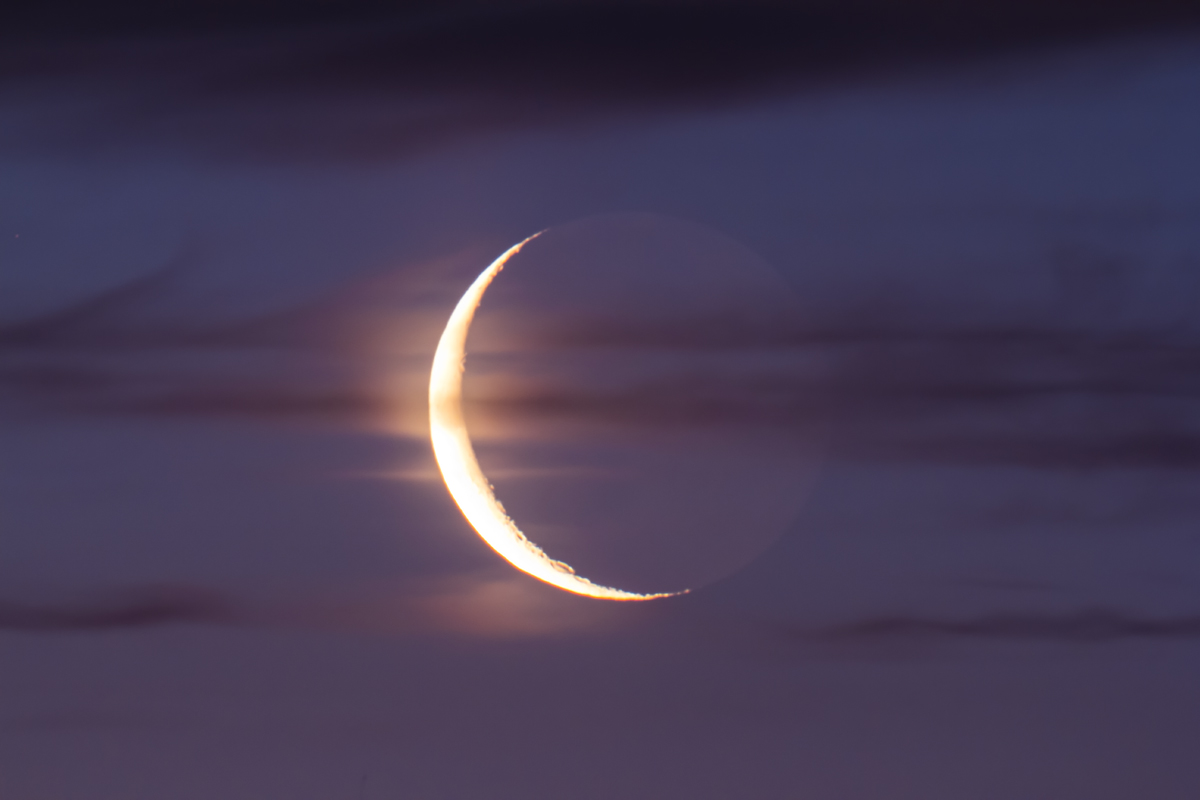
Old Moon Waning


It’s been a season of crescents. A crescent Sun in eclipse. A crescent Venus before and after transit. But this is the more familiar Moon.

I caught the waning crescent Moon rising before the dawn on Saturday, June 16, after an all-night shooting session amid the summer twilight. As dawn was breaking, the Moon rose in the east and drifted through clouds near the horizon.

Here, the glow of Earthshine lighting up the dark night side of the Moon  appears just a little brighter than the twilight sky.

This is an “old Moon,” as at this phase the Moon is three days before new, at age 26 days. At new moon, the Moon is “reborn” and appears anew as a crescent in the evening sky.

— Alan, June 16, 2012 / © 2012 Alan Dyer


Venus: 6 Degrees of Separation


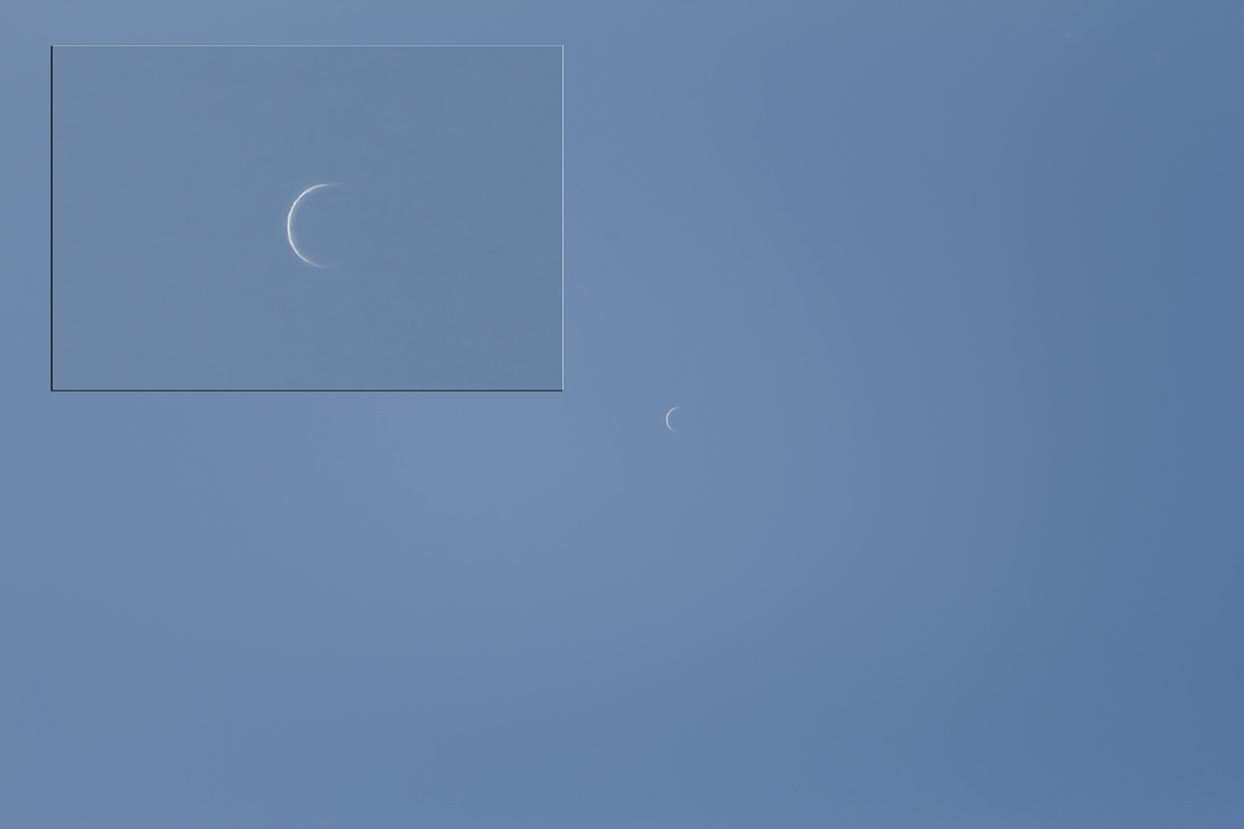
This was my first look at Venus following Tuesday’s transit. Here, it’s just six degrees west of the Sun as a thin crescent in the afternoon sky. It was a beautiful sight in the eyepiece, far enough away from the Sun to not be in its glare but close enough to still appear as a razor-thin backlit crescent.

Each day now Venus is widening the gap between it and the Sun, shortly to become a brilliant morning star in the eastern sky before dawn through the rest of June, July and August.

I shot these images in broad daylight through a 130mm f/6 refractor. The big image is a full-frame shot with the Canon 60Da and a 2X Barlow lens, for an effective focal length of about 1500mm. The inset is a single frame grabbed from a 30-frame-per-second movie shot with the Canon in its Movie Crop mode, which yields a high-magnification view suitable for planet shooting, but only 640 x 480 pixels. But this mode is certainly ideal for capturing planets, though none ever appear as large as Venus is here. This is an uncommon instance of Venus as close and as large as any planet gets.

— Alan, June 9, 2012 / © 2012 Alan Dyer


Venus Descending


A wonderful sight tonight, as I caught Venus in its last days before the transit, shining as a glistening crescent low in the evening twilight.

Venus was visible to the unaided eye after sunset, but not for long. It set soon after the Sun. But for a short while it put on a beautiful show as a large crescent (large for a planet that is), easily resolvable in binoculars and stunning in a small telescope. One could almost make out, for brief moments, the sight of the backlit atmosphere going all the way around the disk. But I suspect it was more imagination at work than reality shining through.

The inset blows up the boxed area, to reveal the crescent-phased disk of Venus, despite this shot being taken with no more than a 200mm telephoto lens. I used a Canon 60Da camera at ISO 100. A plane is flying just below Venus.

So this was May 30, 6 days before the June 5 transit, with Venus 9.5° east of the Sun. How far up to the Sun can we catch it, before it crosses the Sun on Tuesday?

— Alan, May 30, 2012 / © 2012 Alan Dyer

Venus Sinks Sunward


Here’s a last look at Venus before its historic transit across the face of the Sun on June 5.

I took this Monday evening, May 28, with the Sun still up and Venus about 13 degrees east of the Sun but low in my evening sky. Venus appears as a razor-thin crescent, like a tiny “new Moon.” Most of the daylight side of Venus now faces away from us; on the side of Venus turned toward us now all but a sliver of a crescent is dark — we’re looking at the night side of Venus. On June 5, all we will see is this dark side of Venus, appearing in silhouette in front of the Sun’s brilliant disk as Venus moves across the Sun in a transit not to be repeated for another 105 years.

This is a single still-frame grab from a movie shot I shot with the Canon 60Da camera, set in Movie Crop Mode, for a movie 640 x 480 pixels wide. This mode magnified Venus considerably on the frame. I shot this through a small 80mm apo refractor at its f/6 prime focus, so with only 480mm of focal length. But Venus is now so large it doesn’t take a lot of extra magnification to show its disk and phase.

The view through the eyepiece was stunning. The rippling image and sparkling colours, though from distortion in our atmosphere, added to the beauty of Venus, fitting for the goddess of love.

– Alan, May 28, 2012 / © 2012 Alan Dyer

Eclipse — A Parking Lot Partial


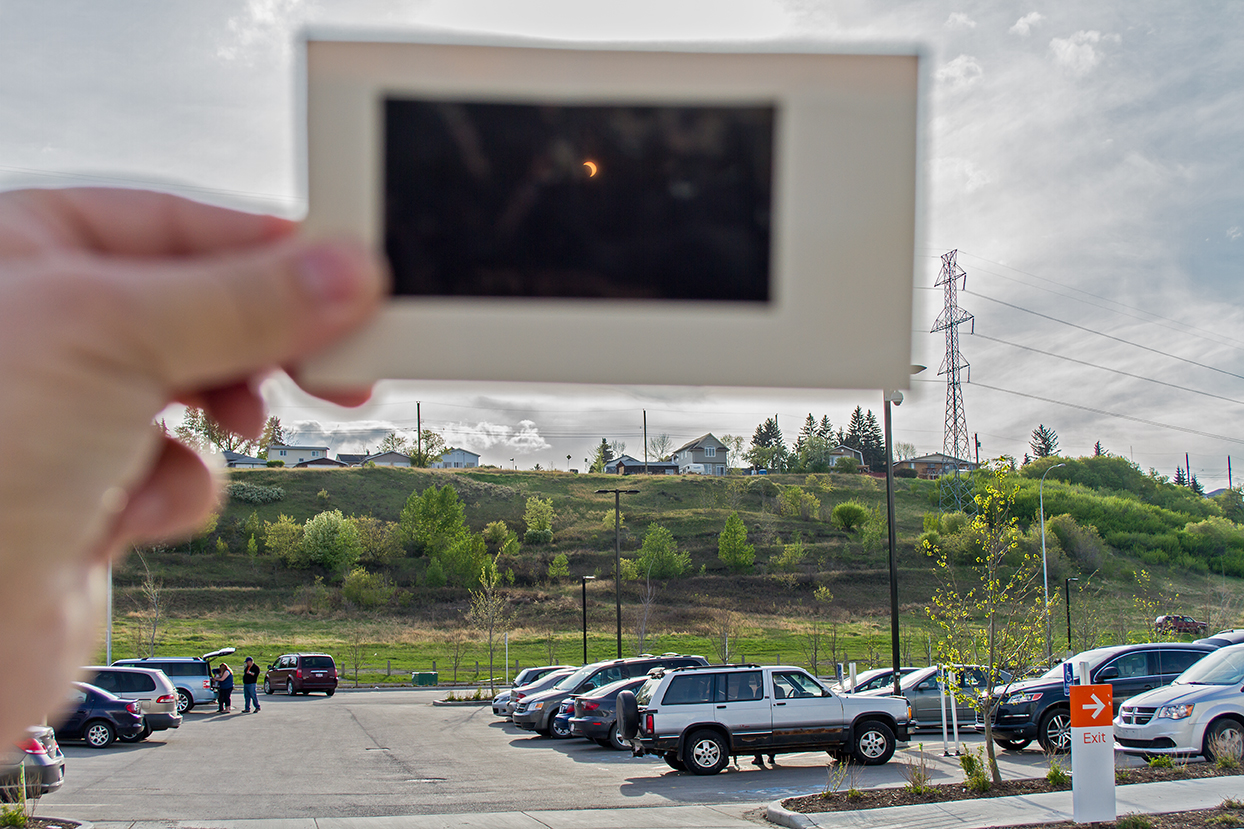
This was the view Sunday evening as the Sun descended into the northwest sky, accompanied by the Moon covering part of its disk.

I shot this near mid-eclipse with a handheld camera and filter dimming what would have otherwise been a vastly overexposed Sun. A liberal use of Photoshop’s Highlight recovery and Shadow details tools compressed the dynamic range even more, to bring out details in the sky and clouds and in the dark filtered image. But this is a single image, not a composite.

As you can see, even at its best the Sun shone through light cloud, which added somewhat to the scenery of the sky and the weird quality of the light at mid-eclipse. But all told, I’d rather do without clouds at any eclipse. They make for anxious moments I could live without.

I took this shot from the TELUS Spark science centre, where we set up sidewalk telescopes for viewing the eclipse, looking over the parking lot and hill to the west of us. It’s where the Sun will also be for the transit.

— Alan, May 21, 2012 / © 2012 Alan Dyer


Partial Solar Eclipse — from Calgary


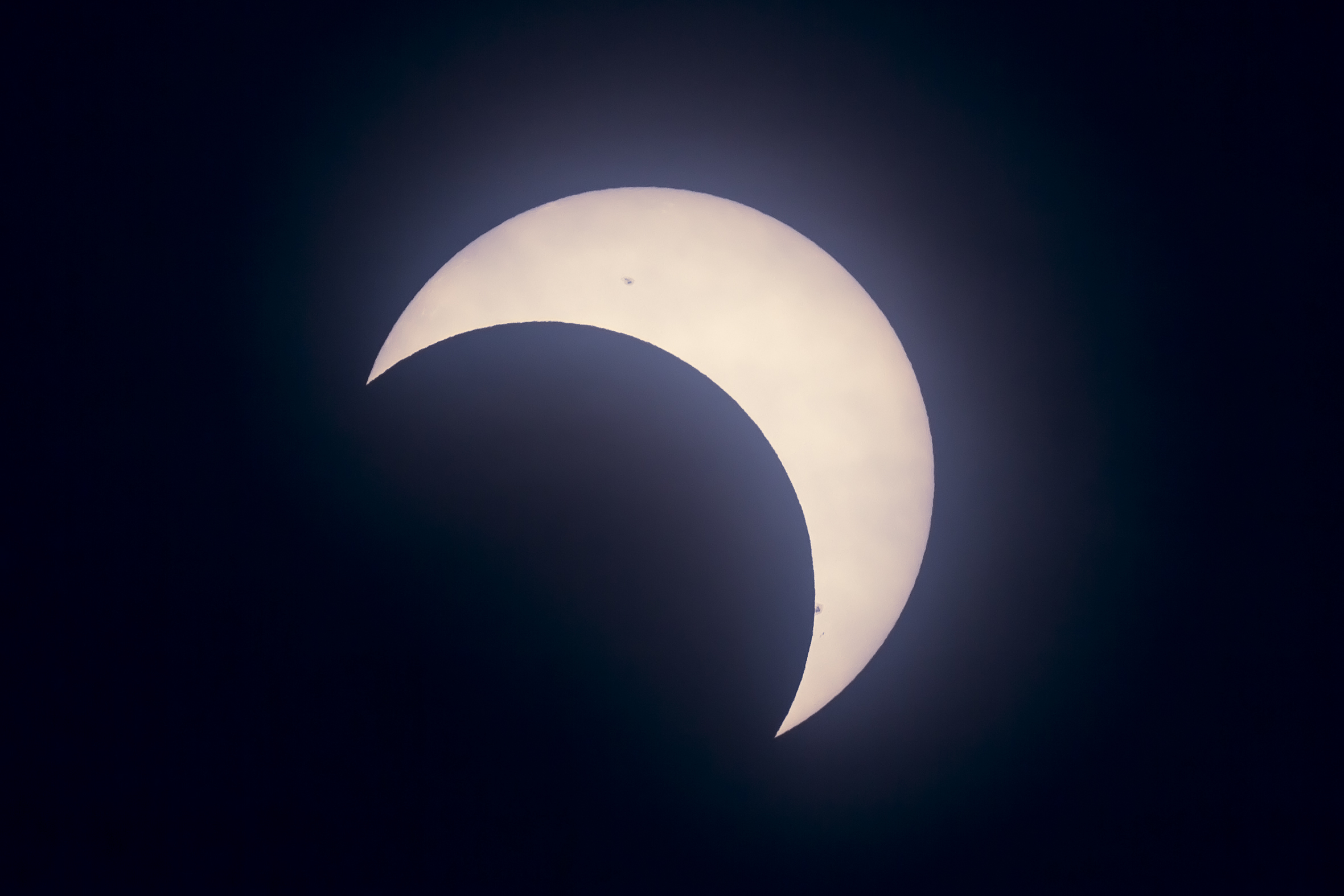
This was the first significant solar eclipse in many years that I did not travel to. For the May 20, 2012 eclipse I was content to stay at home on the sidelines and take in the partial eclipse of the Sun.

From Calgary, the Moon covered about 62% of the Sun at mid-eclipse, which this shot captures, taken at maximum eclipse for us. Here, a big sunspot group is just being uncovered by the passing Moon. Having lots of spots on the Sun this day made the partial eclipse all the more interesting, though still no comparison to the annular eclipse visible over the spectacular landscapes of the southwestern U.S.

I would have been there, in the Moon’s ant-umbral shadow, had it not been for the fact that at home I am very much involved in the opening of a new planetarium and digital dome theatre at the science centre, TELUS Spark, where I work. This is a milestone event in one’s life, one I’ve had the privilege of experiencing twice before, in 1984 in Edmonton with the opening of its new science centre and planetarium, and in 1996 when we converted the old Calgary Centennial Planetarium into a then state-of-the-art tilt-dome theatre. Oddly coincidental, I missed seeing the May 15, 1984 annular eclipse in the SE United States due to the imminent opening of the Edmonton theatre. History repeats itself — a Saros cycle of science centres perhaps?

For this eclipse we conducted a public viewing session and managed to grab excellent views once clouds cleared away before mid-eclipse. Eclipse anxiety was running high leading up to and through the initial minutes of the eclipse as it looked like clouds were going to skunk us. But wonder of wonders, the sky cleared and the eclipsed Sun was revealed, to my great relief. Missing the annular eclipse is bad enough; I didn’t want to miss the partial eclipse, too!

Now, we just need clear skies on June 5 for the transit of Venus.

— Alan, May 20, 2012 / © 2012 Alan Dyer

Venus Meets the Seven Sisters


The goddess of love meets the daughters of Atlas — it isn’t often we get to see such a sight!

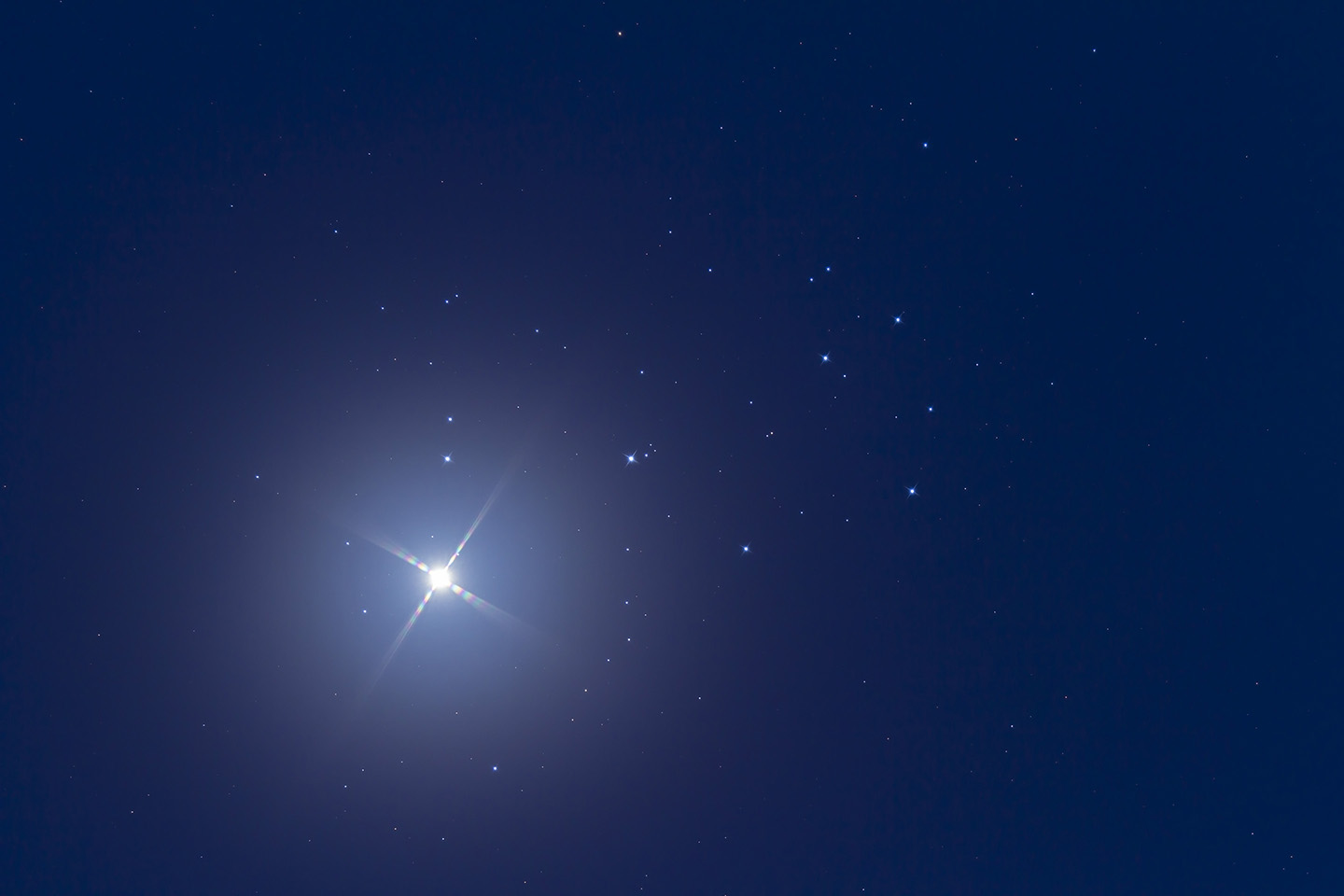
This is brilliant Venus shining amid the stars of the Pleiades, on the evening of Tuesday, April 3, 2012, with Venus as close to the Seven Sisters star cluster as I can ever remember seeing.

Venus last passed near the Pleiades in April 2004 (though not as closely as it did tonight), and will again in April 2020, reflecting the 8-year periodicity of Venus’s return to the same place in the sky. Thus the 8-year interval between the June 2004 transit of Venus and the one this June in 2012.

I took this through a 92mm aperture refractor, but added the classic spikes of light (which you would normally get only when shooting through a Newtonian reflector telescope) by taping some wire in front of the lens. It’s a technique that’s strictly for show. Some high cloud moving in, supposedly in advance of a big spring snowstorm, added the glow around Venus.

This was one of many superlative Venus events this year. Enjoy the sight of Venus now that it is as high as it ever gets in our northern hemisphere evening sky. We won’t see it quite as good as this again until 2020.

— Alan, April 3, 2012 / © 2012 Alan Dyer

Conjunction over Calgary


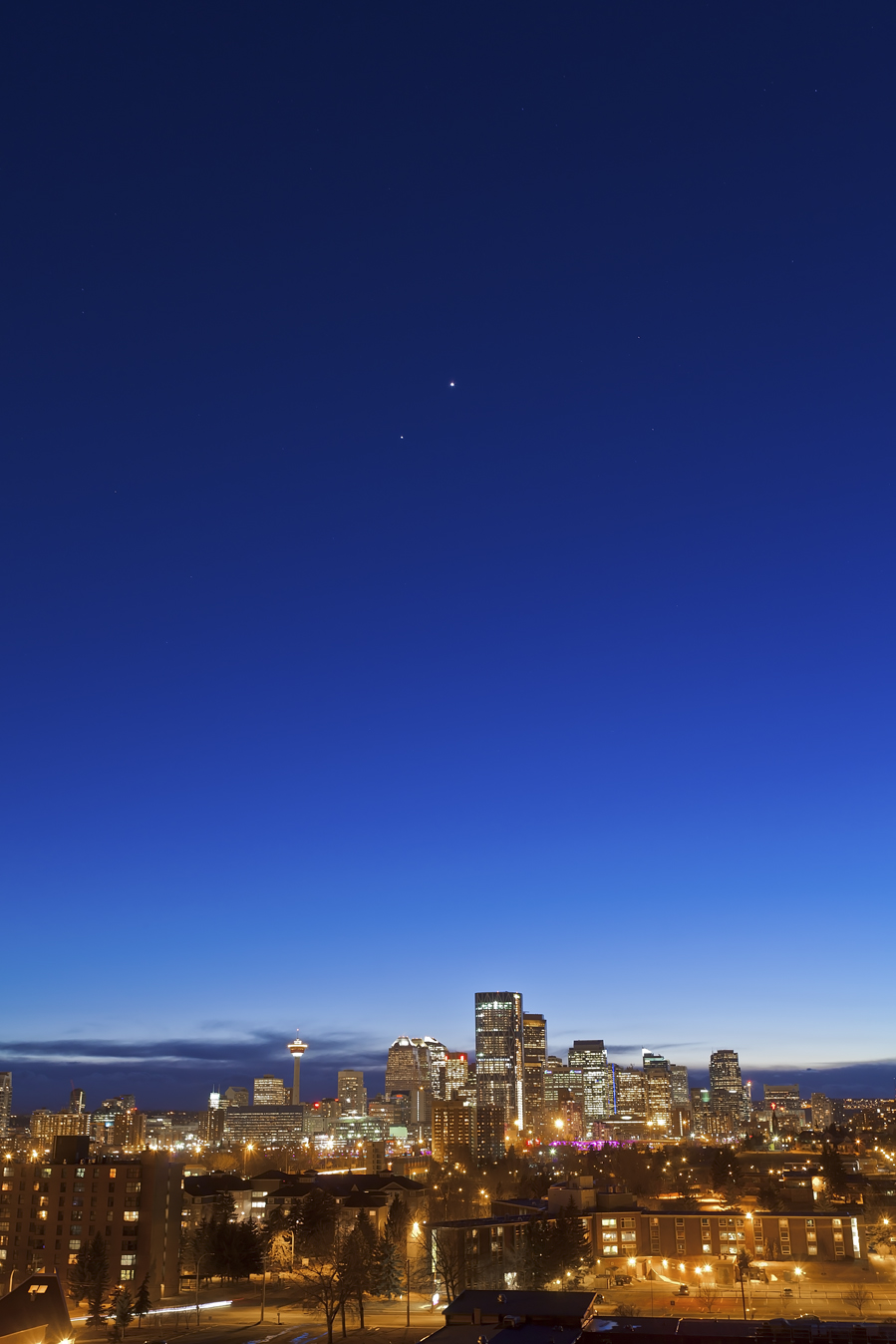
For my continuing series of Venus-Jupiter conjunction shots, on Wednesday night I stayed in Calgary and shot the planets over the city skyline.

Here Venus and Jupiter shine in the clear evening twilight over the downtown core of the city, now dominated by the new Bow tower. I  didn’t have to venture far for this shot, as the best vantage point and angle for framing the planets over the city was the top of Tom Campbell Hill, right beside the TELUS Spark science centre where I work.

We’ll see if the clear nights continue. But it’s been a good run all this week. The last few blogs show the results from each night’s shooting since Saturday.

— Alan, March 14, 2012 / © 2012 Alan Dyer


Mountains, Clouds and Planets, Oh My!


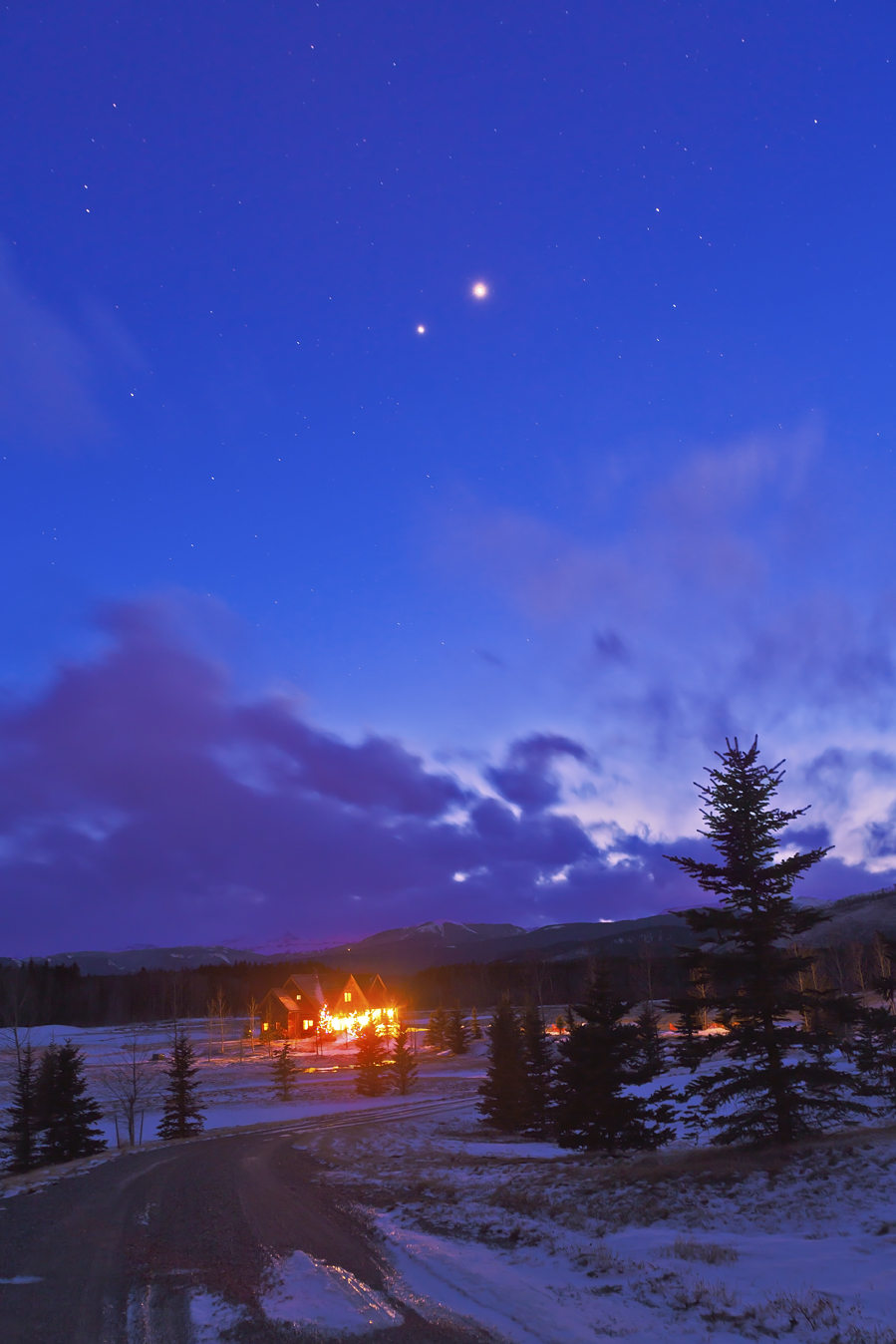
In another in my series of Venus & Jupiter nightscapes, I present this scenic portrait of the planets over a picture-perfect house in the foothills.

This was Tuesday, March 13 with the two planets at closest conjunction. I drove out to a favourite spot of mine, just south of Bragg Creek southwest of Calgary. The clouds hanging over the Rockies parted well enough to reveal the planet pair in the deep twilight and add other colours to the sky.

It was a stunning scene, one I’m sure the residents of the house were completely unaware of. The lights give that away. Wonderful scenery can be appreciated by night and by day.

— Alan, March 13, 2012 / © 2012 Alan Dyer


Tilting at the Sky (with Venus & Jupiter)


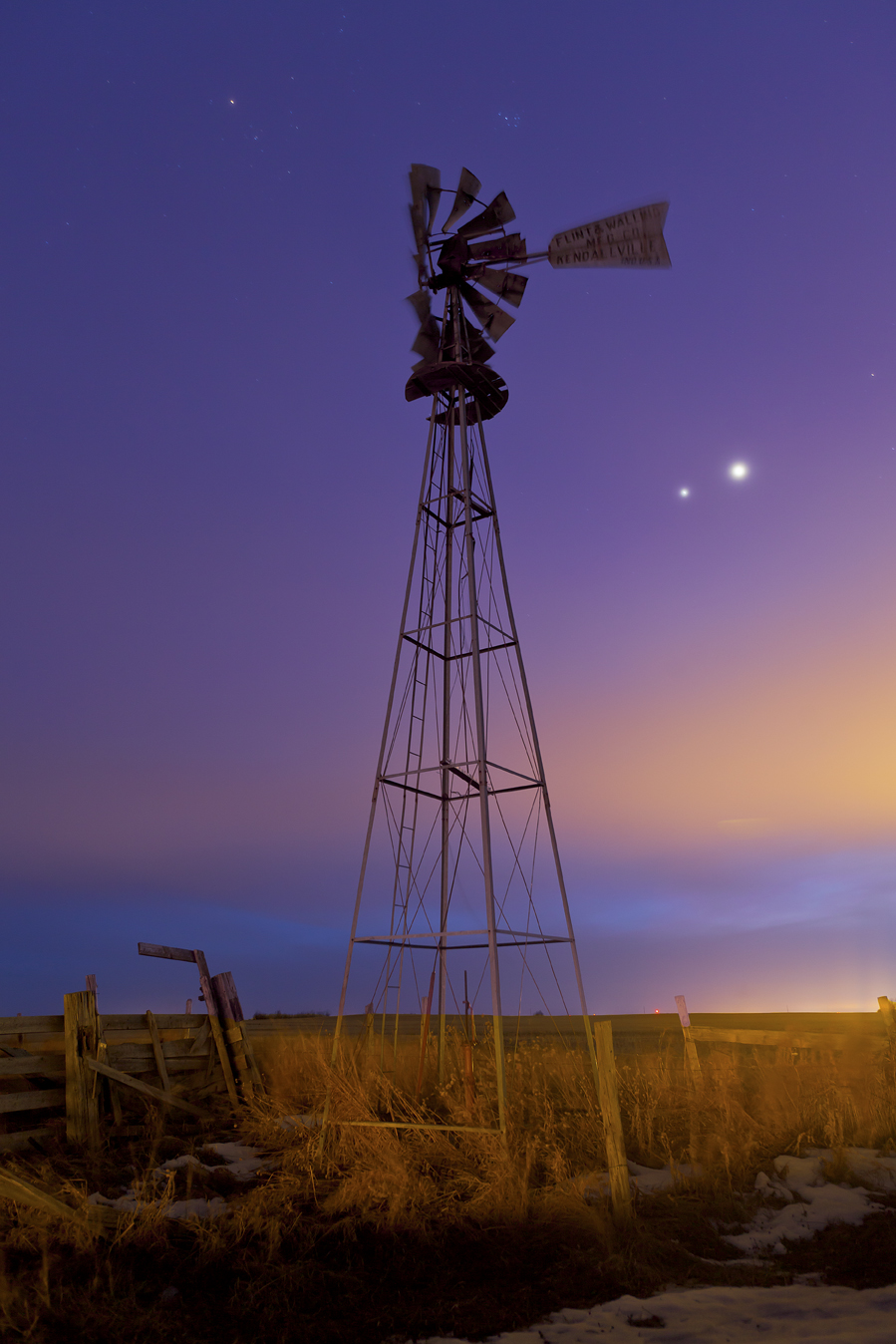
Venus and Jupiter are the planets that just keep on giving! What a photogenic pairing they are proving to be this month.

Here they are behind one of the icons of the prairies, an old water pump windmill, made it would seem by the Flint and Walling Mfg. Co of Kendallville, Indiana, USA, probably in the 1930s or 40s. My area of southern Alberta was once considered too dry for agriculture and it was only irrigation that made the land livable. Individual farm pumps of the dustbowl era were replaced by a mega-project system of canals and reservoirs to water what is effectively a desert. And a windswept one. A blustery Chinook wind was blowing this night.

The pair of planets is at right, tonight in about as close a conjunction as they will get, about 3° apart. The Pleiades and Hyades star clusters in Taurus poke through the clouds at top. The night was quite hazy but the clouds added the yellow colour from Calgary streetlights in the distance. Natural twilight added the blues and purples. Car headlights lit the foreground.

— Alan, March 12, 2012 / © 2012 Alan Dyer


Bridging Earth and Sky (Off to Venus and Jupiter)


This was the scene Sunday night, March 11, as Venus edged up to Jupiter in the evening twilight.

To capture the nightscape I hunted around for a spot along the Bow River near home and settled for a site on the banks of the river at the point called Blackfoot Crossing, the traditional heart of the Siksika First Nation land. Here, the Bow River runs north-south for a stretch and the highway crosses the river heading west into the evening twilight, as if off into the sky to meet Venus and Jupiter in conjunction.

I waited until a passing car added the streak of tail lights, heading off into the sunset and starry sky. Nightscapes like this are often best taken when the sky is fairly dark but a longer exposure still brings out the remaining colours of twilight, as well as fainter stars, to make an image enhanced from what the eye might have seen.

— Alan, March 11, 2012 / © 2012 Alan Dyer


The Marvellous Mid-March Sky


We have a marvellous sky above us these nights, with an array of brilliant beacons in the evening sky.

This wide-angle scene captures the western and southern sky. To the west at right shine Venus and Jupiter. To the south at centre stands Orion. His famous Belt points up to Taurus and the Pleiades star cluster. His Belt points down to the brightest star in the night sky, Sirius, the Dog Star in Canis Major. Above, at top left, is the other Dog Star, Procyon, in Canis Major.

The last vestige of twilight tints the sky deep blue. But some of the red nebulas in and around Orion are beginning to show up as the sky darkens on a late winter night.

I shot this Saturday night, March 10, on the last evening of Standard Time. Now, I and all astronomers have to wait up another hour to see and shoot the wonders of the night sky. Astronomers hate Daylight Saving Time.

— Alan, March 11, 2012 / © 2012 Alan Dyer

Venus and Jupiter Converge


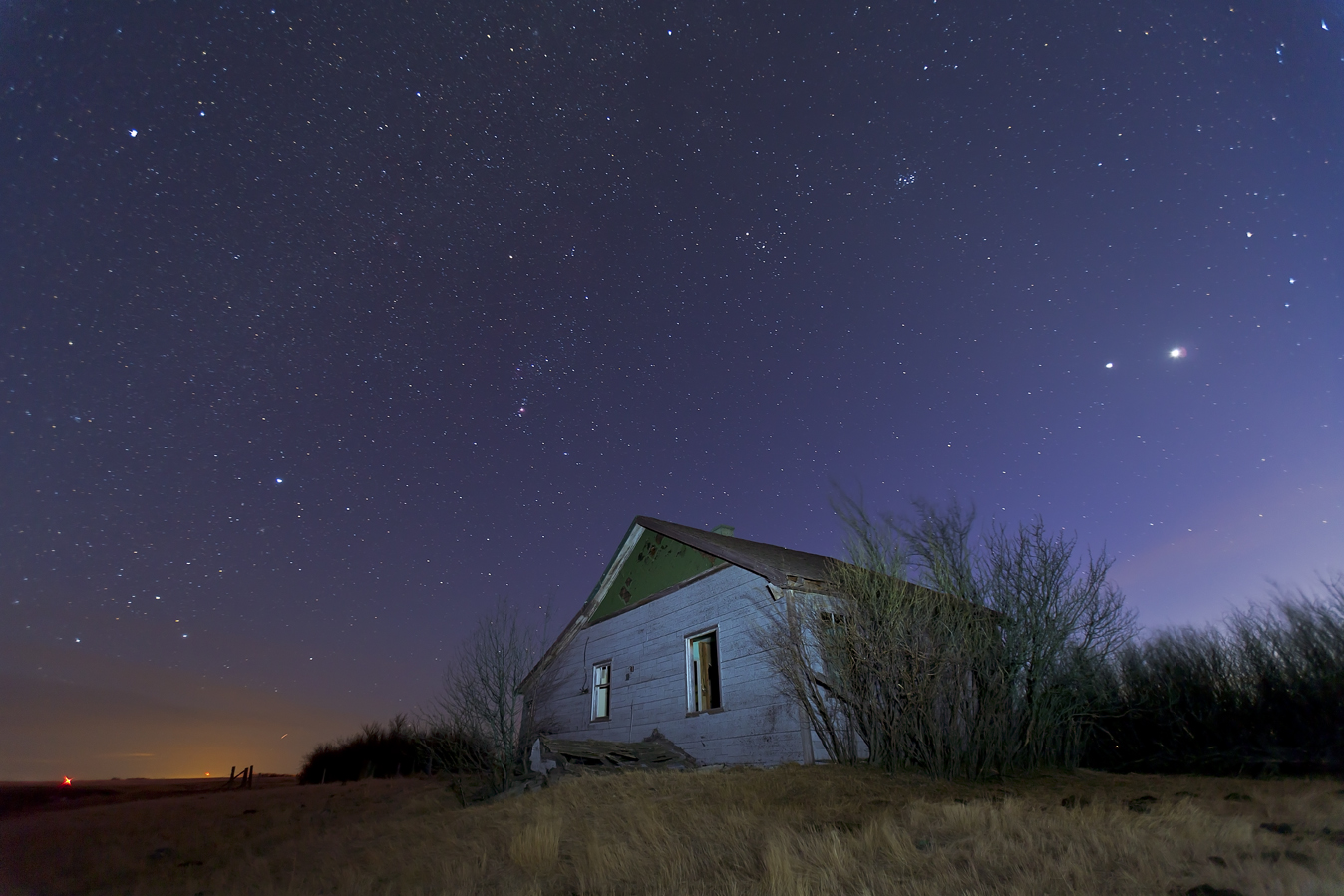
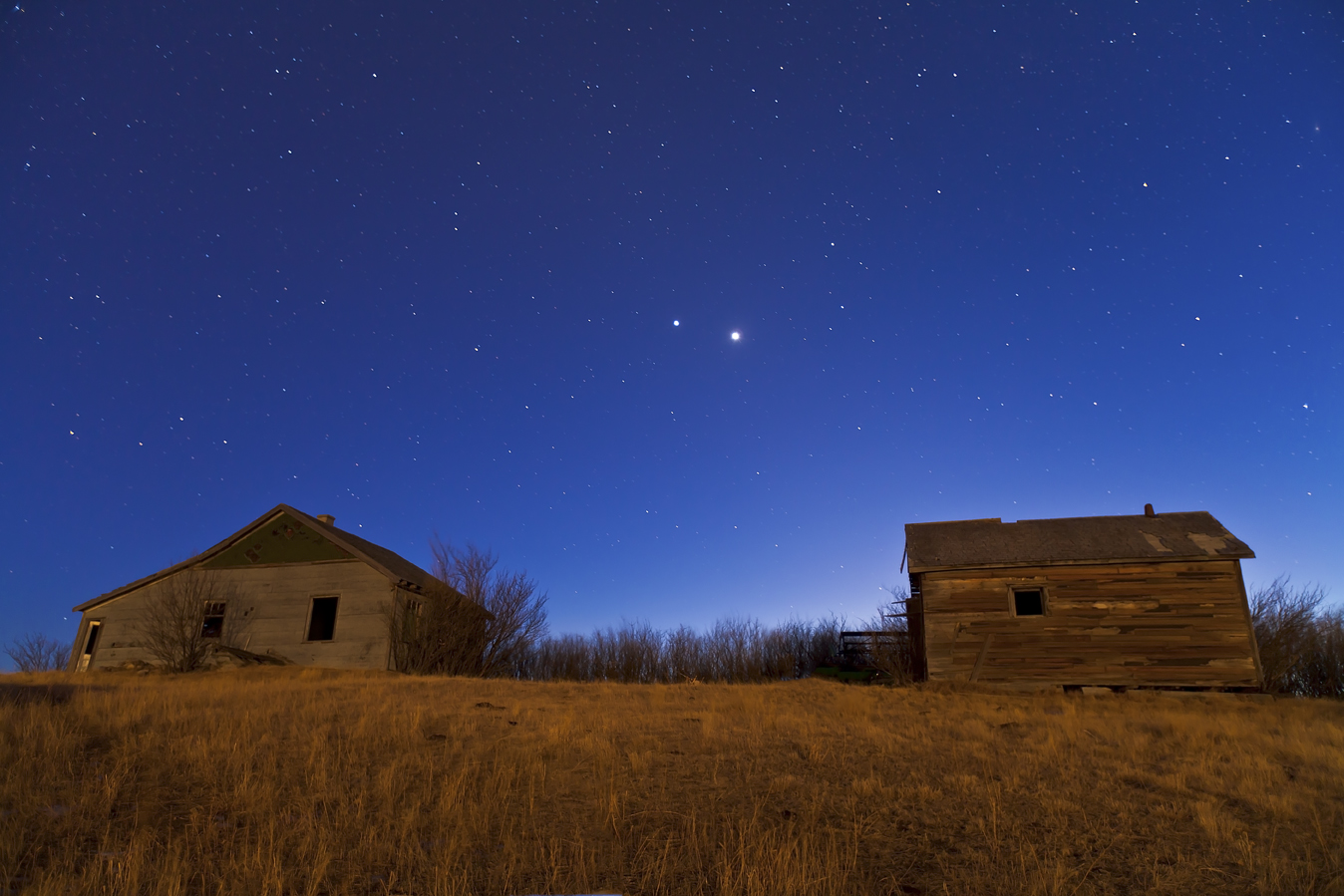
Venus and Jupiter are getting closer! To each other that is.

This was the scene Saturday night, March 10, two days before Venus (on the right here) and Jupiter reach their close conjunction in the evening twilight sky. I’m amazed how high the pair of objects are at sunset, with Venus much higher in the sky than it normally appears. We haven’t seen Venus as well as this since 2004.

This is a scenic prairie nightscape, with some ramshackle buildings from a 1940s vintage farmstead near my house serving as a foreground setting for the sky scene above. Headlights from a passing car provided some handy and warm illumination to contrast with the cold blue above.

— Alan, March 10, 2012 / © 2012 Alan Dyer


Big Black Spot on the Sun Today


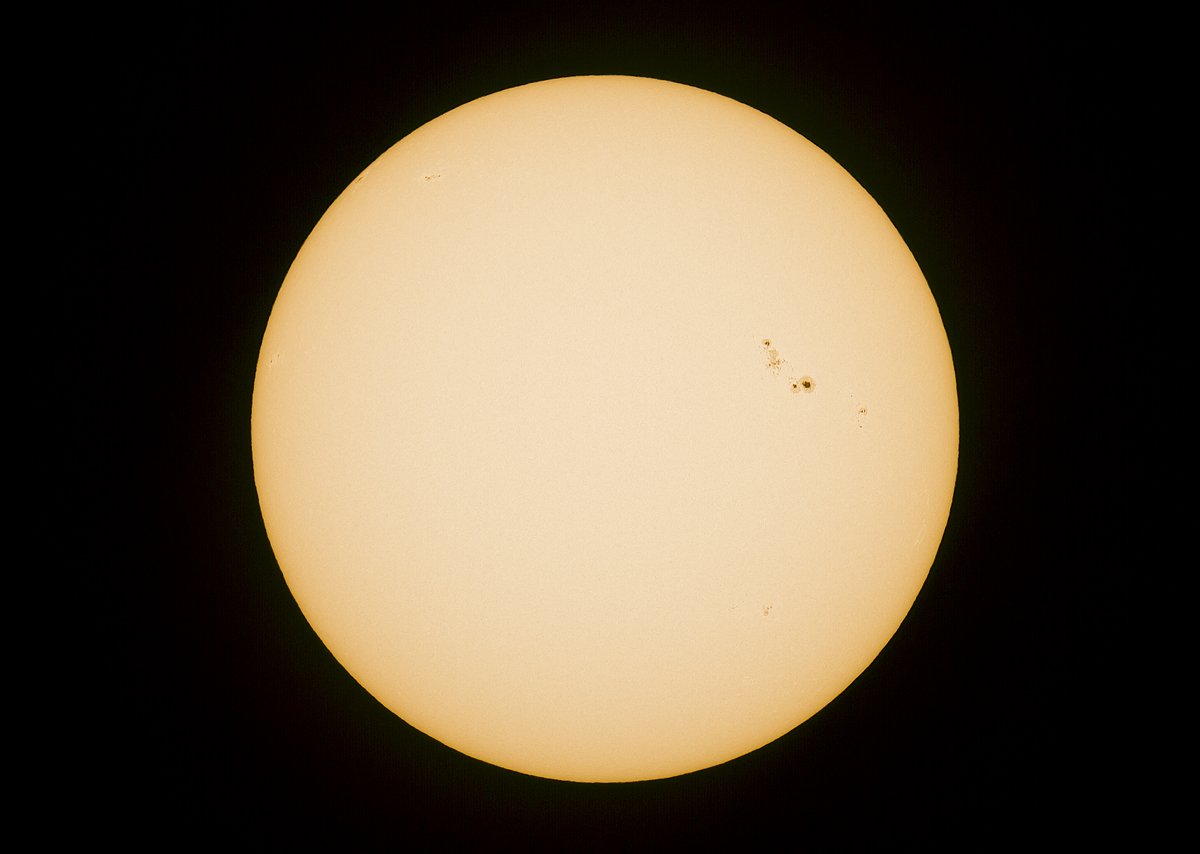
This is the news maker of the week, the sunspot group known as Region #1429.

It hit the headlines this past week as it let loose several intense solar flares, triggering geomagnetic storms around Earth and some aurora displays. Even as I took this shot of the Sun on Saturday afternoon, through a normal white light filter, Region #1429 was unleashing another intense flare, visible in red H-alpha light as a brilliant bright spot embedded in the dark sunspot. We can expect some more solar storms heading our way, and perhaps displays of northern lights.

The Sun is picking up in activity and there will be lots more of these headline events over the next few years, as the news media latch onto to any story that promises to wreak mayhem and chaos here on Earth. In reality, these events won’t have much effect on us in everyday life except to create beautiful auroras we can admire.

— Alan, March 10, 2012 / © 2012 Alan Dyer


Mars Down the Road


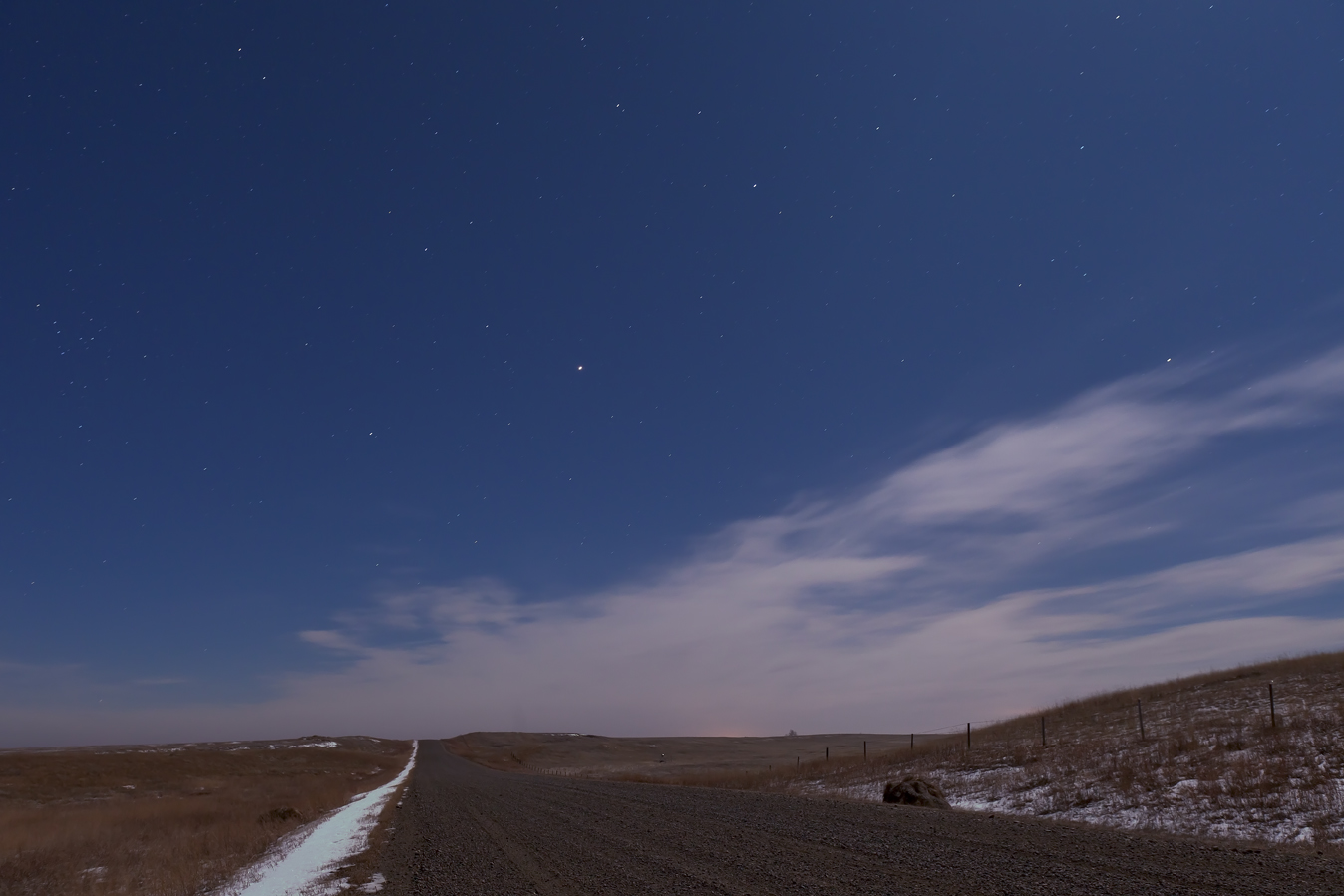
Here’s Mars, now at its closest and brightest in two years. Look for it due east in the early evening, as a rising reddish star in Leo.

On March 7, the Full Moon sits next to Mars, making for a fine sight as the pair rise together at sunset.

I took this shot March 4, with the Moon just off the frame at the top. Here, the eastbound county road seems to head off across the Prairies to Mars. It’s got a long way to go. Even at its closest right now, Mars is still 100 million kilometres away.

— Alan, March 6, 2012 / © 2012 Alan Dyer

Planet Trio in the West


Look west this week (the first week of March) and you’ll see three planets in a line across the evening sky.

Mercury is lowest in the sky, visible here just above the clouds on the western horizon. It’s bright but easy to miss. To find it, draw a line between Venus and Jupiter and extend the line down and to the right. This week Mercury is putting on its best evening appearance for the year for northern latitudes. You won’t see it higher or brighter than this in 2012.

Farther up the sky is Venus and Jupiter. They are standout objects. As they approach each other over the next week more and more people will suddenly pay attention to them and wonder what they are.

This was the view Sunday night, March 4. The next night a change in the weather brought heavy snow and a blizzard across the Prairies. But clear skies have returned, so enjoy the planets!

— Alan, March 6, 2012 / © 2012 Alan Dyer

A Panorama of Planets


This was a beautiful night, with the array of five worlds stretched across the sky, a parade of planets and the Moon.

Mercury is now at its greatest angle away from the Sun and easiest to see in the evening sky this week for the year, at least from Canadian latitudes. Even so, it is low in the western twilight.

You can’t miss Venus and Jupiter higher in the west. Watch them close up and trade places in mid-March.

Mars is now at opposition, closest to Earth, and rising at sunset. It shines brightly as a red star in the east, 180° away from Mercury. It will be in our sky for several more months.

Orion shines due south amid the clouds. The arc of clouds rather nicely defines the arc of the ecliptic path across the sky, the path along which we always find the planets.

I took the shots for this panorama on Sunday, March 4. I took five segments, each 13 second exposures with a 16-35mm lens, then combined them in Photoshop CS5 with its Photomerge command.

— Alan, March 4, 2012 / © 2012 Alan Dyer

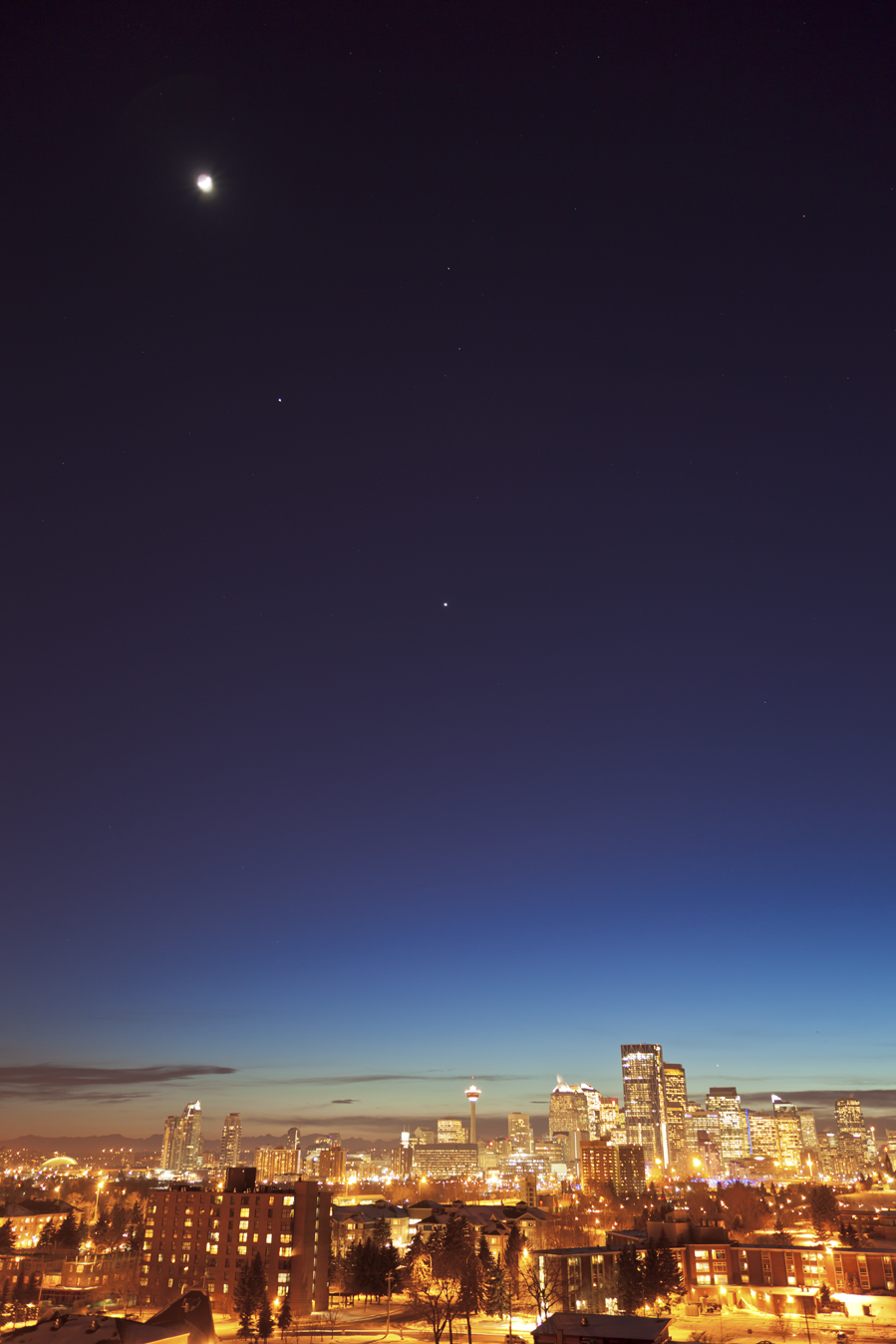
Mercury Rising Over Calgary


Mercury is elusive but here it is, showing up as a speck over the skyline of Calgary, as it begins its best evening appearance of the year, rising a little higher into the twilight sky each night for the next few evenings.

To find it, follow the line down from the Moon and then bright Jupiter and Venus at upper left and continue that line to the lower right. Just to the right of the tallest building (the new Bow tower) and just above the rooftops there’s a tiny dot of light. That’s the inner planet Mercury. It’ll get higher in the first week of March but not by much. Mercury is bright. It’s just not very high and is easy to miss.

But with Mercury coming into view, and with Venus and Jupiter so prominent now in the evening, and Mars now bright in the east after sunset – look for a red star – we have a nice array of 4 naked eye planets across the sky at once. Saturn comes up later after midnight now. So you can see 5 naked eye planets in one night.

It’s a great evening sky show now in early March.

– Alan, March 1, 2012 / © 2012 Alan Dyer

The Great Sky Show of 2012 Begins


The show has been underway for a while but this past weekend anyone with clear skies couldn’t help but notice some beautiful sights in the evening sky. They herald the start of a wonderful late winter and spring of evening celestial scenes.

Tonight, after a snowy weekend that brought winter back to Alberta, skies cleared enough to reveal the waxing crescent Moon next to Jupiter, with both above brilliant Venus. Over the next two weeks watch as Venus and Jupiter converge for a mutual conjunction March 12 to 13. Then on March 25 we’ll see the Moon next to Jupiter and the near Venus the following night, just a month from now.

For the next two weeks we also have Mercury at its best low in the western evening sky and Mars rising in the east at sunset as it reaches its closest point to Earth in two years. It’s a great planetary spring.

Keep looking up!

— Alan, February 26, 2012 / © 2012 Alan Dyer


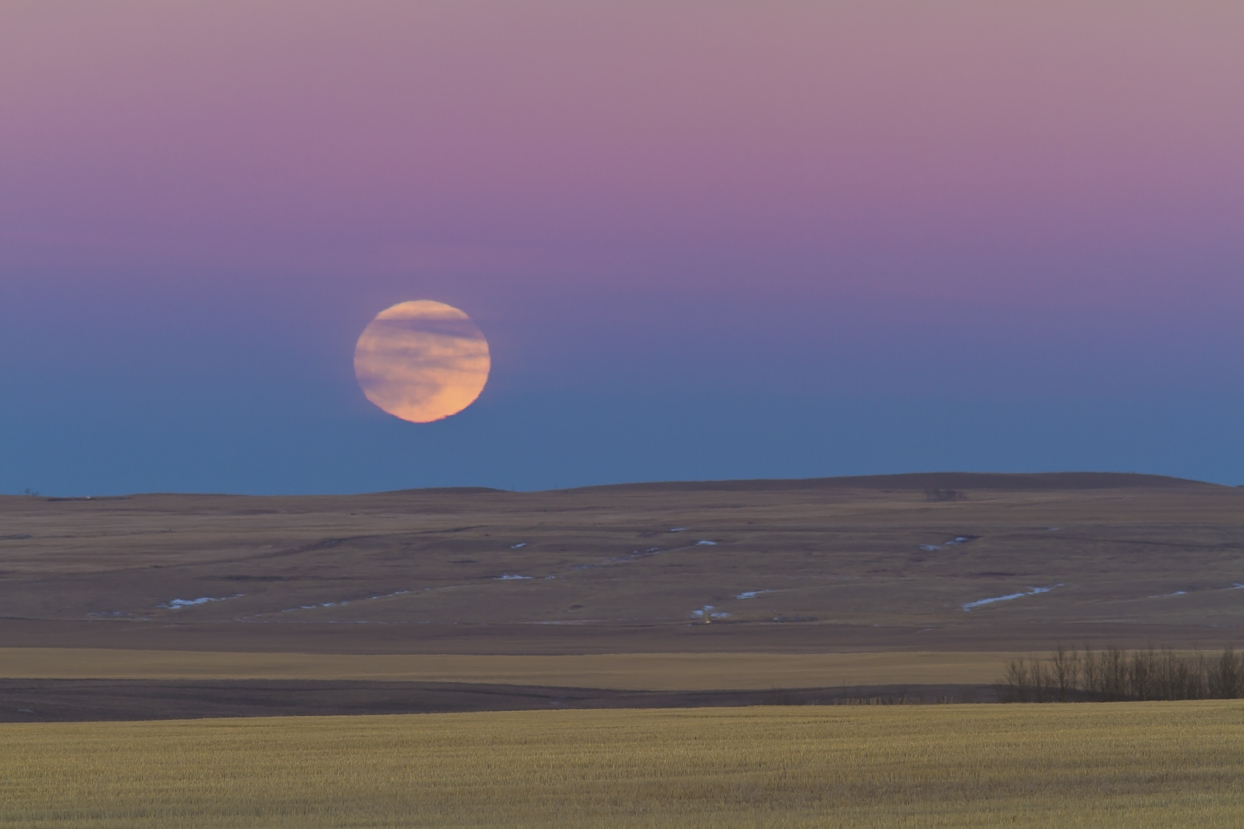
Winter Moon Rising


Here is the January 2012 Full Moon rising above a decidedly un-January landscape in southern Alberta. A recent spell of unseasonably mild weather has eaten most of the snow, leaving the fields yellow-brown, and a fine colour contrast with the twilight sky.

On January 8 the Full Moon rose into clear skies over the prairie landscape east of my home. This shot captures the pink glow of twilight on the upper atmosphere, above the rising blue rim of Earth’s shadow just on the horizon. A month ago, the Full Moon was in that shadow out in space, being eclipsed at sunrise. Here it is rising at sunset, one lunar cycle later.

I like the prairies, not only for the flat horizons and big open skies they provide, but also for the wonderful palette of colours on Earth and sky.

— Alan, January 8, 2012 / Image © 2012 Alan Dyer


New Year’s Moon


Happy New Year to all! To mark the first day of 2012 here is a view of the quarter Moon as it appeared in the early evening twilight on January 1, 2012.

The coming year promises to be a superb one for stargazing with:

• a wonderful evening appearance of Venus in March and April, including a rare passage through the Pleiades star cluster on April 3

• an array of 5 planets in the evening sky in March

• a partial eclipse of the Sun May 20 (annular if you travel to the SW United States)

• a partial eclipse of the Moon June 4 (at dawn for western North America)

• an amazingly rare transit of Venus on June 5 (North American time)

• a fine year for the Perseid meteors August 12/13

• a daytime occultation of Venus on August 13 (for North America)

• a total eclipse of the Sun from Australia and the South Pacific

• a host of fine Moon and planet conjunctions throughout the year

• and no doubt some fine displays of Northern Lights as the Sun picks up in activity toward its predicted 2013 maximum.

So there should be lots to shoot and blog about in 2012. In 2011, since I started this blog in February, my Amazing Sky blog has served up 103 posts and 14,000 image views, seen by people on 6 continents — I have yet to break into Antarctica! Perhaps in 2012.

Clear skies to all!

— Alan, January 1, 2012 / Image © 2012 by Alan Dyer


Happy Equinox!


This is a shot I’ve been after for several years, usually from this same location, looking west toward the setting Sun.

This is sunset at the autumnal equinox, with the Sun going down due west, something it does only at the two equinoxes. September’s usually the one with clear skies, as it was this night, Sept 23, 2011. Except for some annoying clouds at the horizon over the Rockies to the west. I was hoping for a clear shot of the Sun right at sunset at the end of Highway 1, the Trans-Canada Highway. But it’s close. Better luck next year!

After today, the Sun will be setting south of west, and the days will become shorter than the nights.

This is a 6-image HDR stack to capture both the bright and dark parts of the scene. It worked, but Photoshop refused to properly remove the “ghosts” — images from cars moving from shot to shot. But if I hadn’t told you about it, you might not have noticed!

— Alan, September 23, 2011 / Image © 2011 Alan Dyer


Moon in the Mountains


I’ve been chasing the Moon this week. I caught up with it last Thursday night, August 4, in Banff, with the waxing crescent Moon low in the southwest at dusk.

The location is the upper Vermilion Lake just outside the Banff townsite. The golden reflection of the low Moon on the water, the slope of the mountainside and its reflection, the dock and steps, and the tail lights from a vehicle on Highway 1 just up the hill (I decided to leave them in!) make for what I think is an interesting composition of converging lines.

I got set up and in position just in time to catch the scene at the magic hour of twilight, when the sky is dark enough the show deep colours and the Moon’s entire disk shows up, but before the sky gets too dark and the Moon too bright to make an interesting scene.

Even so, the contrast in such a scene is still very high. So to capture it more as your eye would have seen it I used a stack of five exposures, taken in rapid succession, each 2/3rds of an f-stop apart. I then merged the frames with Photoshop’s High Dynamic Range routine to create a scene that brings out detail in the foreground without overexposing the Moon and sky.

A technical method to capture a simple scene of serenity in the mountains.

— Alan, August 7, 2011 / Image © 2011 Alan Dyer

Moonscape


As all the other sunset photographers were packing up for the night, I was just getting started. This is the scene last night, with the waxing Moon hanging over the moonscape of Dinosaur Provincial Park in southern Alberta.

I took this in deep twilight, when the sky is tinted with subtle colours complementing the earth tones of the landscape below.

Dinosaur Park is the world’s best repository of late Cretaceous fossils, being unearthed as the terrain made of ancient volcanic ash erodes away with every rainstorm. Though the formations date from the Cretaceous some 70 million years ago when this area of Alberta was a bayou-like swamp, the badlands landscape we see today was created at the end of the last ice age when glacial floods poured over the landscape, carving the channels occupied by rivers today, like the Red Deer River that flows through Dinosaur Park.

It’s a favourite spot of mine, just an hour east of where I live, to shoot sunsets and moonrises, and twilight landscapes like this one.

— Alan, August 7, 2011 / Image © 2011 Alan Dyer


Dawn Sky Serenity


Some sky scenes are worth getting up early for. This was the dawn sky this morning, July 25, at about 4:20 a.m., looking east to the rising crescent Moon, which this morning appeared near the Pleiades star cluster. You can see it just above the overexposed Moon.

The waning Moon also sits between two planets now in the pre-dawn sky: Jupiter, the bright object at upper right, and Mars, about the same distance away from the Moon but to the lower left. Mars, the Moon and Jupiter form a diagonal line across the dawn sky that defines the dawn ecliptic. Also in the scene is the V-shaped Hyades star cluster, and the bright star Aldebaran, just below the Moon.

This was a 5-second exposure with the Canon 24mm lens at f/3.5 and Canon 5D MkII camera at ISO 800.

— Alan, July 25, 2011 / Image © 2011 Alan Dyer


The Moon in June


On one of the few clear nights of late I took the opportunity to shoot the Moon. It’s a familiar subject to be sure, but one I don’t shoot very often. Pity really, as it is rich in detail and makes for dramatic photos.

I took this shot June 12, about 4 days before the Full Moon of June, so this is a waxing gibbous Moon. Lots of terrain (lunain?) shows up at left along the terminator, including the wonderful semi-circular bay at about 10 o’clock called Sinus Iridum. At the bottom is the bright Tycho crater, with its distinctive splash of rays spreading out across most of globe. Imagine the devastating impact that caused that feature! It isn’t that old either — estimates suggest Tycho is just 100 million years old, putting its formation smack dab in the middle of the Cretaceous Period when dinosaurs ruled the Earth. They would have seen that impact, little knowing another similar-sized impact 35 million years hence, but aimed at Earth, would do them in.

For this shot I used the Astro-Physics 130mm apo refractor with a 2x Barlow lens to increase the effective focal length to 1600mm, a combo that exactly fills the frame of the Canon 7D with no room to spare. I processed this image for high contrast, to bring out the subtle tonal and colour variations in the dark lunar seas, an effect due to different mineral content of the lava that oozed out forming the lunar plains. Judicious use of Highlight Recovery (in Camera Raw) and Shadows and Highlights (in Photoshop) brings out the detail across a subject with a huge dynamic range in brightness. A liberal application of Smart Sharpening also helps snap up detail.

— Alan, June 18, 2011 / Image © Alan Dyer 2011


Here Comes the Sun!


I can count on one hand how many shots of the Sun I’ve taken in the last decade that weren’t at an eclipse, or a sunrise/sunset. I just don’t do much solar shooting. But today I had to resurrect some old gear to get this shot. The Sun was putting on a fabulous show this afternoon (Sunday, June 5, 2011) with an army of huge prominences rimming the edge of the Sun. Very impressive. And looking very HOT!

After 2 to 3 years of record low activity, the Sun is picking up, returning to its normal self, with sunspots and prominences a daily occurrence. But these were especially dramatic. Each of these prominence “flames: towers tens of thousands of kilometre above the surface of the Sun. The Earth would be a dot next to one of them.

To get this shot, I created a masked composite in Photoshop of two exposures, a short 1/13s second shot to record the disk detail, and a long 1/2 second shot to record the fainter limb prominences. For a telescope I used my little Coronado PST H-alpha scope, a special scope just for solar viewing that filters out all but a narrow wavelength of red light, allowing the prominences to be seen.

Trouble is, my DSLR cameras won’t reach focus on the Coronado scope. So I dusted off the little 2003 vintage Sony DSC-V1 point and shoot camera and a Scopetronix 40mm eyepiece and “afocal” adapter, so the camera was screwed onto and looking into the eyepiece which was then inserted into the scope. I hadn’t used an afocal setup like that since the Venus transit in 2004.

It was tough to focus the stack, so focus was a bit of a guess — it was helped here with a liberal application of Photoshop’s Smart Sharpen filter! In all, it is a crude system but in a pinch it does work. Maybe I’ll have to get better gear just to take solar shots. With the Sun becoming more active, there certainly will be lots more to shoot.

— Alan, June 5, 2011 / Image © 2011 Alan Dyer


Saturn Sidles Up to a Star


If you look up this week, to the southwest, you’ll see a bright star in the evening twilight that, upon close inspection, is really a tight double star. The fainter companion becomes obvious as it gets dark. The bright member of the pair is actually Saturn, and its fainter companion is the star Porrima, a.k.a. Gamma Virginis. And they are unusually close!

This week Saturn (at bottom here) sidles up to Porrima (at top), getting so close both are contained in a high-power telescope field, which is what this shot depicts. I took it Saturday night, June 4, when Saturn was about 1/4° (16 arc minutes) from Porrima. But by June 10 their separation will be a tad less, at 15 arc minutes apart. This week Saturn stops its annual retrograde motion just shy of Porrima.

The pairing made a wonderful sight in the telescope tonight, especially because of the “good seeing” — so Saturn looked very sharp. And Porrima, itself a very tight double star, was easy to split at 200x, appearing like a pair of headlights at high power. (The photo doesn’t split Porrima.)

But the nicest view is just naked eye — Saturn and Porrima are forming a rare and temporary double star easy to split with no optical aid but looking much more striking than any other naked eye double. The pairing won’t last long — Saturn turns around near Porrima this week, then begins to head east again away from its stellar partner.

The shot also picks up four of Saturn’s moons: Dione very close to Saturn, then Tethys, and Rhea in a row from left to right, and bright Titan below the trio.

This a stack of five 5-second exposures at ISO 1600 with a Canon 7D attached to my 130mm Astro-Physics refractor with a 2x Barlow, giving an effective focal length of about 1600mm and f/12. I took this in twilight to add the blue sky.

— Alan, June 5, 2011 / Image © 2011 Alan Dyer
 

Dawn Planets, Part Two


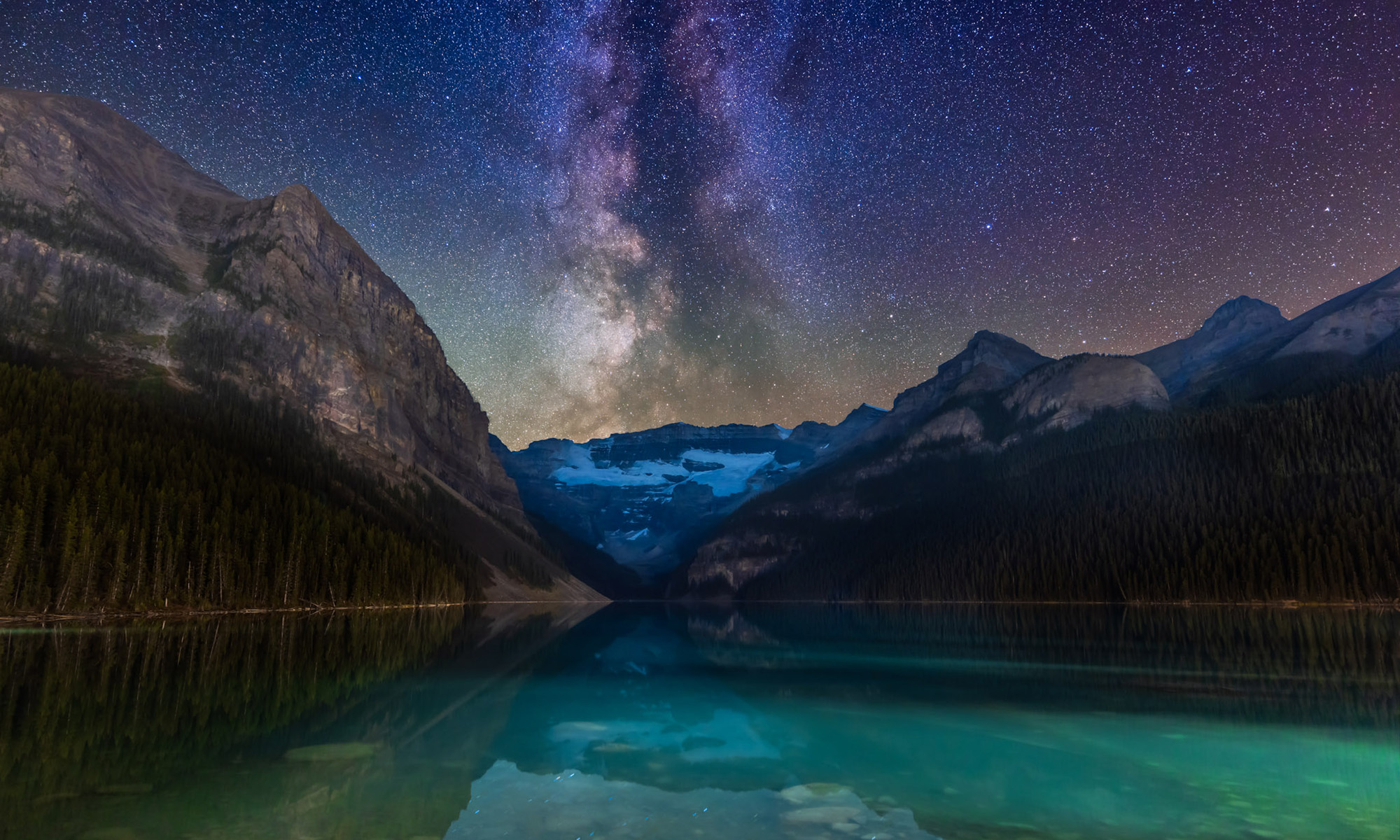
I began my night sky shooting stint earlier this week in Chile with a shot of the dawn gathering of planets. I’ve ended it with another, taken this morning at 7 a.m., on May 7, 2011.

This scene shows four planets partaking in a rare close mutual conjunction in the morning sky. From top to bottom they are: Venus (brightest) with Mercury just to the right of Venus (both inner worlds appear close together for the next week or so), then below that pair, Jupiter, then at the bottom and faintest, Mars.

Notice how Venus, Jupiter and Mars are almost equally spaced, forming a straight line that defines the ecliptic path of the planets, here seen coming up vertically from the horizon. This is the view from 23° south latitude; from Canada these planets would be arrayed more horizontally low across the eastern horizon.

The conical peak at left is 5,900-metre-high Licancabur Volcano. The lights are tail lights of pre-dawn traffic going over the high pass over the Andes into Bolivia.

– Alan, May 7, 2011 / Image © 2011 Alan Dyer

A Dawn Gathering of Planets


The joys of stargazing at southern latitudes! Here’s a shot from this morning, May 2, 2011, of the gathering of four planets now coming together in the pre-dawn sky. From Canada, you won’t see this well at all. The planets will be hugging the horizon and lost in the twilight. But from here in Chile, at a latitude of 23° south, the planets are arranged vertically straight up from the horizon. Over the next couple of weeks the planets will converge as Venus and Mercury drop down to meet Jupiter and Mars – they’ll be tightest, within 6° of each other on the mornings of May 11 and 12, when Venus and Jupiter, the two brightest objects here, will be closest together.

It was very neat watching them rise this morning over the Andes, first brilliant Venus popping over the ridge, then fainter Mercury, the Jupiter, and finally, at the bottom here, Mars. Venus and Mercury pair at top, and Jupiter and Mars are together at bottom.

The conical peak at left is 5,900-metre (19,400-foot) Licancabur, an extinct volcano, one of many along the line of the Andes. I shot this from just outside our dining room at the Atacama Lodge near San Pedro de Atacama. It was the finale of an all-night session shooting the Milky Way in stills and time-lapse. All the gear worked great and the raw images look fabulous. More to come!

– Alan, May 2, 2011 / Image © 2011 Alan Dyer

Jupiter and Mercury Amid the Clouds


One of the rules of astrophotography is that clouds always position themselves right over the objects you are trying to shoot. When the subject in question is a pair of planets, then a cloud will always cover one or the other planet, making it impossible to capture both at once and therefore record the conjunction.

Tonight, March 15, I chased out west of Calgary to get the conjunction of Mercury and Jupiter over the scenic skyline of the Rockies. Of course, clouds drifted slo-0-0-0-w-ly across the sky. But with a little patience (and I do have very little to spare in situations like this!) I was able to catch a few moments when both Jupiter (at left here) and Mercury (upper right) shone in view amid the clouds.

The highway (Highway 66 to Bragg Creek) adds a nice touch, with cars seeming to come and go from the distant planets.

Again, as with the previous night’s shot, this is a “high dynamic range” stack of three shots taken in quick succession but with EV values 1 1/3rd f-stops apart, to retain both ground and sky detail in an inherently contrasty situation. Photoshop CS5’s HDR Pro feature does a great job. This is with the Canon 7D and 135mm lens.

– Alan, March 15, 2011 / Image © 2011 Alan Dyer

Mercurial Encounter


Mercury is the elusive planet. Yet, when conditions are right, it is surprisingly easy to see. And you wonder what everyone is complaining about!
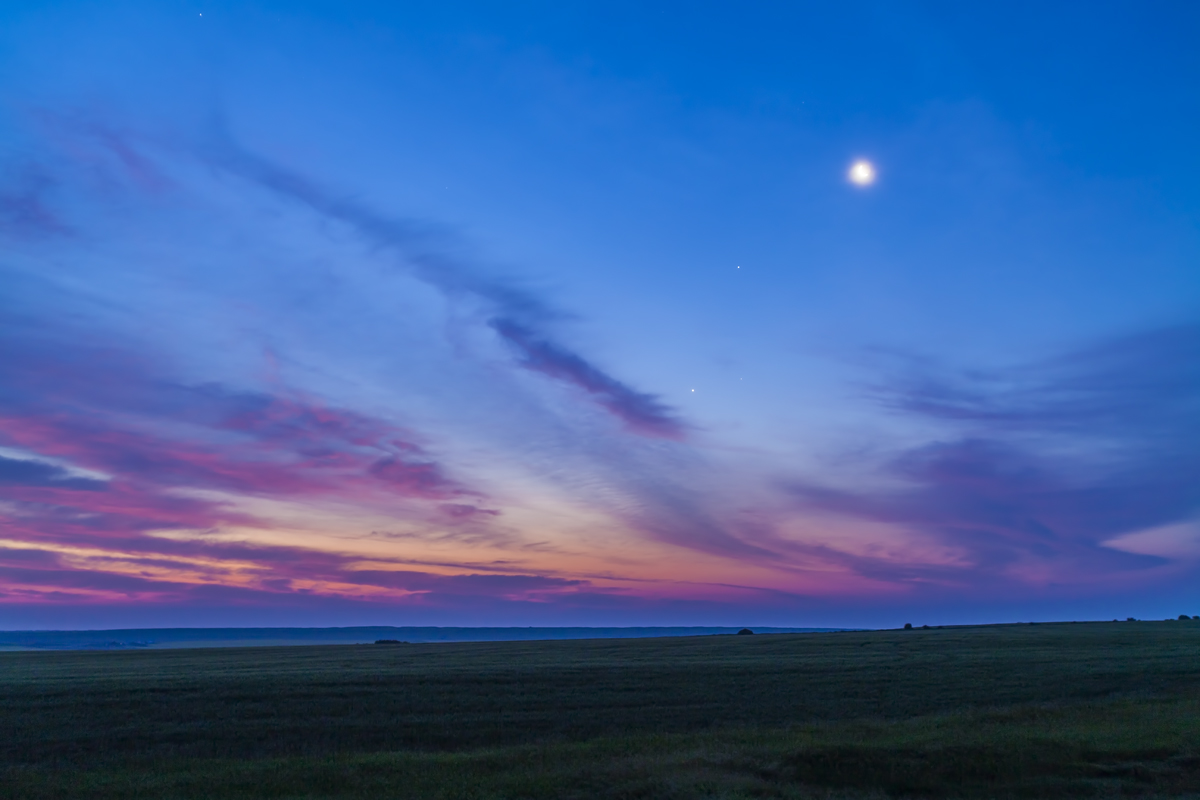
That was certainly the case tonight, March 14, 2011. I just walked out, looked west and there it was, shining bright and obvious to the right of Jupiter. No binoculars needed! Having brighter Jupiter nearby helps to be sure. But Mercury is certainly not dim. It’s wonderful that this week is the best time of the year for us northerners to spot Mercury, just as NASA’s Messenger probe enters orbit around the inner planet, becoming the first to orbit, not just fly past, Mercury. It is always nice to look up and see the planet that you can point to and say, “We have a probe exploring that world.” Later this year, one will be on its way to Jupiter as well — the Juno orbiter.

This shot shows the scene with Mercury (at right) approaching its March 15 close conjunction with Jupiter in the evening twilight. This image captures the view much as the eye saw it. But to do that I took a “High Dynamic Range” composite of three exposures about 1 stop apart, taken in rapid succession with a Canon 7D camera and Sigma 50mm lens.

– Alan, March 14, 2011 / Image © 2011 Alan Dyer