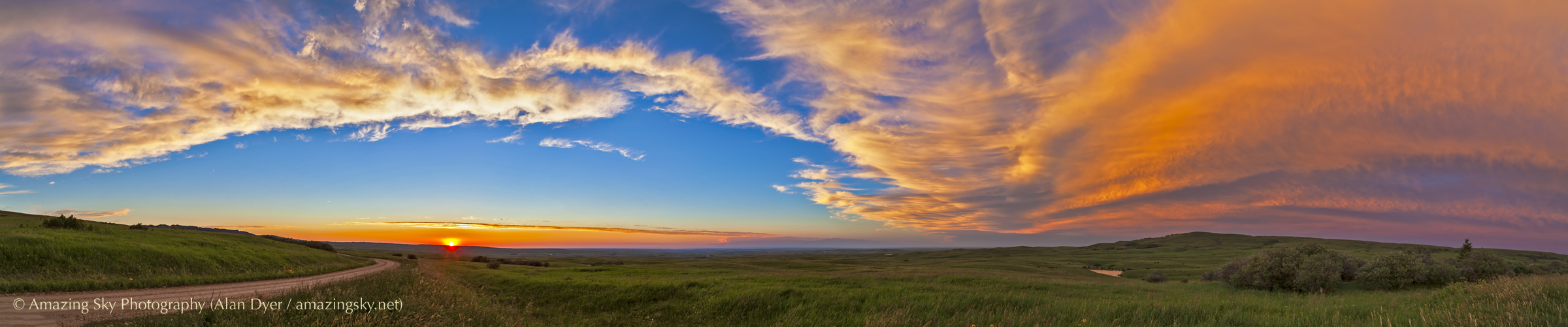
The setting Sun lights up a classic Canadian prairie skyscape.
This was sunset last night, July 11, from the historic Reesor Ranch in southwest Saskatchewan, on the north edge of the Cypress Hills. The clouds opened up across the sky in a Chinook arch, with clearing to the west where the waxing Moon and Venus were also setting into the twilight.
It was a stunning scene looking out over the plains from the highlands of the hills.
I’m in the area for a week of shooting, weather permitting.
This shot is a 7-section panorama, stitched with Photoshop’s Photomerge command.
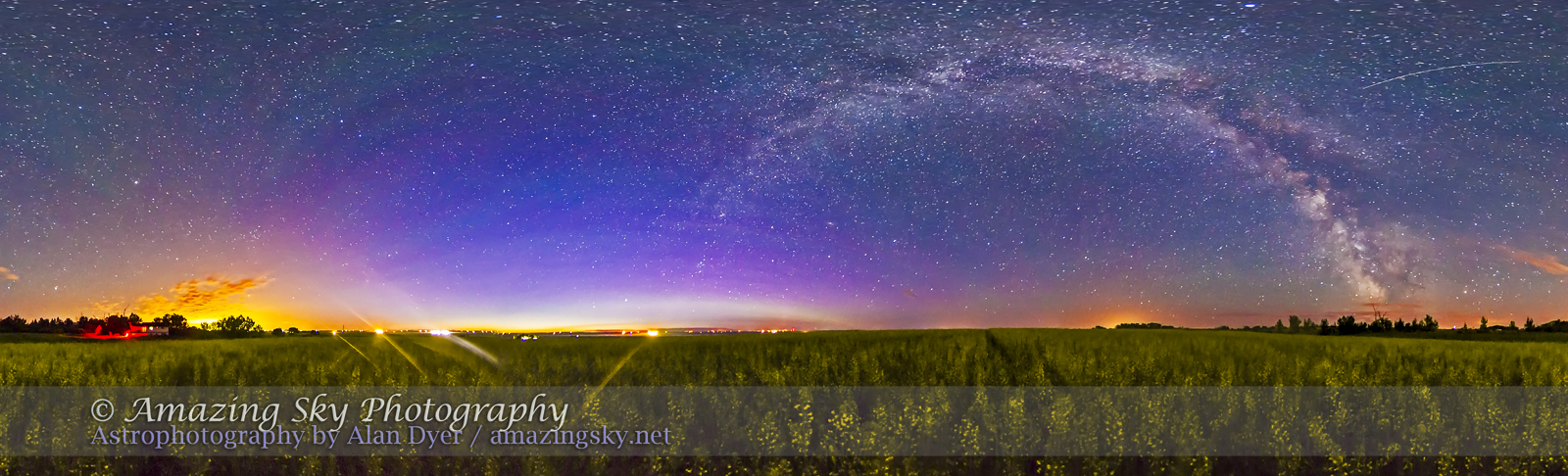
The Milky Way arches over a field of yellow canola on a dark summer night.
The night was beautifully clear and moonless with a glow to the north of perpetual twilight still lingering. The Milky Way was obvious so I hiked to the middle of the canola field next to my house, visible here lit by the red lights at left.
To shoot this panorama I used the same technique as in the The Colour of Dark panorama image from last month which has proved quite popular: I shot eight exposures at 45° spacings using the 8mm fish eye lens. Each was a 60 second exposure at ISO 4000 and f/3.5. I assembled the panorama using PTGui software, from images processed in Adobe Camera Raw.
The sky was well exposed but the ground was still dark, lit only by starlight. It took some processing in Camera Raw (Shadow Detail) and Photoshop (Shadows and Highlights) to bring out the yellow field of canola in the foreground.
While the sky looked neutral grey to the eye, I’ve punched up the colours a lot to reveal the blue twilight, green and magenta aurora to the north, bands of greenish airglow across the sky, and yellow glows of light pollution.
The odd streaks of light on the canola are reflections of the horizon lights in the soaking wet dew on the canola. It was a very damp night after a day of rain.
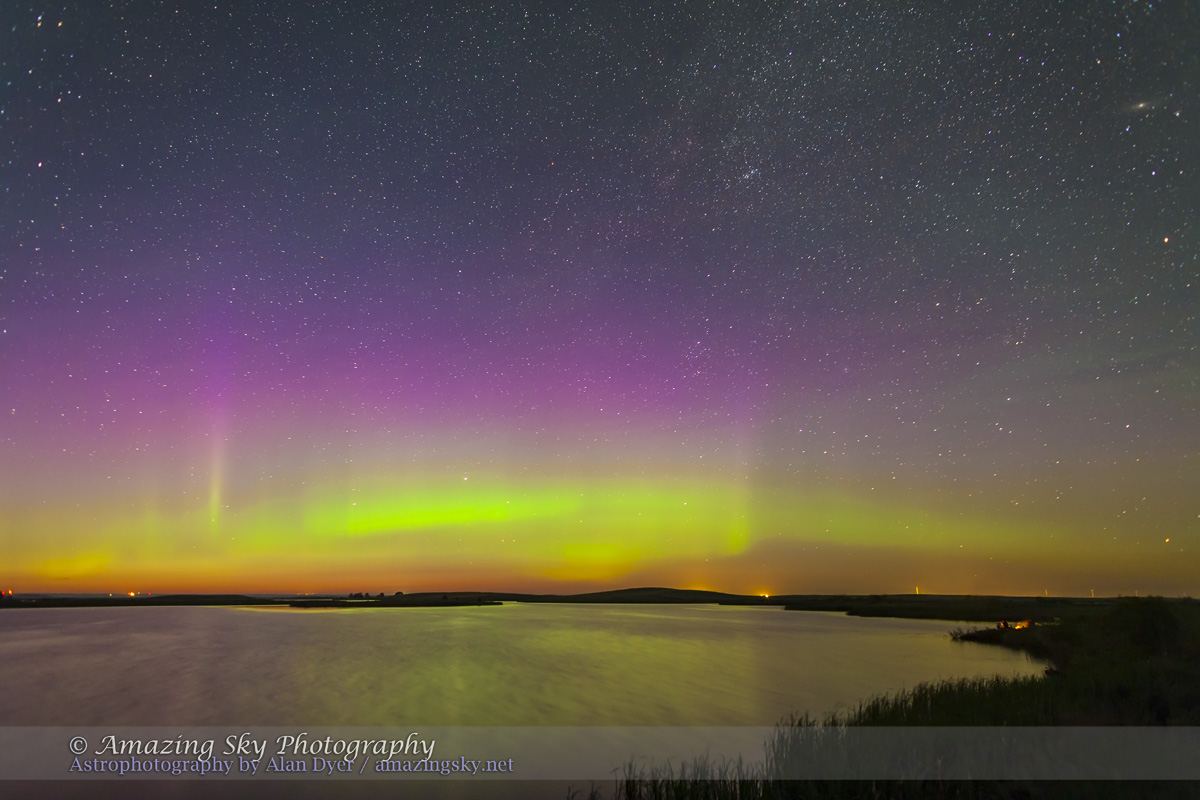
A brief display of Northern Lights shines over a prairie lake.
Last night I went out to a nearby lake (there aren’t many in southern Alberta!) to shoot the twilight over water, and hoping to catch some aurora or noctilucent clouds as well.
There was lots of twilight but very little sign of aurora or NLCs. But at about 1 am the aurora kicked up briefly, enough to make a good photo but certainly nothing to get excited about for its visual appearance. It was just visible.
However, it was a fine evening of shooting at a quiet prairie lake. Crawling Lake is one of several reservoirs in the area that are part of the extensive irrigation system in southern Alberta. Despite the recent floods, this area is usually dry and drought-sticken.
This shot, which I took early in the evening, shows the lone star of Capella, shining in the twilight of a solstice summer sky. From my latitude of 51° N, Capella, normally considered a winter star, is circumpolar. It never sets and so can be seen skimming along the northern horizon on short summer nights.
An ultra-wide view shows the perpetual twilight of summer to the north, with the circumpolar stars of summer above. A campfire from some late-arriving campers is on the shore at right.
The Northern Lights danced all night, as Earth was buffeted by winds from the Sun.
As soon as I saw the warning notices at Spaceweather.com I was hoping we would be in for a wonderful night of aurora watching. I wasn’t disappointed.
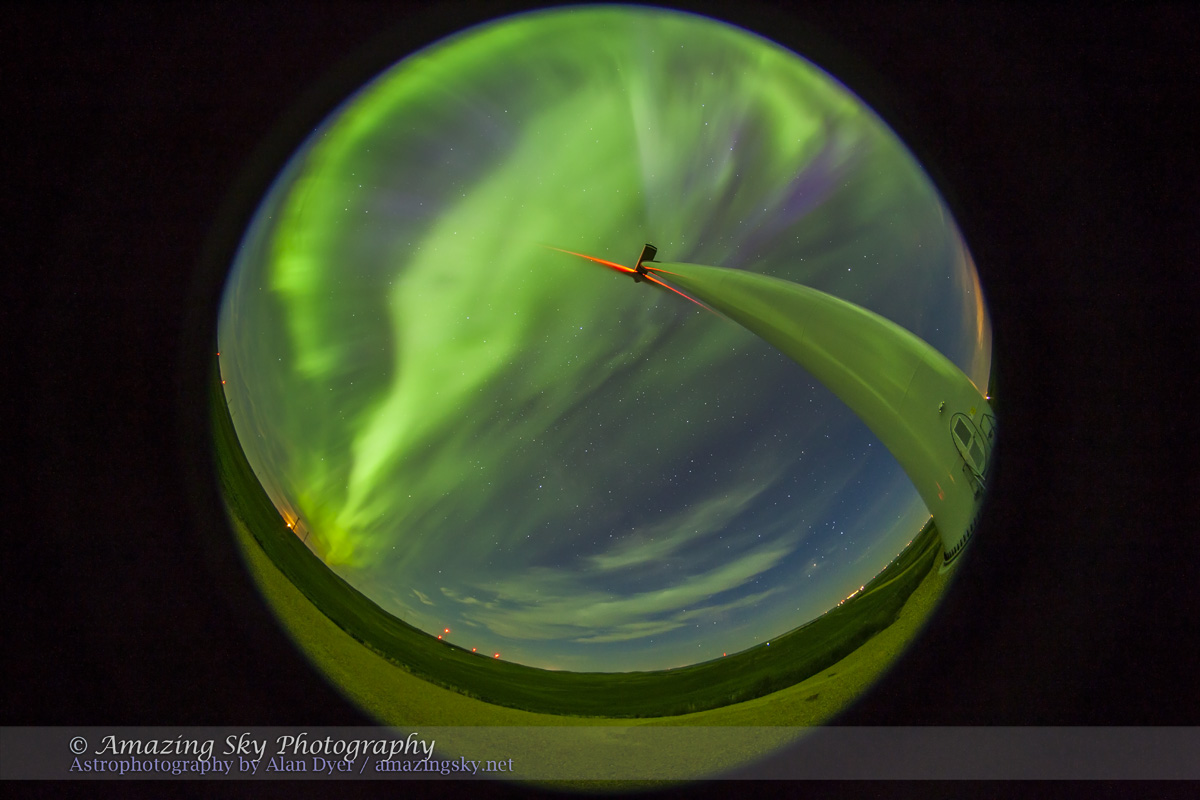
Forewarned, I headed out to the Wintering Hills Wind Farm near my home in southern Alberta. I thought it would be neat to get shots of the effects of the solar wind from beneath and beside the wind turbines of the farm. The shot above is from a time-lapse movie taken with a fish-eye lens that will look great when projected in a full-dome digital planetarium.
I shot with three cameras, with two aimed east to where the brightest part of the auroral arc usually sits. It was also exactly where the Moon would rise after midnight. This shot, above, captures the scene right at moonrise, which was also right when the aurora kicked into high gear as a sub-storm of solar particles rained down on our upper atmosphere. The ground lit up green with the glow of oxygen in the mesosphere, some 100 kilometres up.
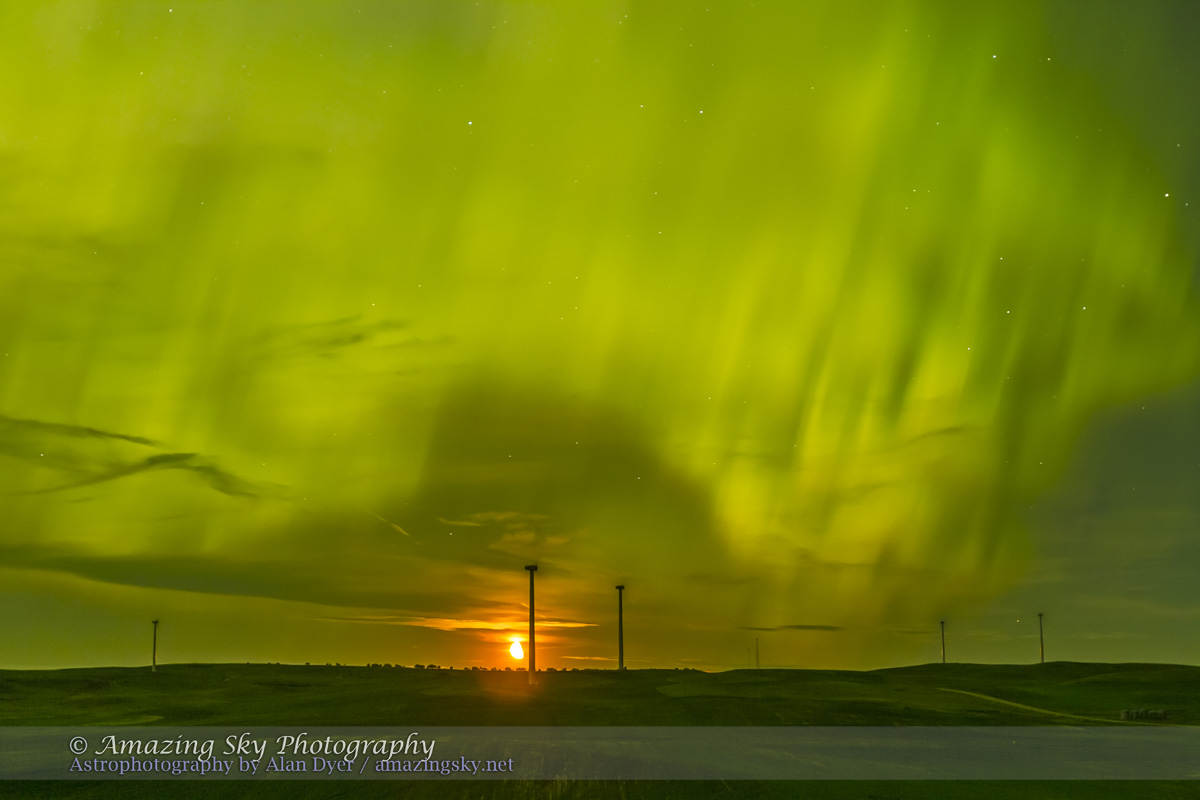
This shot, taken moments later with a longer focal length lens, grabs the waning Moon shining behind the distant wind machines, and beneath the arc of auroral curtains.
In all, I shot 50 gigabytes of raw images, both still images and frames for time-lapse movies. I’ve assembled most of them into a musical collage that honours the night. In the final sequence of the movie, it almost looks like the wind machine is facing into the brunt of the solar wind, as pulses of aurora surge from out of the east toward the turbine towering overhead.
The music is by a new favourite artist of mine, the Italian composer Ludovico Einaudi. His latest album of alt-classical/new age music is called “In a Time Lapse.” How could you not like that?! Buy it on iTunes. It’s stunning.
I hope you got to see the Night of the Northern Lights in person. If not, I trust these images and movies give you a sense of the wonder of what the solar wind can do.
The raging waters of the Bow are subsiding leaving a city to clean up the mess.
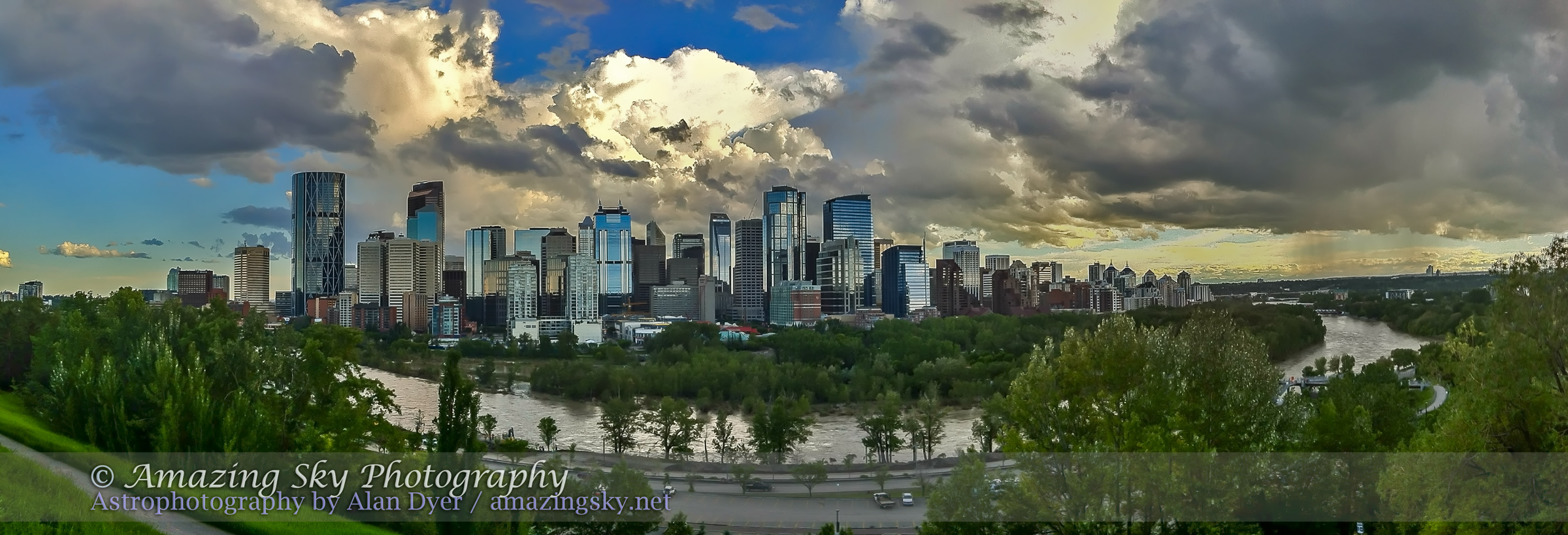
This was the scene Tuesday night, June 25, in a panorama I took from a favourite spot overlooking the skyline of Calgary, a place where many news reports emanated from over the weekend.
It is amazing how fast the floodwaters have retreated. The Bow River is still very high and swift, and some parts of the valley are still under water, but the river is quickly returning to its normal channels and size.
Tonight, people were walking and hiking along paths and bridges that three days ago were underwater or closed to all traffic. Indeed, much of what is below me in this photo, including Memorial Drive, was covered with water. Riverside neighbourhoods that were lakes are now streets again, though lined with houses soaked and damaged. Construction crews work to shore up badly eroded banks. The floods have certainly changed the riverbed of the Bow.
And still, in the sky storms and rain continue to threaten. It will be months, if not years, before everything returns to a new normal.
This is the prairie night sky taken at the moment of summer solstice.
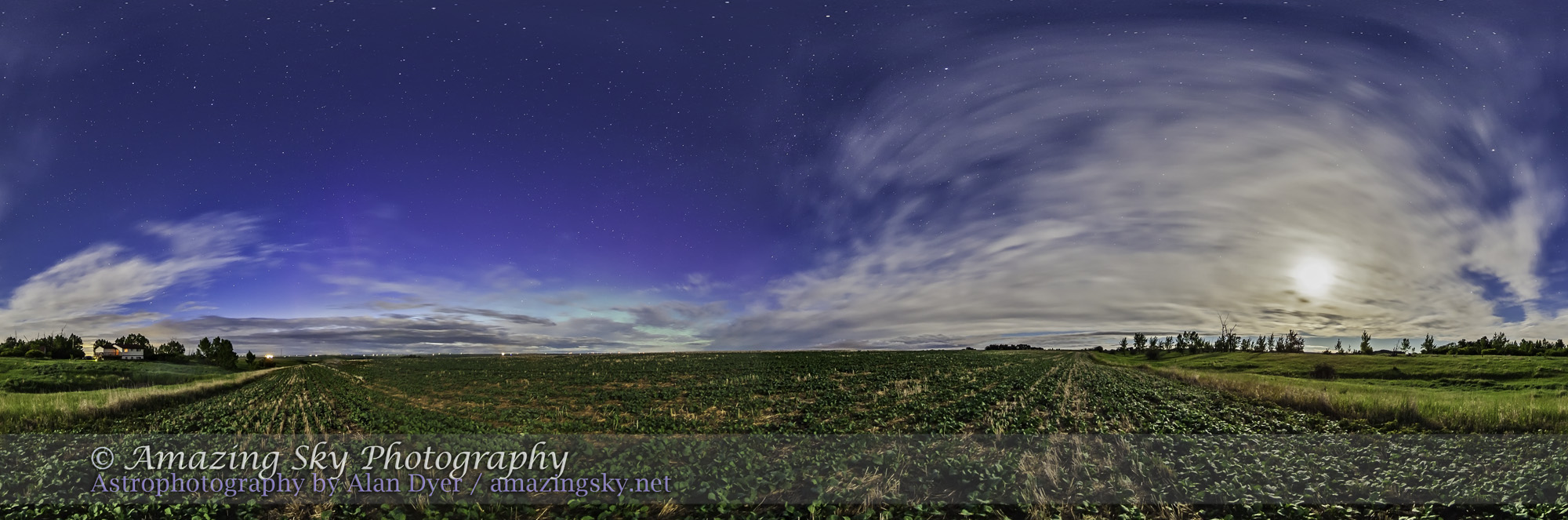
I shot this 360° panorama in the field near my house just before midnight on June 20, 2013, right about the official time of summer solstice. This is the longest night of the year and the brightest. The presence of the gibbous Moon contributes most of the night light, but there to the north at left you can see the glow of twilight and an aurora. At right, the waxing Moon shines in clouds, surrounded by a faint halo from ice crystals in the clouds.
Nights around solstice are always bright and filled with wonderful colours and atmospheric phenomena.
The tranquility of the solstice scene is in contrast with the horrific weather disaster taking place west of me near the mountains, as record floods from torrential rains wash away roads, railway lines, and houses. Roads are closed in and out of the mountains and entire neighbourhoods of Calgary near rivers are being evacuated.
Everyone knows somebody who is affected. For many this is indeed a very long and stressful night. I hope everyone keeps safe.
A stunning storm cloud retreats across the prairies leaving clear skies in its wake.
The timing could not have been better. On Monday night, June 17, a thunderstorm retreated to the east at just the perfect time to catch the light of the setting Sun.
As these prairie storms often do, this one left behind clear skies, with a quarter Moon at right to the south and the Sun to the west, off frame but illuminating this amazingly sculpted cloud. Downdrafts in the thunderhead produced the mammatus clouds – the bulbous structures hanging from the thundercloud. The low Sun angle emphasizes their form.
We’ve had a lot of rain and storms lately, but when a storm puts on as fine a show as this one, I’ll take it!
This image is a 3-segment panorama using the Canon 5D MkII and 16-35mm lens at 16mm. I used Photoshop’s Photomerge and Adaptive Wide Angle filter to stitch and straighten the image.
What strange clouds these are, moving where there shouldn’t be winds, and forming where there’s barely any air.
These are noctilucent clouds, sometimes called polar mesospheric clouds. Their icy strands form around particles at the top of the atmosphere some 80 km up. There’s almost no air up there so just how these clouds form has always been a mystery. They may be condensing around meteoric dust particles. They may also be more common now than in past decades and centuries, as the upper atmosphere cools due to an odd quirk of global warming that sees the lower troposphere warm while the upper mesosphere cools.
This was the first display of NLCs I’ve seen so far this season. They can only be seen, and indeed they only form, in summer. Sunlight streams over the pole and lights these clouds all night long. They are literally “night-shining” clouds. Only from a latitude range of 45° to 60° north and around summer solstice is the geometry right to see the clouds, usually as electric blue cirrus strands moving slowly along the northern horizon.
The time-lapse movies capture their motion over 30 to 90 minutes of shooting.
The 40-second movie contains three clips:
• The first, a wide-angle view of the amazing aurora that danced in fast accompaniment to the slow noctilucent clouds.
• The second clip, very short, zooms in a little more to the northern horizon. However, I cut that sequence short so I could switch lenses and take the next clip.
• The third scene is with a telephoto lens, framing the east-to-west slow motion of the clouds. I took 4-second exposures at 1-second intervals so it shows some pretty fine motion.
This was certainly one of the best NLC displays I’d seen and my best shot at capturing them.
What was especially rare was seeing them accompanied by auroral curtains actually moving among the clouds (or so it appeared). Both are up high in the near vacuum of near space, but they may have been miles apart in latitude.
Colourful sky phenomena combine to provide a remarkable sky show.
What a night this was! On Sunday, June 9 the aurora kicked off with a burst in the bright twilight but really got going as the sky got dark, shooting beams of magenta and blue up from the main green arc.
Then on cue, streamers of noctilucent clouds appeared low in the north, shining with their characteristic electric blue. These are odd clouds at the edge of space lit by sunlight streaming over the Pole.
Both these apparitions of the upper atmosphere glowed above a horizon rimmed with the orange of perpetual twilight set in a deep blue background sky.
Yes, the camera has brought out the colours more intensely than the eye saw, but nevertheless it was a remarkable evening close to solstice. This is a magical time of year when all kinds of sky glows light the night.
This night the European Einstein ATV cargo craft also flew over, twice, each time about 10 minutes ahead of the even brighter Space Station that it is chasing for a docking later this week.
More images to come from this night, including time-lapses of the Lights and Clouds.
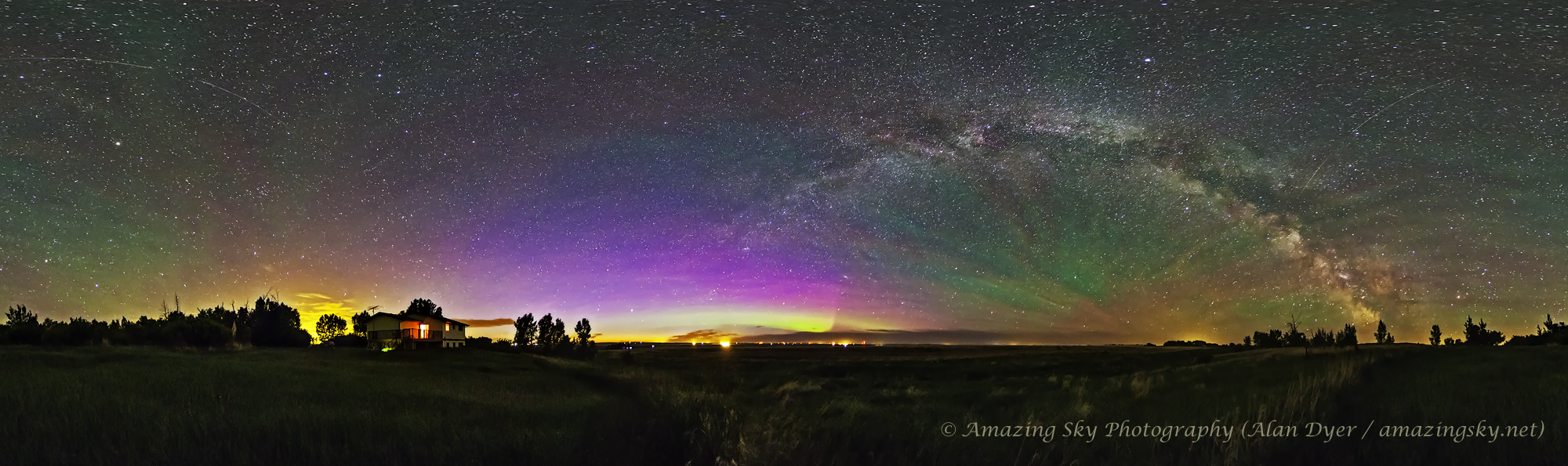
What colour is the dark night sky? Depending on conditions, it can be any colour you want.
I shot this 360° panorama last night from my backyard under what looked like a clear and fairly dark, moonless sky. Looks can certainly be deceiving. The camera picked up all kinds of colours the eye couldn’t see.
Let’s review what’s causing the colours:
• To the north just left of centre the horizon is rimmed with a bright yellow glow from all-night perpetual twilight present around summer solstice at my mid-northern latitude.
• Above that shines a green and magenta band from a low-level aurora just visible to the naked eye.
• Much of the sky is tinted with bands of green from ever-present airglow, caused by oxygen atoms at the top of the atmosphere giving off at night some of the energy they absorbed by day. I had thought the sky would look blue from the perpetual twilight but the airglow seems to overwhelm that.
• Yellow glows around the horizon at left (west) and right (southeast) are from urban light pollution from towns 50 km away.
• Some strands of remaining cloud from a departing thunderstorm add streams of brown as they reflect lights from below.
• Finally, the Milky Way shows up in shades of yellow and pale blue, punctuated here and there by red patches of glowing hydrogen hundreds of light years away.
The only thing missing this night was a display of electric blue noctilucent clouds.
The sources of most of these colours are an anathema to observers of faint deep-sky objects. Aurora, airglow and certainly light pollution just get in the way and hide the light from the distant deep sky.
A word on technique:
I shot this panorama using an 8mm fish-lens to shoot 8 segments at 45° spacings. I used the excellent software PTGui to stitch the segments together, which it did seamlessly and flawlessly. Each segment was an untracked 1 minute exposure at ISO 3200 and f/3.5. The panorama covers 360° horizontally and nearly 180° vertically, from the ground below to the zenith above. It takes in everything except the tripod and me!
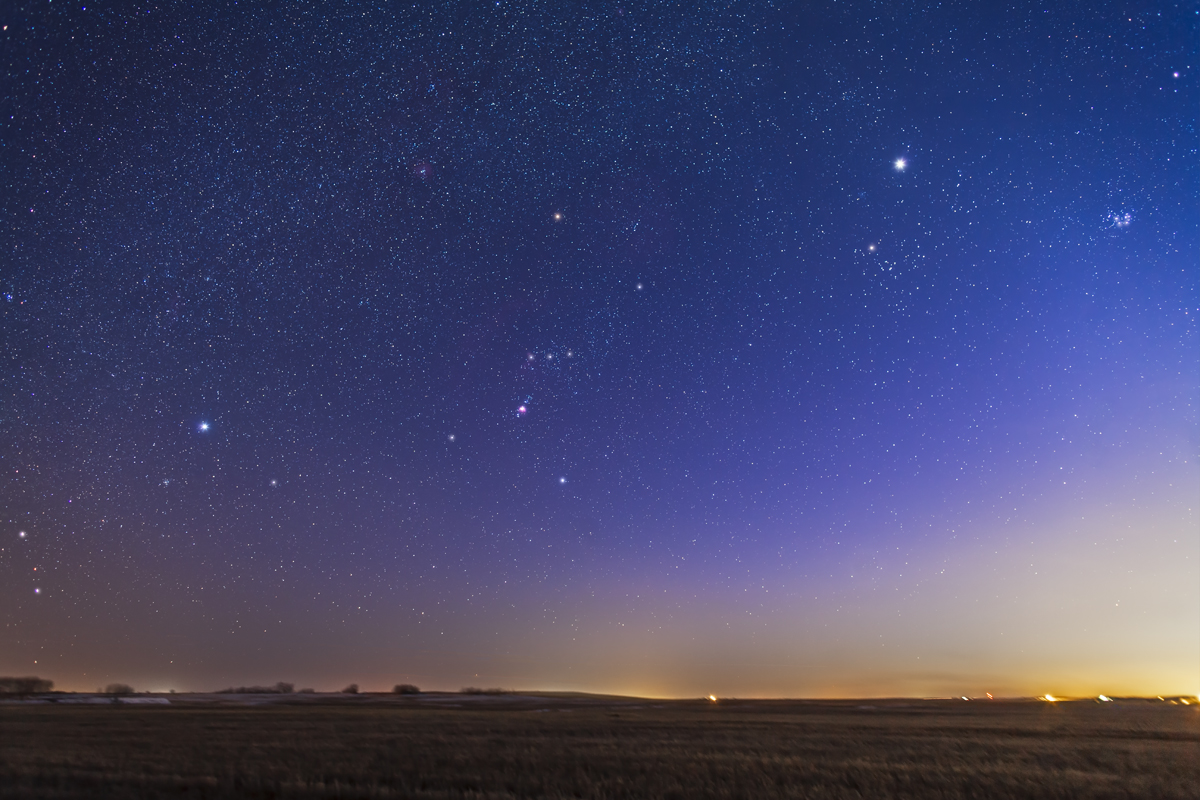
Say goodbye to the winter sky, now sinking fast into the sunset. The departure of Orion and company is an annual sign of spring.
Look west on a clear night in the next couple of weeks and you’ll see this scene, as Orion sinks into the sunset, surrounded by Taurus to the right of him, and Canis Major to the left of him. Taurus is his foe, Canis Major his friend.
Having so many bright stars in the April evening twilight makes for a beautiful scene in the deepening blue. But I suspect most of us are happy to see all signs of winter gone for a long time!
I shot this Monday night, April 1, on a very clear night. Orion’s Belt is just left of centre. The trio of Belt stars points left and down to Sirius, the Dog Star, and points right and up to Aldebaran, the Bull’s Eye. Above Aldebaran is brilliant Jupiter. Just at the right edge of the frame are the Seven Sisters, the Pleiades.
Say goodbye to these stars of winter. We won’t see them again until late summer in the pre-dawn sky.
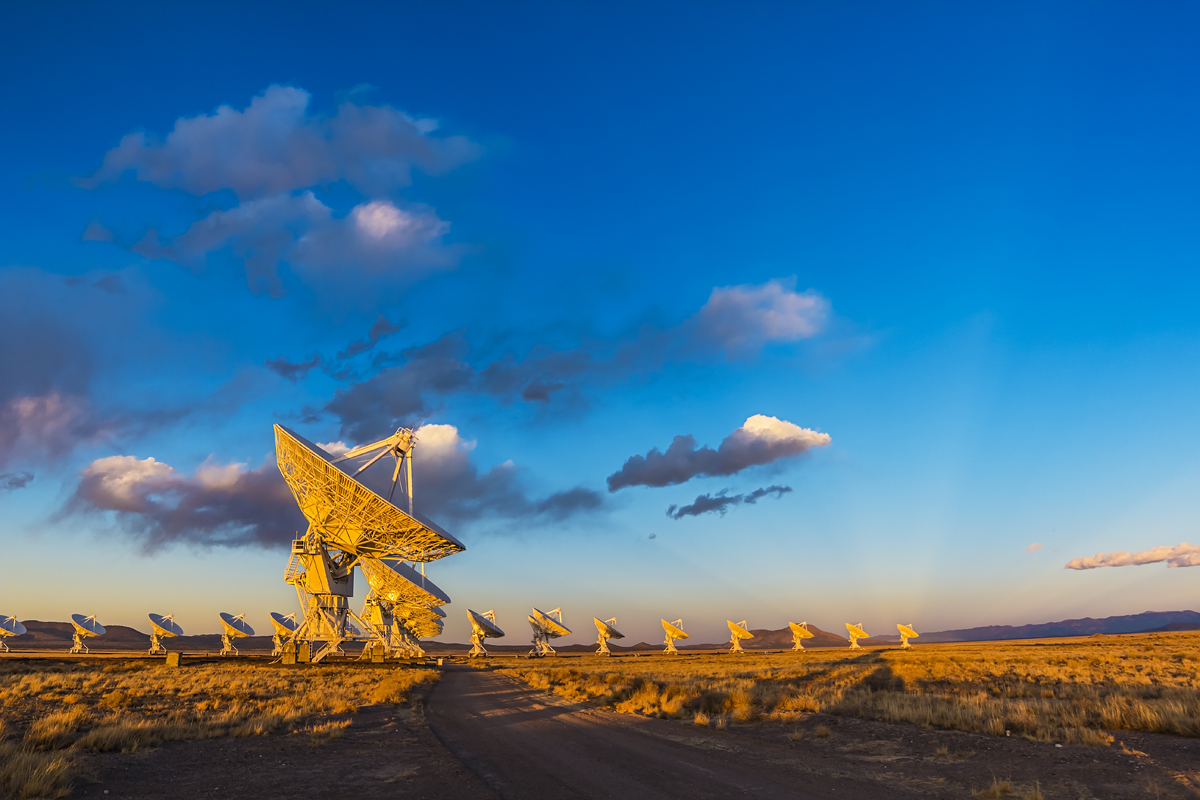
The photogenic dishes of the Very Large Array aim skywards as the setting Sun casts shadows across the sky.
If these were optical telescopes I could write that the telescopes were getting ready for a night of sky viewing. But radio telescopes can observe day and night.
Still, there is something magical about catching any type of telescope in action as the Sun sets and night falls. Here, the last beams of sunlight coming from the west illuminate the dishes, while dark shadows – crepuscular rays – cast by clouds converge toward the anti-Sun point in the east.
As part of my trek around New Mexico this past week, I shot this on Sunday, March 17, about an hour before I took the image of Comet PANSTARRS over the VLA dishes – for that image I was east of the array looking back to the west and to the comet.
But for this image I was at one of the public access areas, standing under one of the dishes, looking east.
At first, all the dishes were aimed up to the zenith, stowed I assume due to the high winds that were blowing all afternoon. But then, right on cue as I began shooting, all the dishes began to move in unison. The dishes first aimed toward me, then turned to aim up to the south, as here. It was an amazing dance to watch. It gave me goosebumps. And tears.
There is likely no more iconic image of our exploration of the universe from Earth than this array of antennas listening for the faintest signals from deep space – not alien radio programs, but the natural signals emitted by atoms and molecules where stars are forming and dying.
Comet PANSTARRS hovers in the twilight above the many moonlit dishes of the VLA radio telescope.
I shot this earlier this evening, on Sunday, March 17, on an evening trek out to the VLA (Very Large Array) near Socorro, New Mexico. Light from the nearly quarter Moon high in the sky illuminates the landscape and rims the 27 dishes of the VLA, the radio telescope that has starred in many movies over the years. The comet appears in deep twilight, here with the colours accentuated. Fortunately, the array was arranged in its most compact formation – at times the dishes can be spread out over many miles.
For this shot I took two exposures moments apart: one tracked for 25 seconds for the sky and comet to ensure pinpoint stars, and one untracked for 50 seconds for the ground, to ensure sharp ground detail. I combined them in Photoshop. I used the iPad app Photographer’s Ephemeris to seek out the location, on Highway 52, the public highway leading to the entrance road for the VLA. Lights from cars on the main Highway 60 across the high Plains of San Agustin streak at right.
The comet is becoming more photogenic as it climbs higher, despite the waxing Moon. A classic curving dust tail is now obvious in photos, though here I had the advantage of a very clear sky at a high altitude desert site. Viewing condition don’t get any better than this. Still, this comet will bear watching and shooting over the next month, no matter where you are in the northern hemisphere.
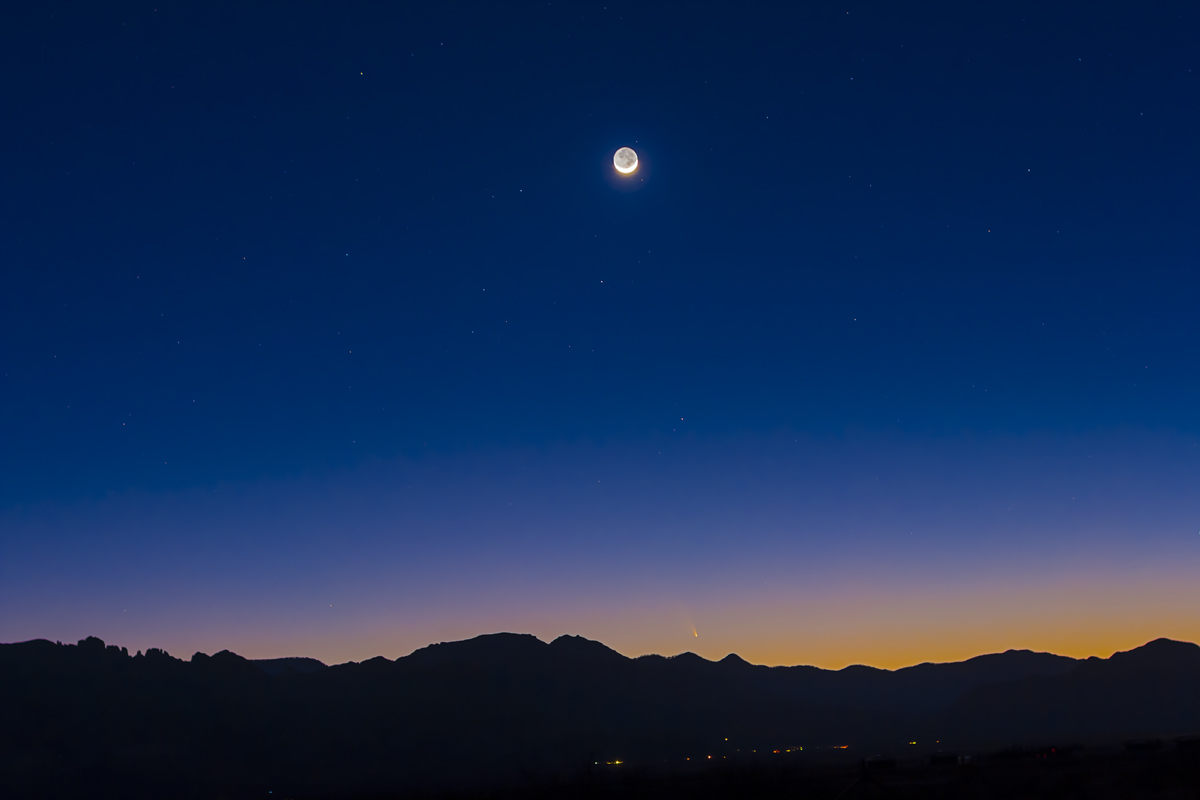
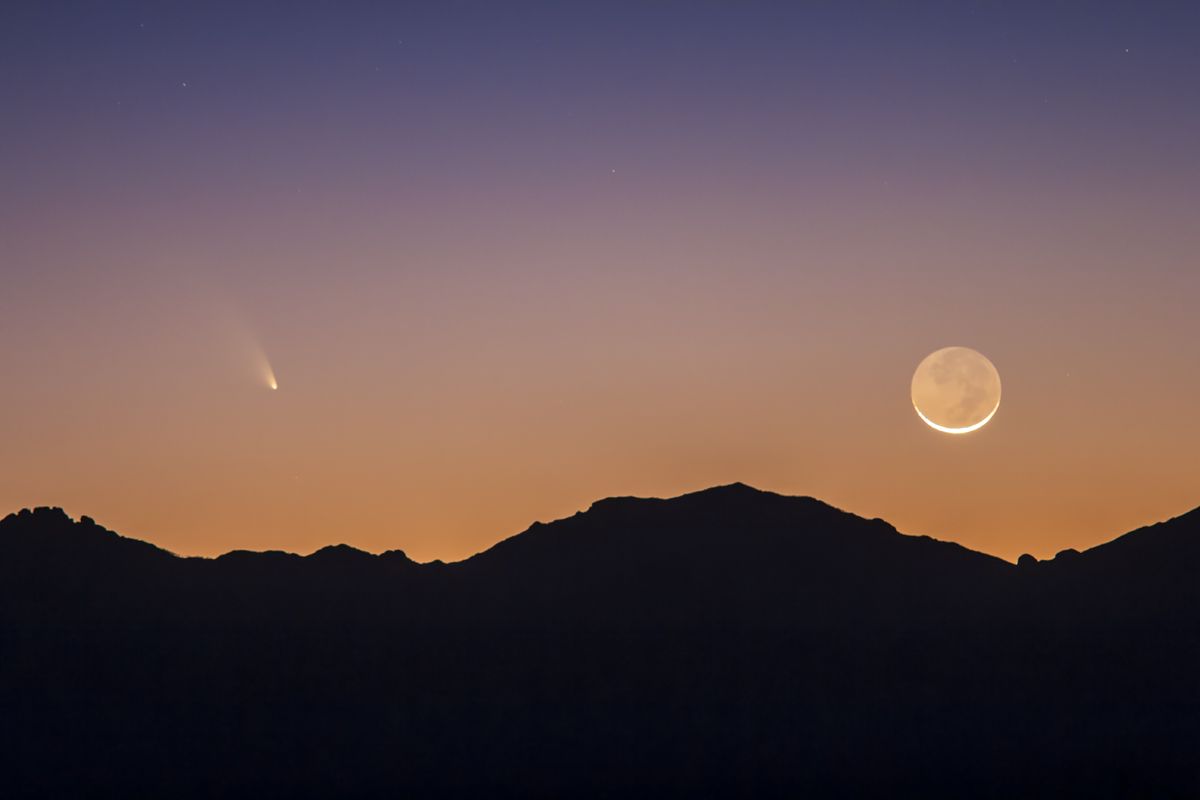
This was the scene tonight, March 13, as Comet PANSTARRS set over the mountains in deep twilight, with the waxing Moon hanging overhead.
The small comet sits low in the orange glow of twilight, where the Moon was last nightwhen it was down beside the comet. Tonight, a day later, the Moon appeared much higher in the sky as it waxes toward first quarter Moon in another few days. Tonight it was a crescent with most of the dark part of the lunar disk lit by Earthshine. I took this shot just before the comet set behind the mountains, to get the sky as dark as possible and the exposure longer to bring out some stars in the deepening blue of twilight.
I took this from the Painted Pony Resort in New Mexico where about 15 of us are gathered for a week-long star party and dusk to dawn “observathon.”
Indeed, I have to get back outside to continue shooting the Milky Way. It is another stunningly perfect night under New Mexico skies.
This was the night for Comet PANSTARRS! How often do we get to see a view like this, with a comet sitting beside a thin crescent Moon. Spectacular!
Again tonight, about a dozen visiting and resident Canadians gathered for a roadside star party north of Rodeo, New Mexico, to view the comet and Moon setting together over the Chiricahua Mountains. It was a stunning sight and made for a picture postcard image. The two set almost simultaneously, with the tail of the comet and “dark side of the Moon” lit by Earthshine the last to disappear behind notches in the mountain ridge.
And tonight, with the comet higher, it was visible to the naked eye for the first time, but only just – the sighting was made easier because you knew exactly where to look.
The Moon was just 3o+ hours old, so appeared as a very thin crescent. The entire disk of the Moon was visible, the rest lit by Earthshine, sunlight reflected off the Earth. In the clear New Mexico air, the Earthshine was easy to see even in the bright twilight. But adding in the comet made for a once-a-lifetime view.
As soon as they set together, we all cheered and applauded, almost like at an eclipse. It was a memorable night, the kind you always hope for from a comet. PANSTARRS performed tonight!
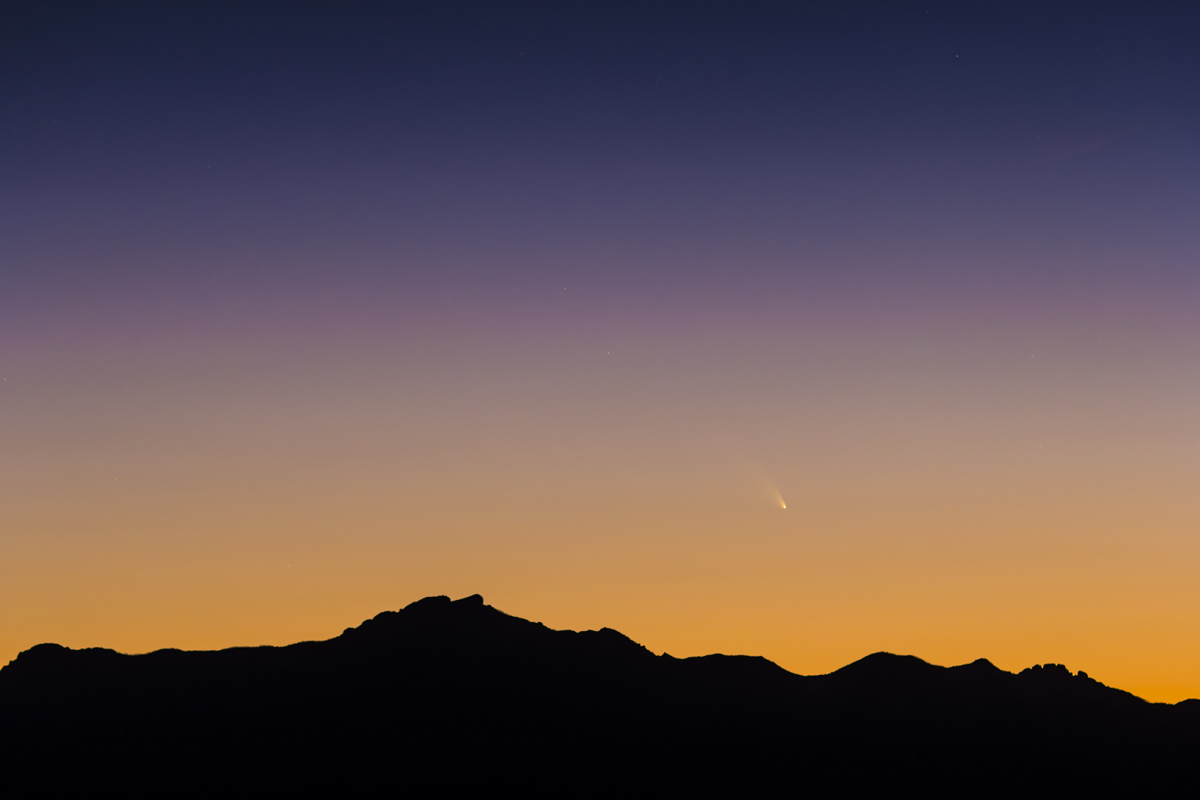
This was Comet PANSTARRS as it appeared Monday night, March 11, as it set over the Chiricahua Mountains.
Tonight we drove north, away from our New Mexico resort, to find a site overlooking lower hills to the west, in order the track the comet for longer as it set toward the horizon. Friends from Winnipeg joined us, and as the Sun set, three more cars pulled up with astronomers from the area all looking for the best vantage point for comet watching. We had an impromptu roadside comet party.
Even so, it was tough picking PANSTARRS out of the twilight and it was never naked eye. Pity this comet hasn’t blossomed, as a bright long tail would have been a beautiful sight in the sunset glow. However, it is what we had expected – a first time visitor from the Oort Cloud promising great things initially but never quite delivering on the promise. Still, we were all happy to see it and shoot it. This frame is one of 140 I took in time-lapse of the comet setting over the hills.
We have ideal conditions for comet viewing each night this week, unlike many in the northern hemisphere now. So our little group of Canadians in New Mexico are taking some satisfaction in knowing we’re seeing it, and many aren’t.
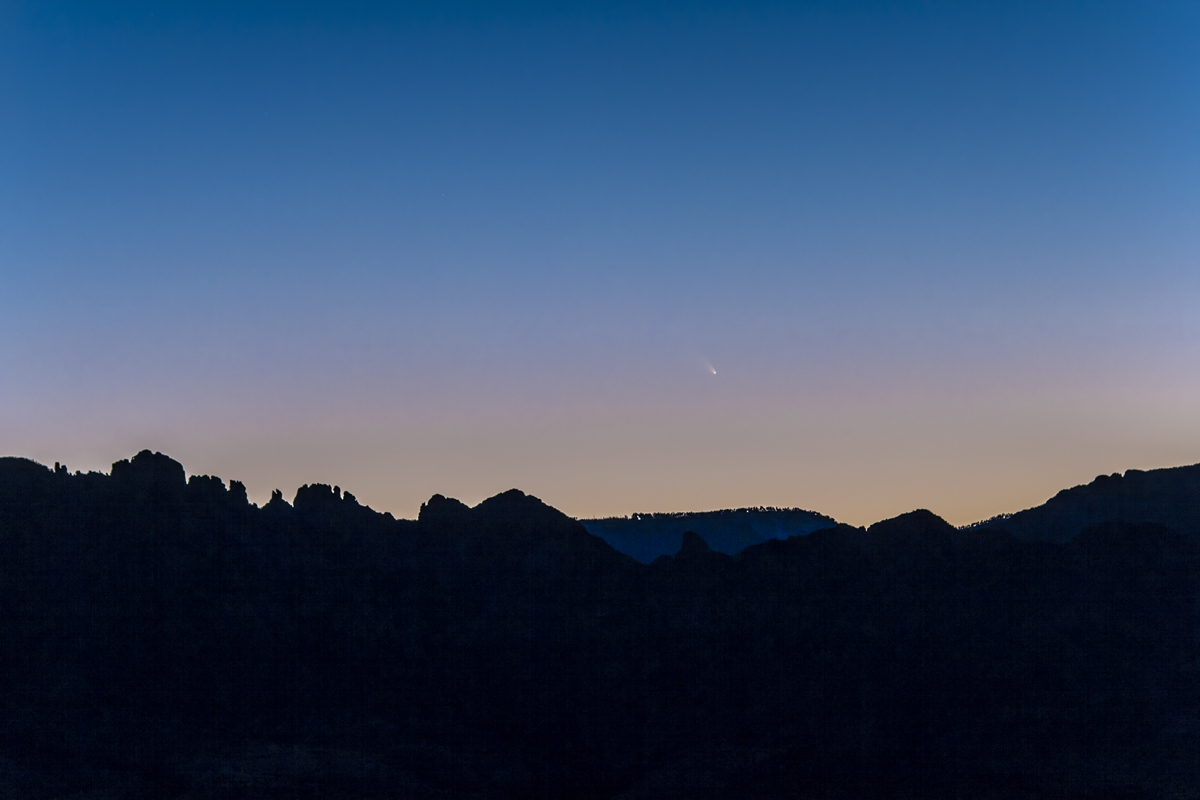
Got it! After a few days of cloud, the skies cleared perfectly tonight for our first look at Comet PANSTARRS.
This is the comet on March 10, the day it rounded the Sun at perihelion, its closest point to the Sun. The comet, which came from the Oort Cloud, is now on its way back to where it came from. But for the next few days, it will be at its best in our evening sky in the northern hemisphere. Friends down under in the southern hemisphere have been enjoying views of the comet for the last two weeks, but the comet has now moved far enough north it has entered our northern hemisphere skies.
The view is actually best from higher latitudes but I’m here at latitude 31° N, in southwestern New Mexico, seeking the clearest skies for the comet. We got them tonight. This view is of the comet about 7° up, just above the rim of the Chiricahua Mountains to the west of us, in Arizona.
The comet will climb higher over the next few days, with a prime night on March 12 when the waxing Moon appears near the comet.
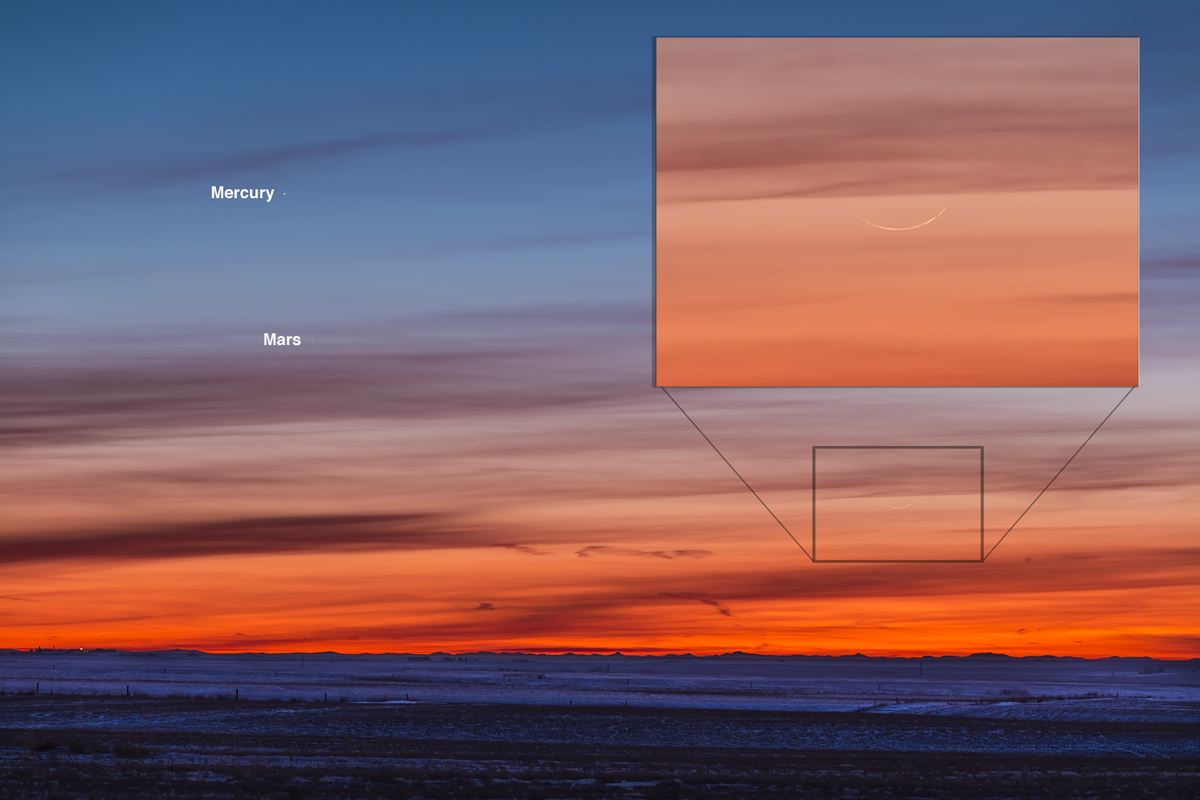
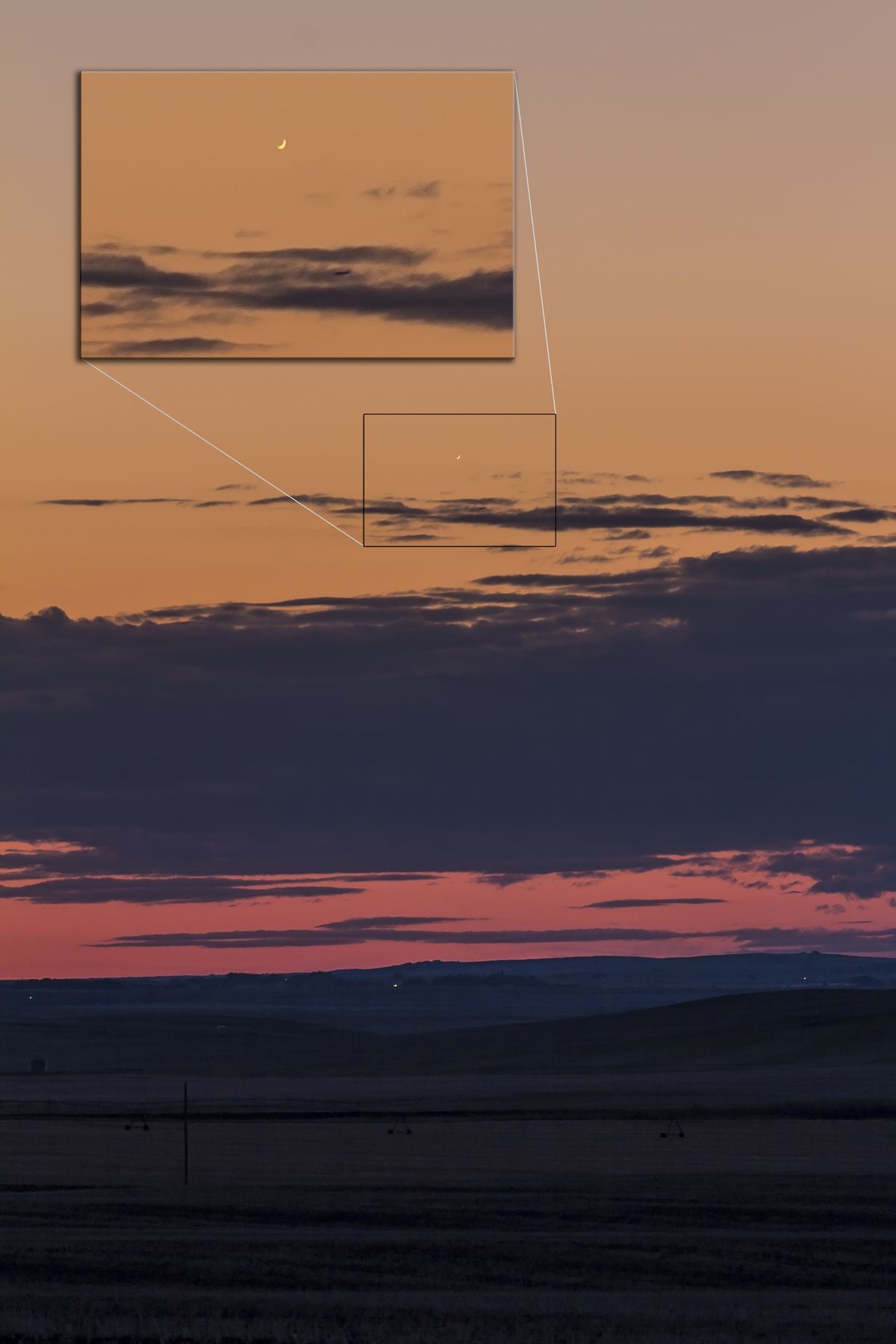
This was the sky scene Sunday night, February 10, as an ultra-thin Moon entered the evening sky, providing me with a “personal best” for sighting a young Moon.
I’ve had to highlight and annotate the subjects here but all the players were obvious in binoculars. Only Mercury, usually the most elusive planet, was obvious to the naked eye. Below it shone dimmer Mars, here embedded in some cloud.
But the real catch of the night was the 18-hour-old crescent Moon, shimmering low in the red twilight. It appears as a razor-thin crescent, magnified in the inset. Sighting any Moon younger than 24 hours old is considered a find, the all-time record being a Moon about 14 hours old. I’m happy with an 18-hour catch!
On Sunday night conditions were nearly ideal, despite the clouds, with the Moon angled about as far from the Sun as it could be from my northern latitude, positioned directly above the sunset point. You can tell that because the crescent, which must be oriented toward the Sun, appears nearly horizontal.
This is the New Moon that also signals the start of the Chinese New Year, the Year of the Snake. So 迎春接福 !
Out of the skyglow from lights and the remains of twilight rises a tapering pyramid of light. It’s one of the night sky’s most subtle sights for the naked eye.
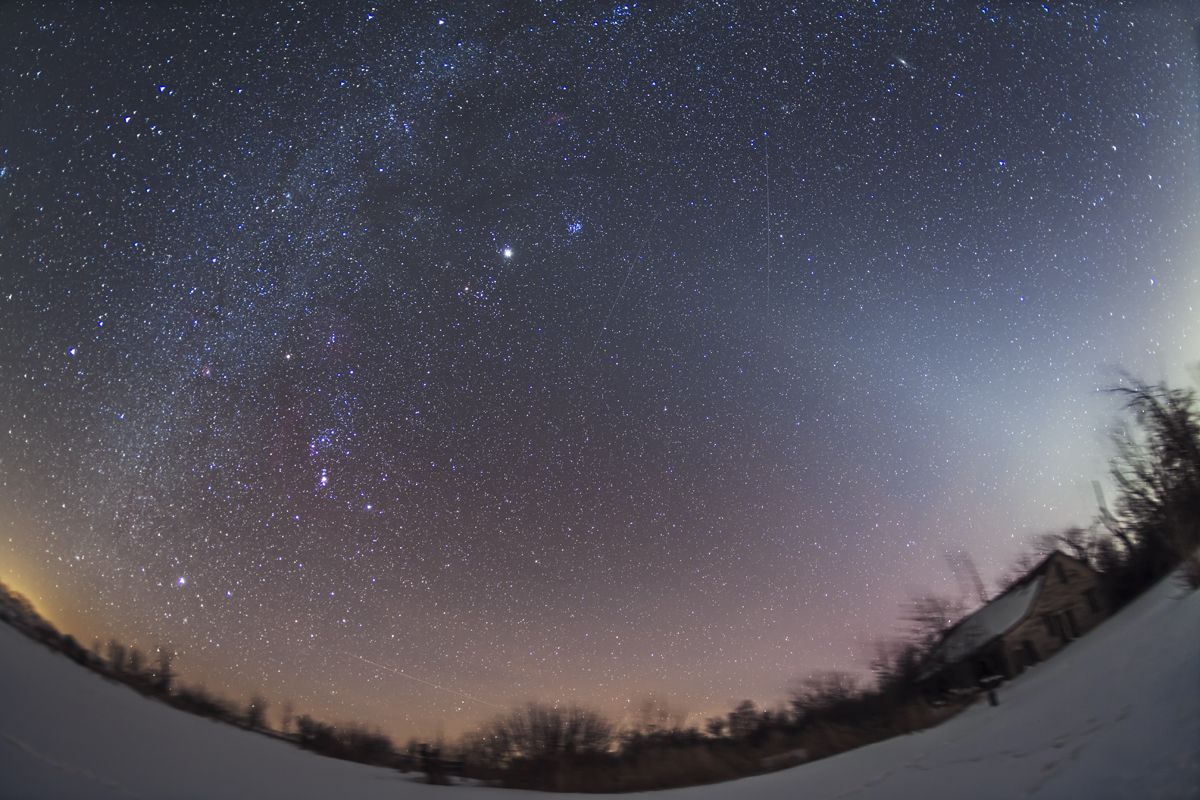
This is the Zodiacal Light, and I’ve been trying to capture it in the evening sky from home for a number of years. Last night was a good night for it. The sky was very transparent, for the first couple of hours at least. An ultra-wide angle lens allowed me to capture the Light in context with the wider sky, towering out of the southwest at right, reaching up to the Pleiades and Jupiter high in the centre of the frame. The Milky Way is at left. Everyone knows the Milky Way but the Zodiacal Light is less famous.
It’s visible only in the hour or two after sunset or before sunrise. Late winter and spring are the best times to see it in the evening sky. That’s when the ecliptic – the plane of the solar system where the planets lie – is tipped up at its highest angle above the horizon putting it above obscuring haze. The Zodiacal Light lies along the ecliptic because it is part of our solar system, not in our atmosphere. It is sunlight reflected off dust orbiting in the inner solar system that’s been cast off over thousands of years by comets passing through. It is brightest closest to the Sun and fades out at greater angles away from the Sun. Thus its tapering appearance in my sky as the photo shows, very much as my eye saw it.
It takes a good night at a dark site to see the Zodiacal Light. But take a look at the next dark of the Moon. You’ll be surprised at how easy it is to see once you know what to look for.
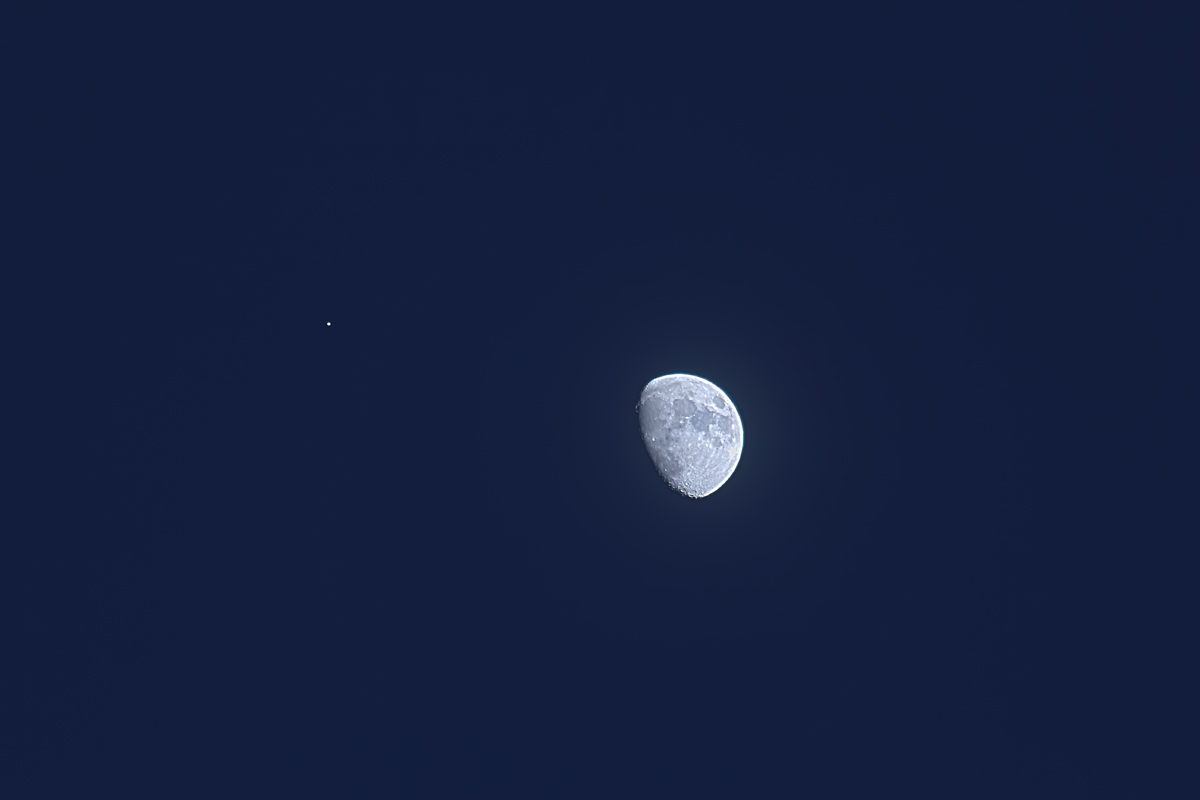
The cool blue of this scene fits the night – a bitterly cold winter night as the gibbous Moon passed below Jupiter.
This was the view as the sky got dark on Monday, January 21, 2013 with a close conjunction of the Moon and Jupiter underway. The Moon was closer to Jupiter later in the evening but I wanted to shoot it at sunset to capture the duo before for the sky got too dark and the Moon too bright and prone to overexposure. Even so, to capture the scene as your binocular-aided eyes saw it, I combined 4 different exposures for an “HDR” stack.
This is the closest we in North America will see the Moon by Jupiter in a darkened sky until 2026. But just next month those in southern Australia get to see a rare occultation, or “eclipse” of Jupiter by the Moon. It doesn’t get any closer than that!
From a truly dark sky site, subtle sky glows become obvious. This is the Zodiacal Light of evening.
The Sun has long set and the very last glow of twilight is colouring the sky just above the hills. But reaching up from the sunset point in the northwest is a long triangular glow extending far to the south. This is called the Zodiacal Light – it does not originate in our atmosphere but is from sunlight reflecting off comet dust orbiting the inner solar system in the same plane as Earth’s orbit. Or at least that’s where we see it appearing the brightest, as a glow brightest near the Sun and extending along the ecliptic plane, where we find the constellations of the Zodiac. Here it appears in Capricornus and Aquarius.
I shot this two nights ago, from Coonabarabran, Australia, so the orientation of the Zodiacal Light is different from what we see from the Northern Hemisphere. Here it extends up from left to right. From home in Canada – and you can see the Light from northern latitudes on a dark night – it would be angled up from right to left, a mirror image of what we see here.
The subtle glow of Zodiacal Light is best seen in the evening sky in spring, no matter your hemisphere. I took this on December 6, 2012, still officially spring in the southern hemisphere if you assume southern summer starts on the solstice, December 21. However, Australians say summer begins December 1, so this is a portrait of the Zodiacal Light on a warm summer evening down under.
This was a perfect sunset for displaying the subtle shades of twilight.
On this evening the sky over the ocean showed off the classic sunset gradient from deep orange though yellow, purple and into deep twilight blue. I shot this on the water on my cruise around the Whitsunday Islands on board the Solway Lass. Note the dark reflections of clouds in the water.
We’re looking west, of course – the Sun still sets in the west in the southern hemisphere! – which is back toward the mainland of Queensland, Australia.
One of the great joys of sailing and being out on the water is the wonderful sunsets. In this case, sunset included a fine moonrise.
This is the gibbous Moon of November 26 in the evening sky over the Whitsunday Islands in Australia. On this evening we were moored in Baur Bay, at South Molle Island. The bright waxing Moon shines amid the red clouds in the east still lit by the last rays of the setting Sun from the west. It is everyday scenes like this, painted with the wonderful palette of colours only the sky can provide, that you begin to appreciate all the more – or more to the point, simply see – as you become “sky aware.” So no great science lessons to learn here – just some beautiful colours to soothe the soul as gentle waves lap against the side of the ship.
Oh, to be on the beach in the tropics now that winter’s here at home.
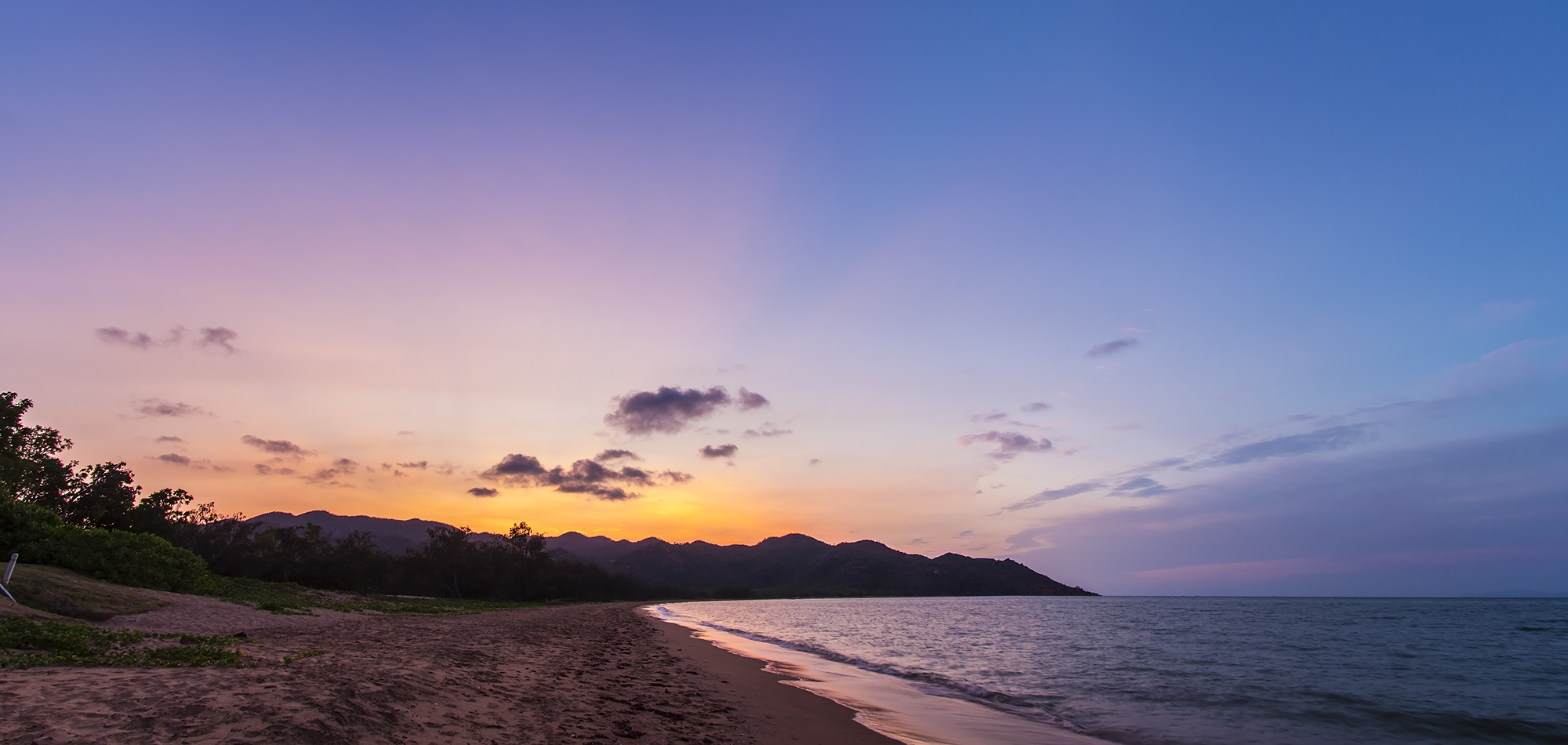
That’s where I was tonight, at the same beach on Magnetic Island, Queensland where I shot last night’s images of cloud shadows. You can see some of the same effect here, as the few darker clouds cast their dark shadows across the twilight. But in the clearer sky tonight, the classic colours of twilight are more pronounced than they were the previous night. The sunset sky goes from deep yellow near the horizon, through pinkish-purple and into deep blue high in the sky. The “twilight purple” is caused by red sunlight still illuminating the high atmosphere.
We see the same colour effects at temperate latitudes. It’s just a lot more pleasant enjoying a sunset on a warm beach in winter.
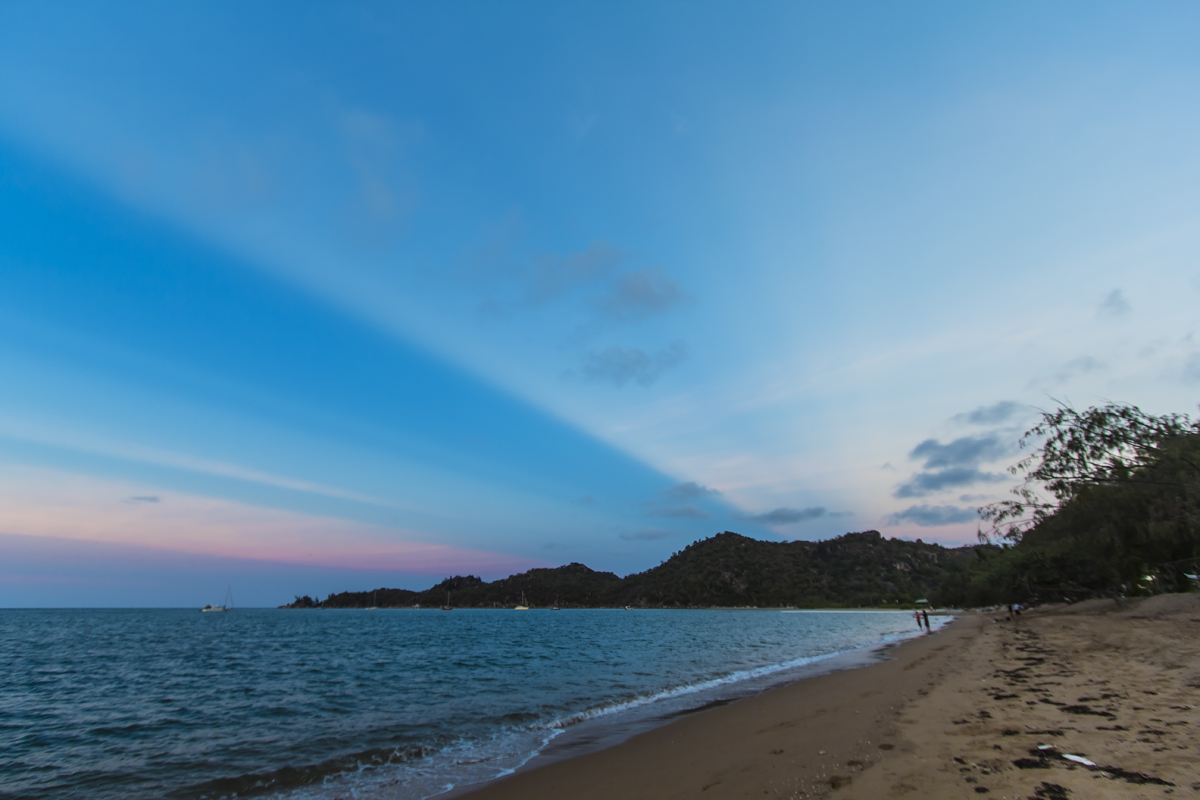
I went to the beach to shoot the sunset and saw one of the best examples of cloud shadows I’d ever seen.
These are called “crepuscular rays,” and are shadows cast across the atmosphere by clouds, in this case in the west blocking the light of the setting Sun. However, here I’m shooting east in the direction opposite the sunset, to see the shadows converging on the anti-Sun point.
The effect is really stunning, yet I doubt anyone on the beach paid much attention to it. But then again, that’s the whole point of my AmazingSky blog — to call attention to neat stuff you can see in the sky if you only look up.
The site is Horseshoe Bay on the north end of Magnetic Island, off the coast of Queensland, near Townsville. I’m here for two days enjoying the island life. It has now been one week since the total eclipse of the Sun. Hard to imagine!
During last week’s total eclipse, Venus was obvious above the Sun well before the shadow descended and the sky darkened. But during totality other stars and planets appeared.
But I suspect few noticed! During an eclipse your eyes are transfixed on the Sun and its corona. And on the other phenomena of light and shadow happening around you. However, I inspected my wide-angle frames and found faint images of Saturn and the stars Spica, Alpha and Beta Centauri, and three stars of the Southern Cross. I’ve labeled them here but you might not be able to pick them out on screen in the reduced resolution that appears in the blog. Similarly, I doubt anyone saw them visually. If you did you were wasting your time looking at the wrong stuff!
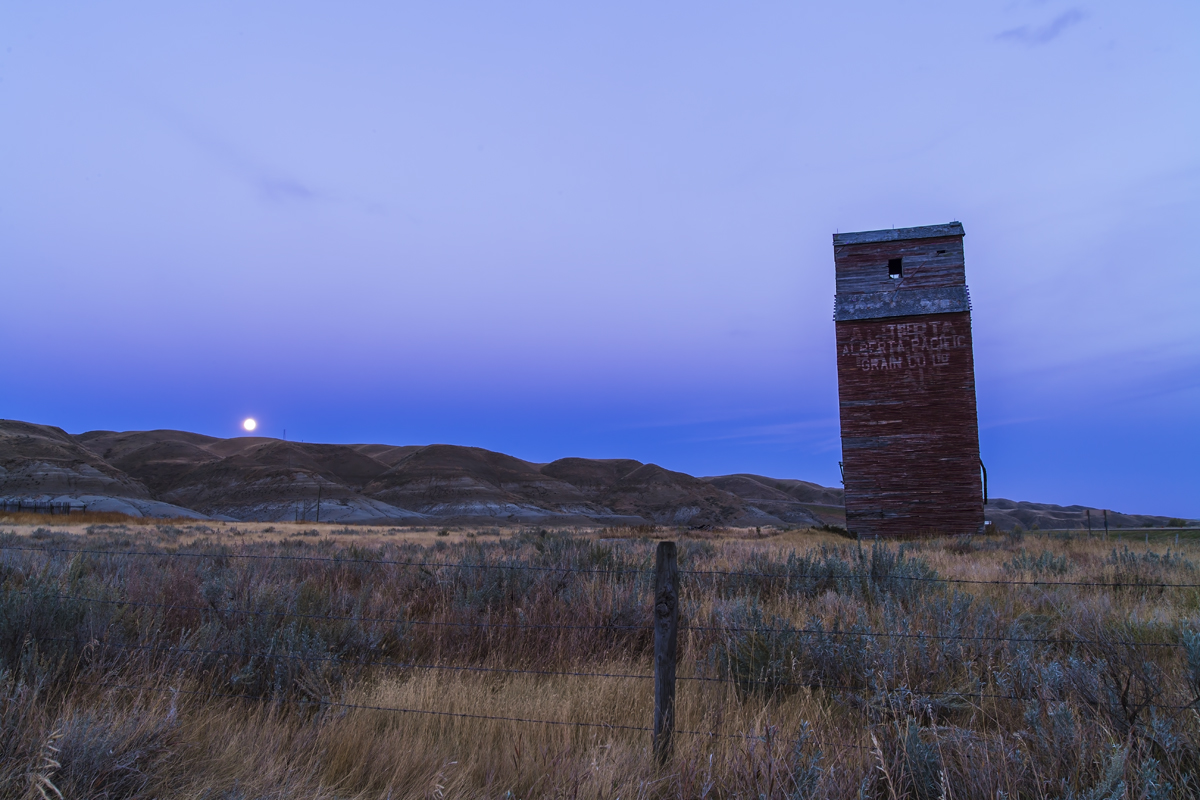
The annual Harvest Moon shines over a scene from pioneering farm days.
One of the last remaining wood grain elevators still stands as a historic roadside attraction near the little hamlet of Dorothy, Alberta. It’s seen better days.
But in its time it took part in many a harvest in the Red Deer River valley. There were once no less three grain elevators here and railway tracks to take away the bountiful harvest. That was back in the 1910s and 1920s when Dorothy was a little boom town. But the prosperity waned in the Depression Years, and never returned. In the 1960s, the railway tracks were pulled up, and two of the elevators torn down.
Now, Dorothy is one of the ghost towns amid the badlands of the Red Deer River valley.
I shot this Saturday night, as the Full “Harvest” Moon rose over the hills, shining in the blue shadow of the Earth. This is one frame of 450 in a time-lapse sequence.
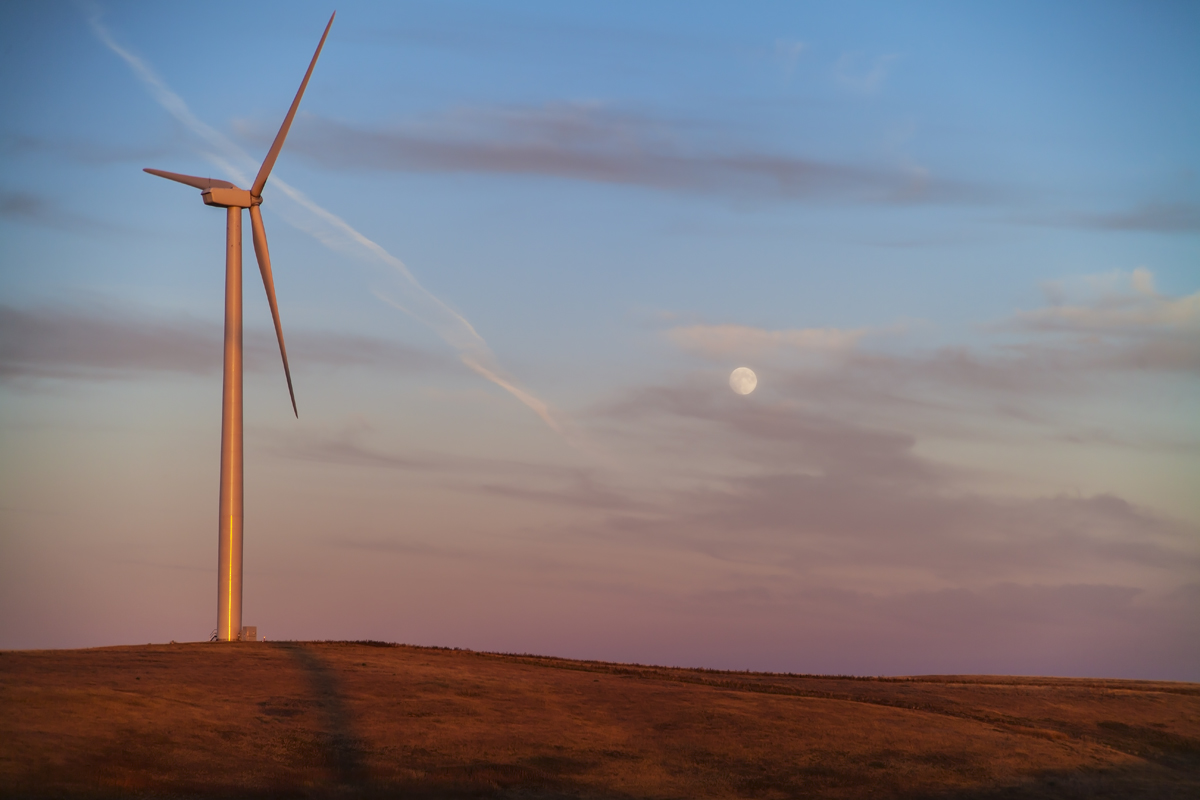
The Harvest Moon rises behind a new crop, a wind turbine harvesting the wind.
I shot this Friday evening, September 28, technically the day before Full Moon and the annual Harvest Moon. The location is amid the Wintering Hills Wind Farm northeast of me and south of Drumheller, Alberta.
This is one frame of 450 in a time-lapse sequence going from sunset into twilight with the Moon rising through the clouds. The changing colours were wonderful.
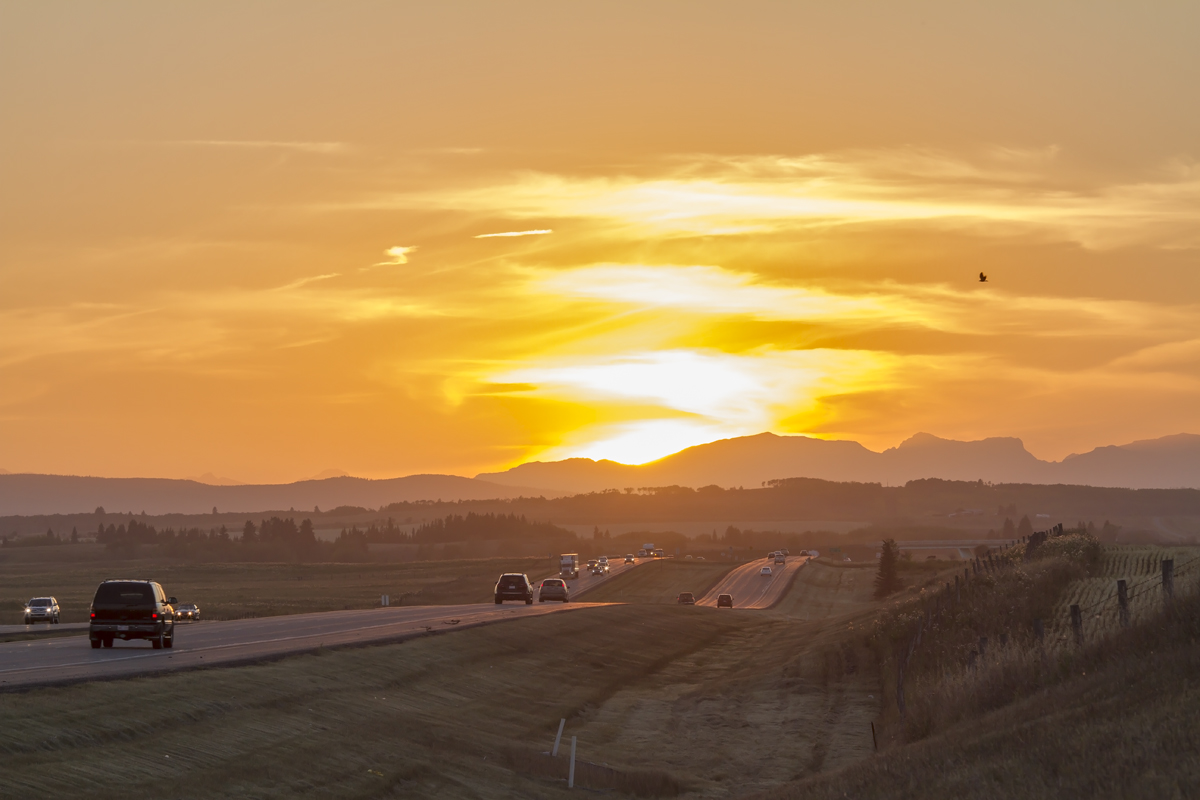
At equinox the Sun sets due west and shines into the eyes of drivers heading west into the sunset.
This was the scene Friday night on Highway 1, heading to Banff out of Calgary. I set up beside the highway to catch the scene of the Sun going down at the end of the road. I was hoping for more smoke and haze to dim the Sun to a clearly defined disk rather than deal with a bright glow. But you shoot what the sky gives you.
This is one frame from a 315-frame time-lapse movie of the traffic madly moving down Highway 1 (a true to life recording!) and the Sun glow setting behind the Rockies.
Saturday night was a fine evening for witnessing the geometry of the night sky.
This is sunset on the evening of the autumnal equinox, September 22, 2012, with a first quarter Moon in the sky. The image illustrates the geometry of the quarter Moon’s position, which is always 90° away from the Sun, a quarter of the way around its orbit in its monthly cycle.
In this case, because the Sun (at right) was on the equinox position on the ecliptic, it was setting due west this night (something it does only on the dates of the fall or spring equinox). This put the quarter Moon (at left) 90° away, due south at sunset.
Draw a line from the Moon to your eye (the camera) and then back out to the Sun and it forms a 90° right angle. This geometry holds true for any quarter Moon, but being equinox the Sun and Moon were nicely aligned due west and south, making their right angle arrangement more obvious.
I took this shot from the grounds of the Rothney Astrophysical Observatory on the occasion of their monthly Open House.
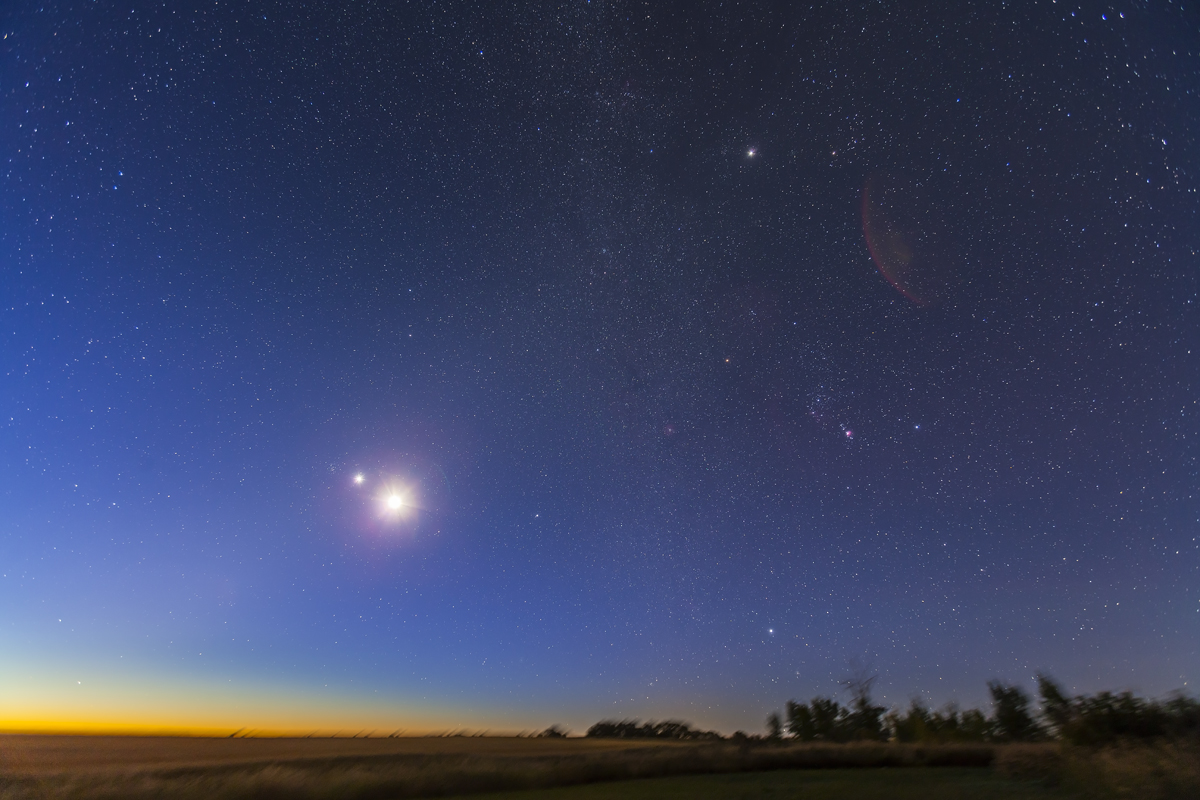
Here was the scene on September 12, with Venus and the Moon in conjunction in the dawn sky.
Orion stands above the trees, and at top is Jupiter amid the stars of Taurus. The star Sirius is just rising below Orion. And both the Moon, here overexposed of necessity, and Venus shine together below the clump of stars called the Beehive star cluster in Cancer. This was quite a celestial panorama in the morning twilight.
This is a stack of two 2-minute exposures taken just as dawn’s light was breaking, so I get the Milky Way and even a touch of Zodiacal Light in the scene, as well as the colours of twilight. Pity I can’t avoid the lens flares!
This is a scene I’ve been after for some time – the Milky Way and stars reflected in calm water.
In Friday night I was at a small lake, a pond really, at the south end of the Icefields Parkway in Banff. Herbert Lake is small enough it is usually calm and reflective. Friday night was as clear and calm as you could hope for. This image is from the beginning of the night with some blue twilight still illuminating the sky, but no moonlight. The waning Moon did not rise until 11:30 pm. I shot this prior to starting a 3-hour time-lapse from the same position on the lakeshore.
The scene is looking south toward glacier-clad Mount Temple and Mount Fairview near Lake Louise.
This is a single exposure with the Canon 5D MkII and 16-35mm lens.
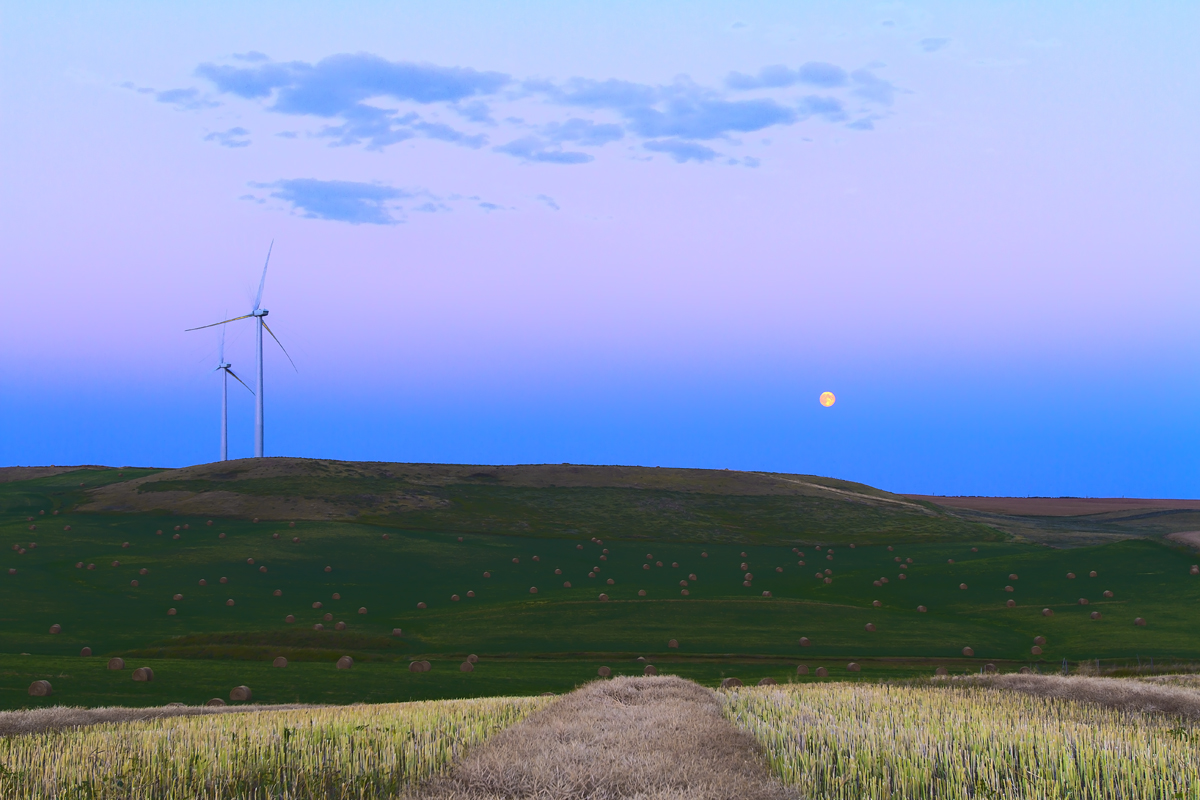
This was the Full Moon rising on the night of another much-publicized “Blue Moon.” This was moonrise on Friday, August 31, 2012.
Of course, the Moon doesn’t look blue. Indeed, smoke and dust in the air made it look a dim yellow. Though this wasn’t the official Harvest Moon (that comes next month), it should have been, as around here in southern Alberta the harvest is well underway, thus the swathed fields and hay bales.
The Full Moon sits in the blue band of Earth’s shadow, rimmed on the top by the pink twilight effect called the Belt of Venus, caused by sunlight illuminating the high atmosphere to the east.
A couple of windmills from the large Wintering Hills wind farm add to the evening scene. I’ve spent the last couple of evenings shooting in the wind farm. More images are to come!
For this image, I combined six exposures in a High Dynamic Range stack to compress the wide range of brightnesses. Boosting the colour vibrancy also brings out the twilight colours.
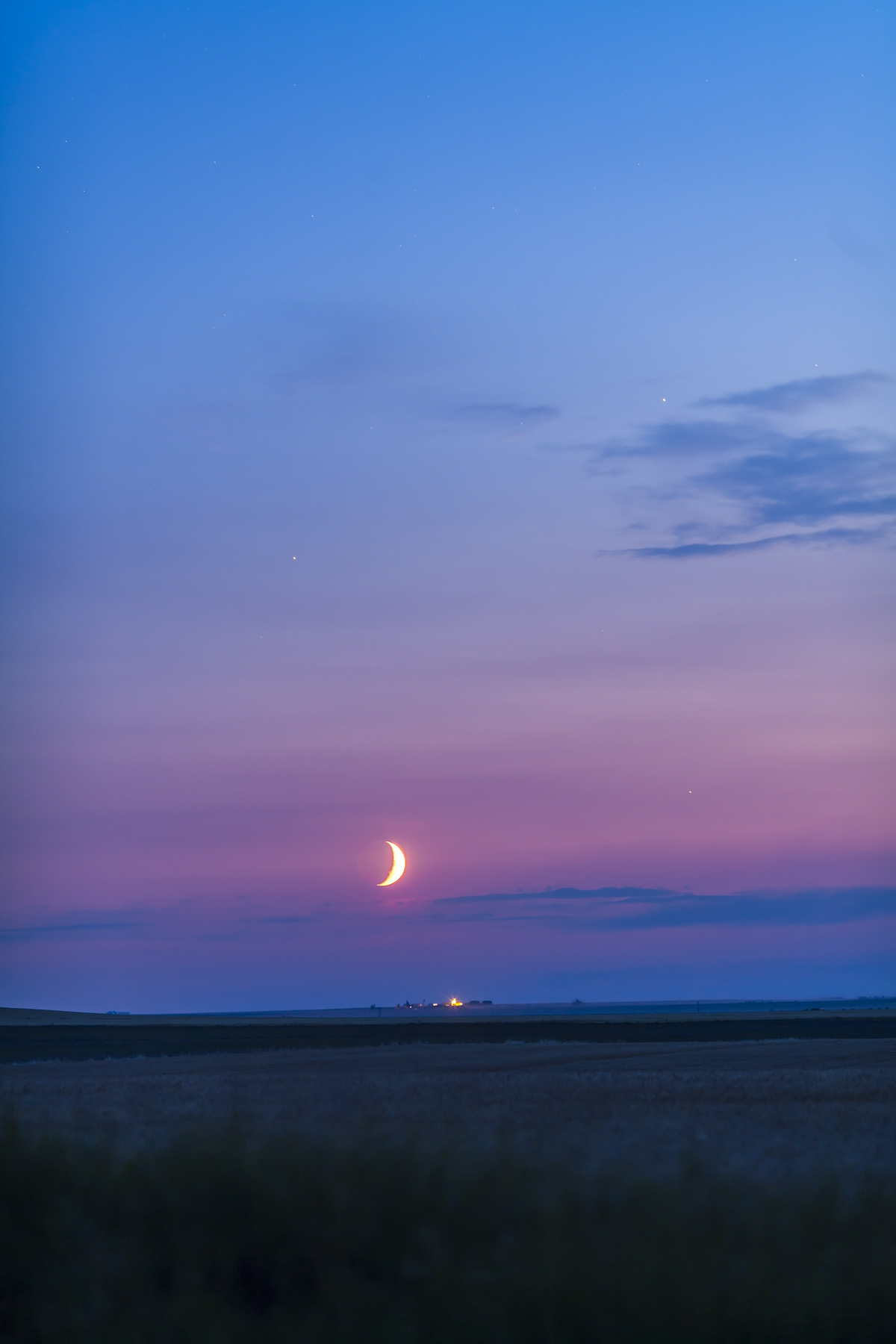
The evening planet show we’ve been enjoying all year comes to a close for a while, but in grand style with a convergence of four worlds in the dusk.
This was the scene from my front driveway, Tuesday, August 21, as the waxing crescent Moon shone near Mars (just above the Moon) and Saturn (at top right just above the clouds), and near the star Spica (to the right of the Moon). The four objects formed a somewhat lopsided square in the evening twilight. But from my latitude of 51° North, they were very low and never visible in a dark sky. Enjoying them with the eyes required binoculars to pick them out.
Saturn will disappear behind the Sun shortly, but Mars hangs around in the evening sky for a few more months, but always low and easy to miss.
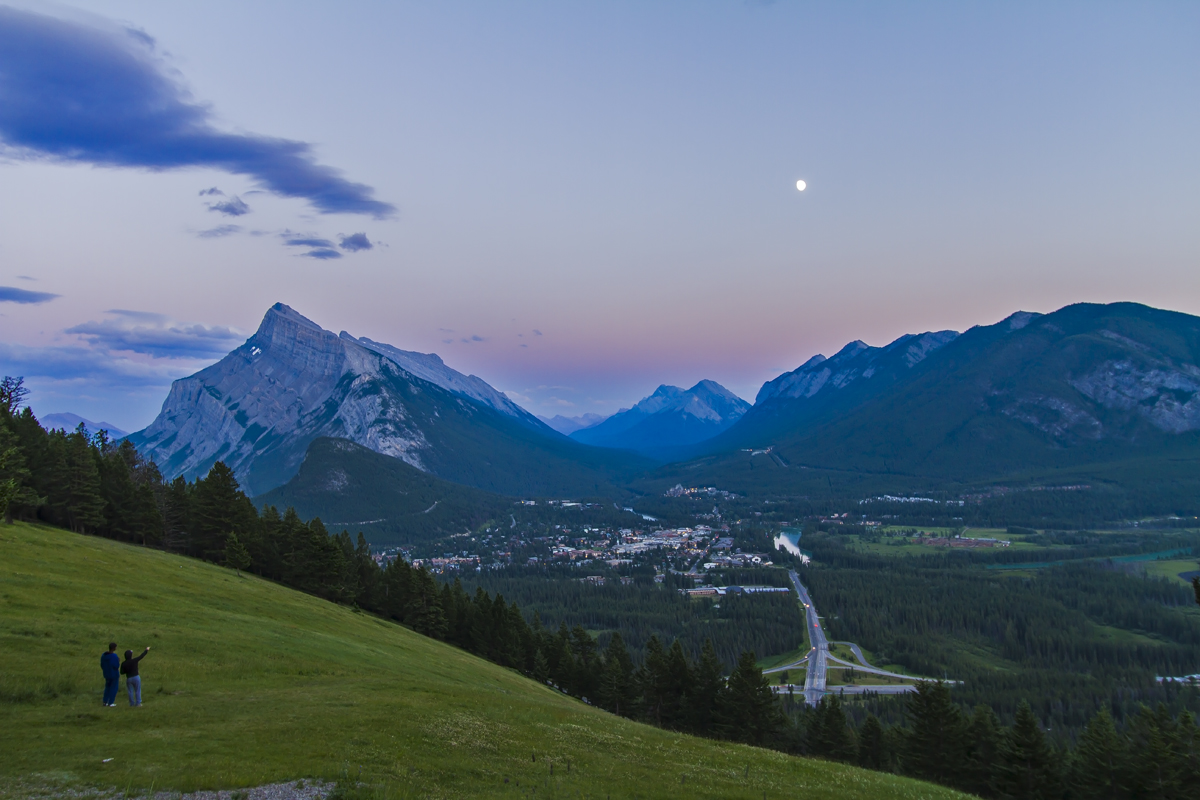
This was the scene Sunday evening, July 29 with the gibbous Moon shining over Banff, Alberta.
I shot this from the viewpoint on Mt. Norquay overlooking the town of Banff, a favourite evening spot for tourists. Two just happened to wander into the scene and point at the Moon right on cue.
The mountain at left is Mt. Rundle; at right is Sulphur Mountain with its Gondola lift and hot springs, the “spa” attraction that created Banff in the 1880s and inspired the CP Railroad to build its famous Banff Springs Hotel, here in the distance on the far side of the town and still the posh place to stay when in Banff.
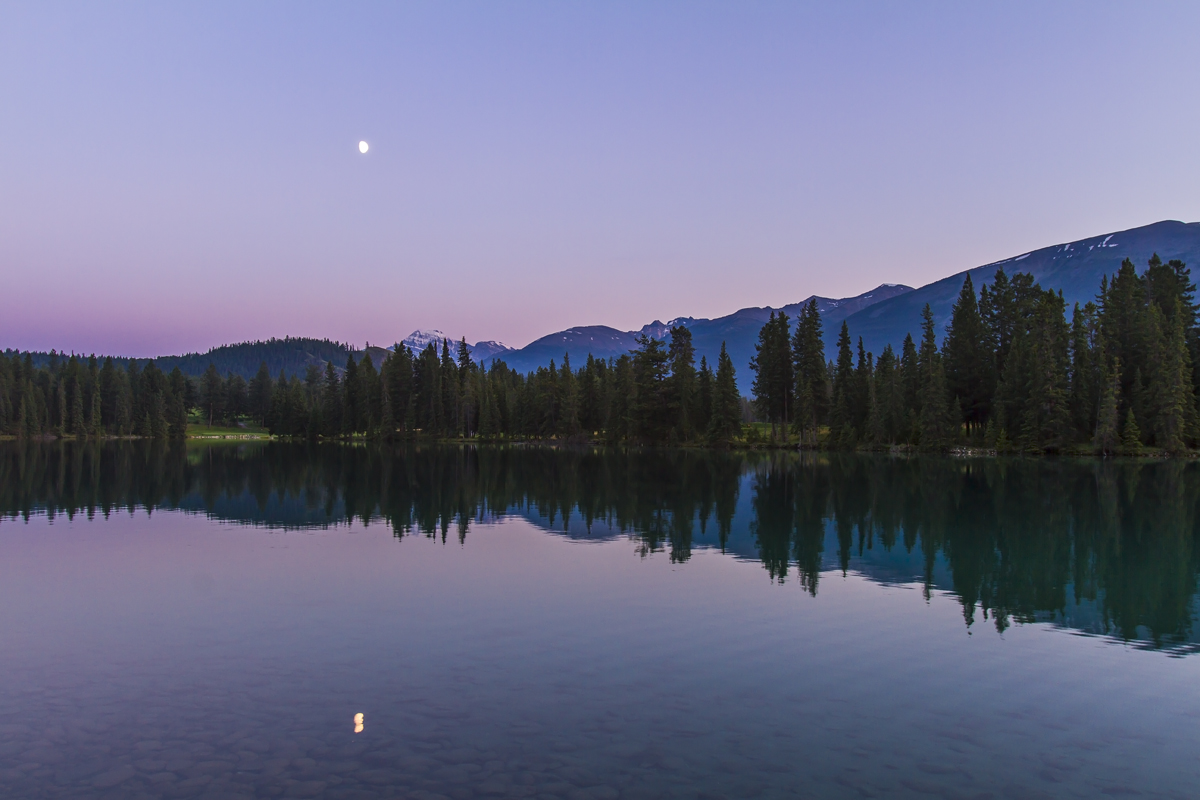
After a day of cloud and rain, skies cleared to provide a stunning twilight scene of the Moon reflected in the calm waters of Lac Beauvert in Jasper National Park.
This is the view from the dock at the prestigious and posh Jasper Park Lodge, where the rich and famous stay when in Jasper. I was there just to shoot the sky. In the distance is the distinctive snow-covered peak of Mount Edith Cavell, a Jasper landmark. Above it shines the waxing gibbous Moon in the twilight colours.
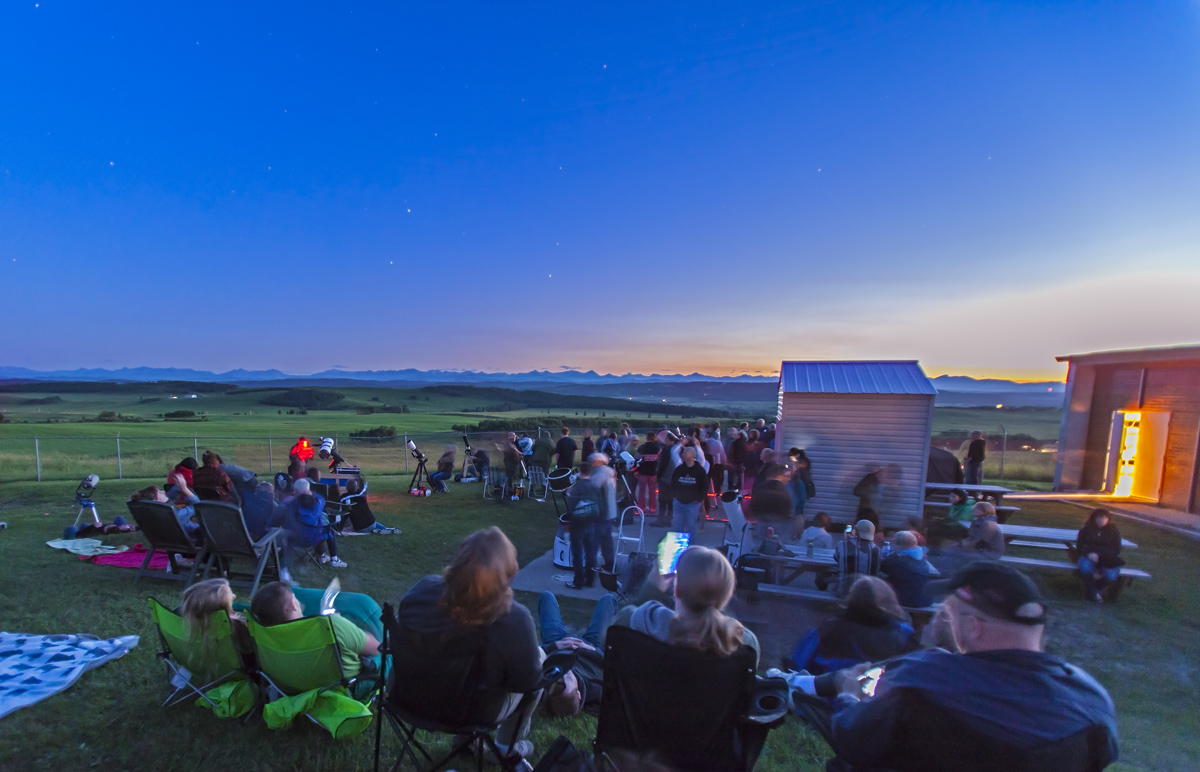
It was an ideal summer night for a public star party. Like it was a summer music festival, people set up lawn chairs and laid out blankets to sit and lie back and watch the show — the sky show.
This was the scene at Saturday’s Milky Way Night, July 21, at the local university’s Rothney Astrophysical Observatory. Several hundred people attended under ideal clear skies to watch the summer stars appear and revel in the Milky Way away from city lights. Here, people gaze westward after sunset to see the triangular gathering of Saturn, Mars and Spica in the evening twilight. Lots of mobile phones were held skyward as people used their new astronomy apps to identify what they were seeing. These apps are probably the most effective means now for people to get into astronomy. Lots of people were using them this night.
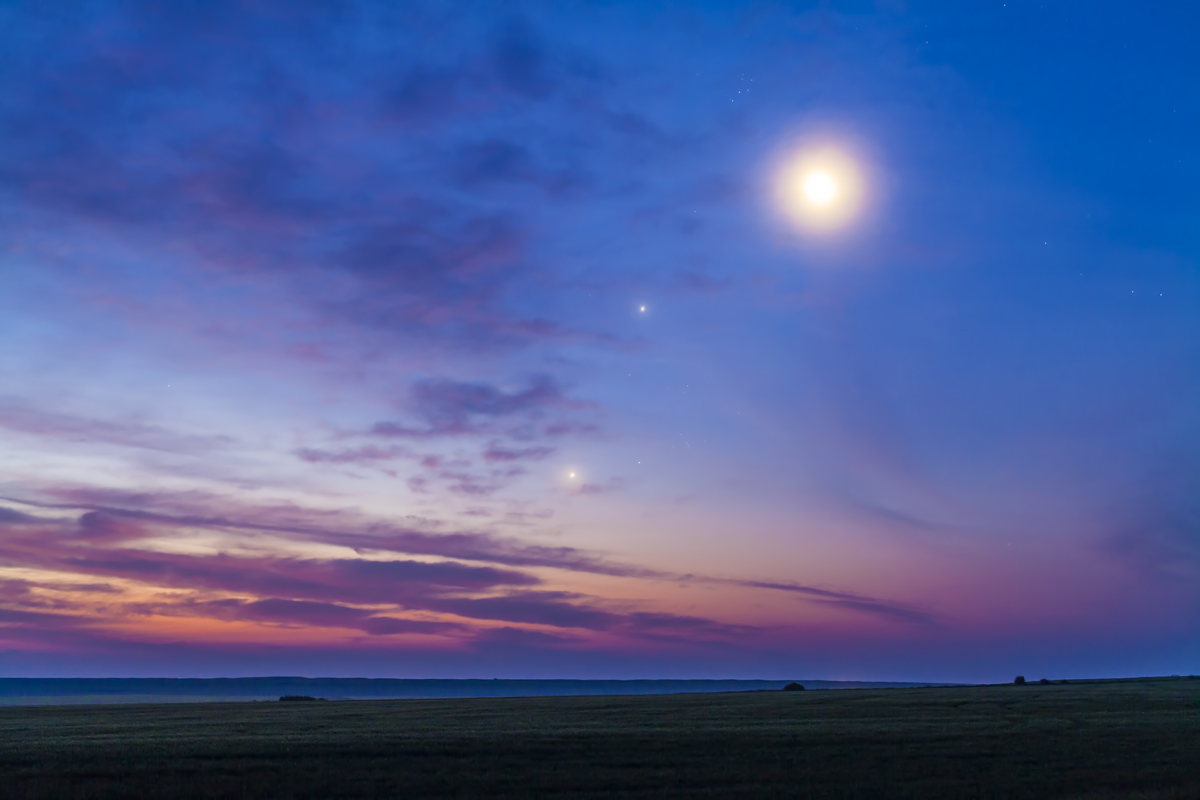
Venus and Jupiter are reprising their mutual meetings of earlier this spring, but now in the pre-dawn summer sky.
This was the scene at 4 a.m. from home on July 14, with the waning crescent Moon, here overexposed, above Jupiter and Venus at dawn. Next to Venus is the star Aldebaran and the stars of the Hyades star cluster in Taurus. Above the Moon is the Pleiades star cluster.
On July 15, the Moon will appear between Venus and Jupiter for one of the best conjunctions of 2012.
A wonderful sight tonight, as I caught Venus in its last days before the transit, shining as a glistening crescent low in the evening twilight.
Venus was visible to the unaided eye after sunset, but not for long. It set soon after the Sun. But for a short while it put on a beautiful show as a large crescent (large for a planet that is), easily resolvable in binoculars and stunning in a small telescope. One could almost make out, for brief moments, the sight of the backlit atmosphere going all the way around the disk. But I suspect it was more imagination at work than reality shining through.
The inset blows up the boxed area, to reveal the crescent-phased disk of Venus, despite this shot being taken with no more than a 200mm telephoto lens. I used a Canon 60Da camera at ISO 100. A plane is flying just below Venus.
So this was May 30, 6 days before the June 5 transit, with Venus 9.5° east of the Sun. How far up to the Sun can we catch it, before it crosses the Sun on Tuesday?
The winter sky contains a lot of bright stars but none so bright as Venus and Jupiter now in the west.
This wide-angle shot takes in the evening sky from the duo of planets in the west (right) to Sirius shining brightly in the south (left), with Orion in between. Above and to the right of Orion sit the two big naked eye star clusters of winter: the scattered Hyades and the compact Pleiades.
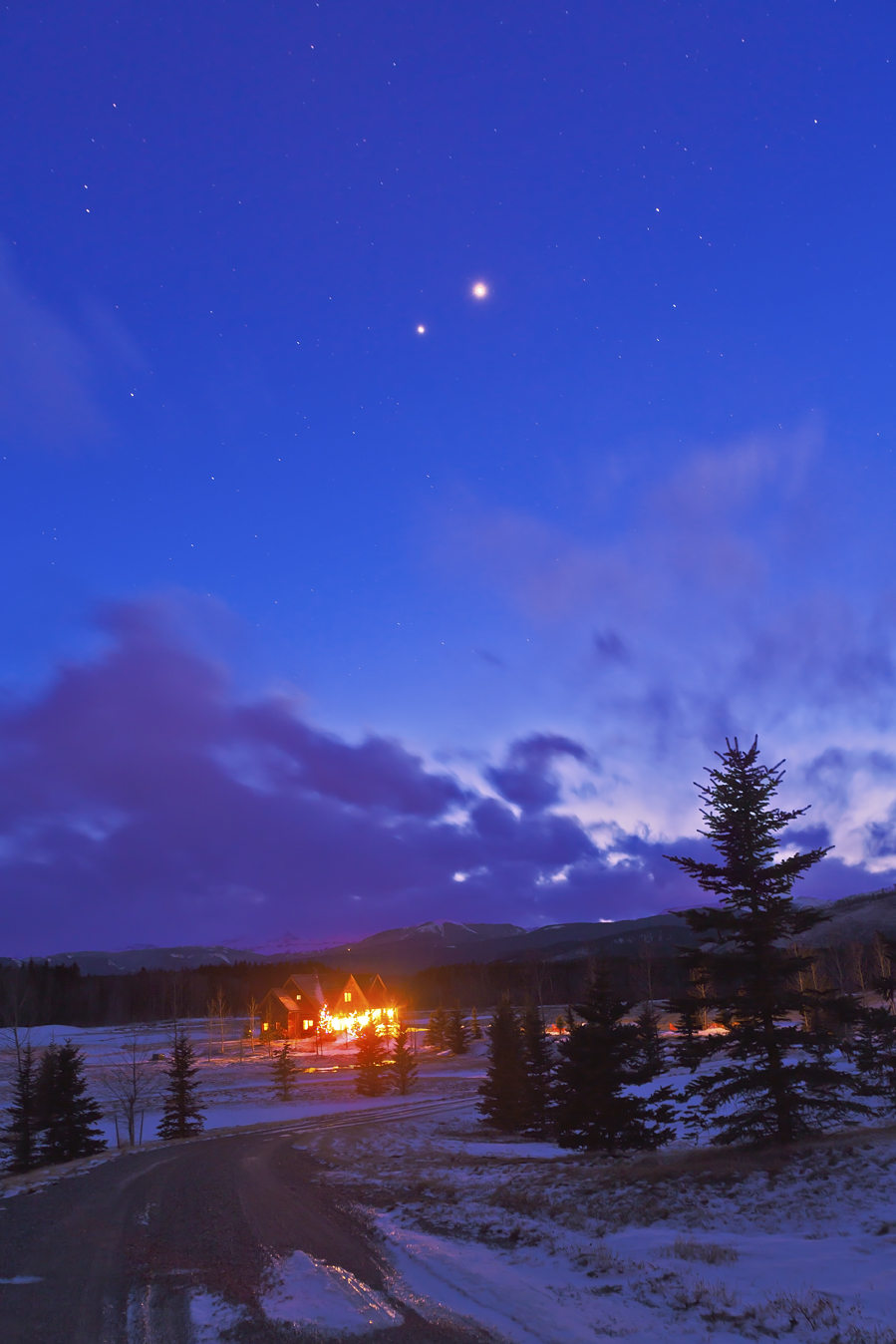
This was the picture-perfect scene last Tuesday night when I shot other frames of just the planets over the house in the foothills of the Rockies near Bragg Creek, Alberta. This is the wider scene, bathed in the deep blue of twilight.
In another in my series of Venus & Jupiter nightscapes, I present this scenic portrait of the planets over a picture-perfect house in the foothills.
This was Tuesday, March 13 with the two planets at closest conjunction. I drove out to a favourite spot of mine, just south of Bragg Creek southwest of Calgary. The clouds hanging over the Rockies parted well enough to reveal the planet pair in the deep twilight and add other colours to the sky.
It was a stunning scene, one I’m sure the residents of the house were completely unaware of. The lights give that away. Wonderful scenery can be appreciated by night and by day.
This was the scene Sunday night, March 11, as Venus edged up to Jupiter in the evening twilight.
To capture the nightscape I hunted around for a spot along the Bow River near home and settled for a site on the banks of the river at the point called Blackfoot Crossing, the traditional heart of the Siksika First Nation land. Here, the Bow River runs north-south for a stretch and the highway crosses the river heading west into the evening twilight, as if off into the sky to meet Venus and Jupiter in conjunction.
I waited until a passing car added the streak of tail lights, heading off into the sunset and starry sky. Nightscapes like this are often best taken when the sky is fairly dark but a longer exposure still brings out the remaining colours of twilight, as well as fainter stars, to make an image enhanced from what the eye might have seen.
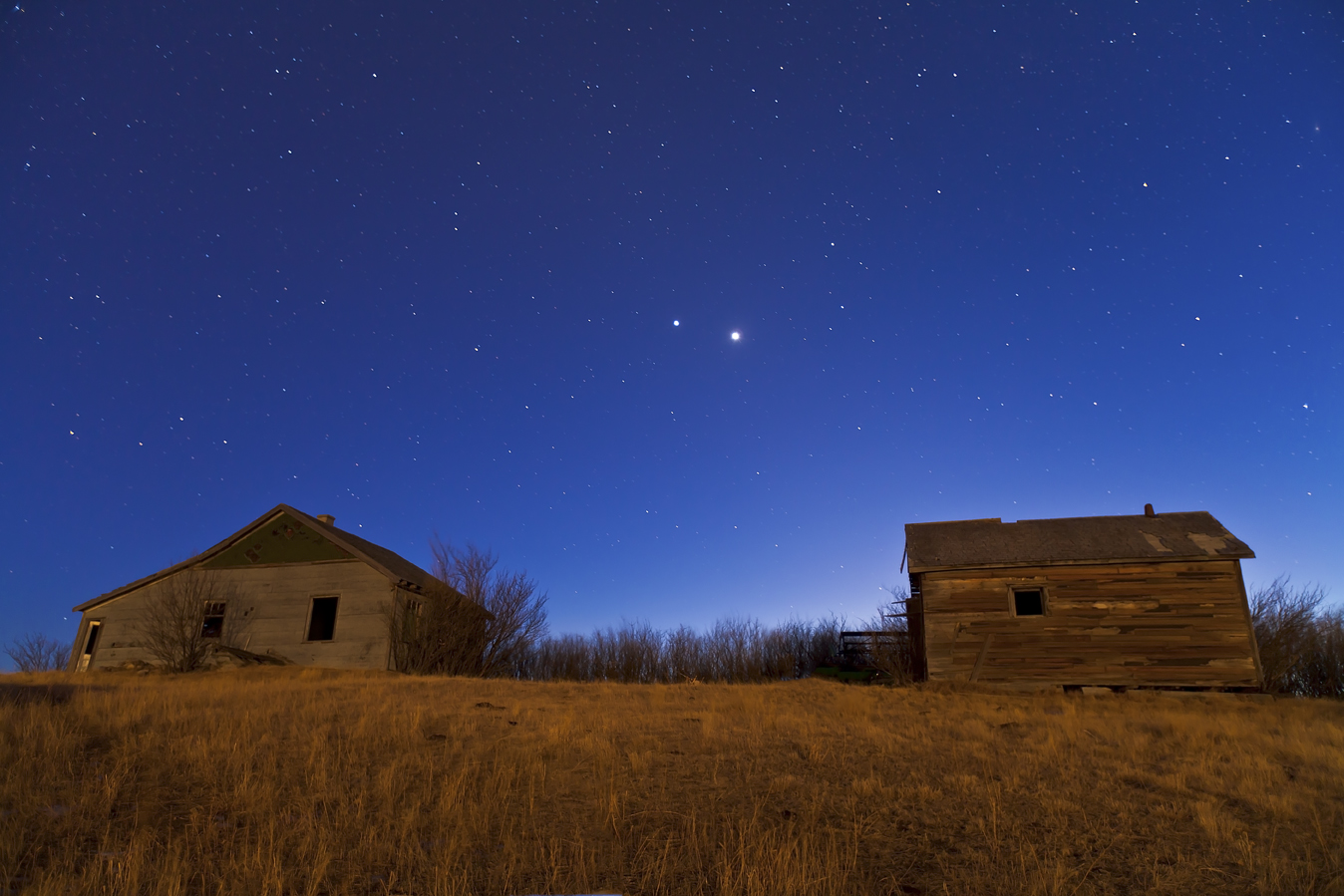
Venus and Jupiter are getting closer! To each other that is.
This was the scene Saturday night, March 10, two days before Venus (on the right here) and Jupiter reach their close conjunction in the evening twilight sky. I’m amazed how high the pair of objects are at sunset, with Venus much higher in the sky than it normally appears. We haven’t seen Venus as well as this since 2004.
This is a scenic prairie nightscape, with some ramshackle buildings from a 1940s vintage farmstead near my house serving as a foreground setting for the sky scene above. Headlights from a passing car provided some handy and warm illumination to contrast with the cold blue above.
Look west this week (the first week of March) and you’ll see three planets in a line across the evening sky.
Mercury is lowest in the sky, visible here just above the clouds on the western horizon. It’s bright but easy to miss. To find it, draw a line between Venus and Jupiter and extend the line down and to the right. This week Mercury is putting on its best evening appearance for the year for northern latitudes. You won’t see it higher or brighter than this in 2012.
Farther up the sky is Venus and Jupiter. They are standout objects. As they approach each other over the next week more and more people will suddenly pay attention to them and wonder what they are.
This was the view Sunday night, March 4. The next night a change in the weather brought heavy snow and a blizzard across the Prairies. But clear skies have returned, so enjoy the planets!
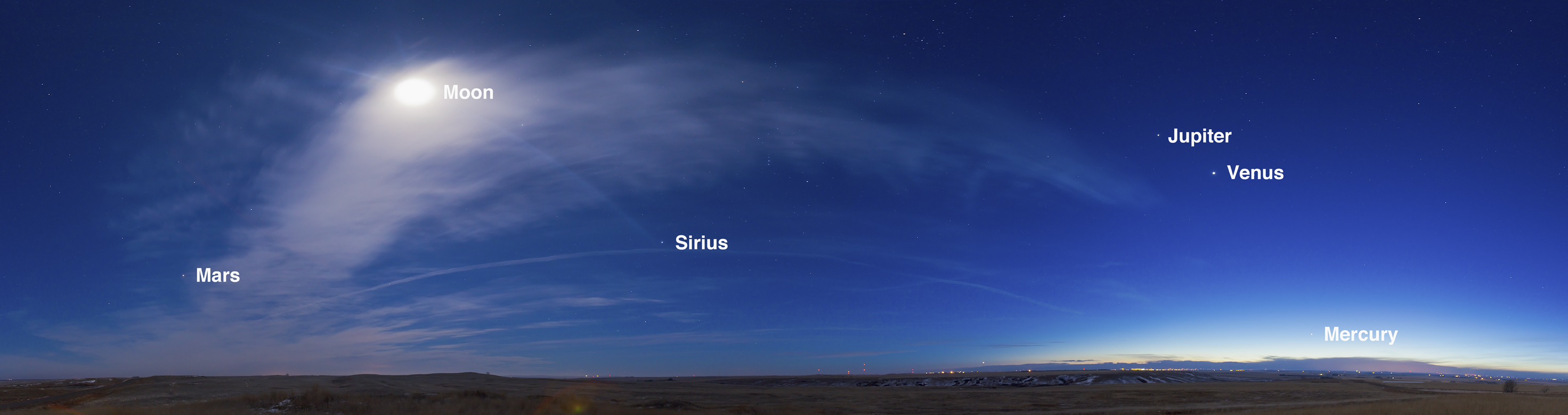
This was a beautiful night, with the array of five worlds stretched across the sky, a parade of planets and the Moon.
Mercury is now at its greatest angle away from the Sun and easiest to see in the evening sky this week for the year, at least from Canadian latitudes. Even so, it is low in the western twilight.
You can’t miss Venus and Jupiter higher in the west. Watch them close up and trade places in mid-March.
Mars is now at opposition, closest to Earth, and rising at sunset. It shines brightly as a red star in the east, 180° away from Mercury. It will be in our sky for several more months.
Orion shines due south amid the clouds. The arc of clouds rather nicely defines the arc of the ecliptic path across the sky, the path along which we always find the planets.
I took the shots for this panorama on Sunday, March 4. I took five segments, each 13 second exposures with a 16-35mm lens, then combined them in Photoshop CS5 with its Photomerge command.
Following up on my previous post, here is the wide-angle scene of that same winter moonrise, taken at sunset on January 8, 2012.
This was a spectacular and truly “amazing sky,” with the last rays of the setting Sun illuminating the clouds and the rising Full Moon coming up in the pinks and blues of twilight. It is the big prairie sky at its best.
The wide scene captures dark cloud shadows converging toward the point opposite the Sun, near where the Full Moon sits. These are “crepuscular rays,” a common sight at sunset or sunrise.
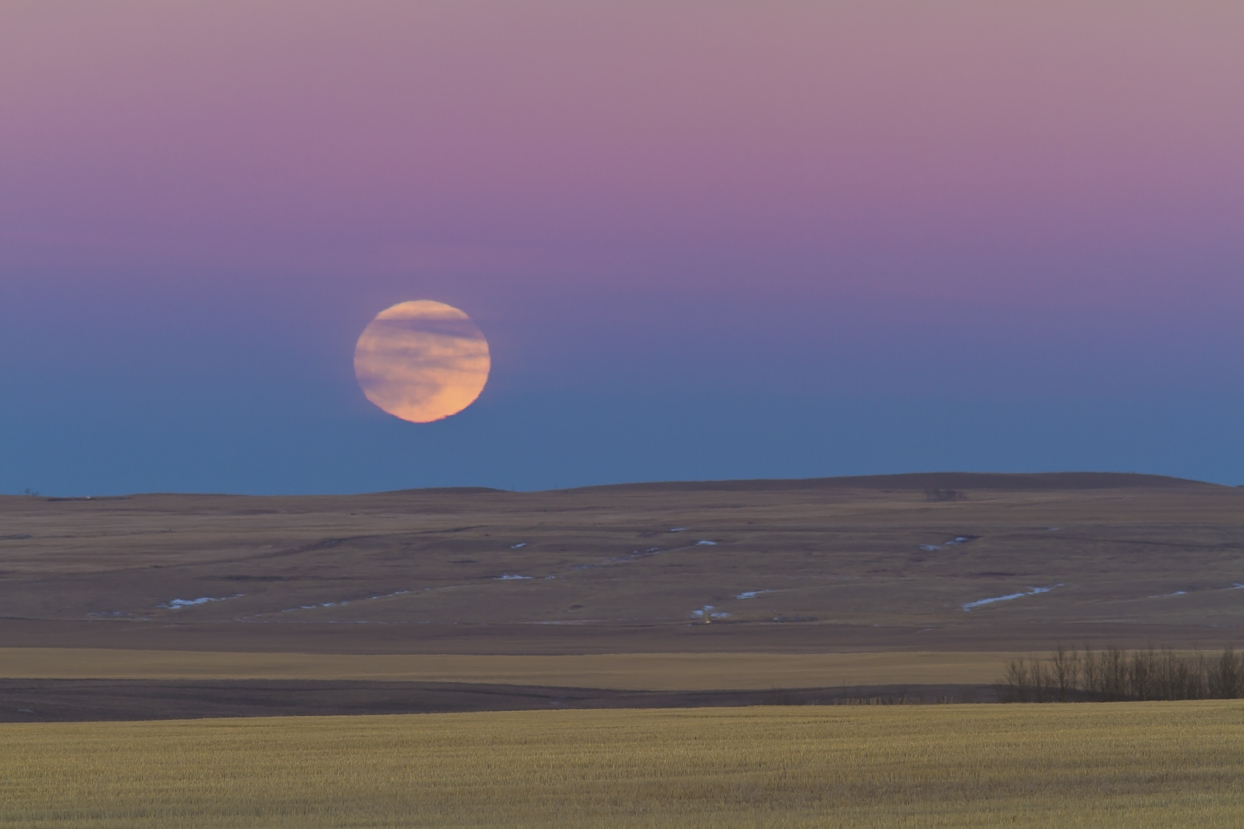
Here is the January 2012 Full Moon rising above a decidedly un-January landscape in southern Alberta. A recent spell of unseasonably mild weather has eaten most of the snow, leaving the fields yellow-brown, and a fine colour contrast with the twilight sky.
On January 8 the Full Moon rose into clear skies over the prairie landscape east of my home. This shot captures the pink glow of twilight on the upper atmosphere, above the rising blue rim of Earth’s shadow just on the horizon. A month ago, the Full Moon was in that shadow out in space, being eclipsed at sunrise. Here it is rising at sunset, one lunar cycle later.
I like the prairies, not only for the flat horizons and big open skies they provide, but also for the wonderful palette of colours on Earth and sky.
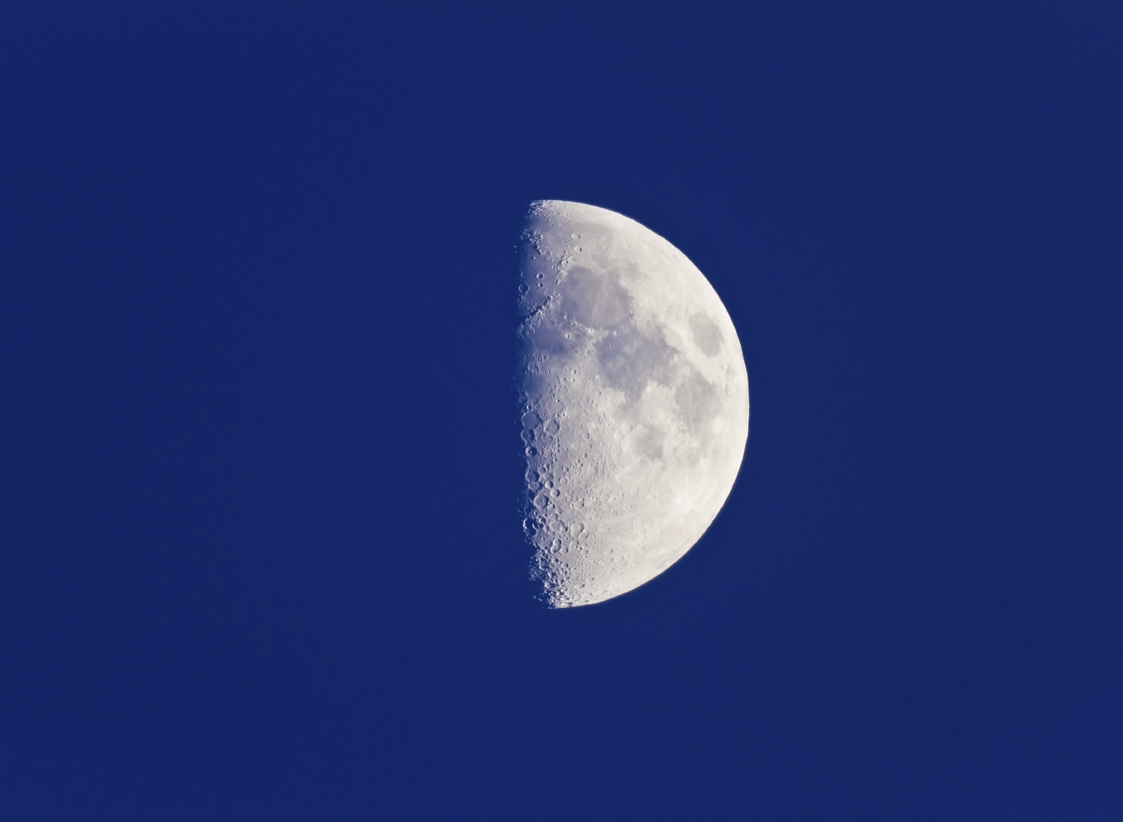
Happy New Year to all! To mark the first day of 2012 here is a view of the quarter Moon as it appeared in the early evening twilight on January 1, 2012.
The coming year promises to be a superb one for stargazing with:
• a wonderful evening appearance of Venus in March and April, including a rare passage through the Pleiades star cluster on April 3
• an array of 5 planets in the evening sky in March
• a partial eclipse of the Sun May 20 (annular if you travel to the SW United States)
• a partial eclipse of the Moon June 4 (at dawn for western North America)
• an amazingly rare transit of Venus on June 5 (North American time)
• a fine year for the Perseid meteors August 12/13
• a daytime occultation of Venus on August 13 (for North America)
• a total eclipse of the Sun from Australia and the South Pacific
• a host of fine Moon and planet conjunctions throughout the year
• and no doubt some fine displays of Northern Lights as the Sun picks up in activity toward its predicted 2013 maximum.
So there should be lots to shoot and blog about in 2012. In 2011, since I started this blog in February, my Amazing Sky blog has served up 103 posts and 14,000 image views, seen by people on 6 continents — I have yet to break into Antarctica! Perhaps in 2012.
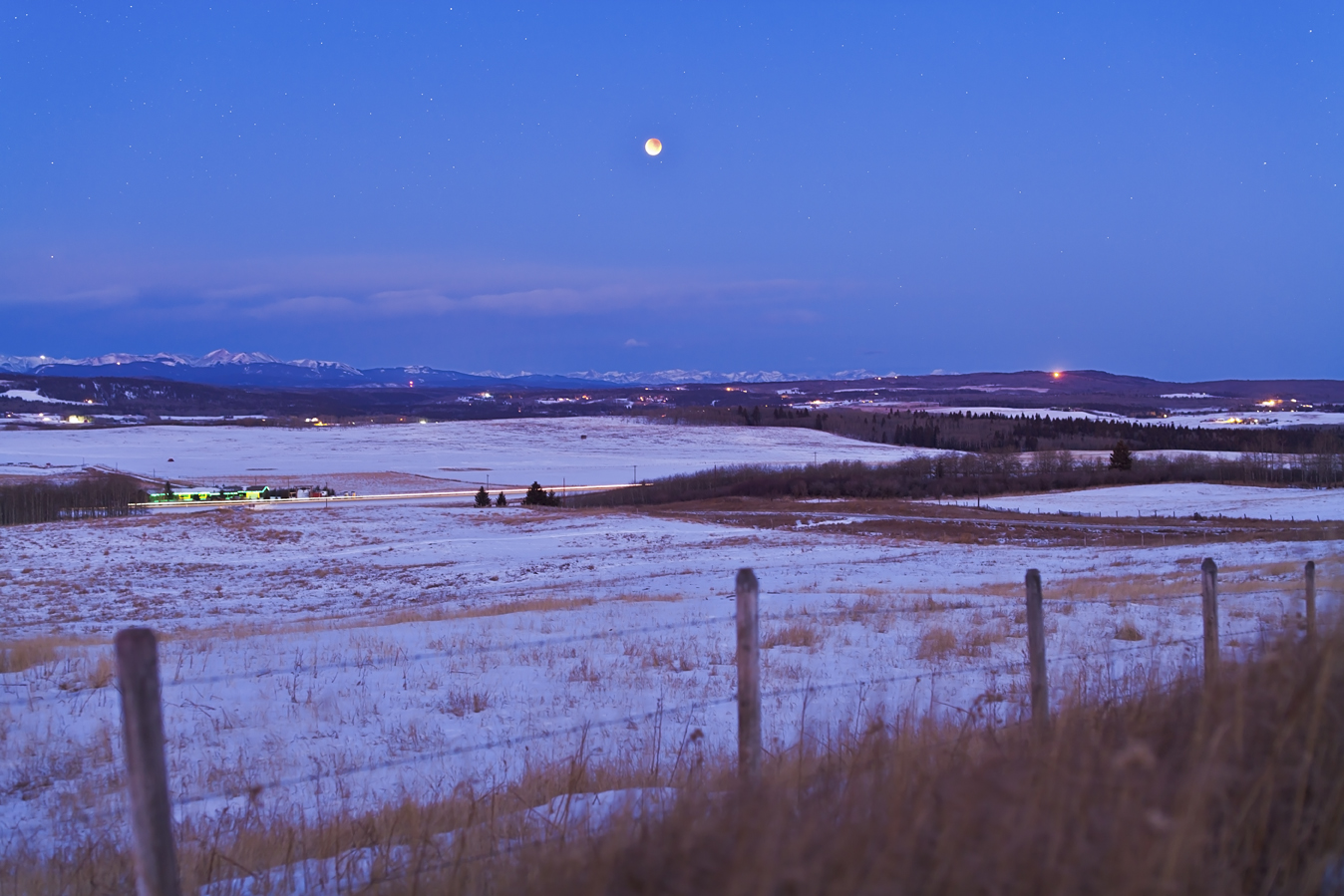
This was the view well into totality as the eclipsed Moon set into the morning twilight sky. On December 10 we got a fantastic view of the total lunar eclipse at dawn, with the red Moon over the Rockies.
I shot this from the grounds of the Rothney Observatory in the foothills southwest of Calgary. The Moon is completely in Earth’s shadow here but with its southern or bottom edge brighter than the top, so it overexposes here. This view captures the scene as the eye saw it, at about 7:30 a.m. local time, an hour before sunrise and moonset.
A full house of 100 people showed up at the Observatory for a public event and breakfast. I dare say they got the best view of this eclipse of anyone in Canada.
I’m getting the hang of shooting demanding day-to-night time-lapse movies!
For this clip I shot over 2.5 hours, using a fish-eye lens, to create a sequence suitable for projection in a digital planetarium dome.
But the trick with these day-to-night sequences is getting a smooth transition in exposures, which can range over 12 to 16 f-stops, from short snapshot exposures with the lens stopped all the way down at the start before sunset, to long 8-second exposures with the lens wide open at night, plus the camera’s ISO speed increasing from a slow ISO 100 to a faster ISO 400 or more at select points through the sequence as well.
The secret to doing this is a control box called theLittle Bramper, an intervalometer that fires the shutter automatically at set intervals but also gradually ramps the exposure time a tad longer with each successive exposure. This was my third time out with the Bramper, and I more or less got it right this time!
While the Bramper does a great job running the camera, it still takes a lot of manual oversight to control its ramping rate so the exposures don’t get too long and overexpose the scene, or fail to get long enough to track the darkening sky.
At several points in the sequence it is also necessary to quickly (in one exposure cycle) half the exposure time, while at the same time opening up the lens a stop, or doubling the ISO, so that the ever-lengthening exposure doesn’t get too long and collide with the interval between exposures. In this case, shots were taken about 12 seconds apart, so the maximum exposure for each frame couldn’t be much more than 8 to 10 seconds.
The end result of the work is a time-lapse movie that shows the setting Sun, then the lights of Calgary coming on as the sky darkens. Clouds lit by the yellow glow of streetlights move in, then blow away again to reveal a few stars in the urban sky.
This is the kind of sky that makes astronomers smile. Clear and painted with twilight colours.
This was the scene two weekends ago, on August 26, at the annual Starfest star party in southern Ontario. Starfest is Canada’s biggest annual astronomy gathering and this year attracted about 700 people, filling the campground with tents, trailers and telescopes.
I was fortunate enough to be able attend this year, as one of the guest speakers in a pretty full program of afternoon and evening talks. I presented two talks, on the “Great Southern Sky” and on “Ten Tips for Better Pix,” plus presented a laser tour of “my sky” after dark on the Friday.
Starfest, as with other star parties I’ve been to lately, hasn’t fared well for weather in the last few years, but this year the clouds (mostly!) stayed away and people enjoyed a fabulous weekend under the Milky Way and summer stars.
This is a roughly 180° panorama taken at twilight, showing the rising dark blue arc of Earth’s shadow at left, with a strangely bright glow in the atmosphere above it. At right is the glow of sunset and some crepuscular rays (shadows from distant clouds) visible as bright and dark bands across the sky.
Starfest is a great star party. Anyone in eastern Canada interested in astronomy should make a point of attending. Next year’s event is August 16-19, 2012.
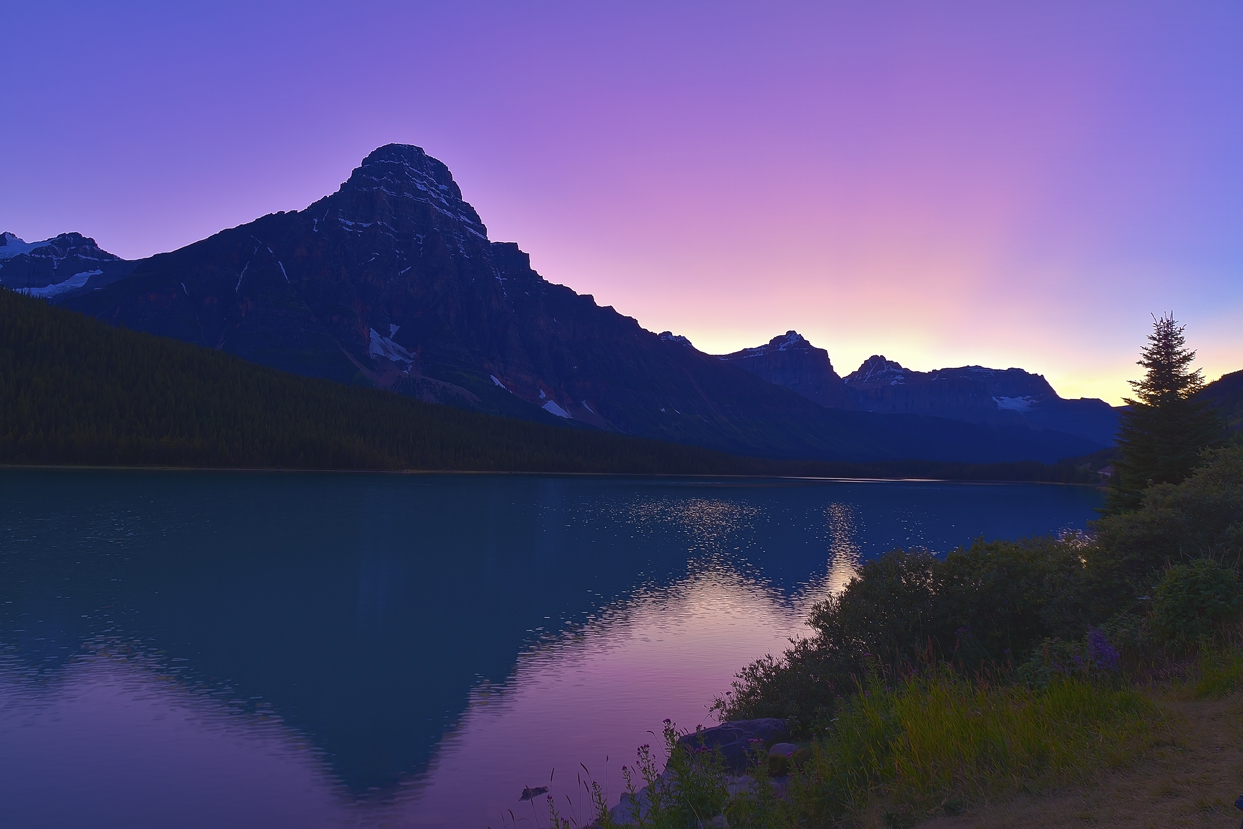
About half an hour after I took the previous blog entry image, I was here on Sunday evening, farther down the Icefields Parkway, at the shore of Lower Waterfowl Lake. The peak is Mt. Cephren.
The Sun had set and the sky was now filled with the purple glow of twilight marking the beginning of an exceptionally clear night.
Capturing this scene as the eye saw it took a stack of 7 different exposures, combined in what is known as a High Dynamic Range image, that blends the shadows details in the foreground without losing the subtle tints of the bright sky.
One of the trickiest subjects for a time-lapse sequence is a smooth and seamless day-to-night transition. Exposure times vary from fractions of a second before sunset to several seconds at night fall.
How to do it? Manually shifting exposures is too much work and prone to error. Putting the camera on Automatic can work but inevitably results in an effect known in the time-lapse world as “flickering.” The camera’s automatically-judged exposures aren’t consistent from frame to frame so the final movie shows minor bright/dark flickering, making it look jerky.
For this test sequence of sunset over the Calgary skyline, I tried a new toy for the first time, as a solution.
The device is called the Little Bramper (for Bulb Ramping). It is a custom-made intervalometer that fires the camera shutter every few seconds (at whatever interval you desire). Nothing new there. But what’s unique is that it can be set to slowly increment the exposure time by as little as 1/1000th of a second from frame to frame, gradually increasing the exposure (“ramping” it) to accommodate the darkening scene. The result is a smooth transition from day to night with no flickering.
This was my first use of the Bramper and it wasn’t without its glitches. The shortest exposure the Bramper can provide (it always controls the camera thru its Bulb setting) is about 1/10th of a second (I had no idea camera shutters can fire as quickly as that even on Bulb).
But at the beginning of a sequence like this, with a bright sky, achieving that exposure (still quite long) means using a small f-stop, a slow ISO speed, or a neutral density filter, or all of the above. But as the sky darkens and exposures lengthen, exposures would become too long to fit within the desired interval between frames (typically no more than 5 to 10 seconds for a smooth sequence). So, to shorten the exposures you then have to open up the lens, switch to a faster ISO, or remove the ND filter, while also commanding the Bramper to quickly reduce its exposure time, all in one exposure cycle (i.e. 5 to 10 seconds) so as not to lose or ruin frames. Takes some coordination and practice (hit the Bramper’s button, adjust the camera, all within 5 seconds), and I didn’t get it right the first couple of times.
But overall, for a first test, the sequence turned out very well. The $80 Little Bramper does the job, though it does take careful monitoring through the sequence, not just to perform the exposure swaps, but to also watch that the ramping rate (adjustable on the fly) matches what the scene is doing and you aren’t under- or over-exposing. It’ll take a little more practice, but the results certainly are worth it.
I’ve been chasing the Moon this week. I caught up with it last Thursday night, August 4, in Banff, with the waxing crescent Moon low in the southwest at dusk.
The location is the upper Vermilion Lake just outside the Banff townsite. The golden reflection of the low Moon on the water, the slope of the mountainside and its reflection, the dock and steps, and the tail lights from a vehicle on Highway 1 just up the hill (I decided to leave them in!) make for what I think is an interesting composition of converging lines.
I got set up and in position just in time to catch the scene at the magic hour of twilight, when the sky is dark enough the show deep colours and the Moon’s entire disk shows up, but before the sky gets too dark and the Moon too bright to make an interesting scene.
Even so, the contrast in such a scene is still very high. So to capture it more as your eye would have seen it I used a stack of five exposures, taken in rapid succession, each 2/3rds of an f-stop apart. I then merged the frames with Photoshop’s High Dynamic Range routine to create a scene that brings out detail in the foreground without overexposing the Moon and sky.
A technical method to capture a simple scene of serenity in the mountains.
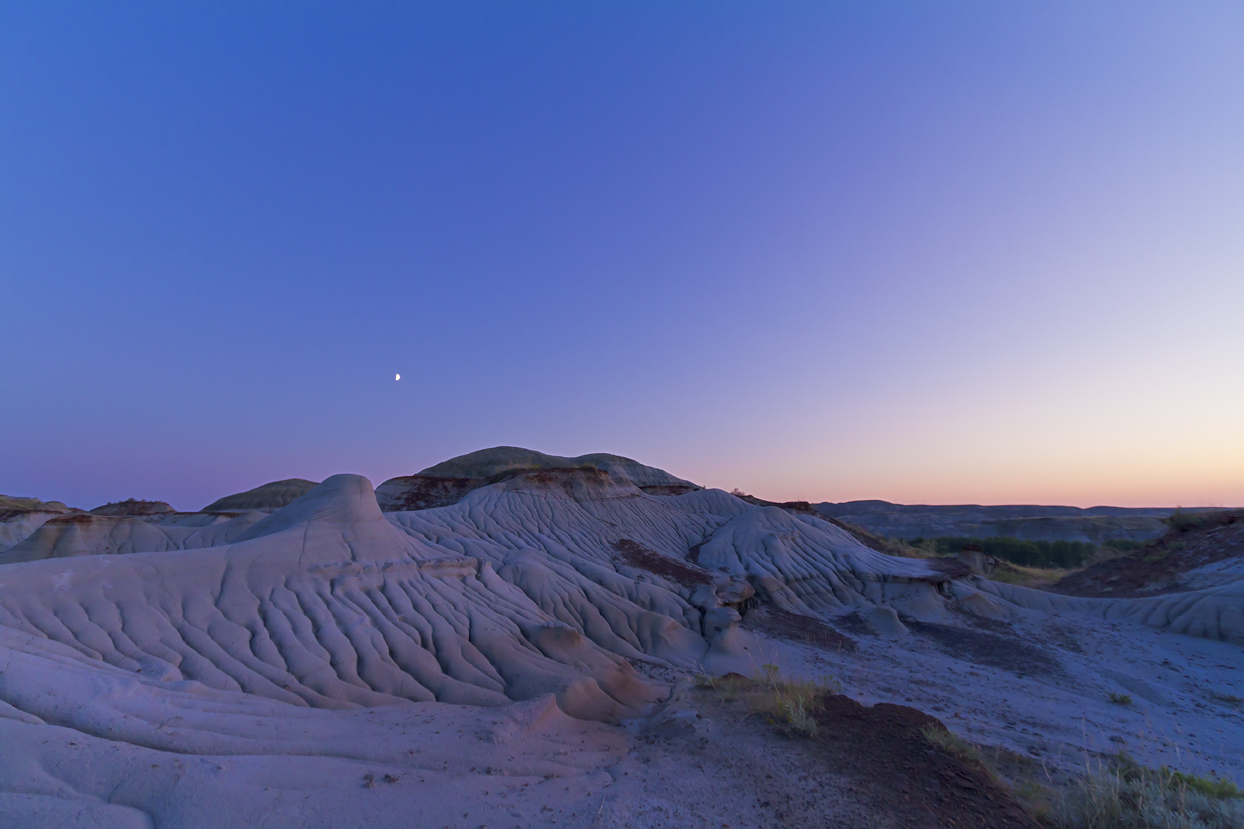
As all the other sunset photographers were packing up for the night, I was just getting started. This is the scene last night, with the waxing Moon hanging over the moonscape of Dinosaur Provincial Park in southern Alberta.
I took this in deep twilight, when the sky is tinted with subtle colours complementing the earth tones of the landscape below.
Dinosaur Park is the world’s best repository of late Cretaceous fossils, being unearthed as the terrain made of ancient volcanic ash erodes away with every rainstorm. Though the formations date from the Cretaceous some 70 million years ago when this area of Alberta was a bayou-like swamp, the badlands landscape we see today was created at the end of the last ice age when glacial floods poured over the landscape, carving the channels occupied by rivers today, like the Red Deer River that flows through Dinosaur Park.
It’s a favourite spot of mine, just an hour east of where I live, to shoot sunsets and moonrises, and twilight landscapes like this one.
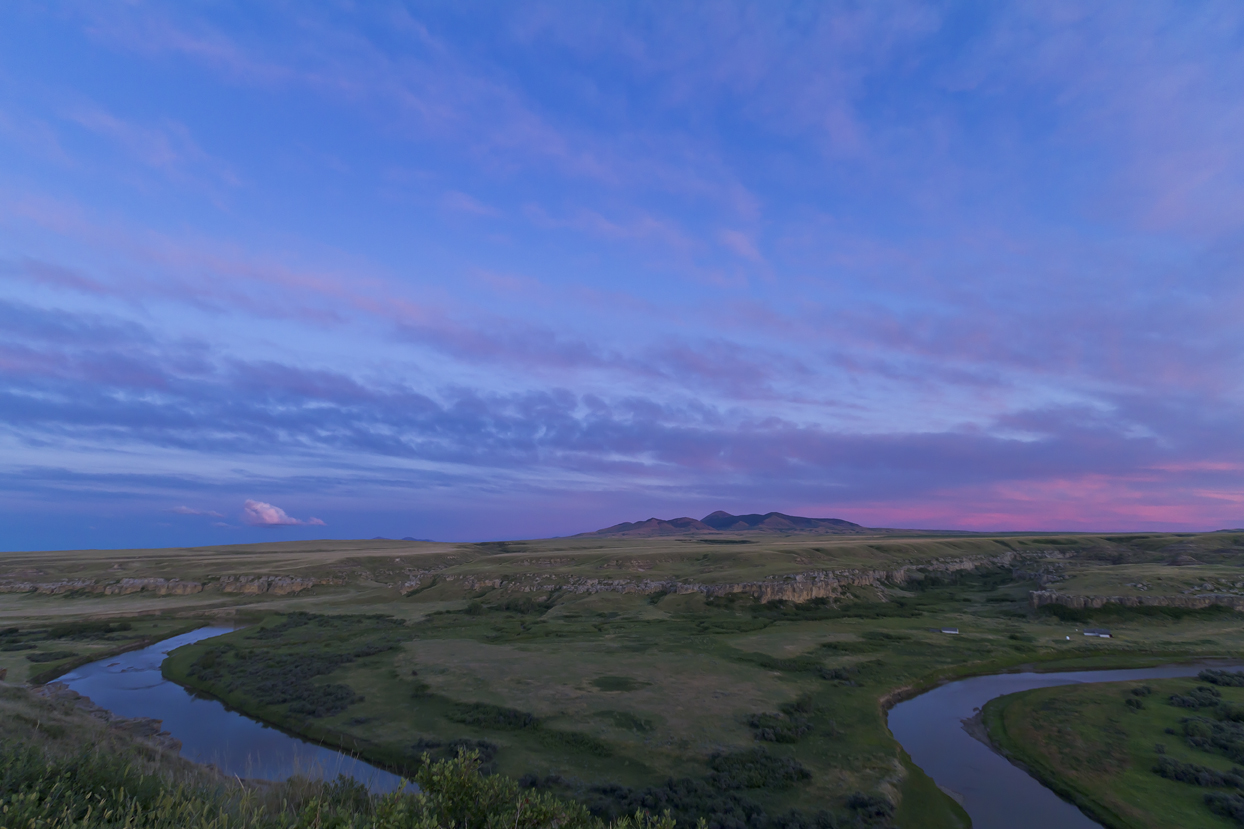
This is one of the great places for evoking the wide open spaces of the high plains. Here we are looking south over the Milk River and the rock formations of Writing-on-Stone Provincial Park in Alberta to the peaks of the Sweetgrass Hills in Montana. The buildings at right are the modern reconstructions of the late 1800’s North West Mounted Police outpost that guarded Canada from the illegals from the U.S. (!) coming up Police Coulee smuggling whiskey from Montana into Canada.
The time is just after sunset, as the last light of the Sun still illuminates the clouds. This is the magic hour for photography, and for taking in the solitude of the “Great Lone Land” as author William Francis Butler described it in his book of that title in 1872.
As Butler wrote, “No ocean of water in the world can vie with its gorgeous sunsets; no solitude can equal the loneliness of a night-shadowed prairie…”
Some sky scenes are worth getting up early for. This was the dawn sky this morning, July 25, at about 4:20 a.m., looking east to the rising crescent Moon, which this morning appeared near the Pleiades star cluster. You can see it just above the overexposed Moon.
The waning Moon also sits between two planets now in the pre-dawn sky: Jupiter, the bright object at upper right, and Mars, about the same distance away from the Moon but to the lower left. Mars, the Moon and Jupiter form a diagonal line across the dawn sky that defines the dawn ecliptic. Also in the scene is the V-shaped Hyades star cluster, and the bright star Aldebaran, just below the Moon.
This was a 5-second exposure with the Canon 24mm lens at f/3.5 and Canon 5D MkII camera at ISO 800.
Clouds aren’t usually the astronomer’s friend, but at this time of year they become the objects of our attention. For the past few nights, my Alberta prairie skies have been beautifully clear and filled with the clouds of solstice.
Last night, July 6, began at twilight with the best display of noctilucent clouds so far this season — and we’re now at peak season for this northern sky phenomenon. This was the scene at about 11:30 pm local time, with the wispy high-altitude clouds at their most extensive and fully lit by sunlight. Over the next hour or so, as the Sun set further below the horizon, the display disappeared as darkness came to the high atmosphere and the Sun no longer illuminated these clouds suspended over the Arctic. Here’s a diagram of the geometry of how they get lit up. If you are curious to learn more, check this NASA page.
I took a time-lapse movie of the fall of darkness on the clouds, which you can view here at my SmugMug gallery at AmazingSky.ca. The video shows how the clouds begin the night fully illuminated by the Sun but over the hour duration of the video they disappear from top to bottom. You can see a curtain of darkness moving down the clouds, caused by the Sun dropping farther below the horizon. As it does so its illumination seems to drop toward the horizon as night falls, leaving only clouds closest to the horizon (and farthest north) still illuminated. The video also shows that the edge of the illumination appears reddish — that’s because clouds on the edge of the descending dark shadow are being lit only by a low red Sun setting below the limb of the Earth. Pretty neat, and something I’ve not seen before in any image or movie. (The movie is HD quality and will take a while to load, sorry!)
However, tonight normal, everyday weather clouds moves in, curtailing any late night NLC watch. Tomorrow, I head to the Rockies to do some time-lapse nightscape shooting in the mountains. Yes, I know I’ll miss seeing Duke and Duchess Will and Kate start off the Calgary Stampede Parade. Royalty will just have to get on without me.
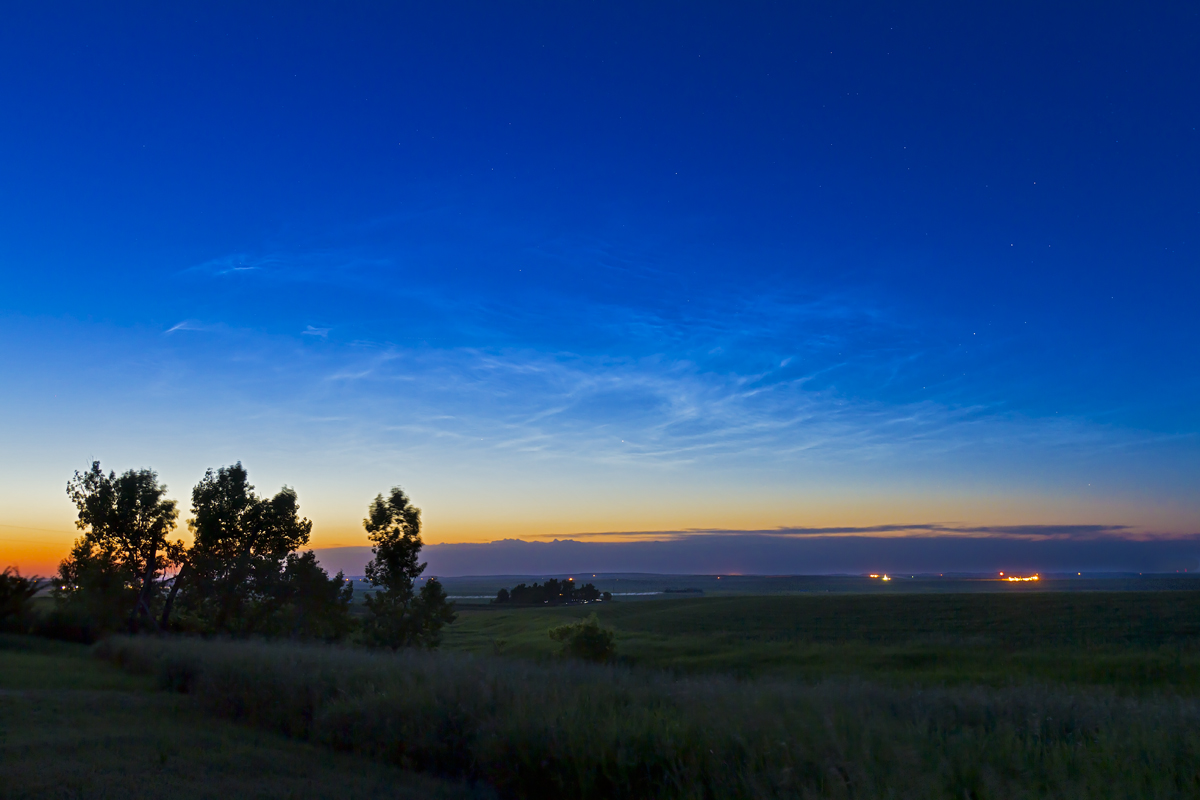
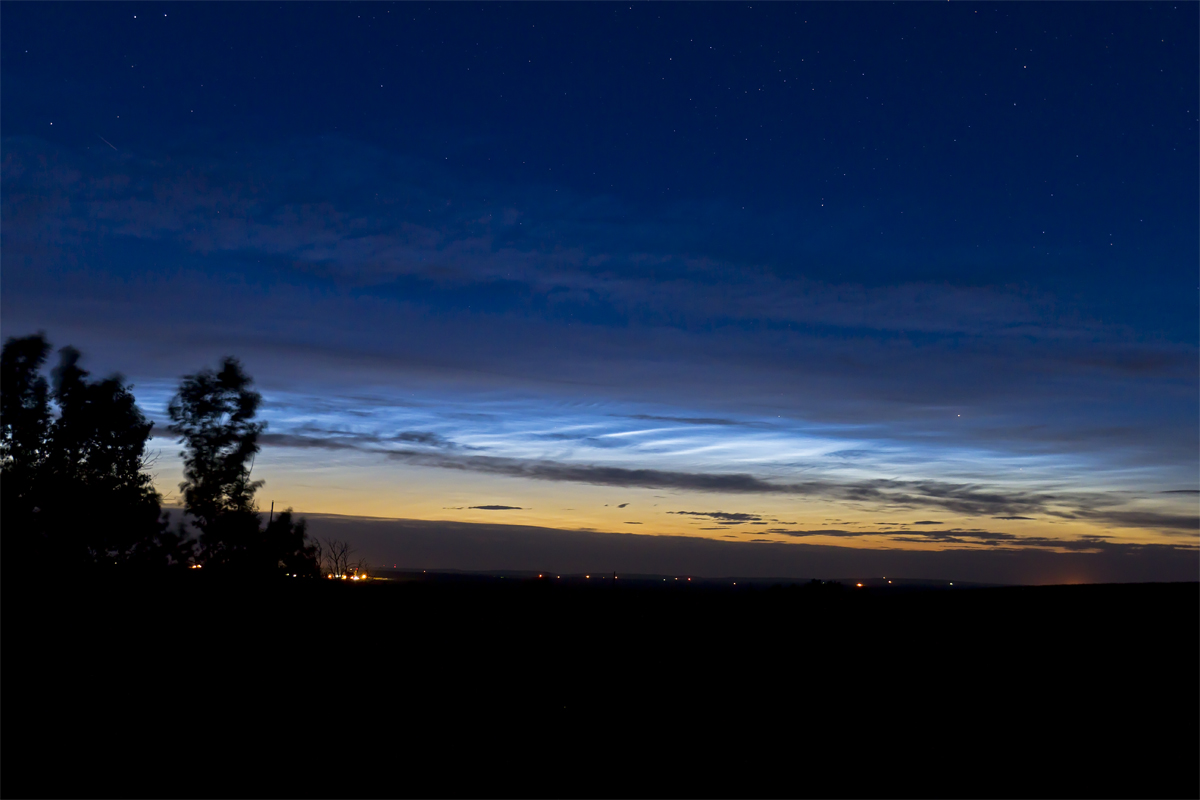
The glowing clouds of solstice have appeared. This was my first sighting of “noctilucent clouds” for the season.
Every northern summer in late June and early July we are often treated to bright pearly clouds glowing along the northern horizon long after sunset. Their origin remains somewhat of a mystery. These clouds form almost at the edge of space, so high there shouldn’t be much for clouds to form around. But their height is what makes them visible, as they catch sunlight streaming over the pole even in the middle of the night.
I took this shot Tuesday, June 28 just before midnight. The noctilucent clouds are the blue-white wavy bands just above the orange twilight. In front of them lie dark normal clouds low in our troposphere. But the NLCs shine from an altitude of some 80 km, well into the mesosphere. They are located over the Northwest Territories but, like aurora, their height allows us to see them even from more southerly latitudes.
The bright star Capella, circumpolar from my latitude of 51° North, shines through the clouds at right.
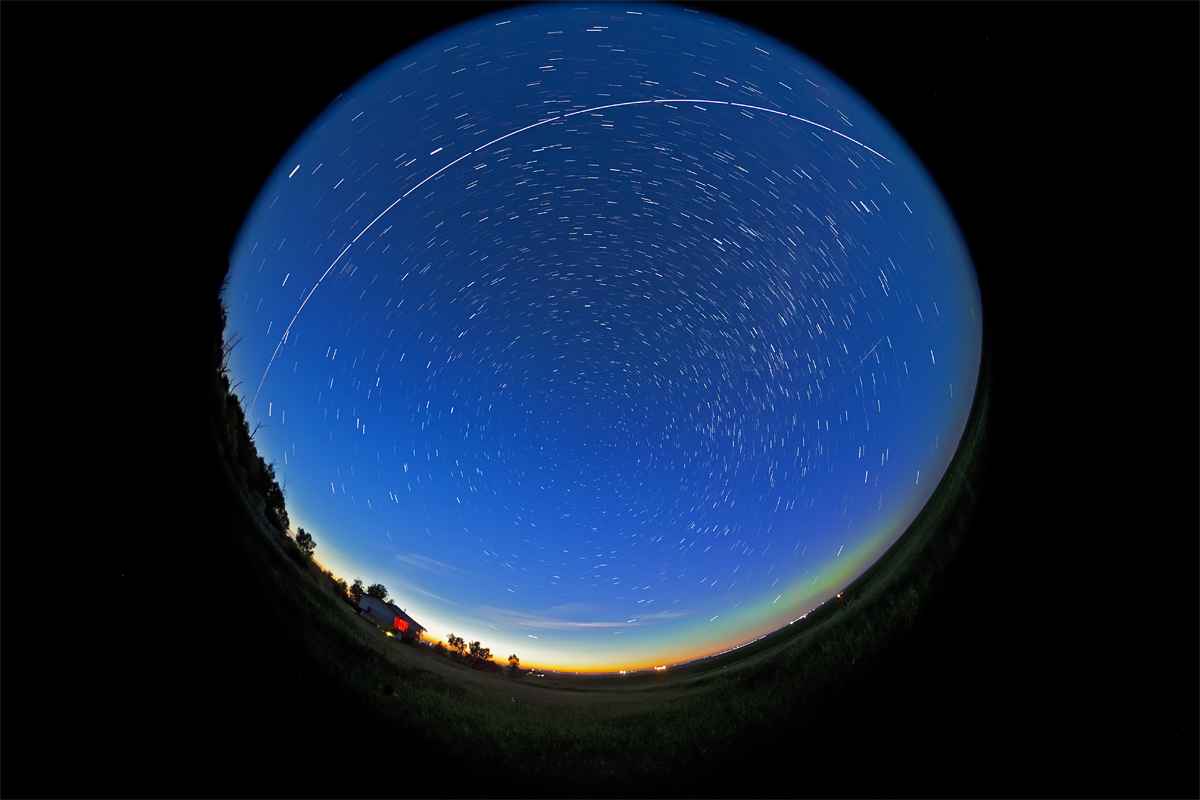
Here’s a capture of the Space Station, coming over in a darker, clearer sky than last night’s shot (in the previous blog). This was June 22, 2011, a fine solstice night on the Canadian Prairies.
The time was just before midnight, with no Moon. Yet the sky is blue and the northern horizon tinged with the orange glow of twilight. It never gets truly dark now, as summer begins. To the right, on the northeast horizon, a low green aurora kicks up.
The Space Station, the dashed arc at top, tonight passed from west to southeast, across the southern sky at the top of this fisheye 360° frame.
This is a stack of 28 18-second exposures at f/4 and ISO 1600 with the Canon 5D MkII and Sigma 8mm lens.
This was the scene we were treated to each evening at the Atacama Lodge in Chile. Quite an amazing skyline, with 5,900-metre-high Licancabur Volcano, here at sunset.
The sky colour comes from a phenomenon known as the Belt of Venus, a magenta/pinkish glow from sunlight lighting up the upper atmosphere after the Sun has set for us on the ground. The dark blue rimming the horizon is the rising shadow of the Earth.
I have punched up the colour saturation here to bring out the colours, but not so much as to be faked — the colours are real!
This is a shot with the 50mm lens and Canon 7D camera, taken on one of the nights we had dinner back at the lodge, in this case with a group of Québec amateur astronomers also here this week who were great observing friends on the field.
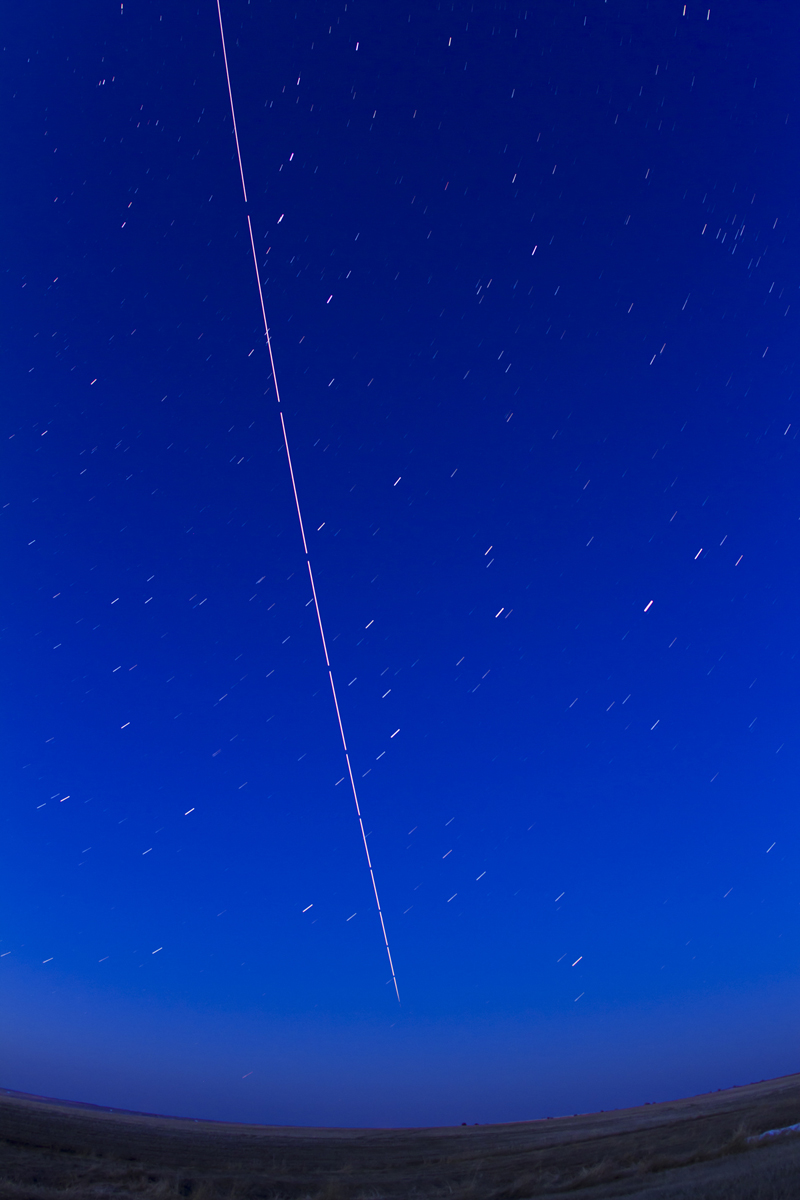
What a picture perfect pass this was, on Easter Sunday evening, April 24, 2011. The International Space Station (ISS) rose out of the west right on time, passed almost directly overhead, the flew off to the east, fading out just as it approached the horizon. The sky was a deep blue in the late twilight, with the spring stars beginning to appear. As it usually does, the Space Station outshone them all, including Arcturus, the brightest streak at right. The Station also passed just north of the handle of the Big Dipper at the top of the frame.
I took this with the 15mm lens that takes in a field of view from the horizon to almost straight up.
Because the sky was still bright, one long exposure wouldn’t work with this shot. The Station took nearly 3 minutes to traverse the frame. The only way to avoid overexposing the sky would have been to stop the lens way down or use a very slow ISO speed, either of which would have meant the Station and stars might not have recorded very well, especially the fast-moving Station.
So instead, I used what turned out to be thirteen short 15-second exposures at f/4 and ISO 400, taken 1 second apart. Each one is exposed correctly, and the aperture and ISO speed are fast enough to pick up stars and the moving satellite. The trick is to then stack the images in Photoshop. To do this I import the images first from the memory card using Adobe Bridge, then process them in Adobe Camera Raw. ACR provides most of the processing necessary for shots like these – sharpening, noise reduction, some contrast boost, and the usual Vibrance and Clarity. Once processed, I use Bridge’s “Import into Photoshop Layers” command to automatically create a single image with all the processed frames stacked on top of each other in layers. Then it’s a matter of turning the Blend mode of each layer from Normal to Lighten, and voila! – the frames turn transparent and appear merged together, all properly exposed. The result is a single exposure effectively 3 minutes long, long enough that the stars also trail.
In this shot, the 1-second interval between exposures creates the gaps in the ISS trail. I could do a little Photoshop trickery to eliminate those but I think they give a sense of the speed of the ISS as it flies overhead quite quickly when it is closest, then slows down in apparent motion as it flies away into the distance.
A great help in planning a shot like this is Starry Night software – it loads in the latest satellite orbit data and shows the exact path of the satellite across your local sky. So I was ready and waiting with the camera all framed up, knowing just where it would appear, then started the camera firing as the ISS came overhead and into the field of the camera. It was a fine sight on an Easter Sunday.


















 The Amazing Sky