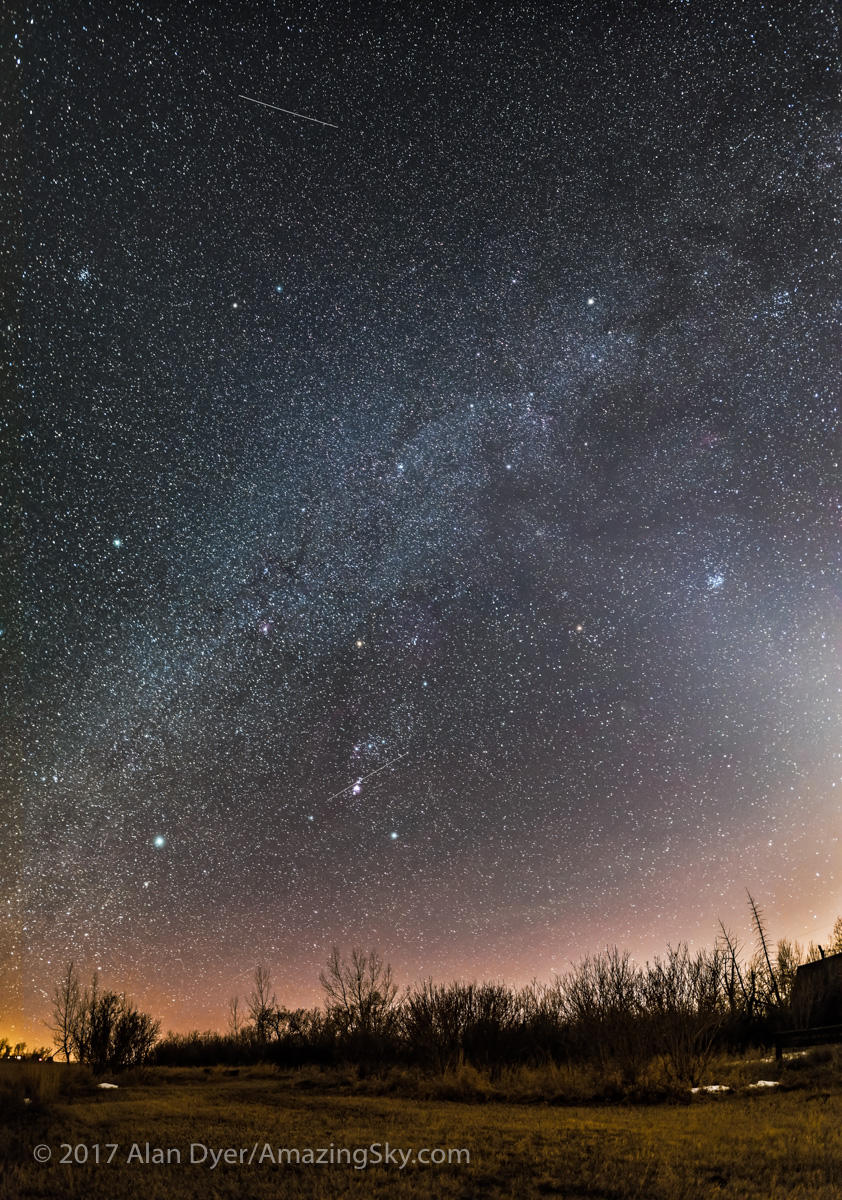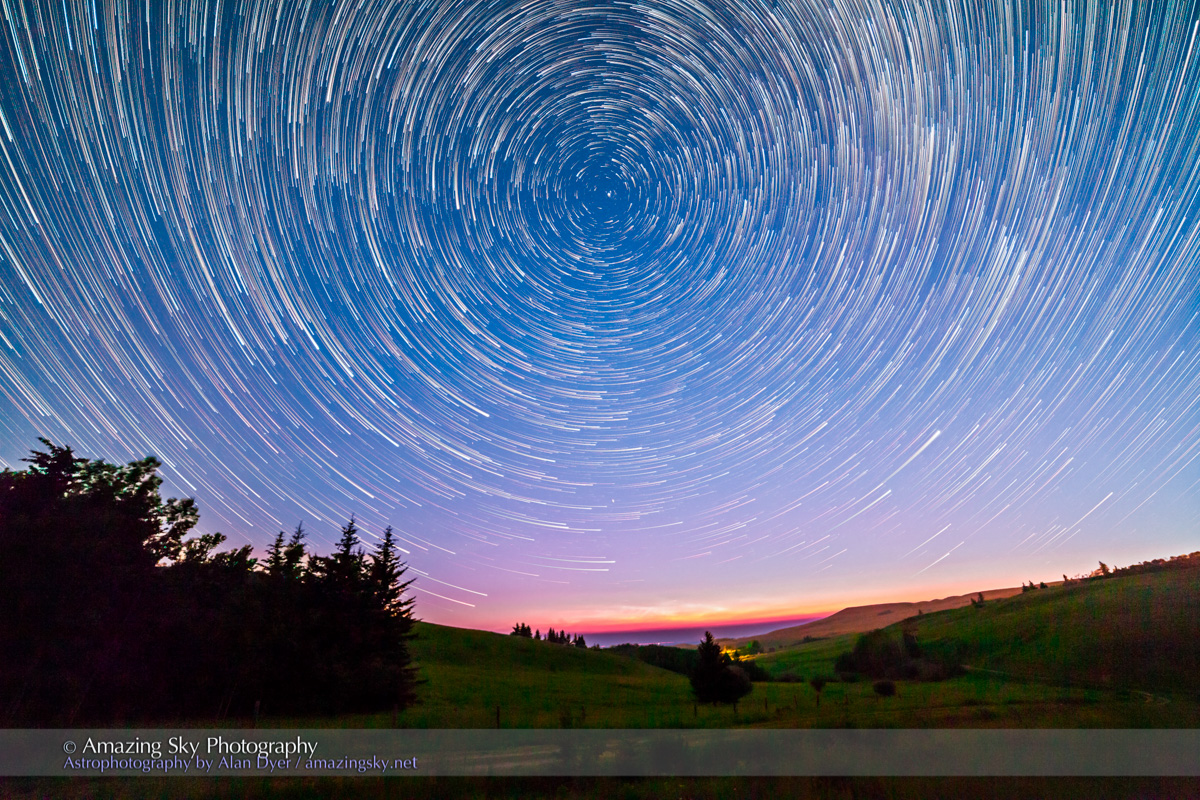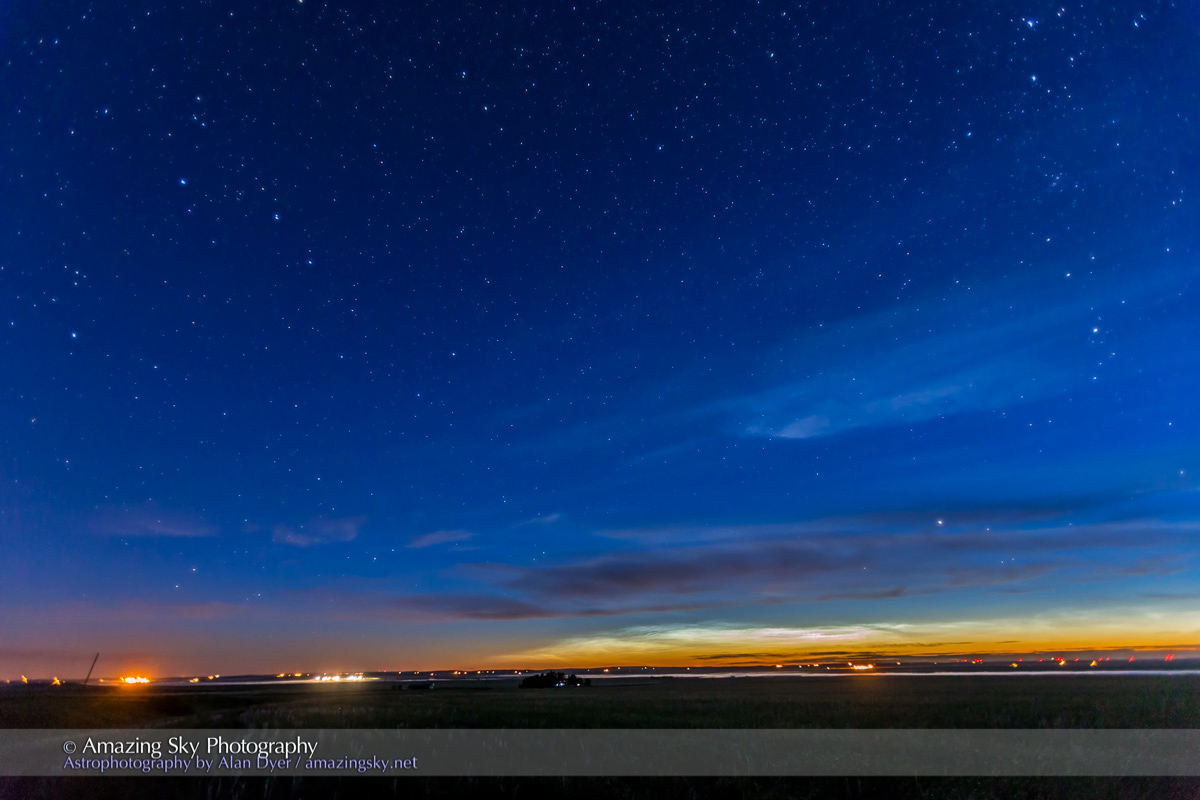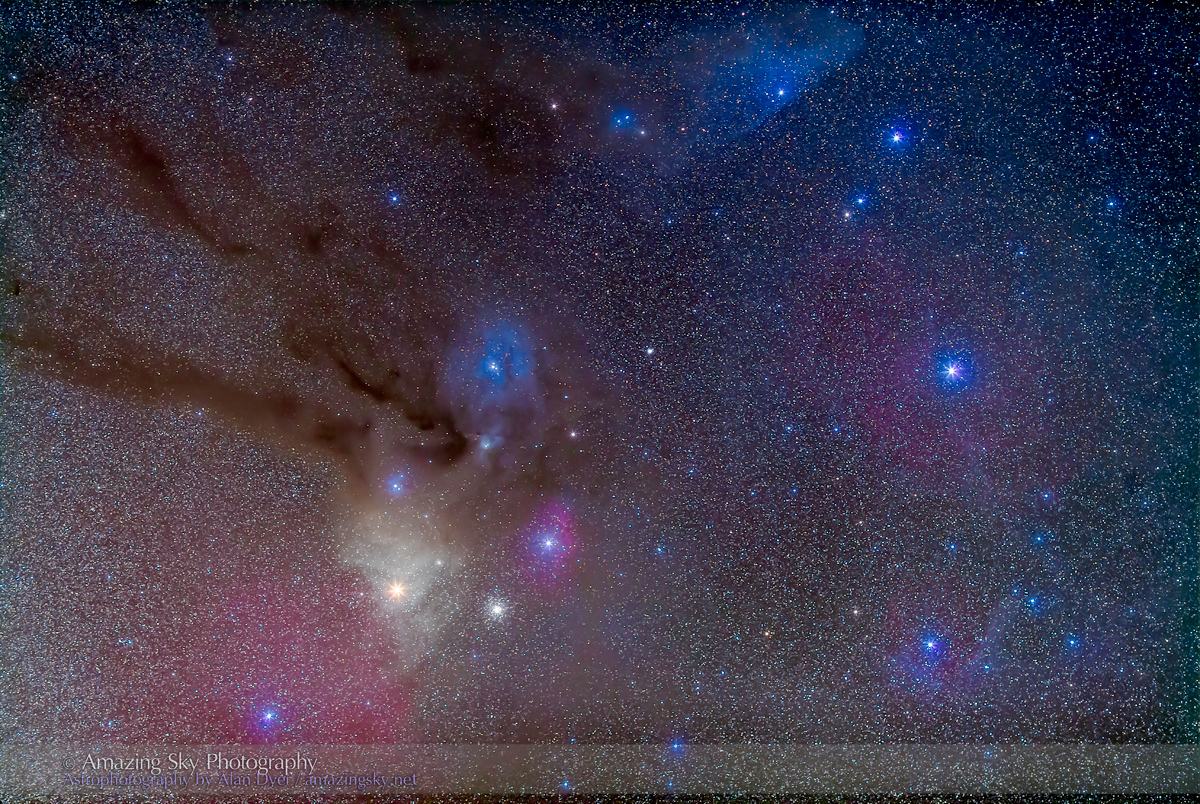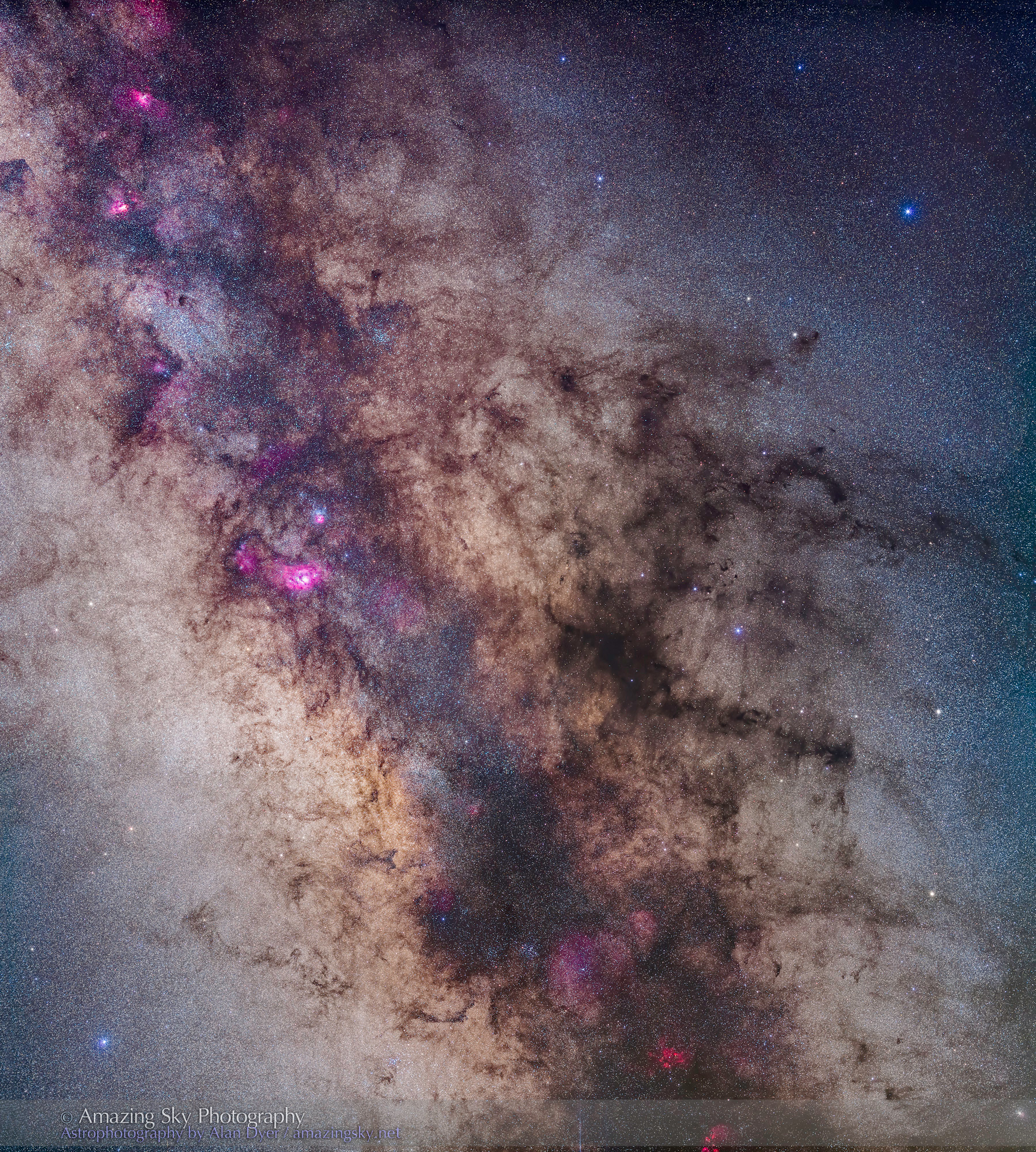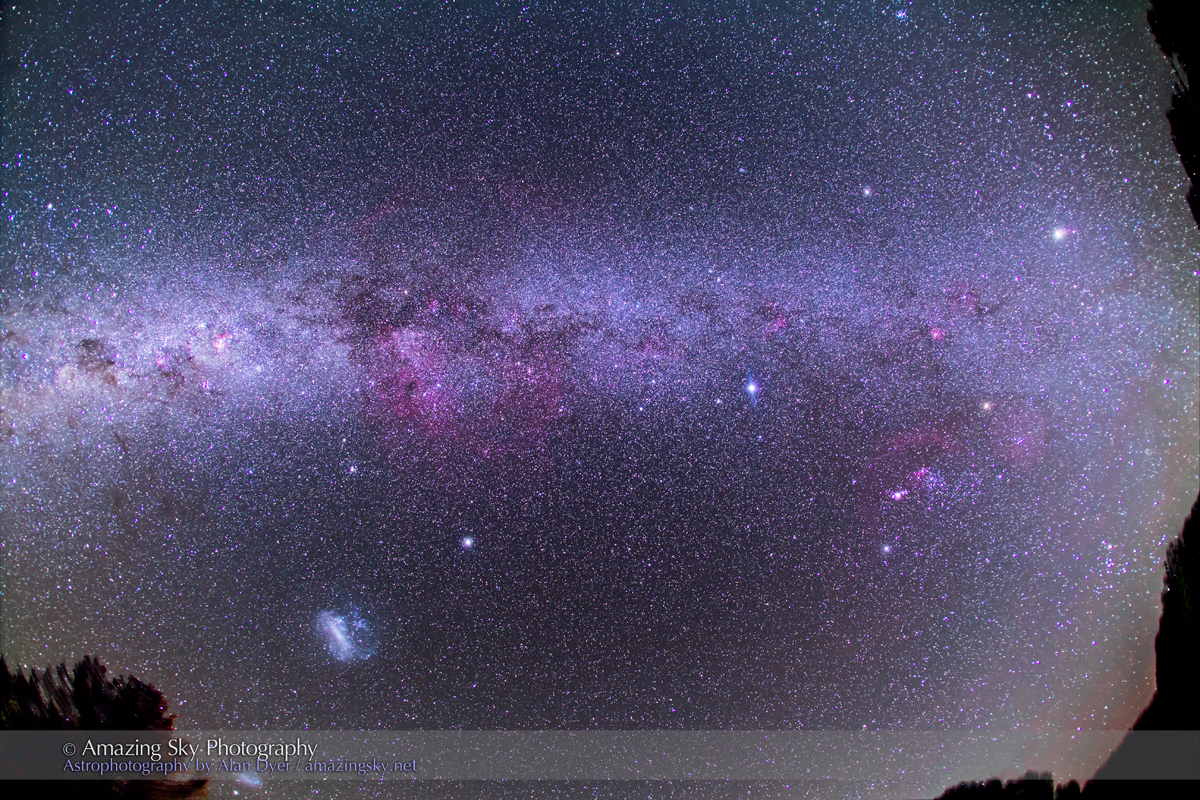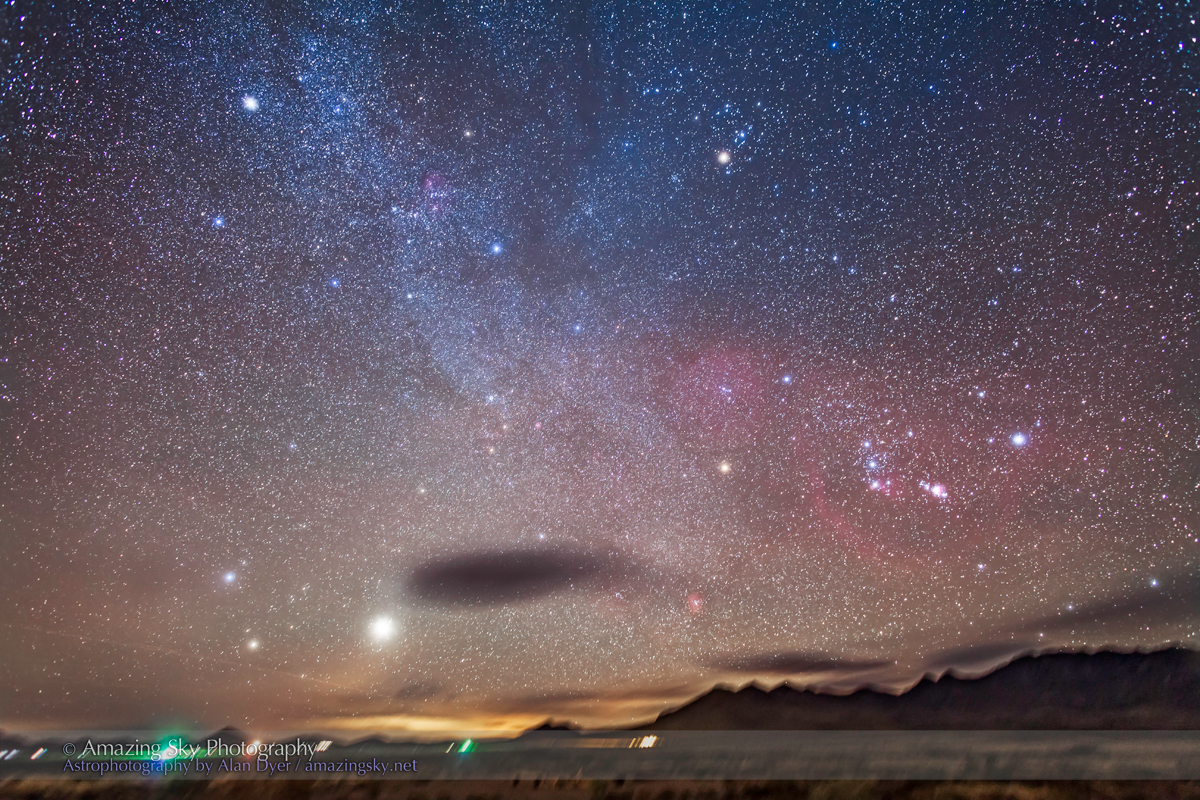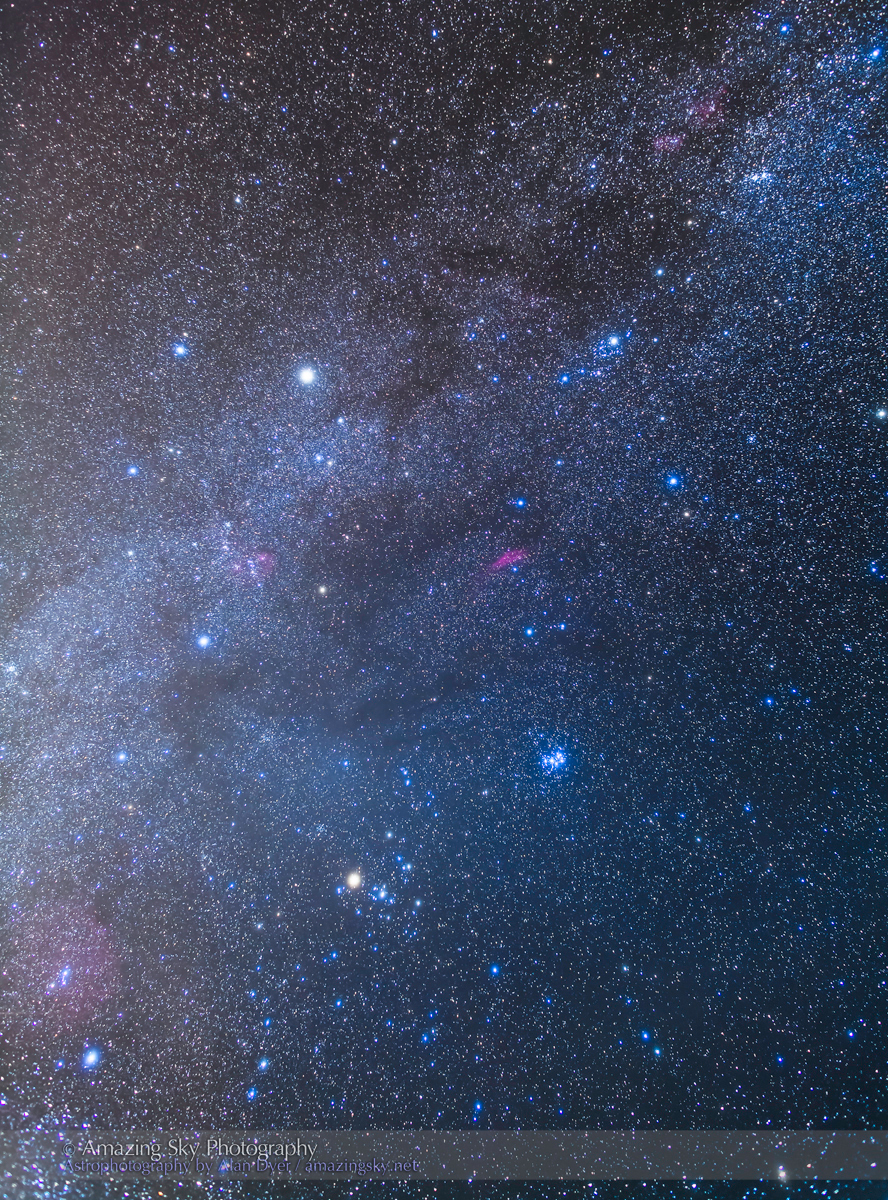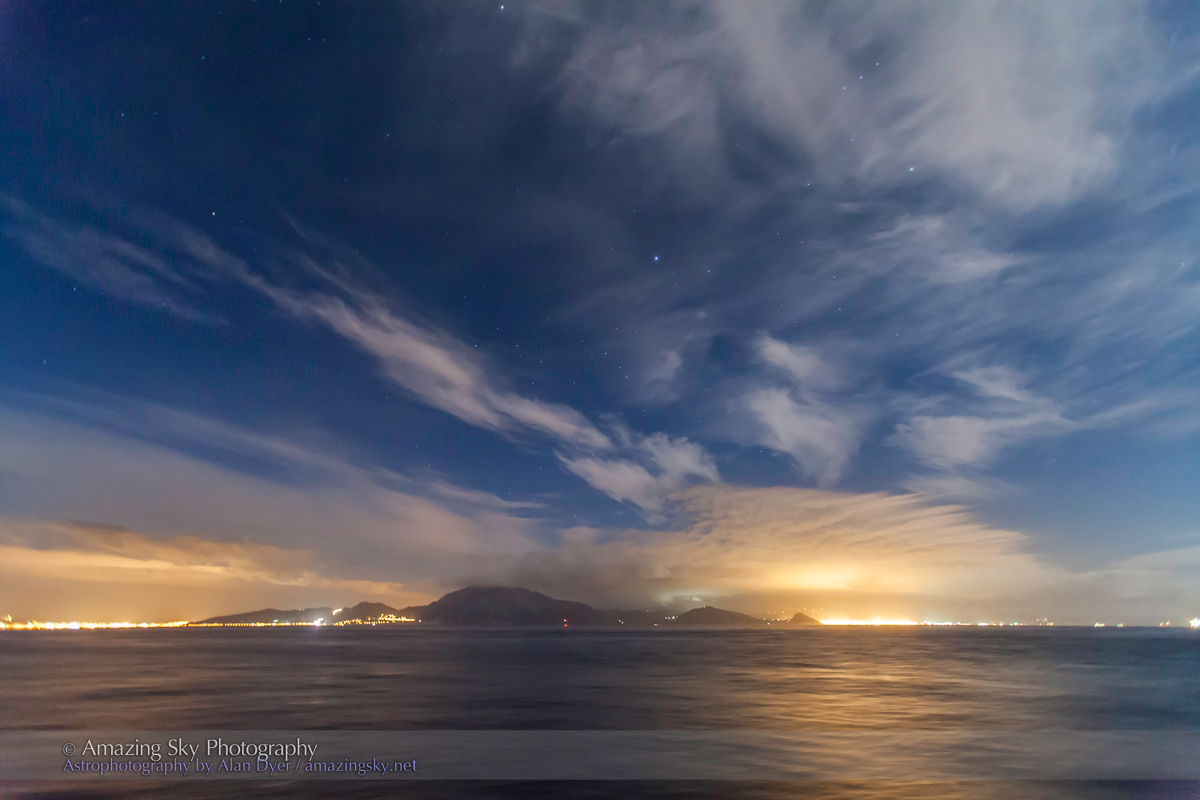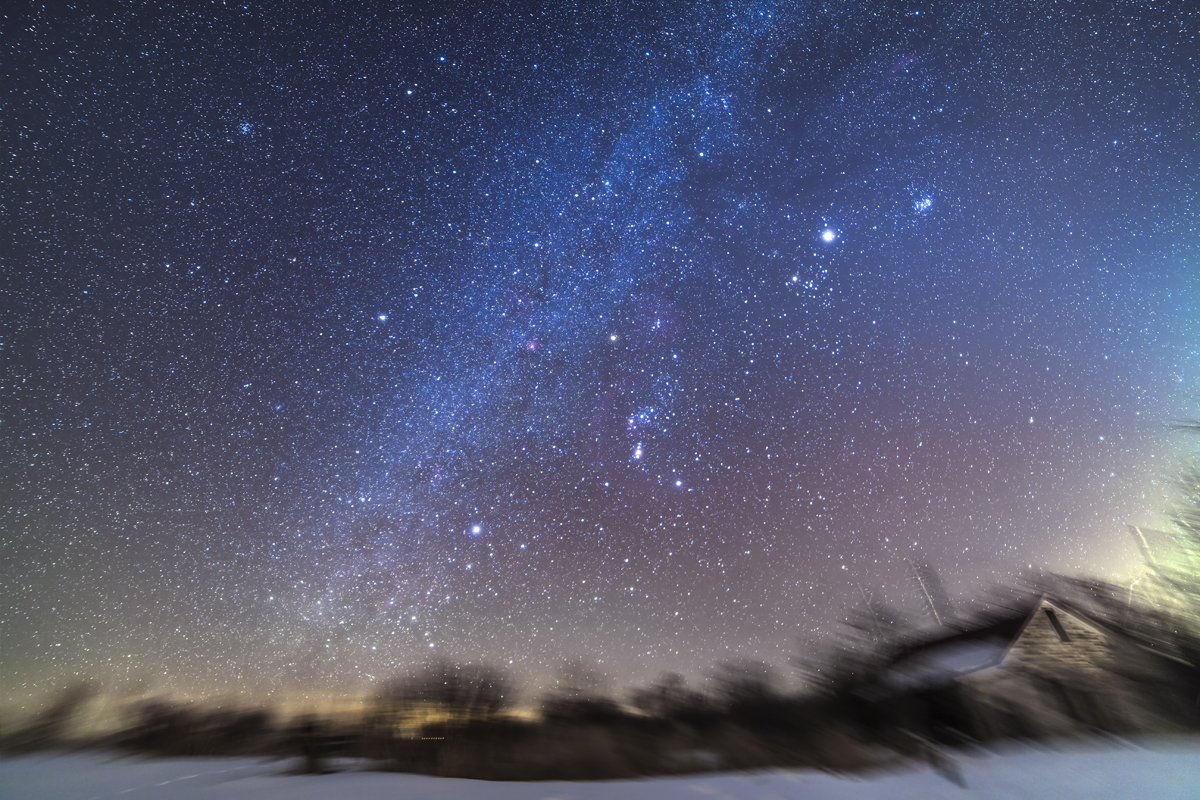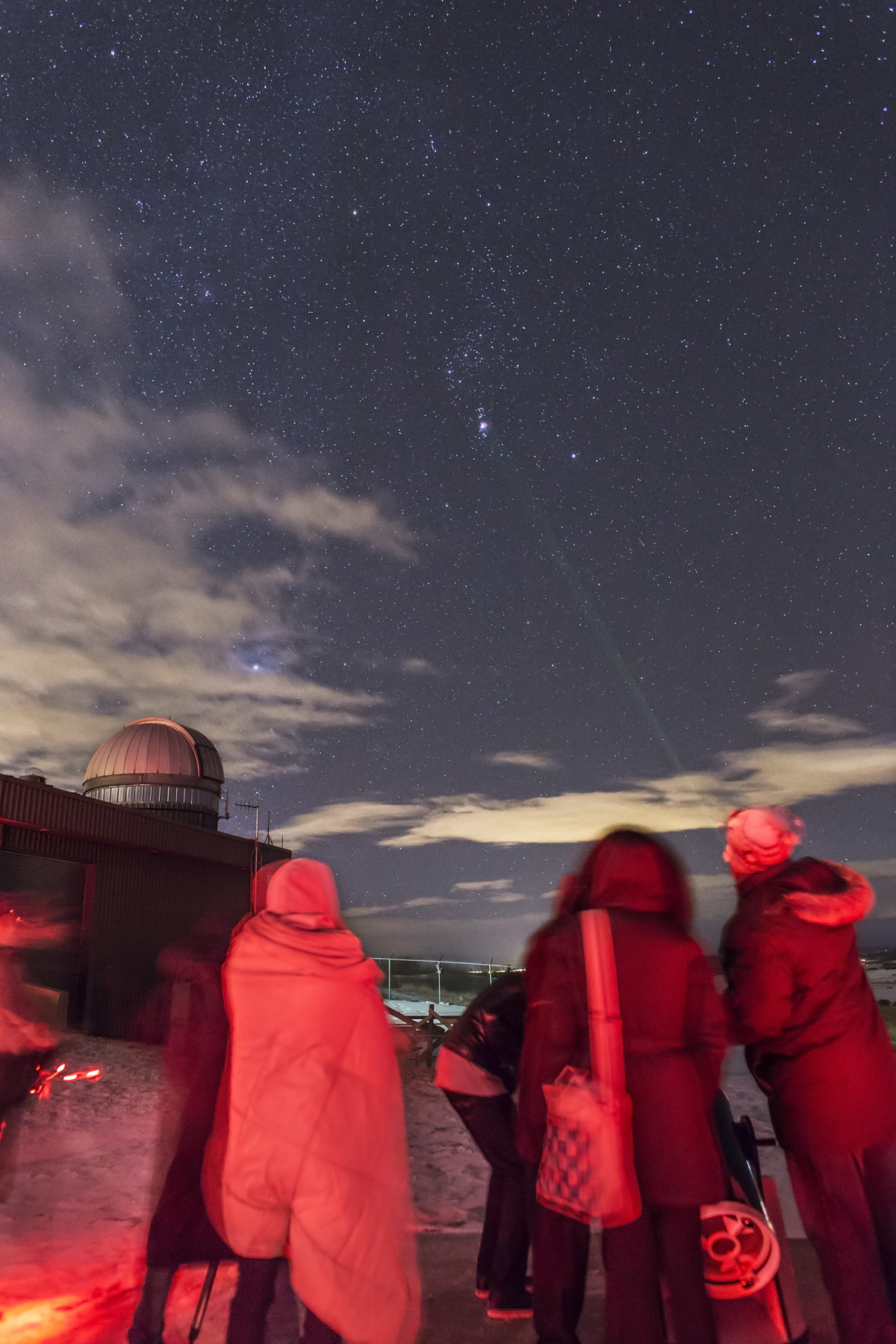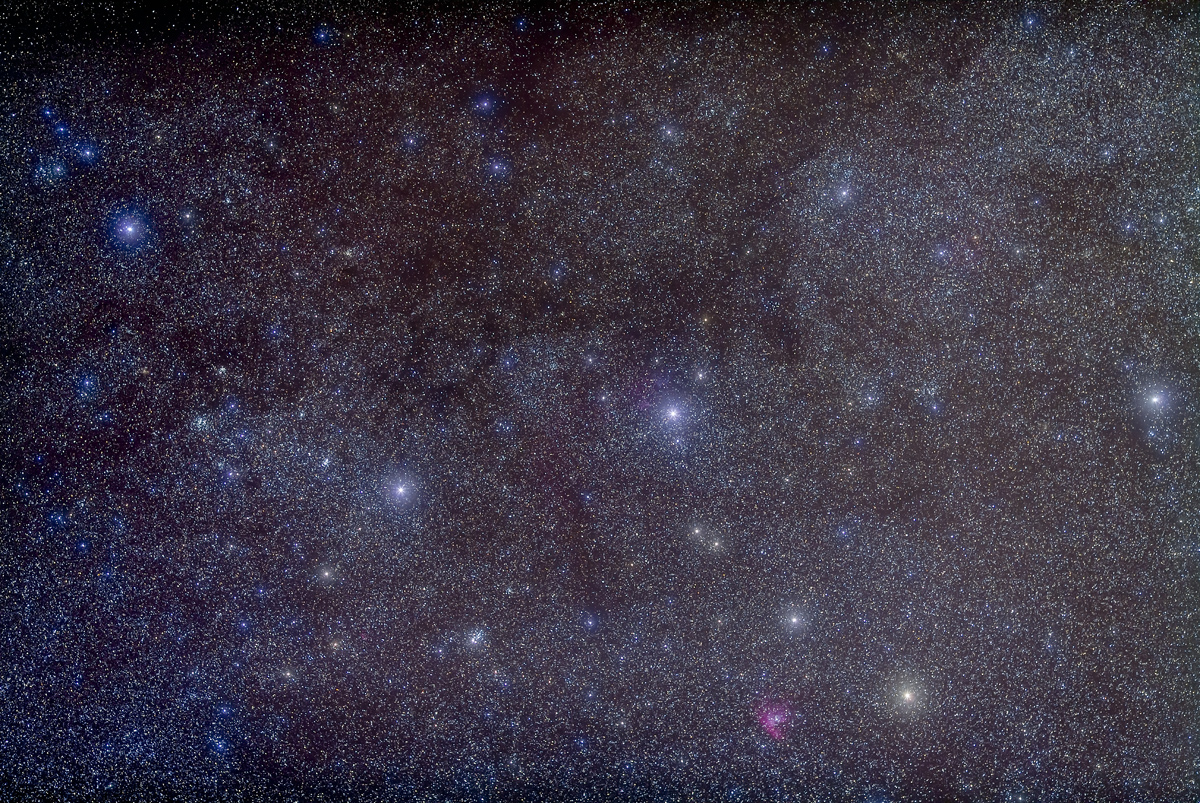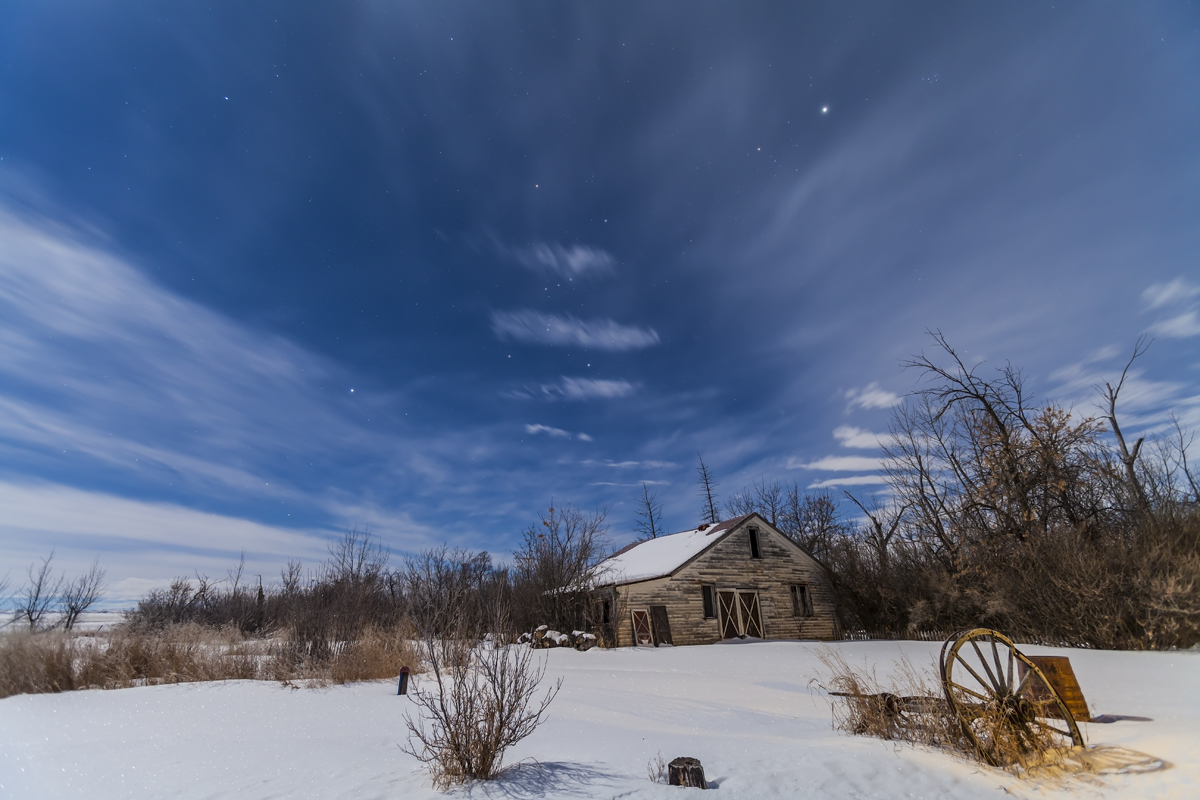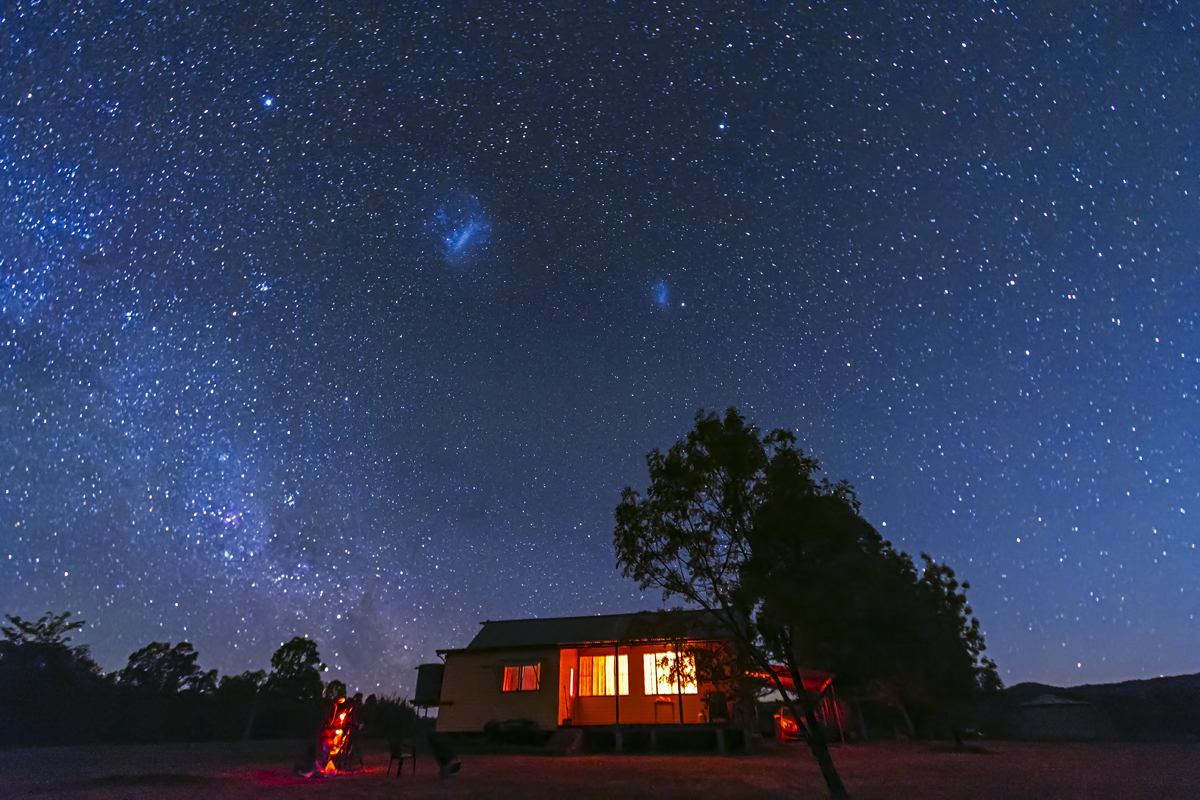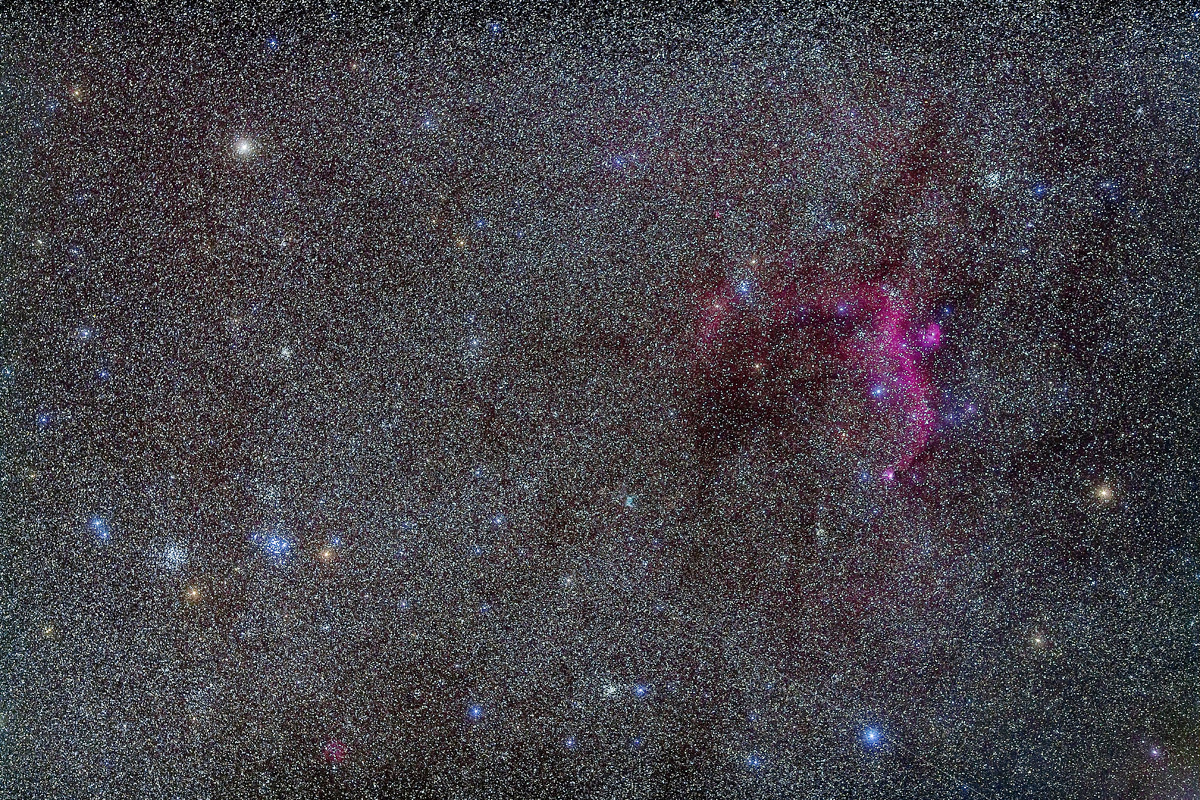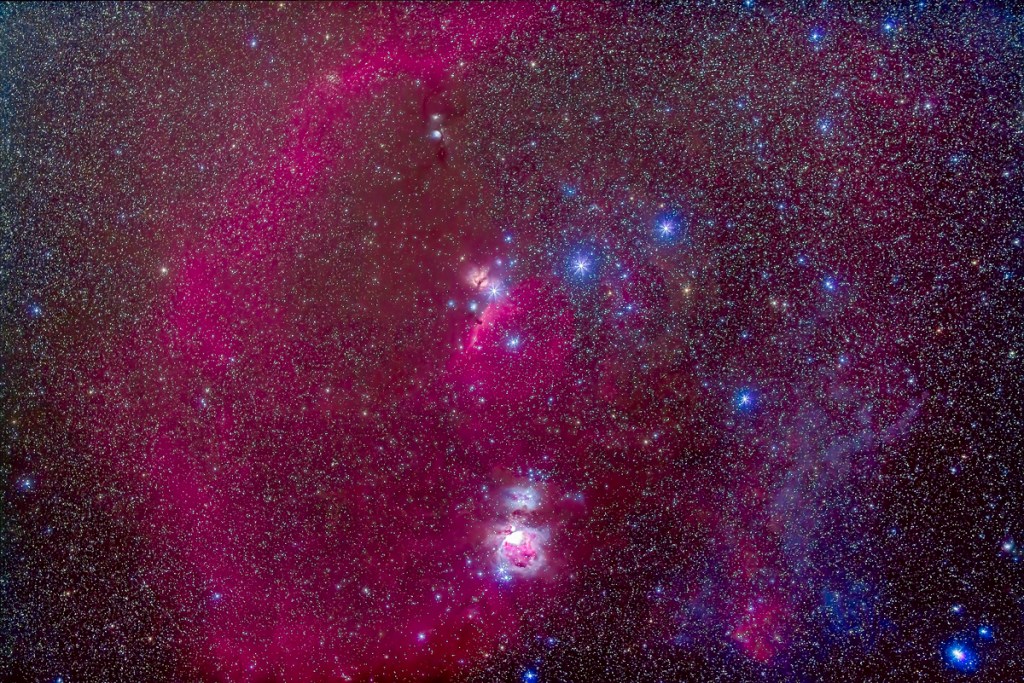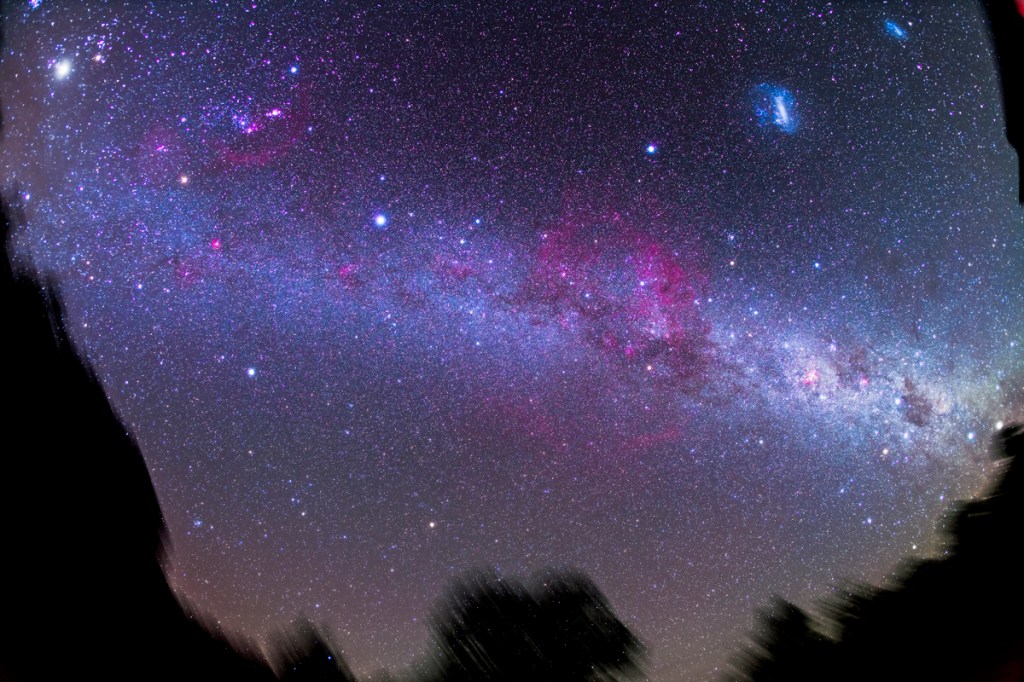
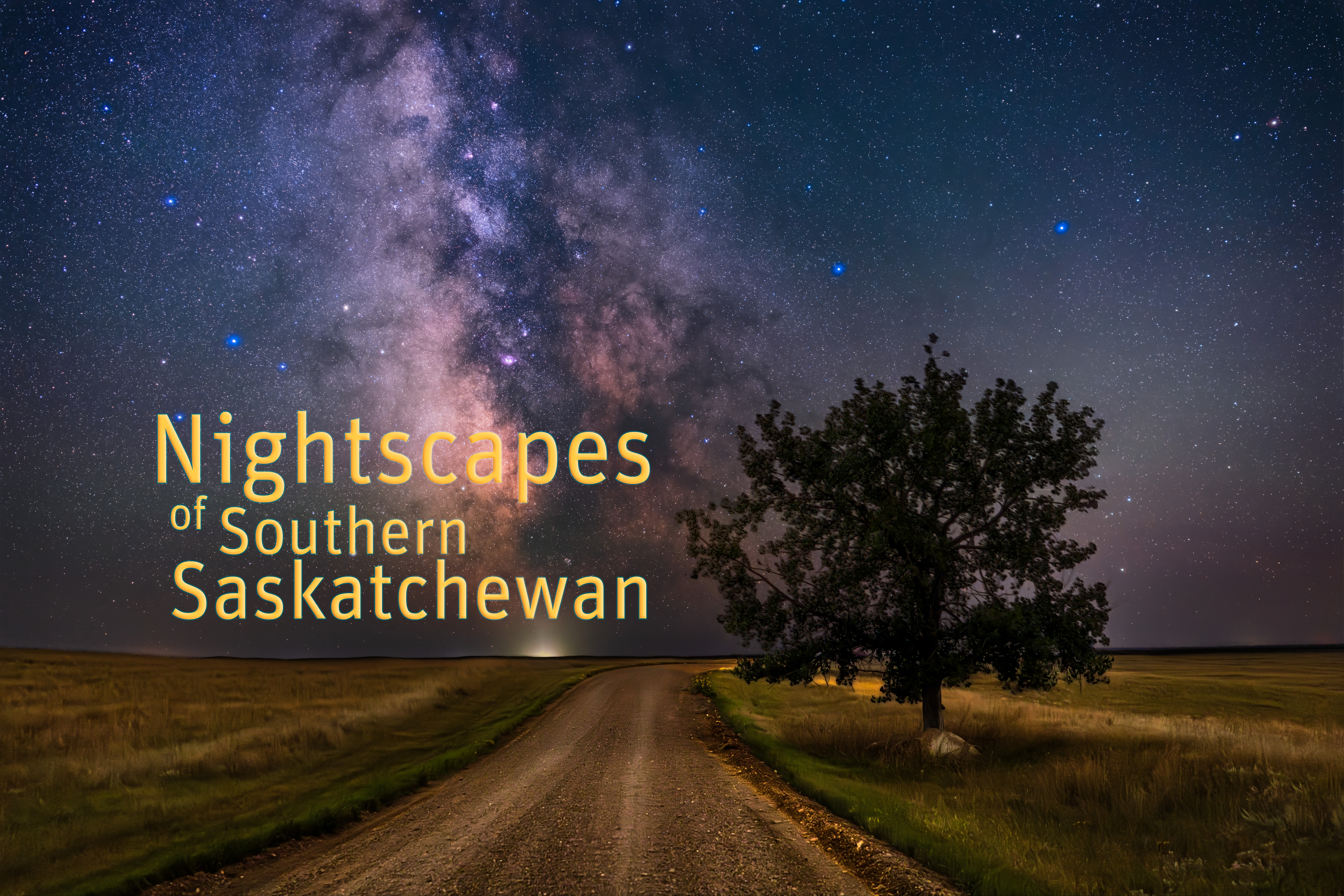
Nightscapes of Southern Saskatchewan


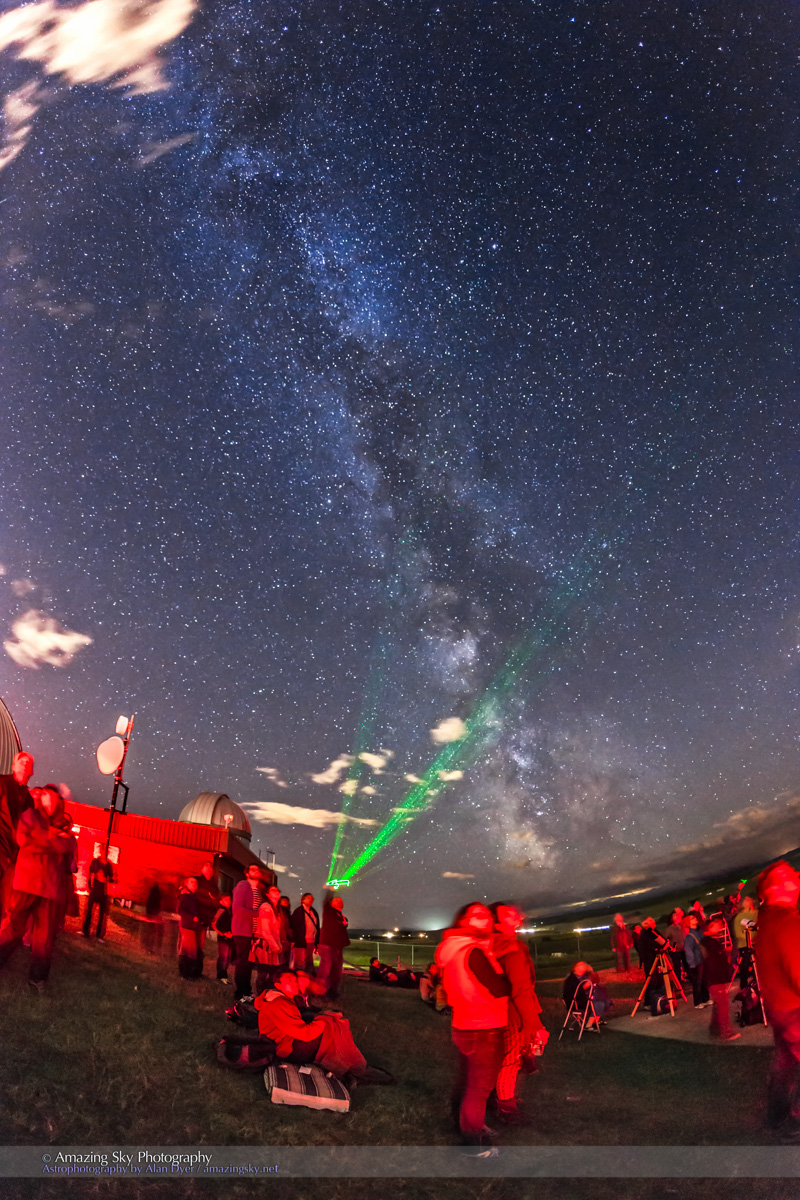
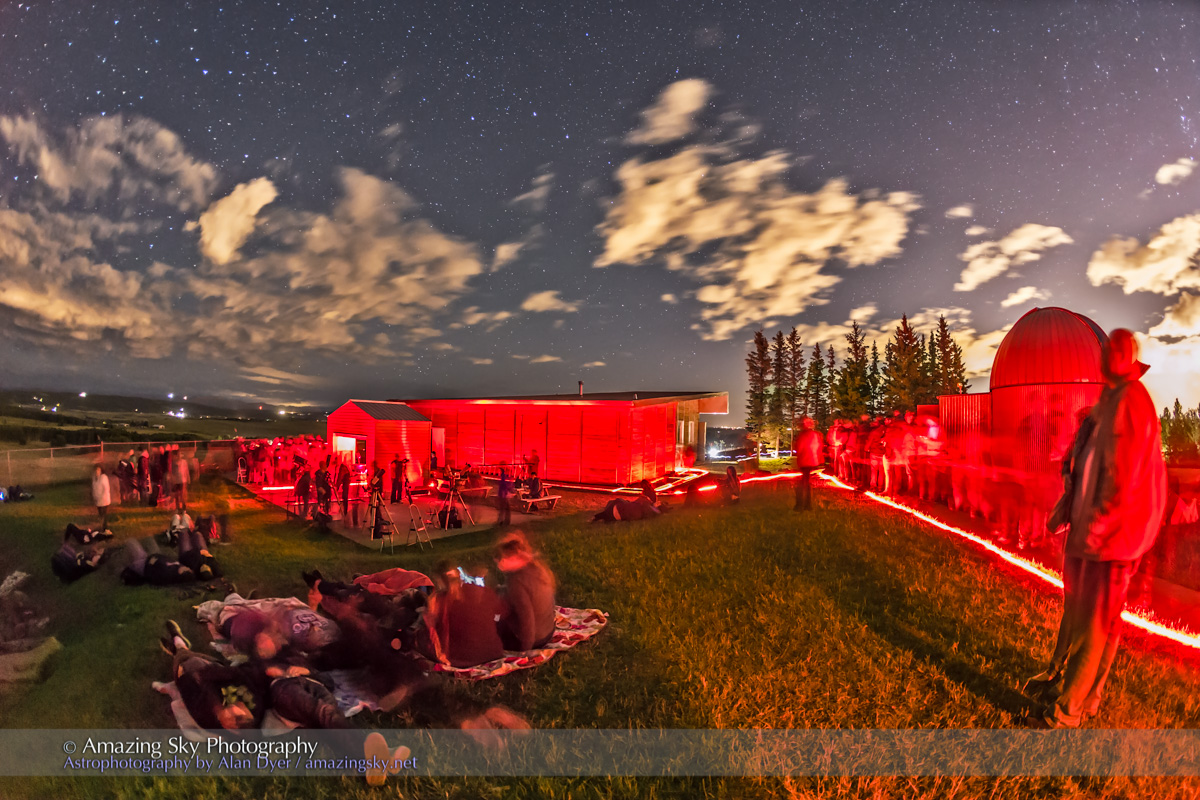
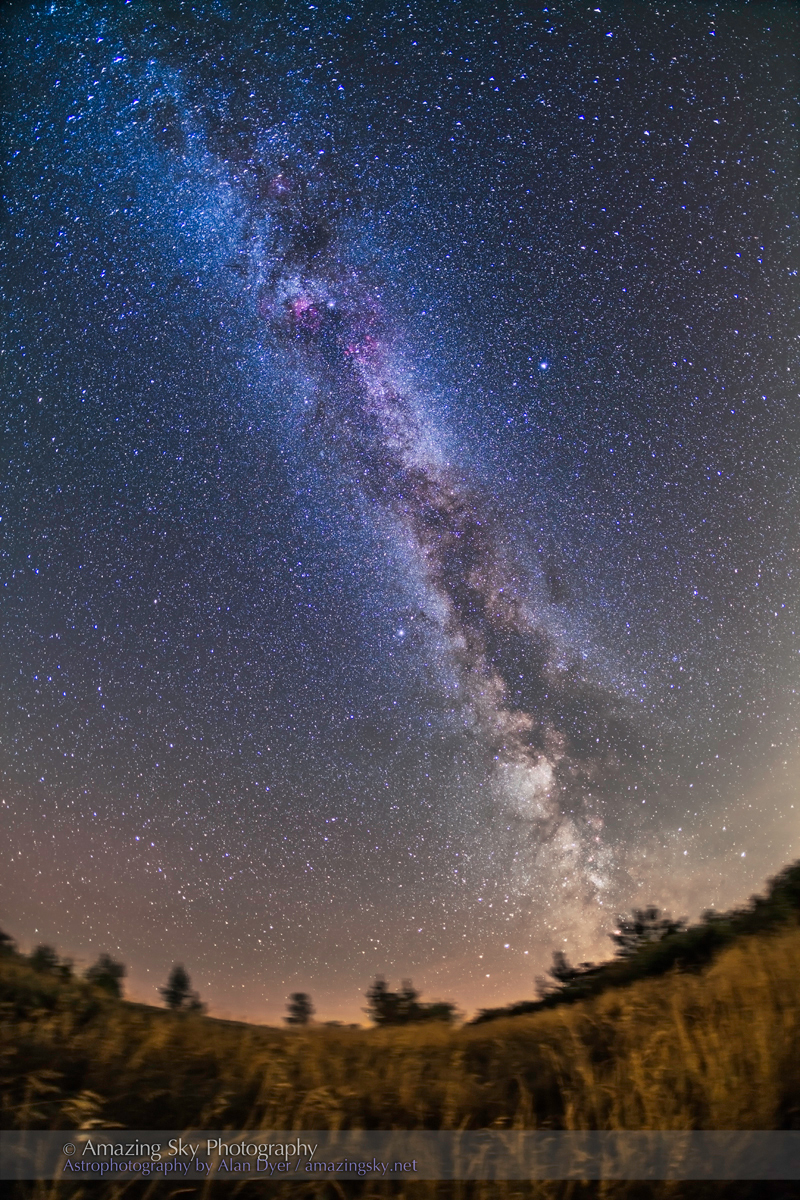
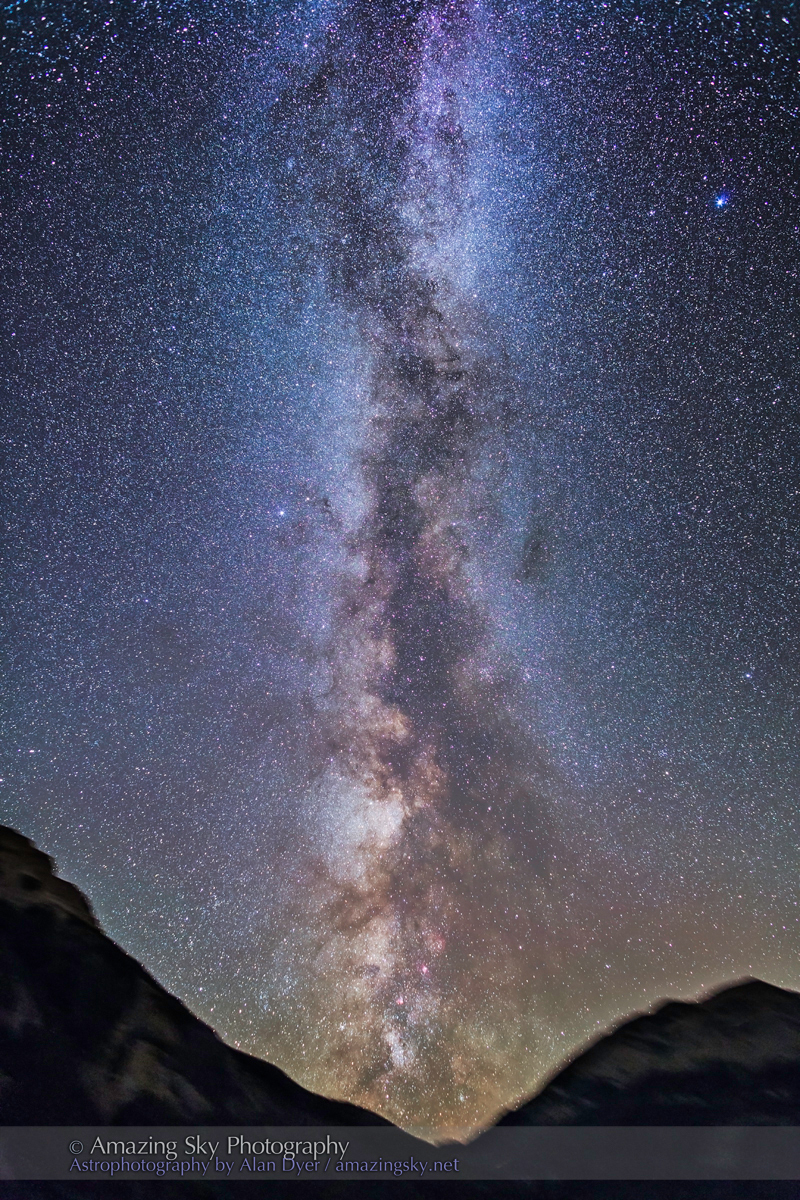
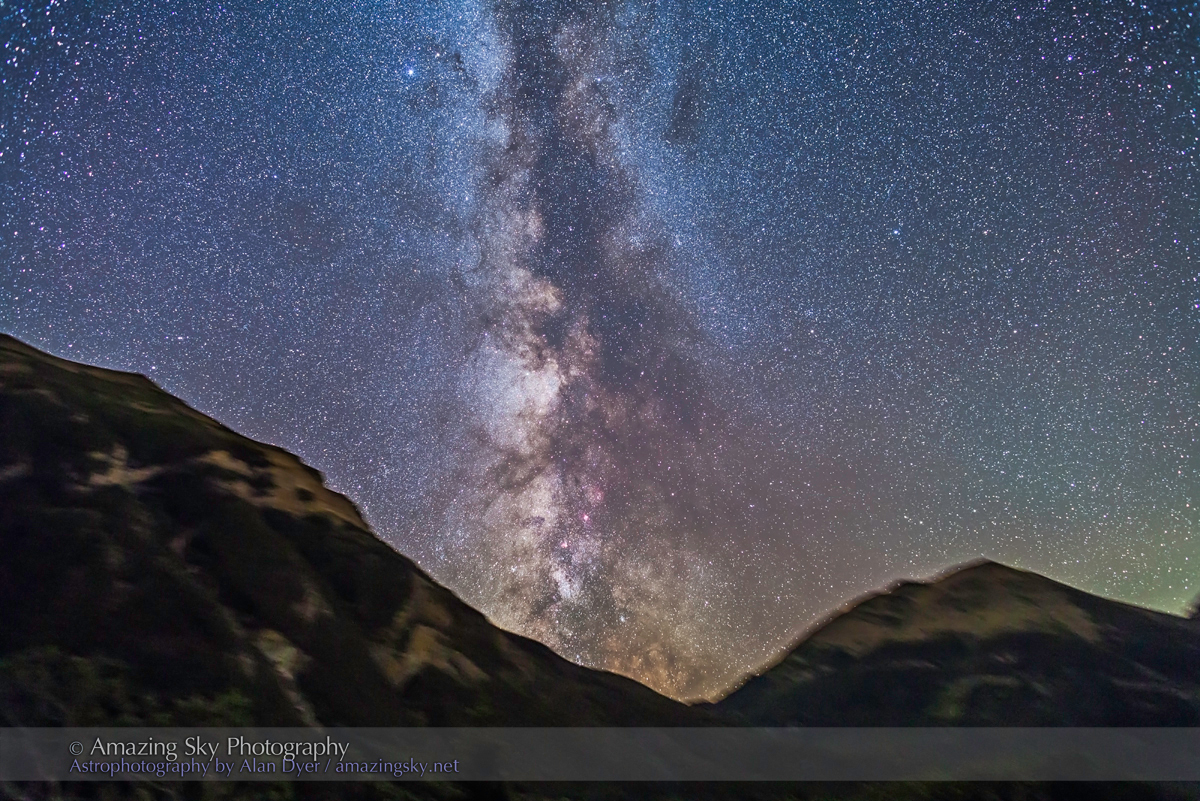
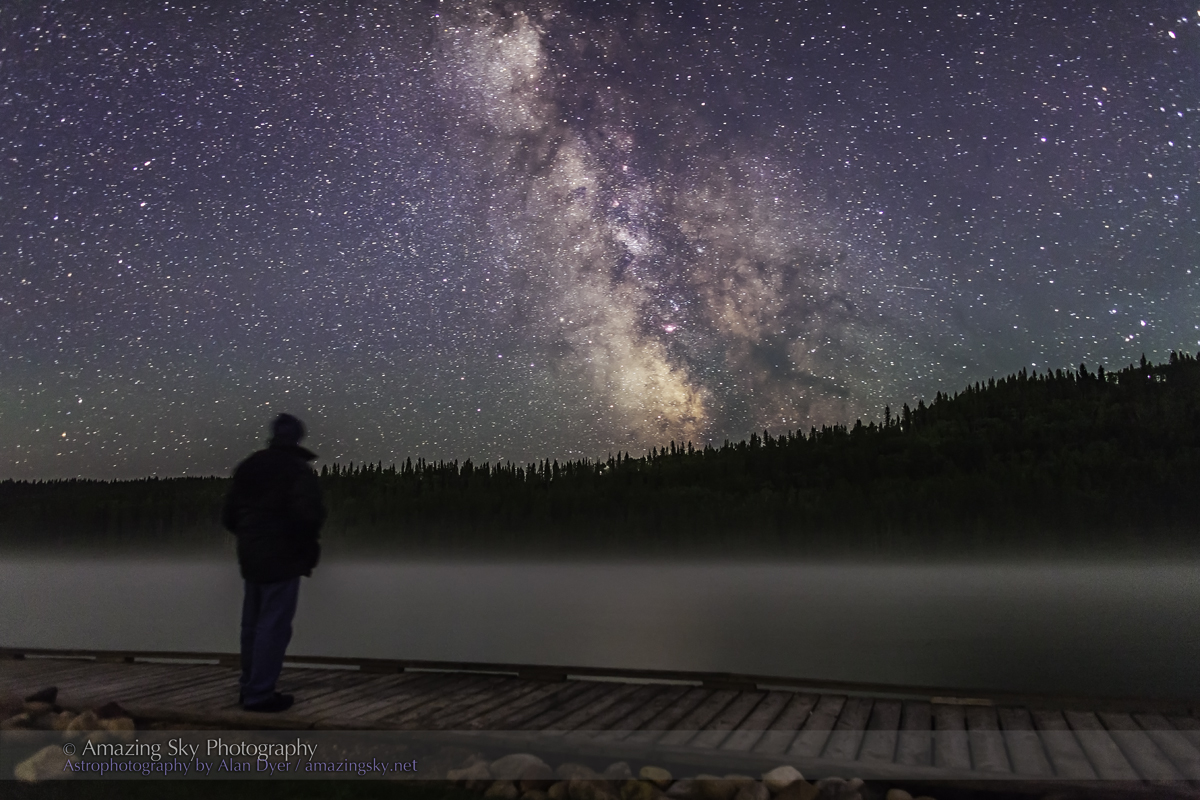
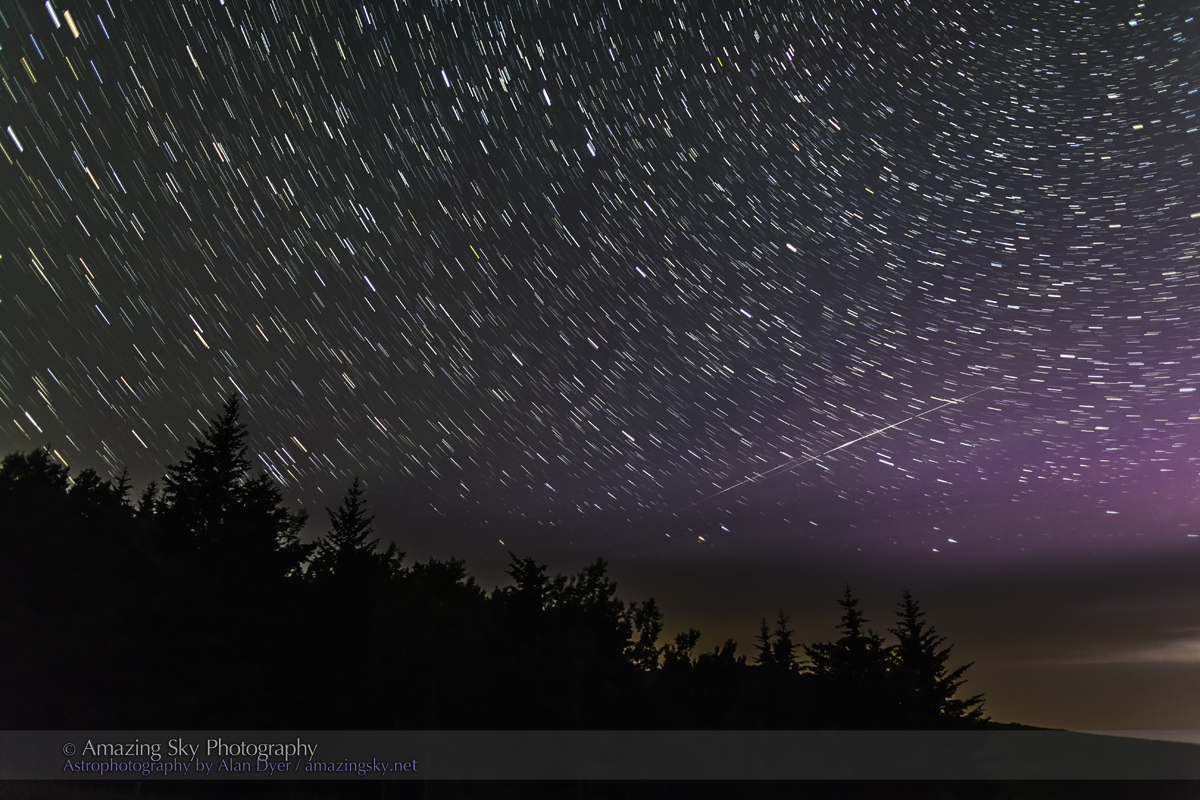
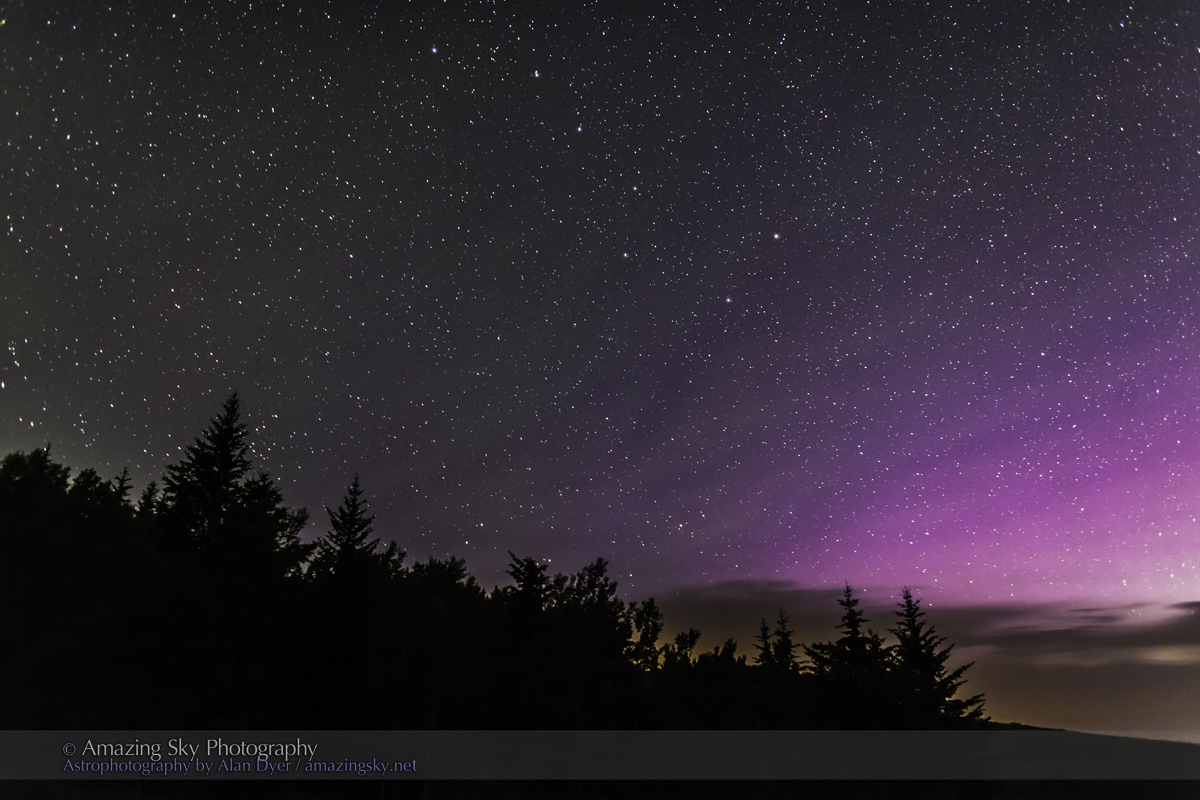
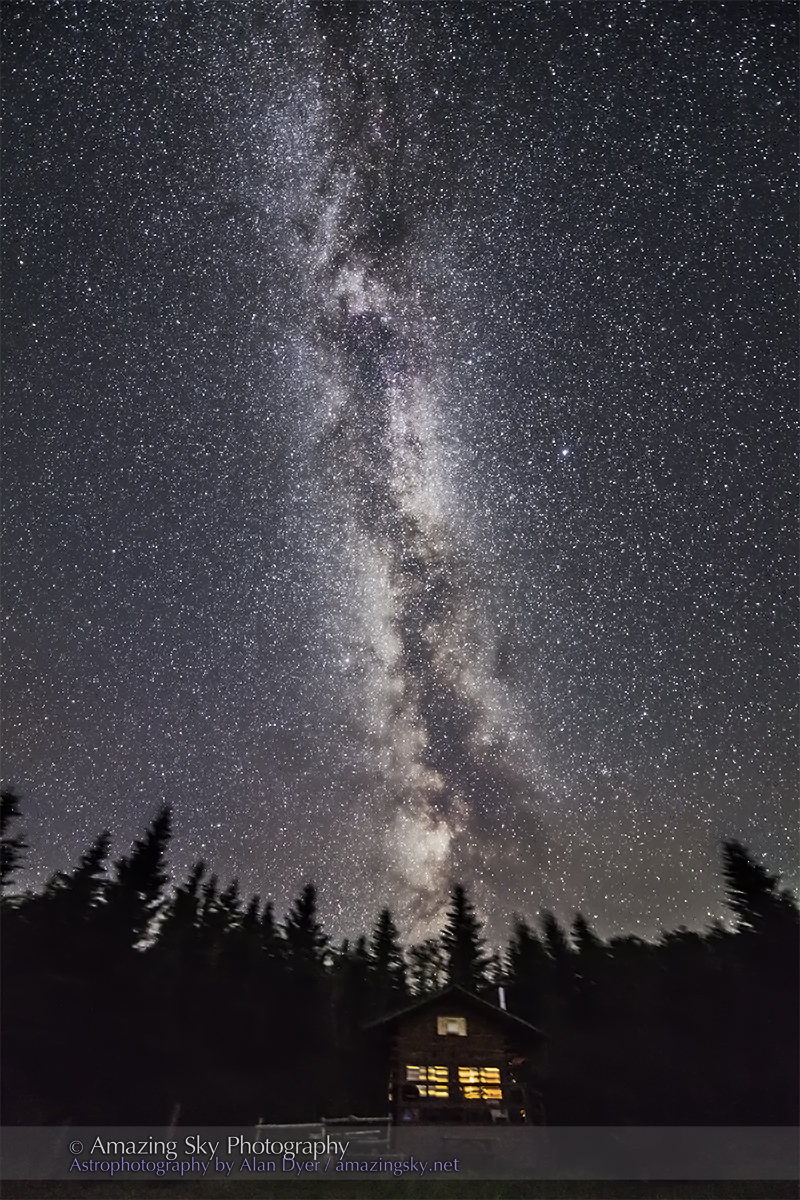
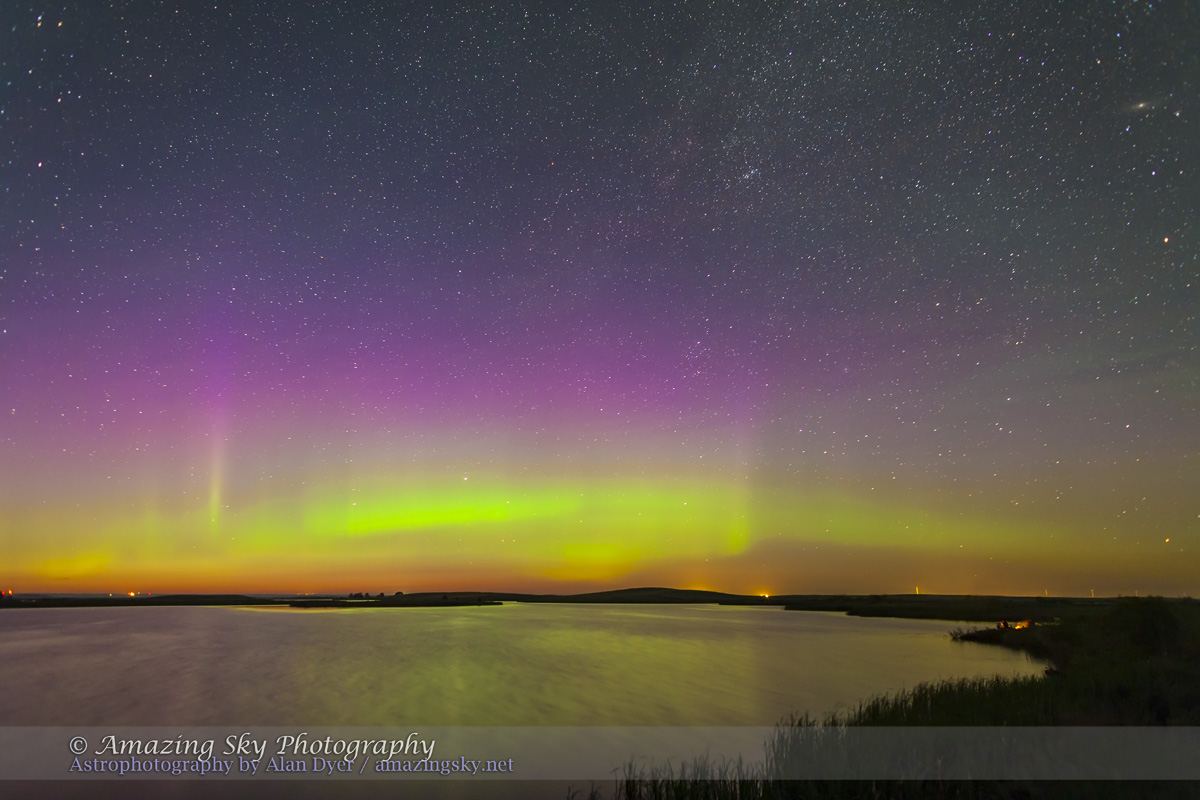
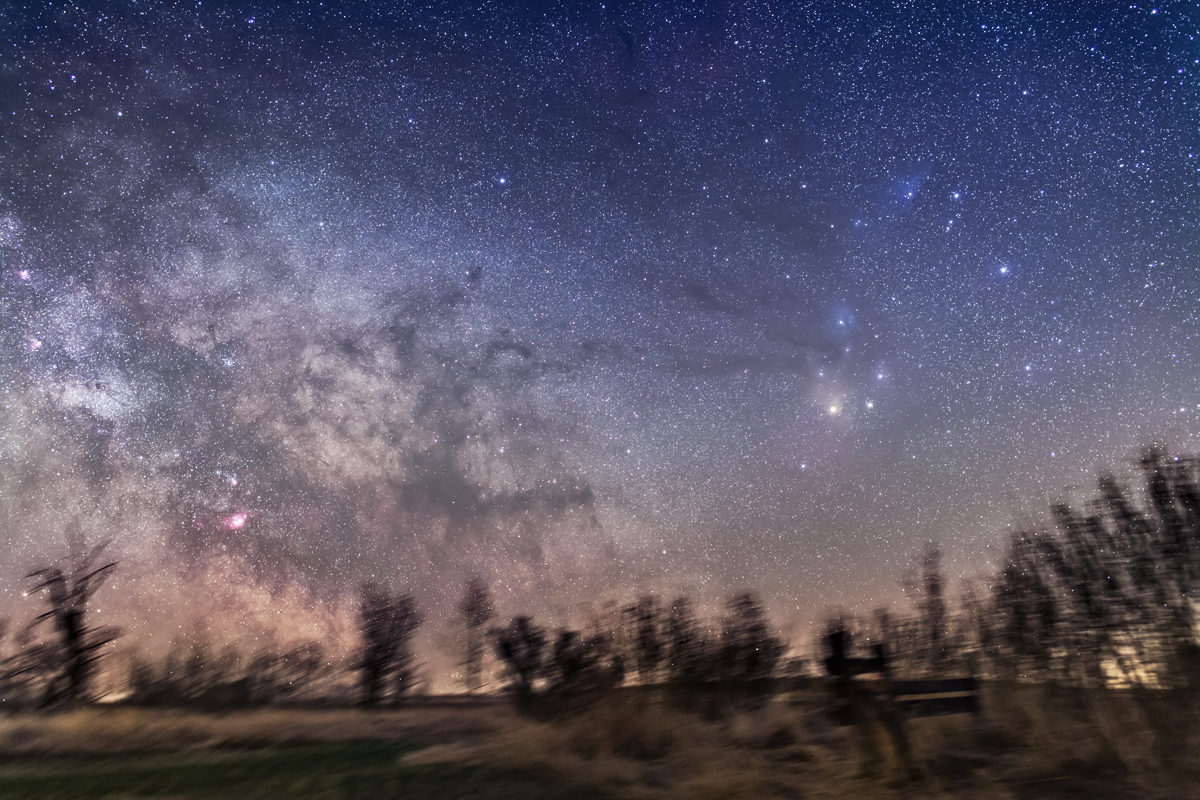
Southern Saskatchewan is a fine place to capture nightscapes of the Milky Way over the grand prairie landscape.

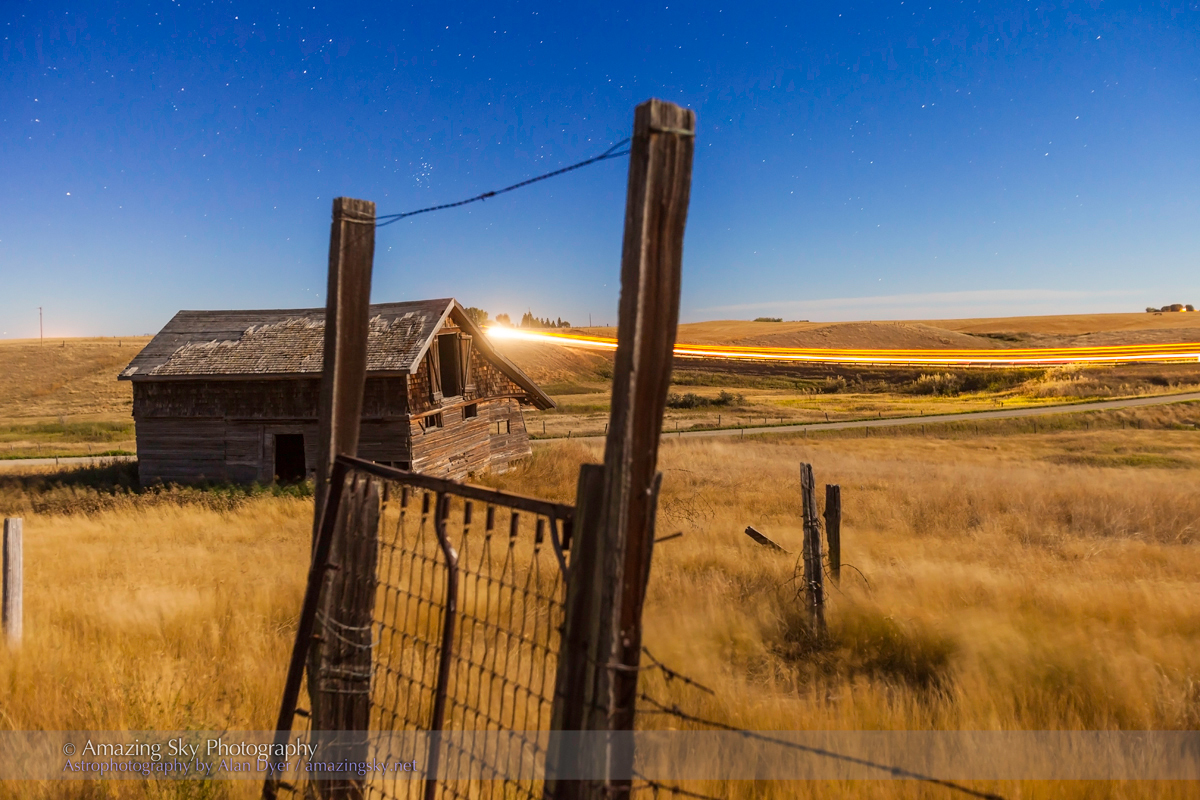
In late August 2025 I took a short road trip around southwest Saskatchewan, taking advantage of a run of wonderfully clear nights to shoot “nightscapes” at some of my favourite locations.

Southern Saskatchewan, and more specifically Southwest Saskatchewan, is a stargazing paradise. The skies are dark and there’s nothing to get in the way of seeing them! Yet, the landscapes have their unique beauty.

And in the case of Grasslands National Park the landscape preserves the endangered realm of original short-grass prairie. It is what the land was like long ago, even including some bison at large.

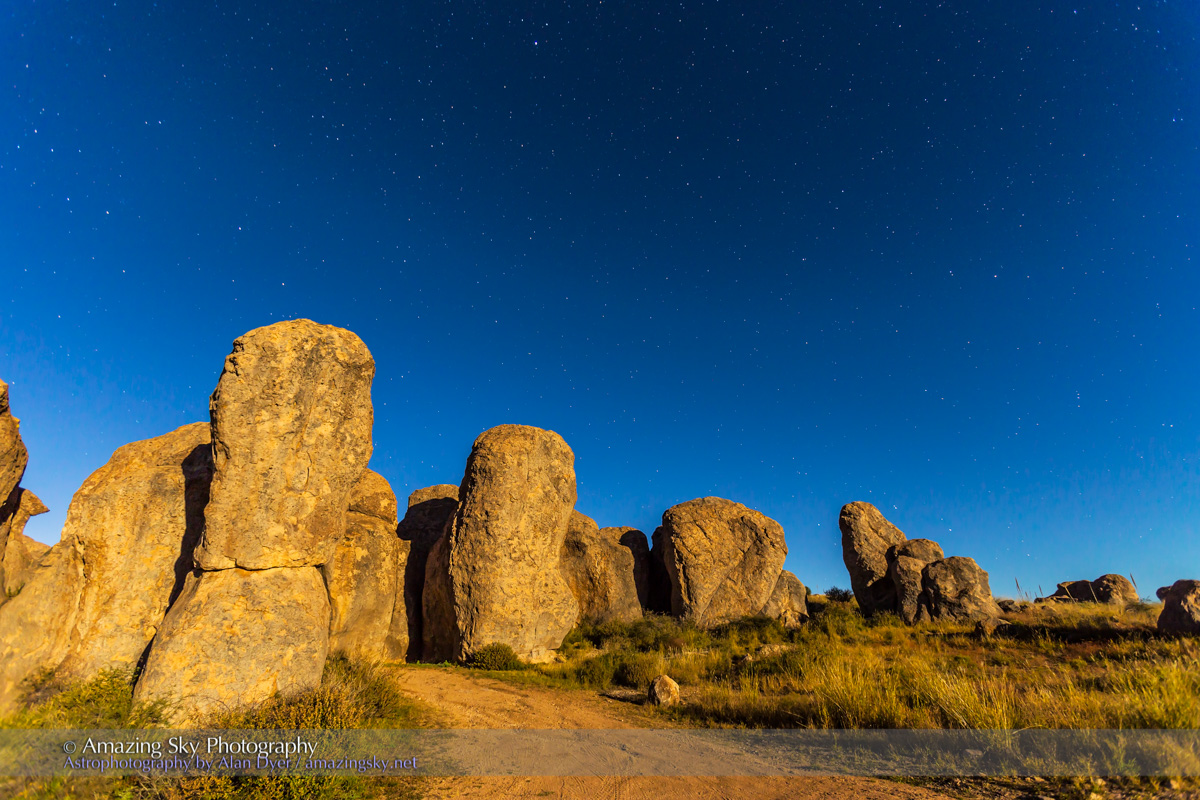
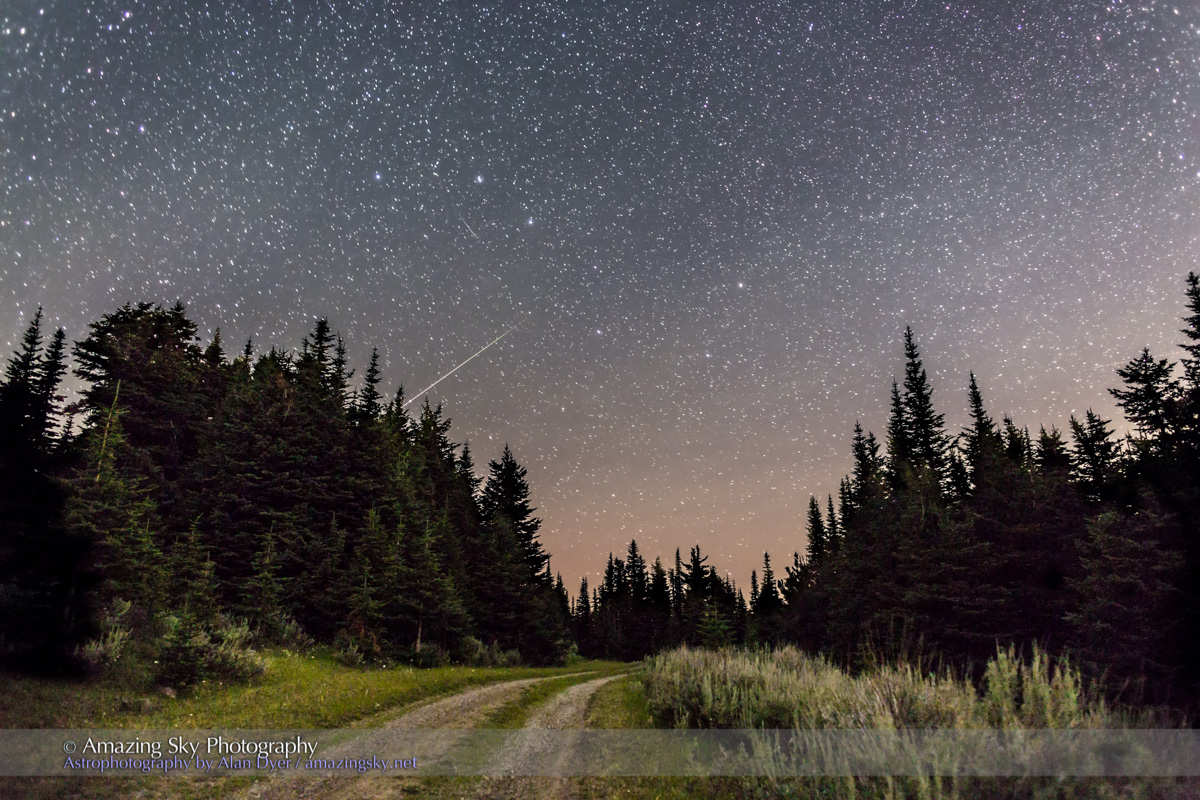
Grasslands National Park
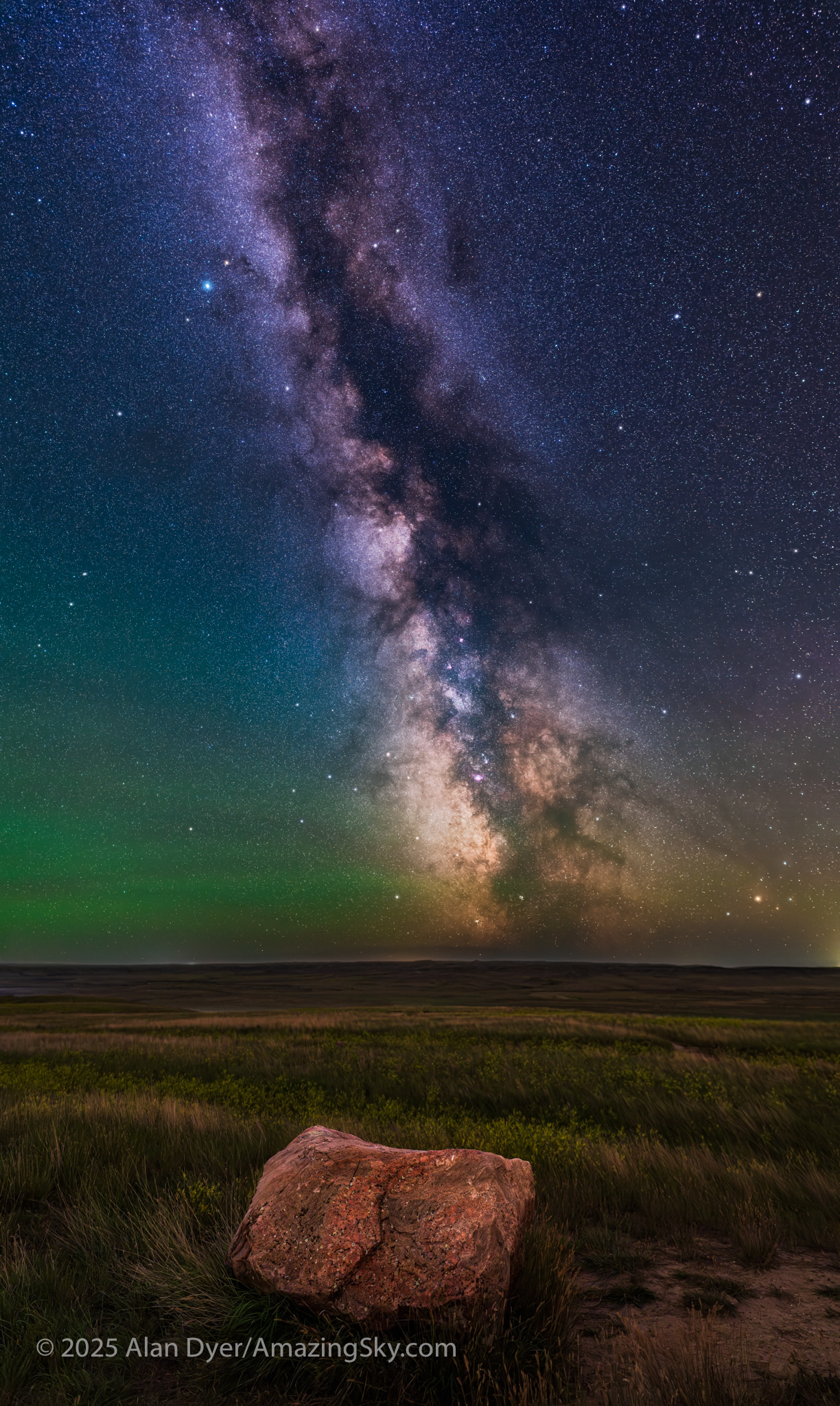
Technical:
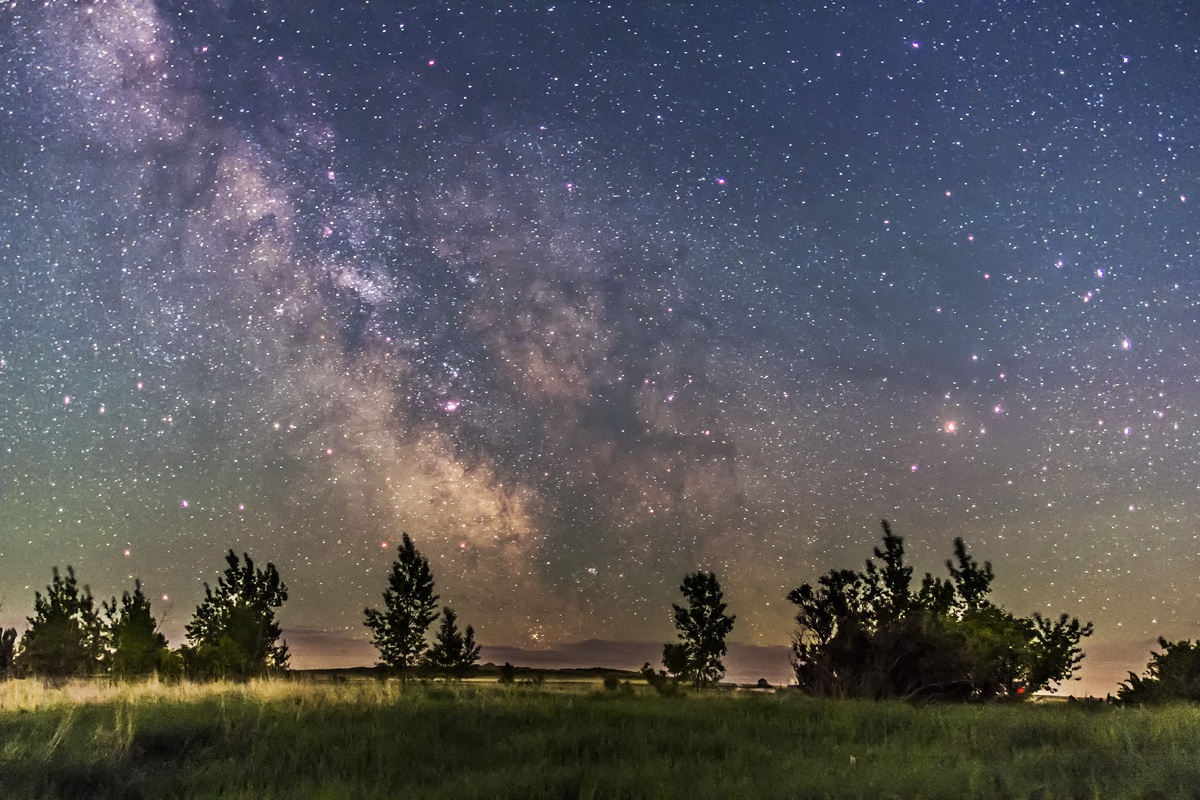
This is a blend of tracked and stacked sky exposures with a single untracked ground exposure:
– 7 x 60 seconds at f/2 tracked and focused for the sky, plus
– 1 x 4 minutes at f/2.8 untracked and focused for the foreground to bring out the details lit only by starlight. No light painting was employed here.
– All with the Nikon Z8 at ISO 800 and Nikkor 20mm S lens, on the MSM Nomad tracker. And all from the same tripod position. However, the camera was reframed upward for the sky shots.

In fact, my main destination on my visit to Grasslands this year was to revisit a site I had intended to shoot from in 2019 โ€“ the Bison Rubbing Stone overlooking the Frenchman Creek Valley, with the Milky Way as a backdrop.

In 2019 I had to drive through the herd of bison to get there. With the herd only a few hundred metres away, I thought better of setting up at their scratching post. So that year I headed down into the valley to shoot at the 76 Ranch Corral. You can see some images from that location taken on an earlier trip to Grasslands here.

This year I was assured the bison were in the outback, so I set up at their rubbing stone. This is one of the many glacial erratic boulders the Ice Age left scattered across the prairies. With no trees about, the bison have long loved to use them to scratch an itch. But the connection with the stars is that one legend of the sky told by Blackfoot First Nations describes the Milky Way as the “Buffalo Trail,” the dust left by a cosmic herd of bison.

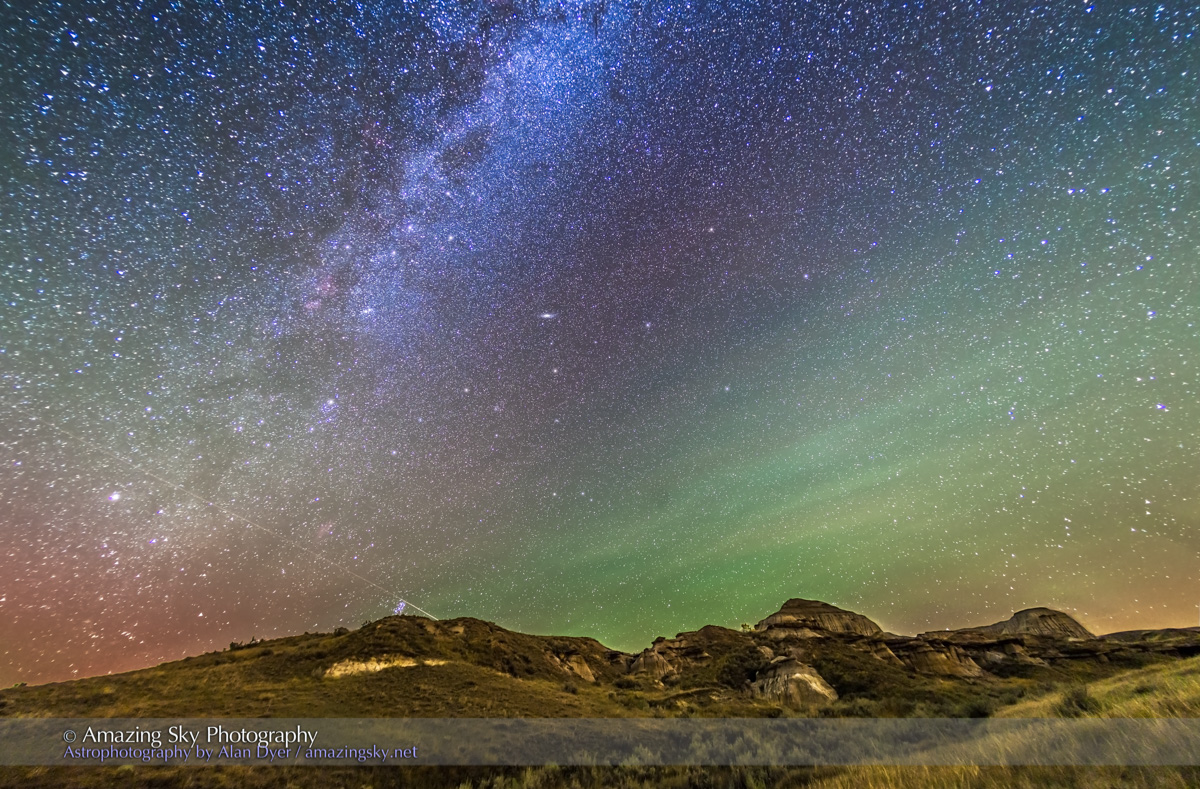
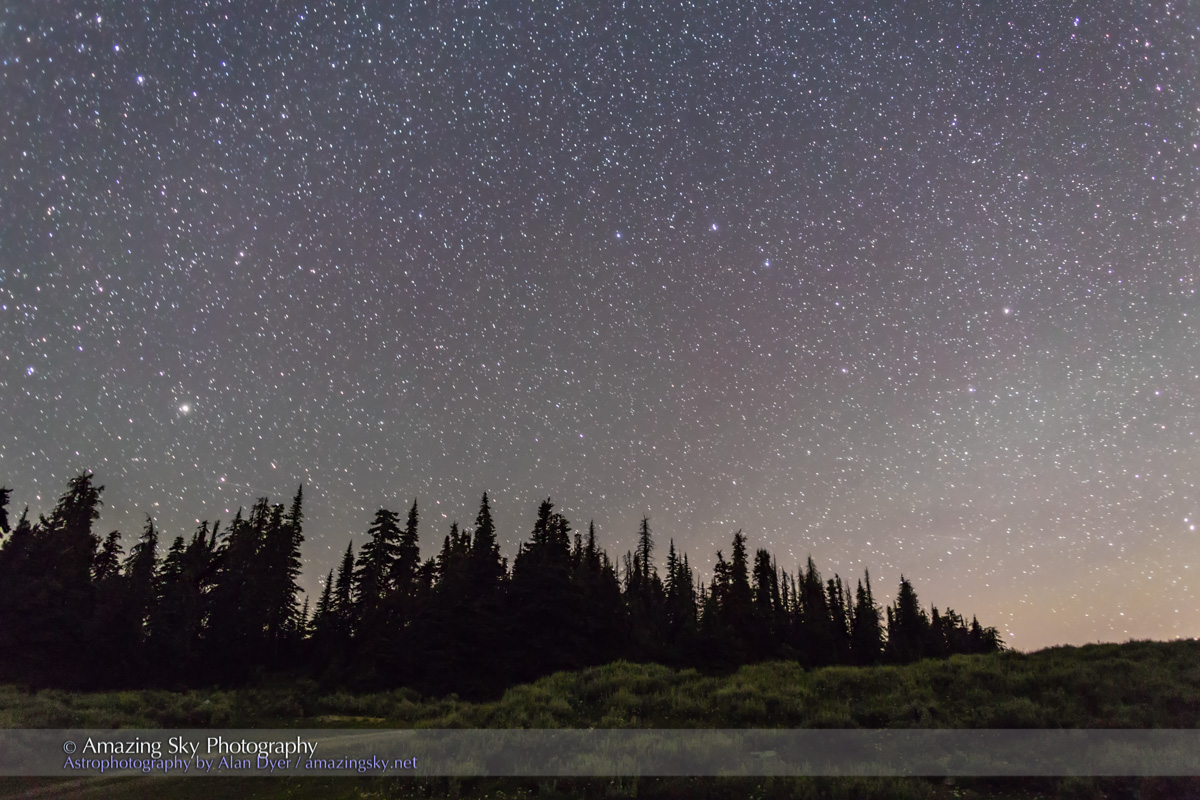
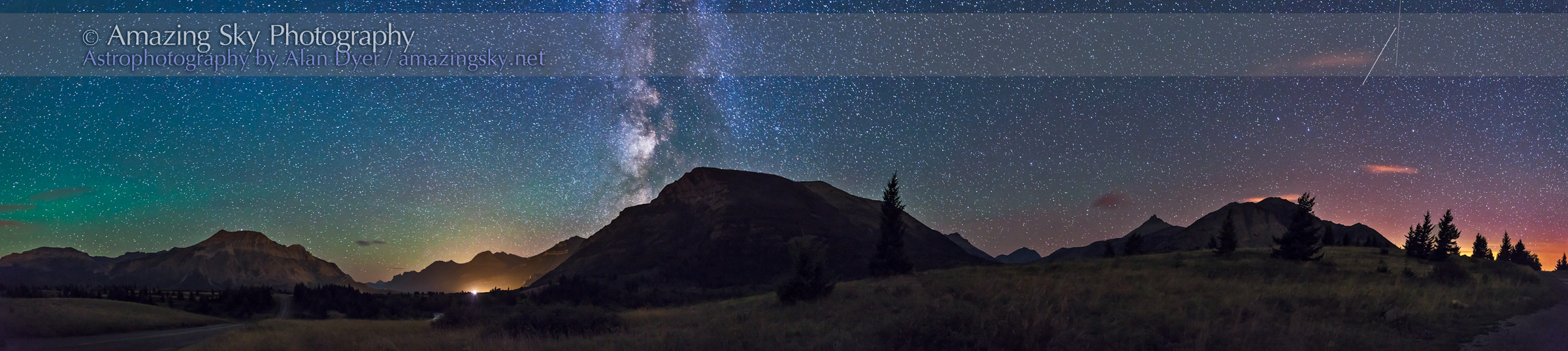
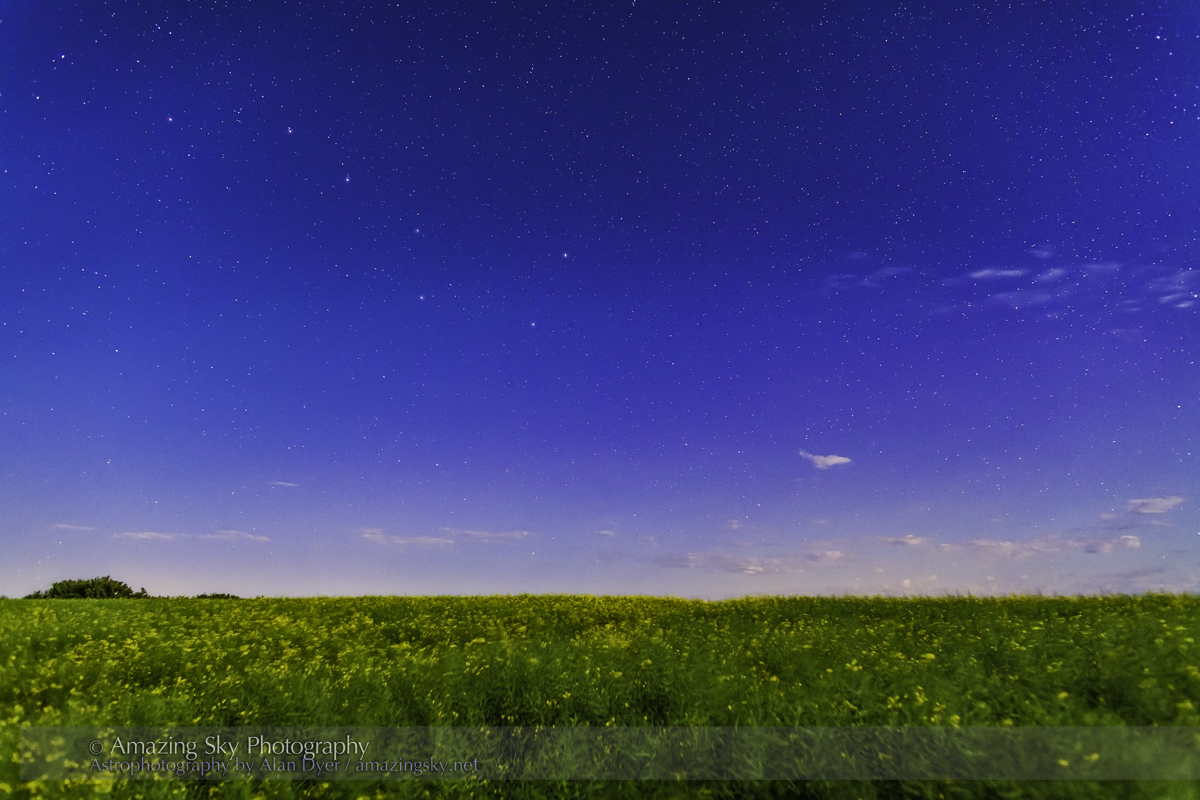
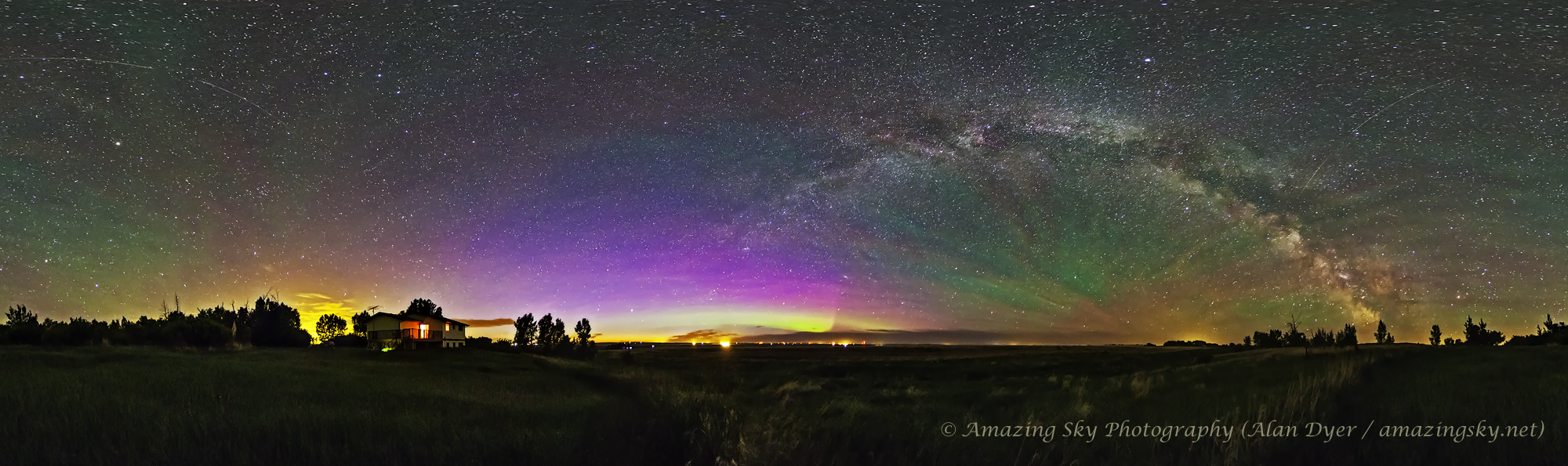
I got the shot! Then all I had to do was turn the camera around to face north to get this scene.
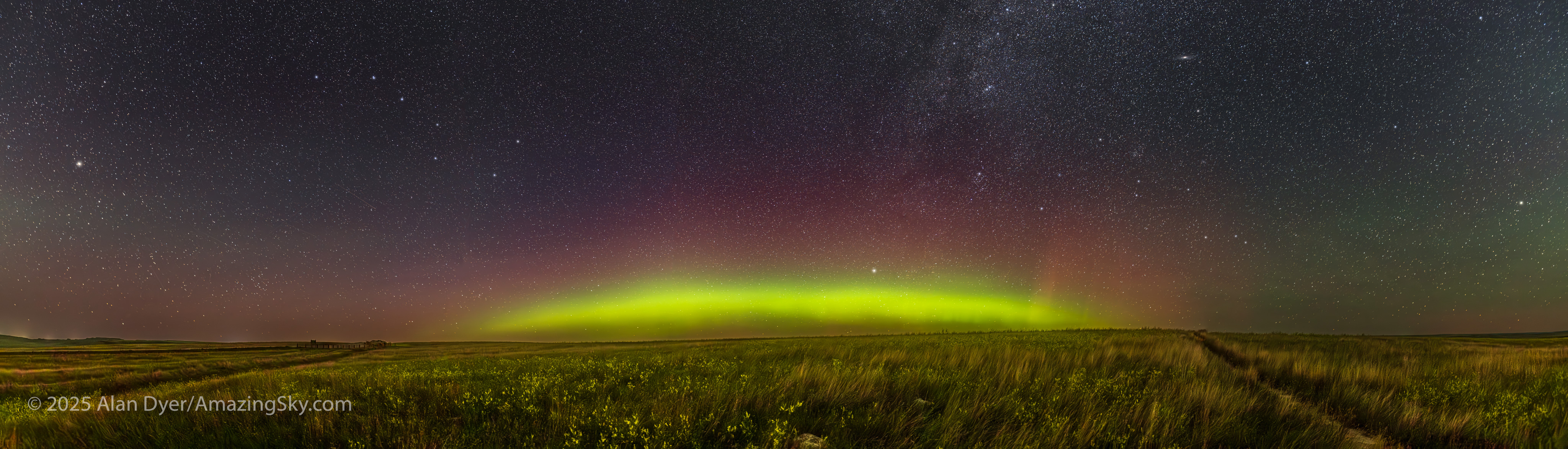
Technical:
This is a panorama of 5 segments, each 30 seconds untracked at f/2 with the Nikkor 20mm S-Line lens and Nikon Z8 at ISO 1600. Stitched with Adobe Camera Raw. I removed aircraft trails, but at left I retained the many faint satellite trails in the northwest still lit by twilight, as this was early at about 10:30 pm CST. I did not focus stack these frames. Nor was the camera tracking the stars.

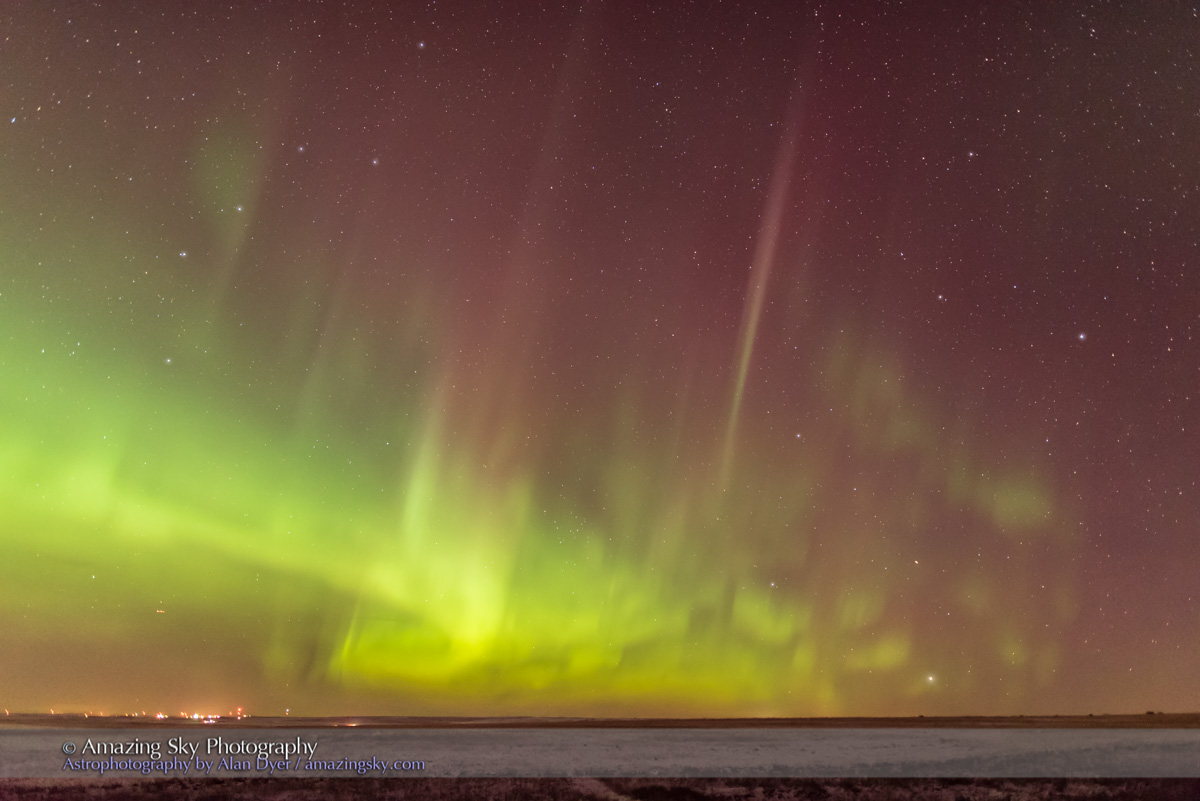
A mild aurora appeared in a classic arc across the north, and framed between the hiking trail, with the Big Dipper to the left and the Milky Way rising to the right. This is the wonderful sky that awaits in the “big sky” country of Grasslands. On the horizon only 3 distant lights could be seen. Grasslands is a Dark Sky Preserve. May it always be so!
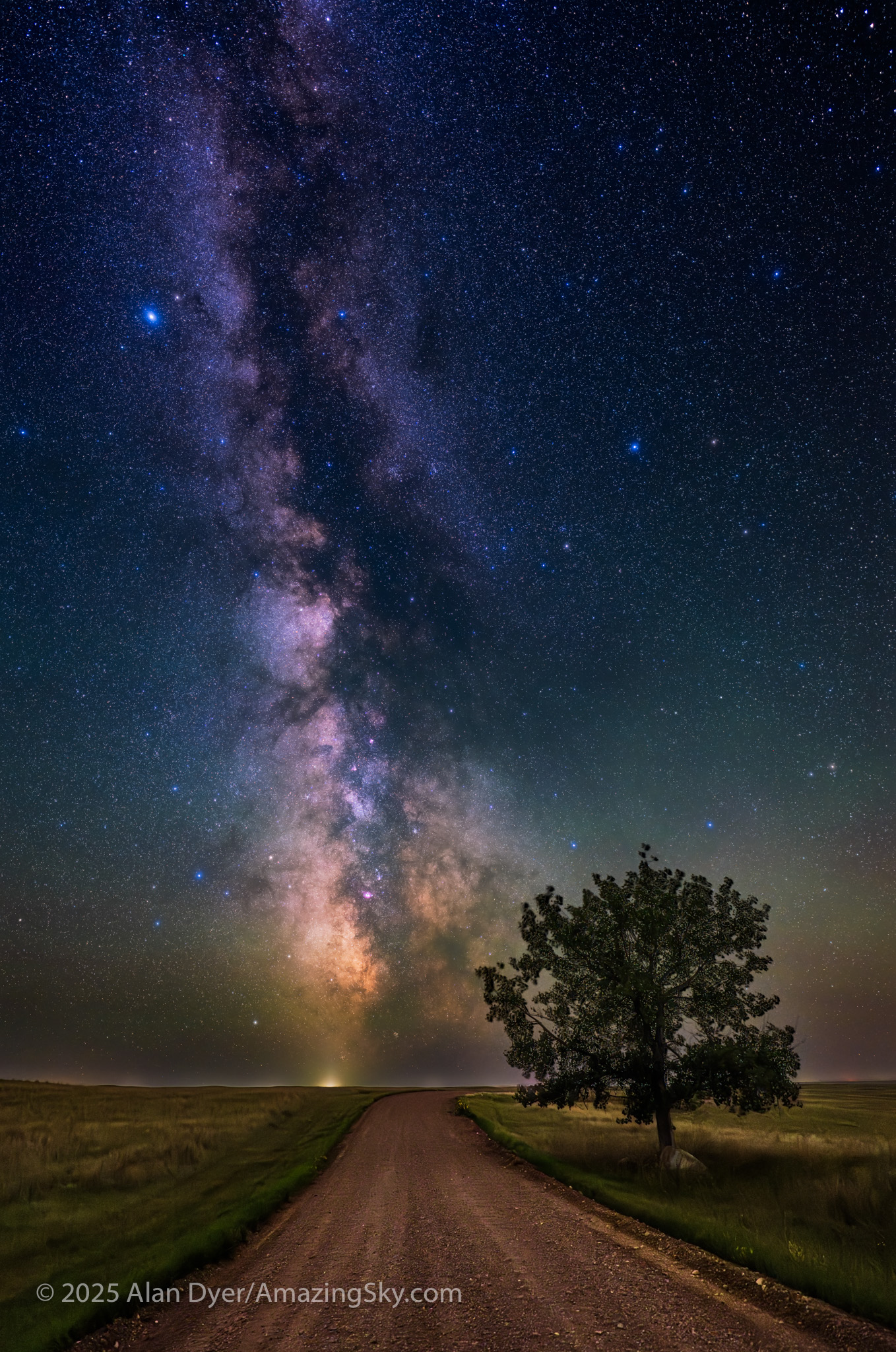
Technical:
This is a blend of tracked and stacked sky exposures with a single untracked ground exposure:
– 4 x 30 seconds at f/2 tracked for the sky, plus
– 1 x 2 minutes at f/2.8 untracked for the ground to bring out the details lit by starlight, plus
– A single 30-second tracked exposure through a Tiffen Double Fog 3 filter layered in, to add the star glows.
– All with the Nikon Z8 at ISO 800 and Nikkor 20mm S lens, on the MSM Nomad tracker. And all from the same tripod position. The camera was not moved for the sky photos.

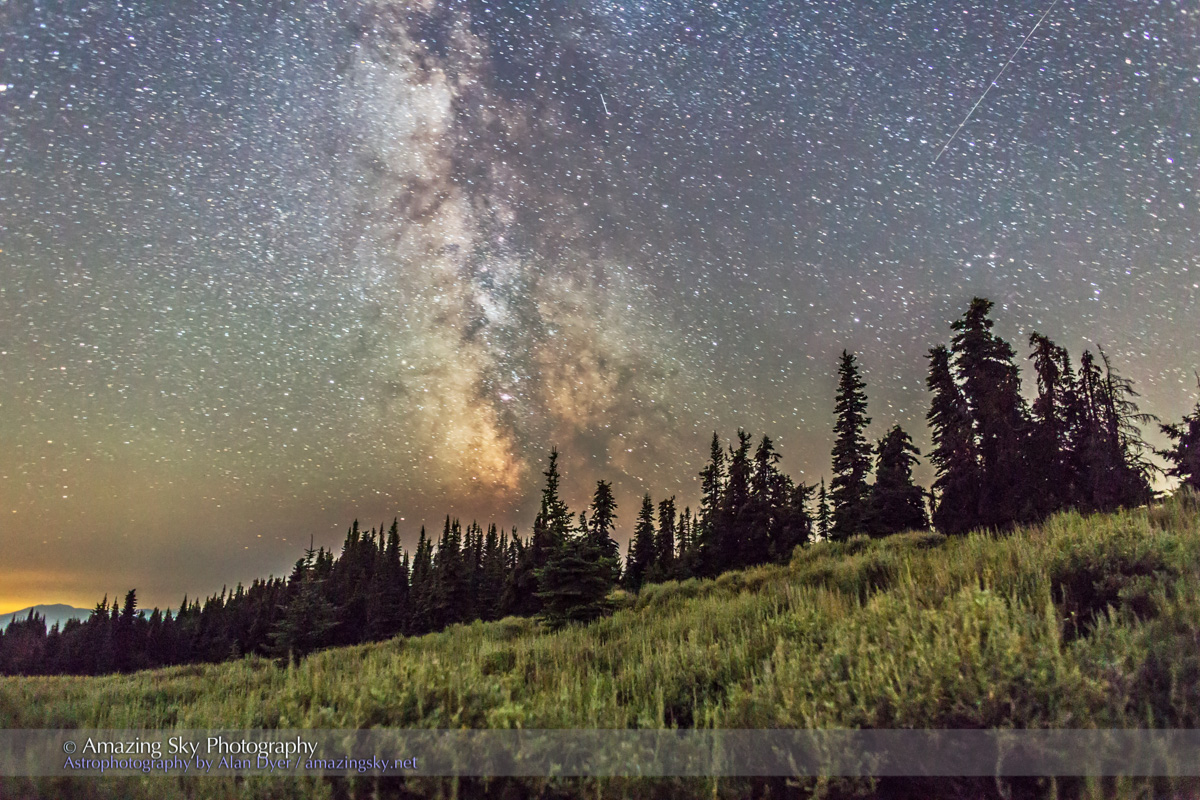
The night before I headed south out of the little town of Val Marie to a favourite spot high on the hill overlooking the Park. It is called Two Trees, but now only one tree remains! It made a fine foreground for the classic “lone tree and Milky Way” nightscape.

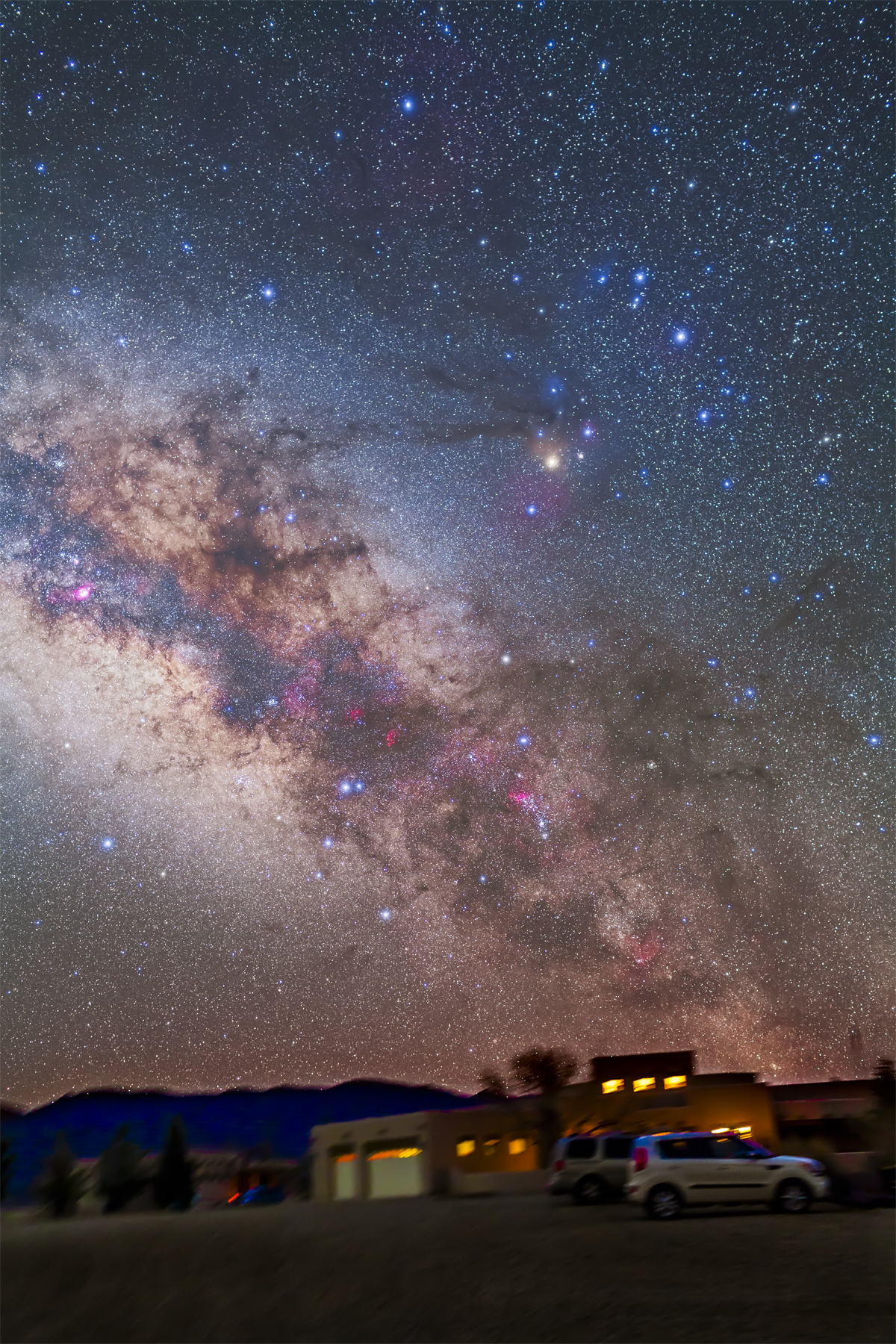
In August the galactic centre lies in the southwest quickly setting in the early evening. But from this latitude of 49ยบ N even with it at its highest, the Milky Way core lies low in the south, making for good compositions with foregrounds below.
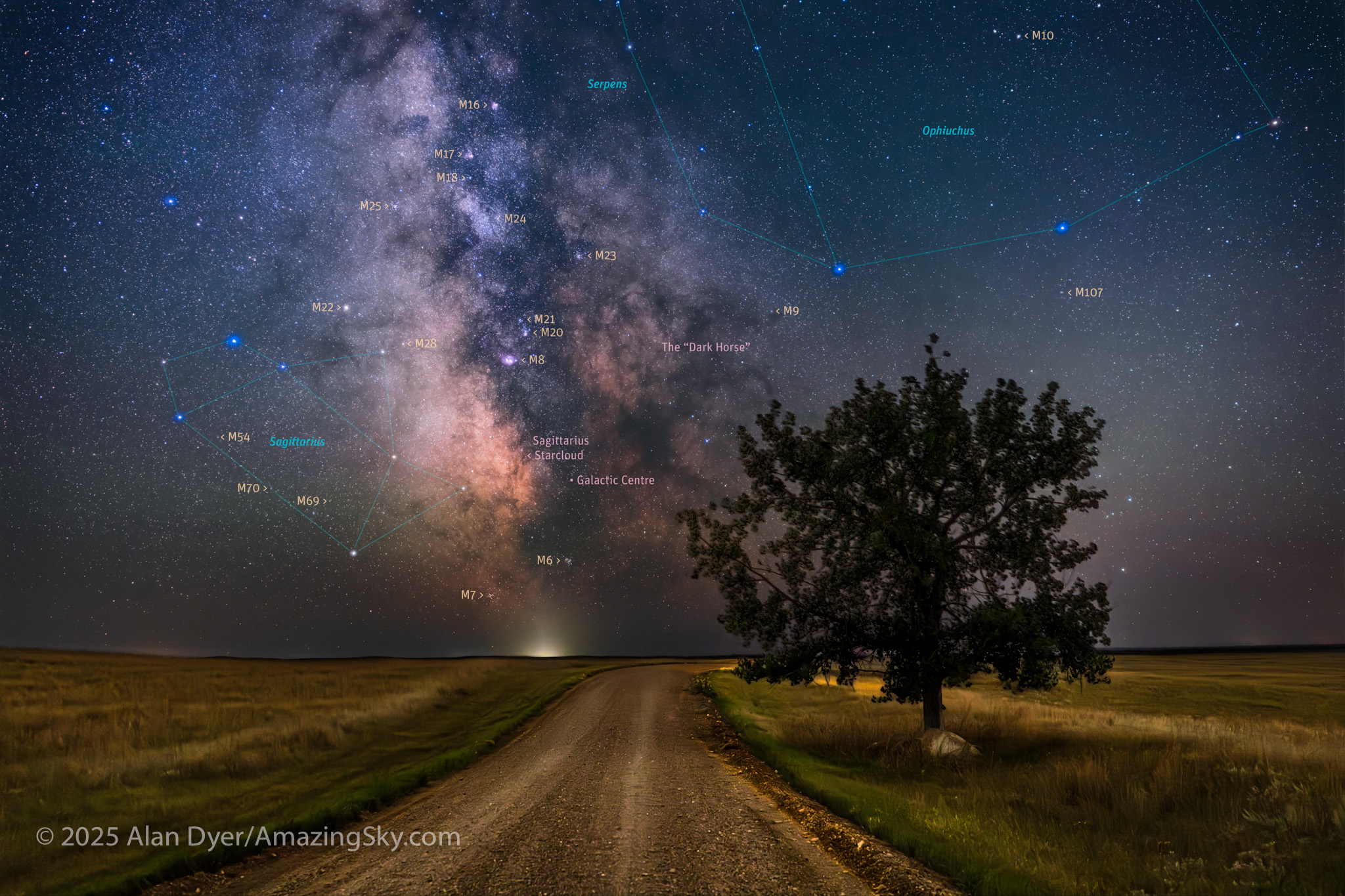
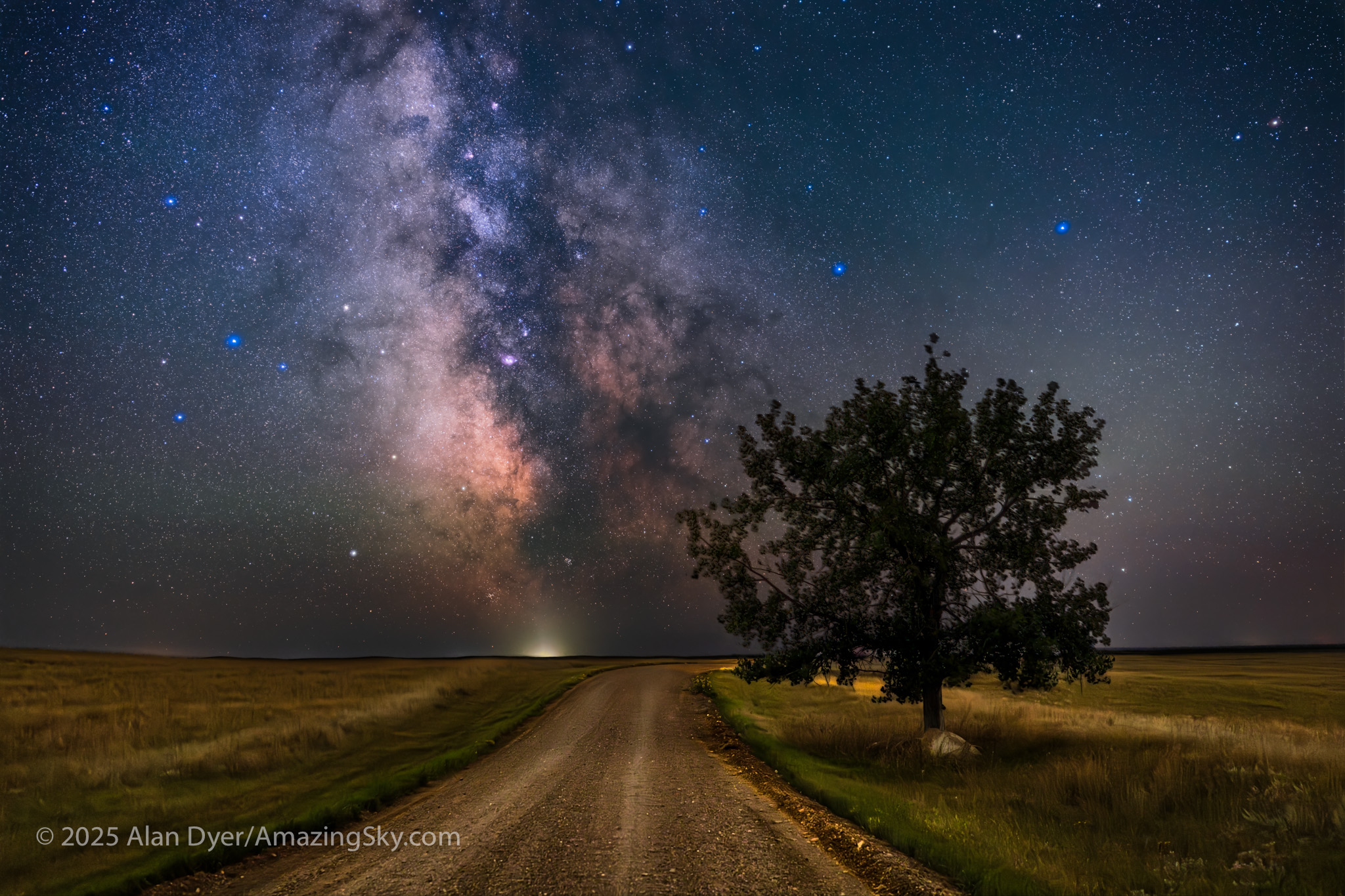
Here I present a “landscape” version of the image above, in versions with and without labels to indicate all the rich nebulas and star clusters in this area of sky in Sagittarius the Archer, home of the Milky Way core. Tap on the images to bring them up full screen.

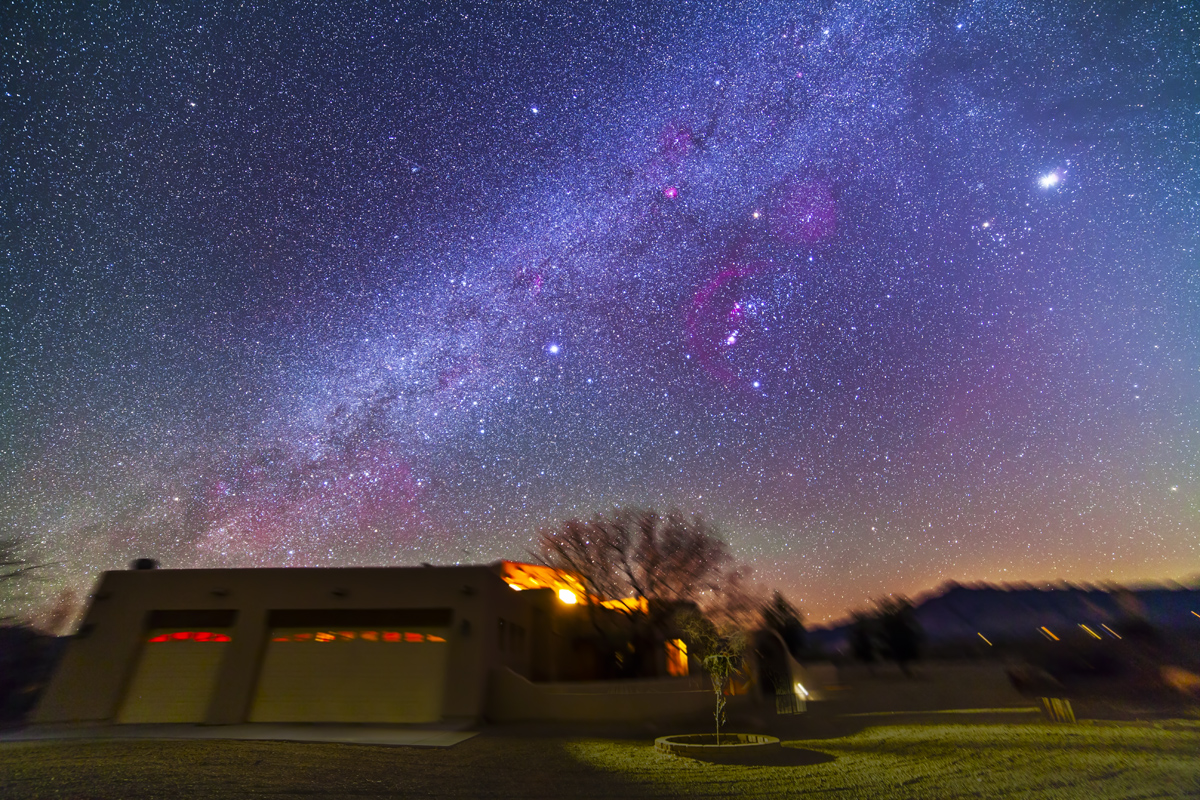
Similarly, below I present views looking east to the autumn constellations rising over the prairie. This was from the valley below Two Trees Hill, at the Riverwalk day use site. Here there were absolutely no lights visible, and hardly a sky glow on the horizon from towns and light pollution. This was paradise for a stargazing session.
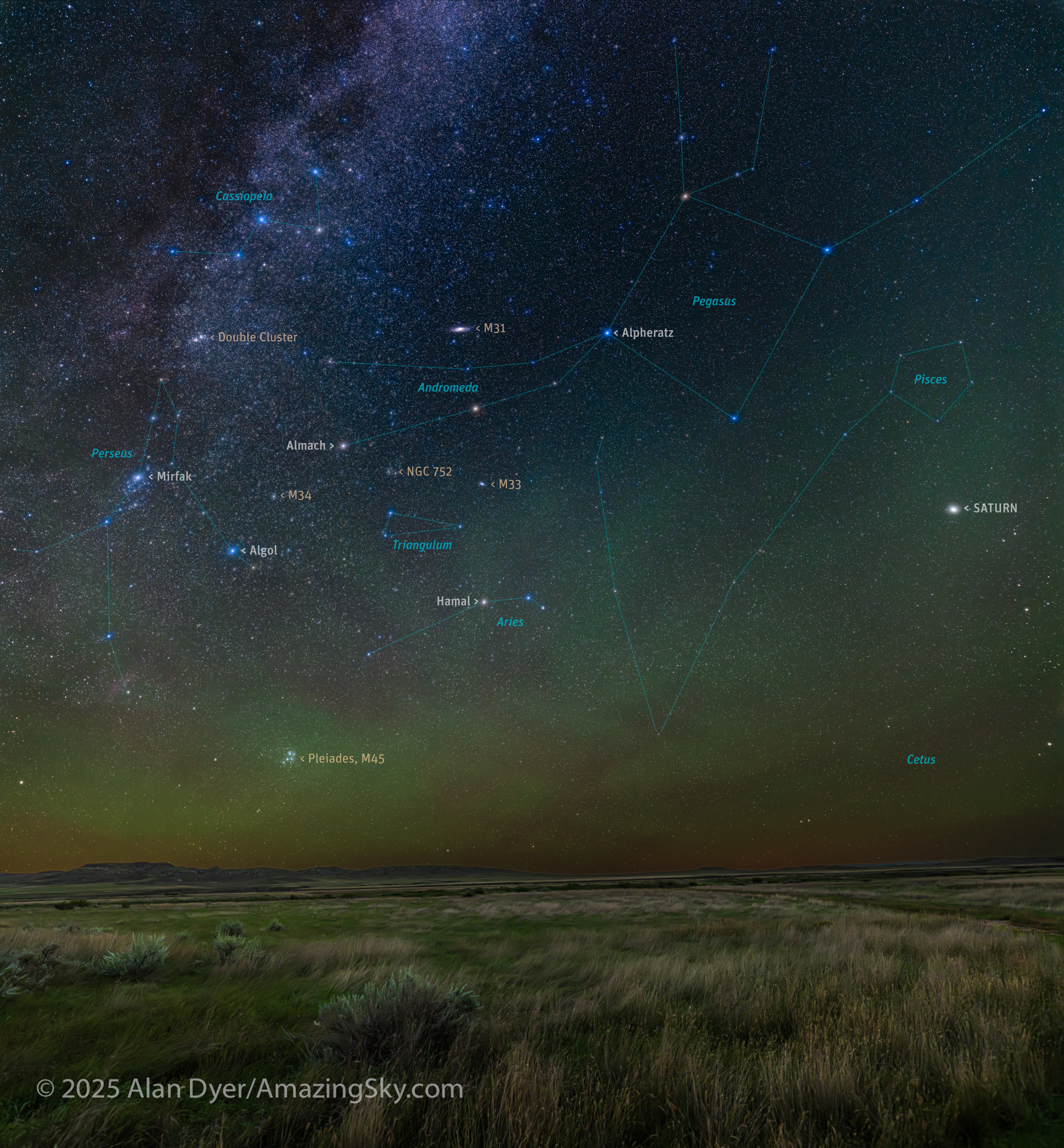
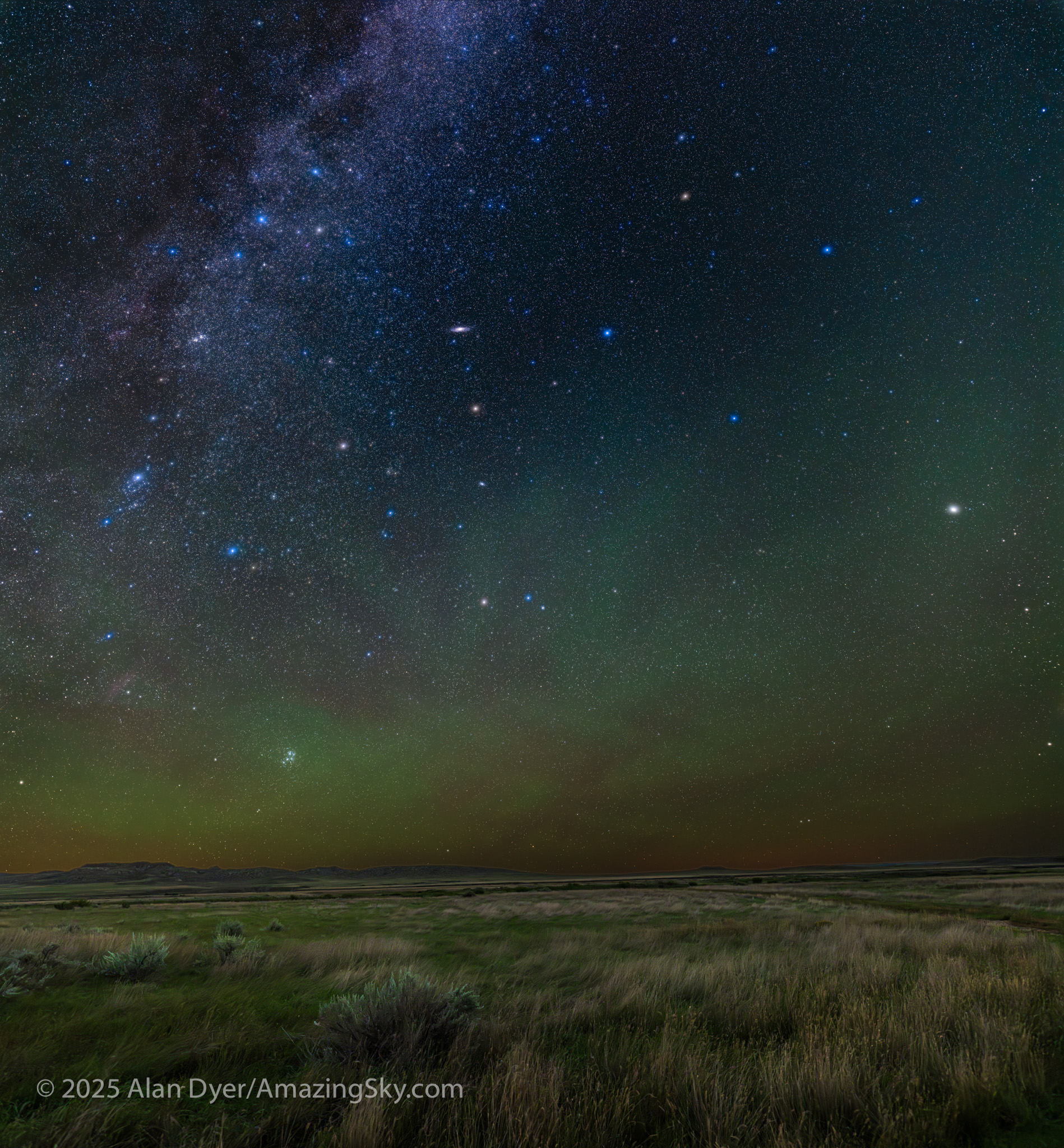
The constellations in this area of sky are the ones made famous in the classic tale of the hero Perseus riding on Pegasus the Flying Horse to rescue the lovely Princess Andromeda from Cetus the Sea Monster, while vain Queen Cassiopeia looks on.

Here the sky was also tinted green, not with aurora but airglow, a natural effect caused by high-altitude oxygen fluorescing at night, giving off energy it has absorbed by day. It discolours the sky but it belongs there! It is visible only at dark sky sites.

The Great Sand Hills

From Grasslands I ventured north to the little town of Leader, Saskatchewan, one of the jumping off points to visit the Great Sand Hills nearby. You have to have a local map to find them, but the sand dunes are extensive, and an oddity on the prairie, another Ice Age relic.

They are not a Park but are an ecological reserve, with limited access. I shot from the main spot with parking for visitors and a trail off into the dunes.

Here is another pair of images with annotations, looking north from the main dune field toward Ursa Major and the Big Dipper.
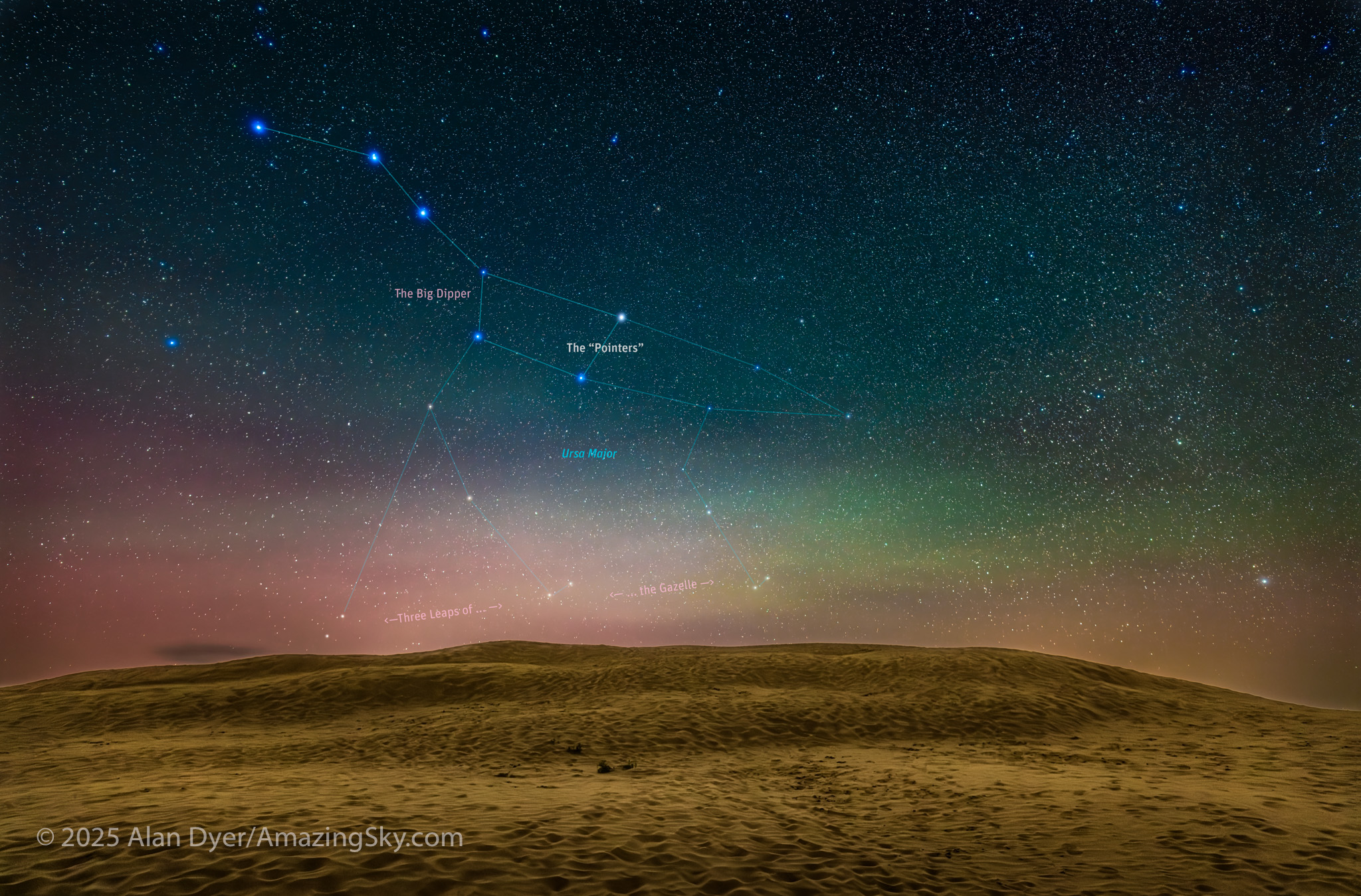
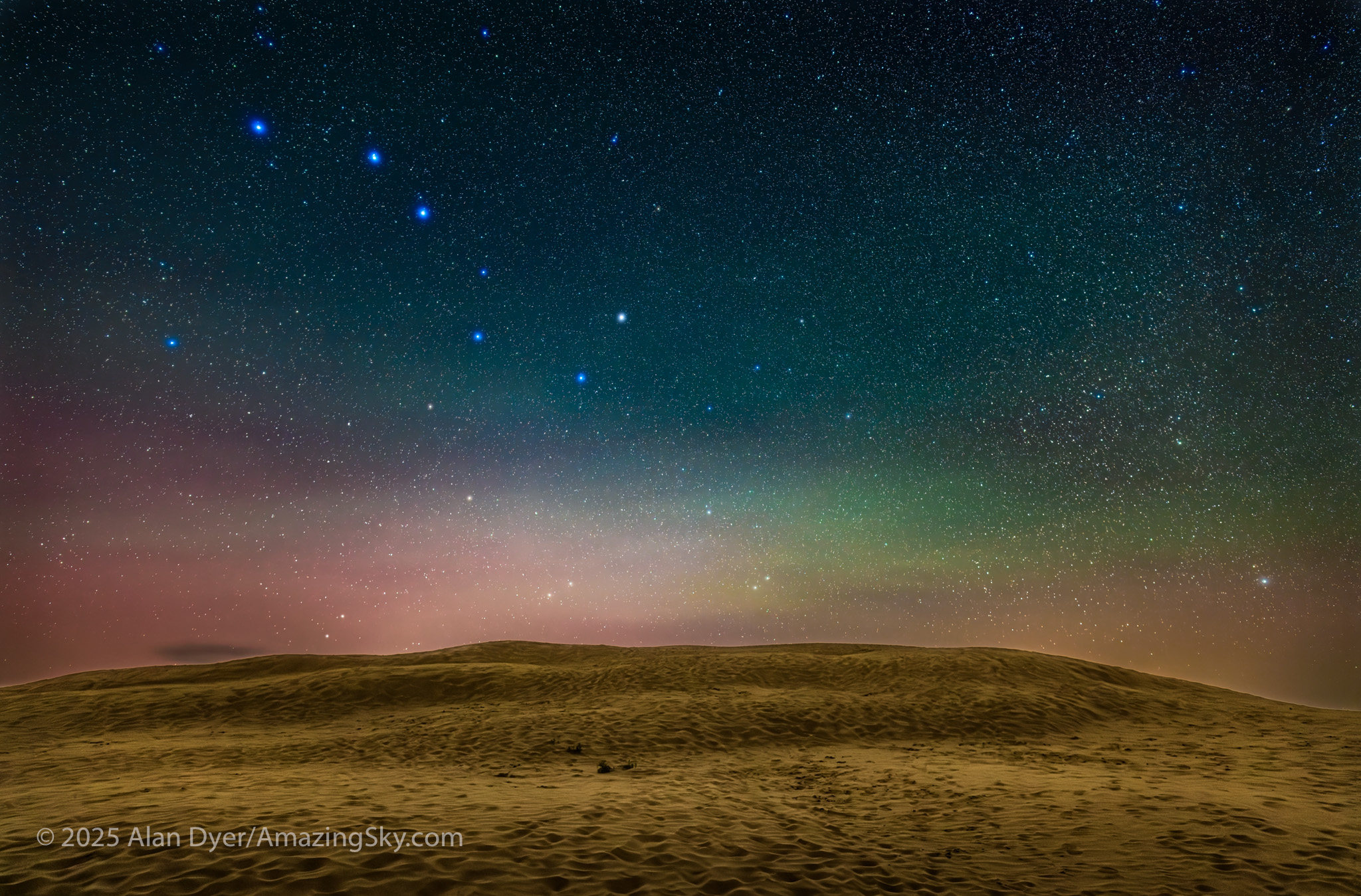
An extensive display of airglow also tints the sky, at least I think that’s the source, and not aurora.
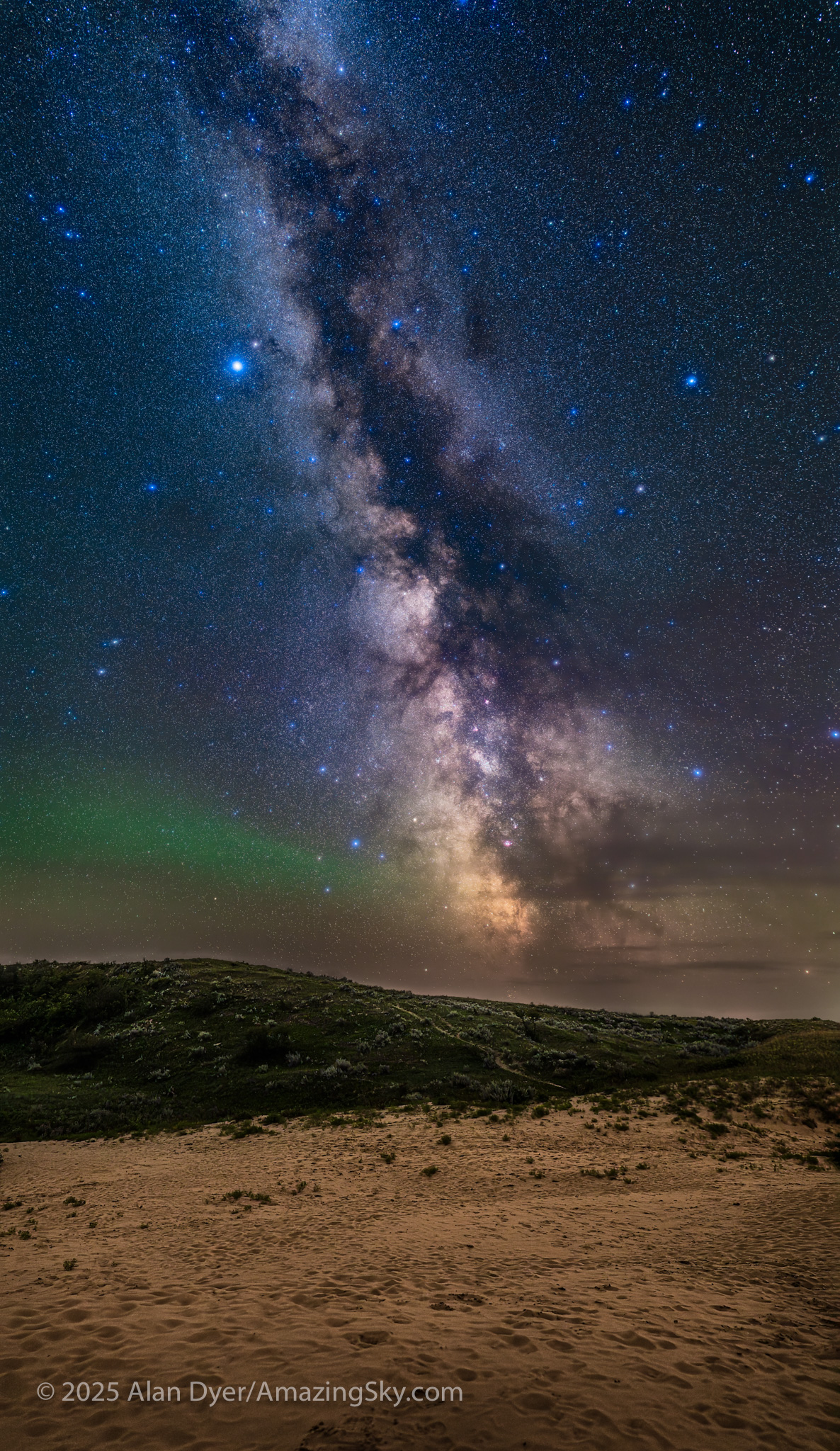
Technical:
This is a blend of tracked and stacked sky exposures with a single untracked ground exposure:
– A stack of 4 x 60 seconds at f/2 tracked for the sky, plus
– 1 x 4 minutes at f/2.8 untracked for the ground, plus
– A single 60-second tracked exposure through a Tiffen Double Fog 3 diffusion filter layered in, to add the star glows.
– All with the Nikon Z8 at ISO 800 and Nikkor 20mm S lens, on the MSM Nomad tracker. And all from the same tripod position. However, the camera framing was changed for the sky and ground shots, tilting it up it to include more of the sky up the northern Milky Way.

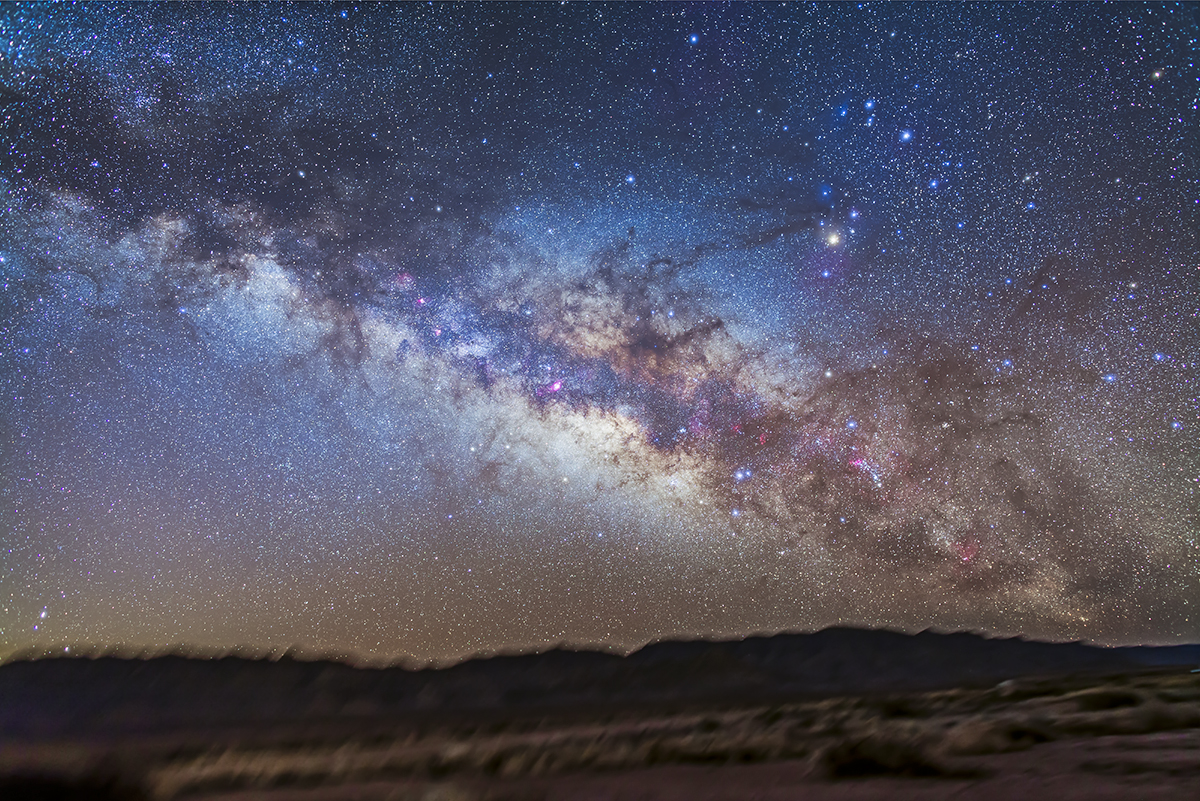
Turning around to face south again frames the sweep of the summer Milky Way over the well-trodden dunes. Not quite the Saharan or Namibian scene you might want, but this is Saskatchewan and having even this scene on the prairies is unique. The only other dune fields are far up north and not readily accessible.
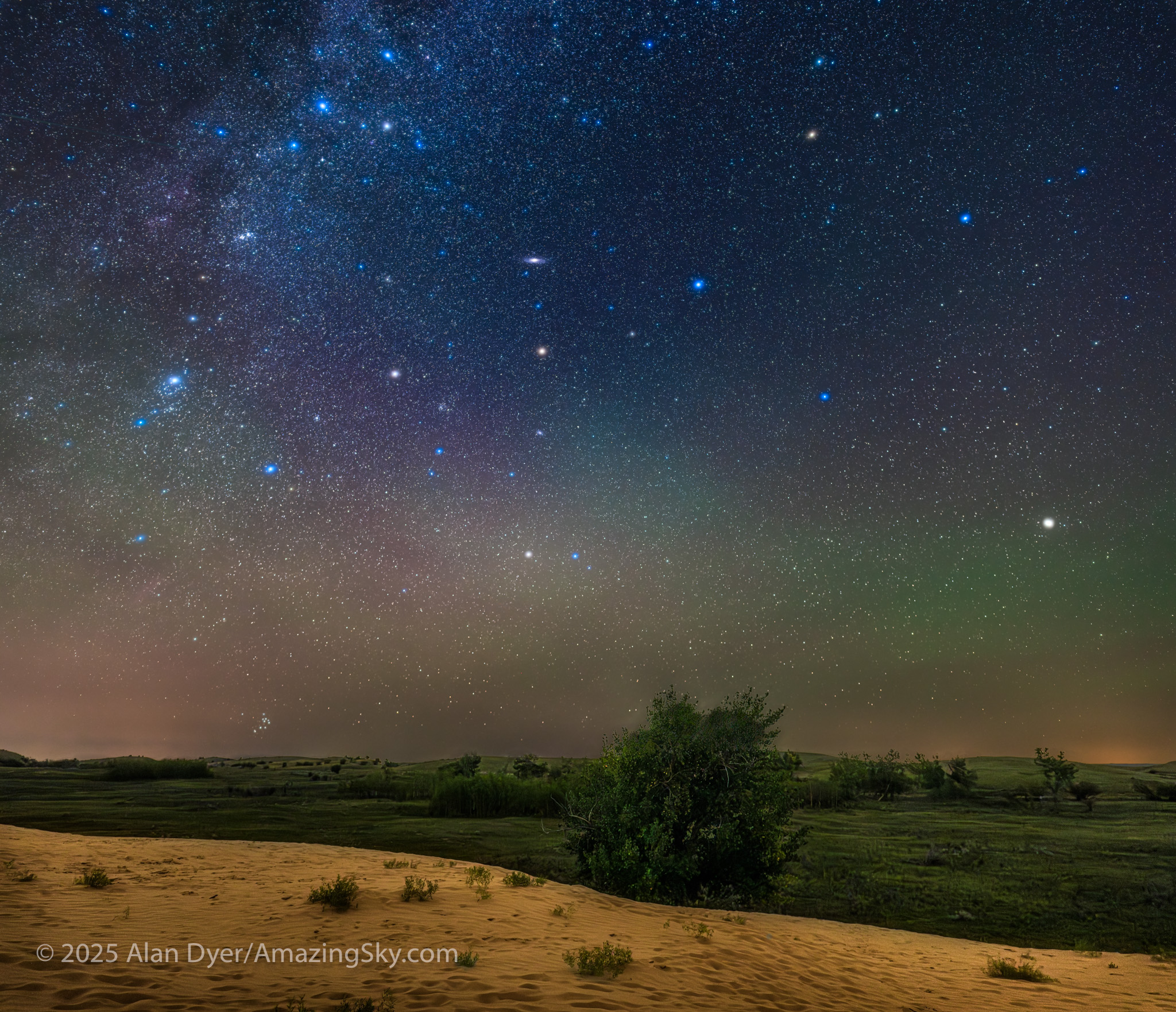
Technical:
This is a blend of tracked and stacked sky exposures with a single untracked ground exposure:
– A stack of 4 x 60 seconds at f/2 tracked for the sky, plus
– 1 x 3 minutes at f/2.8 untracked for the ground to bring out the details lit only by starlight, plus
– A single 60-second tracked exposure through a Tiffen Double Fog 3 diffusion filter layered in, to add the star glows.
– All with the Nikon Z8 at ISO 800 and Nikkor 20mm S lens, on the MSM Nomad tracker. And all from the same tripod position. However, the camera framing was changed for the sky and ground shots, tilting it up it to include all the constellations in one frame but with just a sliver of ground in the frame.

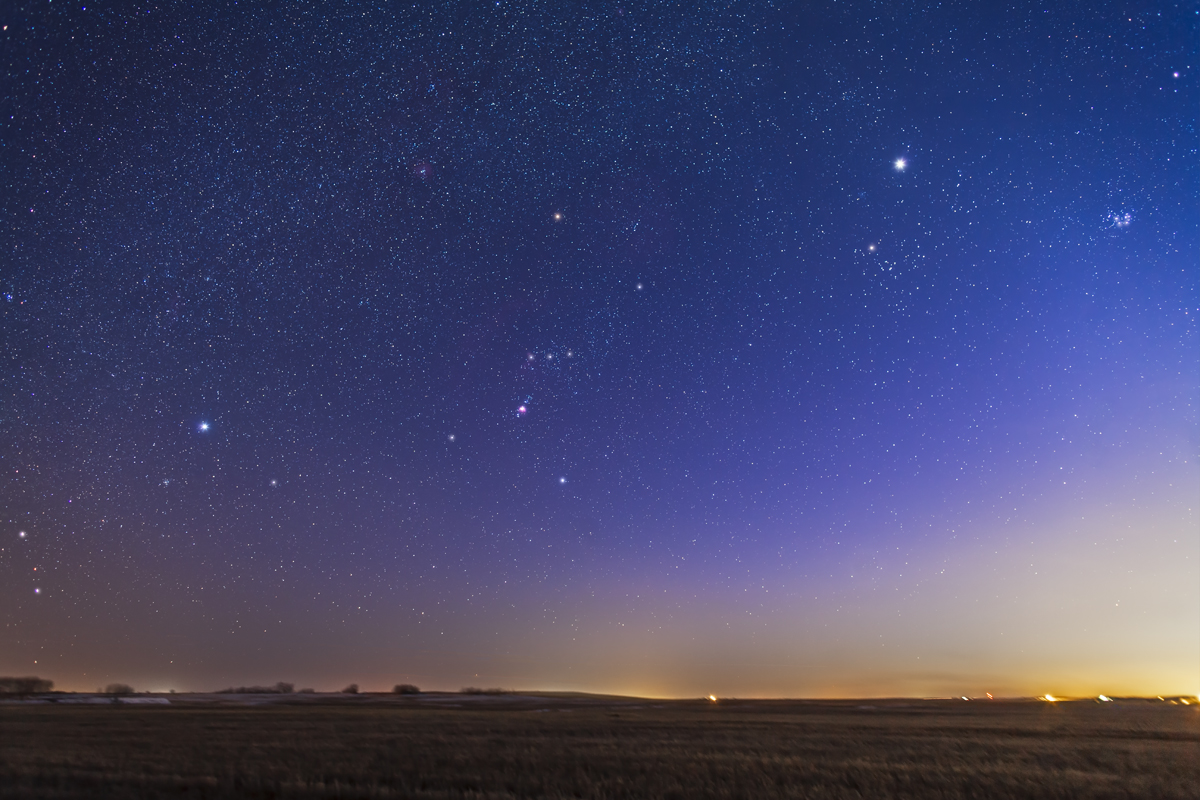
Looking east from the dune again frames the mythological autumn constellations, with the “W” of Cassiopeia at top amid the Milky Way. The bright “star” at lower right is Saturn. The Pleiades are just rising at left.

The Cypress Hills

I had started my Saskatchewan journey in the Cypress Hills, another formation created by the Ice Age, or rather left untouched by the glaciers creating a high wooded oasis on the prairie. I was there for the annual Saskatchewan Summer Star Party, the subject of my previous blog here.
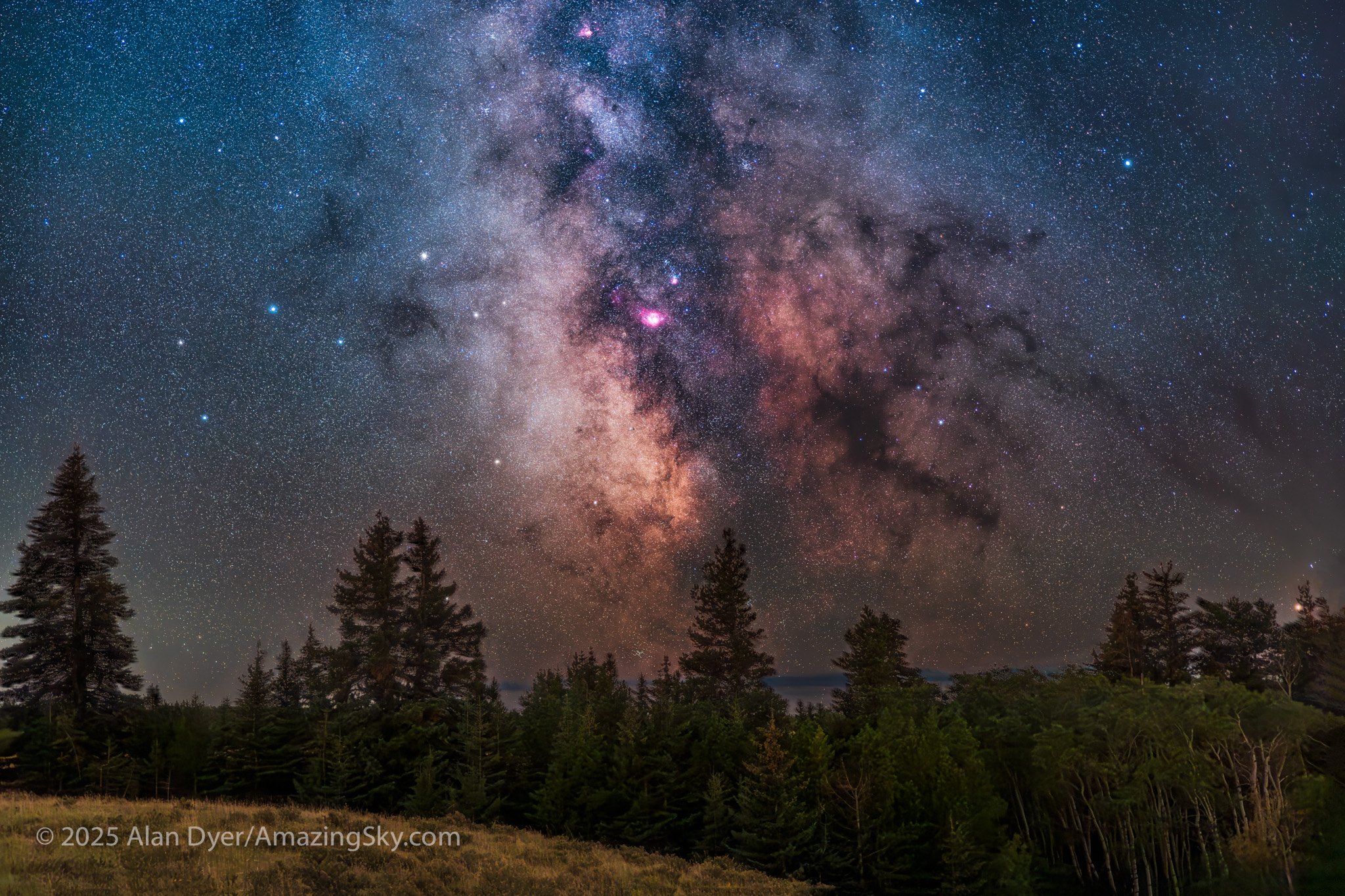
Technical:
This is a blend of:
– A stack of 4 x 1 minute exposures, tracked, for the sky with …
– A stack of 2 x 1-minute exposures, untracked, for the ground,
– All with the Canon RF 28-70mm lens at f/2 and set to 48mm, on the astro-modified Canon EOS R at ISO 1600, and on the MSM Nomad tracker. No filters were employed here.
Masking and blending all the images, with the trees in the foreground was a challenge! The camera was not moved โ€” all images were from the same tripod position.

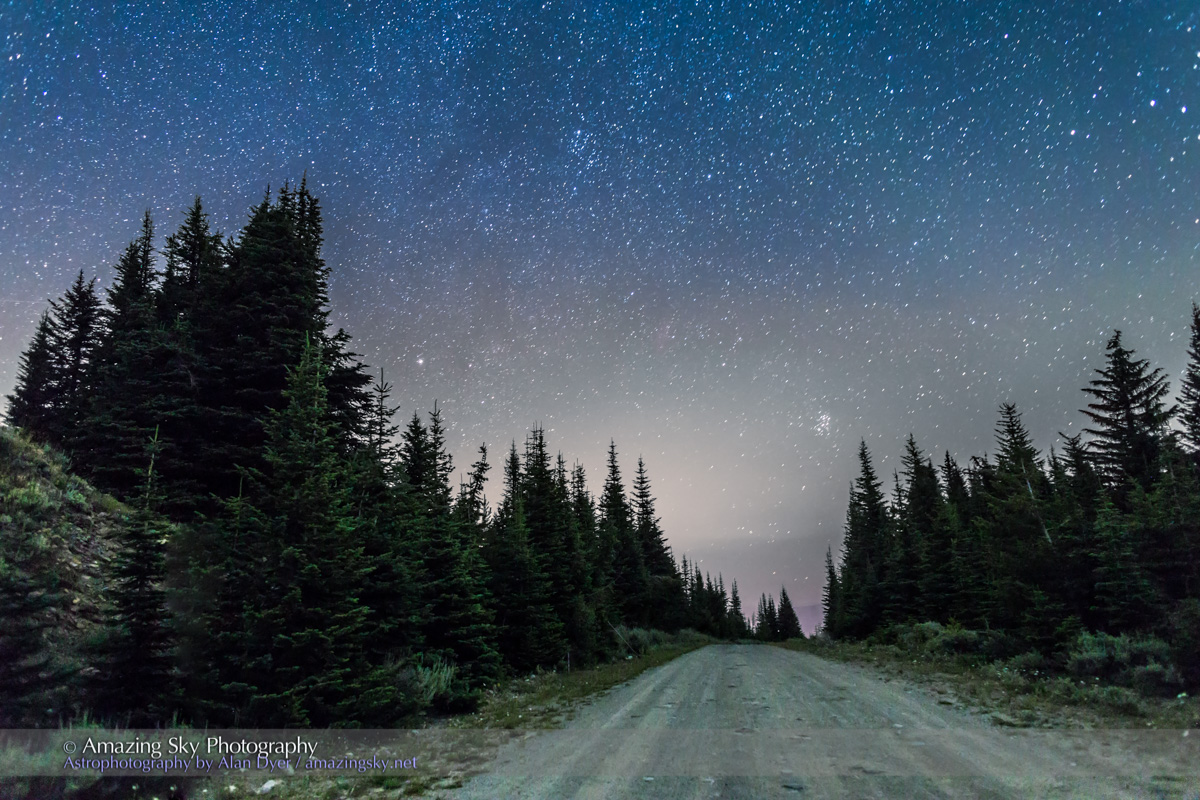
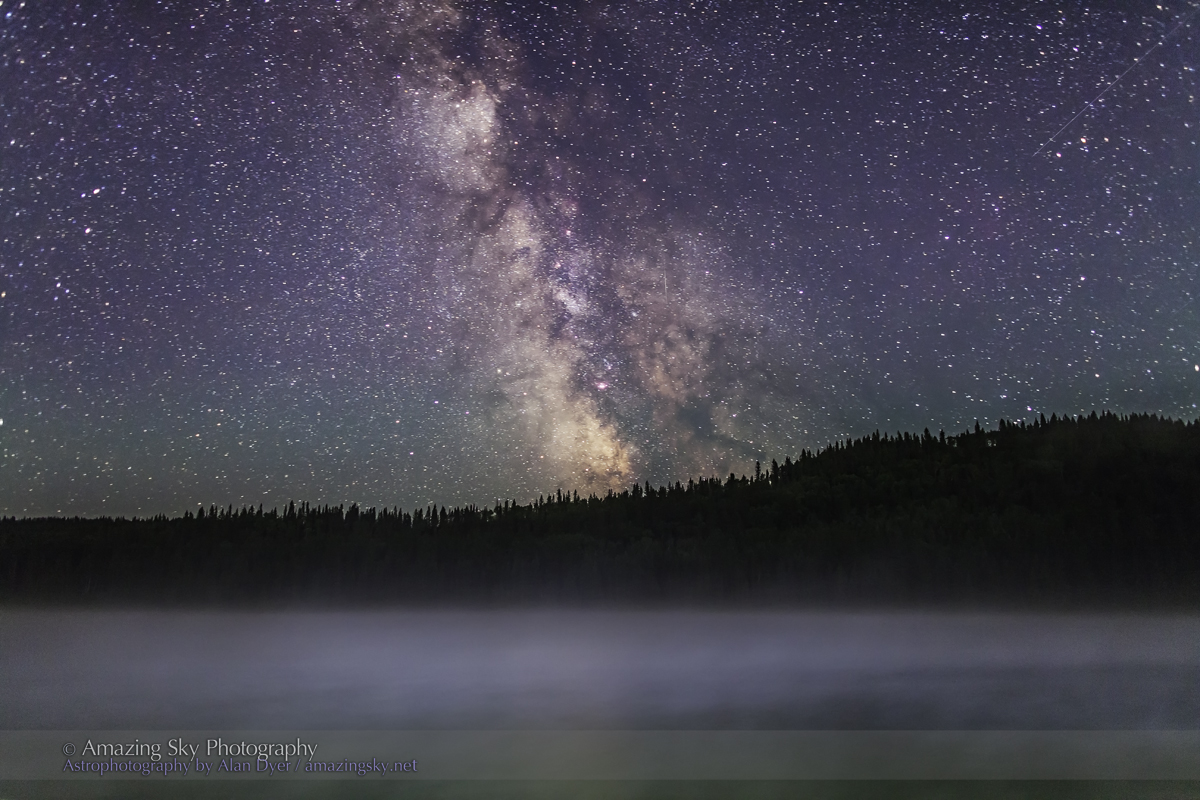
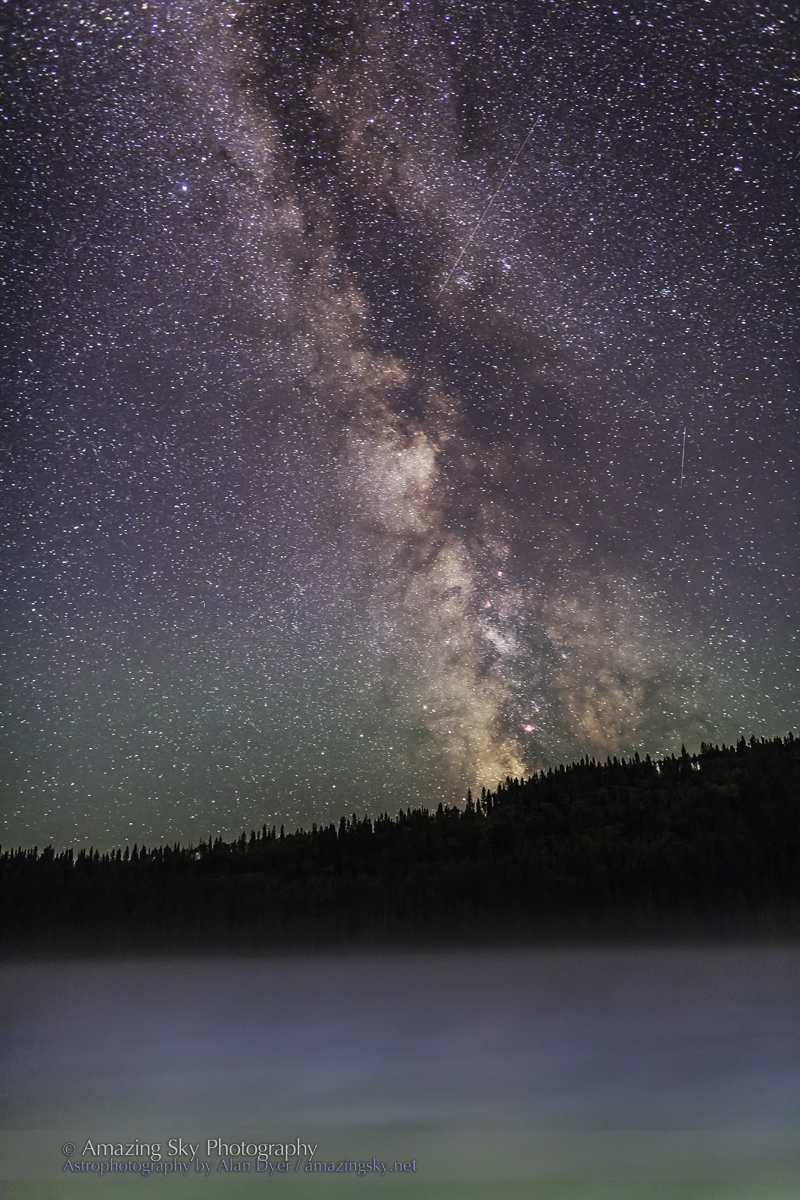
But on the first couple of nights, with the entire four nights of the Party promising to be clear, I left the Party and headed off on my own to shoot some nightscapes over the pine trees at Lookout Point, to again catch the photogenic galactic core in its last appearance for the season.

For the image below, I employed a special filter that isolates the deep red light emitted by the many hydrogen-gas nebulas toward the Milky Way core.
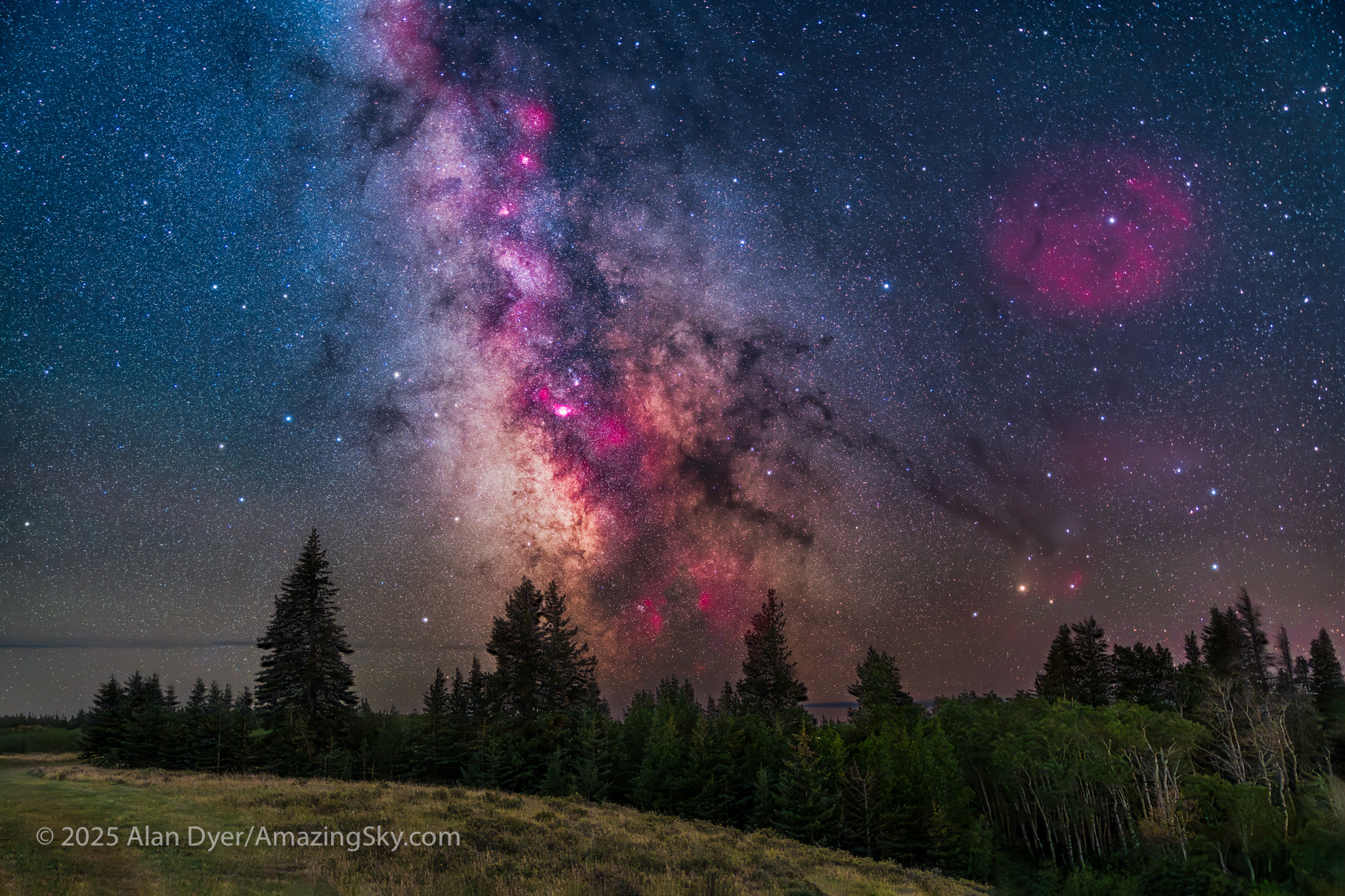
Technical:
This is a blend of:
– A single 2-minute exposure, untracked, for the ground, blended with โ€ฆ
– A stack of 5 x 1 minute exposures, tracked, for the sky, plus โ€ฆ
– An additional tracked 2-minute exposure layered in, taken at the end of the set through an Astronomik “narrowband” H-Alpha clip-in filter, to add the red nebulas.
– All with the Canon RF 28-70mm lens at f/2 and set to 35mm, on the astro-modified Canon EOS R at ISO 1600 (3200 for the Ha shot), and on the MSM Nomad tracker.
Masking and blending all the images, with the trees in the foreground was a challenge! The camera was not moved โ€” all images were from the same tripod position.

This is a technique borrowed from “deep-sky” imaging but now popular among nightscape photographers to create an even more enhanced night sky than a normal unfiltered view.

But even without the filter the long exposures used for the sky record far more detail and colours than even dark-adapted eyes could see. The filter takes that even further.

But those nebulas are there, and they do glow red. Just like the airglow that unaided eyes usually cannot see, the long exposures reveal the unseen, in this case some of the wonderful content of our Galaxy.

And that’s the attraction of astrophotography, to reveal the otherwise elusive or invisible structure of the sky, and in this case juxtaposed over familiar earthly landscapes below.

I can highly recommend Southwest Saskatchewan for anyone interested in stargazing and astrophotography. It’s always been one of my favourite destinations.

โ€” Alan, September 17, 2025 / ยฉ 2025 AmazingSky.com
Touring the Constellations of Spring


Join me in a guided tour of the famous (and not so well known!) constellations of the northern spring sky.

The northern spring sky lacks the splendour of bright patterns such as winter’s Orion or summer’s Cygnus, but it is still well worth getting to know. The Milky Way is out of sight, and in its absence we are left with fewer bright stars to dazzle us at night. But we are treated to the year’s best views of famous constellations such as Ursa Major, Leo and Virgo.

Now, I am talking about the sky of the northern hemisphere, where April and May brings spring, and places the Big Dipper high overhead. While some of these constellations can be seen from the southern hemisphere, they appear to the north, low and “upside-down” from the views I present here. And April and May are autumn months.

Let’s start with the “big picture.” (Tap on images to bring them up full screen.)

NOTE: I shot all these images during a run of fine nights in mid-April 2025 with a 15-35mm zoom lens on a Canon EOS R camera, and on a Star Adventurer tracker. Separate exposures through a Tiffen Double Fog 3 filter added the star glows.

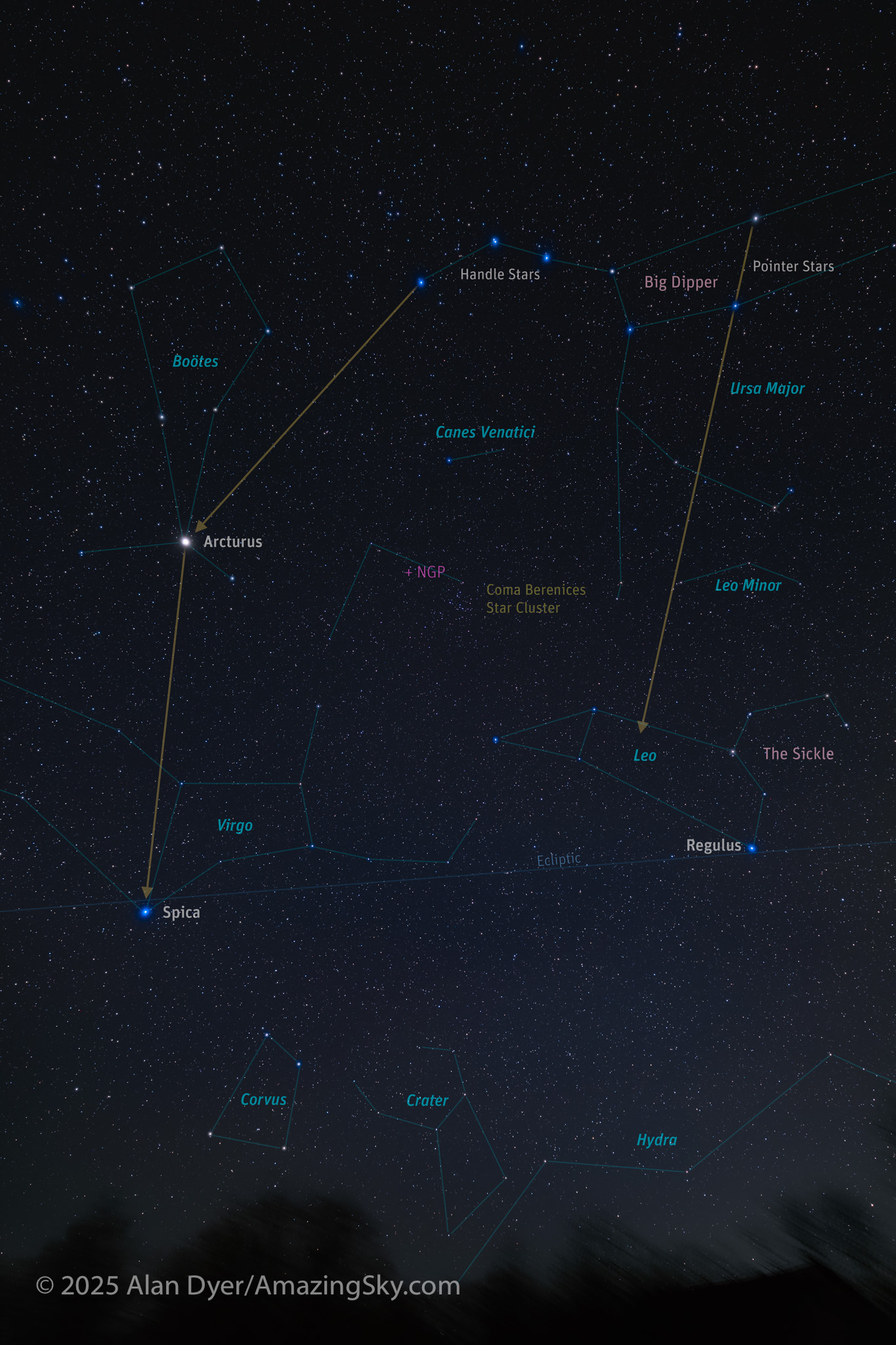
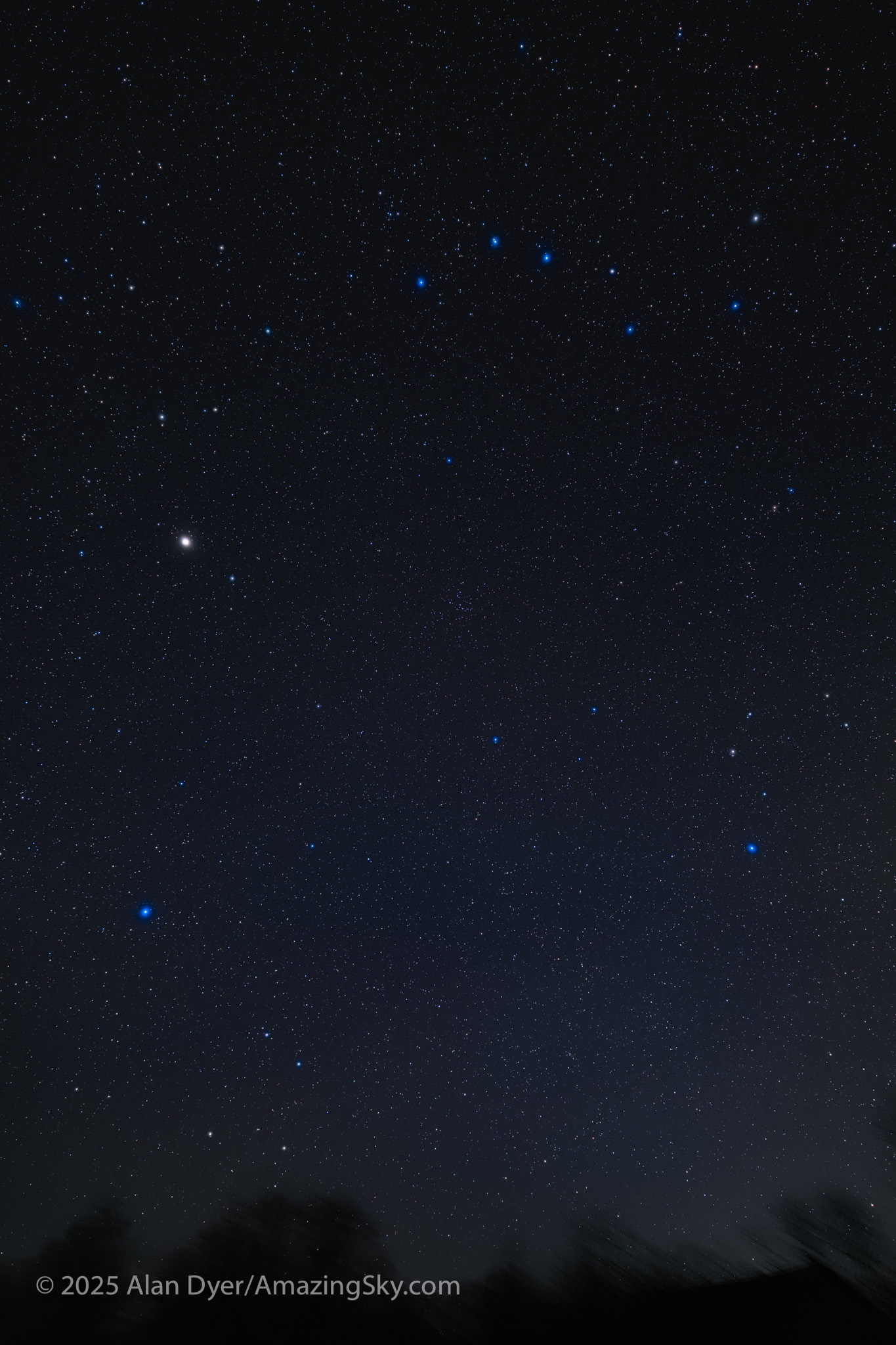
This image, in labeled and unmarked versions, presents a wide view of the spring sky from horizon to well past the zenith overhead. The key pattern to look for is the Big Dipper, at its highest in northern spring. In the UK and Europe it is known as the Plough or Wagon. Look way up to find it first.

Its Pointer Stars in the Bowl famously point north to Polaris. But here I show the other pointer line off the Bowl, to the south, to Leo the Lion. It is well known as one of the constellations of the Zodiac. Leo is marked by one of the brightest spring stars, Regulus.

Use the Handle of the Dipper to arc downward, to locate the brightest star of spring, Arcturus, shining with a yellow light. Keep that line going south and you’ll come to a dimmer and bluer star shining in the south. That’s Spica, the brightest star in Virgo, the Zodiac constellation east of Leo.

Now let’s take a closer look at selected areas.

Ursa Major, Leo and Boรถtes

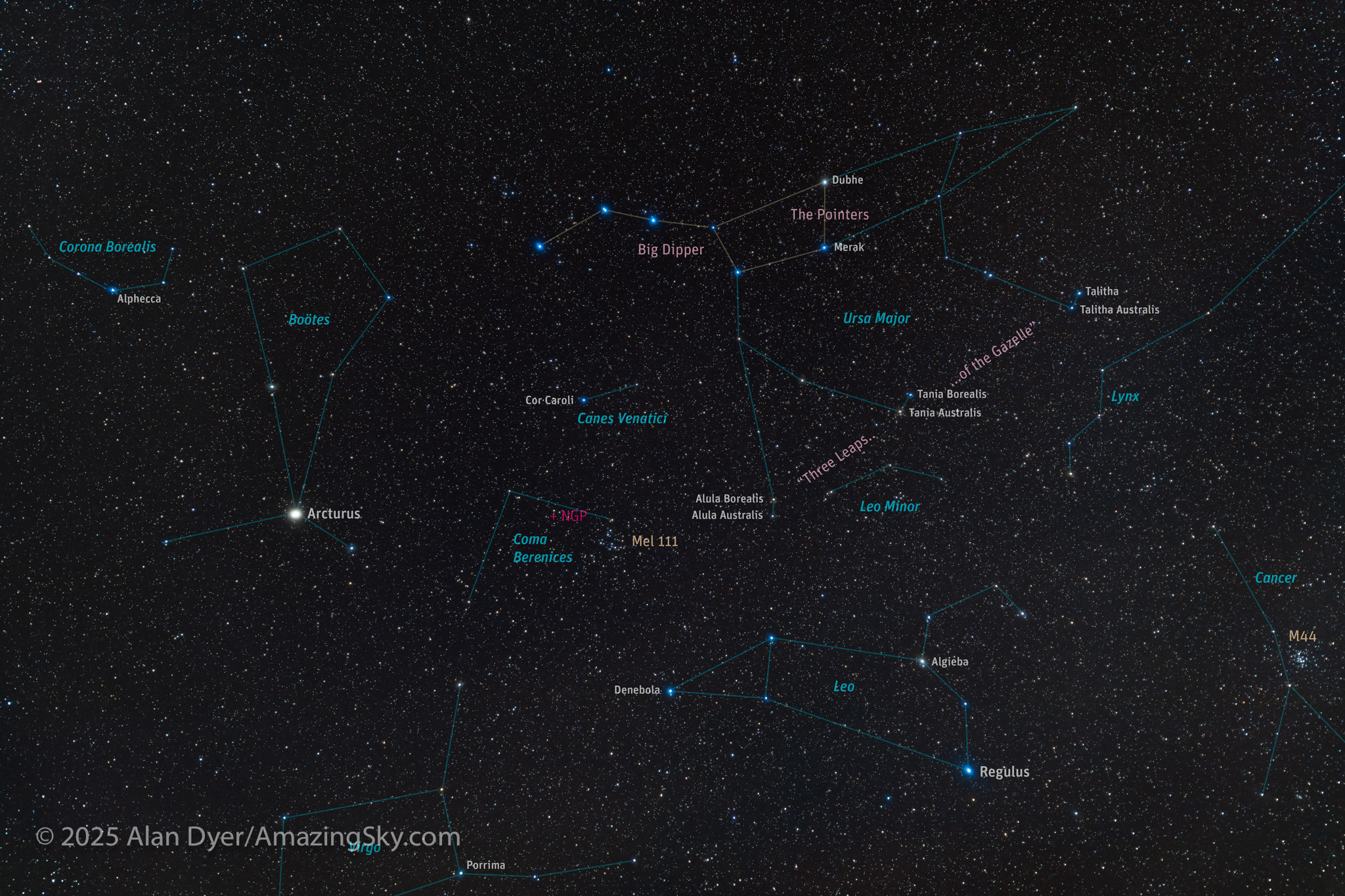
This is still a wide view, looking up and high in the south. There’s the Big Dipper/Plough at top. It is not a constellation. It is an “asterism” of seven stars within the large constellation of Ursa Major, the Great Bear. With a little imagination you can join the dots to make a bear (many northern cultures did so). Except we draw him with a long tail, which bears do not have!

The paws of the Bear are marked by a trio of double stars: Alula Borealis and Australis, Tania Borealis and Australis, and Talitha and Talitha Australis. The names come from Arabic words for “first,” “second,” and “third” as these sets of double stars are collectively called the Three Leaps of the Gazelle in Arabic sky lore. Once you see them you’ll be surprised at how distinctive they are.

Below Ursa Major is Leo, a pattern that does look a little like a sitting cat. Its bright star Regulus was named by Copernicus, from a Latin word for “little king.” But Regulus has long been known as the heart of the Lion.

To the east lies brighter Arcturus, a name that means “bear watcher,” as it and its host constellation Boรถtes, the Bear Herdsman, are tied to Ursa Major and Minor in Greek mythology.

Leo, Cancer and flanking clusters

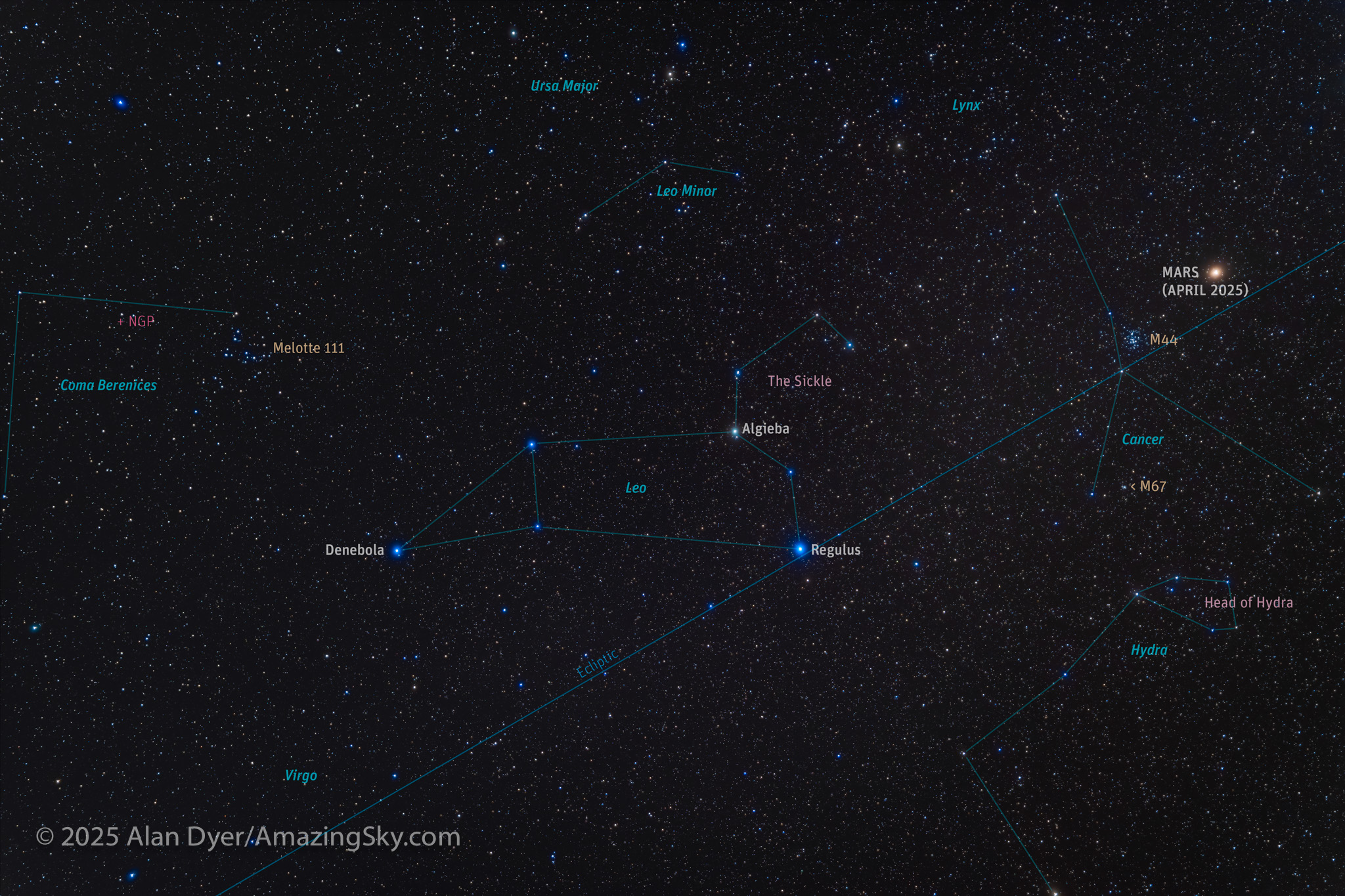
Here I frame Leo, but also two of the constellations that flank him: Cancer the Crab to the right (or west) and Coma Berenices to the left (or east). Each contains a bright naked eye cluster of stars:

  • Messier 44 or the Beehive cluster in Cancer, the faint Zodiac pattern west of Leo. When I shot this image in mid-April 2025 red Mars was just entering Cancer.
  • and Melotte 111 in Coma Berenices. At one time this clump of stars easily visible to the naked eye was considered part of Leo, as the tuft on the end of his tail. The area was broken off as its own constellation in the 3rd century BCE, and named for Queen Berenice of Egypt, and for her legendary hair (“coma”).
  • Together, the obvious pattern of Leo and the star clusters that flank him form one of the spring sky’s most notable sights.
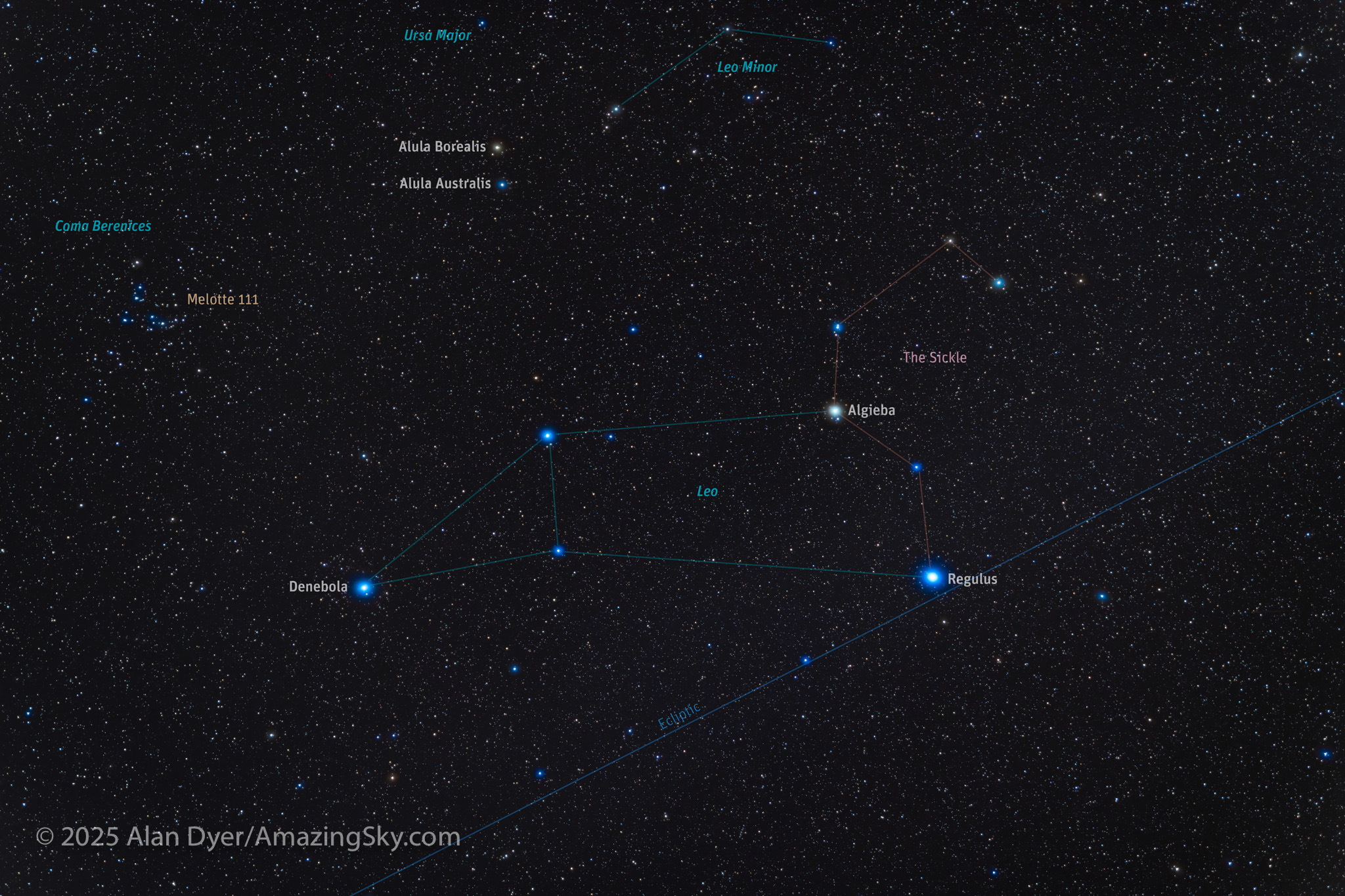
Leo and Leo Minor

The head of Leo is marked by a curving arc of stars popularly called The Sickle. Or it is thought of as backwards Question Mark, with Regulus the dot at the bottom. Leo is one of the oldest constellations, as there are records of this pattern dating back to 4000 BCE in Mesopotamia.

More modern is the obscure pattern above it, Leo Minor, the Little Lion. It was invented by 17th century star chart maker Johannes Hevelius, to fill in a blank area of sky. Even in a dark sky, it is tough to make out its innocuous pattern between Leo and Ursa Major.

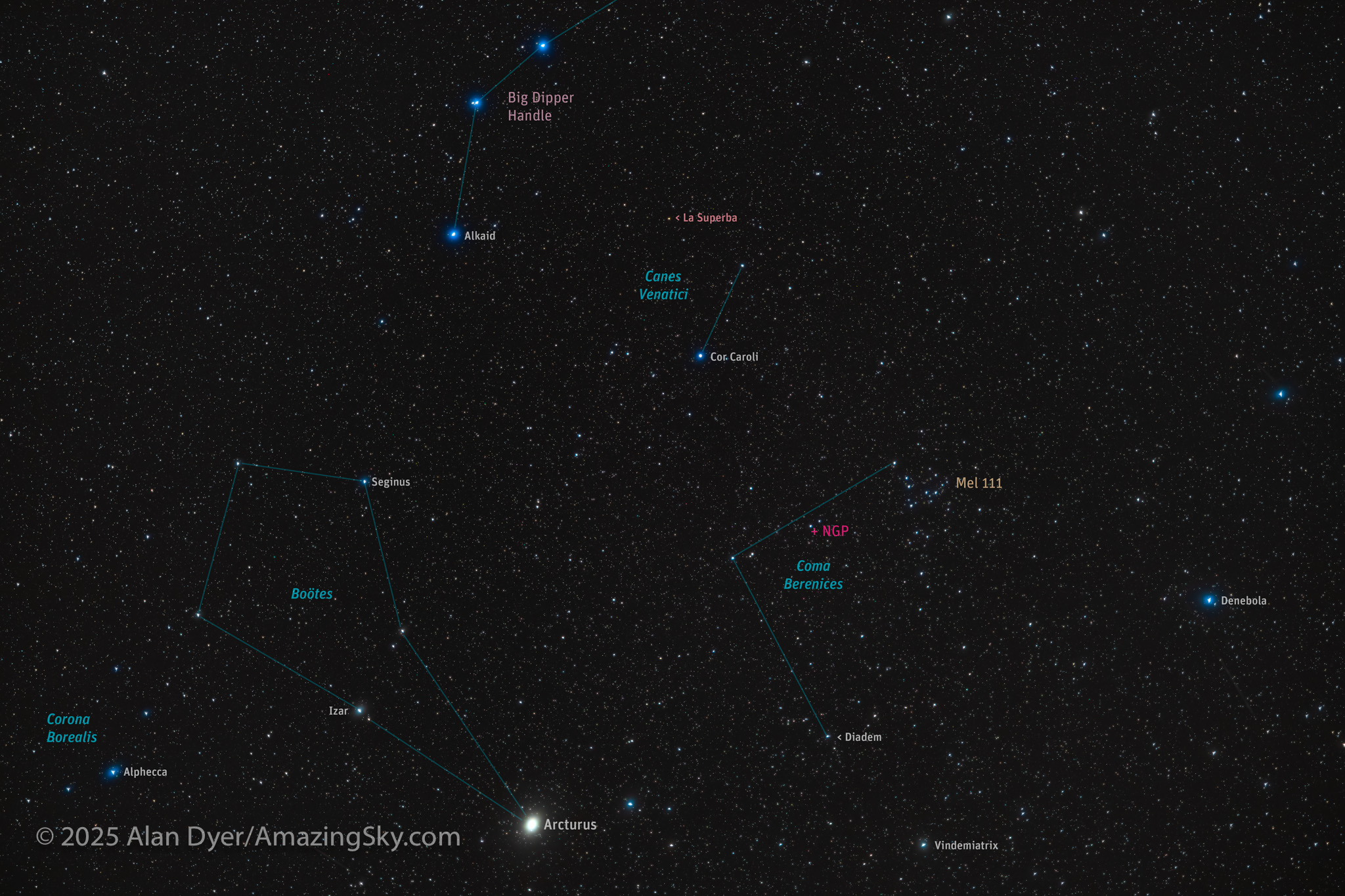
Canes Venatici, Coma Berenices and Boรถtes

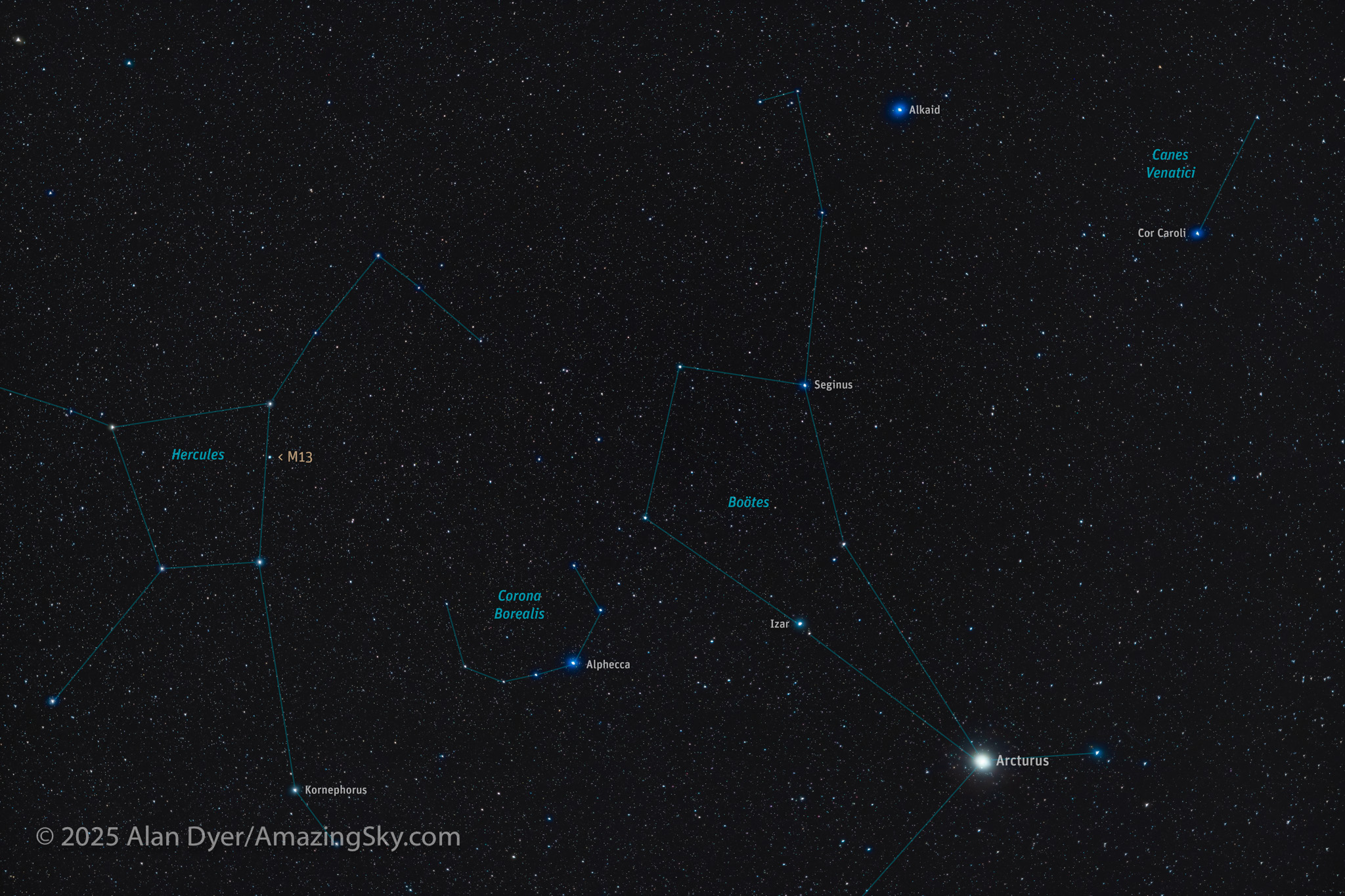
Another obscure pattern created by Hevelius lies below the Handle of the Big Dipper. A sparse pattern of stars marks Canes Venatici, the Hunting Dogs that belong to Boรถtes to help him herd bears! While not much to look at with the naked eye, Canes Venatici does have superb targets for telescopes, such as the double star Cor Caroli and very red star La Superba.

Below the Dogs lies Berenices’ Hair, home to the star cluster Mel 111, but also the North Galactic Pole (NGP). This is the point 90ยบ away from the plane of the Milky Way and the Galactic Equator seen in our winter and summer skies. But in spring we look straight up out of our Galaxy, to many other telescopic galaxies that inhabit Coma and Virgo, our next stop.

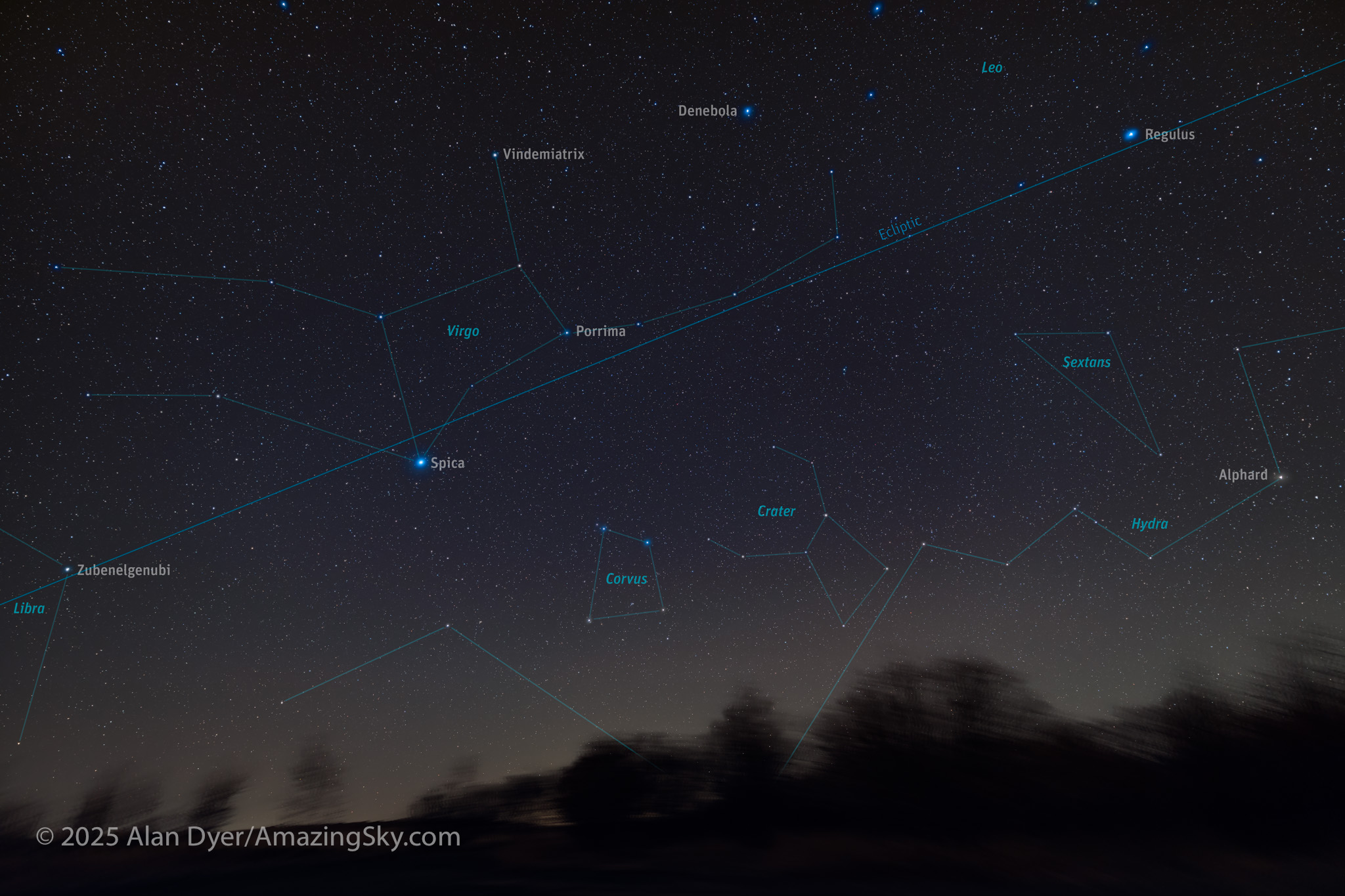
Virgo, Corvus, Crater and Hydra

Below Leo and Boรถtes lies the Zodiac pattern of Virgo, usually thought of as the reclining Greek goddess of agriculture and the harvest. Spica is easy to see, but the sprawling pattern of the rest of Virgo is not so obvious. It takes a dark sky to pick out the other fainter stars of the goddess.

Easier to see, despite its low altitude from northern latitudes (it skims my horizon), is the quadrilateral pattern of Corvus the Crow, a constellation that dates from the 2nd century CE and the star catalogue of Ptolemy. The Crow sits on the tail of Hydra the Water Snake, a long zig-zag line of stars that is only partly contained here. The head of Hydra, off frame to the right here, is in the earlier image of Leo and Cancer.

Another pattern riding the back of Hydra is Crater the Cup, associated with Corvus and Hydra in a Greek myth in which the Crow is sent to fetch water for Apollo but fails. Apollo flings the Crow, Cup and Snake into the sky. Angering the gods could get you immortalized in the sky!

Boรถtes, Corona Borealis and Hercules

Heading back north above Virgo, we return to the kite-shaped pattern of Boรถtes above Arcturus, the brightest star in the northern half of the sky. Coming up later on spring evenings, and to the left is a semi-circle of faint stars, the Northern Crown, or Corona Borealis, another of Ptolemy’s patterns from the 2nd century. The crown belongs to the princess Ariadne.

Astronomers have been watching Corona Borealis closely in recent months, waiting for a recurrent nova star to explode and add a new jewel to the Crown. So far, no luck. T CorBor remains stubbornly dim.

To the east of Corona is the H-shaped pattern of Hercules, the Roman name for the Greek hero Heracles. Among his many labours and conquests, he slewed Cancer the Crab and Leo the Lion.

Libra and Scorpius

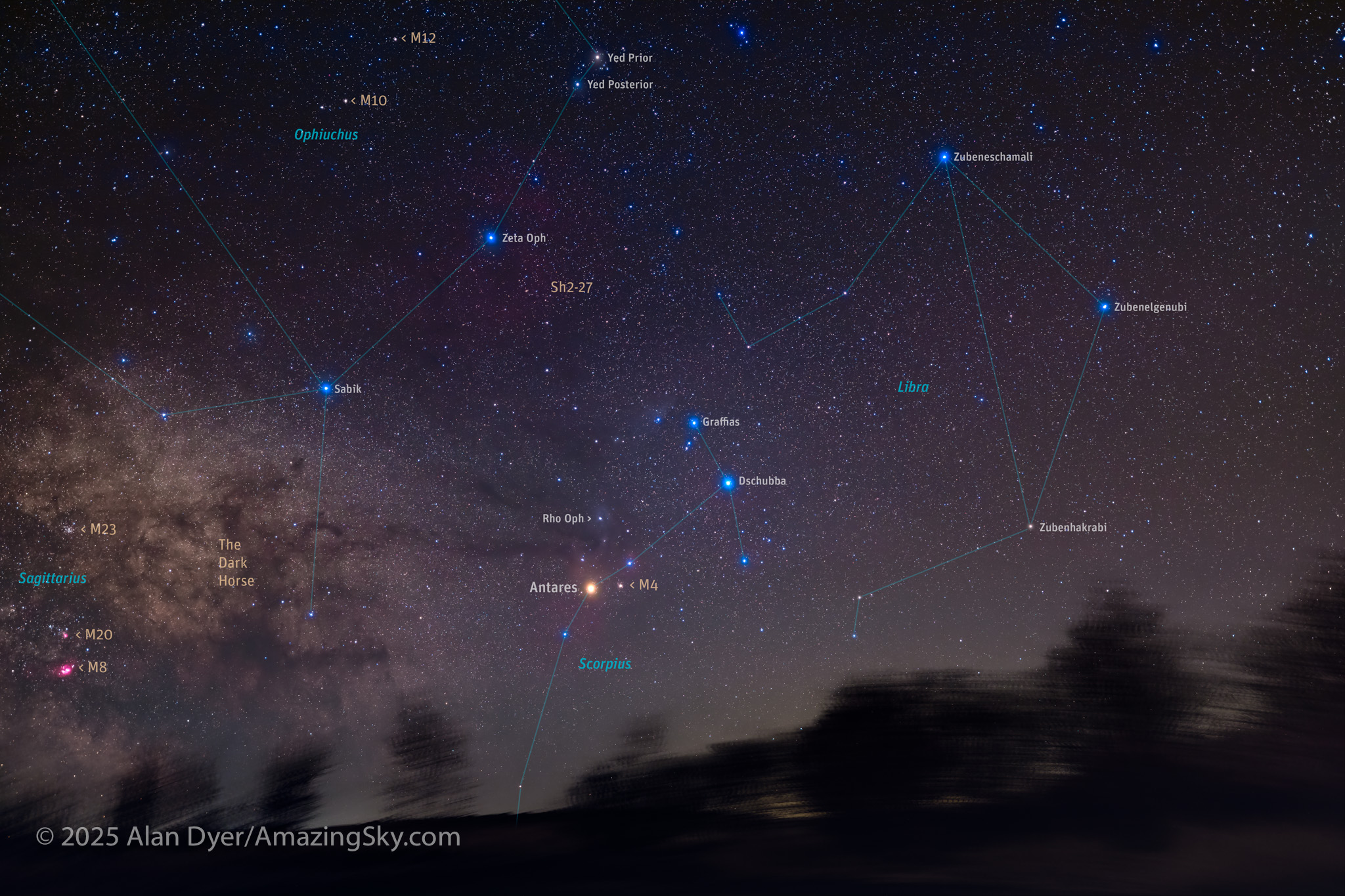
Returning down south and scraping the horizon from my northern latitude late on spring nights are the next two constellations of the Zodiac east of Virgo: Libra the Scales and Scorpius the Scorpion.

Libra is a faint pattern but with the wonderfully named stars Zubeneschamali and Zubenelgenubi, meaning the northern and southern claws, as these stars were once considered part of the Scorpion. However, Libra has long been seen as a balance or scales for meting out justice. It is the only Zodiac constellation that is an inanimate object.

Scorpius is one of the few patterns that looks like what it is supposed to be, though here I see only the northern part of the constellation. His curving tail has yet to rise as the Milky Way comes into view low in the south just before dawn this night. The bright orange star is Antares, the heart of the Scorpion, set in an area rich in dark and colourful nebulas.

The appearance of Scorpius signals the return of the Milky Way to the sky, and the rise of the summer constellations.

But no astronomical life is complete without getting to know the patterns of spring. Clear skies and happy stargazing!

โ€” Alan, April 30, 2025 (amazingsky.com)

Exploring the Dusty Realms of the Milky Way


A run of exceptionally clear nights allowed me to capture scenes of stardust along the MilkyWay.

Colourful nebulas โ€“ clouds of glowing gas โ€“ are the most popular targets in the deep sky for astrophotographers. Most nebulas emit red light from hydrogen atoms. Some glow blue by reflecting the light of nearby hot stars.

But another class of nebulas emits or reflects almost no light, and appears dark, often as shapes silhouetted against the bright starry background. They are usually made of obscuring interstellar dust โ€“ typically grains of carbon soot emitted by aging or active stars โ€“ literally stardust.

In the olden days of film photography, these dark dust clouds always appeared black in our exposures. Or they never showed up at all.

But today’s digital cameras, with the aid of processing techniques, can capture the dust clouds, often not as black clouds, but as pale blue tendrils, or as brownish-yellow streamers faintly glowing with a warm light.

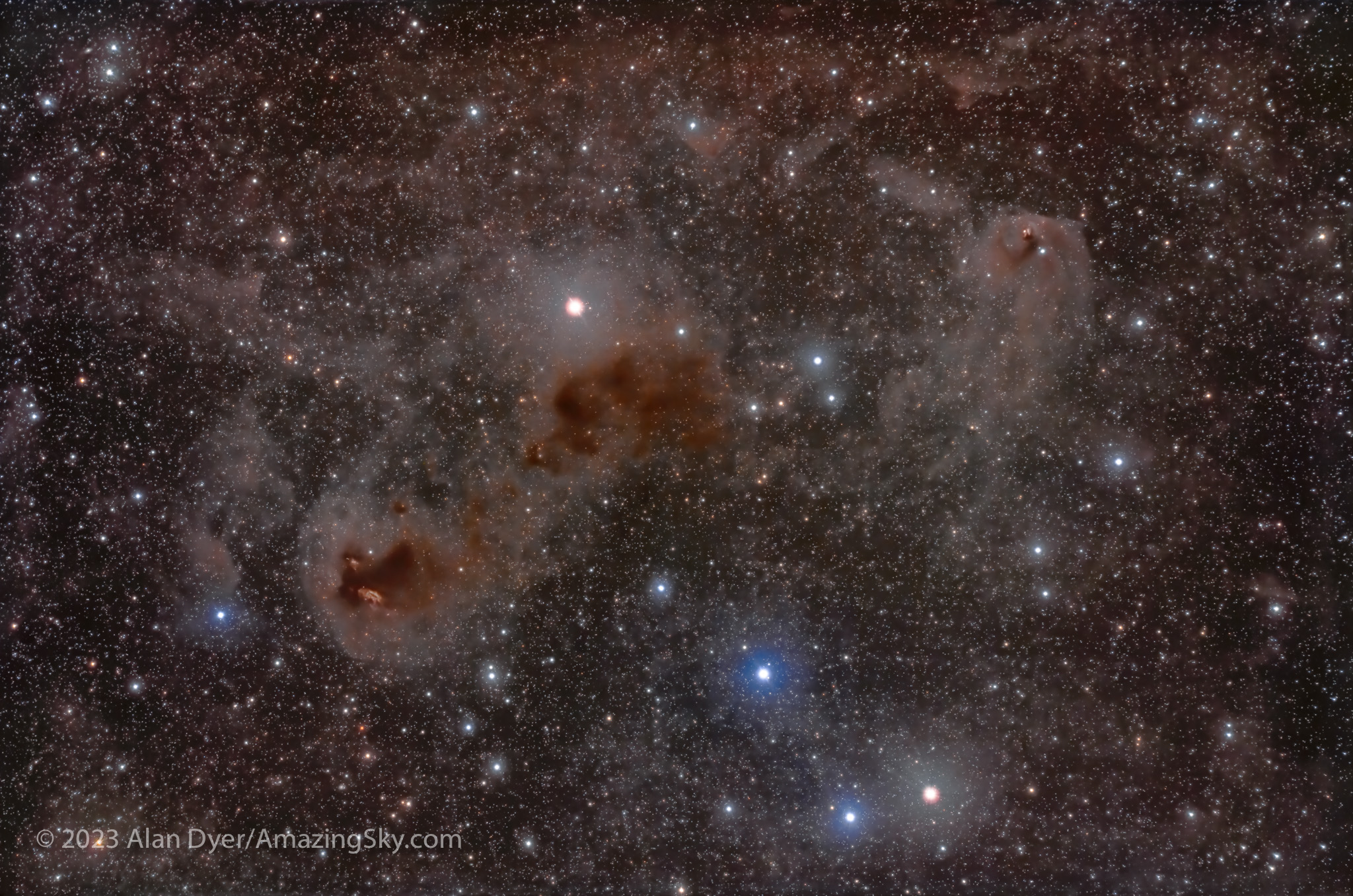
In October and November 2023, a series of unusually clear and mild nights allowed me to go after some of these dark and dusty targets, from my home in rural southern Alberta, Canada. I captured a selection of scenes off the beaten track along the Milky Way. Here’s my tour of stardust sights in the northern autumn and winter sky.


Cepheus the King

This is a portrait of most of the northern constellation of Cepheus the King. All the wide-field images were shot and processed to emphasize the rich collection of bright and dark nebulas in the constellation. North is always up. This is a stack of 40 x 2-minute exposures with the rare Samyang RF85mm f/1.4 lens stopped down to f/2.8, on the Canon EOS Ra camera at ISO 800. The lens was equipped with a 77mm Nisi Clear Night broadband filter. For all the wide-field images the camera was on the Star Adventurer 2i tracker for tracked but unguided exposures.

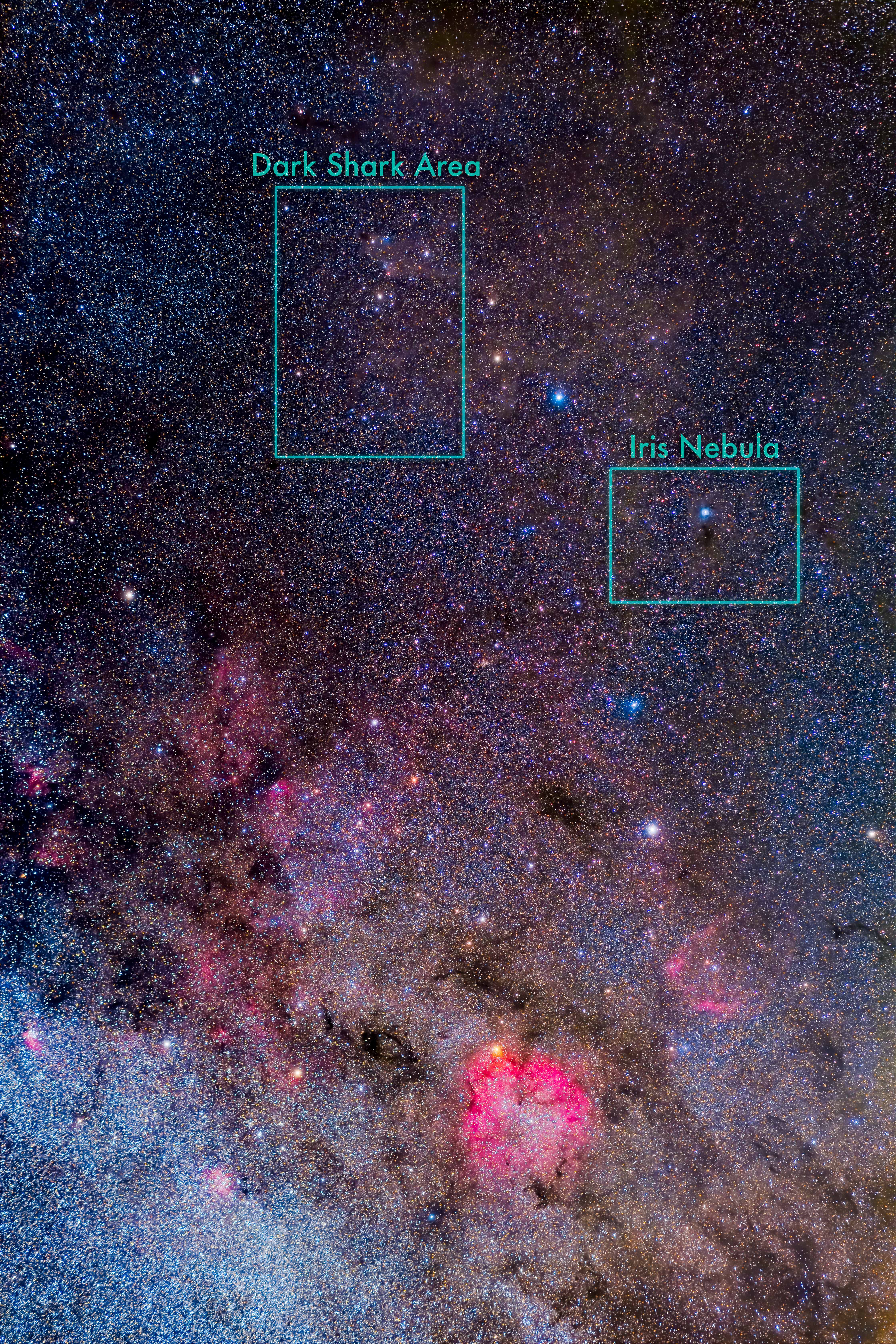
The wide-field image above frames most of the northern constellation of Cepheus. The southern section of Cepheus at the bottom of the frame lies in the Milky Way and is rich in bright red nebulas, notably the large, round IC 1396. It is a popular and easy target. But the northern upper reaches of Cepheus are where more challenging dusty nebulas reside. I’ve indicated the location of two fields shown in the close-ups below.

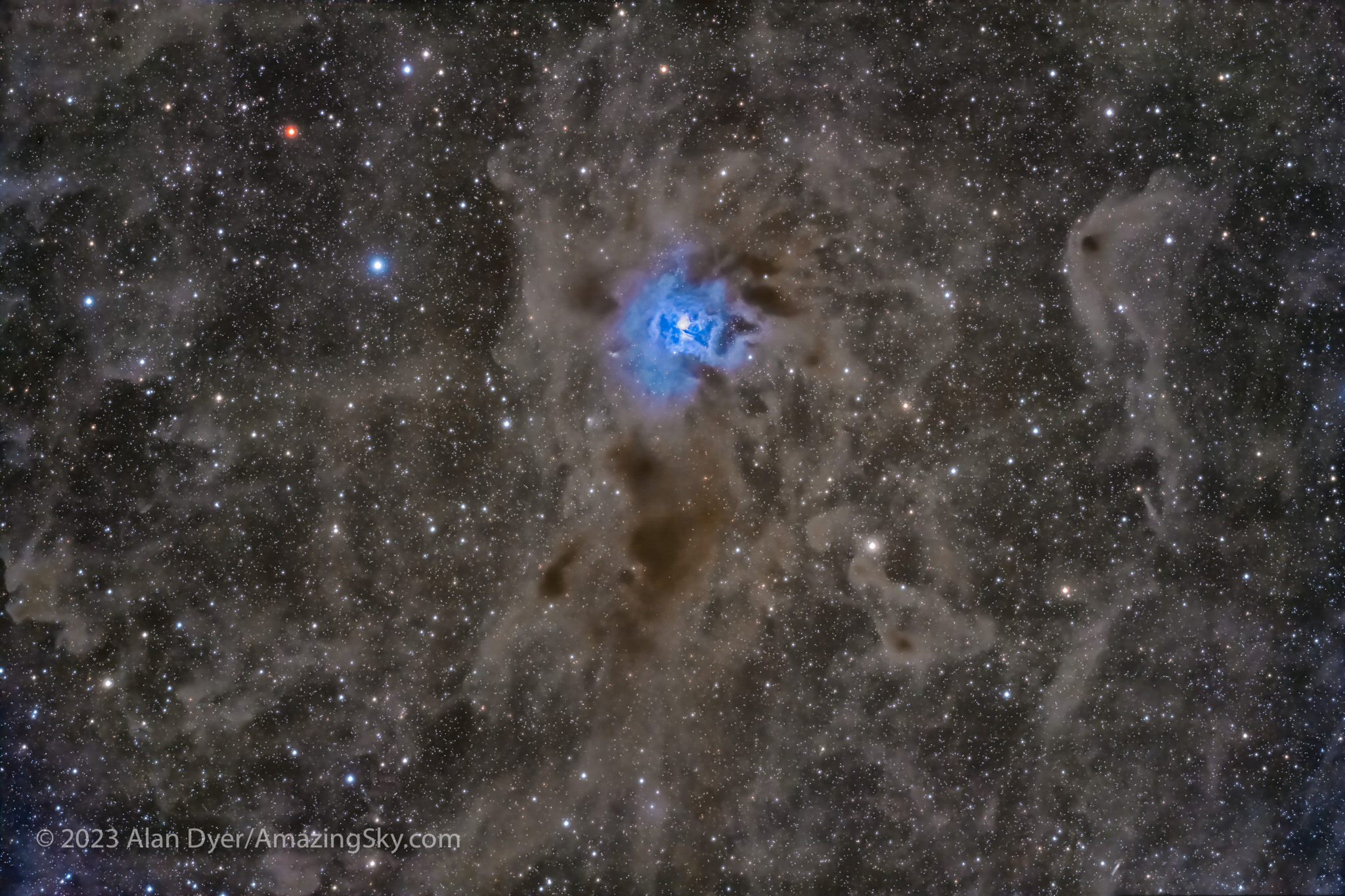
The Iris Nebula

This is the bright blue reflection nebula, NGC 7023, aka the Iris Nebula, in Cepheus. This is a stack of 25 x 8-minute exposures through the Askar APO120 refractor at f/7 with the 1X Flattener, and with the filter-modified Canon R camera at ISO 1600.

Located some 1300 light years away, this is a blue reflection nebula, as the dust is lit by the young blue star in its core. But surrounding the bright Iris Nebula are more extensive clouds of dust, dimly lit by reflected light and with varying densities and shades of grey and brown.

The Dark Shark and Wolf’s Cave Nebulas

This is a portrait of a field of dusty nebulas in northern Cepheus, in a stack of 30 x 6-minute exposures with the Astro-Tech AT90CFT refractor at f/4.8 and filter-modified Canon EOS R camera at ISO 800, though no filter was used when taking these frames.

This field in northern Cepheus is yellowed by reams of dust. A couple of blue reflection nebulas lie on the edges of streamers of brown dust. The object at top is called the Dark Shark, for its fanciful resemblance to a menacing shark, though one wearing a blue hat!

At the bottom of the frame is a long, snake-like dark brown nebula, Barnard 175, with the blue reflection nebula van den Bergh (vdB) 152 at its tip. This object has been dubbed the Wolf’s Cave Nebula, though that likeness is harder to discern. It is unclear where some of these nicknames come from, as many are recent appellations invented by astrophotographers. Some of the names have stuck, though few are “official.”


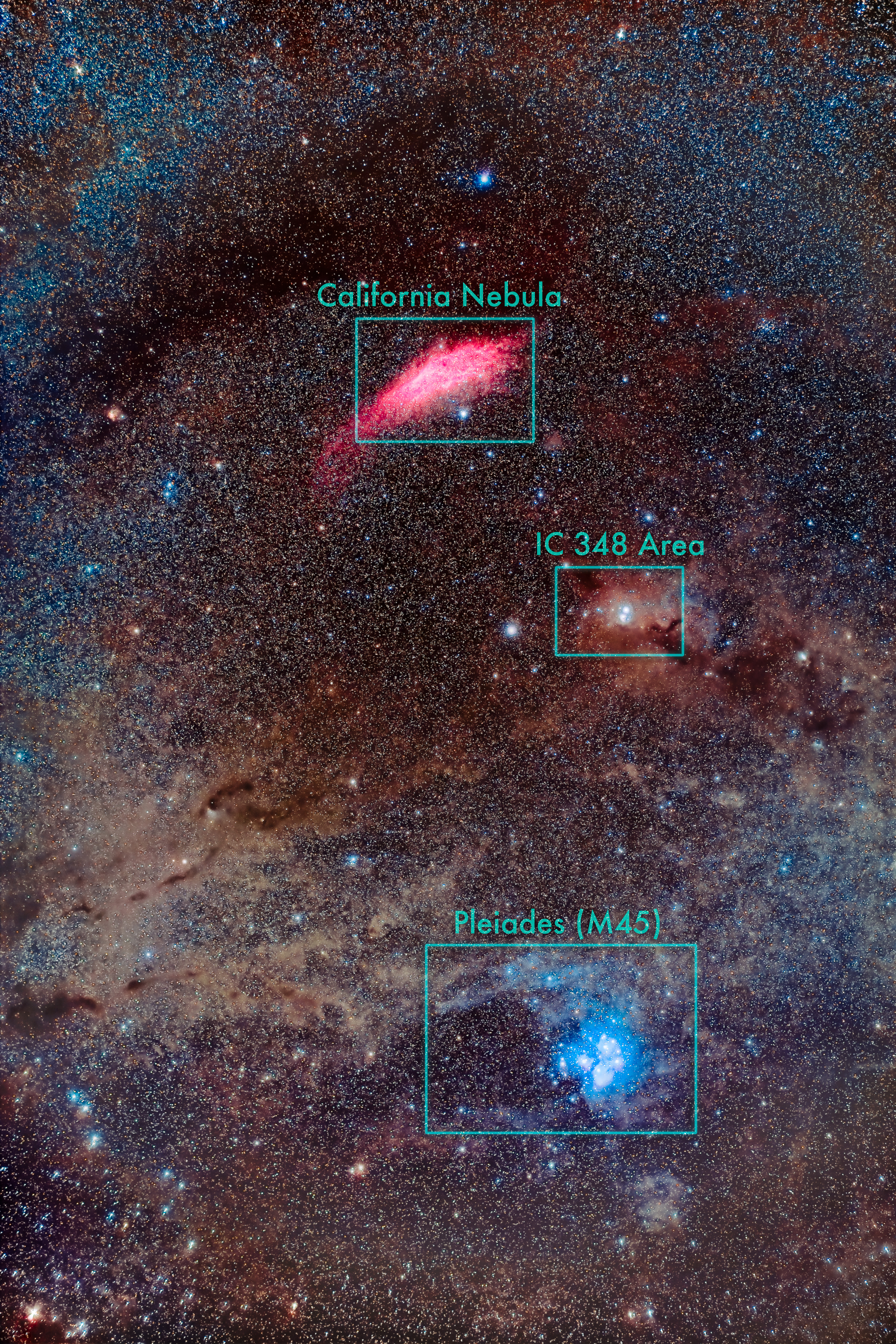
Perseus the Hero and Taurus the Bull

This is a portrait of the dust-filled region of sky from Perseus down to Taurus that includes the pink California Nebula (NGC 1499) at top down to the Pleiades star cluster (M45) at bottom. This is a stack of 48 x 2-minute exposures with the rare Samyang RF85mm f/1.4 lens stopped down to f/2.8, on the Canon EOS Ra camera at ISO 800. The lens was equipped with a 77mm Nisi Clear Night broadband filter.

The region of sky between Perseus and Taurus is rich in bright nebulas set amid large tendrils of dust in Taurus. The Pleiades star cluster lights up a portion of the dust clouds. And the pink California Nebula lies at the end of a large lane of dust.

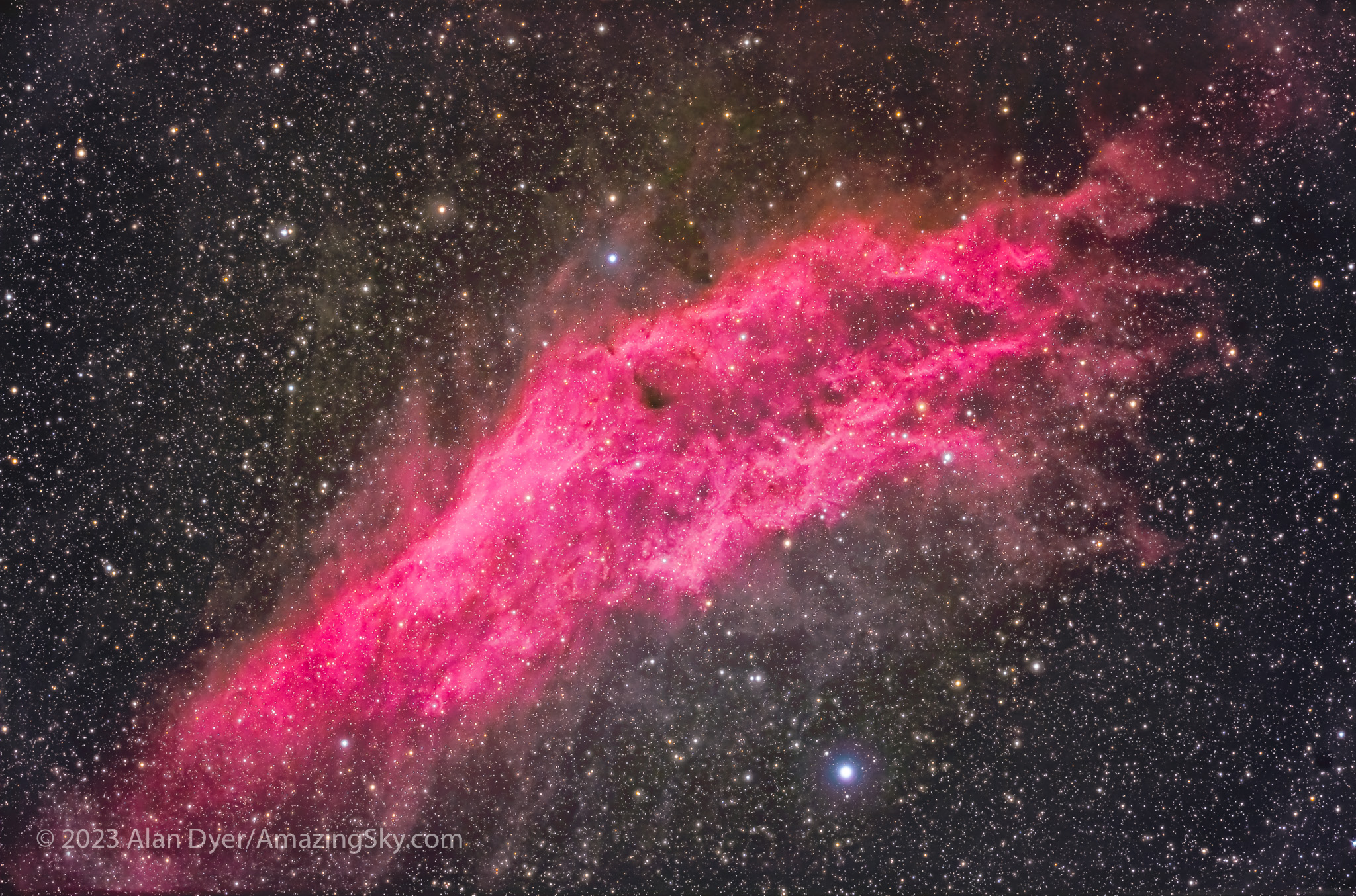
The California Nebula

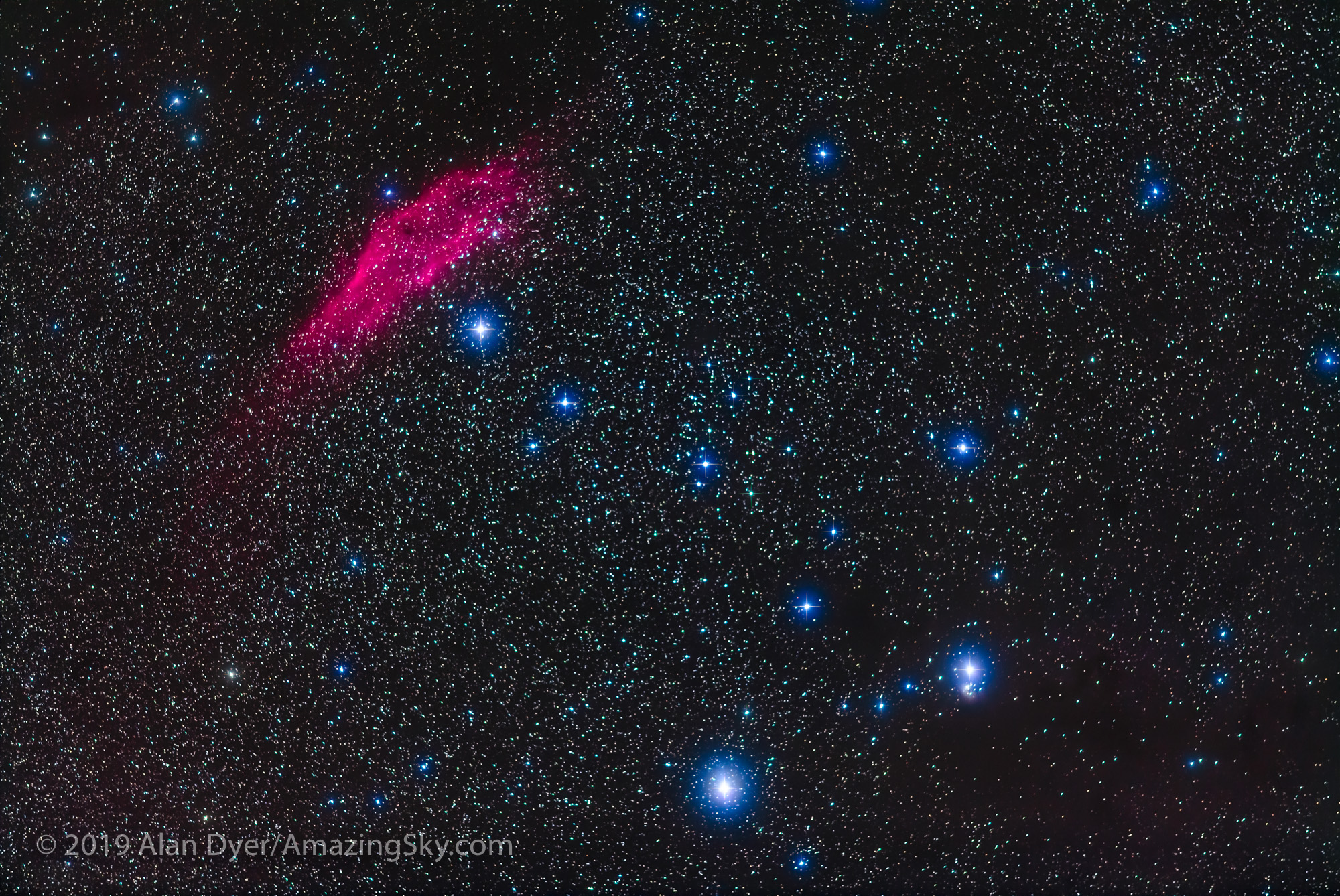
This is the California Nebula, aka NGC 1499, in Perseus near the star Menkib, or Xi Persei, at bottom. This is a stack of 12 x 6-minute exposures with the filter-modified Canon R (though no filter was used to take this image), at ISO 800, on the Askar APO120 refractor with its 0.8x Reducer/Flattener for f/5.6 and 670mm focal length.

The California Nebula (named for its resemblance to the shape of the state) lies in Perseus. It is a bright emission nebula glowing in the red and pink light of hydrogen atoms, perhaps excited by blue-white Xi Persei, aka Menkib, at bottom. But it sits amid wider clouds of dust, here recorded as white and yellow.

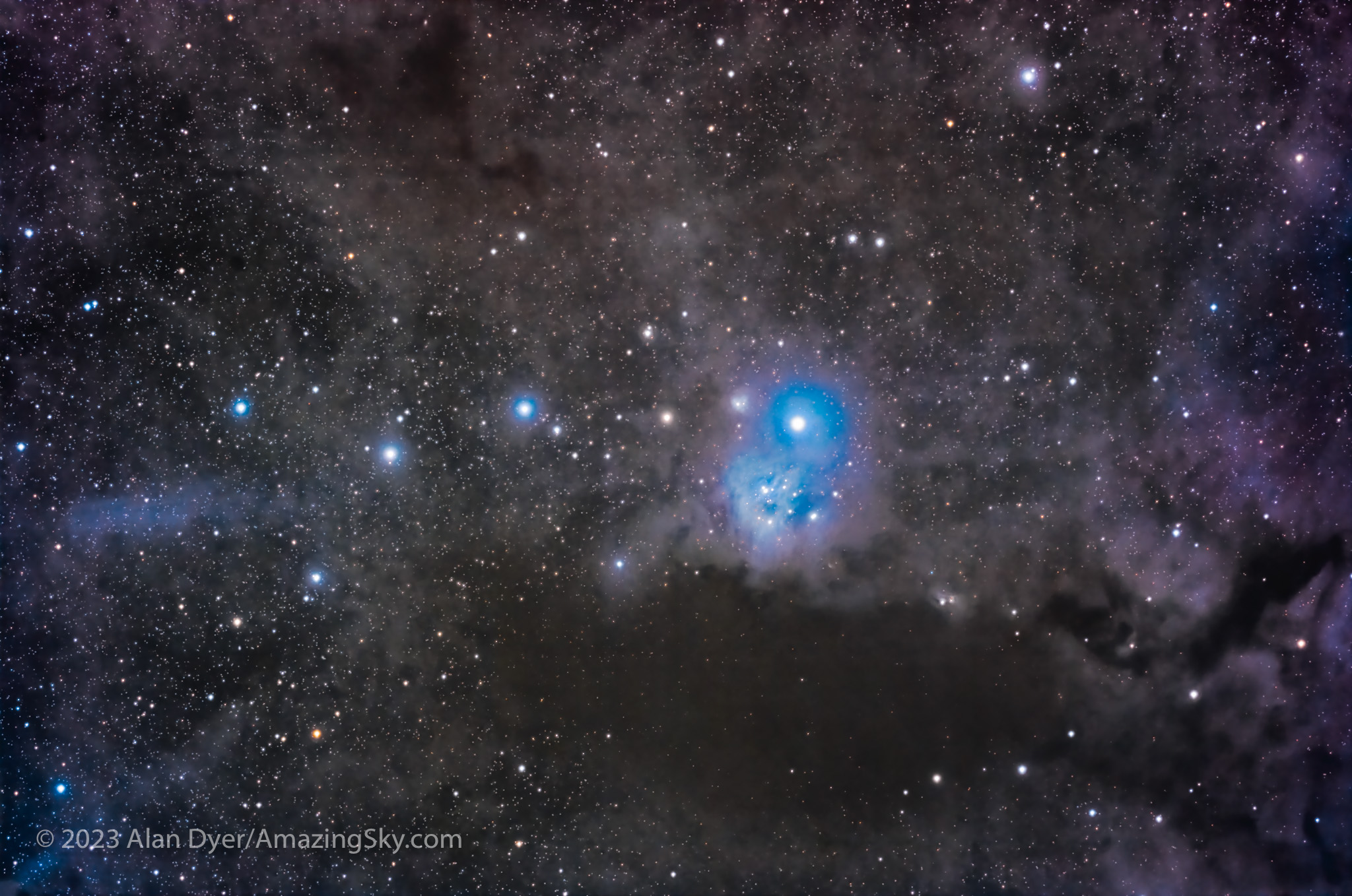
IC 348

This is the bright blue reflection nebula complex, IC 348, in Perseus, in a stack of 18 x 8-minute exposures through the Askar APO120 refractor at f/7 with the 1X Flattener, and with the filter-modified Canon R camera at ISO 1600.

This complex mix of reflection and dark nebulas surrounds Omicron Persei. In some sections the dust is so dense it blocks all light from more distant stars. Once thought to be holes in the heavens, the photos of pioneering astrophotographer Edward Emerson Barnard in the early 20th century proved that dark nebulas are nearby, and obscure what’s behind them.

IC 348’s distance of only 700 light years means there isn’t much between us and the surrounding dark clouds. Oddly, though a popular target, as best I can tell, no one has come up with a nickname for this field. What can you see in the dark shapes?

The Pleiades / Messier 45

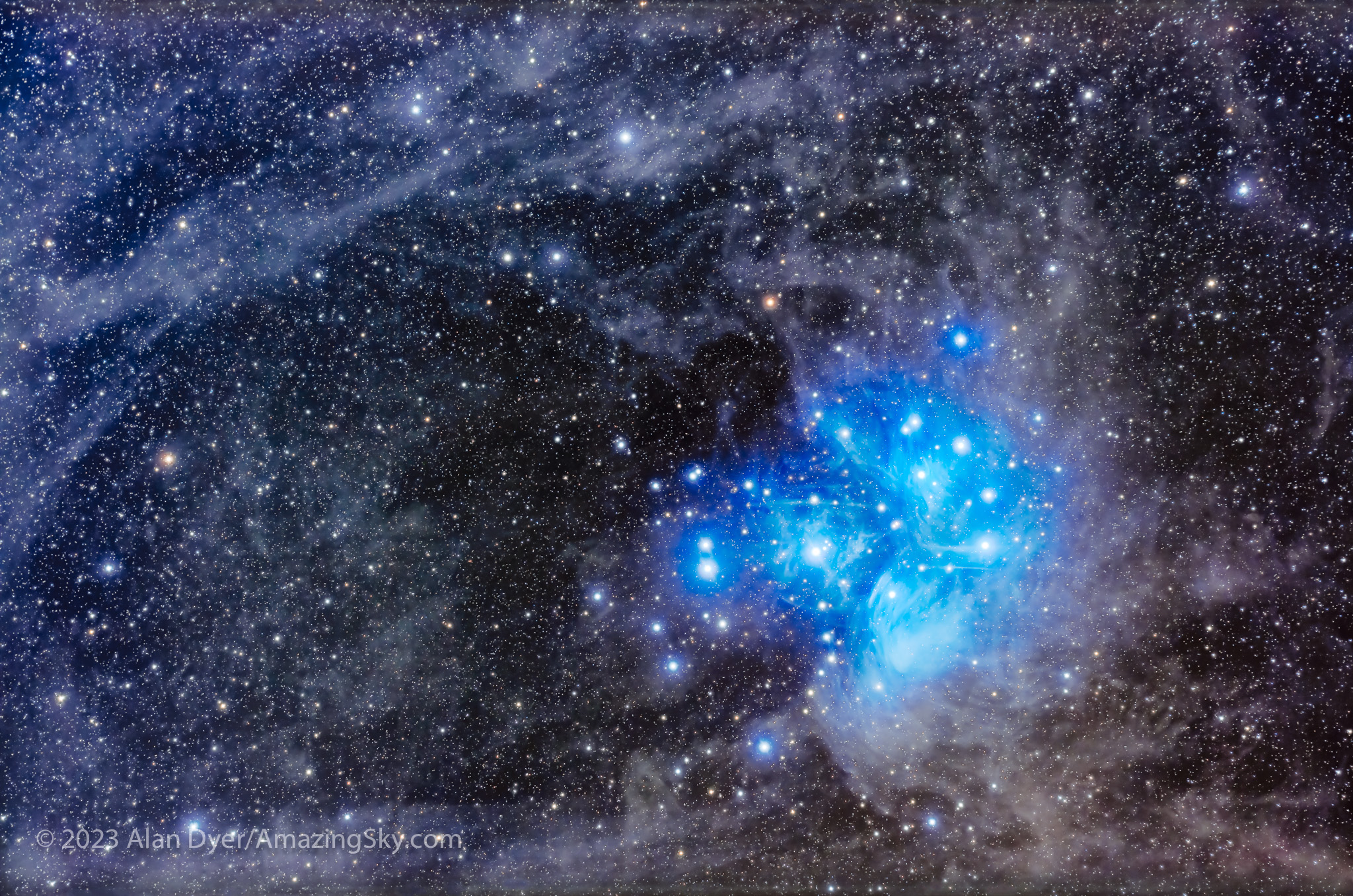
This frames the famous Pleiades or Seven Sisters star cluster (aka Messier or M45) set amid a dusty starfield in Taurus. The field is about 4.7ยฐ by 3.2ยฐ. This is a stack of 30 x 6-minute exposures with the Astro-Tech AT90CFT refractor at f/4.8 (using its 0.8x Reducer) and the filter-modified Canon R camera at ISO 800.

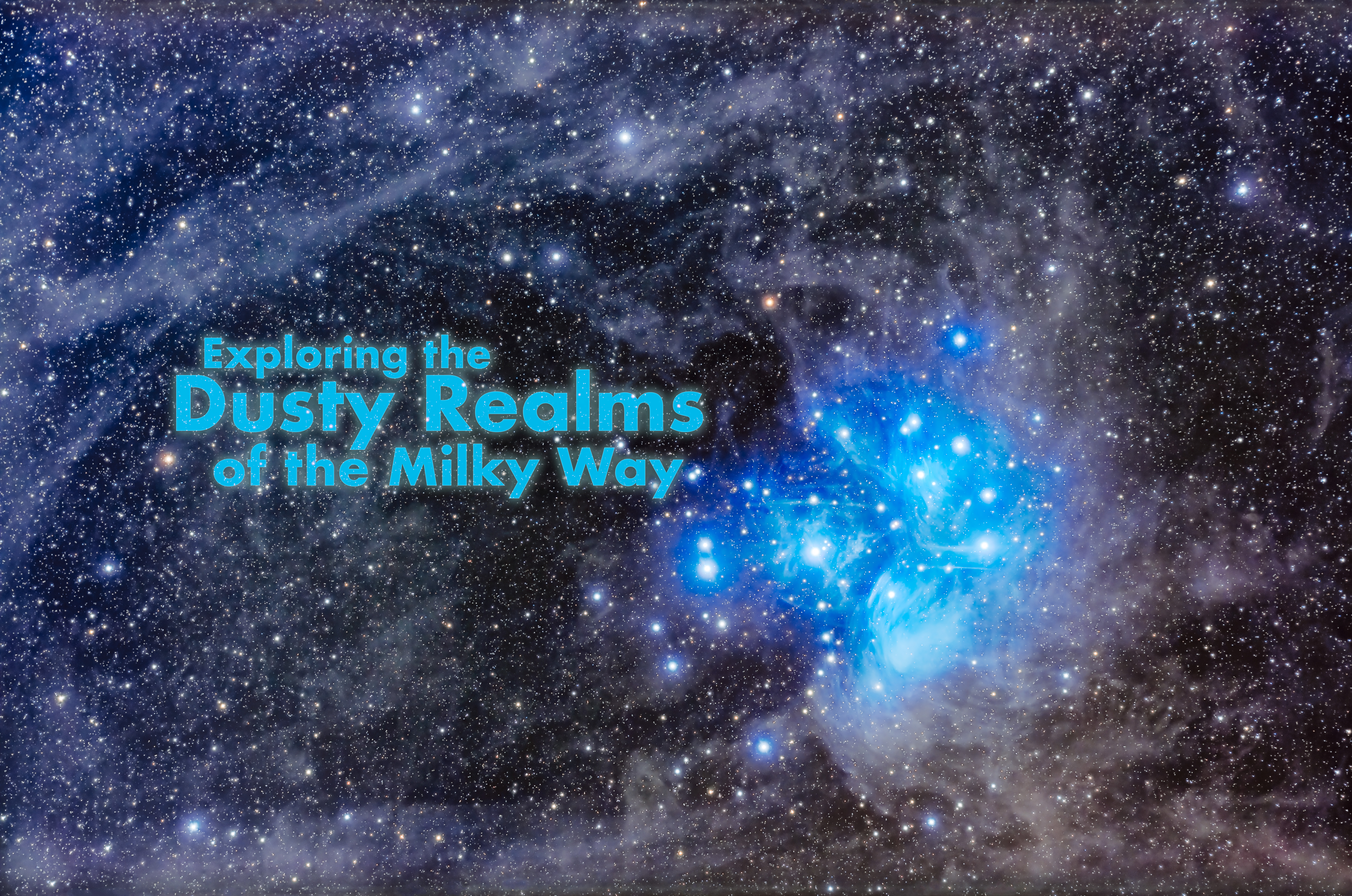
There’s no more famous deep-sky object than the blue Pleiades, or Seven Sisters. They feature in the mythology of almost all cultures around the world. The young blue stars are surrounded by bright blue reflection nebulosity, most prominent below the lower star Merope, a bit of nebula catalogued separately as NGC 1435.

While the Pleiades light up the core of the dust clouds blue, the dust clouds extend much wider and permeate the entire constellation of Taurus. However, the outlying clouds are very faint as they have no nearby source of illumination. The arc of nebulosity at top is most obvious. It was found by Barnard and is catalogued as IC 353.


Taurus the Bull

This is a portrait of the dust-filled region of sky in Taurus that frames the Hyades star cluster (at bottom) with bright yellow Aldebaran, up to the blue Pleiades star cluster (M45) at top. This is a stack of 48 x 2-minute exposures with the Samyang RF85mm f/1.4 lens at f/2.8, on the Canon EOS Ra camera at ISO 800.

Overlapping the previous constellation field, this framing extends farther south, continuing past the Pleiades down into the main section of Taurus the Bull, with the luminous yellow star Aldebaran marking the Bull’s eye. It is surrounded by the stars of the V-shaped Hyades star cluster, legendary half-sisters to the Pleiades.

Notable in this framing are the large dark tendrils of the Taurus Molecular Clouds, dense streams of dust only about 430 light years away. They are on my shot list for close-ups on upcoming clear winter nights.

NGC 1555 and Area

This is a framing of dust clouds among the stars of the Hyades star cluster in Taurus. The field of view is 4.7ยฐ by 3.2ยฐ. This is a stack of 30 x 6-minute exposures with the Astro-Tech AT90CFT refractor at f/4.8 and the filter-modified Canon EOS R camera at ISO 800, though no filter was used in taking the images.

This complex field lies on the northern edge of the Hyades. At upper right is the odd nebula NGC 1555, discovered by John Russell Hind in 1852 and variable in brightness due to changes in its embedded source star T Tauri, a prototype of a class of young, newly formed stars. An adjacent object, NGC 1554, was catalogued by Otto Struve, but has faded from view; thus it is called Struve’s Lost Nebula.

At lower left is the emission nebula Sharpless 2-239 embedded in the dense and brownish dust cloud LDN (Lynds Dark Nebula) 1551. It is dark indeed, but not black. Like most dark nebulas it has some warm colour.


Orion the Hunter

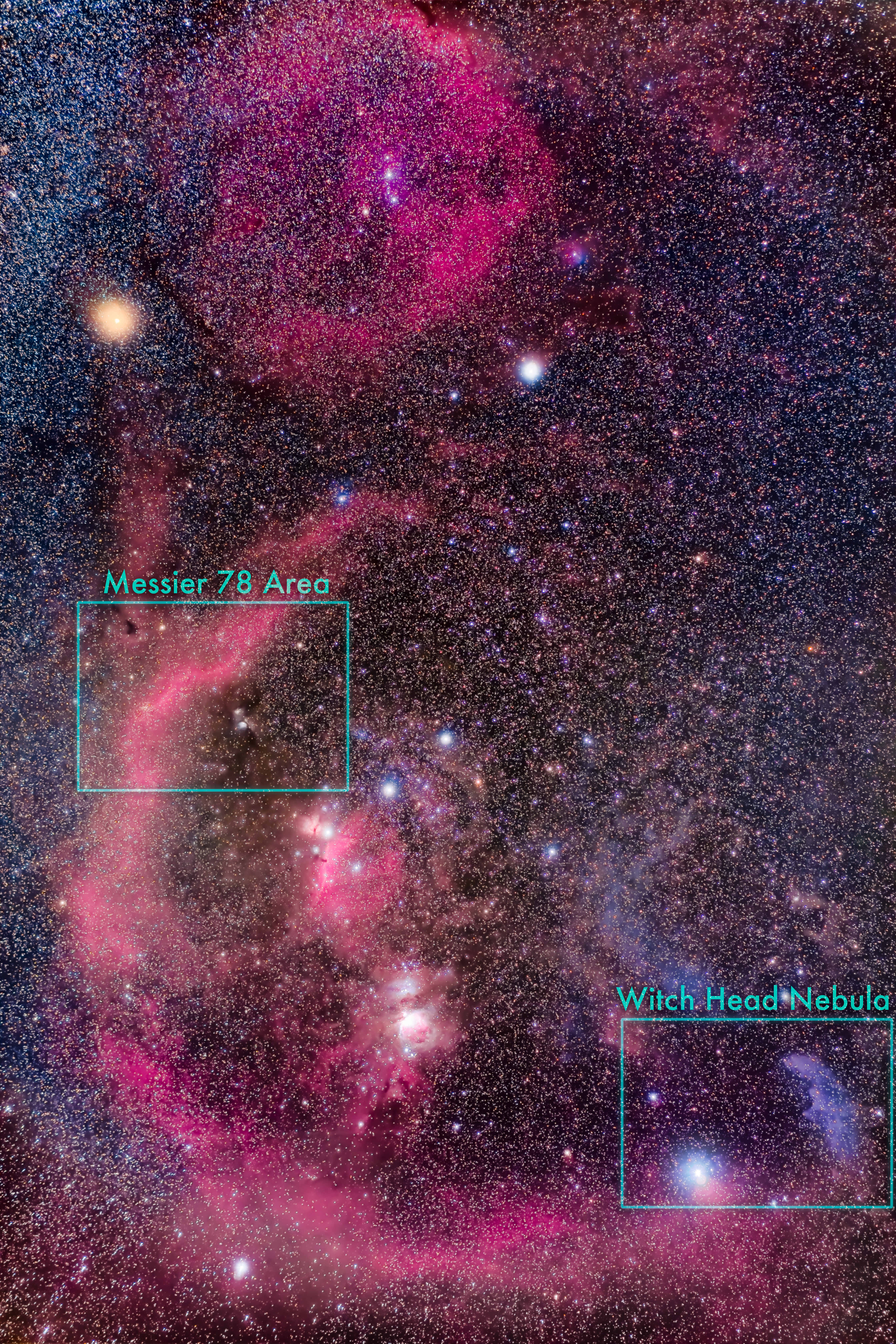
This is a portrait of Orion the Hunter with exposures and processing to emphasize the complex and colourful array of bright and dark nebulas within its boundaries. This is a stack of 42 x 2-minute exposures with the Samyang RF85mm f/1.4 lens at f/2.8, on the Canon EOS Ra camera at ISO 800. The lens had a Nisi Clear Night broadband filter to help improve contrast.

The most photogenic constellation is surely Orion the Hunter. It is filled with a rich collection of nebulas, including the eponymous Orion Nebula, bright enough to be visible to the unaided eye in the Sword of Orion, and #42 in Charles Messier’s catalogue.

The largest feature (though one best seen only in photos) is the arc of Barnard’s Loop, a possible supernova remnant or stellar wind-blown bubble that encircles Orion. It is usually plotted on sky atlases as just an easternmost arc, though it extends down and below Orion, all the way over to blue Rigel at bottom right.

At top is the large circular emission nebula Sharpless 2-264, surrounding the head of Orion and the star Meissa and a loose open star cluster Collinder 69. The nebula has become known as the Angelfish Nebula. It sits above orange Betelgeuse (at left) and blue-white Bellatrix (at right), marking the shoulders of Orion.

As you can see, there’s a winter-full of targets to go after in Orion. However, in my tour, I focused on two areas of dust and reflection nebulas.

Messier 78 Area

This is the bright reflection nebula complex that includes Messier 78 (the largest blue-white nebula) and NGC 2071 above it. This is a stack of 30 x 4-minute exposures through the Astro-Tech AT90CFT refractor with its 0.8x Reducer for f/4.8, and with the filter-modified Canon R camera at ISO 1600. No filter was employed here.

This frames one of the other often-neglected nebulas in Orion, Messier 78, one of the objects catalogued by Charles Messier in the 1780s. His is the popular “hit list” of deep-sky targets for all amateur astronomers.

In this case, M78 is accompanied by another smaller reflection nebula, NGC 2071. They are set in a region of dark clouds of interstellar dust, and framed by the red-magenta arc of Barnard’s Loop, aka Sharpless 2-276. The small reflection nebula at upper left on the edge of another dark cloud is van den Bergh 62. The large faint star cluster left of centre on the edge of the Loop is NGC 2112.

The Witch Head Nebula

This is the reflection nebula called the Witch Head, but officially IC 2118 (also with the catalogue number NGC 1909), near the very bright star Rigel, at lower left in Orion. This is a stack of 29 x 6-minute exposures through the Astro-Tech AT90CFT refractor with its 0.8x Reducer for f/4.8, and with the filter-modified Canon R camera at ISO 800. No filter was employed here.

The hot, blue giant star at lower left is Rigel at the foot of Orion. It illuminates the dust cloud that forms the fanciful shape of the blue Witch Head Nebula, or IC 2118. The nebula is actually over the border in Eridanus the River. Some magenta emission nebulosity also populates the field in Orion.

Indeed, as the wide-field photo above attests, all of Orion is filled with some form of nebulosity, be it emission, reflection, or dark.

There’s much more to go after when exploring the nebulous and dusty realms of the Milky Way. The sky is filled with stardust. Indeed, we are made of it!

โ€” Alan, November, 2023 / www.amazingsky.com

Touring the Wonders of the Winter Sky


The Wonders of the Winter Sky

I present a tour of the deep-sky wonders of the winter sky.

While some might think the Milky Way is only a summer sight, the winter Milky Way is well worth a look!

In January and February we are looking outward from our location in the Milky Way, toward the Orion Spur, the minor spiral arm we live in. In it, and in the major Perseus Arm that lies beyond, lie hotbeds of star formation.

Artist's impression of the Milky Way (updated - annotated)
Courtesy European Southern Observatory

These star forming areas create a panorama of star clusters and glowing nebulas along the winter Milky Way and surrounding the constellation of Orion. The montage above shows the best of the deep-sky sights at this time or year.

(And yes, for southern hemisphere viewers I know this is your summer sky! But for us northerners, Orion is forever associated with frosty winter nights.)

The closeups below are all with a 200mm telephoto lens providing a field of view similar to that of binoculars. However, most of these nebulas are photographic targets only.


The Belt and Sword of Orion

The Belt and Sword of Orion with Barnard's Loop
This is a stack of 16 x 2- to 3-minute exposures with the filter-modified Canon 5D MkII at ISO 800 to 1250 and 200mm Canon L-Series lens at f/2.8. Taken with the Fornax Lightrack tracker as part of testing. Taken from home on January 8, 2019 during a clear couple of hours between passing haze and cloud.

This is the heart of the star formation activity, in the centre of Orion.

The bright Orion Nebula (or Messier 42 and 43) at bottom in Orion’s Sword is obvious in binoculars and glorious in a small telescope.

The Horsehead Nebula above centre and just below Orion’s Belt is famous but is a tough target to see through even a large telescope.

Barnard’s Loop at left is a wave of nebulosity being blown out of the Orion area by strong stellar winds. Any sighting of this object by eye is considered a feat of observing skill!


The Rosette Nebula and Area

Rosette and Christmas Tree Cluster with 200mm
The area of the Rosette Nebula (bottom) and Christmas Tree Cluster (top) in Monoceros with the Fornax Lightrack tracker and 200mm lens and filter modified Canon 5D MkII. This is a stack of 10 x 3 minute exposures at ISO 800.

The small cluster of hot young stars inside the Rosette Nebula is blowing a hole in the nebula giving it its Rosette name. Above is a loose star cluster called the Christmas Tree, surrounded by more faint nebulosity that includes the tiny Cone Nebula.


Gemini Clusters and Nebulas

The Clusters and Nebulas of Gemini
This is a stack of 10 x 3-minute exposures with the filter-modified Canon 5D MkII at ISO 800 and 200mm Canon L-Series lens at f/2.8. Some light haze passing through in some exposures added the natural star glows. I left those in as part of the stack to add the glows. Taken with the Fornax Lightrack tracker as part of testing. Taken from home on a rare fine and mild winter night, January 4, 2019.

This field of clusters and nebulosity is above Orion in Gemini, with Messier 35 the main open star cluster here at top. Below M35 is the tiny star cluster NGC 2158. The nebulosity at left between Mu and Eta Geminorum is IC 443, a remnant of a supernova explosion, and is aka the Jellyfish Nebula. The nebula at bottom is IC 2174, just over the border in Orion and aka the Monkeyhead Nebula.


Auriga Clusters and Nebulas

The Clusters and Nebulas of Auriga
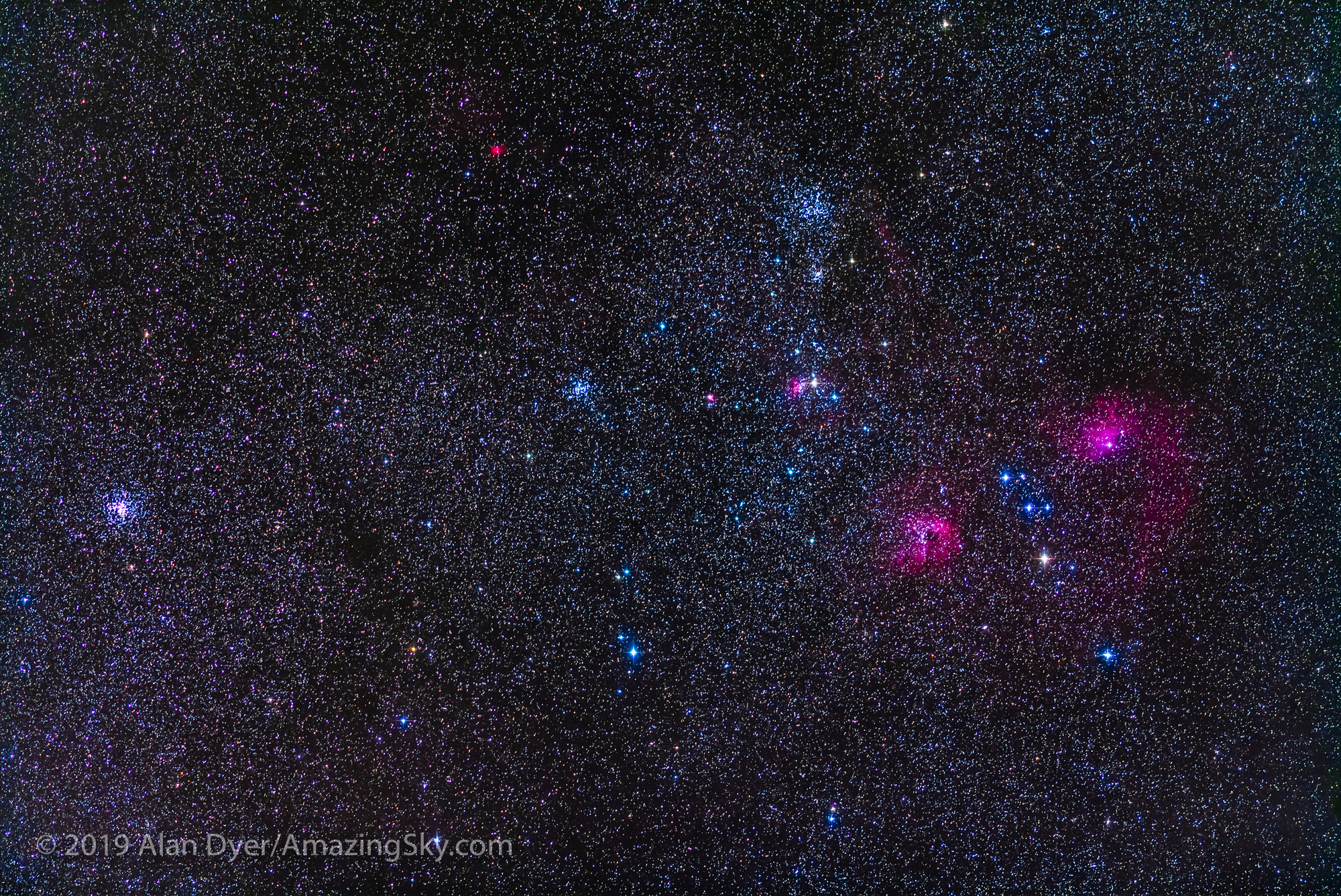
This is a stack of 5 x 3-minute exposures with the filter-modified Canon 5D MkII at ISO 800 and 200mm Canon L-Series lens at f/2.8. Taken with the Fornax Lightrack tracker as part of testing. Diffraction spikes added with Astronomy Tools actions. Taken from home on January 4, 2019.

Above Gemini and Orion lies Auriga, with its rich field of clusters and nebulosity, with โ€” from left to right โ€” Messier 37, Messier 36, and Messier 38, as the main open star clusters here. Below M38 is NGC 1907. The nebulosity at right is IC 410 and IC 405, the Flaming Star Nebula.

In between them is the colourful asterism known as the Little Fish. Messier 38 is also known as the Starfish Cluster while Messier 36 is called the Pinwheel Cluster. The bright red nebula at top is Sharpless 2-235. The little nebulas at centre are NGC 1931 and IC 417.


The California Nebula

The California Nebula in Perseus
This is a stack of 5 x 3-minute exposures with the filter-modified Canon 5D MkII at ISO 800 and 200mm Canon L-Series lens at f/2.8. An additional exposure taken through the Kenko Softon A filter is layered in to add the star glows to bring out their colours. Taken with the Fornax Lightrack tracker. Taken from home on a rare fine and mild winter night, January 4, 2019.

Now we enter Perseus, more an autumn constellation but well up through most of the winter months. It contains the aptly named California Nebula, NGC 1499, at top left, with the bright star Zeta Persei. at bottom A small region of reflection nebulosity, IC 348, surrounds the star Atik, or Omicron Persei, at bottom right. The star just below NGC 1499 is Menkib, or Xi Persei, and is likely energizing the nebula.


The Pleiades, or Seven Sisters

Pleiades M45 with 200mm Lens
The Pleiades with the Fornax Lightrack tracker and 200mm lens + Canon 5D MkII in a stack of 10 x 3 minute exposures at ISO 800.

Obvious to the eye and central to the sky lore of many cultures is the Pleiades, aka the Seven Sisters, in Taurus the bull. It is also called Messier 45.

This is a newly formed cluster of hundreds of stars, passing through a dusty region of the Milky Way, which adds the fuzzy glows around the stars โ€” an example of a reflection nebula, glowing blue as it reflects the blue light of the young stars.


The Hyades

The Hyades Star Cluster with NGC 1647 in Taurus
This is a stack of 5 x 2-minute exposures with the Canon 5D MkII at ISO 800 and 200mm Canon L-Series lens at f/2.8. An additional exposure taken through the Kenko Softon A filter is layered in to add the star glows to bring out their colours. Taken with the Fornax Lightrack tracker. Diffraction spikes added with Astronomy Tools actions for artistic effect.

Below the Pleiades in Taurus lies the larger Hyades star cluster. The V-shaped cluster stars are all moving together and lie about 150 light years away. Bright yellow Aldebaran, the eye of Taurus, is an intruder and lies at only half that distance, so is not a member of Hyades but is a more nearby star. The smaller, more distant star cluster NGC 1647 appears at left.


Seagull Nebula

Seagull Nebula and Sirius with 200mm
This is a stack of 10 x 3 minute exposures at ISO 800 (with the filter-modified Canon 5D MkII and Canon 200mm lens at f/2.8). The rings of colour around Sirius are an artifact of the sensor filter, I think!

Low in my northern winter sky is the brightest star in the sky of any season, Sirius. Just above and to the east of Sirius lies the Seagull Nebula (at top left), also called IC 2177, on the Canis Major-Monoceros border. Like many of these nebulas. the Seagull is too faint to easily see even with a telescope, but shows up well in photographs.


Lambda Orionis Nebula

Lambda Orionis Nebula with 200mm
With the Fornax Lightrack tracker and 200mm lens and filter-modified Canon 5D MkII. A stack of 10 x 3 minute exposures at ISO 800 with the filter-modified Canon 5D MkII and Canon 200mm lens at f/2.8.

This is the head of Orion, with the red supergiant starย Betelgeuse at bottom left and the blue giant star Bellatrix right at bottom right. The brightest star at top is Meissa or Lambda Orionis, and is surrounded by a large and very faint area of hydrogen nebulosity.ย The open cluster around Meissa is catalogued as Collinder 69.

While the winter Milky Way might not look as bright and spectacular as the summer Milky Way of Sagittarius and Scorpius, it does contains a wealth of wonders that are treats for the eye and telescope … and for the camera.

PS.: The techniques for taking and processing images like these form the content of our new Deep Sky with Your DSLR video course now being promoted on KickStarter until the end of February, and available for purchase once it is published later this spring.

See my previous blog post for details.ย ย Thanks and clear skies!

โ€” Alan, February 17, 2019 / ยฉ 2019 Alan Dyer / AmazingSky.comย 


Moonlight in the Badlands


Stars over Sedimentary Layers

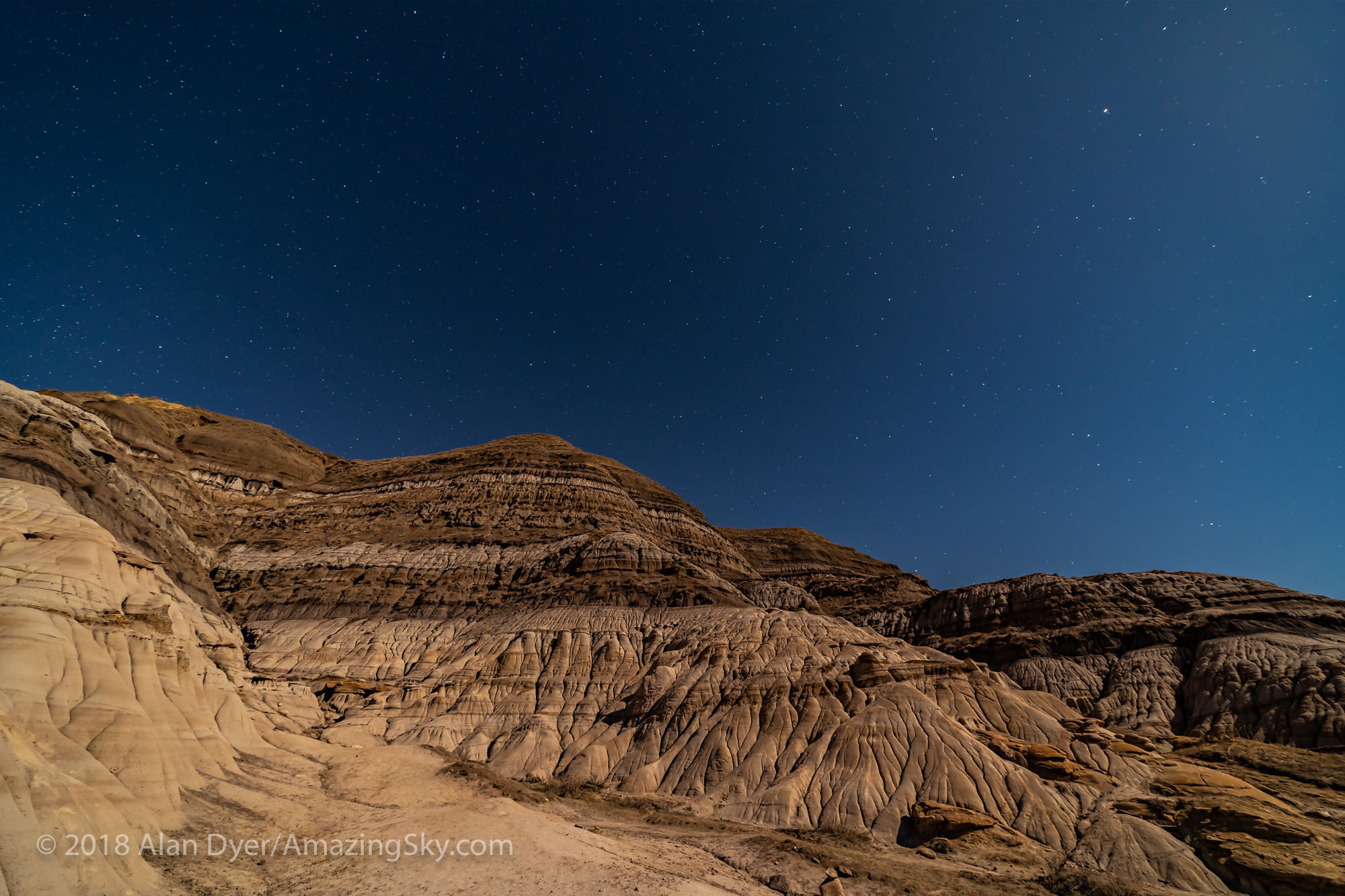
Clear nights and a waxing Moon made for great opportunities to shoot the Badlands under moonlight.

This has not been a great spring. Only now is the last of the snow melting here in Alberta.

But some mild and clear nights this week with the waxing gibbous Moon allowed me to head to the Red Deer River valley near where I live in Alberta for some moonlit nightscapes.


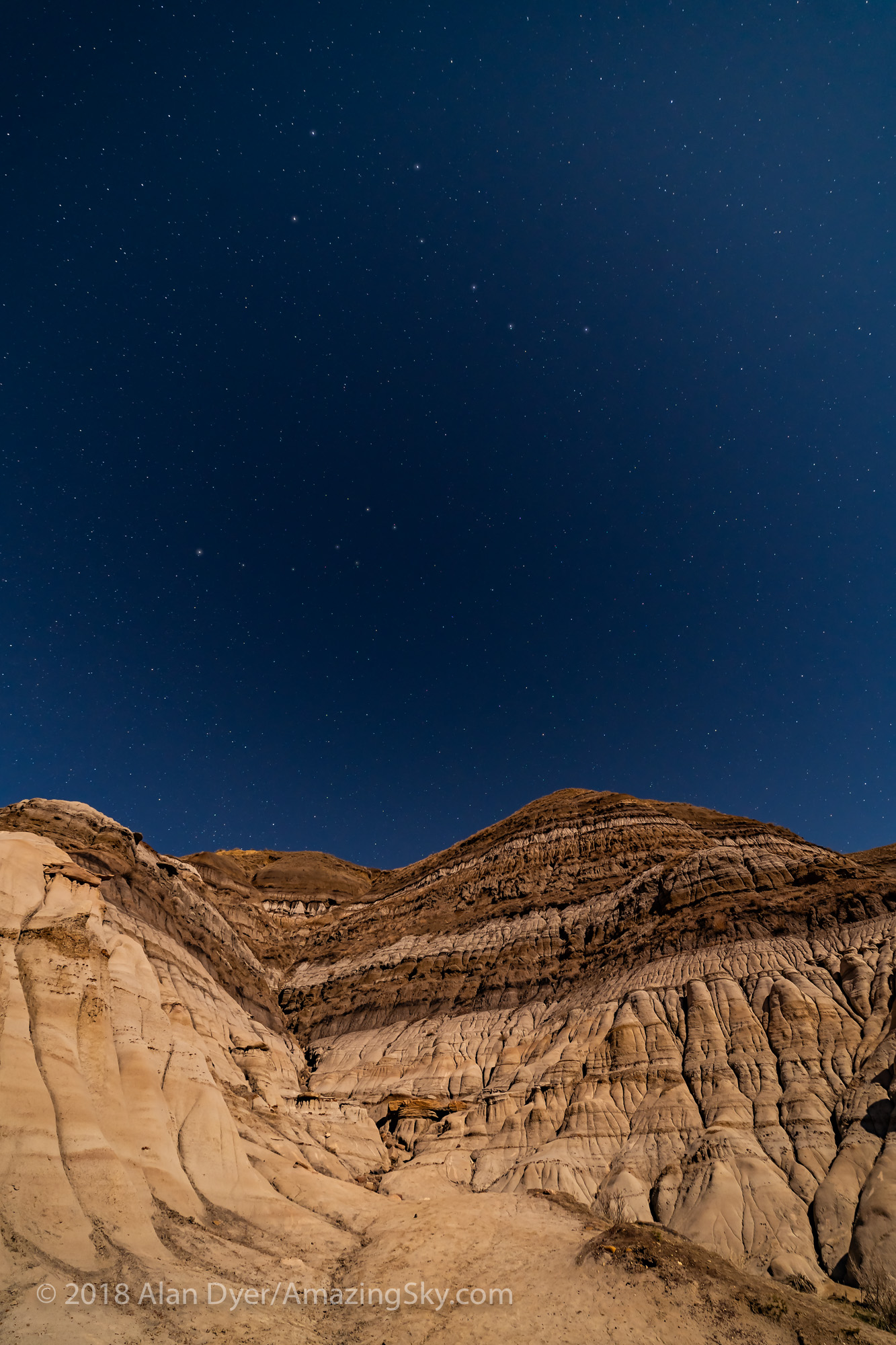
Big Dipper over the Badlands

Here’s the Big Dipper high overhead as it is in spring pointing down to Polaris.

I shot this and some other images in this gallery with the new Sony a7III mirrorless camera. A full test of its astrophoto abilities is in the works.

Jupiter Rising over Red Deer River Badlands

This is Jupiter rising, with the Moon lighting the sky, and illuminating the landscape. Moonlight is the same colour as sunlight, just much fainter. So while this might look like a daytime scene, it isn’t.

Venus in Twilight at the Hoodoos

This is Venus setting in the evening twilight at the Hoodoos on Highway 10 near Drumheller. The winter stars are setting into the west, to disappear for a few months.

Venus, Pleiades and Hyades in Twilight

Here’s Venus in closeup, passing between the Hyades and Pleiades star clusters in Taurus, low in the twilight over the scenic Horsethief Canyon area of the Red Deer River.

While Venus is climbing higher into our evening sky this spring, the Pleiades, Hyades and all the winter stars are fast disappearing from view.

We say goodbye to winter, and not a moment too soon!

โ€” Alan, April 28, 2018 / ยฉ 2018 Alan Dyer / AmazingSky.com


Hello, Austral Autumn Sky


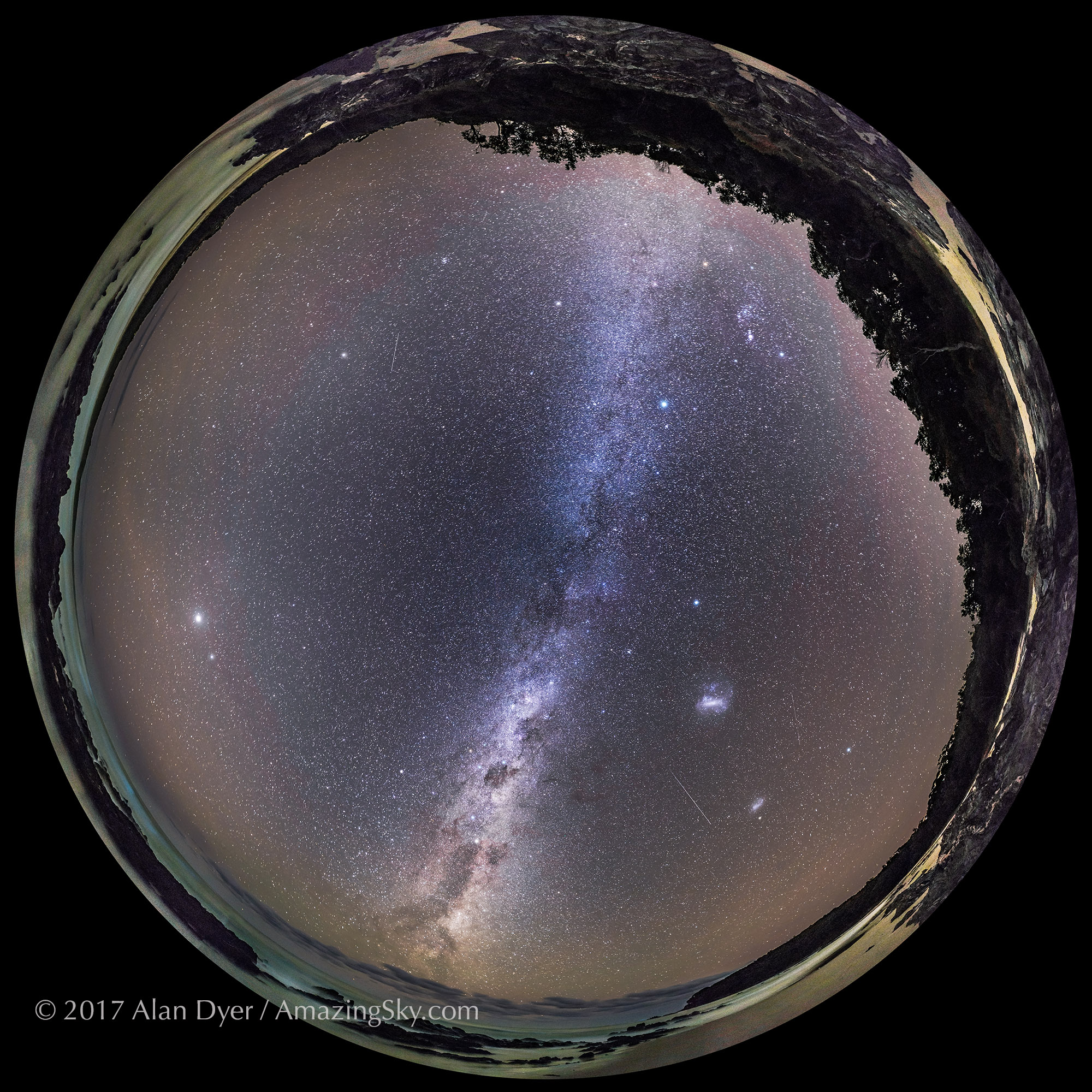
Southern Autumn Sky Panorama (Spherical)

The sky looks very different from down under. This is the entireย sky of early evening as autumn begins in the southern hemisphere.

My last post showed Orion and the winter sky disappearing into the west, from home in Alberta.

This post shows that same area of sky (here at top) also setting into the west. But that’s the only area of sky familiar to northern hemisphere stargazers.

Everything below Orion and Sirius is new celestial territory for the northern astronomer. Welcome to the fabulous southern hemisphere sky.

And to the autumn sky โ€“ From homeย it is spring.ย From here in the southern hemisphere summer is giving way to cool nights of autumn.

Straight up, at centre, is the faint Milky Way area containing the constellations ofย Puppis and Vela, formerly in the constellation of Argo Navis.

Below, the Milky Way brightens in Carina and Crux, the Southern Cross, where dark lanes divide the Milky Way.

At right, the two patches of light are the Large and Small Magellanic Clouds, satellite galaxies of our Milky Way.

The bright object at left is Jupiter rising over the Tasman Sea.

Southern Autumn Sky Panorama (with Labels)

I shot this 360ยฐ panorama on March 31, 2017 from Cape Conran on the Gippsland Coast of Victoria, Australia, at a latitude of 37ยฐ South.

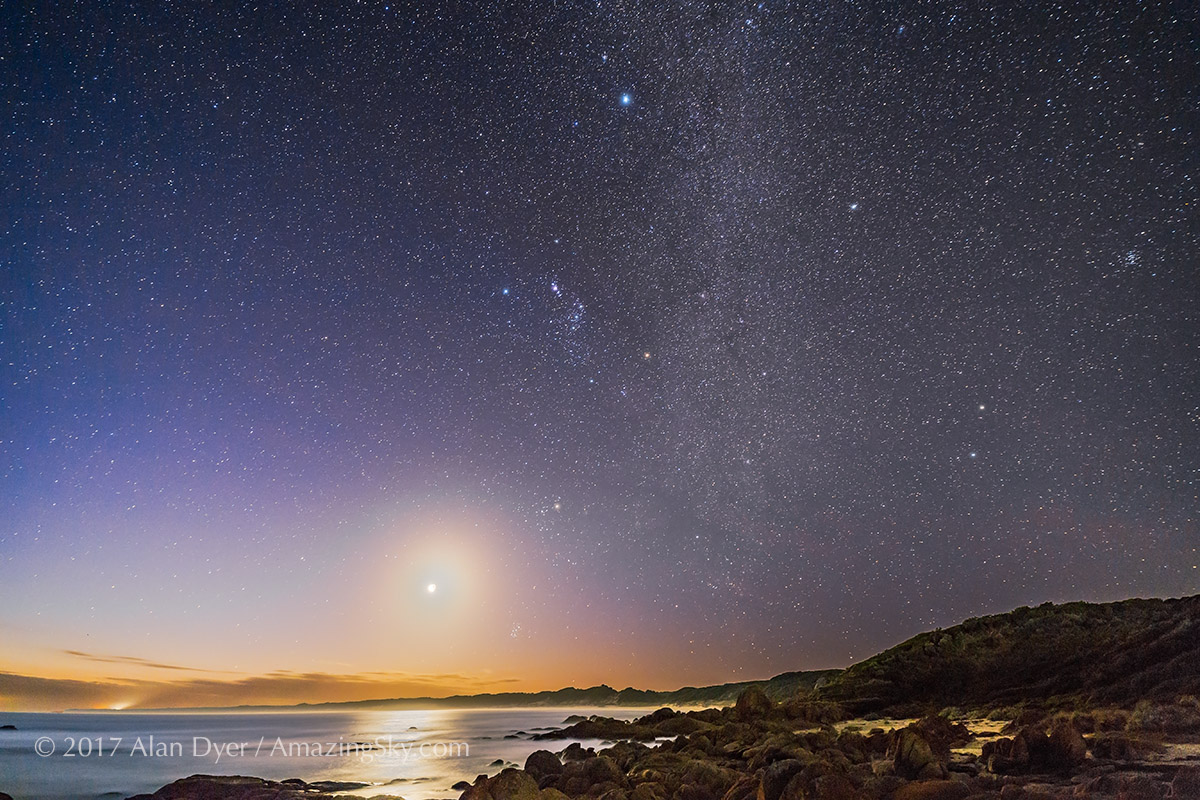
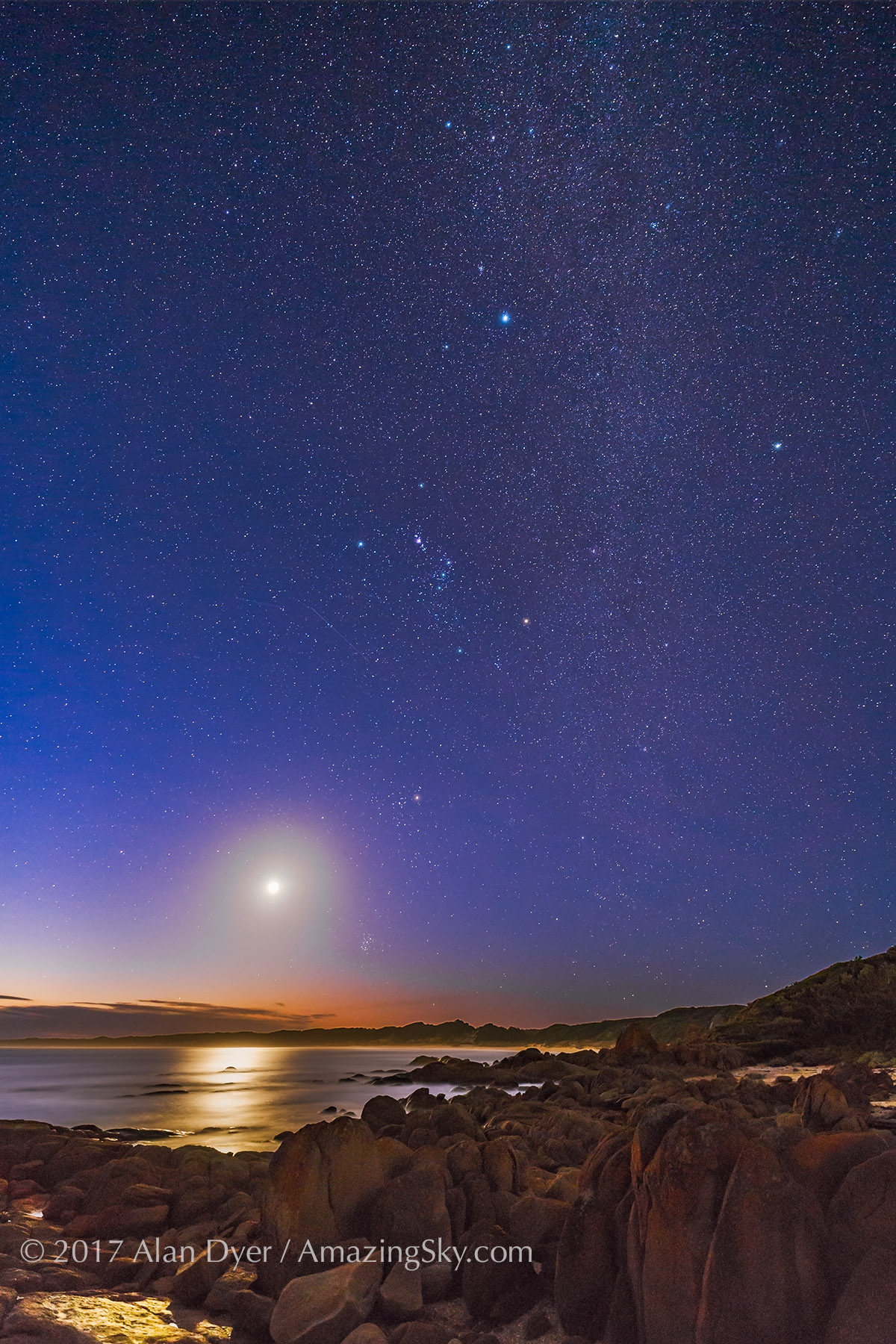
I’ve turned the panorama so Orion appears as we’re used to seeing him, head up and feet below. But here in the southern hemisphere the imageย belowย despictsย what he looks like, as he dives headfirst into the west in the evening twilight.

Orion and Waxing Moon Setting at Cape Conran

The bright object here is the waxing crescent Moon, here in Taurus. Taurus is below Orion, while Sirius (the bright star at top) and the stars of Canis Major are above Orion.

Orion, the Milky Way and Waxing Moon at Cape Conran

This view above takes in more of Canis Major. Note the Pleiades to the right of the Moon.

Visiting the southern hemisphere is a wonderful experience for any stargazer. The sky is disorienting, but filled with new wonders to see and old sights turned quite literally on their heads!

โ€” Alan, April 4, 2017 / ยฉ 2017 Alan Dyer / AmazingSky.com


Farewell Winter Sky


Panorama of the Winter Sky in March

As we celebrate the official arrival of spring in the Northern Hemisphere, we bid adieu to the stars of winter.

This was the scene last night from my backyard, of Orion and the surrounding constellations of the winter sky setting into the southwest in the early evening. Each night they will set sooner and sooner, even as the nights continue to grow shorter and the Sun sets later.

By late April Orion will be gone from our Northern Hemisphere sky โ€” he hangs around until well into May for sites south ofย the equator.

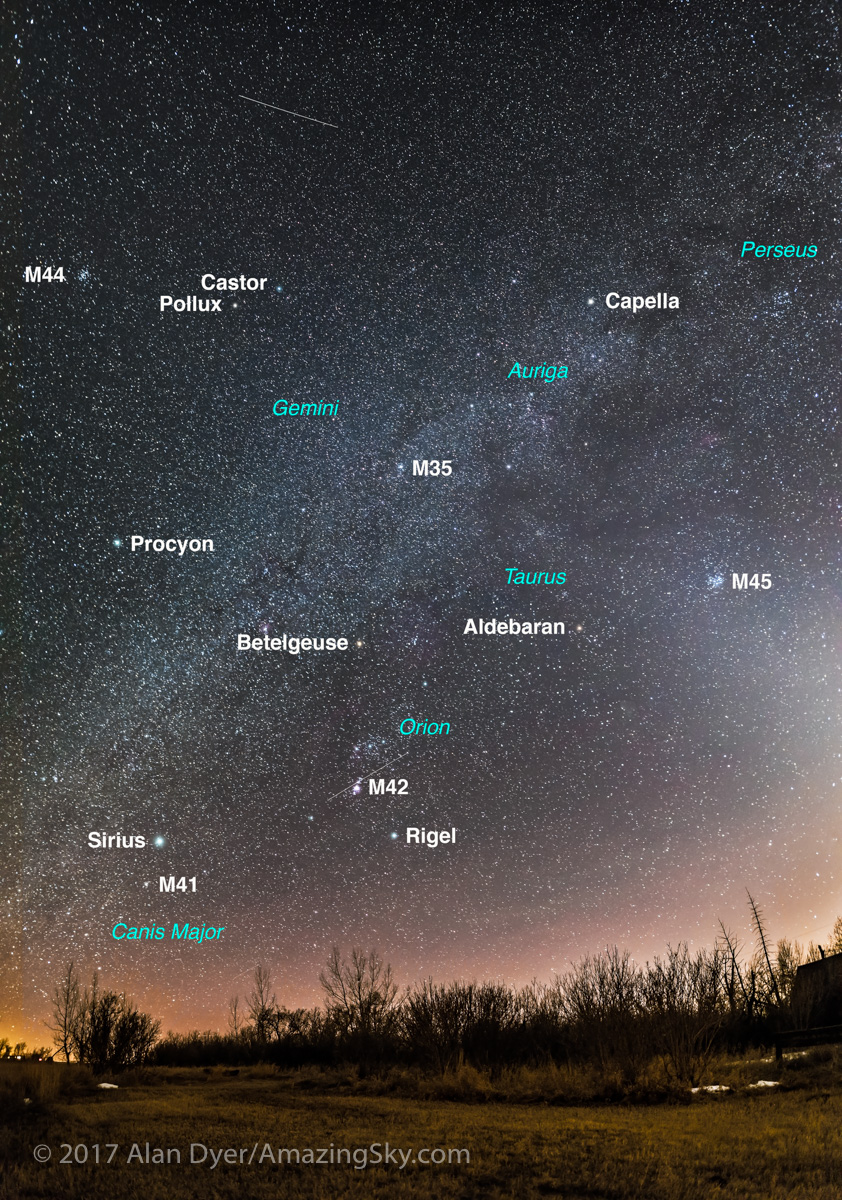
Panorama of the Winter Sky in March (with Labels)
A horizon-to-zenith panorama of the winter consellations on a March evening as they set into the southwest. Taken from home March 19, 2017. This is a panorama of 5 panels, each with the 20mm Sigma Art lens at f/2, and Nikon D750 at ISO 3200, for 25 seconds each. Stitched with Adobe Camera Raw.

In this version I’ve labeled the main characters in this winter hunting scene โ€“ including some of the deep-sky “Messier”ย ย objects like M45, the Pleiades; M44, the Beehive star cluster; and M42, the Orion Nebula.

At the same time this year, we also say goodbye to Venus which has shone so brightly these last few months as an evening star. By this weekend, it will be lost from sight as it passes between Earthย and the Sun.

Mercury Rising and Venus Descending (with Labels)
Mercury (left) and Venus (right and bright) shinng low in the evening twilight, on March 19, 2017. Mercury was then 2 weeks before greatest elongation while Venus was a week before inferior conjunction. So Mercury was rising into the evening sky while Venus was rapidly descending. This is a 7-image HDR stack of exposures from 2.5 seconds to 1.6-second at ISO 200 with the Canon 6D and with the Sigma 50mm lens at f/4.

Meanwhile, Mercury is rising into view in the evening twilight, in its best evening showing of the year from northern latitudes. The view below is also from March 19, with Mercury to the left of brighter Venus.

Over the next two weeks, look low in the west for a bright star amid the twilight. Mercury appears farthest from the Sun on April 1, the date of its “greatest elongation.”

Having Mercury in our evening sky is a sure sign of spring.

Leo and the Spring Stars Rising
Leo rising in the east along with the northern hemisphere spring stars. Numerous satellite trails are visible. I didnโ€™t clone them out. This is a vertical panorama of 4 frames, with the 20mm Sigma Art lens at f/2 and 25 seconds at ISO 3200 with the Nikon D750. Stitched with PTGui using Transverse Equirectangular projection.

Another sign of spring is Leo the lion.

While Orion sets in the west, the stars of spring are risingย in the east. The panorama above depicts the scene in the eastern sky these nights, as Leo rises below the Big Dipper.

The Big Dipper is at upper left, with itsย handle pointing down to Arcturus at bottom left. The Bowl of the Dipper points down to the right to Regulus and the stars of Leo.

Above Leo is the star cluster M44, the Beehive, in Cancer. Below Leo at centre is the star cluster Mel 111, the Coma Berenices star cluster near the North Galactic Pole.

Happy Equinox!ย 

โ€” Alan, March 20, 2017 / ยฉ 2017 Alan Dyer / amazingsky.com


The Ghostly Glow of Gegenschein


Northern Spring Sky Panorama

It takes a dark spring night to see it well, but now lurking near Jupiter is a ghostly sky glow called Gegenschein.ย 

This diffuse glow lies directly opposite the Sun. It is caused by sunlight reflecting off interplanetary dust particles in the outer solar system. They reflect light more effectively at the anti-Sun point where each dust particle is fully lit by the Sun.

Like the Sun, the Gegenschein moves around the sky along the ecliptic, moving about a degree from west to east from night to night.ย March andย April provideย good nights for seeing the Gegenschein as it then lies in an area of sky far from the Milky Way.

Even so, it is very subtle to the unaided eye. Look south at about 1 a.m. local daylight time.

However, this year, in early April the Gegenschein will be more difficult as it will then lie right on top of Jupiter, as that planet reaches its point opposite the Sun on April 7. Jupiter will then be superimposed on the Gegenschein.

The main image at top is a 7-image vertical panorama of the spring sky, from Corvus and Virgo above the horizon, up past Leo, into Ursa Major and the Big Dipper overhead. Spica lies below bright Jupiter, Arcturus in Bรถotes is at left, while Regulus in Leo is at right. The grouping of stars near centre is the Coma Berenices star cluster.

Orion over the Old Barn

Earlier in the night, I shot the sky’s other main glow โ€“ the Milky Way, as the winter portion of the Milky Way around Orion set into the southwest.

But over in the west, at the right edge of the frame, is the Zodiacal Light, caused by the same dust particles that create the Gegenschein, but that are located in the inner solar system between us and the Sun.

The Zodiacal Light is better depicted in images in my previous post from Dinosaur Park.ย 

We bid adieu to the winter Milky Way now. As it departs we are left with an evening sky without the Milky Way visible at all. As seen from northern latitudes it lies along the horizon.

But later in spring, late at night, we’ll see the summer Milky Way rising, beginning its seasons of prominence until late autumn.

โ€” Alan, March 19, 2017 / ยฉ 2017 Alan Dyer / AmazingSky.comย 


Toward the Centre of the Galaxy


Toward the Centre of the Galaxy

From southern latitudes the most amazing region of the sky shines overhead late on austral autumn nights.ย 

There is no more spectacular part of the Milky Way than the regions around its galactic centre. Or at least in the direction of the galaxyโ€™s core.

We canโ€™t see the actual centre of the Galaxy, at least not with the cameras and telescopes at the disposal of amateur photographers such as myself.

It takes large observatory telescopes equipped with infrared cameras to see the stars orbiting the actual centre of the Milky Way. Doing so over many years reveals stars whipping around an invisible object with an estimated 4 million solar masses packed into the volume no larger than the solar system. Itโ€™s a black hole.

By comparison, looking in that direction with our eyes and everyday cameras, we see a mass of stars in glowing clouds intersected by lanes of dark interstellar dust.

The top image shows a wide view of the Milky Way toward the galactic centre, taking in most of Sagittarius and Scorpius and their incredible array of nebulas, star clusters and rivers of dark dust, all located in the dense spiral arms between us and the galactic core.

Starclouds and Stardust โ€“ Mosaic of the Galactic Centre
This is a mosaic of 6 segments, each segment being a stack of 4 x 3-minute exposures at f/2.8 with the 135mm Canon L-Series

Zooming into that scene reveals a panoramic close-up of the Milky Way around the galactic centre, from the Eagle Nebula in Serpens, at left, to the Catโ€™s Paw Nebula in Scorpius, at right.

This is the richest hunting ground for stargazers looking for deep-sky wonders. Itโ€™s all here, with field after field of telescopic and binocular sights in an area of sky just a few binocular fields wide.

The actual galactic core area is just right of the centre of the frame, above the bright Sagittarius StarCloud.

Centre of the Galaxy Area
This is a stack of 5 x 5 minute exposures with the Borg 77mm f/4 astrograph and filter-modified Canon 5D MkII at ISO 1600, taken from Tibuc Cottage near Coonabarabran, NSW, Australia.

Zooming in again shows just that region of sky in an even closer view. The contrast between the bright star fields at left and the dark intervening dust at right is striking even in binoculars โ€“ perhaps especially in binoculars.

The visual impression is of looking into dark canyons of space plunging off bright plateaus of stars.

In fact, it is just the opposite. The dark areas are created by dust much closer to us, hiding more distant stars. It is where the stars are most abundant, in the dust-free starclouds, that we see farthest into the galaxy.

In the image above the galactic centre is at right, just above the small diffuse red nebula. In that direction, some 28,000 light years away, lurks the Milky Wayโ€™s monster black hole.

Milky Way Overhead Through Trees
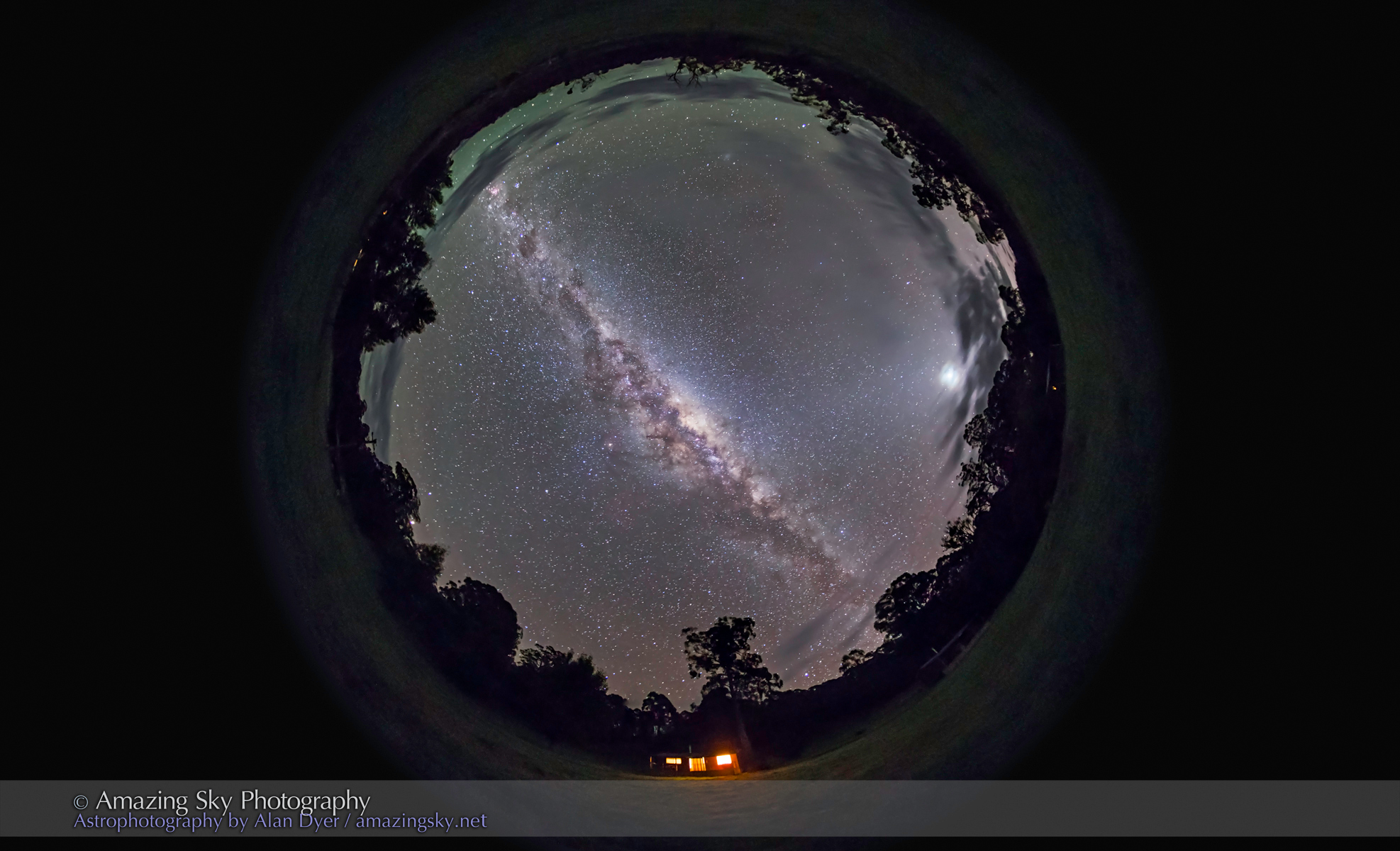
This is a stack of 5 x 6-minute tracked exposures with the 15mm fish-eye lens at f/4 and Canon 5D MKII at ISO 1600. The trees appear to be swirling around the South Celestial Pole at lower right above the Cottage.

To conclude my tour of the galactic centre, I back out all the way to see the entire sky and the Milky Way stretching from horizon to horizon, with the galactic centre nearly overhead in this view from 3 a.m. earlier this week.

Only from a latitude of about 30ยฐ South can you get this impressive view, what I consider one of the top โ€œbucket-listโ€ sights the sky has to offer.

โ€“ Alan, April 17, 2016 / ยฉ 2016 Alan Dyer / www.amazingsky.com


Red Rivals in Scorpius


Red Rivals in Scorpius

Mars outshines his rival red star Antares in the heart of the Scorpion.

This was the view last night from my observing site in Australia, of red Mars shining near the red star Antares, whose very name means โ€œrival of Mars.โ€ But as Mars nears its closest approach to Earth next month it is already far brighter than Antares, easily winning the rivalry now.

The view takes in the head of Scorpius, one of the most colourful areas of the night sky when photographed in long exposures. Uniquely, Antares illuminates a nearby dust cloud with its light which is more yellow than red.

Other dust clouds reflect the blue light of hot young stars in this section of the Milky Way. Red nebulas are emitting their own light from glowing hydrogen.

The area around Antares is also streaked with lanes of dark dust that absorb light and at best appear a dull brown.

Mars reaches its closest point to Earth since 2005 on May 30. All through May and June Mars will shine as a brilliant red star near Antares. A telescope will provide the best view of the red planet weโ€™ve had in a decade.

Saturn and Mars in Scorpius
This is a stack of 4 x 3 minute exposures with the 135mm telephoto lens at f/2.8 and filter-modified Canon 5D MkII at ISO 1600, shot April 14, 2016 from Tibuc Cottage, Australia.

While you are in the area aim your telescope a little to the east to catch Saturn, also in the area, though technically over the border in the constellation of Ophiuchus the Serpent Bearer.

In the view above, Saturn is the bright โ€œstarโ€ to the left of Mars. Saturn reaches its closest to Earth in early June. Its rings are now wide open and a spectacular picture postcard sight in any telescope.

Scorpius Rising in Moonlight
This is a stack of 2 x 30-second exposures for the sky and ground, both tracked, plus a 30-second exposure through the Kenko Softon A filter to add the star glows to make the constellation pattern stand out. All with the 35mm lens at f/2 and Canon 6D at ISO 1600. Taken from Tibuc Cottage, Australia.

This final view shows Mars and Saturn rising with Scorpius in the moonlight from two nights ago. From my current latitude of 32ยฐ south, Scorpius comes up on his side.

โ€” Alan, April 15, 2016 / ยฉ 2016 Alan Dyerย  / www.amazingsky.com

Under the Southern Cross


Southern Milky Way Over OzSky Star Party

The Southern Cross, the iconic constellation of the southern sky, shines high in the south on austral autumn nights.

Iโ€™m in one of my favourite places, Australia, in particular at its self-proclaimed โ€œastronomy capital,โ€ Coonabarabran in New South Wales. Down the road from me is the Siding Spring Observatory.

But for 3 weeks Iโ€™m using my own telescope gear to observe and photograph the fabulous southern skies.

For part of my time here Iโ€™m attending the annual OzSky Star Party, a small and rather exclusive event for observers from around the world who come here to revel in celestial wonders visible only from southern latitudes.

The lead image at top is a 7-panel panorama of the star party in action, on the grounds of the Warrumbungles Mountain Motel, with a dozen or more large and premium telescopes set up for our use.

Overhead is the arch of the southern Milky Way, with the Southern Cross here at its highest about local midnight now in early April at the start of autumn. Below the Milky Way is the Large Magellanic Cloud, a companion galaxy to the Milky Way, itself a superb target for telescopes.

To the far right in the Milky Way is Sirius amid the gum trees, and the stars of Canis Major diving into the west. To the far left are the bright star clouds of Scorpius and Sagittarius rising in the east, bringing the glowing core of ourย Galaxy high into the austral sky. Bright Mars and Saturn shine in and around Scorpius.

This is a view of the Milky Way everyone should see โ€“ it is should be one of the top items on any amateur astronomerโ€™s bucket list.

Star Trails over the OzSky Star Party
Circumpolar star trails over the OzSky star party near Coonabarabran, NSW, Australia, on April 3, 2016. This is a stack of 49 frames, each 45 seconds at f/2.8 with the 15mm fish-eye lens on the Canon 6D at ISO 4000. The ground comes from three frames in the sequence. Stacked with Advanced Stacker Plus actions using Streaks mode.

Here, above, Iโ€™ve stacked images from a time-lapse to create a star trail scene with the stars of the southern sky rotating about the blank South Celestial Pole. Again, the Southern Cross is at top.

Southern Milky Way from Alpha Cen to False Cross
The deep south Milky Way from Alpha and Beta Centauri (at left) to the False Cross in Vela and Carina (at right). This is a stack of 5 x 4 minute exposures at f/2.8 with the 35mm Canon L-series lens and filter-modified Canon 5D MkII at ISO 1000, with an additional similar exposure layered in taken through the Kenko Softon A filter to provide the star glows. Tracked on the iOptron Sky Tracker.ย 

This view, above, focuses on the Milky Way of the deep south, from Vela to Centaurus, passing through Carina and Crux, with the bright Carina Nebula, the Southern Cross, and the dark Coal Sack front and centre.

Mosaic of Crux, the Southern Cross
A 3-panel mosaic of the Southern Cross, Crux, shot April 5, 2016 from Tibuc Cottage, Coonabarabran, NSW, Australia. This is a moasic of 3 panels, each a stack of 4 x 4-minute exposures with the Borg 77mm f/4 astrograph and filter-modified Canon 5D MkII at ISO 1600. Stacked and stitched in Photoshop.

Here I zoom into the Southern Cross itself, in a mosaic of 3 panels to cover the smallest constellation using a high-resolution astrograph, a 300mm f/4 lens. The Coal Sack is at lower left while numerous star clusters lie embedded within and around the Cross, including the famous โ€œJewel Boxโ€ at left, next to Beta Cruxis, aka Becrux.

The Southern Milky Way and Magellanic Clouds
The deep southern Milky Way arching across the sky, from Puppis and Vela at upper right, to Centaurus at lower left. The two Magellanic Clouds are at lower centre, with the Large Cloud at top. This is a stack of 5 x 1.5-minute exposures, all tracked on the iOptron Sky Tracker, at f/2.8 with the 15mm fish-eye lens, and Canon 5D MkII at ISO 3200. The ground comes from just one of the tracked exposures to minimize blurring. Taken from the Tibuc Gardens Cottage near Coonabarabran, NSW, Australia on March 30, 2016.

I shot the Crux mosaic from my cottage site at Tibuc Gardens, a superb dark sky site and home to a new cottage built after the devastating bushย fires of 2013 which destroyed all the other cottages I had stayed at in previous years.

Thereโ€™s much more to come, as I rapidly fill up my hard drive with time-lapses and deep-sky images of the southern sky. I already have several blogs worth of images processed or about to be. In the meantime, check my Flickr site for the latest images hot off the hard drive and uploaded as best my Oz internet connectivity allows.

โ€” Alan, April 7, 2016 / ยฉ 2016 Alan Dyer / www.amazingsky.com


A Panorama of the Spring and Winter Sky


Winter and Spring Sky Panorama

I present a sweeping panorama of the winter and spring stars on a February night.ย 

The lead image is a panorama I shot last Saturday, February 27 that takesย in about 200ยฐ of sky from northeast to west, and nearly to the zenith. It encompasses most of the northern spring and winter stars and constellations.

I’ve added the labels to help you pick out the celestial highlights. The winter sky, containing Orion as the central constellation, is at right setting into the west. This area of skyย contains a rich collection of bright stars and identifiable constellations.

The left side of the sky containsย the spring constellations, now coming into view in the east. Note how that area of sky is sparsely populated by bright stars. You can see the Big Dipper, Regulus in Leo, and Arcturus rising at lower left.

The reason for the difference is the Milky Way โ€“ you can see it at right arcing up from the southern horizon passing by Orion and through Gemini, Taurus and Auriga. In that direction we are looking intoย the outlyingย spirals arms of our galaxy, toward rich areas of star formation.

To the east, at left, we are looking at right angles out ofย the plane of our spiral galaxy, toward the galactic North Pole, here just left of Leo. In that direction there are very few bright stars between us and the starless depths of intergalactic space. The spring sky is rather blank compared to the rich winter sky.

But you can see Jupiter, the brightest object in view here, and now prominent in the evening sky.

Note one other subtle glow just above Jupiter. Thatย diffuse glow is the Gegenschein, caused by sunlight reflecting off interplanetary dust opposite the Sun in ourย solar system and in the plane of the ecliptic.

Jupiter is just east (left) of the Gegenschein here, as Jupiterย was thenย just overย aย week before its date of opposition, March 8. By then the Gegenschein will have moved to superimpose right over Jupiter, asย both then lieย opposite the Sun.

Winter and Spring Sky Panorama

I shot this scene from home on February 27, 2016, using the new iOptron iPano motorized โ€œgigapanโ€ unit, which I programmed to move and shoot 36 exposuresย with the Canon 5D MkII and 35mm lens, arranged in 4 rows high with 9 panels wide in each row from east to west. The resultย is a huge mosaic,ย 24,000 by 10,000 pixels.

Each exposure was 25 seconds at f/2 and at ISO 3200. The camera was not tracking the sky. I stitched the 36 segments with PTGui using itsย Spherical Fisheye projection. The imageย has black margins but I think theย circular format is more suggestive of the spherical dome of the sky above and around you. But that’s me, a longtimeย planetarium show producer.

Next time I will shoot the zenith cap images as well!

โ€” Alan, February 29, 2016 / ยฉ 2016 Alan Dyer / www.amazingsky.com


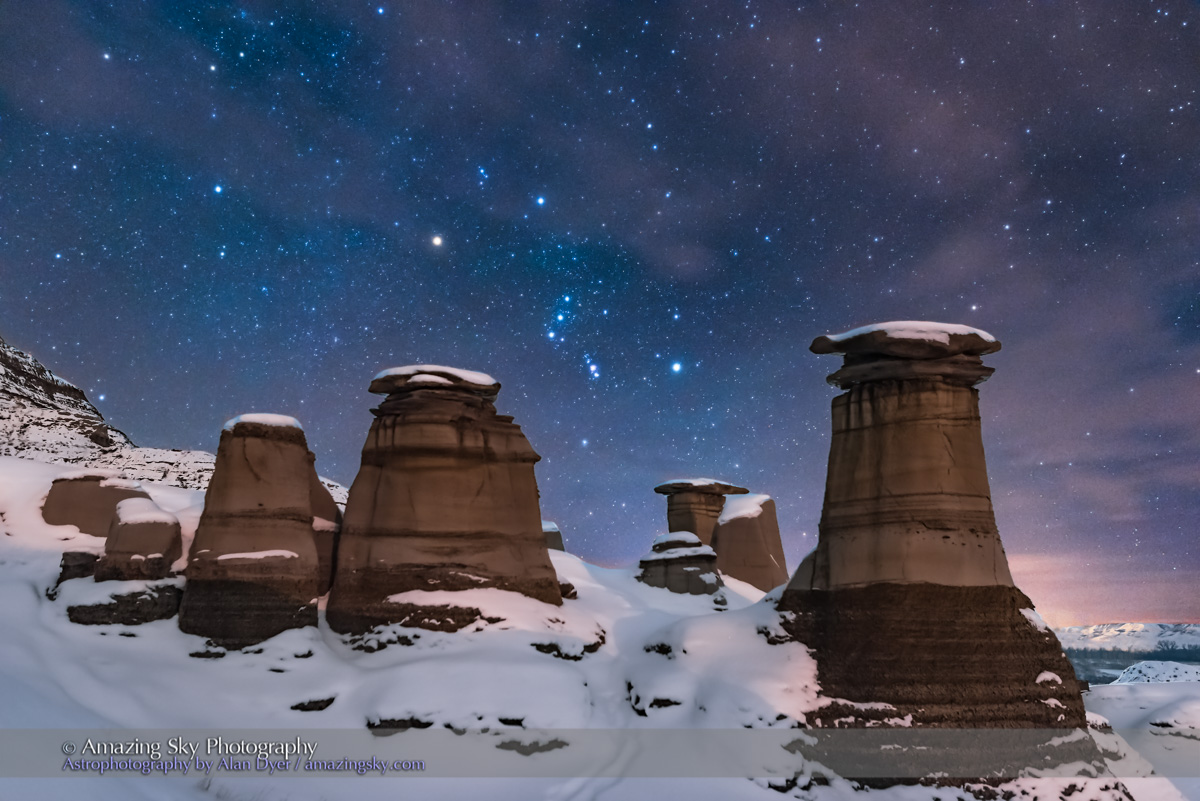
Orion over Snowscapes


Orion Over the Snowy Hoodoos

Orion appears in his winter element, over snowscapes on crisp January nights.

A couple of clear-ish winter nights this past weekend allowed me to capture that most iconic of constellations, Orion, over snowy landscapes close to home here in Alberta.

At top, he rises over the famous Hoodoos near East Coulee, Alberta in the Red Deer River valley. Clouds moving in on Sunday night, January 10, added the photogenic glows around the stars, emphasizing their colour and brilliance.

Orion Down the Snowy Road

Here, from a shot on Saturday, January 9, Orion appears down the end of my rural country Range Road, with Sirius, his companion Dog Star, following at his heels above the treetops and in some haze.

If this looks cold, it was โ€“ at minus 25ยฐ C. Though two hours later it was only -15ยฐ C and by morning it was 0ยฐ C. Winter in Alberta!

Both images are short exposures, 10 to 15 seconds, at f/2 or f/2.8 with the wonderful Sigma 24mm Art lens and my new favourite camera, the Nikon D750 at ISO 3200. In both cases the ground is from a stack of several exposures to smooth noise but the sky is from a single exposure to minimize star trailing. 

โ€” Alan, January 10, 2016 / ยฉ 2016 Alan Dyer / www.amazingsky.com 


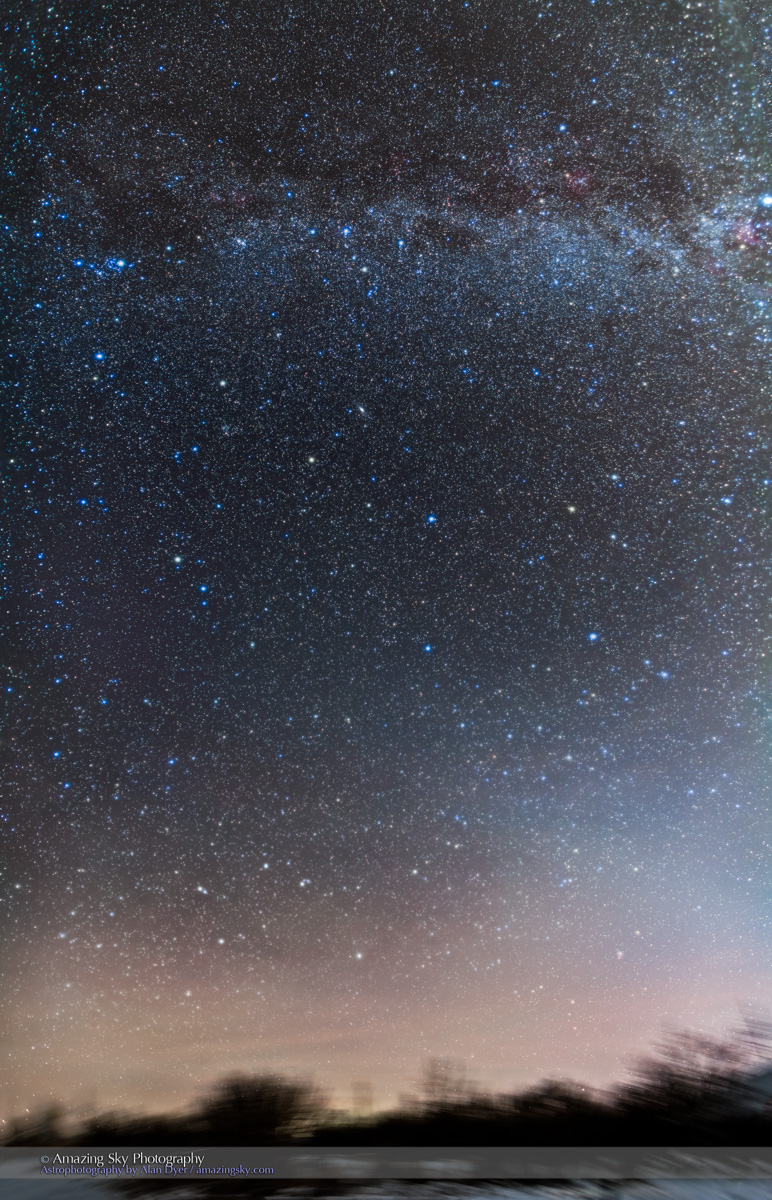
Mosaic of the Autumn Constellations


Mosaic of the Northern Autumn Constellations

I present a horizon-to-zenith panorama of the pantheon of autumn constellations.

Yes, I know it’s winter, but as it gets dark each night now in early January the autumn stars are still front and centre. I took the opportunity during a run of very clear nights at home to shoot a panorama of the autumn sky.

It is a mosaicย that sweeps up the sky and framesย many related Greek mythological constellations:

โ€ข from the watery constellations of Aquarius, Pisces, and Cetus at the bottom near the horizon…

โ€ข to Pegasus and Aries in mid-frame…

โ€ข on up to Andromeda and Perseusย at upper left…

โ€ข and finallyย Cassiopeia and Cepheus at the top of frame embedded in the Milky Way overhead. The Andromeda Galaxy, M31, is just above centre.

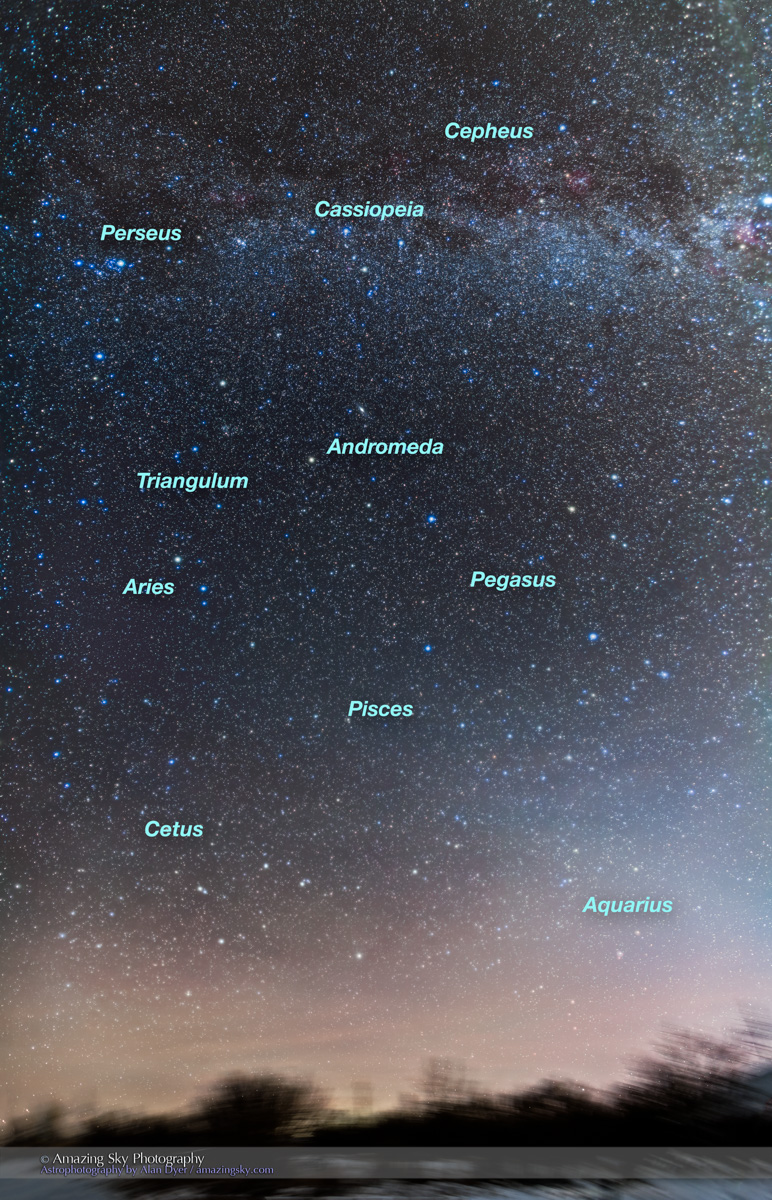
Mosaic of the Northern Autumn Constellations (with Labels)

Here, I’ve labeled the participating constellations, though only a few,ย such asย the “square” of Pegasus and the “W” of Cassiopeia, have readily identifiable patterns.

Most of these constellations are related in Greek mythology, with Princess Andromeda being the daughter of Queen Cassiopeia and King Cepheus, who was rescued from the jaws of Cetus the Sea Monster by Perseus the Hero, who rode on Pegasus theย Winged Horse in some accounts.

Zodiacal Light brightens the sky at bottom right in Aquarius, and angles across the frame to the left.


TECHNICAL:

I shot this from home on a very clear night January 2, 2016 with the Zodiacal Light plainly visible to the naked eye.

This is a mosaic of 5 panels, each a stack of 5 x 2 minute exposures, plus each panel having another stack of 2 x 2 minute exposures blended in, and taken through the Kenko Softon filter to add the fuzzy star glows to make the constellations stand out.

All were shot with the 24mm Canon lens at f/2.8 and Canon 5DMkII at ISO 1600. All tracked on the AP Mach One mount.

All stacking and stitching in Photoshop CC 2015. Final image size is 8500 x 5500 pixels and 3.6 gigabytes for the layered master.

โ€“ Alan, January 3, 2016 / ยฉ 2016 Alan Dyer / www.amazingsky.com


New Year’s Eve Sky: Aurora, Orion, and a Comet


New Year's Eve Winter Sky

The New Year’s sky was filled with Northern Lights, a panorama of stars, and a comet at dawn.

It was a busy night for stargazing as 2015 turned to 2016. A fine display of Northern Lights kicked off the celebrations, as curtains danced in the east as Orion rose (below).

New Year's Eve Aurora, Dec. 31, 2015

Toward midnight the Lights kicked up again, now with Jupiter (on the horizon) and Leo rising in the east (below).

New Year's Eve Aurora #2 (Dec 31, 2015)

I shot hundreds of frames for time-lapse sequences, and assembled them into a short music video. Click on the buttons to enlarge it to HD.


Just before midnight, while the second time-lapse was going and the aurora was still active, but before the Last Quarter Moon rose to light the sky, I shot a set of tracked images taking in the entire winter sky from horizon to well past the zenith.

That image is at top. It takes in the winter sky and northern winter Milky Way,  from Canis Major just above the horizon, up past Orion, then on up to Perseus and Cassiopeia at top right.

It shows how Orion and Sirius, the night sky’s brightest star, stand nearly due south at midnight on New Year’s Eve.


Comet Catalina near Arcturus on New Year's Day
Comet Catalina (C/2013 US10) near Arcturus in the constellation of Bootes, at pre-dawn on the morning of January 1, 2016, with the Last Quarter Moon nearby illluminating the sky. A long, faint ion tail is visible extending 2 to 3 degrees to the right while a brighter but stubby dust tail extends down to the south. Shot from home using the 200mm Canon telephoto and 1.4x extender at f/4.5 for a stack of 8 x 2-minute exposures at ISO 800 with the Canon 6D. Median combined stacked to eliminate satellite trails. The comet is slightly blurred due to its own motion in that time.
The final show of the night, now before dawn on New Year’s Day 2016, was Comet Catalina sitting right next to the bright spring star Arcturus. The comet was visible in the moonlight as a fuzzy object next to brilliant Arcturus, but the photo begins to show its faint tails, just standing out in the moonlit sky.

The comet will become more visible later this month once the waning Moon exits the dawn sky, as Catalina is expected to remain a nice binocular comet for most of the month as it heads high into northern sky.

Happy New Year to all! Have a celestial 2016!


Don’t forget, you can download my free 2016 Sky Calendar as a PDF. See my previous blog for details and the link. 

โ€” Alan, January 1, 2016 / ยฉ 2016 Alan Dyer / amazing sky.com

The Wonder-Filled Winter Sky


Mosaic of the Wonder-filled Winter Milky Way

The sky of December contains an amazing array of bright stars and deep-sky delights.

At this time of year we peer out toward the edge of our Galaxy, in the direction opposite to what we see in July and August. Even though we are looking away from the centre of our Galaxy, the Milky Way at this time of year contains a stunning collection of sights โ€“ for the naked eye, binoculars or a telescope.

I can’t list them all here, but most are in the lead image above! The image is aย mosaic of the northern winter Milky Way, including the brilliant stars and constellations in and around Orion the Hunter.

The Milky Way extends from Perseus in the north at top, to Canis Major in the south at bottom. Throughout the scene are dark lanes and dust clouds, such as the Taurus Dark Clouds at upper right.

The Milky Way is dotted with numerous red โ€œhydrogen-alphaโ€ regions of emission nebulosity, such as the bright Rosette Nebula at lower left and the California Nebula at upper right. The curving arc of Barnardโ€™s Loop surrounds the east side of Orion. Orion is below centre, with Sirius, the night sky’s brightest star, at lower left.

The constellation of Taurus is at upper right and Gemini at upper left. Auriga is at top and Perseus at upper right.

There’s an unusually bright area in Taurus just right of centre in the mosaic which I thought might be an image processing artifact. No. It’s the Gegenschein – a glow of sunlight reflected off cometย dust directly opposite the Sun.

Two highlights of this sky that are great regions for binoculars are the Hyades cluster in Taurus ….

The Hyades Cluster with Aldebaran
The Hyades open star cluster in Taurus with the bright star Aldebaran, not a part of the cluster iteslf. The smaller and more distant cluster NGC 1647 is at left. This is a telephoto lens image taking in a field similar to binoculars, and is a stack of 5 x 2.5-minute exposures with the 135mm lens at f/2 and Canon 5D MkII camera at ISO 800, plus two other exposures taken through the Kenko Softon filter to add the star glows. Taken from Quailway Cottage on Dec 7, 2015 using the iOptron Sky-Tracker.

…and the Belt and Sword of Orion.

The Hyades โ€“ the face of Taurus โ€“ is one of the nearest and therefore largest open star clusters.

Orion the Hunter, who battles Taurus in the sky, contains the famous Orion Nebula, here overexposed in order to bring out the much fainter nebulosity in the region.

The magenta and blue arcs in the image belowย are photographic targets, but the bright Orion Nebula in Orion’s Sword is easy in binoculars, shining below the trio of his Belt Stars.

Orion Belt and Sword Mosaic
A mosaic of the Sword and Belt region of Orion the Hunter, showing the diverse array of colourful nebulas in the area, including: curving Barnardโ€™s Loop, the Horsehead Nebula below the left star of the Belt, Alnitak, and the Orion Nebula itself as the bright region in the Sword. Also in the field are numerous faint blue reflection nebulas. The reflection nebula M78 is at top embedded in a dark nebula, and the pinkish NGC 2024 or Flame Nebula is above Alnitak. The bright orange-red star at far right is W Orionis, a type M4 long-period variable star. This is a 4-panel mosaic with each panel made of 5 x 2.5-minute exposures with the 135mm Canon L-series telephoto wide open at f/2 and the filter-modified Canon 5D MkII at ISO 1250. The night was somewhat hazy which added natural glows on the stars. No filter was employed here. The camera was on the iOptron Sky-Tracker for tracking but no guiding. Shot from outside Quailway Cottage near Portal, Arizona, Dec 7, 2015. All stacking and stitching performed in Photoshop CC 2015. Stacking done with median combine stack mode to eliminate geosat trails through the fields.

For us in the northern hemisphere, Orion and company are winter sights. But for those down under, in the southern hemisphere, this is the summer sky. So pardon the northern chauvinism in the title!

Either way, on a dark, moonless night, get out and explore the sky around Orion.

TECHNICAL:

I shot the segments for the main mosaic at topย on a very clear night on December 5, 2015 from the Quailway Cottage at Portal, Arizona. This is a mosaic of 8 segments, in two columns of 4 rows, with generous overlap. Each segment was made of 4 x 2.5-minute exposures stacked with mean combine stack mode to reduce noise, plus 2 x 2.5-minute exposures taken through the Kenko Softon filter layered in with Lighten belnd mode to add the star glows. Each segment was shot at f/2.8 with the original 35mm Canon L-series lens and the filter-modified (by Hutech) Canon 5D MkII at ISO 1600, riding on the iOptron Sky-Tracker. All stacking and stitching in Photoshop CC 2015. The soft diffusion filter helps bring out the star colors in this area of sky rich in brilliant giant stars.

โ€” Alan, December 11, 2015 / ยฉ 2015 Alan Dyer / www.amazingsky.com

Moonlighting at Monument Valley


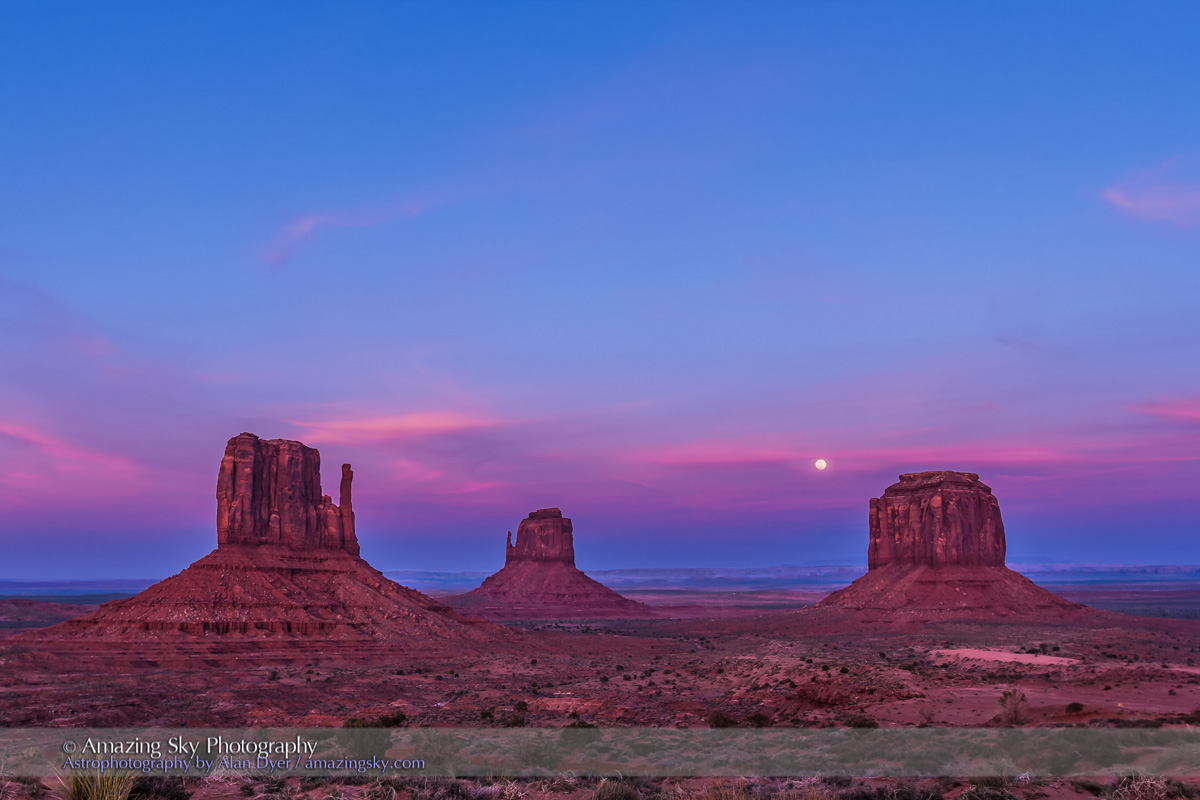
Moonrise Behind the Mittens at Monument Valley (#1)

The Full Moon rises behind the famous Mitten buttes at Monument Valley.

I spent a fabulous weekend capturing sunsets and nightscapes at the iconic Monument Valley on the Utah/Arizona border,ย the photogenic outdoor setย of dozens movies over the decades.

On the eve of the total lunar eclipse I shot the nearly Full Moon rising behind the West (left)ย and East (centre)ย Mittens and Merrick Butte (at right). On the evening of Friday, April 3 the Moon rose and sat amid the sunlit clouds with the Sun still up.

The alignment that would place the Moon directly opposite the Sun to create the eclipse was still 11 hours away.

Note how the butte’s shadows point almost, but not quite directly, at the nearly Full Moon. They point at the place in the sky the Moon would be before dawn at the end of that night.

Indeed, on eclipse morning on Saturday, April 4 the Moon set exactly as the Sun rose (see my photos in my previous blog).

But on eclipse eve the Moon rose 30 minutes before the Sun set, providing a chance to catch the Moon behind the still sunlit red buttes.

Moonrise Behind the Mittens at Monument Valley (#2)

I shot this image about 20 minutes after sunset on April 3, so the foreground is now in shadow but the Moon appears in a more richly tinted twilight sky.

Orion and Venus Setting at Monument Valley

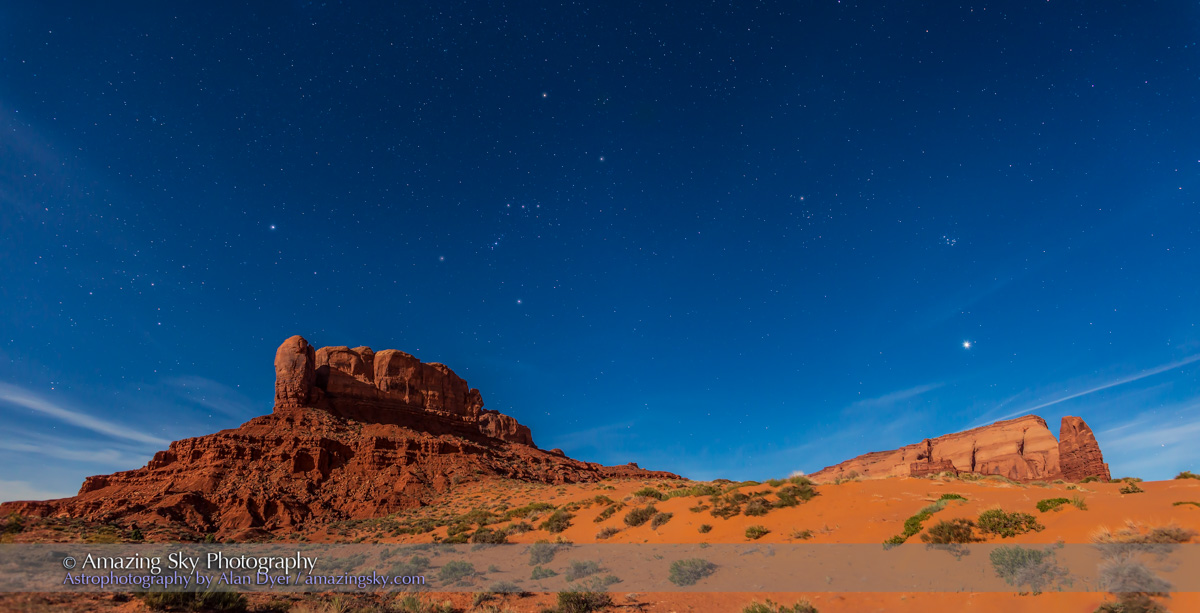
Later on April 3 I captured this scene, with the Tear Drop and Rock Door Mesas now lit by a bright Full Moon, and with the stars of the winter sky setting into the west. Canis Major and Orion are at left, while Taurus, including the Pleiades star cluster and brilliant Venus, are at right.

The Orion & Venus image is a 2-panel panorama.

Moonbeams at Monument Valley

On the evening of April 4, clouds thwarted plans for a long star trail sequence above a moonlit foreground.

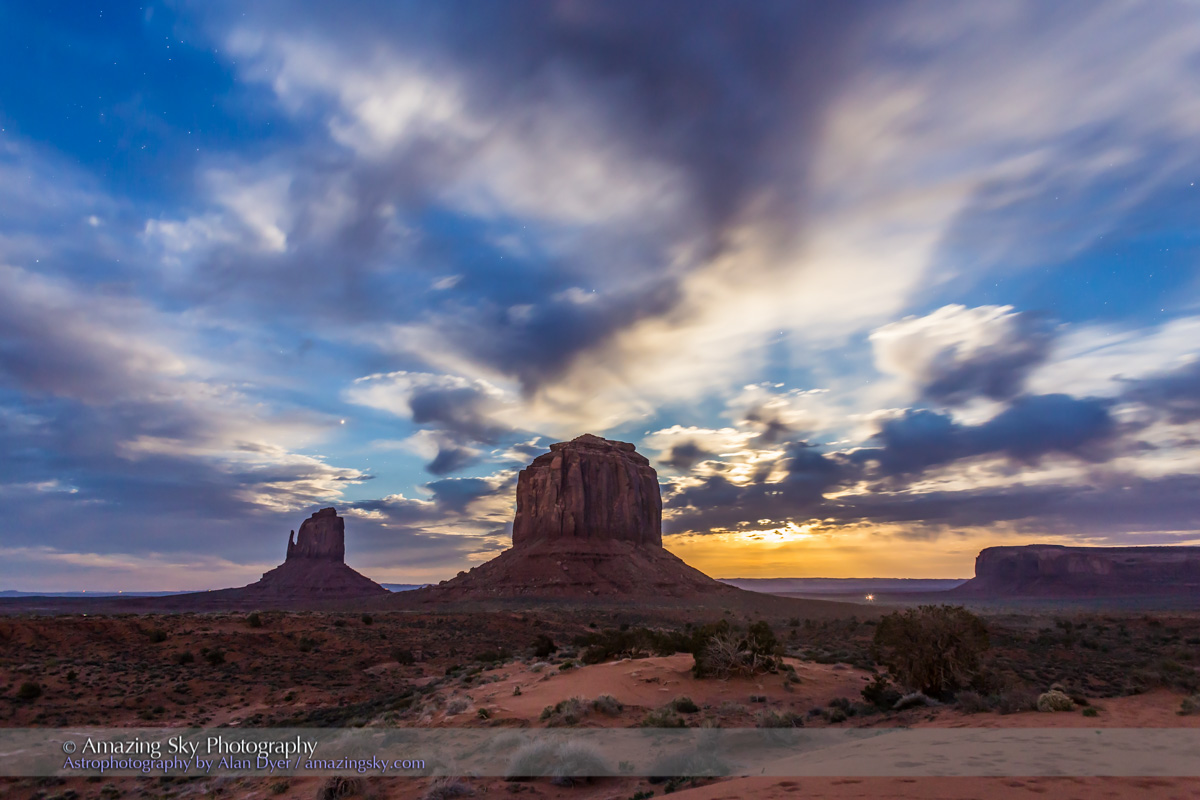
Instead, I shot toward the Moon and clouds, to capture subtle moonbeams radiating out from the Moon, now some 14 hours after the eclipse, rising behind Merrick Butte. I shot this from the dusty Loop Road that winds through the valley floor.

Big Dipper over West Mitten, Monument Valley

Instead of lots of images for a star trail composite, I was content to shoot this one image, catching the Big Dipper in a brief hole in the drifting clouds, hanging in the sky over the West Mitten butte. The foreground is lit by the partly obscured Full Moon. The long exposure streaks the moving clouds.

Night or day, it’s hard not to take a great photo here, clouds or not!

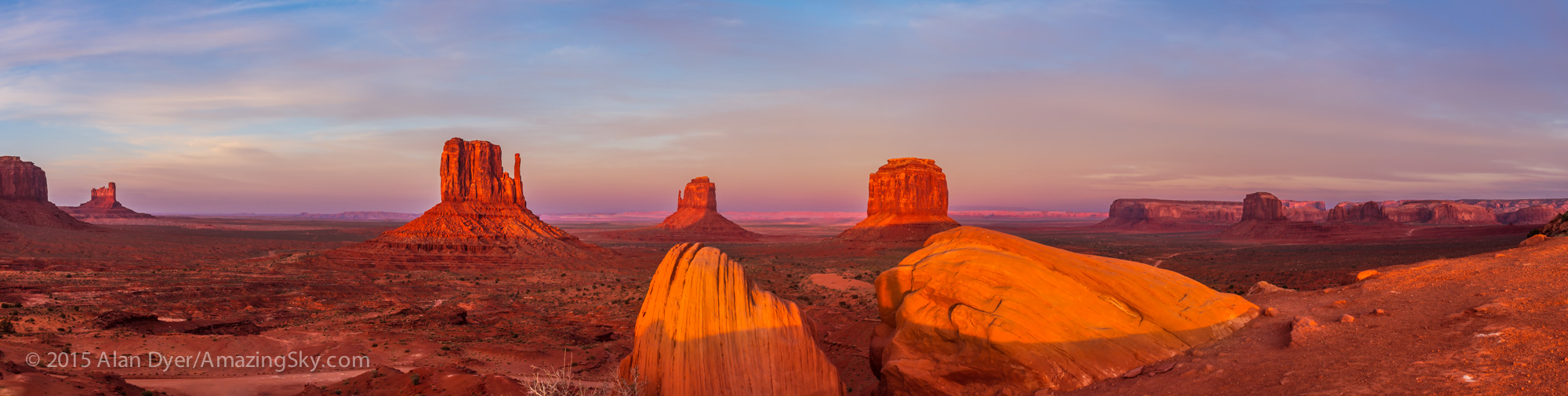
Sunset Panorama at Monument Valley

On my final evening at Monument Valley, high winds common to the area, blowing dust, and the closed Loop Road, scuttled plans again for long star trail sequences from the valley floor.

So on Easter Sunday, April 5, I settled for a panorama from the classic viewpoint showing the setting Sun lighting the buttes and mesas of Monument Valley.

It is an amazing place, but one that still requires patience to wait out the clouds and dust storms.

โ€“ Alan, April 6, 2015 / ยฉ 2015 Alan Dyer / www.amazingsky.com

Nova Sagittarii Close-Up


Nova Sagittarii (March 28, 2015)

The nova star in Sagittarius has re-brightened. I captured it in a telephoto closeup.

Here is Nova Sagittarii โ€“ likely an exploding white dwarf star โ€“ as it appeared before dawn on the morning of March 28. This is the brightest nova visible from the northern hemisphere for many years, though even now it is barely naked eye at fifth magnitude.

After dimming for a few days the nova has re-brightened somewhat. What titanic forces are going on at this white dwarf star causing it to fade then brighten remain to be determined.

It will certainly be worth keeping an eye on. With luck it might really get bright!

This telephoto image frames the “Teapot” configuration of stars that forms the main part of Sagittarius the Archer. The nova has appeared from out of nowhere in the middle of the Teapot just below the lid!

The image is a stack of 4 x 90-second exposures, plus an exposure taken through a Kenko Softon A filter to add the star glows, to accentuate the brighter stars. I shot this from the backyard in New Mexico.

โ€“ Alan, March 28, 2015 / ยฉ 2015 Alan Dyer / www.amazingsky.com

Nova Star in Sagittarius


Nova Star in Sagittarius

It’s a nova needle in a Milky Way haystack โ€“ an exploding star appearsย in Sagittarius.ย 

On March 15 a very observant amateur astronomer in Australia spotted a star in Sagittarius that wasn’t there the night before. It was a nova, Latin for “new.”

But this was not a new star forming,ย but an old star in the process of dying.

This star is likely an ancient white dwarf drawing material off a close companion. When the in-fallingย material builds up on the surface of the white dwarf it ignites in a nuclear explosion, causing the star to brighten, in this case by hundreds of times.

At its peakย last week, Nova Sagittarii was just bright enough to see naked eye. It is now below 5th magnitude and barely naked eye. In myย long exposure photo it appears lost amid the blaze of stars in the Sagittariusย Milky Way.

Still, this was the brightest nova visible from the northern hemisphere in many years. Indeed, we haven’t had a really bright naked-eye nova since the 1970s.

Considering all those stars, you’d think some would blow up for us to enjoy!

โ€“ Alan, March 26, 2015 / ยฉ 2015 Alan Dyer / www.amazingsky.com

Night of the Comet


Comet Lovejoy's Long Ion Tail in Taurus

What a beautifully photogenic comet Lovejoy is proving to be!ย 

On Friday, January 16, I caught Comet Lovejoy crossing the ecliptic as it travels through Taurus. The long exposure above shows it amid the star clusters, nebulas, and dark clouds of Taurus and Perseus.

The blue Pleiades is at centre, and the red California Nebula is at top. Throughout are the dark tendrils of the dusty Taurus Dark Clouds.

The long blue ion tail of Lovejoy now extends back 15ยฐ to 20ยฐ on photos and is easy to trace for half that distance in binoculars in a dark sky.

I turned the top photo 90ยฐ to orient the comet so it points “down.”

Comet Lovejoy Nightscape (Jan 16, 2015)

However, this wide-angle nightscape shows the real orientation of the comet, high in the sky above Orion, here rising over the rock formations of City of Rocks State Park, my favourite dark sky site in this area of New Mexico.

Comet Lovejoy Crossing the Ecliptic (Jan 16, 2015)

Taken earlier in the evening, this ultra-wide image shows the comet at top, with its blue tail oriented along the ecliptic and aligned with the Zodiacal Light, from the glow of sunlight reflecting off comet dust in the inner solar system.

The Zodiacal Light follows the ecliptic, the plane of the solar system and where we find the planets, such as Mars and Venus at bottom here. The comet seems to point toward the Sun, now below the horizon here at the base of the Zodiacal Light. That’s just as it should be! Comet gas tails always point away from the Sun, as they are blown away from the comet’s head by the solar wind.

This night Comet Lovejoy was crossing the ecliptic, as its orbit continues to take it north in a path almost perpendicular to the ecliptic. While planets orbit in the ecliptic plane, most comets do not. They can have orbits oriented at all kinds of angles off the ecliptic plane.

But on January 16 Comet Lovejoy crossed the ecliptic, placing it at the apex of the Zodiacal Light.

Comet Lovejoy & Zodiacal Light (Jan 16, 2015)

This wider view takes in the Zodiacal Light, the comet and Orion rising at left.

This was a marvellous “night of the comet.”

โ€” Alan, January 17, 2015 / ยฉ 2015 Alan Dyer / www.amazingsky.comย 

Comet on the Rocks


Orion & Comet Lovejoy over City of Rocks

Comet Lovejoy glows above the granite spires of City of Rocks State Park.ย 

With clouds forecast for the rest of the week I made the best of it tonight and headed out to my favourite local spot for nightscape images, the City of Rocks State Park on Highway 180 between Silver City and Deming, New Mexico.

It was a quick photo session tonight. I arrived at just the right time to catch the comet and Orion rising behind the rock formations, with the moonlight beginning to illuminate the rocky rims.

The comet is the small green spot just right of centre at the top. It is now climbing quite high in the southern sky as it comes up north. I could see it easily in binoculars as a large fuzzy spot and I thought I could just make it out with unaided eyes once I knew just where to look.

This will be a fine comet for binoculars once the Moon gets out of the way later this week, though you will need to be at a dark site. The comet is diffuse and will be utterly washed out by city lights. This is no Hale-Bopp! But as comets go, Comet Lovejoy C/2014 Q2 is a nice one.

โ€” Alan, January 5, 2015 / ยฉ 2015 Alan Dyer / amazingsky.com

The Christmas Eve Sky


Christmas Eve at City of Rocks Panorama

This was the sky on the night before Christmas, with the Moon setting and Orion rising.

It was a crisp and calm night on Christmas Eve, with the waxing Moon shining beside Mars in the west at right. The western sky was marked by the faint tower of light called the Zodiacal Lights. To the east at left, Orion was rising beside the Milky Way.

The main image is a 180ยฐ panorama taken at the City of Rocks State Park, south of Silver City, New Mexico, and a particularly photogenic site for nightscape images.

Christmas Eve Moon in Twilight

This was the scene earlier in the evening with the Moon beside Mars, and the pair well above Venus down in the twilight, all framed by one of the park’s windmills.

Orion Rising at City of Rocks (Xmas Eve 2014)

Here is a close-up of Orion climbing over the rock formations in the state park. This is a single exposure with the foreground lit by the waxing crescent Moon.

Merry Christmas to all and to all a good night.

โ€“ Alan, December 24, 2014 / ยฉ 2014 Alan Dyer / AmazingSky.com
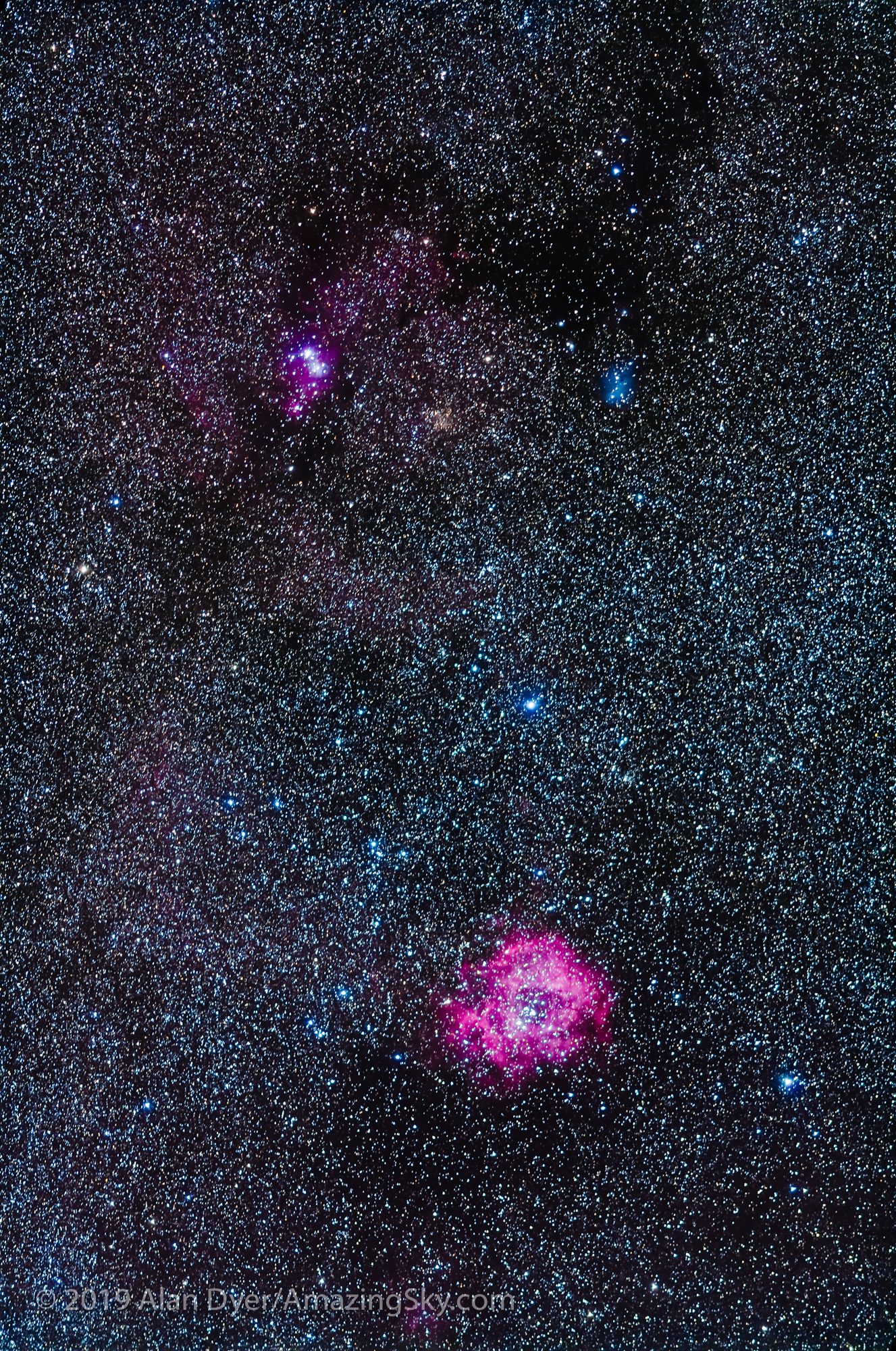
Sagittarius Setting over the City of Rocks


Moonlight on City of Rocks #3

Sagittarius, with Mars, set behind the granite pillars of City of Rocks State Park.

From home in Canada the summer constellation of Sagittarius is long gone byย November. But here, from a latitude of 32ยฐ north, Sagittarius, now with Mars shining amid its “teapot” shape of stars, still shines in the southwest.
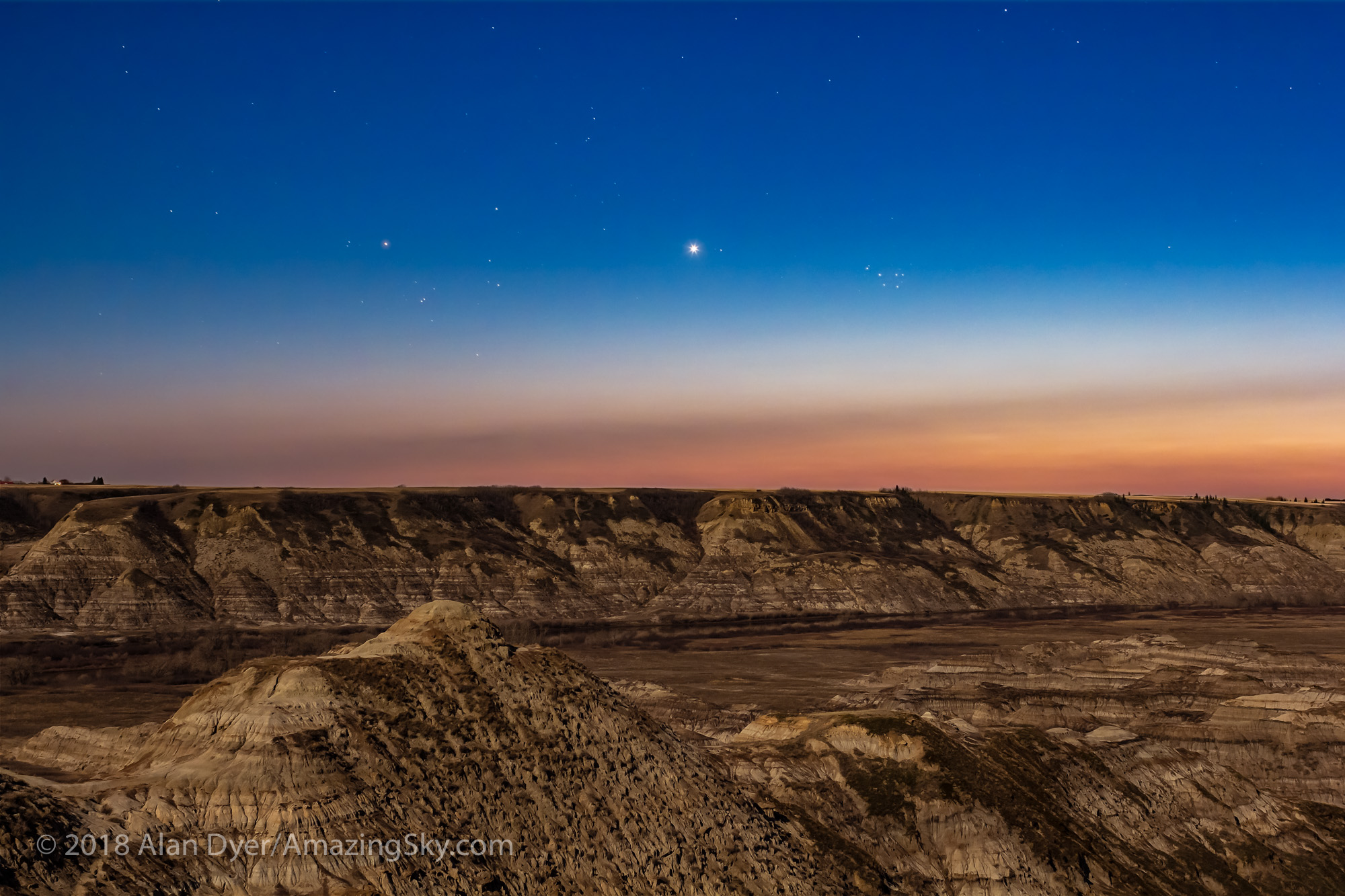
This was the scene last night in the early evening, as the Full Moon lit the rock formations at New Mexico’s City of Rocks State Park. Sagittarius is above the rocks at left. Some bright bits of the Milky Way just manage to appear in theย clear,ย bright sky lit blue by moonlight.

Moonlight on City of Rocks #2

This view looks northwest, with the stars of the Big Dipper just clearing the rocks at right.

In two weeks, with the Moon gone from the sky, the local astronomy club hosts one of its monthly star parties at the Park, making use of the public observatory in the Park, near the “Orion” group campground area โ€“ all the campsites are named for constellations and stars.

This is a very sky-friendly Park.

โ€“ Alan, November 7, 2014 / ยฉ 2014 Alan Dyer

Autumn Stars Rising over Dinosaur Park


Autumn Sky Rising over Badlands

The autumn constellations rise into a colourful sky at Dinosaur Provincial Park, Alberta.

Lastย night the sky started out beautifully clear but as it got darker it was apparent even to the eye that the sky wasn’t really dark, despite the lack of any Moon.

The camera captured the culprit โ€“ extensive green airglow, to the east at right. A faint aurora also kicked up to the north, at left, adding a red glow. Light pollution from gas plants nearby and from Brooks 50 km away added yellow to the sky scattered off haze and incoming cloud.
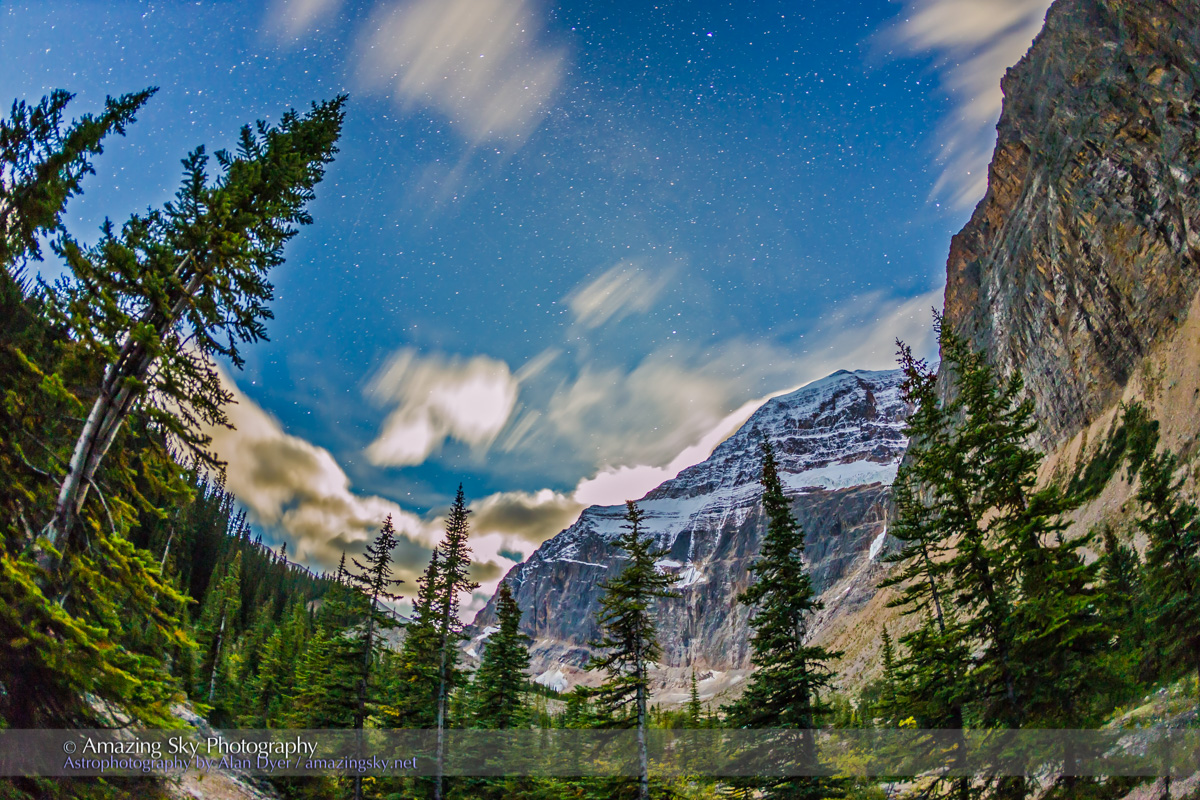
The sky colours added to the scene of the autumn constellations of Cassiopeia, Andromeda, Perseus and Pegasus rising in the east. The Andromeda Galaxy is at centre. The Pleiades is (are?) just rising over the hill.

This is a composite of five stacked and tracked exposures for the sky (with the camera on the Star Adventurer tracking mount) and four stacked but untracked exposures I took at the end of the sequence for the sharp ground (I just turned the tracker motor off for these).

โ€“ Alan, September 26, 2014 / ยฉ 2014 Alan Dyer


Andromeda over Mt. Andromeda


Andromeda over Mt. Andromeda #2

The stars of Andromeda and the autumn sky shine over Mount Andromeda.

This is a photo I’ve been after for several years, one practical to take only in early autumn. Last Sunday night, the skies were ideal.

This is the constellation of Andromeda over its namesake peak, Mt. Andromeda, at right.

The mountain was named in the 1930s by pioneering mountaineer Rex Gibson for the mythological princess. Andromeda is represented in the sky by an arc of stars, here at top centre, stretching from the Square of Pegasus, at right of centre, to Perseus, at left. Just above the main stars of Andromeda lies the oval glow of the Andromeda Galaxy.

The bright object at lower left is the overexposed waning quarter Moon rising in the southeast. Above it are the Pleiades rising.

I shot this from the Forefield Trail just up from the parking lot for the Toe of the Glacier walk to Athabasca Glacier, just off frame to the right. The hills in the foreground are the lateral moraines from the rapidly retreating glacier.

P.S. This my 500th blog post, a major milestone I would think! Thanks for being a fan and reading along. I hope you are enjoying my tours of what is truly an amazing sky.

โ€“ Alan, September 17, 2014 / ยฉ 2014 Alan Dyer

Stars on Ice โ€“ The Columbia Icefields by Moonlight


Star Trails over Columbia Icefields

The stars trail over the glaciers of the Columbia Icefields.

What an amazing night this was! You rarely get pristine cloudless skies over the Icefields. Some cloud is almost always blowing off the ice. But last Saturday in Jasper National Park was as clear as it gets.

The Moon was bright, as a waxing gibbous just off frame at left. It lit the landscape like it was day.

I shot with two cameras, one doing a time-lapse motion control sequence panning across the scene. The other was a fixed camera shooting 20-second exposures at 1-second intervals. The resultingย frames from the fixed camera, 270 in this case, are multi-purpose:

โ€“ I stacked about 100 of them to make the star trail composite above. Two frames supplied the stars at the beginning and end of the trails. Another single frame supplied the ground, to avoid the shadows being blurred by the Moon’s motion if you used the ground composited from all 100 frames.

โ€“ I can also take the full set of 270 frames and sequenceย them into a time-lapse movie of the stars moving over the landscape.

Stars over the Columbia Icefields Panorama

Before beginning the time-lapse sequences I shot this 180ยฐ panorama, made of 5 segments stitched in PTGui software. It extends from the southwest at left, where the Milky Way is barely visible, to the north at right, with the Big Dipper over the Icefields Parkway.

Click on it for a bigger view.

Shooting at the Icefields

This is the camera setup, with the cameraย on the right taking the star trail image I feature at top.

The Athabasca Glacier is at left, the Stutfield Glacier at right.

Icefields Parking Lot at Night

Midnight under moonlight is when to see the Icefields! This is the lower parking lot, at the start of the trail up to Athabasca Glacier. This is packed with cars, RVs and buses by day, but at night I was the only one there.

โ€“ Alan, Sept, 8, 2014 / ยฉ 2014 Alan Dyer


Stars over Mt. Edith Cavell


Mt Edith Cavell by Starlight

The stars of the summer sky shine over the North Face of Mt. Edith Cavell.

The valley below Mt. Edith Cavell in Jasper National Park is one of the most impressive locations in the Canadian Rockies. At few other sitesย do you get the sense of standing at the foot of a vertical mountain face.

I shot this view last Friday night, when the waxing Moon was behind the mountain, lighting the clouds and sky but not the mountain and valley directly.

But enough scattered light came from the sky to light the foreground and mountain face to make a nice photo with detail in both earth and sky.

Use of highlight and shadow recovery in Adobe Camera Raw also helps a lot!

Mt. Edith Cavell Trail at Twilight Panorama

This view is a 360ยฐ ground-to-zenith panorama I shot earlier in the evening in twilight. It’s from the Trail of the Glacier path, where the path crosses Cavell Creek.

Mt. Edith Cavell was named in 1916 after the World War One nurse who was executedย by the Germans for assisting allied soldiers escape occupied Belgium.

โ€“ Alan, September 8, 2014 / ยฉ 2014 Alan Dyer


Pyramid Island Sky Panorama


Panorama from Pyramid Island Boardwalk, Jasper Park

The sky presents a panoramic show from Pyramid Island in Jasper National Park.

What a wonderful place to watch the stars. Last night I walked out to Pyramid Island in Jasper, via the historic boardwalk built in the 1930s. The site provides a panorama view around the lake and sky.

To the left is the “mainland.” Just left of centre the waxing gibbous Moon is setting over Pyramid Lake.

To the right of centre, the boardwalk leads out the small island, with Pyramid Mountain behind it.

To the right of the frame, a faint aurora glows to the northeast over the still waters of the lake.

This is a 360ยฐ panorama shot with the 15mm full-frame fish-eye lens in portrait orientation, with the segments stitched with PTGui software.

Big Dipper over Pyramid Mountain from Pyramid Island

After shooting some panoramas I walked to the end of the island and shot this view looking north and northwest to Pyramid Mountain. The Big Dipper is to the right of the peak, and the aurora lights up the northern horizon at right.

As I shot these images, the night was absolutely quiet. Until the wolves began to howl at the north end of the lake, in mournful howls that echoed across the waters.

It was one of the most spine-chilling moments I’ve experienced in many years of shooting landscapes at night.

โ€“ Alan, September 5, 2014 / ยฉ 2014 Alan Dyer


Big Dipper over Pyramid Mountain


Big Dipper over Pyramid Mountain

The Big Dipper shines through clouds over Pyramid Mountain in Jasper National Park.

This week I am in Jasper National Park for a shoot of moonlit nightscapes, weather permitting.

It barely permitted last night, as clouds cleared briefly to the north. I visited a favourite spot on the shore of Patricia Lake, with Pyramid Mountain as a backdrop to the north.

The sky was still lit by the setting Moon, and by some faint aurora. The landscape is lit by starlight.

With luck I’ll get more images of Jasper by night this week, in one of Canada’s largest Dark Sky Preserves.

โ€“ Alan, September 2, 2014 / ยฉ 2014 Alan Dyer


Marvelling at the Milky Way


RAO Milky Way Night Panorama

Peopleย gather at a rural observatory to gaze at the Milky Way on a summer night.

The clouds drifted through now and then but skies were mostly clear for the last of the Rothney Astrophysical Observatory‘s annual Milky Way Nights for 2014.

A tradition since 2009 and the Year of Astronomy, these dark-of-the-moon nights at the Observatory have proven hugely popular each summer despite the 10 p.m. start and 2 a.m. finish!

The main image at top shows a 360ยฐ panorama as people were gathering at the portable telescopes and lining up โ€“ in a blur โ€“ for a look inside the observatory domes.

RAO Milky Way Night #1 (Aug 30, 2014)

Roland from the Royal Astronomical Society of Canada provided laser-guided star tours. How did we point out the stars and constellations before green lasers? In the hands of responsible astronomers they are a great tool for public education.

RAO Milky Way Night #4 (Aug 30, 2014)

Here he’s pointing out Vega and the stars of the Summer Triangle. Look way up!

About 400 people attended on Saturday night, the last in a trio of nights this past week. As you can see, the event attracts people of all ages. It’s even a popular date night attraction.

RAO Milky Way Night #6 (Aig 30, 2014)

At these summer stargazing sessions many people bring blankets to just lie back and look up, at a site away from the ugly glow of the city, here lighting up the clouds to the north.

It was a great night of public stargazing!

โ€“ Alan, August 31, 2014 / ยฉ 2014 Alan Dyer

ย 

ย 

Mars, Saturn and the Milky Way in Twilight


Mars, Saturn & Milky Way over Ranch Corral

Mars and Saturn meet in conjunction beside the Milky Way.

As it was getting dark two nights ago, I shot this view of Mars and Saturn (the “double star” at right, with Mars below Saturn) paired together now in the evening twilight. The location was Grasslands National Park, on the Park’s main loop tour road.

At the centre of the image is Scorpius and its bright star Antares, just behind the gate of the old corral.

At left are the star clouds of the Milky Way and the galactic core. Just above the horizon are the naked-eye star clusters Messier 6 and Messier 7, the most southerly of the popularย Messier objects.

The sky is blue from the last of the twilight glow.

The image is a composite of two exposures, both 1 minute but one tracking the sky and one with the drive turned off to provide the sharper foreground.

โ€“ Alan, August 29, 2014 / ยฉ 2014 Alan Dyer


Moonbow at Bow Falls


Star Trails & Moonbow over Bow Falls

A small moonbow forms in the light of the full “super moon” at Bow Falls in Banff.

This was Sunday night, August 10, on the night of the bright “super moon” that lit the landscape. In this case, I was at Bow Falls, a popular tourist spot in the townsite of Banff below the Banff Springs Hotel.

However, by night only a handful of people appeared, including two who stayed still long enough to record on one frame, above.

The sky, however, is made of many frames, exposed over an hour to add the star trails. But the landscape is from one exposure, and includes a short arc of a moonbow, a rainbow created from moonlight.

Big Dipper Star Trails over Bow Falls

In an alternative version, sans moonbow, I shot one short and several long exposures to capture the stars of the Big Dipper streaking over the falls.

These are two more examples of how magical the mountains are by moonlight. And how quiet the usually busy tourist spots are!

โ€“ Alan, August 15, 2014 / ยฉ 2014 Alan Dyer


Andromeda Rising


Andromeda Rising over Bow River

The stars of Andromeda and Perseus rise over the Rockies and Bow River in Banff.

It was a beautifully moonlit night last night, in Banff National Park. I shot the imagesย for this star trailย at a well-trodden viewpoint overlooking the Bow River. We’re looking east to the stars of the autumn sky in Andromeda and Perseus rising over the Front Ranges of the Rockies.

The waxing gibbous Moon behind me lights the landscape and sky.

The photoย is a stack of 5 images: one a short 40-second exposure at ISO 1600 for the point-like stars, followed after a gap in time by a set of four closely-spaced 6-minute exposures at ISO 100, to give the long star trails.

Shooting a handful ofย long exposures is the alternative to shooting dozens or hundreds of short exposures when you’re after star trails, and you don’t have any desire to collect a set you can turn into a time-lapse movie.

Indeed, shooting any time-lapses from this spot would have been futile โ€“ the location was a busy rest stop on the Trans-Canada Highway with cars and trucks pulling in, their headlights lighting up the foreground from time to time. But for still images, the site worked fine.

โ€“ Alan, August 9, 2014 / ยฉ 2014 Alan Dyer


Sagittarius and Sagebrush


Sagittarius over Sagebrush

Sagittarius and Scorpius shine above the pines and sagebrush of the summit of Mount Kobau, BC.

I’m still working through images I took last week at the Mt. Kobau Star Party. This one looks south toward Washington state amid some smoky air, toward the centre of the Galaxy.

Note the dark lanes in the Milky Way, particularly the prancing “Dark Horse.”

I shot this image the first night I was on the mountain, using a new Sky-Watcher Star Adventurer tracking system.

The image is a stack of five 5-minute tracked exposures with a 24mm lens. The ground is from just one of the exposures to minimize blurring of the ground from the moving camera.

It nicely captures both the sagebrush and the stars of the Milky Way, a quintessential Kobau skyย scene.

โ€“ Alan, August 5, 2014 / ยฉ 2014 Alan Dyer


Mount Kobau Nightscapes


Big Dipper Down the Road

The pines and sagebrush landscape of the summit of Mount Kobau are illuminated by the light of just the stars and Milky Way.

This collection of images from Monday night, July 28, captures the night sky above and the land below in classic “nightscapes.”

I took all of these with a camera on a static tripod, with no tracking system involved here. All are about 40-second exposures at ISO 3200 to 6400 with a fast 24mm lens at f/2.5 on a Canon 6D.

However, for the image above I composited two exposures: a shorter 40 second shot for the sky and a longer 1 minute 40 second shot for the ground. I used Photoshop’s Quick Selection tool to make a rough selection of the ground, then the Refine Mask and Smart Radius tool to refine the edgeย to precisely mask the sky separately from the ground, for individual processing.

The top image shows the Big Dipper and a well-timed meteor, at the end of the summit road on Mt. Kobau, near Osoyoos, BC.

Big Dipper & Arcturus from Mt Kobau

This image takes in the Big Dipper at right pointing down to Arcturus at left. I used Photoshop’s Content Aware Fill to neatly eliminate a power pole and wires.

Sagebrush and Stars

Looking southwest reveals the Milky Way above the sagebrush and pine trees. This is a single exposure, with the ground processed with Shadow detail recovery to bring out the starlit ground.

Pleiades Rising Down the Road

This image, taken about 2ย a.m., records the Pleiades star cluster rising down the end of the summit road, with Capella at left. It is a dual-exposure composite: 40 seconds for the sky and 1m40s for the ground.

I gave a talk at this year’s Mt. Kobau Star Party on how to shoot these kinds of nightscapes, illustrated with some of these images shot on site the night before. Very nice!

โ€“ Alan, July 30, 2014 / ยฉ 2014 Alan Dyer


Circling Stars Over the Open Range


Reesor Ranch Circumpolar Star Trails

The stars swirl in circles above the big sky country of the Canadian Prairies.

Forย these images I set the camera to take hundreds of images over the course of aboutย 4ย hours, then stacked about 100 frames for each of the composites. I stacked the images with the application StarStax.ย 

The result shows the stars circling the North Celestial Pole and Polaris in the northern sky. The top image is from earlier in the night when the Moon was still up lighting the landscape.

Reesor Ranch Circumpolar Star Trails v2

The image above is from late in the night, after moonset, and with the glow of dawn beginning to brighten the northern sky. Some low noctilucent clouds are also appearing on the horizon.

This was a beautiful night at Reesor Ranch in Saskatchewan, on the edge of Cypress Hills Interprovincial Park, on the Alberta-Saskatchewan border. I’ve just wrapping up a week of shooting here with clear nights every night but two. The hard drives are full!

โ€“ Alan, July 11, 2014 / ยฉ 2014 Alan Dyer


The Clouds of Solstice Twilight Are Here!


Noctilucent Clouds Panorama #1 (June 21-22, 2014)

Look north in June and July from the Canadian Prairies and you are likely to see iridescent clouds shimmering in the mid-summer twilight.ย 

It’s been a good couple of nights for sighting noctilucent clouds โ€“ literally “night shining” clouds, or NLCs. These are odd water vapour clouds that form at the edge of space 80 km up where no self-respecting cloud has a right to exist.

But there they are. Existing and moving in waves in a near vacuum.

We see them because at solstice time the Sun’s light pours over the pole (where theย midnight Sun is shining) and lights up the clouds that hang over the Canadian Northwest Territories and Nunavut.

Noctilucent Clouds and Big Dipper

From the Prairies we see them far in the distance to the north, as here, shining low on the horizon amid the deep blues and reds of a perpetual twilight that never ends on our short summer nights.

The top photo, taken Saturdayย night, is a 5-section panorama with a short telephoto lens. The bottom image, taken early this morning, is just the opposite โ€“ a very wide angle shot showing the clouds in context, with the Big and Little Dippers at top left and centre.

Some images and movies from last year’s NLC season are in my blog post from June 27, 2013.

โ€“ Alan, June 23, 2014 / ยฉ 2014 Alan Dyer


The Head of the Celestial Scorpion


Scorpius Head & Antares (135mm 5DII) v2The head of Scorpius is laced with colourful nebulas, both bright and dark.ย 

This is an image from two nights ago, from the dark skies of southeast Arizona. It takes in the head of Scorpius, from yellow Antares at lower left as the heart of the Scorpion, to the blue stars at right that mark his head.

The remarkable feature of this region of sky is its colour. No where else in the sky do we see (or I should say, does the camera see) such a spectrum of colourful nebulas. Dark brown lanes run down from the constellation Ophiuchus at left. They meet up with a yellow patch of nebulosity caused by dust reflecting the yellow-orange light of the giant star Antares.

Hot blue stars light up other dusty patches, while the magenta nebulas are created by gas emitting light, not just reflecting light from nearby stars.

A close-up of the region, shot in Australia last month, appears in my blog post fromย April 17, Stars Scenes in Scorpius. The image above, shot with a 135mm telephoto lens, takes in an area of sky that typical binoculars would frame.

But the eye sees only a hint of the detail, and none of the colour, hidden in the heart of Scorpius.

โ€“ Alan, May 6, 2014 / ยฉ 2014 Alan Dyer


Nebulas, Clusters and Starfields, Oh My!


Centre of the Galaxy Mosaic

There’s no more spectacular region of the sky than the Milky Way toward the centre of the Galaxy.

What a perfect night it was last night. After moonset between 2 and 3:30 a.m. I shot a series of images around the centre of the Galaxy area and stitched them into a big mosaic of the Milky Way.

The scene takes in the Milky Way from the Eagle and Swan nebulas at top left, down to the Messier 6 and 7 open clusters in Scorpius at bottom. Standing out is the large pink Lagoon Nebula left of centre and the huge region of dark dusty nebulosity popularly called the Dark Horse at right of centre. It’s made of smaller dark nebulas such as the Pipe Nebula and tiny Snake Nebula.

At upper left is the bright Small Sagittarius Starcloud, aka Messier 24, flanked by the open clusters M23 and M25. There are a dozen or more Messier objects in this region of sky.

The actual centre of the Milky Way is obscured by dark dust but lies in the direction just below the centre of the frame, amid one of the bright star clouds that mark this amazing region of sky.

I shot the images for this mosaic from a site near Portal, Arizona, using a 135mm telephoto lens and filter-modified Canon 5D Mark II riding on an iOptron SkyTracker to follow the stars. The mosaic is made of 6 panels, each a stack of five 3-minute exposures. They were all stacked and stitched in Photoshop CC. The full version is 8000 by 9000 pixels and is packed with detail.

I think the result is one of the best astrophotos I’ve taken! It sure helps to have Arizona skies!

โ€“ Alan, May 5, 2014 / ยฉ 2014 Alan Dyer


Twilight over the City of Rocks


Evening Twilight over the City of Rocks

The waxing crescent Moon sets in deep twilight over the City of Rocks State Park, New Mexico.

This was the scene tonight, May 2, under fabulous skies on a warm spring evening in New Mexico. I drove 45 minutes south from Silver City to the City of Rocks State Park, and area of oddly-eroded rocks and a fabulous place for stargazing. It actually has an observatory.

For this twilight scene I shot a series of seven exposures from dark to bright with an ultra-wide 14mm lens, and stacked them in a high dynamic range composition to capture both the bright Moon and sky above and dark landscape below. You can see the stars of the winter sky disappearing into the evening twilight as well, plus Jupiter at top.

For the next three nights I’ll be back near the Arizona Sky Village just across the state line fromย Rodeo, New Mexico, under very dark skies, to shoot the summer Milky Way in the wee hours of the morning after moonset. The weather promises to be perfect.

โ€” Alan, May 2, 2014 / ยฉ 2014 Alan Dyer


Goodbye Winter Sky โ€“ 2014 Edition


Orion Setting & Zodiacal Light (24mm 6D)

After a brutal winter for most of us in the northern hemisphere, we’re glad to see the last of the winter sky.

This was the scene on Tuesday night, April 29 as the last of the winter sky descended into the evening twilight.

Here, Orion (left of centre) sets into the western sky, next to the gossamer glow of the zodiacal light (right of centre). The stars of Taurus sit amid the zodiacal light, with the Pleiades just about to set behind the ridge. Sirius, the sky’s brightest star, shines at far left.

The zodiacal light is the glow of sunlight reflecting off cometary dust particles in the inner solar system. It is a glow from interplanetary space, not from our atmosphere. Spring is the best time to see it in the evening sky, no matter your hemisphere. It also helps to be in the desert of the U.S. Southwest!

I tookย this parting shot of the winter sky from a favourite observing haunt from years’ past, Massai Point, at 6800 feet altitude in the Chiricahua Mountains of southeastern Arizona. The skyย was perfectly clear and the night warm and windless. I’m back in Arizona and New Mexico for a few days, checking out accommodations for a long-term stay next winter, so I won’t have to endure the snow and cold that plagued us last winter. Good bye winter sky! Good bye winter!

โ€“ Alan, April 29, 2014 / ยฉ 2014 Alan Dyer


The Night Sky’s Two Brightest Stars


Sirius, Canopus & Gum Nebula (35mm 5DII)

The two brightest stars in the night sky shine in the southern sky.

Here are Sirius (at right) and Canopus (at bottom left), the brightest and second brightest stars in the night sky, together near the southern Milky Way.

My image also captures the huge loops of the Gum Nebula, thought to be the remains of a supernova that blew up a million years ago. It’s utterly invisible to the naked eye, but Sirius and Canopus stand out as brilliant stars even from light polluted sites.

Sirius can be seen from northern latitudes but Canopus is below the horizon for any location north of 37ยฐ North or so. I shot this image from Australia where these stars pass overhead.

Sirius is a hot blue-white star 8.6 light years away. Canopus appears slightly dimmer but only because it lies much farther away, at some 310 light years. In reality it is a supergiant yellow-white star that shines with a luminosity 15,000 times that of our Sun.

Canopus to Carina with LMC (35mm 5DII)

This image takes in Canopus at bottom right, next to the Large Magellanic Cloud, and with the southern Milky Way sweeping across the top, with the Carina Nebula and its attendant star clusters at top left and parts of the Gum Nebula at right.

Here are a fewย cocktail party facts about Canopus:

โ€ข In 480,000 years its motion around the Galaxy will bring Canopusย close enough to Earth that it will become the brightest star in our night sky, outranking Sirius.

โ€ข The origin of its name is a mystery. One idea is that the star is named for the pilot of the ship that took Menelaus to Troy on the quest to re-capture Helen.

โ€ข Canopus, the star, was used in ancient times as a key navigation star for those sailing to southern seas, as it would have risen above the southern horizonย from latitudes belowย 35ยฐ North back around 2000 BCE.

โ€ข Today, Canopus is charted as the brightest star in the constellation of Carina the Keel, part of the ancient constellation of Argo Navis, named for the ship sailed by Jason and the Argonauts.

โ€” Alan, April 27, 2014 / ยฉ 2014 Alan Dyer


Star Scenes in Scorpius


Scorpius Overhead (50mm 5DII)

Scorpius, one of the most photogenic of constellations, contains a wealth of amazing sky sights.

My trip to the land down under is coming to an end but I’m still working through the dozens of deep-sky images I was able to take under the southern stars. The wide-field scene above takes in all of Scorpius, shot with the constellation sitting directly overhead in the pre-dawn hours of an austral autumn. You can trace the scorpion’s winding shape down from his head and claws at top, to his curving stinger tail at bottom.

M6 and M7 Star Clusters in Scorpius (77mm 5DII)

Off the stinger of the scorpion shine two naked-eye star clusters, Messier 6 and 7 (the close-up photo above). M6 is the Butterfly Cluster, seen here sitting in a dark region of the Milky Way at upper right. Its companion, M7, a.k.a. Ptolemy’s Cluster at left of the frame, is lost amid the bright star fields ย that mark the direction of the galactic core.

NGC 6334 Cat's Paw Nebula (77mm 5DII)

In the curving tail of the scorpion lie two patches of nebulosity. At upper left is NGC 6357, but the triple-lobed NGC 6334 at bottom right is also known as the Cat’s Paw Nebula.

False Comet NGC 6231 Area (77mm 5DII)

Further up the tail of the scorpion sits this fabulous region of space that is a stunning sight in binoculars. NGC 6231 is the blue star cluster at bottom, which garnered the name Theย False Comet Cluster back in earlyย 1986 when many people mistook its fuzzy naked eye glow for Comet Halley then passing through the area. The camera reveals the region filled with glowing hydrogen gas.

Antares & Rho Ophiuchi Area (77mm 5DII)

But the standout region of Scorpius lies at its heart. Here, the yellow-orange star Antares lights up a dusty nebula surrounding it, reflecting its yellow glow. At top, another dusty nebula surrounds the star Rho Ophiuchi, reflecting its blue light. Glowingย hydrogen gas adds its characteristic magenta tints. This is one of the most colourful regions of the Milky Way.

I shot these images with 50mm normal and 300mm telephoto lenses two weeks ago during the OzSky Star Safari near Coonabarabran, NSW, Australia. For all I used a filter-modified (by Hutech) Canon 5D Mark II camera.

โ€” Alan, April 17, 2014 / ยฉ 2014 Alan Dyer


The Galactic Archway of the Southern Sky


Two Styx Night Sky Panorama (Rectilinear)

The southern Milky Way arches across the sky, with the centre of the Galaxy overhead at dawn.

This was the sky at 4:30 this morning, as Venus rose in the east (to the right) amid the zodiacal light, and with the Milky Way soaring overhead. This image is a 360ยฐ panorama of the scene, with the zenith, the overhead point, at the top centre of the frame.

The location is the Two Styx Cabins, on the border of New England National Park in New South Wales, Australia. The cabin with the light on (I left it on on purpose for the photo) is where I stayed for two nights in splendid isolation.

The panorama is a stitch of 6 frames shot with an 8mm fish-eye lens, each 1-minute exposures on an untracked tripod. I used the PTGui software program to assemble the pan.

Below is an alternative rendering, in spherical format, to create the more classic “fish-eye” view, but one extending well below the horizon. So this is not one image but a stitch of six.

Two Styx Night Sky Panorama (Fish-Eye)

In this versionย you can more readily see the spectacle of the Milky Way at dawn in the southern hemisphere autumn months, with the bulge of the galactic core directly overhead as seen from this latitude of 30ยฐ south. It is a wonderful sight.

This is my last view of it for this trip. Till next year!

โ€” Alan, April 11, 2014 / ยฉ 2014 Alan Dyer


The Milky Way of the Deep South


Vela to Centaurus with Crux & Carina (35mm 5DII)

The Milky Way of the southern hemisphere contains some astonishing deep-sky sights.

The lead image above shows the section of the Milky Way that extends farthest south, and so is visible only from tropical latitudes in the north and, of course, from the southern hemisphere. I shot these images this past week in Australia.

The wide-angle image above takes in the southern Milky Way from Vela, at right, to Centaurus, at left. In the middle is the Southern Cross (left of centre), the Carina Nebula complex and surrounding clusters, and the False Cross at right of frame. The close-ups below zoom into selected regions of this area of the Milky Way. All are spectacular sights in binoculars or any telescope.

Coal Sack and Jewel Box (77mm 5DII) #2

This image frames the left side of Crux, the Southern Cross. The bright stars are Becrux (top) and Acrux (bottom). Just below Becrux is the compact and brilliant Jewel Box cluster, aka NGC 4755. Below it areย the dark clouds of the Coal Sack, which in photos breaks up into discrete segments and patches.


Pearl Cluster and Lambda Centauri Nebula (77mm 5DII)

This region is a favourite of mine for images and for visual scanning in any telescope. The large nebula is the Lambda Centauri complex, also labelled the Running Chicken Nebula. Can you see itsย outline? Above it is the beautiful Pearl Cluster, aka NGC 3766.


Carina Nebula and Clusters (77mm 5DII)

This is the standout object in the deep south โ€“ the Carina Nebula complex. I’ve shot this many times before but this is my best take on it. At upper left is the Football Cluster, NGC 3532, whileย at upper right is the Gem Cluster, NGC 3293.

Seeing thisย area in person is worth the trip to the southern hemisphere. There are now many photographers up north who have shot marvellous images of Carina but using robotic telescopes. They have never actually seen the object for themselves. They print the images upside down or sideways, a sign of their detachment from the real sky.

You have to stand under the southern stars to really appreciate the magnificence of the Milky Way. All else is just data taking.

โ€“ Alan, April 5, 2014 / ยฉ Alan Dyer


Zooming into the Centre of the Galaxy


Sagittarius and Scorpius Milky Way (35mm 5DII)

A series of closer images zooms us into the Milky Way looking toward the centre of our Galaxy

Here are some images I tookย this past week at the OzSky Star Safari near Coonabarabran, Australia. The lead image above is a wide-angle lens image of all of Scorpius (above and to the right) and Sagittarius (below and to the left) straddling the Milky Way and its bright glowing core. The direction of the galactic centre is just left of centre of the image. We can’t see the actual centre of the Milky Way with our eyes and normal cameras because there are just too many stars and obscuring dust lanes in between us and the core.

The dust forms marvellous patterns across the glowing Milky Way โ€” see the Dark Horse prancing at left? Long tendrils of dust reach from the feet of the Horse to the bright yellow star at top, Antares, the heart of Scorpius.

The Centre of the Milky Way (50mm 60Da)

This image with a longer lens zooms in closer to the bright Sagittarius Starcloud around the heart of the Galaxy. All along it you can see red and pink nebulas, from the Cat’s Paw at upper right to the Eagle Nebula at lower left. The larger pink object at centre is the Lagoon Nebula.

The next image zooms into the area at the centre of the aboveย shot, just right of the Lagoon.

Sagittarius Starcloud (77mm 5DII)

This is the star-packed Sagittarius Starcloud. Everything you see is stars. Millions of stars.

I took this shot with a 300mm telephoto โ€” a small telescope actually, the gear shown below. It’s what I was using most of this past week to shoot the Australian southern sky.

Borg 77mm Astrograph in Australia

This is some of my Oz gear, the equipment (except for the camera and autoguider on top) that stays in Australia for use every year or two. The mount is an Astro-Physics 400 and the scope is the Borg 77mm f/4 astrograph. I used it for the close-up photo.

The gear allย worked great this time. I’ll have more photos to post shortly as my connection allows. Tonight, I am at the Parkes Radio Observatory where the internet connection is as good as it gets!

โ€” Alan, April 4, 2014 / ยฉ 2014 Alan Dyer


Observing under the Southern Stars


OzSky Star Safari Panorama #2 (March 2014)

The Milky Way arches over ourย observing field at the OzSky star party in Australia.

What an amazing few nights it has been. We’ve enjoyed several clear nights under the fabulous southern Milky Way. About 40 people from around the world have had access to telescopes from 14-inch to 30-inch aperture to explore the wonders of the southern sky from a dark site near Coonabarabran, New South Wales.

I’ve seen lifetime-best views of the Tarantula Nebula, the Carina Nebula, the Horsehead Nebula, the Omega Centauri cluster, and on and on! But the views of Mars have been incredible, the best I’ve seen the planet in a decade as it is now close to Earth and high in our southern sky.

The panorama above is a stitch of 6 untracked segments taken with a Canon 60Da and 8mm fish-eye lens. Each segment is a 60-second exposure at ISO 3200.

The 360ยฐ panoramaย takes in the Milky Way from Canis Major setting at right, over to Scorpius and Sagittarius and the centre of the Galaxy rising at left. At top centre is the wonderful Carina and Crux area. The two Magellanic Clouds are just above the trees at centre.

At upper left is Mars, and just to the left of it is a diffuse glow – the Gegenschein, sunlight reflected of comet dust in the direction opposite the Sun. Mars is near that point now. You can just see a faint band running from the Gegenschein to the Milky Way — the Zodiacal Band of comet dust.

Observer & Telescope at OzSky Star Party #4 (March 2014)

Here, one of our observers takes in a view through a 24-inch reflector telescope under the stars of the Southern Cross, the pattern in the Milky Way behind him.

The nights have been warm and wonderful, though a little damp and dewy after midnight. However, rain is in the forecast again, a welcome relief for most local residents who want the rain. They can have it now. We’re happy!

โ€“ Alan, April 2, 2014 / ยฉ 2014 Alan Dyer

The Southern Cross and Carina Nebula


Southern Cross and Carina Nebula (50mm 60Da)

Two icons of the southern hemisphere sky shine side by side in the Milky Way.

Last night was a hazy one at my site in Australia, with high clouds drifting through all evening. I made the best of it and shot some constellations, including the most famous in the southern sky, the Southern Cross, or Crux. It stands at left in the frame, with its distinctive four main stars, three of the blue and the top star of the cross, Gacrux, a very orange tint.

To the left of and below Crux the Milky Way is marred by a dark cloud of interstellar dust, the Coal Sack.

To the right of the frame you can see the pink “flower” of the Carina Nebula, one of the largest star forming regions in the sky. It is flanked by several star clusters, notably the very blue Southern Pleiades, or IC 2602, shining below the Carina Nebula.

The natural haze in the sky added glows around the stars, accentuating their colours.

In all, this is one of the richest and most colourful areas of the sky. It’s a highlight of any southern sky tour.

โ€“ Alan, March 23, 2014 / ยฉ 2014 Alan Dyer


The Milky Way from Down Under


15mm Ultrawide Southern Milky Way (March 2014)

The Milky Way of the southern hemisphere arches across the sky from the Southern Cross to Orion.

I’ve arrived at my dark sky site near Coonabarabran, Australia, with a very clear night to start my two-week session under the southern stars. Tonight I had just a 2-hour window between end of twilight and moonrise. But I made good use of it by taking some ultra-wide-angle views of the Milky Way we never see from up north.

This horizon-to-horizon scene looks straight up and stretches from the Southern Cross at far left (in the east) through Vela and Puppis to Orion at right (in the west). This sweep includes much of the Milky Way forever below our horizon from northern latitudes. At centre is the wide loop of the Gum Nebula. At lower left is the Large Magellanic Cloud, a satellite galaxy of the Milky Way.

At upper right is Jupiter in Gemini. The two bright stars near the centre are Canopus (left of centre) and Sirius (right of centre).

This is a stack of five 5-minute exposures at f/4 with the 15mm full-frame fish-eye lens on the Canon 5D MkII at ISO 1000. The camera was on the iOptron Skytracker, its first time in the southern hemisphere and my first time aligning it on the South Celestial Pole. It took a few minutes but I got it! The tracker worked great.

The forecast is for clouds and rain the next few days. But I’m here for over two weeks, and the weather can’t be any worse than it was in 2010 when the area was flooding. So with luck there will be more images to come from down under.

โ€“ Alan, March 21, 2014 / ยฉ 2014 Alan Dyer

Orion over the Rocket Range


Orion over the Churchill Rocket Range

Orion and Sirius shine over the abandoned launch towers of the Churchill Rocket Range.

This was the view Monday night, during a lull in the aurora display when I took a few moments to shoot the stars. You can see Orion at centre, with his trio of Belt stars pointing left and down to Sirius, the Dog Star in Canis Major, and the brightest star in the night sky. The Belt stars point up and right to Aldebaran, the brightest star in Taurus the bull.

They look closer to the horizon than you might be used to as this is from 58ยฐ north latitude.

These winter stars shine above some of the launch structures of the old Churchill Rocket Range. Built in 1957 for the International Geophysical Year, the Rocket Range served for many years as Canada’s only launch facility. No satellites were launched here. Instead the towers were used to launch sub-orbital sounding rockets into the ionosphere to explore the aurora.

Some of the rockets were repurposed military missiles, like Nikes and Aerobees. But many were Black Brants, civilian research rockets still being built in Winnipeg by Bristol Aerospace.ย 

But no Black Brants take off from here now. The Rocket Range was shut down in the mid-1980s as Canada’s space program focused on satellites, the Space Shuttle, and sending astronauts into space. Attempts by private companies to revive the site have all failed and the structures are now becoming derelict, being too costly to remove.ย 

โ€“ Alan, February 5, 2014 / ยฉ 2014 Alan Dyer


The Christmas Sky of 2013


Orion & Winter Sky (Christmas 2013)

_____________________________________________

” ‘Twas the night of Christmas, and all across the sky,

All the stars were twinkling, and Orion shone on high.”

_____________________________________________

Here’s my Christmas postcard, presenting the winter stars and constellations as they appeared over my Alberta backyard on Christmas night. The night was clear and calm, and not too cold.

Orion stood “on high” in the south, above bright Sirius, and below even brighter Jupiter at left, now blazing away in Gemini.

The winter Milky Way runs down the sky from Perseus at top to Canis Major on the horizon.

Merry Christmas to all and to all a good night!

โ€“ Alan, December 25, 2013 / ยฉ 2013 Alan Dyer

Orion and Canis Major Rising


Sirius & Canis Major Rising from New Mexico (35mm)

Canis Major and Orion rise into the desert sky from southwest New Mexico.

We had an excellent week of observing at the Painted Pony Resort. We had cloud on parts of most nights, and frost on the calm nights and wind on the frostless nights. So viewing conditions weren’t ideal but they were way better than back home where temperatures plunged to -35ยฐ C at night and snow piled waist high.

The shot above is of Sirius and Canis Major, the hunting dog, rising into the early evening sky after the Moon had set.

Orion Rising over Adobe House v2 (New Mexico)

I took this image later in the week. It shows Orion rising above the main adobe house at the resort. His Belt points down to Sirius just coming up over the Peloncillo Mountains to the east. Moonlight provides the illumination and bands of airglow colour the sky.

All-Star Telescope is conducting another New Mexico Star Party next March, but most spaces are already filled. A couple of rooms may still be available in a newly renovated cottage off the main resort site. Check with Ken and Bev for details. I highly recommend the experience.

โ€” Alan, December 10, 2013 / ยฉ 2013 Alan Dyer

Skyglows Galore in the New Mexico Dawn


New Mexico Pre-Dawn Skyglow Panorama (Dec 2013)

A mix of sky glows fills the pre-dawn sky in New Mexico.

To the eye the sky looked dark, marred only by some high haze drifting through. But the camera reveals a sky filled with an amazing wealth of colourful glows.

I took this 360ยฐ panorama in the pre-dawn hours (4:45 a.m.) this morning (December 8) from the Painted Pony Resort in southwest New Mexico. It reveals a swath of green airglow to the north, the zodiacal light, and the Milky Way. At northern latitudes there was bright aurora visible last night. We might have seen some sign of it here in New Mexico in the form of increased airglow activity.

The panorama takes in, from left to right:
โ€ข Arcturus, shining like an ornament on the treetop
โ€ข the zodiacal light rising up from the east
โ€ข red Mars embedded in the zodiacal light below Leo
โ€ข the Milky Way from Puppis and Canis Major at left arching up and across the sky down into Perseus at right
โ€ข Sirius the brightest star
โ€ข Orion setting over the main house
โ€ข Jupiter, the bright object at top centre in Gemini
โ€ข Aldebaran and the Pleiades setting right of the main house in Taurus
โ€ข Polaris over the smaller house at right
โ€ข the Big Dipper at upper rightย pointing down to Polaris
โ€ข a green glow along the northern horizon above the smaller house that is likely intense airglow.
โ€ข green and red bands throughout the sky are airglow, caused by atmospheric molecules flourescing at night
โ€ข bands of high cloud also permeate the sky adding natural glows around the stars.

I stitched this panorama using PTGui software, from 6 segments, all tracked, taken with the 14mm Rokinon lens at f/2.8 for 2.5 minutes each and with the Canon 5D MkII at ISO 1600.

As a postscript โ€” this is blog post #401 from me.

โ€“ Alan, December 8, 2013 / ยฉ 2013 Alan Dyer

Orion and His Hunting Dogs in the Milky Way


Orion and Canis Major Panorama

Orion parades across the northern winter sky followed by his twoย odedientย hunting dogs, Canis Major and Minor.

I shot the images for this panorama of the winter sky last night, December 6/7, on a frosty and cool night at our retreat in New Mexico.

The scene takes in Orion at upper right, with his signature stars, red Betelgeuse and blue Rigel, plus the dog stars Procyon at upper left (the brightest star in Canis Minor), and Sirius at lower centre (the brightest star in Canis Major). Canis Major itself appears in full at the bottom of the frame. Canis Major and Minor are depictedย in mythology as Orion’s two Hunting Dogs .

The northern winter Milky Way runs from top to bottom of the frame, punctuated by patches of red nebulosity such as the circular Rosette Nebula above centre. Orion is wreathed in the sweeping arc of Barnard’s Loop, while his Belt and Sword contain the Horsehead Nebula and Orion Nebula.

While we are looking to the outer edge of our Galaxy in this view, this region of the Milky Way is one of the richest areas of star formation in the sky. It’s a wonderful field and lovely to shoot under civilized conditions in southern New Mexico, at the idyllic Painted Pony Resort.

For this mosaic, I shot 4 to 5 frames for each of the two mosaic segments, plus two images for each segment shot through a diffusion filter to add in the accentuated star glows. I stackedย and stitched all of them using Photoshop CC.

So a total of 13 exposures went into the mosaic, each 4 minutes long, shot with the 35mm lens and filter-modified Canon 5D MkII, which helps bring out the red nebulosity.

As a footnote โ€” this is Blog post #400 from me.

โ€” Alan, December 7, 2013 / ยฉ 2013 Alan Dyer

Winter Sky Rising


Jupiter, Orion and Winter Sky Rising (24mm)

Jupiter and the stars of the winter sky rise in the east on a December night in New Mexico.

This was the scene last night, December 4, as clouds cleared away enough for great views of Orion and the winter sky rising above distant mountains in New Mexico. (All the clouds, that is, except for one annoying dark blob in Gemini above Jupiter!)

The bright object at lower left is Jupiter, in Gemini this winter, rising with Castor and Pollux to the left of Jupiter. To the right of frame Orion comes up on his side, with his Belt pointed down to where Sirius will come up shortly after I took this image. The red-sensitive camera picks up swirls of nebulosity around Orion.

Above Orion are the stars of Taurus and Auriga.

Milky Way in Perseus, Auriga and Taurus (24mm)

This image is a framing of the Milky Way from Perseus at top right down to Taurus and the top of Orion at bottom left. At centre is the blue Pleiades star cluster, and the red arc of the California Nebula. Also at centre you can see the long dusty tendrils of the Taurus Dark Clouds, interstellar clouds between us and the Perseus arm of the Milky Way.

I shot both from the Painted Pony Resort in southeast New Mexico using a little iOptron SkyTracker and 2.5- to 3-minute exposures with a filter-modified Canon 5D MkII.

โ€” Alan, December 5, 2013 / ยฉ 2013 Alan Dyer

Stars Over the Pillars of Hercules


Sirius over the Pillars of Hercules

In ancient times these twin mountains marked the end of the known world โ€“ beyond lay a great unknown sea.

Two mornings ago, before dawn, we sailed through the Straits of Gibraltar, known in ancient times as the Pillars of Hercules. The two massive peaks guarding the entrance to the Mediterranean Ocean were supposedly created by the legendary figure of Greek mythology to separate the two continents, Europe and Africa. Beyond them was a vast and forbidding ocean that few dared to sail.

The feature image above shows Sirius and Canis Major shining above the African side of the Pillars, the mountain known as Jebel Musa. Illumination is by moonlight, twilight and streetlight.

Rock of Gibraltor

The image above shows the more famous Rock of Gibraltar, on the European side of the Straits. This is one of the busiest shipping lanes in the world.

Pillars of Hercules

This image, with the nearly Full Moon in the sky, shows our ship, the Star Flyer, approaching Jebel Musa. We departed the Mediterranean to visit Morocco, then Cadiz in Spain. We’re now heading out into the once great unknown sea, the Atlantic, for a November 3 meeting with the shadow of the Moon.

Orion in the Rigging of Star Flyer

The final image shows Orion, Sirius and Jupiter shining amid the rigging of our four-masted clipper ship, again by moonlight. We hope it’s clear skies and smooth sailing as we cross the Atlantic.

โ€“ Alan, October 22, 2013 / ยฉ 2013 Alan Dyer


The Pleiades โ€“ The Stellar Seven Sisters


M45, the Pleiades Cluster (92mm 5DII)

The stars of the Pleiades sit amid a dusty sky in Taurus.

These are the famous Seven Sisters of Greek legend, known as the Pleiades. They are the daughters of Atlas and Pleione, who are also represented by stars in the cluster. Many cultures around the world tell stories about these stars, but in Greek tradition their appearance signalled the summer sailing season in the Mediterranean. The Pleiades first appearย at sunset in the eastern evening sky in autumn and put in their last appearance in the western sky in spring.

One story has it they were placed in the sky to recognize their devotion to their father Atlas and his unending labour in holding up the heavens. They are the half-sisters of the Hyades, another nearby cluster of stars in Taurus.ย Other stories describe the Pleiades as the Seven Doves that carried ambrosia to the infant Zeus.

A seldom-used name now for this cluster is the Atlantides, from the plural form of Atlas, their father. Thus, these sisters gave their name to the Atlantic Ocean, a vast and uncharted sea until the 16th century. The term “atlas,” first used by Mercator for a book of maps, comes not from the Pleiades’ father but from a real-life king in Morocco who supposedly made one of the first celestial globes.

I shot this portrait of the Sisters a few nights ago, stacking a set of five 15-minute exposures with the TMB 92mm refractor and Canon 5D MkII at ISO 800. I processed the image to bring out the faint clouds of dust that pervade the area.

The Pleiades are passing through dust clouds in Taurus and lighting them up. The stars are embedded in dust, lit blue by the light of the hot stars. But even farther out you can see wisps of dust faintly illuminated by the light of the Pleiades.

The stars are thought to be about 100 million years old, quite young as stars go. They formed together in a massive nebula that has long since dissipated, and will travel together for another few hundred million years until the sister stars go their own way around the Galaxy. The stellar family that gave rise to so many legends around the world will be scattered to the stars.

โ€“ Alan, October 12, 2013 / ยฉ 2013 Alan Dyer

The Princess Stars


Andromeda (50mm 5DII)

The stars of Andromeda the Princess highlight the autumn sky.

Here’s an image from last night, October 4, that frames all of the constellation of Andromeda, now high in the northern autumn sky. A trio of coloured stars arcs across the centre of the image, forming the main pattern in Andromeda. In Greek legend she was the daughter of Queen Cassiopeia and was rescued by Perseus from the devouring jaws of Cetus the Sea Monster.

Above the centre star lies the constellation’s most famous feature, the Andromeda Galaxy, shining at us from 2.5 million light years away. It is the most distant object easily visible to the unaided eye.

An equal distance below the centre star of Andromeda you can see another smaller fuzzy spot. That’s the Pinwheel or Triangulum Galaxy, a dwarf spiral 2.8 million light years away, but also a member of the Local Group of galaxies that contains our Milky Way and Andromeda as its two main members.

At left, just below centre, is a large open cluster of stars, NGC 752, easily visible to the naked eye.

For this shot, as I do for most constellation portraits, I used Photoshop to layer in a shot taken through a diffusion filter (the Kenko Softon A) on top of a stack of shots taken without the filter. This allows me to add the enhanced glows around stars to bring out their colours, and to do so in a controlled fashion by varying the opacity of the filtered view. Shooting on a night with high haze or cirrus clouds has the same end effect but that’s hardly a reliable way to take constellation images. Combining filtered and unfiltered views works great, and gives the “look” made popular years ago by Japanese astrophotographer Akira Fuji.

โ€“ Alan, October 5, 2013 / ยฉ 2013 Alan Dyer


King and Queen of the Sky


Cassiopeia and Cepheus (50mm 5DII) Sept 29, 2013

Cassiopeia and Cepheus reign over the autumn sky amid the Milky Way.

This is a photo from last night’s shoot, taken on a very clear autumn night with the Milky Way prominent across the sky. I shot sets of constellation images, among them this one framing Queen Cassiopeia and King Cepheus.

Cassiopeia is the well-known “W” pattern at lower left. Cepheus is harder to pick out โ€“ he’s a crooked square at right, topped by a tall triangle, like a child’s drawing of a house.

The Milky Way runs across the frame, peppered with red nebulas, from IC 1396 at far right in the bottom of Cepheus, to the NGC 7822 complex at centre, and the IC 1805 complex at far left. Lots of smaller nebulas dot the scene. At far left is the Double Cluster, two adjacent clumps of stars in the outer Perseus Arm of the Milky Way. Most of the deep-sky objects in this frame lie thousands of light years away in the next spiral arm out from the one we live in, or in the space between the two arms.

Most of the bright stars here are young blue stars. But a couple of exceptions stand out: yellow Shedar (or Alpha Cassiopeiae, the bottommost star in the W and an orange giant), and red Mu Cephei, at far right bordering the round IC 1396 nebula. That star is also known as Herschel’s Garnet Star. It is a red supergiant star 1400 times larger than our Sun and one of the most luminous stars in the catalog.

โ€“ Alan, September 30, 2013 / ยฉ 2013 Alan Dyer


Pleiades Rising Through the Old Farm Gate


Pleiades Through the Old Farm Gate

The Pleiades rises beyond the old farm gate on a moonlit prairie night.

It’s been a wonderful few nights for nightscape photography, with a bright gibbous Moon lighting the golden prairie landscape. Skies have been clear and the nights warm, ideal for 3-hour shoots of old farmsteads and prairie scenes.

I’ve spent the last few nights at the abandoned farm near home, shooting time-lapses. This is from Monday night, and is one frame from a 360-frame dolly-motion time-lapse.

The Pleiades star cluster rises in the east over the old barn and farm gate. A car travels through the coulee, leaving a streak of headlights.

I hope the weather continues, so I can harvest some more images, making time-lapse “hay” while the Moon shines!

โ€“ Alan, September 17, 2013 / ยฉ 2013 Alan Dyer


The Summer Triangle Stars


Summer Triangle in the Milky Way

The trio of Summer Triangle stars flank the Milky Way in the dying days of summer.

I shot the featured image above two nights ago on a perfect late summer night from home. Skies were dark and transparent, with no aurora and little airglow to taint the sky.

The image takes in the Summer Triangle stars of Vega (top), Deneb (left) and Altair (bottom). Vega and Altair straddle the summer Milky Way, but Deneb lies right in the thick of it, way down the Local Arm that we live in. Vega and Altair are nearby normal stars, only 25 and 16 light years away. But Deneb is a blue supergiant, shining from 1400 light years away, and one of the most luminous stars in the catalog.

The Milky Way through this area of sky is riven by twisting lanes of interstellar dust. A particularly dark patch sits above Deneb at top left. Then below Deneb the Milky Way gets split by the Great Rift that continues down into Aquila and Ophiuchus at lower right.

All along this part of the Milky Way, particularly around Deneb, the camera picks up a string of glowing red nebulas where stars are forming. The red comes from hydrogen atoms emitting deep red light, as hydrogen is wont to do.

Summer Milky Way from Backyard (Sept 9, 2013)

This image is from a couple of nights earlier. I used a wider angle lens to take in the full sweep of the summer Milky Way, from Sagittarius skimming the horizon, to Cassiopeia past the zenith at the top. You can see the Summer Triangle in the top half of the image, the part of the sky now overhead on early September nights from the northern hemisphere.

I took both shotsย with a filter-modified Canon 5D MkII placed on a little iOptron SkyTracker for tracked long exposures (4 to 5 minutes). The main image was with a 24mm Canon lens, the bottom image with a 14mm Rokinon lens.

โ€“ Alan, September 12, 2013 / ยฉ 2013 Alan Dyer


Last of the Summer Milky Way


Milky Way over Mountains at Waterton Lakes (Aug 31, 2013)

The summer Milky Way sets behind the peaks of Waterton Lakes National Park, signalling an end to summer.

This was the scene last Saturday night, on a perfect summer night in the Rockies. The glorious starfields of the summer Milky Way are setting behind the mountains.

The Small Sagittarius Starcloud is just above the mountain ridge while above it are the red patches of the Swan and Eagle Nebulas.

Farther up the Milky Way, stars brighten into another starcloud, the Scutum cloud, flanked by two dark lanes of dust. Above it shine the stars of Aquila, Ophiuchus, Lyra, and southern Cygnus. The two bright stars are Altair (below) and Vega (top right).

Summer Milky Way over Mountains (Aug 31, 2013)

This is an alternative view of the same scene, with the camera in “landscape” orientation.

I took both from a pull-off on the Red Rock Canyon road in Waterton. Each image is a stack of four 3-minute exposures, each tracking the stars with the camera on an iOptron SkyTracker.

The Milky Way from Canada just doesn’t get any clearer or the skies any darker.

โ€“ Alan, September 3, 2013 / ยฉ 2013 Alan Dyer


Waterton Lakes by Night


Waterton-Lakes-Panorama-(Aug-29,-2013)

The Milky Way shines over the peaks of Waterton Lakes National Park on a clear summer night.

This was the view last night, August 29, under very clear skies, on the Red Rock Canyon Road in Waterton Lakes National Park, a UN World Heritage Site and a beautiful place for day and nighttime photography.

This is a 7-frame panorama sweeping over about 180ยฐ from the southeast at left and into the northwest at right, taking in the autumn constellations rising at left, over to the Milky Way in the south and to the Big Dipper skimming across the northwest horizon at right. Each frame was a 30-second exposure at f/2.2 and ISO 1600.

The green glow at left is from airglow, while the yellow and magenta colours at right are from low-level aurora and from the lights of Pincher Creek and the Crowsnest Pass communities. The bright light at left of centre is from the lights adorning the Prince of Wales Hotel, set amid the general glow of streetlights from the townsite of Waterton Lakes.

The foreground is lit only by starlight.

โ€“ Alan, August 30, 2013 / ยฉ 2013 Alan Dyer

Big Dipper Over Castle Mountain


Big Dipper over Castle Mountain, Banff (Aug 24, 2013)

The famous stars of the Big Dipper dip behind the moonlit crags of Castle Mountain.

I just got back from four days in Banff, always a great place to be, even if it is cloudy. And it was!

Iย lost one night to forest fire smoke and another to rain clouds. On Saturday and Sunday nights I managed to seek out some clearer skies for nighttime shooting. This is a shot from Saturday, from a favourite photo stop on the Bow Valley Parkway overlooking the cliffs of Castle Mountain.

Despite the dew from rains earlier in the day I managed to shoot a time-lapse here. These two shots are frames from the movie which pans slowly across the scene.

Iridium Flare over Castle Mountain

This frame catches an Iridium satellite flare above the Dipper.

Light from the waning gibbous Moon, which was in and out of clouds itself, illuminates the scene and nicely cross-lights the Castle cliffs.

โ€“ Alan, August 26, 2013 / ยฉ 2013 Alan Dyer


Cassiopeia Rising in the Badlands


Cassiopeia Rising Behind Hoodoos (Aug 18, 2013)

The stars of Cassiopeia rise behind hoodoo formations in the Alberta Badlands.

I took this Sunday night, August 18, as part of my shoot at Dinosaur Provincial Park. This is a particularly striking pair of hoodoos at the start of the Badlands Trail where I’ve been meaning to take some moonlit nightscapes for a couple of years.

This night’s conditions were perfect, with the “W” of Cassiopeia nicely placed, and the Moon providing excellent cross-lighting, under a clear blue sky, for the contrasting colours of earth and sky.

โ€“ Alan, August 20, 2013 / ยฉ 2013 Alan Dyer

Canola Field Stars


Circumpolar Star Trails over Canola Field (July 26, 2013)

Stars in a blue sky wheel above a ripening field of yellow canola.

It’s been a couple of fine nights of nightscape shooting under the light of the waning Moon and clear skies.

I’ve been shooting from no more exotic location than my local rural neighbourhood, travelling for 5 minutes to spots near one of the many canola fields growing nearby. I wanted to grab some nightscapes over the ย fields before they lose their yellow flowers and turn green.

The feature image above looking north is from a time-lapse sequence and stacks several images with the “comet trail” effect, to show the northern stars turning about the North Star.

Big Dipper over Canola Field #2 (July 26, 2013)

This image, also a frame from another time lapse with a longer lens, shows the Big Dipper above that same field but in an exposure short enough to prevent the stars from trailing. You can now make out the familiar Dipper pattern.

This is a very Canadian scene, with the Big Dipper high in a northern latitude sky, and with the foreground crop a Canadian one โ€“ Canola was developed in the 1970s at the University of Manitoba. The “can” in canola stands for Canada. Pity there was no aurora.

โ€“ Alan, July 28, 2013 / ยฉ 2013 Alan Dyer


Star Rain


Star Rain - Big Dipper Star Trails

The sky seems to swirl in a rainstorm of stars.

I’ve combined several exposures of the stars in the northern sky to create a “comet trail” effect, showing them turning about the celestial pole. The top photo looks northwest to the stars around the Big Dipper and picks up the purple light of a faint aurora.

For the photo below, taken on a different night, I used a fish-eye lens to capture the entire sky, but looking north. You can see how the sky turns counterclockwise about the Pole Star. The Milky Way also appears as a blurred band of light.

Circumpolar Comet Star Trails (July 16, 2013)

I shot these last week from the cabin at Reesor Ranch in Saskatchewan during a wonderful week of nightscape photography in the Cypress Hills.

To create these images I used the Advanced Stacking Actions fromย Star Circle Academy.

โ€“ Alan, July 25, 2013 / ยฉ 2013 Alan Dyer


Milky Way Over a Misty Lake


Milky Way over Misty Lake (July 13, 2013)

The misty starclouds of the Milky Way shine above the misty waters of Reesor Lake.

This was certainly a magical scene โ€“ the stars above the still waters of a misty lake. Above the tree-lined hills lies the constellation of Sagittarius and the heart of the Milky Way. The dark structure comes from interstellar dust, the stuff we’re made of. Everything in the foreground on Earth comes from the stuff you can see in the sky.

I shot this Saturday night, on a beautiful, if damp, night for nightscape photography in the Cypress Hills, Alberta. I helped the scene along by “painting” the mist with a white flashlight.

Milky Way over Misty Lake (July 13, 2013)

For those who like their Milky Way images in portrait mode, here’s one of the same scene, showing more of the sweep of the summer Milky Way up from the southern horizon, from Sagittarius to Aquila.

Self Portrait at Reesor Lake (July 13, 2013)

And while I don’t often take shots of people in scenes, I couldn’t resist getting into the photo myself here, standing on the boardwalk gazing at the centre of the Galaxy.

โ€“ Alan, July 15, 2013 / ยฉ 2013 Alan Dyer


Star and Satellite Trails


Big Dipper Star Trails and Iridium Flares (July 12, 2013)

A long exposure captures streaks from the turning stars and passing satellites.

This was a busy sky. The feature photo stacks a dozen images taken over 6 minutes.

During that time the northern stars around the Big Dipper turned about the celestial pole just off frame at upper right.

Meanwhile, two satellites passed through the field, both flaring in brightness briefly, tracing tapered streaks from left to right above the treetops. These may have been Iridium satellites, infamous for producing sunglint flares as they momentarily reflect the Sun from their mirror-like antenna panels.

A magenta aurora tints the northern sky as well.

Big Dipper & Purple Aurora (July 12, 2013)

This image is from the same sequence of 300 or so I took last night for a time-lapse movie, but this is a single 30-second exposure so the stars look more natural and pinpoint. Now you can make out the familiar pattern of the Big Dipper.

I shot several sequences last night, until the clouds rolled in and curtailed photography. However, skies are clearing again and the forecast is for several clear nights to come over the Cypress Hills. I’ve got a few locations picked out for time-lapse shooting if the skies cooperate.

โ€“ Alan, July 12, 2013 / ยฉ 2013 Alan Dyer

Log Cabin in the Milky Way


Milky Way over Log Cabin (July 11, 2013)

The summer Milky Way shines over a log cabin in the woods of the Cypress Hills.

This was the view this morning, at 2 a.m., as the Milky Way of northern summer shone over my vacation log cabin on the Reesor Ranch in Saskatchewan. After the clouds cleared the sky was beautifully dark for a while before the early dawn twilight came on.

The view here takes in the Milky Way from the Scutum star cloud above the trees to the dark dust clouds of northern Cygnus overhead. The trio of Summer Triangle stars, Deneb, Vega and Altair, flank the Milky Way.

This is a composite of five tracked and stacked images for the sky and one image for the foreground shot with the iOptron Skytracker running at half speed to minimize the blurring from the tracking motion. The lens was the 14mm Samyang at f/2.8.

โ€“ Alan, July 12, 2013 / ยฉ 2013 Alan Dyer


Aurora over a Prairie Lake


Aurora over Crawling Lake (June 30, 2013)

A brief display of Northern Lights shines over a prairie lake.

Last night I went out to a nearby lake (there aren’t many in southern Alberta!) to shoot the twilight over water, and hoping to catch some aurora or noctilucent clouds as well.

There was lots of twilight but very little sign of aurora or NLCs. But at about 1 am the aurora kicked up briefly, enough to make a good photo but certainly nothing to get excited about for its visual appearance. It was just visible.

Shooting at Crawling Lake, June 30, 2013

However, it was a fine evening of shooting at a quiet prairie lake. Crawling Lake is one of several reservoirs in the area that are part of the extensive irrigation system in southern Alberta. Despite the recent floods, this area is usually dry and drought-sticken.

Capella in Twilight (June 30, 2013)

This shot, which I took early in the evening, shows the lone star of Capella, shining in the twilight of a solstice summer sky. From my latitude of 51ยฐ N, Capella, normally considered a winter star, is circumpolar. It never sets and so can be seen skimming along the northern horizon on short summer nights.

Star in Twilight over Crawling Lake (June 30, 2013)

An ultra-wide view shows the perpetual twilight of summer to the north, with the circumpolar ย stars of summer above. A campfire from some late-arriving campers is on the shore at right.

Happy Canada Day!

โ€“ Alan, July 1, 2013 / ยฉ 2013 Alan Dyer


The Milky Way at Solstice


Centre of Galaxy on Horizon (June 9, 2013)

The centre of the Galaxy culminates over a starlit landscape on a night near the summer solstice.

This was last weekend, on the same night I took the images of the aurora and noctilucent clouds featured in the previous two blog posts. But toward the end of the shoot, I turned south to capture this scene, of the Milky Way over a grassy prairie field.

The landscape is lit only by starlight and by the glow of twilight and aurora to the north.

In the sky, the constellations of Scorpius and Sagittarius are peaking as high as they get for me in southern Alberta. The red giant star Antares is to the right while the bright star clouds toward the centre of our Galaxy are just left of centre. The sky is not dark because of the glow of perpetual twilight at this time of year near solstice.

Deep sky fans will note that the star cluster M7, the southernmost Messier object, is just clearing the horizon.

Remarkably, this is a mere 15 second exposure, at ISO 1600 but with the 24mm lens wide open at f/1.4. Normally I wouldn’t shoot at that wide an aperture as the images look too distorted at the corners of the frame. But for this shot I used the Canon 60Da camera โ€“ its cropped-frame sensor records only the central area of what the lens projects so it crops out the nasty stuff at the corners of the frame that would certainly have been detracting had I used the full-frame camera.

But shooting at f/1.4 allowed even this quickie 15-second shot to grab lots of detail in the Milky Way.

โ€“ Alan, June 14, 2013 / ยฉ 2013 Alan Dyer


The Colour of Dark


Colors of the Dark Sky Panorama

What colour is the dark night sky? Depending on conditions, it can be any colour you want.

I shot this 360ยฐ panorama last night from my backyard under what looked like a clear and fairly dark, moonless sky. Looks can certainly be deceiving. The camera picked up all kinds of colours the eye couldn’t see.

Let’s review what’s causing the colours:

โ€ข To the north just left of ย centre the horizon is rimmedย with a bright yellow glow from all-night perpetual twilight present around summer solstice at my mid-northern latitude.

โ€ข Above that shines a green and magenta band from a low-level aurora just visible to the naked eye.

โ€ข Much of the sky is tinted with bands of green from ever-present airglow, caused by oxygen atoms at the top of the atmosphere giving off at night some of the energy they absorbed by day. I had thought the sky would look blue from the perpetual twilight but the airglow seems to overwhelm that.

โ€ข Yellow glows around the horizon at left (west) and right (southeast) are from urban light pollution from towns 50 km away.

โ€ข Some strands of remaining cloud from a departing thunderstorm add streams of brown as they reflect lights from below.

โ€ข Finally, the Milky Way shows up in shades of yellow and pale blue, punctuated here and there by red patches of glowing hydrogen hundreds of light years away.

The only thing missing this night was a display of electric blue noctilucent clouds.

The sources of most of these colours are an anathema to observers of faint deep-sky objects. Aurora, airglow and certainly light pollution just get in the way and hide the light from the distant deep sky.

A word on technique:
I shot this panorama using an 8mm fish-lens to shoot 8 segments at 45ยฐ spacings. I used the excellent software PTGui to stitch the segments together, which it did seamlessly and flawlessly. Each segment was an untracked 1 minute exposure at ISO 3200 and f/3.5. The panorama covers 360ยฐ horizontally and nearly 180ยฐ vertically, from the ground below to the zenith above. It takes in everything except the tripod and me!

โ€“ Alan, June 8, 2013 / ยฉ Alan Dyer

Moonlight on the Hoodoos


Dinosaur Park Nightscape (May 26, 2013) (16mm 5DII)

The stars shine in a bright moonlit sky over the Alberta Badlands.

My feature image above is one of several still frames I took at the end of 4-hour photo shoot last Sunday at Dinosaur Provincial Park. The nearly Full Moon provides the illumination on an eroded landscape originally cut by water from retreating ice age glaciers.

But the volcanic ash layers hold treasures much older, from 70 million years ago. This area contains the world’s richest collection of late Cretaceous fossils of dinosaurs and other flora and fauna from near the end of the dinosaurs’ reign.

The movie below is a 300-frame time lapse of the stars turning behind the hoodoos. It’s a dolly shot, using the Dynamic Perception Stage Zero rail and controller.

The system works very well, but such shots demand a site with a suitable immediate foreground, as well as a good view to the distant sky. It is the parallax motion between foreground and background that makes a dolly move interesting.

I planned this shot to begin at twilight and continue as the sky was darkening, then into the rest of the night with the Moon rising and lighting up the landscape. The moving clouds were perfectly timed and placed!

โ€“ Alan, May 29, 2013 / ยฉ 2013 Alan Dyer

Scorpius Rising on the Prairies


Sagittarius and Scorpius on the Horizon (50mm 5DII)

Scorpius and the star clouds of the Milky Way skim along the southern horizon on the western Canadian prairie.

Scorpius crawls along the horizon at right, with dark lanes of dust converging onto yellowish Antares. Just left of centre a dark horse prances above the treetops. At lower left shines the pink Lagoon Nebula.

With its intricate mix of dark dust lanes and bright star clouds this is the richest region of the Milky Way. It marks the direction toward the centre of our Galaxy. Pity it lies so low in our sky from here in western Canada, at a latitude of 50ยฐ North. Compare this view to what I saw two months ago from New Mexico and you can see the advantage of a southerly latitude for any lovers of the Milky Way.

However, I was lucky to get this shot, taken last weekend during the only decent time of the year when I can see Scorpius in a dark sky from my prairie home. The night was very clear, allowing a clean shot to the southern horizon.

โ€“ Alan, May 9, 2013 / ยฉ 2013 Alan Dyer

The Milky Way of Spring on the Prairies


Summer Milky Way over Field (May 2013)

Late on a clear spring night on the Canadian Prairies the Milky Way rises over a fallow field.

Despite taking this not 200 feet from my home, this isn’t a view I see or photograph very often. In spring on the Canadian Prairies, it seems we go from dark winter nights to the bright skies of mid-summer with little in between to mark spring. Miss a dark-of-the-Moon period in late April or early May and you miss the opportunity to see and shoot this sight โ€“ the summer Milky Way rising late on a dark spring night, with Scorpius due south. In another month this same sky will be washed out by the glow of perpetual twilight around solstice.

By July or August when dark skies return, the Milky Way will be already well up at nightfall, and Scorpius on the way down past his prime for the year.

But in this shot, taken at 3 am this morning, during a welcome run of clear moonless nights, I framed Scorpius at lower right skimming the southern horizon as high as he gets from western Canada. The yellow star at lower right is Antares, the heart of the Scorpion. To the left of Scorpius, the spectacular starclouds of the summer Milky Way span the sky from Sagittarius in the southeast to Cygnus high in the east at upper left.

Around me now, farmers are beginning their work of tilling and seeding the fields. But this one will likely lay fallow this year, the furrows seeming to extend off into the distant Milky Way.

This is a stack of five 2.5-minute tracked exposures, but with the ground included from just one of the exposures, to minimize the blurring introduced by the moving camera. The lens was the wonderful 14mm Samyang, a manual lens that doesn’t register in the camera’s metadata, thus the reading at left that this was taken with a 50mm lens, the default setting when the camera doesn’t know what optics it is connected to.

โ€“ Alan, May 6, 2013 / ยฉ 2013 Alan Dyer

Goodbye Winter Sky!


Orion & Winter Sky Setting (24mm 5DMkII)

Say goodbye to the winter sky, now sinking fast into the sunset. The departure of Orion and company is an annualย sign of spring.

Look west on a clear night in the next couple of weeks and you’ll see this scene, as Orion sinks into the sunset, surrounded by Taurus to the right of him, and Canis Major to the left of him. Taurus is his foe, Canis Major his friend.

Having so many bright stars in the April evening twilight makes for a beautiful scene in the deepening blue. But I suspect most of us are happy to see all signs of winter gone for a long time!

I shot this Monday night, April 1, on a very clear night. Orion’s Belt is just left of centre. The trio of Belt stars points left and down to Sirius, the Dog Star, and points right and up to Aldebaran, the Bull’s Eye. Above Aldebaran is brilliant Jupiter. Just at the right edge of the frame are the Seven Sisters, the Pleiades.

Say goodbye to these stars of winter. We won’t see them again until late summer in the pre-dawn sky.

โ€“ Alan, April 2, 2013 / ยฉ 2013 Alan Dyer

The Magnificent Milky Way


Sagittarius & Scorpius Over Adobe House (35mm 5DII)

What an amazing area of sky โ€“ the centre of the Galaxy hovering over the Earth below.

This was the scene two mornings ago, on our last clear night in New Mexico. This is what’s in the morning sky now and in the evening sky later in July and August. This is the area around Scorpius and Sagittarius and their rich star clouds toward the centre of the Milky Way.

It looks like a scene from an alien planet. But it’s here on Earth, gazing thousands of lights years toward the galactic core.

Enjoy!

โ€“ Alan, March 16, 2013 / ยฉ 2013 Alan Dyer


Orion and the Winter Triangle


Winter Triangle & Orion (35mm 5DII)

The Milky Way runs through the middle of the Winter Triangle, three of the bright stars of the northern winter sky.

At right is the familiar pattern of Orion the Hunter. But if you take his shoulder star, the orange-looking Betelgeuse, you can form an equilateral triangle with Sirius below centre and Procyon at upper left. The trio are sometimes called the Winter Triangle. The pattern seems obvious here but with so many other bright stars in the winter sky, I’ve never found the pattern too obvious. But in this image I’ve chosen to nicely centre and frame the Triangle.

I’ve also increased the contrast and saturation to emphasize the wealth of nebulosity that fills this area of the Milky Way. Streamers seem to reach out from Orion and connect to the reddish Seagull Nebula above Sirius, and also to the round Rosette Nebula above centre. The background sky west of the Milky Way under Orion is filled with a faint red glow, in contrast to the neutral black sky east (left) of the Milky Way.

I shot this last night, from New Mexico, on our last good clear night on a week-long observathon. This is a stack of 5 exposures, each 8 minutes long, plus two other exposures shot through a diffusion filter to add the glows around stars. I used a 35mm lens and a filter-modified Canon 5D MkII camera, riding on an iOptron Skytracker tracking platform.

โ€“ Alan, March 15, 2013 / ยฉ 2013 Alan Dyer


Celestial Scorpion in the Desert


Scorpius over Adobe House (35mm 5DII)

This is one of the few constellations that looks like what it is supposed to be โ€“ a desert-dwelling scorpion.

This is Scorpius in his native habitat of the desert. Here, from the latitude of southern New Mexico, he is standing on end, his claws at top, his curving tail and stinger at bottom.

The bright yellow star is Antares, the heart of the scorpion, embedded in a colourful mix of magenta, yellow and blue nebulas. Scattered along the Milky Way in the tail of the scorpion you can see several magenta emission nebulas shining by the combined red and blue light of hydrogen atoms.

What I love about this area of sky is the lacework of dark foreground nebulas, and the contrast between the bright star clouds and dark lanes of stardust. At centre left is the Dark Horse, the darkest part of which also carries the name Pipe Nebula.

I shot this image this morning at about 5 a.m, in the hour before the sky brightened with dawn twilight. This is a stack of seven 3-minute exposures with a 35mm lens, including two exposures taken through a diffusion filter to add the accentuated star glows. The ground details come from just one of the exposures.

As it’s been all week, the location is the Painted Pony Resort in southwest New Mexico.

โ€“ Alan, March 15, 2013 / ยฉ 2013 Alan Dyer

The Arch of the Milky Way


New Mexico Milky Way Panorama

On March evenings the Milky Way arches overhead in a magnificent river of starlight.

This is the panoramic view we are getting every night this week at our astronomy retreat in New Mexico, as we gaze upwards to the northern winter Milky Way running across the sky from northwest to southeast, from Cassiopeia at right to Vela at left.

In the middle you can see the stars of Orion and his familiar Belt.

On March nights we are gazing outward, to objects farther out than we are from the centre of our Galaxy. This part of the Milky Way is dominated by stars and nebulas around the Orion complex several hundred light years away.

Above the main house a pillar of light rises from the western horizon and tapers out as it reaches the Milky Way high in the west. That’s the Zodiacal Light caused by sunlight reflecting off comet dust in the inner solar system. You need to be at a fairly dark site to see it, with no prominent urban sky glows to the west. But springtime is the best season for seeing the Zodiacal Light in the evening sky. From the latitude of New Mexico the Zodiacal Light rises almost straight up, perpendicular to the horizon. Here, Jupiter sits at the apex of the Zodiacal Light.

So this panorama includes the Earth, objects in our solar system (Jupiter and comet dust), and the distant stars and nebulas of the Milky Way Galaxy we live in.

For this scene I shot a panorama of 4 segments, each consisting of 2 images stacked for noise smoothing, and the segments stitched with Photoshop. Each frame was a 3-minute exposure with the Samyang 14mm lens at f/2.8. The camera was on a tracking platform, so it followed the sky during the 25 minutes or so it took for me to shoot the entire panorama. I reframed the camera between each segment to try to get the horizon and landscape horizontal and lined up as best I could from segment to segment.

The ground is from one frame out of each segment and is blurred slightly because the camera was tracking the sky. Despite shooting a moving target, Photoshop was still able to automatically assemble the frames into a seamless panorama that, in this case, covers about 250ยฐ. This was the first time I attempted such a tracked panorama. I was impressed that it worked!

โ€“ Alan, March 14, 2013 / ยฉ 2013 Alan Dyer


Sagittarius and Scorpius Rising


Sagittarius & Scorpius Rising (24mm 5DII)

This is the view from early this morning as the centre of the Milky Way rises above the desert landscape of New Mexico.

Sagittarius (at centre) and Scorpius (at right) contain the rich starfields of the galactic core. To the eye this scene looks as if bright clouds are moving in to hide the stars, but in fact the glows are stars โ€“ clouds of stars forming the glowing bulge of the galactic core. Superimposed on the glowing core are lanes of dark interstellar dust, such as the silhouette of the Dark Horse prancing at centre, with lanes of dust flowing across the sky and converging onto yellow Antares, the heart of Scorpius right of centre.

I shot this before dawn this morning, March 12, from our site in southwest New Mexico. Skies were perfect.

This is a stack of five 5-minute exposures with the 24mm lens at f/2.8. A sixth exposure taken through a diffusion filter added the star glows to accentuate the bright stars and their colours.ย The foreground is from one exposure and has been processed to bring out the details, here lit only by starlight.

โ€“ Alan, March 12, 2013 / ยฉ 2013 Alan Dyer


Skies of Enchantment โ€“ Summer Milky Way Rising


Summer Milky Rising over Adobe House (14mm 5DII)

If you lived here you’d be in astronomy paradise.

This is the summer Milky Way and galactic centre in Sagittarius and Scorpius rising before dawn early this morning. The setting is the Painted Pony Resort in New Mexico, and its adobe lodges.

There’s no more spectacular sight than this in the night sky, other than perhaps an all-sky aurora display. And they don’t get too many of those down here at 31ยฐ North in southern New Mexico.

This image is a stack of ten 3-minute exposures for the sky (to smooth out noise) but the ground is from just 2 of those exposures and is blurred because the camera was tracking the sky. Light from walkway lights, plus starlight itself, added just enough illumination to provide details in the foreground.

So to be clear โ€“ this is a real scene. The Milky Way has not been pasted onto a separate image of the foreground. However, colour and contrast have been boosted to bring out details your eye would not have seen had you been standing here early this morning in the frosty New Mexico night.

Again, as with my previous image taken earlier in the night, I used the new Samyang 14mm ultra-wide angle lens, at f/2.8. It works very well!

โ€“ Alan, March 11, 2013 / ยฉ 2013 Alan Dyer

Skies of Enchantment โ€“ Winter Milky Way Setting


Winter Milky Way over Adobe House (14mm 5DII)

In the land of enchantment, the winter Milky Way sets over our adobe house.

I’m in New Mexico, enjoying wonderfully clear skies. In the early evening the winter Milky Way runs north and south then turns to set over in the west, as it’s doing here, over the main house at the Painted Pony Resort near Rodeo, in southwest New Mexico.

Jupiter and the stars of Taurus are at upper right, and Orion is just right of centre. Above the house shine Sirius and the stars of Canis Major and Puppis. The area of red in the Milky Way just above the house is the massive Gum Nebula in Vela, an area of sky hidden from us in Canada.

For this image I combined a stack of five 5-minute tracked exposures taken with the Canon 5D MkII at ISO 800 and 14mm Samyang lens wide open at f/2.8. The ground details are from two of the exposures.

This was a fabulous night with more to come this week.

โ€“ Alan, March 11, 2013 / ยฉ 2013 Alan Dyer

The Wide-Angle Winter Sky


Wide-Angle Winter Sky (March 1, 2013)

Orion and his friends are beginning their descent into the evening sky, signalling the welcome end of winter and the coming of spring.ย 

I shot this last night from home, in a scene similar to some earlier posts, such as Winter Stars Rising. But the difference here is that I’m using a new lens, testing it for the first time. I wasn’t really after a “keeper” shot, but I think this one turned out pretty well!

The lens is the Samyang (aka Rokinon) 14mm f/2.8, an ultra-wide angle lens that sells for a bargain price, a fraction of the cost of name brand 14mm lenses. The reason is that this lens dispenses with all the automatic features and electronic communication and is a classic manual lens, just like we used to recommend people buy for astrophotographyย in the old film days. For shooting stars you don’t need autofocus or having the aperture stay wide-open until you take the photo. So we’re not missing much employing a no-frills manual lens like the Korean-made Samyang series โ€“ they make well-respected 24mm and 35mm lenses as well.

Star images are quite sharp across the very wide field, with very good control over coma at the corners. Stopping the lens down to f/4 does sharpen them up but the lens is perfectly usable at f/2.8, as it is here. The big issue is the extreme amount of vignetting — darkening of the corners of the frame. In star shots, we often have to boost the contrast a lot to make the shot presentable, and that increases the visibility of any vignetting, making the photo look like it was taken through a porthole. For this shot I “flattened” the image by applying very generous levels (almost maximum) anti-vignetting both in Adobe Camera Raw (at the start of processing) and again in Photoshop (at the end of processing) with its Lens Correction routine. The final result looks very good and natural I think.

Another drawback to the Samyang manual lenses is that they feed no information to the camera about what lens is attached. The “EXIF” data that the camera records lacks any info on aperture and focal length. So in the photo info at left (which is picked off the image automatically by WordPress), you’ll see the lens listed as a 50mm and with no aperture specified.

So the verdict? The Samyang/Rokinon 14mm is a very nice lens for wide-angle piggyback shooting (like this stack of five 5-minute tracked exposures), and for nightscapes and time-lapse work. A bargain at ~ $360. Recommended!

โ€“ Alan, March 2, 2013 / ยฉ 2013 Alan Dyer


See, That’s the Orion Nebula!


RAO Open House (February 9, 2013)

What a hardy bunch we are in Canada, braving winter weather to see Orion and company.ย 

A well-bundled group of sky fans partakes in an impromptu tour of Orion and his famous nebula.

I shot this scene last night, February 9, at the first of a series of monthly stargazing nights at the local university research observatory, the Rothney Astrophysical Observatory. About 120 people and volunteers gathered to take in the sights of the winter sky, as best they could as transient clouds permitted. Inside, speakers presented talks themed to the Chinese New Year, which is governed by the timing of the New Moon each year. As this was a New Moon night, people were able to stargaze under reasonably dark skies to see deep-sky sights such as the Orion Nebula.

Want to know where it is? An astronomy club member points it out rather handily with one of the best tools astronomers have for public outreach, a bright green laser pointer. Controversial and dangerous in the wrong hands, when used responsibly these laser pointersย are wonderful for conducting sky tours.

As a side note, this is a 3-second exposure with a new Canon 6D camera at ISO 8000, yet the photo shows very little noise. In just 3 seconds, the Milky Way is beginning to show up! I could have gone to previously unthinkable speeds of ISO 12000+ and still had a presentable shot. This will be a superb camera for nightscapes and available light shots.

โ€“ Alan, February 10, 2013 / ยฉ 2013 Alan Dyer


The Beautiful Belt of Orion


Belt of Orion & B33 Horsehead Nebula (92mm 6D)

Everyone knows the Belt of Orion, but only the camera reveals the wealth of colours that surround it.

I shot this Friday night, February 8, under very clear sky conditions.

While I used a telescope, it had a short enough focal length, about 480mm, that the field took in all three stars in the Belt: from left to right, Alnitak, Alnilam, and Mintaka. All are hot blue stars embedded in colourful clouds. The most famous is the Horsehead Nebula, running down from Alnitak at left. Above the star is the salmon-coloured Flame Nebula. All manner of bits of blue and cyan nebulas dot the field, their colour coming from the blue starlight the dust reflects.

Dimmer dust clouds more removed from nearby stars glow with browns and yellows. At left, a large swath of sky is obscured by gas and dust simmering in dull red. The entire field is peppered with young blue stars.

It is certainly one of the most vibrant regions of sky, though only long exposures and image processing bring out the colours.

This is another test shot with a new Canon 6D that has had its sensor filter modified to transmit more of the deep red light of these types of nebulas. The camera works very well indeed!

โ€“ Alan, February 8, 2013 / ยฉ 2013 Alan Dyer

A Crisp Winter’s Night Under the Stars


Fish-Eye Winter Sky (8mm 5DII) (Feb 7, 2013)

It was crisp and frosty night filled with the bright stars of winter, and the Milky Way.

This was the sky from my backyard on Thursday, February 7, with Orion and his friends shining due south. It is a “fish-eye” shot taking in all of the sky from horizon to horizon. South is at bottom, north to the top. West is at right, east to the left.

The Milky Way runs from northwest, at top right, to southeast, at bottom left. When we look at this section of the Milky Way we are looking in the direction opposite the galactic core, toward the outer arms of our Galaxy.

Jupiter is the brightest “star” in the image, shining in Taurus. Rising out of the sky glow from towns to the west of me is the pillar of light called the Zodiacal Light. I think you can follow it stretching all the way across the sky from right to left (west to east) where it then becomes a subtle bright patch in the sky well east of the Milky Way. That’s the Gegenschein, a glow of light exactly opposite the Sun. It and the Zodiacal Light are caused by sunlight reflecting off comet dust in the inner solar system.

A night when you can see the Zodiacal Light and Gegenschein โ€“ they were visible to the unaided eye โ€“ is a good night indeed. Too bad this one was spoiled by some cloud and haze, reflecting the toxic yellow glow of ever-intruding sodium vapour lights.

Silhouetted in the sky glow at right is one of my telescopes, with camera #2 dutifully taking a closeup image of Orion’s Belt. That picture will be the subject of tomorrow’s blog!

โ€“ Alan, February 8, 2013 / ยฉ 2013 Alan Dyer

Constellation of the Queen


Cassiopeia (135mm 5DII)

After the 7 stars of the Big Dipper and the 3 stars of Orion’s Belt, these 5 stars are likely the most well-known in the northern sky.

These are the 5 bright stars of Cassiopeia the queen, better known simply as “the W” in the sky. Her five stars come in a range of colours, from blue giant Segin at upper left to yellow giant Shedar at lower right.

Scattered around Cassiopeia you can also spot at least one bright red nebula, the “Pacman Nebula,” plus a faint patch of purple nebulosity just above central Navi, the middle star of the W also known as Gamma Cassiopeiae. A few wisps of fainter reddish nebulosity and lanes of dark dust wind around the queen’s celestial throne. The left side of the W โ€“ the back of the throne โ€“ ย is also home to several clumps of stars, nice open clusters suitable for binoculars or any telescope.

I shot this portrait of the Queen on Wednesday night, February 6, on a cool and frosty winter night in my backyard. For the set of 8 images that went into this stackย I used a new tracking device,ย the iOptron SkyTracker. It’s a nifty little battery-powered tracker, compact but very solid. And it tracks very well. For this portrait I used a 135mm telephoto lens, and most, though not all, shots were very well tracked with pinpoint stars. A few frames showed a bit of trailing, not unusual for small portable tracking mounts. At $400 the little iOptron SkyTracker is a great accessory for anyone wanting to shoot constellations and the Milky Way with wide-angle to telephoto lenses.

โ€“ Alan, February 7, 2013 / ยฉ 2013 Alan Dyer

Winter Sky in Moonlight


Orion & Winter Stars over Old House

Earlier this week I shot a similar scene with the Moon in the photo, when it was near Jupiter. This is the same sky but 5 days later, on January 26, with the Moon now out of the picture, but serving to light up the landscape.

This is the old house on my property that serves as an occasional foreground for test nightscapes. In this case, I was testing my veteran Canon 5D MkII camera against a new Canon 6D. This shot with the 5D MkII had the best arrangement of clouds and stars and works as a decent enough shot on its own.

You can see Orion dodging the clouds, with Sirius at left, and Aldebaran, Jupiter and the Pleiades at upper right.

So what of the tests? Initial impressions are that as far as noise is concerned (always the bane of astrophotographers) the new full-frame Canon 6D improves upon the 5-year old Canon 5D MkII by a factor of two. Noise looks to be about one f-stop better in the 6D, no doubt due to its new Digic V on-board processor.

What this means is:

โ€ข Images taken with the 6D at ISO 6400 have a similar level of noise as do images taken atย ISO 3200ย with the 5D MkII. ISO 3200 images with the 6D look like ISO 1600 images with the 5D MkII, and so on.

โ€ข So, if you were happy with shooting at ISO 1600 with the 5D MkII before, you could now shoot at ISO 3200 with the new 6D and get similar results, but with the added benefit of being able to cut your exposure times in half, always a nice thing to do.

โ€ข Or conversely, you could continue to shoot with the Canon 6D at ISO 1600 for the same exposure times as before but get shots with much less noise in them. Always a good thing, too!

It’s great to see camera state-of-the-art advancing.

โ€“ Alan, January 27, 2013 / ยฉ 2013 Alan Dyer

Timor Cottage R.I.P.


Magellanic Clouds in Moonlight

Word has reached me that my favourite observing site in the world is gone.

Over the weekend, devastating bush fires swept through Warrumbungles National Park and surrounding areas near Coonabarabran, NSW, Australia. Several dozen homes were lost. Some were homes of friends I’ve made there in my many visits to the area in the last 12 years. Among the buildings burned and lost, Timor Cottage, the rental cottage where I stayed in 2010 and in 2012. Previous posts have extolled the virtues of this site. I’m told it is now ashes. Ironically, just last week I confirmed my booking for it, for a stay in early 2014.

Fortunately, all residents were evacuated safely. No one lost a life, just property.

The nearby Siding Spring Observatory managed to survive the fires largely intact, due in no small part to the fire suppression safeguards implemented in the last 10 years since the fires of January 18, 2003 that destroyed Australia’s other major optical astronomy site, the Mt. Stromlo Observatory. Some lessons were learned. However, they did not help the people living near by, many of whom were Observatory employees. It was, and is, a wonderful astronomy community along Timor Road. I wish them the best in their efforts to rebuild their homes and their lives.

It is life in unforgiving Australia — one month paradise, the next hell on Earth.

โ€“ Alan, January 14, 2013 / ยฉ 2012 Alan Dyer

An Orion Portrait from Alberta


Orion in Porttrait Format

He’s certainly the sky’s most photogenic mythological figure. Here’s my full-length portrait of Orion the hunter, capturedย from Alberta.

I’ve shot him many times before but this was a new combination of gear: the Canon 60Da camera and the Sigma 50mm lens, nicely framing the hunter in portrait format. This version of Orion isn’t as deep as the one I took last month from Australia. But skies were darker there, and I used my filter-modified Canon 5D MkII for his Oz portrait, a camera which picks up more faint red nebulosity than does the 60Da, Canon’s own specialized DSLR camera for astronomy. The 60Da does do a very good job though, much better than would a normal DSLR.

For this shot, as I do for many constellation images, I layered in exposures taken through a soft-focus filter, the Kenko Softon, to enlarge and “fuzzify” the stars! It really helps bring out their colours, contrasting cool, orange Betelgeuse with the hot blue-white stars in the rest of Orion.

I shot this January 4 on a fine clear winter night, the classic hunting ground for Orion.

โ€“ Alan, January 11, 2013 / ยฉ 2013 Alan Dyer

Winter Stars Rising


The Winter Sky, Northern Hemisphere

Yes, it’s cold out there, but a clear evening away from city lights this week โ€“ or this winter โ€“ will reward you with the sight of a rising star-filled sky.

This is the winter sky of the northern hemisphere, rising above a snowy prairie landscape, in a shot I took Sunday night, January 6, 2013. The sky is populated by a ream of bright stars and constellations, anchored by Orion, just below centre. You can see his three Belt stars pointing down to Sirius, just peering above the horizon in the glow of a distant town. Orion’s Belt points up to Aldebaran, the V-shaped Hyades star cluster, and bright Jupiter (the brightest object in the scene, above centre), all in Taurus. Above Jupiter is the Pleiades star cluster.

The Milky Way runs down the sky from Auriga to Canis Major. This week, January 6 to 13, is a good week to see the winter Milky Way, as it’s New Moon and the sky is dark.

In this scene the camera was looking southeast about 9 p.m. Sirius has just risen. By midnight the Dog Star shines due south. I used a 15mm wide-angle lens to take in the entire sweep of the winter sky from horizon to zenith. This is a stack of four 4-minute exposures, though the landscape is from just one of the frames, to minimize the blurring caused by the camera tracking the sky. Some clouds moving in add the streaks on either side of the frame. It was a wonderful sky, while it lasted!

And I’m pleased to note that this is my 250th blog post since beginning AmazingSky.net two years ago in early 2011. I hope you have enjoyed the sky tours.

โ€“ Alan, January 6, 2013 / ยฉ 2013 Alan Dyer

Jupiter Amid the Clusters of Taurus


Jupiter in Taurus (January 4, 2013)

Look up on a clear night this season (winter for us in the northern hemisphere) and you’ll see a bright object shining in Taurus the bull. That’s Jupiter.

This year Jupiter sits in a photogenic region of the sky, directly above the stars of the Hyades star cluster and yellow Aldebaran, the brightest star in Taurus. Above and to the west (right) of Jupiter is the blue Pleiades star cluster.

Over the course of January 2013 you’ll be able to see Jupiter move a little further west each night (to the right in this photo) away from Aldebaran and toward the Pleiades. Jupiter will stop its retrograde motion on January 30. After that it treks eastward to again pass above the Hyades and Aldebaran (returning to where it is now) in early March.

Jupiter’s proximity to Aldebaran and the Hyades makes it easy to follow its retrograde loop over the next few weeks. It’s an easy phenomenon to watch, but explaining it took society hundreds of years and the ultimate in paradigm shifts in thinking, from the self-important arrogance that Earth โ€“ and we โ€“ were the centre of the universe, to the Sun-centered view of space, with Earth demoted to being just one planet orbiting our star.

I took this image Friday night, January 4, from home as my first astrophoto upon returning to Canada from Australia. It’s a combination of two sets of images: one taken “straight & unfiltered” and one taken through a soft-focus filter to add the glows around the stars and central, brilliant Jupiter. I then blended the filtered images onto the normal images in Photoshop with the Lighten blend mode.

โ€“ Alan, January 5, 2013 / ยฉ 2013 Alan Dyer

Zooming into Canis Major โ€“ #1


M50 - M46/M47 Area Bino Field

My last post featured a wide view of Canis Major. Here, we zoom in closer to one of the most interesting regions in that constellation, filled with nebulas and clusters.

The prominent red arc is the Seagull Nebula, aka IC 2177. Above and to the right of the Seagull is a clump of stars called Messier 50, which lies over the border in the constellation of Monoceros the Unicorn.

At the lower left edge of the frame sits a pair of dissimilar star clusters, Messier 46 (the left one) and Messier 47 (the right one). M46 is a dense rich cluster of stars while M47 is brighter but looser and more scattered.

Several other non-Messier clusters punctuate the field. This is a great area of sky to explore with binoculars.

Just below centre you might see a small green-blue patch. That’s the nebula called Thor’s Helmet, or NGC 2359, a fine telescopic object.

If you get a clear night this season when the Moon is out of the way and you can head to a dark sky, Canis Major, the Hunting Dog, is a great hunting ground for deep-sky fans.

As the data at left shows, I shot this with a 135mm telephoto lens, giving a field of view similar to what binoculars would show.

โ€“ Alan, December 28, 2012 / ยฉ 2012 Alan Dyer

Canis Major and the Dog Star


Canis Major from Australia (50mm 5DII)

Shining in the southern sky these nights are the stars of Canis Major, the big hunting dog of Orion the Hunter. Among them is the famous Dog Star, Sirius, the brightest star in the night sky.

Can you see a dog outlined in stars? Sirius marks his head โ€“ or it is sometimes depicted as a jewel in his collar. His hind legs and tail are at the bottom of the frame.

I shot this earlier this month from Australia, where Sirius and Canis Major stand high overhead. From northern latitudes you can see these stars due south low in the sky about midnight. Sirius is hard to miss, often sparkling through many colours as our atmosphere distorts its light. But as the photo shows, it is really a hot blue-white star. While it is intrinsically a bright star, much of its brilliance in our sky comes from its proximity, only 9 light years away from us.

For this portrait of the celestial canine I used a 50mm “normal” lens. The atmosphere provided some natural haze this night, to add the glows around the stars accentuating their colours.

This area of sky also contains several nebulas, notably the red arc of the Seagull Nebula to the left of Sirius. Below Sirius you can also see the star cluster Messier 41, a good target for binoculars.

Toward the left edge of the frame you can see a pair of star clusters, Messier 46 and Messier 47, two other excellent binocular objects in the Milky Way, which runs down the frame to the left of Canis Major. The dog is just climbing out of the Milky Way after a swim in this river of stars.

โ€“ Alan, December 28, 2012 / ยฉ 2012 Alan Dyer


The Colourful Clouds of Orion โ€“ #2


The Nebulas of Orion v2

Swirls of pink, red and blue nebulas surround the Belt and Sword of Orion the Hunter.

For this closeup of Orion I used a 135mm telephoto lens under dark Australian skies to grab long exposures to reveal not only the bright Orion Nebula at bottom in Orion’s Sword, but also the Horsehead Nebula (below the left star of Orion’s Belt), Barnard’s Loop (at left) and the mass of red nebulosity between the Loop and the Belt & Sword. At right is a faint blue nebula reflecting the light of the hot blue stars in the area.

This is a gorgeous area of sky for the camera, but only the brightest nebulas, the tip of the cosmic iceberg, are visible to the eye even with the aid of a telescope.

โ€“ Alan, December 19, 2012 / ยฉ 2012 Alan Dyer


Ultrawide Southern Sky


Ultrawide Angle Southern Milky Way - December 2012

This horizon-to-horizon image takes in a broad sweep of the southern Milky Way from Orion to the Southern Cross.

At upper left shines bright Jupiter in Taurus and the stars of Orion, upside down. To the right of Orion is Sirius in Canis Major, the brightest star in the night sky. To the right of Sirius above the Milky Way is Canopus, the second brightest star in the night sky and one we don’t see from up north. The two satellite galaxy Magellanic Clouds are at upper right. Below them is the bright Milky Way through Carina and Crux, the Southern Cross. Alpha and Beta Centauri are just above the dark trees at right. This is the entire Milky Way you see on an early austral summer night from down under.

What stands out is the huge red bubble of gas called the Gum Nebula in Vela and Carina. It is strictly a photographic object but shows up well on red-sensitive digital cameras.

I shot this with a filter-modified Canon 5D Mark II camera and a 15mm wide-angle lens on a mount tracking the stars. It is a stack of four 6-minute exposures, shot from Australia a few nights ago under nearly perfect sky conditions.

โ€“ Alan, December 17, 2012 / ยฉ 2012 Alan Dyer


Australian Sky Panorama


Timor Cottage Panorama #1

This is the southern hemisphere sky in a 360ยฐ panorama.

From left to right in the sky, you can see:

โ€“ in the South: the two Magellanic Clouds, satellite galaxies of the Milky Way

โ€“ in the West: the diagonal glow of Zodiacal Light

โ€“ in the North: Orion, Jupiter and the Pleiades above the outline of Timor Rock

โ€“ in the East: the southern Milky Way just rising

I shot this last night in the early evening, Sunday, December 9, from my observing site in Australia, Timor Cottage at Coonabarabran, NSW. It’s a panorama of 8 images, each a 1 minute untracked exposure with the 10-22mm lens at 10mm. I’m amazed at how well the sections join together, considering the stars are moving from one frame to the next and about 16 minutes separates the beginning and end frames.

โ€“ Alan, December 10, 2012 / ยฉ 2012 Alan Dyer


Sailing Toward Orion


Sailing Toward Orion

Not so long ago sailors used the Moon, Jupiter and the stars to chart their course on Earth. All are in this moonlit seascape.

I took this shot on November 27, as we set sail toward Hook Passage in the Whitsunday Islands, Queensland, Australia. The ship is the Solway Lass, a 110-year-old sailing ship that is now the oldest commercial ship plying the waters around Australia. It has been modernized and refitted, and at night runs with engines, not sails. And today, of course, GPS keeps the skipper informed of where the ship is. But before GPS and radio navigation, sailors used the sky to determine where on Earth they were.

Sextant sightings of the Sun and stars could give them their latitude and longitude. One star often used was Canopus, visible at far right in this image. Canopus has long been associated with the sea. It is the brightest star in Carina the Keel, once part of the sprawling constellation Argo Navis,ย the ship in the Greek legend of Jason and the Argonauts. Today, Canopus is still sighted by robot spacecraft bound for the planets to help them determine their position in the solar system.

Sirius and the stars of Orion (lying on his side here at a latitude of 20ยฐ South) appear through the rigging. At upper left is the bright glow of the nearly Full Moon, near the star Aldebaran and the Hyades star cluster.

Before the acceptance in the late 1700s of the chronometer as an accurate time-keeping device, the position of the Moon near bright stars served as an astronomical clock in the sky to provide sailors with local time. Another source of time (more for land-based navigators) was the changing positions of the moons of Jupiter โ€” Jupiter is the bright star-like object at left.

I just finished a superb 6 days of sailing around the Whitsundays and will have 2 or 3 more sea-bound posts from this wonderful area of the world.

โ€“ Alan, November 30, 2012 / ยฉ 2012 Alan Dyer