Winter Stars Rising


The Winter Sky, Northern Hemisphere

Yes, it’s cold out there, but a clear evening away from city lights this week – or this winter – will reward you with the sight of a rising star-filled sky.

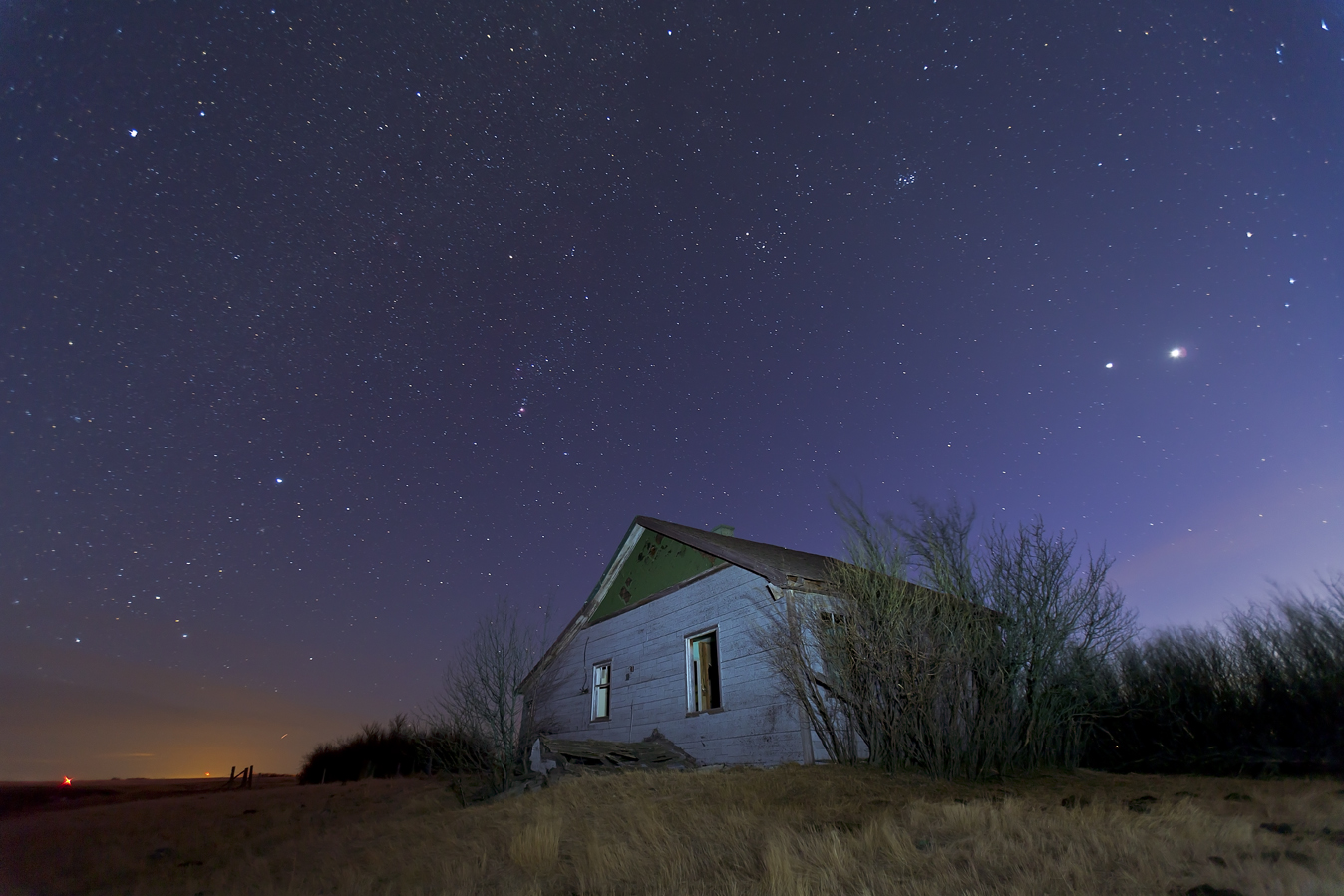
This is the winter sky of the northern hemisphere, rising above a snowy prairie landscape, in a shot I took Sunday night, January 6, 2013. The sky is populated by a ream of bright stars and constellations, anchored by Orion, just below centre. You can see his three Belt stars pointing down to Sirius, just peering above the horizon in the glow of a distant town. Orion’s Belt points up to Aldebaran, the V-shaped Hyades star cluster, and bright Jupiter (the brightest object in the scene, above centre), all in Taurus. Above Jupiter is the Pleiades star cluster.

The Milky Way runs down the sky from Auriga to Canis Major. This week, January 6 to 13, is a good week to see the winter Milky Way, as it’s New Moon and the sky is dark.

In this scene the camera was looking southeast about 9 p.m. Sirius has just risen. By midnight the Dog Star shines due south. I used a 15mm wide-angle lens to take in the entire sweep of the winter sky from horizon to zenith. This is a stack of four 4-minute exposures, though the landscape is from just one of the frames, to minimize the blurring caused by the camera tracking the sky. Some clouds moving in add the streaks on either side of the frame. It was a wonderful sky, while it lasted!

And I’m pleased to note that this is my 250th blog post since beginning AmazingSky.net two years ago in early 2011. I hope you have enjoyed the sky tours.

– Alan, January 6, 2013 / © 2013 Alan Dyer
A Truly Amazing Sky — A New Year’s Gift


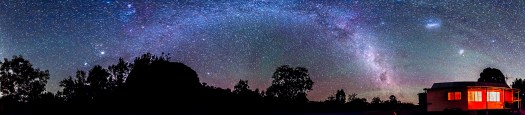
Timor Cottage Panorama #3

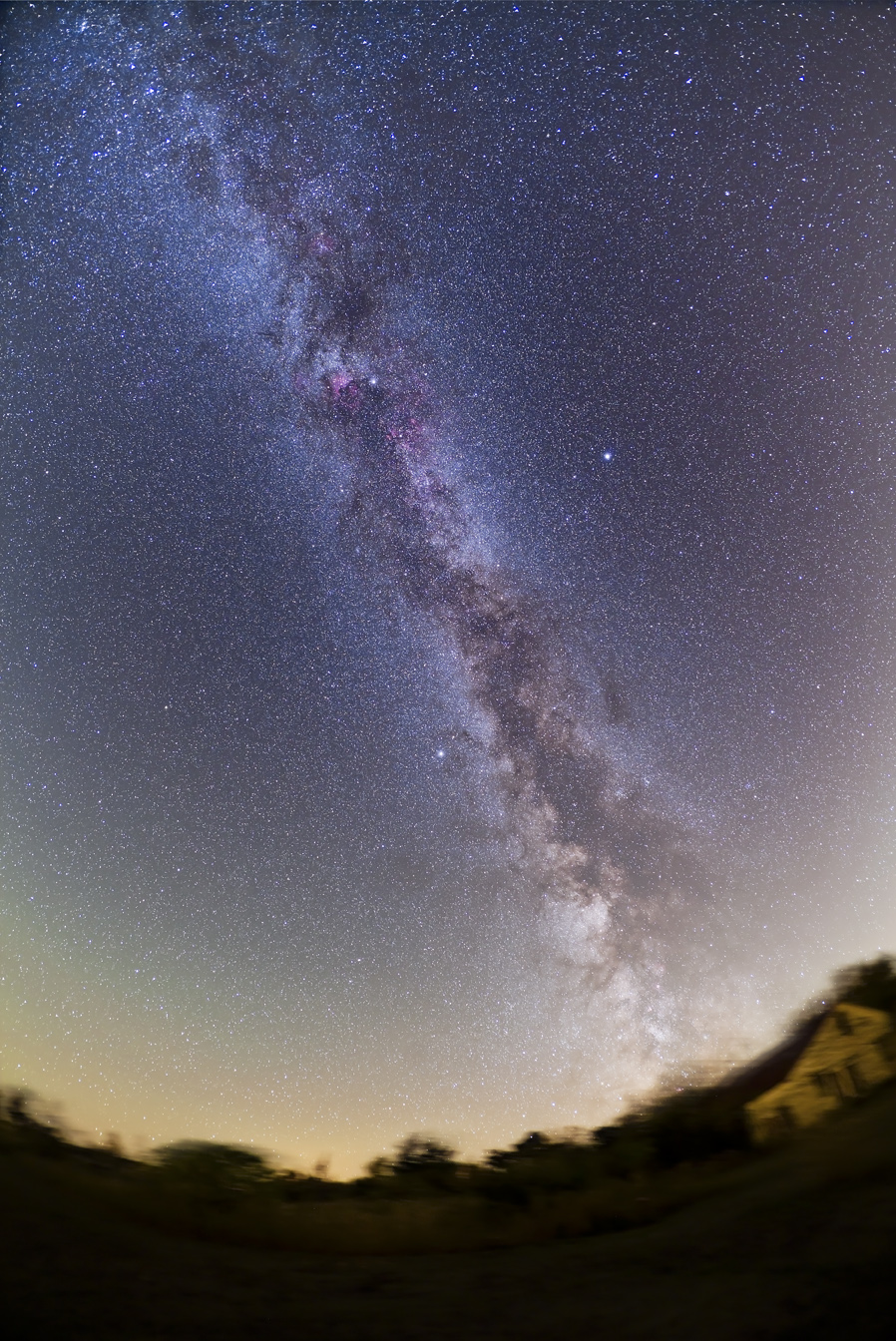
As we end 2012 and start a new year, I wish everyone a very happy 2013 and leave you with this view of a very amazing sky.

This is a 360° panorama of the Milky Way over Timor Cottage on a very clear night in mid-December in New South Wales, Australia. May all your skies be as wonderful and as inspiring as this in the coming year.

Indeed, we have some potentially remarkable sights to look forward to, with the prospects of two bright comets in 2013: Comet PANSTARRS in March and Comet ISON in November and December.

Let’s hope for more amazing skies in 2013. Keep looking up!

– Alan, December 31, 2012 / © 2012 Alan Dyer
The Colourful Clouds of Orion – #1


Orion from Australia (50mm 5DII)

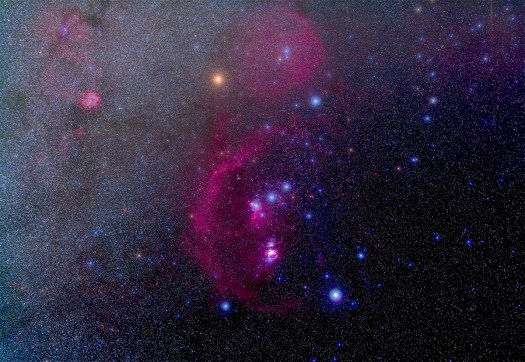
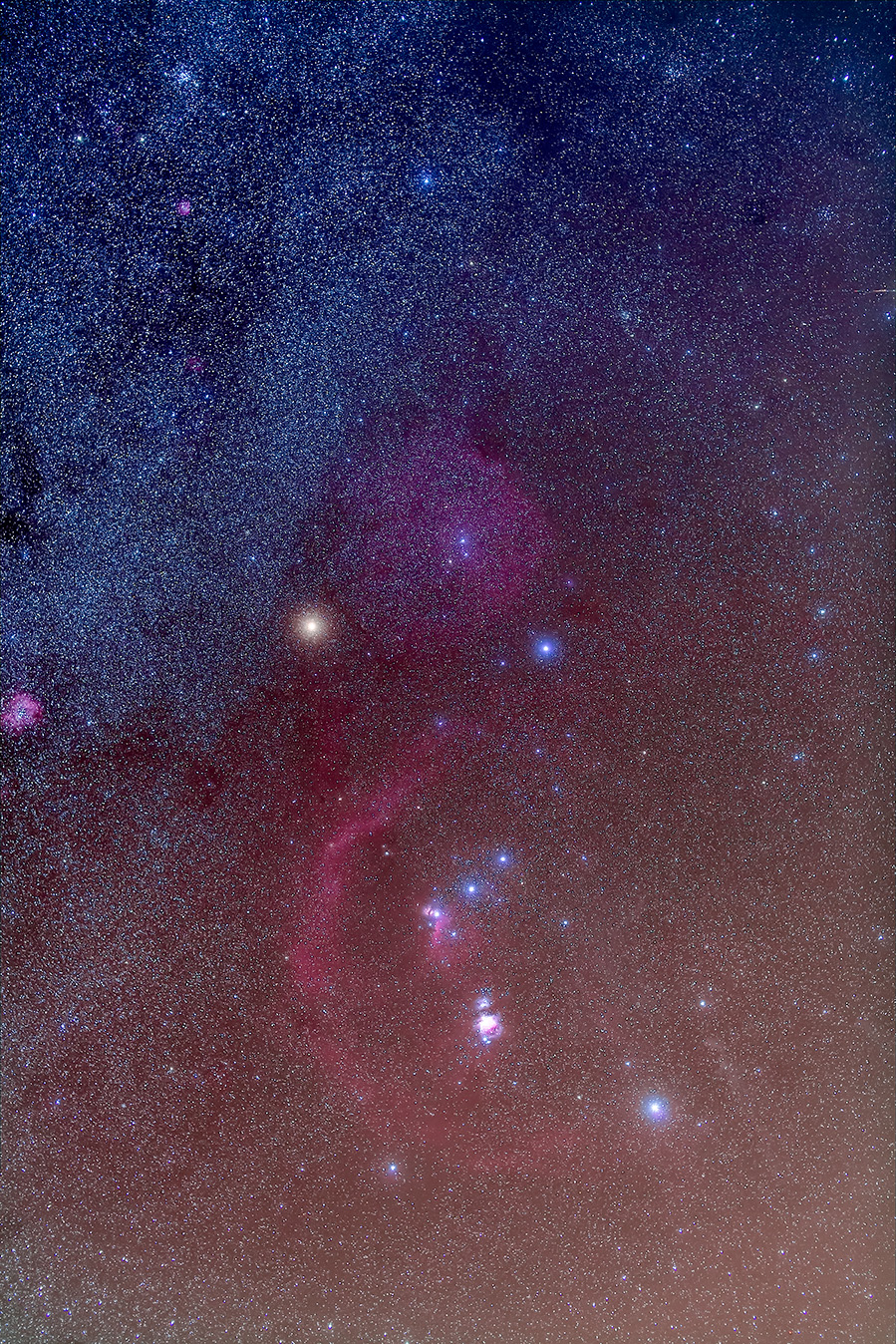
The constellation Orion is a hotbed of star formation, from masses of colourful clouds.

I shot this portrait of Orion the Hunter a few nights ago in Australia where Orion stands upside down compared to our view from up north. But I’ve turned around the photo here to put him right side up with head at the top and feet at the bottom.

The three stars in a row in the middle are his famous Belt stars. Below shines the nebulas that outline his Sword, among them the Orion Nebula, the subject of an earlier post last week

The giant arc is Barnard’s Loop, a bubble blown in space by the winds from hot new stars. The bubble around Orion’s head at top is a similar interstellar bubble. Most stars here are blue-white and hot, but the distinctively orange star is the red giant Betelgeuse, a good candidate for a supernova explosion.

Orion stands high in the sky at midnight these nights, summer here in Australia, but winter at home in Canada.

– Alan, December 19, 2012 / © 2012 Alan Dyer


Remains of a Star: The Vela Supernova Remnant


Vela Supernova Remnant and Gum Nebulas

Amid a maze of glowing nebulas sits a tracery of magenta and cyan that was once a star.

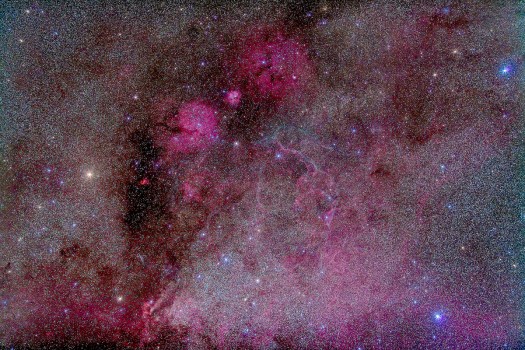
This image takes in the Vela Supernova Remnant. You can see it as the lacework of gas in the centre of the field. Oddly enough, it sits in the middle of the vast Gum Nebula, the subject of my previous post, an object also thought to be a supernova remnant but one much older and closer. The Vela Supernova Remnant here likely comes from a supergiant star that exploded about 10,000 years ago. It, too, would have been quite a sight to the earliest of civilizations.

The field in the southern constellation of Vela also contains many other classic red and pink nebulas, but ones that are forming new stars, not the remains of dead ones. Most carry designations from astronomer Colin Gum’s catalog from the 1950s and have no numbers from the more familiar NGC or IC catalogs amateur stargazers refer to in their scanning of the skies. Yet, these Gum nebulas show up easily in photos.

I used a 135mm telephoto lens to take this image and it encompasses a field similar to what binoculars would frame. Except, it takes long exposure photos to show these nebulas. I looked last night at the Vela SNR with my 25cm reflector telescope and could just barely see the main arc of nebulosity as a grey ghost in the eyepiece. And that was under perfect dark Australian sky conditions.

– Alan, December 18, 2012 / © 2012 Alan Dyer


Giant Bubble in the Southern Sky


Gum Nebula in Vela


The southern sky contains what must be the largest nebula in our sky, a giant bubble spanning a wide swath of the Milky Way.

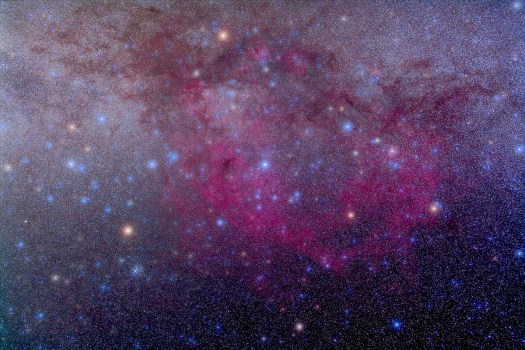
This is the object known as the Gum Nebula. You can see it in my previous post, in the ultrawide view of the southern sky. Here I’m framing it with a normal 50mm lens that covers about 50° of sky. The Gum Nebula is completely invisible to the eye and shows up only on photos. It wasn’t even discovered until the 1950s, by Australian astronomer Colin Gum. It is #12 in his catalog of southern sky nebulas. I’ve always thought this was an example of an interstellar bubble, blown by intense winds from hot blue stars, of which there are many in this part of the Milky Way in Vela and Puppis. At left are the four stars of the False Cross in Carina and Vela.

But some sources claim this is a supernova remnant, the blasted remains of a star that blew up 1 to 2 million years ago. It is big because it is close by, just 450 to 1500 light years away depending on what side if the remnant you measure. If that’s the case, the star that exploded would have been quite a shadow-casting sight in our prehistoric sky, assuming it was that close to us when it blew up and was in the night sky at the time.

Either way, it is a great target for amateur photographers, and now with digital cameras it is easy to record. This night, some haze moving through added the photogenic glows around all the stars to bring out their colours.

– Alan, December 18, 2012 / © 2012 Alan Dyer


Ultrawide Southern Sky


Ultrawide Angle Southern Milky Way - December 2012

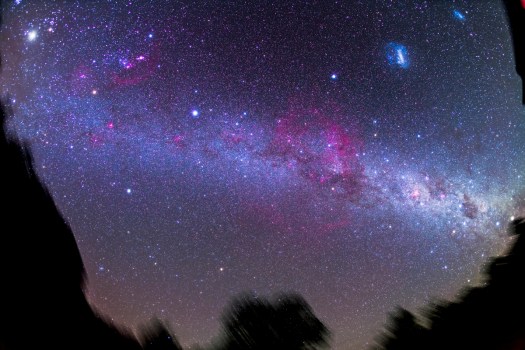
This horizon-to-horizon image takes in a broad sweep of the southern Milky Way from Orion to the Southern Cross.

At upper left shines bright Jupiter in Taurus and the stars of Orion, upside down. To the right of Orion is Sirius in Canis Major, the brightest star in the night sky. To the right of Sirius above the Milky Way is Canopus, the second brightest star in the night sky and one we don’t see from up north. The two satellite galaxy Magellanic Clouds are at upper right. Below them is the bright Milky Way through Carina and Crux, the Southern Cross. Alpha and Beta Centauri are just above the dark trees at right. This is the entire Milky Way you see on an early austral summer night from down under.

What stands out is the huge red bubble of gas called the Gum Nebula in Vela and Carina. It is strictly a photographic object but shows up well on red-sensitive digital cameras.

I shot this with a filter-modified Canon 5D Mark II camera and a 15mm wide-angle lens on a mount tracking the stars. It is a stack of four 6-minute exposures, shot from Australia a few nights ago under nearly perfect sky conditions.

– Alan, December 17, 2012 / © 2012 Alan Dyer
 

Southern Milky Way in the Blue of Dawn


Southern Milky Way at Dawn (December 2012)

At the end of a nearly perfect night of southern stargazing, I shot this wide-angle portrait of the southern Milky Way embedded in the deep blue of morning twilight.

In December at dawn, the southern Milky Way extends from Orion (at the extreme right) down through Canis Major, Puppis and Vela (where you can see a large faint red bubble-shaped nebula high in the south) then continues east (left) into Carina and Crux. The red Carina Nebula sits in the Milky Way and the Southern Cross is at left, rising before the two Pointer Stars, Alpha and Beta Centauri. The Magellanic Clouds sits above the cottage I’m using as my southern hemisphere home for stargazing while I am in Australia.

– Alan, December 12, 2012 / © 2012 Alan Dyer


Southern Spectacular in Carina


Carina Nebula

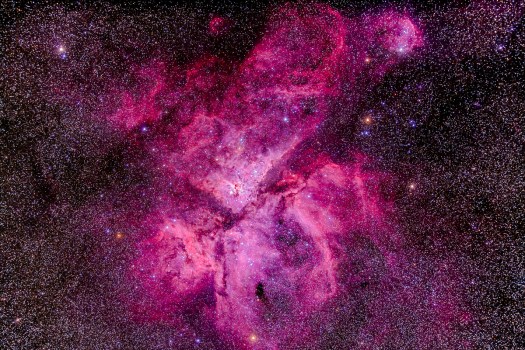
The Carina Nebula ranks as one of the most spectacular sights in the southern sky.

I shot this last night under perfect conditions. I’ve shot this nebula many times before but had to have a go at it again – I think this version is the best yet of many I’ve taken over the years of coming to the southern hemisphere to shoot the sky. I shot this through my 4-inch apo refractor with a filter-modified Canon 5D MkII camera. It’s a stack of five 12-minute exposures at ISO 400.

This massive nebula is the site of loads of star formation, and home to one massive young star, Eta Carinae, that is a prime candidate for a supernova explosion sometime soon. That will certainly stir things up in Carina. This object sits over 6,000 light years away in the next spiral arm in from ours, the Carina-Sagittarius Arm of the Milky Way.

Through the telescope it fills the field with intricate shades of grey — the colours show up only in photos – with one bright yellow star at the centre, Eta Carinae itself shrouded in the golden-hued nebula it cast off during its last explosive outburst in the 1840s.

Like the Large Magellanic Cloud, this is one object worth the trip to southern skies just to see for yourself.

– Alan, December 12, 2012 / © 2012 Alan Dyer
Southern Milky Way Setting & Zodiacal Light


On the eve of the November 14 total eclipse of the Sun, I was able to shoot the Milky Way setting amid the vertical glow of the evening Zodiacal Light.

This scene looks west toward the sunset point, but was taken well after sunset. The Milky Way and the area of Sagittarius where the centre of the Galaxy lies is just setting. The same area of sky contains a vertical pillar of light, very subtle, called the Zodiacal Light. This is sunlight reflected off dust particles orbiting the inner solar system and deposited by passing comets. The Zodiacal Light is best seen in the evening sky on dark moonless nights in spring, no matter what your hemisphere. But in this case it is November, spring in the southern hemisphere.

At left are the two Magellanic Clouds, satellite galaxies of the Milky Way, and visible at their best only from south of the equator. In this case we are at 16° South latitude.

The site is a lookout on the Mulligan Highway inland from Port Douglas where we made for the day before the eclipse and camped out overnight, along with a parking lot full of fellow eclipse chasers. But the morning still brought worrying clouds in the direction of the Sun, so we moved farther north to the site you see in my earlier Great Australian Eclipse blogs.

– Alan, November 20, 2012 / © 2012 Alan Dyer


Milky Way Amid the Trees


This is the classic summer campsite shot, looking up through the trees to the Milky Way.

I shot this Saturday night from a favourite viewpoint in Banff at Saskatchewan River Crossing. The night proved to be less than the perfectly clear I had hoped for, so I settled for Plan B and shots looking up to a nearby nightscape scene, rather than out across a landscape and into horizon clouds. Some drifting clouds in this shot blur the stars.

This is an example of the type of simple nightscape anyone can do with a camera on a tripod. There’s no tracking going on here, just a short 70-second exposure, enough to pick up the Milky Way. The little trailing of the stars that results isn’t objectionable. I could have shortened the exposure and decreased the trailing but only by going to a higher ISO speed like ISO 3200 which, with the Canon 7D camera, is pushing it too much for noise in a shot like this.

Better still would have been to place the camera on a tracking platform. expose longer at an even slower, less noisy ISO speed, and then let the trees blur from the camera’s motion as it followed the stars. It would have simply looked like a windy night.

Or, it’s possible to combine tracked and untracked exposures, one for the sky and one for the ground, using Photoshop magic.

But I did neither here. This is an unadulterated image of the summer sky shining through trees.

– Alan, September 11, 2012 / © 2012 Alan Dyer


Milky Way Over Calm Water


This is a scene I’ve been after for some time – the Milky Way and stars reflected in calm water.

In Friday night I was at a small lake, a pond really, at the south end of the Icefields Parkway in Banff. Herbert Lake is small enough it is usually calm and reflective. Friday night was as clear and calm as you could hope for. This image is from the beginning of the night with some blue twilight still illuminating the sky, but no moonlight. The waning Moon did not rise until 11:30 pm. I shot this prior to starting a 3-hour time-lapse from the same position on the lakeshore.

The scene is looking south toward glacier-clad Mount Temple and Mount Fairview near Lake Louise.

This is a single exposure with the Canon 5D MkII and 16-35mm lens.

– Alan, September 9, 2012 / © 2012 Alan Dyer

The Northern Nebulas of the Milky Way


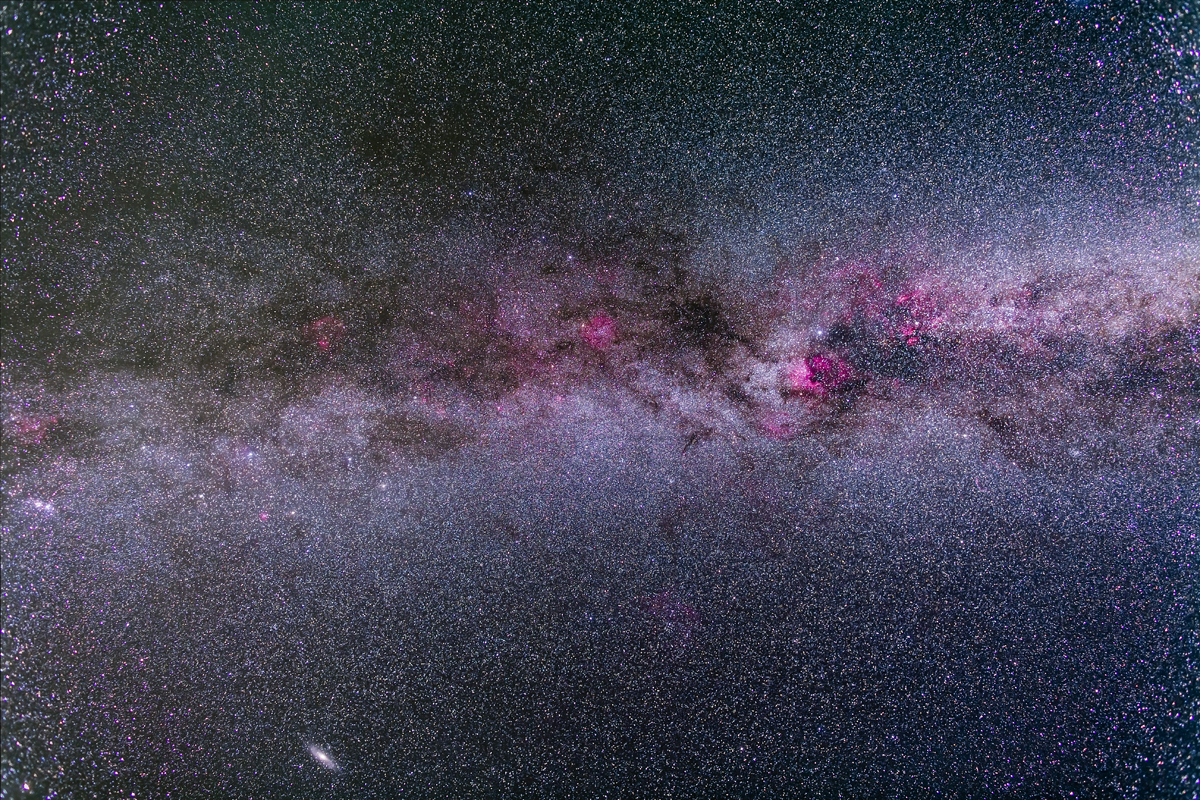
This is the prime celestial real estate above us now on northern summer nights.

This wide-angle shot takes in the Milky Way from Cygnus at right to Perseus at left, an area populated by lots of nebulas, both bright and dark. A couple of previous posts (The Subtle Shades of Cepheus and The Dark Clouds of Cygnus) featured close-up views of sections of this sky, the areas at centre in this wider context image in northern Cygnus and southern Cepheus.

At bottom is the elliptical glow of the Andromeda Galaxy, another “milky way” beyond ours.

I boosted the contrast and colour more than I normally do for astrophotos, to punch out the nebulas and the subtle dark lanes of dust that permeate this part of the Milky Way. I shot this last weekend from the star party in Cypress Hills, Saskatchewan. With three clear nights it was a productive weekend!

– Alan, August 26, 2012 / © 2012 Alan Dyer

The Subtle Shades of Cepheus


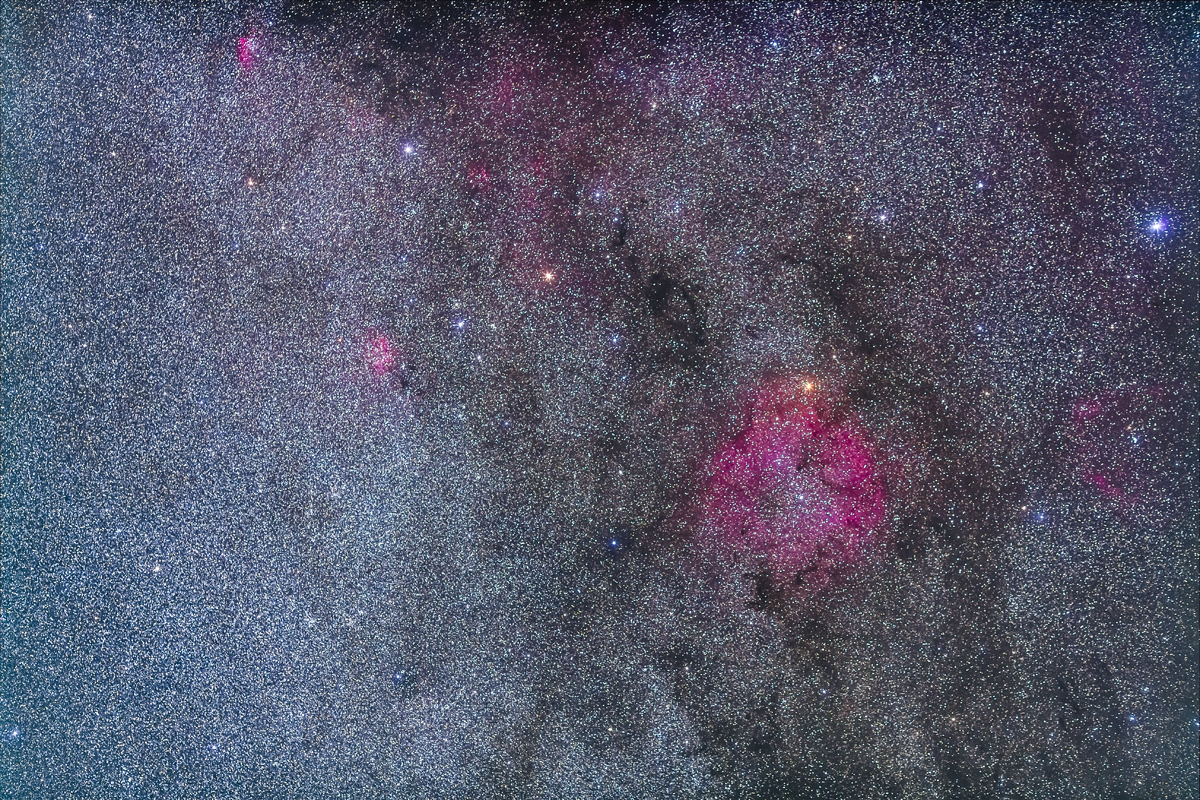
The Milky Way in Cepheus presents a palette of colours revealed in long exposures.

This binocular-sized field contains the large magenta nebula IC 1396, a site of star formation. On its northern (upper) edge shines the orange star Mu Cephei, otherwise known as Herschel’s Garnet Star, for its very red appearance in the eyepiece. It is a bloated red supergiant, one of the largest stars known. A few other stars in the field are younger blue giants. Faint wisps of red hydrogen fill the field (the faint crescent at right is Sharpless 129, left of centre is Sharpless 132, at top left is NGC 7380). Diagonally along the Milky Way lie dark, yellow-tinted dust clouds. The darkest patch at centre is the Barnard 169/170/171 complex. These contrast with the dust-free blue starfields of the Milky Way at left.

This is a stack of five 5-minute exposures with the 135mm telephoto and Canon 5D MkII camera, which has been filter modified to record the faint red nebulas better than a stock camera.

– Alan, August 25, 2012 / © 2012 Alan Dyer


Horizon to Horizon Milky Way


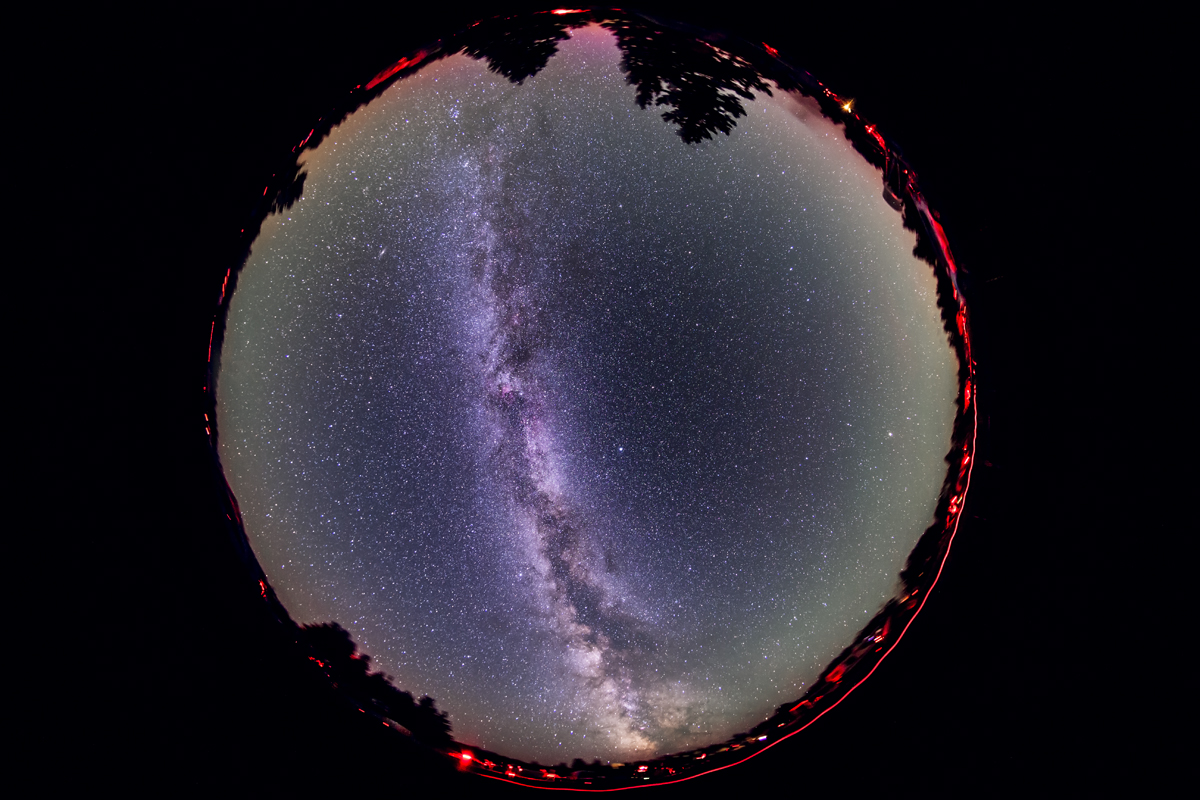
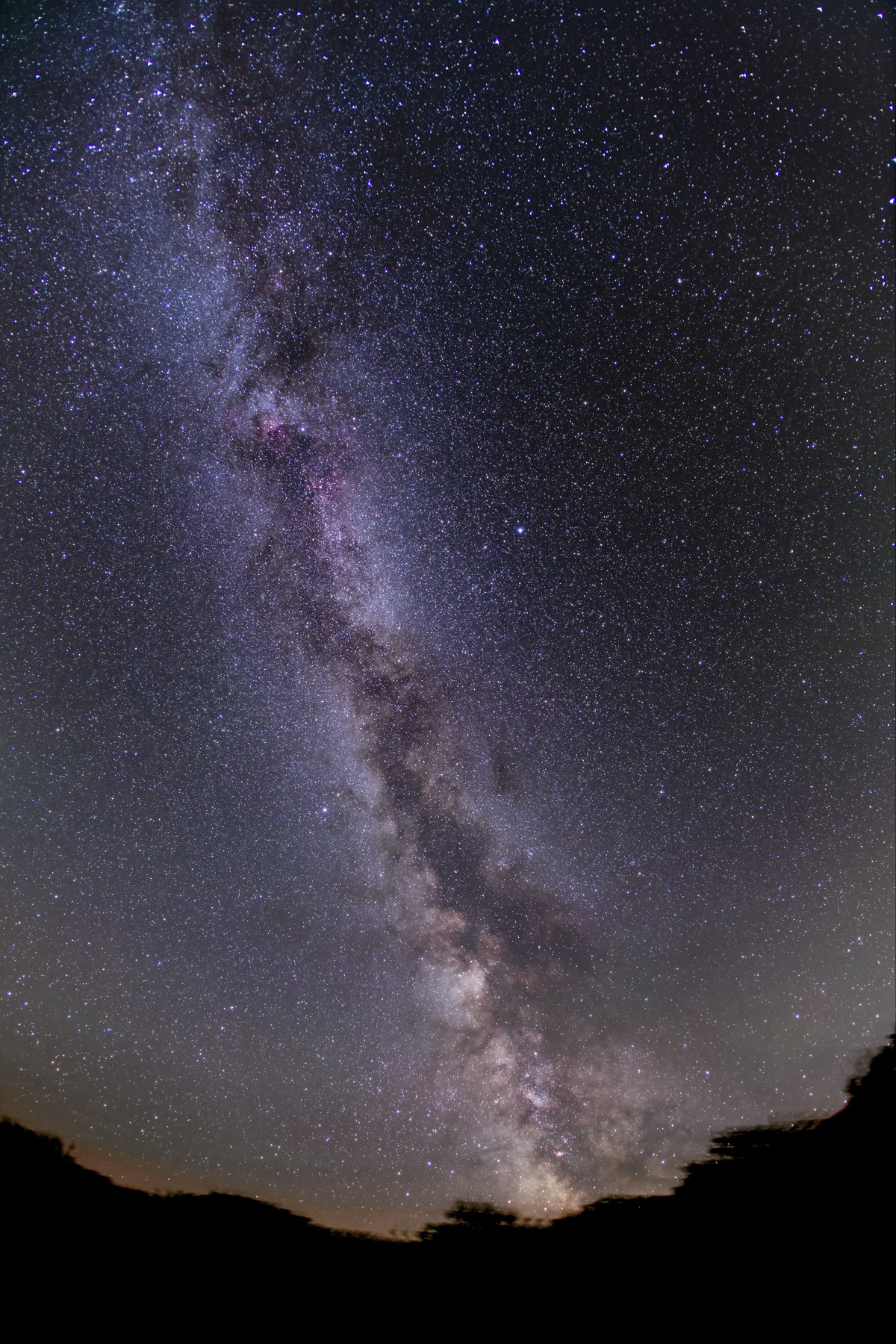
The view doesn’t get any wider than this. This fish-eye image takes in the entire night sky and summer Milky Way.

I shot this last weekend at the Saskatchewan Summer Star Party in Cypress Hills. Red lights of observers streak along the horizon around the perimeter of the circular image. At centre is the zenith, the point in the sky straight overhead.

The sky was very dark, but the sky close to the horizon is tinted with the faint glows of aurora and airglow.

The Milky Way is the main feature of the summer sky, here stretching from Sagittarius in the south at bottom to Perseus at top in the north. Wide shots like this really put the giant lanes of dust into proper context; you can see their full structure and faint tendrils extending well off the Milky Way band.

For these fish-eye shots (suitable for projection in a planetarium) I used a Sigma 8mm fish-eye lens and a full-frame Canon 5D MkII camera. This is a stack of five 5-minute exposures, all tracked. The landscape is from just one of the images, to minimize blurring of the ground.

— Alan, August 23, 2012 / © 2012 Alan Dyer

The Dark Clouds of Cygnus


Stare into the starfields of Cygnus and ponder what lies undiscovered in our part of the Milky Way.

You are looking down the spiral arm we live in, into clouds of stars seemingly packed together. Every one of those specks is a sun like ours. With planets? Very likely, as we now know.

Amid the stars float glowing red clouds of hydrogen gas. The North America Nebula shines at lower right.

Snaking northward from the “arctic” region of the bright nebula is a river of dust that broadens into a delta of dark nebulosity. Once thought to be holes in the sky allowing us to see deeper into space, we know now that these dark nebulas are really foreground dust clouds filled with the soot of dying stars, carbon dust that absorbs starlight and obscures the more distant parts of the Milky Way.

This dust cloud is called Le Gentil 3, named for the 18th century French astronomer who first noted its position in the sky. Le Gentil’s dust cloud is one of the easiest features of the summer Milky Way to see. Look north of Deneb, the bright star at the right of the image, and with the unaided eye on a dark moonless night you’ll see what looks like a dark hole in the Milky Way. That’s Le Gentil 3.

I use this dust cloud as a measure of sky brightness. On a truly dark night, Le Gentil 3 looks darker than any other area of sky, even relatively starless regions off the Milky Way. Most of the sky brightness we see from a dark site is really starlight. But Le Gentil’s proximity and opaqueness makes it appear darker than the more distant starlit sky background.

This image covers about the width of a binocular field. I shot it from the Cypress Hills in Saskatchewan this past weekend, using the Canon 5D MkII at ISO 1600 and Canon 135mm telephoto lens at f/2.8. It’s a stack of 10 five-minute exposures.

— Alan, August 22, 2012 / © 2012 Alan Dyer

Lost in the Milky Way


Just lie back and lose yourself in the Milky Way.

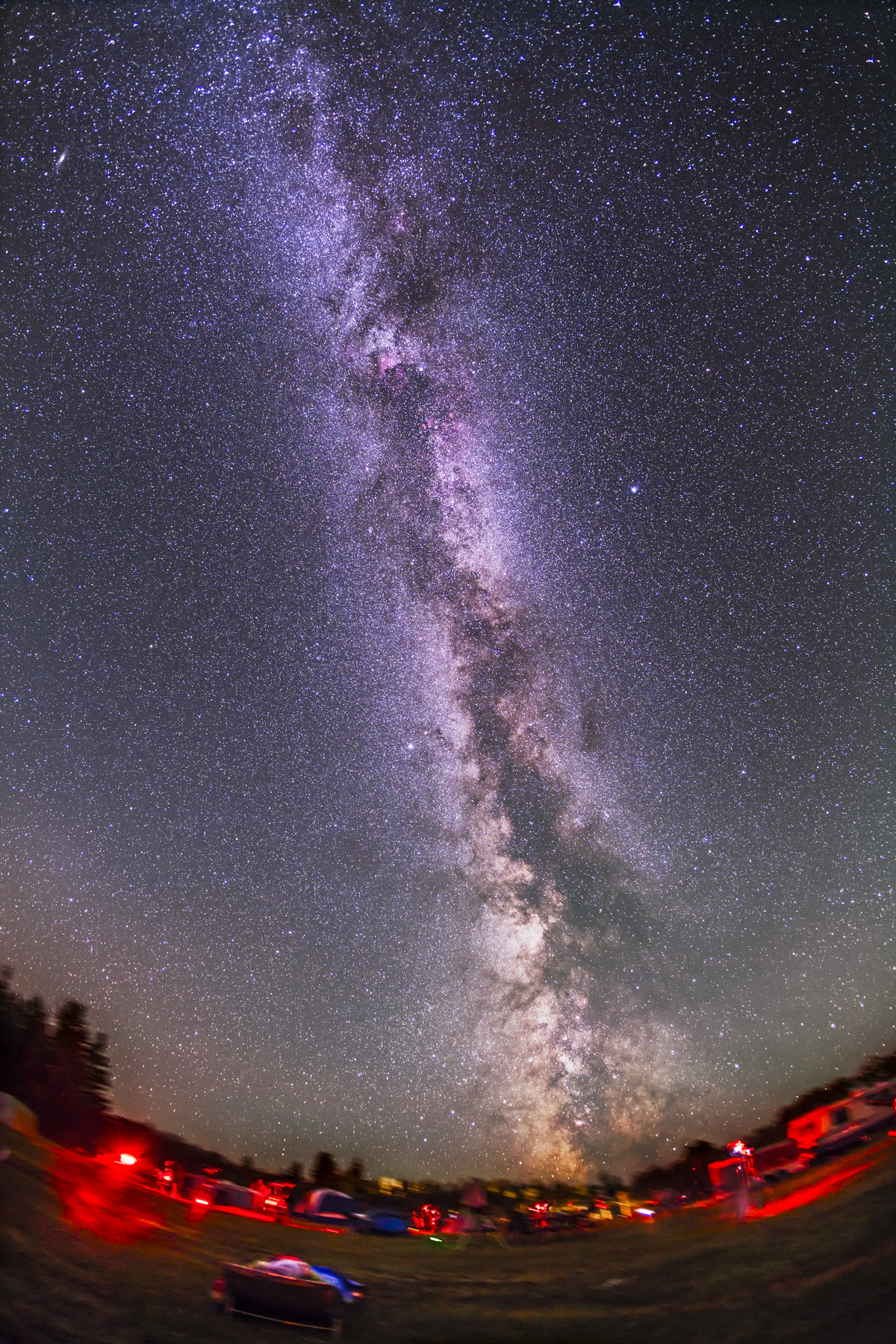
That’s what one person is doing here, under the starry skies of Cypress Hills, Saskatchewan. In summertime the Milky Way is the main attraction at night. Here, it rises from the south, a region containing the centre of our Galaxy in Sagittarius, to climb up overhead through the star clouds of Scutum and Aquila, then into Cygnus in our local spiral arm, and on into Cassiopeia at the top of the frame in the north.

As in most deep sky photos, I’ve boosted the contrast and colour to make a dramatic image. To the eye the Milky Way appears in subtle shades of grey painted with the dark brushstrokes of dust lanes winding through the bright clouds of stars. But your eye does see much of this structure.

I like these types of ultra-wide images. They capture the mind’s eye impression of what the Milky Way looks like across the vault of heaven.

This is a stack of four 5-minute exposures, all tracked on a small equatorial mount, the Kenko SkyMemo, and all taken with the Canon 5D MkII at ISO 800 and Canon’s ultra-wide 15mm lens at f/4, as you can see from the photo data at left. I retained the ground from just one image, to minimize the blurring from the slowly moving camera tracking the stars. I masked out the ground in the other 3 images. They help smooth out noise in the sky.

— Alan, August 21, 2012 / © 2012 Alan Dyer

Party Under the Stars


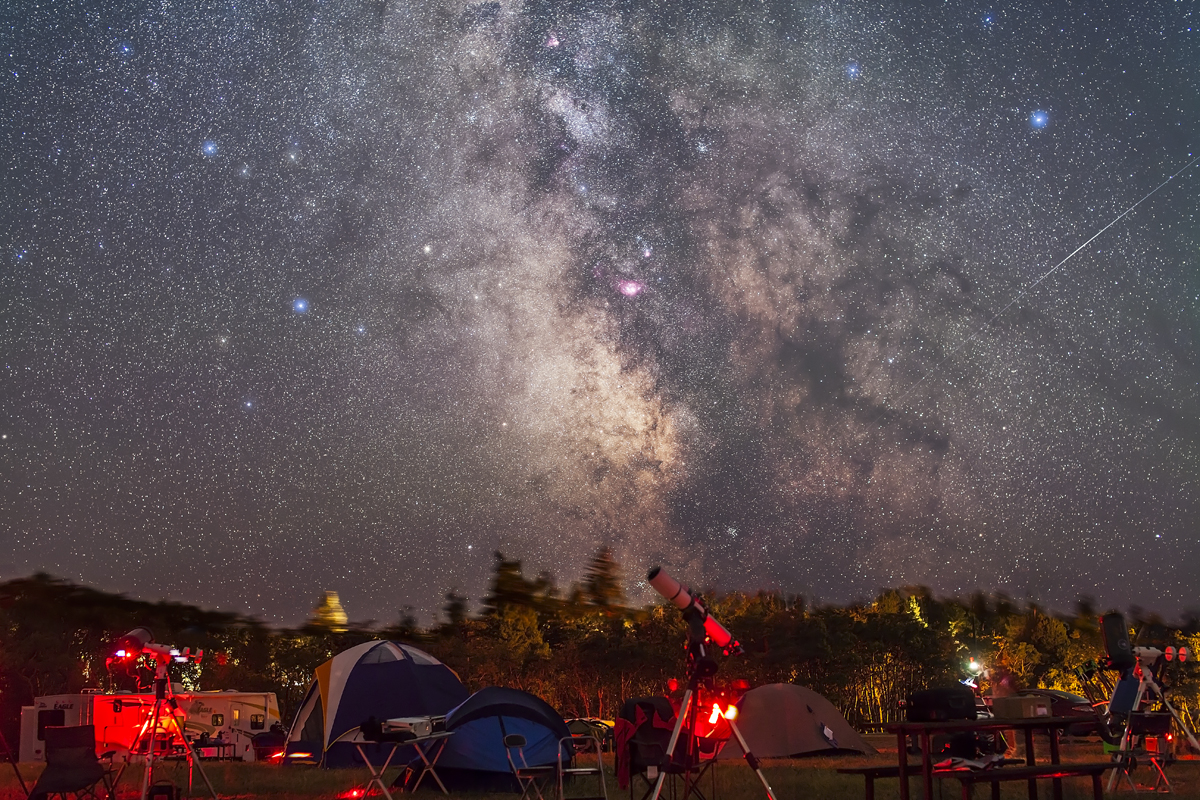
For astronomers this is party central – under the starclouds of the summer Milky Way.

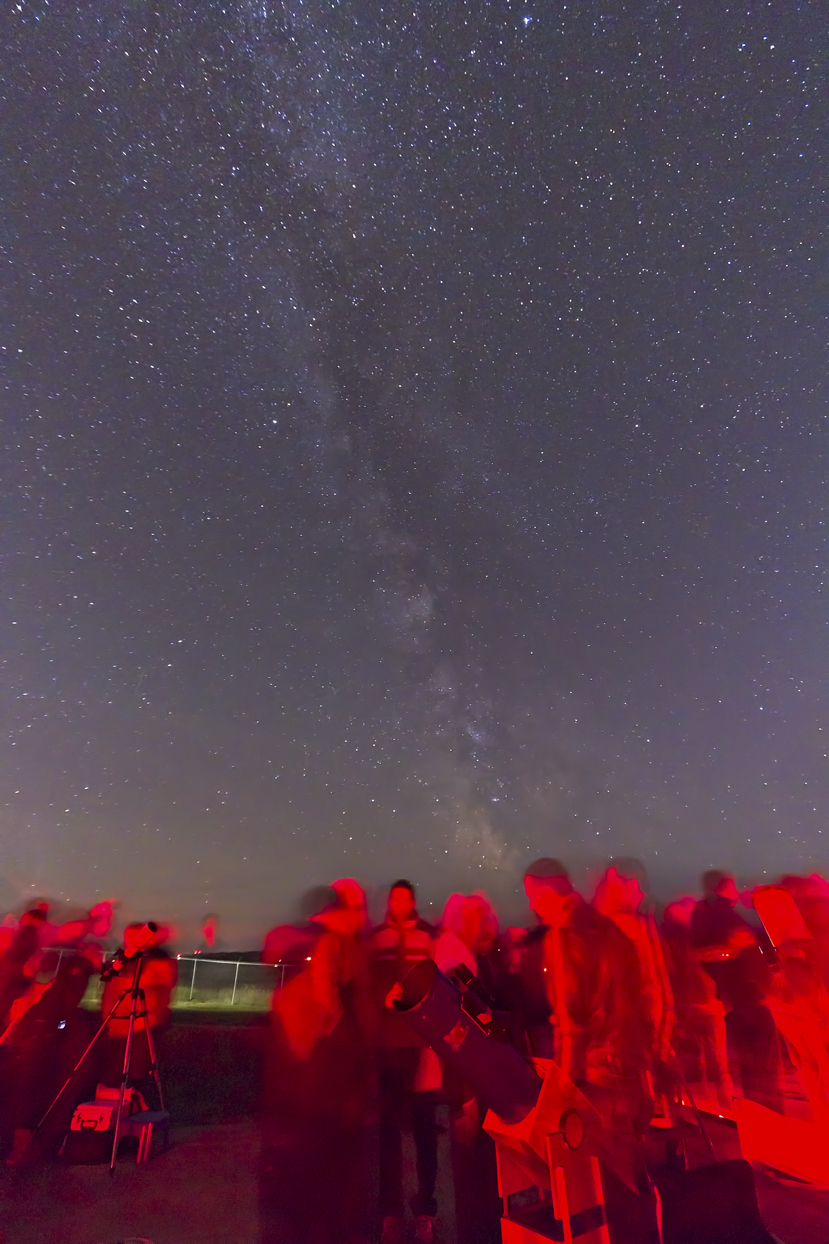
Over the past weekend, August 16-18, I attended the annual Saskatchewan Summer Star Party, held in the Cypress Hills of southwestern Saskatchewan. Skies could not have been better.

This was the scene Friday night, with telescopes under the Milky Way. About 350 people attended, and nearly as many telescopes it seemed! This is one small section of the observing and camping field.

Cypress Hill Park has been declared a Dark Sky Preserve, in recognition of the Park’s role in preserving and presenting the dark skies that are as much a part of our natural world as are the flora and fauna of the Earth. Every year astronomers converge on the Hills to revel in their pristine skies … and party – quietly! – under the Milky Way. Wandering the field you could overhear “Hey, look at this!”, “Wow!”, “O-o-o-h!”, “I found the __ nebula!” and many more exclamations of joy and wonderment.

My image is a composite of a single untracked exposure for the sharp foreground and a stack of 5 tracked exposures for the sky and Milky Way. All were 2 minute exposures, taken moments apart. Boosting the contrast makes the Milky Way stand out with far more detail and colour than the eye can see. Nevertheless, the Milky Way was a grand sight and the main attraction over the Cypress Hills this past weekend.

– Alan, August 19, 2012 / © 2012 Alan Dyer

A Cloud of Stars in Scutum


This is a binocular-sized gulp of sky in the northern summer Milky Way. Countless stars form a bright patch in the Milky Way called the Scutum Starcloud, named for the odd little constellation of Scutum the Shield that contains it.

Visible to the naked eye, this star cloud is a rich area for binoculars or a small telescope. One favourite object of stargazers lies embedded in the star cloud and can be seen here as a bright clump of stars at left of centre. That’s the Wild Duck Cluster, or Messier 11, a dense and populous cluster of stars within the already star-packed Scutum Starcloud. Look in this direction into the Milky Way and you are looking toward the next spiral arm in from ours, some 6,000 light years away.

The immensity of stars in just this small area of sky is hard to fathom. That’s why it’s called deep space!

– Alan, August 9, 2012 / © 2012 Alan Dyer


Continent in the Sky


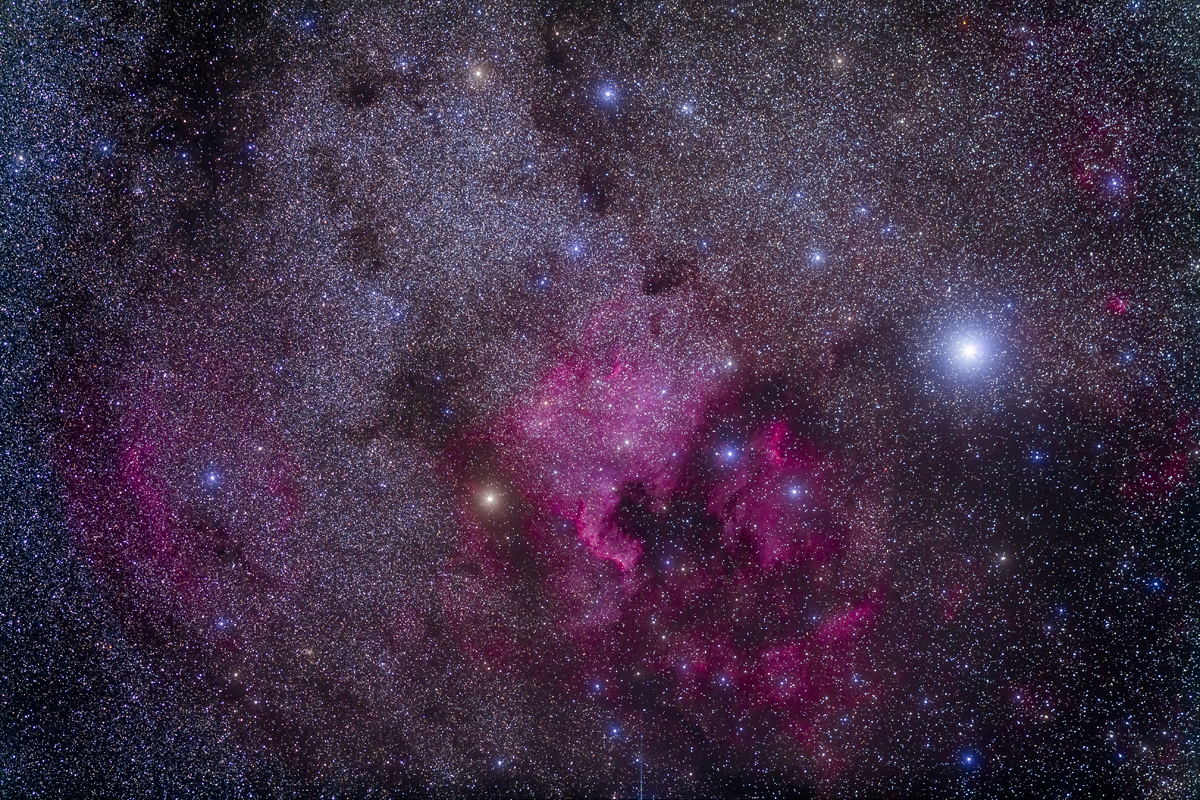
Shining overhead on northern summer nights right now is the blue supergiant star Deneb, in Cygnus. Nearby glow the magenta clouds of the North America Nebula.

This image shot with a telephoto lens takes in roughly the same field of view as a pair of binoculars. But being a long time exposure it reveals much more of the faint nebula than even the aided eye can see. However, even binoculars will show a greyish cloud near Deneb in roughly the shape of North America. It is actually a continent of stars and hydrogen gas, glowing with hydrogen’s characteristic magenta colour, a mix of deep red and blue emission lines. The gas may be electrified into glowing by the searing radiation from the star Deneb, some 1400 light years away from Earth.

I shot this on a July night, with some haze passing by during some of the exposures. The haze added the photogenic glows around the stars.

— Alan, August 8, 2012 / © 2012 Alan Dyer

A River of Starlight and Dust


Look up on a dark summer night in the northern hemisphere and you see a river of stars flowing across the sky.

This is the Milky Way, a glowing mass of millions of distant stars populating the spiral arms of the Galaxy we live in. Lining the arms are lanes of dark interstellar dust, seen here splitting the Milky Way in two from the bright red North America Nebula at top, down to the core of the Galaxy in Sagittarius on the horizon. The dust is the soot created in stars and blown into space to form a new generation stars and planets.

This ultra-wide-angle scene takes in almost the entire summer Milky Way from the southern horizon to beyond the zenith overhead at top. I shot this a couple of nights ago from my rural backyard on a particularly transparent and dark night. It was heaven on Earth.

— Alan, July 26, 2012 / © @ 2012 Alan Dyer


Orion the Hunter, A Full-Length Portrait


Orion is quickly disappearing from the dark night sky now, as spring begins and the winter constellations depart the sky. This is a shot from February, one I only just now processed.

The Belt of Orion really stands out as do the nebulas that wind all through and around Orion. This is a rich region of the sky for star formation.

I took this portrait of Orion using the 50mm Sigma lens, taking four 5-minute exposures and stacking them. In this case each exposure had varying amounts of haze in the sky as light clouds moved in. So the fuzzy glows around stars are from natural causes here, and are not produced by filters (as in the blog from last year called Fuzzy Constellations) or by post-processing. The glows bring out the star colours, particularly orangish Betelgeuse at upper left and blue Rigel at lower right.

This is the first image I’ve processed using the new Beta version of Photoshop CS6 and Adobe Camera Raw 7 software, just released this past week. Very nice indeed! You can download it for free from Adobe Labs. I like the new interface and functions. I’m not sure the final image quality is any better but some of the new features will be very nice for astrophotography and day to day use. Increased speed is promised but I haven’t seen much evidence for that. But this is a Beta version.

— Alan, March 24, 2012 / © 2012 Alan Dyer

The Marvellous Mid-March Sky


We have a marvellous sky above us these nights, with an array of brilliant beacons in the evening sky.

This wide-angle scene captures the western and southern sky. To the west at right shine Venus and Jupiter. To the south at centre stands Orion. His famous Belt points up to Taurus and the Pleiades star cluster. His Belt points down to the brightest star in the night sky, Sirius, the Dog Star in Canis Major. Above, at top left, is the other Dog Star, Procyon, in Canis Major.

The last vestige of twilight tints the sky deep blue. But some of the red nebulas in and around Orion are beginning to show up as the sky darkens on a late winter night.

I shot this Saturday night, March 10, on the last evening of Standard Time. Now, I and all astronomers have to wait up another hour to see and shoot the wonders of the night sky. Astronomers hate Daylight Saving Time.

— Alan, March 11, 2012 / © 2012 Alan Dyer

Milky Way Mosaic


Centre of the Milky Way Panorama (2011)

It’s taken me a few months to get around to the task, but at last! — my mosaic of the Milky Way I shot in Chile back in May.

The panorama is made up of 6 frames, stitched and blended together, extending from Crux, the Southern Cross (at right) to Aquila the eagle (at left) — a sweep of the Milky Way from Acrux to Altair! The mosaic is centred on the core of the Galaxy in Sagittarius and Scorpius.

Panoramas like this allow you to step back a distance and take in the big picture:

— You can see the large-scale structure of the dust clouds and the odd diagonal sweep of many of the clouds cutting across the plane of the Galaxy. I’ve never heard an explanation of why the dust lanes seem to have that structure and direction. I also see a 3D effect, with the nearby dust clouds hanging in front of and obscuring the bright starclouds of the distant inner spirals arms of our Galaxy.

— Also apparent are the extensive dust clouds at left extending from Ophiuchus (at top) down into Aquila, well below the plane of the Galaxy. Most wide-angle shots of the Milky Way I see tend to process out the subtle brown clouds that extend far off the Galactic plane. And they are brown, not black.

— And what really stands out is the band of bright blue stars from Scorpius (at top centre) to the right above the Milky Way through Lupus, Centaurus then down into Crux. This is a section of Gould’s Belt, a ring of hot blue stars around the sky that runs at an angle of about 20° to the Milky Way. This ring of hot, nearby stars surrounds us in our spiral arm and is thought to be only about 65 million years old, likely caused by some disturbance in our spiral arm which set off a wave of star formation close to us.

— And … as my Australian friends will point out, you can see the entire Dark Emu, made of the dust lanes from the Coal Sack in Crux at right (his head and beak), through the curving lanes in Centaurus (his neck), then sweeping up and over the centre of the Galaxy (his body) then down into Scutum and Aquila (his two feet and his tail).

I took this panorama from the Atacama Lodge in north central Chile, using the Canon 5D MkII and Canon 35mm lens. Each of the 6 segments that went into this pan was itself a stack of 4 x 6 minute exposures, plus a fifth exposure through a soft-focus filter, all at f/4 and ISO 800. The camera was on a Kenko SkyMemo tracking platform. I assembled the pan with Photoshop CS5’s Photomerge command. This is actually only half of the full panorama mosaic, which extends for another 5 segments to the right along the Milky Way to Orion, taking in the entire southern portion of the Milky Way. But this is the best bit!

— Alan, Oct 2, 2011 / Image © 2011 Alan Dyer

The Stellar Triangle of Summer


When the Summer Triangle sinks into the west, we know summer has come to an end. While the stars of the Summer Triangle are now high overhead from northern latitudes as the sky gets dark, by late evening the Summer Triangle is setting into the west.

These three bright stars are an example of stellar variety:

– At bottom is Altair in Aquila the eagle. It’s a white main-sequence star 17 light years away, fairly nearby by stellar standards. Leslie Nielson and his crew went to Altair in the 1950s movie Forbidden Planet.

– At top right is Vega, in Lyra the harp, a hotter and more luminous blue-white star than Altair, making it appear brighter than Altair, despite Vega being farther away, at 25 light years distant. Jodi Foster went to Vega in the movie Contact.

– But the third member of the Triangle, Deneb, at top left, is an extreme star. It appears a little fainter than Vega, but looks can be deceiving. Deneb is actually a luminous supergiant star, putting out 54,000 times the energy of our Sun. Deneb is about 1,400 light years away and yet, due to its fierce output of light, appears almost as bright as Vega. Light from Deneb left that star in the 6th century. I don’t know of any movie heroes who went to Deneb. The name means “tail of the Swan,” hardly a romantic destination for space-faring adventurers.

Look toward the Summer Triangle and you are looking down the spiral arm of the Milky Way that we live in. The stars of that arm appear as a packed stellar cloud running through Cygnus the swan, the constellation that contains Deneb.

I took this shot Saturday night, from home, on what turned out to be a very clear night, once some clouds got out of the way in the early evening. This is a 4-image stack of 8-minute exposures, at f/4 with the 35mm Canon lens, a favourite of mine, on the Canon 5D MkII at ISO 800. I added in exposures taken through a soft-focus filter to give the added glows around the stars to help make the bright stars and their colours more visible.

— Alan, September 25, 2011 / Image © 2011 Alan Dyer

September Milky Way


This was the scene from my rural backyard on Tuesday night, September 20, with the Milky Way at its best across the sky.

September usually brings the best nights of the year for dark-sky observing and shooting the Milky Way. Nights are clear, dry, and transparent. The Milky Way stretches across the sky from southwest to northeast in the early evening.

Under clear skies on Tuesday the dark lanes and structure of the Milky Way really stood out, both to the eye and to the camera. Image processing for contrast does bring out the dust lanes, including the subtle patches off the main Milky Way band.

The centre of the image contains the three bright stars of the Summer Triangle. They frame the bright Cygnus starclouds and glowing red nebulas that mark the spiral arm that we live in. Above, at top left in the image, is a bluer section of the Milky Way formed by the more distant Perseus spiral arm, the one further out from us in the Galaxy.

I took this shot with the Canon 5D MkII and Canon 15mm lens, for a stack of five 6-minute exposures at f/4 and ISO 800.

— Alan, September 21, 2011 / Image © 2011 Alan Dyer


Saturday Night Stargazing


It was a marvellous night for the Milky Way … and some Saturday Night Stargazing.

This was the scene at the University of Calgary’s Rothney Astrophysical Observatory on Saturday night (Sept 17, 2011) as a crowd of about 250 people took in the wonders of the night sky at one of the Observatory’s monthly Open Houses. Skies were excellent and a late moonrise left dark skies early on for views of the Milky Way, a seldom seen part of nature for city-dwellers. A dozen volunteers from the local chapter of the Royal Astronomical Society of Canada provided telescopes and expertise to tour people around night sky wonders, from comets to star clusters. Many people are delighted just to have the constellations pointed out, so they can identify the patterns whose names they have heard of but have never seen.

What always impresses me about such events is how much interest the public shows, and how much the kids in attendance know about astronomy and space. One young man, age 10 or so, in seeing some of the images, like this one, that I was taking pop up on my camera screen, asked if I do piggyback photography! At his age I’m not sure I knew about piggyback photography!

We see all ages at our public stargazing events, all expressing the same “Wow! That’s cool!” reaction. Hearing the comments gives us astronomers a charge — we get as much back from the guests as we hope we provide them.

— Alan, Sept. 18, 2011 / Image © 2011 Alan Dyer


Milky Way over Peyto Lake


What a night this was! This was the view Sunday night, September 4, from the Peyto Lake viewpoint, of the Milky Way arching overhead, on a clear night at 7,000 feet altitude near the timberline of Bow Summit.

This is one frame of 275 of a time-lapse movie I took of the stars turning over Peyto Lake. This frame catches the Moon just as it sets over Peyto Glacier at left. At this altitude the Milky Way was obvious even with the Moon still in the sky.

It was a scene of a starry night that Bill Peyto would have enjoyed. As he wrote of nearby Bow Lake (see my shot here) … “Around the fire tonight Jim [Jimmy Simpson] said that for his money this campsite was the closest one could get to Heaven on Earth and I reckon he’s not far wrong.”

— Alan, September 5, 2011 / Image © 2011 Alan Dyer

Bow Lake By Moonlight


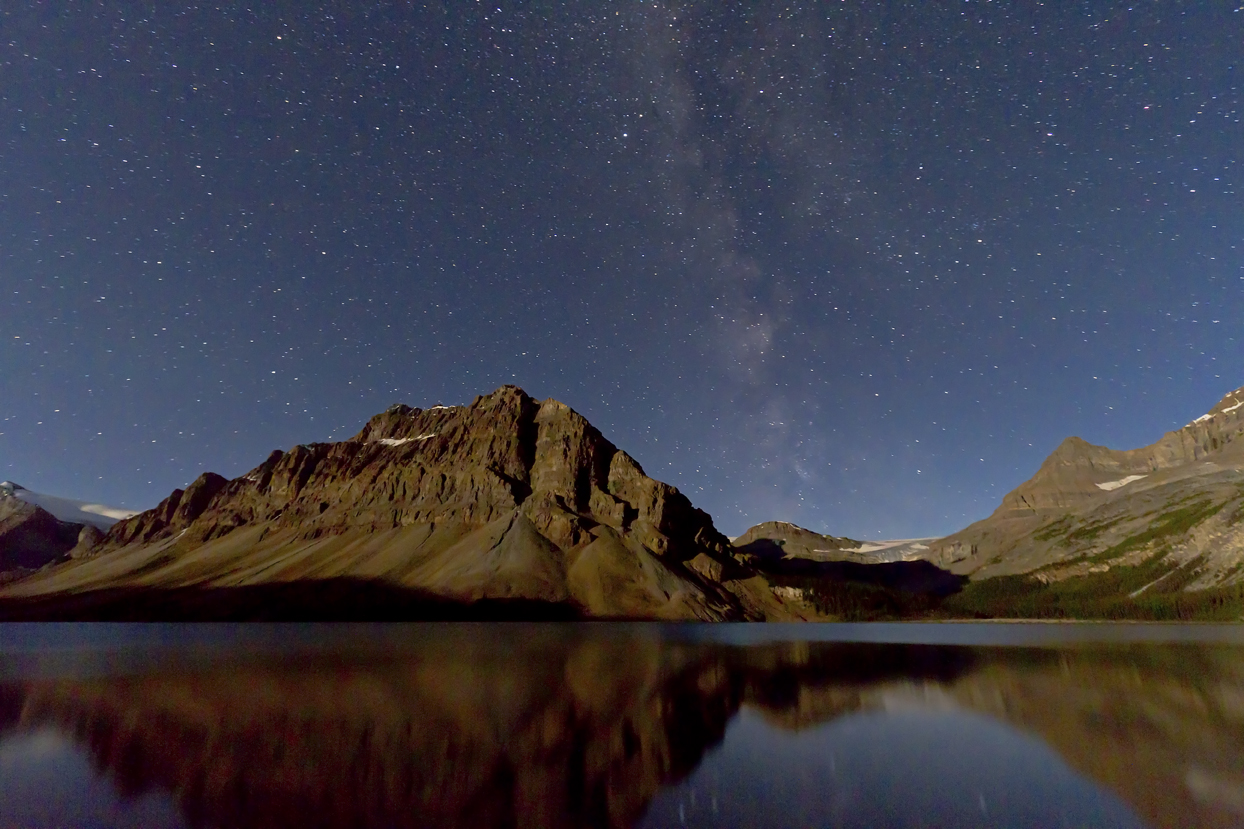
This was a truly magical scene — the Milky Way over Bow Glacier, and mountains lit by moonlight and reflected in the waters of Bow Lake.

Last Saturday night, August 20, 2011, brought some of the clearest skies I’ve seen in the Rockies. To take advantage of them, I headed to Bow Lake, in Banff, a favourite and very photogenic location for day and nighttime shooting. I hadn’t been there at night since the film days, pre-2004.

This shot is one of 450 frames taken as part of a time-lapse sequence, showing the Milky Way moving over Bow Lake. Here, at about 2 a.m. the light from the rising last quarter Moon is illuminating the peaks, and the Milky Way is perfectly placed over the end of Bow Lake and Bow Glacier, source of the waters of the Bow River and what Calgarians drink!

The sky is blue from moonlight. Last quarter moons are wonderful for nightscapes — providing enough light to illuminate the landscape but not so much as to wash out the sky and Milky Way. But making use of that phase of the Moon means very late nights of shooting. I packed it in this night at 4 a.m.

— Alan, August 22, 2011 / Image © 2011 Alan Dyer


Milky Way in the Mountains


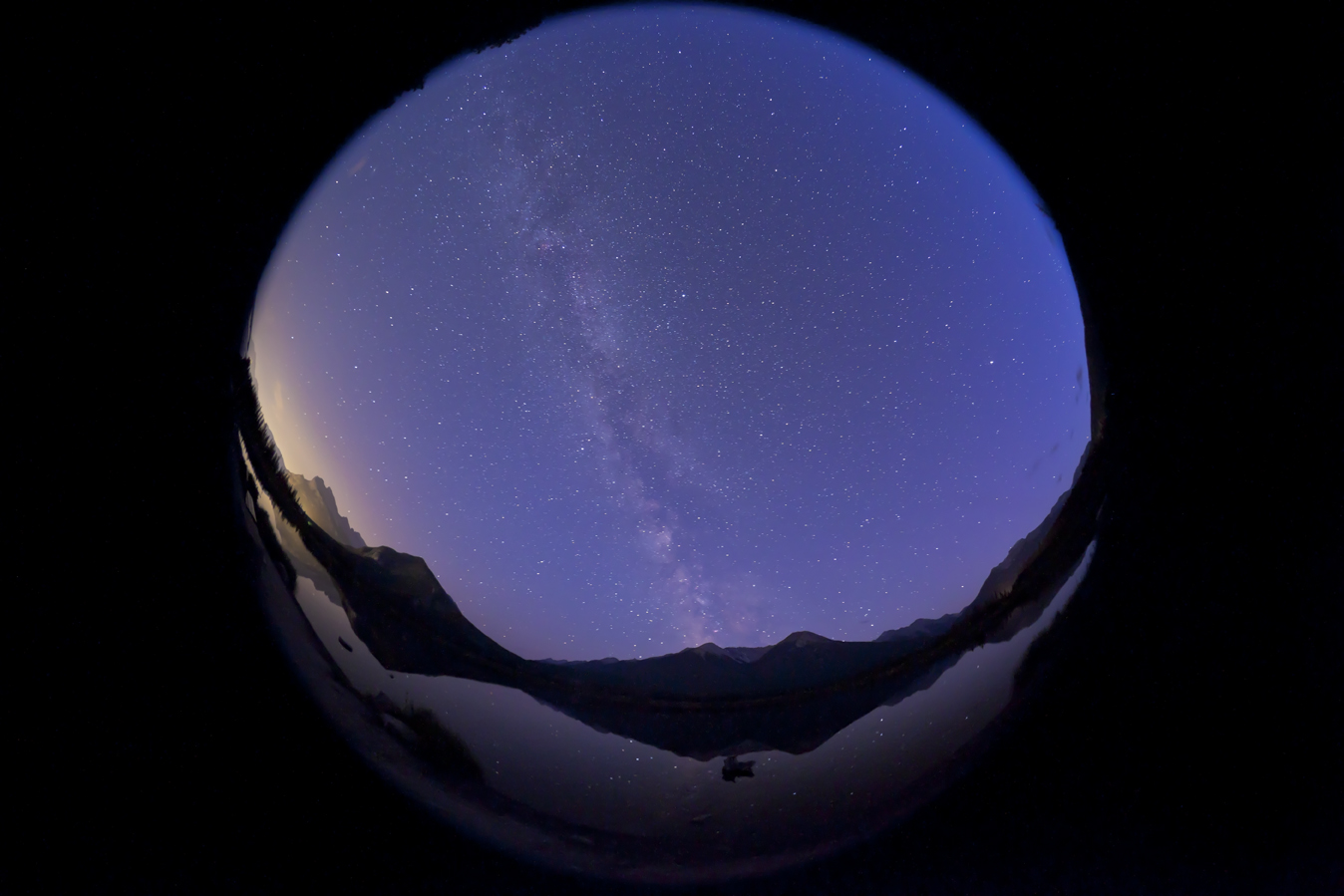
It’s rare to get such a clear night in the mountains but I used the opportunity last Thursday night to shoot the Milky Way in a twilight scene in Banff National Park.

I took this a little later on the same night as the previous blog’s image of the setting Moon. The location is the Vermilion Lakes, a familiar scenic spot for classic views of Banff and Mount Rundle reflected in the water, at far left. It is one of the few places in the mountains where you can look south over a low mountain skyline (to see the southern Milky Way) and over still water (to get reflections).

For this shot I used a fish-eye lens to record most of the sky and the summer Milky Way arching over the water. The sky was dark enough to show the Milky Way but still had a lingering blue tint from the last glow of deep twilight. The yellow glow at left to the east is from the urban lights of Banff.

The still image is one frame of 220 shot over 4 hours for a time-lapse video, for projection in a full-dome video-equipped planetarium. Just so happens we’re building one in Calgary to open in early 2012.

— Alan, August 9, 2011 / Image © 2011 Alan Dyer


The Glowing Heart of Cygnus


Look straight up on a summer night in the northern hemisphere and you are looking into this region of sky. This is the centre — the heart — of Cygnus the swan, marked here by the bright star called Sadr, or Gamma Cygni.

While the star is easily visible to the unaided eye, the glowing clouds of gas surrounding it are not. Only long exposure images reveal the amazing swirls of nebulosity in the middle of Cygnus.

The main cloud at left, split by a dark lane of dust, is catalogued as IC 1318. The little crescent-shaped nebula at right is NGC 6888, or more appropriately, the Crescent Nebula. It formed when a hot giant star blew off its outer layers, to add to the general melee of hydrogen and other elements. But note the little blue reflection nebulas at top left. Oddly out of place!

New stars are forming in this region, located about 1500 light years away down the Cygnus arm that we live in, in the Milky Way Galaxy.

This field can be framed nicely by binoculars or a low-power telescope, but only the brightest bits of this nebulosity will show up in the eyepiece as grey ghosts, and then only with the aid of a specialized nebula filter.

I took this shot on Saturday night, July 30, 2011 with the Borg 77mm f/4 astrograph lens and Canon 5D MkII camera. Other stats are similar to the previous blog post. It’s certainly my best shot of this area of sky.

— Alan, August 1, 2011 / Image © 2011 Alan Dyer


Sacred Site: The Movie


Here’s my time-lapse sequence of the hoodoos at Writing-on-Stone Park lighting up as the Moon rises and the Milky Way sets.

The sky starts off dark but lights up as the waning Moon, off frame behind the camera, rises and lights up the foreground and sky. The sequence ends as the sky brightens with the onset of dawn.

Waning moons are great nights for this type of shooting as the changing lighting produces dramatic effects as the landscape lights up at moonrise. The problem is, the Moon doesn’t rise till very late, making for a long night of shooting.

I assembled this sequence from 290 frames, each a 60-second exposure, taken at 1-second intervals over about 4 hours. The camera was the Canon 7D and the lens the 10-22mm Canon EF-S zoom at 10mm. I also shot a matching sequence simultaneously with the 8mm fish-eye and Canon 5D MkII camera, for an all-sky sequence for planetarium use.

— Alan, July 30, 2011 / Movie © 2011 Alan Dyer

Sacred Site


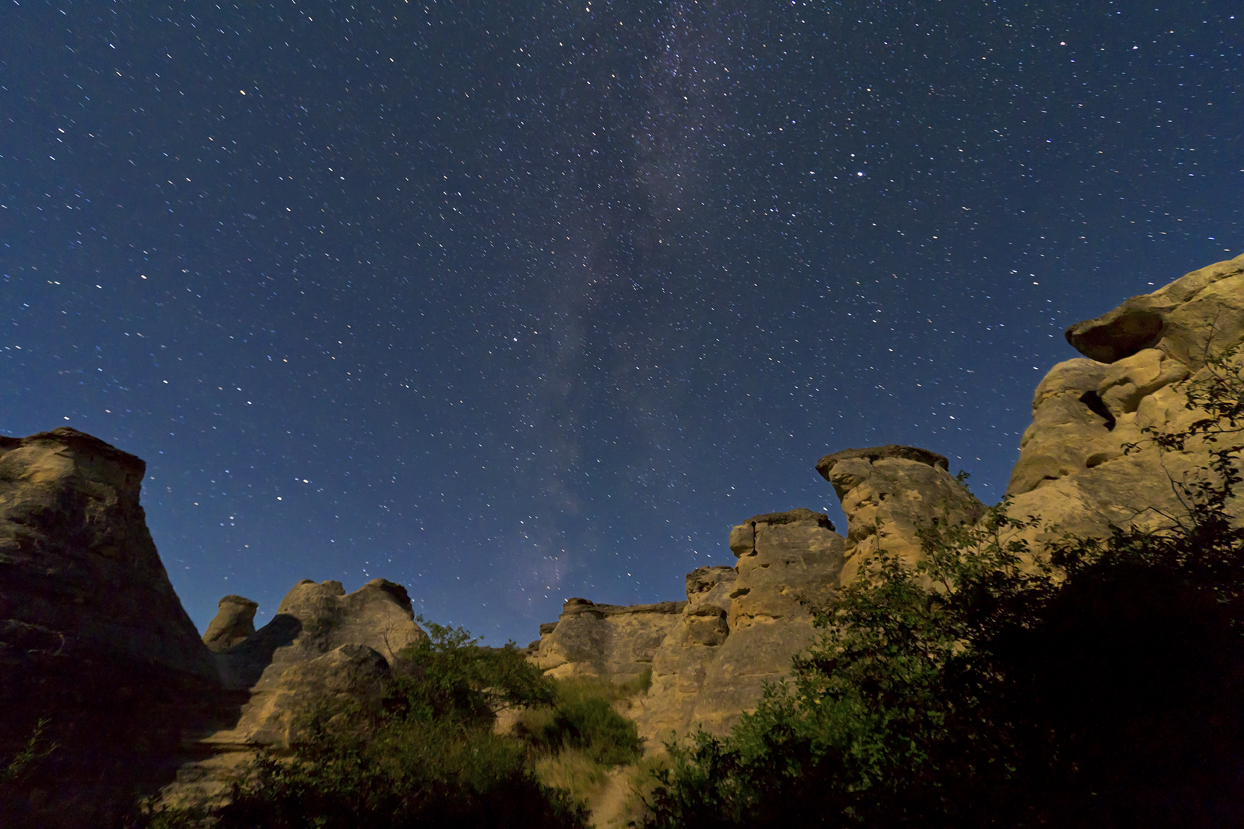
Standing among these “hoodoo” rock formations at night with moonlight and starlight for illumination was a magical moment. This is a scene at Writing-on-Stone Provincial Park in southern Alberta, that I took last Saturday night, July 23, 2001 at 3 a.m.

It shows the summer Milky Way arching over the sandstone formations, with the rocks lit by the light of the rising waning Moon in the east.

Writing-on-Stone is a sacred site for First Nations people, a place to connect to the spirit world through dreamquests. No one lived here — it was a place haunted by the spirits — people only visited at special times. The rocks were also used to record visions and historic events, in the form of carved petroglyphs that are among the best preserved and most extensive of any archaeological sites in North America. By day or by night, Writing-on-Stone is an inspiring location, carved in the rocks on the banks of the Milk River (see the previous blogs for some panoramic sunset views of the area).

This is one frame of about 300 taken as part of a time-lapse movie, and is a 60-second exposure with the Canon 7D and 10-22mm lens.

— Alan, July 30, 2011 / Image © 2011 Alan Dyer

Centaurus, Creator of Constellations


In George Lucas mythology, Luke Skywalker went to Yoda to learn the wisdom and ways of heroes. In Greek mythology, heroes the likes of  Achilles, Jason and Hercules sought out Chiron, the wise and kindly Centaur, who taught them science, astronomy, medicine, music, arts, hunting and archery.

Centaurs, the romping half man/half horse creatures, were a riotous and drunken lot, but not immortal Chiron. He was the offspring of Kronos and the ocean nymph Philyra and served as tutors to many legendary heroes. One reference in my library suggests Chiron actually invented the constellations, to make it easier for mankind to keep track of the stars and the season. To reward his work, Zeus placed Chiron in the stars, becoming by some accounts, this southern sky constellation, Centaurus.

However, most writings suggest Chiron is actually the Zodiac constellation of Sagittarius, while the constellation we call Centaurus is one of the wilder bunch, depicted in the sky as carrying the slain Lupus the wolf, drawn here in the fainter blue stars at top centre.

The bright stars at right are the main stars of Centaurus, including Alpha and Beta Centauri at lower right. Beta Centauri is the blue star, a giant some 390 light years away. But just to the left of Beta is yellow-white Alpha Centauri, a Sun-like star (or actually a pair of them orbiting each other) just 4.3 light years away.

Alpha and Beta Centauri sit at the start of a long dark rift in the Milky Way that splits into fingers of nebulosity reaching into Norma, Ara and Scorpius, here at the left edge of the frame.

I took this shot of Centaurus and Lupus in Chile last month, using a 50mm lens and a Canon 5D MkII. It’s a stack of four 6-minute exposures at f/4 and ISO 800, layered in with two exposures shot through a Kenko Softon-A filter to produce the photogenic star glows.

— Alan, June 26, 2011 / Image © 2011 Alan Dyer


Into the Heart of the Scorpion


Here we peer into the heart of Scorpius, to a place where the sky is painted with pastel hues unlike anywhere else in the heavens.

The yellow star at bottom is Antares, the cool supergiant star that marks the heart of the Scorpion. To the right is Messier 4, a globular cluster of thousands of stars. Wrapping the entire field are shrouds of dust, reflecting the yellow light of Antares and the blue light of hotter stars above, such as Rho Ophiuchi at top right. Glowing hydrogen gas clouds add the magenta hues.

The remarkable feature of this field are the dark fingers, clouds of dark interstellar stardust glowing with a dim yellowy-brown hue. In places the clouds become more opaque and intense, blocking any light from background stars. Those clouds must be close by in our galactic spiral arm because few stars lie between us and their dark masses. Estimates put them about 400 light years away.

The entire region is a busy factory of star making, one of the closest to our Sun. Chances are our solar system formed in a similar star factory 5 billion years ago, one that has long since dissolved away and dispersed around the Galaxy.

Like the previous shot, this is a Canon 7D/135mm telephoto image in a stack of six 2-minute exposures, taken from Chile in early May. I find it remarkable that with digital cameras just 2-minute exposures not only bring out the dark nebulas, but actually show them with colour and tonality. In the old days, film shots 20 minutes long only ever showed them as a mass of underexposed and featureless black.

— Alan, June 16, 2011 / Image © 2011 Alan Dyer

Off the Stinger Stars of Scorpius


Off the tail of Scorpius lies one of the great starry regions of the Milky Way. From southern Canada the Scorpion’s Tail barely clears our horizon at this time of year, on June nights. But from farther south, Scorpius crawls high into the sky — and the sky actually gets dark at solstice, so stargazers can see the starclouds of Scorpius in all their glory.

At right, the blue stars mark the “stinger” at the end of the Scorpion’s tail. The brightest one, called Shaula, or Lambda Scorpii, is a hot blue giant star some 10,000 times more luminous than our own modest Sun. It is also a triple star, with another luminous blue star orbiting it, plus a third odd mystery star thought to be either a neutron star or perhaps a young proto-object still in the process of forming a proper “main-sequence” normal star.

To the left lie two prominent clusters of stars: at top the Butterfly Cluster (a.k.a. Messier 6), a bright group of stars sitting amid a dark bay of dust. Below it, almost lost in the stars, is Ptolemy’s Cluster (a.k.a. Messier 7), that is an obvious sight to the unaided eye – so obvious the Greek astronomer Ptolemy catalogued it in 130 AD. Several other star clusters pepper the field.

This telephoto lens shot frames the field as binoculars would show it. I took this from Chile in early May, using the Canon 7D and 135mm lens, for a stack of six 2-minute exposures at f/2.8 and ISO 1250.

— Alan, June 16, 2011 / Image © 2011 Alan Dyer


A Window in the Stars


In this part of the sky the Milky Way takes on a surprising palette of hues. And it’s all due to dust.

The centrepiece of this shot is a bright star cloud in Sagittarius called, well, the Sagittarius Star Cloud! But not the Large one. This is the Small Sagittarius Star Cloud, a.k.a. Messier 24, a mass of stars with a single black eye. The dark spot, called Barnard 92, is a dense and opaque cloud of dust. Stardust — clouds of carbon soot blown out by aging stars — weaves all through this scene, creating the dark canyons winding through the stars. Obscuring dust also dims much of the background stars and discolours most of this part of the Milky Way a yellowish brown. It’s the same effect that dims the setting Sun a deep orange or red, as its light shines through haze and dust in the sky.

But here, the Star Cloud looks bluish and “cleaner.” That part of the Milky Way has less dust in front of it. And yet it is much farther away than the yellow dusty starfields around it. When we look toward the Small Sagittarius Star Cloud we are looking through a dust-free window, allowing us to see unencumbered right past our Galaxy’s nearby Sagittarius-Carina spiral arm to glimpse a dense part of the more distant Norma Arm, an inner spiral arm of our Milky Way Galaxy about 12,000 to 16,000 light years away.

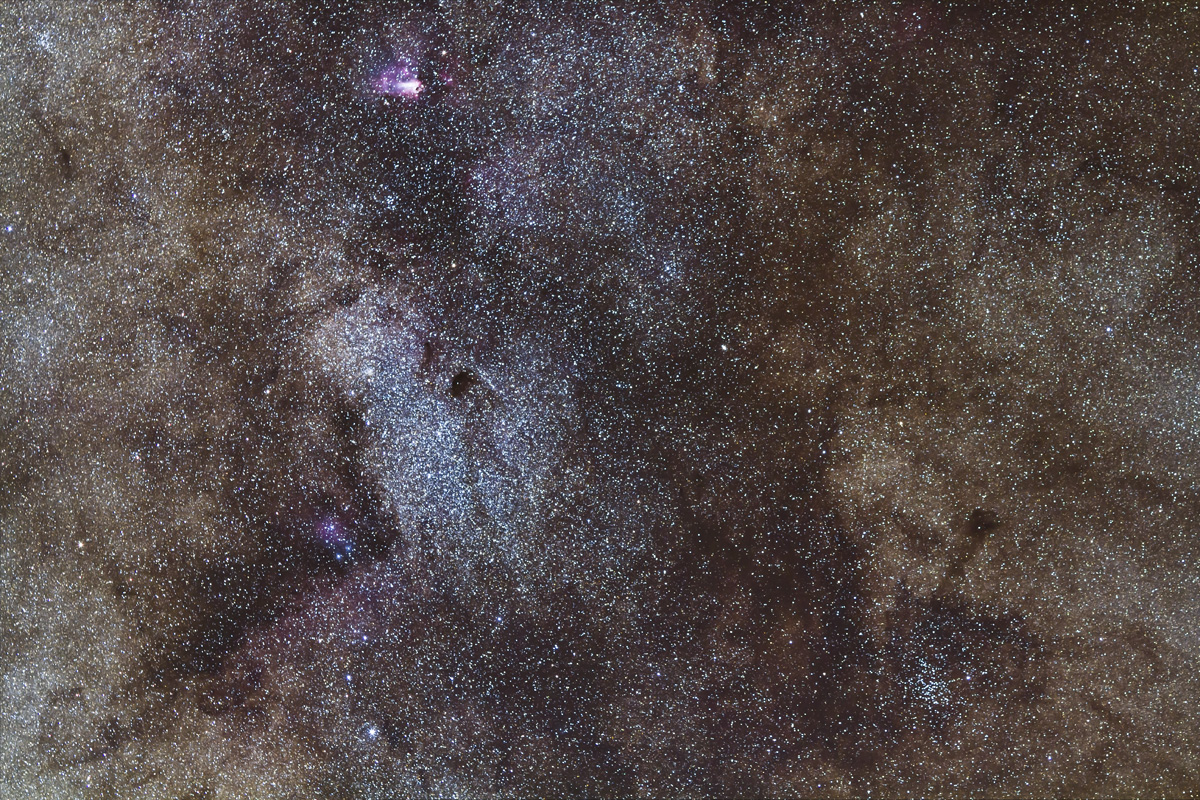
To the lower right of M24 is M23, a rich cluster of stars 2,000 light years away, nearby by galactic standards, and so sits suspended in front of the fainter star background. The pinkish nebula at top is Messier 17, the Swan Nebula.

I took this shot May 2 from Chile, using the Canon 7D and 135 lens, for a stack of six 2-minute exposures.

— Alan, June 7, 2011 / Image © 2011 Alan Dyer


An Island in a Sea of Stars


This image looks toward the inner spiral arm of our Milky Way called the Norma Arm, where stars bunch together to form the rich Norma Starcloud, a prominent patch in the southern Milky Way. What you see here is all stars, lots and lots of stars.

Seemingly embedded in the sea of stars is an island of brighter stars called the Norma star cluster, or more prosaically NGC 6067. It’s about 6800 light years away, much closer to us than the more distant stars behind it. It is literally floating in front of the background sea of stars.

As with the previous image, this is a wide field shot, taken with the 135mm telephoto, to frame the field much as it would appear in binoculars. This shot is a stack of six 2-minute unguided exposures at ISO 1250 with the Canon 7D riding on the little Kenko tracking platform. It’s one of a couple of dozen fields I shot the first night of shooting on Chile in May.

— Alan, June 4, 2011 / Image © 2011 Alan Dyer


Rose of the Southern Sky


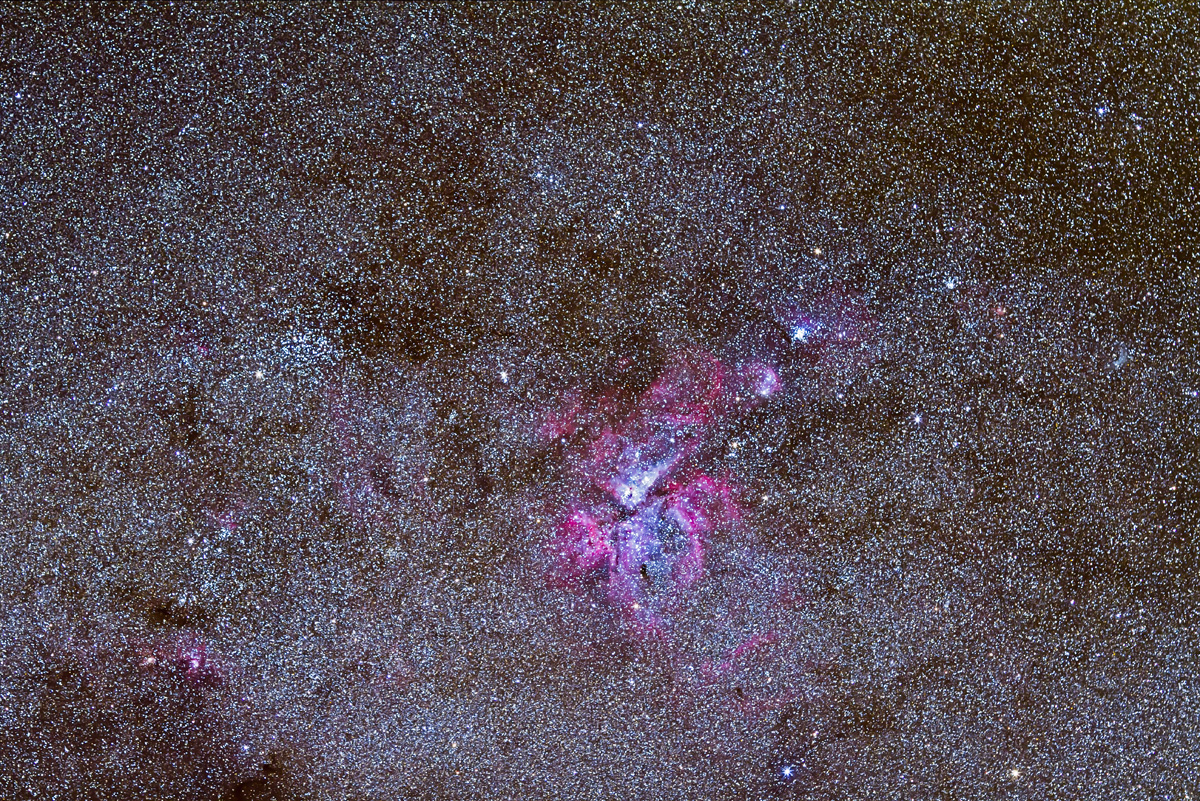
It’s been a month since my last post, a month with no new astrophotos from home. But I’ve got a backlog of RAW files to work through from the Chile trip a month ago. Here’s a new image from that shooting expedition. It’s of an area of the southern sky that lends itself to every focal length and framing variation — you can’t go wrong with the Carina Nebula!

This wonderful nebula in the deep-south Milky Way rewards any astrophotographer. For this shot I used a 135mm telephoto (Canon’s wonderful f/2 L-series lens) and the Canon 7D camera. The 7D is what I call a “stock” camera, used just as it comes off the dealer shelf. The 7D does a superb job capturing the red nebulosity and its faint outlying bits and pieces. It tends to record these clouds of glowing hydrogen as magenta in tone. By comparison, my other Canon camera is a “filter-modified” 5D MkII. You can see a shot of this same area of sky taken with the 5D MkII a few blogs back under The Best Nebula in the Sky, posted May 6. The 5D MkII’s modification (which replaces the filter in front of the sensor with a new astro-friendly one) allows it to record deep-red wavelengths and picks up more faint nebulosity, registering it more as red in tone. But both images look good and presentable.

This field is rich in objects — not only the main sprawling nebula but nearby star clusters and patches of dark dust clouds. It is one of the finest fields in the sky for binoculars, and this shot approximates the field of view of typical binos. I like to shoot a lot of objects with telephoto lenses — while the main subject is not frame-filling and in your face, it does match (at least in field of view) what you can see in binos, useful for illustrations and observing articles. Of course, the camera picks up  more stuff and colours even your bino-aided eyes can’t see.

This shot is a stack of five 2-minute exposures at f/2.8 with the 135mm telephoto, on the Canon 7D at ISO 1250. I used the little Kenko Sky Memo tracking platform for this, letting it track without any added guiding. It’s tracking was spot on, with nary any star trailing as it followed the target for 20 minutes or so.

— Alan, June 3, 2011 / Image © 2011 Alan Dyer

Under the Southern Cross


I’m back home in Canada now, after 24 hours of travel from Chile. Despite having to check my carry-on bag filled with cameras and the Mac laptop for the Calama to Santiago domestic flight, all the gear arrived home intact. Now to process the 40+ gigs of images I shot. And properly reprocess some of the images worked on at the dining room table at the lodge, under the bright Chilean sun.

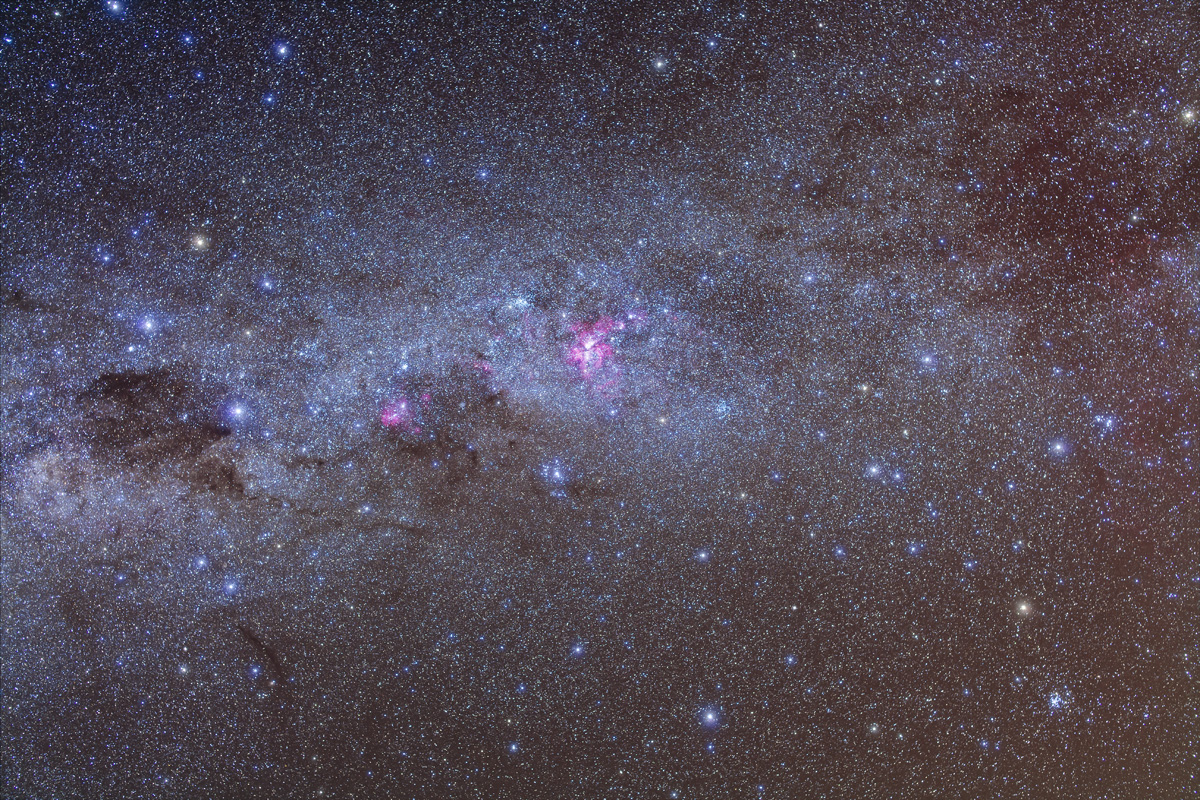
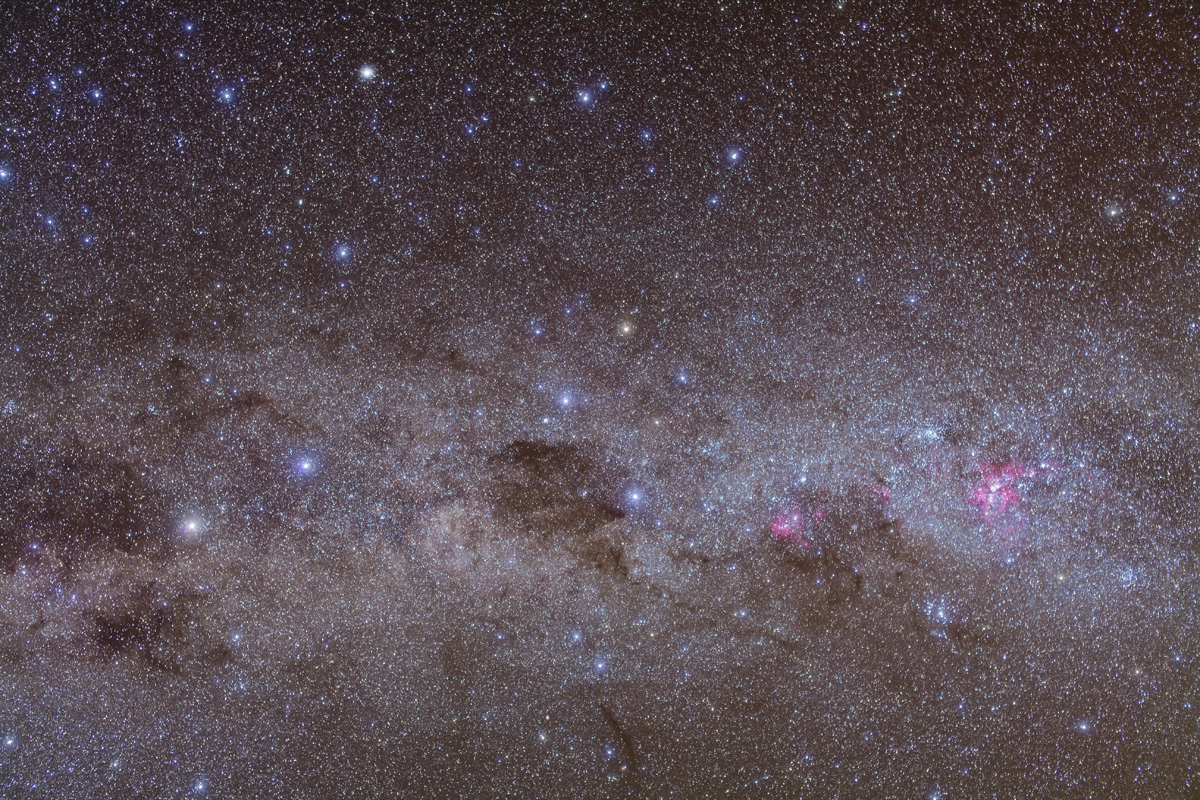
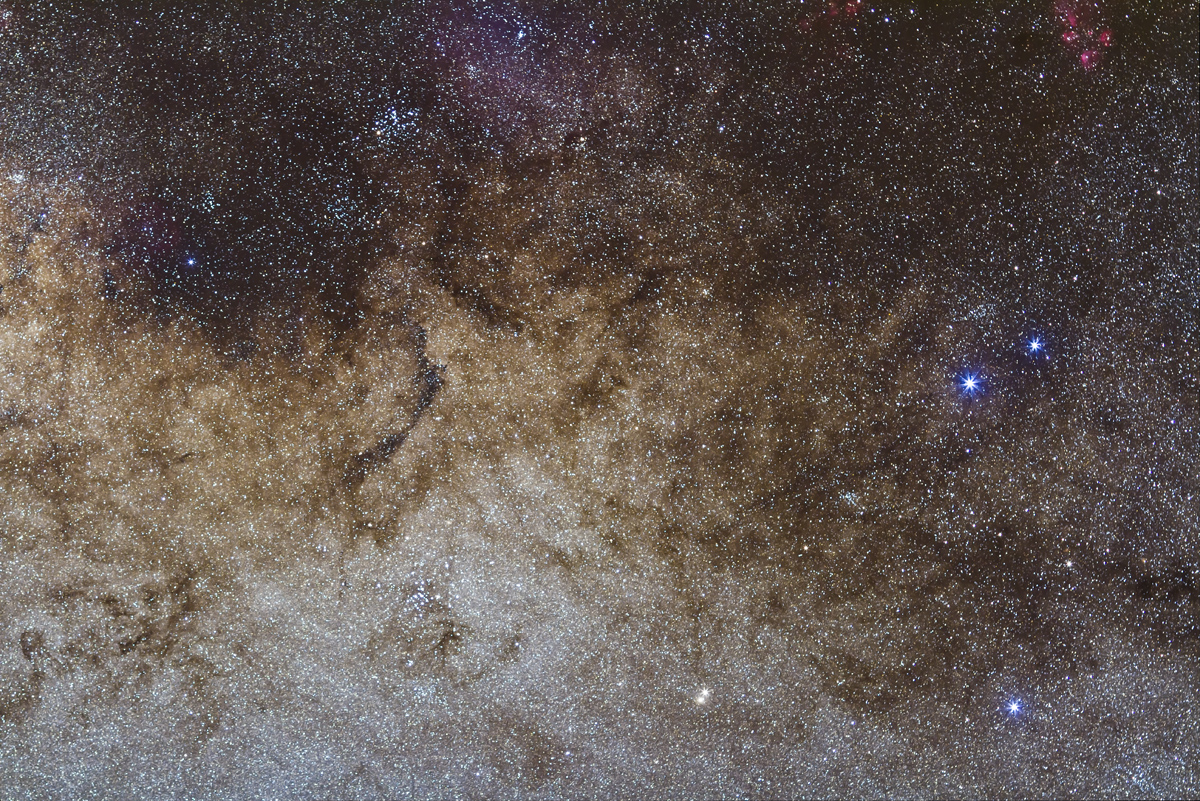
Here’s a shot taken the last night of shooting, of the icon of the southern sky, the Southern Cross, more formally called the constellation of Crux. Next to it, at left, are the dark clouds of the Coal Sack. To the eye, these clouds looks like a uniform dark spot in the sky. But photos, and even binoculars, reveal it as a complex mess of shapes and densities.

What stands out are the colours of the Cross stars. Most are hot blue Type B stars – energetic blue giants. But Gacrux at top is very red – it’s a cool red giant star.

Scattered amid the Cross are Coal Sack are several clumps of stars – open star clusters, such as the Jewel Box Cluster to the left and just below Becrux, the left star of the Cross. On our final night at the Atacama Lodge, we helped out at the lodge in a public stargazing session to a group of tourists from all over the world. I ran a telescope aimed at the Jewel Box and heard lots of ooohs and aaahs at the sight of its multicoloured stars.

This shot is a Mean-combine stack of five 3-minute exposures at f/2.8 with the wonderful Canon L-series 135mm telephoto, and the Canon 5D MkII camera, filter-modified, at ISO 800. The camera was on a Kenko SkyMemo tracking platform, which followed the stars during the 15 minutes worth of exposures.

– Alan, May 9, 2011 / Image © 2011 Alan Dyer

The Galactic Cathedral


We’re on our last full day in Chile, packing up and sorting out. I’ll finish off my Chile blog series with this parting shot — the entire southern Milky Way from horizon to horizon.

In this view, we’re looking straight up, with the horizon at the edges of the frame of the 15mm fish-eye lens. The glowing starclouds of Sagittarius and Scorpius, seen in close up in the previous blog post, are in the centre of the frame. The Southern Cross is at far right, the Northern Cross at far left.

This scene is a superb way to end a night of southern sky stargazing – just lying back and looking up at the entire panorama of the Galaxy. You really do get the sense that we are indeed living at the edge of the Galaxy, looking off into its bright core, and with its spiral arms wrapping around us.

It’s a galactic cathedral of stars.

– Alan, May 7, 2011 / Image  © 2011 Alan Dyer

The Starfields of Sagittarius and Scorpius


I can’t get enough of this region of sky. I can and do shoot this with every lens I have and with all kinds of framing (horizontally, vertically, or at a rakish angle, like here) and it always looks great.

These are the rich and stunning starfields toward the centre of the Milky Way in Sagittarius (bottom) and Scorpius (at top). Look for the pinkish nebulas dotted along the Milky Way, the bright starclouds, and the dark lanes of interstellar dust. It’s all part of the galactic recycling program that our Milky Way participates in, as stars explode, cast off dust and gas, which then clump into glowing nebulas and form new generations of stars.

I took this shot about 5 a.m. a couple of mornings ago, with this area directly overhead. It’s a stack of six 3-minute exposures with the 35mm lens and Canon 5D MkII camera. I took some shots through a soft focus filter to add the star glows.

– Alan, May 7, 2011 / Image © 2011 Alan Dyer

The Best Nebula in the Sky


What a great field this is to explore with binoculars. The image here takes in about the same area of sky as most binoculars and look what it contains! Arguably, the best nebula in the sky: the Carina Nebula, and the best open star cluster: the Football Cluster (aka NGC 3532) to the left of the main nebula. And then there’s the Southern Pleiades star cluster, IC 2602, below the nebula, and lots more besides.

This one field is reason enough to travel to the southern hemisphere for stargazing.

I shot this last night, May 6, 2011, using a 135mm telephoto lens at the modified Canon 5D MkII camera. The filter modification allows the camera to pick up a lot more of the faint wispy bits of glowing nebulosity. This is a stack of four 3-minute exposures, with two of the exposures shot through some thin cloud (the first we saw all week!), adding the subtle but photogenic glows around the stars.

– Alan, May 7, 2011 / Image © 2011 Alan Dyer

Dawn’s Early Light


This shot took getting up early (rather than staying up all night) to shoot the sky at 5 a.m. The main subject here is a subtle tower of light rising up vertically from the eastern horizon. That’s the Zodiacal Light, best seen from low latitudes.

The glow is from sunlight reflected off dust particles deposited in the inner solar system by passing comets. While it looks like dawn twilight coming on, the light actually comes from out in space and heralds the brightening of the sky by true twilight.

After a week of gazing in the evening sky, a number of us observers took the opportunity this morning to snooze through part of the night and get up prior to dawn to see a new set of objects. At that time of night, and at this time of year, the centre of the Milky Way sits straight overhead, and shows up here in an ultrawide shot from horizon to zenith.

I shot this with the 15mm lens at f/2.8 and the Canon 5D MkII at ISO 800. It’s a stack of two 3-minute exposures.

– Alan, May 6, 2011 / Image © 2011 Alan Dyer

The Southern Crosses


The emblem of the southern hemisphere sky is here on the left: the Southern Cross, or Crux. But how many other crosses can you find in this field?

At the right is a larger version of Crux, made of two stars from Carina and two stars from Vela. So it’s not a proper constellation but an asterism well known in the southern hemisphere sky, called the False Cross.

You might also be able to pick out a third cross at lower centre, looking upside down but also made of four stars in an elongated diamond shape.

The prominent centre-stage object here is the massive Eta Carinae Nebula, sometimes just called the Carina Nebula (I’ve never determined what the proper and official name of it is). Surrounding it is an array of star clusters that make this area an absolute delight to explore with binoculars. But this week, at our stay at the Atacama Lodge, our small observing party has had fabulous views of the nebula in a big 18-inch telescope that reveals intricate structure in the swirls and eddies of its glowing clouds.

This is a stack of 6 exposures, each 3 minutes at f/4 with a 50mm Sigma lens and the Canon 5D MkII camera.

– Alan, May 6, 2011 / Image © 2011 Alan Dyer

Southern Spectacular


Everyone from the north who sees this area of sky for the first time quickly realizes just how much better the sky is down south. This is the most spectacular region of the deep-south Milky Way, as it passes through the constellations of Carina, Crux and Centaurus.

Dead centre here is the symbol of the southern sky, the Southern Cross. To the right of it glow the reddish nebulas of Carina and Centaurus; to the left of the Cross lie the dark clouds of the Coal Sack and the pair of brilliant stars, Alpha (on the left) and Beta Centauri. Alpha is the closest bright star to our solar system.

This one field contains much of what makes the southern sky so memorable and a mecca for any backyard astronomer. You haven’t lived an astronomical life until you’ve seen this part of the Milky Way, accessible only from southern latitudes.

I took this shot last night, May 4, 2011, using a Sigma 50mm lens and a modified Canon 5D MkII camera. The image is a stack of four 6-minute exposures at f/4 and ISO 800, plus a stack of two more 6-minute exposures taken through a soft-focus filter, with those images layered into the final Photoshop image to add the star glows and make the constellation outlines, like the Southern Cross, pop out.

– Alan, May 5, 2011 / Image © 2011 Alan Dyer

Toward the Centre of the Galaxy


This is without a doubt the most spectacular area of sky. Here we’re looking toward the centre of our Galaxy, toward the starfields of Scorpius (at right) and Sagittarius (bottom centre). The field is a riot of stars, dark lanes of dust, and patches of glowing red nebulas.

It is wonderful experience – wonder-filled! – just to lie back and scan these constellations with binoculars or a wide-field telescope. One outstanding feature are the parallel bands of dark dust that seem to form the shape of a dark prancing horse in the Milky Way.

The brightest area of the Milky Way here is the Sagittarius Starcloud, and marks the direction of the centre of our Galaxy. From here in Chile where I took this shot, this region of sky passes directly overhead, making it more prominent than at northern latitudes where the galactic core is often lost in horizon haze.

This image is a stack of four 6-minute exposures at f/4 with the 35mm lens and Canon 5D MkII camera. For one of the exposures I shot through a special soft-focus filter to add the fuzzy star glows that make it easier to see the outline of the constellations. The filter also emphasizes the colours of the stars.

The image is a segment of a 12-section panorama I shot all along the Milky Way from dusk to dawn.

– Alan, May 3, 2011 / Image © 2011 Alan Dyer

Galaxyrise


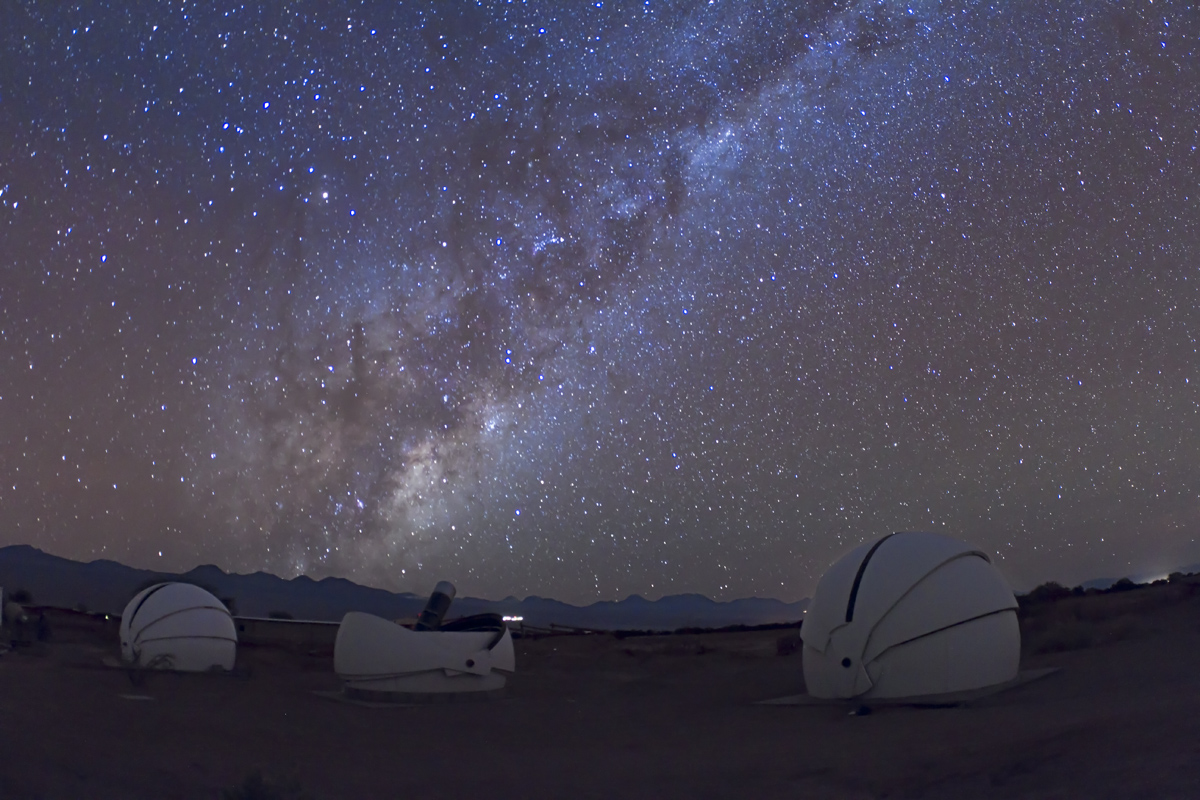
In the southern hemisphere sky we are treated to the stunning sight of the centre of the Galaxy rising each night, as the starfields of Scorpius and Sagittarius come up over the eastern horizon. In this shot, taken last night (May 2/3), we see the Milky Way’s heart rising behind some of the robotic, remotely-controlled domes and telescopes at the Atacama Lodge in Chile. Only the centre dome is operating, taking images or data under the command of someone half a world away.

Amazing technology to be sure, but … that robotic observer misses the experience of standing under the Milky Way, watching its heart rise over the Andes and swing overhead through the night. The Milky Way is so bright it lights the ground, as you can see here.

Last night our little group of 7 Canadian observers had a fantastic time exploring the southern sky with several telescopes, including an 18-inch reflector set up for us by lodge owner Alain Maury. With the help of a couple of wide-angle eyepieces we saw wonderful views of the Vela Supernova Remnant, dark nebulas in the Milky Way, and showpiece targets like Omega Centauri and the Tarantula Nebula – the list goes on! And will again tonight, as we compile another “hit-list” of targets to find tonight.

For this shot, I used the Canon 7D camera, a 15mm lens, and ISO 2500 for a 40 second exposure at f/2.8. This is one of about 500 frames taken for a time-lapse movie of “Galaxyrise.”

– Alan, May 3, 2011 / Image © 2011 Alan Dyer

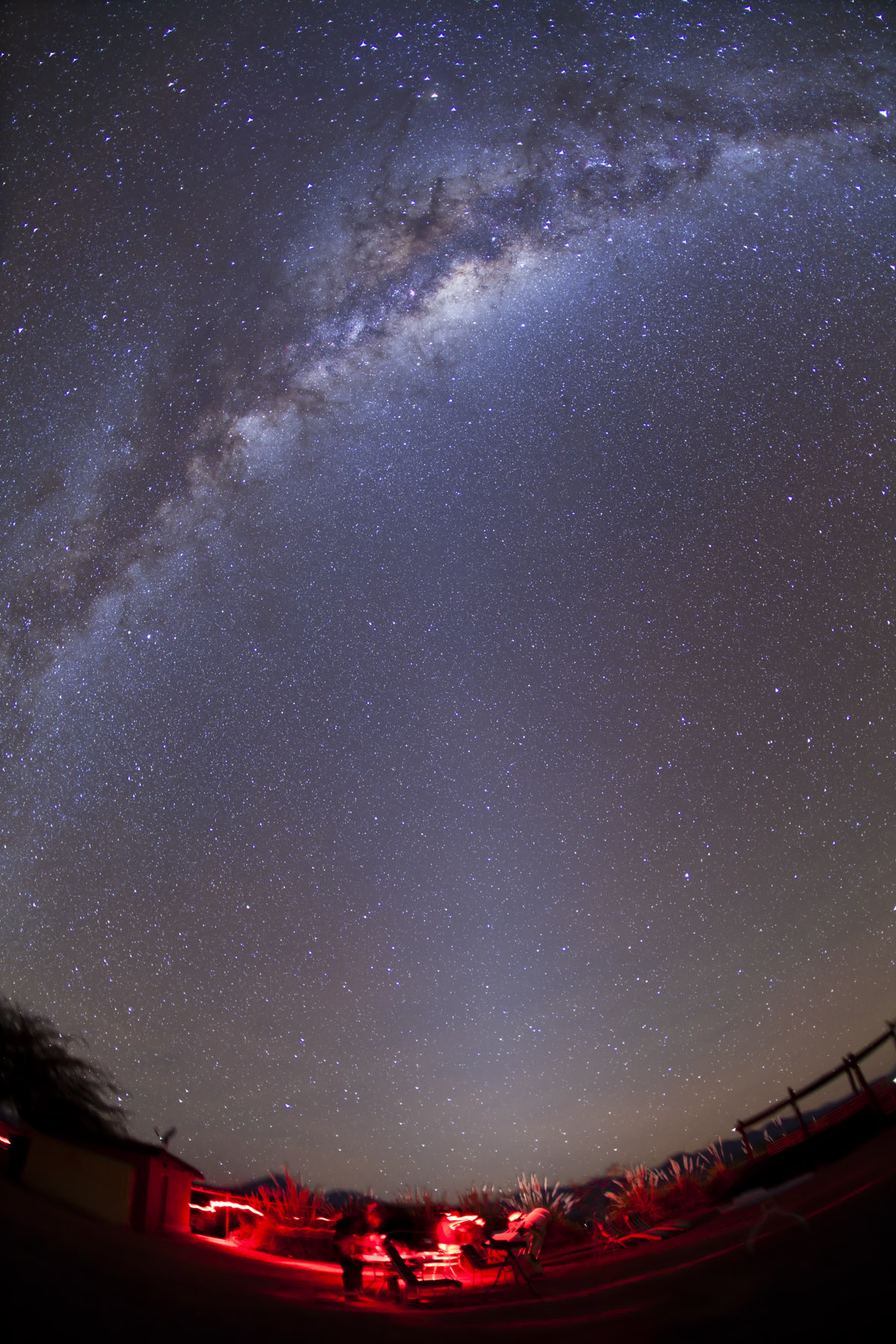
The Milky Way from Chile


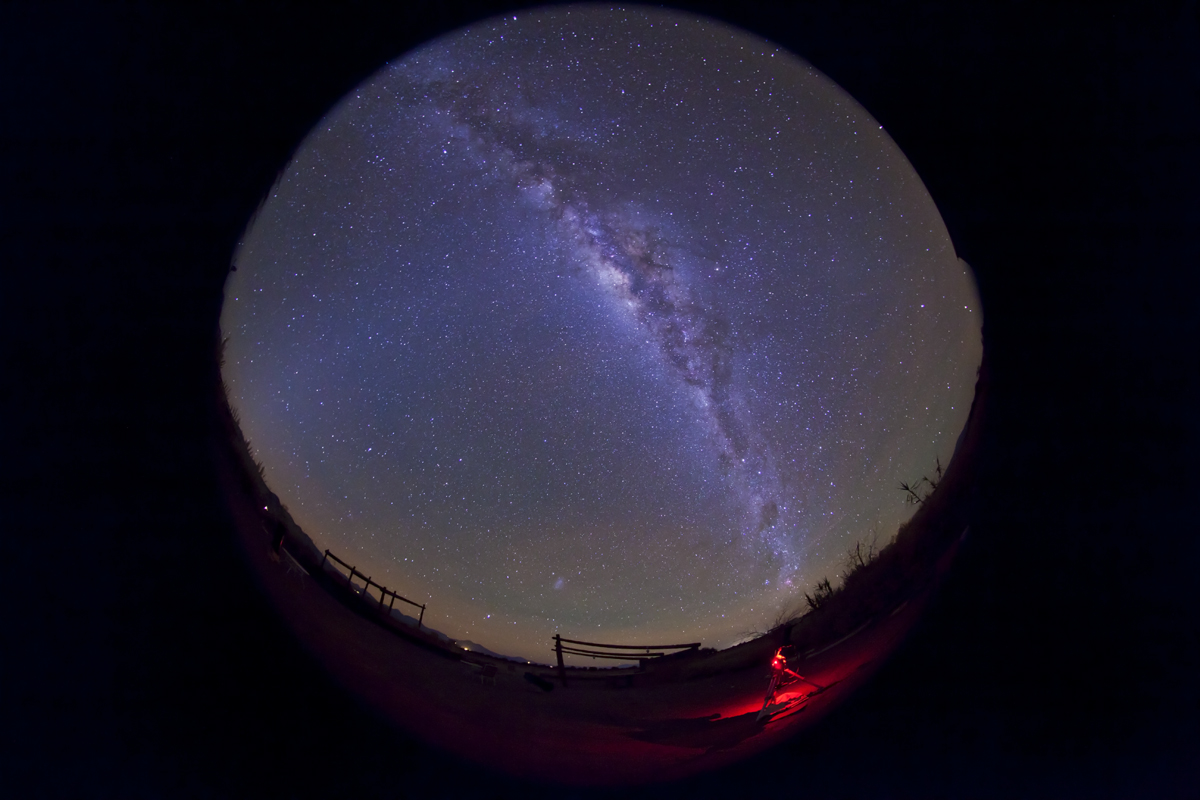
This was the Milky Way as it appeared toward the end of a long night of non-stop shooting from Chile. The centre of the Galaxy lies directly overhead and the Milky Way stretches from horizon to horizon. This is one of the sky’s greatest sights, and this is an ideal time of year to see it. But only if you are in the magic latitude zone of 20° to 30° south.

In this shot, another skyglow stretches up from the eastern horizon at left – that’s the Zodiacal Light, so obvious from this latitude. It’s sunlight reflected off comet dust in the inner solar system, and heralds the coming dawn twilight.

My tracking platform – the device that allows a camera to follow the sky for a time exposure – is at lower right, with a second camera taking telephoto lens shots of star clusters in the Milky Way.

I took this shot with the Sigma 8mm fish-eye lens and the Canon 5D MkII camera that was on a fixed tripod – it was not tracking the sky. But the 45-second exposure at ISO 3200 was enough to bring out the Milky Way in all its glory. This frame is one of 660 or so that make up (or will once I assemble it) a time-lapse movie of the Milky Way turning about the pole and rising through the night. The fish-eye format makes it suitable for projection in a planetarium dome.

– Alan, May 2, 2011 / Image © 2011 Alan Dyer

Eclipse in the Winter Milky Way


The December 20, 2010 total lunar eclipse promised to be a photogenic one. With the Moon smack dab in the middle of the winter Milky Way, it was going to be a great sight, as the Milky Way appeared during totality. The event did not disappoint. Though some haze intervened, I wasn’t complaining, as the weather has been so poor of late, we were lucky to get a clear night at all, despite having to endure -20° C temperatures to take in the event. This shot captures the scene from my backyard during totality, with the over-exposed eclipsed Moon sitting in the Milky Way above Orion. The naked and binocular view was truly stunning.

I got back from Australia in time to see this event from home, squeezed in between Oz and a Xmas trip to the rainy west Coast. The plan worked! I managed to catch the eclipse, against the odds, which defeated many across Canada. Alberta was one of the few clear places for this event. I had considered a hasty trip to Arizona for it, but decided against it — a good thing, as I think they had cloud. The winter of 2010/11 is proving to be an awful one for many.

— Alan, December 2010 / Image © 2010 Alan Dyer

Shooting in Australia, Despite the Floods


I have not managed to get back to Australia since 2008, and had long planned for a trip in the November-December period, to get the Magellanic Clouds and “winter” Milky Way area of Orion, Canis Major, Puppis and friends, regions of the sky not well-placed in the usual months of my Oz trips in March and April. I planned a trip for late 2010, a month under southern skies, with 2 weeks at my favourite dark site, Coonabarabran, NSW, which bills itself as the Astronomy Capital of Australia — the Siding Spring Observatory, Oz’s major optical observatory complex is down the Timor Road. I rented a cottage for the period, which worked out great. The site could not have been better. The weather could not have been worse!

I go to Oz prepared to lose about 50% of nights to cloud, but this time, out of 15 nights in Coona, only 2 were clear and usable. Torrential rains deluged the area of the Central West of NSW, causing severe flooding all around me. On one trip back from Parkes, I had to detour 200 or 300 km around through the Hunter Valley just to avoid washed out roads and get back home. Indeed, at one point I had to plough through one town whose main streets were being inundated with a torrent of water. When it did clear, it was humid! But I got two nights of great shooting in. The skies were transparent. The one thing about Oz — when skies are clear they are dark and clean. The best I’ve ever seen.

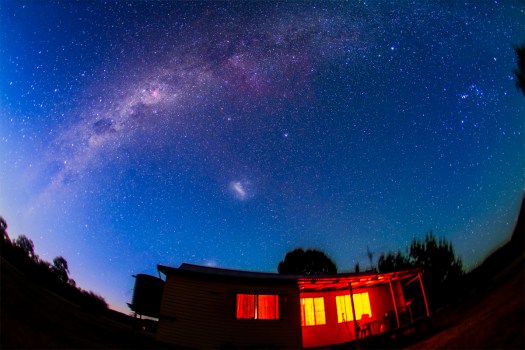
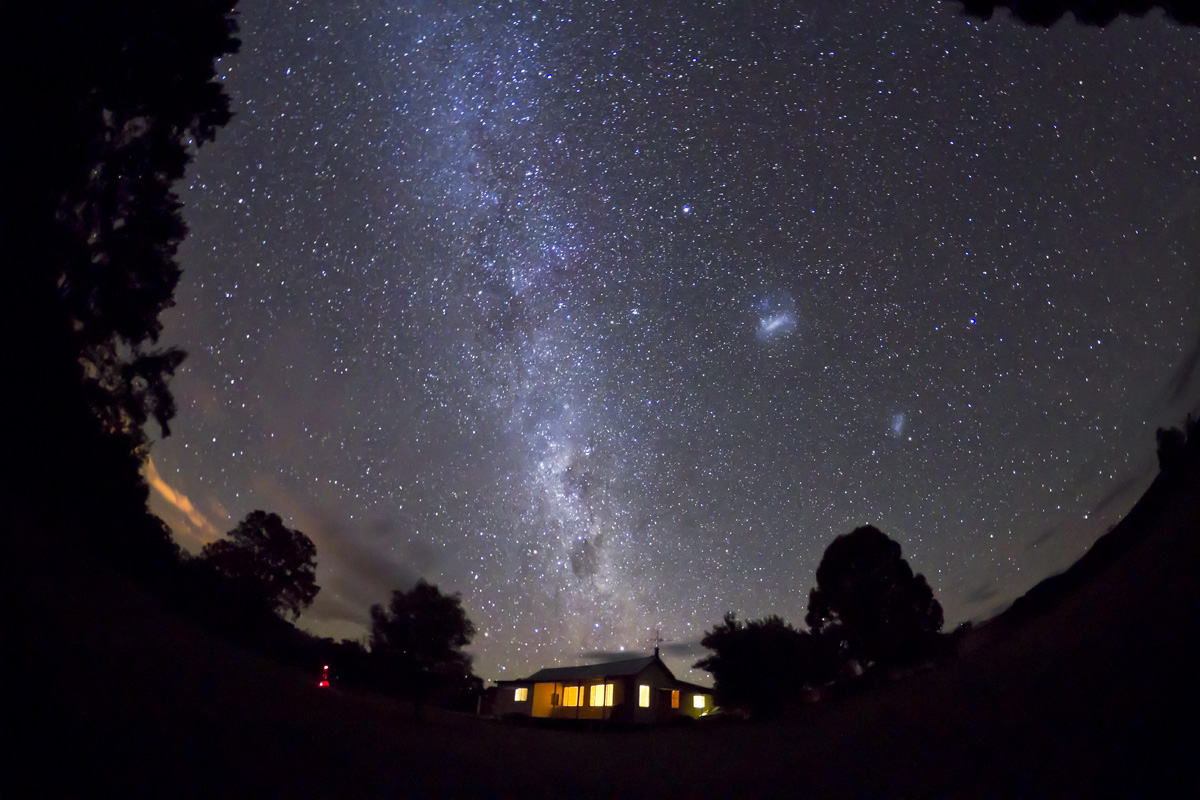
This is a single, tripod-mounted shot of the southern Milky Way and Magellanic Clouds, over the cottage that was my retreat and home for two weeks. Would I go back? You bet! It is still astronomy paradise for me. Even if skies are cloudy it is a chance to enjoy a writing retreat and a time to quietly work on projects long put off.

– Alan, December 2010 / Image © 2010 Alan Dyer