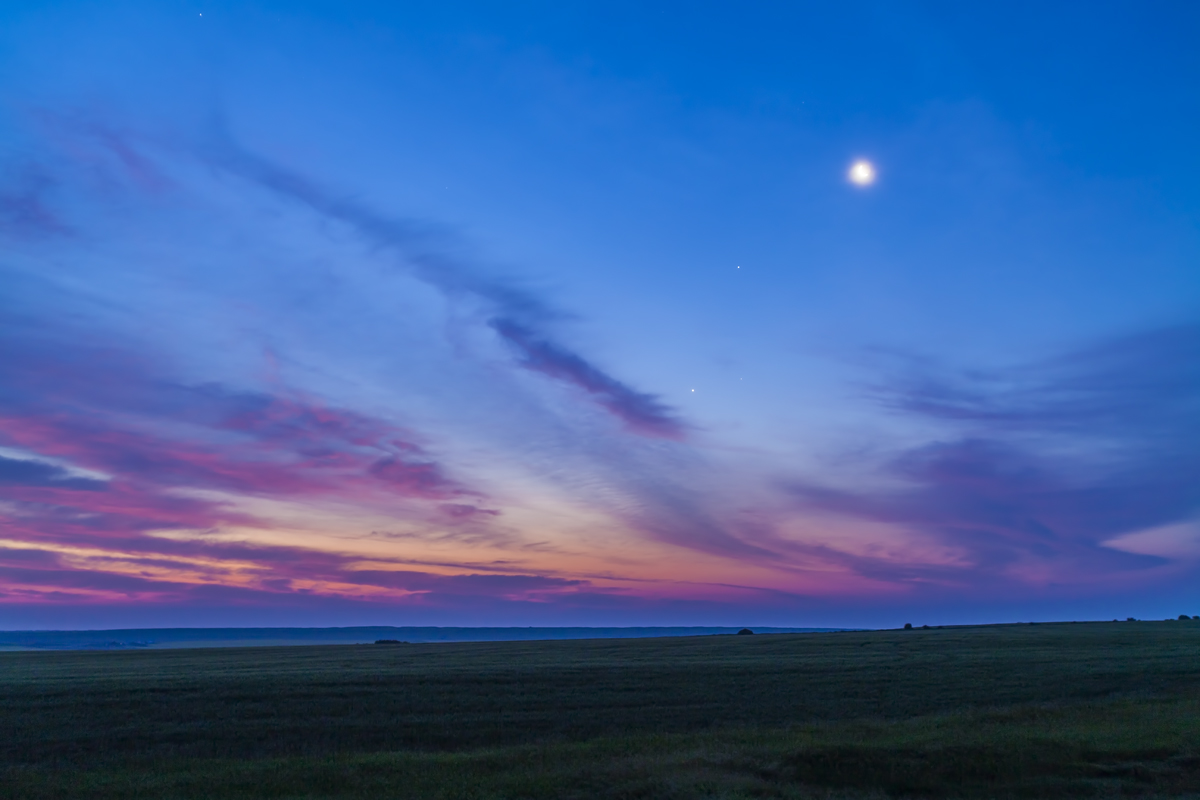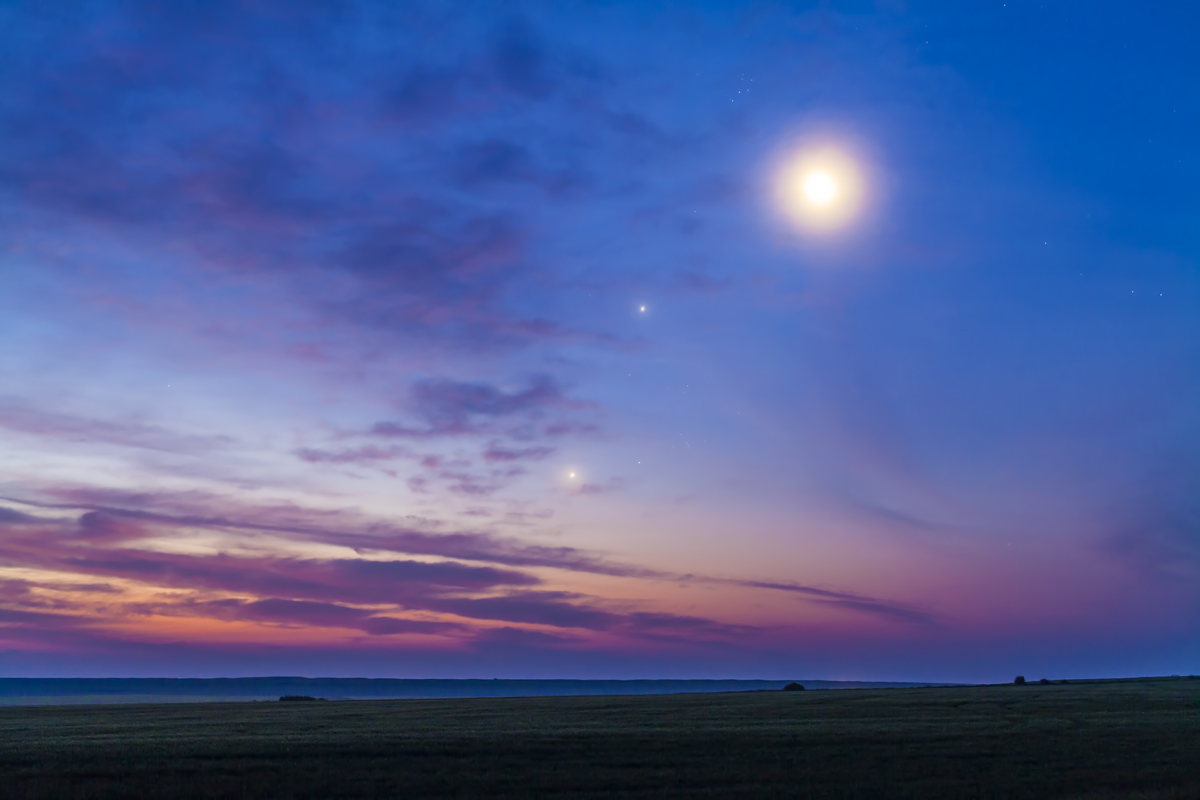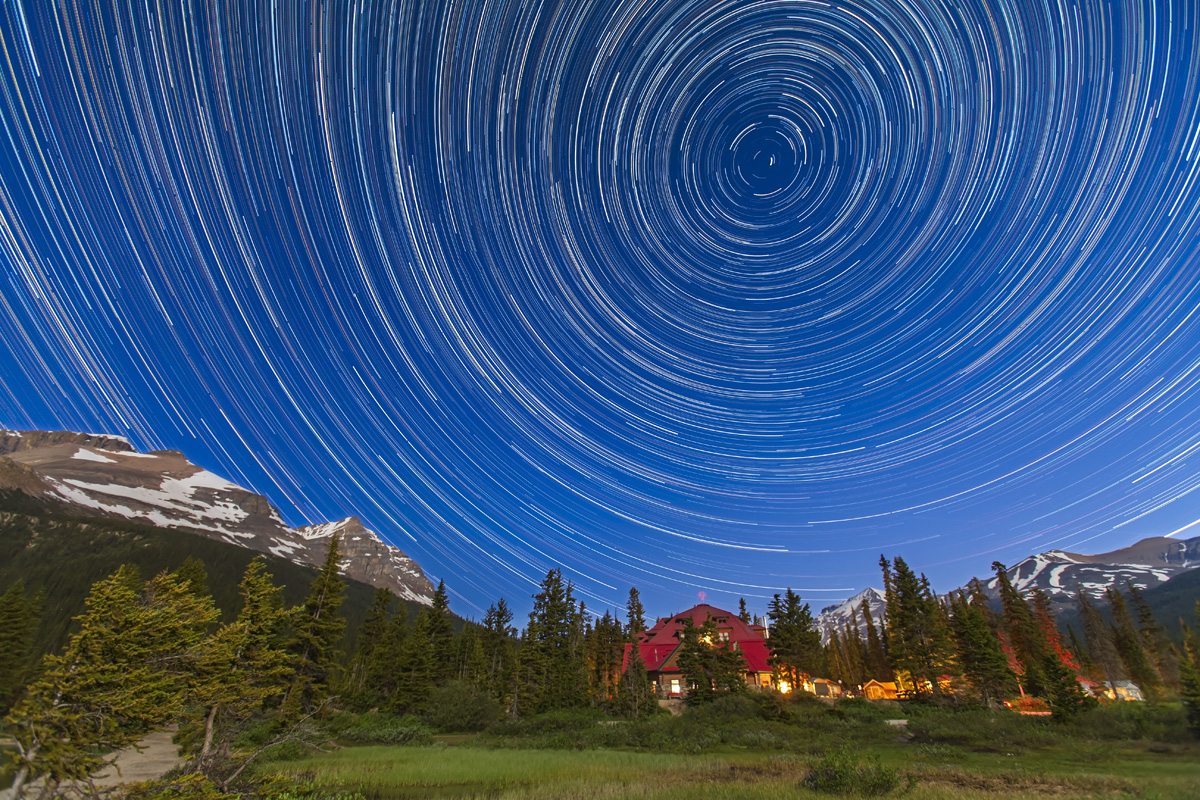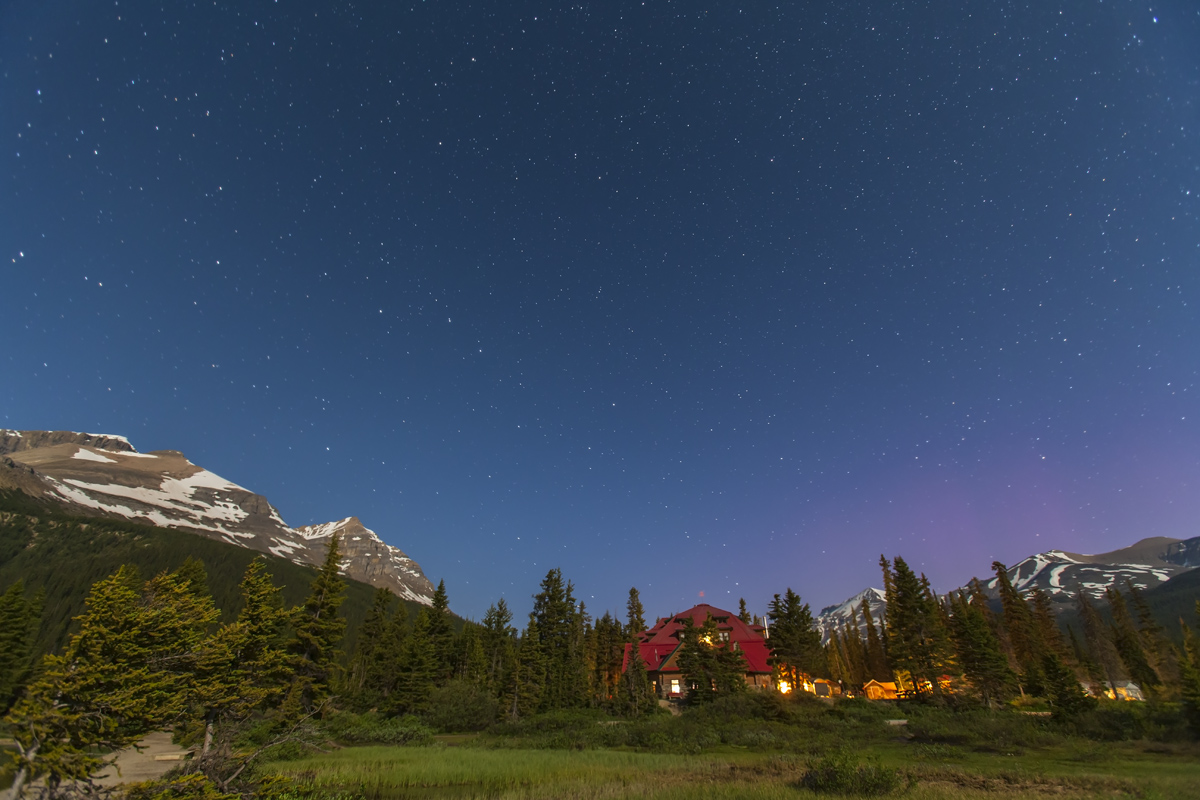
The Windblown Stars


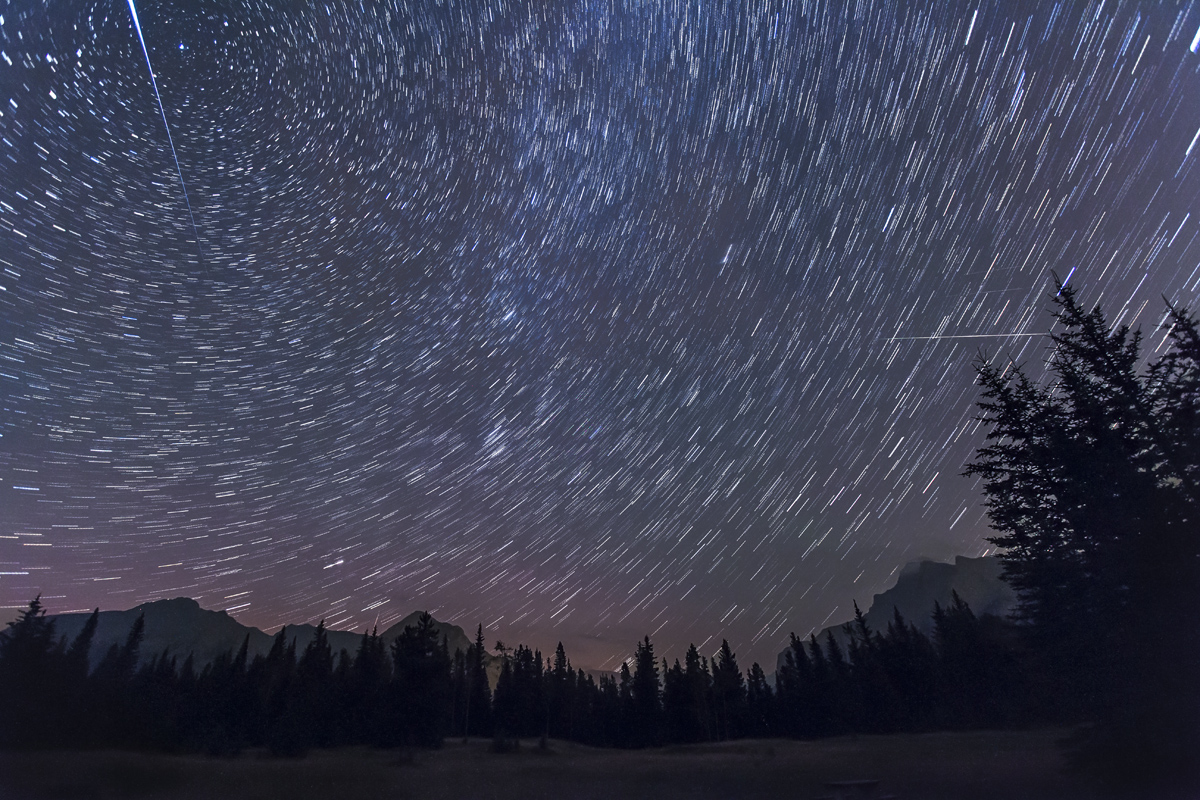
Here’s the “long” version of an image I posted a few days ago. This combines 430 exposures to make one long star trail image.

A bright meteor appeared in one of the hundreds of 5-second-long exposures and registers in the composite, streaking diagonally across the star trails. The stars circle around Polaris at top. The horizontal streaks are clouds blowing from left to right across the sky during the night. The blades of the windmill in the Wintering Hills wind farm are blurring by the long exposures.

It’s been a productive few nights shooting out at the wind farm, capturing scenes of harvesting the wind!

– Alan, September 3, 2012 / © 2012 Alan Dyer


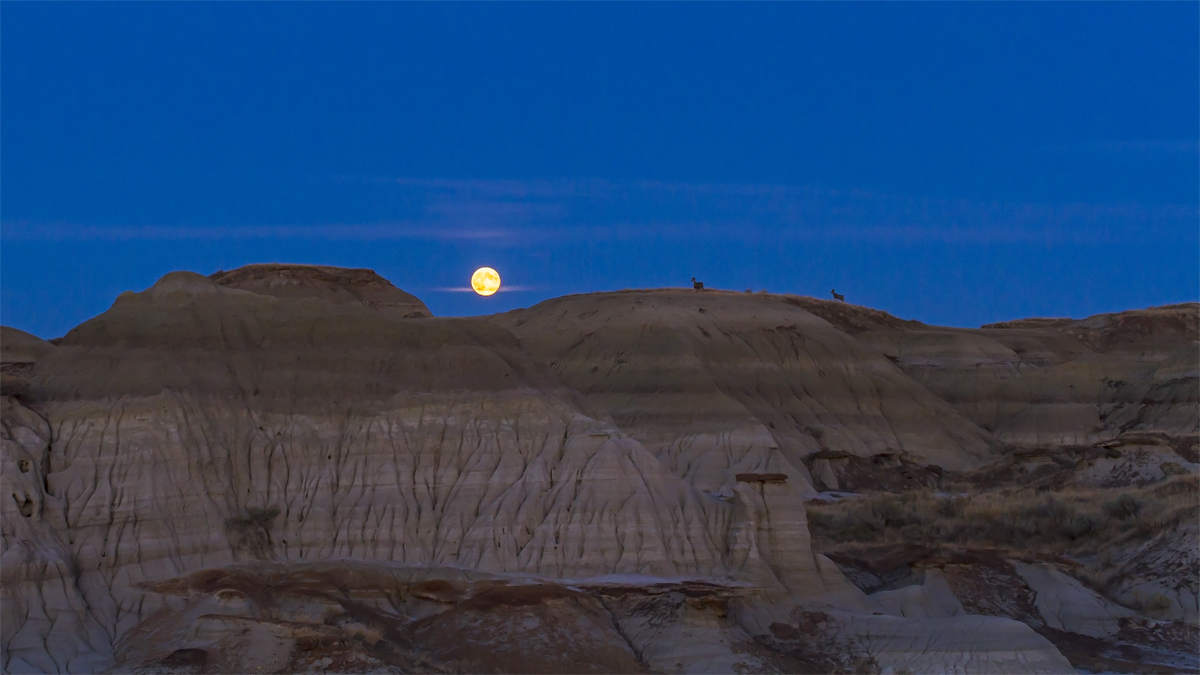
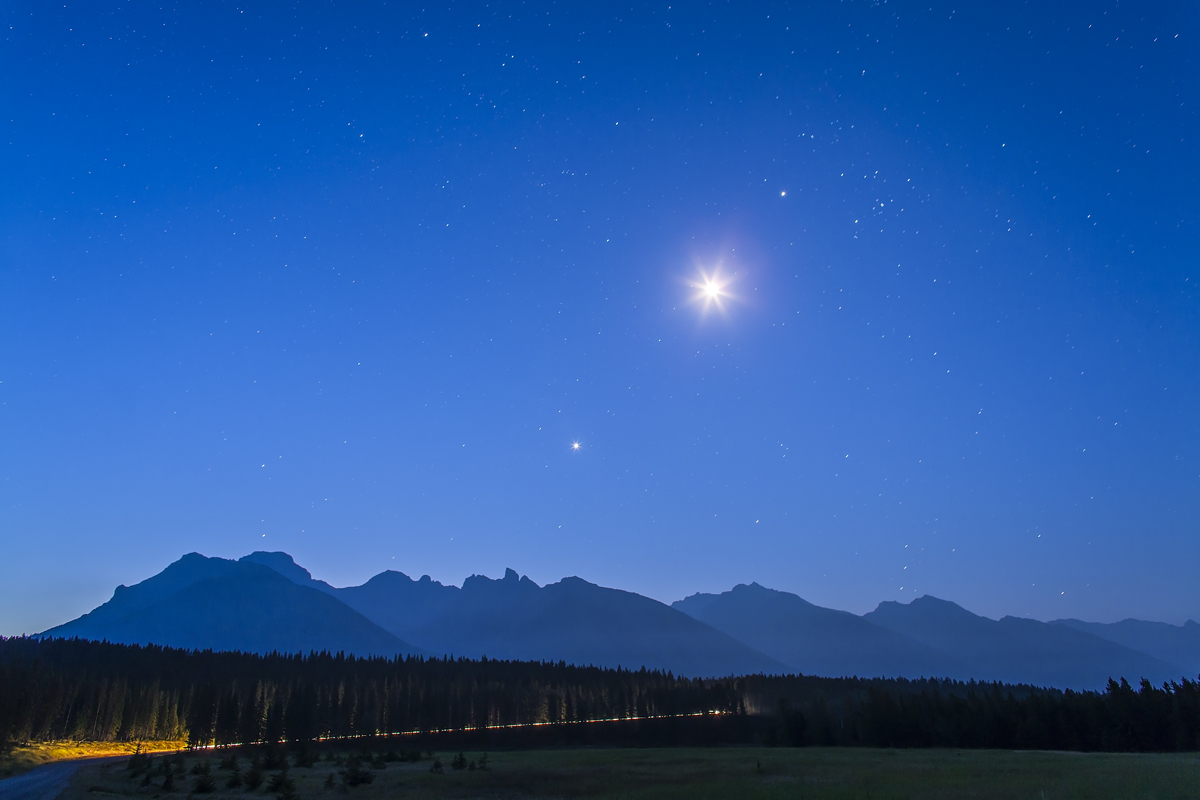
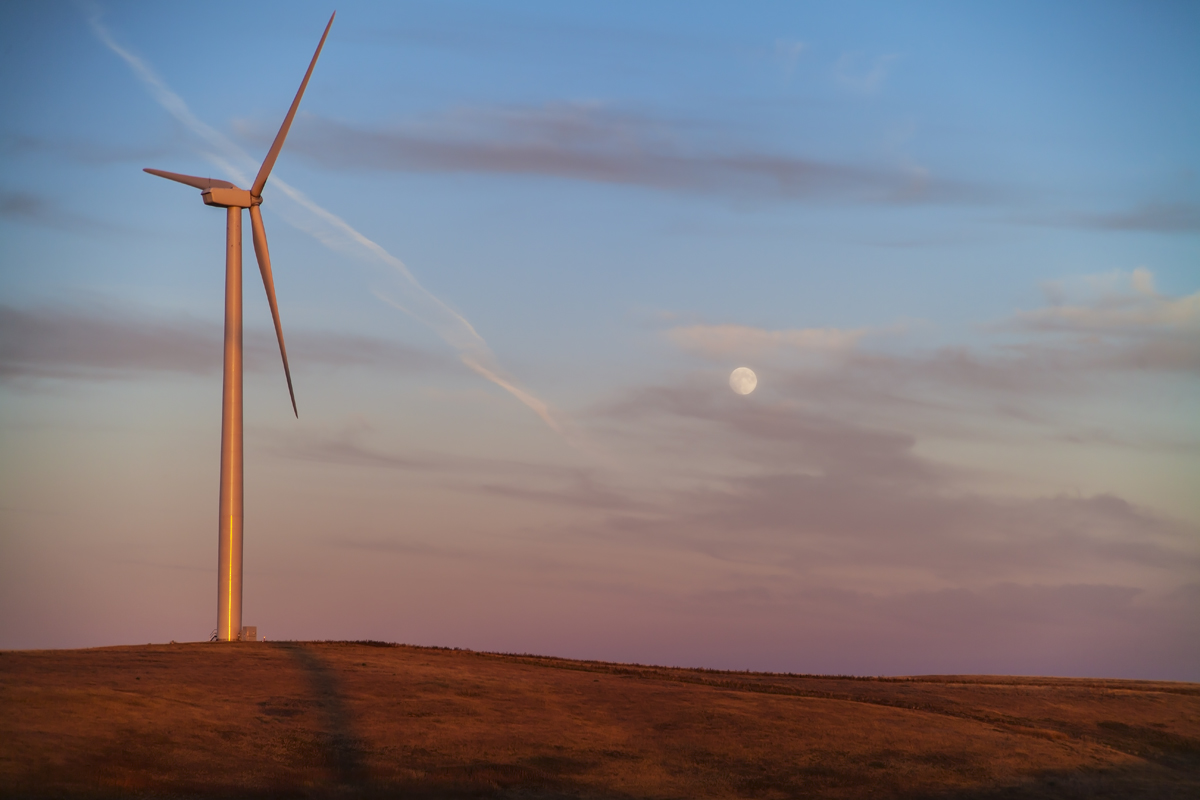
Blue Moonrise


This was the Full Moon rising on the night of another much-publicized “Blue Moon.” This was moonrise on Friday, August 31, 2012.

Of course, the Moon doesn’t look blue. Indeed, smoke and dust in the air made it look a dim yellow. Though this wasn’t the official Harvest Moon (that comes next month), it should have been, as around here in southern Alberta the harvest is well underway, thus the swathed fields and hay bales.

The Full Moon sits in the blue band of Earth’s shadow, rimmed on the top by the pink twilight effect called the Belt of Venus, caused by sunlight illuminating the high atmosphere to the east.

A couple of windmills from the large Wintering Hills wind farm add to the evening scene. I’ve spent the last couple of evenings shooting in the wind farm. More images are to come!

For this image, I combined six exposures in a High Dynamic Range stack to compress the wide range of brightnesses. Boosting the colour vibrancy also brings out the twilight colours.

– Alan, August 31, 2012 / © 2012 Alan Dyer


Meteor and Windmill in the Moonlight


A rare bright meteor pierces the northern sky beside a spinning windmill in the moonlight.

I shot this Thursday night, August 30, as one frame of 300 or so shot for a time lapse sequence. Having a camera taking hundreds of frames at rapid interval, as you do for a time-lapse movie, is the only way to capture the chance and fleeting appearance of a bright meteor like this.

You can see the Big Dipper behind the machine and Polaris, the North Star, directly above the well-placed meteor.

I drove out to the new Wintering Hills Wind Farm now operating northeast of me and found a machine I could get close to. And they are huge! This is a sequence from a dolly shot I took. But the other camera was on a fixed tripod and I’ll stack those images into a long star trail scene, to get the circumpolar stars spinning alongside the windmill. But the machine was turning so fast that even 4 second exposures in bright moonlight blurred the blades more than I would have liked.

— Alan, August 31, 2012 / © 2012 Alan Dyer

Goodness Gracious! A Great Ball of Stars!


This is what half a million stars look like when packed into one big ball. 

This is the globular star cluster called Messier 22, in Sagittarius. It’s the biggest and best such object visible from Canadian latitudes, though it always sits low in our summer sky. M22 is one of 150 or so such spherical clusters of stars that orbit our Milky Way. This one sits 10,000 light years away from us, toward the centre of the Galaxy. Those half million stars are packed into a sphere 100 light years across. In our sky it appears as big as the Full Moon, though not as bright of course. But just imagine the sky if you can view it from the centre of M22. The heavens would be ablaze with stars. 

I shot this with the 130mm refractor at f/6. It’s a stack of just three 4-minute exposures with the Canon 7D. Though M22 was low above the southern horizon from the Cypress Hills where I shot this, the final image turned out pretty well. 

– Alan, August 30, 2012 / © 2012 Alan Dyer


Camping Under the Planets


Here’s a final scene from the recent big star party, of campers under Mars and Saturn, two planets setting into the twilight.

Saturn is just in the clouds, Mars is below, and just above the treetops is Spica, the brightest star in Virgo. The three objects were in close conjunction through mid-August but set early in the evening.

I shot this at the recent Saskatchewan Summer Star Party in Cypress Hills. Most of my blogs of the last 10 days have featured shots from the star party or of the star party. It was a super weekend for stargazing.

– Alan, August 27, 2012 / © 2012 Alan Dyer

The Northern Nebulas of the Milky Way


This is the prime celestial real estate above us now on northern summer nights.

This wide-angle shot takes in the Milky Way from Cygnus at right to Perseus at left, an area populated by lots of nebulas, both bright and dark. A couple of previous posts (The Subtle Shades of Cepheus and The Dark Clouds of Cygnus) featured close-up views of sections of this sky, the areas at centre in this wider context image in northern Cygnus and southern Cepheus.

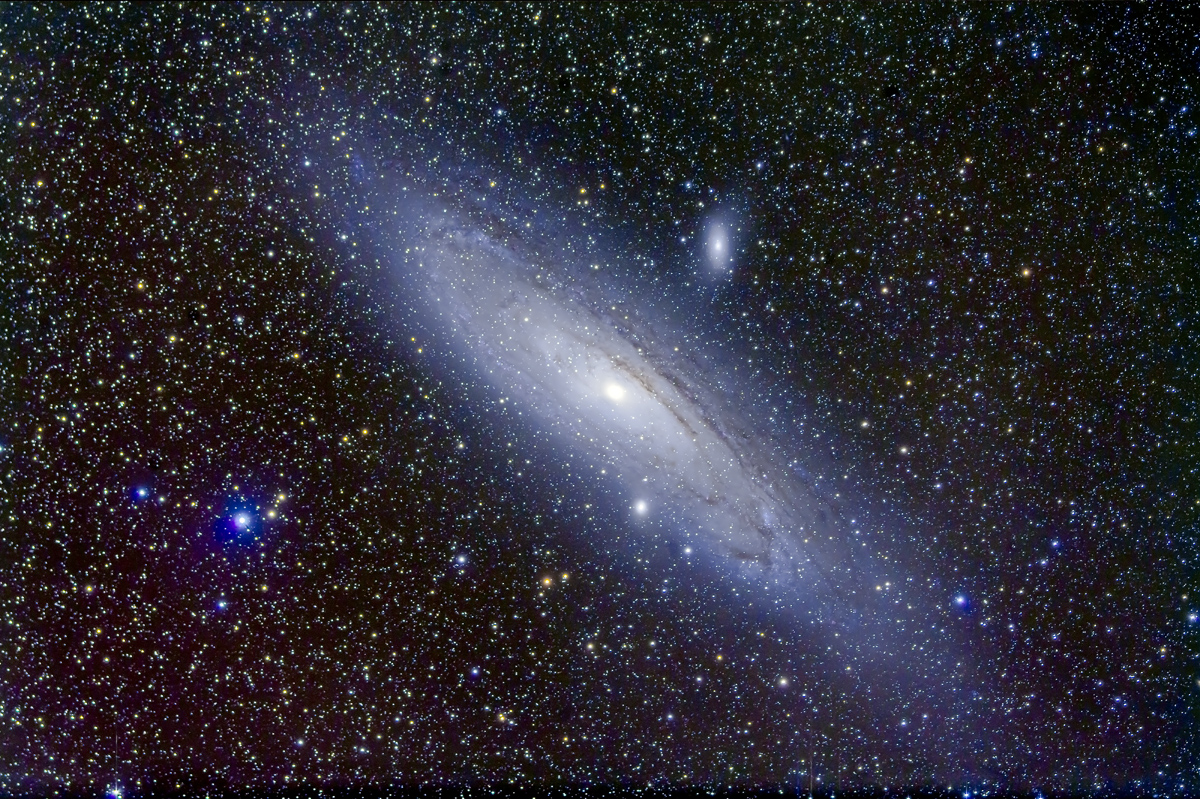
At bottom is the elliptical glow of the Andromeda Galaxy, another “milky way” beyond ours.

I boosted the contrast and colour more than I normally do for astrophotos, to punch out the nebulas and the subtle dark lanes of dust that permeate this part of the Milky Way. I shot this last weekend from the star party in Cypress Hills, Saskatchewan. With three clear nights it was a productive weekend!

– Alan, August 26, 2012 / © 2012 Alan Dyer

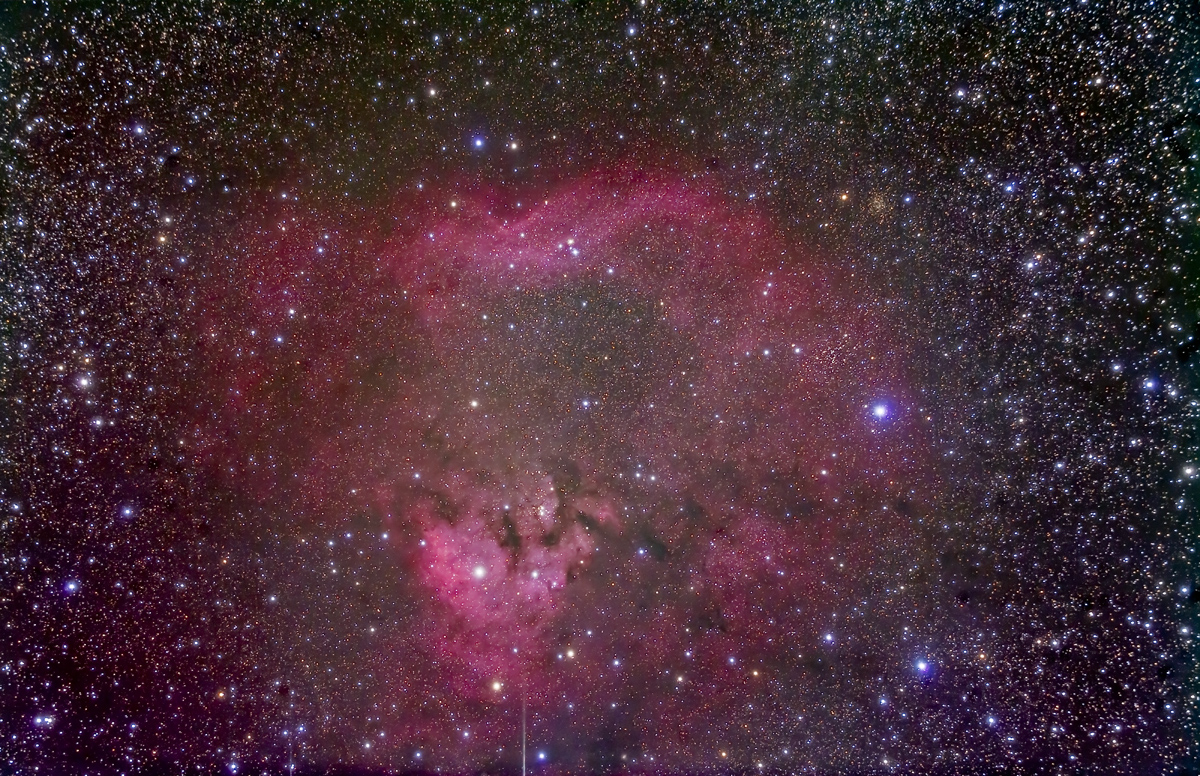
The Subtle Shades of Cepheus


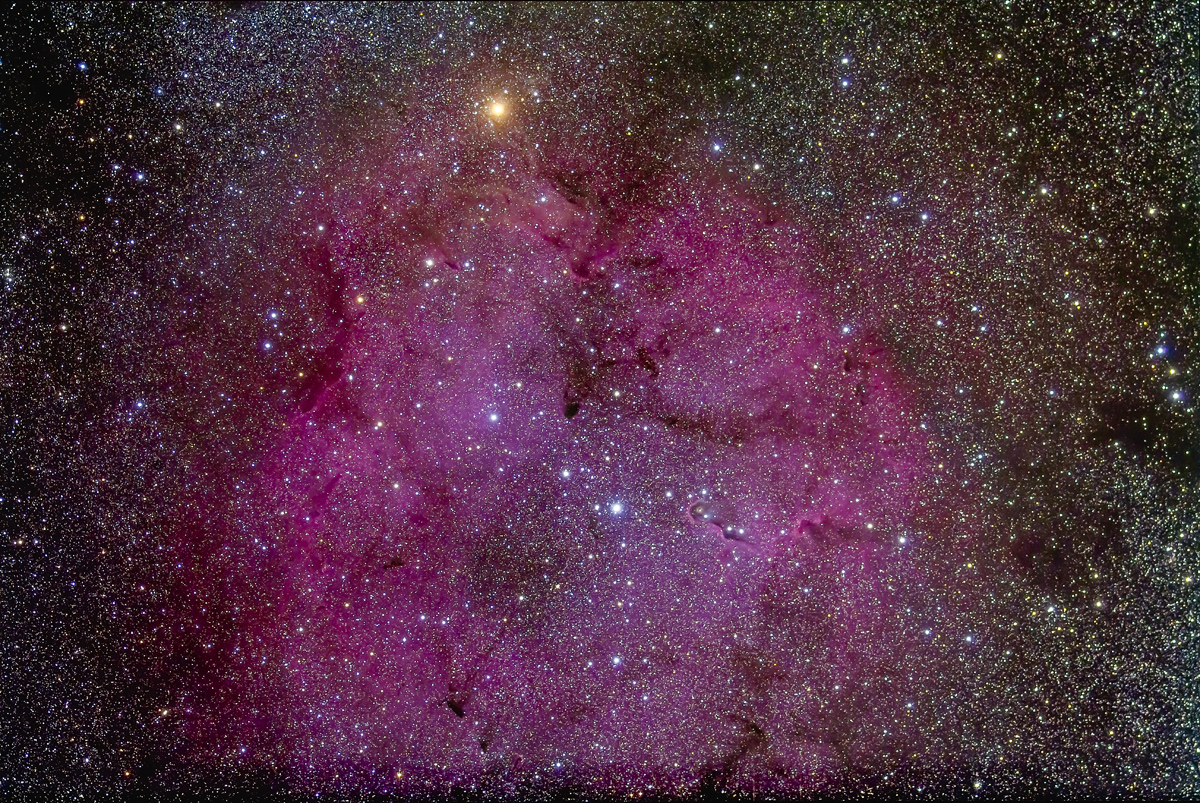
The Milky Way in Cepheus presents a palette of colours revealed in long exposures.

This binocular-sized field contains the large magenta nebula IC 1396, a site of star formation. On its northern (upper) edge shines the orange star Mu Cephei, otherwise known as Herschel’s Garnet Star, for its very red appearance in the eyepiece. It is a bloated red supergiant, one of the largest stars known. A few other stars in the field are younger blue giants. Faint wisps of red hydrogen fill the field (the faint crescent at right is Sharpless 129, left of centre is Sharpless 132, at top left is NGC 7380). Diagonally along the Milky Way lie dark, yellow-tinted dust clouds. The darkest patch at centre is the Barnard 169/170/171 complex. These contrast with the dust-free blue starfields of the Milky Way at left.

This is a stack of five 5-minute exposures with the 135mm telephoto and Canon 5D MkII camera, which has been filter modified to record the faint red nebulas better than a stock camera.

– Alan, August 25, 2012 / © 2012 Alan Dyer


Star Gazing


Happiness is a big telescope under a dark sky.

This is Regina astronomer Vance Petriew, gazing skyward at the Milky Way in Cassiopeia. Vance is the discoverer of Comet 185/P, aka Comet Petriew. This year, his comet returned to the August sky as a faint glow in Gemini, close to where it was when Vance found it exactly 11 years to the day before this image was taken, and at the very same spot in the campsite at Cypress Hills Interprovincial Park in Saskatchewan.

We all revelled in the Saskatchewan comet’s return, staying up till 4 am to see it through Vance’s 20-inch telescope, a reflector made by the small company called Obsession. (When you have an Obsession, you are a serious observer!) Enjoying the view early that morning before dawn were  Vance’s three daughters, only one of whom was around 11 years ago and then as a baby. But this year even the four-year-old was able to see Dad’s comet up close.

At the afternoon talks Vance recounted the story of how the comet’s discovery changed his life, and led to immense changes at the Park. As a result of the media and political attention the comet brought, the Park has become a Dark Sky Preserve, one of the first in Canada, leading a nationwide movement, while astronomy programming is now an integral part of the Park’s interpretive programs, as it is becoming at other provincial and national parks. There is now a permanent public observatory and lecture hall nearby in Cypress Hills, just a short walk away from where the comet was found.

Comets can have quite an impact!

— Alan, August 24, 2012 / © 2012 Alan Dyer

Horizon to Horizon Milky Way


The view doesn’t get any wider than this. This fish-eye image takes in the entire night sky and summer Milky Way.

I shot this last weekend at the Saskatchewan Summer Star Party in Cypress Hills. Red lights of observers streak along the horizon around the perimeter of the circular image. At centre is the zenith, the point in the sky straight overhead.

The sky was very dark, but the sky close to the horizon is tinted with the faint glows of aurora and airglow.

The Milky Way is the main feature of the summer sky, here stretching from Sagittarius in the south at bottom to Perseus at top in the north. Wide shots like this really put the giant lanes of dust into proper context; you can see their full structure and faint tendrils extending well off the Milky Way band.

For these fish-eye shots (suitable for projection in a planetarium) I used a Sigma 8mm fish-eye lens and a full-frame Canon 5D MkII camera. This is a stack of five 5-minute exposures, all tracked. The landscape is from just one of the images, to minimize blurring of the ground.

— Alan, August 23, 2012 / © 2012 Alan Dyer

The Dark Clouds of Cygnus


Stare into the starfields of Cygnus and ponder what lies undiscovered in our part of the Milky Way.

You are looking down the spiral arm we live in, into clouds of stars seemingly packed together. Every one of those specks is a sun like ours. With planets? Very likely, as we now know.

Amid the stars float glowing red clouds of hydrogen gas. The North America Nebula shines at lower right.

Snaking northward from the “arctic” region of the bright nebula is a river of dust that broadens into a delta of dark nebulosity. Once thought to be holes in the sky allowing us to see deeper into space, we know now that these dark nebulas are really foreground dust clouds filled with the soot of dying stars, carbon dust that absorbs starlight and obscures the more distant parts of the Milky Way.

This dust cloud is called Le Gentil 3, named for the 18th century French astronomer who first noted its position in the sky. Le Gentil’s dust cloud is one of the easiest features of the summer Milky Way to see. Look north of Deneb, the bright star at the right of the image, and with the unaided eye on a dark moonless night you’ll see what looks like a dark hole in the Milky Way. That’s Le Gentil 3.

I use this dust cloud as a measure of sky brightness. On a truly dark night, Le Gentil 3 looks darker than any other area of sky, even relatively starless regions off the Milky Way. Most of the sky brightness we see from a dark site is really starlight. But Le Gentil’s proximity and opaqueness makes it appear darker than the more distant starlit sky background.

This image covers about the width of a binocular field. I shot it from the Cypress Hills in Saskatchewan this past weekend, using the Canon 5D MkII at ISO 1600 and Canon 135mm telephoto lens at f/2.8. It’s a stack of 10 five-minute exposures.

— Alan, August 22, 2012 / © 2012 Alan Dyer

A Convergence of Worlds in the Sky


The evening planet show we’ve been enjoying all year comes to a close for a while, but in grand style with a convergence of four worlds in the dusk.

This was the scene from my front driveway, Tuesday, August 21, as the waxing crescent Moon shone near Mars (just above the Moon) and Saturn (at top right just above the clouds), and near the star Spica (to the right of the Moon). The four objects formed a somewhat lopsided square in the evening twilight. But from my latitude of 51° North, they were very low and never visible in a dark sky. Enjoying them with the eyes required binoculars to pick them out.

Saturn will disappear behind the Sun shortly, but Mars hangs around in the evening sky for a few more months, but always low and easy to miss.

— Alan, August 21, 2012 / © 2012 Alan Dyer


Lost in the Milky Way


Just lie back and lose yourself in the Milky Way.

That’s what one person is doing here, under the starry skies of Cypress Hills, Saskatchewan. In summertime the Milky Way is the main attraction at night. Here, it rises from the south, a region containing the centre of our Galaxy in Sagittarius, to climb up overhead through the star clouds of Scutum and Aquila, then into Cygnus in our local spiral arm, and on into Cassiopeia at the top of the frame in the north.

As in most deep sky photos, I’ve boosted the contrast and colour to make a dramatic image. To the eye the Milky Way appears in subtle shades of grey painted with the dark brushstrokes of dust lanes winding through the bright clouds of stars. But your eye does see much of this structure.

I like these types of ultra-wide images. They capture the mind’s eye impression of what the Milky Way looks like across the vault of heaven.

This is a stack of four 5-minute exposures, all tracked on a small equatorial mount, the Kenko SkyMemo, and all taken with the Canon 5D MkII at ISO 800 and Canon’s ultra-wide 15mm lens at f/4, as you can see from the photo data at left. I retained the ground from just one image, to minimize the blurring from the slowly moving camera tracking the stars. I masked out the ground in the other 3 images. They help smooth out noise in the sky.

— Alan, August 21, 2012 / © 2012 Alan Dyer

Star Party Panorama


This image depicts a 360° panorama of the field and sky at the Saskatchewan Summer Star Party.

This was my first time shooting a nighttime panorama but it was easy. Just 12 exposures taken at 30° intervals panning around on a levelled tripod, in classic planetarium panorama style. Each exposure was 30 seconds at f/2 and ISO 3200 with the Canon 5D MkII and 24mm lens. It helps to have a high-quality fast lens.

North is at centre, south on either end.

The sky contains some interesting and subtle features that show up well in a wide-angle panorama like this:

– The bright summer Milky Way is setting at left in the southwest while the fainter winter half of the Milky Way is rising opposite, at right in the northeast.

– Jupiter and the Pleiades rise at right just off the Milky Way

– A meteor streaks over the trees at centre

– At centre, to the north, glows a faint yellow and magenta aurora

– The larger green glow left of centre is, I suspect, airglow rather than aurora. It has a striated structure, particularly at right of centre above the trees where it appears as subtle green and red bands arching across the northeast.

The sky this night was dark but did have a brighter than usual background, likely due to the presence of this faint airglow that the camera picks up better than the eye.

Even so, I can see another faint glow:

– A whitish band coming up from the northeast passing through Jupiter and below the Pleaides. That’s the Zodiacal Band, an extension of the brighter Zodiacal Light and caused by sunlight reflecting off cometary dust in the ecliptic plane.

The location of the panorama and star party was the Cypress Hills Interprovincial Park in southwest Saskatchewan, one of the darkest places in southern Canada.

— Alan, August 20, 2012 / © 2012 Alan Dyer

Party Under the Stars


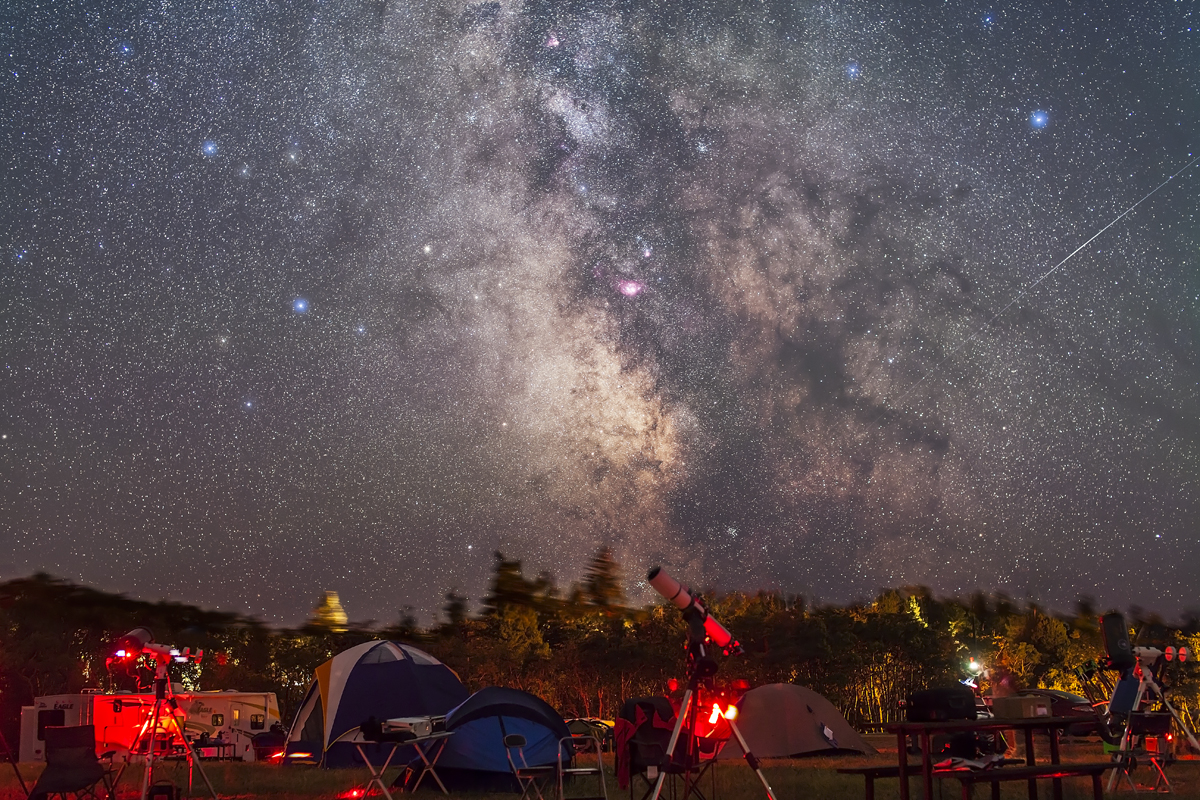
For astronomers this is party central – under the starclouds of the summer Milky Way.

Over the past weekend, August 16-18, I attended the annual Saskatchewan Summer Star Party, held in the Cypress Hills of southwestern Saskatchewan. Skies could not have been better.

This was the scene Friday night, with telescopes under the Milky Way. About 350 people attended, and nearly as many telescopes it seemed! This is one small section of the observing and camping field.

Cypress Hill Park has been declared a Dark Sky Preserve, in recognition of the Park’s role in preserving and presenting the dark skies that are as much a part of our natural world as are the flora and fauna of the Earth. Every year astronomers converge on the Hills to revel in their pristine skies … and party – quietly! – under the Milky Way. Wandering the field you could overhear “Hey, look at this!”, “Wow!”, “O-o-o-h!”, “I found the __ nebula!” and many more exclamations of joy and wonderment.

My image is a composite of a single untracked exposure for the sharp foreground and a stack of 5 tracked exposures for the sky and Milky Way. All were 2 minute exposures, taken moments apart. Boosting the contrast makes the Milky Way stand out with far more detail and colour than the eye can see. Nevertheless, the Milky Way was a grand sight and the main attraction over the Cypress Hills this past weekend.

– Alan, August 19, 2012 / © 2012 Alan Dyer

Little Schoolhouse Under Prairie Skies


There aren’t many left now. Here on a bare prairie hilltop near where I live stands one of the last of the one-room schoolhouses.

Located near the now-vanished town of Majorville, Alberta is the Liberty School, built in 1909. I tried to look up the history of this particular school but found only references to other similar schools in the area. The stories from teachers who worked in such schools were fascinating. Amy Corbiell, a relative of one of my neighbours, taught at a nearby school in the 1930s. Imagine the scene on the prairies back then:

“Some days when the dust blew I remember it got so dark the pupils couldn’t see to work. I would light our one little coal-oil lamp and read to them until I could safely send them home.”

The lone teacher would live either in the home of one of the students. Or she would be put up in what we would now call a shack – the teacherage – next to the school. She would attend to the students ages 6 to 16, keep the pot-bellied stove going, bring in water from the hand pump outside, perhaps play the piano (if there was one), and organize the big annual Christmas concert. There might be a barn nearby for the kids to shelter their horses. Yes, they really did ride to school each day. It was a hard life by today’s soft standards.

But as Helen Courtney, another teacher from the era, remarked in her reminiscences,

“The 1930s are remembered as the depression years, the years of crop failures, and blizzard-like dust storms. They were also the times when neighbours helped neighbours, people shared what they had, extended kindness and friendship and looked hopefully toward a better future.”

My photo, taken under bright moonlight on August 4, shows the Big Dipper over the little schoolhouse, and a summer thunderstorm rolling across the far horizon.

— Alan, August 15, 2012 / © 2012 Alan Dyer


Planetary Dawn


This was the stunning scene in the dawn sky last Sunday — Venus, the Moon and Jupiter lined up above the Rockies.

Orion is just climbing over the line of mountains at right, while the stars of Taurus shine just to the right of Jupiter at top. I shot this at the end of a productive dusk-t0-dawn night of Perseid meteor photography. Being rewarded with a scene like this is always a great way to cap a night of astronomy.

— Alan, August 15, 2012 / © 2012 Alan Dyer


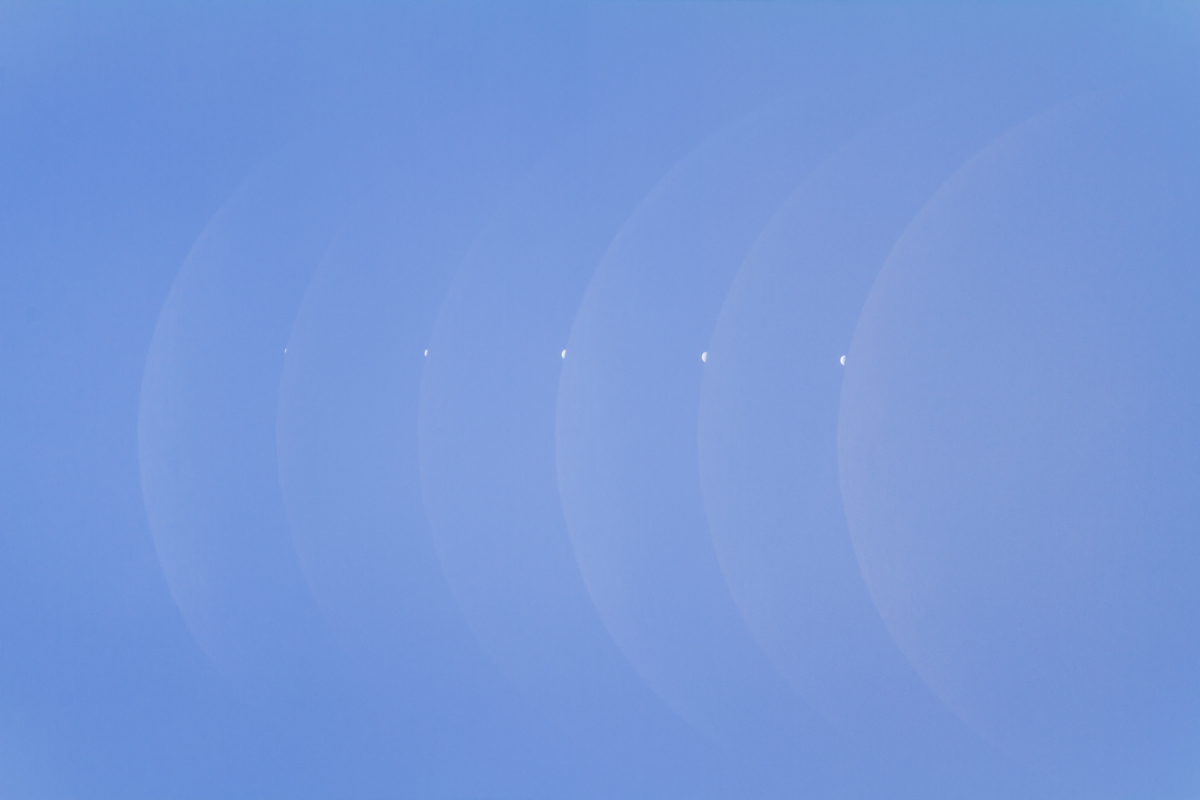
Venus Disappears


On the afternoon of Monday, August 13 the waning crescent Moon slid in front of Venus in broad daylight. This sequence captures the disappearance.

It was touch and go getting this as high cloud kept moving through. A few minutes earlier the Moon and Venus were in clear blue sky, but at the time of the occultation, haze whitened the sky and cut down the  contrast on an event that takes a telescope to see well. When the sky was clear it was easy to sight the Moon with unaided eyes and therefore focus your eyes on infinity. Venus next to the Moon popped into view, even naked eye. It was a rare chance to easily sight Venus in the daytime. But as it got close to the Moon Venus became harder to see naked eye, and the haze then made it impossible. But through a telescope it was just the opposite — Venus’s bright disk stood out even when the Moon was washed out and invisible.

For southern Alberta the occultation took place at 2:11 pm MDT. I missed seeing it emerge from behind the Moon. I was already inside processing this image.

It has been quite a year for Venus. It’s not over yet, as Venus continues its morning show and has close encounters with the Moon and the star Regulus this autumn.

— Alan, August 14, 2012 / © 2012 Alan Dyer

Shooting Through the Stars


Two bright meteors streak across the circling stars on the peak night of the Perseid meteor shower.

Of course, as is typical of bright meteors, the really bright one, the night’s best, I missed by that much! It shot off camera toward the west. But I got most of it. When shooting meteor showers you just aim and shoot and hope for the best. With luck some meteors will decide to shoot through the camera field when the shutter is actually open — they often appear just after the shutter closes.

This is a stack of nine 1-minute exposures in rapid succession, with two frames managing to pick up a bright meteor each. Over the nine minutes of exposure time the stars trailed as they rose in the east and circled Polaris at top left.

For this sequence I set up in Banff National Park at the picnic area at the Upper Bankhead parking lot at the base of Cascade Mountain, looking east toward the constellation of Perseus and the radiant point of the meteors — Perseids all appear to shoot out of Perseus, the bright collection of stars at centre.

— Alan, August 13, 2012 / © 2012 Alan Dyer

Perseid Meteors and Planets over a Mountain Lake


It was quite a night, and a wonderful dawn. This was the scene at the end of a night of falling stars.

A trio of Perseid meteors zips down at left, while at right a trio of solar system worlds rises into the pre-dawn sky. The overexposed waning Moon is flanked by Jupiter above and Venus below. Jupiter shines near the Hyades star cluster and below the Pleiades cluster.

I took this shot (it is actually a composite of three shots, each with its own meteor) on the morning of Sunday, August 12 on the peak night of the annual Perseid meteor shower, widely publicized this year due to the lack of a Moon for most of the night, and the convenience of falling on a weekend. The scene is looking east over Lake Minnewanka in Banff National Park, Alberta, one of the few places in this part of the Rockies you can look east to a reasonably unobstructed sky.

Notice the glitter path on the water from not only the Moon but also Venus.

— Alan, August 13, 2012 / © 2012 Alan Dyer

A Cloud of Stars in Scutum


This is a binocular-sized gulp of sky in the northern summer Milky Way. Countless stars form a bright patch in the Milky Way called the Scutum Starcloud, named for the odd little constellation of Scutum the Shield that contains it.

Visible to the naked eye, this star cloud is a rich area for binoculars or a small telescope. One favourite object of stargazers lies embedded in the star cloud and can be seen here as a bright clump of stars at left of centre. That’s the Wild Duck Cluster, or Messier 11, a dense and populous cluster of stars within the already star-packed Scutum Starcloud. Look in this direction into the Milky Way and you are looking toward the next spiral arm in from ours, some 6,000 light years away.

The immensity of stars in just this small area of sky is hard to fathom. That’s why it’s called deep space!

– Alan, August 9, 2012 / © 2012 Alan Dyer


Continent in the Sky


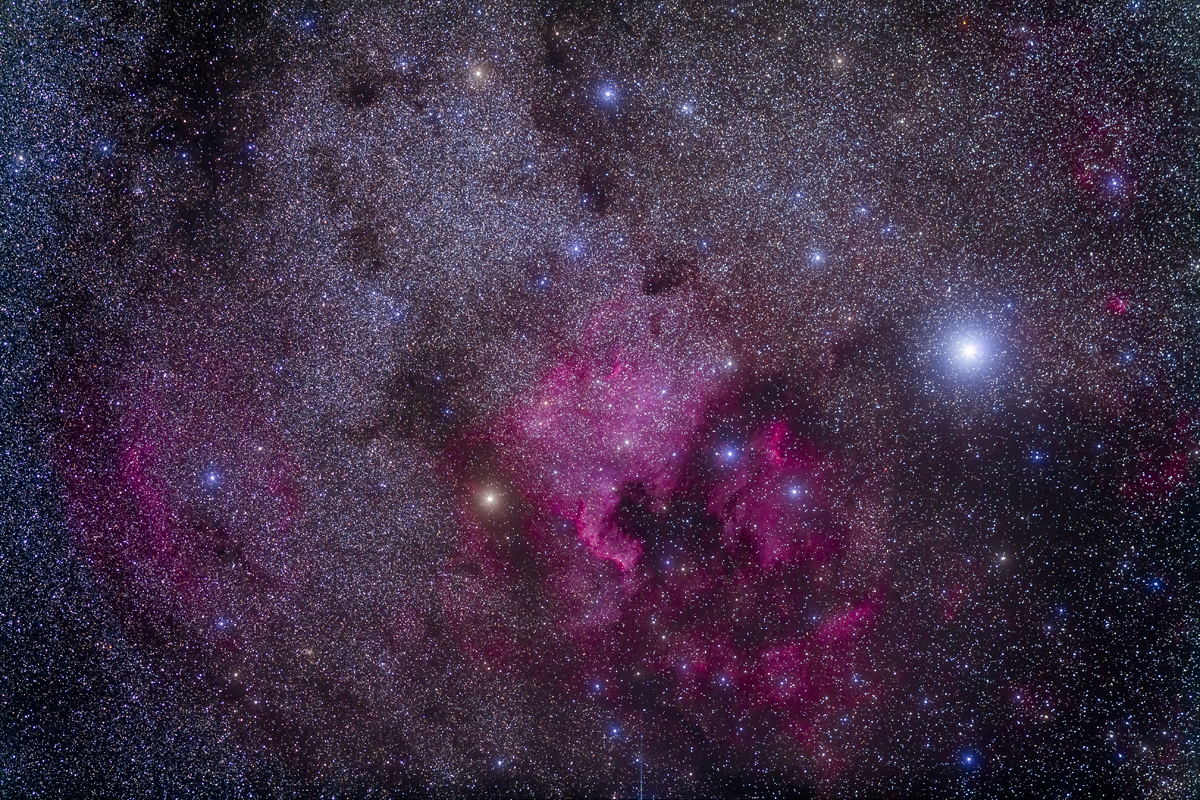
Shining overhead on northern summer nights right now is the blue supergiant star Deneb, in Cygnus. Nearby glow the magenta clouds of the North America Nebula.

This image shot with a telephoto lens takes in roughly the same field of view as a pair of binoculars. But being a long time exposure it reveals much more of the faint nebula than even the aided eye can see. However, even binoculars will show a greyish cloud near Deneb in roughly the shape of North America. It is actually a continent of stars and hydrogen gas, glowing with hydrogen’s characteristic magenta colour, a mix of deep red and blue emission lines. The gas may be electrified into glowing by the searing radiation from the star Deneb, some 1400 light years away from Earth.

I shot this on a July night, with some haze passing by during some of the exposures. The haze added the photogenic glows around the stars.

— Alan, August 8, 2012 / © 2012 Alan Dyer

Driving to Andromeda


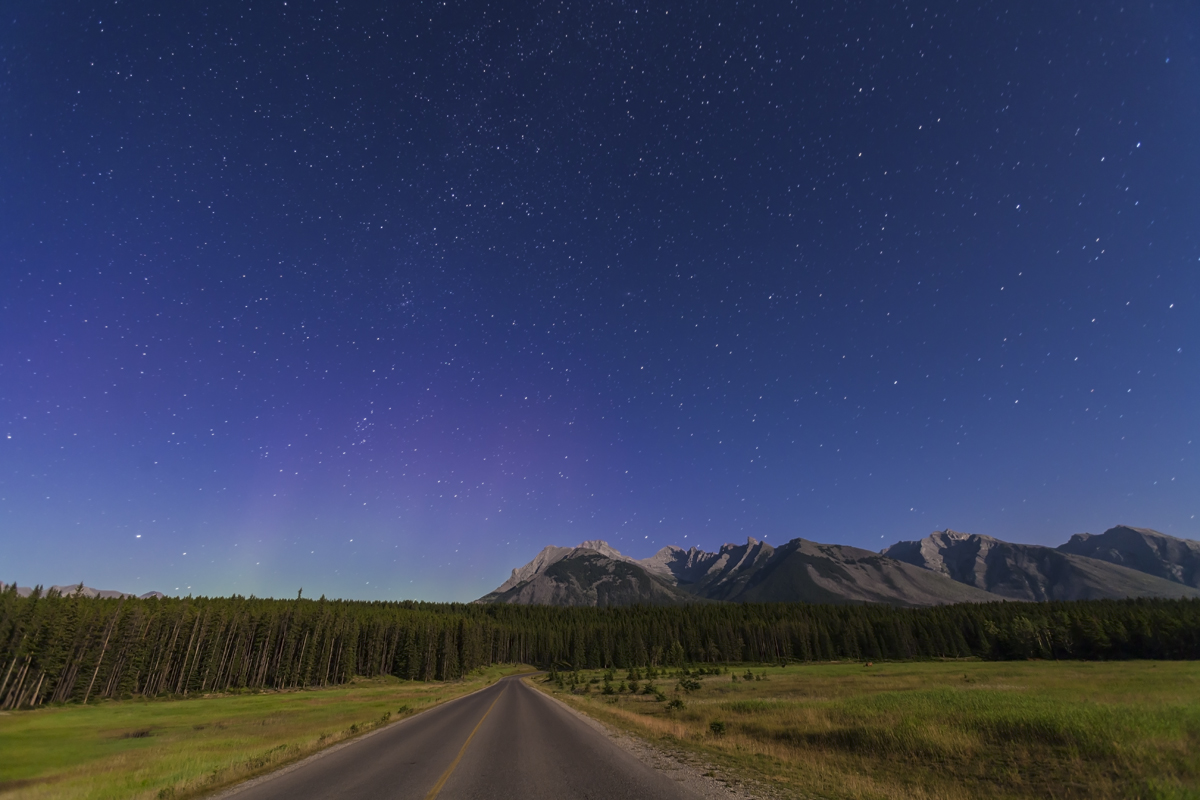
Are we there yet? It would take a long time to get to the end of this road.

A road in Banff appears as if it is heading toward the autumn constellations rising over the peaks of the Fairholme range in the Canadian Rockies. The stars of Andromeda (centre), Pegasus (right), Perseus (left), and Cassiopeia (above left) make up the panorama of mythological heroes populating the northern autumn sky. In the sky above the road the small smudge of the Andromeda Galaxy is visible, shining from 2.5 million light years away. A faint aurora at left adds to the moonlit scene.

I shot this Sunday, July 29, moments after taking the image in the previous blog, which was looking the other way, north toward Cascade Mountain, from the meadows north of Banff. This was a very photogenic spot.

— Alan, August 4, 2012 / © 2012 Alan Dyer


Moon over Banff


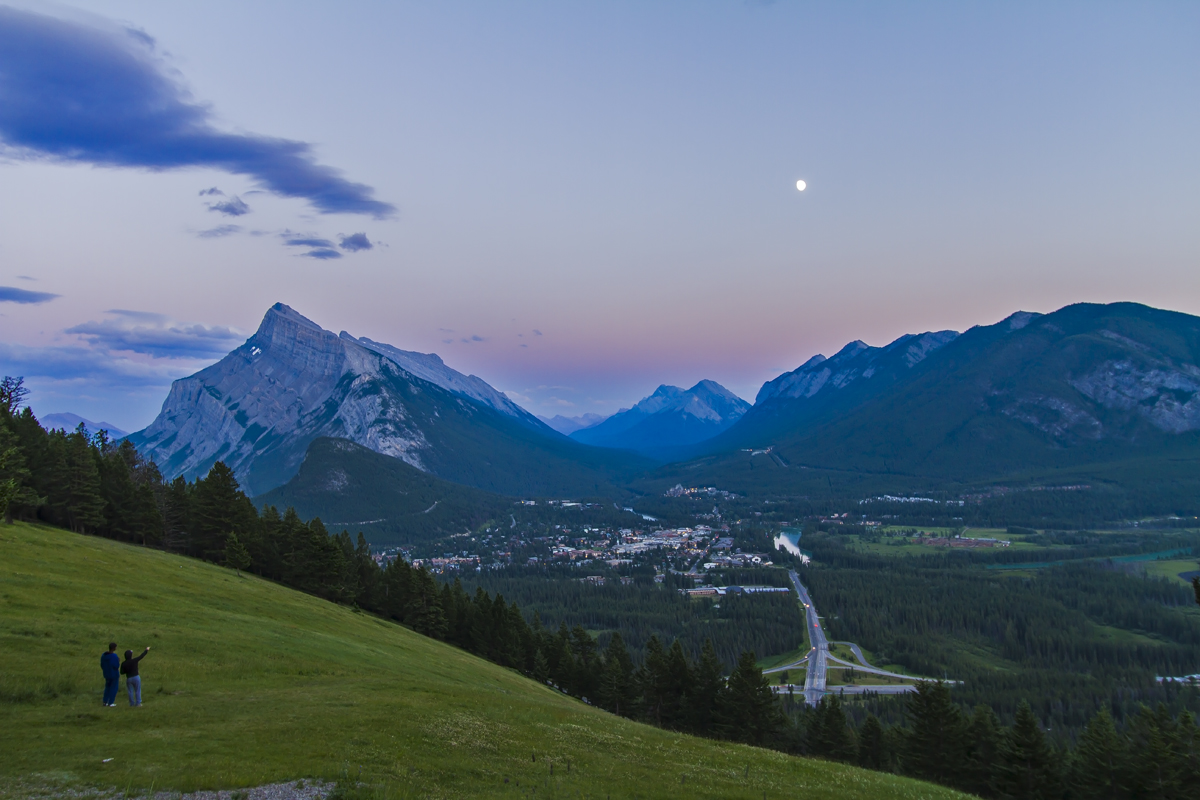
This was the scene Sunday evening, July 29 with the gibbous Moon shining over Banff, Alberta.

I shot this from the viewpoint on Mt. Norquay overlooking the town of Banff, a favourite evening spot for tourists. Two just happened to wander into the scene and point at the Moon right on cue.

The mountain at left is Mt. Rundle; at right is Sulphur Mountain with its Gondola lift and hot springs, the “spa” attraction that created Banff in the 1880s and inspired the CP Railroad to build its famous Banff Springs Hotel, here in the distance on the far side of the town and still the posh place to stay when in Banff.

— Alan, August 3, 2012 / © 2012 Alan Dyer


Stars over Cascade Mountain, Banff


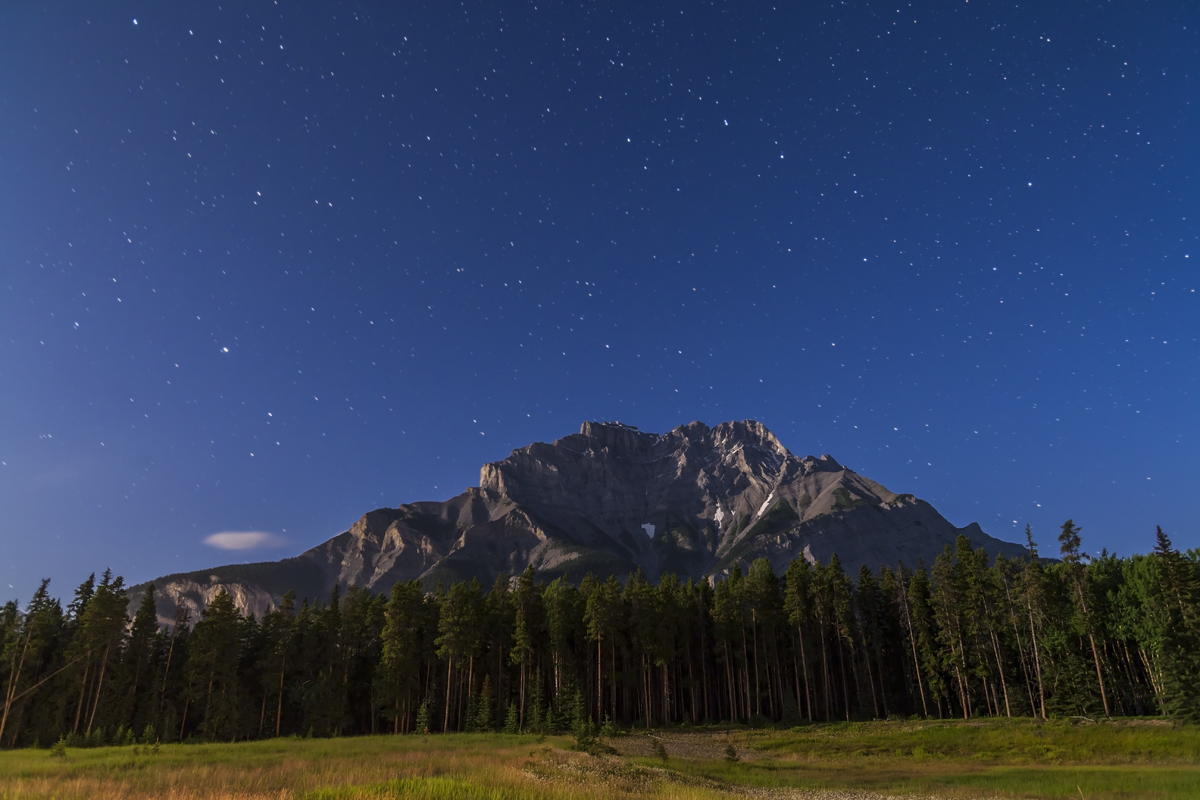
Last Sunday night I was in Banff for a concert at the Banff Centre but ended the night with a round of nightscape shooting near the town.

I shot this from the Lake Minnewanka scenic loop road just north of the townsite. It captures the Big Dipper and Arcturus swinging down over Cascade Mountain, the iconic peak that stands as the background for so many photos of Banff. Moonlight provided ideal side-lighting.

I hope to head back to this area for next weekend’s Perseid meteor shower. The weather prospects look good!

— Alan, August 3, 2012 / © 2012 Alan Dyer


Circling Stars over Pyramid Mountain


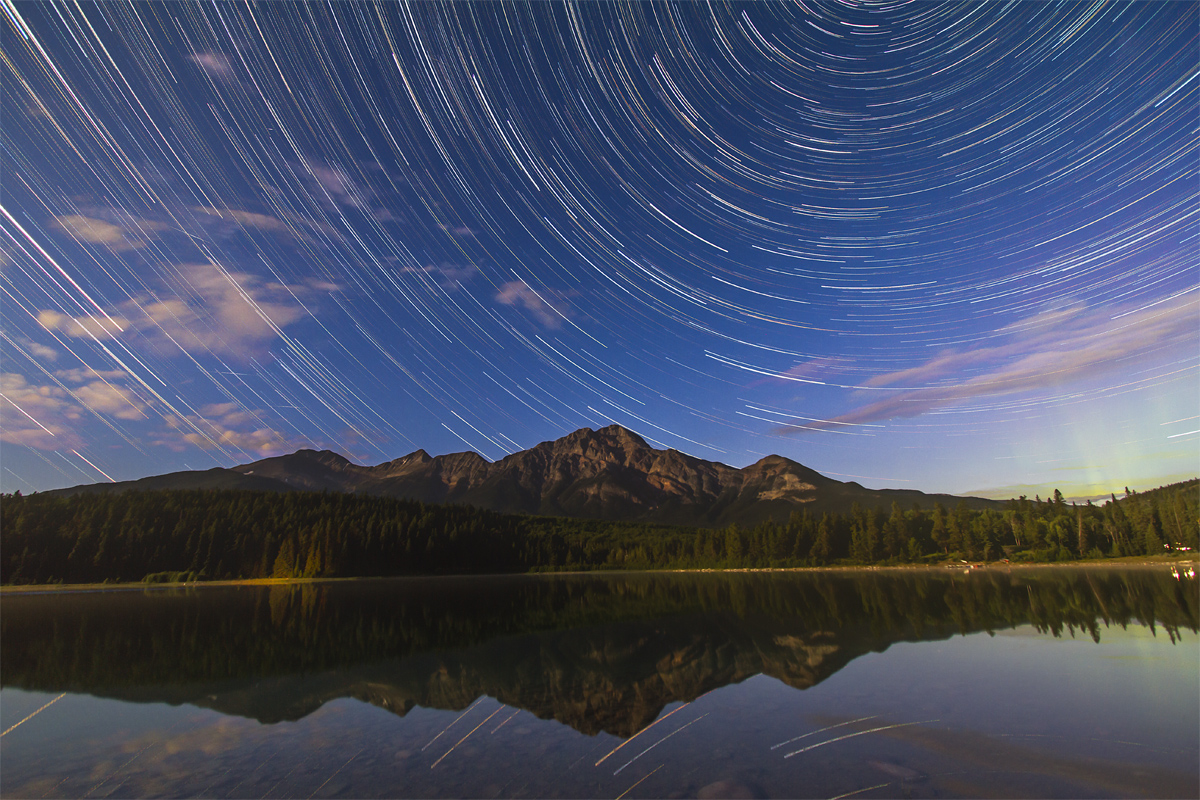
The previous post showcased one image taken last Saturday night at Patricia Lake. This is a composite of 98 such frames, producing an image of stars circling the sky.

This is the motion of the northern sky over 75 minutes, as the Big Dipper and other circumpolar stars arc around the celestial pole, just off camera here. A few faint meteors streak at left. And the makings of an aurora appears at right.

Each exposure was 45 seconds long. I used a Photoshop Action to automatically select each frame in turn and stack it on top of the previous image, then change the blend mode to Lighten and flatten the layers. The end result of the computer crunching away is an image that recreates what we used to achieve with film, by stopping down the lens and exposing a slow ISO film for an hour or more onto one frame.

I last shot this same scene a decade ago with just that technique and Fuji Velvia film, a favourite of mine back then for star trails. But these days shooting multiple short exposures digitally provides the advantage of also netting a folder-full of images suitable for a time-lapse movie, something we could never do with film cameras, unless they were modified movie cameras. I like DSLRs better.

— Alan, August 1, 2012 / © 2012 Alan Dyer

The Big Dipper Over Pyramid Mountain


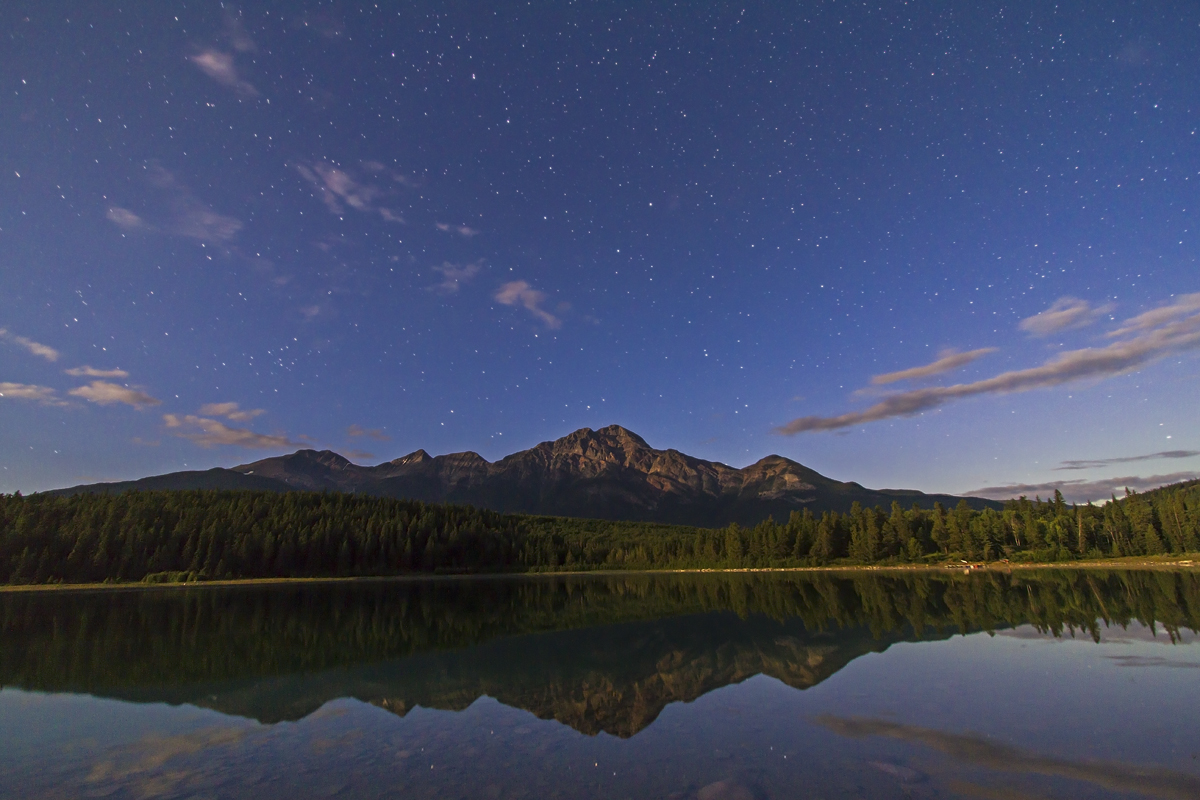
Pyramid Mountain is Jasper’s iconic peak dominating the skyline of the mountain town in Alberta. The mountain and its foreground lakes are ideally placed for nightscapes of the northern sky.

I took this shot Saturday night, July 28, from the shore of Patricia Lake, one of several that dot the benchlands south of Pyramid Mountain. Small lakes like Patricia have the benefit of often being calm and reflective. Here the stars of the Big Dipper and Ursa Major swing over top of Pyramid Mountain, in the blue moonlit sky. A few well-placed clouds add a welcome perspective. This is one frame of 150 or so in a time-lapse sequence, and that will eventually become a star trail composite as well. But this single frame stands well all on its own.

The last time I was here shooting this same scene I was using Ektachrome and Fujichrome film (each had its unique characteristics, though just what I can’t recall!). That was more than a decade ago. This digital shot with the Canon 7D looks far better than what I got back then.

— Alan, July 30, 2012 / © 2012 Alan Dyer


Lunar Reflections at Lac Beauvert


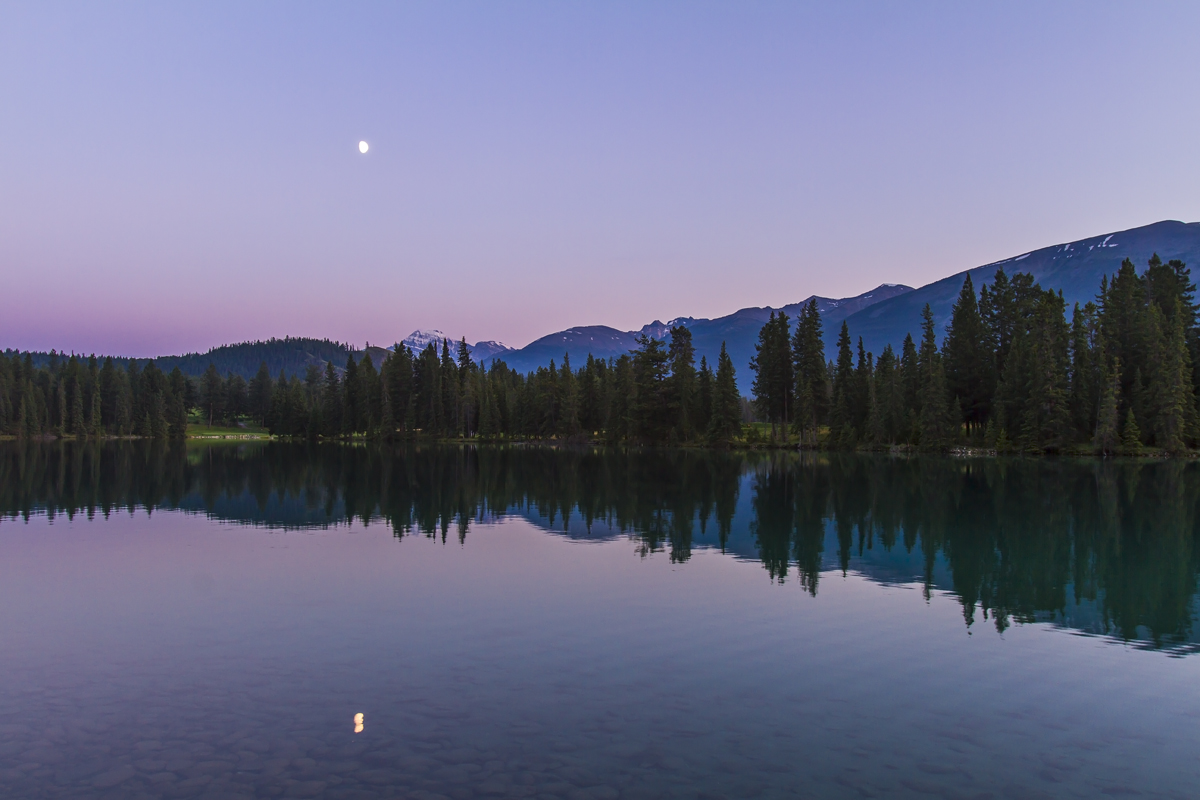
After a day of cloud and rain, skies cleared to provide a stunning twilight scene of the Moon reflected in the calm waters of Lac Beauvert in Jasper National Park.

This is the view from the dock at the prestigious and posh Jasper Park Lodge, where the rich and famous stay when in Jasper. I was there just to shoot the sky. In the distance is the distinctive snow-covered peak of Mount Edith Cavell, a Jasper landmark. Above it shines the waxing gibbous Moon in the twilight colours.

— Alan, July 30, 2012 / © 2012 Alan Dyer


Athabasca Falls by Night


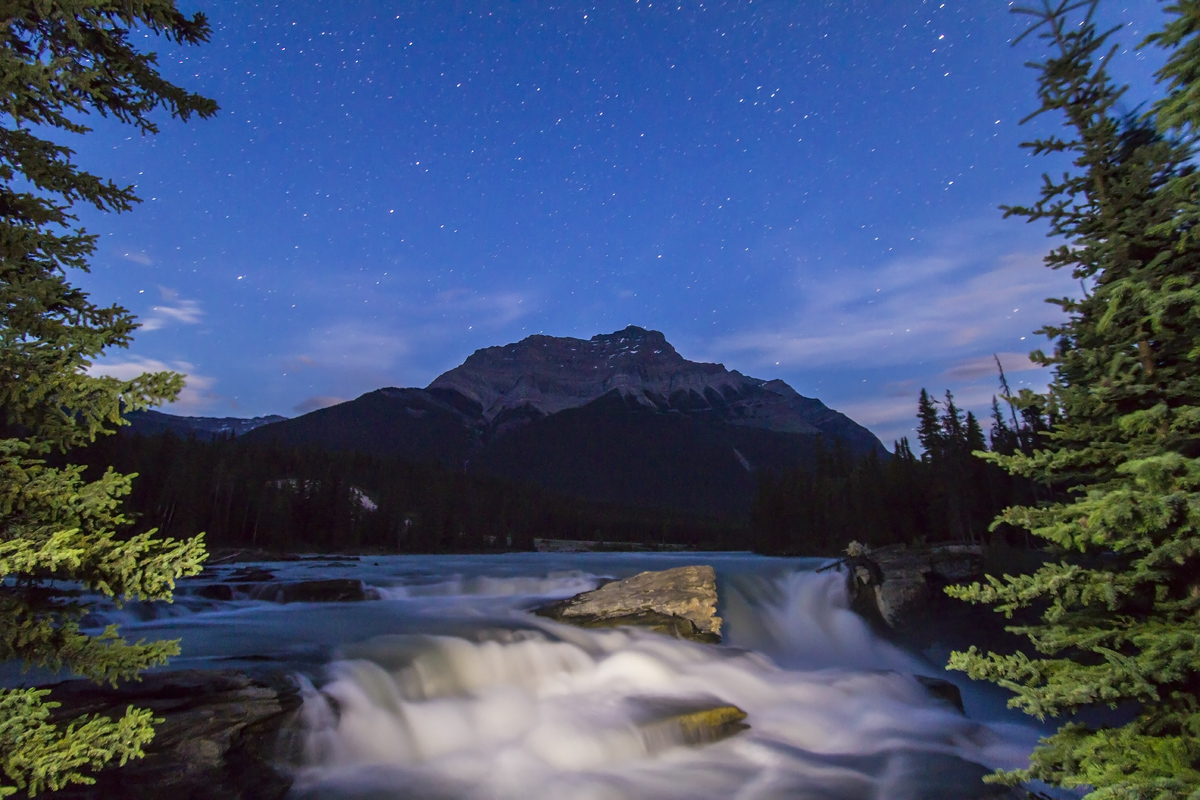
Athabasca Falls is one of the most popular and photographed attractions in Jasper National Park – by day. But by night, the falls on the Athabasca River are deserted.

In the distance, the stars rise behind Mount Kerkeslin. In the foreground, the river plunges into a deep gorge. These waters, with headwaters at the Columbia Glacier in the Icefields to the south, eventually make their way north to the Arctic Ocean.

I was at the Falls last Friday night, to shoot them by moonlight and under the stars. But in this case, I provided added foreground illumination from a flashlight.

As I took this and other shots, flashes of lightning from nearby thunderstorms occasionally lit the night. I had a couple of hours of clear skies before clouds moved in for the night, enough time to get frames for a time-lapse movie and some still frames like this one.

— Alan, July 30, 2012 / © 2012 Alan Dyer

Athabasca Moon


I’ve spent the last couple of night in Jasper National Park, home to the world’s largest Dark Sky Preserve, dedicated to maintaining the darkness of the natural night sky.

This is a scene from Friday night, taken well before darkness, as the waxing Moon shone in the twilight above the Athabasca River and the peaks of the continental divide. For many years in the early 19th century fur traders plied these waters. Now rafters do.

Jasper is far enough north of me that I don’t get there very often. I’ve been spending most of my mountain time in Banff. I realize it’s been a decade or more since I’ve driven all the way up the Icefields Parkway to visit Jasper. But I was happy to be back. It has some great sites for nightscape photography.

I got two clear nights this past weekend, so a few more shots will hit the blog in the next few days.

— Alan, July 29, 2012 / © 2012 Alan Dyer


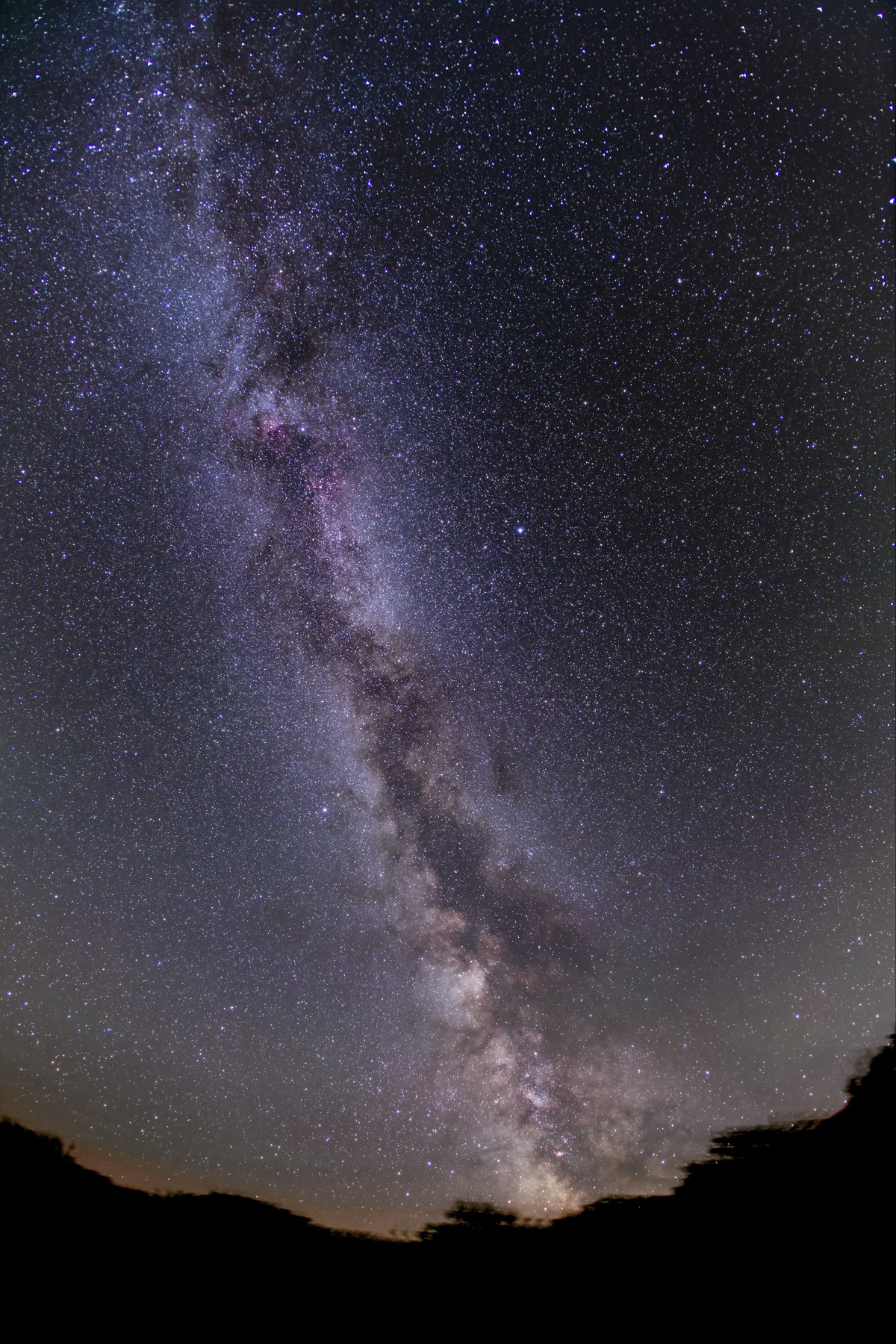
A River of Starlight and Dust


Look up on a dark summer night in the northern hemisphere and you see a river of stars flowing across the sky.

This is the Milky Way, a glowing mass of millions of distant stars populating the spiral arms of the Galaxy we live in. Lining the arms are lanes of dark interstellar dust, seen here splitting the Milky Way in two from the bright red North America Nebula at top, down to the core of the Galaxy in Sagittarius on the horizon. The dust is the soot created in stars and blown into space to form a new generation stars and planets.

This ultra-wide-angle scene takes in almost the entire summer Milky Way from the southern horizon to beyond the zenith overhead at top. I shot this a couple of nights ago from my rural backyard on a particularly transparent and dark night. It was heaven on Earth.

— Alan, July 26, 2012 / © @ 2012 Alan Dyer


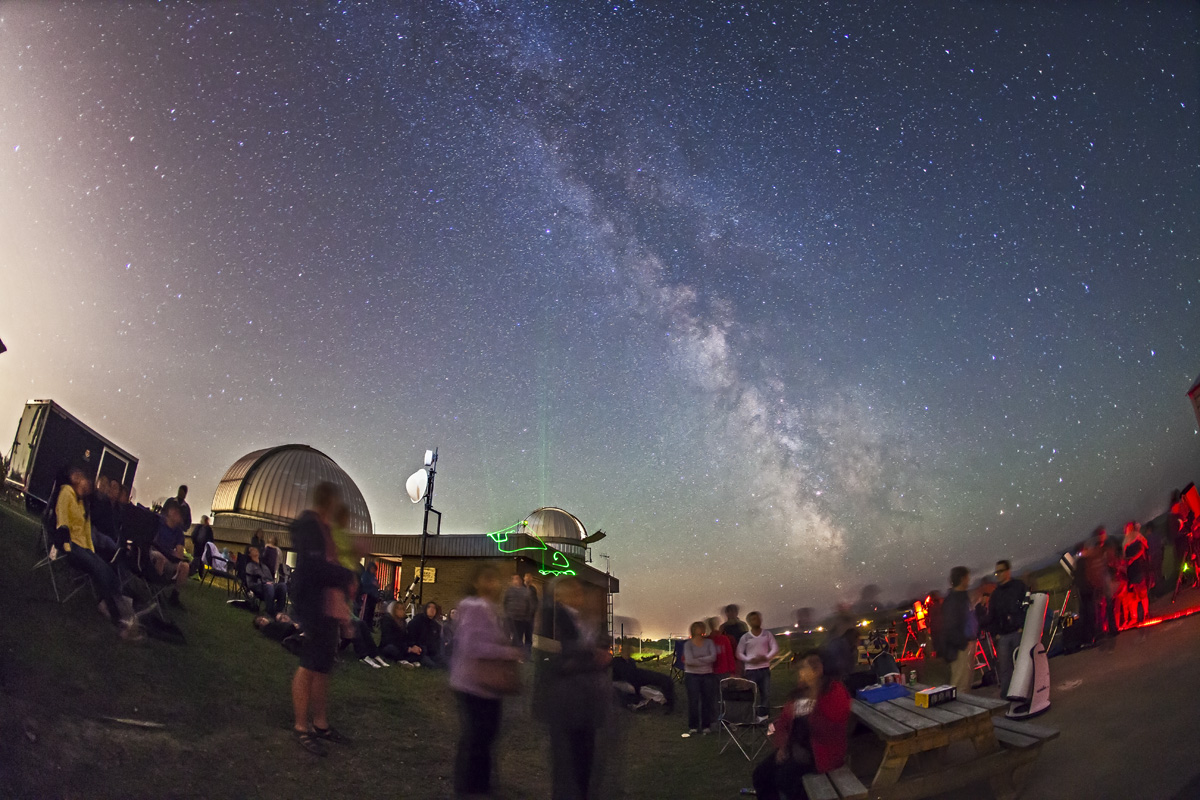
Under the Milky Way


What a marvellous night for the Milky Way. The sky was clear and the night warm and bug free, making for a perfect evening for public stargazing.

People only had to travel 30 minutes out of the city, but what an exotic, wonderful sky they discovered. The Milky Way is the main attraction, familiar by name but little seen by most. But this night, at the Rothney Observatory’s public starnight, hundreds got to see the marvels of the Milky Way and the deep sky for themselves. Astronomers, including yours truly, provided laser-guided tours of the naked eye night sky. A dozen or more telescopes and their owners provided close up views of nebulas and star clusters. After a summer so far of too much rain and cloud, this was a welcome and well-attended chance to see the stars.

— Alan, July 22, 2012 / © 2012 Alan Dyer


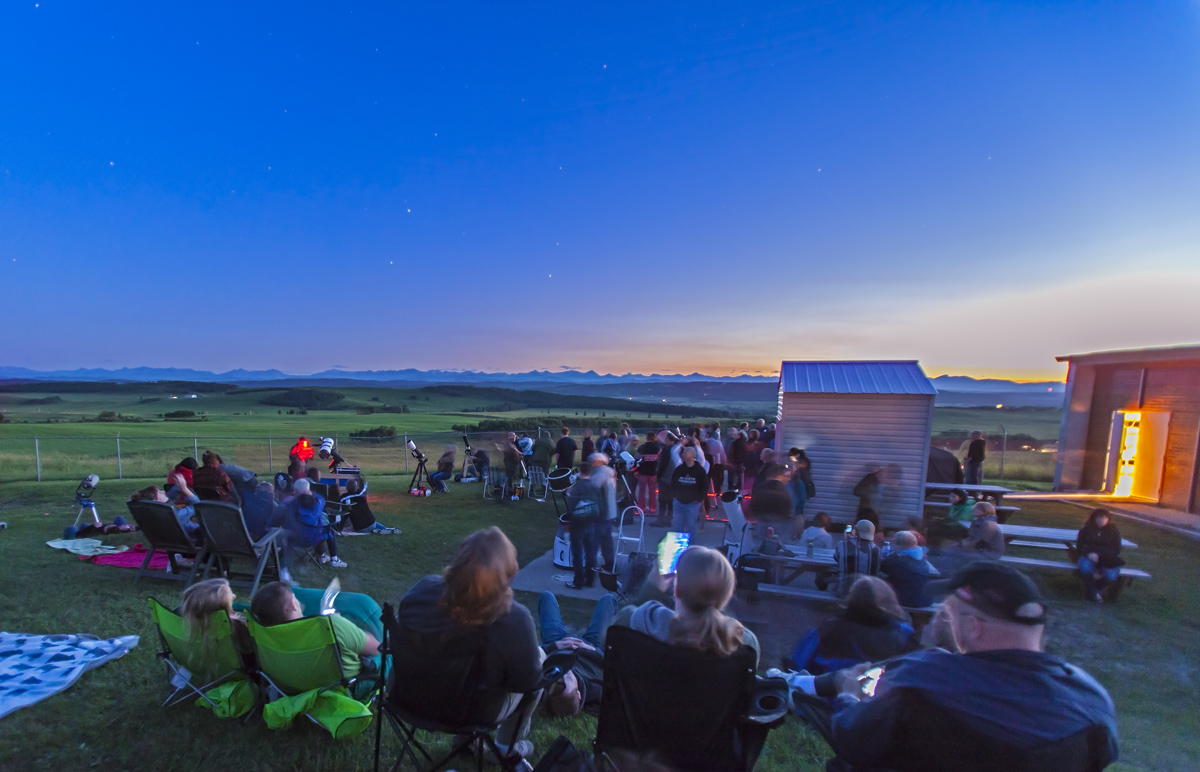
Waiting for the Sky Show


It was an ideal summer night for a public star party. Like it was a summer music festival, people set up lawn chairs and laid out blankets to sit and lie back and watch the show — the sky show.

This was the scene at Saturday’s Milky Way Night, July 21,  at the local university’s Rothney Astrophysical Observatory. Several hundred people attended under ideal clear skies to watch the summer stars appear and revel in the Milky Way away from city lights. Here, people gaze westward after sunset to see the triangular gathering of Saturn, Mars and Spica in the evening twilight. Lots of mobile phones were held skyward as people used their new astronomy apps to identify what they were seeing. These apps are probably the most effective means now for people to get into astronomy. Lots of people were using them this night.

— Alan, July 22, 2012 / © 2012 Alan Dyer


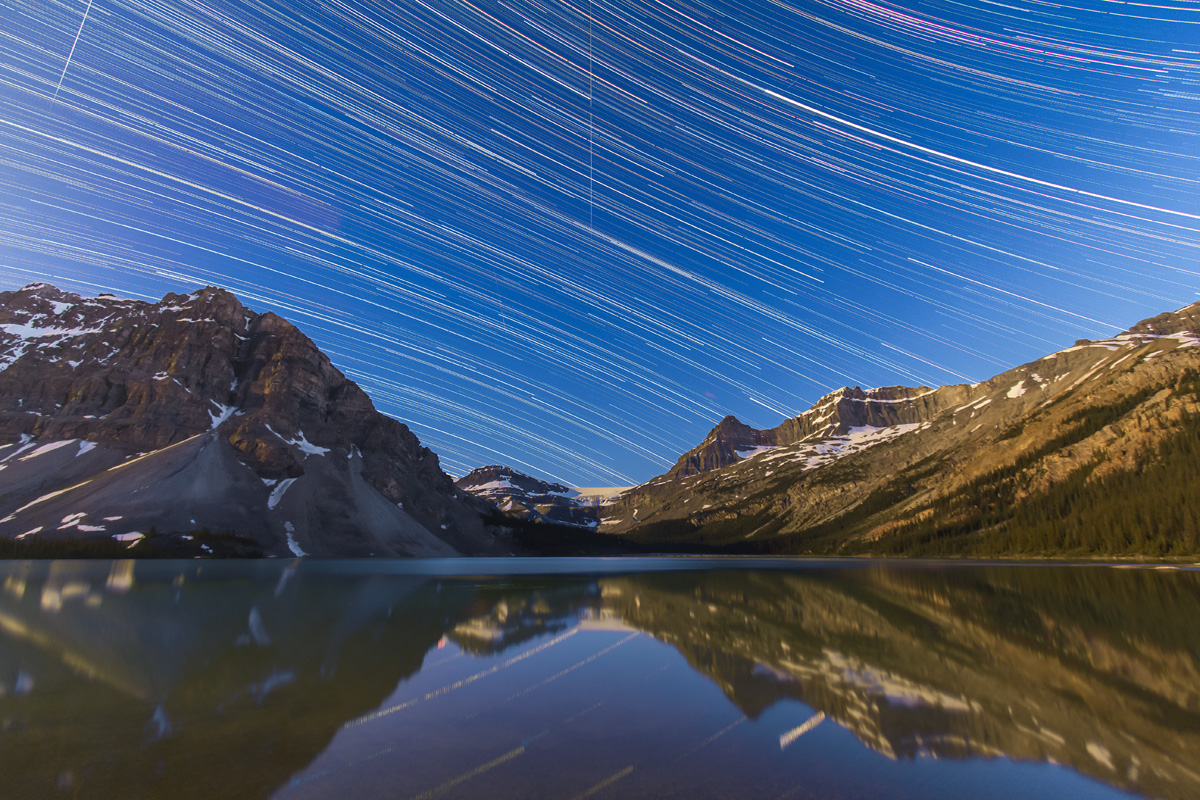
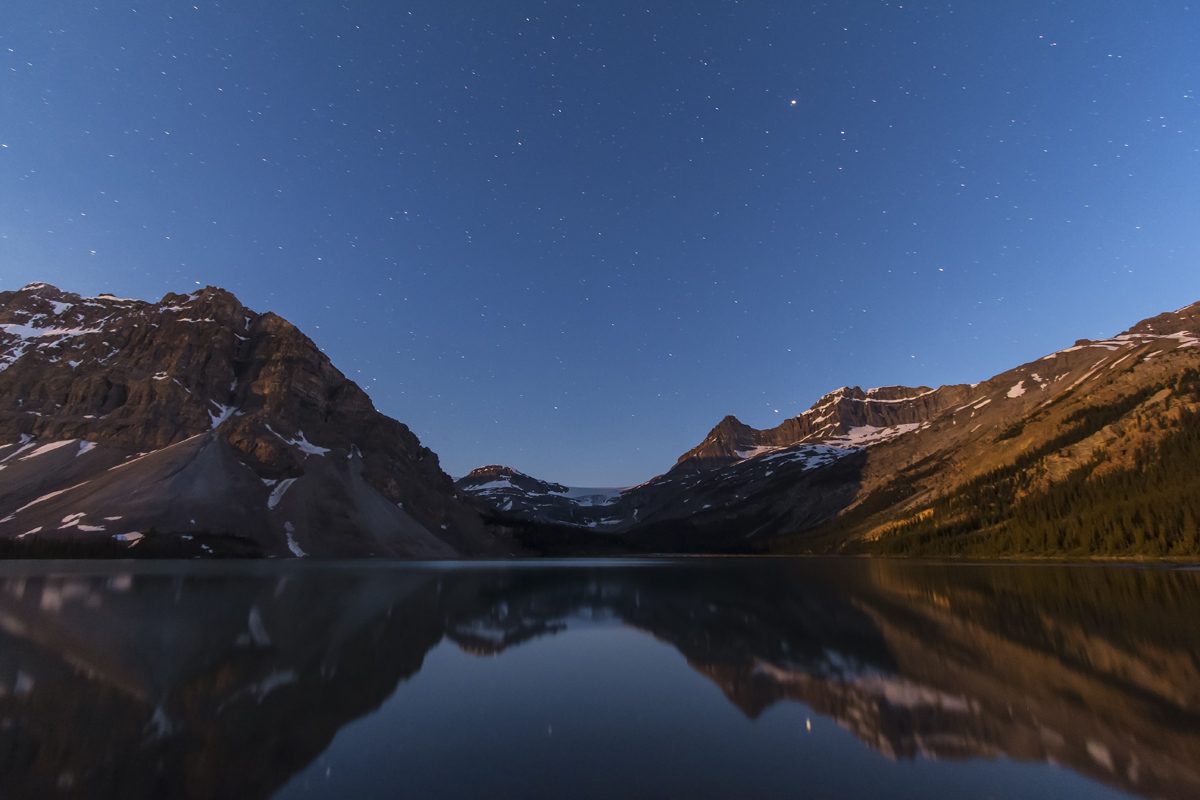
Star Trail Reflections at Bow Lake, Banff


It’s rare to get such a clear night in the mountains, but last weekend, July 6-7, provided a couple of ideal nights.

This image combines about 180 exposures, each 45 seconds long, stacked to create a single image of long star trails setting into the west behind Bow Glacier in Banff. The result records the sky’s motion over nearly two and a half hours. Running at right angles across the descending stars are vertical streaks from a bright meteor (left) and a satellite (top, centre).

Light from the rising waning Moon provides the illumination.

— Alan, July 16, 2012 / © 2012 Alan Dyer

Dawn’s Early Lights II


Here’s a wider shot of the Moon-Jupiter-Venus gathering at dawn on July 14.

The clouds parted nicely for a clear view of the sky where it needed to be clear (a rare occurrence!) while adding their colour to the pre-dawn scene. I like cooperative clouds. Let’s see if they behave for tomorrow morning’s closer conjunction.

— Alan, July 14, 2012 / © 2012 Alan Dyer


Dawn’s Early Lights


Venus and Jupiter are reprising their mutual meetings of earlier this spring, but now in the pre-dawn summer sky.

This was the scene at 4 a.m. from home on July 14, with the waning crescent Moon, here overexposed, above Jupiter and Venus at dawn. Next to Venus is the star Aldebaran and the stars of the Hyades star cluster in Taurus. Above the Moon is the Pleiades star cluster.

On July 15, the Moon will appear between Venus and Jupiter for one of the best conjunctions of 2012.

— Alan, July 14, 2012 / © 2012 Alan Dyer


Circling Star Trails in the Rockies


Let the camera shoot for a few hours and this is what you get: stars circling the sky, turning into concentric paths around the North Star.

For this image I stacked 230 short exposures, each 50 seconds long, taken over about 4 hours time on July 7/8. My previous blog entry is one of those individual frames. But in this composite, the stars become trails rotating about the pole of the sky, near Polaris, the North Star, here over Num-Ti-Jah Lodge at Bow Lake in Banff. Moonlight provides the illumination and turns the sky blue, just as in daytime, only much dimmer. But the long exposures bring out the colours and make the scene look like daylight, because the light of the Moon is daylight, just reflected first off the Moon’s neutral grey face.

The same frames used to make this still frame composite can also be used to make a time-lapse movie of the circumpolar stars turning.

— Alan, July 14, 2012 / © 2012 Alan Dyer

Big Dipper over Num-Ti-Jah Lodge


“Around the fire tonight Jim Simpson said that for his money this campsite was the closest one could get to heaven on Earth. And I reckon he’s not far wrong.” — Bill Peyto at Bow Lake, July 11, 1902.

Peyto penned that description 110 years ago to the day. His friend always said he’d build a shack here one day. And he did. This is Num-Ti-Jah Lodge, a classic wood log building, hand-hewn and assembled by Jimmy Simpson and his family in the 1940s. They ran the lodge for many years.

I was there this past weekend, July 6 and 7, shooting nightscape photos under the waning Moon. This view looks due north, with the Big Dipper and Polaris over the lodge. To the right, in the northeast, glows a faint red aurora. To the northwest stands Mount Jimmy Simpson, named for the pioneer who built his dream lodge at his heaven-on-Earth campsite.

Heaven is not without its dangers however. Earlier in the evening a yearling grizzly bear was wandering around the lodge and had to be scared off by a Parks official. I’m glad he did! Meeting a bear in the dark is a hazard of shooting in the mountains I have yet to encounter, and don’t wish to.

— Alan, July 11, 2012 / © 2012 Alan Dyer

Bow Lake by Moonlight (2012)


What a fabulous night this was — perfectly clear and the gibbous moon lighting up the mountains. It was a wonderland for nightscape photography.

I took this shot late on Friday, July 6 at Bow Lake in Banff, Alberta. The summer stars shine behind Bow Glacier, and the peaks are illuminated by the rising waning Moon. Saturn, setting behind the continental divide, is reflected in the still waters while Arcturus shines high in the sky.

This is one frame of 320 I took through the night for a time-lapse movie, and for stacking into a long star-trail composite. Those are still to come!

Compare this to the scene I took last summer under a dimmer quarter Moon and later in the season.

— Alan, July 8, 2012 / © 2012 Alan Dyer

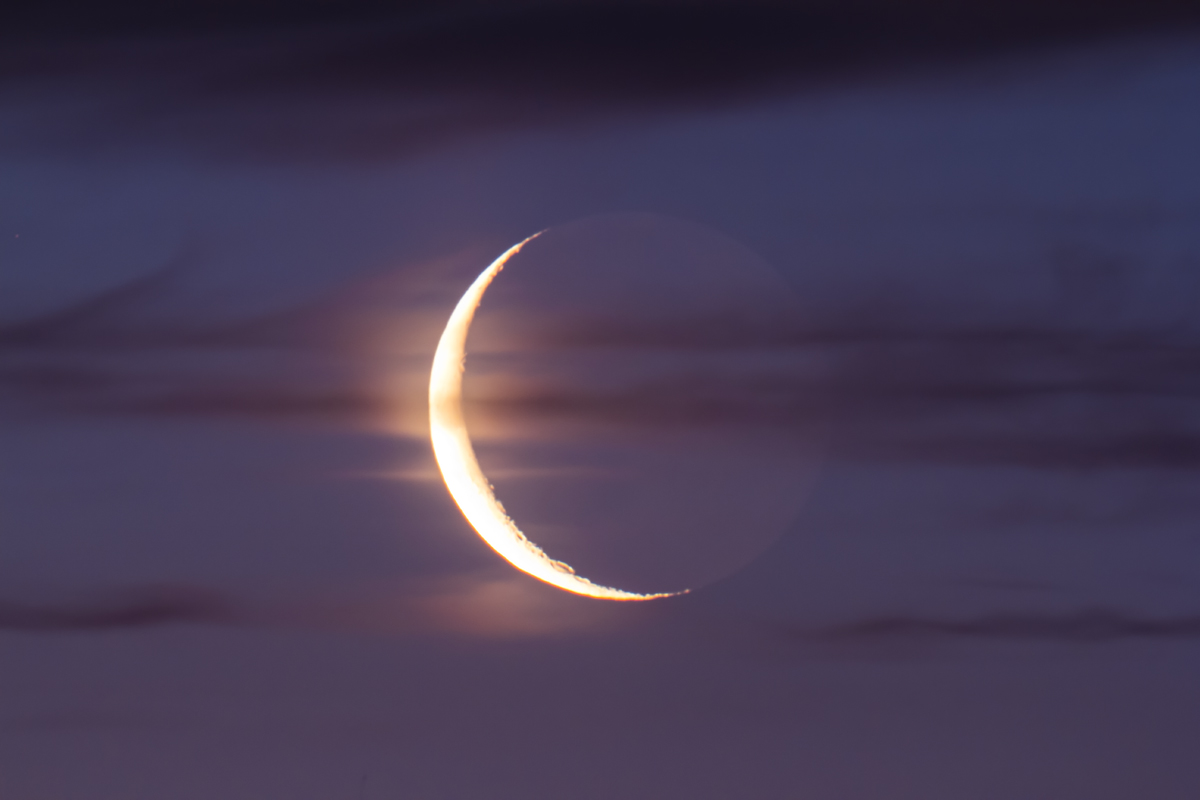
Old Moon Waning


It’s been a season of crescents. A crescent Sun in eclipse. A crescent Venus before and after transit. But this is the more familiar Moon.

I caught the waning crescent Moon rising before the dawn on Saturday, June 16, after an all-night shooting session amid the summer twilight. As dawn was breaking, the Moon rose in the east and drifted through clouds near the horizon.

Here, the glow of Earthshine lighting up the dark night side of the Moon  appears just a little brighter than the twilight sky.

This is an “old Moon,” as at this phase the Moon is three days before new, at age 26 days. At new moon, the Moon is “reborn” and appears anew as a crescent in the evening sky.

— Alan, June 16, 2012 / © 2012 Alan Dyer


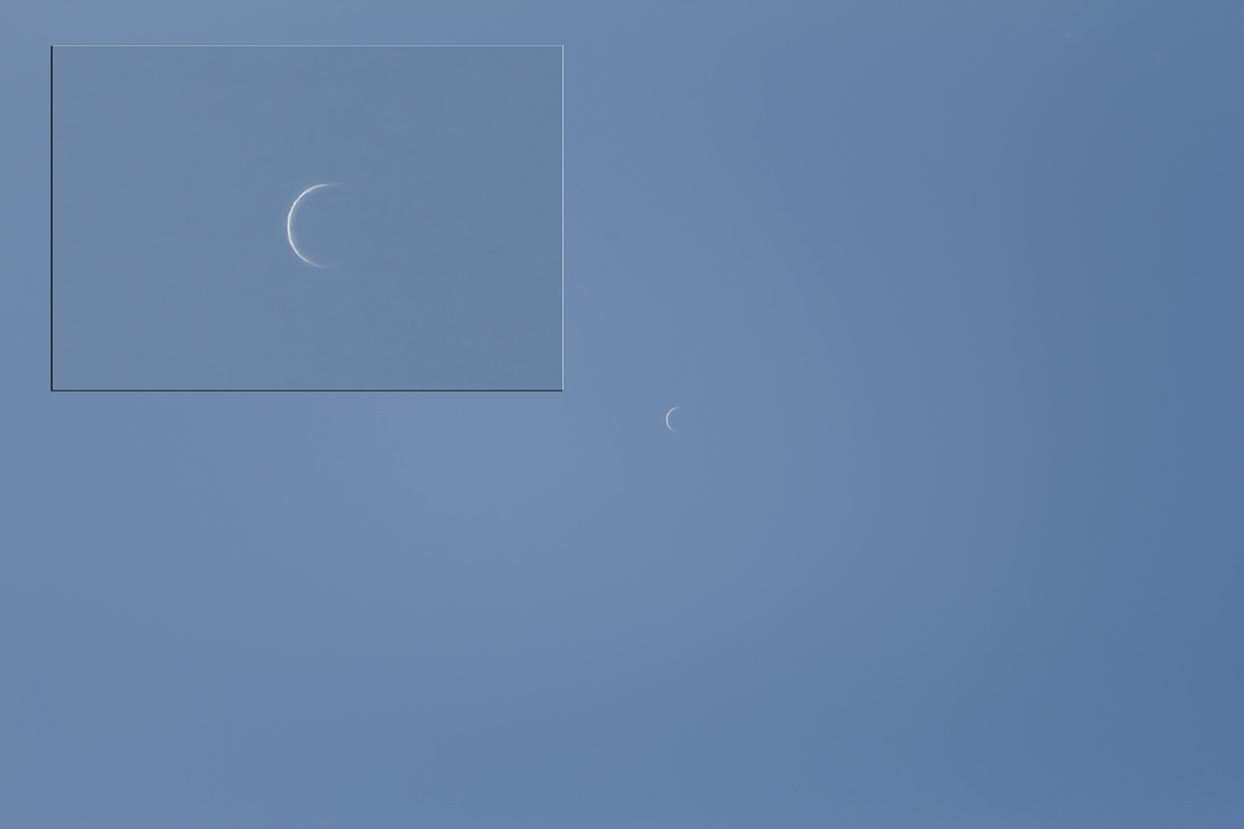
Venus: 6 Degrees of Separation


This was my first look at Venus following Tuesday’s transit. Here, it’s just six degrees west of the Sun as a thin crescent in the afternoon sky. It was a beautiful sight in the eyepiece, far enough away from the Sun to not be in its glare but close enough to still appear as a razor-thin backlit crescent.

Each day now Venus is widening the gap between it and the Sun, shortly to become a brilliant morning star in the eastern sky before dawn through the rest of June, July and August.

I shot these images in broad daylight through a 130mm f/6 refractor. The big image is a full-frame shot with the Canon 60Da and a 2X Barlow lens, for an effective focal length of about 1500mm. The inset is a single frame grabbed from a 30-frame-per-second movie shot with the Canon in its Movie Crop mode, which yields a high-magnification view suitable for planet shooting, but only 640 x 480 pixels. But this mode is certainly ideal for capturing planets, though none ever appear as large as Venus is here. This is an uncommon instance of Venus as close and as large as any planet gets.

— Alan, June 9, 2012 / © 2012 Alan Dyer


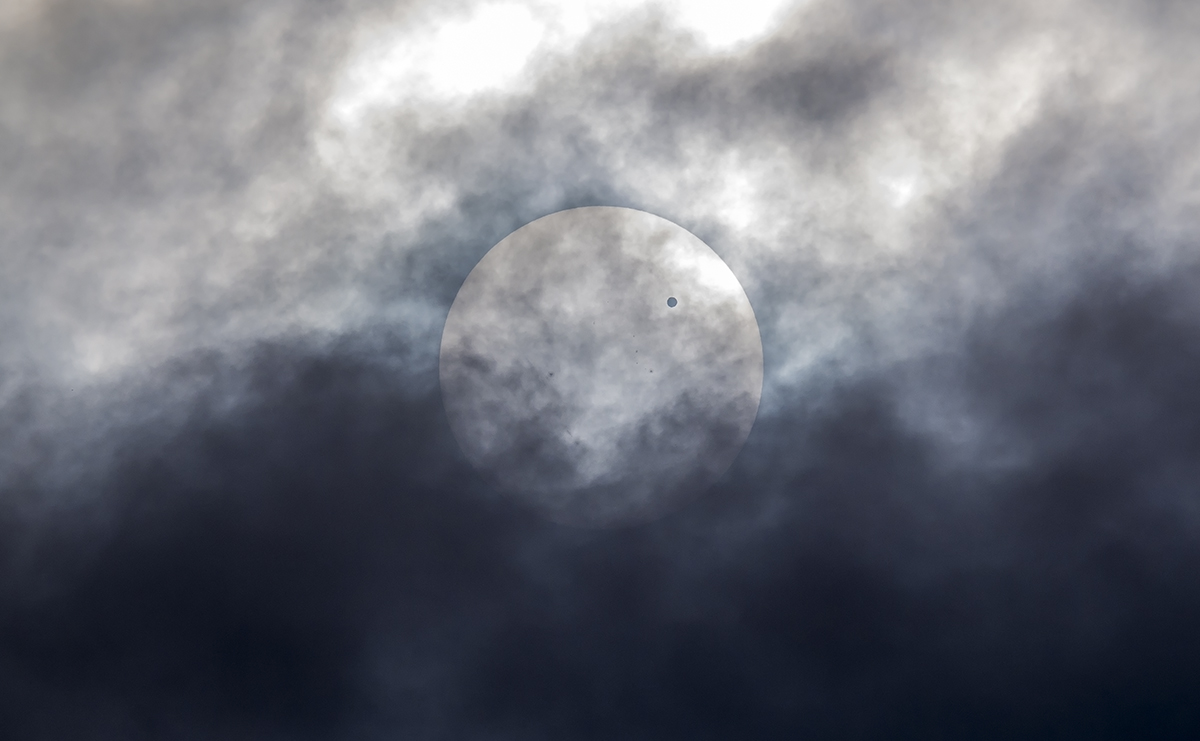
Transit of Venus: From One Cloudy Planet to Another


The day looked hopeless with not a chance of clear skies. But a small hole opened, revealing Venus on the Sun.

I had seen this sight before, in 2004 from Egypt. But my first reaction upon seeing it again, albeit briefly, was [Expletive Deleted]!!! No photos really provide the visual impression of just how enormous Venus appears on the Sun. We’re used to sunspots (and there were lots today) and some quite large. But nothing we ever see on the Sun matches the size of Venus. The eyepiece impression is of something much larger than the photos show. It’s like Moon illusion at work on the Sun.

It had been hopelessly cloudy all day in Calgary. Interpretive obligations over at the science centre (where we showed the NASA webcast from Hawaii), I hit the highway in search of a clear hole … and found one northeast of the city, one at first that seemed to be wide and stable. I stopped, looked with the filtered naked eye, then drove on seeking slightly less cloud, getting greedy! I should have stopped sooner. By the time I did stop  and hurriedly set up the little 80mm refractor telescope, I had about 30 seconds for a great clean view, then switched to the camera. By the time I got it set, clouds were coming out of nowhere and thickening fast. I couldn’t shoot through the solar filter. This is a filterless shot, at 1/8000th second! Clouds provided the natural filtration. Fine! At least I got the camera focused, for a crisp view of Venus next to the clusters of sunspots, something no one alive has seen — in 2004 the Sun was virtually spotless.

So, not a view or photo under the best of conditions, but an experience I am happy to settle for. Now, I just want clear skies in Australia for November’s total solar eclipse. Please!!

— Alan, June 5, 2012 / © 2012 Alan Dyer


A Prairie Partial Eclipse


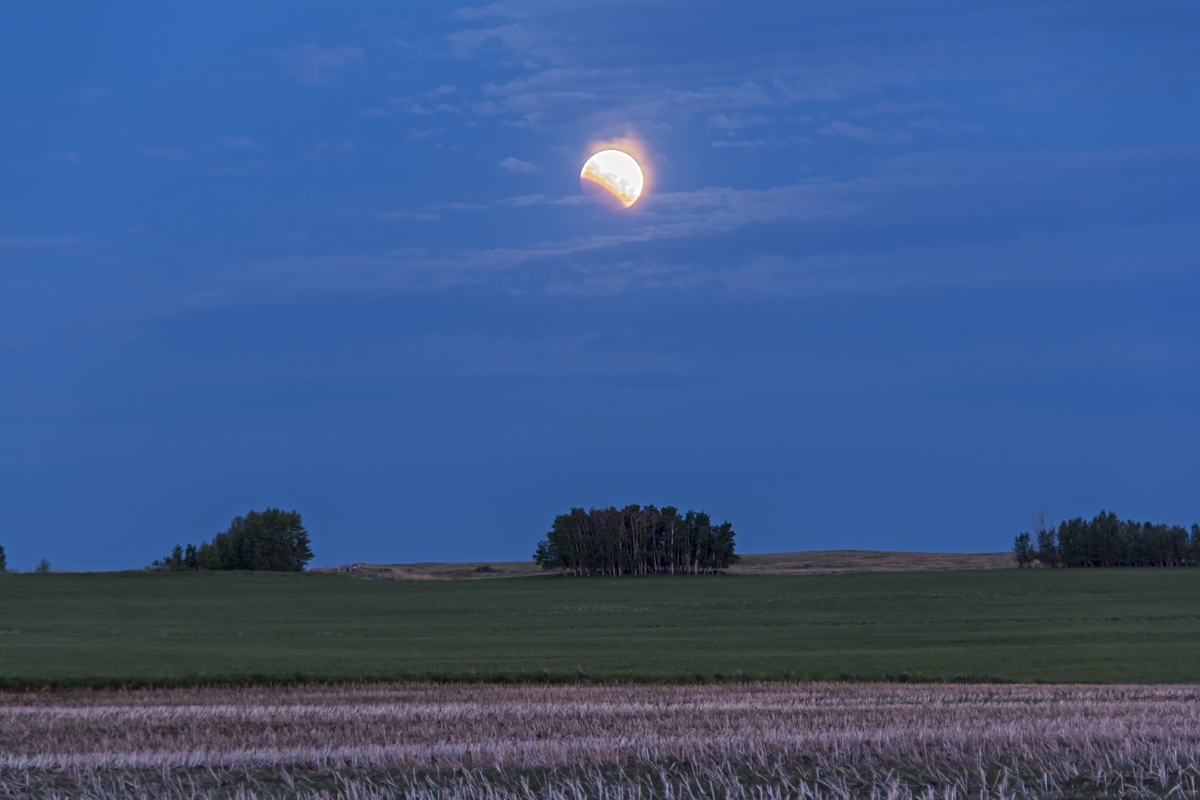
This was the kind of eclipse chasing I like — just to the end of my driveway … to shoot the partial eclipse of the Moon before dawn on June 4.

While the car is all packed with gear for a possible flight or cross-country chase to clear skies to catch the Venus transit tomorrow, the lunar eclipse required no travel at all. Not that I was going to make too much effort at 4 am!

While some clouds got in the way, a clear hole opened up at the right time, with the remaining clouds adding a photogenic touch. I’m hoping to be as lucky for the transit!

This was just a partial lunar eclipse, with only 37 percent of the Moon immersed in the Earth’s umbral shadow at mid-eclipse, shortly after this image was taken. Even so, some of the reddening of the shadowed portion of the Moon’s disk does show up here.

I shot this from southern Alberta with a Canon 60Da and an 18-200mm lens at 115mm to frame the Moon and prairie landscape.

— Alan, June 4, 2012 / © 2012 Alan Dyer

Somewhere … Over the Rainbow


This wonderful rainbow lasted only a few minutes, as most do, shining in the brief interval when sunlight and raindrops are at their combined best.

I captured this rainbow off the back deck, on June 2, as a storm receded to the east and the Sun broke through in the west, ideal circumstances for catching a rainbow, at least photographically.

This was a classic bow, showing the inner main bow and the fainter outer secondary bow with colours reversed. The sky is bright inside the the inner bow from scattered light from the raindrops, and darker between the two bows where there is an absence of scattered light, a phenomenon called Alexander’s Dark Band after the ancient Greek astronomer who first described it.

I used a Canon 60Da and 10-22mm lens for this, at 10mm for wide-angle coverage of almost the entire rainbow.

— Alan, June 3, 2012 / © 2012 Alan Dyer


Venus Descending


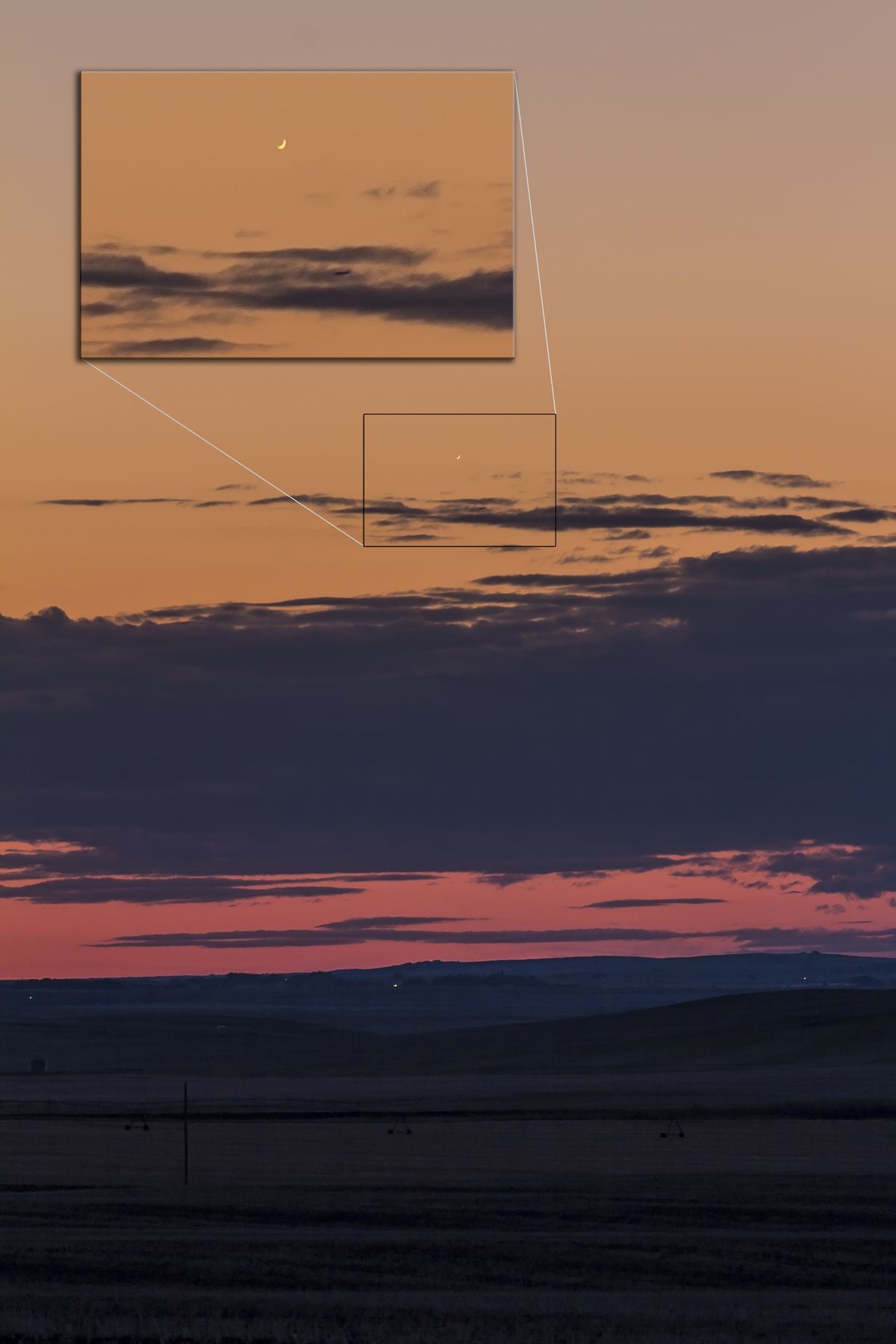
A wonderful sight tonight, as I caught Venus in its last days before the transit, shining as a glistening crescent low in the evening twilight.

Venus was visible to the unaided eye after sunset, but not for long. It set soon after the Sun. But for a short while it put on a beautiful show as a large crescent (large for a planet that is), easily resolvable in binoculars and stunning in a small telescope. One could almost make out, for brief moments, the sight of the backlit atmosphere going all the way around the disk. But I suspect it was more imagination at work than reality shining through.

The inset blows up the boxed area, to reveal the crescent-phased disk of Venus, despite this shot being taken with no more than a 200mm telephoto lens. I used a Canon 60Da camera at ISO 100. A plane is flying just below Venus.

So this was May 30, 6 days before the June 5 transit, with Venus 9.5° east of the Sun. How far up to the Sun can we catch it, before it crosses the Sun on Tuesday?

— Alan, May 30, 2012 / © 2012 Alan Dyer

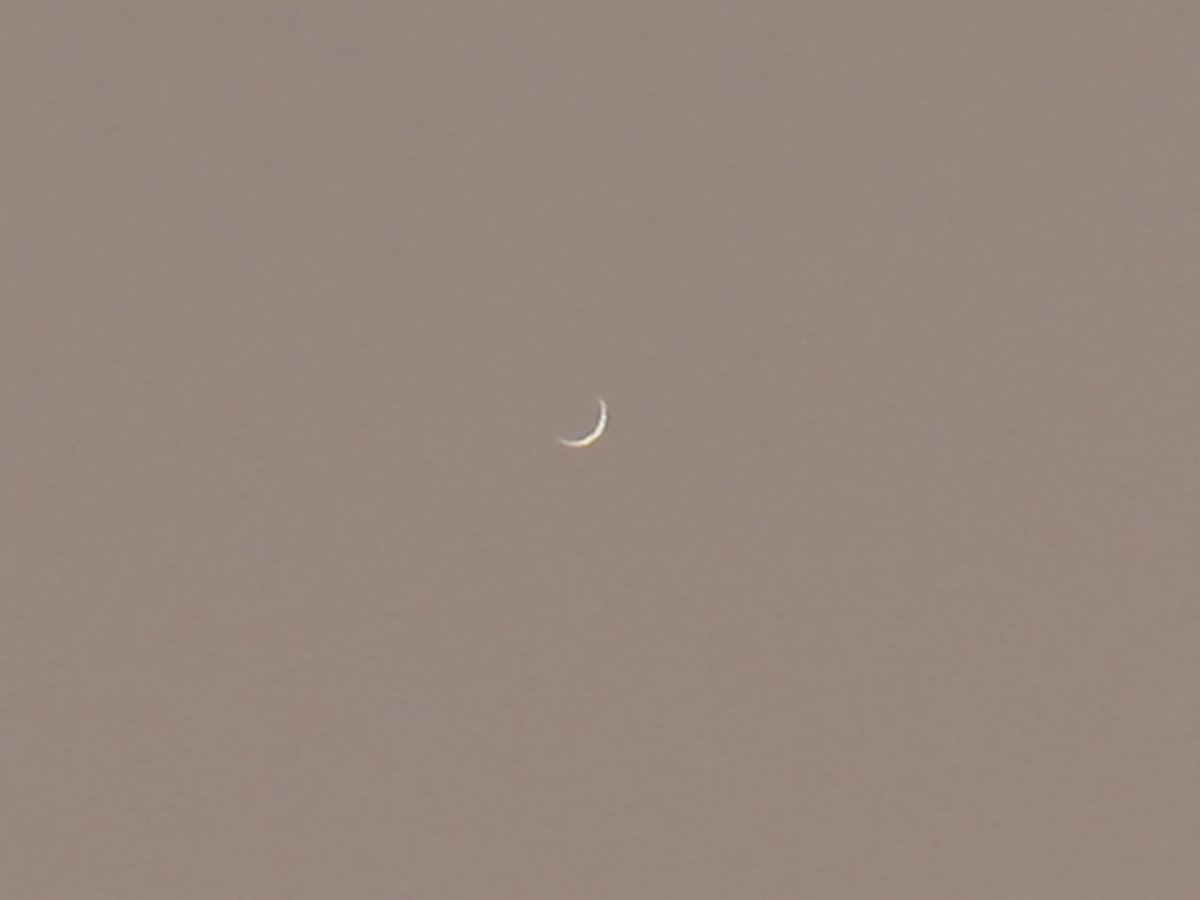
Venus Sinks Sunward


Here’s a last look at Venus before its historic transit across the face of the Sun on June 5.

I took this Monday evening, May 28, with the Sun still up and Venus about 13 degrees east of the Sun but low in my evening sky. Venus appears as a razor-thin crescent, like a tiny “new Moon.” Most of the daylight side of Venus now faces away from us; on the side of Venus turned toward us now all but a sliver of a crescent is dark — we’re looking at the night side of Venus. On June 5, all we will see is this dark side of Venus, appearing in silhouette in front of the Sun’s brilliant disk as Venus moves across the Sun in a transit not to be repeated for another 105 years.

This is a single still-frame grab from a movie shot I shot with the Canon 60Da camera, set in Movie Crop Mode, for a movie 640 x 480 pixels wide. This mode magnified Venus considerably on the frame. I shot this through a small 80mm apo refractor at its f/6 prime focus, so with only 480mm of focal length. But Venus is now so large it doesn’t take a lot of extra magnification to show its disk and phase.

The view through the eyepiece was stunning. The rippling image and sparkling colours, though from distortion in our atmosphere, added to the beauty of Venus, fitting for the goddess of love.

– Alan, May 28, 2012 / © 2012 Alan Dyer

Eclipse — A Parking Lot Partial


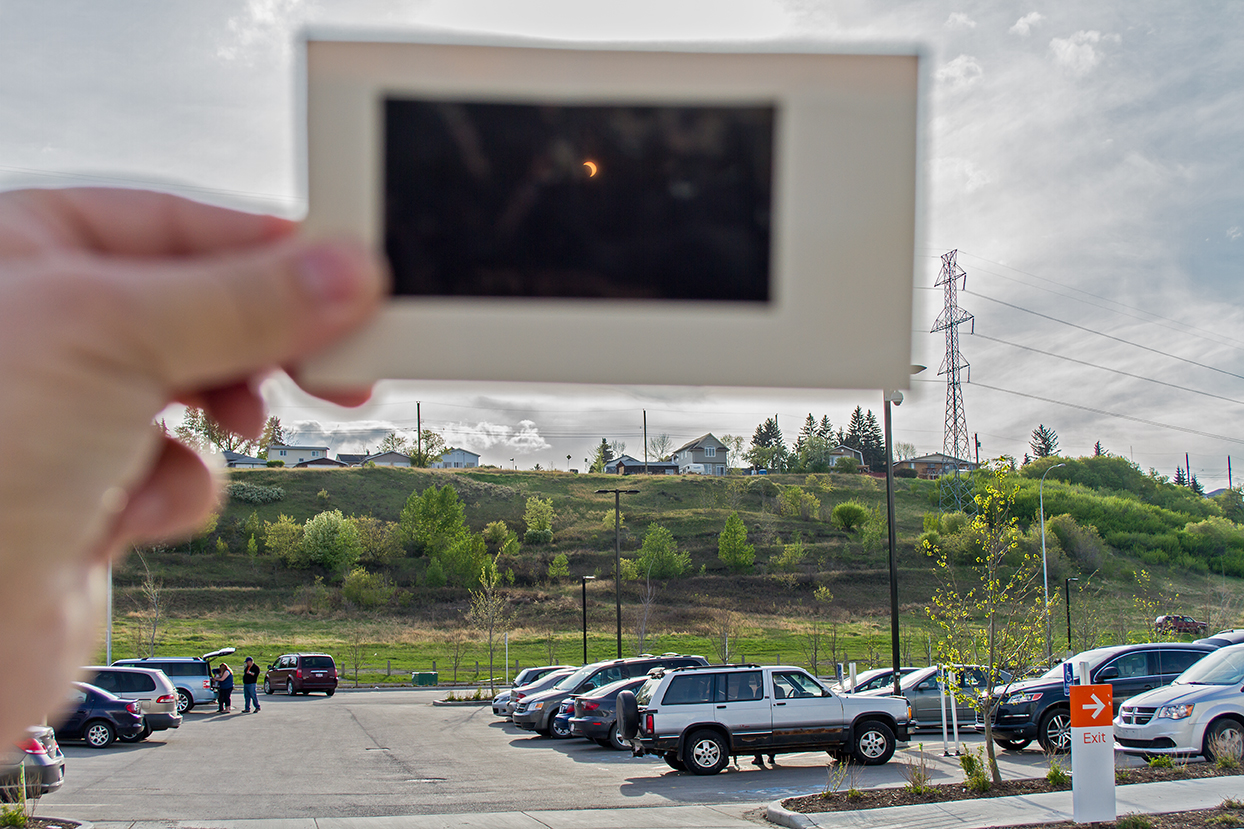
This was the view Sunday evening as the Sun descended into the northwest sky, accompanied by the Moon covering part of its disk.

I shot this near mid-eclipse with a handheld camera and filter dimming what would have otherwise been a vastly overexposed Sun. A liberal use of Photoshop’s Highlight recovery and Shadow details tools compressed the dynamic range even more, to bring out details in the sky and clouds and in the dark filtered image. But this is a single image, not a composite.

As you can see, even at its best the Sun shone through light cloud, which added somewhat to the scenery of the sky and the weird quality of the light at mid-eclipse. But all told, I’d rather do without clouds at any eclipse. They make for anxious moments I could live without.

I took this shot from the TELUS Spark science centre, where we set up sidewalk telescopes for viewing the eclipse, looking over the parking lot and hill to the west of us. It’s where the Sun will also be for the transit.

— Alan, May 21, 2012 / © 2012 Alan Dyer


Partial Solar Eclipse — from Calgary


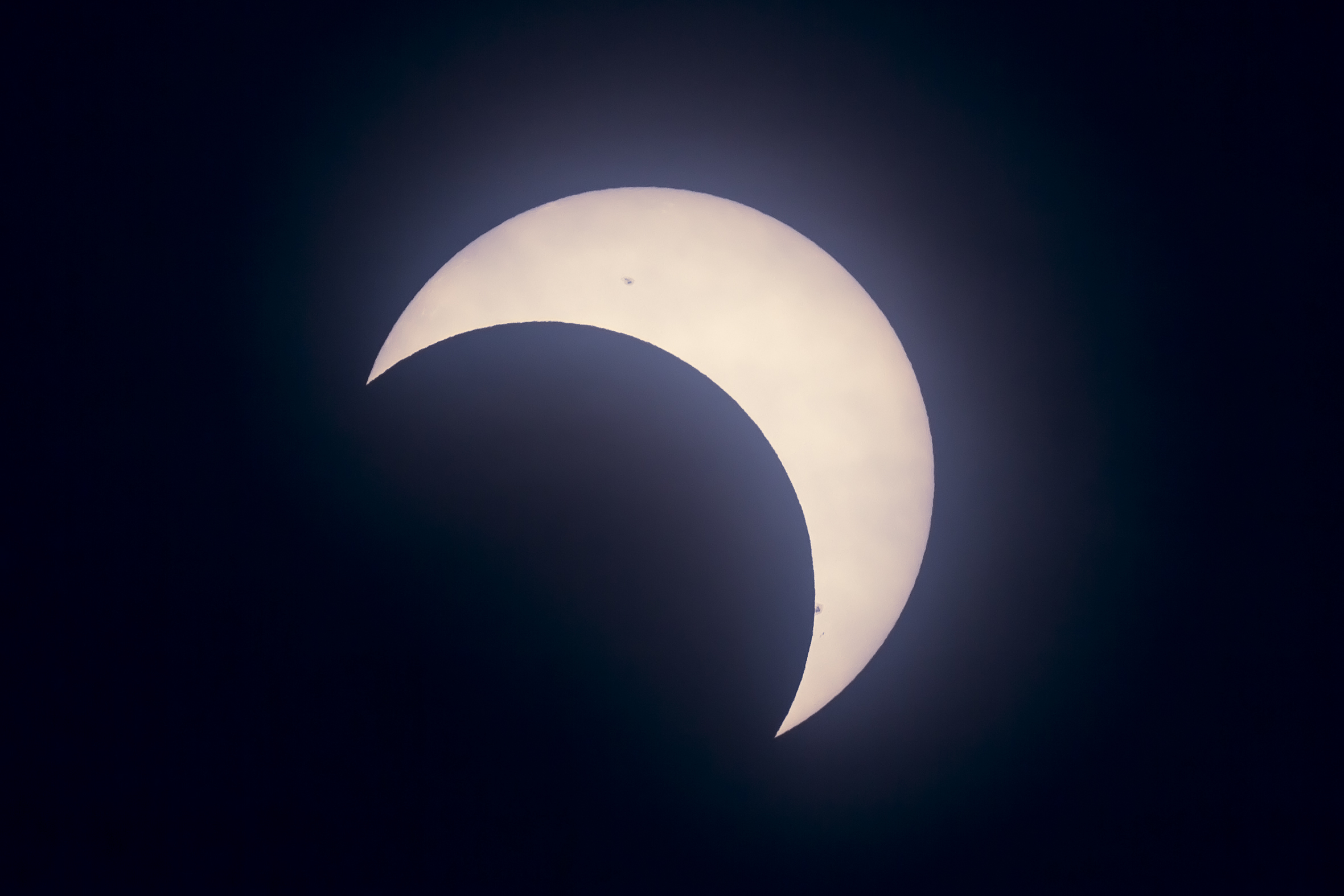
This was the first significant solar eclipse in many years that I did not travel to. For the May 20, 2012 eclipse I was content to stay at home on the sidelines and take in the partial eclipse of the Sun.

From Calgary, the Moon covered about 62% of the Sun at mid-eclipse, which this shot captures, taken at maximum eclipse for us. Here, a big sunspot group is just being uncovered by the passing Moon. Having lots of spots on the Sun this day made the partial eclipse all the more interesting, though still no comparison to the annular eclipse visible over the spectacular landscapes of the southwestern U.S.

I would have been there, in the Moon’s ant-umbral shadow, had it not been for the fact that at home I am very much involved in the opening of a new planetarium and digital dome theatre at the science centre, TELUS Spark, where I work. This is a milestone event in one’s life, one I’ve had the privilege of experiencing twice before, in 1984 in Edmonton with the opening of its new science centre and planetarium, and in 1996 when we converted the old Calgary Centennial Planetarium into a then state-of-the-art tilt-dome theatre. Oddly coincidental, I missed seeing the May 15, 1984 annular eclipse in the SE United States due to the imminent opening of the Edmonton theatre. History repeats itself — a Saros cycle of science centres perhaps?

For this eclipse we conducted a public viewing session and managed to grab excellent views once clouds cleared away before mid-eclipse. Eclipse anxiety was running high leading up to and through the initial minutes of the eclipse as it looked like clouds were going to skunk us. But wonder of wonders, the sky cleared and the eclipsed Sun was revealed, to my great relief. Missing the annular eclipse is bad enough; I didn’t want to miss the partial eclipse, too!

Now, we just need clear skies on June 5 for the transit of Venus.

— Alan, May 20, 2012 / © 2012 Alan Dyer

A Star Dies in a Distant Corner of the Sky


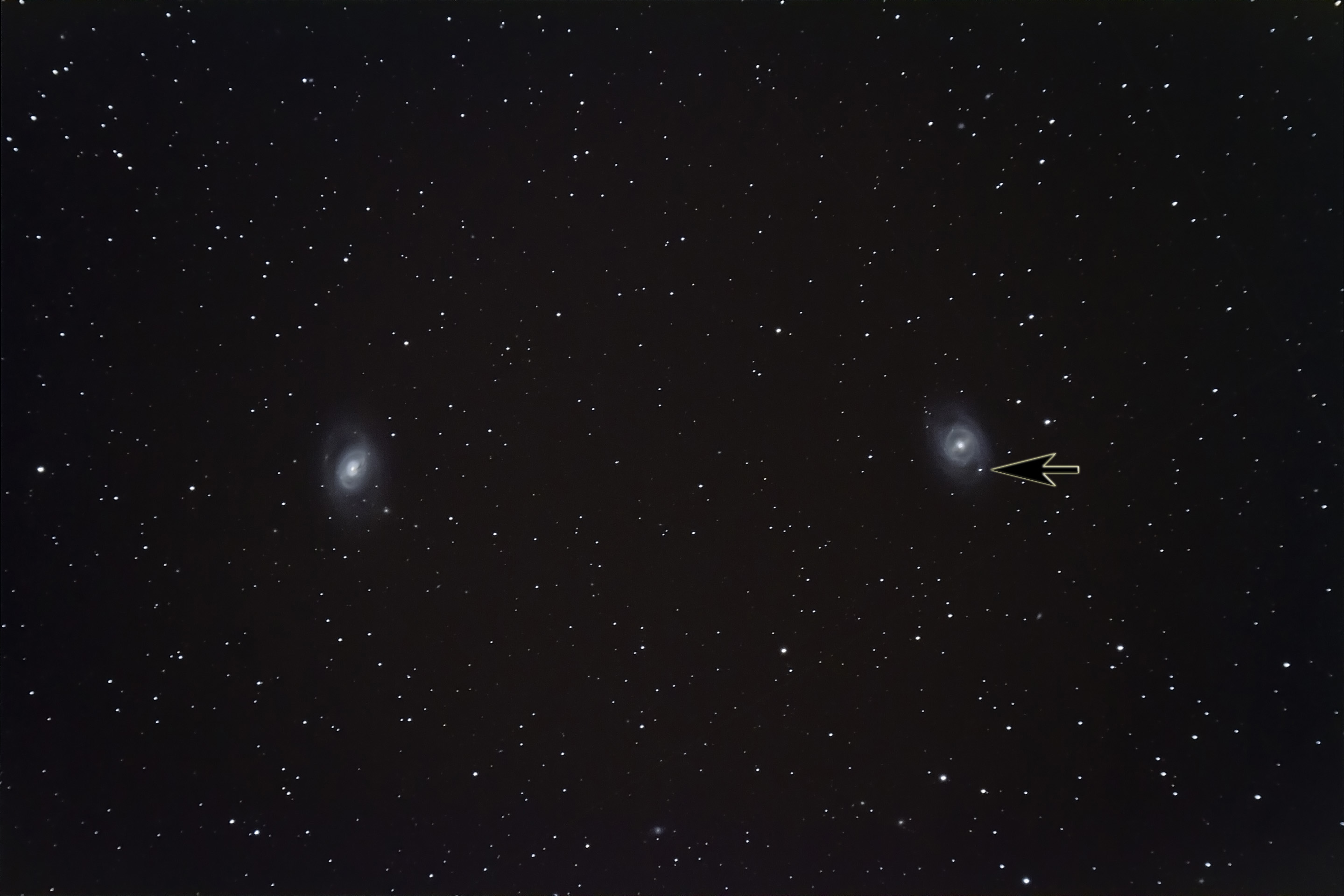
OK, it’s just a dot. But that dot is a massive star ending its life in a titanic supernova explosion.

Unlike all the other stars in this picture, which are close by in the foreground of our own Milky Way Galaxy, that one star indicated is 38 million light years away. It lies in another galaxy altogether, in the outer spiral arm of the galaxy M95. Discovered on March 16, Supernova SN 2012aw is now shining with the light of a hundred million suns as it blasts most of its starstuff into space.

It is these types of stellar explosions that seed the universe with the elements heavier than lead.

I took this shot Monday, April 9 through my 5-inch refractor, an instrument not ideally suited for shooting small objects like galaxies. But its wider field here does take in not just M95 but also its companion in space, the spiral M96 at left. Both are barred spiral galaxies in Leo, on the list of targets compiled by Charles Messier in the late 18th century and favourites of backyard astronomers. It’s rare to get a supernova as bright as this (anyone with a modest telescope can see it) letting off in a well-known “top 100” galaxy like M95.

Take a look on the next clear night, and contemplate the cosmic forces at work to make visible a single star across a gulf of 38 million light years.

— Alan, April 10, 2012 / © 2012 Alan Dyer


Venus Meets the Seven Sisters


The goddess of love meets the daughters of Atlas — it isn’t often we get to see such a sight!

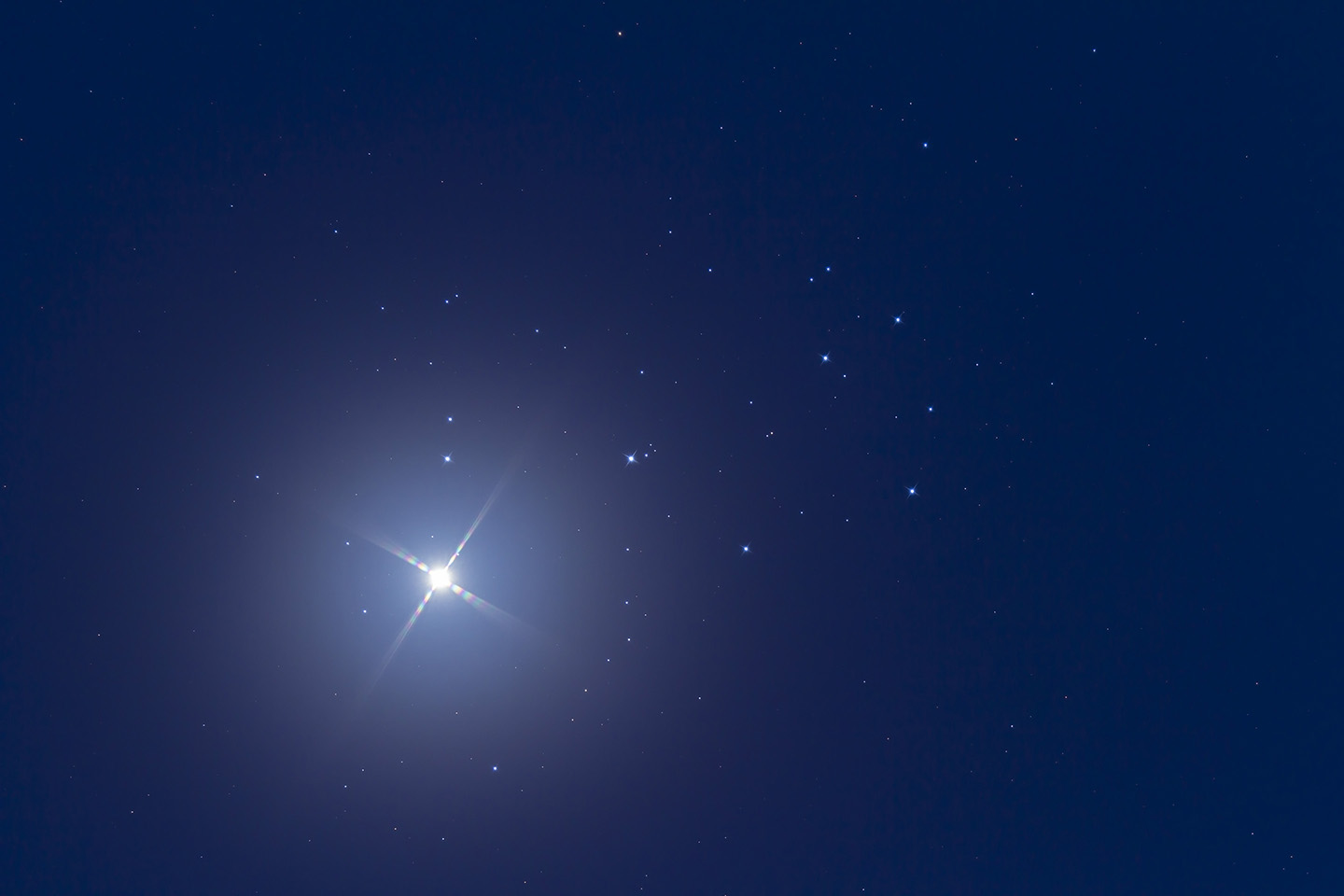
This is brilliant Venus shining amid the stars of the Pleiades, on the evening of Tuesday, April 3, 2012, with Venus as close to the Seven Sisters star cluster as I can ever remember seeing.

Venus last passed near the Pleiades in April 2004 (though not as closely as it did tonight), and will again in April 2020, reflecting the 8-year periodicity of Venus’s return to the same place in the sky. Thus the 8-year interval between the June 2004 transit of Venus and the one this June in 2012.

I took this through a 92mm aperture refractor, but added the classic spikes of light (which you would normally get only when shooting through a Newtonian reflector telescope) by taping some wire in front of the lens. It’s a technique that’s strictly for show. Some high cloud moving in, supposedly in advance of a big spring snowstorm, added the glow around Venus.

This was one of many superlative Venus events this year. Enjoy the sight of Venus now that it is as high as it ever gets in our northern hemisphere evening sky. We won’t see it quite as good as this again until 2020.

— Alan, April 3, 2012 / © 2012 Alan Dyer

Orion the Hunter, A Full-Length Portrait


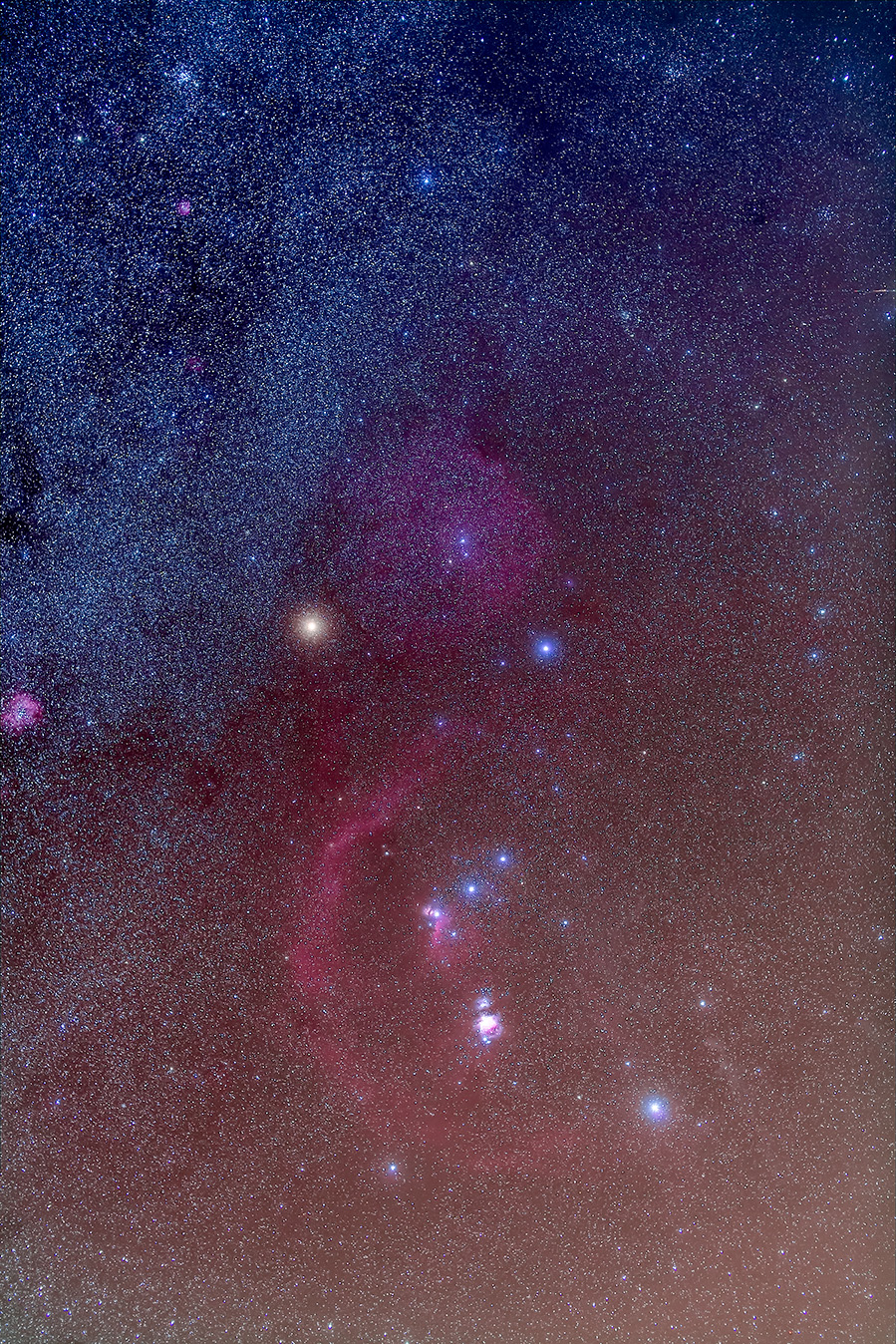
Orion is quickly disappearing from the dark night sky now, as spring begins and the winter constellations depart the sky. This is a shot from February, one I only just now processed.

The Belt of Orion really stands out as do the nebulas that wind all through and around Orion. This is a rich region of the sky for star formation.

I took this portrait of Orion using the 50mm Sigma lens, taking four 5-minute exposures and stacking them. In this case each exposure had varying amounts of haze in the sky as light clouds moved in. So the fuzzy glows around stars are from natural causes here, and are not produced by filters (as in the blog from last year called Fuzzy Constellations) or by post-processing. The glows bring out the star colours, particularly orangish Betelgeuse at upper left and blue Rigel at lower right.

This is the first image I’ve processed using the new Beta version of Photoshop CS6 and Adobe Camera Raw 7 software, just released this past week. Very nice indeed! You can download it for free from Adobe Labs. I like the new interface and functions. I’m not sure the final image quality is any better but some of the new features will be very nice for astrophotography and day to day use. Increased speed is promised but I haven’t seen much evidence for that. But this is a Beta version.

— Alan, March 24, 2012 / © 2012 Alan Dyer

The Wow Sky of Winter


The winter sky contains a lot of bright stars but none so bright as Venus and Jupiter now in the west.

This wide-angle shot takes in the evening sky from the duo of planets in the west (right) to Sirius shining brightly in the south (left), with Orion in between. Above and to the right of Orion sit the two big naked eye star clusters of winter: the scattered Hyades and the compact Pleiades.

This was the picture-perfect scene last Tuesday night when I shot other frames of just the planets over the house in the foothills of the Rockies near Bragg Creek, Alberta. This is the wider scene, bathed in the deep blue of twilight.

— Alan, March 16, 2012 / © 2012 Alan Dyer


Conjunction over Calgary


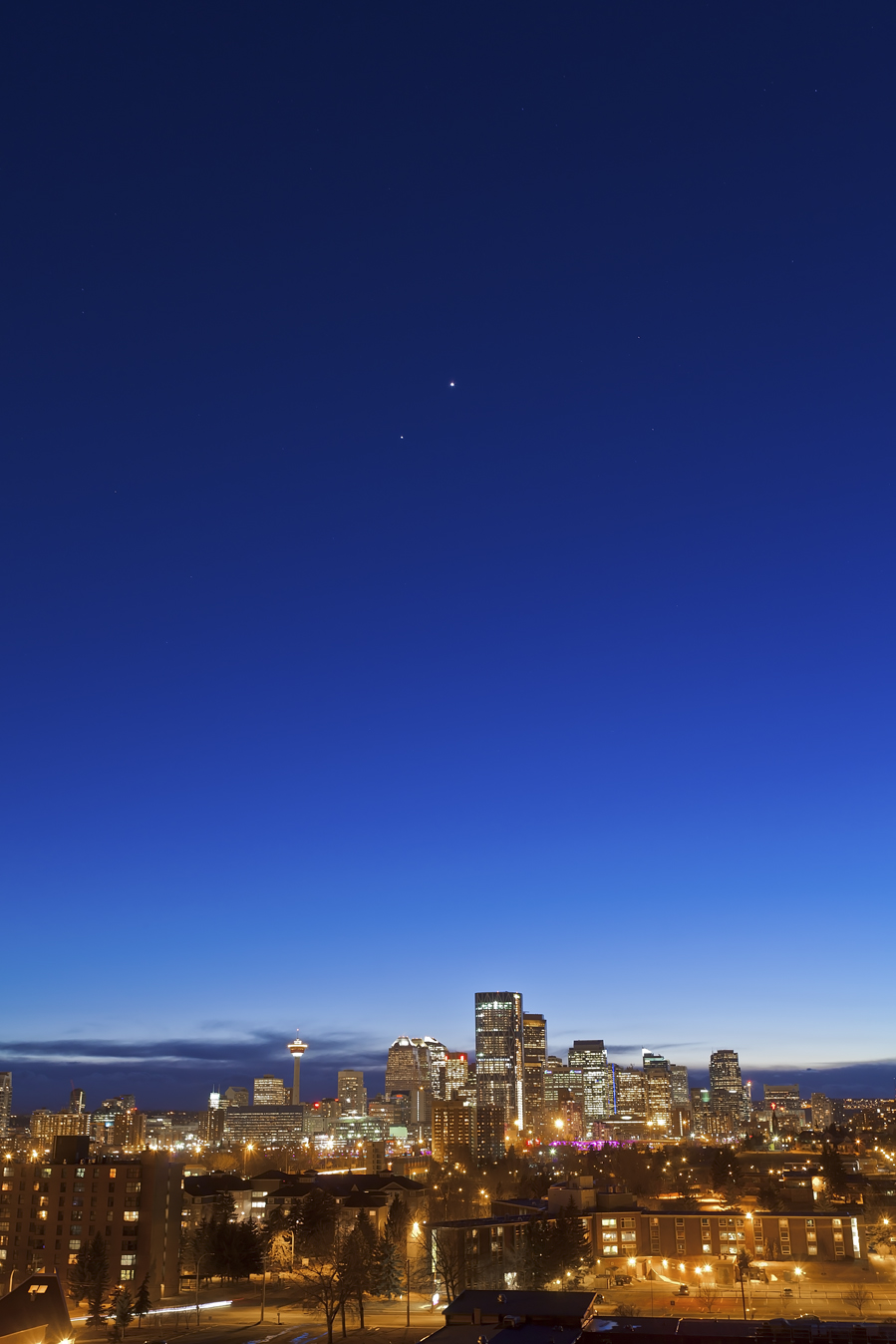
For my continuing series of Venus-Jupiter conjunction shots, on Wednesday night I stayed in Calgary and shot the planets over the city skyline.

Here Venus and Jupiter shine in the clear evening twilight over the downtown core of the city, now dominated by the new Bow tower. I  didn’t have to venture far for this shot, as the best vantage point and angle for framing the planets over the city was the top of Tom Campbell Hill, right beside the TELUS Spark science centre where I work.

We’ll see if the clear nights continue. But it’s been a good run all this week. The last few blogs show the results from each night’s shooting since Saturday.

— Alan, March 14, 2012 / © 2012 Alan Dyer


Mountains, Clouds and Planets, Oh My!


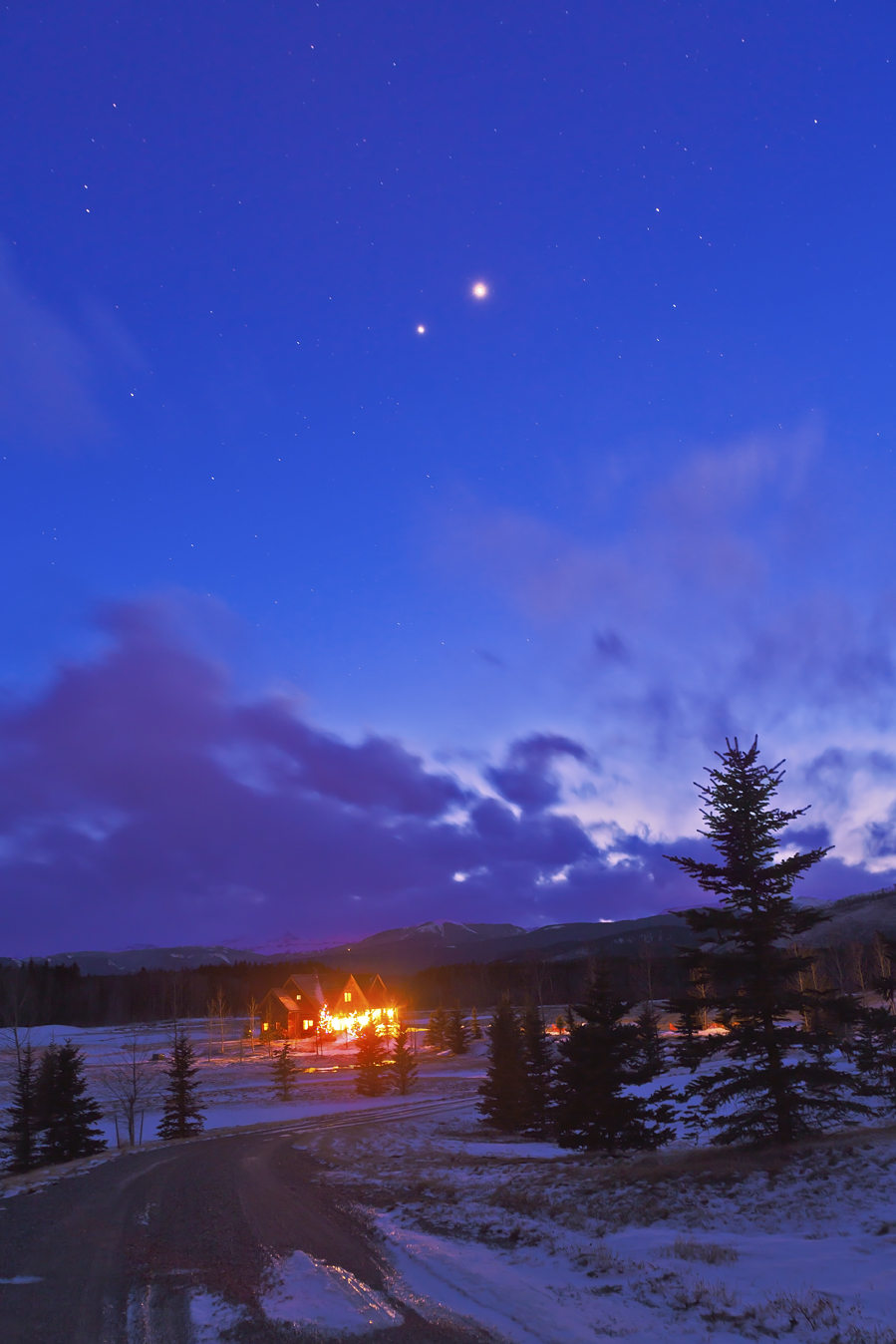
In another in my series of Venus & Jupiter nightscapes, I present this scenic portrait of the planets over a picture-perfect house in the foothills.

This was Tuesday, March 13 with the two planets at closest conjunction. I drove out to a favourite spot of mine, just south of Bragg Creek southwest of Calgary. The clouds hanging over the Rockies parted well enough to reveal the planet pair in the deep twilight and add other colours to the sky.

It was a stunning scene, one I’m sure the residents of the house were completely unaware of. The lights give that away. Wonderful scenery can be appreciated by night and by day.

— Alan, March 13, 2012 / © 2012 Alan Dyer


Tilting at the Sky (with Venus & Jupiter)


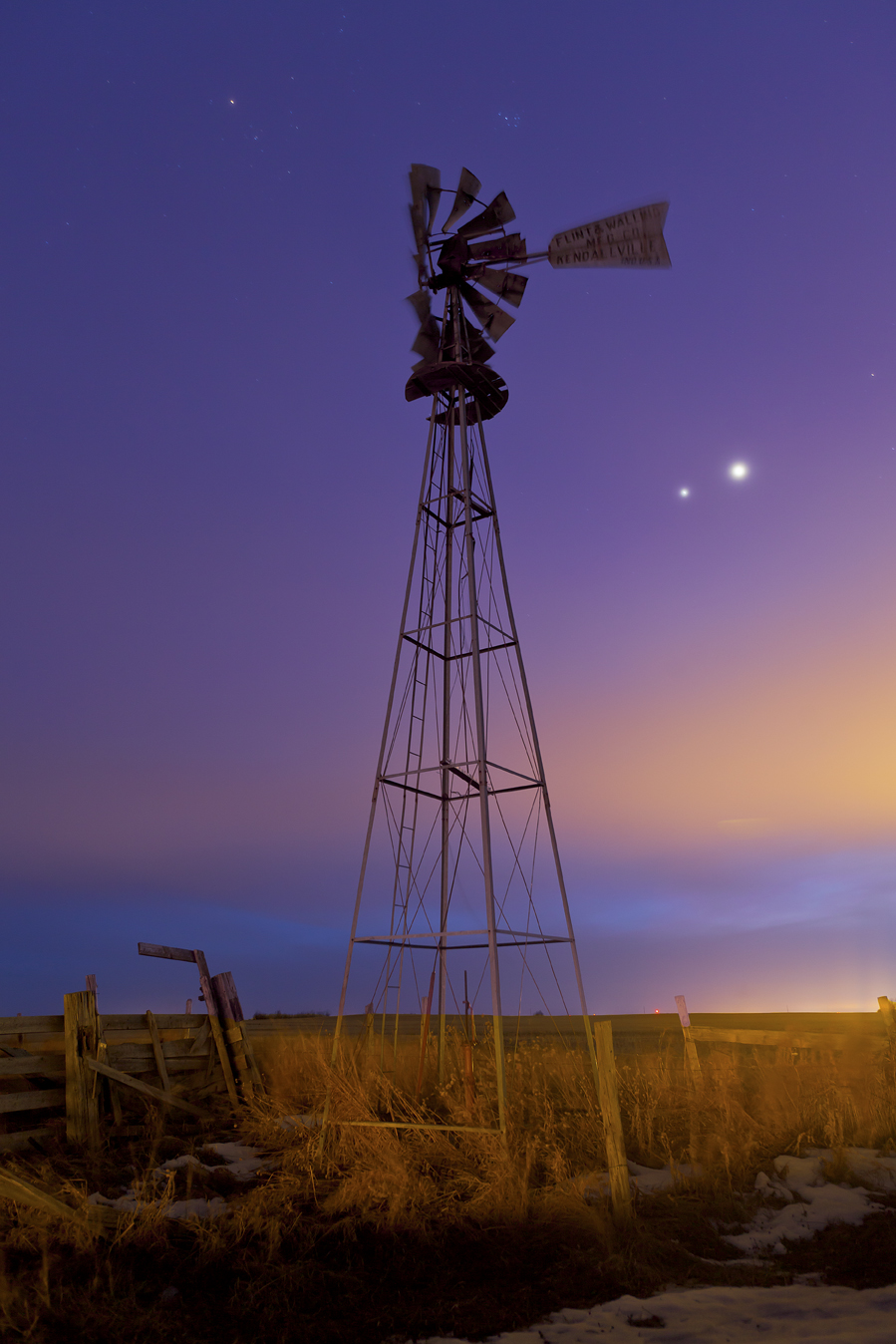
Venus and Jupiter are the planets that just keep on giving! What a photogenic pairing they are proving to be this month.

Here they are behind one of the icons of the prairies, an old water pump windmill, made it would seem by the Flint and Walling Mfg. Co of Kendallville, Indiana, USA, probably in the 1930s or 40s. My area of southern Alberta was once considered too dry for agriculture and it was only irrigation that made the land livable. Individual farm pumps of the dustbowl era were replaced by a mega-project system of canals and reservoirs to water what is effectively a desert. And a windswept one. A blustery Chinook wind was blowing this night.

The pair of planets is at right, tonight in about as close a conjunction as they will get, about 3° apart. The Pleiades and Hyades star clusters in Taurus poke through the clouds at top. The night was quite hazy but the clouds added the yellow colour from Calgary streetlights in the distance. Natural twilight added the blues and purples. Car headlights lit the foreground.

— Alan, March 12, 2012 / © 2012 Alan Dyer
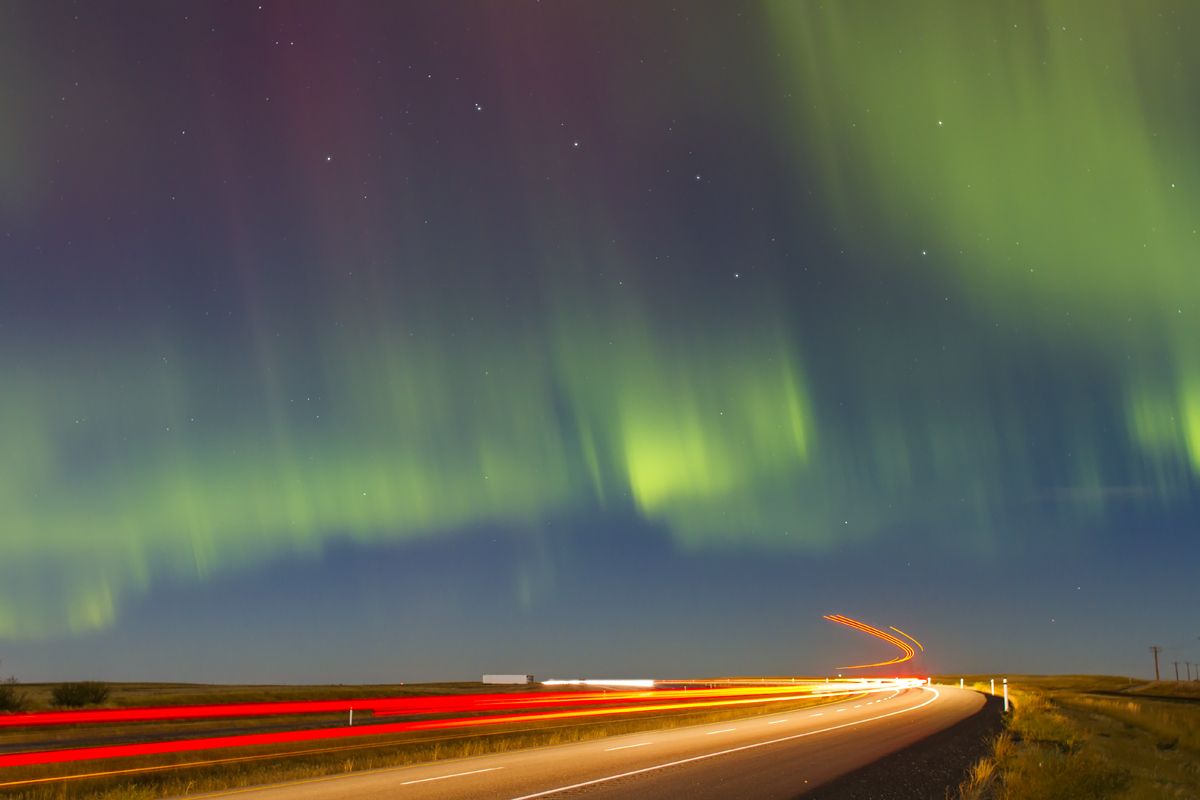
 

Bridging Earth and Sky (Off to Venus and Jupiter)


This was the scene Sunday night, March 11, as Venus edged up to Jupiter in the evening twilight.

To capture the nightscape I hunted around for a spot along the Bow River near home and settled for a site on the banks of the river at the point called Blackfoot Crossing, the traditional heart of the Siksika First Nation land. Here, the Bow River runs north-south for a stretch and the highway crosses the river heading west into the evening twilight, as if off into the sky to meet Venus and Jupiter in conjunction.

I waited until a passing car added the streak of tail lights, heading off into the sunset and starry sky. Nightscapes like this are often best taken when the sky is fairly dark but a longer exposure still brings out the remaining colours of twilight, as well as fainter stars, to make an image enhanced from what the eye might have seen.

— Alan, March 11, 2012 / © 2012 Alan Dyer


The Marvellous Mid-March Sky


We have a marvellous sky above us these nights, with an array of brilliant beacons in the evening sky.

This wide-angle scene captures the western and southern sky. To the west at right shine Venus and Jupiter. To the south at centre stands Orion. His famous Belt points up to Taurus and the Pleiades star cluster. His Belt points down to the brightest star in the night sky, Sirius, the Dog Star in Canis Major. Above, at top left, is the other Dog Star, Procyon, in Canis Major.

The last vestige of twilight tints the sky deep blue. But some of the red nebulas in and around Orion are beginning to show up as the sky darkens on a late winter night.

I shot this Saturday night, March 10, on the last evening of Standard Time. Now, I and all astronomers have to wait up another hour to see and shoot the wonders of the night sky. Astronomers hate Daylight Saving Time.

— Alan, March 11, 2012 / © 2012 Alan Dyer

Venus and Jupiter Converge


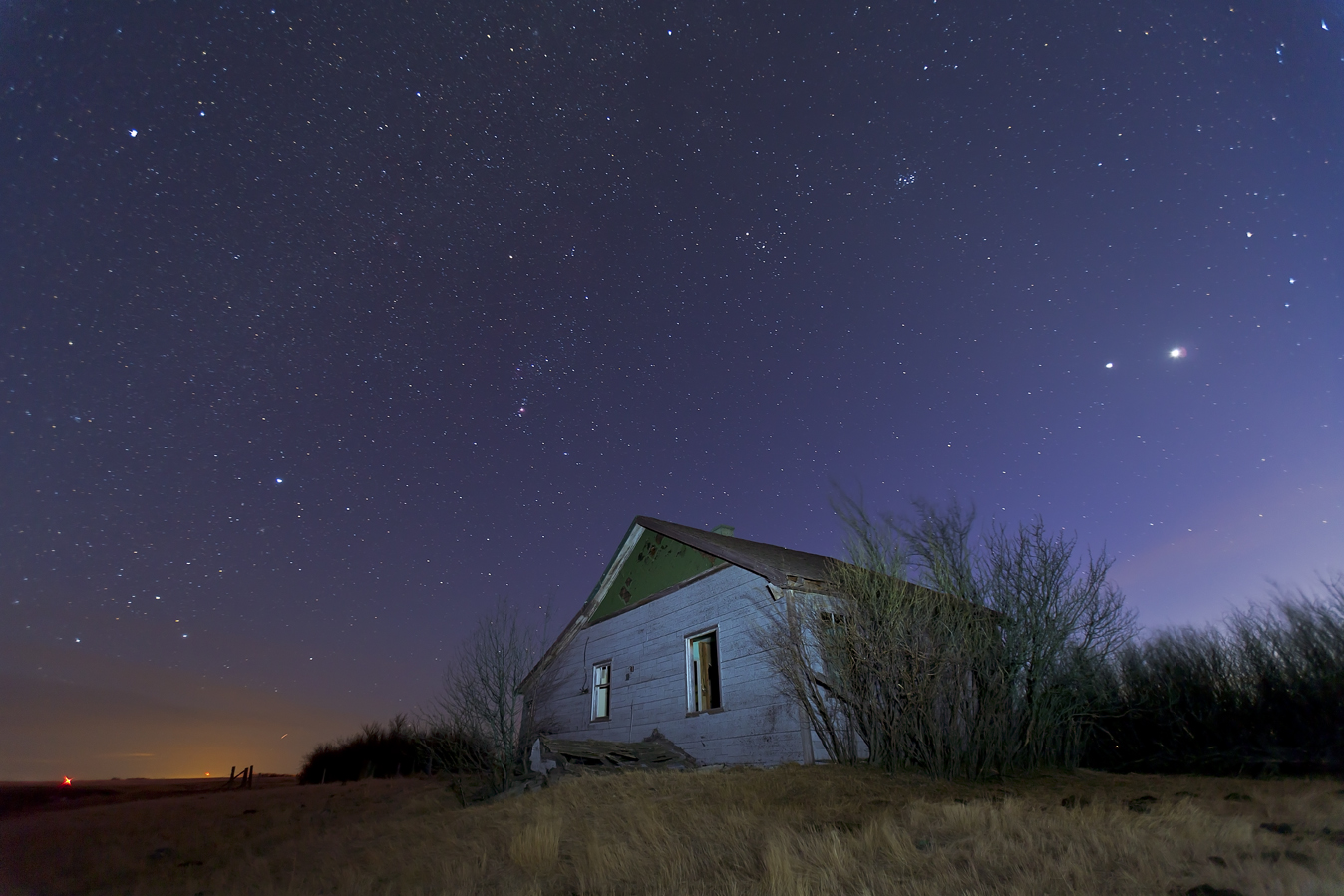
Venus and Jupiter are getting closer! To each other that is.

This was the scene Saturday night, March 10, two days before Venus (on the right here) and Jupiter reach their close conjunction in the evening twilight sky. I’m amazed how high the pair of objects are at sunset, with Venus much higher in the sky than it normally appears. We haven’t seen Venus as well as this since 2004.

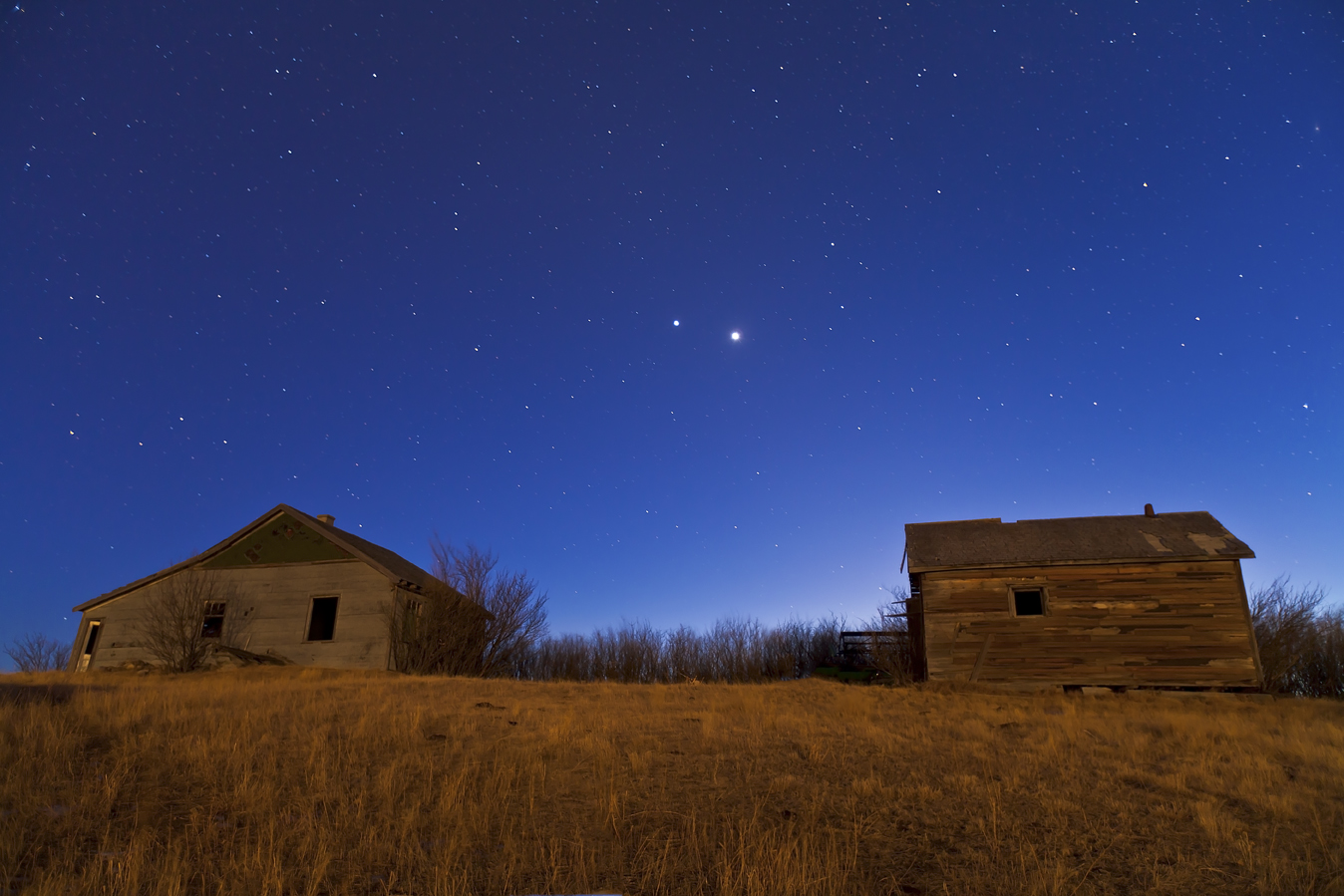
This is a scenic prairie nightscape, with some ramshackle buildings from a 1940s vintage farmstead near my house serving as a foreground setting for the sky scene above. Headlights from a passing car provided some handy and warm illumination to contrast with the cold blue above.

— Alan, March 10, 2012 / © 2012 Alan Dyer


Big Black Spot on the Sun Today


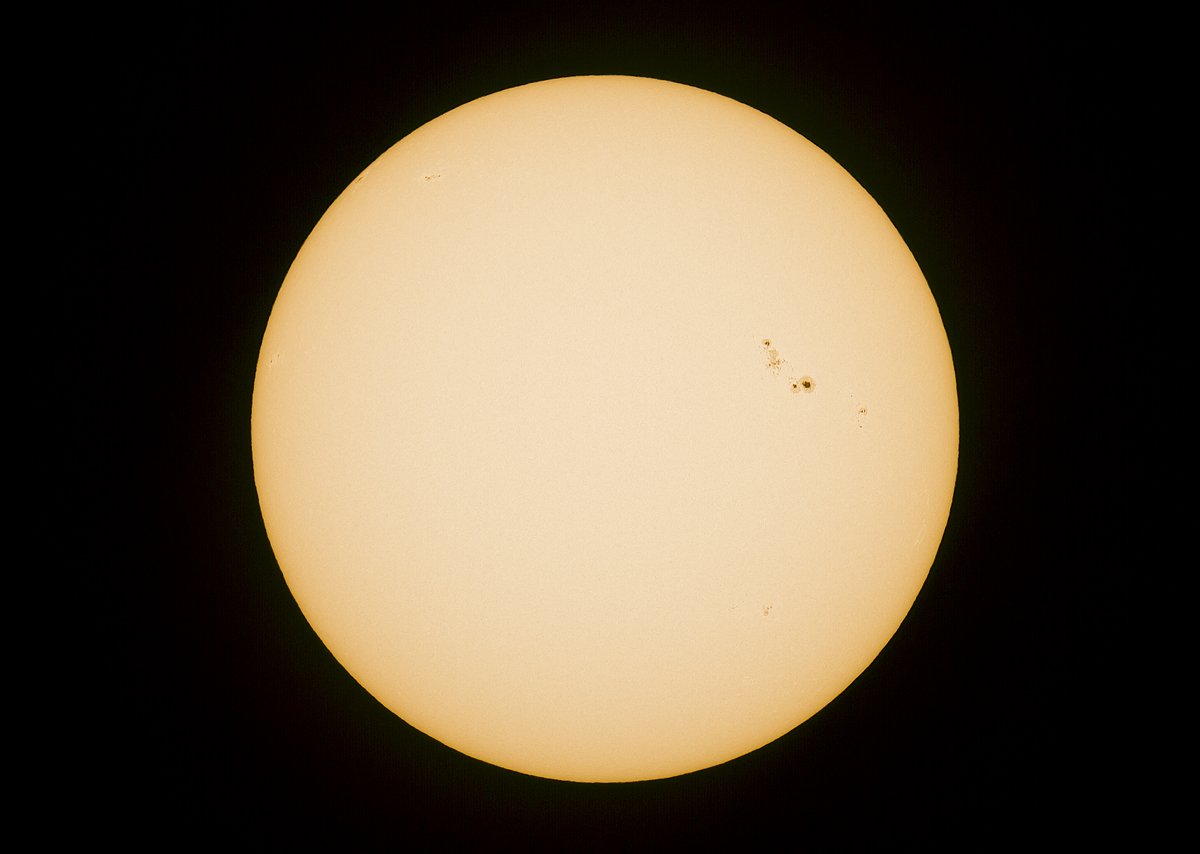
This is the news maker of the week, the sunspot group known as Region #1429.

It hit the headlines this past week as it let loose several intense solar flares, triggering geomagnetic storms around Earth and some aurora displays. Even as I took this shot of the Sun on Saturday afternoon, through a normal white light filter, Region #1429 was unleashing another intense flare, visible in red H-alpha light as a brilliant bright spot embedded in the dark sunspot. We can expect some more solar storms heading our way, and perhaps displays of northern lights.

The Sun is picking up in activity and there will be lots more of these headline events over the next few years, as the news media latch onto to any story that promises to wreak mayhem and chaos here on Earth. In reality, these events won’t have much effect on us in everyday life except to create beautiful auroras we can admire.

— Alan, March 10, 2012 / © 2012 Alan Dyer


Mars Down the Road


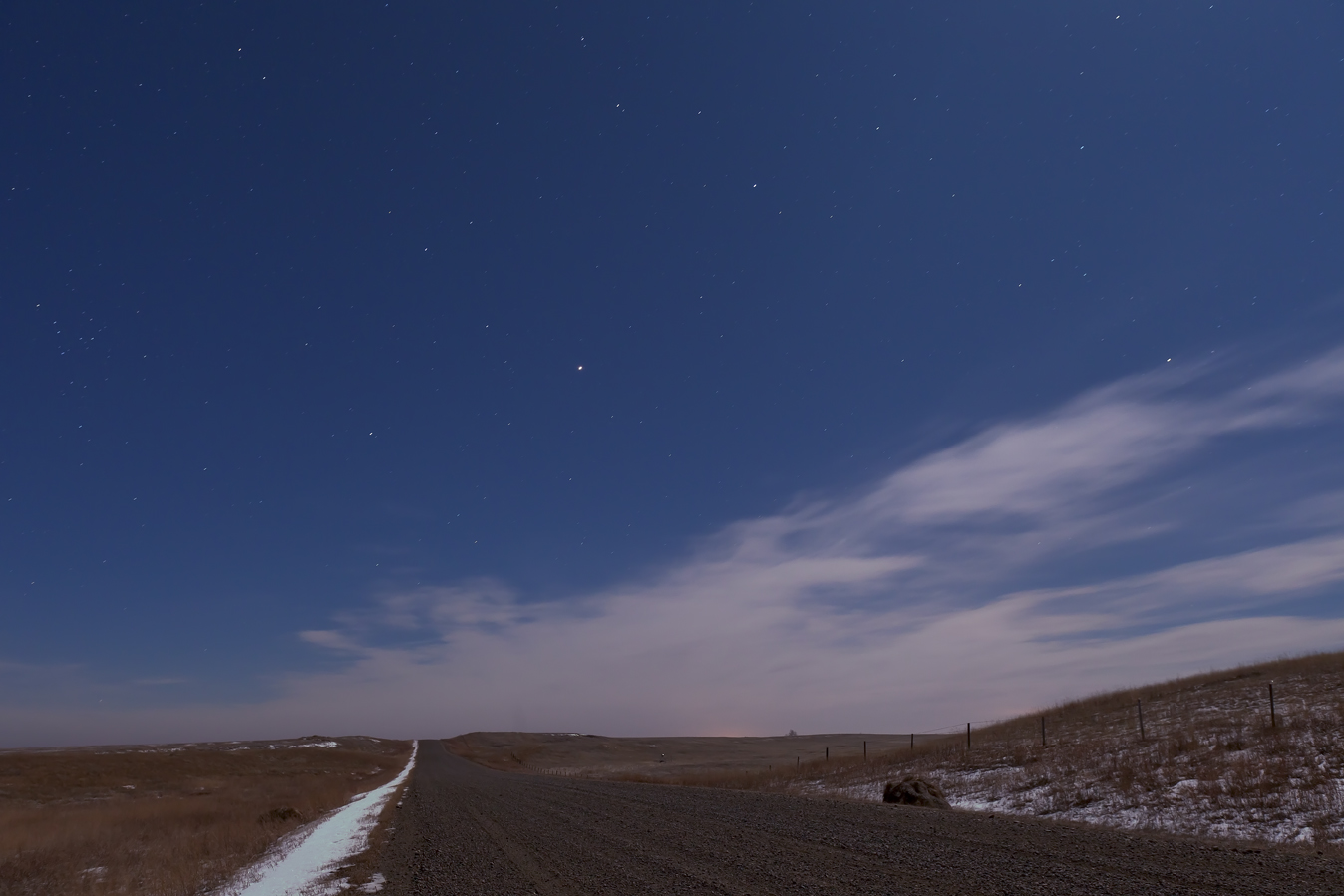
Here’s Mars, now at its closest and brightest in two years. Look for it due east in the early evening, as a rising reddish star in Leo.

On March 7, the Full Moon sits next to Mars, making for a fine sight as the pair rise together at sunset.

I took this shot March 4, with the Moon just off the frame at the top. Here, the eastbound county road seems to head off across the Prairies to Mars. It’s got a long way to go. Even at its closest right now, Mars is still 100 million kilometres away.

— Alan, March 6, 2012 / © 2012 Alan Dyer

Planet Trio in the West


Look west this week (the first week of March) and you’ll see three planets in a line across the evening sky.

Mercury is lowest in the sky, visible here just above the clouds on the western horizon. It’s bright but easy to miss. To find it, draw a line between Venus and Jupiter and extend the line down and to the right. This week Mercury is putting on its best evening appearance for the year for northern latitudes. You won’t see it higher or brighter than this in 2012.

Farther up the sky is Venus and Jupiter. They are standout objects. As they approach each other over the next week more and more people will suddenly pay attention to them and wonder what they are.

This was the view Sunday night, March 4. The next night a change in the weather brought heavy snow and a blizzard across the Prairies. But clear skies have returned, so enjoy the planets!

— Alan, March 6, 2012 / © 2012 Alan Dyer

A Panorama of Planets


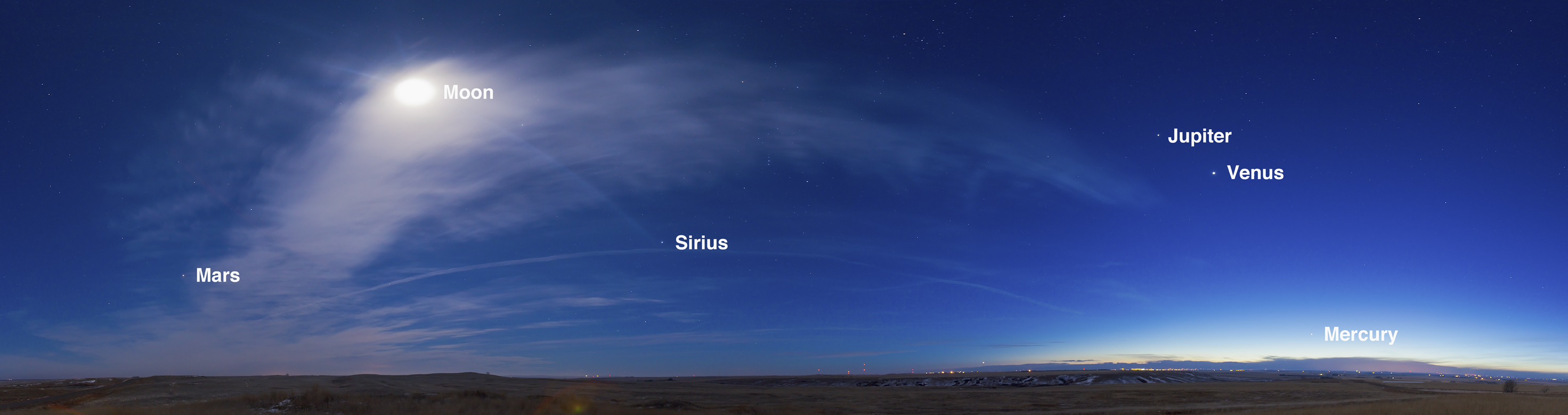
This was a beautiful night, with the array of five worlds stretched across the sky, a parade of planets and the Moon.

Mercury is now at its greatest angle away from the Sun and easiest to see in the evening sky this week for the year, at least from Canadian latitudes. Even so, it is low in the western twilight.

You can’t miss Venus and Jupiter higher in the west. Watch them close up and trade places in mid-March.

Mars is now at opposition, closest to Earth, and rising at sunset. It shines brightly as a red star in the east, 180° away from Mercury. It will be in our sky for several more months.

Orion shines due south amid the clouds. The arc of clouds rather nicely defines the arc of the ecliptic path across the sky, the path along which we always find the planets.

I took the shots for this panorama on Sunday, March 4. I took five segments, each 13 second exposures with a 16-35mm lens, then combined them in Photoshop CS5 with its Photomerge command.

— Alan, March 4, 2012 / © 2012 Alan Dyer

Mercury Rising Over Calgary


Mercury is elusive but here it is, showing up as a speck over the skyline of Calgary, as it begins its best evening appearance of the year, rising a little higher into the twilight sky each night for the next few evenings.

To find it, follow the line down from the Moon and then bright Jupiter and Venus at upper left and continue that line to the lower right. Just to the right of the tallest building (the new Bow tower) and just above the rooftops there’s a tiny dot of light. That’s the inner planet Mercury. It’ll get higher in the first week of March but not by much. Mercury is bright. It’s just not very high and is easy to miss.

But with Mercury coming into view, and with Venus and Jupiter so prominent now in the evening, and Mars now bright in the east after sunset – look for a red star – we have a nice array of 4 naked eye planets across the sky at once. Saturn comes up later after midnight now. So you can see 5 naked eye planets in one night.

It’s a great evening sky show now in early March.

– Alan, March 1, 2012 / © 2012 Alan Dyer

The Great Sky Show of 2012 Begins


The show has been underway for a while but this past weekend anyone with clear skies couldn’t help but notice some beautiful sights in the evening sky. They herald the start of a wonderful late winter and spring of evening celestial scenes.

Tonight, after a snowy weekend that brought winter back to Alberta, skies cleared enough to reveal the waxing crescent Moon next to Jupiter, with both above brilliant Venus. Over the next two weeks watch as Venus and Jupiter converge for a mutual conjunction March 12 to 13. Then on March 25 we’ll see the Moon next to Jupiter and the near Venus the following night, just a month from now.

For the next two weeks we also have Mercury at its best low in the western evening sky and Mars rising in the east at sunset as it reaches its closest point to Earth in two years. It’s a great planetary spring.

Keep looking up!

— Alan, February 26, 2012 / © 2012 Alan Dyer


Chariot of the Sky


Auriga the Charioteer rides high across the northern winter sky these nights. This is a wide-field image I took last week of the constellation that now shines overhead from northern latitudes.

My image takes in all of Auriga, the pentagon-shaped charioteer of Roman mythology, as well as the feet of Gemini the twins, spanning a wide area of the winter Milky Way. Sprinkled along this bit of Milky Way you can see a few clusters of stars. They include four of the best open star clusters in the catalogue of Charles Messier: M35 in Gemini at bottom, and M36, M37 and M38 in Auriga at centre, all wonderful targets for a small telescope. Some of these targets lie in the next spiral arm out from the one we live in.

The star colours show up nicely here, with the brightest star at top appearing a little off white. That’s Capella, 42 light years away and classified as a type G “yellow” star not unlike our own Sun in temperature but much larger – a giant star. Indeed, it is really two yellow-giant stars in close orbit around each other. It’s interesting that Capella doesn’t really show up as yellow. Just like our Sun does to our eyes, Capella appears white because it still emits such a broad range of colours that even though its peak energy does fall in the yellow part of the spectrum, all the other colours remain strong enough that the star looks white to our eyes. Remember, our eyes evolved under the light of a type G star to see all the colours of the spectrum from red to blue.

Only the cool red giant stars take on a yellow or orange hue to our eyes, and to the camera. You can see a few in this image, as well as hot blue stars. The pinky red bits are nebulas in the Milky Way – clouds of hydrogen gas emitting deep red light.

When we look in this direction in the Milky Way we are looking out toward the edge of our Galaxy, exactly opposite the galactic centre.

– Alan, February 21, 2012 / © 2012 Alan Dyer

Orion Over Our Fence of Mountains


For us in the northern hemisphere, Orion is the very symbol of a winter night, as he stands over snowy landscapes. I took this photo from Lake Louise, in the Rocky Mountains on a chill February night.

Robert Frost, the American poet, describes the inspiring scene of Orion climbing into a winter sky:

“You know Orion always comes up sideways.

Throwing a leg up over our fence of mountains,

And rising on his hands, he looks in on me

Busy outdoors by lantern-light with something

I should have done by daylight, and indeed,

After the ground is frozen, I should have done

Before it froze, and a gust flings a handful

Of waste leaves at my smoky lantern chimney

To make fun of my way of doing things,

Or else fun of Orion’s having caught me.”

_____________________________________

— Alan, February 15, 2012 / © 2012 Alan Dyer

The Rose of Winter


While I took this shot three weeks ago, I’ve only just got around to processing it. This is a nebula-filled region of the northern winter sky in the constellation of Monoceros, the unicorn.

The highlight is the rose-like Rosette Nebula at bottom, an interstellar flower of glowing hydrogen where new stars are forming. Above it, at centre, is a mass of pink, blue and deep red nebulosity that forms the Monoceros Complex. All lie in our local corner of the Milky Way, in a spiral arm fragment called the Orion Spur, a hotbed of star formation.

This field, shot with a 135mm telephoto lens, sits to the left of Orion and spans about a hand width at arm’s length. It would take a couple of binocular fields to contain it. Next on my astrophoto agenda – shooting some close ups of selected bits of Monoceros, shots that have eluded me till now.

— Alan, February 12, 2012 / © 2012 Alan Dyer
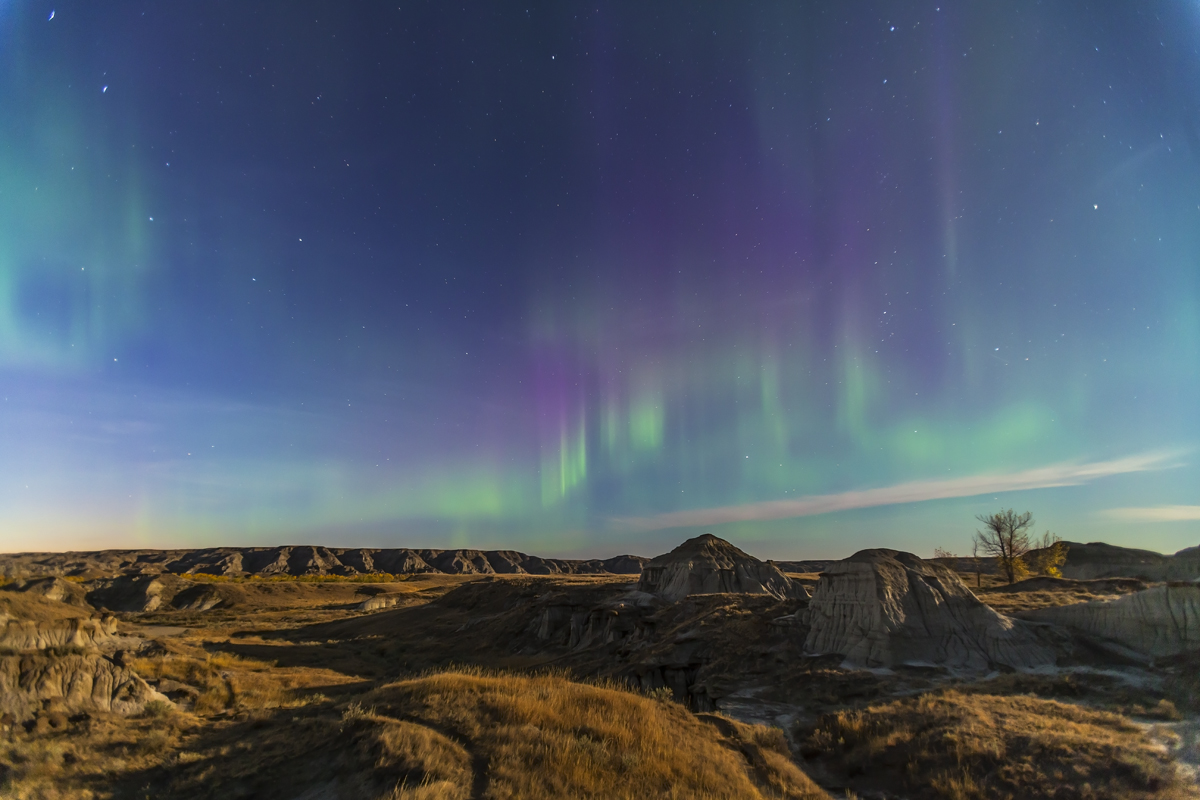
Orion over the Grand Hotel


Orion sets over Sulphur Mountain and the Banff Springs Hotel in this nightscape from last weekend, February 3.

This is where Banff National Park – indeed the Canadian National Parks system – started, with the founding of a protected enclave around the hot springs and then the hotel, operated at first by the Canadian Pacific Railway, to serve visiting tourists seeking cure-all remedies from the sulphur springs.

Orion and Sirius shine above the Banff landmark, lit, unfortunately, far too brightly by sodium vapour lights. One day the ethic espoused by commercial interests of conserving the environment will extend to the night sky. When we set up telescopes at the Hotel a couple of years ago in honour of Earth Hour, we had to physically cover some lights — they could not be turned off!

So while this shot shows some of the beauty of the night sky from a site like Banff, it also shows what anyone under the veil of all those lights misses. Half the environment of the mountains.

— Alan, February 10, 2012 / © 2012 Alan Dyer
Snow Moon over the Science Centre


Here’s the Full Moon of February rising over the place I work, the science centre in Calgary, called TELUS Spark.

I took this Tuesday evening, February 7, on the night of what is sometimes called the Snow Moon. I knew the Full Moon would rise in the northeast and worked out, with the help of a useful iPad app, just where to stand on the hill above the science centre to get the Moon rising over the science centre. Though it did take a last minute move of a hundred feet to place the Moon over the front entrance!

The building glows from the light of banks of LEDs that can be programmed to slowly change colour. The parking lot lights are all nicely shielded, as any astronomically friendly place should be, to prevent light spilling upward. The odd structure to the left contains the new digital dome theatre, which opens this spring. The dome screen is being installed this month. The dome will feature a Digistar 4 projection system with two pairs of very high-end Sony 4K video projectors, for interactive star shows and full-dome movies. Maybe even laser shows!

Should be fun!

— Alan, February 8, 2012 / © 2012 Alan Dyer
 

The Venus Express


A train winds through the Rockies, seemingly headed for Venus!

I took this shot last Saturday night at one of my favourite photo stops in Banff, the famed Morant’s Curve on the Bow Valley Parkway. This was the spot made famous in the 1930s and 1940s by CPR photographer Nicholas Morant who hauled his large format view camera around western Canada shooting scenes of the Canadian Pacific Railway and classic steam engines at work hauling through the Rockies. At this location the train winds alongside the Bow River heading up to the continental divide marked by the line of peaks in the distance.

On this night, Venus shone brightly over the peaks surrounding Lake Louise. A westbound train heads off into the distance. In a few minutes it’ll be over the divide and descending Kicking Horse Pass into Field, B.C. and Yoho National Park. It’ll never reach Venus!

— Alan, February 7, 2012 / © 2012 Alan Dyer
 

Trails of Orion Over Fairview


I love the lighting in this shot from Saturday night. I took this by standing out on Lake Louise, from a spot you couldn’t be in summer without getting wet!

Moonlight grazes the east and north slopes of Mount Fairview, while spill from a skating rink flood lamp lights the trees. The sky is deep blue from moonlight making this look like a day scene.

But this is actually a 4-minute exposure, purposely long to allow the stars of Orion and the bright star Sirius at left to trail across the heavens over Fairview.

Unlike most nightscape shots, of necessity taken at high ISO speeds to grab lots of light in a short exposure, I took this shot at ISO 100. Even with the blog’s low resolution images, I think you can see the difference here – this slow-speed shot looks richer and smoother, lacking the fine noise that is inevitable in high ISO shots. It’s just like using slow speed film – in the old days I’d always carry two types of film for trips like this: slow Velvia 50 for long star trail shots, and fast Fuji or Ektachrome 400 for the untrailed nightscapes. I always loved the Velvia shots – they were indeed like smooth velvet.

Now with digital cameras you can switch settings as you like. And see the results instantly. How did we ever manage to get any results with film?

— Alan, February 6, 2012 / © 2012 Alan Dyer
Lake Louise by Moonlight – in Winter


Moments before taking the photo featured in the previous blog I captured this scene, from the footbridge over Louise Creek flowing out of Lake Louise.

This is one of the world’s great photo spots, but here the scene is lit by moonlight and by the Chateau’s and skating rink lights. Jupiter is the bright object above Mt. St. Piran at right.

This was a magical night. Just step away from the artificial lights, let your eyes adjust and a stunning nightscape appeared. Compare this scene to the one I shot from a few steps away but in August and featured in my blog Lake Louise by Moonlight. The blue glacial waters of the summer scene are here replaced by snow and ice.

— Alan, February 5, 2012 / © 2012 Alan Dyer

Orion Over the Cozy Cabin


Here’s a picture postcard winter scene, one that thousands of people walk by each day — by day.

This is the Swiss guide cabin at Lake Louise, but seen at night. Light from the Moon just off the frame at top illuminates the scene, while Orion stands in the sky over the cabin and Mount Fairview.

I took this shot Saturday night, February 4, 2012, as one of many shots that night at Lake Louise, under crystal clear skies. It was a winter wonderland and a night photographer’s paradise.

Nightscape shots like this are surprisingly easy to take — typically being 20 to 40 seconds at f/2 to f/4 and ISO 400 to 800 with a good DSLR. The exact settings depend on how bright the Moon is. I used the Canon 5D MkII and 24mm Canon lens, a fine combination for night shooting.

— Alan, February 5, 2012 / © @2012  Alan Dyer


Celestial Pinks and Blues


Who says the dark night sky isn’t colourful? Of course, to the naked eye it mostly is, with the darkness punctuated only with a few red, yellow and blues stars. But expose a camera for long enough and all kinds of colour begins to appear.

This region is above us now, in the Northern Hemisphere evening sky for mid-winter. It’s the boundary area between Taurus and Perseus. Below are the vivid blues of the hot young Pleiades star cluster in Taurus. At top, just squeezing into the frame, is the shocking pink of the California Nebula, a glowing cloud of hydrogen gas in Perseus.

But between are the subtle hues of faint nebulosity weaving all through the Perseus-Taurus border zone. Below are faint cyans and blues from dust clouds reflecting the light of the Pleiades stars. In the middle are the yellow-browns of dark dust clouds hardly emitting light at all, but snaking across the frame to end in a complex of pink and blue straddling the border collectively known as IC 348 and IC 1333. At top, the glowing hydrogen gas of the California emits a mix of red and blue wavelengths, creating the hot pink tones, but fading to a deeper red to the left as the nebula thins out to the east. Throughout, hot blue stars pepper the sky and help illuminate the dust and gas clouds which will likely form more hot stars in the eons to come.

I took this shot last Wednesday night, on one of the few clear, haze-free nights of late. This is a “piggybacked shot,” with the Canon 5D MkII camera going along for the ride on one of my tracking mounts. This final shot is a stack of five 6-minute exposures, highly processed to bring out the faint clouds barely brighter than the sky itself. The camera was equipped with a 135mm telephoto lens, giving a field of view a couple of binocular fields wide. Hold out your hand and your outstretched palm would nicely cover  this area of sky. But only the camera reveals what is actually there.

— Alan, January 29, 2012 / Image © 2012 Alan Dyer

A Prairie Palette of Earth and Sky Tones


Following up on my previous post, here is the wide-angle scene of that same winter moonrise, taken at sunset on January 8, 2012.

This was a spectacular and truly “amazing sky,” with the last rays of the setting Sun illuminating the clouds and the rising Full Moon coming up in the pinks and blues of twilight. It is the big prairie sky at its best.

The wide scene captures dark cloud shadows converging toward the point opposite the Sun, near where the Full Moon sits. These are “crepuscular rays,” a common sight at sunset or sunrise.

— Alan, January 8, 2012 / Image © 2012 Alan Dyer


Winter Moon Rising


Here is the January 2012 Full Moon rising above a decidedly un-January landscape in southern Alberta. A recent spell of unseasonably mild weather has eaten most of the snow, leaving the fields yellow-brown, and a fine colour contrast with the twilight sky.

On January 8 the Full Moon rose into clear skies over the prairie landscape east of my home. This shot captures the pink glow of twilight on the upper atmosphere, above the rising blue rim of Earth’s shadow just on the horizon. A month ago, the Full Moon was in that shadow out in space, being eclipsed at sunrise. Here it is rising at sunset, one lunar cycle later.

I like the prairies, not only for the flat horizons and big open skies they provide, but also for the wonderful palette of colours on Earth and sky.

— Alan, January 8, 2012 / Image © 2012 Alan Dyer
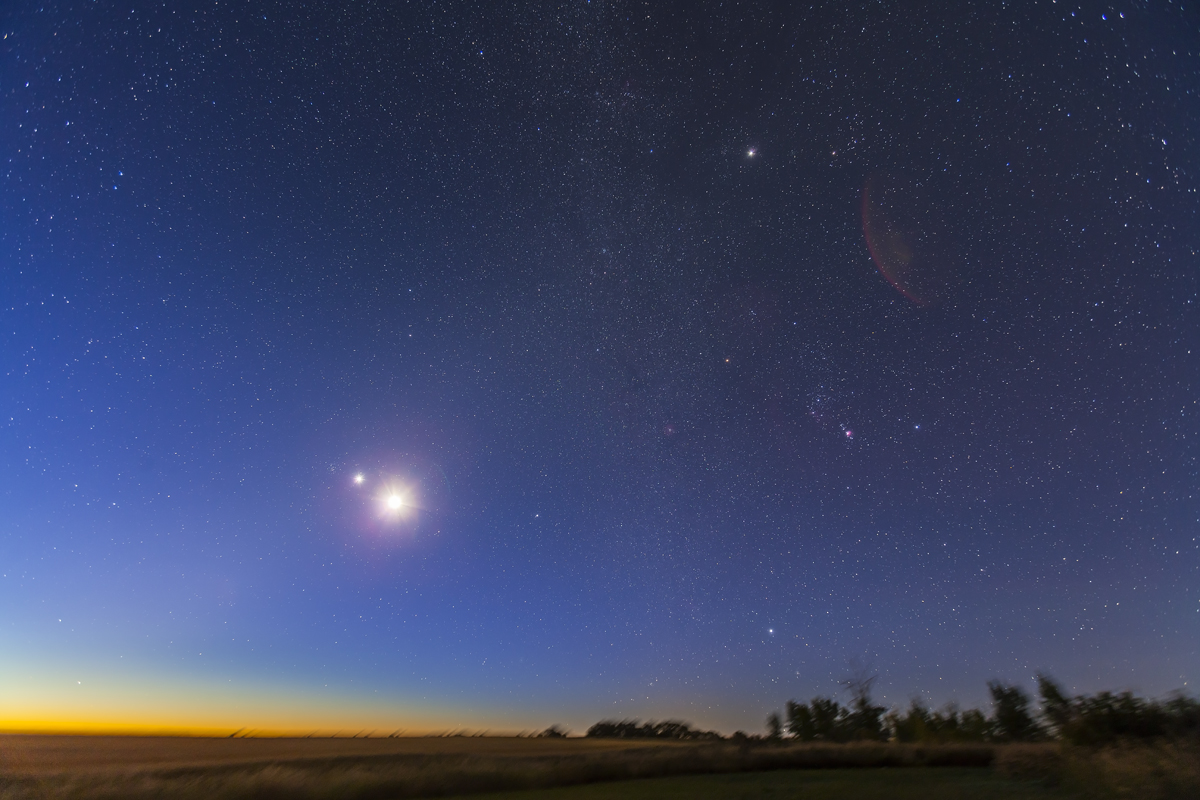
 

New Year’s Moon


Happy New Year to all! To mark the first day of 2012 here is a view of the quarter Moon as it appeared in the early evening twilight on January 1, 2012.

The coming year promises to be a superb one for stargazing with:

• a wonderful evening appearance of Venus in March and April, including a rare passage through the Pleiades star cluster on April 3

• an array of 5 planets in the evening sky in March

• a partial eclipse of the Sun May 20 (annular if you travel to the SW United States)

• a partial eclipse of the Moon June 4 (at dawn for western North America)

• an amazingly rare transit of Venus on June 5 (North American time)

• a fine year for the Perseid meteors August 12/13

• a daytime occultation of Venus on August 13 (for North America)

• a total eclipse of the Sun from Australia and the South Pacific

• a host of fine Moon and planet conjunctions throughout the year

• and no doubt some fine displays of Northern Lights as the Sun picks up in activity toward its predicted 2013 maximum.

So there should be lots to shoot and blog about in 2012. In 2011, since I started this blog in February, my Amazing Sky blog has served up 103 posts and 14,000 image views, seen by people on 6 continents — I have yet to break into Antarctica! Perhaps in 2012.

Clear skies to all!

— Alan, January 1, 2012 / Image © 2012 by Alan Dyer
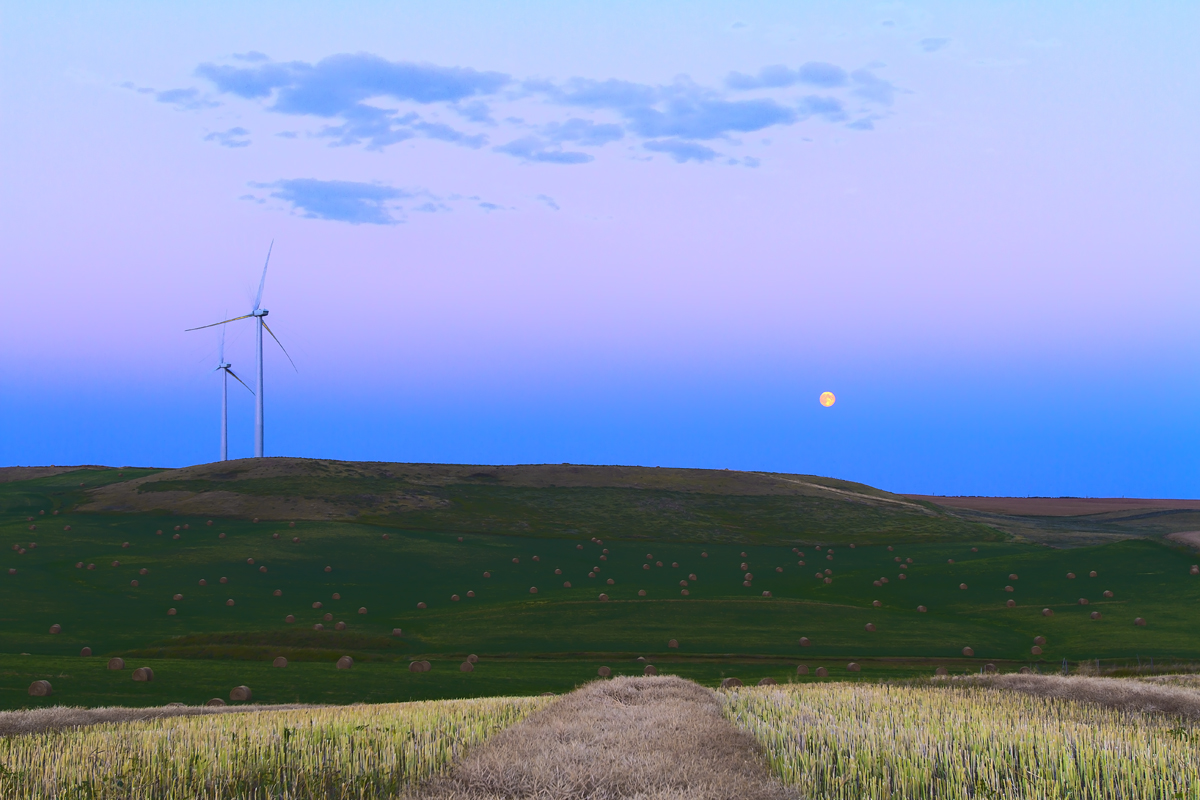
 

Total Eclipse of the Moon (December 10, 2011) #3


This is my favourite shot from the December 10 dawn eclipse. It’s the one I was after, with the red Moon in a blue sky over the snow-covered Rockies.

Lunar eclipses don’t have the dramatic and sudden effects of a total eclipse of the Sun. But neither do they have the anxiety and sometimes sheer panic! Lunar eclipses are more stately affairs as they play out in a relaxed manner over 2 to 3 hours. But they are beautiful nonetheless, especially when the Moon is low in the sky and set above a scenic landscape at moonrise or, as it was with this eclipse, at moonset.

The red colouration of the Moon makes the scene, as the Moon, embedded in Earth’s shadow, becomes lit by the light of all the sunsets and sunrises going on around the world at once. If Earth had no atmosphere the Moon would go completely black during a total eclipse. But besides making life on Earth possible (no small thing!), our atmosphere also provides us the wonderful sight of a red Moon during a total eclipse. Take a deep breath and enjoy!

— Alan, December 10, 2011 / Image  © 2011 Alan Dyer


Total Eclipse of the Moon (December 10, 2011) #2


This was the view well into totality as the eclipsed Moon set into the morning twilight sky. On December 10 we got a fantastic view of the total lunar eclipse at dawn, with the red Moon over the Rockies.

I shot this from the grounds of the Rothney Observatory in the foothills southwest of Calgary. The Moon is completely in Earth’s shadow here but with its southern or bottom edge brighter than the top, so it overexposes here. This view captures the scene as the eye saw it, at about 7:30 a.m. local time, an hour before sunrise and moonset.

A full house of 100 people showed up at the Observatory for a public event and breakfast. I dare say they got the best view of this eclipse of anyone in Canada.

— Alan, December 10, 2011 / Image © 2011 Alan Dyer


Total Eclipse of the Moon (December 10, 2011) #1


It has been a long time between Blog posts, with no new astrophotos from me for a while. But the drought ends due to thankfully fine conditions for the total eclipse of the Moon, on Saturday morning, December 10.

Skies were wonderful and the conditions actually pleasant for a winter morning at 6 a.m. For us in southern Alberta, the Moon went into eclipse as it descended into the western sky in the pre-dawn hours. The timing wasn’t convenient, but the view more than made up for the effort of getting up at 3 a.m. to drive west out of cloud to the Rothney Observatory. Their location in the foothills proved clear and perfect for looking west, to see the Moon over the Rockies.

This is one of my earlier shots in the 3-hour event, taken just before totality began, when the Moon was still in a dark sky. The camera was on a tracking platform to keep the stars from trailing during the 30 second exposure, causing the ground to trail instead.

You can see the Pleiades cluster at right, and Betelgeuse in Orion at left.

This was the last total eclipse of the Moon anywhere in the world until April 14, 2014.

— Alan, December 10, 2011 / Image © Alan Dyer 2011
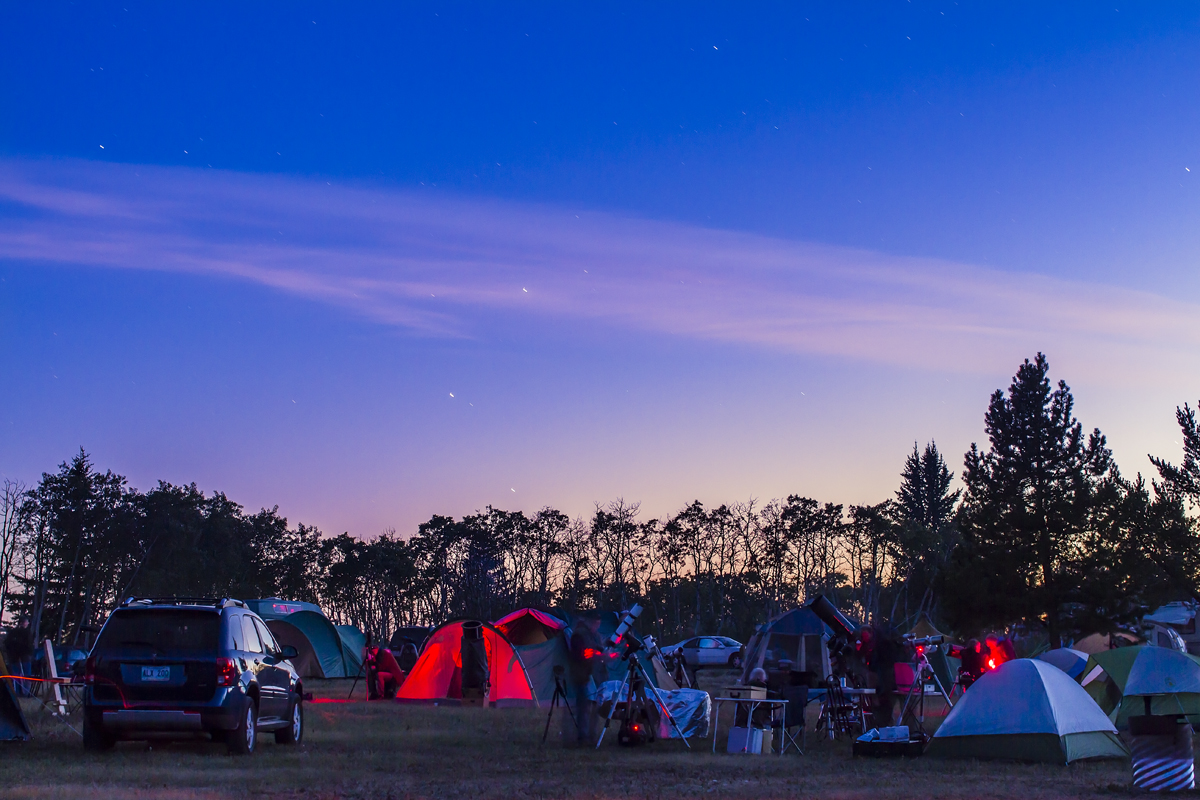
 

Calgary Lights Up


I’m getting the hang of shooting demanding day-to-night time-lapse movies!

For this clip I shot over 2.5 hours, using a fish-eye lens, to create a sequence suitable for projection in a digital planetarium dome.

But the trick with these day-to-night sequences is getting a smooth transition in exposures, which can range over 12 to 16 f-stops, from short snapshot exposures with the lens stopped all the way down at the start before sunset, to long 8-second exposures with the lens wide open at night, plus the camera’s ISO speed increasing from a slow ISO 100 to a faster ISO 400 or more at select points through the sequence as well.

The secret to doing this is a control box called the Little Bramper, an intervalometer that fires the shutter automatically at set intervals but also gradually ramps the exposure time a tad longer with each successive exposure. This was my third time out with the Bramper, and I more or less got it right this time!

While the Bramper does a great job running the camera, it still takes a lot of manual oversight to control its ramping rate so the exposures don’t get too long and overexpose the scene, or fail to get long enough to track the darkening sky.

At several points in the sequence it is also necessary to quickly (in one exposure cycle) half the exposure time, while at the same time opening up the lens a stop, or doubling the ISO, so that the ever-lengthening exposure doesn’t get too long and collide with the interval between exposures. In this case, shots were taken about 12 seconds apart, so the maximum exposure for each frame couldn’t be much more than 8 to 10 seconds.

The end result of the work is a time-lapse movie that shows the setting Sun, then the lights of Calgary coming on as the sky darkens. Clouds lit by the yellow glow of streetlights move in, then blow away again to reveal a few stars in the urban sky.

— Alan, October 16, 2011 / Movie © 2011 Alan Dyer
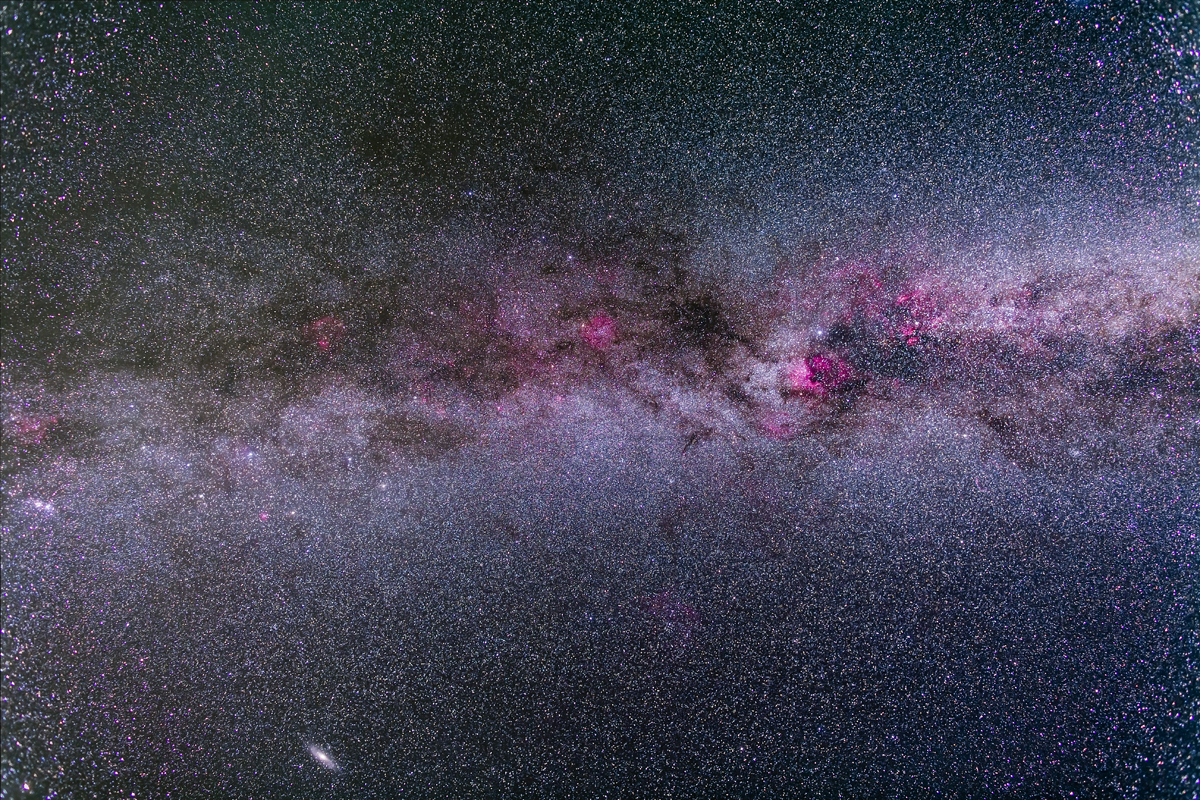
Little Church on the Prairie


In honour of Canadian Thanksgiving, here’s a shot from last night of a classic little church on the Canadian Prairie.

This is the long abandoned Catholic church at the hamlet of Dorothy, Alberta. The church was built in 1944, but as the coal mines in the Drumheller valley shut down (blame the invention of Diesel trains and the discovery of natural gas in Alberta) the once bustling town of Dorothy decayed into a ghost town. A few people still live there, but its main attractions are its relics of the pioneer age — this church, and the United church next to it (behind the camera), a picturesque grain elevator, and an old store. The companion United church has been restored, but this little church on the prairie, abandoned since 1967, awaits restoration.

The scene is lit by the gibbous Moon, and by a couple of sodium vapour streetlights, ubiquitous even in a ghost town.

In the sky are the stars of the Big Dipper and Polaris above the church.

This is one frame of 300 I shot over three hours as part of a motion-controlled time-lapse movie.

Happy Thanksgiving!

— Alan, October 10, 2011 / Image © 2011 Alan Dyer
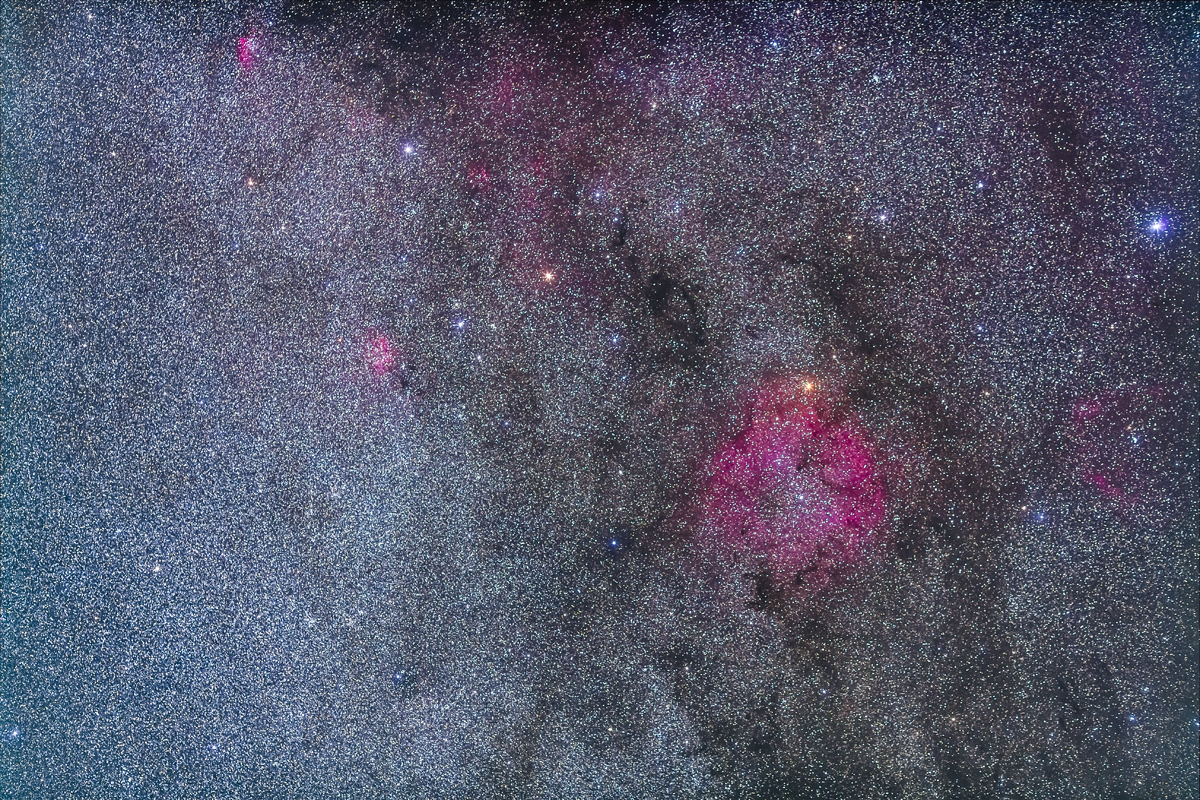
 

Set the Controls for Triangulum


Spiral galaxies are icons of deep space. This one is a classic. This is the Triangulum Galaxy, named for its home constellation. Amateur astronomers also know it as M33, the 33rd entry in Charles Messier’s catalog of deep sky objects compiled in the 1780s. To Messier, object #33 was another fuzzy spot he and others might confuse for comets, the objects astronomers of the day were really after.

It wasn’t until 1850 that the Earl of Rosse, observing with his monster Leviathan of Parsonstown, a 72-inch reflector telescope, managed to see M33 as something more than a nebulous glow. He saw what the photo clearly shows — spiral arms swirling around a central core. However, in those days, such “spiral nebulae” were thought to be whirlpools of gas where stars and solar systems were forming.

It wasn’t until the 1920s, with the work of Edwin Hubble, that objects like M33 were proven to be other galaxies like our Milky Way, each composed of billions of stars.

We now know the Triangulum Galaxy lies about 3 million light years away, and is about half the size of our Milky Way. That makes it the third largest member of our Local Group of galaxies, after our own Milky Way and the famous Andromeda Galaxy.

For this shot of M33, taken September 25, I stacked 6 images, each a 12-minute exposure at ISO 800 and f/6, shot with my Astro-Physics 130mm refractor and Canon 7D camera. Visible along the galaxy’s spiral arms you can see some of the reddish and cyan-coloured nebulas that are sites of active star formation in M33.

— Alan, Oct 7, 2011 / Image © 2011 Alan Dyer
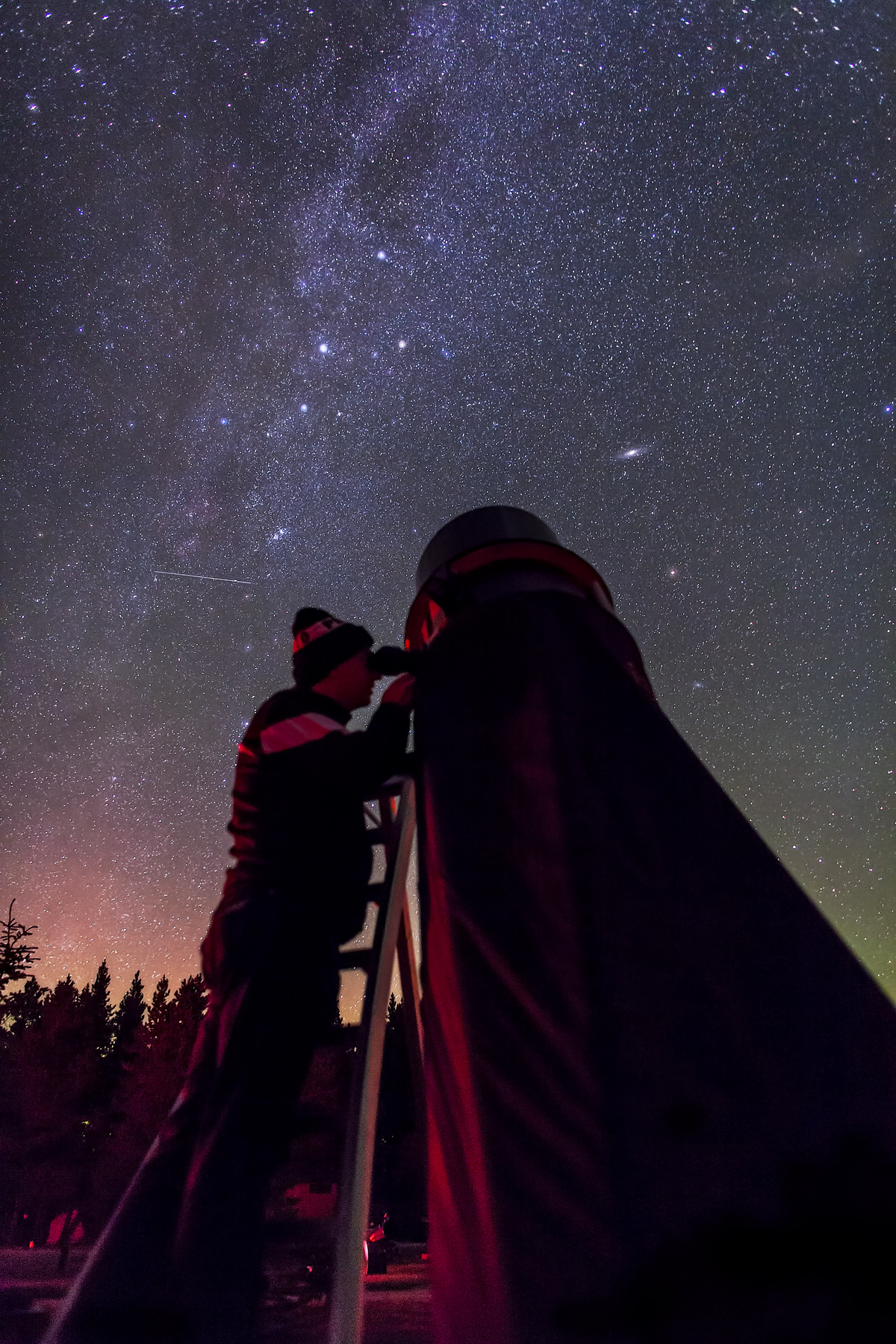
Milky Way Mosaic


Centre of the Milky Way Panorama (2011)

It’s taken me a few months to get around to the task, but at last! — my mosaic of the Milky Way I shot in Chile back in May.

The panorama is made up of 6 frames, stitched and blended together, extending from Crux, the Southern Cross (at right) to Aquila the eagle (at left) — a sweep of the Milky Way from Acrux to Altair! The mosaic is centred on the core of the Galaxy in Sagittarius and Scorpius.

Panoramas like this allow you to step back a distance and take in the big picture:

— You can see the large-scale structure of the dust clouds and the odd diagonal sweep of many of the clouds cutting across the plane of the Galaxy. I’ve never heard an explanation of why the dust lanes seem to have that structure and direction. I also see a 3D effect, with the nearby dust clouds hanging in front of and obscuring the bright starclouds of the distant inner spirals arms of our Galaxy.

— Also apparent are the extensive dust clouds at left extending from Ophiuchus (at top) down into Aquila, well below the plane of the Galaxy. Most wide-angle shots of the Milky Way I see tend to process out the subtle brown clouds that extend far off the Galactic plane. And they are brown, not black.

— And what really stands out is the band of bright blue stars from Scorpius (at top centre) to the right above the Milky Way through Lupus, Centaurus then down into Crux. This is a section of Gould’s Belt, a ring of hot blue stars around the sky that runs at an angle of about 20° to the Milky Way. This ring of hot, nearby stars surrounds us in our spiral arm and is thought to be only about 65 million years old, likely caused by some disturbance in our spiral arm which set off a wave of star formation close to us.

— And … as my Australian friends will point out, you can see the entire Dark Emu, made of the dust lanes from the Coal Sack in Crux at right (his head and beak), through the curving lanes in Centaurus (his neck), then sweeping up and over the centre of the Galaxy (his body) then down into Scutum and Aquila (his two feet and his tail).

I took this panorama from the Atacama Lodge in north central Chile, using the Canon 5D MkII and Canon 35mm lens. Each of the 6 segments that went into this pan was itself a stack of 4 x 6 minute exposures, plus a fifth exposure through a soft-focus filter, all at f/4 and ISO 800. The camera was on a Kenko SkyMemo tracking platform. I assembled the pan with Photoshop CS5’s Photomerge command. This is actually only half of the full panorama mosaic, which extends for another 5 segments to the right along the Milky Way to Orion, taking in the entire southern portion of the Milky Way. But this is the best bit!

— Alan, Oct 2, 2011 / Image © 2011 Alan Dyer
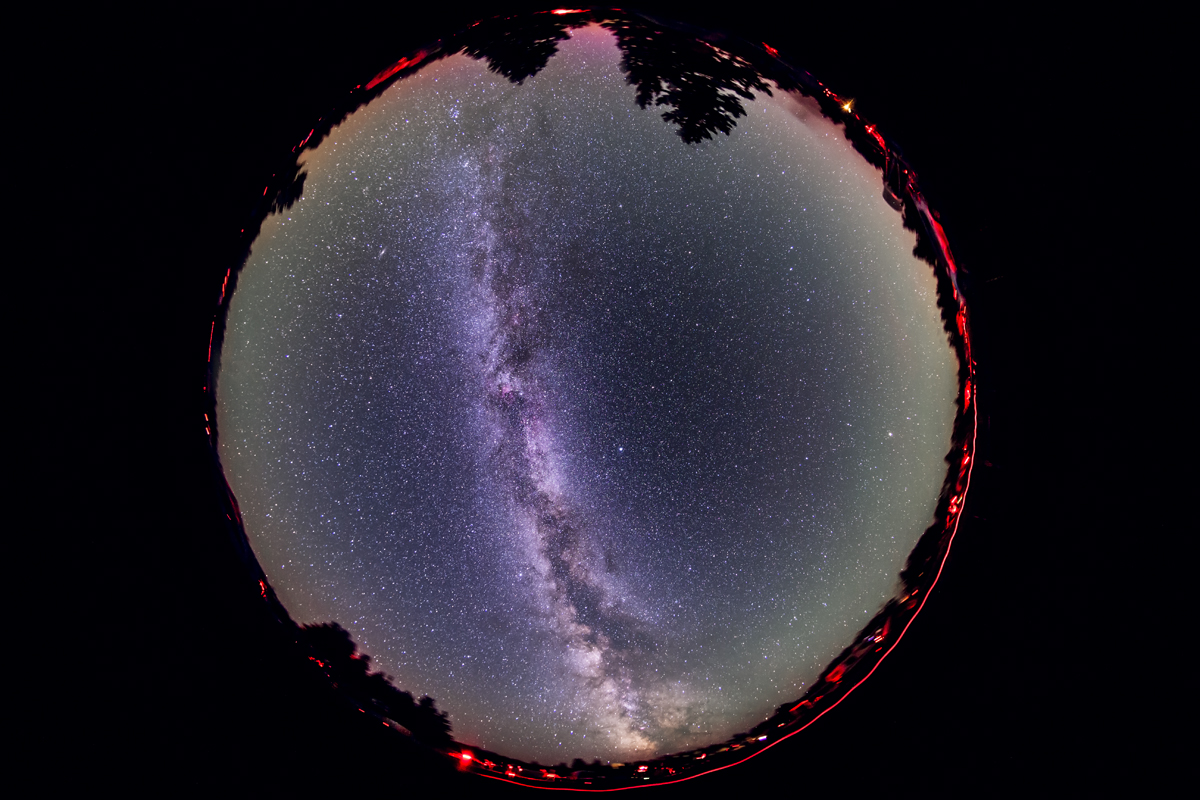
Legends of the Fall


These stars are as much a part of autumn in the northern hemisphere as are the changing colours of leaves and the flying south of geese.

These are the stars of legend, outlining the mythical constellations of Queen Cassiopeia (at top left), her daughter Andromeda (arcing across the bottom half of the image), and the hero Perseus (the stars at lower left) who rescued Andromeda from the ravages of Cetus the sea monster.
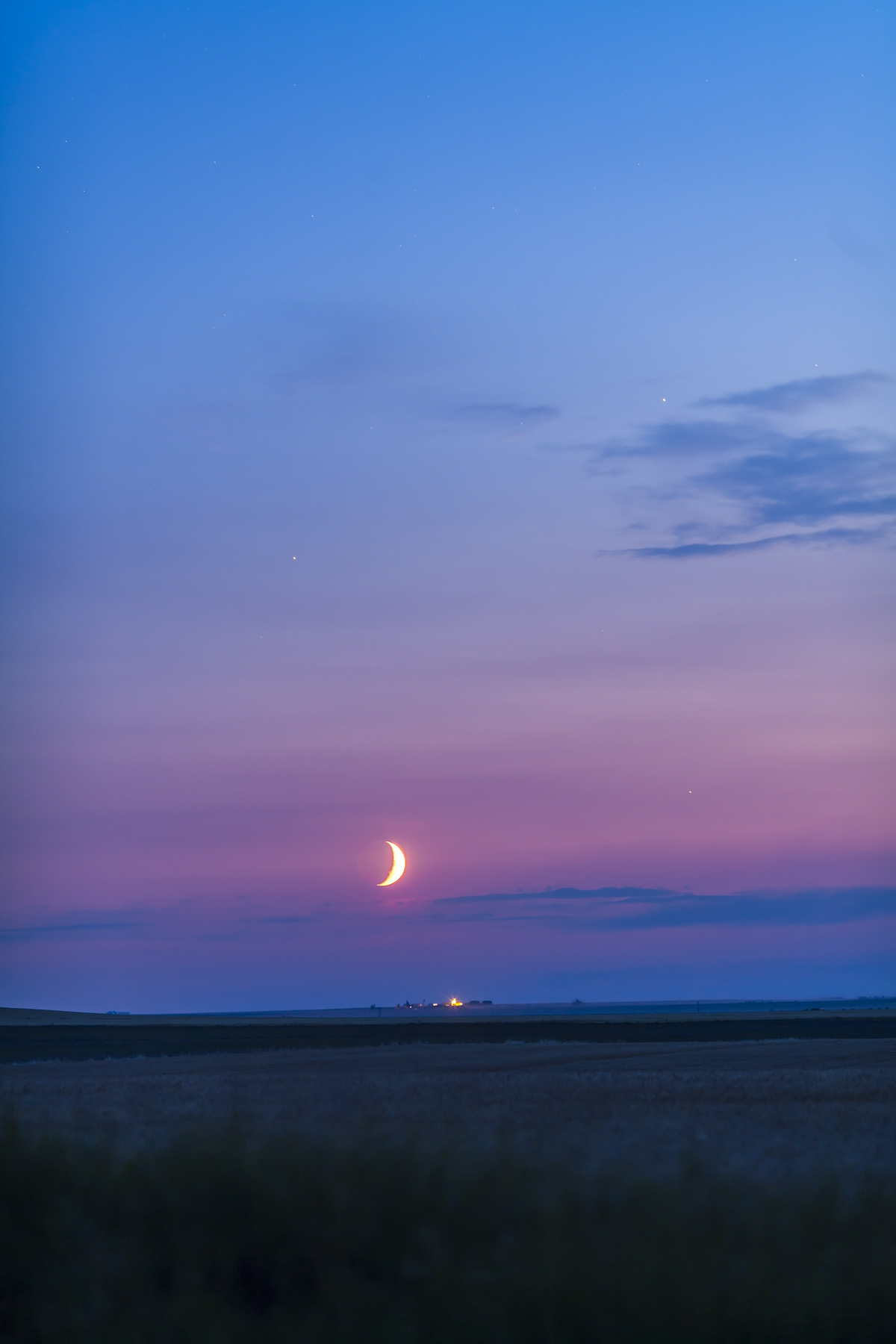
These stars are now high in the east in the evening sky, heralding the start of autumn and the return of frosty nights.

There are lots to see with binoculars or a telescope in these constellations. Look around this image and you can pick out several clumps, or clusters, of stars in Perseus and Andromeda. But the most obvious object is the oval-shaped Andromeda Galaxy, visible to the unaided eye from dark rural skies. This is the nearest sizeable galaxy to our Milky Way, and yet its light still takes 2.5 million years to reach us.

I took this shot earlier this week during a run of clear and warm autumn nights, perhaps the last before the chill nights of fall come on. It’s a wide-angle shot with a 35mm lens and Canon 5D MkII camera, tracked for a stack of four 6-minute exposures plus a fifth taken with a soft-focus filter.

— Alan, October 1, 2011 / Image © 2011 Alan Dyer
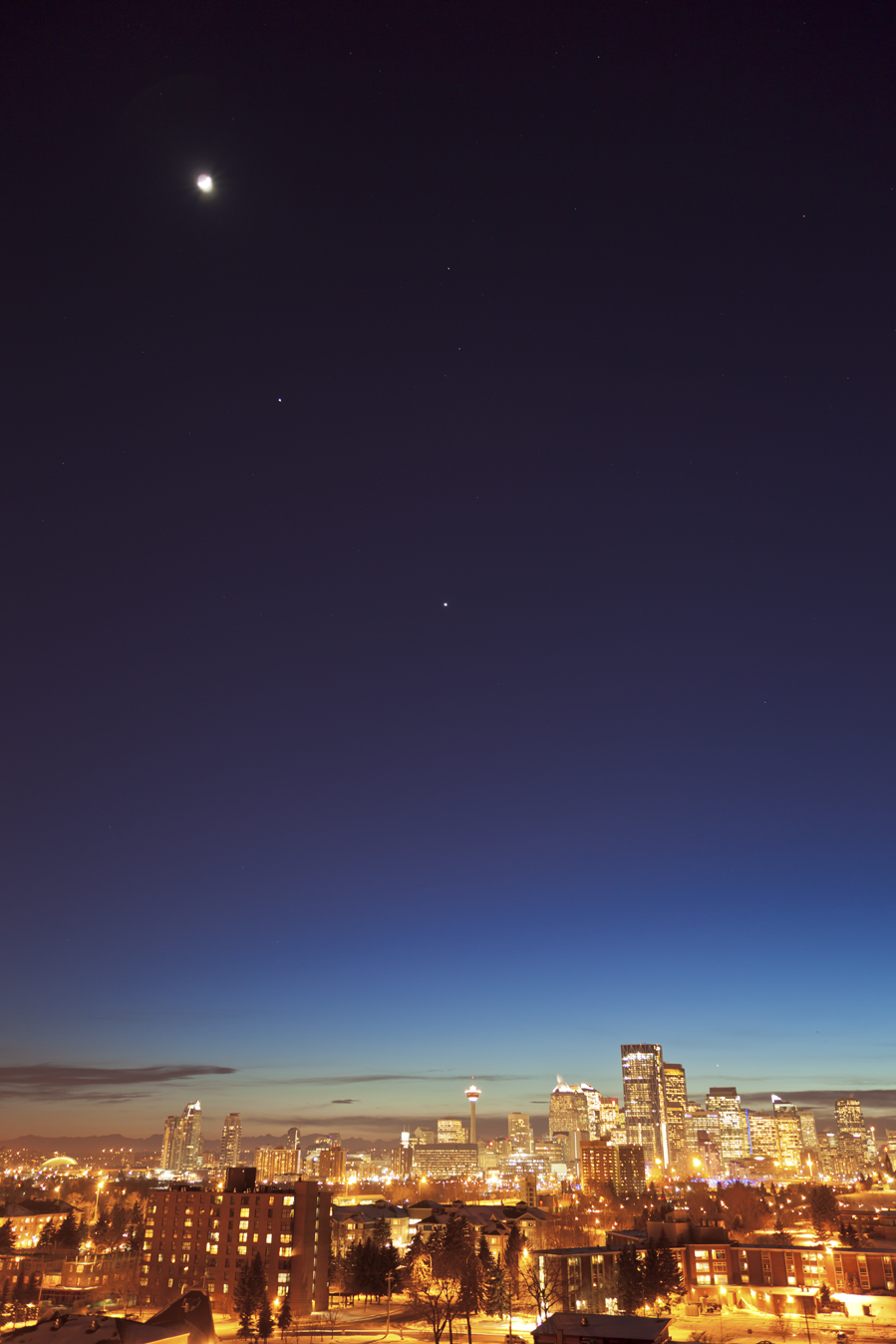
 

The Stellar Triangle of Summer


When the Summer Triangle sinks into the west, we know summer has come to an end. While the stars of the Summer Triangle are now high overhead from northern latitudes as the sky gets dark, by late evening the Summer Triangle is setting into the west.

These three bright stars are an example of stellar variety:

– At bottom is Altair in Aquila the eagle. It’s a white main-sequence star 17 light years away, fairly nearby by stellar standards. Leslie Nielson and his crew went to Altair in the 1950s movie Forbidden Planet.

– At top right is Vega, in Lyra the harp, a hotter and more luminous blue-white star than Altair, making it appear brighter than Altair, despite Vega being farther away, at 25 light years distant. Jodi Foster went to Vega in the movie Contact.

– But the third member of the Triangle, Deneb, at top left, is an extreme star. It appears a little fainter than Vega, but looks can be deceiving. Deneb is actually a luminous supergiant star, putting out 54,000 times the energy of our Sun. Deneb is about 1,400 light years away and yet, due to its fierce output of light, appears almost as bright as Vega. Light from Deneb left that star in the 6th century. I don’t know of any movie heroes who went to Deneb. The name means “tail of the Swan,” hardly a romantic destination for space-faring adventurers.

Look toward the Summer Triangle and you are looking down the spiral arm of the Milky Way that we live in. The stars of that arm appear as a packed stellar cloud running through Cygnus the swan, the constellation that contains Deneb.

I took this shot Saturday night, from home, on what turned out to be a very clear night, once some clouds got out of the way in the early evening. This is a 4-image stack of 8-minute exposures, at f/4 with the 35mm Canon lens, a favourite of mine, on the Canon 5D MkII at ISO 800. I added in exposures taken through a soft-focus filter to give the added glows around the stars to help make the bright stars and their colours more visible.

— Alan, September 25, 2011 / Image © 2011 Alan Dyer
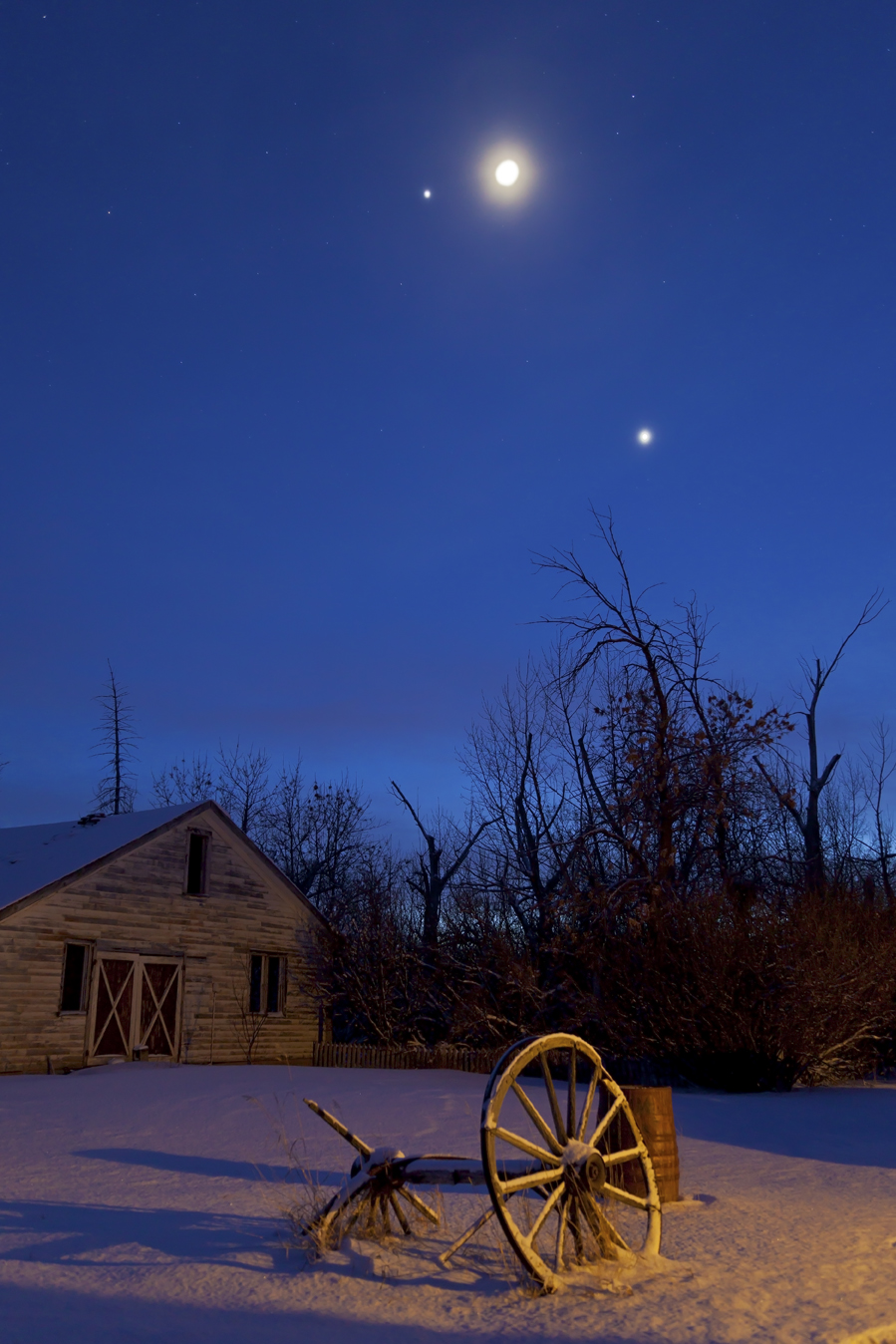
Happy Equinox!


This is a shot I’ve been after for several years, usually from this same location, looking west toward the setting Sun.

This is sunset at the autumnal equinox, with the Sun going down due west, something it does only at the two equinoxes. September’s usually the one with clear skies, as it was this night, Sept 23, 2011. Except for some annoying clouds at the horizon over the Rockies to the west. I was hoping for a clear shot of the Sun right at sunset at the end of Highway 1, the Trans-Canada Highway. But it’s close. Better luck next year!

After today, the Sun will be setting south of west, and the days will become shorter than the nights.

This is a 6-image HDR stack to capture both the bright and dark parts of the scene. It worked, but Photoshop refused to properly remove the “ghosts” — images from cars moving from shot to shot. But if I hadn’t told you about it, you might not have noticed!

— Alan, September 23, 2011 / Image © 2011 Alan Dyer
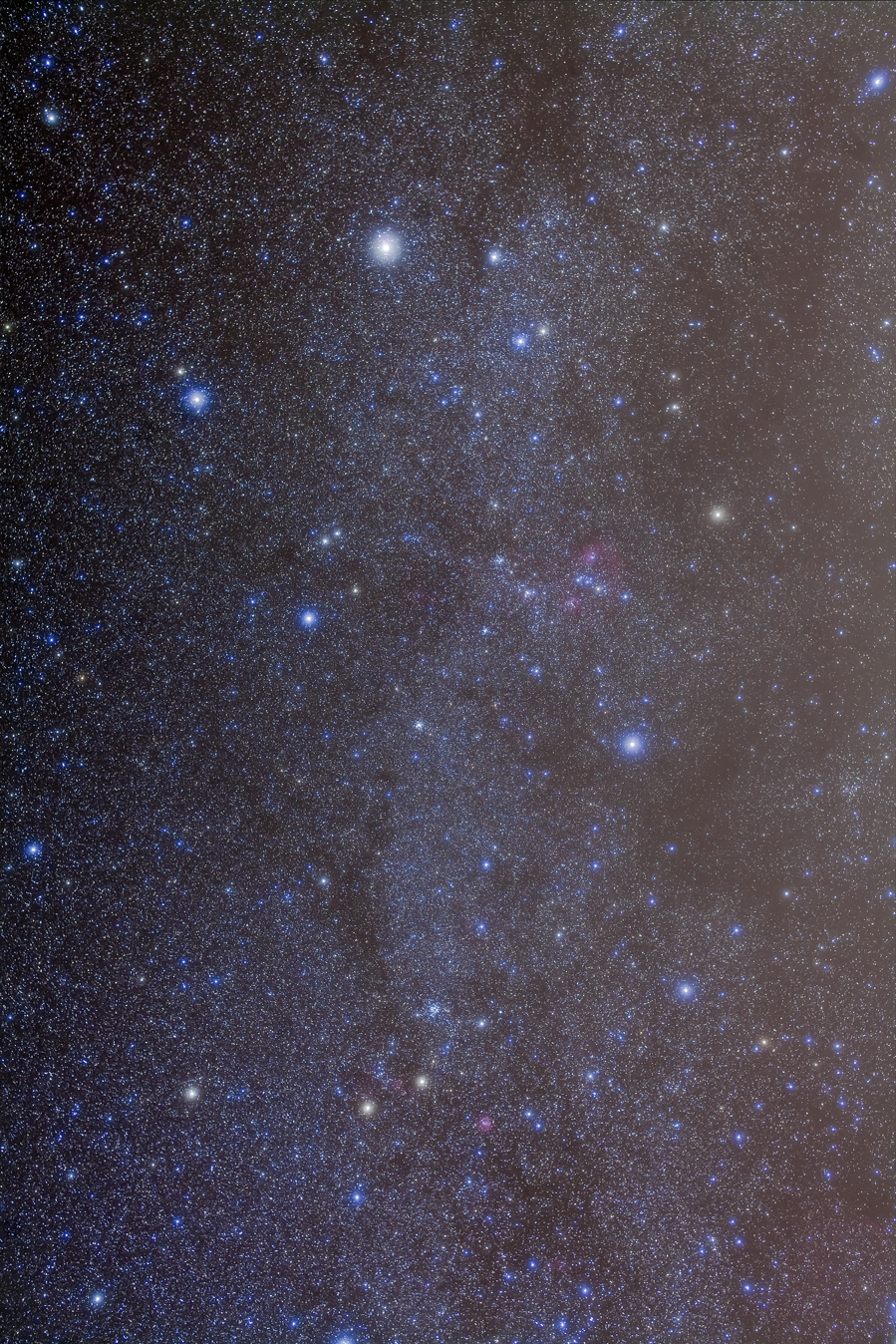
 

September Milky Way


This was the scene from my rural backyard on Tuesday night, September 20, with the Milky Way at its best across the sky.

September usually brings the best nights of the year for dark-sky observing and shooting the Milky Way. Nights are clear, dry, and transparent. The Milky Way stretches across the sky from southwest to northeast in the early evening.

Under clear skies on Tuesday the dark lanes and structure of the Milky Way really stood out, both to the eye and to the camera. Image processing for contrast does bring out the dust lanes, including the subtle patches off the main Milky Way band.

The centre of the image contains the three bright stars of the Summer Triangle. They frame the bright Cygnus starclouds and glowing red nebulas that mark the spiral arm that we live in. Above, at top left in the image, is a bluer section of the Milky Way formed by the more distant Perseus spiral arm, the one further out from us in the Galaxy.

I took this shot with the Canon 5D MkII and Canon 15mm lens, for a stack of five 6-minute exposures at f/4 and ISO 800.

— Alan, September 21, 2011 / Image © 2011 Alan Dyer
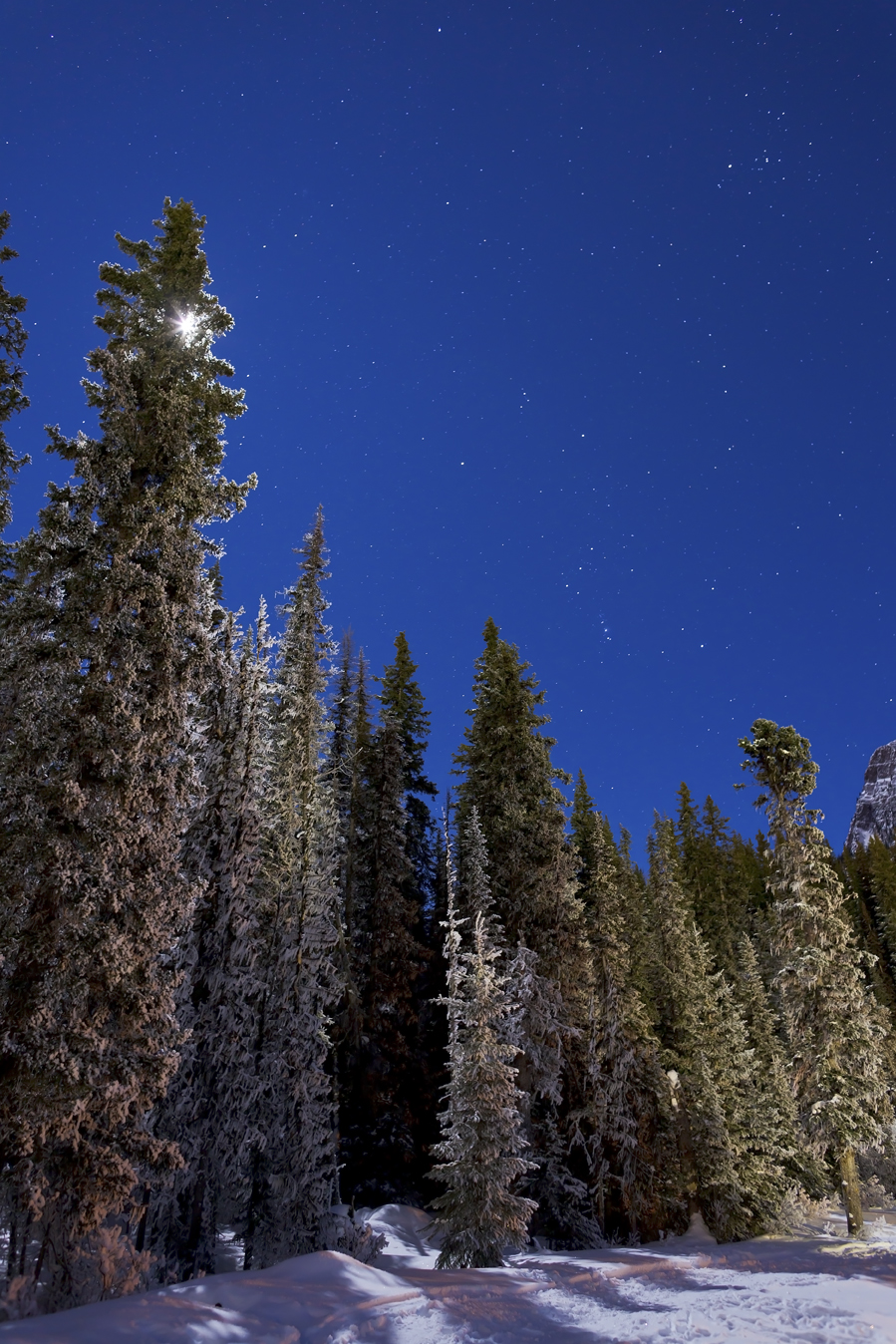
 

Saturday Night Stargazing


It was a marvellous night for the Milky Way … and some Saturday Night Stargazing.

This was the scene at the University of Calgary’s Rothney Astrophysical Observatory on Saturday night (Sept 17, 2011) as a crowd of about 250 people took in the wonders of the night sky at one of the Observatory’s monthly Open Houses. Skies were excellent and a late moonrise left dark skies early on for views of the Milky Way, a seldom seen part of nature for city-dwellers. A dozen volunteers from the local chapter of the Royal Astronomical Society of Canada provided telescopes and expertise to tour people around night sky wonders, from comets to star clusters. Many people are delighted just to have the constellations pointed out, so they can identify the patterns whose names they have heard of but have never seen.

What always impresses me about such events is how much interest the public shows, and how much the kids in attendance know about astronomy and space. One young man, age 10 or so, in seeing some of the images, like this one, that I was taking pop up on my camera screen, asked if I do piggyback photography! At his age I’m not sure I knew about piggyback photography!

We see all ages at our public stargazing events, all expressing the same “Wow! That’s cool!” reaction. Hearing the comments gives us astronomers a charge — we get as much back from the guests as we hope we provide them.

— Alan, Sept. 18, 2011 / Image © 2011 Alan Dyer
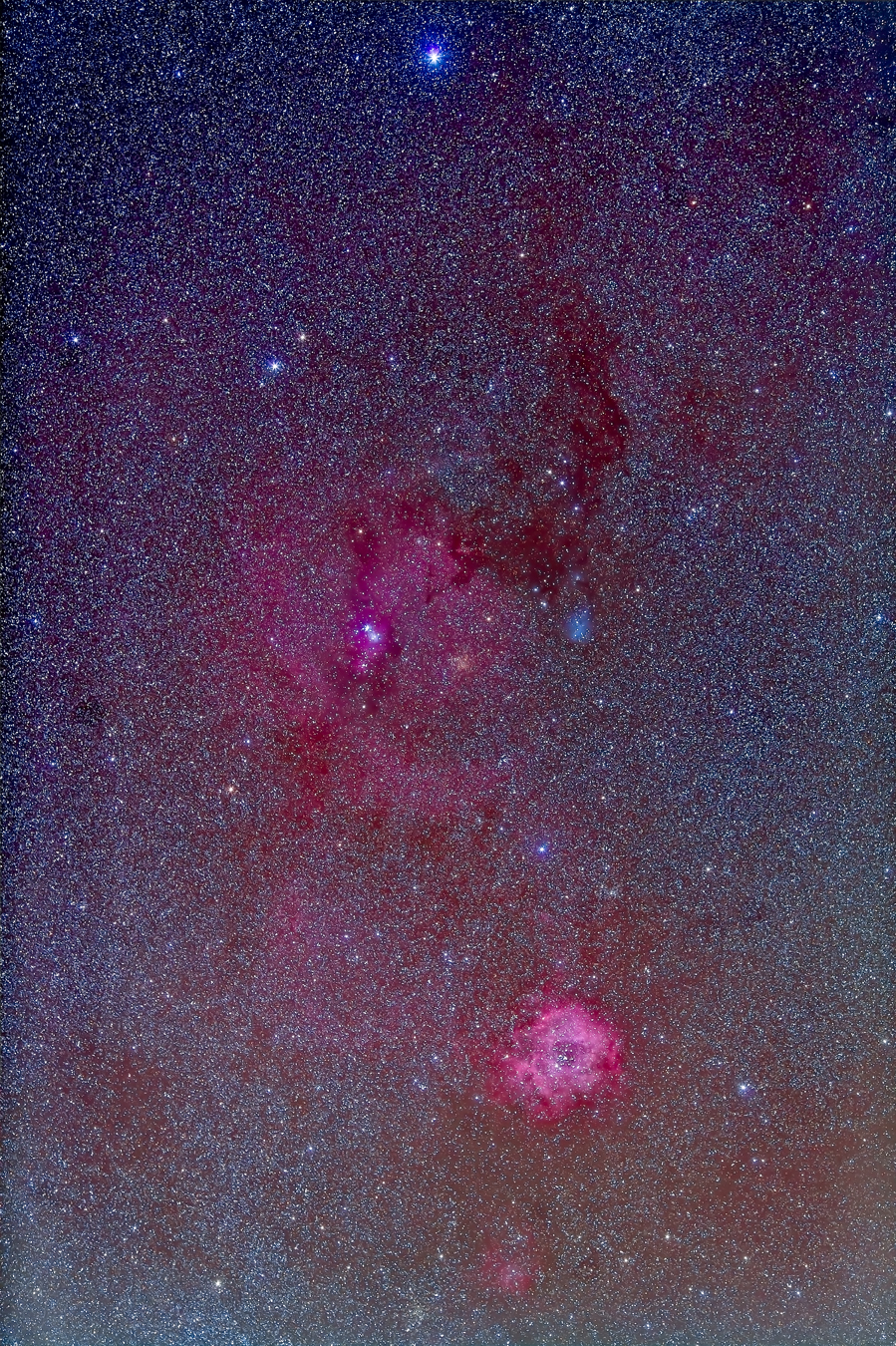
 

Time-Lapse Test: Adding Motion Control


Here’s the movie I show being taken in my previous blog. This is my first attempt at a motion-control time-lapse.

In this movie the camera shifted position during the 3 hours of shooting by sliding along a rail, with the movement controlled by a little computer box that opened and closed the shutter (in this case for 15 seconds for each frame), then between each exposure it pulsed the motor to shift the camera a centimetre or so down the dolly’s rail. 

Pretty nifty! And until this unit, the Stage Zero Dolly, came along this capability would have cost much more money, from some Hollywood cinema supplier.

This was only a test, and I did mess up at one point (where I appear in the frame in the previous blog’s movie) as I tried to adjust the speed in mid-track, resulting in some dead motion for a few frames. So the motion comes to a halt briefly. It will take some learning to know how to set the speed right for the number of frames and exposure times I typically shoot.

But the ramping up in speed at the beginning of this movie is intentional, and is one of the motion control variables you can program in. 

The Stage Zero Dolly unit is from Dynamic Perception LLC. Lots of time-lapse shooters are employing it now, for their cinema-like pans and moves. I’ve been inspired by the work of Randy Halverson at http://dakotalapse.com/ . Amazing stuff — representing a whole new level of time-lapse techniques. 

So now I know what I’ll be doing now on moonlit evenings! 

— Alan, September 12, 2011 / Movie © 2011 Alan Dyer
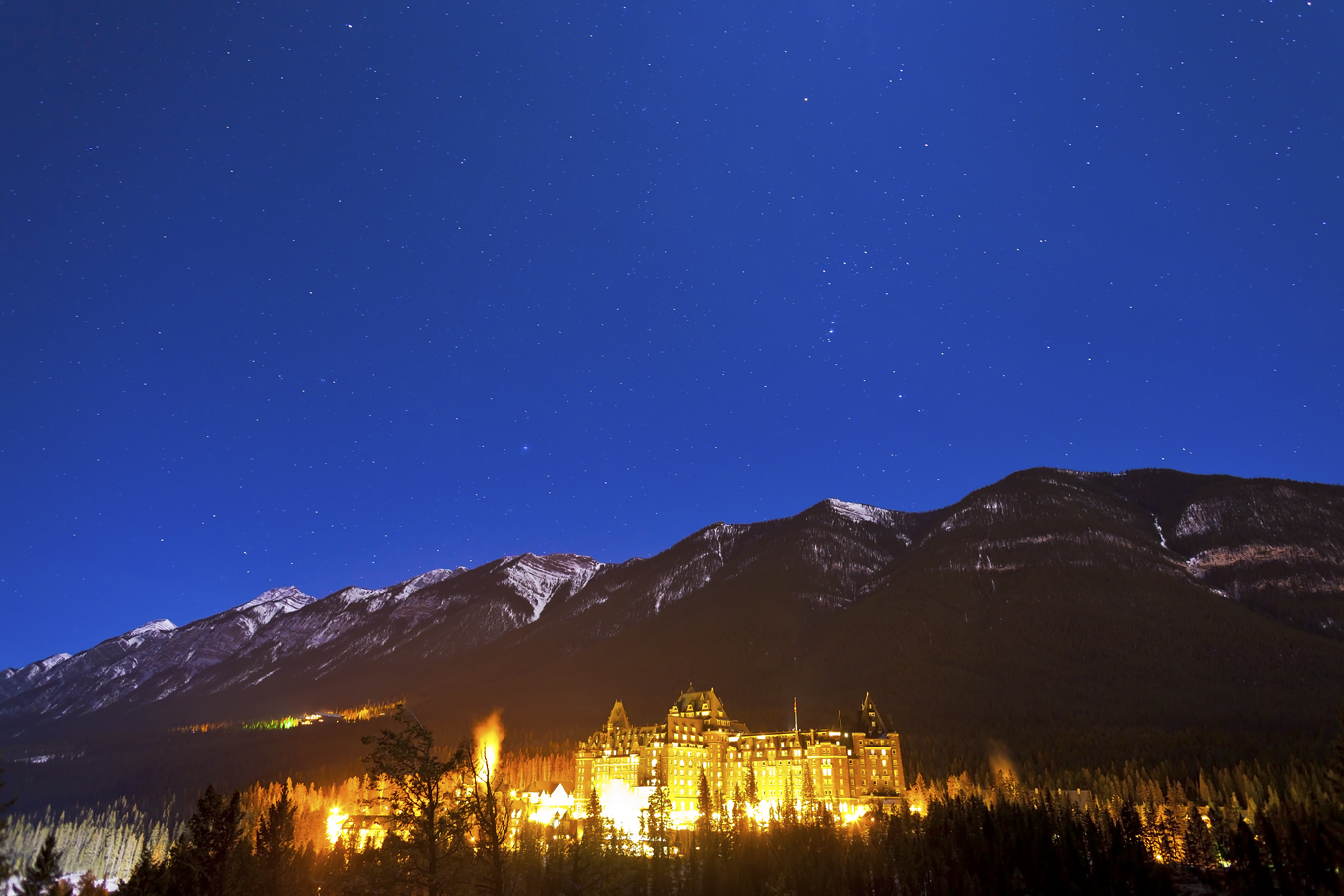
Time-Lapse of a Time-Lapse


I’ve been taking lots of time-lapse movies of late. But this one is a time-lapse movie of my other camera taking a time-lapse movie.

Here you see my Canon 7D camera riding aboard my latest tool (or toy!), a motion-control dolly. The camera takes its series of still images (that will be later stitched together into a movie) while it tracks down a rail, riding on a motorized cart.

The unit is called the Stage Zero Dolly, from Dynamic Perception LLC. It is a nifty device that fires the camera shutter for the exposure time and interval you desire. In between each exposure it also moves the camera a small amount down the track. The result can be seen in the next blog, a time-lapse movie with a changing perspective, giving a cinema-style dolly shot. Except, I took this one over 3 hours.

While this scene might look like I took it during the day, it is the middle of the night (witness the moving stars). The blue sky is due to moonlight, from an almost Full Moon on September 10.

The Stage Zero Dolly takes some work to set up and program right, but the results open up a whole new dimension (literally!) in time-lapse shooting.

— Alan, September 12, 2011 / Movie © 2011 Alan Dyer

A Super Star Party Sky


This is the kind of sky that makes astronomers smile. Clear and painted with twilight colours.

This was the scene two weekends ago, on August 26, at the annual Starfest star party in southern Ontario. Starfest is Canada’s biggest annual astronomy gathering and this year attracted about 700 people, filling the campground with tents, trailers and telescopes.

I was fortunate enough to be able attend this year, as one of the guest speakers in a pretty full program of afternoon and evening talks. I presented two talks, on the “Great Southern Sky” and on “Ten Tips for Better Pix,” plus presented a laser tour of “my sky” after dark on the Friday.

Starfest, as with other star parties I’ve been to lately, hasn’t fared well for weather in the last few years, but this year the clouds (mostly!) stayed away and people enjoyed a fabulous weekend under the Milky Way and summer stars.

This is a roughly 180° panorama taken at twilight, showing the rising dark blue arc of Earth’s shadow at left, with a strangely bright glow in the atmosphere above it. At right is the glow of sunset and some crepuscular rays (shadows from distant clouds) visible as bright and dark bands across the sky.

Starfest is a great star party. Anyone in eastern Canada interested in astronomy should make a point of attending. Next year’s event is August 16-19, 2012.

— Alan, Sept 11, 2011 / Image © 2011 Alan Dyer
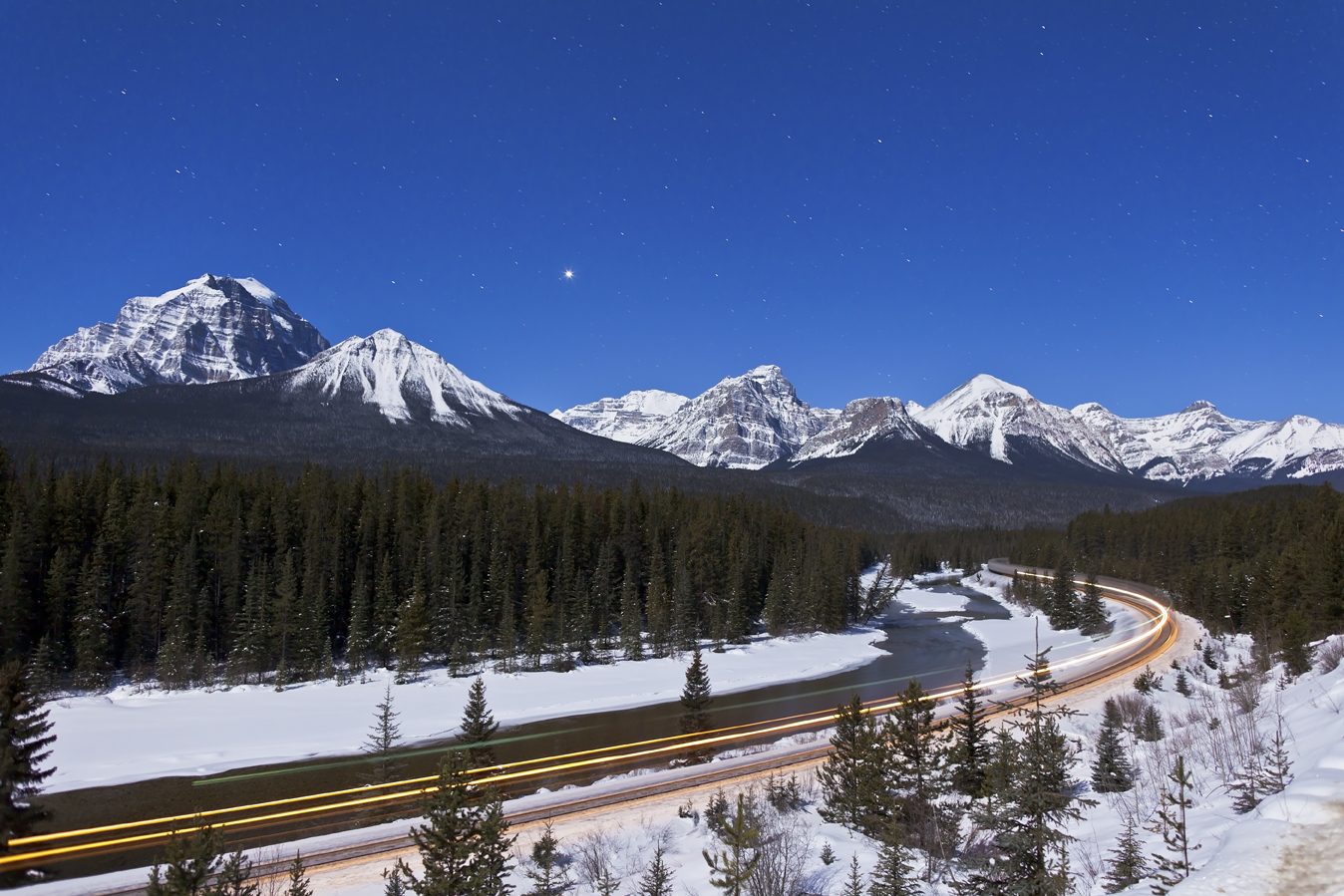
Milky Way over Peyto Lake
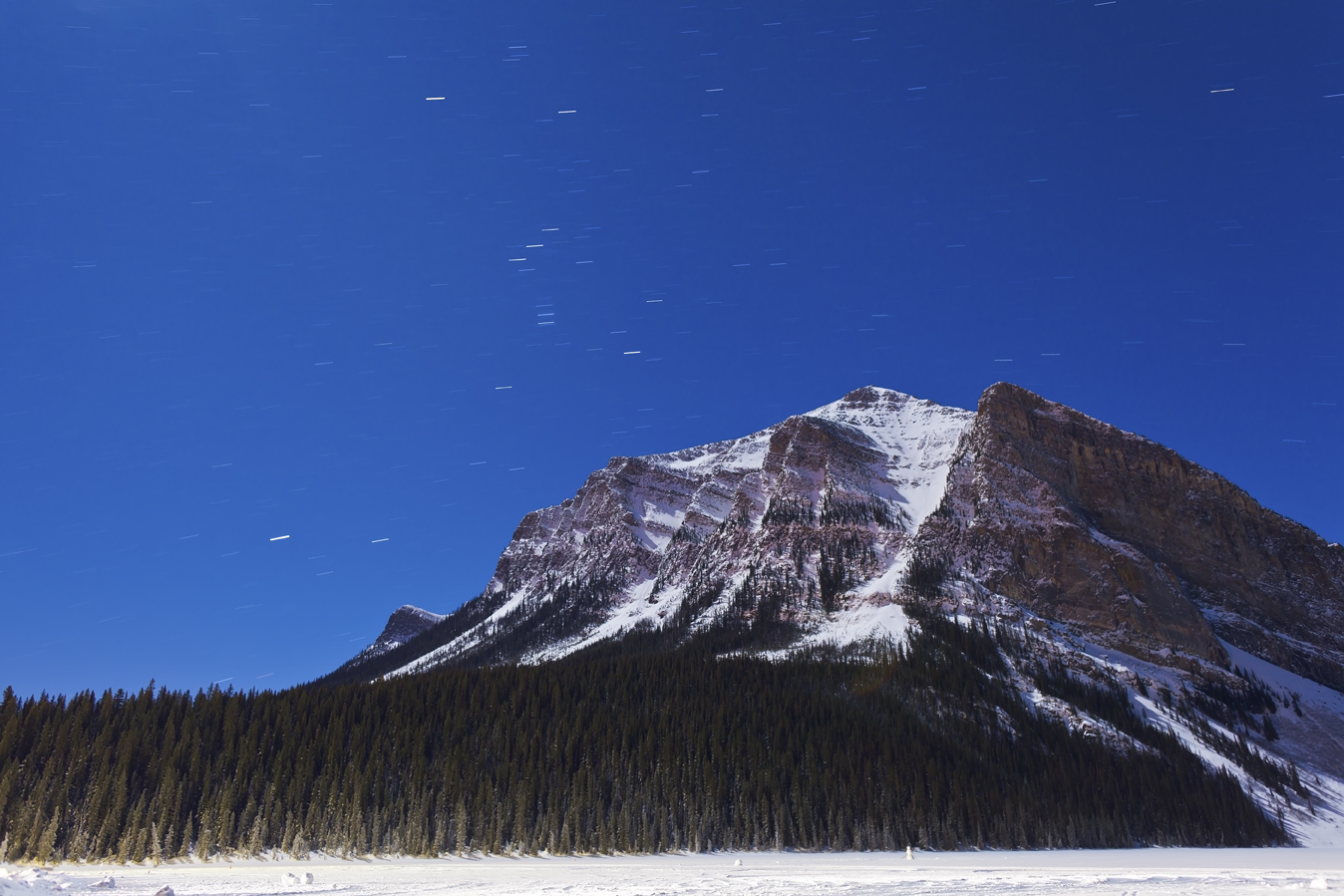


What a night this was! This was the view Sunday night, September 4, from the Peyto Lake viewpoint, of the Milky Way arching overhead, on a clear night at 7,000 feet altitude near the timberline of Bow Summit.
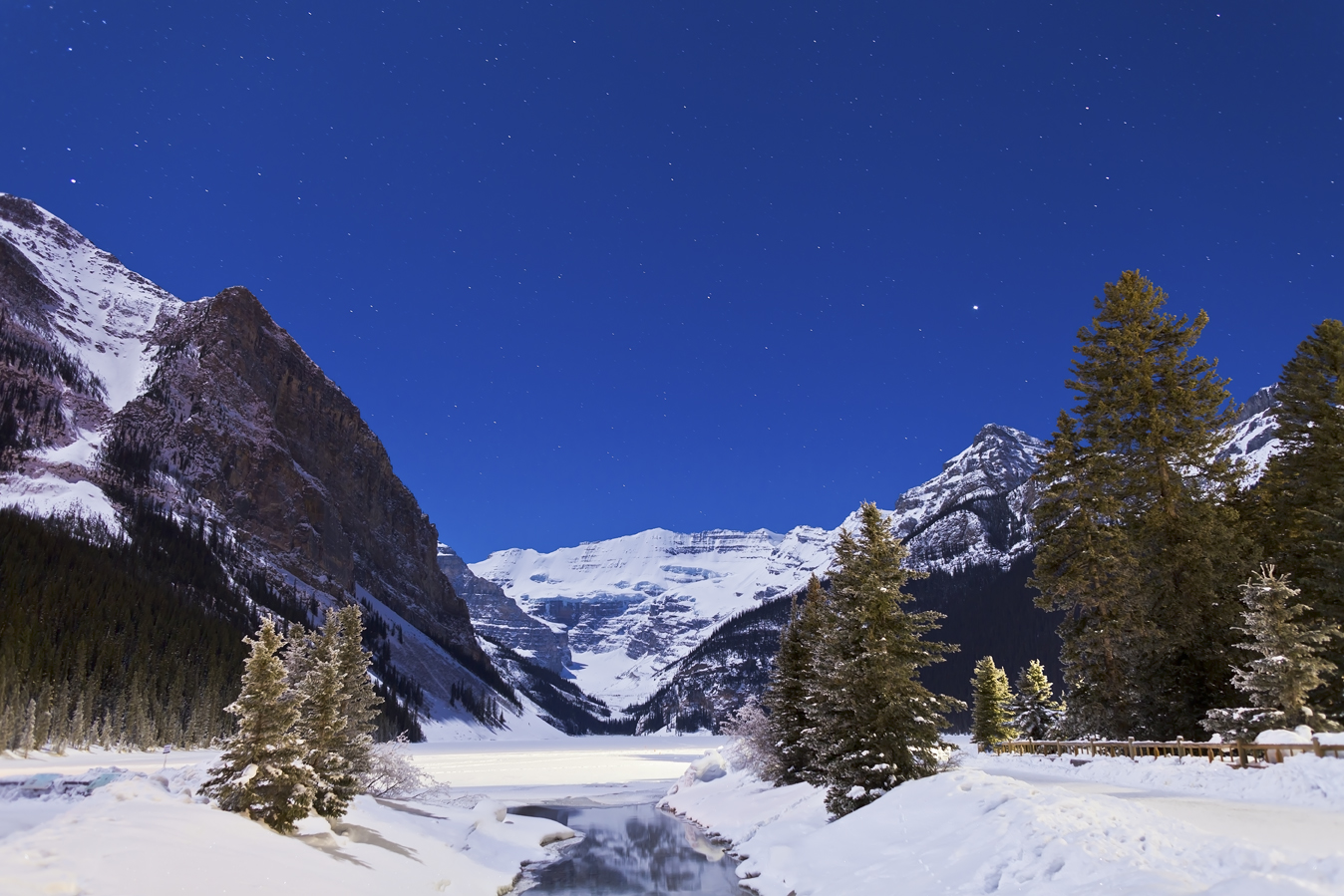
This is one frame of 275 of a time-lapse movie I took of the stars turning over Peyto Lake. This frame catches the Moon just as it sets over Peyto Glacier at left. At this altitude the Milky Way was obvious even with the Moon still in the sky.

It was a scene of a starry night that Bill Peyto would have enjoyed. As he wrote of nearby Bow Lake (see my shot here) … “Around the fire tonight Jim [Jimmy Simpson] said that for his money this campsite was the closest one could get to Heaven on Earth and I reckon he’s not far wrong.”

— Alan, September 5, 2011 / Image © 2011 Alan Dyer

Big Dipper over Peyto Lake


After taking the twilight shots at Waterfowl Lakes on Sunday night (click back to the previous blog), I continued up the Icefields Parkway, ascending to Bow Summit and the viewpoint that overlooks one of the most famous scenes in the Canadian Rockies, Peyto Lake.

Named for legendary mountain man and guide Bill Peyto, the lake was a favourite place for him, to give him solitude away from the madding crowds of Banff.

As with so many of these places, by day this very spot swarms with tourists by the bus load. Peyto would have cringed. But at nightfall, I am the only one there, enjoying the stars coming out in the solitude of the darkening sky.

Here, we look north, to the Big Dipper and Arcturus over the lake in the valley below.

This is a single exposure of 30 seconds at ISO 800 with the Canon 7D and 10-22mm lens.

— Alan, September 5, 2011 / Image © 2011 Alan Dyer

Twilight at Waterfowl Lakes


About half an hour after I took the previous blog entry image, I was here on Sunday evening, farther down the Icefields Parkway, at the shore of Lower Waterfowl Lake. The peak is Mt. Cephren.

The Sun had set and the sky was now filled with the purple glow of twilight marking the beginning of an exceptionally clear night.

Capturing this scene as the eye saw it took a stack of 7 different exposures, combined in what is known as a High Dynamic Range image, that blends the shadows details in the foreground without losing the subtle tints of the bright sky.

— Alan, September 5, 2011 / Image © 2011 Alan Dyer

Moon over Saskatchewan River Crossing


This is how the night started, on Sunday evening, September 4 — as clear a night as you could ask for in the mountains. A quarter Moon hangs over the peaks of the Continental Divide, with alpen glow, the last rays of the Sun, illuminating the mountains around Saskatchewan River Crossing, in Banff.

The North Saskatchewan River flows east out of the mountains here, after being joined by the Mistaya and Howse rivers. It was here, in the early 1800s, that David Thompson and his party of fur traders from the North West Company entered the Rockies and heading up over Howse Pass off frame to the right, to trade with the Kootenays in the interior of what is now British Columbia.

This is David Thompson country, named for one of the world’s greatest geographers and mapmakers. He mapped most of western Canada and down into the Oregon Territory. All using compasses, sextants, a Dolland refractor telescope (to observe the moons of Jupiter for telling time), and his skills as an astronomer. The Kootenays called him Koo-Koo-Sint — the man who watches the stars.

It was also here, on these open river plains, that James Hector, mapping southern Alberta with the Palliser Expedition, observed Comet Donati in September 1858.

This is a place in the Rockies with many ties to history and to astronomy.

— Alan, September 5, 2011 / Image © 2011 Alan Dyer

Bow Lake by Moonlight (The Movie)


Here is the time-lapse movie I took last Saturday night, August 20, on a perfect night at Bow Lake in Banff, Alberta.

The sequence starts in bright twilight then darkens to full night with the Milky Way over the  mountain silhouettes. The peaks then light up as they catch the light of the rising last quarter Moon coming up about 11:30 pm in the east. The moonlight creeps down the mountains to light up the entire valley and the lake. The sky brightens to deep blue again. The sequence ends about 3:30 am.

There was hardly a cloud in the sky all night, unusual for locations near the large icefields that straddle the continental divide.

I assembled the movie from 454 frames, each 40 seconds in exposure time, and taken 1 second apart.

— Alan, August 24, 2011 / Movie © 2011 Alan Dyer

Bow Lake By Moonlight


This was a truly magical scene — the Milky Way over Bow Glacier, and mountains lit by moonlight and reflected in the waters of Bow Lake.

Last Saturday night, August 20, 2011, brought some of the clearest skies I’ve seen in the Rockies. To take advantage of them, I headed to Bow Lake, in Banff, a favourite and very photogenic location for day and nighttime shooting. I hadn’t been there at night since the film days, pre-2004.

This shot is one of 450 frames taken as part of a time-lapse sequence, showing the Milky Way moving over Bow Lake. Here, at about 2 a.m. the light from the rising last quarter Moon is illuminating the peaks, and the Milky Way is perfectly placed over the end of Bow Lake and Bow Glacier, source of the waters of the Bow River and what Calgarians drink!

The sky is blue from moonlight. Last quarter moons are wonderful for nightscapes — providing enough light to illuminate the landscape but not so much as to wash out the sky and Milky Way. But making use of that phase of the Moon means very late nights of shooting. I packed it in this night at 4 a.m.

— Alan, August 22, 2011 / Image © 2011 Alan Dyer


Space Station Over the Rockies


This was the view Friday night, August 19, 2011, as the International Space Station flew over Banff, Alberta and the Canadian Rockies.

I took this shot (actually this is a composite of three successive exposures) from the viewpoint on Mt. Norquay overlooking the Banff townsite and the Trans-Canada Highway interchange, unfortunately all too well lit. This might well be a case study in light pollution as well.

But the lights in the valley don’t diminish the Milky Way above, and the sky-wide streak created by the passage from west to east of the Space Station. What looks like a brilliant star to the eye turns into a streak here due to the three 45-second time exposures I used to capture this scene. The lens is the 8mm fish-eye, and these frames are from a 400-frame time-lapse movie for the planetarium dome.

— Alan, August 20, 2011 / Image © 2011 Alan Dyer


Lake Louise by Moonlight — The Movie


Here is the time-lapse movie I took last Saturday night at Lake Louise, Alberta, under the light of the Full Moon. My previous blog featured a still frame from the beginning of this sequence.

The night starts clear, but as often happens, clouds move in, blowing off the cold icefields of the continental divide. It does make for a nice effect in time-lapse, one of few instances in astronomy where some clouds can be useful!

Also notice how the reflection disappears as the lake breaks up into waves briefly, as wind blows in now and then through the night. The Full Moon is rising behind the camera, causing the lake to light up as moonlight illuminates more of the lake’s surface. Shadows move across the mountainsides. Arcturus is the bright star setting at right. The red object at left is a moored canoe, moving about on the lake.

I took this movie over 4 hours from 10:30 pm to 2:30 am, taking 477 frames with the Canon 7D and 10mm lens. For time-lapse movies like this, I process the full-size RAW files in Adobe Camera Raw and Bridge, then use Photoshop’s Image Processor to export them all to smaller size JPGs. From that set, I use Photoshop CS5 Extended’s “Motion” feature to assemble the folder of JPGs into a movie, in this case at 24 frames per second, a little fast perhaps for this sequence, but it’s easy to change if needed. Photoshop then renders that image file out as a Quicktime movie. What you see here is a tiny version of the final HD-sized video.

— Alan, August 16, 2011 / Movie © 2011 Alan Dyer

Lake Louise by Moonlight


This has to be one of the most photogenic and photographed places in the world. Here it is in a different light, moonlight.

This is Lake Louise, in Banff National Park, Alberta. A few hours before I took this photo on Saturday, August 13, where I stood would have been swarming with thousands of people. But at midnight there was no one about. I had the view to myself.

This looks like a daytime shot, except the stars give it away. Instead, it is the Full Moon, behind the camera, providing the illumination. Contrary to Hollywood lighting clichés, moonlight is not blue. It is the same colour as sunlight, because it is sunlight, just much fainter, reflected off the Moon’s neutral grey surface.

In this view we are looking southwest, toward the stars of the summer sky setting behind the peaks of the continental divide. Arcturus is the bright star at right.

A calm night provided the glassy lake to reflect Mount Victoria and Victoria Glacier.

This is one frame of 477 30-second exposures I took over 4 hours, of the stars turning and eventually clouds blowing in across the sky from the icefields over the divide. It’s rare to get such a perfectly clear night in the Rockies. It was a wonderful to be there, and apparently to be the only one there, to experience it.

— Alan, August 14, 2011 / Image © 2011 Alan Dyer


%d bloggers like this: