On November 11, 2025 the sky erupted with a swath of red Northern Lights seen over much of North America.
It is rare when those living at southerly latitudes can see Northern Lights. Instead of having to travel north to Arctic sites, the aurora comes south to them. That’s what happened on November 11, 2025 when one of the largest solar storms in recent years brought the aurora down over much of the North America.
This was the latest in a set of wonderful aurora shows we’ve enjoyed in the last two years, as the Sun reached the peak of its 11-year cycle of activity.
As I show below, the apps and indicators were registering extreme conditions, with the “Kp Index” peaking at 8 out of a maximum of 9, and the auroral “Ovation” oval lighting up red, indicating a major geomagnetic storm was underway. In the lingo of the local Alberta Aurora Chasers Facebook group, it was most definitely a “pants on” night!
Kp 8! Red Alert!
The source of the storm was two major flares on the Sun in quick succession. In only a day the high-speed “coronal mass ejections” they had unleashed reached Earth and lit up the sky.
As a result the ring of aurora borealis which usually circles the Arctic moved down over southern Canada and the northern United States. I was under that ring of lights!
This is a blend of two exposures, for sky and ground, both 8 seconds at f/2.8 with the TTArtisan 11mm full-frame fish-eye lens on the Canon R5 at ISO 1600.
As it got dark this night, large swaths of red were easily visible to the eye, especially to the northwest as above, and below.
A single 5-second exposure at f/2.8 with the TTArtisan 11mm lens on the Canon R5 at ISO 1600.
Early on a large curtain of red extended across the sky, from northwest to southeast. It is rare to see bright reds with the eye, and unusual to see the reds so extensive and sky-spanning.
This 360º panorama is a stitch of 6 segments, 60º apart, each 5-second exposures at f/2.8 with the TTArtisan 11mm full-frame fish-eye lens on the Canon R5 at ISO 1600, and in landscape orientation.
The reds are mostly from oxygen atoms, but can also come from nitrogen molecules, which require the input of a lot of energy to get excited and glow! They certainly were this night.
The reds mixed with the more common green light from oxygen to produce shades of yellow and orange, and with blues from nitrogen to produce vivid pinks and magentas. While the eye could see some of these subtle colours, a camera (with its longer exposure and wider aperture lens compared to the human eye) was best for picking up the full range of what this show had on display.
This 360º panorama is a stitch of 10 segments, 36º apart, each 4-second exposure at f/2.8 with the Laowa 10mm rectilinear wide-angle lens on the Nikon Z8 at ISO 1600, and in portrait orientation.
The panorama above taken about 2 hours after the previous all-sky scene, shows a quieter aurora but still with curtains covering the sky and converging to the “magnetic zenith,” a little south of the point straight overhead.
Such an all-sky show of aurora is among the sky’s finest spectacles.
A real-time video with the Nikon Z6III at ISO 25600 and Viltrox 16mm lens at f/1/8.
In the video above taken early in the evening I pan around the horizon over the full 360º to take in the scene much as the eye did see it. Video uses shorter exposures more like the eye does. I narrate the video at the camera.
All single 4-second exposures at f/2.8 with the Laowa 10mm rectilinear wide-angle lens on the Nikon Z8 at ISO 1600.
When the aurora covers the sky it’s hard to take it all in and capture it on camera. The 10mm ultra-wide lens I used for the images above sweep up well past the zenith to show the converging curtains, forming shapes that kept changing by the minute.
In the video below I used the same lens with the camera turned to portrait orientation to create a “vertical video,” again narrated at the camera. It shows how the aurora was changing, but slowly this night. It did not have the rapid dynamics I’ve seen with other bright displays, despite the obvious high energies involved here to excite the reds.
Real-time video with the Laowa 10mm lens at f/2.8 and Nikon Z8 at ISO 25,600 & 1/4 second shutter.
Again, this real-time video captures the scene much as the unaided eye saw it. I’ve not processed either of these real-time videos, other than what the camera itself did.
This is a panorama of 12 segments, each 1 second at f/1.8 with the Viltrox 16mm lens on the Nikon Z6III at ISO 1600. Stitched in Adobe Camera Raw.This is a stitch of 6 segments, 60º apart, each 4-second exposure at f/2.8 with the TTArtisan 11mm full-frame fish-eye lens on the Canon R5 at ISO 1600, in landscape orientation. Stitched in PTGui.
On a night like this, I try to shoot not only single still images and videos, but also multi-image panoramas, such as the circular images earlier and these two rectangular “panos” above. Both cover a full 360º in width but don’t go up to the zenith.
Again, they record the range of colours that were on show on this Kp8 night, which were more visible and extensive than usual for an all-sky display.
I also shot two time-lapse sequences. These form the main visuals for this edited music video I produced around the time-lapses.
The link takes you to my Vimeo channel to watch the video. Do enlarge it to full screen!
A single 2.5-second exposure at f/1.8 with the Viltrox 16mm lens on the Nikon Z6III at ISO 1600.
I also always try to take some selfies at every great aurora show, with me often lit just by aurora light! They’re fun to use for talks and “bio pix.”
This is a single 4-second exposure at f/2.8 with the Laowa 10mm lens on the Nikon Z8 at ISO 1600.
As a final bonus this night, one of the fish-eye lens time-lapse frames happened to capture a bright meteor. You see it briefly in a flash in the music video above, but below is the single frame.
A single 4-second exposure at f/2 with the TTArtisan 7.5mm circular fish-eye lens on the Nikon Z8 at ISO 1600. Taken as part of a 780-frame time-lapse.
Because it is streaking away from the constellation of Taurus, this is likely a member of the annual Taurid meteor shower which was in its final nights of the long period it is active in late October and early November. In fact, there are two Taurid showers, Northern and Southern, active at once and coming from similar spots in Taurus. They are known to produce bright fireballs and this was certainly one!
While the Sun is now in the downward slope of its cycle, coming off “solar max” last year, we may still see more major storms and aurora shows like this. Historically, the biggest solar flares and aurora displays often occur in the 2 or 3 years after solar maximum.
So stay tuned! The sky may still light up red with Northern Lights!
I’ve been visiting Churchill, Manitoba during winter aurora season since 2014. But this was my last year for standing under its fabulous Northern Lights.
From February 21 to March 4, 2025 I was at the Churchill Northern Studies Centre for my annual visit serving as an instructor to visiting aurora tourists. I’d been doing the program for ten years, with a year off in 2021 when no one visited!
But I decided this was to be my last year, as it was time to “retire” and turn over the program to a new generation of instructors.
So here I present my last look at the Churchill auroras.
A 180º panorama across the north during an all-night display of Northern Lights, from the Churchill Northern Studies Centre, in Churchill, Manitoba, on February 22, 2025. A panorama of 7 segments, each 13-second exposures with the Viltrox 16mm lens at f/2 on the Nikon Z6III at ISO 1600.
Churchill, Manitoba is on the shore of Hudson Bay at a latitude of 58º North in the sub-Arctic.
It lies under the normal location of the “auroral oval,” the ring around the North Geomagnetic Pole where there is almost always some aurora happening, even on a quiet night. Churchill is as far south as the auroral oval appears in the world when the oval is in its normal state.
By visiting a site under the oval, aurora tourists are almost guaranteed a show, provided the sky is clear.
This is a 180º panorama of the Northern Lights across the northern, eastern and southern sky on February 27, 2025 during a Kp4-level display. This is a panorama of 3 segments, each 13-second exposures at f/2.8 with the Laowa 10mm lens on the Nikon Z6III at ISO 1600.
In winter in Churchill, the cold usually brings clear skies. In a decade of conducting programs I’ve only ever had one group clouded out for all five nights of the program. That’s a far better average than locations such as Iceland.
This is a 120º panorama of the Northern Lights across the northern sky on February 26, 2025 during a Kp3-level display. This shows some fine ray structure in the curtains. This is a panorama of 2 segments, each an 8-second exposure at f/2.8 with the Laowa 10mm lens on the Nikon Z6III at ISO 1600.
While several excellent travel companies and local businesses offer aurora tours to Churchill, signing up to one offered by the Northern Studies Centre offers some major advantages.
Notably, guests stay at the Centre, some 20 kilometres outside of Churchill on the site of the old Rocket Range. That makes the site dark and free of light pollution.
A panorama of the Northern Studies Centre. It has dorm rooms, a cafeteria, classrooms, lounges, a fitness room, library, and all the comforts needed for a great stay under the Lights.
And convenient. Guests sleep on site and need only dress up warm to quickly head outside when the “Lights are out!” call comes. Instructors wake up guests when the Lights don’t appear until late at night, as can often be the case. There’s no driving out to dark sites to wait for the Lights to appear.
A fish-eye 360° view of the fine display of Northern Lights on February 25, 2025, during a substorm outburst with bright curtains to the north. A single 2.5-second exposure with the TTArtisan 7.5mm fish-eye lens at f/2.
An option is also to head up to the CNSC’s rooftop aurora dome for viewing the Lights in warm shirt-sleeve comfort.
Aurora tourists enjoy the show at the Churchill Northern Studies Centre, February 26, 2025. This was the Learning Vacations tour group in late February 2025. This is a single 8-second exposure with the Laowa 10mm lens at f/2.8 and Nikon Z6III at ISO 1600.
But most guests opt to bundle up and brave the cold for the best experience and unobstructed views of the Lights filling the sky. A convenient option is the second floor observation deck, shown above, and in an image taken from the deck, below.
A photographer is capturing a bright display of Northern Lights at the Churchill Northern Studies Centre. This was the first night of a five-night session for aurora tourists from the Road Scholar education travel company. This is a single 4-second exposure with the Laowa 10mm lens at f/2.8 and Nikon Z6III at ISO 3200.
The program includes nightly science talks about the aurora and night sky. The daytime program includes dogsledding, snowshoeing, a tour of the old Rocket Range, and visits to sites in Churchill such as the murals and museums. It’s a very full five days of programming and learning.
A fish-eye 360° view of a dim and weak display of Northern Lights on February 24, 2025, showing a green diffuse band to the south and a dim red curtain overhead with rays to the east. This red aurora was just visible to the eye as a grey streak. A single long 30-second exposure with the TTArtisan 7.5mm fish-eye lens wide open at f/2 on the Nikon Z6III at ISO 1600.
The main attraction, the aurora, can vary from night to night. However, even when the aurora is weak, as it was this night, above, it can still put on a fine show for the camera, glowing in red colours that only long exposures reveal.
Aurora tourists from the Road Scholar travel company enjoy the show of Northern Lights at the Churchill Northern Studies centre in Churchill, Manitoba, March 1, 2025. This is a 6-second exposure at f/1.8 with the Viltrox 16mm lens on the Nikon Z6III at ISO 1600.
While I use high-end cameras and fast lenses, I’ve been impressed with how well today’s phone cameras can capture the Lights very simply and easily, as a guest is doing above, especially when the aurora is bright.
A band of bright green aurora appears here with some subtle red rays at right and magenta upper curtains at left, with the green glow lighting the snow green. A 10-second exposure with the Laowa 10mm lens at f/2.8 on the Nikon Z6III at ISO 1600.
When the aurora brightens, greens and sometimes pinks are visible to the eye, and not just to the camera. And the aurora exhibits rapid rippling and waving motions (check the video below).
A bright display of colourful curtains of Northern Lights at the Churchill Northern Studies Centre. This is looking northeast toward the direction of the midnight sector where the auroras usually brighten from. This is a single 8-second exposure with the Laowa 10mm lens at f/2.8 and Nikon Z6III at ISO 1600.
The finest sight is when the aurora curtains converge overhead at the zenith for a “coronal outburst.” The effect can be fleeting but the sight is unforgettable. It is one of the finest sights the sky can offer, ranking with a total eclipse of the Sun.
A fish-eye 360° view of the fine display of Northern Lights on February 25, 2025, with a complex of curtains passing overhead and across the sky from northeast (at lower left) to southwest (at upper right), with Venus setting at far right. Orion and Sirius are at bottom centre to the south. A single 10-second exposure with the TTArtisan 7.5mm fish-eye lens at f/2 on the Nikon Z6III at ISO 1600.
Indeed, on most nights the aurora, which might begin as a low arc across the north, moves south to fill the sky with swirling and curling curtains, as below.
This is a 180º panorama of the Northern Lights across the northern sky on February 27, 2025 during a Kp4-level display. The field extends from the horizon up to well past the zenith. This is a panorama of 6 segments, each an 8-second exposure at f/2.8 with the Laowa 10mm lens on the Nikon Z6III at ISO 1600.
A gallery of my images from Churchill from this year and from past years is on my main AmazingSky.com website here.
A musical collage of still images and real-time videos I shot this year is viewable here on YouTube.
Click through to YouTube for more information about the video.
It’s been a great ten years taking in the wonderful Northern Lights in Churchill. While this was my last year, I encourage you to visit to see the sights for yourself.
Everyone goes away with great memories, able to check the aurora off their bucket list of experiences.
2024 brought us a total eclipse of the Sun, superb auroras, and a naked-eye comet, three top highlights of a wonderful year of celestial attractions. Maybe the best!
In our book The Backyard Astronomer’s Guide (which we revised this year), Terence Dickinson and I created an Aah! Factor scale with various celestial sights ranked from:
• 1, evoking just a smile, to …
• 10, a life-changing event!
Our book’s Aah! Factor Scale in Chapter 1
Coming in at an 8 is a naked-eye comet. Deserving a 9 is an all-sky display of an aurora. The only sight to rate a top 10 is a total eclipse of the Sun.
2024 brought all three, and more!
Here’s my look back at what I think was one of the greatest years of stargazing.
NOTE: The images might take a while to all load. All can be enlarged to full screen. Just click or tap on them.
January
A Winter Moonrise to Begin the Year
The rising of the winter “Wolf” Moon, the Full Moon of January, over the frozen Crawling Lake Reservoir, in southern Alberta.
Now, this was not any form of rare event. But seeing and shooting any sky sight in the middle of a Canadian winter is an accomplishment. This is the rising of the Full Moon of January, popularly called the Wolf Moon, over a frozen lake near home in Alberta, Canada 🇨🇦.
It serves to bookend the collection with a Full Moon I captured eleven months later in December.
February
Auroras from Churchill, Manitoba
Had this been my only chance to see the Northern Lights fill the sky this year, I would have been happy. As we often see in Churchill, the aurora covered the sky on several nights, a common sight when you are underneath the main band of aurora borealis that arcs across the northern part of the globe.
This is a vertical panorama of the sky-filling aurora of February 10, 2024, as seen from the Churchill Northern Studies Centre, in Churchill, Manitoba.
I attended to two aurora tour groups at the Churchill Northern Studies Centre who both got good displays to check “seeing the Northern Lights” off their bucket list. Join me in 2025!
March
Under the Austral Sky
Ranking a respectable 7 on our Aah! Factor scale is the naked-eye sight of the galactic centre overhead, with the Milky Way arcing across the sky. That’s possible from a latitude of about 30° South. That’s where I went in March, back to Australia 🇦🇺 for the first time since 2017.
This is a framing of the most spectacular area of the southern Milky Way, from Centaurus at left, to Carina at right, with Crux, the Southern Cross, at centre.
I wrote about it in my previous blog, where I present a tour along the southern Milky Way, and wide-angle views of the Milky Way (the images here are framings of choice regions).
This frames the southern Milky Way from Canis Major and its bright star Sirius at top, to Carina and its bright star Canopus at bottom, the two brightest stars in the night sky. The large red complex is the Gum Nebula.
It is a magical latitude that all northern astronomers should make a pilgrimage to, if only to just lie back and enjoy the view of our place in the outskirts of the Galaxy. I was glad to be back Down Under, to check this top sky sight off my bucket list for 2024.
April
A Total Eclipse of the Sun
No sooner had I returned home from Oz, when it was time to load up the car with telescope gear and drive to the path of the April 8 total solar eclipse, the first “TSE” in North America since 2017, which was the last total eclipse I had seen, in a trip to Idaho.
This is a composite of telescopic close-ups of the April 8, 2024 total eclipse, with a multi-exposure blend for the corona at centre, flanked by the diamond rings.
But where? I started south to Texas, my Plan A. Poor weather forecasts there prompted a hasty return to Canada, to drive east across the country to … I ended up in Québec. My blog about my cross-continental chase is here. My final edited music video is linked to below.
It was gratifying to see a total eclipse from “home” in Canada, only the third time I’ve been able to do that (previously in 1979 – Manitoba, and 2008 – Nunavut). If the rest of the year had been cloudy except for this day I wouldn’t have complained. Much.
This definitely earned a 10 on the Aah! Factor scale. Total eclipses are overwhelming and addictive. I’ve made my bookings for 2026 in Spain 🇪🇸 and 2027 in Tunisia 🇹🇳.
May
The Sky’s On Fire
It had been several years since I had seen an aurora from my backyard with colours as vivid and obvious as they were this night. But on May 10, the sky erupted with a fabulous display of aurora that much of the world saw, as aurora borealis in the north and aurora australis in the south.
This is a 300º panorama of the May 10, 2024 Northern Lights display, when the Kp Index reached 8 (out of 9), bringing aurora to the southern U.S.
This was the first of several all-sky shows this year. I blogged about the year’s great auroras here, where there are links to the movies I produced that capture the Northern Lights as only movies can, recording changes so rapid it can be hard to take it all in. Check off a 9 here!
So not even half way through the year, I had seen three of the top sky sights: the Milky Way core overhead (7), an all-sky aurora (9), and a total eclipse of the Sun (10).
But there was more to come! Including an Aah! Factor 8.
June
World Heritage Nightscape Treks
This is a panorama of the arch of the Milky Way rising over the Badlands of Dinosaur Provincial Park, Alberta, with a sky tinted with twilight and airglow.
The sky took a break from presenting spectacles, allowing me to head off on short local trips, to favourite nightscape sites in southern Alberta, which we have in abundance. The Badlands of Dinosaur Provincial Park are just an hour away, the site for the scene above.
A panorama at sunset at Writing-on-Stone Provincial Park (Áísínai’pi) in Alberta, with the Milk River below and the Sweetgrass Hills in the distance in Montana. Note the people at far right.
The rock formations of Writing-on-Stone Provincial Park are a bit farther, requiring a couple of days commitment to shoot. Clouds hid the main attraction, the Milky Way, this night, but did provide a fine sunset.
The Milky Way rises over Mt. Blakiston, in Waterton Lakes National Park, Alberta. This was June 10, 2024, so snow remains at high altitudes.
A little further west down the highway is Waterton Lakes National Park, another great spot I try to visit at least once each year.
All locations I hit this month are U.N. World Heritage Sites, thus the theme of my blog from June. People travel from all over the world to come here, to sites I can visit in a few hours drive.
July
Mountains by Starlight
In summer we now often contend with smoke from forest fires blanketing the sky, hiding not just the stars by night, but even the Sun by day.
The Andromeda Galaxy at centre is rising above Takakkaw Falls, in Yoho National Park. Above is the W of stars marking Cassiopeia.
But before the smoke rolled in this past summer I was able to visit a spot, Yoho National Park in British Columbia, that had been on my shot list for several years. The timing with clear nights at the right season and Moon phase has to work out. In July it did, for a shoot by starlight at Takakkaw Falls, among the tallest in Canada.
This is the Milky Way core and a bonus meteor over the peaks and valleys at Saskatchewan River Crossing, in Banff National Park, Alberta.
The following nights I was in Banff National Park, at familiar spots on the tourist trail, but uncrowded and quiet at night. It was a pleasure to enjoy the world-class Rocky Mountain scenery under the stars on perfect nights.
August
The All-Sky Auroras Return
In August I headed east to Saskatchewan and the annual Summer Star Party staged by the astronomy clubs in Regina and Saskatoon. It is always a pleasure to attend the SSSP in the beautiful Cypress Hills. The sky remained clear post-party for a trip farther east to the little town of Val Marie, where I stayed at a former convent, and had a night to remember out in Grasslands National Park, one of Canada’s first, and finest, dark sky preserves.
The Northern Lights in a superb all-sky Kp6 to 7 display on August 11-12, 2024, in Grasslands National Park, Saskatchewan.
The plan was to shoot the August 11 Perseid meteor shower, but the aurora let loose again for a stunning show over 70 Mile Butte. My earlier blog has more images and movies from this wonderful month of summertime Northern Lights.
We are fortunate in western Canada 🇨🇦 to be able to see auroras year-round, even in summer. Farther north at the usual Northern Lights destinations, the sky is too bright at night in summer.
September
Back to Deep Sky Wonders …
This is a framing of the rich starfield in Sagittarius and Serpens containing a mix of bright star clouds, glowing nebulas, and dark dust in the Milky Way.
September is the month for another astronomical party in the Cypress Hills, but on the Alberta side. At the wonderful Southern Alberta Star Party under its very dark skies, I was able to shoot some favourite deep-sky fields along the Milky Way with new gear I was testing at the time.
This frames the complex region of emission nebulas in central Cygnus near the star Gamma Cygni, at lower left. The Crescent Nebula is at centre.
And from home, September brought skies dark and clear enough (at least when there was no aurora!) for more captures of colourful nebulas (above and below) along the summer Milky Way.
This frames all the photogenic components of the bright Veil Nebula in Cygnus, a several-thousand-year-old supernova remnant.
We invest a lot of money into the kind of specialized gear needed to shoot these targets (and I’m not nearly as “committed” as some are, believe me!), only to find the nights when it all comes together can be few and far between.
… Plus, A Very Minor Eclipse of the Moon
I had to include this, if only for stark contrast with the spectacular solar eclipse six months earlier.
We had an example of the most minor of lunar eclipses on March 24, 2024, with a so-called “penumbral” eclipse of the Moon, an eclipse so slight it’s hard to tell anything unusual is happening. (So I’ve not even included an image here, though I was able to shoot it.)
Me at another successful eclipse chase … to my backyard to capture the partial lunar eclipse on September 17, 2024. The Moon is rising in the southeast.
On September 17, we had our second eclipse of the Moon in 2024. This time the Earth’s umbral shadow managed to take a tiny bite out of the Full Moon. Nothing spectacular to be sure. But at least this eclipse expedition was to no farther away than my rural backyard. A clear eclipse of any kind, even a partial eclipse, especially one seen from home, is reason to celebrate. I did!
Of course, a total eclipse of the Moon, when the Full Moon is completely engulfed in Earth’s umbra and turns red, is what we really want to see. They rate a 7 on our Aah! Factor scale. We haven’t had a “TLE” since November 8, 2022, blogged about here.
We knew early in 2024 that the then newly-discovered Comet Tsuchinshan-ATLAS had the potential to perform this month. I planned a trip south to favourite spots in Utah and Arizona to take advantage of what we hoped would be a fine autumn comet.
This is Comet Tsuchinshan-ATLAS (C/2023 A3) at its finest in the evening sky, on October 14, two days after its closest approach to Earth, and with it sporting a 10º- to 15º-long dust tail, and a short narrow anti-tail pointed toward the horizon. The location was Turret Arch in the Windows area of Arches National Park, Utah.
It blossomed nicely, especially as it entered into the evening sky in mid-October, as above. Despite the bright moonlight, it was easy to see with the unaided eye, a celestial rarity we get only once a decade, on average, if we are lucky. My blog of my comet chase is here.
This is a panorama of Comet Tsuchinshan-ATLAS over Arches National Park, Utah, on a moonlit night, October 15, 2024, with the comet easy to see with the unaided eye.
A naked-eye comet ranks an 8 on our Aah! Factor scale. So now 2024 had delivered all four of our Top 4 sky sights.
This 360° panorama captures a rare SAR (Stable Auroral Red) arc across the Arizona sky in the pre-dawn hours of October 11, 2024. The SAR arc was generated in the high atmosphere as part of the global geomagnetic storm of October 10/11, 2024, with a Kp8 rating that night.
But … just as a bonus, there was another fabulous aurora on October 10, seen in my case from the unique perspective of southern Arizona, with an appearance of a bright “SAR” arc more prominent than I had ever seen before. So that view was a rarity, too, so unusual it doesn’t even make our Aah! list, as SARs are typically not visible to the eye.
November
Back to Norway for Northern Lights
2024 was notable for travel getting “back to normal,” at least for me, with two long-distance drives, and now my second overseas trip. This one took me north to Norway 🇳🇴, which I had been visiting twice a year as an enrichment lecturer during pre-pandemic years.
A green and red aurora appears over the coast of Norway, with Jupiter bright at right. This was from the Hurtigruten ship m/s Nordkapp on November 10, 2024, on a coastal cruise with a Road Scholar tour group.
The auroras were excellent, though nothing like the great shows of May and October. But the location sailing along the scenic coast and fjords makes up for any shortfall in the Lights. It was good to be back. I plan to return in 2025 for two cruises in October. Join me there, too!
December
A Winter Moonrise to End the Year
As I write this, December has been nothing but cloud. Almost. A clear hour on Full Moon night allowed a capture of the “Cold Moon,” with the Moon near Jupiter, then at its brightest for the year. So that’s the other lunar bookend to the year, shot from the snowy backyard.
This is the Full Moon of December 14, 2024, near the planet Jupiter at lower right. Both were rising into the eastern sky in the early evening.
However, I did say after the clear total eclipse in April that if the rest of 2024 had been cloudy I wouldn’t complain. So I’m not.
And there’s no reason to, as 2024 did deliver the best year of stargazing I can remember. 2017 had a total solar eclipse. 2020 had a great comet. But we have to go back to 2003 for aurora shows as widespread and as a brilliant as we’ve seen this year. 2024 had them all. And more!
The Sun peaked at “solar maximum” and gave us wonderful sky shows in 2024.
Officially, the Sun reached the peak of its roughly 11-year cycle of activity — “solar max” — in late 2024. That’s according to NASA and NOAA.
During 2024 several major solar storms erupted as a result of the Sun’s increased activity. They blew massive clouds of energetic particles — electrons and protons — away from the Sun. Some of those storm clouds swept past Earth, sparking bright auroras widely seen in both the Northern and Southern Hemispheres.
The rise and fall of solar activity. The peak at right is as of November 2024 in mid-Cycle 25. Courtesy SolarCycleScience.com.
I was fortunate enough, as many were, to witness several of 2024’s great auroras, from home in Alberta, and from as far south as Arizona.
Trips north to Churchill, Manitoba, and to northern Norway also presented some fine aurora nights. But that’s normal at any time in the solar cycle from those sub-Arctic and Arctic locations.
It’s when the aurora comes to you that you get a truly memorable show. And 2024 had its share of them.
NOTE: My blog has a lot of images and links to movies that may take a while to load. Images can be clicked on to bring them up full screen. The blog also contains many links to other sites to learn more!
Starting the Year — February in Churchill
This was the month I made my annual trek to Churchill, Manitoba, to instruct aurora tour groups at the Churchill Northern Studies Centre. Why not join us in 2025?
An aurora selfie at the Churchill Northern Studies Centre, on February 10, with a modest Kp4-level storm underway. This is 20-seconds with the TTArtisan 11mm fisheye lens at f/2.8 on the Canon R6 at ISO 1600.
Yes, the air is cold (usually about -25° C) but the skies are often clear and aurora filled, as Churchill sits under the normal location of the auroral oval, the main zone of auroras. In fact, it is as far south in the world as the auroral oval normally resides, at a latitude of only 58º North, well south of the Arctic. If it’s clear, there’s almost always some level of Northern Lights.
This year, 2024, was no exception. Even on nights with low readings on the usual auroral indicators we got sky-filling displays that are rare down south.
This is a southerly arc of green and red Northern Lights on February 9. This is a panorama of 5 segments, each 20 seconds with the Laowa 15mm lens at f/2 on the Canon R6 at ISO 1600.
What I find in Churchill is that even with numerically weak and visually dim shows, as above, the camera often sees very red and photogenic auroras. The eye sees the colours only when the aurora brightens, which it often does (as I record below), sparking rippling green curtains (from glowing oxygen) fringed with pink (from glowing nitrogen).
I didn’t shoot time-lapses or movies this year in Churchill. Instead, the example movie above, shot using just real-time (not time-lapse) videos, is from February 2019. It is from my AmazingSky YouTube channel.
The video presents the aurora much as the eye saw it, and as it appears when it dances.
This is a 360º panorama of the all-sky aurora of February 10, from the Churchill Northern Studies Centre. This is a panorama of 9 segments, each 15 seconds with the TTArtisan 11mm lens at f/2.8 on the Canon R6 at ISO 1600.
However, I tend now to shoot mostly panoramas, as above, from this year’s visit. They can take in the full show across the sky, in high-resolution images suitable for framing!
May 10 — The Great May Display
The aurora apps were beeping this day, warning a great display was in the offing. The composite satellite image below from NOAA shows the actual extent of the aurora around the Northern Hemisphere during the great display of May 10/11 .
Note how the auroral oval is indeed an oval and how the centre is not the geographic North Pole. It is the North Geomagnetic Pole, in the High Arctic of Canada. 🇨🇦 So the oval dips down farther south over North America than it does over Europe.
Image courtesy of the U.S. National Oceanic and Atmospheric Administration.
The May 10 solar storm rated a top “G5” on the G1 to G5 storm scale, while the “Kp”geomagnetic disturbance index reached Kp8 on the Kp0 (nothing) to Kp9 (OMG!) scale.
I gave a talk at a local community art gallery that evening, and alerted the audience to the likelihood of fine aurora later that night. Sure enough, I got home in time to see the sky already lighting up with aurora in the twilight and behind the clouds.
This was the multi-coloured curtain to the south during the great display of May 10. This is a 10-second exposure with the Laowa 15mm lens at f/2.8 on the Canon Ra at ISO 1600.
The clouds cleared off enough to reveal one of the most colourful shows I’d seen in many years. This time there was no question about seeing reds and vivid pinks with the unaided eye. This was the type of show everyone hopes for. But it takes a Kp6 show and higher to spark it.
This was the view as the aurora suddenly brightened and converged at the zenith for a superb corona effect. This lasted no more than a minute before it dimmed and subsided again. This is a 9-second exposure with the Laowa 7.5mm circular fisheye lens at f/2 on the Canon R5 at ISO 800.
And a music video of the May 10 display incorporating time-lapse and real-time video footage is on my YouTube channel, with the clickable link below. Do enlarge to full screen.
One of the most remarkable aspects of this show was the blue auroras later in the night (shown below), created by sunlight illuminating the upper curtains and reacting with atmospheric nitrogen. The usual auroral greens and reds are from oxygen. Pinks are also from nitrogen. Blues are less common, but were in abundance this night.
This is a 360° panorama of the May 10/11 aurora exhibiting vertical blue and magenta rays across the western (left), northern (bottom), and eastern (right) sky, and an odd bright patch to the south at top. This was toward the end of the main activity this night, at about 2:30 am. This is made of 20 segments, each 13-second exposures, with the Laowa 15mm lens at f/2 on the Canon Ra at ISO 800.
Auroras around summer solstice, June 21, can be more colourful and often blue, as the Sun lights the upper atmosphere all night. I saw blue auroras again later in the summer.
July — NLCs and Classic Auroral Arcs
June and July are normally when we in western Canada get good displays of another northern mid-latitude phenomenon, noctilucent clouds (NLCs).
This shows sunlit noctilucent clouds in the northwest in the summer twilight, and as the waxing crescent Moon sets at left. This was July 9 at 11:45 pm MDT, in a panorama of 5 segments, each a 30-second exposure with the Canon RF24-105mm lens at f/4 and 58mm on the Canon R5 at ISO 400.
These are ice clouds at 80 km altitude (almost in space) that are lit by sunlight all night long. I saw only a couple of displays of NLCs this year, and it wasn’t for lack of trying and clear nights, even amid forest fire smoke. The panorama above is from home on July 9, over a yellow canola field. NLC season always coincides with peak canola colour time!
Might NLCs be suppressed by high solar activity? There’s some data that suggests they are. However, we weren’t getting many auroras either in early summer.
A 180° panorama of the surprise aurora of July 25, as there was little indication in the days before that an aurora was possible this night. This is a panorama of 6 segments, with the Viltrox 16mm lens at f/2 on the Nikon Z6III at ISO 800, each 8-second exposures.
But at the end of July the Northern Lights returned for some classic shows of arcs across my northern sky, first on July 25 (above), with a prominent sunlit blue/purple ray at left by the Big Dipper. The Kp Index reached Kp5 this night, which is enough to produce a good display from my location in southern Alberta. The Moon is rising at right.
A 180° panorama of the Kp5-level aurora on July 29, with a green arc, and magenta and red rays. This is a panorama of 8 segments, each 30-second exposures with the Viltrox 16mm at f/2 on the Nikon Z6III at ISO 800.
Then again, four nights later on July 29, an auroral arc appeared across the north, this one with reds mixing with greens to create a yellow band in the east, as well as blue and magenta tops to the green arc that follows the curve of the auroral oval.
August 1 — STEVE Appears
While June and July were quiet months, August made up for them.
Of all the auroras this year, only this one, on August 1, produced a showing of STEVE, at least as best I saw in 2024. He can be elusive and easily missed!
This is a capture of a faint appearance of a STEVE-like arc during the Kp5 aurora of July31/Aug 1. This was at 12:10 a.m. MDT, so on Aug 1. The camera recorded the pinkish rays at right which are likely STEVE arcs below a more diffuse and fainter red band which may be a SAR, a Stable Auroral Red arc.
STEVE is the odd arc, often white or mauve, that appears southward of the main aurora (from here in the Northern Hemisphere), typically after a show has peaked, then subsided and retreated back north, as it did above.
STEVE stands for Strong Thermal Emission Velocity Enhancement, as it is caused by horizontally flowing hot gas, and so is not, by definition, a true aurora created by energetic particles raining vertically down magnetic field lines.
For a classic showing of STEVE see my video, above, from August 2022. High-resolution 4K video I shot this night formed the basis for a scientific research paper, as it revealed structures in STEVE no one had seen before.
This is a capture of a brief appearance of a STEVE arc in the west during the Kp5 aurora of July31/Aug 1. This was at 1:10 a.m. MDT, so on Aug 1. The mauve STEVE arc was visible for about 15 minutes before it gradually faded. The green picket fence fingers, which were visible to the eye but colourless, appeared only a minute or so before this image and were gone no more than 2 mnutes later.
STEVEs are often accompanied by green “picket fence fingers” hanging down from the mauve arc. These fingers are more akin to normal auroras, but are created by particles from the STEVE band raining down local magnetic field lines. They do not come from far out in space as they do in a normal aurora!
August 4 — A Coronal Outburst
On the night of August 3/4 I was able to join a photo tour run by local photographer Neil Zeller, to shoot Milky Way nightscapes. Escaping clouds, we ended up at a scenic spot south of Medicine Hat, Alberta, called Red Rock Coulee.
A 180° panorama of a Kp5-level aurora on a partly cloudy night, August 3/4. This was looking to the northeast at 3:00 am from a side road off the Trans-Canada Highway in southern Alberta just east of Brooks.
On the way home, the aurora began to let loose behind the clouds. We stopped once off the highway as the aurora brightened in an arc across the northeast, above.
A bright auroral curtain sweeps from the zenith down the western sky, as the sky brightens with the blue of a dawn twilight. This was the morning of August 4, with a Kp5 to 6 level aurora underway. The location was just off Highway 1 between Brooks and Bassano, Alberta. This is a single 13-second exposure with the Viltrox 16mm lens at f/2 on the Nikon Z6III at ISO 400.
We stopped again later, now at 4 am, and marvelled as the curtains converged at the zenith in the finest manifestation an aurora can produce, a swirling zenith “corona.”
A music video from August 4, using just a single real-time video, not a time-lapse, is above. It shows almost the full but brief appearance of the corona, just as the eye saw it looking straight up!
My plan was to shoot the annual Perseid meteor shower that was to peak on Sunday, August 11, from the same spot I shot it in 2016.
A 270° panorama of the aurora in the evening twilight on August 11, from the 70 Mile Butte trailhead in Grasslands National Park, West Block near Val Marie, Saskatchewan. This is a panorama of 11 segments, each 15 seconds with the Laowa 15mm lens at f/2.8 on the Canon R5 at ISO 800.
The aurora had other plans. Again, as it did on May 10, the sky was lighting up with colours as it darkened in the evening twilight, above.
This is a 360° all-sky panorama of the Kp6 to 7-level aurora on August 11, from Grasslands National Park. This is a panorama of 12 segments, each 4 seconds with the Laowa 15mm lens at f/2 on the Canon R5 at ISO 4000.
The aurora expanded to fill the sky, and with odd fragmented bits, shown above. My trio of cameras set up for the meteor shower got repurposed into taking aurora time-lapses, stills, and panoramas. And selfies! — the title slide for this blog was from this memorable night at Grasslands.
The aurora was bright enough during this substorm outburst at 12:15 am that the red and green colours could be seen with the eye, though they were subtle. This is a 2-second exposure with the Laowa 15mm lens at f/2 on the Canon R5 at ISO 3200.
A notable moment was at midnight when, even to the eye, the sky to the east suddenly turned red, and a wave of crimson aurora quickly swept in. The reds from oxygen mix with the more usual auroral greens, also from oxygen, to create areas of yellow in the sky.
This was also peak night for the 2024 Perseid meteor shower. One bright Perseid meteor shoots down the Milky Way in Cygnus at top, amid the converging rays of the aurora at the magnetic zenith. This is with the Laowa 10mm lens at f/2.8 on the Nikon Z6III at ISO 6400 for 2 seconds.
A few still frames in the time-lapses did manage to catch a Perseid meteor or two, as above, embedded in the vivid curtains of light. But the meteors were upstaged by the Northern Lights this night.
A music video of this show is above, also on my YouTube channel (it’s been a busy year!). Using only time-lapses, it captures the sudden arrival of the red sub-storm, sped up to be sure, but it seemed that quick!
August 30 — From Onset to Recovery
This night I was hoping to shoot deep-sky objects with telescopes I was testing at home. Again, the aurora had other ideas.
This view is looking north, but the fisheye lens is taking in much of the sky. The August 30 show was somewhat unexpected, though there were last-hour warnings a sky-covering display might be possible. This is a single 4-second exposure with the TTArtisan 7.5mm fisheye lens at f/2 on the Nikon Z6III at ISO 3200.
As the movie shows, a band of Lights across the north early in the evening promised to develop. So I set up a time-lapse camera and fisheye lens to capture, for once, a complete development of an aurora, from a diffuse band, to the onset of an active sub-storm outburst which occurred, as they often do, at midnight when we are looking down Earth’s magnetic tail at the source of the aurora particles.
As the video shows, the storm then subsides and the aurora changes character. During the post-sub-storm “recovery phase,” usually when we are under the dawn sector of the auroral oval, an aurora can switch to a pulsating effect with patches of aurora flashing off and on and flaming up to the zenith. This form of aurora is caused by electrons trapped in the Van Allen radiation belts that are bouncing back and forth from pole to pole.
The music video of this show, above, uses a mix of time-lapses and real-time videos shot with the 360º 7.5mm fisheye lens. It’s a great aurora lens for capturing it all!
September 16 — A Colourful All-Sky Show
Auroras are often most frequent, active, and bright around the spring and autumn equinoxes, when the magnetic field lines of Earth and interplanetary space better connect. It’s called the Russell-McPherron Effect.
This is a 360° panorama from left (southeast) to right (northeast) and extending from the horizon to the zenith, taking in the entire sky during an outburst of a particularly colourful aurora on September 16. This is a panorama of 12 segments, each 4 seconds with the Laowa 15mm lens at f/2 on the Canon R5 at ISO 400.
September 16 (6 days before the autumnal equinox) saw another all-sky show that, for us in western Canada, rivalled May 10. As with the spring show, this aurora was notable for its great range of colours, with nitrogen pinks and magentas mixed in with shades of oxygen yellow-greens and reds.
A darker blue-green band to the south (at left above) during the peak could be aurora from incoming protons exciting hydrogen, not from the usual electrons that excite all other auroras and light up oxygen and nitrogen atoms and molecules.
Yes, there are proton auroras. Another research paper using my images from an October 2021 aurora explored the relationship between proton auroras and SAR arcs (explained below).
This is an all-sky 360° panorama from the horizon at the edges, to the zenith at centre, taking in the entire sky during an outburst of a particularly colourful aurora on September 16. This is a panorama of 12 segments, each 4 seconds with the Laowa 15mm lens at f/2 on the Canon R5 at only ISO 400.
The September 16 show started with a diffuse band which quickly exploded as a sub-storm onslaught of energetic particles arrived to light up the aurora with greater brilliance, colours, and rapid motion. The onset of a substorm can happen in literally just a minute.
Even the nearly Full Moon failed to diminish this show, seen from home under perfect skies. Luckily, the smoky season had abated.
A music video of this night’s show is also above on YouTube. Do click through to watch this and the other videos in full screen mode.
October 10 — Red Aurora from Arizona
Six months to the day after the great May 10 show, the sky erupted again with auroras seen all over the world, even from more southerly latitudes that don’t normally see Northern Lights.
A rare red aurora seen from latitude +32º N from southeast Arizona during the major Kp8-level storm of October 10. This is looking north from the Quailway Cottage near Portal, Arizona and Rodeo, New Mexico. This is a single 15-second exposure with the Canon RF15-35mm lens at 15mm and f/2.8 on the Canon R5 at ISO 1600.
I know because I was at one of those latitudes, in southern Arizona at 32° N. The aurora created the kind of show seen from areas that don’t normally get auroras — a red sky on the horizon. It is these ominous red skies that provoked Medieval fears of divine wrath and myths of armies clashing in the distant North.
Red auroras can also occur in the Southern Hemisphere (as can every other form of aurora) when the aurora australis brightens and extends farther north than normal, lighting up the southern sky red at locations that rarely see the Southern Lights.
In both cases we are seeing just the red tops of distant curtains that mostly lie hidden over the horizon, the red coming from oxygen reactions that can happen only at the rarefied altitudes of 300 to 500 km. Oxygen greens come from 100 to 300 km up.
From Arizona, I saw what many in the U.S. saw this night — a prominent glow, obviously red even to the eye, across the northern horizon. I was missing a far better show at home!
This is a 360° panorama covering the entire sky and extending up to the zenith at centre, capturing a rare SAR (Stable Auroral Red) arc across the Arizona sky in the pre-dawn hours of October 11. This is a panorama of 12 segments, each 30 seconds at f/2.8 with the Canon RF15-35mm lens on the Canon R5 at ISO 3200.
But unique to my more southerly site was this phenomenon, also widely seen across the U.S. and southern Canada.
Accompanying the “normal” aurora to the north was a diffuse red (to the camera) arc across the sky that lasted most of the night. This was a Stable Auroral Red (SAR) arc, created by thermal energy flowing horizontally in the high atmosphere some 400 km up.
SARs have been seen evolving into STEVEs, as the mechanisms seem related. Indeed, one of my images from August 1, shown above, seems to show a SAR/STEVE hybrid.
I set up a wide-angle lens and time-lapse hoping to catch such an evolution first-hand, which would have been of great interest to researchers. Alas, the SAR did not cooperate, stubbornly remaining a SAR all night.
This was the pre-dawn scene from southeastern Arizona on the morning of October 11 that frames a suite of skyglows. This is a panorama of 3 segments, each a stack of 5 x 1-minute tracked exposures with the Canon RF15-35mm lens at 15mm and f/2.8 on the Canon R5 at ISO 1600.
By dawn, with blue sunlight at work, the SAR looked magenta in the twilight, accompanied by two other sky glows:
The pyramid-shaped Zodiacal Light created by sunlight reflecting off cometary and meteoric dust in the inner solar system,
And the winter Milky Way, created by the combined light of distant stars in our section of our Galaxy.
So in one image we have atmospheric, interplanetary, and interstellar sky glows! This was truly an amazing sky, the likes of which I might never see again.
Ending the Year — November in Norway
In early November I headed to Norway to instruct my first aurora group there since 2019. The location was on board a ship, the m/s Nordkapp, a ferry in the Hurtigruten fleet that does 12-day runs along the coast, from Bergen in the south, to Kirkenes in the far north, and back again.
Passengers on board the m/s Nordkapp are watching the Northern Light show on November 9, from the coast of Norway. This is 0.4 seconds at f/1.8 with the Nikkor 20mm lens on the Nikon Z6III at ISO 3200.
We got three nights in a row of active auroras on the northbound voyage. A Kp4 to 5 storm brought the Lights farther south and overhead for us early in the voyage, something we don’t normally see in Norway until we get underneath the auroral oval, which at that longitude in the world lies above the Arctic Circle, north of 66° latitude.
A colourful aurora appears in the darkening evening twilight sky at sea along the coast of Norway on November 9. This is a single 2-second exposure with the 20mm Nikkor lens at f/1.8 on the Nikon Z6III at ISO 1600.
But on November 9, with a storm underway, the show started early, rudely interrupting our group’s cocktail hour as we all rushed up on deck. As it can do, the aurora glowing in a twilight sky took on added tints.
This is a panorama of auroral arcs across the southern sky, with prominent red content contrasting with the oxygen yellow-green bands. Taken on November 10/11 (just after midnight). This is a panorama of 7 segments, each 1.3-second exposures with the Nikkor 20mm lens at f/1.8 on the Nikon Z6III at ISO 3200.
The next night, November 10, as we sailed through the mountainous Lofoten Islands, we were treated to an aurora with lots of red content, above. No two auroras are alike!
An arc of Northern Lights points the way into the narrow Trollfjord in the Lofoten Islands of Norway, as our ship, the m/s Nordkapp enters the fjord at night by searchlight. This is a 0.5-second exposure at f/1.8 with the Nikkor 20mm lens on the Nikon Z6III at ISO 1600.
A curtain of aurora also nicely pointed the way into the short but scenic Trollfjord, a fjord the ship captains like to navigate into for a memorable side trip as we slide through the narrow canyon with seemingly inches to spare.
A music video of real-time aurora sequences shot from on deck during my November 2024 Norway cruise is above on YouTube. Note the phones held high, the way most people now shoot the aurora, and usually with very good success!
What’s Coming for 2025?
We have more to look forward to in 2025.
First, it is likely that the Sun has not peaked, but may undergo a second peak of maximum activity in 2025 or 2026. A double peak is common at many solar maxes. Just look at the graph at the opening of the blog, and the previous peaks of Cycles 23 and 24.
Plus, the most energetic solar flares and storms often occur after the peak on the downward trend of activity. So we could well see more worldwide aurora displays like we had on May 10 and October 10 in the coming two to three years. The show is far from over!
Watch websites like SpaceWeather.com for aurora alerts and news of solar events coming our way.
A plan to shoot the promised bright comet of 2024 paid off, with fine views at dawn and at dusk of the best comet since 2020.
Comets are always a gamble. Any new comets discovered, the ones that usually become the brightest, have no track record of performance. Predictions of how bright a new comet might appear are based on what a typical comet should do. But comets can outperform expectations and dazzle us, or they can fizzle and fade away.
In late 2023 it was clear that a then newly-discovered comet, C/2023 A3, named Tsuchinshan-ATLAS after the observatories where it was co-discovered, had the potential to perform in late 2024.
The low angle and position of the comet from home in Canada in the late September dawn sky, simulated in StarryNight software.
Knowing where it would be in the sky (that trait of a comet can be predicted with accuracy!) I planned a field trip to the U.S. desert Southwest for late September and early October 2024. From farther south the comet would be higher than it would be from home (shown above), and over spectacular landscapes.
I had visions of another Comet NEOWISE from July 2020. As my blog from 2020 shows, we saw that photogenic comet well from our northern latitude in Canada, as it skimmed across the northern horizon. Tsuchinshan-ATLAS would require a chase south.
September 26 & 27 — at Bryce Canyon, Utah
In late September 2024 the comet would be inbound, approaching the Sun and in the morning sky. What better eastern scene than overlooking Bryce Canyon in Utah, where I had been a year before, for the October 14, 2023 annular eclipse of the Sun in the morning sky. (Click the link for my eclipse chase blog.)
I was fortunate to get two clear mornings, both from the Fairyland Canyon viewpoint, just a short walk from the parking lot to carry camera gear and tracking mounts.
Comet C/2023 A3, Tsuchinshan-ATLAS, at dawn over Bryce Canyon, on the morning of September 27, 2024.
My first look at the comet on September 27 was on the day the comet was at perihelion, closest to the Sun in its orbit, though not in the sky at our viewing angle from Earth.
The comet was just visible to the unaided eye, but was obvious on the camera view screen, even amid the bright twilight. I had to shoot fast as the window between “comet rise” and the sky brightening too much was only a few minutes long.
Comet C/2023 A3, Tsuchinshan-ATLAS, rising in the twilight over Bryce Canyon, on September 28, 2024.
Knowing better what to look for, I caught the comet a little sooner the next morning on September 28, and so the tail appeared longer and more impressive as it rose above the distant mountains. A group of other local photographers arrived just a few minutes too late both mornings, and so struggled to just sight the comet, let alone photograph it.
This vertical panorama takes in the nebula-rich northern winter Milky Way over the formations of Bryce Canyon National Park, from the Fairyland Canyon viewpoint.
But I had arrived extra early, to shoot a vertical panorama (above) of the winter Milky Way over the canyon formations below. This and the comet images were shot with the aid of a sky tracker to follow the stars, but with the tracker off for separate shots of the ground.
So I had bagged the comet at Bryce! On to the next stop.
September 28 & 29 — at Monument Valley, Utah
There’s no more iconic or famous landscape in the American West than the buttes of Monument Valley, on the Navaho Tribal Lands on the Arizona/Utah border.
This panorama from the Navaho Tribal Park at Monument Valley shows the evening twilight sky looking east opposite the sunset to the rising dark blue arc of Earth’s shadow cast on the atmosphere. The shadow is rimmed with a pink “Belt of Venus” tint from sunlight still hitting the upper atmosphere.
A clear first evening provided a fabulous view of the arc of Earth’s shadow across the eastern sky from the viewpoint near the aptly named The View Hotel.
This is a panorama of the sunrise scene at the Navaho Tribal Park, Monument Valley, Arizona, taken just after sunrise with the low Sun lighting the iconic buttes and mesas of the Valley. The West and East Mittens are at left; the Sun was behind Merrick Butte at centre, and lighting Mitchell Mesa at right.
A wonderful sunrise on my second morning there made for a spectacular panorama. But while clouds created fine sunrise lighting, they aren’t conducive to seeing comets!
Comet C/2023 A3, Tsuchinshan-ATLAS (at centre), is rising in the dawn twilight over Monument Valley, Arizona on the morning of September 30, 2024. The comet is rising just south (right) of Merrick Butte.
A band of clear sky near the horizon allowed me to catch the comet rising to the right of Merrick Butte, as seen from a spot south of The View from where I had calculated the comet would rise in the right position. From the usual Valley viewpoint farther north the comet would have been behind the butte.
While the planning worked, the result was not quite the spectacle I had envisioned. The comet was nice, but was starting to become lost in the bright sky as it descended toward the Sun.
There were only a couple of mornings left to catch the comet at dawn before it disappeared completely into the daytime sky close to the Sun.
October 1 to 11 — at Quailway Cottage, Arizona
The major block of time in my trip was booked for an astrophoto retreat at a cottage I’d rented twice before but not since late 2017. The Quailway Cottage, popular among birders, is also ideal for stargazing as it is in one of the darkest areas of the Southwest, north of Douglas, Arizona, and just across the Arizona/New Mexico border.
This captures both the glow of Zodiacal Light in the eastern dawn sky (the band of light extending up across the frame) and the dust tail of Comet Tsuchinshan-ATLAS rising from behind the Pelloncillo mountains, at dawn on October 2, 2024.
When I arrived the comet was putting in its last show in the dawn sky. In fact, on October 2 I managed to capture a dawn scene with the morning Zodiacal Light created by sunlight reflecting off cometary dust in the inner solar system, and just the tail of the comet rising before the bright comet head appeared.
Comet C/2023 A3, Tsuchinshan-ATLAS, is rising in the dawn twilight over the Pelloncillo Mountains in New Mexico, on October 2, 2024.
An image taken a little later showed the entire comet, now sporting a more impressive tail. It was blossoming into a fine comet indeed. But we were about to lose sight of it for more than a week.
Arizona Deep-Sky Imaging
While at Quailway I had clear skies every night. And so, as planned, I went to town shooting all kinds of “deep-sky” objects and fields with two astrophoto rigs I had brought with me: a longer-focal length 120mm refractor for small targets, and a short-focal length refractor for wide fields in the Milky Way. I had reviewed both new telescopes in recent months.
The Askar APO120 on a veteran Astro-Physics AP400 mount. The Founder Optics Draco 62 on the small Star Adventurer GTi mount.
I concentrated on shooting targets low in the south that are impossible to get from home in Canada, and that I’ve missed shooting, or have not shot well, during my visits to Australia. See my blog here about my latest trek Down Under.
The two brightest Fornax cluster members are the elliptical galaxy NGC 1399 at upper left, paired with smaller NGC 1404, and the galaxy NGC 1365 at lower right, considered one of the best barred spirals in the sky.
Here’s an example, above, with the larger Askar 120APO: a field of galaxies in the constellation of Fornax that rivals the better-known Markarian’s Chain of galaxies in Coma Berenices in the northern spring sky.
This frames the spectacular region of the Milky Way near the direction of the galactic centre in Sagittarius.
And here’s a field (above) with the small Founder Optics Draco 62mm scope, framing the rich Sagittarius Starcloud punctuated with the small dark Ink Spot Nebula, all below the bright Lagoon and Trifid Nebulas.
This panorama extends for about 240º along the northern half of the Milky Way, from Orion at left, to Sagittarius at right, and centered on the Galactic Equator.
In autumn the Milky Way is up all night. So I used a simple star tracker, the MSM Nomad reviewed here on my blog, and a 28-70mm lens at 35mm to shoot a panorama from dusk to dawn along the Milky Way — from the summer stars of Sagittarius and Cygnus (at right, above), through the autumn constellations overhead in Cassiopeia and Perseus (at centre), and down into the pre-dawn sky with the winter stars in and around Orion (at left).
A Bonus Aurora from Arizona
I was just north of the Mexican border, at a latitude 32° North, more than 20° farther south than at home in Alberta. But what should appear in my sky but … aurora!
A selfie of me observing the great red aurora of October 10, 2024, from southern Arizona.
On October 9, and then again more so on October 10, a great solar storm brought Northern Lights down to me. And indeed across all of Canada and the U.S. The result for me was a red glow to the north — the tops of distant auroral curtains I would have seen filling my sky at home.
A time-lapse of an Arizona aurora, using a 15mm wide-angle lens shooting nearly 400 forty-second exposures. View it in-line here. Enlarge to a full screen view. There is no sound.
Above is a time-lapse video of the aurora that night, from a camera aimed due north for four hours. The red curtains come and go through the night.
This is a 360° panorama covering the entire sky and extending up to the zenith at centre, capturing a rare SAR arc across the Arizona sky in the pre-dawn hours of October 11, 2024.
The remarkable feature that night, October 10/11, was not the aurora, but what is called a SAR (Stable Auroral Red) arc that persisted all night. It appeared as a diffuse red band across the sky, created by heat energy leaking into the upper atmosphere during the solar storm. SAR arcs can accompany an aurora but are not auroras themselves.
This panorama takes in a rare confluence of skyglows in a colourful dawn sky.
By dawn the next morning, now October 11, the tall Zodiacal Light was prominent alongside the magenta SAR arc to the north (left) and the winter Milky Way to the south (right). There’s even a short pillar of light that might be an aurora fragment, or the tail of the comet!
The Comet Returns
However, toward the end of my 11-night marathon of deep-sky imaging, the bright head of the comet was to be rising into the evening sky for Part 2 of its apparition. Below is a shot from the evening of October 11, my last at Quailway. Yes, there it was, just above the Chiricahua Mountains. But it was a blip, barely visible in binoculars and to the camera. I had hoped for more.
This is Comet Tsuchinshan-ATLAS (C/2023 A3) at far right, barely visible emerging into the evening sky and low in the twilight, on October 11, 2024. This view includes Venus at left. Venus was obvious; the comet was not!
With the Moon now waxing into the evening sky, my plan was to head back north, stopping at scenic spots on the trip home, to catch the comet over moonlit landscapes to the west in the dusk sky.
My first two nights, October 12 and 13, at the VLA Radio Observatory near Socorro, New Mexico, then farther north near Canyon de Chelly, Arizona, were both beset by clouds to the west. From images posted on-line, I knew the comet was improving. But it was eluding me.
October 14 & 15 — at Arches National Park, Utah
The next stop was Arches National Park in Utah, which I last visited in April 2015. The first night’s forecast for October 14 also looked to be cloudy. But October 15 was supposed to be clear. So I extended my stay by an extra night, thinking that might be my only chance.
As it turned out October 14 was fabulous (below). The comet was easily visible to the unaided eye as a classic comet in the west. I pointed it out to folks walking by at the Windows Arches area. And I could hear other people commenting on it. At last a comet! One that anyone could see — though it helped to be at a clear sky site like Arches.
Comet Tsuchinshan-ATLAS at its finest in the evening sky, two days after its closest approach to Earth, and with it sporting a 10º- to 15º-long dust tail, and a narrow anti-tail pointed toward the horizon.
By then the Moon was well advanced in age to a bright gibbous phase, so the sky was by no means dark. It was deep blue in photos.
Still the comet showed up brilliantly; it had blossomed a lot in a couple of nights. Above, I framed it beside moonlit Turret Arch.
Below is a scene from the next night, October 15, my “back-up” night. The comet was certainly performing well after all. Even in the moonlight. In binoculars the tail stretched for the same length as the camera recorded it, some 15°.
This is a telephoto close-up Comet Tsuchinshan-ATLAS over the red rocks of Arches National Park, Utah, on a superb moonlit night, October 15, 2024.
Indeed, that was my last view of the comet for a while, as clouds prevented any more shooting on the rest of my journey north through Idaho and Montana. I even hit a snowstorm in southern Montana.
Late October — Back at Home in Alberta
But the comet was not done yet! Through October, while it receded from us in distance, it climbed higher into our sky, placing it into a dark sky with the Moon now out of the way.
This is Comet Tsuchinshan-ATLAS in a wide-angle nightscape scene over the Badlands of Dinosaur Provincial Park, Alberta, on October 23, 2024.
On October 23, a short trip out to Dinosaur Provincial Park east of home allowed me to shoot the comet over the Alberta Badlands landscape, beside the setting summer Milky Way.
This is a telephoto lens framing of Comet Tsuchinshan-ATLAS in Ophiuchus on the night of October 30, 2024 near several large star clusters. The field of view is 15º by 10º so the tail extends for about 6º to 8º.
By a week later, on October 30, the comet had diminished in size and brightness, but still looked like a classic comet, here framed in a telephoto close-up as it passed near some bright star clusters. This was from my front yard. The chase was over.
Clouds and a trip to Norway starting November 4 prevented more opportunities to shoot the comet. (My travel schedule also kept me from writing this blog until now!)
It had been a good chase over a month, yielding images I was happy with. The photos from Utah and Arizona I could not have taken at home, even if the skies had been clear during the comet’s prime-time. (They weren’t!) And it was great to finally get back to my favourite haunts in southern Arizona and New Mexico after an absence of seven years.
In all, Comet Tsuchinshan-ATLAS provided a fine finale to what has been a superb year of stargazing events and celestial sights.
It has been many years since we were treated to an aurora as widely seen as the show on May 10, 2024. Here’s my tale of the great display.
As the sky darkened around the world on May 10/11, 2024, sky watchers in both the northern and southern hemispheres were amazed to see the sky lit by the deep reds, greens and pinks of a massive display of aurora. For me, this was my first Kp8 to 9 show (to use one measure of aurora intensity) in more than 20 years, back in the film era!
Throughout the day, aurora chasers’ phones (mine included) had been beeping with alerts of the arrival of a major solar storm, with the usual indicators of auroral activity pinned to the top of the scale.
A NOAA satellite’s eye view of the ring of aurora May 10/11, showing it south of me in Alberta, and across the northern U.S. People in the southern U.S. saw it to their north.
As I show below, the graphic of the intensity of the band of aurora, the auroral oval, was lit up red and wide. This was a night we didn’t have to chase north to see the Northern Lights or aurora borealis — they were coming south to meet us (as I show above).
The Kp Index was reading 9 on SpaceWeatherLiveThe auroral oval was lit up red in the Ovation mapThe 3-hour predictions called for red and magenta alerts!
Observers in the southern hemisphere had the normally elusive aurora australis move much farther north than usual, bringing the Southern Lights even to tropical latitudes in Australia, South America and Africa.
The cause was a massive sunspot group on the Sun which had let off several intense solar flares.
Sunspot group 3664 was so big it could be seen with the naked eye, using solar eclipse glasses. Photo courtesy NASA.
The flares had in turn blown off parts of the Sun’s atmosphere, the corona, that anyone who saw the total eclipse a month earlier had admired so much. But a month later, the corona was being blown our way, in a series of Coronal Mass Ejections (CMEs), to collide with Earth.
A movie of six CMEs blasting toward Earth, captured by the SOHO satellite. Courtesy NASA/ESA.
As it happened I was scheduled to give a community talk in the nearby town early in the evening of May 10, on the topic of The Amazing Sky! Watching the indicators, I could more or less promise the audience that we would indeed see an amazing sky later that evening as it got dark.
Post talk, I hurried home to get the cameras ready, choosing to forgo more hurried driving out to a scenic site in southern Alberta, for the convenience of shooting from my rural backyard. As the sky darkened, the clouds were lit purple, and curtains of aurora appeared in the clear patches.
Clouds and aurora in twilight with the 11mm TTArtisan full-frame fish-eye lens.A bright arc of aurora shining through the purple clouds, with the 7.5mm TTArtisan circular fish-eye lens.
Something big was going on! This was promising to be the best show of Northern Lights I had seen from home in a year. (Spring 2023 had three great shows at monthly intervals, followed by an aurora drought for many months. See The Great April Aurora.)
A selfie at the start of the great aurora show of May 10, 2024.
I shot with four cameras (a Canon EOS R, Ra, R5 and R6) — two for time-lapses, one for real-time movies, and one for still images. I used the latter to take many multi-image panoramas, as they are often the best way to capture the wide extent of an aurora across the sky.
The arc of aurora in purple and white across the northern sky from home in Alberta at the start of the great display (about 11:30 p.m. MDT).
Early in the evening the arc of aurora wasn’t the usual green from oxygen, but shades of purple, pink, and even white, likely from sunlit nitrogen. The panorama above is looking north toward a strangely coloured arc of nitrogen (?) aurora.
Then after midnight a more normal curtain appeared suddenly, but toward the south, brightening and rising to engulf much of the southern sky and the sky overhead.
Looking south with the 15mm wide-angle lens.
It is at local midnight to 1 a.m. when substorms usually hit, as we are then looking straight down Earth’s magnetic tail, toward the rain of incoming aurora particles bombarding the Earth. During a substorm, the rain turns into a deluge — the intensity of the incoming electrons increases, sparking a sudden brightening of the aurora, making it dance all the more rapidly.
This is a 300° panorama of my home sky now filled with colourful curtains.
As the aurora explodes in brightness it often swirls up to the zenith (or more correctly, the magnetic zenith) to form one of the sky’s greatest sights, a coronal outburst. Rays and beams converge overhead to form a tunnel effect. It is jaw-dropping.
I’ve seen this many times from northern sites such as Churchill and Yellowknife, where the aurora often dances straight up. And from my latitude of 51° N in western Canada, the aurora does often come down to us.
But this night, people at latitudes where, at best, the aurora might be seen just as a glow on the horizon, saw it dance overhead in a corona show to rival the solar eclipse, and that other corona we saw on April 8!
This is a panorama of a substorm outburst creating an overhead corona with rays converging to the magnetic zenith (south of the true zenith), and amid clouds. The rays show a rich mix of oxygen greens and reds, as well as nitrogen blues blending to create purples. Some greens and reds are mixing to make yellows.
Yes, the long exposures of aurora photos (even those taken with phone cameras) show the colours better than your eye can see them (insensitive as our eyes are to colour in dim light). But this night portions of the arcs and rays were bright enough that greens and pinks were easily visible to the naked eye.
This is a single 9-second exposure of the peak of a bright outburst at 1 a.m. MDT. It was with the Laowa 7.5mm circular fish-eye lens at f/2 on the Canon R5 at ISO 800. It is one frame from a time-lapse sequence. A brief outburst of a substorm created an overhead corona with bright rays converging to the magnetic zenith (south of the true zenith).The corona shows a mix of oxygen greens and reds, as well as nitrogen blues blending to create purples. Some greens and reds mix to make yellows.
At its peak the show was changing rapidly enough, I couldn’t get to all the cameras to aim and frame them, especially the movie camera. The brightest outburst at 1 a.m. lasted just a minute — the time-lapse cameras caught it. The sequence below shows the view in 9-second exposures taken consecutively just 1 second apart.
This series shows a brief outburst of bright aurora at the magnetic zenith overhead. The time between these 7 consecutive 9-second exposures is only 1 second, so this bright outburst did not last long (little more than a minute). With the TTArtisan 7.5mm f/2 fish-eye lens on the Canon R5. Click or tap to enlarge to full screen.
Here’s another sequence of frames taken as part of a time-lapse sequence with the 11mm lens. It shows the change in the aurora over the 80 minutes or so that it was most active for me at my site.
The time between these 12 images is usually 8 minutes, though to include some interesting activity at a bright outburst, the interval is 5 minutes for three of the images around 1 a.m. Each is a 7- or 9-second exposure taken as part of a time-lapse sequence using the 11mm TTArtisan lens at f/2.8 on the Canon R at ISO 800 or 1600.
Shooting time-lapses with fish-eye lenses captures the show with a minimum of attention needed (except to adjust ISO or exposure times when the aurora brightens!). I could use the still camera (with the Laowa 15mm f/2 lens) to take individual shots, such as more selfies and home shots.
This is a single 6-second exposure with the Laowa 15mm lens at f/2 and Canon Ra at ISO 2000.This is a single 4-second exposure with the Laowa 15mm lens at f/2 and Canon Ra at ISO 1600. This is a single 8-second exposure with the Laowa 15mm lens at f/2 on the Canon Ra at ISO 800. Another camera taking a time-lapse is in the scene. I had four going this night.
As colourful as the aurora was at its best between midnight and 1:30 a.m., I think the most unique shots came after the show had subsided to appear just as faint rays across the north again, much as it had begun. To the eye it didn’t look like much, but even on the camera’s live screen I could see unusual colours.
I took more panoramas, to capture one of the most unusual auroral arcs I’ve even seen — a blue and magenta aurora across the north, similar to how the night started.
This a stitch of 11 segments, each 13-second exposures, with the Laowa 15mm lens at f/2 on the Canon Ra camera at ISO 800, and turned to portrait orientation. Processed in Camera Raw and stitched with PTGui.
The colours may be from nitrogen glowing, which tends to light up in blues and purples, especially when illuminated by sunlight at high altitudes. At 2 to 2:30 a.m. the Sun might have been illuminating the aurora at a height of 150 to 400 km, and far to the north.
I’d seen blue-topped green auroras before (and there’s a green aurora off to the west at left here). But this was the first time I’d seen an all-blue aurora, no doubt a product of the intense energy flowing in the upper atmosphere this night. And the season and my latitude.
The panorama is a spherical projection spanning 360º, and reaching to the zenith 90° high at centre. This a stitch of 20 segments, each 13-second exposures, with the Laowa 15mm lens at f/2 on the Canon Ra camera at ISO 800, and turned to portrait orientation. Processed in Camera Raw and stitched with PTGui.
The weirdest aurora was at 2:30 a.m., when in addition to the blue rays of nitrogen, an odd white and magenta patch appeared briefly to the south. What was that??
The lesson here? During a bright show do not go back to sleep when things seem to be dying down. Interesting phenomena can appear in the post-storm time, as we’ve learned with STEVE and other odd red arcs and green proton blobs that we aurora photographers have helped document.
I end with a finale music video, mostly made of the time-lapses I shot this night.
Enjoy!
Bring on more aurora shows as the Sun peaks in activity, perhaps this year. But the best shows often occur in the 2 or 3 years after solar max. So we have several more years to look forward to seeing the Lights dance in our skies.
Watch in full screen and in 4K if you can. For all the tech details click through to YouTube and check the description below the video.
On April 23, 2023 the sky erupted with a massive solar storm, bringing the aurora to millions of people around the word.
On April 23 warnings went out alerting aurora watchers that a solar storm was imminent. And as the sky darkened that night locations all across the Northern and Southern Hemispheres were treated to a great sky show.
This is what we want to see in our aurora apps! Code Red and a vast auroral oval.
When we see this on our phone apps, we know we’ll get a great show. This was the auroral oval, lit up red, as the display was underway at my location in Alberta, Canada.
All indicators were great!
The strength of the interplanetary field (Bt) was high and the direction of the field (Bz) was well south, all welcome indicators of a superb show.
Sure enough, as it got dark that night, and from my location after the clouds cleared, an aurora was underway covering much of the sky.
A fish-eye 360° view of the Great April Aurora of April 23, 2023, from home in southern Alberta, Canada. The Kp level reached 7 to 8 this day. The Big Dipper is above centre. This is looking north.
A single 5-second exposure with the TTArtisan 7.5mm circular fish-eye lens at f/2 and Canon R6 at ISO 3200.
The aurora moved south to occupy just the southern half of the sky, but with incredible ribbons crossing from east to west, rippling and pulsating off and on. Seeing patches of aurora pulse off and on and flaming up to the zenith is not uncommon toward the end of a substorm outburst. But this was the first time I can recall seeing pulsating ribbons.
At times, there was a dark ribbon across the sky, as the aurora formed a gap in its curtains, looking like a “dark aurora.”
A fish-eye 360° view of the Great April Aurora of April 23, 2023, from home in southern Alberta, Canada. The Kp level reached 7 to 8 this day. The Big Dipper is above centre. This is looking south.
A single 5-second exposure with the TTArtisan 7.5mm circular fish-eye lens at f/2 and Canon R6 at ISO 1600.A fish-eye 360° view of the Great April Aurora of April 23, 2023, from home in southern Alberta, Canada. The Kp level reached 7 to 8 this day. The Big Dipper is above centre. This is looking south.
A single 5-second exposure with the TTArtisan 7.5mm circular fish-eye lens at f/2 and Canon R6 at ISO 1600.A view of the great April aurora show of April 23, 2023, looking up to the zenith near the top, with a set of finely-structured parallel ribbons of aurora crossing the sky from east (left) to west (right). This is looking south. The Big Dipper is at top. Taken from home in southern Alberta, Canada.
This is a single 10-second exposure with the Canon Ra at ISO 1600 and 11mm TTArtisan full-frame fish-eye lens at f/2.8.A view of the great April aurora show of April 23, 2023, looking to the south, with diffuse curtains across the sky forming a dark gap at the zenith. Taken from home in southern Alberta, Canada.
This is a single 1.6-second exposure with the Canon Ra at ISO 5000 and 11mm TTArtisan full-frame fish-eye lens at f/2.8.
The view looking straight up is always the most jaw-dropping when an aurora fills the sky. Rays and curtains converge at the magnetic zenith to form a “corona.”
The aurora of April 23, 2023, looking straight up to the zenith to capture the converging curtains in a coronal display. The Big Dipper is at top.
A single 3.2-second exposure with the Canon R5 at ISO 800 and Laowa 15mm lens at f/2.
I shot with three cameras, taking stills, time-lapses, and real-time movies. I edited them together here in a music video. Enlarge to full screen to view it. I hope you enjoy it!
A 3-minute video of the April 23, 2023 aurora show from Alberta.An aurora selfie with the great all-sky Kp6 to 8 level aurora of April 23, 2023. This is looking south toward Arcturus and Spica. The Coma Berenices cluster is at top near the convergence point for the auroral curtains.
Shot from home with the Canon Ra and 11mm TTArtisan full-frame fish-eye lens at f/2.8.
With the Sun ramping up in activity, we should get more great shows of Northern – and Southern! – Lights around the world in the next few years,
For once I was able to watch a total eclipse of the Moon under clear skies from home. Good thing, as a snowstorm would have made travel a challenge.
On November 8, 2022 the Full Moon once again passed through the umbral shadow of the Earth, as it has done at six-month intervals for the last two years. The Moon turned deep red for almost an hour and a half.
This is the totally eclipsed Moon of November 8, 2022 set in the stars of Aries, with the planet Uranus nearby, visible as the greenish star about three Moon diameters away from the Moon at the 10 o’clock position.
This was to be the last total eclipse of the Moon visible from anywhere in the world until March 14, 2025.
However, in the days leading up to the eclipse weather prospects looked poor. The worse snowstorm — indeed the first major snowstorm for my area — was forecast for the day before the eclipse, November 7. Of course!
Weather prospects for eclipse time from the Astrospheric app.
For all the lunar eclipses in the last decade visible from my area, I have had to chase to find clear skies, perhaps a couple of hours away or a half day’s drive away. I documented those expeditions in previous posts, the latest of which is here for the May 15, 2022 total eclipse. In all cases I was successful.
However, just once it would be nice to be able to stay home. The last “TLE” I was able to watch from home was on December 21, 2010. It had been a long decade of lunar eclipse chasing!
But, it looked like another chase might be needed. Weather maps showed possible clear skies to the west and south of me on eclipse night. But cloud over me.
Other forecast models were a bit more optimistic.
The problem was with six inches of new snow having fallen and temperatures forecast to be in the minus 20s Celsius, any drive to a remote site was going to be unwise, especially at 3 am for the start of the eclipse in my time zone in Alberta.
I decided to — indeed was more or less forced to — stay put at home and hope for the best. So this was the “snowbound eclipse!”
Luckily, as the snowstorm receded east, clear skies followed, providing better conditions than I had expected. What a pleasure it was watching this eclipse from the comfort of home. While operating camera gear at -25° C was still a challenge, at least I could retreat inside to warm up.
A wide-angle view of the total eclipse of the Moon of November 8, 2022, with the red Moon at right amid the stars of the northern winter sky, plus with bright red Mars at top. Above and left of the Moon is the blue Pleiades star cluster, while below it and to the left is the larger Hyades cluster with reddish Aldebaran in Taurus. The stars of Orion are left of centre, including reddish Betelgeuse, while at far left are the two Dog Stars: Procyon, at top, in Canis Minor, and Sirius, at bottom, in Canis Major.
The view with the naked eye of the red Moon set in the winter sky was unforgettable. And the views though binoculars were, as always, the best for showing off the subtle colour gradations across the lunar disk.
A self-portrait of me observing the total eclipse of the Moon on November 8, 2022, on a very cold (-25° C) morning at 4 am.
As has been the tradition at the last few eclipses, I shot a souvenir selfie to show I was really there enjoying the eclipse.
A view of the aurora that appeared during the November 8, 2022 total eclipse of the Moon, as the sky darkened to reveal a show of Northern Lights on this very cold and icy night at 4 am.
A bonus was the appearance of some Northern Lights during totality. As the bright Moon dimmed during its passage into Earth’s umbral shadow, darkening the sky, the aurora began to appear to the north, opposite the eclipsed Moon.
Not a great display, but it was the first time I can recall seeing aurora during a lunar eclipse.
A parting shot of the now partially eclipsed Moon setting in the west down my driveway, early in the morning of November 8, 2022. With the Canon R6 and TTArtisan 21mm lens at f/2.8.
My parting view and photo was of the now partially eclipsed (and here overexposed) Moon emerging from the shadow and shining right down my rural snowbound driveway.
It was a perfect last look from home of a sight we won’t see again for two and half years.
On August 7, 2022 we were treated to a fine aurora and a superb showing of the anomalous STEVE arc across the sky.
Where I live in southern Alberta we are well positioned to see a variety of so-called “sub-auroral” phenomena — effects in the upper atmosphere associated with auroras but that appear south of the main auroral arc, thus the term “sub-auroral.”
An arc of a Kp-5 aurora early in the evening just starting a show, but with a fading display of noctilucent clouds low in the north as well.
The main auroral band typically lies over Northern Canada, at latitudes 58° to 66°, though it can move south when auroral activity increases. However, on August 7, the Kp Index was predicted to reach Kp5, on the Kp 0 to 9 scale, so moderately active, but not so active it would bring the aurora right over me at latitude 51° N, and certainly not down over the northern U.S., which normally requires Kp6 or higher levels.
An arc of a Kp-5 aurora over a wheatfield from home in southern Alberta. The panorama takes in the northern stars, from the Big Dipper and Ursa Major at left, to the W of Cassiopeia at top right of centre, with Perseus below Cassiopeia, and Andromeda and Pegasus at right.
So with Kp5, the aurora always appeared in my sky this night to the north, though certainly in a fine display, as I show above.
However, at Kp5, the amount of energy being pumped into the magnetosphere and atmosphere around Earth is high enough to trigger (through mechanisms only beginning to be understood) some of the unique phenomena that occur south of the main aurora. These often appear right over me. That was the case on August 7.
This is a telephoto lens panorama of a low and late-season display of noctilucent clouds in the north on August 7, 2022. This was the latest I had seen NLCs from my latitude of 51° N.
I captured the above panoramas of the aurora early in the night, when we also were treated to a late season display of noctilucent clouds low in the north. These are high altitude water-vapour clouds up almost as high as the aurora. They are common in June and July from here (we are also in an ideal latitude for seeing them). But early August was the latest I had ever sighted NLCs.
A display of a Kp-5 aurora near its peak of activity on August 7, 2022, taken from home in southern Alberta, over the wheatfield next to my acreage. STEVE appeared later this night. Moonlight from the waxing gibbous Moon low in the southwest illuminates the scene.
As the NLCs faded, the auroral arc brightened, promising a good show, in line with the predictions (which don’t always come true!). The main aurora reached a peak in activity about 11:30 pm MDT, when it was bright and moving along the northern and northeastern horizon. It then subsided in brightness and structure, giving the impression the show was over.
But that’s exactly when STEVE can — and this night did! — appear.
A portrait of the infamous STEVE arc of hot flowing gas associated with an active aurora, here showing his distinctive pink colour and the fleeting appearance of the green picket fence fingers that often show up hanging down from the main arc.
Sure enough, about 12:15 am, a faint arc appeared in the east, which slowly extended to cross the sky, passing straight overhead. This was STEVE, short for Strong Thermal Emission Velocity Enhancement.
STEVE is not an aurora per se, which is caused by electrons raining down from the magnetosphere. STEVE is a ribbon of hot (~3000°) gas flowing east to west. STEVE typically appears for no more than an hour, often less, before he fades from view.
A fish-eye view looking straight up. On this night the green fingers lasted no more than two minutes.
At his peak, STEVE is often accompanied by green “picket-fence” fingers hanging down from the main pink band, which also have a westward rippling motion. These do seem to be caused by vertically moving electrons.
This night I shot with three cameras, with lenses from 21mm to 7.5mm, including two fish-eye lenses needed to capture the full extent of sky-spanning STEVE. I shot still, time-lapses, and real-time videos, compiled below.
Amateur photos like mine have been used to determine the height of STEVE, which seems to be 250 to 300 km, higher than the main components of a normal aurora. Indeed, previous images of mine have formed parts of the data sets for two research papers, with me credited as a citizen scientist co-author.
A closeup of the STEVE arc of hot flowing gas associated with an active aurora.
STEVE is a unique example of citizen scientists working with the professional researchers to solve a mystery that anyone who looks up at the right time and from the right place can see. August 7-8, 2022 and my backyard in Alberta was such a time and place.
A dim Perseid meteor (at top) streaking near the Milky Way on the night of Aug 7-8, 2022, taken as part of a time-lapse set for the STEVE auroral arc in frame as the pink band.
As a bonus, a few frames recorded Perseid meteors, with the annual shower becoming active.
For a video compilation of some of my stills and videos from the night, see this Vimeo video.
A 2.5-minute music video of stills, time-lapses, and real-time videos of STEVE from August 7-8, 2022.
Two total eclipses of the Moon, an all-planet array across the sky, and a fine close approach of Mars highlight the astronomical year of 2022.
In this blog, I provide my selection of the best sky sights of 2022. I focus on events you can actually see, and from North America. I also emphasize photogenic events, such as gatherings of the Moon and planets at dawn or dusk, and the low Full Moons of summer.
The sky charts are for my longitude in Alberta and my home latitude of 51° N, farther north than many readers will likely live. From more southerly latitudes in North America, the low planet gatherings at dawn or dusk will be more obvious, with the objects higher and in a darker sky than my charts depict.
Feel free to share the link to my blog, or to print it out for reference through the year.
Highlights: Lunar Eclipses, Planet Array and Mars
As in 2021, this year we have two lunar eclipses, both total this year, six months apart in May and in November. On the night of May 15/16 eastern North America gets the best view of a deep total eclipse that lasts 85 minutes. Six lunar cycles later, western North America gets the best view of another 85-minute-long total lunar eclipse.
The year begins with four planets in the evening sky, but not for long. They all soon move into the morning sky for the rest of the first half of 2022. In fact, in late June we have the rare chance to see all five naked eye planets lined up in order (!) across the morning sky.
The “star” planet of 2022 is Mars, as it reaches one of its biennial close approaches to Earth, and a decent one at that, with its disk relatively large and the planet high in the winter sky, making for excellent telescope views. The night Mars is directly opposite the Earth and at its brightest coincides with a Full Moon, which just happens to also pass in front of Mars that night! That’s a remarkable and rare event to round out a year of stargazing.
The RASC has also partnered with Firefly Books to publish a more popular-level guide to the coming year’s sky for North America, as the 2022 Night Sky Almanac, authored by Canadian science writer Nicole Mortillaro. It provides excellent monthly star charts to help you learn the sky.
January
The year begins with a chance to see four planets together at dusk. But catch them quick!
January 4 — Mercury, Venus (just!), Jupiter and Saturn, plus the Moon
Venus is sinking out of sight fast, as it approaches its January 8 conjunction with the Sun, putting it out of sight. But Mercury is climbing higher, approaching its January 7 greatest angle away from the Sun.
This night the waxing crescent Moon appears below Saturn. It was below Mercury on January 3, and will be below Jupiter on January 5. On January 13, Mercury shines 3.5 degrees (°) below Saturn, just before both disappear close to the Sun.
This is a comparison pair of the Full Moon at apogee (farthest from Earth for the year) at left, and at perigee (closest to Earth) at right, with the perigean Moon being a so-called “Supermoon”.
January 17 — The 2022 Mini-Moon
The Full Moon this night is the most distant, and therefore the smallest, of 2022. Shoot it and the Full Moon of July with identical gear to collect a contrasting pair of Mini and Super Moons, as above.
January 29 — Waning Moon and Morning Planets
By the end of January, Mercury and Venus have both moved into the morning sky, where they join Mars. The waning crescent Moon appears below magnitude 1.5 Mars this morning, as the famed red planet begins its fine appearance for 2022.
February
The main planet action migrates to the morning sky, while Zodiacal Light season begins in the evening.
February 16 — Mercury As a Morning Star
Though not a favourable elongation for northern latitudes, on February 16 Mercury reaches its highest angle away from the Sun low in the eastern dawn, below Venus and Mars, with Venus having just reached its greatest brilliancy (at a blazing magnitude -4.9!) on February 12, shining above much dimmer Mars. (Magnitude 0 to 1 is a bright star; magnitude 6 is the faintest naked-eye star; any magnitude of -1 to -5 is very bright.)
While at magnitude 0, elusive Mercury shines a magnitude and a half brighter than Mars, Mercury’s lower altitude will make it tougher to see. Use binoculars to pick it out. But Venus remains a brilliant and easy “morning star” for the next few months.
A 360° panorama of the spring sky over the Badlands of Dinosaur Provincial Park, Alberta, on March 29, 2019. At bottom is the tapering pyramid-shaped glow of the Zodiacal Light
February 18 — Zodiacal Light Season Begins in the Evening
From sites away from light pollution look for a faint glow of light rising out of the southwest sky on any clear evening for the next two weeks with no Moon. This glow is caused by sunlight reflecting off cometary dust particles in the inner solar system. The next moonless window for the evening Zodiacal Light is March 20 to early April. Spring is the best season for seeing and shooting the Light in the evening sky.
February 27 — Moon Joins the Morning Planet Party
The waning crescent Moon appears very low below Mars and Venus, with Mercury still in view, and Saturn just beginning to emerge from behind the Sun.
March
Equinox brings a favourable season for great auroras, while the morning planets begin to cluster in the east.
A panorama of the auroral arc seen from home in southern Alberta (latitude 51° N) on April 14/15, 2021.
March 1 on — Prime Aurora Season Begins
While great auroras can occur in any month, statistically the best displays often occur around the two equinoxes in spring and autumn. No one can predict more than 12 to 48 hours ahead (and still with a great deal of uncertainty) when a display will be visible from mid-latitudes. But watch sites such as SpaceWeather.com for heads-up notices.
A capture of a line of geosats (geostationary communication satellites) as they flare in brightness during one of their semi-annual “flare” seasons near the equinoxes.
March 1 on — Flaring Geosat Season Begins
In the weeks prior to the spring equinox, and in the few weeks after the autumn equinox, the string of communication satellites in geostationary orbit catch the sunlight and flare to naked-eye brilliance. Long-exposure tracked photos of the area below Leo (in spring, as here) will catch them as streaks, as the camera follows the stars causing the stationary satellites to trail.
March 12 — Venus and Mars in Conjunction
Venus and Mars reach their closest separation 4° apart low in the southeastern dawn sky.
March 20 — Equinox at 11:33 a.m. EDT
Spring officially begins for the northern hemisphere, autumn for the southern, as the Sun crosses the celestial equator heading north. Today, the Sun rises due east and sets due west, great for urban photo ops.
March 27 — Moon and a Planetary Triangle
The waning crescent Moon appears to the west of Venus and Mars, with Venus about 2° above Saturn. The view will be better the next morning, March 28, with the thin Moon directly below the close pairing of Venus and Saturn. But the Moon will be even lower in the sky, making it more difficult to sight.
April
Mercury puts on its best evening show of 2022, near the Pleiades, and with a possible comet nearby. The month ends with a very close conjunction of Venus and Jupiter at dawn.
This is a 160°-wide panorama of the Milky Way arching over the Badlands formations at Dinosaur Provincial Park, Alberta, taken on a moonlit night in May.
April 1 — Milky Way Arch Season Opens
With the Moon out of view, the next two weeks bring good nights to shoot panoramas of the bright summer Milky Way as an arch across the sky, with the galactic core in view to the south. Catching the arch takes a very late-night shoot in early April. But the Milky Way moves into prime position two hours earlier each month.
April 5 — Mars and Saturn 1/2° apart
The two planets appear almost the same brightness as a close “double star” in the dawn, not far from brighter Venus. Mars and Saturn will also be close the morning before, on April 4.
April 27 — Moon Joins Venus and Jupiter
Jupiter is now emerging from behind the Sun to meet up with Venus, for a grouping of the sky’s two brightest planets. On this morning the waning Moon appears 4.5° below the pair.
April 29 — Mercury Appears Beside the Pleiades
Just as Mercury reaches its greatest angle away from the Sun for its best evening appearance of 2022, it also appears just 1° away from the famous Pleiades star cluster low in the west.
April 30 — Venus and Jupiter in Close Conjunction
This is an early morning sight well worth getting up for! Venus passes only 1/3° below Jupiter this morning, but low in the eastern dawn sky. They will be almost as close on May 1.
April 30 — A Bonus Comet?
Comet PanSTARRS (C/2021 O3) might become bright enough to be a binocular object, and a photogenic target, right next to the Pleiades and Mercury pairing. Maybe! Some predictions suggest this comet could fizzle and break up earlier in April. Even if the comet survives and performs, you’ll need a very clear sky to the northwest to catch this rare sight.
May
On May 15-16 a totally eclipsed Moon shines red in the south at midnight for eastern North America, and in the southeast after sunset from the west.
May 15-16 — Total Eclipse of the Moon
The first of two total lunar eclipses in 2022 can be seen in its entirety from eastern North America, with totality beginning at 11:30 p.m. EDT on May 15 and lasting 85 minutes until 12:55 a.m. EDT. At mid-eclipse just after midnight from eastern North America the Moon will appear nearly due south, with the summer Milky Way to the east, shining brightly as the sky darkens during totality. Travel to a dark site to see and shoot the Moon and Milky Way.
Those in western North America see the totally eclipsed Moon rising into the southeast with some portion of the eclipse in progress, as depicted above. Once the sky darkens, the reddened Moon should become visible. Over a suitable landscape this should be a photogenic scene, though with the core of the Milky Way not yet risen. But a Milky Way arch panorama with a red Moon at one end will be possible. Choose your scenic site well!
Courtesy Fred Espenak/EclipseWise.com
See Fred Espenak’s EclipseWise.com page for details on timing and viewing regions. The dark region on this map does not see any of this eclipse.
May 18 — Red Planet Meets Blue Planet
Mars passes just 1/2° south of Neptune this morning, though both planets are very low in the east. They will appear close enough to frame in a telescope (the red circle is 1° wide).
May 24 — Moon with Mars and Jupiter
As it does every month in early 2022, the waning crescent Moon joins the morning planets, on this day grouping with Mars and Jupiter before dawn.
May 27 — Moon with Venus, plus Mars and Jupiter Close
Later that week the thinner waning Moon passes 4° below bright Venus, still shining at magnitude -4. But higher up Mars and Jupiter are reaching a close conjunction, passing about 1/2° apart on May 28 and May 29. Mars is still a dim magnitude +0.7; Jupiter is at -2.2.
June
Noctilucent cloud season begins for northerners, as does prime Milky Way core season for southerners. But the unusual sight is the line of all five naked eye planets, and in order!
The northern summer Milky Way over Middle Waterton Lake at Driftwood Beach in Waterton Lakes National Park, Alberta on a July night.
June 1 on — Milky Way Core Season at its Prime
In early June with no Moon to interfere, and monthly for the next four months, the Milky Way core is ideally placed to the south through the night for nightscapes. However, for those at more northern latitudes the sky in June doesn’t get dark enough to make deep Milky Way shots feasible.
The brightest section of the massive “grand display” of noctilucent clouds at dusk on June 16, 2021.
June 1 on — Noctilucent Cloud Season Begins
Instead, northerners are rewarded by the occasional sight of noctilucent clouds to the north through June and well into July (even into August for sub-arctic latitudes). The Sun illuminates these high-altitude electric-blue clouds during the weeks around the summer solstice. However, there is no predicting on what night a good display will appear.
June 14 — First of the Summer Supermoons
The Moon is full on the night of June 14-15, when it also reaches one of its closest perigees (closest approach to Earth) of 2022. In modern parlance, that makes it a “supermoon.” It will look impressive shining low in the south all night, with the low-altitude “Moon illusion” making it appear even larger. It is a good night for nightscapes with the Moon, though exposures are a challenge — try blending short exposures for the lunar disk with long exposures for the sky and ground.
June 21 — Solstice at 5:14 a.m. EDT
Summer officially begins for the northern hemisphere, winter for the southern, as the Sun reaches its most northerly position above the celestial equator. The Sun rises farthest to the northeast and sets farthest to the northwest, and the length of daylight is at its maximum.
June 24 — All Planets in a Row
As fast-moving Mercury rises into view at dawn in mid-June, it completes the set to provide the rare chance to see all five naked eye planets — Mercury, Venus, Mars, Jupiter and Saturn — in a row along the ecliptic, the path of the planets. Even more fun, they are in the correct order out from the Sun! The scene shown here depicts the morning of June 24, when the Moon sits between Venus and Mars, just where it should be in order of distance from the Sun as well.
A panorama of several stitched images will be best for capturing the scene which spans 120°. Uranus and Neptune are there, too, though not in order and faint enough (below naked eye brightness) they will be tough to capture in a wide-angle scene. Long exposures with a tracker might do the job! But by the time Mercury rises high enough, the sky might be getting too bright to nab the faintest planets.
June 26 — Inner World Gathering
The select club of just inner worlds gathers for a meeting this morning, with the waning crescent Moon 2.5° above Venus. The rising stars of Taurus serve as a fine backdrop in the dawn twilight.
July
Once the pesky full supermoon gets out of the way, the heart of Milky Way season will be infull swing.
July 13 — Second of the Summer Supermoons
It will be a battle of summer supermoons in 2022! But July’s Moon wins on a technicality, as it is ever so slightly closer (by about 200 km) than the June Moon. It also appears slightly farther south, so lower in the sky than a month before. This is a good night for lunar (looney?) photo ops, though don’t expect to see the Milky Way as shown here — moonlight will wash it out.
July 26 — Dawn Moon and Morning Star
Another photo op comes on July 26 when the waning crescent Moon passes 3° above Venus, still bright at magnitude -3.8. The last week of July and the first week of August are prime weeks for shooting the Milky Way core to the south over scenic nightscapes, assuming we get clear skies free of forest fire smoke.
August
The popular Perseid meteors are mooned out, but late in the month under dark skies, the Milky Way reigns supreme.
August 1 — Red Planet Meets Green Planet
As it did in May, Mars meets up with an outer planet, passing close enough to Uranus this night for both to appear in a low-power telescope field (the red circle is 2° wide).
August 12-13 — Perseid Meteor Shower Peaks
The annual and popular Perseid meteor shower peaks tonight, but with a nearly Full Moon in Aquarius (as shown above) lighting the sky all night. Under a transparent sky, you’ll still see some bright meteors radiating from Perseus in the northeast. But you’ll need to be patient, as bright meteors are infrequent. But why not enjoy a moonlit summer night under the stars anyway?
August 14-15 — Saturn at Opposition
Saturn is at its closest and brightest for 2022 tonight, rising at sunset and shining due south in eastern Capricornus in the middle of the night. Through a telescope the rings appear tipped at an angle of 13°, about half the maximum possible at Saturnian solstices. The northern face of the rings is tipped toward us.
August 16 on — Prime Milky Way Season
After it spoils the Perseids, the waning gibbous Moon takes a long time to get out of the way. As it does so, mid-August brings some good nights to shoot the Milky Way to the south as the rising waning Moon to the east illuminates the landscape with warm “bronze hour” lighting. By the last week of August, nights are finally moonless enough for an all-night dark-sky shoot.
August 25 — Thin Moon Above Venus
Those enjoying an all-nighter under the stars on August 24 will be rewarded with the sight of the thin waning Moon and Venus rising together at dawn on August 25. They will be 5° apart in the morning twilight, against the backdrop of the winter stars rising.
September
It’s Harvest Moon time, with this annual special Full Moon coming early before the equinox this year.
The G2 auroral storm of October 11/12, 2021 with the curtains exhibiting a horizontal “dunes” structure.
September 1 on — Prime Aurora Season Begins
As in spring, some of the best weeks for sighting auroras traditionally occur around the autumn equinox. Solar activity is on the rise in 2022, heading toward an expected solar maximum in late 2024 or 2025. So we can expect some good shows this year, including some that should extend south into the northern half of the lower 48 in the U.S.
The full Harvest Moon rising over the Badlands of Dinosaur Provincial Park on September 20, 2021.
September 10 — Full “Harvest” Moon
Occurring 12 days before the equinox, this is the closest Full Moon to the equinox, making it the official Harvest Moon of 2022. With it occurring early this year, the Harvest Moon will rise well south of due east at sunset and set well south of due west at sunrise on September 11.
Planning apps such as PhotoPills or The Photographer’s Ephemeris can help you plan where to be to place the rising or setting Moon over a scenic foreground.
Sunset at the September equinox, in this case on September 22, 2021.
September 22 — Equinox at 9:04 p.m. EDT
Autumn officially begins for the northern hemisphere, spring for the southern, as the Sun crosses the celestial equator heading south. As in March, the Sun rises due east and sets due west for photo ops on east-west aligned roads, as above.
The Zodiacal Light in the dawn sky, September 14, 2021, from home in Alberta.
September 23 — Zodiacal Light Season Begins in the Morning
With no Moon for the next two weeks, from sites away from light pollution look to the pre-dawn sky for a faint glow of light rising out of the east before twilight brightens the morning sky. The end of October brings another moonless morning window of opportunity for the Zodiacal Light.
September 26-27 — Jupiter at opposition
Jupiter, now in southern Pisces, reaches its closest and brightest for 2022 tonight, also rising at sunset and shining due south in the middle of the night. Jupiter has now moved far enough along the ecliptic to place it high in the sky for northern observers, providing us with sharper telescope views than we’ve had for many years.
October
Mercury rises into the dawn, while the Moon occults the planet Uranus.
October 8 — Mercury at Its Morning Best
This is the best time to sight Mercury in the morning, as it reaches its greatest angle away from the Sun today, while the steep angle of the ecliptic on autumn mornings swings the inner planet up as high and clear from horizon haze it can get for the year.
October 11 — Moon Hides Uranus
While many observers might not have seen Uranus, here’s a chance to see it, then not see it! The waning gibbous Moon passes in front of magnitude 5.7 Uranus this night, occulting the planet for about an hour around midnight. Exact times will vary with location. Seeing the planet reappear from behind the dark limb of the Moon, as shown here, will be the easiest sighting, but a telescope will be essential.
October 21 — Orionid Meteor Shower Peaks
With both the Perseids and Geminids mooned out this year, the weaker but reliable Orionids remain as perhaps the best meteor shower of 2022. The meteors (expect only about 10 per hour) all appear to radiate from northern Orion, which doesn’t rise until just before midnight. Mars shines bright above the radiant point.
October 25 — Partial Solar Eclipse for Europe
While my list is aimed at North American stargazers, I should mention the partial eclipse of the Sun (there are no total solar eclipses this year) that observers across parts of Asia, Africa, Europe and the U.K. (as shown above) can see.
Courtesy Fred Espenak/EclipseWise.com
At maximum eclipse from Siberia about 86% of the Sun’s disk will be covered. No part of the eclipse is visible from North America. For details, see the page at EclipseWise.com.
October 30 — Mars Begins Retrograde Motion
Mars stops its eastward motion this night and begins to retrograde westward for the next two months centred on the date of opposition, December 7. It then stops retrograding and resumes its prograde motion on January 12, 2023. Naked-eye Mars watchers can follow the changing position of Mars easily, using the stars of Taurus, including yellowish Aldebaran below, as a guide.
November
The second total lunar eclipse of 2022 brings a red Moon to the skies over western North America.
November 8 — Total Eclipse of the Moon
In a mirror-image of the May eclipse, this eclipse also lasts 85 minutes, but can be seen best from western North America. From the east, the Moon sets at dawn with some portion of the eclipse in progress.
But from the west the Moon is fully eclipsed during the wee hours of November 8, with the Moon sitting west of the winter Milky Way, making for good wide-angle photos.
The Moon sits just a degree west of Uranus during totality. From Asia the eclipsed Moon actually passes in front of the planet for a rare eclipse and occultation combination. We have to be content with seeing the green planet east of the reddened Moon. A telescope with 600mm focal length should nicely frame the pairing.
The total phase of the eclipse begins at 5:16 a.m. EST (3:16 a.m. MST) and ends at 6:41 a.m. EST (4:41 a.m. MST).
Courtesy Fred Espenak/EclipseWise.com
For details see Fred Espenak’s EclipseWise site. As above, the dark region on this map does not see any of this lunar eclipse.
November 17 — Leonid Meteor Shower Peaks
As with the Orionids, this is normally a weak shower, but this year we have to be content with watching the weak showers. The waxing crescent Moon shining below Leo (as shown above) shouldn’t hinder observations of the Leonids too much. But with Leo not rising until late, this is another shower that requires a long, late night to observe.
December
Mars reaches its closest point to Earth since October 2020, with the Moon occulting Mars on peak night.
December 1 — Mars at Its Closest
Mars is closest to Earth this night, at 81 million kilometres away. This is not as close as it was in October 2020 when it was 62 million km away. Its disk then appeared large, at 22.5 arc seconds across. Maximum size on this night is 17.2 arc seconds, still good enough for fine telescope views.
Take the opportunity on every clear night to view Mars, as this is as good as we will see the planet until the early 2030s. As it happens, the most interesting side of Mars, featuring the prominent dark Syrtis Major region and bright Hellas basin (shown above in a simulated telescope view), faces us in North America on closest approach night.
Wide-angle views and photos will also be impressive, with reddish Mars shining brightly at magnitude -1.8 in Taurus with its photogenic star clusters, and near the winter Milky Way.
December 7/8 — Mars at Opposition
This is the night Mars is officially at opposition, meaning it lies directly opposite the Sun and shines at its brightest. As it rises at sunset and into the early evening (as above), it is accompanied by the Full Moon, also at opposition this night, as all Full Moons are.
By midnight (above), the Moon and Mars lie due south high in the sky. If you can keep warm and keep an eye on Mars over this long night of opposition, you’ll see surface features on Mars change as the planet rotates, bring new areas into view, with the fork-shaped Sinus Meridiani region rotating into view as triangular Syrtis Major rotates out of sight.
December 7 — Moon Occults Mars
This is very rare! On opposition night, not only does the Full Moon appear close to Mars, it actually passes in front of it during the early evening for North America. The occultation lasts about an hour, and exact times will vary with location. Binoculars will show the event, as will even the naked eye. But the best view will be through a telescope (as above), where you will be able to see the edge of the Moon cover Mars over about half a minute. Ditto on the reappearance. This is an event worth traveling to seek out clear skies if needed.
December 13-14 — Geminid Meteor Shower Peaks
The most prolific meteor shower of the year peaks with a waning gibbous Moon rising about 10 p.m. local time (as above), lighting the sky for the rest of the night. But the early evening is dark, and with Gemini just rising we might see some long Earth-grazing fireballs from the Geminids. So certainly worth a watch on a cold December night.
December 21 — Solstice at 4:48 p.m. EST
Winter officially begins for the northern hemisphere, summer for the southern, as the Sun reaches its most southerly position below the celestial equator. The Sun rises farthest to the southeast and sets farthest to the southwest, and the length of daylight is at its minimum.
December 24 — Inner Planets at Dusk
On Christmas Eve the waxing crescent Moon joins Mercury and Venus low in the southwest evening twilight. Mercury is three days past its greatest elongation, so is easier to see than usual, though it will be three and a half magnitudes fainter than magnitude -3.9 Venus.
December 28 — Mercury and Venus in Conjunction
This evening, descending Mercury passes 1.5° above Venus, now ascending into the evening twilight sky. Venus is just beginning what will be a spectacular evening appearance for early 2023, featuring close conjunctions with Saturn (on January 22, 2023) and Jupiter (on March 1, 2023).
It was a fabulous week of clear skies and dancing auroras in and around Yellowknife in Canada’s North.
For the second year in a row I traveled due north from home in Alberta to visit Yellowknife, capitol of Canada’s Northwest Territories. At a latitude of 62° North, Yellowknife lies directly under the auroral oval and so enjoys views of the Northern Lights on almost every clear night.
During my 8-night stay from September 3 to 10 almost every night was clear and filled with auroras.
Somba K’e Park
The Lights can be seen even from within the downtown core, as the opening image shows, taken from the urban Sombe K’e Park looking over Frame Lake and the Prince of Wales Museum.
The Museum is lit with rippling bands of coloured light that emulate the aurora borealis.
Pilot’s Monument
A favourite urban site for viewing the Lights is the Pilot’s Monument lookout in the middle of Yellowknife’s Oldtown district. This panorama sweeps from northeast at left to west at far right, looking mostly south over the downtown core.
This night even the urban lights were not enough to wash out the Lights as they brightened during a brief substorm.
This is a 300° panorama of the Northern Lights over Yellowknife, NWT on the night of Sept 6-7, 2019, during a sub-storm outbreak at 12:45 a.m. when the sky went wild with aurora. This is a 9-segment panorama with the 15mm Laowa lens at f/2 and Sony a7III at ISO 800, for 10 seconds each.
Rotary Park
Another good urban site that gets you away from immediate lights is the open spaces of Rotary Park overlooking the houseboats anchored in Yellowknife Bay. This panorama again sweeps from east to west, looking toward to the waxing Moon low in the south.
Again, despite the urban lights and moonlight, the Lights were spectacular.
A 240° panorama of the Northern Lights from the Boardwalk in the urban Rotary Park in Yellowknife, NWT, on Sept 10, 2019. A waxing gibbous Moon is bright to the south and lights the sky and landscape. This is a 7-segment panorama, each segment 8 seconds at f/2 with the Venus Optics 15mm lens and Sony a7III at ISO 1600. Stitched with Adobe Camera Raw.
Prosperous Lake
The main viewing sites for the Northern Lights are down Highway 4, the Ingraham Trail east of the city away from urban lights.. One of the closest stops is a parking lot on the shore of a backwater bay of Prosperous Lake. It’s where many tourist buses stop and unload their passengers, mostly to get their selfies under the Lights.
But with patience you can get your own photos unencumbered by other lights and people, as I show below.
A group of aurora tourists take their aurora selfies at Prosperous Lake, near Yellowknife, NWT, a popular spot on the Ingraham Trail for aurora watching. This was about 1:15 a.m. MDT. This is a single 5-second exposure with the 20mm Sigma Art lens at f/2 and Nikon D750 at ISO800.
The Northern Lights over the end of Prosperous Lake, on the Ingraham Trail near Yellowknife, NWT, a popular spot for aurora watching in the area. This is a single 8-second exposure with the Sigma 20mm lens at f/2 and Nikon D750 at ISO 800.
On one of my nights I stopped at Prosperous on the way to sites farther down Ingraham Trail to catch the twilight colours in the stunningly clear sky.
Twilight at Prosperous Lake on the Ingraham Trail, near Yellowknife, NWT, Sept. 7, 2019. The colours are accentuated by volcanic ash in the atmosphere.
Madeline Lake
This small lake and picnic site farther along the Trail serves as a great place to shoot the Lights reflected in the calm waters and looking north. I spent one of my nights at Madeline Lake, a popular spot for local residents to have a campfire under the Lights.
Enjoying a campfire on a fine September Saturday night under the brightening Northern Lights, at Madeline Lake on the Ingraham Trail near Yellowknife. This is a single 10-second exposure with the 20mm Sigma lens at f/2 and Nikon D750 at ISO 800.
And it’s popular for tour buses, whose headlights shine out across the lake as they arrive through the night, in this case casting my long shadow across the misty lake.
A novelty shot of the shadow of me and my tripod projected across a misty Madeline Lake by car headlights from arriving aurora tourists at this popular spot on the Ingraham Trail near Yellowknife. This was September 7, 2019. A single exposure.
A group of aurora tourists take in the show at Madeline Lake, on the Ingraham Trail near Yellowknife, NWT, a popular spot for the busloads of visitors being shuttled around each night. The Big Dipper is at centre. This is a single exposure, 6 seconds at ISO 3200 with the Laowa 15mm lens at f/2 and Sony a7III.
However, again with patience it is possible to get clean images of the aurora and its reflections in the lake.
Reflections of the Northern Lights in the calm and misty waters of Madeline Lake on the Ingraham Trail near Yellowknife, NWT on Sept 7, 2019. This is one of a series of “reflection” images. The Big Dipper is at left. Capella is at right. This is a single 13-second exposure with the 15mm Laowa lens at f/2 and Sony a7III at ISO 1600.
Reflections of the Northern Lights in the calm waters of Madeline Lake on the Ingraham Trail near Yellowknife, NWT on Sept 7, 2019. This is one of a series of “reflection” images. The Big Dipper is at left; Capella at far right. This is a single 8-second exposure with the 15mm Laowa lens at f/2 and Sony a7III at ISO 1600.
The Northern Lights in a subtle but colourful display over the still waters of Madeline Lake on the Ingraham Trail near Yellowknife, NWT. This was the night of September 7-8, 2019. This is a 4-segment panorama, each 13 seconds at ISO 1600 with the Venus Optics 15mm lens at f/2 and Sony a7III camera.
The Ramparts
Farther down the Trail is a spot the tour buses will not go to as a visit to the Ramparts waterfall on the Cameron River requires a hike down a wooded trail, in the dark with bears about. Luckily, my astrophoto colleague, amateur astronomer, and local resident Stephen Bedingfield joined me for a superb shoot with us the only ones present at this stunning location.
Photographer Stephen Bedingfield is shooting the Northern Lights at the Ramparts waterfalls on the Cameron River, September 8, 2019. This is a single 8-second exposure with the Laowa 15mm lens at f/2 and Sony a7III at ISO 3200.
The Northern Lights over the waterfalls known as the Ramparts on the Cameron River east of Yellowknife, NWT, on September 8, 2019. This is a single exposure of 20 seconds with the 15mm Laowa lens at f/2 and Sony a7III at ISO 1600, blended with two light painted exposures of the same duration but with the water illuminated to make it more white.
The view looking the other way north over the river was equally wonderful. What a place for viewing the Northern Lights!
The Northern Lights in an arc across the northern sky over the Cameron River, downriver from the Ramparts Falls. This was September 8, 2019 with the trees turning in their fall colours. The Big Dipper at top centre. This is a two-segment panorama, each 25 seconds at f/2 with the Laowa 15mm lens and Sony a7III at ISO 800. Stitched with ACR.
The view from a viewpoint early on the trail down to the Ramparts and overlooking the Cameron River yielded a superb scene with the low Moon and twilight providing the illumination as the Lights kicked up early in the evening.
The curtains of an early evening aurora starting to dance in the twilight and with the western sky lit by moonlight from the waxing gibbous Moon low in the sky and off-frame to the right. This is from the Cameron River viewpoint off the Ramparts falls trail on the Ingraham trail near Yellowknife. This is a single 15-second exposure with the 15mm Laowa lens at f/2 and Sony a7III at ISO 1600.
Prelude Lake
A favourite spot is the major camping and boat launch area of Prelude Lake Territorial Park. But to avoid the crowds down by the shoreline, Stephen and I hiked up to the overlook above the lake looking north. A few other ardent photographers joined us. This was another spectacular and perfect night.
An arc of Northern Lights appears in the evening twilight over Prelude Lake near Yellowknife, NWT, on September 9, 2019. This is a single 25-second exposure at f/2 with the Venus Optics 15mm lens and Sony a7III at ISO 800.
September is a superb time to visit as the lakes are still open and the autumn colours make for a good contrast with the sky colours.
The panorama below takes in the Big Dipper at left, Capella at centre, and with the Pleiades and Hyades rising at right of centre.
The arc of Northern Lights starting a show in the deep twilight over Prelude Lake on the Ingraham Trail near Yellowknife, NWT. This was September 9, 2019. Light from the waxing gibbous Moon behind the camera also illuminates the scene. This is a 5-segment panorama with the 15mm Laowa lens at f/2 and Sony a7III at ISO 800 and all at 25 seconds. Stitched with PTGui, as ACR and Photoshop refused to joint the left segments.
I used the 8mm fish-eye lens to capture the entire sky, the only way you can really take in the whole scene on camera. When the Lights fill the sky you don’t know which way to look or aim your camera!
A 360° fish-eye view of the Northern Lights over Prelude Lake near Yellowknife, NWT, Canada, on September 9, 2019, with photographers in the foreground shooting the Lights from the viewpoint above the lake. Polaris is near the centre; the Big Dipper and Ursa Major are at lower left; Cassiopeia is at upper right. Andromeda and Pegasus are rising at far right. Arcturus is setting at far left. This is a single shot with the 8mm Sigma lens at f/3.5 on the Sony a7III for 10 seconds at ISO 3200. Moonlight also provides some of the illumination. Accent AI filter applied to the ground with Topaz Studio 2.0
A 360° fish-eye view of the Northern Lights over Prelude Lake near Yellowknife, NWT, Canada, on September 9, 2019. Polaris is near the centre; the Big Dipper and Ursa Major are at lower left; Cassiopeia is at upper right. Andromeda and Pegasus are rising at far right. Arcturus is setting at far left. This is a single shot with the 8mm Sigma lens at f/3.5 on the Sony a7III for 20 seconds at ISO 1000. Moonlight also provides some of the illumination. Accent AI filter applied to the ground with Topaz Studio 2.0
There are many other scenic spots along the Trail, such as Pontoon Lake, Reid Lake, and Tibbitt Lake at the very end of Ingraham Trail. For images and movies I shot last year at Tibbitt Lake, see my blog post at Aurora Reflections in Yellowknife.
But in my 8 nights in Yellowknife this year I managed to hit many of the key aurora spots for photography and viewing. I recommend a visit, especially in September before autumn clouds roll in later in the season, and while the lakes are not frozen and nighttime temperatures are mild.
Here’s a 3-minute music video of clips I shot from all these sites showing the motion of the Lights as it appeared to the eye in “real-time,” not sped up or in time-lapse.
The Northern Lights of Yellowknife from Alan Dyer on Vimeo.
As I do a couple of times a year, earlier this month I was cruising the coast of Norway chasing the Northern Lights – successfully!
One of my “retirement gigs” is to serve as a lecturer for the educational travel company Road Scholar (formerly Elderhostel) on some of their aurora cruises along the Norwegian coast on one of the Hurtigruten ferry ships.
This time, as I was last autumn, I was on Hurtigruten’s flagship coastal ferry, the m/s Trollfjord.
The Northern Lights over the Norwegian Sea south of the small fishing village of Oksfjord, from the Hurtigruten ferry ship the m/s Trollfjord on the northbound voyage from Bergen to Kirkenes. This was during a minor geomagnetic storm producing an all-sky aurora with a Kp Index however of no more Kp 3 – 4 this night. A break in the clouds allowed a glimpse of the Lights for about an hour at 11 pm. This is looking north. This is a single 1.6-second exposure at f/2 with the Venus Optics 15mm lens and Sony a7III at ISO 6400. Ship motion inevitably adds some star trailing.
Our tour group was treated to five fine nights with auroras, an unusually good take out of the 12-day round trip cruise from Bergen to Kirkenes and back to Bergen. Our first look, above, was on February 27, but through cloud.
Swirls of auroral curtains over Båtsfjord, Norway while we were in port on the southbound portion of the Hurtigruten coastal cruise on the ms Trollfjord. This was March 1, 2019. The stars of Taurus and the Pleiades are at left; Cassiopeia at upper right. This is a single 0.8-second exposure at f/2 with the 15mm Venus Optics lens and Sony a7III at ISO 1600.
But after we reached the top end at Kirkenes and turned around for the southbound voyage, skies cleared remarkably. We had a wonderful four clear days and nights in a row, all with Northern Lights.
Auroral curtains in an overhead coronal burst swirling at the zenith during a fine display on March 1, 2019, as seen from the deck of the Hurtigruten ferry ship the ms Trollfjord, while in port in Båtsfjord, Norway. The Big Dipper is at upper right; Cassiopeia at lower left, and Polaris in the centre amid the aurora. This is a single 1-second exposure at f/2 with the Venus Optics 15mm lens and Sony a7III at ISO 3200. It was taken from port with the ship stationary and amid the port lights.
The best show was March 1, and when we were in port in the northern coastal village of Båtsfjord. The Lights danced overhead in the best show I had seen from Norway.
The Northern Lights over the village of Skjervøy on the northern coast of Norway north of Tromsø. Taken from the deck of the Hurtigruten ship the ms Trollfjord while in port, March 2, 2019. Looking west with Cassiopeia at right and the Pleiades at left. This is a blend of two exposures: a long 4-second exposure for the sky and aurora, and a short 0.8-second exposure for the ground and city lights. All at f/2 with the 15mm Venus Optics lens and Sony a7III at ISO 800.
The next night we got a good show while we were in the port of Skjervøy.
As we continued south we emerged out from under the auroral oval zone, placing the Lights to the north, back in the direction we had come from.
A self-portrait on the back deck of the ms Trollfjord, southbound out of Berlevag this night and under the Northern Lights.
Aurora photographers and observers on the rear deck 9 area of the Hurtigruten ferry ship the ms Trollfjord on the southbound voyage along the Norwegian coast, on March 2, 2019. This is a single 1.6-second exposure at f/2 with the 15mm Venus Optics lens and Sony a7III at ISO 6400.
Curtains of Northern Lights over the Hurtigruten ferry ship the ms Trollfjord on March 1, 2019. This is a single 1.6-second exposure at f/2 with the 15mm Venus Optics lens and Sony a7III at ISO 10000.
A low arc of aurora late in the voyage south on March 4, 2019, our last sighting for the cruise, after we crossed the Arctic Circle. A single exposure at ISO 10000 due to the large motion of the ship. The smoke from the ship is at top, illuminated by the funnel lights that were not turned off this night.
An example of multiple concentric auroral curtains, here over the Norwegian coast on the southbound Hurtigruten ship ms Trollfjord on March 2, 2019. This is a single 1.6-second exposure at f/2 with the Venus Optics 15mm lens and Sony a7III at ISO 10000.
Equally spectacular in my mind were some of the sunsets and twilight skies we enjoyed as we sailed through the Lofoten Islands, including on our visit to the narrow Trollfjord fjord for which the ship is named.
Sunset in Norway from the ms Trollfjord on the southbound voyage, on March 2, 2019.
The mouth of the Trollfjord in the Lofoten Islands, Norway, at twilight taken from the forward Deck 6 of the ms Trollfjord, the Hurtigruten ferry ship named for the narrow fjord. This is a 4-section handheld panorama with the Venus Optics 15mm lens at f/8 and Sony a7III camera at ISO 100. Stitched with ACR.
A panorama of the Raftsundet Strait at sunset with alpenglow on the peaks and evening twilight colours to the right at the sunset point. This was March 3, 2019 on the southbound voyage on the ms Trollfjord as we approached the Trollfjord itself. This is a 7-section panorama, handheld, with the Venus Optics 15mm lens and Sony a7III, stitched with ACR.
On our aurora nights I mostly shot “real-time” video of the Lights, using the low-light capability and 4K functions of the Sony a7III camera. The result is a music video linked to below.
The Northern Lights At Sea from Alan Dyer on Vimeo.
I hope you enjoy it. Do view it full-screen and at 4K resolution.
For details on this cruise (I’ll be on the October 10 trip this fall) see the Road Scholar page for this Arctic Skies trip. Autumn is a spectacular time in the fjords and along the coast, as the mountainsides are in fall colours.
For 11 non-stop nights in February we had clear skies and Northern Lights in Churchill.
Every year in winter I visit Churchill, Manitoba to attend to groups of aurora tourists at the Churchill Northern Studies Centre. Few groups (indeed only two over the 35 years the program has been offered) go away having not seen the Lights during the 5-night program.
Guests in the Learning Vacations program at the Churchill Northern Studies Centre view the aurora on their first night of the program for 2019 on January 31. This is looking east, with the Big Dipper at left and Orion at right.
But this year was the opposite exception. Even locals were impressed by the run of clear nights and displays in early February. It was non-stop Northern Lights!
A photographer and volunteer at the Churchill Northern Studies Centre (Brian) shoots the aurora from up the Rocket Range Road at the Centre. This was Feb 8, 2019 on a brutal night with brisk winds and high wind chills. This is a single exposure with the 15mm lens and Sony a7III.
Having auroras in Churchill isn’t unusual. It is located right under the auroral oval, so if it’s clear it would be unusual not to have some level of auroral activity.
One of a short series of images showing the development of an aurora display from a classic arc into a more complex pattern of concentric arcs and with loops and swirls. This was Feb 5, 2019 from the Churchill Northern Studies Centre. The outburst lasted only 5 minutes or so and might have been due to the Bz interplanetary field turning south briefly. After this series, the display faded and fractured into faint arcs and a diffuse glow across the sky. This is a single exposure with the 12mm Rokinon full-frame fish-eye and Nikon D750.
But particles from a coronal hole at the Sun fired up the lights and gave us good shows every night, often starting early in evening, rather than at midnight as is typically the case. The shows pre-empted my evening lectures!
A classic arc of aurora over the Northern Studies Centre near Churchill, Manitoba, on Feb 8, 2019. This was a night when both our Road Scholar group and a visiting Natural Habitat group was here. This is a single exposure with the 15mm lens and Sony a7III.
With shows every night, people soon got pretty fussy about what they’d get excited about. Some nights people viewed displays just from their bedroom windows!
A view of the weak (by Churchill standards) aurora display on Feb 3, 2019 as seen through my dormitory window at the Churchill Northern Studies Centre, to demonstrate how you can see the Lights from your room looking north.
Displays that on night one they would be thrilled with, by night four they were going back to bed awaiting a call later when “it gets really good!”
A band of subtly coloured aurora over the snowy trees of the northern boreal forest, Churchill, Manitoba. This was Feb 9/10, 2019. Cassiopeia is at left. This is looking north. This is a single 6-second exposure with the Venus Optics 15mm lens at f/2 and Sony A7III at ISO 3200.
While auroras were active every night, the Lights showed little in the way of varied colours. Notably absent was any of the deep red from high altitude oxygen. The aurora particles were just not energetic enough I presume, a characteristic of solar minimum displays.
An all-sky aurora over the Churchill Northern Studies Centre, captured with a fish-eye lens, Feb 2, 2019. This is looking northwest. This is a single 8-second exposure with the Sigma 8mm lens at f/3.5 and Sony a7III at ISO 3200.
Increasingly, as we enter into the depths of solar minimum, with a prolonged lull expected for the next few years, aurora chasers will have to travel north to the Arctic and to the auroral oval to see displays on demand. The Lights won’t come to us!
A display of subtly coloured curtains over the Churchill Northern Studies Centre, on February 9, 2019. The curtains exhibited rapid rippling this night. This is 6 seconds at f/2 with the 15mm Venus Optic lens and Sony a7III at ISO 3200.
We did see fringes of pink at times along the bottom of the auroral curtains from glowing nitrogen molecules, but even this was subtle to the eye, though obvious to the camera.
The nitrogen pinks are usually accompanied by rapid dancing motions that are amazing to watch.
The music video linked to below provides the best view of what we saw. It is made entirely of real-time video, not time-lapses, of the Lights as seen over several nights from the Studies Centre.
The video is in 4K, so do click through for the best viewing. And the Vimeo page provides more details about the video and the techniques.
Enjoy!
The Sky is Dancing from Alan Dyer on Vimeo.
If you are interested in attending one of the CNSC’s sessions — where you eat, sleep, learn, and view the Lights from a well-appointed and comfortable research centre at a dark site, check out the Study Centre’s “Learning Vacations” offerings.
The next sessions for the aurora are a year from now in February and March 2020. I’ll be there!
The Northern Lights are amazing from Yellowknife, in Canada’s Northwest Territories.
A handful of locations in the world are meccas for aurora chasers. Yellowknife is one of them and, for me, surprisingly accessible with daily flights north.
In a two-hour flight from Calgary you can be at latitude 62° North and standing under the auroral oval with the lights dancing overhead every clear night.
The attraction of going in early September, as I did, is that the more persistent clouds of late autumn have not set in, and the many lakes and rivers are not yet frozen, making for superb photo opportunities.
A single image from a time-lapse sequence, of the auroral curtains converging toward the zenith during the display on September 8/9, 2018, from near Yellowknife, NWT. This is 2.5 seconds at f/2.8 with the 12mm Rokinon full-frame fish-eye lens and Nikon D750 at ISO 6400.
A faint green and red auroral curtain to the northwest over Tibbitt Lake on the Ingraham Trail near Yellowknife, NWT. The Big Dipper is right of centre; Arcturus setting on the horizon. This was September 8, 2018. This is a mean-combined stack of 8 exposures for the ground and water to smooth noise, and a single exposure for the sky, all 25 seconds at f/2 with the 15mm Laoawa lens and Sony A7III at ISO 1600.
A single image from a time-lapse sequence, of the auroral curtains converging toward the zenith during the display on September 8/9, 2018, from near Yellowknife, NWT. The curtains show some fringes of pink from nitrogen. This is 2.5 seconds at f/2.8 with the 12mm Rokinon full-frame fish-eye lens and Nikon D750 at ISO 6400.
A display of Northern Lights starting up in the twilight, over the river leading out of Tibbitt Lake, at the end of the Ingraham Trail near Yellowknife NWT, on September 8, 2018. This was the start of a fabulous display this night. Capella and Auriga are at left; the Pleiades is rising left of centre; the Andromeda Galaxy is at top. This is a mean-combined stack of 7 exposures for the ground to smooth noise and one exposure for the sky and partially for the reflection, all 25 seconds at f/2.5 with the 14mm Sigma Art lens and Nikon D750 at ISO 1600.
Lakes down Highway 4, the Ingraham Trail, such as Prosperous, Prelude, and Pontoon are popular spots for the busloads of tourists who fly in every year from around the world.
On one magical night I and my local host and guide, Stephen Bedingfield, went to the end of the Trail, to where the Ice Road begins, to Tibbitt Lake, and had the site to ourselves. The aurora was jaw-dropping that night.
On other nights with less certain prospects I stayed in town, and still got a fine show on several nights, the Lights so bright they show up well even from within urban Yellowknife.
An all-sky display of Northern Lights in the city of Yellowknife, from the end of the boardwalk at Rotary Park looking over the bay. This was on the night of Sept. 10/11, 2018 during a major solar storm, but in the subsiding hours after the sky cleared at about 2 am. The winter stars of Taurus and Gemini are rising. The Big Dipper is at far left. Cassiopeia is at the zenith. The view is looking east at centre. This is a mean stack of 8 exposures smoothed to reduce noise for the ground and one exposure for the sky, all 6 seconds at f/3.5 with the Sigma 8mm lens and Sony a7III at ISO 3200. The focus is soft.
A curtain of aurora sweeps over the houseboats moored on Yellowknife Bay in Yellowknife, NWT, on September 11, 2018. The Pleiades and Hyades star clusters in Taurus are rising at left. This is a mean-combined stack of 8 images to smooth noise for the ground and water, and a single exposure for the sky and houseboats themselves (as they were moving slightly from exposure to exposure). Each was 13 seconds at f/2 with the Venus Optics 15mm lens and Sony a7III at ISO 3200.
A selfie portrait under an all-sky display of Northern Lights in the city of Yellowknife, from the boardwalk at Rotary Park. This was on the night of Sept. 10/11, 2018 during a major solar storm, but in the subsiding hours after the sky cleared at about 2 am. The Big Dipper is at right. The Summer Triangle is at left. Cassiopeia is at the zenith. The view is looking northwest at centre. This is a mean stack of 6 exposures smoothed to reduce noise for the ground and one exposure for the sky and me, all 6 seconds at f/3.5 with the Sigma 8mm lens and Sony a7III at ISO 3200. The focus is soft.
The Northern Lights over the “United in Celebration” sculpture at the Somba K’e Civic Plaza on Frame Lake in downtown Yellowknife, NWT, on September 14, 2018. The Prince of Wales Museum is at far right. This is a stack of 5 images for the ground to smooth noise and one image for the sky, all 6 seconds at f/2 with the 15mm Laoawa lens and Sony a7III at ISO 400.
On another night we chased into clear skies down Highway 3 to the west, to a rocky plateau on the Canadian Precambrian Shield. Even amid the clouds, the aurora was impressive.
But it was the night at Tibbitt that was the highlight.
Here is the finale music video from movies shot that night, September 8, 2018, with two cameras: the Sony a7III used to take “real-time” 4K videos of the aurora motion, and the Nikon D750 used to take time-lapses.
The movie is in 4K. The music, Eternal Hope, is by Steven Gutheinz and is used by permission of West One Music.
Aurora Reflections from Alan Dyer on Vimeo.
Click through to Vimeo for more technical info about the video.
Enjoy! And do share!
And make Yellowknife one of your bucket-list locations.
One of my aurora images now appears on a new stamp issued by Canada Post to mark the 150th Anniversary of the Royal Astronomical Society of Canada.
It is always a treat to see one of your images in print, but this is a rare privilege indeed. On June 29 Canada Post unveiled a new set of astronomy stamps, one of which features an aurora image from me, shot March 14, 2016 from the Churchill Northern Studies Centre, in Churchill, Manitoba. I shot it from the second floor observing deck, looking east to the rising sky.
The other stamp features a Milky Way image shot by fellow RASC member Matt Quinn taken from the Bruce Peninsula, Ontario.
If you view the stamps under UV “black light” more image information is revealed!
The stamps were issued to mark the 150th Anniversary of the Royal Astronomical Society of Canada, which began as an exclusive “gentlemen’s club” in Toronto in 1868. It is much more inclusive today, as it should be, with a membership of 5500 people from across Canada.
The stamps were unveiled at a ceremony at the RASC’s annual General Assembly, this year held in Calgary where I live. Representatives from Canada Post, and of course the RASC executive were in attendance.
This shows (L to R): me, David Foote (author, eclipse chaser, and member of the Stamp Advisory Committee), Chris Gainor (incoming RASC President), and Colin Haig (outgoing RASC President) at the unveiling. Matt Quinn was not able to attend. All those present (including members of the local Philatelic Society) received first day covers which David and I autographed.
This was certainly a great honour, a once-a-lifetime event I’m sure. I am grateful to the RASC officials such as Randy Attwood who lobbied for the stamp issue, a process that began three years ago.
I was first contacted by Canada Post in October 2016 though the final image was not selected until October 2017. Since then, its use was to be kept secret until the “Big Reveal” unveiling at the General Assembly. For the most part, it was!
This is a shot I took of some of my fellow RASC members and friends from across Canada enjoying me taking a picture of them at the ceremony at the University of Calgary.
The strange aurora named Steve put on a show on Sunday, May 6.
The past weekend was a good one for Northern Lights here in Alberta and across western Canada.
A decent display lit the northern sky on Saturday, May 5, on a warm spring evening. I took in that show from a favorite spot along the Red Deer River.
The next night, Sunday, May 6, we were hoping for a better show, but the main aurora never amounted to much across the north.
Instead, we got a fine showing of Steve, an unusual isolated arc of light across the sky, that was widely observed across western Canada and the northern U.S. I caught his performance from my backyard.
Popularized by the Alberta Aurora Chasers Facebook group, Steve is the fanciful name applied to what still remains a partly unexplained phenomenon. It might not even be a true aurora (and it is NOT a “proton arc!”) from electrons streaming down, but a stream of hot gas flowing east to west and always well south of the main aurora.
Thus Steve is “backronymed” as Strong Thermal Emission Velocity Enhancement.
To the eye he appears as a grey arc, not doing much, but fading in, slowly shifting, then fading away after 30 to 60 minutes. He doesn’t stick around long.
The camera reveals his true colours.
This is Steve to the west, displaying his characteristic pink and white tints.
But overhead, in a fish-eye lens view, he displayed ever so briefly another of his talents – slowly moving fingers of green, called a picket fence aurora.
It was appropriate for Steve to appear on cue, as NASA scientists and local researchers who are working on Steve research were gathered in Calgary to discuss future aurora space missions. Some of the researchers had not yet seen Steve in person, but all got a good look Sunday night as they, too, chased Steve!
I shot a time-lapse and real-time videos of Steve, the latter using the new Sony a7III camera which can shoot 4K videos of night sky scenes very well.
The final video is here on Vimeo.
Steve Aurora – May 6, 2018 (4K) from Alan Dyer on Vimeo.
It is in 4K, if you choose to stream it at full resolution.
With summer approaching, the nights are getting shorter and brighter, but we here in western Canada can still see auroras, while aurora destinations farther north are too bright and lack any night skies.
Plus our latitude south of the main auroral oval makes western Canada Steve country!
The skies of Norway provided superb nights of Northern Lights as I sailed the coast.
As I did last autumn, I was able to join a cruise along the Norwegian coast, instructing an aurora tour group from Road Scholar. We were on one of the Hurtigruten ferry ships that ply the coast each day, the m/s Nordnorge, on a 12-day trip from Bergen to Kirkenes at the top end of Norway, then back again to Bergen.
Auroral curtains in twilight on March 14, 2018 from at sea north of Tromsø, Norway, on the Hurtigruten ship the m/s Nordnorge, with the curtains showing a purple tinge at the tops, likely from scattered blue sunlight mixing with the red oxygen colours. The Big Dipper is at centre in a view looking north. This is a single 2-second exposure with the Rokinon 12mm full-frame fish-eye at f/2.8 and Nikon D750 at ISO 8000.
In all, we had three very clear nights, with good auroras on two of those nights. Several other nights had bright auroras but seen through broken cloud.
Aurora tourists taking in the sky show on March 14, 2018 from the aft deck of the Hurtigruten ship the m/s Nordnorge on the journey south, from a location north of Tromsø this night. This is a single 2-second exposure with the Rokinon 12mm full-frame fish-eye lens and Nikon D750 at ISO 8000.
All observing and photography is done from the ship deck as we sailed among the fjords and sounds along the coast.
Auroral curtains in twilight on March 14, 2018 from at sea north of Tromsø, Norway, on the Hurtigruten ship the m/s Nordnorge, with the curtains showing a purple tinge to the background sky, likely from scattered blue sunlight mixing with the red oxygen colours. The Big Dipper is at upper left; Orion is at far right; Leo is left of centre, in a view looking south. This is a single 2-second exposure with the Rokinon 12mm full-frame fish-eye at f/2.8 and Nikon D750 at ISO 8000.
The best night was an all-sky display on March 14 seen from north of Tromsø as we sailed back south from our farthest north of 71° latitude.
A sky-covering aurora on March 14, 2018, as seen from the Hurtigruten ship the m/s Nordnorge, as we sailed south toward Tromsø, Norway. The view is looking east. The curtains are converging to the zenith at top. This is a single 1.6-second exposure with the Rokinon 12mm full-frame fish-eye lens at f/2.8 and Nikon D750 at ISO 8000.
Earlier, on the trip north, we had a great night as the aurora danced over the Lofoten Islands and we entered the Trollfjord. There is no finer scenery on Earth for framing the Lights.
A scene from the Norwegian coast and the Loftoten Islands of the aurora over the entrance to the Trollfjorden fjord, from the forward deck of the Hurtigruten ferry ship the m/s Nordnorge. Cassiopeia and Perseus are at left. Vega (brightest) and Deneb are at lower right, high above the northern horizon from this latitude of 68° North. Taken March 10, 2018. I used the 14mm Sigma Art lens at f/1.8 and Nikon D750 at ISO 3200, for a 2-second exposure.
As is the custom, the captain enters the fjord by searchlight, a scene depicted below.
A scene from the Norwegian coast and the Loftoten Islands of the aurora over the entrance to the Trollfjorden fjord, from the forward deck of the Hurtigruten ferry ship the m/s Nordnorge. The ship is using its searchlights to mark the entrance to the narrow fjord. Cassiopeia and Perseus are at left. Vega (brightest) and Deneb are at lower right, high above the northern horizon from this latitude of 68° North. Taken March 10, 2018. I used the 14mm Sigma Art lens at f/1.8 and Nikon D750 at ISO 3200, for a 2-second exposure.
I shot very few time-lapses on this trip (unlike my trip in October 2017, which you can see in a music video at a previous blog post).
However, here’s a short music video of two clips I did shoot, including a time-lapse of us approaching the Trollfjord entrance.
As we sailed south, we left the aurora behind. Our last look was of the arc of the auroral oval across the north, seen from south of Rorvik.
A 180° panorama of the sweep of the auroral oval, from due west, at left, to due east, at right, with due north near the image centre. Orion is just setting into the sea at far left. Cassiopeia is at centre. Deneb and Vega are the bright stars low in the sky and circumpolar shining just right of centre. I shot this on the evening of March 16, 2018 from at sea on the coast of Norway south of Rorvik, with the ship sailing south away from the aurora. This was from the aft deck of the m/s Nordnorge, one of the Hurtigruten ferry ships. The latitude was about 63° N. This is a panorama from 8 segments, stitched with PTGui, and shot with the Sigma 14mm Art lens at f/1.8, for a series of 1-second exposures at ISO 6400 with the Nikon D750.
However, for several nights prior we had been under the auroral oval and the Lights had danced for us over the sky.
Norway is one of the world’s best sites for seeing the Northern Lights – the “nordlys” – and taking a Hurtigruten cruise along the coast is a great way to see the Lights and incredible scenery that changes by the minute.
For the past three weeks I chased the “nordlys” – the Northern Lights – along the coast of Norway up to a latitude of 71° North.
As I type this blog our ship, the Hurtigruten ferry the m/s Nordlys, is rocking and rolling as we cross the Froy Sea off the southern coast of Norway on the way south to Bergen.
We’re completing a cruise up and down the Norwegian coast, the second of two consecutive 11-day cruises I took this autumn as an enrichment lecturer on aurora cruise tour packages offered by the U.S.-based Road Scholar tour company.
It’s been a superb chase up and down the coast – twice! – to catch the Lights. We got a total of 8 clear nights of aurora out of 22, not a bad tally for this time of year.
Here’s a gallery of images, all shot from the ship using a fast lens and high ISO speeds to keep exposures down to about 1 second to minimize blurring from the ship movement.
A participant in the Road Scholar aurora tour in October 2017 watches the Northern Lights from the aft deck of the m/s Nordlys on the Norway coast. The Big Dipper is at centre
Aurora tourists watch and photograph the Northern Lights from the deck of the m/s Nordlys in October 2017 on the coast of Norway.
Watching the Northern Lights from the deck of the m/s Nordlys on October 24, 2017 from the coast of Norway. This is a single exposure of 1 second with the 14mm Sigma Art lens at f/1.8 and Nikon D750 at ISO 6400.
The Northern Lights exhibiting the classic pink colour on the lower edge of the curtains from glowing nitrogen molecules, in addition to the main green tint from oxygen. Taken from the Hurigruten ship the m/s Nordlys north of Tromsø on October 24, 2017. This is a single 1-second exposure with the Sigma 14mm Art lens at f/1.8 and Nikon D750 at ISO 6400. Taken as part of a time-lapse sequence.
The aurora boralis over a bridge in Norway, as per the legend of “Bifrost,” the bridge between heaven and Earth in Norse mythology. Taken from the Hurtigruten ship the m/s Nordlys on October 23, 2017, on the journey between Svolvaer and Tromsø. Taken with the Sigma 14mm Art lens at f/1.8 and Nikon D750 at ISO 6400 for 1.6 seconds, as part of a 450-frame time-lapse.
The sweep of the auroral oval from a latitude of 70° north in the Barent’s Sea off the north coast of Norway, on October 26, 2017. The curtains exhibit a lower pink fringe from nitrogen. Taken from the forward deck of the m/s Nordlys This is a single 2-second exposure with the 12mm Rokinon full-frame fish-eye lens at f/2.8 and Nikon D750 at ISO 6400.
Auroral curtains from the deck of the m/s Nordlys on October 25, 2017, looking northeast toward the Big Dipper at centre. Arcturus is setting at left.
Auroral curtains from the deck of the m/s Nordlys on October 25, 2017, looking northeast toward the Big Dipper at right. Arcturus is setting a left of centre.
The Hurtigruten ship the m/s Kong Harold sailing south and apparently into the aurora, on the Norwegian coast, as we passed the ship as we sailed north.
The scene as the m/s Nordlys exits the narrow Trollfjorden fjord, with the ship’s spotlights lighting the walls of the narrow fjord and with the aurora dancing. Ahead lies the winter sky with Taurus and the Pleiades rising. This was a magical moment indeed, one of the best of the Norway cruise. This is a single 0.8 sec exposure with the 14mm Sigma Art lens at f/1.8 and Nikon D750 at ISO 6400.
Aurora in the moonlight from a nearly Full Moon over the Barent’s Sea off the north coast of Norway, November 5, 2017. This was a very weak Kp 0 to Kp 1 display, yet still showed up in the moonlight. The Moon was in Taurus, with the Pleiades at above the Moon and the Aldebaran to the left of the Moon. This is a single 0.5-second exposure with the 14mm Sigma Art lens at f/1.8 and Nikon D750 at ISO 6400. Taken from the Hurtigruten ship the m/s Nordlys.
A dim but photogenic aurora on November 7, from the coast of Norway on the Hurtigruten ship the m/s Nordlys, in a view looking south to Pegasus and Andromeda, and over off-shore islands. The rising waning Moon off frame to the left illuminates the sky and landscape. This is a single 1-second exposure with the Sigma 14mm Art lens at f/1.8 and Nikon D750 at ISO 6400.
Aurora in the moonlight from a nearly Full Moon over the Barent’s Sea off the north coast of Norway, November 5, 2017. This was a very weak Kp 0 to Kp 1 display, yet still showed up in the moonlight. The Moon is off frame to the right. The Big Dipper is left of centre — we are looking almost due north. Taken from Deck 5, port side, of the Hurtigruten ship the m/s Nordlys This is a single 0.5-second exposure with the 14mm Sigma Art lens at f/1.8 and Nikon D750 at ISO 6400.
A wisp of aurora appears in a break in the clouds as the m/s Nordlys enters Trollfjorden fjord in the Lofoten Islands in Norway, on November 8, 2017. It was actually raining when I took this shot but a major auroral storm was underway and we got a brief glimpse of a curtain as we entered this spectacular and narrow fjord. Then the rain clouds closed in. The bright lights are the ship’s searchlights lighting the walls of the narrow fjord. The white at top is the ship’s smoke. This was from the aft deck looking astern. This was with the 12mm Rokinon fish-eye lens at f/2.8 for 1.6 seconds with the Nikon D750 at ISO 6400.
One of the most memorable nights was on the first cruise when we sailed into the narrow Trollfjorden fjord in the dark with just the ship’s spotlights lighting the fjord walls only metres away from the ship. Above us, the Northern Lights danced. Unforgettable!
The Hurtigruten line operates daily sailings up and down the coast, from Bergen to Kirkenes, up into the auroral oval, which in this part of the world lies at a high latitude above the Arctic Circle. However, the warm gulf stream current keeps the water from freezing and the coast far milder than would be expected for such a high latitude.
This is a trip that should be on the bucket list for all aurora chasers.
October has brought clear skies and some fine celestial sights. Here’s a potpourri of what was up from home.
We’ve enjoyed some lovely early autumn weather here in southern Alberta, providing great opportunities to see and shoot a series of astronomical events.
Conjunctions
Venus and Mars in close conjunction in the dawn sky on October 5, 2017. Venus is the brightest object; Mars is below it; while the star above Venus is 4th magnitude Sigma Leonis. The foreground is illuminated by light from the setting Full Moon in the west. This is a single 1-second exposure with the 135mm lens at f/2 and Canon 60Da at ISO 800.
On October 5, Venus and Mars appeared a fraction of a degree apart in the dawn twilight. Venus is the brightest object, just above dimmer but red Mars. This was one of the closest planet conjunctions of 2017. Mars will appear much brighter in July and August 2018 when it makes its closest approach to Earth since 2003.
Satellites: The Space Station
An overhead pass of the ISS on October 5, 2017, with the Full Moon rising in the east at left. The ISS is moving from west (at right) to east (at left), passing nearly overhead at the zenith at centre. North is at the top, south at bottom in this fish-eye lens image with an 8mm Sigma fish-eye lens on the Canon 6D MkII camera. This is a stack of 56 exposures, each 4 seconds long at an interval of 1 second.
The Space Station made a series of ideal evening passes in early October, flying right overhead from my site at latitude 51° N. I captured it in a series of stacked still images, so it appears as a dashed line across the sky. In reality it looks like a very bright star, outshining any other natural star. Here, it appears to fly toward the rising Moon.
Satellites: Iridiums
A pair of nearly simultaneous and parallel Iridium satellite flares, on October 9, 2017, as they descended into the north. The left or westerly flare was much brighter and with a sharp rise and fall in brightness. While it was predicted to be mag. -4.4 I think it got much brighter, perhaps mag -7, but very briefly. These are Iridium 90 (left) and Iridium 50 (right). This is a stack of 40+ exposures each, 2 seconds at 1-second intervals, with the Sigma 24mm lens at f/1.4 and Nikon D750 at ISO 6400.
Often appearing brighter than even the ISS, Iridium satellite flares can blaze brighter than even Venus at its best. One did so here, above, in another time-lapse of a pair of Iridium satellites that traveled in parallel and flared at almost the same time. But the orientation of the reflective antennas that create these flares must have been better on the left Iridium as it really shot up in brilliance for a few seconds.
Auroras
A circumpolar star trail composite with Northern Lights, on October 13, 2017, shot from home in southern Alberta. The Big Dipper is at bottom centre; Polaris is at top centre at the axis of the rotation. The bottom edge of the curtains are rimmed with a pink fringe from nitrogen. This is a stack of 200 frames taken mostly when the aurora was a quiescent arc across the north before the substorm hit. An additional single exposure is layered in taken about 1 minute after the main star trail set to add the final end point stars after a gap in the trails. Stacking was with the Advanced Stacker Plus actions using the Ultrastreaks mode to add the direction of motion from the tapering trails. Each frame is 3 seconds at f/2 and ISO 6400 wth the Sigma 14mm lens and Nikon D750.
Little in the sky beats a fine aurora display and we’ve had several of late, despite the Sun being spotless and nearing a low ebb in its activity. The above shot is a composite stack of 200 images, showing the stars circling the celestial pole above the main auroral arc, and taken on Friday the 13th.
A decent aurora across the north from home in southern Alberta, on Friday the 13th, October, 2017, though these frames were taken after midnight MDT. 3 seconds at f/2 and ISO 6400 wth the Sigma 14mm lens and Nikon D750.
This frame, from some 1300 I shot this night, October 13, captures the main auroral arc and a diffuse patch of green above that pulsed on and off.
You can see the time-lapse here in my short music video on Vimeo.
Friday the 13th Aurora from Alan Dyer on Vimeo.
It’s in 4K if your monitor and computer are capable. It nicely shows the development of the aurora this night, from a quiescent arc, through a brief sub-storm outburst, then into pulsing and flickering patches. Enjoy!
What all these scenes have in common is that they were all shot from home, in my backyard. It is wonderful to live in a rural area and to be able to step outside and see these sites easily by just looking up!
I’ve assembled a music video of time-lapse clips and still images of the fine aurora of September 27, with Steve making a cameo appearance.
The indicators this night didn’t point to a particularly great display, but the sky really performed.
The Northern Lights started low across the north, in a very active classic arc. The display then quietened.
But as it did so, and as is his wont, the isolated arc that has become known as Steve appeared across the south in a sweeping arc. The Steve arc always defines the most southerly extent of the aurora.
Steve faded, but then the main display kicked up again and began to fill the sky with a post-sub-storm display of pulsing rays and curtains shooting up to the zenith. Only real-time video can really capture the scene as the eye sees it, but the fast time-lapses I shot do a decent job of recording the effect of whole patches of sky turning on and off.
The display ended with odd pulsing arcs in the south.
Here’s the video, available in 4K resolution.
Alberta Aurora (Sept. 27, 2017) from Alan Dyer on Vimeo.
The Northern Lights dance in the solstice sky over a prairie lake.
This was a surprise display. Forecasts called for a chance of Lights on Saturday, June 24, but I wasn’t expecting much.
Nevertheless, I headed to a nearby lake (Crawling Lake) to shoot north over the water, not of the Lights, but of noctilucent clouds, a phenomenon unique to the summer solstice sky and our latitudes here on the Canadian prairies.
But as the night darkened (quite late at solstice time) the aurora began to appear in the deepening twilight.
I started shooting and kept shooting over the next four hours. I took a break from the time-lapses to shoot some panoramas, such as the headline image at top, capturing the sweep of the auroral oval over the lake waters.
Just on the horizon you can see some noctilucent clouds (NLCs) as well – clouds so high they are lit by the Sun all night long. NLCs sit at the same height as the bottom of the auroral curtains. But they appear here lower and much farther away, which they likely were, sitting farther north than the auroral band.
A 360° panorama of the aurora and Milky Way in the twilight sky of a summer solstice evening.
I also shot this 360° panorama (above) capturing the arc of the aurora and of the Milky Way. This is a stitch of 8 segments with a 14mm lens mounted in portrait mode.
I’ve assembled the several time-lapse sequences I shot into a short music video. Check it out on Vimeo here. Click through to the Vimeo page for more technical information on the video sequences.
As always click HD, and relax and enjoy the dancing lights over the calm waters of a prairie lake on a summer evening.
No one predicted this spectacle. But on May 27 the last-minute warnings went out to look for a fabulous show as night fell.
And what a show it was! As darkness fell the sky was lit with green curtains. After midnight the curtains converged at the zenith for that most spectacular of sky sights, a coronal burst.
As the night began I was at the Rothney Observatory helping out with the public stargazing night.
We saw the Space Station rise out of the west over the Rockies and pass through the Northern Lights.
It then headed off east, appearing here as the streak amid the Lights and light pollution of Calgary.
To continue to shoot the display I, too, decided to head east, to home. I should have gone west, to the mountains.
I drove through rain to get home, and missed the peak of the display, judging by images from others in the Rockies, and those to the north.
But as I got home clouds began to clear enough for a glimpse of the Space Station, on its next pass, flying overhead, again through the aurora. I wonder what the astronauts might have been seeing looking down.
From home, I caught another bright sub-storm outburst to the north, as the curtains suddenly exploded in brightness and rapid motion, with characteristic pink fringes at the bottoms, from nitrogen molecules.
What impressed me about this display was the smell! Yes, you see auroras and some claim to hear them. But this display is one I’ll remember for the springtime scent of lilacs in the night air as the Lights danced.
The Great Aurora of May 27 from Alan Dyer on Vimeo.
Here is a short music video of several time-lapse sequences I shot, of the sub-storm then post-storm subsidence into the patchy flaming and flickering effect that we often see at the end of a great display. And this was certainly one of them.
We southerners were treated to the class of display you usually have to travel north the Arctic and auroral oval to see.
Stargazers in western Canada will have seen him – Steve, the odd auroral arc.
There’s been a lot of publicity lately about an unusual form of aurora that appears as a stationary arc across the sky, isolated from the main aurora to the north. It usually just sits there – motionless, featureless, and colourless to the eye, though the camera can pick up magenta and green tints.
We often see these strange auroral arcs from western Canada.
In lieu of a better name, and lacking a good explanation as to their cause, these isolated arcs have become labelled simply as “Steve” by the aurora chasing community (the Alberta Aurora Chasers Facebook group) here in Alberta.
In a gathering of aurora chasers at Calgary’s Kilkenny Pub, aurora photographer extraordinaire and AAC Facebook group administrator Chris Ratzlaff suggested the name. It comes from the children’s movie Over the Hedge, where a character calls anything he doesn’t understand “Steve.” The name has stuck!
The 270° panorama from March 2, 2017 shows Steve to the west (right) and east (left) here, and well isolated from the main aurora to the north.
This is the view of that same March 2, 2017 arc looking straight up, showing Steve’s characteristic gradient from pink at top though white, then to subtle “picket-fence” fingers of green that are usually very short-lived.
The view above is Steve from exactly 6 months earlier, on September 2, 2016. Same features. I get the impression we’re looking up along a very tall but thin curtain.
Another view of the September 2, 2016 Steve shows his classic thin curtain and gradation of colours, here looking southeast.
Looking southwest on September 2, 2016, Steve takes on more rippled forms. But these are very transient. Indeed, Steve rarely lasts more than 30 minutes to an hour, and might get bright for only a few minutes. But even at his brightest, he usually looks white or grey to the eye, and moves very slowly.
Here’s a classic Steve, from October 1, 2006 – a white featureless arc even to the camera in this case.
So what is Steve?
He is often erroneously called a “proton arc,” but he isn’t. True auroral proton arcs are invisible to the eye and camera, emitting in wavelengths the eye cannot see. Proton auroras are also diffuse, not tightly confined like Steve.
Above is Steve from August 5, 2005, when he crashed the Saskatchewan Summer Star Party, appearing as a ghostly white band across the sky. But, again, the camera revealed his true colours.
Steve Auroras in 2015 from Alan Dyer on Vimeo.
Here are a couple of time-lapses from 2015 of the phenomenon, appearing as an isolated arc overhead in the sky far from the main auroral activity to the north. I shot these from my backyard in southern Alberta. In both clips the camera faces north, but takes in most of the sky with a fish-eye lens.
In the first video clip, note the east-to-west flow of structure, as in classic auroras. In the second clip, Steve is not so well-defined. Indeed, his usual magenta band appears only briefly for a minute or so. So I’m not sure this second clip does show the classic Steve arc.
The origin and nature of Steve are subjects of investigation, aided by “citizen science” contributors of photos and videos.
Local aurora researcher Dr. Eric Donovan from the University of Calgary has satellite data from the ESA Swarm mission to suggest Steve is made of intensely hot thermal currents, and not classic electrons raining down as in normal auroras. He has back-acronymed Steve to mean Strong Thermal Emission Velocity Enhancement.
Learning more about Steve will require a unique combination of professional and amateur astronomers working together.
Now that he has a name, Steve won’t be escaping our attention any longer. We’ll be looking for him!
The solar winds blew some fine auroras our way this past week.
Oh, that I had been in the North last week, where the sky erupted with jaw-dropping displays. I could only watch those vicariously via webcams, such as the Explore.org Northern Lights Cam at the Churchill Northern Studies Centre.
But here in southern Alberta we were still treated to some fine displays across our northern sky. The image below is from March 1, from my rural backyard.
A full-frame fish-eye lens image of the aurora on March 1 with curtains reaching up into the Big Dipper.
The Sun wasn’t particularly active and there were no coronal mass ejections per se. But a hole in the corona let a wind of solar particles through to buffet our magnetosphere, stirring up geomagnetic storms of Level 4 to 5 scale. That’s good enough to light our skies in western Canada.
A 160° panorama of the main auroral oval to the north on March 2 about 11:40 pm MST.
Above is the display from March 2, taken over a frozen pond near home. I like how the Lights reflect in the ice.
This night, for about 30 minutes, an odd auroral form appeared that we see from time to time at our latitudes. A wider panorama shows this isolated arc well south of the main auroral oval and forming a thin arc stretching across the sky from west to east.
A 220° panorama of the isolated arc to the west (left) and east (right) and the main auroral oval to the north.
The panorama above shows just the western and eastern portion of the arc. Overhead (image below) it looked like this briefly.
The overhead portion of the isolated arc at its peak.
Visually, it appeared colourless. But the camera picks up this isolated arc’s usual pink color, with a fringe of white and sometimes (here very briefly) a “picket-fence” effect of green rays.
The western portion of the isolated auroral arc at its peak.
This is the view of the isolated arc to the west. Erroneously called “proton arcs,” these are not caused by incoming protons. Those produce a very diffuse, usually sub-visual glow. But the exact nature of these isolated arcs remains a mystery.
As we head into solar minimum in the nest few years, displays of Northern Lights at lower latitudes will become less frequent. But even without major solar activity, last week’s displays demonstrated we can still get good shows.
The Northern Lights once again performed beautifully from Churchill, Manitoba, making the sky dance with colours.
As I do each winter, I spent time in Churchill, Manitoba at the wonderful Churchill Northern Studies Centre, attending to groups of “aurora tourists” there to check an item off their bucket list – seeing the Northern Lights.
In the 30 years the courses have been presented only one group has ever come away not seeing the Lights. Well, make that two now. A bout of unseasonably warm weather in my first week brought clouds every night. Mild temperatures to be sure. But we want it to be -25° C! That’s when it is clear.
Our first clear night was very clear, affording us a wonderful view of the winter Milky Way before the Lights came out. Such a view is unusual from the North, as the Lights usually wash out the sky, which they did later this night. Even here, you can see some wisps of green aurora.
Normal temperatures didn’t return until week 2 of my stay. The second group fared much better, getting good displays on 4 of their 5 nights there, more typical of Churchill.
A few determined die-hards from Group 1 (here shooting the Lights) stayed on a couple of more nights, and were rewarded with the views they had come for. They were happy!
In the images here, at no time did the auroral activity exceed a level of Kp 3 (on a scale of 0 to 9) and was often just Kp 1 or 2. Farther south no one would see anything. But at latitude 58° N Churchill lies under the auroral oval where even on quiet nights the aurora is active and often spectacular.
In speaking to a Dene elder who presents a cultural talk to each of the CNSC groups, Caroline said that to the Dene of northern Canada their word for the Lights translates to “the sky is dancing.” Wonderful! It did for us.
The Auroras of Churchill from Alan Dyer on Vimeo.
This music video presents a montage of time-lapse movies I shot over four nights, from January 25 to 29, 2017. They provide an idea of what we saw under the dancing sky.
As usual, choose HD and enlarge to full screen to view the movie. Or go to Vimeo with the V button.
It was a perfect night at a dark site in southern Alberta. The Milky Way shone to the south and aurora danced to the north.
I had scouted out this location in June and marked it on my calendar to return in the fall when the centre of the Milky Way would be well-placed to the southwest.
The site is Police Outpost Provincial Park, named for the North West Mounted Police fort that once occupied the site, guarding Canada’s sovereignty in the late 1800s.
One result from the night of shooting is the opening image, the first frame from a time-lapse taken while deep blue twilight still coloured the sky. The main peak is Chief Mountain in Montana.
A fairly mild dispay of aurora in the darkening deep blue twilight over the lake at Police Outpost Provincial Park, in southern Alberta, on September 26, 2016, with the stars of Perseus rising, and with Capella low in the northeast at centre. This is a stack of 4 x 20 second exposures for the dark ground and water to smooth noise and one 20-second exposure for the sky, all with the 25mm Canon lens at f/2.8 and Canon 6D at ISO 2000.
To the north an aurora display kicked up over the lake. While it never got very bright, it still provided a photogenic show over the still waters.
A fairly mild dispay of aurora over the lake at Police Outpost Provincial Park, in southern Alberta, on September 26, 2016, with the stars of Auriga and Taurus rising, including the Pleiades at upper right. The Hyades in Taurus are the most prominent stellar reflections at lower right, in the still water this evening. Capella is the bright star above centre; Aldebaran is at right. This is a stack of 4 x 20 second exposures for the dark ground to smooth noise and one 20-second exposure for the sky and water, all with the 25mm Canon lens at f/2.2 and Canon 6D at ISO 3200.
The waters were calm on this windless night (rare for southern Alberta), and so reflected the stars and Northern Lights beautifully.
The Big Dipper reflected in the still waters of the lake at Police Outpost Provincial Park, in southern Alberta, on September 26, 2016, with an aurora to the north at right. Only in autumn can one shoot the Dipper reflected in the water in the evening sky, as it is then riding low along the northern horizon. This is from a latitude of 49° N where the Dipper is circumpolar. This is a stack of 4 x 25 second exposures for the dark ground to smooth noise and one 25-second exposure for the sky and water, all with the 25mm Canon lens at f/2.2 and Canon 6D at ISO 3200.
Here, the Big Dipper reflects in the lake as we look north to the Lights. The movie below compiles still images and two time-lapse sequences, of the Lights and Milky Way. The sounds are the natural sounds I recorded on site, as flocks of geese were getting ready to migrate and the owls hooted.
Enjoy! — As always, for the best view, enlarge to full screen or click through to Vimeo with the V button.
With the harvest in full swing, the aurora and Moon lit the fields on a clear September evening.
This night, September 19, showed prospects for a good display of Northern Lights, and sure enough as it got dark a bright, well-defined arc of Lights danced to the north.
I headed off to some photogenic spots near home, on the prairies of southern Alberta. By the time I got in place, the aurora had already faded.
However, the arc still photographed well and provided a great backdrop to these rural scenes. The rising Moon, then 3 days past full, lit the foreground. In the lead image, lights from combines and trucks working the field behind the bins are at left.
A diffuse arc of aurora and the rising waning gibbous Moon light the sky over the old barn near home at harvest time, September 19, 2016. The glows from Strathmore and Calgary light the clouds to the west at far left. The Big Dipper shines over the barn, with Capella and the stars of Perseus at right. The Pleiades are rising to the left of the Moon. This is a panorama of 5 segments, with the 20mm lens and Nikon D750. Stitched with ACR.
The image above was from later in the night, just down the road at a favourite and photogenic grand old barn.
The Big Dipper and a diffuse aurora over the old barn near home, in southern Alberta, on September 16, 2016. The waning gibbous Moon off camera at right provides the illumination. This is a stack of 4 exposures, averaged, for the ground to smooth noise and one exposure for the sky to keep the stars untrailed. All 13 seconds at f/2.8 with the Sigma 20mm lens, and ISO 1600 with the Nikon D750. Diffraction spikes on stars added with Noel Carboni’s Astronomy Tools actions.
Note the Big Dipper above the barn. A waning and rising Moon like this is great for providing warm illumination.
The time around equinox is usually good for auroras, as the interplanetary and terrestrial magnetic fields line up better to let in the electrons from the Sun. So perhaps we’ll see more Lights, with the Moon now gradually departing the evening sky.
The aurora has been lighting up our skies a lot in recent nights, in a great sweeping arc across the northern sky.
It’s been a good week or so for Northern Lights, with several nights in a row of fine displays. These images are from one night, taken near home in southern Alberta, on September 2.
The lead image at top shows the display at its best, with the arc of curtains reflected in a nearby pond. The green curtains fade to shades of magenta as they tower into the high atmosphere, as one process of glowing oxygen giving off green light transitions to another emitting red light.
A 180° panorama of the Northern Lights exhibiting classic concentric ars across the north, with an isolated arc to the east at far right. This is a stitch of 10 segments, each 2-second exposures with the 20mm Sigma Art lens at f/1.6 and Nikon D750 at ISO 3200. Stitched with PTGui.A little later the curtains had changed form, into a more homogenous arc above a set of sharper curtains below that are farthest north. People in northern Alberta or the Northwest Territories would have been seeing these curtains dancing above them.
What we are seeing is the classic curving arc of the auroral oval, the ring of light created by electrons raining down into our atmosphere in roughly an oval sweeping across the continent and centred on the magnetic pole in the Canadian Arctic.
However, at right, you can see a odd detached bit of more southerly aurora, with a dominant red colour.
An isolated auroral arc to the east on September 2, 2016, shot from near home during a fine display with active curtains to the north at left. A single 8-second exposure with the 20mm lens at f/1.4 and Nikon D750 at ISO 3200.This is a closeup, showing the characteristic form of these odd “isolated arcs” — usually featureless, often thin, without much motion, and often red.
An isolated auroral arc to the west on September 2, 2016, shot from home during a fine display with active curtains to the north. A single 13-second exposure with the 20mm lens at f/1.4 and Nikon D750 at ISO 3200.Later, the arc had brightened and expanded to cross the sky. The above view is looking west from home, with the arc now displaying a mix of pink, white and green.
An isolated overhead auroral arc on September 2, 2016, shot from home during a fine display with active curtains to the north. The Summer Triangle stars stand out here due to high cloud fuzzing their images. A single 13-second exposure with the 20mm lens at f/1.4 and Nikon D750 at ISO 3200.Here, we are looking up the isolated arc, with the impression of it being a thin sheet seen at an angle, with the bottom green component being closest and the red top being highest and farthest away.
An isolated auroral arc to the southeast on September 2, 2016, shot from home during a fine display with active curtains to the north. This one displays the classic picket fence apperarance, with fingers of green aurora that moved along the band during a time-lapse of the scene. A single 13-second exposure with the 20mm lens at f/1.4 and Nikon D750 at ISO 3200.This is the view looking southeast to the strange aurora. For a time it broke up and displayed a “picket fence” formation. And it moved!
Just what these isolated arcs are is a mystery. They have been called “proton arcs,” under the assumption they are caused by incoming protons, not electrons. But while there are such things as proton arcs and auroras, they are diffuse and invisible to the eye and camera in normal visible light. So these features are not proton arcs.
Nevertheless, these odd arcs are not like the usual auroral curtains, and likely have a different origin. But just what is still the object of research. Images by amateur astronomers such as these can help in the study.
What a night this was – perfect skies over an iconic location in the Rockies. And an aurora to top it off!
On August 31 I took advantage of a rare clear night in the forecast and headed to Banff and Moraine Lake for a night of shooting. The goal was to shoot a time-lapse and stills of the Milky Way over the lake.
The handy planning app, The Photographer’s Ephemeris, showed me (as below) that the Milky Way and galactic centre (the large circles) would be ideally placed over the end of the lake as astronomical twilight ended at 10:30 p.m. I began the shoot at 10 p.m. as the sky still had some twilight blue in it.
I planned to shoot 600 frames for a time-lapse. From those I would extract select frames to create a still image. The result is below.
This is looking southwest with the images taken about 11:15 pm on August 31, 2016.The ground is illuminated by a mix of starlight, lights from the Moraine Lake Lodge, and from a display of aurora brightening behind the camera to the north. The starclouds of Scutum and Sagittarius are just above the peaks of the Valley of Ten Peaks. This is a stack of 16 images for the ground, mean combined to smooth noise, and one exposure for the sky, untracked, all 15 seconds at f/2 with the Sigma 20mm Art lens and Nikon D750 at ISO 6400. The frames are part of a 450-frame time-lapse.
As the caption explains, the still is a composite of one exposure for the sky and 16 in succession for the ground, averaged together in a technique to smooth noise. The camera wasn’t tracking the sky, so stacking sky images isn’t feasible, as much as I might like to have the lower noise there, too. (There are programs that attempt to align and stack the moving sky but I’ve never found they work well.)
About midnight, the Valley of Ten Peaks around the lake began to light up. An aurora was getting active in the opposite direction, to the north. With 450 frames shot, I stopped the Milky Way time-lapse and turned the camera the other way. (I was lazy and hadn’t hefted a second camera and tripod up the steep hill to the viewpoint.)
The lead-image panorama is the first result, showing the sweeping arc of Northern Lights over Desolation Valley.
The Northern Lights in a fine Level 4 to 5 display over Desolation Valley at Moraine Lake, Banff National Park, on the night of August 31/Sept 1. This is one frame from a 450-frame time-lapse with the aurora at its best. This is a 2-second exposure at f/2 with the Sigma 20mm Art lens and Nikon D750 at ISO 5000.
Still images shot, I began a time-lapse of the Lights, grabbing another 450 frames, this time using just 2-second exposures at f/1.6 for a rapid cadence time-lapse to help freeze the motion of the curtains.
The final movies and stills are in a music video here:
I ended the night with a parting shot of the Pleiades and the winter stars rising behind the Tower of Babel formation. I last photographed that scene with those same stars in the 1980s using 6×7 film.
The early winter stars rising behind the Tower of Babel formation at Moraine Lake, Banff National Park, with a bright aurora to the north at left. Visible are the Pleiades at centre, and Capella and the stars of Auriga at left. Just above the mountain are the Hyades and Taurus rising. At top are the stars of Perseus. Aries is just above the peak of Babel. The aurora in part lights the landscape green. This is a stack of 16 images for the ground, mean combined to smooth noise, and 1 image for the sky, untracked, all for 15 seconds at f/2.2 with the Sigma 20mm Art lens, and Nikon D750 at ISO 3200. All with LENR turned on.
In a summer of clouds and storms, this was a night to make up for it.
My latest music video includes images, time-lapses and real-time videos of the Northern Lights shot in February and March 2016 in Churchill.
While I’ve posted my recent images of the aurora here and at many social media sites, all the videos I shoot take more work before they are ready to unveil to the public. Videos work best when set to music.
In this case, I’m very pleased to have received permission from EverSound Music to incorporate the music of one of my favourite artists, John Adorney, in my latest music video montage. The selection is If a Rose Could Speak, from his 2013 album The Wonder Well. It features vocals by Daya.
The video incorporates still images, as well as time-lapse sequences, and real-time videos of the Northern Lights.
The all-sky time-lapses are intended to be projected in digital planetarium theatres, recreating the scene on their 360° domes.
Please click on the V for Vimeo button to really see the video well. And select 1080p HD for the best image quality. And do share!
ABOUT THE VIDEO
I shot all scenes at the Churchill Northern Studies Centre, near Churchill, Manitoba, on the shore of Hudson Bay at a latitude of 58° North. Churchill’s location places it under the usual location of the auroral oval, providing spectacular displays of Northern Lights even on nights when locations to the south are seeing nothing.
I was at the CNSC to present sets of 5-night aurora viewing programs to guests from across North America. Click the link above for more details on their programs. The 2016 aurora season is over, but we’ll have more aurora programs in January and February of next year.
TECHNICAL
I shot all images with Canon 6D and Nikon D750 DSLR cameras, usually at ISO 3200. The fish-eye all-sky sequences were with a Sigma 8mm lens on the Canon, while most of the still images and other full-frame time-lapses were with the Sigma 20mm Art lens on the Nikon. For the “rapid-cadence” time-lapses I used 1- to 2-second exposures at an interval of one second.
The real-time video clips were with the Nikon – set to ISO 25600 – and the Sigma wide open at f/1.4. While these clips are prone to digital noise, they do record the fast movement and subtle colour of the aurora much as the eye saw it. See my earlier music video with real-time clips shot February 12 for more examples of these.
The all-sky sequences were processed through LRTimelapse v4 software, to handle the huge range in brightness of the Lights. Real-time video clips were processed in Photoshop with the Camera Raw filter.
Temperatures ranged from a bitter -35° C to just (!) -15° C on most nights.
I kept the long-duration, all-sky, time-lapse camera going by placing it in a Camera Parka (www.atfrostedlens.com) and inserting disposable hand warmer packs inside the insulated parka. It worked very well, making it possible to shoot for up to 3 hours. Without it, the battery died after an hour.
It was a night to remember, when the sky exploded with a jaw-dropping display of Northern Lights.
Warnings went out around the world and the aurora meters were hitting high numbers. By sunset we were charged up with high expectations of seeing the aurora in high gear dancing in the twilight. We were not disappointed.
From our location at the Churchill Northern Studies Centre near Churchill, Manitoba (latitude 58° North), we see aurora almost every clear night, even when indicators are low.
But this night, the Index was reading 7 on the scale of 0 to 9. I was afraid, after all the effort to come north to see the Lights, the Lights would abandon us and head south. Not so!
The night did start with the Lights in the south, as shown in the panorama image at top. It takes in a full 360°, with the aurora arcing from east to west across the southern sky in Orion. The north over the Centre is clear.
But the curtains soon moved back north and engulfed most of our sky for most of the rest of the night.
Participants in our aurora tour group took their aurora “selfies,” and just looked up in awe at one of nature’s great sky shows. When the last of the group turned in at 2:30 a.m. the Lights were still going.
What follows is a selection — just a few! — of the still shots I took. I also shot time-lapse sequences and real-time videos. All those will take more editing to turn them into a music video, still to come.
Enjoy!
A lone observer gazes skyward at the start of a wonderful aurora display on March 6, 2016, as the curtains begin to appear and dance in the deep blue twilight. This was at the Churchill Northern Studies Centre, Churchill, Manitoba.
A lone observer gazes at an array of colourful curtains of aurora during an active display, March 6, 2016, with curtains in the evening twilight adding blue tints to the sky and tops of the curtains, as well as the greens and reds from oxygen. Curtains toward the horizon are more yellow due to atmospheric extinction. Jupiter is rising at left, then near opposition.
Auroral curtains converge at the zenith in the evening twilight during a Kp Index 7 night of aurora in Churchill, Manitoba. Blue twilight adds the blue tints to the sky and curtains.
Our group of Learning Vacations tourists enjoy the start of a fine display of Northern Lights at the Churchill Northern Studies Centre, March 6, 2016. As curtains appear to the east, another array of curtains shines to the west behind them with a strong purple tint lighting the sky and ground. The Andromeda Galaxy sits amid the curtains.
Aurora watchers looking south to a bright curtain of Northern Lights while other curtains rippled behind them to the north. This was a fabulous all-sky display, March 6, 2016. The temperature was about -25° C.
The green aurora lights the ground and snow green in a spectacular display March 6, 2016. This is looking northeast from the Churchill Northern Studies Centre, Churchill, Manitoba.
A series of curtains of aurora, in a layered series across the sky, from the March 6, 2016 display in Churchill, Manitoba,
The aurora over the Churchill Northern Studies Centre building, home to Arctic research and to many programs for tourists about northern ecology and science. The March Learning Vacations aurora tour group experienced a fabulous display this night, March 6, 2016.
Some of our group of Learning Vacations aurora tourists outside the Churchill Northern Studies Centre enjoying the sky show on March 6, 2016 on a night with a Level 5 to 7 aurora.
What do you see in the swirling patterns of aurora curtains at the zenith? They rapidly take many forms as they move about. This was the wonderful display of March 6, 2016.
My 10-minute video captures the Northern Lights in real-time video – no time-lapses here!
I hadn’t tried this before but the display of February 12, 2016 from Churchill, Manitoba was so active it was worth trying to shoot it with actual video, not time-lapse still frames.
I used very high ISO speeds resulting in very noisy frames. But I think the motion and colours of the curtains as they ripple and swirl more than overpower the technical limitations. And there’s live commentary!
Select HD and Enter Full Screen for the best quality.
Scenes have been edited for length, and I did not use all the scenes I shot in the final edit. So the scenes you see in the 10-minute video actually took place over about 20 minutes. But each scene is real-time. They show the incredibly rapid motion and fine structure in the auroral curtains, detail blurred in long multi-second exposures.
I used a Nikon D750 camera at ISO speeds from 12,800 to 51,200. While it is certainly very capable of shooting low-light video, the D750 is not optimized for it. A Sony a7s, with its larger pixels and lower noise, would have been a better camera. Next time!
The lens, however, was key. I used the new Sigma 20mm Art lens which, at f/1.4, is the fastest lens in its focal length class. And optical quality, even wide open, is superb.
The temperature was about -30 degrees C, with a windchill factor of about -45 C. It was cold! But no one in the aurora tour group of 22 people I was instructing was complaining. Everyone was outside, bundled up, and enjoying the show.
It was what they had traveled north to see, to fulfill a life-long desire to stand under the Northern Lights. Everyone could well and truly check seeing the aurora off their personal bucket lists this night.
For more information about aurora and other northern eco-tourism tours offered by the Churchill Northern Studies Centre, see churchillscience.ca
From Churchill, Manitoba the Northern Lights dance almost every night over the boreal forest.
This year, as in the last two years, I have traveled to the shores of a frozen Hudson Bay and to the town of Churchill, Manitoba to view and photograph the aurora borealis.
I’m instructing two tour groups at the Churchill Northern Studies Centre, one this week and one last week, in the science and sagas of the aurora and on how to shoot the Lights. The participants in the groups are fabulous, keenly interested and unfazed by the cold and wind.
From Churchill’s latitude of 58° N, we are under the main auroral oval almost every night. Even on nights with low official activity levels, as they were on all the nights I shot these images, we still get sky-filling displays.
Here’s a selection of still images from the last week of shooting, with clear skies on all but a couple of nights. There’s still room in our March sessions!
Circumpolar star trails and aurora over the boreal forest at the Churchill Northern Studies Centre, Churchill, Manitoba, on Feb 9, 2016. This is a stack of 250 frames shot over one hour (until the battery died) for a time-lapse but here stacked for a single image star trail using the Advanced Stacker Plus actions and Long Streaks effect. Each exposure was 15 seconds at f/2.8 with the 15mm lens and Canon 6D at ISO 6400.
An all-sky aurora display of multiple curtains of aurora borealis over the boreal forest at the Churchill Northern Studies Centre, in Churchill, Manitoba, taken on Feb 5, 2016. The view is looking almost due north. Jupiter is at right. The Big Dipper is at centre frame. This is one frame from a 380-frame time-lapse sequence shot for digital dome projection in planetariums. This is a 20-second exposure at f/5 (stopped down by accident — should have been f/3.5) with the 8mm Sigma fish-eye lens and Canon 6D at ISO 3200. Temperature was -35° C. But no wind!
Participants in the Arctic Skies tour and course observe and photograph the Northern Lights from the upper level observing deck at the Churchill Northern Studies Centre, Churchill, Manitoba on Feb 10, 2016, the first night of their tour. A Level 1 to 2 display provided a good first night show though with bitterly cold temperatures and wind chills of near -50° C. This is a single exposure of 8 seconds at f/1.4 with the 20mm Sigma Art lens and Nikon D750 at ISO 3200.
The Northern Lights over the Churchill Northern Studies Centre on Feb 8/9, 2016 during a weak all-sky display. The arcs lay primarily in the south when the display was at its best this night. Orion and the Pleiades are just setting in the west over the town of Churchill. This is a 20 second exposure at f/2.8 with the 15mm full-frame fish-eye lens and Canon 6D at ISO 3200.
A panorama across the northern horizon of the sweeping curtains of the aurora, taken from the observation deck of the Churchill Northern Studies Centre, Manitoba. I shot this on Feb 10, 2016 on the first night of the Arctic Skies tour group week. Vega is low in the north at left of centre, Arcturus is the bright star at right of centre. This is a 4-segment panorama, stitched with Adobe Camera Raw, with each segment 5 seconds at f/1.4 with the 20mm Sigma lens and Nikon D750 at ISO 3200.
Curtains of the aurora looking northeast and east toward Leo rising (at upper right) and Jupiter (at right), over the boreal forest of the Hudson Bay Lowlands near Churchill, Manitoba, on Feb 5, 2016. This is a single frame from a 680-frame time-lapse. This is a 4-second exposure at f/1.4 with the Sigma 20mm Art lens and Nikon D750 at ISO 3200.
Vertical curtains of aurora converging to the zenith overhead over the snowy boreal forest at the Churchill Northern Studies Centre, Churchill, Manitoba. I shot this Feb 4, 2016 on a night with temperatures of -35° C with a slight wind. The Big Dpper is at right. Exposure was 10 seconds at f/2.8 with the 15mm lens anf Canon 6D at ISO 3200.
A lone figure gazes skyward at the aurora over the Churchill Northern Studies Centre, Churchill, Manitoba. I shot this Feb 4, 2016 on a night with temperatures of -35° C with a slight wind. Exposure was 13 seconds at f/2.8 with the 15mm lens anf Canon 6D at ISO 3200.
A wide vertical portrait of the Northern Lights in the northern sky, with the stars of the Big Dipper and Polaris above centre. Shot from the upper deck of the Churchill Northern Studies Centre on a very windy night with wind chills of -50°, so standing in the wind to take this image was bitter! You grab a few images and retreat! This is a single 15-second exposure at f/2.8 with the 15mm lens and Canon 6D at ISO 3200.
The February Arctic Skies tour group watching and photographing the aurora from the second floor deck of the Churchill Northern Studies Centre, where it is out of the wind, which this night was producing -50° C wind chills. This is a single 6-second exposure at f/2.8 with the 15mm lens and Canon 6D at ISO 6400.
A self-portrait of me watching the Northern Lights from the upper deck of the Churchill Northern Studies Centre, looking south to the winter stars of Orion, Gemini and Auriga. This was Feb 11, 2016, a very windy, almost blizzard night with blowing snow and reduced visibility. However the aurora did appear through the haze and clouds. In the distance are the buildings of the old Churchill Rocket Range. This is a single 15-second exposure at f/2.8 with the 15mm lens and Canon 6D at ISO 3200.
The Northern Lights dance over the badlands of Dinosaur Provincial Park, a World Heritage Site.
Aurora alerts called for a fine display on Friday, September 11. Forewarned, I headed to one of my favourite shooting spots at Dinosaur Provincial Park, and aimed three cameras at the sky. It didn’t take long before the lights appeared, right on cue.
The display started out with lots of promise, but did fade after 12:30 a.m., just when it was supposed to be peaking in intensity. I let the cameras run for a while but eventually stopped the shutters and packed it in…
…But not before I captured this odd bit of aurora in the east, shown below, that appeared as an isolated and stationary band pulsing up and down in brightness, but with little movement.
I’ve seen these before and have never heard a good explanation of what process creates such an effect, with a patch of sky appearing to “turn on” and off.
You can see the effect at the end of the time-lapse compilation, linked below from Vimeo.
As usual, please enlarge to full-screen and watch in HD for the best quality.
Unfortunately, a patrolling park official checking on things, spoiled some frames with her truck’s headlights. It’s one of the hazards of time-lapse imaging.
As a final image, here are all the fish-eye lens frames stacked into one image, to create a single star trail showing the sky rotating about the celestial pole.
Each exposure was 20 seconds at f/3.5 with the Sigma 8mm lens and at ISO 6400 with the Canon 6D. The ground comes from a stack of 16 images taken early in the sequence turned into a smart object and mean combined with Mean stack mode, to average out and smooth noise. The sky comes from 198 exposures, Lighten stacked using the Advanced Stacker Actions from StarCircleAcademy.com.
It’s been a good week for auroras, with a promise of more to come perhaps, as we approach equinox, traditionally a good time for magnetic field lines to align, funnelling solar storm particles into our magnetosphere.
The summer Milky Way shines over the Milk River and the sandstone formations of Writing-on-Stone Provincial Park.
Earlier this week I spent two nights shooting at a favourite site in southern Alberta, near the U.S. border. Here, the Milk River winds through a small canyon and coulees lined with eroded sandstone formations called hoodoos. Carved on those hoodoos are ancient graffiti – petroglyphs dating back hundreds of years recording life on the plains. Thus the name: Writing-on-Stone.
It’s a beautiful place, especially so at night. I was there to shoot video scenes for an upcoming “How to Photograph the Milky Way” tutorial. And to collect images for the tutorial.
Above is a shot that is one frame from a time-lapse sequence, one that captures a meteor and the Milky Way over the Milk River, with the Sweetgrass Hills of Montana in the distance.
This image is from a set of exposures I took with the camera and ultra-wide 15mm lens tracking the turning sky, to prevent the stars from trailing in long exposures. A set of images with the tracker motor turned off supplied the sharp ground.
It shows the sweep of the summer Milky Way, with some clouds and forest fire smoke intruding to the south.
In both images the ground is green because, in part, it is being lit by an aurora display going on behind the camera to the north.
Here’s the view looking east, with a green aurora fringed with red lighting the northern sky.
The display on the night of July 22/23 formed a classic arc across the north. This was my panoramic view of the vast auroral oval that was wrapping around the planet at far northern latitudes. Here, I was at 49° north, almost on the Canada-U.S. border, and well south of the main oval.
In all, it was a magical two nights at a scenic and sacred site.
On June 22 I shot the great all-sky aurora with three cameras all shooting time-lapse frames. Here’s the result!
The rapidly moving and astonishing patterns of the aurora are ideal for time-lapse photography. Except for a total eclipse of the Sun, nothing else in the sky changes with such dramatic and jaw-dropping intensity.
For the June 22 outbreak of Northern Lights across the sky, I shot some 2,200 frames, and assembled them into the time-lapse compilation here.
One sequence records the entire sky and the complete development of the display, from when it first appeared in twilight about 11:15 p.m., to when it faded into a diffuse glow across the sky by 1:15 a.m. I shot that sequence with an 8mm fish-eye lens, to capture a scene suitable for projection in a digital planetarium theatre.
I shot the other sequences with 15mm and 24mm lenses. All total, the 3-minute movie comes from about 50 gigabytes of images.
Still images from this night, and from the time-lapse sequences, are in my previous blog post.
I hope you enjoy the video. Do enlarge it to full screen 1080p HD.
Aurora watchers were on alert! Look up after sunset on June 22 and the sky should be alive with dancing lights.
And the predictions were right.
I headed out to a nearby lake in preparation for seeing and shooting the show. And as soon as the sky got dark enough the Lights were there, despite the bright solstice twilight.
The display reached up to the zenith, as seen in my fish-eye images, like the one below. I shot with three cameras, all shooting time-lapses, with the fish-eye camera recording the scene suitable for projection in a digital planetarium.
However, it was apparent we here in western Canada were seeing the end of the display that had been going on for hours during an intense geomagnetic storm. The aurora was most intense early in the evening, with a minor outburst about 11:30 to 11:45 pm MDT.
The aurora then subsided in structure and turned into a more chaotic pulsating display, typical of the end of a sub-storm.
However, an attraction of this display was its juxtaposition over another storm, an earthly one, flashing lightning to the northwest of me.
By 1 a.m. MDT the display, while still widespread over a large area of the northern sky, had turned into a diffuse glow.
But 60 gigabytes of images later, I headed home. The time-lapse compilation will come later!
The summer solstice sky was filled with twilight glows, planets, and dancing Northern Lights.
What a magical night this was. The evening started with the beautiful sight of the waxing crescent Moon lined up to the left of the star Regulus, and the planets Jupiter and Venus (the brightest of the trio), all set in the late evening twilight.
They are all reflected in the calm waters of a prairie lake.
I shot the above photo about 11 p.m., as late a twilight as we’ll get. From here on, after solstice, the Sun sets sooner and the sky darkens earlier.
Later, about 12:30 a.m., as predicted by aurora apps and alert services, a display of Northern Lights appeared on cue to the north. It was never very bright to the eye, but the camera nicely picks up the wonderful colours of a solstice aurora.
At this time of year the tall curtains reaching up into space catch the sunlight, with blue tints adding to the usual reds fringing the curtain tops, creating subtle shades of magenta and purple.
The display made for a photogenic subject reflected in the lake waters.
The northern lights returned to our prairie sky in a colourful display near solstice.
Last night, Sunday, June 7, I headed out to a nearby abandoned farmyard to shoot the planets setting into the western twilight. But as the sky darkened the faint arc of an aurora appeared to the northeast, promising a fine show after midnight.
Sure enough, as the sky got dark, which doesn’t happen until very late now at 50° north in mid-June, the aurora began to dance.
The top image is a frame from the display at its best. It is one of 400 frames I shot for a time-lapse sequence.
This image is from the start of the sequence, just as the aurora was beginning to get good, with curtains of green laced with tints of magenta and purple. At this time of year the tops of the curtains often look blue, as they scatter direct sunlight streaming over the pole.
However, the colours were not visible to the unaided eye — only the camera brought out the colours, as this display never got intensely bright to the eye.
Toward the end of the sequence the display began to spread out, becoming patchy and less colourful, a typical behaviour after a substorm outburst.
More activity may be in store this week. So keep looking up! And check Spaceweather.com for alerts.
A strange red arc of aurora moved slowly across the sky on May 10.
All indicators looked favourable early in the evening on May 10 for a good auroral display later that night, and sure enough we got one. But it was an unusual display.
From my site in southern Alberta, the northern sky did have a diffuse glow of “normal” green aurora that never did take much form or structure.
But overhead the aurora took the form of an arc across the sky, starting as an isolated ray in the southeast initially, then reaching up to arch across the sky with what looked to the eye like a colourless band.
But the camera showed it as a red arc, with just a fringe of green curtains appearing for a few minutes.
Be sure to click HD and enlarge the video to fill your screen.
The time-lapse movie shows the sequence, over about 90 minutes, with 170 frames playing back at 12 frames per second. You can see the red arc develop, then become more narrow, then exhibit a few green curtains. Then it fades away.
Large-scale pulses also brighten the whole sky momentarily.
The other images are individual frames taken during the evening, showing snapshots of the red arc development, as it became more narrow in structure and gained green curtain-like fringes.
Presumably the red structure was very high in the atmosphere while the green curtains attached to it that did appear hung down from the high-altitude red arc.
I shot all images with an 8mm fish-eye lens to capture most of the sky. The camera is looking north toward Polaris, with the Big Dipper almost directly overhead near the centre of the frames.
The main image at top is a star-trail stack of 80 frames showing the sky’s circumpolar motion around Polaris and the aurora blurred and blended over 45 minutes of motion. I stacked the frames with the Advanced Stacker Actions from StarCircleAcademy.com
The aurora dances behind a pioneer homestead on the Alberta prairies.
After a stay of five months in New Mexico I arrived back in Alberta earlier this week, and was greeted tonight, April 15, with a display of Northern Lights. They’ve been very active in the last month, but I’ve seen nothing of them from where I was in New Mexico.
But here in southern Alberta, I just walk out onto my back deck and there they are! An email alert prompted me to have a look, after predictions earlier in the day called for little activity tonight. But indicators picked up nicely late in the evening.
I headed to an abandoned pioneer homestead near my acreage. A photogenic foreground always adds to the scene.
A little further down the road is a prairie pond, ruffled a little by wind tonight, blurring the reflection I was hoping to capture.
It’s nice to be back under the Northern Lights. Bring them on!
My new 3-minute music video compiles still and time-lapse imagery of the aurora I shot in February 2015 from Churchill, Manitoba.
Churchill’s location at 58° North on the shore of Hudson Bay puts it directly under the main auroral oval, the zone of greatest auroral activity. Over the 9 nights, 2 were cloudy, with a roaring blizzard.
But on the 8 clear nights we saw aurora every night. I shot time-lapses on 6 of those nights, shooting about 3,500 frames, most of which appear in the final cut of this movie.
Despite the amazing displays we saw, on no night was the auroral activity index (on a scale of 0 to 9) higher than 2 or 3. These were all “normal” quiet nights for auroras in Churchill. Anyone farther south would have seen little in their sky on most of these nights.
I shot many of the time-lapses with an 8mm spherical fish-eye lens, to create sequences suitable for projection in digital planetarium domes. One other time-lapse sequence (the last in this movie) I shot with a 15mm full-frame fish-eye. Even it is not wide enough to take in the entire display when the Lights fill the sky.
Exposures were typically 10 to 15 seconds at f/3.5 and ISO 1600 to 4000, all with the Canon 6D. I powered it from its lone internal battery. Amazingly, despite temperatures that were considered extreme even for Churchill (often -32° C at night) the batteries lasted 90 to 150 minutes allowing me to take lots of frames with no battery change or perhaps just one battery change. Churchill is very dry and only on one night did I have an issue with the lens frosting up.
Music is by Dan Phillipson, his composition “Into the Unknown,” purchased for royalty-free use through Triple Scoop Music. I edited the movie in Apple Aperture, with a title sequence created in Photoshop. Processing of the original images was with Adobe Camera Raw, Photoshop, and LRTimelapse, with assembly of movie frames done with Sequence for MacOS.
I hope you enjoy it! Do click on the Enlarge button to watch it full screen. It may take a while to start playing.
Last night the sky exploded with waves of green and pink as the Northern Lights danced in the bitter cold.
With blizzard conditions forecast for the next two days, last night might have been our last for viewing the aurora from Churchill. But if so, we ended on a high note.
The aurora appeared on schedule again at about 9 to 9:30 p.m., following my evening lecture, as it has done every clear night for the last couple of weeks. It began as a sweeping arc to the north, as above, then moved south to encompass the entire sky.
About 11 p.m. the sky burst open with waves of green arcs, but with generous tints of red and magenta that the camera picks up easily. To the eye, the reds are barely visible unless the aurora gets very bright.
Despite the bitterly cold temperatures of -34° C with a -50° wind chill, everyone in the tour group braved the night to take in the sight. And many managed to work their cameras and tripods, no small feat under such conditions, to get great shots.
The groups this week and last saw aurora every clear night, with clear nights on at least 3 out of the 5 nights of each course. Not a bad take, fulfilling everyone’s “bucket list” dream of standing under the aurora borealis.
It was a bitterly cold night for watching the dancing Northern Lights.
When Environment Canada issues Extreme Cold warnings for Churchill, you know its cold! With temperatures at -32° C and with high winds last night, the wind chill equivalent was -50° C.
But that didn’t stop us from watching the Lights!
I nicely finished my evening lecture at 9 pm when the Lights appeared on cue. They were faint at first, but then brightened nicely by 10 pm. The show was over by midnight, a well-timed and convenient display.
The 22 participants in this week’s course all bundled up and headed out, onto the second floor viewing deck and out onto the ground for views and photos of the aurora.
This was not a brilliant display – the official activity level was still reading only 1 or 2 on scale of 0 to 9. But it provided us with some beautiful curtains and lovely colours. The hazy appearance is from high clouds and local blowing snow.
The views from the Deck overlooking the boreal forest make for some nice photo opportunities, from a spot largely out of the constant westerly winds.
We have three more nights here, though snow is forecast for the last two. Tonight may be our last night to enjoy the Northern Lights. But all are happy with what they have seen and shot so far.
The Northern Lights have performed beautifully the last few nights, presenting curtains of light dancing across the sky.
Two nights ago in Churchill, Manitoba we were treated to a “storm level” show of aurora, with the Lights all across the sky in green curtains waving and curling before our eyes.
The curtains tower several hundred kilometres up into the atmosphere, from the lower edge at about 80 km up (still high above the stratosphere) to the curtain tops at about 400 km altitude at the edge of space.
The camera picks up the colours far better than the eye can, recording not only the predominant green hues but also shades of pink, magenta and red.
The magentas and reds come from the sections of the curtains at the highest altitudes, from the top of the auroral curtains. Here, where the atmosphere is a near vacuum, sparse oxygen atoms can glow with a red emission line.
However, there must be a blue component as well, leading to the magenta or pink tones, as in my photos here. Nitrogen can glow in blues and purples and might be contributing to the colours.
The top two photos are from Tuesday night, Feb 17, when storm levels of 5 were in effect worldwide.
Lower down, at about 100 km altitude, the air is denser and oxygen glows with a brighter green hue, which the eye can detect more easily.
The photo above from last night, with an activity level of just 2, also shows most of the sky covered with a faint emission, with a patchy appearance, with dark “holes” also moving and flowing in the time-lapse movies I shot.
Closer to the horizon, and far to the north, the aurora brightens into the more characteristic green snaking curtains.
This image from three nights ago shows an usually coloured aurora at the start of the night, glowing mostly a deeper red and orange.
The green was still off in the distance far to the east. It arrived a few minutes later as green curtains swept in over us.
But the initial red was from low-energy electrons lighting up just high-altitude oxygen. Only when the higher energy particles arrived did the sky light up green.
I shot all these images with an 8mm fish-eye lens as frames in time-lapse sequences intended for use projected in digital planetarium domes, where the 360° “all-sky” scene would be recreated on the dome as it was in real life.
If you are with a planetarium, contact me if you’d like to get aurora clips.
Our second group of aurora tourists has arrived today at the Churchill Northern Studies Centre, and the weather is warming to a high of -20° C. Balmy!
We’re hoping for more fine displays, though the space weather forecast calls for a quiet magnetic field in the next few days.
Beautiful curtains of light draped across the sky despite the blizzard blowing below.
Last night, February 16, was the last night for aurora viewing for the first aurora tour group hosted by the Churchill Northern Studies Centre.
Despite predictions calling for an active display, we had given up hope of seeing anything, as a blizzard had been raging all day and into the evening. But about 10 pm I knocked on doors down the hall — get up! The Lights are out!
Against all odds, skies cleared enough to reveal a wonderful all-sky display of Northern Lights, with multiple curtains of light snaking over the sky.
The view above overlooks the now derelict launch buildings of the abandoned Churchill Rocket Range, in use from the late 1950s until the 1980s. Some 3500 rockets were fired from here in its heyday, shot into the active auroras that occur here almost nightly under the auroral oval.
This view overlooks the boreal forest on the frozen shore of Hudson Bay, and shows the multiple curtains that twisted and turned across the sky.
Tonight’s display was marked by fringes of magenta, rather than the deeper reds we observed 2 nights ago.
Winds were howling and snow was blowing, but from the shelter of the Centre’s second floor observing deck we could view the display in windless comfort, despite the -30° C temperatures.
The group was delighted at having this bonus viewing night. Now the concern is whether the blizzard will abate enough to allow flights in and out of Churchill Airport. The group might get another night under the Lights!
The Northern Lights dance overhead each night from Churchill, Manitoba.
If you really want to see the Northern Lights, don’t wait for them to come to you. Instead, you go to them.
For the second year in a row I’ve been able to participate as an instructor during week-long aurora courses and tours at the Churchill Northern Studies Centre on the shore of Hudson Bay. The site is at 58° latitude, far enough north to place us directly under the main auroral oval, the prime location for viewing the Northern Lights.
If it’s clear, a view of dancing arcs and curtains of aurora is almost guaranteed. Two nights ago we had a marvellous display, despite official indicators of aurora strength and geomagnetic activity all reading low or even zero.
Still, the Lights came out and danced across the sky.
The top photo is selfie of me standing the display in a 360° all-sky image shot for use in a planetarium. The research centre building is at left. The view is generally looking north.
This view is from the second floor deck of the centre, usually a bit more sheltered from the wind. It allows a good view to the north and east, where displays typically start, as they did this night. Feb. 13.
As the display developed the curtain rose up into the sky to arc from east to west across heavens.
This image, also a 360° fish-eye image taken with an 8mm lens, shows the display at its best, with rippling curtains hanging overhead. It’s part of a time-lapse sequence.
The next night, February 14, was marked by fainter but an unusually red aurora, appropriate for Valentine’s Day perhaps. Or the 50th anniversary of our red and white Canadian flag.
The sky was a little hazier, but the aurora shone through, initially only with a red and orange tint, colours we could just see with the unaided eye – the long exposures of the camera really bring out the colours the eye can only just perceive when the aurora is dim.
The green curtains, seen here in the distance, did arrive a few minutes later, lighting up the curtains in the more usual green colour, with just upper fringes of red.
It seems the red is from low-energy electrons exciting oxygen only in the upper atmosphere. Only later did the more energetic electrons arrive to excite the green oxygen transition that occurs at lower altitudes.
With luck, I’ll have more nights to stand under the auroral oval and look up in wonder at the Northern Lights.
As a special New Year’s gift I have prepared a free Calendar of celestial events for 2015.
I have lots of photos and I maintain a personal calendar to remind me of the year’s astronomical events. So why not combine them into a pictorial sky calendar anyone can use!
So I’ve prepared a free2015 Sky Calendar as a PDF you can download.
The sky events listed are for North America. While most will be visible around the world the timing may be off for other locations. Many thanks for visiting and following my blog this past year. I wish everyone a happy and celestial 2015.
The sky lights up in greens and reds from aurora and airglow.
This has been a good week for aurora watching. Friday night the Northern Lights danced again, this time in a sky already filled with a more subtle phenomenon, airglow.
Airglow adds its own bands of reds and greens across the sky, seen here as arcs from left (west) to centre (north) and into the east. Airglow is light from fluorescing air molecules releasing energy absorbed from the Sun by day.
The aurora adds the brighter green curtains across the north with vertical beams of yellow and red shooting up.
A weird structure which I assume is from the aurora is the sharp-edged yellow band at left in the west. It lasted no more than 2 or 3 minutes, enough to record in three frames of this 7-segment 180° panorama taken near home at an array of grain bins, now filled from the harvest.
To the west and east urban light pollution adds glows of yellow to the horizon.
The autumn constellations rise into a colourful sky at Dinosaur Provincial Park, Alberta.
Last night the sky started out beautifully clear but as it got darker it was apparent even to the eye that the sky wasn’t really dark, despite the lack of any Moon.
The camera captured the culprit – extensive green airglow, to the east at right. A faint aurora also kicked up to the north, at left, adding a red glow. Light pollution from gas plants nearby and from Brooks 50 km away added yellow to the sky scattered off haze and incoming cloud.
The sky colours added to the scene of the autumn constellations of Cassiopeia, Andromeda, Perseus and Pegasus rising in the east. The Andromeda Galaxy is at centre. The Pleiades is (are?) just rising over the hill.
This is a composite of five stacked and tracked exposures for the sky (with the camera on the Star Adventurer tracking mount) and four stacked but untracked exposures I took at the end of the sequence for the sharp ground (I just turned the tracker motor off for these).
The sky presents a panoramic show from Pyramid Island in Jasper National Park.
What a wonderful place to watch the stars. Last night I walked out to Pyramid Island in Jasper, via the historic boardwalk built in the 1930s. The site provides a panorama view around the lake and sky.
To the left is the “mainland.” Just left of centre the waxing gibbous Moon is setting over Pyramid Lake.
To the right of centre, the boardwalk leads out the small island, with Pyramid Mountain behind it.
To the right of the frame, a faint aurora glows to the northeast over the still waters of the lake.
This is a 360° panorama shot with the 15mm full-frame fish-eye lens in portrait orientation, with the segments stitched with PTGui software.
After shooting some panoramas I walked to the end of the island and shot this view looking north and northwest to Pyramid Mountain. The Big Dipper is to the right of the peak, and the aurora lights up the northern horizon at right.
As I shot these images, the night was absolutely quiet. Until the wolves began to howl at the north end of the lake, in mournful howls that echoed across the waters.
It was one of the most spine-chilling moments I’ve experienced in many years of shooting landscapes at night.
The northern lights dance, and light the pioneer homes at the old Larson Ranch in Grasslands National Park.
What a night this was! I arrived at the Larson Ranch site in the Frenchman River valley to shoot some Milky Way panoramas, when, right on cue, the aurora broke loose.
Some aurora had been there since nightfall as a diffuse arc, but about 11 p.m. local time (Central Standard Time in Saskatchewan) the curtains began to dance and pulse with activity as a sub-storm hit, raining solar particles onto our atmosphere from down the magnetic tail of the Earth.
The aurora glow lit the old pioneer buildings of the Larson Ranch, one of the stops on the scenic backroad drive through the Park.
The Larsons ran their ranch by the Frenchman, or Whitemud River, from the 1920s until 1985 when they sold their ranch to the National Park system, forming the first land for the new Grasslands National Park.
The house at left is the original home of cowboy author Will James, who lived here for a time working on ranches in the valley before moving to the United States. He was from Quebec, where he was Ernest Dufault.
I shot this 360° panorama using a 15mm lens, shooting 8 segments at 45° spacings, each a 1-minute exposure at ISO 2500 and f/3.2 with the Canon 6D. I used PTGui software to stitch the segments into a equi-rectangular projection pan.
The Milky Way and the Northern Lights arch across the sky in the Frenchman River valley of Grasslands National Park.
This 360° panorama takes in two arches of light:
• The Milky Way rising out of the northeast at left and stretching across the sky overhead at top and down into the southwest at right of centre.
• And the Northern Lights, as an arc of green and red across the northern horizon. They got brighter and higher later this night, August 26/27, as my previous post shows.
Bands of green airglow also stretch across the sky from east to west.
I shot this last night from the Frenchman River coulee, a wide valley cut at the end of the Ice Age by glacial run off, and occupied today by the meandering Frenchman River. It winds through the heart of Grasslands National Park and makes its way to the Missouri River to drain into the Gulf of Mexico, one of only a handful of rivers in Canada to do so.
The river and wide pasture land made this a choice place for a ranch. For decades this was home to the 76 Ranch, one of the largest in Canada. At right is its old wood corral, in front of the Milky Way and its “Dark Horse” structure in the dark lanes of the Milky Way. Appropriate I thought.
The only lights visible are from spotlights from researches conducting studies of the nocturnal black-footed ferret. Otherwise, the site was as dark as you’ll find it in southern Canada.
I assembled this panorama using PTGui software, from 8 segments shot with a 14mm lens in portrait orientation, all untracked 80-second exposures at ISO 4000 and f/2.8.
The Northern Lights dance over the prairie landscape of Grasslands National Park.
The aurora warnings were out for last night but I hadn’t expected to see much. But about 10:30 pm a faint arc appeared to the northeast. The display brightened about local midnight (Central Standard Time here in Saskatchewan) and became fairly active for a time.
The main arc increased in intensity and moved with fine structure and detail. The eye could see some faint, colourless curtains extending upward but the camera picks them up as red, typical of auroral curtains reaching into the top of the atmosphere.
I shot these from the Frenchman River valley, a wide coulee formed by glacial rivers and now the heart of the West Block of Grasslands National Park.
It was a beautifully dark site except for flashes of spotlights now and then (not seen in the photos here) from naturalists doing census studies of the nocturnal and endangered black-footed ferret recently re-introduced to the Park. Ironically, their lights spoiled the otherwise pristine and pitch-black night in this dark sky preserve.
What a fabulous night this was! Forewarned about an impending solar storm I headed to the site of a rustic barn near home to shoot the Northern Lights.
The night started with cloud but upon looking out after midnight (it pays never to go to bed too early!) the skies were clear. Checking Spaceweather.com showed an active auroral oval lit up red and Storm in Progress warnings!
That was all the cue I needed to pack up the gear and head over to the old barn site where I have been shooting time-lapses all this week.
The aurora remained quiet and diffuse for the first hour and a half, but then about 2 a.m., the substorm hit. Within seconds the curtains began to light up with well-defined rays and beams shooting to the zenith. And they danced.
The notable feature of this display, as with one in May 2013, was the blue and purple colour of the tops of the curtains. I think this is partly due to sunlight illuminating the tops of the curtains, possible at this time of year when the upper atmosphere is perpetually lit by the midnight Sun.
From the start I shot with two cameras taking time-lapses (the main still image at top is a frame from one of the movies). Then toward the end of the night I switched to just shooting still images framed to suit the curtains towering up to the zenith.
As above, I also shot a “selfie” of me shooting the vertical image in the middle of the set.
But below is the result of a night of shooting time-lapse movies and stills, in a montage set to music. The link takes you to my Vimeo site. Do turn on HD mode.
Here’s a time-lapse of the strange glow of light that moved across the northern sky on the night of the Camelopardalid meteor shower.
What I thought was an odd curtain of slow-moving, colourless aurora — and I’ve seen those before — has many people who also saw it suspecting it was a glow from a fuel dump from an orbiting satellite. Perhaps.
This short time-lapse of 22 frames covers about 22 minutes starting at 11:59 pm MDT on May 23 (as logged by the camera’s GPS). Each frame is a 60-second exposure taken at 2 second intervals. I’m playing them back at one frame per second.
The camera was on a tracking platform to follow the stars — thus the ground slowly rotates. This was one of the cameras I had operating the night of May 23-24 to capture meteors from the Camelopardalid meteor shower. The shower was a dud, but …
The most interesting thing my cameras did catch was this odd glow which started large and diffuse and then became more defined as it got smaller and moved off (or so it appears) to the north, then fades away. My photos (and I have it on frames from another camera), and photos taken by other observers across North America, show a faint satellite moving along south to north parallel to the cloud’s long axis. Is this the culprit that caused the cloud? If so, it would have to be very high to be seen from a wide range of longitudes – astronomers in Manitoba and Minnesota also saw and shot it.
But any fuel dumps I’ve seen always have clouds that start small and concentrated then become large and diffuse. This did the opposite.
The Milky Way, an odd aurora, and the glow of urban light pollution lit the sky. But alas, no meteors!
On Friday afternoon, May 23 I headed 3 hours east of home toward the clearest skies in the province. The quest was for sightings of the Camelopardalid meteors, the new and much publicized meteor shower from Comet LINEAR, 209/P that had been predicted for tonight.
I had very good skies for the first couple of hours of darkness, from a viewpoint looking north over the prairies on the high rim of the Cypress Hills, Alberta. Clouds did move in about 12:30 a.m., about the time the shower was to be peaking. But up to that point I had sighted just a handful of meteors and many were likely random ones, as they didn’t seem to be streaking out of the radiant point. A few other people who had converged at the site saw other meteors to the south that might have been shower members.
Perhaps the peak came later under cover of clouds. But up to 12:30 a.m. I saw little sign of an active shower. Still, it was worth taking the chance to chase into clear skies in hopes of bagging a herd of Camelopardalids.
I shot hundreds of frames with two cameras and none picked up a Cam meteor – lots of satellites, like the streak at lower centre. And for a few minutes this strange white auroral curtain appeared, slowly drifting from east to west across the northern sky, like a searchlight, above the magenta horizon glow of low-level aurora. To the northwest glowed the lights of Medicine Hat, illuminating the clouds toxic yellow in a classic demonstration of light pollution.
The northern lights – the aurora borealis – shine above the trees of the northern forest – the boreal forest.
This was the scene on Sunday night, February 9, 2014, as the aurora intensified for a few minutes making for a photogenic backdrop to the snow-covered pine trees of the boreal forest.
The landscape looks like daylight but is actually being lit by the light of the bright waxing Moon in the south. These scenes are looking north.
I shot these images as part of my stay at the Churchill Northern Studies Centrewhere I have been presenting enrichment lectures to two groups of tourists here to see the northern lights during week-long stays. Both groups have been successful in seeing the lights on at least one to two nights of their stay, with the displays usually appearing as sky-spanning arcs overhead.
Here I took the time to take a “selfie” under the northern lights, as the curtains began to wave early in the evening.
In all, it has been a fantastic experience, to witness the lights from a site right under the active auroral oval at 58° north.
Watch waves of aurora wash over the sky rising out of the west to swirl overhead.
This was the spectacle we saw Friday night at the Churchill Northern Studies Centre, as the northern lights filled our sky. I set up my camera on the east side of the main building, out of the bitterly cold west wind. The fish-eye lens is aimed west but its view takes in most of the sky.
The bright object at lower left is the Moon.
The still image above is a frame from the 349-frame time-lapse movie below.
Each frame is a 7-second exposure at f/3.5 and ISO 1250. The interval is 1 second.
The movie covers about 45 minutes of time, compressed into 30 seconds. It shows the aurora peaking in intensity, then fading out behind the ever-present thin cloud drifting through all night.
What amazes me are the waves and loops of auroral curtains that come at us from the west (bottom behind the building) then swirl around the zenith overhead. They move off to the east and north at the top of the frame.
Even watching this in real-time the scene was astonishing. The curtains rippled so quickly, forming and reforming over the sky, you didn’t know where to look. As the image above shows, people just stood amazed.
Last night, February 7, the Northern Lights danced for us again, starting with a curtain of green and pink in the south.
Our second tour group at the Churchill Northern Studies Centre has been here a couple of days, all under what looked like hopeless cloud. But last night the clouds cleared unexpectedly to reveal a moonlit winter sky.
I completed my evening talk all about the Sun and aurora, during which we were monitoring the auroral activity indicators on SpaceWeather.com. Sure enough, about 9:30 pm, right on cue and perfectly timed for convenience, a curtain of light began to dance across the southern sky, appearing in Orion. The gibbous Moon is just off frame to the right. We began the viewing from the Centre’s second floor viewing deck which looks east and southeast.
This view shows the auroral curtain over the derelict launch towers of the Churchill Rocket Range. Built in 1957 for the International Geophysical Year, the Rocket Range was in use until the mid-1980s as Canada’s only launch facility. Hundreds of sounding rockets, many of them Canadian-built Black Brants, were launched from here, shooting up into the ionosphere on nights just like this to study the aurora.
Orion is at right. While we saw this curtain in our southern sky, others farther south in Canada were seeing it in their northern sky. The greens were easy to see with the eye but the magentas were visible only by the camera and I have punched up their intensity here.
This night, as the aurora display developed it moved north to the zenith, shown here, with the sky also lit by moonlight and with some high haze. But the combination makes for a wonderful abstract swirl of light and colour.
Orion and Sirius shine over the abandoned launch towers of the Churchill Rocket Range.
This was the view Monday night, during a lull in the aurora display when I took a few moments to shoot the stars. You can see Orion at centre, with his trio of Belt stars pointing left and down to Sirius, the Dog Star in Canis Major, and the brightest star in the night sky. The Belt stars point up and right to Aldebaran, the brightest star in Taurus the bull.
They look closer to the horizon than you might be used to as this is from 58° north latitude.
These winter stars shine above some of the launch structures of the old Churchill Rocket Range. Built in 1957 for the International Geophysical Year, the Rocket Range served for many years as Canada’s only launch facility. No satellites were launched here. Instead the towers were used to launch sub-orbital sounding rockets into the ionosphere to explore the aurora.
Some of the rockets were repurposed military missiles, like Nikes and Aerobees. But many were Black Brants, civilian research rockets still being built in Winnipeg by Bristol Aerospace.
But no Black Brants take off from here now. The Rocket Range was shut down in the mid-1980s as Canada’s space program focused on satellites, the Space Shuttle, and sending astronauts into space. Attempts by private companies to revive the site have all failed and the structures are now becoming derelict, being too costly to remove.
The sky simply does not get any more amazing than this, as the Northern Lights dance across the heavens.
On the last night for our first aurora tour group of the season, the sky performed perfectly. Clouds cleared to reveal a star-filled winter sky, and after the evening talks and farewell drinks, the aurora began to appear. First it was a bright arc across the north, prompting me to try some self-portraits, as below.
But at about 2 a.m. a diffuse arc across the zenith exploded into activity, with rapidly waving and weaving curtains.
Everyone was awestruck. Some cheered and hollered. Others just watched in stunned silence. Some were busy with cameras. Others just enjoyed the view of a lifetime.
It was a cold night, but the aurora kept performing in waves, dimming for a time – allowing us to retreat to the warm cafeteria for hot chocolate. Then the display would brighten again to the west and a new wave of intensity would sweep across the sky to the east.
You didn’t know quite where to look to take it all in. The sight was overwhelming. Here the curtains ripple through Orion, Taurus and Auriga, all setting into the west.
The Churchill Northern Studies Centre has a new building opened in 2011 that is ideally set up for aurora watching. The building can go dark, and is located far enough from Churchill that local light pollution is not an issue. On the roof is a plexiglas dome where several people can view the Northern Lights and the entire sky in shirtsleeve comfort. The image is good enough for wide-angle photography. Sheer luxury!
But there’s nothing like being outside on a cold Arctic night, looking up and seeing this sight – thin curtains of light twisting and turning more quickly than you can take in and comprehend. It is one of nature’s greatest shows. And what a fantastic place to see it.
Tonight the aurora shone so brightly for a time it was visible through the cloud.
Here at the Churchill Northern Studies Centre we’ve been battling clouds all week. But on several nights the clouds have cleared for 30 minutes or more, enough to give us glimpses of the aurora and stars. Tonight, February 2/3, the clouds never did clear away enough for a great view. This was as good as it got, with the Northern Lights shining through haze and cloud but nevertheless filling the sky.
Remarkably, this was on a night when the usual indicators of auroral activity were registering all quiet. This shows the benefit of traveling north to stand right under the auroral oval, the zone of maximum activity. In this case I’m at 58° North, in Churchill, Manitoba. Even on a quiet night the Churchill sky can be filled with curtains of dancing colours.
Our tour group to see the Northern Lights finally saw what they traveled north to experience – the aurora borealis dancing across the sky.
This week and next I’m helping to lead some tour groups who have come to Churchill, Manitoba to see the aurora. We’ve been here 3 nights so far but last night was the first with clearing skies and when the Northern Lights appeared above us.
Our home base is the beautiful Churchill Northern Studies Centre, far enough from the main townsite to give us dark skies. Being able to sleep, eat and take in lectures (or for me, give lectures) right where we can see the aurora is a tremendous luxury and convenience. The Centre is perfectly set up for aurora viewing, with a rooftop dome, and the ability to “go dark” with all lights off.
Here in Churchill, on the shores of Hudson Bay, we are at a latitude of 58° north. But critically, we are right under the usual position of the auroral oval, the main band of Northern Lights that circles the world at high latitudes.
As such, even though last night the various aurora and magnetic field indicators were registering a quiet display with little disturbance in the field, we still saw a beautiful display. It wasn’t very active but did display curtains and rays shooting up to the zenith.
As seen here, for much of the time the main band of aurora was actually in the south. That’s Jupiter glowing through the aurora and thin clouds at upper right.
We’ve been fighting clouds all week but last night skies cleared for long enough and it seemed at just the right time to coincide with the brightest outburst of this display. After I took these images, the aurora died down to a more diffuse glow then the clouds thickened in again. By then it was 3 am and we all retired to our rooms.
My 2-minute music video looks back at some of the celestial highlights of 2013, in images and videos I captured.
Some of the events and scenes I show were accessible to everyone who looked up. But some required a special effort to see.
• In 2013 we had a couple of nice comets though not the spectacle hoped for from Comet ISON.
• Chris Hadfield became a media star beaming videos and tweets from the Space Station. We on Earth could look up and see his home sailing through the stars.
• The sky hosted a few nice conjunctions of planets, notably Mars, Venus and Jupiter in late May.
• The Sun reached its peak in solar activity (we think!) unleashing solar storms and some wonderful displays of northern lights.
• Locally, record rain storms in Alberta unleashed floods of devastating consequences in June, with a much publicized super moon in the sky.
• For me, the summer proved a productive one for shooting the “star” of the summer sky, the Milky Way.
• But the year-end finale was most certainly the total eclipse of the Sun on November 3. Few people saw it. I did, from a ship in the Atlantic Ocean. The video ends with that sight and experience, the finest the sky has to offer.
I hope you enjoy this music video mix of time-lapse, real-time video and still images, shot from Alberta, New Mexico and from the Atlantic.
You can watch a better quality version of this video at my Vimeo channel.
A red and green aurora lights the night on the Canadian prairie.
This was certainly a surprise aurora, with conditions officially registering as “quiet” early in the evening. However, checking Spaceweather.com showed the interplanetary magnetic field was tipped far south, a good sign.
So I made a point of checking after dark and sure enough, a fairly bright aurora was present all across the northern horizon. Conditions now registered “storm!”
The main image above is looking east, back over Saskatchewan. What was remarkable was the intense red curtains above the main green arc. These were invisible to the naked eye but the camera sure picked them up.
There was also an odd green band in the southern sky, above. Again, the green band was obvious to the naked eye, but the camera picked up an isolated red arc as well.
This is proving to be a quiet solar maximum, but the best displays often come on the downside of the cycle. So with luck we’ll be in for some good sky shows in the next couple of years.
A country road winds off into the dancing Northern Lights.
The sky put on another fine show last night, the fourth in a row with some level of aurora activity. This was the scene Sunday night as a display blossomed for a while, dancing at the end of the back road through the Cypress Hills on the Alberta-Saskatchewan border.
I had one camera shooting north and devoted to the Northern Lights, while, as you can see below, I had two other cameras on rigs to shoot time-lapse movies looking south.
This was the scene at the overlook to the Battle Creek valley, with the Moon setting and me getting the time-lapse gear going, to shoot the Milky Way moving over the hills. One camera was on a mount to pan across the landscape following the stars. The other camera was on a motion control dolly to travel down a track over the 3 hours of the shoot. I spent a lot of time in the car listening to BBC Desert Island Discs and The Life Scientific podcasts last night — the thrill of time-lapse shooting!
This is one frame from one of the movies. Streaks of green and red airglow tint the sky around the Milky Way. Amazingly, the scene is lit only by starlight and by the aurora. You could never have done this with film. It’s the sensitivity of digital cameras that makes such scenes possible, though it takes some clever processing (such as Shadow Detail recovery in Raw, Shadows and Highlights, & masked Adjustment Layers) to balance Earth and sky in the final image.
The Northern Lights sweep across the northern horizon in a classic arc of green and magenta curtains.
The aurora on the night of July 13/14 never got very bright but the sweep of the auroral oval still made for an interesting panoramic image.
I shot this at about 2 a.m. local time, from the high plains of southwest Saskatchewan, right on the Alberta-Saskatchewan border, on the rolling hills of the historic Reesor Ranch. The only man-made light visible is a glow on the horizon just left of the auroral arc, from the city of Medicine Hat, Alberta.
The panorama takes in about 180° of sky, framing the sweep of the auroral oval across the northern horizon from northeast to northwest. In fact, you can see the gravel road I was on at far left and far right. The main band of green from glowing oxygen is topped by curtains of magenta, from oxygen and nitrogen atoms.
If you could see this display from space you would see it as an oval of light across the top half of North America. From my perspective on Earth, I could see just a portion of the complete oval, as an arc across the northern sky.
To create this image I shot 6 segments at 30° spacings, each a 30-second exposure with a 24mm lens at f/2.8 on a Canon 5D MkII at ISO 1600. I used Photoshop to stitch the segments. It blended them seamlessly.
A long exposure captures streaks from the turning stars and passing satellites.
This was a busy sky. The feature photo stacks a dozen images taken over 6 minutes.
During that time the northern stars around the Big Dipper turned about the celestial pole just off frame at upper right.
Meanwhile, two satellites passed through the field, both flaring in brightness briefly, tracing tapered streaks from left to right above the treetops. These may have been Iridium satellites, infamous for producing sunglint flares as they momentarily reflect the Sun from their mirror-like antenna panels.
A magenta aurora tints the northern sky as well.
This image is from the same sequence of 300 or so I took last night for a time-lapse movie, but this is a single 30-second exposure so the stars look more natural and pinpoint. Now you can make out the familiar pattern of the Big Dipper.
I shot several sequences last night, until the clouds rolled in and curtailed photography. However, skies are clearing again and the forecast is for several clear nights to come over the Cypress Hills. I’ve got a few locations picked out for time-lapse shooting if the skies cooperate.
Curtains of purple and pink top the usual green bands of aurora.
The last couple of nights have been very clear and filled with aurora. Two nights ago, July 9, the sky really let loose for a good display showing a great range of colours. Only the green was readily visible to the naked eye, but the cameras picked up the fainter bands of purple and magenta.
Most of the colours here come from oxygen atoms glowing. But high up, in the near vacuum of space, oxygen can glow red. The curtains can also be lit by sunlight coming over the pole, lending a blue tint to the aurora. The two colours blend to give purple.
Lower down in the atmosphere, green lines from oxygen predominate. When an aurora is very energetic, the incoming electrons can trigger nitrogen lower in the atmosphere to glow red and pink, giving the curtains a red fringe on the lower edge. That didn’t happen this night.
This fish-eye shot of the entire sky shows the high purple curtains arching up the sky. Over several minutes they separated and ascended away from the main green band, shooting up the sky. It seemed as if they were their own curtains and not just a different coloration fringing the main display.
The Northern Lights have been active lately so keep an eye on Spaceweather.com and AuroraWatch for alerts and warnings.
A brief display of Northern Lights shines over a prairie lake.
Last night I went out to a nearby lake (there aren’t many in southern Alberta!) to shoot the twilight over water, and hoping to catch some aurora or noctilucent clouds as well.
There was lots of twilight but very little sign of aurora or NLCs. But at about 1 am the aurora kicked up briefly, enough to make a good photo but certainly nothing to get excited about for its visual appearance. It was just visible.
However, it was a fine evening of shooting at a quiet prairie lake. Crawling Lake is one of several reservoirs in the area that are part of the extensive irrigation system in southern Alberta. Despite the recent floods, this area is usually dry and drought-sticken.
This shot, which I took early in the evening, shows the lone star of Capella, shining in the twilight of a solstice summer sky. From my latitude of 51° N, Capella, normally considered a winter star, is circumpolar. It never sets and so can be seen skimming along the northern horizon on short summer nights.
An ultra-wide view shows the perpetual twilight of summer to the north, with the circumpolar stars of summer above. A campfire from some late-arriving campers is on the shore at right.
The Northern Lights danced all night, as Earth was buffeted by winds from the Sun.
As soon as I saw the warning notices at Spaceweather.com I was hoping we would be in for a wonderful night of aurora watching. I wasn’t disappointed.
Forewarned, I headed out to the Wintering Hills Wind Farm near my home in southern Alberta. I thought it would be neat to get shots of the effects of the solar wind from beneath and beside the wind turbines of the farm. The shot above is from a time-lapse movie taken with a fish-eye lens that will look great when projected in a full-dome digital planetarium.
I shot with three cameras, with two aimed east to where the brightest part of the auroral arc usually sits. It was also exactly where the Moon would rise after midnight. This shot, above, captures the scene right at moonrise, which was also right when the aurora kicked into high gear as a sub-storm of solar particles rained down on our upper atmosphere. The ground lit up green with the glow of oxygen in the mesosphere, some 100 kilometres up.
This shot, taken moments later with a longer focal length lens, grabs the waning Moon shining behind the distant wind machines, and beneath the arc of auroral curtains.
In all, I shot 50 gigabytes of raw images, both still images and frames for time-lapse movies. I’ve assembled most of them into a musical collage that honours the night. In the final sequence of the movie, it almost looks like the wind machine is facing into the brunt of the solar wind, as pulses of aurora surge from out of the east toward the turbine towering overhead.
The music is by a new favourite artist of mine, the Italian composer Ludovico Einaudi. His latest album of alt-classical/new age music is called “In a Time Lapse.” How could you not like that?! Buy it on iTunes. It’s stunning.
I hope you got to see the Night of the Northern Lights in person. If not, I trust these images and movies give you a sense of the wonder of what the solar wind can do.
This is the prairie night sky taken at the moment of summer solstice.
I shot this 360° panorama in the field near my house just before midnight on June 20, 2013, right about the official time of summer solstice. This is the longest night of the year and the brightest. The presence of the gibbous Moon contributes most of the night light, but there to the north at left you can see the glow of twilight and an aurora. At right, the waxing Moon shines in clouds, surrounded by a faint halo from ice crystals in the clouds.
Nights around solstice are always bright and filled with wonderful colours and atmospheric phenomena.
The tranquility of the solstice scene is in contrast with the horrific weather disaster taking place west of me near the mountains, as record floods from torrential rains wash away roads, railway lines, and houses. Roads are closed in and out of the mountains and entire neighbourhoods of Calgary near rivers are being evacuated.
Everyone knows somebody who is affected. For many this is indeed a very long and stressful night. I hope everyone keeps safe.
What strange clouds these are, moving where there shouldn’t be winds, and forming where there’s barely any air.
These are noctilucent clouds, sometimes called polar mesospheric clouds. Their icy strands form around particles at the top of the atmosphere some 80 km up. There’s almost no air up there so just how these clouds form has always been a mystery. They may be condensing around meteoric dust particles. They may also be more common now than in past decades and centuries, as the upper atmosphere cools due to an odd quirk of global warming that sees the lower troposphere warm while the upper mesosphere cools.
This was the first display of NLCs I’ve seen so far this season. They can only be seen, and indeed they only form, in summer. Sunlight streams over the pole and lights these clouds all night long. They are literally “night-shining” clouds. Only from a latitude range of 45° to 60° north and around summer solstice is the geometry right to see the clouds, usually as electric blue cirrus strands moving slowly along the northern horizon.
The time-lapse movies capture their motion over 30 to 90 minutes of shooting.
The 40-second movie contains three clips:
• The first, a wide-angle view of the amazing aurora that danced in fast accompaniment to the slow noctilucent clouds.
• The second clip, very short, zooms in a little more to the northern horizon. However, I cut that sequence short so I could switch lenses and take the next clip.
• The third scene is with a telephoto lens, framing the east-to-west slow motion of the clouds. I took 4-second exposures at 1-second intervals so it shows some pretty fine motion.
This was certainly one of the best NLC displays I’d seen and my best shot at capturing them.
What was especially rare was seeing them accompanied by auroral curtains actually moving among the clouds (or so it appeared). Both are up high in the near vacuum of near space, but they may have been miles apart in latitude.
Colourful sky phenomena combine to provide a remarkable sky show.
What a night this was! On Sunday, June 9 the aurora kicked off with a burst in the bright twilight but really got going as the sky got dark, shooting beams of magenta and blue up from the main green arc.
Then on cue, streamers of noctilucent clouds appeared low in the north, shining with their characteristic electric blue. These are odd clouds at the edge of space lit by sunlight streaming over the Pole.
Both these apparitions of the upper atmosphere glowed above a horizon rimmed with the orange of perpetual twilight set in a deep blue background sky.
Yes, the camera has brought out the colours more intensely than the eye saw, but nevertheless it was a remarkable evening close to solstice. This is a magical time of year when all kinds of sky glows light the night.
This night the European Einstein ATV cargo craft also flew over, twice, each time about 10 minutes ahead of the even brighter Space Station that it is chasing for a docking later this week.
More images to come from this night, including time-lapses of the Lights and Clouds.
A low aurora appears in the city skyglow and bright moonlight at the local observatory.
After several days of rain, skies cleared beautifully for a Saturday night star party for the public at the local university observatory, the Rothney Astrophysical Observatory, southwest of Calgary.
The evening was capped off by the appearance, as expected, of an auroral arc to the north. Despite the light from the nearly Full Moon and urban sky glow to the north, the aurora managed to compete and put on a show for a few minutes before fading.
About 100 people attended the evening, and were treated to views of Saturn, shining in the south near Spica. Unfortunately, clouds to the west over the mountains never cleared away enough to allow us views, and me photos, of the triple-planet conjunction of Mercury, Venus and Jupiter. Still, a good time was had by all.
The Northern Lights dance through the night, ending with a finale burst of blue.
Here’s the time-lapse movie, below, that I shot Friday, May 17, beginning at 11:30 pm and ending 4 hours later at 3:30 am. The sky was bright with moonlight when I started the sequence, with the aurora especially active over half the sky. The display settled down to form a slowly pulsing green band behind the old barn, which went into silhouette after the Moon set.
Then, just as the sky was brightening with the first glow of dawn, the aurora kicked up its heels again and danced across the north, shooting beams of blue across the sky.
I ended the sequence as dawn was fading in … and I was fading out! Still, it was a wonderful night to be out under the stars.
The movie compresses 4 hours of aurora shooting into 40 seconds of aurora playback!
I assembled the time-lapse movie from 1200 frames, each 11-second exposures at 1 second intervals, with the Canon 60Da at ISO 1600 and 10-22mm lens at f/4.
As the Northern Lights dance they light up an old barn on a moonlit night.
The still frame above is from the movie down below, a 3-hour-long time-lapse taken on May 17, the night of the big aurora display. I shot this with a camera riding along on a motorized dolly track, to provide the panning motion to the scene.
You can see the rig in this image just below, which I took with another camera framing the entire scene.
Using the second camera, I was intending to take shots showing a motion-control time-lapse sequence being taken, for illustration in talks and publications.
The aurora quickly forced me to change plans with camera #2. But I let the main motion-control camera continue down its track for the rest of the night, resulting in the movie below. At one point in the movie I briefly appear at right, as I moved the second camera to the south side of the barn to look north to the main area of the display.
In the movie, the stars of Virgo and the planet Saturn rise into a sky lit blue by moonlight early in the evening. As the Moon sets, the shadows rise and engulf the barn.
While catching stars rising behind the rustic old building was the original intention of the shot, the Northern Lights added a bonus. Not only do they dance in the sky behind the barn, but the north face of the old grey barn, in shadow from the moonlight, lights up green from the glow of aurora shining in the north.
Very nice. It certainly made for a colourful scene under the skies of southern Alberta.
The memorable night of Northern Lights ended with a final outburst sending blue curtains into the dawn twilight.
This is a frame from May 17-18, taken near the end of my time-lapse sequence, when the aurora kicked up again in intensity and shot towering blue curtains into the northern sky. The pink glow of dawn tinges the northeastern sky, bookending the sequence of 1200 frames and 27 gigabytes of images. Good thing I had a large capacity memory card!
Each shot was 11 seconds at ISO 1600 to try to freeze the moving curtains while still maintaining a good level of exposure.
Here, lights from a passing car at 3 a.m. illuminated the old barn.
As a postscript, I also note that this was my 300th blog post since beginning The Amazing Sky in February 2011. I hope you’ve enjoyed the views of the sky I’ve been able to publish over the last two years.
You know you are in for a good night when the aurora appears even before the sky gets dark.
I shot this in the evening twilight, as the curtains of Northern Lights began their dance in the dusk. Light from the quarter Moon also illuminates the scene. It was a mad rush to get the camera set and aimed to begin shooting. I was also looking after another camera that was shooting a dolly-shot time-lapse of the barn.
For this image I used the Canon 60Da and Canon 10-22mm lens at the widest setting. Even that was not enough to take in the whole of the display that was covering the sky.
What a night this was, with a display of Northern Lights dancing across the sky as soon as it got dark. They danced all night.
I set up May 17 at my neighbourhood rustic farmstead for a night of time-lapse shooting of the old barn in the moonlight, but knowing an aurora was likely. My iPad app beeped and alerted me to that possibility only an hour or so before sunset, letting me know a storm was underway. And sure enough, as soon as it got dark, there were the curtains of green dancing all over the blue twilight sky. This frame is from 1200 I shot in a dusk to dawn time-lapse movie. It is from early in evening, with a pink glow of twilight still fringing the northwest horizon.
What marked this display was the blue and purple curtains, with those colours only really apparent in the camera images. I think those tints come from sunlight hitting the auroral curtains high in the atmosphere where the Sun is still shining. At this time of year the high atmosphere never gets dark and is always lit by sunlight streaming over the pole.
The Milky Way appears from behind the colourful curtains of the Northern Lights.
This was the scene last Saturday night, into the pre-dawn hours of Sunday morning, May 5, as the summer Milky Way rose in the east while a display of aurora played across the northern sky. The Northern Lights weren’t particularly bright this night, but the long 2-minute exposure I used to bring out the Milly Way recorded the aurora with colours and an intensity only the camera could see this night.
The green is from oxygen glowing in the lower part of the atmosphere, though still some 80 km up, where only rockets and high-altitude balloons can fly. The tops of the auroral curtains are tinged with the pinks from another type of oxygen emission possible only at the very top of our atmosphere, where molecules are few and far between and what’s left of the air that surrounds us meets the vacuum of space some 150 km up.
From Earth it’s hard to visualize just what we are seeing when we look at display like this. But check out some of the Aurora videos at NASA’s Gateway to Astronaut Photography of Earth. You’ll see time-lapse videos taken from the Space Station as it flies by and through the same types of aurorae with green lower bands and pink upper fringes, beautifully captured floating high above the Earth in vertical curtains reaching up into the blackness of space.
Here’s a celestial gift for the Easter season – a display of northern lights on Good Friday.
It wasn’t a particularly clear night but in this case the clouds added to the photos. In one direction I was shooting the Northern Lights to the northeast, while to the west at the other end of the yard I was shooting the winter sky setting, plus having a quick look at Comet PANSTARRS. It was certainly a sky filled with attractions.
Happy Easter to all and I hope spring is finally arriving where you live – assuming you are a northerner!
The Big Dipper swings low over the Badlands of Dinosaur Provincial Park, with an aurora added for good measure.
This another shot from my very productive night last Sunday out at Dinosaur Park, 100 km east of me. Here the curtains of aurora that made the news that evening shimmer below the iconic seven stars of the Big Dipper, now low in the northern sky on autumn evenings.
Light from the Full Moon provides the illumination. People wonder how we astrophotographers can take pictures of the stars in the daytime. We don’t. We take them at night, letting the Moon light the scene. Its light is just reflected sunlight, so a long enough exposure (and in this case it was only 8 seconds) records the landscape looking as if it were daytime, complete with blue sky, but with stars – and this night an aurora – in the sky.
Traffic seems to drive off into the Northern Lights, on a highway to heaven.
On the way home Sunday night the aurora exploded again in a burst of brilliance. I pulled over by the side of the road and grabbed some shots. I’m looking north here, with the Big Dipper also in the frame. For this shot I layered in two exposures for the ground to get a more complete sweep of the taillights. But the sky is from a single frame.
This was the widely-seen aurora of September 30, 2012. This scene of mad motion down the highway contrasts with the quiet solitude of the badlands landscape of the previous post.
It was a marvellous night – a triple act: with a fabulous sunset, a beautiful moonrise, then as the sky got dark the aurora came out and danced.
Sunday night I headed out to Dinosaur Provincial Park near Brooks, Alberta, site of the world’s best late-Cretaceous fossil finds, and a striking landscape of eroded badlands. I was just finishing taking frames for a sunset-to-twilight time-lapse movie when the aurora kicked up in activity, quite bright at first, despite the light from the nearly Full Moon, which is illuminating the landscape. I swung the camera around, loaded in a new memory card and begun shooting another time-lapse sequence of the dancing northern lights in the moonlight.
While the display faded to the eye over the next hour, the camera still nicely picked up the subtle colours, like the magenta hues. I shot 330 frames, each 8 seconds long at ISO 800 and f/2.8 with a 16-35mm lens and Canon 5D MkII camera.They’ll make a great movie sequence.
It was a 40-gigabyte night, as the second camera was shooting the moonrise over the badlands. But then I pressed it into service as well shooting the aurora. It was a great night to be at a location as wonderful as Dinosaur Park.
At last … a good display of northern lights towering up the sky.
The evening of Tuesday, September 4 provided the best aurora display I’ve seen in recent years. It was fairly bright and reached up to the zenith and beyond into the south. Colours were green, with just a hint of high-altitude red visible to the naked eye. The camera picks up the colours of an aurora better than the eye can see.
I shot this aurora from my rural backyard. The display came up quite quickly over 10 to 15 minutes starting about 11 p.m., and, as usual, started as an arc across the northeast then rose higher to cover all the northern sky up to the zenith, as shown in this horizon-to-zenith image. The light from the waning gibbous Moon just off camera to the right illuminated the foreground. The show was short-lived. By 12:30 a.m. the auroral curtains had faded into obscurity.
Here is nearly two hours of auroral dancing compressed into 25 seconds.
This was the “all-sky” aurora of August 5/6, 2011, widely seen over North America but perhaps (from early reports) best from the western half, especially Canada, favoured for Northern Lights due to our latitude.
I shot this with the 8mm fish-eye lens and the Canon 5D MkII. The movie consists of 255 frames, each 24 to 30 seconds in exposure duration, taken one second apart. ISO speed was 1600 and aperture f/3.5. The playback frame rate is 10 fps.
This display was quite chaotic, without the graceful rippling curtains present in many displays, but rather huge patches of sky turning off and on. This is typical of an aurora in the declining part of the storm — it had already been raging for several hours by the time it got dark here in Alberta.
Nor was the display very bright, so the longer exposures needed to record it well further blur any fine motion. Nevertheless, you get a good idea of the intense activity this aurora displayed. The magnetosphere was jumping last night!
It’s been quite a while since I’ve seen a display of Northern Lights as good as this one. But with the Sun picking up in activity from a record lull in the last few years, great all-sky displays like this might become more frequent.
The last time I saw aurora cover most of the sky like it did last night (August 5) was back in the days of shooting film. So this was the first chance I had to shoot an all-sky aurora with digital cameras. This is with the Canon 7D and the ultra-wide 10-22mm zoom. I also shot with the fish-eye 8mm, and an “all-sky” movie of those frames will be in the next posting.
This display was widely seen and predicted, as solar monitoring satellites had observed major flares on the Sun earlier in the week and tracked the resulting “coronal mass ejections” across the solar system. We knew they were aimed at Earth and would hit August 5. In this case, the resulting geomagnetic storm raged for long enough that people across a wide swath of longitudes from Europe to North America were able to see the display during their local night, August 5/6. Even people in the northern U.S. had a good look.
While the display was certainly active and extensive it never did get really bright. So this one still falls short of the “10 out 10” scale for spectacle. Nevertheless, as digital cameras can do so well, the images picked up the greens from glowing oxygen with remarkable intensity. More interesting are the purples, seen toward the beginning of the night but then they faded away. The purple tints come from the tops of the towering curtains of aurora which often glow red from nitrogen molecules at very high altitudes being charged up and excited. But the tops of the curtains can also be lit by sunlight. The blue from the sunlight and the red from the aurora itself mix to produce a purple tint. Only the camera picked this up.
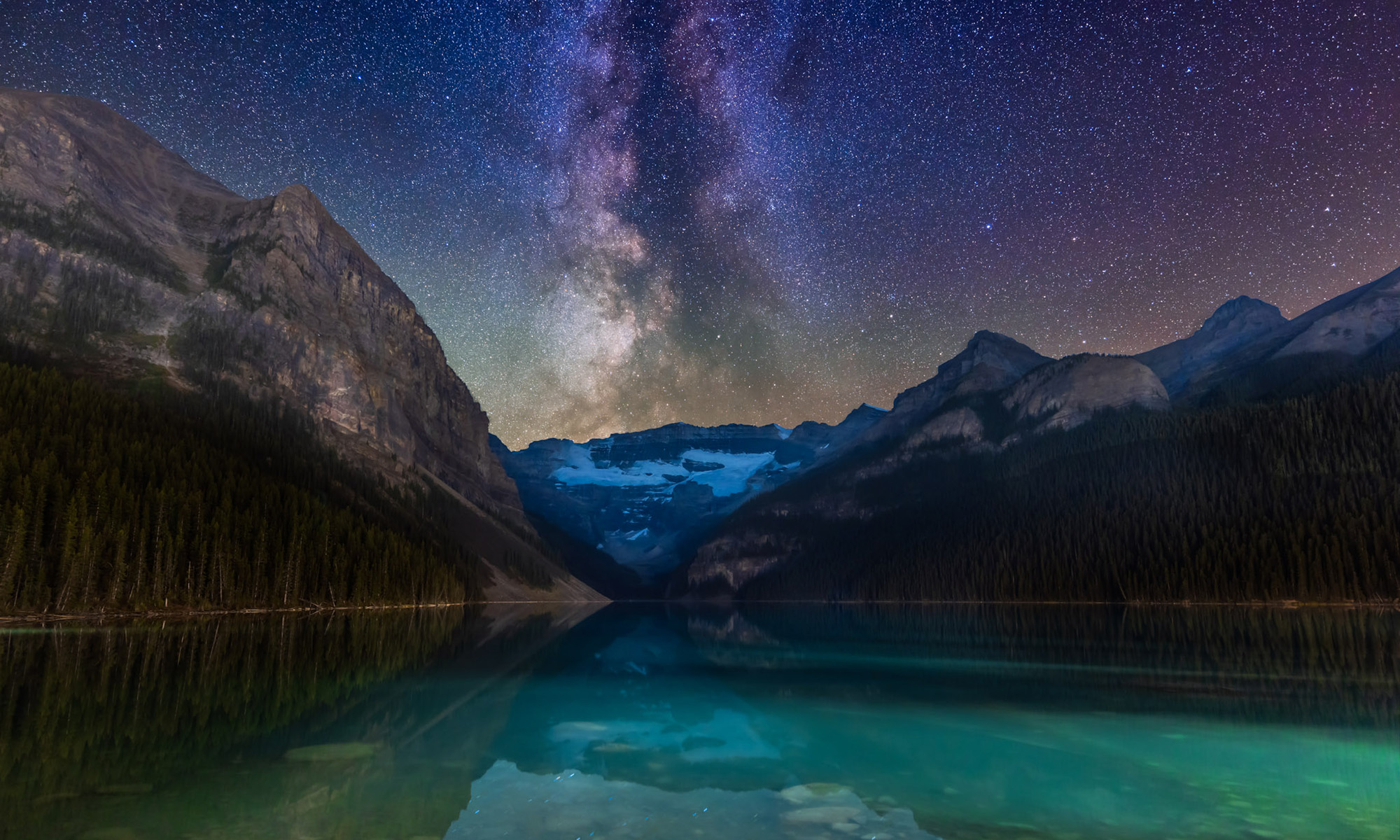
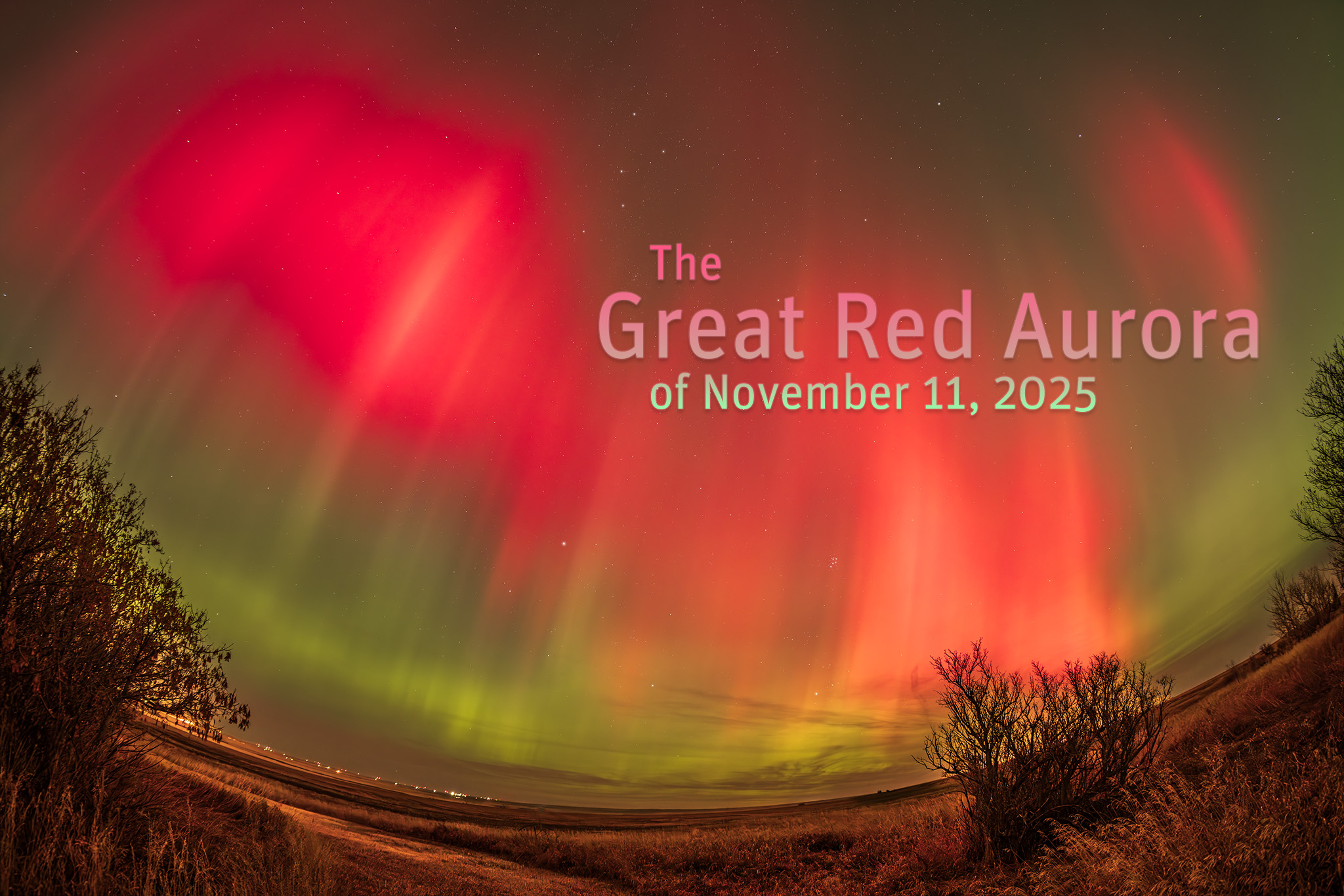
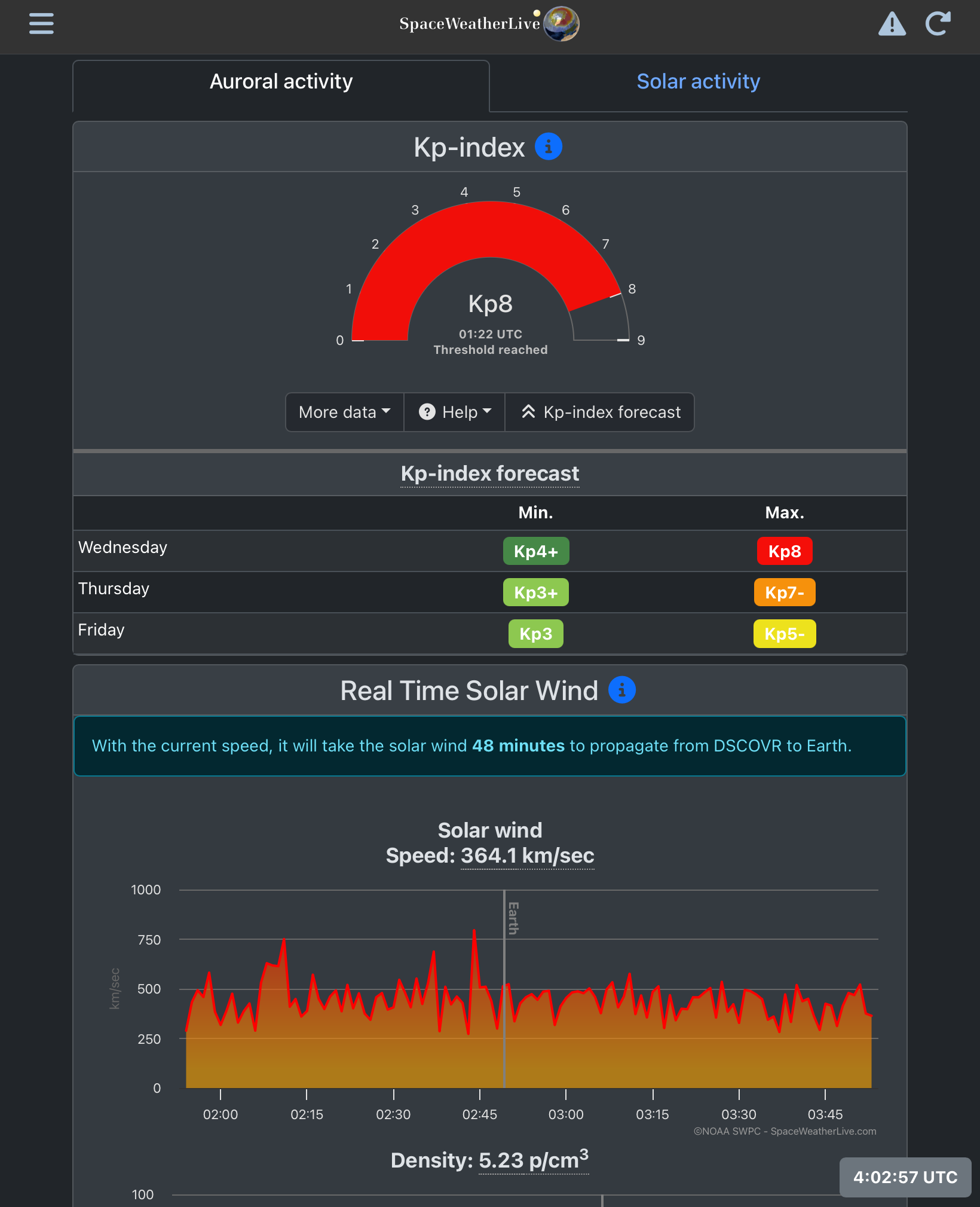
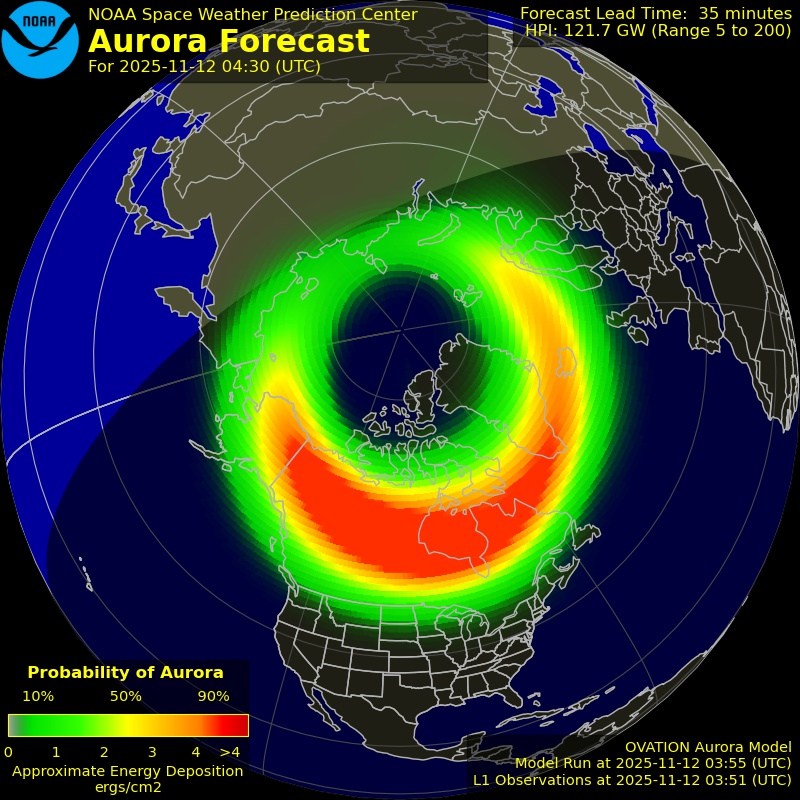
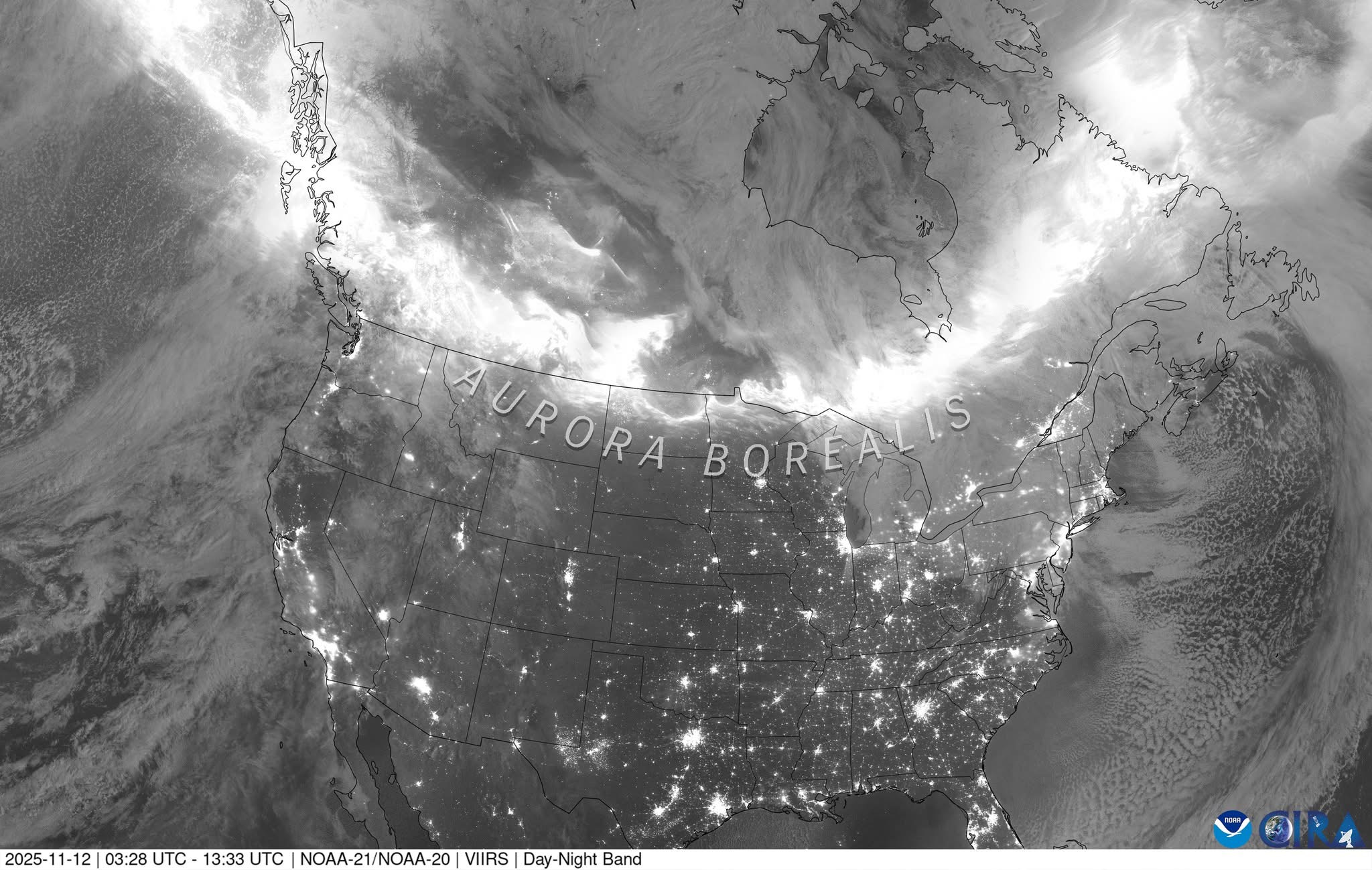
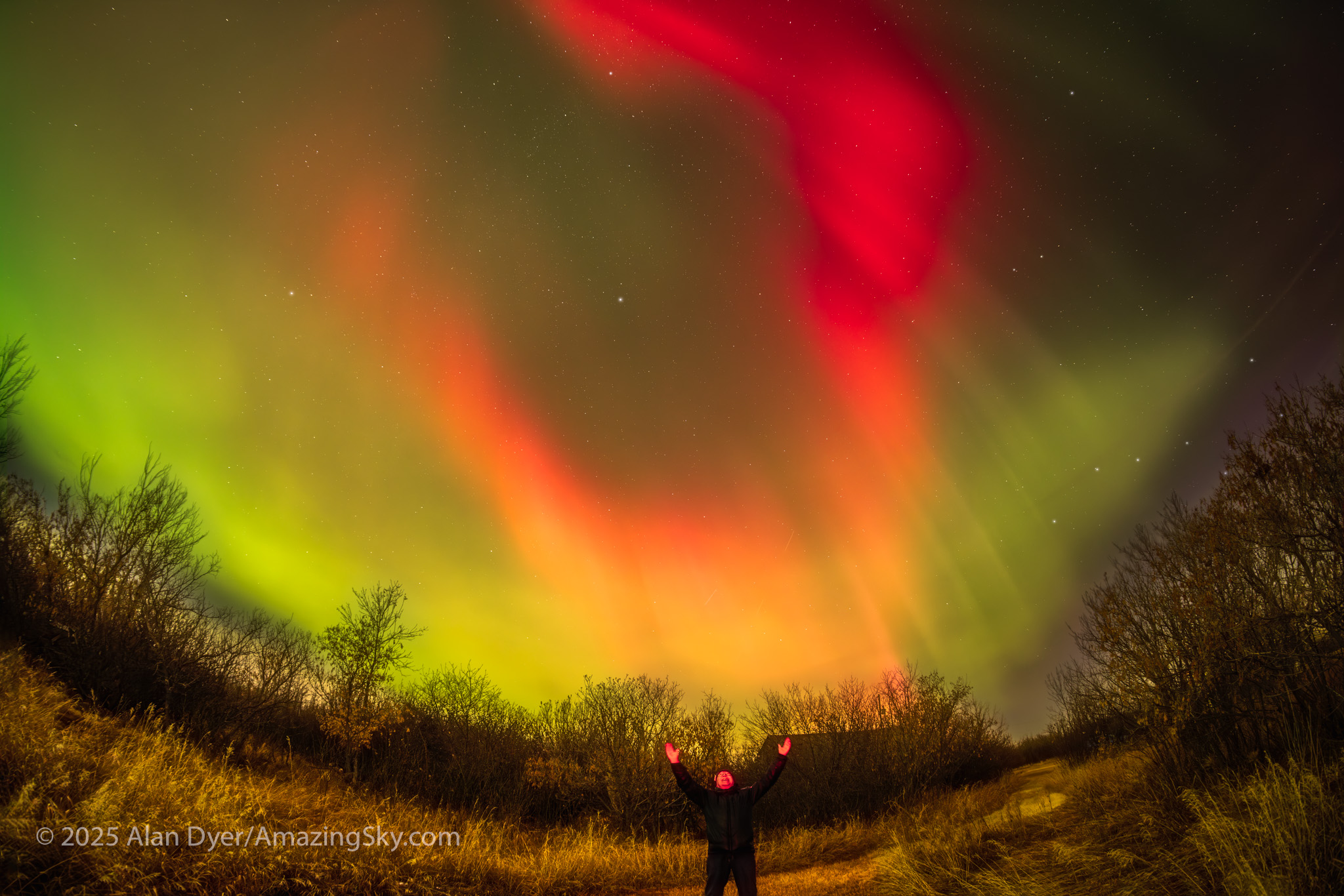
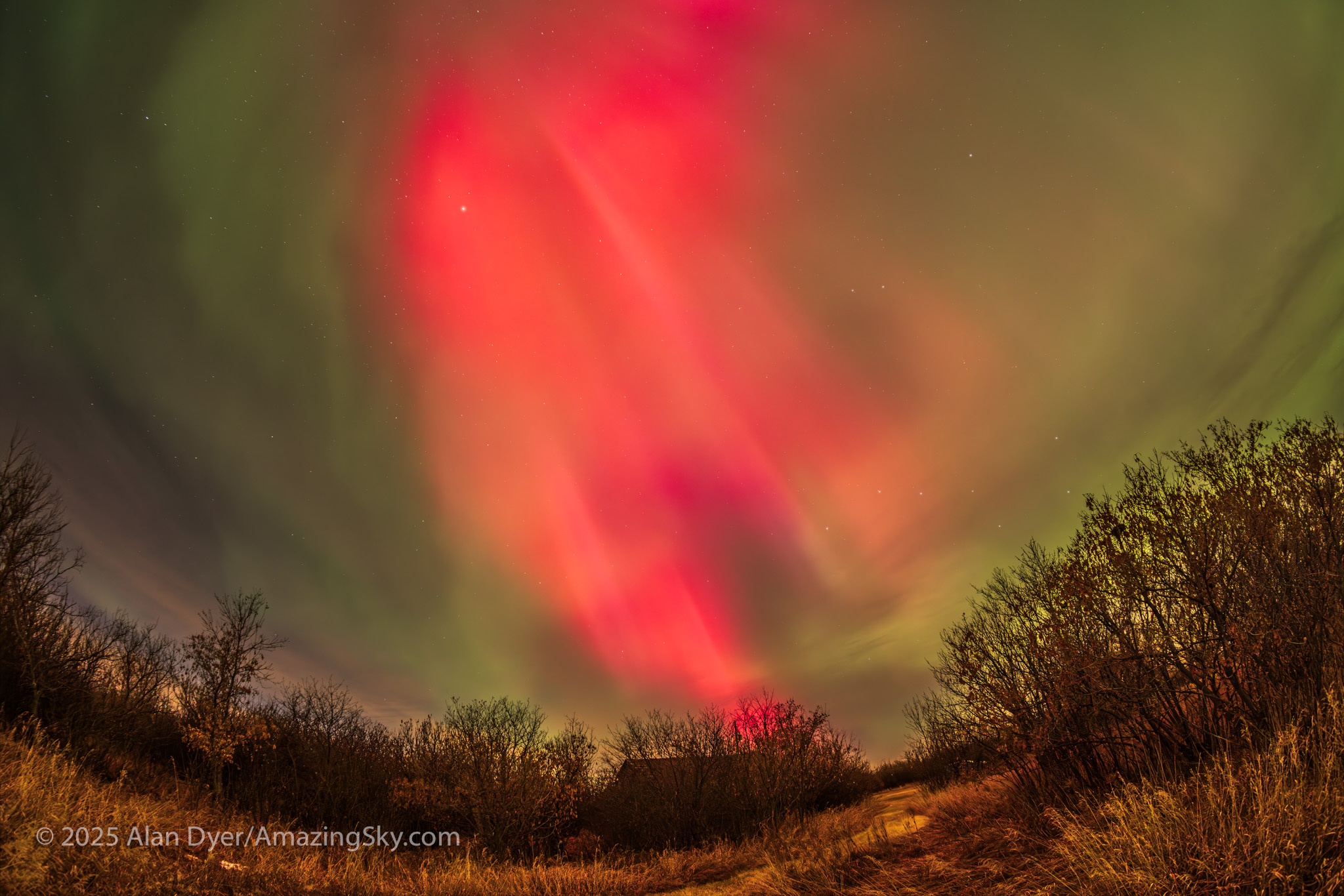
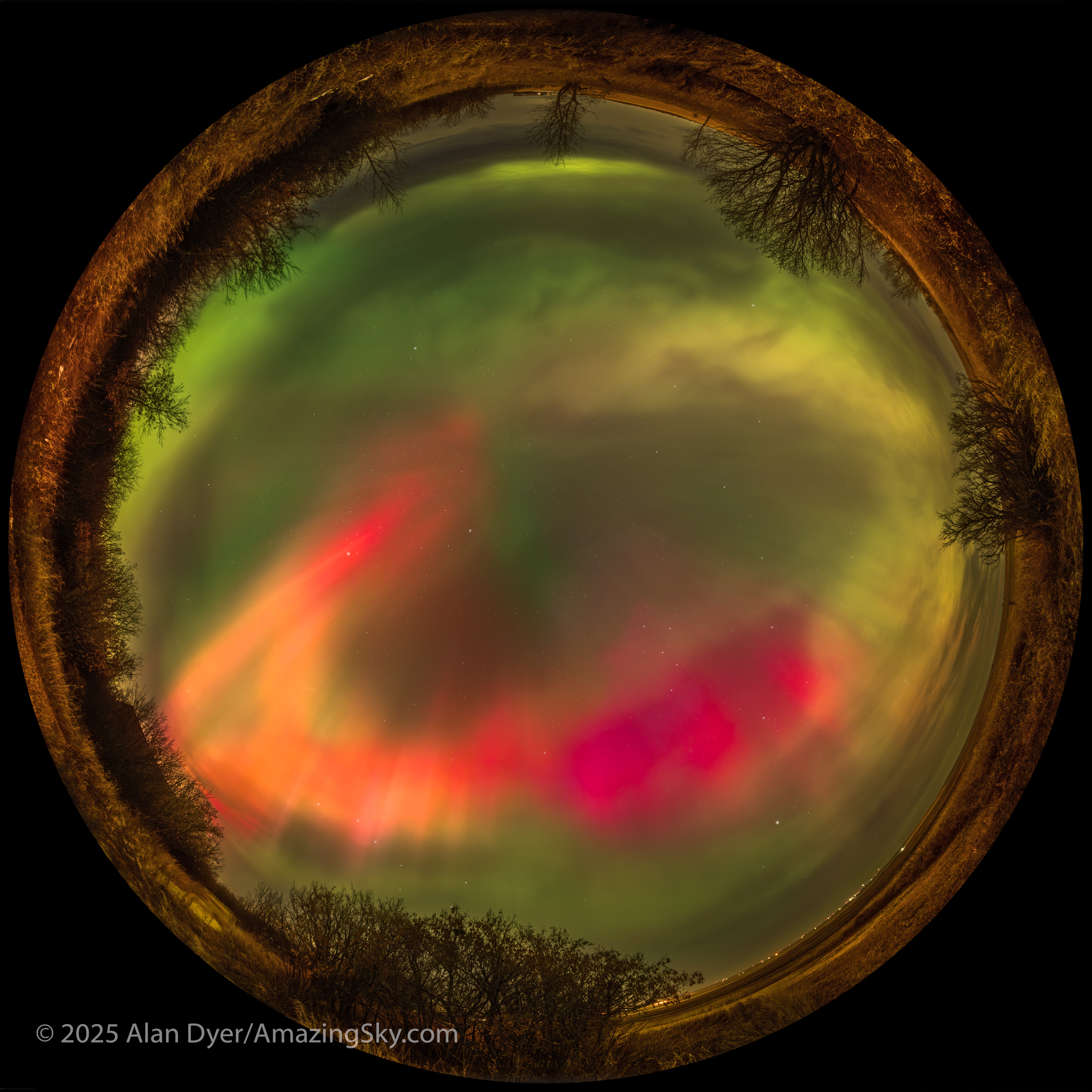
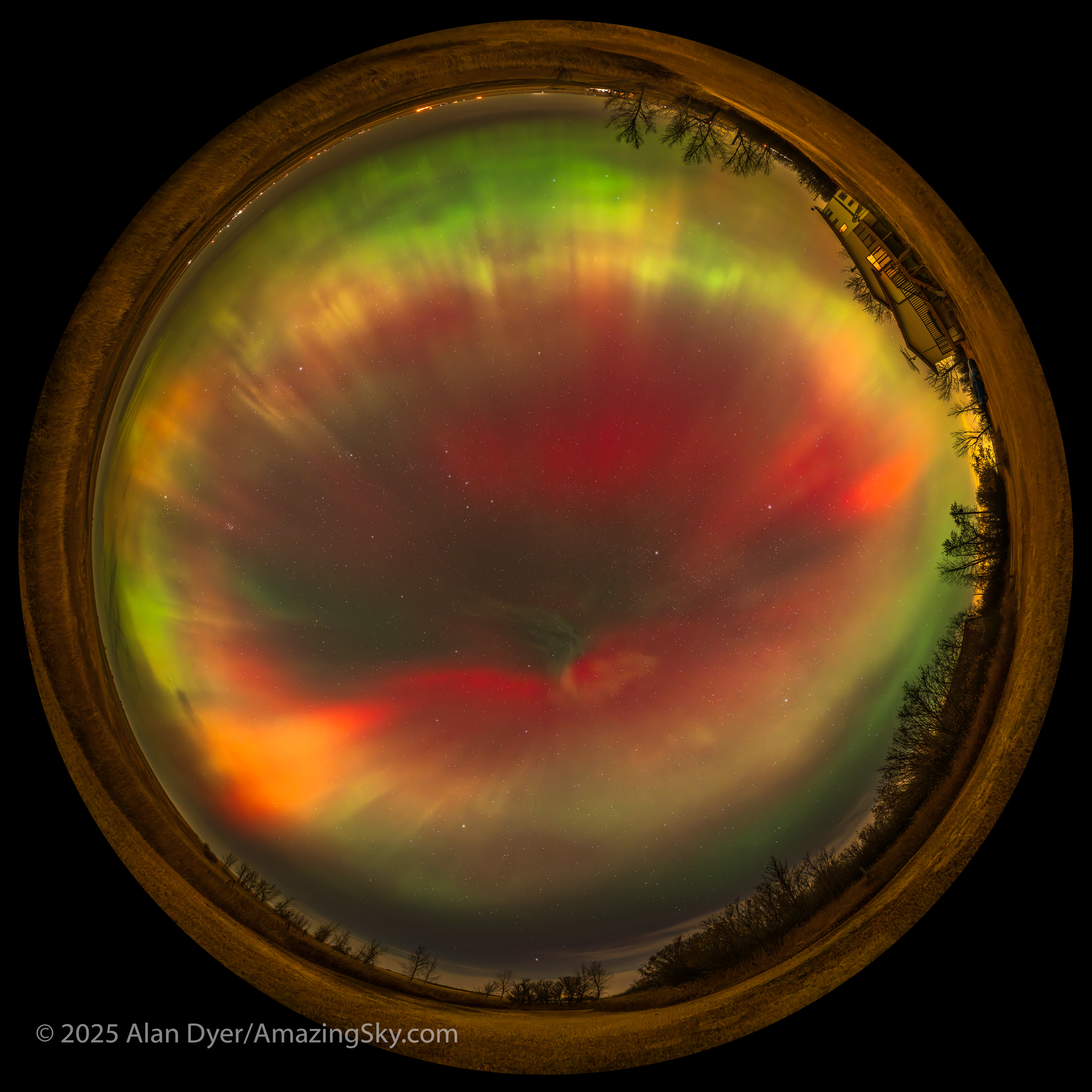
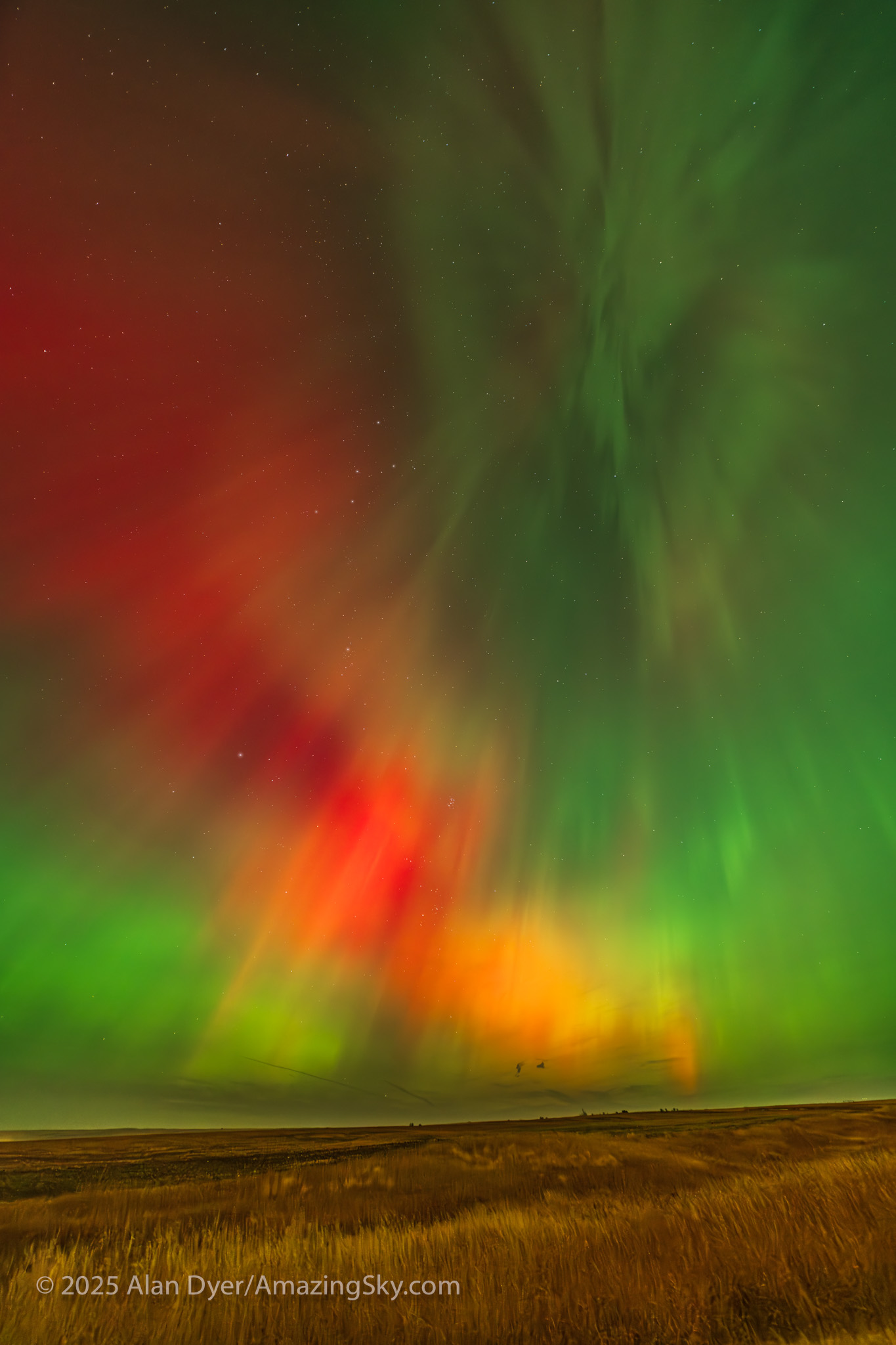
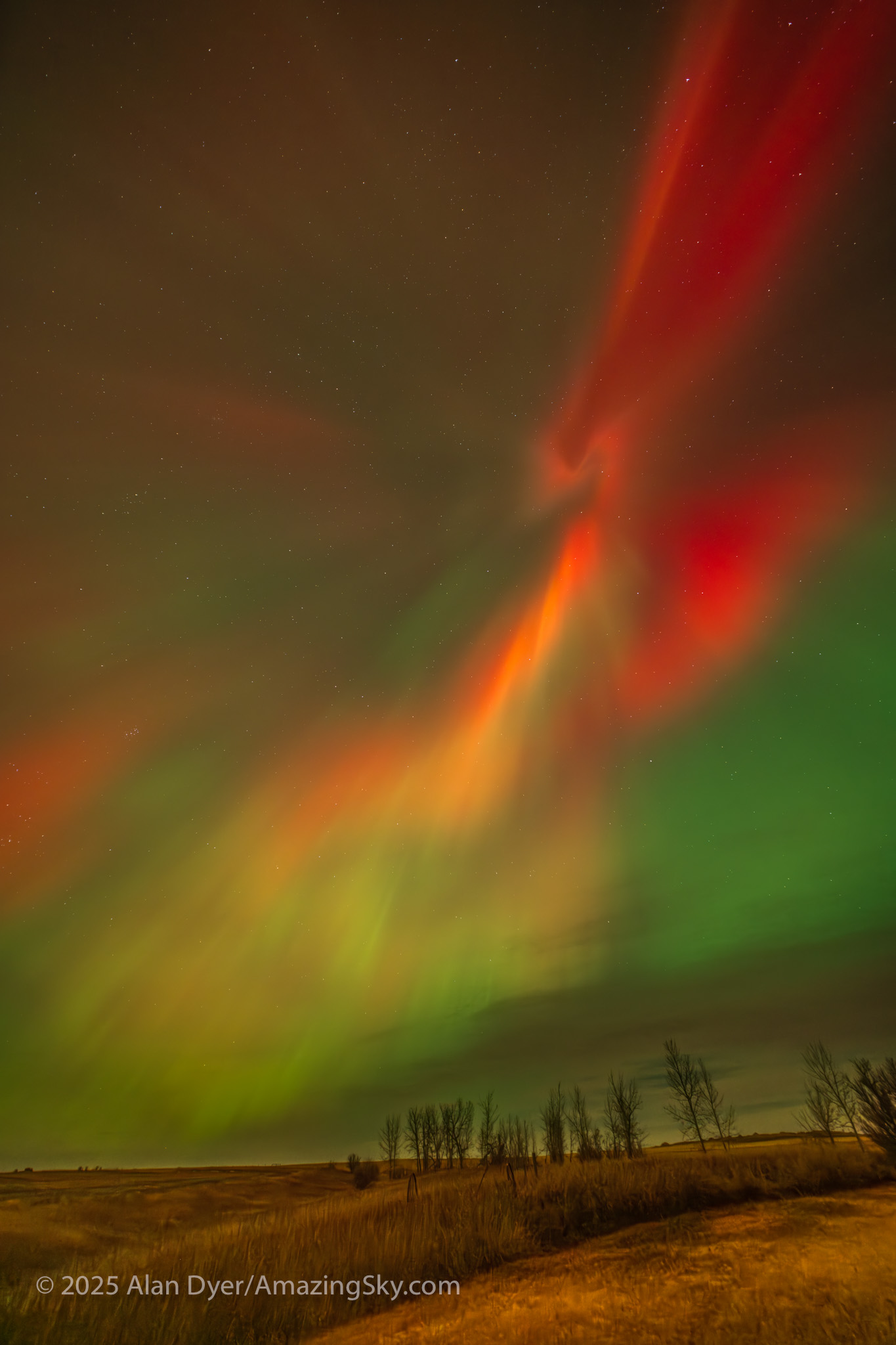
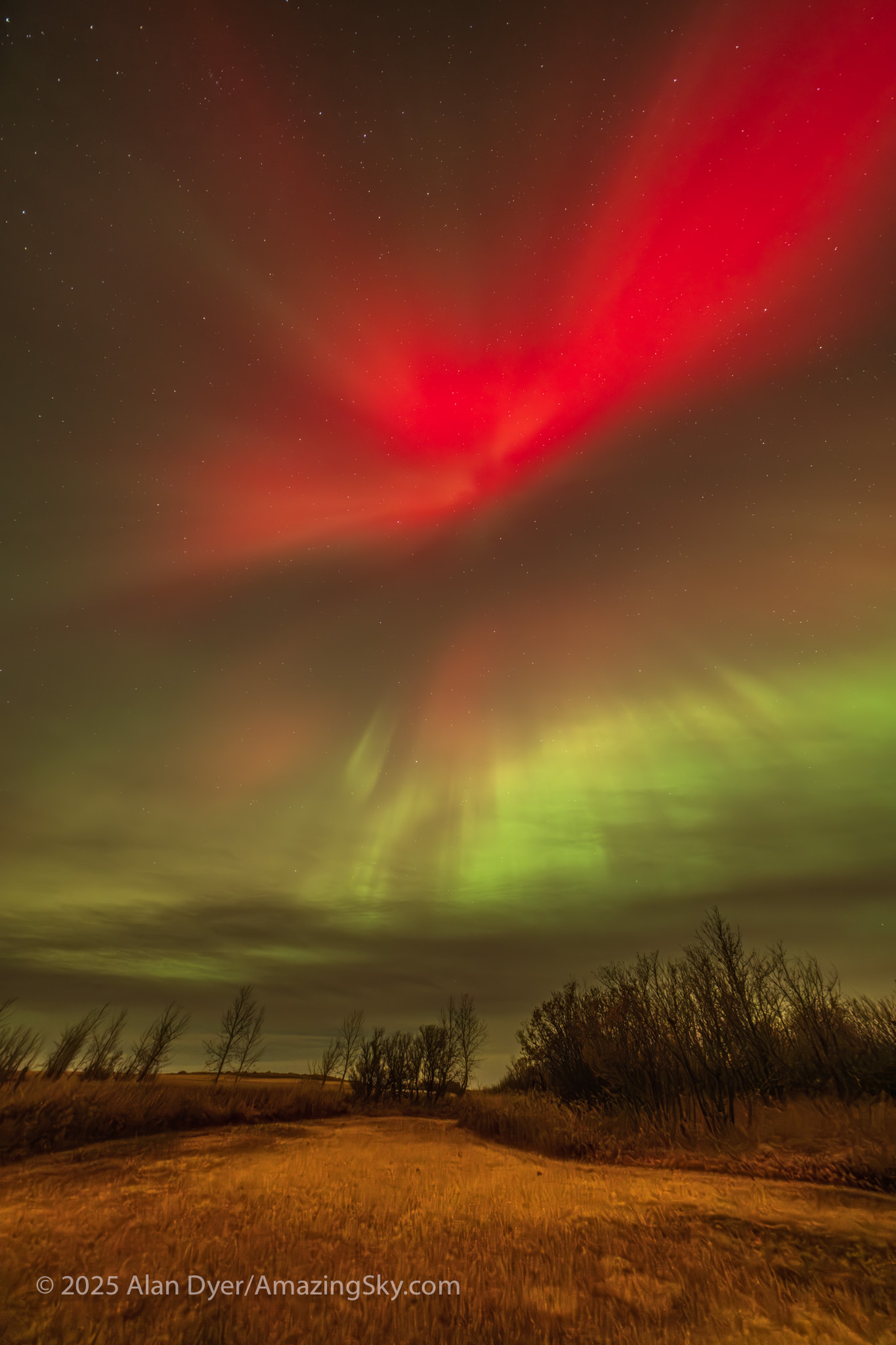
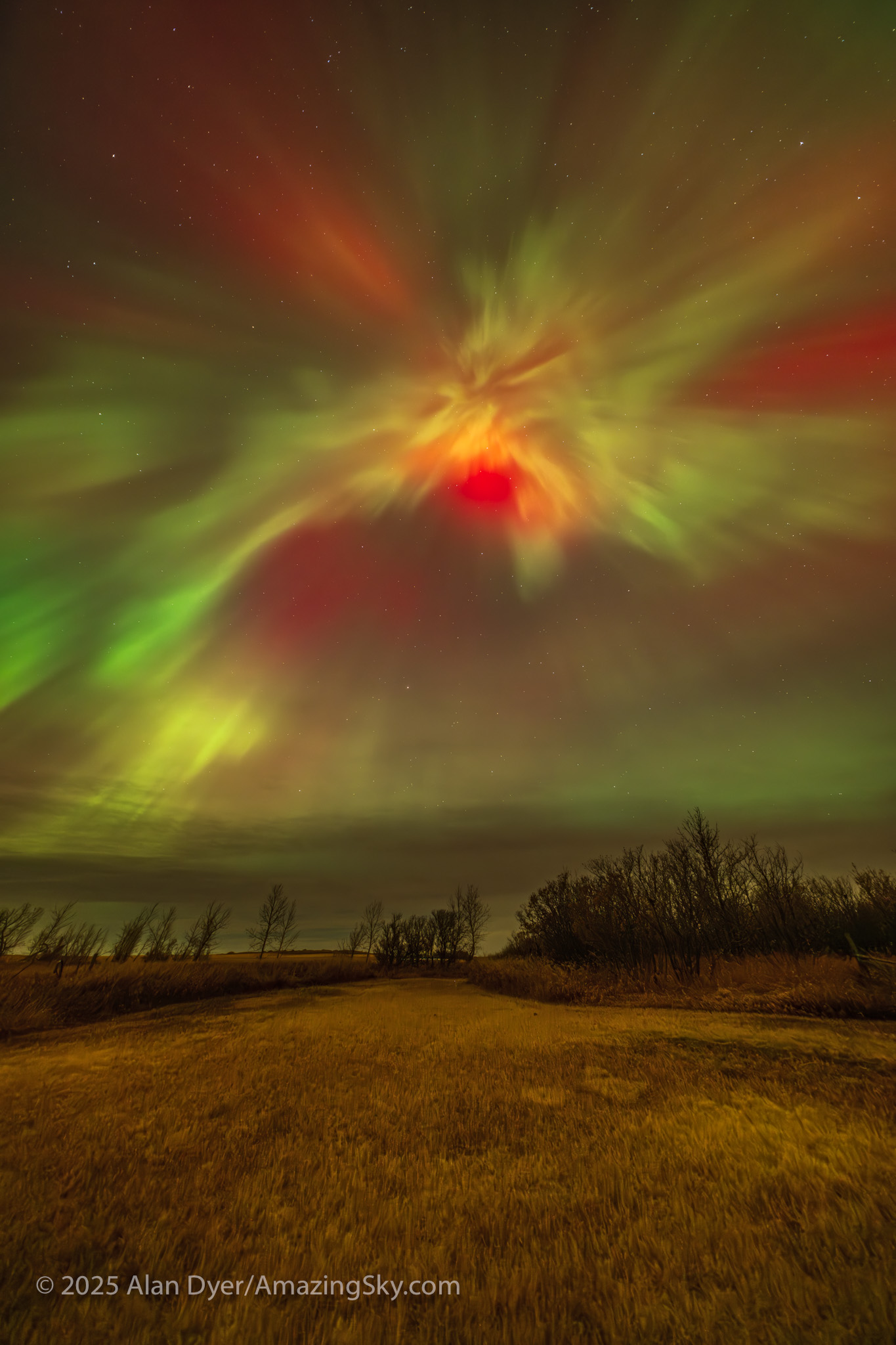
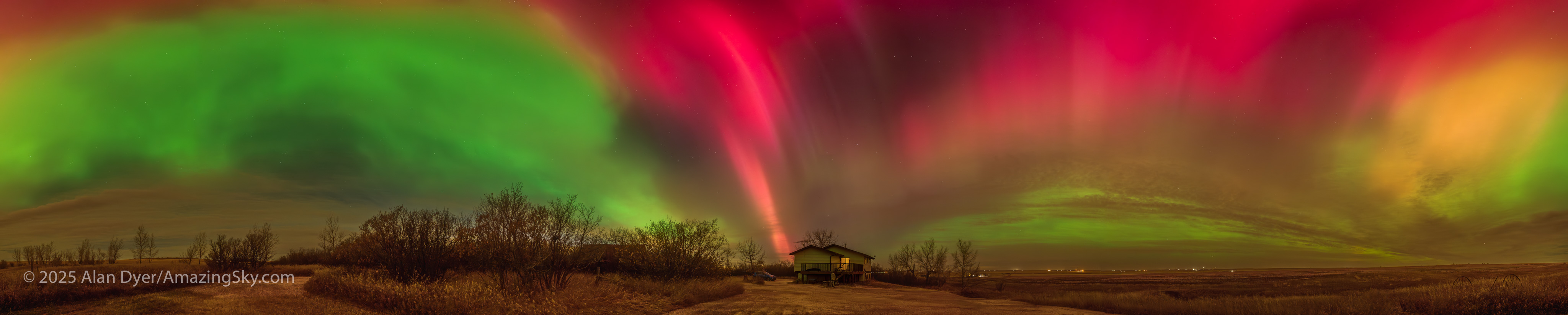
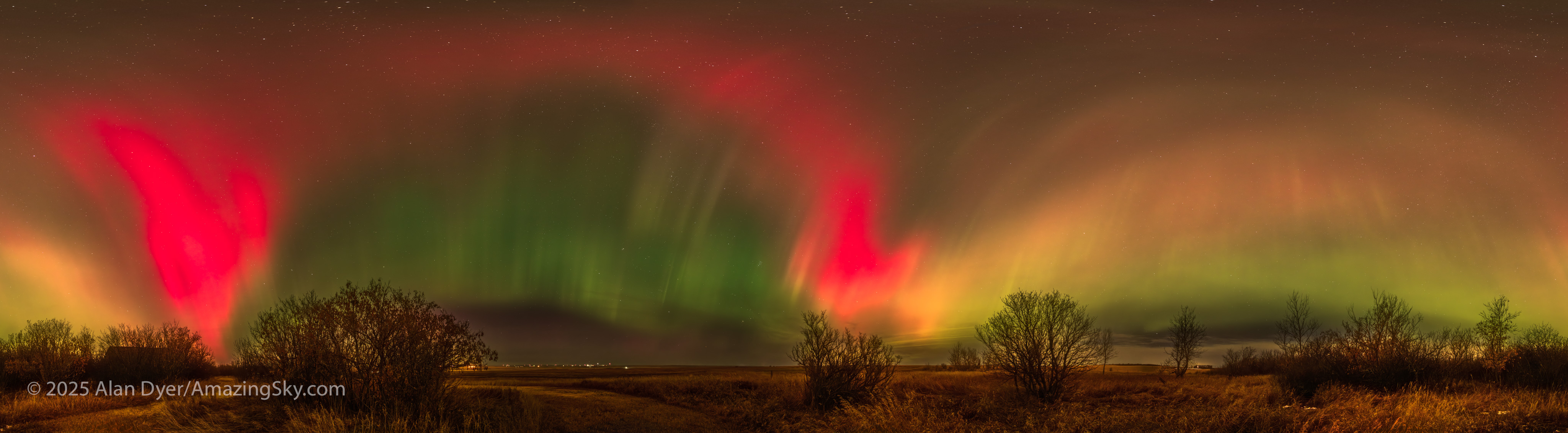
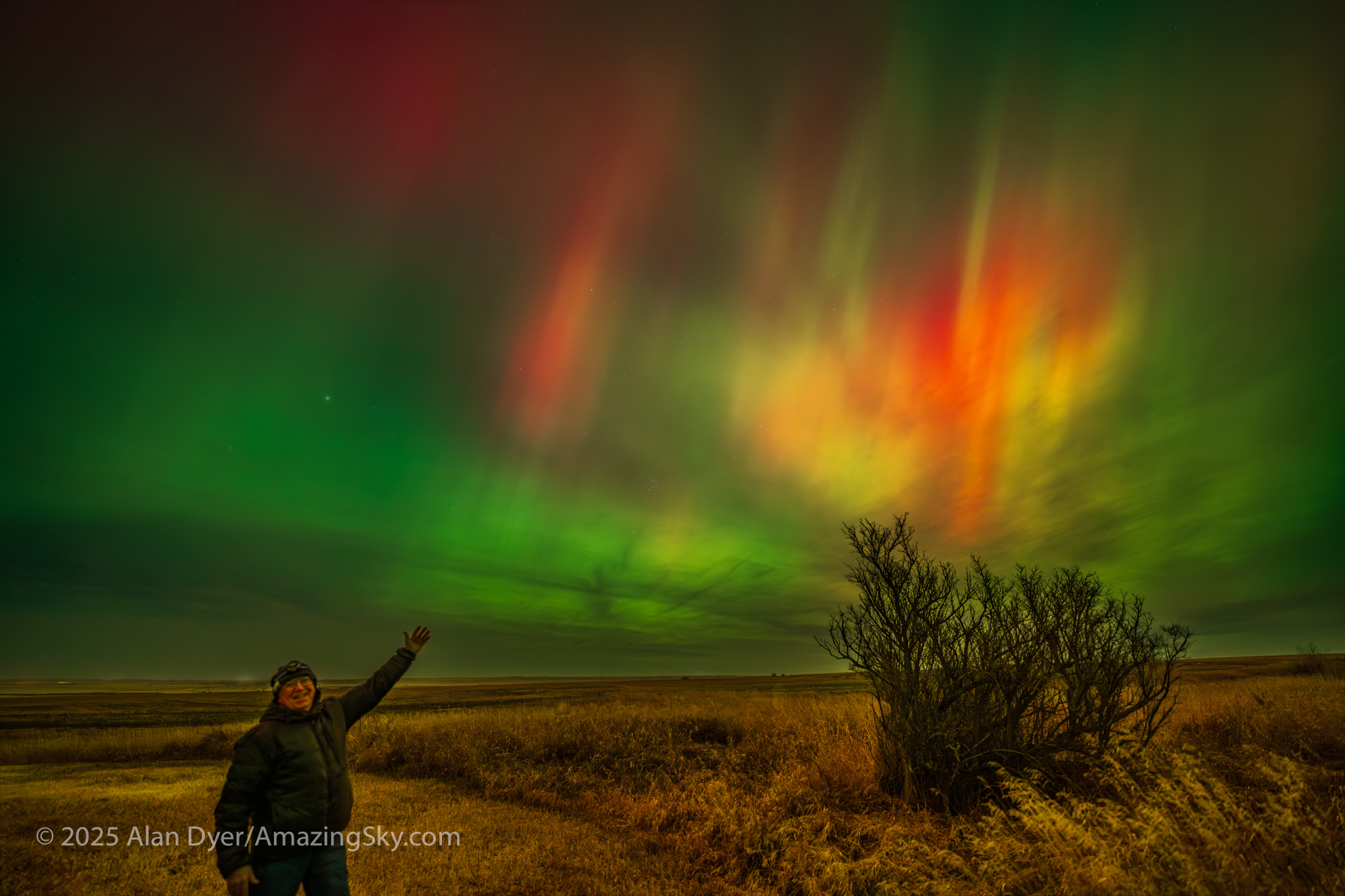
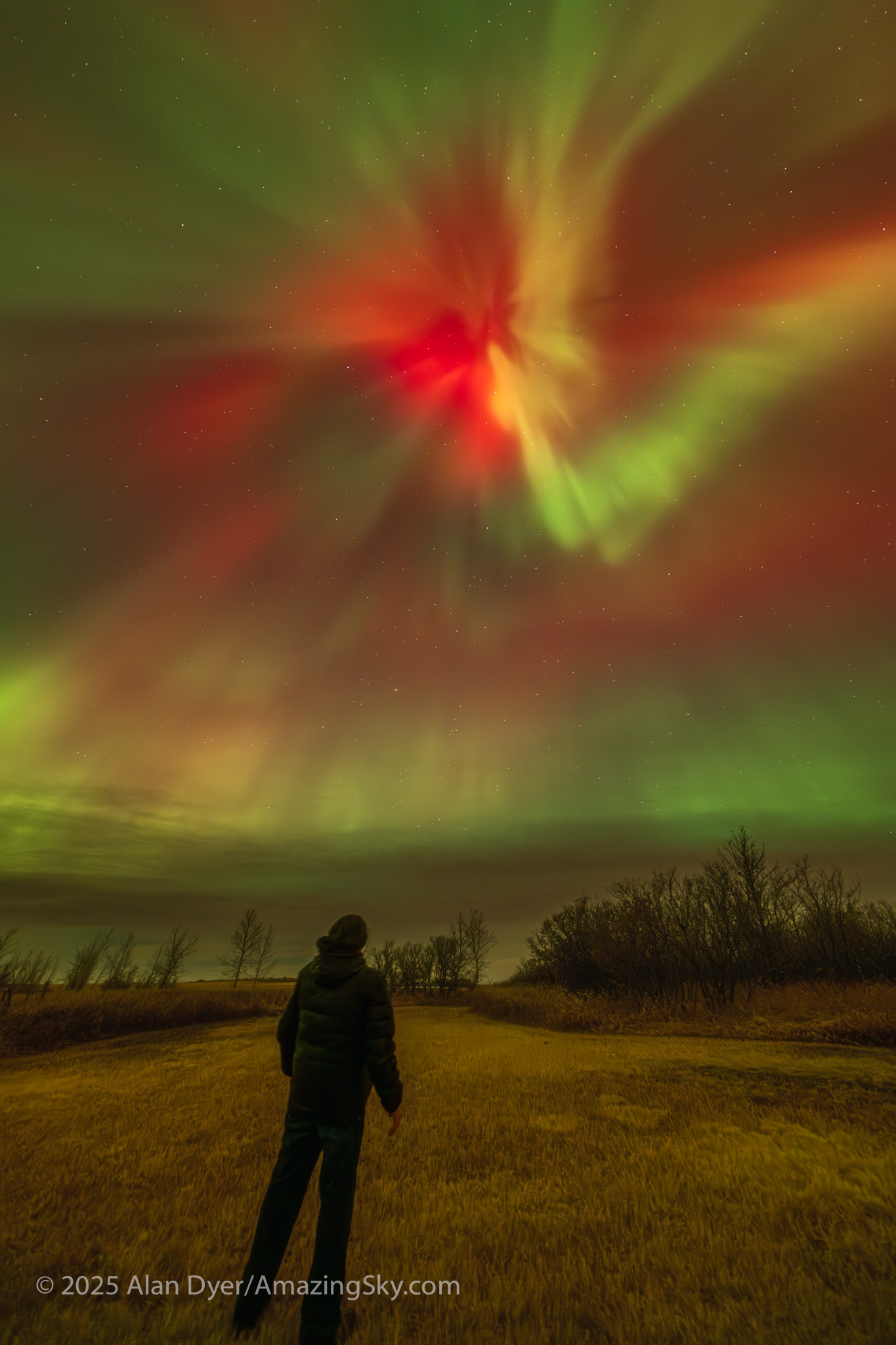
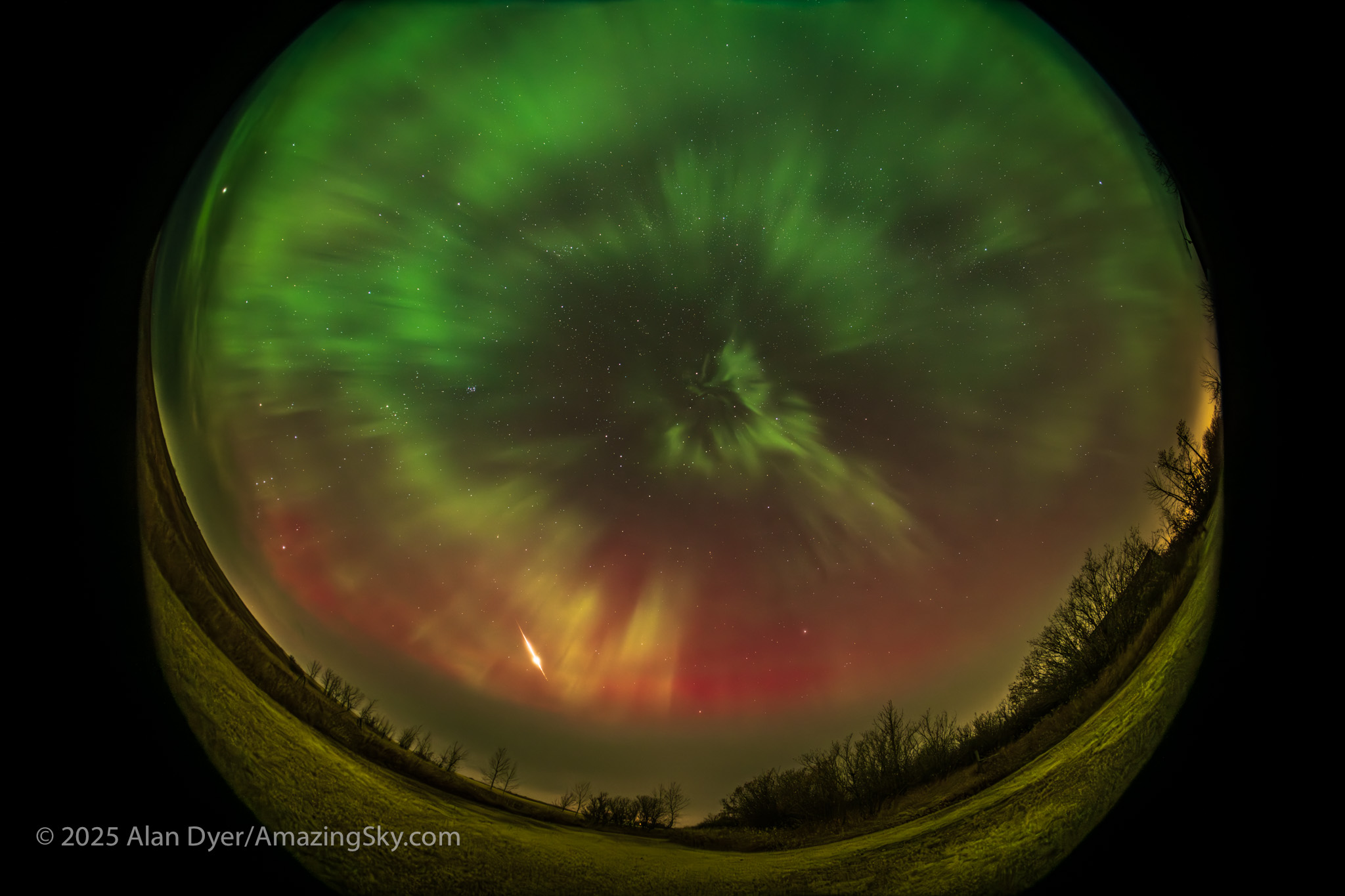
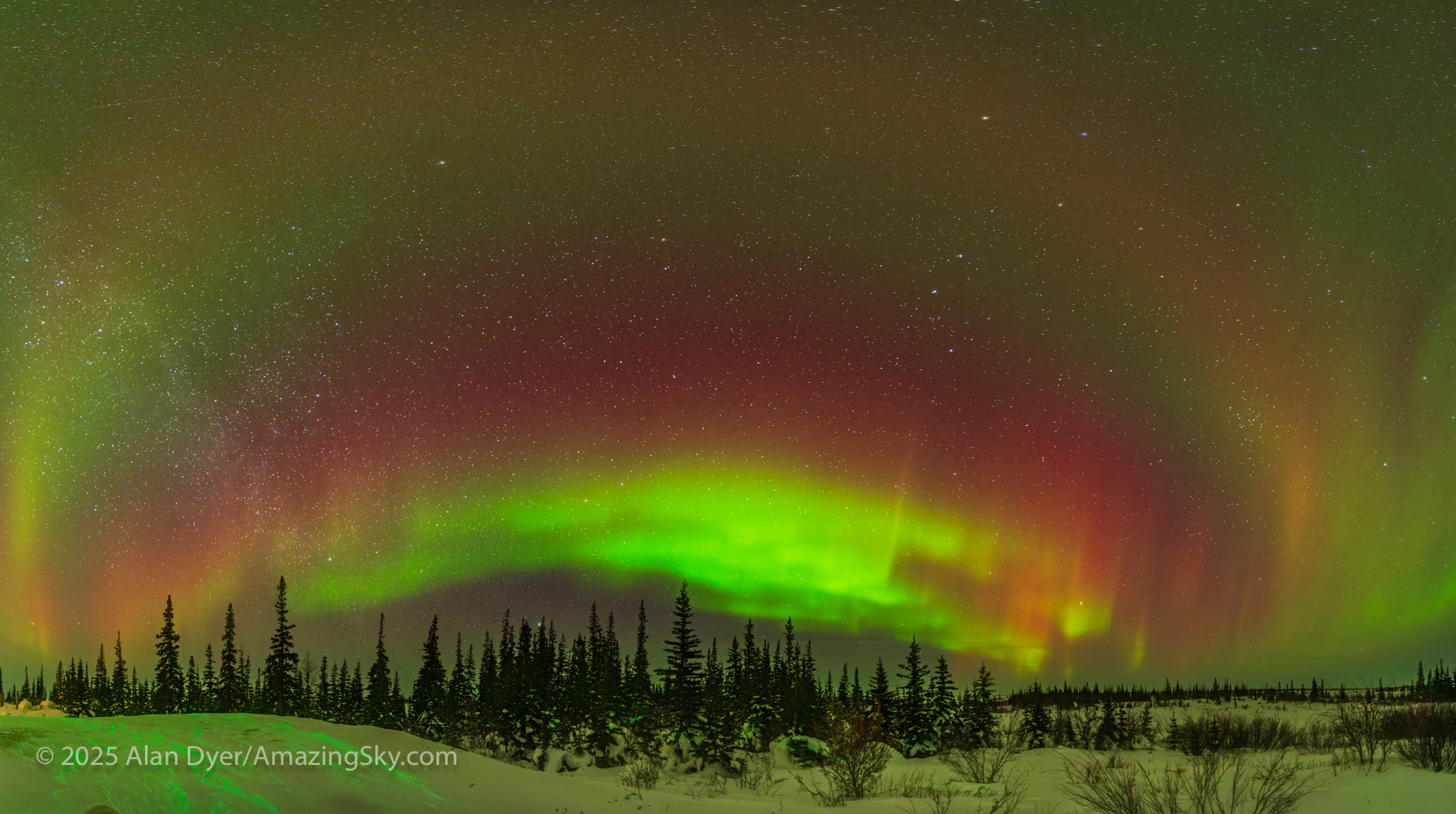
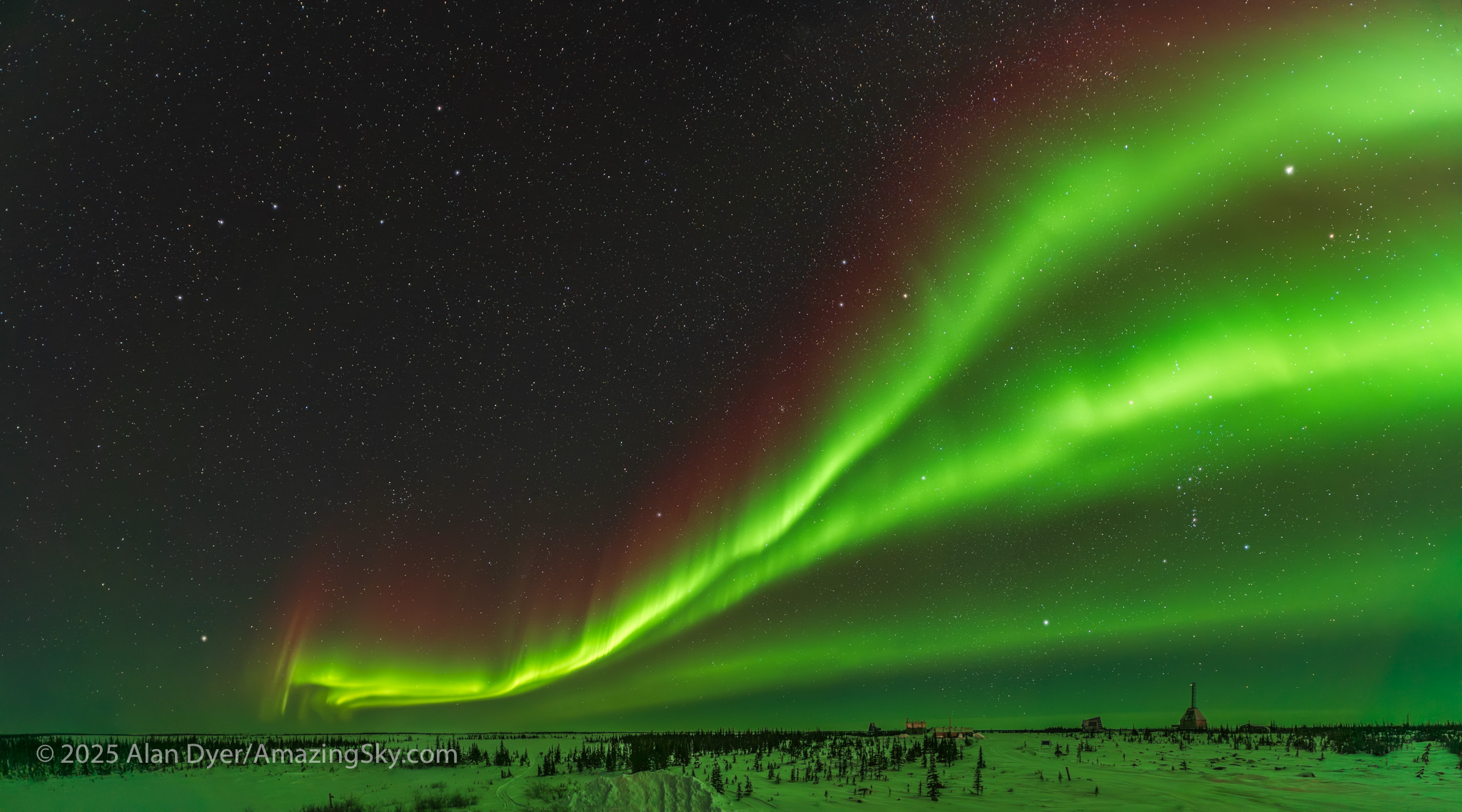
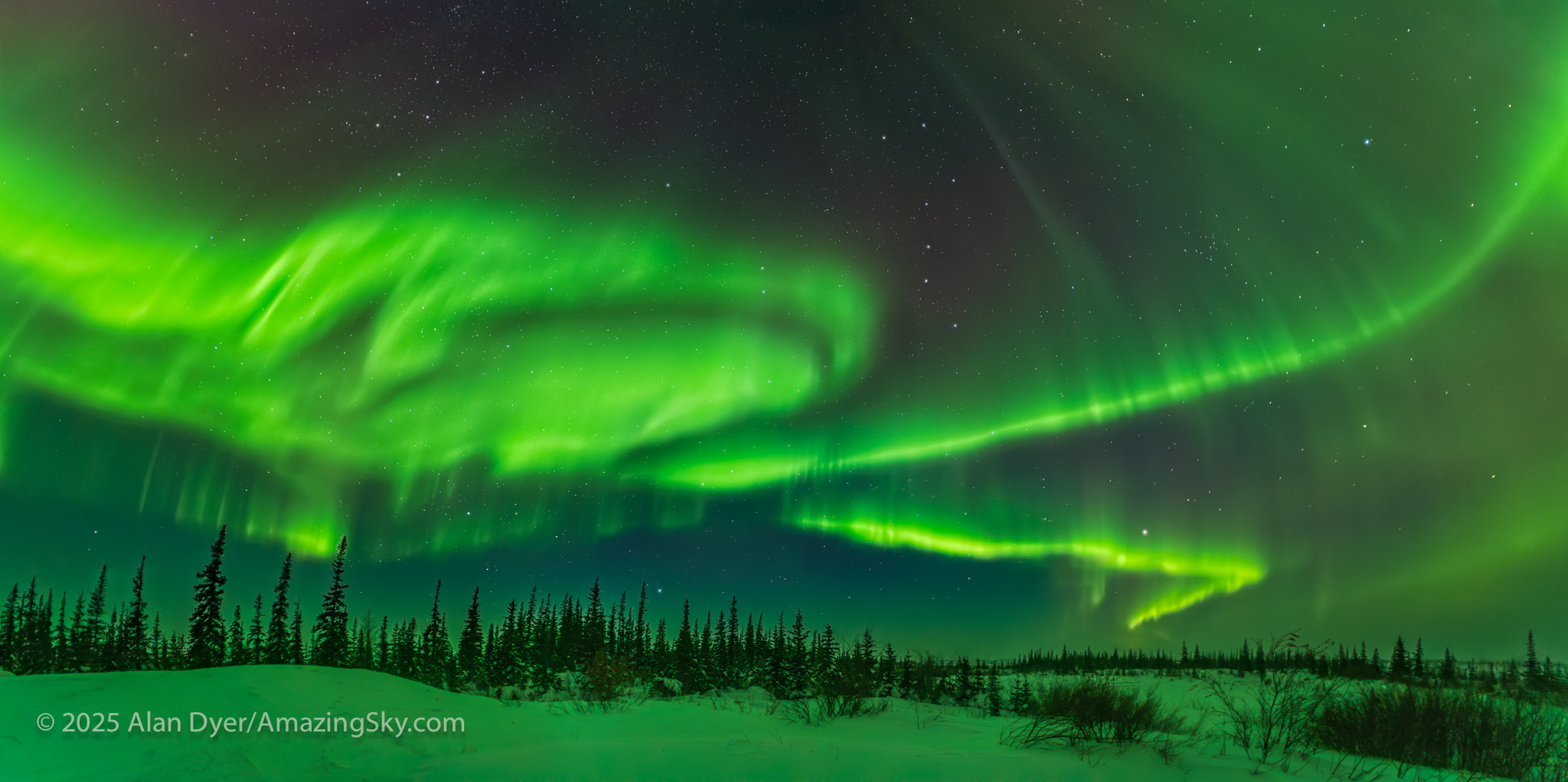
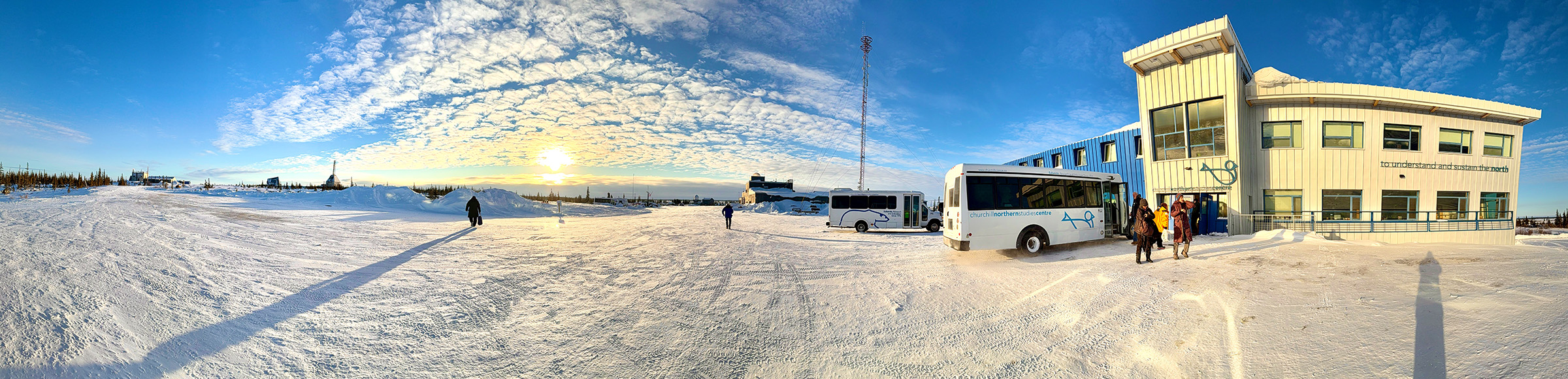
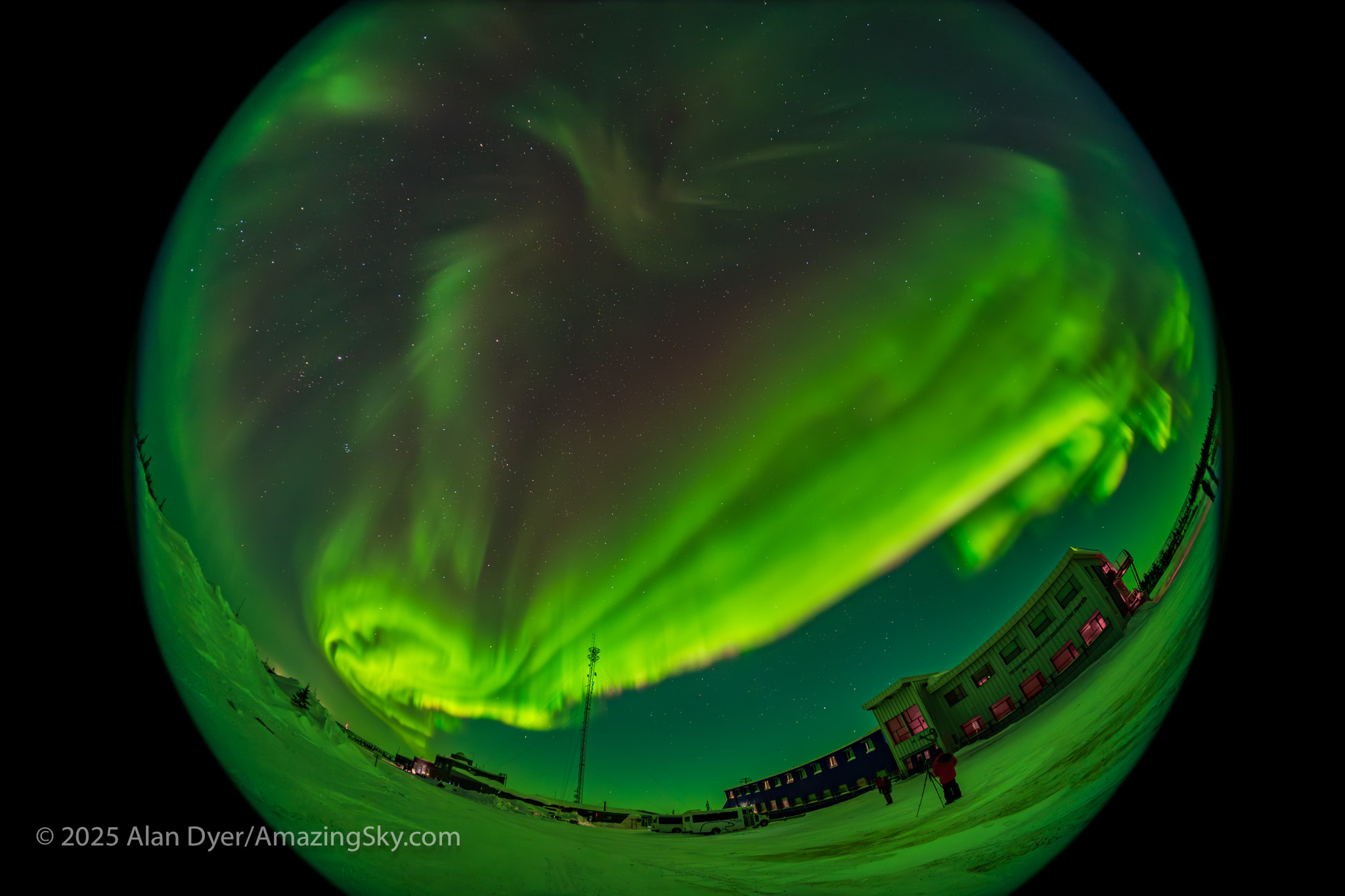
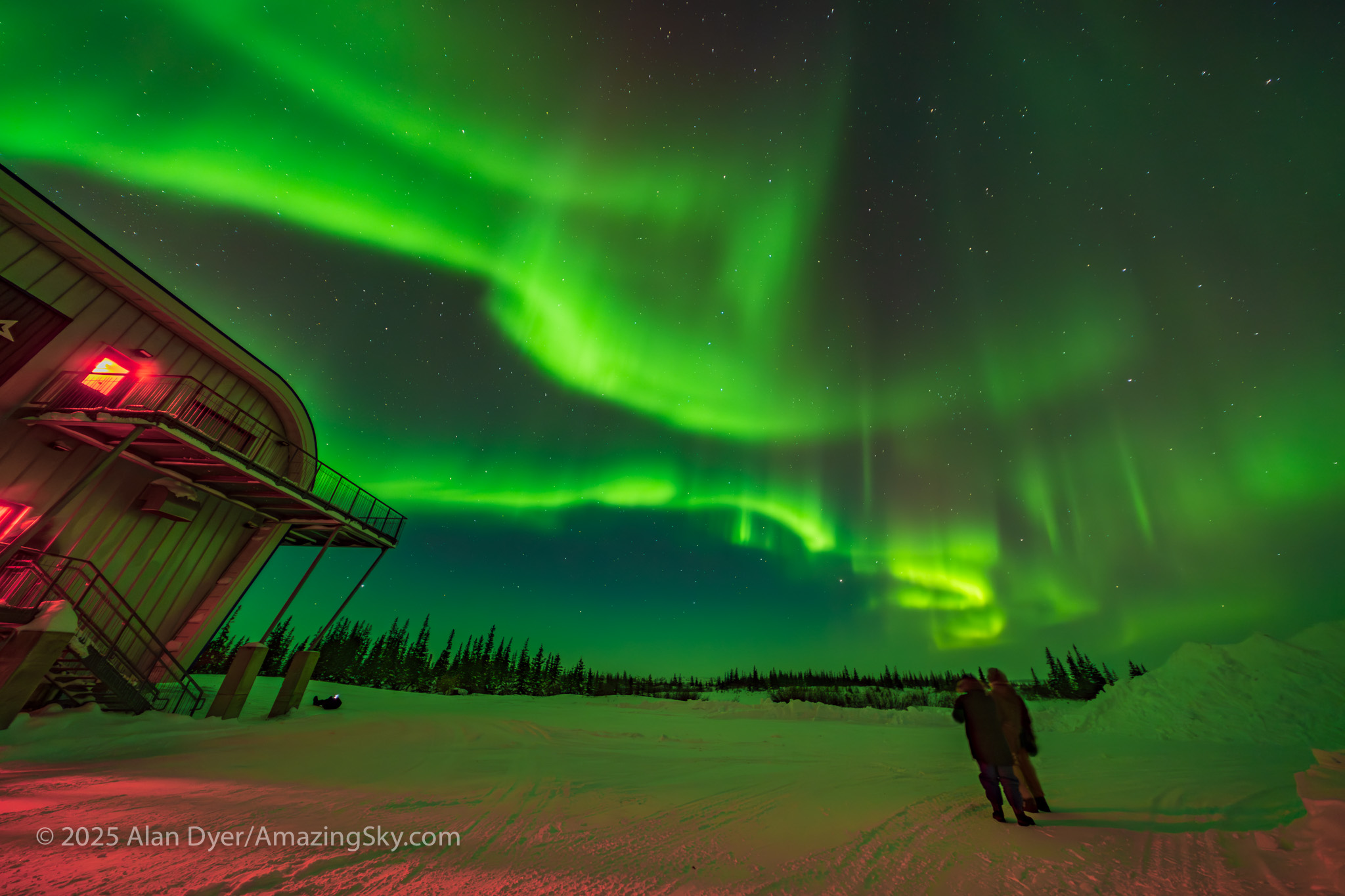
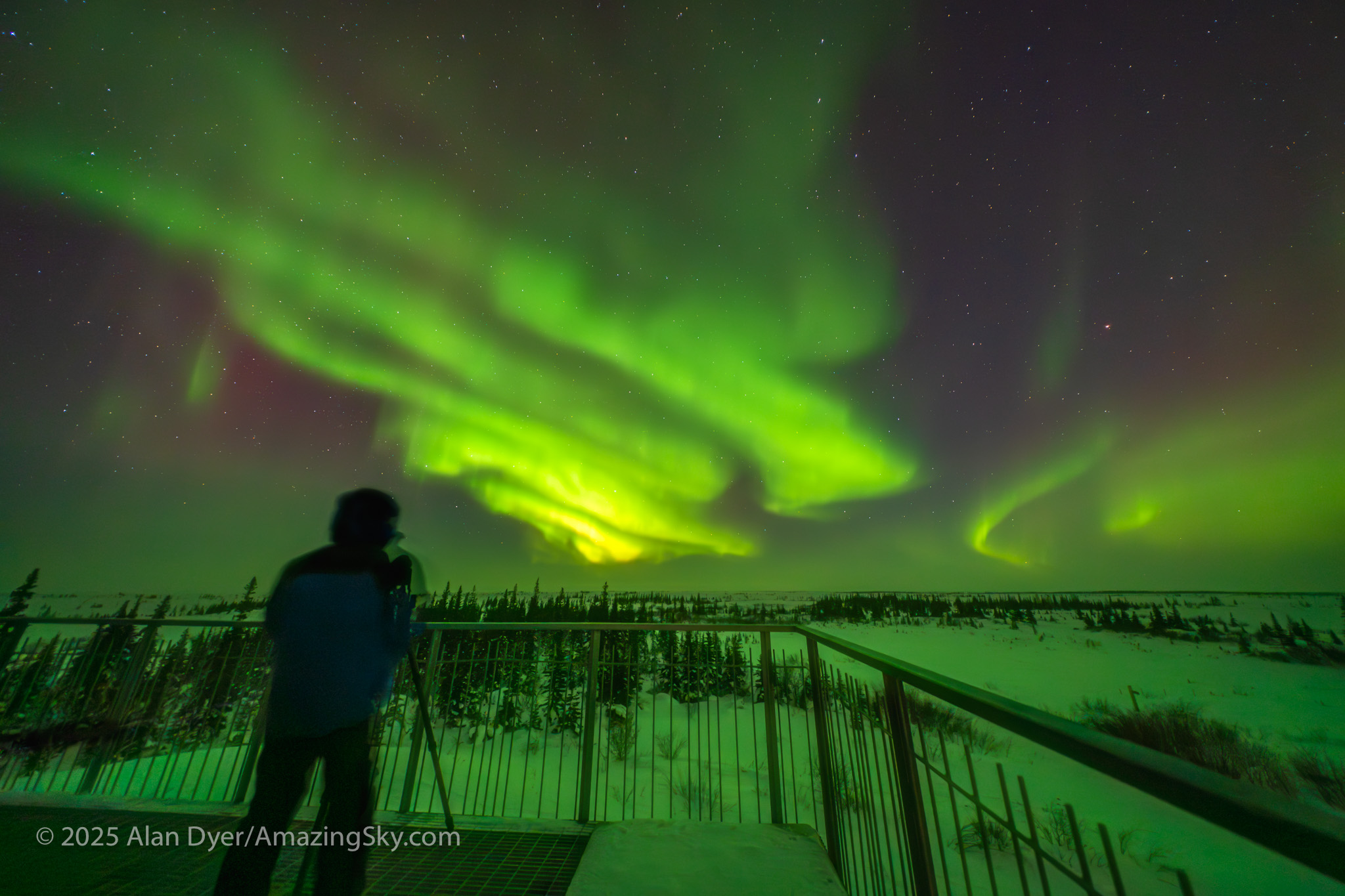
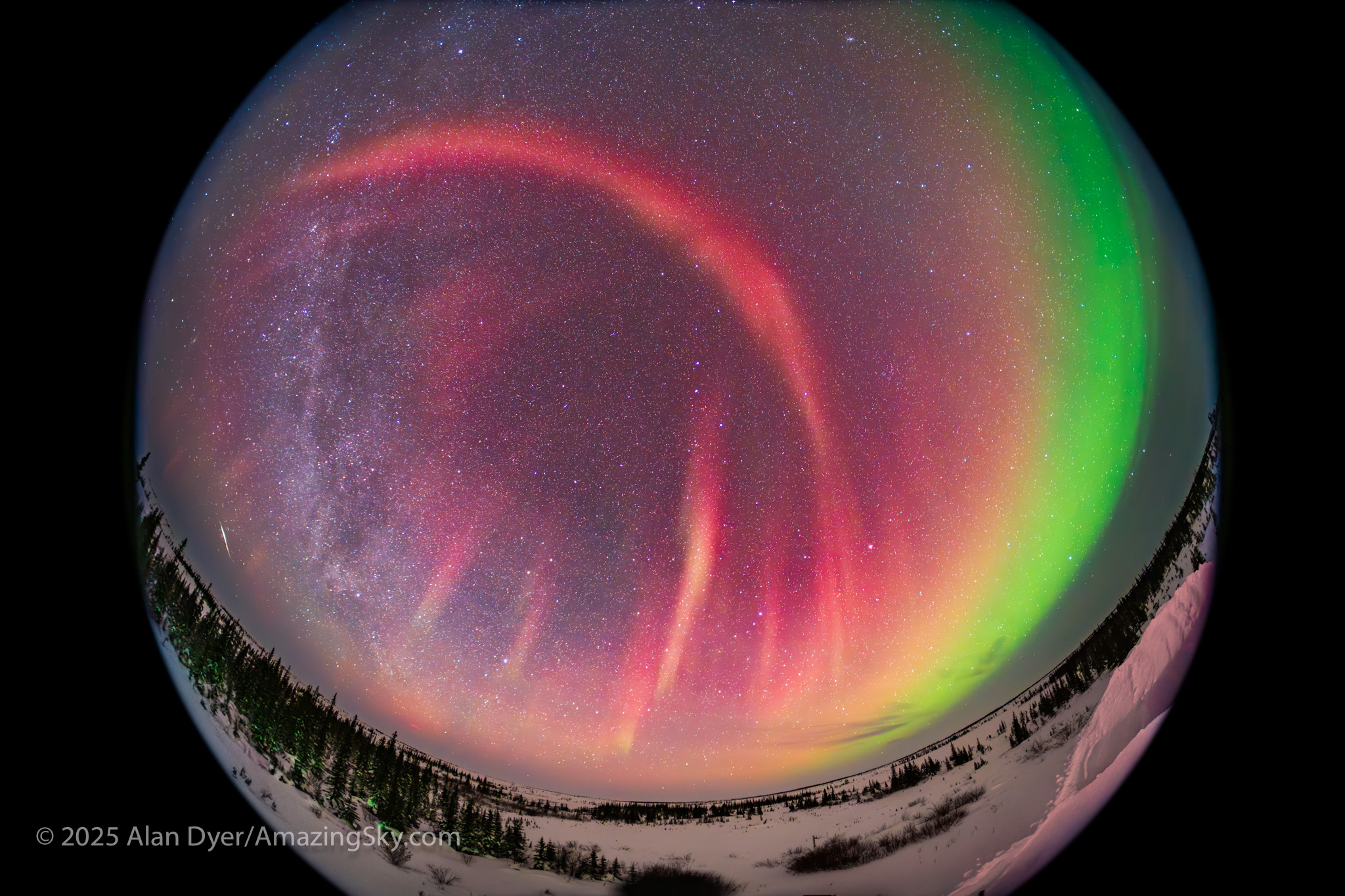
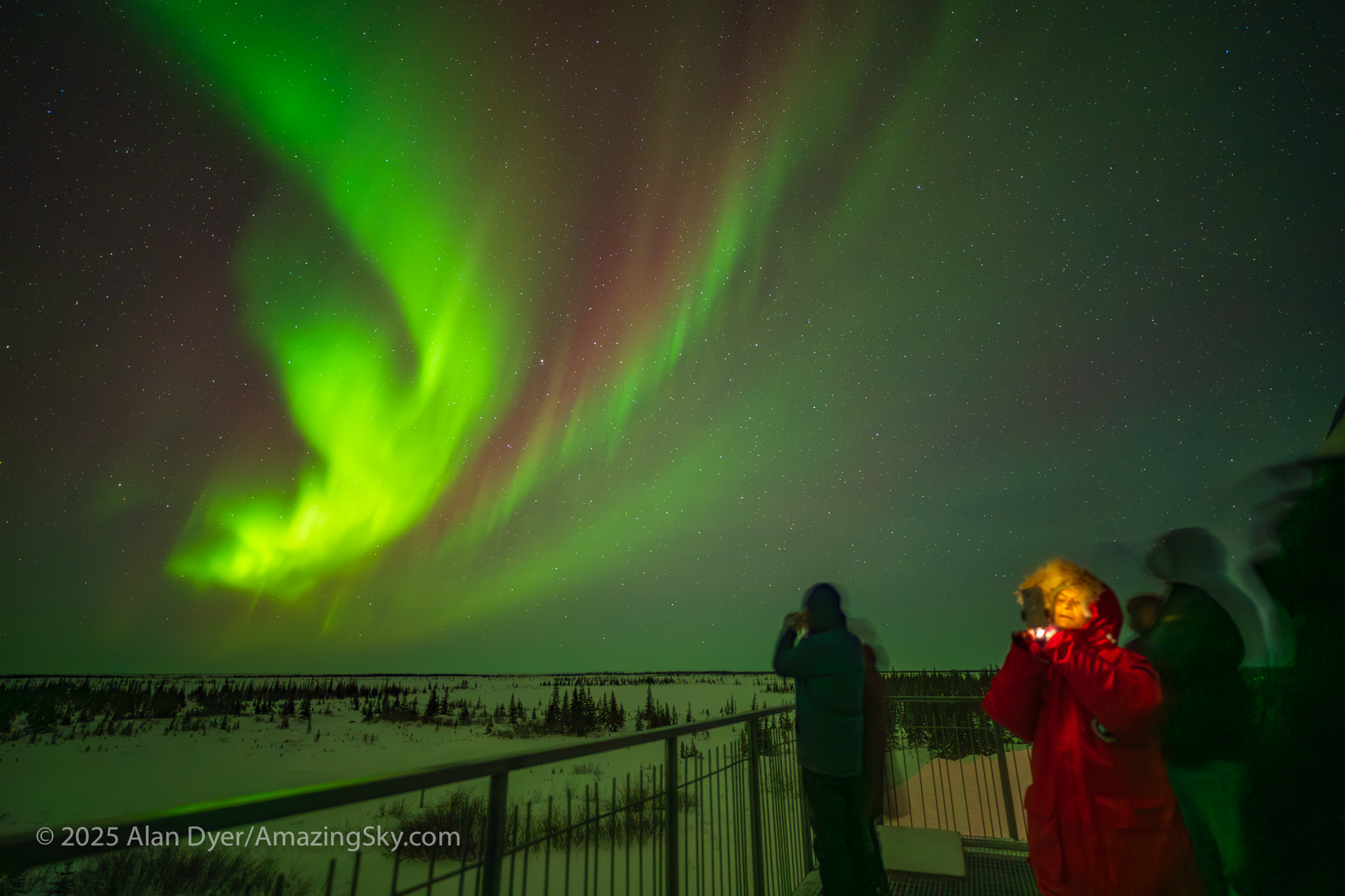
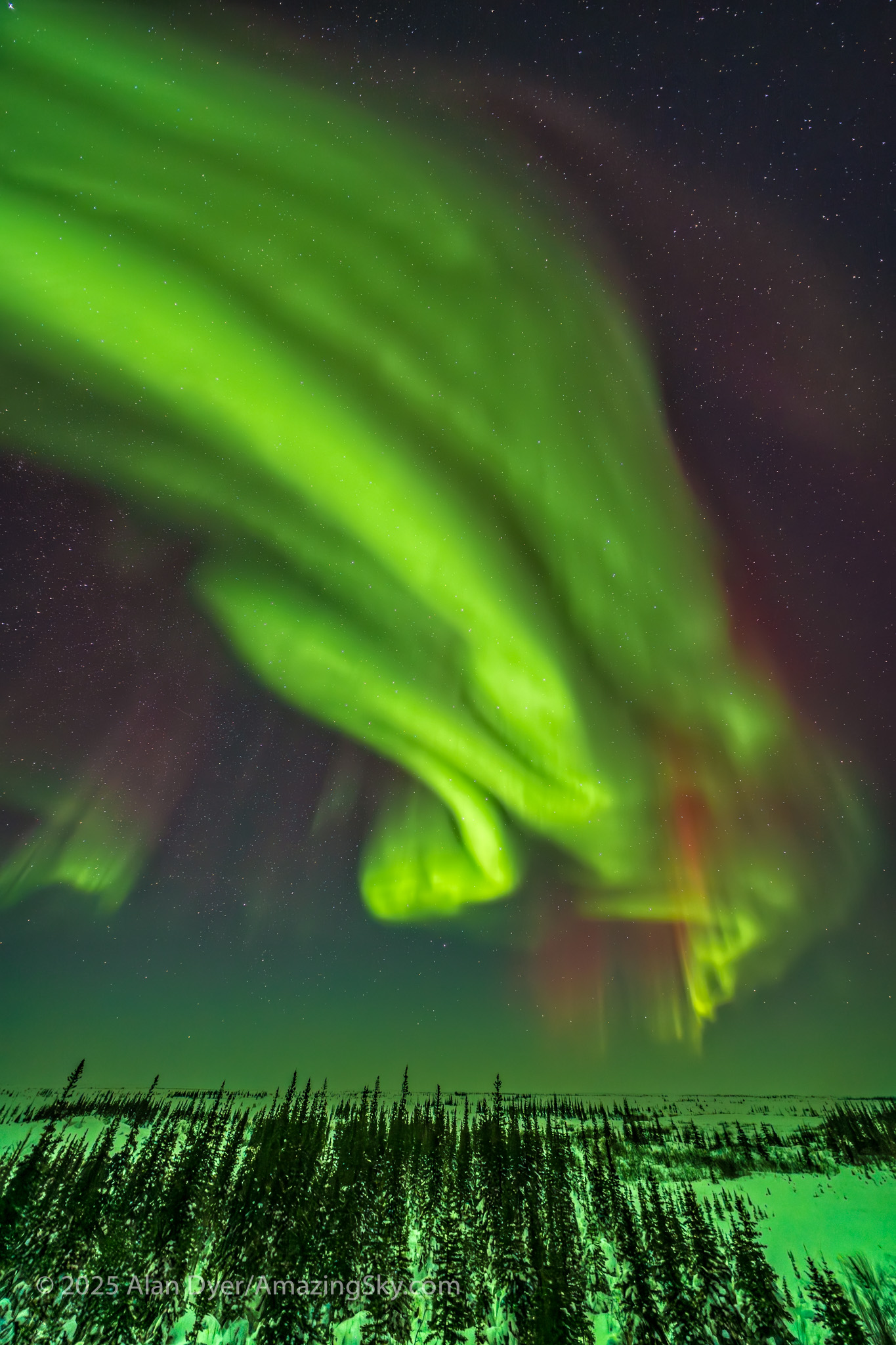
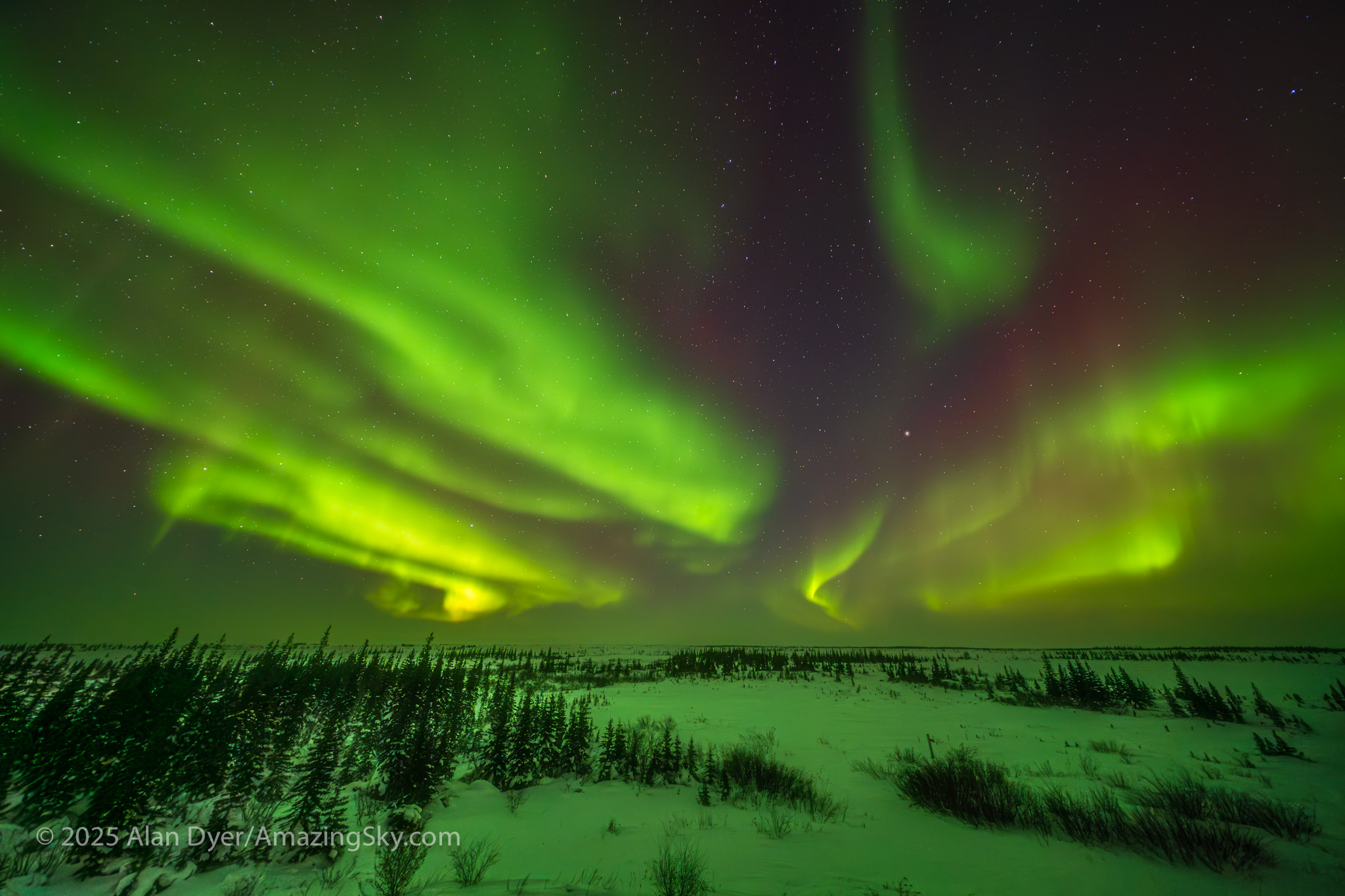
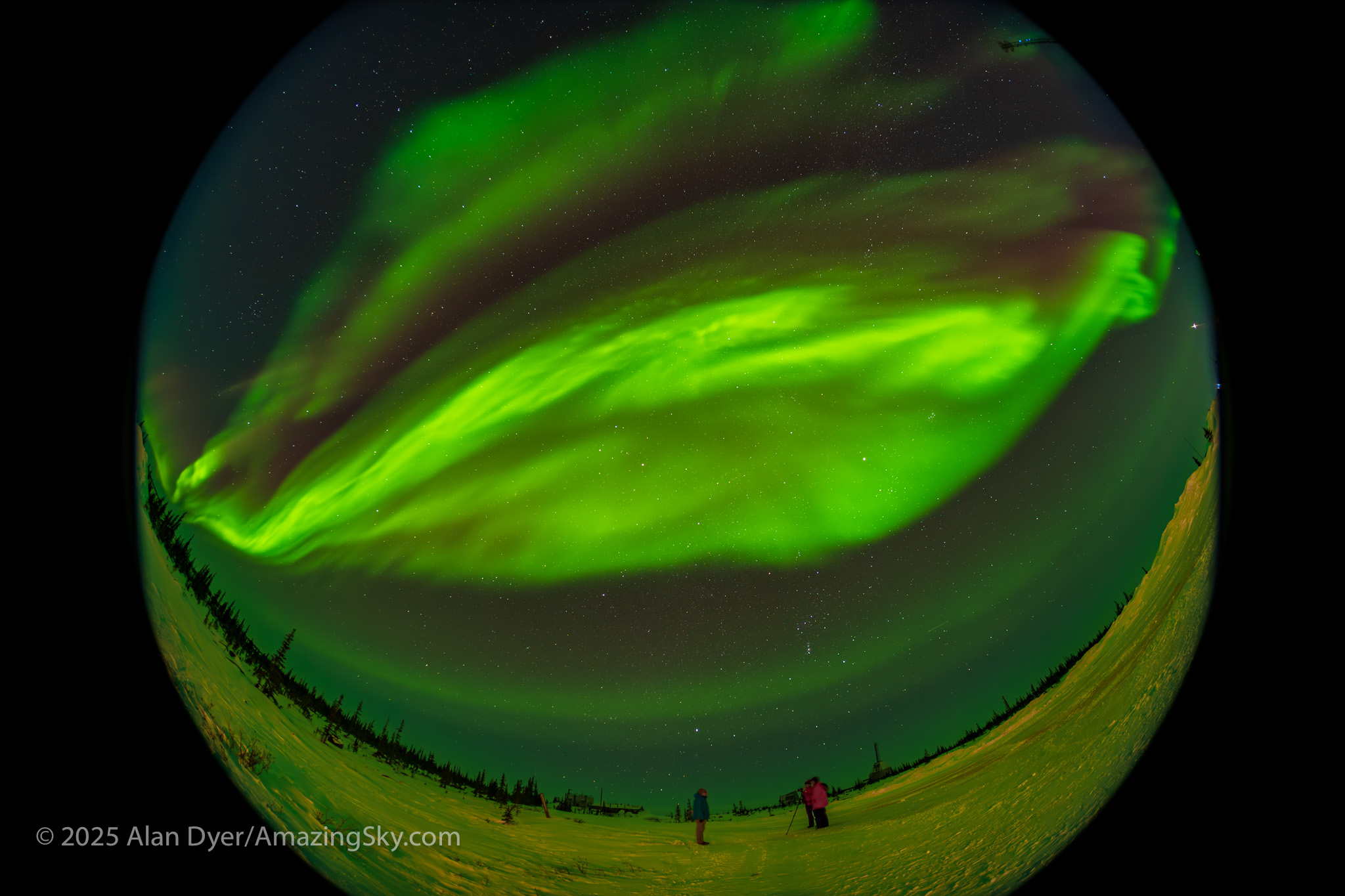
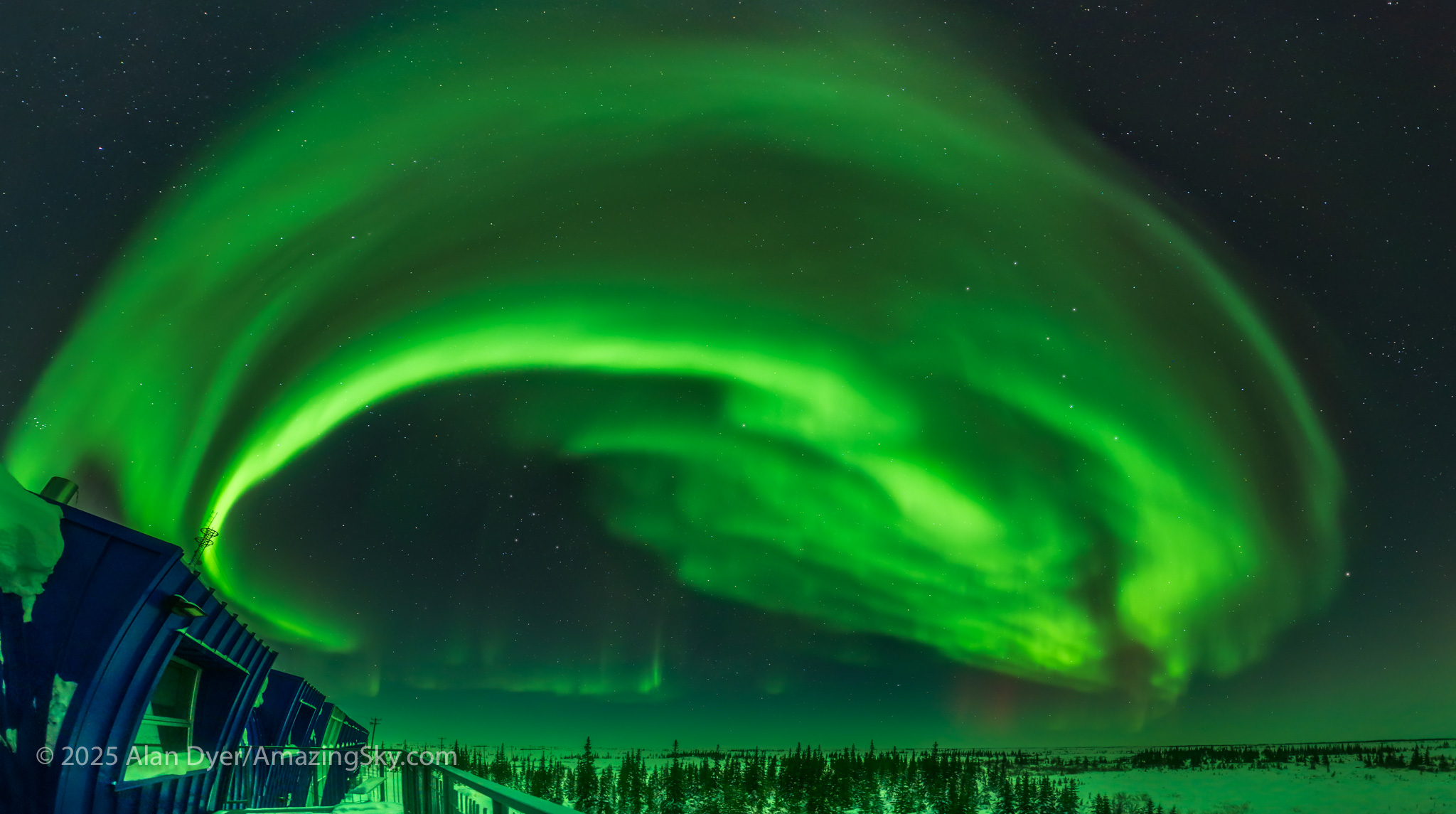

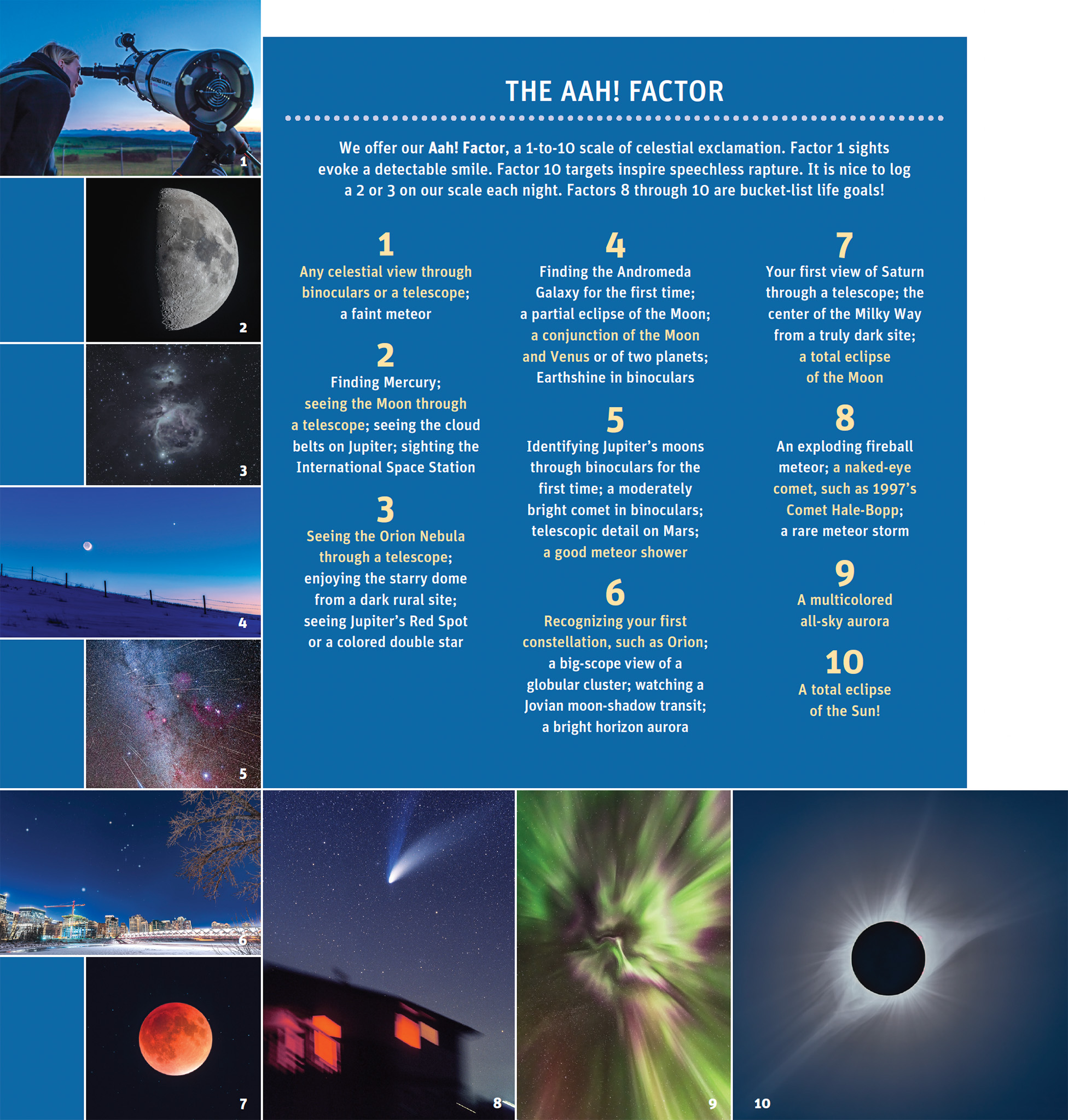
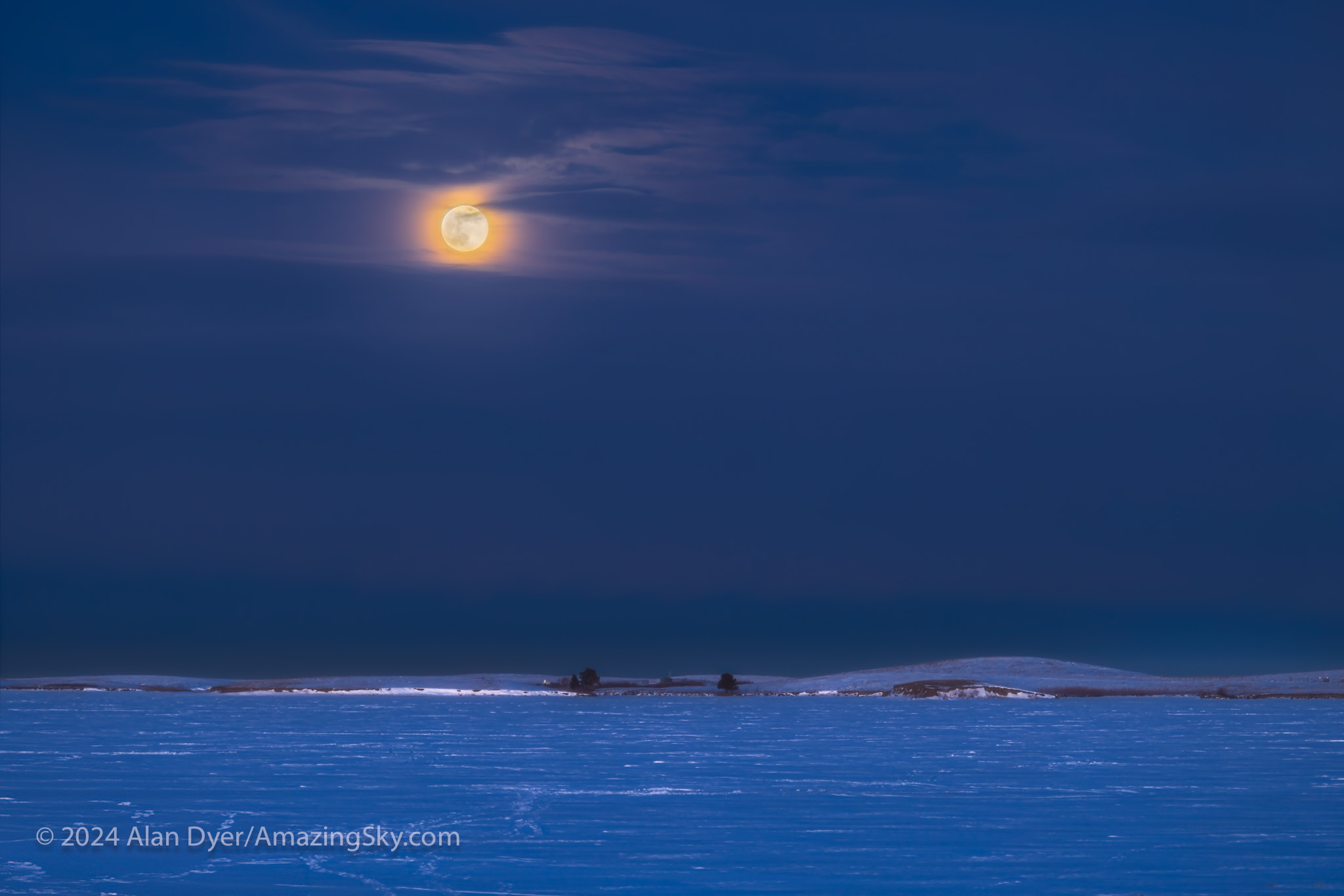
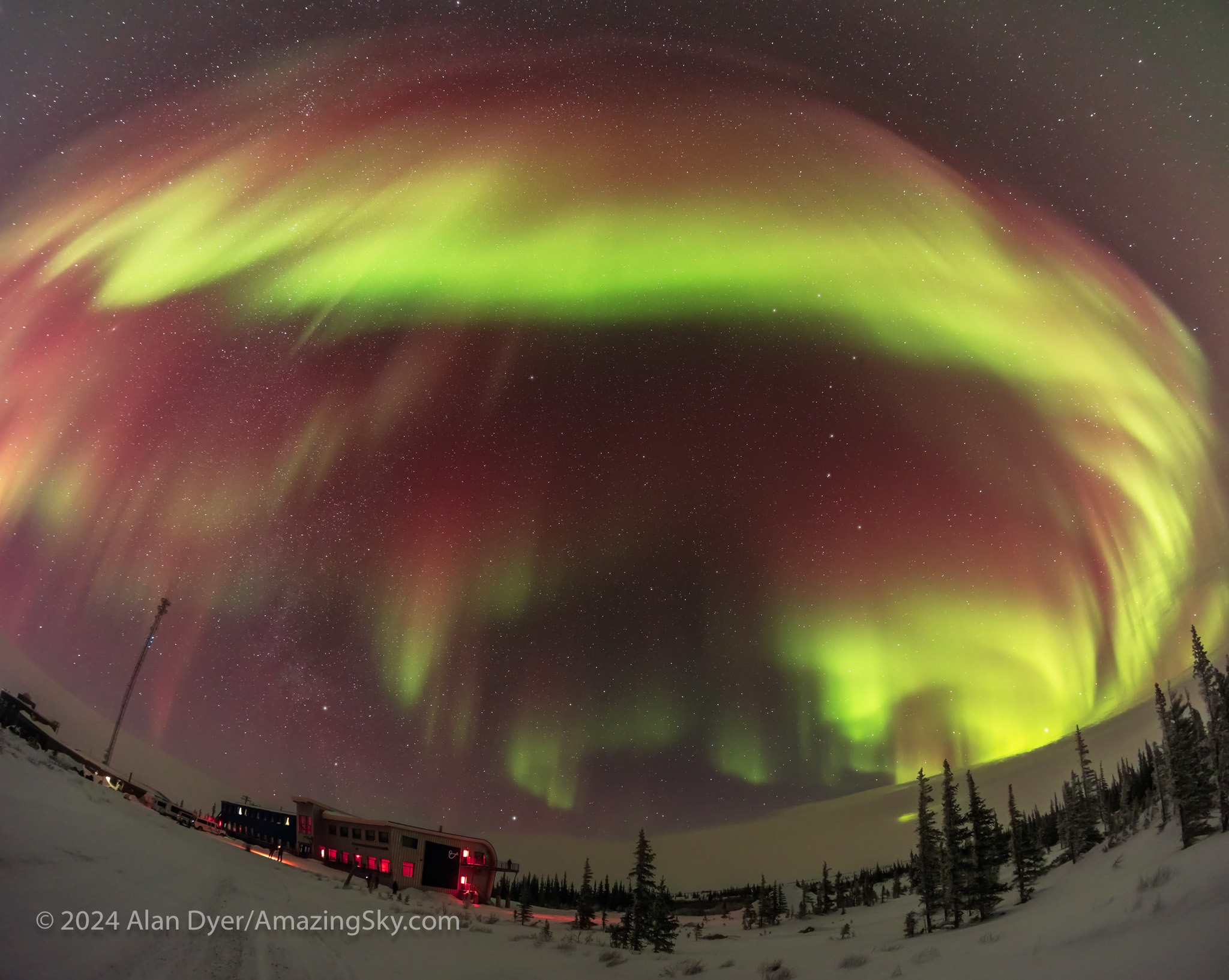
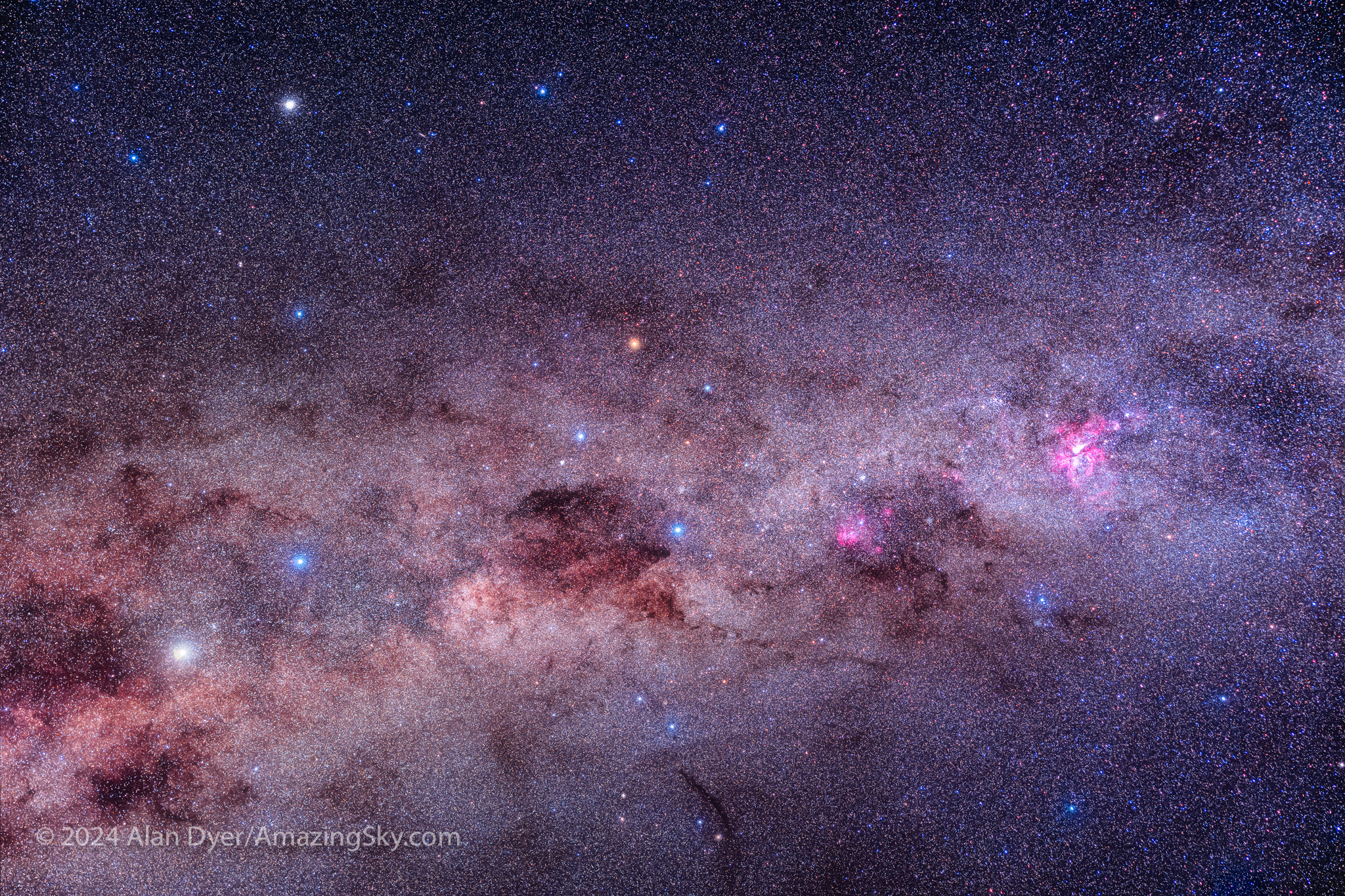
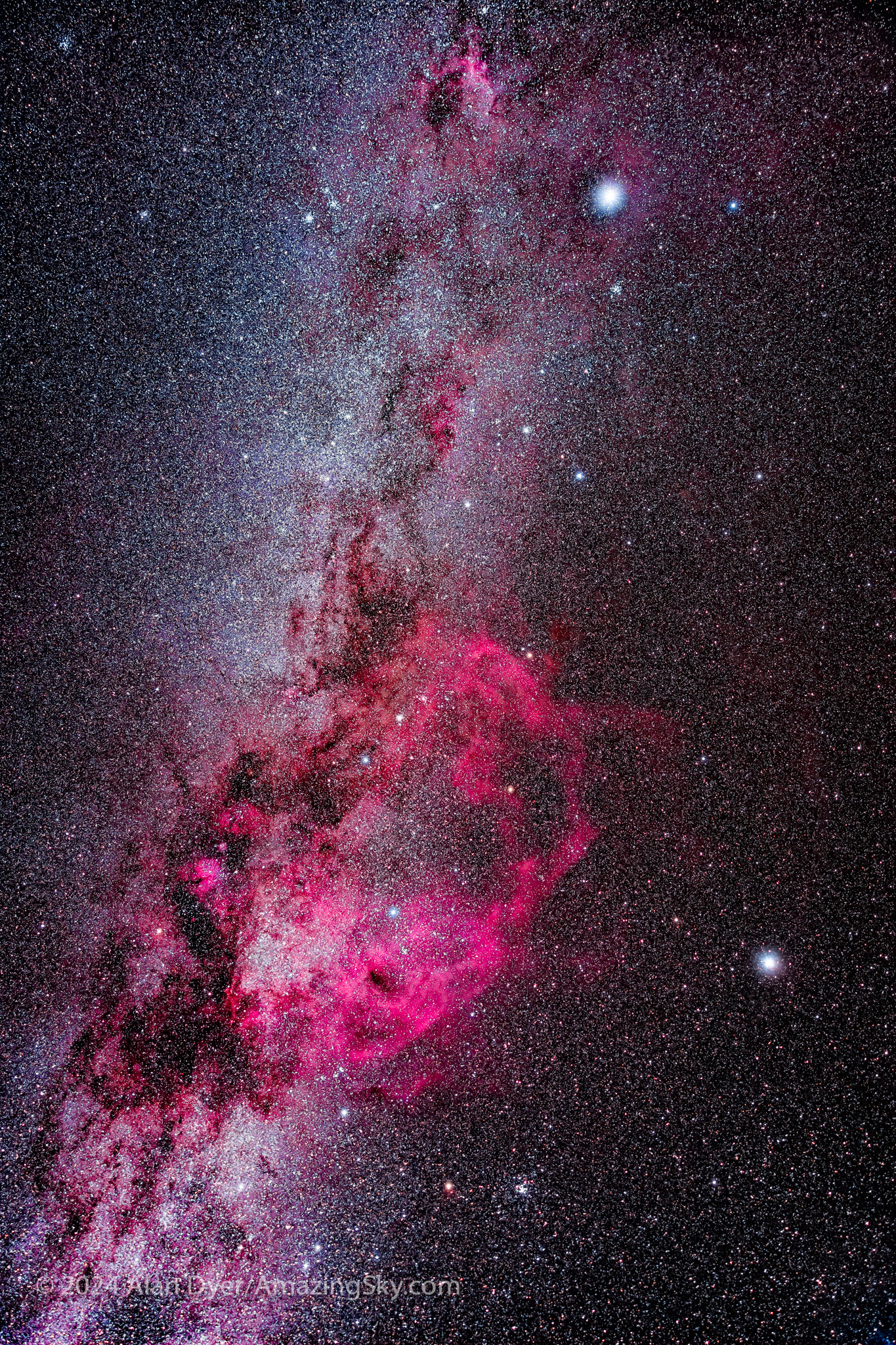
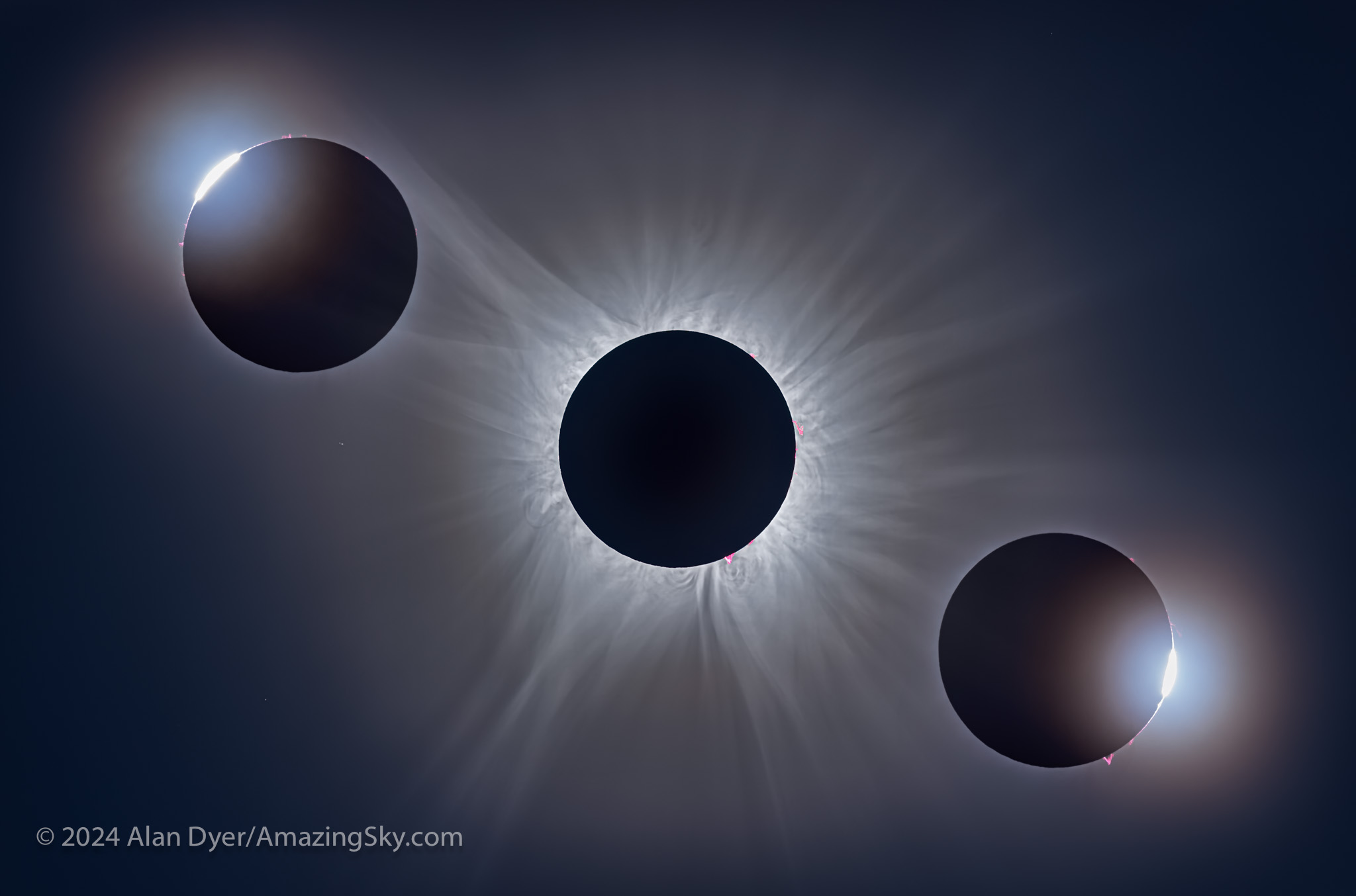
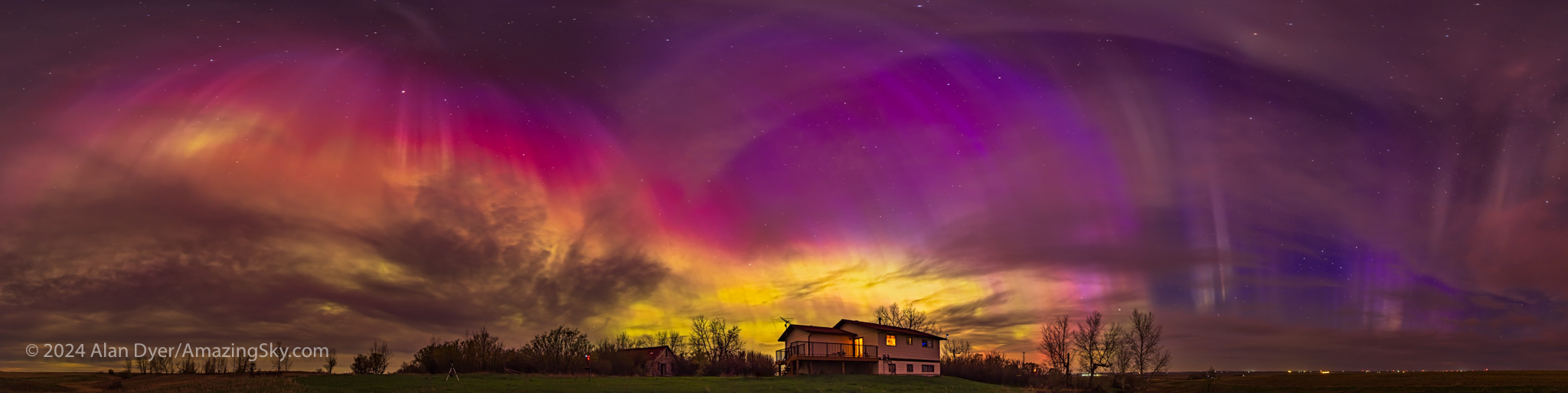
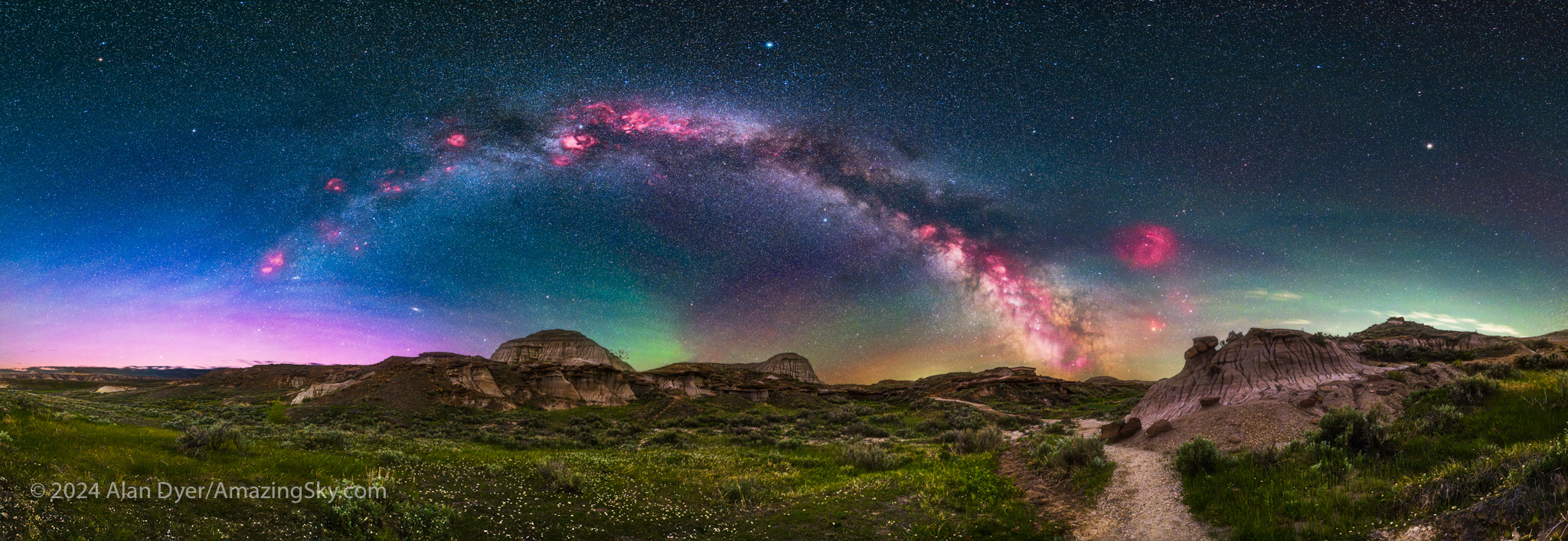
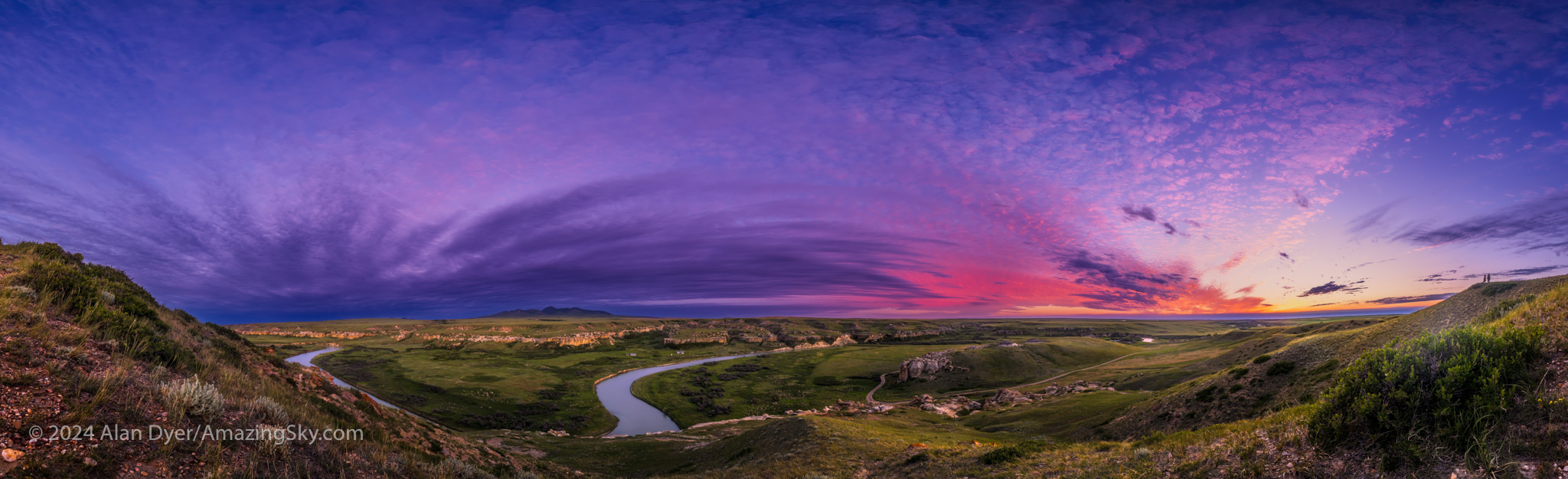
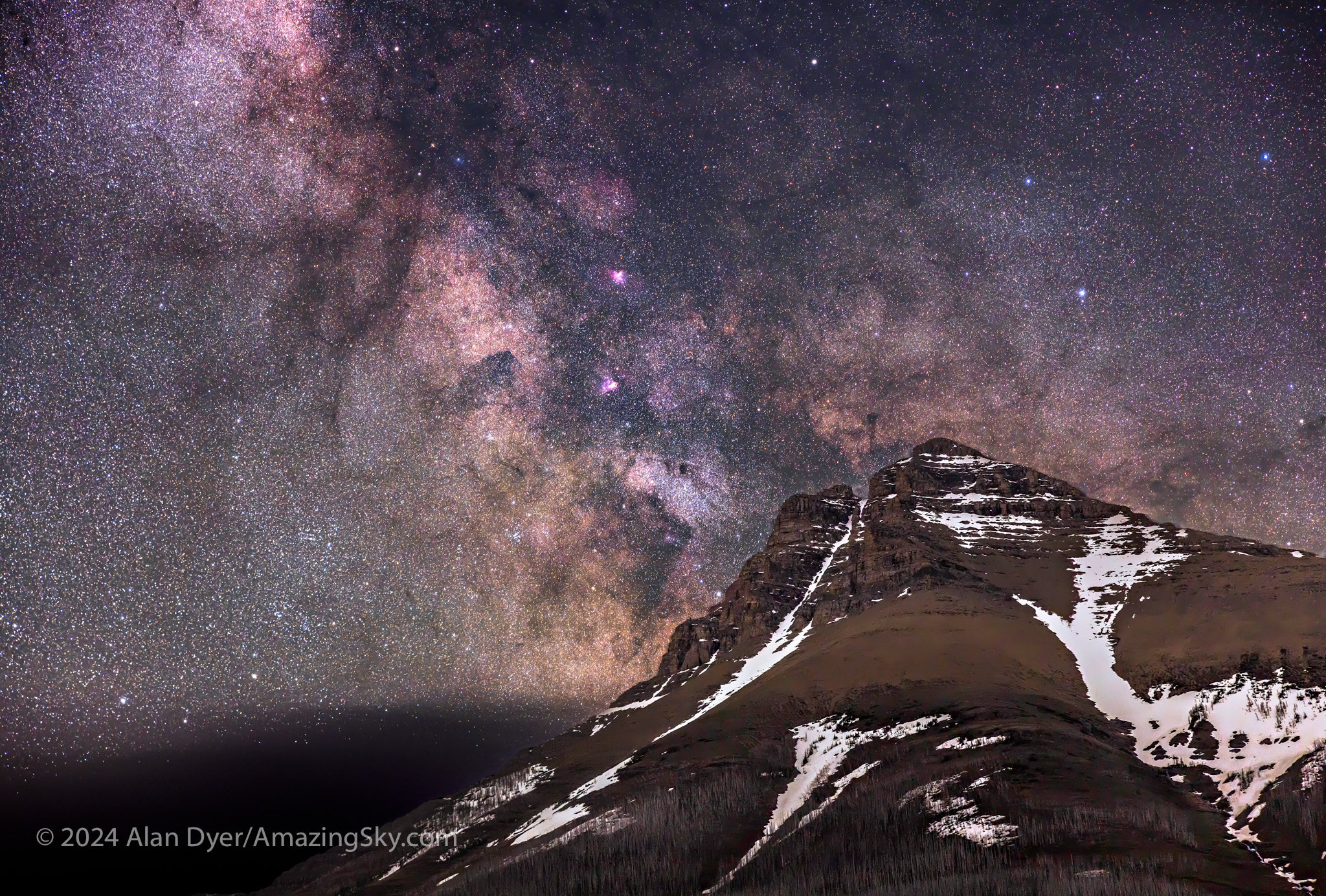
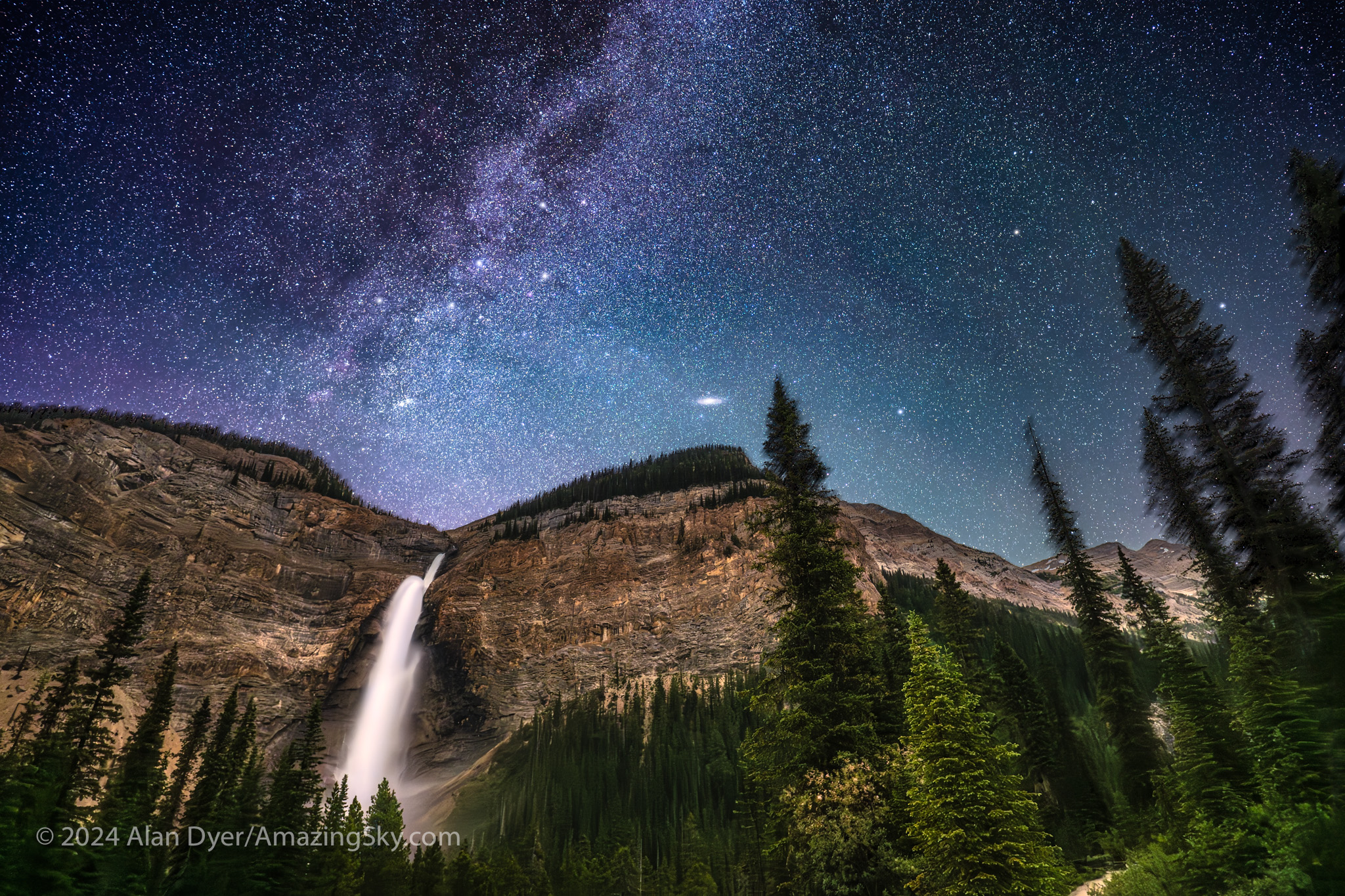
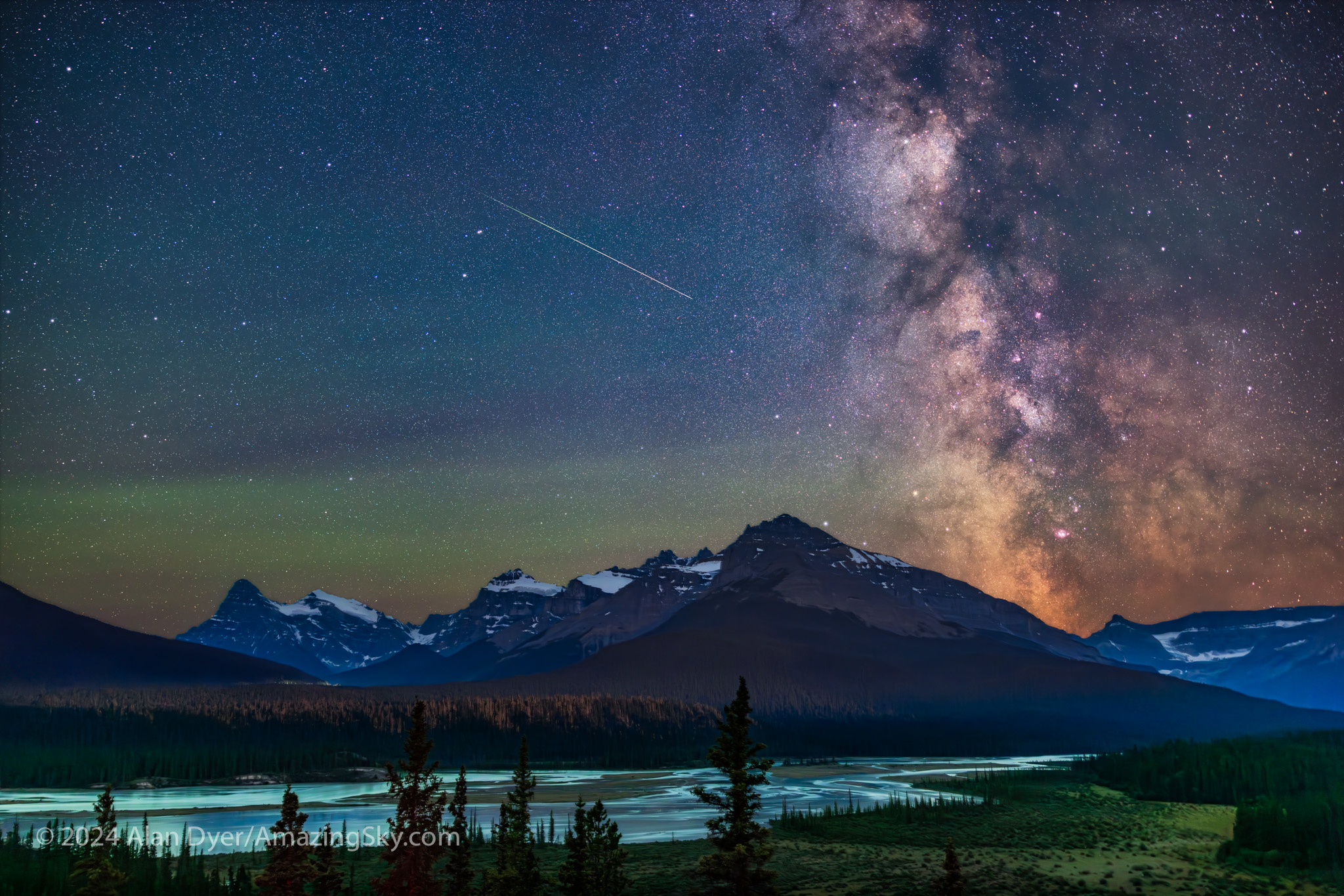
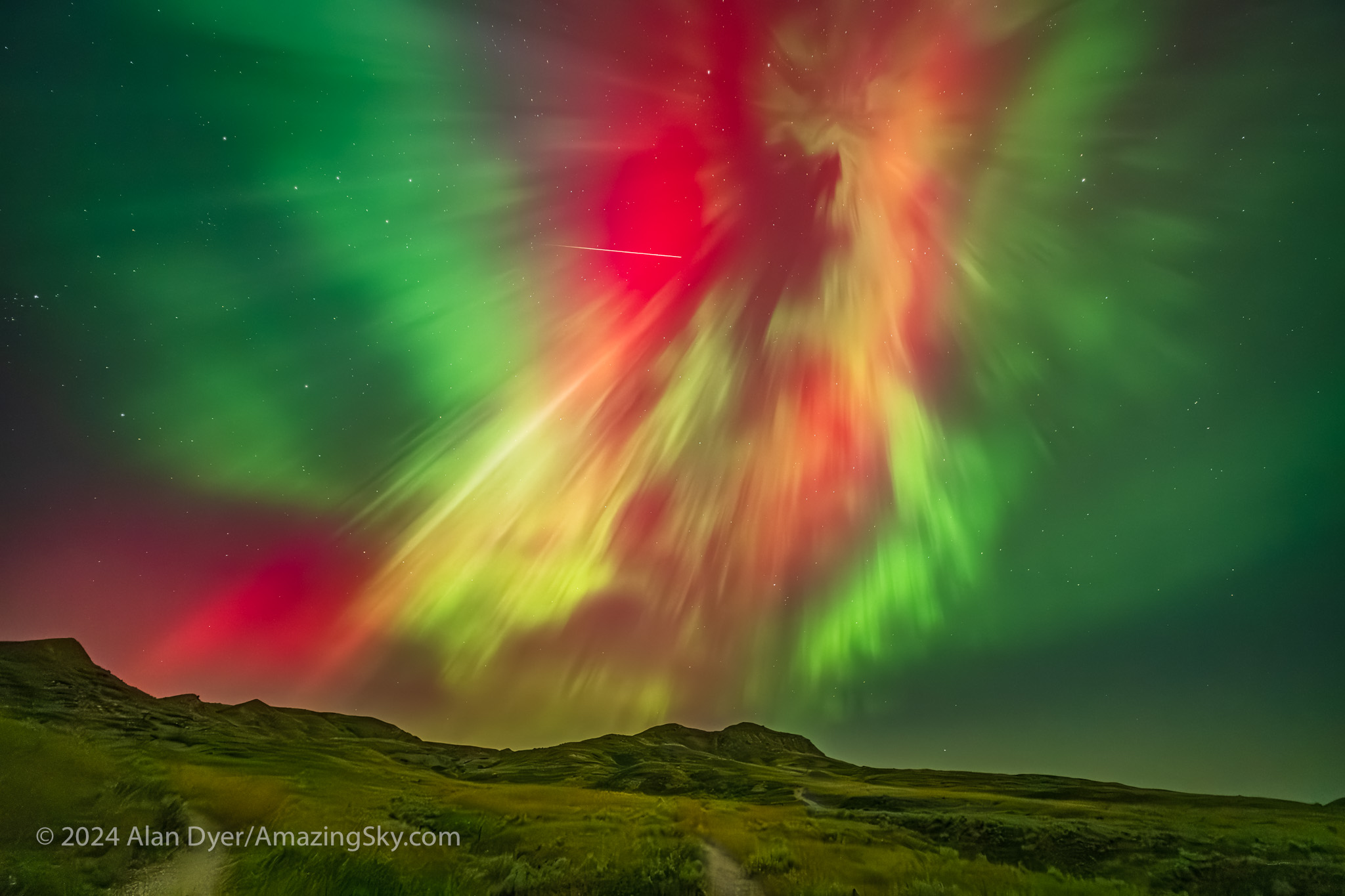
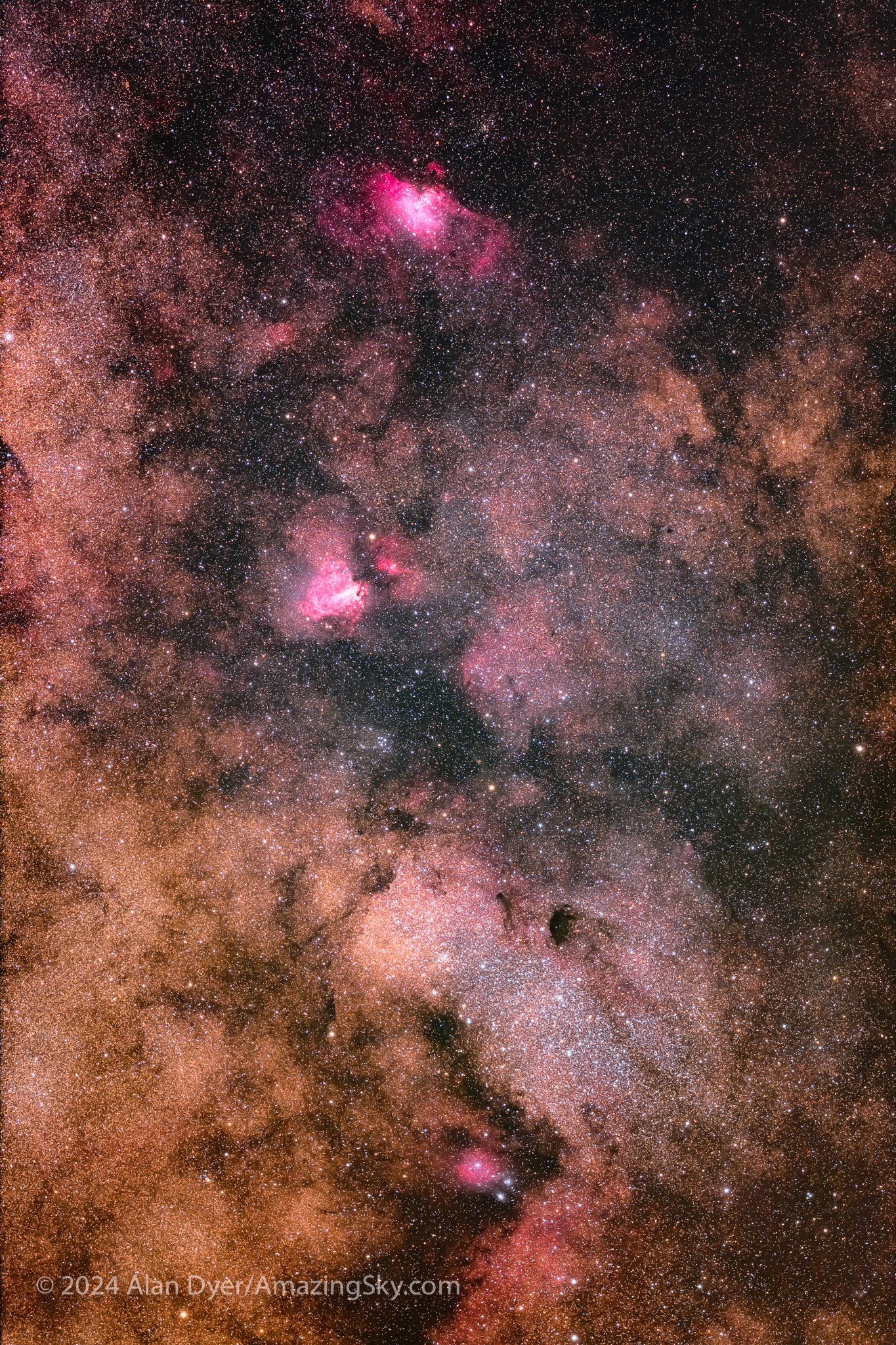
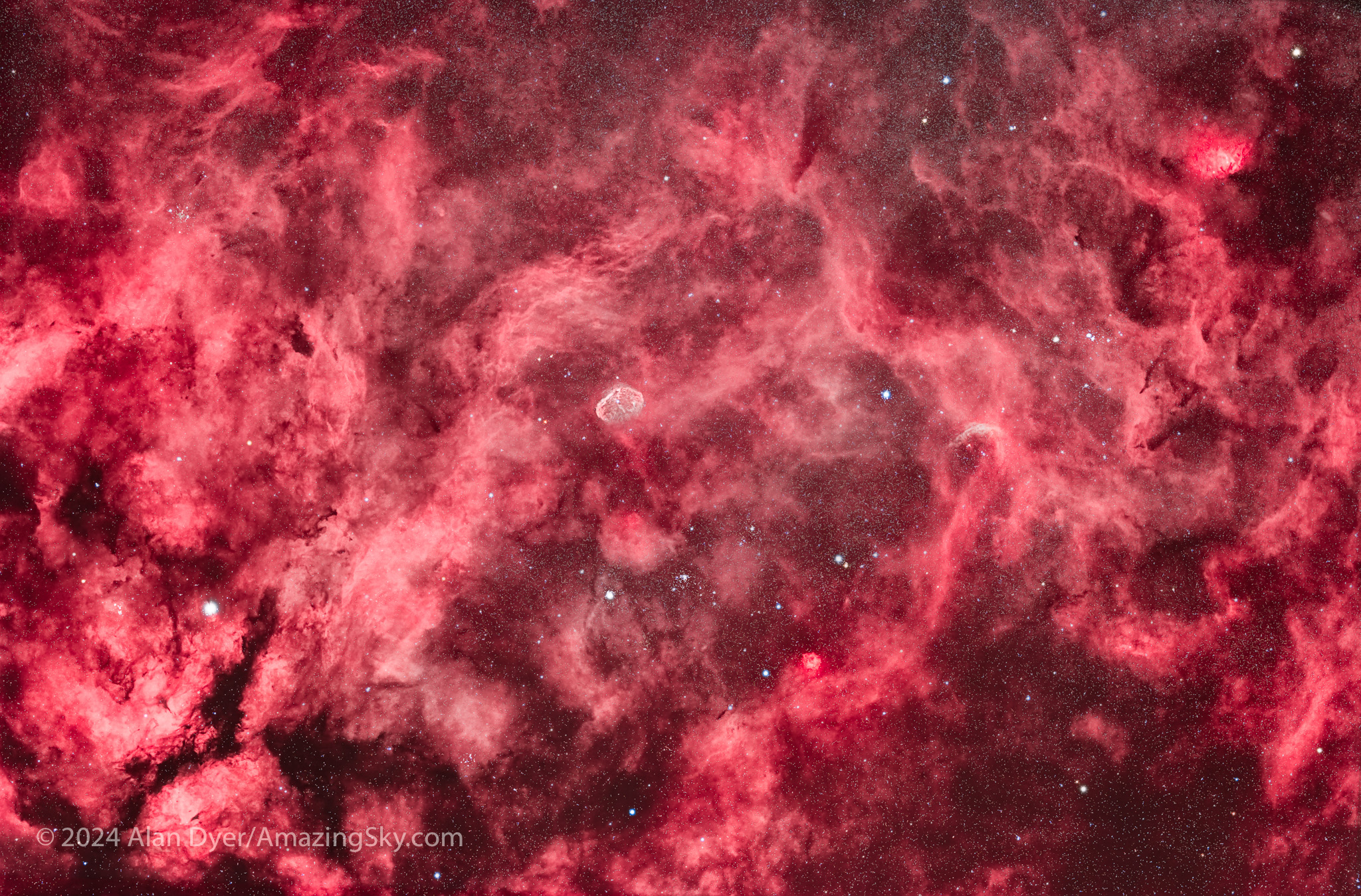
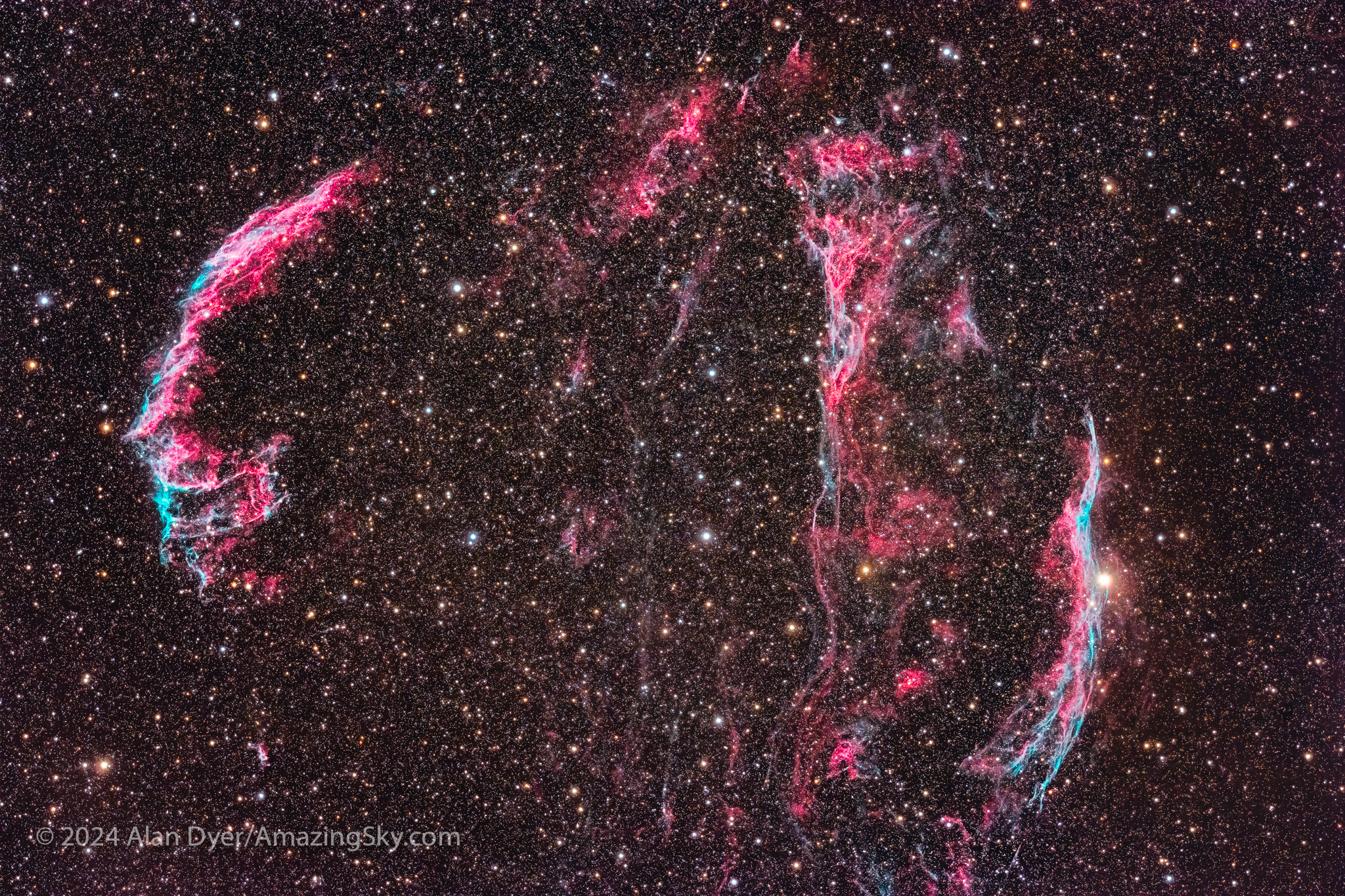
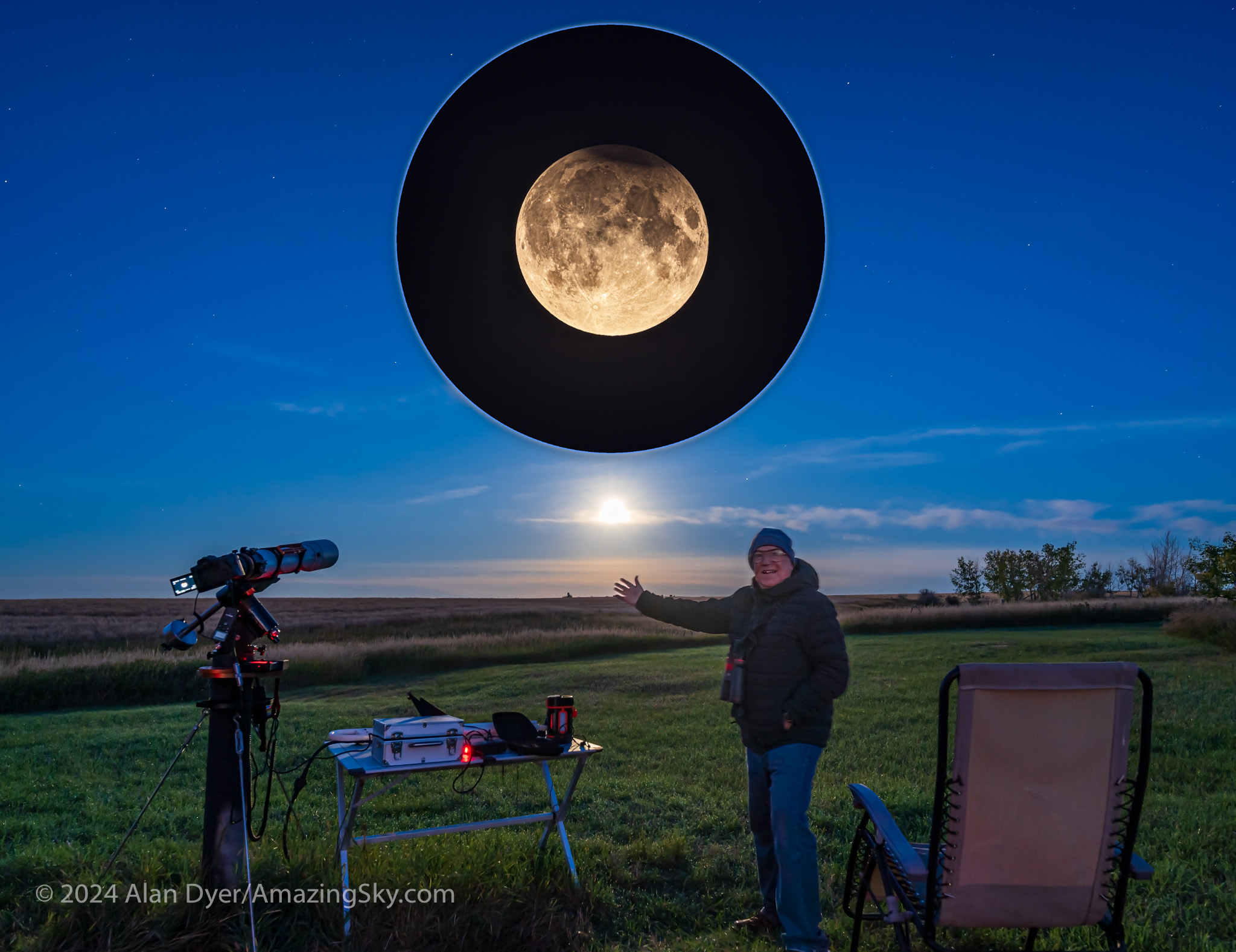
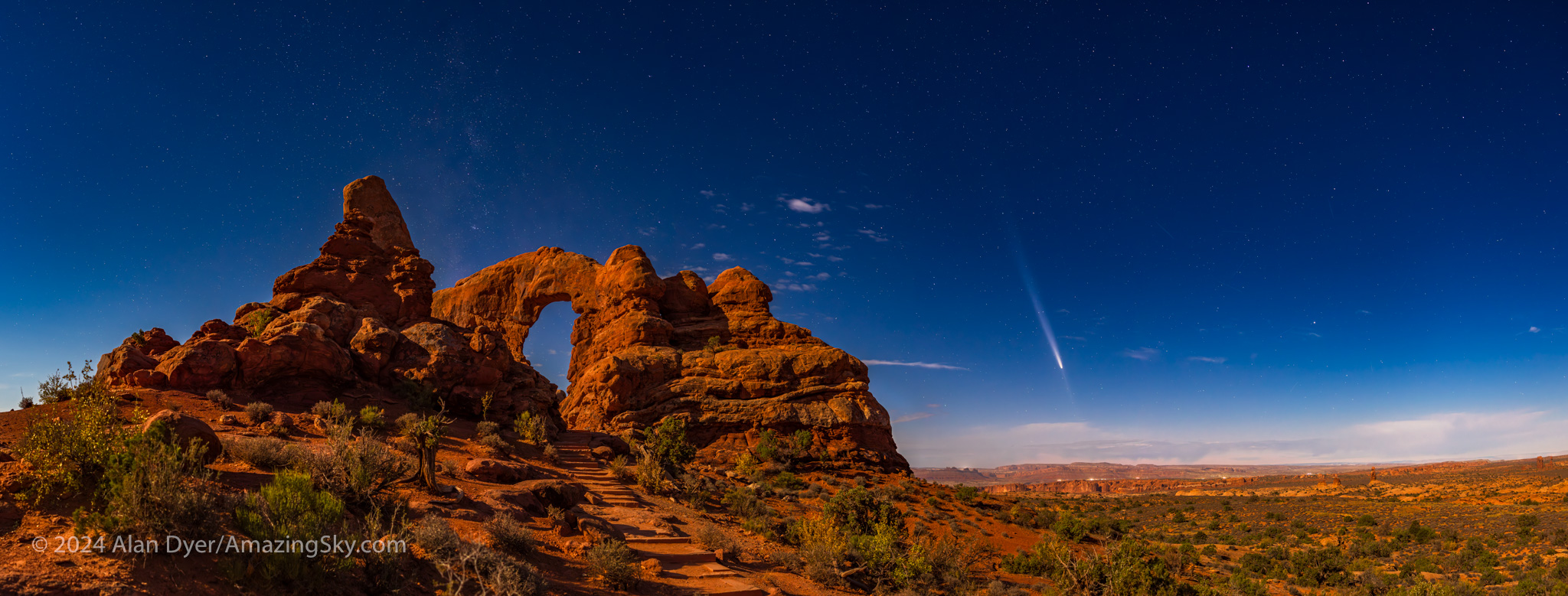
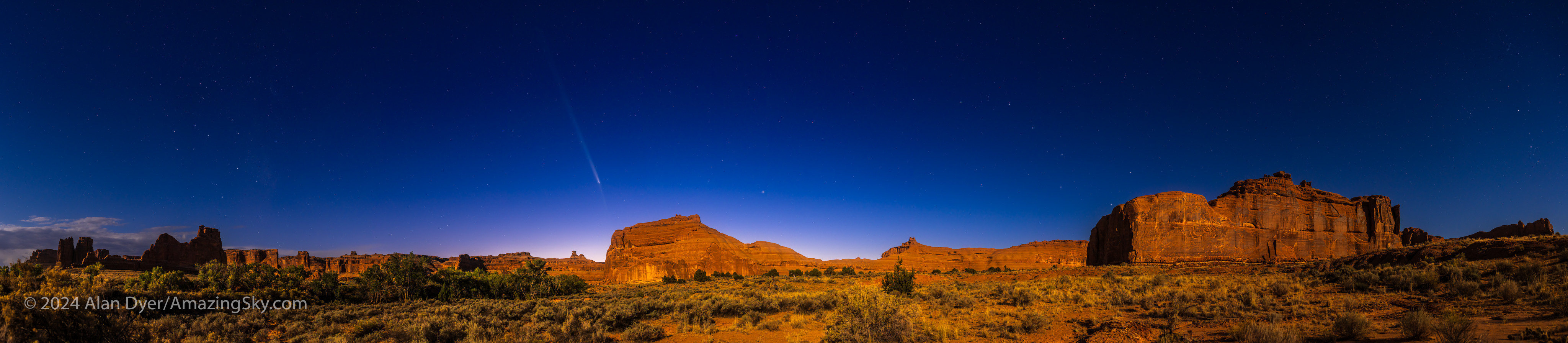
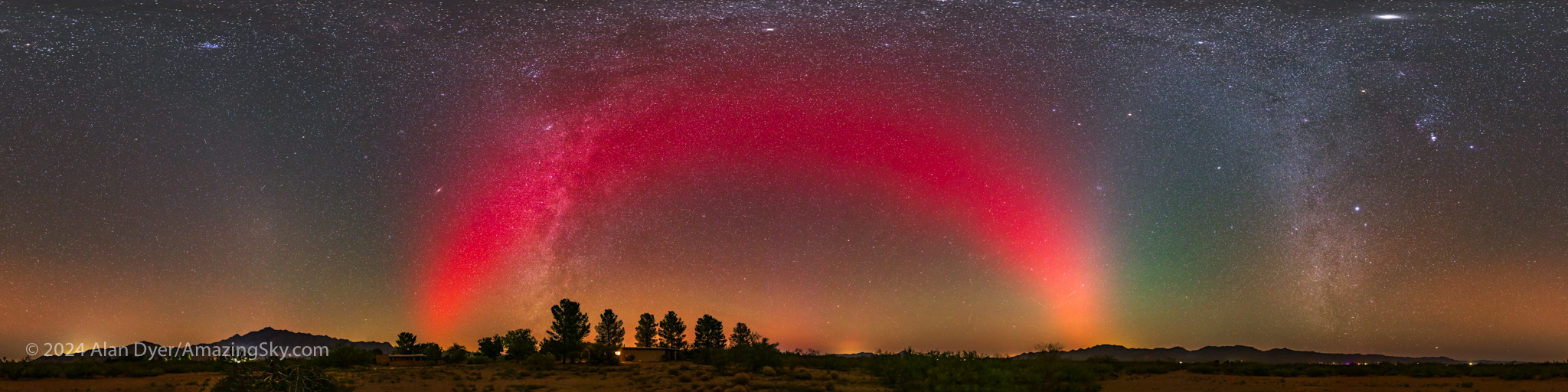
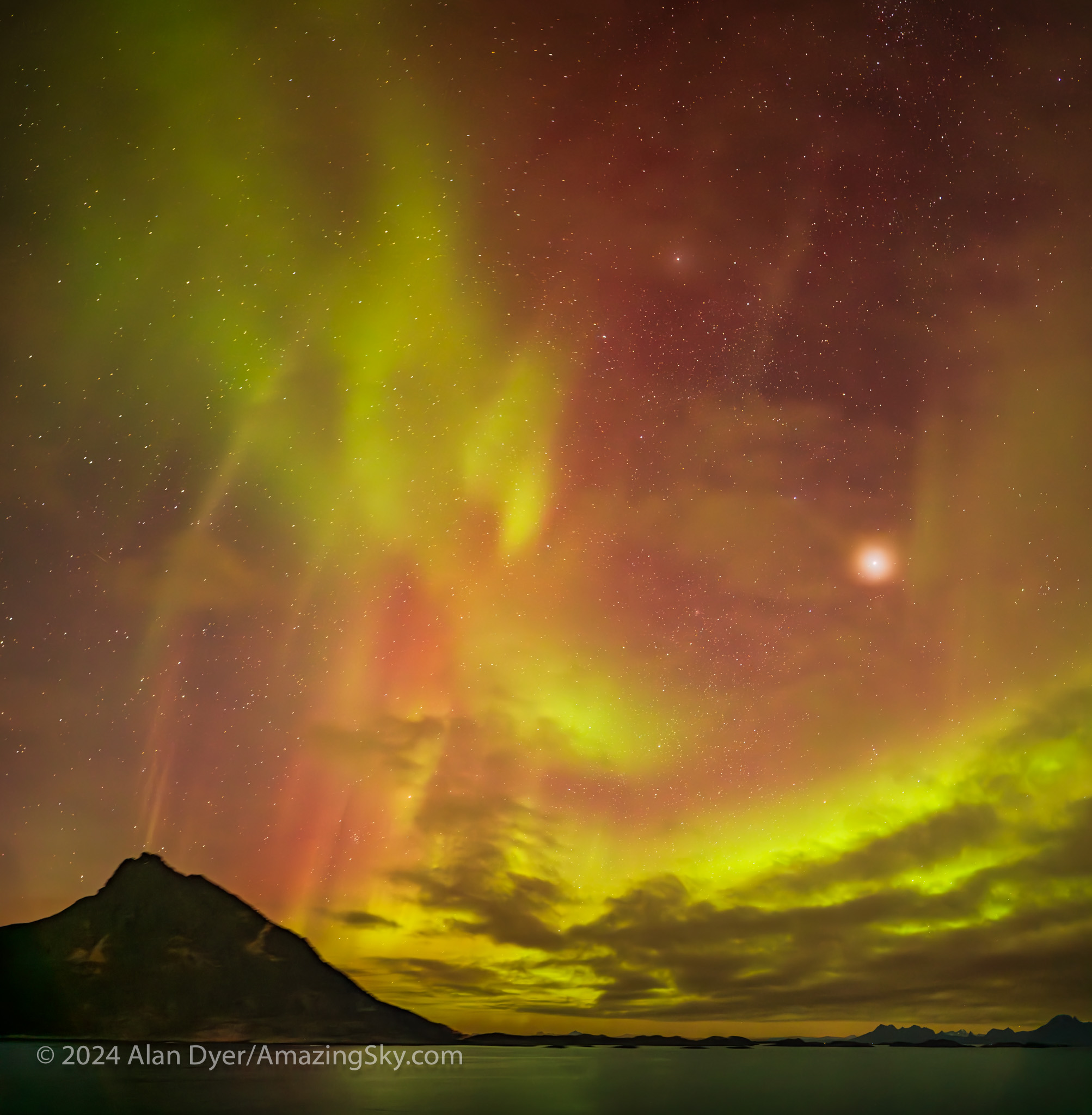
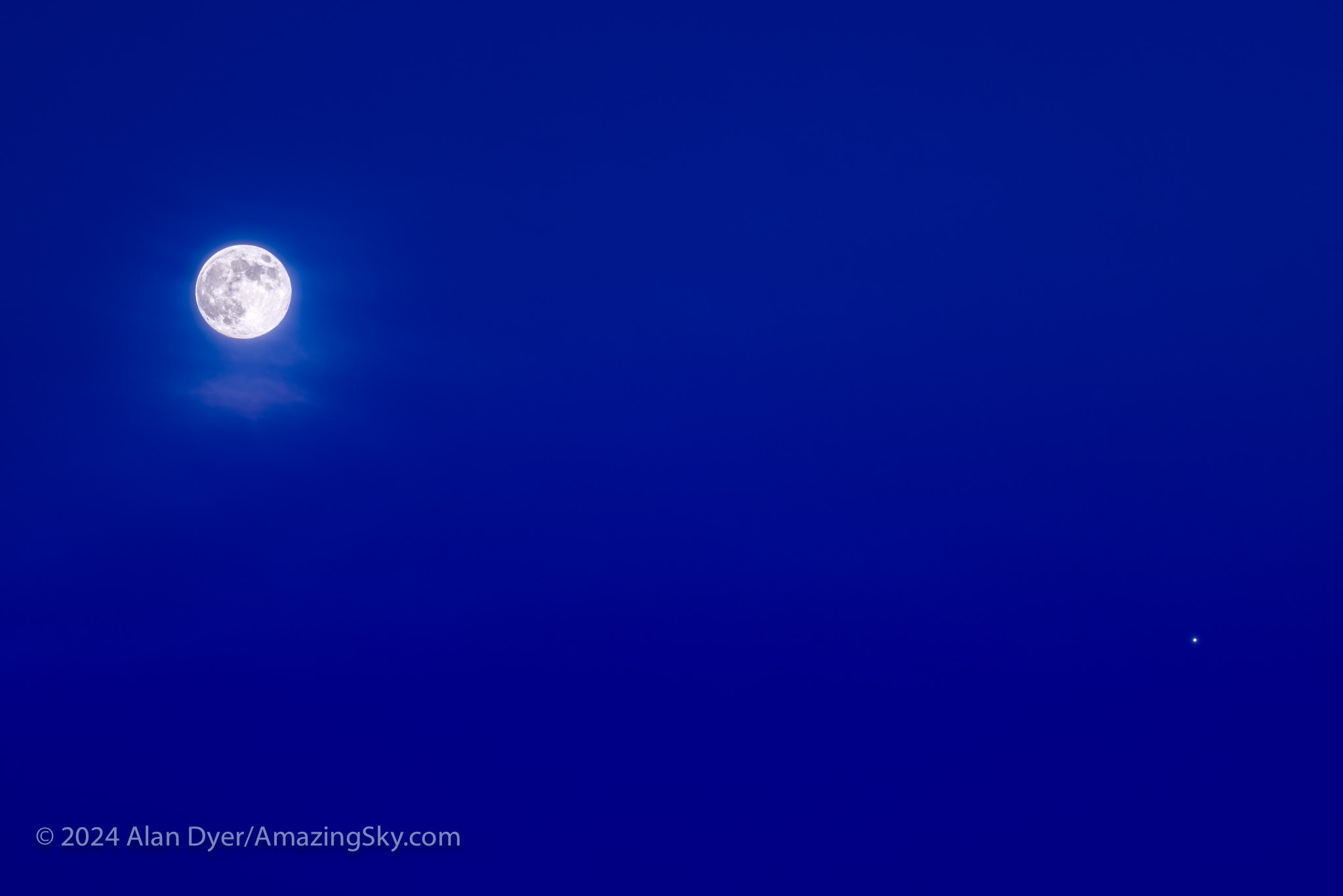

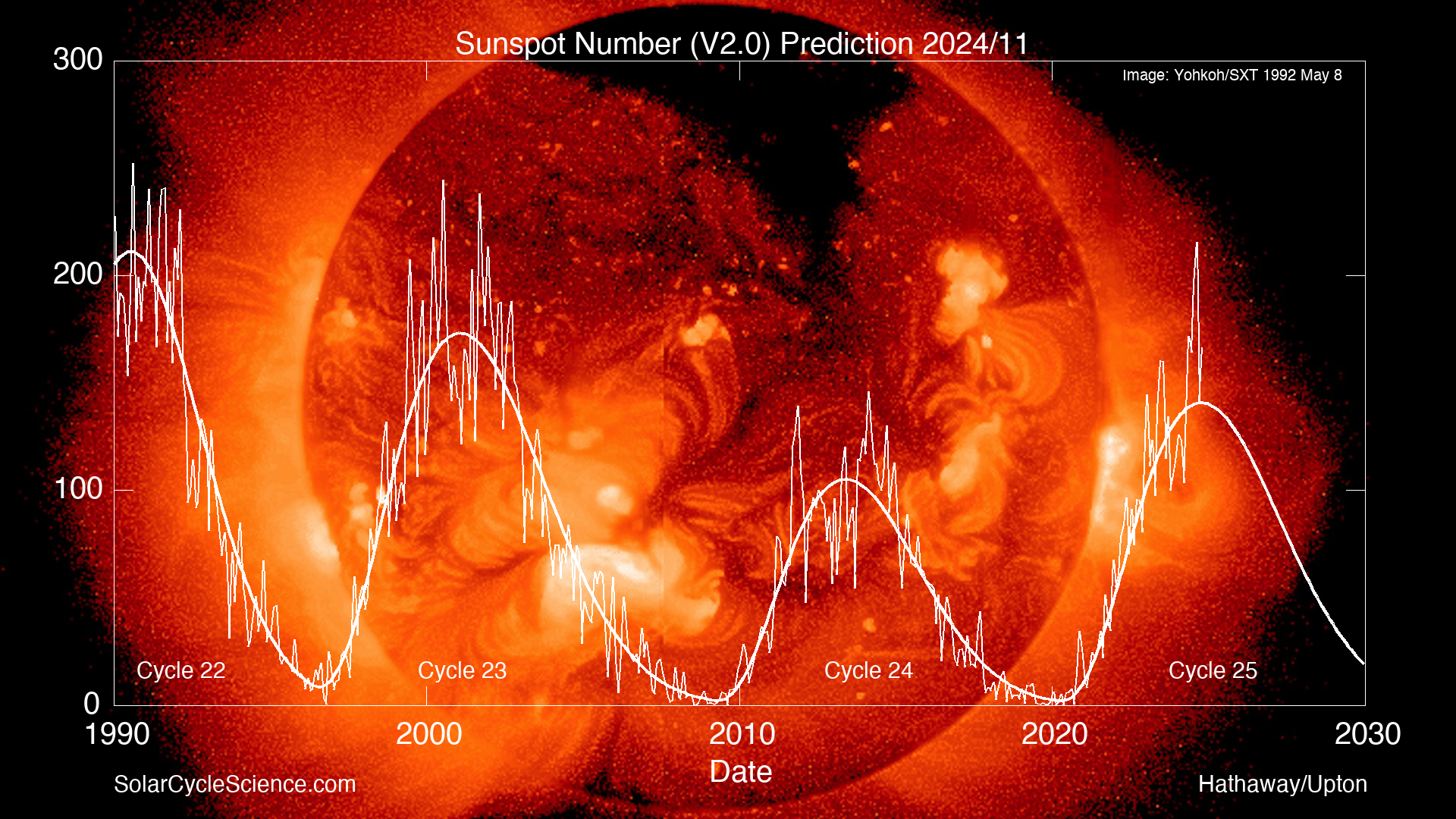
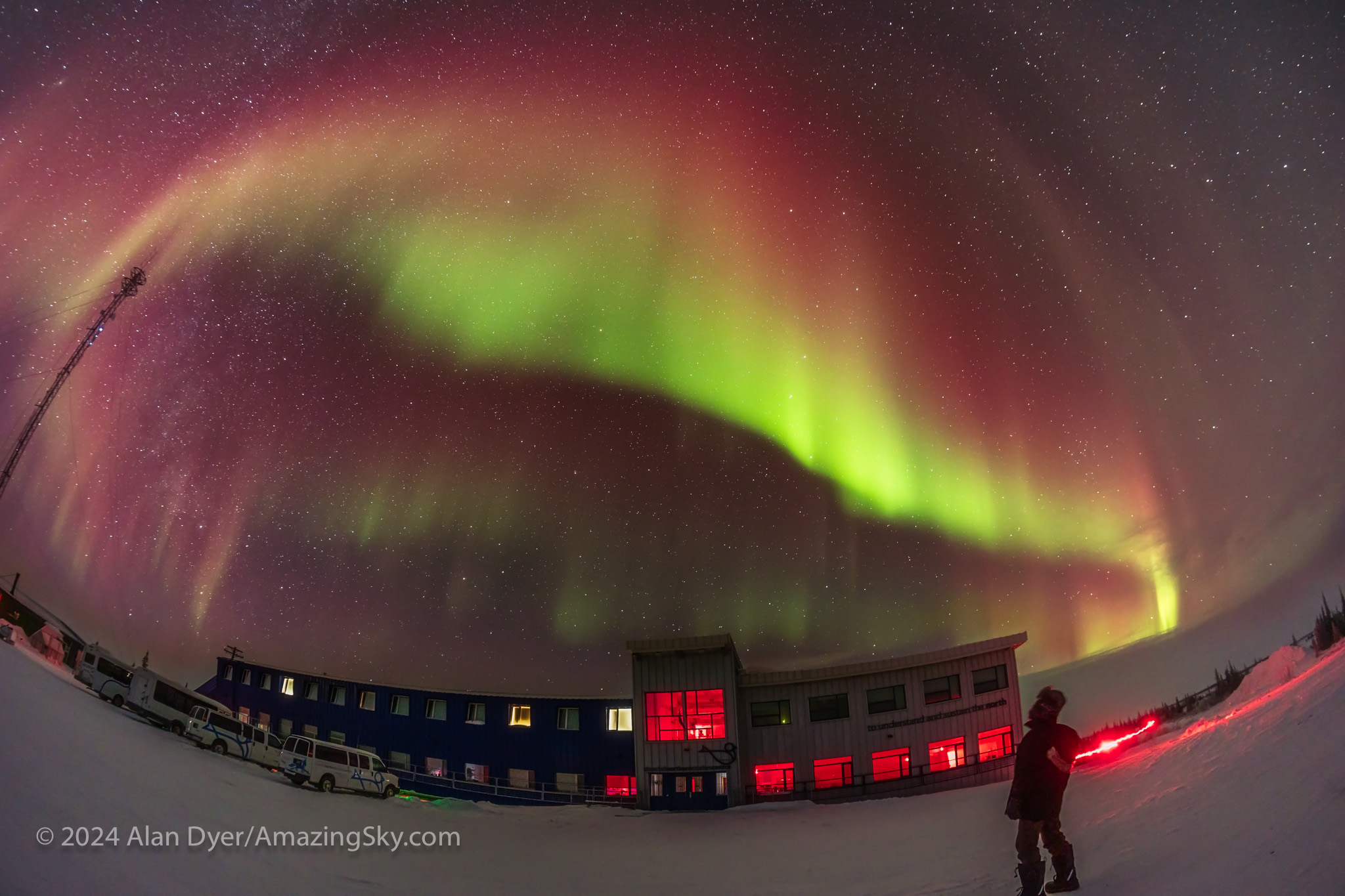
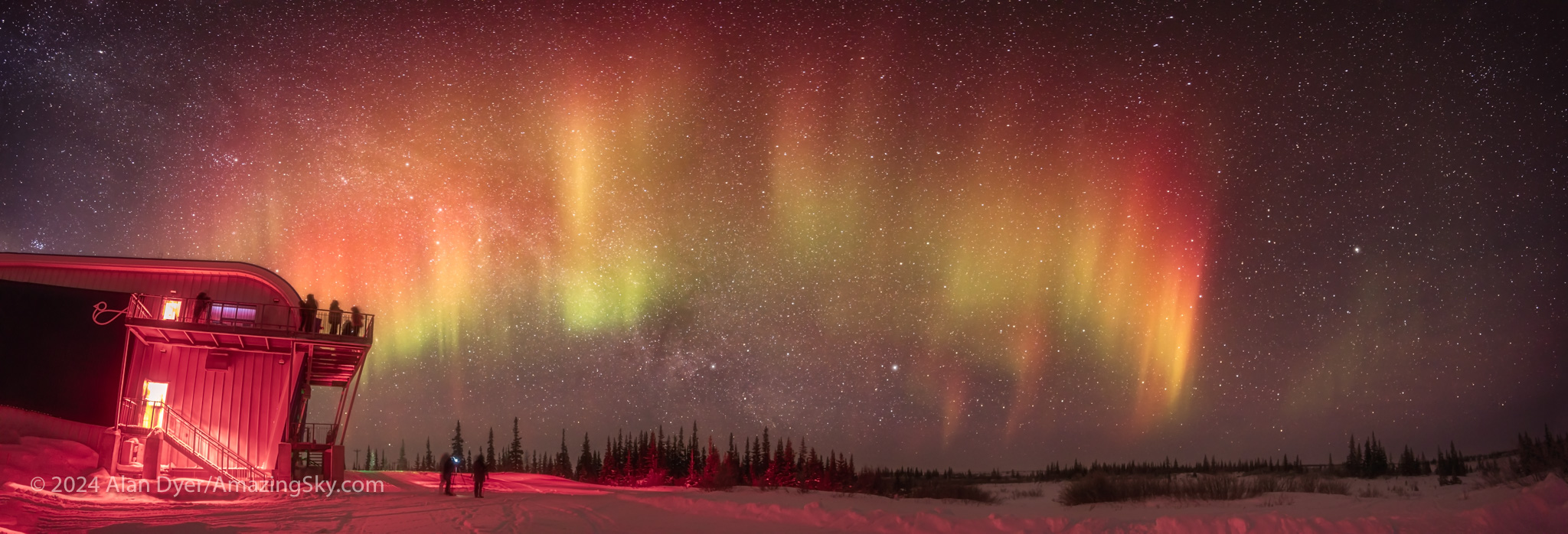
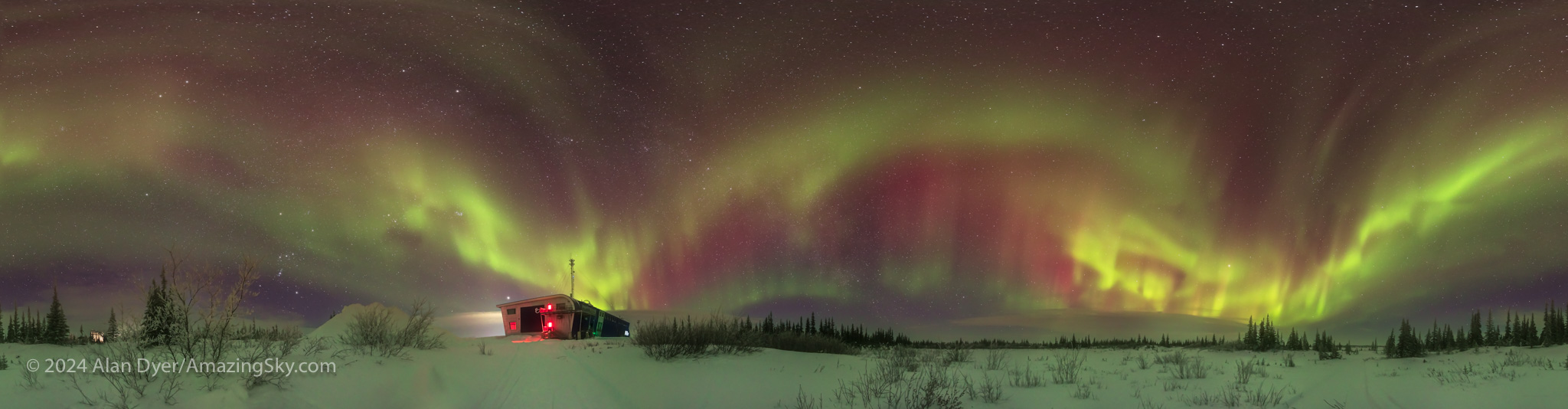
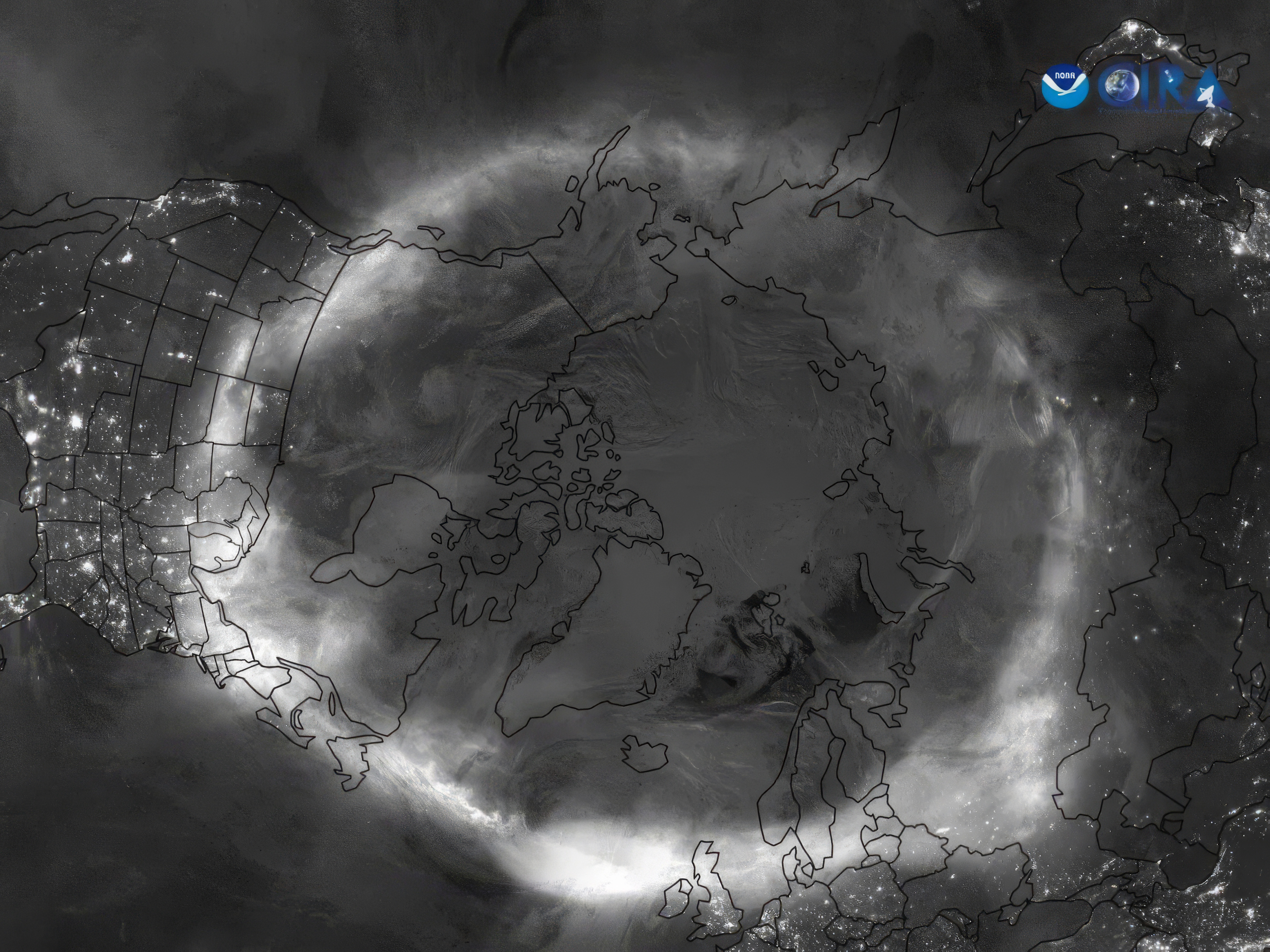
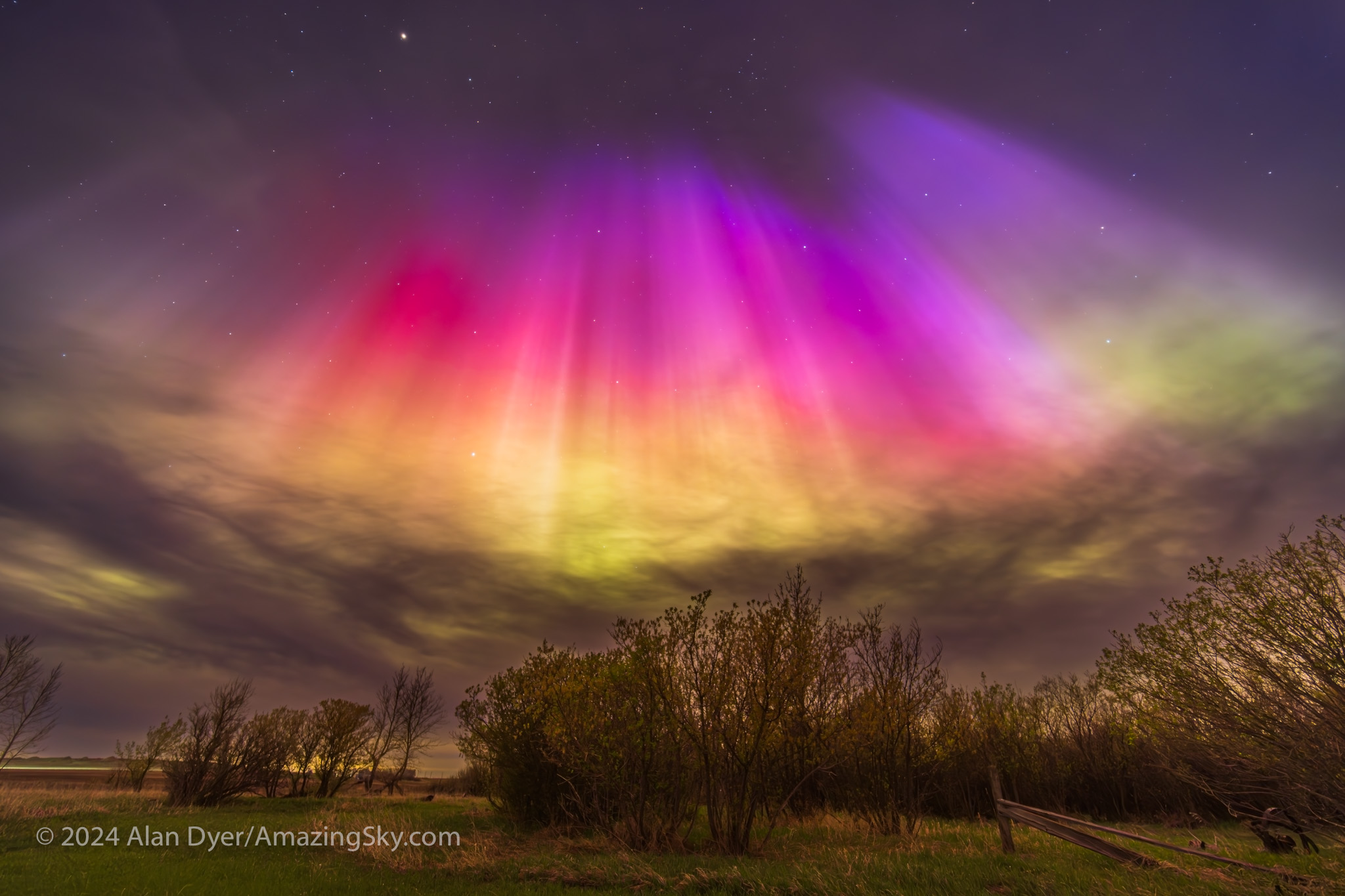
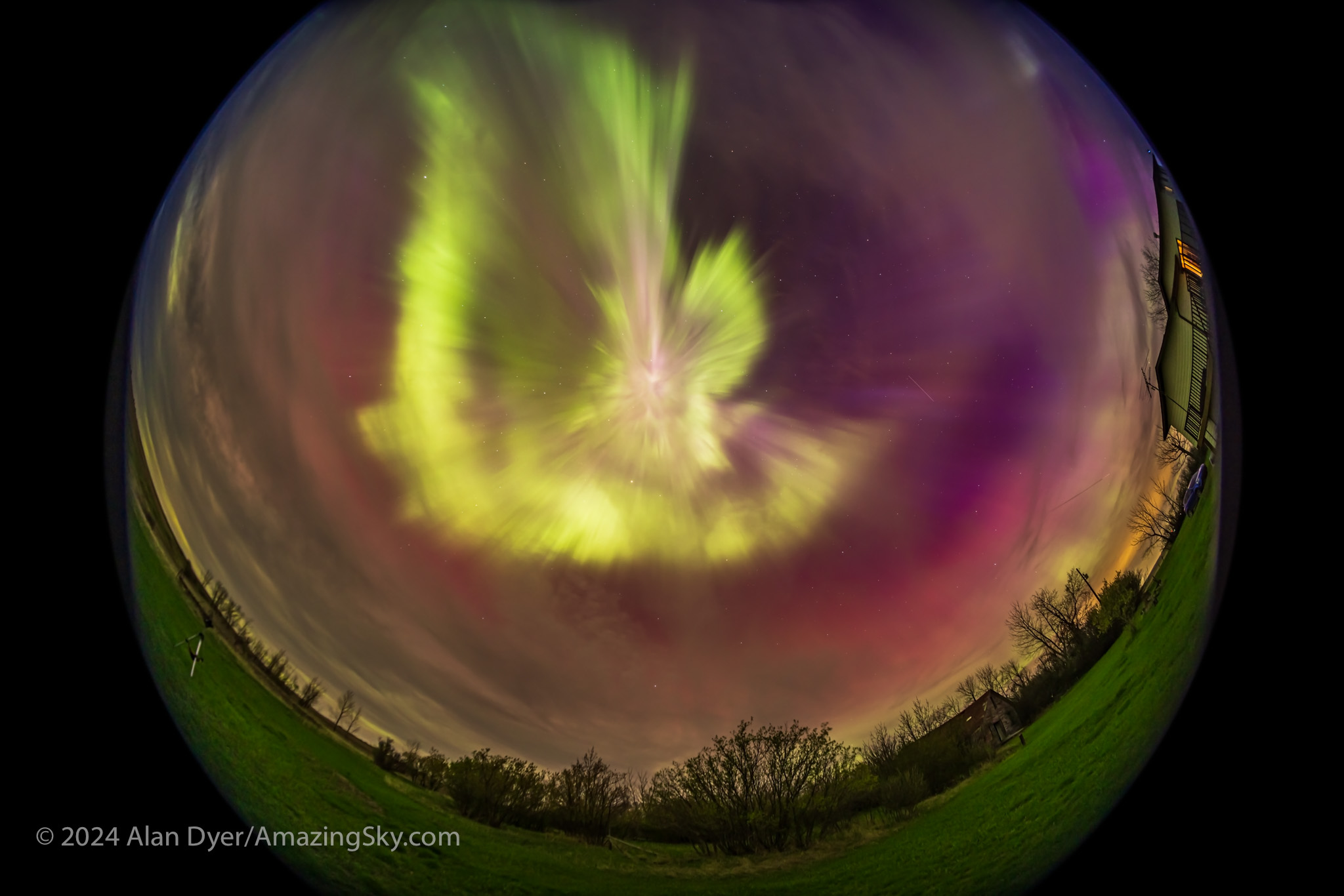
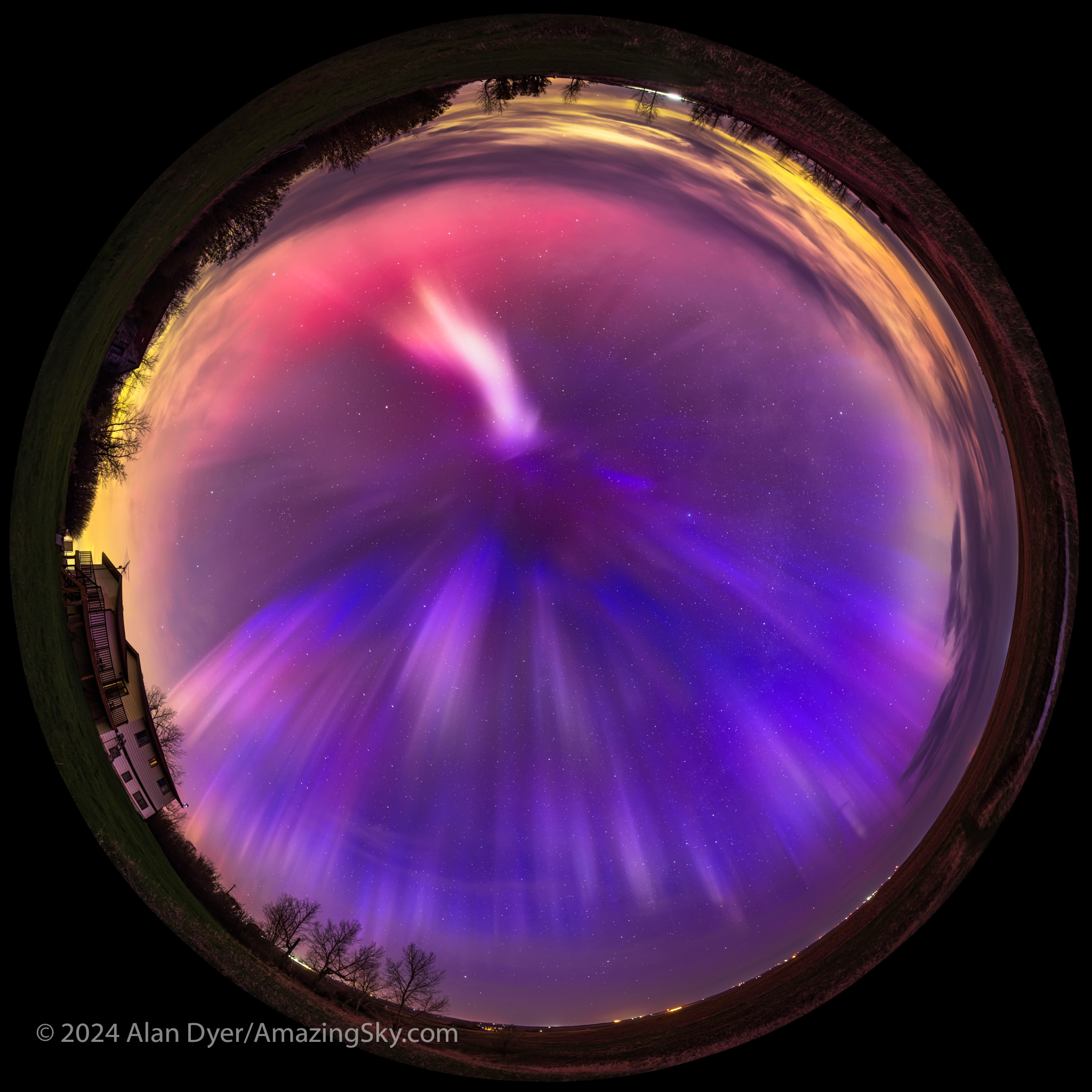
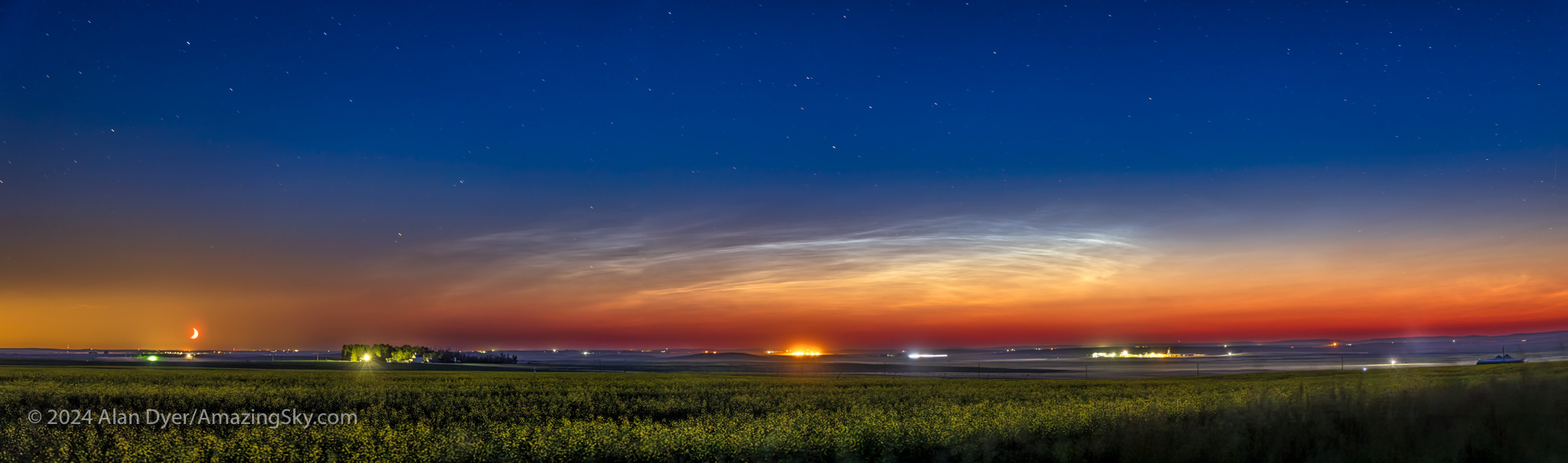
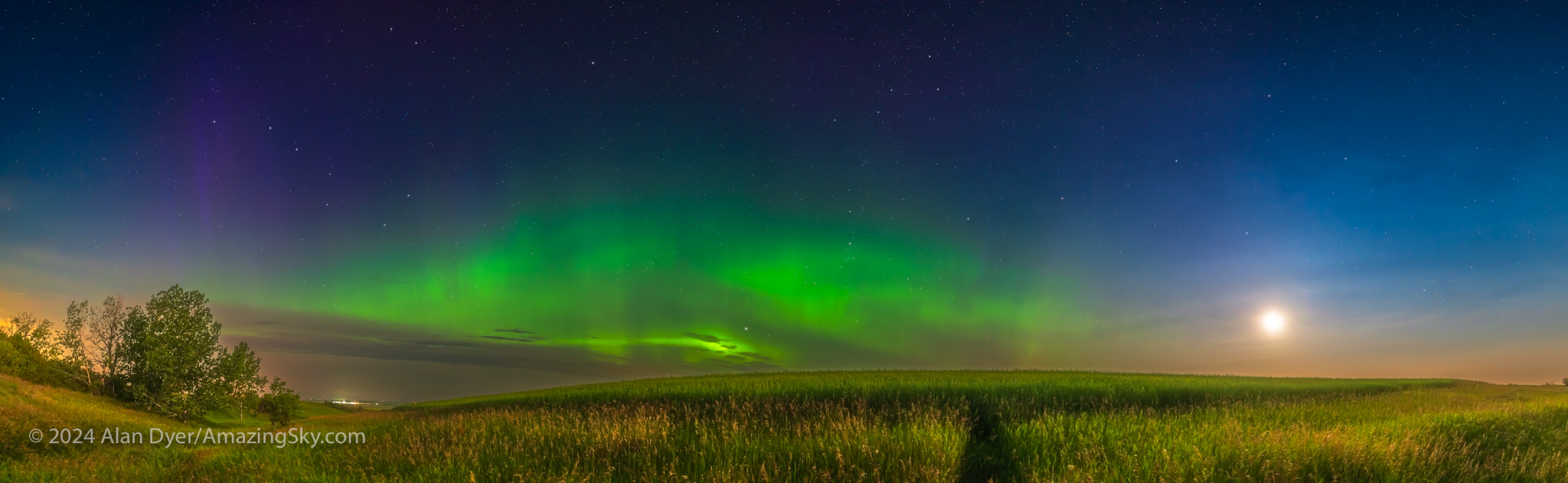
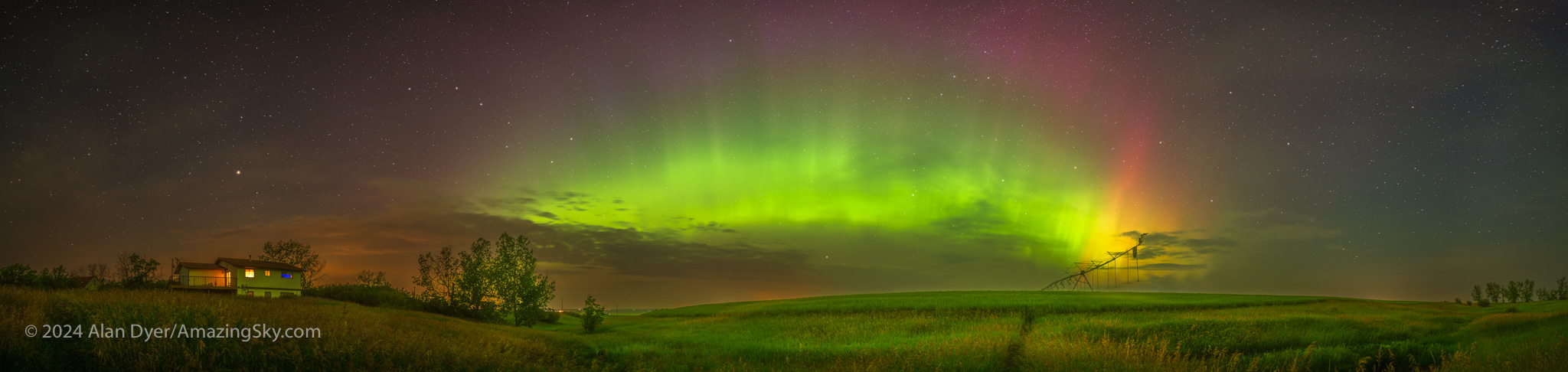
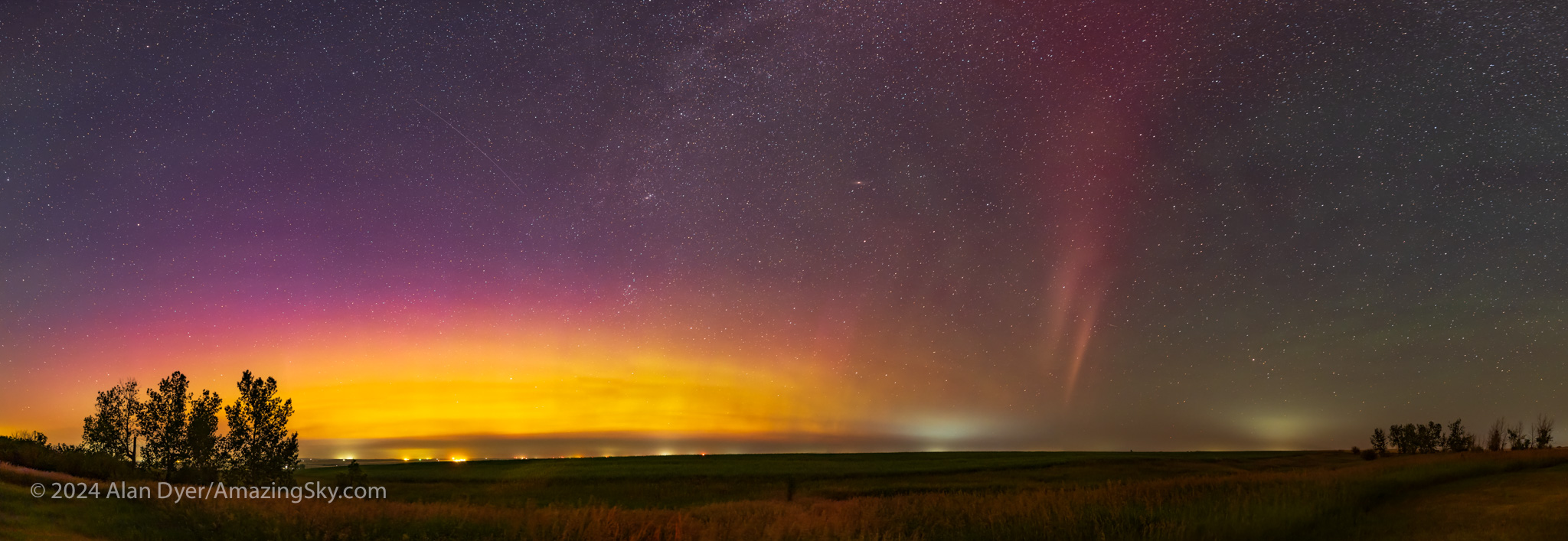
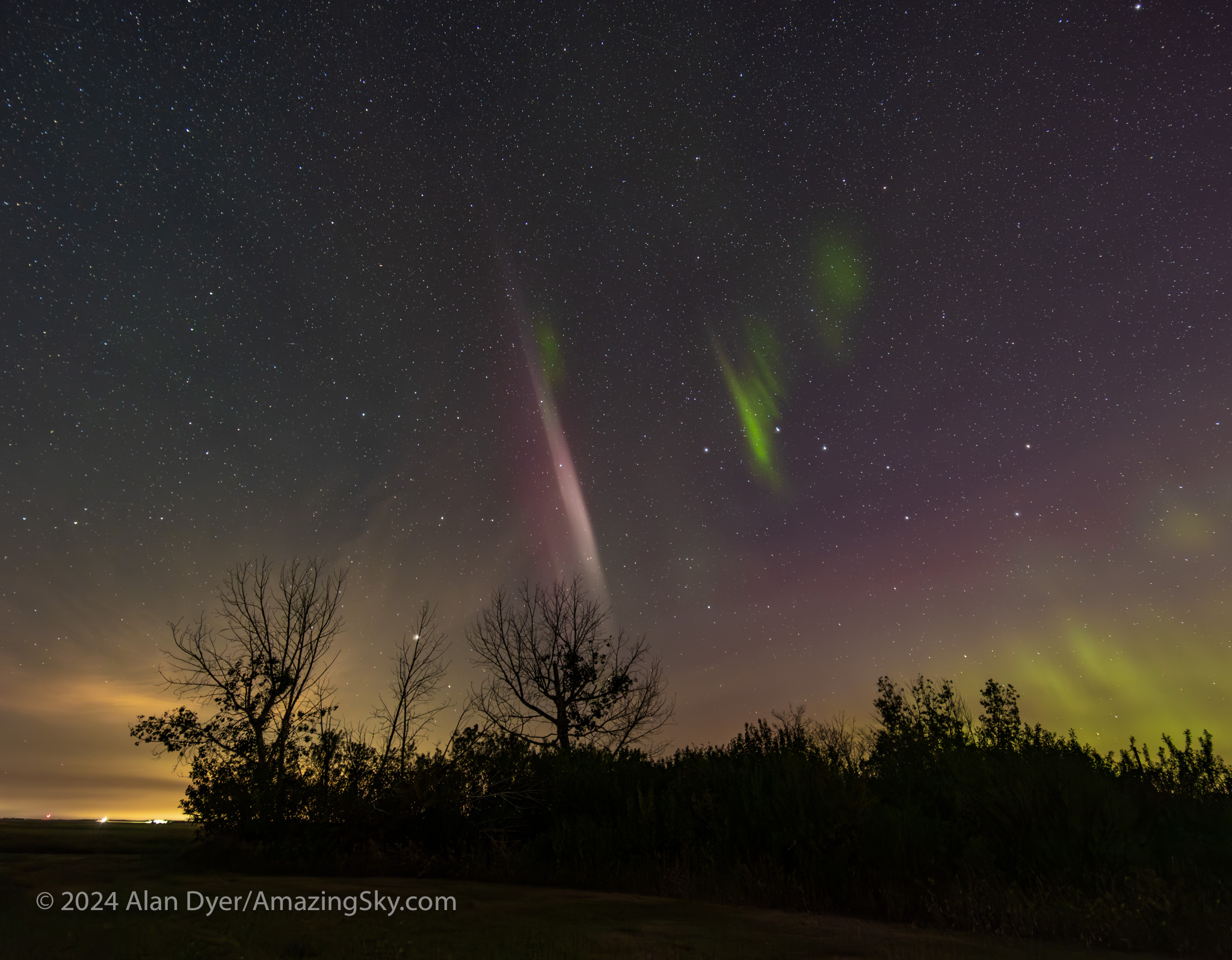
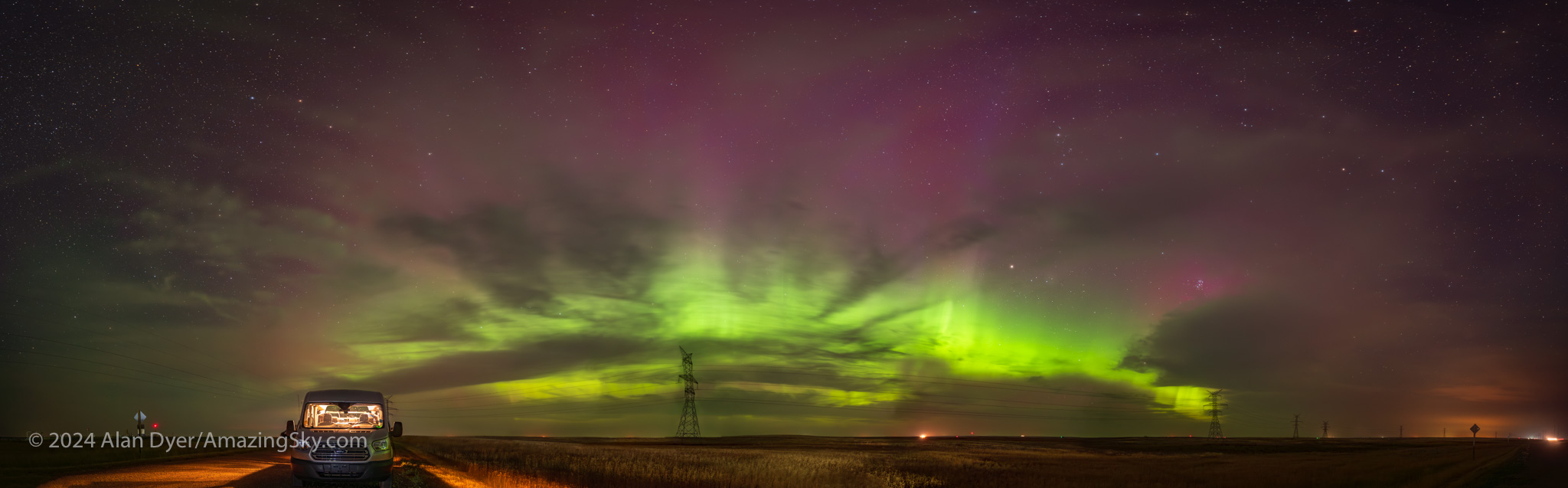
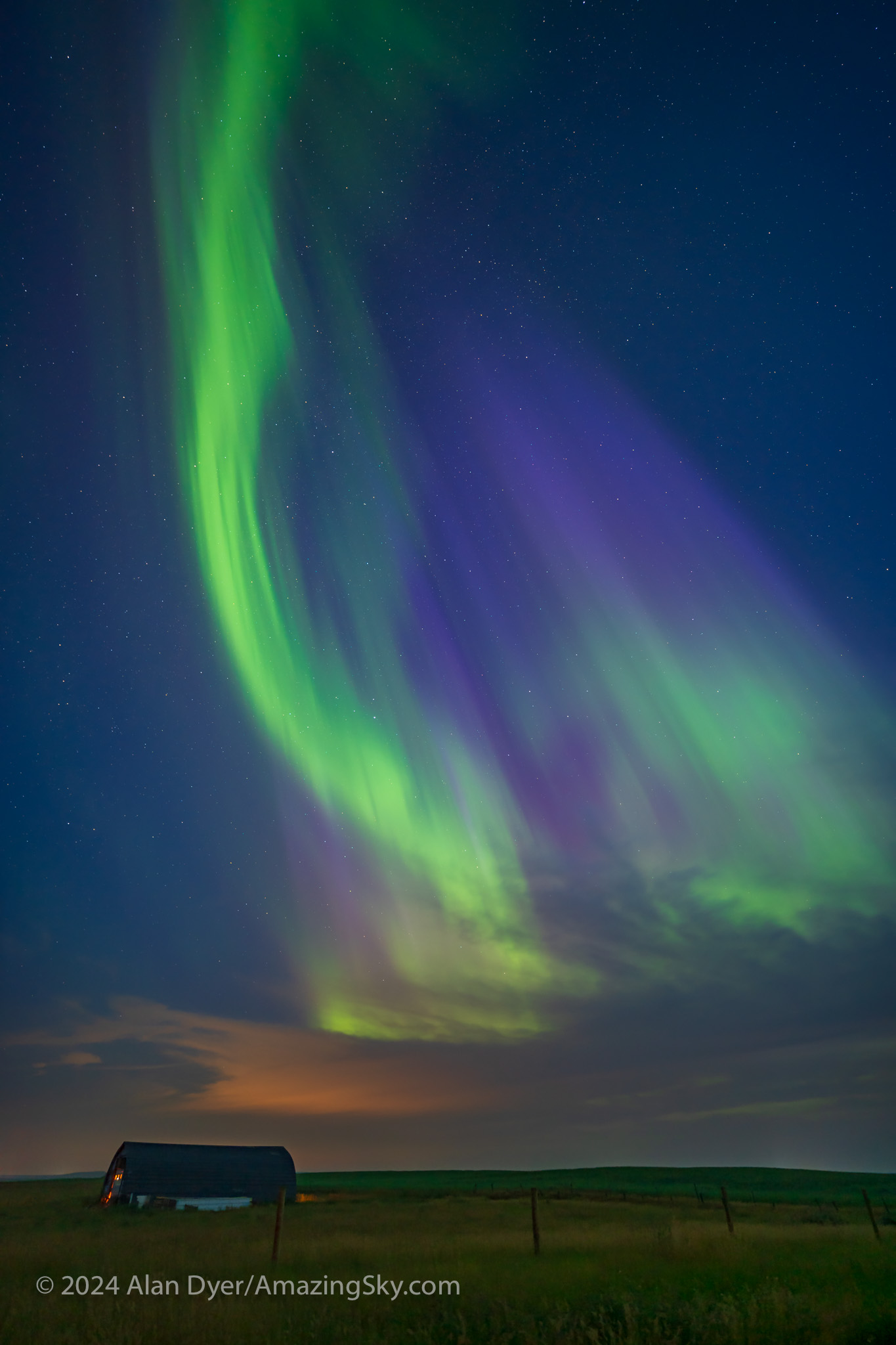
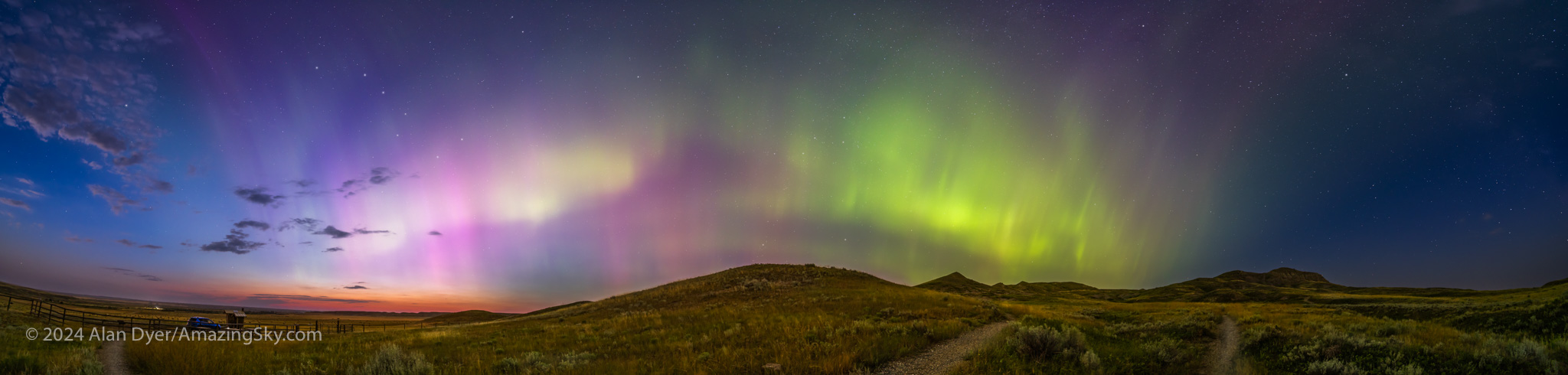
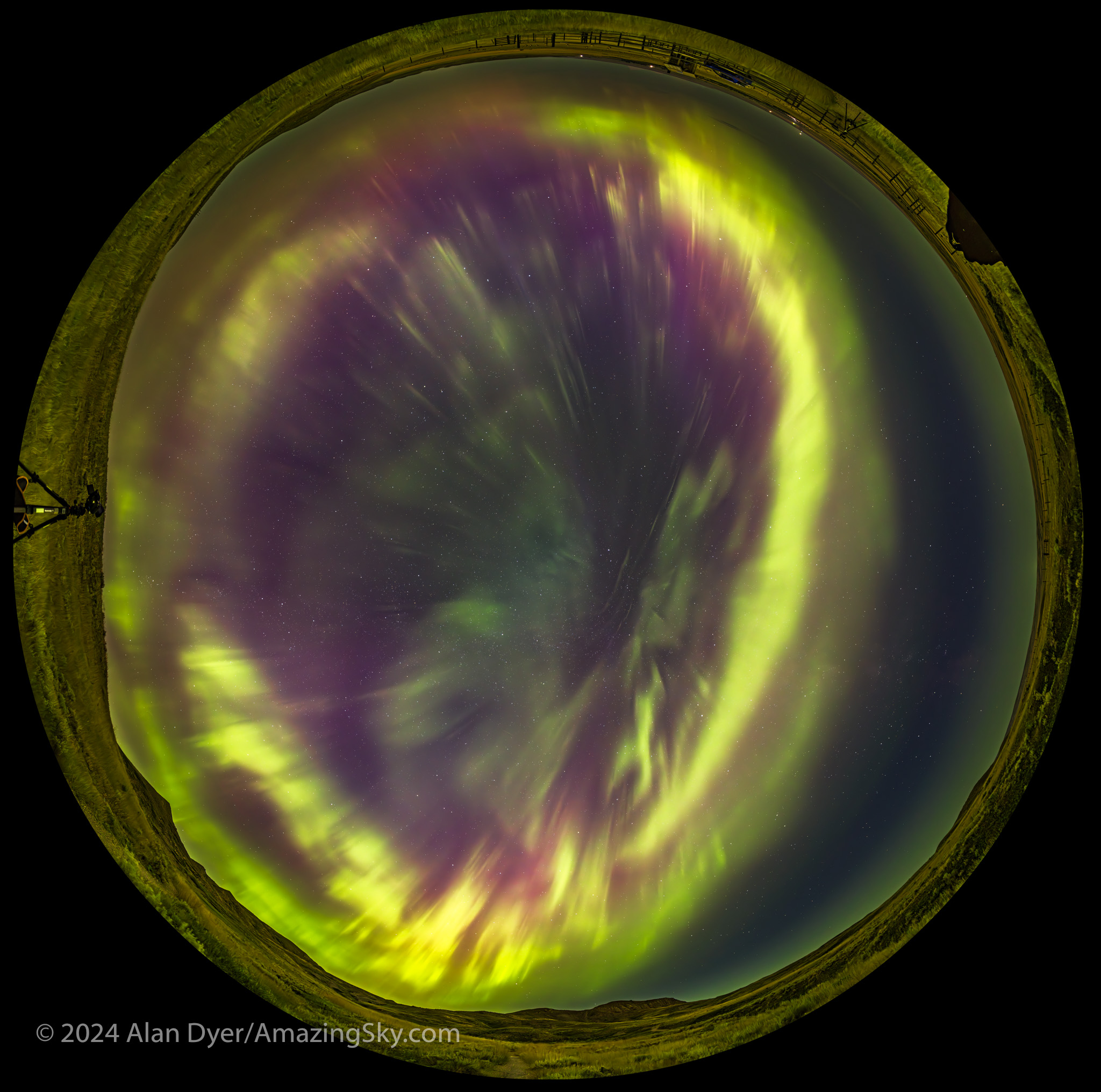
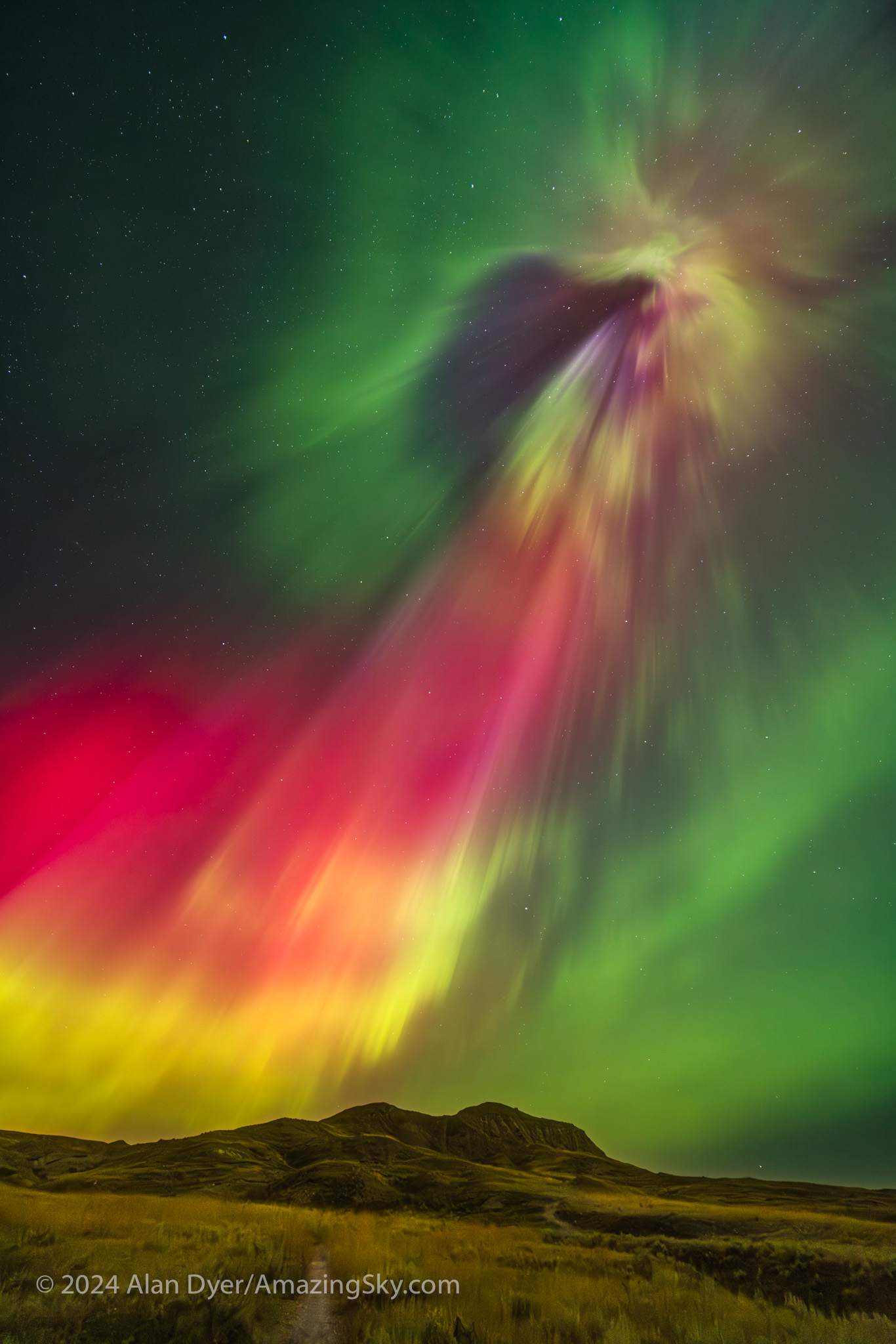
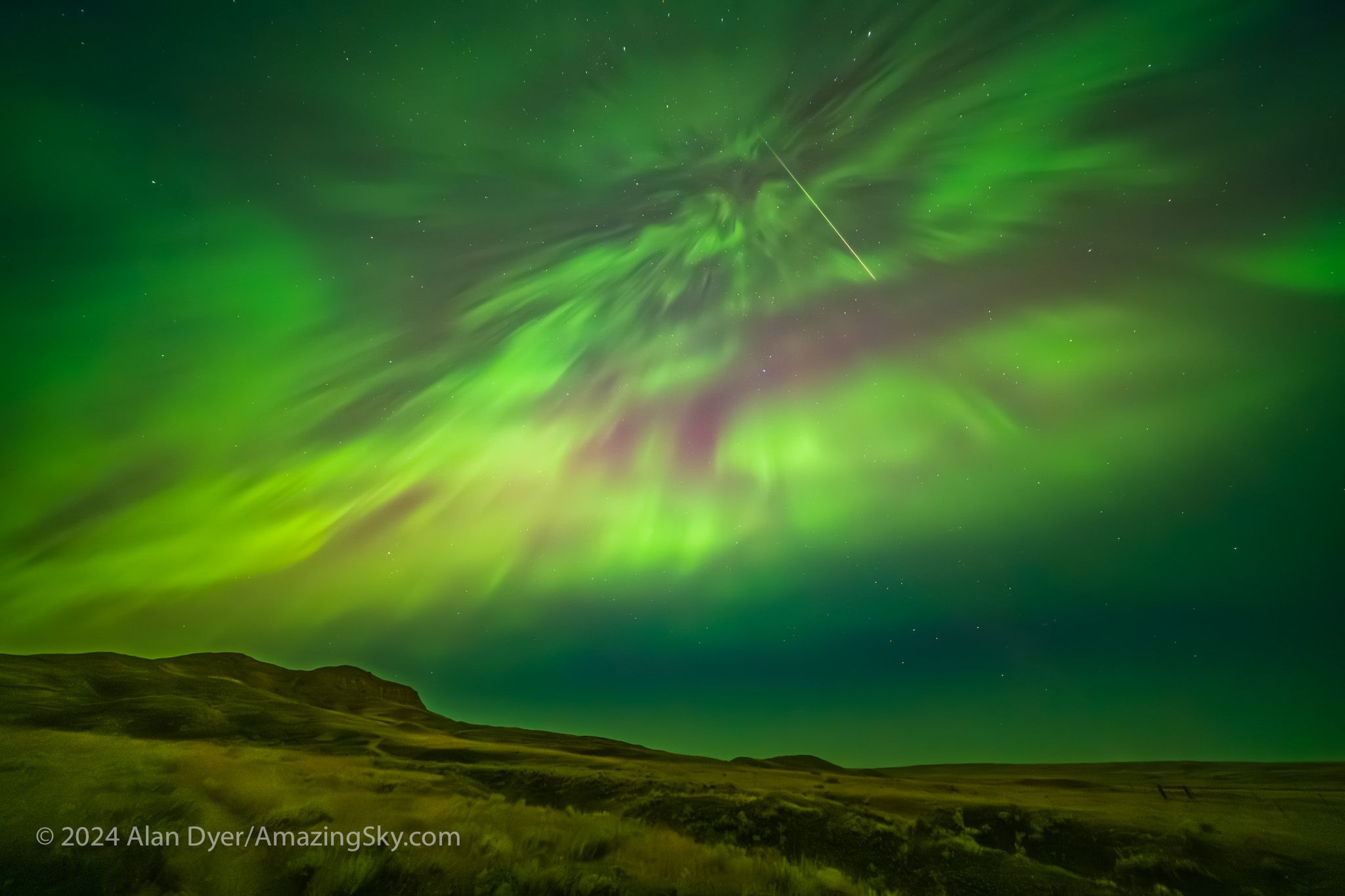
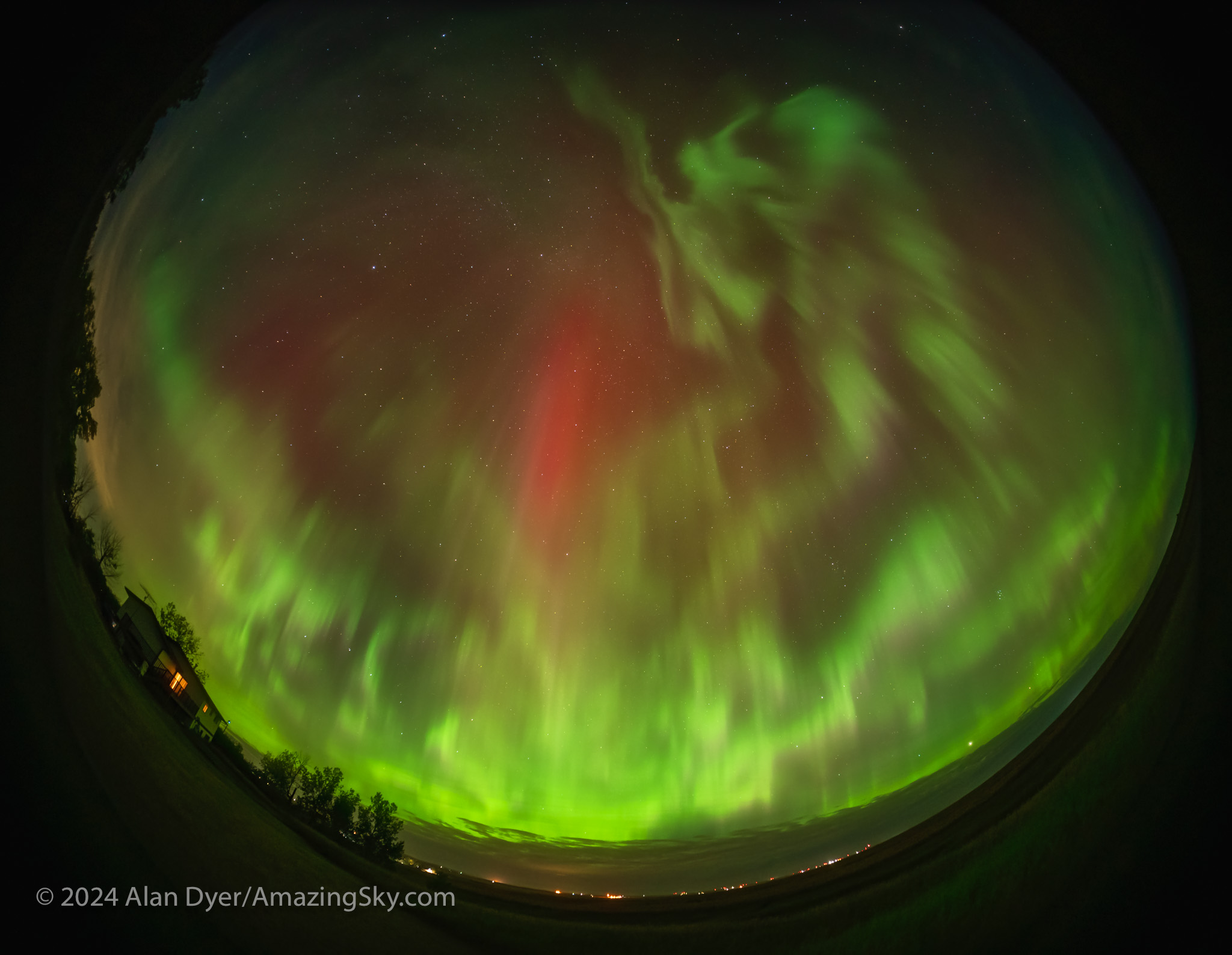
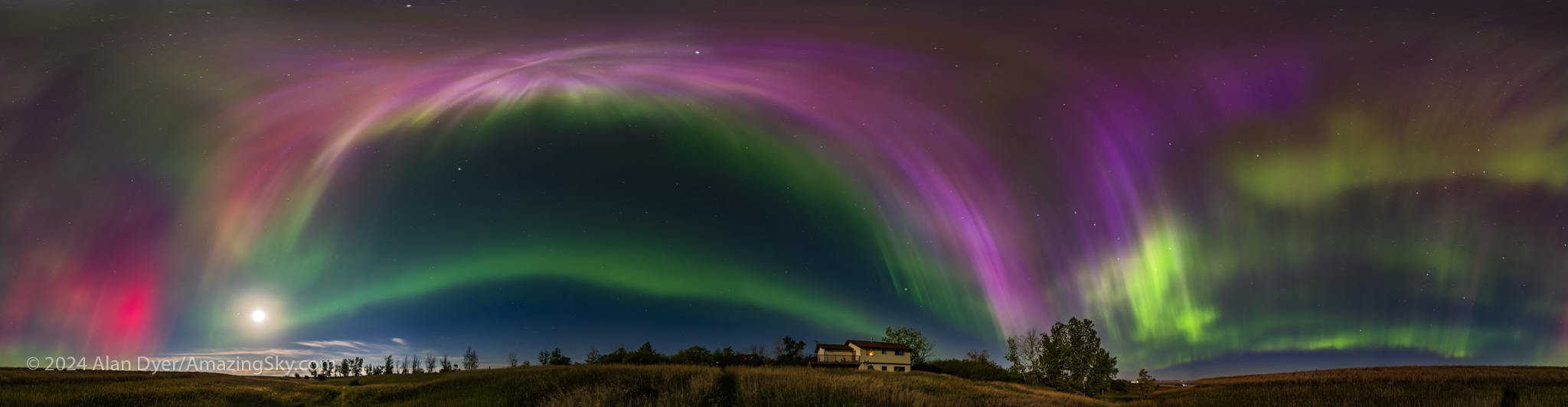
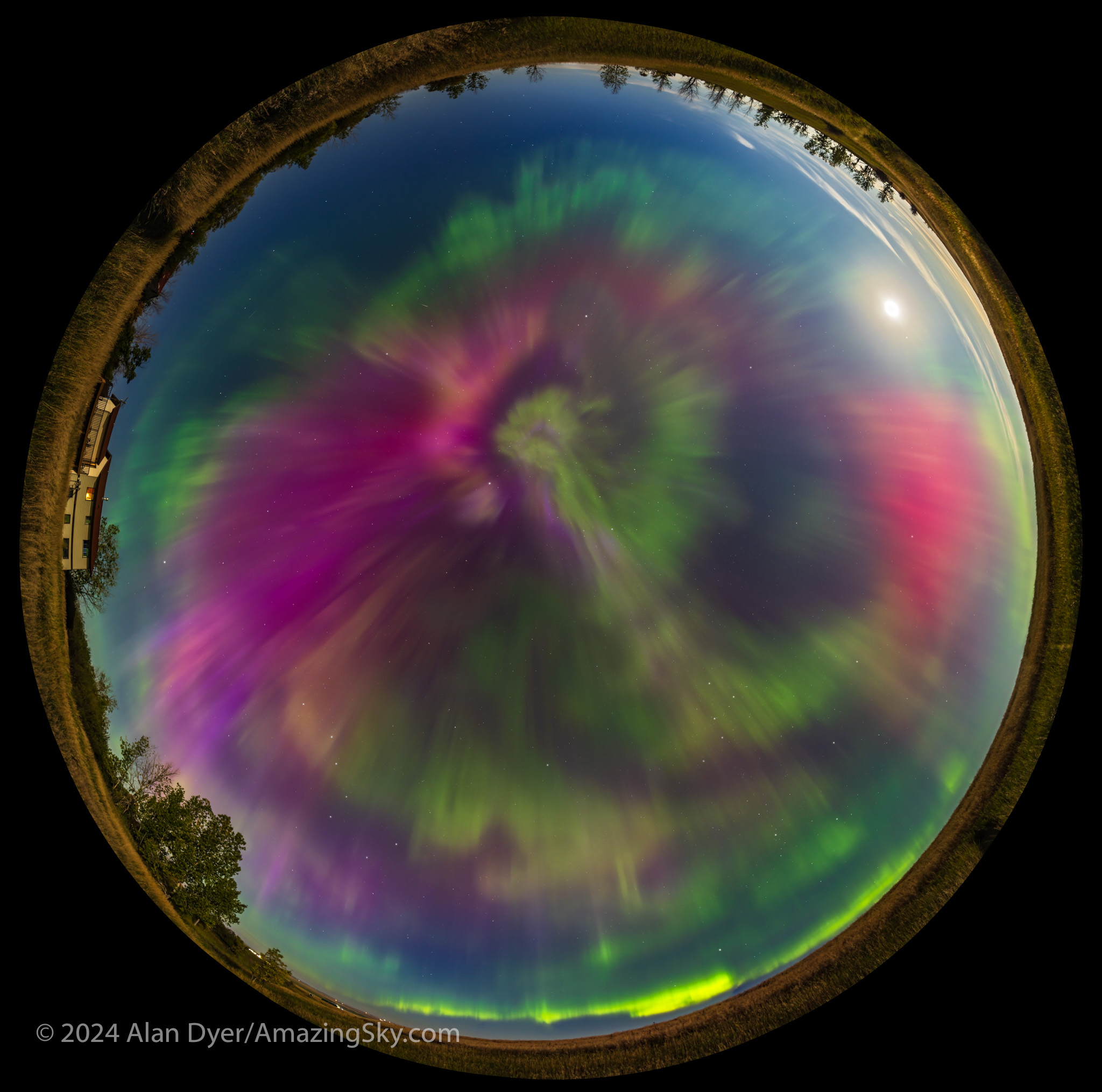
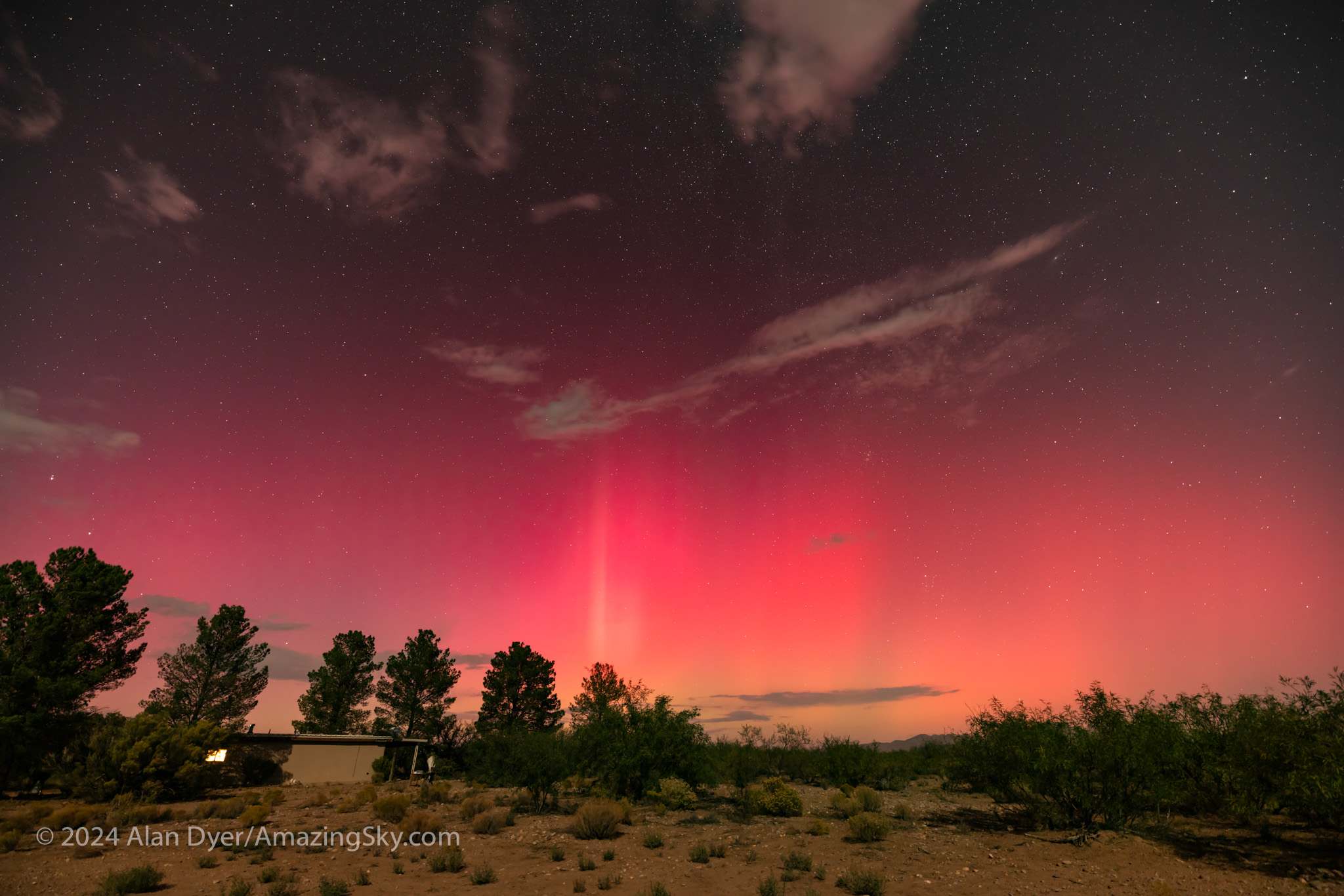
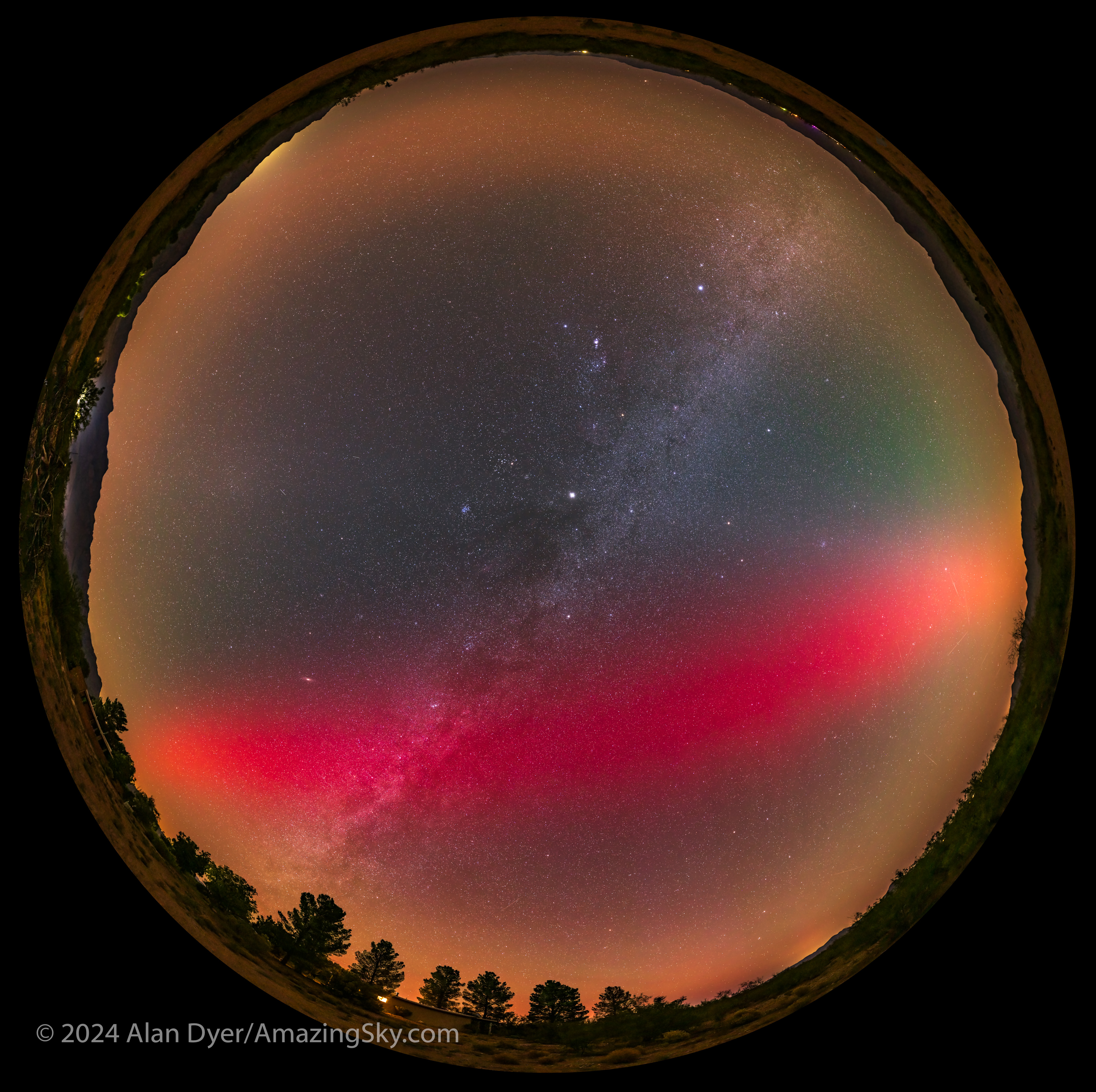
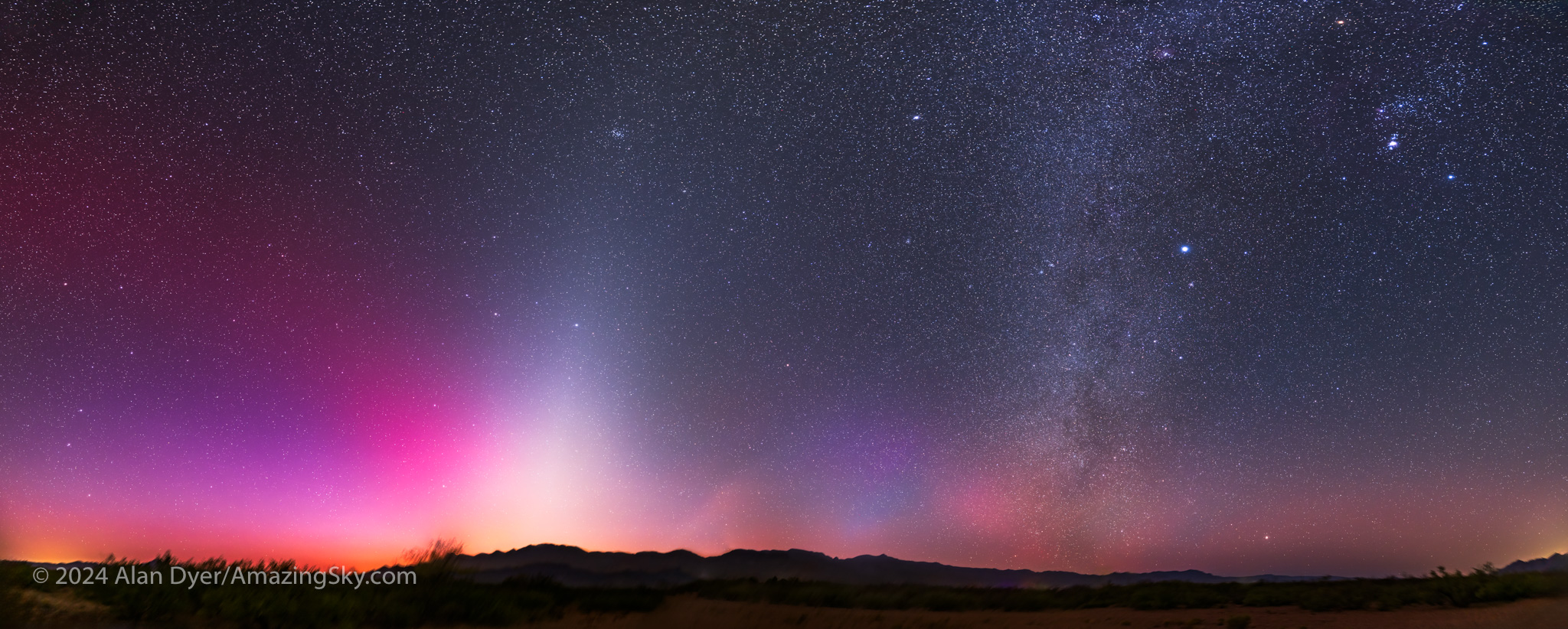
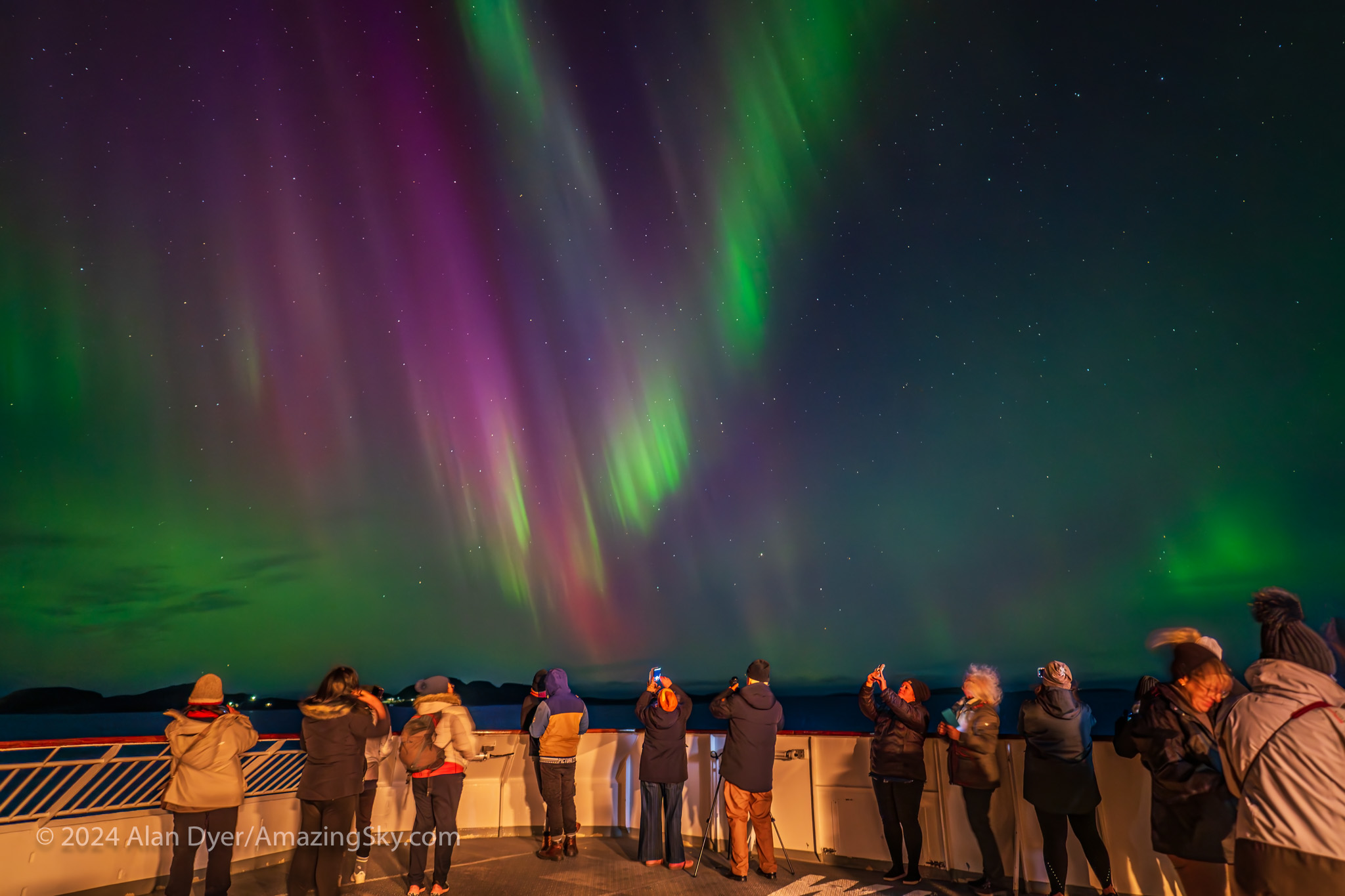
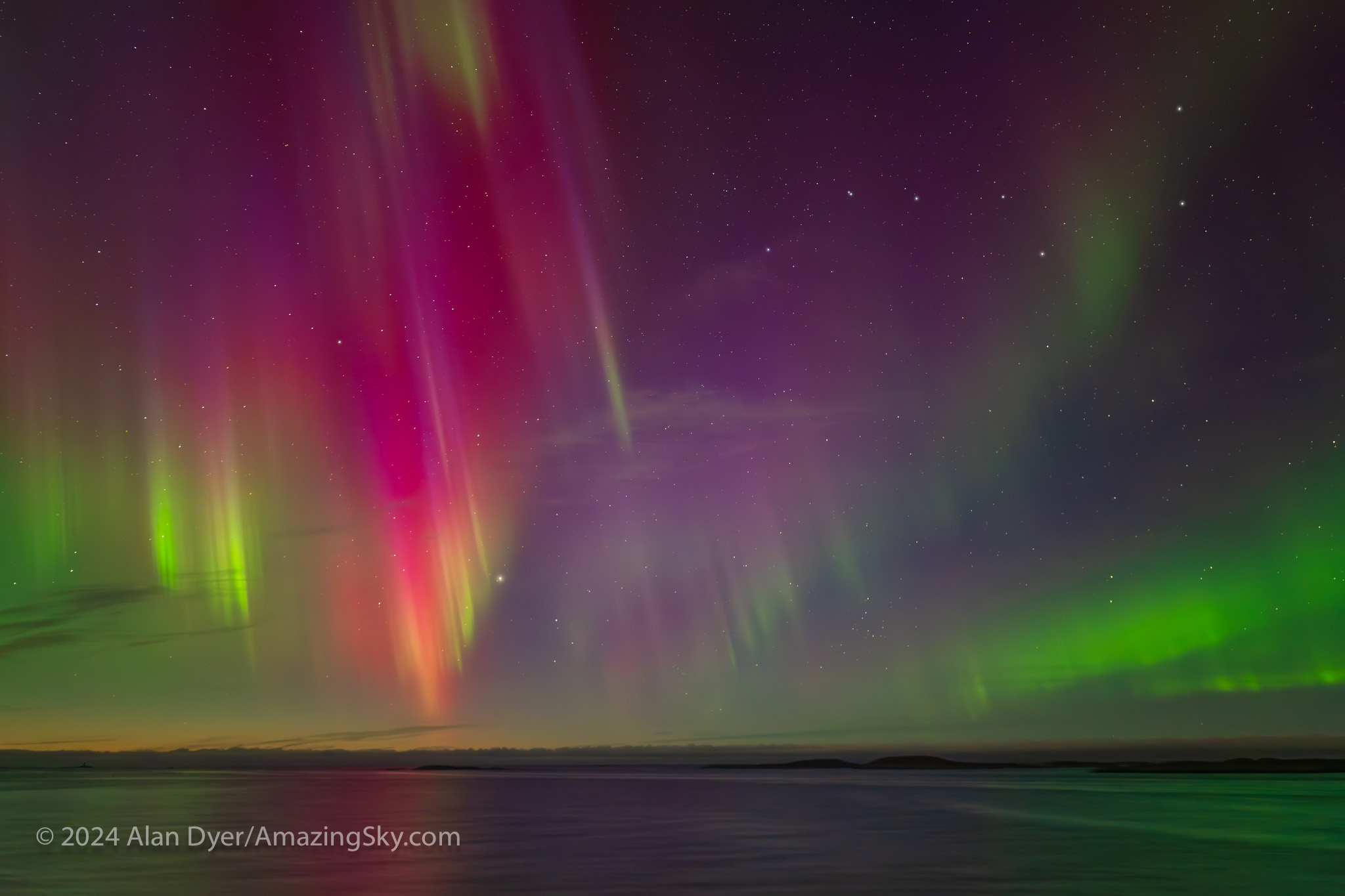
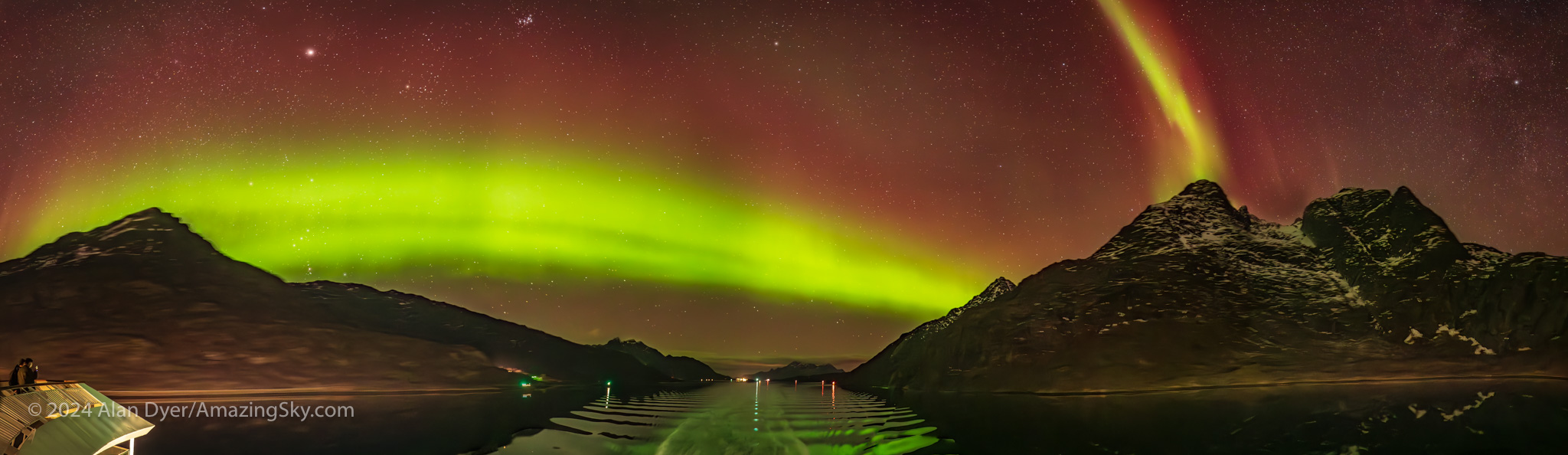
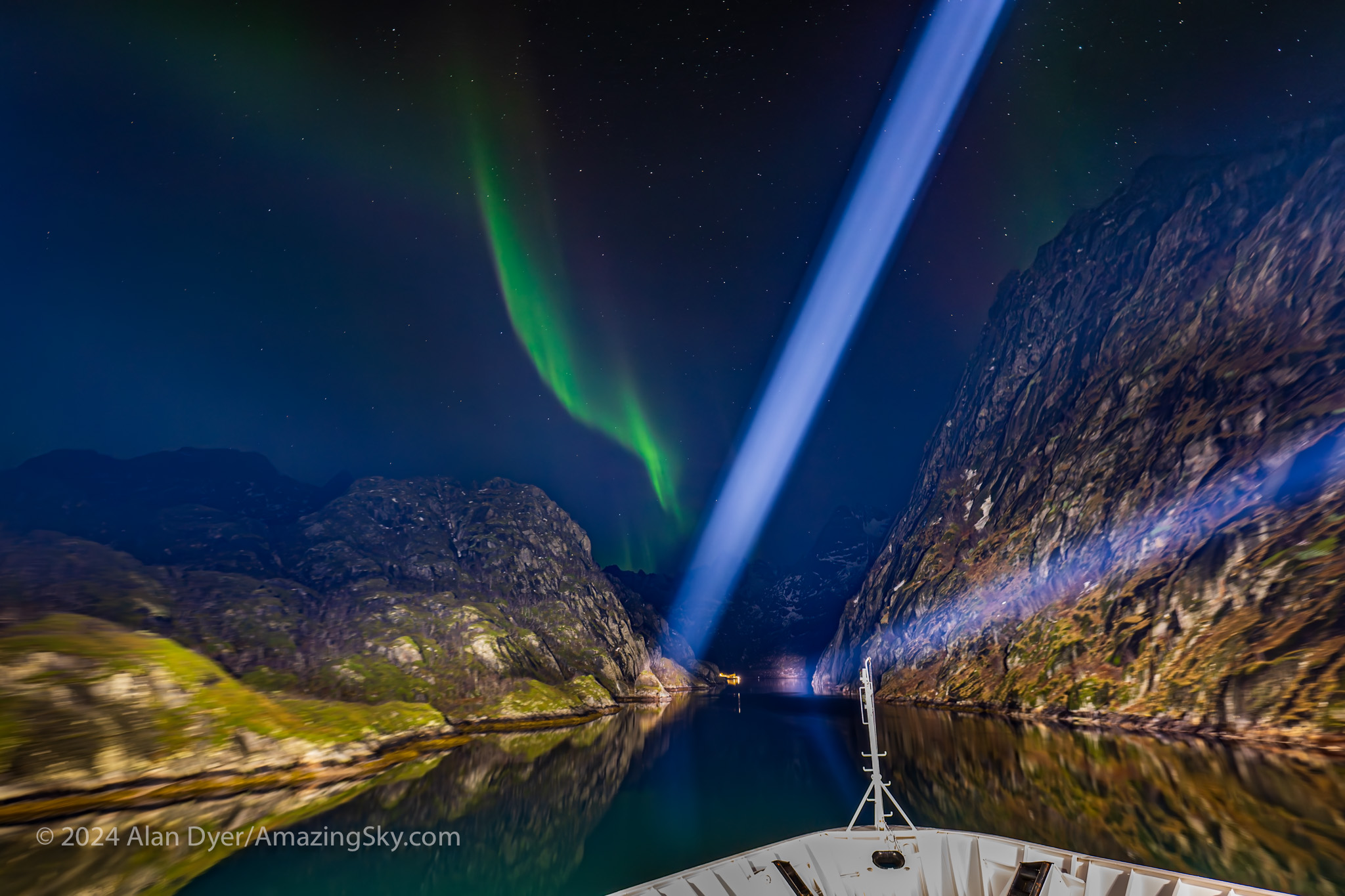
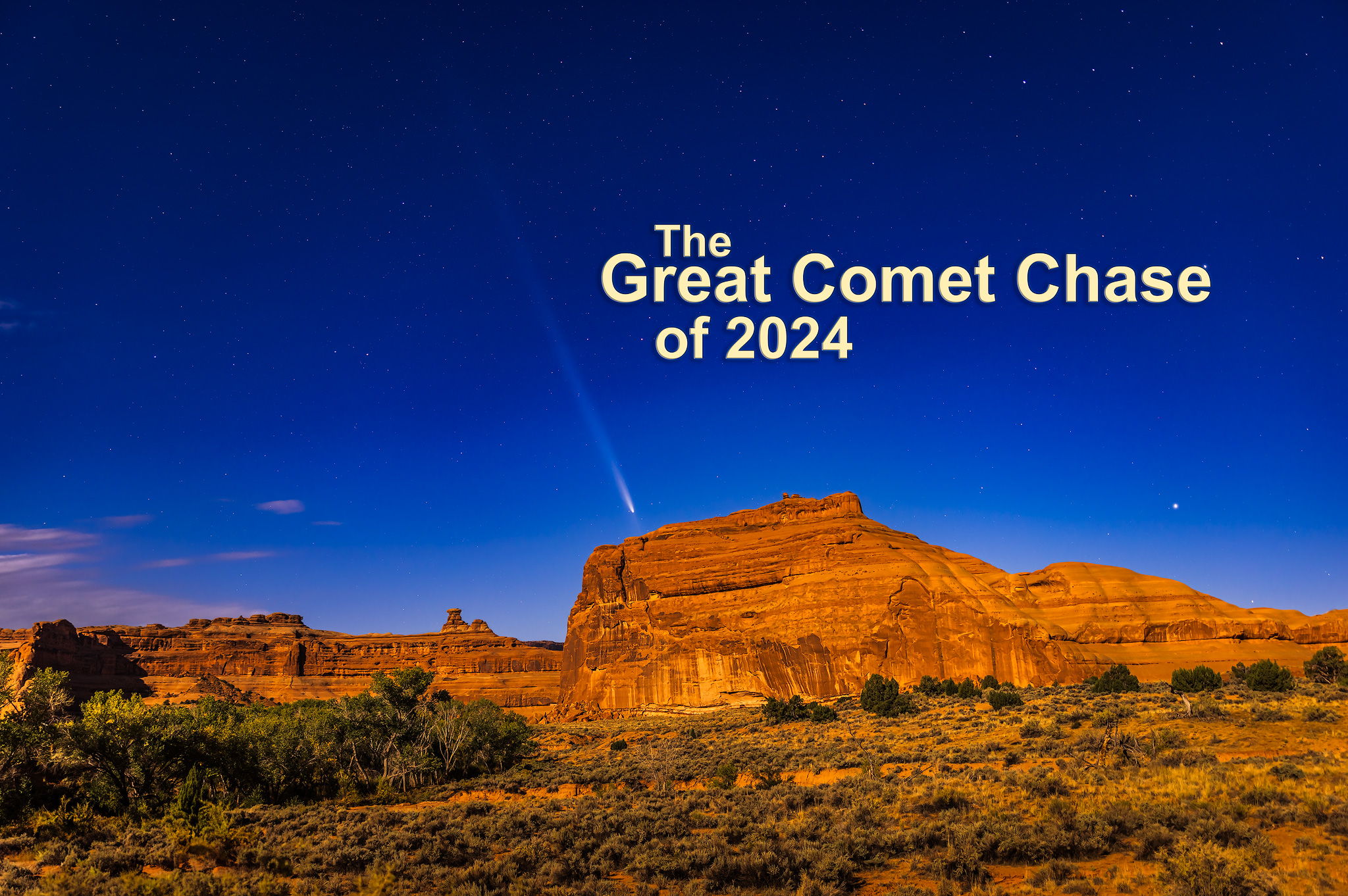

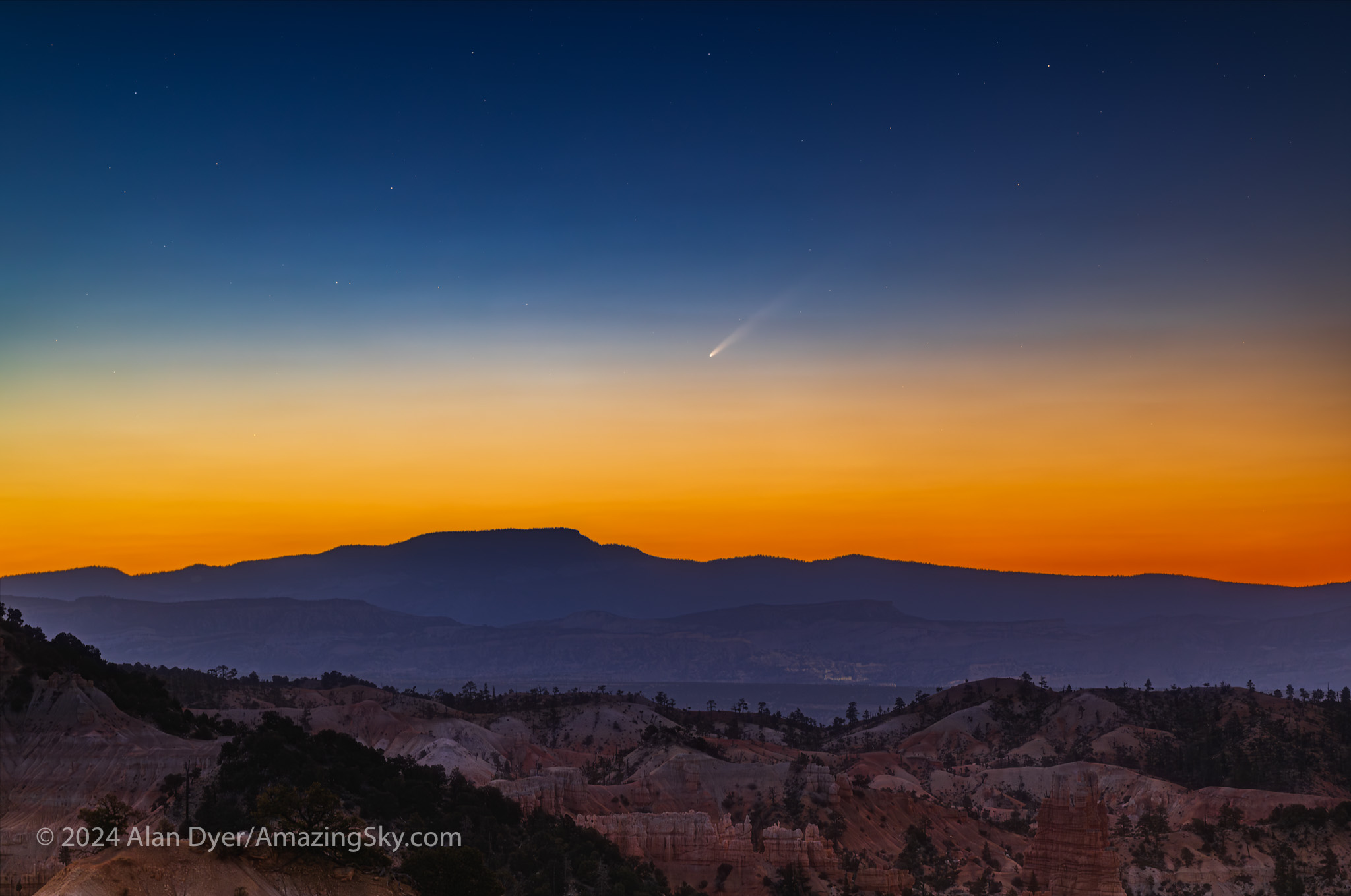
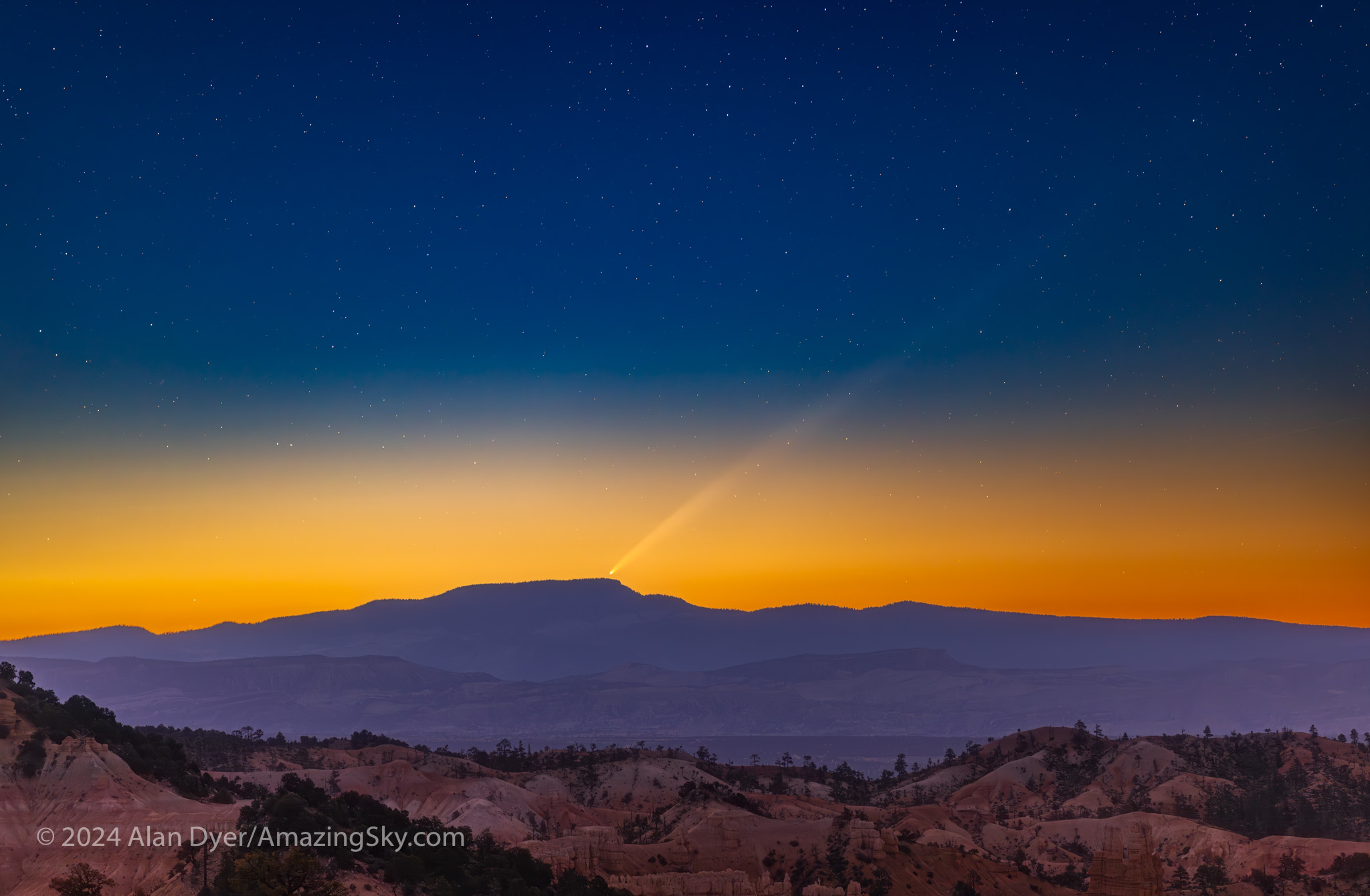
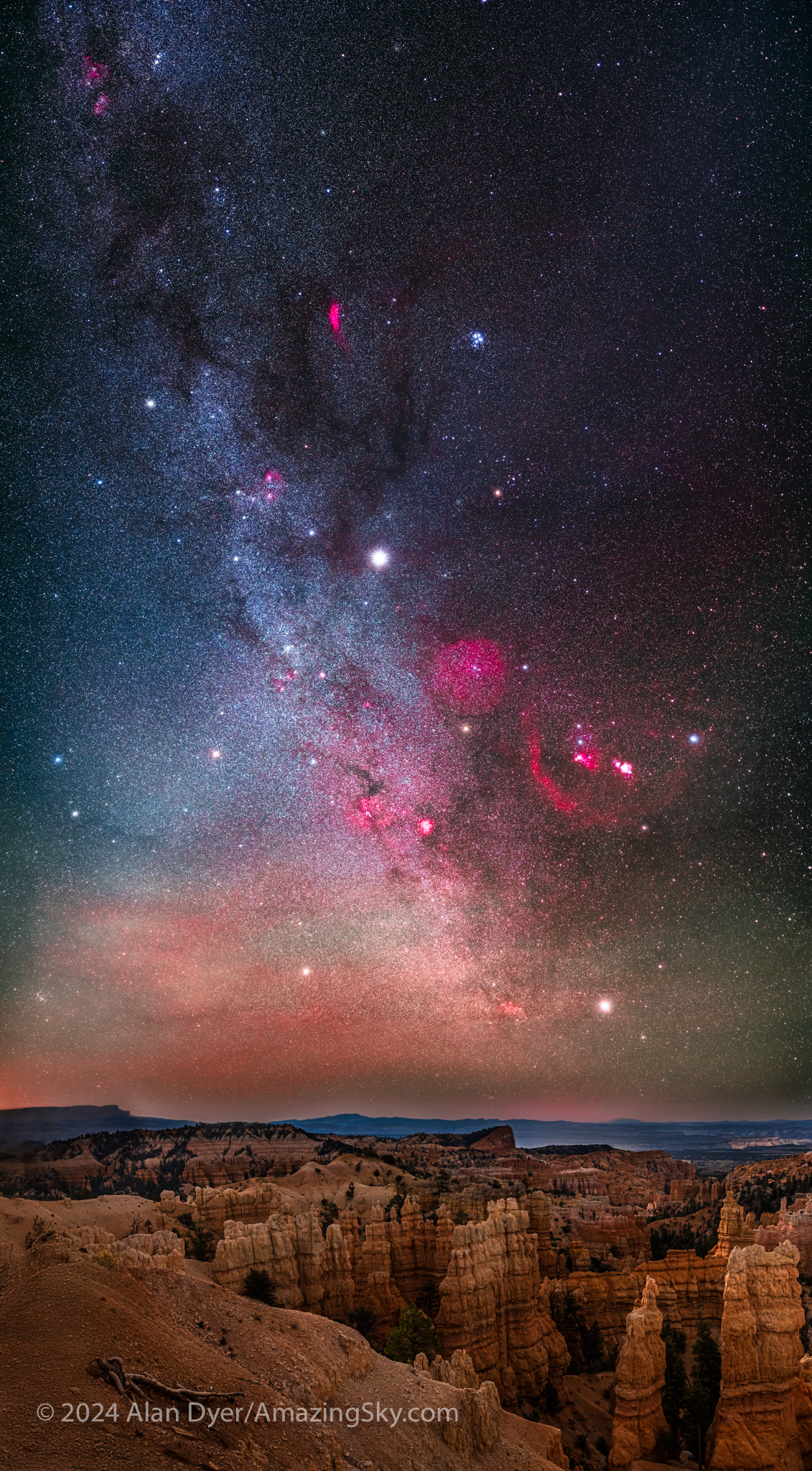

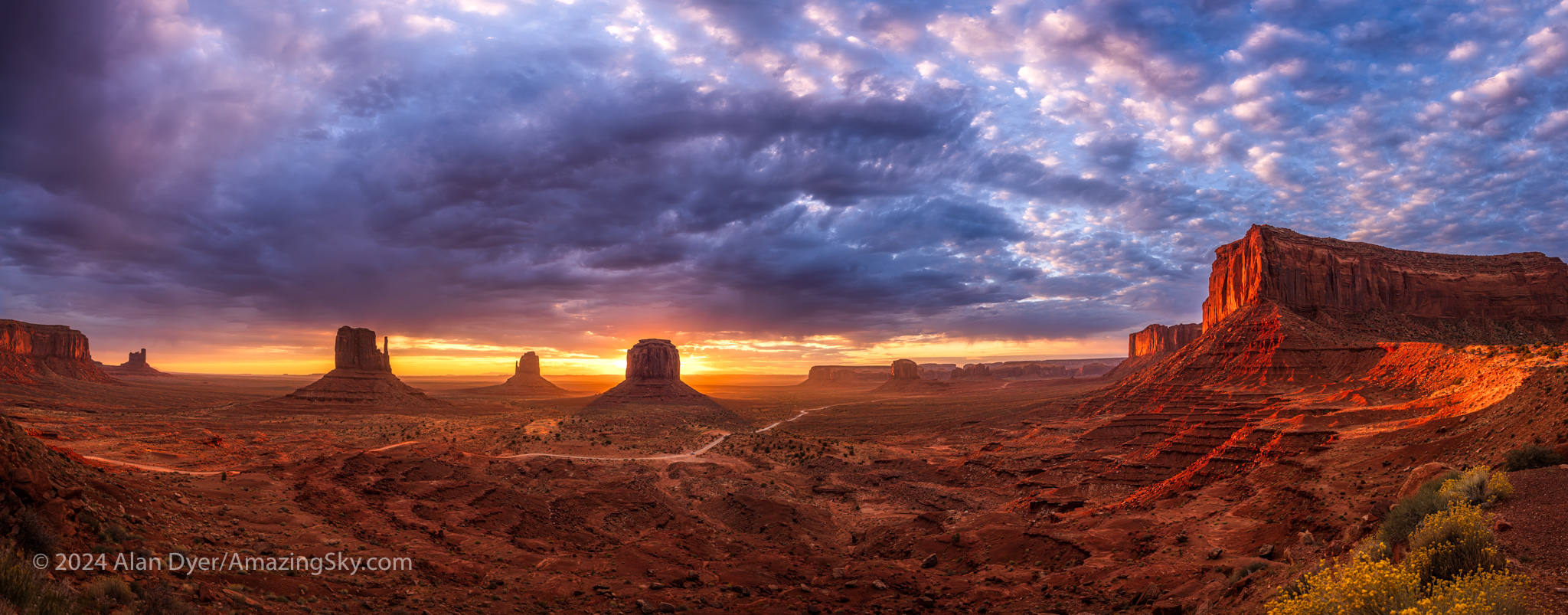
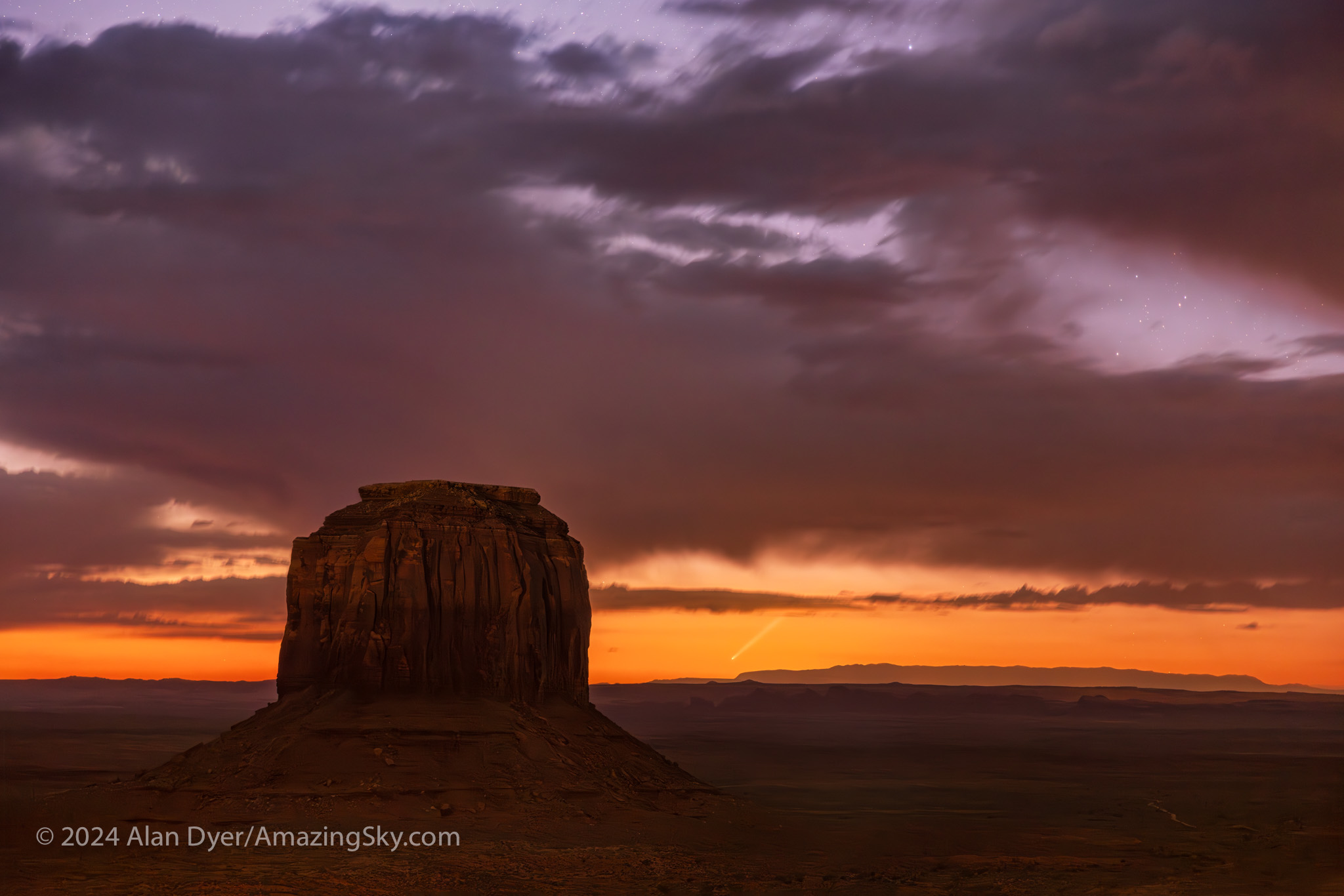

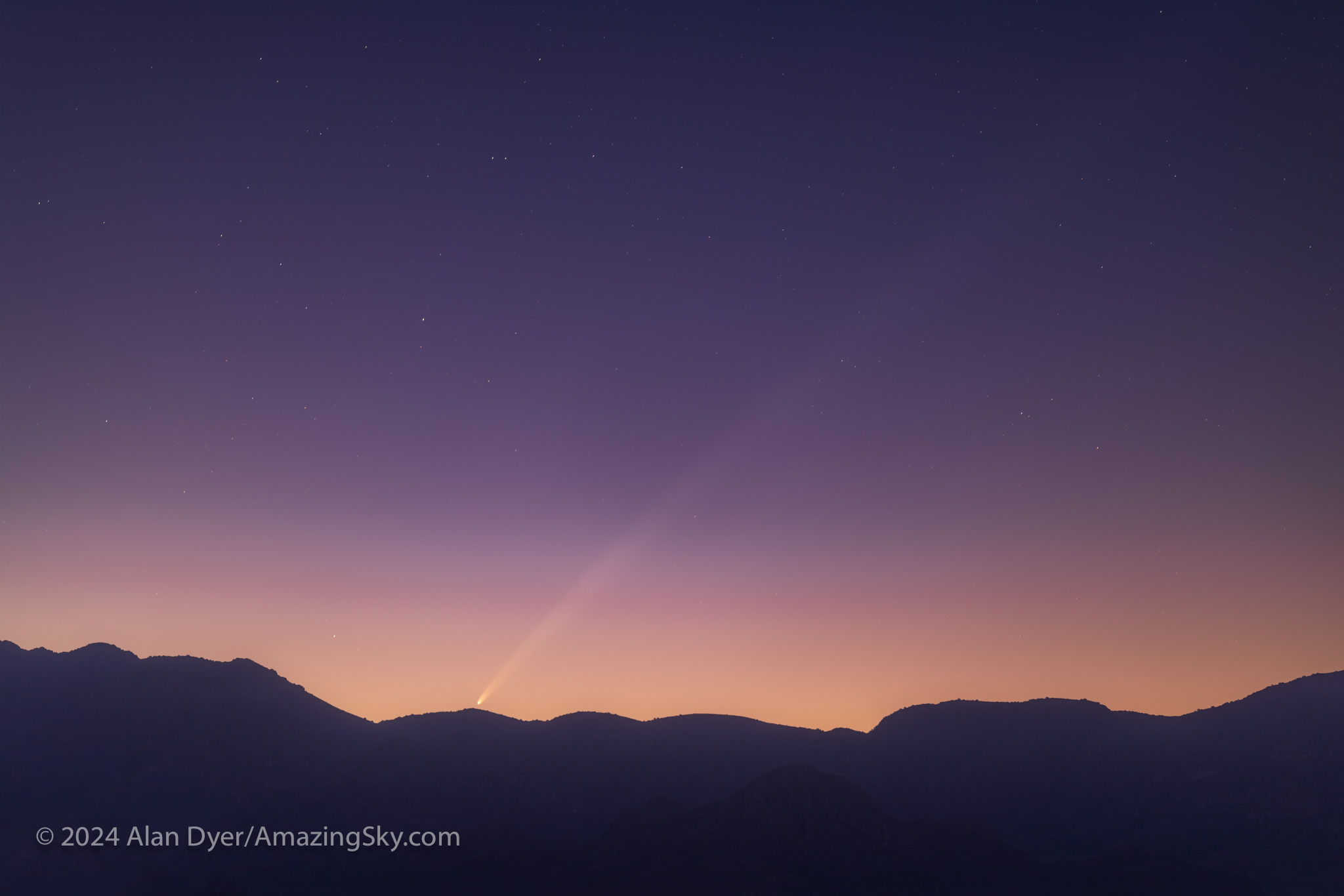
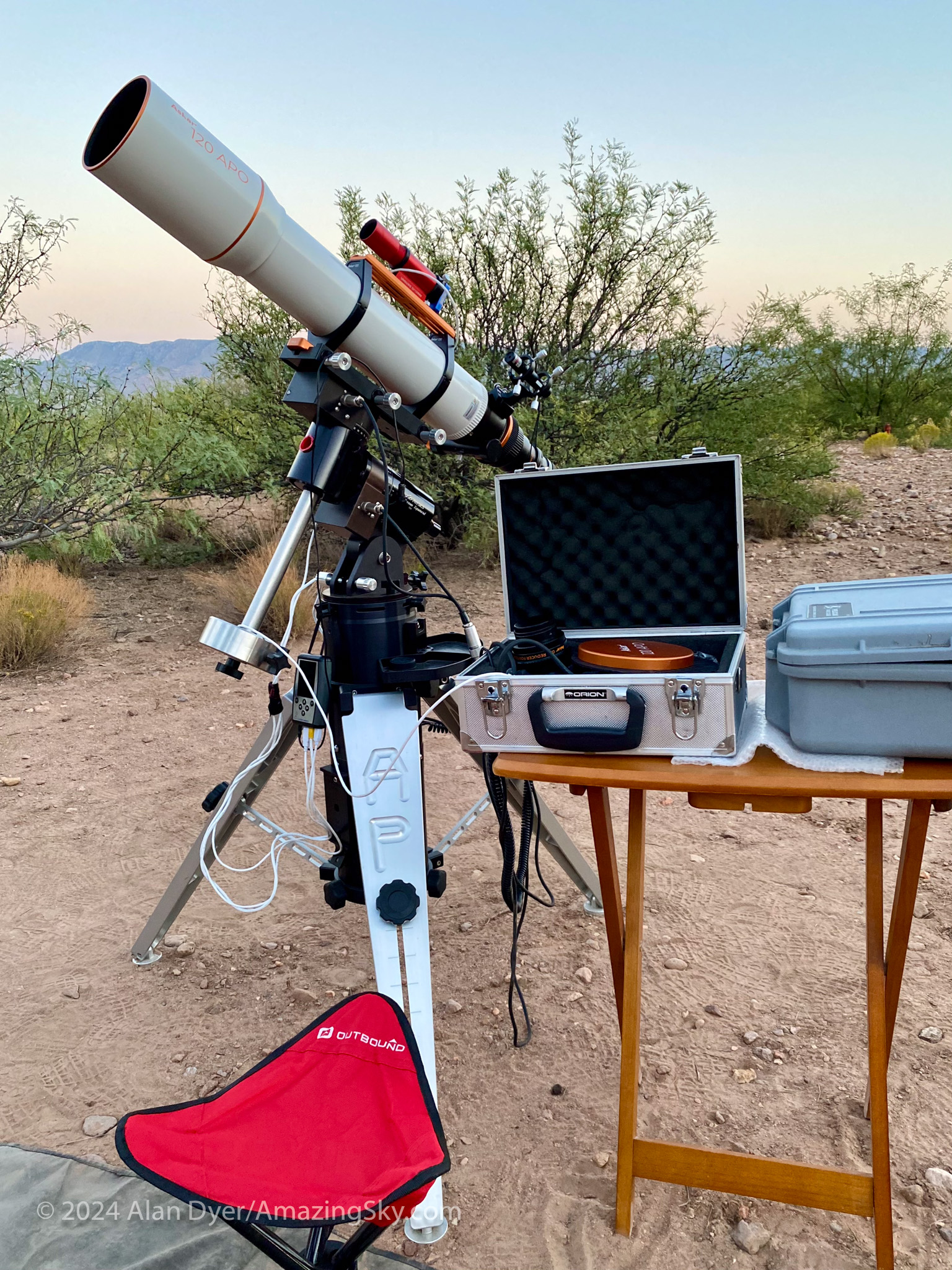
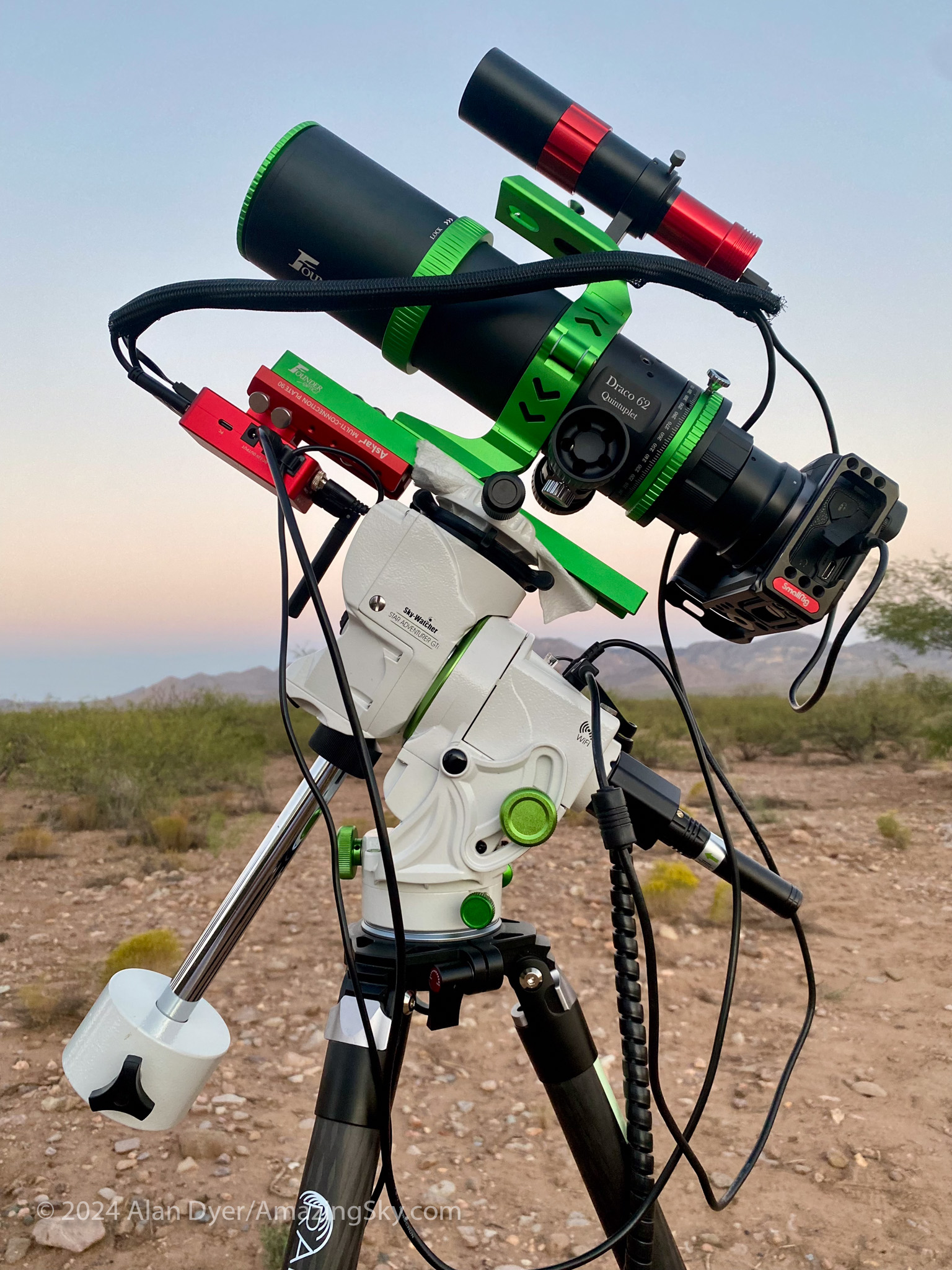
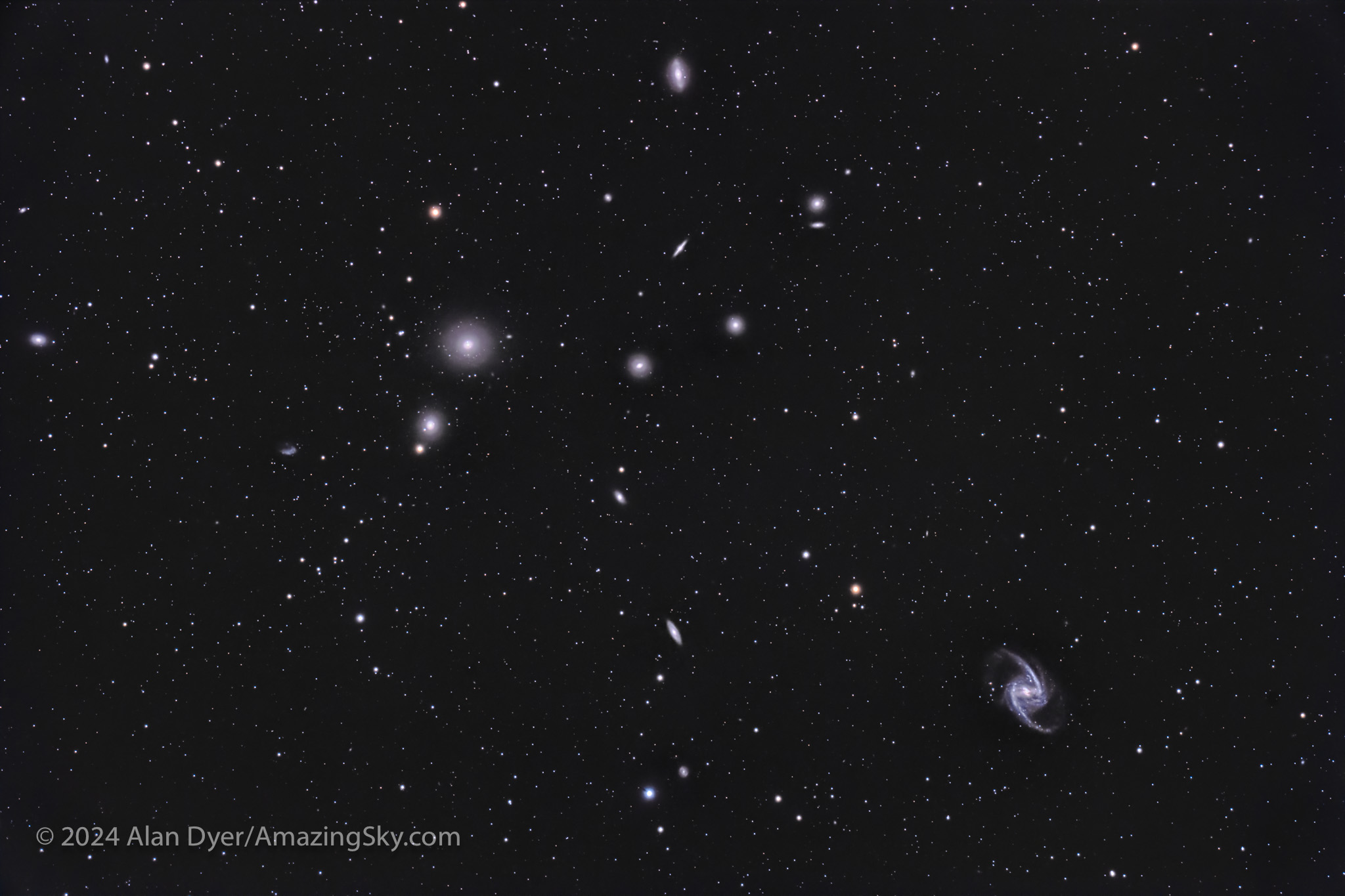
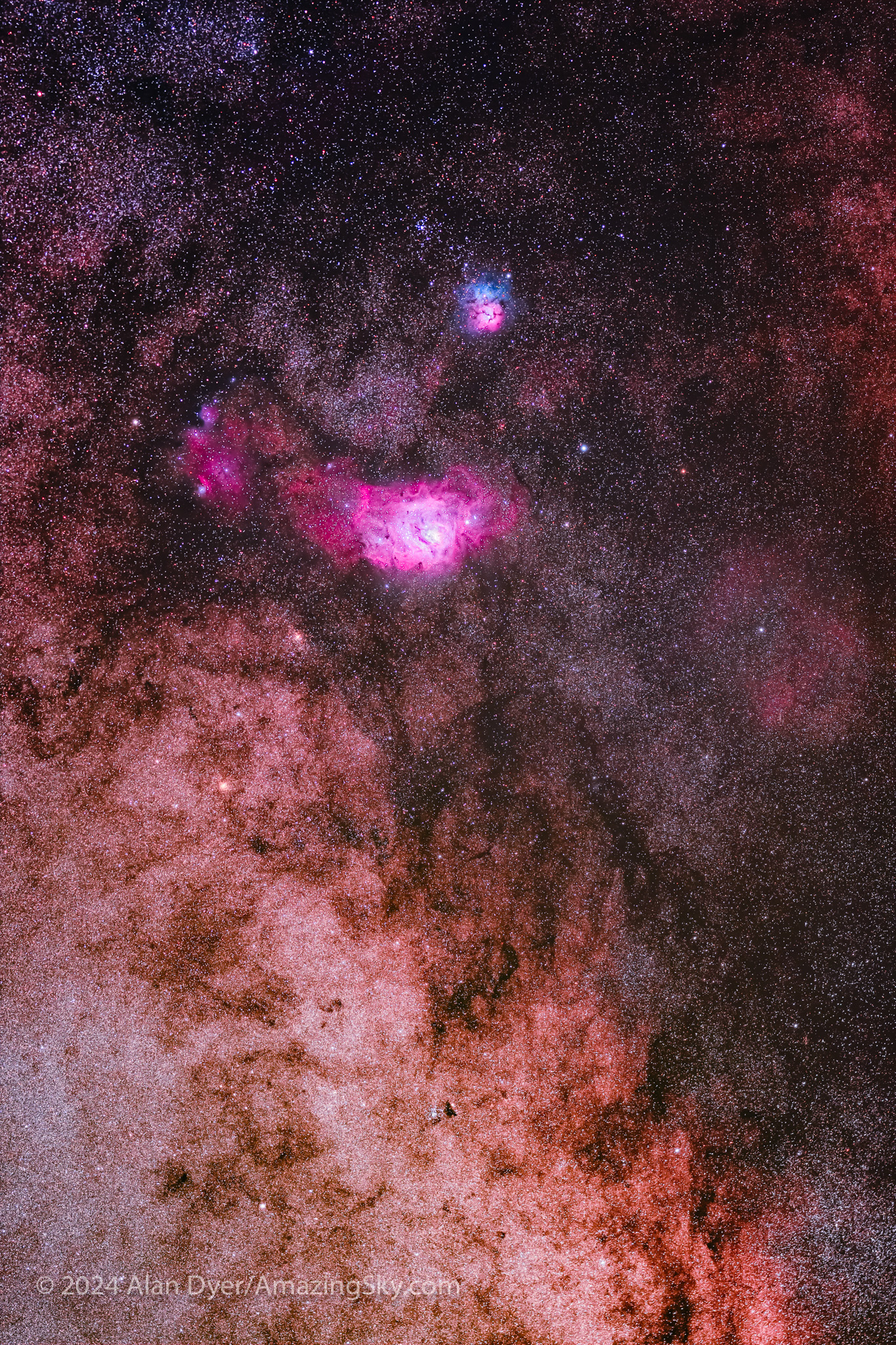
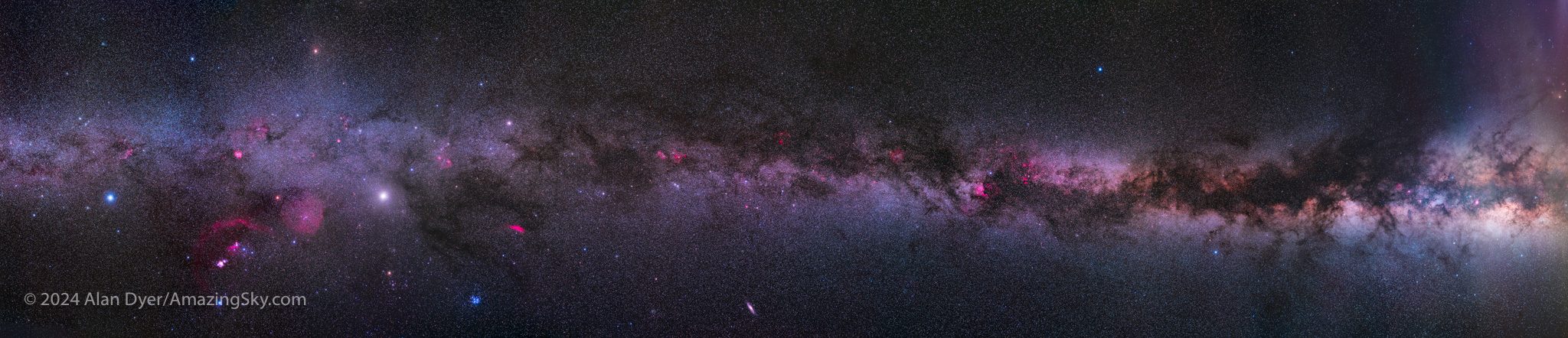
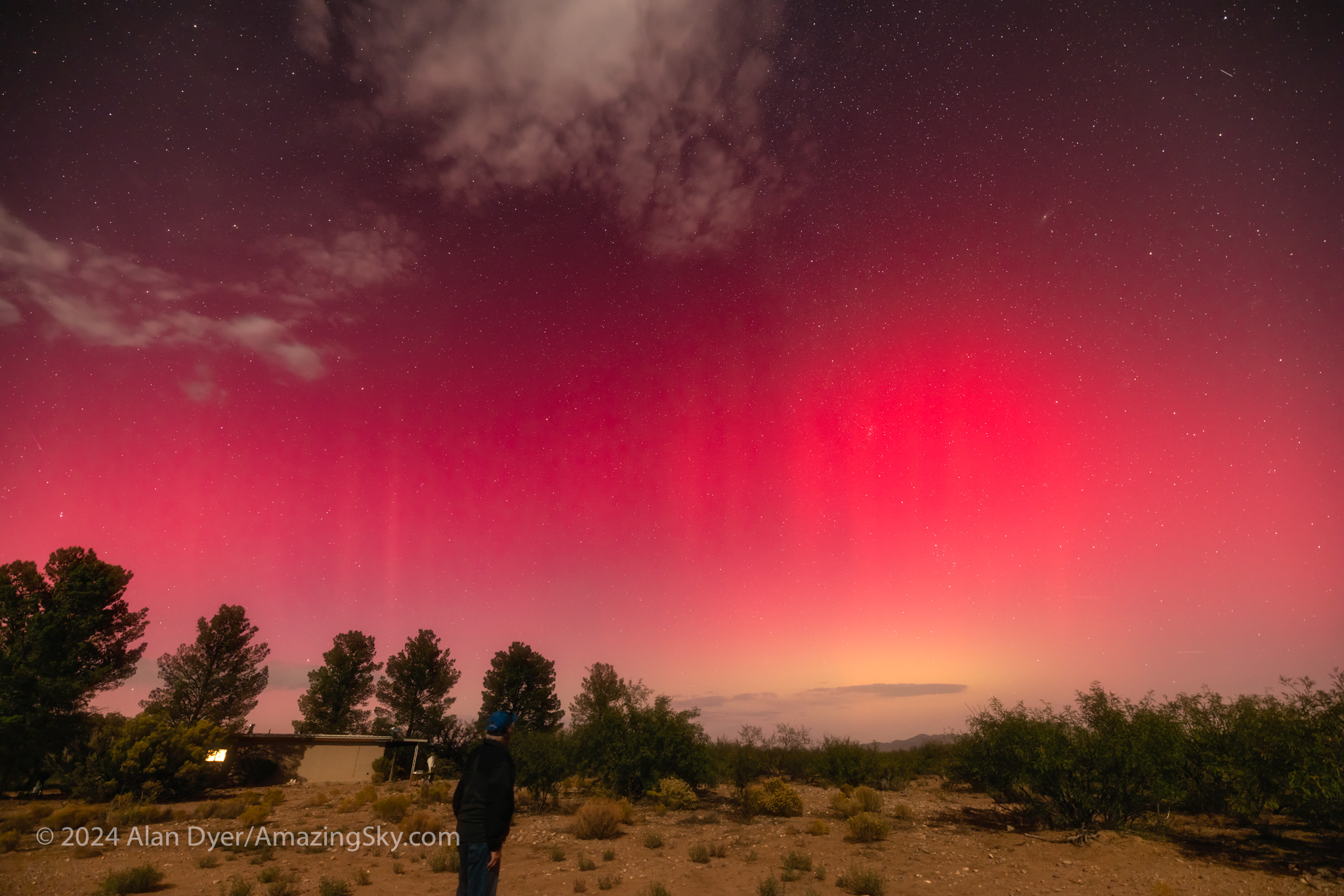
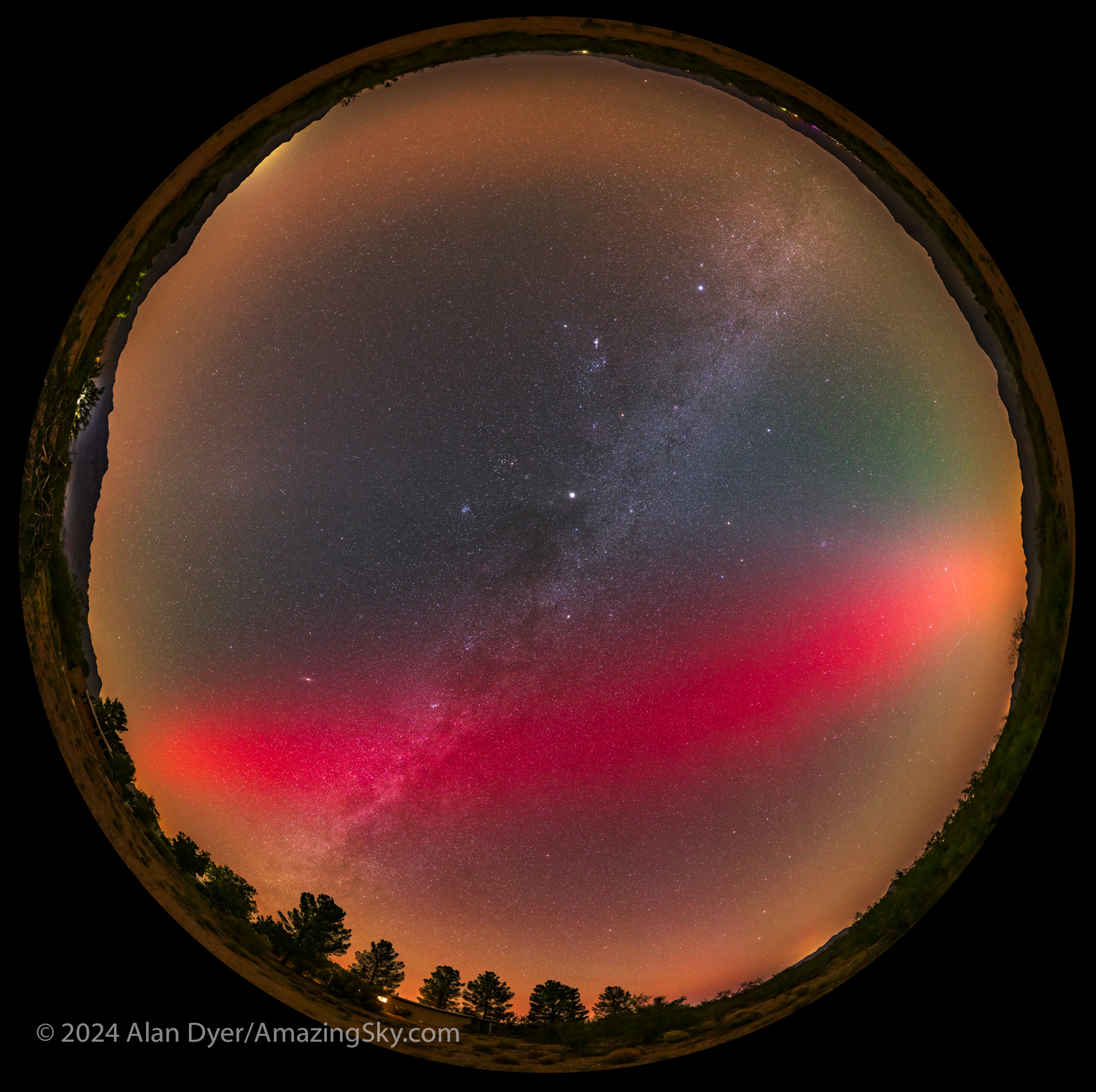
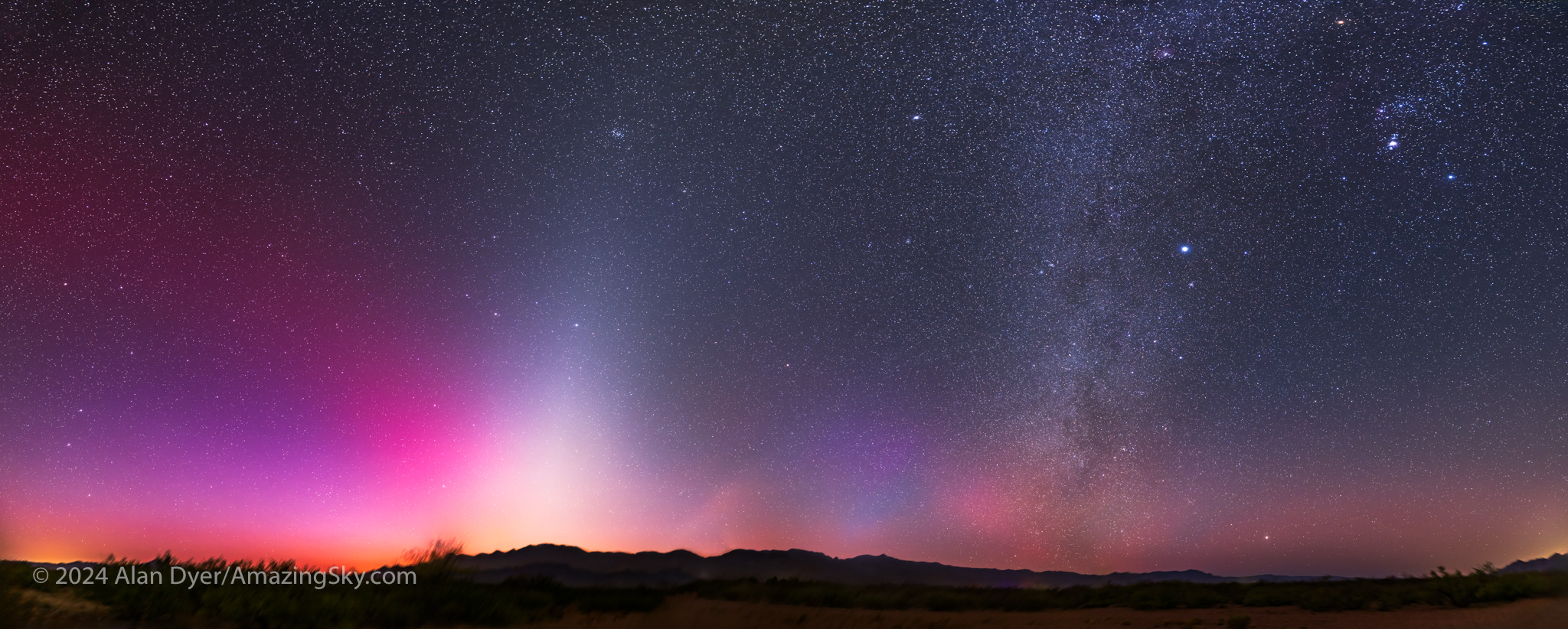

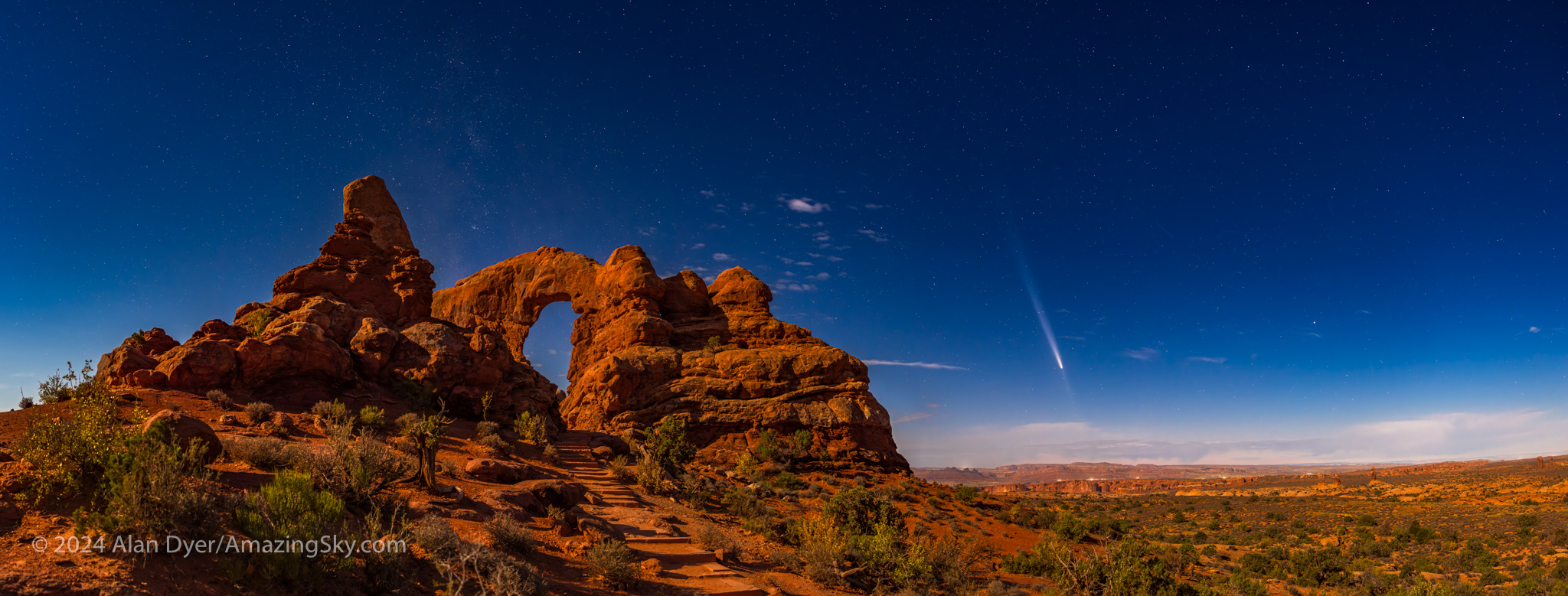
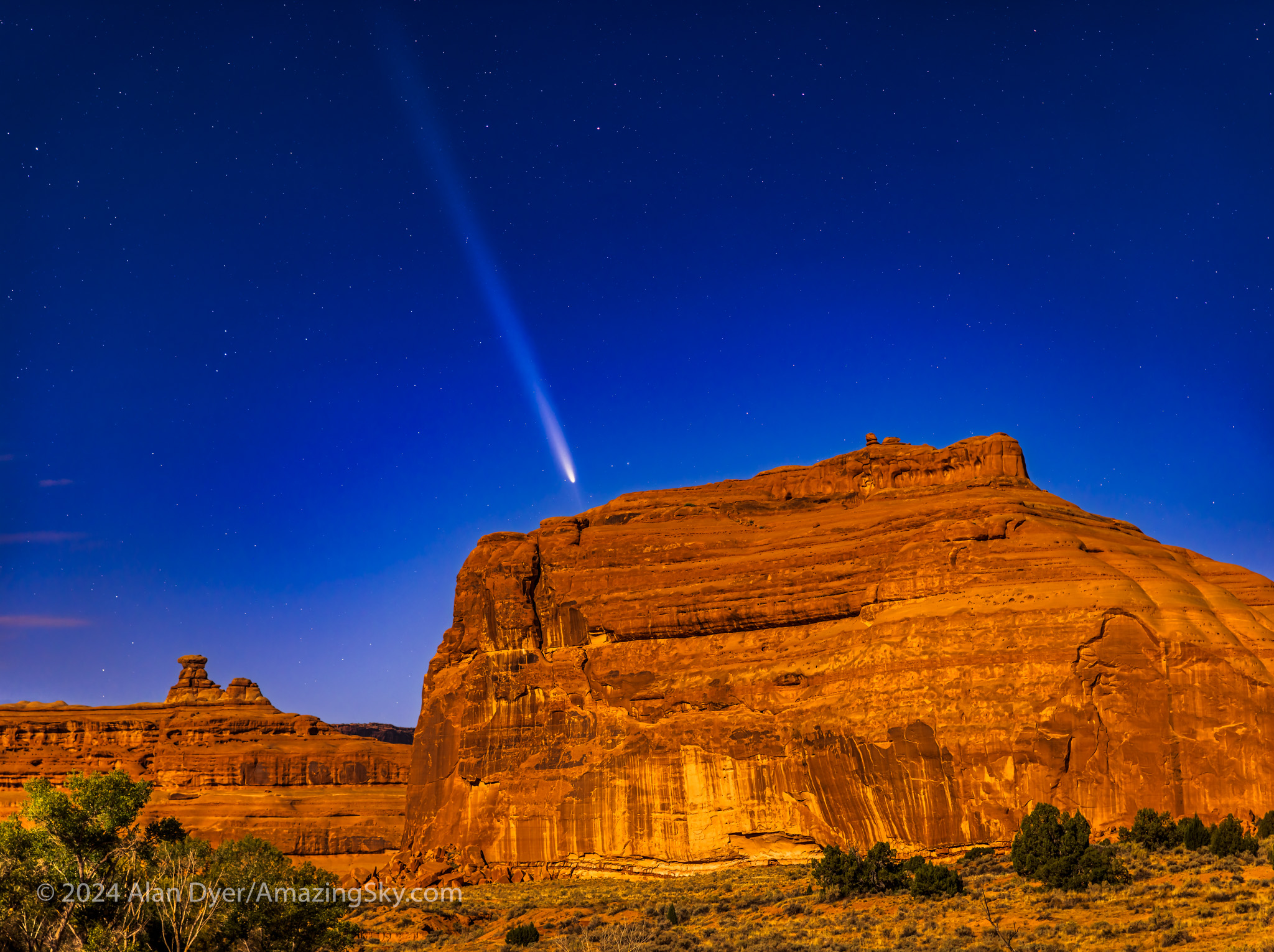
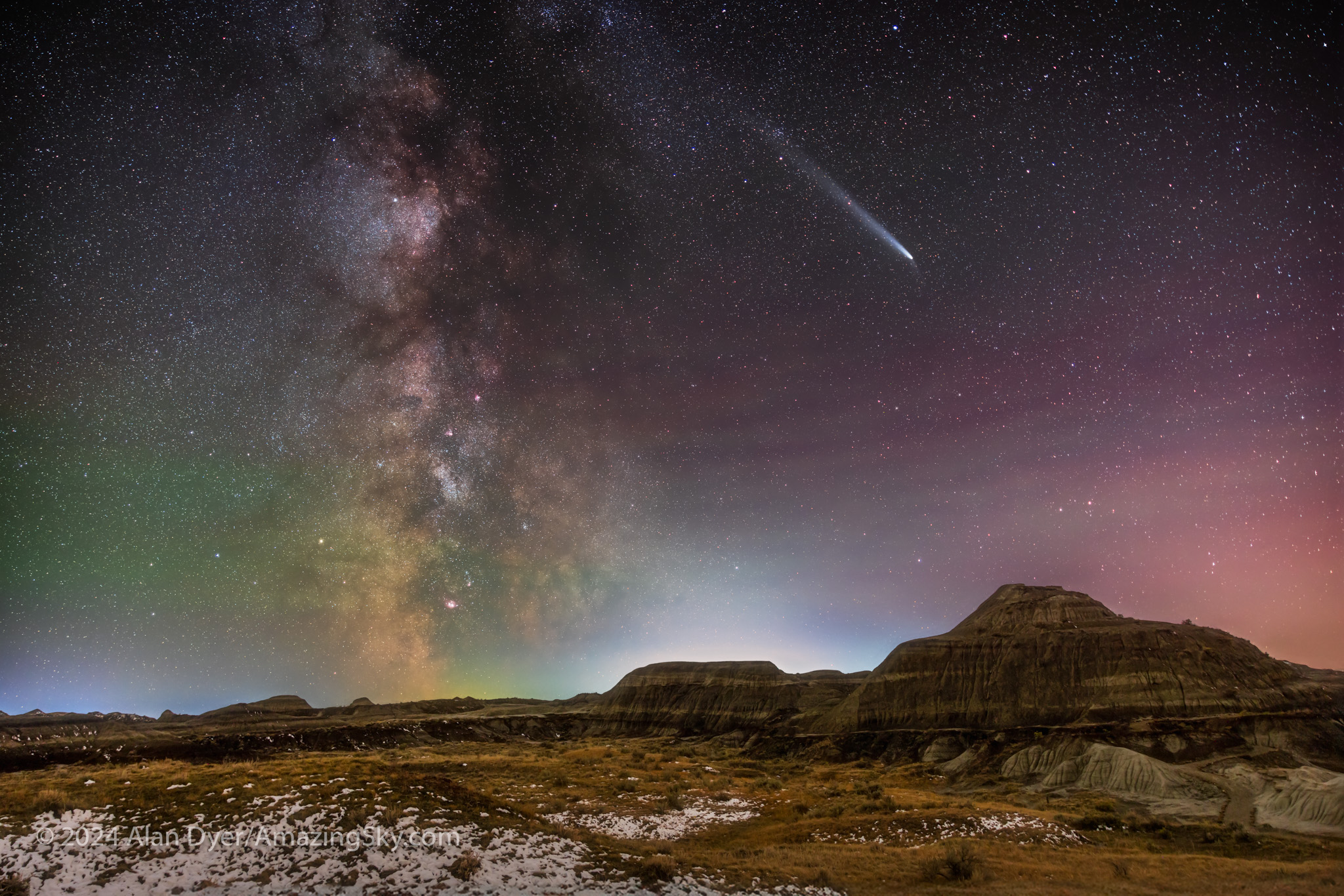
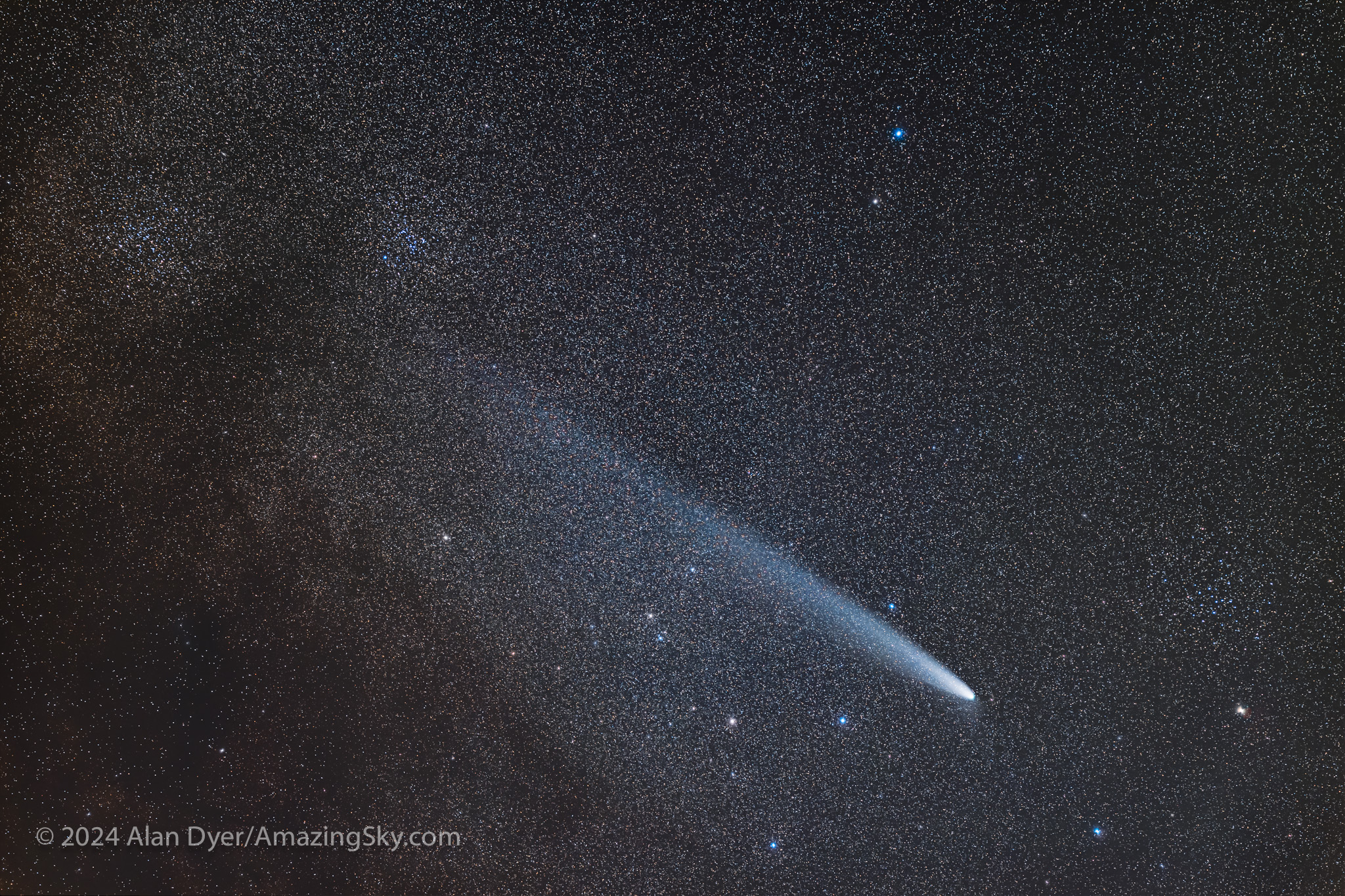
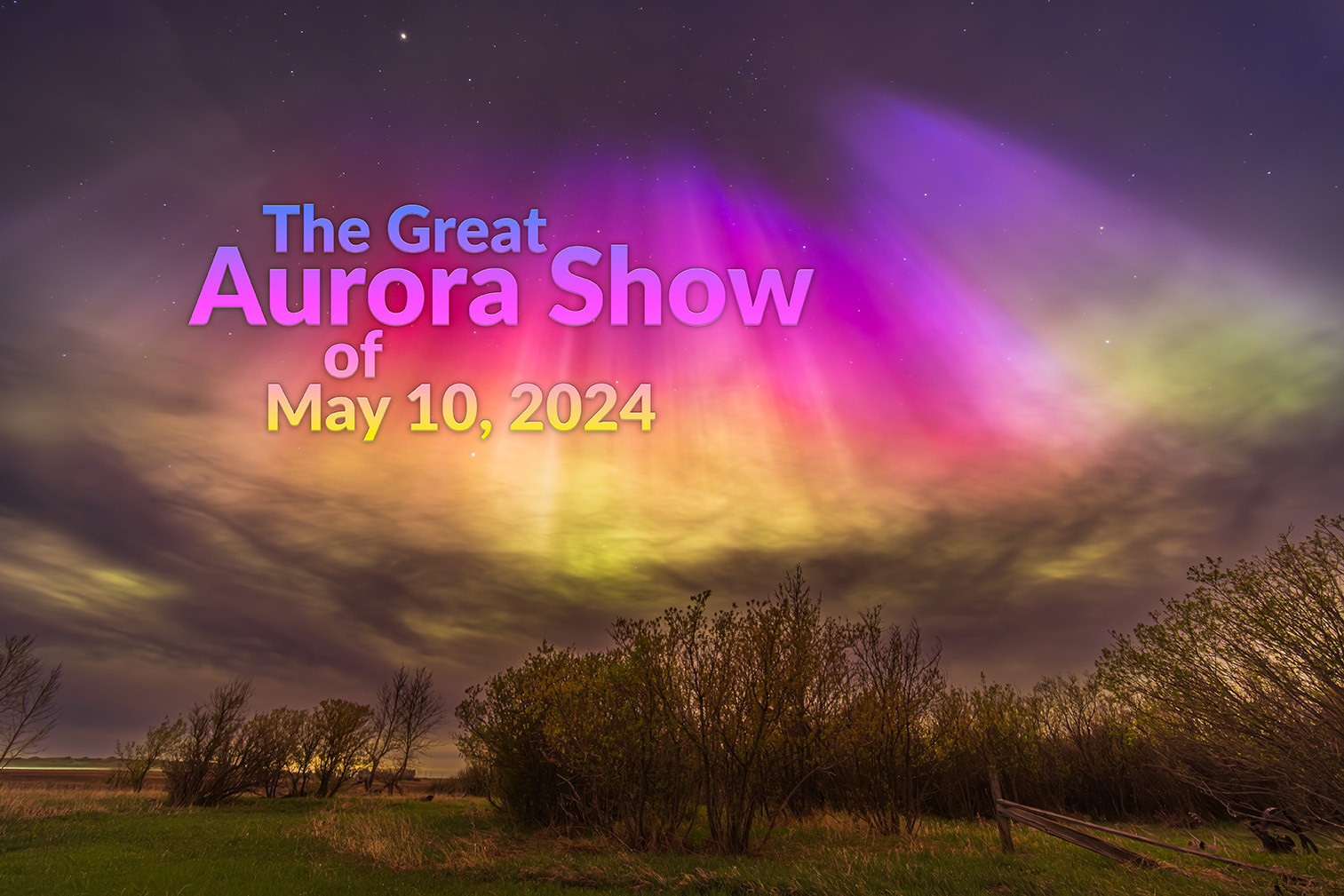
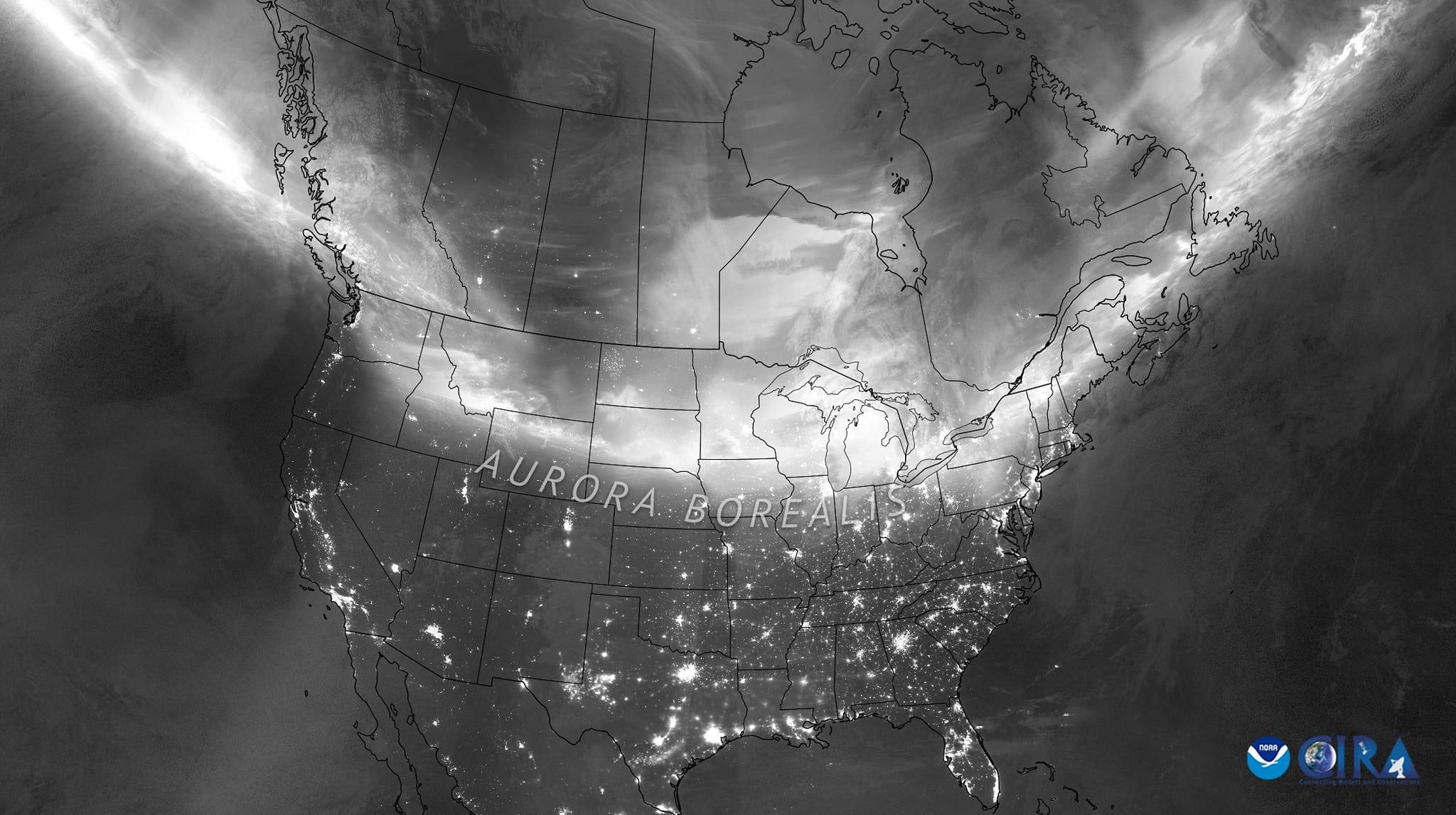
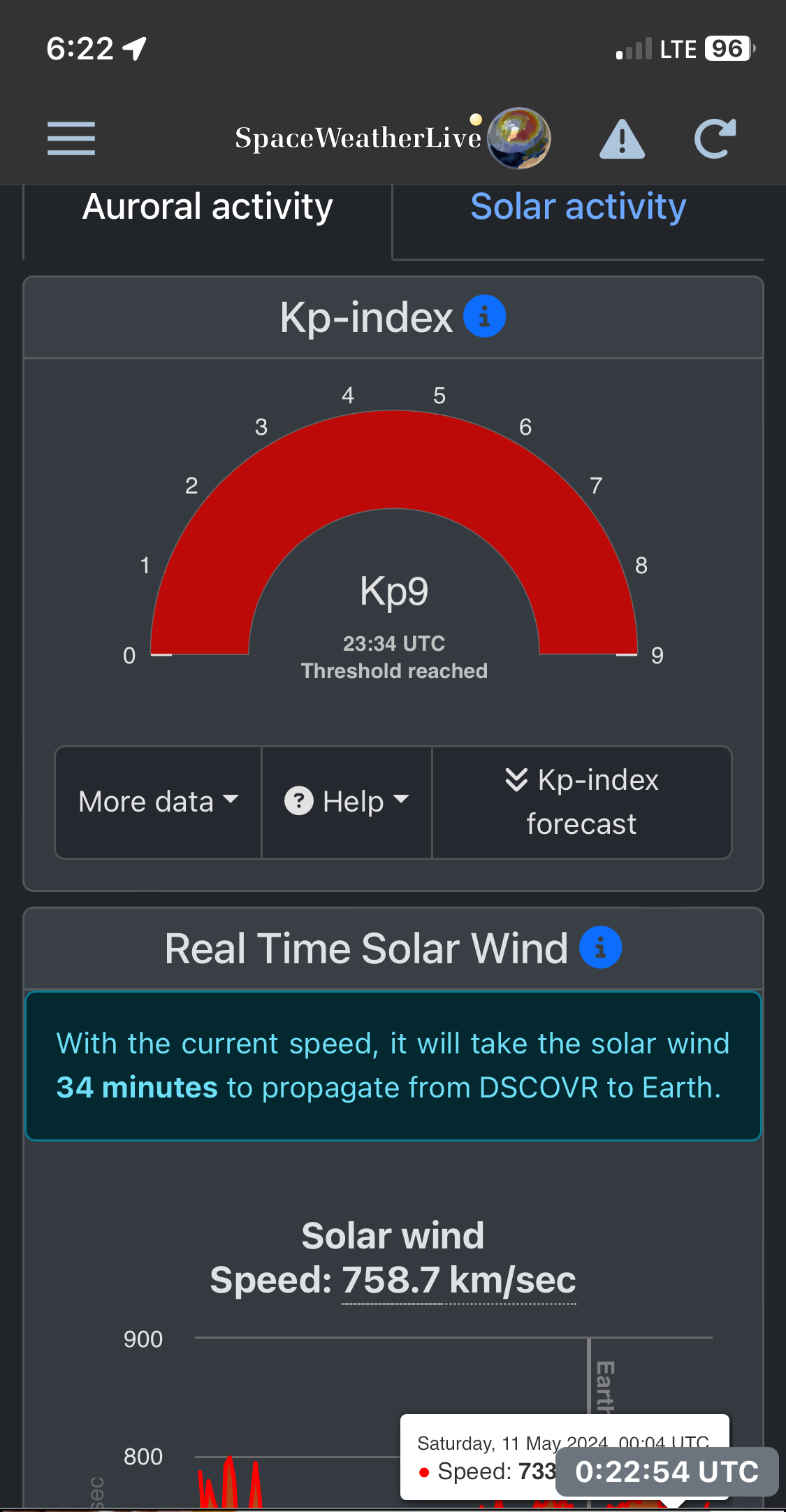

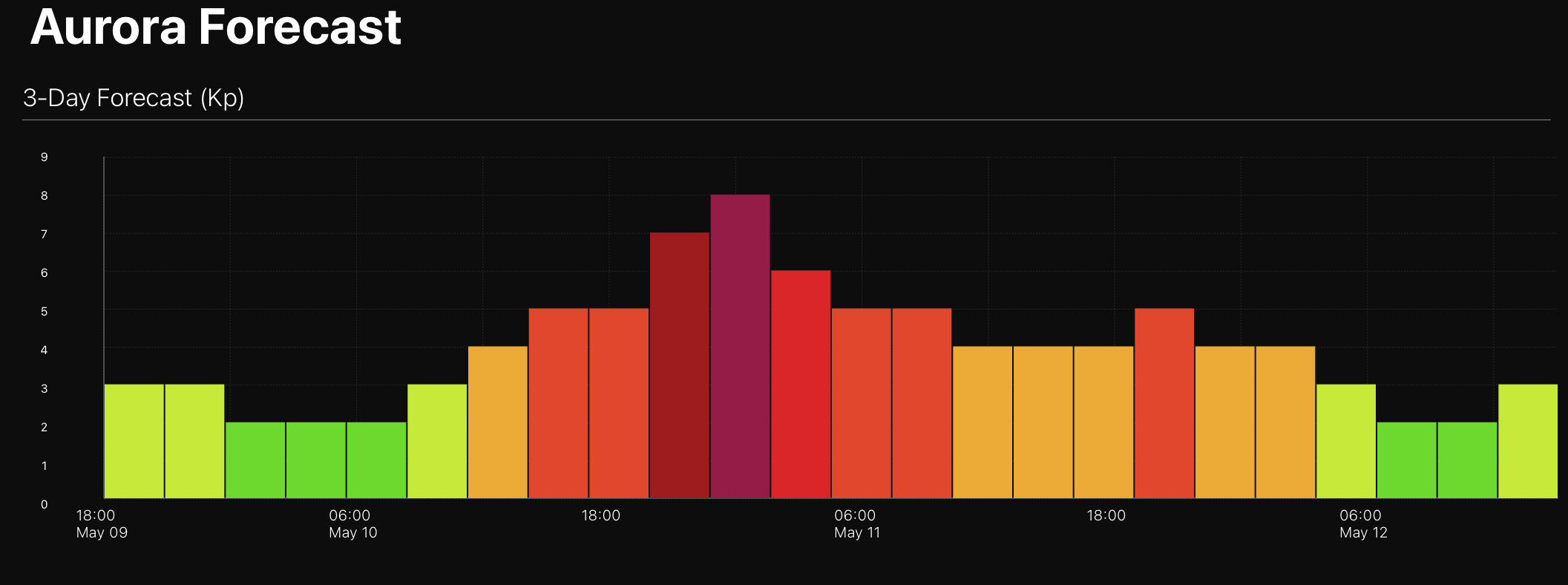
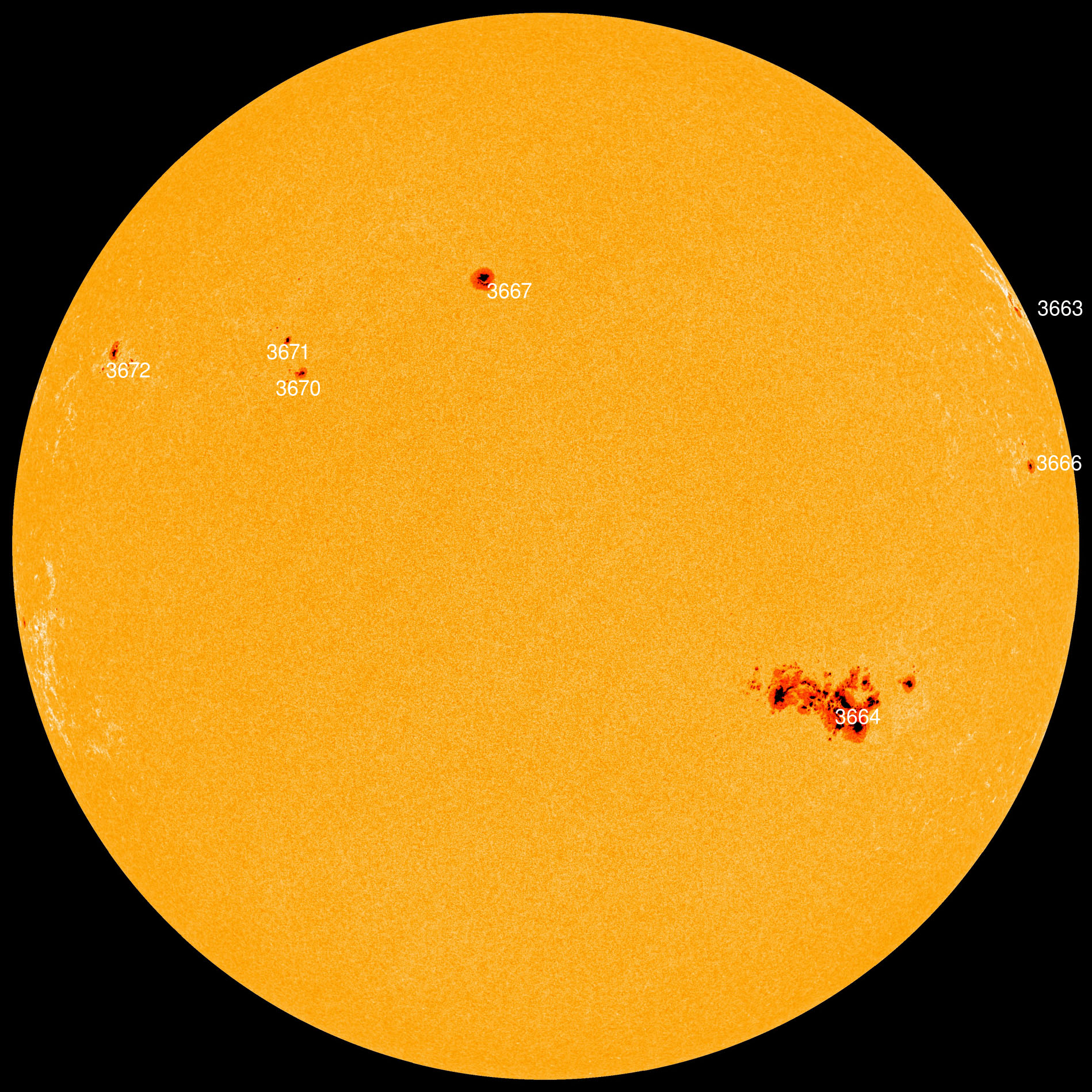
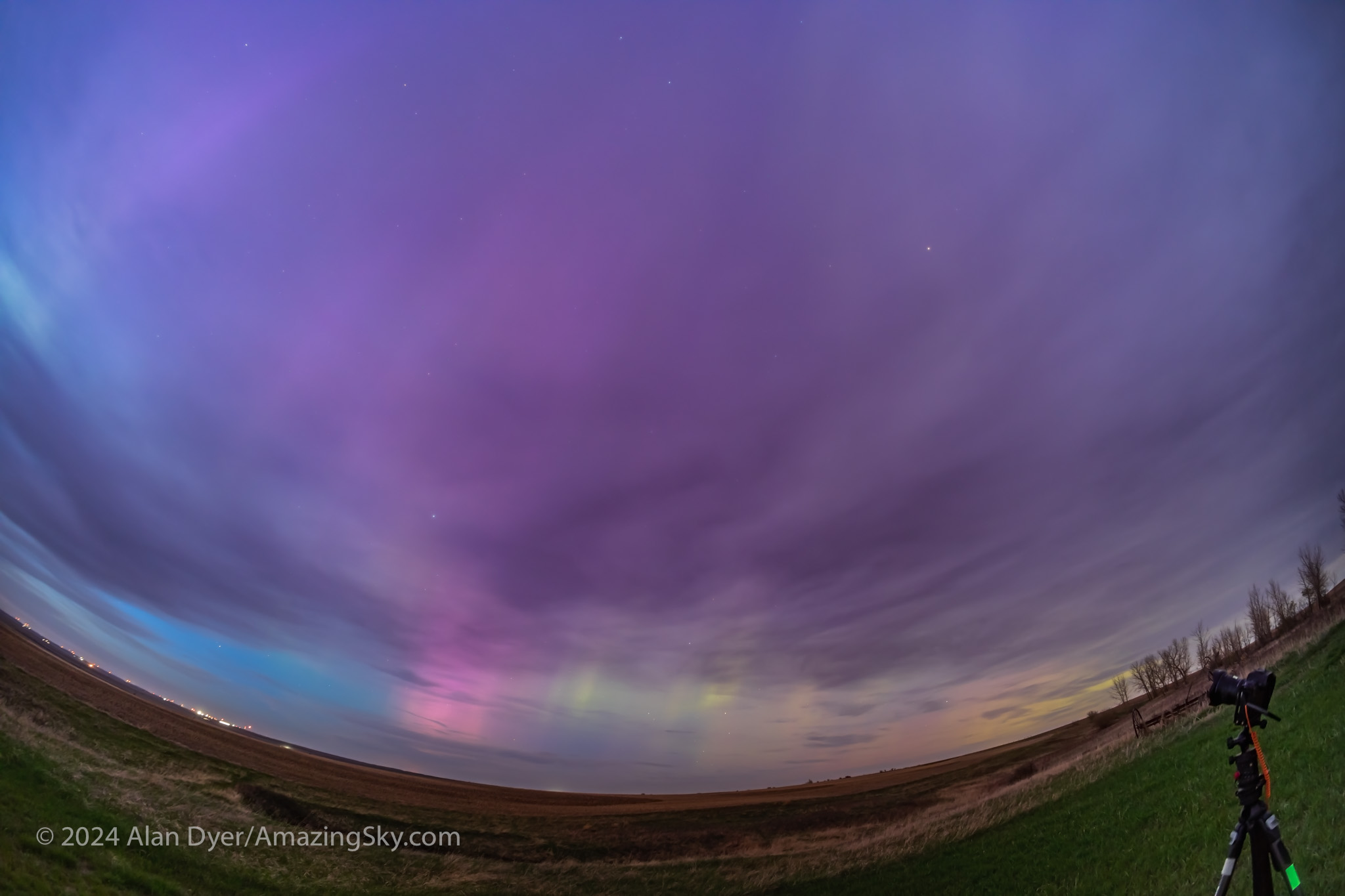


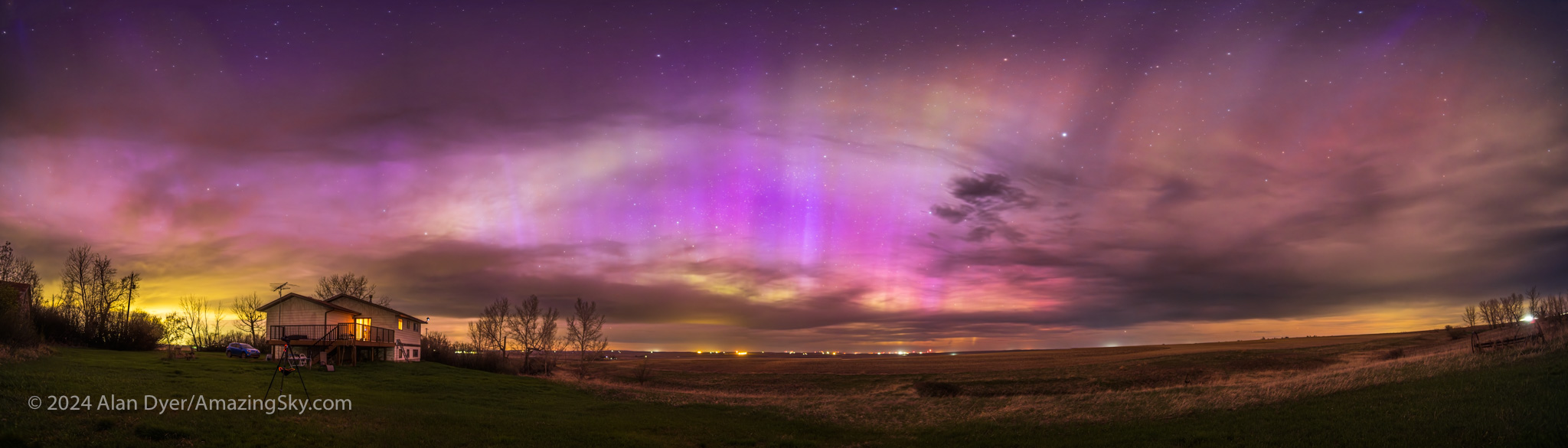

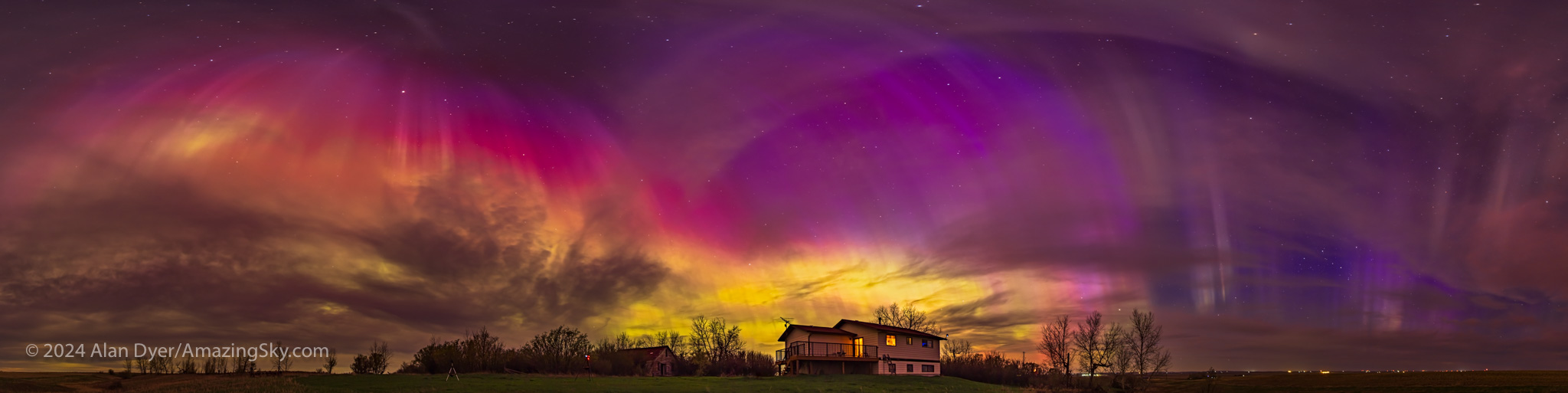
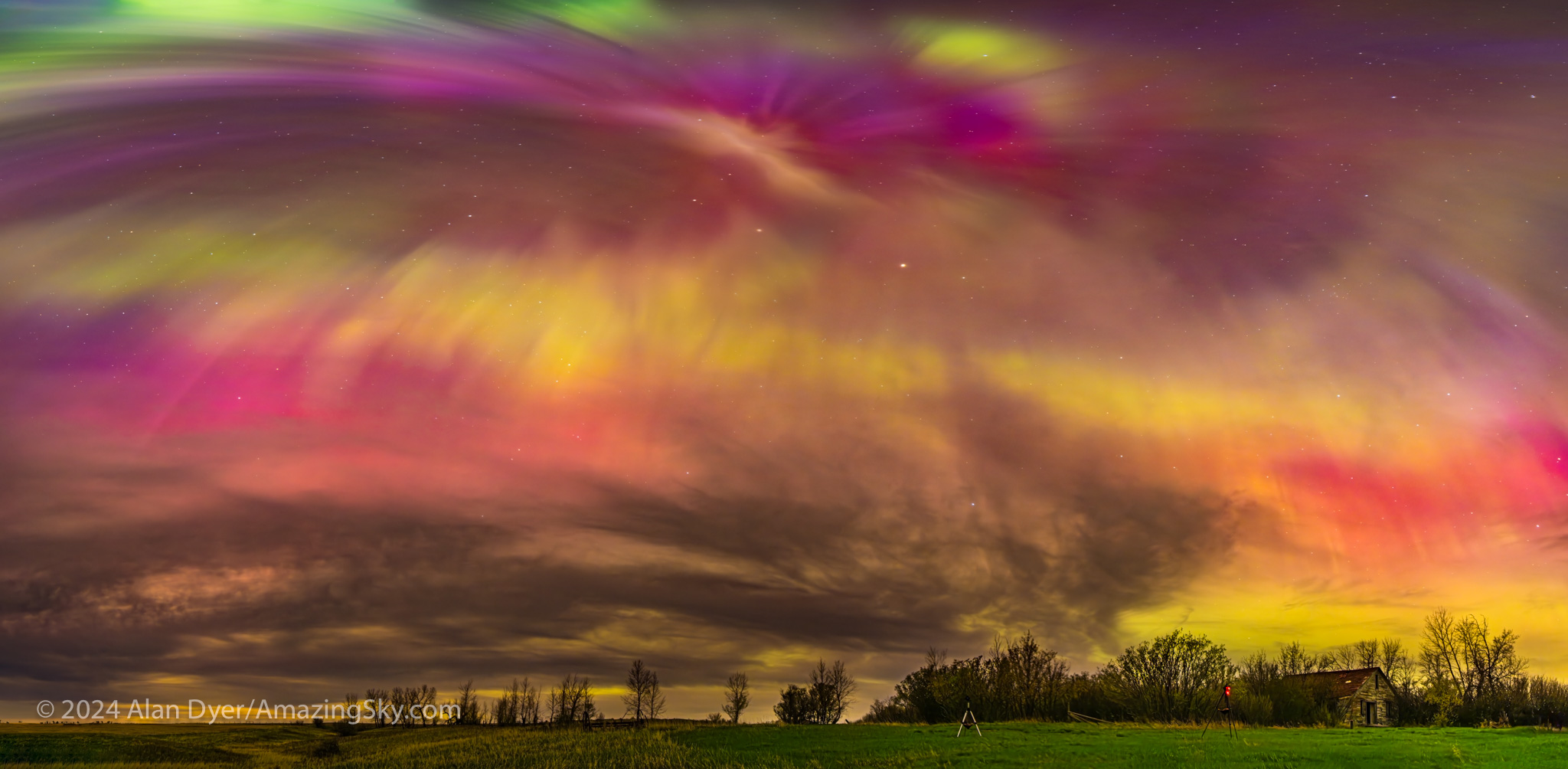
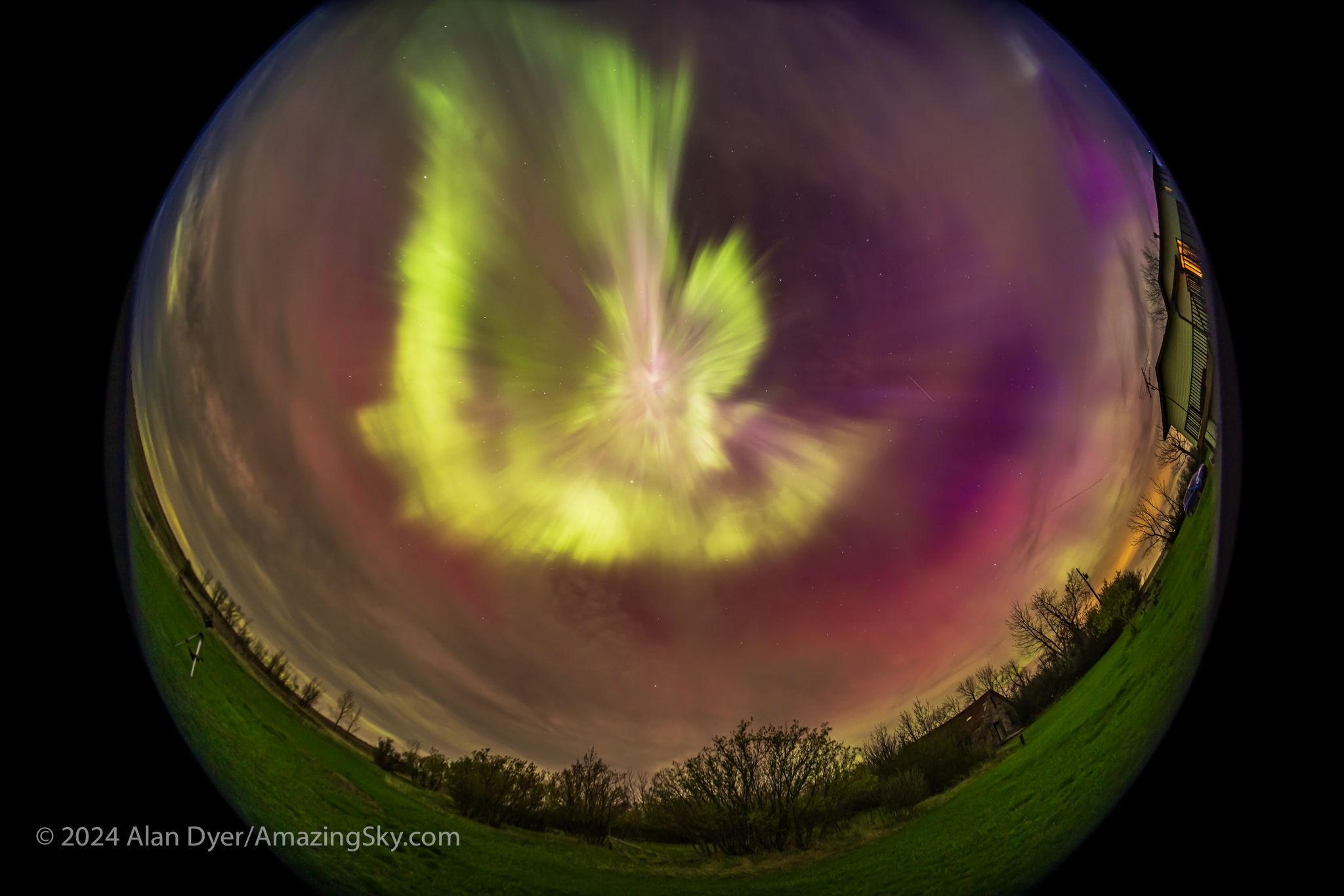


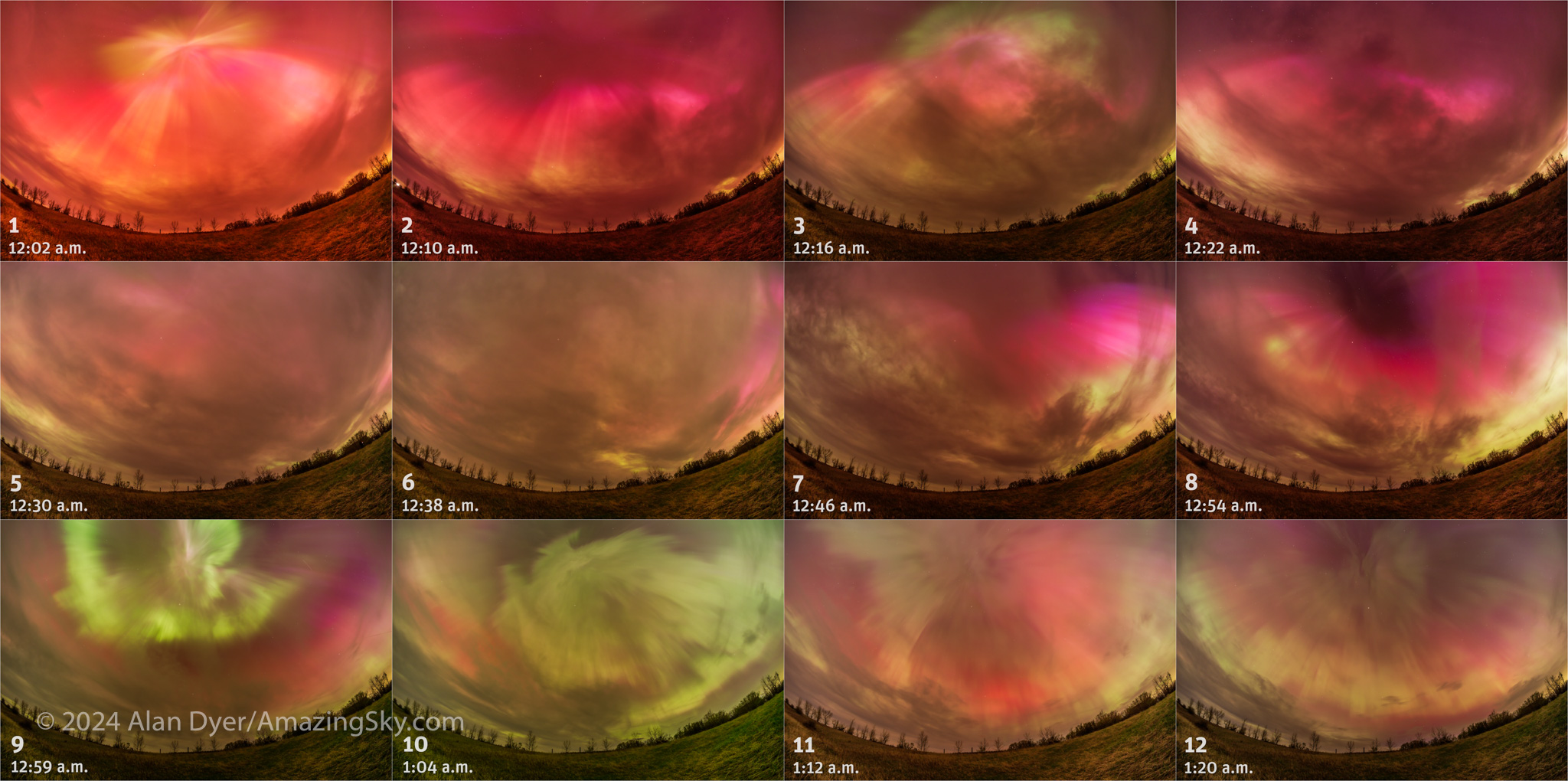
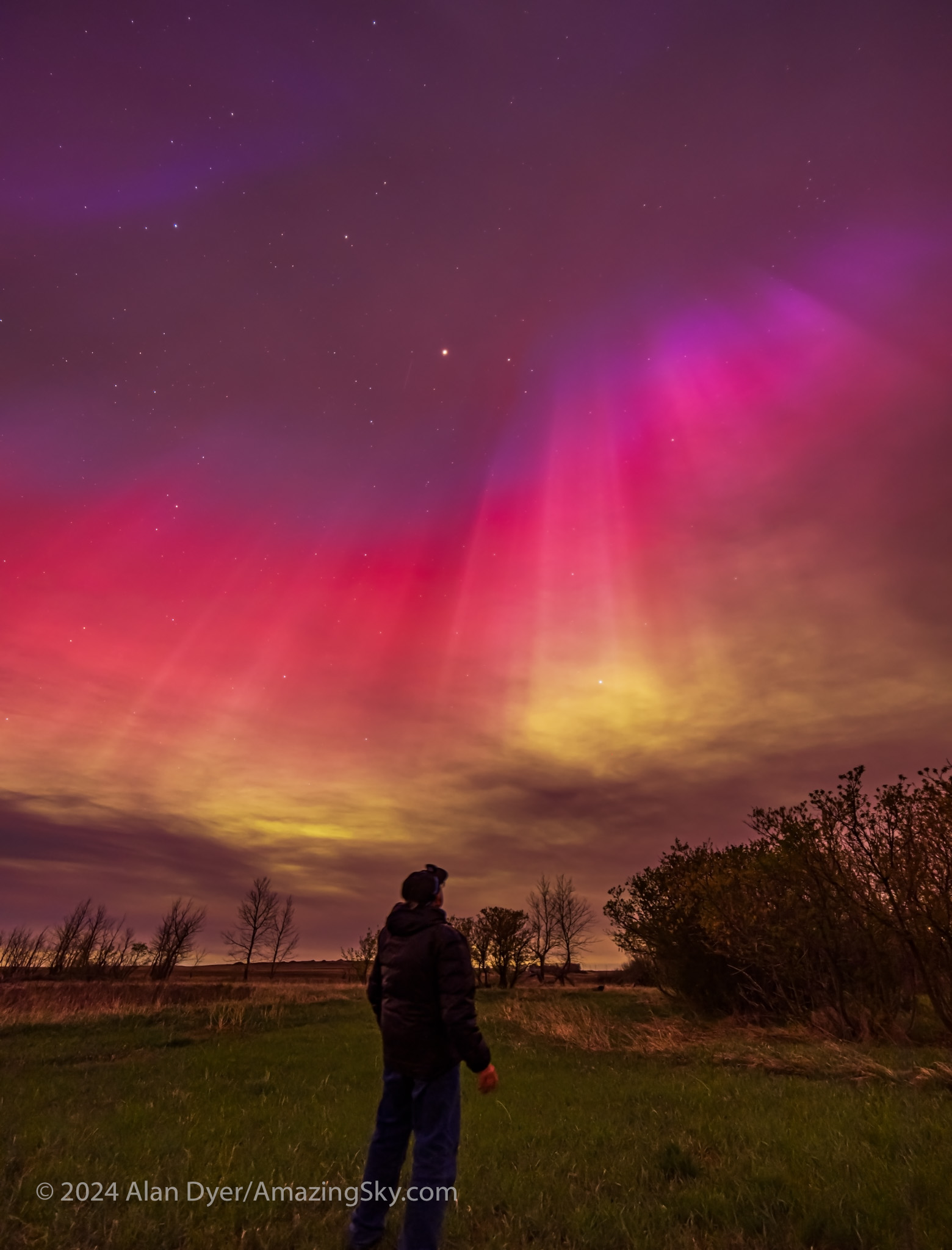
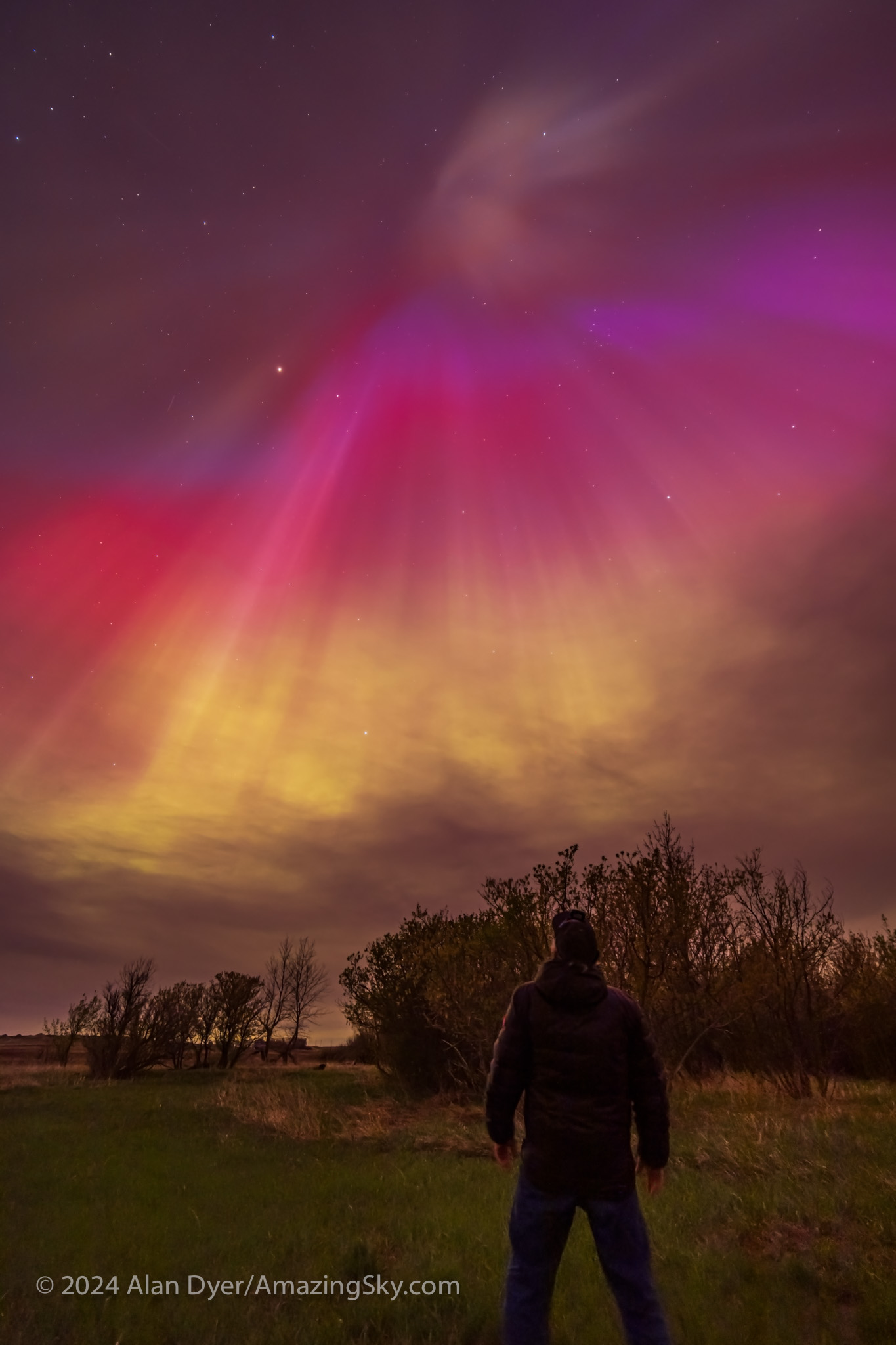

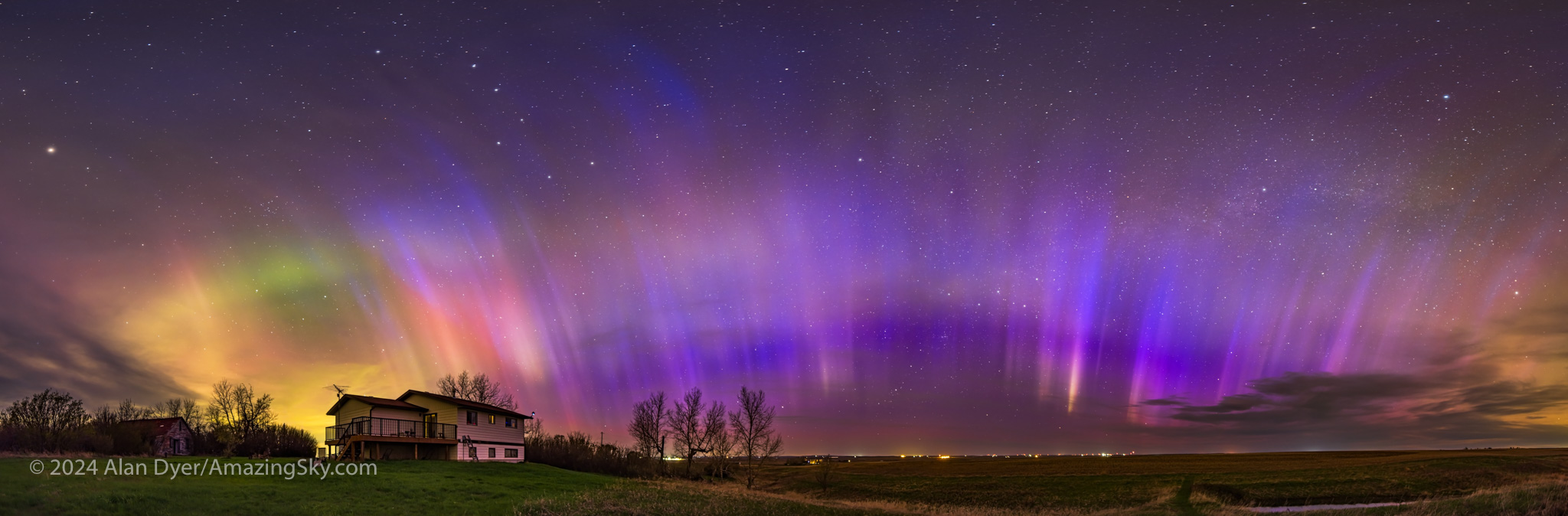
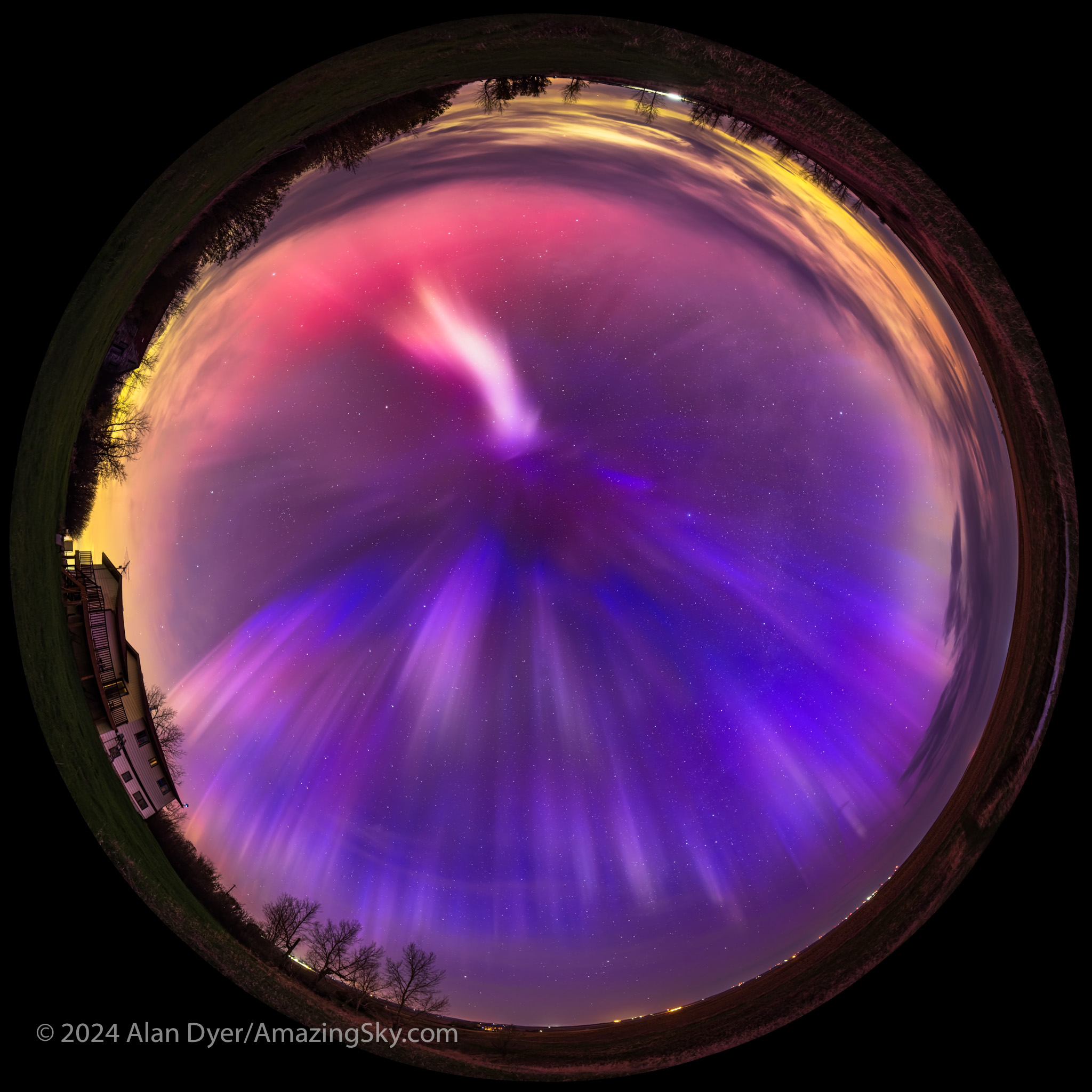


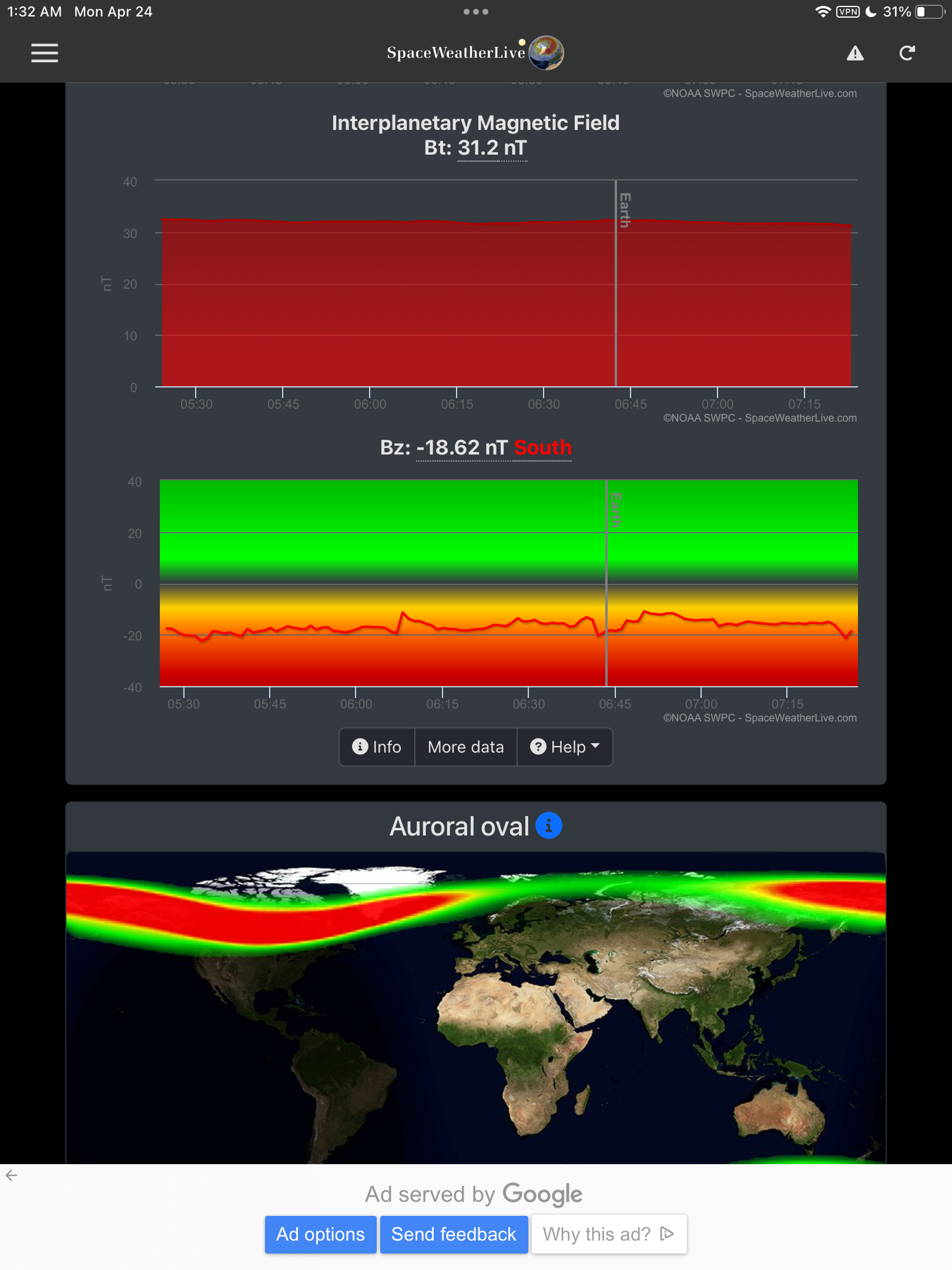
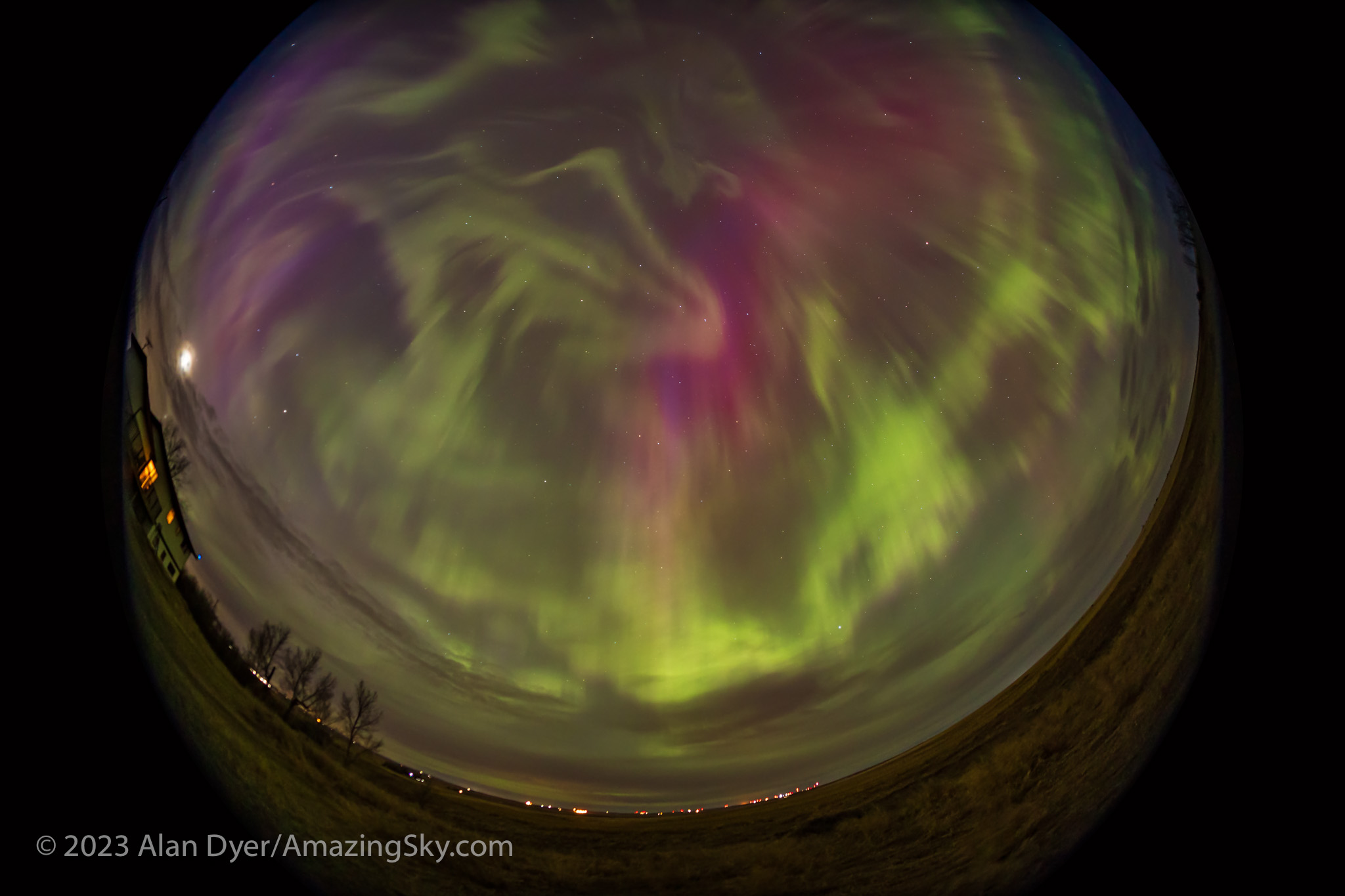
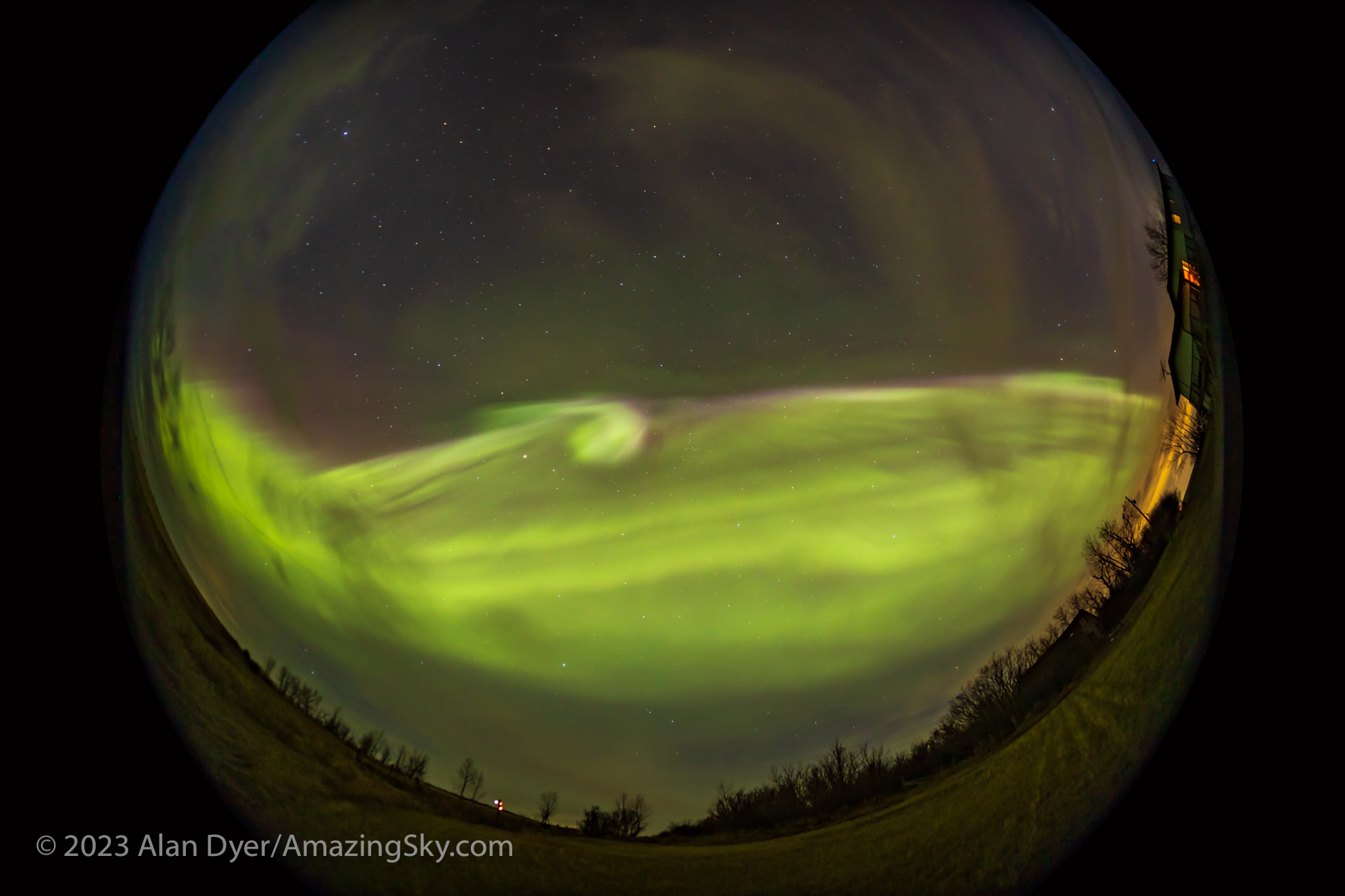
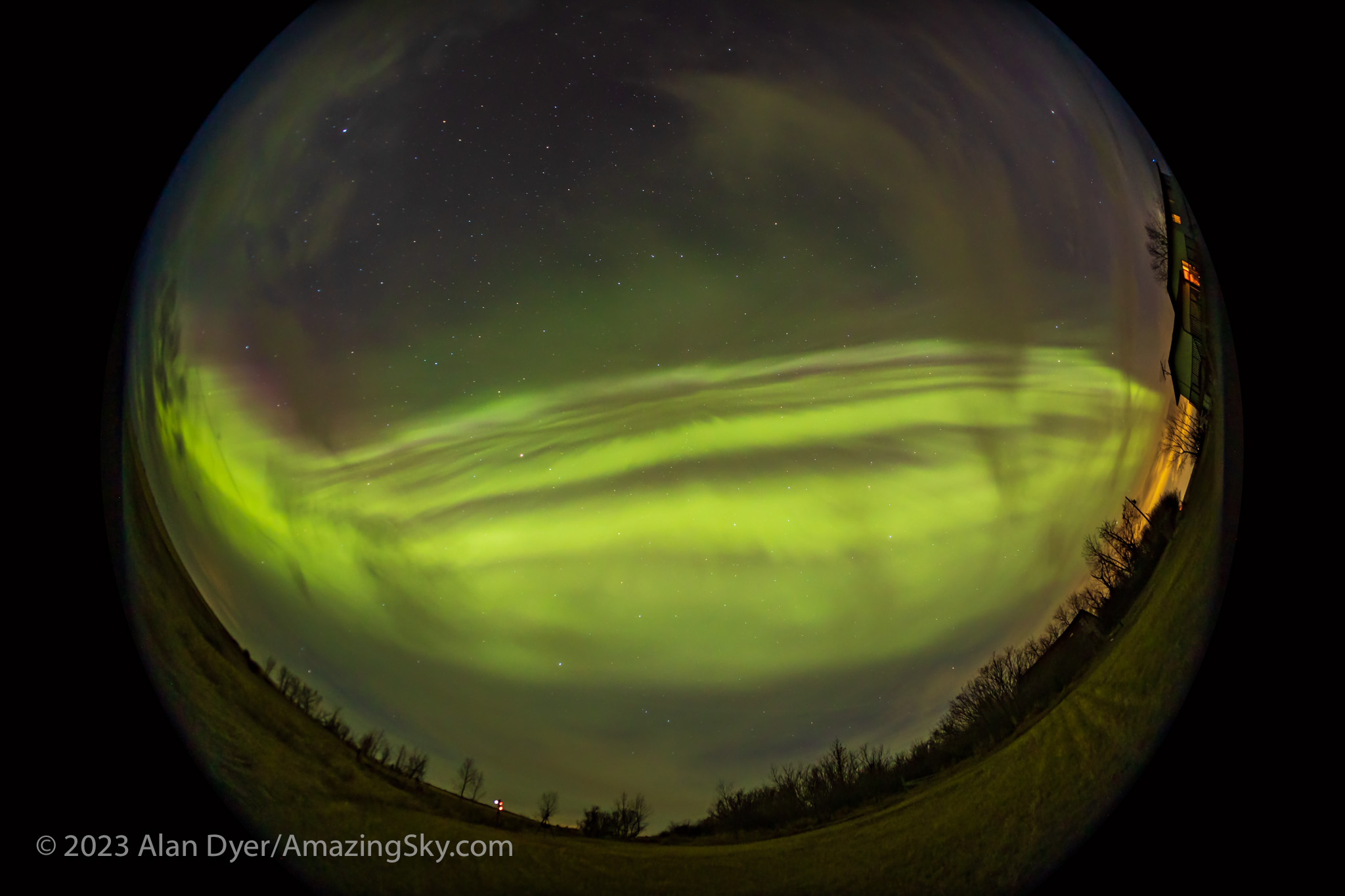
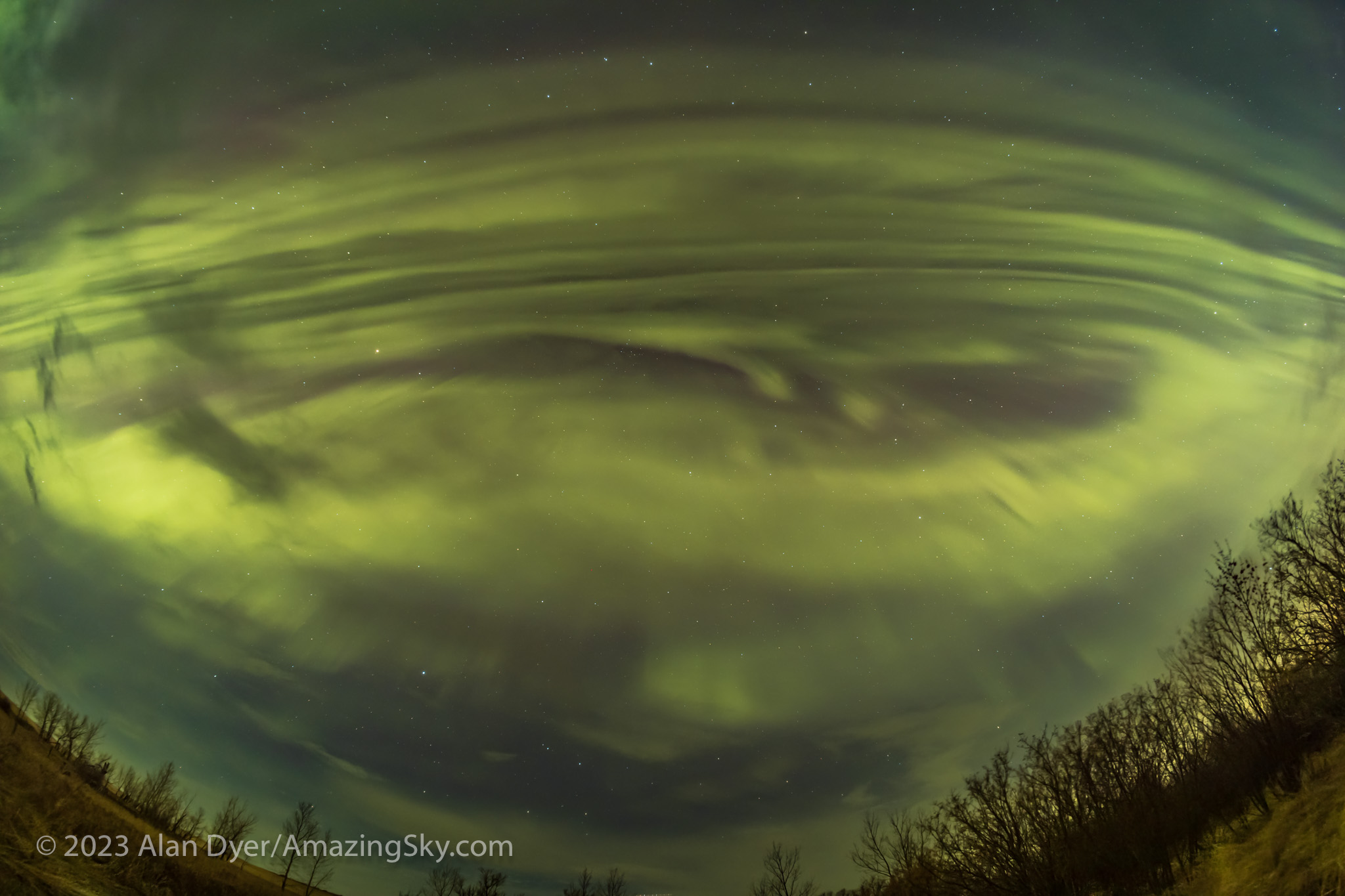
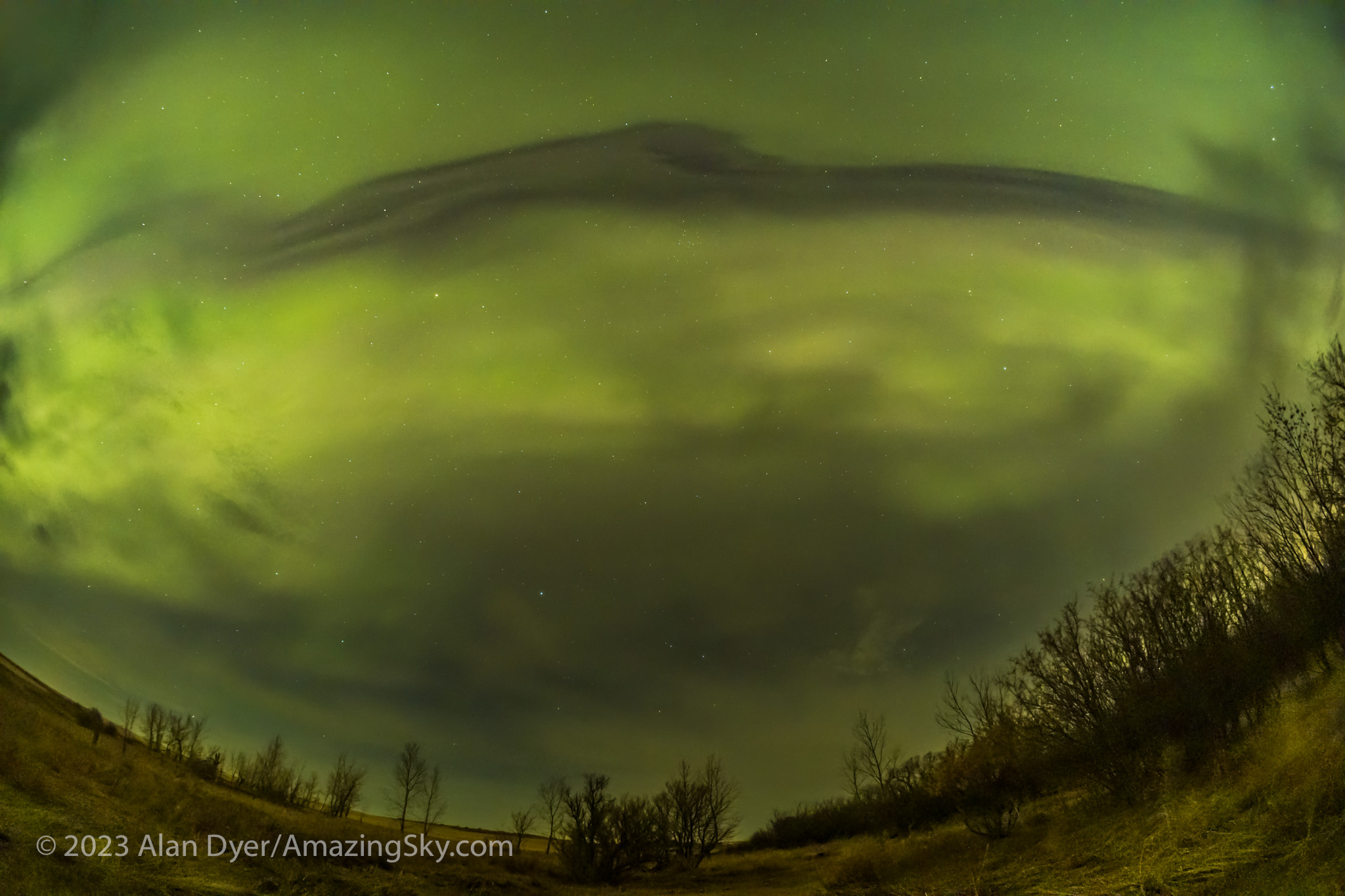
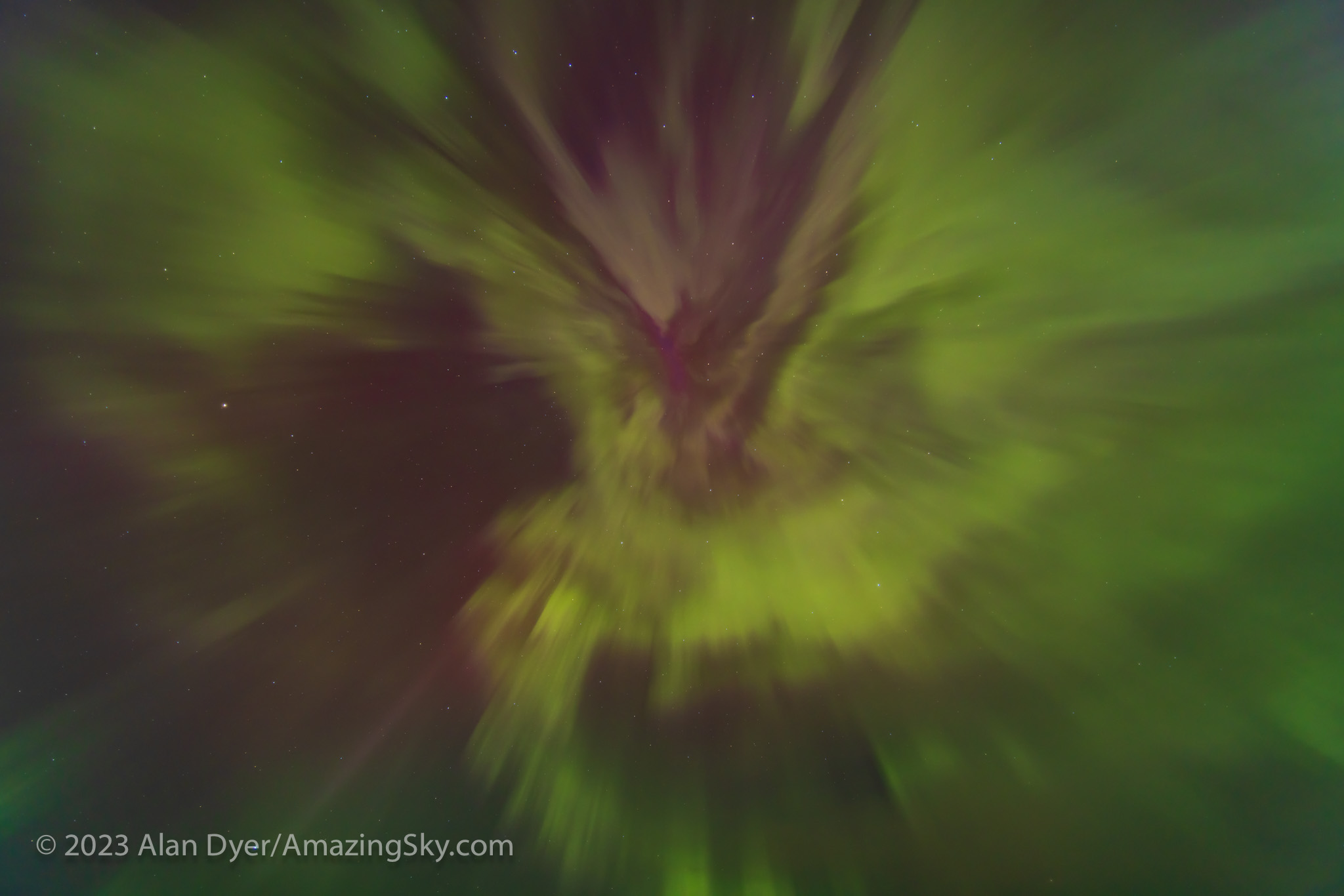
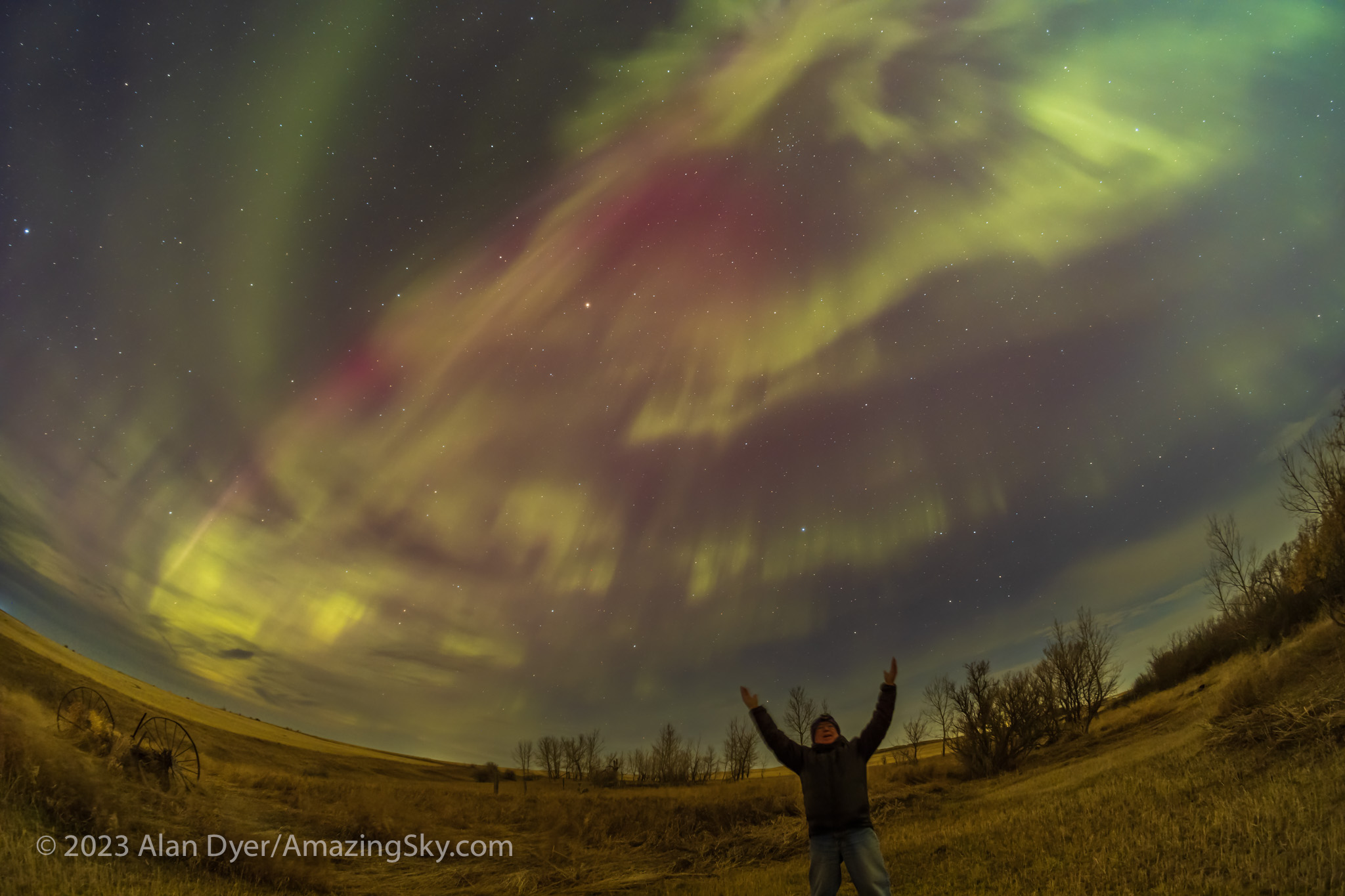


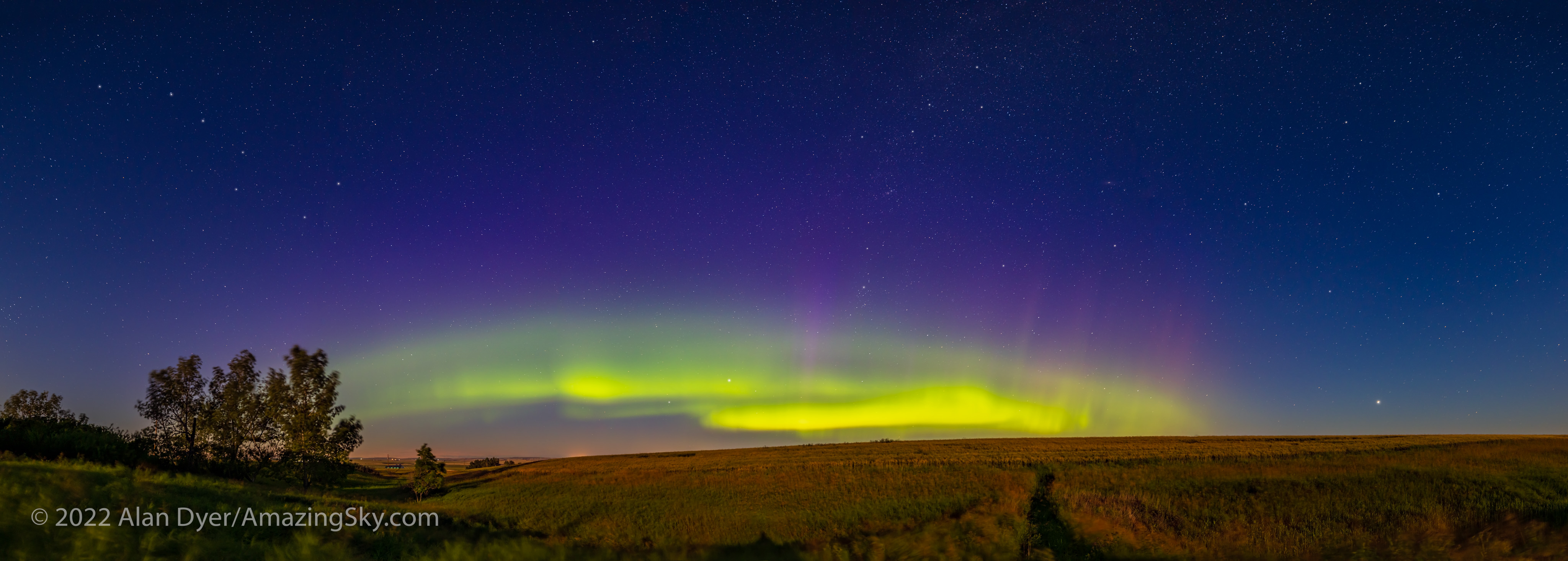


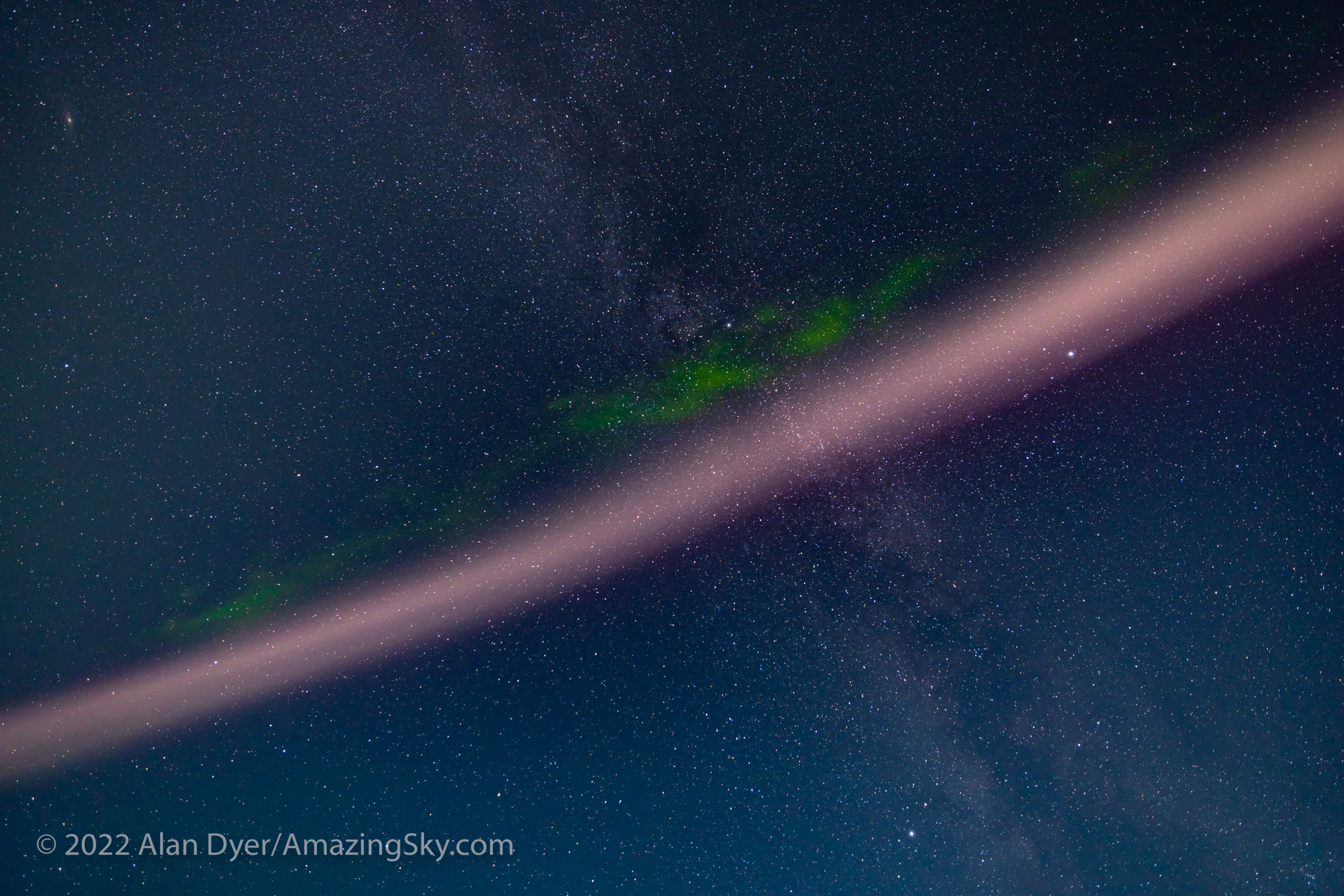



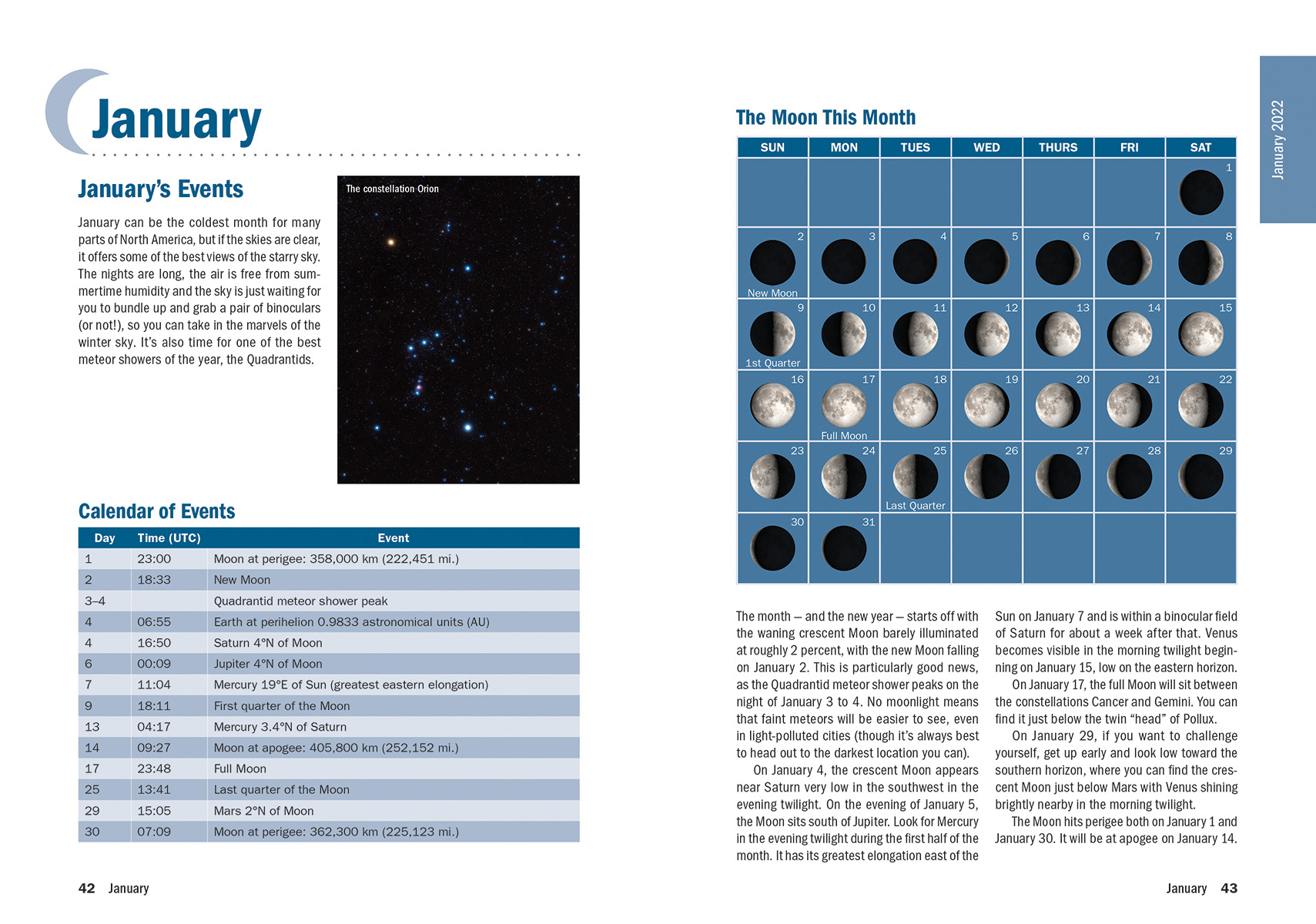


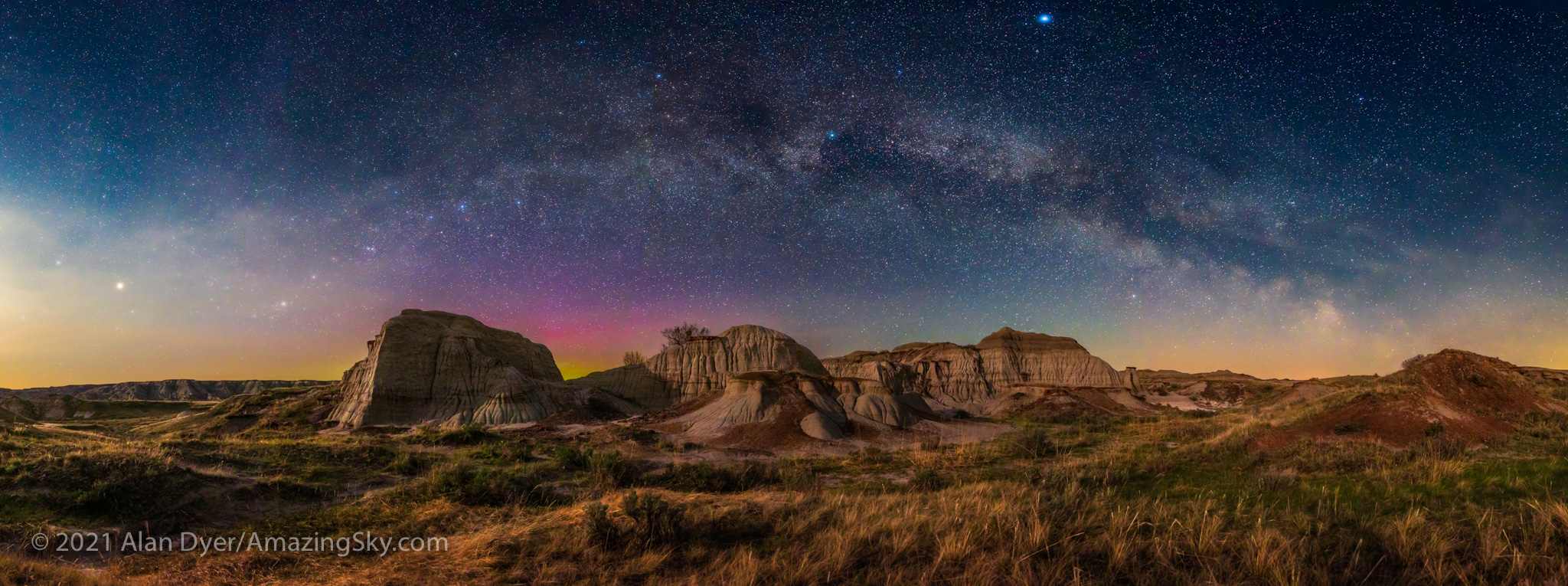
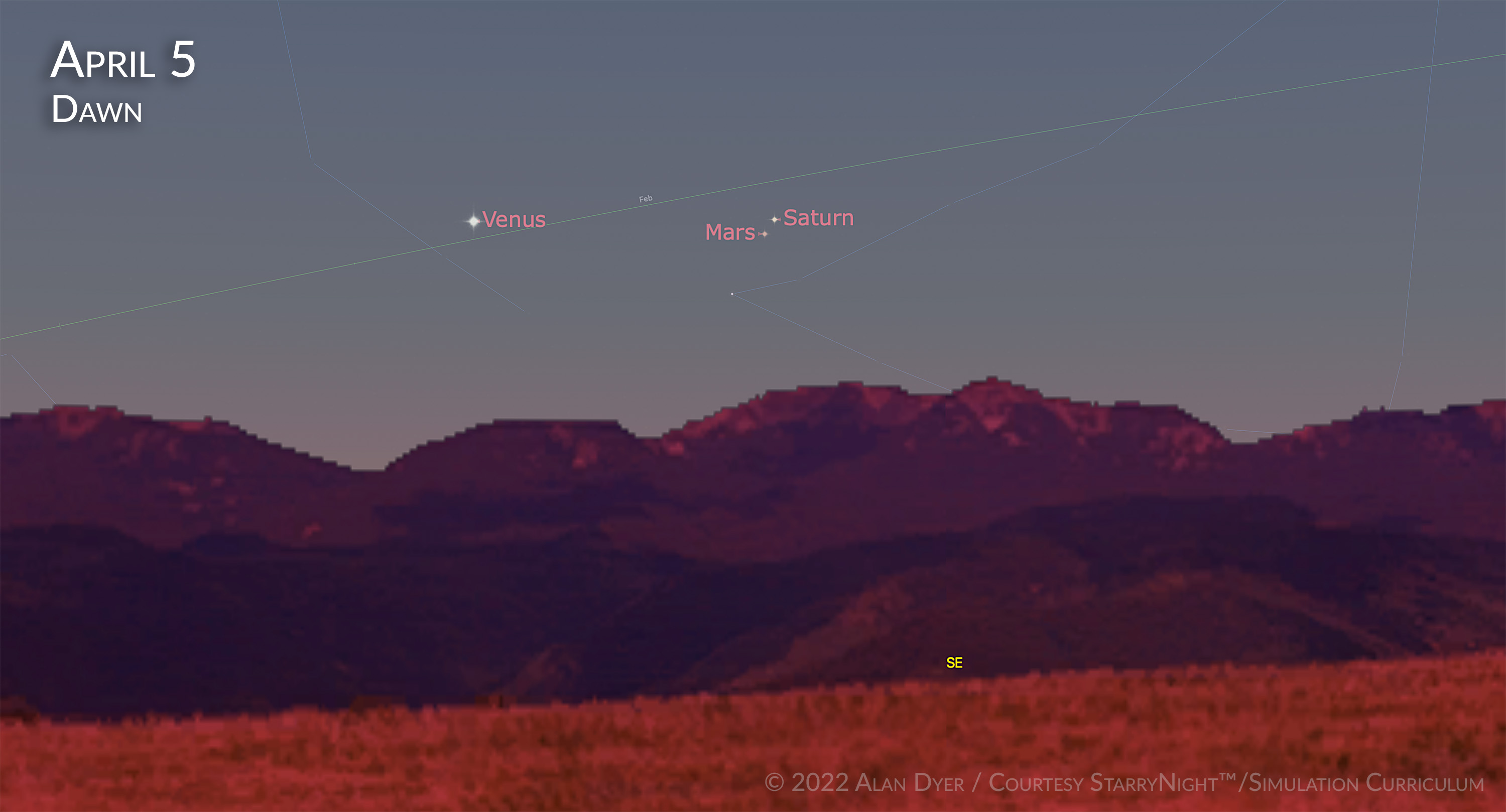
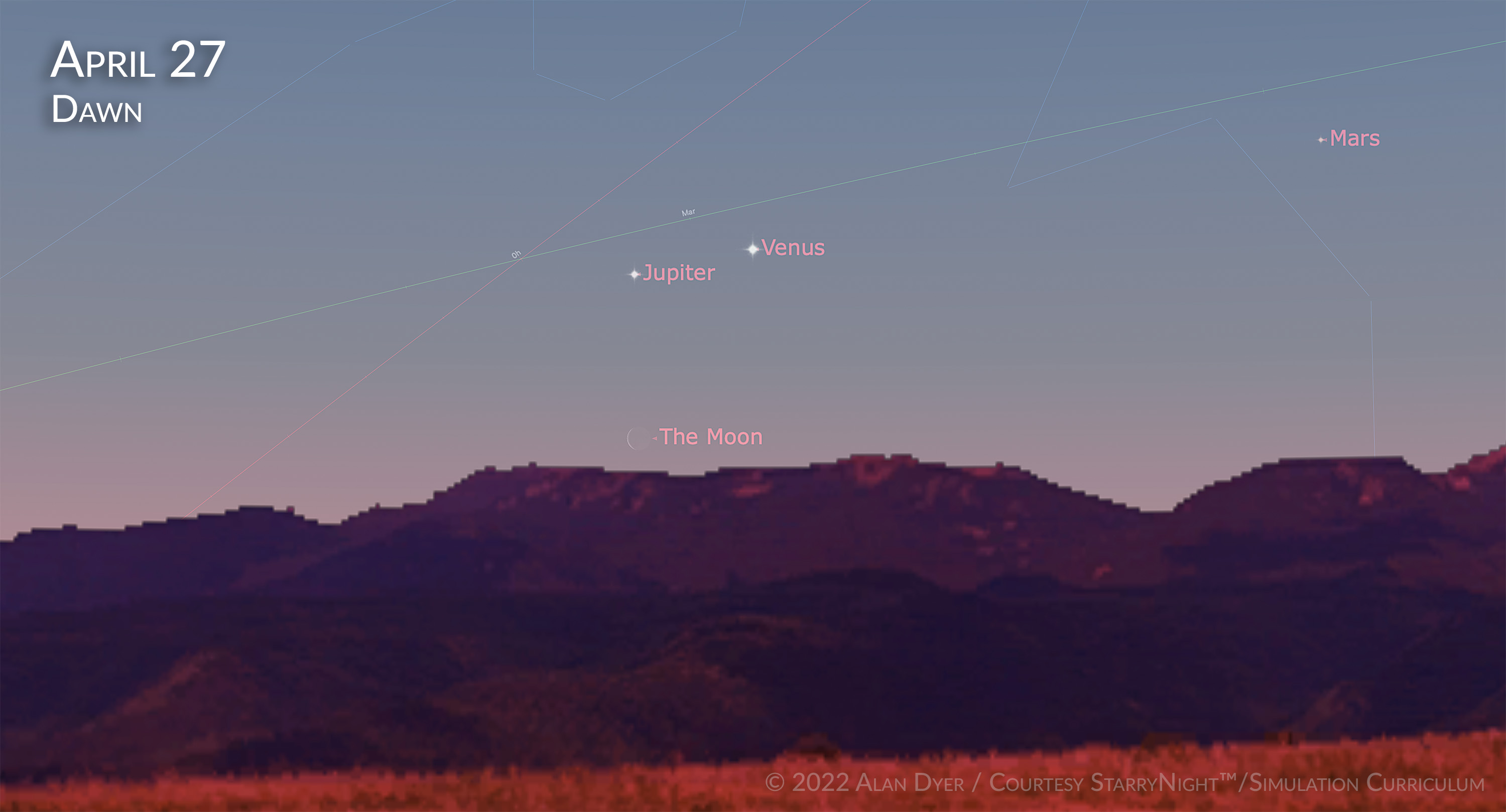


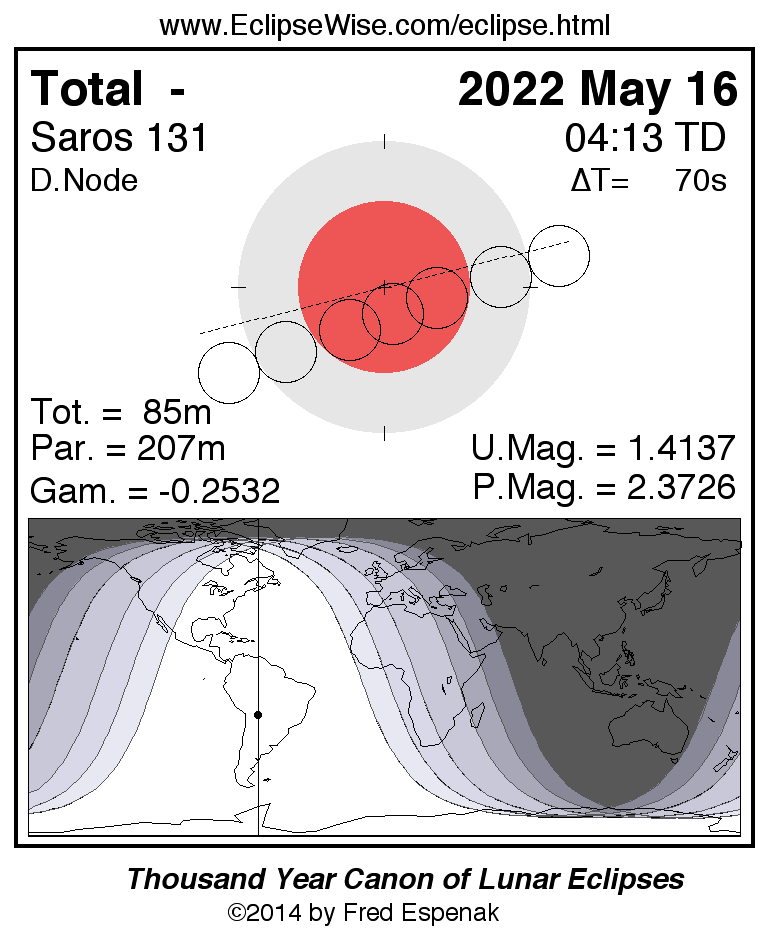
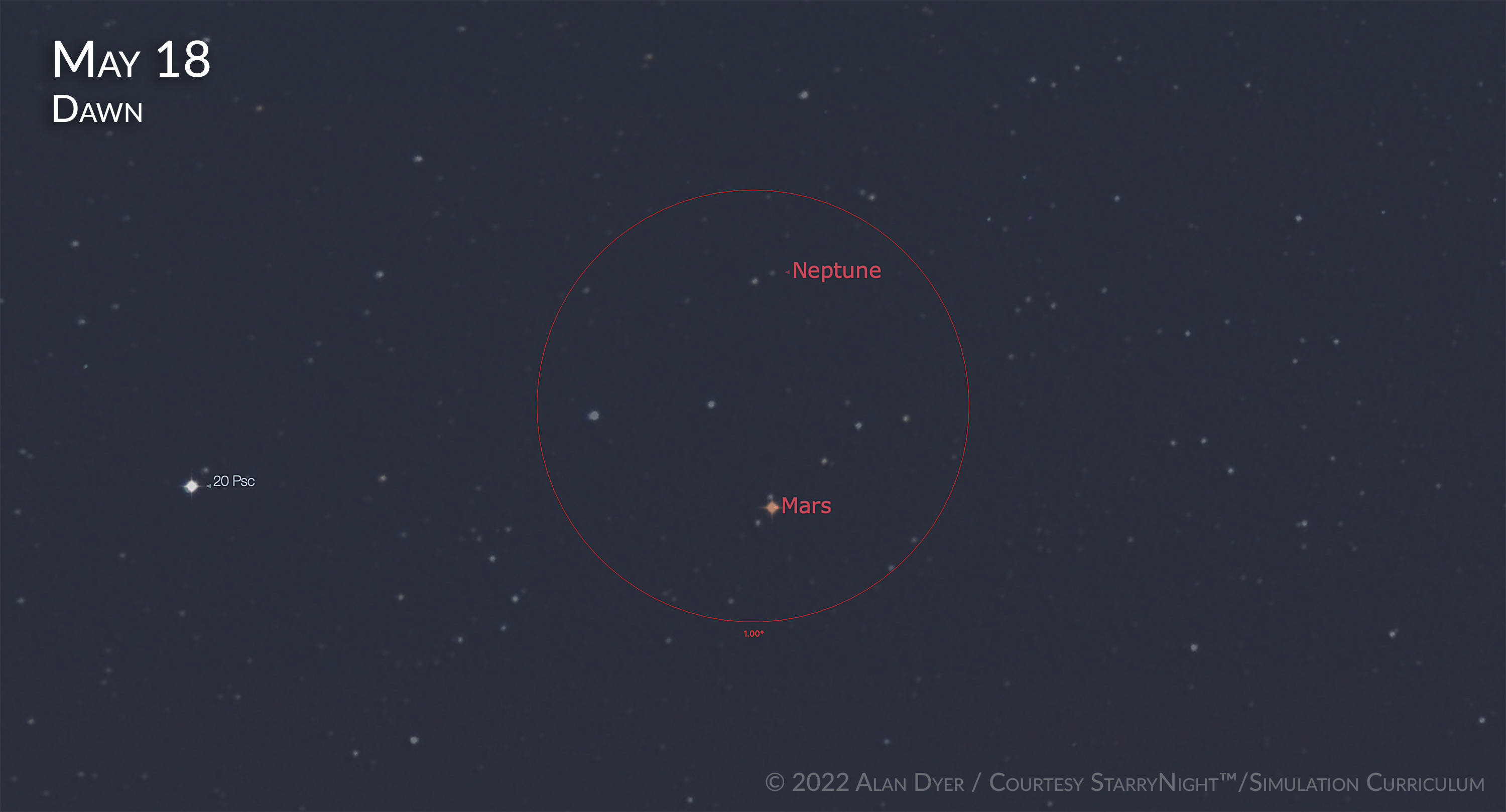


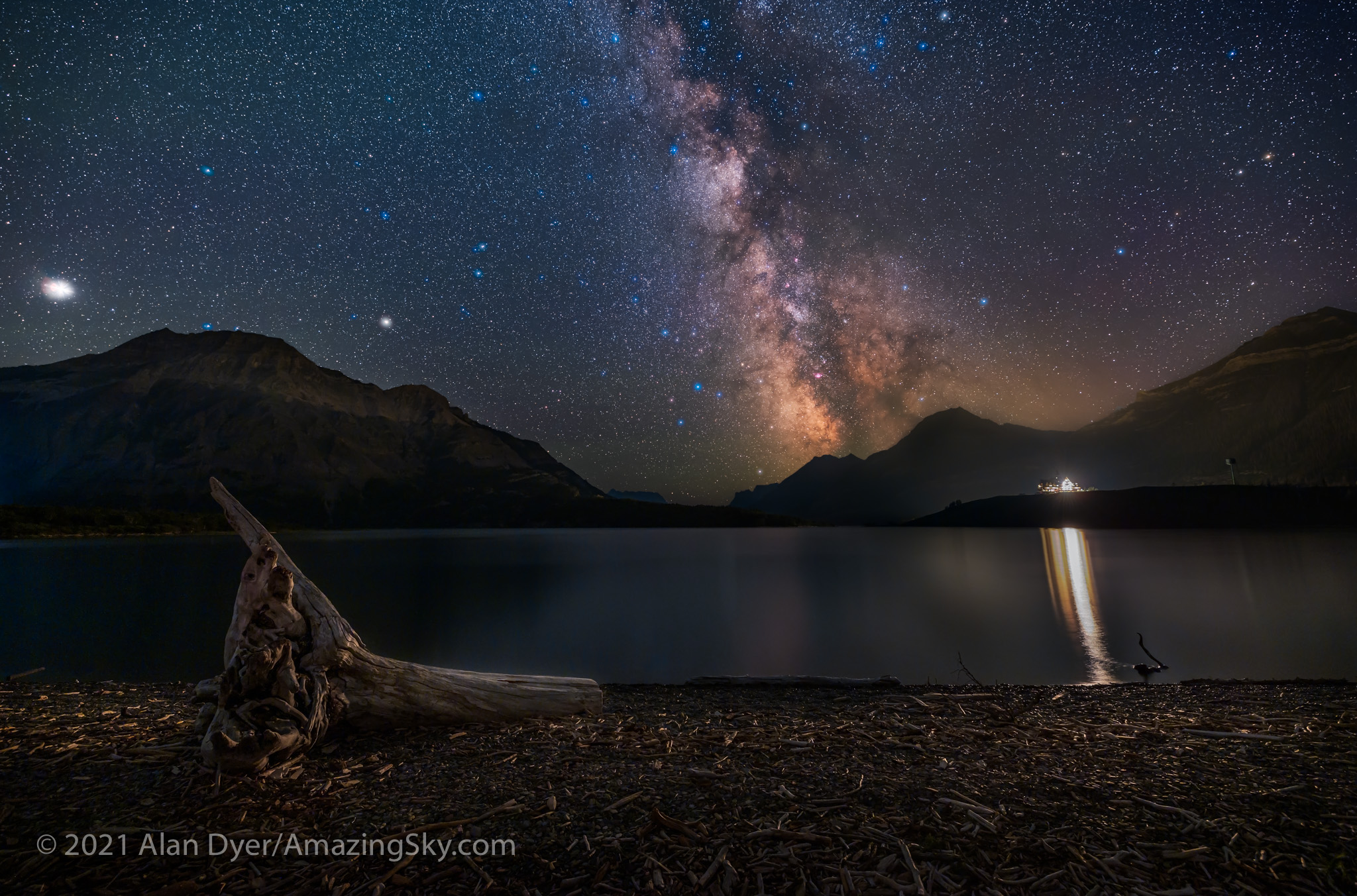
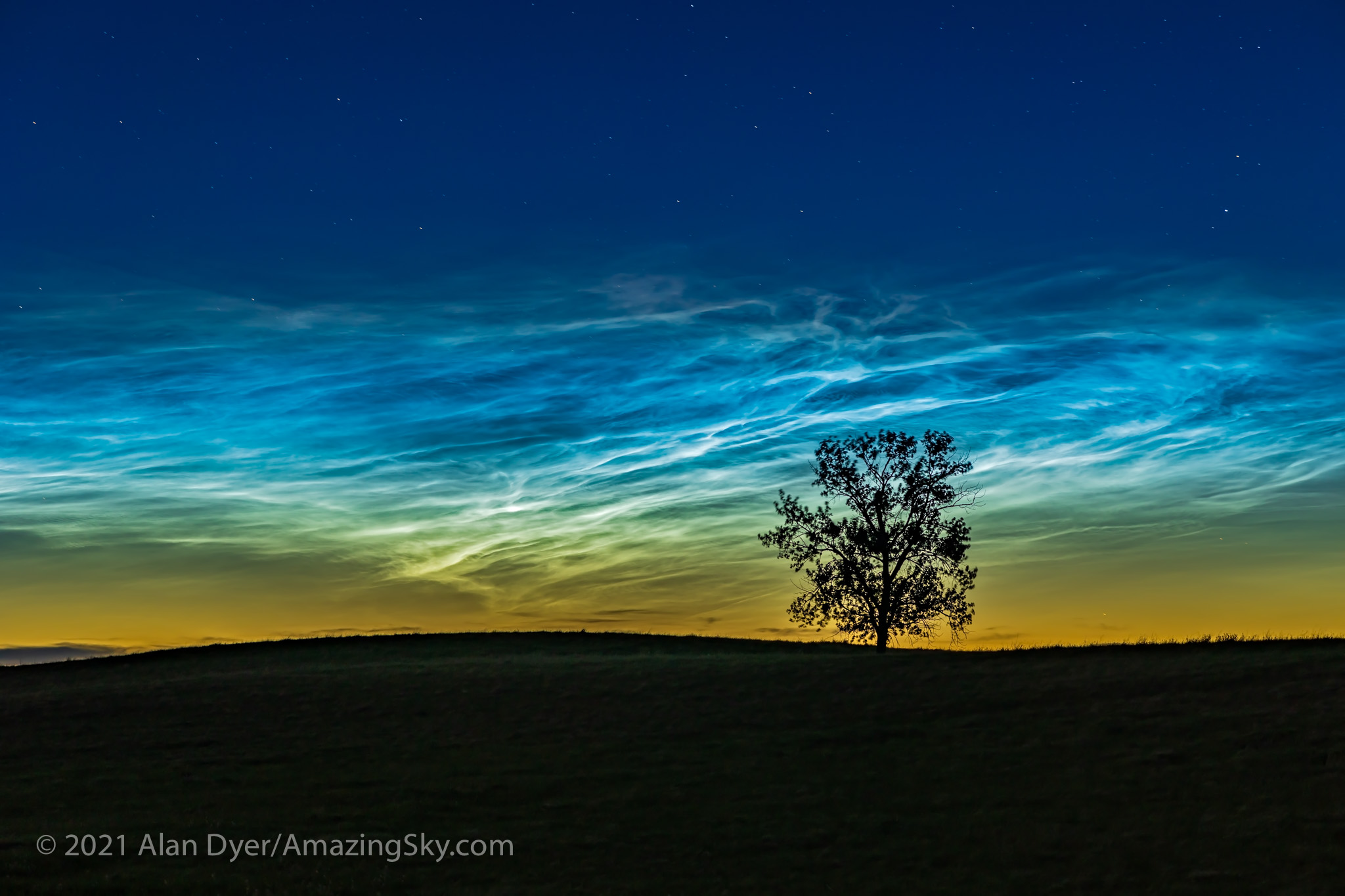


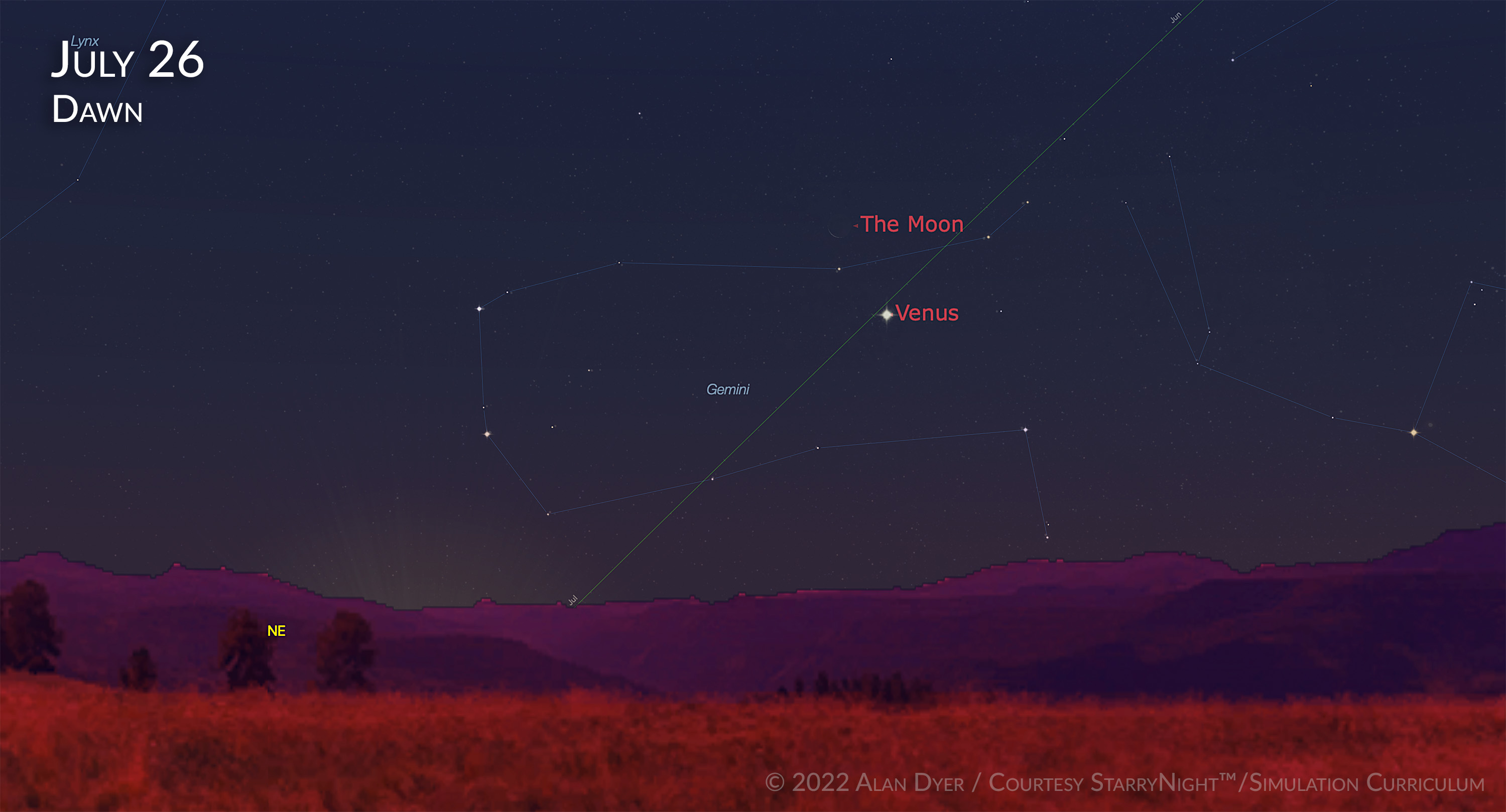


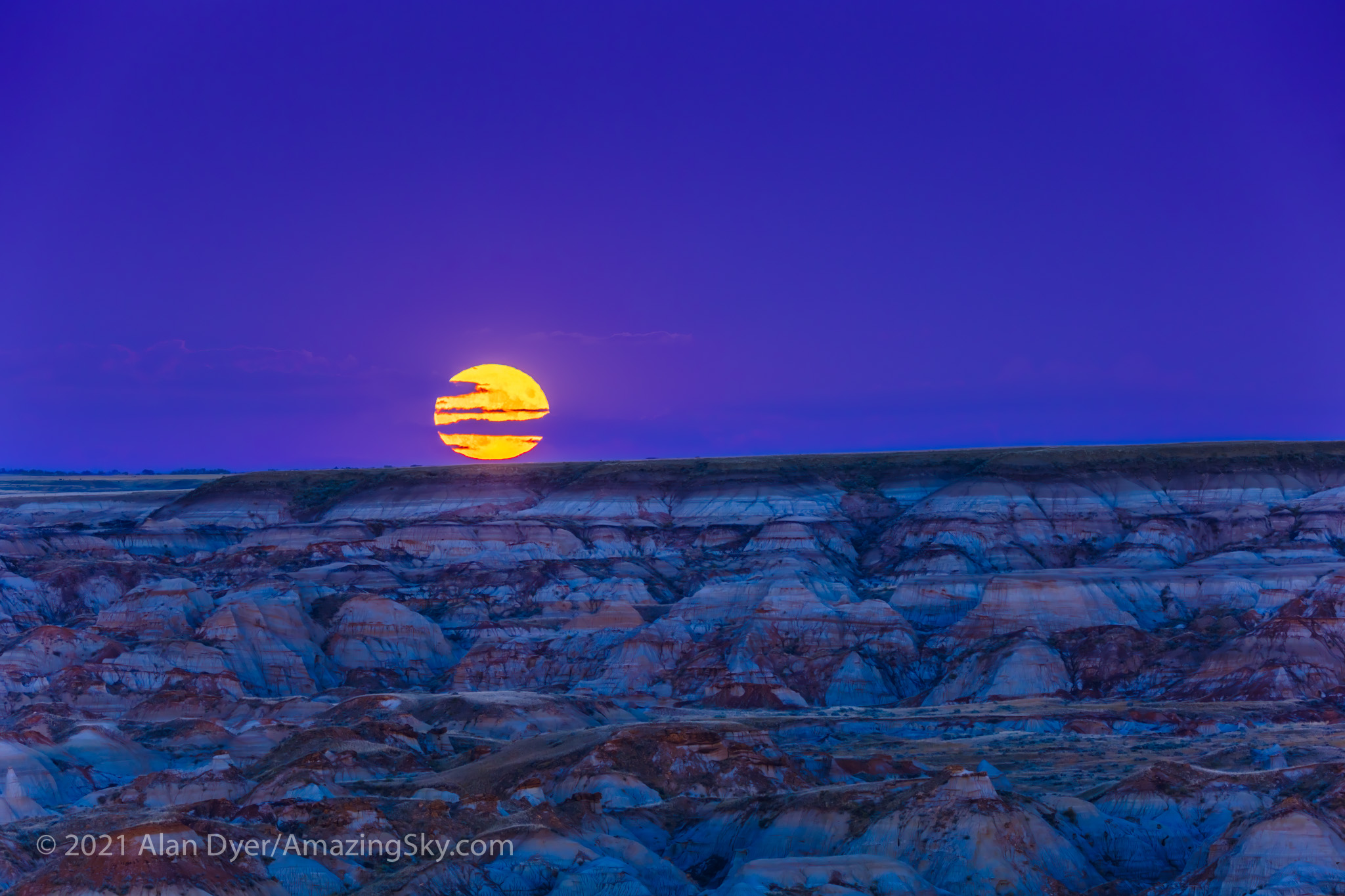
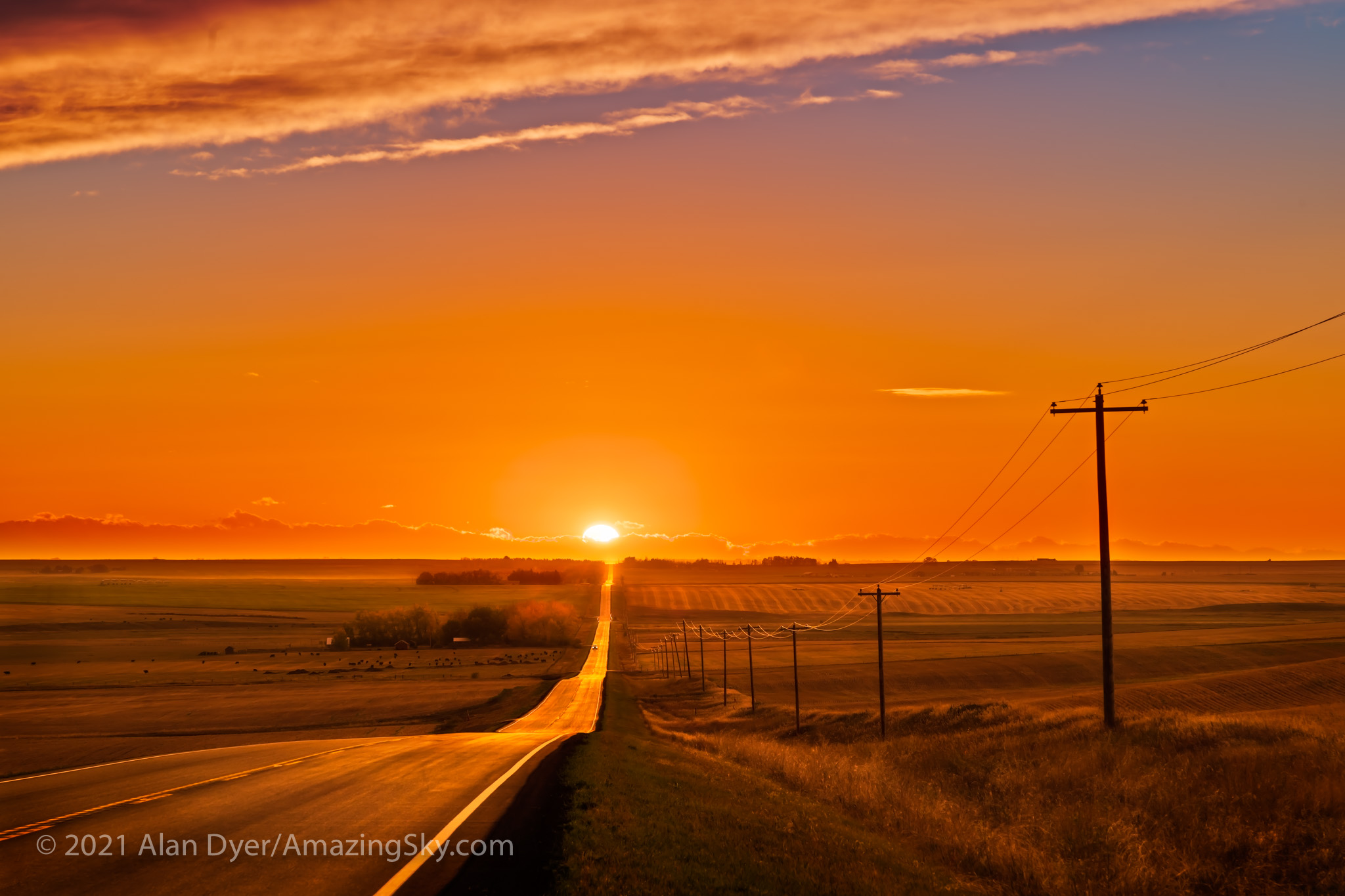
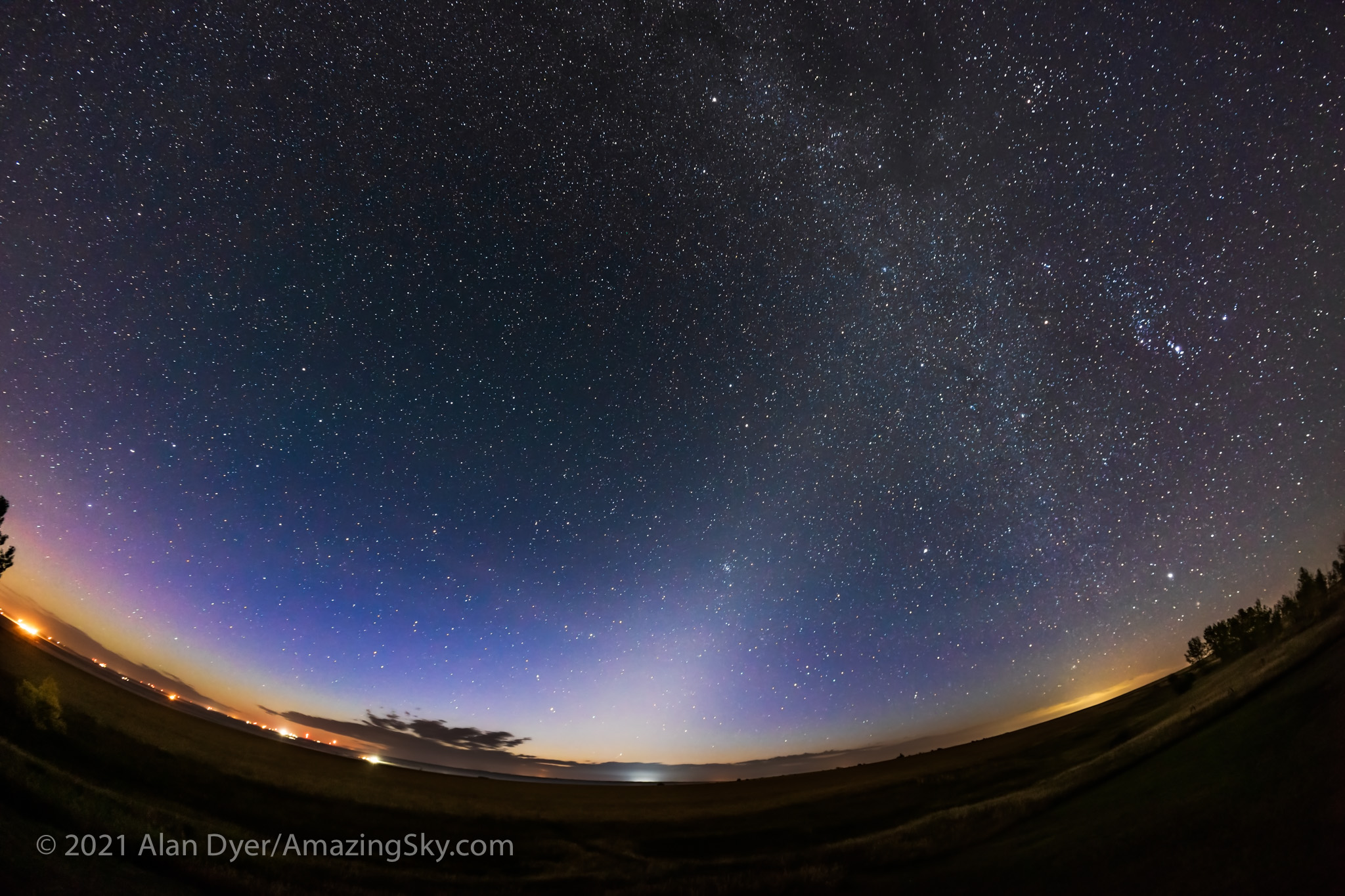
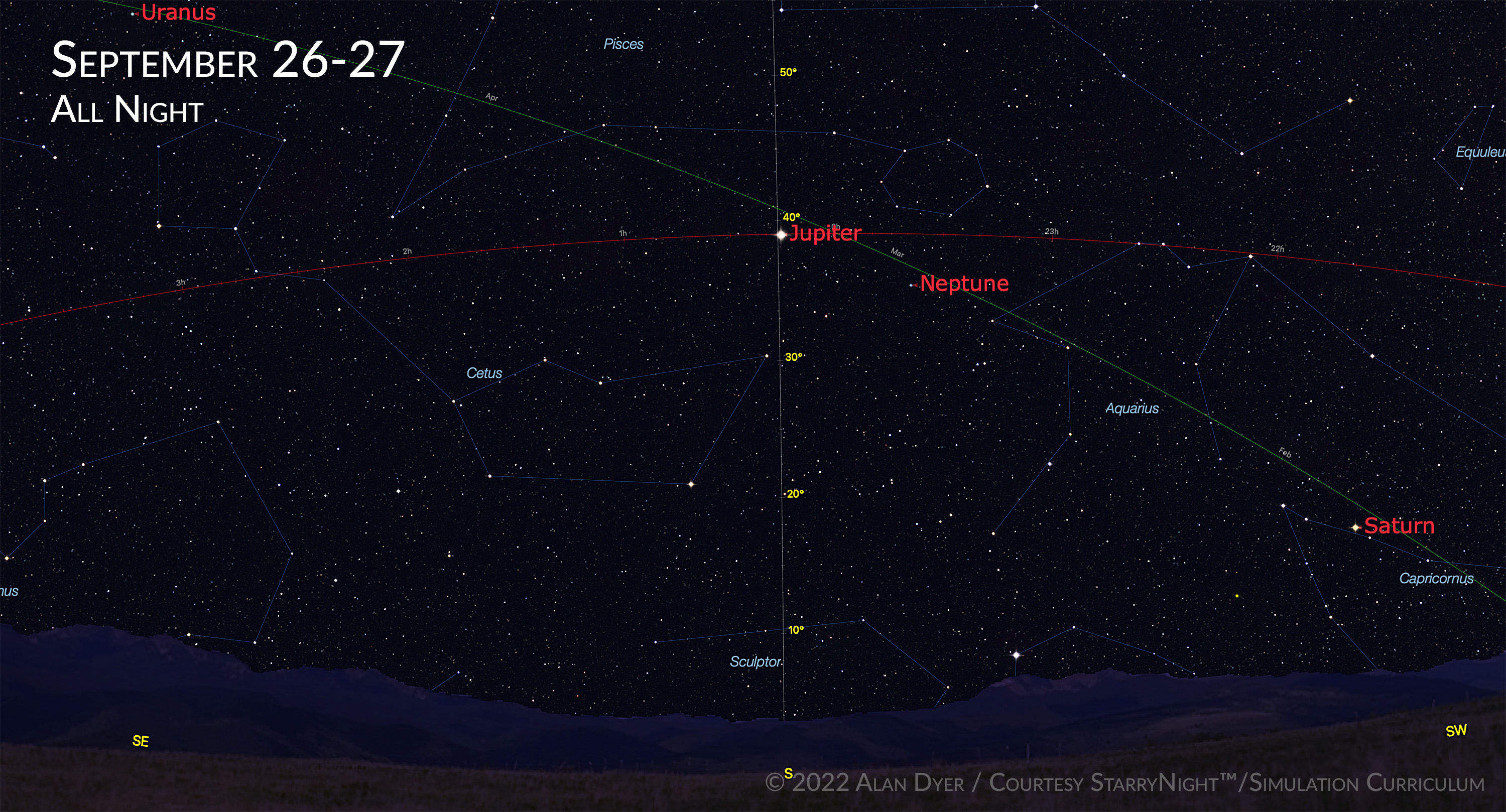
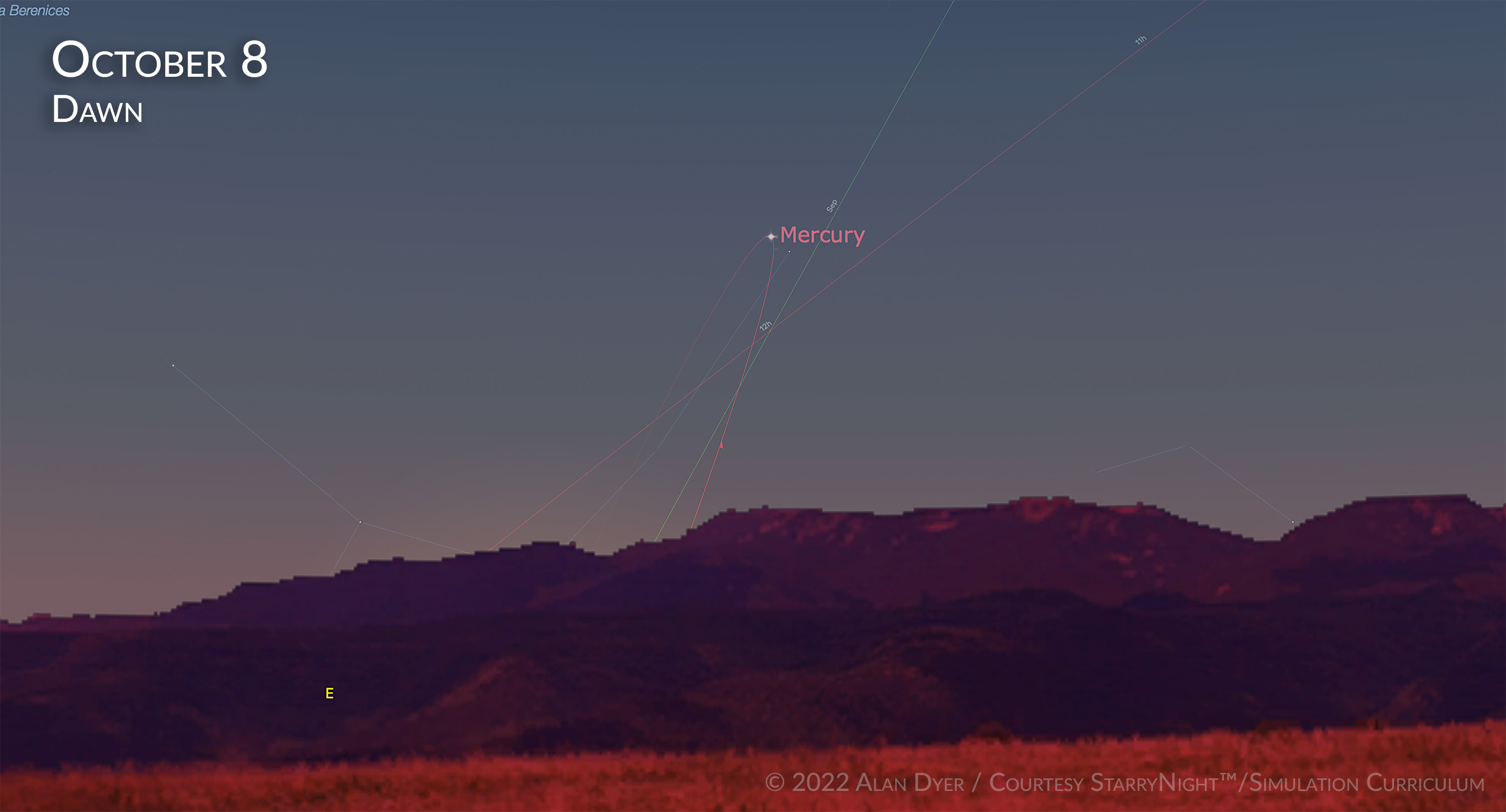

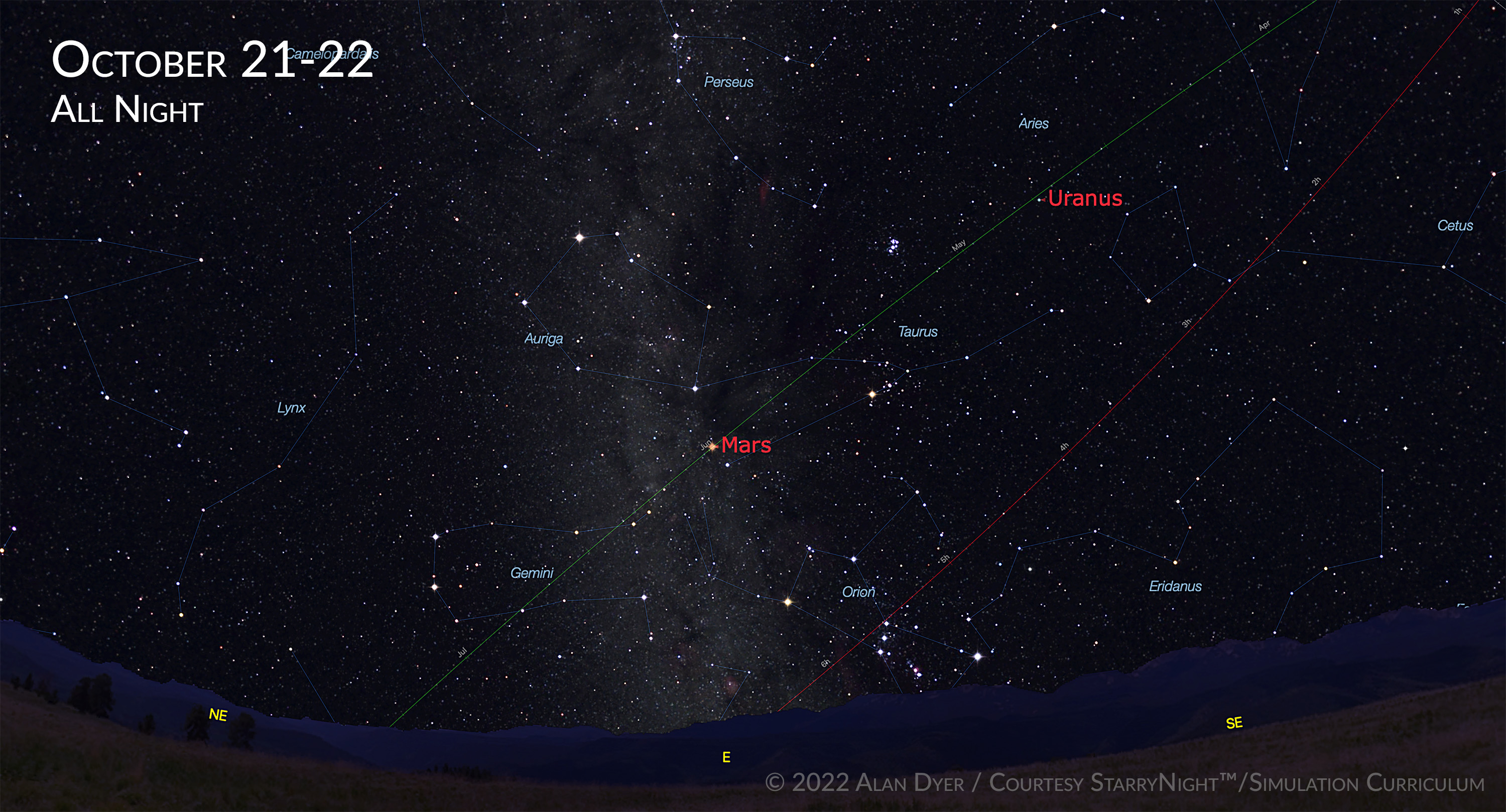







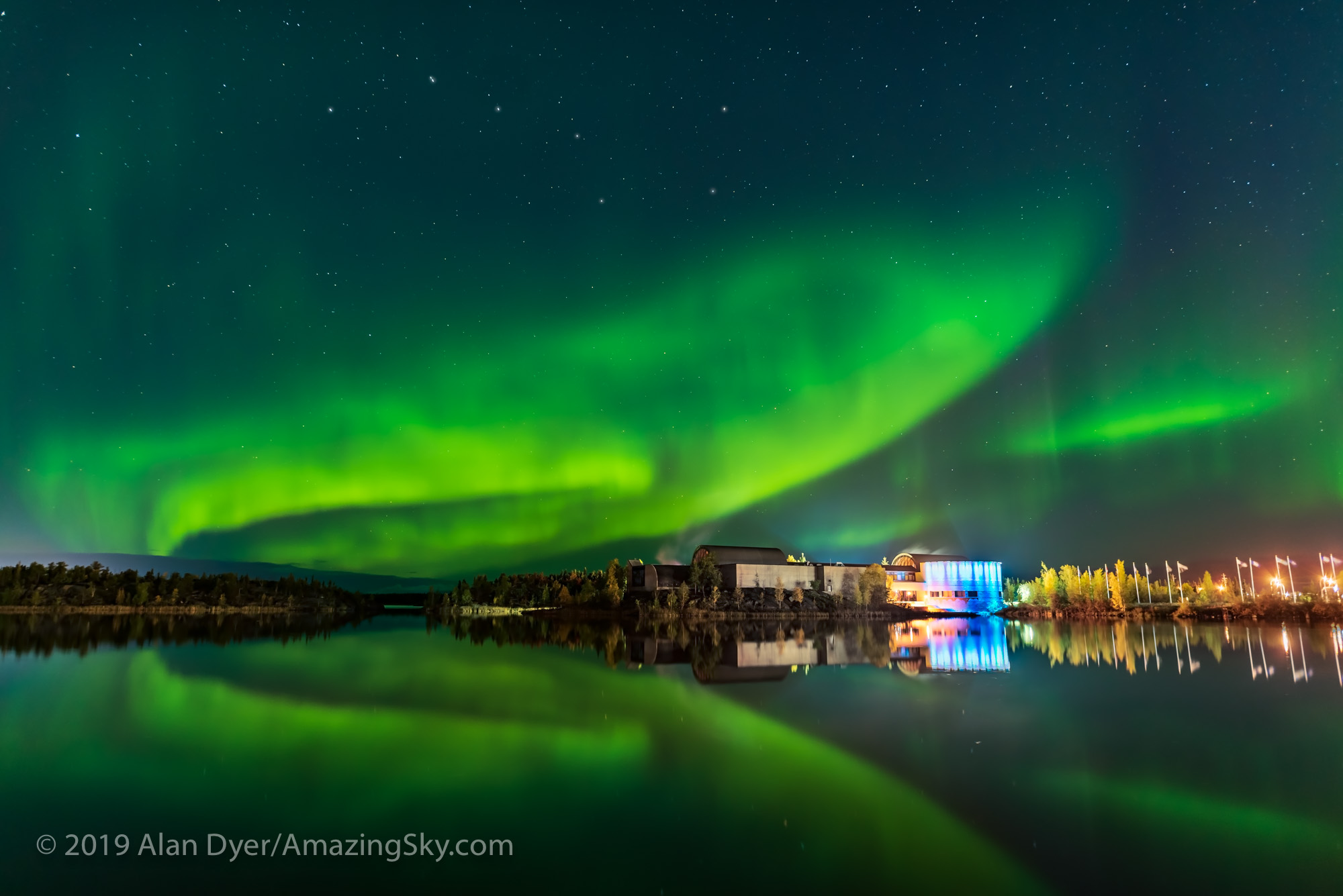 It was a fabulous week of clear skies and dancing auroras in and around Yellowknife in Canada’s North.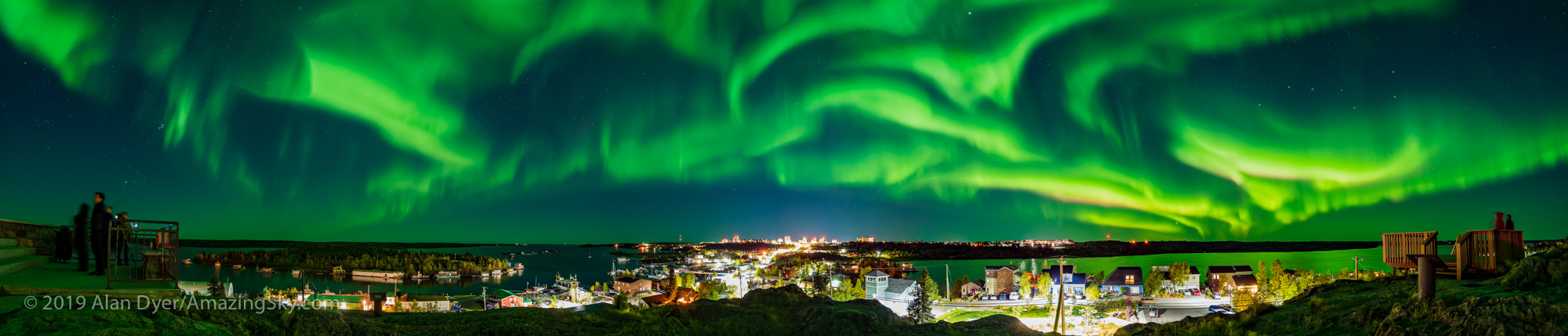
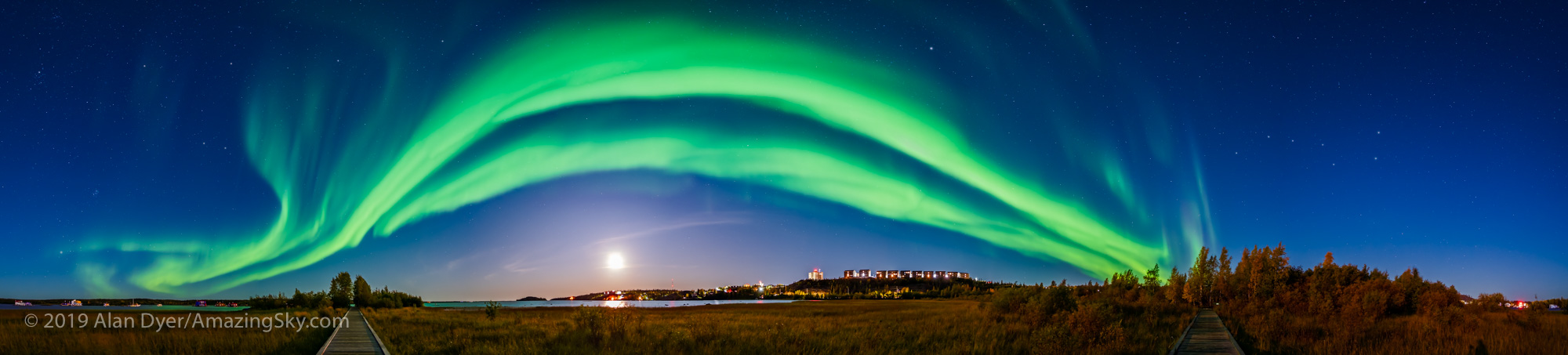


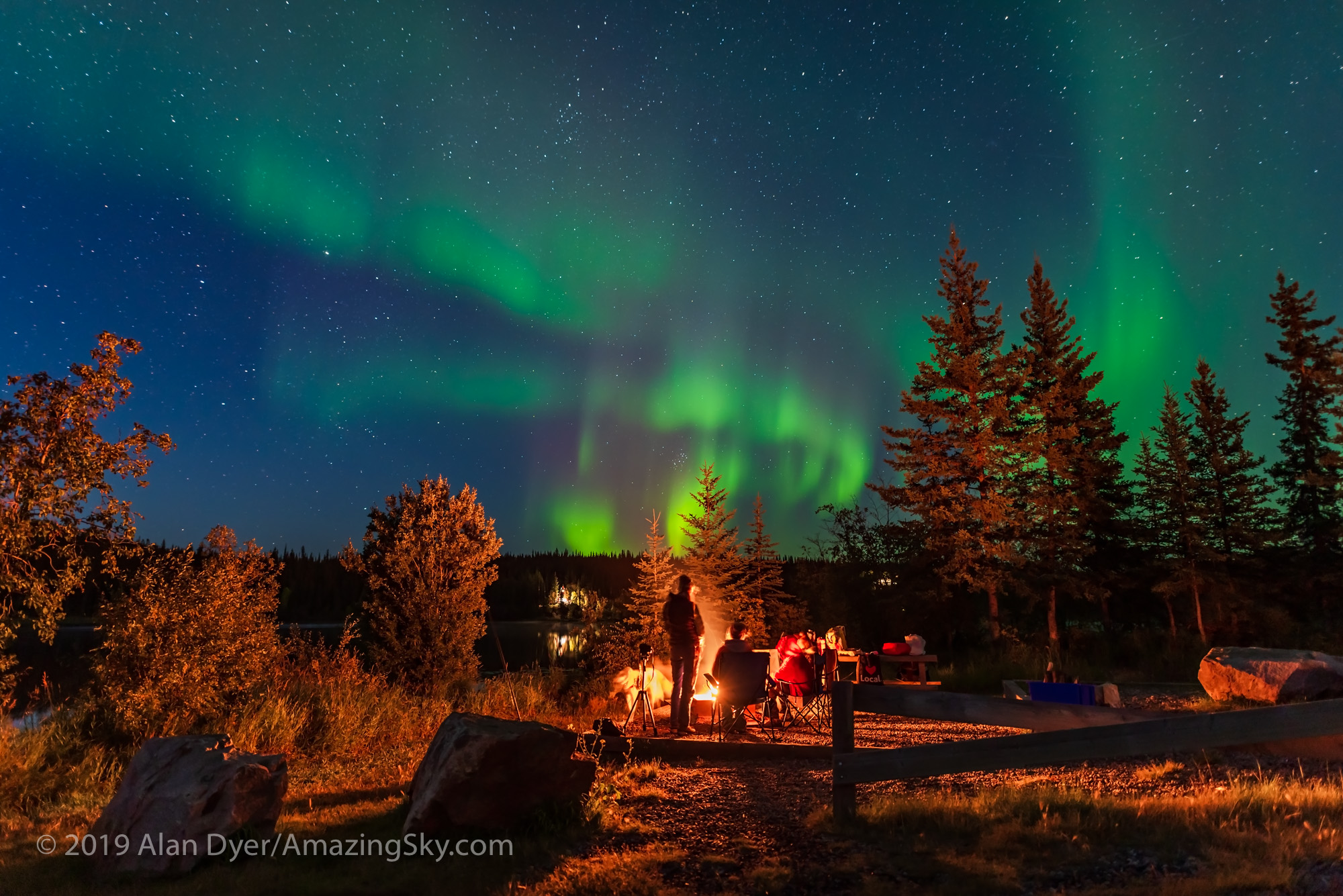
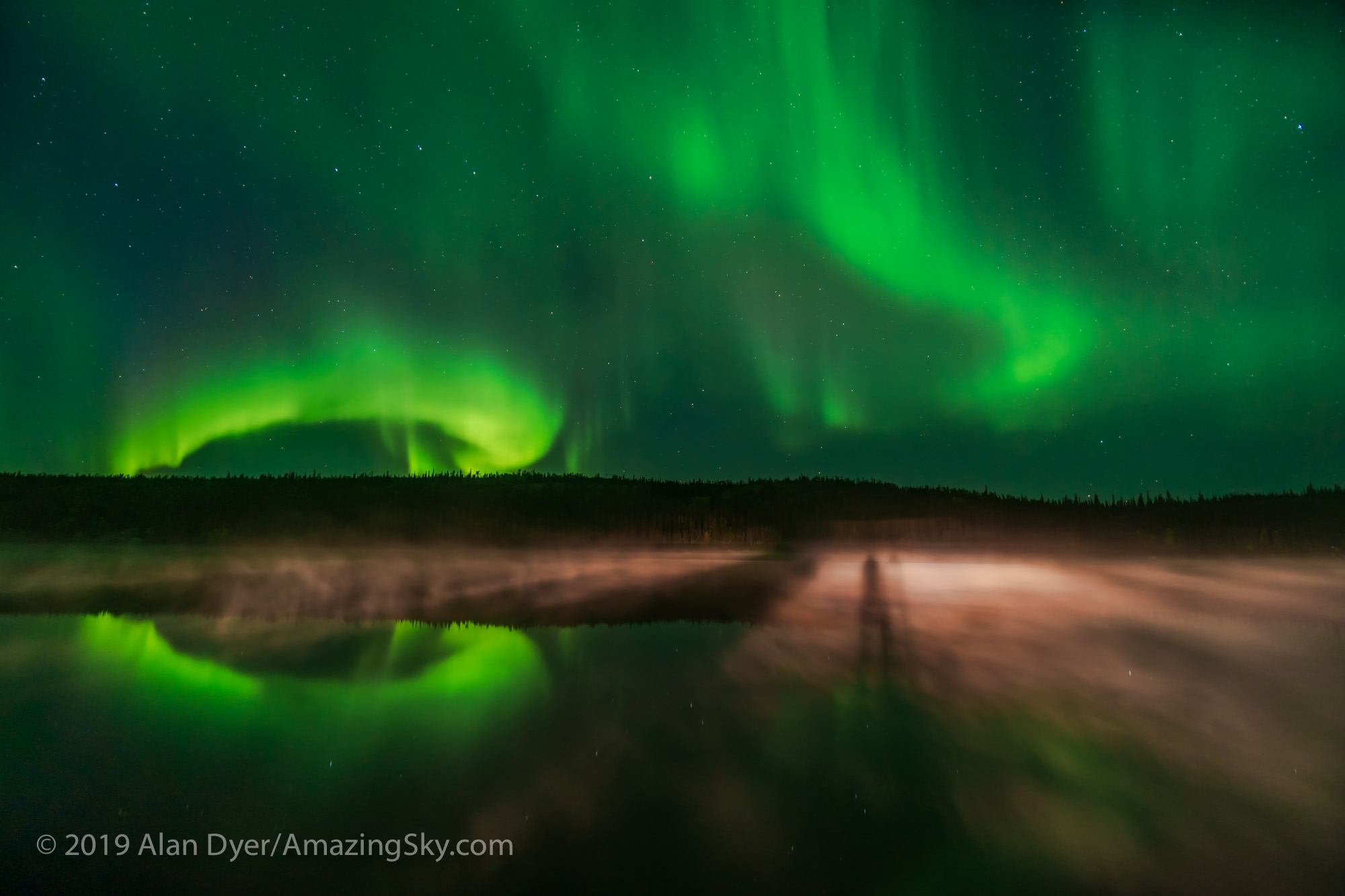


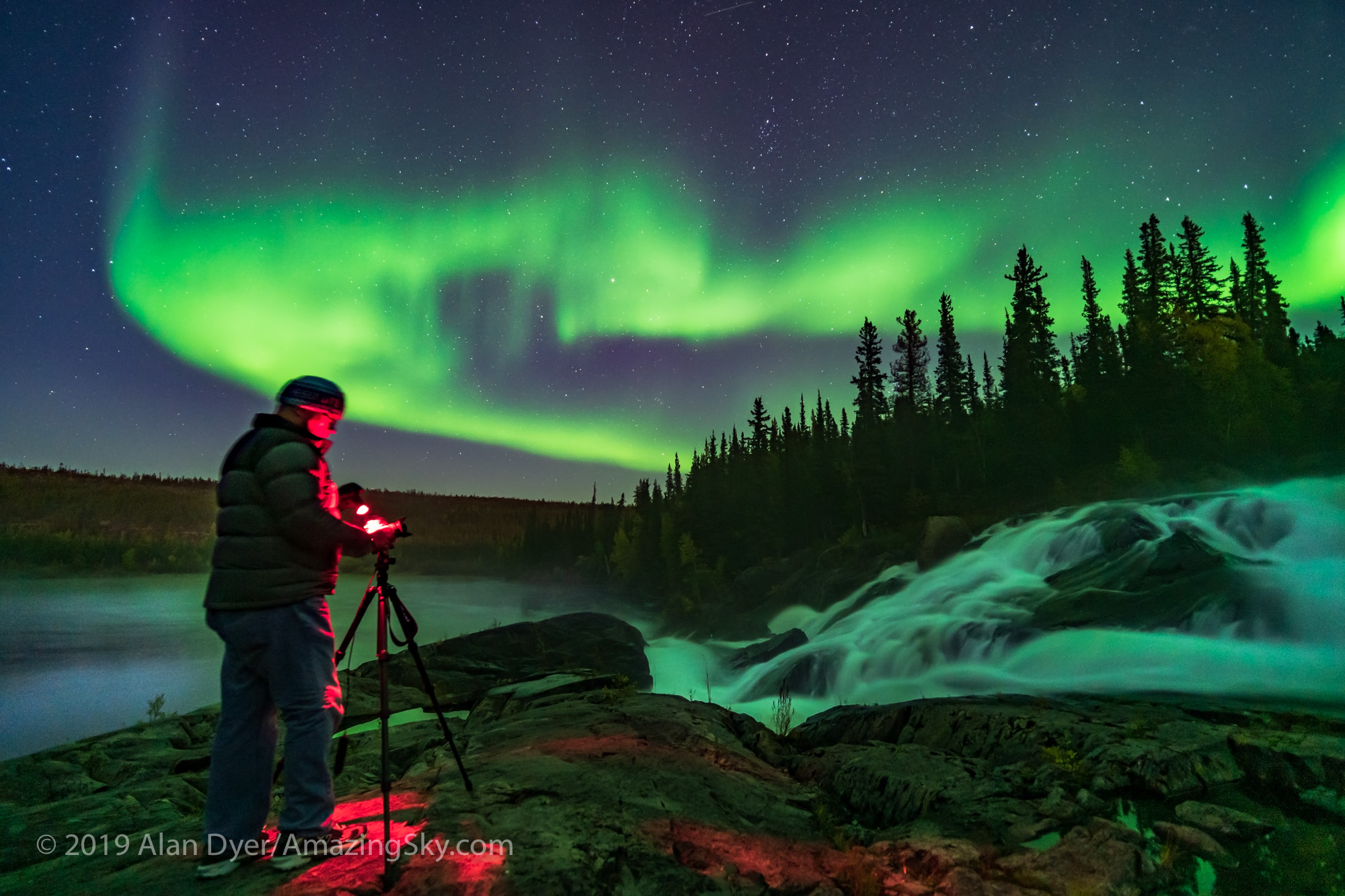
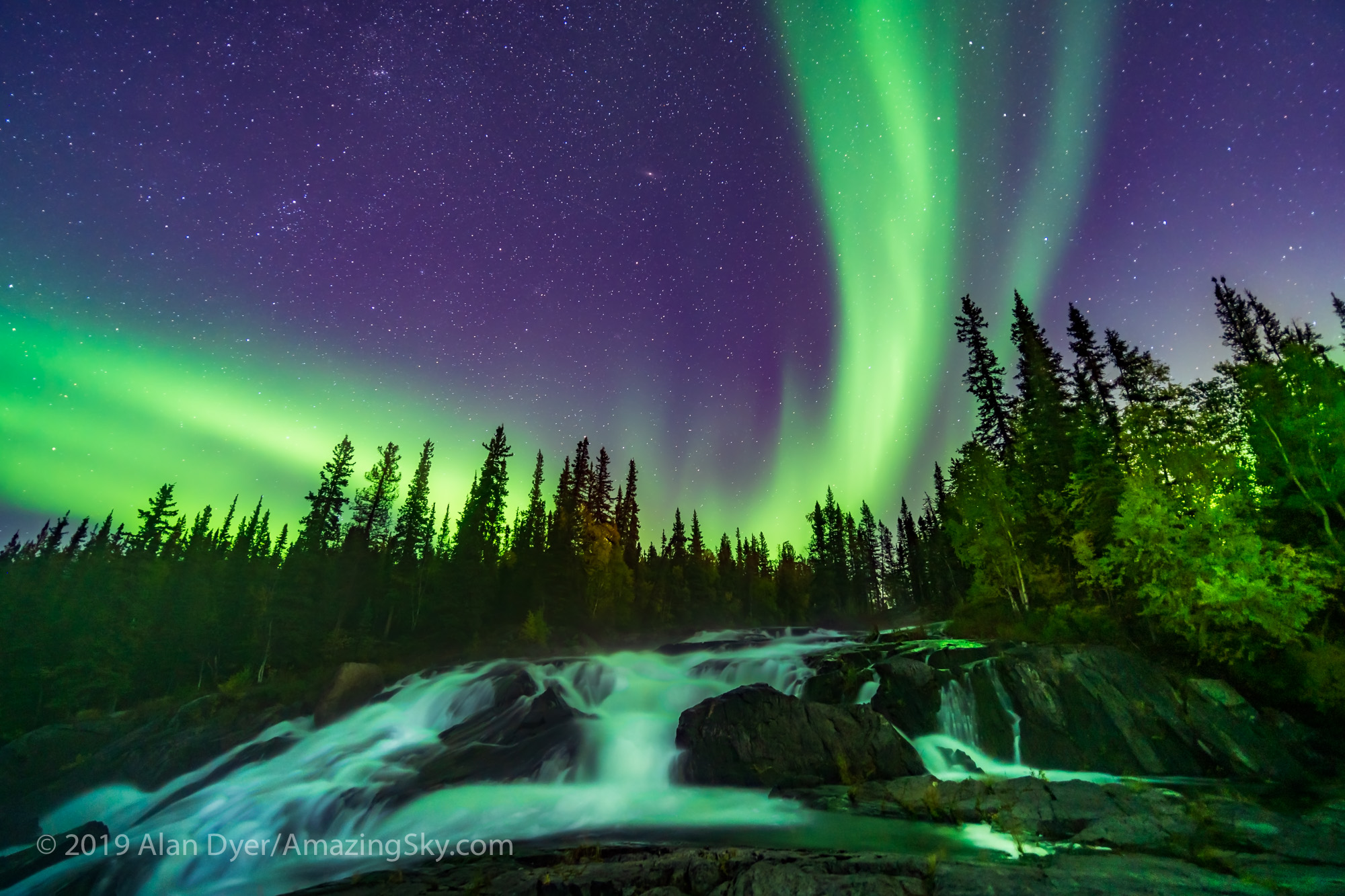
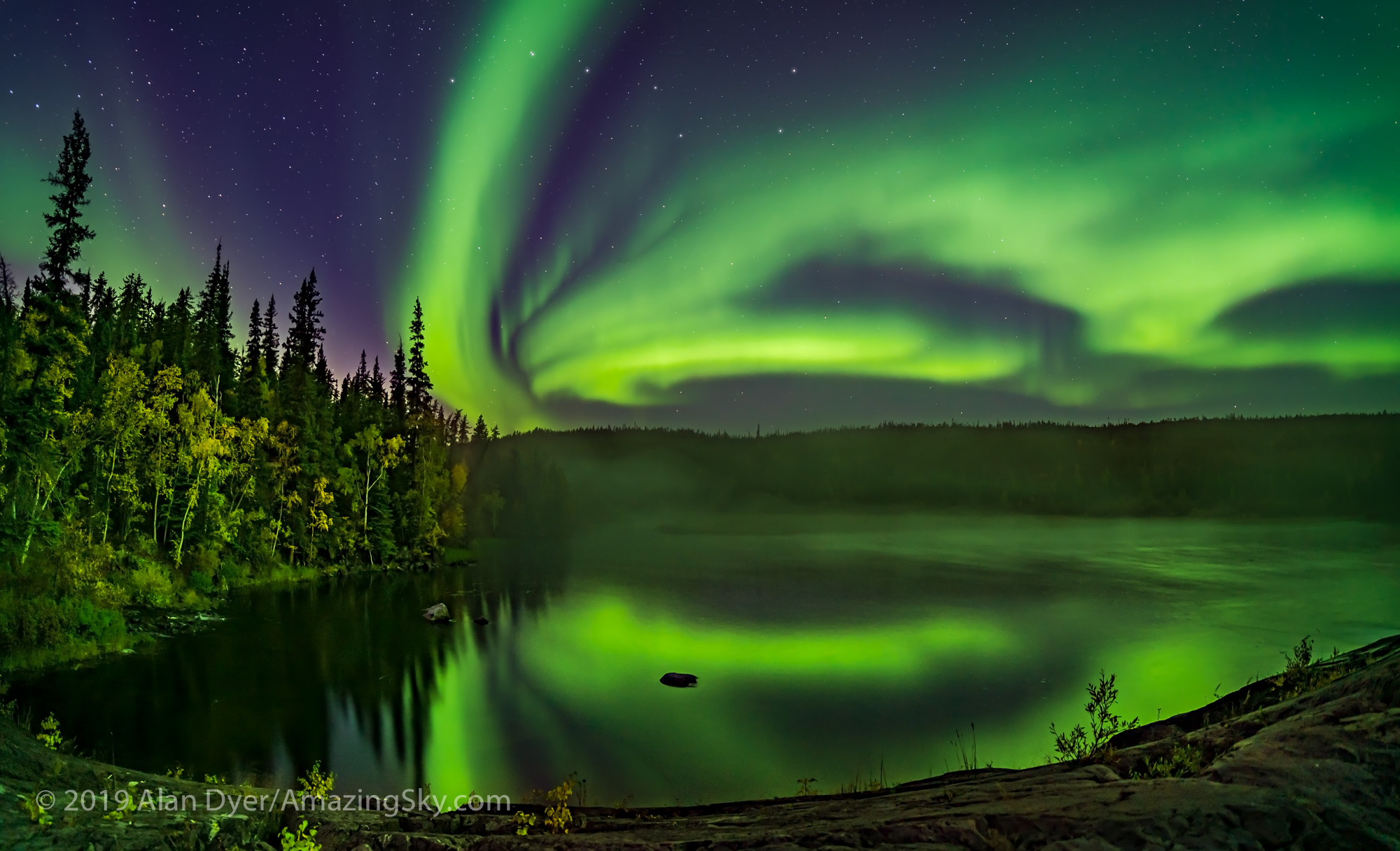
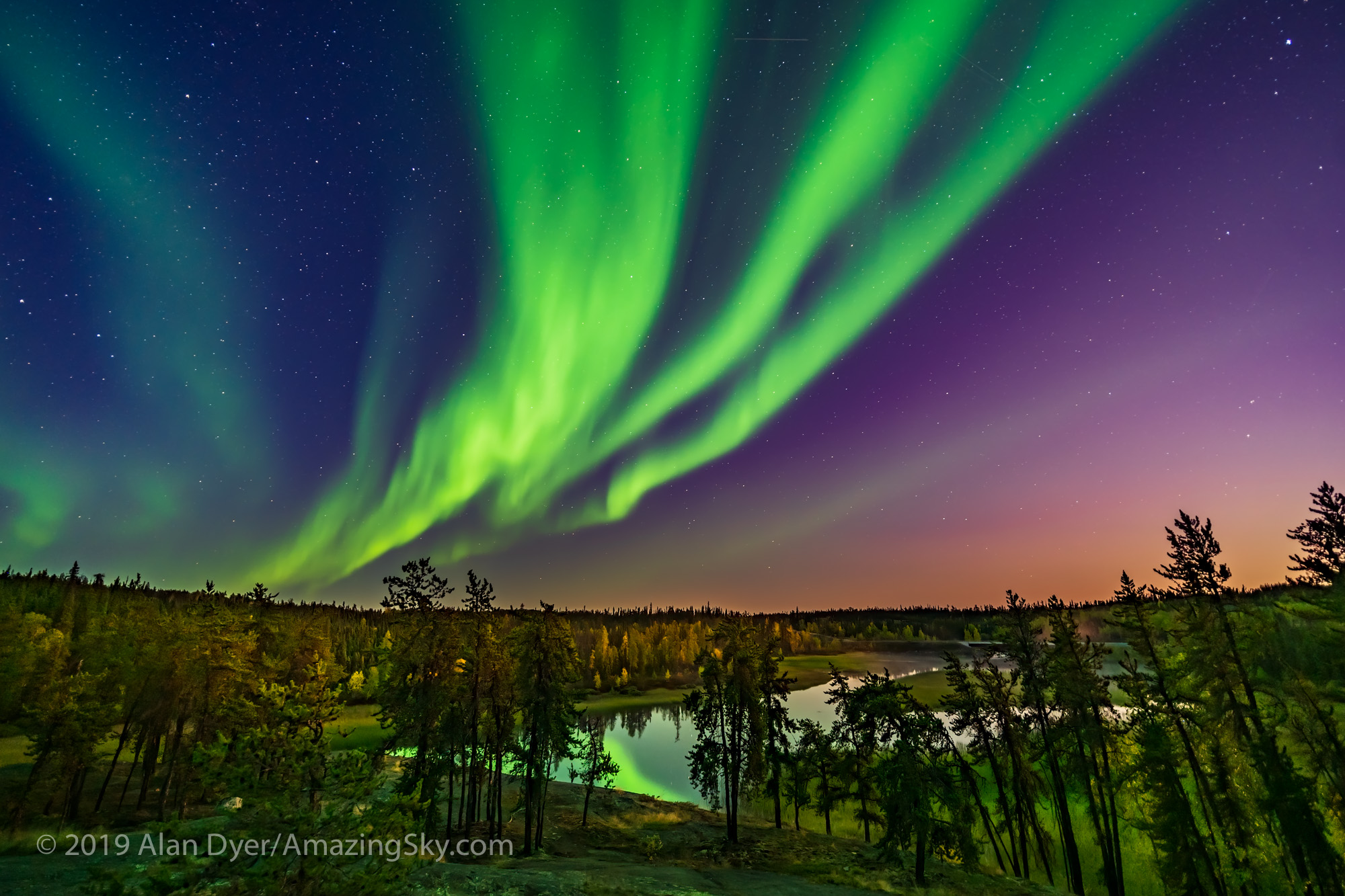
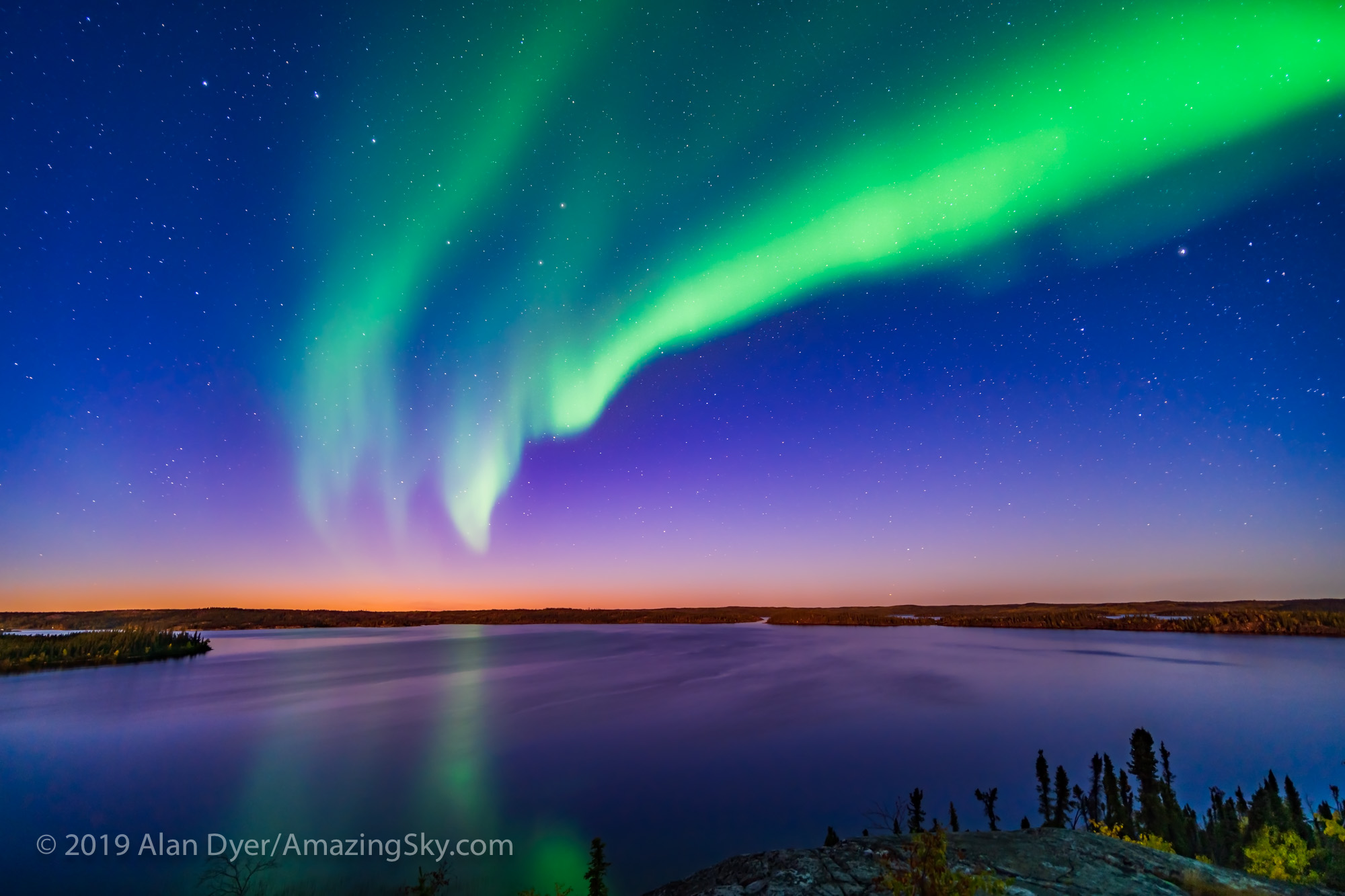


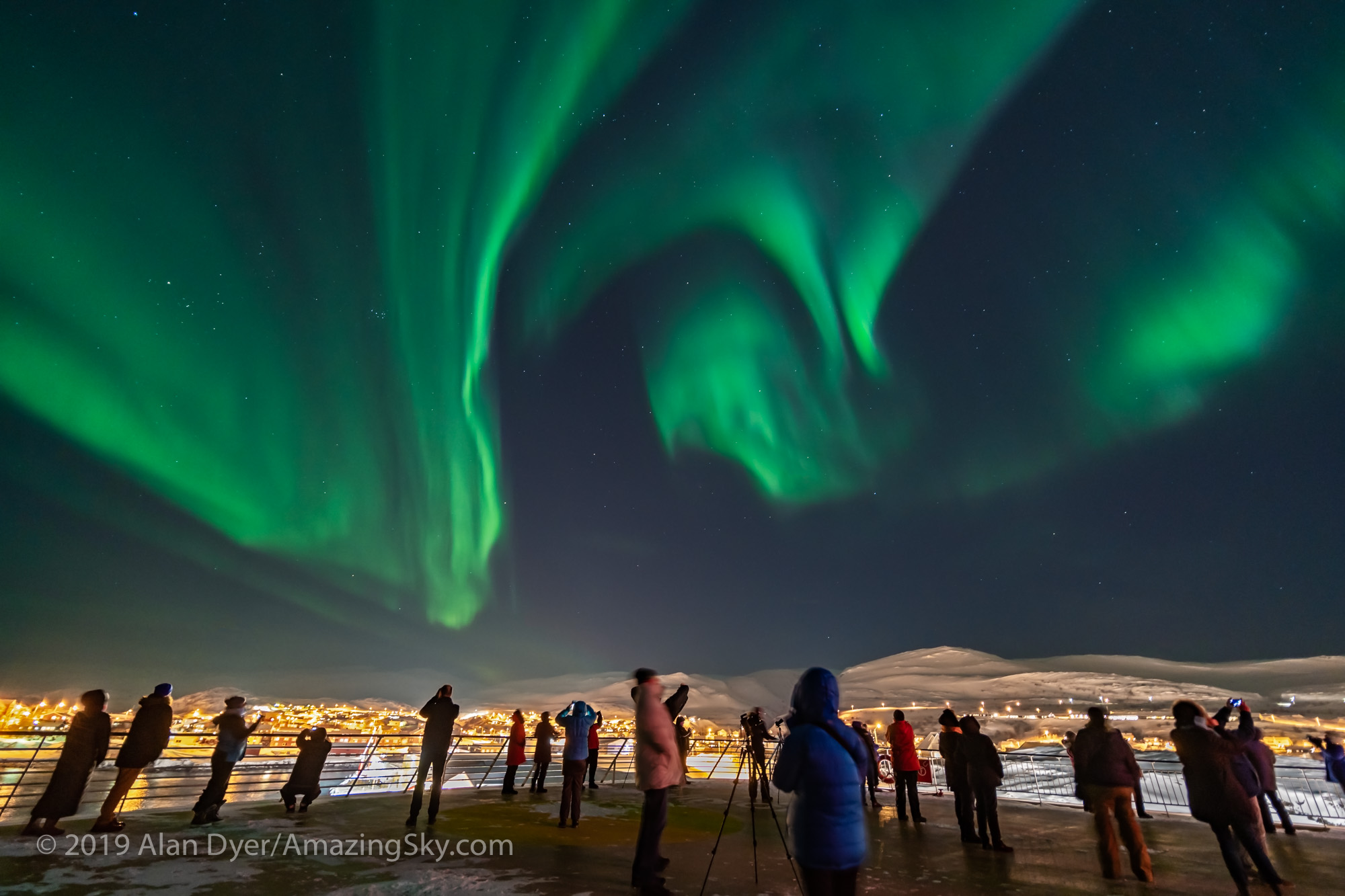

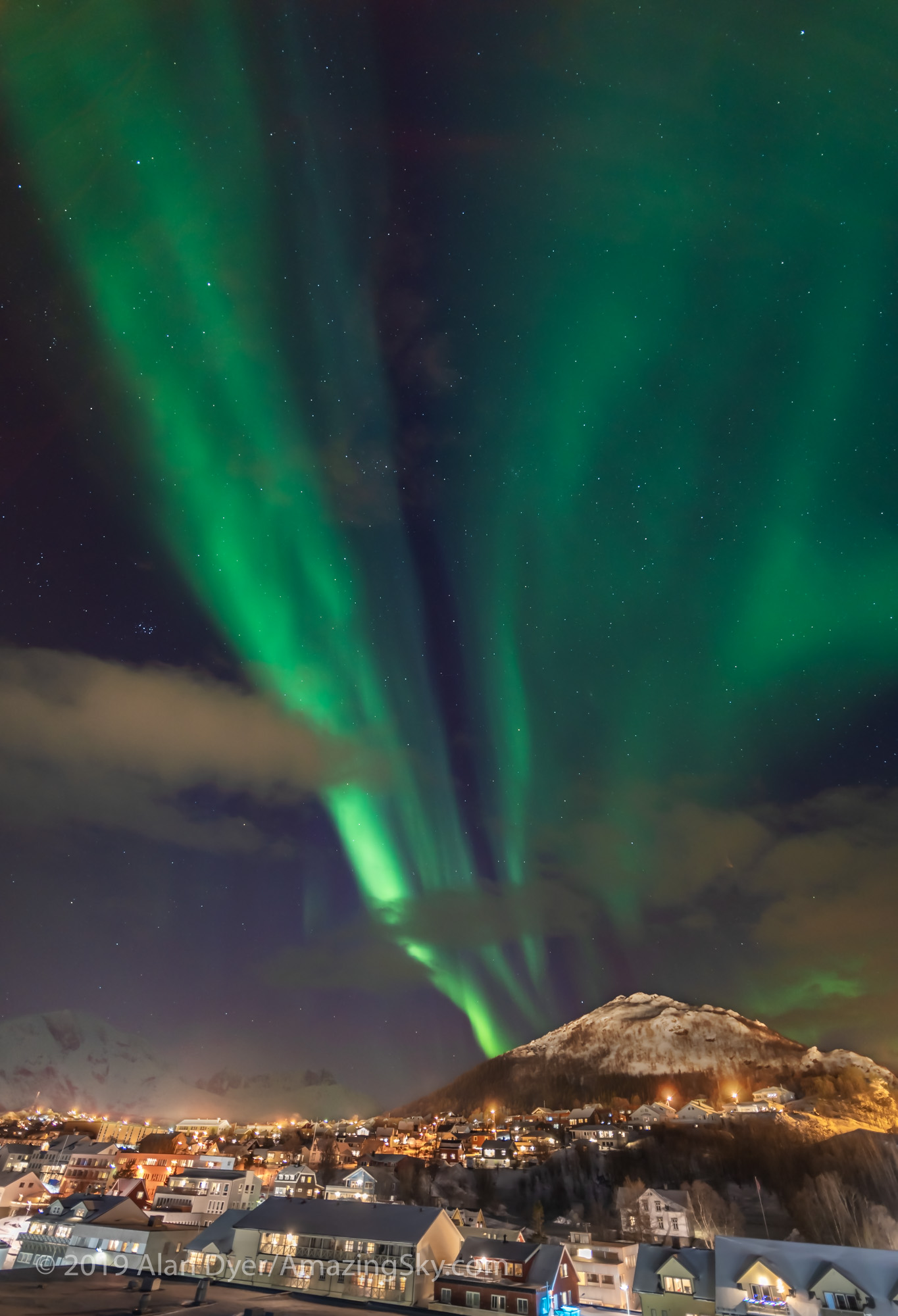


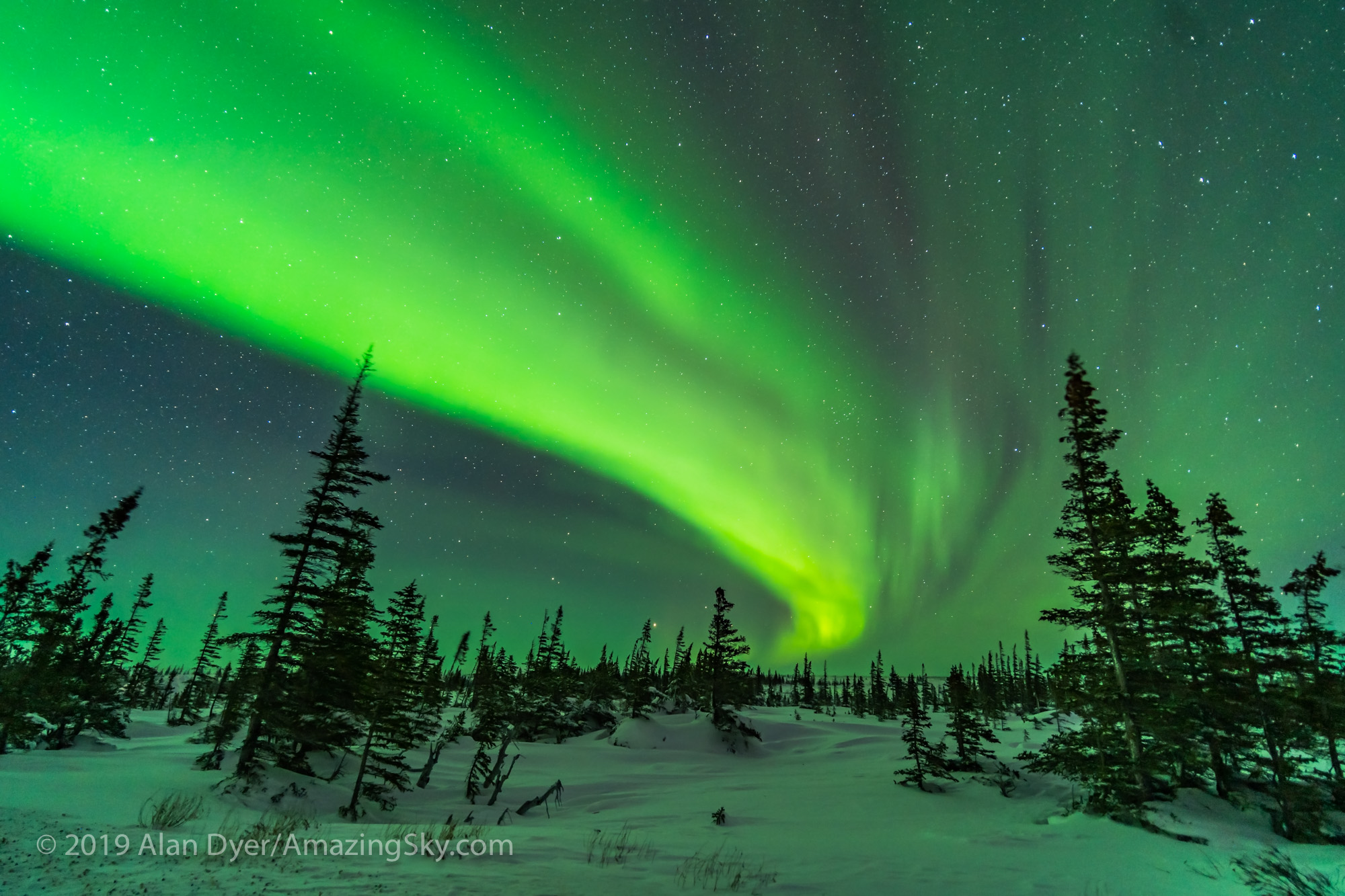
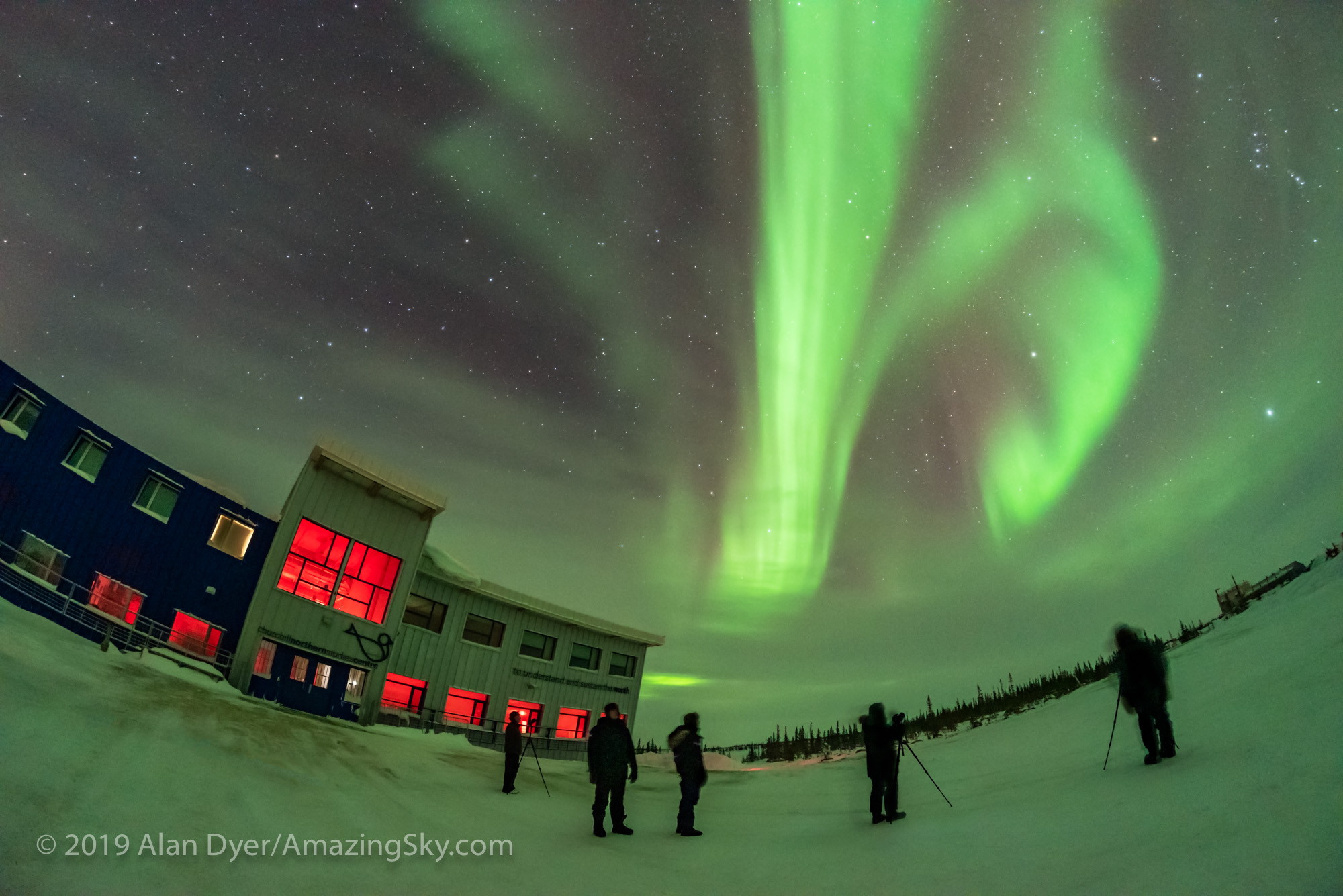


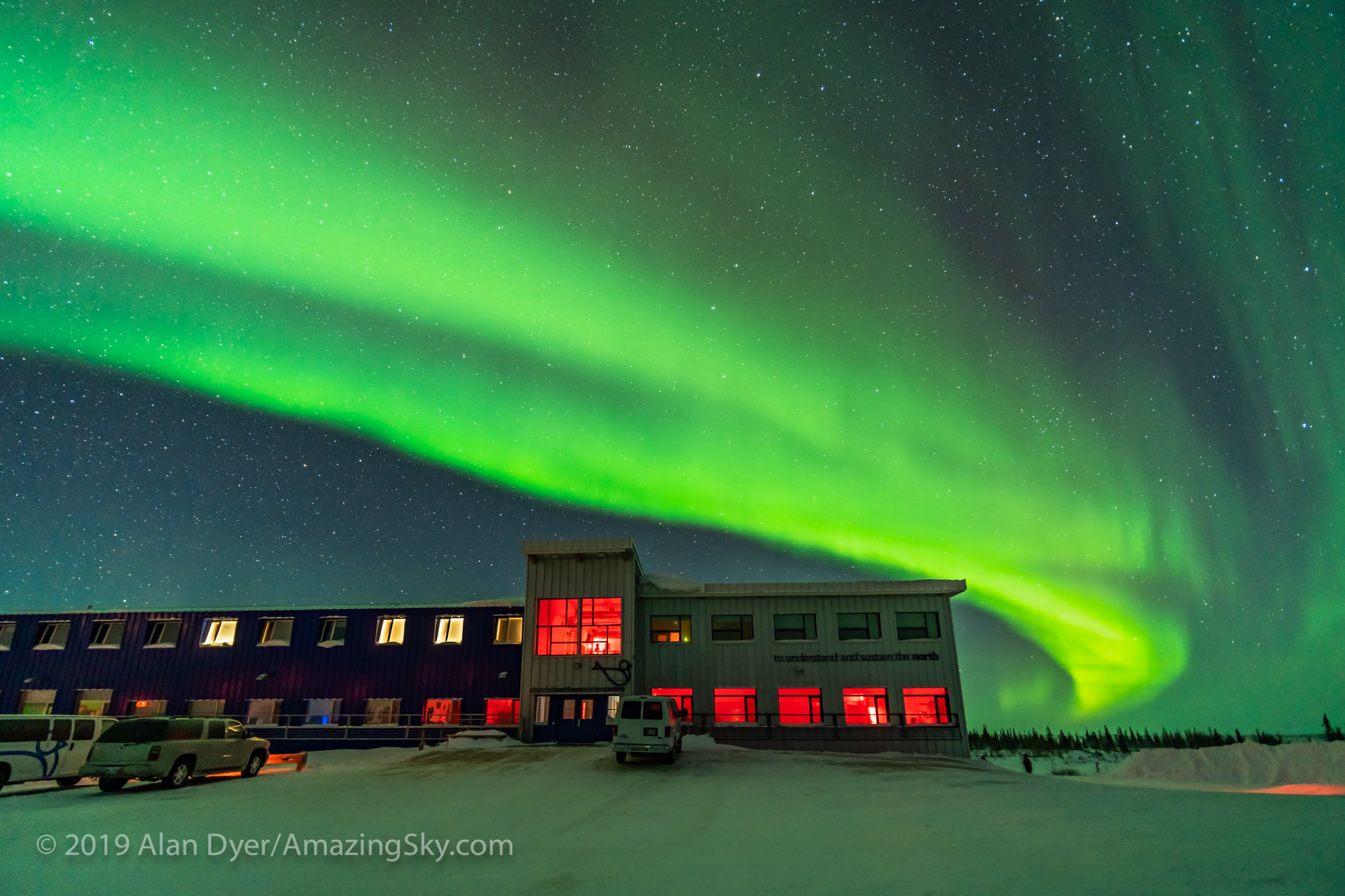

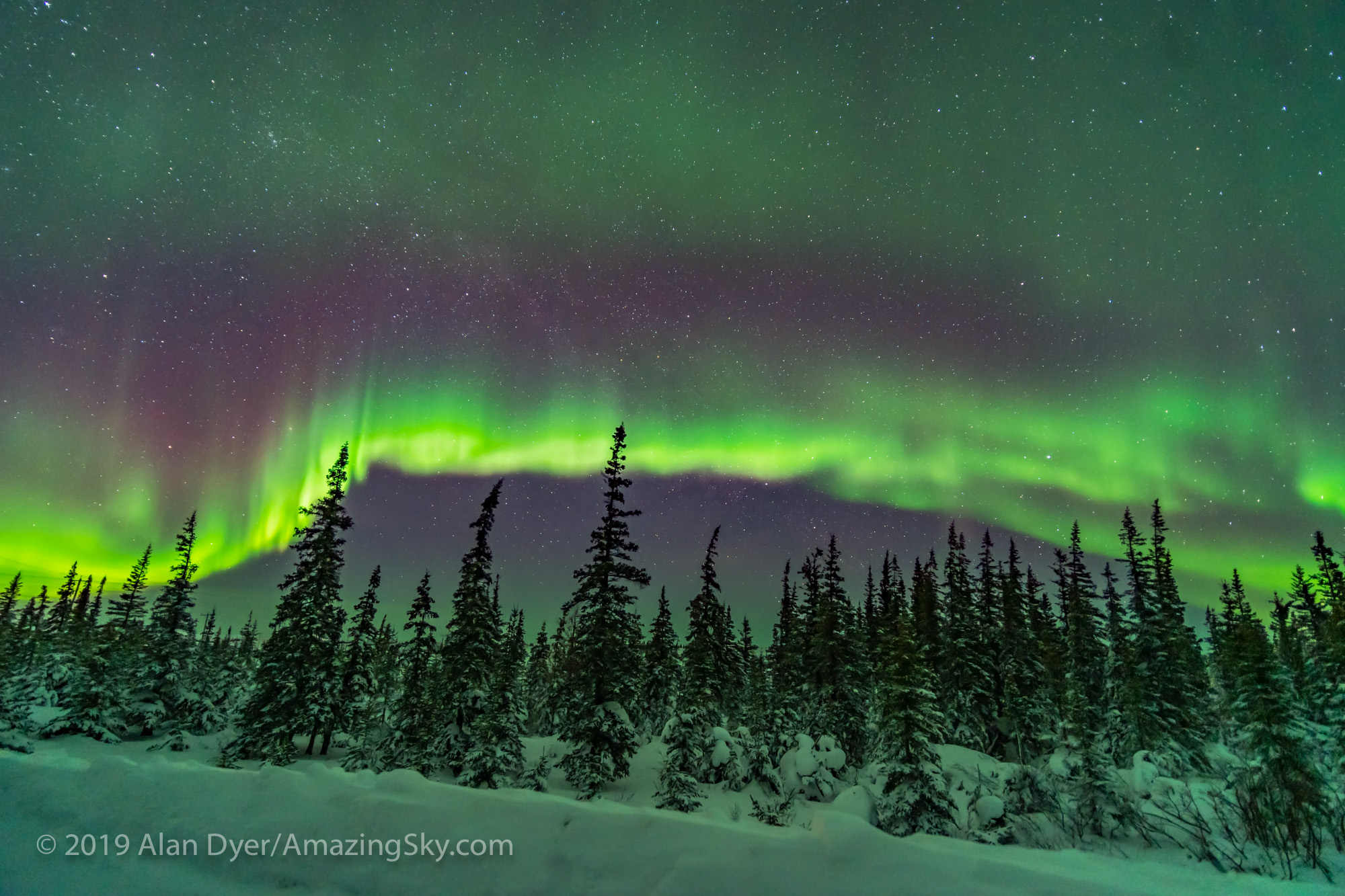
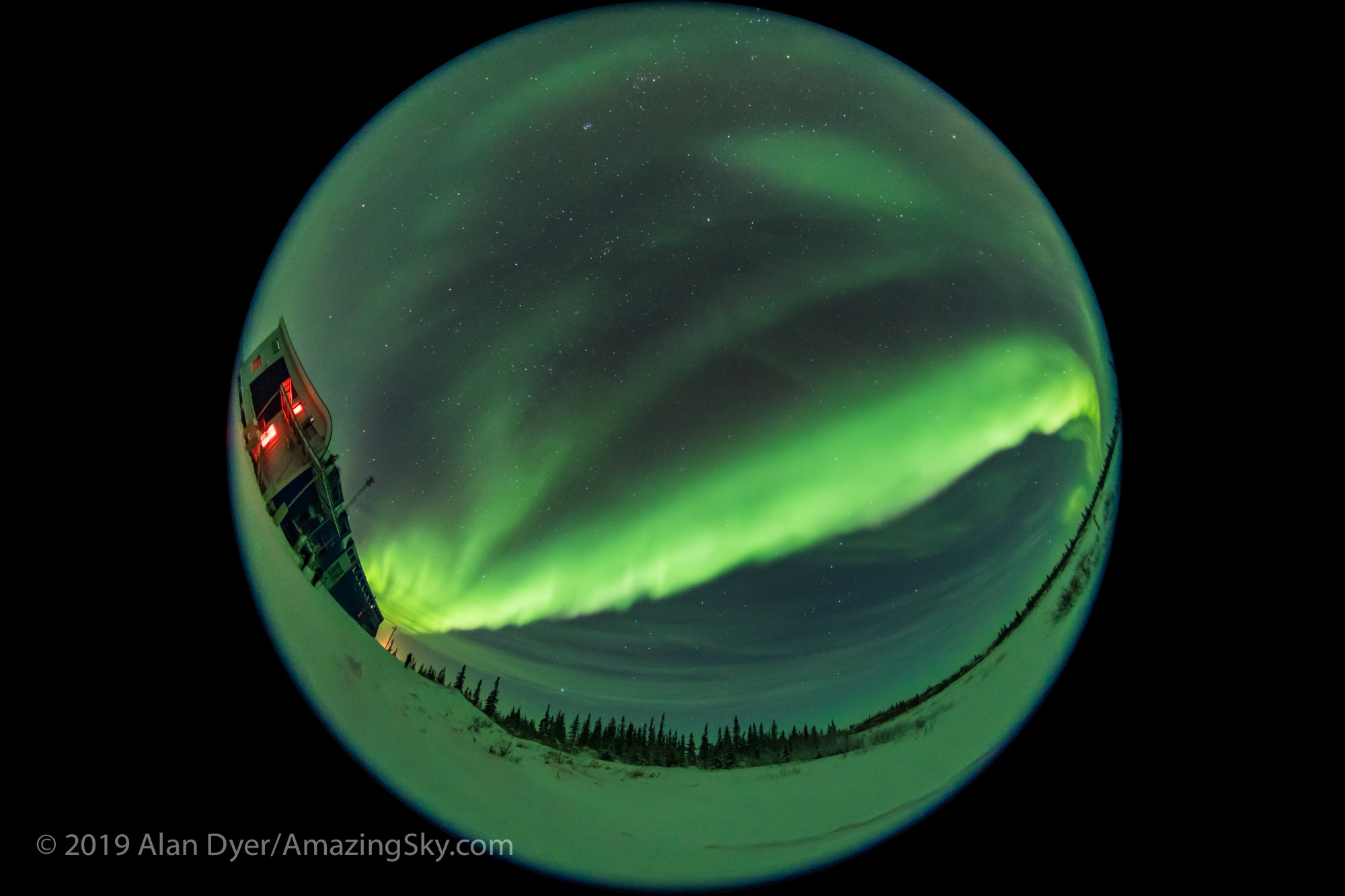

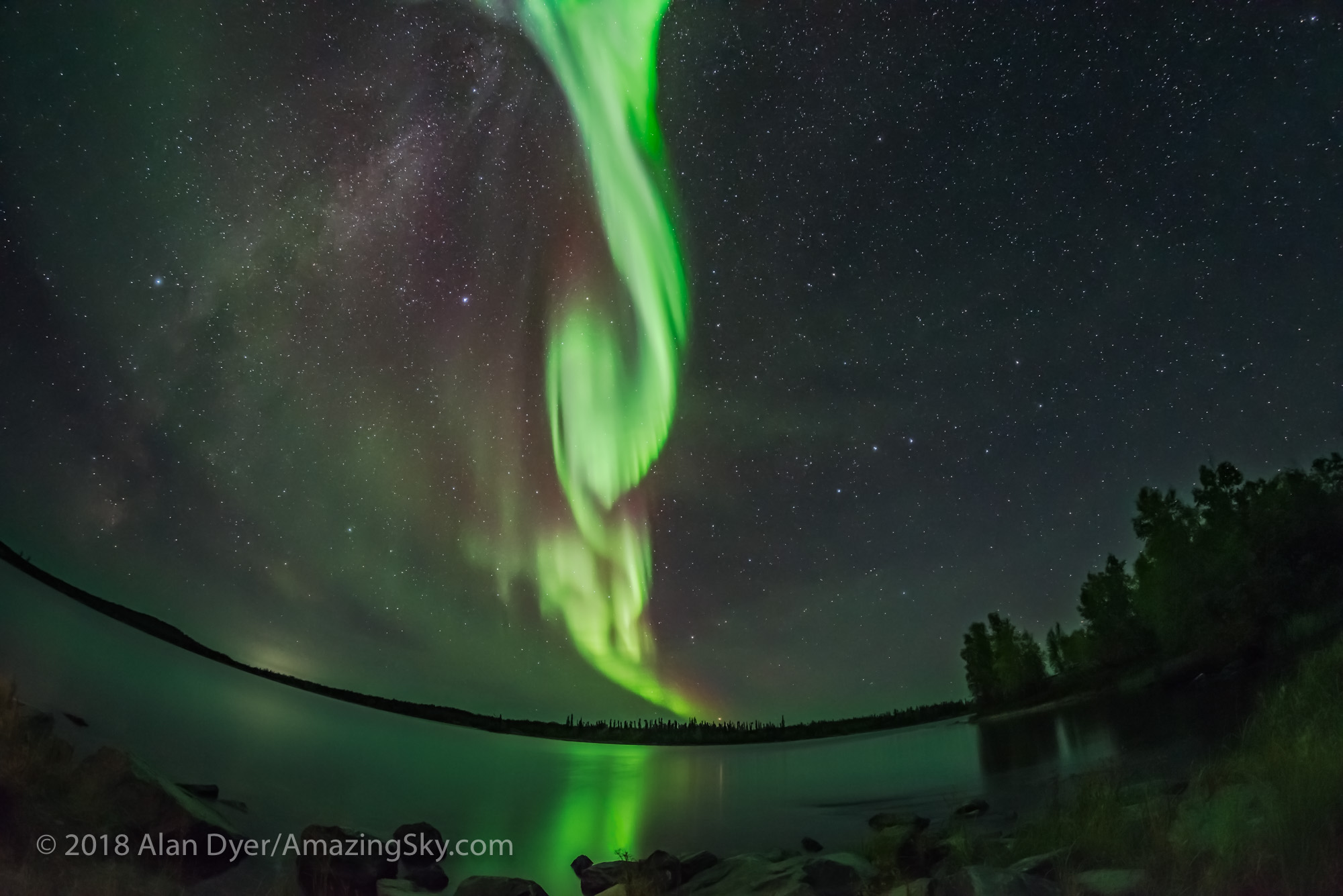
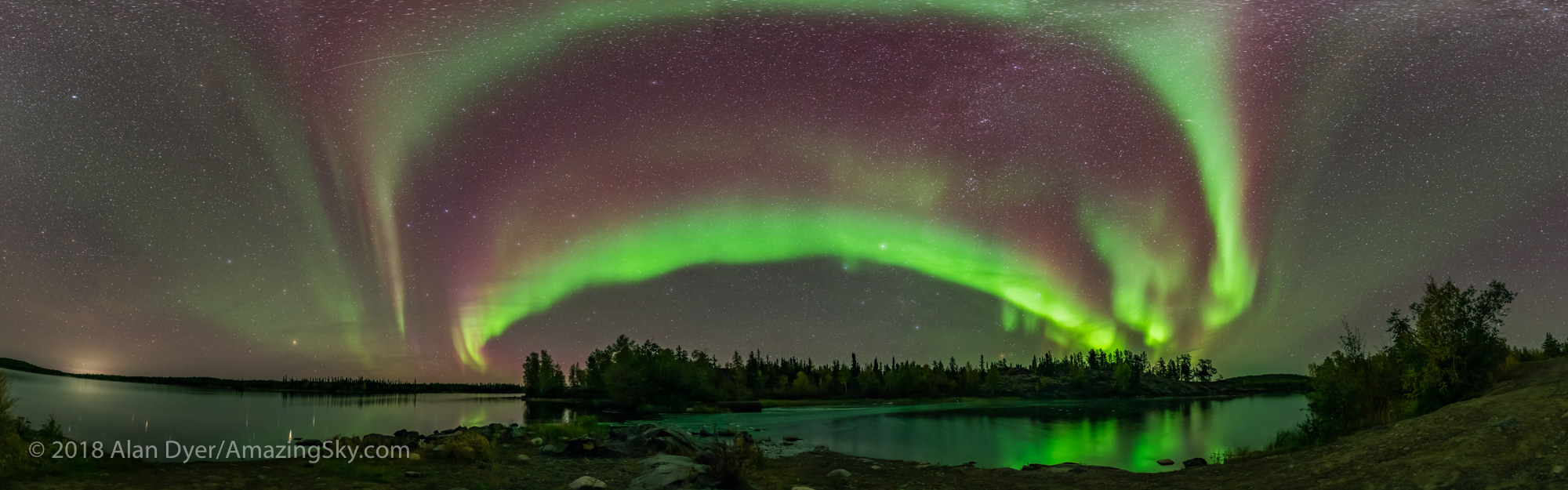


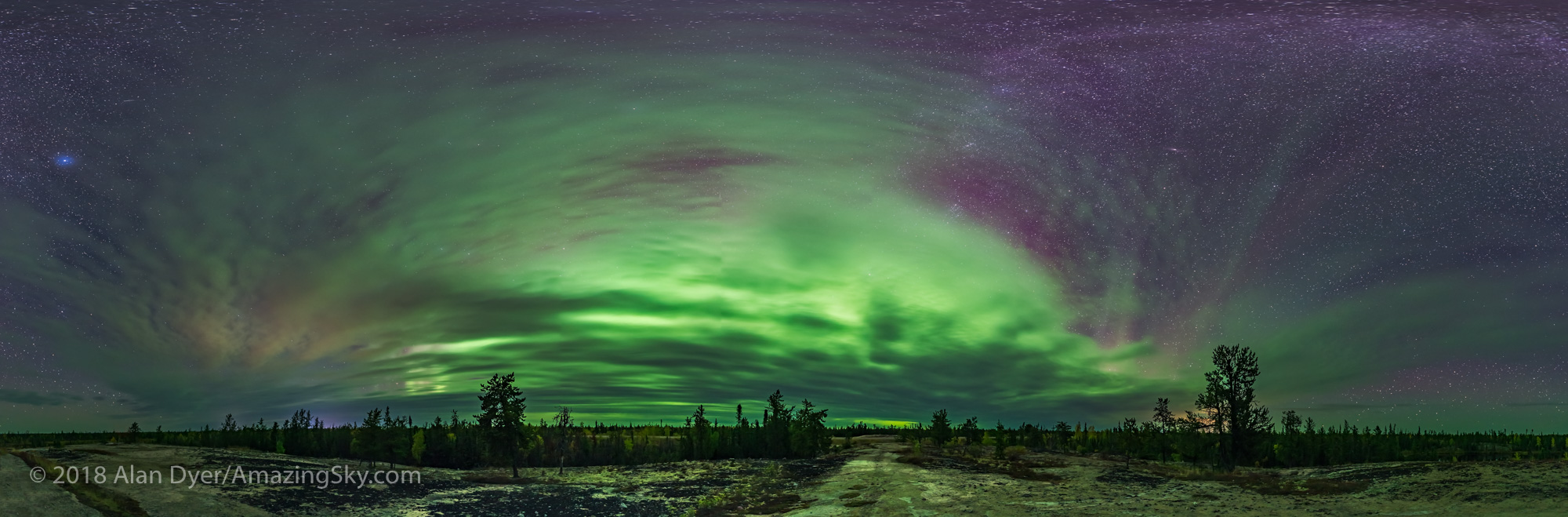


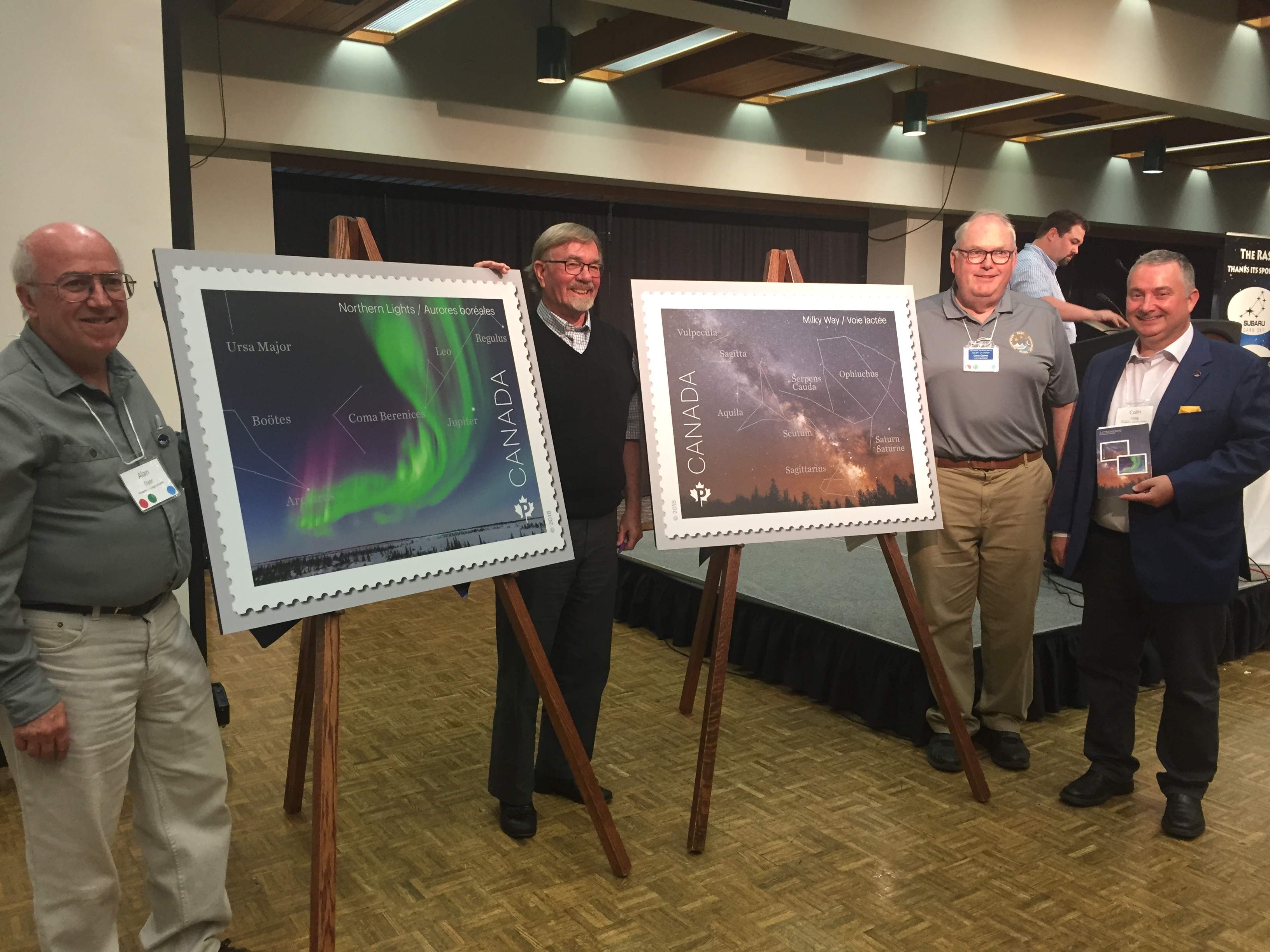
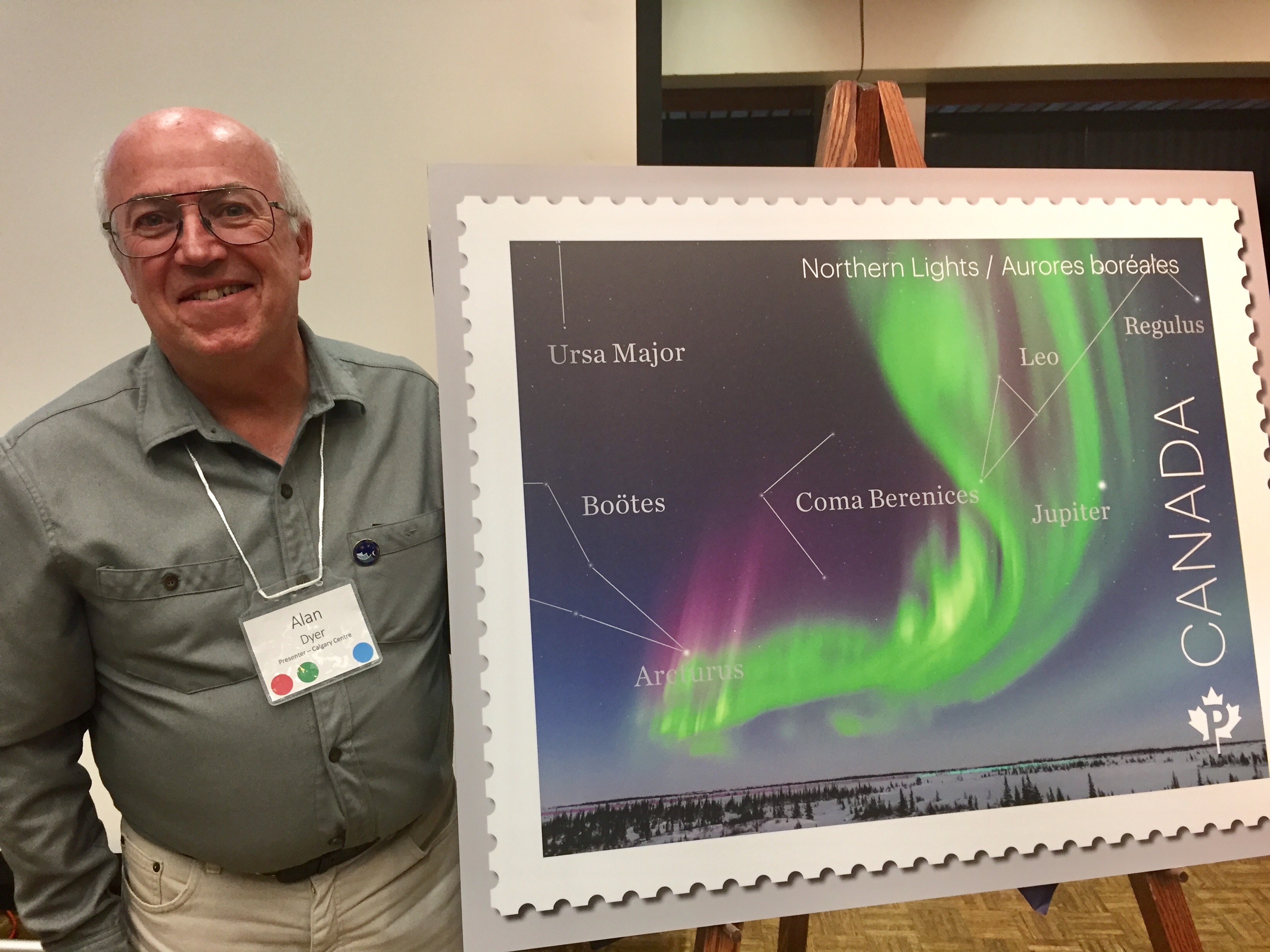
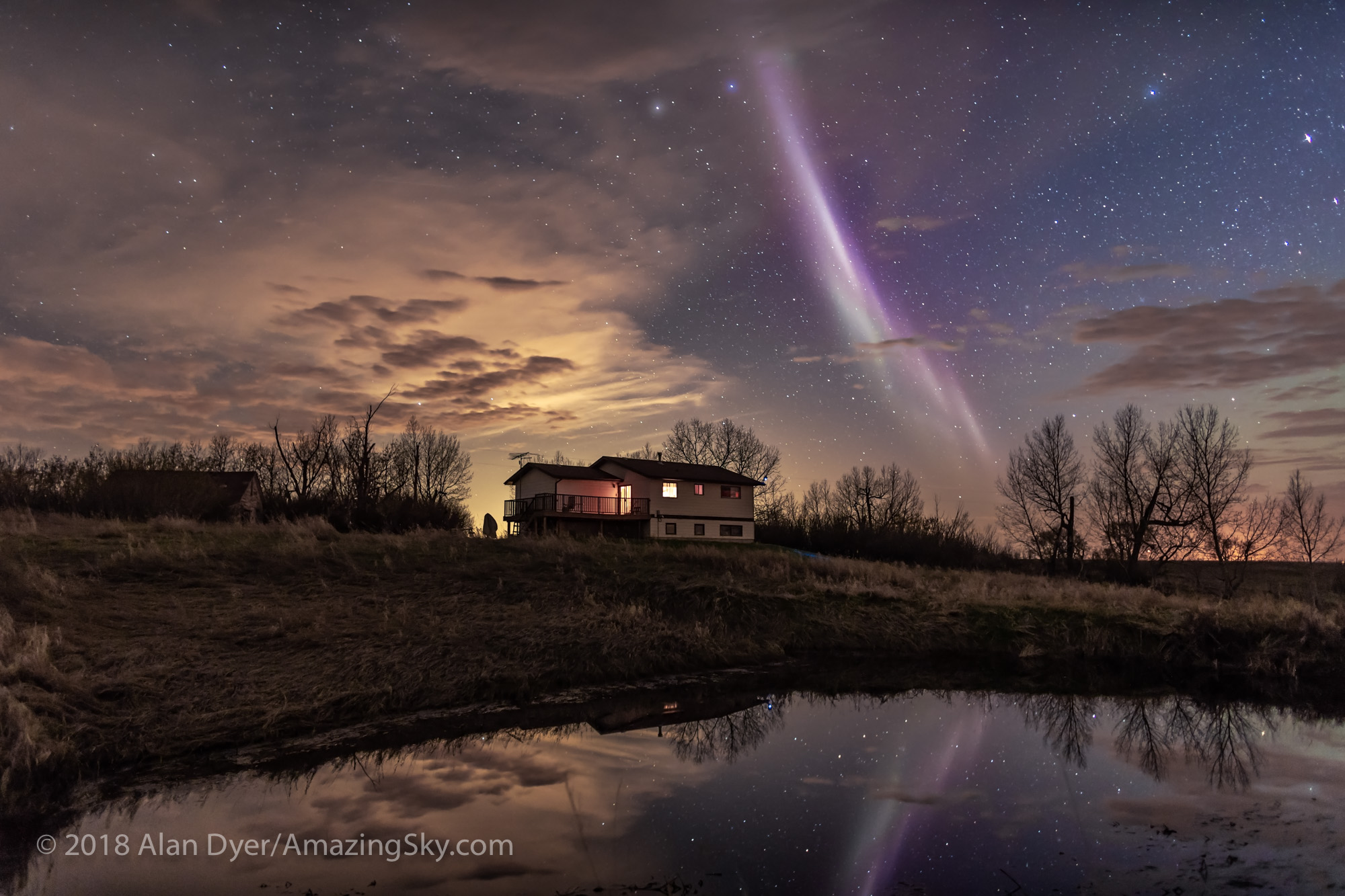
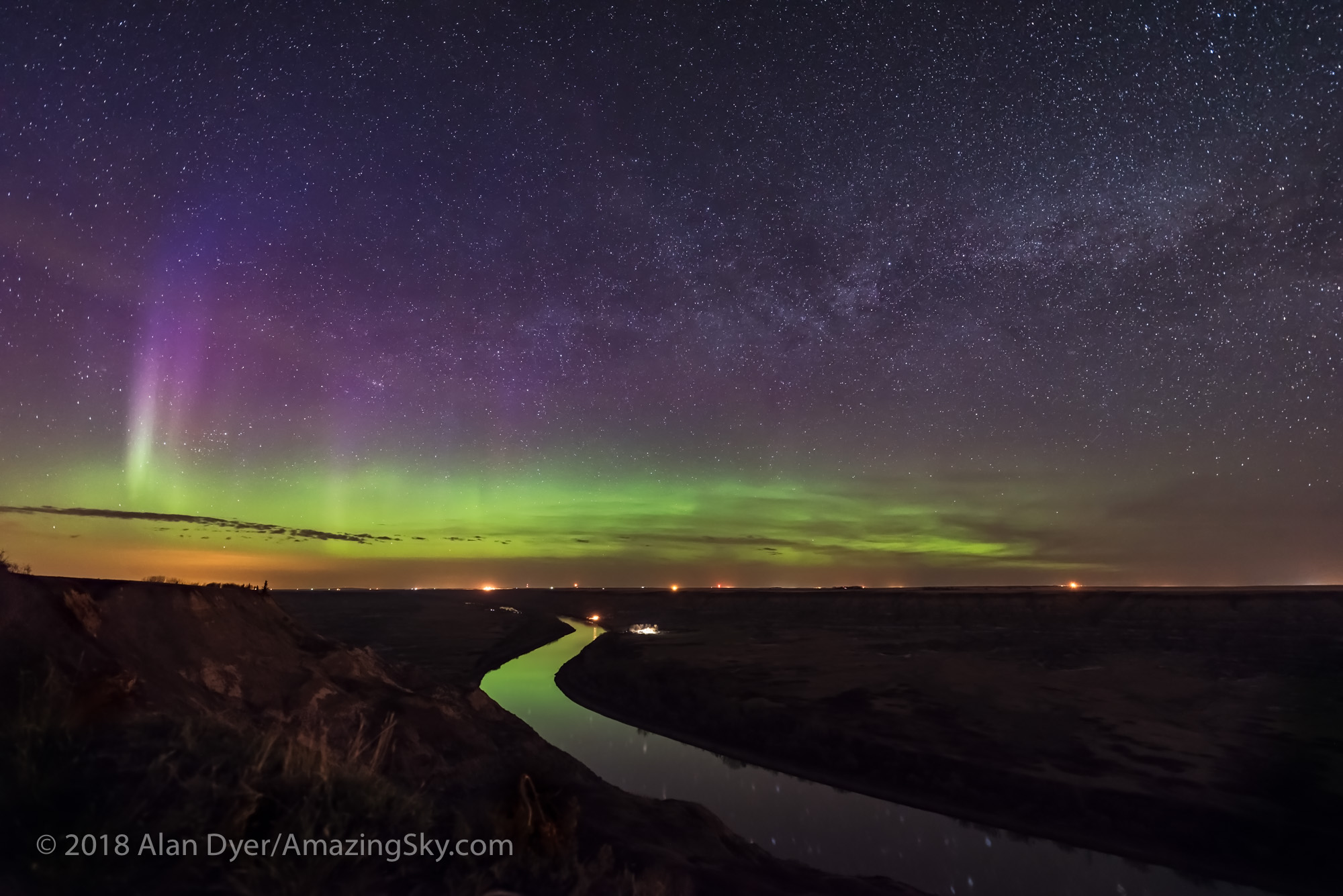

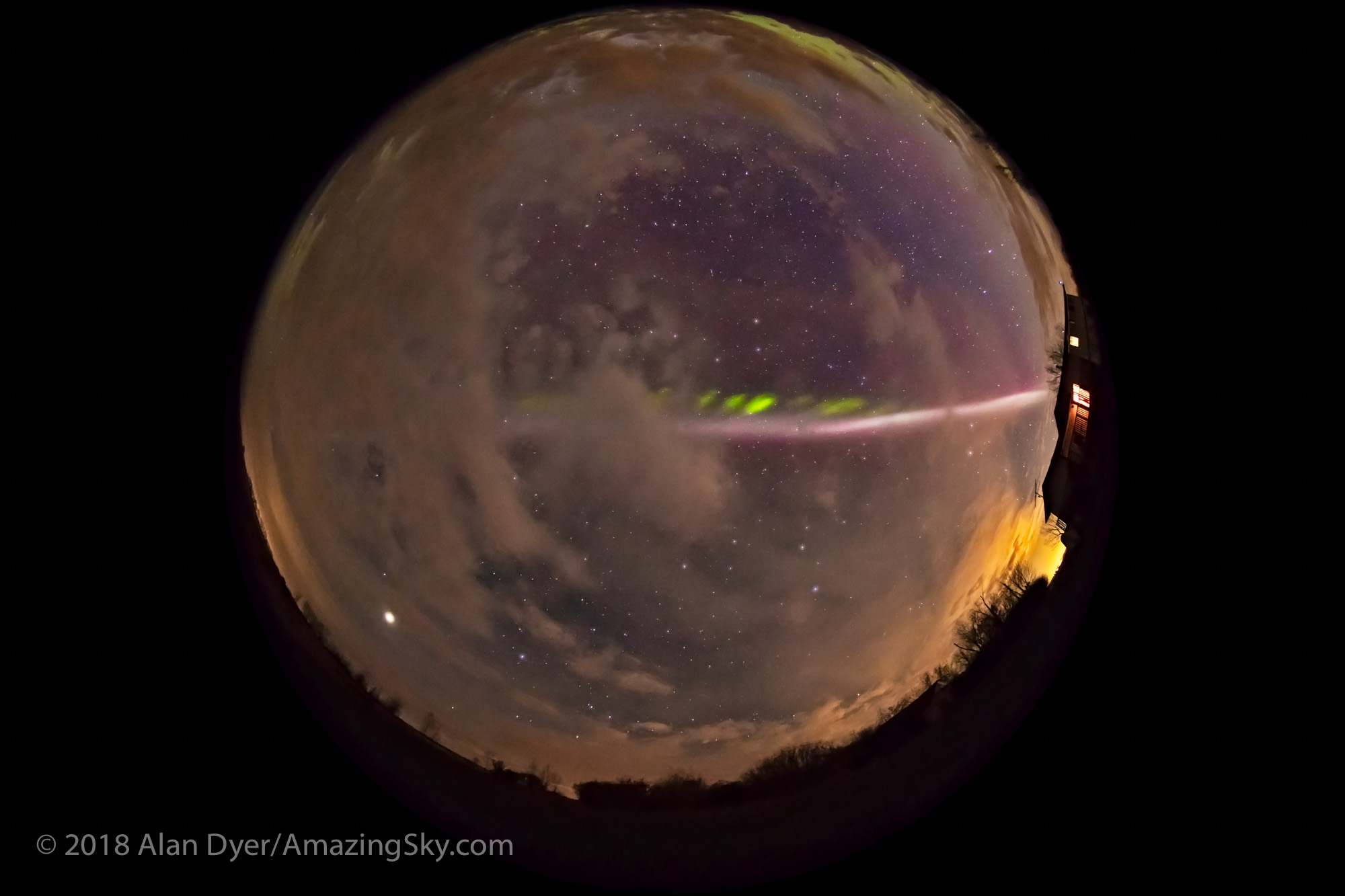


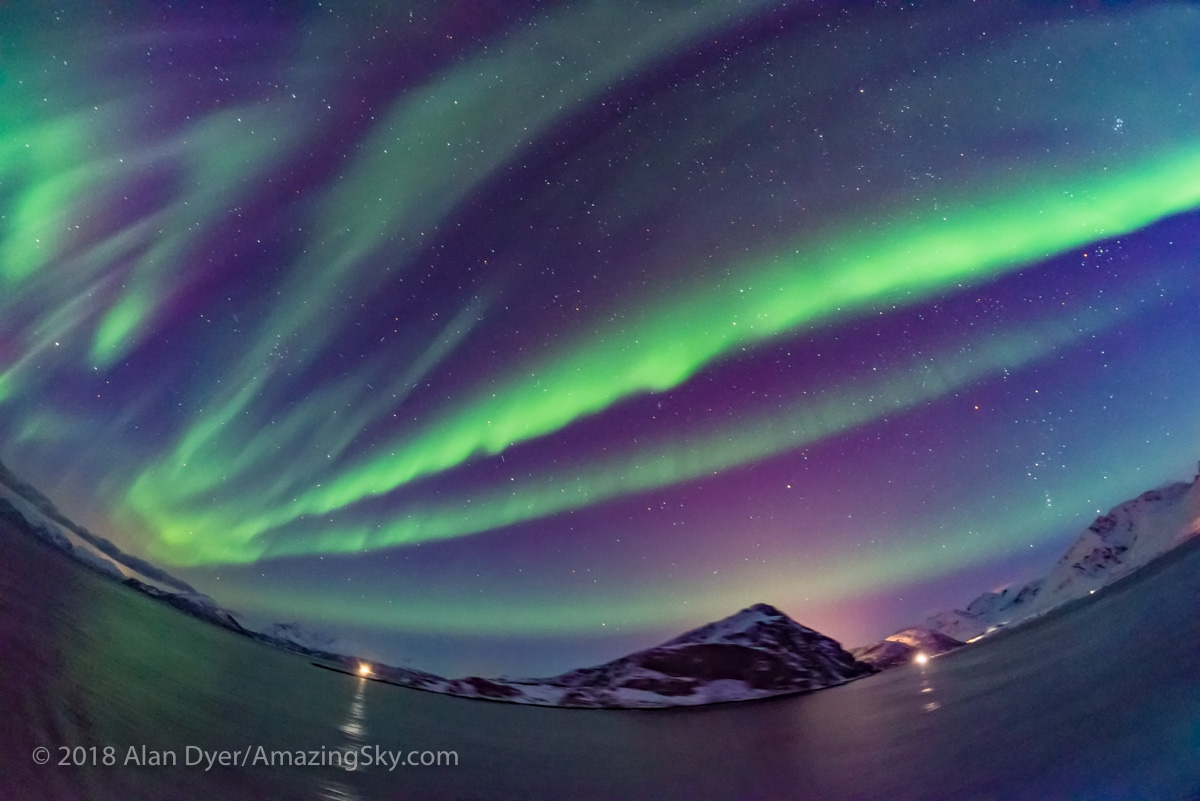
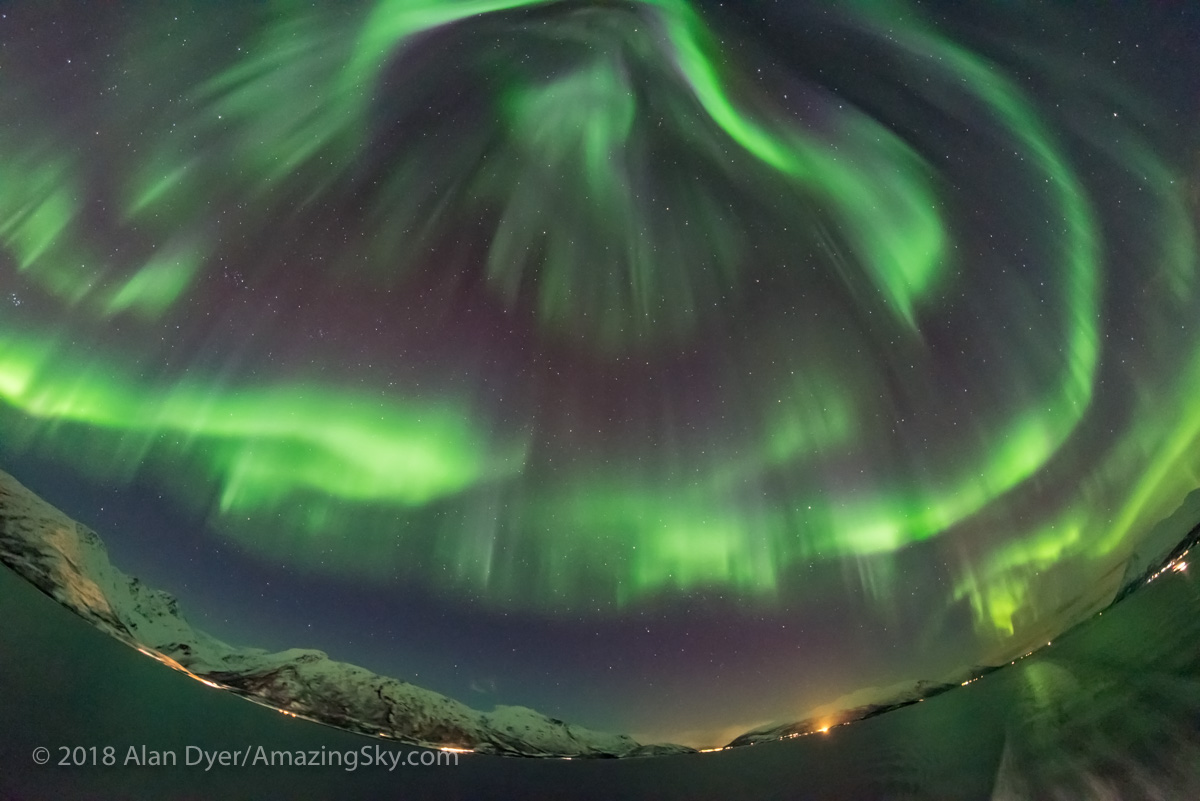
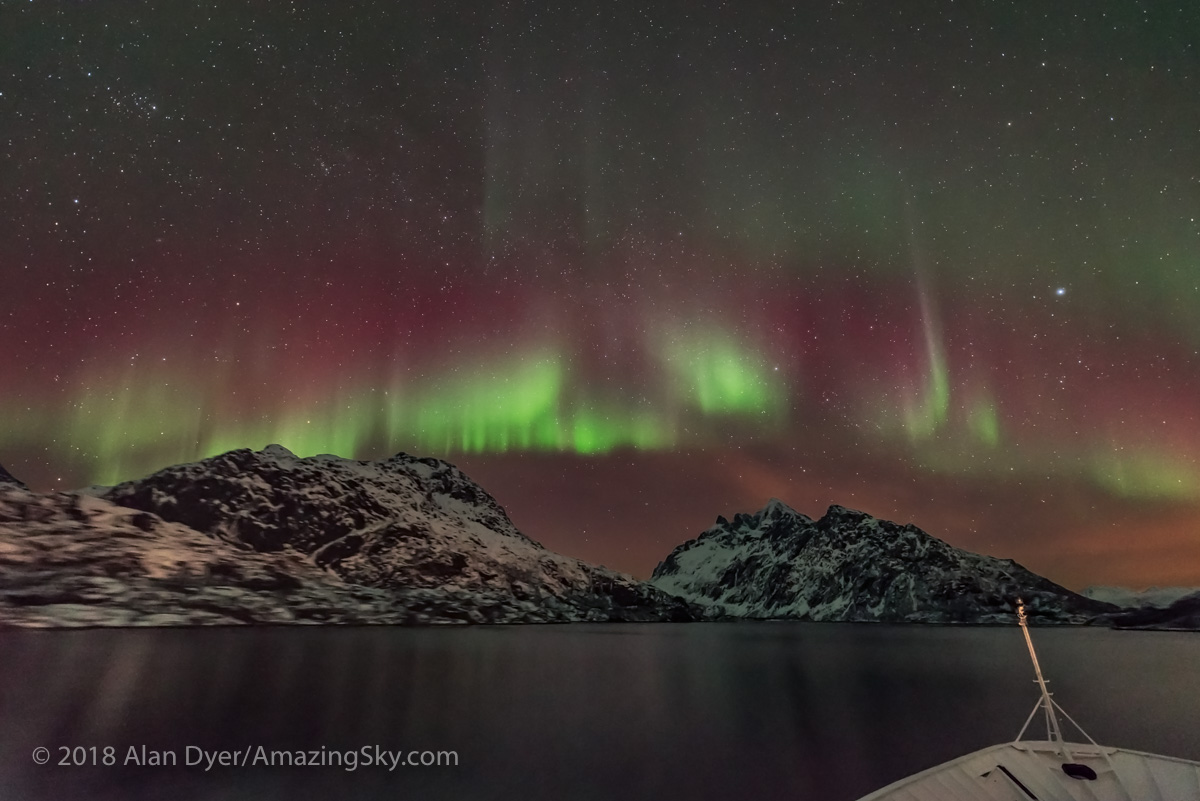
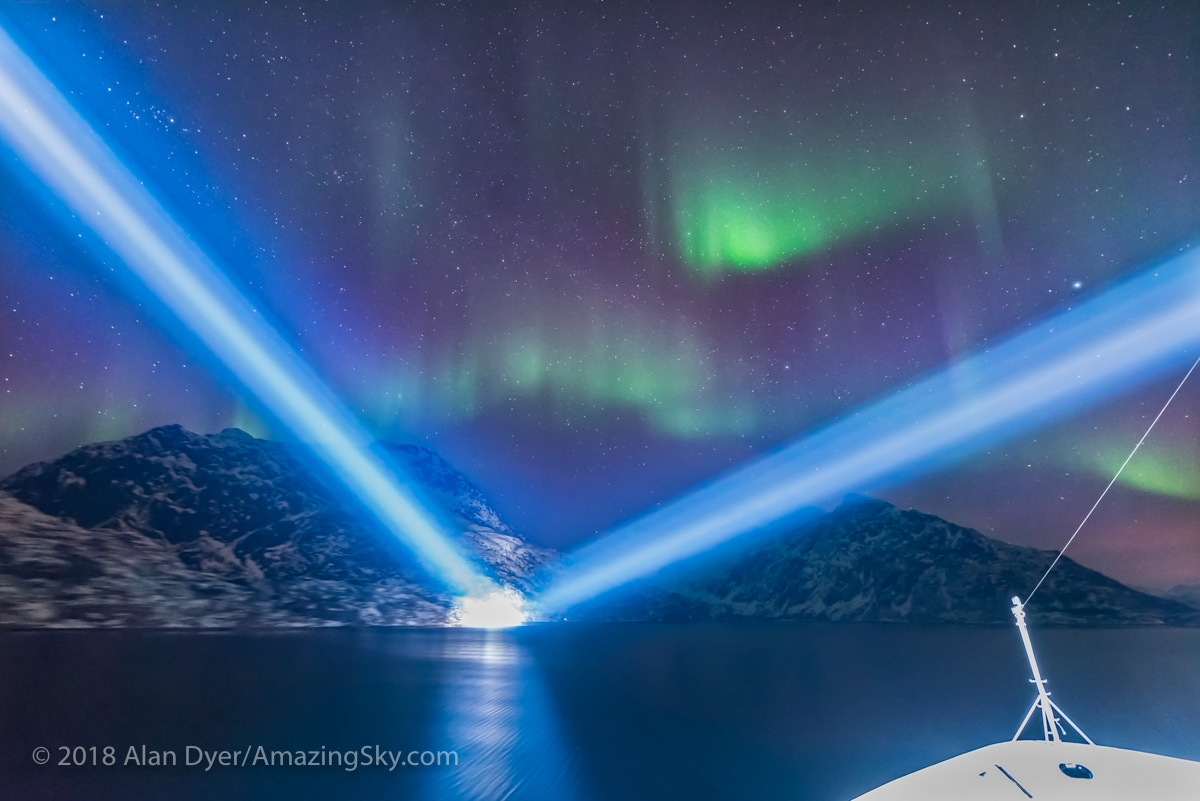
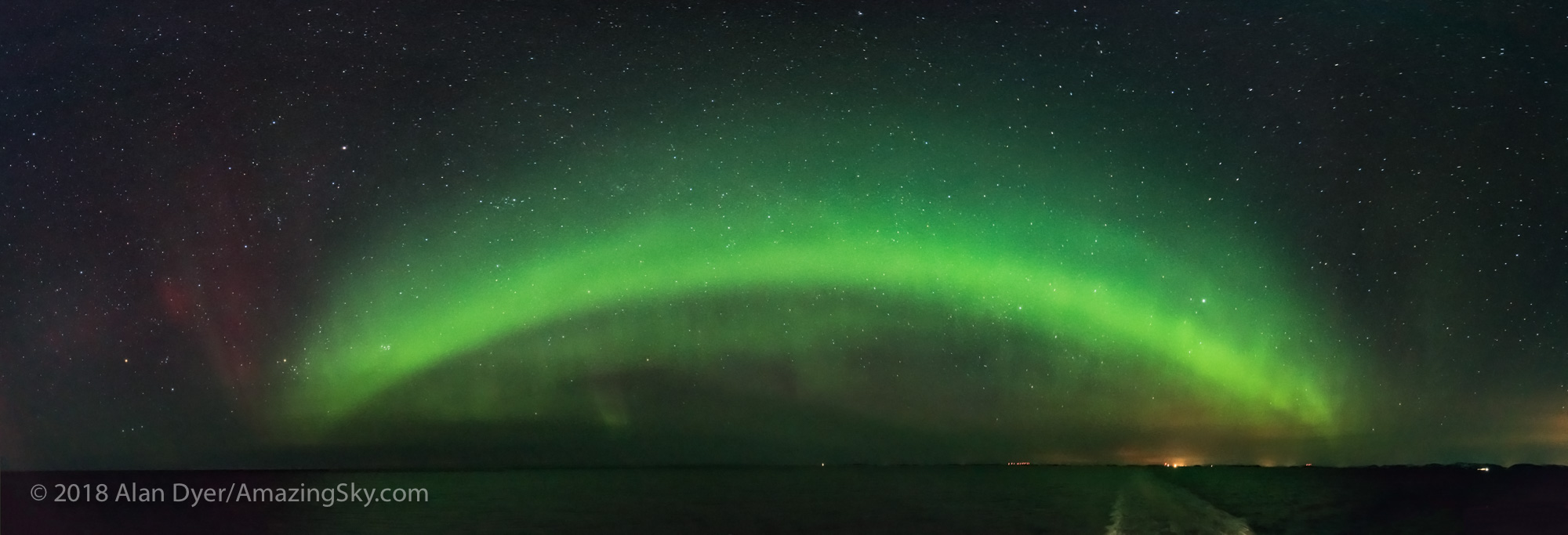


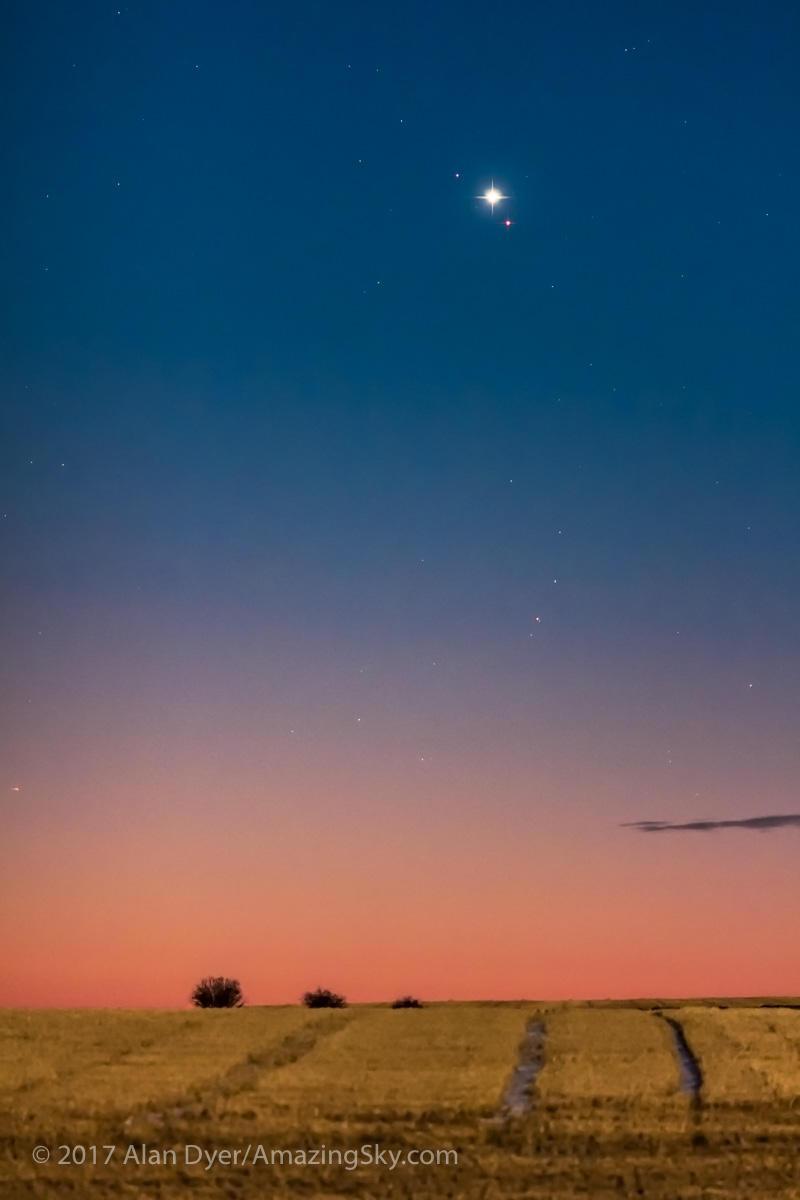
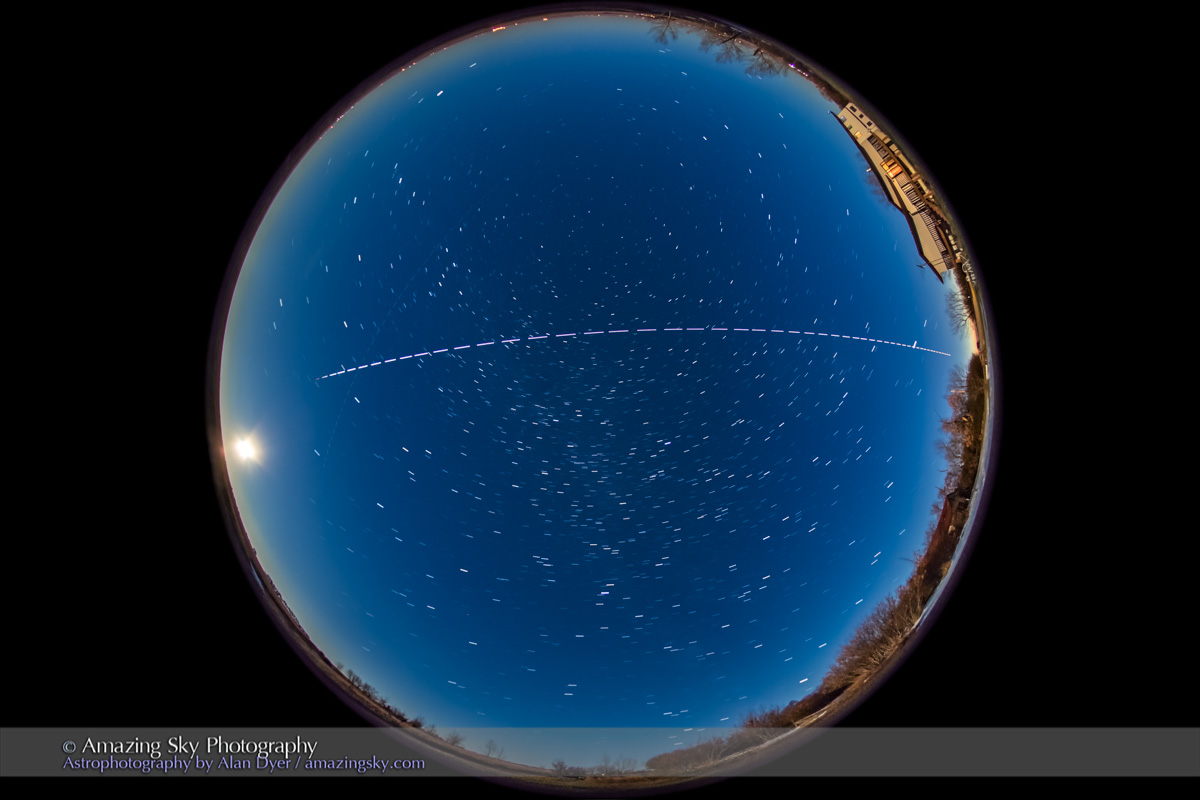

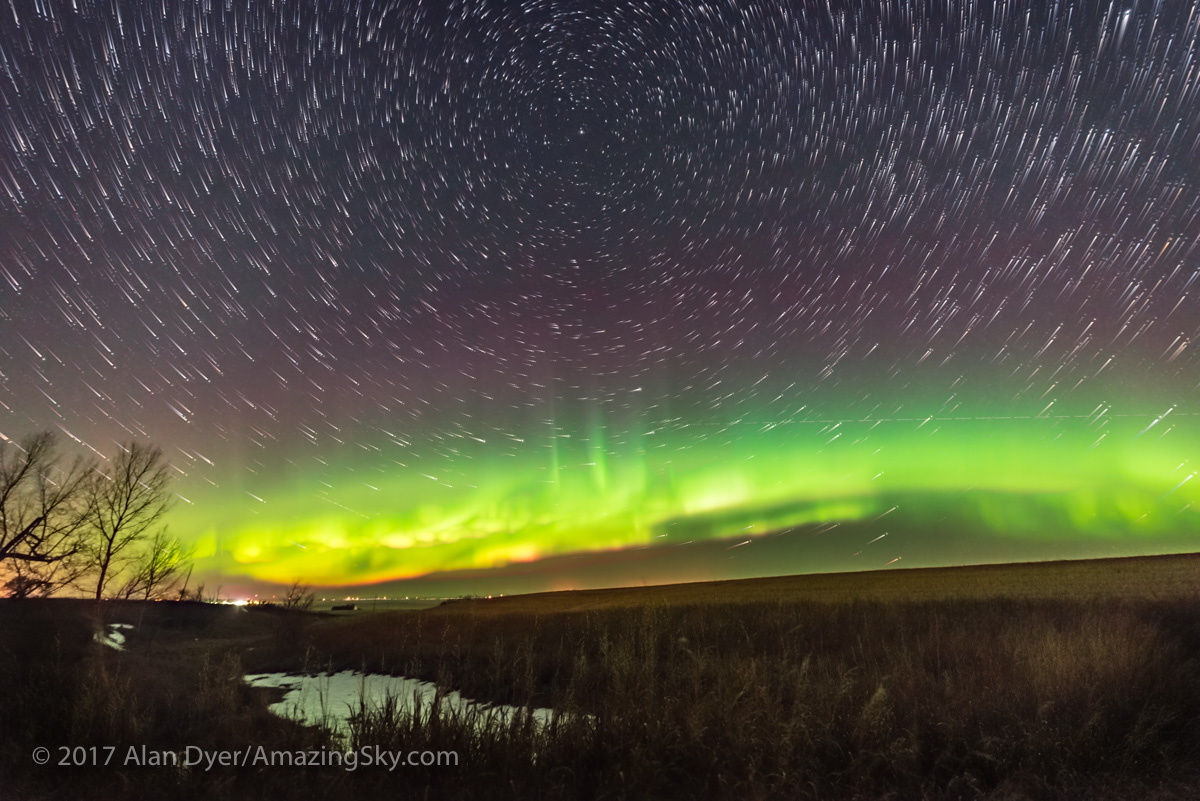

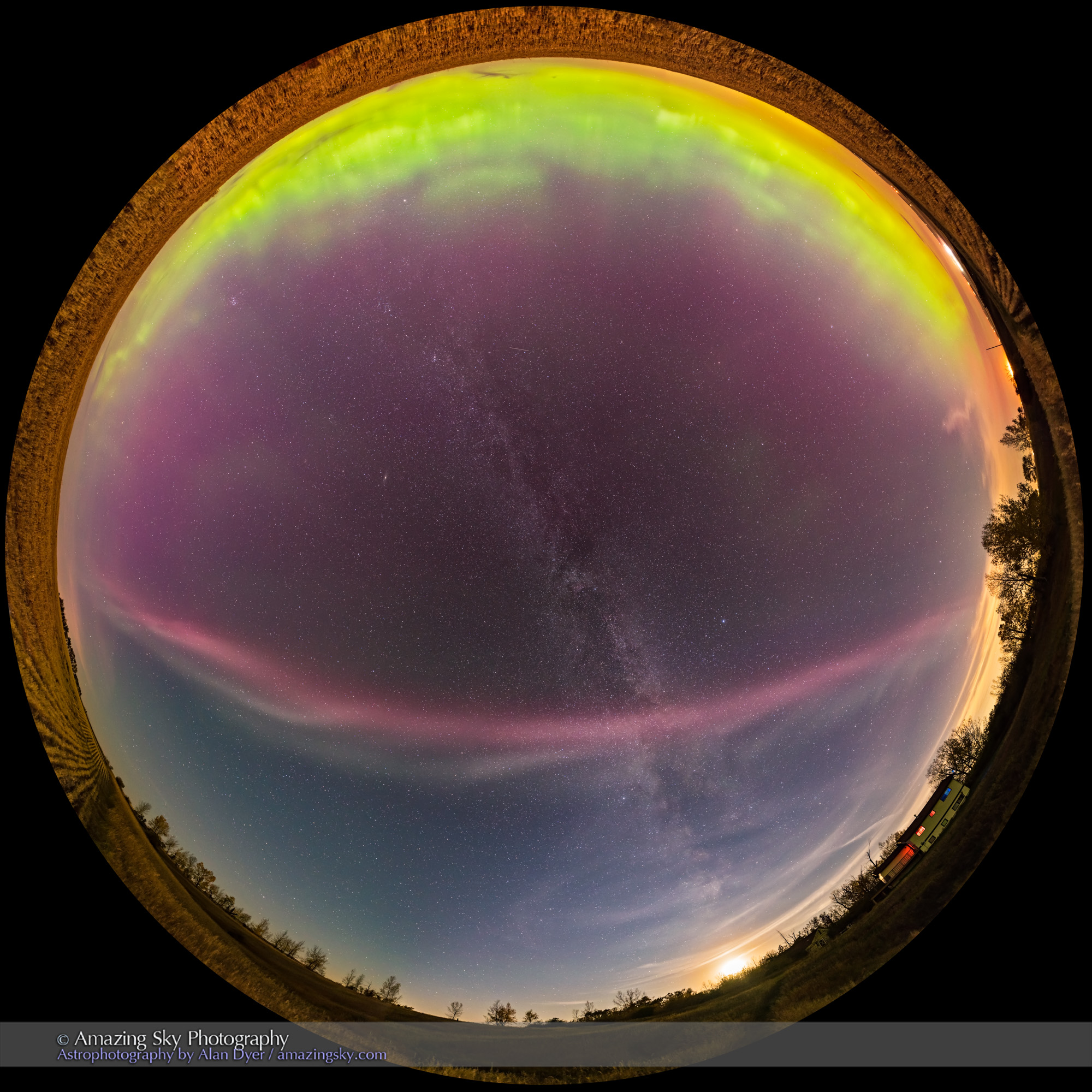
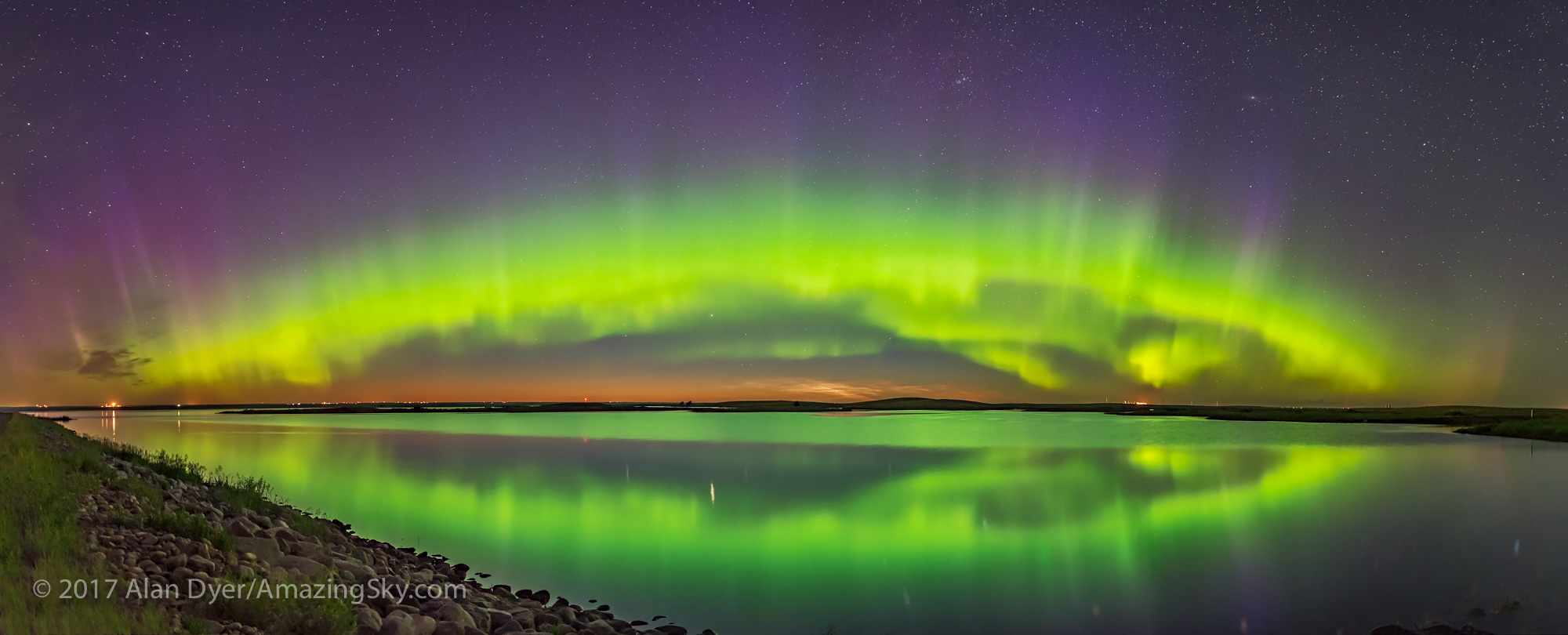
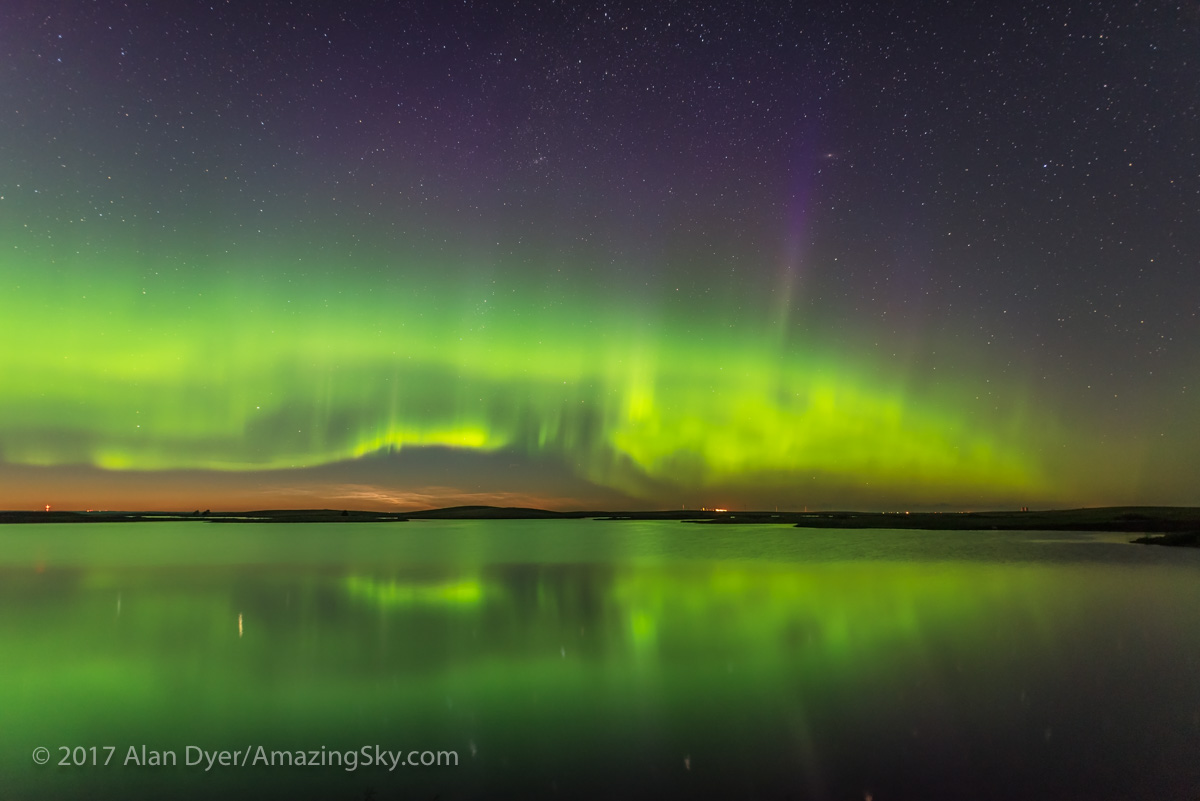
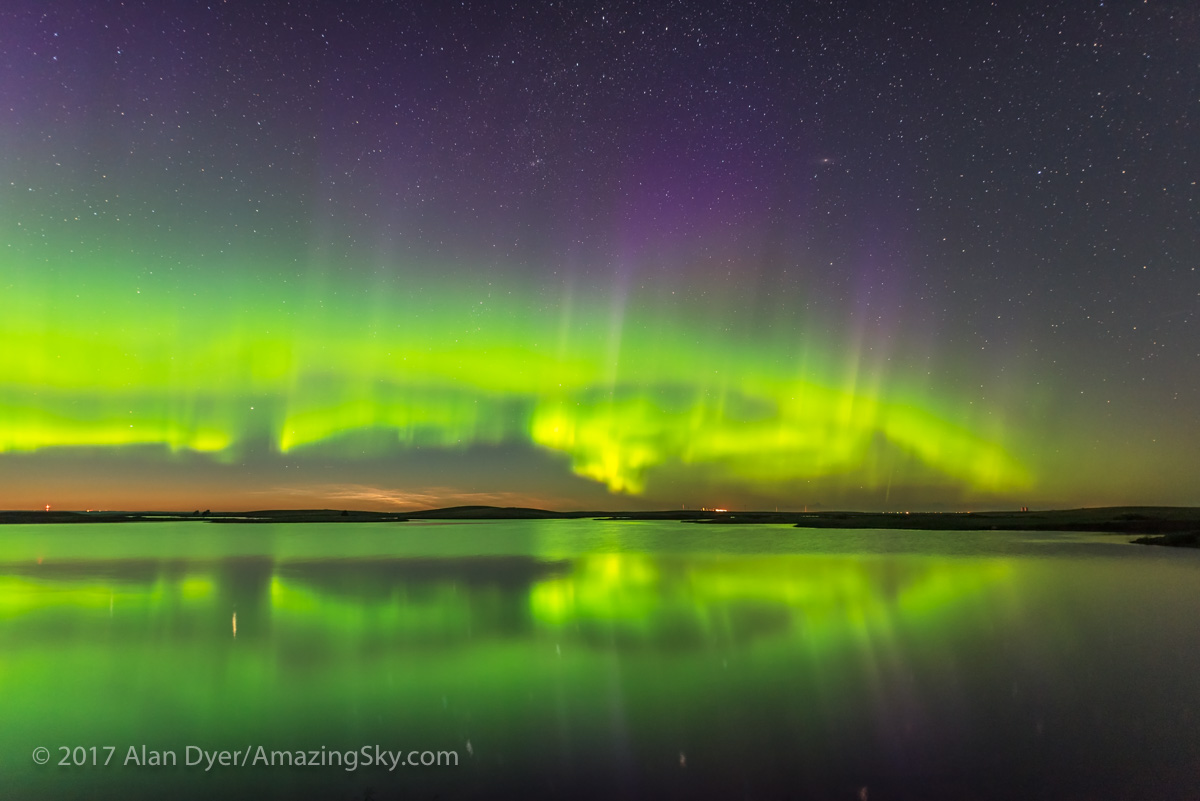

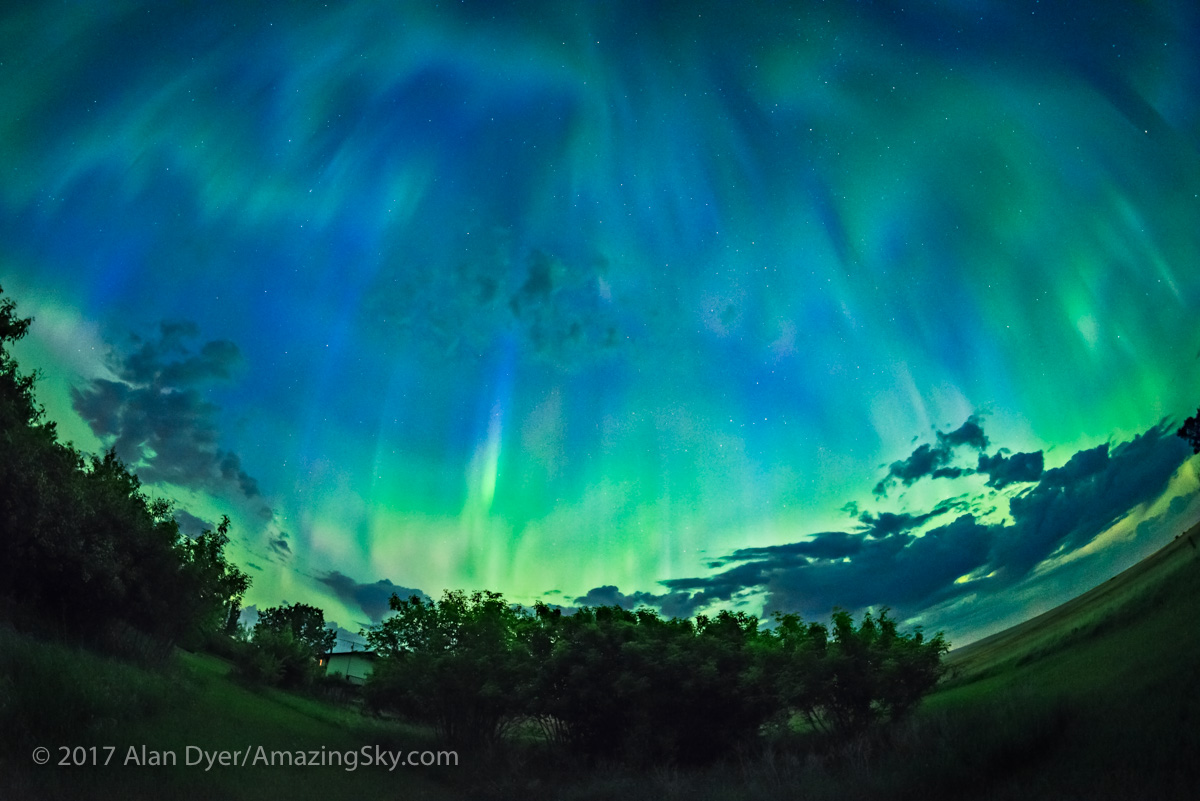

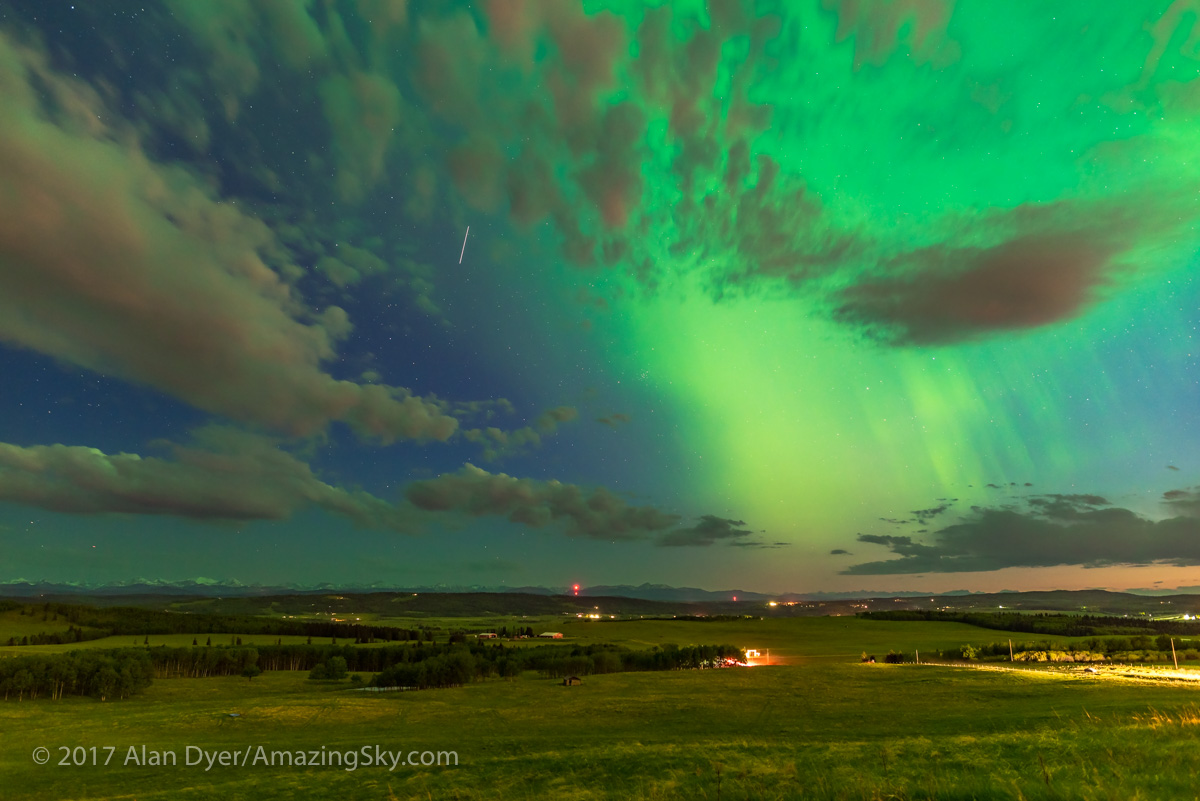

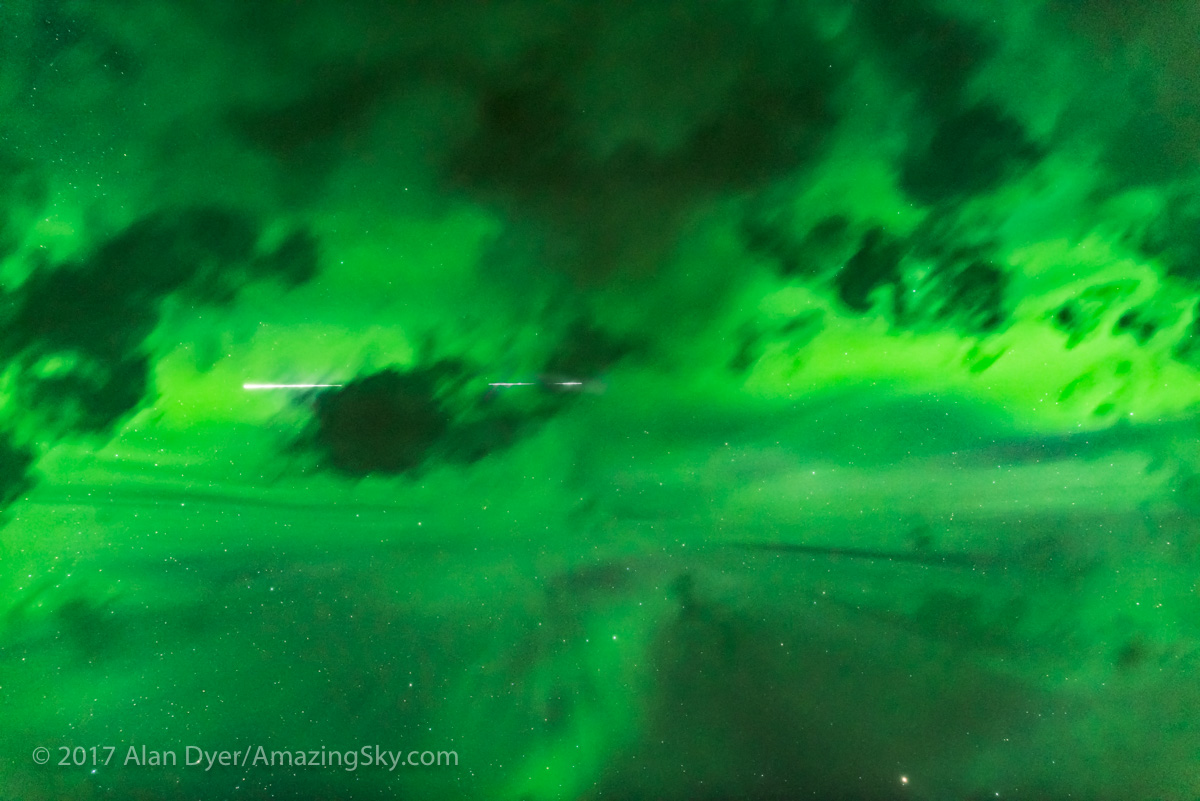
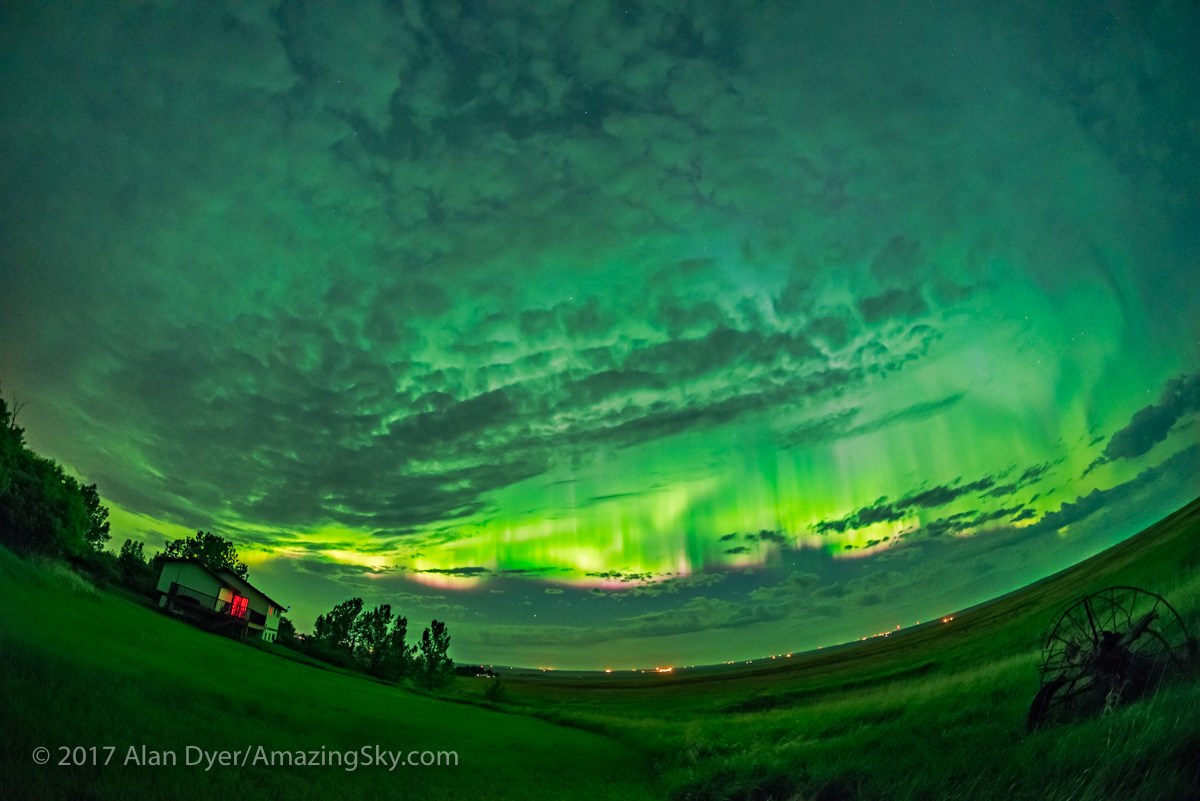
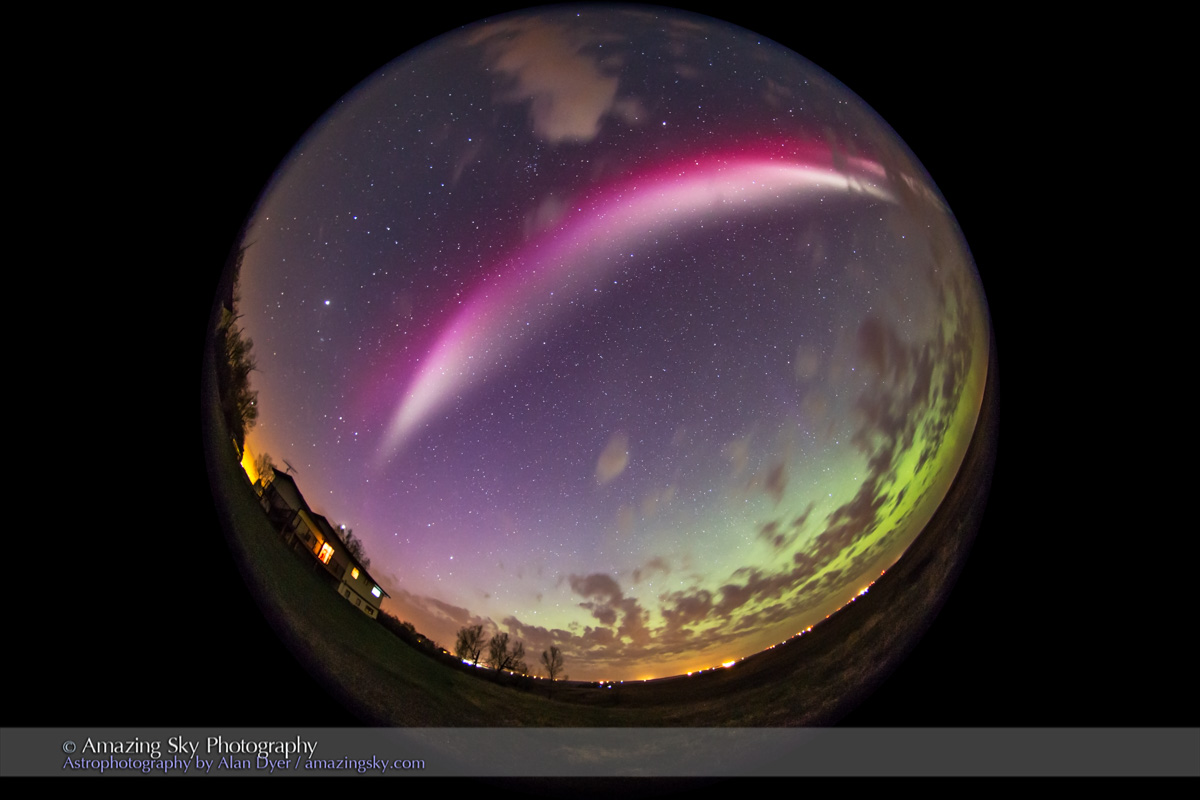


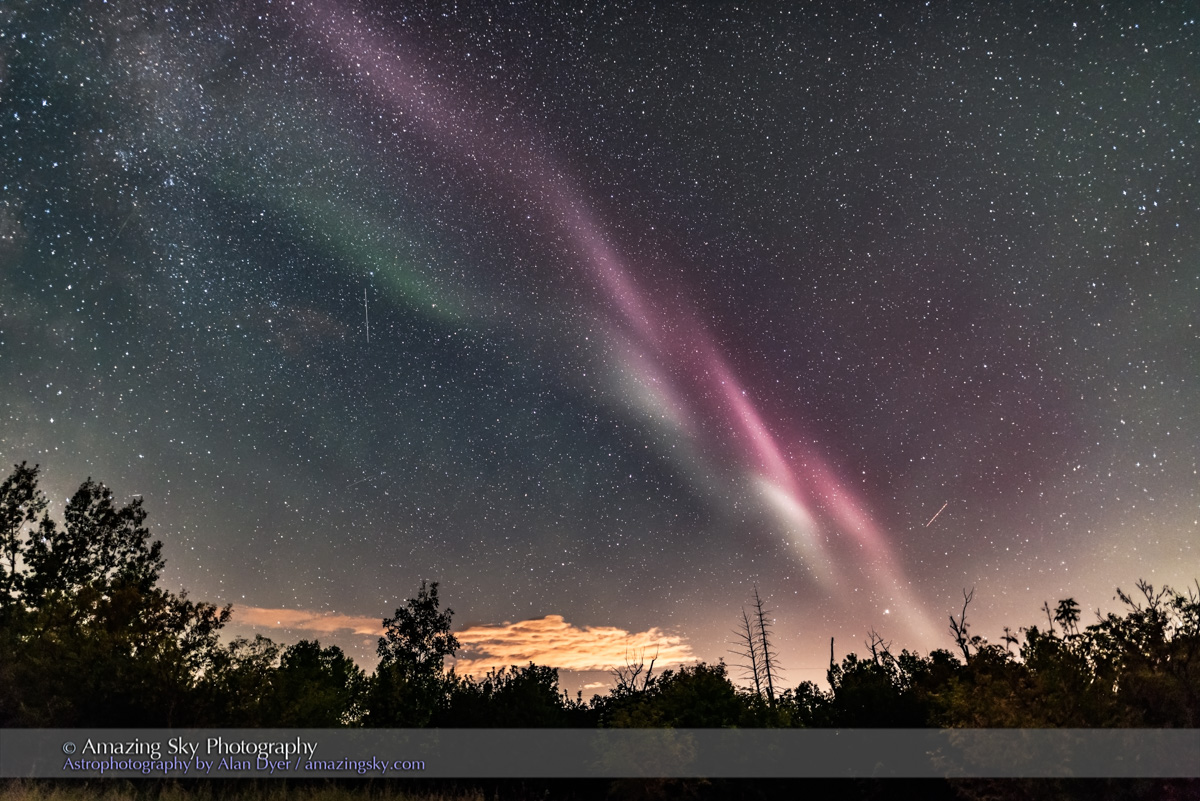
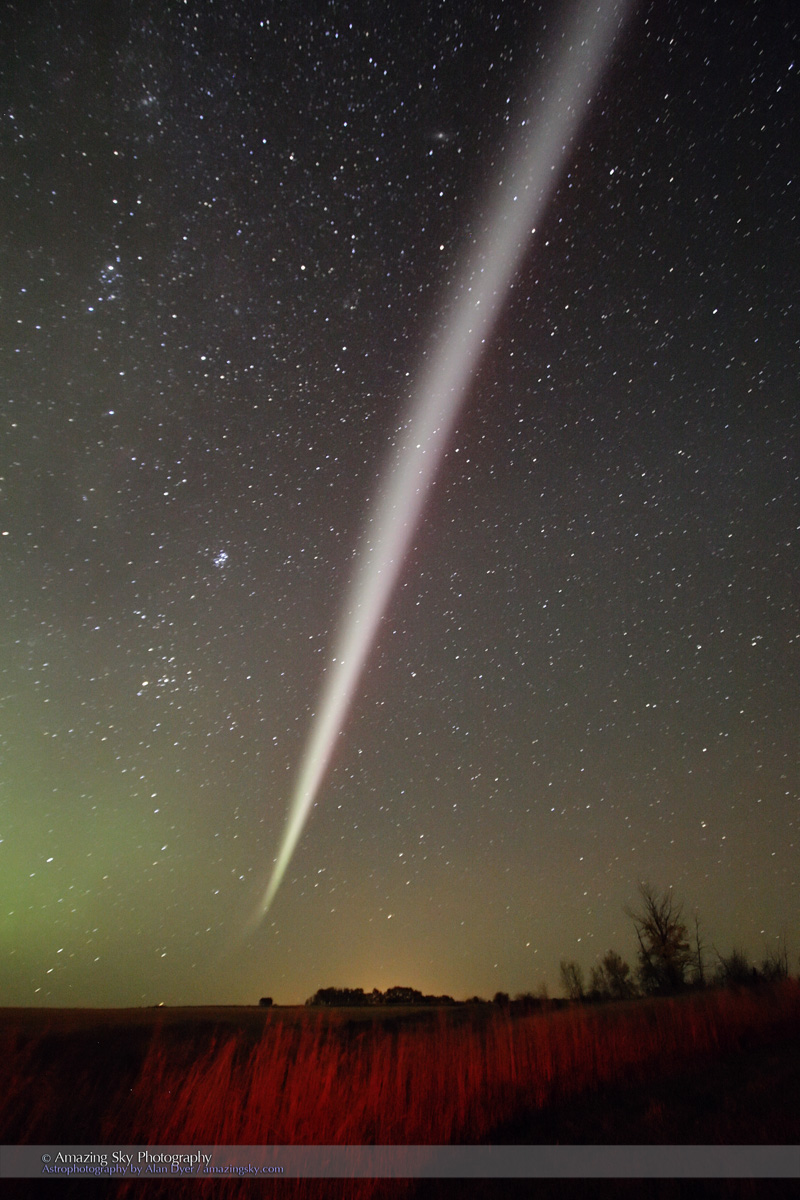

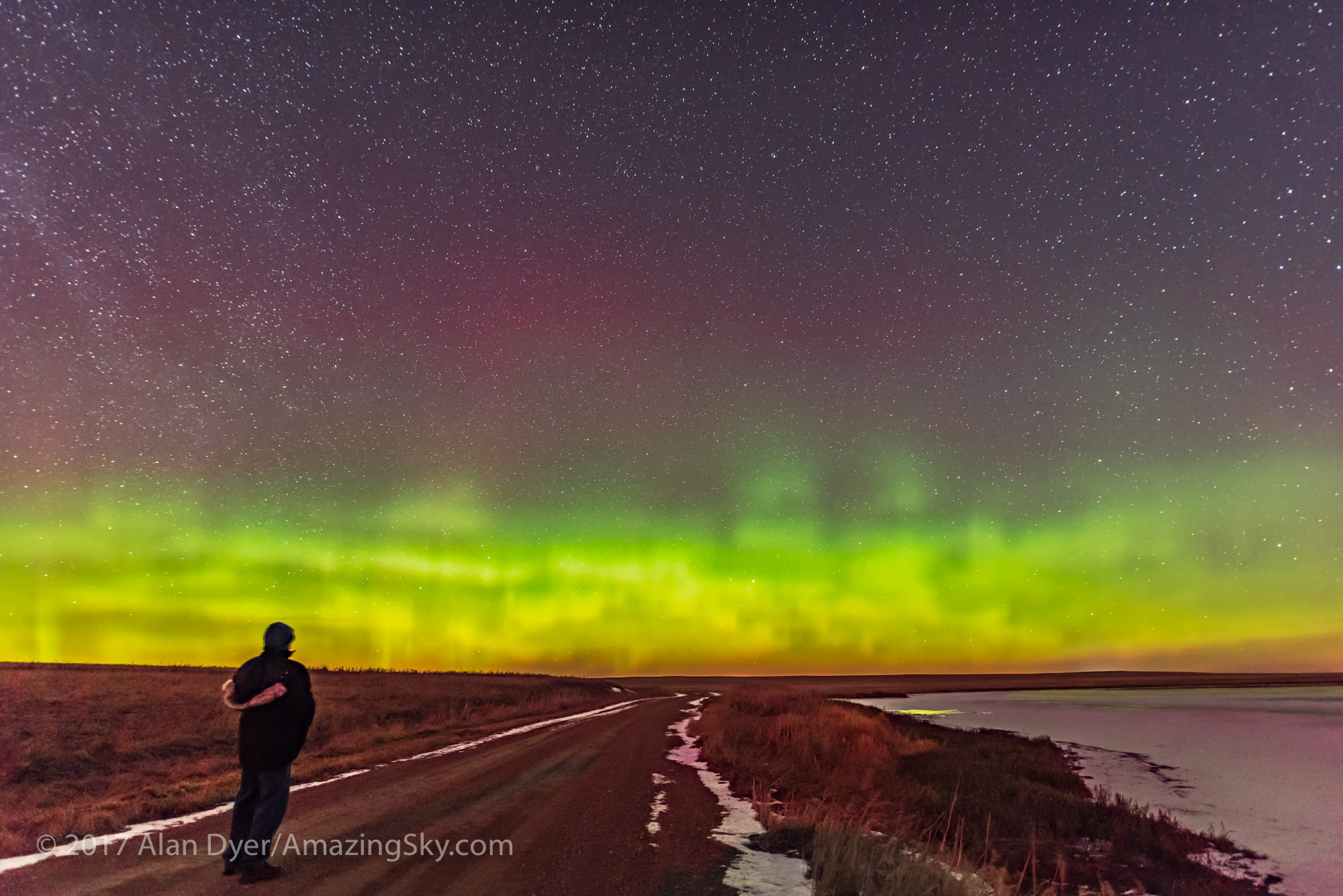
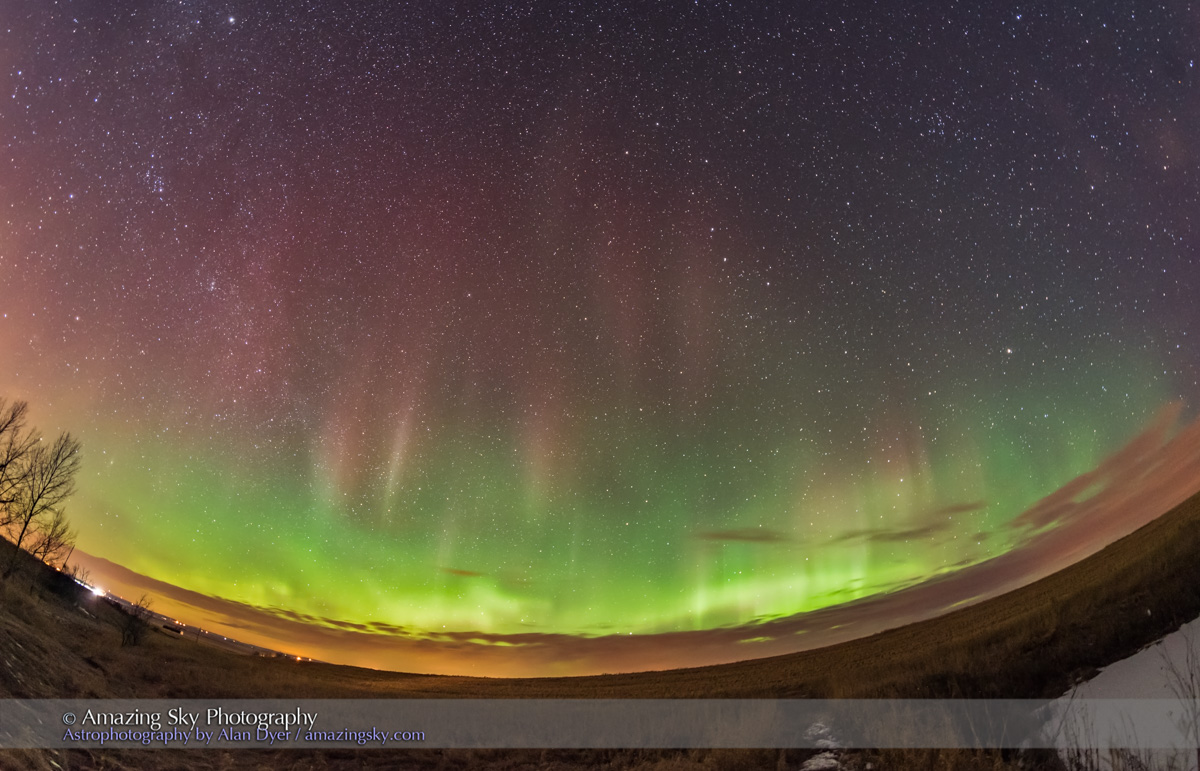
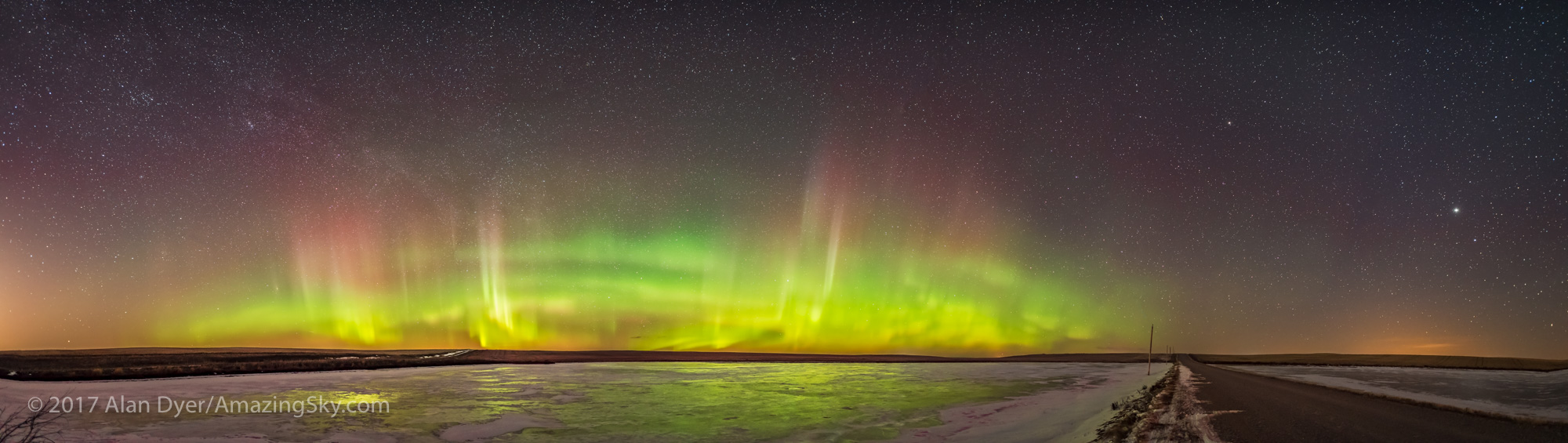

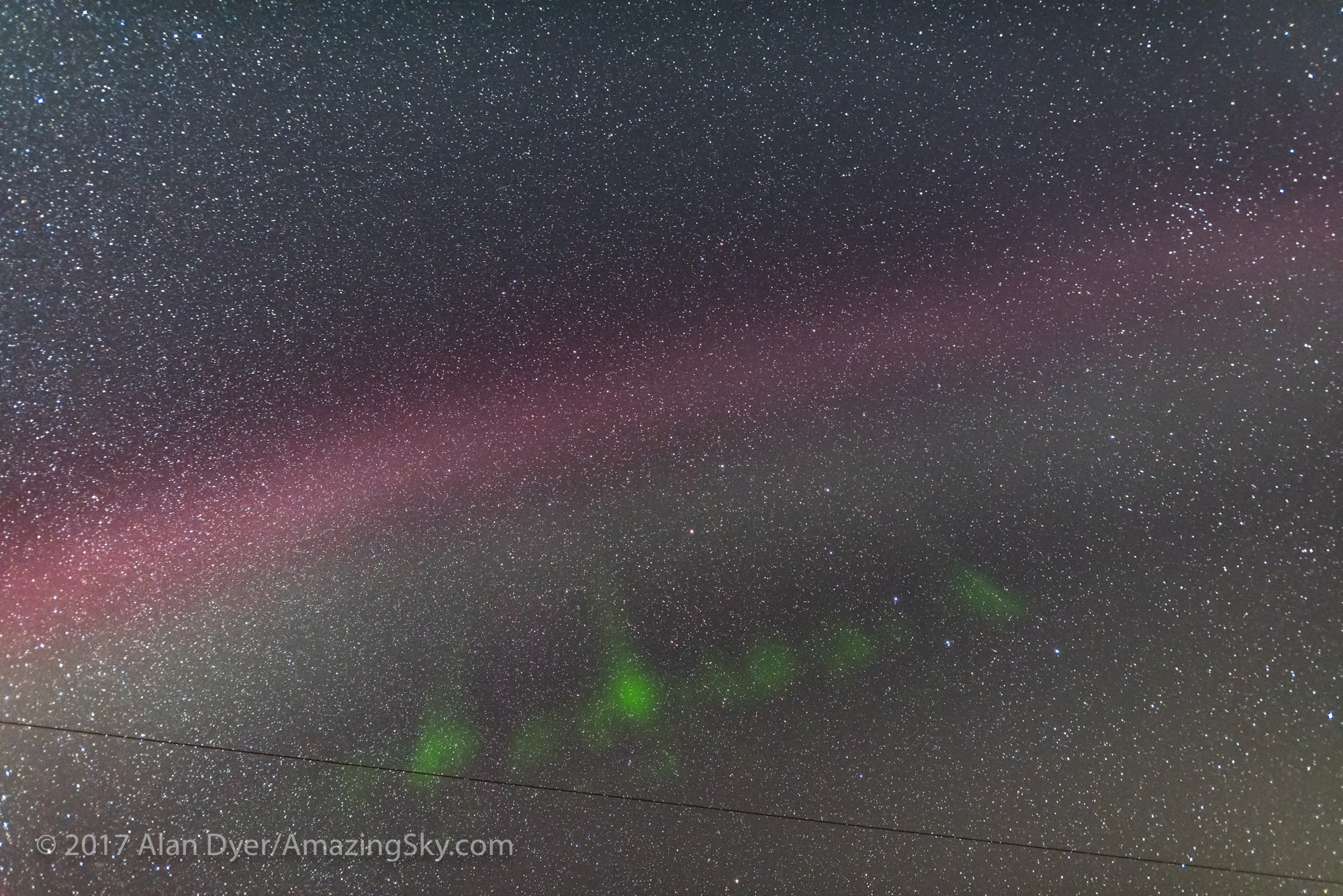
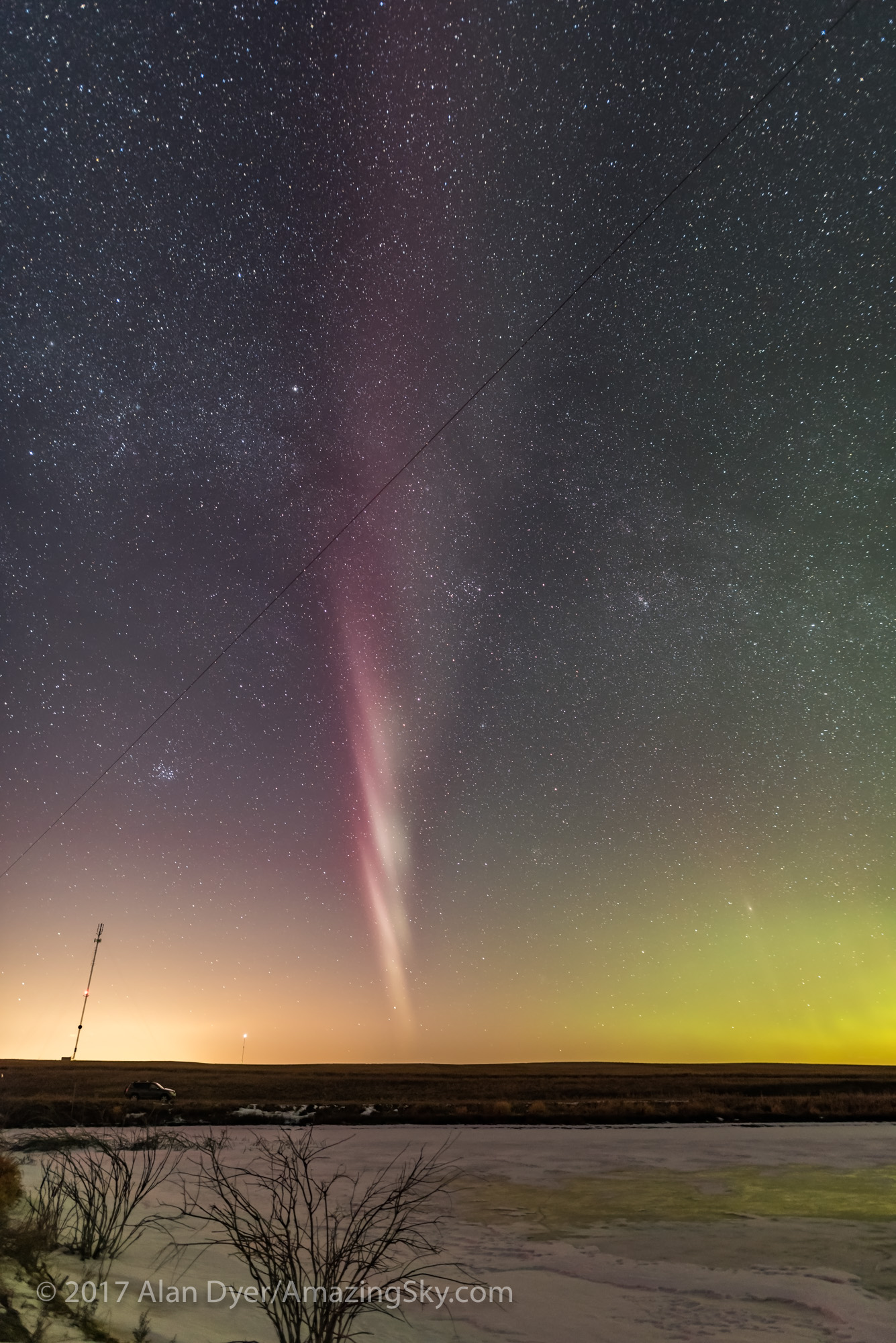
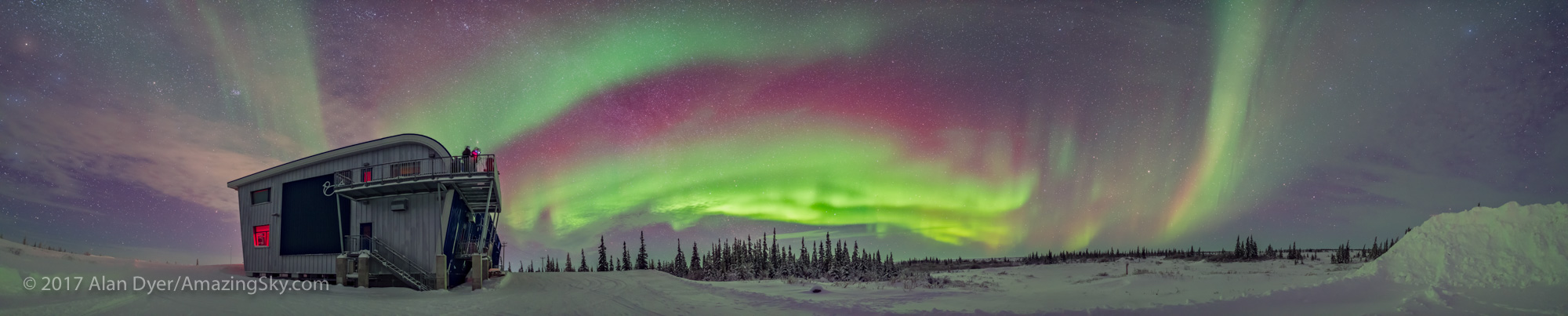
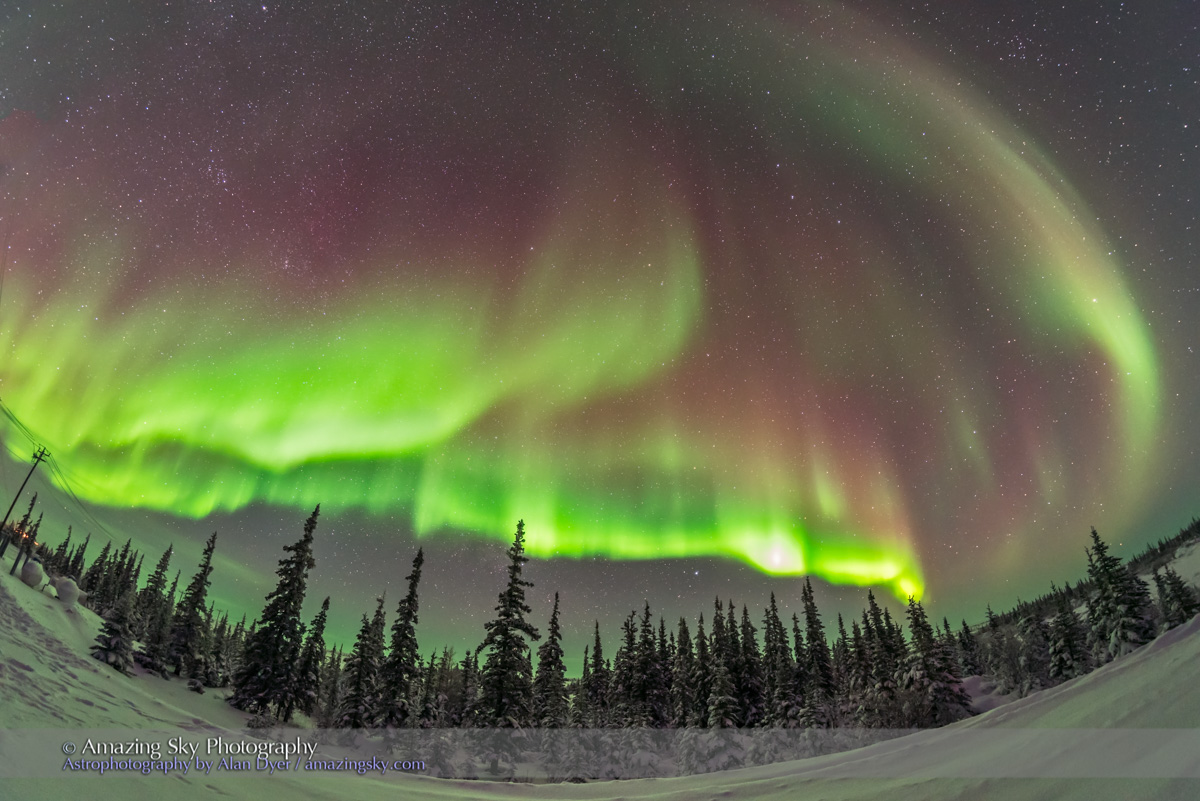

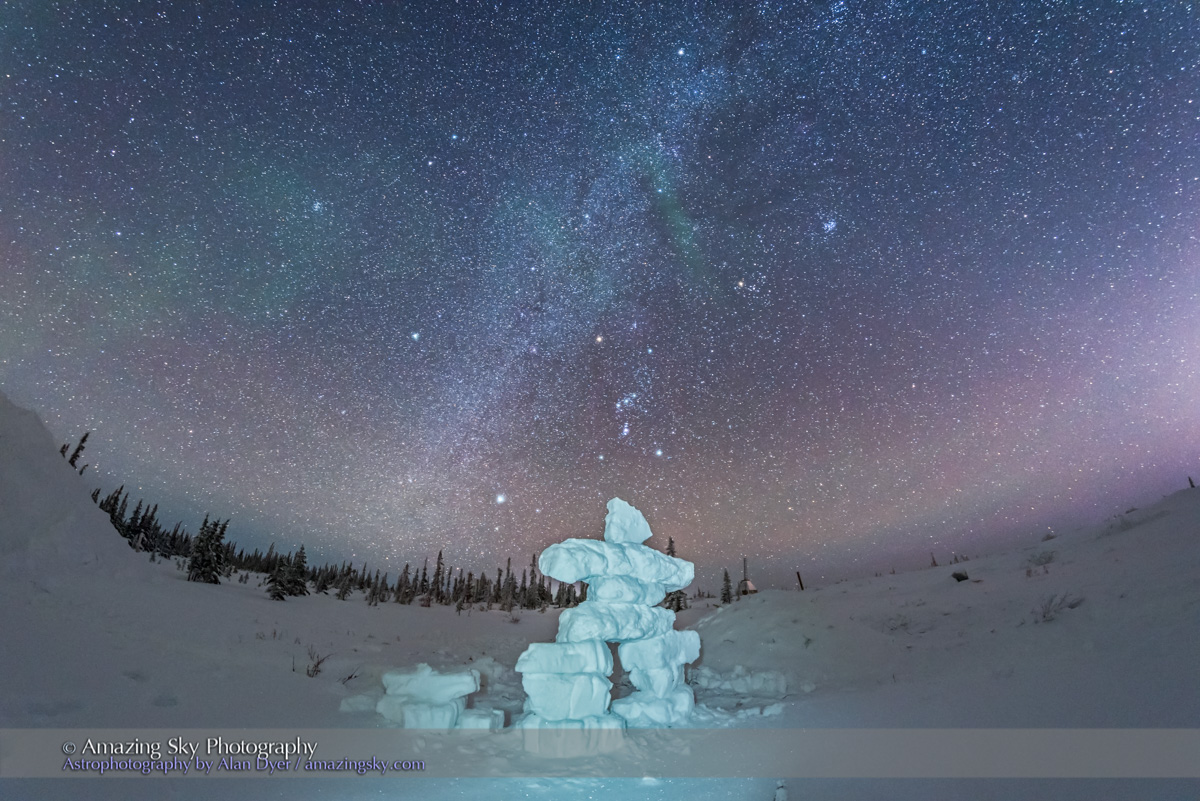
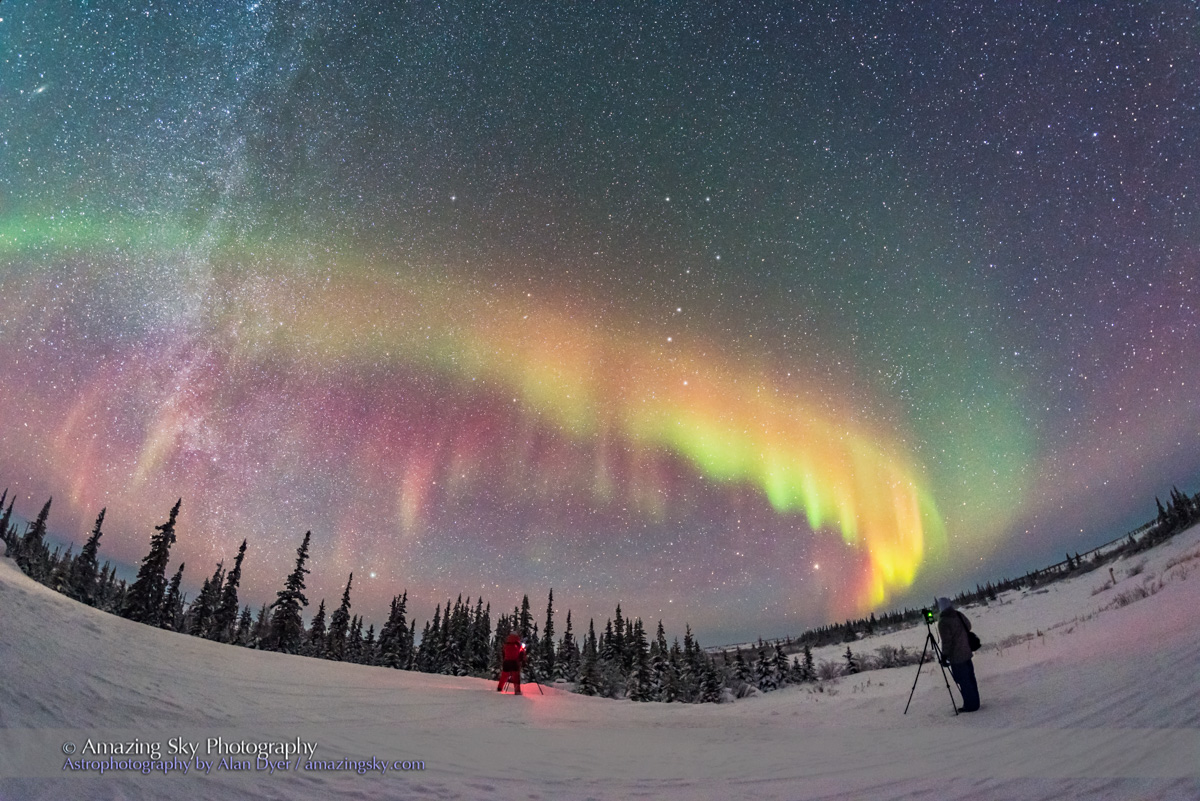
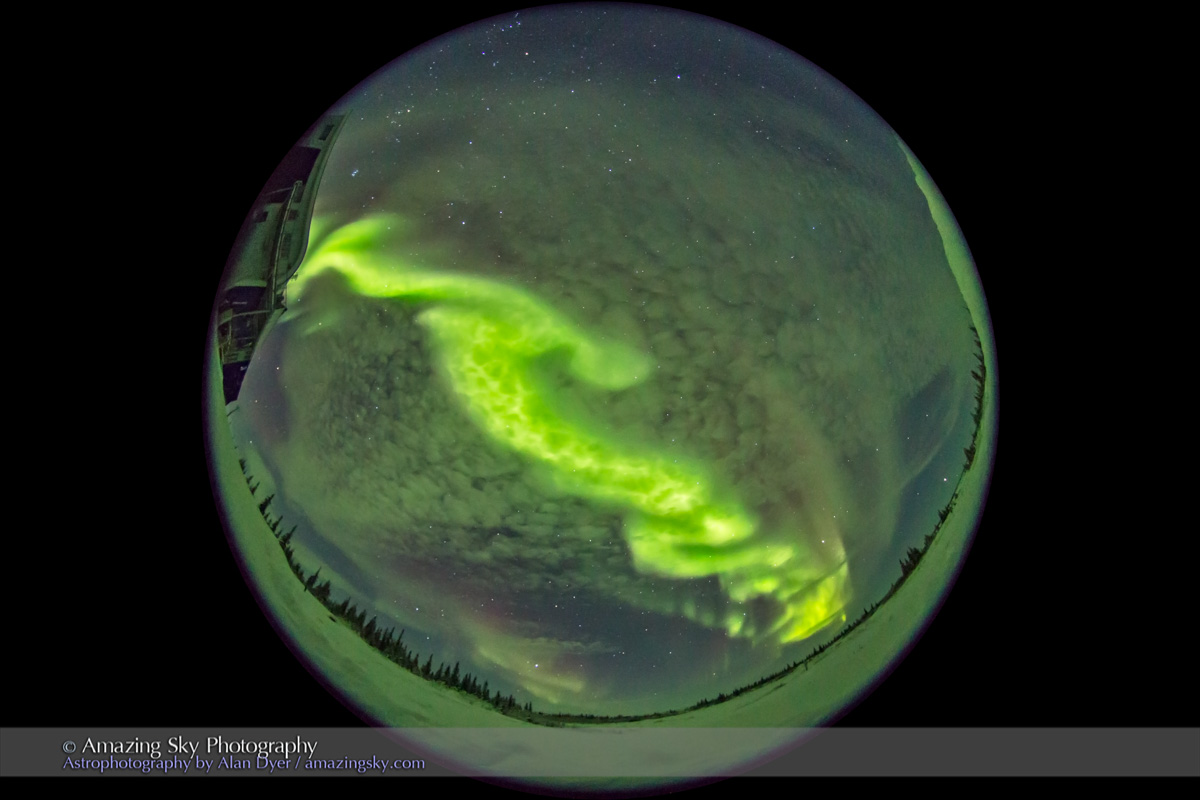

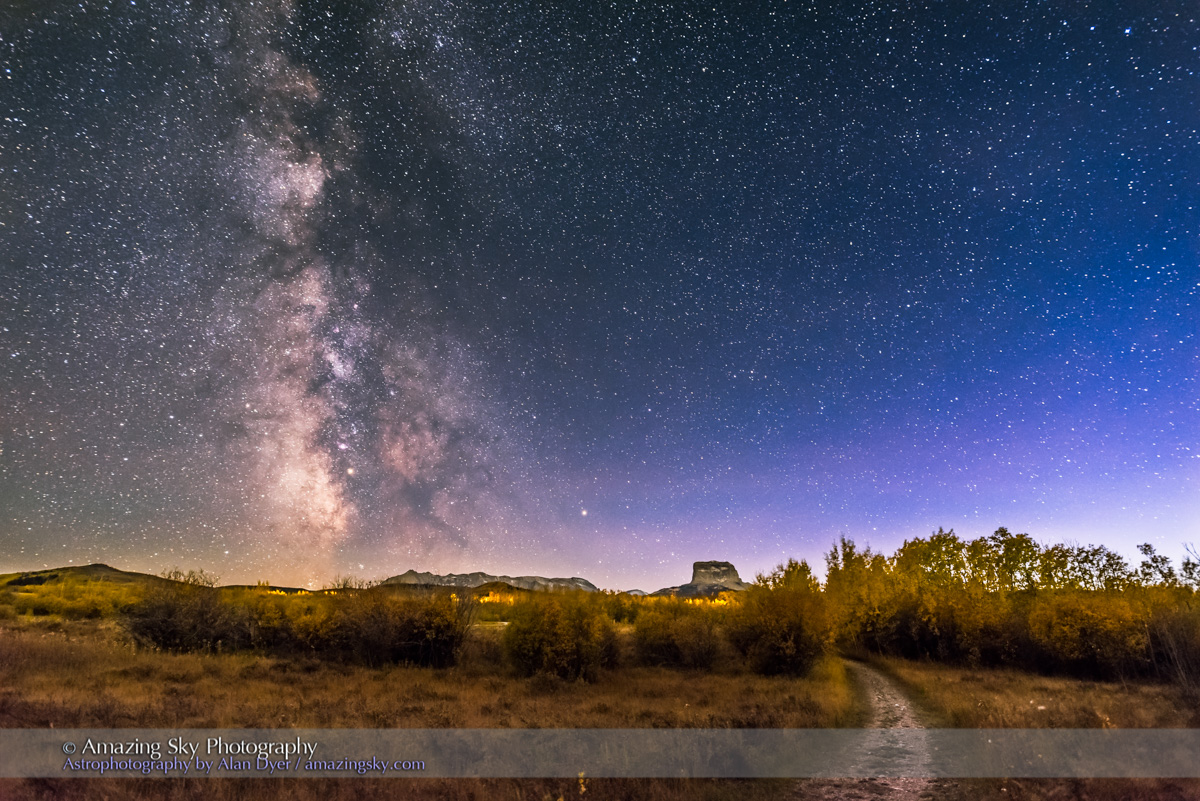
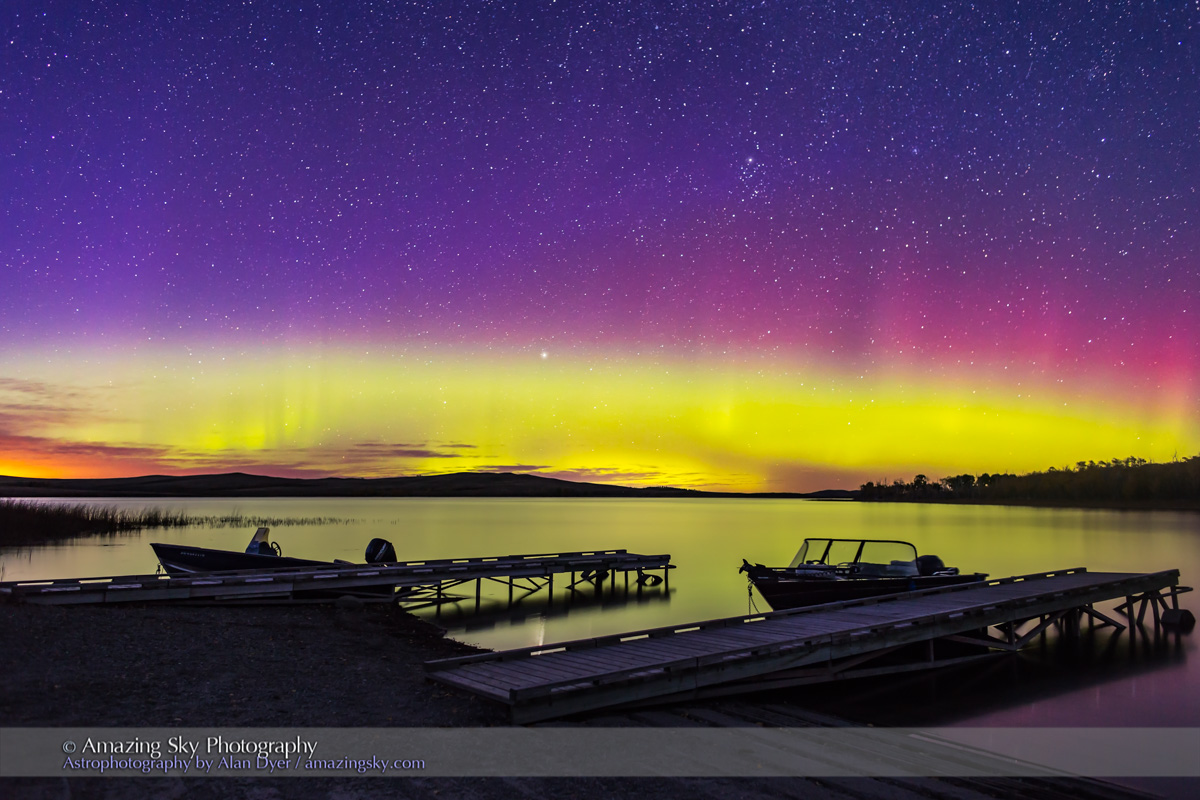
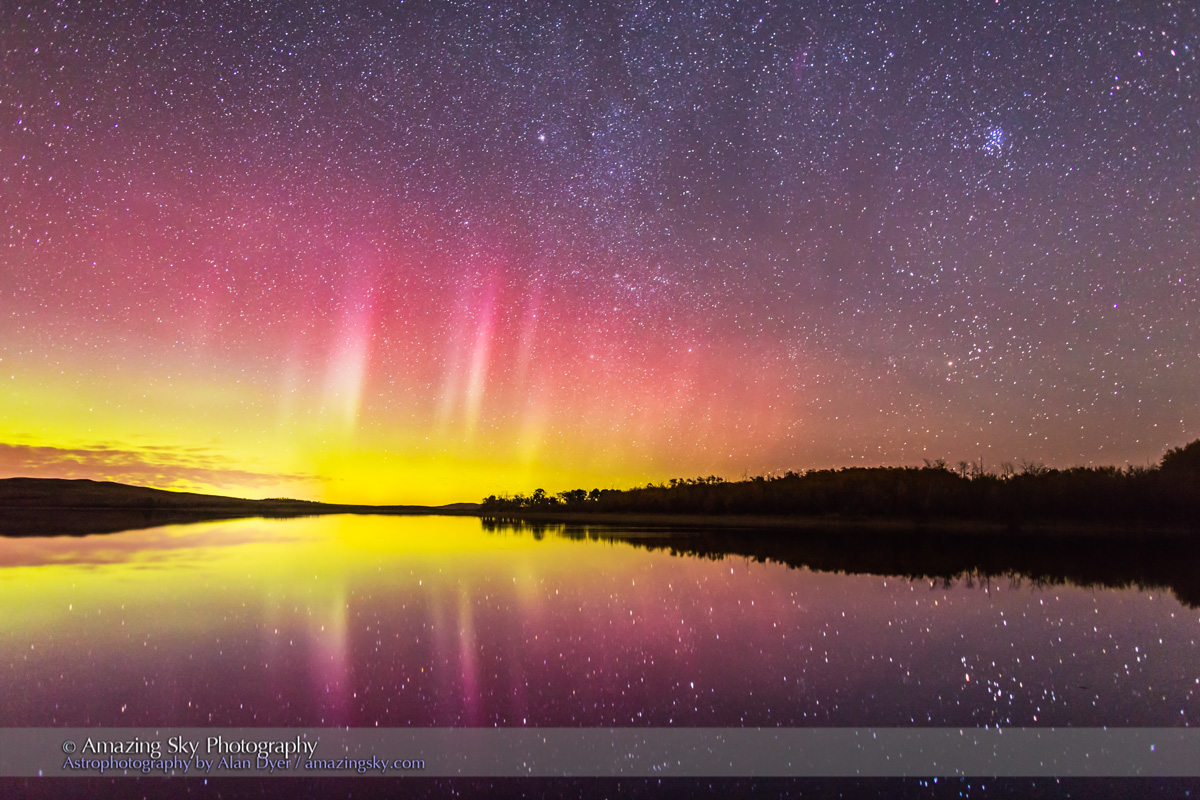

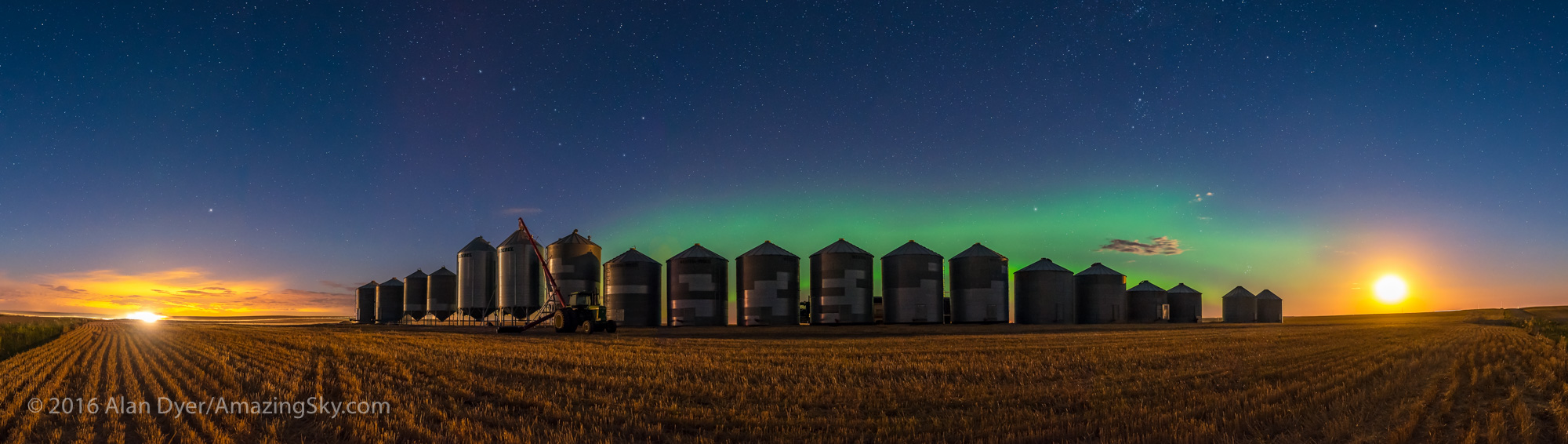
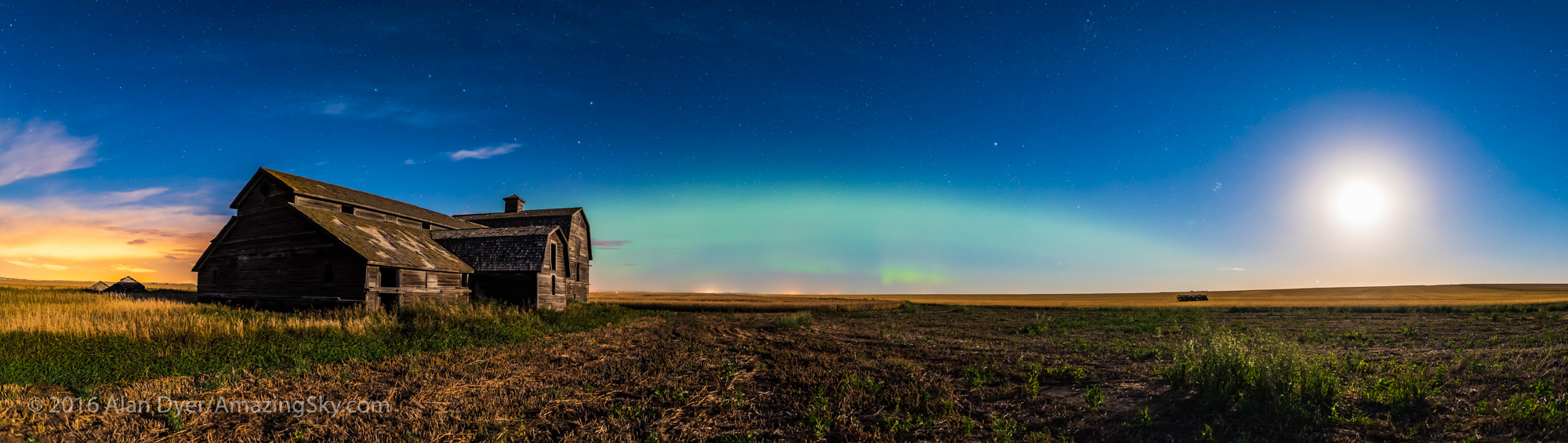
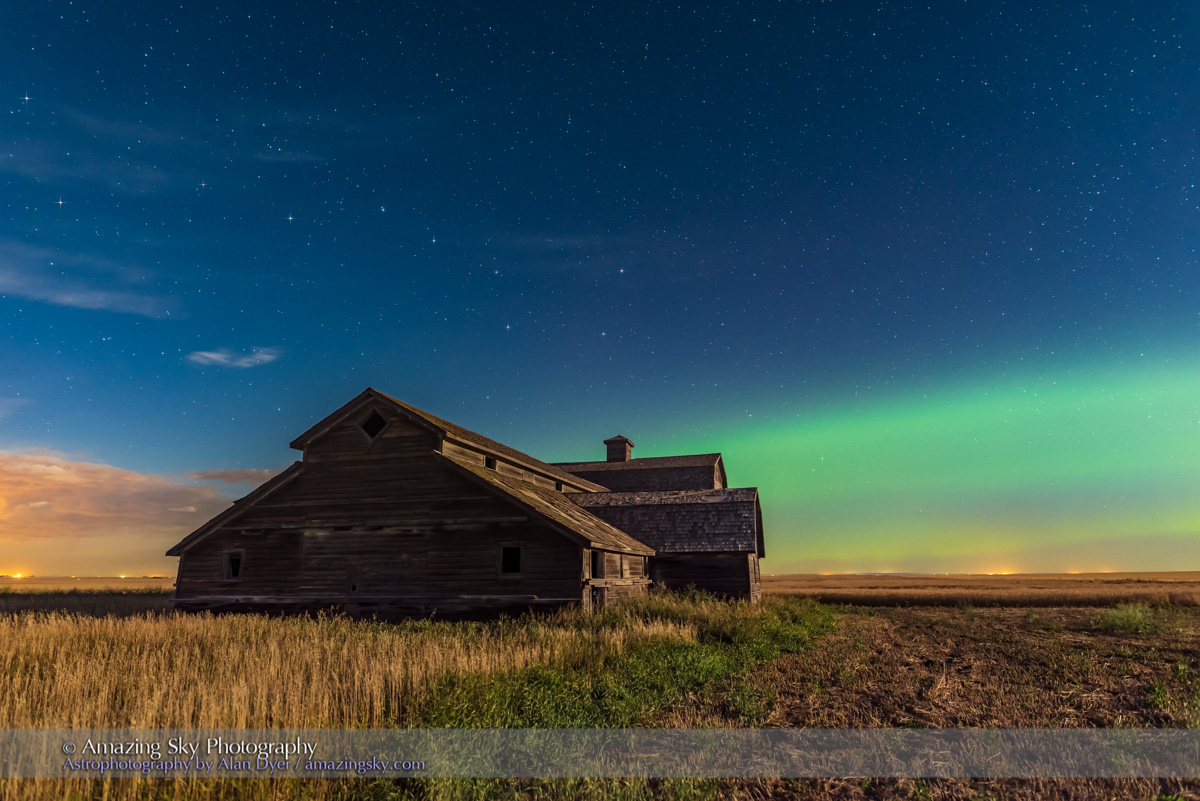
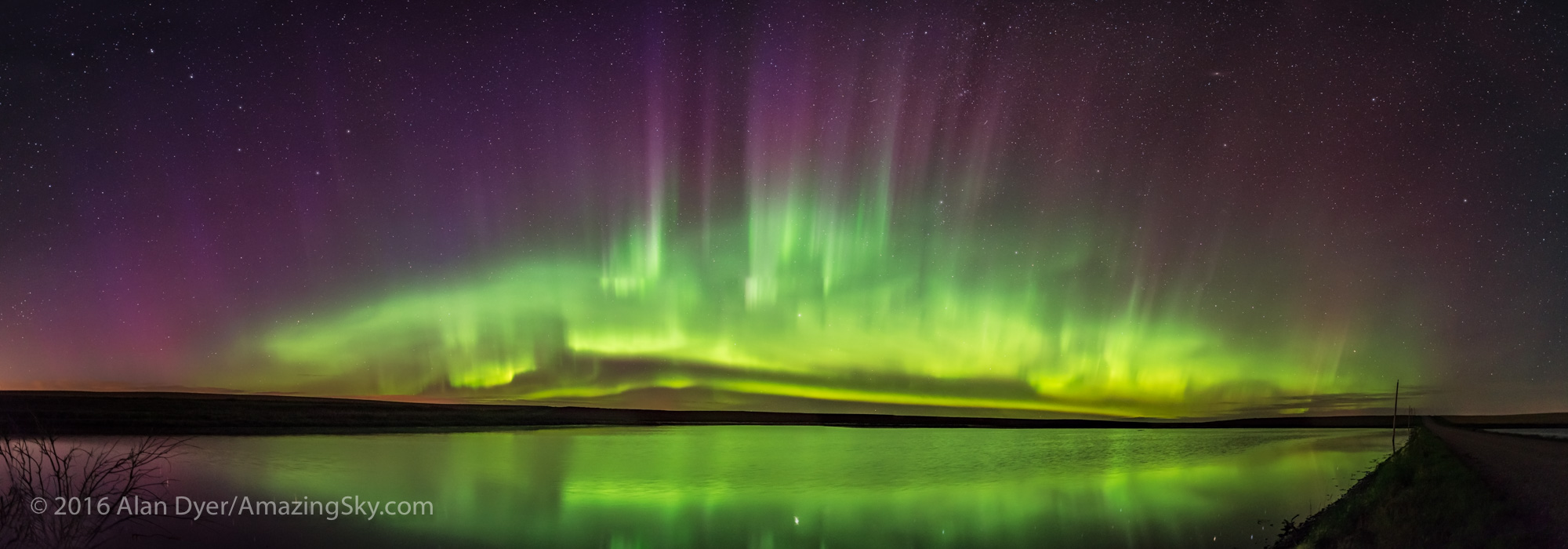
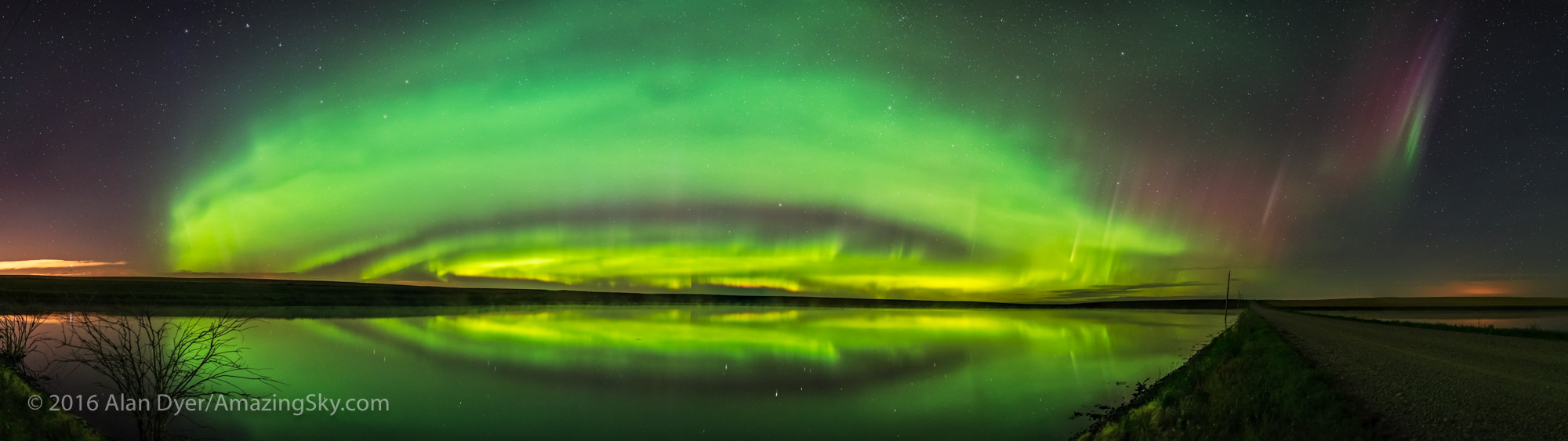
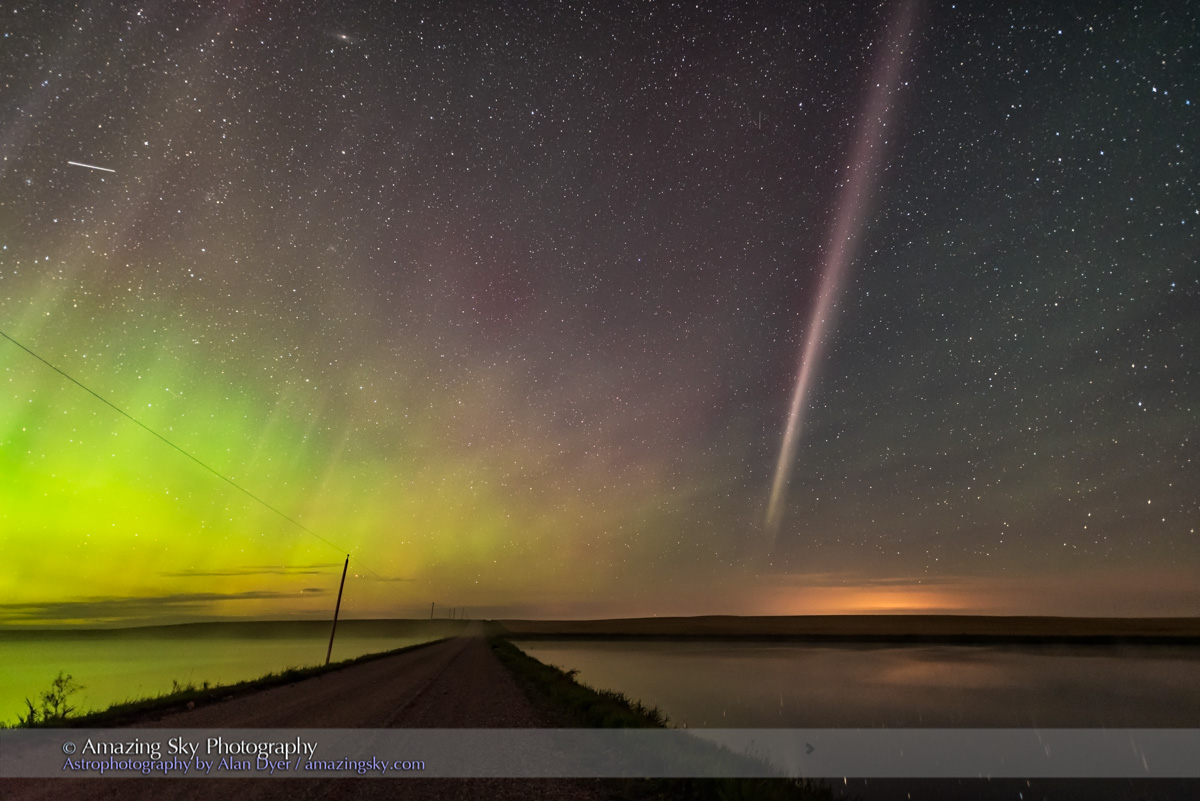
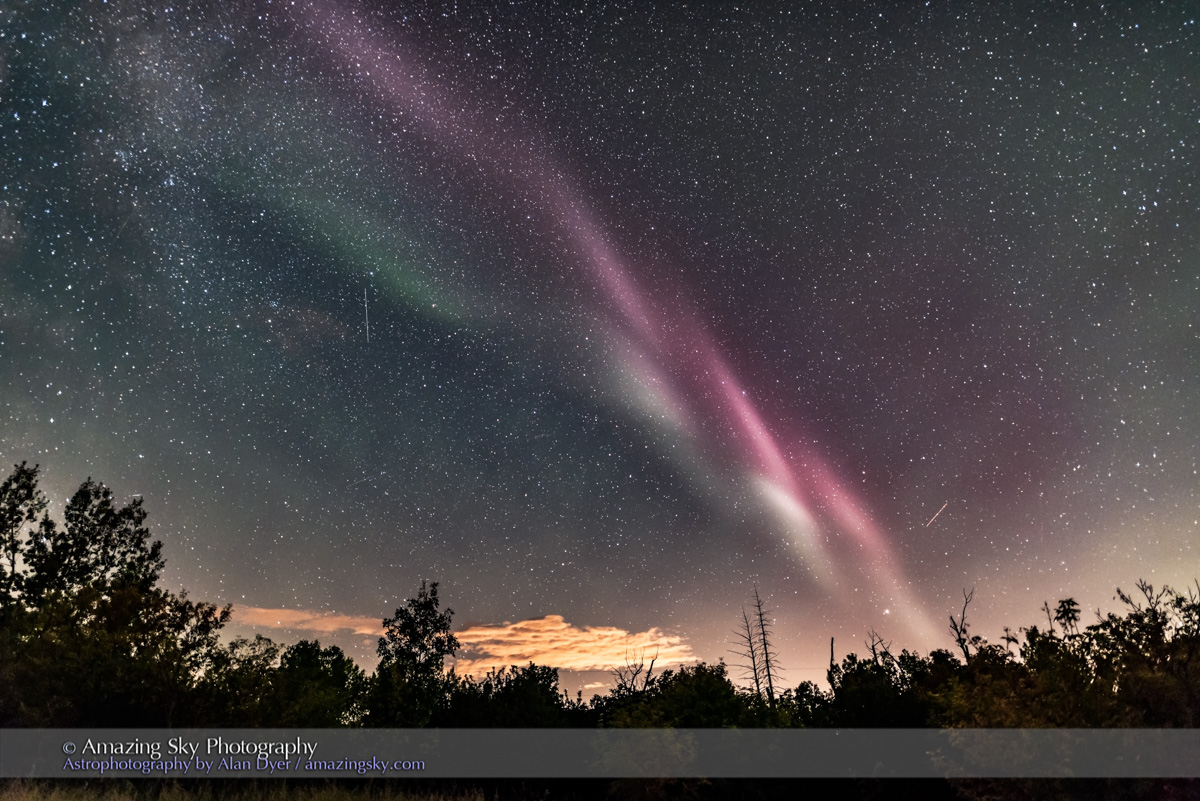


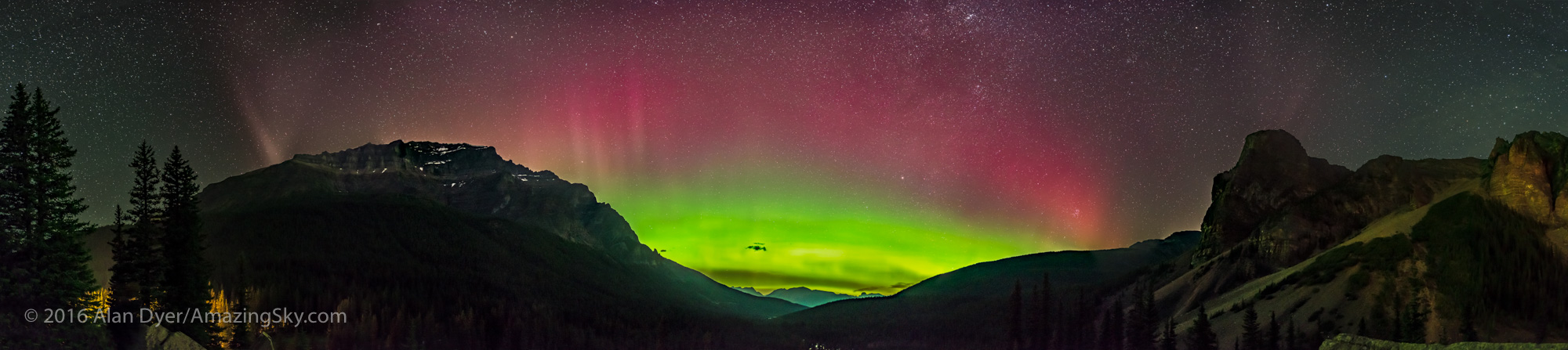


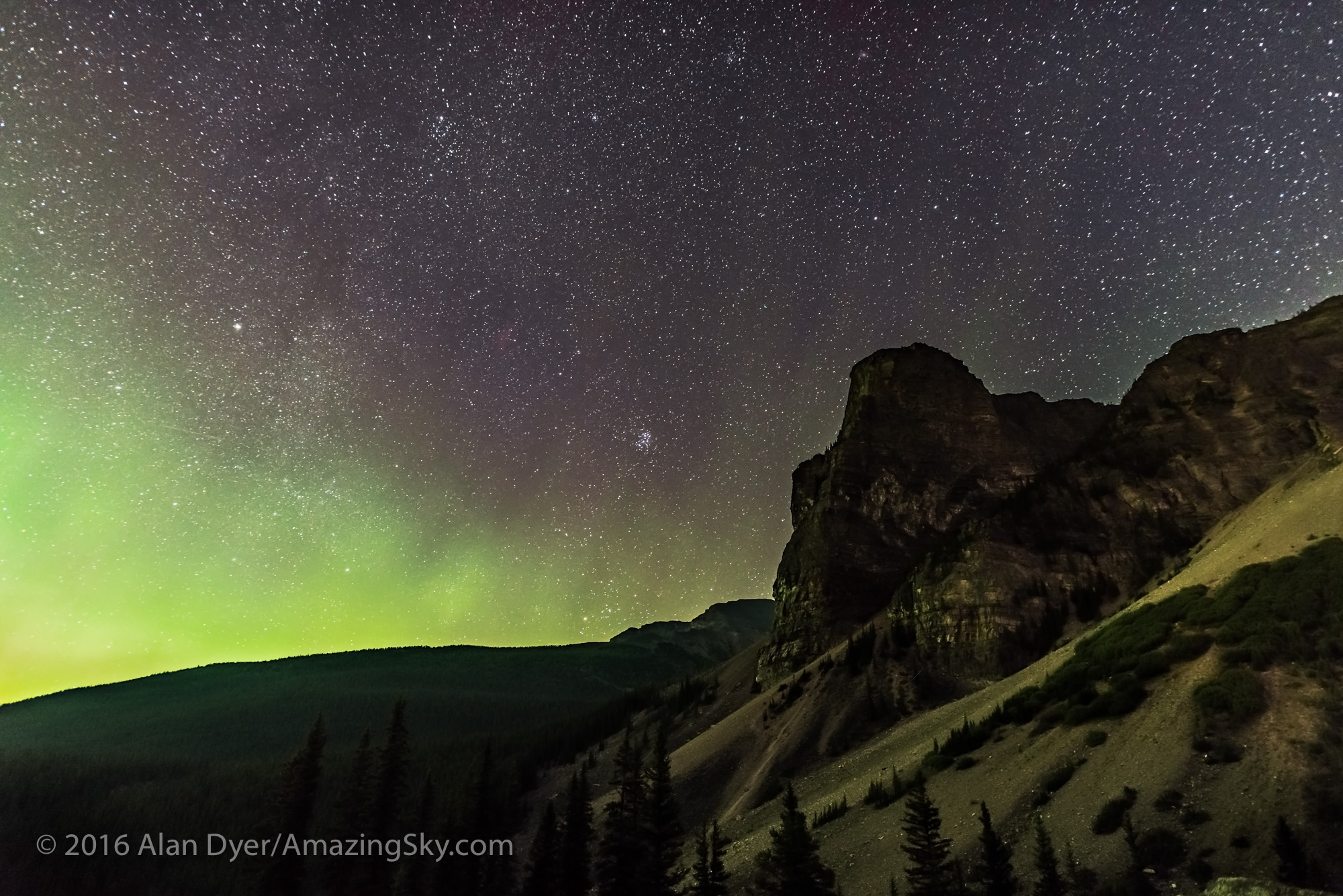

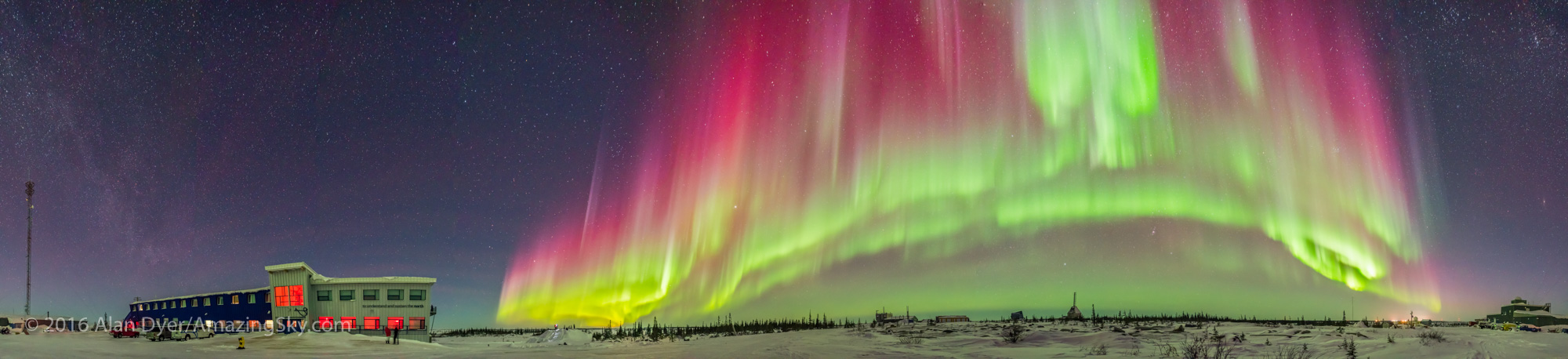

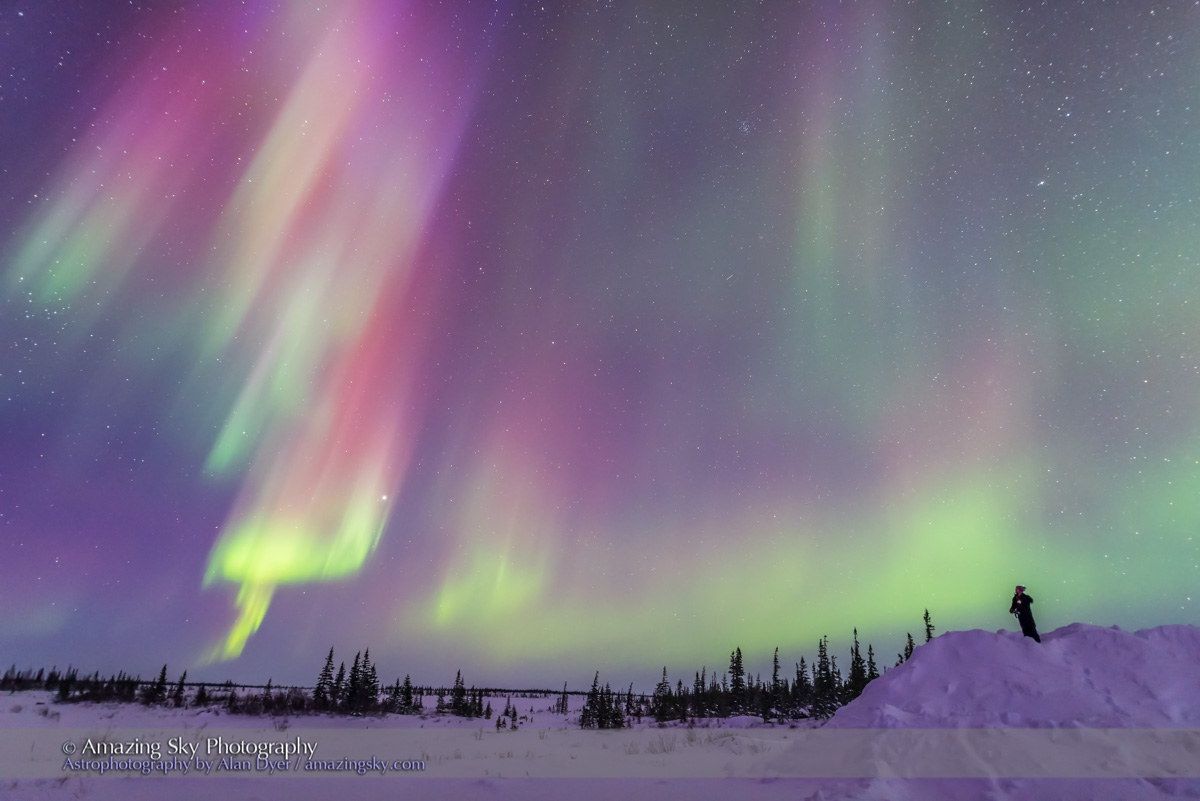
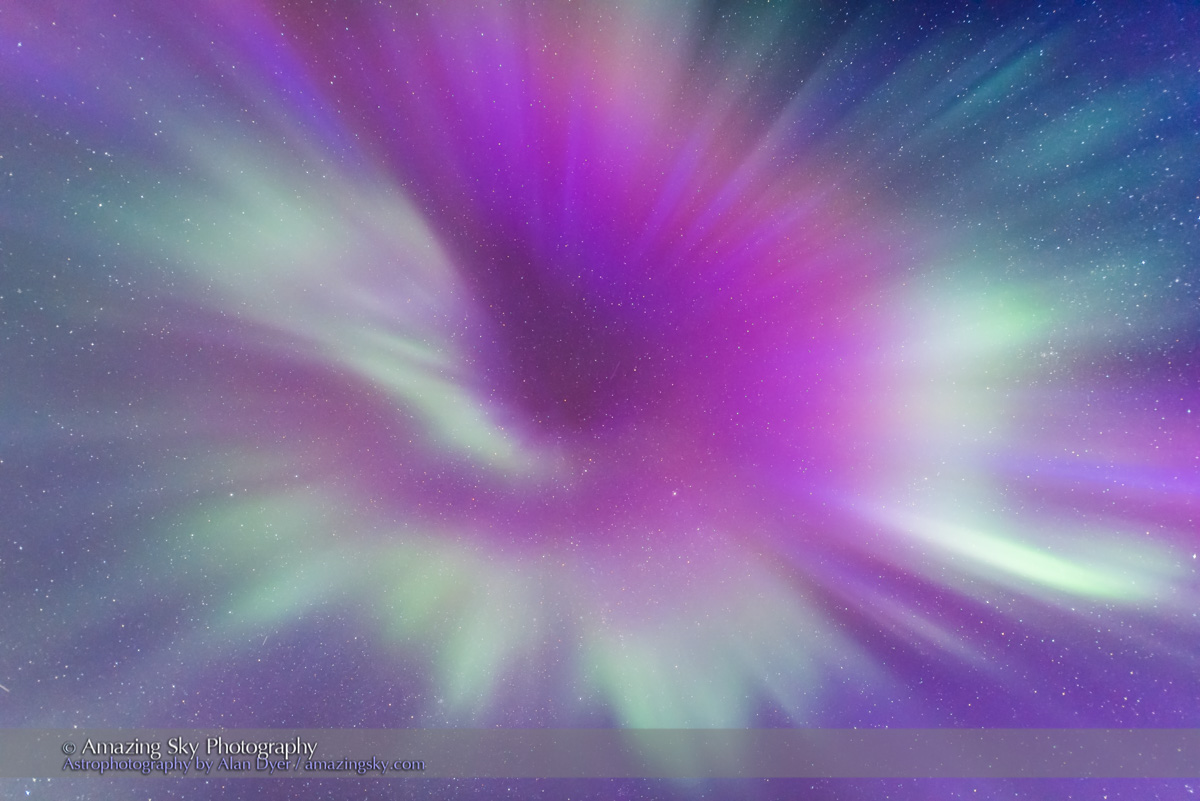
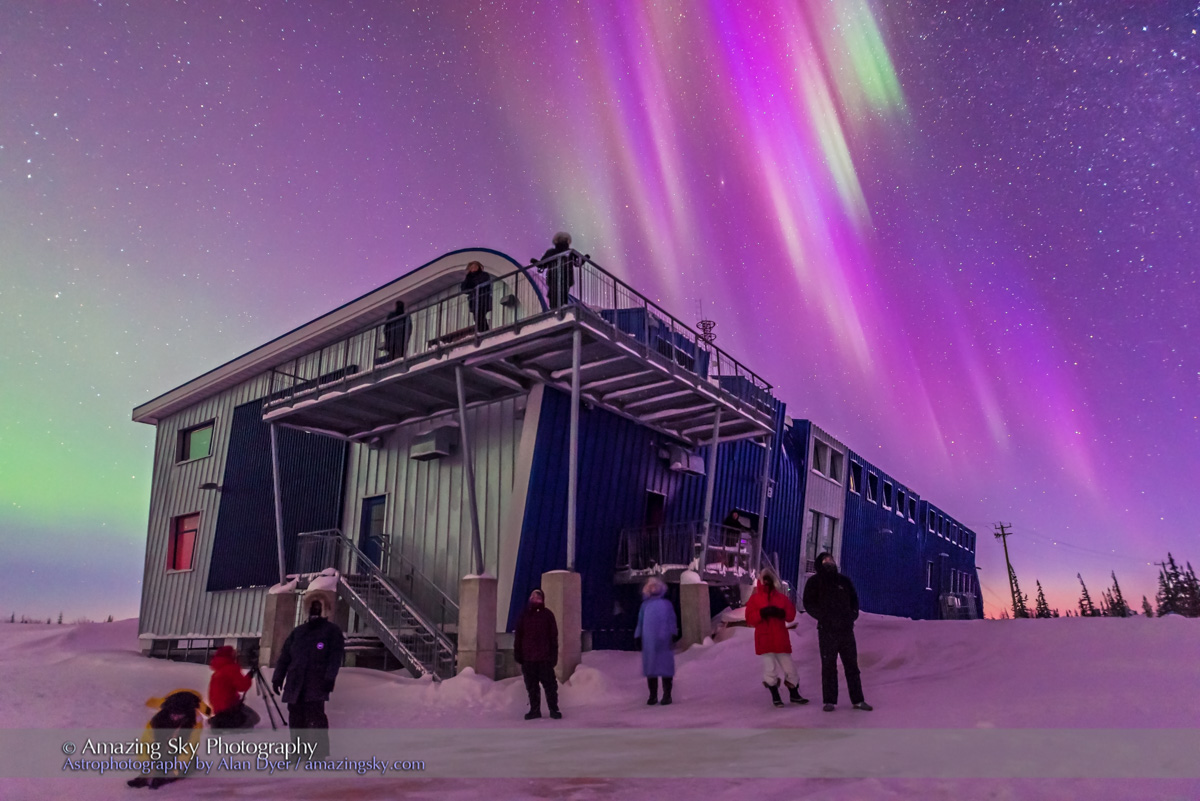

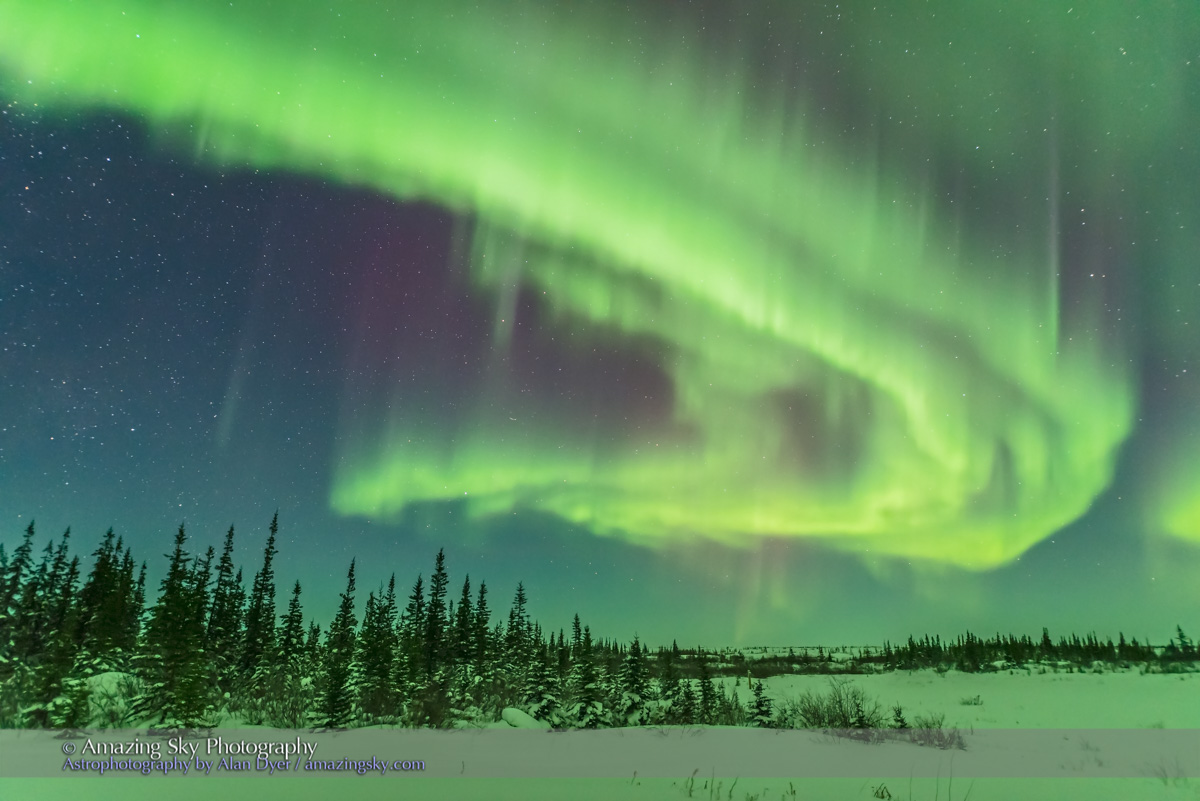
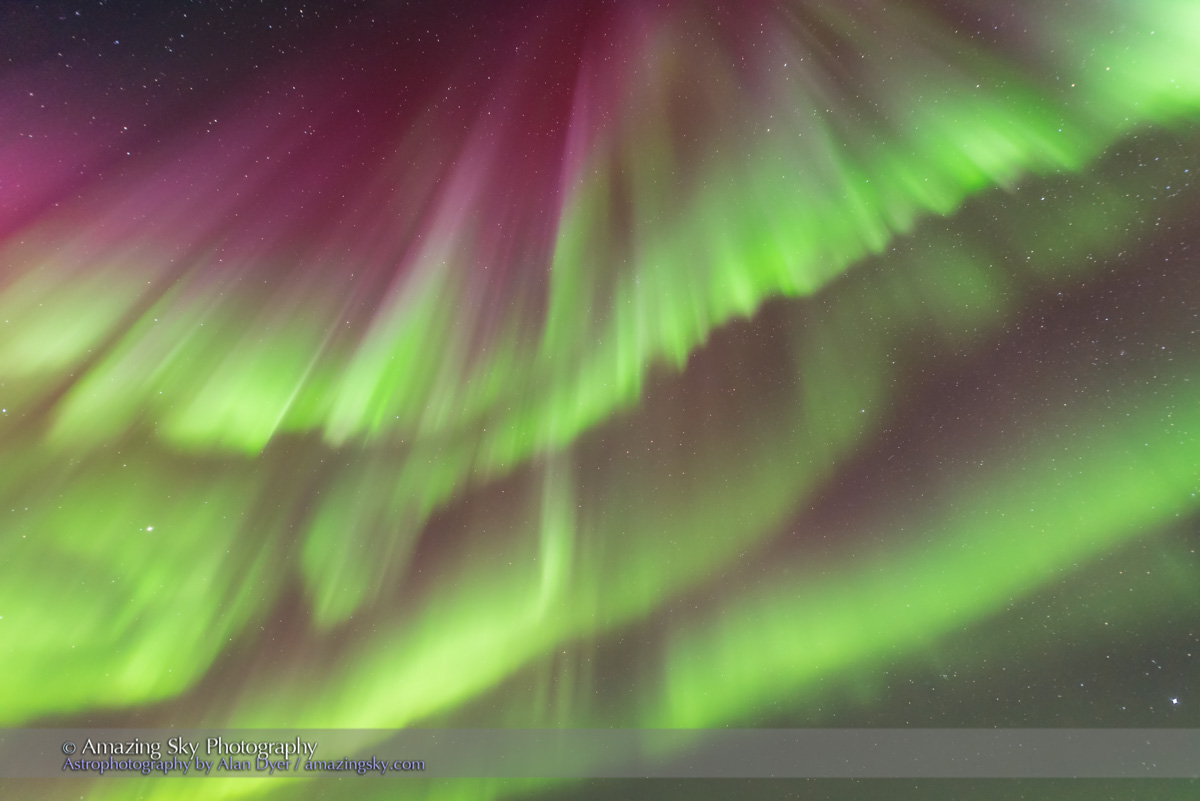

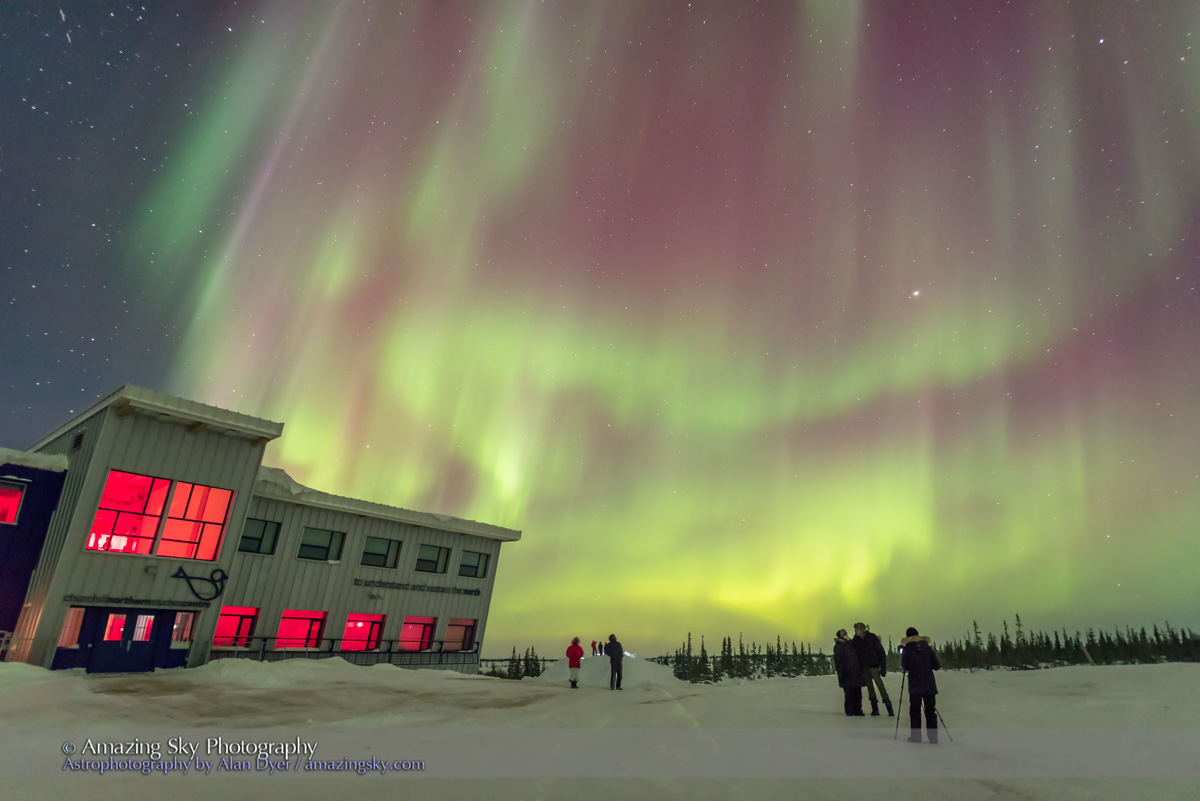



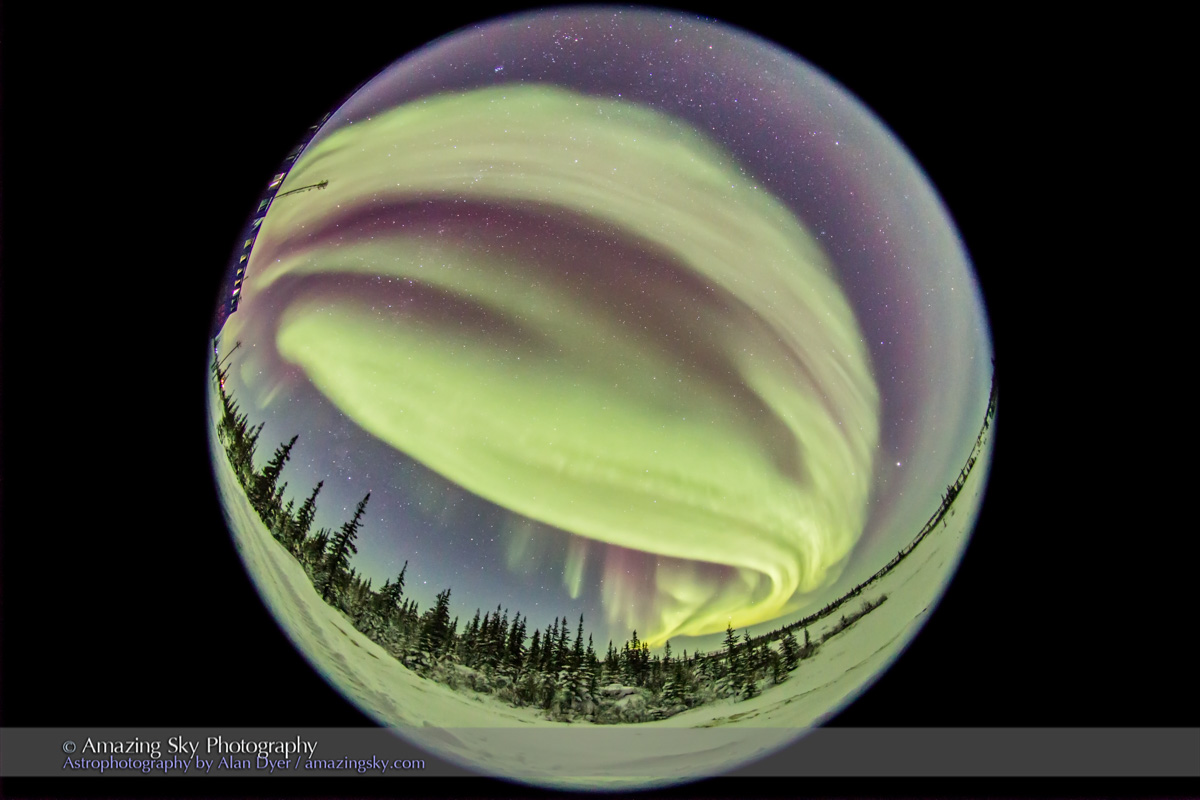
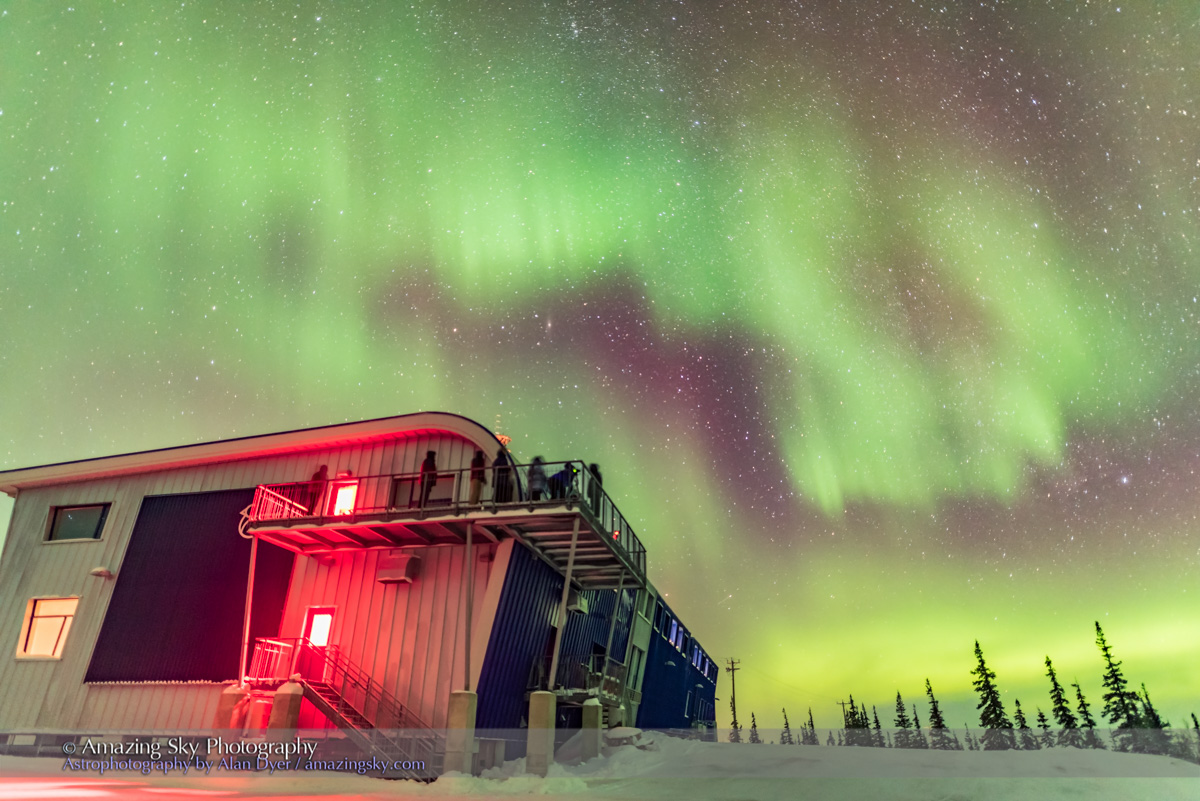

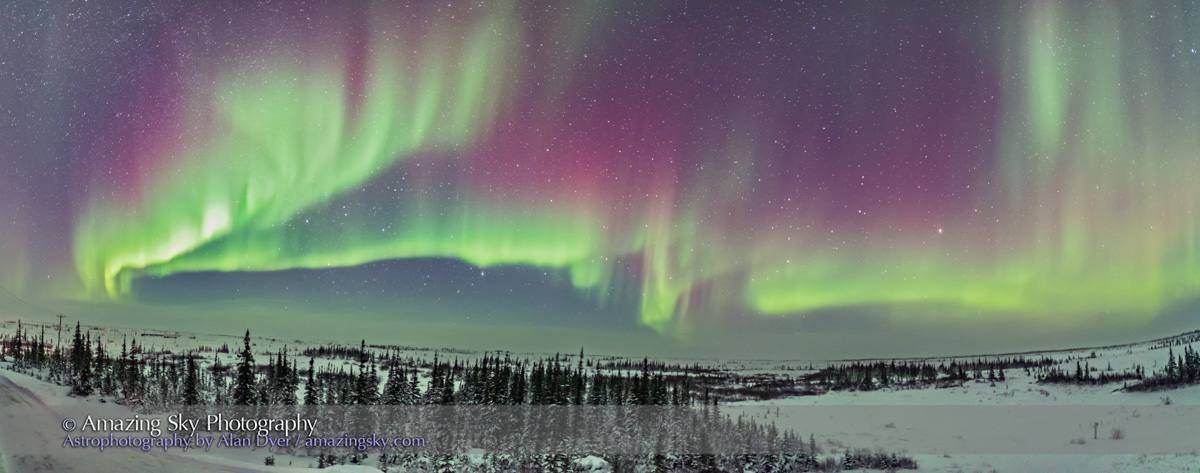
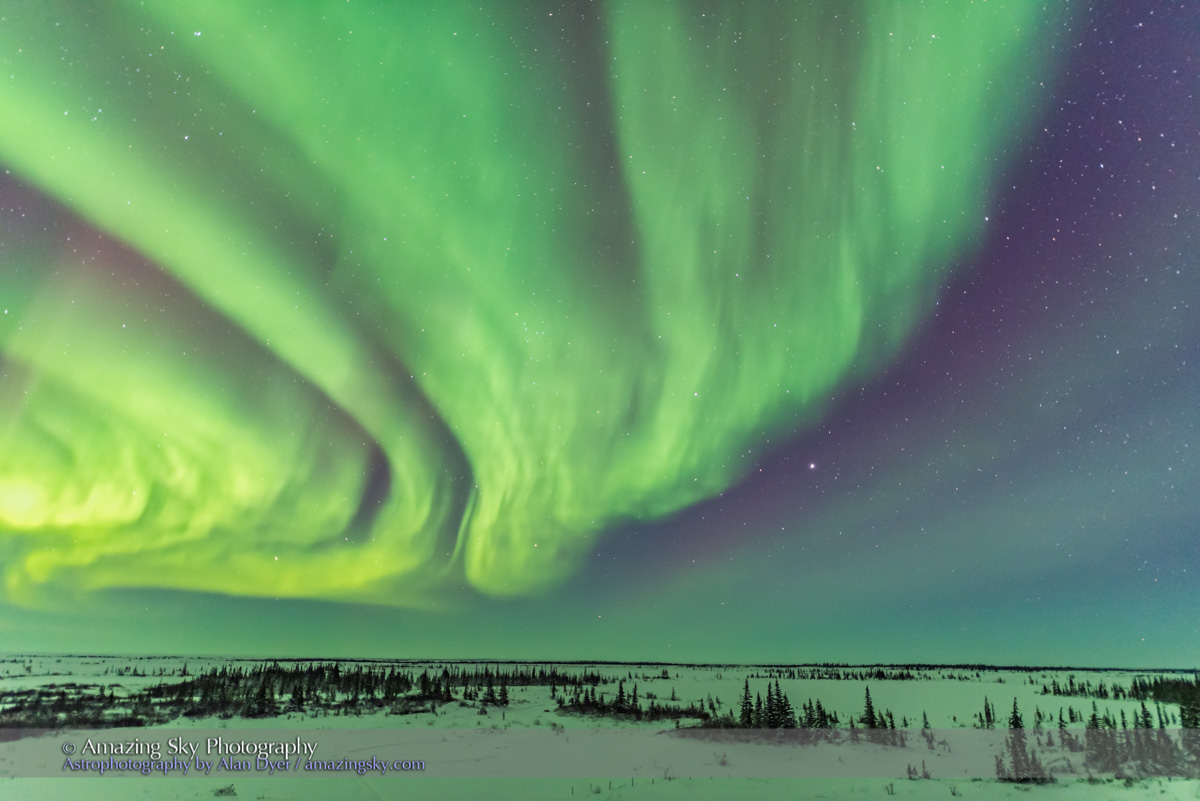
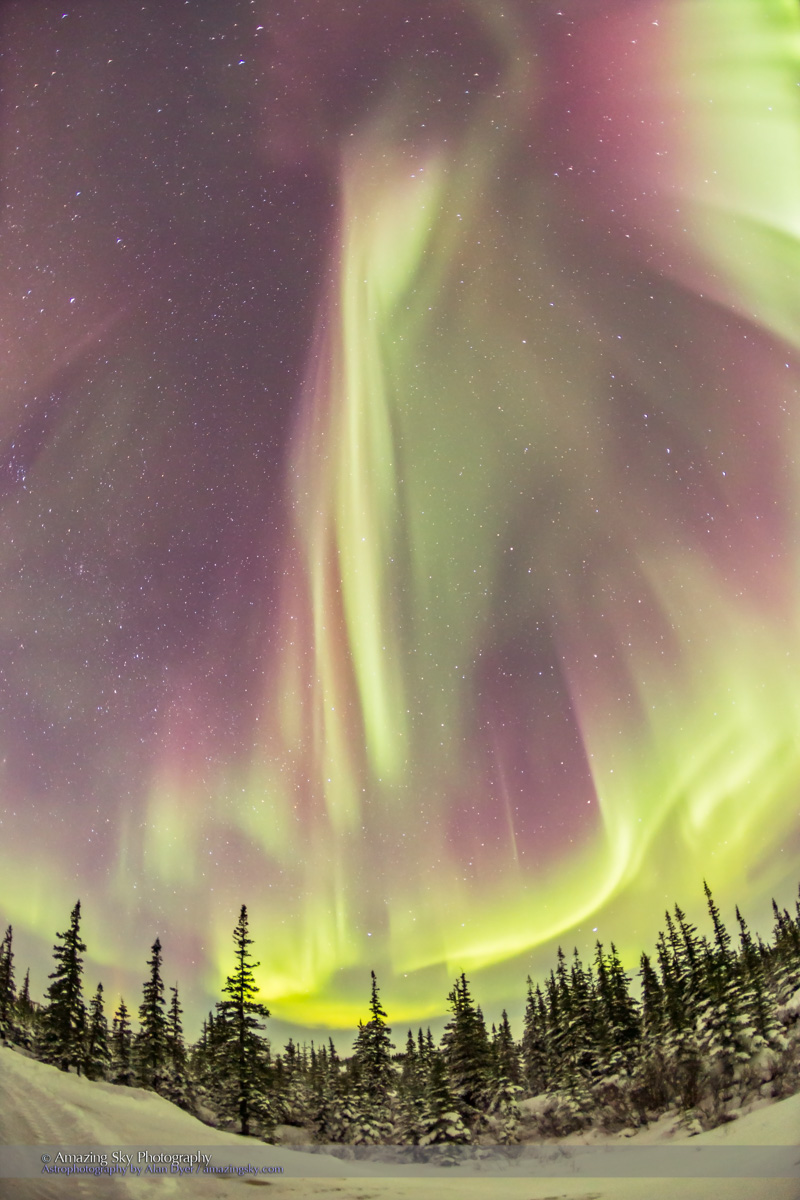

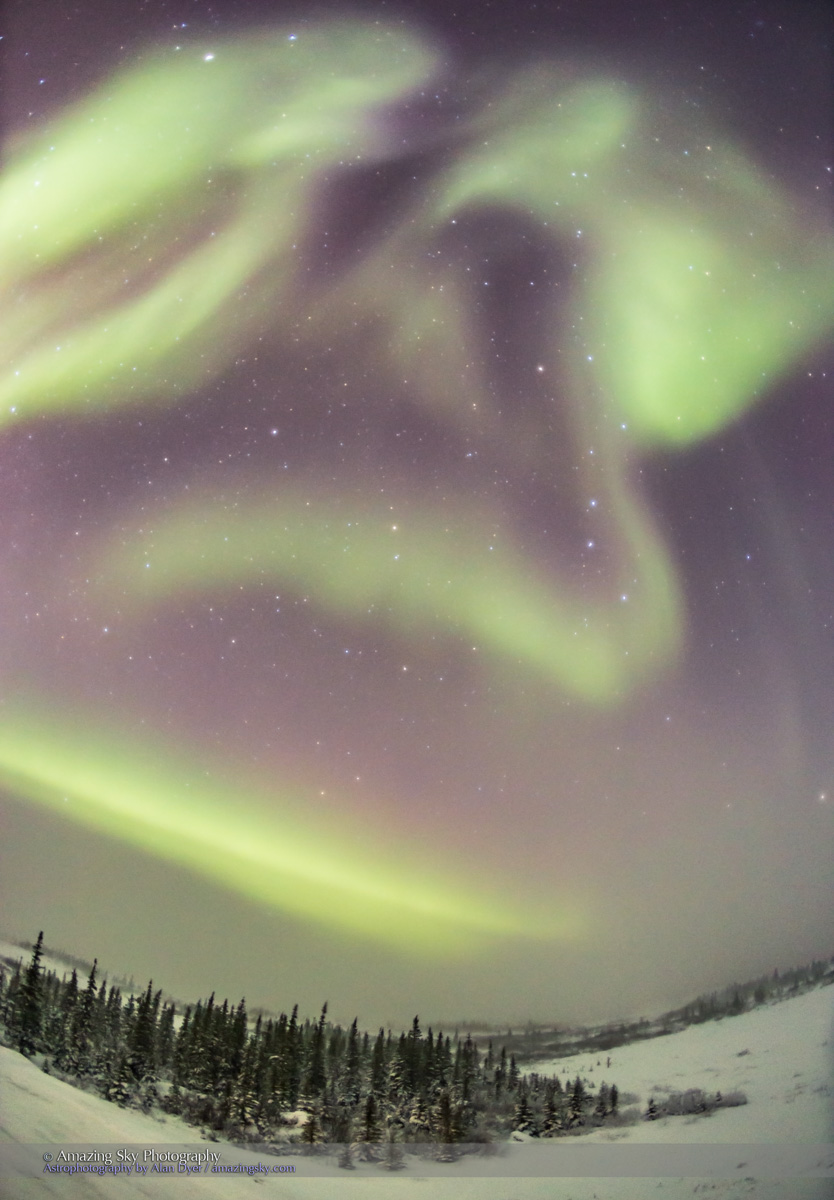


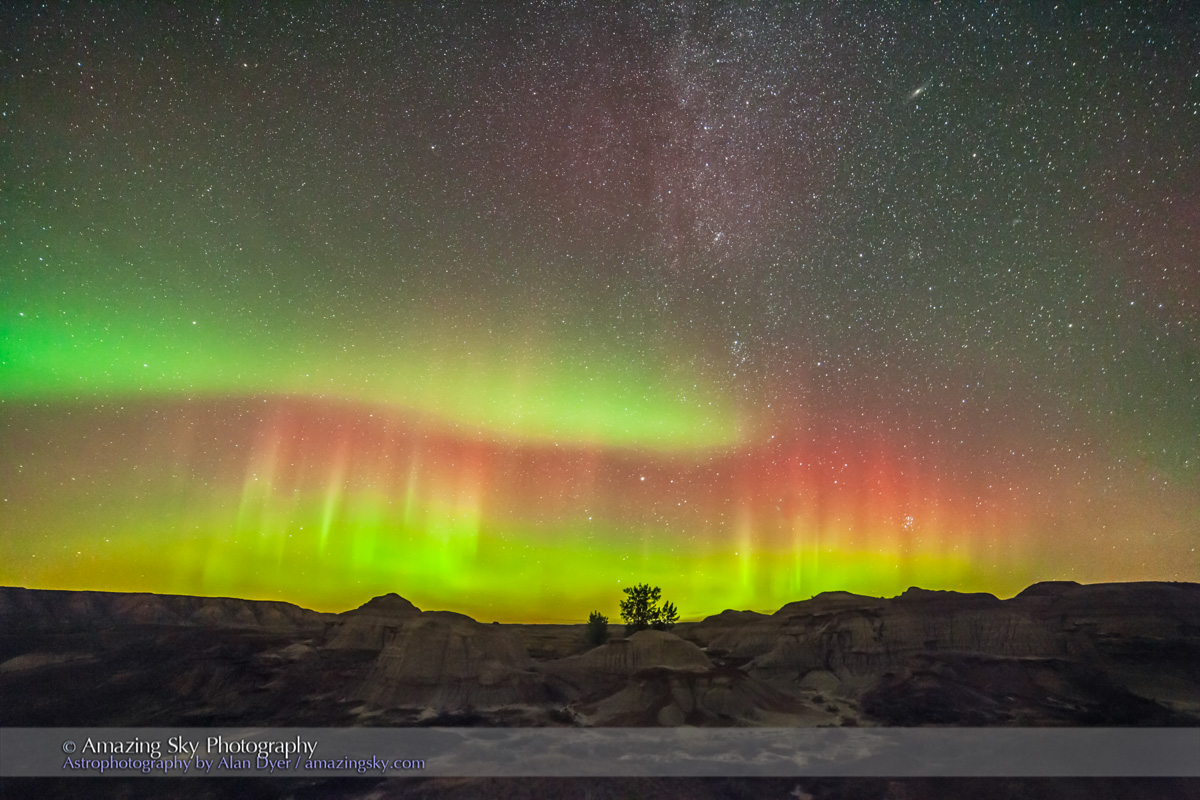
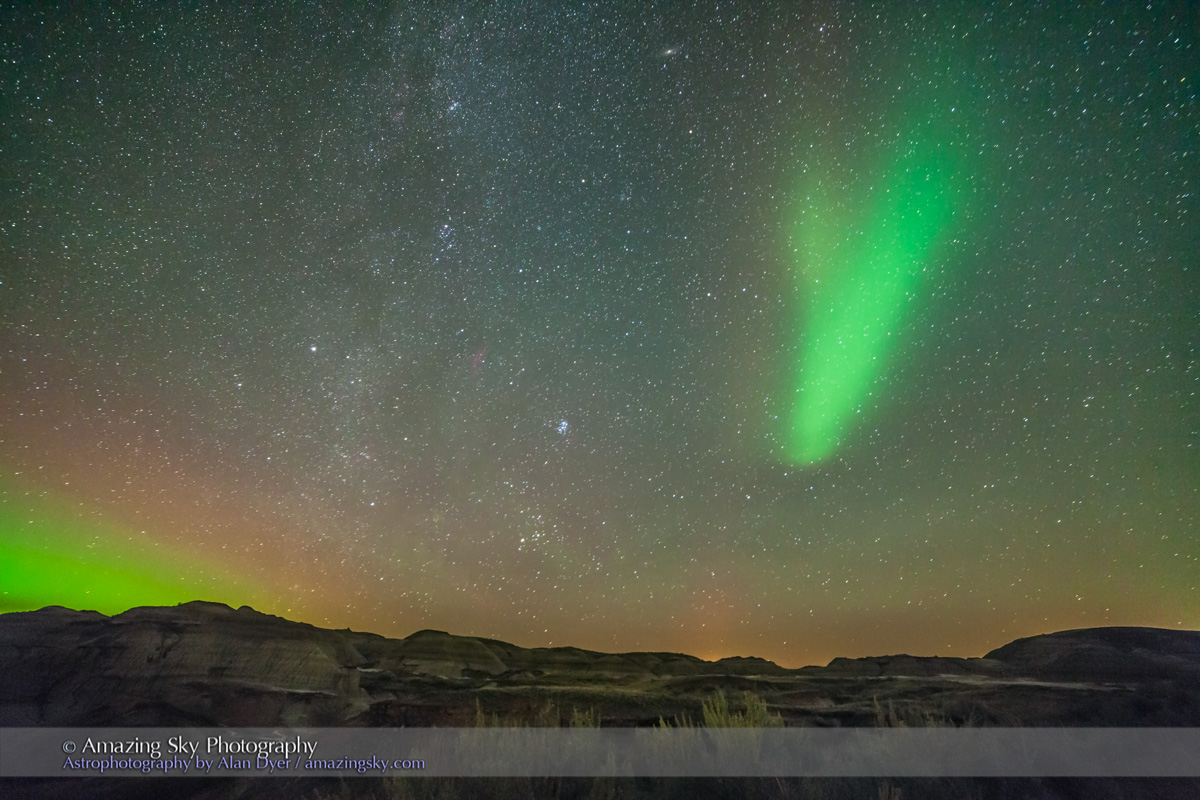


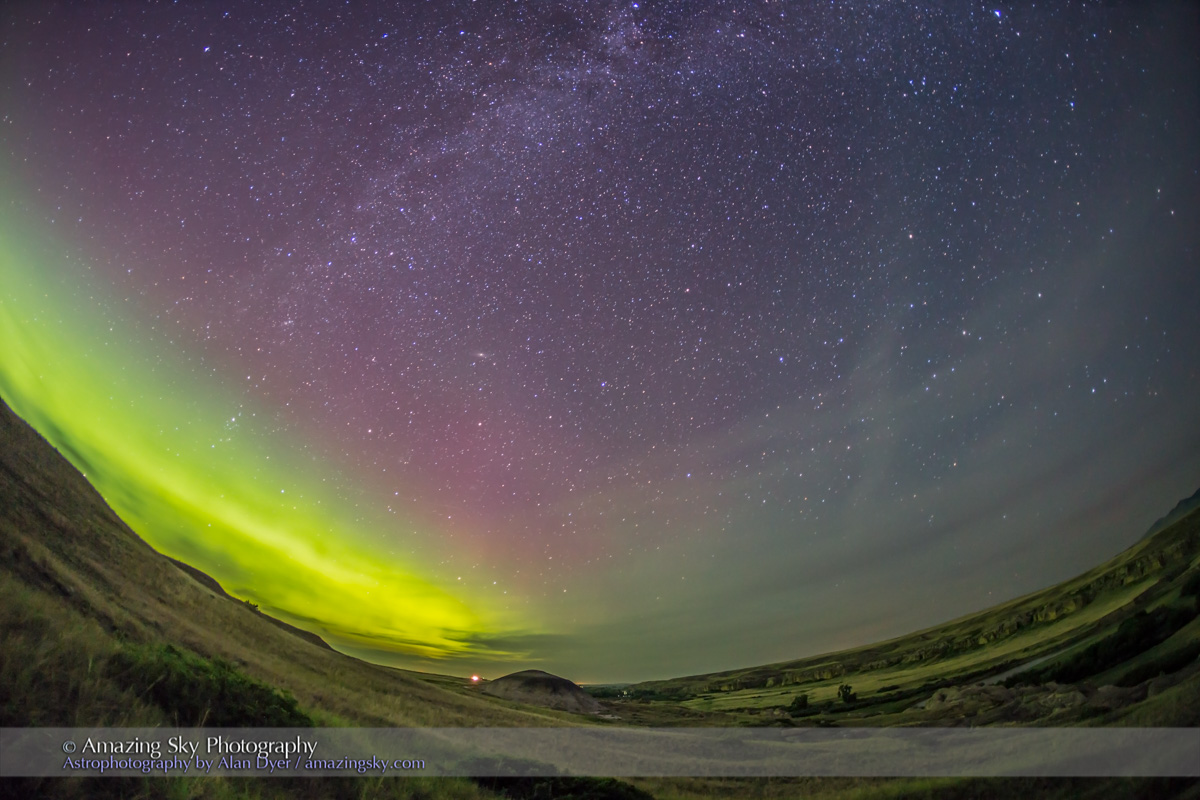


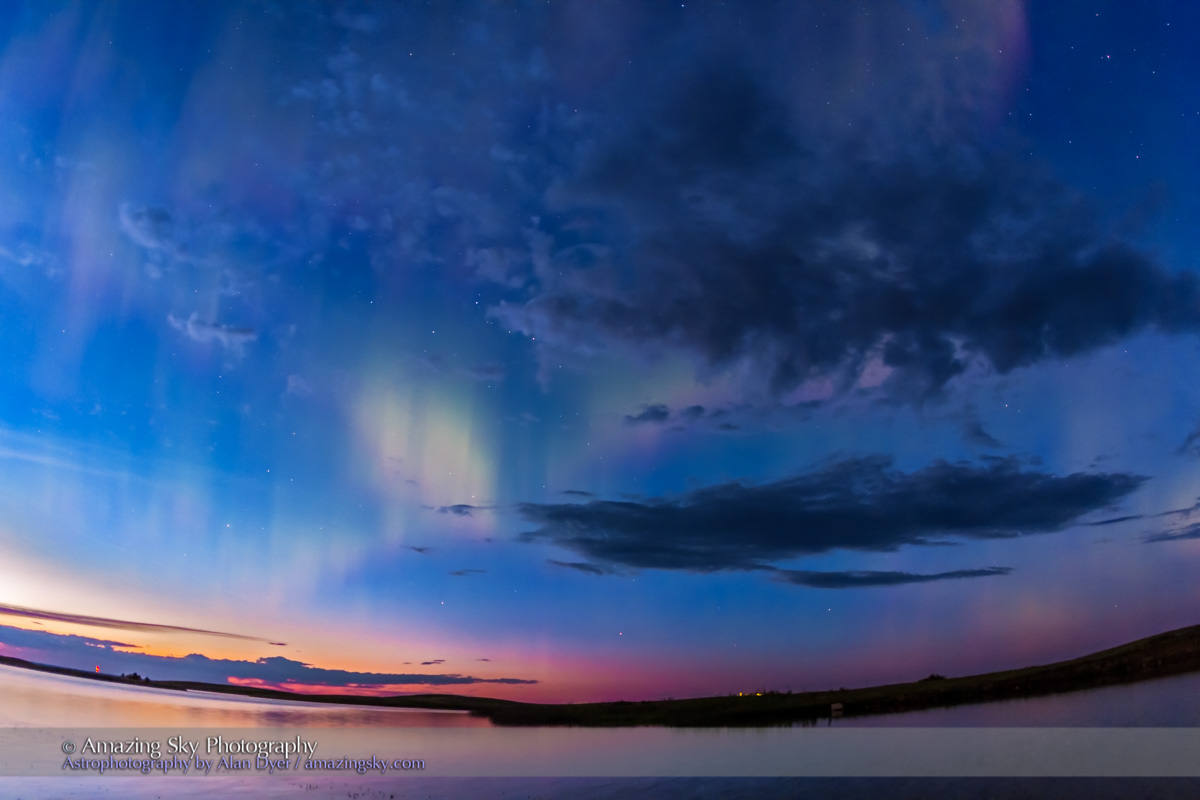
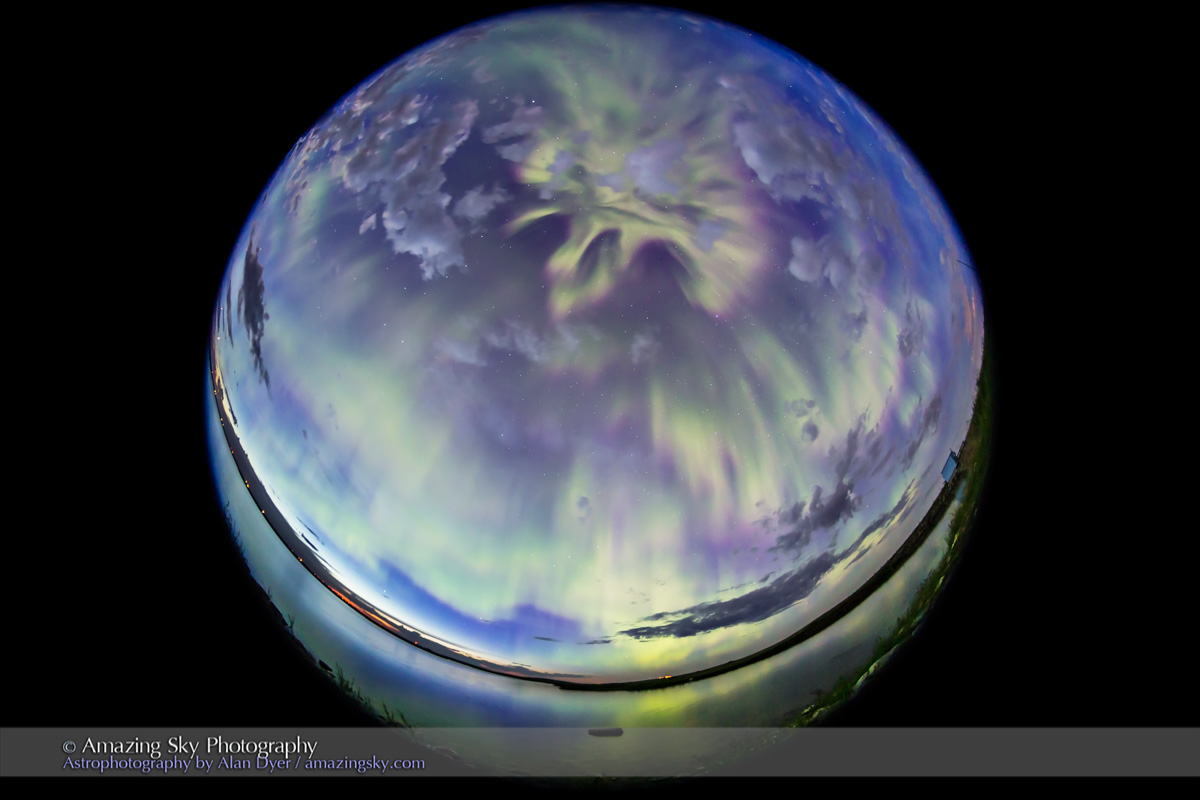


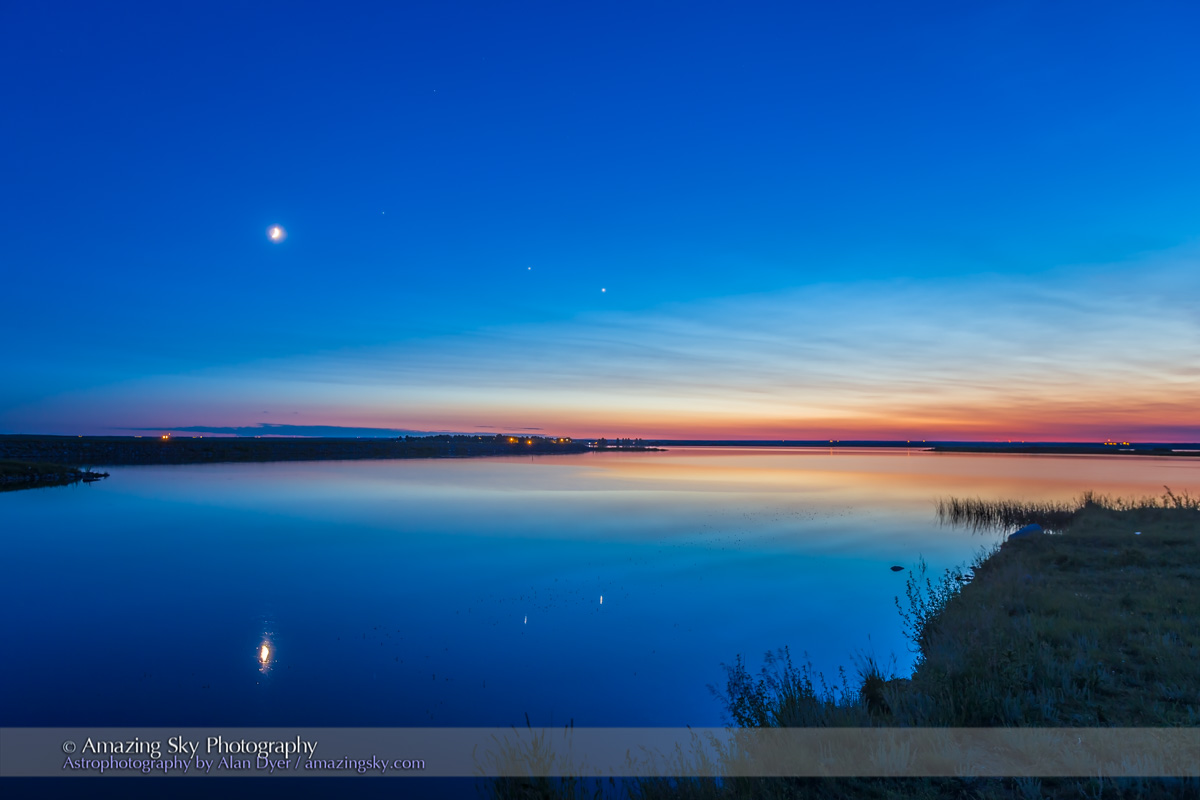
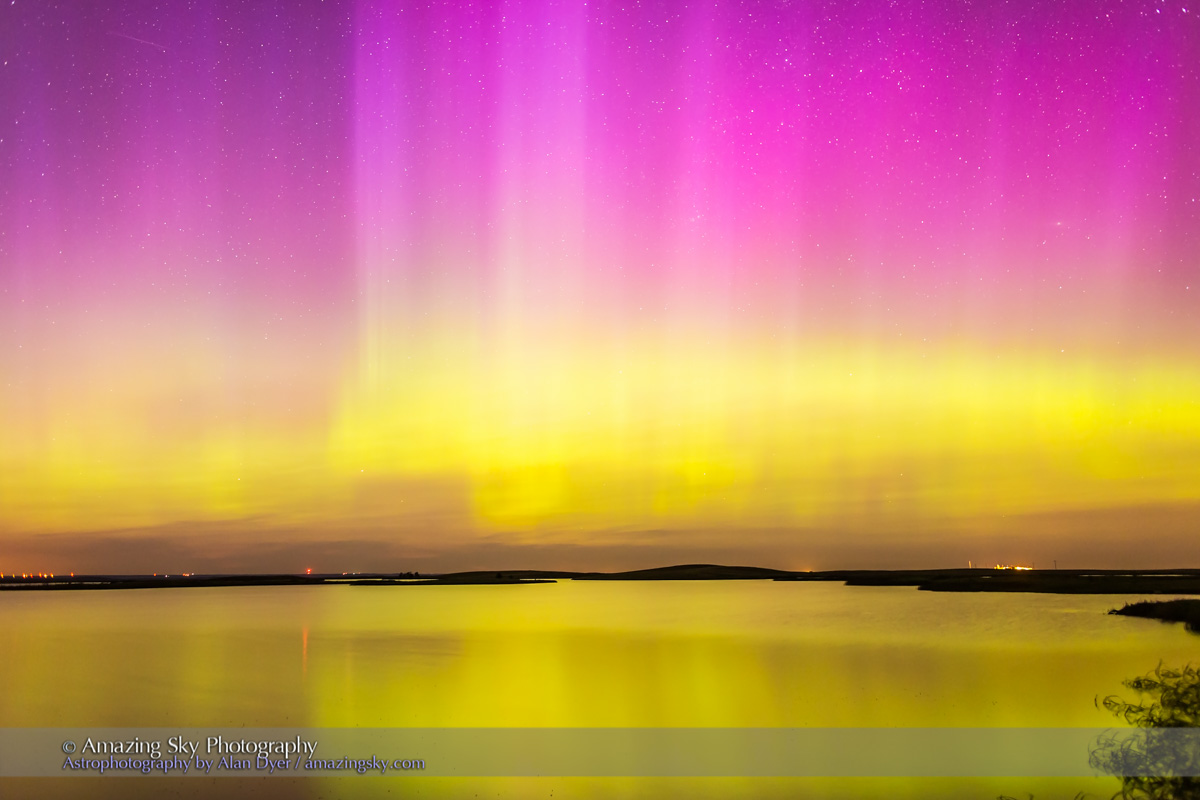
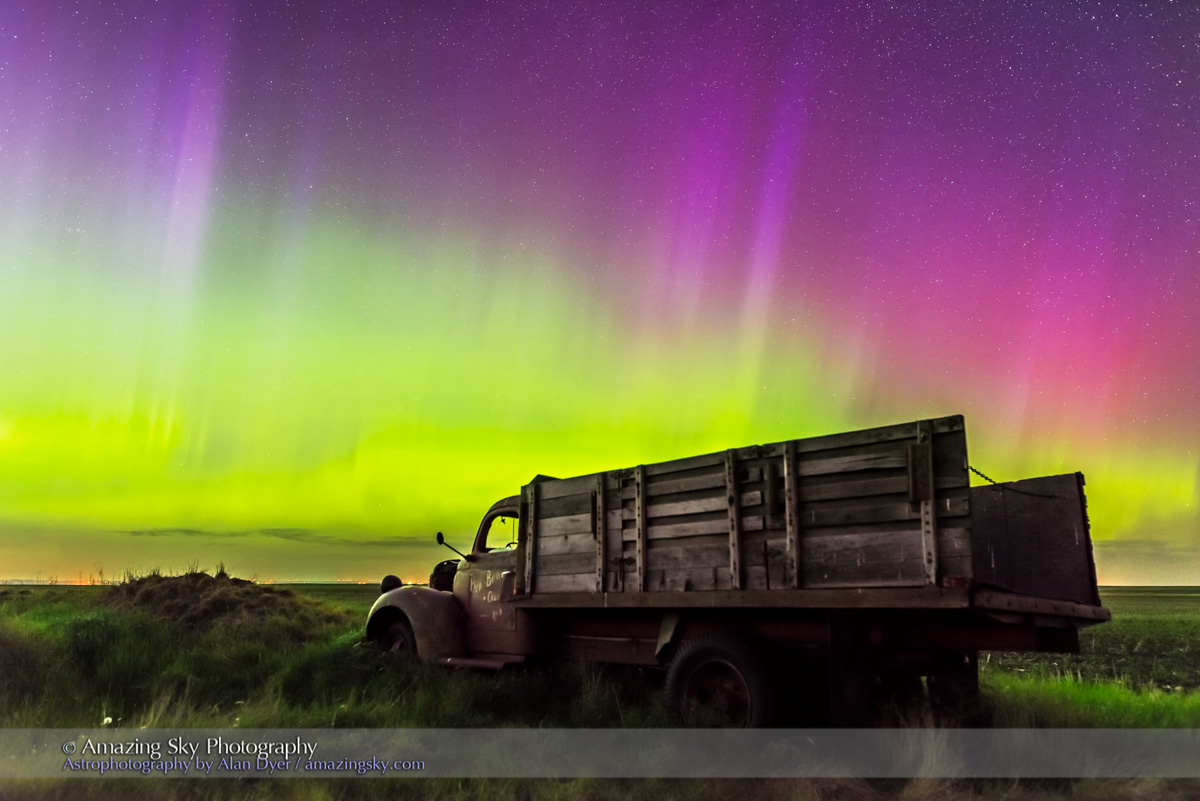
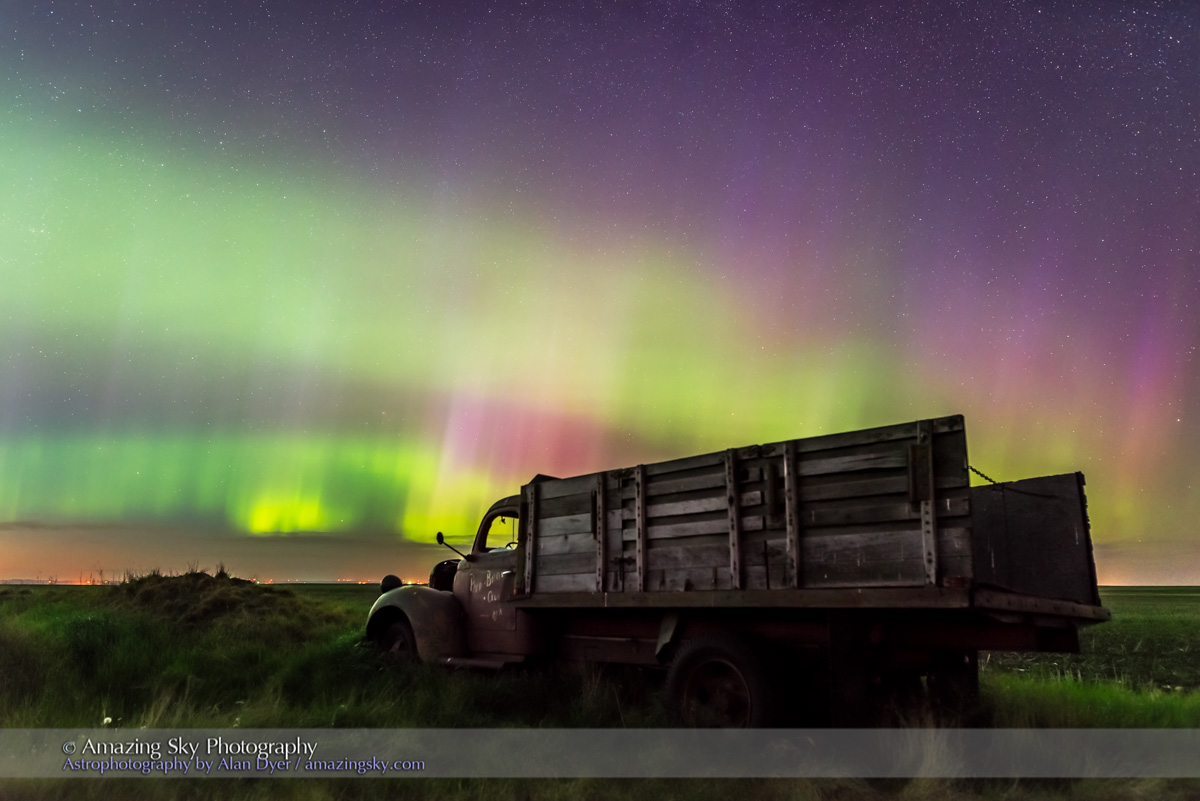
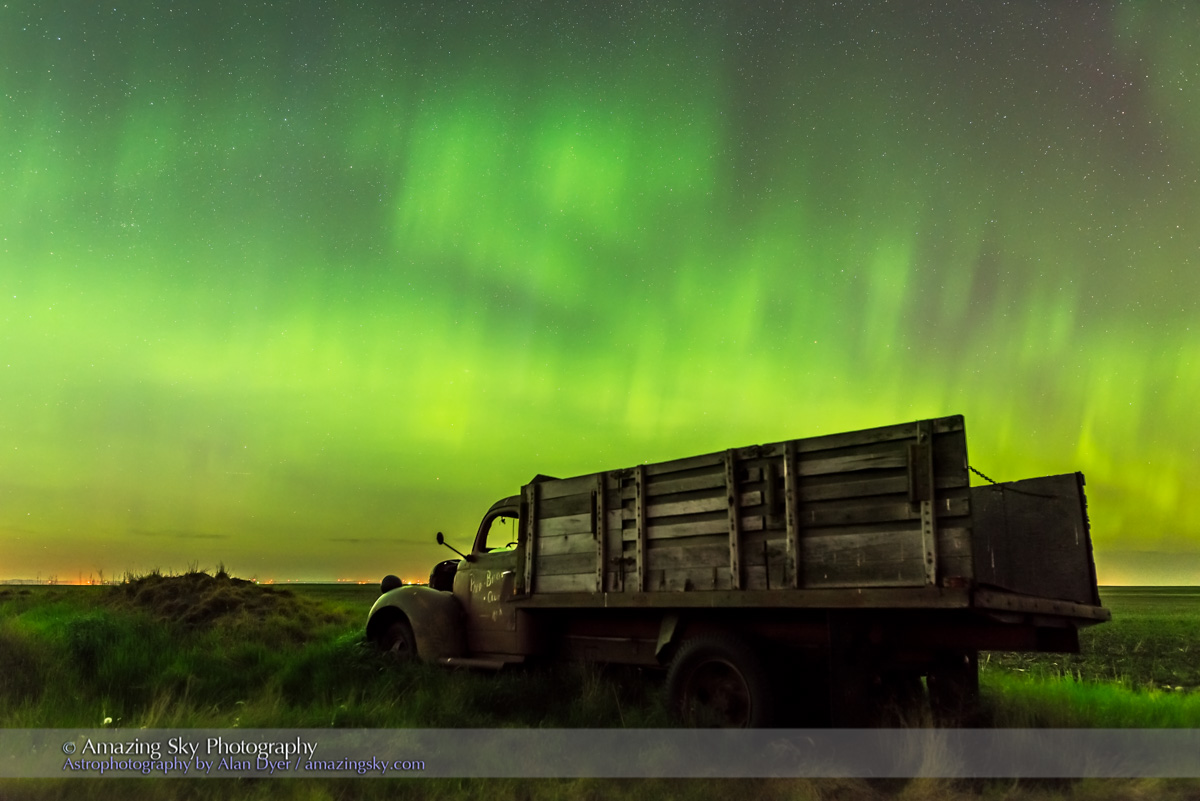
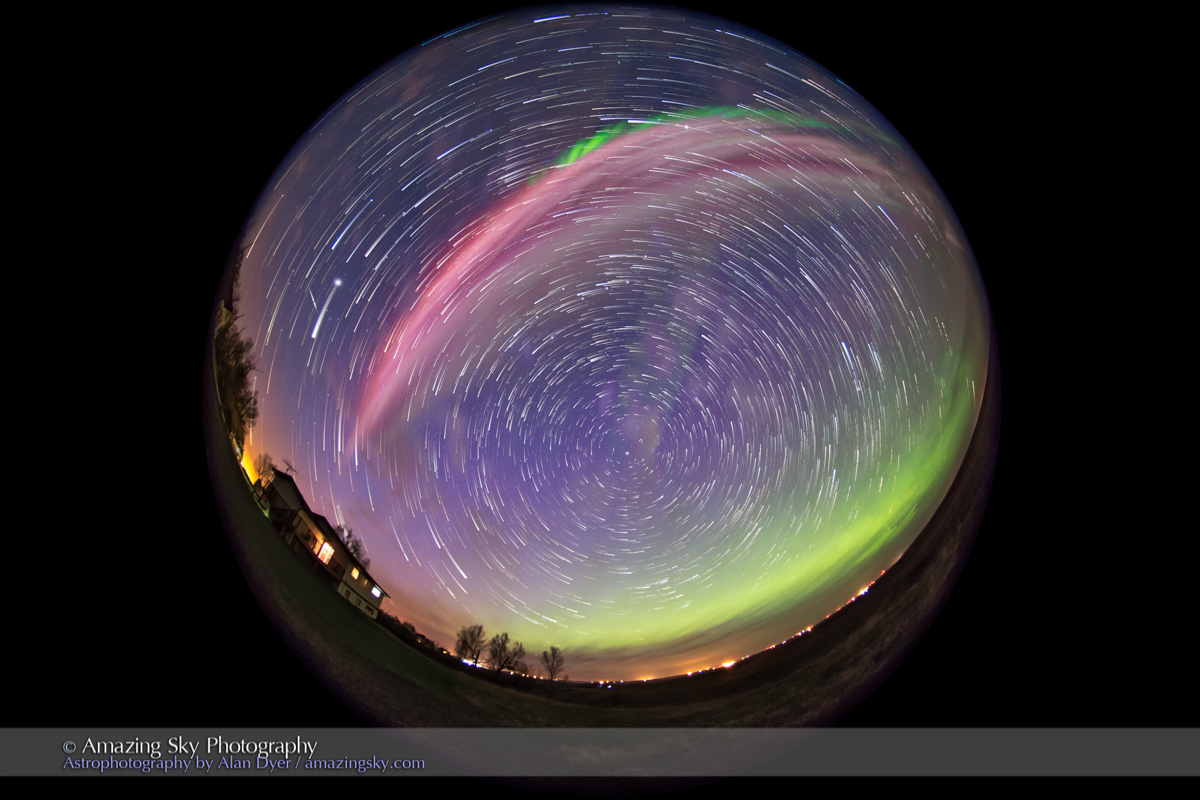
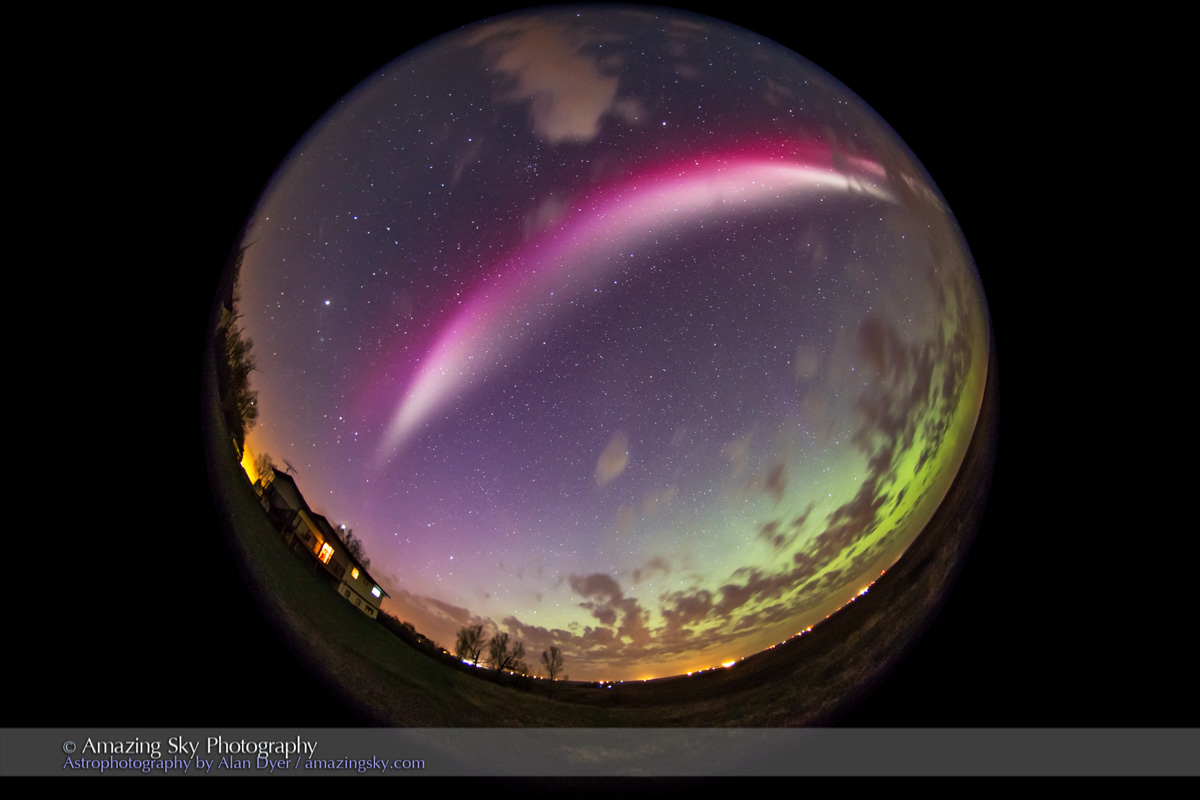

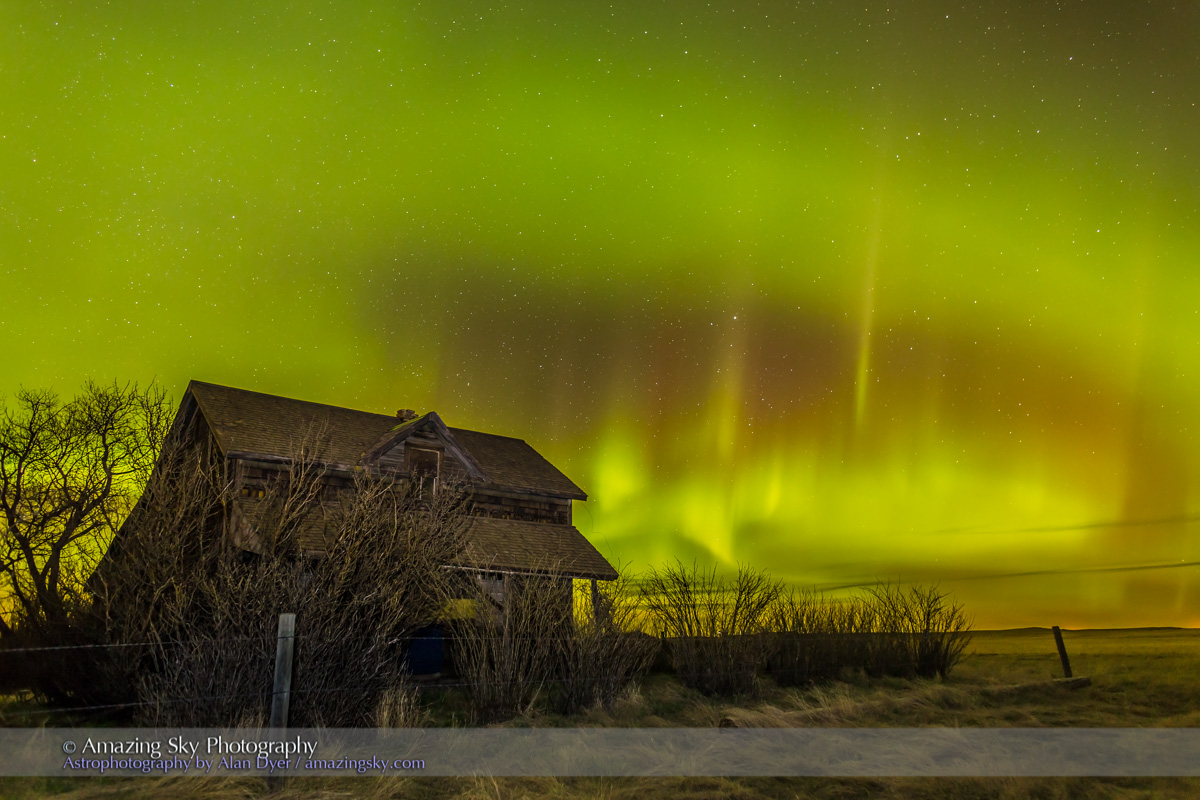


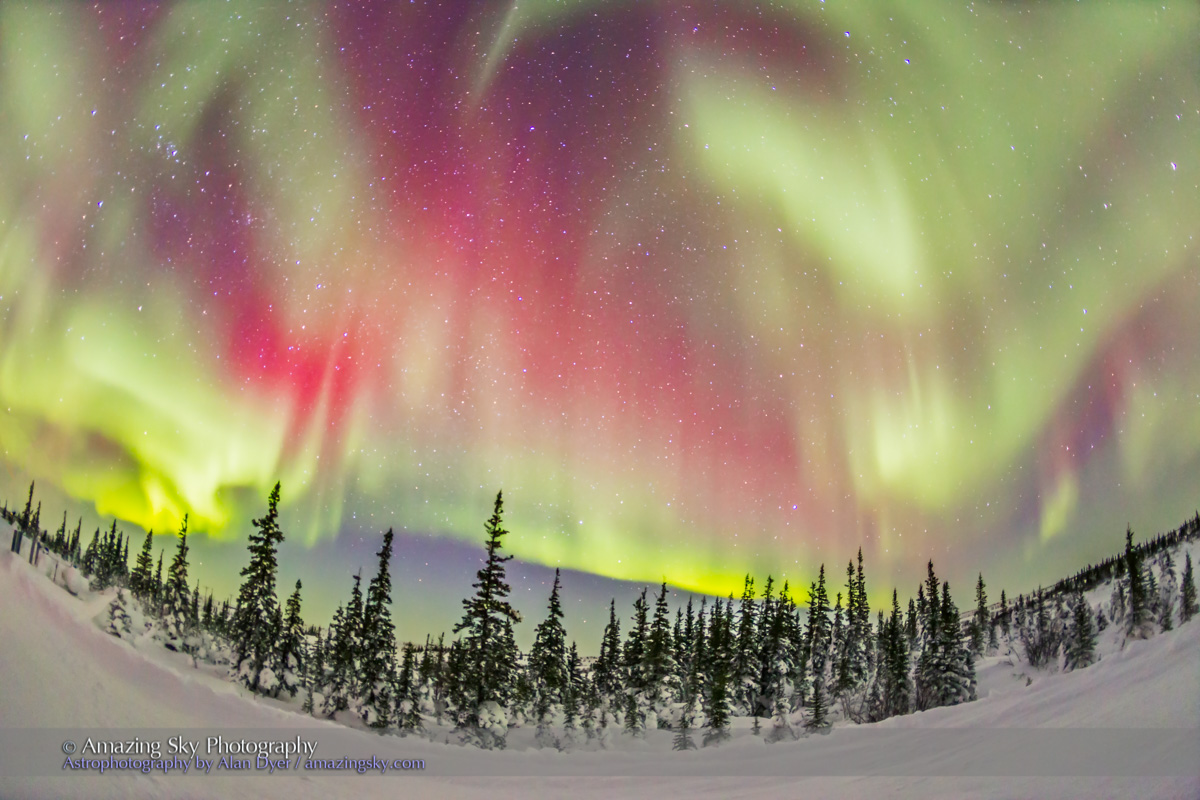
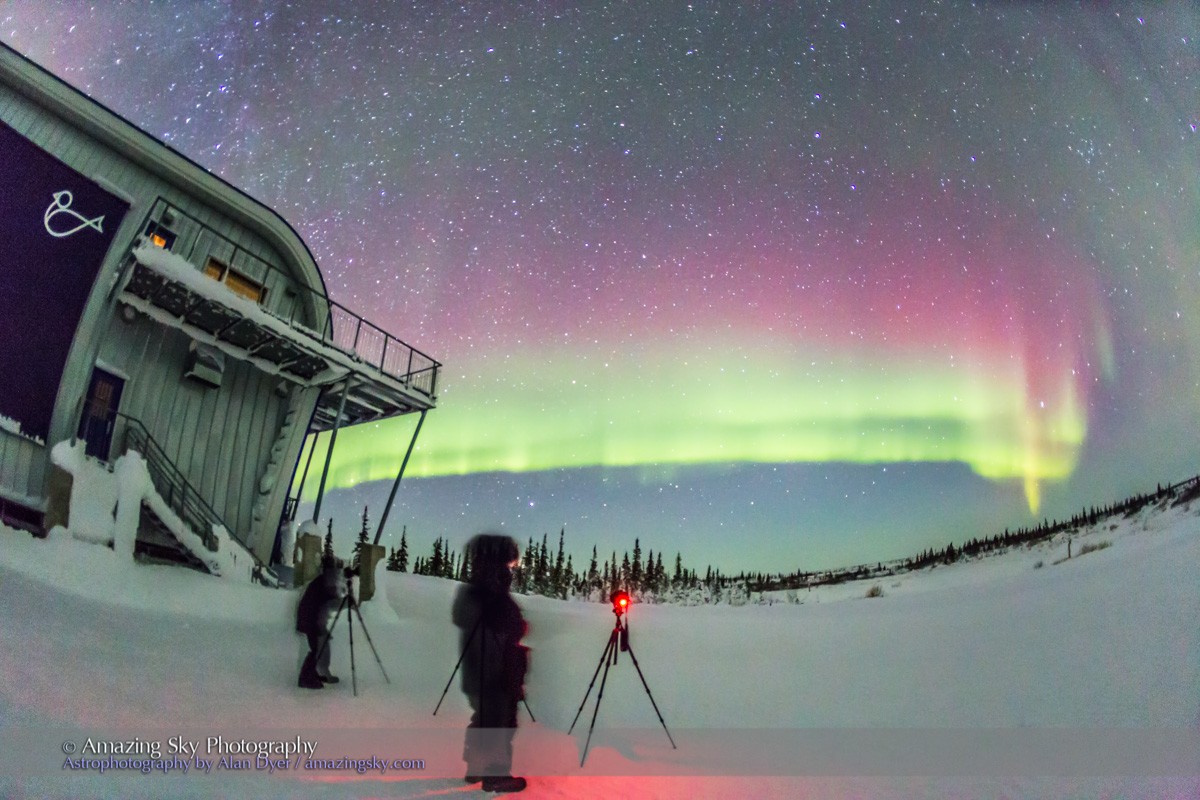

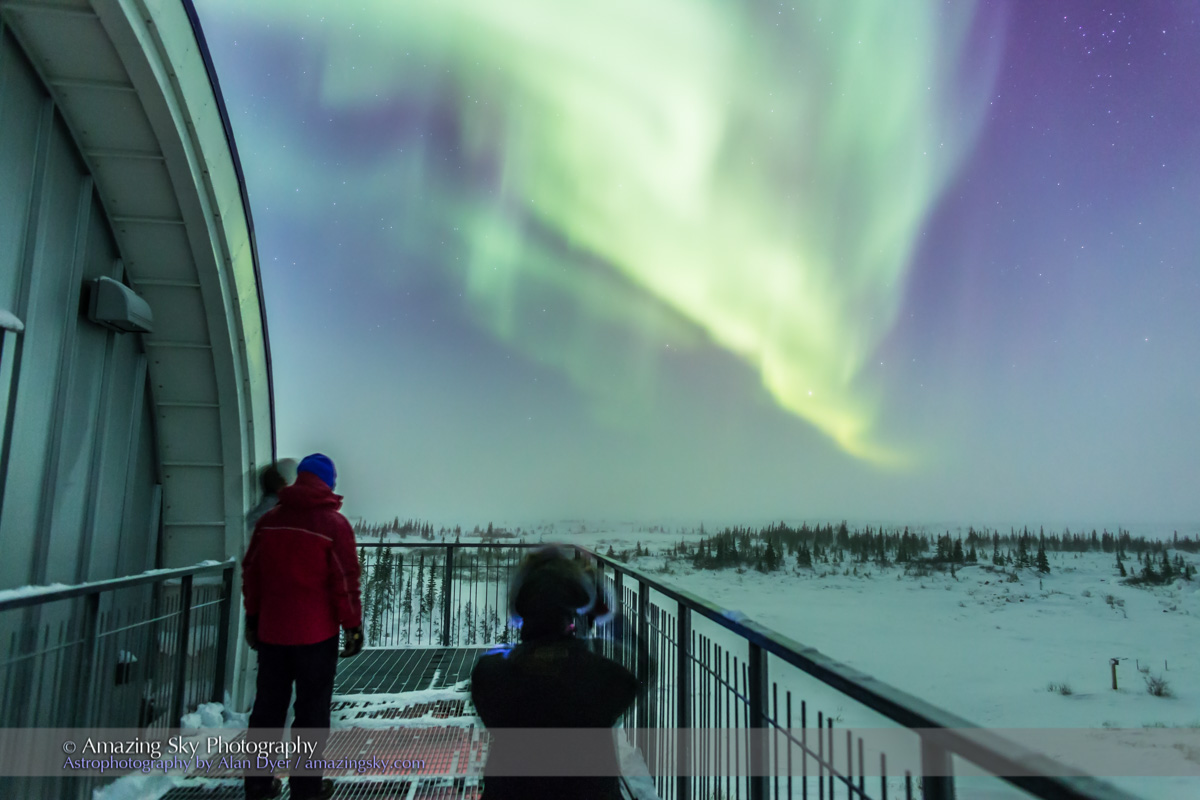
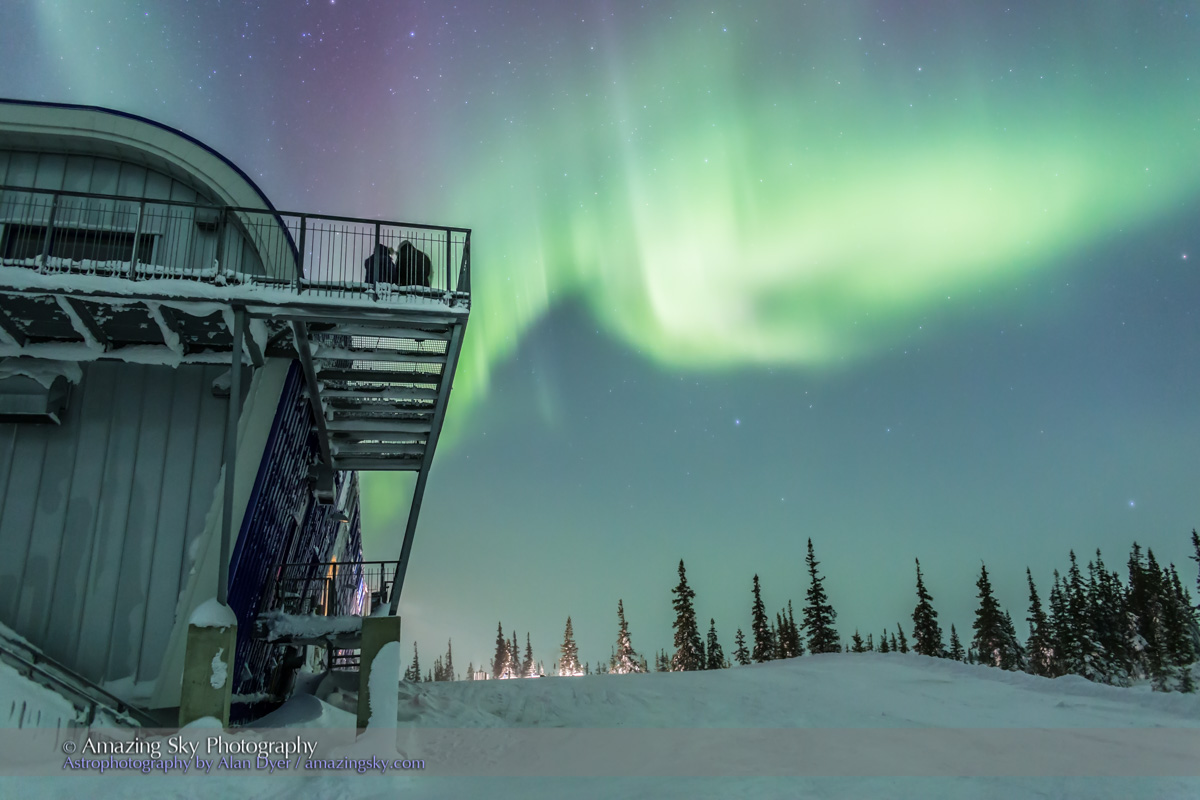
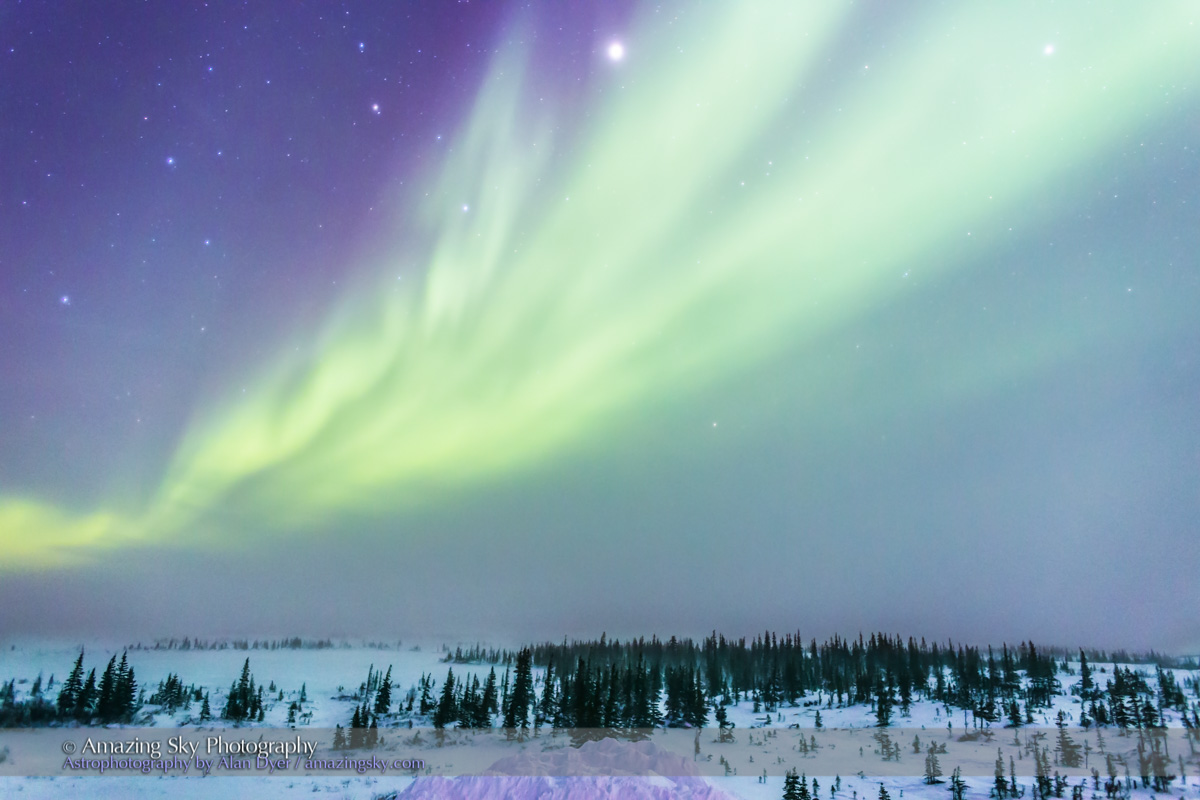
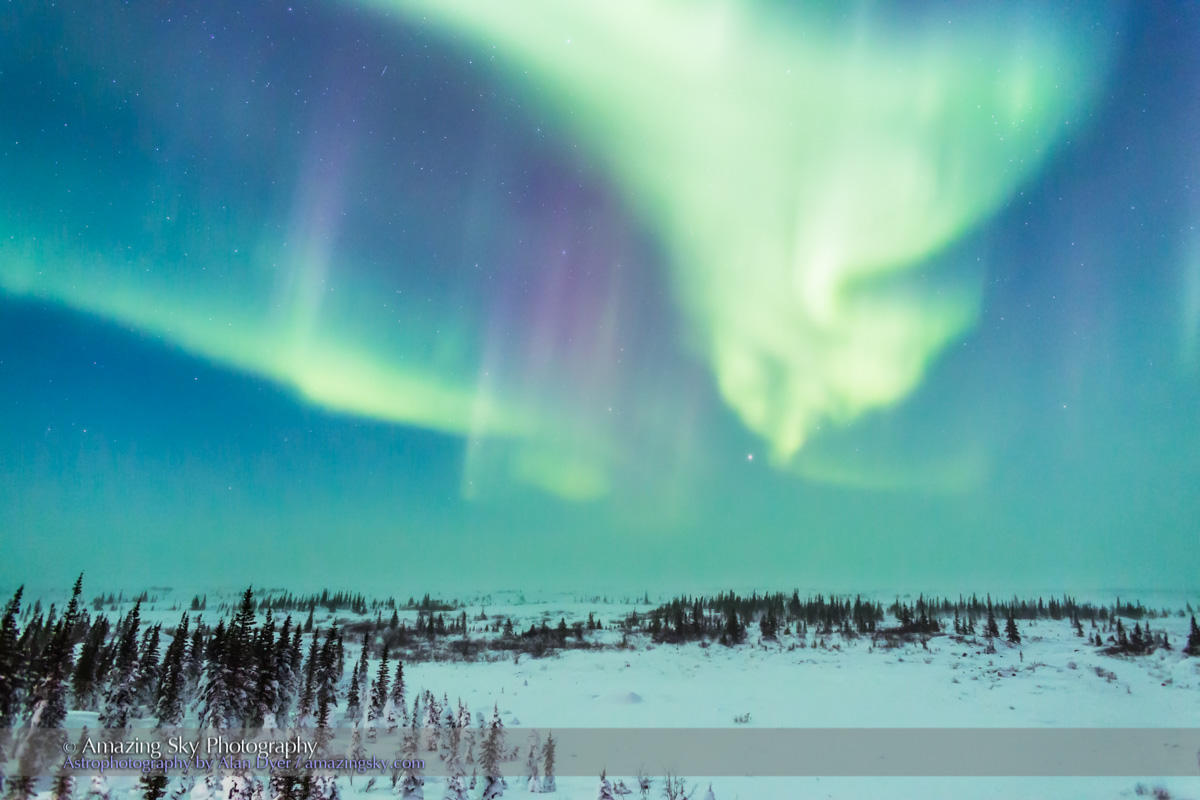
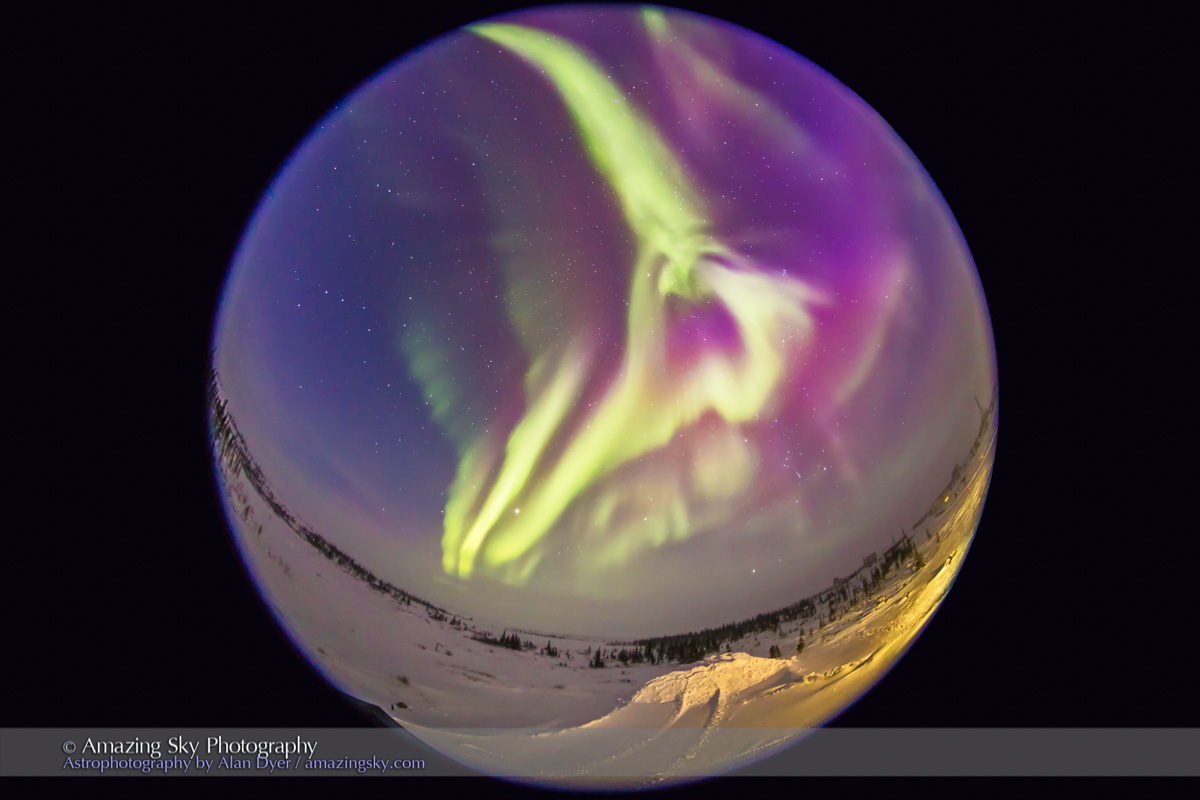

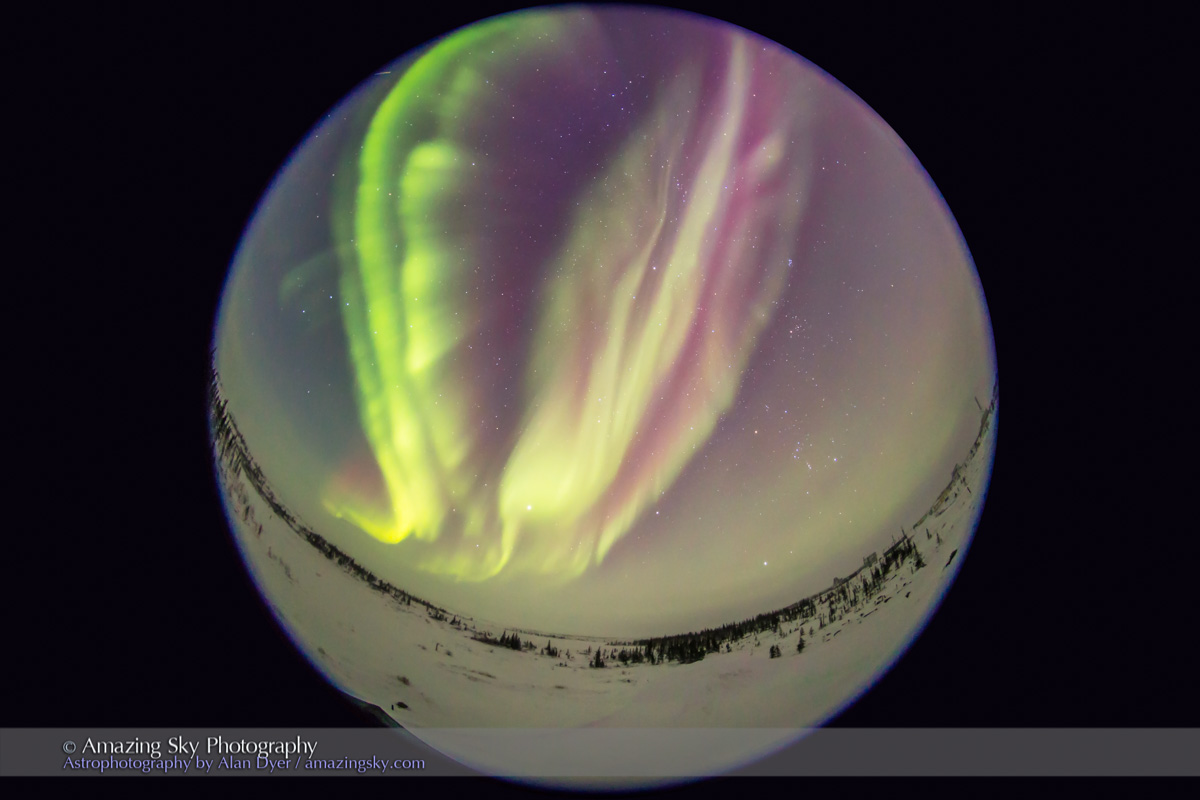
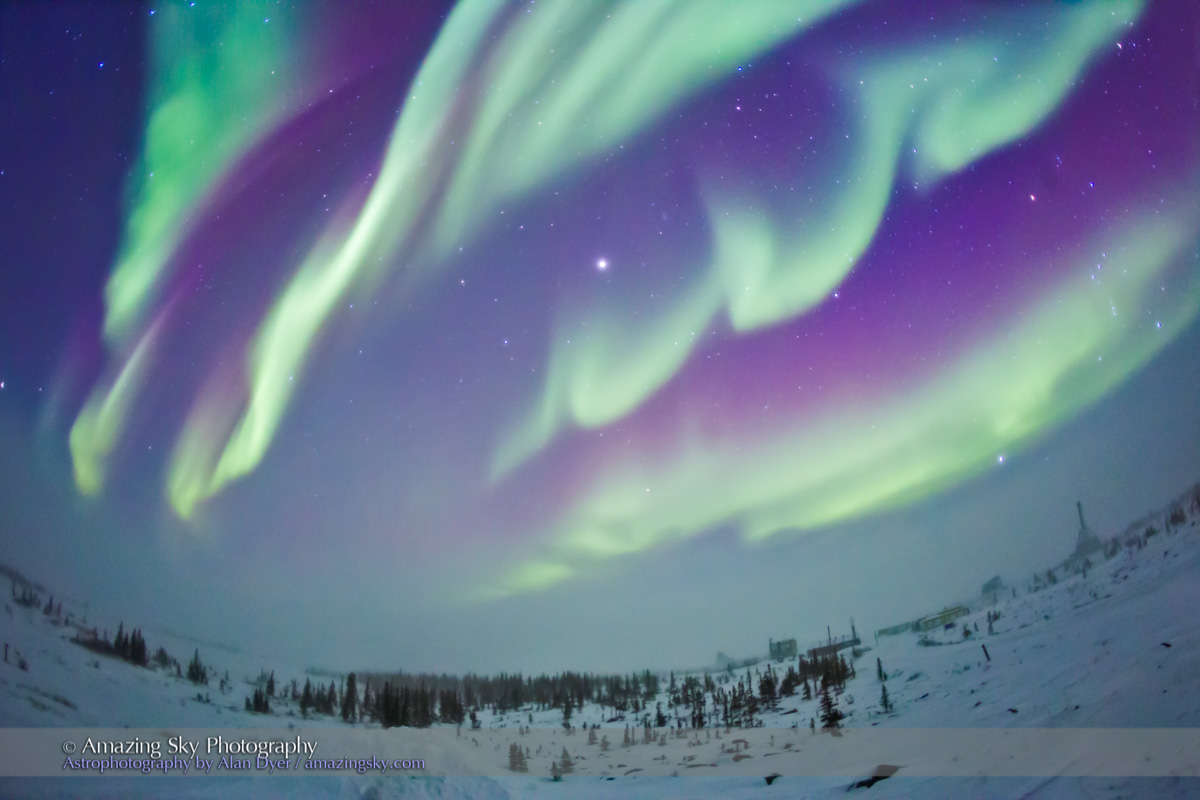
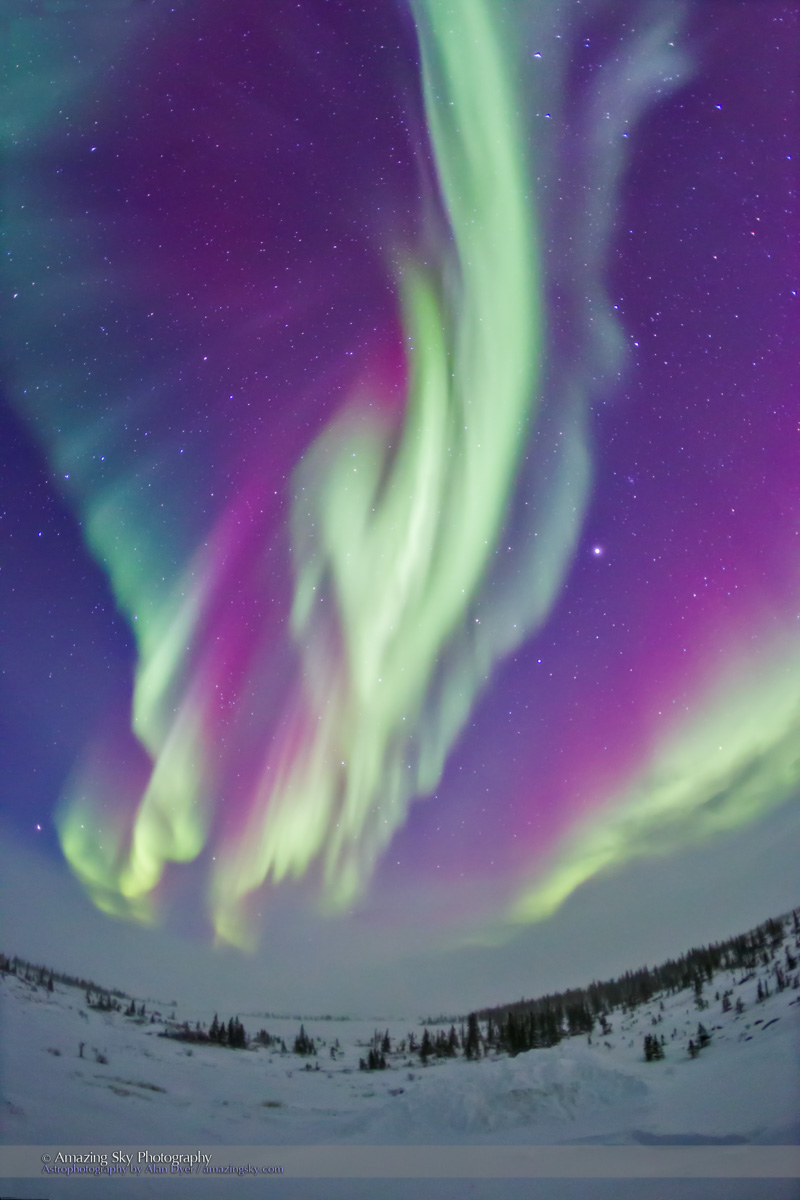
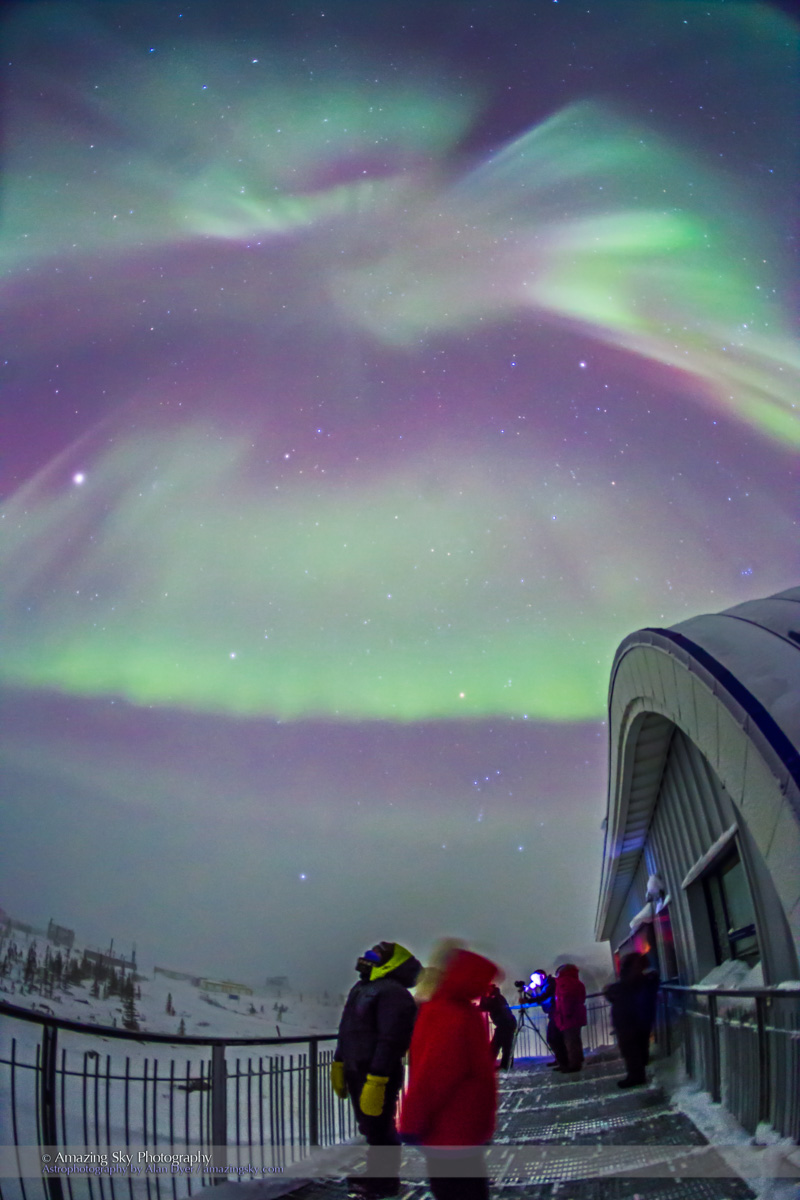
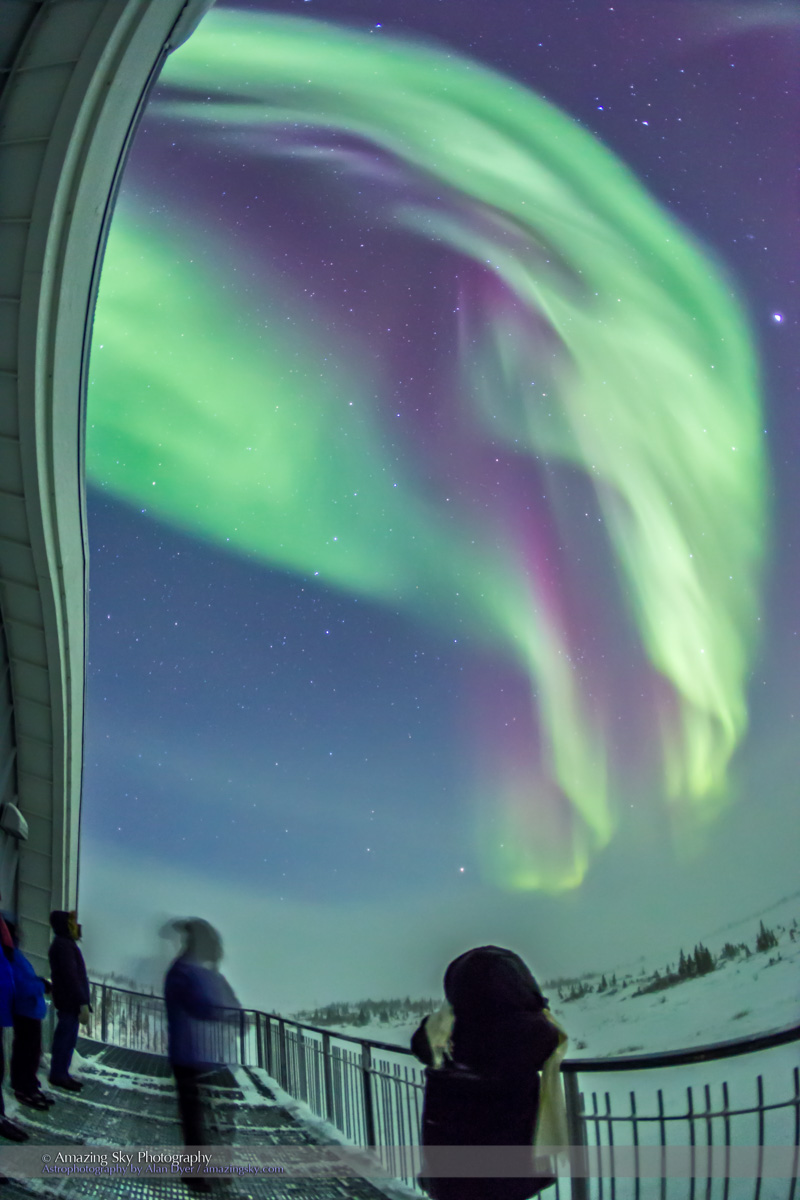


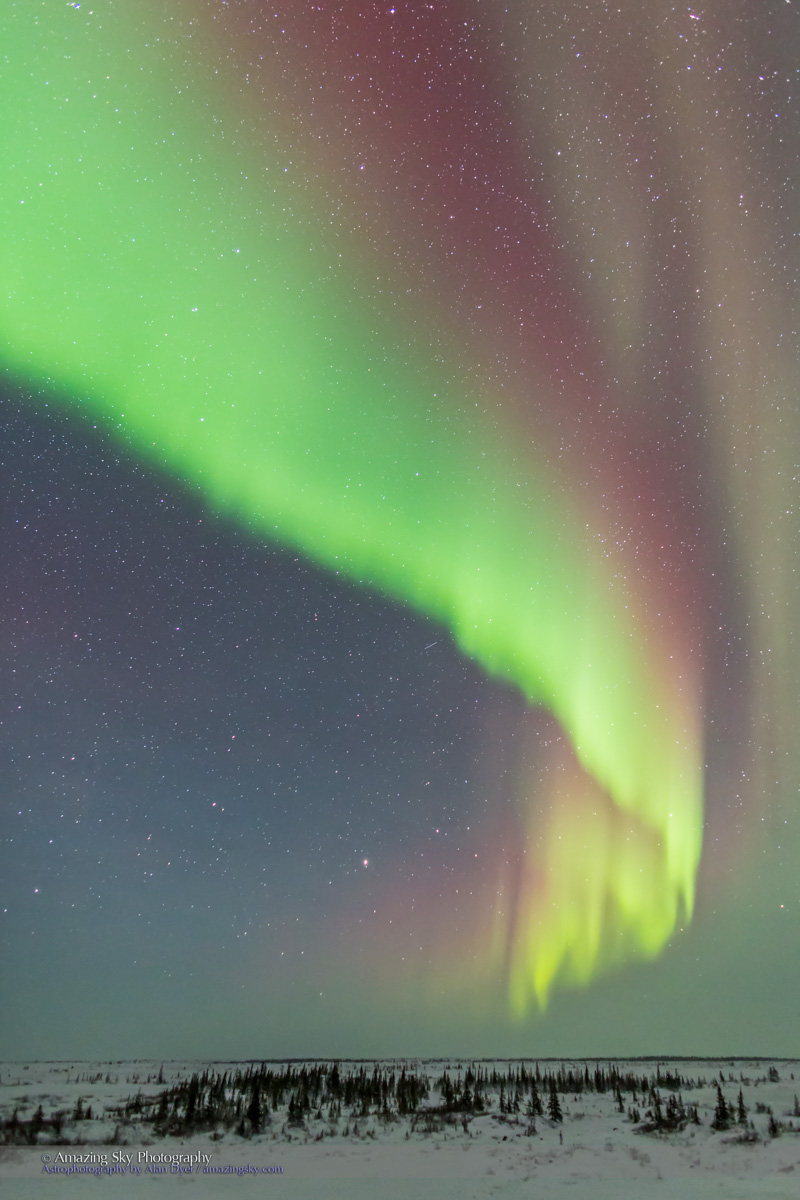
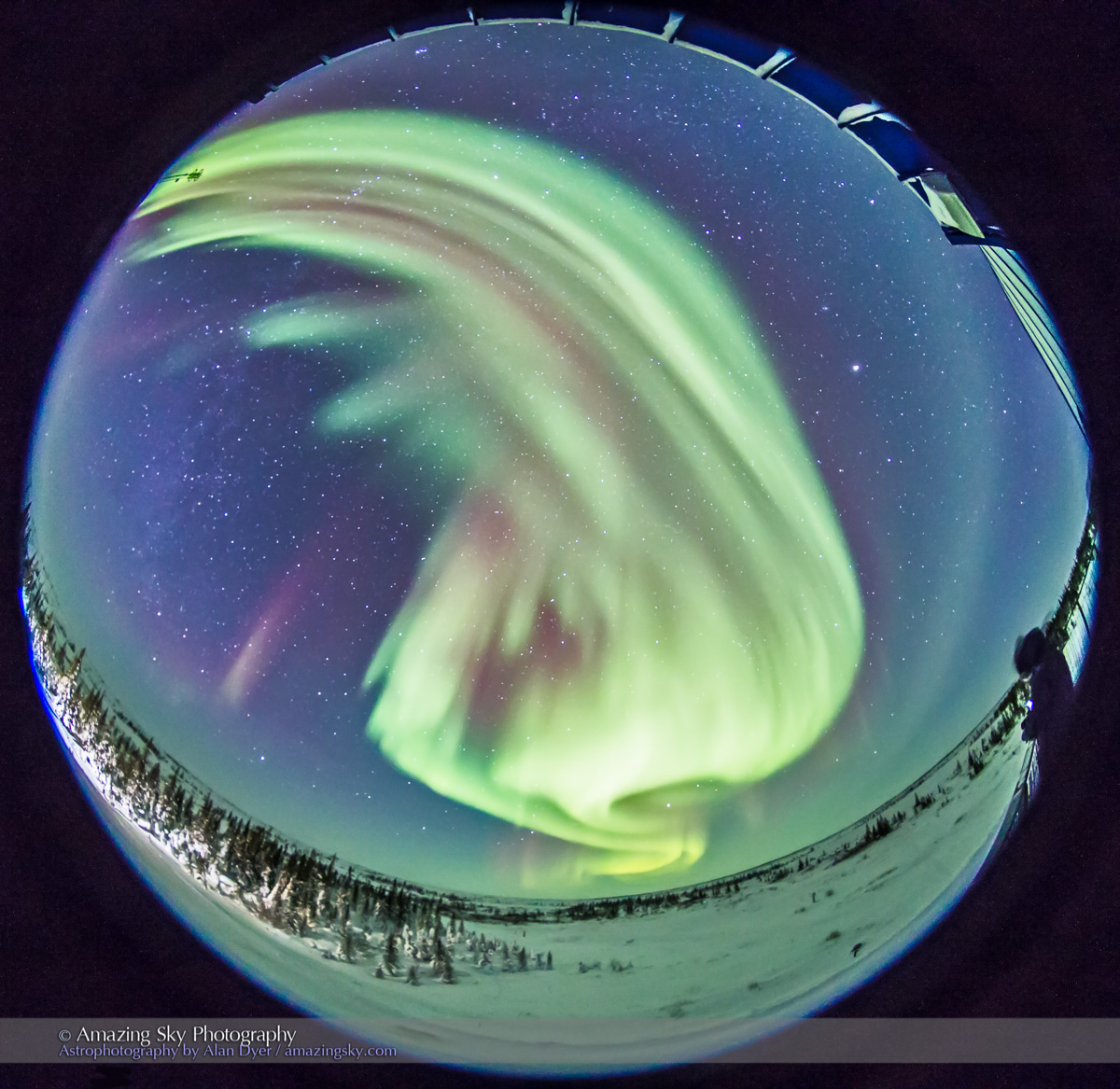


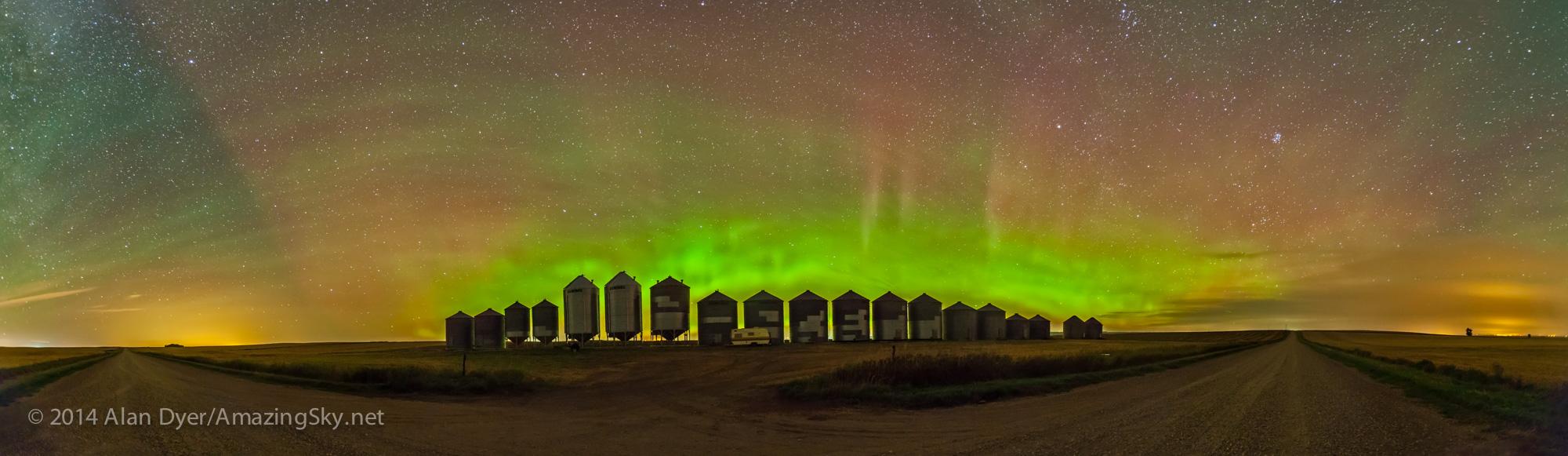
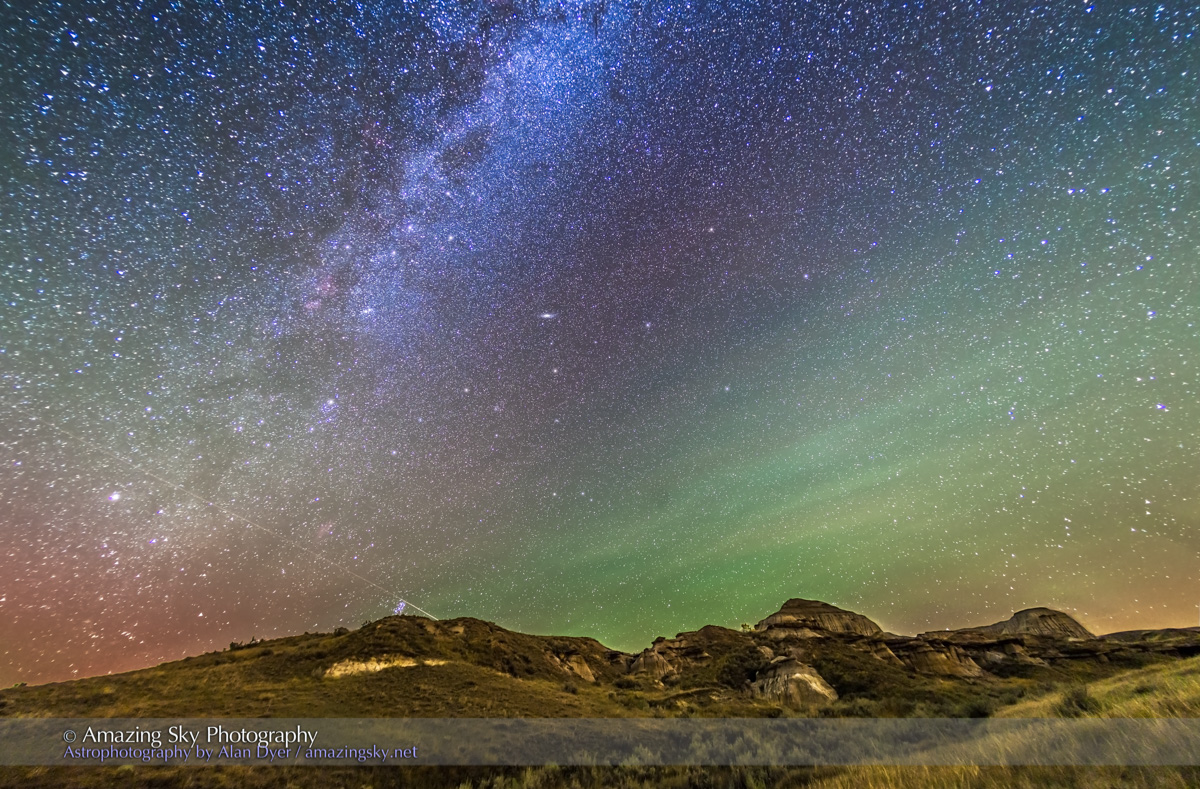


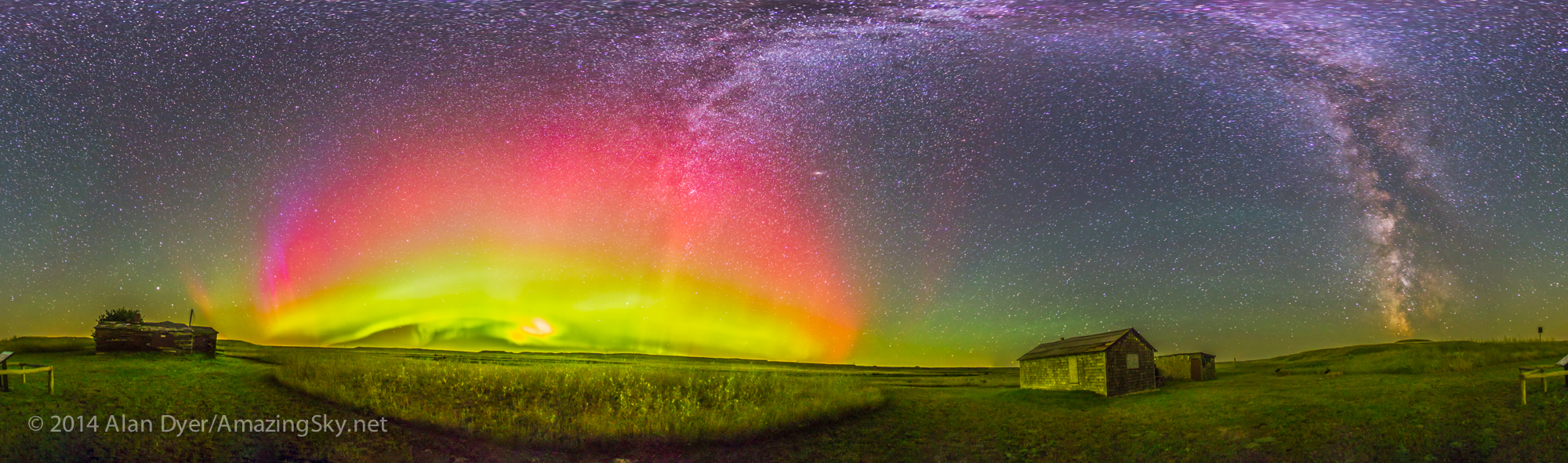

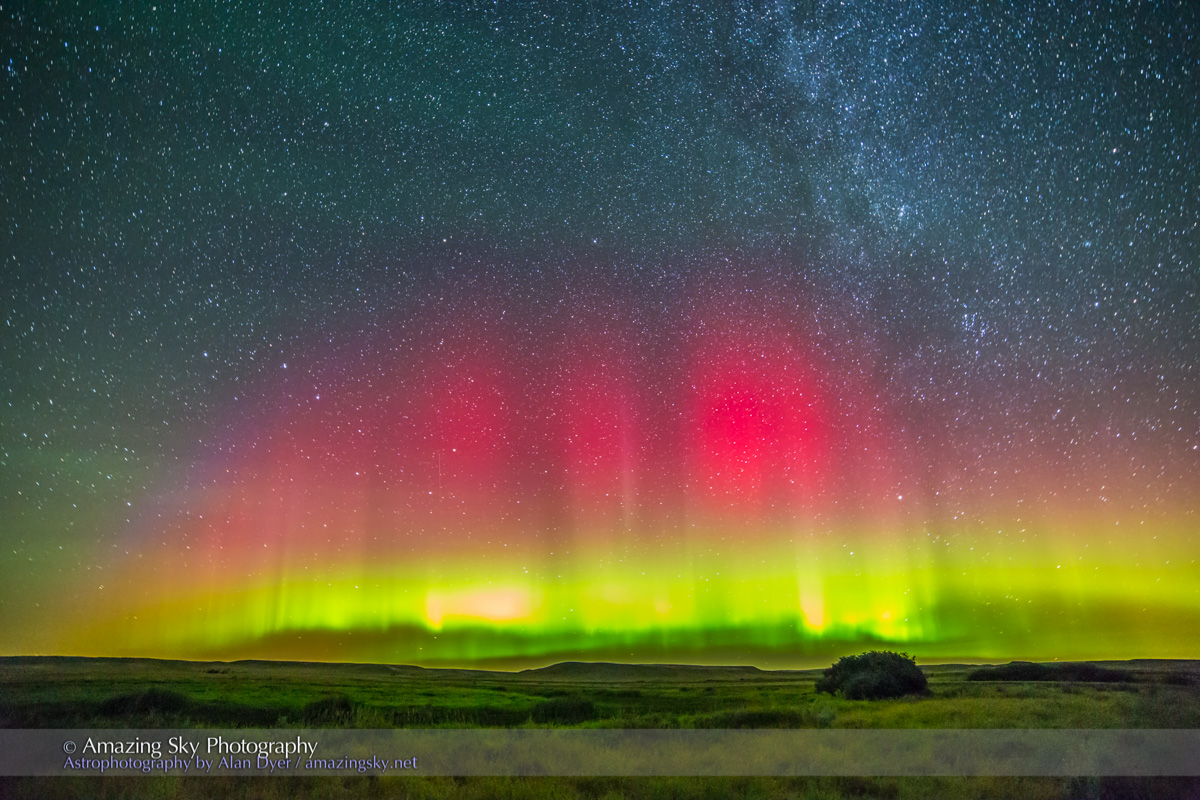
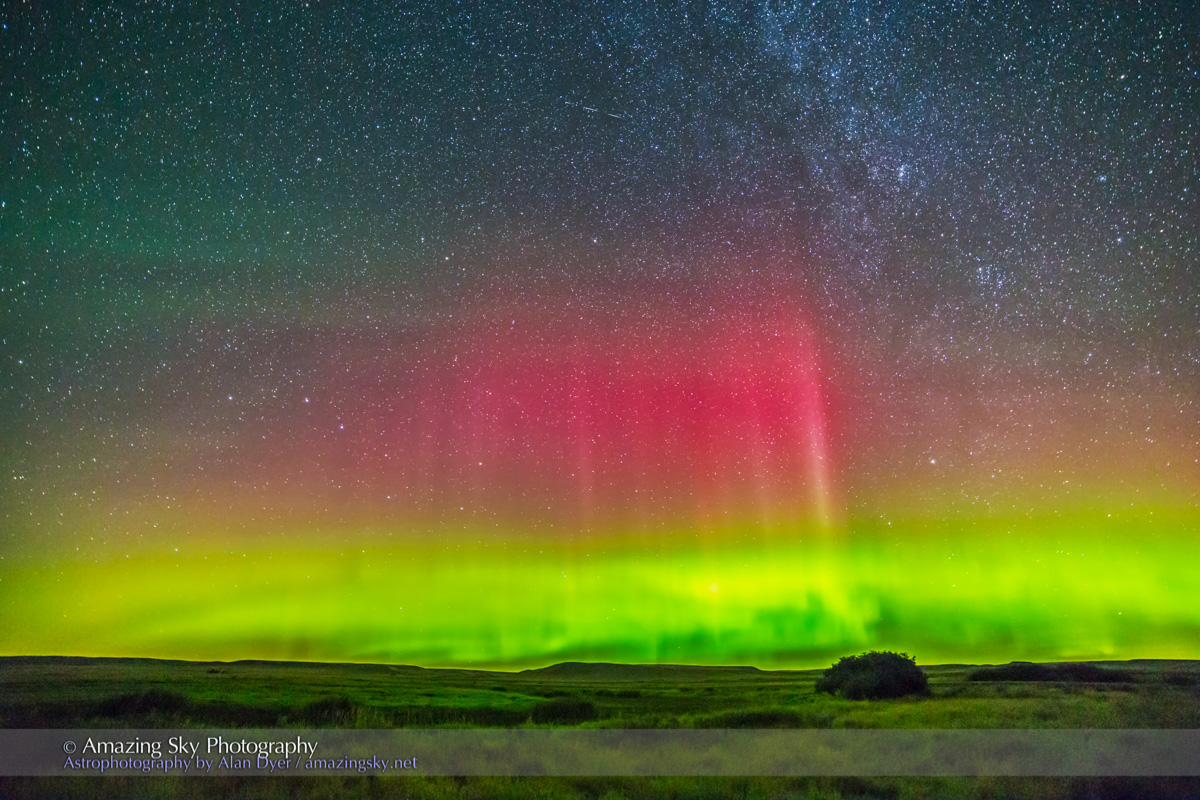
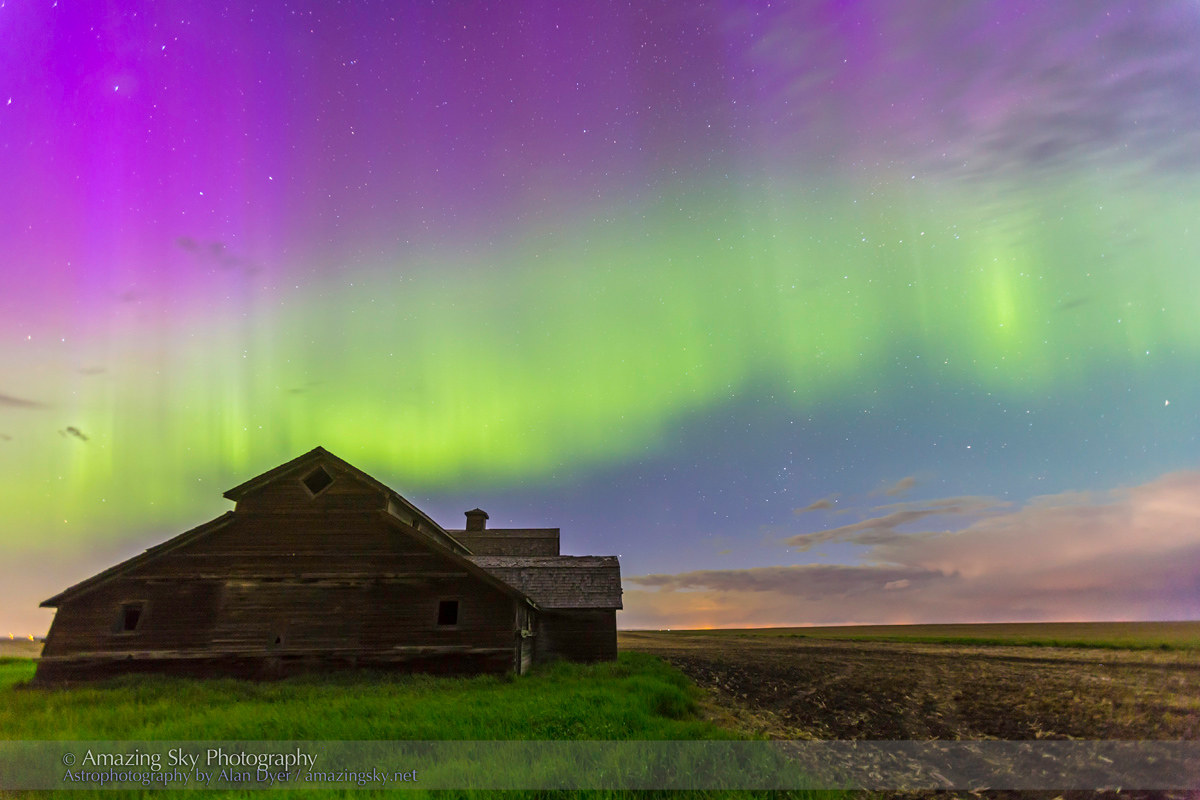
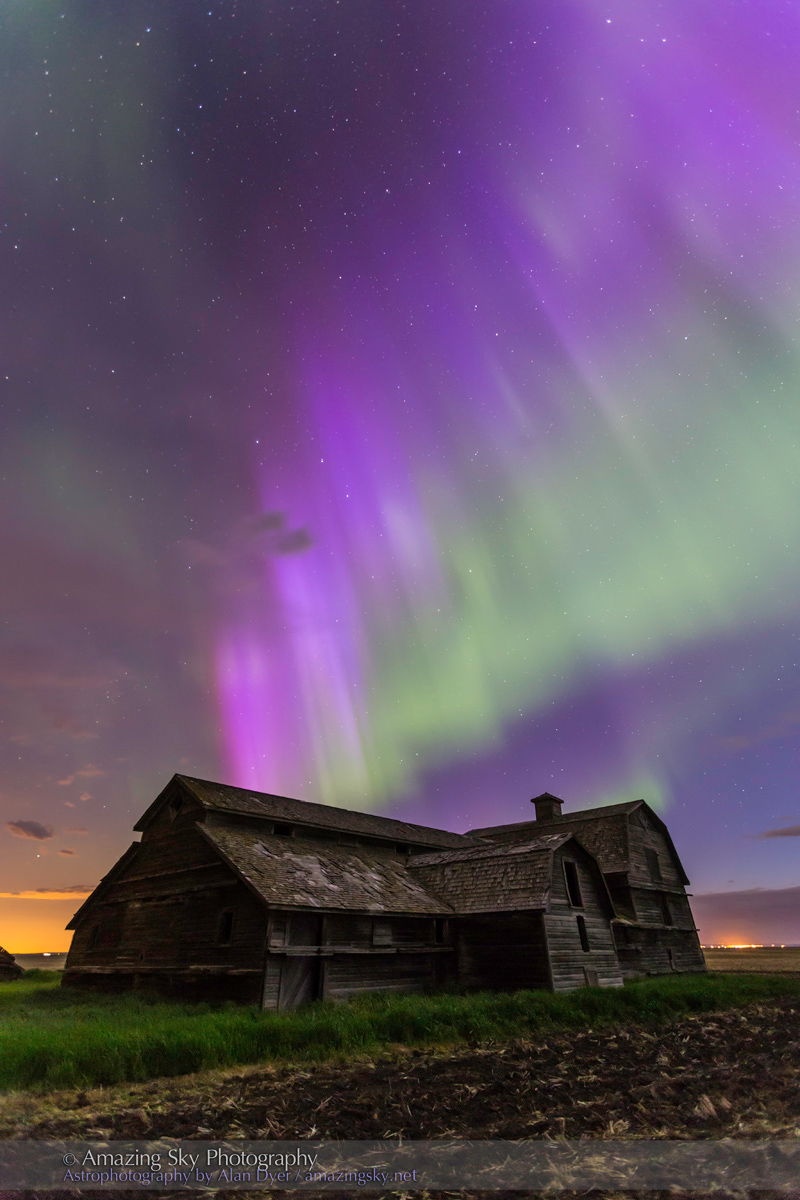


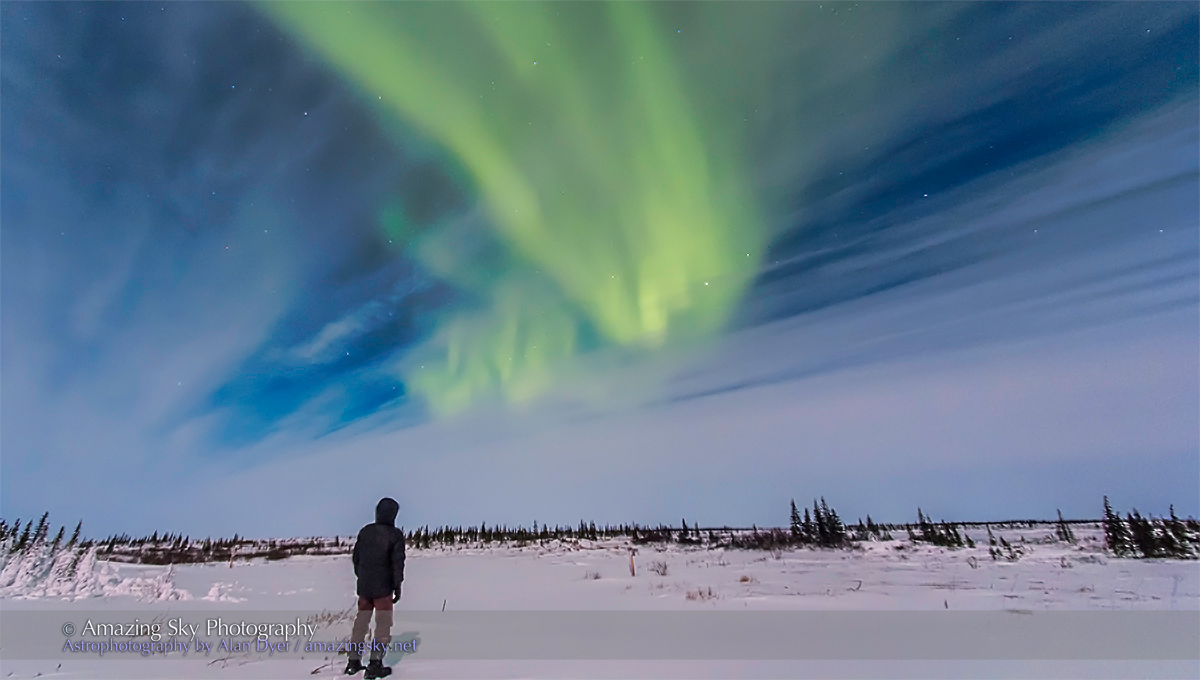

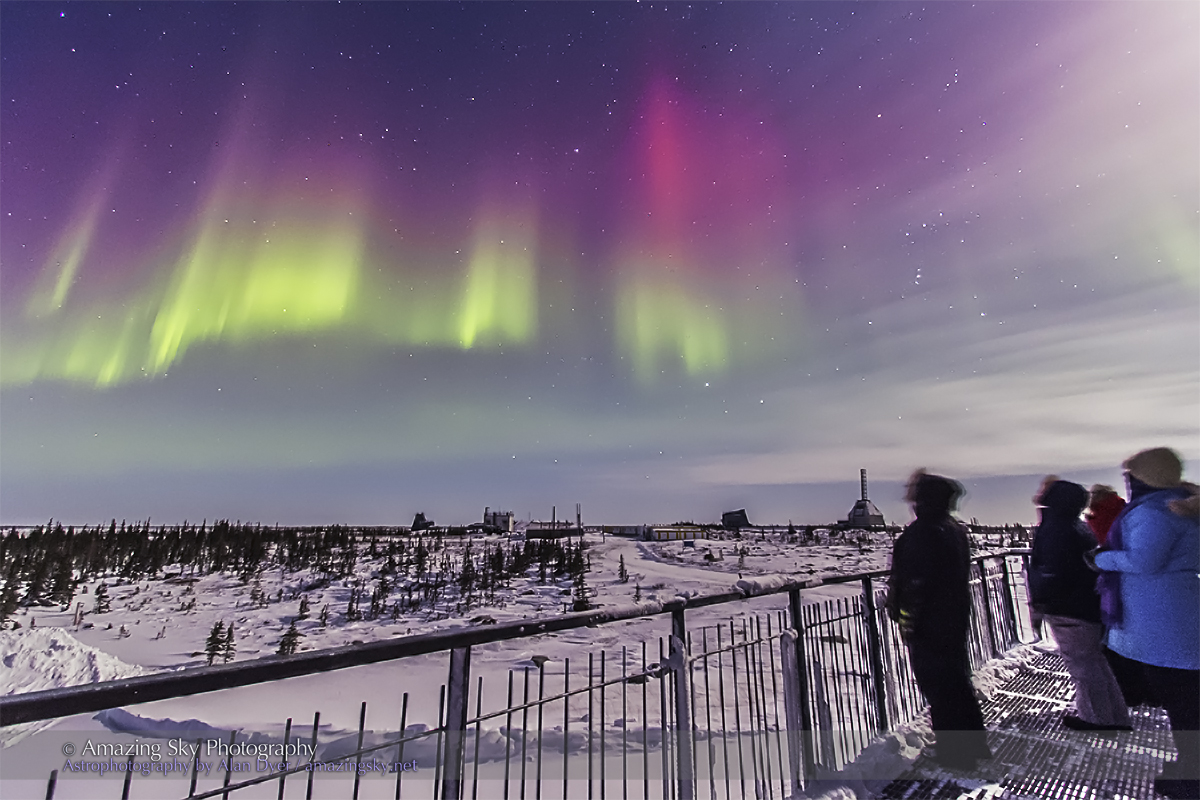
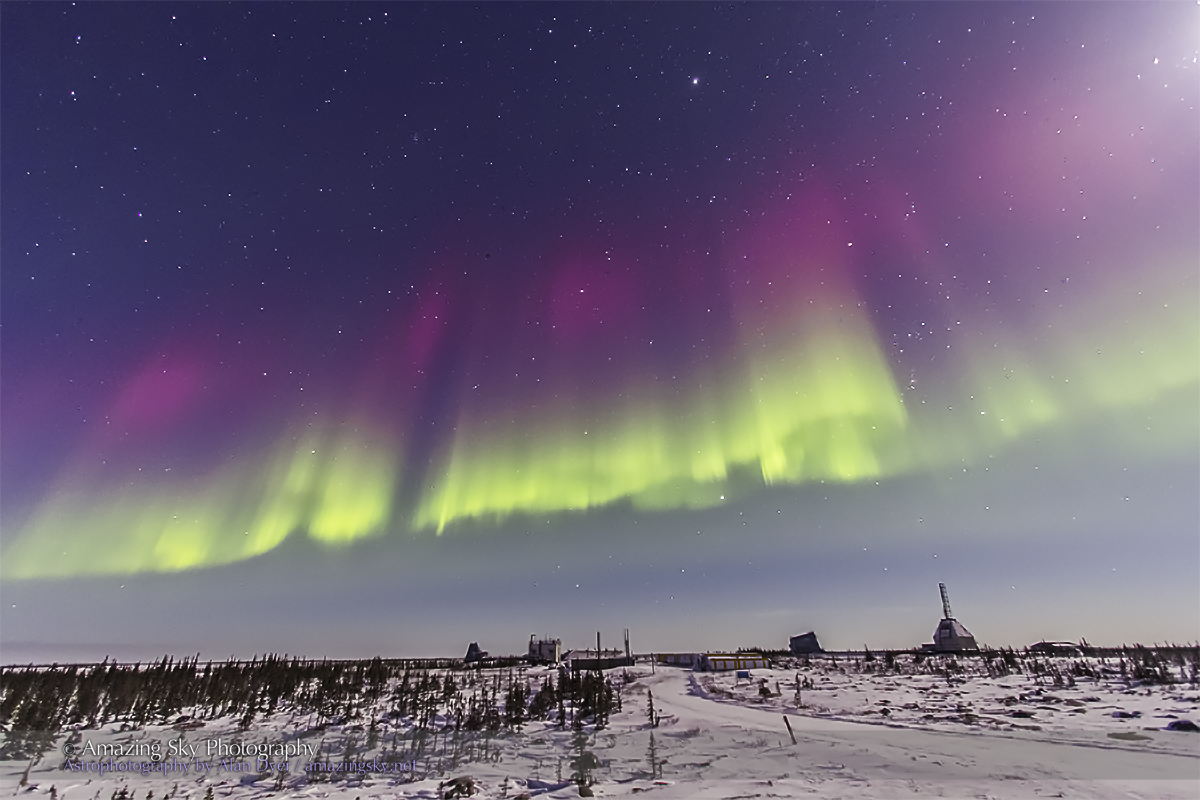
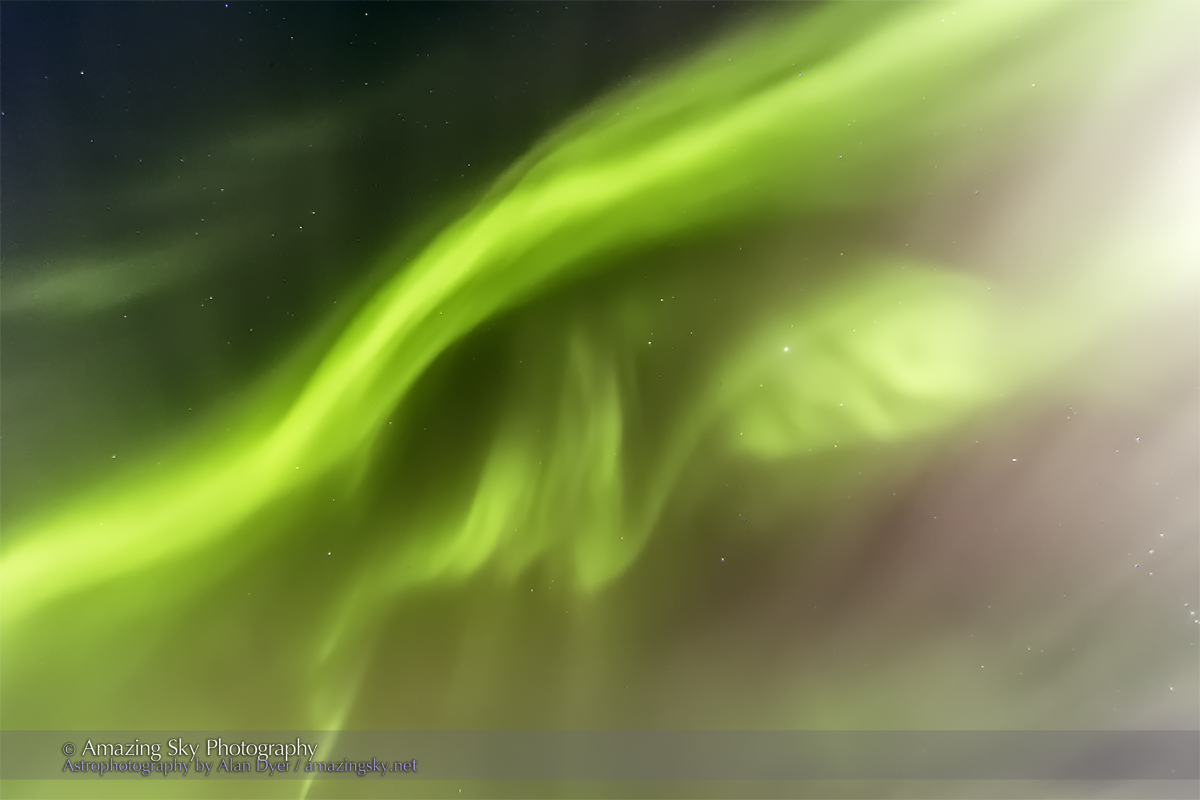

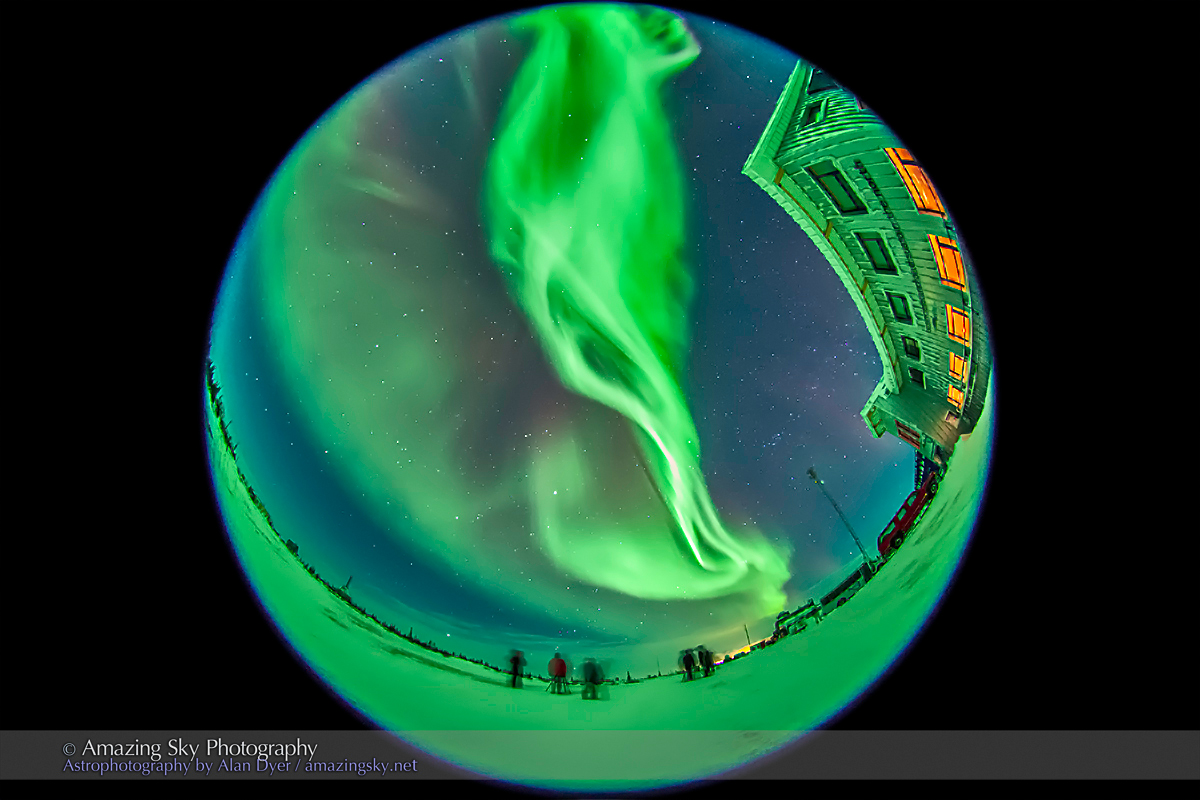
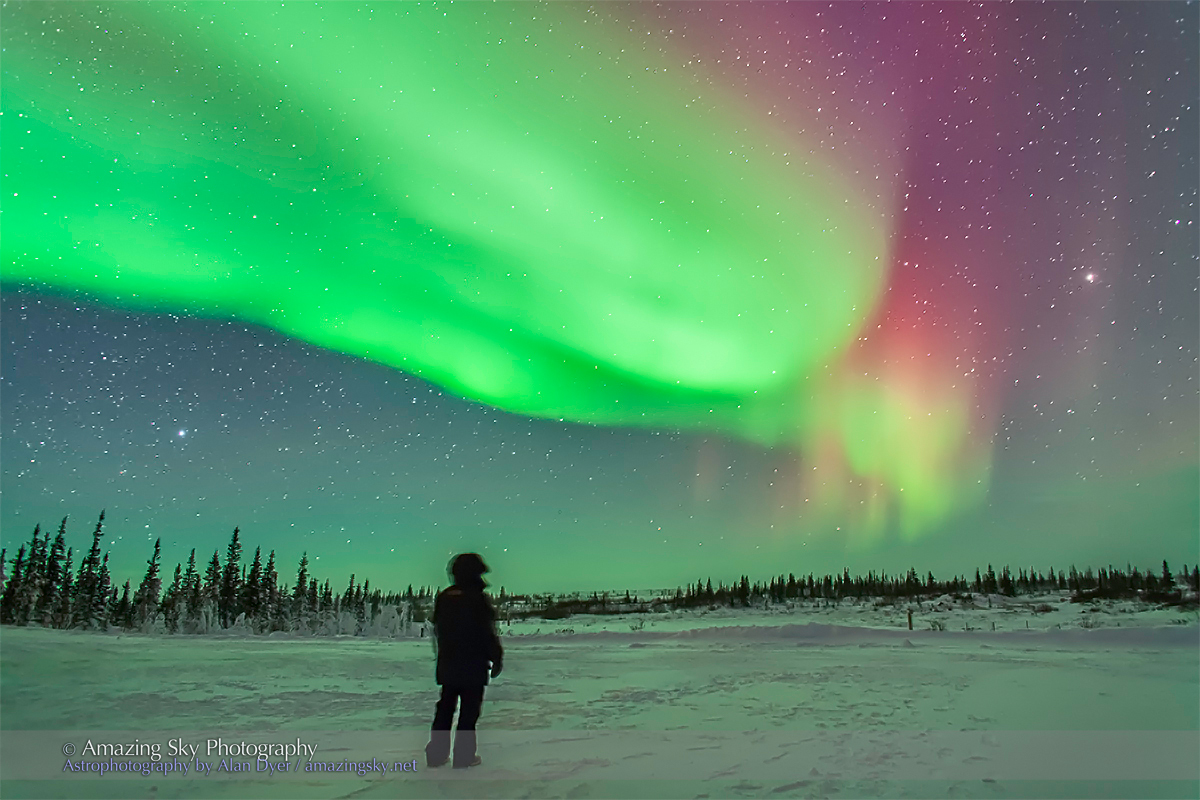


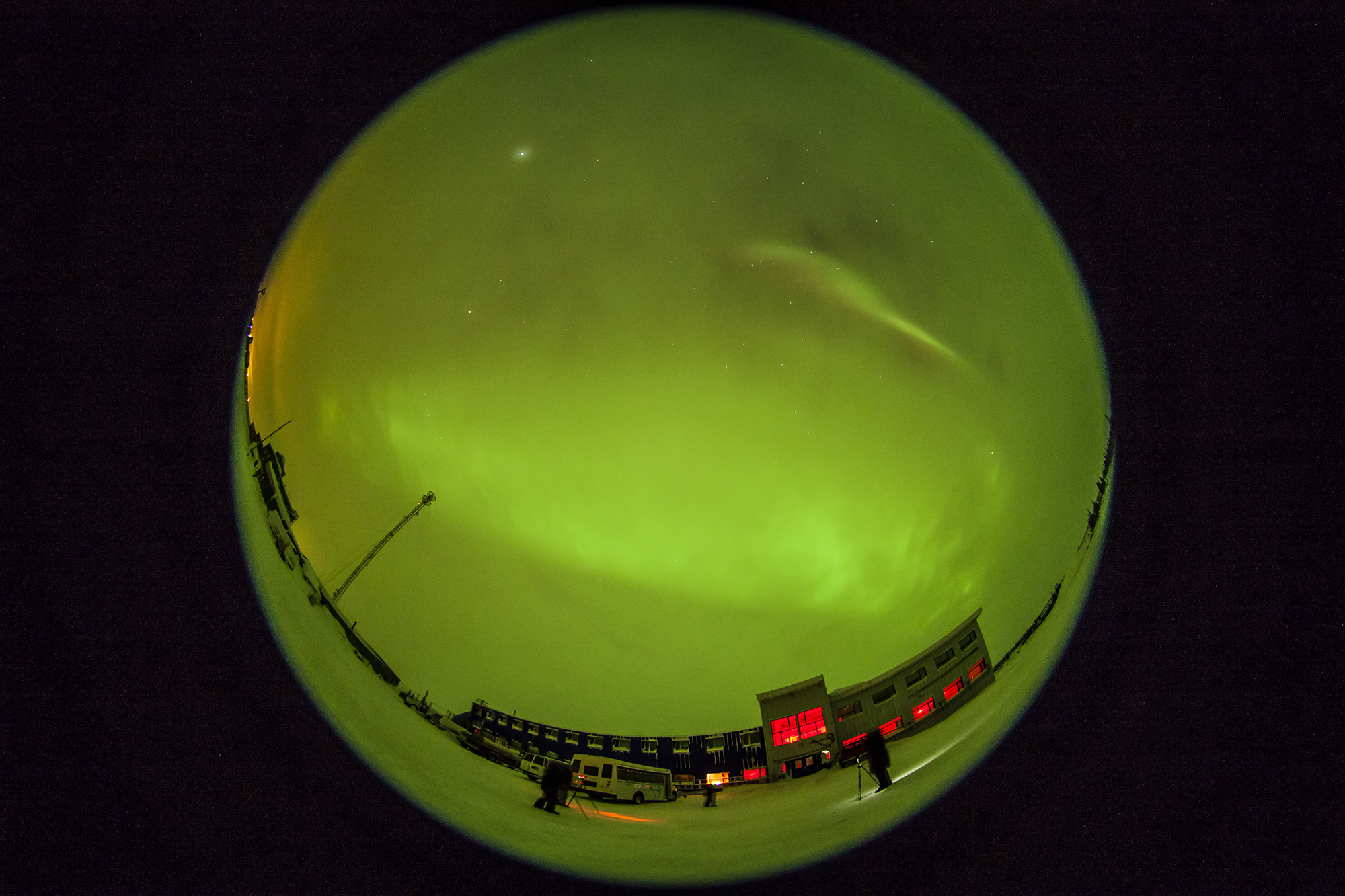
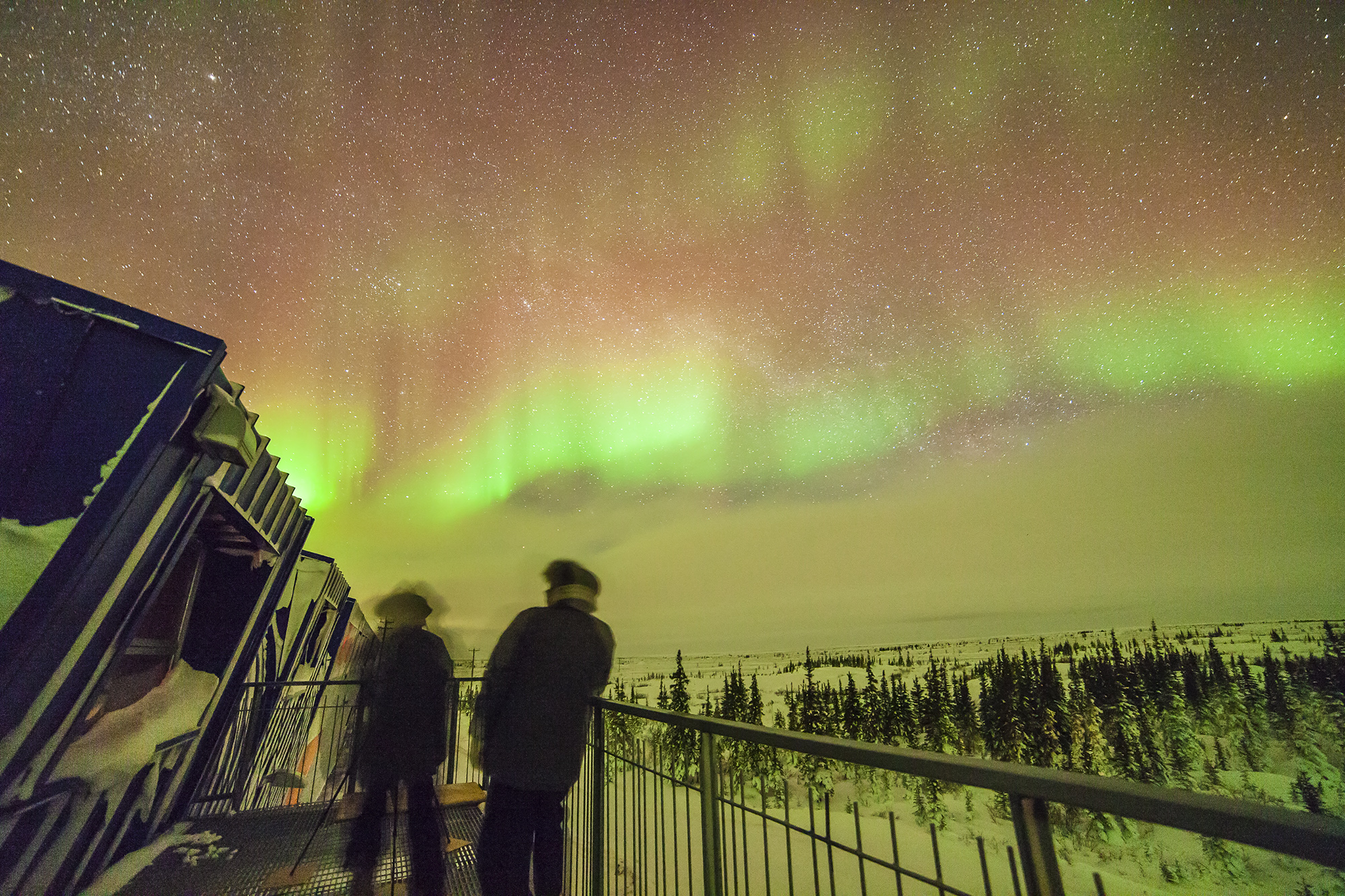
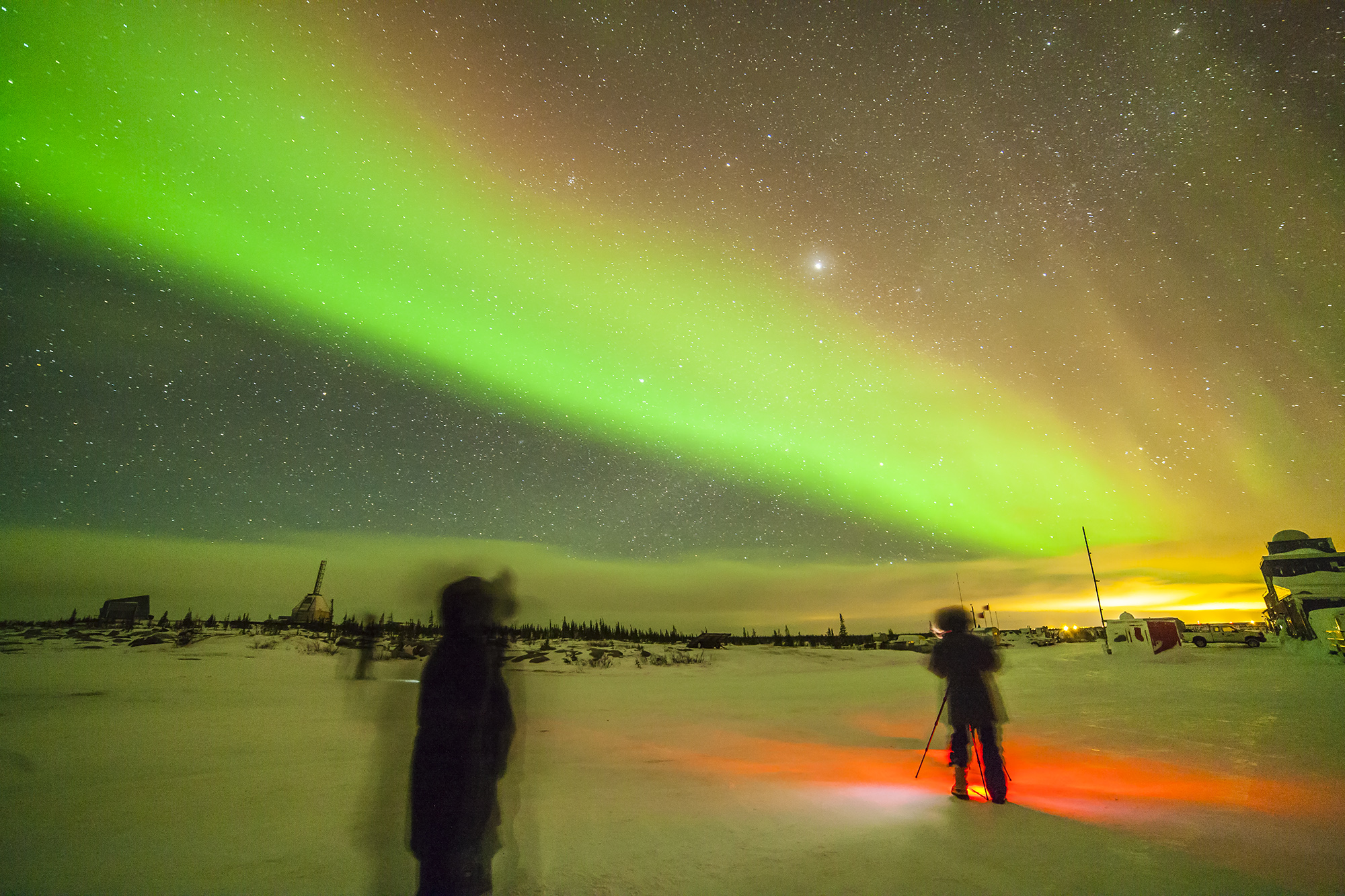
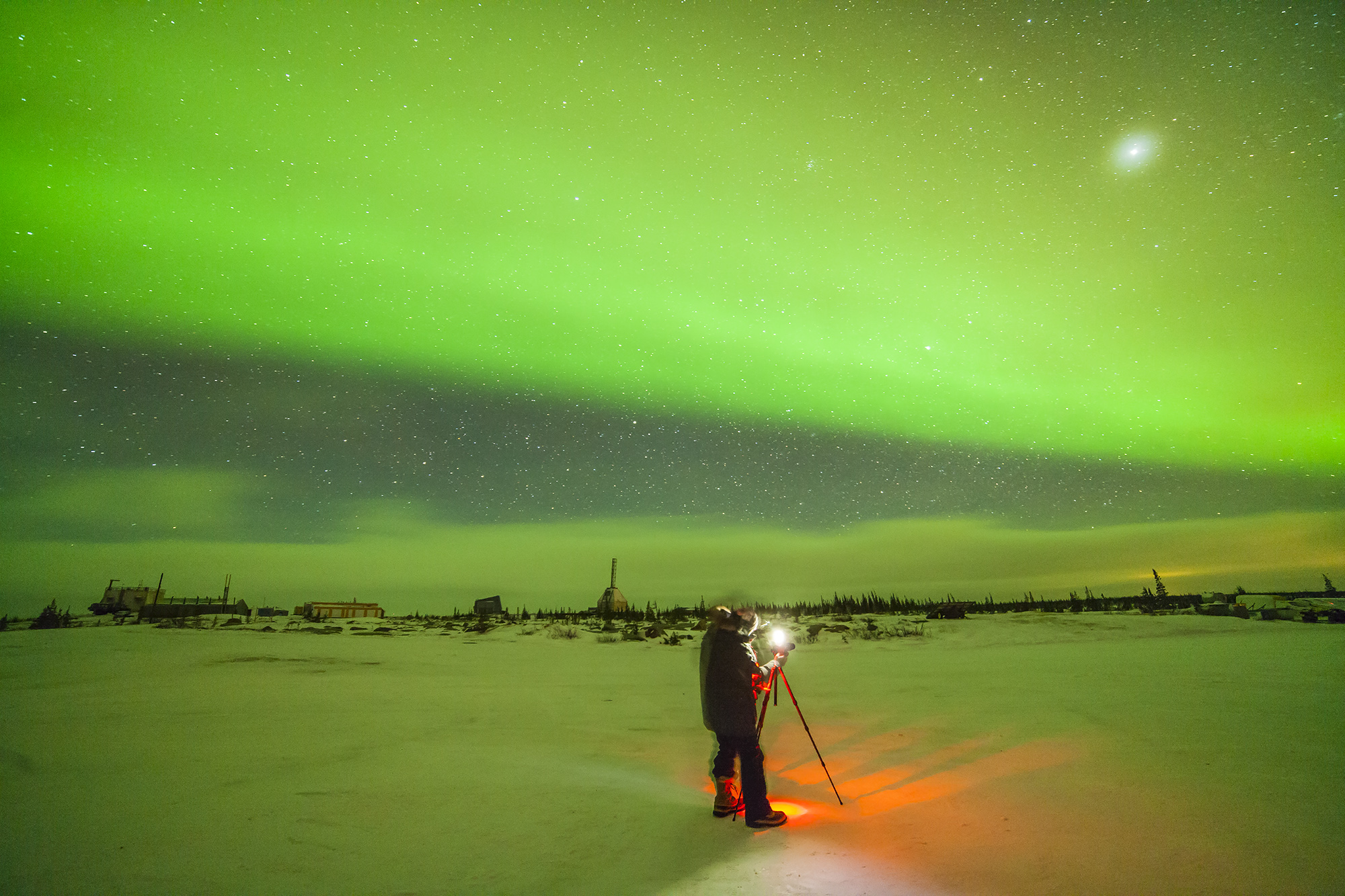
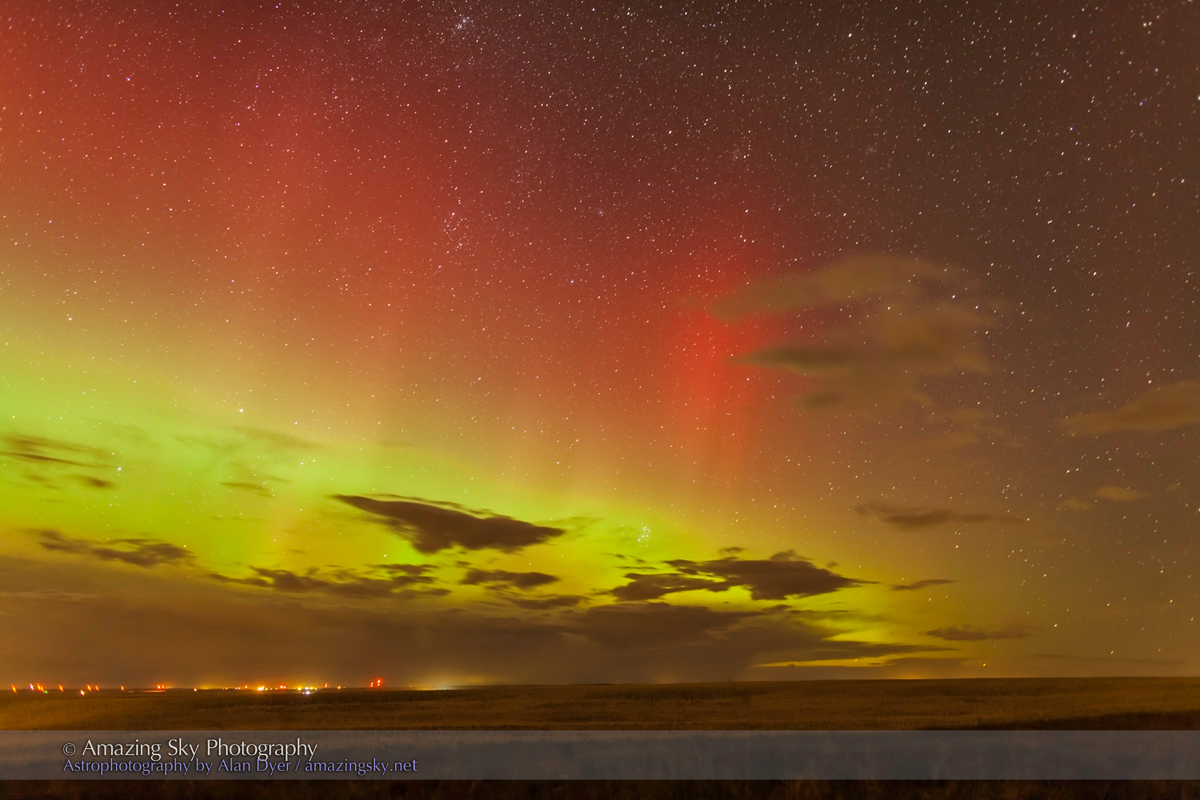
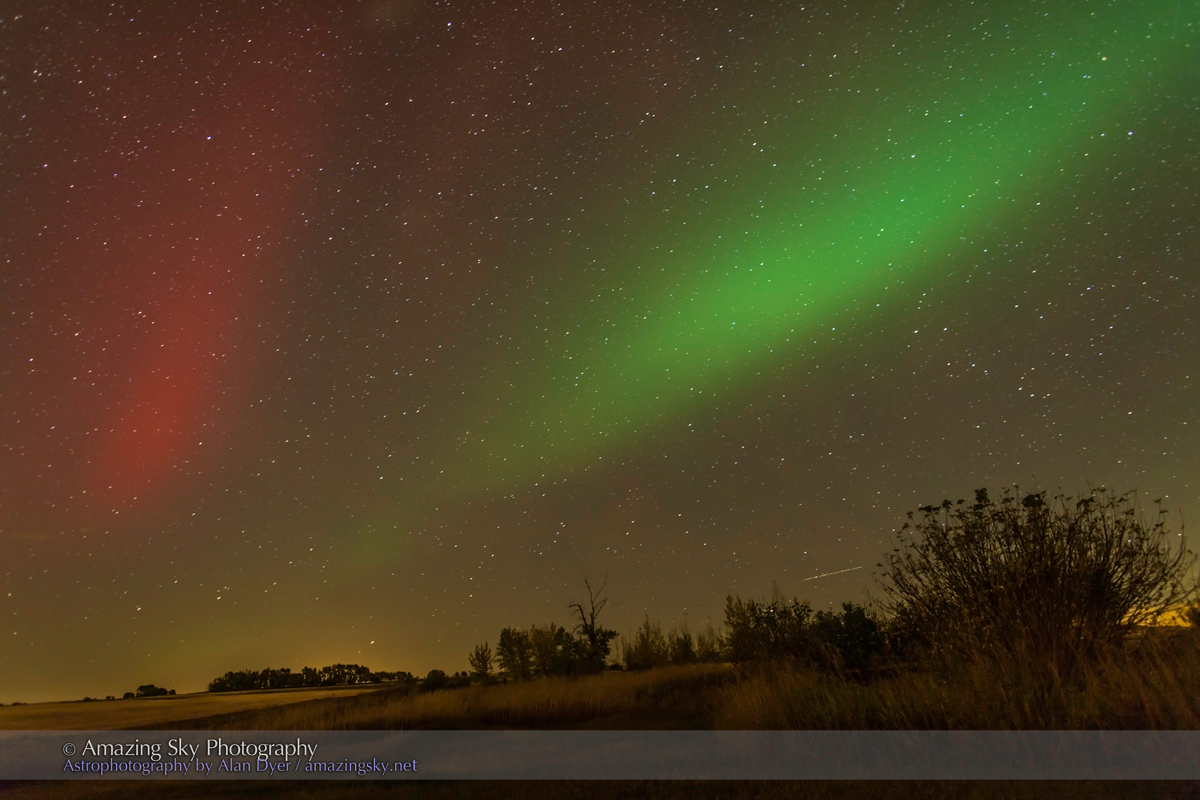

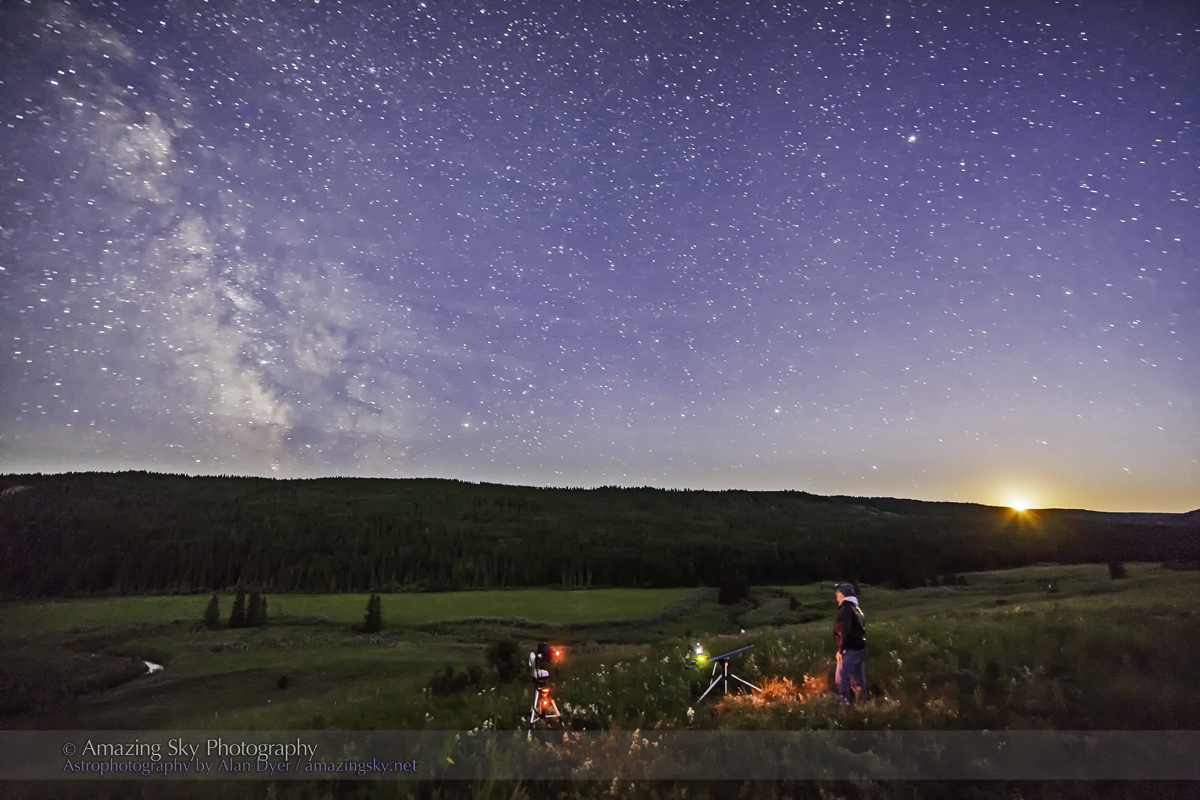


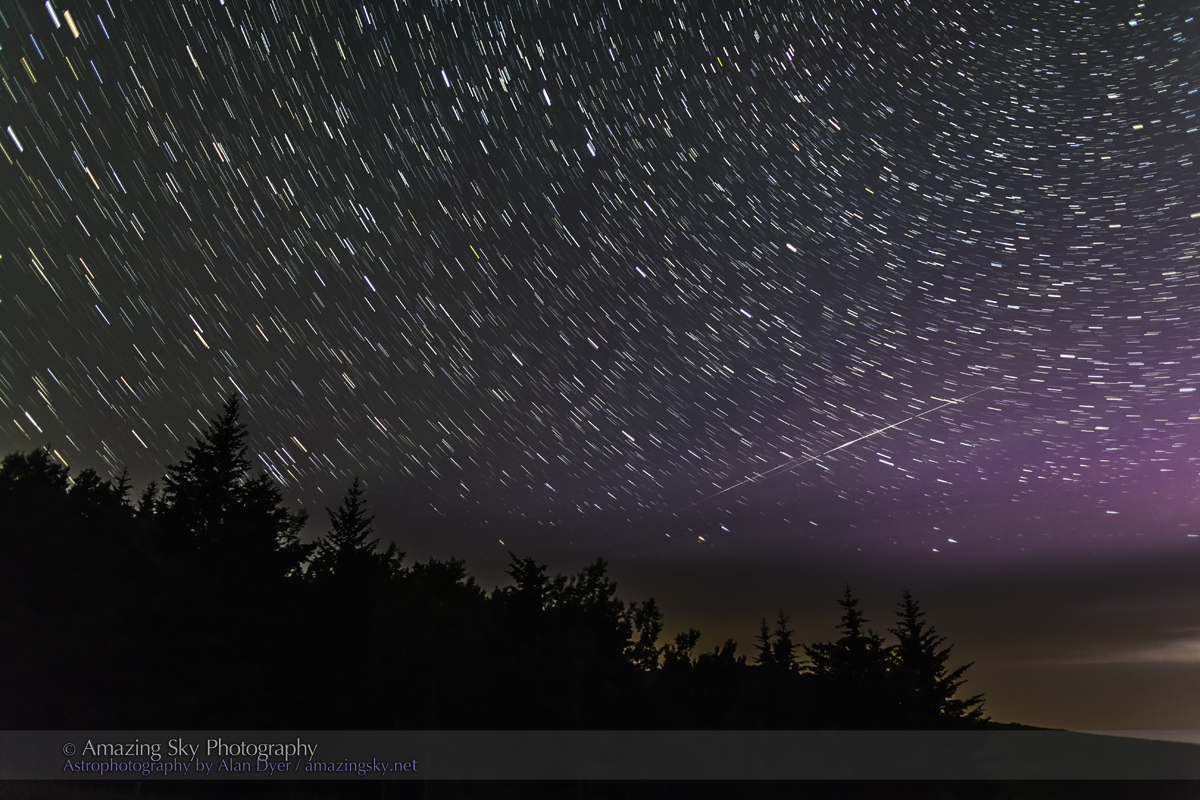
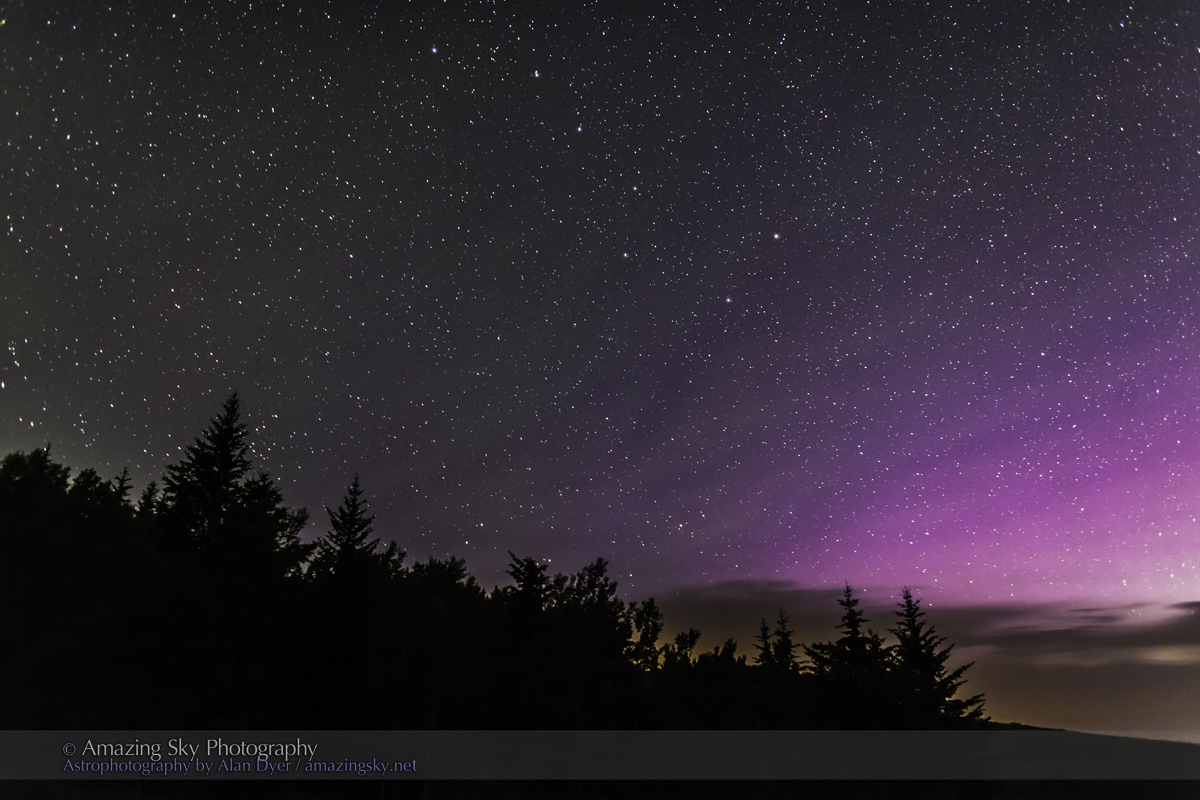

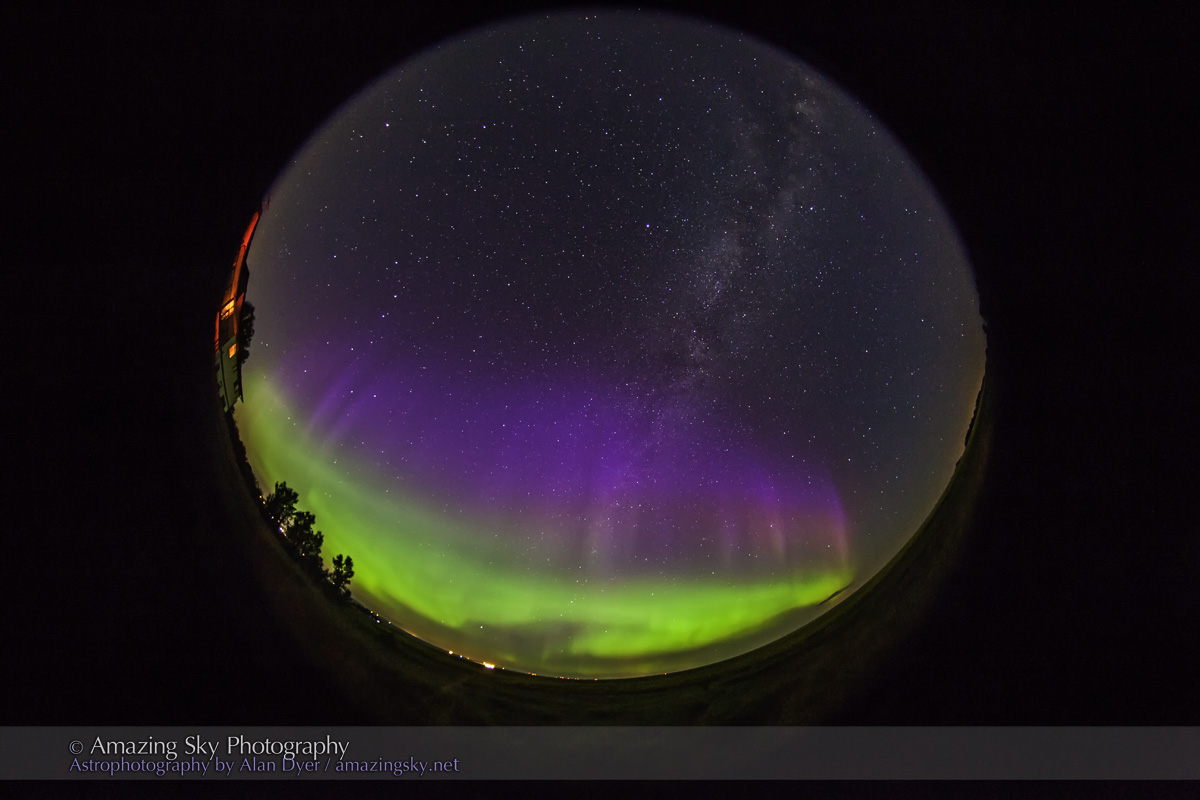
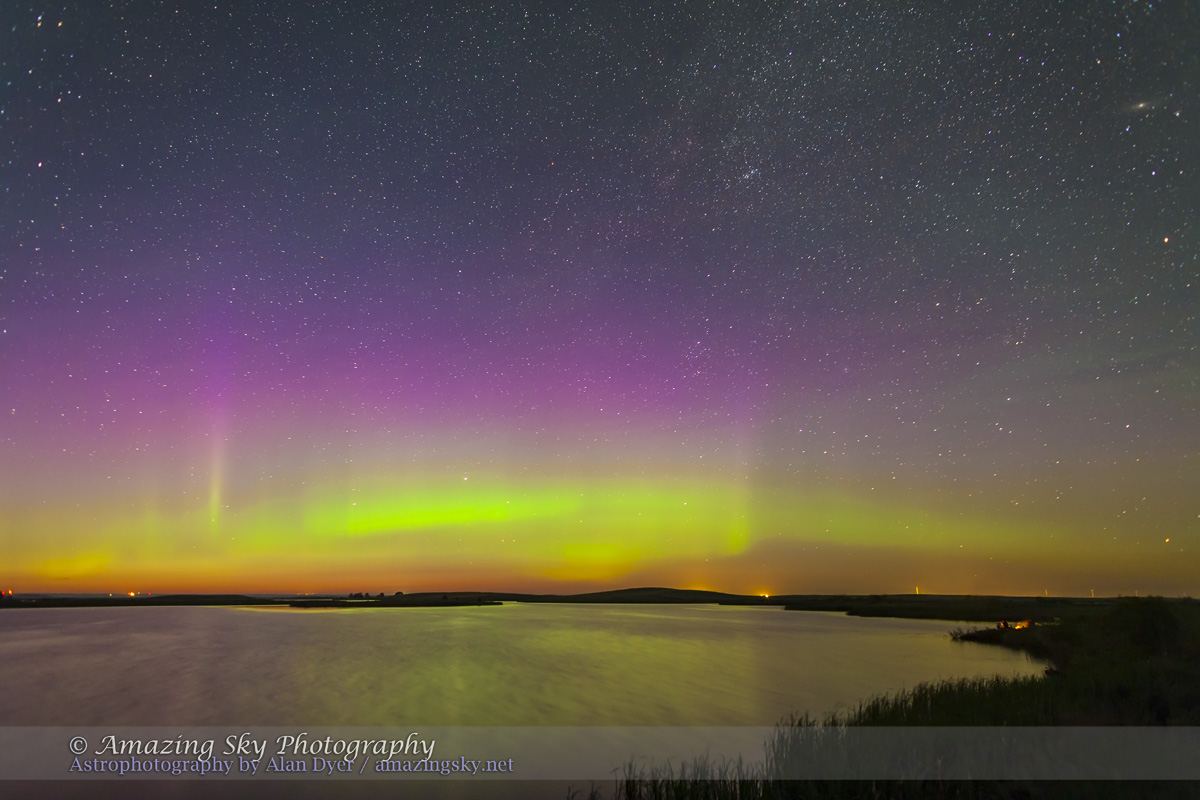


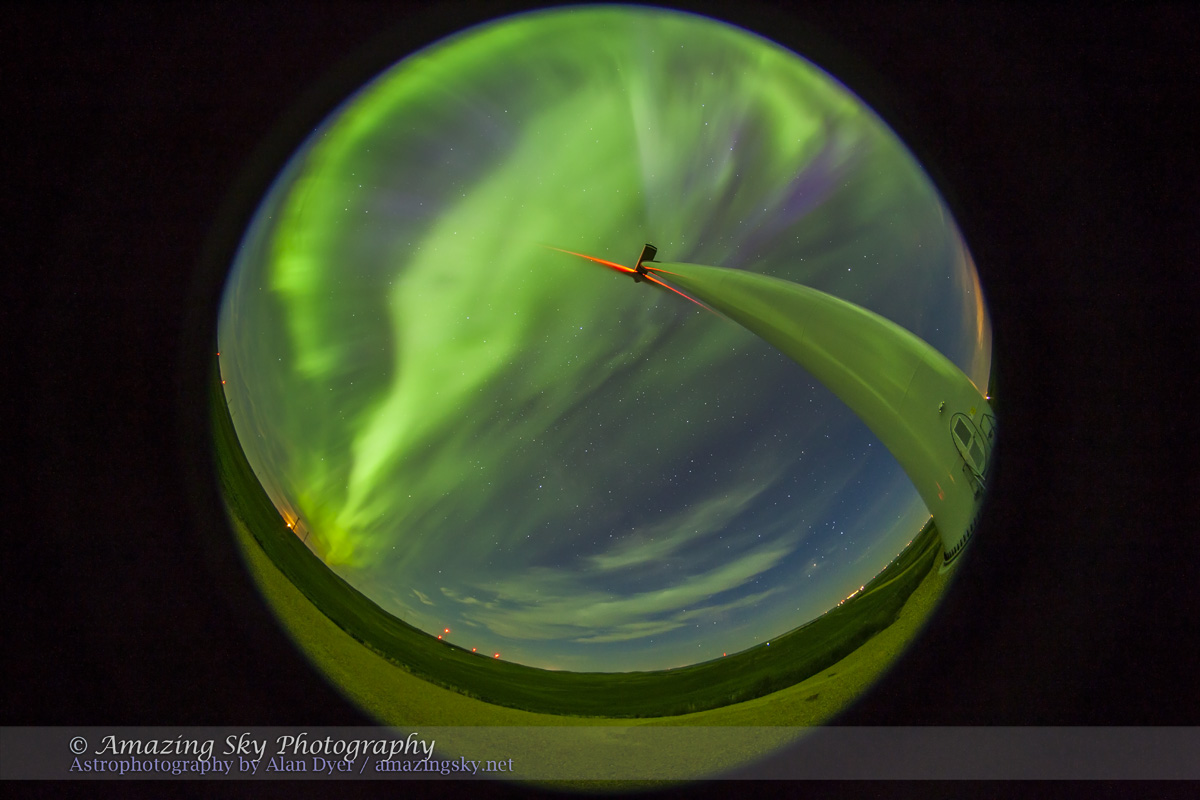

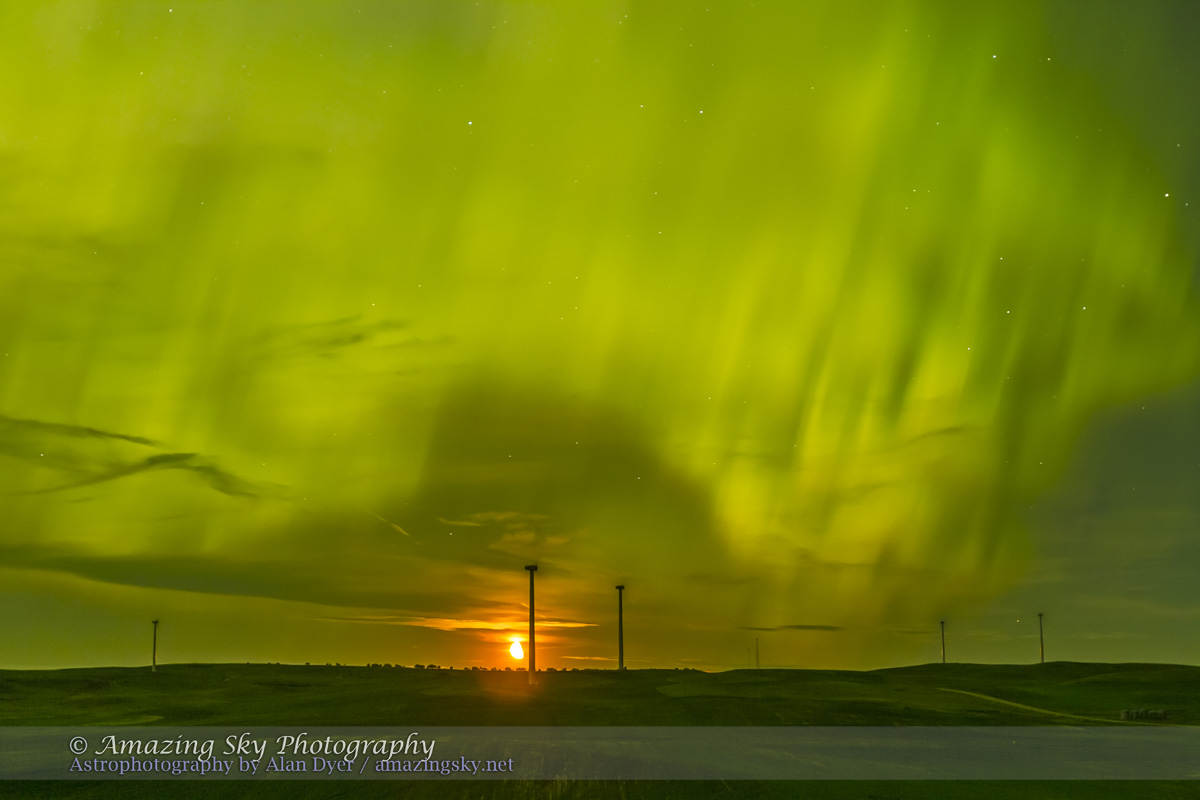
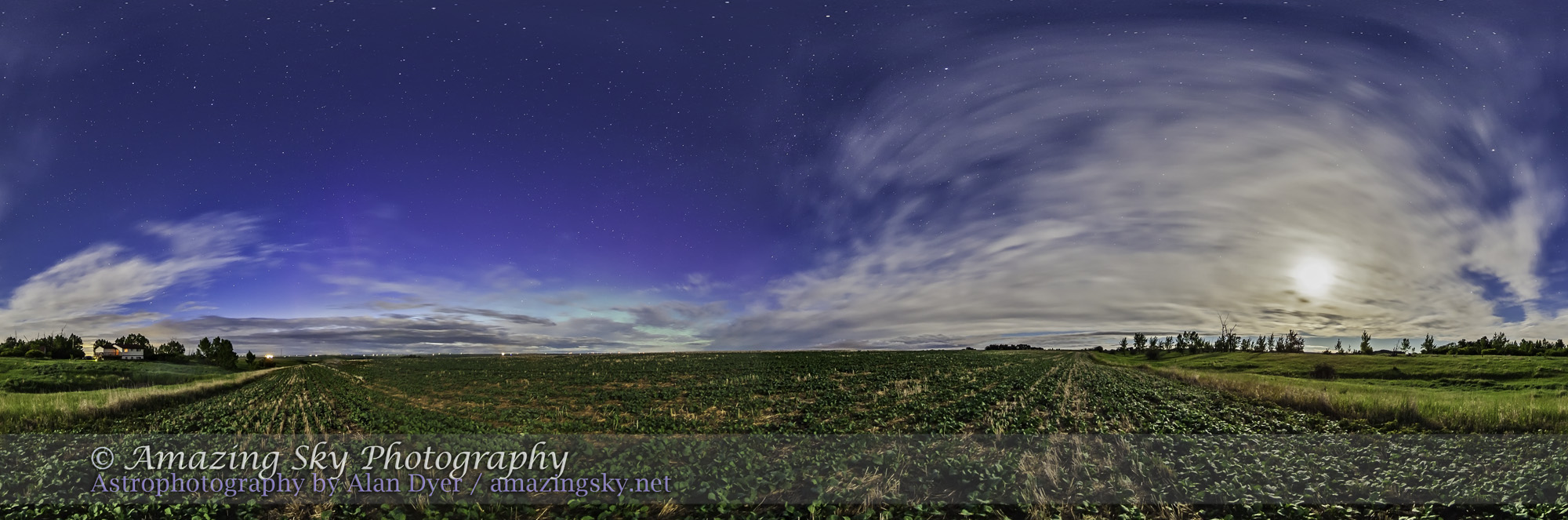


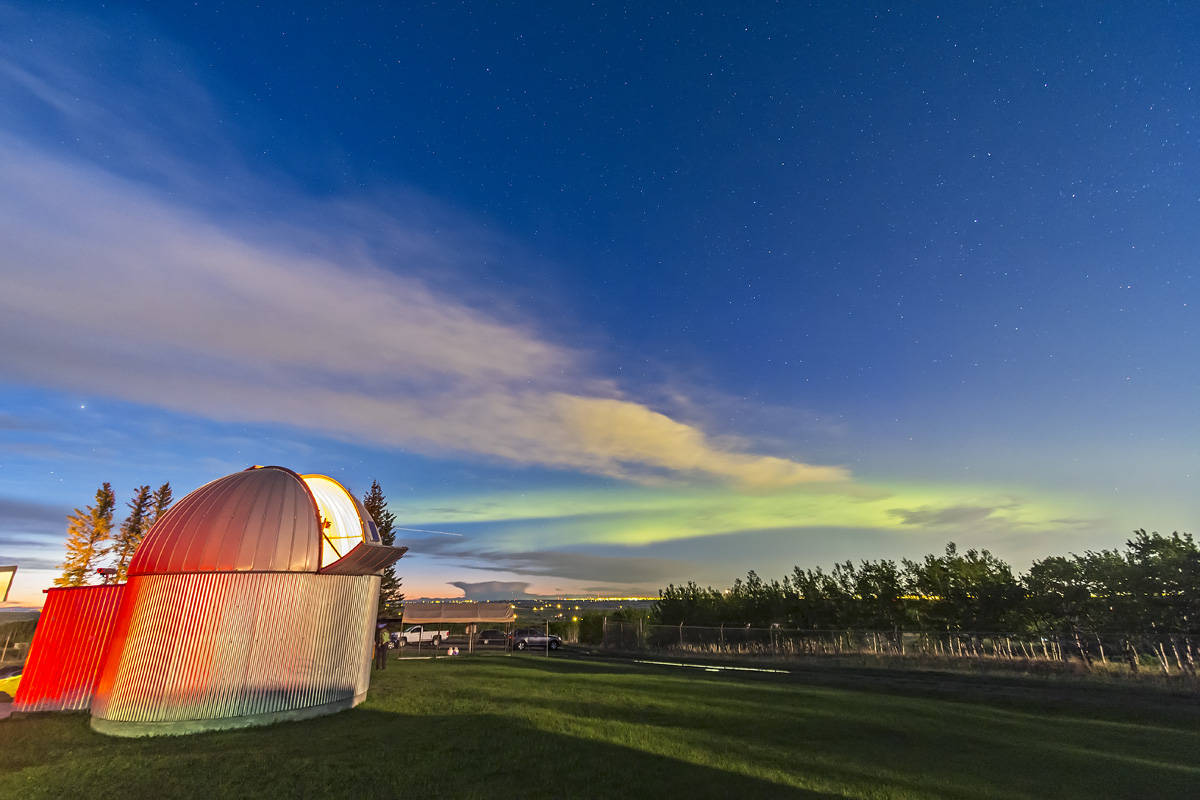
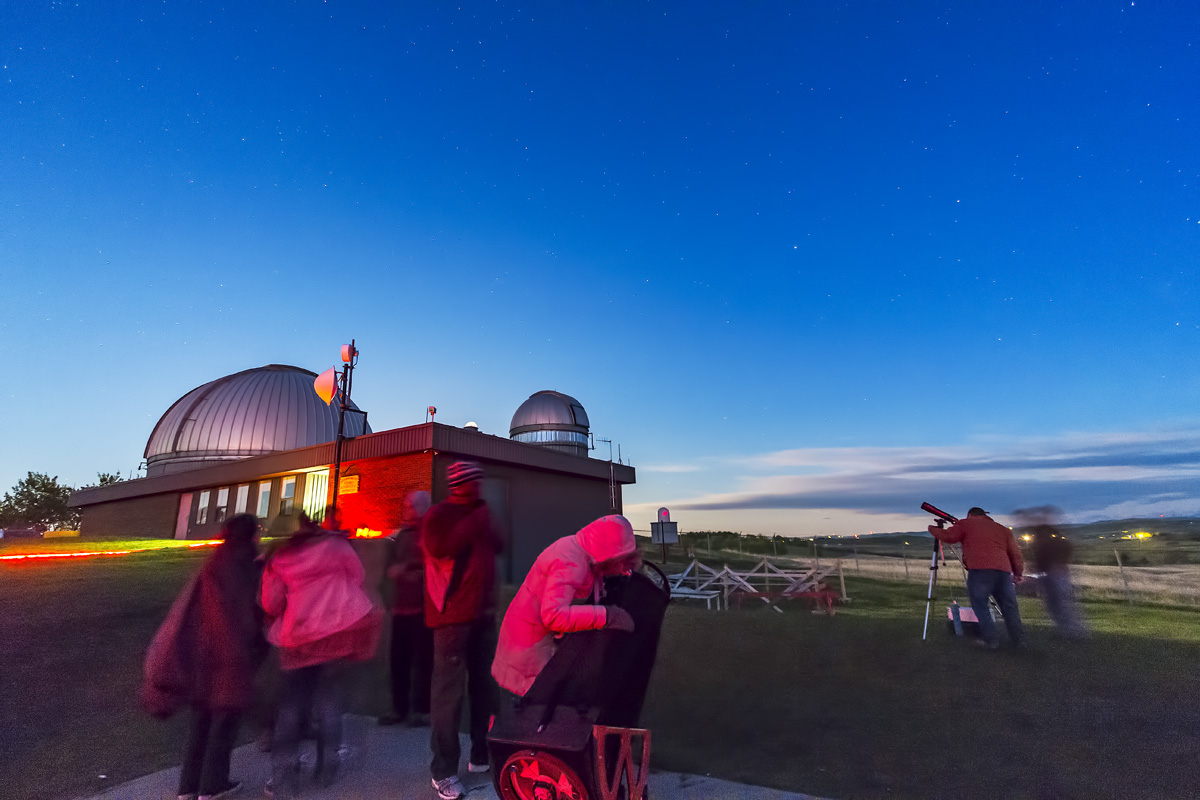


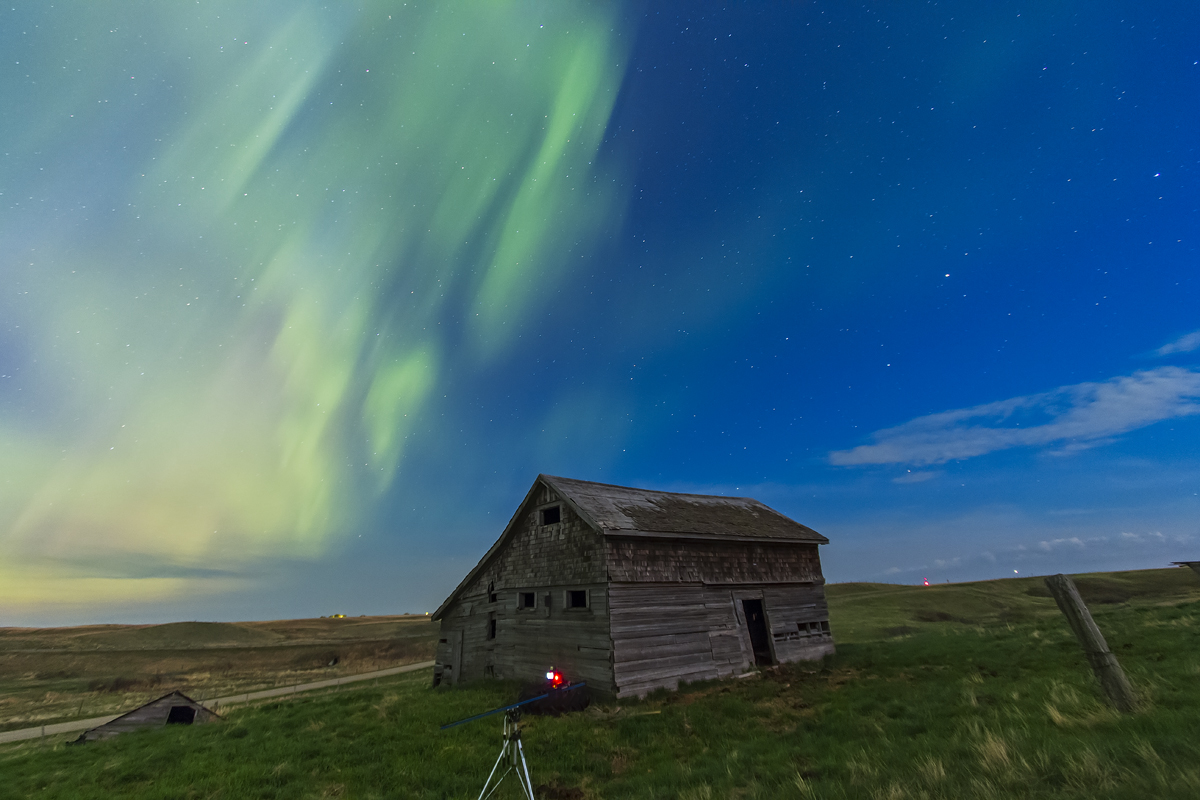
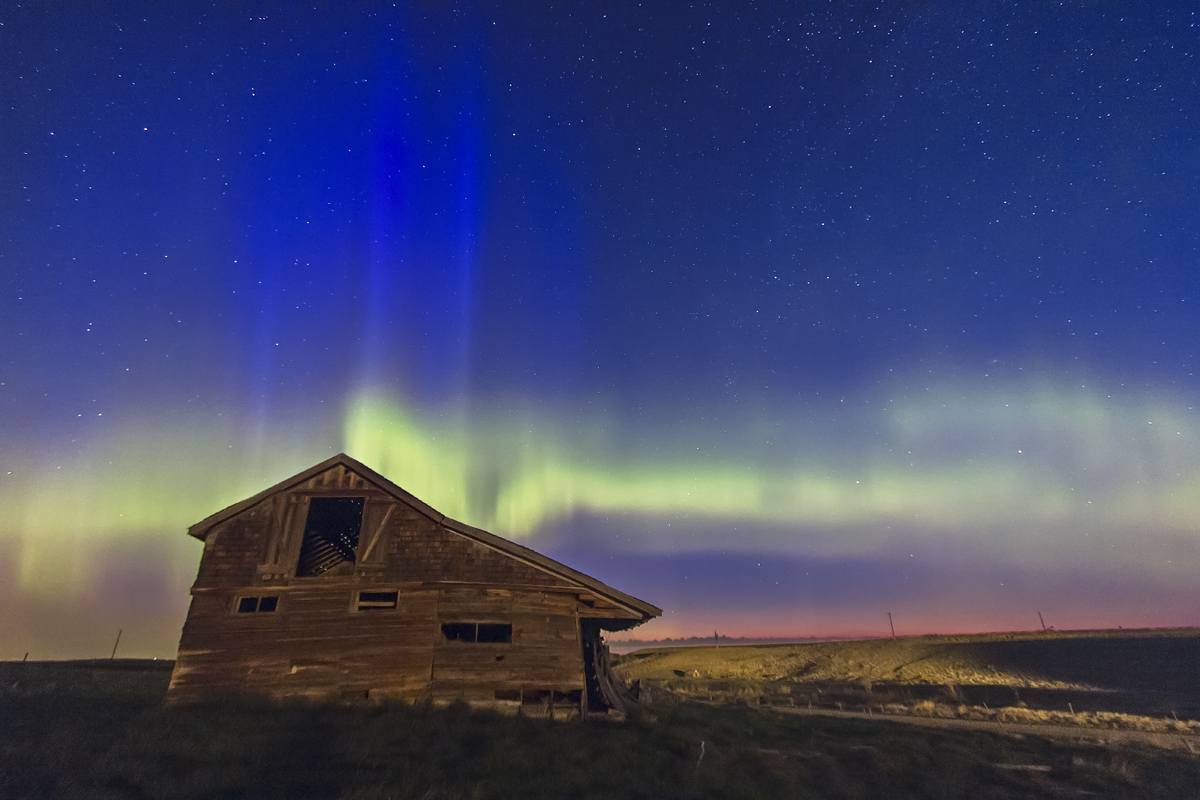
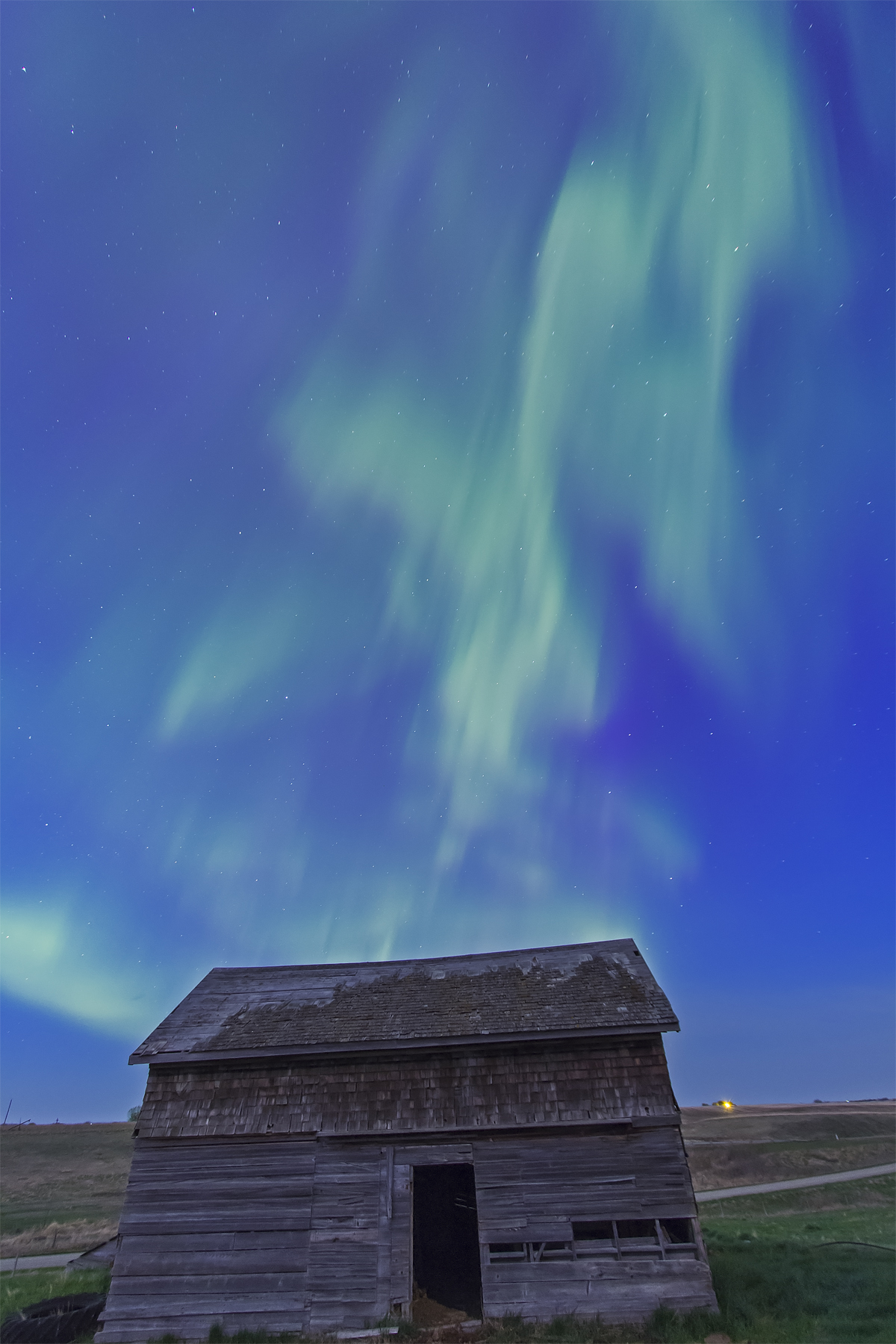


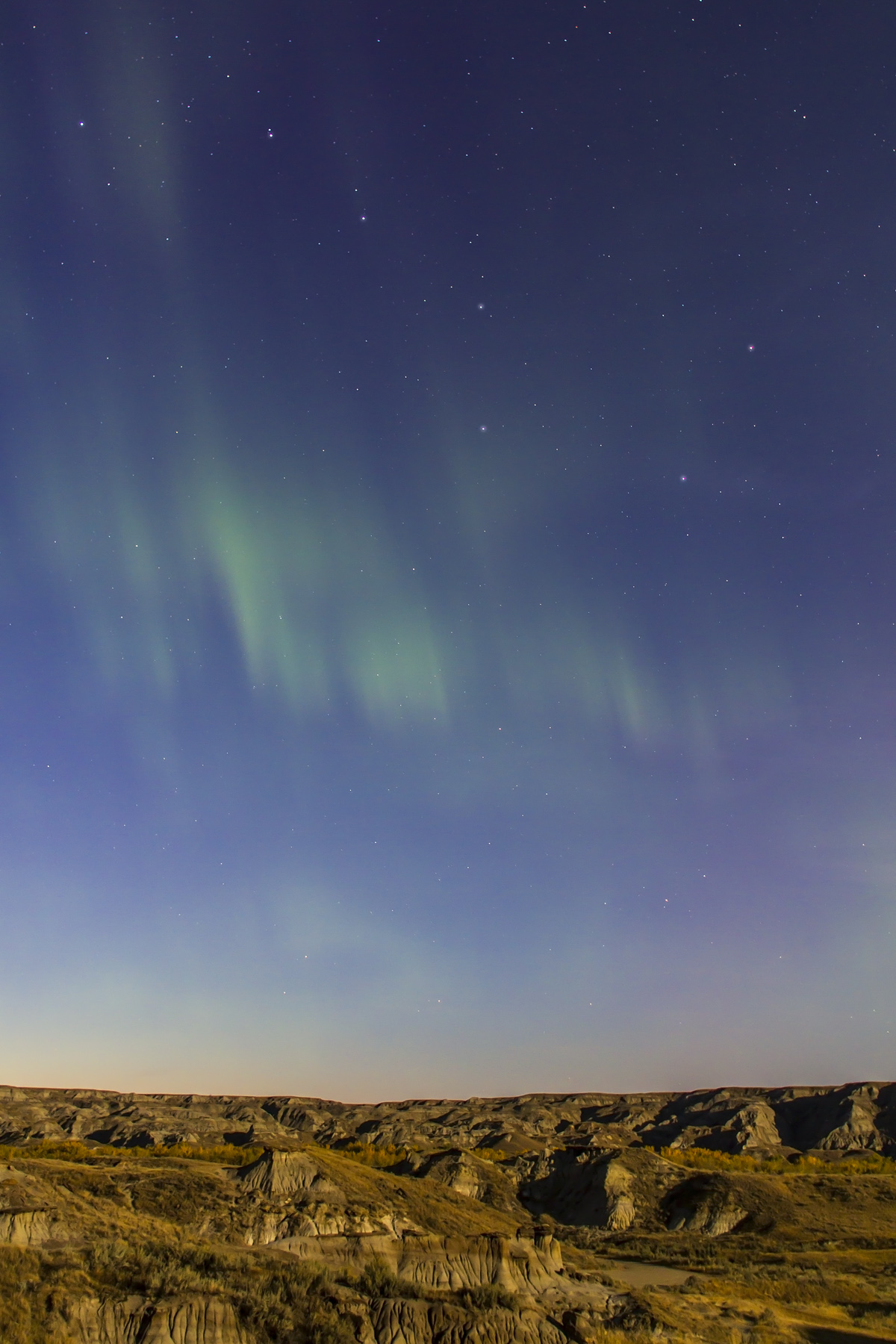
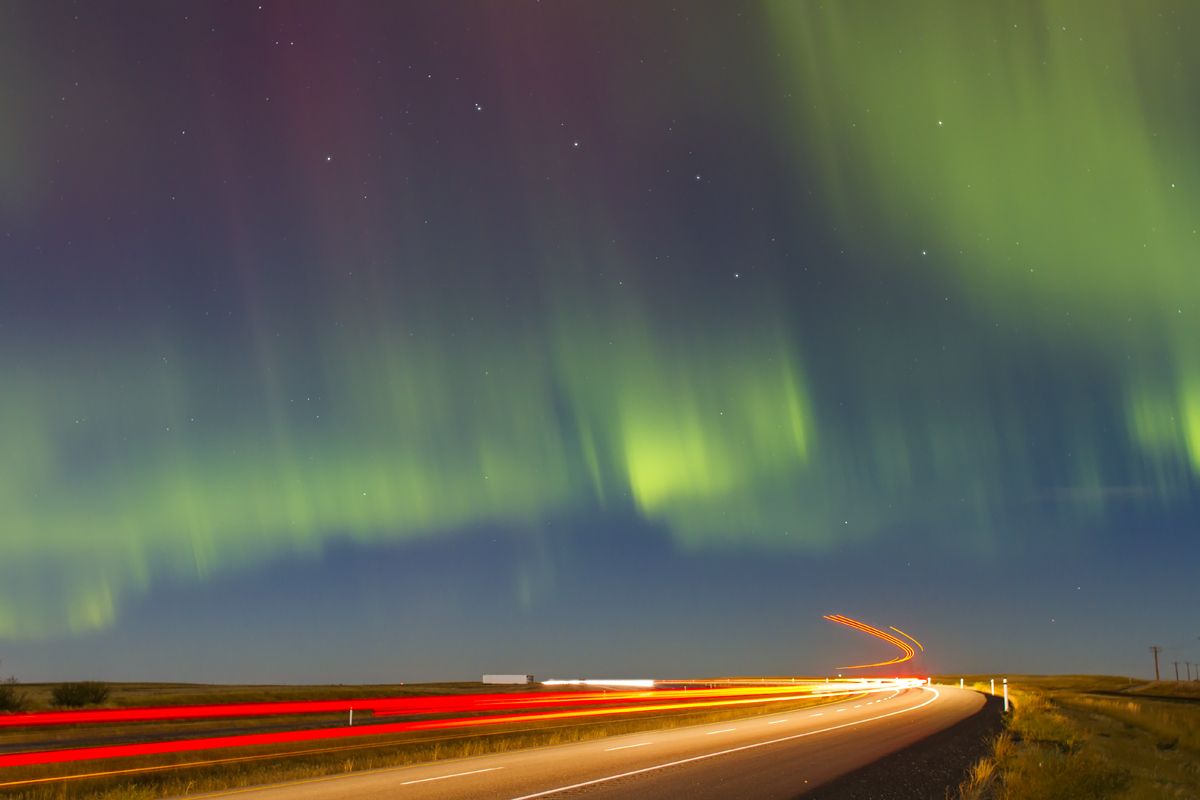
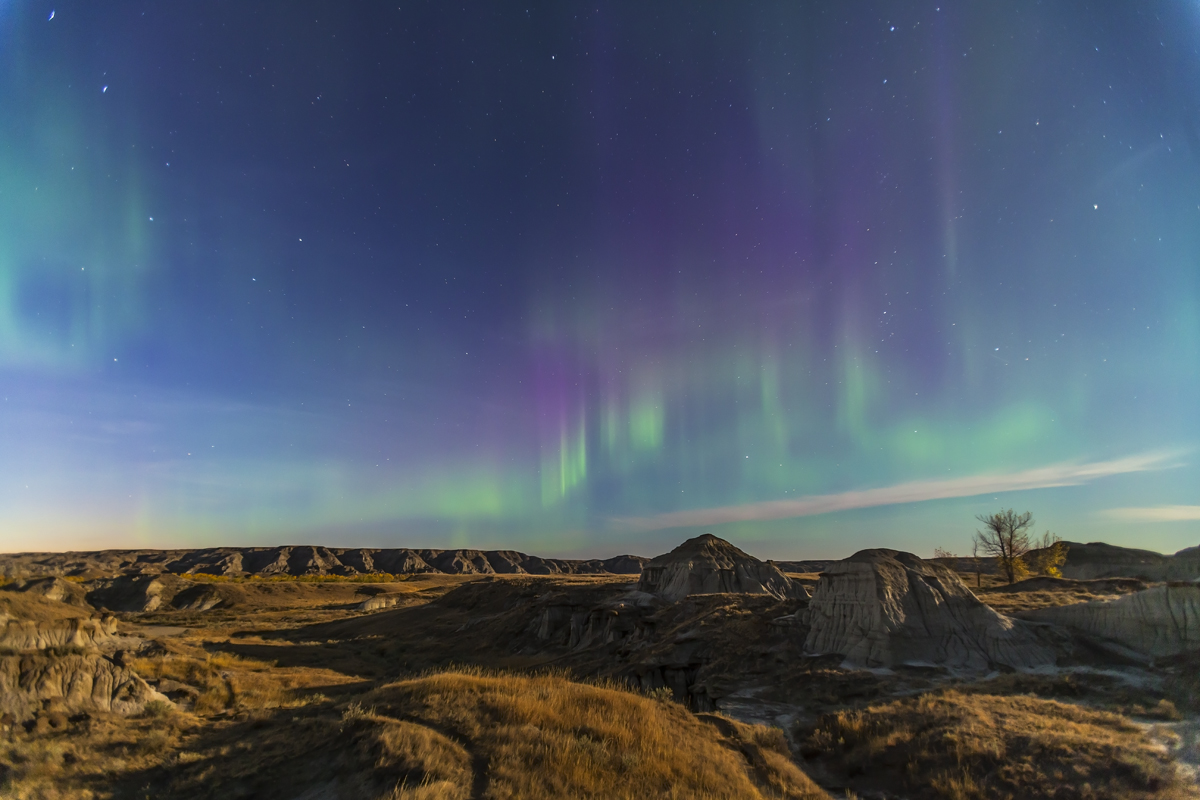
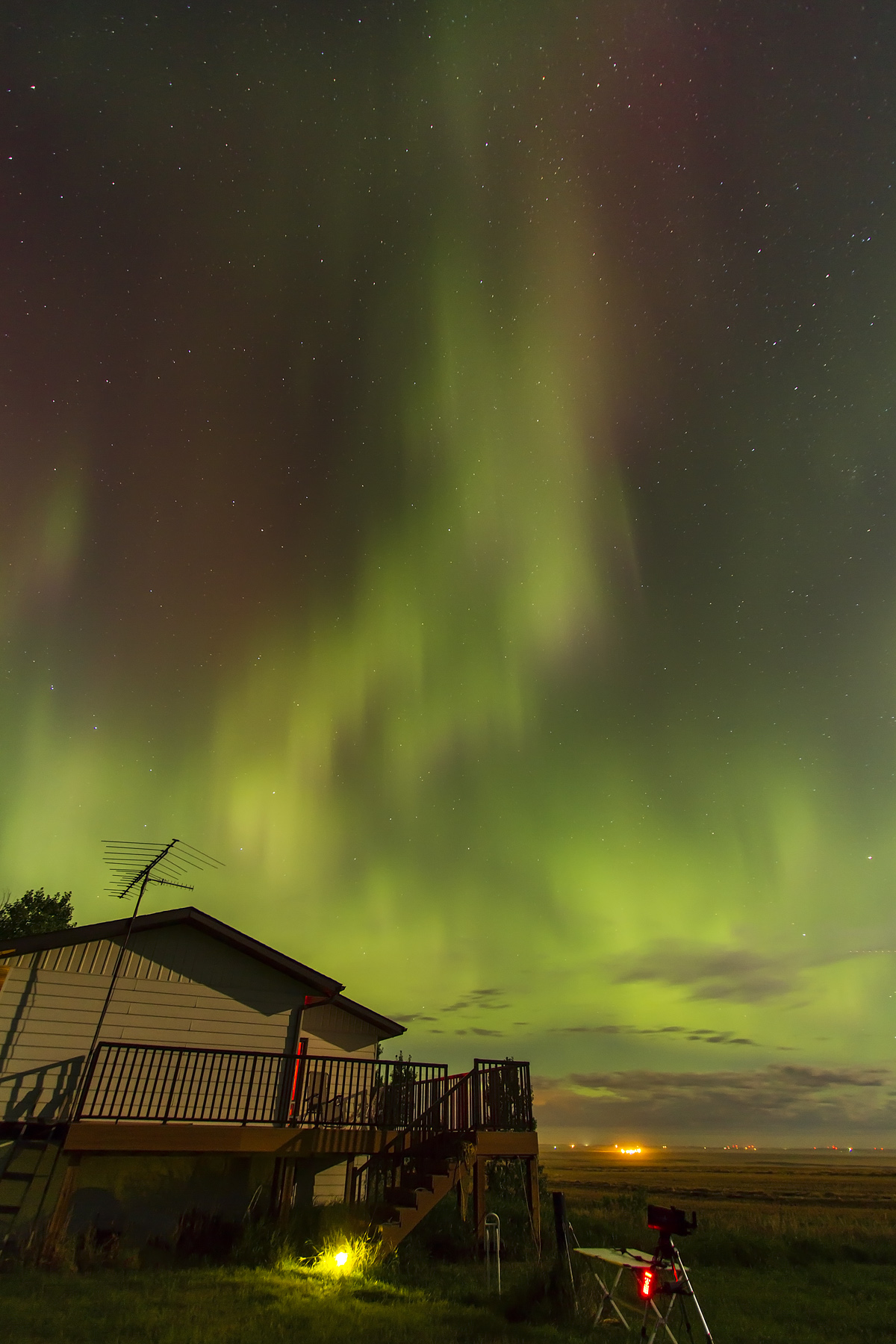
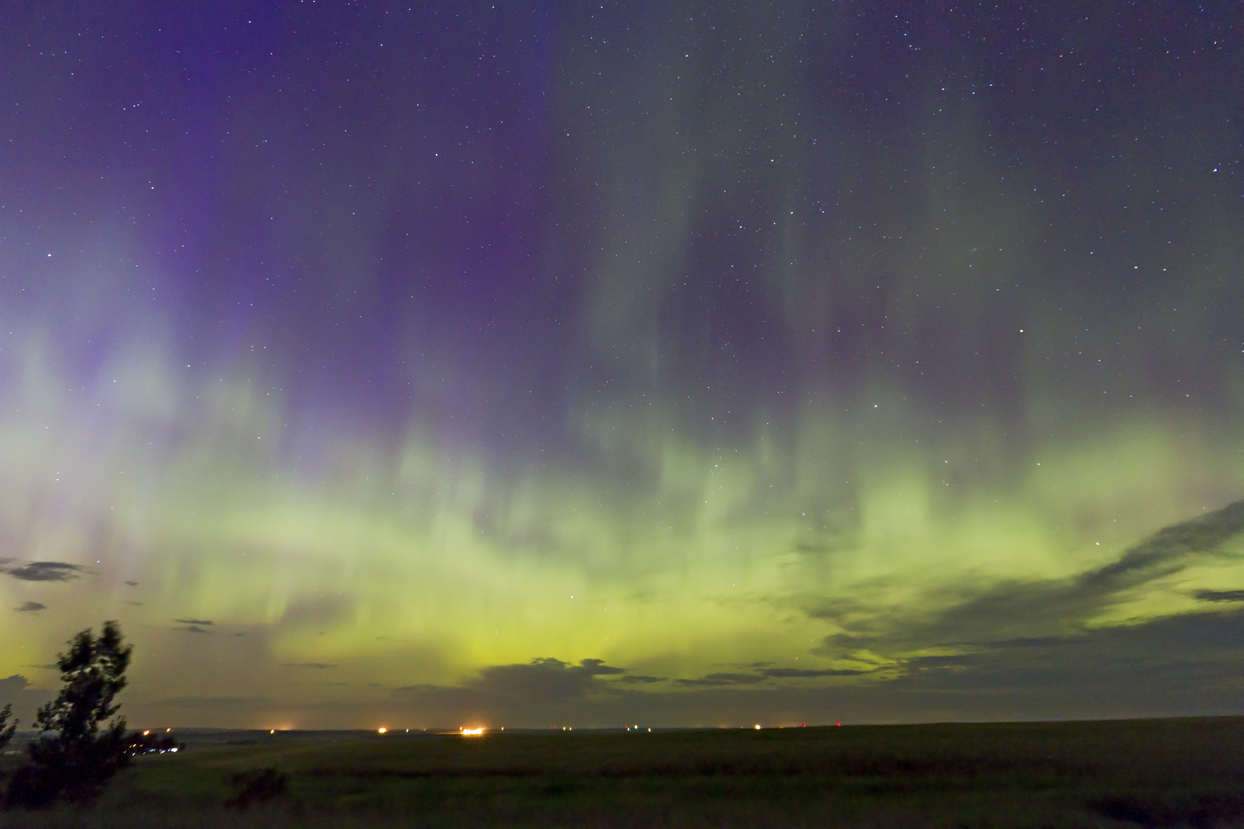
 The Amazing Sky