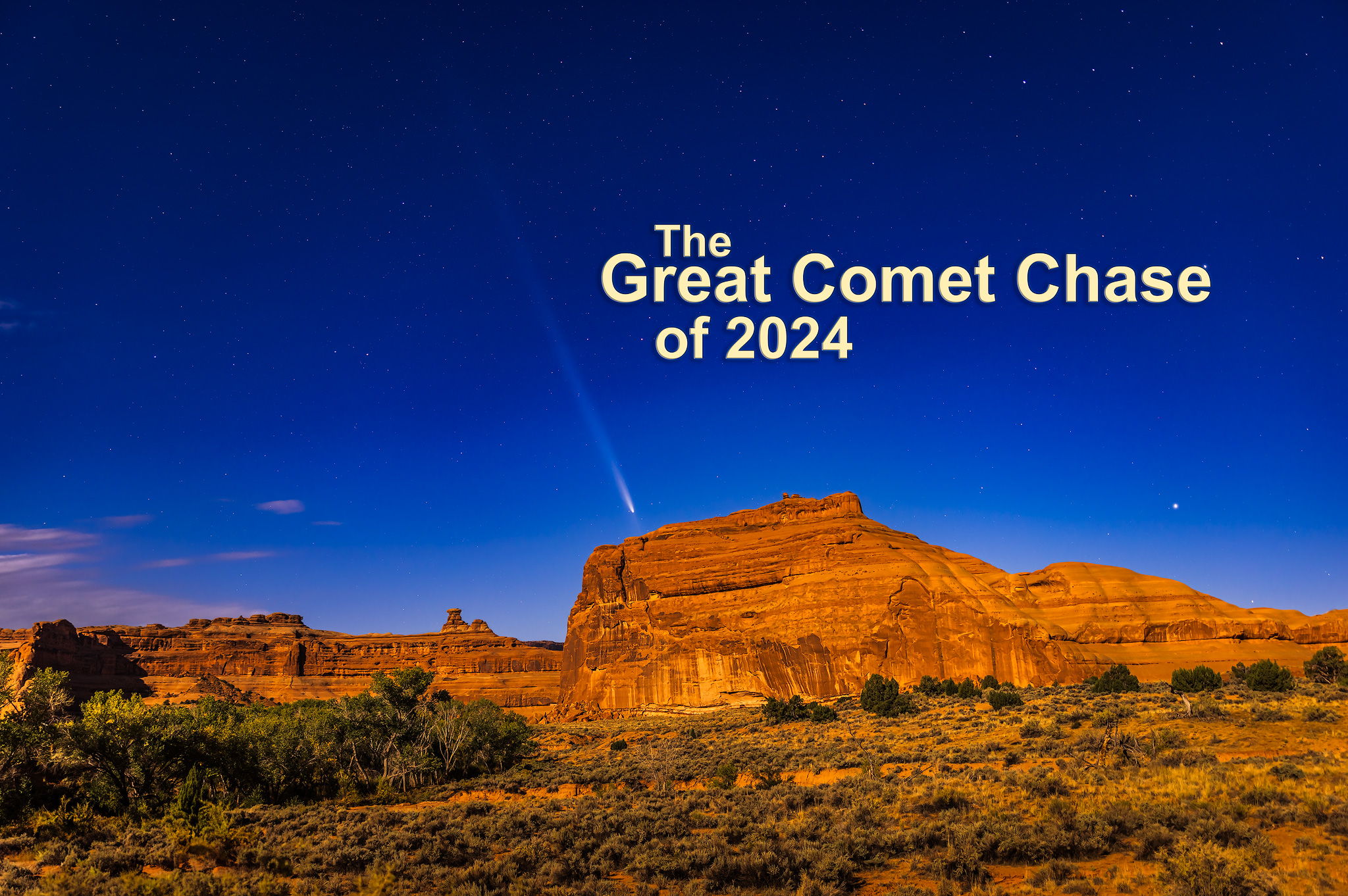
The Great Comet Chase of 2024


A plan to shoot the promised bright comet of 2024 paid off, with fine views at dawn and at dusk of the best comet since 2020. 

Comets are always a gamble. Any new comets discovered, the ones that usually become the brightest, have no track record of performance. Predictions of how bright a new comet might appear are based on what a typical comet should do. But comets can outperform expectations and dazzle us, or they can fizzle and fade away. 

In late 2023 it was clear that a then newly-discovered comet, C/2023 A3, named Tsuchinshan-ATLAS after the observatories where it was co-discovered, had the potential to perform in late 2024.ย 

The low angle and position of the comet from home in Canada in the late September dawn sky, simulated in StarryNight software.

Knowing where it would be in the sky (that trait of a comet can be predicted with accuracy!) I planned a field trip to the U.S. desert Southwest for late September and early October 2024. From farther south the comet would be higher than it would be from home (shown above), and over spectacular landscapes. 

I had visions of another Comet NEOWISE from July 2020. As my blog from 2020 shows, we saw that photogenic comet well from our northern latitude in Canada, as it skimmed across the northern horizon. Tsuchinshan-ATLAS would require a chase south.ย 


September 26 & 27 โ€” at Bryce Canyon, Utah

In late September 2024 the comet would be inbound, approaching the Sun and in the morning sky. What better eastern scene than overlooking Bryce Canyon in Utah, where I had been a year before, for the October 14, 2023 annular eclipse of the Sun in the morning sky. (Click the link for my eclipse chase blog.)

I was fortunate to get two clear mornings, both from the Fairyland Canyon viewpoint, just a short walk from the parking lot to carry camera gear and tracking mounts. 
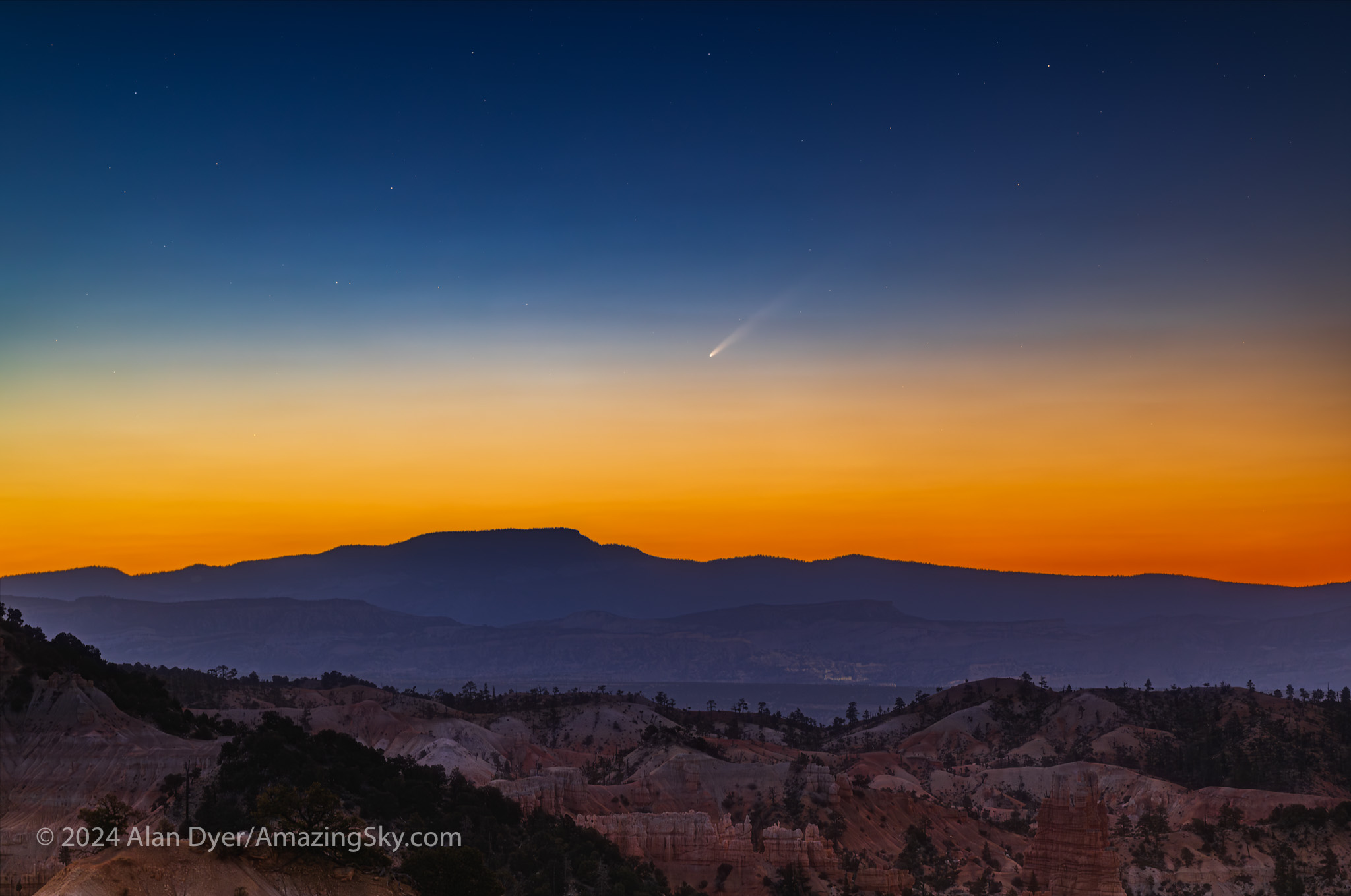
Comet C/2023 A3, Tsuchinshan-ATLAS, at dawn over Bryce Canyon, on the morning of September 27, 2024.

My first look at the comet on September 27 was on the day the comet was at perihelion, closest to the Sun in its orbit, though not in the sky at our viewing angle from Earth. 

The comet was just visible to the unaided eye, but was obvious on the camera view screen, even amid the bright twilight. I had to shoot fast as the window between โ€œcomet riseโ€ and the sky brightening too much was only a few minutes long. 
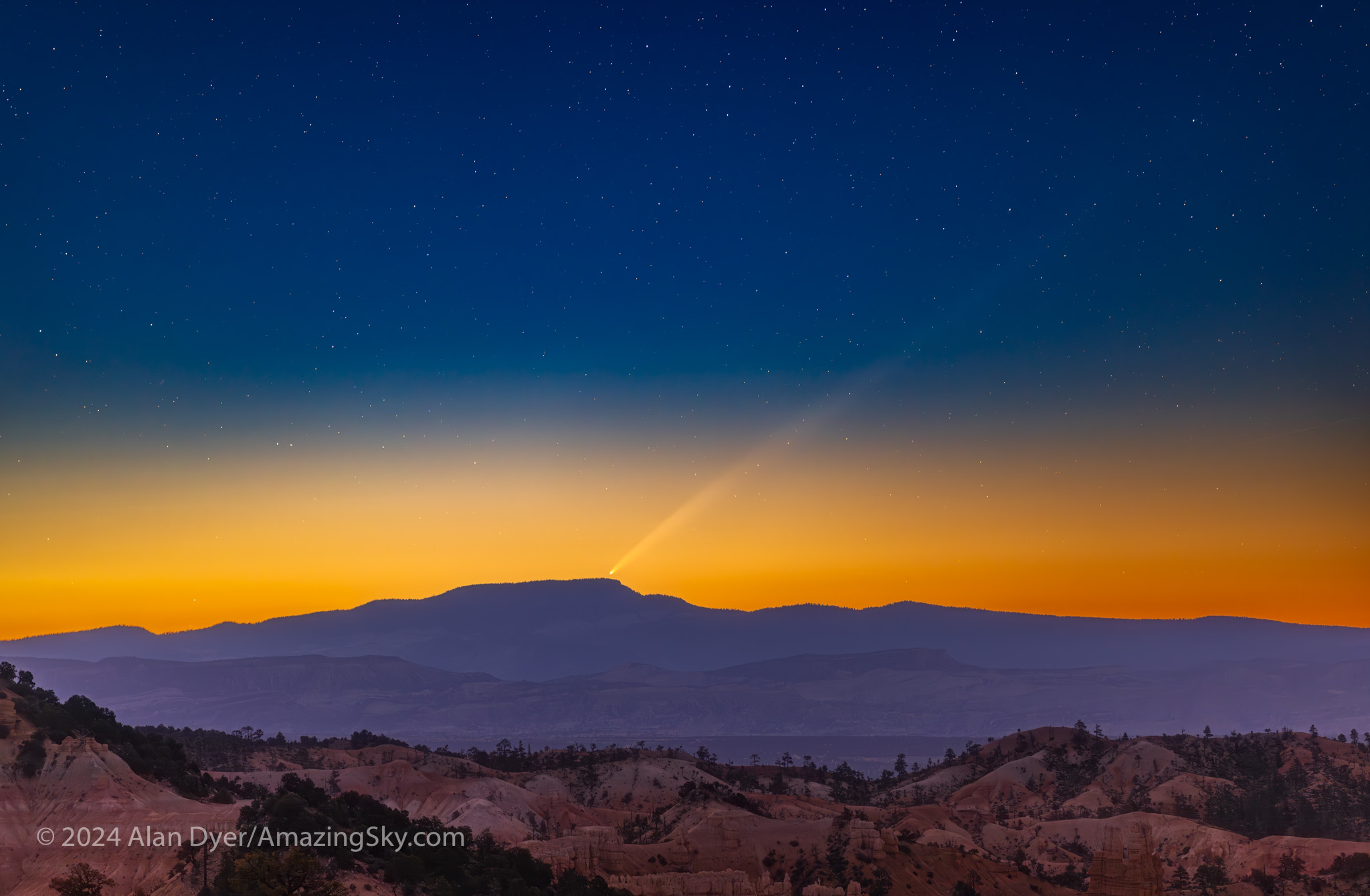
Comet C/2023 A3, Tsuchinshan-ATLAS, rising in the twilight over Bryce Canyon, on September 28, 2024.

Knowing better what to look for, I caught the comet a little sooner the next morning on September 28, and so the tail appeared longer and more impressive as it rose above the distant mountains. A group of other local photographers arrived just a few minutes too late both mornings, and so struggled to just sight the comet, let alone photograph it. 
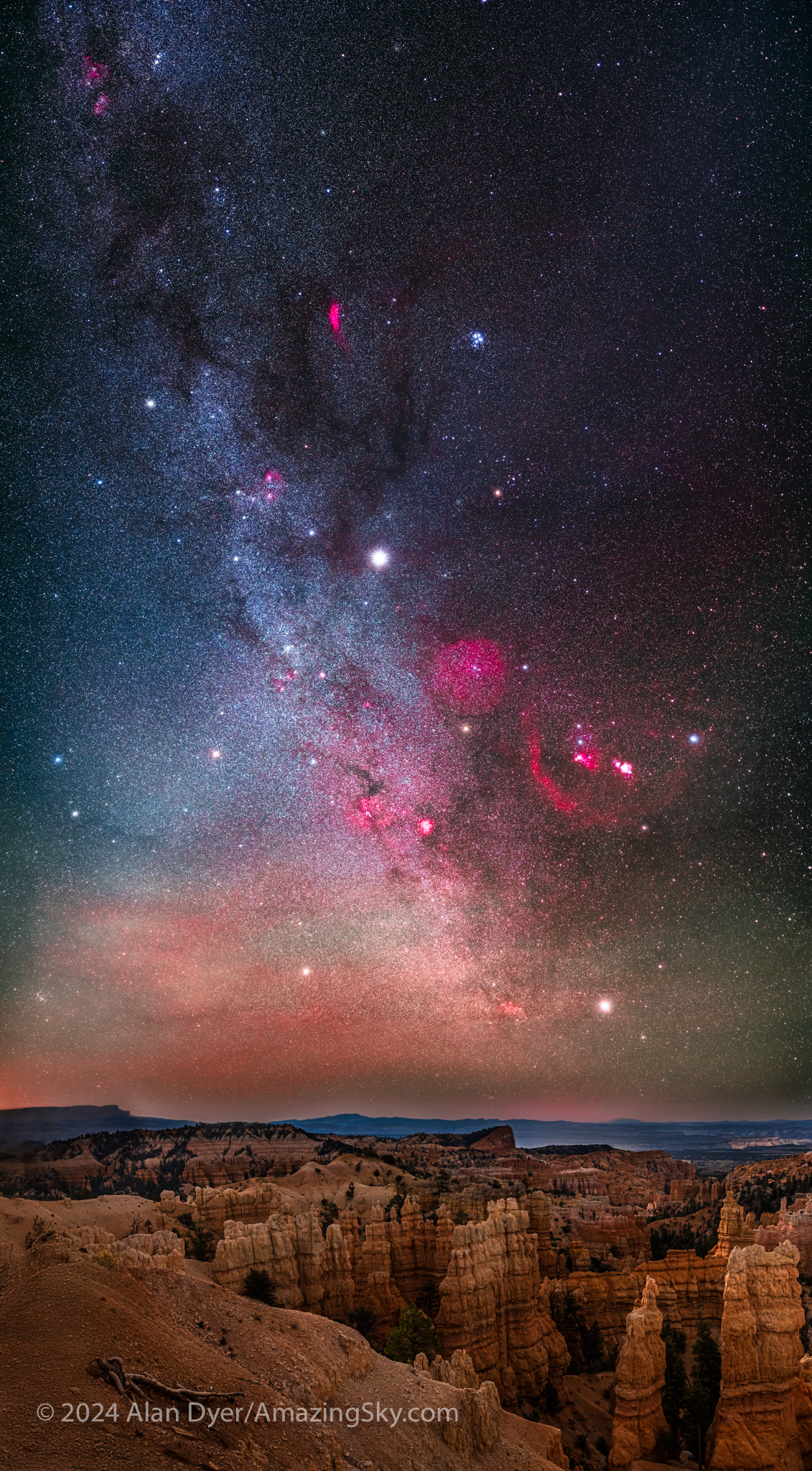
This vertical panorama takes in the nebula-rich northern winter Milky Way over the formations of Bryce Canyon National Park, from the Fairyland Canyon viewpoint.

But I had arrived extra early, to shoot a vertical panorama (above) of the winter Milky Way over the canyon formations below. This and the comet images were shot with the aid of a sky tracker to follow the stars, but with the tracker off for separate shots of the ground. 

So I had bagged the comet at Bryce! On to the next stop.


September 28 & 29 โ€” at Monument Valley, Utah

Thereโ€™s no more iconic or famous landscape in the American West than the buttes of Monument Valley, on the Navaho Tribal Lands on the Arizona/Utah border. 

This panorama from the Navaho Tribal Park at Monument Valley shows the evening twilight sky looking east opposite the sunset to the rising dark blue arc of Earth’s shadow cast on the atmosphere. The shadow is rimmed with a pink “Belt of Venus” tint from sunlight still hitting the upper atmosphere.

A clear first evening provided a fabulous view of the arc of Earthโ€™s shadow across the eastern sky from the viewpoint near the aptly named The View Hotel. 
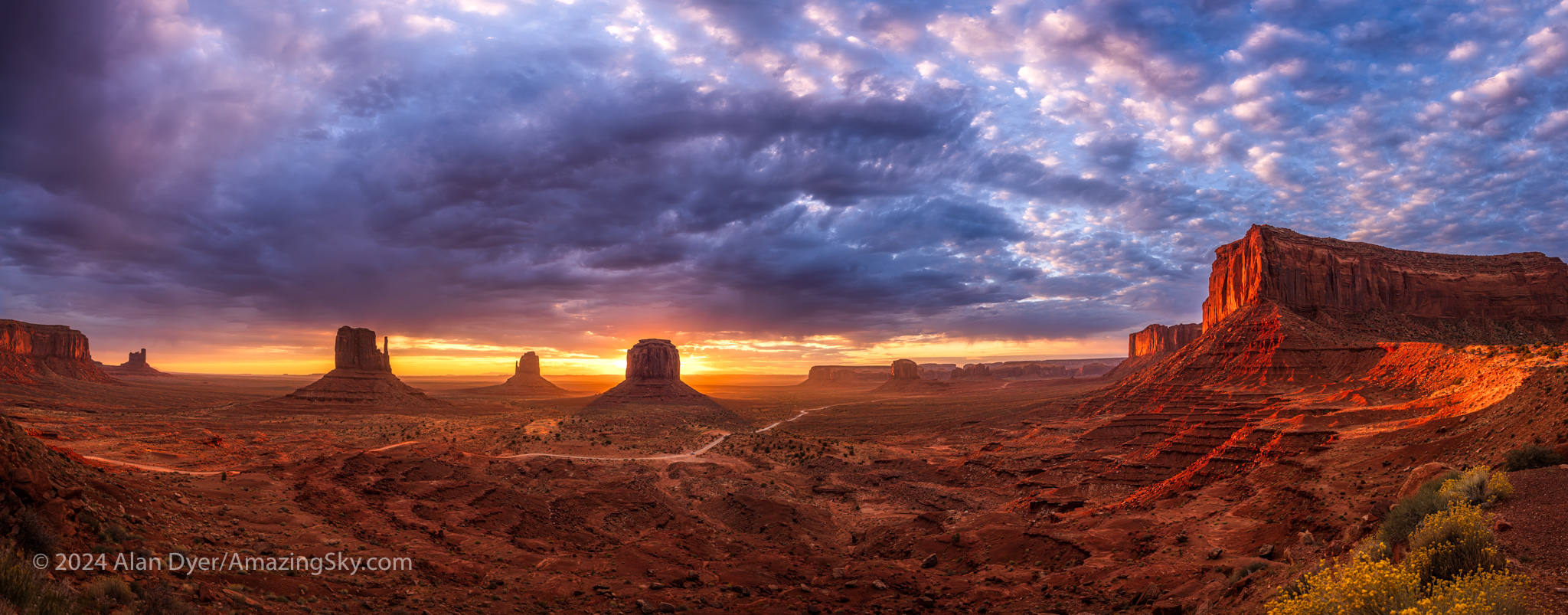
This is a panorama of the sunrise scene at the Navaho Tribal Park, Monument Valley, Arizona, taken just after sunrise with the low Sun lighting the iconic buttes and mesas of the Valley. The West and East Mittens are at left; the Sun was behind Merrick Butte at centre, and lighting Mitchell Mesa at right.

A wonderful sunrise on my second morning there made for a spectacular panorama. But while clouds created fine sunrise lighting, they arenโ€™t conducive to seeing comets!

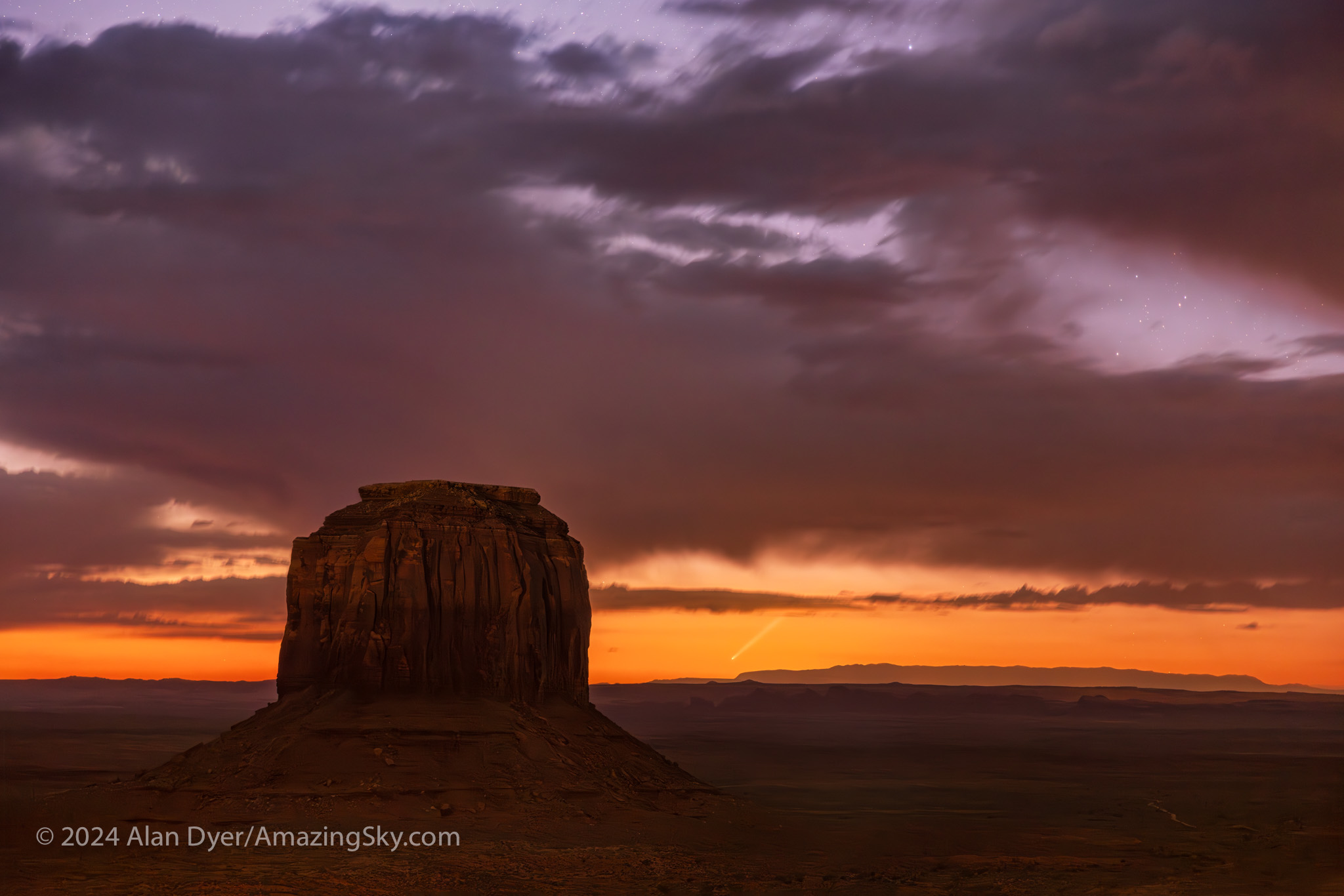
Comet C/2023 A3, Tsuchinshan-ATLAS (at centre), is rising in the dawn twilight over Monument Valley, Arizona on the morning of September 30, 2024. The comet is rising just south (right) of Merrick Butte.

A band of clear sky near the horizon allowed me to catch the comet rising to the right of Merrick Butte, as seen from a spot south of The View from where I had calculated the comet would rise in the right position. From the usual Valley viewpoint farther north the comet would have been behind the butte. 

While the planning worked, the result was not quite the spectacle I had envisioned. The comet was nice, but was starting to become lost in the bright sky as it descended toward the Sun. 

There were only a couple of mornings left to catch the comet at dawn before it disappeared completely into the daytime sky close to the Sun. 


October 1 to 11 โ€” at Quailway Cottage, Arizona

The major block of time in my trip was booked for an astrophoto retreat at a cottage Iโ€™d rented twice before but not since late 2017. The Quailway Cottage, popular among birders, is also ideal for stargazing as it is in one of the darkest areas of the Southwest, north of Douglas, Arizona, and just across the Arizona/New Mexico border. 

This captures both the glow of Zodiacal Light in the eastern dawn sky (the band of light extending up across the frame) and the dust tail of Comet Tsuchinshan-ATLAS rising from behind the Pelloncillo mountains, at dawn on October 2, 2024.

When I arrived the comet was putting in its last show in the dawn sky. In fact, on October 2 I managed to capture a dawn scene with the morning Zodiacal Light created by sunlight reflecting off cometary dust in the inner solar system, and just the tail of the comet rising before the bright comet head appeared.
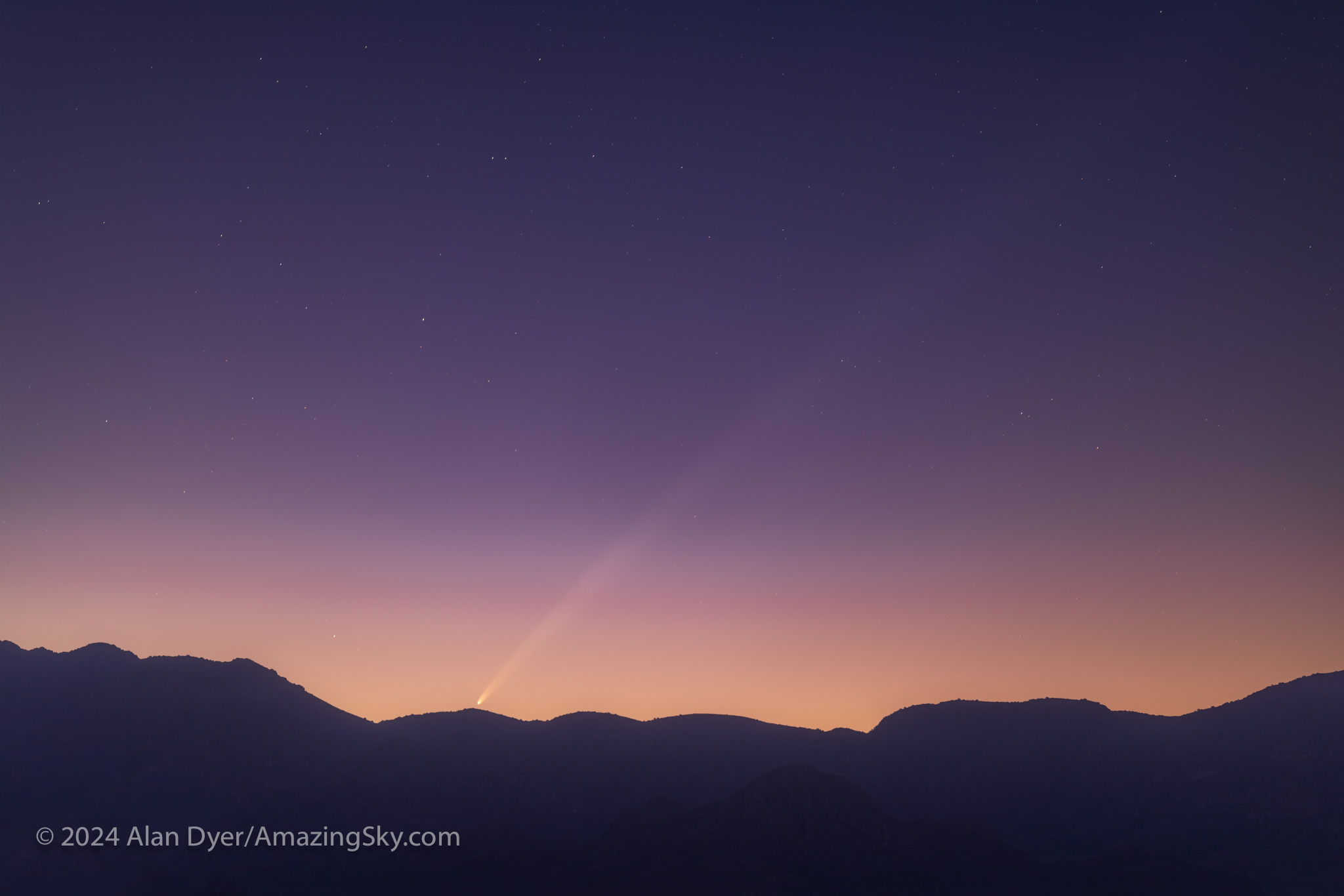
Comet C/2023 A3, Tsuchinshan-ATLAS, is rising in the dawn twilight over the Pelloncillo Mountains in New Mexico, on October 2, 2024.

An image taken a little later showed the entire comet, now sporting a more impressive tail. It was blossoming into a fine comet indeed. But we were about to lose sight of it for more than a week. 

Arizona Deep-Sky Imaging 

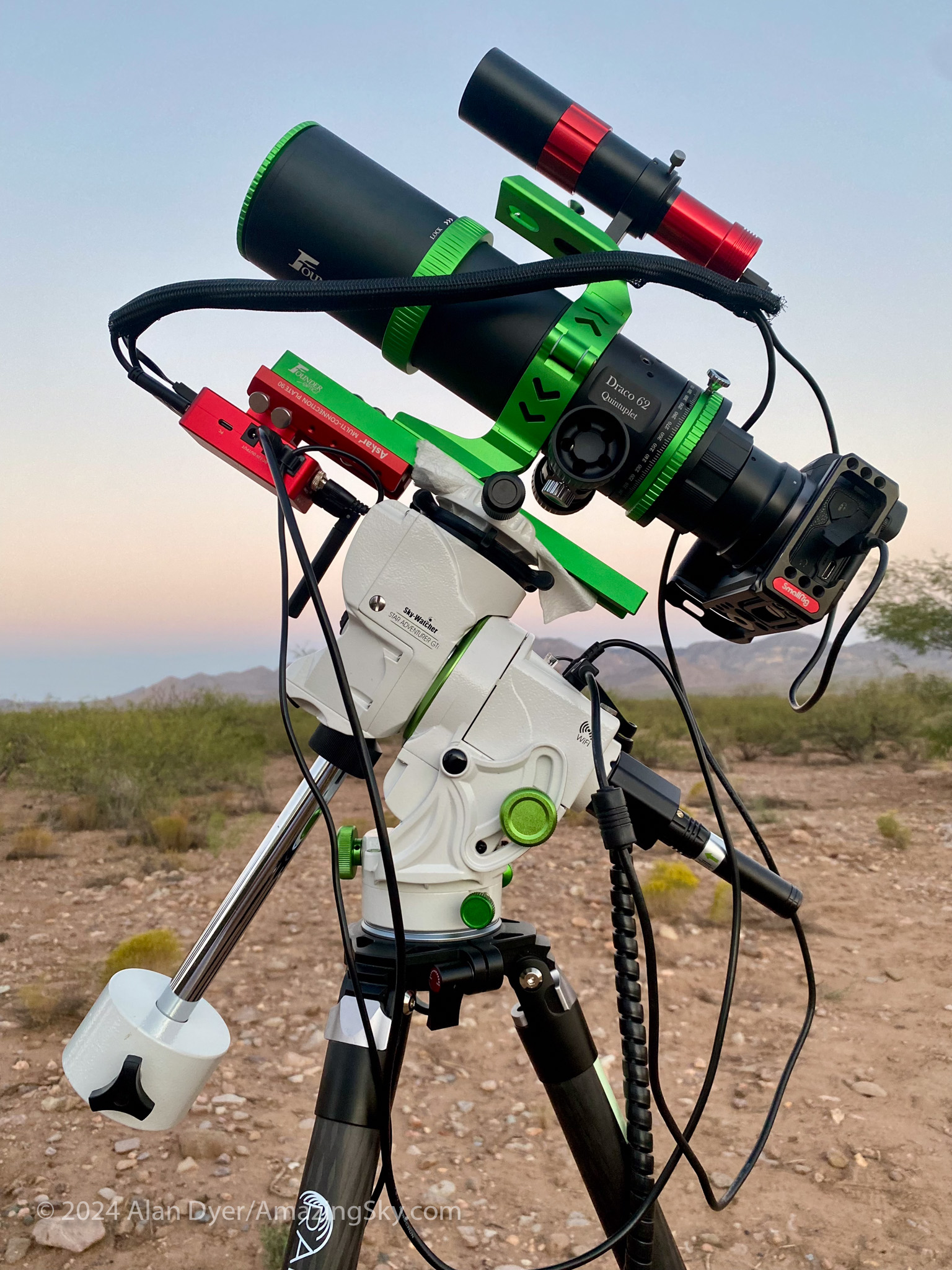
While at Quailway I had clear skies every night. And so, as planned, I went to town shooting all kinds of โ€œdeep-skyโ€ objects and fields with two astrophoto rigs I had brought with me: a longer-focal length 120mm refractor for small targets, and a short-focal length refractor for wide fields in the Milky Way. I had reviewed both new telescopes in recent months. 
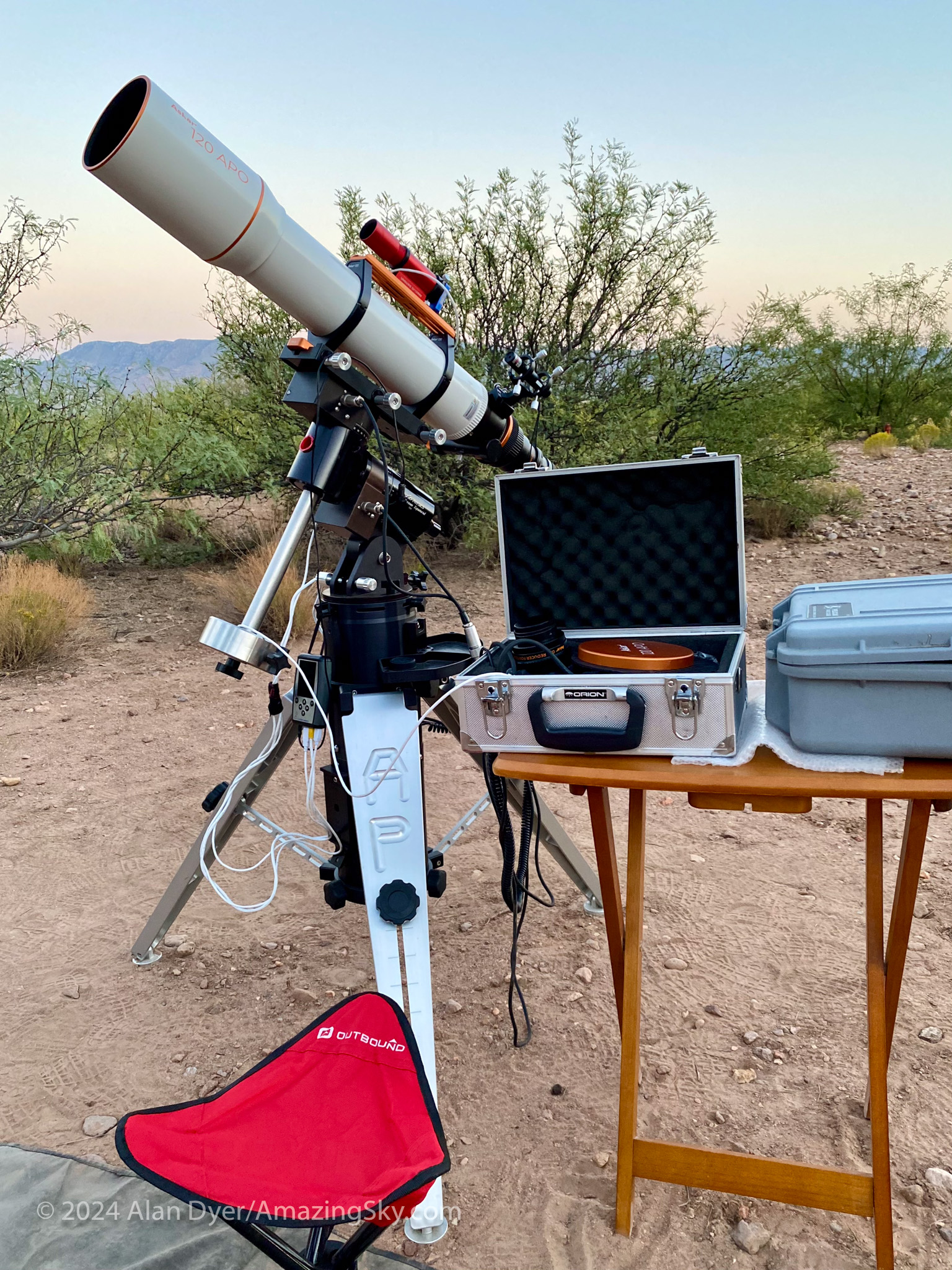
I concentrated on shooting targets low in the south that are impossible to get from home in Canada, and that Iโ€™ve missed shooting, or have not shot well, during my visits to Australia.ย See my blog here about my latest trek Down Under.
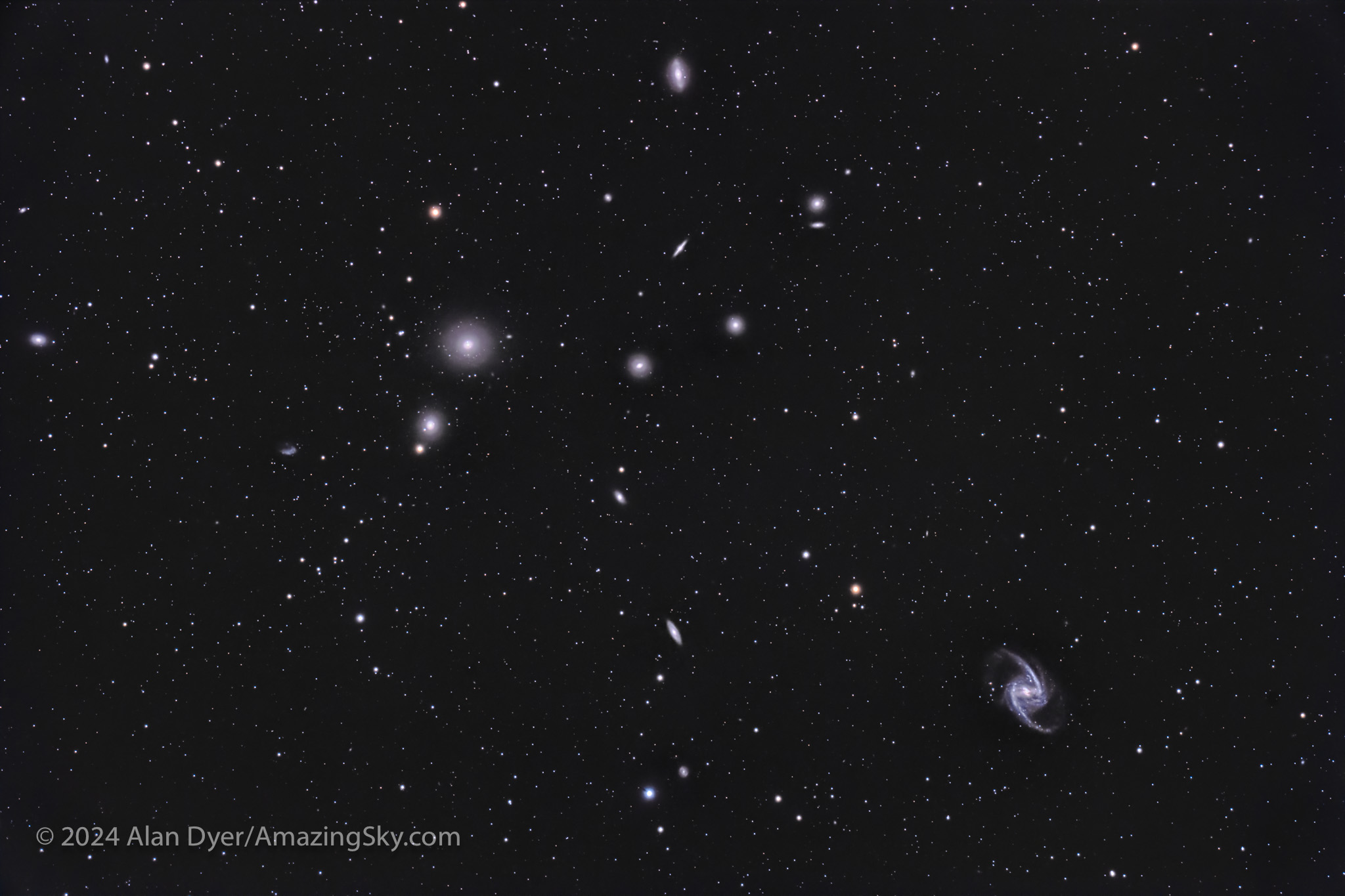
The two brightest Fornax cluster members are the elliptical galaxy NGC 1399 at upper left, paired with smaller NGC 1404, and the galaxy NGC 1365 at lower right, considered one of the best barred spirals in the sky.

Hereโ€™s an example, above, with the larger Askar 120APO: a field of galaxies in the constellation of Fornax that rivals the better-known Markarianโ€™s Chain of galaxies in Coma Berenices in the northern spring sky.
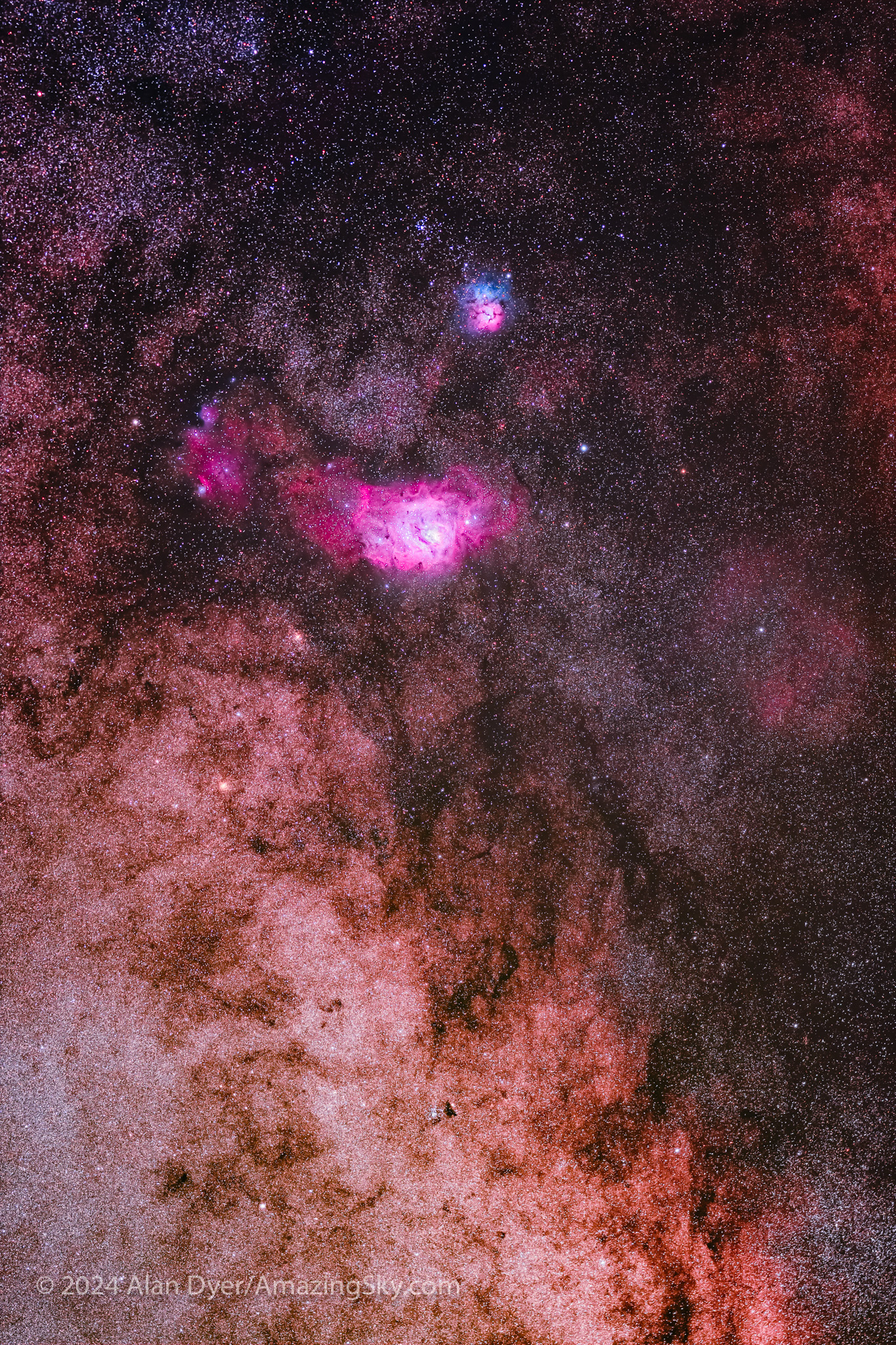
This frames the spectacular region of the Milky Way near the direction of the galactic centre in Sagittarius.

And hereโ€™s a field (above) with the small Founder Optics Draco 62mm scope, framing the rich Sagittarius Starcloud punctuated with the small dark Ink Spot Nebula, all below the bright Lagoon and Trifid Nebulas. 
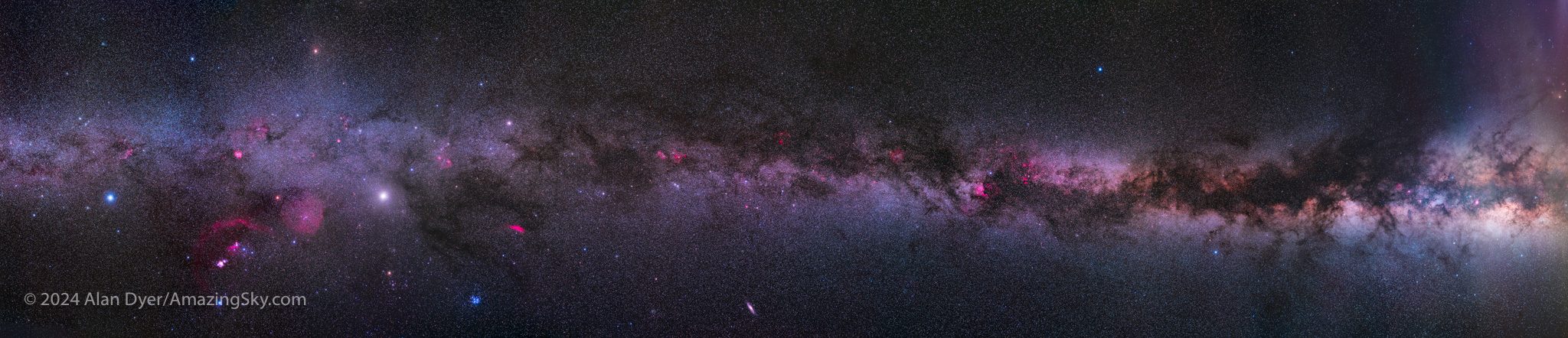
This panorama extends for about 240ยบ along the northern half of the Milky Way, from Orion at left, to Sagittarius at right, and centered on the Galactic Equator.

In autumn the Milky Way is up all night. So I used a simple star tracker, the MSM Nomad reviewed here on my blog, and a 28-70mm lens at 35mm to shoot a panorama from dusk to dawn along the Milky Way โ€” from the summer stars of Sagittarius and Cygnus (at right, above), through the autumn constellations overhead in Cassiopeia and Perseus (at centre), and down into the pre-dawn sky with the winter stars in and around Orion (at left). 

A Bonus Aurora from Arizona 

I was just north of the Mexican border, at a latitude 32ยฐ North, more than 20ยฐ farther south than at home in Alberta. But what should appear in my sky but โ€ฆ aurora! 

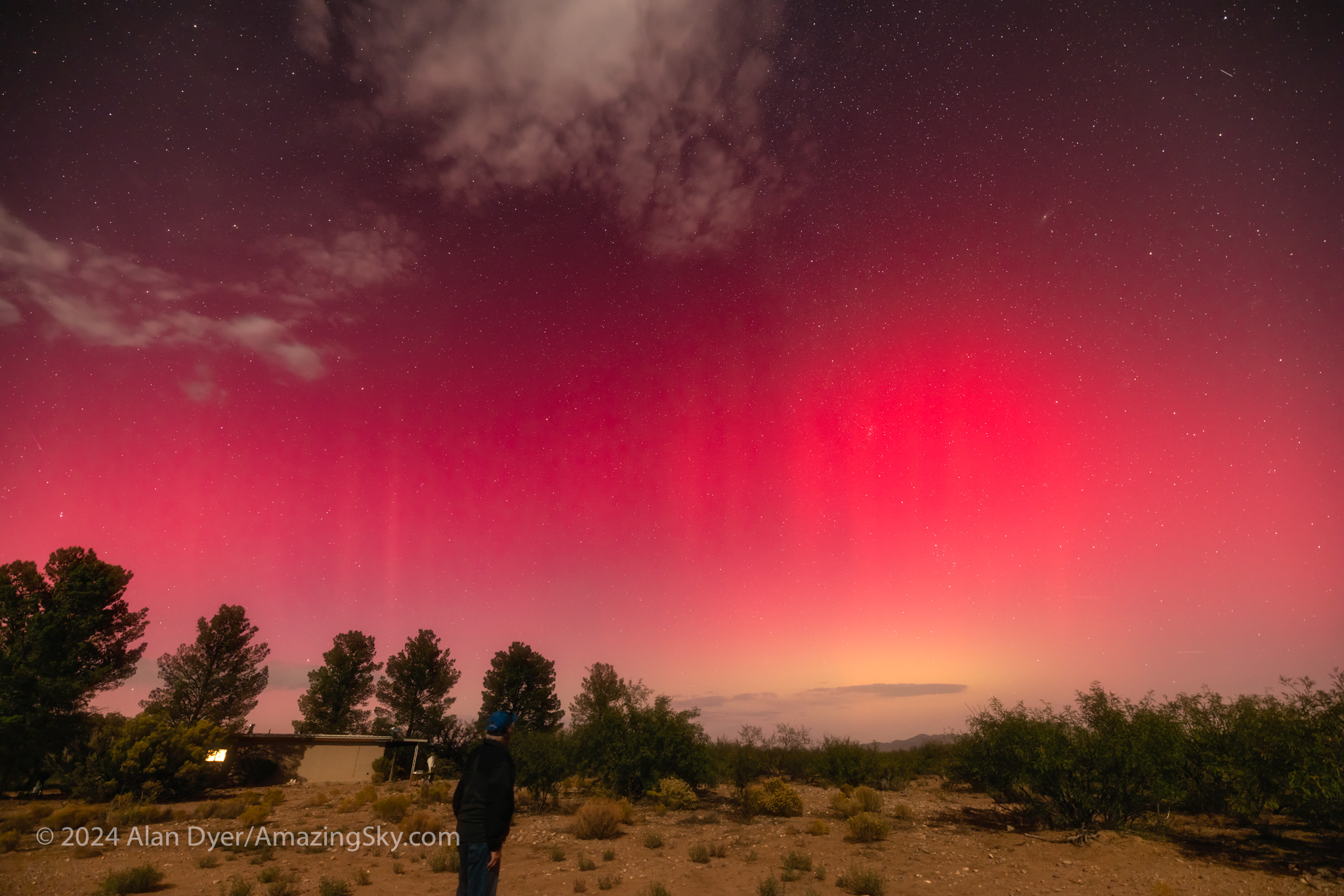
A selfie of me observing the great red aurora of October 10, 2024, from southern Arizona.

On October 9, and then again more so on October 10, a great solar storm brought Northern Lights down to me. And indeed across all of Canada and the U.S. The result for me was a red glow to the north โ€” the tops of distant auroral curtains I would have seen filling my sky at home. 

A time-lapse of an Arizona aurora, using a 15mm wide-angle lens shooting nearly 400 forty-second exposures. View it in-line here. Enlarge to a full screen view. There is no sound.

Above is a time-lapse video of the aurora that night, from a camera aimed due north for four hours. The red curtains come and go through the night.
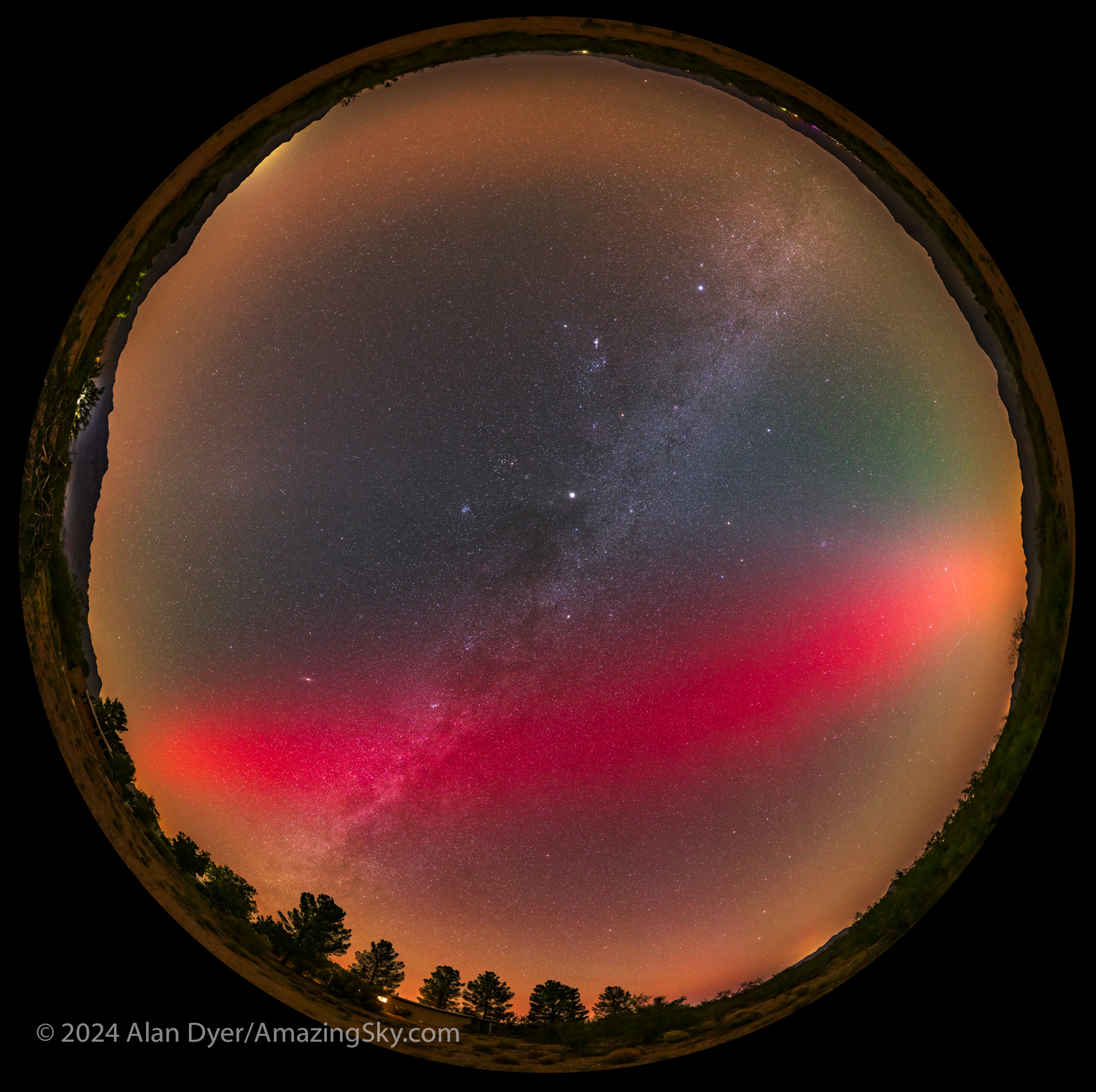
This is a 360ยฐ panorama covering the entire sky and extending up to the zenith at centre, capturing a rare SAR arc across the Arizona sky in the pre-dawn hours of October 11, 2024.

The remarkable feature that night, October 10/11, was not the aurora, but what is called a SAR (Stable Auroral Red) arc that persisted all night. It appeared as a diffuse red band across the sky, created by heat energy leaking into the upper atmosphere during the solar storm. SAR arcs can accompany an aurora but are not auroras themselves. 
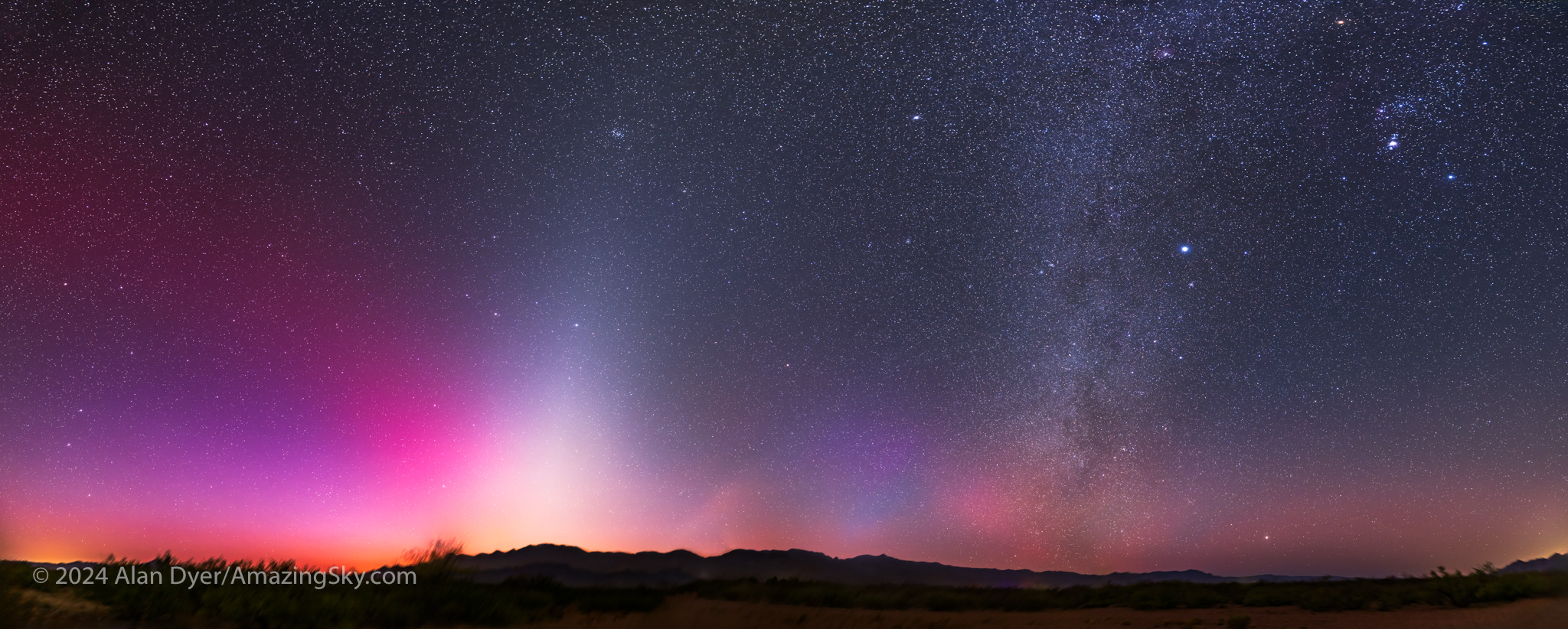
This panorama takes in a rare confluence of skyglows in a colourful dawn sky.

By dawn the next morning, now October 11, the tall Zodiacal Light was prominent alongside the magenta SAR arc to the north (left) and the winter Milky Way to the south (right). Thereโ€™s even a short pillar of light that might be an aurora fragment, or the tail of the comet!  

The Comet Returns 

However, toward the end of my 11-night marathon of deep-sky imaging, the bright head of the comet was to be rising into the evening sky for Part 2 of its apparition. Below is a shot from the evening of October 11, my last at Quailway. Yes, there it was, just above the Chiricahua Mountains. But it was a blip, barely visible in binoculars and to the camera. I had hoped for more. 

This is Comet Tsuchinshan-ATLAS (C/2023 A3) at far right, barely visible emerging into the evening sky and low in the twilight, on October 11, 2024. This view includes Venus at left. Venus was obvious; the comet was not!

With the Moon now waxing into the evening sky, my plan was to head back north, stopping at scenic spots on the trip home, to catch the comet over moonlit landscapes to the west in the dusk sky.

My first two nights, October 12 and 13, at the VLA Radio Observatory near Socorro, New Mexico, then farther north near Canyon de Chelly, Arizona, were both beset by clouds to the west. From images posted on-line, I knew the comet was improving. But it was eluding me. 


October 14 & 15 โ€” at Arches National Park, Utah

The next stop was Arches National Park in Utah, which I last visited in April 2015. The first nightโ€™s forecast for October 14 also looked to be cloudy. But October 15 was supposed to be clear. So I extended my stay by an extra night, thinking that might be my only chance.ย 

As it turned out October 14 was fabulous (below). The comet was easily visible to the unaided eye as a classic comet in the west. I pointed it out to folks walking by at the Windows Arches area. And I could hear other people commenting on it. At last a comet! One that anyone could see โ€” though it helped to be at a clear sky site like Arches. 
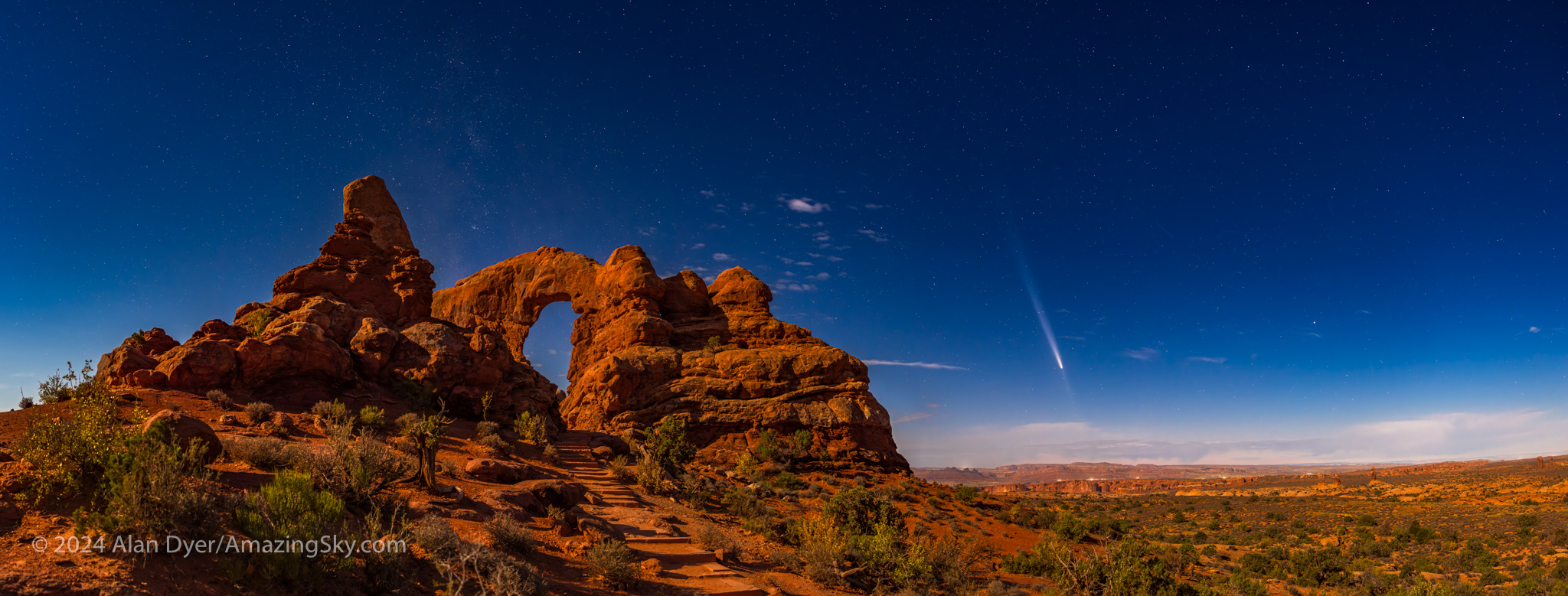
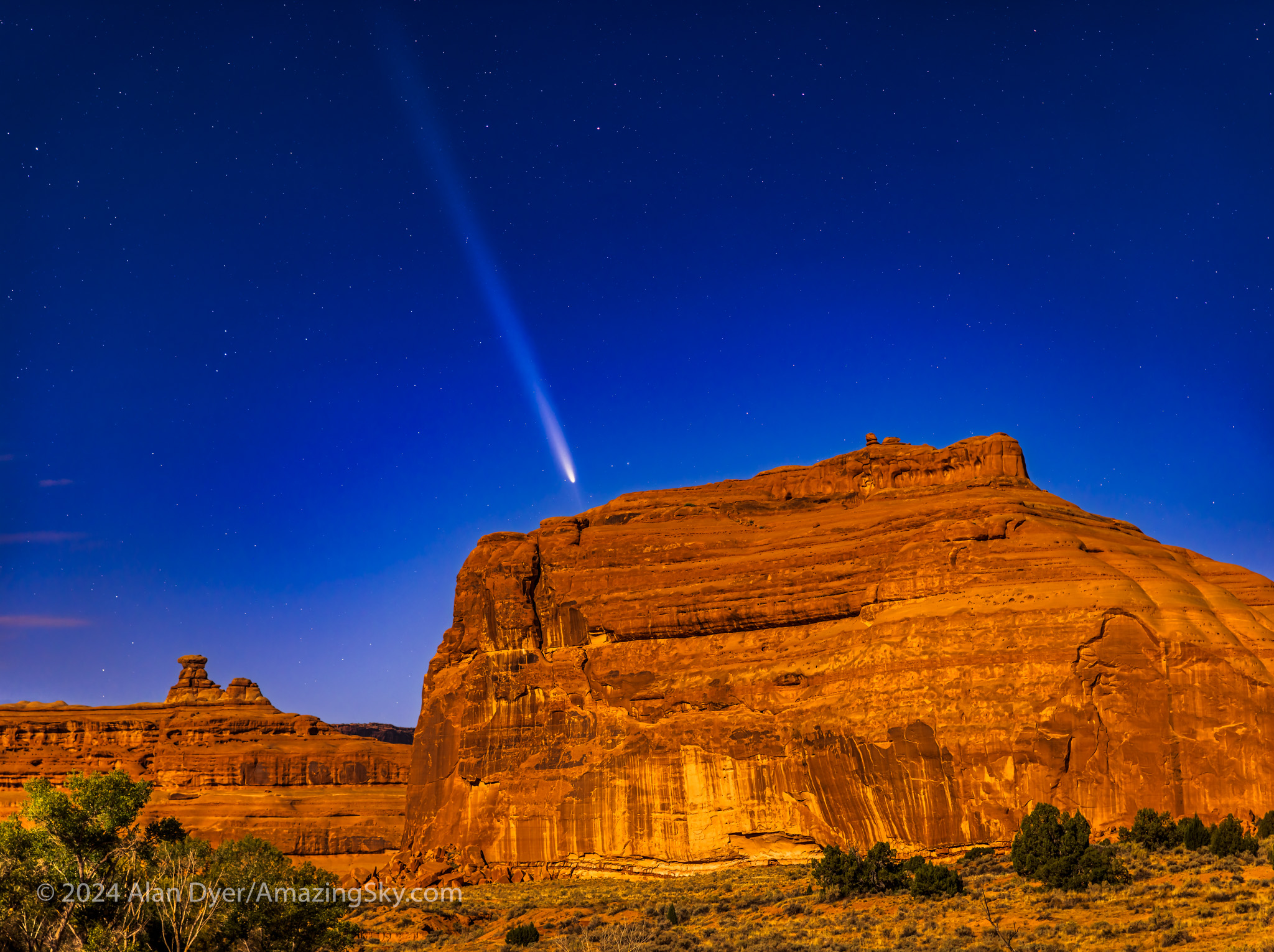
Comet Tsuchinshan-ATLAS at its finest in the evening sky, two days after its closest approach to Earth, and with it sporting a 10ยบ- to 15ยบ-long dust tail, and a narrow anti-tail pointed toward the horizon.

By then the Moon was well advanced in age to a bright gibbous phase, so the sky was by no means dark. It was deep blue in photos.

Still the comet showed up brilliantly; it had blossomed a lot in a couple of nights. Above, I framed it beside moonlit Turret Arch.

Below is a scene from the next night, October 15, my โ€œback-upโ€ night. The comet was certainly performing well after all. Even in the moonlight. In binoculars the tail stretched for the same length as the camera recorded it, some 15ยฐ. 

This is a telephoto close-up Comet Tsuchinshan-ATLAS over the red rocks of Arches National Park, Utah, on a superb moonlit night, October 15, 2024.

Indeed, that was my last view of the comet for a while, as clouds prevented any more shooting on the rest of my journey north through Idaho and Montana.ย I even hit a snowstorm in southern Montana.


Late October โ€” Back at Home in Alberta

But the comet was not done yet! Through October, while it receded from us in distance, it climbed higher into our sky, placing it into a dark sky with the Moon now out of the way.ย 

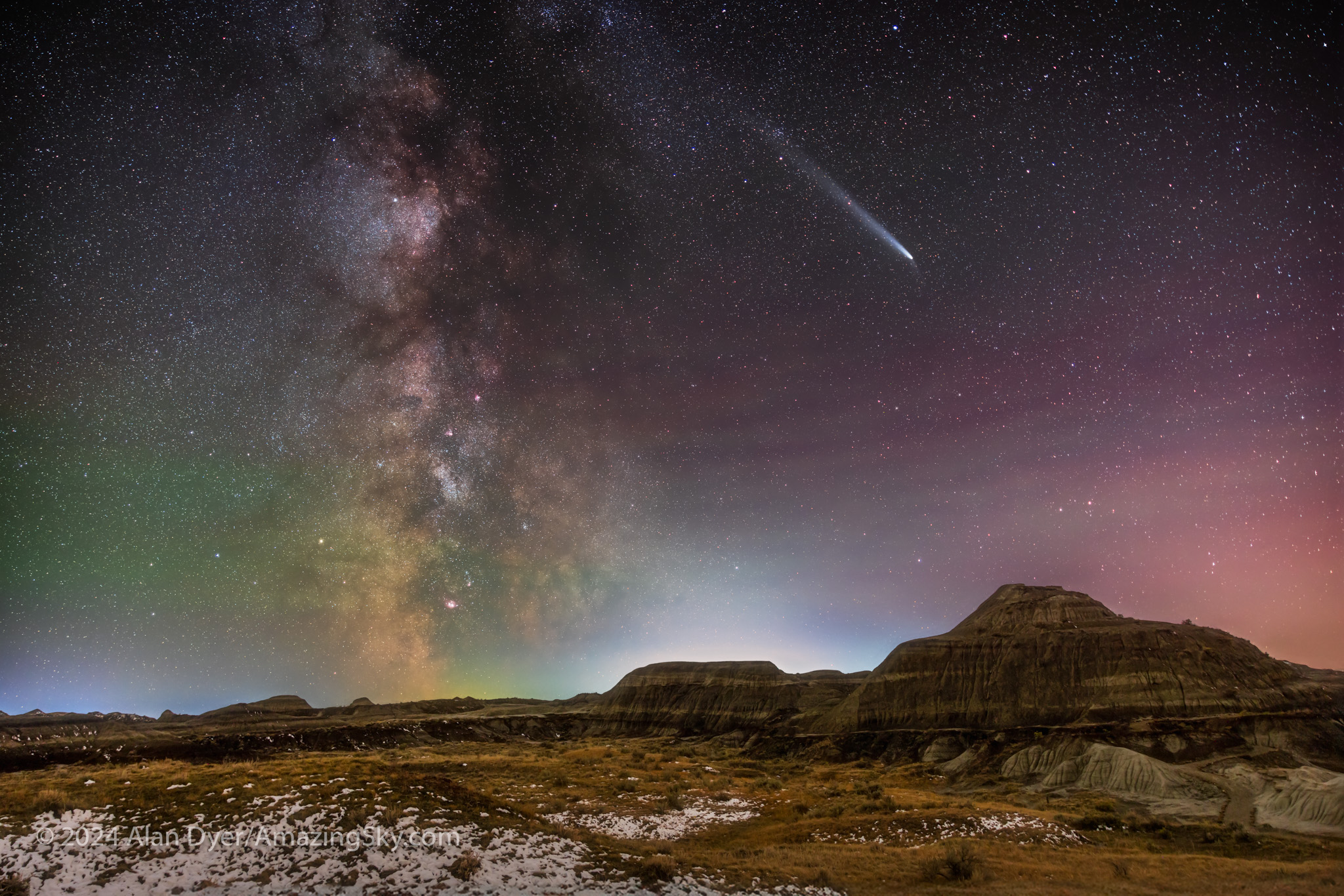
This is Comet Tsuchinshan-ATLAS in a wide-angle nightscape scene over the Badlands of Dinosaur Provincial Park, Alberta, on October 23, 2024.

On October 23, a short trip out to Dinosaur Provincial Park east of home allowed me to shoot the comet over the Alberta Badlands landscape, beside the setting summer Milky Way. 
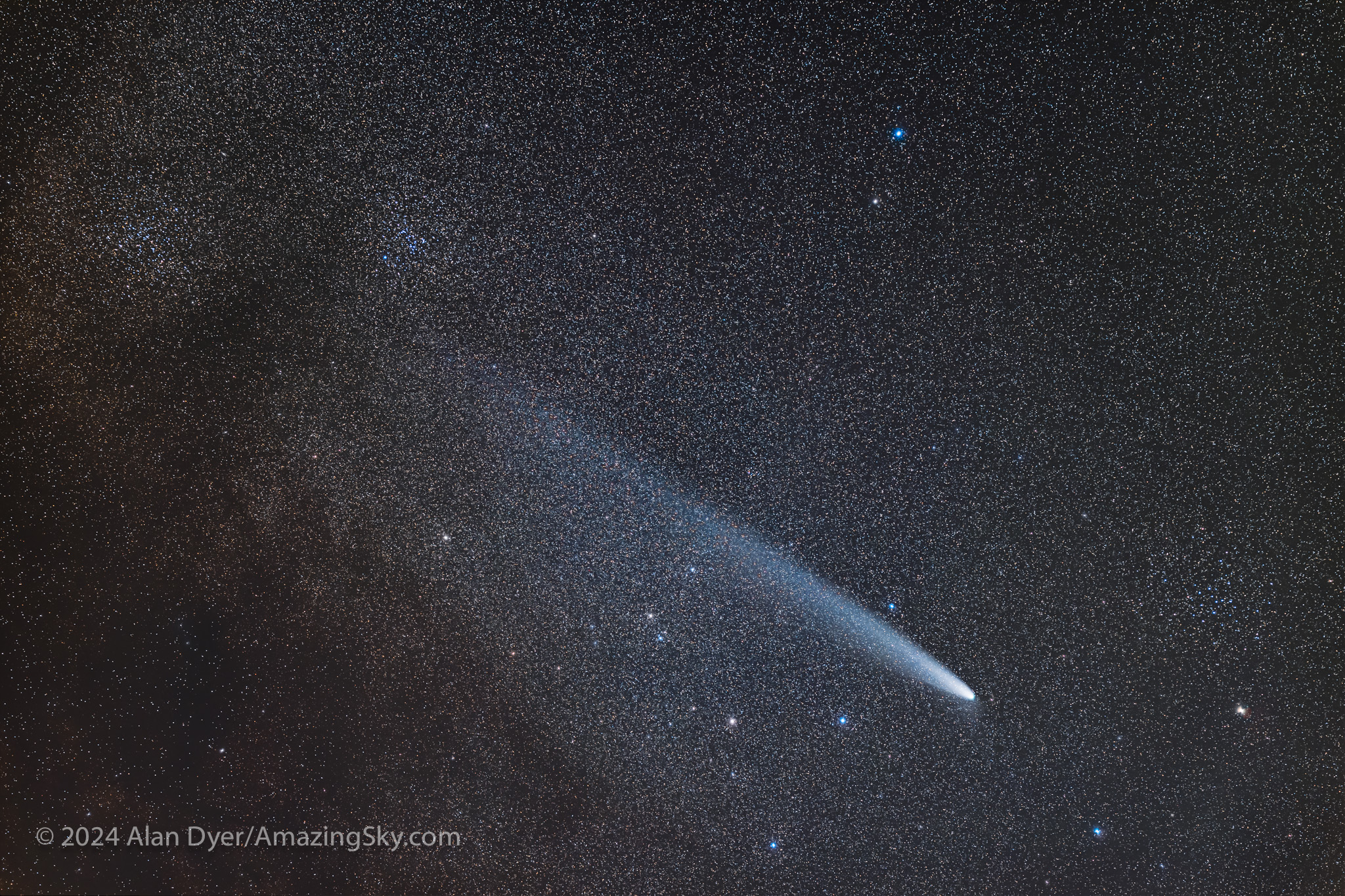
This is a telephoto lens framing of Comet Tsuchinshan-ATLAS in Ophiuchus on the night of October 30, 2024 near several large star clusters. The field of view is 15ยบ by 10ยบ so the tail extends for about 6ยบ to 8ยบ.

By a week later, on October 30, the comet had diminished in size and brightness, but still looked like a classic comet, here framed in a telephoto close-up as it passed near some bright star clusters. This was from my front yard. The chase was over. 

Clouds and a trip to Norway starting November 4 prevented more opportunities to shoot the comet. (My travel schedule also kept me from writing this blog until now!)

It had been a good chase over a month, yielding images I was happy with. The photos from Utah and Arizona I could not have taken at home, even if the skies had been clear during the cometโ€™s prime-time. (They werenโ€™t!) And it was great to finally get back to my favourite haunts in southern Arizona and New Mexico after an absence of seven years.

In all, Comet Tsuchinshan-ATLAS provided a fine finale to what has been a superb year of stargazing events and celestial sights. 

โ€” Alan, December 9, 2024 โ€” AmazingSky.com ย 

Following the Evening Star


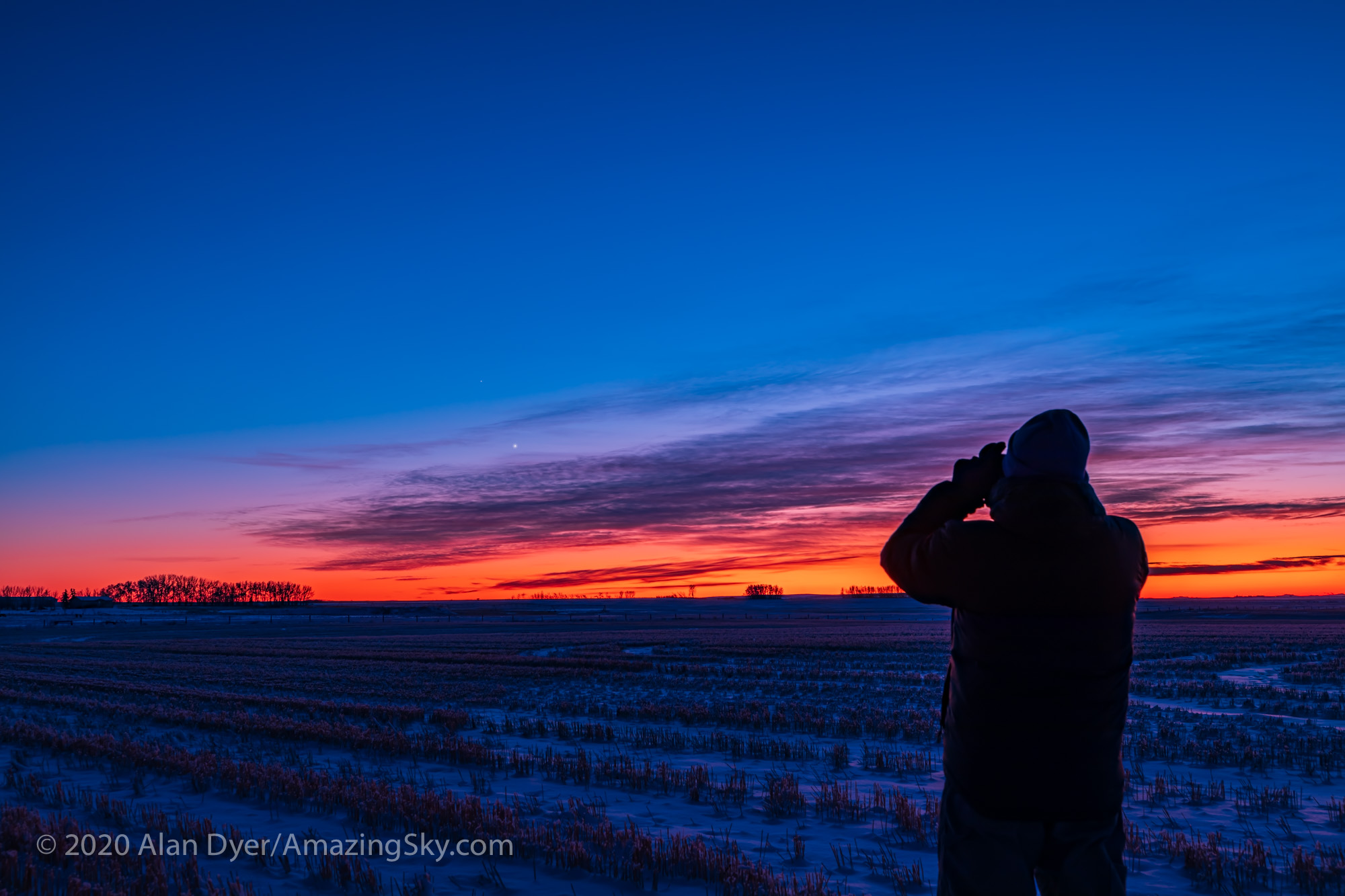
Selfie with Binoculars Looking at Moon (Feb 27, 2020)It’s been a marvelous few months following Venus rise and fall across the evening sky, in its best show in eight years.

Venus is now gone from our western sky, but since late 2019 until late May 2020 it had dominated the sky as a brilliant evening star.

Here’s a gallery of Venus portraits I shot during its wonderful show these last few months.


The show began in November 2019 when rising Venus met declining Jupiter on November 23 for a fine conjunction of the two brightest planets in the evening twilight.

Venus and Jupiter over the Rockies
The conjunction of Venus and Jupiter of November 23, 2019, as seen over the foothills and front ranges of the Rocky Mountains in southwest Alberta. I shot this from the Rothney Astrophysical Observatory, prior to their monthly Open House event that night with about 400 in attendance. But at this time it was just me and one other ardent photographer present to shoot this scene. This is an HDR blend (stacked using Adobe Camera Raw) of 5 exposures at 2/3-stop intervals, with the Rokinon 85mm lens at f/4 on the red-sensitive Canon EOS Ra camera at ISO 100.


A week later I captured the line of the then three evening planets and the Moon across the southwest, defining the path of the ecliptic across the evening sky.

Moon and Three Planets Line-Up
The waxing crescent Moon and three planets in a line across the southwestern evening sky on Nov. 30, 2019, a chilly and frosty night. Saturn is below and to the right of the Moon, Venus is brightest at centre, while Jupiter is to the lower right of Venus just above the horizon. Those two planets were in conjunction a week earlier. The line of Moon and planets visibly defines the ecliptic low across the late autumn evening sky. This is from latitide 51ยฐ N. I shot this from the viewpoint at Blackfoot Crossing overlooking the Bow River in Alberta.


A week after that I took the opportunity to shoot some selfies of me with binoculars looking at Venus, as it met Saturn in a wide conjunction, with Venus then still low in the southwest. It was just beginning its climb up into the western sky.

Observing Venus and Saturn (Dec 8, 2019)
A selfie of me observing the grouping of Venus and Saturn in the evening twilight on Dec 8, 2019, using binoculars. They were closest to each other two nights later.


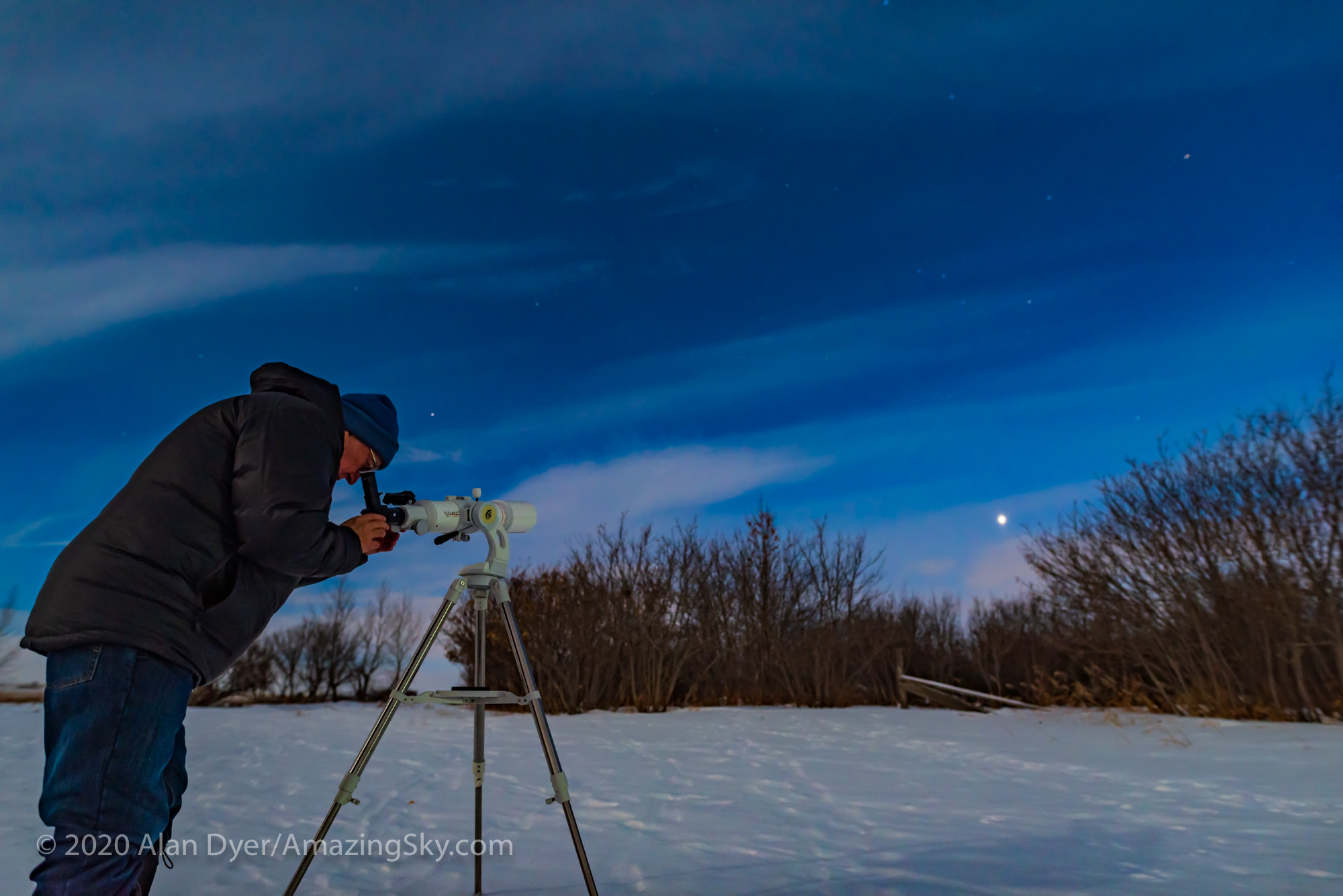
A month later in mid-winter, Venus was still rather low but brilliant even in a hazy moonlit sky, as I posed for another selfie, this time with a small telescope. These images are always useful for illustrations in books and magazines. And blogs!

Observing Venus in Clouds
A selfie of me observing Venus in clouds and in the moonlight. I am using the Explore Scientific 80mm refractor on the Twilight Nano alt-az mount. This was January 9, 2020.


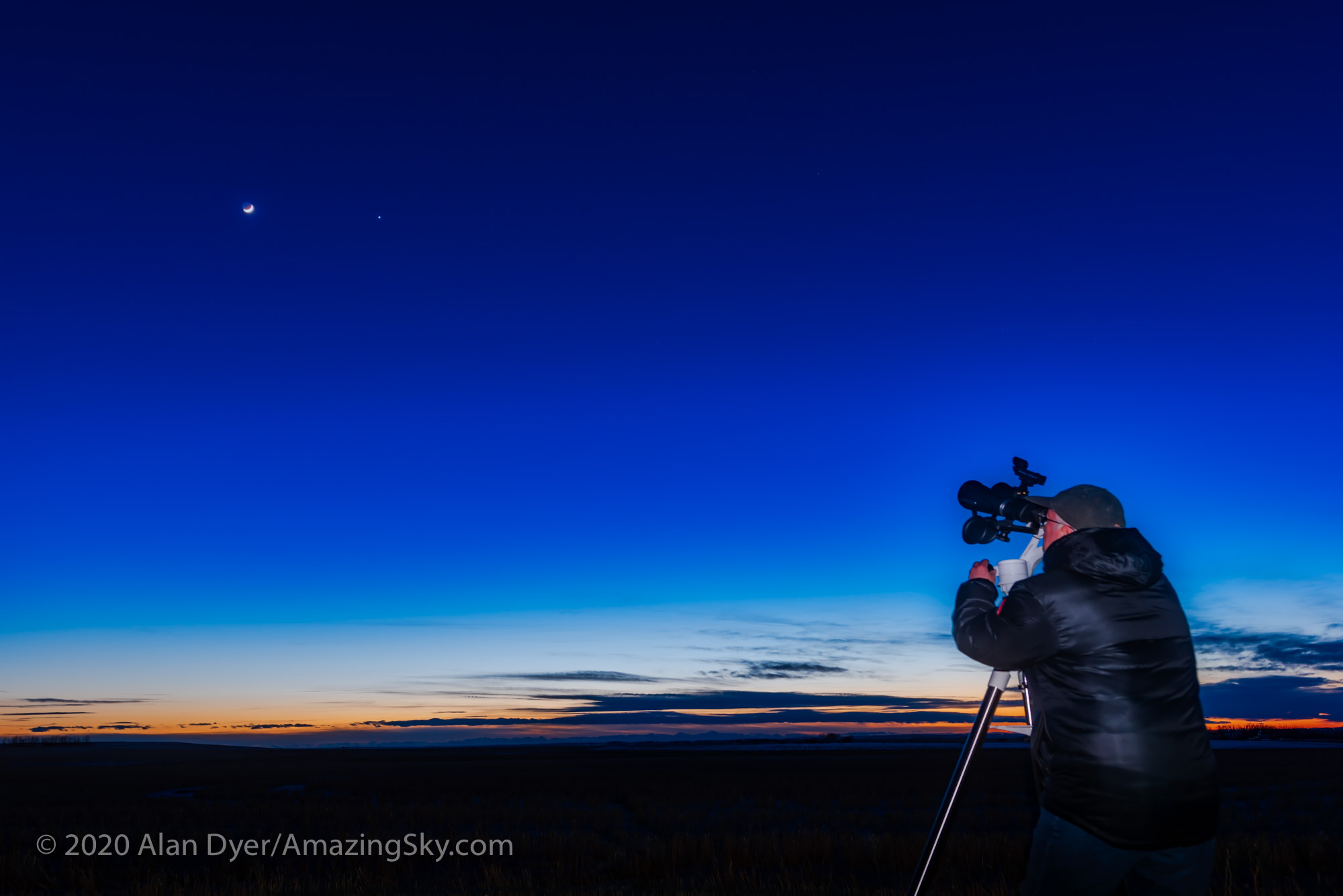
By the end of February Venus had climbed high into the west, and was appearing monthly near the waxing crescent Moon. This is another binocular selfie from February 27.

Selfie with Binoculars Looking at Moon (Feb 27, 2020)
A selfie looking at the waxing crescent Moon near Venus on Feb 27, 2020, using the Celestron SkyMaster 15×70 Pro binoculars on the Sky-Watcher AZ5 mount for a steady view. This is a single shot with the Nikon D750 and Sigma 24mm lens, using the flash on the camera.


In March I visited Churchill, Manitoba just as the lockdown and travel restrictions were coming into effect. But our lone and last tour group at the Churchill Northern Studies Centre saw some fine auroras, as here on this evening with the Northern Lights appearing even in the twilight. And what’s that bright star? Venus, of course!

Aurora in Twilight at Churchill Northern Studies Centre
The Northern Lights in the evening twilight on March 18, 2020, as the aurora appeared in the early evening sky. Orion is at far left in this panorama, with Cassiopeia at top centre. Part of the Big Dipper is at far right. The bright object over the Centre is Venus, with the Pleiades above. This is a panorama of 8 segments with the Venus Optics 15mm lens at f/2 and Sony a7III at ISO 800 for 1.6 seconds each. Stitched with Photoshop.


Upon my return home to Alberta, I was able to shoot more panoramas on the prairies of the wonderful early spring sky with Orion setting into the twilight and Venus in Taurus shining below the iconic Pleiades star cluster.

Panorama of  Venus and the Winter Stars (March 25, 2020)
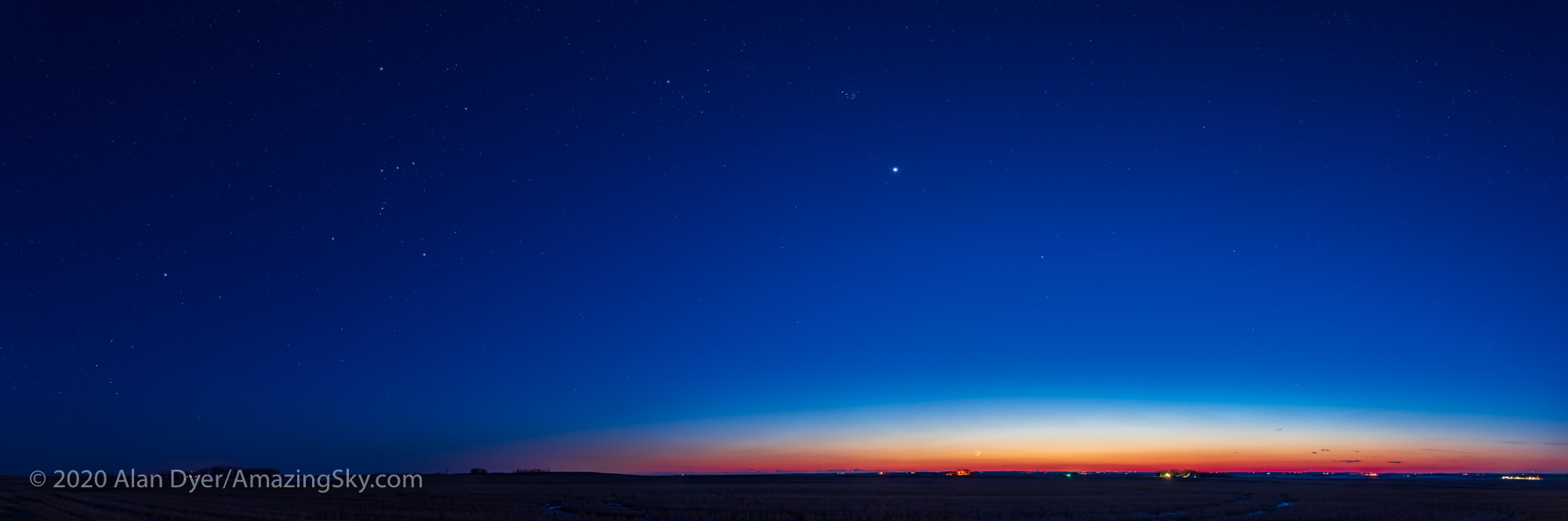
This is a panorama of the evening sky on March 25, 2020, with brilliant Venus high in the west at centre just after the date (March 24) of its greatest elongation in the evening sky for 2020. It appears here about as high as it can get with the ecliptic tipped up to a high angle in spring. To the left is Orion and the winter stars in the twilight, including Sirius at far left. Just above the horizon right of centre in the bright twilight is the day-old thin crescent Moon about to set. Above Venus are the Pleiades and Hyades star clusters. This is a panorama of 5 segments with the Nikon D750 and 24mm Sigma lens, stitched with PTGui. Each segment was 8 seconds at ISO 400 and f/2.8.


March 26 was a superb night for catching Venus now at its highest and almost at its brightest at this appearance, as the waxing Moon appeared below it.


The highlight of the spring Venus season was its close approach to the Pleiades, which it passes only every 8 years. Here I am viewing the conjunction two days before the closest approach, with Orion over my shoulder.

Viewing Venus & Pleiades with Big Binoculars
A selfie of me viewing the close approach of Venus to the Pleiades star cluster on April 1, 2020, using big 15×70 Celestron SkyMaster Pro binoculars mounted on a Canadian-built Starlight Innovations binocular mount, a parallelogram-style mount. Orion is over my left shoulder; the Hyades is at centre above the mount. The waxing gibbous Moon provided the illumination. This is a stack of 4 images for the ground to smooth noise and 1 image for the sky to minimize trailing, all 13 seconds at f/5.6 with the Sigma 24mm lens and Nikon D750 at ISO 1600. Topaz Sharpen AI and DeNoise AI applied.


The night of closest approach, April 3, was cloudy, but here is a consolation closeup taken the next night with brilliant Venus departing the Seven Sisters.

Venus and the Pleiades - Close-Up (April 4, 2020)
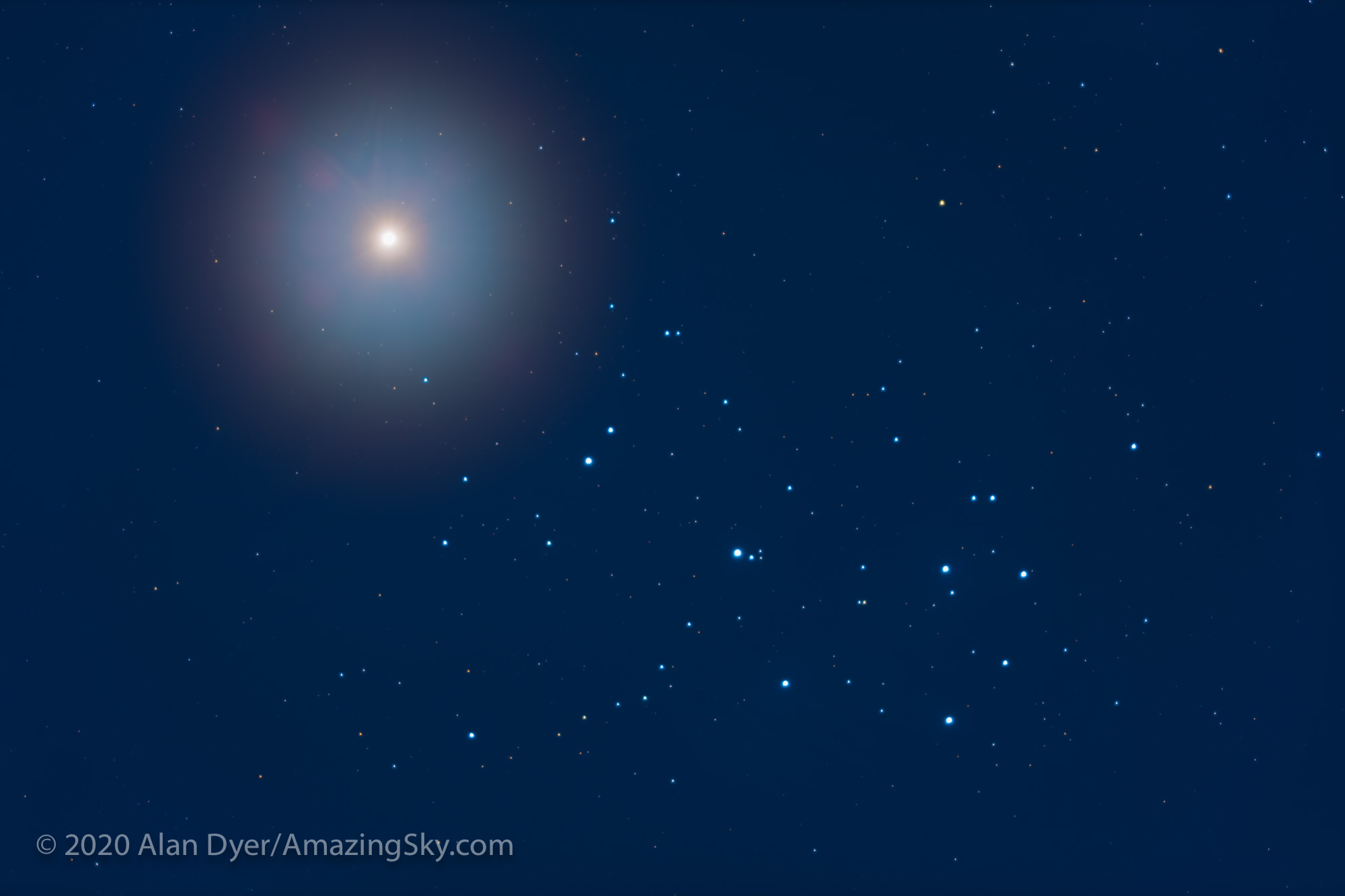
Venus above the Pleiades star cluster, M45, on April 4, 2020, in the twilight and moonlight. Light from the gibbous Moon illuminated the sky, so no long exposure would reveal much detail in and around the Pleiades. Venus passes close to the Pleiades only every 8 years. Some light cloud this night added the glow. This is a stack of multiple exposures of varying lengths: 2 minutes, 30 seconds, 10 seconds and 2 seconds, blended with masks to prevent Venus from being too blown out while still recording the stars. All were with the SharpStar 140mm PH apo refractor with the 0.73x flattener/reducer for f/4.8 and at ISO 400 with the Canon EOS Ra.


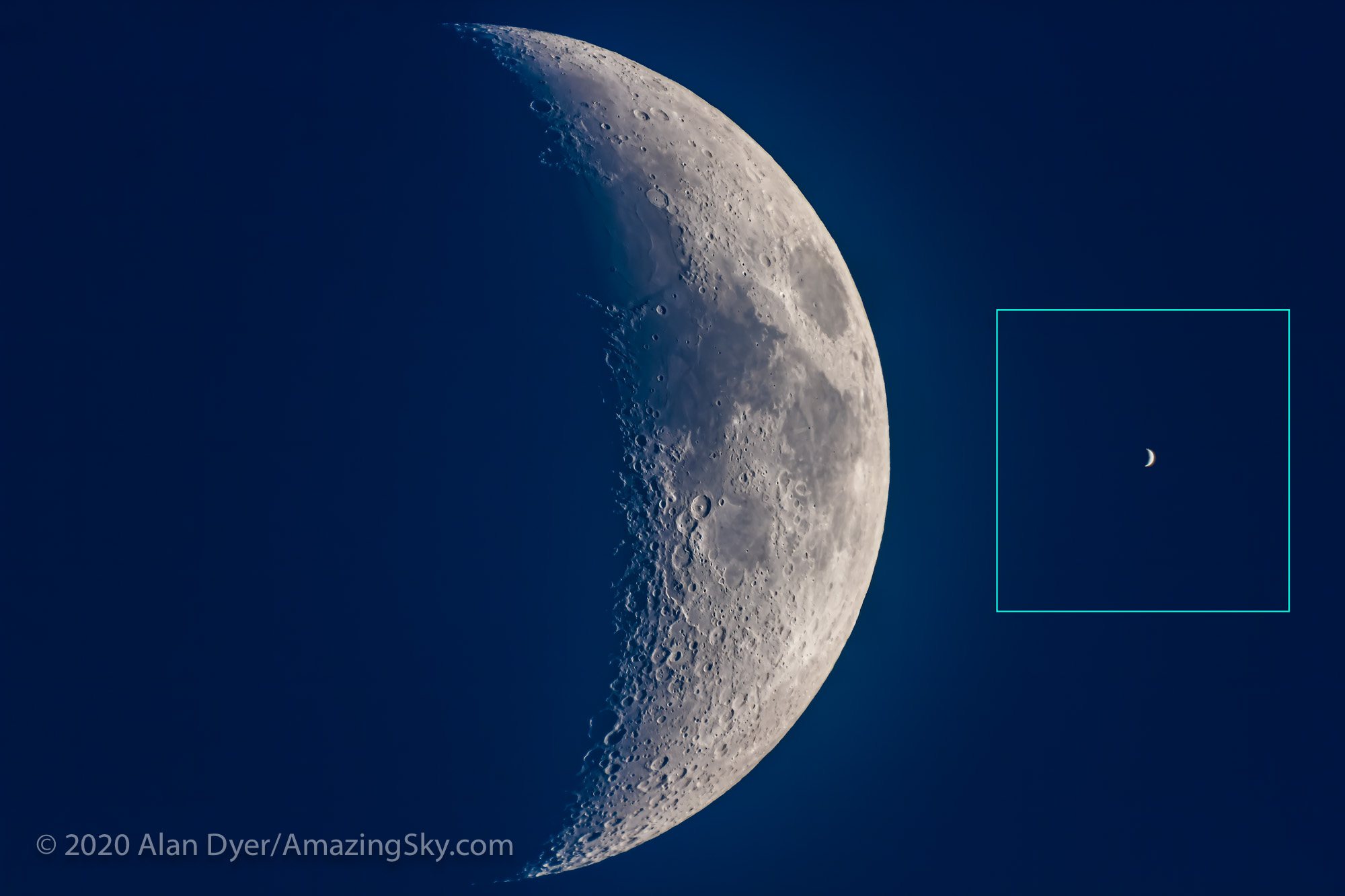
Later in April Venus reached its greatest brilliancy, at magnitude -4.7, the date when the size of is disk, phase, and proximity to Earth converge to make Venus as bright as possible. On this night I shot the Moon, then 30ยฐ away from Venus and the planet with the same gear to show their relative sizes and similar crescent phase this night. The caption provides more details.

Moon and Venus Crescents Compared
A collage of two images of the Moon and Venus taken minutes apart on April 28, 2020, to show the similarity in their phases this night, April 28, 2020. Both images were shot with the same focal length and camera and so are identical in image scale, to compare their apparent sizes. I have not enlarged Venus, but I have put a frame around it to emphasize that its image has been layered in as a composite. The Moon was a 5.6-day-old waxing crescent this night, 32% illuminated. Venus was at its greatest brilliancy, or Greatest Illuminated Extent, with a disk 38 arc seconds across and 27% illuminated, so slightly less. Taken with the 130mm Astro-Physics refractor with a 2X Barlow lens for an effective focal length of 1600mm and with the Canon 60Da APS-sensor camera. The Moon image is the full frame of the sensor, uncropped. Both images are single short exposures at ISO 100.


A week later, with Venus just past its point of greatest brilliancy, I shot the planet by daylight in the early evening sky, using a telescope to zoom into the planet to show its waning crescent phase. By this time the phase was obvious in binoculars.

Venus in the Day Sky
Venus in the daytime sky and through some thin clouds, on May 5, 2020, with Venus at a very high apparition. This was at about 7 pm with the Sun still well up in the early evening, to show how well Venus can be seen in the daytime sky when it is at a wider angle from the Sun; and indeed is often the best time to view it as the planetโ€™s brilliance is muted. This is a single 1/400-second exposure at ISO 100 with the Canon 60Da through the Astro-Physics 130mm refractor and 2X Barlow for f/12 and 1600mm focal length.


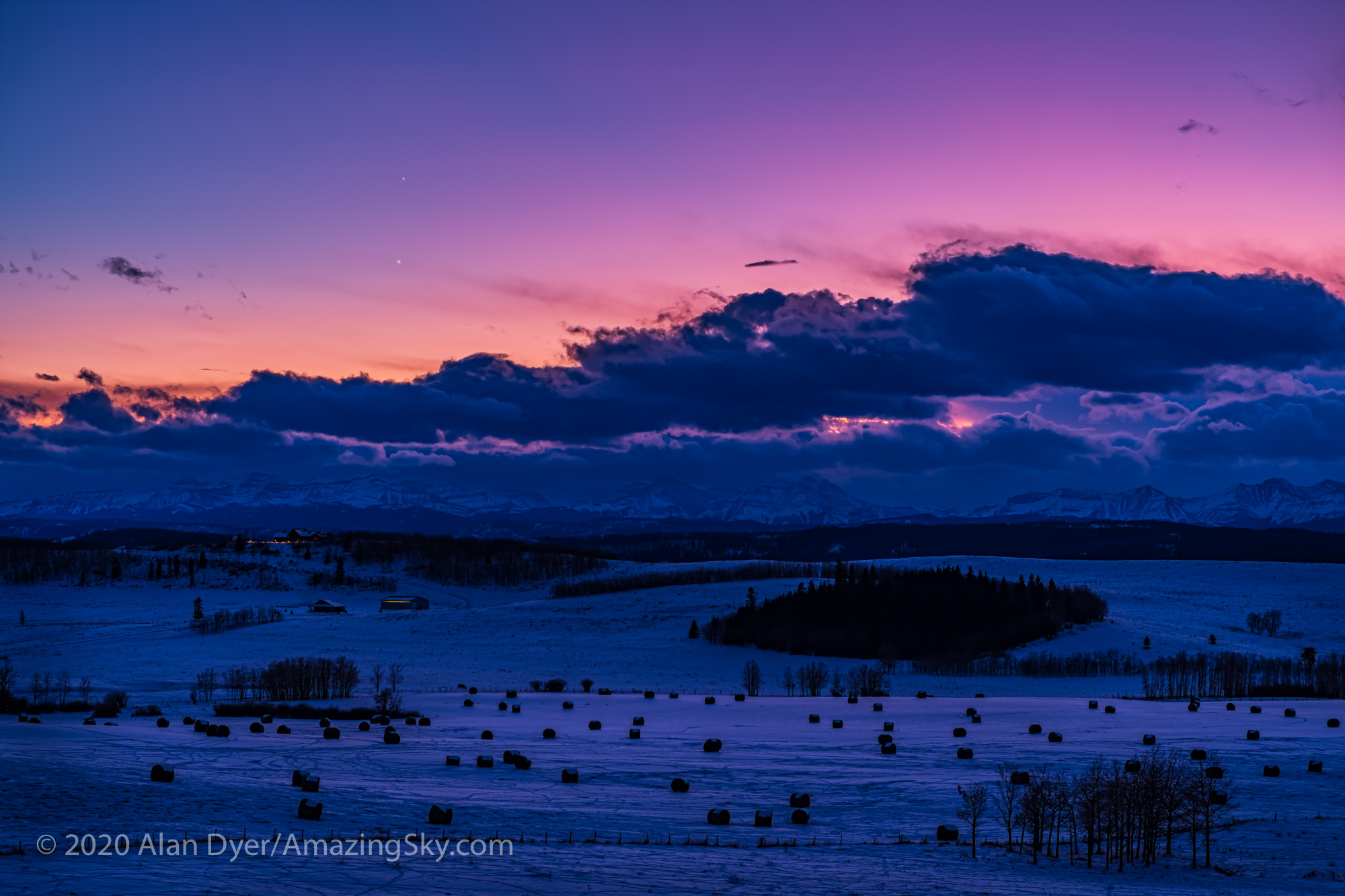
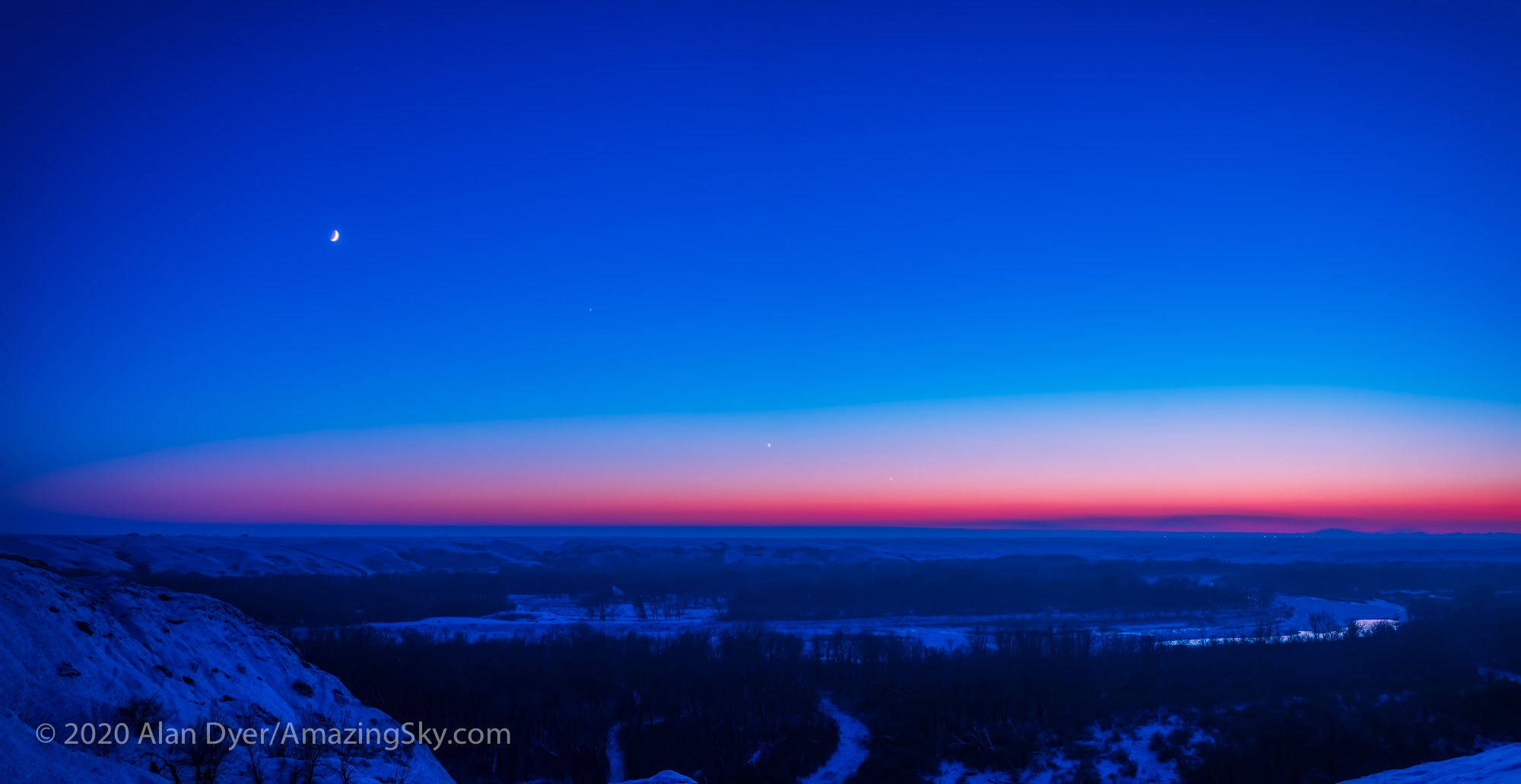
But Venus was now dropping rapidly from sight. By May 23, it was low in the twilight and below Mercury, then at its best for 2020 for an evening appearance from my latitude. Note the thin Moon below the planets. This was a superb sight for binoculars.

Thin Moon below Venus and Mercury
On May 23, 2020, the very thin crescent Moon (then 34 hours old) shines below bright Venus (10 days before its inferior conjunction with the Sun) and above it dimmer Mercury , then 10 days before its greatest elongation from the Sun in the evening sky. All were beautifully visible to the naked eye and a great sight in binoculars, looking very much like this scene captured with a 135mm telephoto lens. Venus was magnitude -4.4, Mercury was -0.7. This is a single shot at f/2.8 and 1/ 5 second at ISO 100 with the Canon EOS Ra which does bring out the sunset reds well.


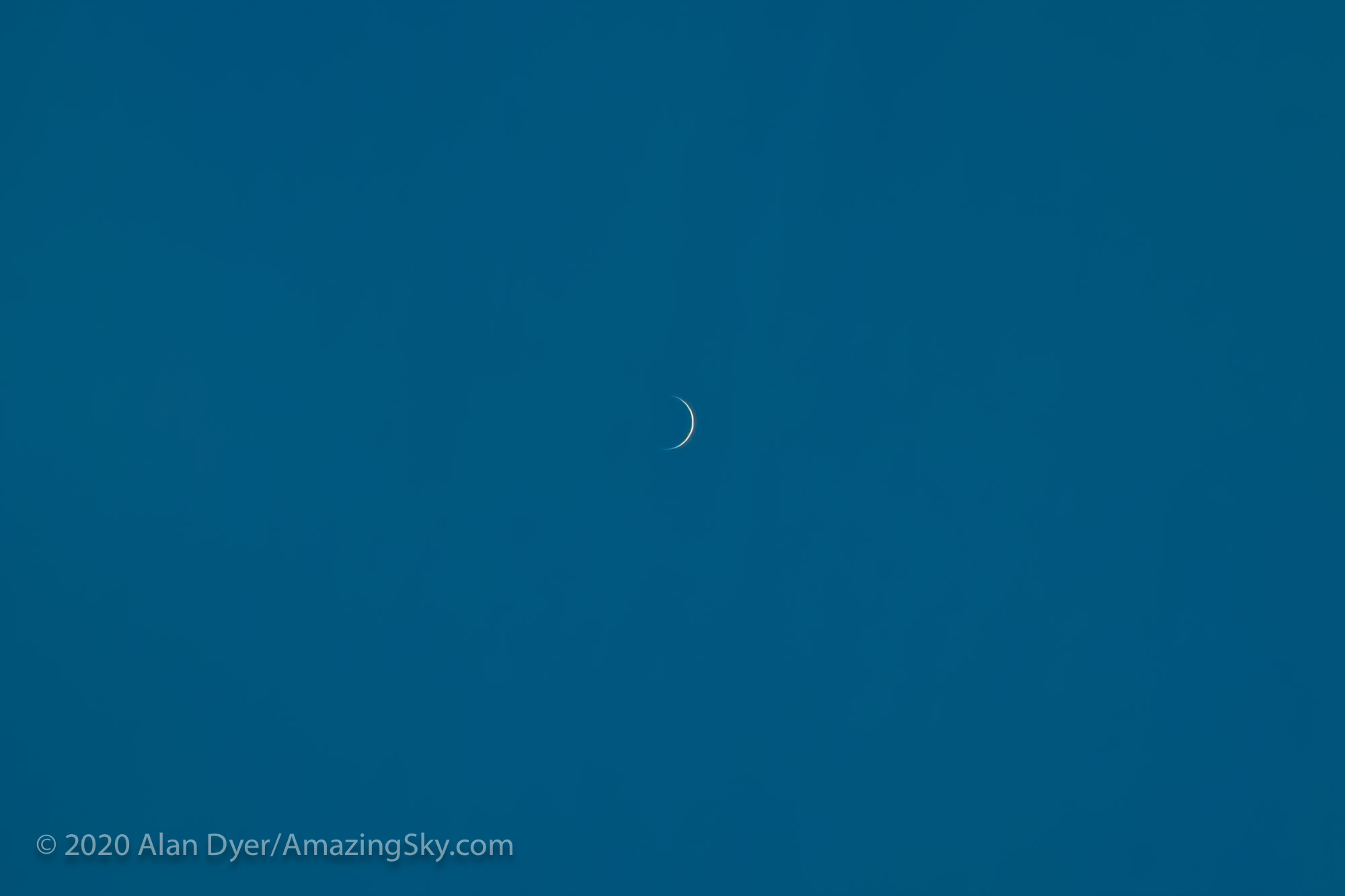
By May 29, Venus was now tough to pick out of the evening sky, and a challenge to shoot even by day, as it then stood only 8ยฐ away from the Sun. What was once obvious to the naked eye now took a computerized telescope to pick out of the noon-day blue sky. A telescope showed the now razor-thin crescent as Venus approached its June 3 “inferior conjunction” โ€” its passage between Earth and the Sun.

Venus Near Inferior Conjunction (May 29, 2020)
Venus as a razor-thin crescent and only 8ยฐ east of the Sun on May 29, 2020, five days before its June 3 inferior conjunction. The crescent is extending a little beyond 180ยฐ here due to scattering in the Venusian clouds. The disk was 57 arc seconds across and 0.9% illuminated. The magnitude was -3.9. This was at midday, shot with the 130mm Astro-Physics f/6 refractor with a 2X Barlow and the Canon 60Da camera, but the frame cropped further in processing. This is a single 1/1250th second exposure at ISO 100, the sharpest of 70 still frames taken.


I shot and narrated video footage of the thin crescent Venus, my parting shots of Venus for its evening appearance in 2020.

But in June, post inferior conjunction, it will rise very quickly into our morning sky, providing a mirror-image repeat performance as a morning star for the rest of 2020.

Venus Near Inferior Conjunction from Alan Dyer on Vimeo.


I wish you all the best and a safe and healthy time in 2020. Take some solace in what the sky can show us and in the beauty of the night.

Clear skies!

โ€” Alan, May 31, 2020 / AmazingSky.comย 


The Waxing Moon of Spring


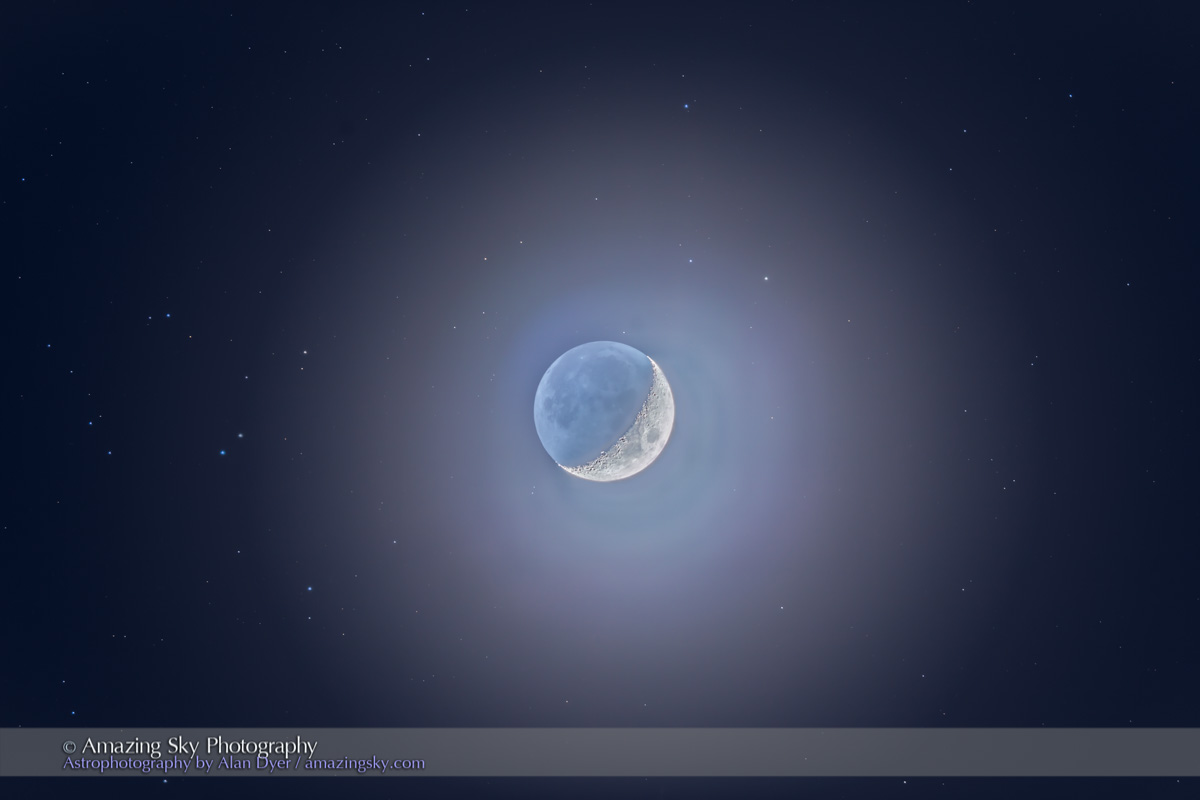
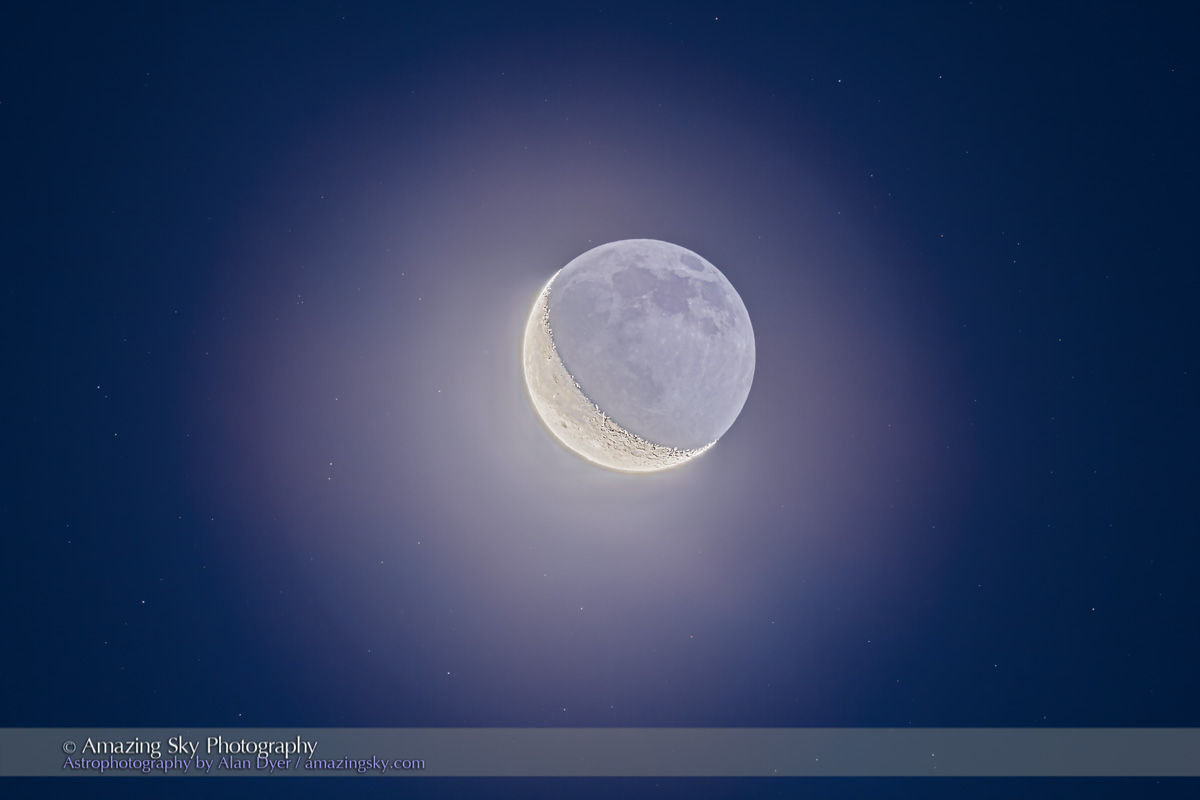
Four-Day-Old Moon with EarthshineSpring is the season for Earthshine on the waxing Moon.
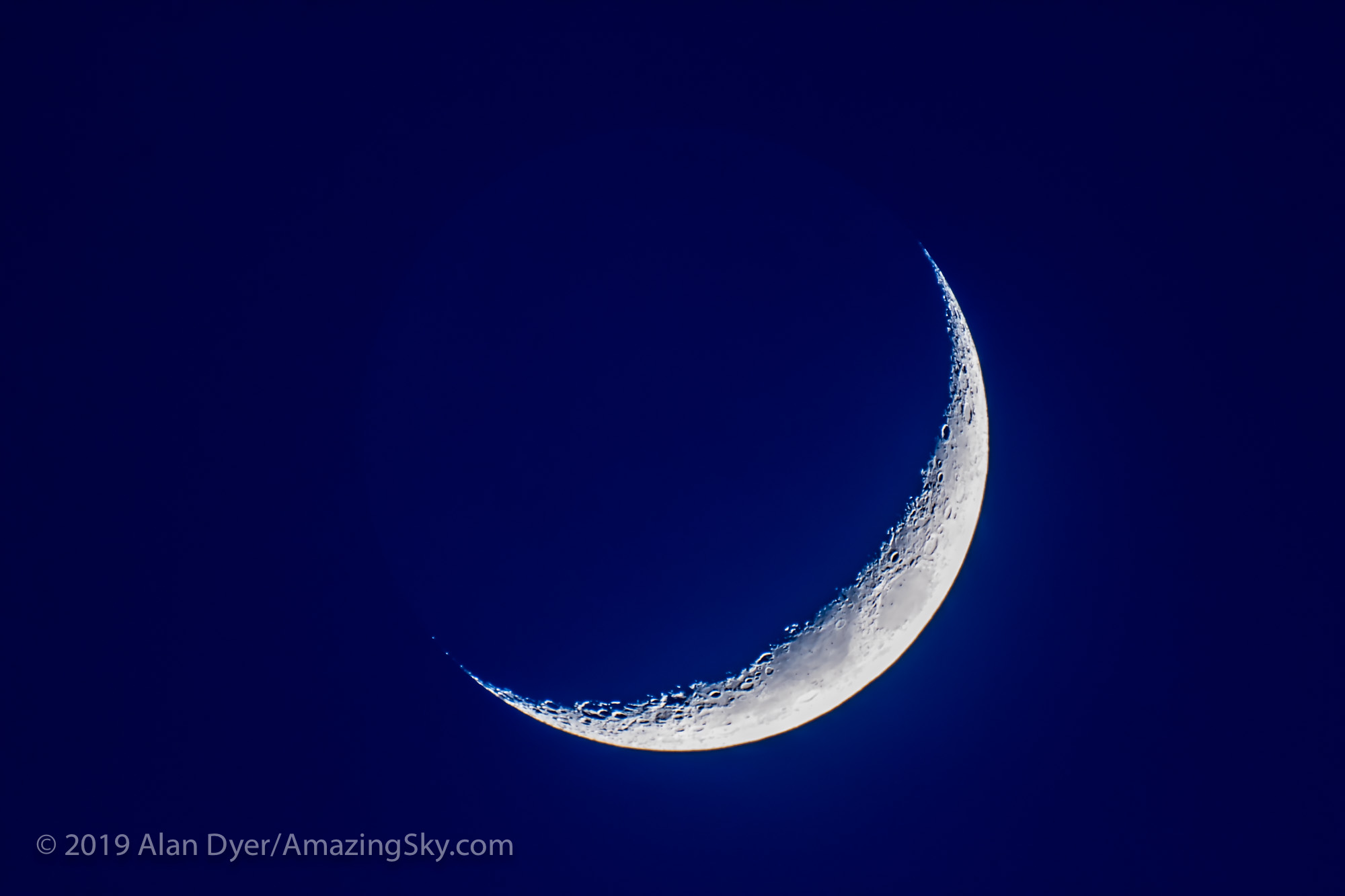
April 8 was the perfect night for capturing the waxing crescent Moon illuminated both by the Sun and by the Earth.

The phase was a 4-day-old Moon, old enough to be high in the sky, but young enough โ€“ i.e. a thin enough crescent โ€“ that its bright side didn’t wash out the dark side!

In the lead photo at top, and even in the single-exposure image below taken earlier in a brighter sky, you can see the night side of the Moon faintly glowing a deep blue, and brighter than the background twilight sky.

Four-Day-Old Moon in Blue Twilight
The 4-day-old waxing crescent Moon on April 8, 2019 in a single exposure when the Moon was still in the bright blue twilight. Even so, the faint Earthshine is just becoming visible. This is with the 105mm Traveler refractor and 2X AP Barlow lens for an effective focal length of 1200mm at f/12, and with the cropped-frame Canon 60Da at ISO 400, in a single 1/8-second exposure.

This, too, is from sunlight, but light that has bounced off the Earth first to then light up the night side of the Moon.

If you were standing on the lunar surface on the night side, the Sun would be below the horizon but your sky would contain a brilliant blue and almost Full Earth lighting your night, much as the Moon lights our Earthly nights. However, Earth is some 80 times brighter in the Moon’s sky than even the Full Moon is in our sky.

Four-Day-Old Moon with Earthshine
The 4-day-old waxing crescent Moon on April 8, 2019 in a blend of short and long exposures to bring out the faint Earthshine on the dark side of the Moon and deep blue twilight sky while retaining details in the bright sunlit crescent. This is with the 105mm Traveler refractor and 2X AP Barlow lens for an effective focal length of 1200mm at f/12, and with the cropped-frame Canon 60Da at ISO 400, in a blend of 7 exposures from 1/30 second to 2 seconds, blended with luminosity masks from ADP Pro3 extension panel in Photoshop.


Unlike the single image, the lead image, repeated just above, is a multi-exposure blend (using luminosity masks), to bring out the faint Earthshine and deep blue sky, while retaining details in the bright crescent.

Once the sky gets dark enough to see Earthshine well, no single exposure can record the full range in brightness on both the day and night sides of the Moon.


Waxing Moon, Mars and the Taurus Clusters
The 4-day-old waxing crescent Moon on April 8, 2019 with it below Mars (at top) and the star clusters, the Hyades (at left, with reddish Aldebaran) and Pleiades (at right) in Taurus, and set into the deep blue evening twilight. This is with the 135mm Canon telephoto at f/2.8 with the Canon 6D at ISO 400, in a blend of 7 exposures from 1/4 second to 8 seconds, blended with luminosity masks from ADP Pro3 extension panel in Photoshop, to prevent the Moon from being too overexposed while retaining the stars and blue sky. The camera was tracking the sky.

April 8 was a great night for lunar fans as the crescent Moon also appeared between the two bright star clusters in Taurus, the Hyades and Pleiades, and below reddish Mars.

It was a fine gathering of celestial sights, captured above with a telephoto lens.

April 8 Sky

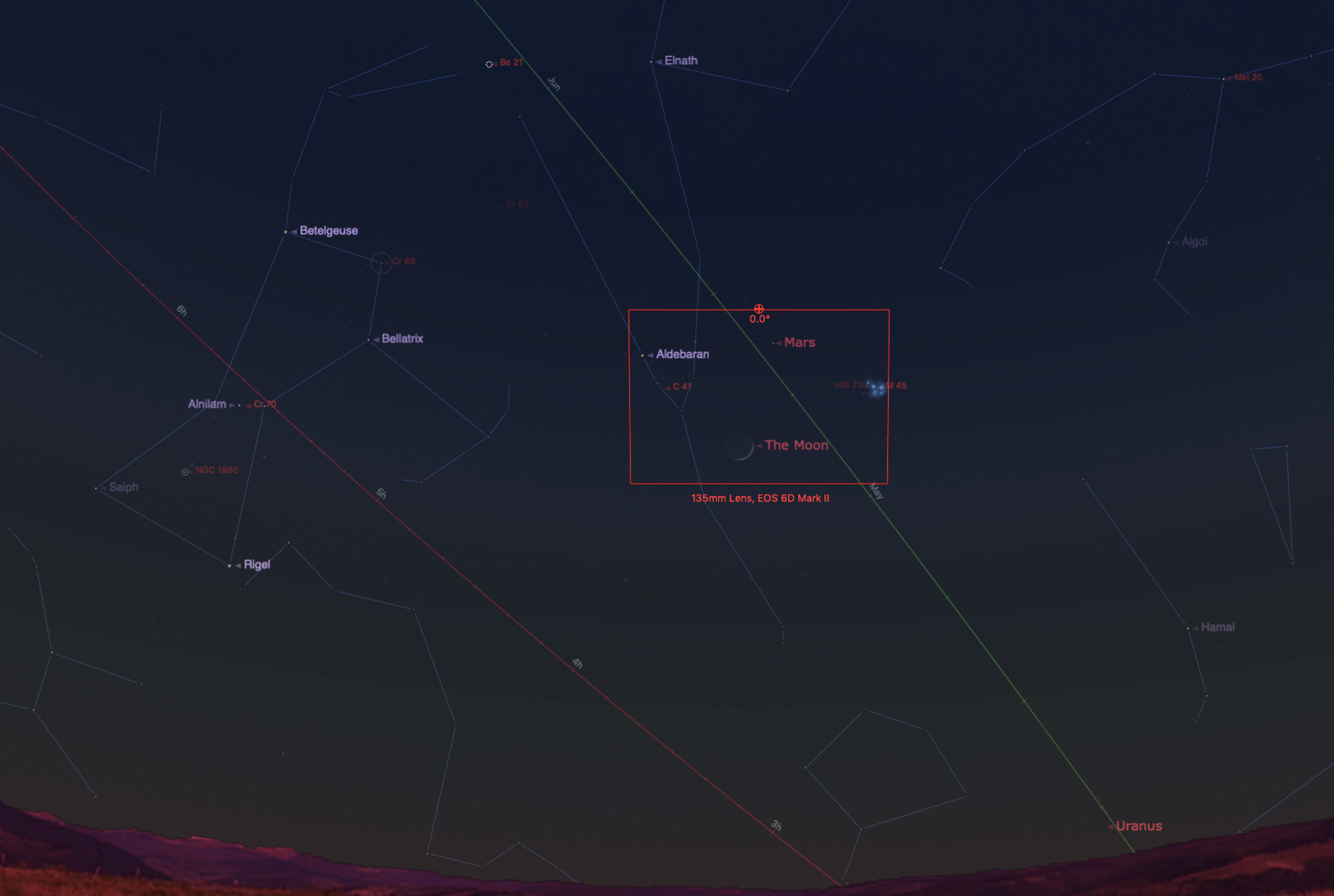
This show the chart I used to plan the framing, created with StarryNightโ„ข software and showing the field of the 135mm lens I used.

The chart also shows why spring is best for the waxing Moon. It is at this time of year that the ecliptic โ€“ the green line โ€“ swings highest into the evening sky, taking the Moon with it, placing it high in the west above obscuring haze.

That makes it easier to see and shoot the subtle Earthshine.ย And to see sharp details on the Moon.

After the sky got darker I shot the crescent Moon in a short exposure to capture just the bright crescent, included above in two versions โ€“ plain and with labels attached marking the major features visible on a 4-day Moon.

If you missed “Earthshine night” this month, mark May 7 and 8 on your calendar for next month’s opportunities.

Clear skies!

โ€” Alan, April 9, 2019 / ยฉ 2019 Alan Dyer / AmazingSky.comย 


Follow Comet Wirtanen


Comet Wirtanen / 46P on December 6, 2018

A well-known comet is making its closest approach to Earth in many years and promises a good show.ย 

Comet Wirtanen is now climbing up the late autumn and winter sky for northern hemisphere viewers, and is already a fine binocular comet. By mid-December it might be bright enough to be visible to the naked eye, but only from a dark rural site.

Discovered in 1948 by Carl Wirtanen at the Lick Observatory, his namesake comet orbits the Sun every 5.4 years. So unlike other recent bright comets that have visited us for the first time, Comet Wirtanen (aka 46P) is well known. It is one of many “Jupiter-family” comets whose orbits have been shaped by the gravity of Jupiter and orbit the Sun about every 6 years.

So since it was discovered, Comet 46P (the 46th comet in the catalog of periodic comets) has been well observed. It isn’t better known because at most returns it never gets bright, and that’s because it never gets closer to the Sun than a little more than the distance from the Earth to the Sun. (Its perihelion distance is 1.06 AU, with 1 AU, or Astronomical Unit, being the average distance from Earth to the Sun.)

However, despite this, we’re expecting โ€“ indeed already enjoying โ€“ a good show at this return.

Due to the quirk of orbital clockwork, on this return the comet reaches its closest point to the Sun just before it is also closest to Earth.

That puts the comet “just” 11,680,000 kilometres from us at its closest approach to Earth on December 16, four days after perihelion, the point when the comet is closest to the Sun.

Comet Wirtanen from Space
The relative position of the Sun, Earth and Comet Wirtanen on December 16, 2018.

Comet Wirtanen will be relatively bright simply by virtue of its proximity.

But it is also an active comet, emitting a lot of gas and dust into a large “coma,” and that’s what we see, not the 1-kilometre-wide icy nucleus itself which is too small and shrouded by the coma. (As a footnote, Comet Wirtanen was to have been the comet that the European Rosetta probe was to visit, but launch delays forced ESA to switch cometary targets.)

Comet Wirtanen is glowing at magnitude 5 to 6, technically making it visible to the naked eye. However, because it is large and diffuse, in practice you need binoculars to see it โ€“ now.

But as it approaches Earth and the Sun, Wirtanen will brighten, perhaps to magnitude 3 (the brightest stars are magnitude 0 to 1), making it easier to see with the unaided eye from a dark site.

The one catch is that as it heads toward its brightest in mid-December the waxing Moon also begins to enter the sky and wash out the comet with moonlight.


The first two weeks of December will be prime time for Wirtanen


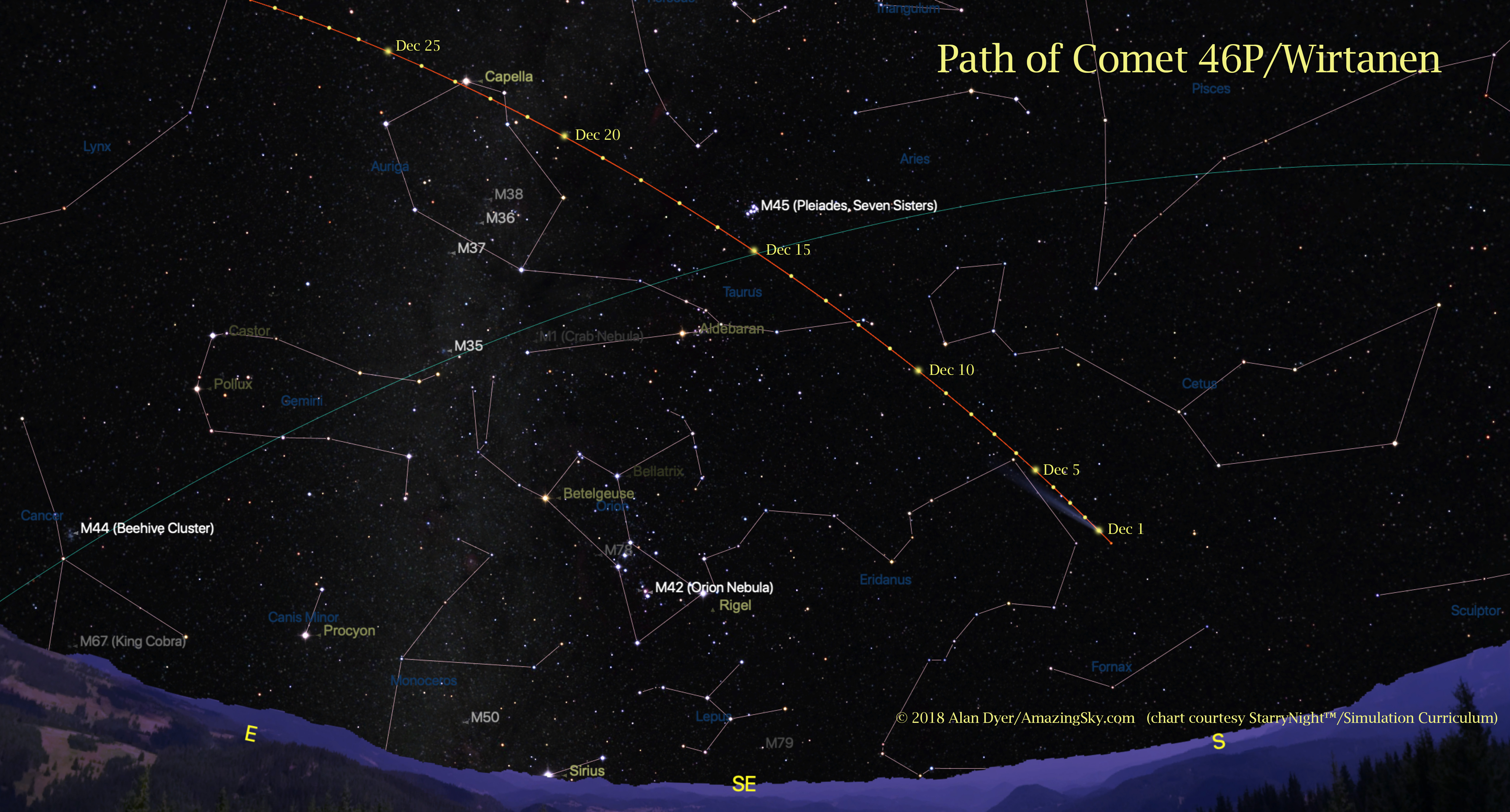
Comet Wirtanen Path
The path of Comet Wirtanen across the sky in December 2018. The yellow dots mark the position of the comet at nightly intervals for late evening (10 p.m.) for North America. While comet will be in the sky most of the night, it will be highest in late evening about 10 p.m. local time when the sky will look as depicted, with the comet high in the south to southeast. Click or tap to download a full-sized version.

The first two weeks of December will be prime time for Wirtanen, with a particularly good opportunity coming on the evenings of December 15 and 16 when it shines below the Pleiades star cluster. The gibbous Moon will set about 1 to 2 a.m. with the comet still high enough for a dark sky view and photos.

Those will be great nights to shoot the comet and the cluster with a telephoto lens, provided the camera is on a tracker for untrailed exposures of 1 to 4 minutes. A 135mm to 300mm lens will frame the pair well.

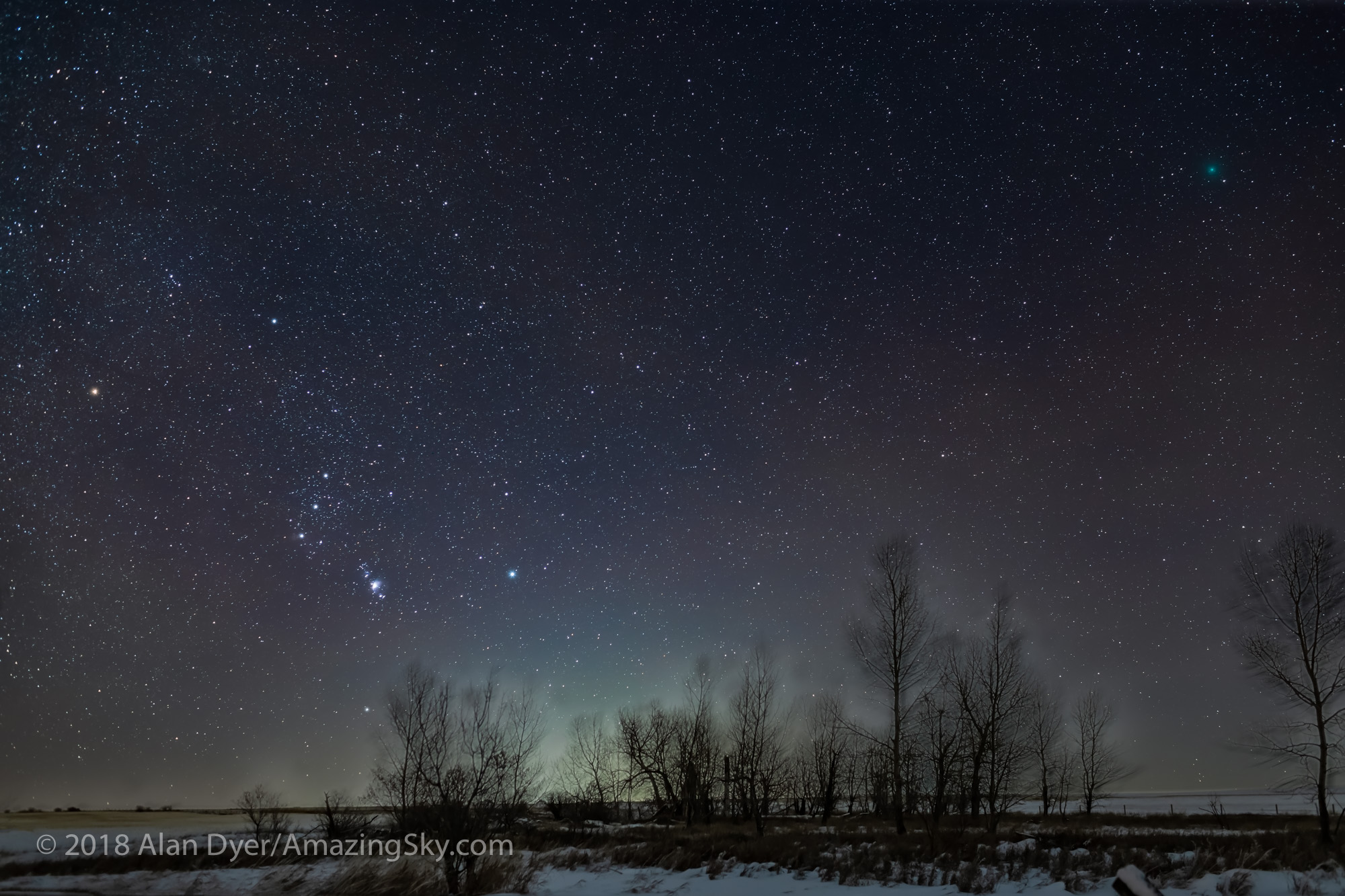
Winter Green Comet with Orion
Comet Wirtanen as a green glow at upper right here in Eridanus. and well to the west of Orion, rising here at left, on the evening of December 6, 2018. I shot this with a wide-angle 35mm lens in a blend of tracked and untracked 1-minute exposures.

After that, through late December, the bright Moon will interfere with ย the view. For example, a close approach of the comet near the star Capella on December 23 happens with the nearly Full Moon not far away.

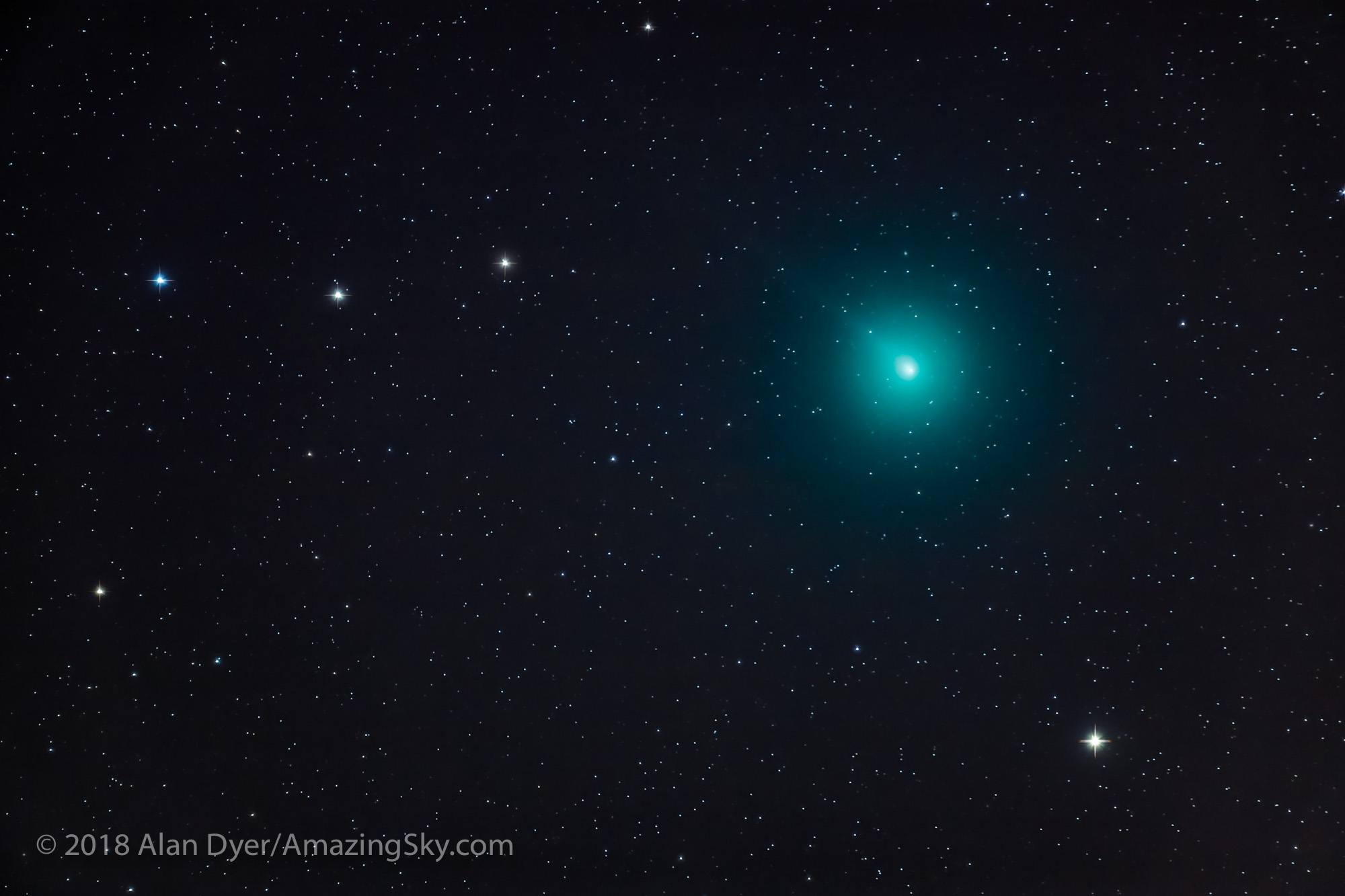
Comet Wirtanen / 46P on December 6, 2018
Comet Wirtanen in a close-up through a telescope on December 6, 2018 in a stack of short and long exposures.

I took the above close-up photo of Comet Wirtanen on December 6. It is a long-exposure telescopic view, but the comet is easy to see with binoculars. It appears visually and photographically as a diffuse fuzzball, with the camera recording a vivid cyan colour from glowing cyanogen and diatomic carbon molecules. You won’t see that colour with your eyes, even in a telescope.

Comet Wirtanen Path Dec 8 to 16
The path of Comet Wirtanen Dec 8 to 16 superimposed on an actual sky image with the comet taken December 8. The circle indicates the field of view of typical binoculars. On Dec 15 and 16 the comet will be in the same binocular field as the Pleiades star cluster. The positions are for about 10 pm Mountain Standard Time for each of those dates.

Even at the comet’s best in mid-December any tail might be hard to see and even photograph (it appears faintly above) as it will be both faint and pointed directly away from us because, as comet tails do, it will also be pointed away from the Sun.

Look for a large glow which will be grey to the eye but green to the camera.

While you can just take pictures for yourself, astronomers are asking amateur astrophotographers to participate in a worldwide observing campaign to monitor Comet Wirtanen. More details are available here atย wirtanen.astro.umd.eduย and at http://aop.astro.umd.edu/

Clear skies and happy comet hunting!

โ€” Alan, November 30, 2018 (Revised December 6) / ยฉ 2018 Alan Dyer / AmazingSky.comย 

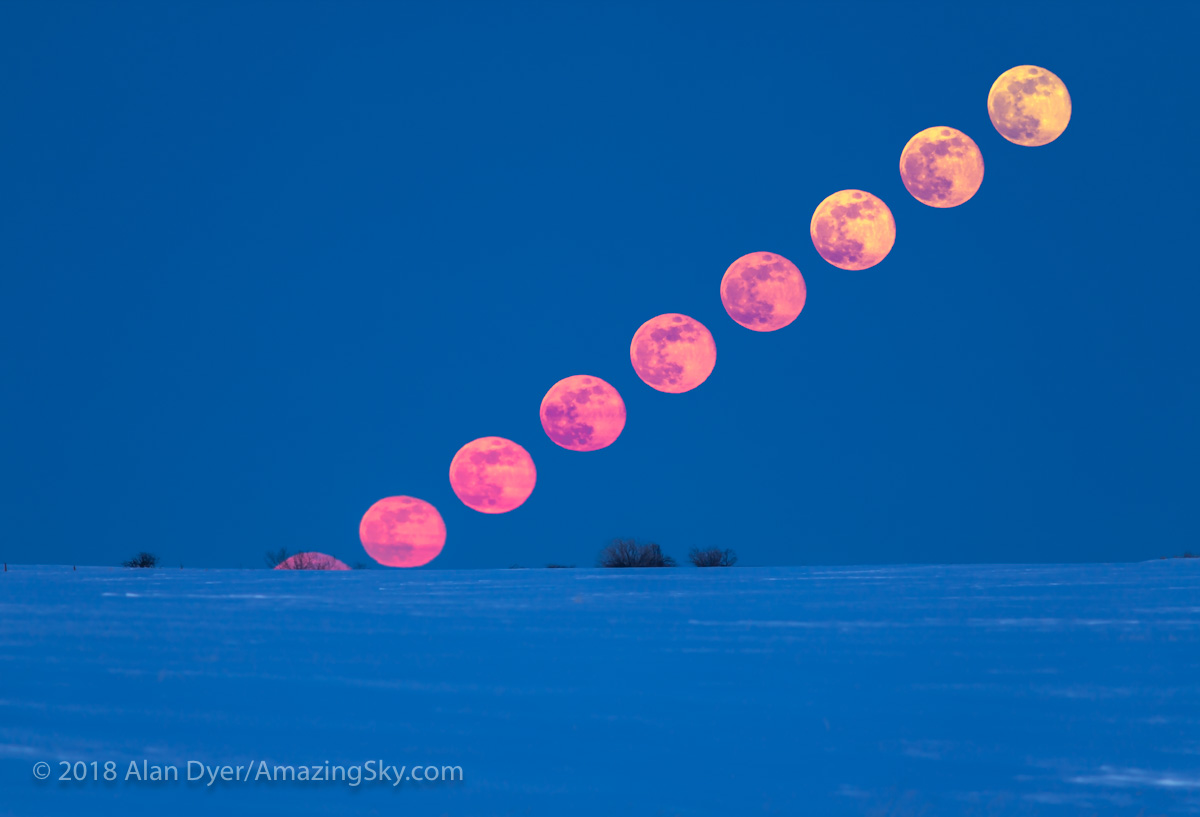
The Rise and Set of the Easter Full Moon


Rising Easter Full Moon (Composite)

A clear day on Easter Eve allowed me to photograph the setting Full Moon in the morning and the rising Full Moon in the evening.

This was another of the year’s special Full Moons, and this time for a valid historical reason.

This was the “paschal” Full Moon, the one used to determine the date of Easter. It was the first Full Moon after the vernal equinox. The first Sunday after that Full Moon is Easter. This year, the Moon was full about an hour before sunrise on the morning of Saturday, March 31. Easter was the next day, Sunday, April 1.

Below is the view of the Full Moon not long after it was officially Full, as it was setting into the west as the first rays of sunlight lit the foreground at dawn on March 31.

The Easter Full Moonset #1 (March 31, 2018)
The setting Full Moon on the morning of Saturday, March 31, 2018, the day before Easter. At this time, at about 7:20 a.m. MDT, the Moon was a little less than an hour after the moment of exact Full Moon, so the Sun had already risen before the Moon set. This was with the Canon 6D MkII and 200mm lens with 1.4x convertor, shot from home.

To be precise, the actual paschal Full Moon is a fictional or calculated Moon that occurs 14 days into the lunar cycle, and isn’t an observed Moon. But this year, we really did have a Full Moon just before Easter Sunday, and on the first day of Passover, from which we get the term “paschal.”

Later on March 31, after sunset, the Moon was now half a day past Full, causing it to rise a good half hour after sunset. However, the lighting and sky colour was still good enough to place a reddened Moon rising into a deep blue sky for a wonderful colour contrast.

This was also touted as a “blue Moon,” as it was the second Full Moon in March, and it was also the second blue Moon of 2018. (January had one, too.) But as you can see the Moon was hardly “blue!” It was a fine pink Moon.

Rising Easter Full Moon (Trail)
This is a stack of 424 exposueres, taken at 3-second intervals for a time-lapse, but here stacked with Lighten blend mode to create a moon trail streak. I used the Advanced Stacker Plus actions in Photoshop. The final Moon disk comes from the last image in the sequence, while the ground comes from the first image in the sequence. I shot this sequence from home, using a 200mm Canon lens and 1.4x convertor, on the Canon 6D MkII. Exposures ranged from 0.8 second to 1/15 second, all at ISO 100 and f/4.

The above image is a little fun with Photoshop, and stacks hundreds of images of the rising Moon to create a “Moon trail,” showing the change in colour of the Moon as it rose.

This short HD movie includes two versions of the full time-lapse sequence:

โ€ข One showing the Moon rising normally, though the sky and ground come from the first image in the sequence.

โ€ข The second is another bit of Photoshop fun, with the Moon leaving disks behind it as it rose.

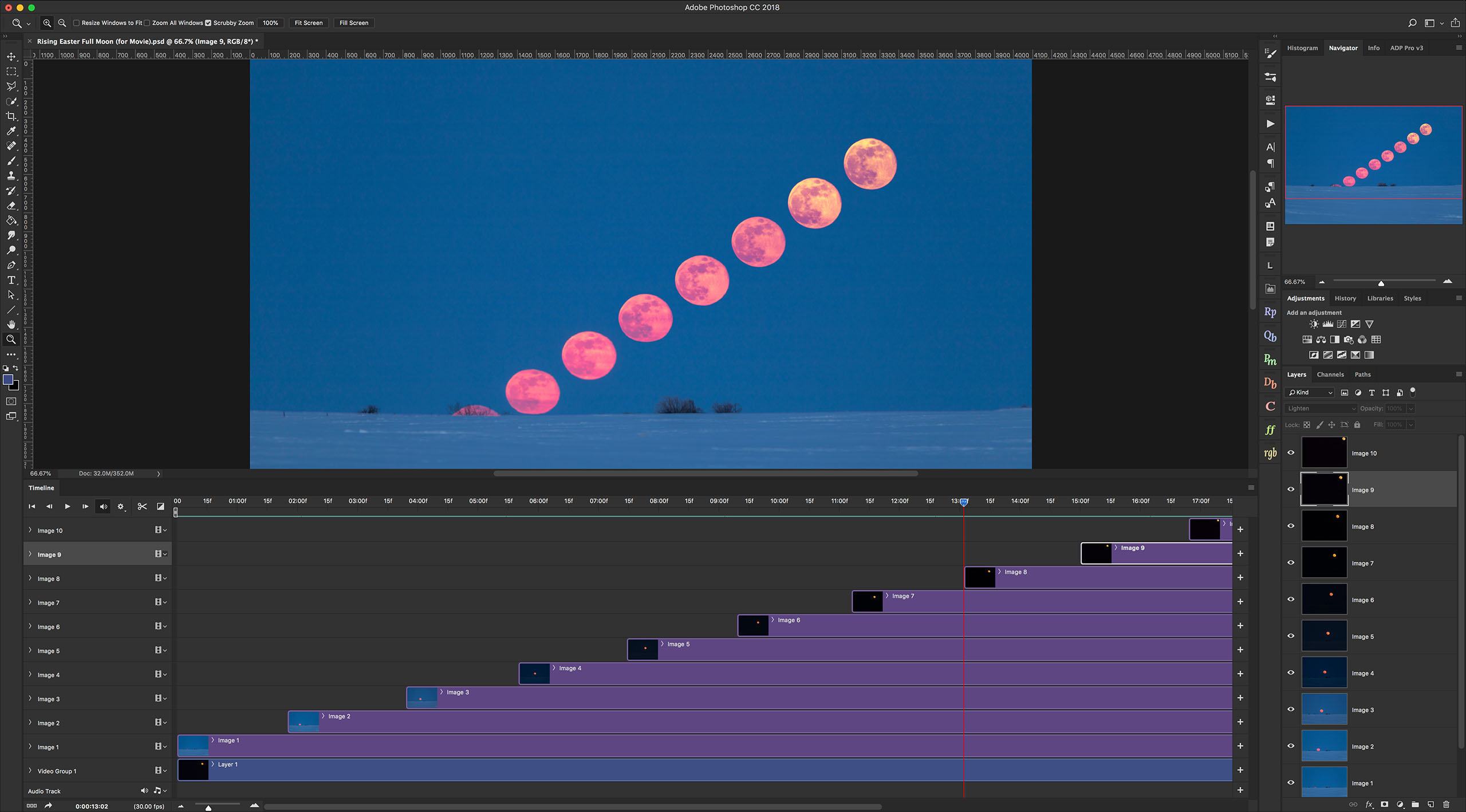
For the technically minded, I created both movies using Photoshop’s video editing capabilities to layer in various still images on top of the base video file. The stills are layered with a Lighten blend mode to superimpose them onto the background sky and video.

Rising Moon Movie Composite Screenshot
A screen shot of the Photoshop layers used to create the Moon disk composite time-lapse.

While Easter is a spring holiday, it hardly seems spring here in Alberta. The coldest Easter weekend in decades and lots of snow on the ground made this a winter scene.

With luck, spring will arrive here well before the next Full Moon.

โ€” Alan, April 3, 2018 / ยฉ 2918 Alan Dyer / amazingsky.comย 


Mercury, Moon, and Mirages


Rising and Distorted Supermoon on New Year's Day

Happy New Year to all! ย 

New Year’s Day proved to be a busy one for sky sights from home in southern Alberta.

Clear skies and warming temperatures allowed me to capture a trio of sights on January 1: Mercury in the morning, a unique mirage called the Fata Morgana in the afternoon, and the rising Full Moon in the evening.

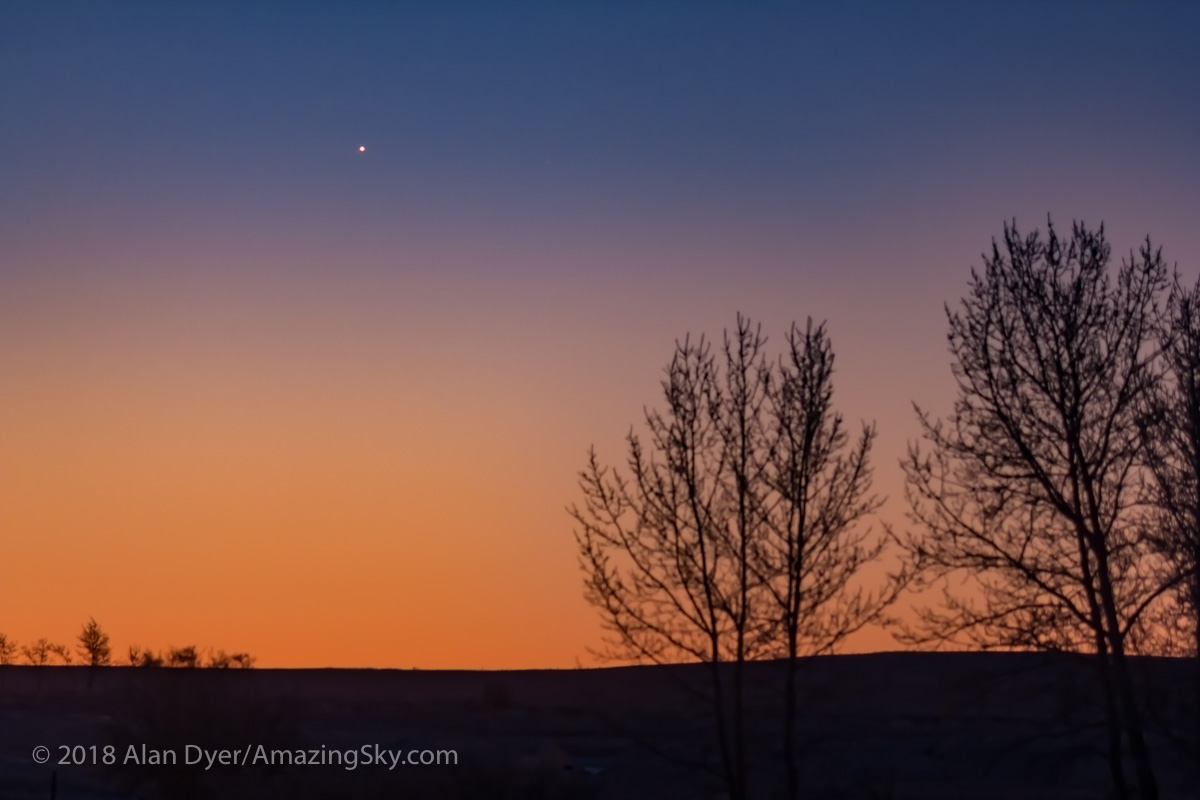
On January 1 elusive Mercury was at its greatest elongation away from the Sun in the morning sky. This placed it as high as it can get above the horizon, though that’s not high at all at the best of times.

Mercury in the Morning on New Year's Day
Mercury at dawn in the southeast sky.

I captured Mercury before dawn as a bright star in the colourful twilight, using a telephoto lens to frame the scene more closely.

At this time the temperature outside was still about -24ยฐ C, as a cold snap that had plunged the prairies into frigid air for the last week still held its grip.

But by the afternoon, warmer air was drifting in from the west, in a Chinook flow from the Rockies.

As evidence of the change, the air exhibited a form of mirage called the Fata Morgana, named after the sorceress Morgan le Fay of Arthurian legend. The illusion of castles in the air was thought to be a spell cast by her to lure sailors to their doom.

Fata Morgana Mirage on the Prairies
A Fata Morgana mirage on the Prairies

The mirage produced the illusion of bodies of water in the distance, plus distorted, elongated forms of wind turbines and farm buildings on the horizon. The cause is the refraction of light by layers of warm air aloft, above cold air near the ground.

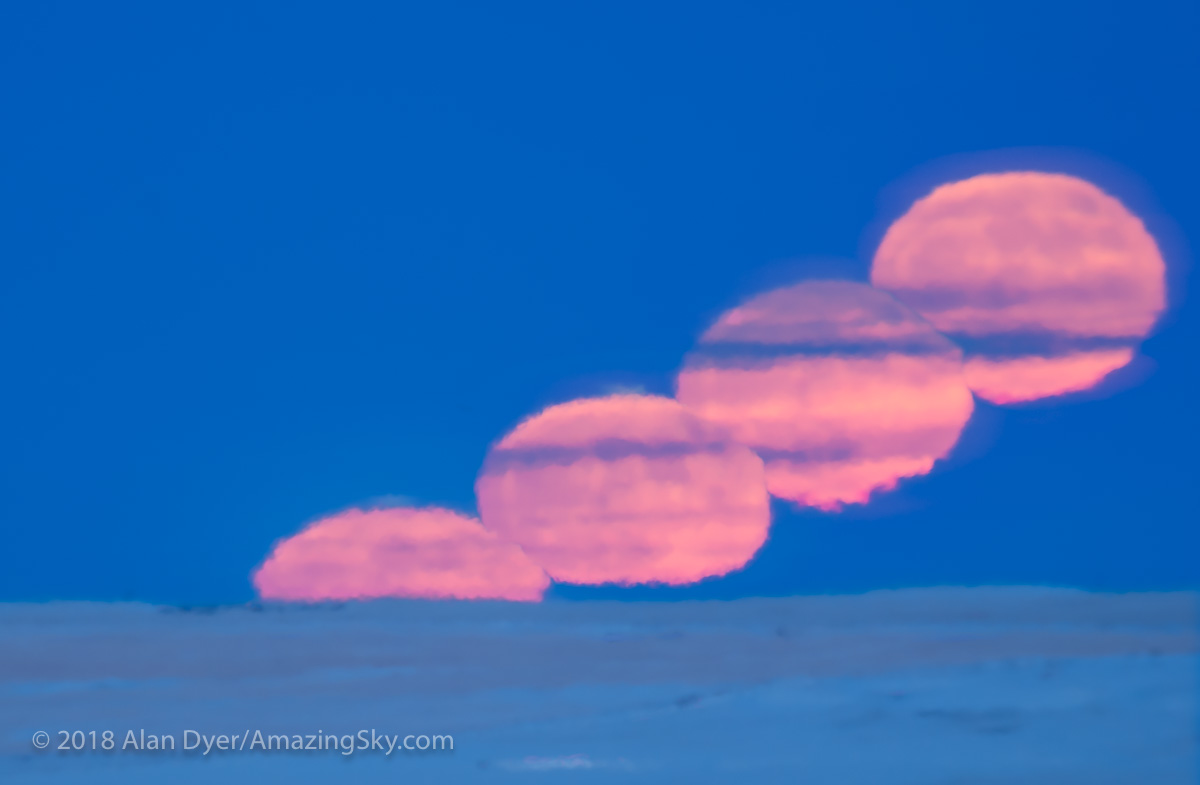
By evening the mirage effect was still in place, producing a wonderful moonrise with the Full Moon writhing and rippling as it rose through the temperature inversion.

As the lead image at top shows, at moments the top of the disk had a green rim (almost a distinct green flash), while the bottom was tinted red.

Here’s a short time-lapse video of the scene, shot through a small telescope. The lead image above and below is a composite of four of the frames from this movie.

Rising and Distorted Supermoon on New Year's Day
A composite of 4 exposures of the rising Full Moon on New Yearโ€™s Day, 2018, rising from left to right over a snowy prairie horizon in southern Alberta. This is a composite of 4 out of 500 images shot for a time-lapse sequence, layered in Photoshop. All were with a 66mm f/7 William Optics apo refractor and Canon 60Da camera firing 1/25th second exposures every 1 second.

This was also the largest and closest Full Moon of the year, what has become popularly called a “supermoon,” but more correctly called a perigean Full Moon.

A lunar cycle from now, at the next Full Moon, the Moon undergoes a total eclipse in the dawn hours of January 31 for western North America. This will be another misnamed Moon, a “blue Moon,” the label for the second Full Moon in a calendar month.

And some will also be calling it a “supermoon,” as it also occurs close to perigee โ€“ the closest point of the Moon to Earth in its monthly orbit โ€“ but not as close a perigee as it was at on January 1.

So it will be less than super, but it will nevertheless be spectacular as the Full “blue” Moon turns red as it travels through Earth’s shadow.

โ€” Alan, January 2, 2018 / ยฉ 2018 Alan Dyer / amazingsky.com


Dawn Sky Delights


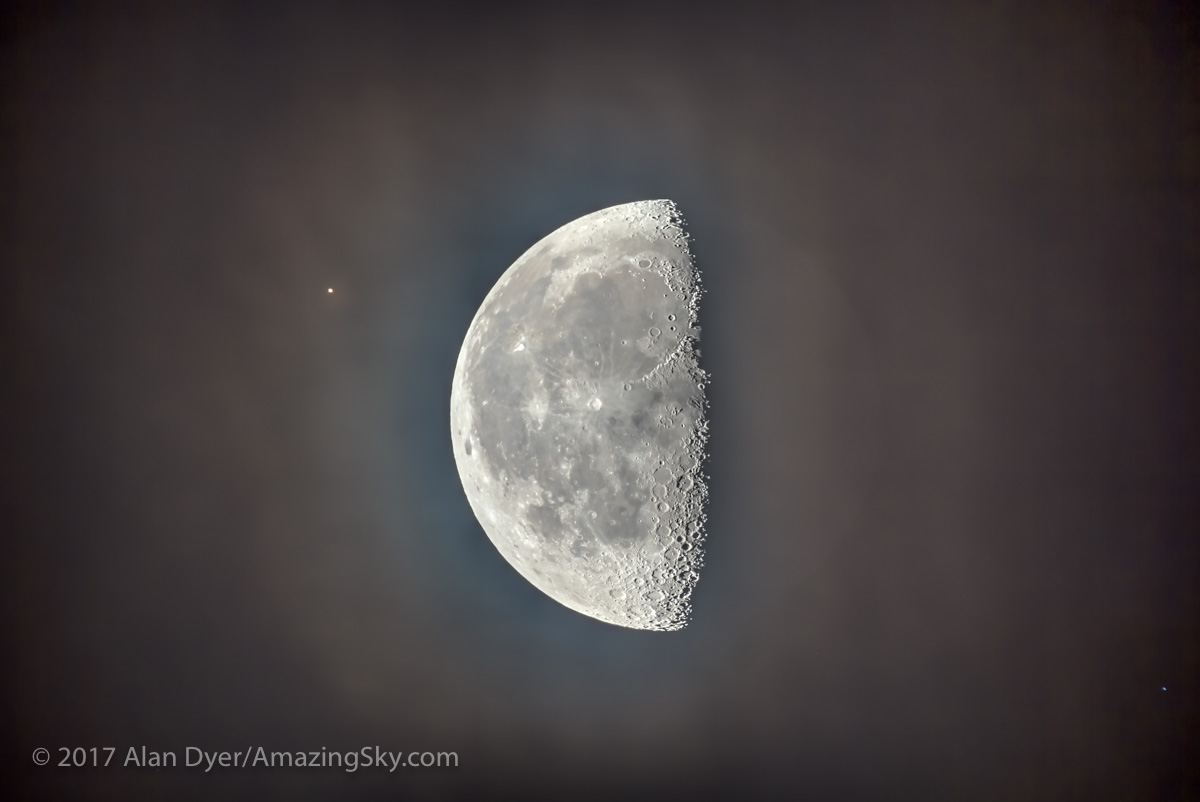
Aldebaran About to be Occulted by the Moon

It was one of those mornings when the sky was full of wonder.

After days and nights of smoke from unfortunate fires burning not far away, including in my favourite national park of Waterton Lakes, the sky cleared enough this morning, September 12, to reveal some fine sights.

At 6 a.m. the waning gibbous Moon passed in front of the star Aldebaran in Taurus. It is performing many such occultations of Aldebaran this year, but most aren’t well seen from any one location. This one was ideal, right from my backyard.

The lead image is a “high dynamic range” stack of several exposures showing the waning Moon and star set in some high haze adding the sky colours.

The star winked out behind the Moon’s bright limb as the Moon advanced from right to left (west to east) against the background sky.

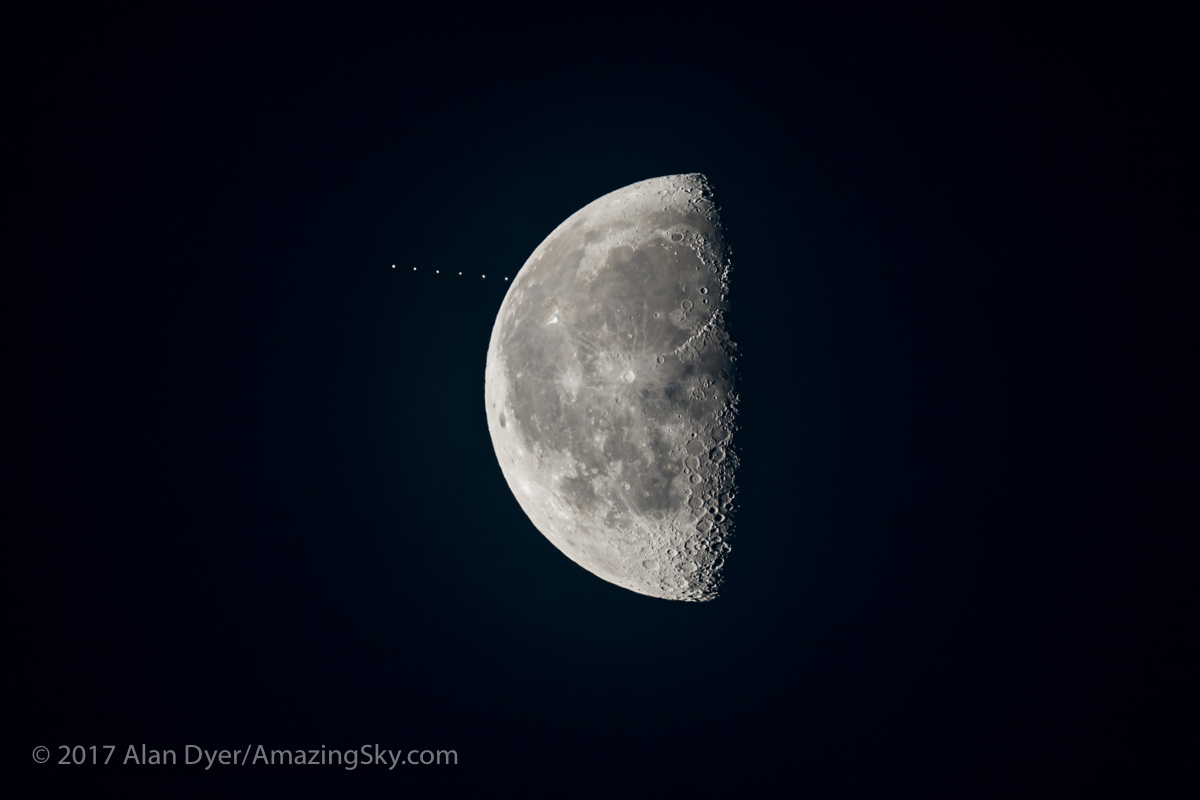
Occultation of Aldebaran
Aldebaran nearing the limb of the Moon.
This shows a composite sequence, with images of the star taken every four minutes blended with a single image of the Moon. While it looks like the star is moving, it is really the Moon that is edging closer to Aldebaran.

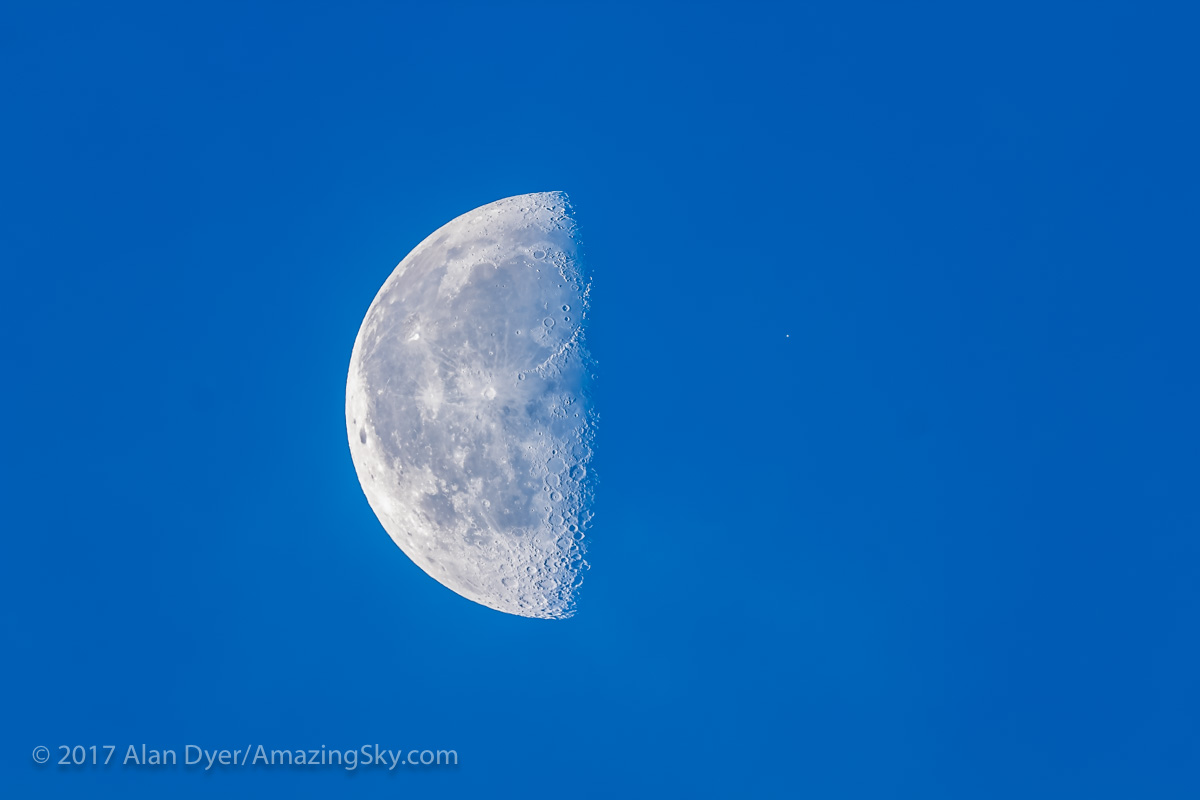
The star reappeared from behind the dark limb of the Moon, but five minutes after sunrise, with the Moon in a bright blue sky. Still, the star stood out nicely in binoculars and in the telescope for this view.

Aldebaran Near the Moon in Day Sky
Aldebaran off the dark limb of the Moon.
Aldebaran is the point of light at right, just off the invisible edge of the Moon.

I shot stills and video, and compiled them into this short video.

Enlarge it to full screen to view it properly.

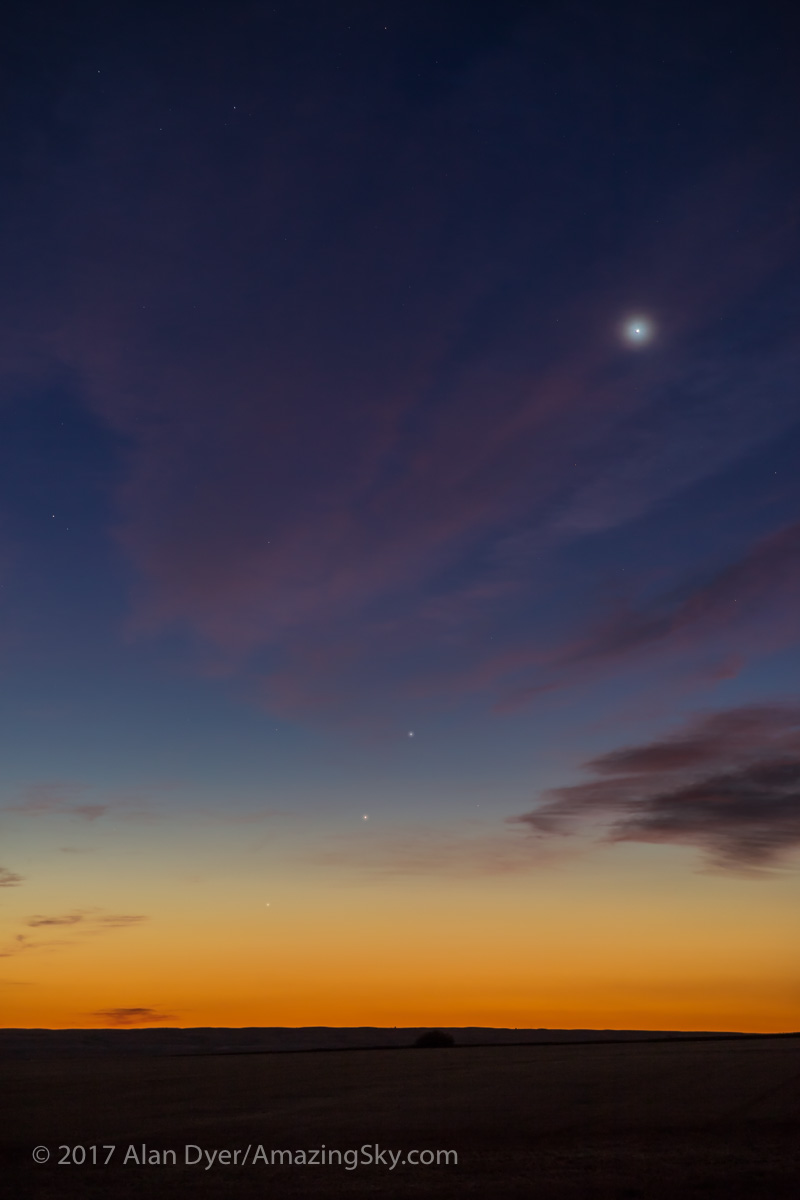
Meanwhile, over to the east the twilight sky was awash in planets.

Rocky Planets at Dawn with Labels (Sept. 12, 2017)
The line of dawn planets, with labels.
All the three inner terrestrial worlds were there: Venus, at top, Mercury below Regulus, and Mars lowest of the trio. Of course, a fourth terrestrial world is in the photo, too โ€“ Earth!

Mercury was at its greatest western elongation this morning, placing it as far from the Sun and as high in the sky as it gets, with this autumn appearance the best of 2017 for a morning showing for Mercury. Even so, you can see how Mercury is always low and easy to miss. However, this morning it was obvious to the naked eye.

Mars and Mercury will be in close conjunction at dawn on the morning of September 16.

Rocky Planets at Dawn (Sept. 12, 2017)

It was a fine morning to be up early and enjoy the solar system show.

โ€” Alan, September 12, 2017 / ยฉ 2017 Alan Dyer / amazingsky.com


The Moons of Lost Sleep


Waning Moon in the Morning Series (with Labels)

These are the Moons only insomniacs and night shift workers get to see. These are the waning Moons of morning.

For eight mornings I’ve been up at 4 a.m. each day to catch the early Moon and collect a series of images of its waning phases.

The result is above, a series that runs from right to left in time, from the 19-day-old waning gibbous Moon, to the 26-day-old thin crescent Moon.

I ordered them that way in the composite to reflect the direction the Moon moves across the sky. As it orbits Earth and wanes, the Moon moves from west to east, or right to left, in the sky from morning to morning, at least in the northern hemisphere.

A run of clear nights and mornings made the series possible. From Alberta, as dry as it is, too many cloudy nights make a consistent Moon phase series a challenge at best.

As it was I had to contend with smoke from forest fires in B.C. which reddened the Moon on the last few mornings, a tint I had to correct for the composite above. But here below, is what the Moon really looked like one morning.

Smoky Waning Crescent Moon
The smoky orange Moon of July 17.

The last two Moons, at 25 and 26 days old (i.e. the number of days since the previous New Moon phase) exhibited the phenomenon known as Earthshine. You can see the night side of the Moon glowing gently with sunlight reflected first off the Earth.

Waning Moon and Earthshine (July 20, 2017)
Earthshine on the 25-day old Moon on July 20 at dawn.

Below, this was the Moon this morning, July 21, with it very low in the east amid the twilight sky.

Waning 26-Day Moon with Earthshine
Earthshine on the thin 26-day old Moon on July 21 at dawn.

This final morning was exceptional. The smoke had cleared off, and when I got up at 4 a.m. (reluctantly!) for the last shoot I was greeted with the best display of noctilucent clouds I had seen in many years. They covered the northeast and eastern skies in a rare “grand display.”

Noctilucent Clouds at Dawn with the Moon and Venus
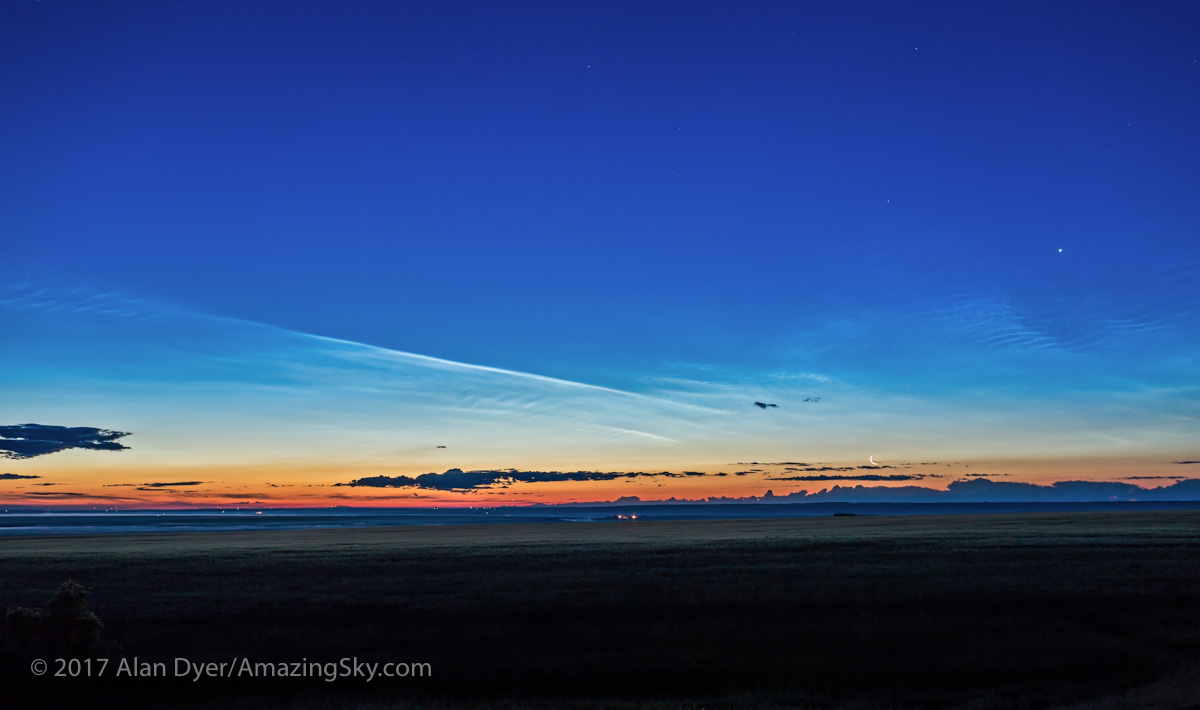
Noctilucent clouds with the Moon and Venus in the dawn sky, from southern Alberta, July 21, 2017.

The thin crescent Moon is just rising at right, with Venus bright as a “morning star” at far right. This was a sky certainly worth losing sleep over.

โ€” Alan, July 21, 2017 / ยฉ 2017 Alan Dyer / amazingsky.com


Rising of the “Strawberry” Moon


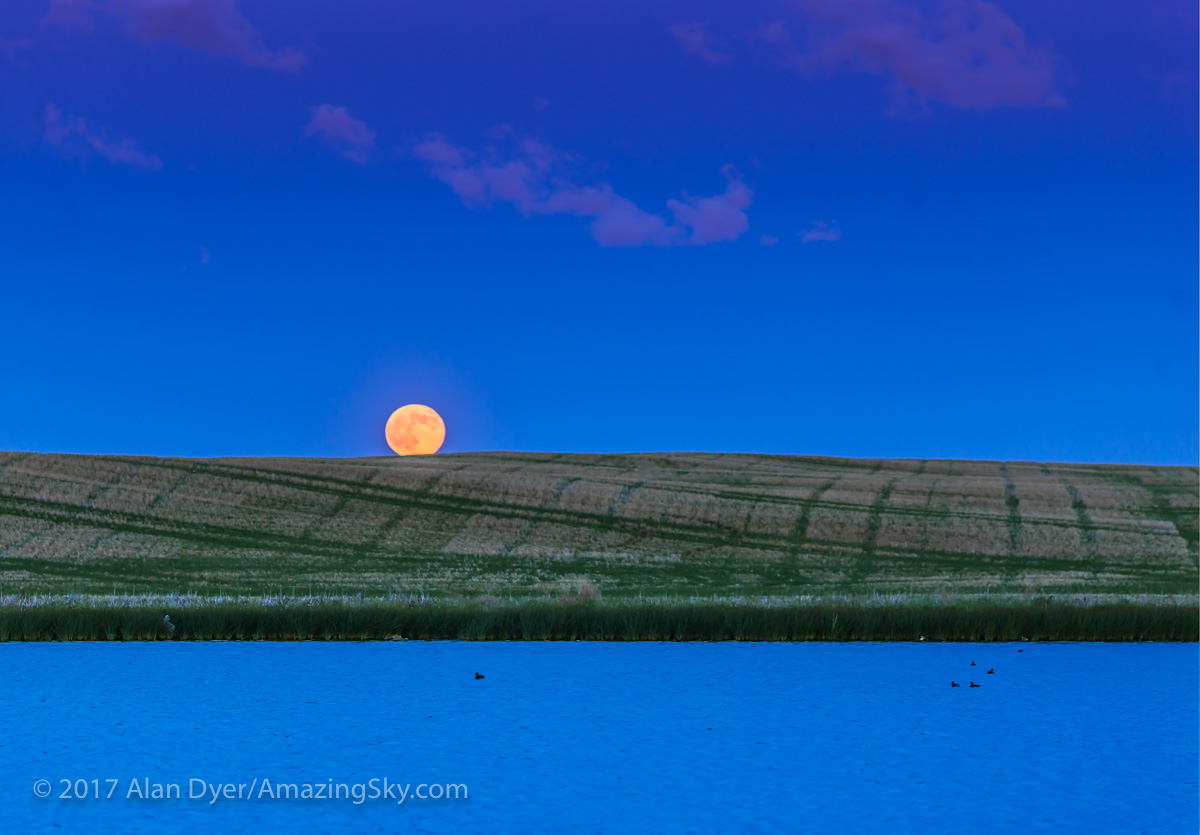
The Rising Strawberry Moon of June 9, 2017 (Composite)

The Full Moon of June rose into a twilight sky over a prairie pond. 

On June 9, the clouds cleared to present an ideal sky for capturing the rising of the so-called “Strawberry Moon,” the popular name for the Full Moon of June.

The lead image is a composite of 15 frames, taken at roughly 2.5-minute intervals and stacked in Photoshop with the Lighten blend mode.

The image below is a single frame.

The Rising Strawberry Moon of June 9, 2017
The rising Full Moon of June, dubbed the โ€œStrawberry Moonโ€ in the media, as seen rising over a prairie pond in southern Alberta, on June 9, 2017. This is a single exposure stack, from a time-lapse sequence of 1100 frames, with images taken at two second intervals. Shot with the Canon 6D and 200mm lens.
I set up beside a small local prairie pond, to shoot the moonrise over the water. Ducks enjoyed the view and a muskrat swam by at one point.

I shot over 1100 frames, at two-second intervals to create a time-lapse of the rising Moon, as it brightened and turned from yellow-orange (not quite strawberry pink) to a bright white.

Here’s the time-lapse vignette.

Click on HD for the best view.

While the Harvest Moon gets lots of PR, as this sequence shows any Full Moon can provide a fine sight, and look yellow, due to absorption of the blue wavelengths by the atmosphere as the Moon rises, or as it sets.

However, the timing can vary from Full Moon to Full Moon. This one was ideal, with it rising right at sunset. If the Moon comes up too late, the sky might have already darkened, producing too great a difference in brightness between the Moon and background sky to be photogenic.

But what of these Moon names? How authentic are they? 

Who called this the Strawberry Moon? Native Americans? No. Or at best only one or two nations. 

Check the site at Western Washington University at http://www.wwu.edu/depts/skywise/indianmoons.html and you’ll see there were an enormous number of names in use, assuming even this listing is authentic. 

The names like “Strawberry Moon” that are popularized in the media today come from the American Farmers Almanac, and everyone โ€“ science writers and bloggers โ€“ ends up copying and pasting the same wrong, or at best misleading, information from the Almanac. 

Search for “Strawberry Moon” or “Moon names” and you’ll find the same explanation repeated verbatim and unquestioned by many writers. Alas, the Almanac is not an authoritative source โ€“ after all, they were the source of a misleading definition of Blue Moon decades ago. 

Yes, people around the world may have long had names for months and moons, but they were not necessarily the ones that make the rounds of news sites and blogs today. Most are a modern media concoction. A few years ago, pre-internet, no one knew about nor used these names. 
โ€” Alan, June 10, 2017 / ยฉ 2017 Alan Dyer / www.amazingsky.com

The Austral Moon of Evening


Waxing Moon in Evening Twilight Colours

From the southern hemisphere the Moon appears “upside-down” and higher each night in the northern sky as it waxes from crescent to Full.

These are scenes from the last week as the Moon rose higher into the evening sky as seen from Australia.

A northerner familiar with the sky would look at these and think these are images of the waning Moon at dawn in the eastern sky.

Waxing Crescent Moon at Cape Conran
The โ€œupside-downโ€ waxing crescent Moon in the evening sky from Victoria, Australia, at Cape Conran, West Cape area, on the Gippsland Coast, at latitude 37ยฐ South. Earthshine lights the dark side of the Moon. This was March 31, 2017. The Moon lights a glitter path on the water. This is a single 1.3-second exposure at f/2 with the 85mm Rokinon lens, and Canon 5D MkII at ISO 400.

But no, these are of the waxing Moon (the phases from New to Full) with the Moon in the evening sky.

From the southern hemisphere the ecliptic โ€“ the path of the planets โ€“ and the path of the Moon arcs across the northern sky. So as the Moon waxes from New to Full phase it appears to the right of the Sun, which still sets in the west. The world still spins the same way down under!

So the Moon appears upside down and with the crescent phase the “wrong” way for us northerners.

Panorama of the Waxing Moon at Sunset at Welshpool Harbour
A 240ยฐ panorama from 16 segments.

This panorama taken April 4 sweepsย from northwest to southeast, but looksย north at centre, to captureย the scene at sunset of the waxing 8-day gibbous Moon in the northern sky as seen from the southern hemisphere.

The angle between the Sun and Moon is just over 90ยฐ, shown here by the angle between the right-angle arms of the wharf, pointedย to the west at left, to the north at centre, and to the east at right.

The Sun has set just north of west, while the Moon sits 13ยฐ east of due north. The Earthโ€™s shadow rises as the blue arc at far right to the east opposite the Sun.

Philip Island Sunset and Waxing Moon Panorama
A 240ยฐ panorama from 15 segments.

The next night, April 5, I shot this panorama from Philip Island south of Melbourne. Again, it shows the waxing gibbous Moon in the north far to the right of the setting Sun in the west (at left).

Getting used to the motion of the Sun and Moon across the northern sky, and the Moon appearing on the other side of the Sun than we are used to, is one of the challenges of getting to know the southern sky.

Things just don’t appear where nor move as you expect them to. But that’s one of the great delights of southern star gazing.

โ€” Alan, April 8, 2017 / ยฉ 2017 Alan Dyer / www.amazingsky.com


The Ghostly Glow of Gegenschein


Northern Spring Sky Panorama

It takes a dark spring night to see it well, but now lurking near Jupiter is a ghostly sky glow called Gegenschein.ย 

This diffuse glow lies directly opposite the Sun. It is caused by sunlight reflecting off interplanetary dust particles in the outer solar system. They reflect light more effectively at the anti-Sun point where each dust particle is fully lit by the Sun.

Like the Sun, the Gegenschein moves around the sky along the ecliptic, moving about a degree from west to east from night to night.ย March andย April provideย good nights for seeing the Gegenschein as it then lies in an area of sky far from the Milky Way.

Even so, it is very subtle to the unaided eye. Look south at about 1 a.m. local daylight time.

However, this year, in early April the Gegenschein will be more difficult as it will then lie right on top of Jupiter, as that planet reaches its point opposite the Sun on April 7. Jupiter will then be superimposed on the Gegenschein.

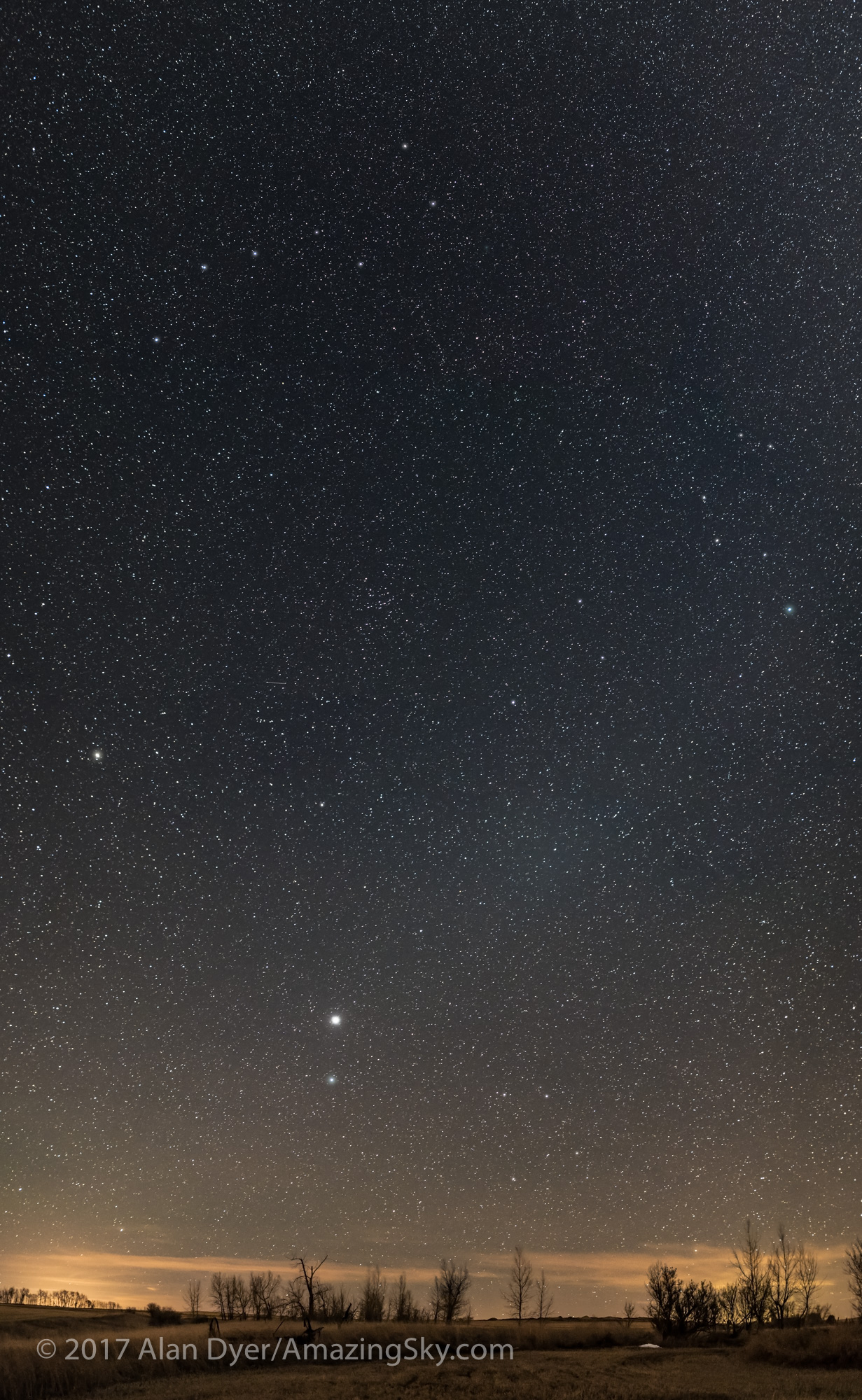
The main image at top is a 7-image vertical panorama of the spring sky, from Corvus and Virgo above the horizon, up past Leo, into Ursa Major and the Big Dipper overhead. Spica lies below bright Jupiter, Arcturus in Bรถotes is at left, while Regulus in Leo is at right. The grouping of stars near centre is the Coma Berenices star cluster.

Orion over the Old Barn

Earlier in the night, I shot the sky’s other main glow โ€“ the Milky Way, as the winter portion of the Milky Way around Orion set into the southwest.

But over in the west, at the right edge of the frame, is the Zodiacal Light, caused by the same dust particles that create the Gegenschein, but that are located in the inner solar system between us and the Sun.

The Zodiacal Light is better depicted in images in my previous post from Dinosaur Park.ย 

We bid adieu to the winter Milky Way now. As it departs we are left with an evening sky without the Milky Way visible at all. As seen from northern latitudes it lies along the horizon.

But later in spring, late at night, we’ll see the summer Milky Way rising, beginning its seasons of prominence until late autumn.

โ€” Alan, March 19, 2017 / ยฉ 2017 Alan Dyer / AmazingSky.comย 


End of Year Skies


New Moon for a New Year

The crescent Moon rises into theย westernย evening sky as 2016 ends, while Venus shines bright, and Orion rises into the east.

Getting clear skies is a rare treat of late, but these are images from two such nights this week. On December 30, the thin waxing Moon appeared in the colourful twilight of a winter night. Despite the clouds and the Moon’s low altitude, the dark side of the Moon is plainly visible illuminated by Earthshine.

Venus in Twilight over Pioneer Grain Elevators

Venus is now brilliantย as an evening star in the southwest. Here is it over the old wood grain elevators at Mossleigh, Alberta, some of the few of these landmarks left standing on the prairies.

Fainter Mars shines above Venus and over the month of January, Venus will climb up to meet Mars by month’s end for a fine conjunction with the crescent Moon as well. Watch through January as Venus and Mars converge.

Orion and Pioneer Grain Elevators

As the planets set into the southwest, Orion the Hunter rises into the east. Here it is over the Mossleigh elevators, illuminated by local lights.

Enjoy the winter skies as clouds permit!

Clear skies and Happy New Year!

โ€” Alan, December 31, 2016 / ยฉ 2016 Alan Dyer / www.amazingsky.com


Moon and Star Conjunction


Moon and Aldebaran (July 29, 2016)

The waning Moon shone near the bright star Aldebaran in the dawn sky.

This was a beautiful sight this morning, before dawn on July 29. The crescent Moon, its night side illuminated by Earthshine, shone just below the brightest star in Taurus.

We are currently in 3-year period when the Moon’s path is taking it near or in front of Aldebaran every month. However, most of these occultations or conjunctions are not well-timed for any particular location. And many involve the too-brilliant gibbous or full Moon.

But this morning the timing and Moon phase were perfect. From my longitude on Earth in Alberta, the Moon passed closest to the star just before the sky was getting too bright with dawn. Having them set against the deep blue twilight was perfect.

From farther east the Moon would not have appeared as close to Aldebaran as this before sunrise. From farther west the Moon and star would have appeared much lower in the sky at closest approach.

Moon & Aldebaran Screen

TECHNICAL:

For this image I shot 6 exposures, from 2 seconds for the Earthshine, twilight sky colour and stars, to 1/125th second for the bright crescent. I then stacked, aligned, and blended them together using luminosity masks โ€“ masks that hide or reveal parts of the image based on the brightness of the scene. You can see them in the Photoshop screen shot – Click on the image to enlarge it.

How do you create these masks?

โ€ข Turn off all the layers except the one you want to create a mask for.

โ€ข Go to Channels and Command/Control Click on the RGB Channel.

โ€ข That automatically selects all the highlights.

โ€ข Go back to the image layer and then hit the Add Mask button down at the bottom of the Layers panel (the rectangle with the black dot in it).

โ€ข Done. Repeat that for each image layer.

More traditional high dynamic range or “HDR” stacking left odd colour fringing artifacts and double images on the slowly moving Moon, despite applying what is called “de-ghosting” and despite using a mount tracking at the lunar rate. I tried merging the images withย HDR, but it didn’t work.

A nifty Photoshop action from the Astronomy Tools set by Noel Carboni added the diffraction spikes.

I shot all images with the 130mm Astro-Physics refractor at f/6 and the Canon 60Da camera at ISO 400.

โ€” Alan, July 29, 2016 / ยฉ 2016 Alan Dyer / www.amazingsky.com

Mars and the Milky Way at Emerald Lake


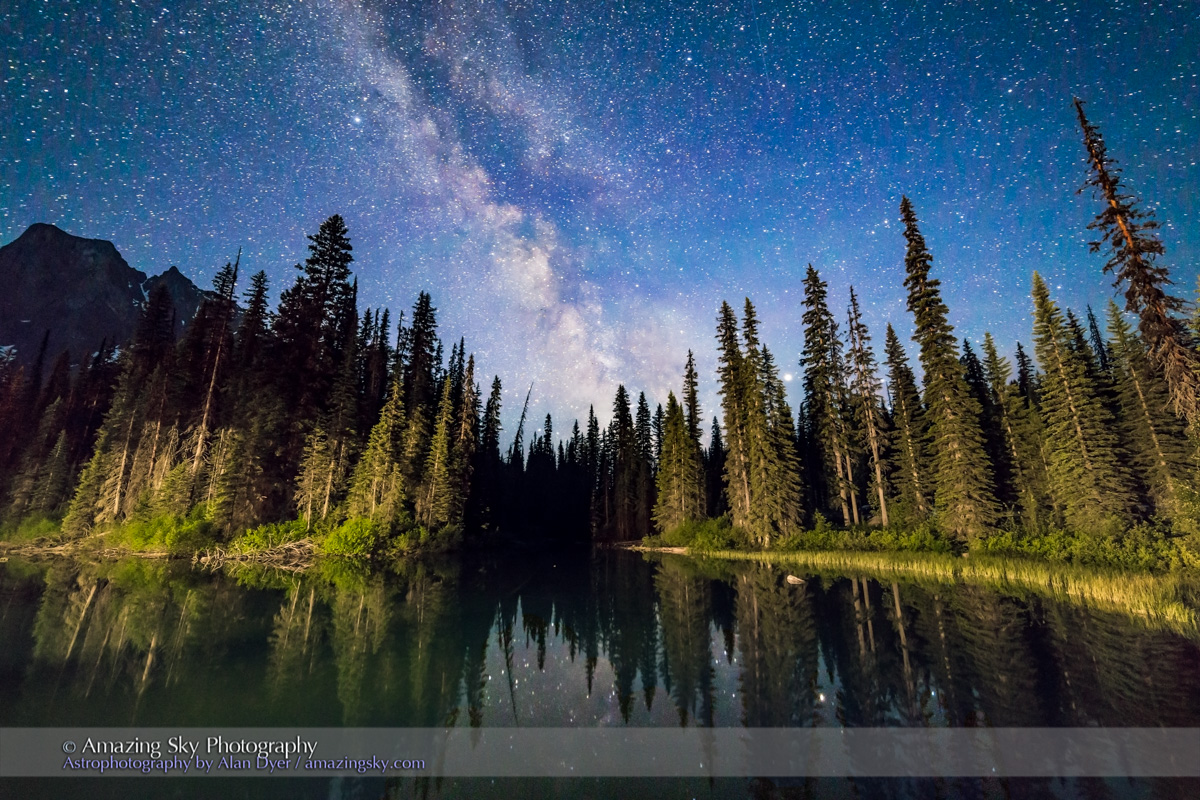
The Milky Way over Emerald Lake, Yoho

The nights were short and never fully dark, but early June provided a run of clear nights in the Rockies to enjoy Mars and the Milky Way.

Weather prospects looked good for a run of five nights last week so I took advantage of the opportunity to shoot nightscapes from Banff and, as shown here, in Yoho National Park across the Continental Divide in B.C.

The lead image above is a sweeping panorama at Emerald Lake, one of the jewels of the Rockies. Though taken at 1:30 a.m., the sky still isn’t dark, but has a glow to the north that lasts all night near summer solstice. Even so, the sky was dark enough to reveal the Milky Way arching across the sky.

The mountain at centre is Mt. Burgess, home of the famous Burgess Shale Fossils, an incredible collection of fossilized creatures from the Cambrian explosion.

The image is a panoramic stitch ofย 24 segments but cropped in quite a bit from the original, and all shot with an iPano motorized panning unit. Each exposure was 30 seconds at f/2.2 with the Sigma 24mm lens and Nikon D750 at ISO 4000. One short exposure of the lodge was blended in to reduce its light glare. The original, stitched withย PTGui software, is 15,000 x 9,000 pixels.

The Milky Way at Emerald Lake, Yoho
The Milky Way over the side pond at Emerald Lake, Yoho National Park, BC., from the bridge to the Lodge. This is a stack of 8 x 25-second exposures for the foreground (mean combined to smooth noise), and one untracked exposure for the sky (to minimize trailing), all at f/2.8 with the Rokinon 14mm lens and Canon 6D at ISO 6400.

The viewย above, a single frame image, shows the view to the south as the Milky Way and galactic centre descend toward the horizon over the south end of the lake. Lights from the Lodge illuminate the trees.

Reflections of Mars at Emerald Lake
Mars, at right, reflected in Emerald Lake at twilight in Yoho National Park, BC, June 7, 2016. This is a single 6-second exposure at f/3.2 with the Sigma 20mm lens and Nikon D750 at ISO 100.

The next night (above) I was at the same spot to shoot Mars in the deepening twilight, and reflected in the calm waters of Emerald Lake, with Cathedral Peak at left.

Reflections of Cassiopeia at Emerald Lake
This is a vertical panorama of 4 segments, taken with the iPano unit, and with each segment a 30-second exposure at f/2.2 with the Sigma 24mm Art lens and Nikon D750 at ISO 4000. Stitched with Adobe Camera Raw.

Another multi-frame panorama, this time sweeping up from the horizon, captures Cassiopeia (the “W”) and the rising autumn constellations reflected in the lake waters.

Vega is at top, Deneb below it, while the stars of Perseus and Pegasus are just rising.

It was a magical two nights in Yoho, a name that means “wonderful!” Both by day and by night.

โ€” Alan, June 9, 2016 / ยฉ 2016 Alan Dyer / AmazingSky.com


Mars Bright in the Spring Sky


Spring Sky over the Badlands Panorama

Mars is now shining brightly in the evening sky, as close and as bright as it has been since 2005.

Look southeast to south after dark and you’ll see a brilliant reddishย “star.” That’s Mars, now at opposition, and retrogradingย slowly westward each night through Scorpius into Libra.

My image above captures Mars set in the entirety of the northern spring sky, complete with the arch of the Milky Way, twilight glows to the north (at left), some satellite trails …

… and Mars itself as the brightest objectย just right of centre shining above the landscape of Dinosaur Provincial Park.

Just to the left of Mars is Saturn, while below both is the star Antares in Scorpius, for a neat triangle of objects. Jupiter is the bright object in Leo at far right.

Technical: I shot the lead imageย on the evening of May 25. It is aย 360ยฐ and horizon-to-zenith panorama stitchedย from 44 images, taken in 4 tiers of 11 panelsย each, shot with aย motorized iOptron iPano mount. I used aย 35mm Canon lens at f/2.8 for 30-second exposures with the Canon 6D at ISO 6400. Iย stitched the images with PTGui. The original image is a monster 32,500 pixels wide by 8,300 pixels high.

Mars at Opposition Rising over the Badlands
This is a stitch in Adobe Camera Raw of 9 segments, each with the Canon 35mm lens at f/5.6 and Canon 6D at ISO 800.

I shot the panorama above earlier in the evening, when Mars and Saturn were just rising in the southeast at left, and the sky to the northwest at right was still bright with twilight.

This shows the geometry of Mars at opposition. It lies opposite the Sun and is so rising at sunset and directly opposite the sunset point. The Sun, Earth and Mars are in a straight line across the solar system with Earth in the middle and as close to Mars as we get.

Actual date of opposition was May 22 but Earth is closest to Mars on May 30. That’s when it will look largest in a telescope. But to the unaided eye it appears as a bright red star.

Whether with eye or telescope, have a look!

โ€” Alan, May 27 / ยฉ 2016 Alan Dyer / www.amazingsky.comย 

Mars in the Moonlight


Mars in the Badlands

Mars is approaching! It now shines brightly in the midnight sky as a red star in Scorpius.

You can’t miss Mars now. It is shining brighter than it has since 2005, and is about to come as close to Earth as it has in 11 years as well.

Mars is now approaching opposition, when the Earth comes closest to Mars, and the Sun, Earth and Mars lie along the same line. Opposition date is May 22. That’s when Mars shines at its brightest, at magnitude -2.1, about as bright as Jupiter. Only Venus can be a brighter planet and it’s not in our sky right now.

A week later, on May 30, Mars comes closest to Earth, at a distance of 75 million kilometres. That’s when the disk of Mars looks largest in a telescope. Andย you will need a telescope at high power (150x to 250x) to make out the dark markings, north polar cap, and bright white clouds on Mars.ย 

Mars in the Moonlight (May 13, 2016)
Mars above Antares, with Saturn to the left, low in the south on May 13, 2016, in the moonlight of a waxing quarter Moon, from home in Alberta. This was one week before opposition and two weeks before closest approach, so Mars is particularly bright and red. However, from my latitude of 50ยฐ N Mars appears low in the south. This is a single 15-second exposure, untracked, at f/2.5 with the 35mm lens and Canon 6D at ISO 2000.

In these views, I show Mars shining as a bright reddish star low in my western Canadian sky. I shot the lead image from Dinosaur Provincial Park on May 16. The image just above was from my backyard the night before.

This week, Mars is passing between Beta and Deltaย Scorpii, two bright stars in the head of Scorpius,ย as the red planet retrogrades westward against the background stars.

Saturn shines to the east (left) of Mars now, with both planets shining above the red giant star Antares in Scorpius. In these photos they form a neat triangle.

Even without a telescope to magnify the view, it’ll be rewarding to watch Mars with the unaided eye or binoculars as it treks west out ofย Scorpius into Libra this spring and summer. It stops retrograding on June 30, then starts looping back into Scorpius, for a rendezvous with Antares and Saturn in late August.

This little compilation of time-lapse movies shows Mars, Saturn, and the rest of the sky, rising into the southeast and across the south on two nights this past week.

Be sure to explore Mars this month and next, whether by eye or by telescope. It’s the best we’ve seen it in a decade.

It’s next close approach in 2018 will be even better, though Mars will appear even lower in our northern sky.

โ€“ Alan, May 17 / ยฉ 2016 Alan Dyer / amazingsky.comย 


Moon of the Austral Sky


Sunset and Waxing Moon over AAT Dome

When visiting southern latitudes nothing disorients a northern hemisphere astronomer more than seeing our familiar Moon turned โ€œthe wrong way!โ€

With the Moon now dominating the night sky, my photo attention in Australia turns to it as my celestial subject.

Itโ€™s wonderful to see the Moon as a crescent phase in the evening sky, but now flipped around so it looks like the Moon we see from home upย north when it is a waning crescent in the morning.

However,ย the lead image above actually shows the waxing crescent in the evening. It shines above the volcanic hills near Warrumbungles National Park, with the added silhouette of the dome of the Australian Astronomical Telescope, the largest optical telescope in Australia.

After a lifetime of seeing the Moon in its northerly orientation, seeing the austral Moon throws off your sense of time and direction. Are we looking west in the evening? Or east in the morning? The Moon just doesnโ€™t make sense!

Full Moon with Glitter Path
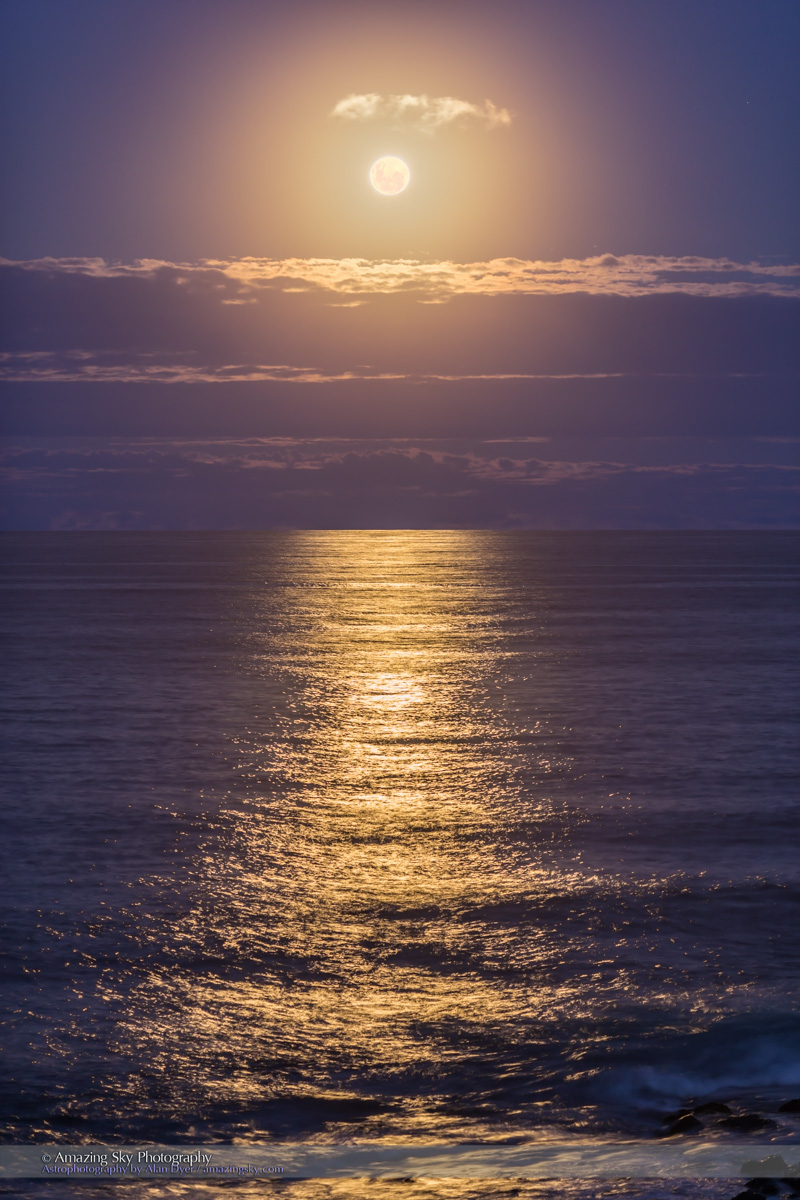
This is a two-exposure composite: a long exposure for the sky and ocean, and a short exposure for the disk of the Moon itself, to preserve some detail in the disk, specifically the mare areas to show the face of the Moon and not an overexposed white disk. Both with the 135mm telephoto and Canon 6D, from Woolgoolga, NSW.

Then thereโ€™s the Full Moon. It rises in the east, as does the Sun. But like the Sun, the “down under Moon”ย moves from right to left across the northern, not southern sky. And the familiar โ€œMan in the Moonโ€ figure is upside down, as seen above.

The photo above is from Friday night, and shows the Full Moon rising in the northeast over the Pacific Ocean.

Golden Glitter Path of the Moon
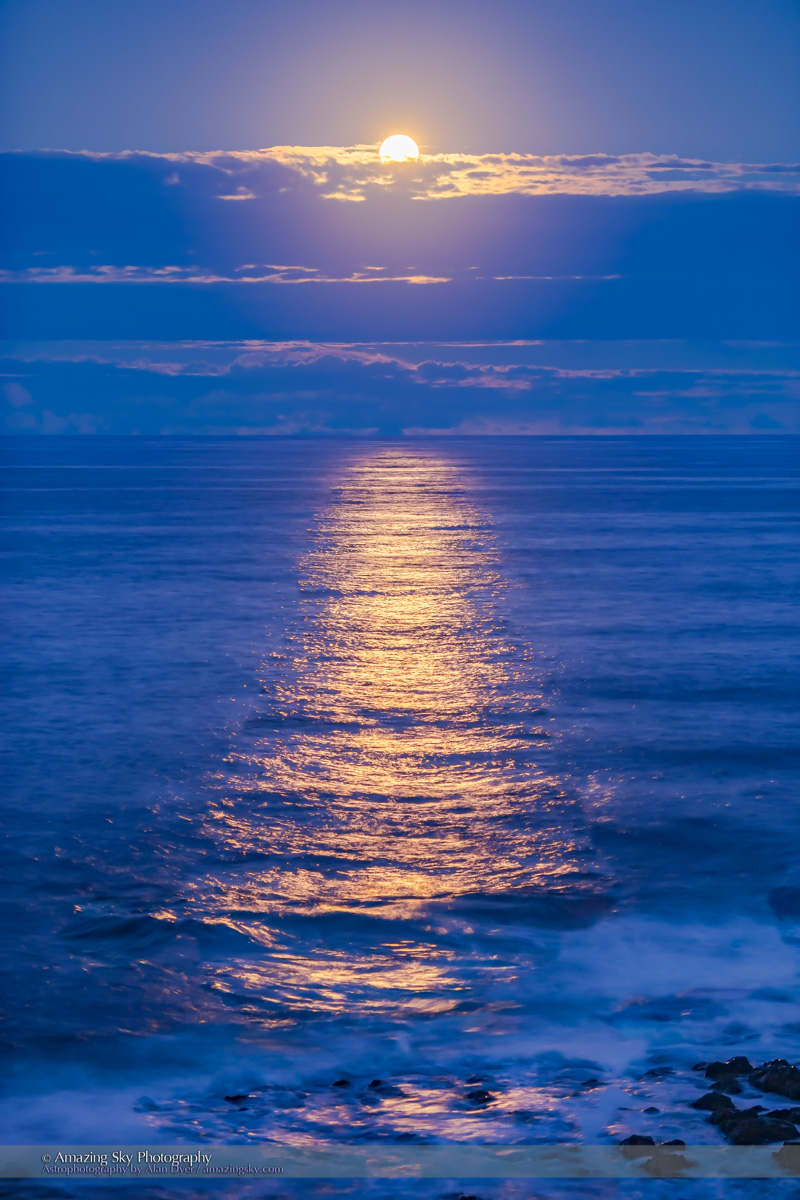
The apogee Full Moon of April 22, 2016 rising over the Pacific Ocean and lighting the waters with a golden glitter path of reflected moonlight. I shot this from the Woolgoolga Headlands viewpoint, with the 135mm telephoto and Canon 6D. This is a high dynamic range stack of 5 exposures to compress the range in brightness. Even so, the Moon itself is still overexposed.

This “HDR”ย image above from earlier in the evening captures the golden glitter path of moonlight on the ocean waves. I photographed these Full Moon scenes from the Headlands viewpoint at Woolgoolga, a great spot for panoramic seascapes.

The Full Moon this night was the apogee Full Moon of 2016 โ€“ the smallest and most distant Full Moon of the year, the opposite of a “supermoon.”

Gibbous Moon Over Upper Ebor Falls
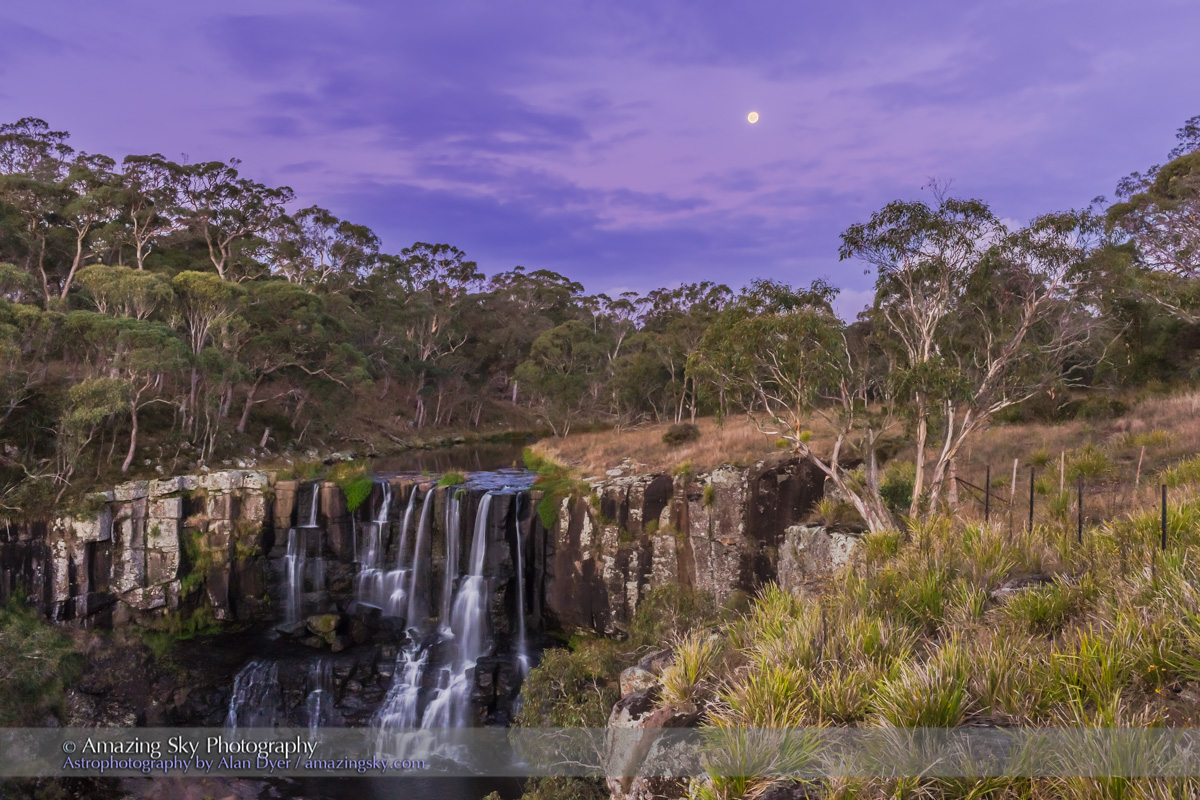
This is a high dynamic range stack of 7 exposures to preserve the range in brightness between the bright sky and Moon, and the dark ground in the dim twilight.

Earlier in the week I was inland, high on the New England Tablelands in New South Wales. This image shows the waxing gibbous Moon in the evening twilight over Ebor Falls on the Guy Fawkes River, one of the few waterfalls on the famed Waterfall Way in New Soith Wales that has water flowing year round.

โ€” Alan, April 24, 2016 / ยฉ 2016 Alan Dyer / www.amazingsky.com


Red Rivals in Scorpius


Red Rivals in Scorpius

Mars outshines his rival red star Antares in the heart of the Scorpion.

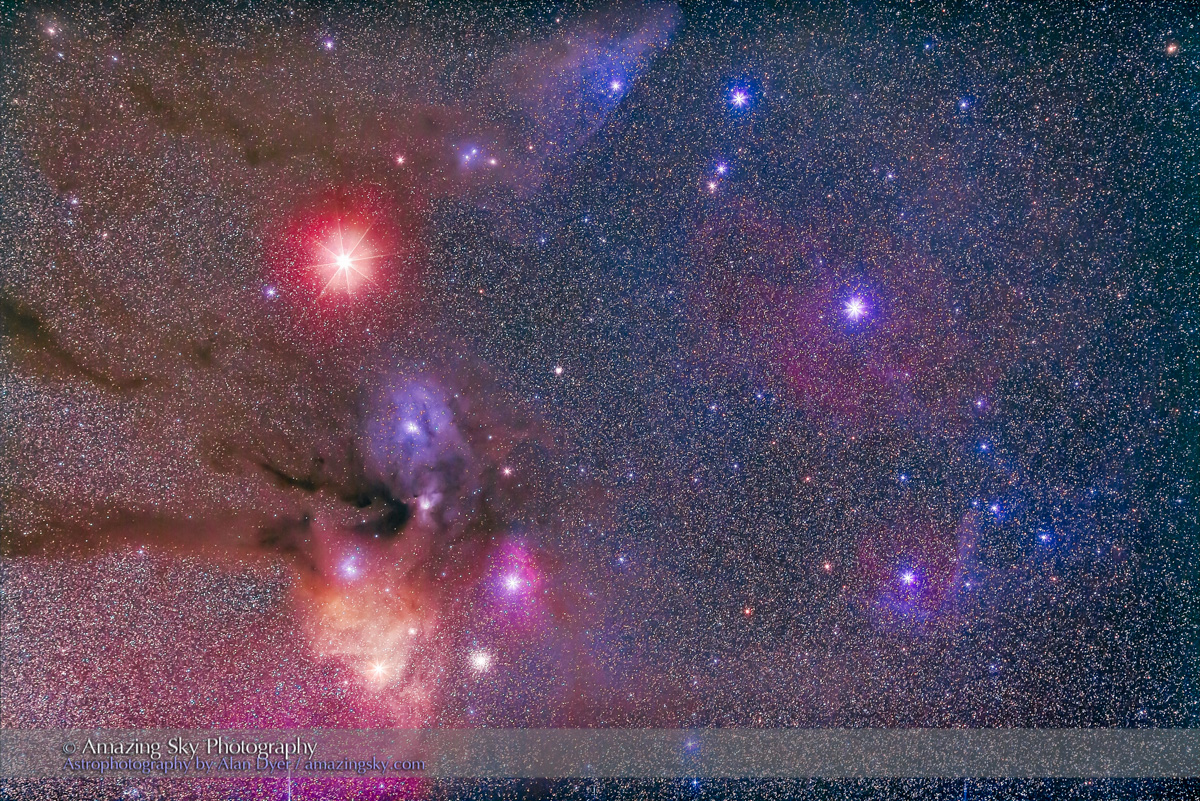
This was the view last night from my observing site in Australia, of red Mars shining near the red star Antares, whose very name means โ€œrival of Mars.โ€ But as Mars nears its closest approach to Earth next month it is already far brighter than Antares, easily winning the rivalry now.

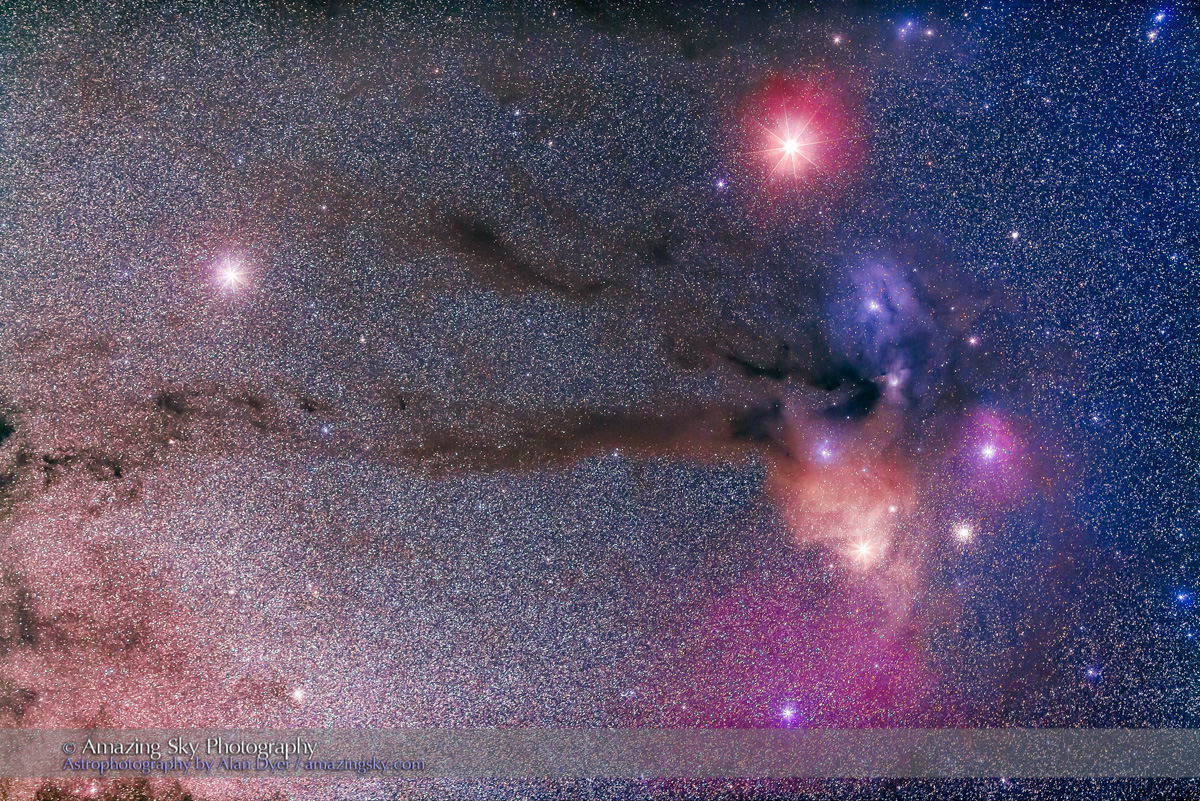
The view takes in the head of Scorpius, one of the most colourful areas of the night sky when photographed in long exposures. Uniquely, Antares illuminates a nearby dust cloud with its light which is more yellow than red.

Other dust clouds reflect the blue light of hot young stars in this section of the Milky Way. Red nebulas are emitting their own light from glowing hydrogen.

The area around Antares is also streaked with lanes of dark dust that absorb light and at best appear a dull brown.

Mars reaches its closest point to Earth since 2005 on May 30. All through May and June Mars will shine as a brilliant red star near Antares. A telescope will provide the best view of the red planet weโ€™ve had in a decade.

Saturn and Mars in Scorpius
This is a stack of 4 x 3 minute exposures with the 135mm telephoto lens at f/2.8 and filter-modified Canon 5D MkII at ISO 1600, shot April 14, 2016 from Tibuc Cottage, Australia.

While you are in the area aim your telescope a little to the east to catch Saturn, also in the area, though technically over the border in the constellation of Ophiuchus the Serpent Bearer.

In the view above, Saturn is the bright โ€œstarโ€ to the left of Mars. Saturn reaches its closest to Earth in early June. Its rings are now wide open and a spectacular picture postcard sight in any telescope.

Scorpius Rising in Moonlight
This is a stack of 2 x 30-second exposures for the sky and ground, both tracked, plus a 30-second exposure through the Kenko Softon A filter to add the star glows to make the constellation pattern stand out. All with the 35mm lens at f/2 and Canon 6D at ISO 1600. Taken from Tibuc Cottage, Australia.

This final view shows Mars and Saturn rising with Scorpius in the moonlight from two nights ago. From my current latitude of 32ยฐ south, Scorpius comes up on his side.

โ€” Alan, April 15, 2016 / ยฉ 2016 Alan Dyerย  / www.amazingsky.com

Planets in the January Dawn


Waning Moon with Venus & Saturn in Twilight (Jan 6, 2016)

The waning Moon joined Venus and Saturn on a cold winter dawn.

This was the scene this morning, January 6, as the waning crescent Moon met with Venus (bright, at centre) and Saturn (below and left of Venus) in the cold morning twilight.

The grouping appeared above the stars of Scorpius. Antares is just above the treetops.

The top image is with the Canon 60Da and 50mm lens.

The view below, with the 135mm telephoto and Canon 6D camera, is from a half hour earlier before the sky began to brighten with morning twilight.

Waning Moon with Venus & Saturn (Jan 6, 2016)
The waning crescent Moon above Venus and Saturn (dimmer and below Venus) in the pre-dawn sky on January 6, 2016, taken from home on a cold winter morning at -20ยฐ C. This is a composite of a long exposure (8s) for the ground, a slightly shorter exposure (6s) for the sky, and shorter exposures for the Moon to avoid it being totally overexposed and to preserve the Earthshine. All with the 135mm lens and Canon 6D.

Venus passes very close to Saturn this weekend, with the two worlds appearing within a telescope field on the mornings of January 8 and 9. Get up early before sunrise and look southeast. Binoculars will provide a superb view.

Venus is hard to miss, but is now dropping lower each morning and will soon be gone from view as it ends its wonderful appearance as a morning star.

โ€” Alan, January 6, 2016 / ยฉ 2016 Alan Dyer / www.amazingsky.com


Comets, Conjunctions, and Occultations, Oh My!


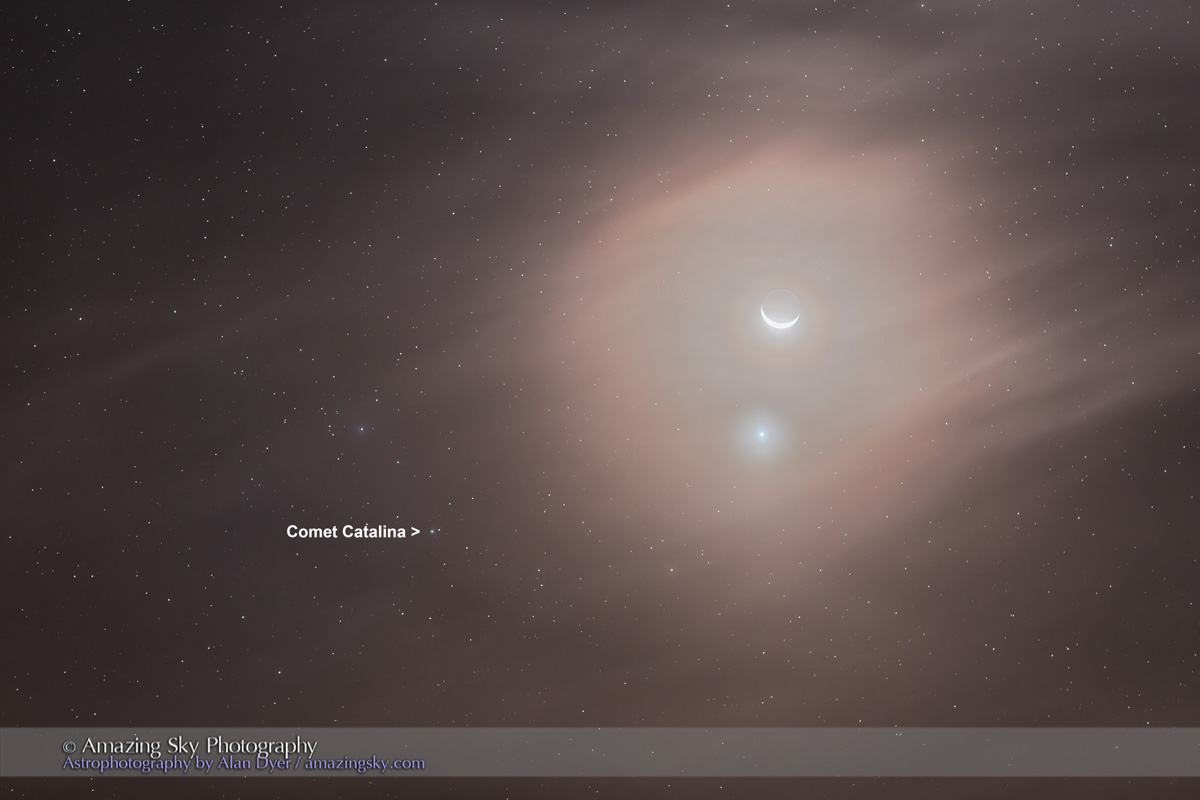
The Moon, Venus and Comet Catalina

What a morning of sky sights, both before dawn and after sunrise.

December 7 โ€“ This was the prime day I came to Arizona to enjoy, to be better assured of clear skies. As it turned out this will likely be the cloudiest day of the week here, but skies were clear enough for a fine view of a conjunction and an occultation. The comet was a bonus.

Waning Moon and Venus Rising in Conjunction
This is a stack of 5 exposures: 30, 8, 2, 0.5 and 1/8s, blended with luminosity masks as HDR would not blend images with such a large range of brightness and content, with the shortest exposures having almost no content execept for two bright objects! The camera was on the iOptron Sky-Tracker to follow the sky and keep the sky targets stationary and aligned, thus the blurred foreground. All with the 135mm lens at f/2.8 and Canon 6D at ISO 400.

At 4 a.m. the waning crescent Moon rose accompanied by Venus, as the two worlds appeared in close conjunction in the pre-dawn sky. The view above captures the scene as the Moon and Venus rose over the Peloncillo Mountains of New Mexico. Comet Catalina is in this scene but barely visible.

The Moon, Venus and Comet Catalina
This is a stack of 6 exposures: 30, 8, 2, 0.5, 1/8s and 1/30s, blended with luminosity masks as HDR would not blend images with such a large range of brightness and content, with the shortest exposures having almost no content execept for two bright objects! The camera was on the iOptron Sky-Tracker to follow the sky and keep the sky targets stationary and aligned. All with the 135mm lens at f/2.8 and Canon 6D at ISO 800.

An hour or so later, with the Moon and Venus higher and with skies a little less cloudy, I was able to capture this scene, above, that included Comet Catalina, as a tiny blue dot next to Venus and the Moon. But if I hadnโ€™t labeled it, you wouldnโ€™t know it was there! The comet is proving to be less wonderful than anticipated, and any cloud dims the view even more.

I had hoped for a superb scene of a bright comet next to the two brightest objects in the night sky. But comets do what comets do โ€” surprise people with unexpected brightness (as Comet Lovejoy did last January) or with disappointing dimness … or by disappearing altogether, as Comet ISON did two years ago. I came here in December 2013, to this same location on the Arizona-New Mexico border, to catch ISON but no luck there at all!

Moon & Venus Conjunction at Sunrise (Dec 7, 2015)
This is a stack of 7 exposures from 10 seconds to 0.3 seconds at 1 stop intervals and blended with luminosity masks, to compress the huge range in brightness from the bright Moon and Venus, plus horizon sky, and the darker sky and sunrise clouds. All with the 35mm lens and Canon 6D.

Regardless of the comet, the conjunction of the Moon and Venus was stunning, about as good as such events get. Hereโ€™s the view, above, an hour later again, with the eastern sky brightening in the dawn twilight. The only thing that would have made this event even more spectacular is if the Moon had actually covered up Venus in this twilight sky. Not quite.

Daytime Occultation of Venus (Dec 7, 2015)
The occultation of Venus by the waning crescent Moon in the daytime on Monday, December 7 at 9:30 am local time. This is just about 3 minutes before the actual occultation as the advancing Moon is about to cover Venus on the bright limb of the Moon. This is a frame from a 100-frame time lapse. Unfortunately, as I shot this on my trip to Arizona, I did not have more focal length than the 135mm and 1.4x extender used here.

For the occultation itself, we had to wait until well after sunrise for an event in the blue daytime sky, at 9:30 a.m. local time.

All of North America got to see this fairly rare occultation of Venus by the Moon, albeit in the daytime. Nevertheless, the two objects are so bright, this was visible to the unaided eye, even with some cloud about. In binoculars it was wonderful.

To shoot it, all I had was a telephoto lens, so the image scale doesnโ€™t do the event justice. But the image above provides a good impression of the binocular view, with Venus as a brilliant jewel on the โ€œringโ€ of the Moon.

โ€” Alan, December 7, 2015 / ยฉ 2015 Alan Dyer / www.amazingsky.com

Capturing Comet Catalina


Comet Catalina with Venus at Dawn

I got the comet but it isn’t what was hoped for โ€“ a faint fuzzball in binoculars.

This was Comet Catalina (aka C/2013 US10) in the dawn sky this morning, December 6, with the comet appearing as a fuzzy star below brilliant Venus in binoculars, and just revealing its two short tails in photos. It’s the cyan-colored object near the centre. Venus is the brilliant object.

This image is with a telephoto lens, and coversย a little more of the sky than typical binoculars would show. I knew this would be a binocular comet at best, but it’s barely that. This is more a comet for telescopes.

But as the Moon departs the scene and the comet climbs higher the view may improve. Still, if you are pining for views of Comet Catalina and are stuck under cloudy winter skies at home, don’t be worried. You aren’t missing too much. Except …

Arch of the Autumn Milky Way
The arch of the Milky Way in the northern autumn and early winter sky, from Arizona on December 5, 2015. The Milky Way extends from Aquila to the left, in the southwest to Cassiopeia at top right, to Perseus and Auriga at far right, in the northeast. I shot this from the Quailway Cottage near Portal, Arizona, latitude +32ยฐ N. The view is looking north toward the celestial pole. Polaris is just right of lower centre. This is a stack of 8 tracked exposures, each 3 minutes at f/2.8 with the 15mm lens and Canon 6D at ISO 1600, with the ground coming from one exposure to minimize blurring. The camera was on the iOptron Sky-Tracker.

This was the view of the autumn Milky Way from here in Arizona last night. Pretty impressive under nearly perfect sky conditions. And then there’s this …

Winter Sky Setting over the Chiricahuas
Orion and the northern winter constellations and Milky Way setting at dawn over the Chiricahua Mountains of southwest Arizona, near Portal, AZ. The waning crescent Moon in the west provided the illumination in this dawn shot from December 6, 2015. Orion is just above the main peak at centre, with Sirius, in Canis Major, to the left and Aldebaran, in Taurus, to the right. The Pleiades are setting at right. The star cluster at top is the Beehive, M44, in Cancer. Bands of airglow add the red streaks. The site is the Quailway Cottage near Portal, Arizona. This is a stack of 4 x 2 minute exposures, tracked, at f/3.5 with the 15mm full-frame fish-eye lens and Canon 6D at ISO 1250, for the sky, and the same specs for 4 exposures, untracked for the ground. Each set was mean-combined stacked to reduce noise.

This was the winter Milky Way with Orion setting into the west over the Chiricahuas at dawn. Turn around from looking at the comet and thisย was the view. So who cares if the comet isn’t too great? There’s lots more to see and shoot. With no snow, no frost, no dew.

More to come this week I trust!

โ€” Alan, December 6, 2015 / ยฉ 2015 Alan Dyer / www.amazingsky.com

Circles and Lines in the Dawn Sky


A classic 22ยฐ ice crystal halo around the waning crescent Moon, here overexposed, with the Moon between Jupiter and Mars in the morning sky on December 5, 2015. Seeing a halo around a crescent Moon is somewhat rare as they usually require the brighter light of the Full Moon. Venus is the brightest object at bottom closest to the horizon. The three planets, along with the stars Spica (above Venus) and Regulus (at top of frame) define the line of the ecliptic here in the dawn late autumn / early winter sky. I captured this scene from southeast Arizona near the Arizona Sky Village at Portal. This is a stack of 4 exposures from long to short (8s to 1/2s) to encompass the great range in brightness and not overexpose the crescent Moon too much. Images were layered in Photoshop and masked with luminosity masks. Automatic HDR techniques did not work well as the shortest image was too dark for ACR to find content to register in Merge ot HDR, and in Photoshop the HDR Pro module left visible edge artifacts. The camera was on the iOptron Sky Tracker to follow the sky and register the sky for all the exposures, thus the slightly blurred ground. Taken with the Canon 6D and 15mm full-frame fish-eye lens.

Cloud hid Comet Catalina but added a halo around the waning Moon, intersected by the line of the ecliptic.

I’m in Arizona, just inside the state lineย with New Mexico, on a quest to shoot Comet Catalina at dawn. Clouds prevented any view of the faint comet this morning but provided a fine consolation prize.

The waning crescent Moon was surrounded by an ice crystal halo, a rare sight around a thin Moon. The Moon was between Mars and Jupiter, heading toward a conjunction with Venus, below, on December 7.

The line of Venus, Mars, the Moon, and Jupiter, plus the stars Spica and Regulus defined the line of the ecliptic beautifully in the pre-dawn sky.

A classic 22ยฐ ice crystal halo around the waning crescent Moon, here overexposed, with the Moon between Jupiter and Mars in the morning sky on December 5, 2015. Seeing a halo around a crescent Moon is somewhat rare as they usually require the brighter light of the Full Moon. Venus is the brightest object at bottom closest to the horizon. The three planets, along with the stars Spica (above Venus) and Regulus (at top of frame) define the line of the ecliptic here in the dawn late autumn / early winter sky. I captured this scene from southeast Arizona near the Arizona Sky Village at Portal. This is a stack of 4 exposures from long to short (8s to 1/2s) to encompass the great range in brightness and not overexpose the crescent Moon too much. Images were layered in Photoshop and masked with luminosity masks. Automatic HDR techniques did not work well as the shortest image was too dark for ACR to find content to register in Merge ot HDR, and in Photoshop the HDR Pro module left visible edge artifacts. The camera was on the iOptron Sky Tracker to follow the sky and register the sky for all the exposures, thus the slightly blurred ground. Taken with the Canon 6D and 15mm full-frame fish-eye lens.
This is a stack of 4 exposures from long to short (8s to 1/2s) to encompass the great range in brightness and not overexpose the crescent Moon too much. Images were layered in Photoshop and masked with luminosity masks. Automatic HDR techniques did not work well as the shortest image was too dark for ACR to find content to register in Merge ot HDR, and in Photoshop the HDR Pro module left visible edge artifacts.
The camera was on the iOptron Sky Tracker to follow the sky and register the sky for all the exposures, thus the slightly blurred ground. Taken with the Canon 6D and 15mm full-frame fish-eye lens.

It was a show of circles and lines, real and imagined, in the morning sky.

With luck, clouds will clear to reveal Comet Catalina, which is likely fainter and less spectacular than hoped. But such is the way of comets. Regardless of what the comet does, it is a good time to be in the desert southwest, typing this blog on a sunny front porch under blue desert skies.

โ€” Alan, December 5, 2015 / ยฉ 2015 Alan Dyer /ย www.amazingsky.com


The Visible Ecliptic at Dawn


Venus (brightest), with dim Mars above it, then bright Jupiter, in a diagonal line across the dawn sky on November 14, 2015. Regulus and Leo are at top right, Arcturus in Bootes is at left, and Spica in Virgo is just rising at centre. Spica, Venus, Mars, Jupiter and Regulus more or less define the line of the ecliptic in the autumn morning sky here. This is a stack of 4 x 20 second exposures for the ground, to smooth noise, and one 20-second exposure for the sky, all with the Nikon D810a at ISO 1000 and Nikkor 14-24mm lens at f/2.8 and at 14mm

The morning planets are now strung out along the ecliptic, visualizing this line in the sky.

This was the view this morning, November 14, of the three dawn planets lined up along the ecliptic, with the stars Spica and Regulus also defining this imaginary line.

The ecliptic is the Earth’s orbital path around the Sun projected into the sky. So it is along this line that we see the Sun appear to move around the sky over a year. But it is also the path along which we findย the seven other major planets โ€“ in this case, three of them: Venus, Mars and Jupiter.

These three worlds were clustered together in October, but are now spreading out along the ecliptic, as Venus drops lower but Mars and Jupiter climb higher.

The stars Spica and Regulus also lie along the ecliptic, where the Moon can occasionally pass in front of, or occult, these stars.

So the two stars and three planets are now nicely drawing the ecliptic line for us in the dawn sky. At this time of year, the ecliptic is also steeply angled above the eastern horizon.

The main image above is a stack of 4 x 20 second exposures for the ground, to smooth noise, and one 20-second exposure for the sky, all with the Nikon D810a at ISO 1000 and Nikkor 14-24mm lens at f/2.8 and at 14mm.

Venus (brightest), with dim Mars above it, then bright Jupiter, in a diagonal line across the dawn sky on November 14, 2015, with the Zodiacal Light barely visible in the brightening twilight sky. Arcturus is a left and Spica is just rising at centre. Corvus is just above the treetops at right. Spica, Venus, Mars and Jupiter more or less define the line of the ecliptic in the autumn morning sky here. This is a stack of 4 x 20 second exposures for the ground, to smooth noise, and one 20-second exposure for the sky, all with the Nikon D810a at ISO 1000 and Nikkor 14-24mm lens at f/2.8 and at 24mm
Venus (brightest), with dim Mars above it, then bright Jupiter, in a diagonal line across the dawn sky on November 14, 2015, with the Zodiacal Light barely visible in the brightening twilight sky. Arcturus is a left and Spica is just rising at centre. Corvus is just above the treetops at right. Spica, Venus, Mars and Jupiter more or less define the line of the ecliptic in the autumn morning sky here.ย This is a stack of 4 x 20 second exposures for the ground, to smooth noise, and one 20-second exposure for the sky, all with the Nikon D810a at ISO 1000 and Nikkor 14-24mm lens at f/2.8 and at 24mm

This image just above is with the same gear but with the lens at the 24mm setting to more tightly frame the planets.

Meanwhile, on the other side of the sky at dawn, Orion and his winter sky friends were setting into the west (image below).

Orion and the winter constellations setting over the old Farmhouse at home, in the dawn twilight on the morning of November 14, 2015. Canis Major and Sirius are at left; Taurus and Aldebaran and the Pleiades are at right. Procyon is at upper left.  This is a stack of 4 x 20 second exposoures for the ground to smooth noise and one 20-second exposure for the sky, all with the Nikon D810a at ISO 1600 and 14-24mm Nikkor zoom lens at f/2.8.
Orion and the winter constellations setting over the old Farmhouse at home, in the dawn twilight on the morning of November 14, 2015. Canis Major and Sirius are at left; Taurus and Aldebaran and the Pleiades are at right. Procyon is at upper left.ย This is a stack of 4 x 20 second exposoures for the ground to smooth noise and one 20-second exposure for the sky, all with the Nikon D810a at ISO 1600 and 14-24mm Nikkor zoom lens at f/2.8.

All the images here are shot with the Nikon D810a camera and the amazing Nikkor 14-24mm lens, two items in hand this month for testing and review. A thorough test will appear in future blogs.

Of course, as wonderful as the gear is, it cannot extract the ecliptic line and labels from the sky โ€“ those are added in Photoshop!

โ€“ Alan, November 14, 2015 / ยฉ 2015 Alan Dyer / amazingsky.comย 

Three Planets and the Moon in the Morning


The waning crescent Moon below Jupiter, with that pair of worlds above the pairing of Venus (bright) and red Mars (just above Venus), all in the dawn sky, November 6, 2015.  This is a composite of 4 exposures: 30 seconds for the ground (to bring out detail there), 8 seconds for the sky (short enough to prevent star trailing), and 2 and 1/4 seconds for the Moon itself to prevent it from being totally blown out as a bright blob. All with the Nikon D750 at ISO 1600 and Sigma 24mm Art lens at f/4. Taken from home.

The waning crescent Moon joined the planet trio this morning for a fine sight in the dawn.

This was the scene on November 6 with the waning crescent Moon just below Jupiter, and those two worlds just above the pairing of bright Venus with dim red Mars.

On Saturday, November 7, the waning Moon will sit beside Venus for an even more striking conjunction.

The waning crescent Moon below Jupiter, with that pair of worlds above the pairing of Venus (bright) and red Mars (just above Venus), all in the dawn sky in Leo, November 6, 2015. The stars of Leo are above, including Regulus. This is a composite of 4 exposures: 15 seconds for the ground (to bring out detail there), 4 seconds for the sky (short enough to prevent star trailing), and 1 and 1/4 seconds for the Moon itself to prevent it from being totally blown out as a bright blob. All with the Nikon D750 at ISO 2000 and Sigma 24mm Art lens at f/4.5. Taken from home.
The waning crescent Moon below Jupiter, with that pair of worlds above the pairing of Venus (bright) and red Mars (just above Venus), all in the dawn sky in Leo, November 6, 2015. The stars of Leo are above, including Regulus.
This is a composite of 4 exposures: 15 seconds for the ground (to bring out detail there), 4 seconds for the sky (short enough to prevent star trailing), and 1 and 1/4 seconds for the Moon itself to prevent it from being totally blown out as a bright blob. All with the Nikon D750 at ISO 2000 and Sigma 24mm Art lens at f/4.5. Taken from home.

This meeting of the Moon with the planet trio more or less concludes the superb series of dawn sky conjunctions we’ve been enjoying over the last month.

The planets remain in the morning sky but now go their own ways as Mars and Jupiter climb higher, while Venus drops lower.

โ€” Alan, November 6, 2015 / ยฉ 2015 Alan Dyer / www.amazingsky.com

Dawn Dance of Planets Concludes


The planet trio of Venus (brightest), Jupiter (above Venus) and Mars (dim and red to the left of Venus), all in Leo in the morning sky on November 1, 2015, with the waning gibbous Moon illuminating the landscape and sky. Even in the moonlight, the Zodiacal Light seems to be faintly visible along the ecliptic defined by the line of planets.  This is a stack of 6 x 30-second exposures at f/5.6 and ISO 2500 for more depth of the field for the ground, plus a 13-second exposure at f/2.5 and ISO 800 to minimize star trailing. The ground exposures were mean combined in a stack to smooth noise. Diffraction spikes added with Astronomy Tools Actions for Photoshop.

The gathering of planets at dawn is coming to an end as Venus meets Mars.

This was the view this morning from home in southern Alberta of the trio of planets in the moonlit morning sky.

Venus is the brightest, while dim red Mars shines just to the left of Venus. Jupiter is above the Venus & Mars pairing, with all the planets shining in Leo.

The planet trio of Venus (brightest), Jupiter (above Venus) and Mars (dim and red to the left of Venus), all in Leo in the morning sky on November 1, 2015, with the waning gibbous Moon illuminating the landscape and sky. The stars of Leo, including Regulus, shine above the planets. This is a stack of 4 x 30-second exposures at f/5.6 and ISO 2000 for more depth of the field for the ground, plus a 10-second exposure at f/2.8 and ISO 2000 to minimize star trailing. The ground exposures were mean combined in a stack to smooth noise. Diffraction spikes added with Astronomy Tools Actions for Photoshop.

Mars and Venus will appearย closest to each other on November 2 and 3. Then the group breaks apart as Venus descends but Mars and Jupiter climb higher.

But as they do so they are joined by the waning Moon, by then a thin crescent, on November 6, when the Moon shines near Jupiter, and November 7, when it joins Venus for a stunningย dawn sky scene.

After that the morning planet dance comes to an end. But in two months, in early January, Venus will meet up with Saturn for a very close conjunction inย the winterย dawn sky on January 9.

โ€” Alan, November 1, 2015 / ยฉ 2015 Alan Dyer / www.amazingsky.com

Triangle of Planets in the Twilight


Mars, Venus and Jupiter (in that order from top to bottom) in a triangle, in conjunction, at an old farmstead near Vulcan, Alberta, in the morning twilight, October 28, 2015. Illumination is from the nearly Full Hunterโ€™s Moon in the west. The trio of planets were in Leo in a fine conjunction not to be repeated until November 21, 2111. Almost all of Leo is visible here, with Regulus, the constellationโ€™s brightest star, just to the right of the windmill blades at top. This is a stack of 6 exposures for the ground, mean combined to smooth noise, and one exposure for the sky, all  10 seconds at f/4 and ISO 800 with the Canon 6D and Canon 24mm lens.

This was the trio of planets at their best in the morning sky.ย 

On the morning of October 28, Mars, Venus and Jupiter formed a neat isosceles triangle in the twilight. Venus, the brightest, was in the middle, with Mars below and Jupiter above. The grouping shone amid the stars of Leo, with its brightest star, Regulus, above the windmill in the lead image above. The rest of Leo lies above the planets.

To capture the scene I drove west at 5 am to a farmstead I had shot at before, in June, to capture Venus and Jupiter, also then in Leo nearย Regulus, but in the evening sky looking west. Click here for that blog post from mid-June.

This morning, the Moon, just past full as the annual Hunter’s Moon, shone in the west off camera lightingย the landscape.

Mars, Venus and Jupiter (in that order from top to bottom) in a triangle, in conjunction, over an old red barn near Vulcan, Alberta, in the morning twilight, October 28, 2015. Illumination is from the nearly Full Hunterโ€™s Moon in the west. The trio of planets were in Leo in a fine conjunction not to be repeated until November 21, 2111.  This is a stack of 6 exposures for the ground, mean combined to smooth noise, and one exposure for the sky, all  10 seconds at f/4 and ISO 800 with the Canon 6D and Canon 24mm lens.

The dawn sky colours and the moonlitย red barn made for a fine colour contrast.

After today, the planet configuration breaks up, as Venus descends to meet Marsย on November 2 and 3, while Jupiter climbs higher. But another great morning sight awaits on November 7 when the waning crescent Moon will shine near the Venus-Mars pairing, with Jupiter above.

The conjunction of Mars, Venus and Jupiter (from bottom to top) in the dawn sky over the misty waters of Lake Macgregor in southern Alberta, on October 28, 2015. This is a single 1/4-second exposure at f/4 and ISO 400 with the Canon 6D and 24mm Canon lens.

On the way home I stopped at fog-bound Lake MacGregor to capture the planets in a brightening dawn sky over the misty waters.

This morning the three planetsย lay just 4.5 degrees apart, close enough to frame in high-power binoculars.

We won’t see these three planets this close to each other in a darkened sky โ€” as opposed to being so close to the Sun we really can’t see them โ€” until November 21, 2111.

Be sure to catch the dawn show while it lasts!

โ€” Alan, October 28, 2015 / ยฉ 2015 Alan Dyer / www.amazingsky.com

A Stunning Gathering of Worlds


The conjunction of Venus (brightest), Jupiter (above Venus) and Mars (dimmer below Venus & Jupiter) looking east in the morning twilight on October 25, 2015, as seen from the west shore of Lake Annette, in Jasper National Park, Alberta. The mountain is the Watchtower. Morning mist covers the lake waters. Haze in the sky adds the natural glows around the planets โ€” no filters were empolyed here. This is a layered stack of 4 images: 10, 5, 2.5 and 1.3-second exposures, with the longer exposure for the ground and the shorter exposures adding the sky to maintain tonal balance between the dark ground and bright sky. All with the 24mm lens and Canon 6D at ISO 400. It was not possible to capture the reflection of the planets in the water as they were too high in the sky.

Skies were clearย at dawn this morning for a fabulous view of the rare conjunction of three planets. And I could not have been at a more photogenic site.

This was the view before dawn on October 25, as brilliant Venus and dimmer Jupiter shone just a degree apart in the dawn sky. Mars, much fainter, shines just below the close duo. The three planets could easily be contained in a high power binocular field.

Not until November 2111 will these three planets be this close together again in a darkened sky.

Indeed, Venus could not have been higher, as it is just now reaching its maximum elongation from the Sun, placing it high in the eastern morning sky.

A panorama of roughly 120ยฐ showing a star- and planet-filled sky in the dawn twilight over Lake Annette in Jasper National Park, Alberta, on the morning of October 25, 2015.  At left, to the east, are the two bright planets, Venus (brightest) and Jupiter in a close conjunction 1ยฐ apart (and here almost merging into one glow), plus reddish Mars below them, all in Leo, with the bright star Regulus above them. Right of centre, to the south, is Orion and Canis Major, with the bright star Sirius low in the south. At upper right are the stars of Taurus, including Aldebaran and the Hyades star cluster. Venus was near greatest elongation on this morning.  No special filter was employed here โ€” the hazy planets and stars and colourful star images comes naturally from a high haze over the sky this morning. It bloats the images of Venus and Jupiter so they almost merge.  The stars are partly reflected in the waters, with rising mist in the distance on the lake. Distant Whistler peak below Orion is lit by lights from the Jasper Townsite. The site is the shore of Lake Annette near the Jasper Park Lodge and site of the annual star party held as part of the Jasper Dark Sky Festival. I shot this scene the morning after the 2015 Festival. This is a panorama of 8 segments, shot with the 24mm lens mounted vertically (portrait), each for 25 seconds at f/2.8 with the Canon 6D at ISO 3200. Stitched with Photoshop, with some vertical scaling to reduce the distortion introduced by the pan mapping process.

I shot from the shores of Lake Annette, site of one of the major events, the Friday star party, at the annual Jasper Dark Sky Festival which just concluded, in Jasper National Park, Alberta. The Festival celebrates the Park’s status as one of the world’s largest Dark Sky Preserves.

The hotels and restaurants were full with stargazers from around the world, making the Festival a huge success, both educationally and financially. I was honoured to be able to present some of the public and school talks.

But this dawn skyย was a fine way to end a fabulous weekend of astronomy.

The image above is a panorama in the twilight, sweeping from the planets in the east, to the winter stars and constellations, including iconic Orion, in the south and southwest.

A panorama of roughly 180ยฐ showing a star- and planet-filled sky in the pre-dawn hours over Lake Annette in Jasper National Park, Alberta, on the morning of October 25, 2015.  At left, to the east, are the two bright planets, Venus (brightest) and Jupiter in a close conjunction 1ยฐ apart (and here almost merging into one glow), plus reddish Mars below them, all in Leo, with the bright star Regulus above them. At centre, to the south, is Orion and Canis Major, with the bright star Sirius low in the south. At upper right are the stars of Taurus, including Aldebaran and the Pleiades star cluster. Venus was near greatest elongation on this morning.  The Milky Way runs vertically at centre, between Sirius and Procyon, the bright star above centre. The faint glow of morning Zodiacal Light rises in a diagonal band at left in the east through the planets and stars of Leo and into Cancer and the Beehive Cluster at top left.  No special filter was employed here โ€” the hazy planets and stars and colourful star images comes naturally from a high haze over the sky this morning. It bloats the images of Venus and Jupiter so they almost merge.  The stars are partly reflected in the waters with wind distorting some of the reflections. Some green airglow appears in the south as well. Distant Whistler peak below Orion is lit by lights from the Jasper Townsite. The site is the shore of Lake Annette near the Jasper Park Lodge and site to the annual star party held as part of the Jasper Dark Sky Festival. I shot this scene the morning after the 2015 Festival. This is a panorama of 12 segments, shot with the 24mm lens mounted vertically (portrait), each for 30 seconds at f/2.8 with the Canon 6D at ISO 3200. Stitched with Photoshop, with some vertical scaling to reduce the distortion introduced by the pan mapping process.

Earlier in the morning, before twilight began to brighten the sky, I shot another even wider panorama from the south shore of the lake.

In this and other photos, high haze adds the glows around the stars and planets naturally. No special effects filters here!

But Venus and Jupiter are so close and bright theirย images almost merge into one glow.

Brilliant Venus, in conjunction with dimmer Jupiter above, and with even dimmer Mars below, at left here, on the morning of October 25, 2015 when Venus and Jupiter were only 1ยฐ apart.  I shot this from Lake Annette in Jasper National Park before the sky started to brighten with dawn twilight. High haze in the sky adds the glows around the stars and planets, in particular the colored halo around Venus. The mountain is the Watchtower. The site is used as the main star party location for the annual Jasper Dark Sky Festival. This is a 30-second exposure at f/2.8 with the 35mm lens and as ISO 1600 with the Canon 6D.

Here they are, with Mars below, shining in the dark sky over the Watchtower peak and over the misty waters of Lake Annette.

Keep an eye on the sky at dawn, as these three worlds will be close to each other for the next few mornings. See my earlier blog for details.

โ€” Alan, October 25, 2015 / ยฉ 2015 Alan Dyer / www.amazingsky.com

Four Planets Along the Morning Ecliptic


Four planets in the morning sky, on October 20, 2015, along the ecliptic from bottom to top:  - Mercury (close to the horizon at lower left) - Mars (dim, below Jupiter) - Jupiter (fairly bright at upper right) - Venus (brightest of the four) I shot this from home in southern Alberta. This is a composite stack of 5 exposures from 15 seconds to 1 second to contain the range of brightness from the bright horizon to the dimmer sky up higher. All with the 35mm lens and Canon 6D at ISO 800.

Four planets appear in the dawn sky outlining the morning ecliptic.

Thisย morning, October 20, I was able to capture four planets in the morning sky, arrayed along the ecliptic.

From bottom to top they are: Mercury (just past its point of greatest elongation from the Sun), dim Mars, bright Jupiter, and very bright Venus (just 6 days away from its point of greatest elongation from the Sun). Above Venus is Regulus, in Leo.

I’ve added in the labels and the line of the ecliptic, rising steeply out of the east inย the autumn dawnย sky.

Of course, there is a fifth unlabelled planet in the scene, quite close in the foreground.

The image below is an unlabeled version.

Four planets in the morning sky, on October 20, 2015, along the ecliptic from bottom to top:  - Mercury (close to the horizon at lower left) - Mars (dim, below Jupiter) - Jupiter (fairly bright at upper right) - Venus (brightest of the four) I shot this from home in southern Alberta. This is a composite stack of 5 exposures from 15 seconds to 1 second to contain the range of brightness from the bright horizon to the dimmer sky up higher. All with the 35mm lens and Canon 6D at ISO 800.

Mercury will be disappearing from view very quickly now as it dropsย back down toward the Sun.

But over the next week the three higher planets will converge into a tight triangle just 4.5 degrees apart. We won’t see these three planets this close together in a darkened sky until November 2111.

For more information on this week’s dawn sky planet dance see my previous blog entry.

TECHNICAL:
I shot the sceneย from home in southern Alberta.ย The image is a composite stack, with manually created masks (not an HDR stack), of 5 exposures, from 15 seconds to 1 second, to contain the range of brightness from the bright horizon to the dimmer star-filled sky higher up. All are with the 35mm lens and Canon 6D at ISO 800.

โ€” Alan, October 20, 2015 / ยฉ 2015 Alan Dyer / www.amazingsky.com

The Moon and Four Planets


The waning crescent Moon, lit by Earthshine, with four planets on the morning of October 9, 2015, with the planets from bottom left to top right: โ€ข Mercury, just above the horizon between the low cloud bands, at lower left โ€ข Jupiter, bright at centre โ€ข Mars, reddish and above Jupiter โ€ข Venus, brightest at upper right and in some thin cloud.  The bright star Regulus in Leo is above and to the left of Venus. This is a blend of four exposures: a long 4-second exposure for most of the sky and ground and shorter 2, 1, amd 1/2 second exposures for the bright twilight area and around the Moon and Venus, to prevent those areas fro being blown out. Blending is with masks, not HDR. All with the Canon 6D at ISO 400 and 50mm Sigma lens at f/2.5

The Moon appeared along with four planets in the dawn sky.

The sky was filled with planets this morning, as all four of the closest planets to the Sun appeared along the ecliptic in the morning sky. Plus there’s a fifth planet in the picture – Earth.

Here, the waning crescent Moon, lit by Earthshine, appears with four planets on the morning of October 9, 2015, with the planets from bottom left to top right:

โ€ข Mercury, just above the horizon between the low cloud bands, at lower left
โ€ข Jupiter, bright at centre
โ€ข Mars, reddish and above Jupiter
โ€ข Venus, brightest at upper right and in some thin cloud.

The bright star Regulus in Leo is above and to the left of Venus.

The waning crescent Moon, lit by Earthshine, with four planets on the morning of October 9, 2015, with the planets from bottom left to top right: โ€ข Mercury, just above the horizon between the low cloud bands, at lower left โ€ข Jupiter, bright at centre โ€ข Mars, reddish and above Jupiter โ€ข Venus, brightest at upper right and in some thin cloud.  The bright star Regulus in Leo is above and to the left of Venus. This is a blend of four exposures: a long 4-second exposure for most of the sky and ground and shorter 2, 1, amd 1/2 second exposures for the bright twilight area and around the Moon and Venus, to prevent those areas fro being blown out. Blending is with masks, not HDR. All with the Canon 6D at ISO 400 and 50mm Sigma lens at f/2.5

Above is an unlabeledย version of the image.

TECHNICAL:

It’s a blend of four exposures: a long 4-second exposure for most of the sky and ground, plusย shorter 2, 1, and 1/2 second exposures for the bright twilight area and around the Moon and Venus, to prevent those areas from being blown out. Blending is with masks, not HDR. All were shot with the Canon 6D at ISO 400 and 50mm Sigma lens at f/2.5.

โ€“ Alan, October 9, 2015 / ยฉ 2015 Alan Dyer / www.amazingsky.com

Dawn Sky Delight โ€“ the Real Scene


A gathering of planets in the dawn sky on October 8, 2015, with - from bottom to top: Jupiter, Mars, Venus and the Moon, with the star Regulus in Leo left of Venus.  This is a 15-second exposure with shorter exposure blended in for the area around Venus and the Moon to avoid them overexposing too much. So not a true HDR, but using masking to blend the short exposure elements.

The Moon, planets and Northern lights provided a wonderful show in the dawn sky.

What a superb scene this was. On October 8 the waning crescent Moon shone near Venus (brightest) and Regulus, with red Mars and bright Jupiter paired below.

If that wasn’t enough, as the wide-angle panorama below shows, the Northern Lights were also ending a night of performance, with an arc along the horizonย and pulsing waves rising up the sky to the northeast near the planet grouping.

A panorama of the pre-dawn sky on October 8, 2015, with a sky full of wonders: โ€ข the Northern Lights, or aurora โ€ข The Big Dipper above the aurora, somewhat distorted by the panorama projection โ€ข at centre, a conjunction and line-up of planets, with from bottom to top: Jupiter, Mars and Venus, with the bright waning crescent Moon beside Venus at top, and also beside the star Regulus in Leo โ€ข The Beehive star cluster well above the planet grouping โ€ข Orion and Canis Major in the winter sky at right with the Milky Way. I shot this from home, using the Canon 6D and 24mm lens on a fixed tripoid (no tracking), for 7 segments, each a 30-second exposure at f/2.2 and at ISO 1250. Stitched in Photoshop.

The panorama also sweeps right, to the south, to take in the winter Milky Way and constellations of Orion and Canis Major. ย Click on the image to bring it up full screen.

The Moon will appear near Mars and Jupiter on the morning of October 9, and then the three planets will begin to converge for a tight gathering for a few mornings around October 25.

Be sure to wake early for the dawn sky show that continues all this month!

โ€“ Alan, October 8, 2015 / ยฉ 2015 ย / www.amazingsky.com

Morning Star, the Milky Way, and the Zodiacal Light


Venus shines brightly, and nearly at its brightest at magnitude -4.7, in the dawn sky on a very frosty morning at 5 am, on September 17, 2015, from home in southern Alberta. Venus appears amid the faint glow of the Zodiacal Light, sometimes called the โ€œFalse Dawn,โ€ stretching vertically from the dawn horizon in the east, up and to the right, and reaching the Milky Way that runs down the frame from top centre to bottom right. Orion and the winter stars shine in the Milky Way, with Sirius above the trees at lower right. The Beehive Cluster, M44, appears as the small group of stars above Venus. The Pleiades, M45, is at top right. Mars is the brightest object left of Venus, with the bright star Regulus just below it and rising in the east. The stars of the Big Dipper are at far left at the edge of the frame. The sky is beginning to brighten with the real glow of morning.  This is a stack of 4 x 2-minute exposures, tracked and mean combine stacked, for the sky and 2 x 2-minute exposures, untracked and stacked, for the ground to minimize blurring in the starlit ground. The Canon 6D was on the iOptron Sky-Tracker, shooting at ISO 1250 with the 15mm full-frame fish-eye lens at f/3.5. The stacking with a mean combine stack mode smooths noise in both sky and ground.

Venus, now at its brightest as a morning star, shines amid the subtle glow of the Zodiacal Light.ย 

This was the scene this morning, September 17, on a very frosty dawn at 5 a.m. from my backyard in southern Alberta.

Here, Venus shines nearly as bright as it can be, at magnitude -4.7, in the dawn sky as a brilliant “morning star.”

Venus appears amid the faint glow of the Zodiacal Light, sometimes called the โ€œFalse Dawn,โ€ stretching diagonallyย from the dawn horizon in the east, up and to the right, and reaching the Milky Way that runs verticallyย down the frame from top centre to bottom right.

Orion and the winter stars shine in the Milky Way, with Sirius above the trees at lower right.

The Beehive Cluster, M44, appears as the small group of stars above Venus. The Pleiades, M45, is at top right.

Mars is the brightest object left of Venus, with the bright star Regulus just below it and rising in the east. The stars of the Big Dipper are at far left at the edge of the frame.

The sky is beginning to brighten with the real glow of morning. It was a marvellous dawn sky delight.

Technical notes:

This is a stack of 4 x 2-minute exposures, tracked and mean-combine stacked, for the sky and 2 x 2-minute exposures, untracked and stacked, for the ground to minimize blurring in the starlit ground. The Canon 6D was on the iOptron Sky-Tracker, shooting at ISO 1250 with the 15mm full-frame fish-eye lens at f/3.5. The stacking with a mean combine stack mode smooths noise in both sky and ground.

โ€“ Alan, September 17, 2015 / ยฉ 2015 Alan Dyer / www.amazingsky.comย 

Dawn Worlds


The waning crescent Moon near Venus (at right) and much dimmer reddish Mars (at left) in the pre-dawn sky of September 10, 2015. This is a high-dynamic range stack of 5 exposures to accommodate the large range in brightness between the sky and Moon, and to preserve the earthshine on the dark side of the Moon.  I shot this with the Canon 6D and 135mm lens at f/2 and at ISO 800 in a set of 8, 4, 2, 1 and 0.5-second exposures, blended with HDR Pro in Photoshop using 32 bit mode of Camera Raw.

The waning crescent Moon joined Venus and Mars in the dawn sky.

I blogged about this conjunction a few days ago, and here is the real thing.

On the morning of September 10 the waning crescent Moon gathered near bright Venus and much dimmer but redder Mars (at left) in the dawn sky.

Venus and Mars have both moved into the morning sky, where they will begin a series of conjunctions with the Moon and with Jupiter, now just emerging from behind the Sun, over the next two months. This gathering is just the start of the dawn planet dance.

For the technically minded, this is a high-dynamic range stack of 5 exposures to accommodate the large range in brightness between the sky and Moon, and to preserve the earthshine on the “dark side of the Moon.”

I shot this with the Canon 6D and 135mm lens at f/2 and at ISO 800 in a set of 8, 4, 2, 1 and 0.5-second exposures, blended with HDR Pro in Photoshop using 32-bit mode of Adobe Camera Raw.

โ€” Alan, September 10 2015 ย / ยฉ 2015 Alan Dyer / www.amazingsky.com

The “Blue Moon” over Calgary


The Full Moon of July 31, 2015, an infamous โ€œblue Moonโ€, the second Full Moon of July, rising over the skyline of Calgary, Alberta. This is one frame of a 480-frame time-lapse sequence taken with the Canon 60Da and 28-105mm lens. The location was Toronto Crescent.

The much-publicized “Blue Moon” of July rises over the skyline of Calgary.

Last night, July 31, many people looked east to see a wonderful moonrise. Did it look different thanย any other moonrise? No. But did it look great? You bet.

I set up myย cameras at a site in northwest Calgary, picked for its sightline looking east-southeast over the downtown core of Calgary and directly toward the moonrise point.

I used the software The Photographer’s Ephemeris to plan the location and angles. It is wonderful for making sure you are in the right place at the right time for catching a photogenic moonset or moonset.

Here’s the screen shot from TPE that showed me where to be Friday evening. The blue line aimsย to the moonrise point.

IMG_2473

Of course, despite the planning the Moon did not look blue! Blue Moons, as they have come to be defined, never do. The term now means the second Full Moon in a calendar month. We had a Full Moon on Canada Day, July 1, and then enjoyed a second July Full Moon one lunar cycle later on July 31.

I shot the scene with two cameras, each shooting hundreds of frames for time-lapses, from which I extracted still images.

A short 1-minute music video of the result is here at Vimeo. Enlarge the screen and be sure HD is selected.


As a technical note, for the processing I used the latest version 4.2 of LRTimelapse and its new “Visual Deflicker” workflow which very nicely smooths out all the frame-to-frame flickering that can plague daytime and twilight shots taken under Auto Exposure.

Whileย the shutter speed does constantly decrease, it does so in 1/3rd-f/stop steps, yielding stair-step jumps in brightness. LRT smooths all that out, with v4.2 doing a much better job than earlier versions.

Thanks for watching!

โ€” Alan, August 1, 2015 / ยฉ 2015 Alan Dyer / www.amazingsky.comย 

Worlds Amid the Sunset Clouds


The waxing crescent Moon below Venus low in the sunset colours of a July summer evening over the waters of Little Fish Lake, in southern Alberta. Jupiter is at upper right but much fainter.  This is a 3-segment panorama taken with the Canon 60Da and 18-200mm Sigma zoom.

The thin waxing Moon shines near Venus aboveย the colourful clouds of sunset.

Tonight, July 18, was the evening of a close conjunction of the crescent Moon near Venus in the evening sky. From my latitude at 50ยฐ North, the conjunction was going to be low, and atย riskย of clouds.

In this case, the clouds added to the scene as they lit up with sunset colours.

You can see the Moon and Venus at centre, while fainter Jupiter is at upper right, and perhaps not visible on screen at this scale.

The location is one I used last month for the Venus-Jupiter meeting, Little Fish Lake and Provincial Park, north of Drumheller. It’s a quiet spot. This Saturday night there were just three families there camping.

I shot this telephoto panorama with my red-sensitive Canon 60Da, which is designed to record red nebulas well, but does a nice job on punching up sunsets, too!

Alas, the clouds that painted the sky so nicely here, moved in as the worlds set lower. I wasn’t able to shoot them closer to the horizon amid the deep colours of a late twilight. But I’ll settle for this image.

โ€“ Alan, July 19, 2015 / ยฉ 2015 Alan Dyer / www.amazingsky.com

Double “Star” in the Dusk


Venus and Jupiter on June 28, 2015 approaching a close conjunction two nights later, as seen over the water of Little Fish Lake Provincial Park, Alberta in the evening twilight. Venus is the brighter of the pair. This is an HDR stack of 3 exposures with the Canon 60Da and 16-35mm lens. The long exposure blurs the ripples and waves on the water.

Venus and Jupiter now appear as a brilliant “double star” in the evening sky.

This was the scene last night, Sunday, June 28, as the two brightest planets in the sky appeared close to each other in the evening twilight.

I shot the scene from the eastern shore of Little Fish Lake at a Provincial Park in southern Alberta bordering on the Handhills Conservation Area which preserves northern native prairie grasses and an abundance of bird and wildlife species.

The planetary conjunction culminates on June 30, when they will appear very close to each other (less than a Moon diameter apart), creating the best evening conjunction of 2015.

Venus and Jupiter on June 28, 2015 approaching a close conjunction two nights later, as seen over the water of Little Fish Lake Provincial Park, Alberta in the evening twilight. Venus is the brighter of the pair. Some subtle crepuscular rays from cloud shadows are at right. This is an HDR stack of 3 exposures with the Canon 60Da and 16-35mm lens.

More details are in my previous blog post.ย 

โ€“ Alan, June 29, 2015 / ยฉ 2015 Alan Dyer / www.amazingsky.com

Reflections of Solstice Planets and Northern Lights


The evening planets of Venus (right) and Jupiter (left), to the right of the waxing crescent Moon on the evening of summer sosltice, June 21, 2015. The star Regulus is to the upper right of the Moon, between Jupiter and the Moon. The view is overlooking Crawling Lake in southern Alberta. This is an HDR stack of 5 exposures to retain detail in the bright twilight sky and the dark foreground.

The summer solstice sky was filled with twilight glows, planets, and dancing Northern Lights.ย 

What a magical night this was. The evening started with the beautiful sight of the waxing crescent Moon lined up to the left of the star Regulus, and the planets Jupiter and Venus (the brightest of the trio), all set in the late evening twilight.

They are all reflected in the calm waters of a prairie lake.

I shot the above photo about 11 p.m., as late a twilight as we’ll get. From here on, after solstice, the Sun sets sooner and the sky darkens earlier.

An aurora display on the evening of summer solstice, June 21, 2015, overlooking Crawling Valley Reservoir in southern Alberta. This is one frame of 360 shot as part of a time-lapse, each frame being 15 seconds at f/2.5 with the 24mm lens, and with the Canon 6D at ISO 3200.

Later, about 12:30 a.m., as predicted by aurora apps and alert services, a display of Northern Lights appeared on cue to the north. It was never very bright to the eye, but the camera nicely picks up the wonderful colours of a solstice aurora.

At this time of year the tall curtains reaching up into space catch the sunlight, with blue tints adding to the usual reds fringing the curtain tops, creating subtleย shades of magenta and purple.

The display made for a photogenic subject reflected in the lake waters.

โ€“ Alan, June 22, 2015 / ยฉ 2015 Alan Dyer / www.amazingsky.comย 

A Twilight Triangle of Worlds


The waxing crescent Moon below Venus and fainter Jupiter above, with the three worlds forming a triangle in the twilight, on the evening of June 19, 2015, from a site north of Bassano, Alberta. This is an HDR stack of 5 exposures to retain detail in the dark foreground and bright twilight sky. This is with the 50mm lens and Canon 6D.

The three brightest objects in the night sky gathered into a tidy triangle in the twilight.ย 

On Friday night, June 19, I chased around my area of southern Alberta, seeking clear skies to capture the grouping of the waxing crescent Moon with Venus and Jupiter.

My first choice was the Crawling Valley reservoir and lake, to capture the scene over the water. I got thereย in time to get into position on the east side of the lake, and grab some shots.

The waxing crescent Moon below Venus and dimmer Jupiter above, all over Crawling Lake Reservoir, in southern Alberta, on June 19, 2015. This is a 5-exposure HDR stack to preserve deatails in the dark foreground and bright sky. Shortly after I took this shot clouds from an approaching storm front obscured the planets and the sky.

This was the result, but note the clouds! They were moving in quickly and soon formed a dramatic storm front. By the time I got back to the car and changed lenses, I was just able to grab theย panorama below before the clouds engulfed the sky, and the winds were telling me to leave!

A wicker looking storm front moving in quickly over the Crawling Lake Reservoir in southern Alberta. I had just a few minutes to get set up for this after shooting the gathering of the Moon, Venus and Jupiter in the evening twilight from a nearby spot. Then clouds soon covered the planets. By the time I got back to the car to change lenses the storm front was almost on top of me. I grabbed segments for this panorama using a 24mm lens and Canon 6D. While the outflow winds really picked up, the storm didnโ€™t amount to much and cleared off shortly after as it moved to the east from the northwest.

I drove west toward home, taking a new highway and route back, and finding myself back into clear skies, as the storm headed east. I stopped by the only interesting foreground element I could find to make a composition, the fence, and grabbed the lead photo.

Both it, and the second image, are “HDR” stacks of five exposures, to preserve detail in the dark foreground and bright sky.

It was a productive evening under the big sky ofย the prairies.

โ€“ Alan, June 20, 2015 / ยฉ 2015 Alan Dyer / www.amazingsky.com

Venus and Jupiter Converging


Venus (right) and Jupiter (centre), on June 12, 2015, as they are converging toward a close conjunction on June 30, 2015. The star Regulus is at left, left of the windmill. Photographed from an old farm yard north of Vulcan, Alberta. This is an HDR-stack of 3 exposures to record detail in the ground and sky. Shot with the Canon 60Da and 16-35mm lens.

Each night, Venus and Jupiter are converging closer, heading toward conjunction on June 30.

This was Venus (right) and Jupiter (centre) with Regulus at left, in a cloudy twilight sky on Friday, June 12, as Venus and Jupiter converge toward their close conjunction in the evening sky on June 30.

Be sure to watch each night as the two brightest planets in the sky creep closer and closer together. Mark June 19 and 20 on your calendar, as that’s when the waxing crescent Moon will join the duo.

I shot this from near Vulcan, Alberta, after delivering an evening program at the Trek Centre in Vulcan as a guest speaker. Clouds prevented us from seeing anything in the sky at the public event, but on my way home skies cleared enough to reveal the two bright planets in the twilight.

I stopped at an abandoned farmyard I had scouted out earlier in the evening, to serve as a photogenic backdrop.

This is a high dynamic range stack of three bracketed exposures, one stop apart, to record detail in both the dark foreground as well as in the bright sky.

โ€” Alan, June 13, 2015 / ยฉ 2015 Alan Dyer / www.amazingsky.com

Urban and Rural Moons


The waxing crescent Moon near Venus in the spring evening sky over the skyline of Calgary, Alberta, May 21, 2015. I shot this from Tom Campbell Hill near the Telus Spark science centre. This is a single exposure with the 16-35mm lens and Canon 60Da, shot as part of a 360-frame time-lapse sequence.

The waxing Moon and Venus shine over contrasting landscapes, both urban and rural.

I shot theย main image at top last night, May 21, from a site overlooking the urban skyline of Calgary, Alberta. The waxing Moon shines near Venus in the twilight sky.

By contrast I shot the image below the night before, from a location that couldn’t be more different โ€“ remote, rural Saskatchewan, on a heritage farmstead first settled in the 1920s by the Butala family. It is now the Old Man on His Back Prairie and Heritage Conservation Area.

The waxing crescent Moon and Venus (above) over the old farm house at the Visitor Centre at the Old Man on His Back Natural and Historical Conservation Area in southwest Saskatchewan, May 20, 2015, on a very clear night. The old house was the original house lived in by the Butala family who settled the area in the 1920s. This is a single exposure taken as part of an 850-frame time-lapse sequence with the 14mm Rokinon lens and Canon 60Da camera.

Here, the crescentย Moon shines a little lower, below Venus, amid the subtle colours of twilight in a crystal clear prairie sky.

However, as the top image demonstrates, you don’t need to travel to remote rural locations to see and photograph beautiful sky sights. Twilight conjunctions of the Moon and bright planets lend themselves to urban nightscapes.

โ€“ Alan, May 22, 2015 / ยฉ 2015 Alan Dyer / www.amazingsky.com

Moonrise Over Calgary


Full Moonrise over Calgary

The Full Moon rises over the skyline of Calgary on a clear spring night.

This was the moonrise on Sunday, May 3, as the Full Moon rose south of the main skyline of Calgary. The timing of last night’s Full Moon promised a great shot.

The Moonย rose about 15 minutes before sunset, a timing that I was hoping would lead to a shot of the skyline lighting up red with the last rays of the setting Sun in the west as the Moon rose in the east.

Alas, horizon haze obscured the setting Sun and rising Moon. The Full Moonย didn’t appear until a good 30 minutes after moonrise as it rose above the haze into the pink twilight sky. Not quite what I was after, but it made a nice scene after all.

I shot this from the grounds of the CFCN TV building high on Broadcast Hill west of the city. There wasn’t an accessible site farther north with a clear sightline east that would have allowed me to place the Moon right over the city.

From this site at CFCN the Full Moon won’tย rise over the downtown core until the Full Moon of September 27, the night of the total eclipse of the Moon. Photo op!

This is one frame of 430 I shot for a time-lapse sequence. To plan this and other rise and set images I use the handy app, The Photographer’s Ephemeris.

TPE Screenshot
A screen shot from TPE showing the photo’s shooting geometry

This screen shot from TPE illustrates last night’s moonrise geometry, with the moonrise line pointing just south of the downtown core as seen from the CFCN site.

I highly recommend TPEย for planning any nightscape photography of the rising and setting Sun and Moon.

โ€“ Alan, May 4, 2015 / ยฉ 2015 Alan Dyer / www.amazingsky.com

Evening Stars Over the Red Deer River


Evening Stars Over Red Deer River

Mercury and Venus shine as “evening stars” over the Red Deer River in southern Alberta.

What a fine night this was for nightscape shooting. Mercury and Venus are both now about as high as they will get for the year in the evening sky from my western Canadian latitude.

Venus is easy to spot as the brilliant object in the west. But Mercury is more elusive. You can see it here low in the twilight glow and much dimmer than Venus.

The photo illustrates how far each of the two inner planets swings away from the Sun in our skies, and why Mercury has its reputation for being difficult to sight. Also, it appears at its best for only a couple of weeks at a time. By mid-May it will be gone.

Venus, however, continues to dominate our western sky for the next two months.

I shot the main photo from the deck of a rickety wooden bridge over the Red Deer River near Dorothy, Alberta, just off Highway 10 east of Drumheller in the Badlands.

The image is a high-dynamic-range “HDR” stack of five exposures.

Venus over the Atlas Coal Mine

Shortly after taking the lead photo, I drove west to the Atlas Coal Mine to shoot it by the light of the now high and nearly Full Moon. Mercury can still be seen low and to the right of the historic tipple building. Venus shines above it.

This is a single 25-second exposure at ISO 800.

The Atlas Coal Mine is now a National Historic Site and is the last standing from what was once a booming coal mining centre in the Red Deer River Valley.

Now, mostly dinosaur fossils are unearthed here.

โ€“ Alan, May 3, 2015 / ยฉ 2015 Alan Dyer / www.amazingsky.com

Amazing Scenery on the Eight-Day Moon


Along the Terminator of the Eight-Day Moon

Incredible detail stands out along the terminator of the eight-day Moon.

This was the Moon on the evening of April 26, with the waxing Moonย eight days past New and one day past First Quarter Moon. It’s a great phase to explore the surface of the Moon.

In the north the arcs of the Alps and Apennine mountain ranges encircle Mare Imbrium.

In the south, craters pepper the Highlands in stark relief. Tonight, the Straight Wall was just beginning to catch the light of the rising Sun, creating a very sharp, straight shadow.

The regions along the terminator โ€“ the boundary between light and dark โ€“ at left are seeing the first sunlight in two weeks. To the right, on the more brightly lit portion of the near side of the Moon, the dark mare areas stand out in various shades of grey. Systems of rays splash out from bright, geologically fresh crater impacts.

On the technical side, this is a mosaic of two overlapping images, one for the northern and one for the southern hemisphere, taken through a Celestron C9.25 telescope at a focal length of 2300mm. I stitched them with Adobe Camera Raw’s new (as ofย last week’s update) ability to stitch images intoย a Raw-format panorama file.

โ€“ Alan, April 26, 2015 / ยฉ 2015 Alan Dyer / www.amazingsky.com

Conjunction Over the Old Barn


Moon & Venus over Old Barn

The Moon and Venus shine in conjunction over an old pioneer barn.

Tonight, April 21, the waxing crescent Moon passed a wide eight degrees to the left of Venus. That’s a wide conjunction to be sure, if we can even call it a conjunction!

Nevertheless, when the two brightest objects in the night sky come together it’s worth looking at and photographing.

I had planned to drive west, to the Kananaskis area of southern Alberta, to shoot the celestial scene over the Rockies. But clouds to the west thwarted those plans.

As it is, I still fought the oncoming clouds out on the plains. I chose a favourite old barn near home. It made a rustic foreground to the twilight sky.

Venus remains a brilliant “evening star” all spring and into the early summer. We’ll see a similar wide passage of the crescent Moon by Venus a month from now, on the evening of May 21.

โ€“ Alan, April 21, 2015 / ยฉ 2015 Alan Dyer / www.amazingsky.com

Ancient Solar Observatory at Fajada Butte


Sun over Fajada Butte at Chaco Canyon

Sunlight and shadows at Fajada Butte served to mark the seasons a thousand years ago.

In the distance is Fajada Butte at Chaco Canyon, New Mexico. It is one of the most famous sites in archaeoastronomy. A thousand years ago, people of the Chaco Culture used it to observe the Sun.

Fajada Butte at Chaco Canyon

At a site now off limits to preserve its integrity, a set of three rocks cast shadows and daggers of sunlight onto a carved spiral petroglyph.

Fajada Butte Sign At Chaco Canyon

People used the position of the projected beams of light as a calendar to mark time through the year. In truth, simply watching the changing position of the rising and setting Sun along the horizon, which was also done here at Chaco Canyon, would have worked just as well.

Fajada Butte Viewpoint at Chaco Canyon

I visited the site today, as part of a trek north through New Mexico, Arizona and into Utah. Chaco Canyon is one of the preeminent sites for archaeoastronomy, demonstrating how well people a thousand years ago (the site was occupied from the mid 800s to the mid 1100s) observed the sky.

For example, a half-day hike takes you to a famous pictograph on a rock face showing a bright star near the crescent Moon, a drawing some haveย interpreted as beingย an observation of the supernova of 1054 AD.

Grand Kiva at Chetro Ketl, Chaco Canyon

In its height, thousands of people lived in the pueblos at Chaco Canyon and surrounding area. This is the Great Kiva at the Chetro Ketl pueblo. Wood columns used to hold a wood roof over this structure to make a space for ceremony and ritual.

Iridescent Clouds at Chaco Canyon

I did a little solar observing myself while there. While walking through the maze of rooms at Pueblo Bonito I looked up to see iridescent clouds near the Sun, created by diffraction of sunlight from fine ice crystals.

Public Observatory at Chaco Canyon, New Mexico

In keeping with the site’s astronomical heritage, the Visitor Centre at the Chaco Culture Historical Park has a well-equipped observatory with several top-class telescopes (a 25-inch Obsession Dobsonian among them) and an outdoor theatre for regular stargazing sessions each weekend. This is a world-class Dark Sky Preserve and a World Heritage Site.

โ€“ Alan, April 2, 2015 / ยฉ 2015 Alan Dyer ย / www.amazingsky.com

Moon Amid the Hyades


Waxing Moon Amid the Hyades (March 24, 2015)

The waxing crescent Moon shines amid the stars of the Hyades cluster.

I shot these on the evening of March 24 when, from western North America, the Moon appeared superimposed in front of the sprawlingย Hyades star cluster in Taurus.

The main image at top is with a 200mm telephoto lens and takes in most of the Hyades and the bright red star Aldebaran at lower left. Unfortunately, it also includes a blue lens flare from the brilliant and overexposed crescent, a tough element to “photoshop” out.

The image is a high dynamic range stack of 3 exposures. Even so, I purposely overexposed the Moon to bring out the stars and their colours.

Waxing Moon Amid the Hyades (Telescope)

This close up of the Moon includes fewer Hyades stars, but with the Moon centred I was able to avoid the lens flare. It’s an HDR stack of 5 exposures, to capture details in the sunlit crescent as well as on the dark side of the Moon lit by blue Earthshine.

These are the last telescopic shots from my winter in New Mexico, as the telescope and mount gets packed up tomorrow, in preparation for the trip back to Canada.

It’s been a fabulous winter of sky shooting, with some 500 gigabytes of images shot, processed, and archived!

โ€“ Alan, March 24, 2015 / ยฉ 2015 Alan Dyer / www.amazingsky.com

Moon and Venus at the Place of the Mountain Gods


Moon and Venus Meet Over Pond

The Moon meets Venus over a New Mexico pond in the heart of the Apache homelands.

This was the scene on Sunday evening, March 22, 2015, as the waxing crescent Moon appeared near Venus in one of the best conjunctions of the spring.

Earthshine lights the dark side of the Moon, while Mars also appears, below the Moon-Venus pair.

For these images I set up on the picturesque grounds of aย resort called the Inn of the Mountain Gods, near Ruidoso, New Mexico, a ski resort in winter and a cool mountain retreat in summer.

The resort, run by and on land owned by the Mescalero Apache, honours the spirits of the four sacred mountains on Apache land: Sierra Blanca, Guadalupe Mountains, Three Sisters Mountain and Oscura Mountain Peak.

As the resort brochure states, “These four mountains represent the direction of everyday life for our Apache people. Our grandparents would often speak of the place called White Mountain. It was there that the creator gave us life and it is a special place.”

Moon & Venus Conjunction Over Pond #2

I shot this image a little later in the evening when the sky was darker, stars were beginning to appear, and thin clouds added haloes around the waxing Moon and Venus. I think the clouds added a photogenic touch.

โ€“ Alan, March 22, 2015 / ยฉ 2015 Alan Dyer / www.amazingsky.com

The Waning Moon of Morning


Waning Moon in the Morning Sky

The waning crescent Moon shines with sunlight and Earthlight in the morning sky.

This was the Moon before dawn this morning, March 16, 2015. It’s the waning crescent Moon four days before the New Moon of March 20, when the Moon will eclipse the Sun.

This view shows the sunlit crescent and the dark side of the Moon also lit by sunlight, but sunlight reflecting off the Earth first. The night side of the Moon is lit by blue Earthshine.

To record details in both the bright and dark sides of the Moon I shot six exposures, from 1/160th second to 6 seconds, combining them in a high-dynamic range stack with Photoshop and Adobe Camera Raw for the tone-mapping.

I shot it through my 92mm refractor, shown here in a beauty shot from the evening before.

TMB Refractor & Mach1 Mount

The upcoming solar eclipse by the Moon is visible as a partial eclipse from much of northern Europe (but not from North America, except from a teenie bit of Newfoundland), and as a total eclipse from a path running up the North Atlantic.

The only landfall for the total eclipse path areย the Faroe Islands and the Arctic island of Svalbard.

For more details about the eclipse see The Great American Eclipse.ย 

I’ll be missing this eclipse, the first total solar eclipse I’ve chosen to sit out since 1995, 20 years ago. My next total solar eclipse will be August 21, 2017. At least, that’s the plan!

Clear skies to all my eclipse chasing friends, on land, on the sea, and in the air on Friday morning.

โ€“ Alan, March 16, 2015 / ยฉ 2015 Alan Dyer / www.amazingsky.com

Copper Moon over a Copper Mine


Copper Moon over Copper Mine

A coppery Moon rises over the Santa Rita Copper Mine.ย 

The March 5 Full Moon was the smallest Full Moon of 2015, the “apogee” Moon. Or call it the March mini-Moon.

I captured it rising over the vast Santa Rita Mine, east of Silver City, New Mexico, my winter home this year. The Santa Rita mine is one of the oldest continuously operating mines in western North America. I shot the scene from a viewpoint west of the city, using a 135mm telephoto lens.

The image is a composite stack of two exposures taken moments apart: a long 1-second exposure for the sky and ground (but with the Moon overexposed) and a short 1/13-second exposure for the lunar disk to retain details in the disk, like the lunar mare, marking the face of the “man in the Moon.”

The March Mini-Moon

Later in the evening I used my telescope to shoot a close-up of the apogee Moon. I shot a single exposure but processed it with exaggerated vibrance, saturation and contrast to bring out the subtle colour differences in the lunar mare. You can see that some are much bluer than others, due to the higher level of titanium in the lava flows that formed these mare.

As I explained in myย previous blog, in seven months the Full Moon will be at the close perigee point in the Moon’s orbit, giving us the closest Full Moon of 2015. That’s also the night of a total eclipse of the Moon. I’ll try to shoot the Full Moon with the same telescope to create a big and small Moon comparison pair.

โ€“ Alan, March 5, 2015 / ยฉ 2015 Alan Dyer / www.amazingsky.com

The March “Mini-Moon”


Apogee-Perigee Moon Comparison

The Full Moon of March 5 will be the smallest and most distant Full Moon of 2015.

In recent years there’s been a huge ado about “supermoons,” the largest and closest Full Moons of the year. This year the biggest Full Moon occurs on September 27.

Photographers wishing to capture a comparison of the biggest Full Moon with the smallest will need to shoot the Moon this week, on March 5. That’s the date for 2015’s most distant and smallest Full Moon โ€“ the “mini-moon” of March.

On March 5 the Moon reaches its “apogee” โ€“ theย most distant point in its monthly elliptical orbit around Earth about 10 hours before it reaches the moment of full phase at mid-day on March 5 for North America. On March 5 theย Moon’sย maximum distance will be 406,384 kilometres from Earth (measured from the centre of Earth to the centre of the Moon).

By nightfall on March 5 the Moon will be a little closer than that but not by much. Seven Full Moons later, on September 27, the Moon will reach its monthly “perigee” point closest to Earth less than an hour before full phase, at a distance of 356,877 kilometres.

That will be the much-publicized “supermoon” of 2015. Shoot both Full Moons with the same optical system (preferably a telescope with a focal length of at least 600mm to make the Moon large enough on the camera frame) and you’ll have a pair of real images comparing the minimum and maximum apparent sizes of the Moon, much like the simulations above.

You’ll certainly be out shooting the September 27 Full Moon, as that night it also undergoes a total eclipse. The Full Moon will turn deep red in the early evening for North America. But wait until the umbral phase is over, and you’ll have a normal looking Full Moon to create the comparison pair.

There’s also a total lunar eclipse next month, on the morning of April 4, six Full Moons before the September “supermoon” eclipse.

However, that’s not the smallest Full Moon of 2015. On April 4 the Full Moon comes three days after the Moon’s monthly apogee point, putting it a little closer than this week’sย Full “mini-Moon” of March. The difference between the two extreme Moons is only about 12 percent, between a lunar disk 30 arc minutes across (1/2 degree) at apogee and one 34 arc minutes across at perigee.

The difference is impossible to detect to the eye, not without two Moons side-by-side in the sky, something we’ll never see. But by taking photos of the March and Septemberย moons with the same optics you can create a matched two-moon comparison.

Clear skies!

โ€“ Alan, March 1, 2015 /ย ยฉ 2015 Alan Dyer / www.amazingsky.com

Rising of the Snow Moon & Jupiter


Full Snow Moon over Silver City Panorama #1

Tonight the Full Moon rose paired with Jupiter, in the colourful twilight over Silver City, New Mexico.

Using The Photographer’s Ephemeris app, I scouted out theย location last night for the shoot tonight, February 3.

I drove west of Silver City to a viewpoint on Boston Hill overlooking the town east to the rising Moon.

The Full Moon of February has come to be called the “Snow Moon,” appropriate for many parts of the continent now enduring record snowfalls. But here, we enjoyed summer-like temperatures and a decided lack of snow.

The Moon rose into a clear sky accompanied by Jupiter, now 4 days before its annual opposition date. At opposition we pass between the Sun and an outer planet, in this case Jupiter. This puts Jupiter opposite the Sun, so it rises as the Sun sets.

The Full Moon also always lies opposite the Sun, so tonight the Full Moon joined Jupiter in the sky.

Full Snow Moon over Silver City Panorama #2

To capture the scene I shot several panoramas, each consisting of several segments, to take in the broad sweep of the horizon. The scene above records the pink “Belt of Venus,”ย created byย sunlight lighting the upper atmosphere to the east in the half hour or so after sunset down here on Earth.

Full Snow Moon over Silver City Panorama #3

Once the sky got darker, Jupiter stood out better, shining to the left of the Moon.

Jupiter is now also closest to Earth and brightest for 2015. It will dominate our eastern sky for the rest of the winter and early spring, eventually shining to the south as night falls inย late spring.

โ€“ Alan, February 3, 2015 / ยฉ 2015 Alan Dyer / www.amazingsky.comย 

Triple Shadow Transit on Jupiter


Jupiter put on quite a show last night, with transits galore on its cloud tops.

Not since Comet Shoemaker-Levy 9 hit Jupiter in 1994 have I witnessed such amazing and dramatic sights on Jupiter.

Last night, January 23, was the night of the triple shadow transits on Jupiter, with Io, Europa and Callisto all casting their shadows onto the Jovian cloud tops at one, but just for 24 minutes.

In addition, the disk of Callisto and Io were also superimposed on the disk, though only Callisto’s disk was obvious. With it, for a time I could see Jupiter dotted with 4 dark spots.

I make no claims that the video shows amazing detail. I shot it with the biggest telescope I have at my disposal here in New Mexico, a short-focus 92mm refractor. Such an event really needed a large reflector with lots of focal length to do it justice and magnify Jupiter enough to see the details well.

However, I shot the video clips to serve as my personal souvenir of the event. I hope the videoย and my commentary convey some of the excitement of the night, in seeing an event we will not see repeated until 2032.

โ€“ Alan, January, 24, 2015 / ยฉ 2015 Alan Dyer / www.amazingsky.com

Moon, Mercury and Venus in Conjunction


Moon, Mercury & Venus Conjunction (Jan 21, 2015)

This was the scene on Wednesday night, as the waxing Moon formed a triangle with Mercury and Venus.

Skies cleared nicely this evening, providing a beautiful view and photogenic scene of the inner planets near the waxing Moon.

On January 21 the crescent Moon appeared with Venus (at left) and Mercury (below), and with the trio above the lights of Silver City, New Mexico.

Compare this view of reality with the graphic from my blog of a few days ago, and with a similar scene a month earlier with the Moon closer to Venus but with no Mercury.

With the Moon now returning to the sky, sighting Comet Lovejoy will become more difficult.

On Thursday night, January 22, the Moon will be higher and shine near Mars.

Happy viewing!

โ€“ Alan, January 21, 2015 / ยฉ 2015 Alan Dyer / www.amazingsky.com

Shooting the Inner Planet Pairing


Mercury & Venus in Close Conjunction (Jan. 10, 2015)

Here is the Mercury-Venus conjunction for real, from Saturday night.

In my last post I described the upcoming weekend conjunction of Mercury near Venus. Well, here’s the real thing, in shots from Saturday night, January 10.

Mercury is the dimmer of the two objects in the colourful evening twilight in the enchanted skies of New Mexico.

The top photo is a “normal” lens view of the scene. The photo below zooms in on the pair with a telephoto lens.

Mercury & Venus Conjunction Closeup (Jan. 10, 2015)

Mercury is nearing its greatest angle away from the Sun and will remain near Venus for the next week. So if skies are clear in the early evening, take a look. Mercury is very easy to sight with unaidedย eyes. If you have not seen the innermost planet, this is a good chance to check it off your “to see” list.

A fact to keep in mind: both planets have probes orbiting them, but both are nearing the end of their missions. Europe’s Venus Express has ended its mission and is about to make its final plunge into the dense Venusian atmosphere.

At Mercury, NASA’s Messenger probe has gained a small reprieve, with it now expecting to impact on Mercury at the end of April, a month later than expected.

โ€” Alan, January 10, 2015 / ยฉ 2015 Alan Dyer / www.amazingsky.com

Free Sky Calendar for a Starry New Year


Sky Calendar Front Page

As a special New Year’s gift I have prepared a free Calendar of celestial events for 2015.

I have lots of photos and I maintain a personal calendar to remind me of the year’sย astronomical events. So why not combine them into a pictorial sky calendar anyone can use!

So I’ve prepared a free 2015 Sky Calendar as a PDF you can download.

To get it, please visit my website page at http://www.amazingsky.com/about-alan.html and scroll to the bottom of the page for a link. It’s a 5 meg download.

The sky events listed are for North America. While most will be visible around the world the timing may be off for other locations. Many thanks for visiting and following my blog this past year. I wish everyoneย a happy and celestial 2015.

โ€“ Alan, December 29, 2014 / ยฉ 2014 Alan Dyer / www.amazingsky.comย 

Both Sides of the Boxing Day Moon


Crescent Moon with Earthshine (Dec 26, 2014)

The dark and bright side of the Moon appear together in a portrait of the 5-day Moon.

This was the waxing crescent Moon on Friday, December 26 โ€“ Boxing Day.

In this image you can see both the bright crescent directly lit by the Sun, and details in the dark side of the Moon lit only by sunlight reflected off Earth โ€“ Earthshine.

I used a composite of 5 exposures from 8 seconds to 1/50 second to capture both sides of the Moon, with the images merged in Photoshop’s HDRPro module.

I shot the images through my TMB 92mm apo refractor using the Canon 60Da camera, on a very clear night in New Mexico.

Happy Boxing Day to all!

โ€“ Alan, December 26, 2014 / ยฉ 2014 Alan Dyer / AmazingSky.comย 

A Comet for Christmas


Comet Lovejoy (C/2104 Q2) on Dec 23, 2014

Comet Lovejoy has migrated from the southern sky to appear in our northern sky for the holiday season.

This was Comet Lovejoy, aka C/2014 Q2, as it appeared on Tuesday night, December 23. It was low in the south well below Orion in the constellation of Columba the dove. It was easy to see in binoculars as a 5th magnitude fuzzy star. Myย long exposure photo reveals its thin blue ion tail.

I could just see the cometย naked eye, knowing exactly where to look. However, I’m at 32ยฐ North latitude, placing the comet now decently high in my New Mexico sky.

The comet was discovered by Australian amateur astronomer Terry Lovejoy last August when the comet was way down under in the southern sky. But it is now moving rapidly north and brightening, bringing northern observers a binocular comet for the holidays.

However, the Moon is now coming up and will interfere with viewing later in the week. However, in mid-January Comet Lovejoy will be very high in the sky as its moves through Taurus,ย withย the Moon out of the way.

By then the comet may be brighter and a naked eye object from dark sites. But don’t expect it to be anything more than a fuzzy star. This comet never gets close to the Sun, so isn’t likely to grow a bright dust tail.

For more details see the SkyNews magazine web page.

โ€“ Alan, December 24, 2014 / ยฉ 2014 Alan Dyer

Venus and a Silvery Moon over Silver City


Thin Moon and Venus (Dec 22, 2014)

The thin Moon and Venus hang over the lights of Silver City, New Mexico.

Tonight, December 22, the 24-hour-old crescent Moon shone a binocular field to the right of brilliant Venus. I caught both hanging in the sky over downtown Silver City, set in stunningly clear twilight.

Venus is just beginning what promises to be a spectacular evening appearance in the western sky over the next few months, as it climbs higher.

The Moon, on its shorter cycle around the sky, is emerging into the evening sky for the end-of-year holidays. Watch it wax into a quarter Moon, then to Full, over the next two weeks. Tonight, the glow of Earthshine was prominent lighting the dark side of the Moon.

I shot this from east of the city, using a 135mm telephoto on my Canon 60Da camera.

Happy holidays to all!

โ€“ Alan, December 22, 2014 / ยฉ 2014 Alan Dyer / www.amazingsky.com

A Stellar Occultation by the Moon


Impending Occultation of Beta Capricorni

The double star Beta Capricorni disappears in a wink behind the Earthlit edge of the Moon.

The evening of Wednesday, November 26 provided a bonus celestial event, the eclipse of a double star by the Moon.

The star is Beta Capricorni, also known as Dabih. I had a ringside seat Wednesday night as the waxing Moon hid the star in whatโ€™s called an occultation.

Dabih is a wide double star, composed of a bright magnitude 3 main star, Beta1 Capricorni, and a fainter magnitude 6 companion, Beta 2 Capricorni. You can see both in the still image view at top. Their wide separation makes them easy to split in binoculars.

In reality, they are separated in space by an enormous gap of 21,000 times the distance from the Earth to the Sun. By comparison, distant Pluto lies an average of just 40 times the Earth-Sun distance.

With such a wide separation Beta1 and Beta2 take an estimated 700,000 years to orbit each other.

Beta1 is a giant orange star 600 times more luminous than our own Sun and 35 times bigger. Beta2 is a blue subgiant 40 times more luminous that the Sun.

Adding to the complexity of the system, Beta2 is also a close double, while Beta1 is a tight triple star, making for a quintuple star system.

The movie below records each occultation, first of the fainter blue Beta2 star, then of the brighter Beta1 star.

Each occultation happens in an instant to the eye. However, stepping through the video shows that the brighter star took 4 video frames to dim, about 1/10th of a second. Whether this is real, due to the starโ€™s giant size, or just an effect of the twinkling of the atmosphere, is questionable.

Technical notes:

The still photo is a โ€œhigh dynamic rangeโ€ stack of 12 exposures from 4 seconds to 1/500th second, taken with the Canon 60Da camera at ISO 400, to capture the huge range in brightness, from the dark side of the Moon and stars, to the bright sunlit crescent. I used Photoshopโ€™s HDR Pro module to stack the images and Adobe Camera Raw in 32-bit mode to do the tone-mapping, the process that compresses the brightness range into a final image.

I shot the video with the 60Da camera as well, setting it to ISO 6400, and using its video mode to record real-time video clips, both in HD 1920×1080 for the wide-field โ€œestablishing shots,โ€ and in its unique 640×480 Movie Crop mode for the close-ups of the actual occultations. Those two clips appear as inset movies. I edited and processed the clips, plus added the titles, using Photoshop and its video capabilities.

All were shot from New Mexico with the TMB 92mm refractor at f/5.5.

โ€“ Alan, November 28, 2014 / ยฉ 2014 Alan Dyer

The Dark Side of the Moon in Twilight


Crescent Moon with Earthshine Amid Stars

The waxing crescent Moon shines amid the stars and deep blue twilight.

This was the scene last night, as the two-day-old Moon reappeared in the evening sky as a thin crescent.

The Moon looks full because most of the side facing us was brilliantly lit by Earthshine, sunlight reflected off the Earth and lighting the Moon. Here, only the thin crescent at right is directly lit by the Sun.

This was a particularly bright example of Earthshine, likely because so much of the northern part of the Earth is now covered with cloud and snow, making Earth even more reflective than it usually is.

To capture this scene through a telescope, I shot a set of high-dynamic-range exposures, from long to short, to capture the huge range in brightness from the dayside to the darkside of the Moon. The long exposure also captured the stars in the deep blue twilight of a clear New Mexico sky.

โ€“ Alan, November 25, 2014ย / ยฉ 2014 Alan Dyer

Mars and M22


Mars and M22 Cluster

Mars shines near the globular star cluster Messier 22 in Sagittarius.

This week Mars has been passing near one of the brightest globular star clusters, M22. I caught the pair tonight, November 8, as they sank into the southwestern sky.

The two form a contrasting pair, with red Mars now 260 million kilometres away, far enough that its light takes 13 minutes to reach Earth. However, blue M22 lies so far away, toward the galactic core, that its light take 10,000 years to reach Earth.

Mars appearedย closer to M22 earlier this week but tonight was the first night with a narrow window of dark sky between twilight and moonrise, allowing me to shoot the pair.

I shot the imageย through a telescope with a short focal length of 400mm, taking in a field of about 5 by 3 degrees, the field of high-power binoculars. The image is a stack of eight 2-minute exposures at f/4.5 with the TMB 92mm refractor and Canon 6D at ISO 800.

โ€“ Alan, November 8, 2014 / ยฉ 2014 Alan Dyer

New Mexico Moonrise


Moonrise at City of Rocks Panorama

The Full Moon rises with the blue arc of Earth’s shadow over a New Mexico landscape.

I’m now in New Mexico for the winter, enjoying the clear skies and mild temperatures. After a few days of settling into the winter home, tonight was my first venture out to take advantage of the skies and shoot some images.

Tonight was Full Moon, a month after the total lunar eclipse. I drove out to the City of Rocks State Park to capture the moonrise over the unique desert landscape.

The main image above captures the Full Moon sitting amid the dark blue arc of Earth’s shadow rising in the east projected onto Earth’s atmosphere. It is rimmed above with a pink band, the “Belt of Venus,” caused by red sunlight still illuminating the high atmosphere. The image is a 5-section panorama.

In the clear air of New Mexico the shadow and Belt of Venus really stand out.

Moonrise at City of Rocks

A few minutes later, with the Moon higher and sky darker, I trekked amid the unusual rock formations of the Park, to shoot the Moon amid an alien lunar landscape.

These two images are both “high dynamic range” stacks of 7 to 8 images, from short to long exposures, to capture the wide range of brightness in a twilight scene, from the dark foreground to the bright Moon.

Full Moon at City of Rocks

I’m looking forward to a productive winter, photographing the sky and writing about photo techniques, rather than shovelling snow!

โ€“ Alan, November 6, 2014 / ยฉ 2014 Alan Dyer

Open Road, Open Sky


Open Road and Open Sky

A desert highway leads off into anย open blue sky with theย waxing Moon.
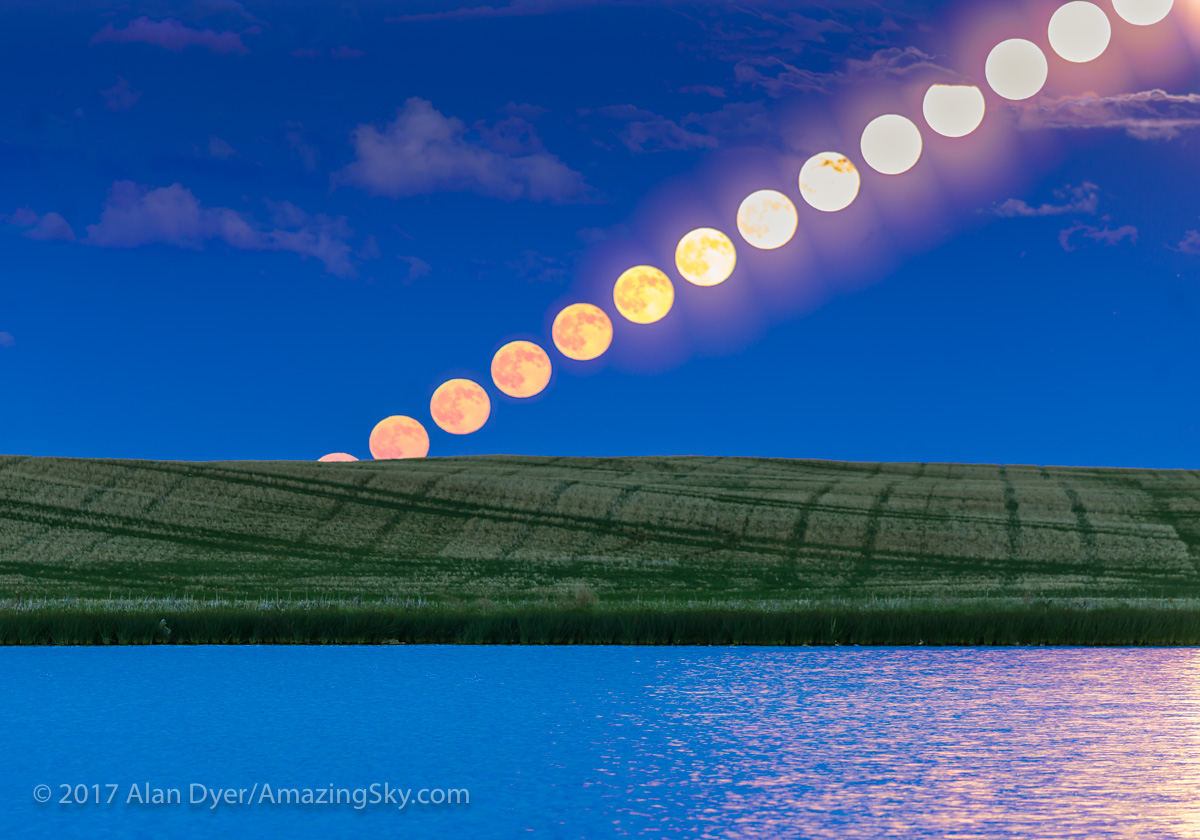
This week I’m on the road heading south for the winter. Today, I was on US 89, one of the most spectacular roads on the continent, passing through southern Utah and northern Arizona.

At left are the Vermilion Cliffs in Arizona, contrasting with the blue sky and the quarter Moon rising in the east at right.

Waxing Moon over Vermilion Cliffs

I took this view minutes earlier, from a viewpoint above the desert as US 89 descends from the Kaibab Plateau and the area around the North Rim of the Grand Canyon.

I have not driven through this area of theย U.S. Southwest in 20 years. I’ll be back through here in spring, when I hope to shoot the April 4 total lunar eclipse from the Four Corners area.

โ€“ Alan, October 30, 2014 / ยฉ 2014 Alan Dyer

The Partial Solar Eclipse from Jasper, Alberta


Partial Solar Eclipse in Cloud #1 (Oct 23, 2014)

A successfulย solarย eclipse! Always a great thing to celebrate!

Today, several hundred people, including students from the nearby elementary and high schools, enjoyed views of the Moon eclipsing the Sun fromย Jasper, Alberta. The eclipse event in Centennial Park was part of the Park’s annual Dark Sky Festival, held to celebrate the National Park’s status as a Dark Sky Preserve.

The photo above is a long 1/25 second exposure, though still taken through a solar filter, of the eclipsed Sunย dimmed by clouds. The longer exposure enabled me to pick up the clouds and iridescent colours around the Sun.

The photo below is a single exposure capturing the viewing through the many telescopes supplied by volunteers from the Royal Astronomical Society of Canada (Edmonton and Regina Centres), as well as capturingย the crescent Sun, seen here though a handheld solar filter.

Partial Solar Eclipse Wide-Angle (Oct 23, 2014)

Clouds came and went over the afternoon, but when they needed to be gone, clouds cleared off around the Sun for great views of the Moon hiding then revealing the giant sunspot that was the highlight of this eclipse.

The image below, which I shot through a small telescope at 1/8000th second through a filter, shows the big spot group about to be hidden by the advancing limb of the Moon.

Partial Solar Eclipse & Sunspot #1 (Oct 23, 2014)

This event was our last solar eclipse visible from most of Canada until the long-awaited “Great American Eclipse” of August 21, 2017, when the lunar umbral shadow will sweep across the United States, bringing a total eclipse to the U.S. and aย substantial partial eclipse to Canada.

โ€“ Alan, October 23, 2014 / ยฉ 2014 Alan Dyer

Eclipse of the Hunter’s Moon


Total Eclipse of the Hunter's Moon

The Hunter’s Moon of 2014 turned deep red during a total lunar eclipse.

It wouldn’t be an eclipse without a chase!

To see and shoot this total eclipse of the Hunter’s Moon I had to chase clear skies, seeking out the only clear area for hundreds of miles around, requiring a 3-hour drive to the south of me in Alberta, to near the Canada-US border, at Writing-on-Stone Provincial Park.

It was worth the midnight trek, though I arrived on site and got set up with just 10 minutes to go before the start of totality.

But I was very pleased to see the skyย remain mostly clear for all of totality, with only some light haze adding the glow around the eclipsed Moon. Remarkably, the clouds closed in and hid the Moon just after totality ended.

This is a single 15-second exposure at ISO 400 with a Canon 60Da, shooting through an 80mm apo refractor at f/6 and on an equatorial mount tracking the sky at the lunar rate. I shot this shortly after mid-totality. It shows how the Moon’s northern limb, closest to the edge of the umbral shadow, remained bright throughout totality.

It shows lots of stars, with the brightest being greenish Uranus at the 8 o’clock position left of the Moon, itself shining in opposition and at a remarkably close conjunction with the Moon at eclipse time.

More images are to come! But this is the result of fast processing after a dawnย drive back home and an all-nighter chasing and shooting an eclipse.

โ€“ Alan, October 8, 2014 / ยฉ 2014 Alan Dyer


The Rising of a Pre-Eclipse Moon


Rising Pre-Eclipse Moon #4 (Oct 6, 2014)

‘Twas the night before the night before … an eclipse of the Moon.

This was the beautiful moonrise tonight, on Monday, October 6, two days โ€“ by calendar date โ€“ before the total lunar eclipse on October 8.

However, as theย eclipse occurs at pre-dawn on October 8, it’s really just a day and half to go before the Moon turns red as it passes through Earth’s shadow.

I shot these as the gibbous Moon, waxing toward Full, rose over the harvested field to the east of home. The setting Sun nicely lit the clouds which partly hide the Moon.

Rising Pre-Eclipse Moon #1 (Oct 6, 2014)

Earlier in the evening, I grabbed this shot as the Moon appeared and two white-tailed deer ran through the yard and out into the field below the rising Moon. Moon deer!

TLE2014Oct08-MDT

This is the sequence that will happen early on October 8, in a diagram courtesy Fred Espenak at EclipseWise.com. The times are for Mountain Daylight, my local time zone. The eclipse will be total from 4:25 to 5:24 a.m. MDT (6:25 to 7:24 a.m. EDT) when the Moon will be immersed in the umbral shadow and will appear deep red.

Use binoculars for the best view of the colours. An eclipsed Moon looks wonderful, like a glowing red globe lit from within, but it’s really lit by the red sunlight from all the sunsets and sunrises going on around the world at once.

The next total lunar eclipses are April 4, 2015 (again pre-dawn) and September 27, 2015 (at convenient early evening hours), both visible from North America.

Clear skies and happy eclipsing!

โ€“ Alan, October 6, 2014 / ยฉ 2014 Alan Dyer


Moon and Twilight Planets over the Bow River


Moon with Antares, Mars & Saturn over Bow River

The waxing Moon shines between Saturn and Mars over the waters of the Bow River.

It was a beautiful autumn evening for watching the twilight showing of the crescent Moon accompanied by Saturn (at right of centre) and the pairing of Mars (at left, above) with his rival red star, Antares in Scorpius (at left, below).

The river is the Bow, with its headwaters at Bow Glacier in Banff.

To shoot this scene I drove to the grounds of the Blackfoot Crossing Historical Park south of Cluny, Alberta to take advantage of its viewpoint overlooking the Bow River and the heart of the traditional Siksika First Nations tribal lands.

It was here, in the valley below, that Treaty Seven was signed between Chief Crowfoot and Colonel James Macleod in September 1877. Today, a beautiful interpretive centre sits on the hillside at the heart of Blackfoot country.

โ€“ Alan, September 28, 2014 / ยฉ 2014 Alan Dyer


Mars, Saturn and the Milky Way in Twilight


Mars, Saturn & Milky Way over Ranch Corral

Mars and Saturn meet in conjunction beside the Milky Way.

As it was getting dark two nights ago, I shot this view of Mars and Saturn (the “double star” at right, with Mars below Saturn) paired together now in the evening twilight. The location was Grasslands National Park, on the Park’s main loop tour road.

At the centre of the image is Scorpius and its bright star Antares, just behind the gate of the old corral.

At left are the star clouds of the Milky Way and the galactic core. Just above the horizon are the naked-eye star clusters Messier 6 and Messier 7, the most southerly of the popularย Messier objects.

The sky is blue from the last of the twilight glow.

The image is a composite of two exposures, both 1 minute but one tracking the sky and one with the drive turned off to provide the sharper foreground.

โ€“ Alan, August 29, 2014 / ยฉ 2014 Alan Dyer


Dawn Conjunction of Venus and Jupiter


Venus & Jupiter Conjunction, with Moon (August 18, 2014)

It was a fine celestial sight to begin the week, as Venus met Jupiter in the dawn sky.

This morning, August 18, Venus and Jupiter appeared just 1/2 degree apart, as close as they’ve appeared to each other since 1999.

The top image shows the wide-angle setting, with Venus and Jupiter tightly paired near the horizon, and the waning Moon above, itself in conjunction with Aldebaran in the Hyades star cluster.

Venus & Jupiter Conjunction Closeup

This zooms into the main event, the Venus-Jupiter pairing, as they were emerging from the horizon haze.

I shot this from home, off the back deck, having little ambition at 5 a.m. to venture any further afield. I had planned to shoot this from Dinosaur Park but had second thoughts on the hour drive there and back!

Waning Moon in the Hyades near Aldebaran

This zooms into the secondary show this morning, the meeting of the waning crescent Moon with the brightest star in Taurus, Aldebaran, and its companion stars in the Hyades star cluster. This is a telephoto lens shot with a fixed camera, no tracking.

Thus begins a fine two weeks of stargazing, weather permitting, as the Moon exits the sky to leave us the summer Milky Way at its best, and dual pairs of planets in the dusk and dawn sky โ€“ Mars and Saturn converging in the evening and Venus and Jupiter, now parting ways, in the morning.

โ€“ Alan, August 18, 2014 / ยฉ 2014 Alan Dyer


Super Moonrise over Banff


Super Moonrise over Banff

Aย much-publicized “super moon” rises over Mt. Rundle and Banff townsite.

I joined a small crowd of moon watchers at the Mt. Norquay viewpoint last night, Sunday,ย August 10, to view the rising of the super moon, the closest Full Moon of 2014.

Of course, no one could possibly detect that this moon was any bigger or brighter than any other moon. Nevertheless, everyone saw an impressive sight and went away happy.

I shot this image at the end of a 700-frame time-lapse, at about 10:15 p.m. This is an HDR “high-dynamic-range” stack of 8 exposures, from dark and underexposed (to capture the bright sky around the Moon) to bright and overexposed (to capture the foreground and dark trees).

Yes, I have cranked up the HDR effect a little, to beyond “natural.” But I think the result looks striking and brings out the structure in the clouds that hid the Moon at first.

Think what you will of “super moons,” they get people outside, looking up and marvelling. In this case, the PRย prompted a moonwatch party on a fine summer Sunday evening in one of the most scenic places on the planet.

โ€“ Alan, August 11, 2014 / ยฉ 2014 Alan Dyer


Wheatfield Moon and Planets


Wheatfield Moon and Planets

The waxing Moon begins its three-day passage past Spica, Mars and Saturn in the twilightย sky.

This was the scene tonight, August 1, from aย wheat field near home, as the waxing Moon appeared to the right of the star Spica in Virgo.

To the east, or left, of those two objectsย lies Mars, at the centre of the frame. To the left of Mars is Saturn, flanked by stars in Libra.

The Moon was near Spica tonight but will appear near Mars Saturday night and near Saturn on Sunday night.

Look low in the southwest as the sky is getting dark.

โ€” Alan, Aug 1, 2014 / ยฉ2014 Alan Dyer


Super Moonrise over Canola Field


Super Moonrise over Canola Field

The orange Full Moon โ€“ a hyped “super moon” โ€“ rises over a yellow field of canola.

What a colourful sky this was tonight โ€“ the pink Belt of Venus twilight band above the blue shadow of the Earth, above the yellow ripening canola.

And the orange Full Moon embedded in our planet’s shadow.

The onslaught of publicity about super moons this week โ€“ it seems we now have not one but several a year making them all a lot less super! โ€“ does serve one purpose: it gets people out looking at the Moon they might otherwise take for granted.

Supermoon or not,ย this confluence of colours can occur any time the Full Moon rises. But if you aren’t outside watching you miss it.

โ€“ Alan, July 12, 2014 / ยฉ 2014 Alan Dyer


Super Moonrise at Red Rock Coulee


Super Moonrise at Red Rock Coulee

The Full Moon rises over the sandstone formations of Red Rock Coulee, Alberta.

This was moonrise โ€“ a super Moonrise โ€“ on Friday, July 11, 2014.

Publicized as yet another “super moon,” this moonrise was certainly excellent for me, with superb skies at Red Rock Coulee in southern Alberta. There’s no way anyone would be able to detect the fact this Moon was a little closer and larger than most Full Moons of 2014. But it was still a fine sight.

Here, you see it sitting in the pink Belt of Venus fringing the dark blue band of Earth’s shadow rising in the east just after sunset. The already red rocks are lit by the warm light of the western twilight.

The main photo is an HDR stack of 6 exposures, to capture the range in brightness from bright sky to darker foreground.

Mars and Spica above Red Rock Coulee

This night, as it is for a week or so at mid-month, reddish Mars was sitting just above blue-white Spica in Virgo. They are visible here as a double star in the moonlit southwestern sky. Saturn is to the left. This is a single exposure.

It was another perfect night โ€“ warm, dry and bug free, for 3 hours of moonlight time-lapse shooting, as well as taking these still images.

โ€“ Alan, July 12, 2014 / ยฉ 2014 Alan Dyer


Moon on the Water


Reesor Lake Moon HDR

The Moon shines over the still waters of a prairieย lake.

On Saturday, July 5, the Moon put on a super show in the twilight sky. The Moon was exactly at first quarter phase 90ยฐ from the Sun, and it shoneย between Mars and the star Spica, for a tidy 3-world conjunction in the evening sky.

For these shots I was at one of my favourite places for nightscape shooting, Reesorย Lake in Cypress Hills Interprovincial Park. These are still shots taken with one camera while two others were shootingย time lapses of the fall of night and the Moon movingย over the lake.

Moon on Reesor Lake #5

Later in the evening, some photogenic cirrus clouds movedย through the scene, nicely filling out the composition.

Moon on Reesor Lake #6

Here, you can see Mars to the right of the Moon and Spica to the left of the Moon. Below, on the water swim three white American pelicans that frequent the prairie lakes around here.
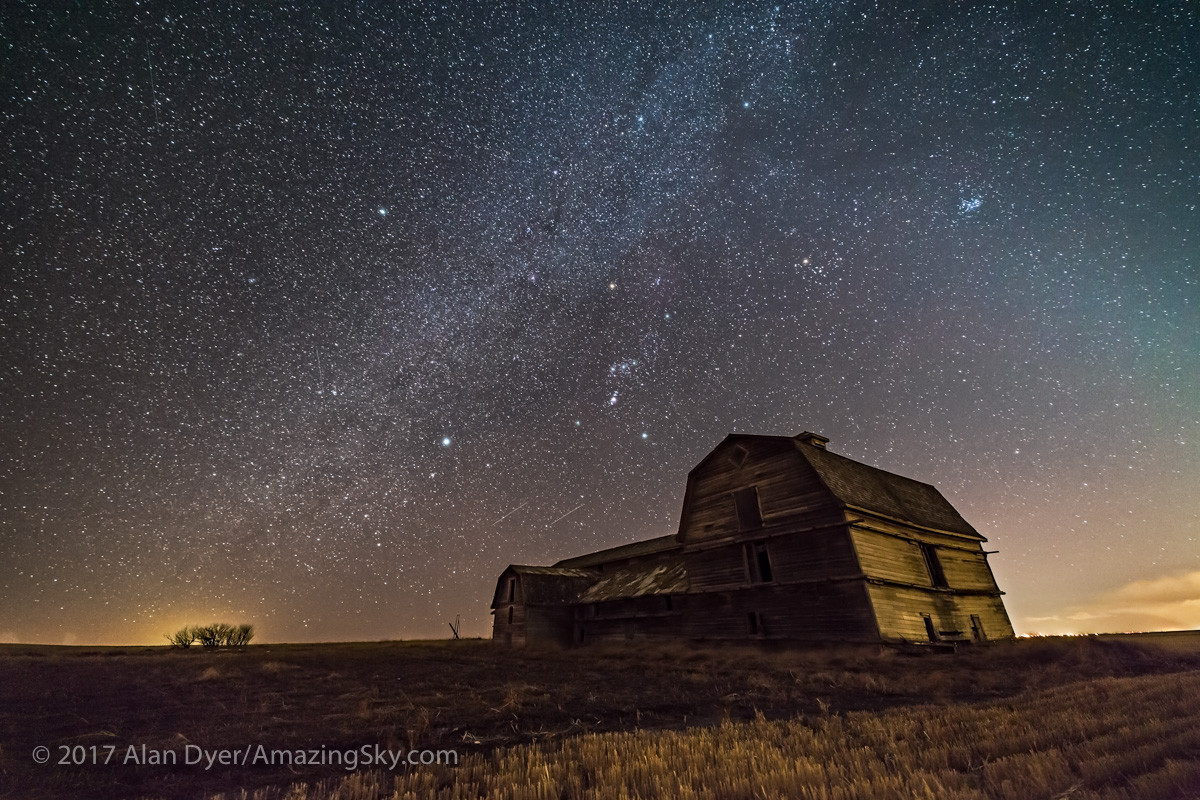
This was a perfect night. The anglers weren’t catching too much despite the fish leaping from the water every few seconds. But I managed to catch some nice photos and movies. It was a fine summer night to enjoy the sky.

โ€“ Alan, July 7, 2014 / ยฉ 2014 Alan Dyer


Moon and Venus Rising


Moon and Venus RisingThe waning Moon and Venus rise together into the summer dawn.

This was the scene this morning, June 24, as the waning crescent Moon rose together in conjunction with Venus, into the dawn sky.

The morning could not have been more clear for a great view of them coming up over the distant hills in southern Alberta.

Moon and Venus Above the Mist

Pity there was not also some noctilucent clouds, but this morning there was no sign of them. Nor of any aurora through the night, despite promising signs of activity. But the morning show made up for their absence.

The waning Moon and Venus are together again on the morning of July 24, exactly a month from now.

โ€“ Alan, June 24, 2014 / ยฉ 2014 Alan Dyer


The Thin Moon of May


Thin Crescent Moon in Evening Twilight

May ends with a thin waxing Moon returning to the evening sky.

This was the scene on a fine Friday evening, May 30, as the two-day-old Moon returned to the western sky.

Mercury was not far away, and is in this frame but at far upper right. I wasn’t really framing the shot with Mercury in mind, but the Moon and clouds.

This frame is one of 440 I shot for a time-lapse sequence of the setting Moon and moving clouds. This is the result, nicely deflickered with LRTimelapse software, an essential tool for time-lapse processing.

How many times have I tried to shoot the Moon or Mercury low in the west and been foiled by cloud near the horizon? Notice the rain falling from the western cloud. Some place near Calgaryย was getting wet!

โ€” Alan, May 31, 2014 / ยฉ 2014 Alan Dyer


Twilight over the City of Rocks


Evening Twilight over the City of Rocks

The waxing crescent Moon sets in deep twilight over the City of Rocks State Park, New Mexico.

This was the scene tonight, May 2, under fabulous skies on a warm spring evening in New Mexico. I drove 45 minutes south from Silver City to the City of Rocks State Park, and area of oddly-eroded rocks and a fabulous place for stargazing. It actually has an observatory.

For this twilight scene I shot a series of seven exposures from dark to bright with an ultra-wide 14mm lens, and stacked them in a high dynamic range composition to capture both the bright Moon and sky above and dark landscape below. You can see the stars of the winter sky disappearing into the evening twilight as well, plus Jupiter at top.

For the next three nights I’ll be back near the Arizona Sky Village just across the state line fromย Rodeo, New Mexico, under very dark skies, to shoot the summer Milky Way in the wee hours of the morning after moonset. The weather promises to be perfect.

โ€” Alan, May 2, 2014 / ยฉ 2014 Alan Dyer


New Mexico New Moon


New Mexico New Moon (April 30, 2014)

The thin waxing crescent Moon returned to the evening sky tonight, seen here in the deepening blue of a New Mexico evening.

I’m in Silver City, New Mexico (altitude 5900 feet) for a few days and nights, checking out places to spend next winter, under clearer and warmer skies than back home … and with rarely any snow to shovel.

This was the scene tonight, on the ranch road withย one of theย prime propertyย choices โ€“ astronomers check real estate locations by day and night!

The crescent Moon is lit byย Earthshine as it sits amid the deep blue twilight. The stars of Taurus show up flanking the Moon, with the Hyades at left and Pleiades at right.

This image is a high-dynamic range stack of 6 exposures from 2 to 20 seconds, to capture the ground detail without blowing out the Moon. Lights from an approaching pickup truck nicely lit the trees duringย the final longest exposure.

For the technically minded, I stacked the images using Photoshop CC HDR Pro, then “tone-mapped” them using Adobe Camera Raw in 32 bit mode.

Sunset from Silver City, New Mexico

The sky was hazy all day and evening, from wind-blown dust common to the area. Fierce southerly winds were whipping up dust all day, which hung in the sky all evening as well.

The sunset was a golden yellow from all the dust in the air. Once it got dark the sky lacked the idealย desert transparency, muting the zodiacal light I saw last night from the Chiricahuas.

Not every night is perfect in the high desert!

โ€“ Alan, April 30, 2014 / ยฉ 2014 Alan Dyer


Lunar Eclipse from Oz


Total Lunar Eclipse (April 15, 2014) #1

The eclipsed red Moon rises over the waters of Lake Macquarie on the east coast of Australia.

I was still in Australia for this eclipse and managed to see and shoot it, but only just!

Total Lunar Eclipse (April 15, 2014) #2

I was on the Central Coast of New South Wales, where clouds and rain have been prevalent all week, in part caused by departing remnants of Cyclone Ita. The prospects for seeing this eclipse from the coast looked bleak indeed.

Total Lunar Eclipse (April 15, 2014) #3

From eastern Australia, the Moon rose at sunset in mid-eclipse on our evening of April 15. I was with family in Australia and so we made an evening picnic of the event, joining a few others in the lakeside park who were there to also see the eclipsed Moon over Lake Macquarie, Australia’s largest salt water lake. I wanted to catch this eclipse over water, to see the effect above โ€” the “glitter path” from the Moon but one turned red by the eclipsed Moon.
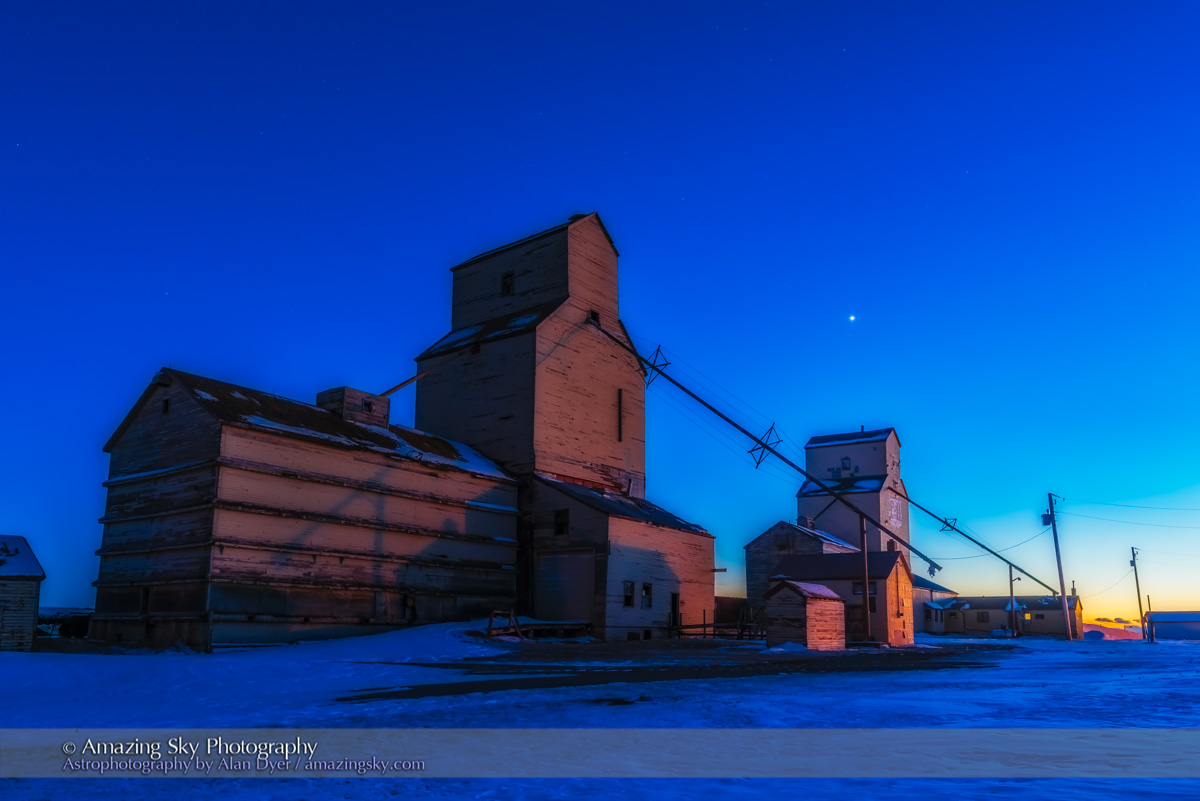
Total Lunar Eclipse (April 15, 2014) #4

As we were about to give up, I caught sight of the Moonย as it rose into breaks in the cloud, revealing the red Moon near Spica and Mars. We saw the last of totality and the early stages of the final partial eclipse. But later in the evening clouds rolled in again and the rain poured down. Indeed, I took myย last images of the eclipse with light rain falling and the cameras getting wet. This isn’t the first eclipse I’ve watched in the rain!

I shot with fixed cameras with 50mm and 135mm lenses. The top image is a 135mm telephoto shot, the other three are with the 50mm lens.

โ€” Alan, April 16, 2014 / ยฉ 2014 Alan Dyer


The Waxing Moon of Oz


Waxing Moon in Pink Clouds #1 (Oz April 5, 2014)

The waxing Moon shines amid twilight clouds from Australia.

While it looks like a waning morning Moon, this is the waxing evening Moon, inverted compared to northern hemisphere views. I shot this two evenings ago as the crescent Moon enters the evening sky.

With the return of the Moon to the sky, my dark sky observing sessions end. Next on the agenda is the total eclipse of the Full Moon on April 15. I hope to shoot that over the ocean from the Australian coast.

โ€” Alan, April 7, 2014 / ยฉ 2014 Alan Dyer


Venus in the Zodiacal Light


Venus in Zodiacal Light (14mm 5DII)

Venus shines brightly amid the glow of Zodiacal Light below the Milky Way.

At dawn from Australia this was the last view I saw each night on my run of southern sky observing nights. This is Venus, high in the morning sky, amid the faint pillar of light called the Zodiacal Light. The glow is sunlight reflected off cometary dust in the inner solar system.

Above is the centre of the Galaxy area of Sagittarius. This scene was a wonderful way to end a night of perfect astronomy under the southern stars.

โ€” Alan, April 7, 2014 / ยฉ 2014 Alan Dyer

Mars and Spica from Oz


Mars and Spica Rising (April 5, 2014)

Mars and Spica form a contrasting pair of stars in the east, as Mars reaches its closest point to Earth.

This was the scene two nights ago, April 5, as Mars and Spica rose together in the east. Mars is now near opposition, its closest point to Earth making Mars extra bright. Its reddish tint contrasts nicely with blue-white Spica, the brightest star in Virgo.

If the arrangement of Mars and Spica looks unusual, it’s because I took this from Australia. So the relative position of Mars and Spica looks “upside down” compared to a northern hemisphere view. Moonlight from the waxing Moon light the gum trees.

โ€” Alan, April 7, 2014 / ยฉ 2014 Alan Dyer


The Pull of the Moon


Moonrise at Woolgoolga, Australia #2

The Full Moon rises over the Pacific Ocean,ย exerting its pull on the ocean tides.

This was the scene last night, Monday, March 17, 2014 from the headlands at Woolgoolga, New South Wales, Australia. The views overlook the Pacific Ocean with the Full Moon rising. If the Moon looks a little odd, it’s because I took these images from “down under,” where the Moon appears ย upside down compared to what we northerners are familiar with.

However, no matter your hemisphere, the Moon exerts a tidal pull on the globe, which manifests itself most obviously as the twice-daily rise and fall of the ocean tides at shorelines like this. When I took these shots at moonrise, the tide was just past its minimum and was beginning to come in again, for a peak later that night with the Moon high in the north.

Moonrise at Woolgoolga, Australia #1

This image was from a few minutes earlier, with the Moon having just risen and looking a little more pale against the darkening twilight of the eastern horizon.
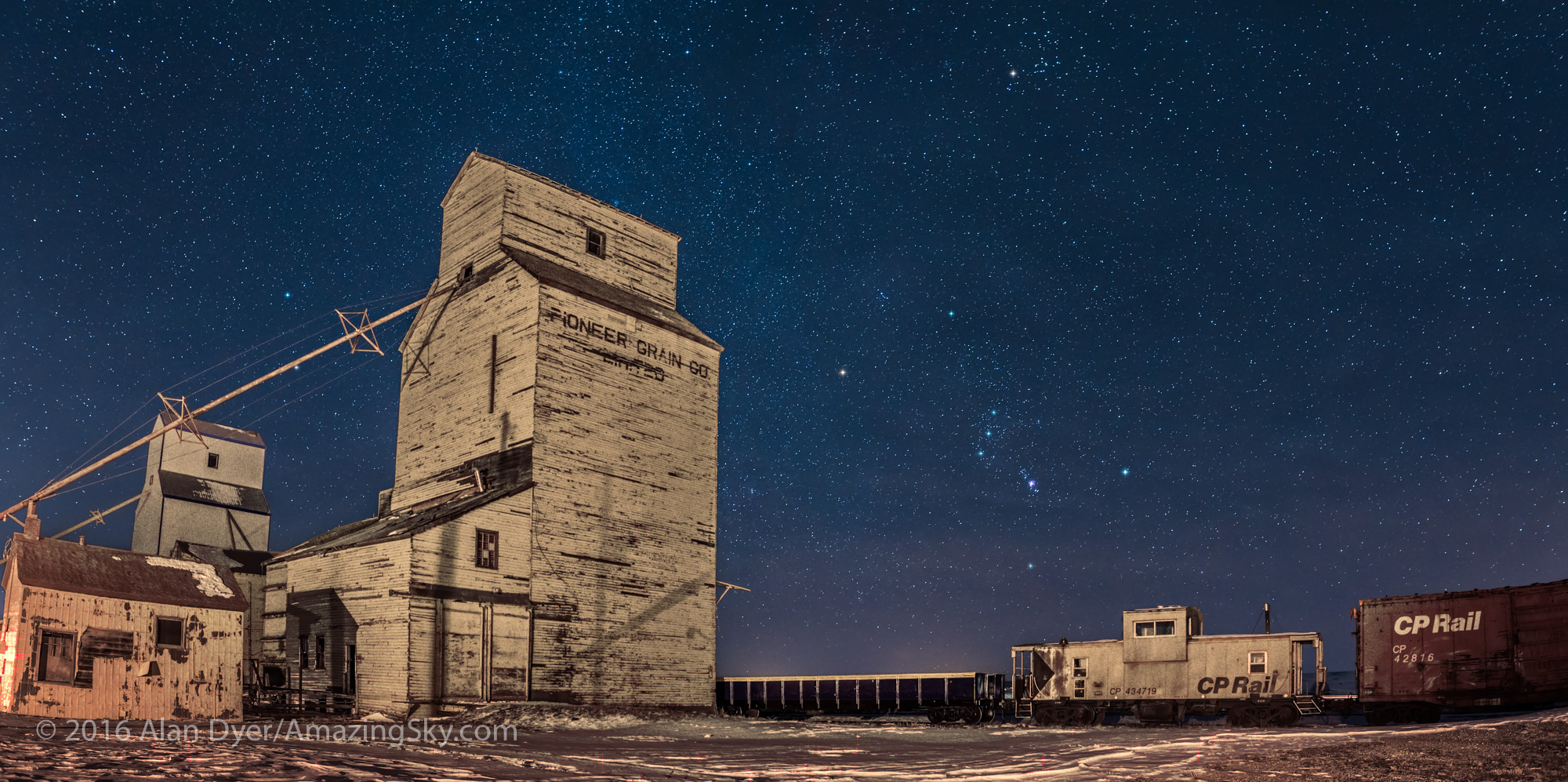
I’m in Australia for the next few weeks, to shoot lots of images of the southern autumn sky, skies permitting.

โ€“ Alan, March 18, 2014 / ยฉ 2014 Alan Dyer

Waning Moon in the Sunrise Clouds


Waning Moon at Sunrise (Feb 27, 2014)

The thin waning Moon sits in the red clouds of sunrise on a winter morning.

This was the scene this morning, February 27, just before sunrise when I was able to catch the thin crescent Moon โ€“ a waning Moon โ€“ amid the sunrise clouds. The Moon just happened to appear in a clearer hole in the clouds, in a blue patch above the pinks and oranges of the clouds. They contrast with the cold blue snow below.

This was a beautiful scene to start the day.

โ€“ Alan, February 27, 2014 / ยฉ 2014 Alan Dyer


Moon and Venus in the Winter Dawn


Moon & Venus Conjunction (Feb 26, 2014)This was the scene at dawn on a cold winter morning as the waning Moon appeared near Venus.

The temperature was only -15ยฐ C, so rather pleasant compared to the -30ยฐ C it has been the last couple of mornings. On February 26, I awoke at 6 a.m. and ventured into the cold winter morning to shoot the conjunction of the crescent Moon beside Venus above the snowy landscape of southern Alberta.

This was not a particularly close conjunction, at least not for us in North America. But its location low on the southeast horizon made the scene attractive and photogenic.

Mars and Saturn in the Winter Dawn (Feb 26, 2014)

I aimed the camera the other way, to the southwest, to catch bright Mars (at right near Spica in Virgo) and Saturn (at left in Libra) above the abandoned farmhouse. The stars of Scorpius shine at left.

So we had three planets visible at dawn this morning, a fine sight to start the winter day.

โ€“ Alan, February 26, 2014 / ยฉ 2014 Alan Dyer

Venus in the Moonlight


Venus at Chiricahua National Monument (Dec 15, 2013) #3

Venus blazes brightly in the moonlit sky in the Chiricahua Mountains of Arizona.

This was the view last night, from Massai Point at the summit of the Chiricahua Mountains, looking southwest toward Venus in the blue moonlit sky. A bright waxing gibbous Moon provided the illumination, turning night into day in these long exposures.

I started my trek around Arizona and New Mexico here, at Chiricahua National Monument two weeks ago, on December 3, when I took some sunset shots.

Venus at Chiricahua National Monument (Dec 15, 2013) #1

I end my trip by returning to the Chiricahuas, but now with a nearly Full Moon in the sky.

I saw this scene two weeks ago but didn’t shoot it then. So I returned to capture Venus at the end of a moonlit road, shining above the volcanic rock formations that are the distinctive feature of the National Monument.
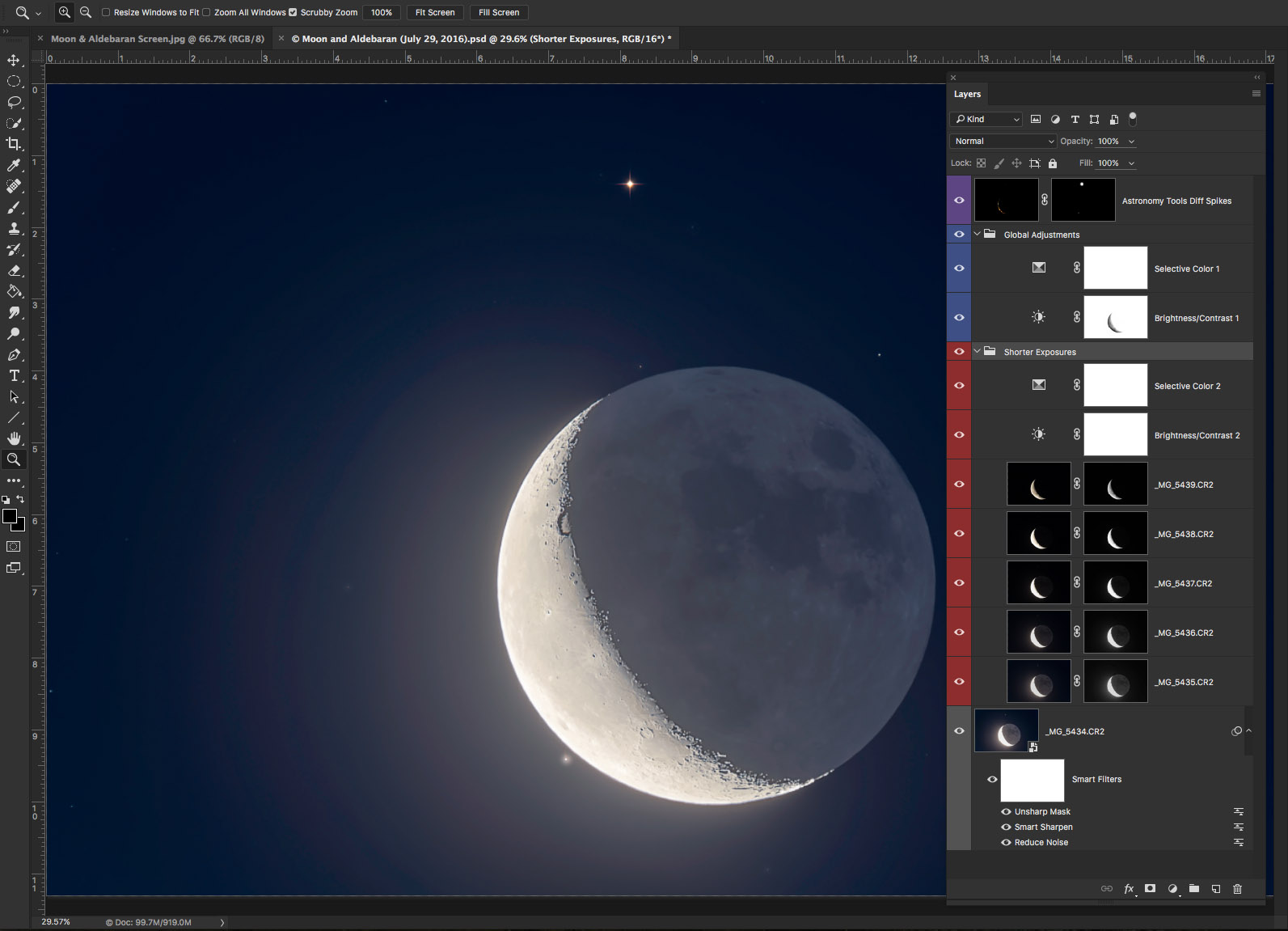
Now, it’s home to Alberta and the snow and cold.

โ€“ Alan, December 16, 2013 / ยฉ 2013 Alan Dyer


Adobe Moon and Venus


Crescent Moon & Venus Over Adobe House (Dec 5, 2013)

The waxing crescent Moon shines above Venus and our adobe house in New Mexico.

Tonight, December 5, the clouds cleared in time for us to catch a glimpse of the crescent Moon above Venus, now at its most brilliant for the year.

They shine above the main house at the Painted Pony Resort where I am this week for a stint of astrophotography with a dozen other Canadians escaping winter up north. But it’s cold here, too โ€“ it might go down to freezing tonight. Horrors!

For this shot I made liberal use of shadow and highlight recovery at the Adobe Camera Raw stage and in Photoshop to recover as much detail as I could in the overexposed Moon at top. However, the long exposure nicely brings out the stars in the moonlit sky. I also like the contrast of pastel colours.

โ€“ Alan, December 5, 2013 / ยฉ 2013 Alan Dyer

Zodiacal Light & Light Pollution


Zodiacal Light & Light Pollution (New Mexico)

The subtle glow of zodiacal light competes with the artificial glow of light pollution.

This was the scene earlier this evening, December 4, from our dark sky retreat at the Painted Pony Resort in southeast New Mexico. In the distance the yellow glow of light pollution reflecting off the clouds comes from Douglas, Arizona.

Above, in the sky, you can see a subtle band of light reaching up and tipped slightly to the left. That’s the zodiacal light, caused by sunlight reflecting off cometary dust in the inner solar system.

At right is part of the summer Milky Way, setting into the west.

The clouds are orographic clouds hovering over the Chiricahua Mountains, where I was last evening shooting the sunset.

Our first night here has proven to be much better than we had expected, with scattered cloud but mostly clear skies. We’re here for another 4 nights. More is coming!

โ€” Alan, December 4, 2013 / ยฉ 2013 Alan Dyer

Sundiving Comet ISON โ€“ A Last Look


Comet ISON C/2012 S1 (Nov 21, 2013)

Comet ISON performs its dive toward the Sun, caught in the morning twilight.

This was the infamous and much-hyped Comet ISON (C/2012 S1) as it appeared this morning, November 21, 2013, a week before it performs its hairpin turn around the Sun.

The comet was easy to see in binoculars, though the camera picks up a bit more of its faint tail. ISON was much more photogenic a week ago when it was higher in a darker and moonless sky. But this morning I had to contend with bright moonlight from a waning Moon and the brightening dawn. The inset shows a blow up of just the comet.

ISON is dropping rapidly toward the Sun, making this perhaps the last sighting I’ll have of it until it reappears โ€“ we hope! โ€“ from behind the Sun in early December. If it survives its perihelion passage it might blossom into brilliance โ€ฆ or fade into obscurity. No one knows.

In the photo above, you can see Mercury at left, shining much brighter than ISON. It was brilliant as it rose into the southeast sky, with the elusive planet now about as well-placed as it gets as a “morning star” for us living at northern latitudes.

Comet Lovejoy C/2013 R1 (Nov 21, 2013)

This morning I was able to shoot not one but two comets.

About half an hour before ISON hove into view I aimed the camera up almost overhead toward Ursa Major, to capture Comet Lovejoy (C/2013 R1) as a bright cyan fuzzball with a short tail. Again, the photo brings out the tail โ€“ to the eye the comet was obvious in binoculars but appeared as just a fuzzy star.

I took both shots with the same gear: a 135mm telephoto lens on the Canon 5D MkII on an iOptron SkyTracker. The Lovejoy shot is a stack of 5 x 75 second exposures. The ISON shot is a 4-second exposure, with the colours and contrast boosted for prettiness.

This is certainly proving to be a year of comets. It would be nice if just one of them got really bright!

โ€“ Alan, November 21, 2013 / ยฉ 2013 Alan Dyer


The Green Flash – At Last!


The Green Flash (Nov 15, 2013) from Barbados

At last, I enjoyed a successful attempt to capture the elusive green flash.

During three weeks at sea attempts almost every evening from the ship to sight the green flash always failed, as the Sun set behind low horizon cloud.

But this night, the Sun set into the ocean with a clear horizon. My location was a small public oceanside walkway on Bay Street near Bridgetown, Barbados. It was a great spot to watch the sunset, though our main purpose for stopping there was to pick up some fried chicken at the KFC just steps away!

But the imminent sunset under ideal conditions made it worthwhile sticking around to see if we (I was with two friends from Alberta)ย could sight the green flash.

We did! I shot a rapid fire sequence โ€“ the image above is one frame of many catching the last bit of the Sun remaining above the horizon and turning green.

The infamous green flash is a refraction effect caused by the atmosphere separating out the green light and lifting it higher so it’s the last thing you see as the Sun sets. Conditions aren’t always amenable to seeing the green flash โ€“ you need a clear horizon and you also need the atmosphere structured with warm layers near the sea creating a mirage effect.

For more details on the technical explanations see Andrew Young’s page atย http://aty.sdsu.edu/ย 

โ€ฆ and Les Cowley’s page atย http://www.atoptics.co.uk/atoptics/gf1.htmย 

Andrew Young has a nice simulation atย http://aty.sdsu.edu/explain/simulations/inf-mir/inf-mirSS4GF.html

Sunset from Barbados (Nov 15, 2013)

This was the view moments before, with the lower edge of the setting Sun distorted by atmospheric refraction, a sign that you might see a green flash as the upper edge disappears.

Sunset & Sailing Boat from Barbados

I shot this image a few minutes earlier as a photogenicย sailboat drifted into the scene. Red sails in the sunset!

I’m nearing the end of my stay in Barbados and my 4 weeks away from home. There are heavy snowfall warnings out for southern Alberta this weekend so I’m not anxious to return! But winter will be waiting for me next week.

โ€“ Alan, November 16, 2013 / ยฉ 2013 Alan Dyer


The Post-Eclipse Moon over the Atlantic


Moon & Venus Post Eclipse (Nov 6, 2013) #1

Following any total solar eclipse it’s traditional to look for the crescent Moon as it returns to the evening sky.

This was the view on November 6, three days after Sunday’s total solar eclipse when the waxing Moon was near Venus, with both high in our tropical sky as we finish our sail across the Atlantic. As I write this, we have just sighted the lights of Barbados off the port side as we round the north end of the island. It’s our first sighting of any other sign of civilization in two weeks, since we left the Canary Islands.

Moon & Venus Post Eclipse (Nov 7, 2013) #2

This view is from the next night, November 7, with the Moon higher and well above Venus, set amid the square rigged sails of the Star Flyer clipper ship.

It’s been a fabulous voyage across the Atlantic, with largely calm seas and beautiful weather on most days.

Tomorrow I start a week stay in Barbados.

– Alan, November 9, 2013 / ยฉ 2013 Alan Dyer


Sailing to the Sun


Cloud Shadows Near Sunset over the Atlantic

As we continue our sail across the Atlantic, our heading takes us southwest, directly toward the setting Sun.

This was the scene last night, a day out from the Canary Islands, as we set our course toward the eclipse intercept point. Our heading of roughly 245ยฐ takes us into the setting Sun each evening.

Weโ€™re now often under sail alone, with engines off. As Columbus and all trans-Atlantic explorers did, weโ€™re letting the northeast trade winds blow us across the ocean. Under their steady force, weโ€™re making a good 8 to 9 knots, sufficient to get us to the eclipse path on the appointed day and time on November 3.

Moon Amid the Rigging

On that day the Moon, seen here as a waning crescent in yesterday morningโ€™s sky amid our square-rigged sails on the 4-masted Star Flyer, will cover the Sun for 44 seconds.

Tonight, October 28, was a magical night. Many of the eclipse tour folks gathered on the aft deck with all the lights off to lie back on deck chairs and gaze up at the Milky Way, with us now hundreds of kilometres away from any other lights.

We had the Milky Way above, while below, the ocean in our wake was exploding with flashes of bioluminescence. The night was warm and of course windless because we’re travelling with the wind. It was an amazing experience.

โ€” Alan, October 28, 2013 / ยฉ 2013 Alan Dyer

The Subtle Shading of a Penumbral Lunar Eclipse


Penumbral Eclipse of the Moon (Oct 18, 2013)

This is about as subtle as an eclipse can be โ€“ a partial penumbral eclipse of the Moon.
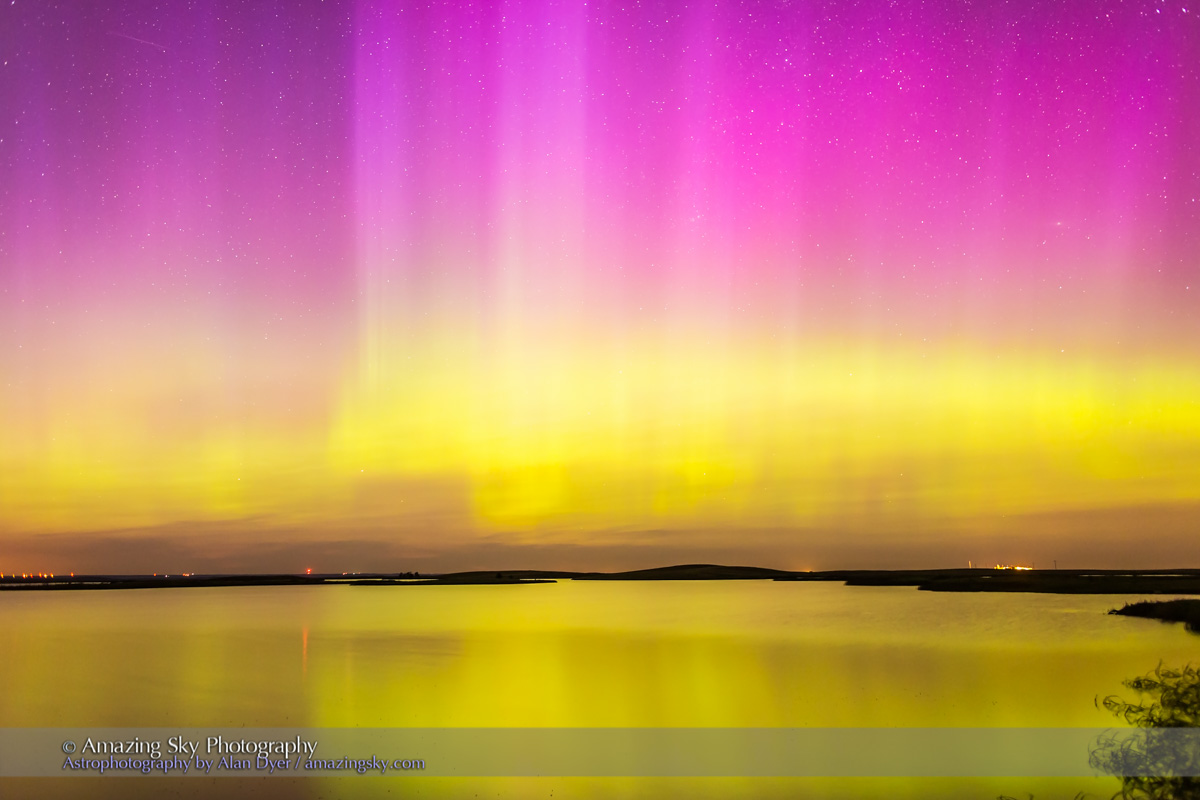
I was perfectly positioned to see this eclipse, such as it was. At mid-eclipse when I took this image, the Moon was due south and as high in the sky as it was going to get for the night.

My location was the hotel poolside bar and rooftop patio 10 floors up overlooking the harbour in Malaga, Spain.

Can you see the effect of the eclipse? Barely, perhaps. The Full Moon travelled through the top of the Earth’s penumbral shadow, creating a slight darkening of the lower portion of the Moon. I’ve boosted contrast a lot in processing yet the effect is still barely perceptible.
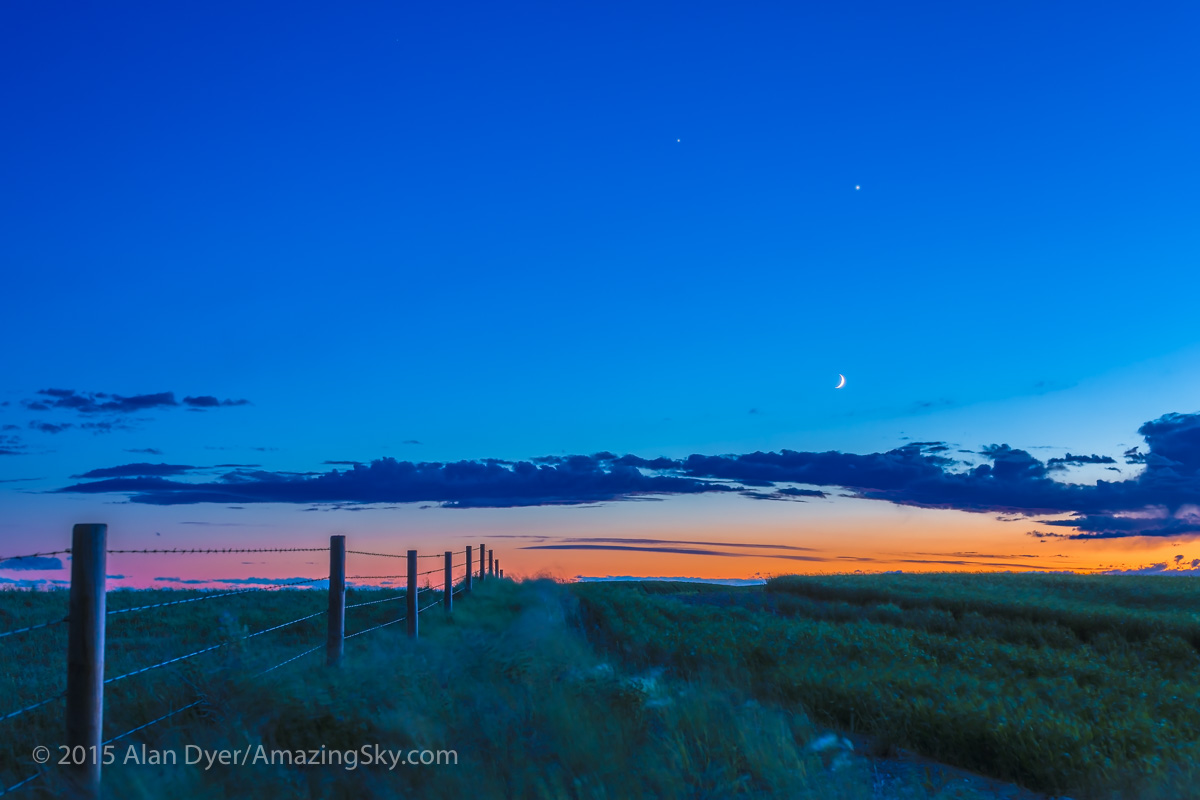
No matter. With luck, in two weeks time we’ll experience just the opposite โ€“ the most spectacular eclipse the sky has to offer, a total eclipse of the Sun.

We set sail tomorrow.

โ€“ Alan, October 19, 2013 / ยฉ 2013 Alan Dyer


Moon Over Malaga โ€“ Two Weeks Until the Eclipse


Moon Over Malaga, Spain.

On the night of a penumbral eclipse, the Full Moon shines over the harbour on the Mediterranean at Malaga, Spain.

This was the view earlier tonight of the Full Moon from Spain, on the night of a partial penumbral eclipse.

The eclipse had not yet begun when I took this shot in the early evening. But even at mid eclipse at 1 a.m. local time, any darkening from the penumbral shadow would be very tough to photograph with anything but a very long telephoto or telescope, which I don’t have with me on this trip.

The penumbral eclipse of the Moon tonight is the complement of the total eclipse of the Sun in two weeks time. Lunar and solar eclipses usually occur in pairs. It is the total solar eclipse on November 3, half a lunar cycle from now, that is the attraction.

To see it, we leave Spain tomorrow and set sail across the Atlantic โ€“ not in this century-old German sailing ship, the Eye of the Wind โ€“ but in a modern ship the Star Flyer.

โ€“ Alan, October 18, 2013 / ยฉ 2013 Alan Dyer

The Moon in Spain …


The Moon over Spain - Daytime

… shines mainly on the plane!

These were views seen from my airplane window earlier this evening as we descended into Madrid, Spain. The lighting, direction and timing were perfect for catching the crystal clear gibbous Moon shining in a beautifully clear sky (as it should be from this altitude) with a low Sun illuminating the clouds.

The view below, taken later after sunset, catches the Moon in a twilight sky, with the ย shadow of the Earth sharply defined as a dark blue band above the horizon.

The Moon over Spain - Twilight

In two days, on Friday October 18, the Moon passes through the outer part of Earth’s shadow, for a mild penumbral eclipse of the Moon.

I’ll be perfectly positioned in Spain to see it, but that’s not what I’m here for. I’m off to chase not the shadow of the Earth but the shadow of the Moon, as it hits the Earth two weeks after the lunar eclipse. On November 3 worlds will align again for a total eclipse of the Sun across the Atlantic Ocean and central Africa. I’ll be on the ocean.

Internet connections willing, I’ll be blogging from shipboard about the eclipse and views of sea and sky as we cross the Atlantic from Spain to Barbados chasing moonshadows.

โ€“ Alan, October 16, 2013 / ยฉ 2013 Alan Dyer


Comet ISON Passes Mars


Comet ISON & Mars (Oct 8, 2013)

Comet ISON passes Mars on its inbound journey toward the Sun.

This was the scene on the morning of October 8, 2013, with Comet ISON (top), still small and faint, passing the planet Mars, the bright object at bottom. The comet was actually close to Mars in space in addition to appearing close to Mars in our sky.

Comet ISON is the much-heralded “comet of the century,” but so far has failed to live up to expectations. It may never become visible to the unaided eye. Or it could blossom into a dawn spectacle after it rounds the Sun on November 28.

Only time, and the vagaries of comets, will tell.

This image is a stack of five 5-minute exposures with a 92mm aperture refractor and Canon 5D MkII at ISO 1600.

โ€“ Alan, October 8, 2013 / ยฉ 2013 Alan Dyer

Moon and Mars in the Morning


Moon, Mars & Regulus (Oct 1, 2013)

The waning Moon shines below Mars and beside the star Regulus in the dawn twilight.

This was the scene before sunrise this morning with the waning crescent Moon near Mars (above the Moon) and the star Regulus (left of the Moon) in Leo. Mars is getting the attention this week as Comet ISON flies near the planet and also appears near Mars in our earthly sky.

However, the comet is still very faint and needs a large telescope to see from Earth. It will be interesting to see if any of the Mars probes are able to image it, as ISON is still fainter than predicted and might be beyond their reach to detect. But if they do, they couldย help determine just how big ISON is and that in turn will tell us if it might survive its November 28 passage round the Sun to become a fine dawn object in December.

โ€“ Alan, October 1, 2013 / ยฉ 2013 Alan Dyer


Equinox Highway


Equinox Setting Sun (Sept 23, 2013)

Highway One heads into the setting equinox Sun.

I try for this shot every year, and every year I’m thwarted by low clouds over the Rockies to the west.

So here’s the shot from tonight, Monday, September 23, the night after equinox. Had the horizon been perfectly clear tonight the Sun would have appeared right at the end of the Trans-Canada Highway as it set behind the Rockies. Instead, it disappeared higher up and to the left, behind low cloud.

At equinox (fall or spring) the Sun rises due east and sets due west. So tonight, it was shining into the eyes of all the drivers as they headed west into Calgary โ€“ a little demonstration of the annual motion of the Sun.

The previous night, Sunday, Sept. 22, I shot a time-lapse movie of the scene, again hoping for a clear shot to the setting Sun. Alas! A neat movie but still not quite what I was after.

There’s always 2014. But I think I need to aim east and catch the rising Sun at equinox instead. The mountains attract too many clouds.

โ€“ Alan, September 23, 2013 / ยฉ 2013 Alan Dyer


Harvest Moon Panoramas


Harvest Moon & Earth Shadow Panorama (Sept 19, 2013)

The Harvest Moon rises into the dark arc of the Earth’s shadow.

What a perfect night this was. The Full Moon rose into a crystal clear sky, tinted with the dark blue shadow of our planet arching across the eastern sky.

The main image above is a 7-section panorama sweeping from northeast to southeast, but centred on the rising Harvest Moon rising almost due east.

The Moon came up just before the Sun set. The panorama below shows that scene. It’s a crop of a full 360ยฐ, 45,000-pixel-wide panorama, taken just as the Sun was setting almost due west and the Moon was rising 180ยฐ away in the east.

Harvest Moon Panorama (Sept 19, 2013)

I took both panoramas with a Canon 5D MkII and 50mm Sigma lens, with the segments at a 30ยฐ spacing. That way I take 12 segments to cover a full 360ยฐ, a habit leftover from the days of shooting photo pans for planetarium projection systems consisting of 12 Kodak slide projectors.


My previous post showed some still frames from a time-lapse movie of the rising Harvest Moon. The final movie is above, assembled from 670 frames taken at 2-second intervals with the Canon 60Da and 200mm lens. I’ve shot this subject a few times now, but this was my best capture of the rising Full Moon at harvest time, always the most photogenic Moon it seems.
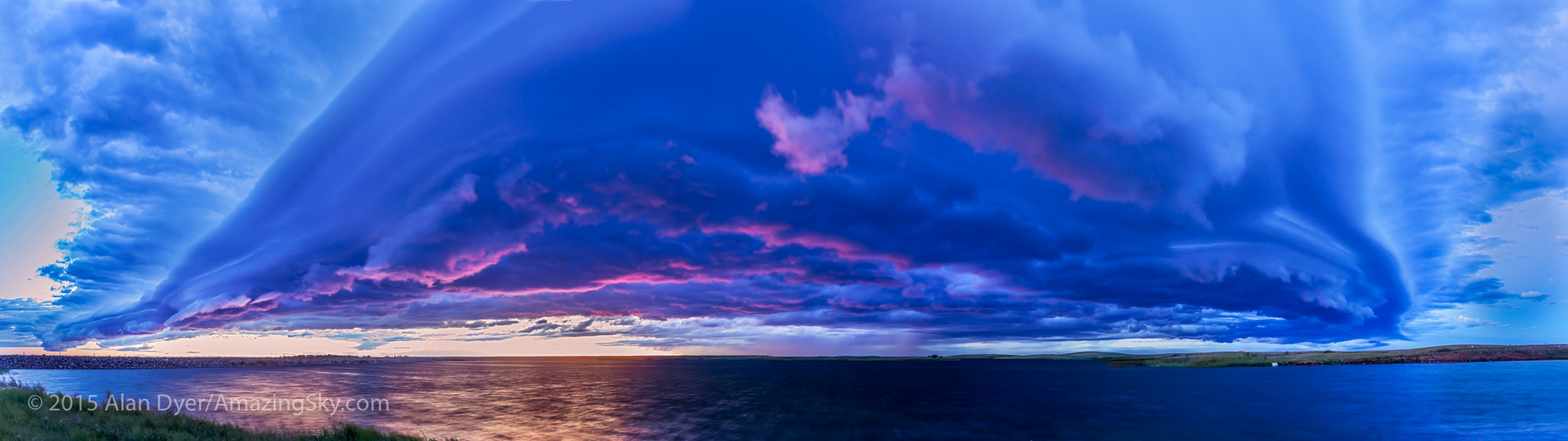
It was a marvellous night for a moonrise!

โ€“ Alan, September 20, 2013 / ยฉ 2013 Alan Dyer


Harvest Moonrise at Sunset


Harvest Moonrise #2 (Sept 19, 2013)

The Harvest Moon rises with pink hues into the deep blue twilight over prairie fields.

This was the scene tonight, September 19, as the Full Moon rose into a clear eastern sky. The view was perfect, with a cloudless horizon (for a change!) and the Moon prominent and pink as it rose into the twilight sky.

The main image is from a few minutes after moonrise. The bottom image, with a dimmer Moon, is from just after moonrise.

In neither case did I punch up the Moon in contrast or colour separately from the sky to make it stand out more than it did in real life. And I certainly did not paste a telephoto lens shot of the Moon into a wide-angle scene. That’s faking it. This is real.

Harvest Moonrise #1 (Sept 19, 2013)

Both frames are from a 670-frame time-lapse sequence, from the Moon first peaking above the horizon to when it rose out of frame at top right. That’s still in processing!

โ€“ Alan, September 19, 2013 / ยฉ 2013 Alan Dyer


Harvest Moonset at Sunrise


Harvest Moonset at Dawn (Sept 19, 2013)

The Harvest Full Moon sets into a prairie scene lit by the rising Sun.
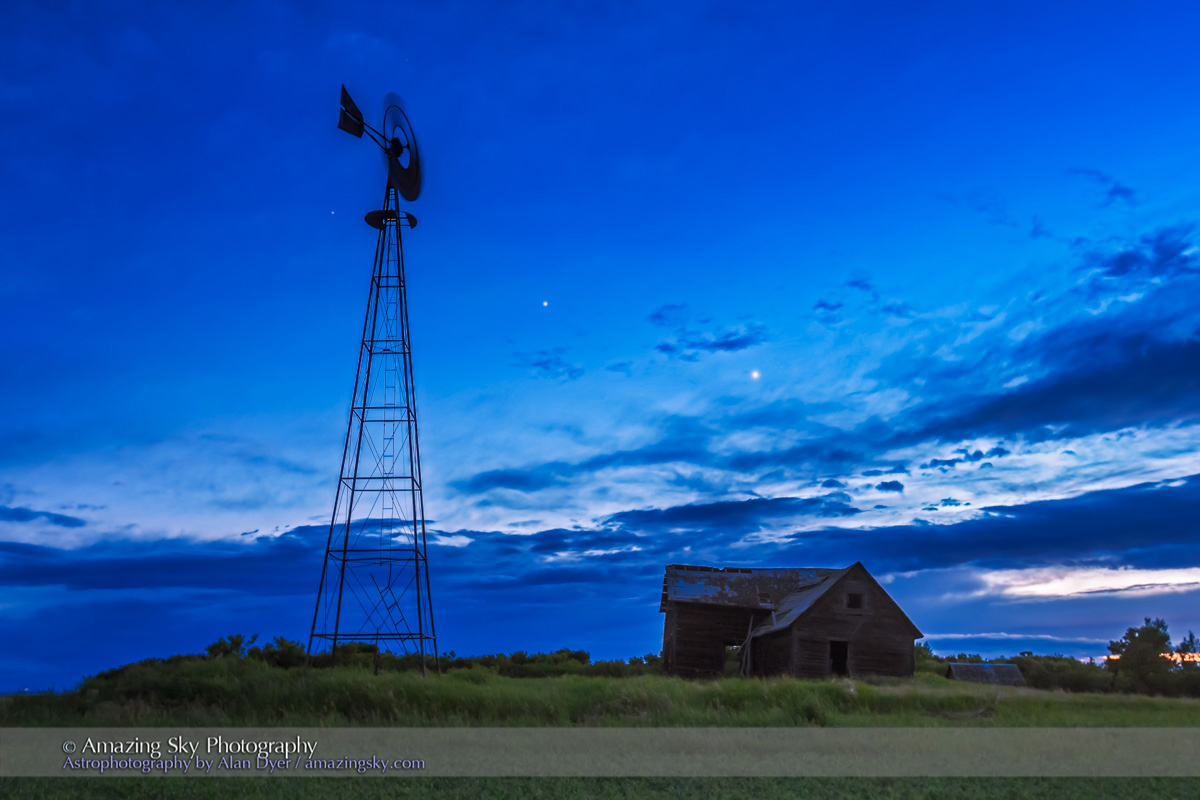
This was the scene this morning, September 19, as the Full Moon set just after sunrise on a perfectly clear morning.
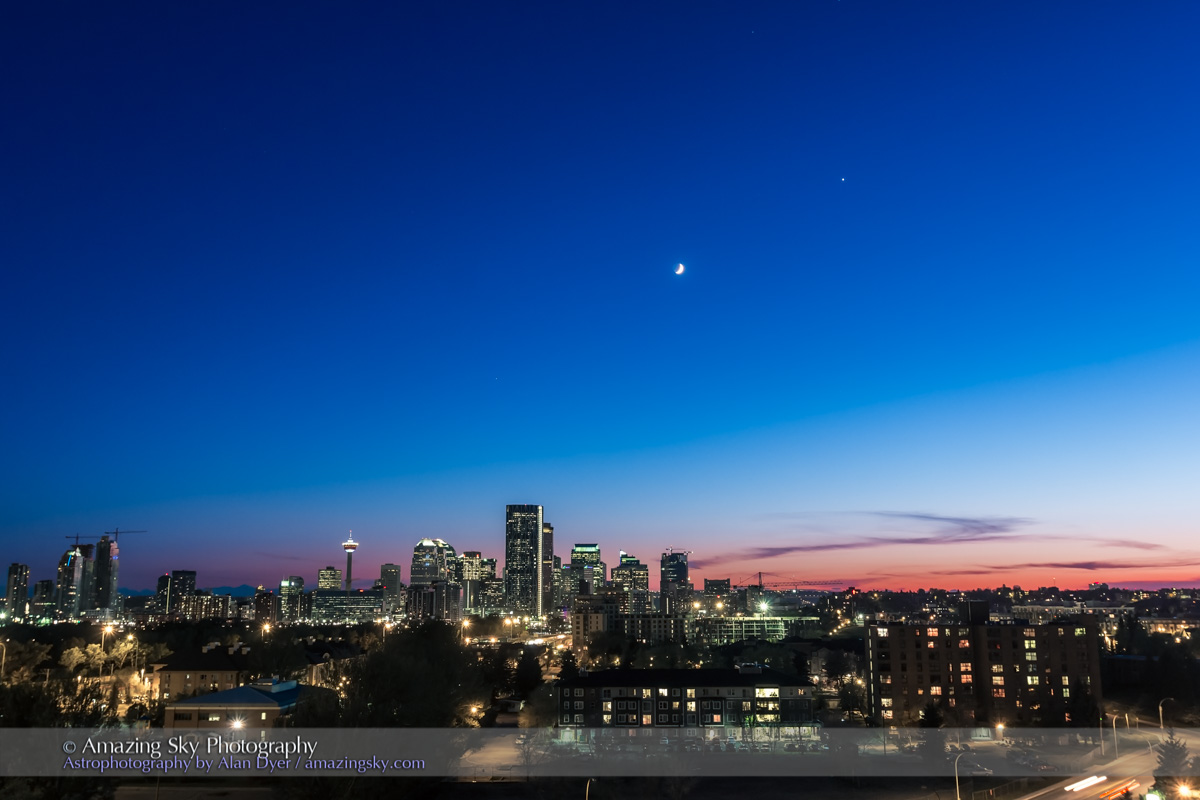
Clear, of course, but for the only clouds in the sky just where I wanted to shoot. However, in this case they did help make the scene, adding more colours to the western sky at dawn.

This was the true Harvest Moon, as moonset occurred only a couple of hours after the official moment of Full Moon. However, the setting moons of Wednesday night, September 18 and Thursday night, September 19 can both claim to also be the Harvest Moon, the Full Moon closest to the autumnal equinox.

I plan to shoot the Moon coming up again, 12 hours after it set for this photo, and right at sunset tonight.

โ€“ Alan, September 19, 2013 / ยฉ 2013 Alan Dyer