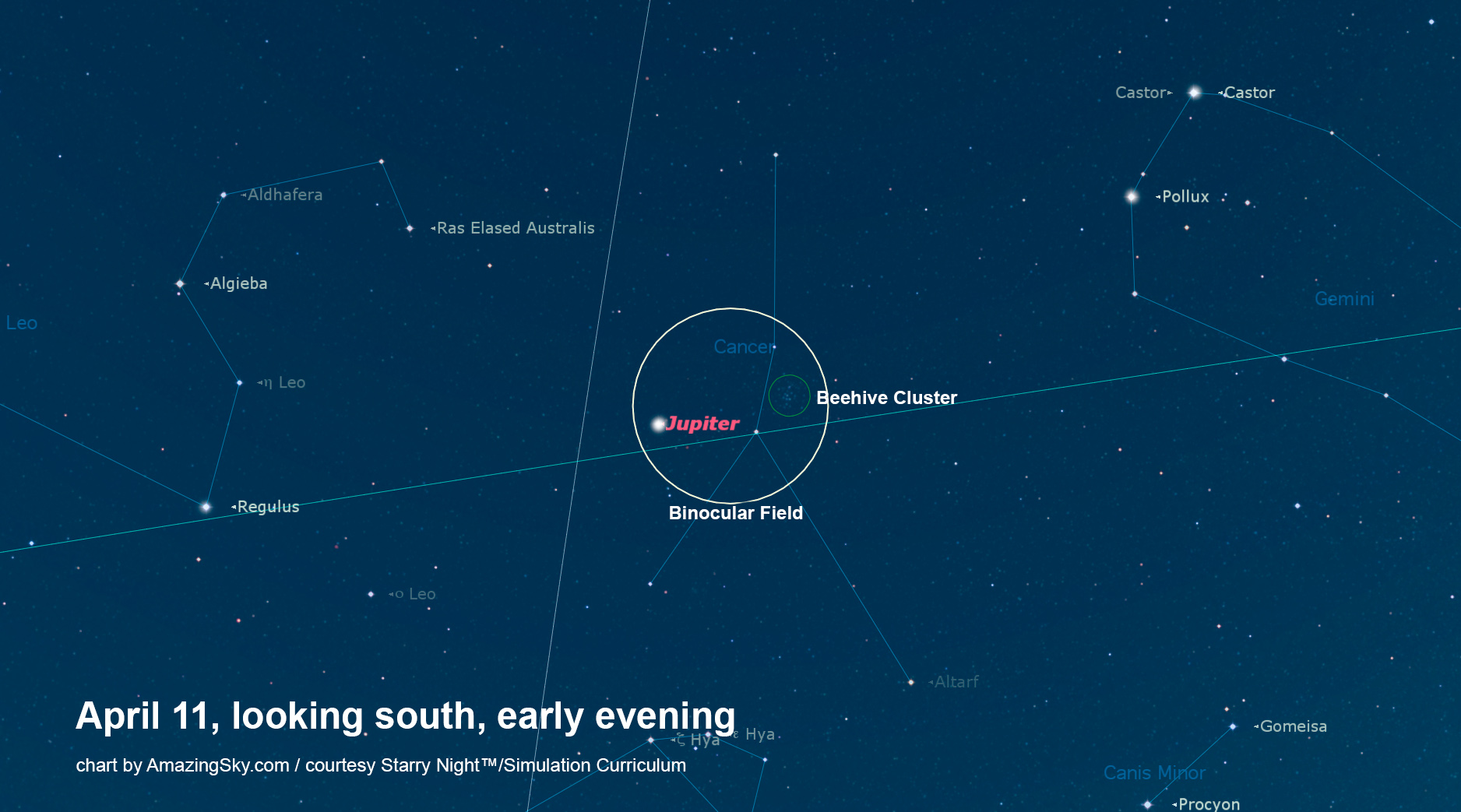
Dawn Sky Delight – the Real Scene


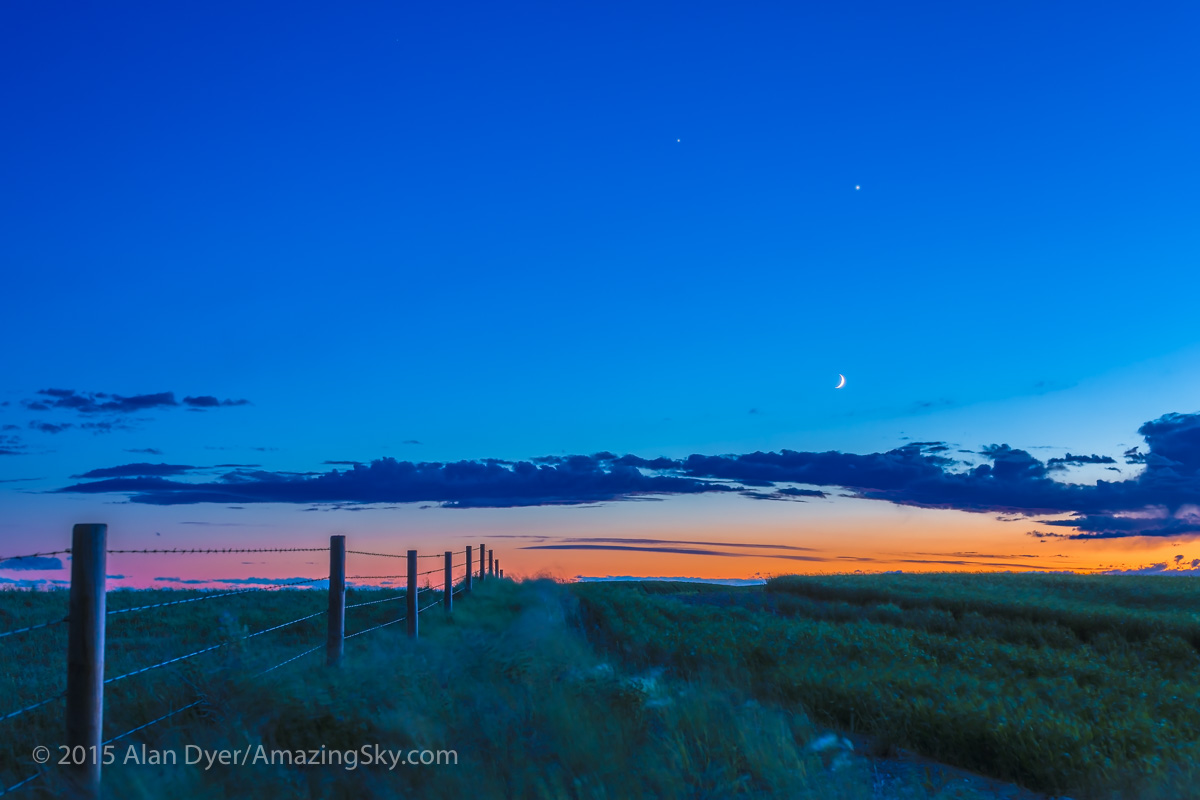
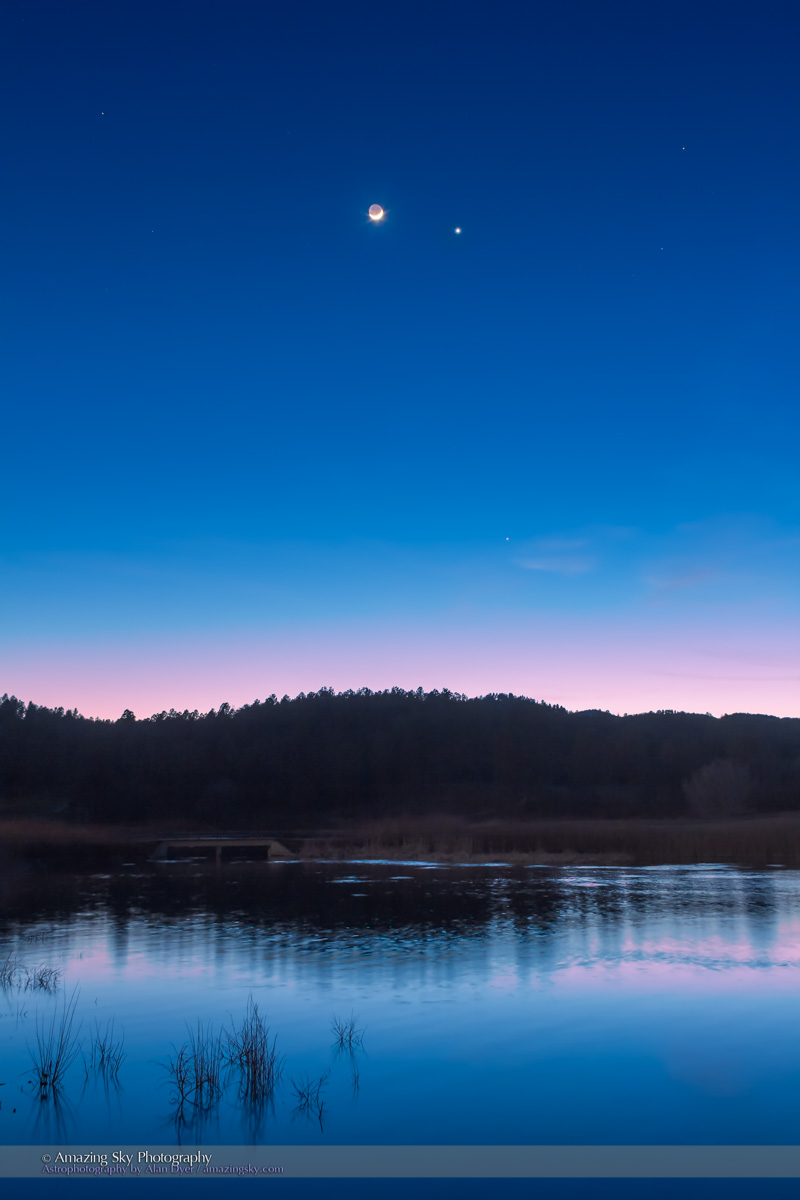
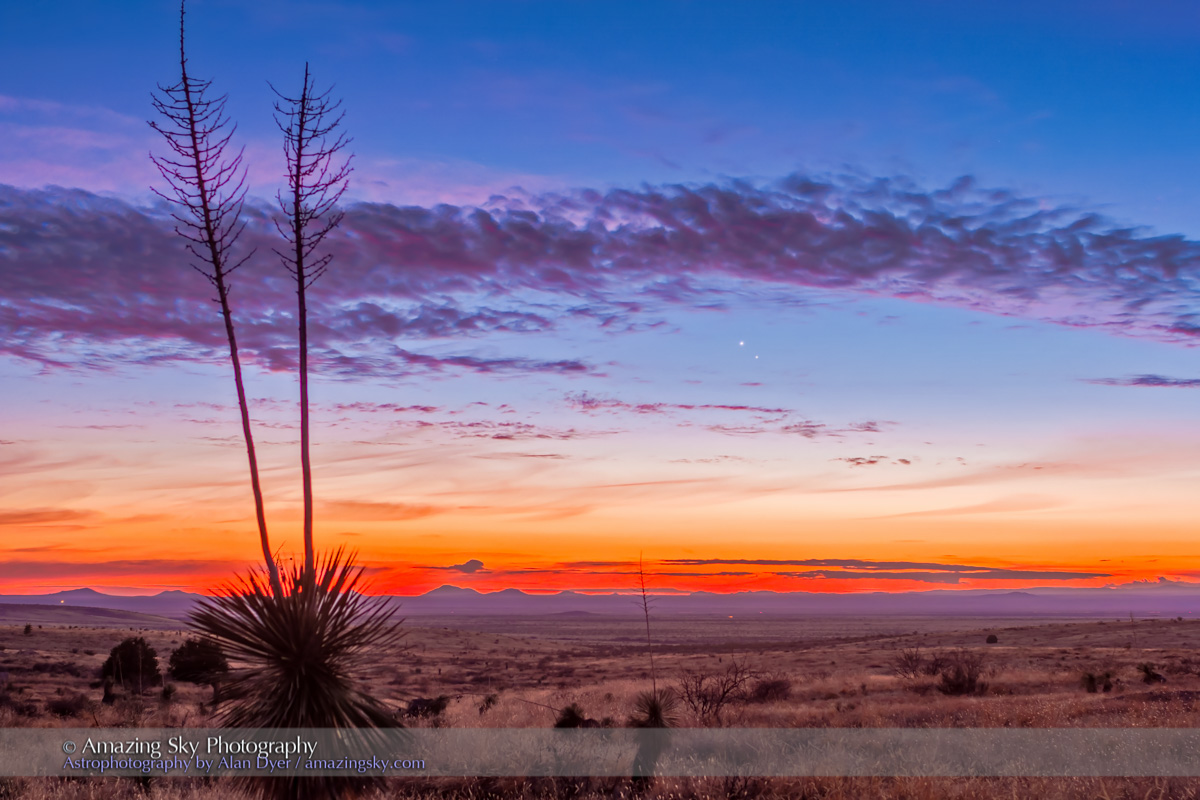
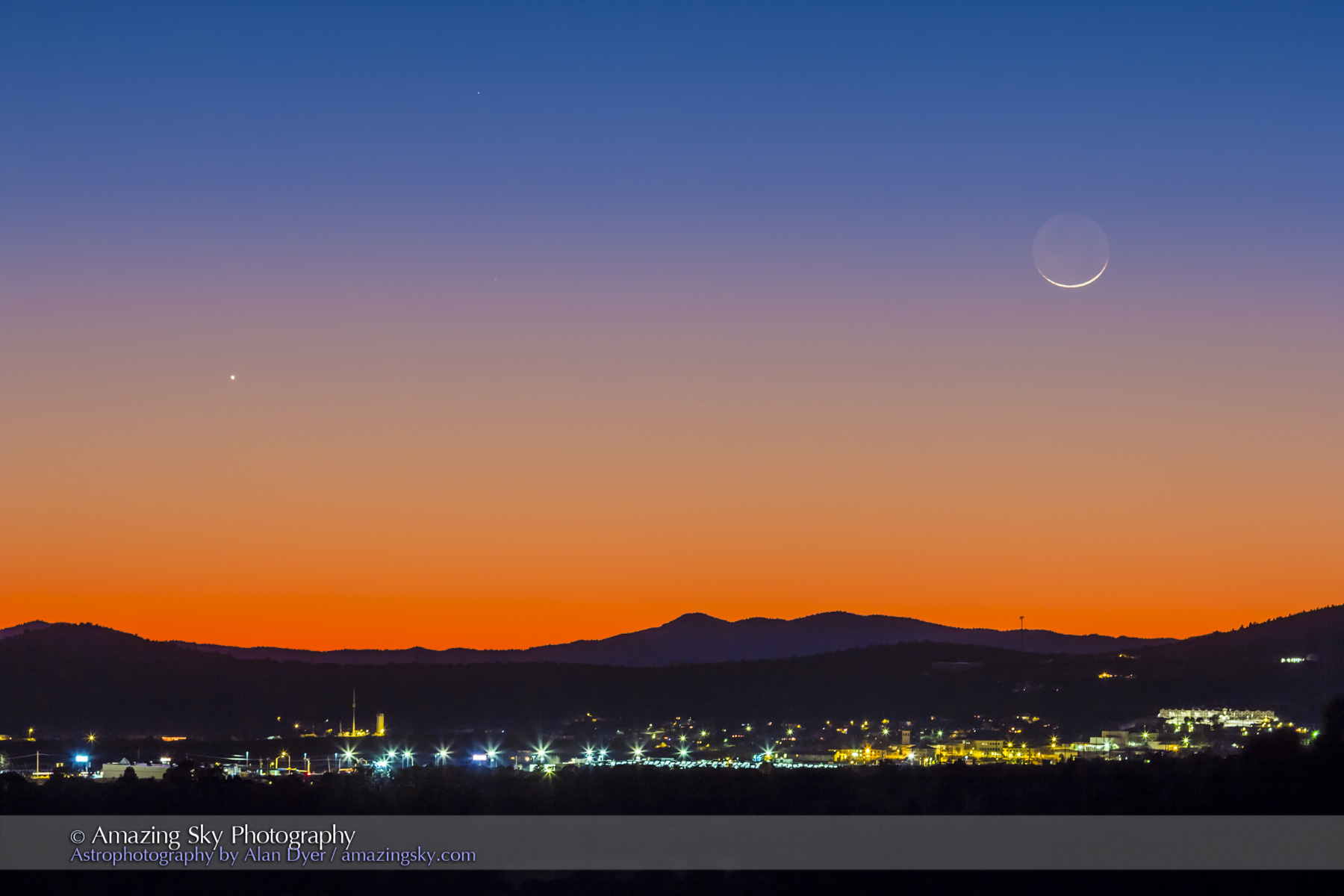
A gathering of planets in the dawn sky on October 8, 2015, with - from bottom to top: Jupiter, Mars, Venus and the Moon, with the star Regulus in Leo left of Venus.  This is a 15-second exposure with shorter exposure blended in for the area around Venus and the Moon to avoid them overexposing too much. So not a true HDR, but using masking to blend the short exposure elements.

The Moon, planets and Northern lights provided a wonderful show in the dawn sky.

What a superb scene this was. On October 8 the waning crescent Moon shone near Venus (brightest) and Regulus, with red Mars and bright Jupiter paired below.

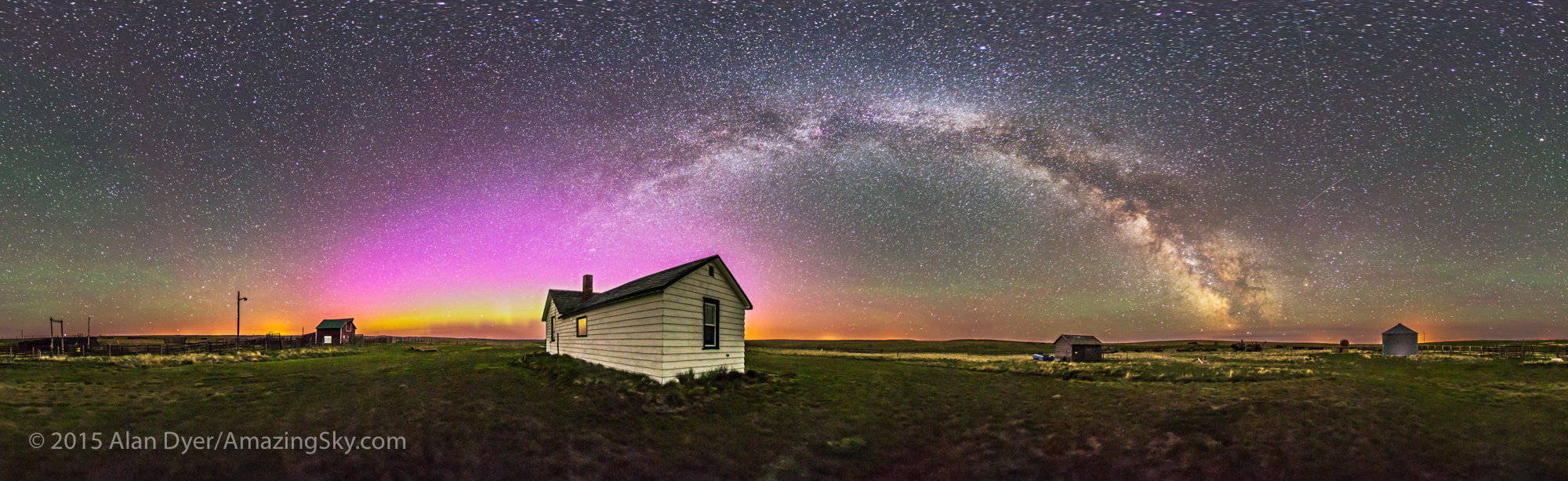
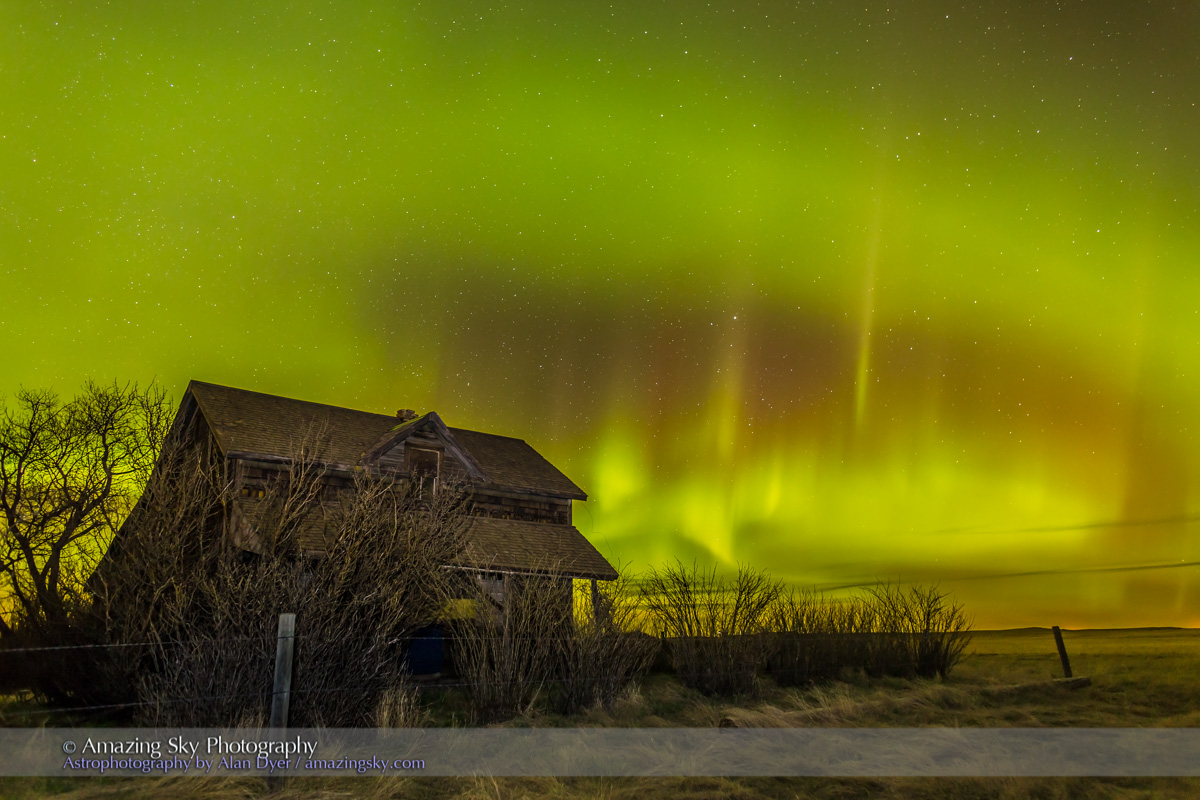
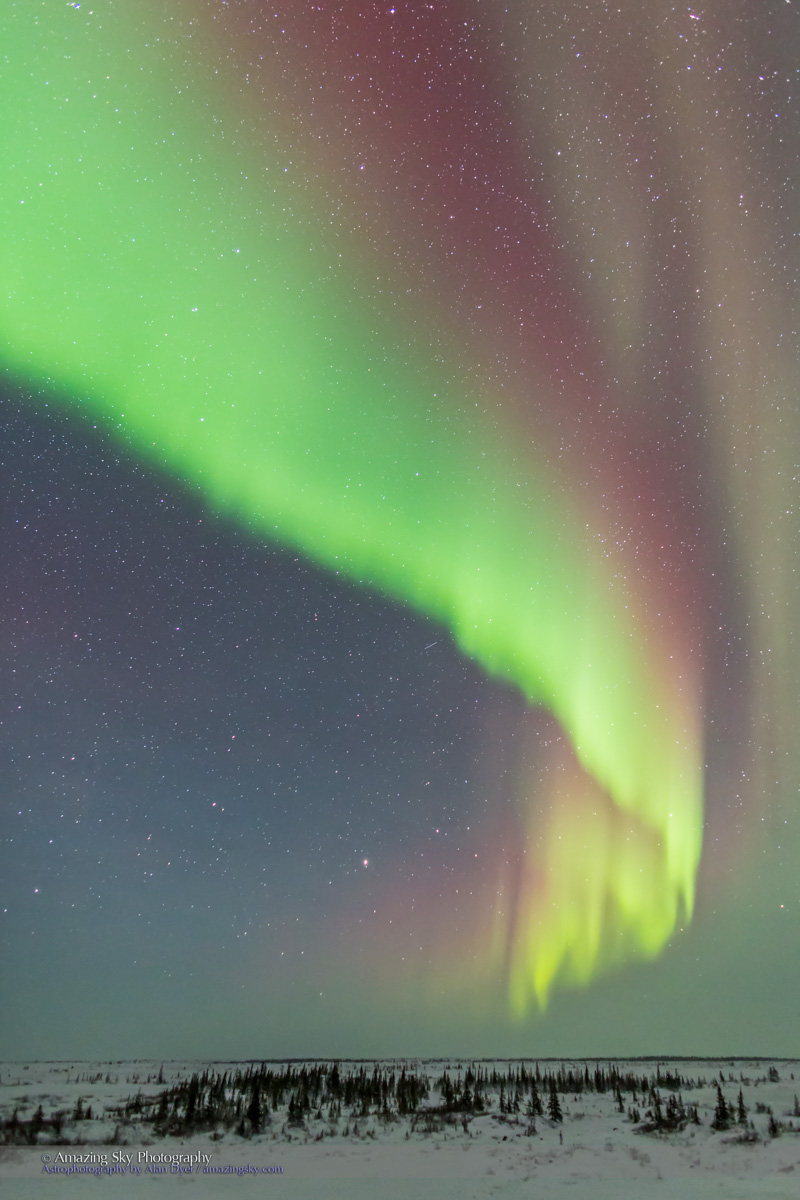
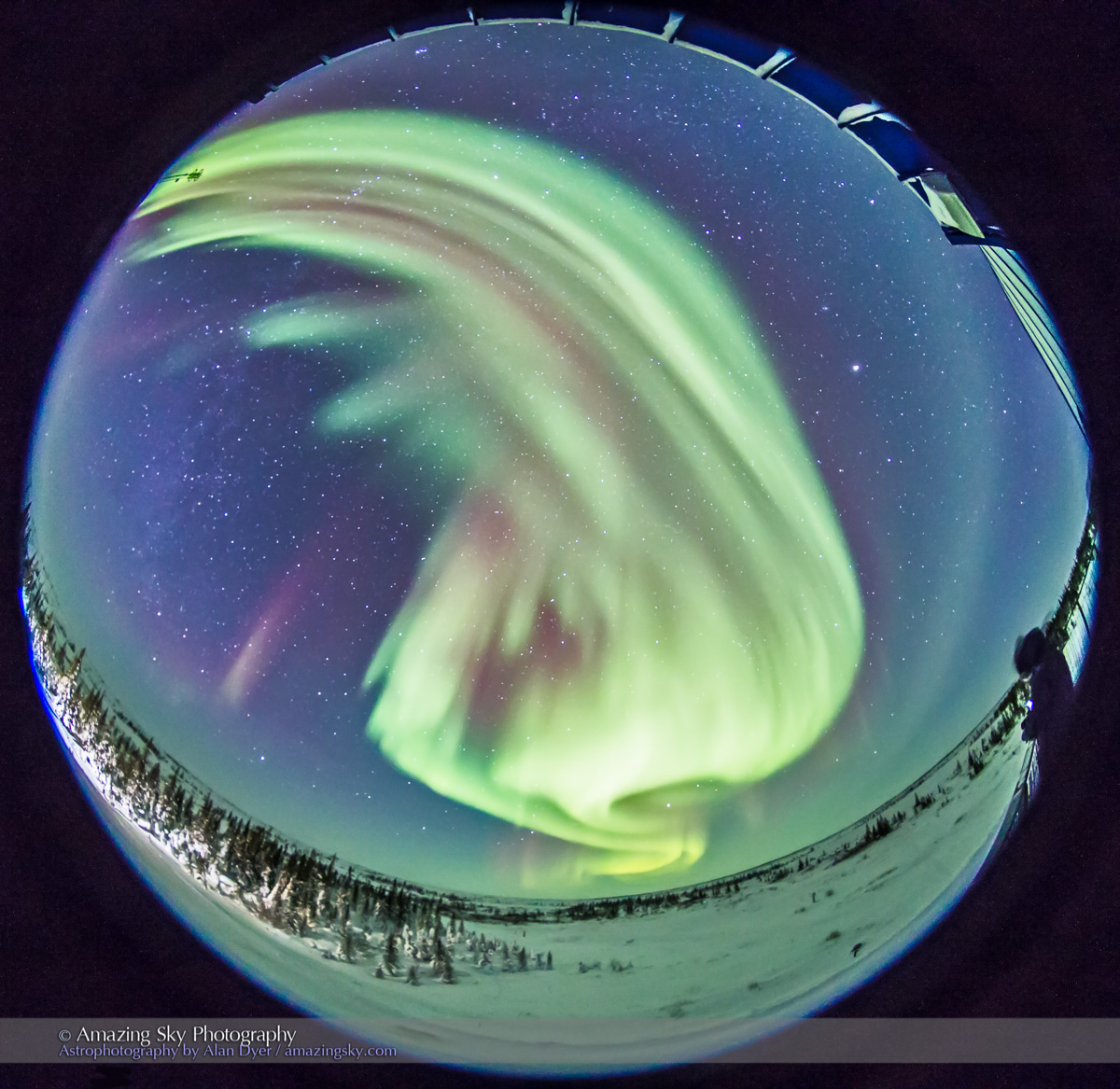
If that wasn’t enough, as the wide-angle panorama below shows, the Northern Lights were also ending a night of performance, with an arc along the horizon and pulsing waves rising up the sky to the northeast near the planet grouping.

A panorama of the pre-dawn sky on October 8, 2015, with a sky full of wonders: • the Northern Lights, or aurora • The Big Dipper above the aurora, somewhat distorted by the panorama projection • at centre, a conjunction and line-up of planets, with from bottom to top: Jupiter, Mars and Venus, with the bright waning crescent Moon beside Venus at top, and also beside the star Regulus in Leo • The Beehive star cluster well above the planet grouping • Orion and Canis Major in the winter sky at right with the Milky Way. I shot this from home, using the Canon 6D and 24mm lens on a fixed tripoid (no tracking), for 7 segments, each a 30-second exposure at f/2.2 and at ISO 1250. Stitched in Photoshop.

The panorama also sweeps right, to the south, to take in the winter Milky Way and constellations of Orion and Canis Major.  Click on the image to bring it up full screen.

The Moon will appear near Mars and Jupiter on the morning of October 9, and then the three planets will begin to converge for a tight gathering for a few mornings around October 25.

Be sure to wake early for the dawn sky show that continues all this month!

– Alan, October 8, 2015 / © 2015  / www.amazingsky.com

Heads Up! – Dawn Sky Delight


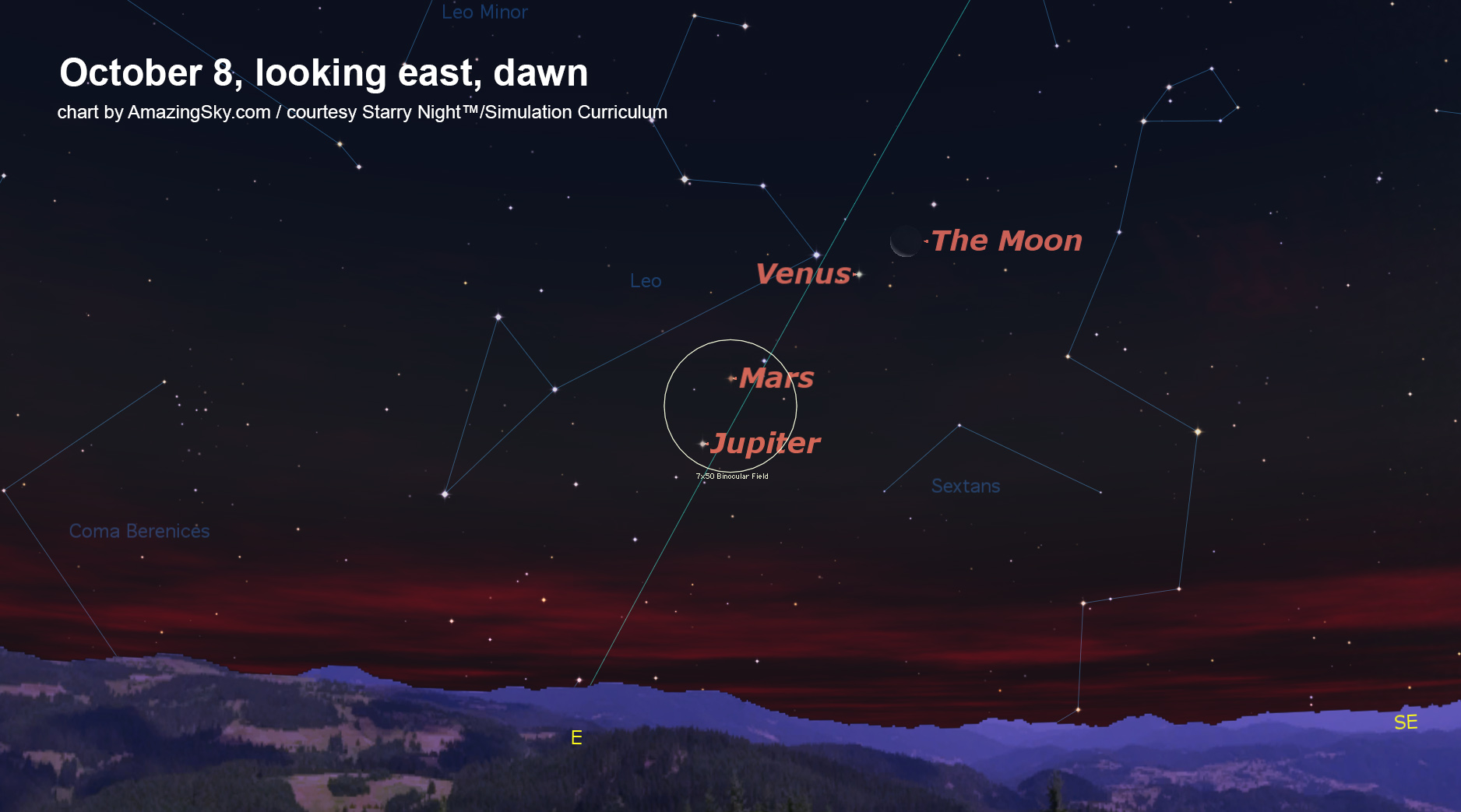
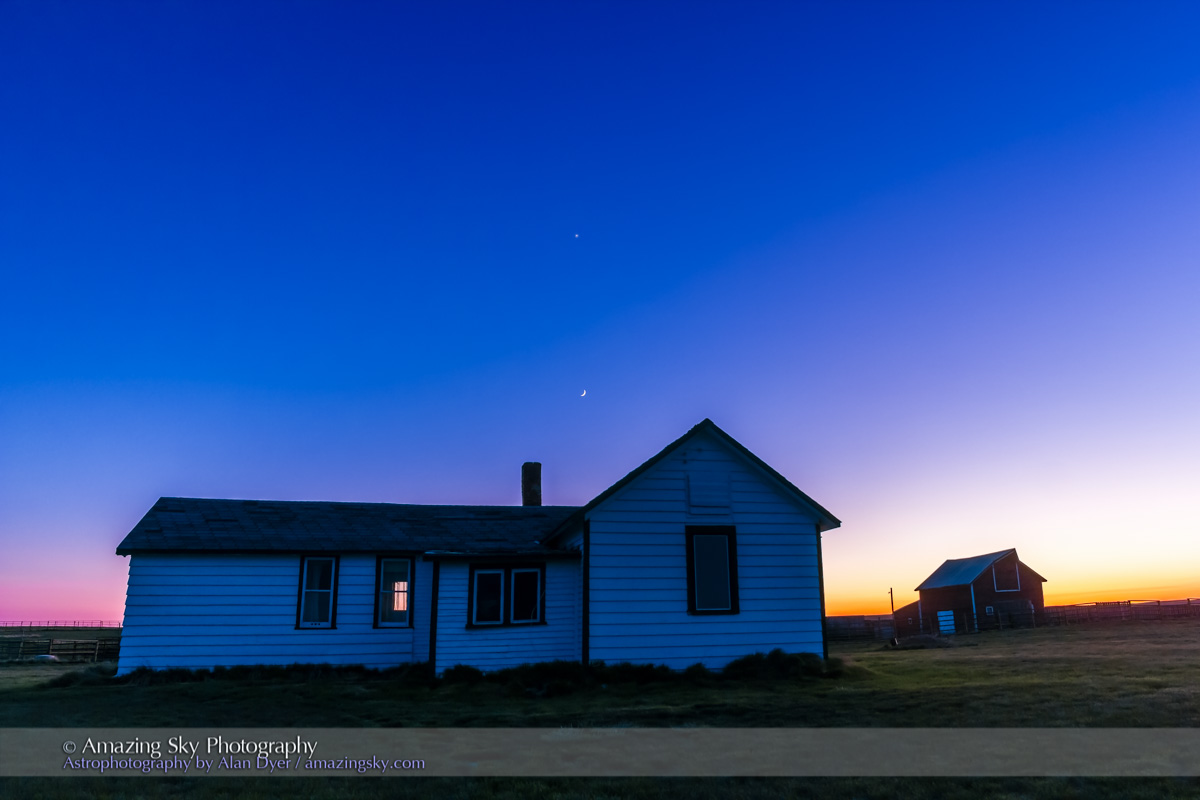
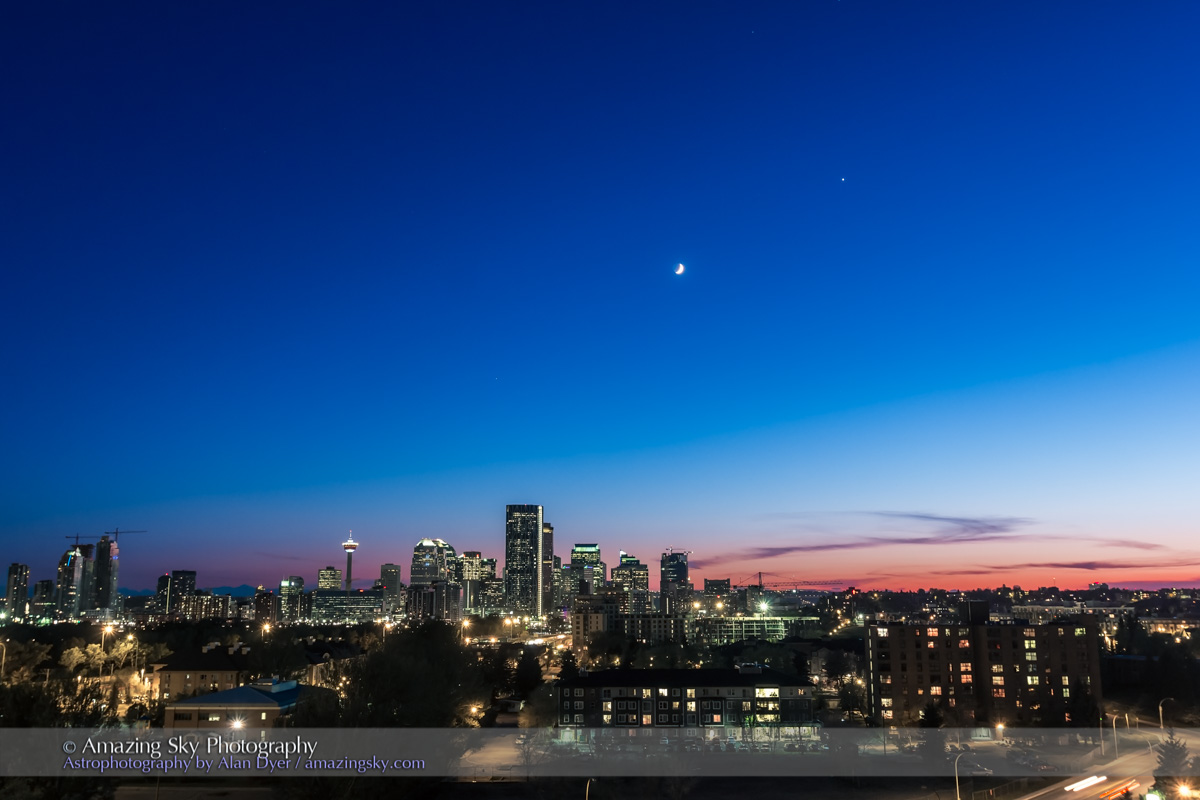
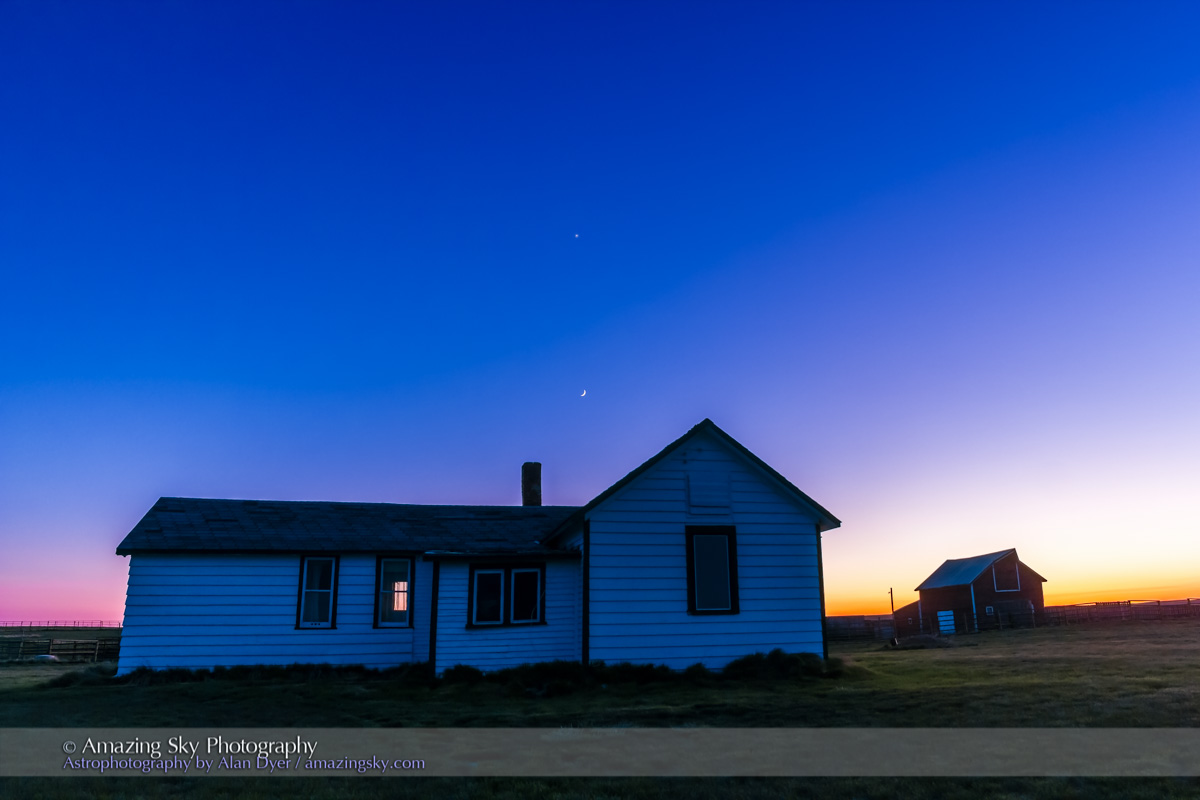
Oct 8 Dawn Planets

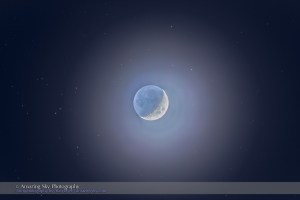
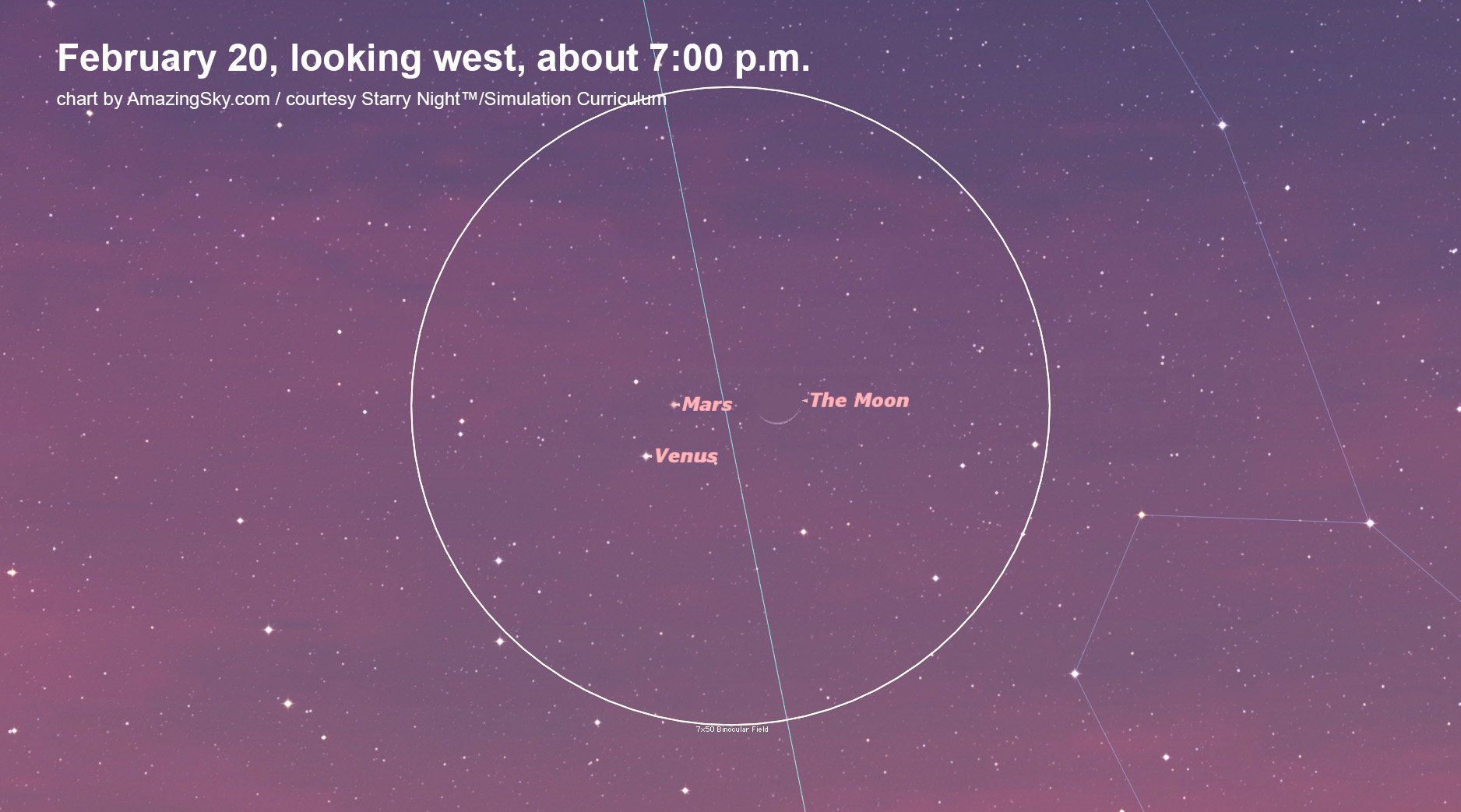
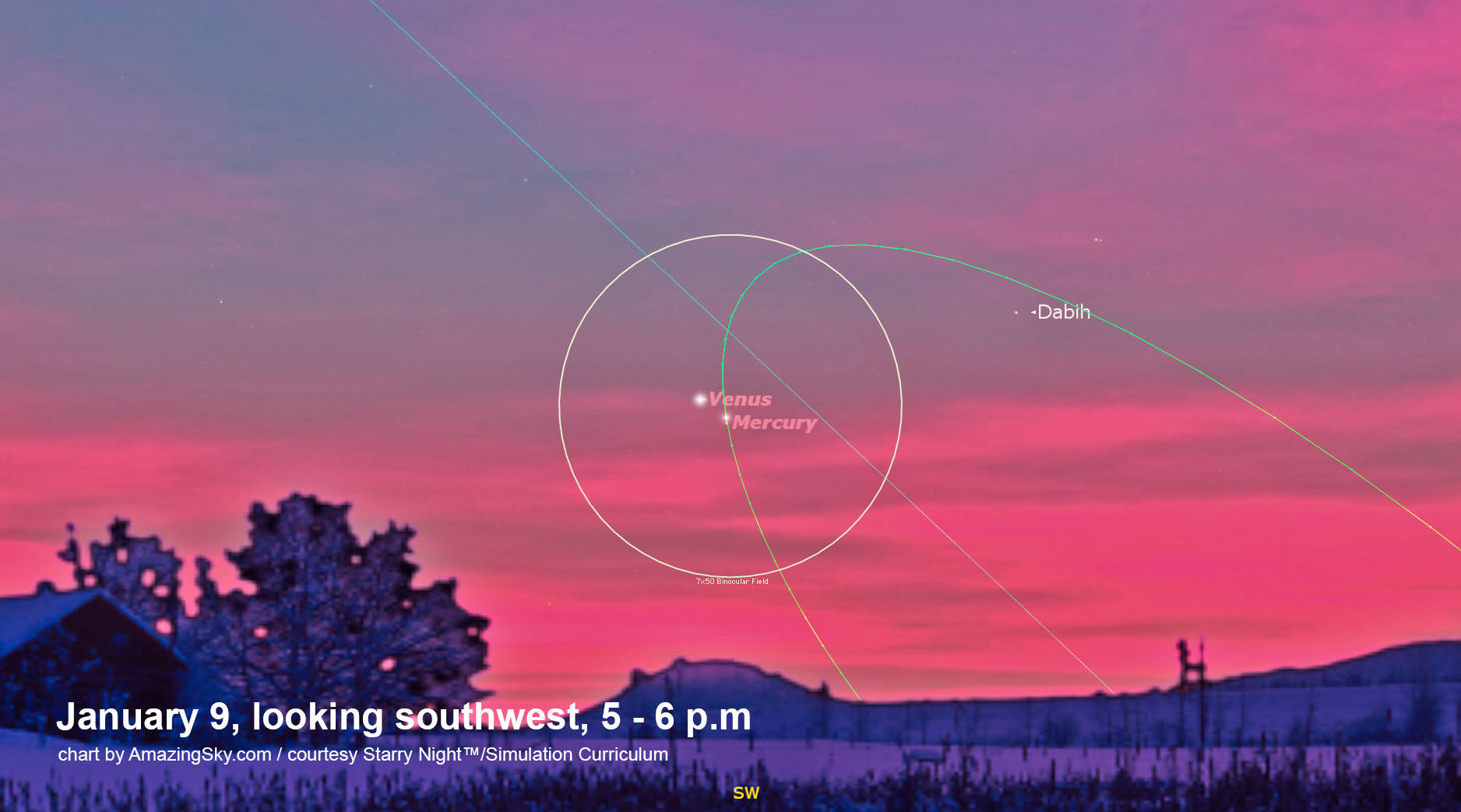
Look east this week to see a wonderful conjunction of the waning Moon with three planets in the morning sky.

A great dance of the planets is about to begin in the dawn sky.

Venus, Mars and Jupiter are now all prominent in the eastern sky before sunrise, with Venus by far the brightest. Below it shines slightly dimmer Jupiter. But between those two brightest of planets shines dim red Mars.

The three planets are converging for a mutual close meeting in the third week of October, when from October 23 to 28 the trio of planets will appear within a binocular field of each other.

But this week, with the three planets still spread out along a line, the Moon joins the scene to start the planet dance. It shines near Venus on the morning of October 8 (as shown here). and then near Mars and Jupiter on October 9.

Look east between 5:30 and 6:30 a.m. local time. All the planets are easy to see with unaided eye even in the city, but binoculars will frame the Moon-Venus pairing on October 8 and the Moon-Mars-Jupiter trio on October 9.

– Alan, October 8, 2015 / © 2015 Alan Dyer / www.amazingsky.com

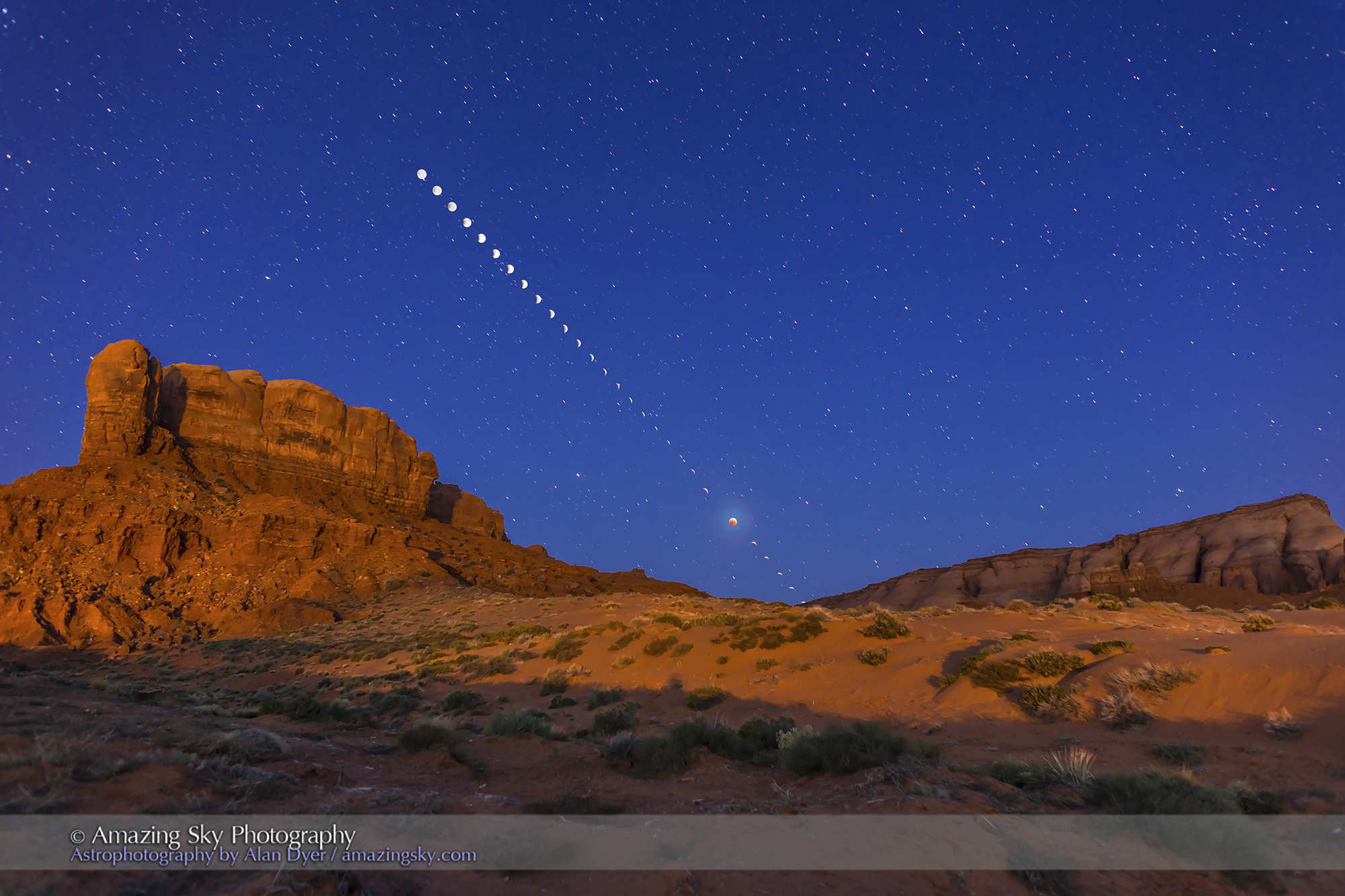
The Lunar Eclipse, to True Scale


This is a multiple-exposure composite of the total lunar eclipse of Sunday, September 27, 2015, as shot from Writing-on-Stone Provincial Park, Alberta, Canada. From this location the Moon rose in the east at lower left already in partial eclipse. As it rose it moved into Earth’s shadow and became more red and the sky darkened from twilight to night, bringing out the stars. Then, as the Moon continued to rise higher it emerged from the shadow, at upper right, and returned to being a brilliant Moon again, here overexposed and now illuminating the landscape with moonlight. The disks of the Moon become overexposed here as the sky darkened because I was setting exposures to show the sky and landscape well, not just the Moon itself. That’s because I shot the frames used to assemble this multiple-exposure still image primarily for use as a time-lapse movie where I wanted the entire scene well exposed in each frame. Indeed, for this still image composite of the eclipse from beginning to end, I selected just 40 frames taken at 5-minute intervals, out of 530 I shot in total, taken at 15- to 30-second intervals for the full time-lapse sequence. All were taken with a fixed camera, a Canon 6D, with a 35mm lens, to nicely frame the entire path of the Moon, from moonrise at left, until it left the frame at top right, as the partial eclipse was ending. The ground comes from a blend of 3 frames taken at the beginning, middle and end of the sequence, so is partly lit by twilight, moonlight and starlight. Lights at lower left are from the Park’s campground. The sky comes from a blend of 2 exposures: one from the middle of the eclipse when the sky was darkest and one from the end of the eclipse when the sky was now deep blue. The stars come from the mid-eclipse frame, a 30-second exposure. PLEASE NOTE: The size of the Moon and its path across the sky are accurate here, because all the images for this composite were taken with the same lens using a camera that did not m

My multiple-exposure composite shows the complete September 27, 2015 total lunar eclipse to true scale, with the Moon accurately depicted in size and position in the sky.

From my location at Writing-on-Stone Provincial Park in southern Alberta, Canada, the Moon rose in the east at lower left already in partial eclipse.

As it rose it moved into Earth’s shadow and became more red, while the sky darkened from twilight to night, bringing out the stars.

Then, as the Moon continued to rise higher it emerged from Earth’s shadow, at upper right, and returned to a brilliant Full Moon again, here overexposed and now illuminating the landscape with moonlight.


TECHNICAL

The disks of the Moon become overexposed in my composite as the sky darkened because I was setting exposures to show the sky and landscape well, not just the Moon itself. That’s because I shot these frames – and many more! – primarily for use as a time-lapse movie where I wanted the entire scene well exposed in each frame.

Indeed, for this still-image composite of the eclipse from beginning to end, I used just 40 frames taken at 5-minute intervals, selected from 530 I shot, taken at 15- to 30-second intervals for the full time-lapse sequence.

All were taken with a fixed camera, a Canon 6D, with a 35mm lens, to nicely frame the entire path of the Moon, from moonrise at lower left, until it exited the frame at top right, as the partial eclipse was ending.

In the interest of full disclosure, the ground comes from a blend of three frames taken at the beginning, middle, and end of the sequence, and so is partly lit by twilight and moonlight, to reveal the ground detail better than in the single starlit frame from mid-eclipse. Lights at lower left are from the Park’s campground.

The background sky comes from a blend of two exposures: one from the middle of the eclipse when the sky was darkest, and one from the end of the eclipse when the sky was now lit deep blue. The stars come from the mid-eclipse frame, a 30-second exposure.


MY RANT FOR REALITY

So, yes, this is certainly a composite assembled in Photoshop – a contrast to the old days of film where one might attempt such an image just by exposing the same piece of film multiple times, usually with little success.

However … the difference between this image and most you’ve seen on the web of this and other eclipses, is that the size of the Moon and its path across the sky are accurate, because all the images for this composite were taken with the same lens using a camera that did not move during the 3-hour eclipse.

This is how big the Moon actually appeared in the sky in relation to the ground and how it moved across the sky during the eclipse, in what is essentially a straight line, not a giant curving arc as in many viral eclipse images.

And, sorry if the size of the Moon seems disappointingly small, but it is small! This is what a lunar eclipse really looks like to correct scale.

By comparison, many lunar eclipse composites you’ve seen are made of giant moons shot with a telephoto lens that the photographer then pasted into a wide-angle sky scene, often badly, and pasted in locations on the frame that usually bear no resemblance to where the Moon actually was in the sky, but are just placed where the photographer thought would look the nicest.

You would never, ever do that for any other form of landscape photography, at least not without having your reputation tarnished. But with the Moon it seems anything is permitted, even amongst professional landscape photographers.

No, you cannot just place a Moon anywhere you like in your image, eclipse or no eclipse, then pass it off as a real image. Fantasy art perhaps. Fine. But not a photograph of nature.

Sorry for the rant, but I prefer accuracy over fantasy in such lunar eclipse scenes, which means NOT having monster-sized red Moons looming out of proportion and in the wrong place over a landscape. Use Photoshop to inform, not deceive.

– Alan, October 4, 2015 / © 2015 Alan Dyer / www.amazingsky.com 

A Super Eclipse of the Moon


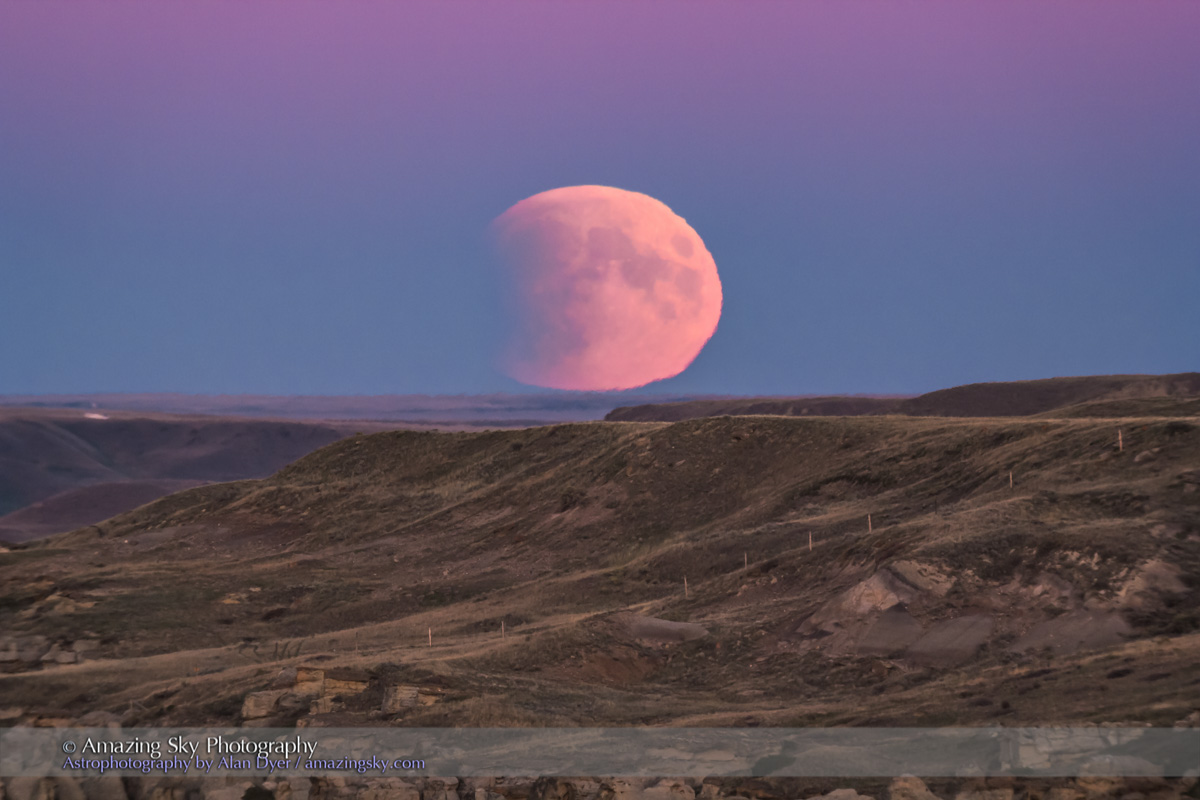
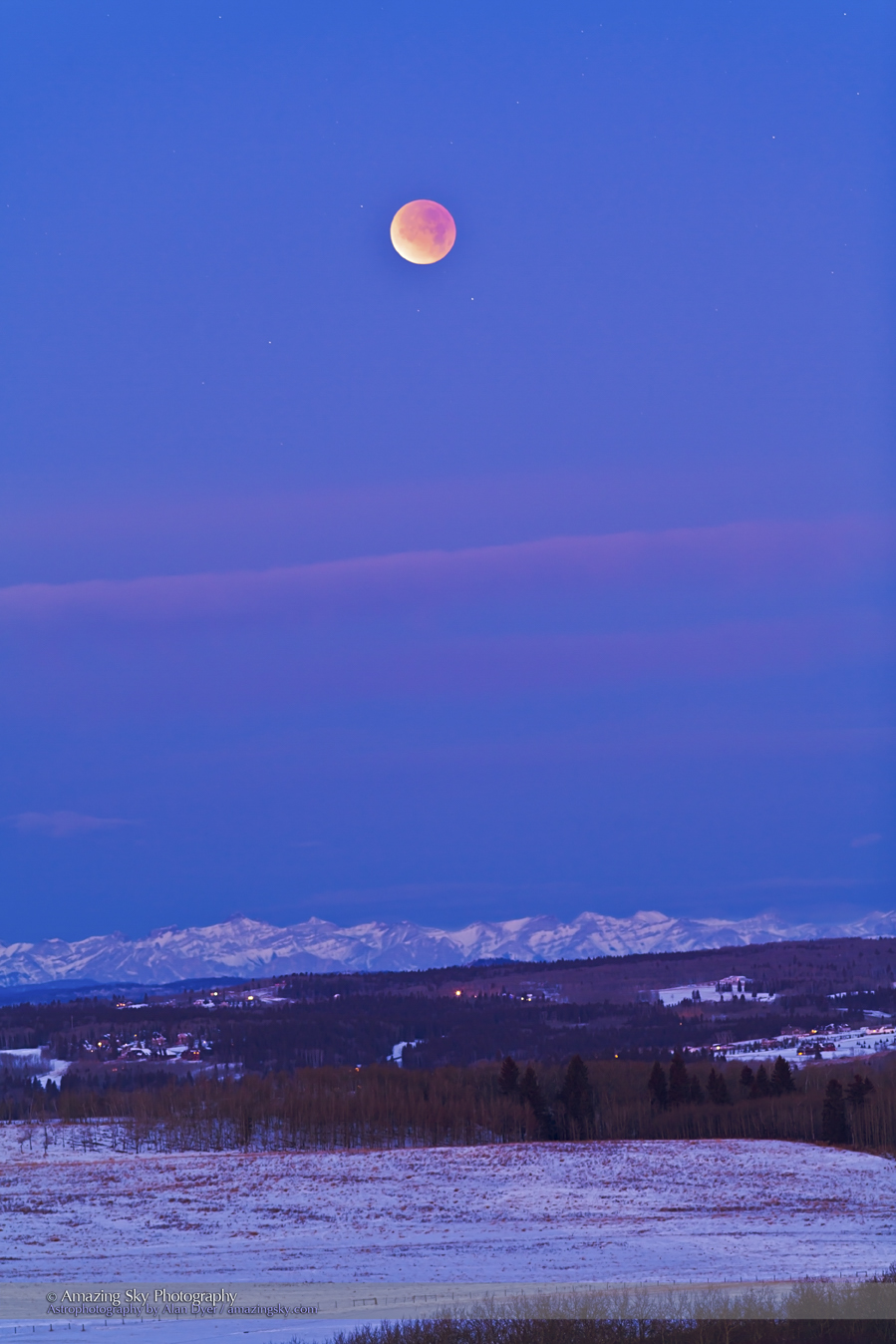
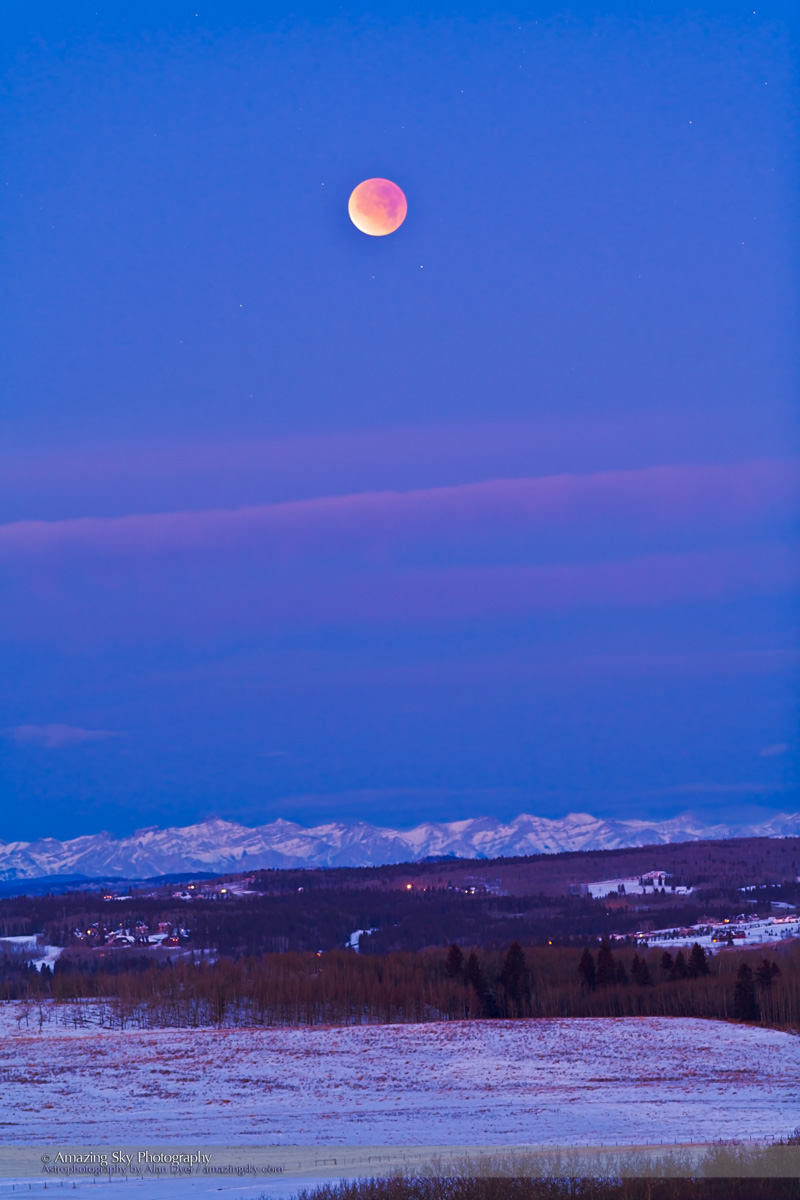
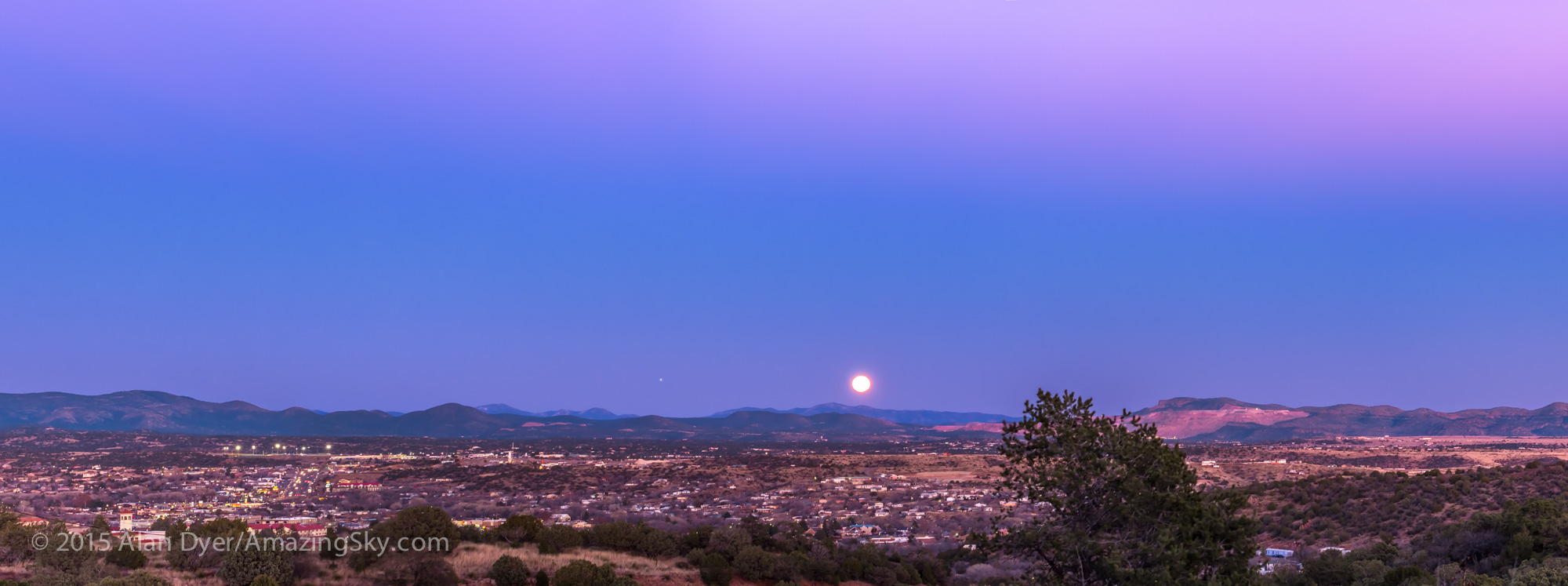
The Full Moon rises in partial eclipse over the sandstone formations of Writing-on-Stone Provincial Park in southern Alberta, on the evening of September 27, 2015. This was the night of a total lunar eclipse, which was in progress in its initial partial phase as the Moon rose this night. The blue band on the horizon containing the Moon is the shadow of Earth on our atmosphere, while the dark bite taken out of the lunar disk is the shadow of Earth on the Moon. The pink band above is the Belt of Venus. This is a two-image panorama stitched to extend the scene vertically to take in more sky and ground than one frame could accommodate. Both shot with the 200mm lens and 1.4x extender, on the Canon 5DMkII.

I could not have asked for a more perfect night for a lunar eclipse. It doesn’t get any better!

On Sunday, September 27, the Moon was eclipsed for the fourth time in two years, the last in a “tetrad” of total lunar eclipses that we’ve enjoyed at six-month intervals since April 2014. This was the best one by far.

The Full Moon rising in partial eclipse on the night of September 27, 2015, night of a total eclipse that began with the partial phase in progress at moonrise from my location. The pink Belt of Venus colours the sky at top. The Moon sits in the blue shadow of the Earth, which also partly obscures the disk of the Moon. I shot this from Writing-on-Stone Provincial Park, Alberta. This is through the TMB 92mm refractor for a focal length of 550mm using the Canon 60Da at ISO 400 for 1/250 second.
This is through the TMB 92mm refractor for a focal length of 500mm using the Canon 60Da at ISO 400 for 1/250 second.

The timing was perfect for me in Alberta, with the Moon rising in partial eclipse (above), itself a fine photogenic site.

In the top image you can see the rising Moon embedded in the blue band of Earth’s shadow on our atmosphere, and also entering Earth’s shadow on its lunar disk. This was a perfect alignment, as lunar eclipses must be.

For my earthly location I drove south to near the Montana border, to a favourite location, Writing-on-Stone Provincial Park, to view the eclipse over the sandstone formations of the Milk River.

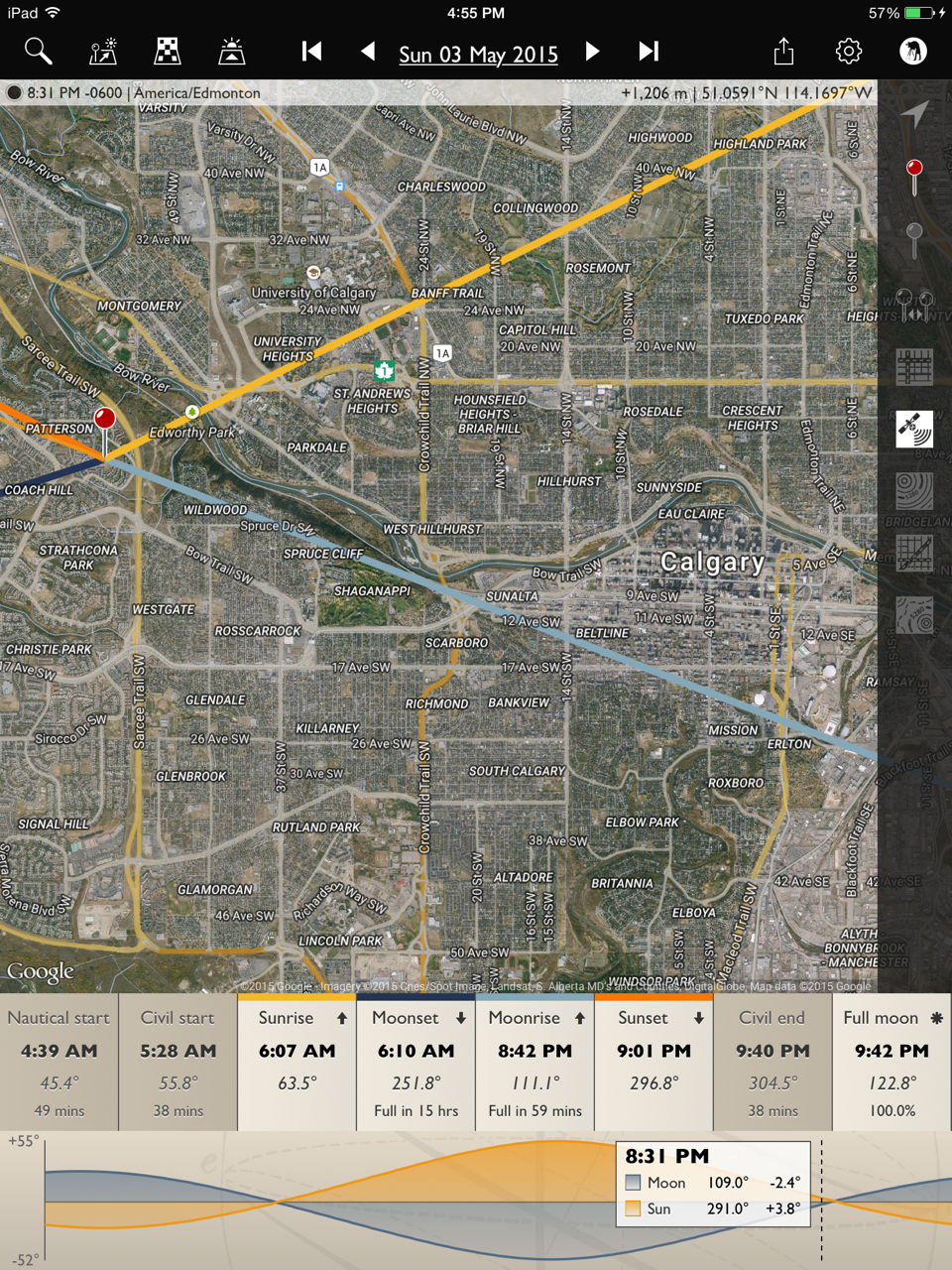
The image below shows a screen shot of my site plan and viewing angles using The Photographer’s Ephemeris app.

IMG_2515

More importantly, weather forecasts for the area called for perfectly clear skies, a relief from the clouds forecast – and which did materialize – at home to the north, and would have been a frustration to say the least. Better to drive 3 hours!

This was the second lunar eclipse I viewed from Writing-on-Stone, having chased clear skies to here in the middle of the night for the October 8, 2014 eclipse.

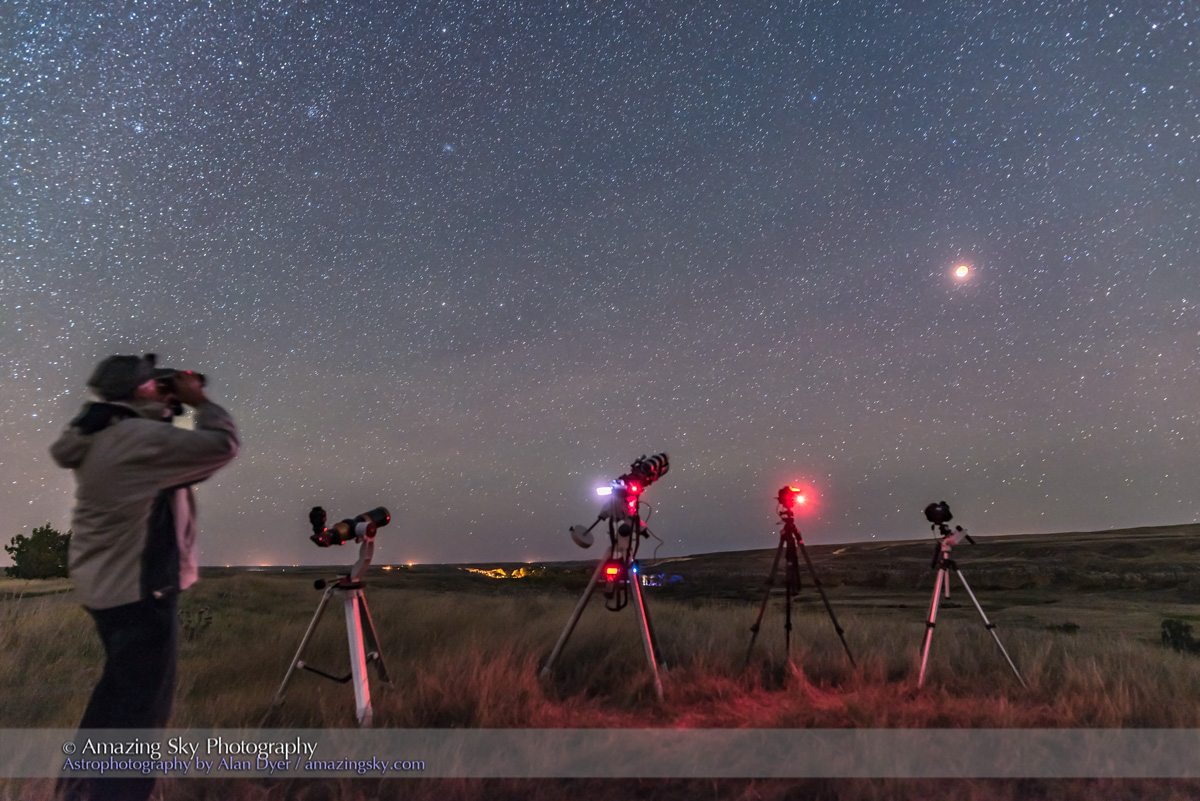
Me, in a selfie, observing a total eclipse of the Moon with binoculars on September 27, 2015, from Writing-on-Stone Provincial Park, Alberta. I had three cameras set up to shoot the eclipse and a fourth to shoot the scene like this. The night was perfect for the eclipse. The Moon is in totality here, with the stars and Moon trailed slightly from the long exposure.

I shot with three cameras: one doing a time-lapse through the telescope, one doing a wide-angle time-lapse of the Moon rising, and the third for long-exposure tracked shots during totality, of the Moon and Milky Way.

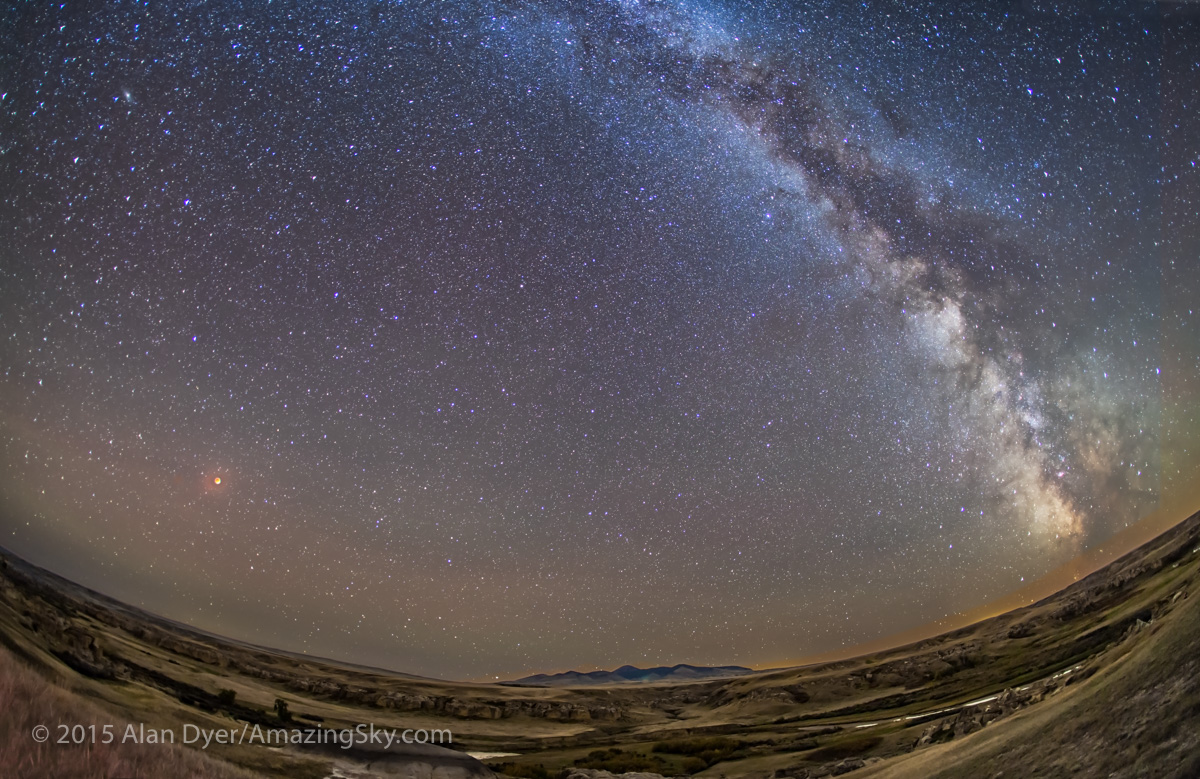
The Moon in total eclipse on September 27, 2015 – the “supermoon” eclipse – shining red over the Milk River and sandstone formations at Writing-on-Stone Provincial Park in southern Alberta, with the Milky Way in full view in the sky darkened by the lunar eclipse. The Sweetgrass Hills of Montana are to the south. The centre of the Milky Way is at far right. The Andromeda Galaxy is at upper left. The Moon was in Pisces below the Square of Pegasus. It was a perfectly clear night, ideal conditions for shooting the eclipse and stars. This is a stack of 5 x 2-minute tracked exposures for the sky and 5 x 4-minute untracked exposures for the ground to smooth noise. The Moon itself comes from a short 30-second exposure to avoid overexposing the lunar disk. Illumination of the ground is from starlight. All exposures with the 15mm lens at f/2.8 and Canon 5D MkII at ISO 1600. The camera was on the iOptron Sky-Tracker.
This is a stack of 5 x 2-minute tracked exposures for the sky and 5 x 4-minute untracked exposures for the ground to smooth noise. The Moon itself comes from a short 30-second exposure to avoid overexposing the lunar disk. Illumination of the ground is from starlight. All exposures with the 15mm lens at f/2.8 and Canon 5D MkII at ISO 1600. The camera was on the iOptron Sky-Tracker.

That image is above. It shows the eclipsed Moon at left, with the Milky Way at right, over the Milk River valley and with the Sweetgrass Hills in the distance.

The sky was dark only during the time of totality. As the Moon emerged from Earth’s shadow the sky and landscape lit up again, a wonderful feature of lunar eclipses.

While in the above shot I did layer in a short exposure of the eclipsed Moon into the long exposure of the sky, it is still to accurate scale, unlike many dubious eclipse images I see where giant moons have been pasted into photos, sometimes at least in the right place, but often not.

Lunar eclipses bring out the worst in Photoshop techniques.

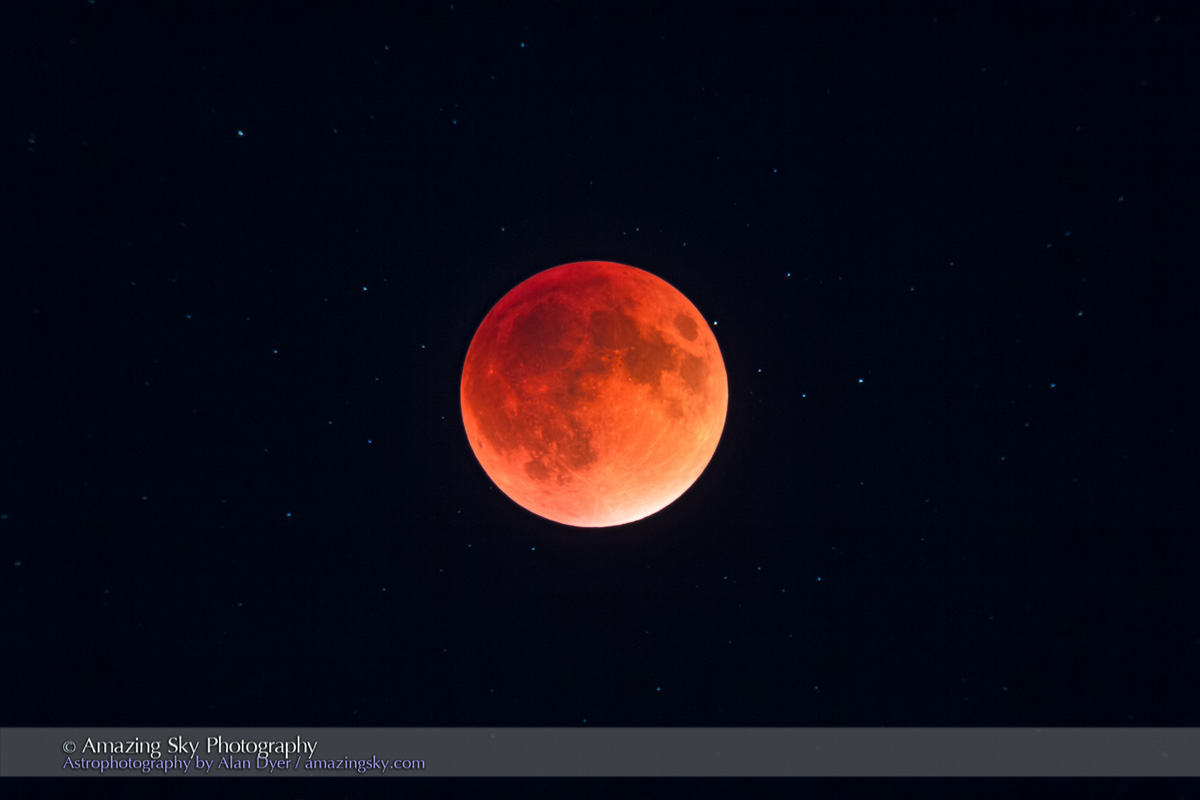
The total eclipse of the Moon of September 27, 2015, in closeup through a telescope, at mid-totality with the Moon at its darkest and deepest into the umbral shadow, in a long exposure to bring out the stars surrounding the dark red moon. This was also the Harvest Moon for 2015 and was the perigee Full Moon, the closest Full Moon of 2015. This is a single exposure taken through the TMB 92mm refractor at f/5.5 for 500 mm focal length using the Canon 60Da at ISO 400 for 8 seconds, the longest I shot during totality. The telescope was on the SkyWatcher HEQ5 mount tracking at the lunar rate.
This is a single exposure taken through the TMB 92mm refractor at f/5.5 for 500 mm focal length using the Canon 60Da at ISO 400 for 8 seconds, the longest I shot during totality. The telescope was on the SkyWatcher HEQ5 mount tracking at the lunar rate.

Above is a single closeup image taken through the telescope at mid-totality. I exposed for 8 seconds to bring out the colours of the shadow and the background stars, as faint as they were with the Moon in star-poor Pisces.

I shot a couple of thousand frames and processing of those into time-lapses will take a while longer, in particular registering and aligning the 700 I shot at 15-second intervals through the telescope. They show the Moon entering, passing through, then exiting the umbra, while it moves against the background stars.

Me celebrating a successful total eclipse of the Moon during the final partial phases, observed and shot from Writing-on-Stone Provincial Park, Alberta, on September 27, 2015. I shot with 3 cameras, with a 4th to record the scene. Two of the cameras at centre are still shooting time-lapses of final partial phases. The camera at right was used to take long tracked exposures of the Milky Way during totality. The telescope at left was used just to look!

So I was a happy eclipse chaser! I managed to see all four of the lunar eclipses in the current tetrad, two from Alberta, one from Australia, and one from Monument Valley.

With the latest success, I’ve had my fill of lunar eclipses for a while. Good thing, as the next one is not until January 31, 2018, before dawn in the dead of winter.

With the mild night, great setting, and crystal clear skies, this “supermoon” eclipse could not have been better. It was a super eclipse.

– Alan, September 29, 2015 / © 2015 Alan Dyer / www.amazingsky.com

How to See and Shoot the “Supermoon” Eclipse


Total eclipse of the Moon, December 20/21, 2010, taken from home with 130mm AP apo refractor at f/6 and Canon 7D at ISO 400 for 4 seconds, single exposure, shortly after totality began.

On Sunday, September 27 the Moon undergoes a total eclipse, the last we’ll see until January 2018.

This is a sky event you don’t want to miss. Whether you photograph it or just enjoy the view, it will be a night to remember, as the Full Moon turns deep red during a total eclipse.

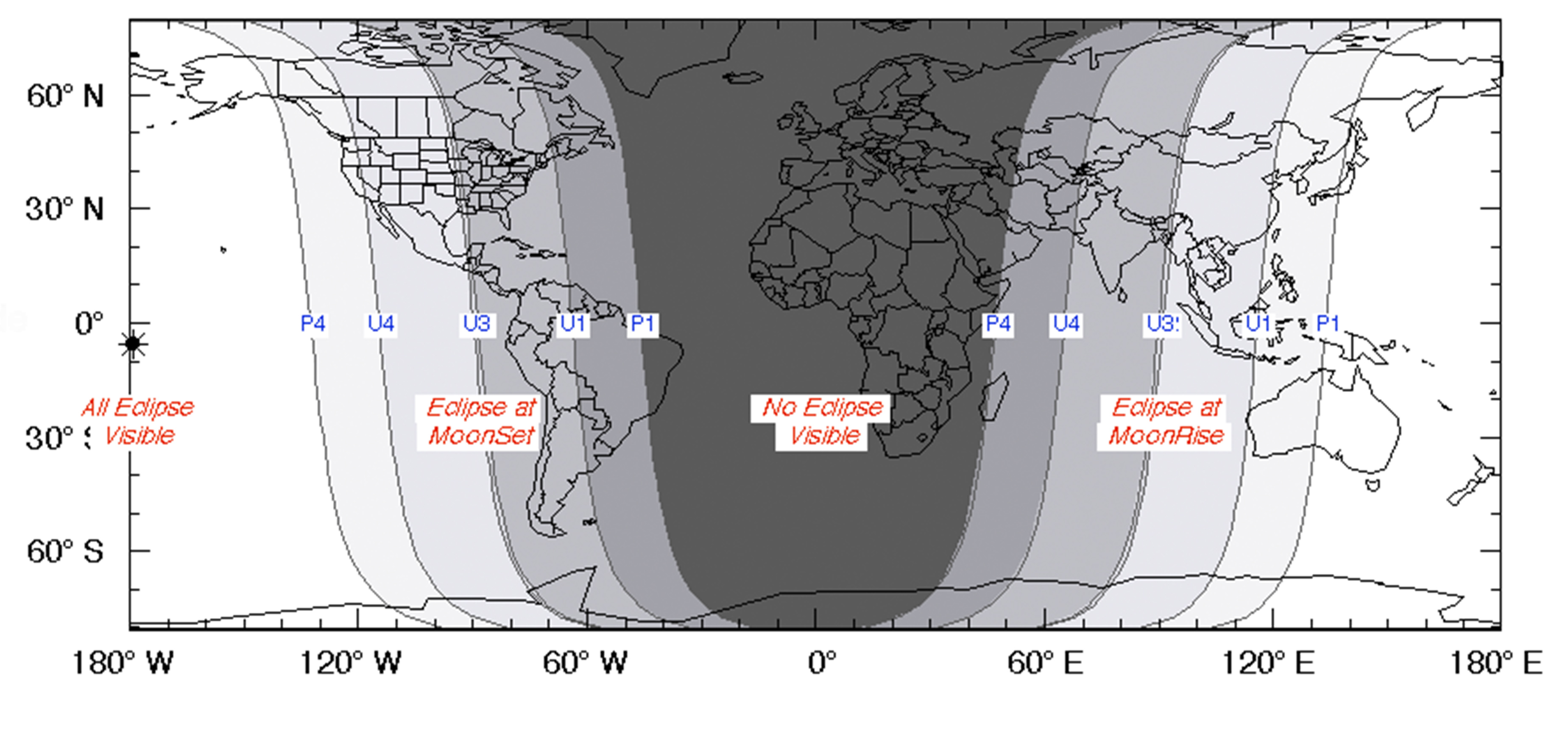
Note For this article I’m giving times and sky directions for North America. For Europe the eclipse occurs early in the morning of September 28, as the Moon sets into the west. But for here in North America the timing could not be better. Totality occurs in the evening of Sunday, September 27 as the Moon rises into the east. 

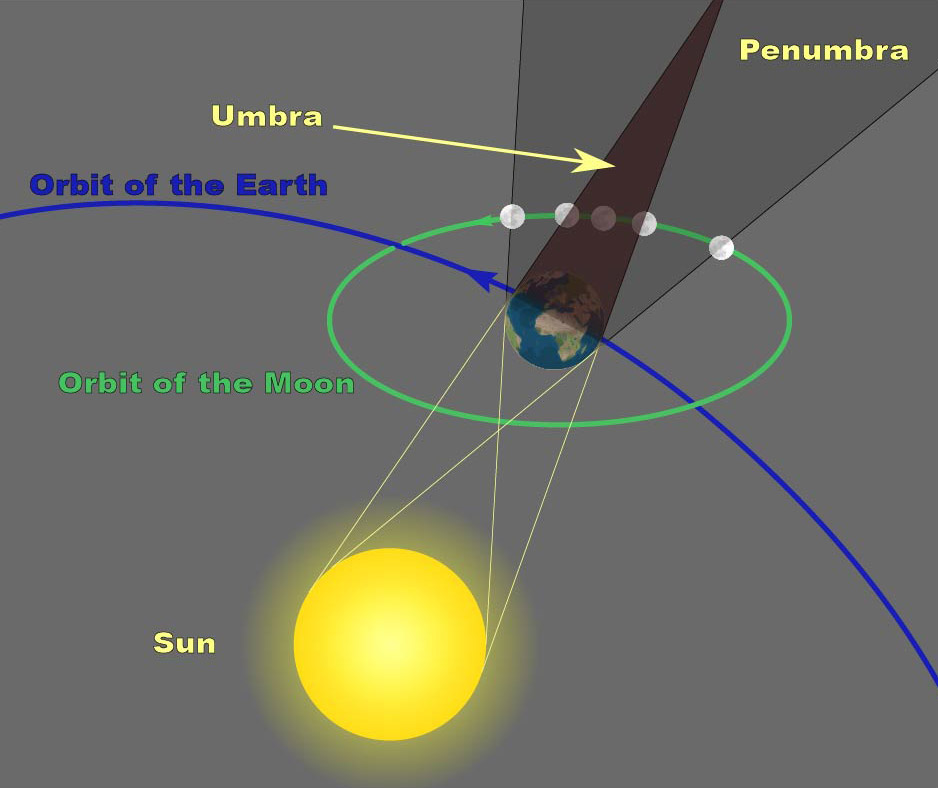
Courtesy Wikimedia Commons

ECLIPSE BASICS

A total lunar eclipse occurs when the Moon — and it can only be Full — passes through the shadow cast into space by Earth. The Sun, Earth and Moon are in near-perfect alignment.

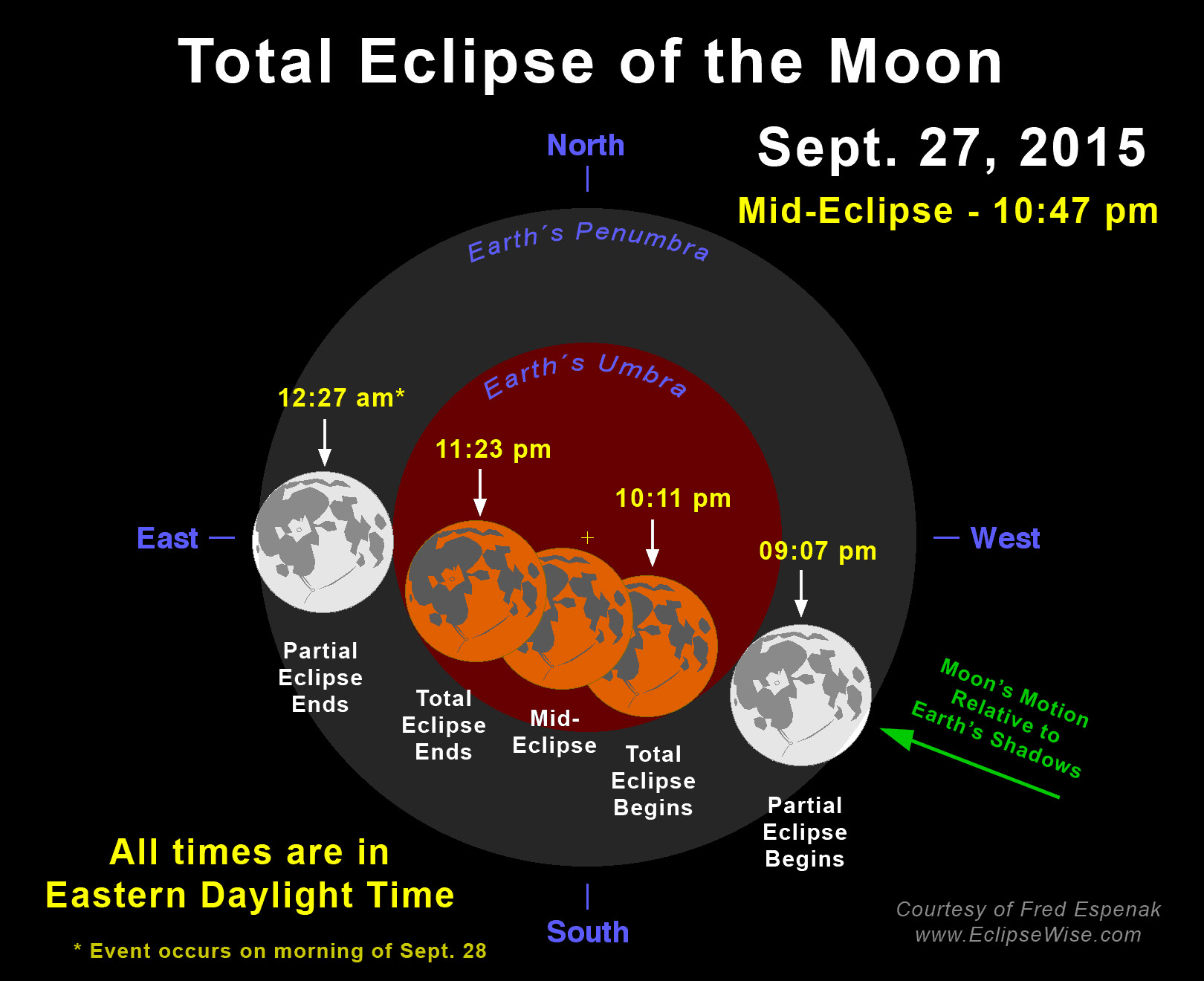
All total eclipses of the Moon consist of 3 main parts:

• The initial partial eclipse occurs as the Moon slowly enters the dark central portion of our planet’s shadow, the umbra. This lasts about an hour.

• Totality begins as the entire disk of the Moon is within the umbra. For this eclipse, totality lasts a generous 72 minutes.

• Totality ends as the Moon emerges from the umbra to begin the final partial eclipse lasting another hour.


Courtesy Fred Espenak/EclipseWise.com
Courtesy Fred Espenak/EclipseWise.com – All times are Eastern Daylight. Subtract 1 hour for Central Daylight, 2 hours for Mountain Daylight, 3 hours for Pacific Daylight Time. Times apply for anywhere in that time zone.

WHERE TO SEE IT

All of North America, indeed most of the western hemisphere, can see this eclipse. In North America, the farther east you live on the continent the later in your evening the eclipse occurs and the higher the Moon appears in the southeast.

For example, in the Eastern time zone, totality begins at 10:11 p.m. EDT and ends at 11:23 p.m. EDT, with mid-totality is at 10:47 p.m. EDT with the Moon about 35 degrees up, placing it high in the southeast sky for southern Ontario, for example.

For me in the Mountain time zone, the total eclipse begins at 8:11 p.m. MDT and ends at 9:23 p.m. MDT, with mid-totality is at 8:47 p.m. MDT, with the Moon just 13 degrees up in the east from here in southern Alberta. From my time zone, and from most location in the Rocky Mountain regions, the Moon rises with the initial partial phases in progress.

This is the total eclipse of the Moon, December 10, 2011, taken from the grounds of the Rothney Astrophysical Observatory, near Priddis Alberta, and looking west to the Rockies. This is a 2 second exposure at ISO 800 with the Canon 5DMkII and Canon 200mm lens at f/4. This was taken toward the end of totality at 7:48 am local time.
This is the total eclipse of the Moon, December 10, 2011, taken from the grounds of the Rothney Astrophysical Observatory, near Priddis Alberta, and looking west to the Rockies. This is a 2 second exposure at ISO 800 with the Canon 5DMkII and Canon 200mm lens at f/4.

For locations on the west coast viewers miss most of the partial eclipse phase before totality. Instead, the Moon rises as totality begins, making for a more challenging observation. Viewers on the coast will need clear skies and a low horizon to the east, but the reward could be a beautiful sight and images of a red Moon rising.


Total eclipse of the Moon, December 20/21, 2010, taken from home with 130mm AP apo refractor at f/6 and Canon 7D at ISO 400. An HDR composite of 9 images from 1/125 second to 2 seconds, composited in Photoshop CS5. Vibrancy increased to show bring out the colour variations across the shadow and at the edge of the shadow. Taken at about 12:21 am MST on Dec 21, about 20 minutes before totality began, during the partial phase.
Total eclipse of the Moon, December 20/21, 2010, taken from home with 130mm AP apo refractor at f/6 and Canon 7D at ISO 400. An HDR composite of 9 images from 1/125 second to 2 seconds, composited in Photoshop CS5. Taken at about 12:21 am MST on Dec 21, about 20 minutes before totality began, during the partial phase.

“SUPERMOON” ECLIPSE

This eclipse of the Moon is the last in a series of four total lunar eclipses that occurred at six-month intervals over the last two years. We won’t enjoy another such “tetrad” of total lunar eclipses until 2032-33.

But this eclipse is unique in that it also coincides with the annual Harvest Moon, the Full Moon closest to the autumnal equinox. Harvest Moons are known for their orange tint as they rise into what is sometimes a dusty autumn evening.

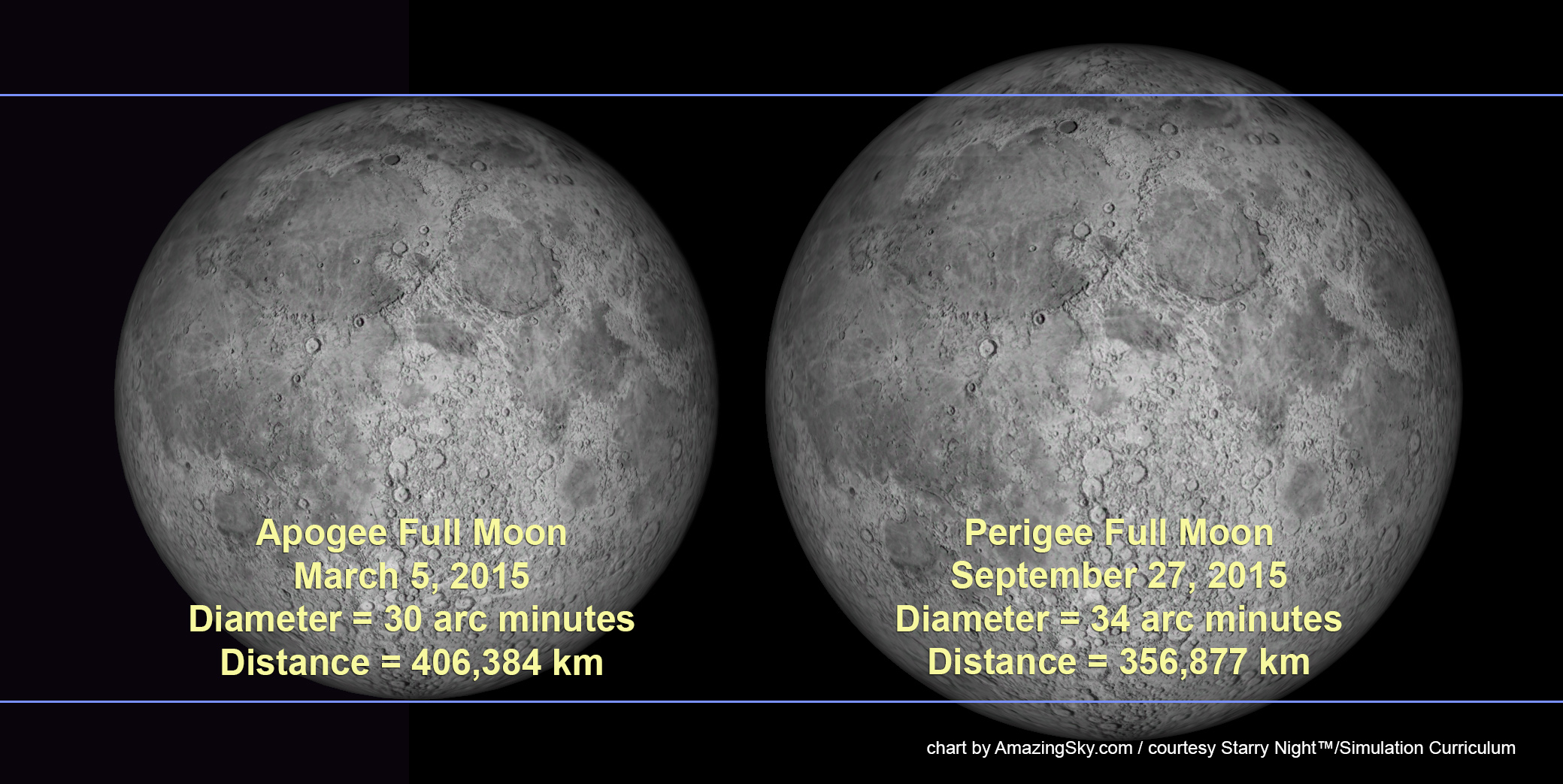
But what is making internet headlines is that this Full Moon is also the year’s “supermoon,” the Full Moon of 2015 that comes closest to Earth. In recent years these “perigee” Full Moons have been dubbed “supermoons.”

Call it what you will, it does make this Full Moon a little larger than usual, though the difference is virtually impossible to detect by eye. And it makes little difference to the circumstances or appearance of the eclipse itself.

Partial eclipse of the Moon at moonset, morning of June 26, 2010, at about 5:00 am. Shot with 200mm telephoto and 1.4x teleconvertor, for 1/15th sec at f/5 and ISO 100, using Canon 7D.
Partial eclipse of the Moon at moonset, morning of June 26, 2010, at about 5:00 am. Shot with 200mm telephoto and 1.4x teleconvertor, for 1/15th sec at f/5 and ISO 100, using Canon 7D. From western North America the Moon will rise in partial eclipse like this on September 27. 

HOW TO SEE IT

Just look up! You can enjoy the eclipse with the unaided eye, and even from within city limits.

Unlike eclipses of the Sun, the eclipsed Moon is perfectly safe to look at with whatever you wish to use to enhance the view. The best views are with binoculars or a telescope at low power.

Look for subtle variations in the red colouring across the disk of the Moon, and even tints of green or blue along the dark edge of the Earth’s advancing or retreating shadow during the partial phases.

If you can, travel to a dark site to enjoy the view of the stars and Milky Way brightening into view as the Full Moon reddens and the night turns dark.


HOW TO SHOOT IT

The total eclipse of the Moon, April 15, 2014 local time just after sunset from Australia, seen from Shingle Splitter's Point overlooking Lake Macquarie on the Central Coast of New South Wales, Australia. It was fortunate that we saw this eclipse at all as the sky was very cloudy and at times it was actually raining on us. But about 6 pm the Moon appeared as totality was ending. The Moon appears below Spica and below right of Mars. The lake has a red glitter path from the eclipsed Moon. This is an 8-second exposure at f/2.8 with the 50mm lens on the Canon 60Da at ISO 800.
The total eclipse of the Moon, April 15, 2014 local time just after sunset from Australia. This is an 8-second exposure at f/2.8 with the 50mm lens on the Canon 60Da at ISO 800.

1. On A Tripod

The easiest method is to use a camera on a tripod, with a remote release to fire the shutter and prevent vibration from blurring the image. What lens you use will depend on how you wish to frame the scene and how high the Moon is in your sky.

Lens Choice

From eastern North America you’ll need a wide-angle lens (14mm to 24mm) to frame the eclipsed Moon and the ground below. The Moon will appear as a small red dot.

While you can shoot the Moon with longer focal lengths it takes quite a long lens (>300mm) to really make it worthwhile shooting just the Moon itself isolated in empty sky. Better to include a landscape to put the Moon in context, even if the Moon is small.

From western North America the lower altitude of the Moon allows it to be framed above a scenic landscape with a longer 35mm to 50mm lens, yielding a larger lunar disk.

From the west coast you could use a telephoto lens (135mm to 200mm) to frame the horizon and the eclipsed Moon as it rises for a dramatic photo.

Focusing

Use Live View (and zoom in at 10x magnification) to manually focus on the horizon, distant lights, or bright stars. The Moon itself my be tough to focus on.

Exposure Times

Exposures will depend on how bright your sky is. Use ISO 400 to 800 and try metering the scene as a starting point if your sky is still lit by twilight. Use wide lens apertures (f/4 to f/2) if you can, to keep exposures times as a short as possible.

The apparent motion of the Moon as the sky turns from east to west will blur the image of the Moon in exposures lasting more than a few seconds, especially ones taken with telephoto lenses.

The maximum exposure you can use before trailing sets in is roughly 500 / lens focal length.


Total eclipse of the Moon, December 20/21, 2010, taken from home with Canon 5D MKII and 24mm lens at f2.8 for stack of 4 x 2 minutes at ISO 800. Taken during totality. The eclipsed Moon is the red object above Orion, and the stars appear bloated due to high haze and fog rolling in, visible at the bottom.
Total eclipse of the Moon, December 20/21, 2010, taken with Canon 5D MKII and 24mm lens at f2.8 for stack of 4 x 2 minutes at ISO 800. Taken during totality using a camera tracker.

2. On a Tracker or Equatorial Mount

If you can track the sky using a motorized tracker or telescope mount, you can take exposures up to a minute or more, to record the red Moon amid a starry sky.

For this type of shot, you’ll need to be at a dark site away from urban light pollution. But during totality the sky will be dark enough that the Milky Way will appear overhead. Use a wide-angle lens to capture the red Moon to the east of the summer Milky Way.


The total eclipse of the Moon, October 8, 2014, the Hunter’s Moon, as seen and shot from Writing-on-Stone Provincial Park, Alberta under mostly clear though slightly hazy skies, thus the glow around the Moon. The planet Uranus is the brightest dot left of the Moon at 8 o’clock position. Both the Moon and Uranus were at opposition. This was the second in a “tetrad” series of 4 total lunar eclipses in a row at six-month intervals in 2014 and 2015. I shot thus just after mid-totality though with the northern limb of the Moon still bright in this single 15-second exposure at ISO 400 with the Canon 60Da, and with the Officina Stellaire 80mm apo refractor at f/6. It was mounted on the Sky-Watcher HEQ5 mount tracking at the lunar rate. I chased into clear skies to see and shoot this eclipse.
The total eclipse of the Moon, October 8, 2014, the Hunter’s Moon, as seen and shot from Writing-on-Stone Provincial Park, Alberta. I shot this just after mid-totality in a single 15-second exposure at ISO 400 with the Canon 60Da, and with the 80mm apo refractor at f/6. It was mounted on the Sky-Watcher HEQ5 mount tracking at the lunar rate.

3. Through a Telescope

The most dramatic closeups of the eclipsed red Moon require attaching your camera body (with its lens removed) to a telescope. The telescope becomes the lens, providing a focal length of 600mm or more, far longer than any telephoto lens most of us own.

You’ll need the appropriate “prime focus” camera adapter and, to be blunt, if you don’t have one now, and have never shot the Moon though your telescope then plan on shooting with another method.

But even if you have experience shooting the Moon through your telescope, capturing sharp images of the dim red Moon demand special attention.

The telescope must be on a motorized mount tracking the sky, preferably at the “lunar,” not sidereal, drive rate. Focus on the Moon during the partial phases when it is easier to focus on the bright edge of the Moon.

Exposures during totality typically need to be 5 to 30 seconds at ISO 800 to 3200, depending on the focal ratio of your telescope. Take lots of exposures at various shutter speeds. You have over an hour to get it right!


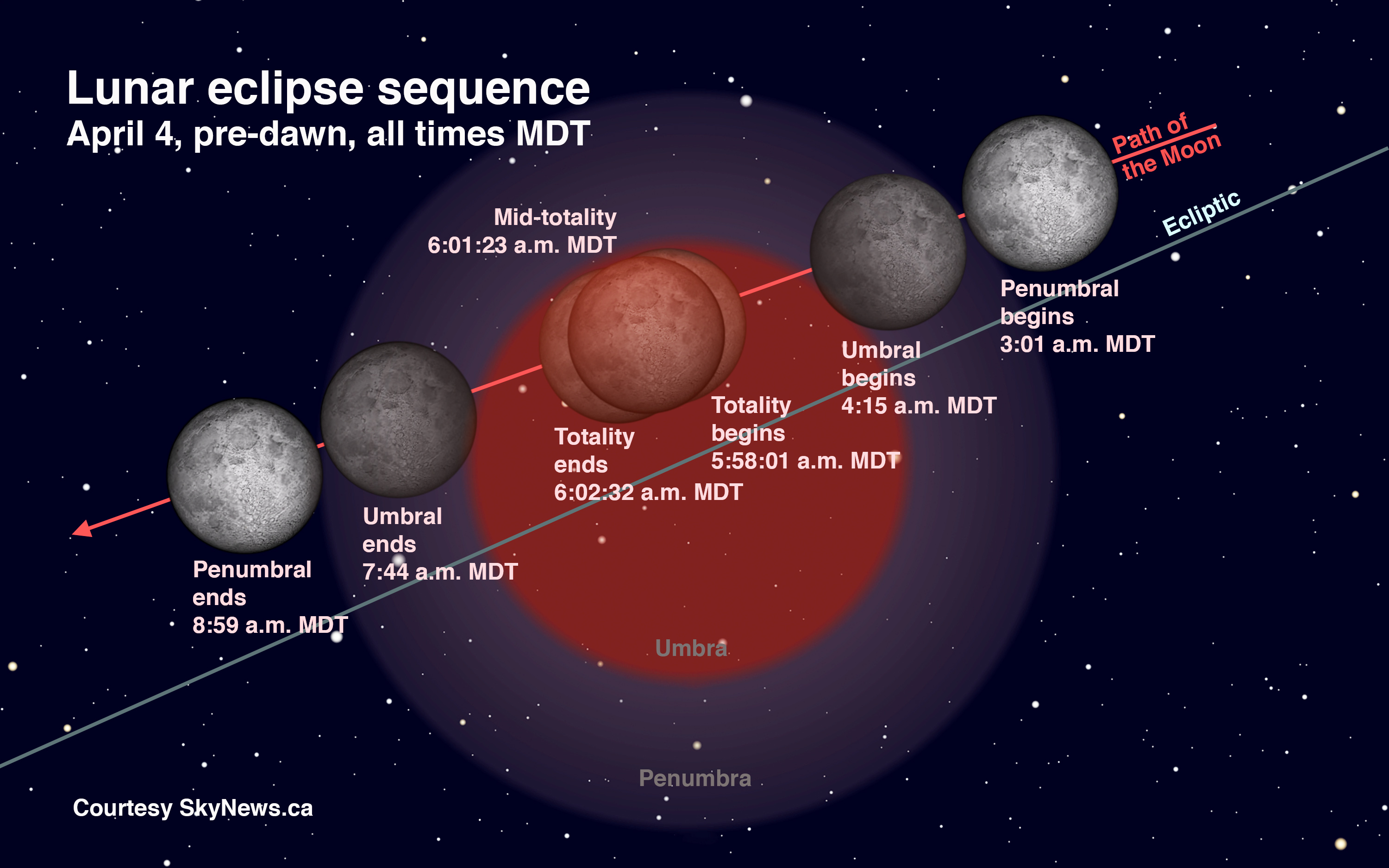
The total lunar eclipse of April 4, 2015 taken from near Tear Drop Arch, in western Monument Valley, Utah. I shot the totality images at 6:01 a.m. MDT, during mid-totality during the very short 4 minutes of totality. The mid-totality image is a composite of 2 exposures: 30 seconds at f/2.8 and ISO 1600 for the sky and landscape, with the sky brightening blue from dawn twilight, and 1.5 seconds at f/5.6 and ISO 400 for the disk of the Moon itself. Also, layered in are 26 short exposures for the partial phases, most being 1/125th sec at f/8 and ISO 400, with ones closer to totality being longer, of varying durations. All are with the 24mm lens and Canon 6D on a static tripod, with the camera not moved through the entire sequence. The short duration of totality at this eclipse lent itself to a sequence with one total phase image flanked by partial phases. The rocks are illuminated by lights from the community - light pollution but photogenic in this case - and partly from dawn glow in the east.
The total lunar eclipse of April 4, 2015 taken from near Tear Drop Arch, in western Monument Valley, Utah. The mid-totality image is a composite of 2 exposures: 30 seconds at f/2.8 and ISO 1600 for the sky and landscape, with the sky brightening blue from dawn twilight, and 1.5 seconds at f/5.6 and ISO 400 for the disk of the Moon itself. Also, layered in are 26 short exposures for the partial phases, most being 1/125th sec at f/8 and ISO 400, with ones closer to totality being longer, of varying durations. All are with the 24mm lens and Canon 6D on a static tripod.

4. Time-Lapses

I’d suggest attempting time-lapses only if you have lots of experience with lunar eclipses.

Exposures can vary tremendously over the partial phases and then into totality. Any time-lapse taken through a telescope, or even with a wide-angle lens, will require a lot of manual attention to ensure each frame is well-exposed as the sky and Moon darken.

However, even if you do not get a complete set of frames suitable for a smooth, continuous time-lapse, selected frames taken every 5 to 10 minutes may work well in creating a multiple-exposure composite (as above), by layering exposures later in Photoshop.


Whatever method – or methods — you use, don’t get so wrapped up in fussing with cameras you forget to simply enjoy the eclipse for the beautiful sight it is.

This is the last total eclipse of the Moon anyone on Earth will see until January 31, 2018. So enjoy the view of the deep red Moon in the autumn sky.

— Alan, September 20, 2015 / © 2015 Alan Dyer / www.amazingsky.com

Morning Star, the Milky Way, and the Zodiacal Light


Venus shines brightly, and nearly at its brightest at magnitude -4.7, in the dawn sky on a very frosty morning at 5 am, on September 17, 2015, from home in southern Alberta. Venus appears amid the faint glow of the Zodiacal Light, sometimes called the “False Dawn,” stretching vertically from the dawn horizon in the east, up and to the right, and reaching the Milky Way that runs down the frame from top centre to bottom right. Orion and the winter stars shine in the Milky Way, with Sirius above the trees at lower right. The Beehive Cluster, M44, appears as the small group of stars above Venus. The Pleiades, M45, is at top right. Mars is the brightest object left of Venus, with the bright star Regulus just below it and rising in the east. The stars of the Big Dipper are at far left at the edge of the frame. The sky is beginning to brighten with the real glow of morning.  This is a stack of 4 x 2-minute exposures, tracked and mean combine stacked, for the sky and 2 x 2-minute exposures, untracked and stacked, for the ground to minimize blurring in the starlit ground. The Canon 6D was on the iOptron Sky-Tracker, shooting at ISO 1250 with the 15mm full-frame fish-eye lens at f/3.5. The stacking with a mean combine stack mode smooths noise in both sky and ground.

Venus, now at its brightest as a morning star, shines amid the subtle glow of the Zodiacal Light. 

This was the scene this morning, September 17, on a very frosty dawn at 5 a.m. from my backyard in southern Alberta.

Here, Venus shines nearly as bright as it can be, at magnitude -4.7, in the dawn sky as a brilliant “morning star.”

Venus appears amid the faint glow of the Zodiacal Light, sometimes called the “False Dawn,” stretching diagonally from the dawn horizon in the east, up and to the right, and reaching the Milky Way that runs vertically down the frame from top centre to bottom right.

Orion and the winter stars shine in the Milky Way, with Sirius above the trees at lower right.

The Beehive Cluster, M44, appears as the small group of stars above Venus. The Pleiades, M45, is at top right.

Mars is the brightest object left of Venus, with the bright star Regulus just below it and rising in the east. The stars of the Big Dipper are at far left at the edge of the frame.

The sky is beginning to brighten with the real glow of morning. It was a marvellous dawn sky delight.

Technical notes:

This is a stack of 4 x 2-minute exposures, tracked and mean-combine stacked, for the sky and 2 x 2-minute exposures, untracked and stacked, for the ground to minimize blurring in the starlit ground. The Canon 6D was on the iOptron Sky-Tracker, shooting at ISO 1250 with the 15mm full-frame fish-eye lens at f/3.5. The stacking with a mean combine stack mode smooths noise in both sky and ground.

– Alan, September 17, 2015 / © 2015 Alan Dyer / www.amazingsky.com 

10 Tips for Terrific Time-Lapses


eMotimo at Dino Park #1

Here are my top tips for shooting terrific still-image nightscapes … and time-lapse movies of the night sky. 
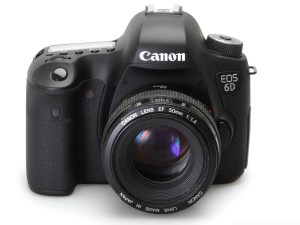
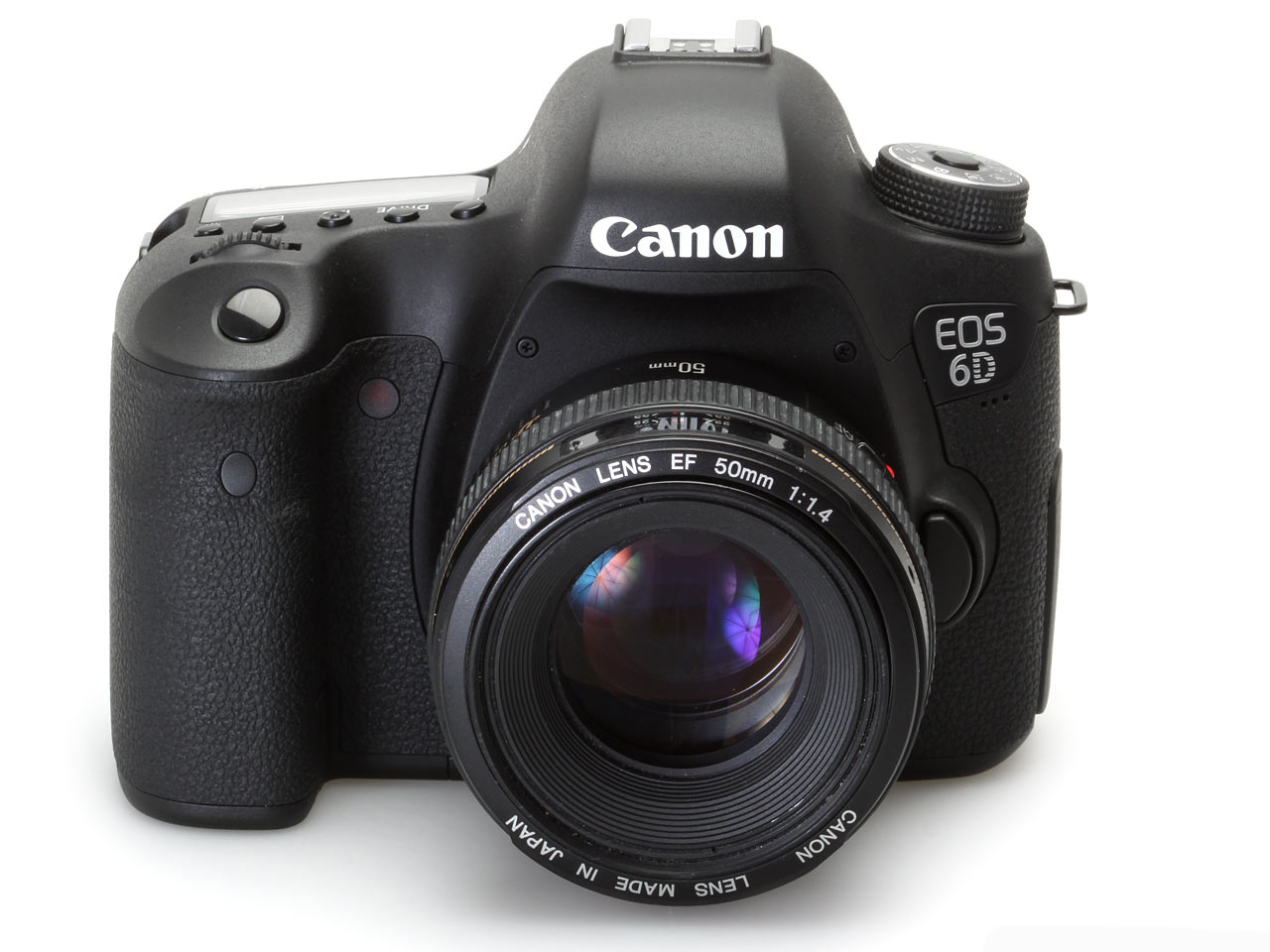
Canon 6D

1. Go for pixel size, not pixel count

When choosing a camera for night sky scenes, the most important characteristic is not number of megapixels. Just the opposite.

The best cameras are usually models with more modest megapixel counts. Each of their individual pixels is larger and so collects more photons in a given exposure time, yielding higher a signal-to-noise ratio – or lower noise, critical for night shooting.

Cameras with pixels (the “pixel pitch”) 6 to 8 microns across are best. Many high-megapixel cameras have tiny 4-micron pixels.

Large-pixel cameras are often the full-frame models, such as the Canon 5D MkIII and 6D, the Nikon D610, D750, and Df, and the Sony a7s and a7S II.

Many “cropped-frame” cameras are now 18- to 24-megapixel models with smaller, noise-prone pixels. They can certainly be used, but will require more care in exposing well at lower ISOs, and in processing to smooth out noise without blurring detail.

Manual Settings

2. Learn to fly on manual

While DSLRs and Compact System Cameras have amazing automatic functions we use none of them at night.

Instead, we use the camera on Manual or Bulb, dialling in shutter speed, aperture and ISO speed manually. We also have to focus manually, using Live View mode to focus on a bright star or distant light.

Learn the tradeoffs involved: Increasing ISO sensitivity of the sensor keeps exposure times down but increases noise. Opening up the lens aperture to f/2 or f/1.4 also keeps exposures short but introduces image-blurring aberrations, especially at the frame corners.

To prevent stars from trailing due to the sky’s motion adhere to the “500 Rule:” the maximum exposure time is roughly 500 divided by the focal length of your lens.
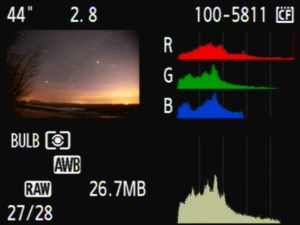
Histogram-Correct

3. Expose to the right 

At night, always give the sensor plenty of signal.

Use whatever combination of shutter speed, aperture and ISO will provide a well-exposed image. The image “histogram,” the graph of number of pixels at each brightness level shown above, should never be slammed to the left.

It should be a well-distributed “mountain range” of pixels, extending well to the right. If the 500 Rule restricts your shutter speed, and your desire for sharp images across the frame demands you shoot at f/2.8 or even slower, then don’t be afraid to bump up the ISO speed to whatever it takes to produce a good histogram and a well-exposed image.

Noise will look far worse if you underexpose, then try to boost the image brightness later in processing. Expose to the right!
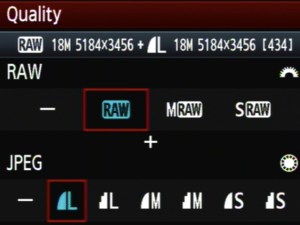
File Format #2 7D

4. Shoot Raw!

Shoot Raw. Period.

When comparing Raw and compressed JPG versions of the same image, you can be fooled into thinking the JPGs look better (i.e. smoother) because of the noise reduction the camera has applied to the JPG that is beyond your control. However, that smoothing has also wiped out fine detail, like stars.

By shooting Raw you get to control whatever level of noise reduction and sharpening the image needs later in processing.

JPGs are also 8-bit images with a limited tonal range – or palette – in which to record the subtle gradations of brightness and colour present in our images.

Imported Raw files are 16-bit, with a much wider tonal scale and colour palette. That’s critical for all astrophotos when, even with a well-exposed image, many tonal values are down in the dark end of the range. Processing Raw images makes it possible to extract detail in the shadows and highlights.

Even when shooting a time-lapse sequence, shoot Raw.
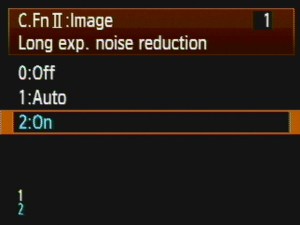
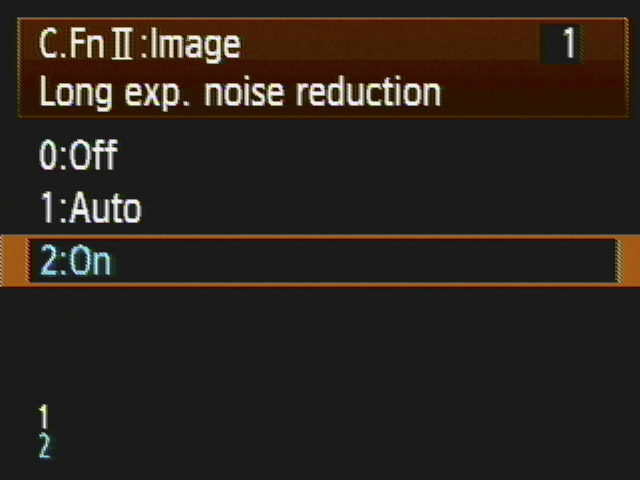
LENR

5. Take dark frames (sometimes!)

LENR reduces noise.

It’s a topic of some debate, but in my experience it is always better to turn on the camera’s Long Exposure Noise Reduction (LENR) function when shooting individual nightscape images. Doing so forces the camera to take a “dark frame,” an exposure of equal length but with the shutter closed.

It records just the noise, which the camera then subtracts from the image. Yes, it takes twice as long to acquire an image, but the image is cleaner, with fewer noisy pixels.

This is especially true when shooting on hot summer nights (the warmer the sensor the higher the noise). That said, you cannot use LENR when shooting frames for star trail composites or time-lapse movies.

For those, the interval between images should be no more than 1 to 5 seconds. Using LENR would introduce unsightly gaps in the trails or jumps in the star motion in time-lapses.

As an alternative, it is possible to take separate dark frames at the end of the night by simply covering the lens and taking exposures of the same duration and at the same ISO as your “light frames.”

Some stacking software, such as StarStax and the Advanced Stacker Actions have places to put these dark frames, to subtract them from the stack later in processing.

811eBU4sBkL._SL1500_

6. Use fast lenses

A fast lens is your best accessory.

While the “kit zoom” lenses that come with many DSLRs are great for shooting bright twilight or Full Moon scenes, they will prove too slow for dark starlit scenes with the Milky Way.

In addition to exposing to the right and shooting Raw, the secret to great nightscapes is to shoot with fast lenses, usually “prime” lenses with fixed focal lengths. They are usually faster and have better image quality than zooms.

Your most-used lens for nightscape and time-lapse shooting is likely to be a 14mm to 24mm f/2 to f/2.8 lens.

Fortunately, because we don’t need (and indeed can’t use) autofocus we can live happily with low-cost manual lenses, such as the models made in Korea and sold under brands such as Rokinon, Samyang and Bower. They work very well.

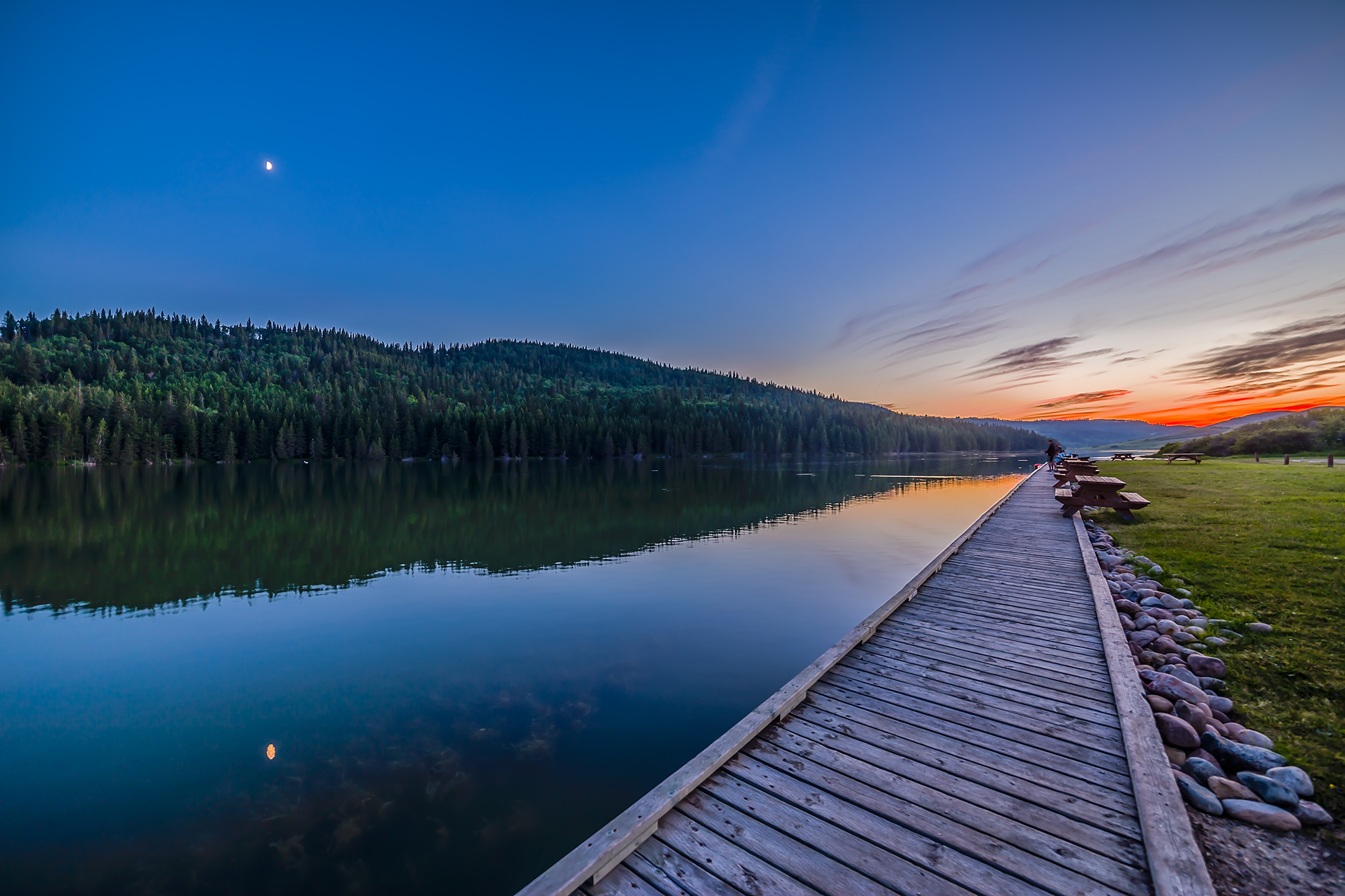
The quarter Moon reflected in the waters of Reesor Lake, Alberta in Cypress Hills Interprovincial Park. Taken on July 5, 2014. This is with the 14mm Rokinon lens and Canon 6D at ISO800. This is a high dynamic range stack of6 exposures from 1/15 to 0.6 seconds taken just before using the camera to take a motion control time-lapse. The Moon was in conjunction with Mars (right of Moon) and Spica (left of Moon) but in the bright twilight they are not showing up here.

7. Get to know the Moon & Milky Way

For many nightscape and time-lapse shoots, the Moon is your light source for illuminating the landscape.

When the Moon is absent, the Milky Way is often your main sky subject.

Knowing where the Moon will be in the sky at its various phases, and when it will rise (in its waning phases after Full Moon) or set (in its waxing phases before Full) helps you a plan a shoot, so you’ll know whether a landscape will be well lit.

Astronomy apps for desktop computers and mobile devices are essential planning aids. A good one specifically for photographers is The Photographer’s Ephemeris.

Knowing in what season and time of night the Milky Way will be visible is essential if you want to capture it. Don’t try for Milky Way shots in spring – it isn’t up!

Me with cameras shooting time-lapses at Crawling Lake reservoir, Alberta, June 30/July 1, 2013. Perpetual twilight of summer solstice shines to the north and very weak noctilucent clouds.

8. Keep it simple to start

Don’t be seduced by the fancy gear. 

Time-lapse imaging has blossomed into a field replete with incredible gear for moving a camera incrementally during a shoot, and for automating a shoot as day turns to night.

I explain how to use all the fancy gear in my ebook, linked to below, however … Great time-lapses, and certainly still-frame nightscapes, can be taken with no more than a DSLR camera with a good fast lens and mounted on a sturdy tripod. Invest in the lens and don’t scrimp on the tripod.

Another essential for shooting multi-frame star trails and time-lapses is a hardware intervalometer ($50 to $150).
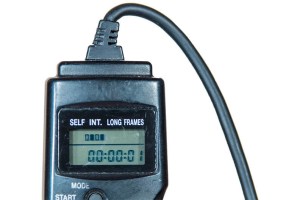
TC-80N3 Masked

9. Learn the intricacies of intervals

For time-lapses, an intervalometer is essential.

Mastering exposure and focus in still images is essential for great time-lapse movies because they are simply made of hundreds of well-exposed still frames.

But move to time-lapses and you have additional factors to consider: how many frames to shoot and how often to shoot them. A good rule of thumb is to shoot 200 to 300 frames per sequence, shot with an interval of no more than 1 to 5 seconds between exposures, at least for starry night sequences.

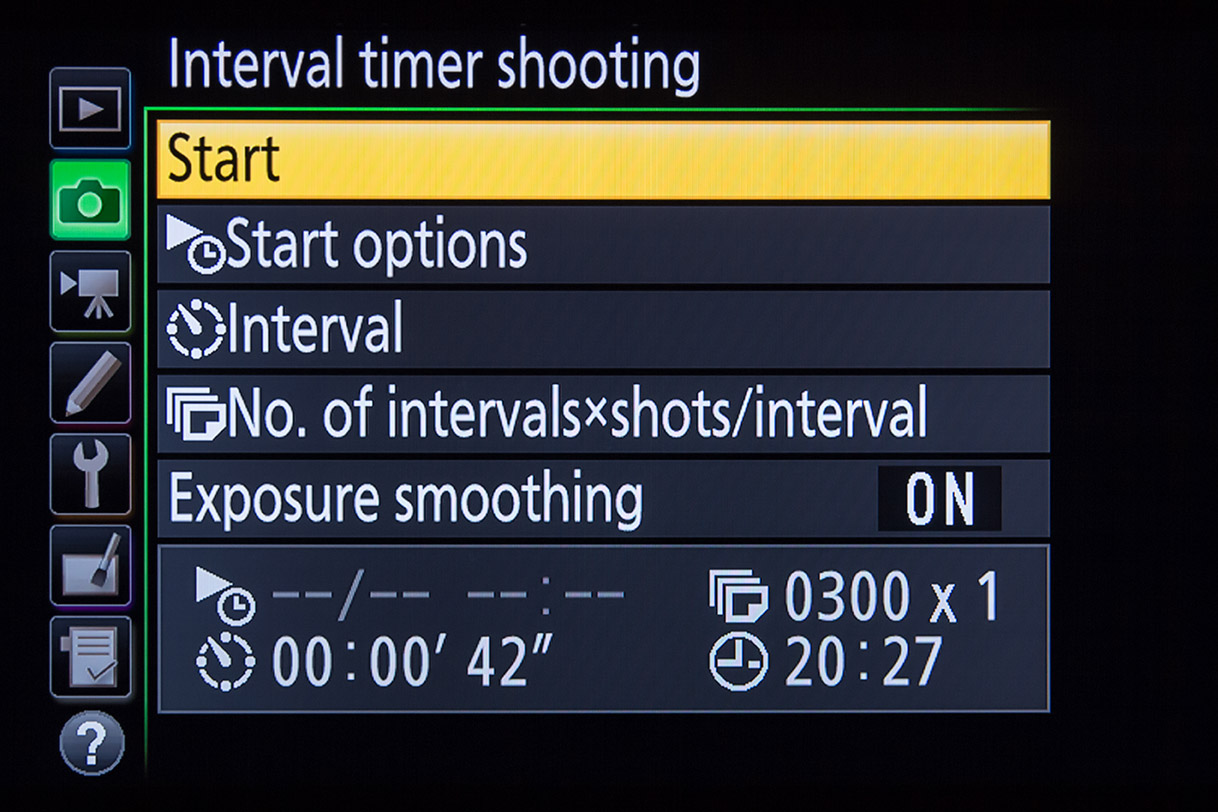
However, most intervalometers (the Canon TC-80N3 is an exception) define their “Interval” setting to mean the time from when the shutter opens to when it opens again. In that case, you set the Interval to be a value 1 to 5 seconds longer than the exposure time you are using. That’s also true of the intervalometer function Nikon builds into their internal camera firmware.

Test first!
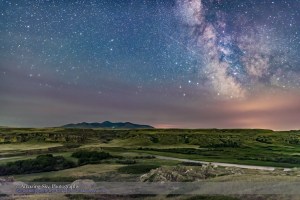
The summer Milky Way with a meteor streaking at centre as a bonus. An aurora to the north off frame is lighting the foreground with a green glow. Haze and forest fire smoke obscure the horizon. I shot this at the Battle Scene viewpoint at Writing-on-Stone Provincial Park, in southern Alberta. Sagittarius and the galactic centre is on the horizon at left of centre. Capricornus is amid the haze at left of centre. On the horizon are the Sweetgrass Hills in Montana. The Milk River winds below amid the sandstone formations that are home to historic First Nations petroglyphs.  This is a single 30-second exposure with the Nikon D750 at ISO 3200 and Sigma 24mm Art lens at f/2, taken as part of a time-lapse sequence.

10. Go to beautiful places

While the gear can be simple, great shots demand an investment in time.

By all means practice at home and at nearby sites that are quick to get to. Try out gear and techniques at Full Moon when exposures are short (the Full Moon is bright!) and you can see what you are doing.

But beautiful images of landscapes lit by moonlight or starlight require you to travel to beautiful locations.

When you are on site, take the time to frame the scene well, just as you would during the day. Darkness is no excuse for poor composition!

While shooting nightscapes and time-lapses can be done with a minimal investment in hardware and software, it does require an investment in time – time to travel and spend nights shooting at wonderful places under the stars.

Enjoy the night!

I cover all these topics, and much more, in detail in my ebook How to Photograph & Process Nightscapes and Time-Lapses. Click the link below to learn more.

— Alan, September 16, 2015 / © 2015 Alan Dyer / www.AmazingSky.com
The Dancing Lights over Dinosaur Park


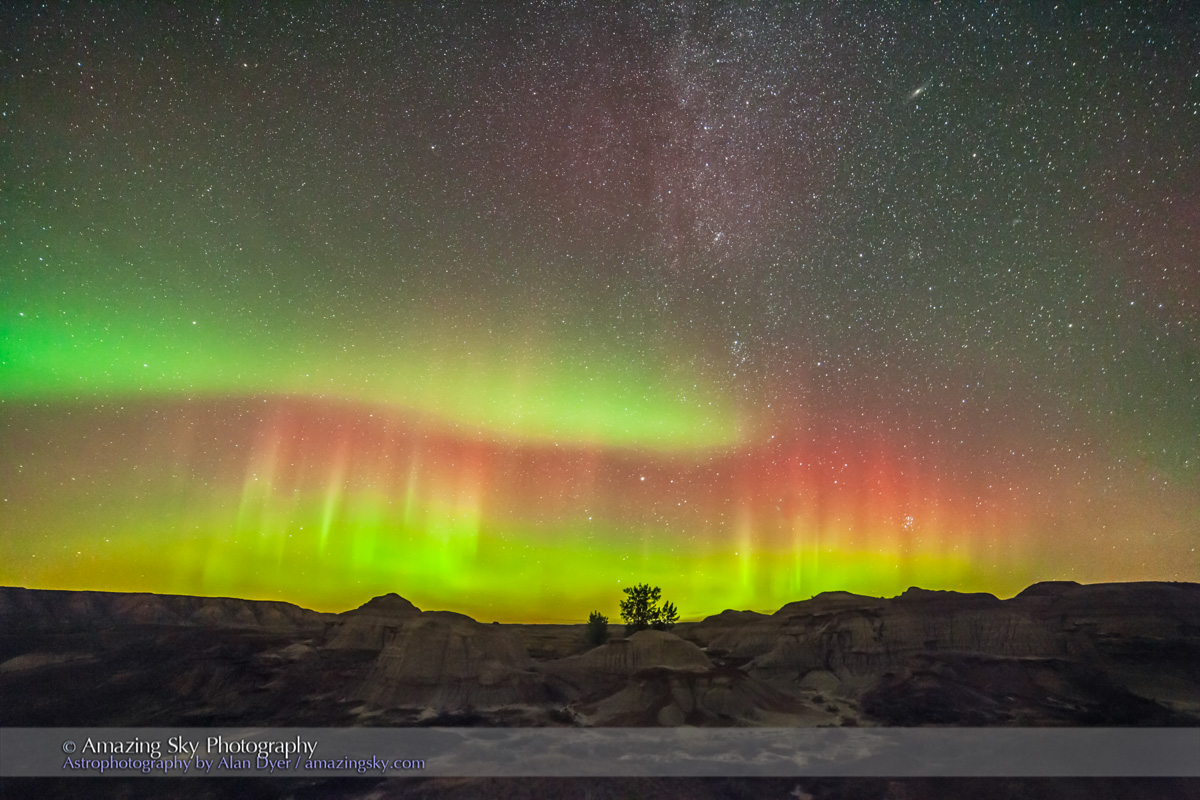
The Northern Lights over the badlands of Dinosaur Provincial Park, Alberta, on September 11, 2015. This is one frame from a 280-frame time-lapse sequence. Although, in this image the ground came from a later exposure in the sequence when passing car headlights lit the ground briefly on an otherwise dark, moonless night, to help sculpt the ground. This was with the Nikon D750 and 24mm lens for 15 seconds at f/2.8 and ISO 6400.

The Northern Lights dance over the badlands of Dinosaur Provincial Park, a World Heritage Site.

Aurora alerts called for a fine display on Friday, September 11. Forewarned, I headed to one of my favourite shooting spots at Dinosaur Provincial Park, and aimed three cameras at the sky. It didn’t take long before the lights appeared, right on cue.

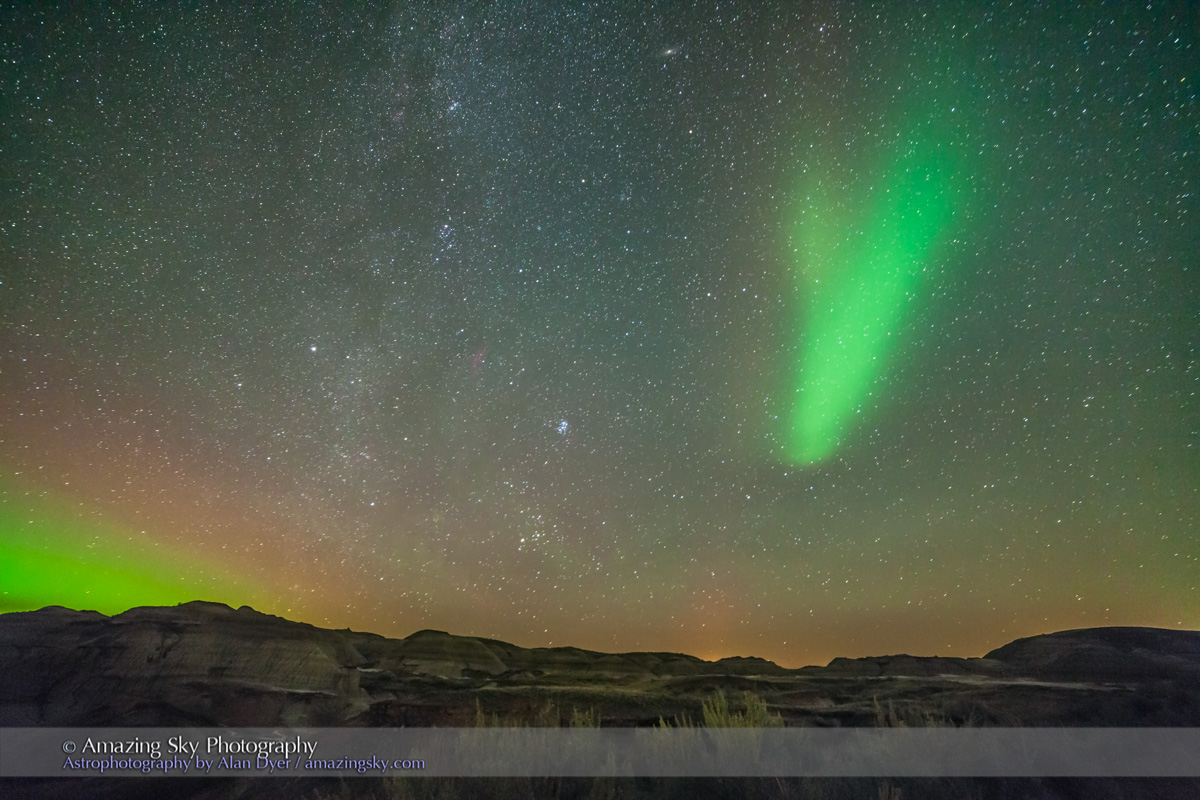
An aurora and the autymn Milky Way over the Badlands of Dinosaur Provincial Park, Alberta, on September 11, 2015. The stars, constellations and Milky Way of the autumn and early winter sky are rising in the northeast, including the objects: the Andromeda Galaxy at top, and the Pleiades at bottom.  This is one frame from a 200-frame time-lapse sequence, though in this image the ground comes from a Mean Combine stack of 7 images to smooth noise but the sky is from one image, each 30 seconds at f/2.8 with the Rokinon 14mm lens and Canon 5D MkII at ISO 3200 on a dark moonless night.

The display started out with lots of promise, but did fade after 12:30 a.m., just when it was supposed to be peaking in intensity. I let the cameras run for a while but eventually stopped the shutters and packed it in…

…But not before I captured this odd bit of aurora in the east, shown below, that appeared as an isolated and stationary band pulsing up and down in brightness, but with little movement.

An odd isolated arc of aurora in the eastern sky over the badlands of Dinosaur Provincial Park, Alberta, on September 11, 2015. This arc sat stationary and pulsed up and down in brightness over a few seconds. It was in some frames but not others. The winter stars of Taurus, including the Pleiades cluster, and Auriga are rising in the east.  The sky here is from a single exposure but the ground came from a Mean Combine stack of 8 exposures to smooth noise. Each was 40 seconds at f/2.8 with the 14mm Rokinon lens and Canon 5D MkII at ISO 3200 on a moonless night.

I’ve seen these before and have never heard a good explanation of what process creates such an effect, with a patch of sky appearing to “turn on” and off.

You can see the effect at the end of the time-lapse compilation, linked below from Vimeo.

As usual, please enlarge to full-screen and watch in HD for the best quality.

Unfortunately, a patrolling park official checking on things, spoiled some frames with her truck’s headlights. It’s one of the hazards of time-lapse imaging.

As a final image, here are all the fish-eye lens frames stacked into one image, to create a single star trail showing the sky rotating about the celestial pole.

A composite stack of 198 images creating a circumpolar star trail image of the entire sky, with the motion of the stars and the Northern Lights over an hour recorded onto one frame.  The 8mm fish-eye lens take in almost all the sky, with the camera aimed northeast to the centre of the auroral arc, with Polaris, the centre of the sky’s rotation, at left. The scene is at Dinosaur Provincial Park in Alberta, from September 11, 2015.  Each exposure was 20 seconds at f/3.5 with the Sigma 8mm lens and at ISO 6400 with the Canon 6D. The ground comes from a stack of 16 images taken early in the sequence turned into a smart object and mean combined with Mean stack mode, to average out and smooth noise. The sky comes from 198 exposures, Lighten stacked using the Advanced Stacker Actions from StarCircleAcademy.com.
Each exposure was 20 seconds at f/3.5 with the Sigma 8mm lens and at ISO 6400 with the Canon 6D. The ground comes from a stack of 16 images taken early in the sequence turned into a smart object and mean combined with Mean stack mode, to average out and smooth noise. The sky comes from 198 exposures, Lighten stacked using the Advanced Stacker Actions from StarCircleAcademy.com.

It’s been a good week for auroras, with a promise of more to come perhaps, as we approach equinox, traditionally a good time for magnetic field lines to align, funnelling solar storm particles into our magnetosphere.

Keep looking up!

— Alan, September 13, 2015 / © 2015 Alan Dyer / www.amazingsky.com 

Dawn Worlds


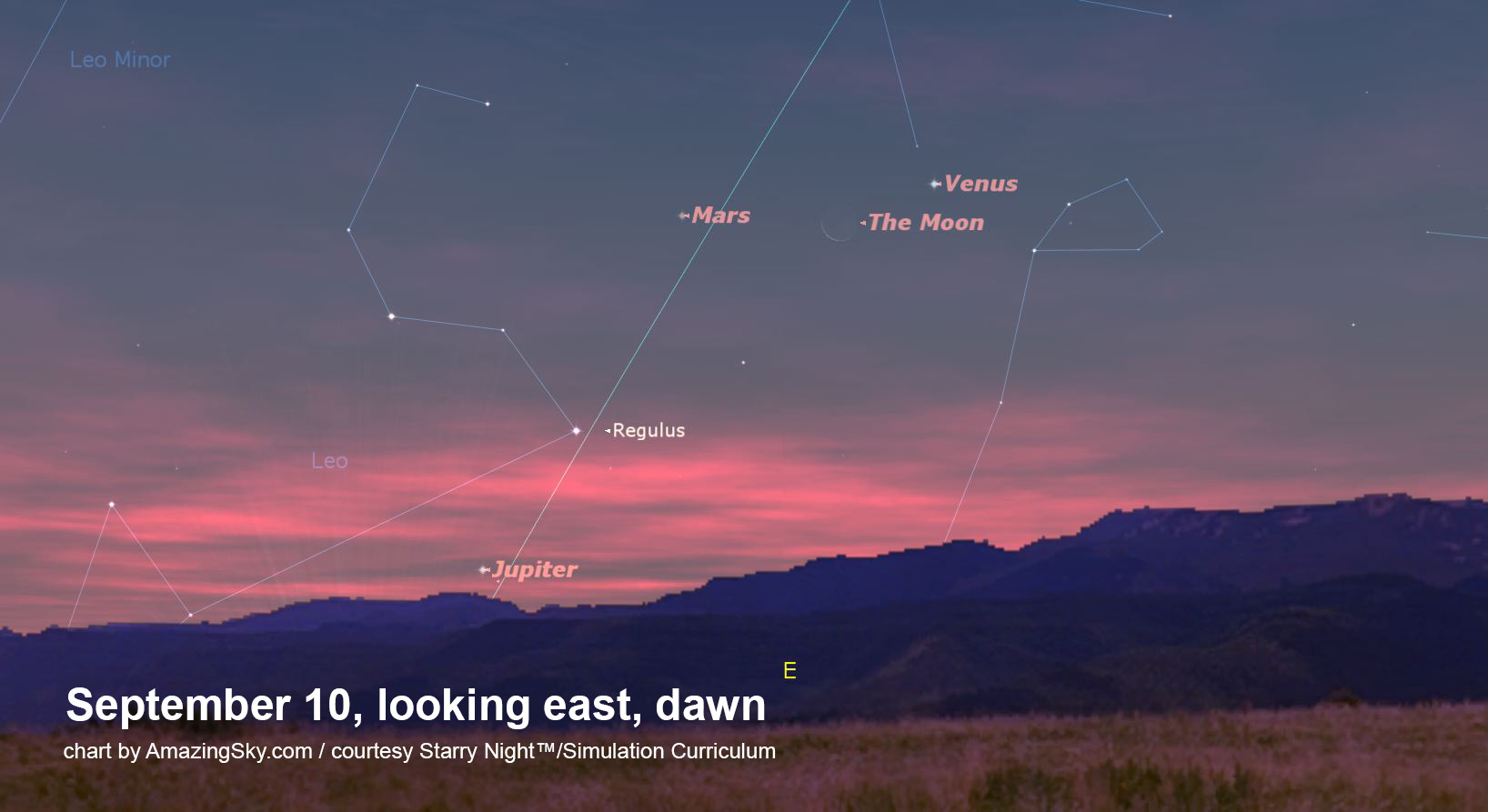
The waning crescent Moon near Venus (at right) and much dimmer reddish Mars (at left) in the pre-dawn sky of September 10, 2015. This is a high-dynamic range stack of 5 exposures to accommodate the large range in brightness between the sky and Moon, and to preserve the earthshine on the dark side of the Moon.  I shot this with the Canon 6D and 135mm lens at f/2 and at ISO 800 in a set of 8, 4, 2, 1 and 0.5-second exposures, blended with HDR Pro in Photoshop using 32 bit mode of Camera Raw.

The waning crescent Moon joined Venus and Mars in the dawn sky.

I blogged about this conjunction a few days ago, and here is the real thing.

On the morning of September 10 the waning crescent Moon gathered near bright Venus and much dimmer but redder Mars (at left) in the dawn sky.

Venus and Mars have both moved into the morning sky, where they will begin a series of conjunctions with the Moon and with Jupiter, now just emerging from behind the Sun, over the next two months. This gathering is just the start of the dawn planet dance.

For the technically minded, this is a high-dynamic range stack of 5 exposures to accommodate the large range in brightness between the sky and Moon, and to preserve the earthshine on the “dark side of the Moon.”

I shot this with the Canon 6D and 135mm lens at f/2 and at ISO 800 in a set of 8, 4, 2, 1 and 0.5-second exposures, blended with HDR Pro in Photoshop using 32-bit mode of Adobe Camera Raw.

— Alan, September 10 2015  / © 2015 Alan Dyer / www.amazingsky.com

The Dancing Northern Lights


A still frame from a 865-frame time-lapse movie taken the morning of Sept. 9, 2015 from the back deck, using the Nikon D750 and 24mm lens for 2-second exposures for a fast cadence. Focus is soft.

The lights came out and danced in my sky in the early morning hours.

The early warning signs weren’t calling for anything too impressive for a display last night, September 8/9, but the sky surprised us with a fantastic display of Northern lights.

I shot with one camera – it was very late, or very early! – but shot enough frames to create this short 1.5-minute music video.

I photographed the sequence with a single fixed-camera aimed east toward a bright auroral curtain, showing fast pulsing forms common to the later stages of a substorm. But then a new bright curtain sweeps in from the north and the display brightens even more in a new substorm. The display then fades.

The exposures were taken over an hour from 1:30 a.m. to 2:30 a.m. MDT. Each was a 2-second exposure with an interval of 2 seconds, shot with the Nikon D750 at ISO 3200 and Sigma 24mm lens at f/2, for a total of just over 850 frames.

Music is my Adi Goldstein at AGSoundtrax.com.

— Alan, September 9, 2015 / © 2015 Alan Dyer / www.amazingsky.com

Heads Up! – Dawn Planet Dance Begins


Sept 10 Moon & Venus

Look east at dawn on September 10 to see the first in a series of planet dances in the dawn sky.

Earlier this year in spring we had Venus and Jupiter blazing in the evening western sky. Now, after a time of retreat behind the Sun, they are emerging to repeat their show together but in the dawn sky.

However, Venus and Jupiter won’t be close together until the end of October. Until then, Venus and Jupiter slowly converge in the dawn sky, but now accompanied by dimmer but redder Mars.

On the morning of September 10, look east before sunrise to see the waning crescent Moon shining between Venus and Mars. Binoculars will frame the Moon and Venus, or the Moon and Mars, but not all three at once.

If your horizon and sky are very clear you might spy Jupiter as well shining down below the trio in the bright morning twilight.

The real dawn dance begins in mid to late October, when first Mars, then Venus passes Jupiter, and all three worlds cluster in a tight triangle in the morning twilight.

— Alan, September 7, 2015 / © 2015 Alan Dyer / www.amazingsky.com

Canon vs. Nikon for Astrophotography


Canon and Nikon Cameras

I’ve been an avowed Canon DSLR user for a decade. I may be ready to switch!

[NOTE: This review dates from 2015. Tests done today with current models would certainly differ. Canon’s EOS R mirrorless series, for example, offer much better ISO Invariancy performance but lack the “dark frame buffer” advantage of Canon DSLRs. And indeed, I have used the Nikon D750 a lot since 2015. But I did not give up my Canons!]

Here, in a technical blog, I present my tests of two leading contenders for the best DSLR camera for nightscape and astronomical photography: the Canon 6D vs. the Nikon D750. Which is better?

To answer, I subjected both to side-by-side outdoor tests, using exposures you’ll actually use in the field for typical nightscapes and for deep-sky images.

Both cameras are stock, off-the-shelf models. They have not had their filters modified for astronomy use. Both are 20- to 24-megapixel, full-frame cameras, roughly competitive in price ($1,900 to $2,300).

For images shot through lenses, I used the Canon L-Series 24mm on the Canon 6D, and the Sigma 24mm Art lens on the Nikon D750.

The bottom line: Both are great cameras, with the Nikon D750 having the edge for nightscape work, and the Canon 6D the edge for deep-sky exposures.

NOTE: Click on the test images for higher-resolution versions for closer inspection. All images and text © 2015 Alan Dyer and may not be reproduced without my permission.


TEST #1 — Noise

The 24.3-megapixel Nikon D750 has 5.9-micron pixels, while the 20.2-megapixel Canon 6D has slightly larger 6.5-micron pixels which, in theory, should lead to lower noise for the Canon. How do they compare in practice?

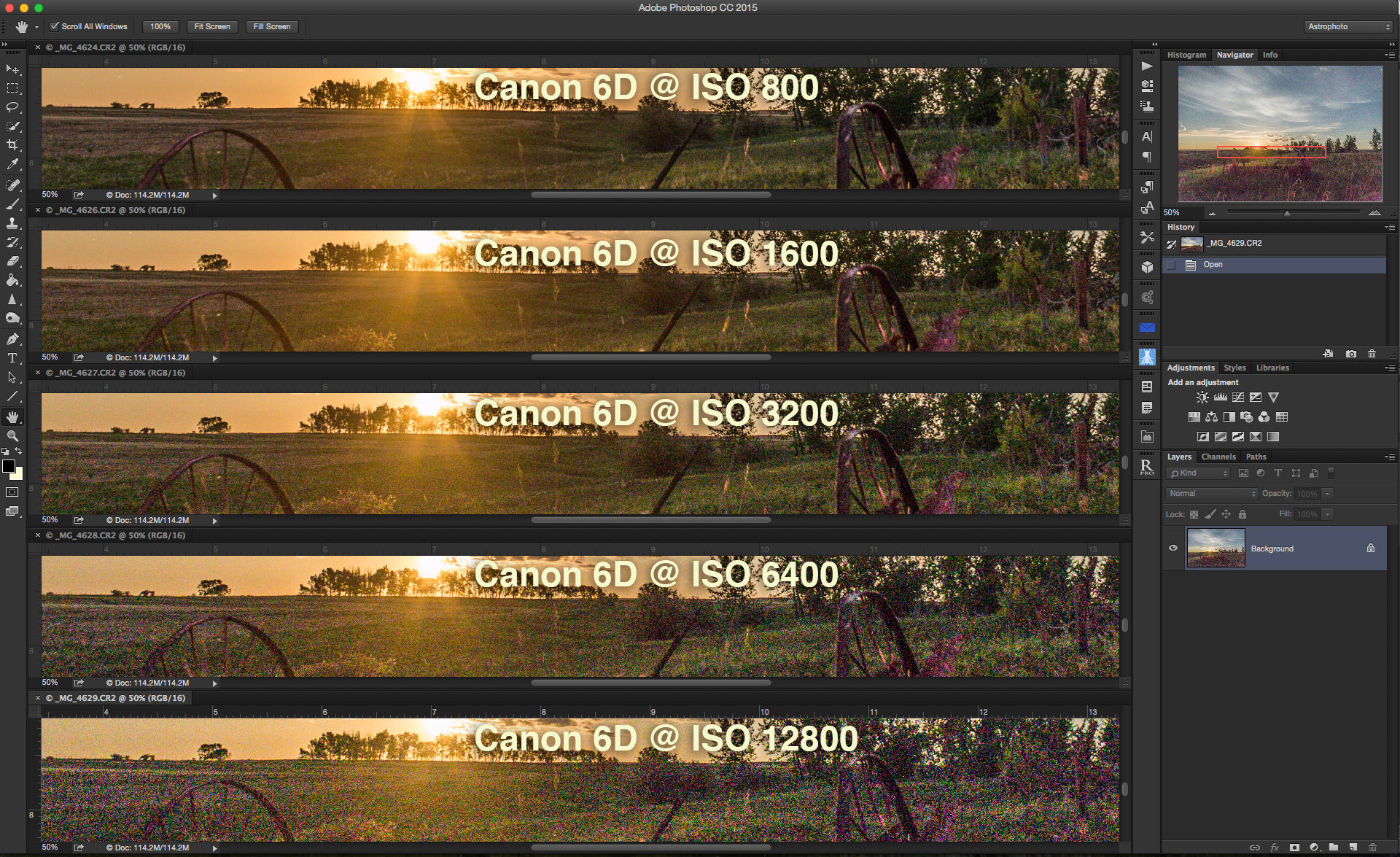
The scene used to test for noise (here with the Nikon images) showing the development settings applied to both the Nikon and Canon sets. NO noise reduction (colour or lunminance) was applied to any of the images, but Exposure, Shadows, Contrast and Clarity were boosted, and Highlights reduced.

I shot a moonlit nightscape scene (above) at five ISO settings, from 800 to 12800, at increasingly shorter exposures to yield identically exposed frames. I processed each frame as shown above, with boosts to shadows, clarity, and contrast typical for nightscapes. However, I applied no noise reduction (either luminance or color) in processing. Nor did I take and apply dark frames.

Noise - Canon

Noise - Nikon

The blowups of a small section of the frame (outlined in the box in the upper right of the Photoshop screen) show very similar levels of luminance noise. The Canon shows slightly more color noise, in particular more magenta pixels in the shadows at high ISOs. Its larger pixels didn’t provide the expected noise benefit.


TEST #2 — Resolution

Much has been written about the merits of Canon vs. Nikon re: the most rigorous of tests, resolving stars down at the pixel level.

I shot the images below of the Andromeda Galaxy the same night through a 92mm aperture apo refractor. They have had minimal but equal levels of processing applied. At this level of inspection the cameras look identical.

M31 (Canon 6D)

M31 (Nikon D750)

But what if we zoom in?

For many years Nikon DSLRs had a reputation for not being a suitable for stellar photography because of a built-in noise smoothing that affected even Raw files, eliminating tiny stars along with noise. Raw files weren’t raw. Owners worked around this by turning on Long Exposure Noise Reduction, then when LENR kicked in after an exposure, they would manually turn off the camera power.

This so-called “Mode 3” operation yielded a raw frame without the noise smoothing applied. Clearly, this clumsy workaround made it impossible to automate the acquisition of raw image sequences with Nikons.

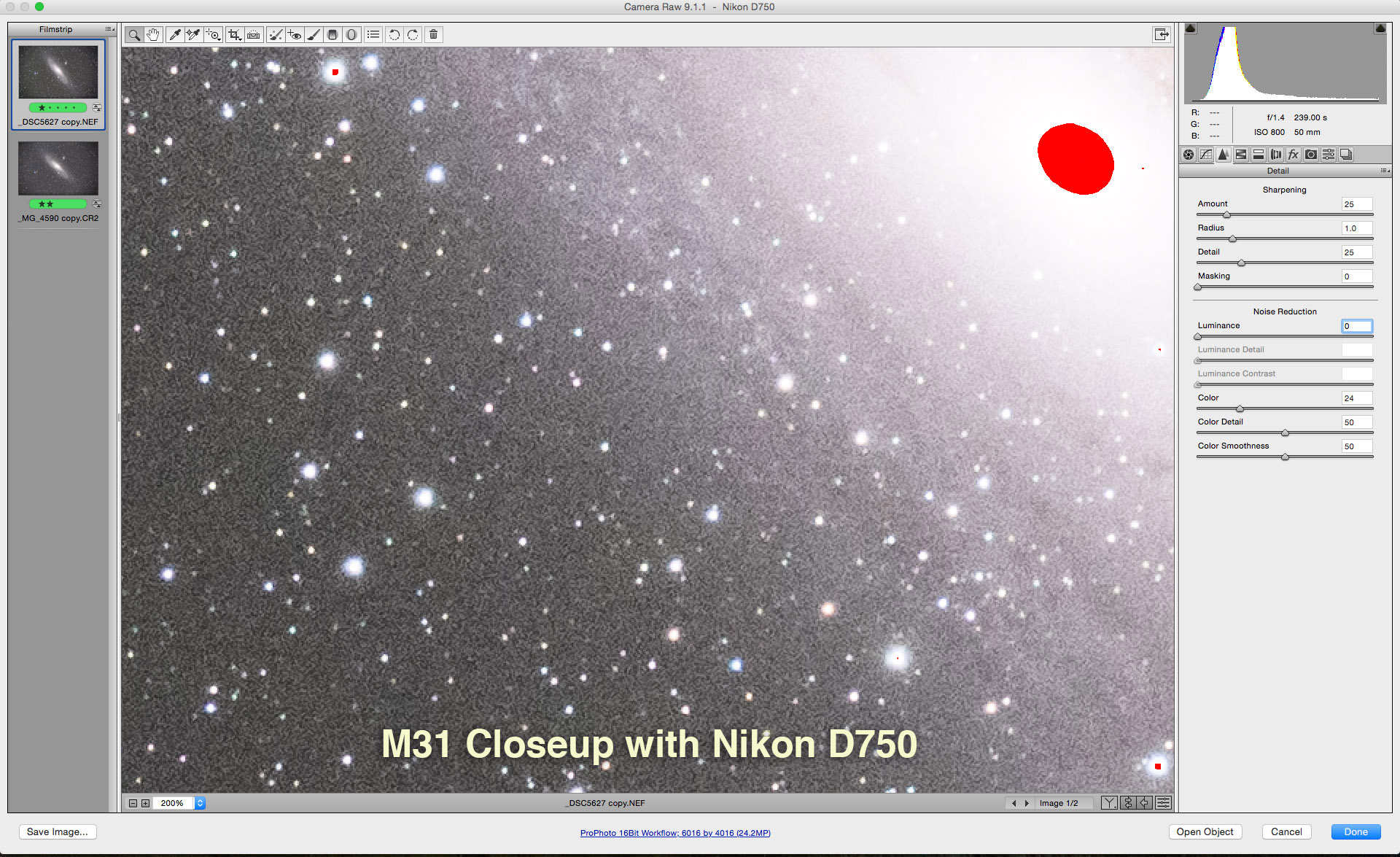
Are Nikons still handicapped? In examining deep-sky images at the pixel-peeping level (below), I saw absolutely no difference in resolution or the ability to record tiny and faint stars. With its 4-megapixel advantage the Nikon should resolve finer details and smaller stars, but in practice I saw little difference.

Closeup of telescope view of Andromeda Galaxy with Canon 6D 4 minute exposure at ISO 800 No noise reduction applied in processing
Closeup of telescope view of Andromeda Galaxy with Canon 6D
4 minute exposure at ISO 800
No noise reduction applied in processing
Closeup of telescope view of Andromeda Galaxy with Nikon D750 4 minute exposure at ISO 800 No noise reduction applied in processing
Closeup of telescope view of Andromeda Galaxy with Nikon D750
4 minute exposure at ISO 800
No noise reduction applied in processing

On the other hand I saw no evidence for Nikon’s “star eater” reputation. I think it is time to lay this bugbear of Nikons to rest. The Nikon D750 proved to be just as sharp as the Canon 6D.

Note that in the closeups above, the red area marks a highlight (the galaxy core) that is overexposed and clipped. Nikon DSLRs also have a reputation for having sensors with a larger dynamic range than Canon, allowing better recording of highlights before clipping sets in.

However, in practice I saw very little difference in dynamic range between the two cameras. Both clipped at the same points and to the same degree.


TEST #3 — Mirror Box Shadowing

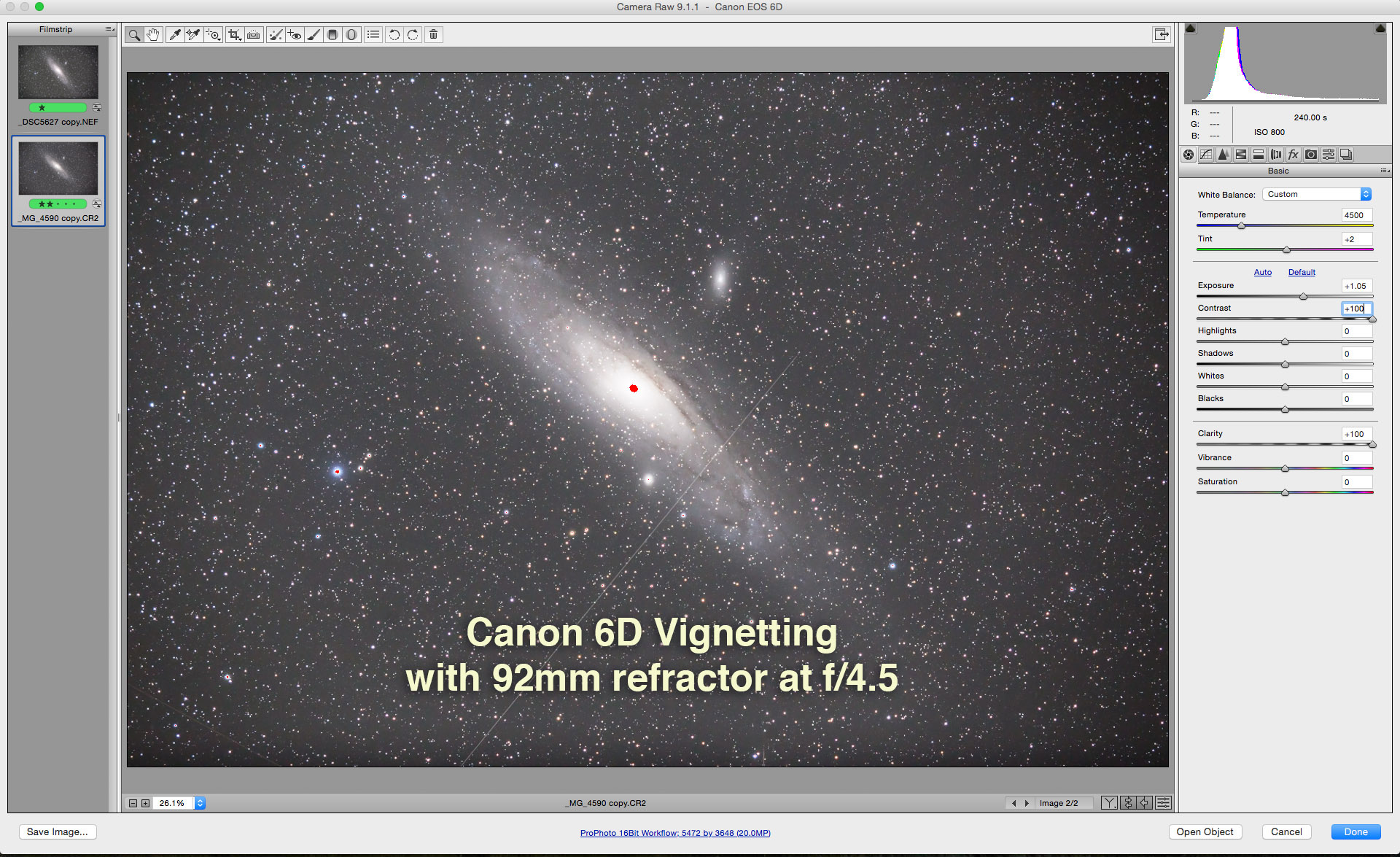
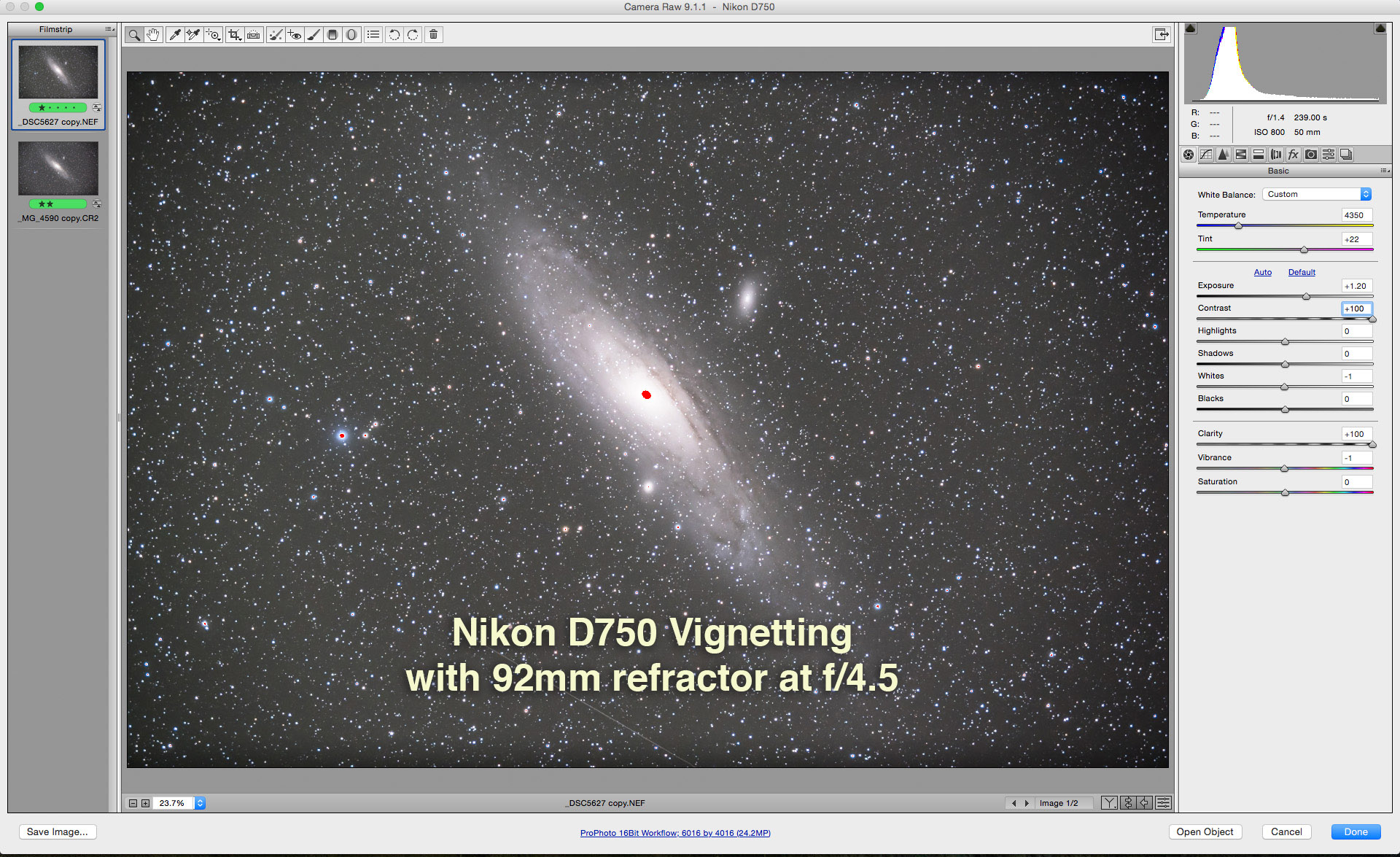
An issue little known outside of astrophotography is that a DSLR’s deeply-inset sensor can be shadowed by the upraised mirror and sides of the mirror box. Less light falls on the edges of the sensor.

The vignetting effect is noticeable only when we boost the contrast to the high degree demanded by deep-sky images, and when shooting through fast telescope systems.

Here I show the vignetting of the Canon and Nikon when shooting through my 92mm refractor at f/4.5.

The circular corner vignetting visible in the images below is from the field flattener/reducer I employed on the telescope. It can be compensated for by using Lens Correction in Adobe Camera Raw, or eliminated by taking flat fields.

Demonstrating the level of vignetting and mirror-box shadowing with the Canon 6D on a TMB 92mm apo refractor with a 0,85x field flattener/reducer lens
Demonstrating the level of vignetting and mirror-box shadowing with the Canon 6D on a TMB 92mm apo refractor with a 0.85x field flattener/reducer lens
Demonstrating the level of vignetting and mirror-box shadowing with the Nikon D750 on a TMB 92mm apo refractor with a 0,85x field flattener/reducer lens
Demonstrating the level of vignetting and mirror-box shadowing with the Nikon D750 on a TMB 92mm apo refractor with a 0.85x field flattener/reducer lens

The dark edge at the bottom of the frame is from shadowing by the upraised mirror. It can be eliminated only by taking flat fields, or reduced by using masked brightness adjustments in processing.

Both cameras showed similar levels of vignetting, with the Canon perhaps having the slight edge.


TEST #4 — ISO Invariancy

So far the Nikon D750 and Canon 6D are coming up fairly equal in performance. But not here. This is where the Nikon outperforms the Canon by quite a wide margin.

Sony sensors (used in Sony cameras and also used by Nikon) have a reputation for being “ISO Invariant.”

What does that mean?

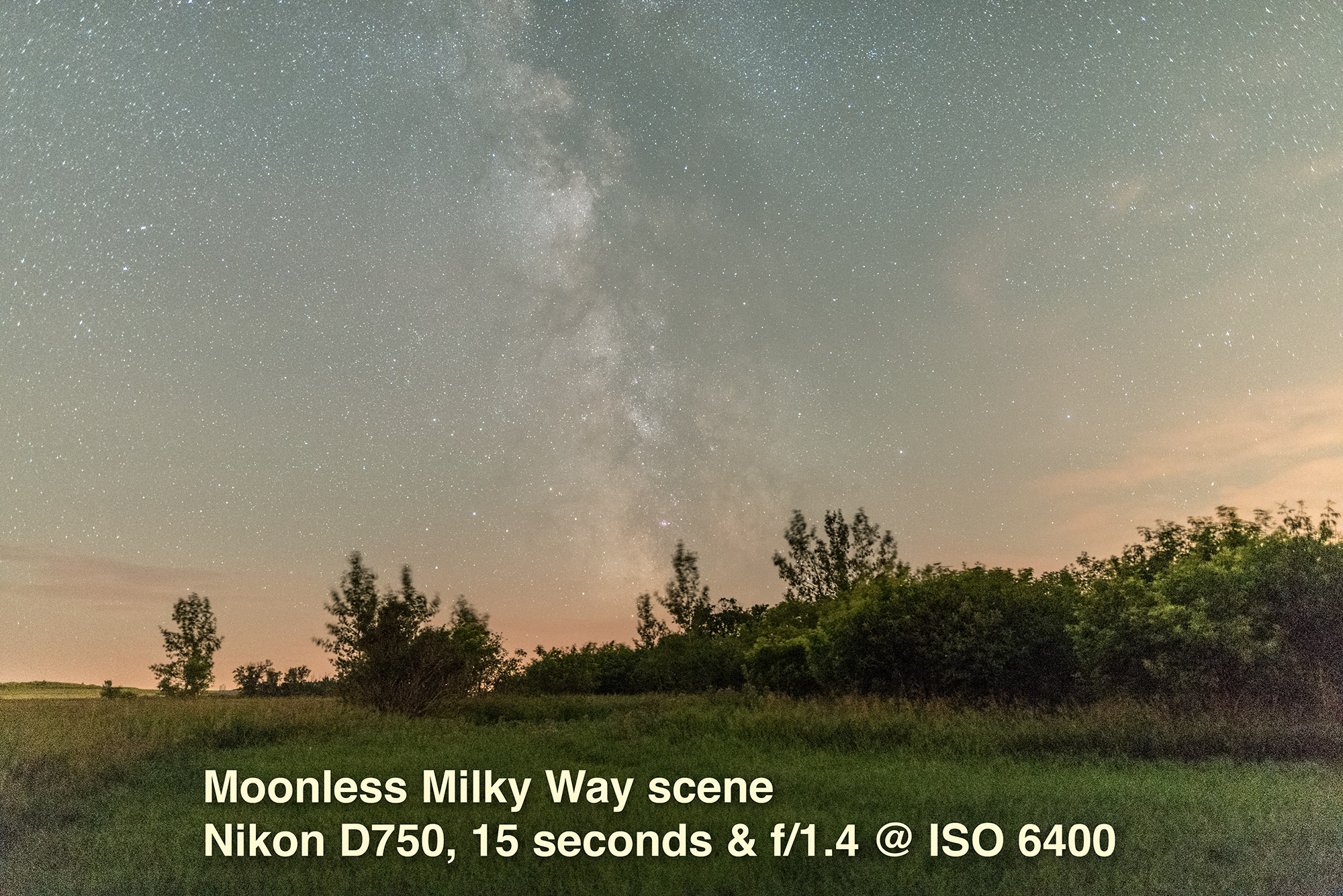
A typical Milky Way nightscape with the Nikon D750 and Sigma 24mm Art lens. With no Moon, shot at very high ISO of 6400 and wide aperture of f/1.4 to show image quality under these demanding shooting circumstances. Lens correction and basic development setttings applied.
A typical Milky Way nightscape with the Nikon D750 and Sigma 24mm Art lens.
With no Moon, shot at very high ISO of 6400 and wide aperture of f/1.4 to show image quality under these demanding shooting circumstances.
Lens correction and basic development setttings applied.
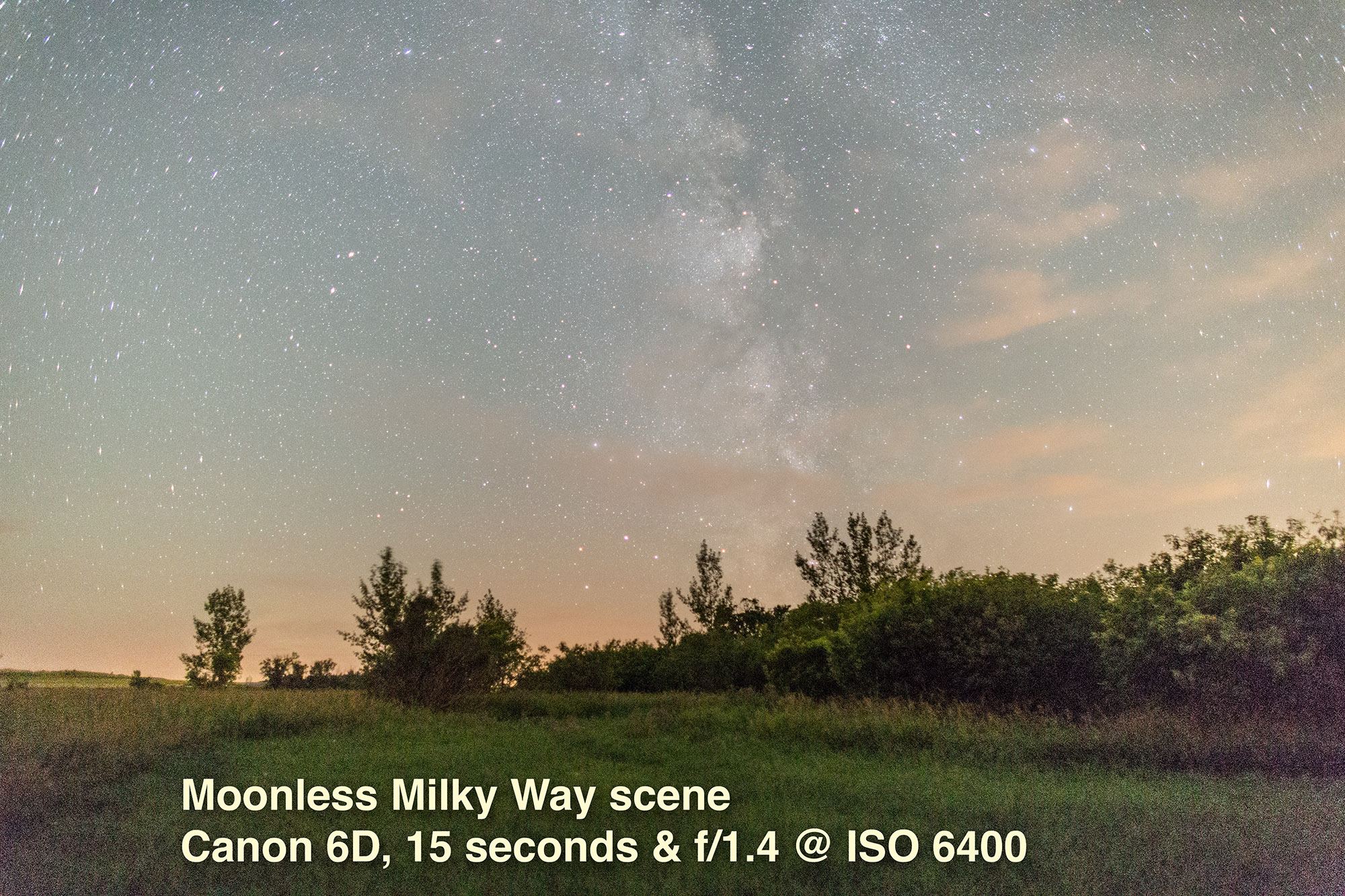
A typical Milky Way nightscape with the Canon 6D and Canon 24mm L lens (original model). With no Moon, shot at very high ISO of 6400 and wide aperture of f/1.4 to show image quality under these demanding shooting circumstances. Lens correction and basic development setttings applied.
A typical Milky Way nightscape with the Canon 6D and Canon 24mm L lens (original model).
With no Moon, shot at very high ISO of 6400 and wide aperture of f/1.4 to show image quality under these demanding shooting circumstances.
Lens correction and basic development setttings applied.

In the examples above, the correct exposure for the starlit scene was 15 seconds at f/1.4 at ISO 6400. See how the two cameras rendered the scene? Very similar, albeit with the Canon showing more noise and discoloration in the dark frame corners.

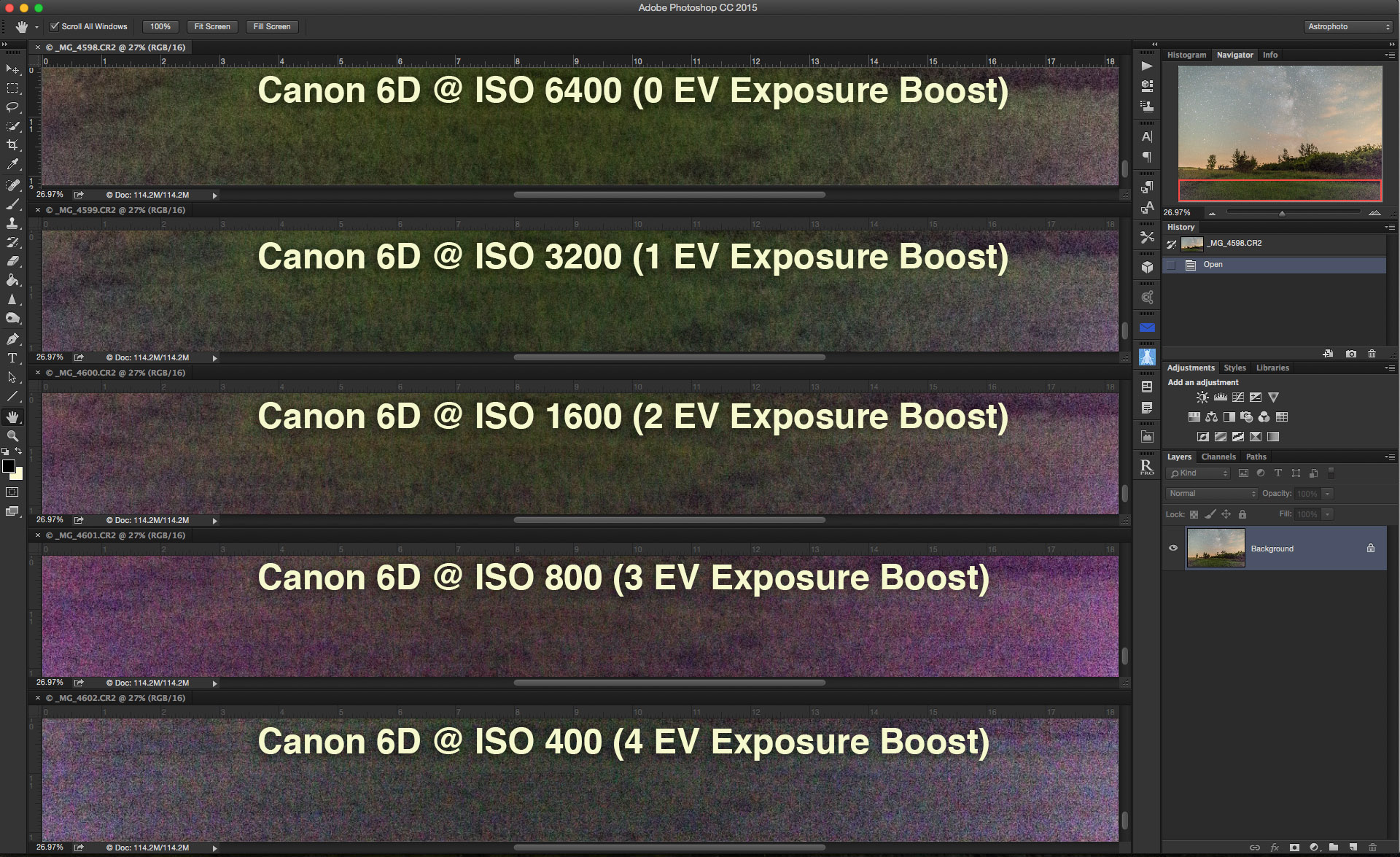
What if we shoot at the same 15 seconds at f/1.4 … but at ISO 3200, 1600, 800, and 400? These are now 1-, 2-, 3-, and 4-stops underexposed, respectively.

Then we boost the Exposure setting of the underexposed Raw files later in processing, by 1, 2, 3 or 4 f-stops. What do we see?

Nikon D750 - Comparing ISO Invariancy from ISO 6400 to 400 (Nightscape)
Nikon D750 – Comparing ISO Invariancy from ISO 6400 to 400 (Nightscape)

With the Nikon (above) we see images that look nearly identical for noise to what we got with the properly exposed ISO 6400 original. It really didn’t matter what ISO speed the image was shot at – we can turn it into any ISO we want later with little penalty.

Canon 6D - Comparing ISO Invariancy from ISO 6400 to 400 (Nightscape)
Canon 6D – Comparing ISO Invariancy from ISO 6400 to 400 (Nightscape)

With the Canon (above) we get images with grossly worse noise in the shadows and with ugly magenta discoloration. Canons cannot be underexposed. You must use as high an ISO as needed for the correct exposure.

This “ISO Invariant” advantage of Nikon over Canon is especially noticeable in nightscapes scenes lit only by starlight, as above. The Canon turns ugly purple at -3EV underexposure, and loses all detail and contrast at -4EV underexposure.

For nightscape imaging this is an important consideration. We are limited in exposure time and aperture, and so are often working at the ragged edge of exposure. Dark areas of a scene are often underexposed and prone to noise. With the Nikon D750 these areas may still look noisy, but not much more so than they would be at that ISO speed.

With the Canon 6D, underexpose the shadows and you pay the price of increased noise and discoloration when you try to recover details in the shadows.

 For more technical information on the topic of ISO invariancy, see DPReview.com and many of their recent reviews of DSLRs, such as this page about the Canon 5Ds/r models. 

Apparently, the difference comes from where the manufacturer places the analog-to-digital circuitry: on the sensor (ISO invariant) or outboard on a separate circuit (ISO variant), and thus where in the signal path the amplification occurs when we boost ISO speed.


TEST #6 — Features

One could go on endlessly about features, but here I compare the two cameras on just a few key operating features very important to astrophotographers.

Nikon Intervalometer Start

Intervalometer:

The Canon 6D has none, though newer Canons do. The Nikon D750, as do many Nikons, has a built-in intervalometer (shown above), even with a deflickering “Exposure Smoothing” option. However, exposure time is limited to the camera’s maximum of 30 seconds. Any longer requires an outboard intervalometer, as with the Canon.

If you use your camera with any motion control time-lapse unit, then it becomes the intervalometer, negating any capability built into the camera. But it’s nice to have.

Small Advantage: Nikon


Interval Length:

REVISED JUNE 2020:

When taking time-lapse or star trail images with the Canon I can set an interval as short as 1 second between frames, for a minimum of gaps or jumps in the stars. With the Nikon, controlled internally by its built-in intervalometer, a 1-second interval is possible but only if you set the interval to 33 seconds for a 30-second shutter speed.

That’s true of Canon and Sony built-in intervalometers as well, because on all cameras setting the exposure to 30 seconds really gives you a 32-second exposure. A little known fact! So the interval between shutter firings has to be set to 33 seconds. It’s tricky.

Advantage: None to either


Nikon D750 with Radian

Tiltable LCD Screen:

The Canon 6D has none. The Nikon D750 has a very useful tilt-out screen as shown above. This is hugely convenient for all forms of astrophotography. Only cropped-frame Canons have tilt-out screens. This feature might add weight, but it’s worth it!

Big Advantage: Nikon


Dark Frame Buffer:

The Nikon has none. With Long Exposure Noise Reduction ON, the Canon 6D allows up to four exposures to be shot in quick succession before the dark frame kicks in and locks up the camera. (Put the camera into Raw+JPG.)

[JUNE 2020: With the Canon 6D MkII the buffer allows three frames to be taken in quick succession.]

This is very useful for deep-sky imaging, for acquiring a set of images for stacking that have each had a dark frame subtracted in-camera, with a minimum of “down-time” at the camera.

Big Advantage: Canon


Live View Screen Brightness:

As pointed out to me by colleague Christoph Malin, with the Nikon you cannot dim the screen when in Live View mode and with Exposure Simulation ON. So it can be too bright at night. With the Canon you can dim the Live View screen — the LCD Brightness control affects the screen both during Live View as well as during playback of images.

Small Advantage: Canon


Canon with GBTimelapse

Software Compatibility:

Canon EOS cameras are well supported by advanced software, such as GBTimelapse (above) that controls only Canons, not Nikons, in complex time-lapse sequences, and Nebulosity, popular among deep-sky imagers for DSLR control.

Small Advantage: Canon


My take-away conclusions: 

• Nikon DSLRs now are just as good for astrophotography as Canons, though that wasn’t always the case – early models did suffer from more noise and image artifacts than their Canon counterparts.

• Canon DSLRs, due to their sensor design, are more prone to exhibiting noise and image artifacts when images are greatly underexposed then boosted later in processing. Just don’t underexpose them – good advice for any camera.


All images and text are © 2015 Alan Dyer.

– Alan, August 27, 2015 & Revised June 25, 2020 / © 2015 Alan Dyer / www.amazingsky.com

Time and Tide … and the Pull of the Moon


Sunset at Point Prim Lighthouse, near Digby, Nova Scotia on the Fundy side of the peninsula, with a waxing crescent Moon in the western twilight sky. The dark rocks are basaltic volcanic rocks from the late Triassic formed as part of the rifting that split Gondwonaland into the Americas and Europe and Africa. The Lighthouse is the fourth in a succession of lighthouses built at Point Prim starting in 1804. It was automated in 1984. This is a panorama created from 9 segments taken with the 16-35mm lens at 35mm and Canon 6D. Stitched in Photoshop.

Nothing demonstrates the power of the sky to affect the Earth better than the daily ebb and flow of the tides.

For a few days earlier this week I was fortunate to visit Nova Scotia, to speak at the annual Nova East Star Party.

A scene at the Nova East Star Party near Windsor, Nova Scotia, in August 2015, showing laser pointer in use under a clear starry sky.
A scene at the Nova East Star Party near Windsor, Nova Scotia, in August 2015.
I took advantage of my visit to Canada’s east coast to shoot time-lapses of one of nature’s most amazing phenomena, the daily pulse of the tides.

The coastal regions around the Bay of Fundy, particularly on the Nova Scotia shore, and around the Minas Basin, experience the highest tides in the world. The range can be as much as 16 metres. Only remote Leaf Basin on Ungava Bay in northern Québec matches the Minas Basin for tidal range.

The reason is not, as is sometimes stated, the funnel shape of the Bay of Fundy, but rather its length. It takes about 12 hours and 25 minutes for an ocean wave to traverse the length of the Bay, equal to the time between successive high tides. This creates a resonance, with the incoming and outgoing waves building upon each other and increasing the height of the twice-a-day tides.

The amount of water moving back and forth is mind-boggling: some 9 to 16 billion tonnes of water flows daily into and out of the Minas Basin alone, enough to tilt the land.

For the time-lapse videos I shot at two locations:

  • Evangeline Beach on Minas Basin, with vast tidal flats that are engulfed twice a day.
  • And Halls Harbour on the Fundy shore, a great spot for watching boats go from grounded to afloat in just an hour or so.


I timed my arrival at both sites to be there near lowest tide and shoot for about 3 hours as the tide came in, then stop shooting at about high tide.

Luckily, high tide on both days was about 3 p.m. making for convenient shoots on a summer afternoon. Being just after New Moon, the tides were near their highest.

Earth experiences two tides a day, at an interval of about 12 hours and 25 minutes, with the extra 25 minutes coming from the motion of the Moon around the Earth during that half-day interval. It takes another 25 minutes for us to line up with the Moon again.

But why two tides a day? If the Moon pulls at our water why isn’t there just one high tide, when the Moon is highest in our sky?

The Moon doesn’t pull on just the water. It pulls on everything.

And it isn’t the Moon’s gravity per se that raises the tides, it is the difference in the strength of that gravitational pull across an object.

The side of the Earth closest to the Moon feels the strongest pull, raising the tides on the side facing the Moon. But the Earth itself is also pulled toward the Moon, but to a lesser extent because the centre of our planet lies farther from the Moon.

In effect, the Moon pulls the Earth away from the water on the far side of the Earth, the side away from the Moon. This raises a bulge of water on the other side of our planet, the side that feels the least gravitational pull from the Moon because it is farthest from the Moon.

So as Earth rotates we pass through two tidal bulges, one facing the Moon and one facing away from the Moon.

Newton's Apple Tree

It wasn’t until Isaac Newton came along in the mid-17th century that we had an explanation for and an ability to predict the tides accurately. Even Galileo got it wrong. It was Newton’s mathematical explanation of how gravity fell off with increasing distance that led to an accurate theory of the tides. See Wikipedia for much more detail.

The tree above is a direct descendent of the famous “Newton’s Apple” tree that inspired his theory of universal gravitation. It is an apple tree on the picturesque grounds of Acadia University in Wolfville, Nova Scotia, and was grown from a cutting from the famous apple tree at Woolsthorpe Manor where Newton grew up and took refuge during the outbreak of plague in the cities.

Newton's Apple #1

It was during this retreat that, story has it – a story told by Newton himself – that an apple falling on his head inspired him to wonder if the same force that was causing the apple to fall was also keeping the Moon in perpetual orbit around the Earth.

Annapolis Tidal Generating Station

Today, we can turn the pull of the Moon into power, as here at Annapolis Royal where Nova Scotia Power operates the only tidal power station in North America, driven by water pouring into and out of the Annapolis River. The pull of the Moon here generates 20 megawatts of electricity.

New submerged turbines are now being tested in the Minas Basin, using a variety of technologies. A previous underwater turbine at the same site was ripped to pieces by the force of the water. Harnessing the tides is not so easy.

Tide watchers take note: The Full “supermoon” of September 27 (when there is also a total eclipse of the Moon) will be especially close. Favourable geometry will raise the highest tides in 18 years in the two days that follow the Full Moon.

The Moon truly has the power to move the waters and the Earth.

Many thanks to my host Dr. Roy Bishop for the tidal tour and elucidation. Click here to download an article of his about the tides. 

– Alan, August 21, 2015 / © 2015 Alan Dyer / www.amazingsky.com

A Plethora of Perseids


A composite depicting the Perseid meteor shower on the night of Wednesday, August 12, 2015 as shot from southern Alberta, Canada.  The image takes in a wide swath of the north and eastern sky, including the radiant of the shower in Perseus at left of centre, near the Double Cluster visible as a clump of stars. All the Perseids can be traced back to this point. Also in the image: the summer Milky Way and, at left, a dim aurora in green and magenta that was barely visible to the eye but was picked up by the camera. The Andromeda Galaxy is at centre. The Pleiades is just on the horizon. Apart from some haze from forest fire smoke, it was a near perfect night: warm, dry, just a little wind to keep the bugs at bay, and no Moon. A perfect night for a meteor watch.  This is a layered stack of 35 images recording three dozen meteors (most Perseids but also a couple of sporadics not aimed back to the radiant in Perseus, such as the bright one at far left).  The 35 images were selected from 200 shot from 11 pm to 2:30 am that night, with most frames not picking up any meteors. This composite is from the 35 taken over the 3.5 hours that did record a meteor. Each exposure is 1 minute at f/2.8 with the 15mm full-frame fish-eye, on the Canon 5D MkII at ISO 3200 (a couple of the early shots in the sequence were at ISO 1600 for 2 minutes).  The camera was tracking the sky on the Sky-Watcher Star Adventurer tracker, so all images of the stars are aligned and registered out of the camera, with the meteors in their proper position relative to the stars and radiant. I masked out a couple of satellite and aircraft trails that were distracting, and took away from the point of illustrating the radiant of the meteor shower.  The horizon, however, is from one image, taken early in the sequence. Some of the blue in the sky comes from one of the early shots taken in deep twilight but that contained a nice meteor. And I liked the blue it added.  All stacking and processing with Adobe Ca

It was a good year for Perseid meteors, as they shot across the sky in abundance on dark-of-the-Moon nights.

Last week, August 11 and 12 proved to be superb for weather in southern Alberta, with clear skies and warm temperatures perfect for a night of watching and shooting meteors.

On both nights I had identical camera rigs running, all from my rural backyard. These images are from the peak night, Wednesday, August 12.

The main image at top is with a 15mm ultra wide lens, on a camera that was tracking the sky as it turned. Like many meteor photos these days it is a layered stack of many images, in this case 35, to put as many meteors as possible onto one frame.

While the result does illustrate the effect of meteors streaking away from the radiant point, here in Perseus, it does lend a false impression of what the shower was like. It took me 3.5 hours of shooting to capture all of those meteors.

Note the aurora as well.

The Perseid meteor shower on peak night of Wednesday, August 12, 2015, showing meteors radiating from the “radiant point” in northern Perseus, then rising in the northeast sky. One bright sporadic, non-Perseid meteor is at left, and a small sporadic is near the horizon at right. The meteor at far left, top, may be a satellite streak.  The Andromeda Galaxy is at upper right. A dim aurora is at left in the northeast. The setting is a ripening canola field at home.  This is a stack of 16 images, one for the “base layer” ground and sky, containing a bright meteor, and 15 other images taken as part of the same sequence, each containing a meteor, layered with Photoshop using Lighten blend mode. I rotated each of the additional “meteor layers” around Polaris at upper left, so the sky aligned closely, putting the meteors in close to their correct position relative to the stars, to accurately illustrate the radiant effect. This was necessary as this sequence was shot with a fixed, non-tracking camera (the Canon 6D) using a 14mm Rokinon lens at f/2.8. Each exposure was 1 minute at ISO 3200. The 16 meteor frames came from a set of 212 frames taken over 3.5 hours. I layered in only the frames with meteors.  Frames were taken from 11 pm to 2:30 am MDT.

With this camera I used a wide 14mm lens, but with the camera on a fixed tripod. I again blended frames, 16 of them, to show the meteors radiating from Perseus.

Because the camera was not tracking the sky, later in Photoshop I rotated each frame relative to a lower “base-level” image, rotating them around Polaris at top as the sky does, in order to line up the stars and have the meteors appear in their correct position relative to the background stars and radiant point.

Note the errant bright “sporadic” meteor not part of the shower.

The Perseid meteors shooting through Cygnus and the Summer Triangle area of the summer Milky Way, on the night of Wednesday, August 12, 2015. Deneb is the star at top left, Vega at top right, and Altair at bottom. The Perseids shoot across the frame from top left to bottom right. Other streaks are sporadic meteors or short satellite trails. I masked out other long satellite trails that were distracting to the image’s focus on depicting Perseids. This is a stack of 24 images, each with a meteor or two, taken over a 3.5-hour period that night, with each exposure being 1 minute at f/2, with the 24mm Sigma lens and Nikon D750 at ISO 1600. The 24 image with meteors were selected from a total of 214 shot for this sequence, with most frames not recording any meteor, and perhaps only satellites or aircraft.

Camera number 3 was aimed straight up for 3.5 hours, toward Cygnus and the Summer Triangle, in hopes of nabbing that brilliant fireball streaking down the Milky Way. I got a nice “rain of meteors” effect but the bright bolide meteor eluded me.

This was certainly the best year for the Perseids in some time, with it coinciding with New Moon.

Later this year, the Geminids will also put on a good show at nearly New Moon, on the nights of December 13 and 14. So if you liked, or missed, the Perseids, take note of the dates in December.

However, for many of us, a Geminid watch is a very, cold and snowy affair!

— Alan, August 18, 2015 / © 2015 Alan Dyer / www.amazingsky.com 

How to See & Shoot the Perseids


A trio of Perseid meteors shoot at left in the pre-dawn sky over Lake Minnewanka in Banff National Park. The overexposed waning crescent Moon shines between Venus (below) and Jupiter (above), with Jupiter near the Hyades and below the Pleiades in Taurus. Taken the morning of Sunday, August 12, 2012 with the Canon 5D MkII and 24mm Canon L-series lens. This is a composite of three exposures, one for each meteor, each for 40 seconds at ISO 2000 and f/5. Landscape is from one image, two other meteors from two other frames layered in and registered in the correct position in the base layer.

It’s Perseid meteor shower time. Here are tips for seeing and shooting the meteors.

What are the Perseids?

They are an annual meteor shower, perhaps the most widely observed of the year, that peak every year about August 12. They are caused by Earth passing through a dust stream left by Comet Swift-Tuttle, last seen near Earth in 1992.

Each “shooting star” is really a bit of comet dust burning up in our atmosphere as it ploughs into us at 200,000 kilometres an hour. They don’t stand a chance of surviving – and none do.

All Perseid particles burn up. None reach Earth.

Perseid meteor caught night of August 12-13 2009 from Cypress Hills Prov Park in Saskatchewan at the annual Saskatchewan Summer Star Party. One frame of 250 shot as part of a time-lapse movie. Taken with Canon 5D MkII and 24mm lens at f/2.5 for 30s at ISO1600.

When are the Perseids?

The peak night of the Perseids this year is the night of Wednesday, August 12 into the early morning hours of August 13, with the peak hour occurring about midnight Mountain Daylight Time or 2 a.m. on the 13th for Eastern Daylight Time.

For North America, this is ideal timing for a good show this year. However, a good number of meteors will be visible the night before and night after peak night.

Even better, the Moon is near New and so won’t interfere with the viewing by lighting up the sky.

In all, except for the mid-week timing, conditions this year in 2015 couldn’t be better!

Perseid meteor caught night of August 12-13 2009 from Cypress Hills Prov Park in Saskatchewan at the annual Saskatchewan Summer Star Party. One frame of 260 shot as part of a time-lapse movie. Taken with Canon 20Da and 15mm lens at f/2.8 for 45s at ISO1600.

What do they look like?

Any meteor looks like a brief streak of light shooting across the sky. The brightest will outshine the brightest stars and are sure to evoke a “wow!” reaction.

However, the spectacular Perseids are the least frequent. From a dark site, expect to see about 40 to 80 meteors in an hour of patient and observant watching, but of those, only a handful – perhaps only 1 or 2 – will be “wow!” meteors.

A pair of Perseid meteors shoot at left in the late night sky at the Upper Bankhead parking lot in Banff National Park. The  waning crescent Moon is just rising above the trees. A faint Perseid is at right, while a satellite trail goes from left to right as well.  Taken the night of Saturday, August 11 into the wee hours of Sunday, August 12, 2012 with the Canon 7D and 10-22mm Canon lens. This is a stack of two exposures, one for each meteor, each for 60 seconds at ISO 1250 and f/4. The stars are trailed slightly due to the two-minute exposure time in total.
A pair of Perseid meteors shoot at left in the late night sky at the Upper Bankhead parking lot in Banff National Park. The waning crescent Moon is just rising above the trees. 
Taken the night of Saturday, August 11 into the wee hours of Sunday, August 12, 2012 with the Canon 7D and 10-22mm Canon lens. This is a stack of two exposures, one for each meteor, each for 60 seconds at ISO 1250 and f/4. 

Where do I look?

All the meteors will appear to radiate from a point in the constellation of Perseus in the northeastern sky in the early hours of the night, climbing to high overhead by dawn.

So you can face that direction if you wish, but Perseids can appear anywhere in the sky, with the longest meteor trails often opposite the radiant point, over in the southwest.

Shows unusual Perseid meteor varying in brightness? Or is this a satellite that mimics Perseid for position (it comes right out of the radiant point).  Taken at SSSP, August 14, 2010, using Canon 5D MkII and 15mm lens.
Shows unusual Perseid meteor varying in brightness? Or is this a satellite that mimics Perseid for position (it comes right out of the radiant point). Taken at Saskatchewan Star Party, August 14, 2010, using Canon 5D MkII and 15mm lens.

How do I look?

Simple – just lie back on a comfy lawn chair or patch of grass and look up!

But … you need to be at a dark location away from city lights to see the most meteors. You’ll see very little in a city or light-polluted suburbs.

Head to a site as far from city lights as you can, to wherever you’ll be safe and comfortable.

How do I take pictures?

To stand any chance of capturing these brief meteors you’ll need a good low-noise camera (a DSLR or Compact System Camera) with a fast (f/2.8 or faster) wide-angle lens (10mm to 24mm).

Sorry, keep your point-and-shoot camera and phone camera tucked away in your pocket – they won’t work.

Set up you camera on a tripod, open the lens to f/2.8 (wide open perhaps) and the ISO to 800 to 3200) and take a test exposure of 20 to 40 seconds. You want a well-exposed image but not over-exposed so the sky is washed out.

Set your exposure time accordingly – most cameras allow a maximum exposure of 30 seconds. Exposures longer than 30 seconds require a separate intervalometer to set the exposure, with the camera set on Bulb (B).

Take lots of pictures!

To up your chances of catching a meteor, you need to set the camera to shoot lots of frames in rapid succession.

Use an intervalometer to take shots one after the other with as little time between as possible – because that’s when a meteor will appear!

Barring an intervalometer, if you have standard switch remote control, set the camera on High Speed Continuous, and the shutter speed to 30 seconds, then lock the remote’s switch to ON to keep the camera firing. As soon as one exposure ends it’ll fire another.

Twin Perseids in this photo? Or are these satellites?  Taken at SSSP, August 14, 2010, using Canon 5D MkII and 15mm lens.
Twin Perseids in this photo? Or are these satellites? Taken at SSSP, August 14, 2010, using Canon 5D MkII and 15mm lens.

What else do I need to know?

• Focus the lens carefully so the stars are sharp – the Live Focus mode helps for this. Focus on a bright star or distant light.

• Aim the camera to take in a wide swath of the sky but include a well-composed foreground for the most attractive shot.

• Aim northeast to capture meteors streaking away from the radiant. But you can aim the camera to any direction that lends itself to a good composition and still capture a meteor.

• To increase your chances, shoot with two or more cameras aimed to different areas of the sky. Meteors always appear where your camera isn’t aimed!

• Be patient! Despite shooting hundreds of frames only a handful will record a meteor, as only the brightest will show up.

Can I track the sky?

If you have a motorized equatorial mount or a dedicated sky tracking device (the iOptron Sky Tracker and Sky-Watcher Star Adventurer, each about $400, are popular), you can follow the stars while taking lots of shots. This avoids the stars trailing and allows you to use longer exposures.

The video above shows a Star Adventurer tracking the sky as it turns about its polar axis which is aimed up to a point near Polaris. Click the Enlarge and HD buttons to view the video properly.

Polar align the tracker, but then perhaps aim the camera to frame the summer Milky Way overhead. Take lots of 1- to 3-minute exposures, again at f/2.8 and ISO 800 to 1600. Some exposures will pick up meteors – with luck!

Tracking then stacking

Later, in processing, because the sky has remained fixed on the frame, it’s then possible to stack the images (using a “Lighten” blend mode on each image layer) so that the final composite frame contains more meteors, for an image with lots of meteors captured over an hour or more of shooting.

While it is possible to stack shots taken on a static tripod to produce such a meteor composite, doing so requires a lot of manual cutting, pasting and aligning of meteor images by hand. The result is a bit of a fake, though I’ve done it myself – the image at top is an example, though with only a trio of meteors.

Good luck and happy meteor watching!

– Alan, August 6, 2015 / © 2015 Alan Dyer / www.amazingsky.com 

Moonlight on the Prairie


The rising almost-Full Moon, a “Blue Moon” of July 30, 2015, rising behind a rustic old farmhouse near Bow Island, Alberta. The Moon sits in the pibk Belt of Venus with the blue shadow of the Earth below. This is a single frame from a 600-frame time-lapse sequence, taken with the Canon 6D and 16-35mm lens.

I present a short time-lapse vignette of scenes shot under moonlight on the Alberta prairie.

The movie linked below features sequences shot July 29 and 30, 2015 on beautifully clear moonlit nights at locations south of Bow Island, Alberta, on the wide open prairie. The three-minute video features two photogenic pioneer sites.

Circumpolar star trails over the historic but sadly neglected St. Anthony’s Church between Bow Island and Etzikom, Alberta. The Big Dipper is at left, Polaris at top. The Roman Catholic church was built in 1911 by English, Russian German immigrants. It served a dwindling congregation until 1991 when it closed. At that time workers found a time capsule from 1915 with names of the priest and parisioners of the day. In summer of 2014 the Church suffered its latest indignity when the iron cross on its steeple tower was stolen. It was there when I stopped at this Church on a site scouting trip in May 2014. I planned to return on a moonlit night and did on July 29, 2015. A nearby house had been torn down and the cross was now gone.  This is a stack of 300 6-second exposures with the Canon 6D at ISO 1600 and 16-35mm lens at f/2.8. Bright light from a 13-day Moon lights the scene, making for very short exposures. The ground comes from one exposure to keep shadows sharp. The final stars also come from another single exppsure taken two minutes after the last trail image. I used the Advanced Stacker Actions to stack the trails.

The church is the now derelict St. Anthony’s Church, a former Roman Catholic church built in 1911 by English and Russian-German immigrants. It served a dwindling congregation until as late as 1991 when it closed. At that time workers found a time capsule from 1915 with names of the priest and parisioners of the day.

The wood church seems to have been largely neglected since.

In the summer of 2014 the Church suffered its latest indignity when the iron cross on its steeple tower was stolen. I also shot in the pioneer cemetery of the Church.

Circumpolar star trails circling above an old rustic and abandoned house near Bow Island, Alberta, with illumination from the nearly Full Moon. Cassiopeia is near centre. Polaris is at top left.  This is a stack of 140 frames from a time-lapse sequence with additional frames added for the first and last stars, and the ground coming from a mean combine stack of 8 frames to reduce noise. Each frame is 10 seconds at f/4 with the 16-35mm lens and ISO 1600 with the Canon 6D. Stacked with Advanced Stacker Actions, using the Ultrastreaks effect, from within Photoshop.

The other site is a nearby farmhouse with photogenic textures and accompanied by rustic out buildings that are barely managing to stand.

Illumination was from a waxing gibbous Moon, just 1 to 2 days before the infamous “Blue Moon” of July 31. Its bright light turned the sky blue, and lit the landscape with the same quality as sunlight, because it is sunlight!


Enlarge the video to full screen for the full HD version.

For the technically inclined:

I shot the scenes with three cameras – a Canon 60Da, Canon 6D, and Nikon D750.

The Nikon, with a 24mm lens, was on the Dynamic Perception Stage Zero Dolly and Stage R panning unit, while the 60Da, with a 14mm lens, was on the compact Radian panning unit. The third camera, the 6D, with a 16-35mm lens, was on a fixed tripod for the star trail sequences and stills.

The music is by Adi Goldstein (AGSoundtrax.com), whose music I often use in my sequences. It just seems to work so well, and is wonderfully melodic and powerful. Thank you, Adi!

To process the several thousand frames that went into the final movie, I used Adobe Bridge and Adobe Camera Raw, supplemented by the latest Version 4.2 of LRTimelapse (lrtimelapse.com). Its new “Visual Deflicker” workflow does a beautiful job smoothing out frame-to-frame flickering in sequences shot in twilight under darkening lighting conditions. Thank you Gunther!

For the star trail sequences and the still images above I used the Advanced Stacker Actions from StarCircleAcademy.com. Unlike most other stacking programs, the Stacker Actions work from within Adobe Bridge and Photoshop directly, using the processed Raw images, with no need to create intermediate sets of JPGs. Thank you Steven!

— Alan, August 3, 2015 / © 2015 Alan Dyer / www.amazingsky.com 

Sunset over Horsethief Canyon


Sunset on August 1, 2015 at the Horsethief Canyon Viewpoint overlooking the Red Deer River, north of Drumheller, Alberta, on the Dinosaur Trail scenic drive. The name comes from the pioneer days when horses would get lost in the Badlands here and then re-emerge found, but with a new brand on them. The region is home to rich deposits of late Cretaceous dinosaur fossils. Just south of here is the world class Royal Tyrrell Museum, a centre of research into dinosaurs and prehistoric life.  This is a single-exposure frame (not HDR) from a 300-frame time-lapse sequence, with the Canon 6D and 16-35mm lens.

The Sun sets over the Red Deer River Badlands at Horsethief Canyon

This was sunset last night, Saturday, August 1, at the Horsethief Canyon Viewpoint overlooking the Red Deer River, north of Drumheller, Alberta.

The viewpoint is one stop on the Dinosaur Trail scenic drive that winds up and down the river valley, with a crossing just north of here by one of the few remaining river ferries in Alberta, the historic Bleriot Ferry.

The Canyon’s name comes from the pioneer days when horses would get lost in the Badlands here, then re-emerge found, but with a new brand on them.

The region is home to rich deposits of late-Cretaceous dinosaur fossils. Just south of here is the world-class Royal Tyrrell Museum, a centre of research into dinosaurs and prehistoric life.

This is a single-exposure frame (not HDR) from a 300-frame time-lapse sequence, with the Canon 6D and 16-35mm lens.

– Alan. August 2, 2015 / © 2015 Alan Dyer / www.amazingsky.com

The “Blue Moon” over Calgary


The Full Moon of July 31, 2015, an infamous “blue Moon”, the second Full Moon of July, rising over the skyline of Calgary, Alberta. This is one frame of a 480-frame time-lapse sequence taken with the Canon 60Da and 28-105mm lens. The location was Toronto Crescent.

The much-publicized “Blue Moon” of July rises over the skyline of Calgary.

Last night, July 31, many people looked east to see a wonderful moonrise. Did it look different than any other moonrise? No. But did it look great? You bet.

I set up my cameras at a site in northwest Calgary, picked for its sightline looking east-southeast over the downtown core of Calgary and directly toward the moonrise point.

I used the software The Photographer’s Ephemeris to plan the location and angles. It is wonderful for making sure you are in the right place at the right time for catching a photogenic moonset or moonset.

Here’s the screen shot from TPE that showed me where to be Friday evening. The blue line aims to the moonrise point.

IMG_2473

Of course, despite the planning the Moon did not look blue! Blue Moons, as they have come to be defined, never do. The term now means the second Full Moon in a calendar month. We had a Full Moon on Canada Day, July 1, and then enjoyed a second July Full Moon one lunar cycle later on July 31.

I shot the scene with two cameras, each shooting hundreds of frames for time-lapses, from which I extracted still images.

A short 1-minute music video of the result is here at Vimeo. Enlarge the screen and be sure HD is selected.


As a technical note, for the processing I used the latest version 4.2 of LRTimelapse and its new “Visual Deflicker” workflow which very nicely smooths out all the frame-to-frame flickering that can plague daytime and twilight shots taken under Auto Exposure.

While the shutter speed does constantly decrease, it does so in 1/3rd-f/stop steps, yielding stair-step jumps in brightness. LRT smooths all that out, with v4.2 doing a much better job than earlier versions.

Thanks for watching!

— Alan, August 1, 2015 / © 2015 Alan Dyer / www.amazingsky.com 

The Milky Way over the Milk River


The summer Milky Way with a meteor streaking at centre as a bonus. An aurora to the north off frame is lighting the foreground with a green glow. Haze and forest fire smoke obscure the horizon. I shot this at the Battle Scene viewpoint at Writing-on-Stone Provincial Park, in southern Alberta. Sagittarius and the galactic centre is on the horizon at left of centre. Capricornus is amid the haze at left of centre. On the horizon are the Sweetgrass Hills in Montana. The Milk River winds below amid the sandstone formations that are home to historic First Nations petroglyphs.  This is a single 30-second exposure with the Nikon D750 at ISO 3200 and Sigma 24mm Art lens at f/2, taken as part of a time-lapse sequence.

The summer Milky Way shines over the Milk River and the sandstone formations of Writing-on-Stone Provincial Park.

Earlier this week I spent two nights shooting at a favourite site in southern Alberta, near the U.S. border. Here, the Milk River winds through a small canyon and coulees lined with eroded sandstone formations called hoodoos. Carved on those hoodoos are ancient graffiti – petroglyphs dating back hundreds of years recording life on the plains. Thus the name: Writing-on-Stone.

It’s a beautiful place, especially so at night. I was there to shoot video scenes for an upcoming “How to Photograph the Milky Way” tutorial. And to collect images for the tutorial.

Above is a shot that is one frame from a time-lapse sequence, one that captures a meteor and the Milky Way over the Milk River, with the Sweetgrass Hills of Montana in the distance.

The summer Milky Way over the Milk River Valley and sandstone formations of Writing-on-Stone Provincial park, in southern Alberta. On the horizon are the volcanic Sweetgrass Hills in Montana. The red tint at top is from an aurora active that night and the ground is partly illuminated by green auroral light from the north. The Summer Triangle stars are at top left. Sagittarius is on the horizon sinking into the low clouds at botton right which are illuminated by lights from Sweetgrass, Montana. Clouds and smoke from forest fires to the west cut down the transparency and clarity of the sky this night, especially toward the horizon.  This is a stack of 4 x 3-minute tracked exposures for the sky, and 4 x 5-minute untracked exposures for the ground, all with the 15mm Canon full-frame fish-eye and Canon 6D at ISO 1000, on the iOptron Sky-Tracker unit.

This image is from a set of exposures I took with the camera and ultra-wide 15mm lens tracking the turning sky, to prevent the stars from trailing in long exposures. A set of images with the tracker motor turned off supplied the sharp ground.

It shows the sweep of the summer Milky Way, with some clouds and forest fire smoke intruding to the south.

In both images the ground is green because, in part, it is being lit by an aurora display going on behind the camera to the north.

An aurora display to the northeast over the Milk River Valley and Writing-on-Stone Provincial Park in southern Alberta, night of July 22/23, 2015. The ground is lit by aurora light. The view is looking east to the rising autumn constellations of Cassiopeia and Perseus at left, and Andromeda and Pegasus at centre. The Milky Way runs from left to top centre. I shot this with the 15mm full-frame fisheye and Canon 6D. The sky is from one image, but the ground is from a stack of 4 images, mean combined, to smooth noise.

Here’s the view looking east, with a green aurora fringed with red lighting the northern sky.

The arc of the auroral oval as seen from southern Alberta, July 22/23, 2015, from Writing on Stone Provincial Park, looking north over the flat prairie. The Big Dipper is at left. This is a 4-segment panorama with the Canon 60Da and 16-35mm lens at 16mm, stitched in Photoshop.

The display on the night of July 22/23 formed a classic arc across the north. This was my panoramic view of the vast auroral oval that was wrapping around the planet at far northern latitudes. Here, I was at 49° north, almost on the Canada-U.S. border, and well south of the main oval.

In all, it was a magical two nights at a scenic and sacred site.

– Alan, July 24, 2015 / © 2015 Alan Dyer / www.amazingsky.com

Worlds Amid the Sunset Clouds


The waxing crescent Moon below Venus low in the sunset colours of a July summer evening over the waters of Little Fish Lake, in southern Alberta. Jupiter is at upper right but much fainter.  This is a 3-segment panorama taken with the Canon 60Da and 18-200mm Sigma zoom.

The thin waxing Moon shines near Venus above the colourful clouds of sunset.

Tonight, July 18, was the evening of a close conjunction of the crescent Moon near Venus in the evening sky. From my latitude at 50° North, the conjunction was going to be low, and at risk of clouds.

In this case, the clouds added to the scene as they lit up with sunset colours.

You can see the Moon and Venus at centre, while fainter Jupiter is at upper right, and perhaps not visible on screen at this scale.

The location is one I used last month for the Venus-Jupiter meeting, Little Fish Lake and Provincial Park, north of Drumheller. It’s a quiet spot. This Saturday night there were just three families there camping.

I shot this telephoto panorama with my red-sensitive Canon 60Da, which is designed to record red nebulas well, but does a nice job on punching up sunsets, too!

Alas, the clouds that painted the sky so nicely here, moved in as the worlds set lower. I wasn’t able to shoot them closer to the horizon amid the deep colours of a late twilight. But I’ll settle for this image.

– Alan, July 19, 2015 / © 2015 Alan Dyer / www.amazingsky.com

Live from Pluto under the Planetarium Dome


Live From Pluto Talk04

It was a full house for my Live from Pluto talk at TELUS Spark!

Something a little different from me this time. Not images or time-lapses of scenic places, but of me presenting a lecture and planetarium show!

This past two weeks I was immersed back into the world of planetarium programming.

Last night, July 16, was the culmination, as I presented a talk and planetarium show devoted to viewing the amazing new images from Pluto and the New Horizons probe … and to taking the audience through the solar system courtesy of the planetarium theatre’s Digistar 5 projection system.

The lecture was in the Digital Dome at TELUS Spark, the science centre in Calgary, Alberta. As you can see, it played to a packed “standing room only” house in the dome. The short time-lapse compresses my one-hour lecture into one minute!

In it, you can get a fast-paced taste of the visuals and immersive scenes I was able to program and project onto the dome with the Digistar.

That’s me down front on stage, running the show off the Digistar’s iPad.

What a way to present a lecture! I spent 40 years producing and presenting planetarium shows, but these new tools for visualizing the universe in the dome are jaw-dropping. It was fun to get back using them again, to bring this historic flyby event to the public in a unique way.

The movie begins with the audience entering, and ends with the Q&A and audience exiting. It includes scenes where we fly alongside New Horizons out to Pluto, then orbit Ceres with Dawn, plus land on a comet with Rosetta and Philae.

I shot the time-lapse with a Canon 6D and 15mm full-frame fish-eye lens shooting under Auto Exposure for a total of 1177 frames, taken at an interval of 8 seconds, played back here at 15 frames per second. The camera was behind the dome in the cove, where it would not be disturbed. Music is by Adi Goldstein.

Many thanks to the staff at TELUS Spark (sparkscience.ca) for making the event possible.

– Alan, July 17, 2015 / © 2015 Alan Dyer / www.amazingsky.com

Riding Along with New Horizons at Pluto


FlyByScene1

During the week of July 13 to 17 we are witness to a momentous event in space exploration. Here’s how to follow along!

During the last week, and next, I’m out of photography for awhile and back into planetarium programming and production mode, my old day-job for decades. What has brought me back to the programming console is the once-in-history exploration of a new world – Pluto by the New Horizons probe.

I’m presenting a live public talk at the TELUS Spark science centre in Calgary on July 16 to present the new images. In the talk I use the amazing Evans and Sutherland Digistar digital planetarium system to fly people along with New Horizons as it makes its historic encounter.

Here, I present images of some of the full-dome immersive scenes I’ve programmed for the lecture. The top image is from the animation that places the audience alongside New Horizons as it flies from Earth and then through the Pluto system.

FirstImages

This image is the template scene into which I’ll drop what we hope will be even better images next week.

KuiperBelt

Here we fly out of the solar system to see the orbit of Pluto and its dwarf planet companions, as well as other objects of the Kuiper Belt, in perspective.

ScenefromPluto

In this scene we land on Pluto to see the sky as it will appear next week during the encounter, complete with moons in the Plutonian sky.

LowellObservatory

To put the mission into historic perspective I also take people inside the observatory where Clyde Tombaugh discovered Pluto in 1930.

PhilaeCometLander

And we’ll also visit dwarf planet Ceres, and fly to the Rosetta comet (above) to watch Philae land, and bounce!

For those in the Calgary area able to attend, you can find more details about my July 16 talk at the TELUS Spark website. The talk is in the Digital Dome at 4 pm and is free.


But to follow along with the mission from anywhere on Earth I recommend bookmarking these sites:

Johns Hopkins Applied Physics Lab mission control, the main mission website

NASA TV for live press conferences and special programming

The Planetary Society and Emily Lakdawalla’s blog. This entry provides a detailed schedule of events and image download times.

– Alan, July 11, 2015 / © 2015 Alan Dyer

Waterton Lakes by Moonlight


Cassiopeia and the northern stars over Red Rock Canyon in Waterton Lakes National Park, Alberta, with illumination from a waxing gibbous Moon. This is a composite of three 30-second exposures for the ground to smooth noise and one 30-second exposure for the sky, all with the 24mm lens at f/3.5 and Canon 6D at ISO 1600.

Mountain scenes take on a new look when photographed by moonlight.

Last week I spent four wonderful nights shooting the landscapes of Waterton Lakes National Park under the light of the waxing Moon. For two of the evenings I taught small groups of photographers eager to learn how to extend their photo skills into the night.

A nightscape photographer from one of my workshops, shooting in the moonlight at Red Rock Canyon, in Waterton Lakes National Park, Alberta. Clouds partly obscure the gibbous Moon but add a colourful iridescent corona around the Moon, which is reflected in the Red Rock Canyon Creek. This is an HDR stack of 5 exposures with the 14mm lens and Canon 6D, to preserve detail in the bright clouds and the disk of the Moon, and in the dark shadows.

We shot at Red Rock Canyon both nights, an ideal spot for its many composition options for shooting both toward and away from the Moon.

The lead image is a view looking up the canyon, with Cassiopeia in view. Always nice to have a recognizable constellation so well positioned.

The image just above looks toward the Moon, partly hidden by colourful clouds diffracting the moonlight. A student is at left trying out a composition.

Photographers at a Nightscapes Workshop at Red Rock Canyon in Waterton Lakes National Park, Alberta, June 2015, in the moonlight.

Here, students, silhouetted by the Moon, use the footbridge as their vantage point to photograph moonlight on the canyon waters and walls.

Alpine flowers in the moonlight at Red Rock Canyon, in Waterton Lakes National Park, with the scene lit by light from the waxing gibbous Moon. The “Matterhorn” style peak is Anderson Peak. This is a blend of two exposures: 30 seconds for the sky and 50 seconds for the ground, all with the 24mm lens at f/5 and Canon 6D at ISO 3200.

My workshops were part of the annual Waterton Wildflower Festival. So, a number of us tried to shoot flowers by moonlight, no easy task considering the wide apertures and shallow depth of field usually required, even under bright moonlight.

But the photo above is my take on summer alpine flowers in a meadow with the iconic Anderson Peak in the distance.

A panorama of the flower-filled Blakiston Valley on a moody moonlit cloudy night at Waterton Lakes National Park, June 24, 2015. The Big Dipper is at upper right, with its handle pointing to Arcturus at left of centre. Spica is at far left. A subtle halo surrounds the first quarter Moon which has just set behind Crandell Mountain at left.  This is a 9-segment panorama with the Nikon D750 and 24mm lens, mounted portrait, and stitched with Photoshop using spherical geometry and corrected with Wide Angle Adaptive Lens Correction to straighten the scene. Liberal use of Highlight and Shadow recovery in ACR and Shadows and Highlights in PS brought out the flower-filled foreground while retaining detail in the bright sky. Each segment was 30 seconds at f/2.8 and ISO 1600.

Three nights were wonderfully clear. But my first night, set aside for scouting locations for the Workshops, was beset by some clouds. However, I made use of them to create a moody moonlit cloudscape panorama of the Big Dipper over Blakiston Valley.

I’ll be back in Waterton in September for the Wildlife Festival. We won’t try to shoot bears by moonlight! One did wander by at the start of our Saturday Workshop!

Instead, we’ll concentrate on photographing the Milky Way. That’s Friday, September 18.

– Alan, July 3, 2015 / © 2015 Alan Dyer / www.amazingsky.com 

Waterton Lakes in the Twilight


The waxing gibbous Moon over Upper Waterton Lake in Waterton Lakes National Park, Alberta with the iconic Prince of Wales Hotel in the distance, on a calm evening with still waters, rare in Waterton. This is an HDR stack of 3 exposures with the Canon 60Da and 16-35mm lens, shot from Driftwood Beach.

Happy Canada Day! From one of the most scenic places in the country.

I spent a wonderful four days and nights last week at Waterton Lakes National Park, Alberta, with near perfect weather conditions.

For one, the infamous winds of Waterton weren’t blowing, allowing me to shoot the iconic Prince of Wales Hotel reflected in the calm waters of Middle Waterton Lake at Driftwood Beach, with the waxing Moon above in the twilight sky.

Earlier in the evening, I was at the Maskinonge Overlook shooting some video for upcoming tutorials. At sunset I shot this image, below, of the Moon above the alpenglow of the last rays of sunlight.

The rising waxing gibbous Moon in the sunset sky over Maskinonge Wetlands at Waterton Lakes National Park, Alberta, June 2015. The last rays of sunset are illuminating the peaks in alpen glow. This is an HDR stack of 3 exposures with the Canon 60Da and 16-35mm lens.

Happy Canada Day!

And don’t forget to look west for the ongoing Venus-Jupiter conjunction. I missed the best night last night, June 30 – clouds! But here’s hoping for tonight.

– Alan, July 1, 2015 / © 2015 Alan Dyer / www.amazingsky.com


Double “Star” in the Dusk


Venus and Jupiter on June 28, 2015 approaching a close conjunction two nights later, as seen over the water of Little Fish Lake Provincial Park, Alberta in the evening twilight. Venus is the brighter of the pair. This is an HDR stack of 3 exposures with the Canon 60Da and 16-35mm lens. The long exposure blurs the ripples and waves on the water.

Venus and Jupiter now appear as a brilliant “double star” in the evening sky.

This was the scene last night, Sunday, June 28, as the two brightest planets in the sky appeared close to each other in the evening twilight.

I shot the scene from the eastern shore of Little Fish Lake at a Provincial Park in southern Alberta bordering on the Handhills Conservation Area which preserves northern native prairie grasses and an abundance of bird and wildlife species.

The planetary conjunction culminates on June 30, when they will appear very close to each other (less than a Moon diameter apart), creating the best evening conjunction of 2015.

Venus and Jupiter on June 28, 2015 approaching a close conjunction two nights later, as seen over the water of Little Fish Lake Provincial Park, Alberta in the evening twilight. Venus is the brighter of the pair. Some subtle crepuscular rays from cloud shadows are at right. This is an HDR stack of 3 exposures with the Canon 60Da and 16-35mm lens.

More details are in my previous blog post. 

– Alan, June 29, 2015 / © 2015 Alan Dyer / www.amazingsky.com

Heads Up! The Great Evening Conjunction of 2015


June 30 Jupiter & Venus

Look west on June 30 after sunset to see a brilliant “double star” in the dusk.

They’ve been building to this conjunction all month. On Tuesday, June 30 Venus and Jupiter appear at their closest in a stunning pairing in the evening twilight.

That night the two worlds – the two brightest planets in the sky – appear just 20 arc minutes apart.

That’s 1/3rd of a degree and is less than a Moon diameter. That’s so close you’ll be able to fit both planets into a high-magnification telescope field. However, it’s not so close that you won’t still be able to resolve the two worlds with your unaided eyes as separate objects shining in the twilight. In the chart above the circle is a binocular field.

Their proximity is merely an illusion. Venus and Jupiter lie along the same line of sight to us, but in fact are 825 million kilometres apart in space.

If Tuesday looks to be cloudy, good consolation nights are June 29 and July1 – Canada Day! – when Venus and Jupiter will be separated by 40 arc minutes – double their separation on June 30, but still very impressive.

Venus and Jupiter behind old farm water pump windmill, taken March 12, 2012 near home on Glenmore Trail road east of Langdon. Car headlights provide the illumination. Taken with a Canon 5D MkII at ISO 400 and 16-35mm lens at f/4 and 26mm for 20 seconds. A mixture of twilight and light pollution on thin cluds provided the sky colours. Pleiades and Hyades also visible.

The last time we saw Venus and Jupiter close together in the evening sky was in mid-March 2012, when I shot the photo above. But at that time they passed a wide 3 degrees apart. This week they are just a fraction of a degree apart.

They’ll meet again later this year, but in the morning sky, on October 25, when Venus and Jupiter pass one degree from each other.

– Alan, June 28, 2015 / © 2015 Alan Dyer / www.amazingsky.com

The Great Solstice Aurora: THE MOVIE!


On June 22 I shot the great all-sky aurora with three cameras all shooting time-lapse frames. Here’s the result!

The rapidly moving and astonishing patterns of the aurora are ideal for time-lapse photography. Except for a total eclipse of the Sun, nothing else in the sky changes with such dramatic and jaw-dropping intensity.

For the June 22 outbreak of Northern Lights across the sky, I shot some 2,200 frames, and assembled them into the time-lapse compilation here.

One sequence records the entire sky and the complete development of the display, from when it first appeared in twilight about 11:15 p.m., to when it faded into a diffuse glow across the sky by 1:15 a.m. I shot that sequence with an 8mm fish-eye lens, to capture a scene suitable for projection in a digital planetarium theatre.

I shot the other sequences with 15mm and 24mm lenses. All total, the 3-minute movie comes from about 50 gigabytes of images.

Still images from this night, and from the time-lapse sequences, are in my previous blog post.

I hope you enjoy the video. Do enlarge it to full screen 1080p HD.

– Alan, June 24, 2015 / © 2015 Alan Dyer / www.amazingsky.com

The Great Solstice Aurora of 2015


The all-sky aurora of June 22, 2015, during a level 7 to 9 geomagnetic storm, as the display began already active in the darkening twilight of a solstice night. This is one frame from a 568-frame time-lapse, taken with the 8mm Sigma fish-eye lens at f/3.5 and with the Canon 6D, composed for projection in tilt-dome digital planetariums. I was on the south shore of Crawling Valley Lake and Reservoir in southern Alberta.

Aurora watchers were on alert! Look up after sunset on June 22 and the sky should be alive with dancing lights.

And the predictions were right.

I headed out to a nearby lake in preparation for seeing and shooting the show. And as soon as the sky got dark enough the Lights were there, despite the bright solstice twilight.

The all-sky aurora of June 22, 2015, during a level 7 to 9 geomagnetic storm, as the display began already active in the darkening twilight of a solstice night. This is one frame from a 960-frame time-lapse, taken with the 15mm full-frame fish-eye lens at f/2.8 and with the Canon 60Da, looking north to the perpetual twilight of solstice. I was on the south shore of Crawling Valley Lake and Reservoir in southern Alberta.

The display reached up to the zenith, as seen in my fish-eye images, like the one below. I shot with three cameras, all shooting time-lapses, with the fish-eye camera recording the scene suitable for projection in a digital planetarium.

The all-sky aurora of June 22, 2015, during a level 7 to 9 geomagnetic storm, as the display peaked in a substorm with rays converging at the zenith in the darkening twilight of a solstice night. This is one frame from a 568-frame time-lapse, taken with the 8mm Sigma fish-eye lens at f/3.5 and with the Canon 6D, composed for projection in tilt-dome digital planetariums. I was on the south shore of Crawling Valley Lake and Reservoir in southern Alberta.

However, it was apparent we here in western Canada were seeing the end of the display that had been going on for hours during an intense geomagnetic storm. The aurora was most intense early in the evening, with a minor outburst about 11:30 to 11:45 pm MDT.

The all-sky aurora of June 22, 2015, during a level 7 to 9 geomagnetic storm, as the display began already active in the twilight of a solstice night. This is one frame from a 960-frame time-lapse, taken with the 15mm full-frame fish-eye lens at f/2.8 and with the Canon 60Da, looking north to the perpetual twilight of solstice. I was on the south shore of Crawling Valley Lake and Reservoir in southern Alberta.

The aurora then subsided in structure and turned into a more chaotic pulsating display, typical of the end of a sub-storm.

A sky-covering display of Northern Lights, here in the western sky over a distant thunderstorm on the Alberta prairies. I shot this June 22, 2015 on a night with a grand display over most of the sky, with the sky bright with solstice twilight. The site was on the south shore of Crawling Valley Lake in southern Alberta. This is one frame from a 350-frame time-lapse, taken with the Nikon D750 and 24mm lens,

However, an attraction of this display was its juxtaposition over another storm, an earthly one, flashing lightning to the northwest of me.

The all-sky aurora of June 22, 2015, during a level 7 to 9 geomagnetic storm, as the display brightened again in the middle of the night at about 1 am, with rays converging at the zenith in the perpetual twilight of a solstice night. This is one frame from a 568-frame time-lapse, taken with the 8mm Sigma fish-eye lens at f/3.5 and with the Canon 6D, composed for projection in tilt-dome digital planetariums. I was on the south shore of Crawling Valley Lake and Reservoir in southern Alberta.

By 1 a.m. MDT the display, while still widespread over a large area of the northern sky, had turned into a diffuse glow.

But 60 gigabytes of images later, I headed home. The time-lapse compilation will come later!

– Alan, June 23, 2015 / © 2015 Alan Dyer / www.amazingsky.com

Reflections of Solstice Planets and Northern Lights


The evening planets of Venus (right) and Jupiter (left), to the right of the waxing crescent Moon on the evening of summer sosltice, June 21, 2015. The star Regulus is to the upper right of the Moon, between Jupiter and the Moon. The view is overlooking Crawling Lake in southern Alberta. This is an HDR stack of 5 exposures to retain detail in the bright twilight sky and the dark foreground.

The summer solstice sky was filled with twilight glows, planets, and dancing Northern Lights. 

What a magical night this was. The evening started with the beautiful sight of the waxing crescent Moon lined up to the left of the star Regulus, and the planets Jupiter and Venus (the brightest of the trio), all set in the late evening twilight.

They are all reflected in the calm waters of a prairie lake.

I shot the above photo about 11 p.m., as late a twilight as we’ll get. From here on, after solstice, the Sun sets sooner and the sky darkens earlier.

An aurora display on the evening of summer solstice, June 21, 2015, overlooking Crawling Valley Reservoir in southern Alberta. This is one frame of 360 shot as part of a time-lapse, each frame being 15 seconds at f/2.5 with the 24mm lens, and with the Canon 6D at ISO 3200.

Later, about 12:30 a.m., as predicted by aurora apps and alert services, a display of Northern Lights appeared on cue to the north. It was never very bright to the eye, but the camera nicely picks up the wonderful colours of a solstice aurora.

At this time of year the tall curtains reaching up into space catch the sunlight, with blue tints adding to the usual reds fringing the curtain tops, creating subtle shades of magenta and purple.

The display made for a photogenic subject reflected in the lake waters.

– Alan, June 22, 2015 / © 2015 Alan Dyer / www.amazingsky.com 

A Twilight Triangle of Worlds


The waxing crescent Moon below Venus and fainter Jupiter above, with the three worlds forming a triangle in the twilight, on the evening of June 19, 2015, from a site north of Bassano, Alberta. This is an HDR stack of 5 exposures to retain detail in the dark foreground and bright twilight sky. This is with the 50mm lens and Canon 6D.

The three brightest objects in the night sky gathered into a tidy triangle in the twilight. 

On Friday night, June 19, I chased around my area of southern Alberta, seeking clear skies to capture the grouping of the waxing crescent Moon with Venus and Jupiter.

My first choice was the Crawling Valley reservoir and lake, to capture the scene over the water. I got there in time to get into position on the east side of the lake, and grab some shots.

The waxing crescent Moon below Venus and dimmer Jupiter above, all over Crawling Lake Reservoir, in southern Alberta, on June 19, 2015. This is a 5-exposure HDR stack to preserve deatails in the dark foreground and bright sky. Shortly after I took this shot clouds from an approaching storm front obscured the planets and the sky.

This was the result, but note the clouds! They were moving in quickly and soon formed a dramatic storm front. By the time I got back to the car and changed lenses, I was just able to grab the panorama below before the clouds engulfed the sky, and the winds were telling me to leave!

A wicker looking storm front moving in quickly over the Crawling Lake Reservoir in southern Alberta. I had just a few minutes to get set up for this after shooting the gathering of the Moon, Venus and Jupiter in the evening twilight from a nearby spot. Then clouds soon covered the planets. By the time I got back to the car to change lenses the storm front was almost on top of me. I grabbed segments for this panorama using a 24mm lens and Canon 6D. While the outflow winds really picked up, the storm didn’t amount to much and cleared off shortly after as it moved to the east from the northwest.

I drove west toward home, taking a new highway and route back, and finding myself back into clear skies, as the storm headed east. I stopped by the only interesting foreground element I could find to make a composition, the fence, and grabbed the lead photo.

Both it, and the second image, are “HDR” stacks of five exposures, to preserve detail in the dark foreground and bright sky.

It was a productive evening under the big sky of the prairies.

– Alan, June 20, 2015 / © 2015 Alan Dyer / www.amazingsky.com

Solstice Sky at Dinosaur Park


Summer solstice twilight and circumpolar star trails over the badlands of Dinosaur Provincial Park, Alberta. Some bright noctilucent clouds are visible low on the northern horizon. I shot this June 15, 2015 as part of a shoot for a “star trail” video tutorial, as an example image. This is a stack of the first 200 frames of 275 shot for a time-lapse, each 15 seconds at f/2.8 with the Rokinon 14mm lens and Canon 6D at ISO 1600. I stacked them in Advanced Stacker Actions with the ultrastreak mode. The foreground comes from a mean blend of the first 8 frames, to smooth noise, and to provide a brighter foreground from early in the sequence when the sky and ground were brighter.

The stars circle the bright northern sky at solstice time over the Alberta Badlands.

I spent the evening and well into the night on Monday shooting at a favourite spot, Dinosaur Provincial Park in southern Alberta. The result of about an hour of shooting around midnight is the circumpolar star trail composite at top.

It shows the stars spinning about Polaris, while the northern horizon is rimmed with the bright glow of all-night twilight.

Particularly bright in the northwest are noctilucent clouds low on the horizon. These are high-altitude clouds near the edge of space catching the sunlight streaming over the pole at this time of year.

Noctilucent clouds (NLCs) over the silhouette of the badlands of Dinosaur Provincial Park in southern Alberta, on the night of June 15/16, 2015. The clouds remained low on the northern horizon and faded as the Sun angle dropped through the night but then reappeared in the northwest prior to dawn. The bright star at left is Capella, circumpolar at this latitude of 50° N.  This is a single exposure for 10 seconds at f/3.2 with the 16-35mm lens and at ISO 800 with the Canon 60Da.

They are a phenomenon unique to the weeks around solstice, and for our latitudes on the Canadian Prairies.

The close-up shot above shows their intricate wave-like formation and pearly colour. They faded though the night as the Sun set for the clouds. But they returned in the pre-dawn light.

If you live at mid-northern latitudes, keep an eye out for these clouds of solstice over the next month. It’s now their peak season.

– Alan, June 16, 2015 / © 2015 Alan Dyer / www.amazingsky.com

Heads Up! – June Moon Passes the Planets


June Moon near Planets

This weekend watch for the waxing crescent Moon passing the “evening stars” of Venus and Jupiter.

On Friday, June 19 look west to see the crescent Moon a binocular field below bright Venus in the evening twilight.

The next night, Saturday, June 20, the Moon appears a little higher and below Jupiter.

On Sunday, June 21, the day of the summer solstice, look for the crescent Moon to the left of the star Regulus in Leo.

Venus and Jupiter are getting closer to each other each night, as they edge toward a very close conjunction on June 30 when they will appear just over a Moon diameter apart in the evening sky.

However, this weekend may bring better photogenic opportunities, with the picturesque crescent Moon near the two brightest planets in the sky.

– Alan, June 15, 2015 / © 2015 Alan Dyer / www.amazingsky.com 

Venus and Jupiter Converging


Venus (right) and Jupiter (centre), on June 12, 2015, as they are converging toward a close conjunction on June 30, 2015. The star Regulus is at left, left of the windmill. Photographed from an old farm yard north of Vulcan, Alberta. This is an HDR-stack of 3 exposures to record detail in the ground and sky. Shot with the Canon 60Da and 16-35mm lens.

Each night, Venus and Jupiter are converging closer, heading toward conjunction on June 30.

This was Venus (right) and Jupiter (centre) with Regulus at left, in a cloudy twilight sky on Friday, June 12, as Venus and Jupiter converge toward their close conjunction in the evening sky on June 30.

Be sure to watch each night as the two brightest planets in the sky creep closer and closer together. Mark June 19 and 20 on your calendar, as that’s when the waxing crescent Moon will join the duo.

I shot this from near Vulcan, Alberta, after delivering an evening program at the Trek Centre in Vulcan as a guest speaker. Clouds prevented us from seeing anything in the sky at the public event, but on my way home skies cleared enough to reveal the two bright planets in the twilight.

I stopped at an abandoned farmyard I had scouted out earlier in the evening, to serve as a photogenic backdrop.

This is a high dynamic range stack of three bracketed exposures, one stop apart, to record detail in both the dark foreground as well as in the bright sky.

— Alan, June 13, 2015 / © 2015 Alan Dyer / www.amazingsky.com

Aurora and the Old Farm Truck


An aurora display on the night of June 7/8, 2015 from southern Alberta, with an old rustic farm truck as the foreground. This is a frame from a 450-frame time-lapse with the Nikon D750 at ISO 1600 and the Sigma 24mm lens at f/2.8, for 8 seconds each. The foreground is from a stack of 8 images adjacent in time to the sky image stacked in Mean mode for smoothing of noise.

The northern lights returned to our prairie sky in a colourful display near solstice.

Last night, Sunday, June 7, I headed out to a nearby abandoned farmyard to shoot the planets setting into the western twilight. But as the sky darkened the faint arc of an aurora appeared to the northeast, promising a fine show after midnight.

Sure enough, as the sky got dark, which doesn’t happen until very late now at 50° north in mid-June, the aurora began to dance.

The top image is a frame from the display at its best. It is one of 400 frames I shot for a time-lapse sequence.

An aurora display on the night of June 7/8, 2015 from southern Alberta, with an old rustic farm truck as the foreground. This is a frame from a 450-frame time-lapse with the Nikon D740 at ISO 1600 and the Sigma 24mm lens at f/2.8, for 8 second each. The foreground is from a stack of 8 images adjacent in time to the sky image stacked in Mean mode for smoothing of noise.

This image is from the start of the sequence, just as the aurora was beginning to get good, with curtains of green laced with tints of magenta and purple. At this time of year the tops of the curtains often look blue, as they scatter direct sunlight streaming over the pole.

However, the colours were not visible to the unaided eye — only the camera brought out the colours, as this display never got intensely bright to the eye.

An aurora display on the night of June 7/8, 2015 from southern Alberta, with an old rustic farm truck as the foreground. This is a frame from a 450-frame time-lapse with the Nikon D740 at ISO 1600 and the Sigma 24mm lens at f/2.8, for 8 second each. The foreground is from a stack of 8 images adjacent in time to the sky image stacked in Mean mode for smoothing of noise.

Toward the end of the sequence the display began to spread out, becoming patchy and less colourful, a typical behaviour after a substorm outburst.

More activity may be in store this week. So keep looking up! And check Spaceweather.com for alerts.

— Alan, June 8, 2015 / © 2015 Alan Dyer / www.amazingsky.com 

Night of the Space Station


A pass of the International Space Station in the bright moonlight, on the evening of May 31, 2015, with the gibbous Moon to the south at centre. The view is looking south, with the ISS travelling from right (west) to left (east) over several minutes. This was the first pass of a 4-pass night, May 31/June 1, starting at 11:06 pm MDT this evening. Numerous other fainter satellite trails are also visible. This is a composite stack of 95 exposures, each 2 seconds at f/2.8 with the 14mm lens and ISO 6400 with the Canon 6D. The gaps are from the 1-second interval between exposures. The length of the trails and gaps reflects the changing apparent speed of the ISS as it approaches, passes closest, then flies away.  I stacked the exposures with the Advanced Stacker Actions from StarCIrcleAcademy.com, using the Lighten mode. The ground comes from a Mean blend of just 8 of the exposures to prevent shadows from blurring but to smooth noise.

The Space Station is now continuously lit by sunlight, allowing me to capture dusk-to-dawn passages of the ISS.

On the night of May 31/June 1 I was able to shoot four passages of the International Space Station on successive orbits, at 90-minute intervals, from dusk to dawn.

The first passage, at 11:06 p.m., was low across the south. It’s the image at top.

An overhead pass of the International Space Station in a bright moonlit sky on the night of May 31/ June 1, 2015, with the gibbous Moon in to the south, below. The view is looking south, with the ISS travelling from right (west) to left (east) over several minutes. This was the second pass of a 4-pass night, May 31/June 1, starting at 12:44 am MDT this morning.  This is a composite stack of 91 exposures, each 4 seconds at f/3.5 with the 8mm fish-eye lens and ISO 6400 with the Canon 6D. The gaps are from the 1-second interval between exposures. The length of the trails and gaps reflects the changing apparent speed of the ISS as it approaches, passes closest, then flies away. The stars are trailing around Polaris at top. An aircraft supplies the other dashed trail across the top and intersecting with the ISS trail. I stacked the exposures with the Advanced Stacker Actions from StarCIrcleAcademy.com, using the Lighten mode. The ground comes from a Mean blend of just 8 of the exposures to prevent shadows from blurring but to smooth noise.

Then at 12:45 a.m. the Space Station came over again, now directly overhead. It’s the image above. The Moon is the bright glow at bottom.

An overhead pass of the International Space Station in a bright moonlit sky on the night of May 31/ June 1, 2015, with the gibbous Moon in the southwest, below. The view is looking south, with the ISS travelling from right (west) to left (east) over several minutes. This was the third pass of a 4-pass night, May 31/June 1, starting at 2:21 am MDT this morning.  This is a composite stack of 66 exposures, each 4 seconds at f/3.5 with the 8mm fish-eye lens and ISO 6400 with the Canon 6D. The gaps are from the 1-second interval between exposures. The length of the trails and gaps reflects the changing apparent speed of the ISS as it approaches, passes closest, then flies away. The stars are trailing around Polaris at top. Unfortunately, I missed catching the start of this pass. I stacked the exposures with the Advanced Stacker Actions from StarCIrcleAcademy.com, using the Lighten mode. The ground comes from a Mean blend of just 8 of the exposures to prevent shadows from blurring but to smooth noise.

One orbit later, at 2:21 a.m., the Station came over in another overhead pass in the bright moonlight.

A pass of the International Space Station in the brightening twilight of dawn, on the morning of June 1, 2015, with the gibbous Moon setting to the southwest at right. The view is looking south, with the ISS travelling from right (west) to left (southeast) over several minutes. This was the last pass of a 4-pass night, May 31/June 1, starting at 3:55 am MDT this morning.  This is a composite stack of 144 exposures, each 2 seconds at f/2.8 with the 15mm full-frame fish-eye and ISO 3200 with the Canon 6D. The gaps are from the 1-second interval between exposures. The length of the trails and gaps reflects the changing apparent speed of the ISS as it approaches, passes closest, then flies away.  I stacked the exposures with the Advanced Stacker Actions from StarCIrcleAcademy.com, using the Lighten mode. The ground comes from a Mean blend of just 8 of the exposures to prevent shadows from blurring but to smooth noise.

The final passage of the night came at 3:55 a.m. as the sky was brightening with dawn twilight and the Moon was setting. This was another passage across the south, and made for the most photogenic pass of the night.

Here’s an edited movie of the four passes, with a little music just for fun.

Seeing the Space Station on not one but two, three, or even four orbits in one night is possible at my latitude of 50 degrees north around summer solstice because the Station is now continuously lit by sunlight — the Sun never sets from the altitude of the ISS.

When the ISS should be entering night, sunlight streaming over the north pole still lights the Station at its altitude of 400 km.

To shoot the time-lapse clips and stills I used 8mm and 15mm fish-eye lenses, and a 14mm ultra-wide lens.

The bright moonlight made it possible to use short 2- to 4-second exposures, allowing me to record enough frames at each passage to make the little movies of the ISS flying across the sky. Keep in mind, to the eye, the ISS looks like a bright star. Some image processing trickery adds the tapering trails.

I used the Advanced Stacker Actions from StarCircleAcademy.com to create the trail effects, and to stack the time-lapse frames into single composite still images. The gaps in the trails are from the one second interval between frames.

– Alan, June 2, 2015 / © 2015 Alan Dyer / www.amazingsky.com

Under an Endless Open Sky


Circumpolar star trails at dawn over the historic Butala homestead at the Old Man on His Back Prairie and Heritage Conservation Area in southwest Saskatchewan, taken May 2015. This is a stack of 70 frames from a larger time-lapse sequence, from the end of the sequence in the dawn twilight. Each exposure is 40 seconds with the 14mm lens at f/2.8 and Canon 60Da at ISO 1600. Stacked with Advanced Stacker Actions. The foreground comes from a stack of 8 of the final exposures, mean combined, to smooth noise.

The skies were spectacular at a pioneer homestead on the Saskatchewan prairie.

Canada’a province of Saskatchewan bills itself as the “Land of Living Skies,” and that was certainly true last week when I spent three perfect nights under some of the darkest skies in the country.

The location was the Old Man on His Back Prairie & Heritage Conservation Area, deep in dry southwest Saskatchewan, between Grasslands National Park and Cypress Hills Interprovincial Park, two favourite places of mine for nightscape photography and astronomy.

The Conservation Area reclaims and preserves original short grass prairie habitat. It is named for the formation to the west that is said to resemble the profile of Napi, the creator being of Siksika legends, who after creating the world, lay back here to rest.

The land was once a working ranch first settled by the Butala family. The white pioneer house in my photos dates from that time. It was built in Montana and moved here in the 1920s.

The waxing crescent Moon and Venus (above) over the old farm house at the Visitor Centre at the Old Man on His Back Natural and Historical Conservation Area in southwest Saskatchewan, May 20, 2015, on a very clear night. The old house was the original house lived in by the Butala family who settled the area in the 1920s. This is a single exposure taken as part of an 850-frame time-lapse sequence with the 14mm Rokinon lens and Canon 60Da camera.

In the mid-1990s Peter and Sharon Butala transferred their land to the Nature Conservancy of Canada, to create an island of original prairie amid the heavily grazed land around it.

A 360° panorama of the night sky and prairie landscape from the Visitor Centre and farmyard at the Old Man on His Back Prairie & Heritage Conservation Area in southwest Saskatchewan. The Milky Way arches across the eastern sky from north to south, while an aurora display (faint to the naked eye) glows in an arch of green and magenta across the northern horizon. The pioneer house was built in the 1920s and this was a working ranch until the 1990s when the land was turned over to the Nature Conservancy of Canada to turn into a natural area to preserve the short grass prairie habitat.  This a stitch of 8 segments, each a 1 minute untracked exposure at f/3.5 with the 15mm lens and ISO 4000 with the Canon 6D. Stitched with PTGui software. I shot these May 18, 2015.

For astronomers, the Area serves also as an island of darkness amid intruding light pollution. The region is very dark, with few lights and manmade sky-glows on the horizon.

My 360° panorama above shows that the greatest glows come from the arc of the aurora to the north and the arch of the Milky Way stretching across the sky. This is a stargazer’s paradise.

My 2-minute compilation of time-lapse videos and still images taken over three crystal clear nights attempts to capture the wonder of the night sky from such a dark site. Be sure to enlarge the video to full screen to view it.

It was in the little white house that Sharon Butala wrote some of her best-selling books retelling stories of her life on the prairie, notably The Perfection of the Morning, and Wild Stone Heart.

In the latter book, Sharon writes:

“At night the Milky Way glittered and gleamed above us, fathomlessly deep and numberless, the constellations wheeled slowly across the sky with the seasons, and the moon came and went, sometimes white as a maiden’s face, sometimes a looming orange sphere … under such an endless, open sky.”

– Sharon Butala, Wild Stone Heart (Harper Collins, 2000)

– Alan, May 25, 2015 / © 2015 Alan Dyer / www.amazingsky.com

Urban and Rural Moons


The waxing crescent Moon near Venus in the spring evening sky over the skyline of Calgary, Alberta, May 21, 2015. I shot this from Tom Campbell Hill near the Telus Spark science centre. This is a single exposure with the 16-35mm lens and Canon 60Da, shot as part of a 360-frame time-lapse sequence.

The waxing Moon and Venus shine over contrasting landscapes, both urban and rural.

I shot the main image at top last night, May 21, from a site overlooking the urban skyline of Calgary, Alberta. The waxing Moon shines near Venus in the twilight sky.

By contrast I shot the image below the night before, from a location that couldn’t be more different – remote, rural Saskatchewan, on a heritage farmstead first settled in the 1920s by the Butala family. It is now the Old Man on His Back Prairie and Heritage Conservation Area.

The waxing crescent Moon and Venus (above) over the old farm house at the Visitor Centre at the Old Man on His Back Natural and Historical Conservation Area in southwest Saskatchewan, May 20, 2015, on a very clear night. The old house was the original house lived in by the Butala family who settled the area in the 1920s. This is a single exposure taken as part of an 850-frame time-lapse sequence with the 14mm Rokinon lens and Canon 60Da camera.

Here, the crescent Moon shines a little lower, below Venus, amid the subtle colours of twilight in a crystal clear prairie sky.

However, as the top image demonstrates, you don’t need to travel to remote rural locations to see and photograph beautiful sky sights. Twilight conjunctions of the Moon and bright planets lend themselves to urban nightscapes.

– Alan, May 22, 2015 / © 2015 Alan Dyer / www.amazingsky.com

Evening Planet Parade in May


May 21 Venus & Moon

Three planets now shine in the evening sky, including Saturn now at its best for 2015.

Look west in the early evening to sight brilliant Venus in the twilight, and slightly dimmer Jupiter above it. On the evening of Thursday, May 21, look for the waxing crescent Moon below Venus in a wide pairing of the night sky’s two brightest objects.

The Moon appears between Venus and Jupiter on Friday, May 22, and near Jupiter two nights later on Saturday, May 23.

Meanwhile over on the other side of the sky, Saturn is rising at sunset.

May 20 Saturn

As the illustration shows, look southeast after sunset to see Saturn rising along with the stars of Scorpius. Saturn now outshines all the stars of Scorpius, including the red giant star Antares, shining below Saturn.

Saturn is at opposition this weekend, meaning Sun, Earth and Saturn are now lined up with Earth directly between the Sun and Saturn. That puts Saturn as close to us as it gets for 2015, and as bright as it gets.

Being opposite the Sun, Saturn is now rising in the southeast as the Sun sets in the northwest.

A nightscape of antique farm combines illuminated by starlight, with the Milky Way behind. The galactic centre area of Sagittarius and Scorpius lie to the south, with Saturn the brightest object at right. I shot this at the Visitor Centre at the Old Man on His Back Conservation Area in southwest Saskatchewan. The sky is a single 30-second exposure at f/2.8 with the 24mm lens and Canon 5D MkII at ISO 6400. The ground comes from a stack of 8 exposures to smooth noise, all part of a time-lapse/star trail sequence.

Here’s a shot of Saturn, Scorpius, and the Milky Way from early this morning, May 20, taken about 2:30 a.m. when Saturn and Scorpius lay due south. From the latitude of southern Saskatchewan where I am this week, Saturn and Scorpius graze the southern horizon, even in the middle of the night.

– Alan, May 20, 2015 / © 2015 Alan Dyer / www.amazingsky.com

Scenes at the Texas Star Party


The galactic centre region of the Milky Way in Sagittarius and Scorpius, over the upper field of the Texas Star Party, near Fort Davis, Texas, May 13, 2015. About 600 people gather here each spring for a star party under very dark skies near the MacDonald Observatory. Sagittarius is left of centre and Scorpius is right of centre with the planet Saturn the bright object at the top edge right of centre. The dark lanes of the Dark Horse and Pipe Nebula areas lead from the Milky Way to the stars of Scorpius, including Antares. The semi-circular Corona Australis is just clearing the hilltop at left of centre. This is a composite of 5 x 3 minute exposures with the camera tracking the sky for more detail in the Milky Way without trailing. Each tracked exposure was at ISO 1600. The ground comes from 3 x 1.5-minute exposures at ISO 3200 taken immediately after the tracked exposures but with the drive turned off on the tracker. All are with the 24mm lens at f/2.8 and filter-modified Canon 5D MkII camera. The ground and sky layers were stacked and layered in Photoshop. The tracker was the Sky-Watcher Star Adventurer. High haze added the natural glows around the stars — no filter was employed here.

The stars at night shine big and bright, deep in the heart of Texas.

Last week several hundred stargazers gathered under the dark skies of West Texas to revel in the wonders of the night sky. I was able to attend the annual Texas Star Party, a legendary event and a mecca for amateur astronomers held at the Prude Ranch near Fort Davis, Texas.

Some nights were plagued by clouds and thunderstorms. but here are some scenes from a clear night, with several hundred avid observers under the stars and Milky Way. Many stargazers used giant Dobsonian reflector telescopes to explore the faintest of deep-sky objects in and beyond the Milky Way.

A 360° panorama of the upper field of the Texas Star Party at the Prde Ranch near Fort Davis, TX, May 13, 2015, taken once the sky got astronomically dark. The panorama shows the field of telescopes and observers enjoying a night of deep-sky viewing and imaging. Venus is the bright object at right of centre and Jupiter is above it. The Zodiacal Light stretches up from the horizon and continues left across the sky in the Zodiacal Band to brighten in the east (left of centre) as the Gegeneschein. I shot this with a 14mm lens, oriented vertically, with each segment 60 seconds at f/2.8 and with the Canon 5D MkII at ISO 3200. The panorama is made of 8 segements at 45° spacings. The segments were stitched with PTGui software.
A 360° panorama of the upper field of the Texas Star Party at the Prde Ranch near Fort Davis, TX, May 13, 2015, taken once the sky got astronomically dark. The panorama shows the field of telescopes and observers enjoying a night of deep-sky viewing and imaging. Venus is the bright object at right of centre and Jupiter is above it. The Zodiacal Light stretches up from the horizon and continues left across the sky in the Zodiacal Band to brighten in the east (left of centre) as the Gegeneschein.
I shot this with a 14mm lens, oriented vertically, with each segment 60 seconds at f/2.8 and with the Canon 5D MkII at ISO 3200. The panorama is made of 8 segements at 45° spacings. The segments were stitched with PTGui software.
Observers at the Texas Star Party explore the wonders of the deep sky under the rising Milky Way, in May 2015. Sagittarius and Scorpius are in the background, with the centre of the Galaxy rising in the southeast. This is a single 30-second exposure at f/2 with the 24mm lens and Canon 5D MkII at ISO 4000.
Expert deep-sky observers Larry Mitchell and Barbara Wilson gaze skyward with Larry’s giant 36-inch Dobsonian telescope at the Texas Star Party, May 2015. This is a single 60-second exposure with the 14mm lens at f/2.8 and Canon 5D MkII at ISO 3200.
A deep-sky observer at the top of a tall ladder looking through a tall and large Dobsonian telescope, at the Texas Star Party, May 2015. Scorpius is rising in the background; Saturn is in the head of Scorpius as the bright star above centre. Anatares is just below Saturn. This is a single 30-second exposure at f/2.5 with the 24mm lens and Canon 5D MkII at ISO 6400.
Circumpolar star trails over the upper field of the Texas Star Party, May 13, 2015. The star party attracts hundreds of avid stargazers to the Prude Ranch near Fort Davis, Texas each year to enjoy the dark skies. The three observing fields are filled with telescopes from the basic to sophisticated rigs for astrophotography. I aimed the camera to look north over the field to capture the stars circling around Polaris in circumpolar trails over about 1 hour. Some cloud and haze obscured parts of the sky. Lights from cities to the north add the sky glow at right. The streaks at top are from the stars of the Big Dipper. This is a stack of 55 exposures, each 1 minute long, at f/2.8 with the 14mm lens and Canon 5D MkII at ISO 3200. The foreground comes from a single image in the series, masked and layered in Photoshop. The images were stacked using the Long Trails tapering effect with the Advanced Stacker Actions from Star Circle Academy.
Circumpolar star trails over the upper field of the Texas Star Party, May 13, 2015. I aimed the camera to look north over the field to capture the stars circling around Polaris in circumpolar trails over about 1 hour. Some cloud and haze obscured parts of the sky. Lights from cities to the north add the sky glow at right. The streaks at top are from the stars of the Big Dipper.
This is a stack of 55 exposures, each 1 minute long, at f/2.8 with the 14mm lens and Canon 5D MkII at ISO 3200. The foreground comes from a single image in the series, masked and layered in Photoshop. The images were stacked using the Long Trails tapering effect with the Advanced Stacker Actions from Star Circle Academy.

I extend my thanks to the organizers for the great event, and for the opportunity to speak to the group as one of the featured evening speakers. It was great fun!

– Alan, May 17, 2015 / © 2015 Alan Dyer / www.amazingsky.com

The Red Aurora of May 10


A strange red/magenta auroral arc overhead across the sky, with a more normal green diffuse glow to the north, as seen on May 10, 2015, in a stack of 80 frames taken over 45 minutes. The Big Dipper is overhead in the centre of the frame, Jupiter is at left in the west and Arcturus is at top to the south. I shot this from home, using an 8mm fish-eye lens to take in most of the sky, with the camera looking north. The 80 exposures were stacked and blended with Advanced Stacker Actions from StarCircleAcademy.com using the Long Trails effect. Each exposure was 32 seconds at f/3.6 and ISO 3200 with the Canon 6D. An individual exposure adds the more point-like stars at the start of the tapered star trails, and add the blue from the last twilight glow still illuminating the sky at the start of the sequence.

A strange red arc of aurora moved slowly across the sky on May 10.

All indicators looked favourable early in the evening on May 10 for a good auroral display later that night, and sure enough we got one. But it was an unusual display.

From my site in southern Alberta, the northern sky did have a diffuse glow of “normal” green aurora that never did take much form or structure.

But overhead the aurora took the form of an arc across the sky, starting as an isolated ray in the southeast initially, then reaching up to arch across the sky with what looked to the eye like a colourless band.

But the camera showed it as a red arc, with just a fringe of green curtains appearing for a few minutes.

Be sure to click HD and enlarge the video to fill your screen.

The time-lapse movie shows the sequence, over about 90 minutes, with 170 frames playing back at 12 frames per second. You can see the red arc develop, then become more narrow, then exhibit a few green curtains. Then it fades away.

Large-scale pulses also brighten the whole sky momentarily.

A strange red/magenta auroral arc overhead across the sky, with a more normal green diffuse glow to the north, as seen on May 10, 2015. The Big Dipper is overhead in the centre of the frame, Jupiter is at left in the west and Arcturus is at top to the south. I shot this from home, using an 8mm fish-eye lens to take in most of the sky, with the camera looking north. It is part of a 170-frame time-lapse sequence. Exposure was 32 seconds at f/3.6 and ISO 3200 with the Canon 6D.

The other images are individual frames taken during the evening, showing snapshots of the red arc development, as it became more narrow in structure and gained green curtain-like fringes.

Presumably the red structure was very high in the atmosphere while the green curtains attached to it that did appear hung down from the high-altitude red arc.

A strange red/magenta auroral arc overhead across the sky, with a more normal green diffuse glow to the north, as seen on May 10, 2015. The Big Dipper is overhead in the centre of the frame, Jupiter is at left in the west and Arcturus is at top to the south. I shot this from home, using an 8mm fish-eye lens to take in most of the sky, with the camera looking north. It is part of a 170-frame time-lapse sequence. Exposure was 32 seconds at f/3.6 and ISO 3200 with the Canon 6D.

I shot all images with an 8mm fish-eye lens to capture most of the sky. The camera is looking north toward Polaris, with the Big Dipper almost directly overhead near the centre of the frames.

The main image at top is a star-trail stack of 80 frames showing the sky’s circumpolar motion around Polaris and the aurora blurred and blended over 45 minutes of motion. I stacked the frames with the Advanced Stacker Actions from StarCircleAcademy.com

– Alan, May 11, 2015 / © 2015 Alan Dyer / www.amazingsky.com

Moonrise Over Calgary


Full Moonrise over Calgary

The Full Moon rises over the skyline of Calgary on a clear spring night.

This was the moonrise on Sunday, May 3, as the Full Moon rose south of the main skyline of Calgary. The timing of last night’s Full Moon promised a great shot.

The Moon rose about 15 minutes before sunset, a timing that I was hoping would lead to a shot of the skyline lighting up red with the last rays of the setting Sun in the west as the Moon rose in the east.

Alas, horizon haze obscured the setting Sun and rising Moon. The Full Moon didn’t appear until a good 30 minutes after moonrise as it rose above the haze into the pink twilight sky. Not quite what I was after, but it made a nice scene after all.

I shot this from the grounds of the CFCN TV building high on Broadcast Hill west of the city. There wasn’t an accessible site farther north with a clear sightline east that would have allowed me to place the Moon right over the city.

From this site at CFCN the Full Moon won’t rise over the downtown core until the Full Moon of September 27, the night of the total eclipse of the Moon. Photo op!

This is one frame of 430 I shot for a time-lapse sequence. To plan this and other rise and set images I use the handy app, The Photographer’s Ephemeris.

TPE Screenshot
A screen shot from TPE showing the photo’s shooting geometry

This screen shot from TPE illustrates last night’s moonrise geometry, with the moonrise line pointing just south of the downtown core as seen from the CFCN site.

I highly recommend TPE for planning any nightscape photography of the rising and setting Sun and Moon.

– Alan, May 4, 2015 / © 2015 Alan Dyer / www.amazingsky.com

Evening Stars Over the Red Deer River


Evening Stars Over Red Deer River

Mercury and Venus shine as “evening stars” over the Red Deer River in southern Alberta.

What a fine night this was for nightscape shooting. Mercury and Venus are both now about as high as they will get for the year in the evening sky from my western Canadian latitude.

Venus is easy to spot as the brilliant object in the west. But Mercury is more elusive. You can see it here low in the twilight glow and much dimmer than Venus.

The photo illustrates how far each of the two inner planets swings away from the Sun in our skies, and why Mercury has its reputation for being difficult to sight. Also, it appears at its best for only a couple of weeks at a time. By mid-May it will be gone.

Venus, however, continues to dominate our western sky for the next two months.

I shot the main photo from the deck of a rickety wooden bridge over the Red Deer River near Dorothy, Alberta, just off Highway 10 east of Drumheller in the Badlands.

The image is a high-dynamic-range “HDR” stack of five exposures.

Venus over the Atlas Coal Mine

Shortly after taking the lead photo, I drove west to the Atlas Coal Mine to shoot it by the light of the now high and nearly Full Moon. Mercury can still be seen low and to the right of the historic tipple building. Venus shines above it.

This is a single 25-second exposure at ISO 800.

The Atlas Coal Mine is now a National Historic Site and is the last standing from what was once a booming coal mining centre in the Red Deer River Valley.

Now, mostly dinosaur fossils are unearthed here.

– Alan, May 3, 2015 / © 2015 Alan Dyer / www.amazingsky.com

Heads Up! – Mercury Rising


May 6 Mercury

The next two weeks are the best in 2015 for sighting Mercury in the evening sky.

Mercury is coming into view in our evening sky, climbing as high as it can get for us in the Northern Hemisphere. This is our best chance for us to sight Mercury as an evening star in 2015.

Spring is always the best time to catch elusive Mercury. The angle of the ecliptic – the path of the planets – swings up highest above the horizon in spring, putting Mercury as high into the evening twilight as it can get. This makes it easier to sight Mercury than at other times of the year when, particularly for observers at northern latitudes, Mercury can be lost in the twilight glow and horizon haze.

When it is at its highest Mercury is surprisingly bright, appearing as a bright star easily visible to the naked eye. However, locating it at first in the twilight usually requires a scan with binoculars.

Mercury will be at its highest on May 6 when it reaches “greatest elongation.” However, it will be almost as good for a week on either side of that date.

So set aside a clear evening during the first two weeks of May to search for the inner planet. (The green line is Mercury’s path relative to the horizon with the green dots marking its position at daily intervals.)

Mercury will be shining above fainter Mars, and well below brilliant Venus, now dominating our evening spring sky. Look north of due west during the hour after sunset.

Mercury & Venus Conjunction Closeup (Jan. 10, 2015)
Mercury and Venus on January 10, 2015 from New Mexico.

This view captures Mercury at its last good evening appearance, back in early January when it appeared close to Venus, then emerging into the evening sky. You can compare their relative brightness.

By coincidence, the emergence of Mercury into our evening sky comes just as it loses its lone visitor from Earth. Since 2011, NASA’s Messenger probe has been orbiting and mapping Mercury.

On April 29, with the probe exhausted of its maneuvering fuel, Messenger is scheduled to end its mission by crashing onto the planet, adding a new crater to Mercury’s barren and volcanic surface.

A global false-color map of the mineral composition of Mercury from Messenger data.

This is a recent map of Mercury from Messenger. For more details, see the mission’s website.

– Alan, April 30, 2015 / © 2015 Alan Dyer / www.amazingsky.com

Amazing Scenery on the Eight-Day Moon


Along the Terminator of the Eight-Day Moon

Incredible detail stands out along the terminator of the eight-day Moon.

This was the Moon on the evening of April 26, with the waxing Moon eight days past New and one day past First Quarter Moon. It’s a great phase to explore the surface of the Moon.

In the north the arcs of the Alps and Apennine mountain ranges encircle Mare Imbrium.

In the south, craters pepper the Highlands in stark relief. Tonight, the Straight Wall was just beginning to catch the light of the rising Sun, creating a very sharp, straight shadow.

The regions along the terminator – the boundary between light and dark – at left are seeing the first sunlight in two weeks. To the right, on the more brightly lit portion of the near side of the Moon, the dark mare areas stand out in various shades of grey. Systems of rays splash out from bright, geologically fresh crater impacts.

On the technical side, this is a mosaic of two overlapping images, one for the northern and one for the southern hemisphere, taken through a Celestron C9.25 telescope at a focal length of 2300mm. I stitched them with Adobe Camera Raw’s new (as of last week’s update) ability to stitch images into a Raw-format panorama file.

– Alan, April 26, 2015 / © 2015 Alan Dyer / www.amazingsky.com

Conjunction Over the Old Barn


Moon & Venus over Old Barn

The Moon and Venus shine in conjunction over an old pioneer barn.

Tonight, April 21, the waxing crescent Moon passed a wide eight degrees to the left of Venus. That’s a wide conjunction to be sure, if we can even call it a conjunction!

Nevertheless, when the two brightest objects in the night sky come together it’s worth looking at and photographing.

I had planned to drive west, to the Kananaskis area of southern Alberta, to shoot the celestial scene over the Rockies. But clouds to the west thwarted those plans.

As it is, I still fought the oncoming clouds out on the plains. I chose a favourite old barn near home. It made a rustic foreground to the twilight sky.

Venus remains a brilliant “evening star” all spring and into the early summer. We’ll see a similar wide passage of the crescent Moon by Venus a month from now, on the evening of May 21.

– Alan, April 21, 2015 / © 2015 Alan Dyer / www.amazingsky.com

Heads Up! – Dual Conjunctions in the Spring Sky


April 21 Moon & Venus

On the evening of April 21 the waxing Moon shines near Venus, while Mercury appears near Mars.

Say goodbye to the winter sky, as Orion and Taurus sink into the western twilight. Joining them is an array of planets, and the Moon.

Look west on April 21 and you’ll see the waxing crescent Moon near brilliant Venus, with both above the Hyades star cluster and the bright star Aldebaran in Taurus.

The thinner Moon will appear below Venus the night before, on April 21, while on April 22, the waxing Moon, then a wider crescent, will sit well above Venus.

If you have an unobstructed view to the west also look for the pairing of Mercury and Mars low in the twilight. You might need to use binoculars to pick them out.

Mercury is just beginning its best evening appearance of the year for the northern hemisphere. So if you miss it April 21, you have another couple of weeks to find it in the evening sky.

Waxing Moon Amid the Hyades (Telescope)

On the nights around April 21, also look for Earthshine lighting the dark side of the Moon. You can see the night side of the Moon because it is being illuminated by sunlight reflecting off the Earth, shining brightly in the lunar sky.

The above image is a view of Earthshine from a month ago, on March 24, when the Moon appeared in the Hyades star cluster.

Enjoy the spring sky adorned by Venus as a bright “evening star,” and joined by the Moon on April 21.

– Alan, April 17, 2015 / © 2015 Alan Dyer / www.amazingsky.com


Back Under the Northern Lights


Aurora & Old Pioneer House

The aurora dances behind a pioneer homestead on the Alberta prairies.

After a stay of five months in New Mexico I arrived back in Alberta earlier this week, and was greeted tonight, April 15, with a display of Northern Lights. They’ve been very active in the last month, but I’ve seen nothing of them from where I was in New Mexico.

But here in southern Alberta, I just walk out onto my back deck and there they are! An email alert prompted me to have a look, after predictions earlier in the day called for little activity tonight. But indicators picked up nicely late in the evening.

I headed to an abandoned pioneer homestead near my acreage. A photogenic foreground always adds to the scene.

Aurora over Prairie Pond

A little further down the road is a prairie pond, ruffled a little by wind tonight, blurring the reflection I was hoping to capture.

It’s nice to be back under the Northern Lights. Bring them on!

– Alan, April 16, 2015 / © 2015 Alan Dyer / www.amazingsky.com

Heads Up! – Planets Pair with Clusters


April 11 Venus & M45

Look west and south this weekend to see the two brightest planets each pairing with a bright cluster of stars.

This weekend, Venus and Jupiter each pair with a prominent open star cluster.

In the west, look for brilliant Venus, an evening “star” this spring, shining near the Pleiades, or Seven Sisters star cluster. Some know it as Messier 45.

Both Venus and the Pleiades are in Taurus the bull, whose main stars lie to the left of the Venus-Pleiades pairing. Farther to the left still, look for the distinctive stars of Orion the hunter, whose trio of Belt stars give him away.

April 11 Venus & M45 CU

As this close up shows, binoculars will nicely frame Venus and the Pleiades at once.

Venus continues to climb higher this spring while the Pleiades and the other stars of the winter sky, including Orion and Taurus, sink lower and lower. The next few nights are the best for catching Venus as it passes the Pleiades.

April 11 Jupter & M44

High in the south as it gets dark shines the other bright planet in our sky – Jupiter.

It, too pairs with a star cluster. Jupiter now shines a binocular field to the east (left) of the Beehive Cluster, also known as Messier 44. Jupiter and M44 lie in Cancer the crab, a faint constellation nestled between Leo to the east and Gemini to the west.

Jupiter has been retrograding closer to the Beehive all winter and early spring. But this weekend Jupiter sits as close to the cluster as it is going to get. For the rest of spring and summer Jupiter will move east away from the Beehive.

Look west and south as it gets dark this weekend, for the pair of planet-cluster pairings!

Clear skies and happy stargazing.

– Alan, April 9, 2015 / © 2015 Alan Dyer / www.amazingsky.com


Nightscapes at Double Arch


Star Trails Behind Double Arch

The iconic Double Arch looks great under dark skies, moonlight, or painted with artificial light.

Last night, I returned to the Double Arch at Arches National Park, to capture a star trail series, starting from the onset of darkness at 9:30 p.m., and continuing for 2.5 hours until midnight, an hour after moonrise at 11:00 p.m. The lead image is the result.

I think it turned out rather well.

The Big Dipper is just streaking into frame at top right, as I knew it would from shooting here the night before. The bright streak at upper left is Jupiter turning into frame at the end of the sequence. Note how the shadow of the moonlit foreground arch matches the shape of the background arch.

On the technical end, the star trail composite is a stack of 160 frames, each 45 seconds at f/2.8 and ISO 3200, with the Canon 6D and 14mm lens. The foreground, however, comes from a stack of 8 frames taken toward the end of the shoot, as the moonlight was beginning to light the arches. An additional 45-second exposure taken a couple of minutes after the last star trail frame adds the star-like points at the “head” of the star trail streaks.

I used the excellent Advanced Stacker Actions from StarCircleAcademy to do the stacking in Photoshop.

Dark Sky Behind Double Arch

Before starting the star trail set, I took some initial short-exposure nightscapes while the sky was still dark. The result is the above image, of Double Arch in a dark sky. Passing car headlights provided some rather nice accent illumination.

On such a fine night I thought others might be there as well. Arches is a very popular place for nightscape imaging.

Sure enough, 6 others came and went through the early evening before moonrise. We had a nice time chatting about gear and techniques.

As expected, a few photographers came armed with bright lights for artificially lighting the arches. I kept my camera running, knowing any illumination they shone on the foreground wouldn’t affect my star trails, and that I’d mask in the foreground from frames taken after moonrise.

Photographer Lighting Double Arch

Here’s one frame from my star trail sequence where one photographer headed under the arch to light it for his photos. It did make for a nice scene – a human figure adds scale and dimension.

However, I always find the light from the LED lamps too artificial and harsh, and comes from the wrong direction to look natural. I also question the ethics of blasting a dark sky site with artificial light.

On a night like this I’d rather wait until moonrise and let nature provide the more uniform, warmer illumination with natural shadows.

Big Dipper over Double Arch

As an example, I took this image the night before using short exposures in the moonlight to capture the Big Dipper over Double Arch. When I shot this at 11 p.m. I had the site to myself. Getting nature to provide the right light requires the photographer’s rule of “waiting for the light.”

– Alan, April 7, 2015 / © 2015 Alan Dyer / www.amazingsky.com

Orion Over and Through Turret Arch


Orion Star Trails Through Turret Arch

What a fabulous night for some nightscapes at Arches National Park, Utah.

I’m at Arches National Park for two nights, to shoot the stars over its amazing eroded sandstone landscape.

I started the night last night, April 6, shooting Orion over Turret Arch while the sky was still lit by deep twilight. That image is below. It shows Orion and the winter sky, with bright Venus at right, setting over the aptly-named Turret Arch.

I scouted the location earlier in the day and measured in person, as expected from maps, that the angles would be perfect for capturing Orion over the Arch.

But better still would be getting Orion setting through the Arch. That’s the lead photo at top.

I shot the star trail image later in the evening, over half an hour. It uses a stack of 5 exposures: a single, short 30-second one for the initial point-like stars, followed by a series of four 8-minute exposures to create the long star trails. The short exposure was at ISO 4000; the long exposures at ISO 250. All are with the Rokinon 14mm lens.

Orion Over Turret Arch

Arches is a popular and iconic place for nightscape photography.

I thought I’d likely not be alone, and sure enough another pair of photographers showed up, though they were armed with lights to illuminate the Arches, as many photographers like to do.

I shot this from afar, as they lit up the inside of Turret Arch where I had been earlier in the night.

Photographer Lighting Turret Arch

I prefer not to artificially illuminate natural landscapes, or do so only mildly, not with bright spotlights. We traded arches! – while I shot Turret, the other photography couple shot next door at the North and South Window Arches, and vice versa. It all worked out fine.

Later in the night, after moonrise, I shot next door at the famous Double Arch. Those moonlit photos will be in tomorrow’s blog.

It was a very productive night, and a remarkable experience shooting at such a location on a warm and quiet night, with only a fellow photographer or two for company.

– Alan, April 7, 2015 / © 2015 Alan Dyer / www.amazingsky.com

Moonlighting at Monument Valley


Moonrise Behind the Mittens at Monument Valley (#1)

The Full Moon rises behind the famous Mitten buttes at Monument Valley.

I spent a fabulous weekend capturing sunsets and nightscapes at the iconic Monument Valley on the Utah/Arizona border, the photogenic outdoor set of dozens movies over the decades.

On the eve of the total lunar eclipse I shot the nearly Full Moon rising behind the West (left) and East (centre) Mittens and Merrick Butte (at right). On the evening of Friday, April 3 the Moon rose and sat amid the sunlit clouds with the Sun still up.

The alignment that would place the Moon directly opposite the Sun to create the eclipse was still 11 hours away.

Note how the butte’s shadows point almost, but not quite directly, at the nearly Full Moon. They point at the place in the sky the Moon would be before dawn at the end of that night.

Indeed, on eclipse morning on Saturday, April 4 the Moon set exactly as the Sun rose (see my photos in my previous blog).

But on eclipse eve the Moon rose 30 minutes before the Sun set, providing a chance to catch the Moon behind the still sunlit red buttes.

Moonrise Behind the Mittens at Monument Valley (#2)

I shot this image about 20 minutes after sunset on April 3, so the foreground is now in shadow but the Moon appears in a more richly tinted twilight sky.

Orion and Venus Setting at Monument Valley

Later on April 3 I captured this scene, with the Tear Drop and Rock Door Mesas now lit by a bright Full Moon, and with the stars of the winter sky setting into the west. Canis Major and Orion are at left, while Taurus, including the Pleiades star cluster and brilliant Venus, are at right.

The Orion & Venus image is a 2-panel panorama.

Moonbeams at Monument Valley

On the evening of April 4, clouds thwarted plans for a long star trail sequence above a moonlit foreground.

Instead, I shot toward the Moon and clouds, to capture subtle moonbeams radiating out from the Moon, now some 14 hours after the eclipse, rising behind Merrick Butte. I shot this from the dusty Loop Road that winds through the valley floor.

Big Dipper over West Mitten, Monument Valley

Instead of lots of images for a star trail composite, I was content to shoot this one image, catching the Big Dipper in a brief hole in the drifting clouds, hanging in the sky over the West Mitten butte. The foreground is lit by the partly obscured Full Moon. The long exposure streaks the moving clouds.

Night or day, it’s hard not to take a great photo here, clouds or not!

Sunset Panorama at Monument Valley

On my final evening at Monument Valley, high winds common to the area, blowing dust, and the closed Loop Road, scuttled plans again for long star trail sequences from the valley floor.

So on Easter Sunday, April 5, I settled for a panorama from the classic viewpoint showing the setting Sun lighting the buttes and mesas of Monument Valley.

It is an amazing place, but one that still requires patience to wait out the clouds and dust storms.

– Alan, April 6, 2015 / © 2015 Alan Dyer / www.amazingsky.com

Red Moon over the Red Rocks of Monument Valley


Lunar Eclipse Sequence from Monument Valley

What a great site to watch the Moon turn red in a total eclipse.

I can’t recall a more scenic total eclipse of the Moon. I planned this site as best I could from Google maps and other apps, and the location proved ideal.

As the Moon went into the Earth’s shadow it set into the notch between the two peaks of this mesa at Monument Valley, Utah. It was a stunning celestial sight seen from one of the most dramatic scenic sites on the planet.

This was the total lunar eclipse on the morning of April 4, 2015, an eclipse that was barely total with just 4 minutes of totality with the Moon within Earth’s umbral shadow. The top of the Moon, grazing the edge of our planet’s shadow, always appeared bright white, as expected.

The lead image is a composite of many exposures: short ones for the partial phases that flank a longer exposure for the single image of totality and and even longer exposure for the sky and landscape, all taken over the course of 2.5 hours with a fixed camera – don’t bump the tripod!

Lunar Eclipse over Monument Valley Mesa

I shot this image with the second camera riding on a tracking platform. It is a bend of three exposures: two long ones for the sky and ground and a short exposure to retain the Moon and avoid it turning into a white overexposed blob.

The long sky exposure was taken with the tracker on, to keep the stars as pinpoints, while for the ground exposure I turned the tracker motor off to keep the ground sharp. I layered and masked these with Photoshop.

Lunar Eclipse at Dawn from Monument Valley

The last image is a single image only, just one exposure, taken a few minutes after the end of totality as the sky was quickly brightening with the blue of dawn. It captures the naked-eye scene.

I shot all these from my B&B for the weekend, the Tear Drop Arch B&B, named for the arch on the mesa at left in these images. I chose the spot to provide a scenic foreground to the western-sky eclipse without having to drive miles in the pre-dawn hours. I was moments away from bed as the sun rose and the eclipsed Moon set.

Next lunar eclipse: September 27, 2015, in the evening for North America.

– Alan, April 4, 2015 / © 2015 Alan Dyer / www.amazingsky.com

Ancient Solar Observatory at Fajada Butte


Sun over Fajada Butte at Chaco Canyon

Sunlight and shadows at Fajada Butte served to mark the seasons a thousand years ago.

In the distance is Fajada Butte at Chaco Canyon, New Mexico. It is one of the most famous sites in archaeoastronomy. A thousand years ago, people of the Chaco Culture used it to observe the Sun.

Fajada Butte at Chaco Canyon

At a site now off limits to preserve its integrity, a set of three rocks cast shadows and daggers of sunlight onto a carved spiral petroglyph.

Fajada Butte Sign At Chaco Canyon

People used the position of the projected beams of light as a calendar to mark time through the year. In truth, simply watching the changing position of the rising and setting Sun along the horizon, which was also done here at Chaco Canyon, would have worked just as well.

Fajada Butte Viewpoint at Chaco Canyon

I visited the site today, as part of a trek north through New Mexico, Arizona and into Utah. Chaco Canyon is one of the preeminent sites for archaeoastronomy, demonstrating how well people a thousand years ago (the site was occupied from the mid 800s to the mid 1100s) observed the sky.

For example, a half-day hike takes you to a famous pictograph on a rock face showing a bright star near the crescent Moon, a drawing some have interpreted as being an observation of the supernova of 1054 AD.

Grand Kiva at Chetro Ketl, Chaco Canyon

In its height, thousands of people lived in the pueblos at Chaco Canyon and surrounding area. This is the Great Kiva at the Chetro Ketl pueblo. Wood columns used to hold a wood roof over this structure to make a space for ceremony and ritual.

Iridescent Clouds at Chaco Canyon

I did a little solar observing myself while there. While walking through the maze of rooms at Pueblo Bonito I looked up to see iridescent clouds near the Sun, created by diffraction of sunlight from fine ice crystals.

Public Observatory at Chaco Canyon, New Mexico

In keeping with the site’s astronomical heritage, the Visitor Centre at the Chaco Culture Historical Park has a well-equipped observatory with several top-class telescopes (a 25-inch Obsession Dobsonian among them) and an outdoor theatre for regular stargazing sessions each weekend. This is a world-class Dark Sky Preserve and a World Heritage Site.

– Alan, April 2, 2015 / © 2015 Alan Dyer  / www.amazingsky.com

Heads Up! – The Easter Eclipse of the Moon


Total Eclipse of the Hunter's Moon

On the morning of April 4 (for North America) the Moon turns bright red in the third of four lunar eclipses in a row.

We’ve been enjoying a spate of total lunar eclipses over the last year. We had one a year ago on April 15 and again on October 8, 2014. This weekend, we can enjoy the third lunar eclipse in a year.

This Saturday, the Moon undergoes a total eclipse lasting just 4 minutes, making this the shortest total lunar eclipse since the year 1529. Typically, lunar eclipses last 30 to 60 minutes for the total phase, when the Full Moon is completely within Earth’s shadow.

But this eclipse is barely total, with the Moon grazing across the northern edge of the umbral shadow, as this diagram courtesy of SkyNews magazine illustrates. (Click on the image to enlarge it.)

Lunar Eclipse Diagram

• The partial eclipse begins at 4:15 a.m. Mountain Daylight Time on the morning of Saturday, April 4 for North America.

• Totality (when the Moon is reddest and darkest) is from 5:58 to 6:02 a.m. MDT.

• The partial eclipse ends at 7:44 a.m. MDT.

Add one hour for Central time, and subtract one hour for Pacific time.

LE2015Apr04T

This lunar eclipse is best from western North America where totality can be seen. From eastern North America, in the grey zones here, the Moon sets while in the initial partial phase and before totality begins. Those in Australia and New Zealand can also see the eclipse, but late on the night of April 4 into April 5. Europe and Africa miss out.

Total Lunar Eclipse (Dec 10, 2011)

Even from western North America, the Moon will be eclipsed while it is setting into the west, and the sky is brightening with dawn twilight, presenting a view such as in the above photo, which I took in December 2011.

This eclipse occurs over the Easter and Passover weekend – and actually on Easter for some time zones. The last time we had a total lunar eclipse on Easter Sunday was March 23, 1913. The next to occur on Easter won’t be until April 14, 2340.

If you miss this eclipse, you have one more chance this year. On Sunday, September 27, conveniently timed for the evening in North America, we have the last in a “tetrad” series of four total lunar eclipses. After that, we wait until January 31, 2018.

For more details, see the April/May issue of SkyNews magazine.

Clear skies!

– Alan, March 30, 2015 / © 2015 Alan Dyer / www.amazingsky.com

Nova Sagittarii Close-Up


Nova Sagittarii (March 28, 2015)

The nova star in Sagittarius has re-brightened. I captured it in a telephoto closeup.

Here is Nova Sagittarii – likely an exploding white dwarf star – as it appeared before dawn on the morning of March 28. This is the brightest nova visible from the northern hemisphere for many years, though even now it is barely naked eye at fifth magnitude.

After dimming for a few days the nova has re-brightened somewhat. What titanic forces are going on at this white dwarf star causing it to fade then brighten remain to be determined.

It will certainly be worth keeping an eye on. With luck it might really get bright!

This telephoto image frames the “Teapot” configuration of stars that forms the main part of Sagittarius the Archer. The nova has appeared from out of nowhere in the middle of the Teapot just below the lid!

The image is a stack of 4 x 90-second exposures, plus an exposure taken through a Kenko Softon A filter to add the star glows, to accentuate the brighter stars. I shot this from the backyard in New Mexico.

– Alan, March 28, 2015 / © 2015 Alan Dyer / www.amazingsky.com

Nova Star in Sagittarius


Nova Star in Sagittarius

It’s a nova needle in a Milky Way haystack – an exploding star appears in Sagittarius. 

On March 15 a very observant amateur astronomer in Australia spotted a star in Sagittarius that wasn’t there the night before. It was a nova, Latin for “new.”

But this was not a new star forming, but an old star in the process of dying.

This star is likely an ancient white dwarf drawing material off a close companion. When the in-falling material builds up on the surface of the white dwarf it ignites in a nuclear explosion, causing the star to brighten, in this case by hundreds of times.

At its peak last week, Nova Sagittarii was just bright enough to see naked eye. It is now below 5th magnitude and barely naked eye. In my long exposure photo it appears lost amid the blaze of stars in the Sagittarius Milky Way.

Still, this was the brightest nova visible from the northern hemisphere in many years. Indeed, we haven’t had a really bright naked-eye nova since the 1970s.

Considering all those stars, you’d think some would blow up for us to enjoy!

– Alan, March 26, 2015 / © 2015 Alan Dyer / www.amazingsky.com

Moon Amid the Hyades


Waxing Moon Amid the Hyades (March 24, 2015)

The waxing crescent Moon shines amid the stars of the Hyades cluster.

I shot these on the evening of March 24 when, from western North America, the Moon appeared superimposed in front of the sprawling Hyades star cluster in Taurus.

The main image at top is with a 200mm telephoto lens and takes in most of the Hyades and the bright red star Aldebaran at lower left. Unfortunately, it also includes a blue lens flare from the brilliant and overexposed crescent, a tough element to “photoshop” out.

The image is a high dynamic range stack of 3 exposures. Even so, I purposely overexposed the Moon to bring out the stars and their colours.

Waxing Moon Amid the Hyades (Telescope)

This close up of the Moon includes fewer Hyades stars, but with the Moon centred I was able to avoid the lens flare. It’s an HDR stack of 5 exposures, to capture details in the sunlit crescent as well as on the dark side of the Moon lit by blue Earthshine.

These are the last telescopic shots from my winter in New Mexico, as the telescope and mount gets packed up tomorrow, in preparation for the trip back to Canada.

It’s been a fabulous winter of sky shooting, with some 500 gigabytes of images shot, processed, and archived!

– Alan, March 24, 2015 / © 2015 Alan Dyer / www.amazingsky.com

Moon and Venus at the Place of the Mountain Gods


Moon and Venus Meet Over Pond

The Moon meets Venus over a New Mexico pond in the heart of the Apache homelands.

This was the scene on Sunday evening, March 22, 2015, as the waxing crescent Moon appeared near Venus in one of the best conjunctions of the spring.

Earthshine lights the dark side of the Moon, while Mars also appears, below the Moon-Venus pair.

For these images I set up on the picturesque grounds of a resort called the Inn of the Mountain Gods, near Ruidoso, New Mexico, a ski resort in winter and a cool mountain retreat in summer.

The resort, run by and on land owned by the Mescalero Apache, honours the spirits of the four sacred mountains on Apache land: Sierra Blanca, Guadalupe Mountains, Three Sisters Mountain and Oscura Mountain Peak.

As the resort brochure states, “These four mountains represent the direction of everyday life for our Apache people. Our grandparents would often speak of the place called White Mountain. It was there that the creator gave us life and it is a special place.”

Moon & Venus Conjunction Over Pond #2

I shot this image a little later in the evening when the sky was darker, stars were beginning to appear, and thin clouds added haloes around the waxing Moon and Venus. I think the clouds added a photogenic touch.

– Alan, March 22, 2015 / © 2015 Alan Dyer / www.amazingsky.com

Heads Up! – Moon Meet-ups in March


March 21-24, 2015 Evening Sky

This weekend and early next week look for the Moon passing planets and star clusters in the evening sky.

The waxing Moon returns to the evening sky on Saturday night, March 21, a day and half after it eclipsed the Sun over the North Atlantic and Europe.

On Saturday, March 21 look for the thin crescent Moon very low in the west sitting just a degree (two Moon diameters) left of reddish and dim Mars.

The next night, Sunday, March 22, the Moon, now a wider crescent, shines three degrees (half a binocular field) left of brilliant Venus, for a beautiful close conjunction of the night sky’s two brightest objects. The photo ops abound!

This is one of the best Moon-Venus meet-ups of the current “evening star” apparition of Venus this winter and spring. Next month, for example, the Moon will sit six degrees away from Venus on April 21.

On Monday, March 23, the crescent Moon sits between Venus and its next destination, the bright star Aldebaran.

On Tuesday, March 24, the Moon, still a crescent, shines amid the stars of the Hyades star cluster near Aldebaran in Taurus, for a wonderful binocular scene. The more famous Pleiades star cluster is near by.

On all nights, you’ll see the night side of the Moon dimly illuminated by Earthshine, sunlight reflecting off the Earth and lighting up the dark side of the Moon.

March 24, 2015 CU

Here’s a close-up of the March 24 scene, with the Moon in the V-shaped face of Taurus the bull that is marked by the widely scattered Hyades star cluster.

Please note: This diagram and the main chart above, are for western North America. From eastern North America, the Moon will be 2 to 4 Moon diameters lower in the sky for each of the dates indicated.

Clear skies and enjoy the Moon meet-ups in March!

– Alan, March 19, 2015 / © 2015 Alan Dyer / www.amazingsky.net

The Waning Moon of Morning


Waning Moon in the Morning Sky

The waning crescent Moon shines with sunlight and Earthlight in the morning sky.

This was the Moon before dawn this morning, March 16, 2015. It’s the waning crescent Moon four days before the New Moon of March 20, when the Moon will eclipse the Sun.

This view shows the sunlit crescent and the dark side of the Moon also lit by sunlight, but sunlight reflecting off the Earth first. The night side of the Moon is lit by blue Earthshine.

To record details in both the bright and dark sides of the Moon I shot six exposures, from 1/160th second to 6 seconds, combining them in a high-dynamic range stack with Photoshop and Adobe Camera Raw for the tone-mapping.

I shot it through my 92mm refractor, shown here in a beauty shot from the evening before.

TMB Refractor & Mach1 Mount

The upcoming solar eclipse by the Moon is visible as a partial eclipse from much of northern Europe (but not from North America, except from a teenie bit of Newfoundland), and as a total eclipse from a path running up the North Atlantic.

The only landfall for the total eclipse path are the Faroe Islands and the Arctic island of Svalbard.

For more details about the eclipse see The Great American Eclipse

I’ll be missing this eclipse, the first total solar eclipse I’ve chosen to sit out since 1995, 20 years ago. My next total solar eclipse will be August 21, 2017. At least, that’s the plan!

Clear skies to all my eclipse chasing friends, on land, on the sea, and in the air on Friday morning.

– Alan, March 16, 2015 / © 2015 Alan Dyer / www.amazingsky.com

The Ghostly Glows of a Truly Dark Sky


Ghostly Glows of a Truly Dark Sky

A truly dark sky isn’t dark. It is filled with glows both subtle and spectacular.

Last night, March 10, I drove up into the heart of the Gila Wilderness in southern New Mexico, to a viewpoint at 7,900 feet in altitude. I was in search of the darkest skies in the area. I found them! There was not a light in sight.

The featured image is a 180° panorama showing:

– the Zodiacal Light (at right in the west)
– the Milky Way (up from the centre, in the south, to the upper right)
– the Zodiacal Band (faintly visible running from right to left across the frame at top)
– the Gegenschein (a brightening of the Zodiacal Band at left of frame, in the east in Leo)

The Zodiacal Light, Zodiacal Band, and the Gegenschein are all part of the same phenomenon, glows along the ecliptic path – the plane of the solar system – caused by sunlight reflecting off cometary and meteoric dust in the inner solar system.

The Gegenschein, or “counterglow,” can be seen with the naked eye as a large and diffuse brightening of the sky at the spot exactly opposite the Sun. It is caused by sunlight reflecting directly back from comet dust, the scattering effect greatest at the point opposite the Sun.

The Zodiacal Light requires reasonably dark skies to see, but the fainter Zodiacal Band and Gegenschein require very dark skies.

Now is prime season for all of them, with the Moon out of the way, and the Zodiacal Light angled up high in the western as twilight ends. In March, the Gegenschein is now located in a relatively blank area of sky in southern Leo.

The Milky Way is much more obvious. Along the northern winter Milky Way here you can see dark lanes of interstellar dust, particularly in Taurus above and to the right of Orion. Red nebulas of glowing gas also lie along the Milky Way, such as Barnard’s Loop around Orion.

– Orion is at centre, in the south, with Canis Major and the bright star Sirius below and to the left of Orion. Canopus is just setting on the southern horizon at centre. It barely clears the horizon from 32° North latitude.

– To the right of Orion is Taurus and the Pleiades star cluster at the top of the Zodiacal Light pyramid.

– Venus is the bright object in the Zodiacal Light at right, in the west, while fainter Mars is below Venus.

– At far right, in the northwest, is the Andromeda Galaxy, M31.

– Jupiter is the bright object at upper left, in the east, in the Zodiacal Band, and near the Beehive star cluster.

– The Zodiacal Light, Band and Gegenschein all lie along the ecliptic, as do Mars, Venus and Jupiter.

Glows on the horizon are from distant SIlver City, Las Cruces and El Paso. The brighter sky at right is from the last vestiges of evening twilight. Some green and red airglow bands also permeate the sky.

Standing Under the Milky Way
I shot this March 10, 2015 from the summit of Highway 15, The Trail of the Mountain Spirits, that twists and winds through the Gila Wilderness.

It was a stunning night, clear, calm, and silent. Just me under the ghostly glows of a truly dark sky.

NOTE: I first published this March 11 but had to republish this blog March 15 after WordPress deleted the original post in a software bug. Thanks WordPress! 

– Alan, March 11, 2015 / © 2015 Alan Dyer / http://www.amazingsky.newt


Lasers at Lovejoy


Lasers Converging on Comet Lovejoy

Laser beams point out Comet Lovejoy at a public star party at City of Rocks State Park.

It was a perfect night last night for public stargazing. I headed out to the State Park for the monthly star party, held at the Orion group campground (with Orion nicely placed in the sky above) and home to a fine public observatory.

Stargazing at the City of Rocks State Park Observatory

The Gene and Elizabeth Simon Observatory features a Meade 14-inch Schmidt-Cassegrain telescope which gave great views of Jupiter with one of its moons, Callisto, in transit as a dark dot on the face of the planet.

Stargazing under Desert Skies

About 70 people turned out, from the Park’s campground and from the nearby communities. Here Matt starts the night with a laser guided tour of the constellations. These bright lasers are wonderful for public events like this but when in the wrong hands they can be dangerous.

The Royal Astronomical Society of Canada has issued guidelines for their use. Check their webpage for more details.

Stargazing at City of Rocks State Park, NM

Another technical innovation popular at the City of Rocks Star Parties is an iPad running Sky Safari software, and on a tripod with handles so people can move it about the sky to identify stars and constellations for themselves. It works great. Here, I pose with it for a staged photo, with the Big Dipper in the background.

Observatory Telescope at City of Rocks State Park

Here I pose with the Observatory’s 14-inch telescope.

In all, it was a superb night at surely one of the finest places on the planet for public stargazing. I recommended to the Park officials that they should apply for official Dark Sky Preserve status. They would qualify without question.

Clear skies!

– Alan, March 15, 2015 / © 2015 Alan Dyer / www.amazingsky.com


Dance of the Northern Lights


My new 3-minute music video compiles still and time-lapse imagery of the aurora I shot in February 2015 from Churchill, Manitoba.

Churchill’s location at 58° North on the shore of Hudson Bay puts it directly under the main auroral oval, the zone of greatest auroral activity. Over the 9 nights, 2 were cloudy, with a roaring blizzard.

But on the 8 clear nights we saw aurora every night. I shot time-lapses on 6 of those nights, shooting about 3,500 frames, most of which appear in the final cut of this movie.

Despite the amazing displays we saw, on no night was the auroral activity index (on a scale of 0 to 9) higher than 2 or 3. These were all “normal” quiet nights for auroras in Churchill. Anyone farther south would have seen little in their sky on most of these nights.

I shot many of the time-lapses with an 8mm spherical fish-eye lens, to create sequences suitable for projection in digital planetarium domes. One other time-lapse sequence (the last in this movie) I shot with a 15mm full-frame fish-eye. Even it is not wide enough to take in the entire display when the Lights fill the sky.

Exposures were typically 10 to 15 seconds at f/3.5 and ISO 1600 to 4000, all with the Canon 6D. I powered it from its lone internal battery. Amazingly, despite temperatures that were considered extreme even for Churchill (often -32° C at night) the batteries lasted 90 to 150 minutes allowing me to take lots of frames with no battery change or perhaps just one battery change. Churchill is very dry and only on one night did I have an issue with the lens frosting up.

Music is by Dan Phillipson, his composition “Into the Unknown,” purchased for royalty-free use through Triple Scoop Music. I edited the movie in Apple Aperture, with a title sequence created in Photoshop. Processing of the original images was with Adobe Camera Raw, Photoshop, and LRTimelapse, with assembly of movie frames done with Sequence for MacOS.

I hope you enjoy it! Do click on the Enlarge button to watch it full screen. It may take a while to start playing.

— Alan, March 6, 2015 / © 2015 Alan Dyer / www.amazingsky.com

Copper Moon over a Copper Mine


Copper Moon over Copper Mine

A coppery Moon rises over the Santa Rita Copper Mine. 

The March 5 Full Moon was the smallest Full Moon of 2015, the “apogee” Moon. Or call it the March mini-Moon.

I captured it rising over the vast Santa Rita Mine, east of Silver City, New Mexico, my winter home this year. The Santa Rita mine is one of the oldest continuously operating mines in western North America. I shot the scene from a viewpoint west of the city, using a 135mm telephoto lens.

The image is a composite stack of two exposures taken moments apart: a long 1-second exposure for the sky and ground (but with the Moon overexposed) and a short 1/13-second exposure for the lunar disk to retain details in the disk, like the lunar mare, marking the face of the “man in the Moon.”

The March Mini-Moon

Later in the evening I used my telescope to shoot a close-up of the apogee Moon. I shot a single exposure but processed it with exaggerated vibrance, saturation and contrast to bring out the subtle colour differences in the lunar mare. You can see that some are much bluer than others, due to the higher level of titanium in the lava flows that formed these mare.

As I explained in my previous blog, in seven months the Full Moon will be at the close perigee point in the Moon’s orbit, giving us the closest Full Moon of 2015. That’s also the night of a total eclipse of the Moon. I’ll try to shoot the Full Moon with the same telescope to create a big and small Moon comparison pair.

– Alan, March 5, 2015 / © 2015 Alan Dyer / www.amazingsky.com

The March “Mini-Moon”


Apogee-Perigee Moon Comparison

The Full Moon of March 5 will be the smallest and most distant Full Moon of 2015.

In recent years there’s been a huge ado about “supermoons,” the largest and closest Full Moons of the year. This year the biggest Full Moon occurs on September 27.

Photographers wishing to capture a comparison of the biggest Full Moon with the smallest will need to shoot the Moon this week, on March 5. That’s the date for 2015’s most distant and smallest Full Moon – the “mini-moon” of March.

On March 5 the Moon reaches its “apogee” – the most distant point in its monthly elliptical orbit around Earth about 10 hours before it reaches the moment of full phase at mid-day on March 5 for North America. On March 5 the Moon’s maximum distance will be 406,384 kilometres from Earth (measured from the centre of Earth to the centre of the Moon).

By nightfall on March 5 the Moon will be a little closer than that but not by much. Seven Full Moons later, on September 27, the Moon will reach its monthly “perigee” point closest to Earth less than an hour before full phase, at a distance of 356,877 kilometres.

That will be the much-publicized “supermoon” of 2015. Shoot both Full Moons with the same optical system (preferably a telescope with a focal length of at least 600mm to make the Moon large enough on the camera frame) and you’ll have a pair of real images comparing the minimum and maximum apparent sizes of the Moon, much like the simulations above.

You’ll certainly be out shooting the September 27 Full Moon, as that night it also undergoes a total eclipse. The Full Moon will turn deep red in the early evening for North America. But wait until the umbral phase is over, and you’ll have a normal looking Full Moon to create the comparison pair.

There’s also a total lunar eclipse next month, on the morning of April 4, six Full Moons before the September “supermoon” eclipse.

However, that’s not the smallest Full Moon of 2015. On April 4 the Full Moon comes three days after the Moon’s monthly apogee point, putting it a little closer than this week’s Full “mini-Moon” of March. The difference between the two extreme Moons is only about 12 percent, between a lunar disk 30 arc minutes across (1/2 degree) at apogee and one 34 arc minutes across at perigee.

The difference is impossible to detect to the eye, not without two Moons side-by-side in the sky, something we’ll never see. But by taking photos of the March and September moons with the same optics you can create a matched two-moon comparison.

Clear skies!

– Alan, March 1, 2015 / © 2015 Alan Dyer / www.amazingsky.com

Green Waves of Northern Lights


Ultrawide Aurora #4 - Feb 21, 2015

Last night the sky exploded with waves of green and pink as the Northern Lights danced in the bitter cold.

With blizzard conditions forecast for the next two days, last night might have been our last for viewing the aurora from Churchill. But if so, we ended on a high note.

Ultrawide Aurora #1 - Feb 21, 2015

The aurora appeared on schedule again at about 9 to 9:30 p.m., following my evening lecture, as it has done every clear night for the last couple of weeks. It began as a sweeping arc to the north, as above, then moved south to encompass the entire sky.

Ultrawide Aurora #5 - Feb 21, 2015

About 11 p.m. the sky burst open with waves of green arcs, but with generous tints of red and magenta that the camera picks up easily. To the eye, the reds are barely visible unless the aurora gets very bright.

Shooting the Northern Lights (Feb 21, 2015)

Despite the bitterly cold temperatures of -34° C with a -50° wind chill, everyone in the tour group braved the night to take in the sight. And many managed to work their cameras and tripods, no small feat under such conditions, to get great shots.

The groups this week and last saw aurora every clear night, with clear nights on at least 3 out of the 5 nights of each course. Not a bad take, fulfilling everyone’s “bucket list” dream of standing under the aurora borealis.

– Alan, February 22, 2015 / © 2015 Alan Dyer / www.amazingsky.com

A Cold Night of Auroral Lights


Pink Aurora over Boreal Forest #1 (Feb 20, 2015)

It was a bitterly cold night for watching the dancing Northern Lights.

When Environment Canada issues Extreme Cold warnings for Churchill, you know its cold! With temperatures at -32° C and with high winds last night, the wind chill equivalent was -50° C.

But that didn’t stop us from watching the Lights!

Aurora from Churchill #4 (Feb 20, 2015)

I nicely finished my evening lecture at 9 pm when the Lights appeared on cue. They were faint at first, but then brightened nicely by 10 pm. The show was over by midnight, a well-timed and convenient display.

Aurora from Churchill #3 (Feb 20, 2015)

The 22 participants in this week’s course all bundled up and headed out, onto the second floor viewing deck and out onto the ground for views and photos of the aurora.

Aurora from Churchill #1 (Feb 20, 2015)

This was not a brilliant display – the official activity level was still reading only 1 or 2 on scale of 0 to 9. But it provided us with some beautiful curtains and lovely colours. The hazy appearance is from high clouds and local blowing snow.

Aurora from Churchill #5 (Feb 20, 2015)

The views from the Deck overlooking the boreal forest make for some nice photo opportunities, from a spot largely out of the constant westerly winds.

We have three more nights here, though snow is forecast for the last two. Tonight may be our last night to enjoy the Northern Lights. But all are happy with what they have seen and shot so far.

– Alan, February 21, 2015 / © 2015 Alan Dyer / www.amazingsky.com

The Colourful Curtains of the Northern Lights


All-Sky Aurora #1 (Feb 17, 2015)

The Northern Lights have performed beautifully the last few nights, presenting curtains of light dancing across the sky.

Two nights ago in Churchill, Manitoba we were treated to a “storm level” show of aurora, with the Lights all across the sky in green curtains waving and curling before our eyes.

The curtains tower several hundred kilometres up into the atmosphere, from the lower edge at about 80 km up (still high above the stratosphere) to the curtain tops at about 400 km altitude at the edge of space.

The camera picks up the colours far better than the eye can, recording not only the predominant green hues but also shades of pink, magenta and red.

All-Sky Aurora #5 (Feb 17, 2015)

The magentas and reds come from the sections of the curtains at the highest altitudes, from the top of the auroral curtains. Here, where the atmosphere is a near vacuum, sparse oxygen atoms can glow with a red emission line.

However, there must be a blue component as well, leading to the magenta or pink tones, as in my photos here. Nitrogen can glow in blues and purples and might be contributing to the colours.

The top two photos are from Tuesday night, Feb 17, when storm levels of 5 were in effect worldwide.

All-Sky Auroral Curtains #2 (Feb 18, 2015)

Lower down, at about 100 km altitude, the air is denser and oxygen glows with a brighter green hue, which the eye can detect more easily.

The photo above from last night, with an activity level of just 2, also shows most of the sky covered with a faint emission, with a patchy appearance, with dark “holes” also moving and flowing in the time-lapse movies I shot.

Closer to the horizon, and far to the north, the aurora brightens into the more characteristic green snaking curtains.

Red Auroral Curtains

This image from three nights ago shows an usually coloured aurora at the start of the night, glowing mostly a deeper red and orange.

The green was still off in the distance far to the east. It arrived a few minutes later as green curtains swept in over us.

But the initial red was from low-energy electrons lighting up just high-altitude oxygen. Only when the higher energy particles arrived did the sky light up green.

All-Sky Aurora #7 (Feb 17, 2015)

I shot all these images with an 8mm fish-eye lens as frames in time-lapse sequences intended for use projected in digital planetarium domes, where the 360° “all-sky” scene would be recreated on the dome as it was in real life.

If you are with a planetarium, contact me if you’d like to get aurora clips.

Our second group of aurora tourists has arrived today at the Churchill Northern Studies Centre, and the weather is warming to a high of -20° C. Balmy!

We’re hoping for more fine displays, though the space weather forecast calls for a quiet magnetic field in the next few days.

– Alan, February 19, 2015 / © 2015 Alan Dyer / www.amazingsky.com

The Home of Pluto


Lowell Observatory – 13-inch Pluto Astrograph

85 years ago this month Clyde Tombaugh used this large camera to discover Pluto.

On February 18, 1930, Clyde Tombaugh found what he had been assigned to search for – Planet X. He found the world that soon became known as Pluto.

The instrument he used, shown above, was a refractor telescope of sorts, designed specifically for the Pluto search. It focused its light onto large photographic glass plates. Tombaugh would take images of selected fields each night, looking for objects that moved from night to night.

Lowell Observatory - The Pluto Astrograph Building

The Astrograph is housed in this building, now an historic site at the Lowell Observatory on Mars Hill in Flagstaff, Arizona and open daily for tours. The Astrograph is on the upper floor of the wooden Observatory; the lower floor contained the darkroom where Tombaugh developed the plates.

Lowell Observatory - The Old Library Building Interior

To search for Pluto, Tombaugh mounted the fragile glass plates in what is called a blink comparator. You can see it at right in the image above, of the interior of the old Library building at Lowell, now used as a museum and as part of Lowell’s excellent Visitor Centre program.

Lowell Observatory – Blink Comparator

Using the comparator, Tombaugh would blink the images from two plates back and forth. Stars would appear to stay put, but any moving objects in orbit around the Sun would jump back and forth as they shifted position from one night to the next.

On February 18, he found an object that moved as expected, on plates he had taken the month before, and announced to his superiors that he had found the long-sought for Planet X, first hypothesized by the Observatory’s founder, Percival Lowell. It was another month before the discovery was made official and announced to the world.

Lowell Observatory – Lowell Mausoleum

Lowell is entombed in the Mausoleum on the Observatory grounds, and next door to the other telescope for which he is most famous.

Lowell Observatory - Clark Refractor

This historic wooden dome contains the 24-inch Clark Refractor that Lowell used to “discover” the canals of Mars, to bolster his theories about a dying race on Mars husbanding the last remnants of water on a drying planet.

The ideas of intelligent life on Mars popularized by Lowell continued to influence science into the space age and continue to influence the public even today.

But it was Lowell’s other fascination with Planet X that led to the discovery of what was called the ninth planet, now called a dwarf planet.

Pluto is the destination this year (on July 14) for the NASA New Horizon space probe, in this Year of Pluto … and Year of the Dwarf Planet, with the arrival next month of NASA’s Dawn probe at Ceres, the largest object in the classic asteroid belt, and also classified as a dwarf planet.

I shot these images of Lowell’s historic sites on February 8, 2015 as part of a visit to the Observatory to deliver a club and public talk.

– Alan, February 17, 2015 / © 2015 Alan Dyer / www.amazingsky.com


The Blizzard Aurora


Aurora over the Old Rocket Range

Beautiful curtains of light draped across the sky despite the blizzard blowing below.

Last night, February 16, was the last night for aurora viewing for the first aurora tour group hosted by the Churchill Northern Studies Centre.

Despite predictions calling for an active display, we had given up hope of seeing anything, as a blizzard had been raging all day and into the evening. But about 10 pm I knocked on doors down the hall — get up! The Lights are out!

Against all odds, skies cleared enough to reveal a wonderful all-sky display of Northern Lights, with multiple curtains of light snaking over the sky.

The view above overlooks the now derelict launch buildings of the abandoned Churchill Rocket Range, in use from the late 1950s until the 1980s. Some 3500 rockets were fired from here in its heyday, shot into the active auroras that occur here almost nightly under the auroral oval.

Auroral Curtains in Green & Magenta #2

This view overlooks the boreal forest on the frozen shore of Hudson Bay, and shows the multiple curtains that twisted and turned across the sky.

Tonight’s display was marked by fringes of magenta, rather than the deeper reds we observed 2 nights ago.

Aurora in Orion & Overhead

Winds were howling and snow was blowing, but from the shelter of the Centre’s second floor observing deck we could view the display in windless comfort, despite the -30° C temperatures.

Aurora from the Viewing Deck

The group was delighted at having this bonus viewing night. Now the concern is whether the blizzard will abate enough to allow flights in and out of Churchill Airport. The group might get another night under the Lights!

– Alan, February 17, 2015 / © 2015 Alan Dyer / www.amazingsky.com

Heads Up! – The Moon Meets Mars & Venus


Feb 20 Conjunction

This Friday, February 20, look west to see one of the best planet conjunctions of 2015.

On the evening of February 20, the waxing crescent Moon joins Venus and Mars in the western sky to create a tight gathering of worlds in the twilight.

The trio of worlds will be just one degree apart, close enough to fit within the low-power field of a telescope.

However, the conjunction will be easy to sight with the unaided eye, with the possible exception of Mars itself. It is now dim enough, and so close to brilliant Venus and the Moon, that picking it out might be tough without optical aid.

But any binoculars will nicely show this wonderful trio, as here:

Feb 20 Conjunction CU

This closeup image shows the field through binoculars, which typically frame about six to seven degrees of sky. The Moon, Venus and Mars will be a mere one degree apart.

The next night, February 21, the crescent Moon will sit above the Venus-Mars pair. But the two planets will be even closer together, just 1/2 degree apart. They will be a little farther apart on February 22.

Venus and Mars pass in conjunction this weekend as Mars sinks lower into the sky, to disappear behind the Sun by spring, while Venus climbs higher, to dominate the spring sky this year.

This will be a photogenic conjunction, so get your camera out. Use a normal to moderate telephoto lens (50mm to 135mm) to frame the celestial gathering above a scenic horizon.

– Alan, February 16, 2015 / © 2015 Alan Dyer / www.amazingsky.com

Standing Under the Auroral Oval (2015)


Standing Under the Auroral Oval

The Northern Lights dance overhead each night from Churchill, Manitoba.

If you really want to see the Northern Lights, don’t wait for them to come to you. Instead, you go to them.

For the second year in a row I’ve been able to participate as an instructor during week-long aurora courses and tours at the Churchill Northern Studies Centre on the shore of Hudson Bay. The site is at 58° latitude, far enough north to place us directly under the main auroral oval, the prime location for viewing the Northern Lights.

If it’s clear, a view of dancing arcs and curtains of aurora is almost guaranteed. Two nights ago we had a marvellous display, despite official indicators of aurora strength and geomagnetic activity all reading low or even zero.

Still, the Lights came out and danced across the sky.

The top photo is selfie of me standing the display in a 360° all-sky image shot for use in a planetarium. The research centre building is at left. The view is generally looking north.

Watching the Northern Lights

This view is from the second floor deck of the centre, usually a bit more sheltered from the wind. It allows a good view to the north and east, where displays typically start, as they did this night. Feb. 13.

Auroral Curtain over the Boreal Forest

As the display developed the curtain rose up into the sky to arc from east to west across heavens.

All-Sky Auroral Curtains (Feb 13, 2015)

This image, also a 360° fish-eye image taken with an 8mm lens, shows the display at its best, with rippling curtains hanging overhead. It’s part of a time-lapse sequence.

Red Auroral Curtains

The next night, February 14, was marked by fainter but an unusually red aurora, appropriate for Valentine’s Day perhaps. Or the 50th anniversary of our red and white Canadian flag.

The sky was a little hazier, but the aurora shone through, initially only with a red and orange tint, colours we could just see with the unaided eye – the long exposures of the camera really bring out the colours the eye can only just perceive when the aurora is dim.

The green curtains, seen here in the distance, did arrive a few minutes later, lighting up the curtains in the more usual green colour, with just upper fringes of red.

It seems the red is from low-energy electrons exciting oxygen only in the upper atmosphere. Only later did the more energetic electrons arrive to excite the green oxygen transition that occurs at lower altitudes.

With luck, I’ll have more nights to stand under the auroral oval and look up in wonder at the Northern Lights.

– Alan, February 15 2015 / © 2015 Alan Dyer / www.amazingsky.com

Comet Lovejoy in Andromeda


Comet Lovejoy in Andromeda

Comet Lovejoy appears in Andromeda as the comet fades into the distance. 

This was the view Monday night, February 9, with Comet Lovejoy now moving slowly north through Andromeda. From a dark site it is now still visible to the unaided. In binoculars a short tail was just barely visible. But even in photos the comet has lost most of its long blue tail it sported last month.

The view above takes in the W of Cassiopeia at top, and some of the stars of Andromeda at bottom. The Andromeda Galaxy is at right. I’ve arrowed the comet, a fuzzy star green star.

Zodiacal Light & Milky Way

Shortly after I shot Lovejoy’s portrait I shot this image of the evening Zodiacal Light, the tower of light at left. At right is the setting autumn Milky Way. At the base of the Zodiacal Light is bright Venus just setting, with fainter Mars above it.

The next two weeks are ideal for sighting the Zodiacal Light. For more on what’s up in the sky now, see my previous blog.

Clear skies!

– Alan, February 9, 2015 / © 2015 Alan Dyer / www.amazingsky.com

Heads Up! – Comets, Planets, and Zodiacal Light, Oh My!


Feb Evening Sky

As the Moon departs the evening sky, we are left with a dark sky for viewing Comet Lovejoy, converging planets, and the elusive Zodiacal Light.

The western sky contains wonders this month.

Look into the evening twilight and you’ll see brilliant Venus appearing a little higher each night. As it climbs up, fainter Mars above is descending closer to the horizon. The two planets are converging toward a spectacular close conjunction with each other, and with the waxing crescent Moon, on February 20.

Meanwhile, Comet Lovejoy (C/2014 Q2) continues to perform well. It is now in the northwestern sky in the early evening, as it travels up through Andromeda into Cassiopeia.

While technically visible to the unaided eye, you really need binoculars or any telescope to see Comet Lovejoy well. Through optical aid it does show a faint tail. But it takes a long exposure photo to show it well.

Lovejoy in February

Here’s where to find Comet Lovejoy over the next couple of weeks, during the current dark-of-the-Moon period.

Look for a fuzzy star in Andromeda. It’s not passing very near any notable deep-sky objects, but its position will still make for a nice wide-angle photo with the comet embedded in this photogenic region of the northern autumn sky.

Comet Lovejoy & Zodiacal Light (Jan 16, 2015)

The other sight to look for each evening for the next two weeks is the Zodiacal Light. My photo shows it from last month, when Comet Lovejoy was crossing the ecliptic.

Look for a pyramid of light stretching up from the sunset point to high in the west. It follows the ecliptic, the green line in the top star chart. It takes a dark sky to see it, and it helps to be at a southerly latitude. But I’ve seen and shot the Zodiacal Light nicely in February from home in Alberta at 51° latitude.

The Zodiacal Light is caused by sunlight reflecting off cometary dust in the inner solar system. To see it, wait for most of the evening twilight to fade away. The glow that’s left brightening the western sky is the Zodiacal Light.

There’s lots to see just in the western evening sky during the next two weeks. Clear skies!

– Alan, February 9, 2015 / © 2015 Alan Dyer / www.amazingsky.com

Rising of the Snow Moon & Jupiter


Full Snow Moon over Silver City Panorama #1

Tonight the Full Moon rose paired with Jupiter, in the colourful twilight over Silver City, New Mexico.

Using The Photographer’s Ephemeris app, I scouted out the location last night for the shoot tonight, February 3.

I drove west of Silver City to a viewpoint on Boston Hill overlooking the town east to the rising Moon.

The Full Moon of February has come to be called the “Snow Moon,” appropriate for many parts of the continent now enduring record snowfalls. But here, we enjoyed summer-like temperatures and a decided lack of snow.

The Moon rose into a clear sky accompanied by Jupiter, now 4 days before its annual opposition date. At opposition we pass between the Sun and an outer planet, in this case Jupiter. This puts Jupiter opposite the Sun, so it rises as the Sun sets.

The Full Moon also always lies opposite the Sun, so tonight the Full Moon joined Jupiter in the sky.

Full Snow Moon over Silver City Panorama #2

To capture the scene I shot several panoramas, each consisting of several segments, to take in the broad sweep of the horizon. The scene above records the pink “Belt of Venus,” created by sunlight lighting the upper atmosphere to the east in the half hour or so after sunset down here on Earth.

Full Snow Moon over Silver City Panorama #3

Once the sky got darker, Jupiter stood out better, shining to the left of the Moon.

Jupiter is now also closest to Earth and brightest for 2015. It will dominate our eastern sky for the rest of the winter and early spring, eventually shining to the south as night falls in late spring.

– Alan, February 3, 2015 / © 2015 Alan Dyer / www.amazingsky.com 

Heads Up! – A Picturesque Snow Moonrise


Feb 3 Moon & Jupiter

This Tuesday, Feb. 3, watch the Full “Snow” Moon rise accompanied by the giant planet Jupiter.

Tuesday is Full Moon, the February “Snow Moon” according to some interpretations. Indeed, from most places in North America the Moon will rise over a snow-covered landscape to light the winter night.

This Full Moon is also special because it will pair with bright Jupiter. Both worlds are now at or near “opposition.”

Any Full Moon is always opposite the Sun – that’s why it is fully illuminated by the Sun.

But Jupiter is also near its annual opposition point in its orbit. The official date of opposition is Friday, Feb. 6. On that date Earth passes directly between the Sun and Jupiter – our three worlds lie in a line across the solar system. We are then closest to Jupiter and Jupiter appears opposite the Sun.

Being opposite the Sun, Jupiter rises as the Sun sets. And so will the Full Moon on Tuesday, accompanied by the giant planet now at its brightest for the year.

Look east at sunset. It will be a photogenic sight for the prepared photographer.

But you can also enjoy it with just the unaided eyes or binoculars, as the two worlds will appear about a binocular field apart, 5 degrees.

The double circles on the chart mark the position of the Earth’s shadow, which is always opposite the Sun. You can’t see our shadow out in space – not unless the Full Moon passes through it, which it will on April 4, for a total eclipse of the Moon. More about that in two months.

For now, enjoy the Snow Moon with the Giant Planet.

– Alan, January 31, 2015 / © 2015 Alan Dyer / www.amazingsky.com

The Old Hearst Church in Moonlight


The Big Dipper over Hearst Church

The Big Dipper and the Pole Star shine above the moonlit historic Hearst Church.

Tuesday was a productive evening of shooting in the moonlight. One of the best from the night pictures the Hearst Church in the rustic town of Pinos Altos in the Gila Forest of southern New Mexico.

The Big Dipper stars shine at right, with the Pointer stars in the Bowl aiming at Polaris above the Church. Illumination is from a waxing quarter Moon and from some decorative lights in the yard next door across the street.

The Hearst Church was opened in May 1898 and indeed is named for the famous Hearst family. Money to build the church was raised by the local mining families with a major donation from Phoebe Hearst, wife of the mining magnate and senator George Hearst. Phoebe was also mother to newspaper tychoon William Randolph Hearst, the inspiration for Orson Welles’ movie Citizen Kane. Gold that decorates Hearst’s mansion in California came from the family mine near Pinos Altos.

As the mining boom went bust the Methodist church lost its pastor then its congregation. It is now an art gallery and home to the Grant County Art Guild. See their website for details on the historic church.

While I know many of my blog’s followers enjoy the photos for their own sake, lots of folks also like to learn more about the technical aspects of the images.

So with this blog, and selected others in future, I’ll present a bit more of the “how-to” information.


How the Image Was Shot and Processed

Taking the image could not have been simpler. It is a single 45-second exposure at f/2.8 with the 24mm lens and Canon 6D at ISO 800, on a static tripod, about as basic as you get for nightscape shooting. There is no fancy stacking or compositing.

The trick is still in the processing, however. Here is a breakdown of the Photoshop CC 2014 file and its various layers. Every aspect of the processing is non-destructive. No pixels were ever harmed in the process. Every adjustment can be tweaked and modified after the fact.

Heart Church Processing Layers

< Star spikes top layer added with “Astronomy Tools” actions from Noel Carboni.

< Sharpening layer created from stamping the final layers into one layer using the Command-Option-Shift-E command, then a High Pass filter applied, blended with Soft Light and masked to sharpen just the ground.

< Adjustment layers for colour, brightness & contrast, and levels, applied to the sky and ground separately with masks, created using Quick Selection Tool and Refine Edge.

< A Clone & Heal layer for wiping out the power lines & power pole, using the Patch & Spot Healing Tools.

< The base image, opened from the developed Raw file as a Smart Object, with noise reduction and sharpening applied as Smart Filters.

I know this won’t explain all the processing steps but I hope it provides some idea of what goes into a nightscape.

All this and much more will be explained in an upcoming half-day “Photoshop for Astronomy” Workshop I’m presenting Saturday, May 9. If you are in the Calgary, Alberta area, consider joining us. For details and to register, see the All-Star Telescope web page

Also, my ebook featured below has all the details on shooting and processing images like these.

Clear skies and happy shooting!

— Alan, January 29, 2015 / © 2015 Alan Dyer / www.amazingsky.com 

Triple Shadow Transit on Jupiter


Jupiter put on quite a show last night, with transits galore on its cloud tops.

Not since Comet Shoemaker-Levy 9 hit Jupiter in 1994 have I witnessed such amazing and dramatic sights on Jupiter.

Last night, January 23, was the night of the triple shadow transits on Jupiter, with Io, Europa and Callisto all casting their shadows onto the Jovian cloud tops at one, but just for 24 minutes.

In addition, the disk of Callisto and Io were also superimposed on the disk, though only Callisto’s disk was obvious. With it, for a time I could see Jupiter dotted with 4 dark spots.

I make no claims that the video shows amazing detail. I shot it with the biggest telescope I have at my disposal here in New Mexico, a short-focus 92mm refractor. Such an event really needed a large reflector with lots of focal length to do it justice and magnify Jupiter enough to see the details well.

However, I shot the video clips to serve as my personal souvenir of the event. I hope the video and my commentary convey some of the excitement of the night, in seeing an event we will not see repeated until 2032.

– Alan, January, 24, 2015 / © 2015 Alan Dyer / www.amazingsky.com

Heads Up! – Watch a Monster Asteroid Miss Us!


2004 BL86 by M44

On Monday, January 26 North American stargazers have a ringside seat for the near miss of a monster asteroid.

On Monday night an asteroid known as 2004 BL86 will pass just 1.2 million kilometres from Earth, a close approach that brings it to within three times the distance to the Moon. Many small asteroids have made the news of late that have approached much closer than this.

The difference with 2004 BL86 is that this hurtling interplanetary rock is 1/2 kilometre across. That’s big for a near-Earth asteroid. If one this size were to hit Earth it would create a city- or region-devastating catastrophe of epic proportions.

No bigger asteroid is known to be coming this close to us until the year 2027 when 1999 AN10 comes as close as the Moon.

On Monday night 2004 BL86 will be moving so fast (about 2 degrees an hour) that, through a telescope, you should be able to see it move in real time, appearing as a dim star gliding against the background stars.

The best time to watch will be between 10 and 11 p.m. Mountain Time (or midnight to 1 a.m. Eastern) when the asteroid will be buzzing past the Beehive star cluster, aka Messier 44. It will be high in the east and any star chart, planetarium software or GoTo telescope will show you where to find the Beehive cluster in Cancer. From a dark site, the Beehive appears as a fuzzy glow in Cancer between Gemini and Leo.

Locate the Beehive in a low-power, wide-field eyepiece. The asteroid will be moving up (north) past the cluster on the east side of the cluster. The diagram provides a normal view matching the naked-eye orientation of the sky, with north up and east to the left.

In a Newtonian telescope the field will appear upside down – the asteroid will appear to the right of the cluster moving down. In a refractor or Cassegrain telescope with a star diagonal the field will appear mirror-reversed, with the asteroid again on the right side of the cluster, but moving up.

The asteroid will appear at ninth magnitude, the brightness of some of the moderate brightness stars plotted. Using any telescope 80mm or larger in aperture, picking out a ninth mag star should be easy, even in city skies and with the waxing Moon up, as long as you have clear skies. Just be sure to use your lowest power.

Happy asteroid hunting! Just remember to duck!

For more info and finder charts, see Sky and Telescope’s page.

– Alan, January 23, 2015 / © 2015 Alan Dyer / www.amazingsky.com 

Moon, Mercury and Venus in Conjunction


Moon, Mercury & Venus Conjunction (Jan 21, 2015)

This was the scene on Wednesday night, as the waxing Moon formed a triangle with Mercury and Venus.

Skies cleared nicely this evening, providing a beautiful view and photogenic scene of the inner planets near the waxing Moon.

On January 21 the crescent Moon appeared with Venus (at left) and Mercury (below), and with the trio above the lights of Silver City, New Mexico.

Compare this view of reality with the graphic from my blog of a few days ago, and with a similar scene a month earlier with the Moon closer to Venus but with no Mercury.

With the Moon now returning to the sky, sighting Comet Lovejoy will become more difficult.

On Thursday night, January 22, the Moon will be higher and shine near Mars.

Happy viewing!

– Alan, January 21, 2015 / © 2015 Alan Dyer / www.amazingsky.com

Heads Up! – Triple Shadow Dance on Jupiter


Triple Shadow Transit2

Something very special is going to happen on Jupiter this Friday night.

If you have a telescope be sure to train it on Jupiter Friday evening or into Saturday morning for a rare sight. For 24 minutes we will see three of Jupiter’s moons casting their shadows onto Jupiter’s cloud tops at once.

We will not see this sight again until March 20, 2032. 

The shadows of the Jovian moons Io, Europa and Callisto will be on the disk of Jupiter from:

• 1:28 a.m. until 1:52 a.m. EST, after midnight on January 27 for those in eastern North America.

For those in western North America the times are:

• 11:28 p.m. until 11:52 p.m. MST, or 10:28 p.m. to 10:52 p.m. PST, before midnight on January 26.

Callisto’s shadow enters the disk earlier in the evening for North America, at 10:11 p.m. EST. A double shadow transit begins when the small but intense shadow of Io enters the disk at 11:35 p.m. EST. Double shadow transits are fairly common.

The rare sight begins just under two hours later, at 1:28 a.m. EST or 11:28 p.m. MST when Europa’s shadow also enters the disk.

It is short-lived, however. The fast-moving shadow of Io leaves the disk 24 minutes later, at 1:52 a.m. EST, or 11:52 p.m. MST, leaving only the shadows of Callisto and Europa on the disk. (The graphic illustrates the triple transit halfway through the 24-minute-long window.)

You’ll need a telescope to witness this rare dance of shadows. An 80mm refractor or 100mm reflector should suffice. Use high power. The shadows will appear as dark spots of varying size and intensity. Io’s will be darkest, Callisto’s will be largest but less intense. Europa’s shadow will look the smallest.

The disks of Io and Callisto will also be on the disk but will appear as bright dots, making them harder to pick out against the bright cloud bands.

Jupiter is the brightest object in the eastern sky in the late evening. You can’t miss it!

For more details see Sky and Telescope’s webpage.

— Alan, January 21, 2015 / © 2015 Alan Dyer / www.amazingsky.com

Heads Up! Sight the Thin Moon by Mercury & Venus


Jan 21 Planets

On Wednesday, January 21 look low in the southwest for a conjunction of the Moon and inner planets.

Mercury is ending its brief evening appearance and proximity to Venus. But this week you can still spot it a binocular field or so below Venus as it descends back toward the Sun.

On Wednesday, January 21, look low in the southwest to sight the thin waxing crescent Moon sitting near Venus and Mercury, forming a wide triangle of inner rocky worlds.

The other rocky planet in the inner solar system, Mars, shines higher up in the evening twilight as a moderate brightness reddish star. The next night, January 22, the waxing Moon will sit beside Mars in a wide conjunction.

Catch the Moon-Mercury-Venus trio early, as they will set an hour or so after local sunset.

Clear skies!

– Alan, January 19, 2015 / © 2015 Alan Dyer / www.amazingsky.com

Lovejoy Passes the Pleiades


Comet Lovejoy and the Pleiades (Jan 18, 2015)

Tonight Comet Lovejoy paired with the Pleiades star cluster.

Sunday, January 18 was the night to catch the ever-photogenic Comet Lovejoy at its best and closest to the Seven Sisters, the Pleiades. Its long blue ion tail stretched back past the Pleiades.

I thought the tail would be passing right over the star cluster, but not so. At least not when I was shooting it at about 7:30 pm MST.

Still, the combination made a fine pairing of cosmic blue objects for the camera. The top image is with a 135mm telephoto.

Comet Lovejoy in the Winter Sky (Jan 18, 2015)

This wide-angle image, with a 24mm lens, takes in many of the northern winter constellations, from Orion at bottom, to Auriga at top, with Taurus in the middle. Notice the dark tendrils of the Taurus Dark Clouds.

At right, beside the Pleiades, is the green and blue comet, with its tail reaching back past the Pleiades.

I shot both images from the dark skies of City of Rocks State Park, New Mexico, which has proven to be one of the finest places on the planet for watching Lovejoy!

– Alan, January 18, 2015 / © 2015 Alan Dyer / www.amazingsky.com 

Night of the Comet


Comet Lovejoy's Long Ion Tail in Taurus

What a beautifully photogenic comet Lovejoy is proving to be! 

On Friday, January 16, I caught Comet Lovejoy crossing the ecliptic as it travels through Taurus. The long exposure above shows it amid the star clusters, nebulas, and dark clouds of Taurus and Perseus.

The blue Pleiades is at centre, and the red California Nebula is at top. Throughout are the dark tendrils of the dusty Taurus Dark Clouds.

The long blue ion tail of Lovejoy now extends back 15° to 20° on photos and is easy to trace for half that distance in binoculars in a dark sky.

I turned the top photo 90° to orient the comet so it points “down.”

Comet Lovejoy Nightscape (Jan 16, 2015)

However, this wide-angle nightscape shows the real orientation of the comet, high in the sky above Orion, here rising over the rock formations of City of Rocks State Park, my favourite dark sky site in this area of New Mexico.

Comet Lovejoy Crossing the Ecliptic (Jan 16, 2015)

Taken earlier in the evening, this ultra-wide image shows the comet at top, with its blue tail oriented along the ecliptic and aligned with the Zodiacal Light, from the glow of sunlight reflecting off comet dust in the inner solar system.

The Zodiacal Light follows the ecliptic, the plane of the solar system and where we find the planets, such as Mars and Venus at bottom here. The comet seems to point toward the Sun, now below the horizon here at the base of the Zodiacal Light. That’s just as it should be! Comet gas tails always point away from the Sun, as they are blown away from the comet’s head by the solar wind.

This night Comet Lovejoy was crossing the ecliptic, as its orbit continues to take it north in a path almost perpendicular to the ecliptic. While planets orbit in the ecliptic plane, most comets do not. They can have orbits oriented at all kinds of angles off the ecliptic plane.

But on January 16 Comet Lovejoy crossed the ecliptic, placing it at the apex of the Zodiacal Light.

Comet Lovejoy & Zodiacal Light (Jan 16, 2015)

This wider view takes in the Zodiacal Light, the comet and Orion rising at left.

This was a marvellous “night of the comet.”

— Alan, January 17, 2015 / © 2015 Alan Dyer / www.amazingsky.com 

A Stunning Sky of Subtle Glows


Zodiacal Light Panorama (Circular)

What a fabulous night! The desert sky was full of subtle glows and myriad stars.

Friday, January 16 was a stunning evening for stargazing. I took the opportunity to shoot a 360° panorama of the evening sky, recording a host of subtle glows.

The Zodiacal Light reaches up from the western horizon and the last vestiges of evening twilight. This is the glow of sunlight reflecting off cometary dust particles in the inner solar system. From the clear desert skies it is brilliant.

The dark of the Moon periods in January, February and March are the best times of the year to see the evening Zodiacal Light from the northern hemisphere.

The Milky Way arches across the eastern sky from Cygnus to Canis Major. That’s light from billions of stars in our Galaxy.

At centre, in the circular fish-eye image above, is the small wisp of green Comet Lovejoy, near the zenith overhead and appearing at the apex of the Zodiacal Light’s tapering pyramid of light.

Zodiacal Light Panorama (Rectilinear)

This view is from the same images used to create the circular all-sky scene at top, but projected in a rectangular 360° format.

Technical notes:

I shot 8 segments for the panorama, each a 1-minute exposure at f/2.8 with a 15mm lens oriented in portrait mode, and using a Canon 6D at ISO 3200. There was no tracking – the camera was just on a tripod. Each segment is 45° apart.

I used PTGui software to stitch the segments into one seamless scene.

— Alan, January 16, 2015 / © 2015 Alan Dyer / www.amazingsky.com

Comet Lovejoy Moving Amid the Stars


Comet Lovejoy near the Pleiades (Jan 15, 2015)

Comet Lovejoy is now at its best. I captured a time-lapse of it moving through the stars.

Last night I shot Comet Lovejoy with a couple of cameras. One, using a telephoto lens, captured the green comet with its long blue ion tail near the blue Pleiades star cluster (at top). The comet is passing west of the Pleiades over the next few nights, providing some wonderfully photogenic compositions.

Clear skies most of the night allowed me to also shoot through the telescope, taking 280 close-up images of the comet over 5 hours as the telescope tracked the stars. Assembled into a time-lapse movie, the result shows the comet slowly gliding against the background stars in its orbit around the Sun.

Expand the video frame to see it properly.

Each of the 280 frames is a 1-minute exposure, taken at ISO 6400, using a TMB 92mm refractor at f/4.4. I started the sequence just before 7pm and ended it just before midnight. So the movie records about 5 hours of motion.

Toward the end some cloud drifting through causes the stars to bloat up momentarily. And as the comet set lower into the west sky conditions got worse compared to the start of the sequence when the comet was at its highest in the south.

However, judicious processing using the time-lapse software LRTimelapse and Sequence helped compensate for the changing sky conditions.

Do take a look at this fine comet. The tail is visible in binoculars from a dark site.

– Alan, January 16, 2015 / © Alan Dyer 2015 / amazingsky.com

Finding Lovejoy in the Stars


Comet Lovejoy near Pleiades

The coming week is the best time to sight Comet Lovejoy as it sails through Taurus.

Here’s a finder chart for locating Comet Lovejoy (C/2014 Q2) over the next week as it climbs higher in our southern sky. It is well-placed high in the south as it gets dark each evening.

Unfortunately, it doesn’t pass near any really bright stars to serve as a convenient jumping off point for finding the comet. Look west (right) of the stars of Taurus the bull and the bright star Aldebaran by 2 to 3 binocular fields. In a dark sky, look for a fuzzy star in your binoculars. Once you find it with optics, if your sky is dark enough, you should be able to see it naked eye, but only just. In the city, forget it!

On the nights of January 17 to 19 Comet Lovejoy will be just over a binocular field to the right (west) of the distinctive Pleiades star cluster, marked here as M45, for Messier 45.

Comet Lovejoy in Taurus (Jan 10, 2015)

Here’s the comet as it appeared on Saturday night, January 10, with it west of the V-shaped Hyades star cluster marking the head of Taurus and well below the Pleiades at top.

Comet Lovejoy's Long Ion Tail

This is a closer view, with a telephoto lens, of the comet from Sunday night, January 11, showing how its faint blue ion tail stretches back several degrees. However, only the long exposures used here pick up the full extent of the tail. Visually, even through binoculars, just a hint of a tail is visible extending to the left away from the large fuzzy coma, or head of the comet.

Comet Lovejoy Thru the Telescope (Jan 11, 2015)

This is a closer view of the coma and ion tail, shot through a telescope on Sunday night, January 11. It shows some of the fine structure in the ion tail that is changing hourly and nightly, shaped in part by gusts of solar wind.

The comet is now at at its brightest, while the evening sky is now dark and moonless. So head to a dark sky site, keep warm, and look up to enjoy our winter comet, coming to us from Australia where it was discovered by Terry Lovejoy.

Chart courtesy Starry Night™/Simulation Curriculum.

– Alan, January 11, 2015 / © 2015 Alan Dyer / www.amazingsky.com

Shooting the Inner Planet Pairing


Mercury & Venus in Close Conjunction (Jan. 10, 2015)

Here is the Mercury-Venus conjunction for real, from Saturday night.

In my last post I described the upcoming weekend conjunction of Mercury near Venus. Well, here’s the real thing, in shots from Saturday night, January 10.

Mercury is the dimmer of the two objects in the colourful evening twilight in the enchanted skies of New Mexico.

The top photo is a “normal” lens view of the scene. The photo below zooms in on the pair with a telephoto lens.

Mercury & Venus Conjunction Closeup (Jan. 10, 2015)

Mercury is nearing its greatest angle away from the Sun and will remain near Venus for the next week. So if skies are clear in the early evening, take a look. Mercury is very easy to sight with unaided eyes. If you have not seen the innermost planet, this is a good chance to check it off your “to see” list.

A fact to keep in mind: both planets have probes orbiting them, but both are nearing the end of their missions. Europe’s Venus Express has ended its mission and is about to make its final plunge into the dense Venusian atmosphere.

At Mercury, NASA’s Messenger probe has gained a small reprieve, with it now expecting to impact on Mercury at the end of April, a month later than expected.

— Alan, January 10, 2015 / © 2015 Alan Dyer / www.amazingsky.com

Sight the Inner Planet Pairing


Mercury & Venus Jan 9

The two inner planets, Mercury and Venus, meet up in the dusk sky this weekend.


While I usually devote my blog to showcasing my photos of celestial events and wonders, a New Year’s resolution for me was to expand my blog to include alerts to what’s coming up in the sky. Here’s the first entry for 2015.


This weekend and for the following week (January 9 to 18) look southwest to see brilliant Venus accompanied in a close conjunction by elusive Mercury.

Look low in the southwest between 5 and 6 pm local time.

Venus is brilliant and hard to miss. Yes, that’s Venus not an aircraft!

But Mercury is fainter and is best seen at first in binoculars, as a dimmer star near Venus. Once you sight it, it’ll be easy to see naked eye, as long as your evening sky is clear.

Mercury passes less than a degree from Venus this weekend (the circle shows a typical 7° binocular field).

Here are the two planets as they appeared last Sunday night, when they were farther apart.

Mercury & Venus in Twilight (Jan 4, 2015)

After Sunday, Mercury continues to climb higher, separating from Venus, as it moves along the green orbital path shown here. Mercury reaches its highest angle away from the Sun on Wednesday, January 14 – what we call “greatest elongation.”

It then drops back toward the Sun and horizon. We won’t be able to see Mercury well again in the west until early May,

Happy planet hunting!

P.S. Visit my webpage to download a PDF of a free 2015 Sky Calendar.

— Alan, January 8, 2015 / © 2015 Alan Dyer / amazingsky.com

Catching A Comet


Comet Lovejoy Through a Telescope

Tonight I caught a close-up of the green head and blue tail of Comet Lovejoy.

Clear skies tonight, Tuesday, January 6, allowed me to shoot Comet Lovejoy from home using a telescope and guiding system for a close-up view. I had just over half an hour of darkness between end of twilight at 6:30 and moonrise at 7:15 but that’s all I needed to grab several guided exposures.

This telescopic shot takes in a field of about 5 by 3 degrees, a little smaller than what most binoculars would show.

The image is a stack of four 2-minute exposures with the telescope guiding on the fast-moving comet. Comet Lovejoy is now at its closest point to Earth and moving fairly rapidly across the sky. So I guided on the comet, letting the stars trail slightly over the 8 minutes of exposure time.

The head of the comet glows bright green in photos, from glowing diatomic carbon, while the tail glows blue from other ionized gases streaming away from the head, or coma. The source of it all is a tiny icy nucleus completely hidden from view amid the glowing gases.

Comet Lovejoy was easy in binoculars, which showed a bare hint of the tail in dark skies. I could see the comet naked eye, but only by knowing just where to look. It appeared as a slightly fuzzy star, but unless you knew what you were looking at you wouldn’t know it was comet. This is a binocular comet for dark skies. But a very nice binocular comet.

– Alan, January 6, 2015 / © 2015 Alan Dyer / AmazingSky.com 

Comet on the Rocks


Orion & Comet Lovejoy over City of Rocks

Comet Lovejoy glows above the granite spires of City of Rocks State Park. 

With clouds forecast for the rest of the week I made the best of it tonight and headed out to my favourite local spot for nightscape images, the City of Rocks State Park on Highway 180 between Silver City and Deming, New Mexico.

It was a quick photo session tonight. I arrived at just the right time to catch the comet and Orion rising behind the rock formations, with the moonlight beginning to illuminate the rocky rims.

The comet is the small green spot just right of centre at the top. It is now climbing quite high in the southern sky as it comes up north. I could see it easily in binoculars as a large fuzzy spot and I thought I could just make it out with unaided eyes once I knew just where to look.

This will be a fine comet for binoculars once the Moon gets out of the way later this week, though you will need to be at a dark site. The comet is diffuse and will be utterly washed out by city lights. This is no Hale-Bopp! But as comets go, Comet Lovejoy C/2014 Q2 is a nice one.

— Alan, January 5, 2015 / © 2015 Alan Dyer / amazingsky.com

Comet Lovejoy in the Moonlight


Orion and Comet Lovejoy in Moonlight #2

Sunday night, January 4, proved stunningly clear, ideal for seeing and shooting Comet Lovejoy in the moonlight.

Comet Lovejoy (C/2014 Q2) is moving rapidly north and this week sits just west of Orion. To capture it tonight I went out to the City of Rocks State Park, seeking a scenic foreground, with Orion rising with the comet.

The Full Moon is just off frame at left, unavoidably glaring into the frame.

Comet Lovejoy appears as a small green fuzzy spot at upper right.

Orion and Comet Lovejoy in Moonlight #1

In this view I had to crop Orion in order to fit in the landscape and the comet, at upper right. Three short aircraft contrails appear at the bottom. The Full Moon illuminates the southern New Mexico landscape.

In the coming week, with the Moon rising later each night, and the comet climbing higher, it will become much easier to see in a dark sky.

However, while Comet Lovejoy might be technically visible to the unaided eye, you really need binoculars to pick it out. We’ll see if it sports much of a tail once we sight it again in a dark moonless sky.

– Alan, January 4, 2015 / © 2015 Alan Dyer / www.amazingsky.com

Free Sky Calendar for a Starry New Year


Sky Calendar Front Page

As a special New Year’s gift I have prepared a free Calendar of celestial events for 2015.

I have lots of photos and I maintain a personal calendar to remind me of the year’s astronomical events. So why not combine them into a pictorial sky calendar anyone can use!

So I’ve prepared a free 2015 Sky Calendar as a PDF you can download.

To get it, please visit my website page at http://www.amazingsky.com/about-alan.html and scroll to the bottom of the page for a link. It’s a 5 meg download.

The sky events listed are for North America. While most will be visible around the world the timing may be off for other locations. Many thanks for visiting and following my blog this past year. I wish everyone a happy and celestial 2015.

– Alan, December 29, 2014 / © 2014 Alan Dyer / www.amazingsky.com 

Comet and Cluster


Comet Lovejoy (C/2014 Q2) on Dec 27, 2014

Comet Lovejoy passes near the globular cluster M79 in this image from Saturday, December 27. 

Here is the comet that is making the news, as it comes into view in northern skies, now sporting a decent tail of gas streaming away from its cyan-coloured head.

Comet Lovejoy (C/2014 Q2) is proving to be a fine photogenic comet and an easy target for binoculars. Visually it still looks like a large fuzzy star, though I could spy a sign of a faint tail on Saturday night, at least through binoculars.

This weekend it passed the small, faint globular cluster Messier 79, seen here at upper right. It was very close to M79 Sunday night, but alas, clouds blew in, obscuring the view from here in New Mexico.

The Moon is now in the sky with the comet, leaving no dark sky time to see the comet after moonset. That will be the case for another two weeks or so. But by mid January the Moon will be gone and the comet will be much higher in the sky, moving up through Taurus.

From a dark site, it may be easily visible to the naked eye at that time, a surprising bonus for the winter, as this comet was never expected to get this bright.

Thank you, Terry Lovejoy, for finding your comets in Australia and sending them our way!

– Alan, December 28 / © 2014 Alan Dyer / www.amazingsky.com 

Both Sides of the Boxing Day Moon


Crescent Moon with Earthshine (Dec 26, 2014)

The dark and bright side of the Moon appear together in a portrait of the 5-day Moon.

This was the waxing crescent Moon on Friday, December 26 – Boxing Day.

In this image you can see both the bright crescent directly lit by the Sun, and details in the dark side of the Moon lit only by sunlight reflected off Earth – Earthshine.

I used a composite of 5 exposures from 8 seconds to 1/50 second to capture both sides of the Moon, with the images merged in Photoshop’s HDRPro module.

I shot the images through my TMB 92mm apo refractor using the Canon 60Da camera, on a very clear night in New Mexico.

Happy Boxing Day to all!

– Alan, December 26, 2014 / © 2014 Alan Dyer / AmazingSky.com 
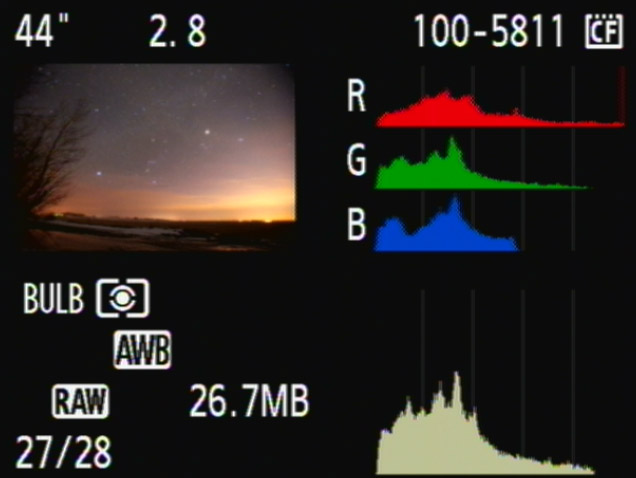
The Christmas Eve Sky


Christmas Eve at City of Rocks Panorama

This was the sky on the night before Christmas, with the Moon setting and Orion rising.

It was a crisp and calm night on Christmas Eve, with the waxing Moon shining beside Mars in the west at right. The western sky was marked by the faint tower of light called the Zodiacal Lights. To the east at left, Orion was rising beside the Milky Way.

The main image is a 180° panorama taken at the City of Rocks State Park, south of Silver City, New Mexico, and a particularly photogenic site for nightscape images.

Christmas Eve Moon in Twilight

This was the scene earlier in the evening with the Moon beside Mars, and the pair well above Venus down in the twilight, all framed by one of the park’s windmills.

Orion Rising at City of Rocks (Xmas Eve 2014)

Here is a close-up of Orion climbing over the rock formations in the state park. This is a single exposure with the foreground lit by the waxing crescent Moon.

Merry Christmas to all and to all a good night.

– Alan, December 24, 2014 / © 2014 Alan Dyer / AmazingSky.com

A Comet for Christmas


Comet Lovejoy (C/2104 Q2) on Dec 23, 2014

Comet Lovejoy has migrated from the southern sky to appear in our northern sky for the holiday season.

This was Comet Lovejoy, aka C/2014 Q2, as it appeared on Tuesday night, December 23. It was low in the south well below Orion in the constellation of Columba the dove. It was easy to see in binoculars as a 5th magnitude fuzzy star. My long exposure photo reveals its thin blue ion tail.

I could just see the comet naked eye, knowing exactly where to look. However, I’m at 32° North latitude, placing the comet now decently high in my New Mexico sky.

The comet was discovered by Australian amateur astronomer Terry Lovejoy last August when the comet was way down under in the southern sky. But it is now moving rapidly north and brightening, bringing northern observers a binocular comet for the holidays.

However, the Moon is now coming up and will interfere with viewing later in the week. However, in mid-January Comet Lovejoy will be very high in the sky as its moves through Taurus, with the Moon out of the way.

By then the comet may be brighter and a naked eye object from dark sites. But don’t expect it to be anything more than a fuzzy star. This comet never gets close to the Sun, so isn’t likely to grow a bright dust tail.

For more details see the SkyNews magazine web page.

– Alan, December 24, 2014 / © 2014 Alan Dyer

Venus and a Silvery Moon over Silver City


Thin Moon and Venus (Dec 22, 2014)

The thin Moon and Venus hang over the lights of Silver City, New Mexico.

Tonight, December 22, the 24-hour-old crescent Moon shone a binocular field to the right of brilliant Venus. I caught both hanging in the sky over downtown Silver City, set in stunningly clear twilight.

Venus is just beginning what promises to be a spectacular evening appearance in the western sky over the next few months, as it climbs higher.

The Moon, on its shorter cycle around the sky, is emerging into the evening sky for the end-of-year holidays. Watch it wax into a quarter Moon, then to Full, over the next two weeks. Tonight, the glow of Earthshine was prominent lighting the dark side of the Moon.

I shot this from east of the city, using a 135mm telephoto on my Canon 60Da camera.

Happy holidays to all!

– Alan, December 22, 2014 / © 2014 Alan Dyer / www.amazingsky.com

A Cosmic Christmas Wreath


IC 1396 & Garnet Star in Cepheus

A cosmic Christmas wreath glows in the sky, adorned by a celestial garnet.

This nebula, known as IC 1396, shines in the constellation of Cepheus the king, now high overhead on early winter evenings in the northern hemisphere. It’s a bubble of gas blown by new stars amid the interstellar wreath.

At top, shining like a Christmas light on the wreath, is an orange star. This is Mu Cephei, also known as the Garnet Star. It’s a red supergiant, roughly 1,500 times bigger than our Sun. If it replaced our Sun at the centre of our solar system it would engulf all the planets out to and including Jupiter.

Be happy Mu sits 1,000 light years away!

Happy holidays! And happy solstice. Winter arrives in the northern hemisphere at 6:03 p.m. EST on Sunday, December 21. That’s the shortest day and longest night of the year, for all those north of the equator.

– Alan, December 20, 2014 / © 2014 Alan Dyer

A Lone Geminid Meteor


Lone Geminid Meteor (Dec 12, 2014)

A lone meteor streaks away from the constellation of Gemini, part of the annual Geminid meteor shower.

Once again, as I did last month for the Leonid shower, I set up two cameras firing away hundreds of frames in hope that some would record a few meteors from the annual Geminid shower now going on.
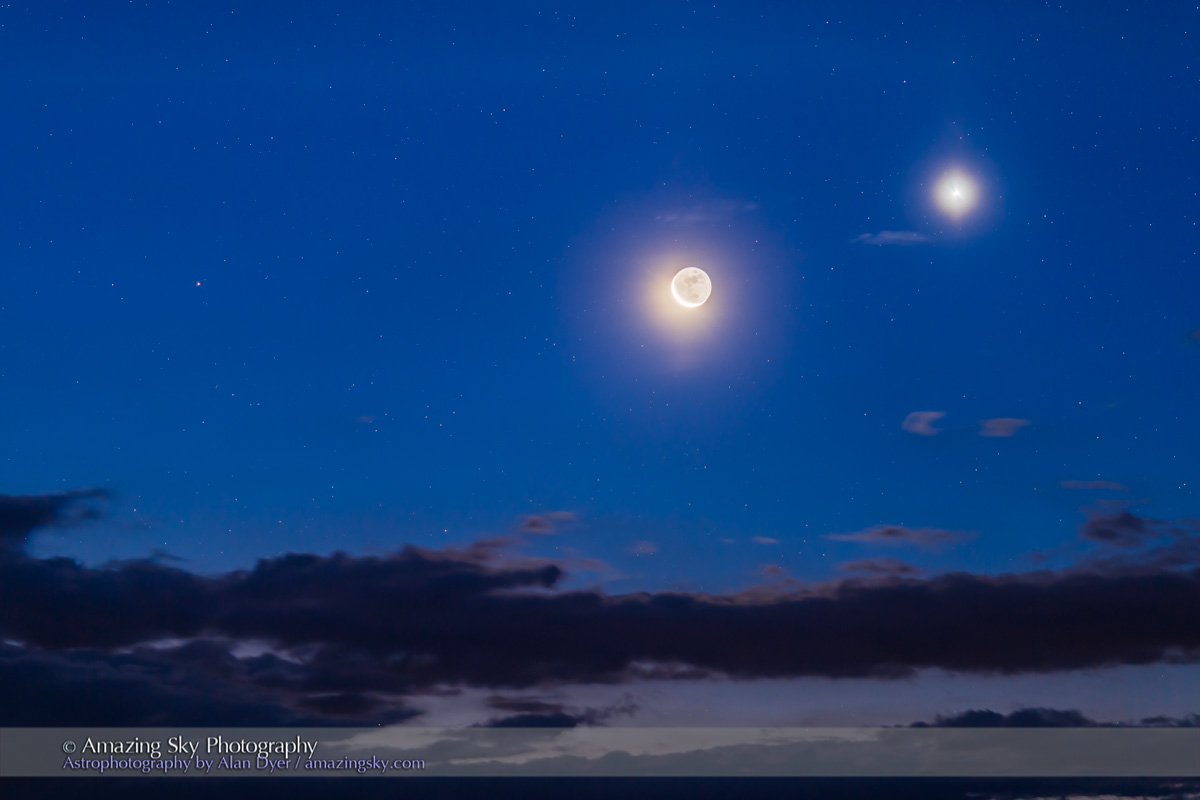
I took about 700 frames, but only this one picked up a meteor. Clouds did intervene for a while – that’s when the brightest meteors would have appeared I’m sure. I observed from my front patio for a while and saw several Geminids, including two beautifully bright ones. But of course, both were just outside the field of both cameras.
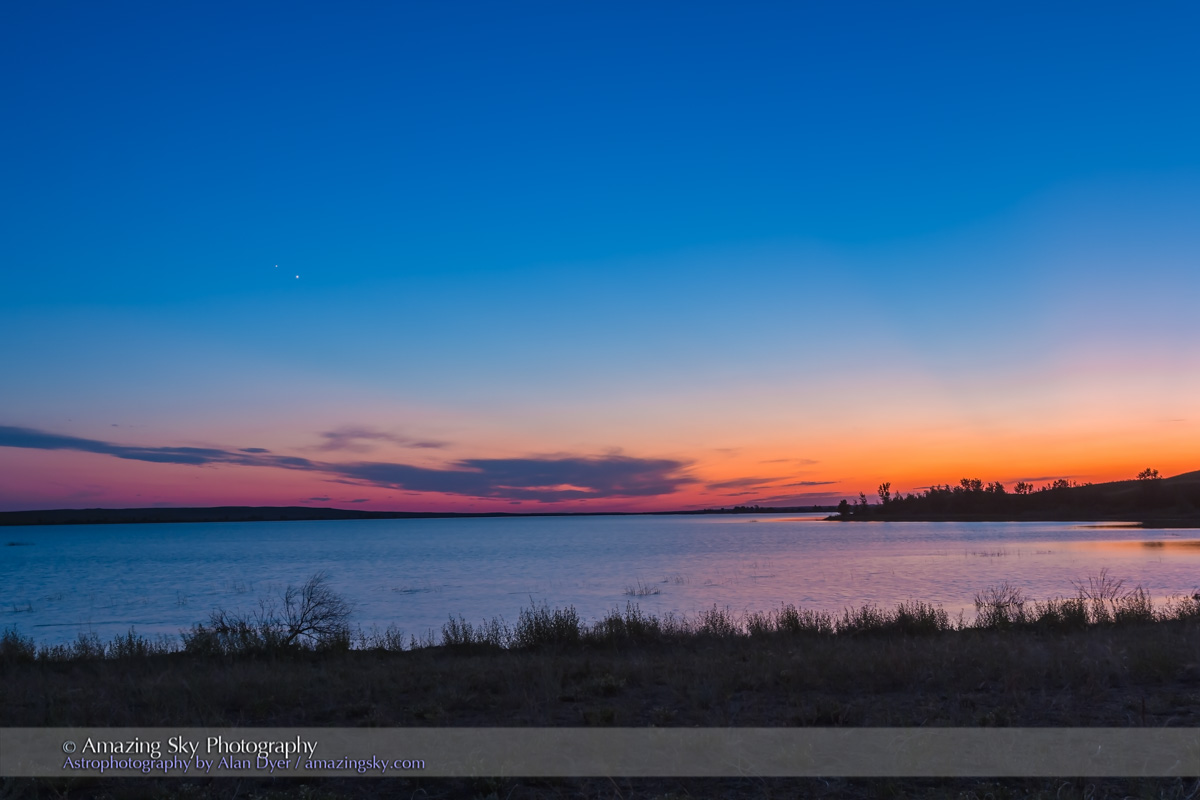
I shot the shower tonight, Friday, the night before the peak on Saturday, as the forecast calls for cloud for the rest of the weekend here in southern New Mexico.

So this may be my best shot of the 2014 Geminid meteors.

– Alan, December 12, 2014 / © 2014 Alan Dyer