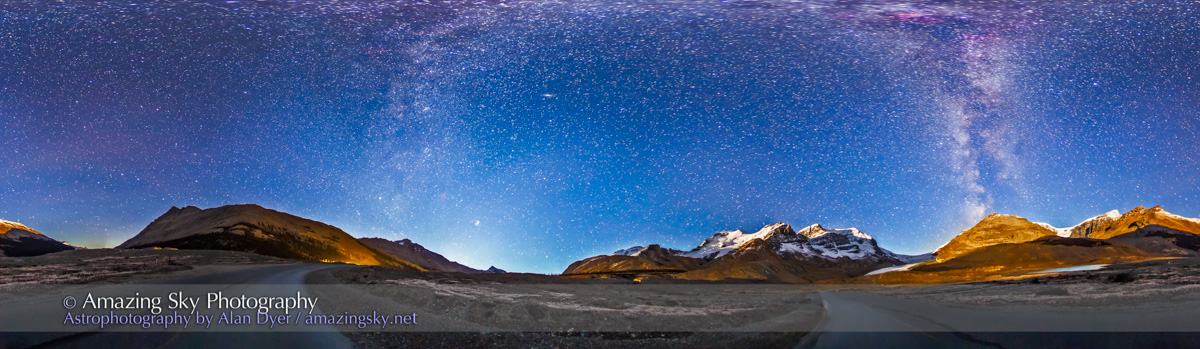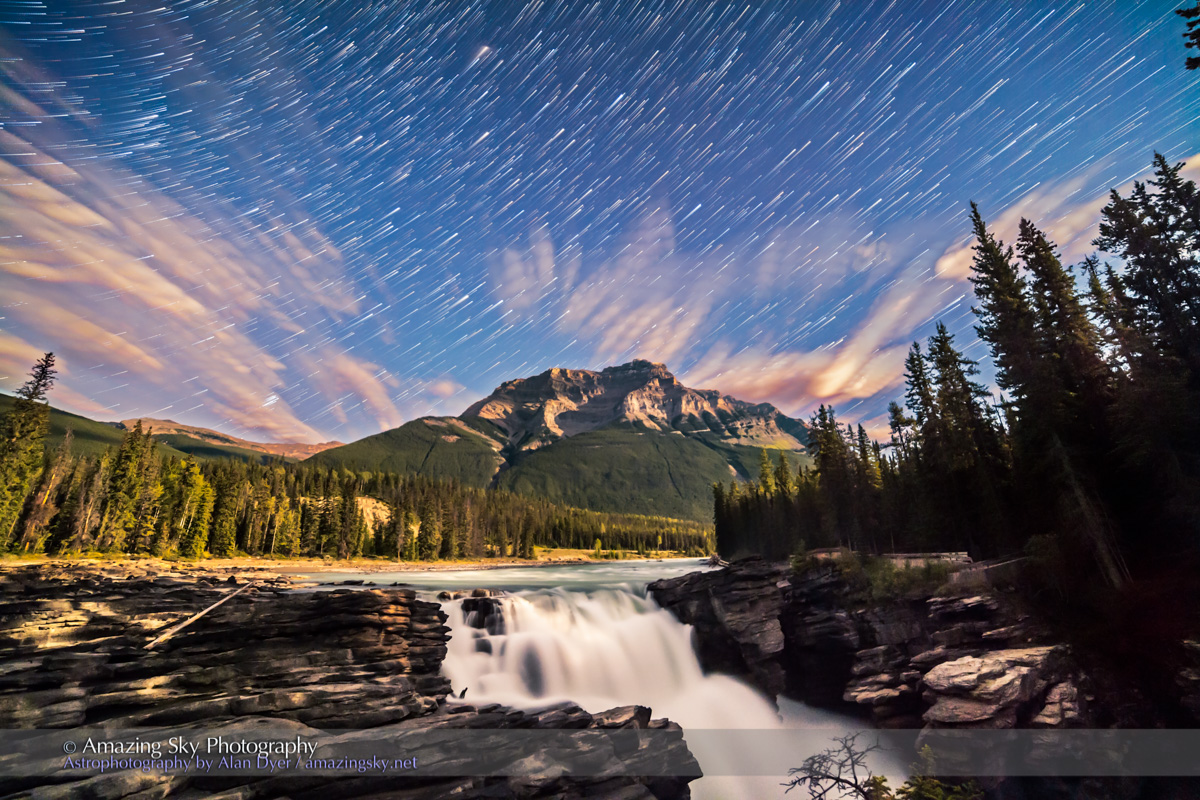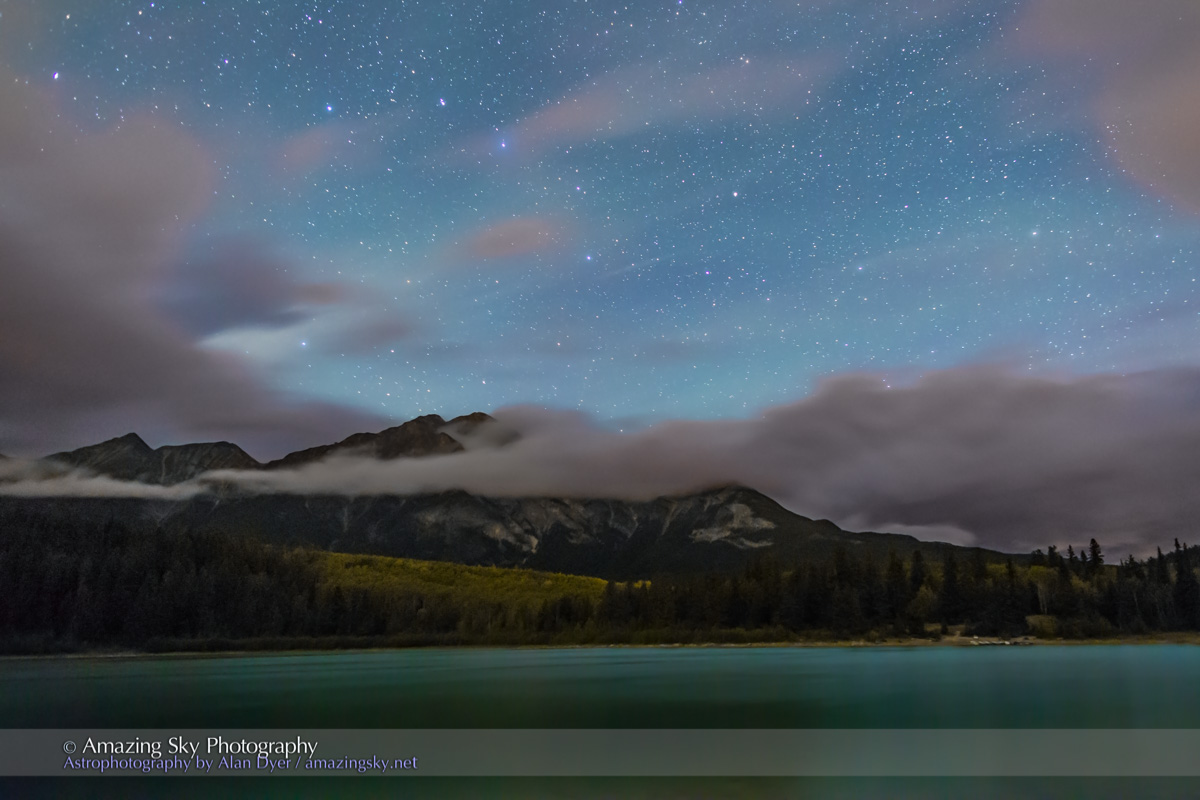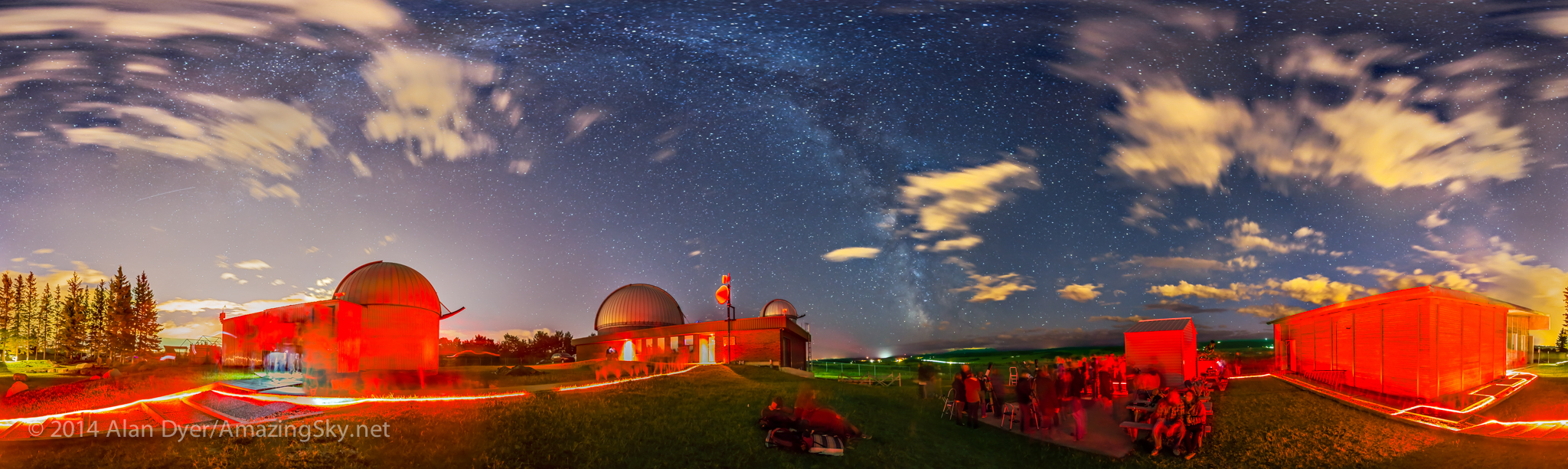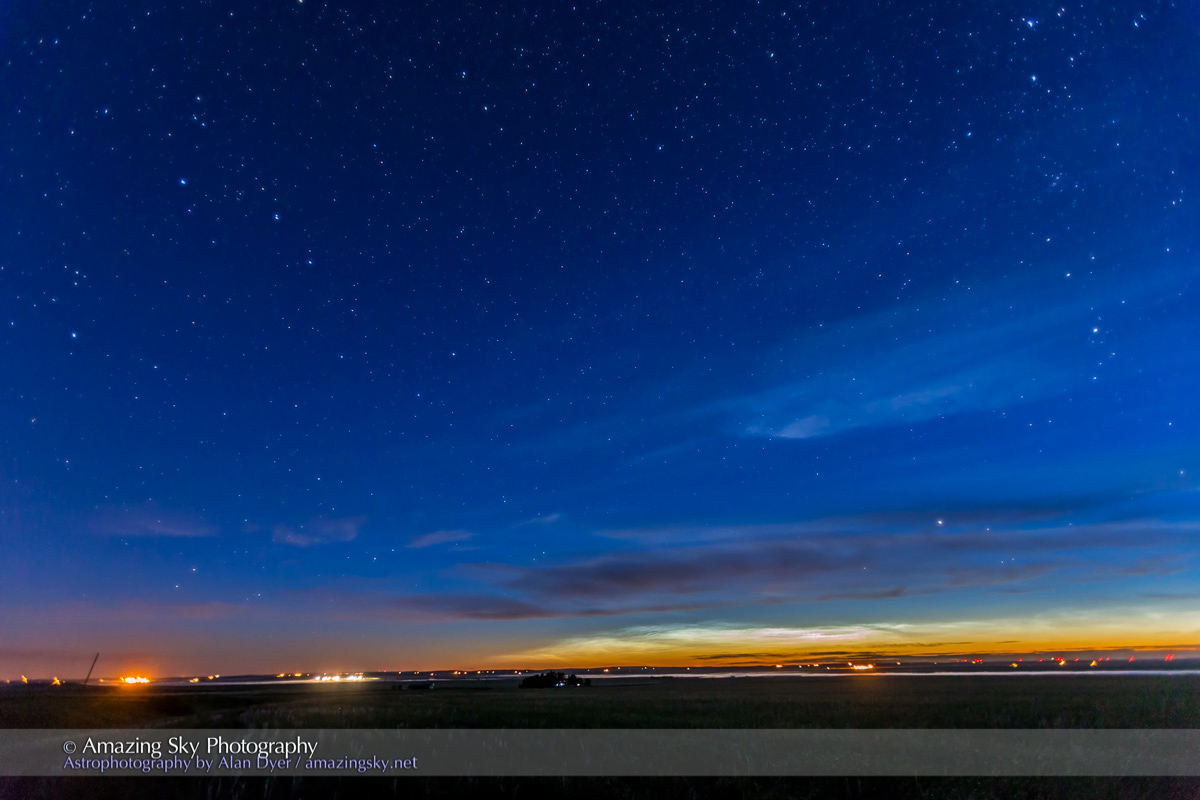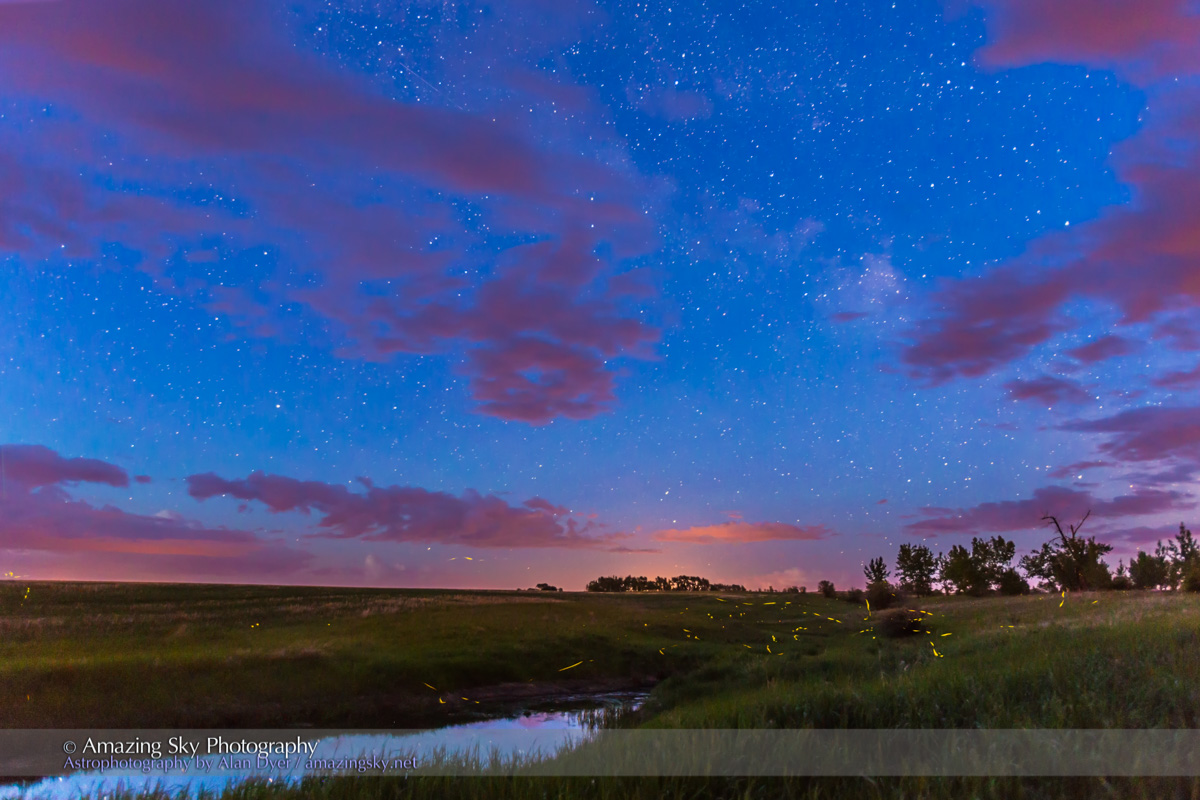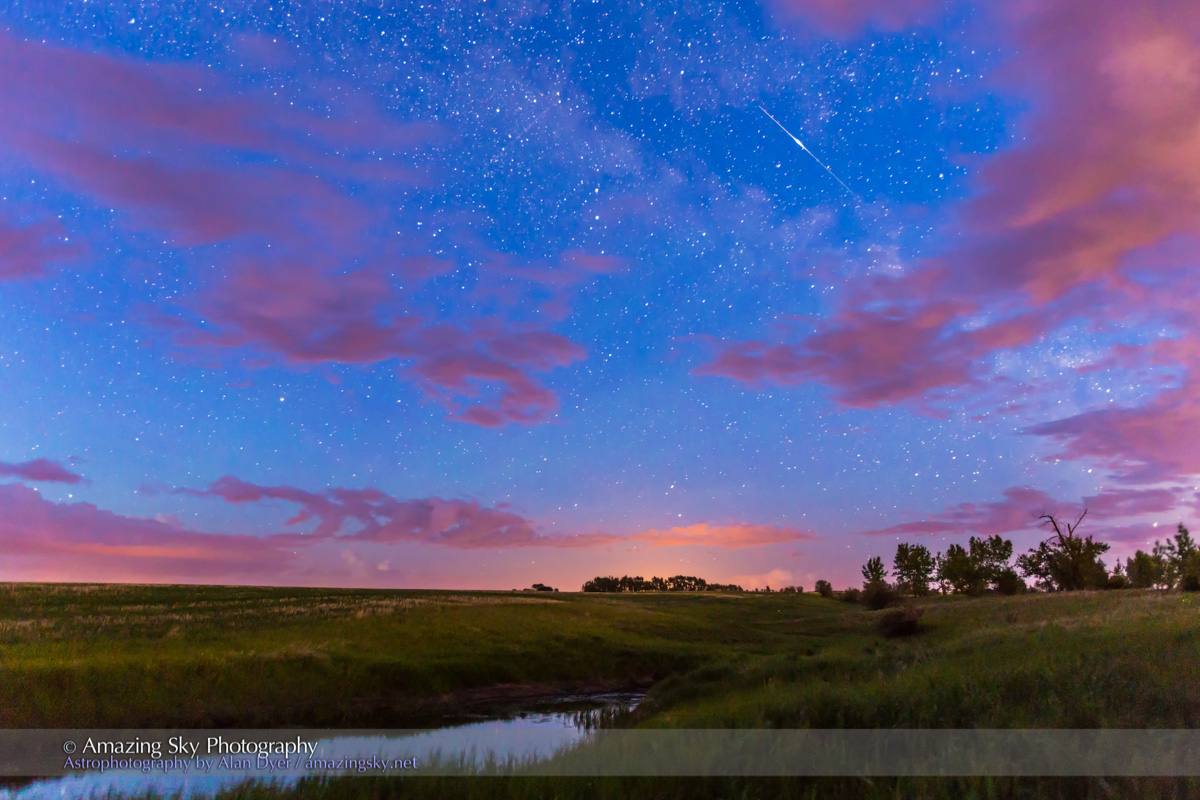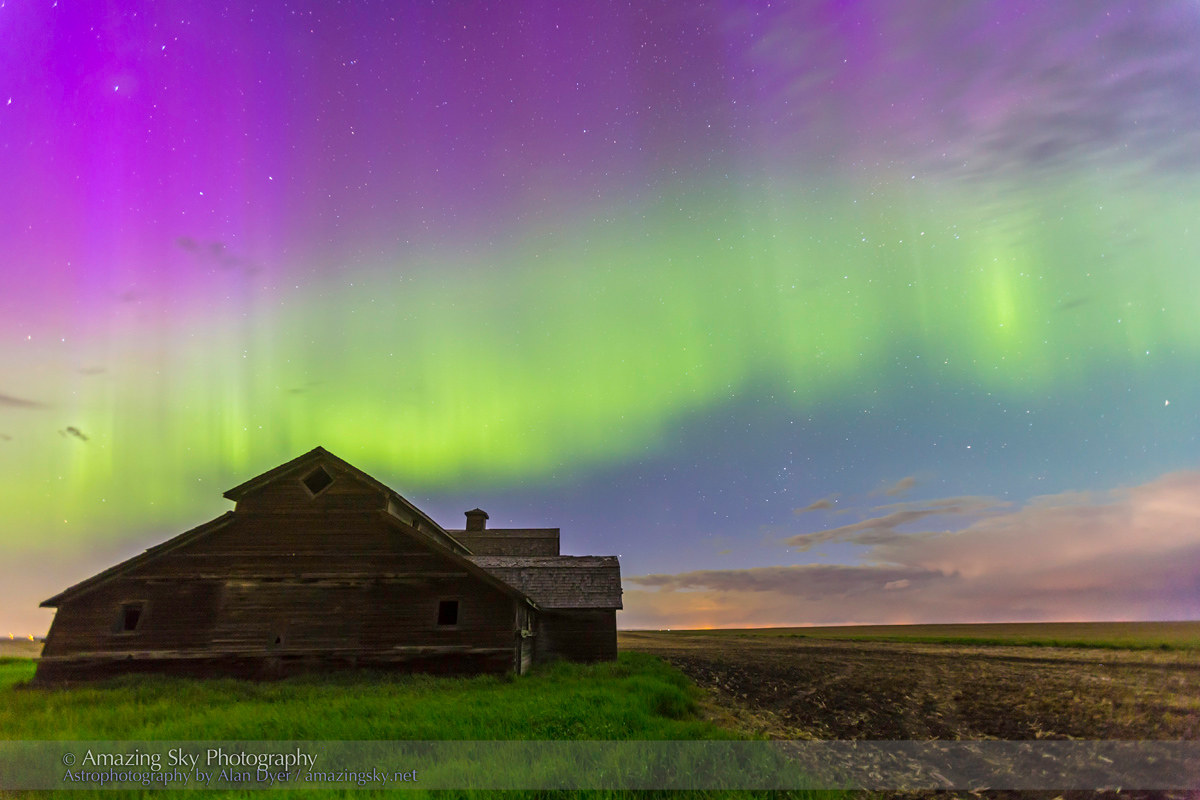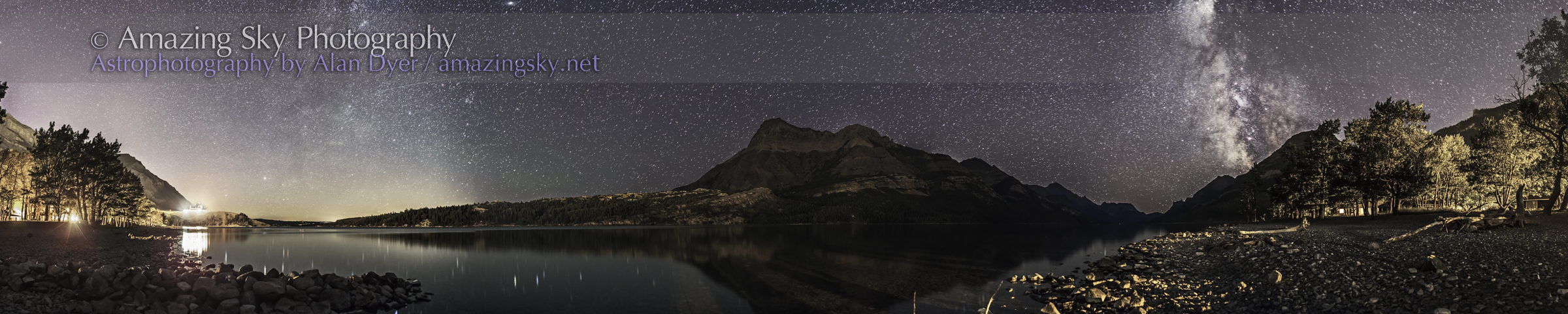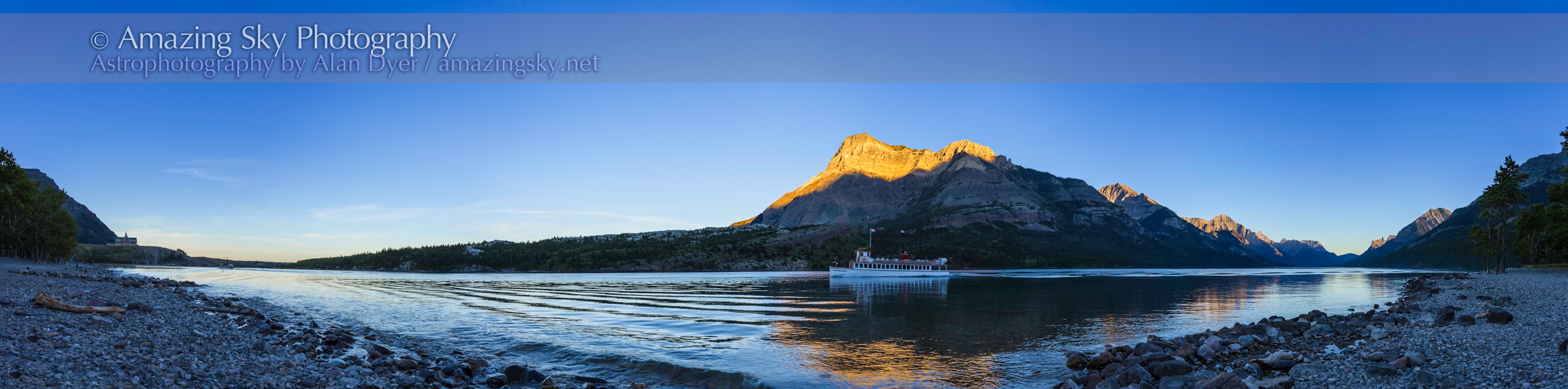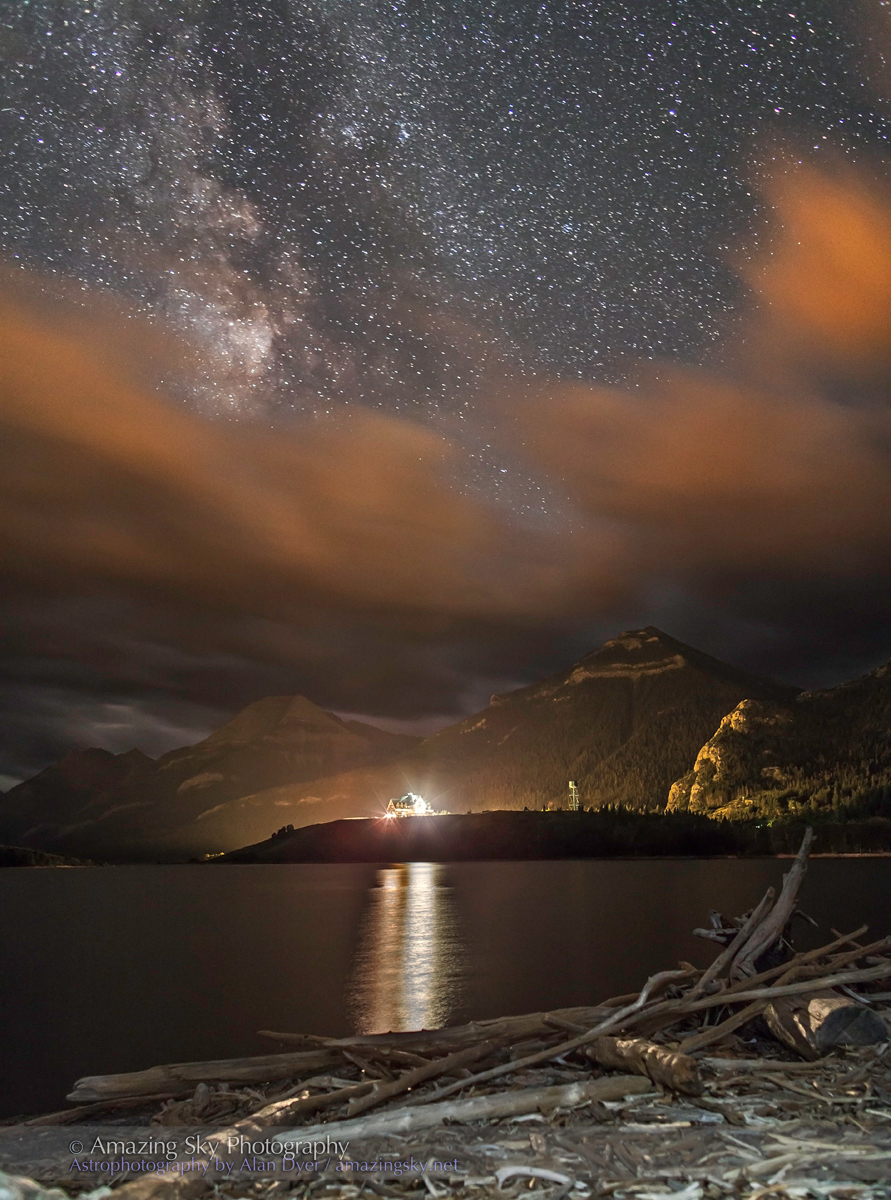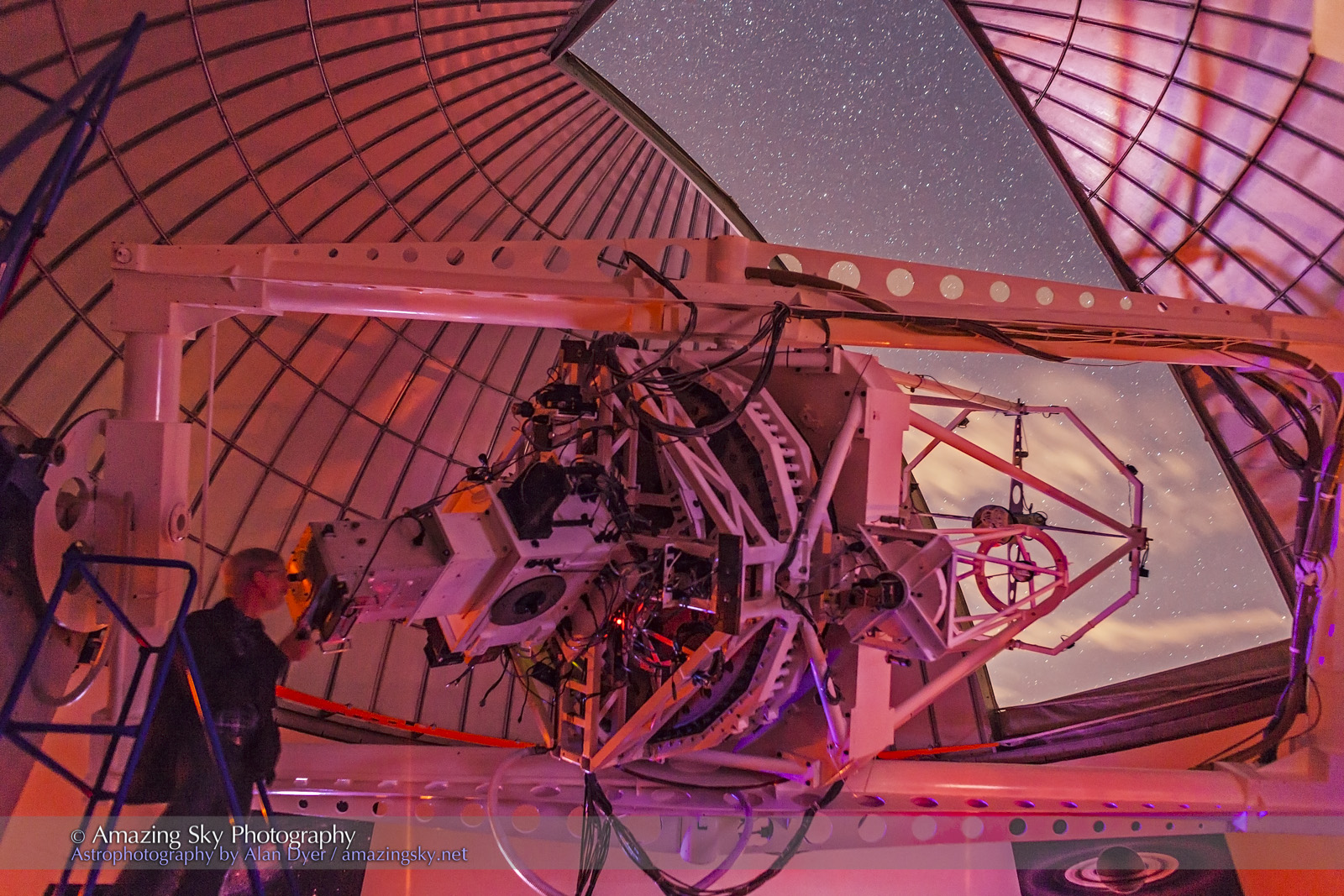
Pre-Eclipse Day in Jasper


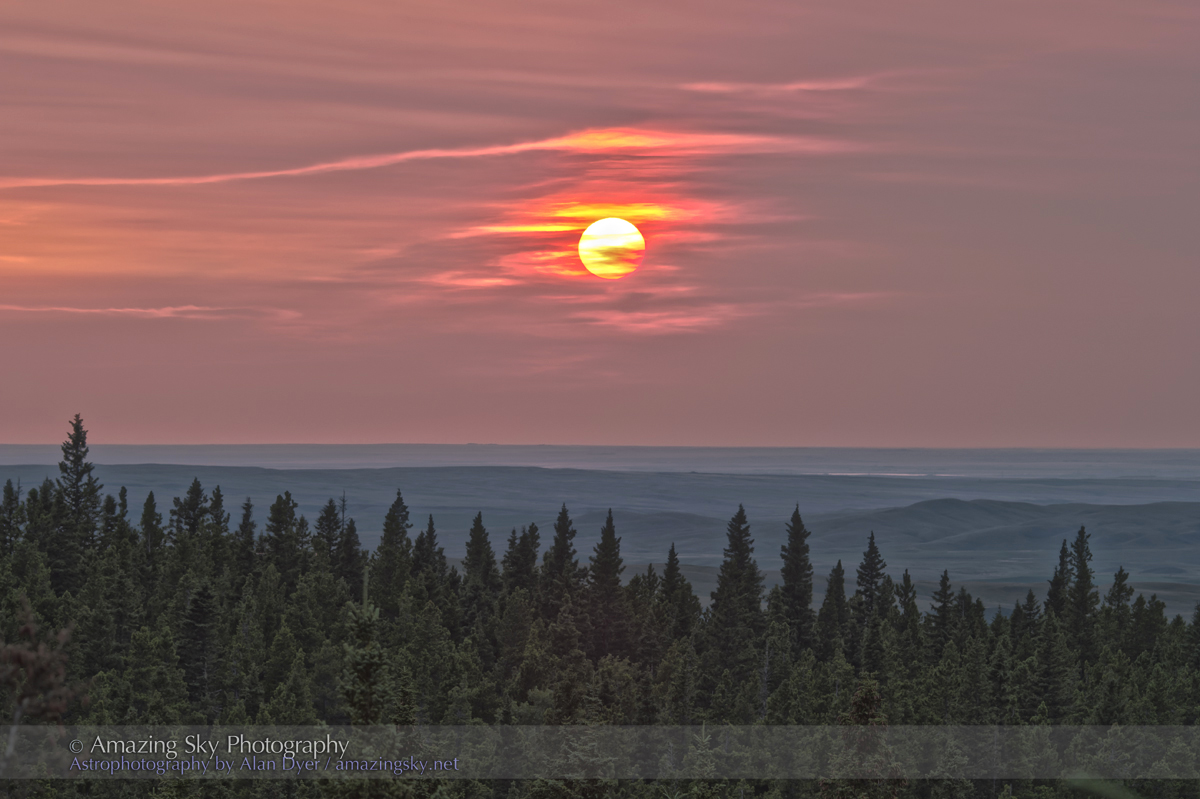
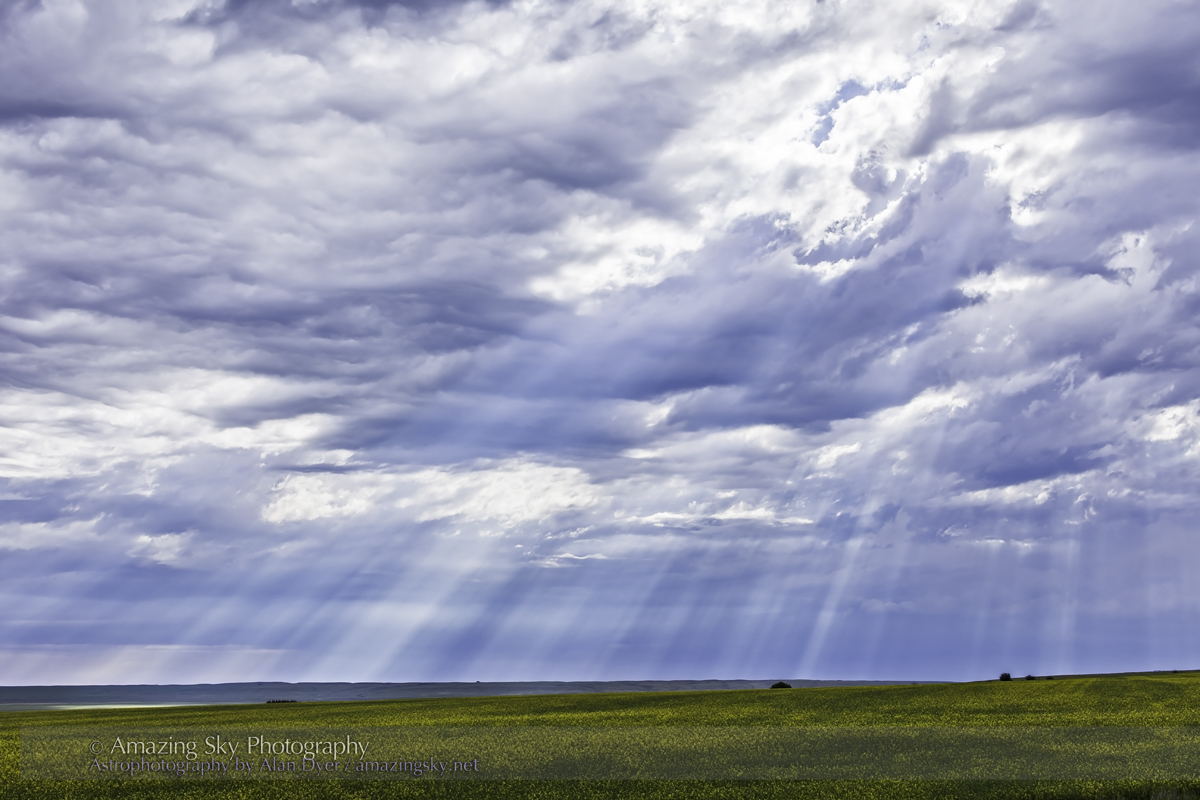
Sunbeams over Athabasca Pass

It’s the day before the eclipse, and the skies are not clear!

On Thursday, October 23 the Moon covers the Sun in a substantial partial eclipse. I’m in Jasper National Park, participating in the Park’s annual Dark Sky Festival.

One of the events is a public viewing session of the solar eclipse. Let’s hope for some clearing skies and breaks in the clouds, so we can see 66% of the Sun eaten by the Moon!

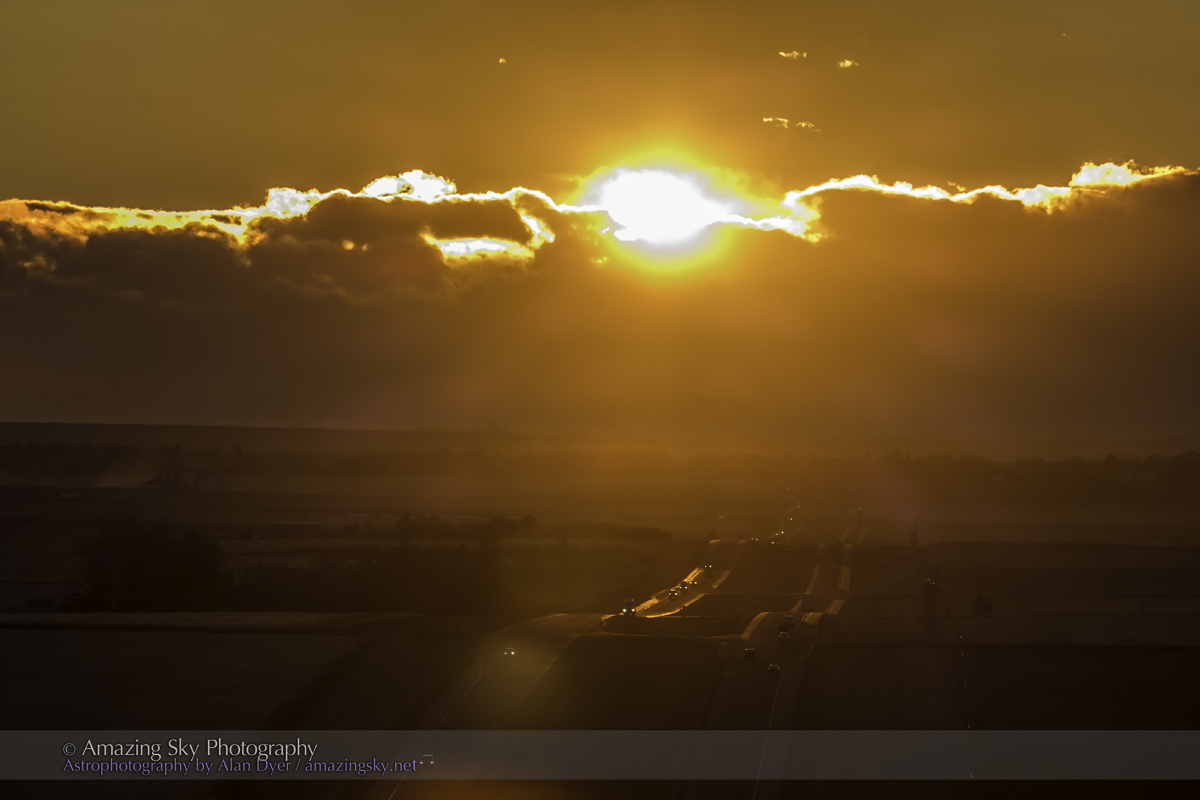
I shot this image at eclipse time the day before – today! – from a viewpoint looking west toward the Sun on the Icefields Parkway south of Jasper townsite.
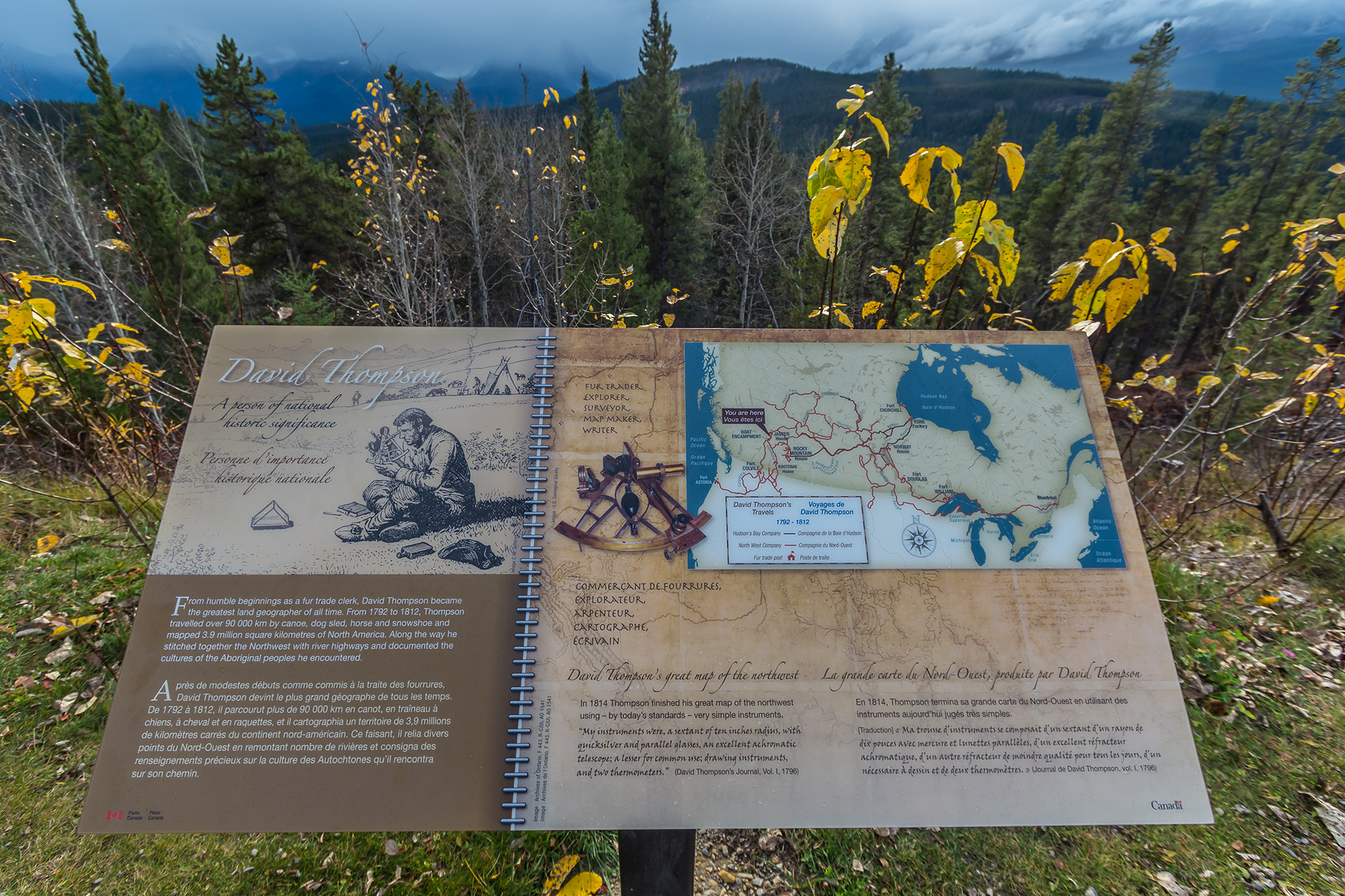
David Thompson Sign at Athabasca Pass Overlook

The Sun is trying to break through and is casting its beams down onto the famed Athabasca Pass, the route over the mountains pioneered by David Thompson in the early 1800s when his preferred route over Howse Pass to the south was blocked by the Pikanii who objected to Thompson trading with their enemies over the Rockies.

I show the area of Howse Pass in this previous big post from earlier this summer

Thompson was one of the first astronomers in western Canada, using the Sun, Moon, Jupiter and stars to navigate his way and map the country. The lower sign explains. Click on the image for a larger view.

The Dark Sky Festival continues the tradition of stargazing in Jasper, a science Thompson depended upon in his travels.

– Alan, October 22, 2014 / © 2014 Alan Dyer
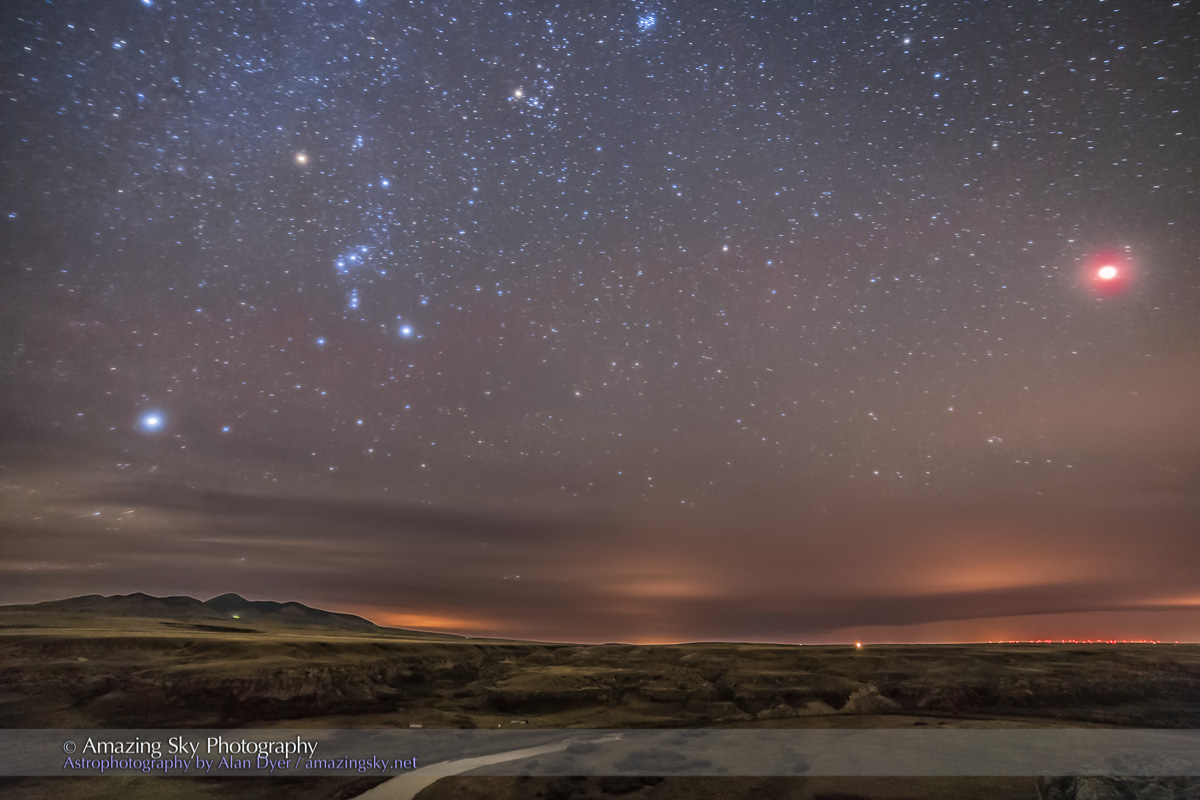
Red Moon over Writing-on-Stone


Red Moon over Writing-on-Stone

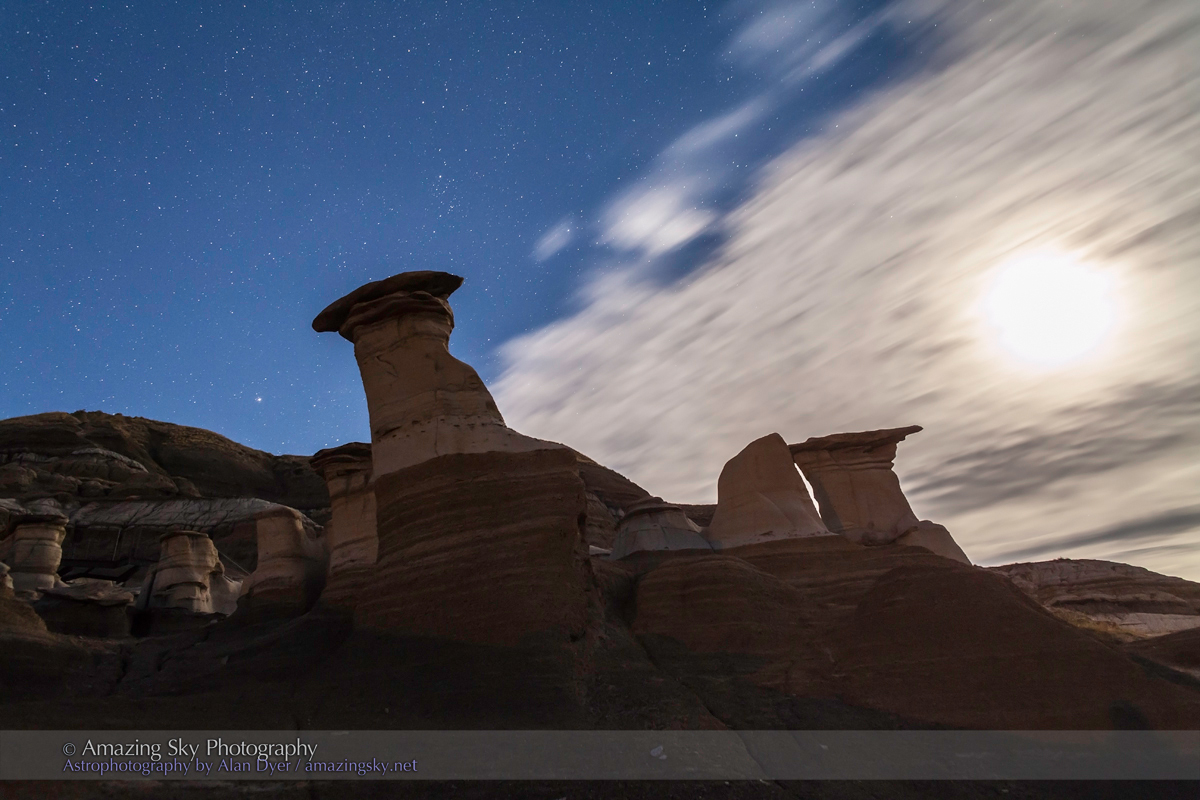
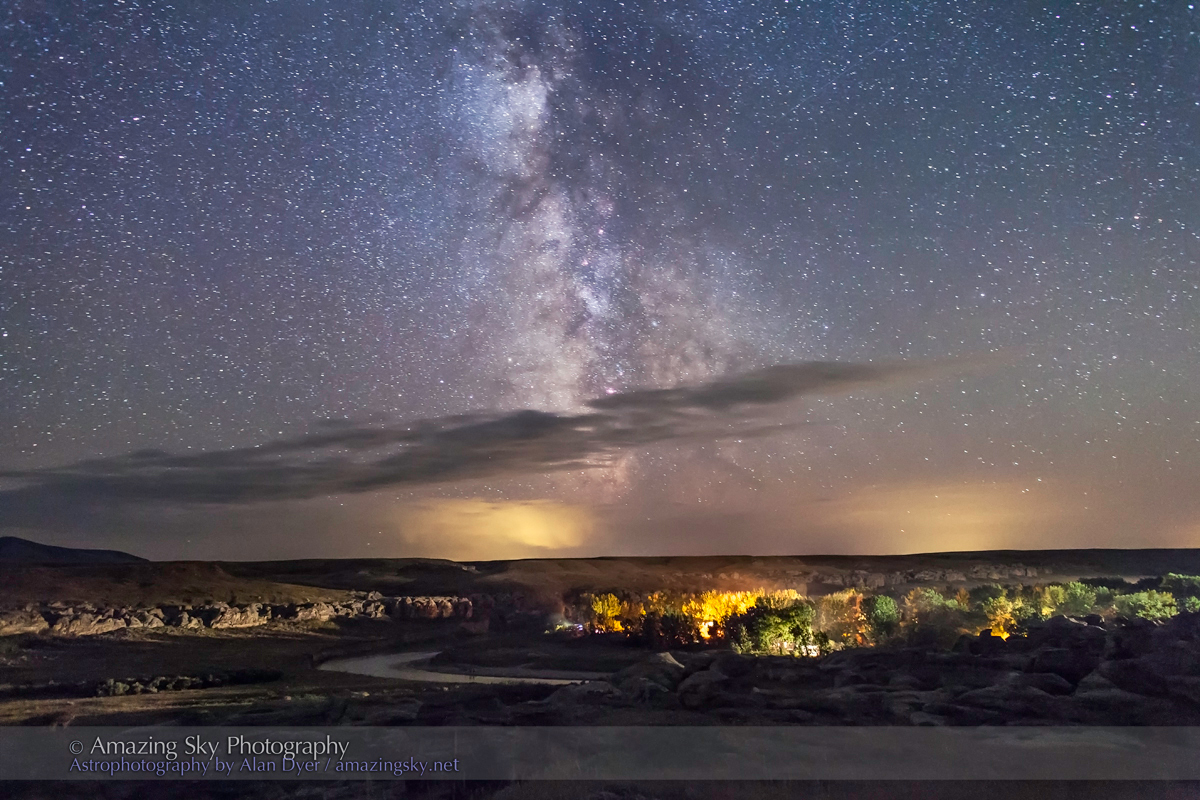
The red eclipsed Moon shines over the Milk River, with Orion over the Sweetgrass Hills.

This was the scene at 4:45 this morning, October 8, from my observing site for the lunar eclipse, Writing-on-Stone Provincial Park in southern Alberta.

The eclipsed red Moon shines at far right over the Milk River and sandstone formations of Writing-on-Stone Park, home to ancient petroglyphs, and a sacred site to First Nations people.

At left are the Sweetgrass Hills across the border in Montana. Above shine the stars of Orion, with his Dog Star Sirius below. Above is Taurus, with Aldebaran and the Pleiades cluster.

The night was fairly clear for the hour of totality, though with high haze fuzzing the stars and Moon. But considering the cloud I had driven 3 hours to escape I was happy.

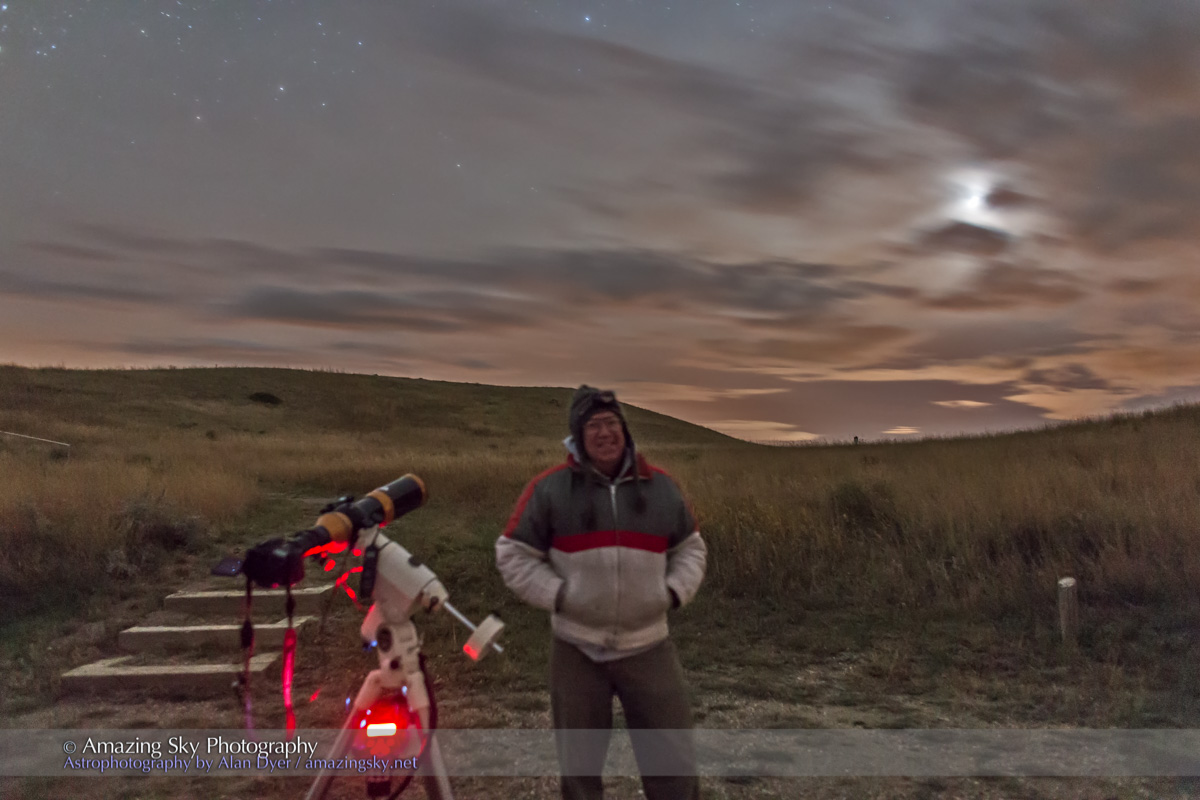
Self-Portrait at Oct 8, 2014 Total Lunar Eclipse

Here I am in a 5:30 a.m. selfie by starlight and moonlight, with the clouds I had escaped now rolling in to cover the Moon as it began to emerge from Earth’s shadow.

No matter. I had captured what I had come for: the nightscape above (with a 14mm lens), and close-ups shot through this telescope gear, one of which I featured in my previous post.

– Alan, October 8, 2014 / © 2014 Alan Dyer


Eclipse of the Hunter’s Moon


Total Eclipse of the Hunter's Moon

The Hunter’s Moon of 2014 turned deep red during a total lunar eclipse.

It wouldn’t be an eclipse without a chase!

To see and shoot this total eclipse of the Hunter’s Moon I had to chase clear skies, seeking out the only clear area for hundreds of miles around, requiring a 3-hour drive to the south of me in Alberta, to near the Canada-US border, at Writing-on-Stone Provincial Park.

It was worth the midnight trek, though I arrived on site and got set up with just 10 minutes to go before the start of totality.

But I was very pleased to see the sky remain mostly clear for all of totality, with only some light haze adding the glow around the eclipsed Moon. Remarkably, the clouds closed in and hid the Moon just after totality ended.

This is a single 15-second exposure at ISO 400 with a Canon 60Da, shooting through an 80mm apo refractor at f/6 and on an equatorial mount tracking the sky at the lunar rate. I shot this shortly after mid-totality. It shows how the Moon’s northern limb, closest to the edge of the umbral shadow, remained bright throughout totality.

It shows lots of stars, with the brightest being greenish Uranus at the 8 o’clock position left of the Moon, itself shining in opposition and at a remarkably close conjunction with the Moon at eclipse time.

More images are to come! But this is the result of fast processing after a dawn drive back home and an all-nighter chasing and shooting an eclipse.

– Alan, October 8, 2014 / © 2014 Alan Dyer


The Rising of a Pre-Eclipse Moon


Rising Pre-Eclipse Moon #4 (Oct 6, 2014)

‘Twas the night before the night before … an eclipse of the Moon.

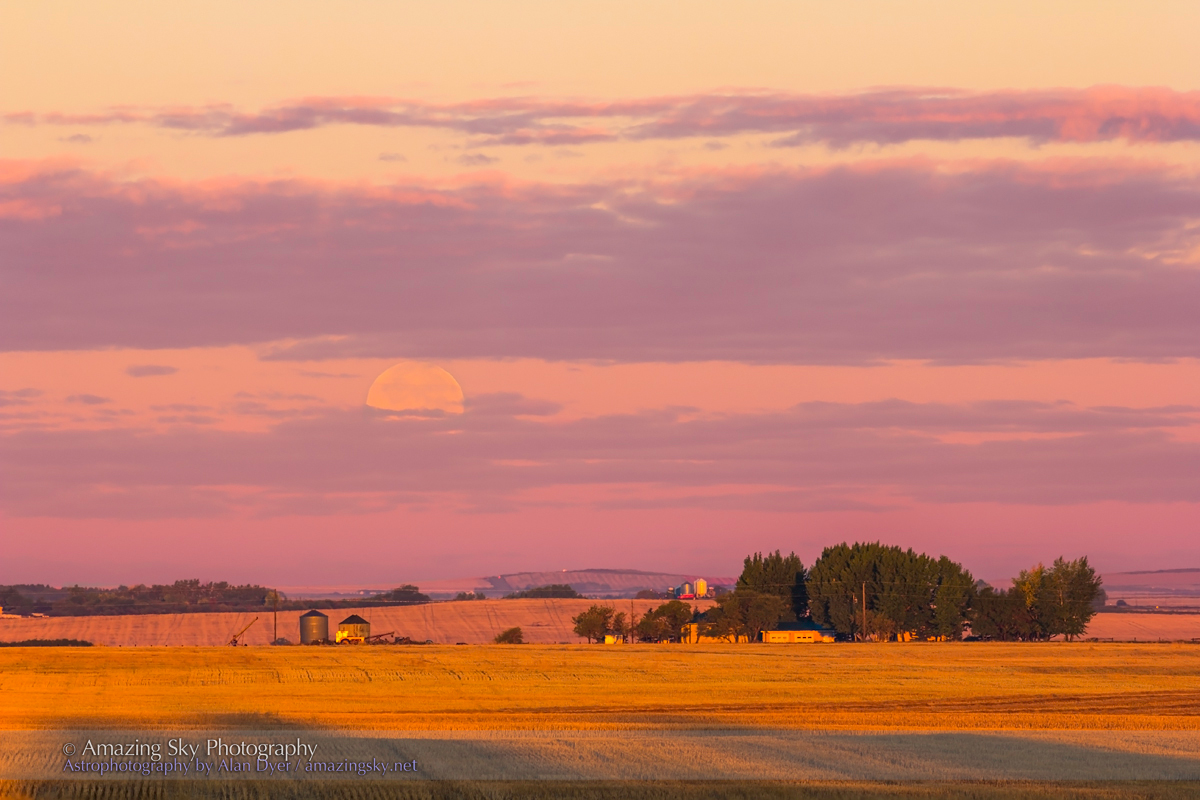
This was the beautiful moonrise tonight, on Monday, October 6, two days – by calendar date – before the total lunar eclipse on October 8.

However, as the eclipse occurs at pre-dawn on October 8, it’s really just a day and half to go before the Moon turns red as it passes through Earth’s shadow.

I shot these as the gibbous Moon, waxing toward Full, rose over the harvested field to the east of home. The setting Sun nicely lit the clouds which partly hide the Moon.

Rising Pre-Eclipse Moon #1 (Oct 6, 2014)

Earlier in the evening, I grabbed this shot as the Moon appeared and two white-tailed deer ran through the yard and out into the field below the rising Moon. Moon deer!

TLE2014Oct08-MDT

This is the sequence that will happen early on October 8, in a diagram courtesy Fred Espenak at EclipseWise.com. The times are for Mountain Daylight, my local time zone. The eclipse will be total from 4:25 to 5:24 a.m. MDT (6:25 to 7:24 a.m. EDT) when the Moon will be immersed in the umbral shadow and will appear deep red.

Use binoculars for the best view of the colours. An eclipsed Moon looks wonderful, like a glowing red globe lit from within, but it’s really lit by the red sunlight from all the sunsets and sunrises going on around the world at once.

The next total lunar eclipses are April 4, 2015 (again pre-dawn) and September 27, 2015 (at convenient early evening hours), both visible from North America.

Clear skies and happy eclipsing!

– Alan, October 6, 2014 / © 2014 Alan Dyer


Moon and Twilight Planets over the Bow River


Moon with Antares, Mars & Saturn over Bow River

The waxing Moon shines between Saturn and Mars over the waters of the Bow River.

It was a beautiful autumn evening for watching the twilight showing of the crescent Moon accompanied by Saturn (at right of centre) and the pairing of Mars (at left, above) with his rival red star, Antares in Scorpius (at left, below).

The river is the Bow, with its headwaters at Bow Glacier in Banff.

To shoot this scene I drove to the grounds of the Blackfoot Crossing Historical Park south of Cluny, Alberta to take advantage of its viewpoint overlooking the Bow River and the heart of the traditional Siksika First Nations tribal lands.

It was here, in the valley below, that Treaty Seven was signed between Chief Crowfoot and Colonel James Macleod in September 1877. Today, a beautiful interpretive centre sits on the hillside at the heart of Blackfoot country.

– Alan, September 28, 2014 / © 2014 Alan Dyer


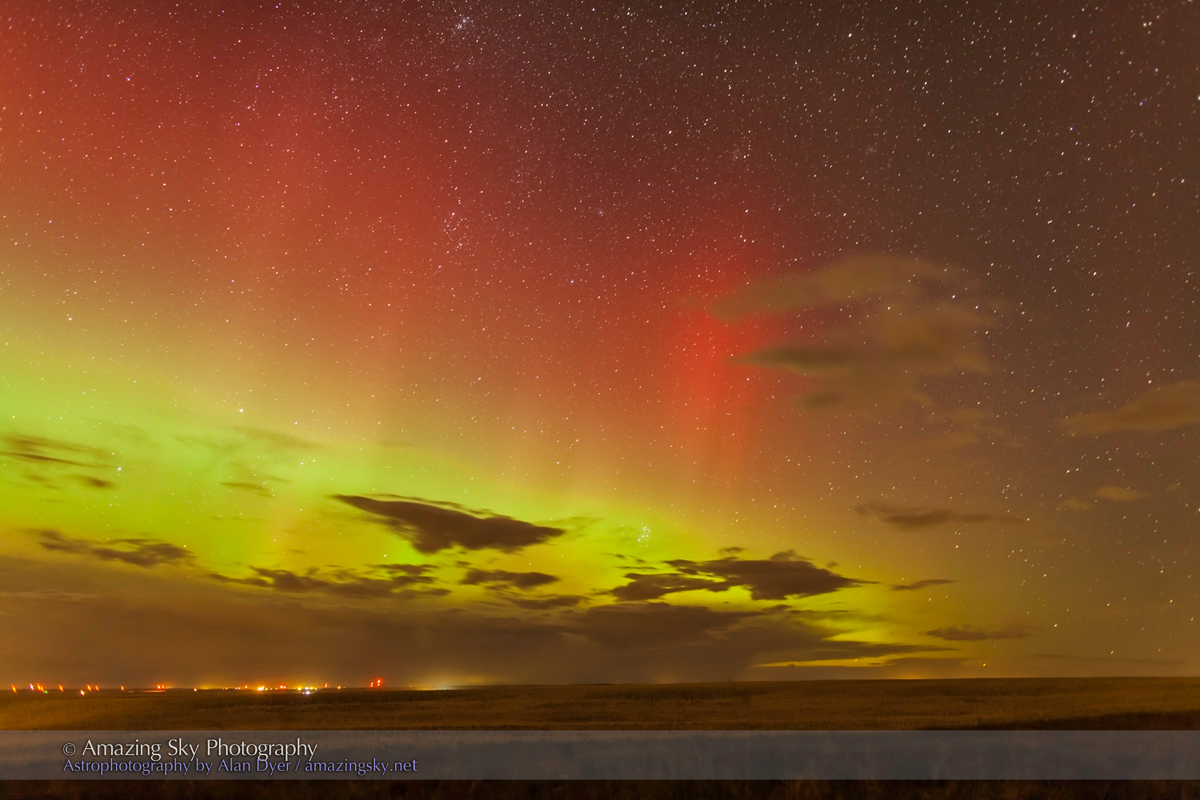
Aurora and Airglow Panorama


Aurora & Airglow Panorama

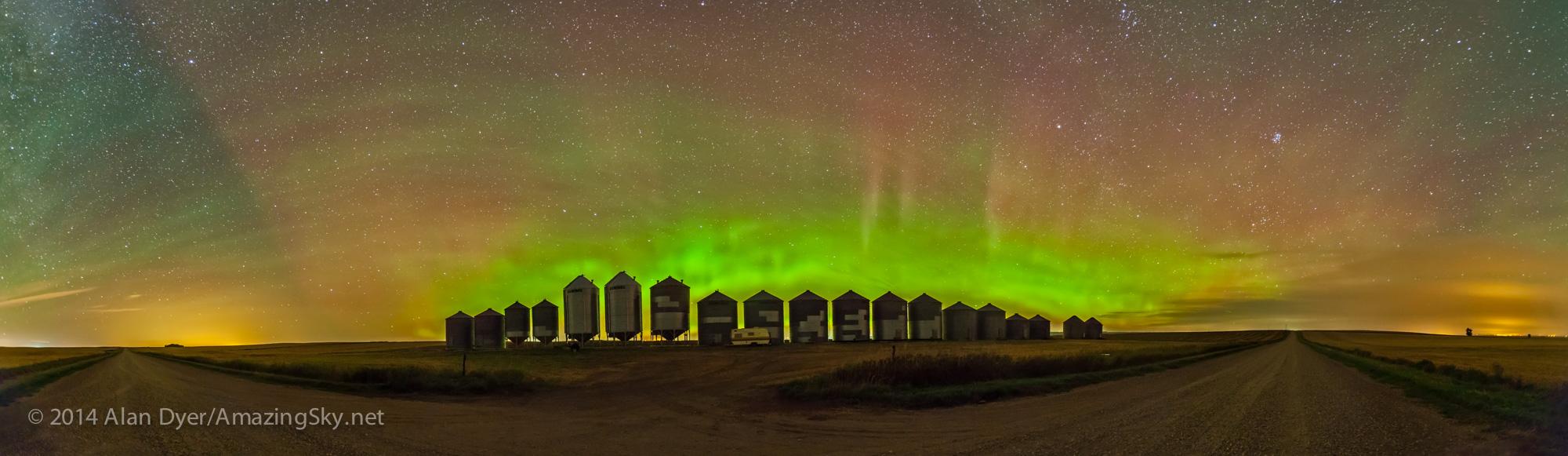
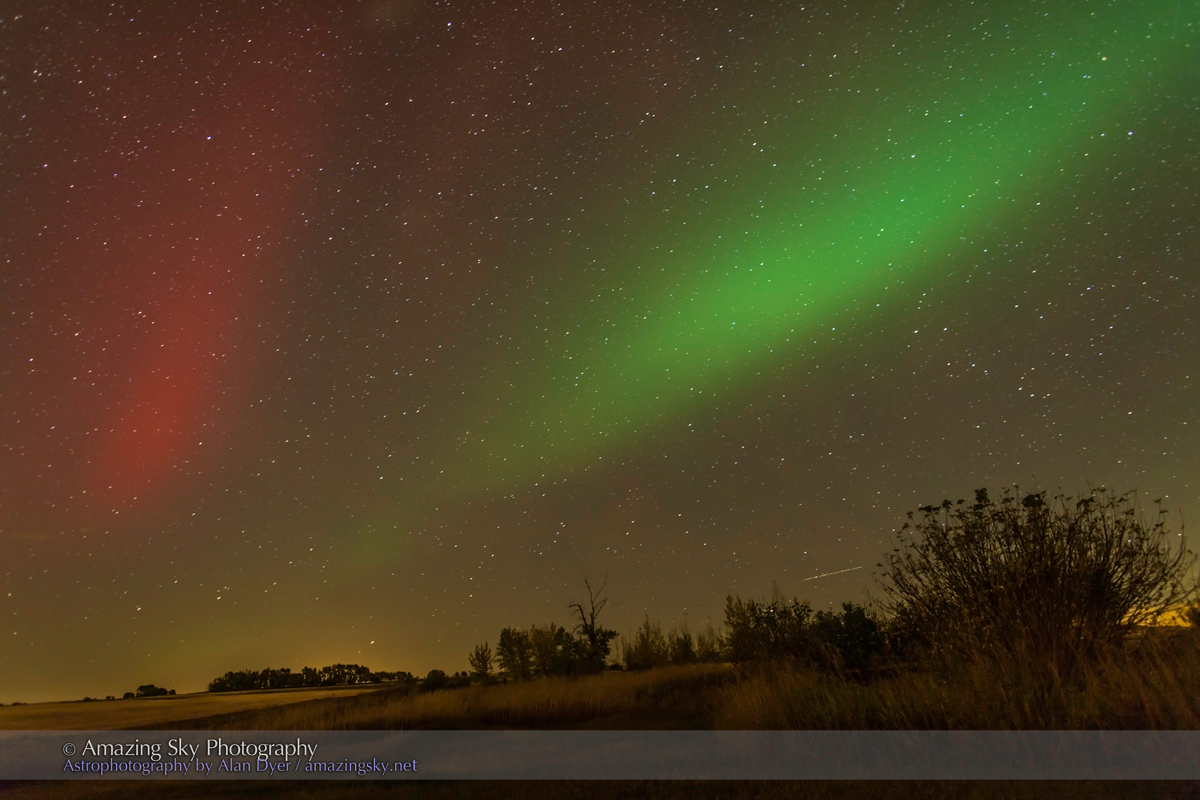
The sky lights up in greens and reds from aurora and airglow.

This has been a good week for aurora watching. Friday night the Northern Lights danced again, this time in a sky already filled with a more subtle phenomenon, airglow.

Airglow adds its own bands of reds and greens across the sky, seen here as arcs from left (west) to centre (north) and into the east. Airglow is light from fluorescing air molecules releasing energy absorbed from the Sun by day.

The aurora adds the brighter green curtains across the north with vertical beams of yellow and red shooting up.

A weird structure which I assume is from the aurora is the sharp-edged yellow band at left in the west. It lasted no more than 2 or 3 minutes, enough to record in three frames of this 7-segment 180° panorama taken near home at an array of grain bins, now filled from the harvest.

To the west and east urban light pollution adds glows of yellow to the horizon.

– Alan, September 27, 2014 / © 2014 Alan Dyer


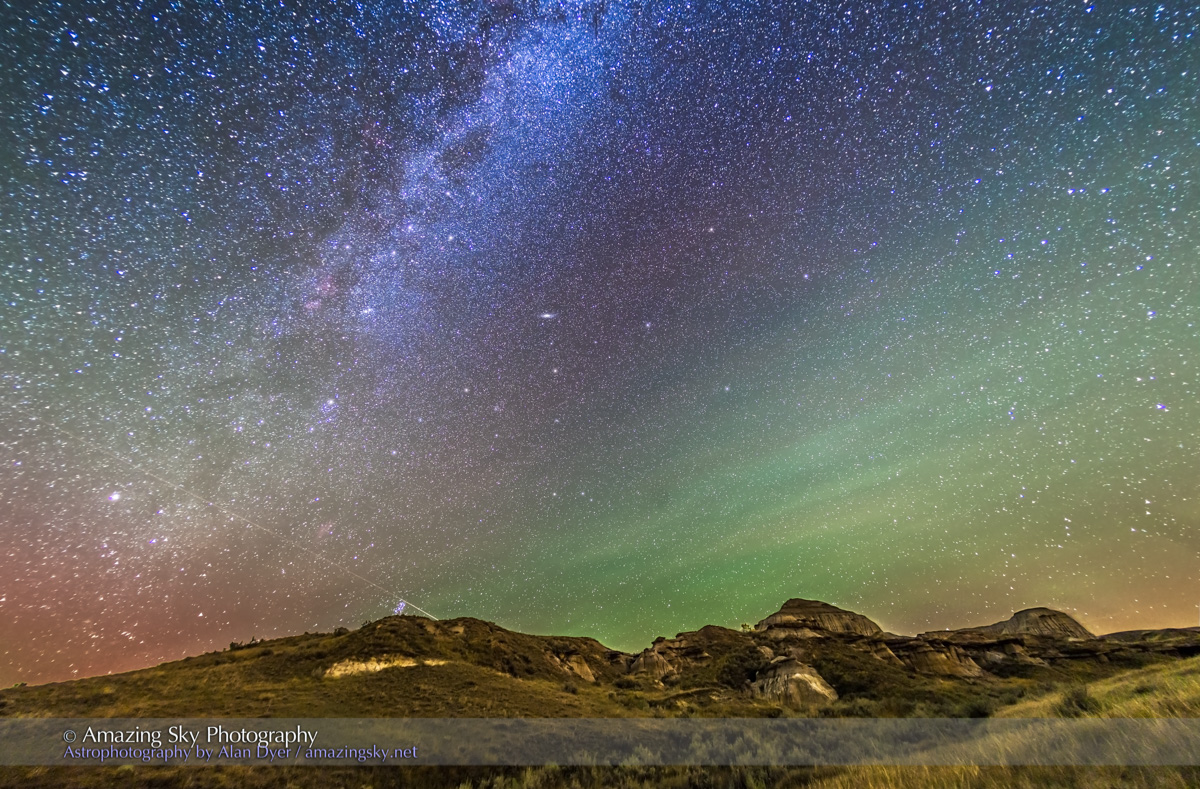
Autumn Stars Rising over Dinosaur Park


Autumn Sky Rising over Badlands

The autumn constellations rise into a colourful sky at Dinosaur Provincial Park, Alberta.

Last night the sky started out beautifully clear but as it got darker it was apparent even to the eye that the sky wasn’t really dark, despite the lack of any Moon.

The camera captured the culprit – extensive green airglow, to the east at right. A faint aurora also kicked up to the north, at left, adding a red glow. Light pollution from gas plants nearby and from Brooks 50 km away added yellow to the sky scattered off haze and incoming cloud.

The sky colours added to the scene of the autumn constellations of Cassiopeia, Andromeda, Perseus and Pegasus rising in the east. The Andromeda Galaxy is at centre. The Pleiades is (are?) just rising over the hill.

This is a composite of five stacked and tracked exposures for the sky (with the camera on the Star Adventurer tracking mount) and four stacked but untracked exposures I took at the end of the sequence for the sharp ground (I just turned the tracker motor off for these).

– Alan, September 26, 2014 / © 2014 Alan Dyer


Red Rock Canyon by Starlight


Red Rock Canyon by Starlight

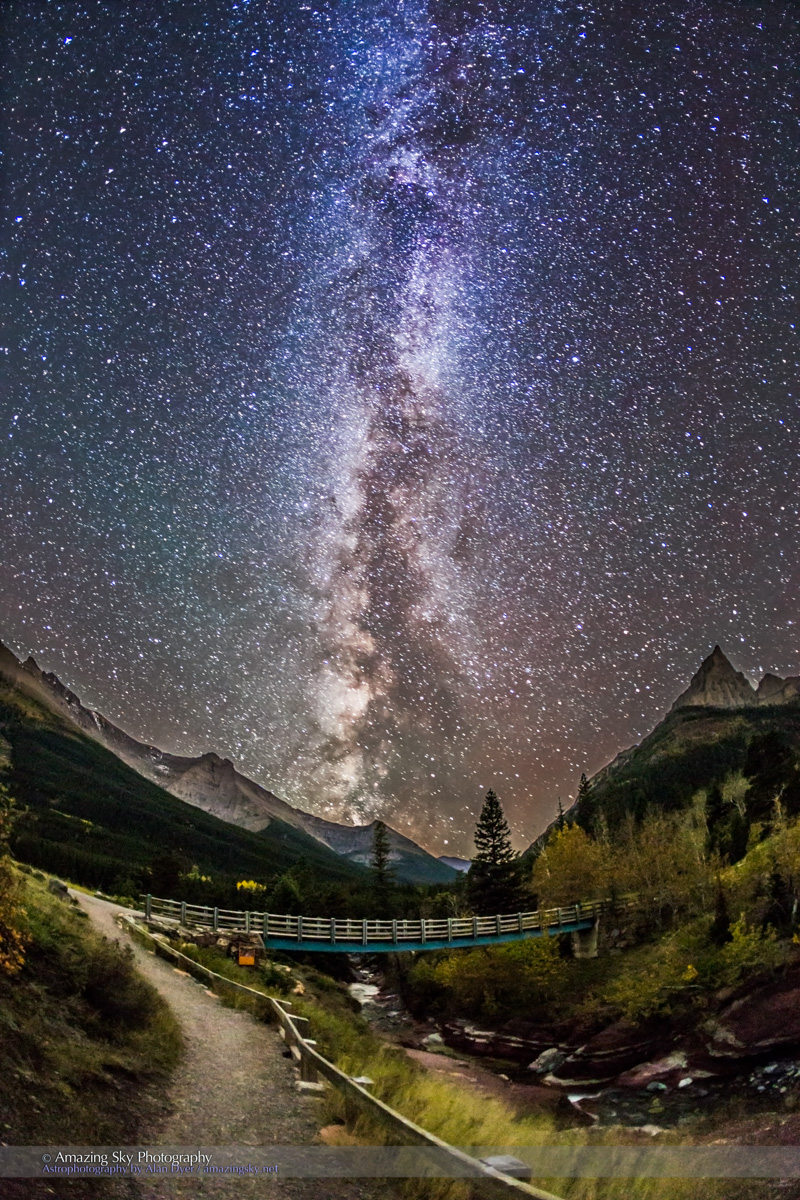
The Milky Way illuminates the trail at Red Rock Canyon, in Waterton Lakes National Park.

Last Sunday night was incredibly clear. I trekked around Waterton Lakes National Park, taking panoramas at various sites. This is Red Rock Canyon, a popular spot by day.

By night it is one of the darkest accessible places in the Park. Here the landscape is lit only by the light of the stars and Milky Way.

This is a composite of two exposures, both on a tripod with no tracking of the sky motion:

– one exposure was 60 seconds for the sky to minimize star trailing.

– the other exposure, taken immediately following, was 3 minutes for the ground, to bring out detail in the dark, starlit landscape.

I blended the two exposures in Photoshop, creating a single image with the best of both worlds, earth and sky.

– Alan, September 25, 2014 / © 2014 Alan Dyer


Cameron Lake Lit by Starlight


Milky Way Panorama at Cameron Lake (Equirectangular)

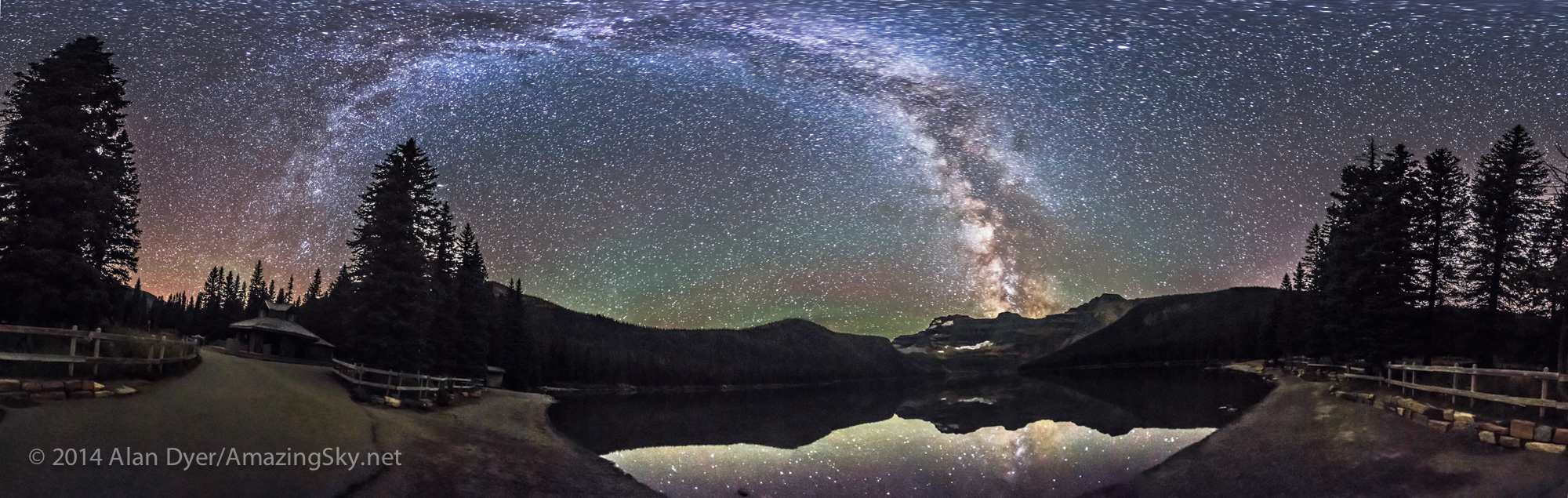
The Milky Way spans the sky and reflects in the calm waters of Cameron Lake, in Waterton Lakes National Park.

This week I’m spending a few nights, at dark-of-the-Moon, back at Waterton Lakes, at a stunning time of year. The aspens are golden, the sky is blue, and the nights are even warm.

Though it is officially autumn, the weather is better now than we had it some weeks in summer. Plus, the Park is now quiet as businesses wind down, preparing to close up for the winter.

I’m shooting night sky panoramas in Waterton, with Cameron Lake one of the wonderful sites I visited last night in a whirlwind tour around the Park to take advantage of a stunningly clear night.

In summer, Cameron Lake is home to docks for canoes and paddle boats. But all are gone now. By winter this lake is home to huge snowfalls, as its location in extreme southwestern Alberta catches the full onslaught of moist Pacific air.

But now, with the early onset of darkness and fine weather, the lake and the Park are superb places for nightscape photography.

I shot this Sunday night, September 21. This is a stitch of 8 segments, each shot with a 15mm lens at f/2.8 for 1 minute at ISO 4000 with the Canon 6D. I used PTGui to stitch the panorama.

– Alan, September 22, 2014 / © 2014 Alan Dyer
 

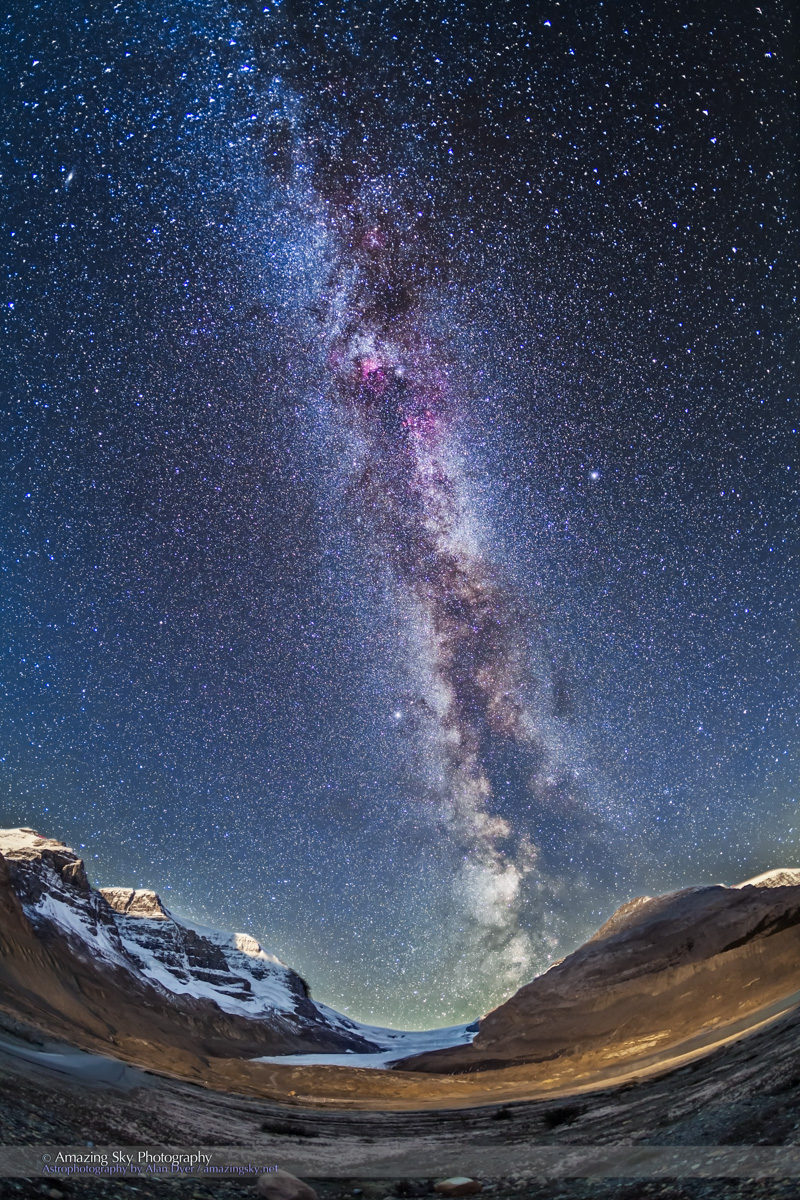
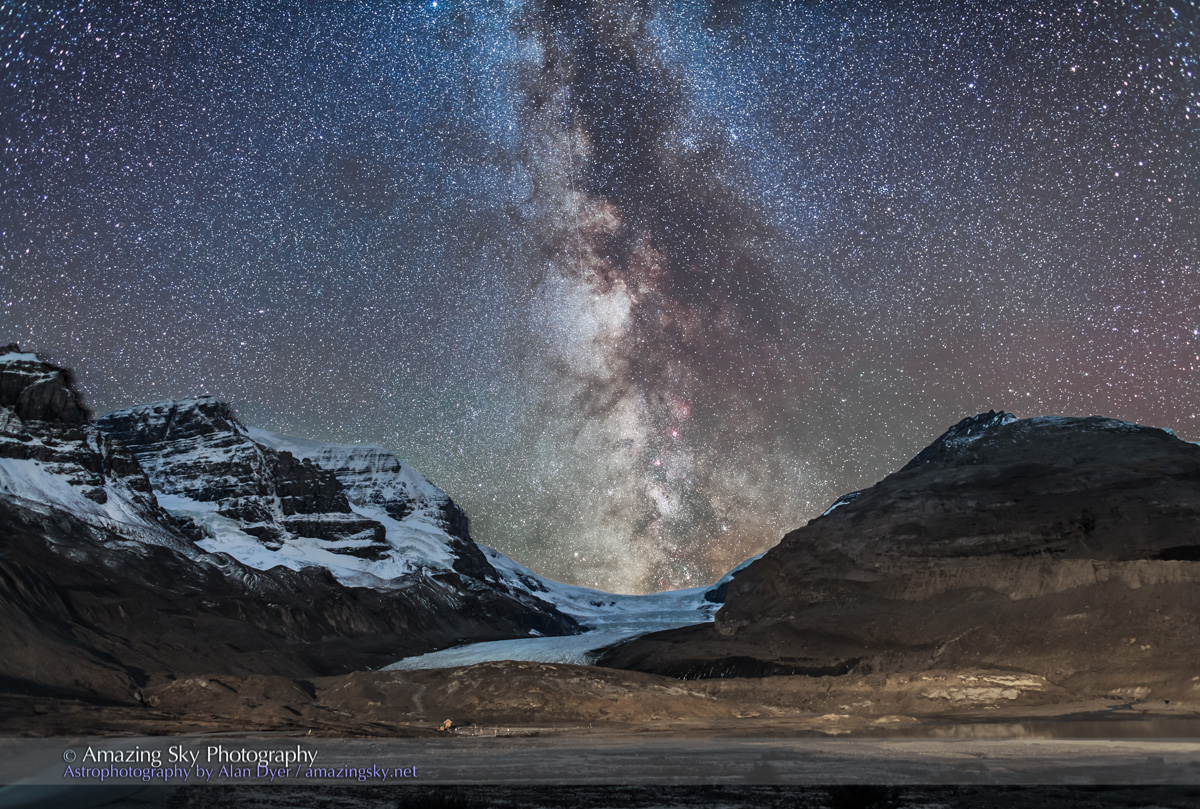
Milky Way Over the Icefields


Milky Way Over the Icefields

The Milky Way towers over the moonlit peaks around the Columbia Icefields

Last Sunday was a productive night, resulting in several 5 Star images in my catalog!

This is another, shot shortly after the Galaxy and Glacier image. In that image the sky was still dark. In this image the sky is beginning to light up with moonlight from the rising waxing Moon.

The peaks are being lit by the Moon, though the valley below is still in moonshadow.

What light there is on the foreground moraines is from starlight, and from the unfortunate wash from unshielded sodium vapour lights on the Icefields Centre. They proudly claim their lights are dark-sky friendly. They aren’t! This is proof.

The top image is a stack of tracked (for the sky) and untracked (for the ground) exposures to create a deep, rich Milky Way over a sharp landscape.

The image is helped by being shot with a filter-modified camera that records the red nebulas along the Milky Way better than stock cameras. That’s why the North America Nebula at top in Cygnus really pops!

Icefields at Moonrise Panorama

This 360° panorama image is a stitch of 8 segments at 45° spacings, each untracked, shot in rapid succession with the same 15mm ultra-wide lens I used for the main image, again oriented portrait, with the frames stitched in PTGui.

I shot it on the road, literally, that leads down to the toe of Athabasca Glacier.

I took the pan just after the image at top, so the peaks are lit more and the sky is bluer with moonlight. The Moon itself is still behind the mountains to the left (east) about to clear the ridge moments after I finished this pan. It was a busy night of getting shots timed right!

But waning Moon nights are superb for nightscape imaging as they provide both dark and moonlit skies but without the immense light of a Full Moon that tends to wash out the sky too much. Waning Moon nights are great for shooting landscape features to the west, as they get lit by the rising Moon after midnight.

P.S.: A tip – hit “Tips and Techniques” under Category at left for more blogs with tips and techniques!

– Alan, September 19, 2014 / © 2014 Alan Dyer


Andromeda over Mt. Andromeda


Andromeda over Mt. Andromeda #2

The stars of Andromeda and the autumn sky shine over Mount Andromeda.

This is a photo I’ve been after for several years, one practical to take only in early autumn. Last Sunday night, the skies were ideal.

This is the constellation of Andromeda over its namesake peak, Mt. Andromeda, at right.

The mountain was named in the 1930s by pioneering mountaineer Rex Gibson for the mythological princess. Andromeda is represented in the sky by an arc of stars, here at top centre, stretching from the Square of Pegasus, at right of centre, to Perseus, at left. Just above the main stars of Andromeda lies the oval glow of the Andromeda Galaxy.

The bright object at lower left is the overexposed waning quarter Moon rising in the southeast. Above it are the Pleiades rising.

I shot this from the Forefield Trail just up from the parking lot for the Toe of the Glacier walk to Athabasca Glacier, just off frame to the right. The hills in the foreground are the lateral moraines from the rapidly retreating glacier.

P.S. This my 500th blog post, a major milestone I would think! Thanks for being a fan and reading along. I hope you are enjoying my tours of what is truly an amazing sky.

– Alan, September 17, 2014 / © 2014 Alan Dyer

Galaxy and Glacier


Milky Way over Athabasca Glacier

The centre of the Milky Way Galaxy sets behind the Athabasca Glacier and Columbia Icefields. 

This was one of the clearest nights I have ever seen at the Icefields. Unlike most nights, last night not a whiff of high cirrus was wafting off the great sheets of ice in Jasper National Park, leaving the sky pristine for the Milky Way to shine over the glaciers.

I shot this image Sunday night, September 14, from the approach road down to the tongue of the Athabasca Glacier. At this time of year, the Milky Way sets directly behind the glacier in the early evening. The angles were perfect.

At left is the glacier-clad peak of Mt. Andromeda, indeed named for the constellation and mythological princess. It is lit just by starlight. The waning Moon didn’t rise until 11:30 p.m., leaving me a couple of hours of dark sky to shoot these and other images.

To record the scene I shot and composited two versions of the image:

– one from a stack of four tracked images where the camera followed the stars on a small mount (the Sky-Watcher Star Adventurer) in order to build up the image and, admittedly, record far more detail and colour than your eye could ever see in the Milky Way.

– the sharp landscape comes from another stack of four images where I turned the tracking drive off so the ground wouldn’t blur. Stacking them helps reduce noise.

I composited the two sets of images, masking the sky from the untracked images and the ground from the tracked images. Perhaps that’s all a bit of trickery but the scene is real – the Milky Way really was there behind Athabasca Glacier.

Each sky exposure was 3 minutes, each ground exposure 4 minutes, all with the 24mm lens at f/2.5 and the Canon 6D at ISO 1250.

– Alan, September 15, 2014 / © 2014 Alan Dyer


Rocky Mountain Nights – A Time-Lapse Collage


My new 4-minute video presents time-lapse and still images shot in the Rockies this past summer.

It’s been a busy summer for shooting. Since July I’ve spent a week each in Banff, Jasper and Waterton Lakes National Parks shooting nightscape stills and time-lapse videos of Alberta’s famous Rocky Mountain landscapes by night. 

This compilation includes some of the best footage, plus some panned still images, set to a wonderful piece of royalty-free (i.e. legal!) music by Adi Goldstein. 

For many of the sequences I employed “motion control” (MoCo) devices that incrementally move the cameras during the one to three hours that they are taking the 200 to 450 frames needed for a time-lapse sequence. 

I used the compact single-axis Radian, the 2-axis eMotimo, and the Dynamic Perception Stage Zero dolly, now equipped with their new Stage R single-axis panning unit. This was the first summer with the eMotimo and Stage R, so I’m still learning their best settings for speed, angles, and ramping rates. 

In recent blogs you’ve seen many still images shot as part of these sequences, or with other cameras dedicated to shooting stills. Now you get to see some of the time-lapse videos that represent many nights of shooting, and many hours sitting in the car waiting for the automated camera gear to finish its shooting task. 

Time-lapse shooting is an exercise in dedication and self-denial!

I hope you enjoy the result. Do click on the Enlarge button to go full-screen. Or visit my Vimeo site to watch the video, and others, there.

– Alan, September 10, 2014 / © 2014 Alan Dyer


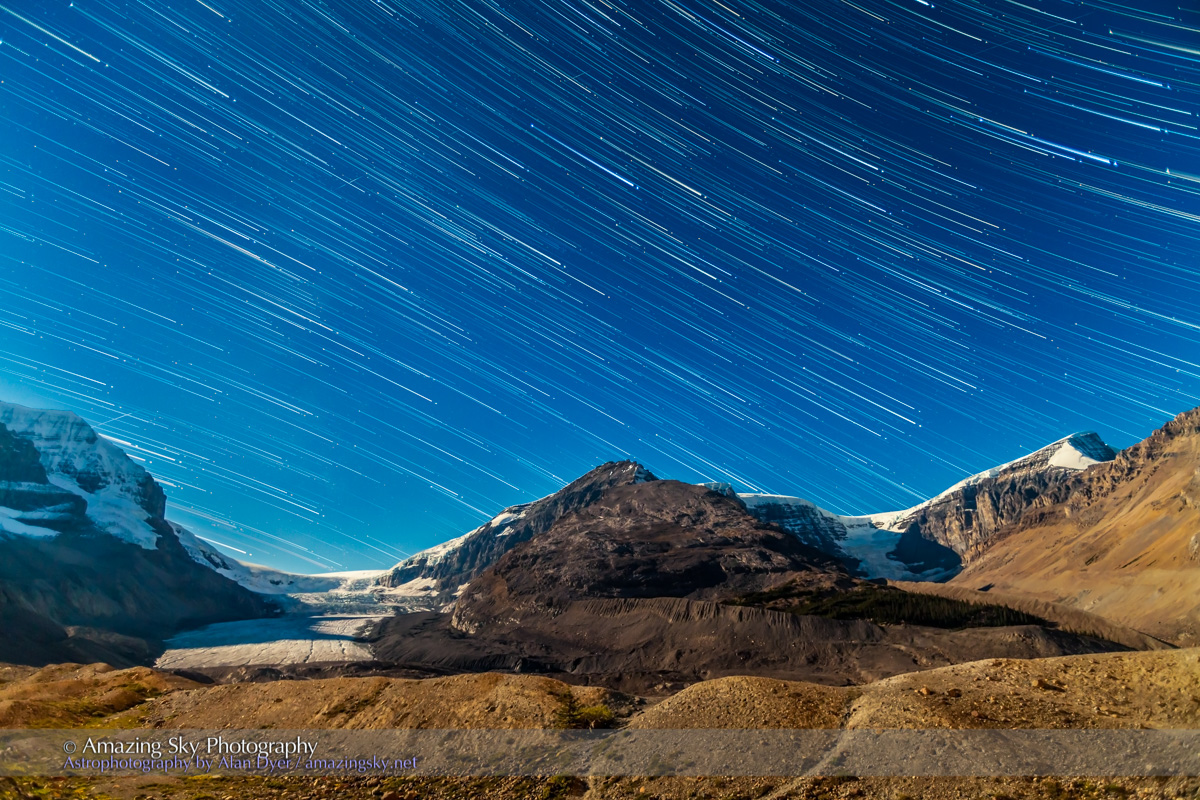
Stars on Ice – The Columbia Icefields by Moonlight


Star Trails over Columbia Icefields

The stars trail over the glaciers of the Columbia Icefields.

What an amazing night this was! You rarely get pristine cloudless skies over the Icefields. Some cloud is almost always blowing off the ice. But last Saturday in Jasper National Park was as clear as it gets.

The Moon was bright, as a waxing gibbous just off frame at left. It lit the landscape like it was day.

I shot with two cameras, one doing a time-lapse motion control sequence panning across the scene. The other was a fixed camera shooting 20-second exposures at 1-second intervals. The resulting frames from the fixed camera, 270 in this case, are multi-purpose:

– I stacked about 100 of them to make the star trail composite above. Two frames supplied the stars at the beginning and end of the trails. Another single frame supplied the ground, to avoid the shadows being blurred by the Moon’s motion if you used the ground composited from all 100 frames.

– I can also take the full set of 270 frames and sequence them into a time-lapse movie of the stars moving over the landscape.

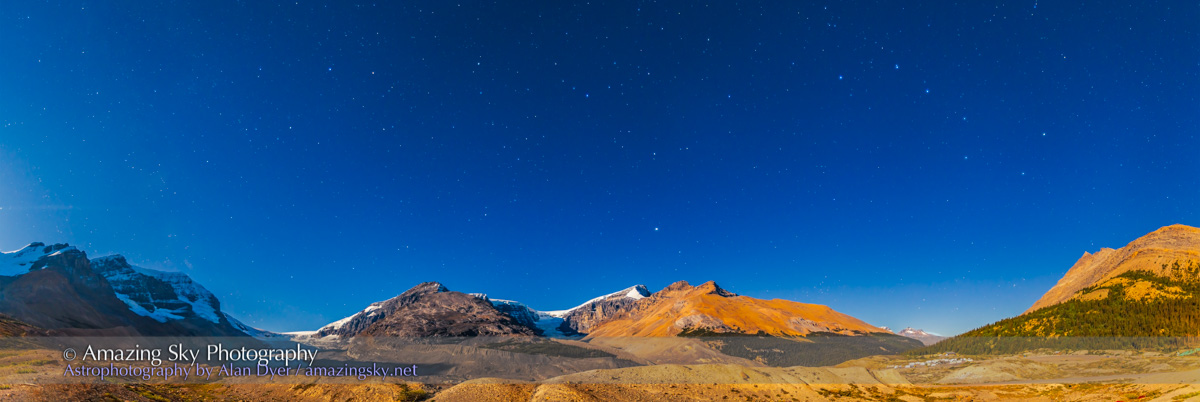
Stars over the Columbia Icefields Panorama

Before beginning the time-lapse sequences I shot this 180° panorama, made of 5 segments stitched in PTGui software. It extends from the southwest at left, where the Milky Way is barely visible, to the north at right, with the Big Dipper over the Icefields Parkway.

Click on it for a bigger view.

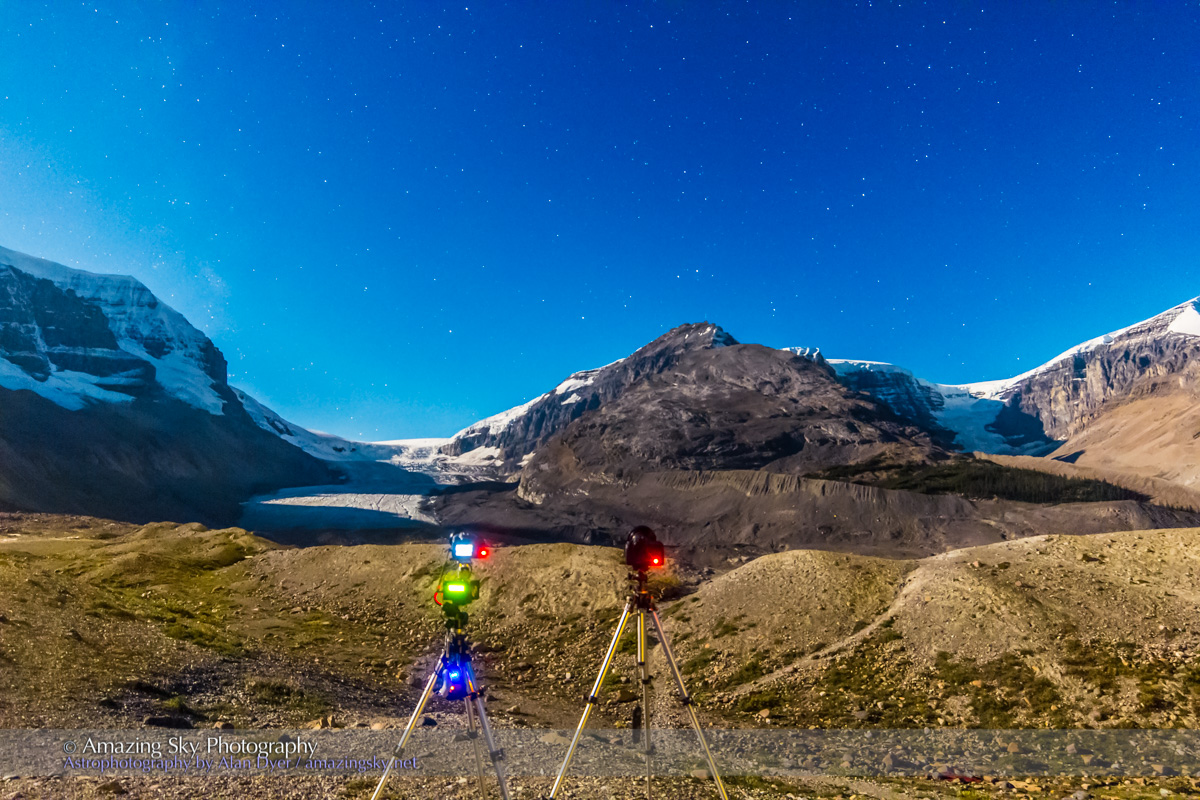
Shooting at the Icefields

This is the camera setup, with the camera on the right taking the star trail image I feature at top.

The Athabasca Glacier is at left, the Stutfield Glacier at right.

Icefields Parking Lot at Night

Midnight under moonlight is when to see the Icefields! This is the lower parking lot, at the start of the trail up to Athabasca Glacier. This is packed with cars, RVs and buses by day, but at night I was the only one there.

– Alan, Sept, 8, 2014 / © 2014 Alan Dyer


Stars over Mt. Edith Cavell


Mt Edith Cavell by Starlight

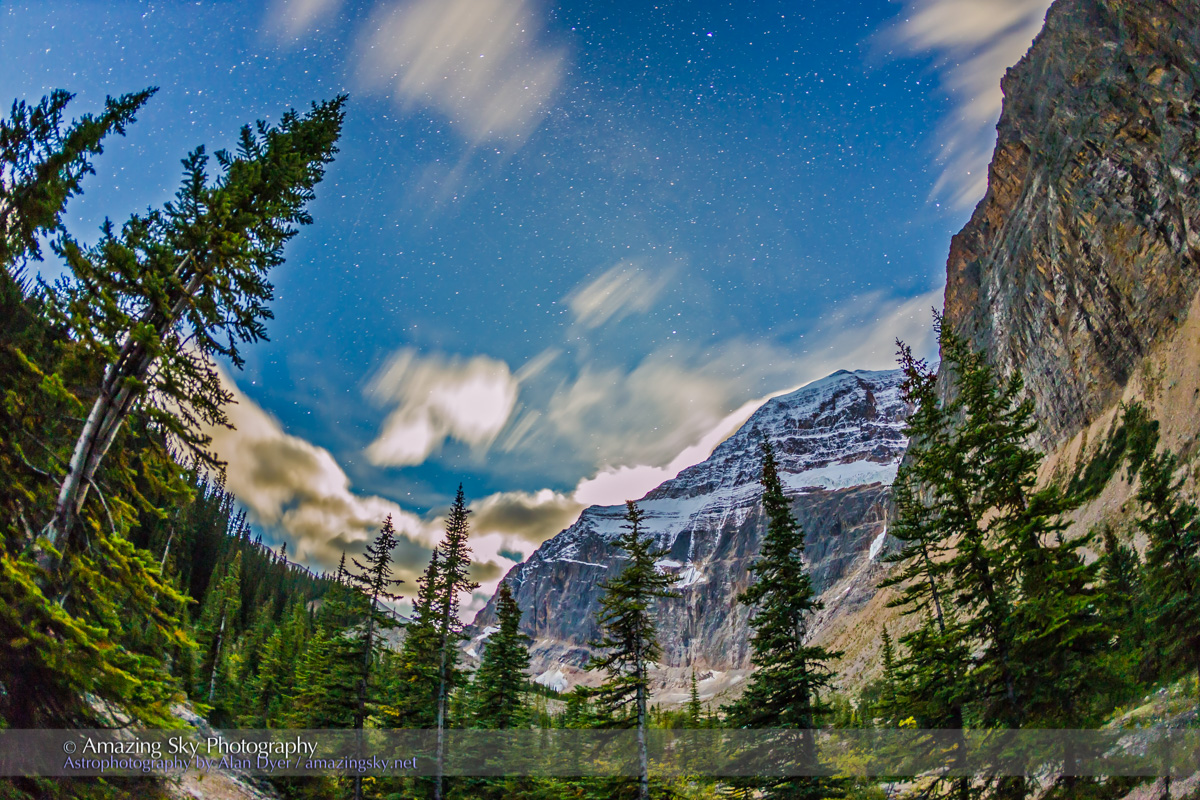
The stars of the summer sky shine over the North Face of Mt. Edith Cavell.

The valley below Mt. Edith Cavell in Jasper National Park is one of the most impressive locations in the Canadian Rockies. At few other sites do you get the sense of standing at the foot of a vertical mountain face.

I shot this view last Friday night, when the waxing Moon was behind the mountain, lighting the clouds and sky but not the mountain and valley directly.

But enough scattered light came from the sky to light the foreground and mountain face to make a nice photo with detail in both earth and sky.

Use of highlight and shadow recovery in Adobe Camera Raw also helps a lot!

Mt. Edith Cavell Trail at Twilight Panorama

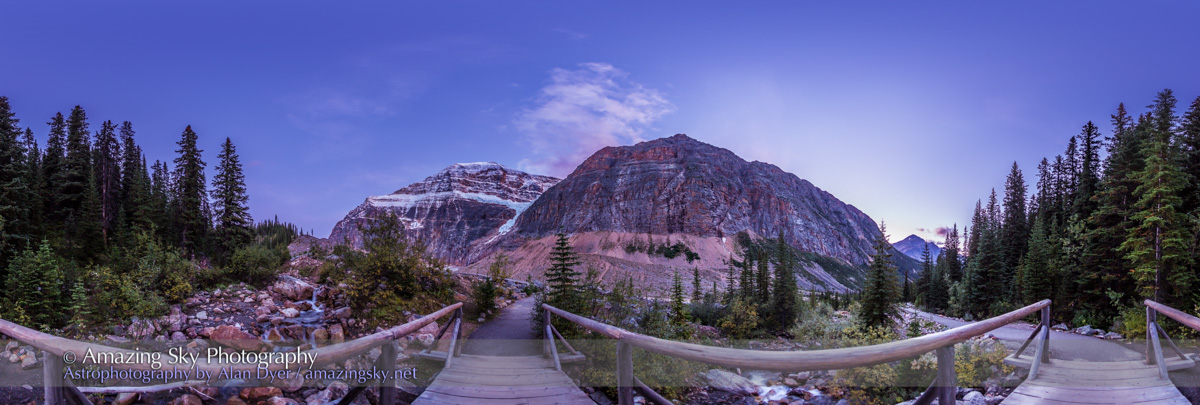
This view is a 360° ground-to-zenith panorama I shot earlier in the evening in twilight. It’s from the Trail of the Glacier path, where the path crosses Cavell Creek.

Mt. Edith Cavell was named in 1916 after the World War One nurse who was executed by the Germans for assisting allied soldiers escape occupied Belgium.

– Alan, September 8, 2014 / © 2014 Alan Dyer


Pyramid Island Sky Panorama


Panorama from Pyramid Island Boardwalk, Jasper Park

The sky presents a panoramic show from Pyramid Island in Jasper National Park.

What a wonderful place to watch the stars. Last night I walked out to Pyramid Island in Jasper, via the historic boardwalk built in the 1930s. The site provides a panorama view around the lake and sky.

To the left is the “mainland.” Just left of centre the waxing gibbous Moon is setting over Pyramid Lake.

To the right of centre, the boardwalk leads out the small island, with Pyramid Mountain behind it.

To the right of the frame, a faint aurora glows to the northeast over the still waters of the lake.

This is a 360° panorama shot with the 15mm full-frame fish-eye lens in portrait orientation, with the segments stitched with PTGui software.

Big Dipper over Pyramid Mountain from Pyramid Island

After shooting some panoramas I walked to the end of the island and shot this view looking north and northwest to Pyramid Mountain. The Big Dipper is to the right of the peak, and the aurora lights up the northern horizon at right.

As I shot these images, the night was absolutely quiet. Until the wolves began to howl at the north end of the lake, in mournful howls that echoed across the waters.

It was one of the most spine-chilling moments I’ve experienced in many years of shooting landscapes at night.

– Alan, September 5, 2014 / © 2014 Alan Dyer


Star Trails over Athabasca Falls


Star Trails over Athabasca Falls

The autumn stars rise in trails over Athabasca Falls and Mt. Kerkeslin in Jasper National Park.

Last night was a good one for shooting nightscapes in Jasper. Skies cleared for a beautiful moonlit night, ideal for nightscape shooting.

I went to Athabasca Falls, a popular scenic attraction in Jasper but deserted after dark. I set up cameras at the usual overlook, shooting both a time-lapse and star trail set.

The main image above is the result of stacking 100 images in the star trail set. I used the Advanced Stacker Plus actions from Star Circle Academy.

The foreground comes from one image, shot early in the sequence when the Moon lit more of the landscape. The Falls themselves remained in shadow, as I had expected from my lighting angle calculation and knowing the site.

The star trail image shows the autumn stars of Andromeda, Cassiopeia ad Perseus rising over Mt. Kerkeslin, the famous backdrop to Athabasca Falls on the Athabasca River, making its way to the Arctic Ocean

Mt Kerkeslin & Athabasca River at Twilight

This image is a 4-segment panorama I shot earlier in the evening in the twilight, with the waxing Moon over the Athabasca River.

In the early 1800s, after explorer, astronomer, and fur trader David Thompson had to abandon his original route over the Rockies at Howse Pass, he came north, and followed the Athabasca and Whirlpool Rivers up over the Athabasca Pass, his new main route to the B.C. interior.

– Alan, September 4, 2014 / © 2014 Alan Dyer


Big Dipper over Pyramid Mountain


Big Dipper over Pyramid Mountain

The Big Dipper shines through clouds over Pyramid Mountain in Jasper National Park.

This week I am in Jasper National Park for a shoot of moonlit nightscapes, weather permitting.

It barely permitted last night, as clouds cleared briefly to the north. I visited a favourite spot on the shore of Patricia Lake, with Pyramid Mountain as a backdrop to the north.

The sky was still lit by the setting Moon, and by some faint aurora. The landscape is lit by starlight.

With luck I’ll get more images of Jasper by night this week, in one of Canada’s largest Dark Sky Preserves.

– Alan, September 2, 2014 / © 2014 Alan Dyer


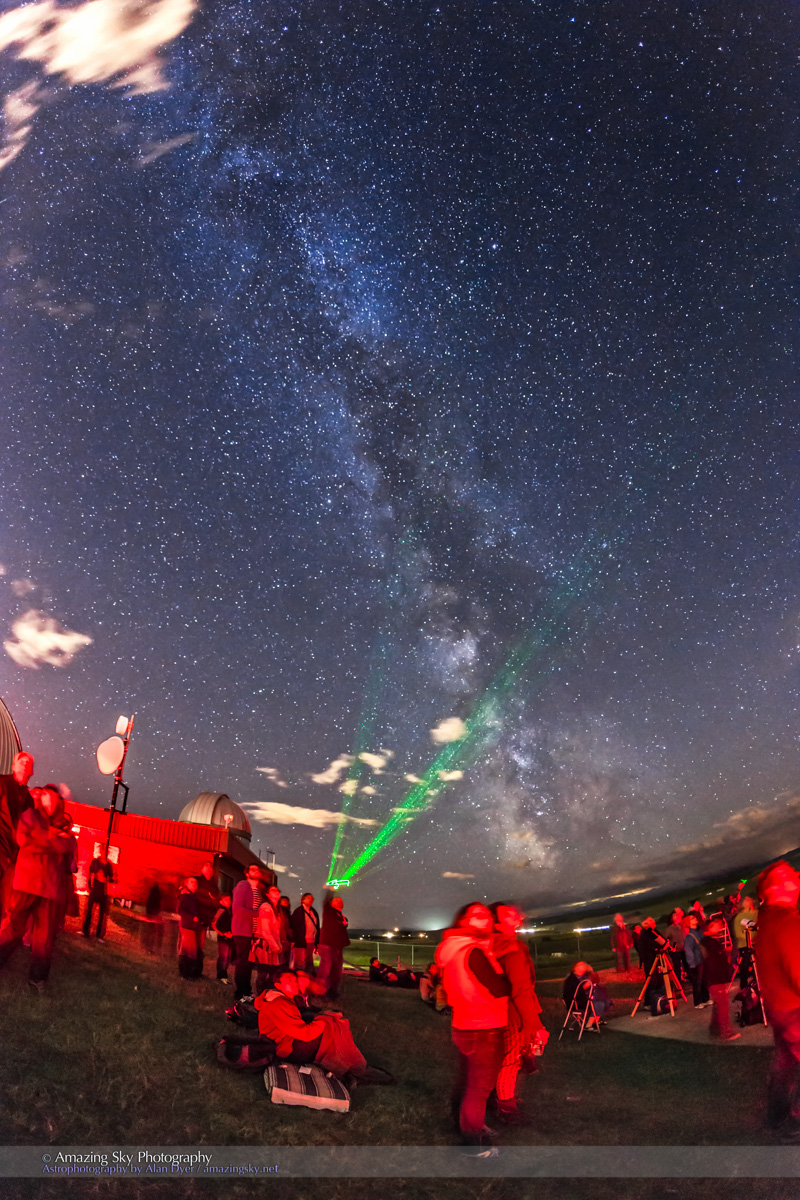
Marvelling at the Milky Way


RAO Milky Way Night Panorama

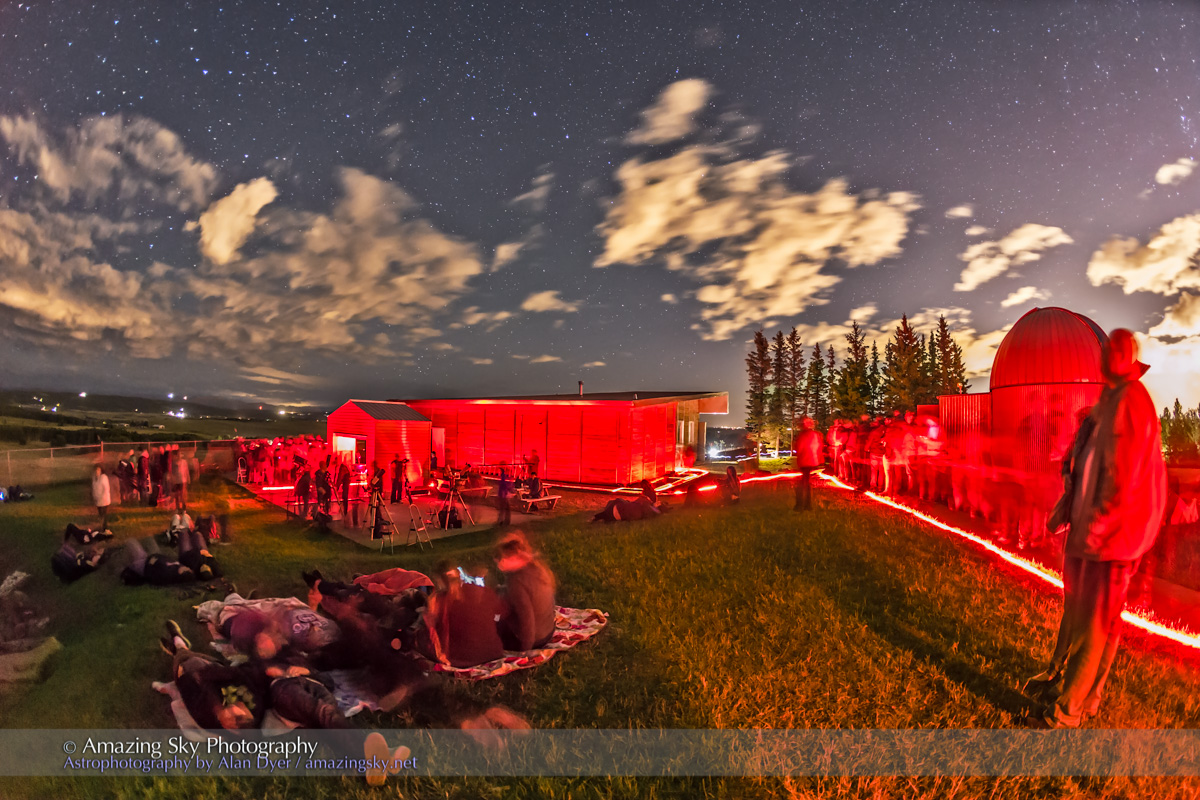
People gather at a rural observatory to gaze at the Milky Way on a summer night.

The clouds drifted through now and then but skies were mostly clear for the last of the Rothney Astrophysical Observatory‘s annual Milky Way Nights for 2014.

A tradition since 2009 and the Year of Astronomy, these dark-of-the-moon nights at the Observatory have proven hugely popular each summer despite the 10 p.m. start and 2 a.m. finish!

The main image at top shows a 360° panorama as people were gathering at the portable telescopes and lining up – in a blur – for a look inside the observatory domes.

RAO Milky Way Night #1 (Aug 30, 2014)

Roland from the Royal Astronomical Society of Canada provided laser-guided star tours. How did we point out the stars and constellations before green lasers? In the hands of responsible astronomers they are a great tool for public education.

RAO Milky Way Night #4 (Aug 30, 2014)

Here he’s pointing out Vega and the stars of the Summer Triangle. Look way up!

About 400 people attended on Saturday night, the last in a trio of nights this past week. As you can see, the event attracts people of all ages. It’s even a popular date night attraction.

RAO Milky Way Night #6 (Aig 30, 2014)

At these summer stargazing sessions many people bring blankets to just lie back and look up, at a site away from the ugly glow of the city, here lighting up the clouds to the north.

It was a great night of public stargazing!

– Alan, August 31, 2014 / © 2014 Alan Dyer


Dawn Conjunction of Venus and Jupiter


Venus & Jupiter Conjunction, with Moon (August 18, 2014)

It was a fine celestial sight to begin the week, as Venus met Jupiter in the dawn sky.

This morning, August 18, Venus and Jupiter appeared just 1/2 degree apart, as close as they’ve appeared to each other since 1999.

The top image shows the wide-angle setting, with Venus and Jupiter tightly paired near the horizon, and the waning Moon above, itself in conjunction with Aldebaran in the Hyades star cluster.

Venus & Jupiter Conjunction Closeup

This zooms into the main event, the Venus-Jupiter pairing, as they were emerging from the horizon haze.

I shot this from home, off the back deck, having little ambition at 5 a.m. to venture any further afield. I had planned to shoot this from Dinosaur Park but had second thoughts on the hour drive there and back!

Waning Moon in the Hyades near Aldebaran

This zooms into the secondary show this morning, the meeting of the waning crescent Moon with the brightest star in Taurus, Aldebaran, and its companion stars in the Hyades star cluster. This is a telephoto lens shot with a fixed camera, no tracking.

Thus begins a fine two weeks of stargazing, weather permitting, as the Moon exits the sky to leave us the summer Milky Way at its best, and dual pairs of planets in the dusk and dawn sky – Mars and Saturn converging in the evening and Venus and Jupiter, now parting ways, in the morning.

– Alan, August 18, 2014 / © 2014 Alan Dyer


Twilight and Moonlight at Waterfowl Lakes


Twilight at Waterfowl Lakes

Peaks of the Continental Divide reflect in the calm waters of Lower Waterfowl Lake.

These images provide a sense of what a beautiful night this was, last Monday on the Icefields Parkway in Banff.

The evening started with a super-clear twilight providing subtle shadings – from the last glow of sunset on the horizon, through the “twilight purple” above, to the deep blue of the darkening sky at top.

The purple hue comes from red sunlight still illuminating the upper atmosphere and blending with the blue sky from the usual scattering of short blue wavelengths.

The twilight scene is a high-dynamic range blend of several exposures processed with Photoshop’s HDR Pro as a 32-bit file in Adobe Camera Raw.

Star Trails over Waterfowl Lke v1

Taking different frames from the same set that I used to capture the Space Station I created this star trail scene, of the western stars setting over Mt. Cephren. Light from the one-day-past Full Moon illuminated the peaks that line the Continental Divide.

The star trail scene is a composite – of many images stacked to create the star trails, blended with a masked single image from the set to supply the landscape.

For the star trail stacking I used the excellent Advanced Stacker Plus actions from Star Circle Academy. To separate and mask out the sky from the landscape image I used Photoshop’s Quick Selection tool and its wonderful Refine Mask function.

– Alan, August 16, 2014 / © 2014 Alan Dyer


Sunset over David Thompson Country


Howse Pass Viewpoint Panorama (Partial)

The setting sun lights the clouds over the river plains of the North Saskatchewan.

This was the panoramic view two evenings ago from the Howse Pass viewpoint on the Icefields Parkway in Banff.

We’re looking south over the North Saskatchewan River near its junction with the Howse and Mistaya Rivers. The spot is near where Highway 11, the David Thompson Highway, comes in from the east to join the Parkway. It’s a modern highway now but 200 years ago this was a main canoe route for the fur trade.

The area is known as David Thompson Country, named for the great explorer, surveyor, and celestial navigator who mapped much of western Canada in the early 1800s.

Until about 1810, Thompson passed this way every year en route to the fur trade forts he set up in the B.C. interior, his main job for the North West Company.

Conflicts with the local Pikanii people, who objected to Thompson trading with and arming their traditional enemies, the Kootenais, forced Thompson to find a new route across the Rockies, the Athabasca Pass in what is now Jasper National Park.

Howse Pass Viewpoint Sunset Panorama (Full)

The top image is a 180° panorama, the bottom image is a full 360° panorama from the viewpoint. In the distance are Mt. Murchison, at left, and Mt. Cephren in the far distance, the prominent peak by Waterfowl Lakes.

I shot these with a 14mm lens, in portrait orientation, and stitched them with PTGui software. The top image is made from 6 segments, the bottom from 12 segments.

The software blended them perfectly, no small feat in such a uniform twilight sky. I’m always impressed with it!

– Alan, August 14, 2014 / © 2014 Alan Dyer


Meteors and Space Stations over Mt. Cephren


Perseid Meteors over Mt. Cephren, Banff

A couple of Perseid meteors streak across the moonlit sky above Mt. Cephren in Banff National Park.

The night before the peak of the annual Perseid meteor shower was very clear for the first couple of hours. On Monday, August 11, I positioned myself at the shore of Lower Waterfowl Lake, at a roadside viewpoint on the Icefields Parkway in Banff National Park, Alberta.

I had two cameras going, one on a fixed tripod aimed west in hope of catching some meteors in a few frames. Two did, and the main image is a composite of those two frames, as the Perseids shoot over the pyramid peak of Mt. Cephren.

Space Station over Mt. Cephren, Banff (Composite)

Later, the Space Station also flew over, accompanied by the European ATV cargo ship, captured here in a stack of 18 frames from the 555-frame time-lapse, showing their pass from west to east (bottom to top) of the composite image. The gaps are from when the shutter was closed for 1 second between the 15-second-long exposures with the 14mm ultra-wide lens.

In all, it was a warm and beautiful night, with the normally busy viewpoint all to myself all night, under the light of the nearly Full Moon.

The mountains by moonlight are truly magical.

– Alan, August 13, 2014 / © 2014 Alan Dyer


Super Moonrise over Banff


Super Moonrise over Banff

A much-publicized “super moon” rises over Mt. Rundle and Banff townsite.

I joined a small crowd of moon watchers at the Mt. Norquay viewpoint last night, Sunday, August 10, to view the rising of the super moon, the closest Full Moon of 2014.

Of course, no one could possibly detect that this moon was any bigger or brighter than any other moon. Nevertheless, everyone saw an impressive sight and went away happy.

I shot this image at the end of a 700-frame time-lapse, at about 10:15 p.m. This is an HDR “high-dynamic-range” stack of 8 exposures, from dark and underexposed (to capture the bright sky around the Moon) to bright and overexposed (to capture the foreground and dark trees).

Yes, I have cranked up the HDR effect a little, to beyond “natural.” But I think the result looks striking and brings out the structure in the clouds that hid the Moon at first.

Think what you will of “super moons,” they get people outside, looking up and marvelling. In this case, the PR prompted a moonwatch party on a fine summer Sunday evening in one of the most scenic places on the planet.

– Alan, August 11, 2014 / © 2014 Alan Dyer


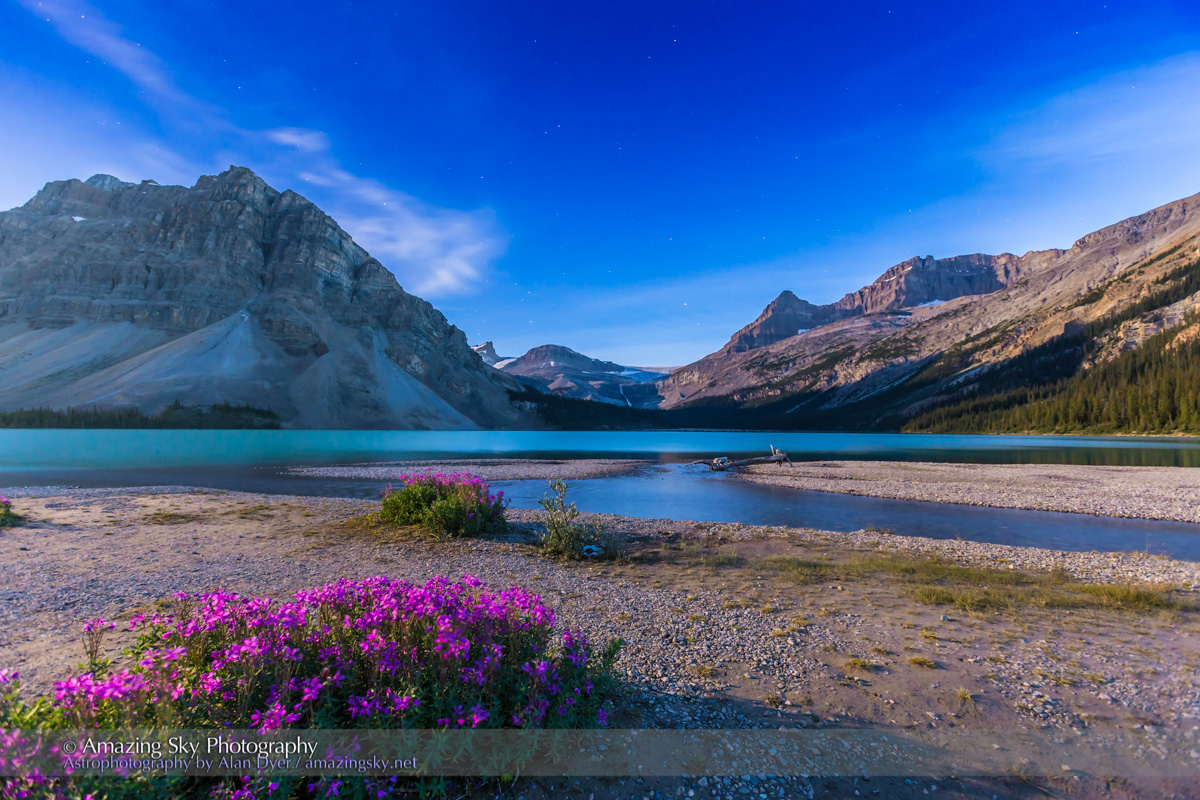
Super Moonrise at Bow Lake


Full Moon and Flowers at Bow Lake

The nearly Full Moon rises over Bow Lake, Banff then lights up the landscape.

Saturday night was a stunning night to shoot nightscapes in Banff. Skies were mostly clear, allowing the nearly Full Moon, a day before the much-hyped “SuperMoon,” to light the landscapes.

I began last night’s shoot at Bow Lake looking south toward the rising Moon over the mountain fireweed flowers.

Twilight at Bow Lake

Shooting the other way toward Bow Glacier reveals this moonlit scene, in a frame I shot as part of the set up for a time-lapse movie. I had three cameras going, each shooting about 350 frames. The computer is processing them as I type. Still-image “nightscapes” like these are so much easier!

When I arrived I thought I wouldn’t be surprised to find other time-lapsers present, at such a great spot on a perfect night.

Sure enough, Shane Black from Ohio was setting up for a twilight shoot with much the same gear I use – a Dynamic Perception Stage Zero dolly system and eMotimo 2-axis motion controller. I was able to help Shane out by supplying a battery to power the rig when his was dying. Glad to help a fellow time-lapser! Good luck on the rest of your cross-country tour

– Alan, August 10, 2014 / © 2014 Alan Dyer


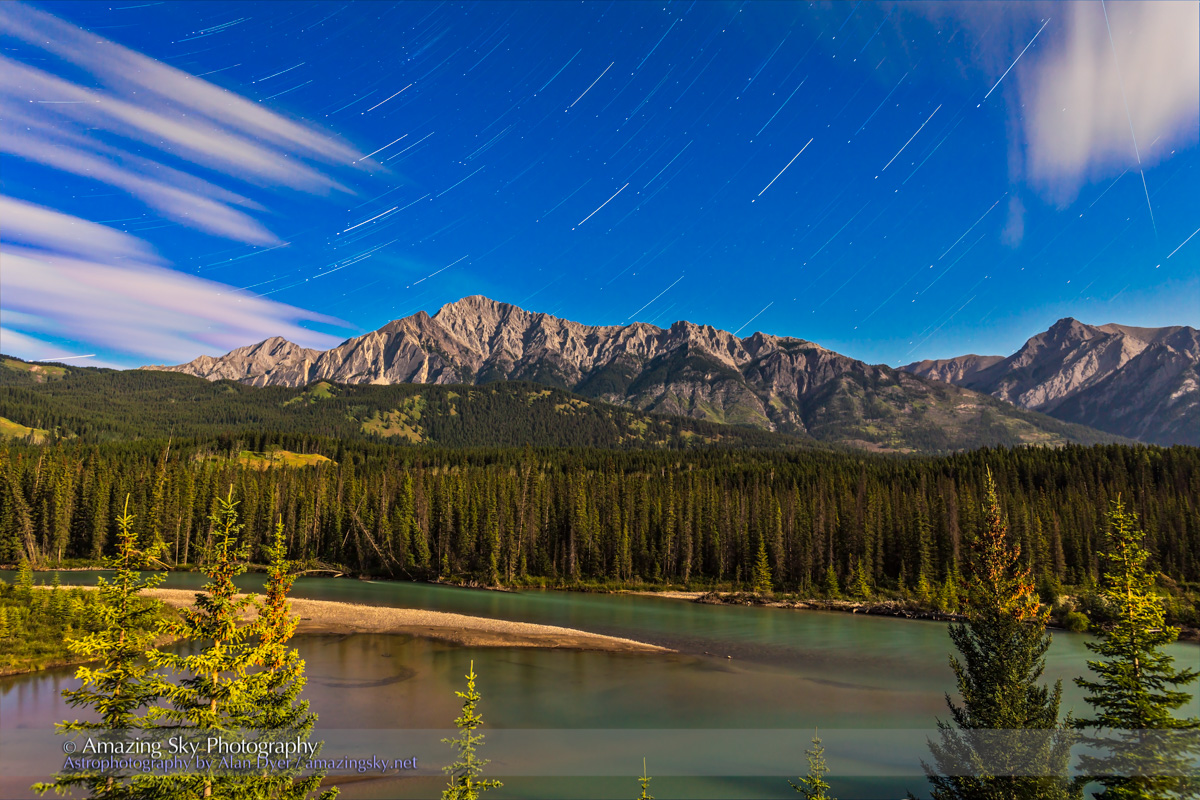
Andromeda Rising


Andromeda Rising over Bow River

The stars of Andromeda and Perseus rise over the Rockies and Bow River in Banff.

It was a beautifully moonlit night last night, in Banff National Park. I shot the images for this star trail at a well-trodden viewpoint overlooking the Bow River. We’re looking east to the stars of the autumn sky in Andromeda and Perseus rising over the Front Ranges of the Rockies.

The waxing gibbous Moon behind me lights the landscape and sky.

The photo is a stack of 5 images: one a short 40-second exposure at ISO 1600 for the point-like stars, followed after a gap in time by a set of four closely-spaced 6-minute exposures at ISO 100, to give the long star trails.

Shooting a handful of long exposures is the alternative to shooting dozens or hundreds of short exposures when you’re after star trails, and you don’t have any desire to collect a set you can turn into a time-lapse movie.

Indeed, shooting any time-lapses from this spot would have been futile – the location was a busy rest stop on the Trans-Canada Highway with cars and trucks pulling in, their headlights lighting up the foreground from time to time. But for still images, the site worked fine.

– Alan, August 9, 2014 / © 2014 Alan Dyer


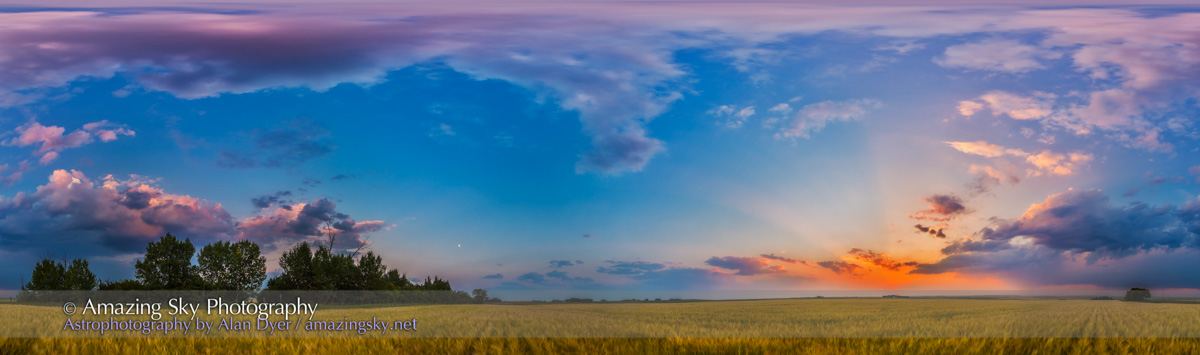
Prairie Sunset Panorama


Prairie Sunset Panorama

What a spectacular sunset tonight. The Sun is just going down in a blaze of red, while the waxing Moon shines in the deep blue twilight.

I grabbed the camera fast when I saw this happening out my front window, and raced out to the ripening wheat field across the road.

The top image is a 360° panorama of the sky, with the Sun at right and the Moon left of centre. The zenith is along the top of the image.

I used a 14mm lens in portrait mode to cover the scene from below the horizon to the zenith, taking 7 segments to sweep around the scene.

You can see the darkening of the sky at centre, 90° away from the Sun, due to natural polarization of the skylight.

Red Sun in a Prairie Sunset

I shot this sunset image a little earlier, when the Sun was higher but still deep red in the smoky haze that has marked the sky of late. It certainly gives the scene a divine appearance!

This is a 5-exposure high-dynamic-range composite to capture the tonal range from bright sky to darker ground, the wheat field. I increased the contrast to bring out the cloud shadows – crepuscular rays.

I boosted colour vibrancy but didn’t alter the actual colours – it was a superb sky.

I used PTGui v10 to stitch the panorama at top and Photomatix Pro to stack and tone the HDR set. While Photoshop is wonderful it did not work for assembling either of these images.

– Alan, August 6, 2014 / © 2014 Alan Dyer


Wheatfield Moon and Planets


Wheatfield Moon and Planets

The waxing Moon begins its three-day passage past Spica, Mars and Saturn in the twilight sky.

This was the scene tonight, August 1, from a wheat field near home, as the waxing Moon appeared to the right of the star Spica in Virgo.

To the east, or left, of those two objects lies Mars, at the centre of the frame. To the left of Mars is Saturn, flanked by stars in Libra.

The Moon was near Spica tonight but will appear near Mars Saturday night and near Saturn on Sunday night.

Look low in the southwest as the sky is getting dark.

— Alan, Aug 1, 2014 / ©2014 Alan Dyer


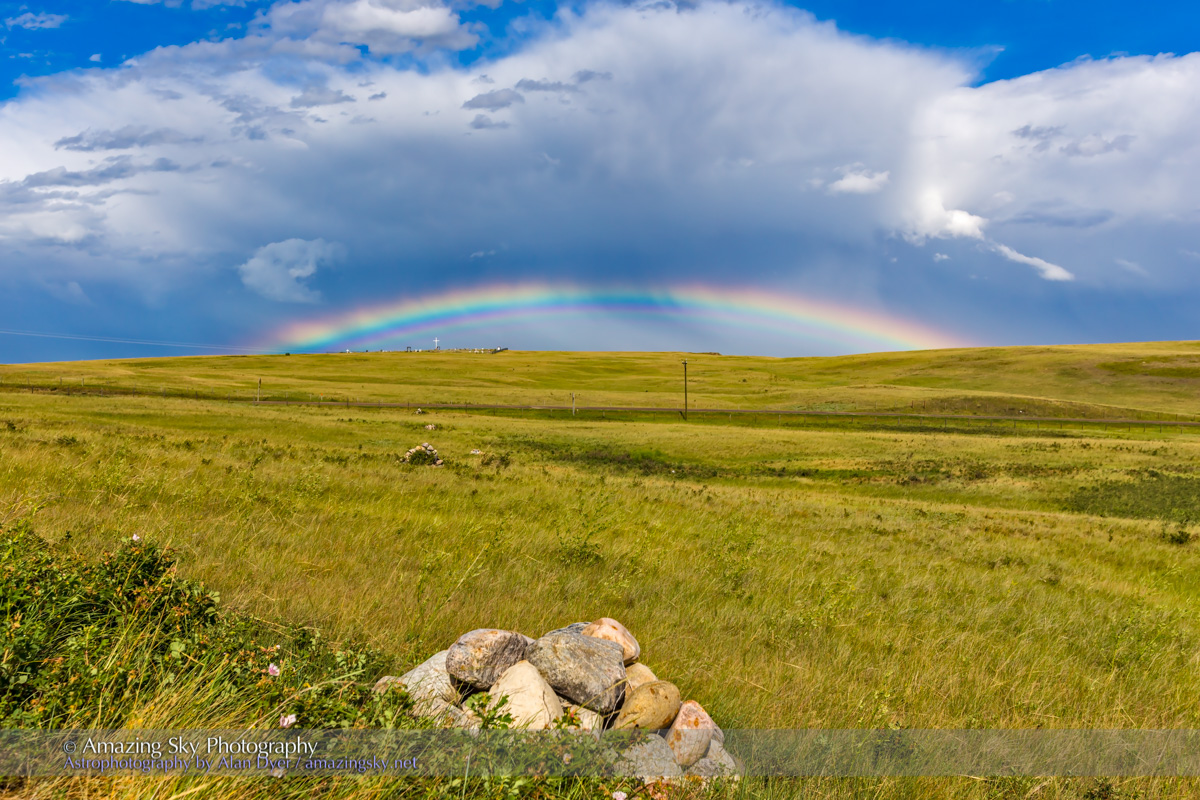
Rainbow at Blackfoot Crossing


Rainbow at Blackfoot Crossing #2

A low rainbow shines beneath a retreating thunderstorm at Blackfoot Crossing Historical Park.

On my way home from Waterton Lakes I drove through a thunderstorm, then watched it retreat and the Sun break through in the west. I was hoping for a rainbow in the east, and sure enough, one appeared.

With the Sun still high in the late afternoon sky, the rainbow was low, with just a small arc appearing above the horizon.

By good luck, I was passing the hilltop Blackfoot Crossing Historical Park, a beautiful museum interpreting the history of the Siksika Nation, and a great place to look out over the prairie.

These photos look down a line of rock cairns running from the interpretive centre to the hilltop cemetery in the distance, below the arc of the bow.

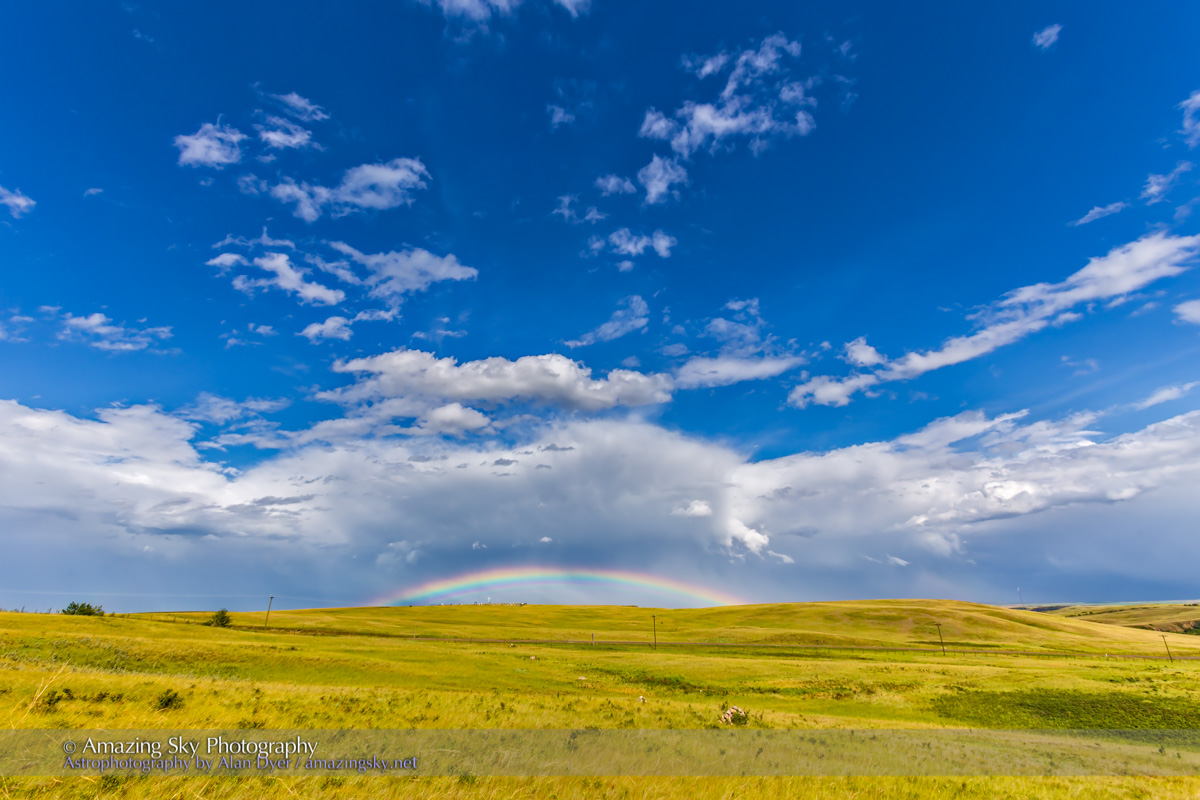
Rainbow at Blackfoot Crossing #1

This wider angle image gives the context, with the bow at the bottom of the thundercloud, and fresh blue sky above.

I love the mountains but it’s nice to be back home on the prairies where we can see the wide horizon.

– Alan, July 20, 2014 / © 2014 Alan Dyer

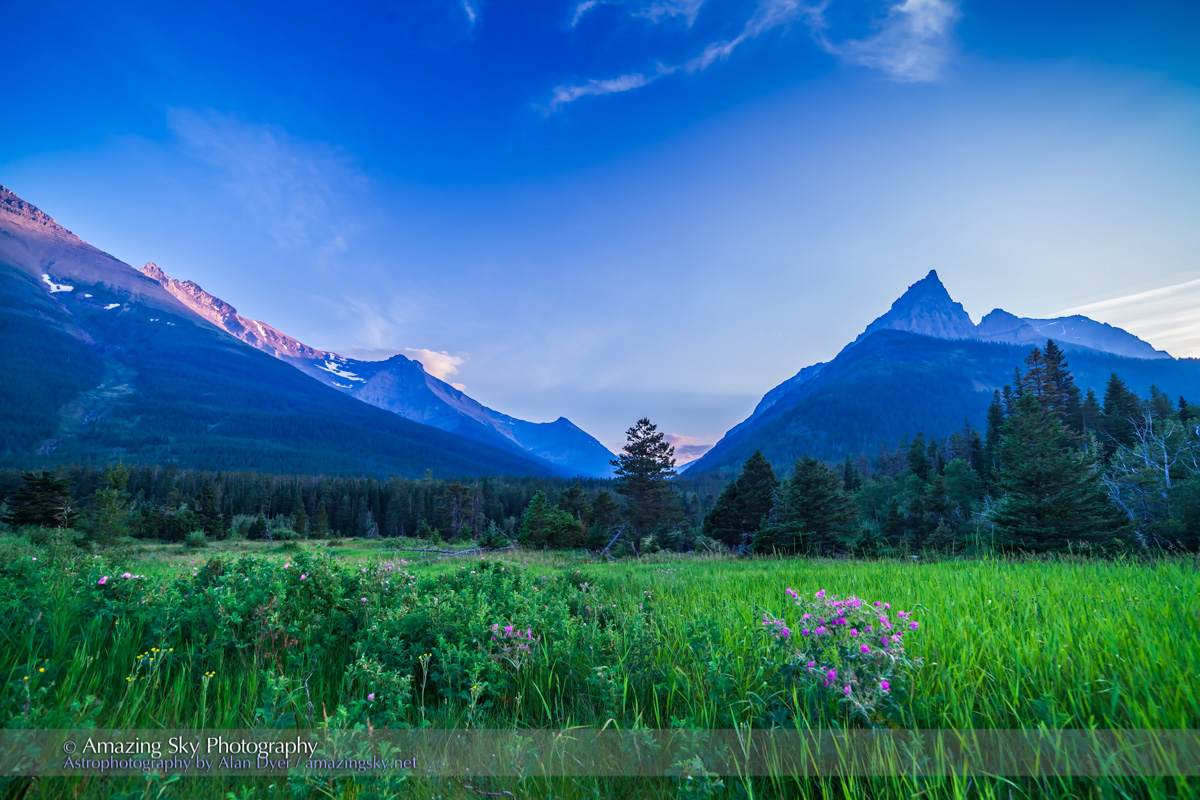
Wild Rose Twilight at Red Rock Canyon


Waterton Wild Rose Twilight

Evening light illuminates the peaks around Red Rock Canyon in Waterton Lakes National Park.

I took this image last evening as part of a time-lapse sequence, framing the wild roses in the foreground and the peaks of Mount Blakiston (at left) and Mount Anderson (at right) in the distance. The site is the popular Red Rock Canyon area of the Park.

The last rays of sunlight are hitting Blakiston.

That peak is named for Thomas Blakiston, the first scientific explorer to map the area of Waterton and the passes of the southern Canadian Rockies. Although at the time he was here in 1858, this was still British colonial territory separated from the United States by an ill-defined border running along the 49th parallel just south of this spot.

Blakiston was part of the British Palliser Expedition, led by John Palliser, whose mission was to survey the little-known region south of the South Saskatchewan River to assess its suitability for settlement.

Palliser concluded that the parched rain-shadow area of what is now southern Saskatchewan and Alberta was “desert, or semi-desert in character, which can never be expected to become occupied by settlers.” That area became known as the Palliser Triangle. Only extensive irrigation made settlement possible.

Blakiston was the expedition’s magnetical observer, taking readings of the Earth’s magnetic field strength and direction throughout the region. He disputed Palliser’s leadership and soon broke away from the expedition to conduct his own treks and compile his own reports. It was Blakiston who named the area after Charles Waterton, a famous British naturalist of the time. The region became a nationally-recognized park in 1895

— Alan, July 18, 2014 / © 2014 Alan Dyer


Sunset over Waterton Lakes


Waterton Lakes Sunset

The setting Sun lights the clouds over Upper Waterton Lake, Alberta.

Waterton Lakes National Park is certainly one of my favourite places. The scenery is wonderful and the town small and quiet. It has all the beauty of Banff with none of the retail sprawl and traffic jams.

I shot the scene above two evenings ago, July 15, from the viewpoint at the Prince of Wales Hotel. It overlooks Middle and Upper Waterton Lakes, the latter lighting up as it reflects the sunset clouds. This is a frame from a motion-control time-lapse.

Waterton Lakes Trees

Last night I shot a time-lapse from the lakeshore, looking through the windswept trees toward the south end of the Upper Lake, as the Milky Way begins to appear in the darkening twilight.

Lights from the campground illuminate the trees with just enough light to balance the foreground and sky. Sometimes you can make use of man-made light.

I’m here at Waterton to conduct some public programs Friday and Saturday night. Skies are clear but hazy with smoke and cirrus clouds. But the days and nights are warm and aren’t windy, a welcome treat in Waterton!

– Alan, July 17, 2014 / © 2014 Alan Dyer


Super Moonrise over Canola Field


Super Moonrise over Canola Field

The orange Full Moon – a hyped “super moon” – rises over a yellow field of canola.

What a colourful sky this was tonight – the pink Belt of Venus twilight band above the blue shadow of the Earth, above the yellow ripening canola.

And the orange Full Moon embedded in our planet’s shadow.

The onslaught of publicity about super moons this week – it seems we now have not one but several a year making them all a lot less super! – does serve one purpose: it gets people out looking at the Moon they might otherwise take for granted.

Supermoon or not, this confluence of colours can occur any time the Full Moon rises. But if you aren’t outside watching you miss it.

– Alan, July 12, 2014 / © 2014 Alan Dyer


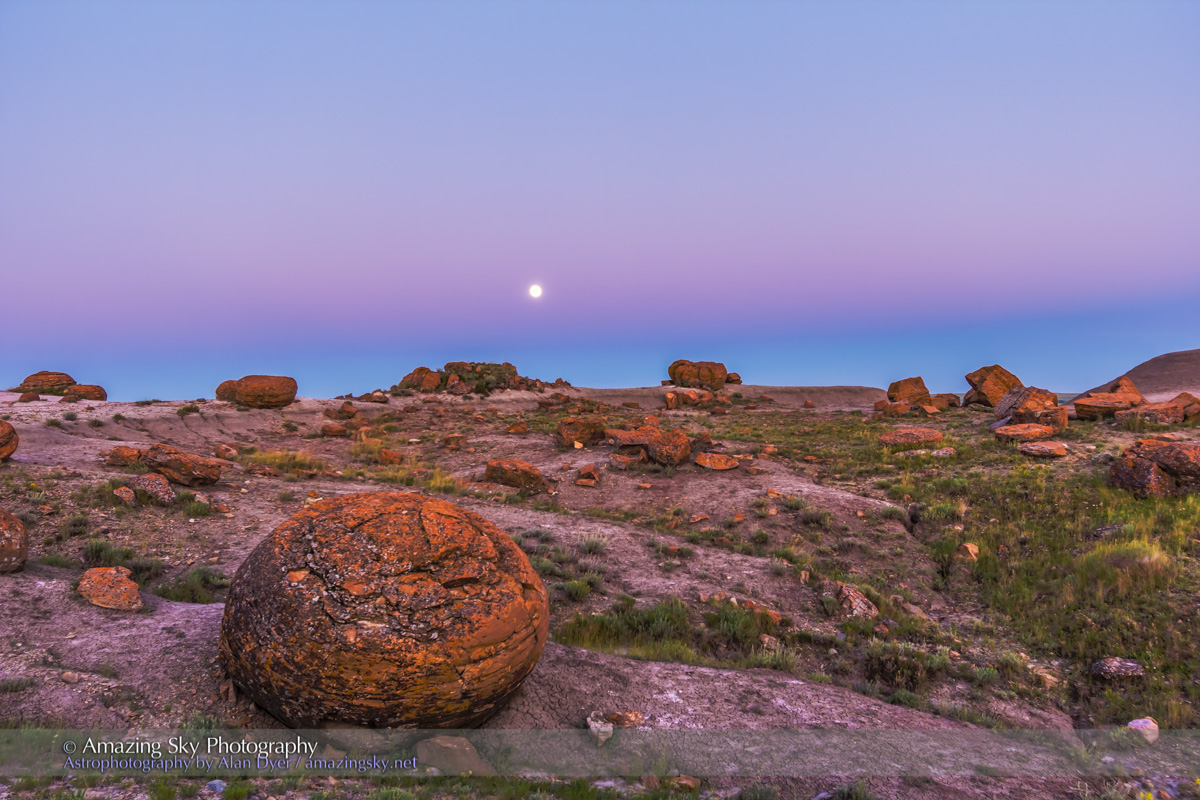
Super Moonrise at Red Rock Coulee


Super Moonrise at Red Rock Coulee

The Full Moon rises over the sandstone formations of Red Rock Coulee, Alberta.

This was moonrise – a super Moonrise – on Friday, July 11, 2014.

Publicized as yet another “super moon,” this moonrise was certainly excellent for me, with superb skies at Red Rock Coulee in southern Alberta. There’s no way anyone would be able to detect the fact this Moon was a little closer and larger than most Full Moons of 2014. But it was still a fine sight.

Here, you see it sitting in the pink Belt of Venus fringing the dark blue band of Earth’s shadow rising in the east just after sunset. The already red rocks are lit by the warm light of the western twilight.

The main photo is an HDR stack of 6 exposures, to capture the range in brightness from bright sky to darker foreground.

Mars and Spica above Red Rock Coulee

This night, as it is for a week or so at mid-month, reddish Mars was sitting just above blue-white Spica in Virgo. They are visible here as a double star in the moonlit southwestern sky. Saturn is to the left. This is a single exposure.

It was another perfect night – warm, dry and bug free, for 3 hours of moonlight time-lapse shooting, as well as taking these still images.

– Alan, July 12, 2014 / © 2014 Alan Dyer


Sunset over the Lonely Log Cabin


Log Cabin at Sunset

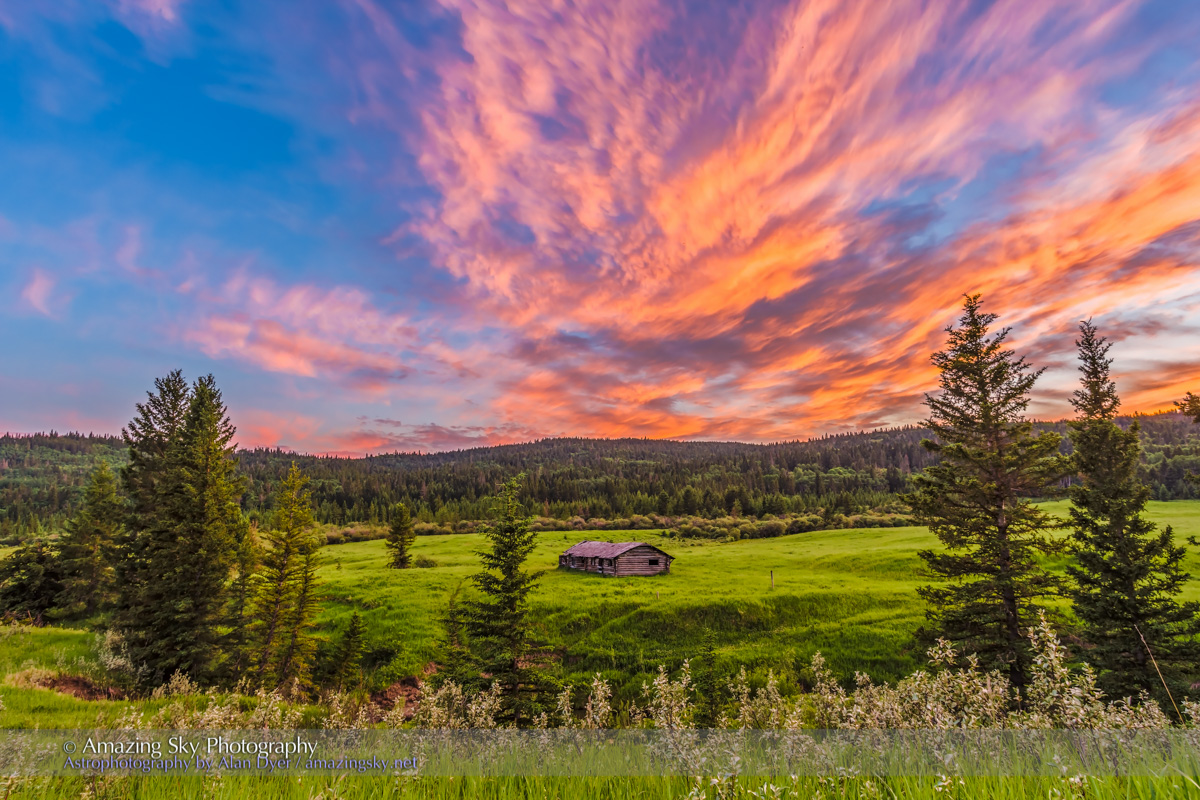
The clouds paint the sky at sunset over a pioneer cabin in the Cypress Hills.

This is a scene the original resident of this cabin would have enjoyed – and painted.

This lonely log cabin in the Battle Creek valley was built by Robert David Symons, renowned as a rancher, naturalist, game warden, and painter, in the style of western artists such as Charlie Russell.

The cabin looks like it dates from the pioneer days of the first European settlement of the area, in the late 19th century. But Symons settled here and built this log cabin in 1939, during the time he worked as a game warden in the Hills, posted at the Battle Creek Ranger Station. He lived in the cabin for only three years before selling it to Albert and Sylvia Noble in 1942.

The Nobles expanded the cabin to accommodate their family. They lived here for 10 years, working a sawmill in the area.

Today the cabin is a scenic stop on the rough and often muddy Battle Creek Road that winds from the Alberta to the Saskatchewan side of Cypress Hills Interprovincial Park. Travelling it is like being back in the 1940s, when roads were no better than improved cart tracks.

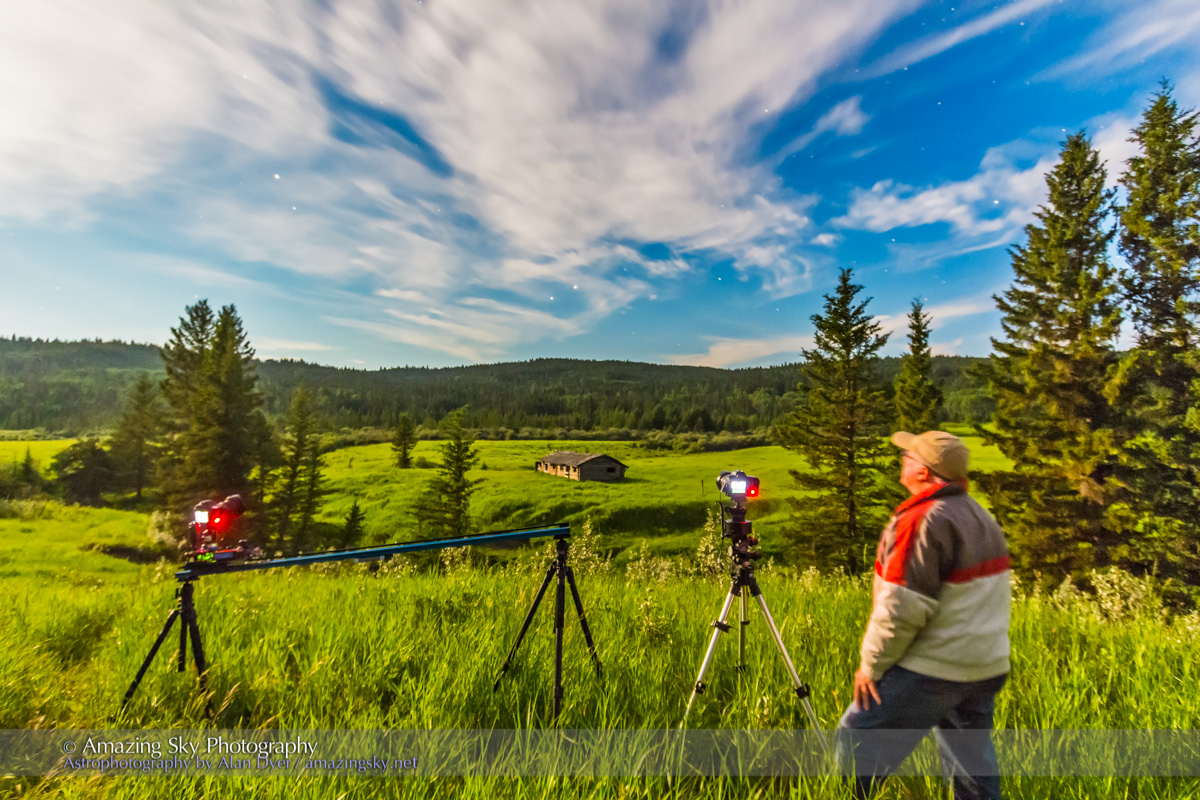
Shooting Time-Lapses at Cypress Hills Log Cabin

I spent an evening here two nights ago on a perfect summer night, shooting the sunset and then the cabin scene by moonlight using time-lapse cameras and gear.

The main scene at top is a high dynamic range stack of 6 images to preserve details in the bright sky and dark foreground.

The self-portrait is a single shot taken by moonlight. Mars and Spica are just setting as a pair of stars over the hills across the valley.

It was a magical night in the Hills.

– Alan, July 11, 2014 / © 2014 Alan Dyer


Circling Stars Over the Open Range


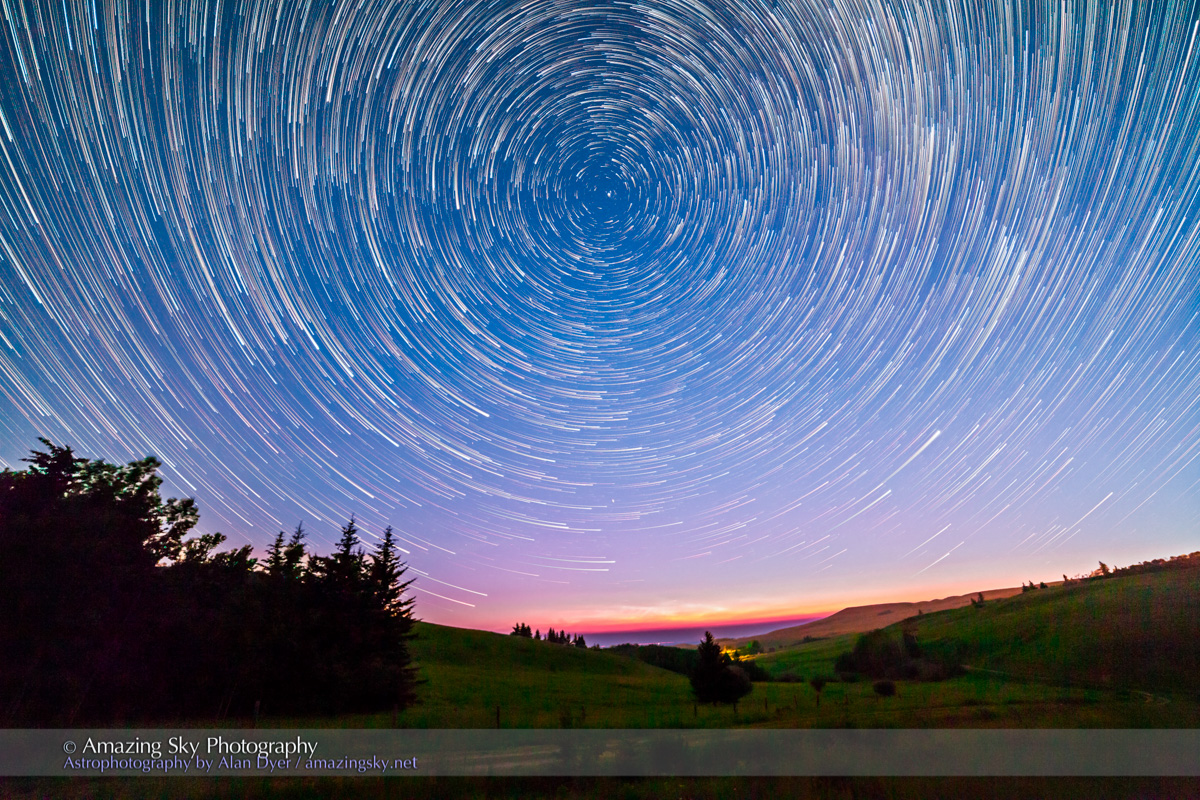
Reesor Ranch Circumpolar Star Trails

The stars swirl in circles above the big sky country of the Canadian Prairies.

For these images I set the camera to take hundreds of images over the course of about 4 hours, then stacked about 100 frames for each of the composites. I stacked the images with the application StarStax

The result shows the stars circling the North Celestial Pole and Polaris in the northern sky. The top image is from earlier in the night when the Moon was still up lighting the landscape.

Reesor Ranch Circumpolar Star Trails v2

The image above is from late in the night, after moonset, and with the glow of dawn beginning to brighten the northern sky. Some low noctilucent clouds are also appearing on the horizon.

This was a beautiful night at Reesor Ranch in Saskatchewan, on the edge of Cypress Hills Interprovincial Park, on the Alberta-Saskatchewan border. I’ve just wrapping up a week of shooting here with clear nights every night but two. The hard drives are full!

– Alan, July 11, 2014 / © 2014 Alan Dyer


Wild Rose Sunset


Wild Rose Sunset

The sky lights up pink to match the wild roses in Cypress Hills.

Last night the twilight sky over the Cypress Hills was simply stunning. The clouds contrasted with the blues and pinks of twilight. On the way out to an evening shoot I stopped to take this image of the darkening sky colours behind the blooming wild roses, the floral emblem of Alberta.

In this photograph I’m looking east, opposite the sunset. The dark blue on the horizon is the shadow of the Earth rising. Above the shadow is a fringe of pink, the Belt of Venus, from red sunlight still lighting the upper atmosphere in that direction. Its colour nicely matches the pink roses – Earth and sky in colour coordination.

This is a high dynamic range stack of 6 exposures, to capture the bright sky and darker foreground in one image, to render the scene as the eye saw it but the camera could not, at least not with a single exposure.

– Alan, July 8, 2014 / © 2014 Alan Dyer


Moon on the Water


Reesor Lake Moon HDR

The Moon shines over the still waters of a prairie lake.

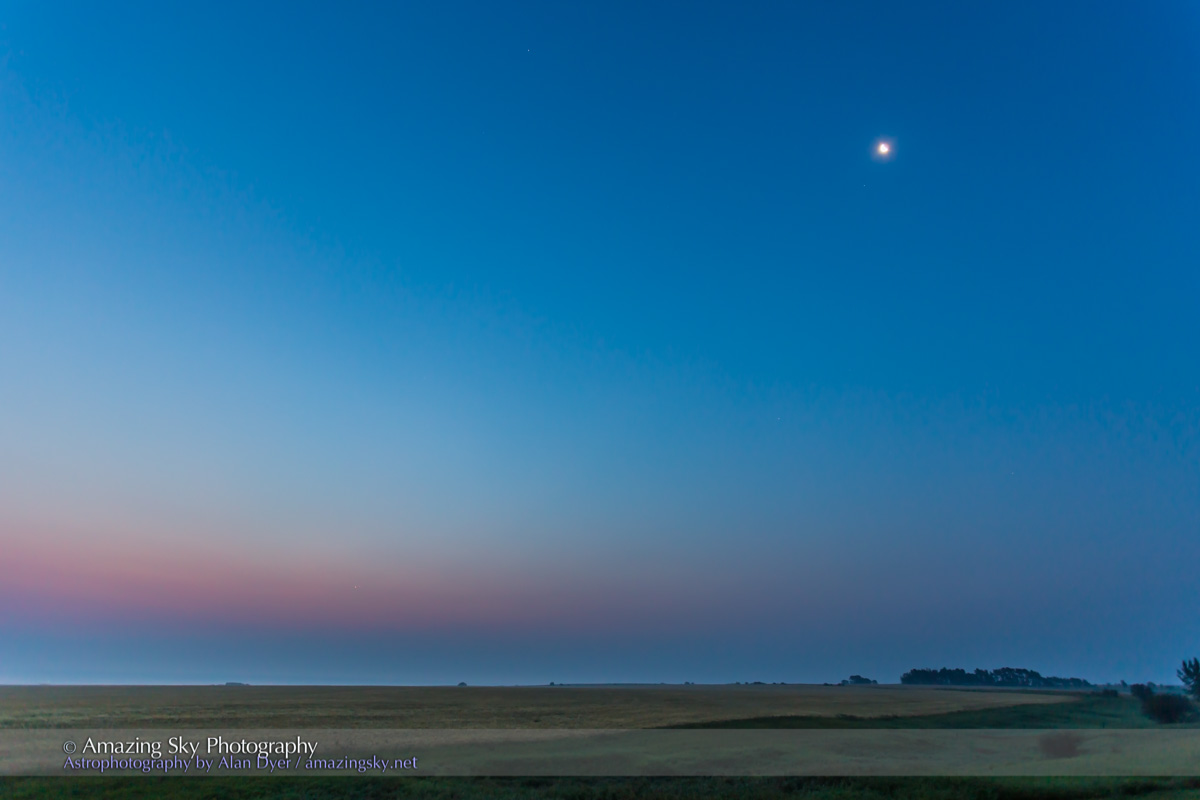
On Saturday, July 5, the Moon put on a super show in the twilight sky. The Moon was exactly at first quarter phase 90° from the Sun, and it shone between Mars and the star Spica, for a tidy 3-world conjunction in the evening sky.

For these shots I was at one of my favourite places for nightscape shooting, Reesor Lake in Cypress Hills Interprovincial Park. These are still shots taken with one camera while two others were shooting time lapses of the fall of night and the Moon moving over the lake.

Moon on Reesor Lake #5

Later in the evening, some photogenic cirrus clouds moved through the scene, nicely filling out the composition.

Moon on Reesor Lake #6

Here, you can see Mars to the right of the Moon and Spica to the left of the Moon. Below, on the water swim three white American pelicans that frequent the prairie lakes around here.

This was a perfect night. The anglers weren’t catching too much despite the fish leaping from the water every few seconds. But I managed to catch some nice photos and movies. It was a fine summer night to enjoy the sky.

– Alan, July 7, 2014 / © 2014 Alan Dyer


Sunset on the Range


Sunset on the Range

The setting Sun provided a fine light show on the open range of the Canadian Prairies.

This was the scene Friday evening, July 4, as the Sun lit up the clouds in the big sky of the Historic Reesor Ranch.

I’m here for a week of intensive shooting and writing. On the first night the setting Sun put on a fine show, captured in still images, like the high dynamic range composite above, and in time-lapses captured with the motion control gear below.

Reesor Ranch Sunset Shoot #4

When I took these shots I was likely right on the 105th meridian, the line of longitude that marks the boundary of Alberta and Saskatchewan. Either way, the land is expansive and stunning.

Just to the south the land rises to the Cypress Hills and the namesake provincial park where I’m spending most nights shooting stills and time-lapses. More to come this week I’m sure!

– Alan, July 7, 2014 / © 2014 Alan Dyer


Waxing Moon on the Water


Moon over Middle Lake HDRThe waxing crescent Moon shines over water at Bow Valley Provincial Park, Alberta.

What an excellent evening this was. On July 2 I was at a newly discovered spot, the Whitefish picnic area, in Bow Valley Provincial Park between Calgary and Canmore, Alberta.

I was there with colleagues doing a shoot for a promotional video for a project I’m involved with. But after the business shoot, I stuck around to take my own shots for time-lapse movies and still images.

In the scene above the Moon is reflected in the still waters of Middle Lake in the Park. It’s a high dynamic range stack of seven exposures.

Crescent Moon over the Bow River

Here, a little earlier in the evening is the scene on the banks of the Bow River, with the Moon over the swiftly flowing waters of the glacier-fed Bow. Its waters nourish much of southern Alberta, making farming, industry and life possible in an otherwise dry, rain-shadow climate.

Though a year ago its flood-swollen waters were bringing disaster to many people along the Bow.

Shooting at Bow Valley Park

This evening I shot motion-control time-lapses by the Bow, using some new gear that slowly pans or turns cameras during a time-lapse shoot. This is me playing with the new eMotimo controller, while the Dynamic Perception dolly does its thing below.

Lots of fun!

– Alan, July 4, 2014 / © 2014 Alan Dyer


A Windy Day on the Wind Farm


Windfarm Cloudscape

It was windy day out on the wind farm, with some wonderful cloudscapes blowing by.

Shooting time-lapse movies by day is so much easier than shooting at night! Yesterday, to try out some new gear and grab footage for some demo videos, I drove to the nearby Wintering Hills Wind Farm, site of some previous images and movies I’ve posted. It’s a wonderful place for nightscapes, but in this case I shot cloudscapes by day.

The movie compiles five time-lapse clips into a short demo of cloudscapes and time-lapse techniques: using fixed cameras and using cameras on motorized devices that move the camera a little between each time-lapse frame – what’s called “motion control.”

It might take a moment to load and play through. But do expand it to full screen.


For two clips in the movie I used a Dynamic Perception Stage Zero dolly rail, a unit I bought two years ago and have used a lot for time-lapse shooting.

DP Stage Zero Dolly and Stage R on Induros

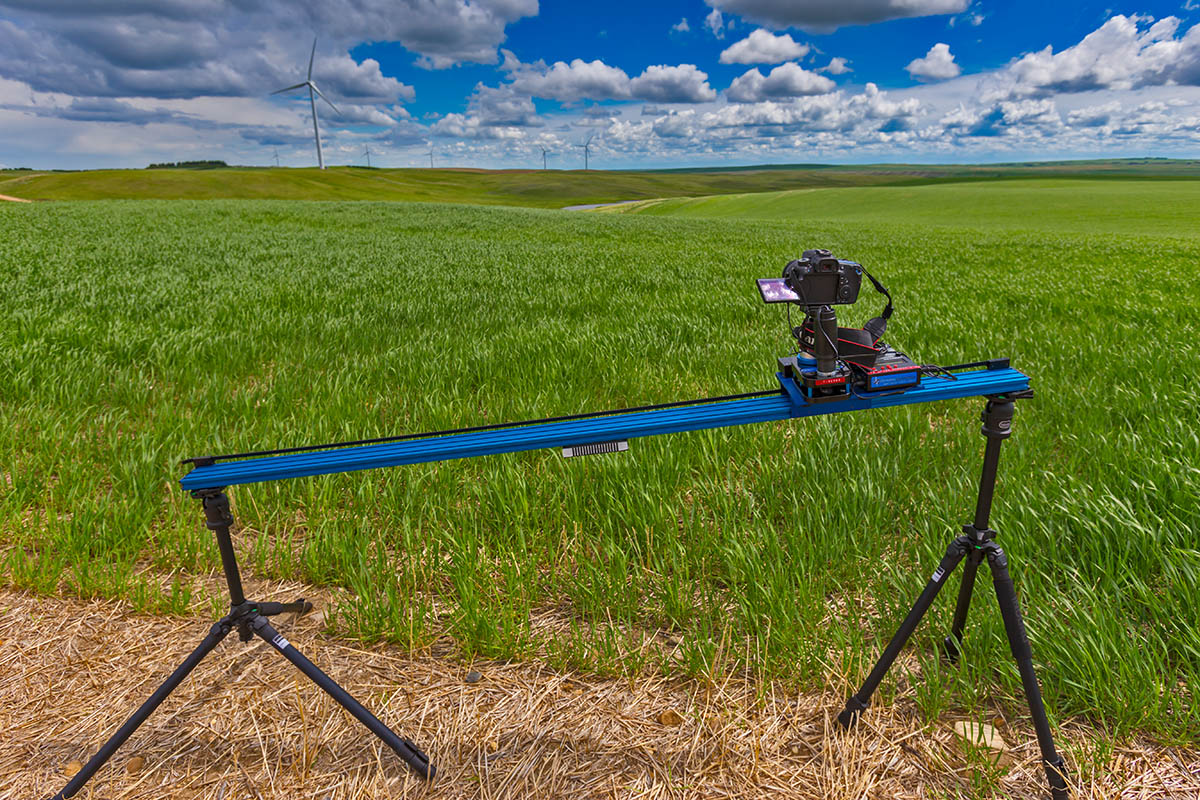
Here I show it on the new pair of Induro tripods, a much more stable arrangement than the single large tripod I had been using up to now. What’s also new is the Stage R panning unit, now attached to the dolly platform, here on the left (the controller is on the right).

DP Stage Zero Dolly and Stage R CU

What this motorized unit does is allow the camera to slowly turn in azimuth as it is running down the rail, to keep the camera aimed at a foreground subject, or to pan along the horizon, as I do in one of the clips in the movie.

This is a brand new piece of kit, purchased last month through Dynamic Perception’s Kickstarter campaign. I got one of the first batch of units shipped out. It works very well but takes a little practice to get the speeds set right. I’m still working on that!

I hope you enjoy the little demo movie. It shows that even cloudy skies can be photogenic at times!

– Alan, June 29, 2014 / © 2014 Alan Dyer


Moon and Venus Rising


Moon and Venus RisingThe waning Moon and Venus rise together into the summer dawn.

This was the scene this morning, June 24, as the waning crescent Moon rose together in conjunction with Venus, into the dawn sky.

The morning could not have been more clear for a great view of them coming up over the distant hills in southern Alberta.

Moon and Venus Above the Mist

Pity there was not also some noctilucent clouds, but this morning there was no sign of them. Nor of any aurora through the night, despite promising signs of activity. But the morning show made up for their absence.

The waning Moon and Venus are together again on the morning of July 24, exactly a month from now.

– Alan, June 24, 2014 / © 2014 Alan Dyer


The Clouds of Solstice Twilight Are Here!


Noctilucent Clouds Panorama #1 (June 21-22, 2014)

Look north in June and July from the Canadian Prairies and you are likely to see iridescent clouds shimmering in the mid-summer twilight. 

It’s been a good couple of nights for sighting noctilucent clouds – literally “night shining” clouds, or NLCs. These are odd water vapour clouds that form at the edge of space 80 km up where no self-respecting cloud has a right to exist.

But there they are. Existing and moving in waves in a near vacuum.

We see them because at solstice time the Sun’s light pours over the pole (where the midnight Sun is shining) and lights up the clouds that hang over the Canadian Northwest Territories and Nunavut.

Noctilucent Clouds and Big Dipper

From the Prairies we see them far in the distance to the north, as here, shining low on the horizon amid the deep blues and reds of a perpetual twilight that never ends on our short summer nights.

The top photo, taken Saturday night, is a 5-section panorama with a short telephoto lens. The bottom image, taken early this morning, is just the opposite – a very wide angle shot showing the clouds in context, with the Big and Little Dippers at top left and centre.

Some images and movies from last year’s NLC season are in my blog post from June 27, 2013.

– Alan, June 23, 2014 / © 2014 Alan Dyer


Storm Clouds and Stars on Solstice Eve


Storm Clouds and Stars (June 20, 2014)

On the eve of summer solstice the sky was filled with an amazing light show.

Living on the great plains of southern Alberta gives me access to the big sky right outside my door. On summer nights, the entertainment is often watching thunderstorms roll across the northern horizon down “hailstorm alley” to the north of me.

That was the case on Friday night, the eve of summer solstice. What a photogenic storm this was! Lightning lit up the roiling cloud from within and, as below, shot out in an escape path toward the ground.

Lightning Bolt and Blue Sky

Despite the midnight hour, the sky is blue with the glow of perpetual twilight at this time of year at 51° north.

As this storm receded, another rolled in, this time directed at my area. Lightning flashed all around (it was too rainy to shoot).

As I was processing these shots, the power flickered, then went off, as a bolt hit someplace critical to the power system. In the country it doesn’t take much to knock out the power to outlying areas. Mine was out for another 14 hours. Thank goodness for laptop batteries!

– Alan, June 23, 2014 / © 2014 Alan Dyer


Fireflies Dancing on Solstice Eve


Fireflies and Stars

A field of fireflies dances under the stars on the eve of summer solstice.

On Friday, June 20, the night before summer solstice, I had a superb night at home watching storm clouds, fireflies and the glow of perpetual solstice twilight.

June is firefly season and on a warm night I see them dancing and flickering above the grassy field. They appear here as green sparkles and streaks, with the stars above and Milky Way just showing through in the blue of a solstice twilight.

Flashes from distant lightning help illuminate the ground and clouds.

Iridium Satellite Flare (June 20, 2014)

These frames are from a time-lapse sequence, with the frame above picking up few fireflies. But it did reveal the streak from an Iridium satellite flaring in the sunlight as it flew overhead.

While the sky from my latitude of 51° North never gets dark at this time of year it is filled with other beautiful sky glows and phenomena.

– Alan, June 22, 2014 / © 2014 Alan Dyer
 

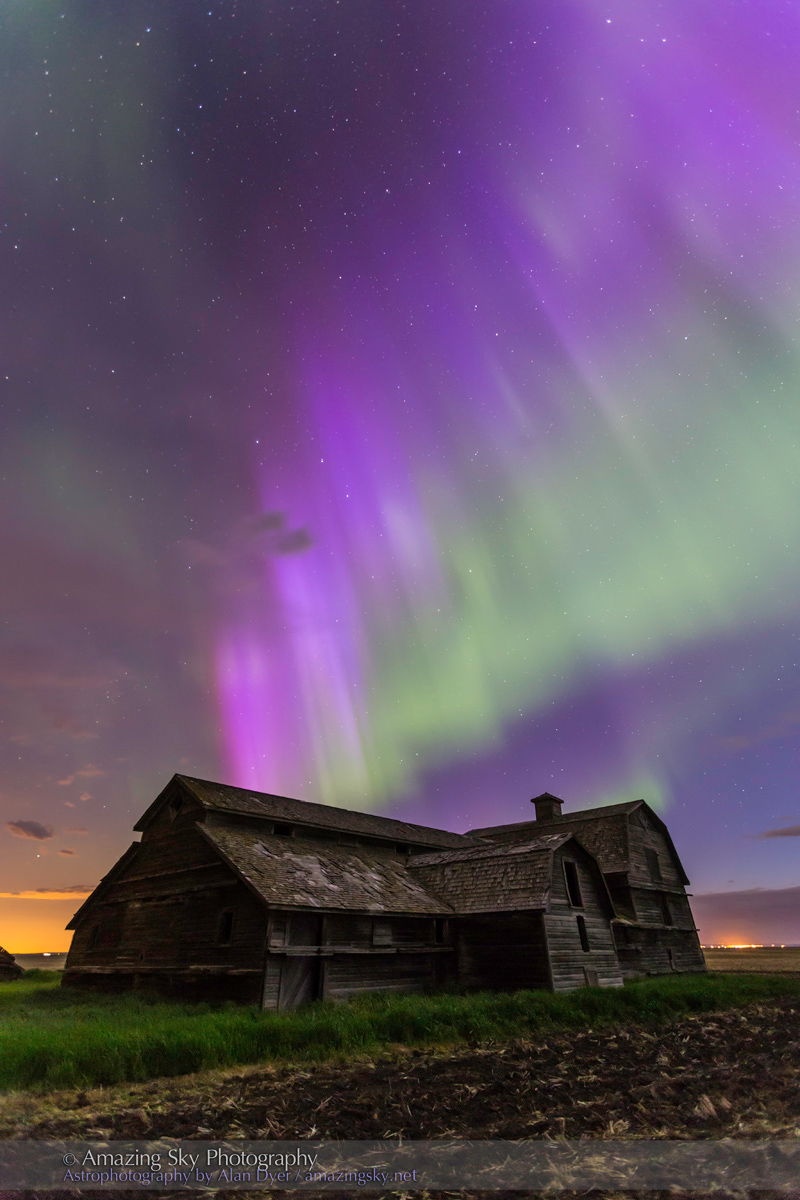
Aurora Over the Old Barn


Purple Aurora over Old Barn #6 (June 7-8, 2014)

What a fabulous night this was! Forewarned about an impending solar storm I headed to the site of a rustic barn near home to shoot the Northern Lights.

The night started with cloud but upon looking out after midnight (it pays never to go to bed too early!) the skies were clear. Checking Spaceweather.com showed an active auroral oval lit up red and Storm in Progress warnings!

That was all the cue I needed to pack up the gear and head over to the old barn site where I have been shooting time-lapses all this week.

Purple Aurora over Old Barn #1 (June 7-8, 2014)

The aurora remained quiet and diffuse for the first hour and a half, but then about 2 a.m., the substorm hit. Within seconds the curtains began to light up with well-defined rays and beams shooting to the zenith. And they danced.

The notable feature of this display, as with one in May 2013, was the blue and purple colour of the tops of the curtains. I think this is partly due to sunlight illuminating the tops of the curtains, possible at this time of year when the upper atmosphere is perpetually lit by the midnight Sun.

Shooting the Aurora over Old Barn #2 (June 7-8, 2014)

From the start I shot with two cameras taking time-lapses (the main still image at top is a frame from one of the movies). Then toward the end of the night I switched to just shooting still images framed to suit the curtains towering up to the zenith.

As above, I also shot a “selfie” of me shooting the vertical image in the middle of the set.

But below is the result of a night of shooting time-lapse movies and stills, in a montage set to music. The link takes you to my Vimeo site. Do turn on HD mode.


I hope you enjoy the video!

– Alan, June 8, 2014 / © 2014 Alan Dyer (video and stills)
Rainbow at Sunset


Rainbow over Prairie Field (Wide-Angle)As the setting Sun broke through clouds it created a rainbow over my backyard.

I see lots of fine sky phenomena right from my back deck. Such was the case last evening as a storm retreated east as they typically do. Clearing skies in the west allowed the Sun to shine through, the perfect combination for a rainbow.

For the main image above I shot the double rainbow with the ultra-wide 14mm Rokinon lens …

Rainbow over Prairie Field (Fish-Eye

… and also with the 8mm Sigma fish-eye lens for this image. It’s angled to be suitable for re-projection in a tilt-dome planetarium theatre.

We’re into stormy spring weather here in Alberta, so there will be many more rainbows to follow the dark clouds. Let’s hope for no more floods like last June.

– Alan, June 1, 2014 / © 2014 Alan Dyer


The Thin Moon of May


Thin Crescent Moon in Evening Twilight

May ends with a thin waxing Moon returning to the evening sky.

This was the scene on a fine Friday evening, May 30, as the two-day-old Moon returned to the western sky.

Mercury was not far away, and is in this frame but at far upper right. I wasn’t really framing the shot with Mercury in mind, but the Moon and clouds.

This frame is one of 440 I shot for a time-lapse sequence of the setting Moon and moving clouds. This is the result, nicely deflickered with LRTimelapse software, an essential tool for time-lapse processing.

How many times have I tried to shoot the Moon or Mercury low in the west and been foiled by cloud near the horizon? Notice the rain falling from the western cloud. Some place near Calgary was getting wet!

— Alan, May 31, 2014 / © 2014 Alan Dyer
 

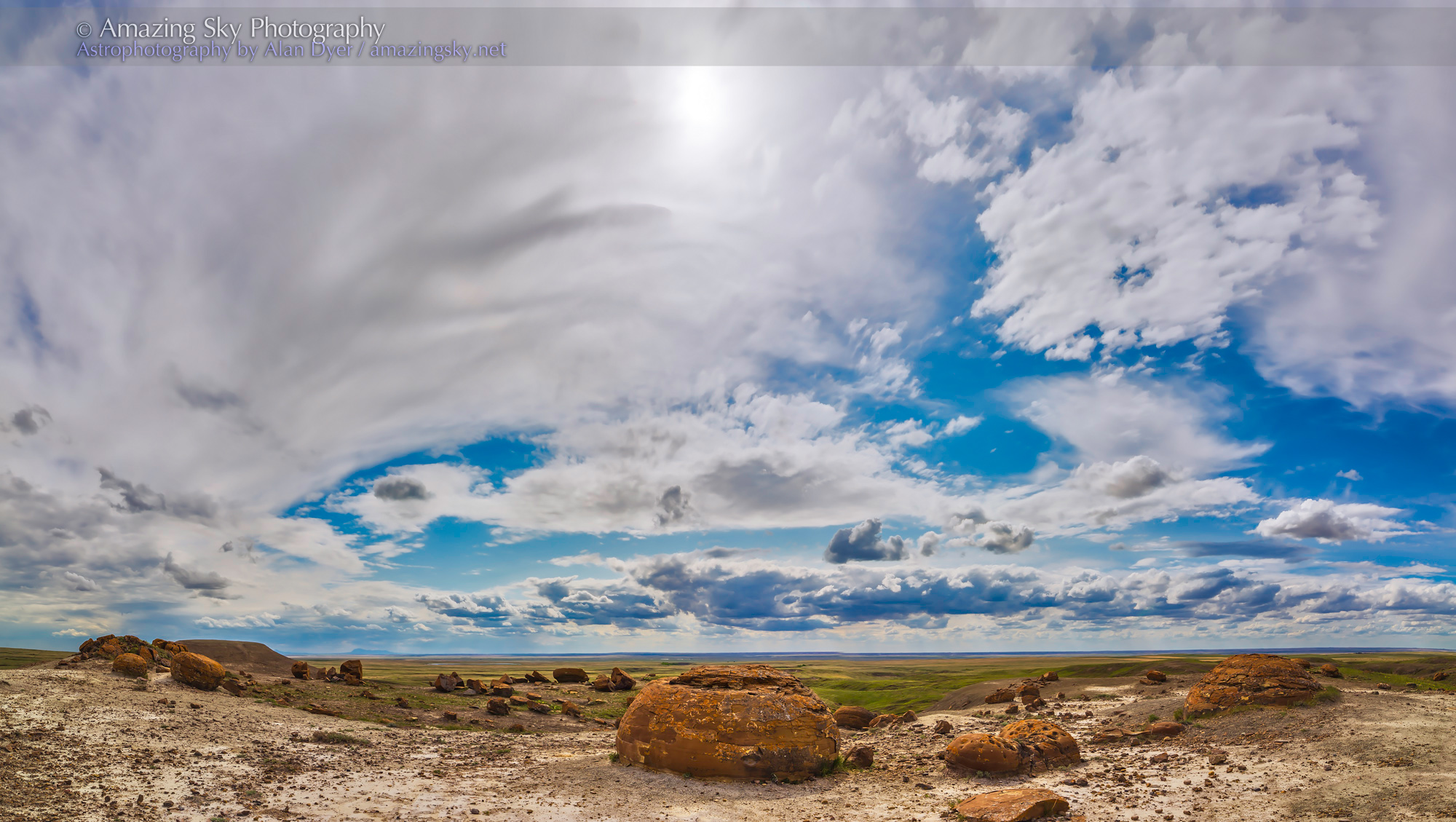
Red Rock Coulee Cloudscapes


Red Rock Coulee Cloudscape Panorama

The strange rock formations of Red Rock Coulee, Alberta lie below the cloudscape of a prairie sky.

Yesterday afternoon I visited the Red Rock Coulee Natural Area, a dramatic but little known geologic wonder in southern Alberta. I was inspecting the site for a possible return one night to shoot time-lapse nightscapes. But while there I took the time to shoot daytime cloudscapes.

The image above is a two-section panorama with an ultra-wide 14mm lens.

Red Rock Coulee Cloudscape #1

This image and the one below are other compositions in this very photogenic spot. In the distance lie the peaks of the Sweetgrass Hills in Montana.

These odd rock formations are sandstone concretions deposited in prehistoric seas and are apparently some of the largest examples of this type of formation in the world. Iron content gives them their red tone.

Red Rock Coulee Cloudscape #2

As a technical note, all the images are high-dynamic range (HDR) stacks of 8 exposures taken over a wide range of shutter speeds to record details in both the bright sky and darker shadows.

I processed them with Photoshop CC’s HDR Pro module and then Adobe Camera Raw in 32-bit mode. I aimed for a more natural look than you see in most HDR images, but even so the cloud contrast is exaggerated for dramatic effect. The wide-angle lens perspective adds to the effect.

This was a wonderful place to stand under the big skies of southern Alberta on a warm spring afternoon.

– Alan, May 25, 2014 / © 2014 Alan Dyer
 

McDougall Church under Moonlight


McDougall Church in Moonlight #1 (May 14, 2014)

The historic pioneer church at Morley, Alberta stands under moonlight on the banks of the Bow.

Last night, after presenting a talk on time-lapse techniques to the Cochrane Camera Club, I headed west on Highway 1A to the historic McDougall Memorial United Church, long on my target list for time-lapse photography. It was Full Moon, which helped mask the lighting from nearby town lights and the urban sky glow of Cochrane and Calgary.

The wooden church stands on the benchlands north of the Bow River, near Morley, Alberta. Rev. George McDougall built it in 1875 to minister to the Cree. He lies buried on the Church grounds — that’s his grave in the foreground in the main image above, with the Full Moon shining above the headstone.

McDougall Church in Moonlight #2 (May 14, 2014)

In this image, Mars stands directly above the Church steeple. The Full Moon shines in the clouds to the south. Both still images are frames from time-lapse movies, shot with two cameras. One was on the Dynamic Perception Stage Zero dolly, the other was a static tripod-mounted camera.

This little compilation shows the movies I shot last night, under moonlight on the banks of the Bow. It may take a moment to load. I hope you enjoy it!

— Alan, May 15, 2014 / © 2014 Alan Dyer


Waning Moon in the Sunrise Clouds


Waning Moon at Sunrise (Feb 27, 2014)

The thin waning Moon sits in the red clouds of sunrise on a winter morning.

This was the scene this morning, February 27, just before sunrise when I was able to catch the thin crescent Moon – a waning Moon – amid the sunrise clouds. The Moon just happened to appear in a clearer hole in the clouds, in a blue patch above the pinks and oranges of the clouds. They contrast with the cold blue snow below.

This was a beautiful scene to start the day.

– Alan, February 27, 2014 / © 2014 Alan Dyer
 

Moon and Venus in the Winter Dawn


Moon & Venus Conjunction (Feb 26, 2014)This was the scene at dawn on a cold winter morning as the waning Moon appeared near Venus.

The temperature was only -15° C, so rather pleasant compared to the -30° C it has been the last couple of mornings. On February 26, I awoke at 6 a.m. and ventured into the cold winter morning to shoot the conjunction of the crescent Moon beside Venus above the snowy landscape of southern Alberta.

This was not a particularly close conjunction, at least not for us in North America. But its location low on the southeast horizon made the scene attractive and photogenic.

Mars and Saturn in the Winter Dawn (Feb 26, 2014)

I aimed the camera the other way, to the southwest, to catch bright Mars (at right near Spica in Virgo) and Saturn (at left in Libra) above the abandoned farmhouse. The stars of Scorpius shine at left.

So we had three planets visible at dawn this morning, a fine sight to start the winter day.

– Alan, February 26, 2014 / © 2014 Alan Dyer
Music Video – Sky Events of 2013


My 2-minute music video looks back at some of the celestial highlights of 2013, in images and videos I captured. 

Some of the events and scenes I show were accessible to everyone who looked up. But some required a special effort to see.

• In 2013 we had a couple of nice comets though not the spectacle hoped for from Comet ISON.

• Chris Hadfield became a media star beaming videos and tweets from the Space Station. We on Earth could look up and see his home sailing through the stars.

• The sky hosted a few nice conjunctions of planets, notably Mars, Venus and Jupiter in late May.

• The Sun reached its peak in solar activity (we think!) unleashing solar storms and some wonderful displays of northern lights.

• Locally, record rain storms in Alberta unleashed floods of devastating consequences in June, with a much publicized super moon in the sky.

• For me, the summer proved a productive one for shooting the “star” of the summer sky, the Milky Way.

• But the year-end finale was most certainly the total eclipse of the Sun on November 3. Few people saw it. I did, from a ship in the Atlantic Ocean. The video ends with that sight and experience, the finest the sky has to offer.

I hope you enjoy this music video mix of time-lapse, real-time video and still images, shot from Alberta, New Mexico and from the Atlantic.

You can watch a better quality version of this video at my Vimeo channel.

Clear skies for 2014!

– Alan, January 1, 2014 / © 2014 Alan Dyer

Time-Lapse – Alberta Skies 2013


It was a good year for time-lapse photography at home. Here’s my compilation of Alberta time-lapses in a 3-minute music video.

For a year-end look back at 2013 I assembled these highlights of my year of shooting time-lapse movies of the Alberta sky, by day and night. 

I’ve included clips shot around home in rural southern Alberta, and further afield at popular photo spots around the province such as Waterton Lakes National Park, Banff, Writing-on-Stone Provincial Park, and Cypress Hills Provincial Park. 

I hope you enjoy it! Be sure to maximize the video screen and select HD.  Or for a better grade version check out my Vimeo channel.

________________________________________________

Some technical background:

I shot all the frames for the movies (150 to 300 frames for each clip) with either a Canon 5D MkII or a Canon 60Da camera, equipped with various lenses from 8mm to 200mm. For many of the clips the cameras were on motion control devices: the Radian azimuth panning unit, an Orion TeleTrack mount, or a Dynamic Perception Stage Zero dolly unit. You see the latter in action behind the credits. 

For image processing and movie assembly I used Adobe Camera Raw, Photoshop, LRTimeLapse, Sequence, Panolapse/RawBlend utility, and for some of the star trails either StarStax or Star Circle Academy’s Advanced Stacker Actions.

I demonstrate all these in my Nightscapes workshops. The next one is in Edmonton, January 25!

To edit the movie I used the new OS10 Mavericks iMovie. 

– Alan, December 29, 2013 / © 2013 Alan Dyer
The Christmas Sky of 2013


Orion & Winter Sky (Christmas 2013)

_____________________________________________

” ‘Twas the night of Christmas, and all across the sky,

All the stars were twinkling, and Orion shone on high.”

_____________________________________________

Here’s my Christmas postcard, presenting the winter stars and constellations as they appeared over my Alberta backyard on Christmas night. The night was clear and calm, and not too cold.

Orion stood “on high” in the south, above bright Sirius, and below even brighter Jupiter at left, now blazing away in Gemini.

The winter Milky Way runs down the sky from Perseus at top to Canis Major on the horizon.

Merry Christmas to all and to all a good night!

– Alan, December 25, 2013 / © 2013 Alan Dyer
Solar Halo in a Cold Blue Sky


Solar Halo and Sundogs (Dec 19, 2013) #2

A solar halo and sundogs surround the Sun on a cold winter day in Alberta.

I’m back home amid the snow and cold. The one celestial treat to such a clear but cold winter day is the appearance of sundogs and solar halos around the cold Sun.

This was this morning, with the low winter Sun above my snow-covered backyard, and the air filled with tiny ice crystals. You can see them as sparkly “stars” in the sky and in the foreground. Those crystals are refracting the sunlight and making the coloured “rainbows” on either side of the Sun called “parhelia” or sundogs. A faint halo encircles the Sun, topped by an upper tangent arc.

You can read more about halos and their origin at Les Cowley’s AtmosphericOptics website.

Solar Halo and Sundogs (Dec 19, 2013) #1

Here’s another view with a wider-angle lens. I’ve punched up the vibrance to bring out the fact that the shadows on such a day are not black or grey but blue, coloured by the intense blue light streaming down from the sky.

With these winter scenes, I wish all my blog fans and followers a very Merry Christmas, happy holidays and a very happy New Year. Clear skies to all in 2014!


– Alan, December 19, 2013 / © 2013 Alan Dyer
 

Comet Lovejoy Beside the Big Dipper


Comet Lovejoy & Big Dipper (Nov 27, 2013)

The handle of the Big Dipper seems to point down to Comet Lovejoy, low in the northern sky.

While the astronomy world waits and watches as Comet ISON rounds the Sun in the next day, another comet is appearing in the evening sky.

This is Comet Lovejoy, aka C/2013 R1, captured in a set of exposures I took about 6:30 pm on Wednesday evening, November 27, when the comet shone off the handle of the Big Dipper. It was not visible to the naked eye but was easy in binoculars. The photo shows Comet Lovejoy as cyan-tinted star at left with a spiky tail pointed away from the Sun.

From my latitude of 51° N Comet Lovejoy sits far enough north to be circumpolar, though just barely. However, as it heads south it will become just a morning sky object, especially for those at more southerly latitudes. In the coming days it will join Comet ISON (or what’s left of it) in the December dawn.

– Alan, November 27, 2013 / © 2013 Alan Dyer


Sundiving Comet ISON – A Last Look


Comet ISON C/2012 S1 (Nov 21, 2013)

Comet ISON performs its dive toward the Sun, caught in the morning twilight.

This was the infamous and much-hyped Comet ISON (C/2012 S1) as it appeared this morning, November 21, 2013, a week before it performs its hairpin turn around the Sun.

The comet was easy to see in binoculars, though the camera picks up a bit more of its faint tail. ISON was much more photogenic a week ago when it was higher in a darker and moonless sky. But this morning I had to contend with bright moonlight from a waning Moon and the brightening dawn. The inset shows a blow up of just the comet.

ISON is dropping rapidly toward the Sun, making this perhaps the last sighting I’ll have of it until it reappears – we hope! – from behind the Sun in early December. If it survives its perihelion passage it might blossom into brilliance … or fade into obscurity. No one knows.

In the photo above, you can see Mercury at left, shining much brighter than ISON. It was brilliant as it rose into the southeast sky, with the elusive planet now about as well-placed as it gets as a “morning star” for us living at northern latitudes.

Comet Lovejoy C/2013 R1 (Nov 21, 2013)

This morning I was able to shoot not one but two comets.

About half an hour before ISON hove into view I aimed the camera up almost overhead toward Ursa Major, to capture Comet Lovejoy (C/2013 R1) as a bright cyan fuzzball with a short tail. Again, the photo brings out the tail – to the eye the comet was obvious in binoculars but appeared as just a fuzzy star.

I took both shots with the same gear: a 135mm telephoto lens on the Canon 5D MkII on an iOptron SkyTracker. The Lovejoy shot is a stack of 5 x 75 second exposures. The ISON shot is a 4-second exposure, with the colours and contrast boosted for prettiness.

This is certainly proving to be a year of comets. It would be nice if just one of them got really bright!

– Alan, November 21, 2013 / © 2013 Alan Dyer
 

The Pleiades – The Stellar Seven Sisters


M45, the Pleiades Cluster (92mm 5DII)

The stars of the Pleiades sit amid a dusty sky in Taurus.

These are the famous Seven Sisters of Greek legend, known as the Pleiades. They are the daughters of Atlas and Pleione, who are also represented by stars in the cluster. Many cultures around the world tell stories about these stars, but in Greek tradition their appearance signalled the summer sailing season in the Mediterranean. The Pleiades first appear at sunset in the eastern evening sky in autumn and put in their last appearance in the western sky in spring.

One story has it they were placed in the sky to recognize their devotion to their father Atlas and his unending labour in holding up the heavens. They are the half-sisters of the Hyades, another nearby cluster of stars in Taurus. Other stories describe the Pleiades as the Seven Doves that carried ambrosia to the infant Zeus.

A seldom-used name now for this cluster is the Atlantides, from the plural form of Atlas, their father. Thus, these sisters gave their name to the Atlantic Ocean, a vast and uncharted sea until the 16th century. The term “atlas,” first used by Mercator for a book of maps, comes not from the Pleiades’ father but from a real-life king in Morocco who supposedly made one of the first celestial globes.

I shot this portrait of the Sisters a few nights ago, stacking a set of five 15-minute exposures with the TMB 92mm refractor and Canon 5D MkII at ISO 800. I processed the image to bring out the faint clouds of dust that pervade the area.

The Pleiades are passing through dust clouds in Taurus and lighting them up. The stars are embedded in dust, lit blue by the light of the hot stars. But even farther out you can see wisps of dust faintly illuminated by the light of the Pleiades.

The stars are thought to be about 100 million years old, quite young as stars go. They formed together in a massive nebula that has long since dissipated, and will travel together for another few hundred million years until the sister stars go their own way around the Galaxy. The stellar family that gave rise to so many legends around the world will be scattered to the stars.

– Alan, October 12, 2013 / © 2013 Alan Dyer

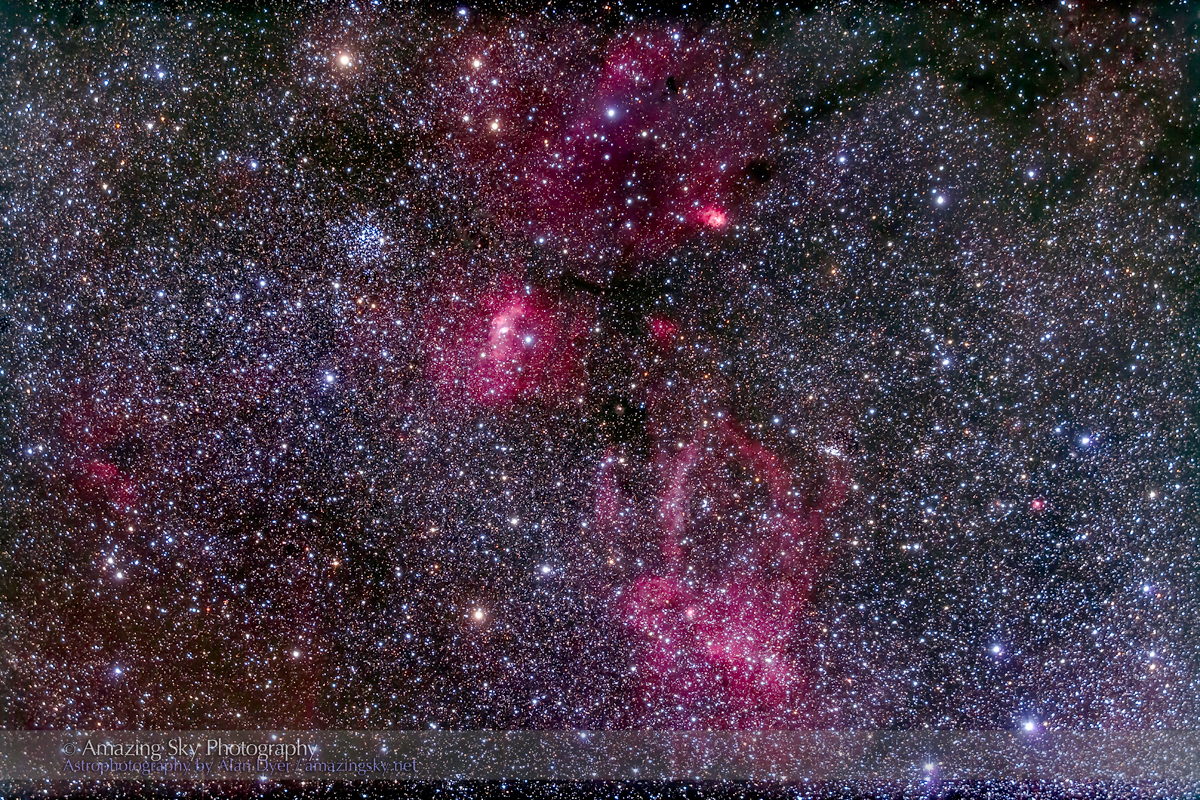
A Star-Filled Scene in Cassiopeia


M52 & NGC 7635 Bubble Nebula (92mm 5DII)

A star cluster and nebulas highlight a glorious starfield in Cassiopeia.

I shot this three nights ago on a very clear autumn evening. The telescope field takes in the star cluster Messier 52 at upper left, a cluster of 200 stars about 5000 light years away. It is one of the best objects of its class for viewing in small telescopes. Charles Messier found it in 1774 as part of his quest to catalog objects that might be mistaken for comets.

The brightest area of nebulosity below M52 is the Bubble Nebula, aka NGC 7635, found in 1787 by William Herschel. It’s an area of star formation marked by a central bubble of gas (just visible on the scale of my photo) being blown by the winds from a hot central star. The Bubble can be seen in amateur telescopes but is a tough target to spot.

Above the Bubble is a small bright nebula, NGC 7538.

Below the Bubble lies a larger claw-like nebula known only as Sharpless 2-157, an object that shows up only in photos.

In all, it’s a complex and beautiful field, set in the constellation of Cassiopeia the Queen.

A footnote for the technically minded: This is a stack of 5 x 15 minute exposures with a filter-modified Canon 5D MkII at ISO 800 shooting through a TMB 92mm apo refractor at f/4.8, mounted on an Astro-Physics Mach 1 mount guided by a Santa Barbara SG-4 autoguider.

– Alan, October 11, 2013 / © 2013 Alan Dyer
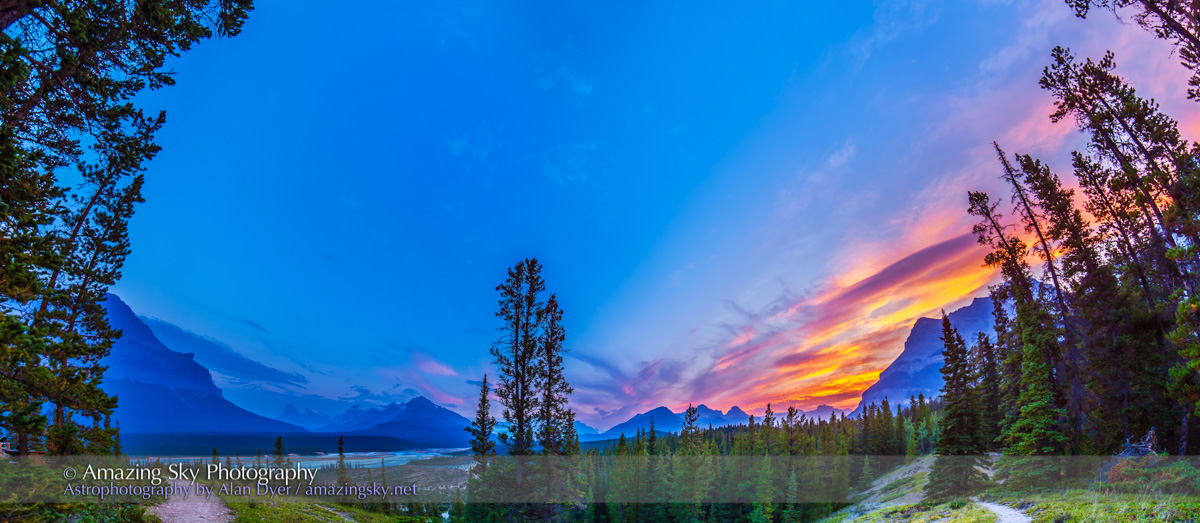
 

Zodiacal Light – Dawn’s Early Light


Zodiacal Light in Dawn Sky (Oct 2013)

The ghostly glow of comet dust brightens an October dawn.

This is the zodiacal light, as it appeared two mornings ago in the pre-dawn sky from my backyard in southern Alberta. This tapering glow angled up from the horizon is best spotted in the eastern sky on clear and moonless autumn mornings, like this one.

What you are seeing is sunlight reflected off dust left by passing comets in the inner solar system. So while this glow looks like it might originate in our atmosphere it really comes from dust out in interplanetary space.

This subtle glow, often called the “false dawn,” appears in the hour or so before the true dawn begins to brighten the sky too much (its purple light is just starting to light the horizon here).

Also visible here: Sirius at far right, Jupiter above centre, the Beehive star cluster below Jupiter, and Leo rising embedded in the zodiacal light, with Mars just above Regulus, Leo’s brightest star. The planets lie along the zodiacal light because the dust that causes it also lies in the same plane as the orbits of the planets, the ecliptic plane.

I shot this with a 14mm lens for a stack of four 2-minute tracked exposures, but with the horizon coming from just one of the exposures to minimize blurring from the moving camera slowly following the sky.

– Alan, October 10, 2013 / © 2013 Alan Dyer
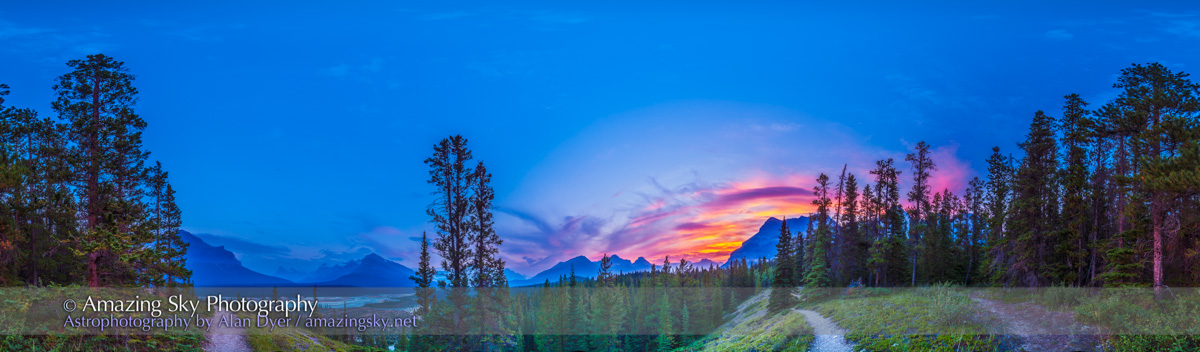
 

The Veil Nebula in Cygnus


NGC 6960 & 6992-5 Veil Nebula (92mm 5DII)

This is what’s left of a star that exploded thousands of years ago.

I shoot this object every year or two, so this is my 2013 take on the Veil Nebula. For last year’s see Star Death Site, a post from September 2012.
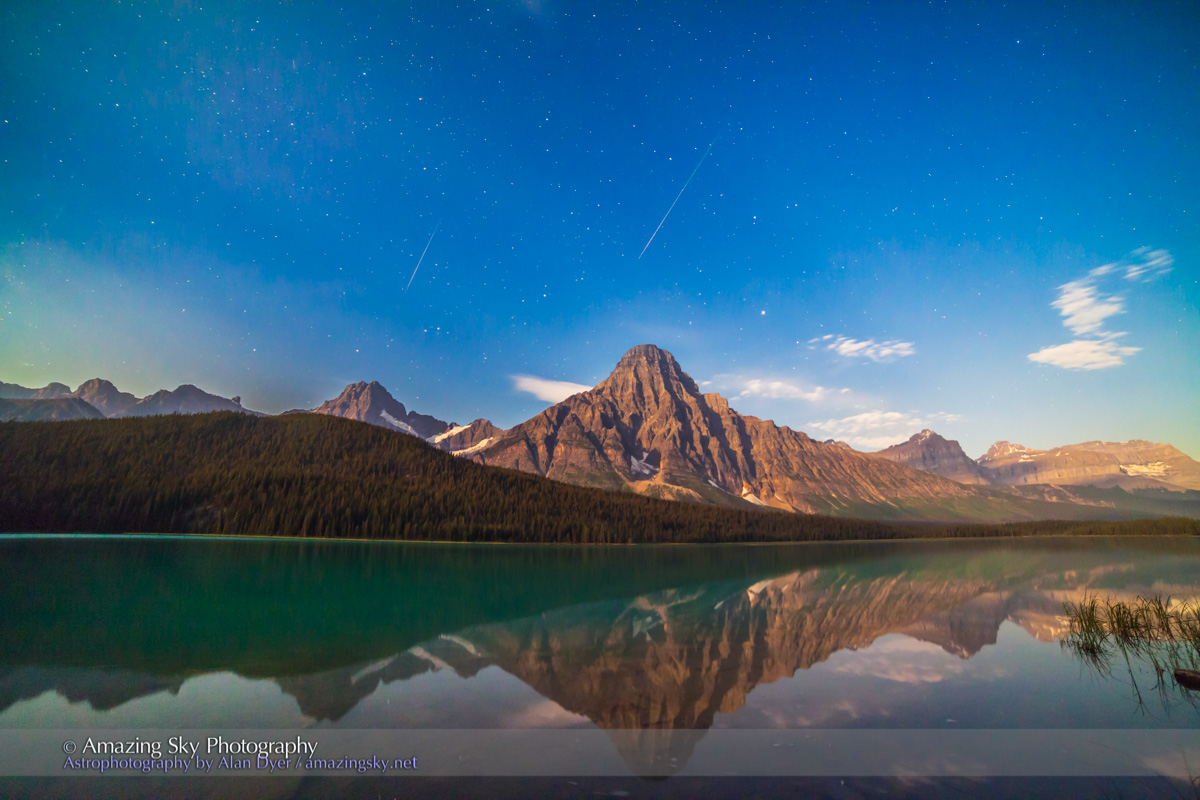
The Veil Nebula is a supernova remnant. The lacework arcs are what’s left of a massive star that blew itself to bits in historic times. This object, one of the showpieces of the summer sky for telescope users, is now high overhead at nightfall, off the east wing of Cygnus the swan.
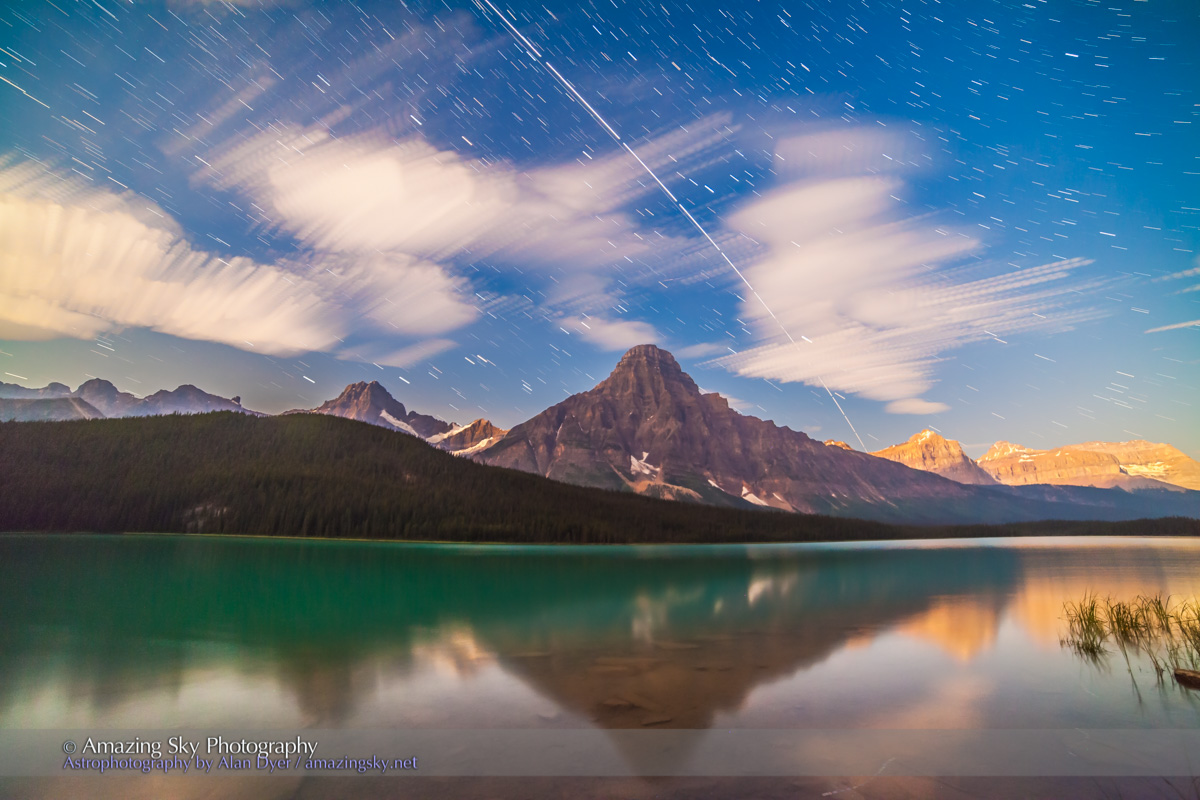
I shot this a couple of nights ago using a 92mm-aperture refractor that provides a wide field of view to easily frame the 3-degree-wide extent of the nebula. The image is a stack of five 15-minute exposures with a filter-modified (i.e. red sensitive) Canon 5D MkII camera at ISO 800. Stacking the images helps reduce noise.

The colours in this object make it particularly photogenic, with a contrast of magenta and cyan. At right, a sharp-edged area of obscuring interstellar dust tints the sky brown and dims the stars.

– Alan, October 9, 2013 / © 2013 Alan Dyer
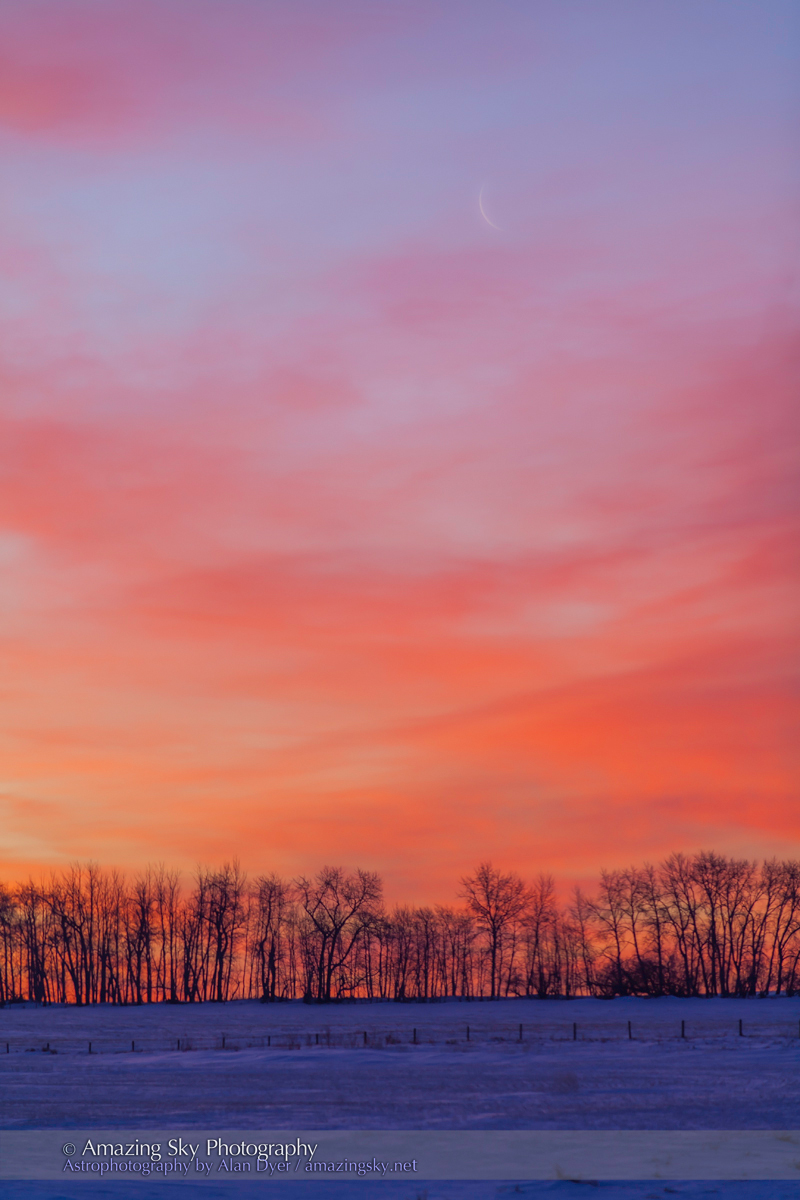
Comet ISON Passes Mars


Comet ISON & Mars (Oct 8, 2013)

Comet ISON passes Mars on its inbound journey toward the Sun.

This was the scene on the morning of October 8, 2013, with Comet ISON (top), still small and faint, passing the planet Mars, the bright object at bottom. The comet was actually close to Mars in space in addition to appearing close to Mars in our sky.

Comet ISON is the much-heralded “comet of the century,” but so far has failed to live up to expectations. It may never become visible to the unaided eye. Or it could blossom into a dawn spectacle after it rounds the Sun on November 28.

Only time, and the vagaries of comets, will tell.

This image is a stack of five 5-minute exposures with a 92mm aperture refractor and Canon 5D MkII at ISO 1600.

– Alan, October 8, 2013 / © 2013 Alan Dyer
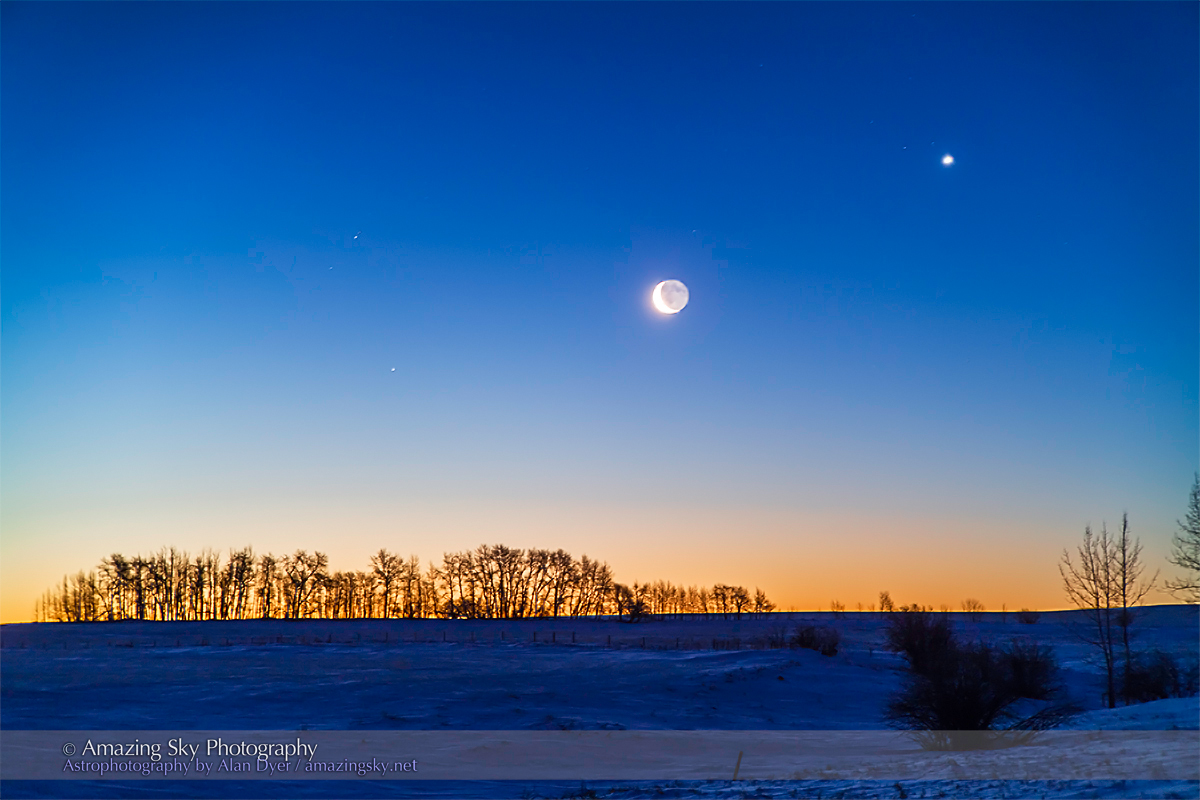
The Princess Stars


Andromeda (50mm 5DII)

The stars of Andromeda the Princess highlight the autumn sky.

Here’s an image from last night, October 4, that frames all of the constellation of Andromeda, now high in the northern autumn sky. A trio of coloured stars arcs across the centre of the image, forming the main pattern in Andromeda. In Greek legend she was the daughter of Queen Cassiopeia and was rescued by Perseus from the devouring jaws of Cetus the Sea Monster.

Above the centre star lies the constellation’s most famous feature, the Andromeda Galaxy, shining at us from 2.5 million light years away. It is the most distant object easily visible to the unaided eye.

An equal distance below the centre star of Andromeda you can see another smaller fuzzy spot. That’s the Pinwheel or Triangulum Galaxy, a dwarf spiral 2.8 million light years away, but also a member of the Local Group of galaxies that contains our Milky Way and Andromeda as its two main members.

At left, just below centre, is a large open cluster of stars, NGC 752, easily visible to the naked eye.

For this shot, as I do for most constellation portraits, I used Photoshop to layer in a shot taken through a diffusion filter (the Kenko Softon A) on top of a stack of shots taken without the filter. This allows me to add the enhanced glows around stars to bring out their colours, and to do so in a controlled fashion by varying the opacity of the filtered view. Shooting on a night with high haze or cirrus clouds has the same end effect but that’s hardly a reliable way to take constellation images. Combining filtered and unfiltered views works great, and gives the “look” made popular years ago by Japanese astrophotographer Akira Fuji.

– Alan, October 5, 2013 / © 2013 Alan Dyer
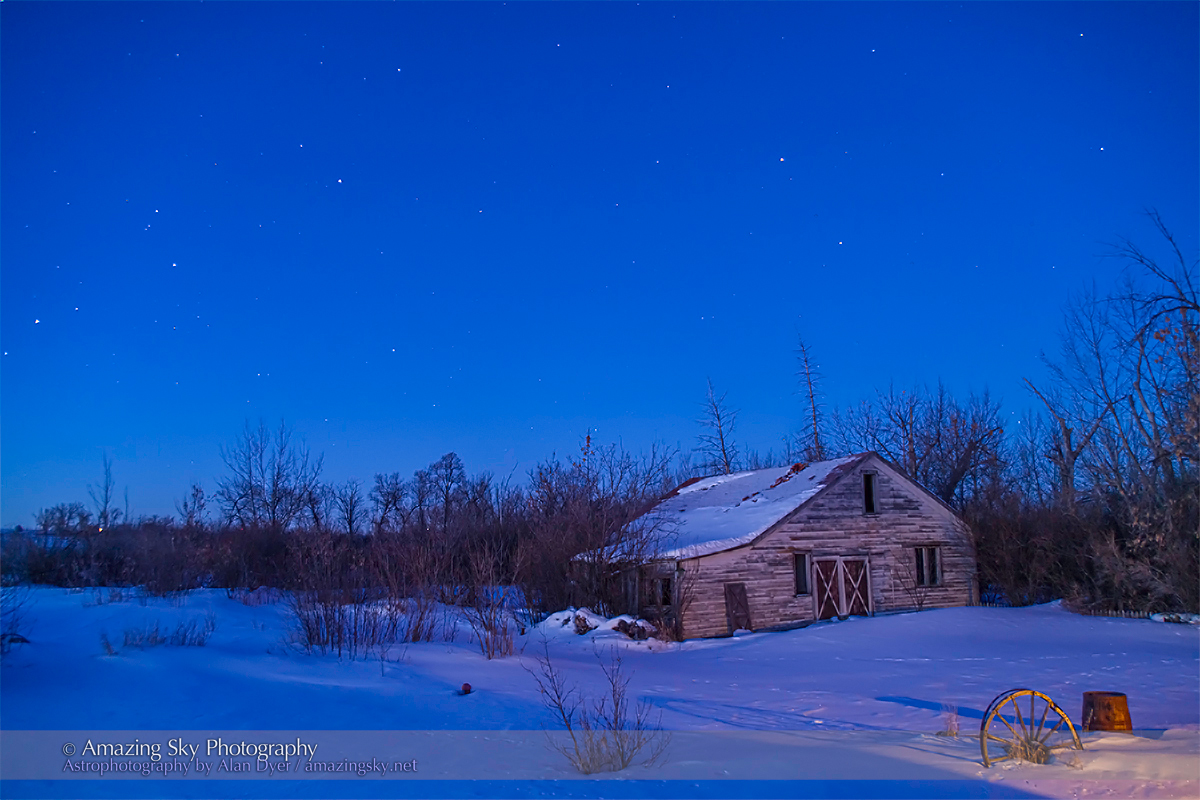
 

A Red October Aurora


Red Aurora in the East (Oct 1, 2013)

A red and green aurora lights the night on the Canadian prairie.

This was certainly a surprise aurora, with conditions officially registering as “quiet” early in the evening. However, checking Spaceweather.com showed the interplanetary magnetic field was tipped far south, a good sign.

So I made a point of checking after dark and sure enough, a fairly bright aurora was present all across the northern horizon. Conditions now registered “storm!”

The main image above is looking east, back over Saskatchewan. What was remarkable was the intense red curtains above the main green arc. These were invisible to the naked eye but the camera sure picked them up.

Red Aurora in the South (Oct 1, 2013)

There was also an odd green band in the southern sky, above. Again, the green band was obvious to the naked eye, but the camera picked up an isolated red arc as well.

This is proving to be a quiet solar maximum, but the best displays often come on the downside of the cycle. So with luck we’ll be in for some good sky shows in the next couple of years.

– Alan, October 1, 2013  / © 2013 Alan Dyer


Moon and Mars in the Morning


Moon, Mars & Regulus (Oct 1, 2013)

The waning Moon shines below Mars and beside the star Regulus in the dawn twilight.

This was the scene before sunrise this morning with the waning crescent Moon near Mars (above the Moon) and the star Regulus (left of the Moon) in Leo. Mars is getting the attention this week as Comet ISON flies near the planet and also appears near Mars in our earthly sky.

However, the comet is still very faint and needs a large telescope to see from Earth. It will be interesting to see if any of the Mars probes are able to image it, as ISON is still fainter than predicted and might be beyond their reach to detect. But if they do, they could help determine just how big ISON is and that in turn will tell us if it might survive its November 28 passage round the Sun to become a fine dawn object in December.

– Alan, October 1, 2013 / © 2013 Alan Dyer
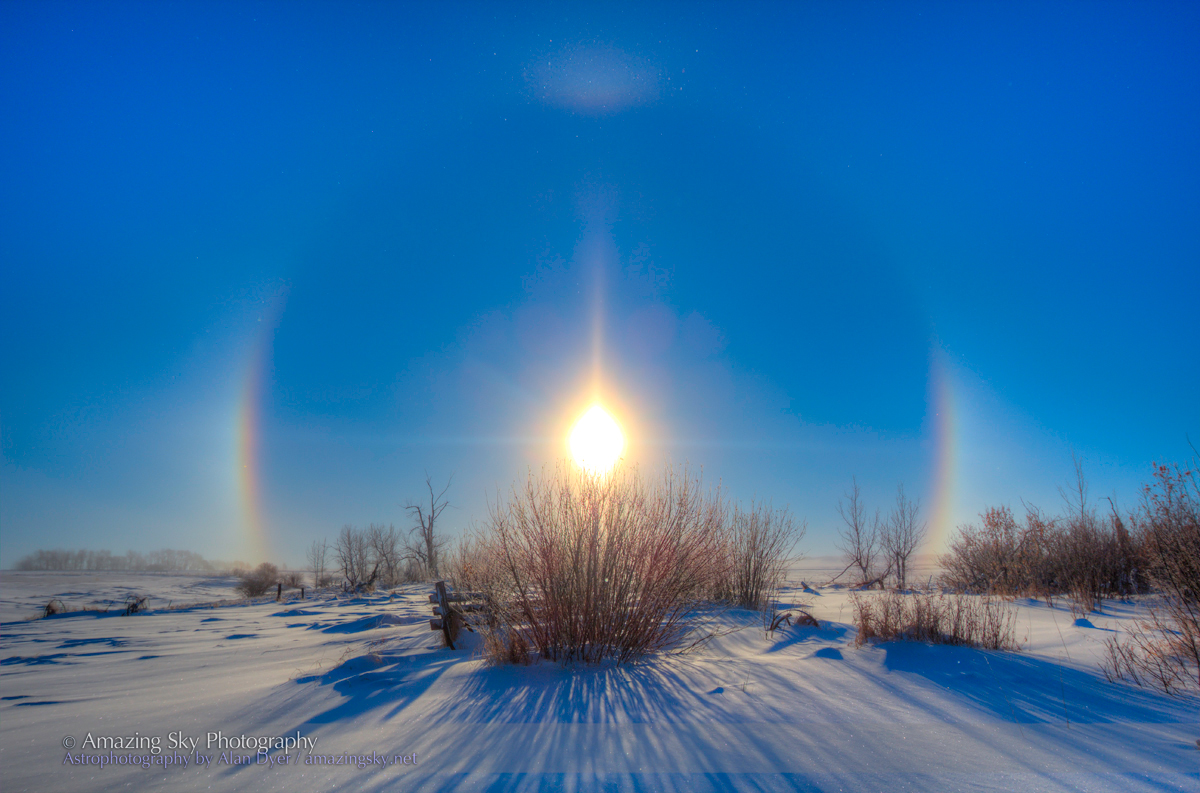
 

King and Queen of the Sky


Cassiopeia and Cepheus (50mm 5DII) Sept 29, 2013

Cassiopeia and Cepheus reign over the autumn sky amid the Milky Way.

This is a photo from last night’s shoot, taken on a very clear autumn night with the Milky Way prominent across the sky. I shot sets of constellation images, among them this one framing Queen Cassiopeia and King Cepheus.

Cassiopeia is the well-known “W” pattern at lower left. Cepheus is harder to pick out – he’s a crooked square at right, topped by a tall triangle, like a child’s drawing of a house.

The Milky Way runs across the frame, peppered with red nebulas, from IC 1396 at far right in the bottom of Cepheus, to the NGC 7822 complex at centre, and the IC 1805 complex at far left. Lots of smaller nebulas dot the scene. At far left is the Double Cluster, two adjacent clumps of stars in the outer Perseus Arm of the Milky Way. Most of the deep-sky objects in this frame lie thousands of light years away in the next spiral arm out from the one we live in, or in the space between the two arms.

Most of the bright stars here are young blue stars. But a couple of exceptions stand out: yellow Shedar (or Alpha Cassiopeiae, the bottommost star in the W and an orange giant), and red Mu Cephei, at far right bordering the round IC 1396 nebula. That star is also known as Herschel’s Garnet Star. It is a red supergiant star 1400 times larger than our Sun and one of the most luminous stars in the catalog.

– Alan, September 30, 2013 / © 2013 Alan Dyer


Equinox Highway


Equinox Setting Sun (Sept 23, 2013)

Highway One heads into the setting equinox Sun.

I try for this shot every year, and every year I’m thwarted by low clouds over the Rockies to the west.

So here’s the shot from tonight, Monday, September 23, the night after equinox. Had the horizon been perfectly clear tonight the Sun would have appeared right at the end of the Trans-Canada Highway as it set behind the Rockies. Instead, it disappeared higher up and to the left, behind low cloud.

At equinox (fall or spring) the Sun rises due east and sets due west. So tonight, it was shining into the eyes of all the drivers as they headed west into Calgary – a little demonstration of the annual motion of the Sun.

The previous night, Sunday, Sept. 22, I shot a time-lapse movie of the scene, again hoping for a clear shot to the setting Sun. Alas! A neat movie but still not quite what I was after.

There’s always 2014. But I think I need to aim east and catch the rising Sun at equinox instead. The mountains attract too many clouds.

– Alan, September 23, 2013 / © 2013 Alan Dyer
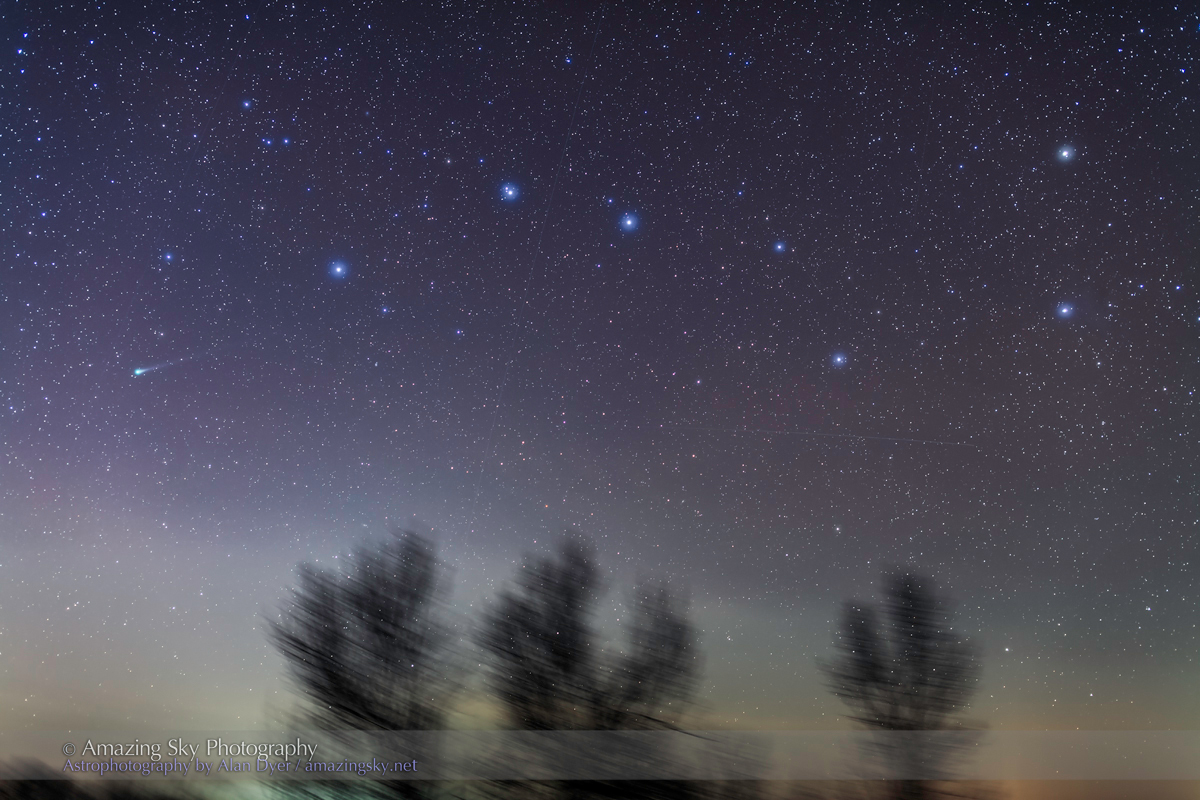


Big Dipper in the Badlands


Hoodoos and Big Dipper #2 (Sept 21, 2013)

The Big Dipper swings behind the Hoodoos in the Red Deer River badlands on a moonlit night.

Last night I headed north to the Red Deer River valley to shoot a time-lapse over the river with the badland hills lit by the rising waning Moon. After finishing that I stopped at the popular Hoodoos tourist attraction on Highway 10 east of Drumheller. I had the place to myself at midnight, and the photo ops around the moonlit hoodoos were many.

These formations form when harder capstone rock prevents the soft lower layers from eroding in the rain.

Hoodoos and Big Dipper #4 (Sept 21, 2013)

The Big Dipper was nicely positioned above the hills as it swings low across the northern horizon in autumn.

Hoodoos in Moonlight #1 (Sept 21, 2013)

Here I aimed back toward the Moon, with its glare muted by high cloud, and backlighting the hoodoos. The stars of Perseus are rising at left. Unlike normal astrophotography, with nightscape work, and certainly time-lapse shooting, clouds can be a benefit.

This was a great spot to end an evening of nightscape shooting.

– Alan, September 22, 2013 / © 2013 Alan Dyer


Harvest Moon Panoramas


Harvest Moon & Earth Shadow Panorama (Sept 19, 2013)

The Harvest Moon rises into the dark arc of the Earth’s shadow.

What a perfect night this was. The Full Moon rose into a crystal clear sky, tinted with the dark blue shadow of our planet arching across the eastern sky.

The main image above is a 7-section panorama sweeping from northeast to southeast, but centred on the rising Harvest Moon rising almost due east.

The Moon came up just before the Sun set. The panorama below shows that scene. It’s a crop of a full 360°, 45,000-pixel-wide panorama, taken just as the Sun was setting almost due west and the Moon was rising 180° away in the east.

Harvest Moon Panorama (Sept 19, 2013)

I took both panoramas with a Canon 5D MkII and 50mm Sigma lens, with the segments at a 30° spacing. That way I take 12 segments to cover a full 360°, a habit leftover from the days of shooting photo pans for planetarium projection systems consisting of 12 Kodak slide projectors.
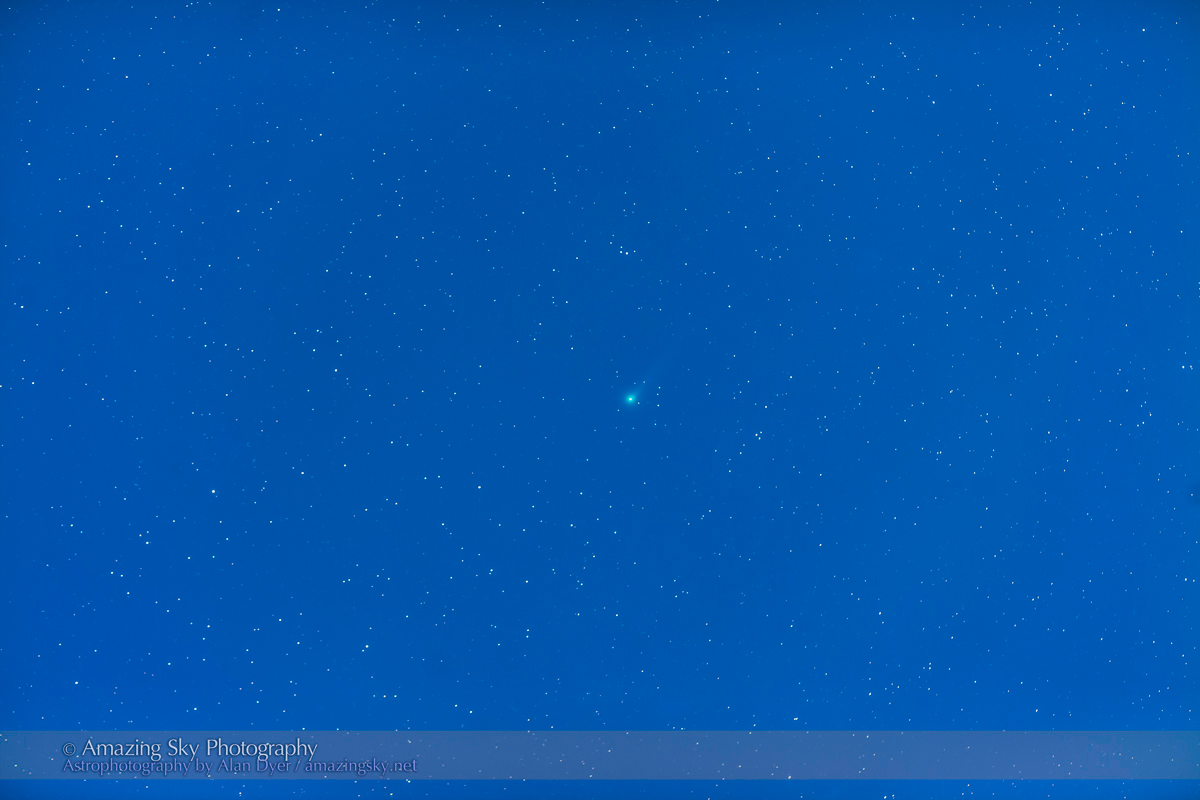
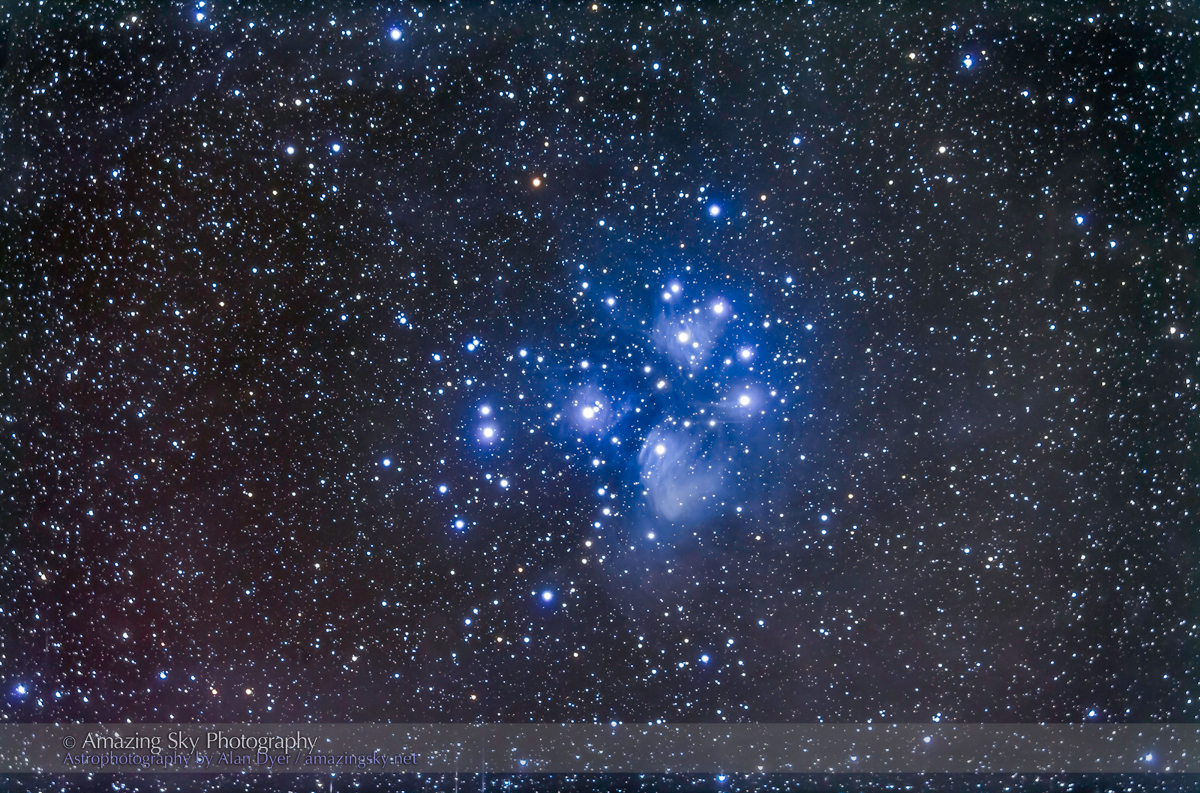
 

My previous post showed some still frames from a time-lapse movie of the rising Harvest Moon. The final movie is above, assembled from 670 frames taken at 2-second intervals with the Canon 60Da and 200mm lens. I’ve shot this subject a few times now, but this was my best capture of the rising Full Moon at harvest time, always the most photogenic Moon it seems.

It was a marvellous night for a moonrise!

– Alan, September 20, 2013 / © 2013 Alan Dyer


Harvest Moonrise at Sunset


Harvest Moonrise #2 (Sept 19, 2013)

The Harvest Moon rises with pink hues into the deep blue twilight over prairie fields.

This was the scene tonight, September 19, as the Full Moon rose into a clear eastern sky. The view was perfect, with a cloudless horizon (for a change!) and the Moon prominent and pink as it rose into the twilight sky.

The main image is from a few minutes after moonrise. The bottom image, with a dimmer Moon, is from just after moonrise.

In neither case did I punch up the Moon in contrast or colour separately from the sky to make it stand out more than it did in real life. And I certainly did not paste a telephoto lens shot of the Moon into a wide-angle scene. That’s faking it. This is real.

Harvest Moonrise #1 (Sept 19, 2013)

Both frames are from a 670-frame time-lapse sequence, from the Moon first peaking above the horizon to when it rose out of frame at top right. That’s still in processing!

– Alan, September 19, 2013 / © 2013 Alan Dyer


Harvest Moonset at Sunrise


Harvest Moonset at Dawn (Sept 19, 2013)

The Harvest Full Moon sets into a prairie scene lit by the rising Sun.

This was the scene this morning, September 19, as the Full Moon set just after sunrise on a perfectly clear morning.

Clear, of course, but for the only clouds in the sky just where I wanted to shoot. However, in this case they did help make the scene, adding more colours to the western sky at dawn.

This was the true Harvest Moon, as moonset occurred only a couple of hours after the official moment of Full Moon. However, the setting moons of Wednesday night, September 18 and Thursday night, September 19 can both claim to also be the Harvest Moon, the Full Moon closest to the autumnal equinox.

I plan to shoot the Moon coming up again, 12 hours after it set for this photo, and right at sunset tonight.

– Alan, September 19, 2013 / © 2013 Alan Dyer


Pleiades Rising Through the Old Farm Gate


Pleiades Through the Old Farm Gate

The Pleiades rises beyond the old farm gate on a moonlit prairie night.

It’s been a wonderful few nights for nightscape photography, with a bright gibbous Moon lighting the golden prairie landscape. Skies have been clear and the nights warm, ideal for 3-hour shoots of old farmsteads and prairie scenes.

I’ve spent the last few nights at the abandoned farm near home, shooting time-lapses. This is from Monday night, and is one frame from a 360-frame dolly-motion time-lapse.

The Pleiades star cluster rises in the east over the old barn and farm gate. A car travels through the coulee, leaving a streak of headlights.

I hope the weather continues, so I can harvest some more images, making time-lapse “hay” while the Moon shines!

– Alan, September 17, 2013 / © 2013 Alan Dyer


The Summer Triangle Stars


Summer Triangle in the Milky Way

The trio of Summer Triangle stars flank the Milky Way in the dying days of summer.

I shot the featured image above two nights ago on a perfect late summer night from home. Skies were dark and transparent, with no aurora and little airglow to taint the sky.

The image takes in the Summer Triangle stars of Vega (top), Deneb (left) and Altair (bottom). Vega and Altair straddle the summer Milky Way, but Deneb lies right in the thick of it, way down the Local Arm that we live in. Vega and Altair are nearby normal stars, only 25 and 16 light years away. But Deneb is a blue supergiant, shining from 1400 light years away, and one of the most luminous stars in the catalog.

The Milky Way through this area of sky is riven by twisting lanes of interstellar dust. A particularly dark patch sits above Deneb at top left. Then below Deneb the Milky Way gets split by the Great Rift that continues down into Aquila and Ophiuchus at lower right.

All along this part of the Milky Way, particularly around Deneb, the camera picks up a string of glowing red nebulas where stars are forming. The red comes from hydrogen atoms emitting deep red light, as hydrogen is wont to do.

Summer Milky Way from Backyard (Sept 9, 2013)

This image is from a couple of nights earlier. I used a wider angle lens to take in the full sweep of the summer Milky Way, from Sagittarius skimming the horizon, to Cassiopeia past the zenith at the top. You can see the Summer Triangle in the top half of the image, the part of the sky now overhead on early September nights from the northern hemisphere.

I took both shots with a filter-modified Canon 5D MkII placed on a little iOptron SkyTracker for tracked long exposures (4 to 5 minutes). The main image was with a 24mm Canon lens, the bottom image with a 14mm Rokinon lens.

– Alan, September 12, 2013 / © 2013 Alan Dyer


Moon and Venus in the Prairie Twilight


Moon and Venus (Sept 8, 2013)

Tonight, the waxing crescent Moon passed by Venus for a close conjunction in the evening twilight.

At this time of year from my latitude of 51° north, the evening ecliptic always swings low across the southwest. So any fall evening planets, and the Moon, appear low on the horizon and set early.

That was the case tonight, for the close passage of the Moon past Venus (at right). However, their altitude allowed me to capture them and the prairie horizon in the same telephoto lens field.

It was certainly a beautiful sight over the harvested prairie fields, on what feels like an autumn night, though officially it is still summer.

– Alan, September 8, 2013 / © 2013 Alan Dyer


The Great Arc of the Milky Way


Milky Way Panorama (Sept 4, 2013)

The Milky Way sweeps in a great arch of light across the sky.

It’s been a wonderful week for shooting the Milky Way. I had a very clear night on Tuesday but ventured no further than a few hundred feet from home to the harvested canola field next door.

The Milky Way was beautifully placed, as it always is at this time of year, right across the sky from northeast to southwest, with the starclouds of Cygnus passing directly overhead.

The top photo is a panorama of 8 shots, with a camera on a tripod, and each exposure being just 60 seconds with a 14mm lens in portrait orientation. I stitched the segments with PTGui software, rendering the scene with its spherical projection mode which wraps the dome of the sky onto a flat surface in a way that retains the zenith detail as your eye saw it, but greatly distorts the extremities of the scene at either end.

My house is at lower right.

Milky Way over Harvest Field (Sept 4, 2013)

For this image, I used the same lens to take a single view from horizon to well past the zenith. Here the camera was tracking the stars for a set of stacked 5-minute exposures to grab even more detail in the Milky Way.

What stands out as much as the Milky Way are the green fingers of airglow stretching across the sky. These were invisible to the eye but the camera sure picks them up.

Airglow is caused by oxygen atoms, in this case, fluorescing at night as they release some of the energy they absorbed by day. It’s not aurora and generally covers more of the sky, sometimes with a diffuse glow or, as here, with more structured bands that slowly shift over minutes. It varies from night to night and can occur at any latitudes. But usually only cameras pick it up. To the eye, airglow just makes the sky look inexplicably a little less dark than you think it should be on such a clear night.

– Alan, September 7, 2013 / © 2013 Alan Dyer


Last of the Summer Milky Way


Milky Way over Mountains at Waterton Lakes (Aug 31, 2013)

The summer Milky Way sets behind the peaks of Waterton Lakes National Park, signalling an end to summer.

This was the scene last Saturday night, on a perfect summer night in the Rockies. The glorious starfields of the summer Milky Way are setting behind the mountains.

The Small Sagittarius Starcloud is just above the mountain ridge while above it are the red patches of the Swan and Eagle Nebulas.

Farther up the Milky Way, stars brighten into another starcloud, the Scutum cloud, flanked by two dark lanes of dust. Above it shine the stars of Aquila, Ophiuchus, Lyra, and southern Cygnus. The two bright stars are Altair (below) and Vega (top right).

Summer Milky Way over Mountains (Aug 31, 2013)

This is an alternative view of the same scene, with the camera in “landscape” orientation.

I took both from a pull-off on the Red Rock Canyon road in Waterton. Each image is a stack of four 3-minute exposures, each tracking the stars with the camera on an iOptron SkyTracker.

The Milky Way from Canada just doesn’t get any clearer or the skies any darker.

– Alan, September 3, 2013 / © 2013 Alan Dyer


The Milky Way over Milk River


Milky Way over Writing-on-Stone Park #2 (Sept 1, 2013)

The summer Milky Way sets over the Milk River on the last weekend of the summer.

This was the view last night, Sunday, September 1, from the Visitor Centre hill overlooking the spectacular Milk River valley and the sandstone formations of Writing-on-Stone Provincial Park, Alberta.

The Milk River winds around the park’s campsite, filled on a beautiful long weekend with campers enjoying the clear skies and temperatures in the 30s by day. At night, conditions were perfect. Warm, dry, no bugs, no wind. The best.

I set up two cameras: one for a day-to-night time lapse and one for a time-lapse panning the scene as the Milky Way moved to the west. These two images are frames from the latter.

Above is a shot from later in the evening when the sky was dark …

Milky Way over Writing-on-Stone Park (Sept 1, 2013)

… while this image is from earlier in the shoot, when the last of the blue twilight still lit the sky and the camera was aimed a little more to the east.

On the horizon at left in the image above lie the Sweetgrass Hills of Montana, a prominent landmark in southern Alberta. The yellow sky glows are from towns in northern Montana.

Lights from the campground and car headlights illuminate the landscape and the eroded hoodoo formations.

Writing-on-Stone Park preserves ancient rock petroglyphs that record scenes from before and after contact with Europeans. It is a sacred site to First Nations people and is a marvellous place for stargazing.

– Alan, September 2, 2013 / © 2013 Alan Dyer


Waterton Lakes Panoramas (Night and Day)


Waterton Lakes Night Panorama #1 (Aug 31, 2013)

Two panoramas compare the view of Waterton Lakes National Park by night and by day.

Last night was as perfect as it gets here in the southwest corner of Alberta. The sky was crystal clear and the wind was calm, unusual for Waterton Lakes.

I spend the night travelling around the Park shooting nightscapes, including this night pan taken from the shoreline in the townsite, again contending with the light pollution of unshielded town streetlights, and the glare from lights on the Prince of Wales Hotel. But even they can’t wash out the marvellous Milky Way.

Just after taking this I went up to the Hotel to shoot scenes from its overlook, back toward the town. As I walked up to the Hotel, a guest was getting out of her car and waving an iPhone around with an astronomy app, hoping to see the stars. I overheard her saying, “I guess we won’t see a lot of stars from here,” referring to the glare of the lights of the Hotel.

The night panorama sweeps from northwest to southwest over 270°. At left we’re looking north toward the prairies. An aurora there would have been well-placed and timed. As it is, there is just the faintest hint of Northern Lights. At right, is the centre of the Galaxy area of the Milky Way.

Stars shine reflected in the unusually clam waters of Upper Waterton Lake.

Sunset at Waterton Lakes Panorama (Aug 31, 2013)

This day panorama takes in a smaller angular sweep. I took it from a similar shoreline location just at sunset, as the last rays of the Sun lit Vimy Peak in alpenglow. Returning to dock on the last voyage of the day is the historic tour boat, The International, a wood-hulled ship built in 1927, the same year the Prince of Wales Hotel opened. It plies these waters every summer and by winter is stored in a dry dock down the lake on the U.S. side.

It’s been a wonderful weekend here. More photos are in the processing pipeline. But for now, it’s off to Writing-on-Stone Provincial Park.

– Alan, September 1, 2013 / © 2013 Alan Dyer


Stars over a Grand Hotel


Prince of Wales Hotel & Stars (Aug 30, 2013)

The stars and fleeting clouds appear over the grand Prince of Wales Hotel in Waterton Lakes National Park.

This was the scene last night, Friday, August 30, on a less than ideal night for nightscape shooting. But I made the best of it with some still shots in and around the Waterton townsite.

This is a view from Driftwood Beach on Middle Lake, looking south toward the Prince of Wales Hotel, the Park’s famous landmark, and a well-illuminated one at that. It shines beneath the Milky Way and clouds lit yellow from the town’s streetlights. It would take some work converting this site into a Dark Sky Preserve!

Built in 1927, the Hotel is a large log structure that has miraculously survived fire, and the howling winds that can blow at gale force down the lake. It was built by the American Great Northern Railway to lure American tourists north from Montana’s Glacier National Park.

– Alan, August 31, 2013 / © 2013 Alan Dyer


The Milky Way at Waterton Lakes


Waterton Lakes Milky Way #3 (Aug 29, 2013)

The Milky Way glows bright in the twilight of a summer evening at Waterton Lakes National Park.

It’s been a marvellous weekend so far at Waterton Lakes, with another fine night ahead it appears, on a warm weekend to end the summer. Two nights ago I set up cameras on the shore of the main lake, shooting south to the Milky Way. The main photo above shows the Milky Way while the sky was still deep blue with evening twilight.

Light from the campground streetlights illuminates the old tree and foreground. It is light pollution to be sure, but sometimes added lighting can help, especially on a dark moonless night.

Waterton Lakes Milky Way #1 (Aug 29, 2013)

This shot comes from later in the evening with a wider angle lens and shows the Milky Way under dark sky conditions at the end of the long Upper Waterton Lake that extends south into Montana and Glacier National Park.

Waterton-Lakes-Star-Trails-(Aug-29,-2013)

By stacking about 35 images taken in quick succession, each 1-minute exposures, I created this star trail effect. I used the new version of StarStaX, a free program that does a great job stacking star trails. Its latest version offers this neat “comet trails” effect as an easy-to-apply stacking option.

– Alan, August 31, 2013 / © 2013 Alan Dyer (all photos)

Waterton Lakes by Night


Waterton-Lakes-Panorama-(Aug-29,-2013)

The Milky Way shines over the peaks of Waterton Lakes National Park on a clear summer night.

This was the view last night, August 29, under very clear skies, on the Red Rock Canyon Road in Waterton Lakes National Park, a UN World Heritage Site and a beautiful place for day and nighttime photography.

This is a 7-frame panorama sweeping over about 180° from the southeast at left and into the northwest at right, taking in the autumn constellations rising at left, over to the Milky Way in the south and to the Big Dipper skimming across the northwest horizon at right. Each frame was a 30-second exposure at f/2.2 and ISO 1600.

The green glow at left is from airglow, while the yellow and magenta colours at right are from low-level aurora and from the lights of Pincher Creek and the Crowsnest Pass communities. The bright light at left of centre is from the lights adorning the Prince of Wales Hotel, set amid the general glow of streetlights from the townsite of Waterton Lakes.

The foreground is lit only by starlight.

– Alan, August 30, 2013 / © 2013 Alan Dyer

Milky Way Over Moraine Lake


Milky Way over Moraine Lake (Aug 25, 2013)

The summer Milky Way shines from behind clouds coming over the Continental Divide at Moraine Lake, Banff.

Earlier in the day, thousands of people stood here, admiring the famous view of Moraine Lake set in the Valley of Ten Peaks. This was the view by night, before the waning Moon rose to light the scene. I was the only one there.

A couple of hours after I took this image, the peaks were well lit by moonlight, but clouds had moved in to obscure the stars. This shot from the start of the night shows the sky at its clearest and darkest.

The last time I visited Moraine Lake at night was back in the 1990s shooting with 6×7 film. I’ve wanted to get back with digital cameras for some years. Last Sunday, August 25 was my chance.

Despite the encroaching clouds, I managed to shoot time-lapses with three cameras: a dolly shot with the Dynamic Perception Stage Zero, a pan in azimuth with the new Radian controller, and a tilt-pan with the Sky-Watcher AllView mount. All worked well, but had the night been perfectly clear the movie clips and stills would have been all the nicer. But you go with what the mountains deliver.

This is one of the best of the frames from the night’s shoot, taken with a 14mm Rokinon lens for 60 seconds at f/2.8 and Canon 5D MkII at ISO 4000.

It shows one of the issues with shooting near lodges and resorts – yes, it’s convenient and safe (I’m reluctant to hike far in the dark alone, with Grizzly in Area and Travel in Groups signs about!) but even the most eco-friendly of resorts fail to realize the effects of their lights spilling out over the natural landscape. In this case, they do help light the dark scene, but they are pollution. When, oh when, will parks and resort operators begin to realize that the night is an environment to be protected as well, and not a jurisdiction to be ruled by lawyers and planners who dictate that the worst and usually cheapest types of lighting be installed.

P.S.: This was blog post #350 for me! 

– Alan, August 27, 2013 / © 2013 Alan Dyer

Big Dipper Over Castle Mountain


Big Dipper over Castle Mountain, Banff (Aug 24, 2013)

The famous stars of the Big Dipper dip behind the moonlit crags of Castle Mountain.

I just got back from four days in Banff, always a great place to be, even if it is cloudy. And it was!

I lost one night to forest fire smoke and another to rain clouds. On Saturday and Sunday nights I managed to seek out some clearer skies for nighttime shooting. This is a shot from Saturday, from a favourite photo stop on the Bow Valley Parkway overlooking the cliffs of Castle Mountain.

Despite the dew from rains earlier in the day I managed to shoot a time-lapse here. These two shots are frames from the movie which pans slowly across the scene.

Iridium Flare over Castle Mountain

This frame catches an Iridium satellite flare above the Dipper.

Light from the waning gibbous Moon, which was in and out of clouds itself, illuminates the scene and nicely cross-lights the Castle cliffs.

– Alan, August 26, 2013 / © 2013 Alan Dyer


Cassiopeia Rising in the Badlands


Cassiopeia Rising Behind Hoodoos (Aug 18, 2013)

The stars of Cassiopeia rise behind hoodoo formations in the Alberta Badlands.

I took this Sunday night, August 18, as part of my shoot at Dinosaur Provincial Park. This is a particularly striking pair of hoodoos at the start of the Badlands Trail where I’ve been meaning to take some moonlit nightscapes for a couple of years.

This night’s conditions were perfect, with the “W” of Cassiopeia nicely placed, and the Moon providing excellent cross-lighting, under a clear blue sky, for the contrasting colours of earth and sky.

– Alan, August 20, 2013 / © 2013 Alan Dyer

Dinosaur Moon


Waxing Moon in Badlands Twilight (August 18, 2013)

The waxing Moon rises into a colourful twilight sky over the badlands of Dinosaur Provincial Park.

What a great night it was last night! Warm summer temperatures (at last!) allowed for shirtsleeve shooting even well after dark. To shoot on the warm August night I went out to Dinosaur Provincial Park, a magical place to be at sunset and in the summer twilight. The colours on the badlands are wonderful. It’s earth-tones galore, with the banded formations from the late Cretaceous blending with the sagebrush and prairie flowers.

This was the scene after sunset, as the waxing Moon rose into the eastern sky coloured by the blue band of Earth’s shadow, the pink Belt of Venus and dark blue streaks of cloud shadows converging to the point opposite the Sun. That’s where the Moon will be Tuesday night when it’s full. But last night it was a little west of the anti-solar point.

Moon and Sunset Glow at Dinosaur Park (August 18, 2013)

I managed to grab this image as soon as I got to my photo spot on the Badlands Trail, just in time to catch the last rays of the setting Sun illuminating the bentonite hills of the Badlands. Both shots are frames from a 450-frame time-lapse, taken with a device that also slowly panned the camera across the scene over the 90-minute shoot.

It, and three other time-lapses I shot after dark, filled up 40 gigabytes of memory cards. It’s been a terabyte summer for sure!

– Alan, August 19, 2013 / © 2013 Alan Dyer


The Great Lone Land … and Great Big Sky


The Gap Road Panorama (Cypress Hills Park)

A vast blue sky and summer storm clouds arch over a prairie landscape.

This is a place where you are out on the vast open plains, looking much as they would have appeared hundreds of years ago. This is big sky country, in southwest Saskatchewan. I shot this 360° panorama last Sunday, on a road I get to take every few years that is one of the great drives in western Canada.

Some years it is too wet and impassable. Other years it is too dry and closed because of the fire hazard.

This is the Gap Road, a mud track at times between the Saskatchewan and Alberta units of Cypress Hills Interprovincial Park. The road crosses private rangeland but the cattle are the only giveaway that this is a modern scene and not one from the 19th century.

In 1872 the British explorer and adventurer William Francis Butler crossed the prairies and northern plains in the last days of the buffalo culture, before the cattle and ranchers arrived. He called it then The Great Lone Land. You feel that sense in a place like this, out on the open treeless plains. 150 years ago great herds of bison roamed here. And it was here that the North West Mounted Police set up their first outpost in the area, at Fort Walsh, to stop the incursions of the American “wolfers.”

The sky dominates the scene. I spent an hour here, shooting a time-lapse of the approaching thunderstorm, at right, coming toward me from miles away, until it filled the sky and threatened to turn the road back into mud.

It was a wonderful day spent crossing the prairies, and traveling back in time.

– Alan, August 16, 2013 / © 2013 Alan Dyer


Wheatfield Moon


Wheatfield Moon (Aug 14, 2013)

The waxing Moon shines above a ripening field of wheat on a prairie August evening.

A track winds off through the wheat field toward the western twilight sky, while a waxing Moon shines in the south.

This was the scene tonight just down the county road where I live, on a warm August night on the Canadian Prairies.

For this shot, I assembled a high dynamic range set from eight exposures taken over a range of 8 f-stops, to compress the wide range of brightness into the one photo. Even so, the Moon remains overexposed. But I like shooting these scenes in deep twilight for more saturated colours and for some stars in the sky.

– Alan, August 14, 2013 / © 2013 Alan Dyer


Sunset from the Cypress Hills


Horseshoe Canyon Sunset (August 11, 2013)

The Sun sets over the pines and prairie of Cypress Hills, Alberta.

Tonight it was too cloudy for meteors. But the sky did provide a very fine sunset.

I was at the Horseshoe Canyon viewpoint on the Alberta side of Cypress Hills Interprovincial Park, to catch a deep-red Sun going down into haze and cloud. This is looking northwest, from the pine-covered hills out over prairie plains of southern Alberta. The image is a high-dynamic range stack of 7 images.

The viewpoint also had an interpretive sign explaining the virtues of dark sky preservation – Cypress Hills Park is a large dark sky preserve – and I was pleased to see one of my photos used as an illustration on the sign. I had sent it to the Park several years ago.

But alas, no meteors in view tonight. And while there were a few visible the night before at the star party, out of 200+ shots I took, not one recorded a decent Perseid meteor! Of course!

– Alan, August 11, 2013 / © 2013 Alan Dyer


Saturday Night Under the Stars


RAO Milky Way Night (Aug 3) #1

On a summer Saturday night hundreds gathered to enjoy the stars and Milky Way.

What a fine night this was. Last night, Saturday, August 3, I helped out at one of the annual Milky Way Nights presented by the University of Calgary’s Rothney Astrophysical Observatory. About 300 people attended, under nearly perfect conditions. The few clouds that rolled through later in the night didn’t detract from the views of the Milky Way and deep-sky objects.

Part way through the night I conducted a laser tour of the night sky. It was pretty neat presenting a “planetarium show” under the real stars to about 150 people gathered on the hillside lying on blankets and in lawn chairs. Astronomy outreach doesn’t get much better!

RAO Milky Way Night - Fish-Eye View #1 (Aug 3, 2013)

Folks from the local astronomy club set up their telescopes on the patio for public viewing. This is a fish-eye lens image I took in the twilight for use in an upcoming digital planetarium show I’m working on that will tour people through the Milky Way.

RAO Milky Way Night (Aug 3) #4

A highlight was the opportunity for people to look through one of the largest telescopes in Canada, the 1.8-metre ARC Telescope that is normally used for spectroscopy but can actually be equipped with an eyepiece. Here, observatory director Dr. Phil Langill lines up the telescope on Neptune.

The event went from 10 p.m. to 2 a.m. We started these Milky Way Nights in 2009 for the International Year of Astronomy and they have been big hits every summer since, one of the legacies of IYA.

– Alan, August 4, 2013 / © 2013 Alan Dyer


Moonshadows and Sunbeams


Moonrise Behind Prairie Grain Bins (July 27, 2013)

The play of light and shadow in the open air create wonderful effects by night and day.

The Moon and Sun have each created some wonderful sky scenes of late, aided by clouds casting shadows and sunbeams across the sky.

Above, the rising waning Moon on Saturday night shone its warm light across the prairies. Clouds cast dark shadows diverging away from the Moon.

Daytime Crepuscular Rays #4 (July 24, 2013)

By day, clouds created the opposite effect. Holes in the clouds let through beams of sunlight, creating rays descending from the sky dancing across the land.

Both effects are technically known as crepuscular rays. You can read much more about the phenomenon at the wonderful Atmospheric Optics website. Clouds aren’t always the evil presence in the sky astronomers take them for. They can produce stunning effects. Just look up!

– Alan, July 29, 2013 / © 2013 Alan Dyer


Canola Field Stars


Circumpolar Star Trails over Canola Field (July 26, 2013)

Stars in a blue sky wheel above a ripening field of yellow canola.

It’s been a couple of fine nights of nightscape shooting under the light of the waning Moon and clear skies.

I’ve been shooting from no more exotic location than my local rural neighbourhood, travelling for 5 minutes to spots near one of the many canola fields growing nearby. I wanted to grab some nightscapes over the  fields before they lose their yellow flowers and turn green.

The feature image above looking north is from a time-lapse sequence and stacks several images with the “comet trail” effect, to show the northern stars turning about the North Star.

Big Dipper over Canola Field #2 (July 26, 2013)

This image, also a frame from another time lapse with a longer lens, shows the Big Dipper above that same field but in an exposure short enough to prevent the stars from trailing. You can now make out the familiar Dipper pattern.

This is a very Canadian scene, with the Big Dipper high in a northern latitude sky, and with the foreground crop a Canadian one – Canola was developed in the 1970s at the University of Manitoba. The “can” in canola stands for Canada. Pity there was no aurora.

– Alan, July 28, 2013 / © 2013 Alan Dyer


Star Rain


Star Rain - Big Dipper Star Trails

The sky seems to swirl in a rainstorm of stars.

I’ve combined several exposures of the stars in the northern sky to create a “comet trail” effect, showing them turning about the celestial pole. The top photo looks northwest to the stars around the Big Dipper and picks up the purple light of a faint aurora.

For the photo below, taken on a different night, I used a fish-eye lens to capture the entire sky, but looking north. You can see how the sky turns counterclockwise about the Pole Star. The Milky Way also appears as a blurred band of light.

Circumpolar Comet Star Trails (July 16, 2013)

I shot these last week from the cabin at Reesor Ranch in Saskatchewan during a wonderful week of nightscape photography in the Cypress Hills.

To create these images I used the Advanced Stacking Actions from Star Circle Academy.

– Alan, July 25, 2013 / © 2013 Alan Dyer


High Plains Panorama of the Night Sky


Cypress Hills Night Panorama (July 15, 2013)

The silvery Milky Way and green bands of airglow stretch across the high plains and big sky of the Cypress Hills.

The Moon had long set and the night looked as dark as it could be. No lights interrupted the flat clear horizon. These are the high plains of the Cypress Hills, the highest place in Canada between Labrador and the Rockies.

And yet, in the panoramic photos I took last night the sky revealed its true colours.

In the 360° panorama above, the Milky Way arches overhead from northeast to southwest. It was obvious to the naked eye. But stretching across the sky from east to west are also bands of green and red airglow that were completely invisible to the eye, except perhaps for making the sky look more grey than it might have otherwise.

These aren’t aurora but are emissions of light caused by oxygen atoms fluorescing as they give off some of the energy they absorbed by day. Time-lapse sequences show these bands moving slowly across the sky.

Shooting the Survivor Tree (July 15, 2013)

I drove up the Graburn Road last night, to the plateau of Cypress Hills, to shoot a time-lapse of the Milky Way moving above this lone tree on the plains. It’s called the Survivor Tree, subject to drought, blizzards fire, cattle, and even being cut down at one time. But still it survives. With a cold wind blowing last night I had a taste of what this tough Lodgepole Pine has had to endure.

Survivor Tree and Milky Way (July 15, 2013)

This is one frame from the final movie clip, with the tree and sky still lit by the light of the setting waxing Moon. An enduring tree beneath the timeless stars.

Noctilucent Clouds from Cypress Hills (July 15, 2013)

Early in the evening the northern sky was also marked by another sky phenomenon, noctilucent clouds – very high altitude clouds still lit by sunlight long after the Sun has set locally. These clouds made for a nice photo for a few minutes but soon faded from view as the Sun set even as seen from where these clouds live at the edge of space.

The night was left dark, with no aurora tonight – just the Milky Way and the faint wisps of airglow over the high plains of southern Alberta.

– Alan, July 16 2013 / © 2013 Alan Dyer

Road to the Northern Lights


Northern Lights Down the Road (July 14, 2013)

A country road winds off into the dancing Northern Lights.

The sky put on another fine show last night, the fourth in a row with some level of aurora activity. This was the scene Sunday night as a display blossomed for a while, dancing at the end of the back road through the Cypress Hills on the Alberta-Saskatchewan border.

I had one camera shooting north and devoted to the Northern Lights, while, as you can see below, I had two other cameras on rigs to shoot time-lapse movies looking south.

Self Portrait at Battle Creek, Cypress Hills (July 14, 2013)

This was the scene at the overlook to the Battle Creek valley, with the Moon setting and me getting the time-lapse gear going, to shoot the Milky Way moving over the hills. One camera was on a mount to pan across the landscape following the stars. The other camera was on a motion control dolly to travel down a track over the 3 hours of the shoot. I spent a lot of time in the car listening to BBC Desert Island Discs and The Life Scientific podcasts last night — the thrill of time-lapse shooting!

Milky Way over Battle Creek (July 14 2013)

This is one frame from one of the movies. Streaks of green and red airglow tint the sky around the Milky Way. Amazingly, the scene is lit only by starlight and by the aurora. You could never have done this with film. It’s the sensitivity of digital cameras that makes such scenes possible, though it takes some clever processing (such as Shadow Detail recovery in Raw, Shadows and Highlights, & masked Adjustment Layers) to balance Earth and sky in the final image.

– Alan, July 15, 2013 / © 2013 Alan Dyer


Milky Way Over a Misty Lake


Milky Way over Misty Lake (July 13, 2013)

The misty starclouds of the Milky Way shine above the misty waters of Reesor Lake.

This was certainly a magical scene – the stars above the still waters of a misty lake. Above the tree-lined hills lies the constellation of Sagittarius and the heart of the Milky Way. The dark structure comes from interstellar dust, the stuff we’re made of. Everything in the foreground on Earth comes from the stuff you can see in the sky.

I shot this Saturday night, on a beautiful, if damp, night for nightscape photography in the Cypress Hills, Alberta. I helped the scene along by “painting” the mist with a white flashlight.

Milky Way over Misty Lake (July 13, 2013)

For those who like their Milky Way images in portrait mode, here’s one of the same scene, showing more of the sweep of the summer Milky Way up from the southern horizon, from Sagittarius to Aquila.

Self Portrait at Reesor Lake (July 13, 2013)

And while I don’t often take shots of people in scenes, I couldn’t resist getting into the photo myself here, standing on the boardwalk gazing at the centre of the Galaxy.

– Alan, July 15, 2013 / © 2013 Alan Dyer


Moonset on a Misty Lake


Moonset on a Misty Lake (35mm)

What a marvelous night for a moonset! 

Saturday night was one of the finest nights for nightscape shooting I’ve had in a long time. I started with shots of the waxing Moon setting over Reesor Lake, one of the lakes in Cypress Hills Interprovincial Park, on the Alberta side. Water from this lake drains into the Milk River and then into the Missouri, and Gulf of Mexico. It one of the few bodies of water in Alberta that feed the Mississippi watershed, with the Cypress Hills acting as a continental divide.

I set up two cameras, each shooting a twilight-to-night time-lapse sequence showing the Moon setting behind the hills and the stars coming out. I filled up one card with 600 images. Luckily, the other camera still had space left for what was still to come later that night. One sight was the beautiful auroral arc I featured in my previous blog post. I’ll have more tomorrow, of the Milky Way over the lake.

Moonset on a Misty Lake

It had rained earlier in the day so the air was humid. Mist covered the lake as night fell. In the scene above, a small fleet of American pelicans also glide by.

Watching the peaceful scene while monitoring the cameras clicking away provided one of those magical moments that makes doing this photography worthwhile, regardless of the results. The mist was swirling, the stars were coming out, I put on some music on the iPhone and on came a Chopin nocturne. Perfect.

– Alan, July 14, 2013 / © 2013 Alan Dyer

The Grand Sweep of the Auroral Oval


Aurora Panorama #4 from Reesor Ranch (July 13, 2013)

The Northern Lights sweep across the northern horizon in a classic arc of green and magenta curtains.

The aurora on the night of July 13/14 never got very bright but the sweep of the auroral oval still made for an interesting panoramic image.

I shot this at about 2 a.m. local time, from the high plains of southwest Saskatchewan, right on the Alberta-Saskatchewan border, on the rolling hills of the historic Reesor Ranch. The only man-made light visible is a glow on the horizon just left of the auroral arc, from the city of Medicine Hat, Alberta.

The panorama takes in about 180° of sky, framing the sweep of the auroral oval across the northern horizon from northeast to northwest. In fact, you can see the gravel road I was on at far left and far right. The main band of green from glowing oxygen is topped by curtains of magenta, from oxygen and nitrogen atoms.

If you could see this display from space you would see it as an oval of light across the top half of North America. From my perspective on Earth, I could see just a portion of the complete oval, as an arc across the northern sky.

To create this image I shot 6 segments at 30° spacings, each a 30-second exposure with a 24mm lens at f/2.8 on a Canon 5D MkII at ISO 1600. I used Photoshop to stitch the segments. It blended them seamlessly.

– Alan, July 14, 2013 / © 2013 Alan Dyer


Star and Satellite Trails


Big Dipper Star Trails and Iridium Flares (July 12, 2013)

A long exposure captures streaks from the turning stars and passing satellites.

This was a busy sky. The feature photo stacks a dozen images taken over 6 minutes.

During that time the northern stars around the Big Dipper turned about the celestial pole just off frame at upper right.

Meanwhile, two satellites passed through the field, both flaring in brightness briefly, tracing tapered streaks from left to right above the treetops. These may have been Iridium satellites, infamous for producing sunglint flares as they momentarily reflect the Sun from their mirror-like antenna panels.

A magenta aurora tints the northern sky as well.

Big Dipper & Purple Aurora (July 12, 2013)

This image is from the same sequence of 300 or so I took last night for a time-lapse movie, but this is a single 30-second exposure so the stars look more natural and pinpoint. Now you can make out the familiar pattern of the Big Dipper.

I shot several sequences last night, until the clouds rolled in and curtailed photography. However, skies are clearing again and the forecast is for several clear nights to come over the Cypress Hills. I’ve got a few locations picked out for time-lapse shooting if the skies cooperate.

– Alan, July 12, 2013 / © 2013 Alan Dyer

Sunset Panorama at Reesor Ranch


Sunset at Reesor Ranch Panorama #1 (July 11, 2013)

The setting Sun lights up a classic Canadian prairie skyscape. 

This was sunset last night, July 11, from the historic Reesor Ranch in southwest Saskatchewan, on the north edge of the Cypress Hills. The clouds opened up across the sky in a Chinook arch, with clearing to the west where the waxing Moon and Venus were also setting into the twilight.

It was a stunning scene looking out over the plains from the highlands of the hills.

I’m in the area for a week of shooting, weather permitting.

This shot is a 7-section panorama, stitched with Photoshop’s Photomerge command.

– Alan, July 12, 2013 / © 2013 Alan Dyer


The Purple Curtains of Northern Lights


Auroral Curtains (July 9, 2013)

Curtains of purple and pink top the usual green bands of aurora.

The last couple of nights have been very clear and filled with aurora. Two nights ago, July 9, the sky really let loose for a good display showing a great range of colours. Only the green was readily visible to the naked eye, but the cameras picked up the fainter bands of purple and magenta.

Most of the colours here come from oxygen atoms glowing. But high up, in the near vacuum of space, oxygen can glow red. The curtains can also be lit by sunlight coming over the pole, lending a blue tint to the aurora. The two colours blend to give purple.

Lower down in the atmosphere, green lines from oxygen predominate. When an aurora is very energetic, the incoming electrons can trigger nitrogen lower in the atmosphere to glow red and pink, giving the curtains a red fringe on the lower edge. That didn’t happen this night.

All-Sky Auroral Curtains (July 9, 2013)

This fish-eye shot of the entire sky shows the high purple curtains arching up the sky. Over several minutes they separated and ascended away from the main green band, shooting up the sky. It seemed as if they were their own curtains and not just a different coloration fringing the main display.

The Northern Lights have been active lately so keep an eye on Spaceweather.com and AuroraWatch for alerts and warnings.

– Alan, July 11, 2013 / © 2013 Alan Dyer