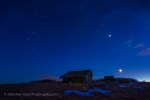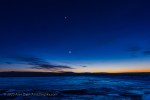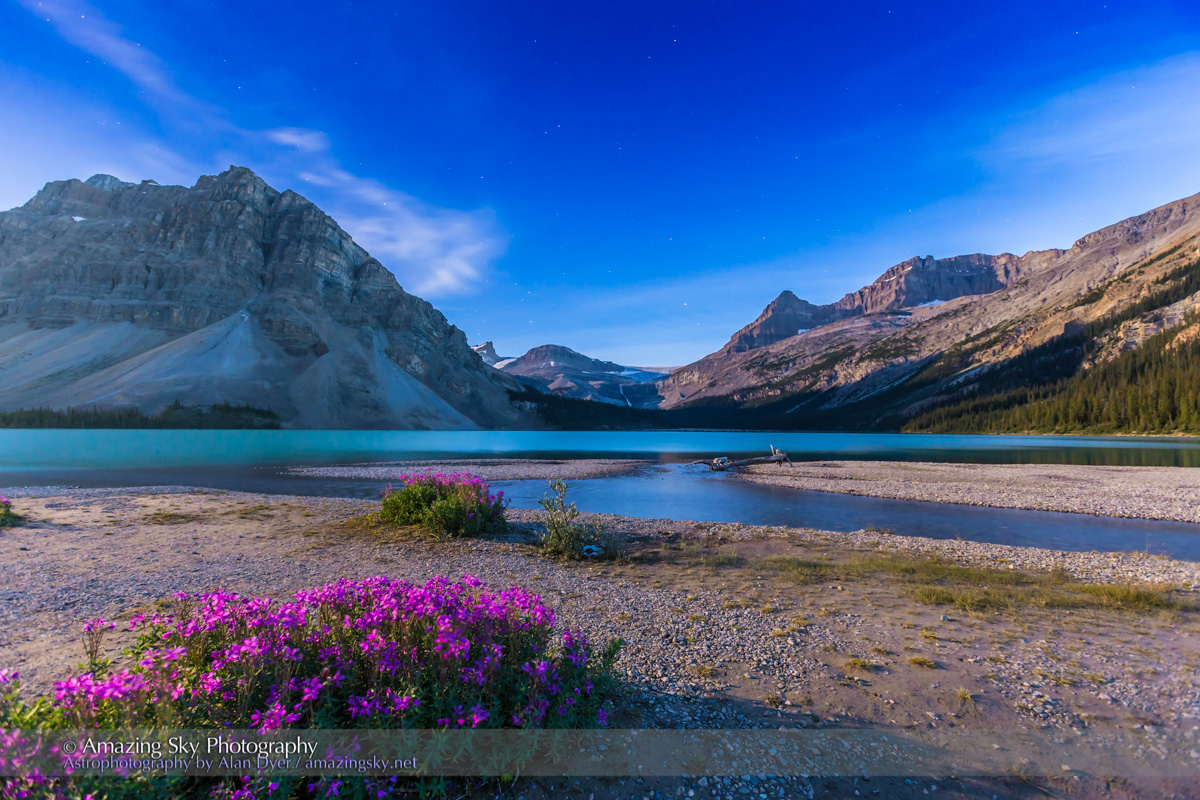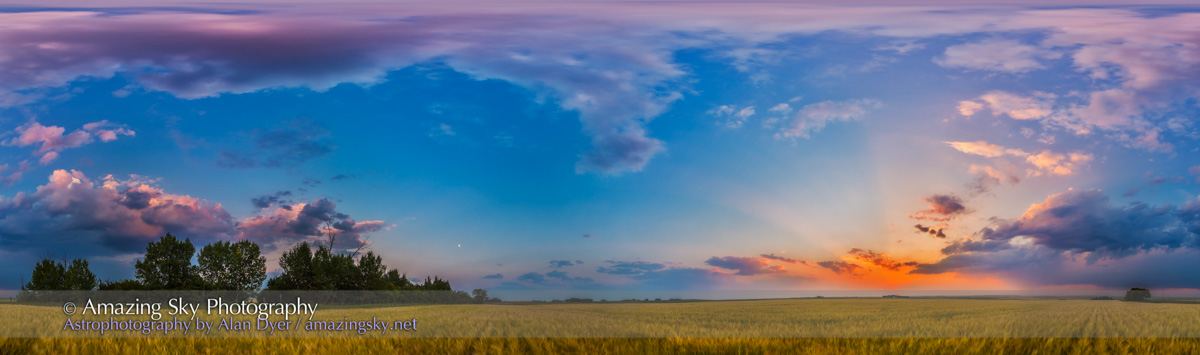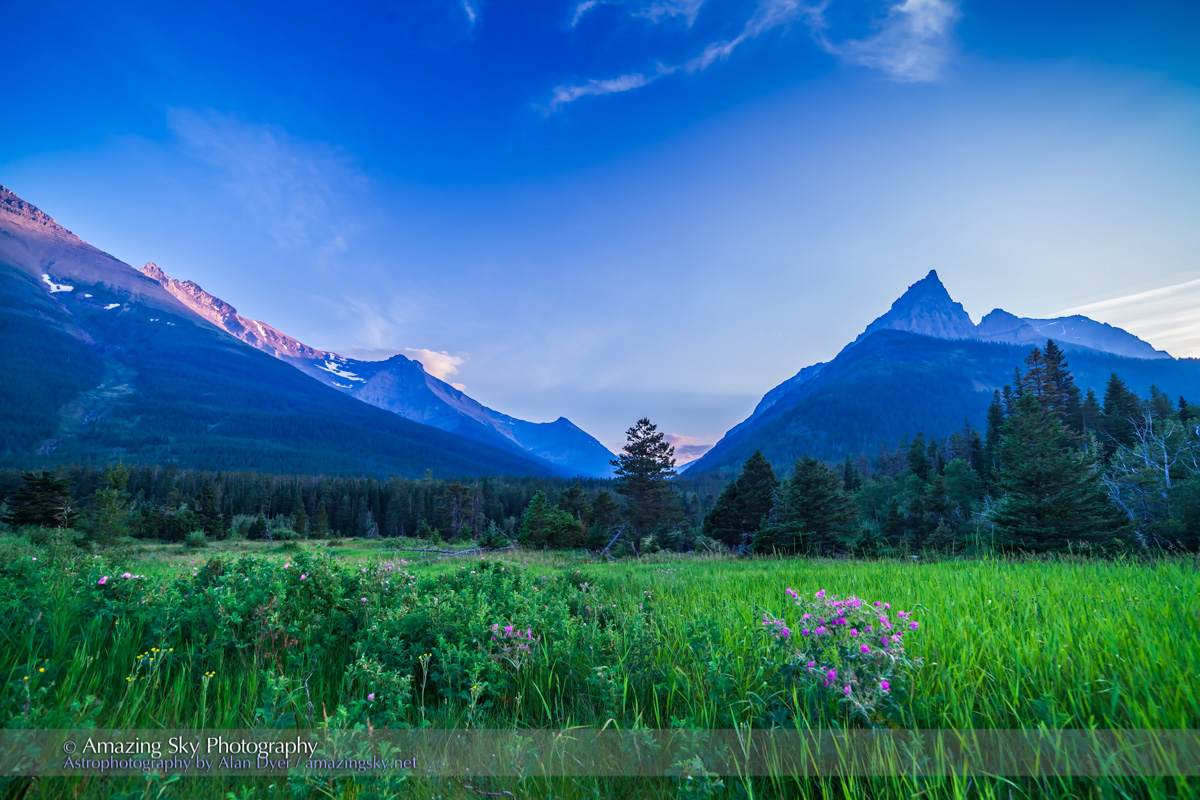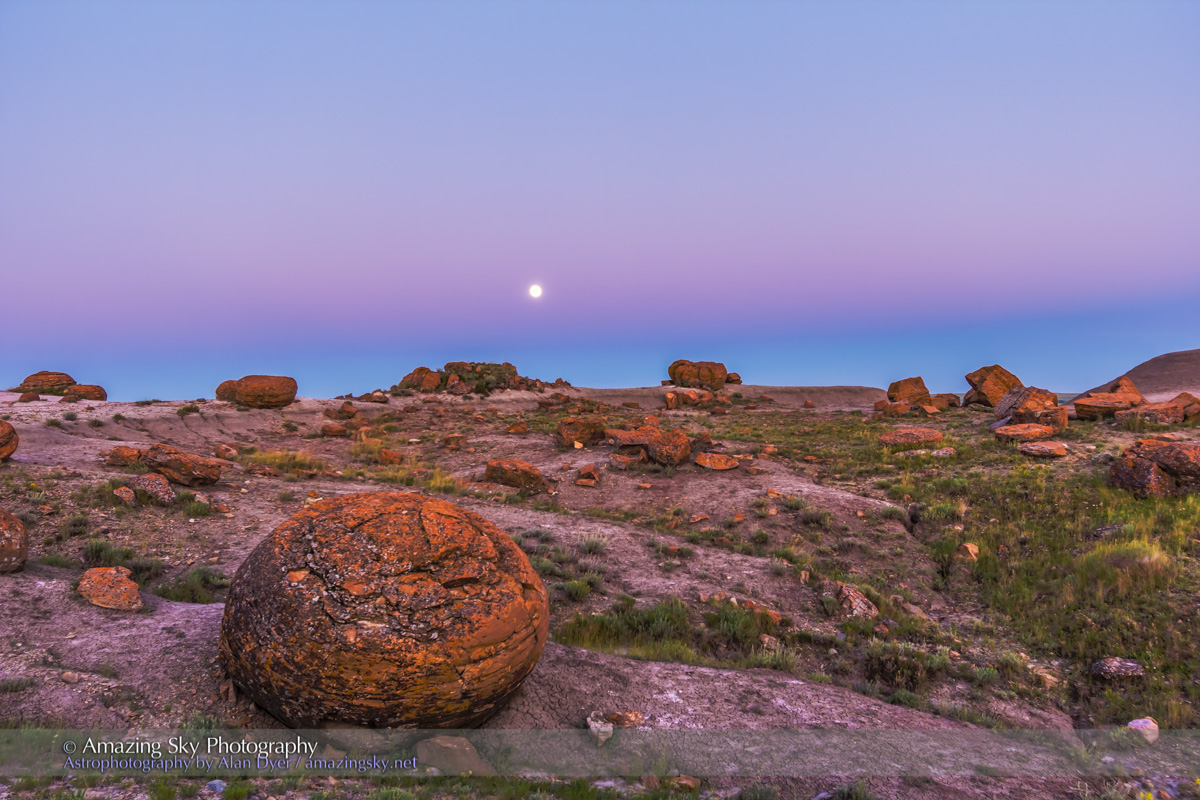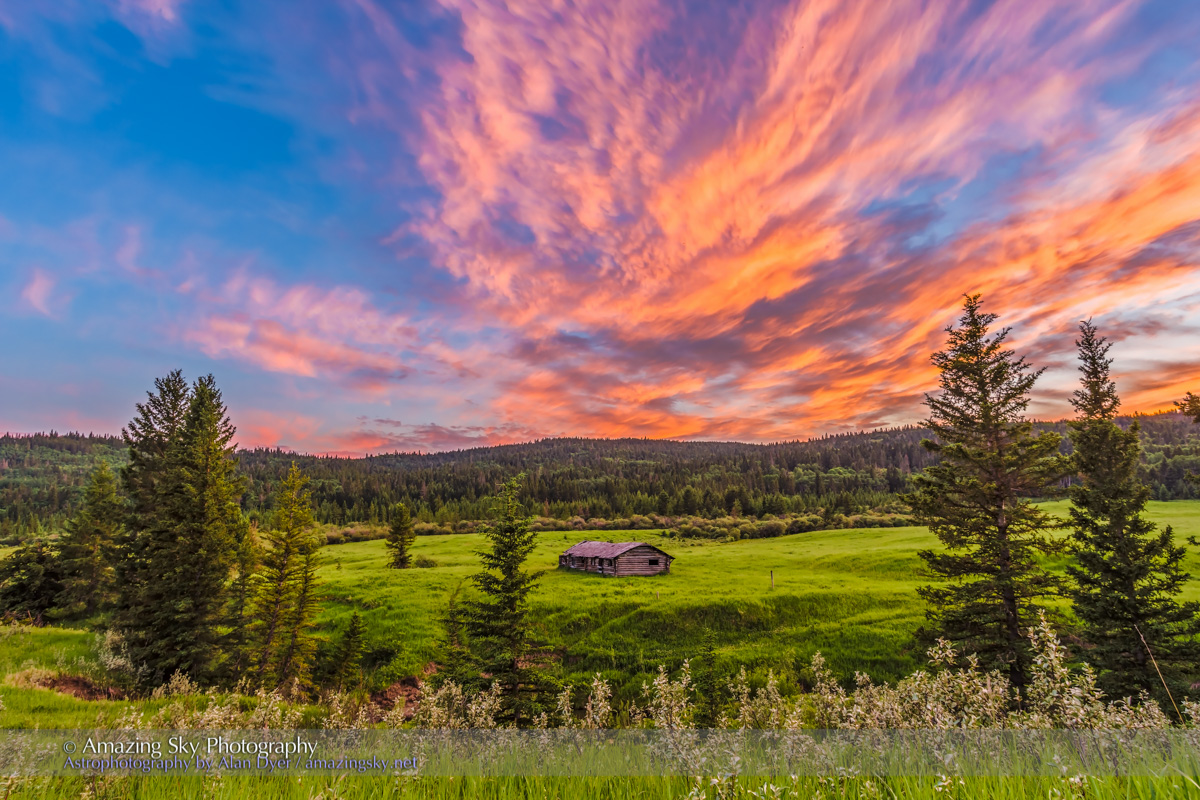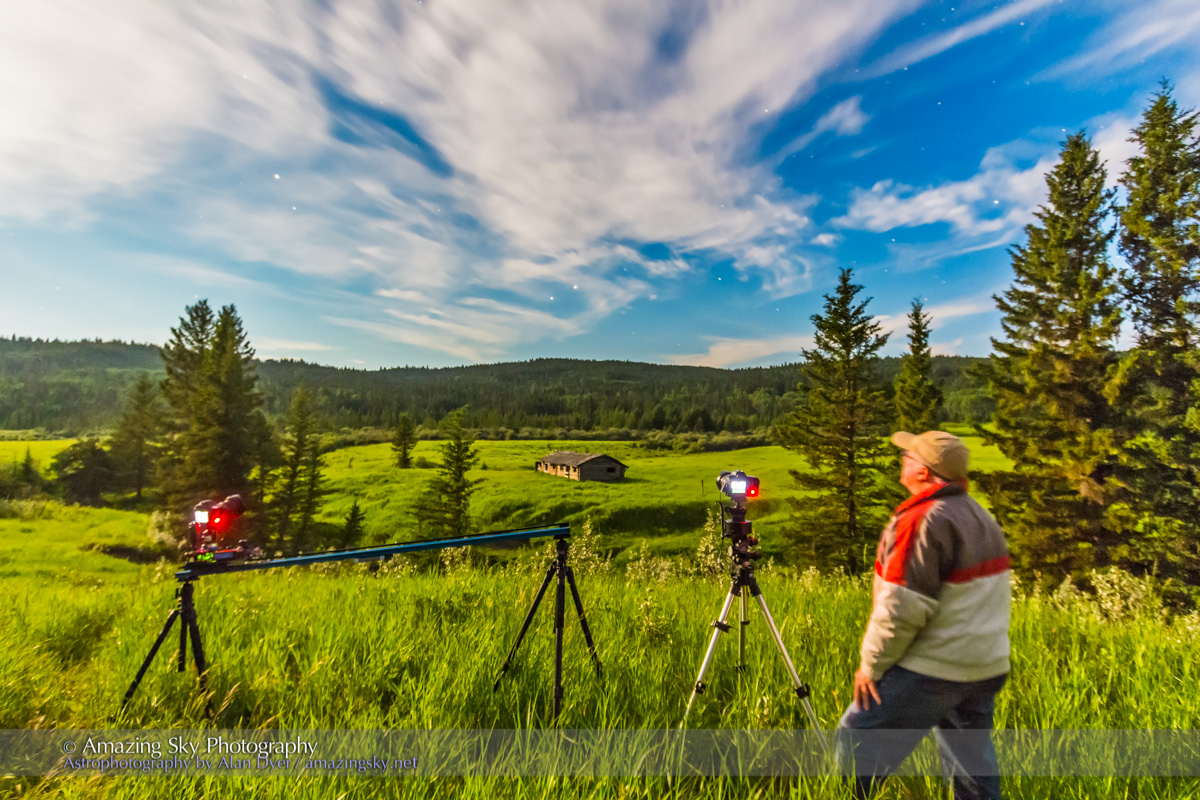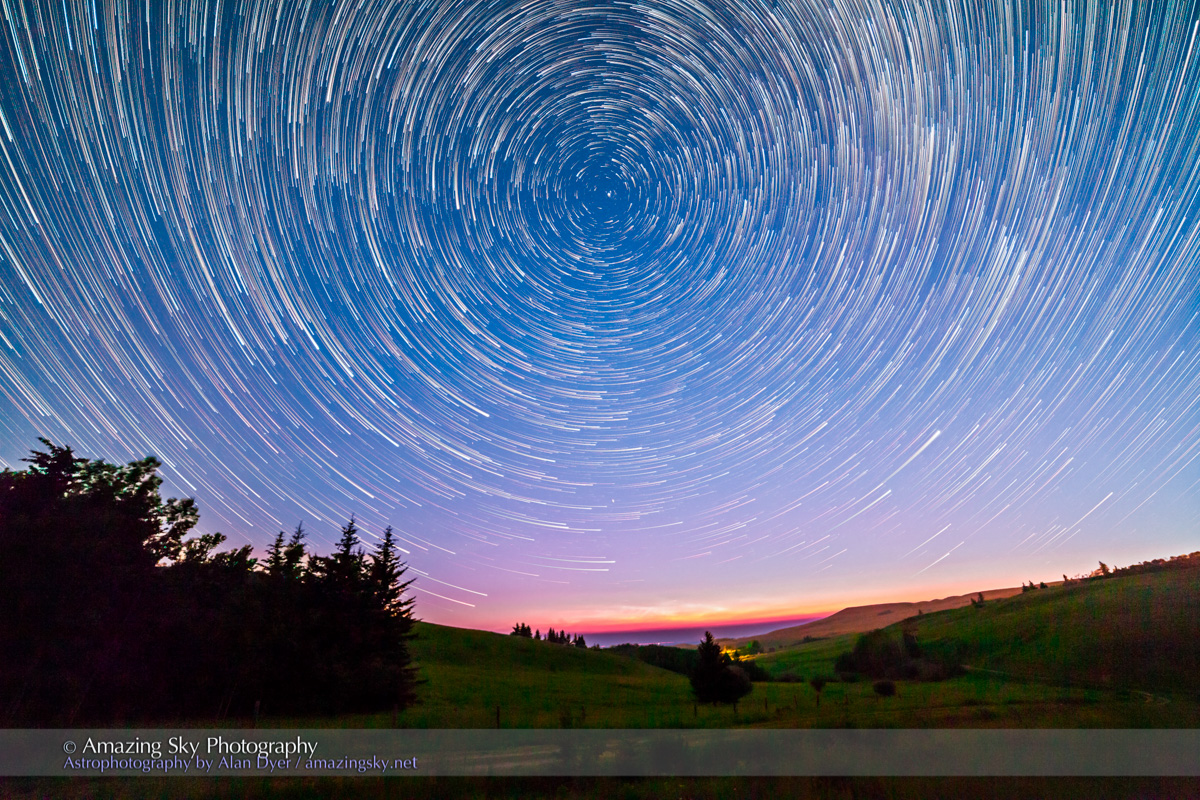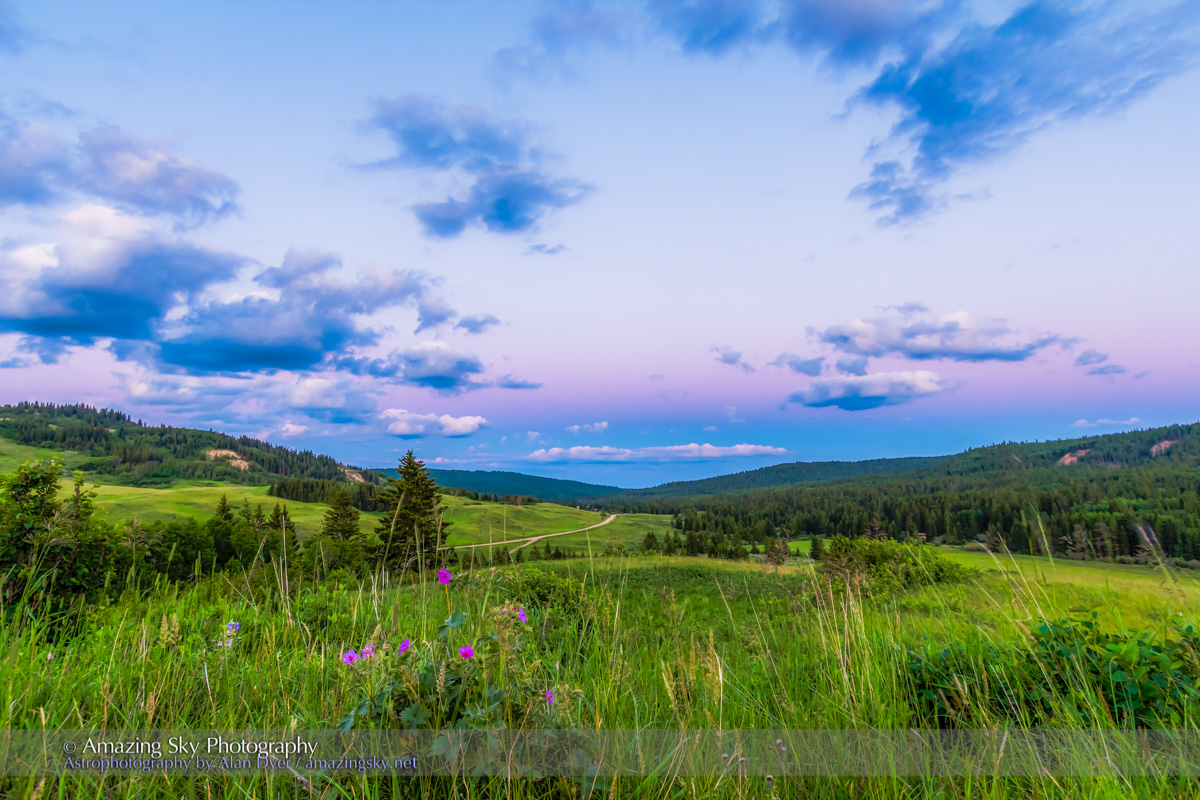
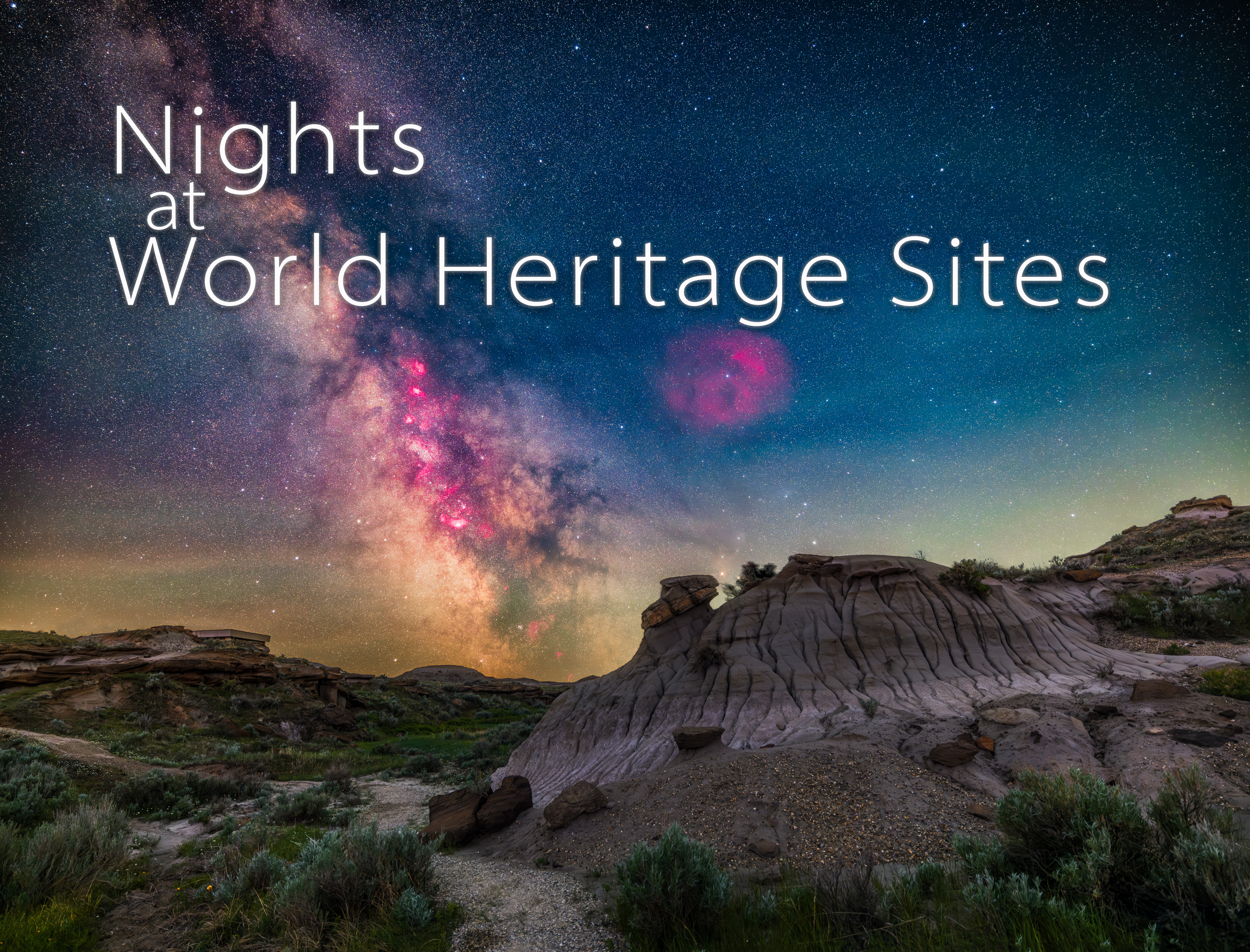
Nights at World Heritage Sites


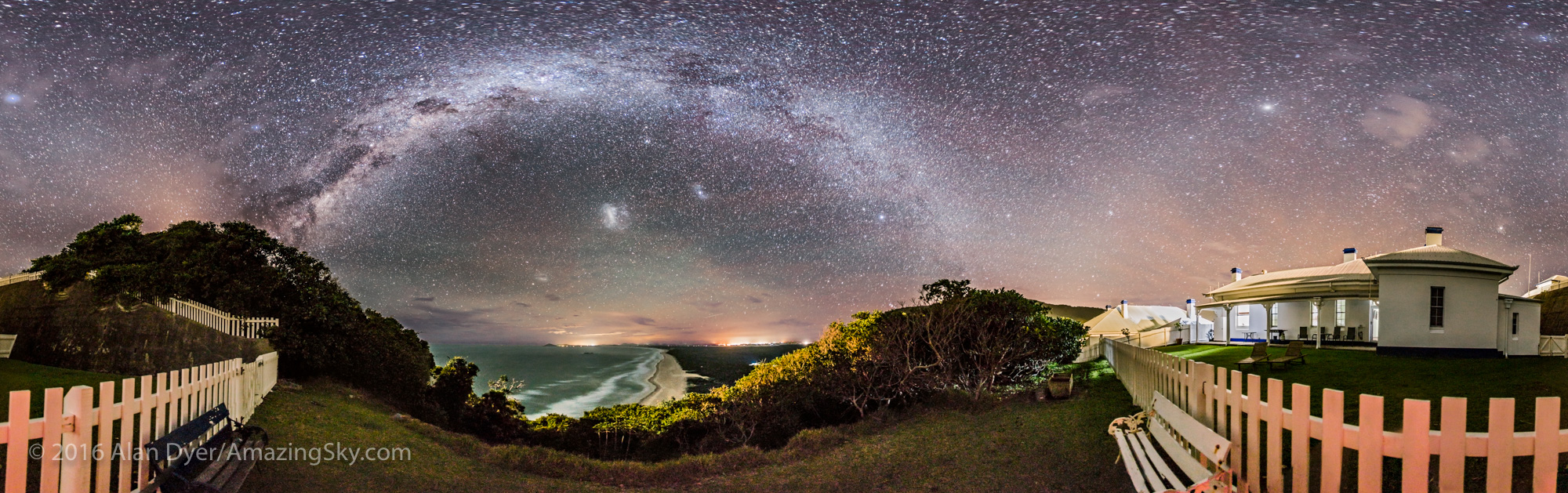
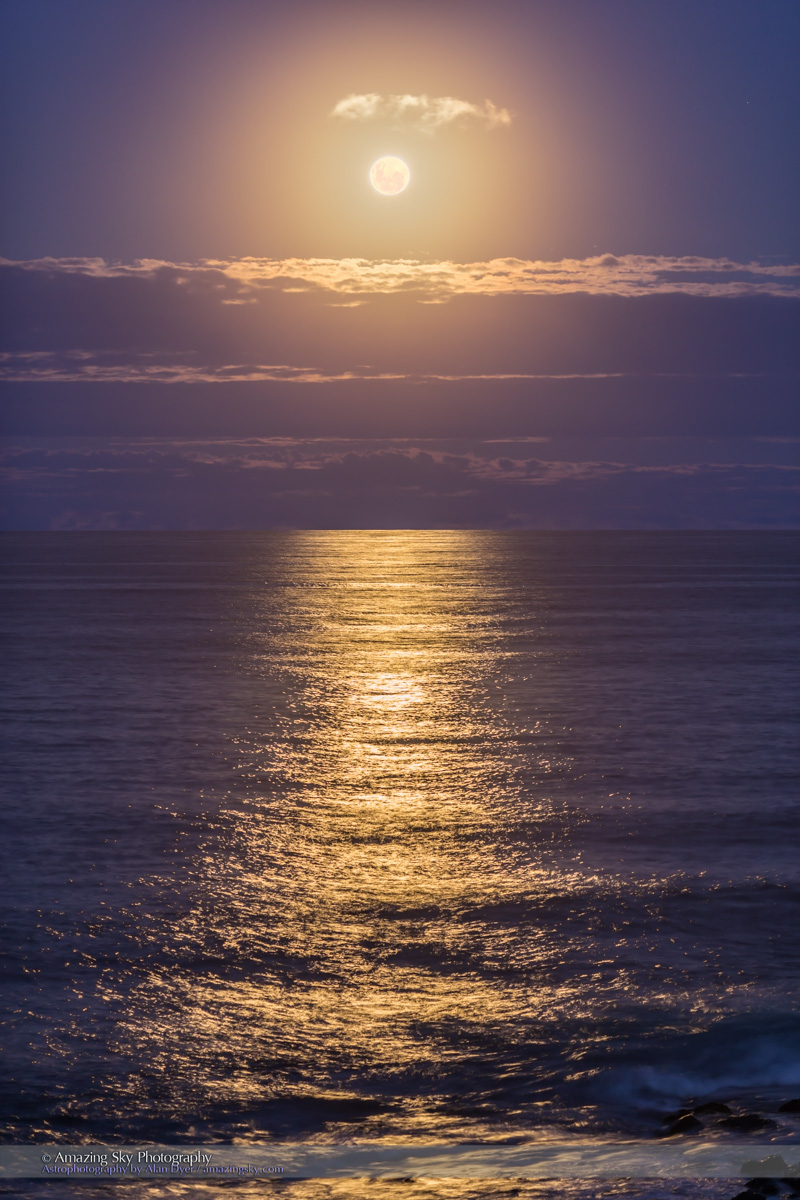
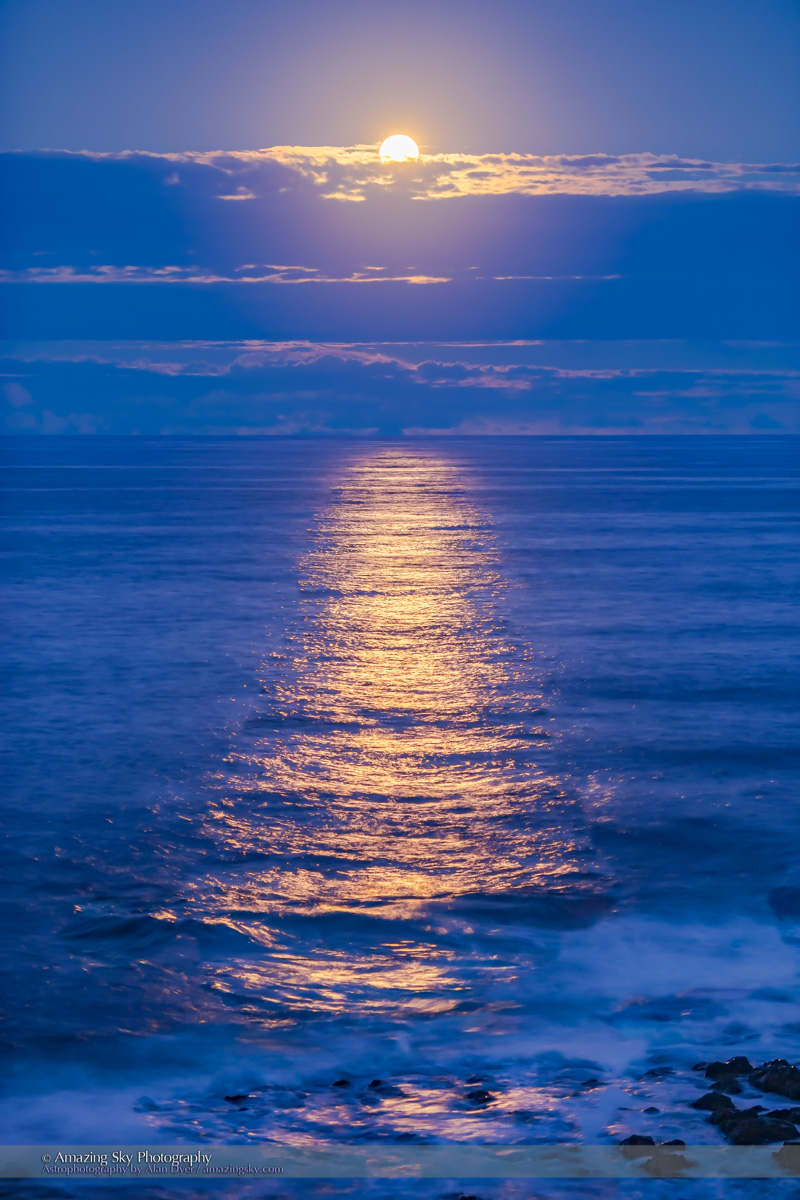
I present a selection of new images taken at local World Heritage Sites, along with some advanced nightscape shooting tips.

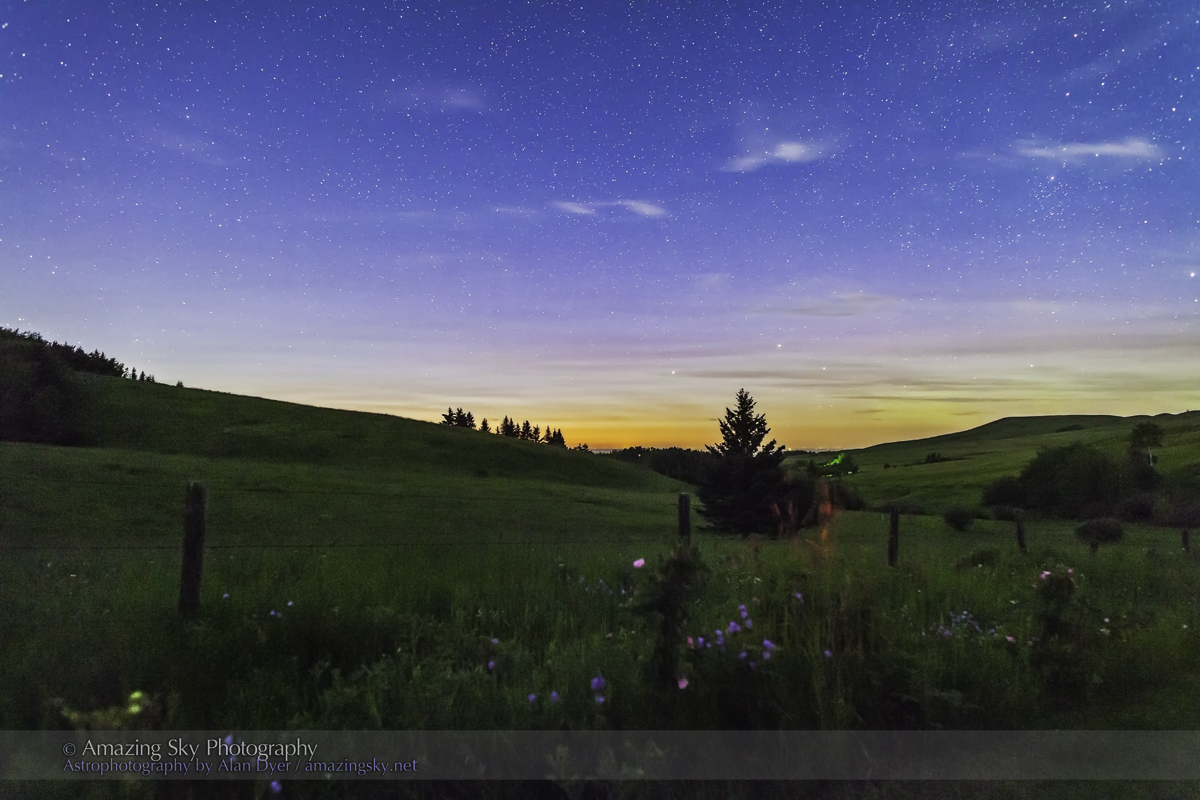
I’m fortunate in living near scenic landscapes here in southern Alberta. Many are part of UNESCO World Heritage Sites that preserve regions of unique scenic and cultural significance. In early June I visited several to shoot nightscapes of starry skies over the scenic landscapes.

I also took the opportunity to experiment with some new shooting techniques. So I’ve included some tips and techniques, most of the advanced variety.


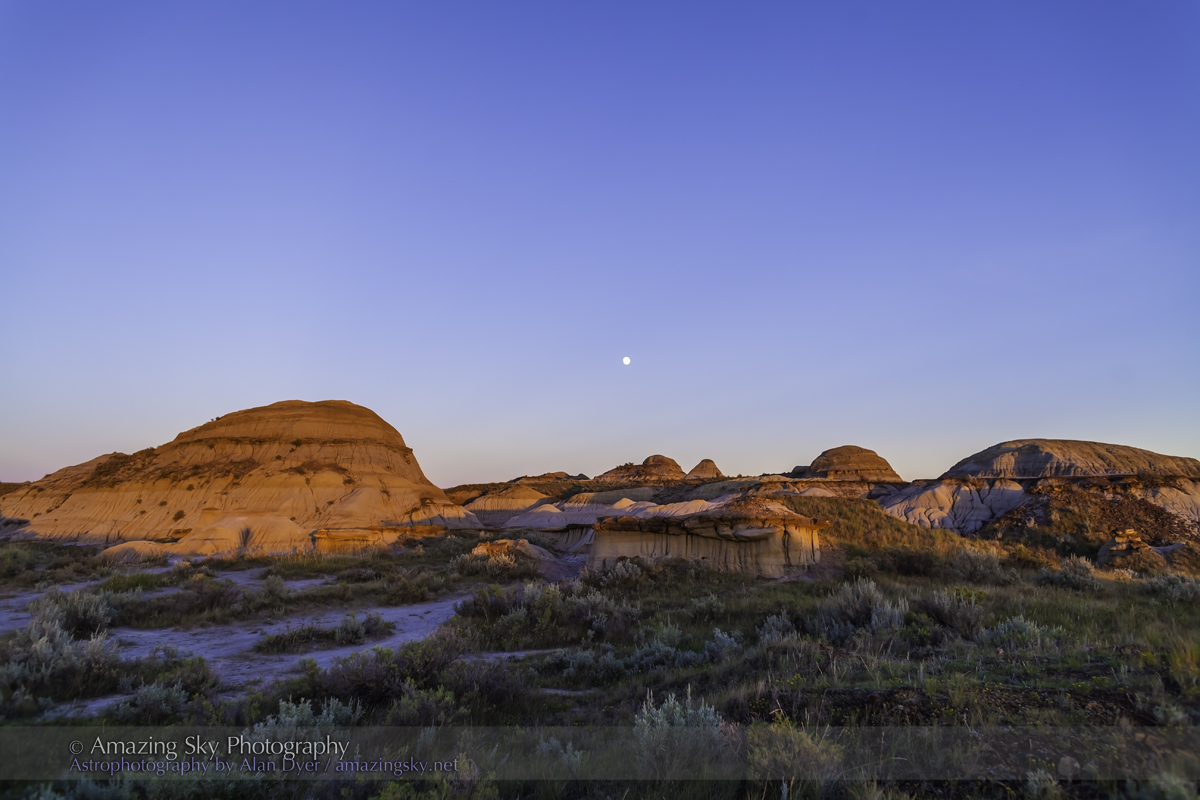
First up was Dinosaur Provincial Park.
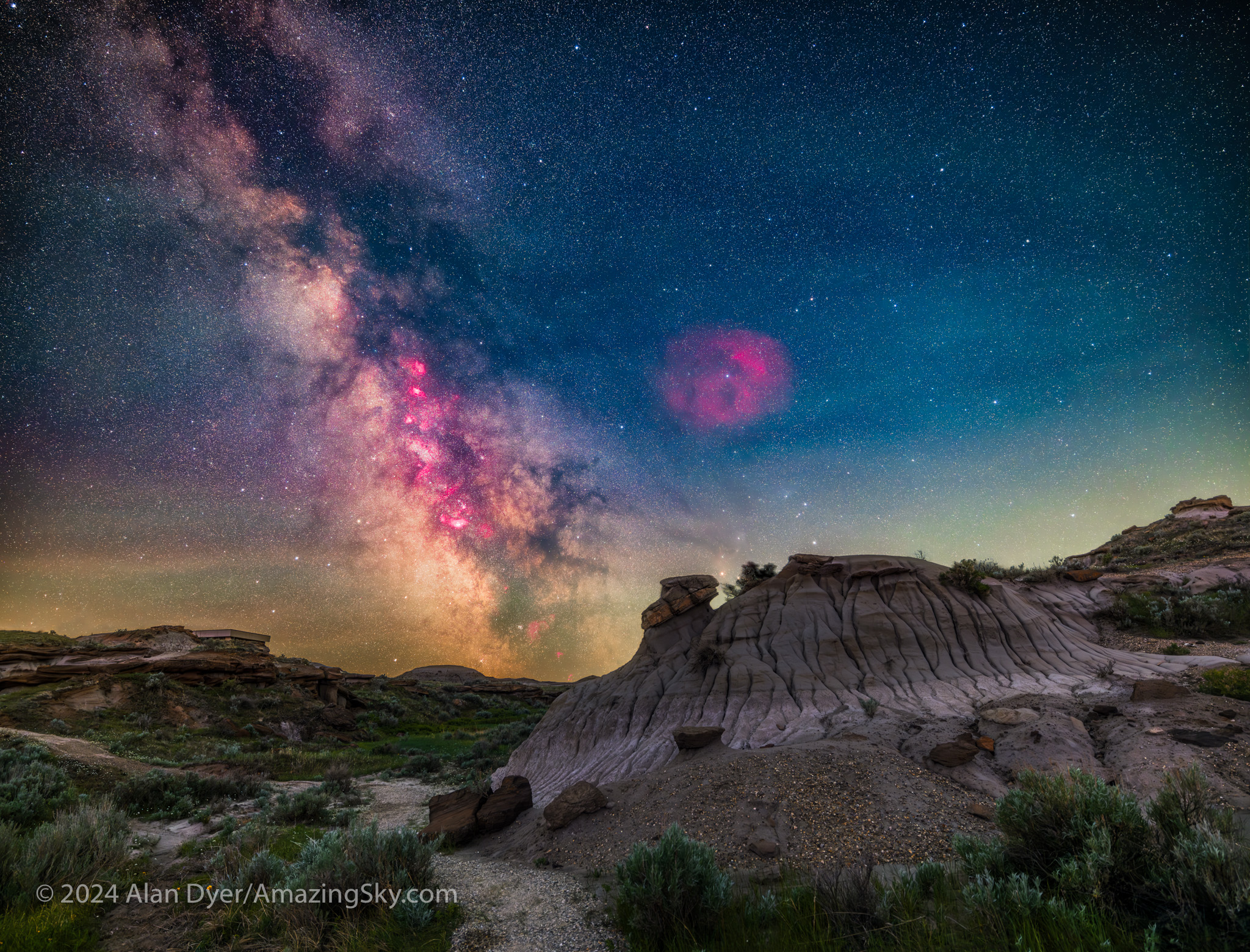
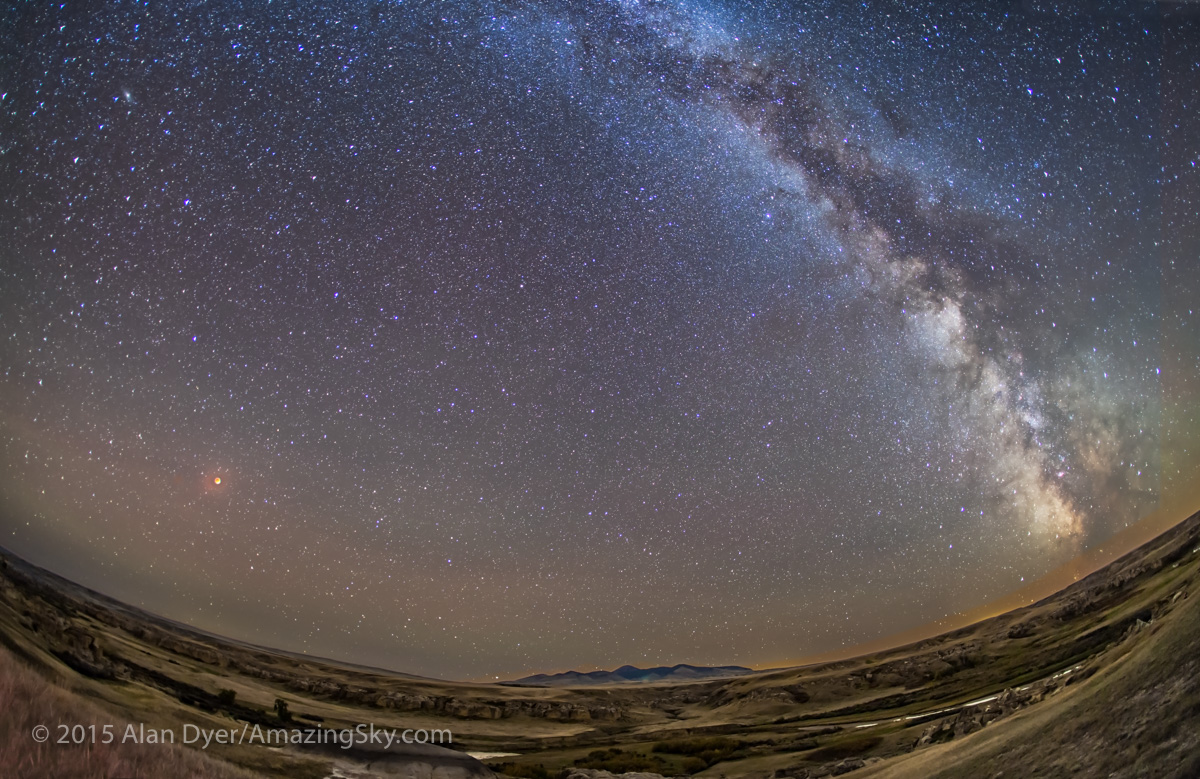
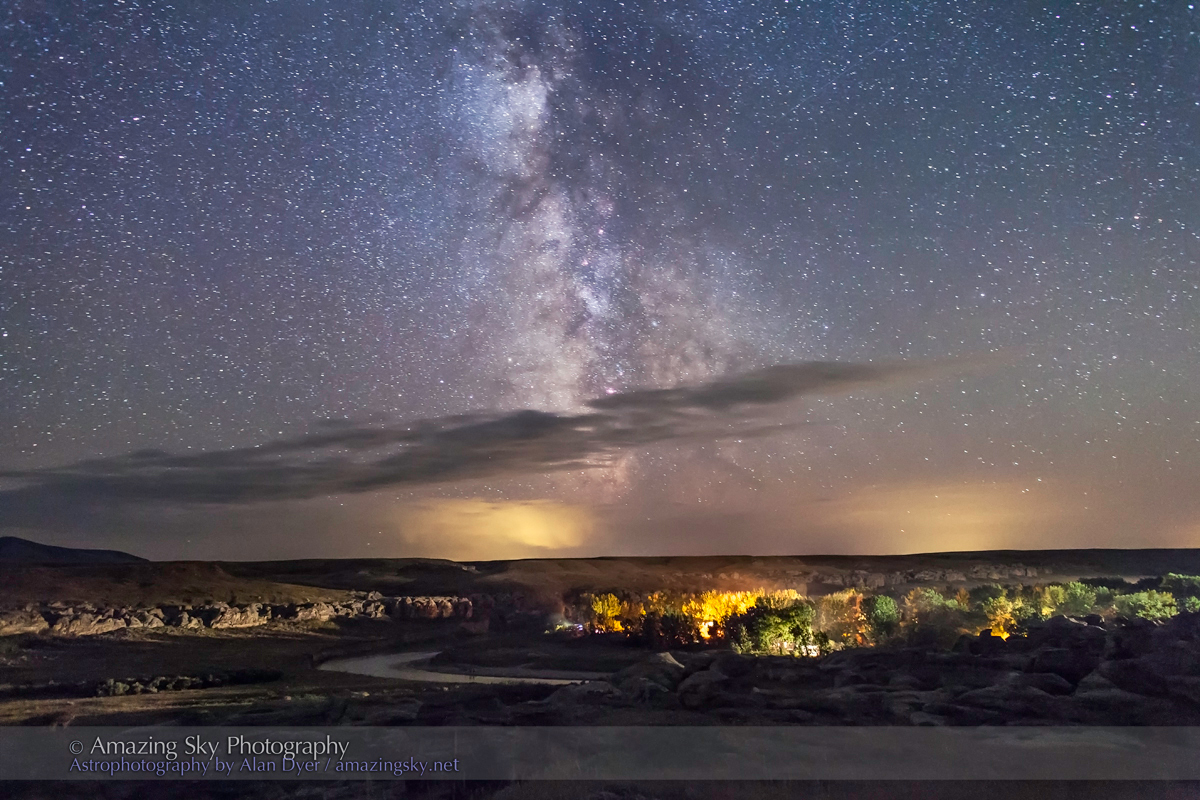
The Milky Way and its core region in Sagittarius and Scorpius is here low over the Badlands landscape of Dinosaur Provincial Park, Alberta.

After nearly a month of rain and clouds, the night of May 31/June 1 proved wonderfully clear at last. I headed to a favourite location in the Red Deer River valley, amid the eroded badlands formations of Dinosaur Provincial Park, site of late-Cretaceous fossil finds.

The bright core of the Milky Way in Sagittarius would be in the south. With the night only three weeks before summer solstice, from the Park’s latitude of 50.5ยฐ N the sky would not get astronomically dark. But it would be dark enough to show the Milky Way well, as above in this framing looking south on the Trail of the Fossil Hunters.

However, May and June are “Milky Way Arch” months, at least for the northern hemisphere. The full sweep of the northern Milky Way, from Perseus in the northeast to Sagittarius in the southeast, then stretches across the sky โ€” high enough to be impressive, but low enough (unlike later in summer) to be framable in a horizontal panorama.
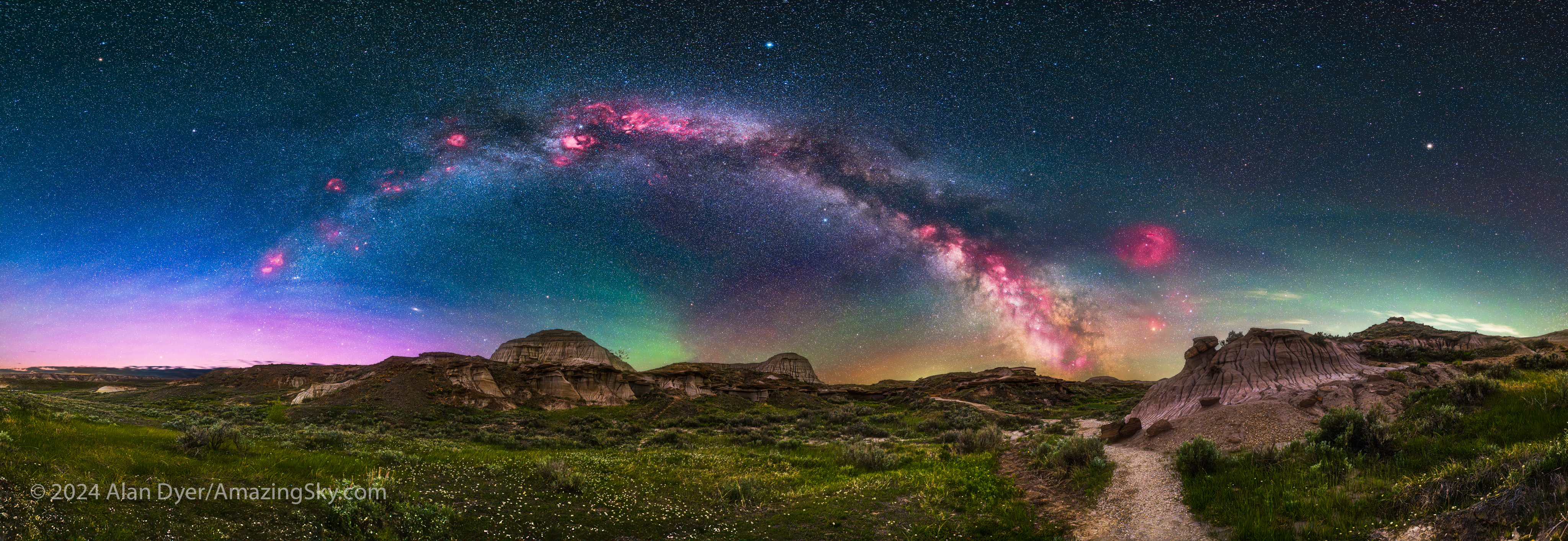
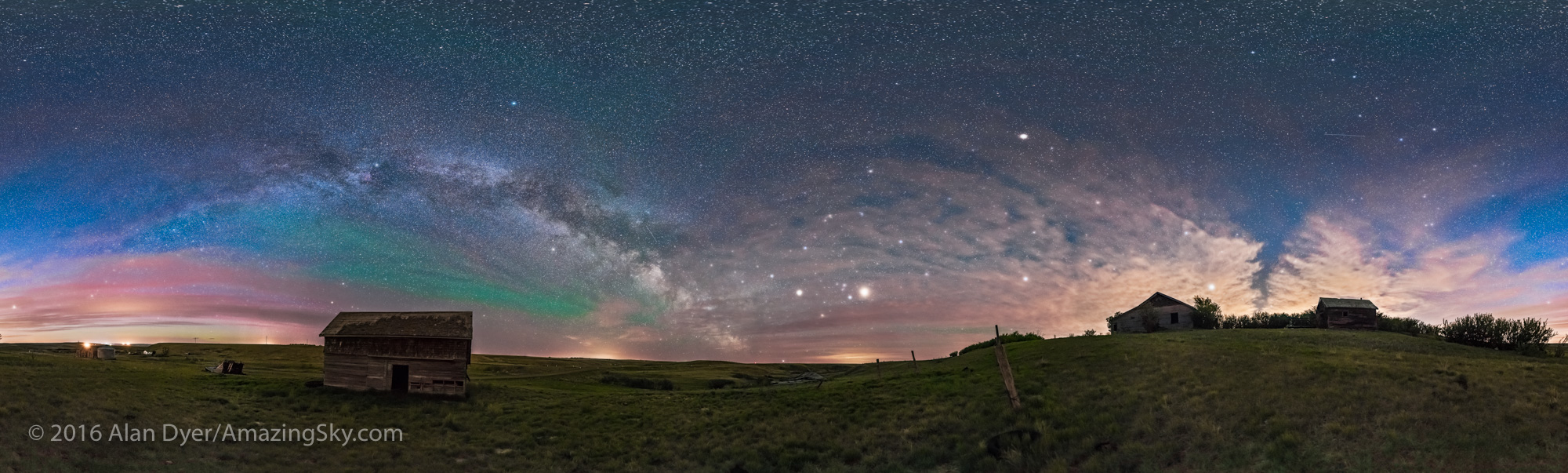
This is a 200ยฐ panorama of the arch of the northern Milky Way rising over the Badlands landscape of Dinosaur Provincial Park, Alberta.

To capture the arc of the Milky Way I shot a panorama โ€” in fact three:

  • one exposed for the ground
  • one exposed for the sky, but with the camera now tracking the sky to keep stars pinpoint
  • and a final sky panorama but with a specialized filter installed in front of the camera sensor to let through only the deep red light emitted by nebulas along the Milky Way
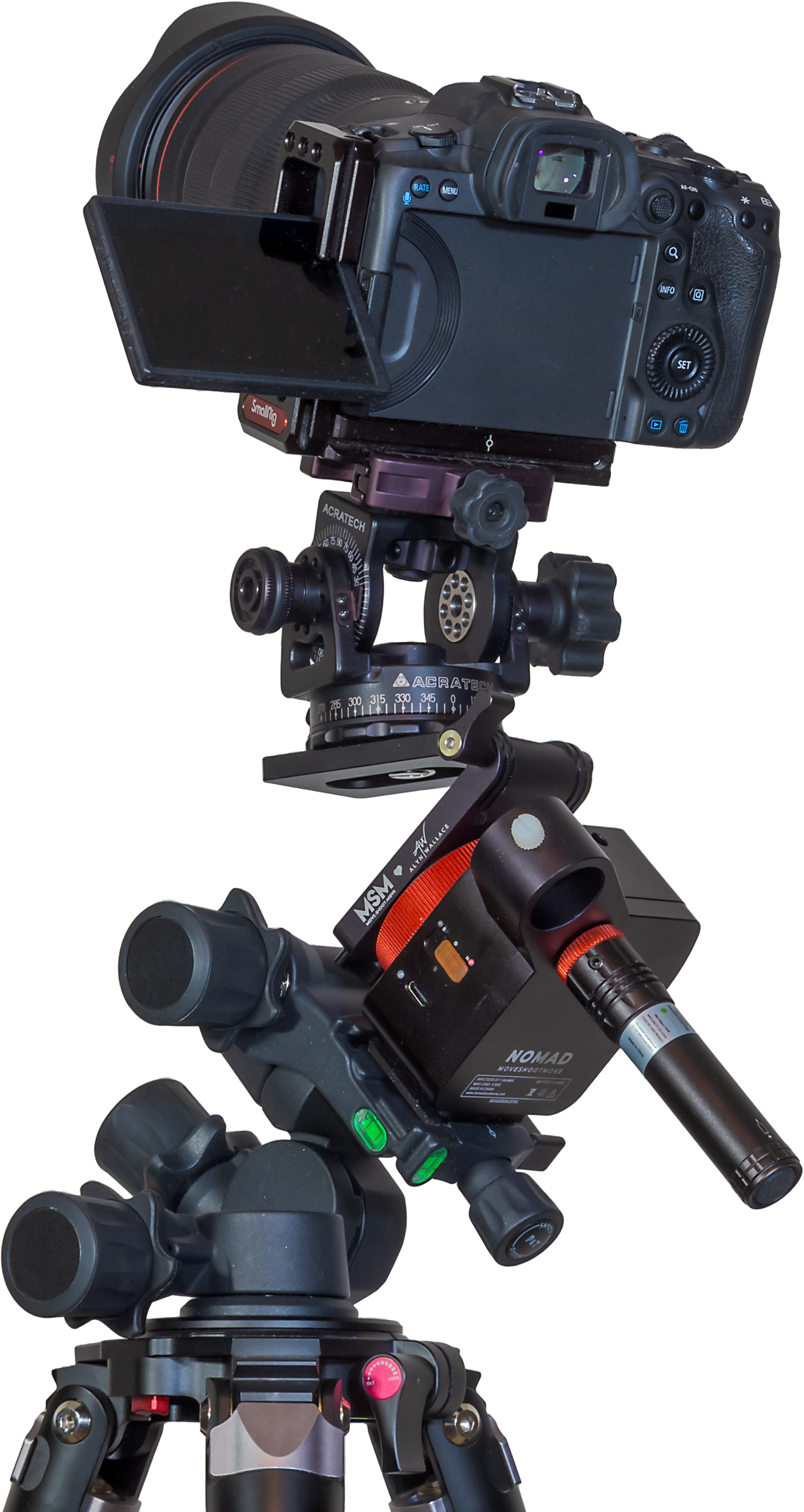
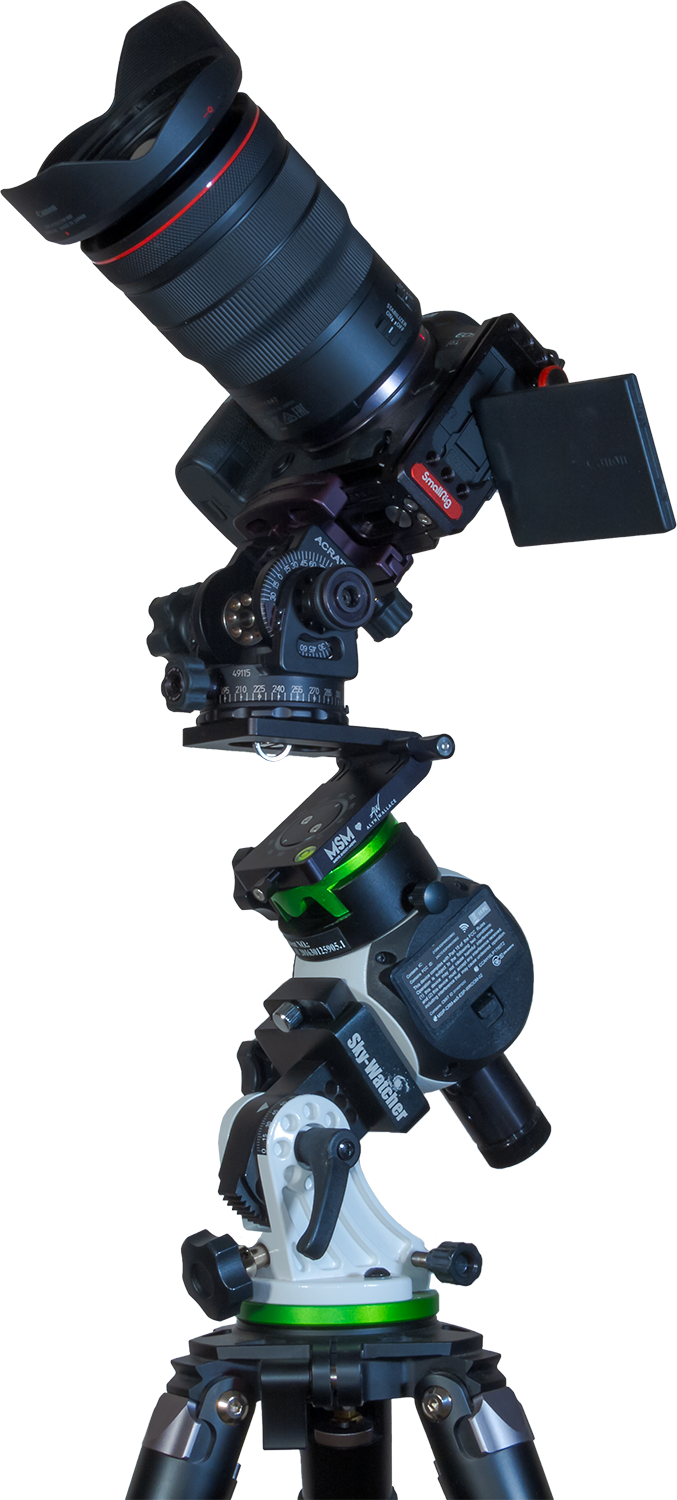
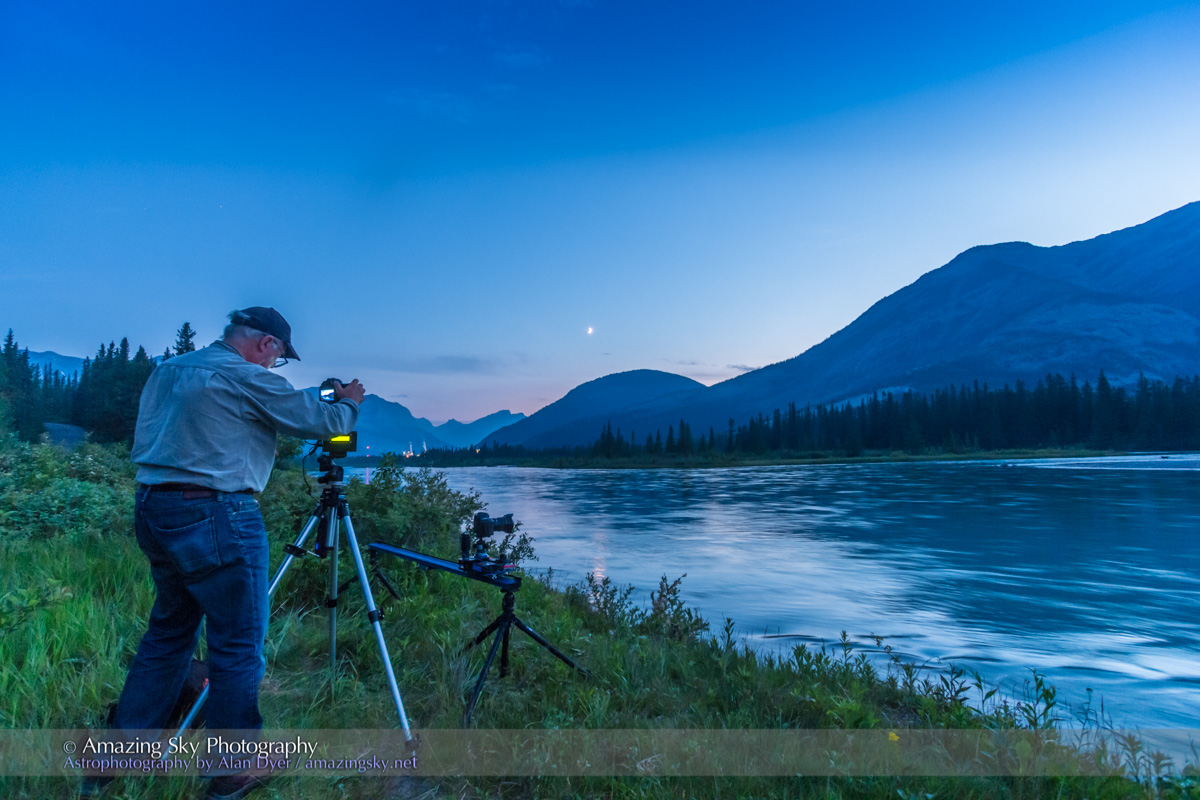
Rig for tracked panoramas with the MSM Nomad tracker

The image above shows my rig for taking tracked panoramas. The rectangular box is the little Nomad sky tracker from Move-Shoot-Move (MSM), here equipped with its accessory laser pointer to aid the “polar alignment” that is needed for this or any tracker to follow the turning sky properly.

A review of the MSM Nomad will be forthcoming (subscribe to my blog!). However, I’ve found it works very well, much better than MSM’s original Rotator tracker, which was entirely unreliable!

On top of the little Nomad is an Acratech pano head, so I can turn the camera by a specific angle between each pano frame, both horizontally from segment to segment, and vertically if needed when raising the camera from the ground pano to the sky pano.

The pano head is on a “V-Plate” sold by MSM and designed by the late, great nightscape photographer (and engineer by trade), Alyn Wallace. The V-Plate allows the camera to turn parallel to the horizon when on a tipped-over tracker. The entire rig is on a Benro 3-Axis tripod head (also sold by MSM, but widely available) that makes it easy to precisely aim the tracker for polar alignment and then hold it rock steady.
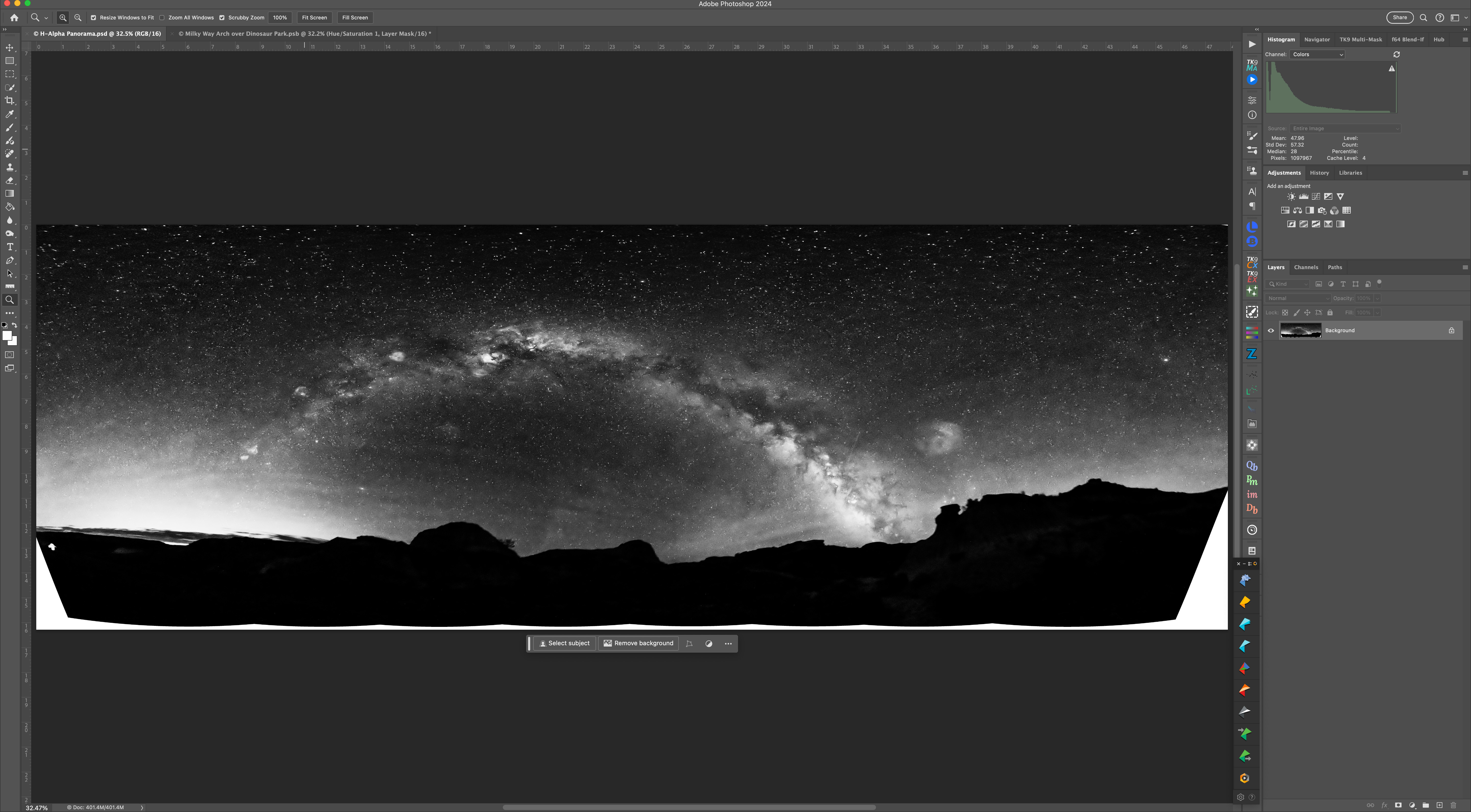
The H-Alpha Panorama rendered in monochrome

I’d taken many panos before using sets of untracked ground and tracked sky panoramas. New this night was the use a “narrowband” Hydrogen-Alpha filter to take a final pano that brings out the red nebulas. I used a filter from Astronomik that clips into the camera in front of the sensor. Such a filter has to be used on a camera that has been modified to be more sensitive to deep red light, as the Canon Ra shown below is (or was, as Canon no longer makes it).

While a modded camera brings out the nebulas, using an H-Alpha filter as well really shows them off. But using one is not easy!
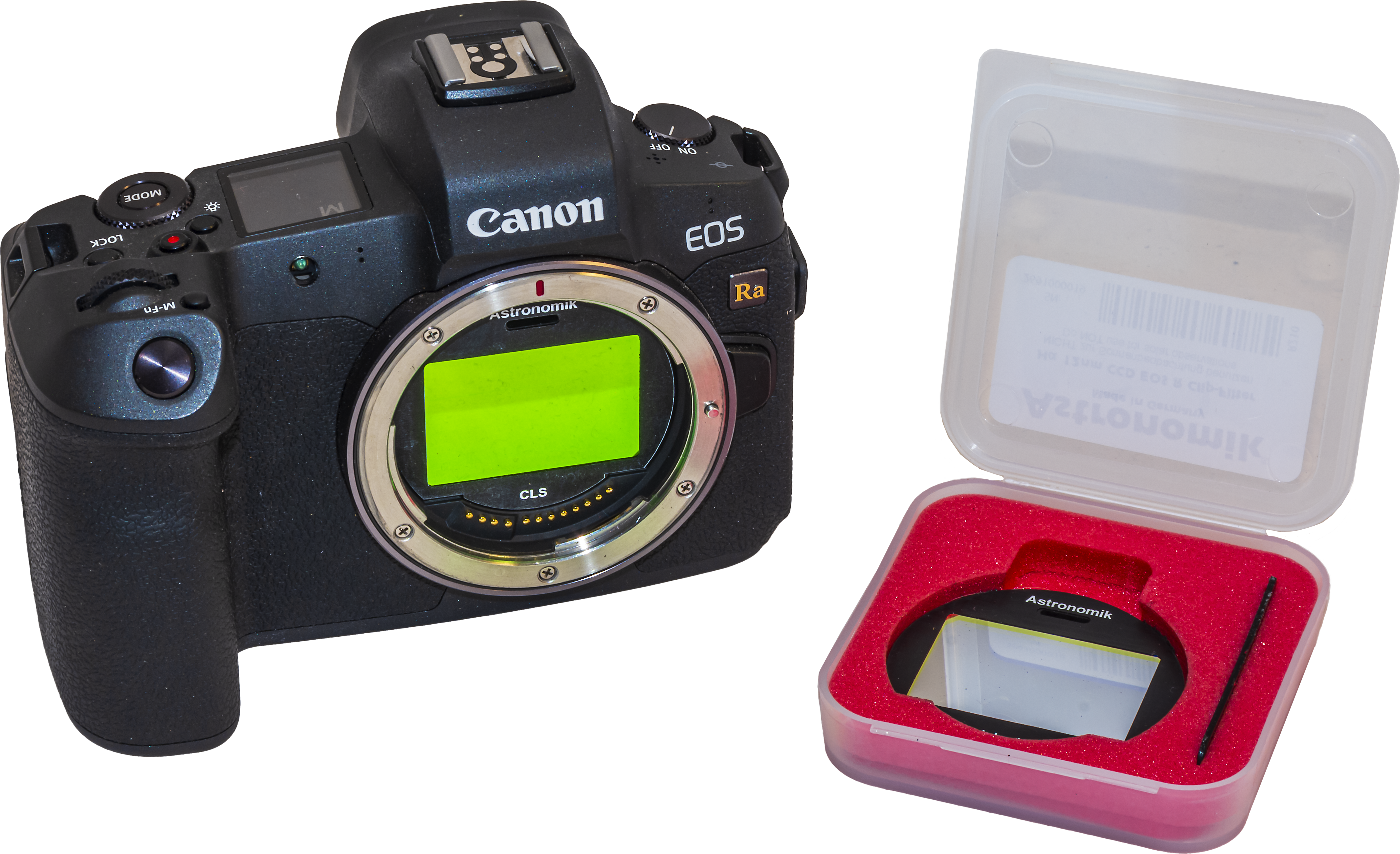
Astronomik clip-in filters, the 12nm H-a on the right

The clip-in placement (unlike a filter in front of a lens) requires that the lens be refocused โ€” infinity focus now falls at the 3 to 6 metre point (the focus shift varies with the lens and focal length โ€” the wider the lens the greater the shift). With the image so dark and deep red, seeing even a bright star to manually focus on is a challenge.

Shifting the lens focus also changes the overall image size (called “focus breathing”) and often introduces more off-axis lens aberrations, again depending on the lens.

So, blending the H-Alpha pano (which I rendered out in monochrome, above) into the final stack is tough, requiring lots of manual alignment, image warping, BlendIf adjustments, and masking. This is where I added in the red colouration to taste. Careful here, as the “Saturation Police” patrolling social media will issue tickets if they judge you have exceeded their “speed limit.”
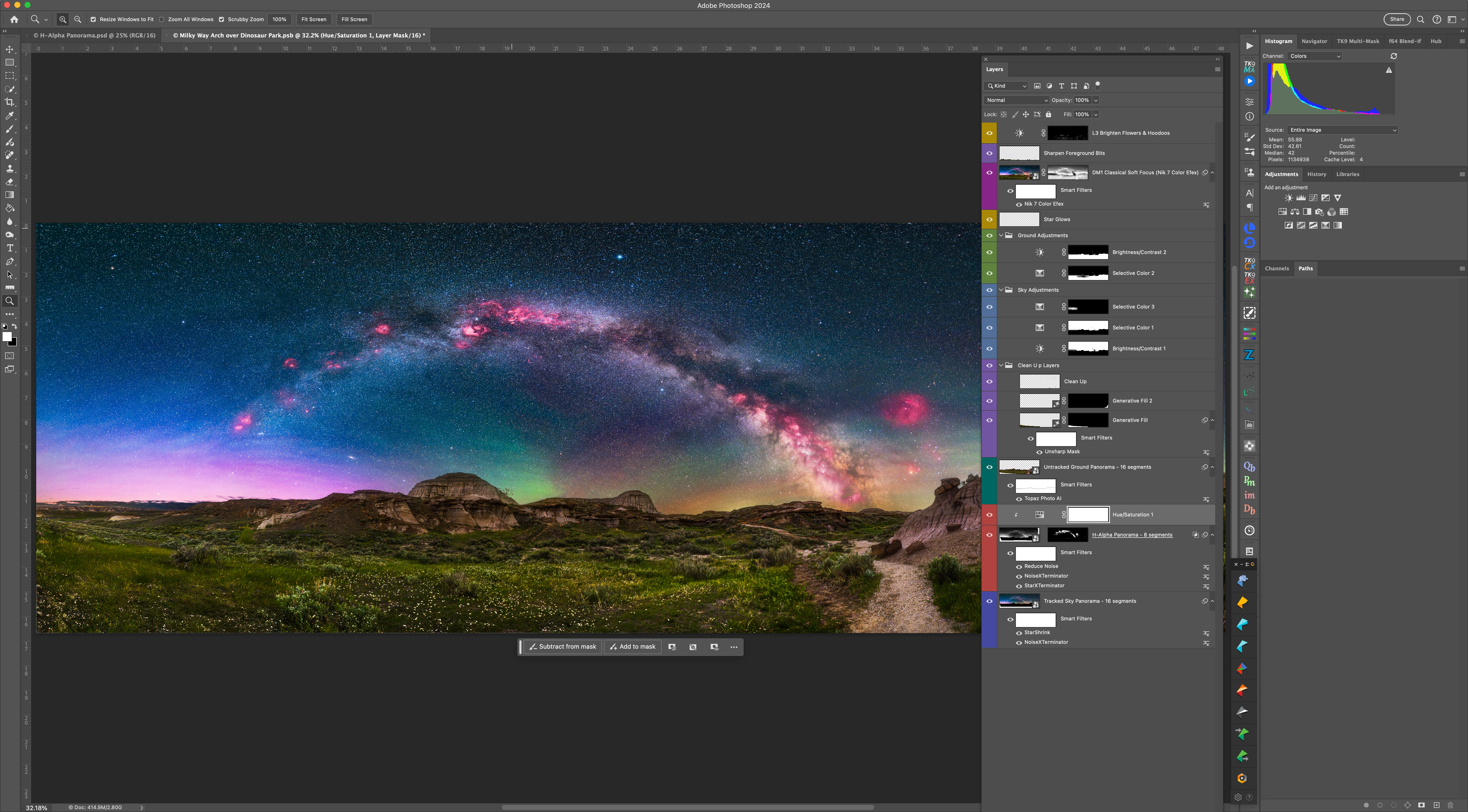
The complete panorama with Photoshop layers and adjustments

The final pano required a complex blend of image and adjustment layers, all applied non-destructively, so the many elements of the scene can be individually tweaked at any time.

The work was worth it, as the final pano records the deep red nebulas contrasting with the deep blue of a sky still lit partly by twilight, a magenta aurora to the north, and bands of green and yellow airglow, all above the earth tones of the Badlands. It is one of my favourite nightscape panoramas.

As a further note on software: For stitching panos I try to use Adobe Camera Raw first. It can work very well. But complex panos, especially taken with very wide lenses, often require the specialized program PTGui, which offers more choice of pano projection methods, cleaner stitching, and control of panorama framing and levelling.


Next up was Writing-on-Stone Provincial Park.

A week later, with the waxing Moon beginning to appear in the western sky and the promise of clear nights, I headed south to the 49th parallel borderlands of the Milk River and Writing-on-Stone Provincial Park, known as รรญsรญnai’pi to the Blackfoot First Nation who revere the site as sacred.

My plan was a framing of the galactic centre over the Milk River valley and distant Sweetgrass Hills in Montana, perhaps using the H-Alpha filter again. But clouds got in the way!
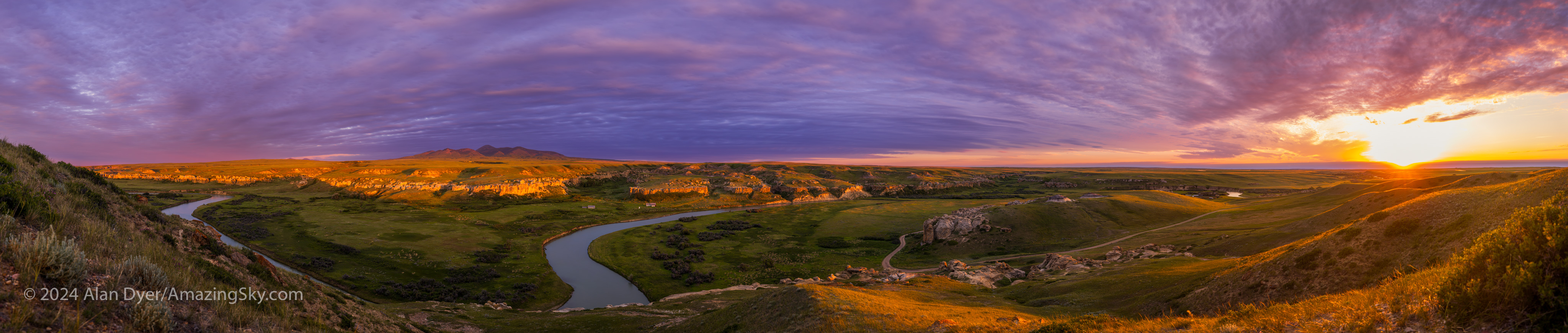
A 13-segment panorama of the landscape and sky just as the Sun sets over Writing-on-Stone Provincial Park (รรญsรญnai’pi) in Alberta.

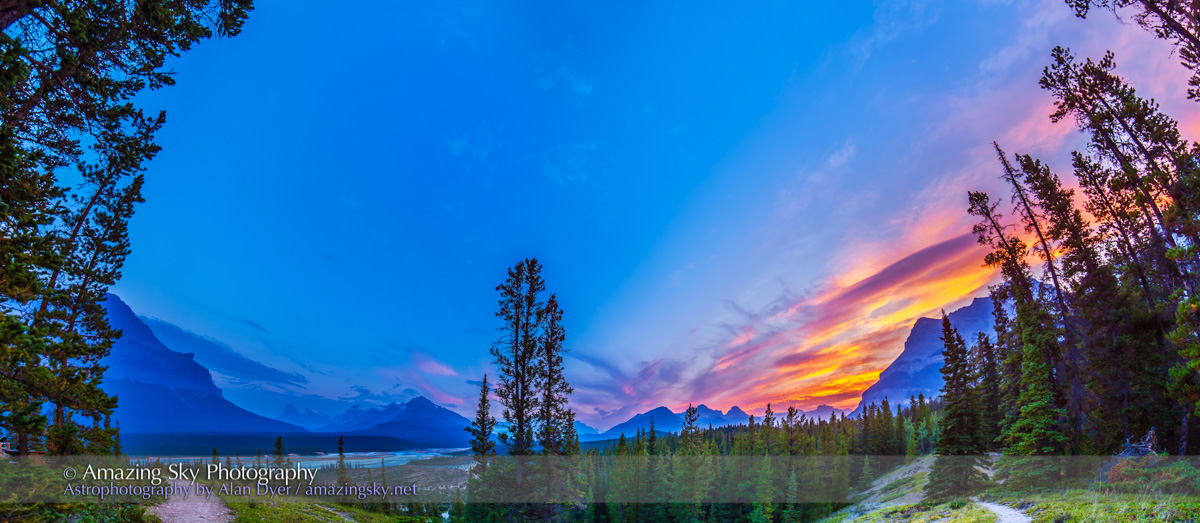
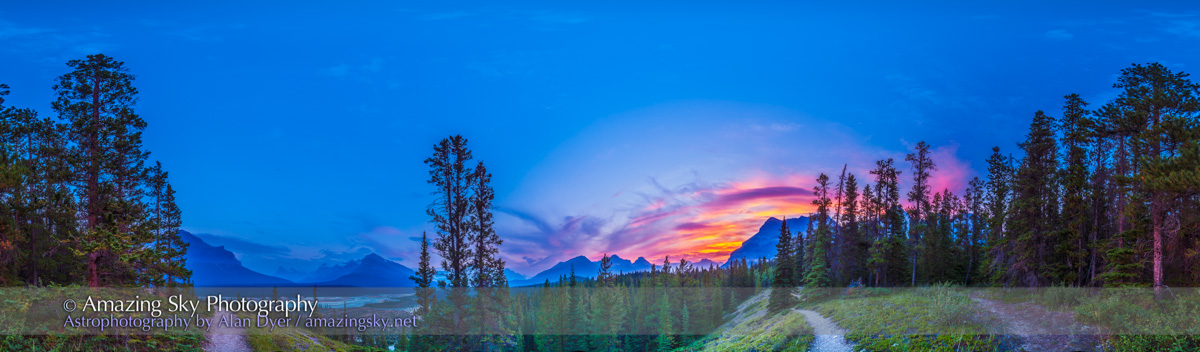
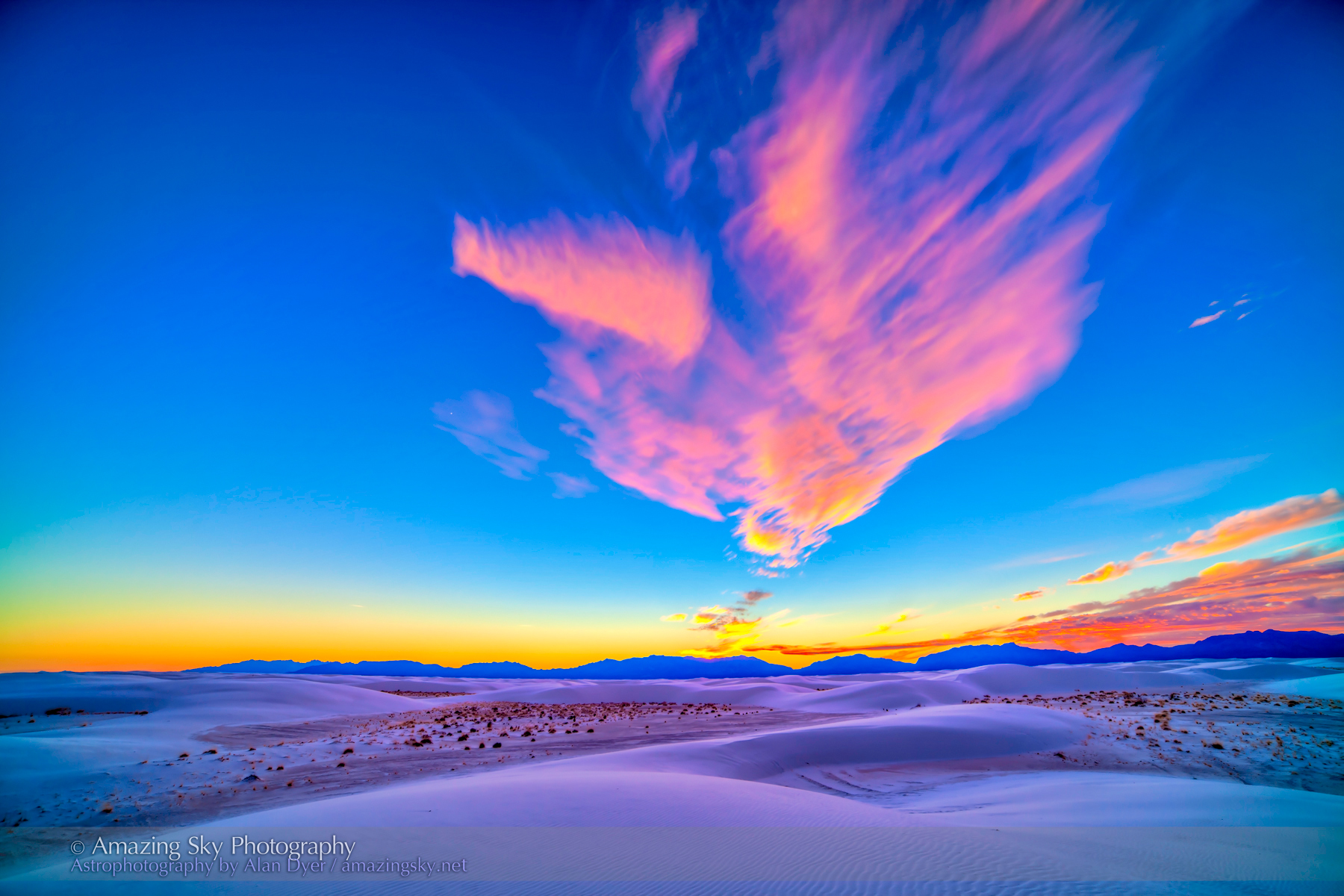
When you are faced with a cloudy sky, you make use of it for a colourful sunset. I like shooting panoramas at such sites as they capture the grand sweep of the “big sky” and prairie landscape. Above is the scene at sunset.
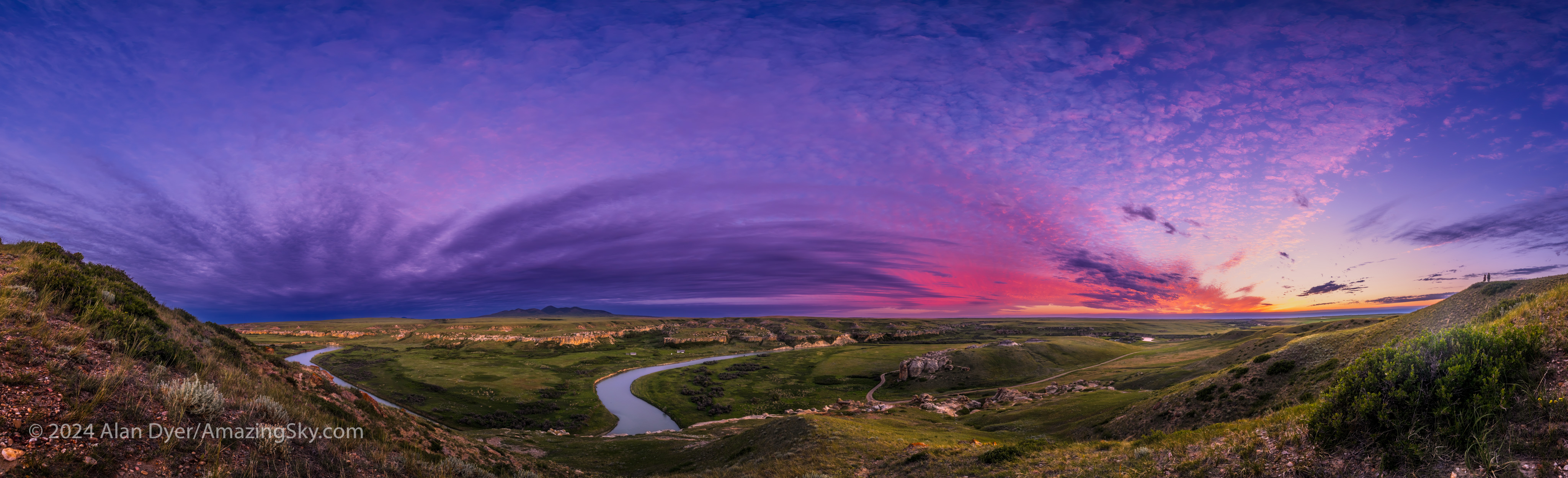
A 14-segment panorama of the landscape and sky at sunset at Writing-on-Stone Provincial Park.

Above is the same scene a few minutes later as the Sun, though now set, still lights the high clouds with its red light, mixing with the blue sky to make purples. On the hill at right, a couple admires the sunset, adding a human scale to the vast skyscape.

This pano was with the Canon RF15-35mm lens at 15mm and the camera in portrait orientation to capture as much of the sky and ground as possible in a single-row pano.

A 13-segment panorama of the sandstone landscape in blue-hour twilight at Writing-on-Stone Provincial Park.

I finished the evening with another panorama, but using a Canon RF70-200mm telephoto lens at 70mm to zoom in on the Sweetgrass Hills in the deepening twilight.
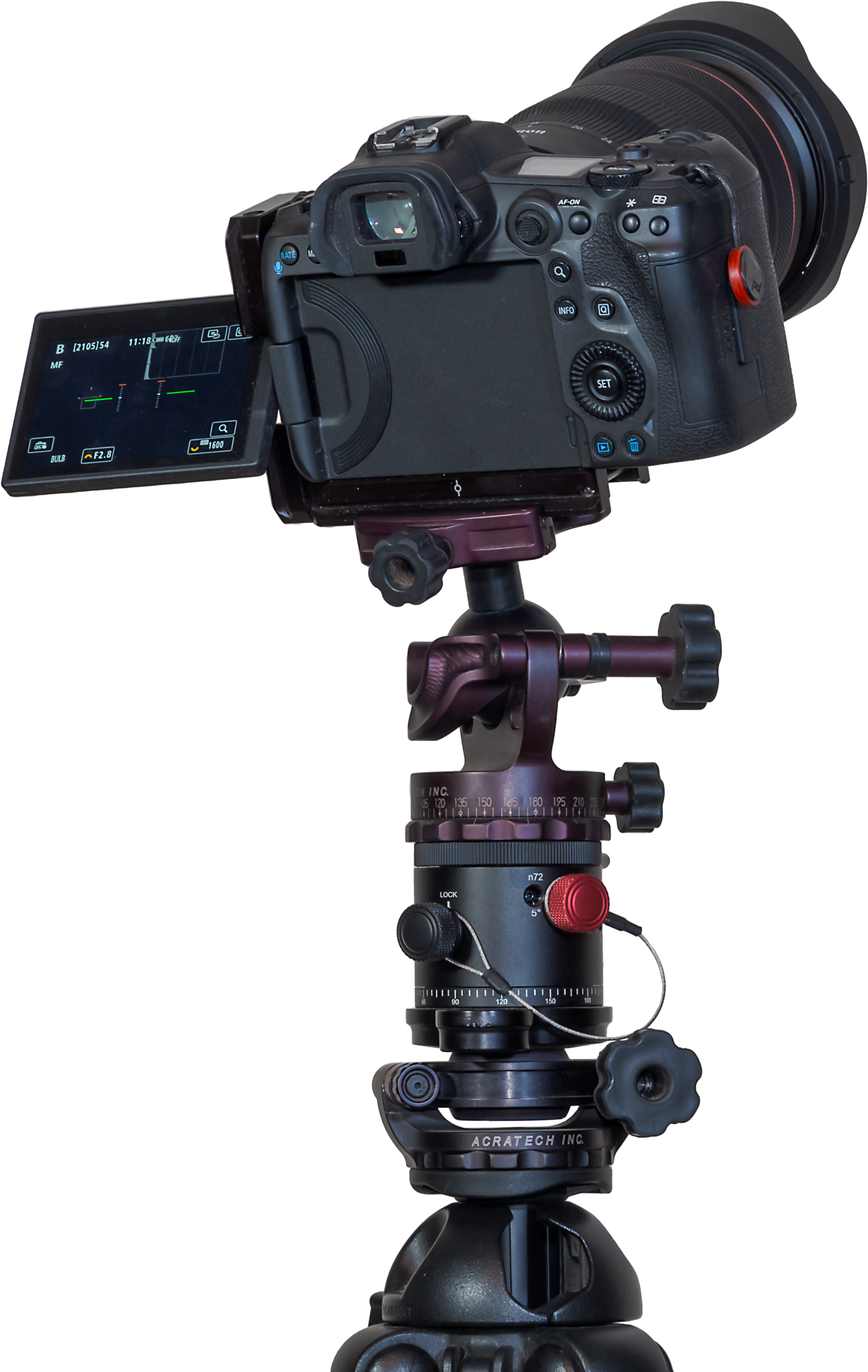
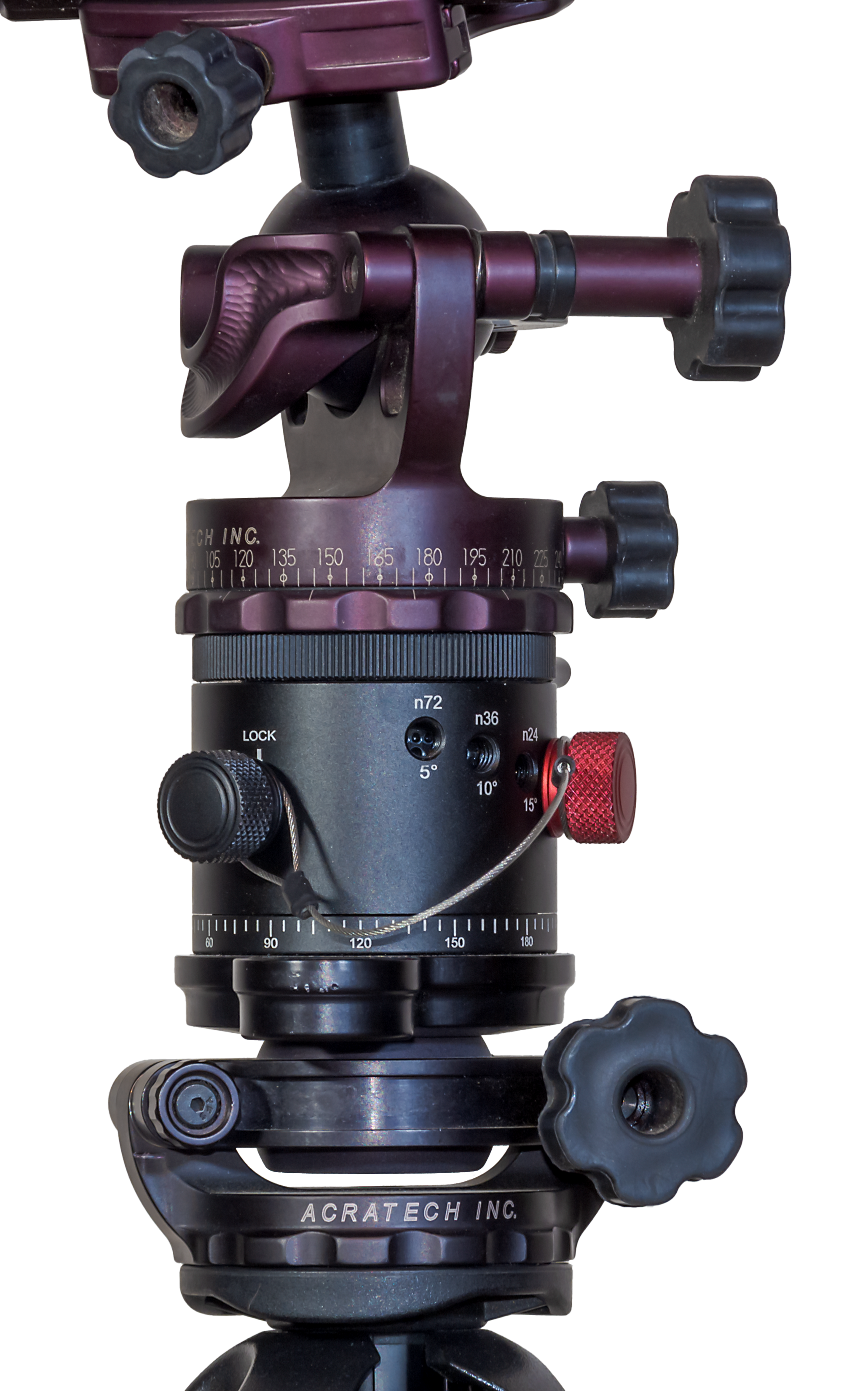
For these panoramas, exposures were short, so I didn’t need to track the sky. I used another combination of gear shown above. An Acratech ball head sits atop another style of panorama head that has adjustable click stops to make it easy to move the camera from segment to segment at set angles. When the lighting is changing by the second, it helps to be quick about shooting all the pano segments. Such pano heads are readily available on Amazon.

That pano head sits atop an Acratech levelling head (there are many similar units for sale), an essential addition that makes it easy to level the pano head so the camera turns parallel to the horizon. Any tilt will result in a panorama that waves up and down, likely requiring fussy warping or cropping to correct. Avoid that; get it right in-camera!
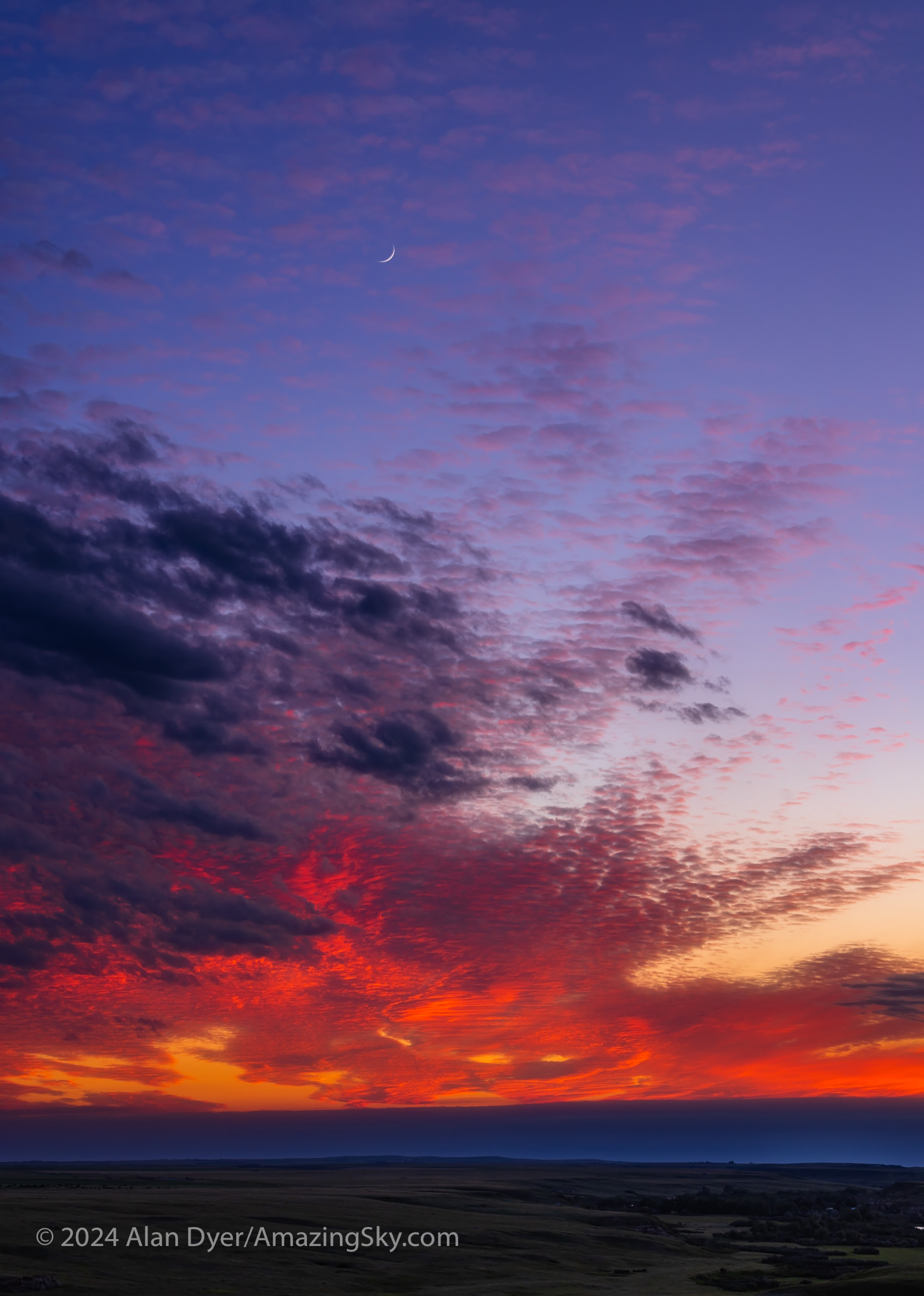
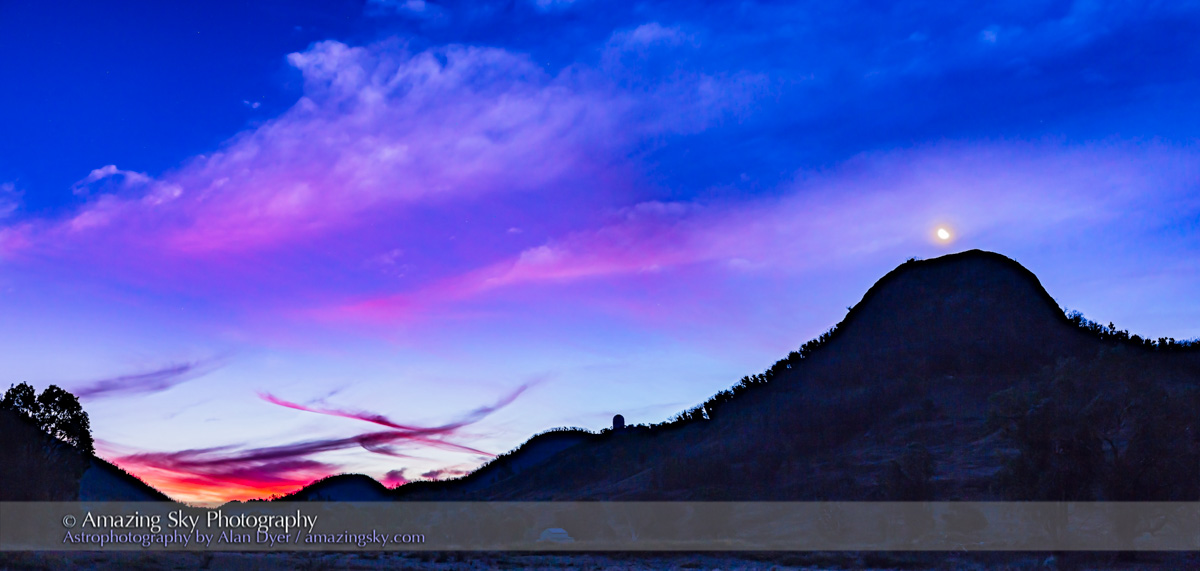
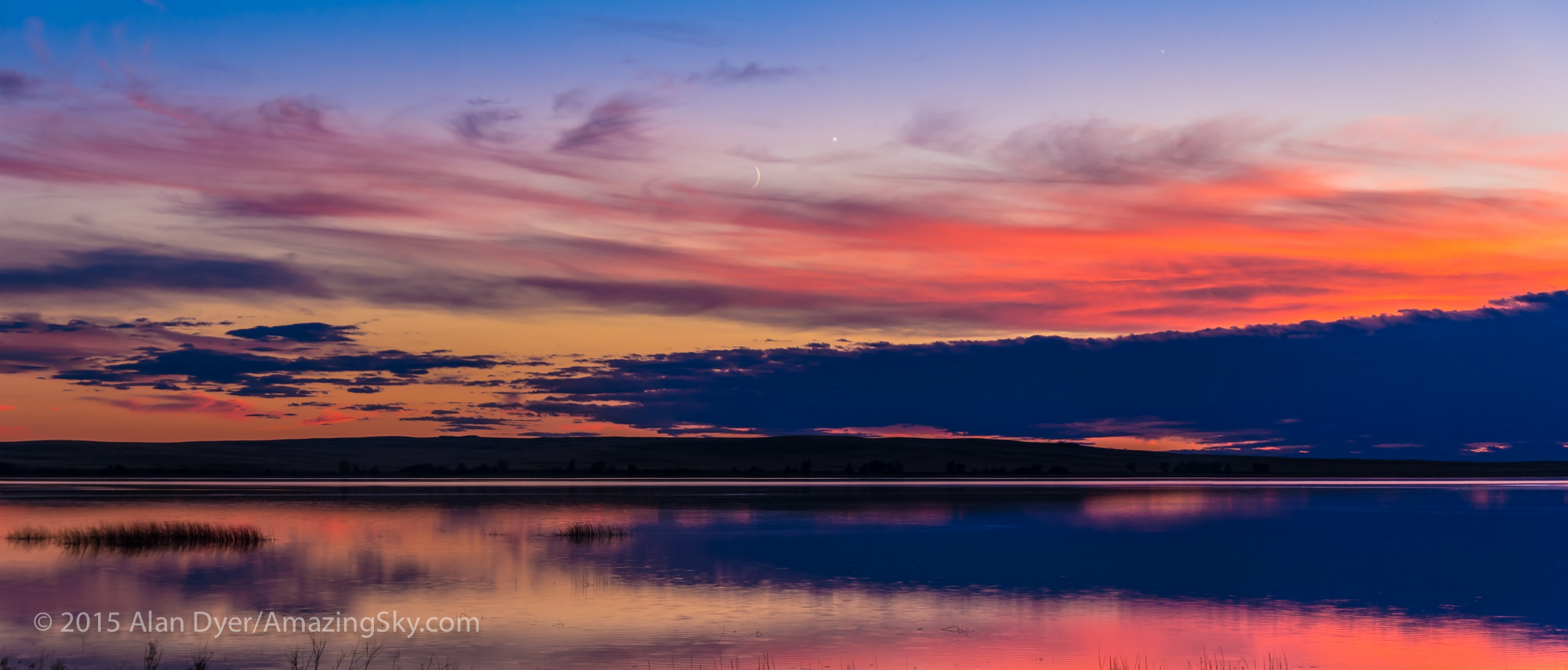
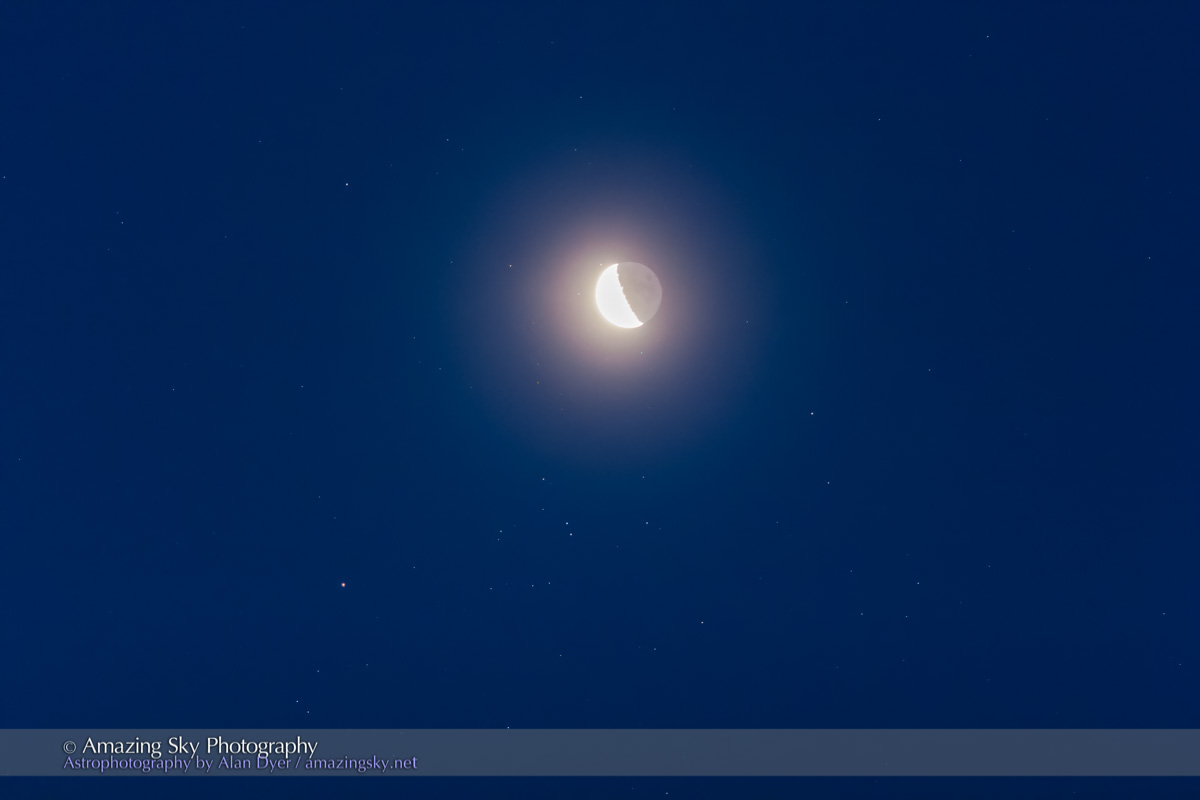
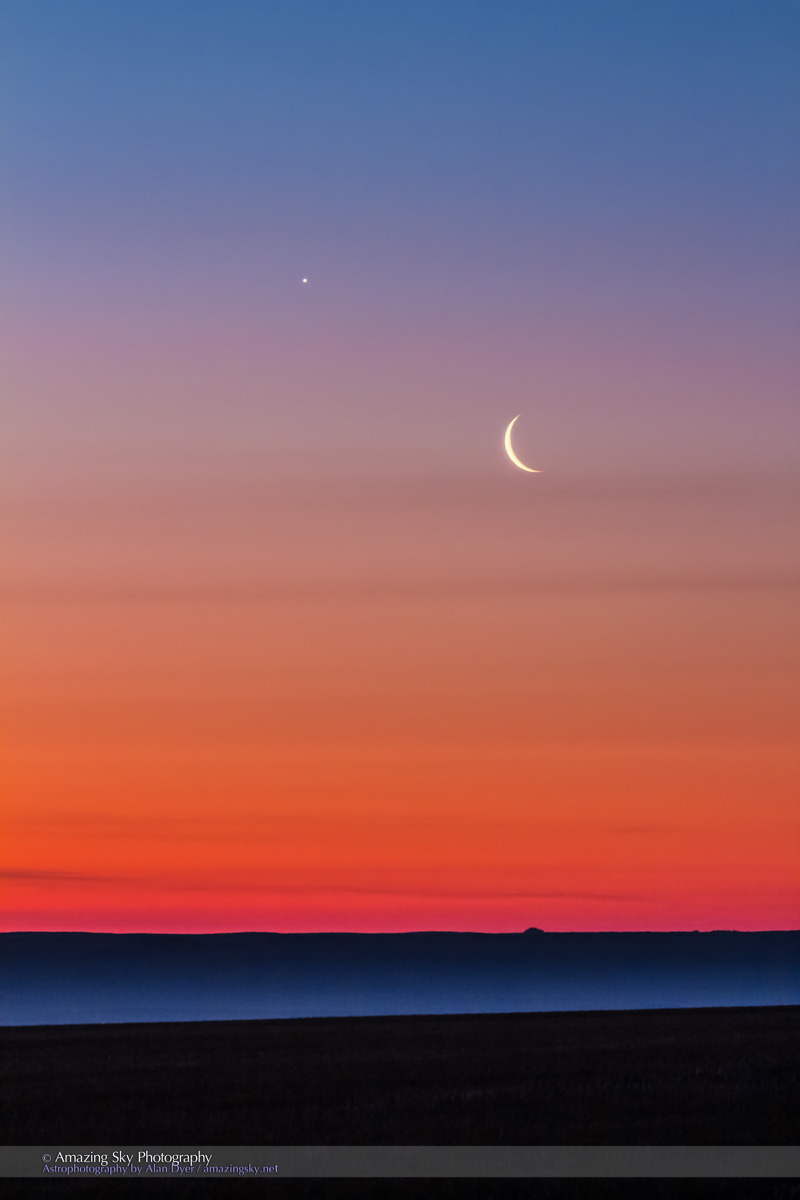
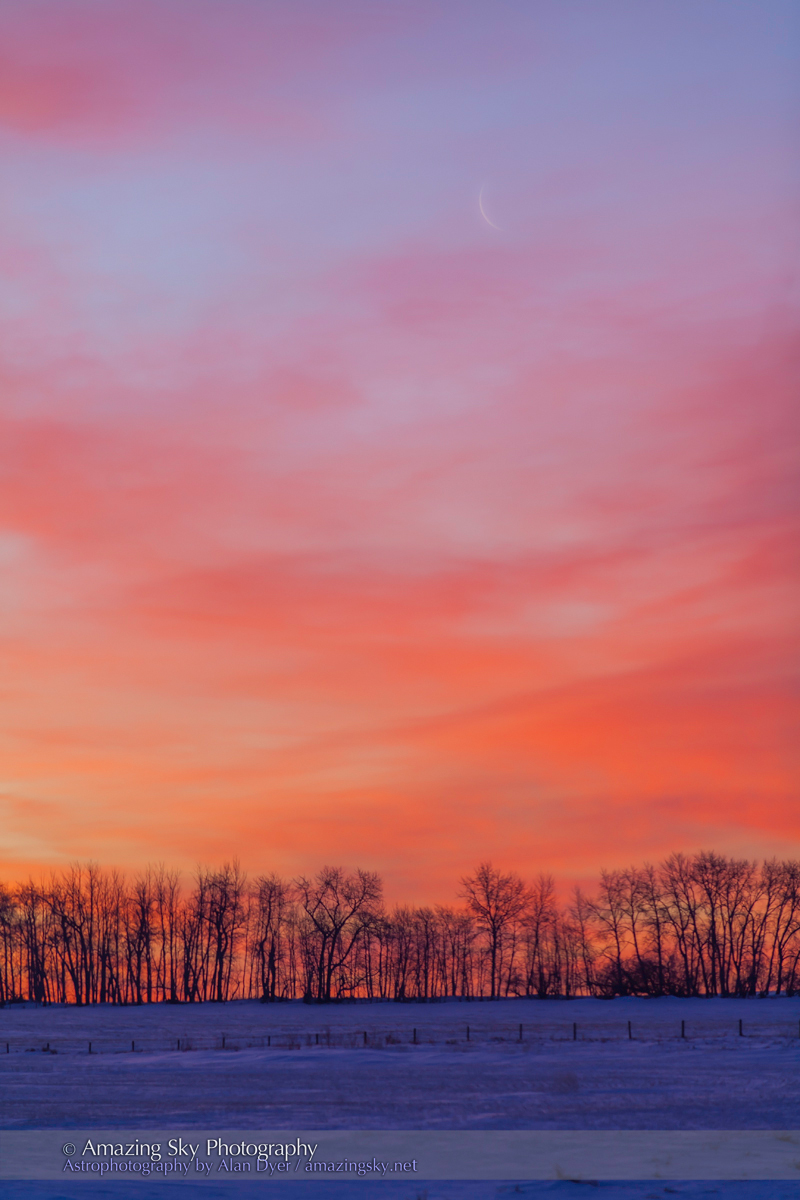
A single-image portrait of a sunset sky with the waxing two-day-old crescent Moon amid colourful clouds over the prairie.

As the sky lit up, I also shot the crescent Moon above the sunset clouds and prairie scene. While the clouds made for a fine sunset, they did not clear off, thwarting my Milky Way plans this night. I headed back to Milk River, to travel farther west the next day.


From Writing-on-Stone I drove along scenic Highways 501 and 5 to Waterton Lakes National Park.
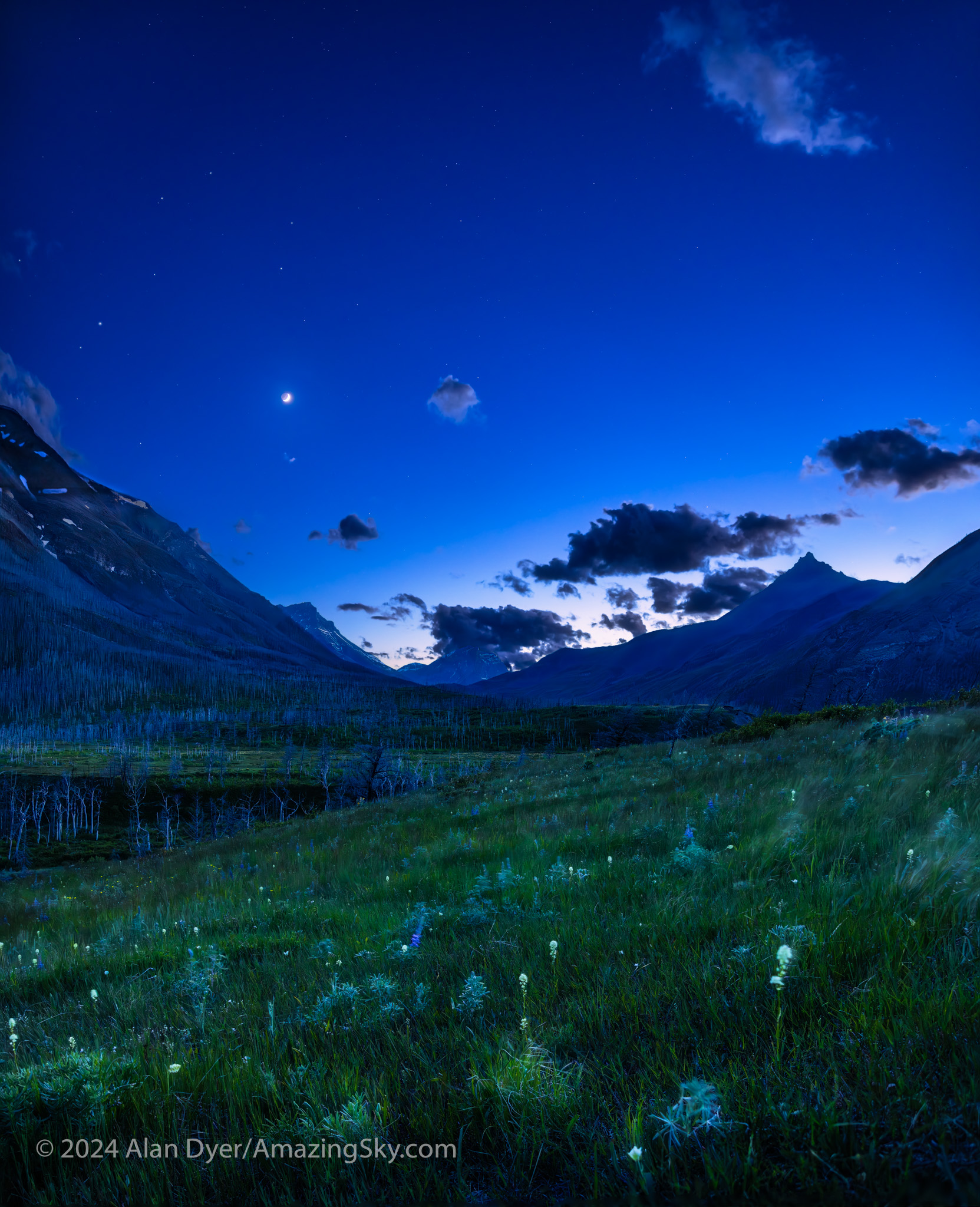
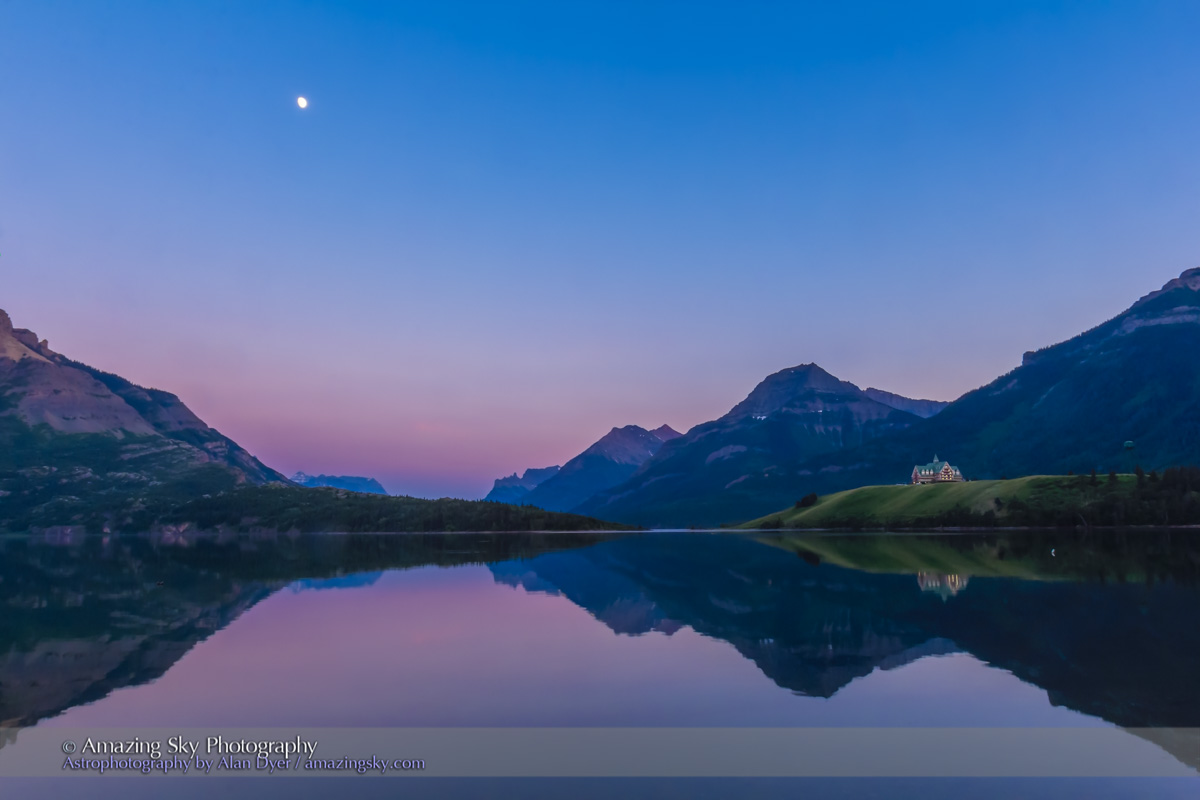
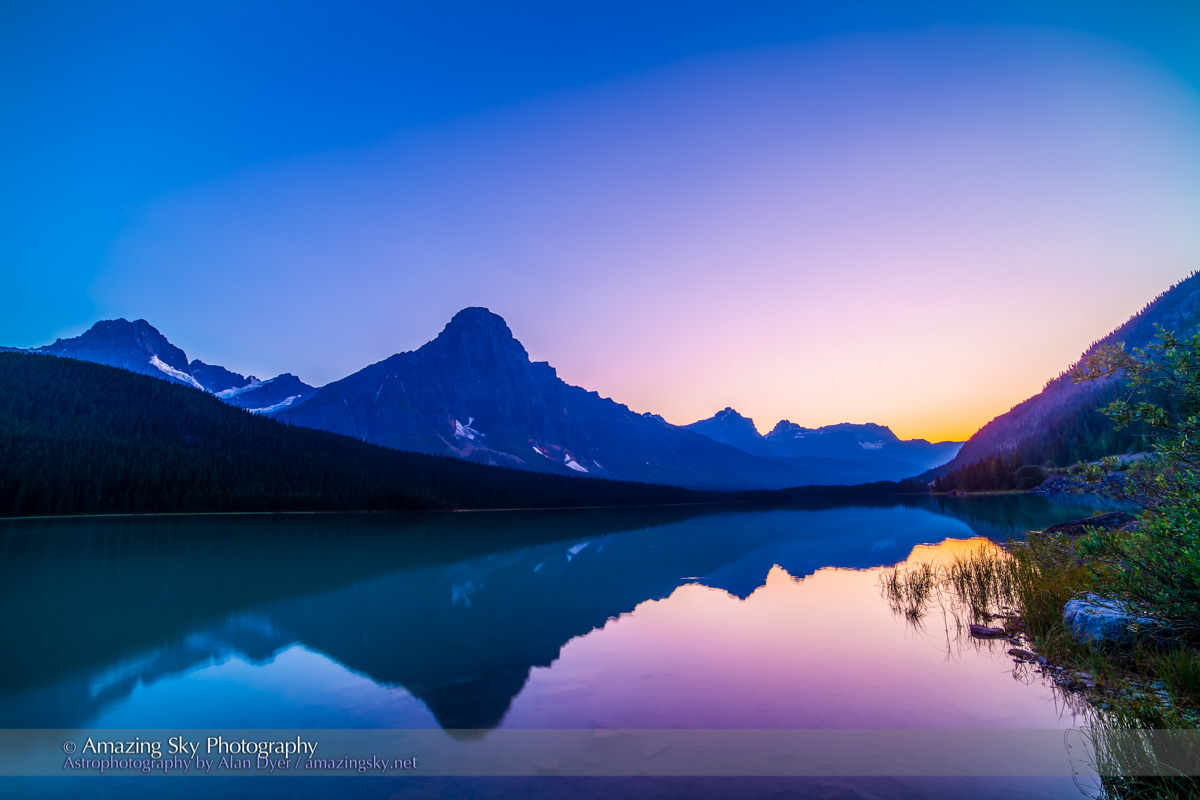
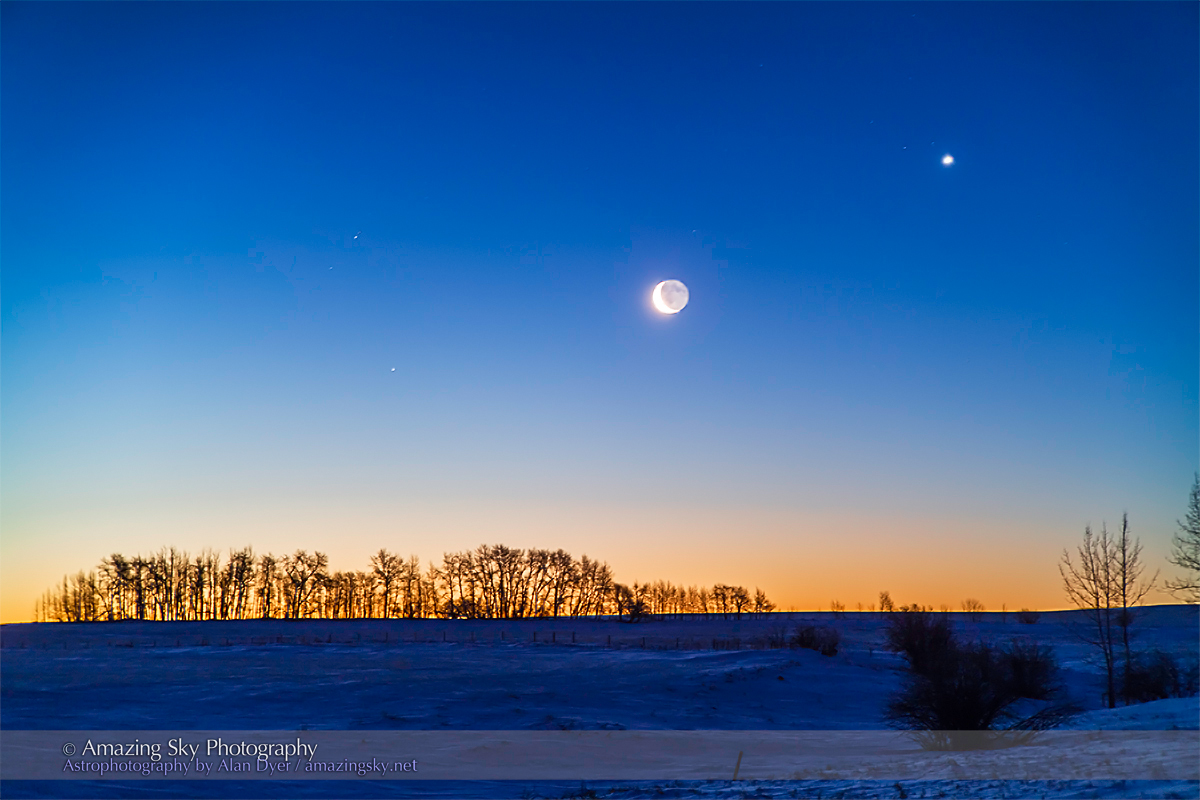
A nightscape scene under a twilight “blue-hour” sky, on the Red Rock Canyon Parkway in Waterton Lakes National Park, Alberta, looking west toward the sunset with the four-day-old crescent Moon.

After an initial cloudy night, I made use of the (mostly) clear night on June 10 to shoot twilight scenes with the now four-day-old crescent Moon in the evening sky. Here I wanted to play with another technique I had not used much before: focus stacking.

To keep exposures short (here to minimize the blurring effects of the constant wind at Waterton) you have to shoot at wide apertures (f/2 in this case). But that produces a very shallow depth of field, where only a small area of the image is in focus.

So I shot a series of six images, shifting the focus from near (for the foreground flowers) to far (for the mountains and sky). Photoshop has an Auto Blend function that will merge the images into one with everything in focus. I also shot separate images exposed for the bright sky, shooting a vertical panorama โ€” dubbed a “vertorama” โ€” moving the camera up from frame to frame.

I shot an additional short exposure just for the Moon, to prevent its disk from overexposing too much, as it did in the twilight sky images.
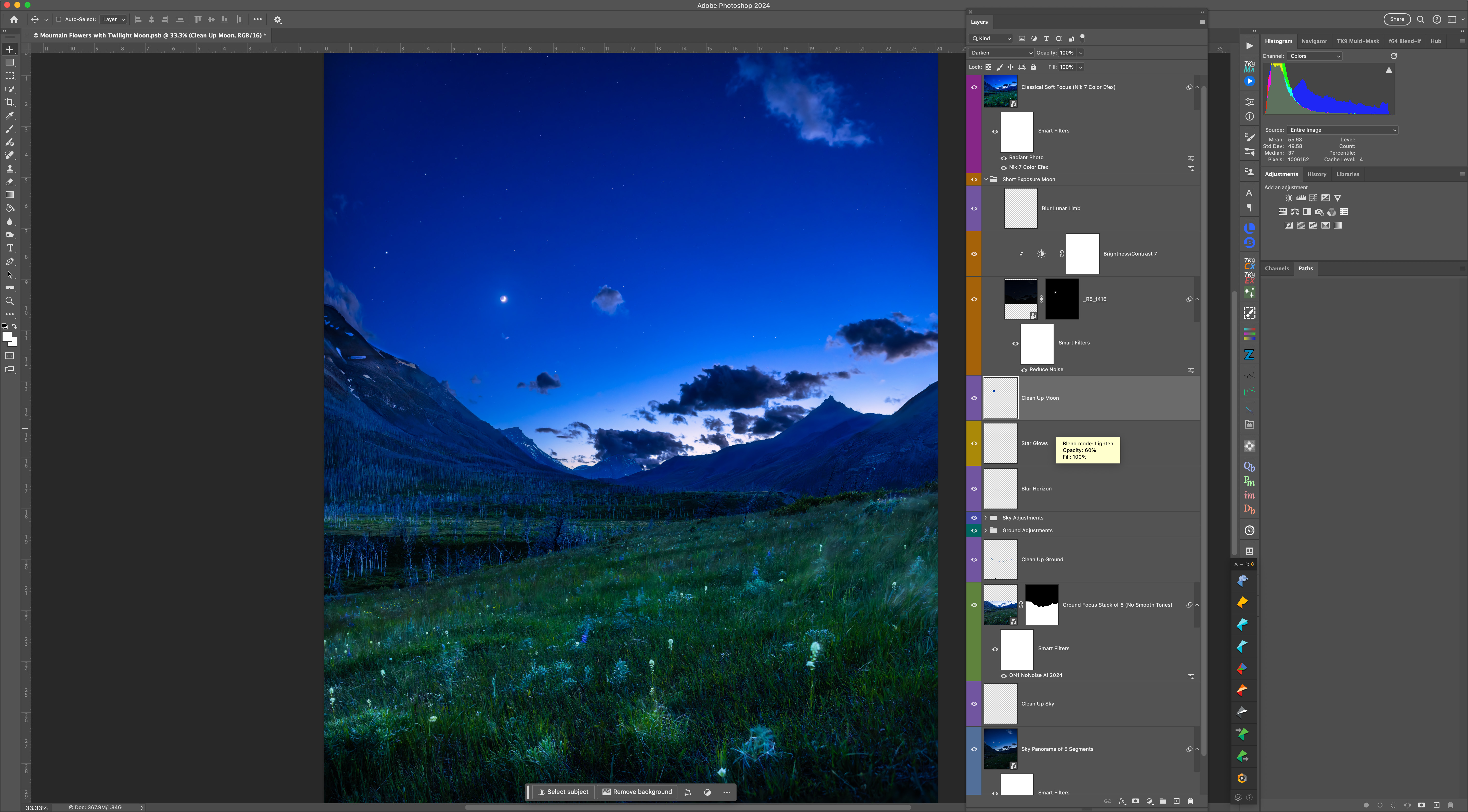
Twilight sky assembly and layers in Photoshop

So what looks like a simple snapshot of a twilight scene is actually a complex blend of focus-stacked ground images, panoramic sky images, and a single short image of the Moon replacing its otherwise overly bright disk. But the result better resembles what the eye saw, as single exposures often cannot record the range of brightness the eye can take in.
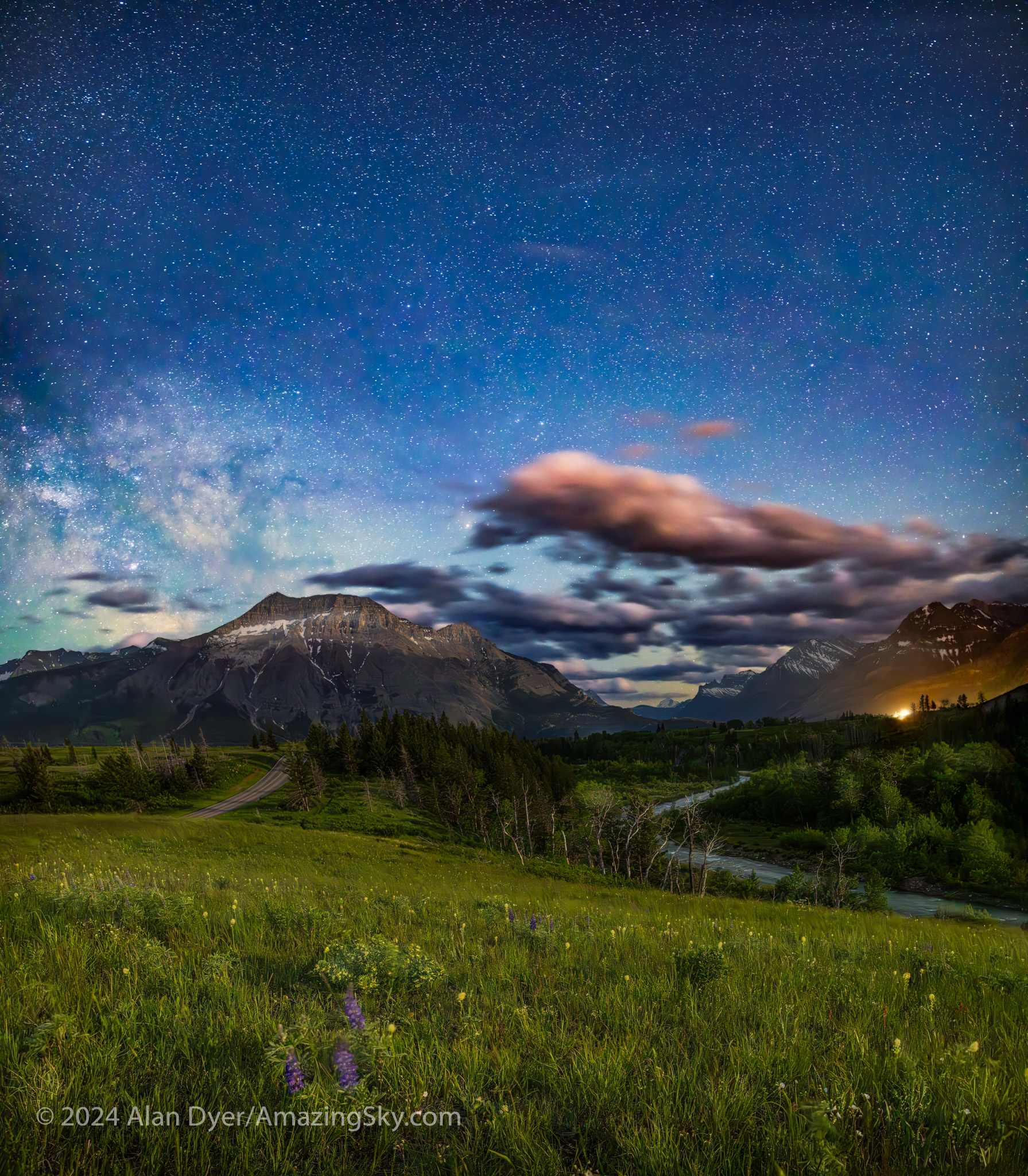
A nightscape scene under a moonlit sky, on the Red Rock Canyon Parkway in Waterton Lakes National Park, Alberta, looking back along Pass Creek to the south, with the Milky Way rising at left.

About an hour later, from the same location, I shot the other way, toward the Milky Way rising over Vimy Peak, but the sky still lit blue by moonlight. This, too, is a blend of focus-stacked ground and panorama sky images. But the camera was on a fixed tripod for exposures no longer than 15 seconds. So I didn’t use the tracker.

And here the longer exposures do pick up more (colours, fainter stars, and brighter ground detail) than was visible to the eye. Revealing more than the eye can see is the essence and attraction of astrophotography.
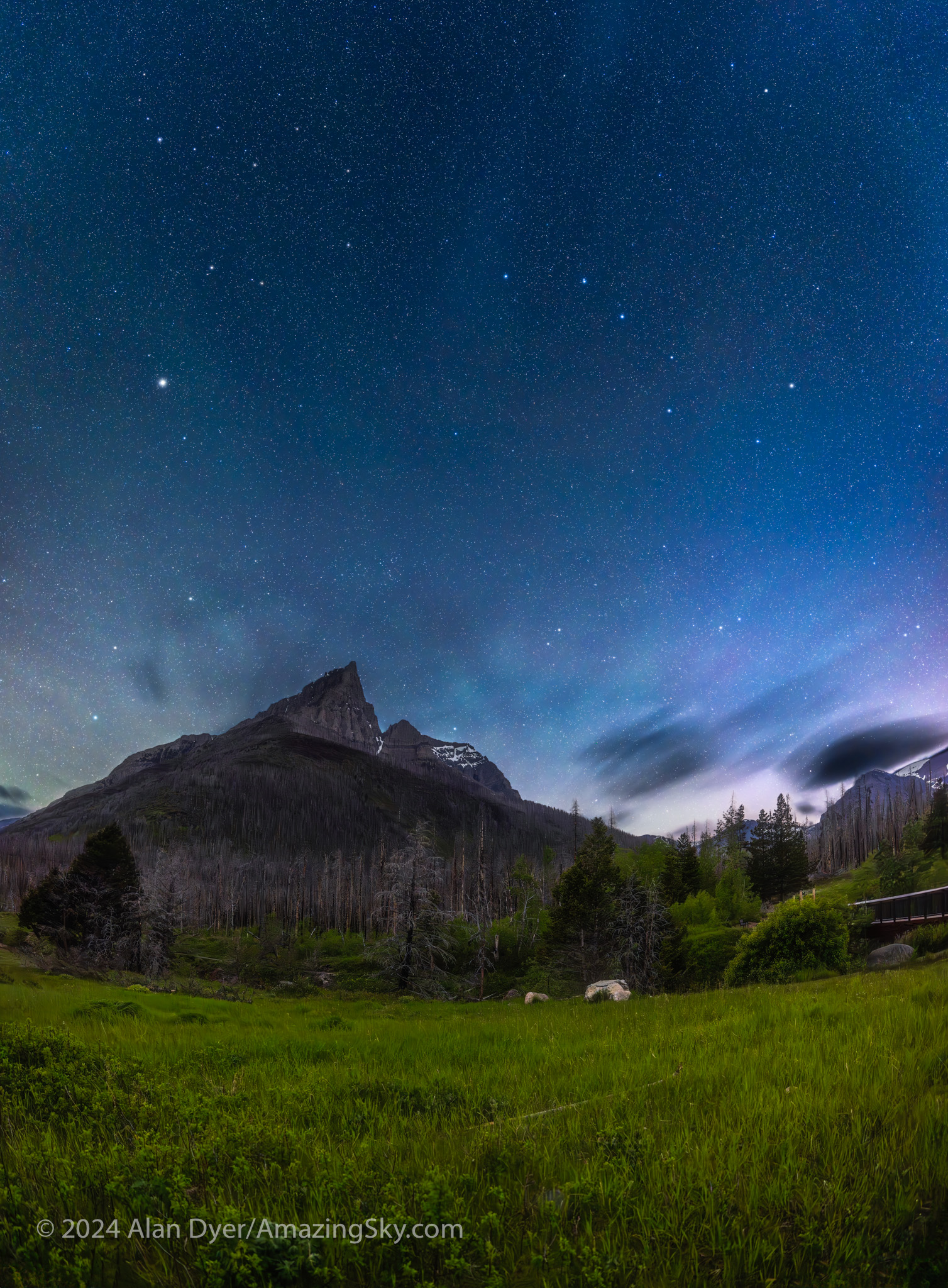
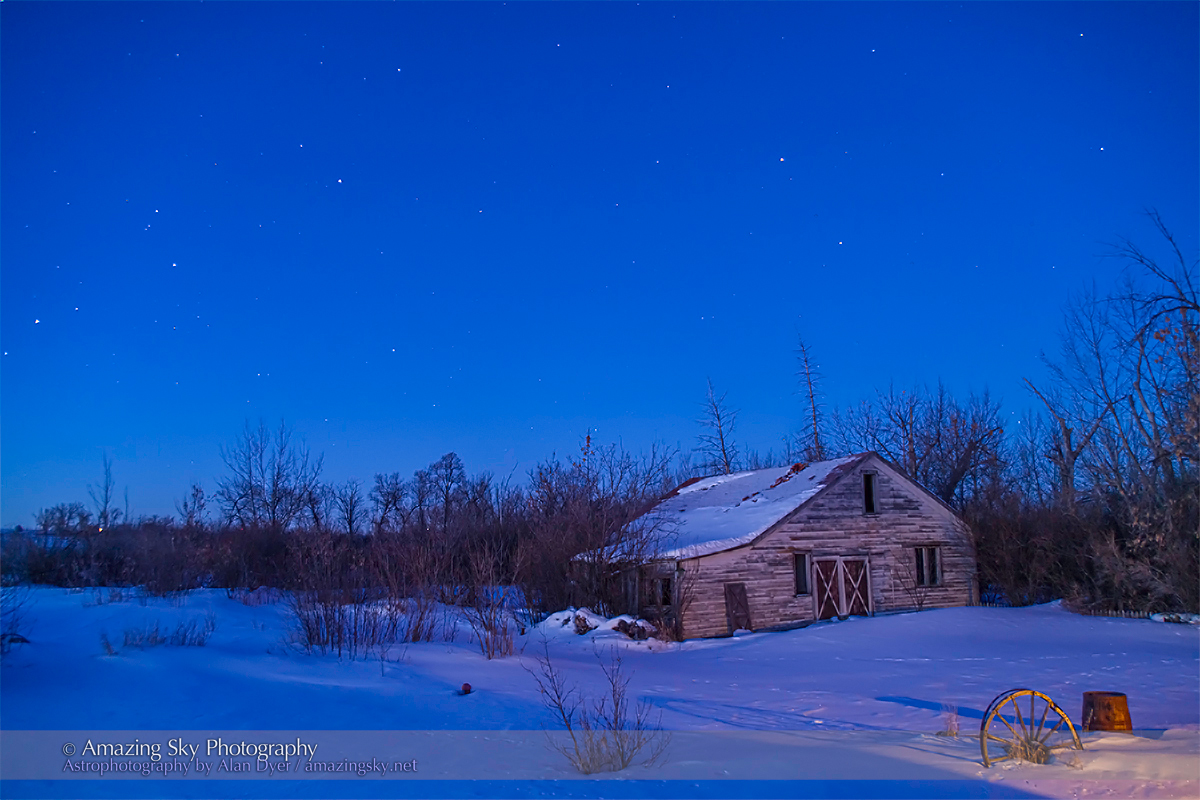
A vertical panorama of the moonlit spring sky with the Big Dipper and Arcturus over the jagged outline of Anderson Peak at the Red Rock Canyon area of Waterton Lakes National Park, Alberta.

Heading down the Red Rock Canyon Parkway, I set up the tracker rig for the darker sky, now that the Moon was nearly setting. I shot a vertical panorama, with two untracked ground segments and four tracked sky segments, to capture Arcturus and the Big Dipper over the iconic Anderson Peak.
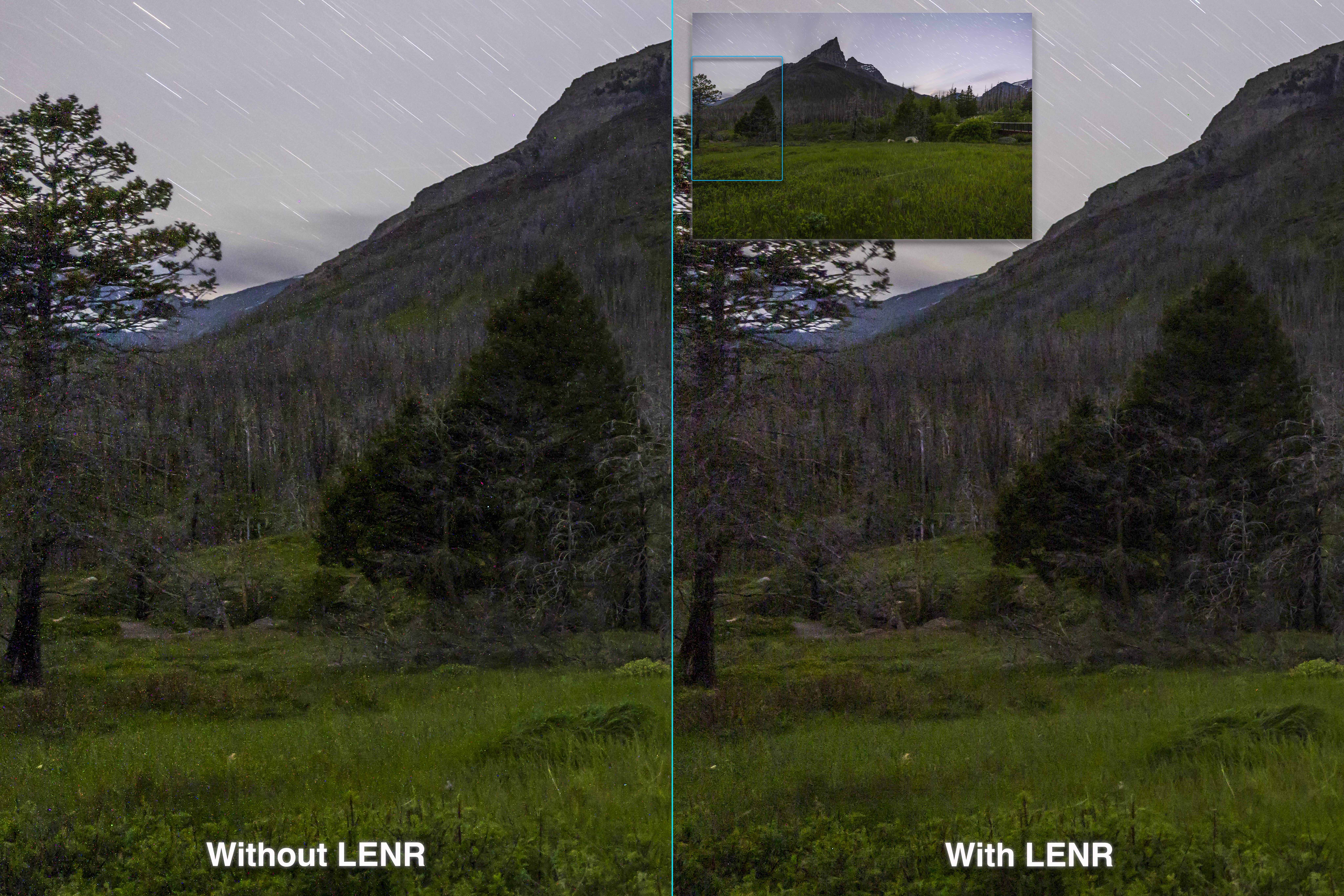
Comparing without and with LENR โ€“ Lots of coloured specks without LENR! Tap to zoom up.

For all the images at Waterton and Writing-on-Stone I used the 45-megapixel Canon R5 camera, great for high resolution, but prone to noise, especially colourful thermal hot pixels. (See my review here.)

For all the long exposures I turned on Long Exposure Noise Reduction, a feature most cameras have. LENR forces the camera to take a “dark frame,” a second exposure of equal length, but with the shutter closed. The camera subtracts the dark frame (which records only the hot pixels) from the previous light frame. The final image takes twice as long to appear, but is much cleaner, as I show above. So a two-minute exposure requires four minutes to complete.

While there are clever ways to eliminate hot pixels later in processing (using Photoshop’s Dust and Scratches filter), doing so can blur details. I’ve long found that doing it “in-camera” always produces better results.
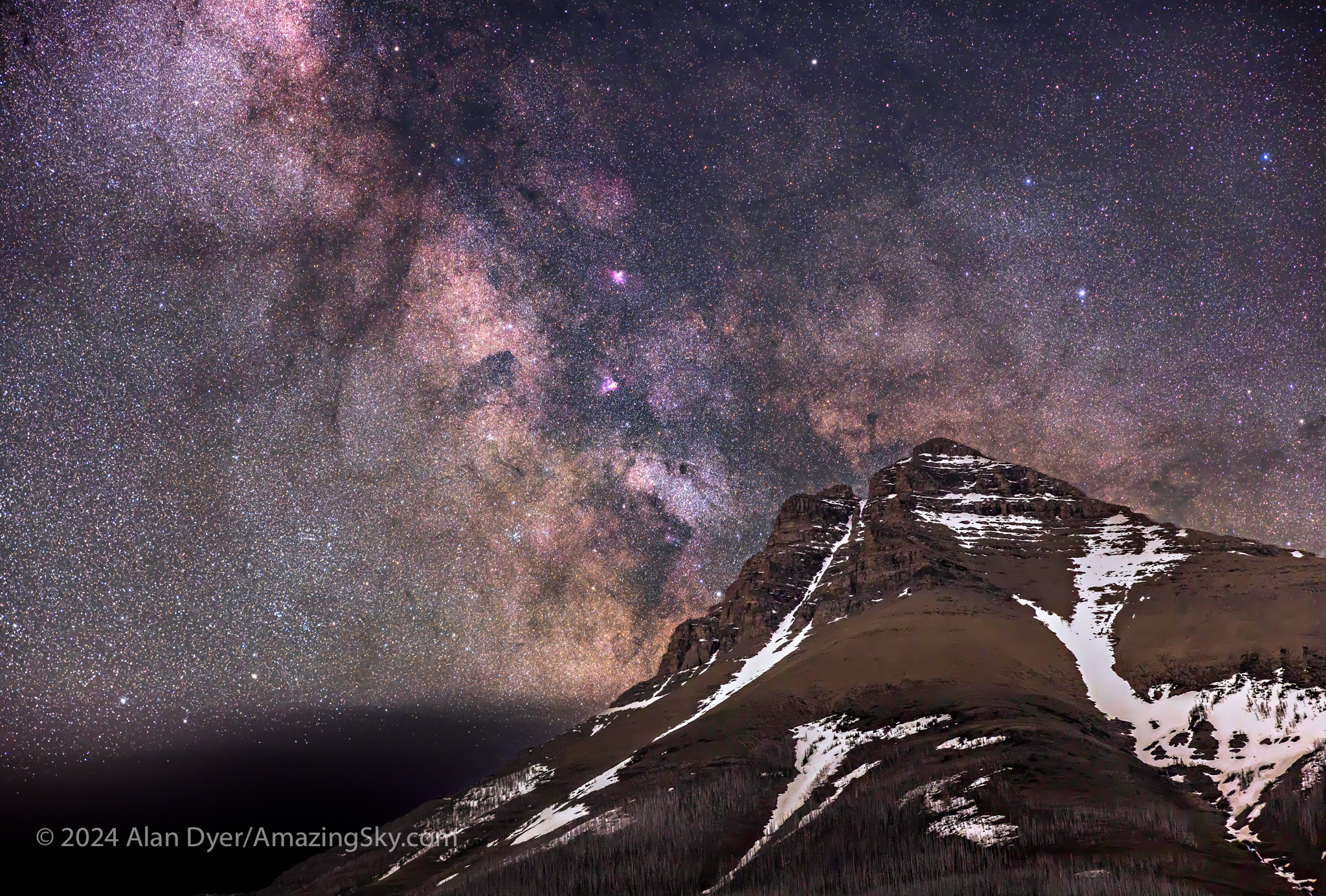
The Milky Way rising over the peak of Mt. Blakiston, in Waterton Lakes National Park, Alberta, Canada.

With the Moon now down, I turned the camera the other direction toward Mt. Blakiston, to capture the star clouds of the summer Milky Way rising behind the mountain, in an example of a “deepscape,” a nightscape with a telephoto lens. This is another technique I’ve not used very often, as the opportunities require good location planning and timing, transparent skies, and a tracker. Apps like ThePhotographersEphemeris coupled with TPE3D, and PlanItPro can help.

Deepscapes frame landscape fragments below some notable deep-sky objects and starfields, in this case a region with several “Messier objects” โ€” nebulas and star clusters well-known to amateur astronomers.

This was a blend of one untracked and one tracked exposure, again on the Nomad. Taking more frames for stacking and noise reduction, while a common practice, was not practical here โ€” at this focal length of 70mm the sky was moving enough that the mismatch between sky and ground would make blending tough to do.

And the reality is that today’s AI-trained noise reduction software (see my test report here) is so good, image stacking is not as essential as it once was.

For many of the Waterton images I used the Canon RF28-70mm lens, usually wide open at f/2. For the image below I used the RF15-35mm lens at its maximum aperture of f/2.8. (See my test report on these lenses here.)
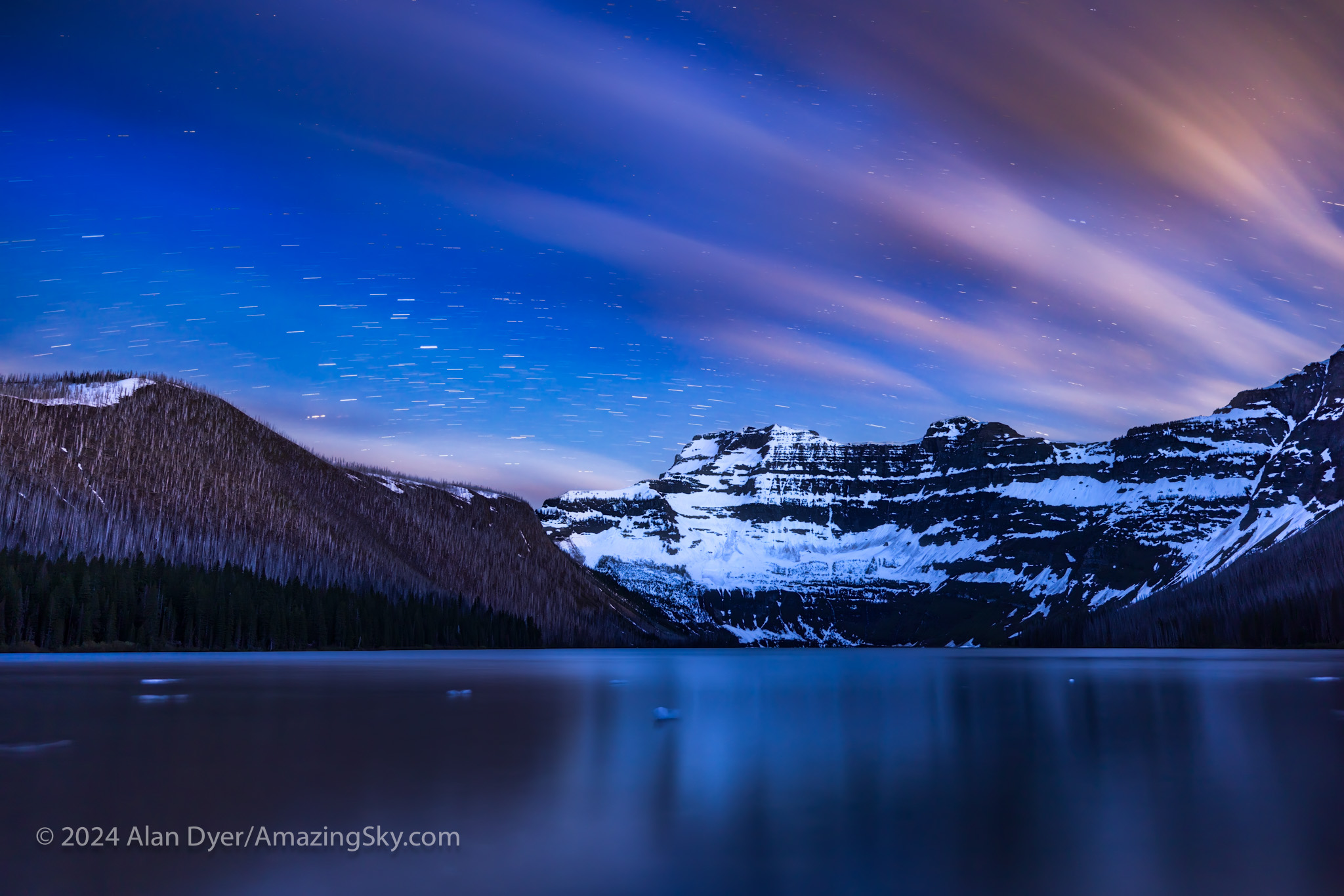
The stars and clouds trail across the sky over Cameron Lake in Waterton Lakes National Park, Alberta, and Mt. Custer across the border in Glacier National Park in Montana.

On my final night in Waterton I drove the Akamina Parkway to Cameron Lake, located in extreme southwest Alberta on the borders with British Columbia and Montana. The glaciated peak to the south is Mt. Custer in Glacier National Park, Montana.

Again, I had hoped to get a deepscape of the photogenic starfields in Scorpius above Mt. Custer. But as is often the case at this site, clouds wafting over the Continental Divide defeated those plans. So Plan B was a set of long exposures of the clouds and stars trailing with the last light of the low Moon lighting parts of the scene. Chunks of ice still drift in the lake.

This is a blend of separate multi-minute exposures for the ground and sky, all at the slow ISO of just 100, and all untracked to purposely create the star trails, not avoid them.

So over a total of four nights at these wonderful World Heritage Sites, I was able to try out some new shooting techniques:

  • H-Alpha blending
  • Focus stacking
  • Deepscapes
  • As well as panoramas, both horizontal and vertical

Every nightscape outing is a learning process. And you have to be prepared to change plans as the clouds dictate. I didn’t get all the shots I had hoped to, but I still came away with images I was very pleased with.

I hope you enjoyed them. Clear skies!

โ€” Alan Dyer / AmazingSky.com
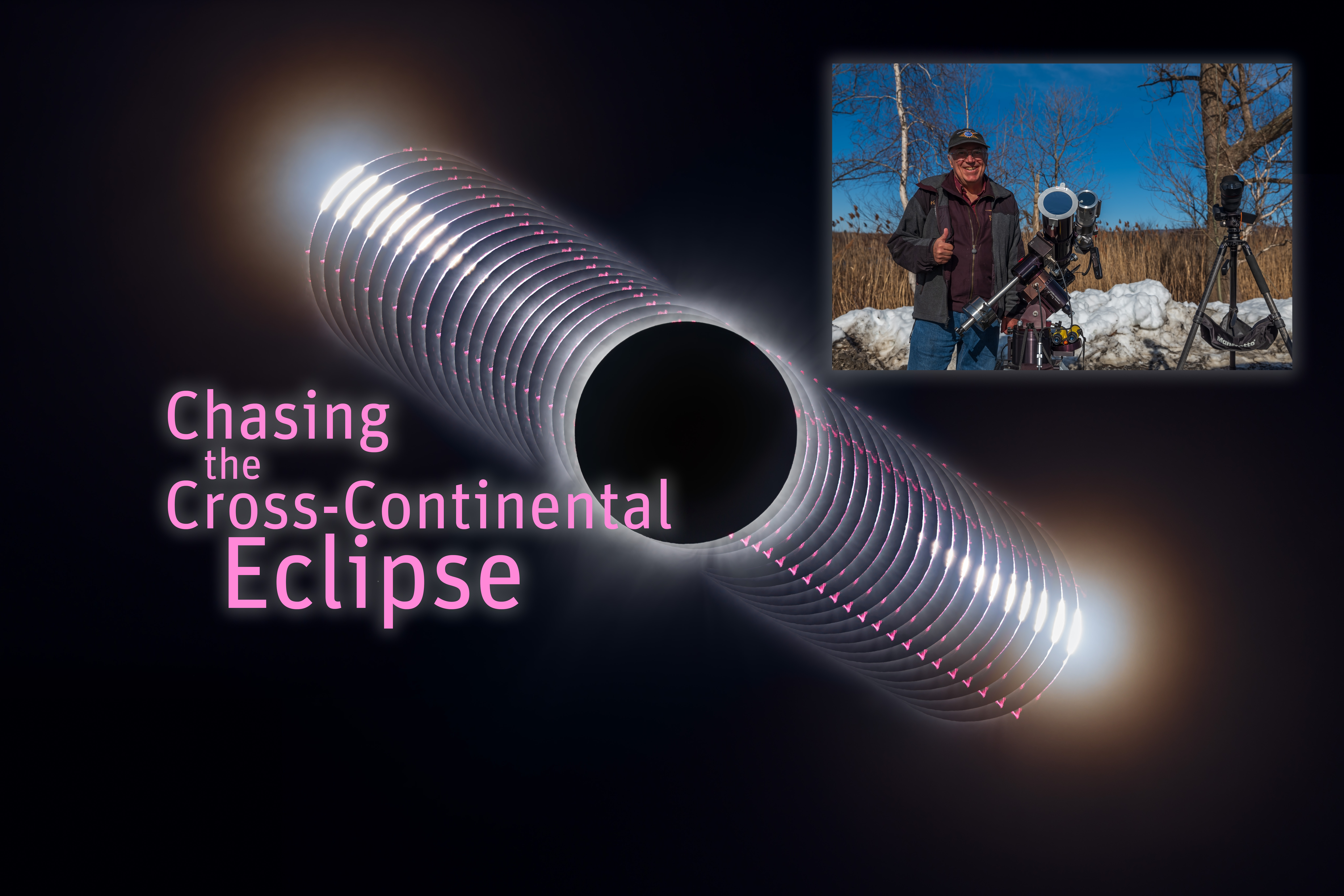
Chasing the Cross-Continental Eclipse


I had always planned to drive to the April 8, 2024 total eclipse of the Sun. But to where? I ended up on the other side of the continent than originally planned.

It is not often the path of the Moonโ€™s shadow crosses your home country, let alone continent. Only once before in recent years, on August 21, 2017, did the narrow shadow path pass near enough to my home in Alberta to allow me to drive to a total eclipse. They almost always require flying. 

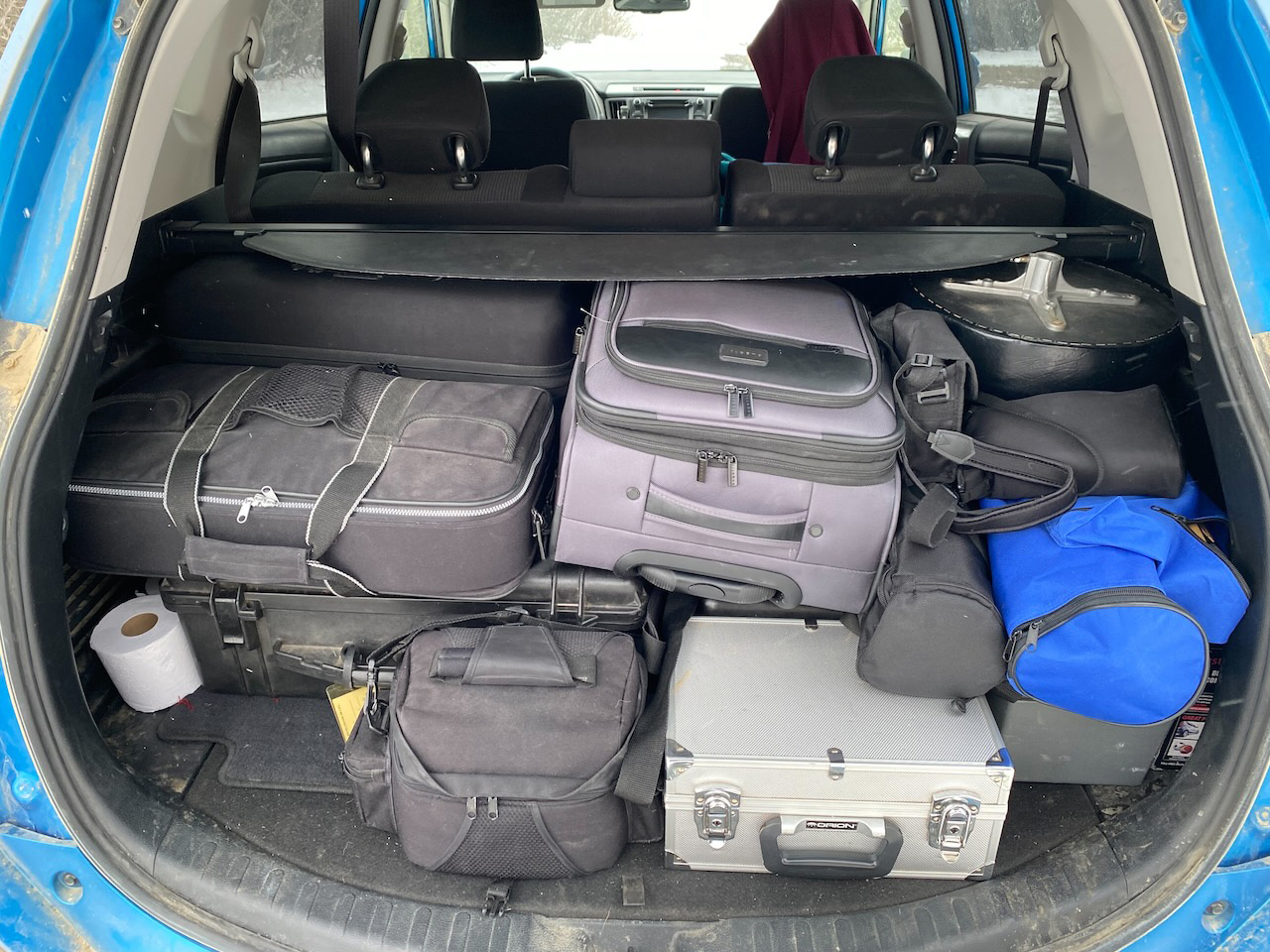
Packed and ready to hit the highway for a long eclipse trip.

Yes, while I could drive to the April 8, 2024 eclipse, it was going to demand a much longer drive than in 2017. But driving allowed me to take a carload of telescope and camera gear. So that was the plan. 

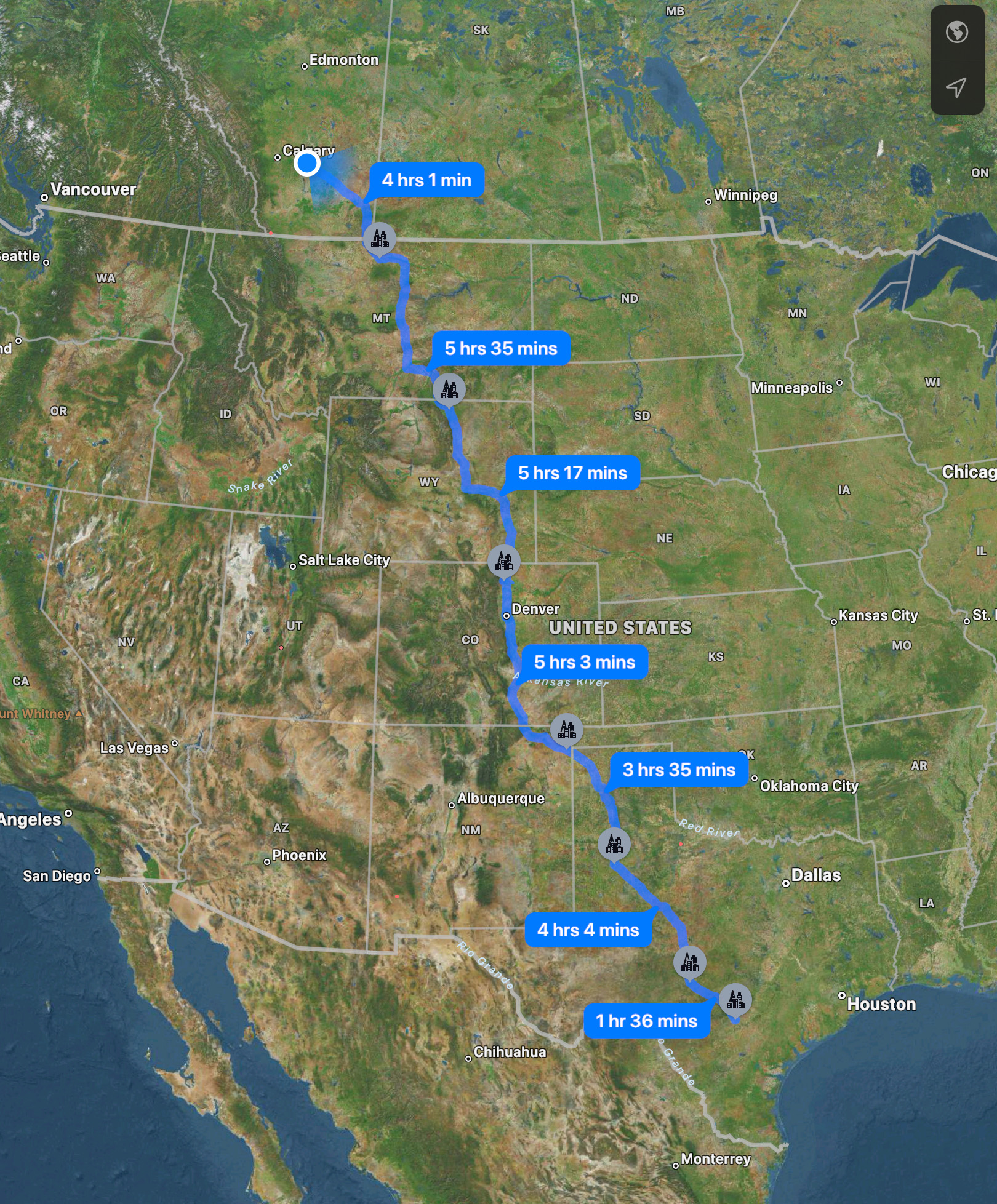
My destination was San Antonio, Texas. Thatโ€™s where I had made a hotel booking more than a year earlier. The weather prospects in Texas were forecast to be best (at least according to the long-term averages) of any locations along the path in the U.S. or Canada. (I did not want to drive into Mexico.) 

On March 30, with some trepidation, I set out down I-15 heading south. I got as far as Great Falls, Montana, my stop for night one. But it was to be a move in the wrong direction.

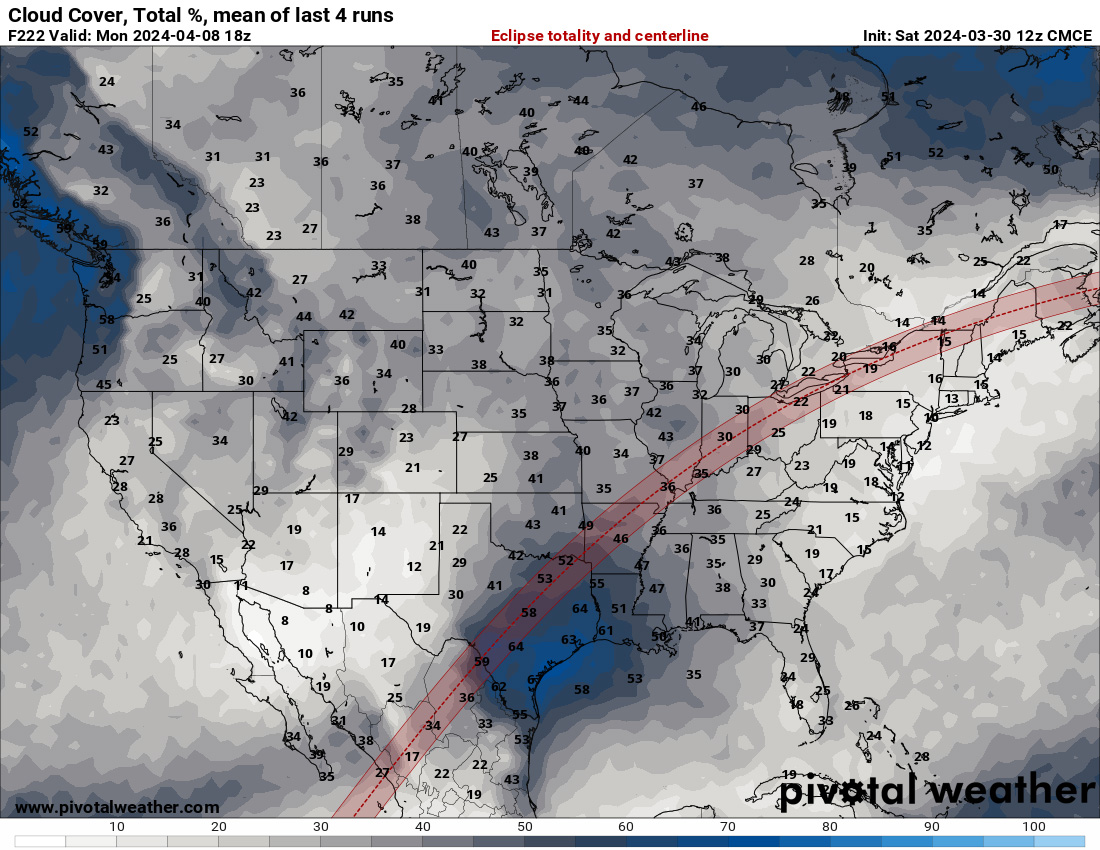
The forecast for Eclipse Day as of March 30. Blue is bad; white is good!

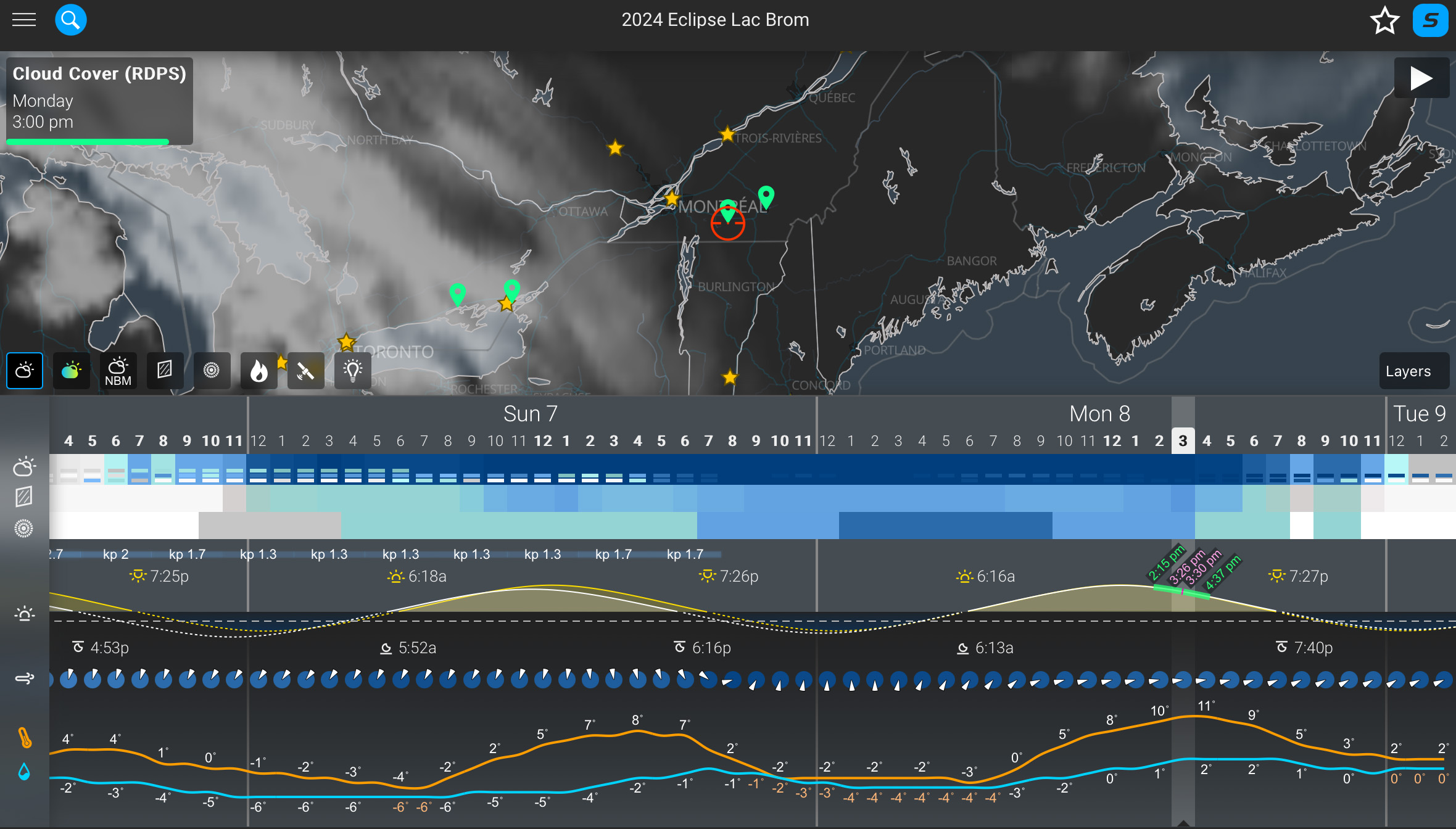
The various long-range weather models were all agreeing, even 10 days in advance, that Texas (covered in blue above) was looking poor for eclipse day. But eastern Canada looked good! That was the exact opposite of what had been expected. 

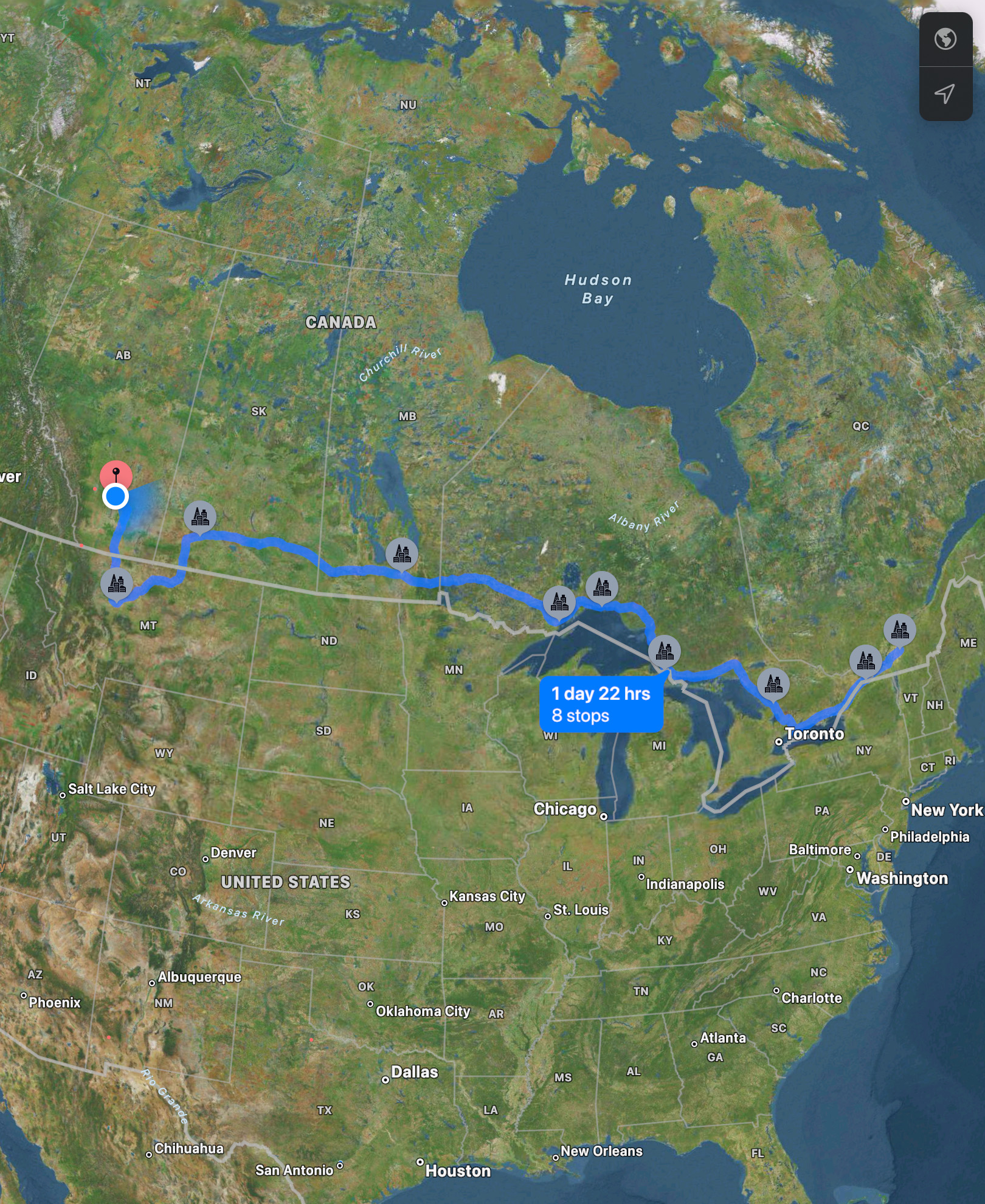
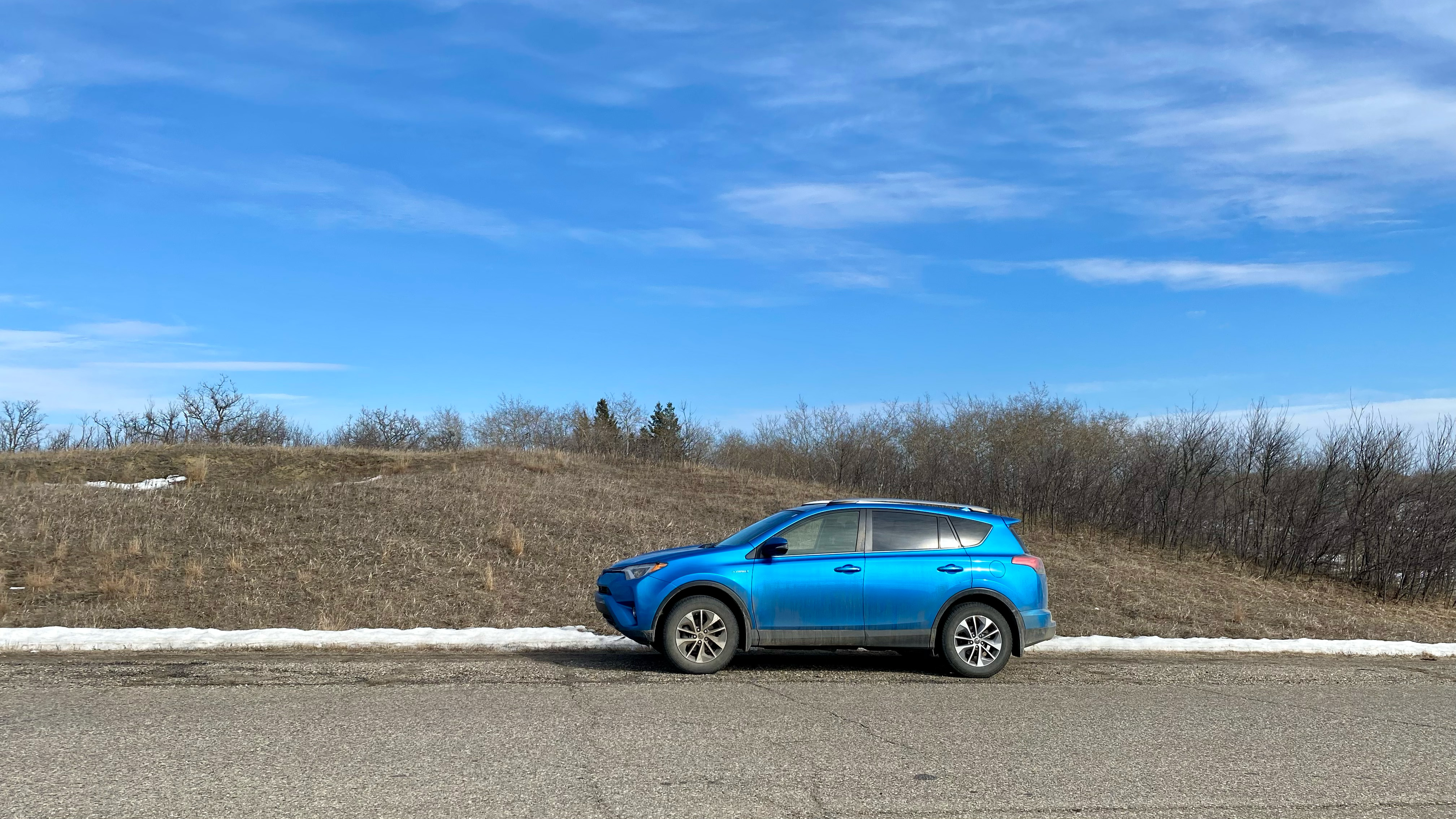
So on Easter Sunday, I turned around and headed north, crossing back into Canada at a lonely border post in southwest Saskatchewan. 

I proceeded east along the TransCanada, Highway 1. I decided against a route across the northern U.S. and around the southern end of Lake Michigan, to avoid severe weather forecast for the middle of the U.S. 

One of my daily Facebook travelogue posts with a beer of the day.

Along the way I posted my beer-du-jour travel reports, as above from Day 8, that day from within the shadow path at last!

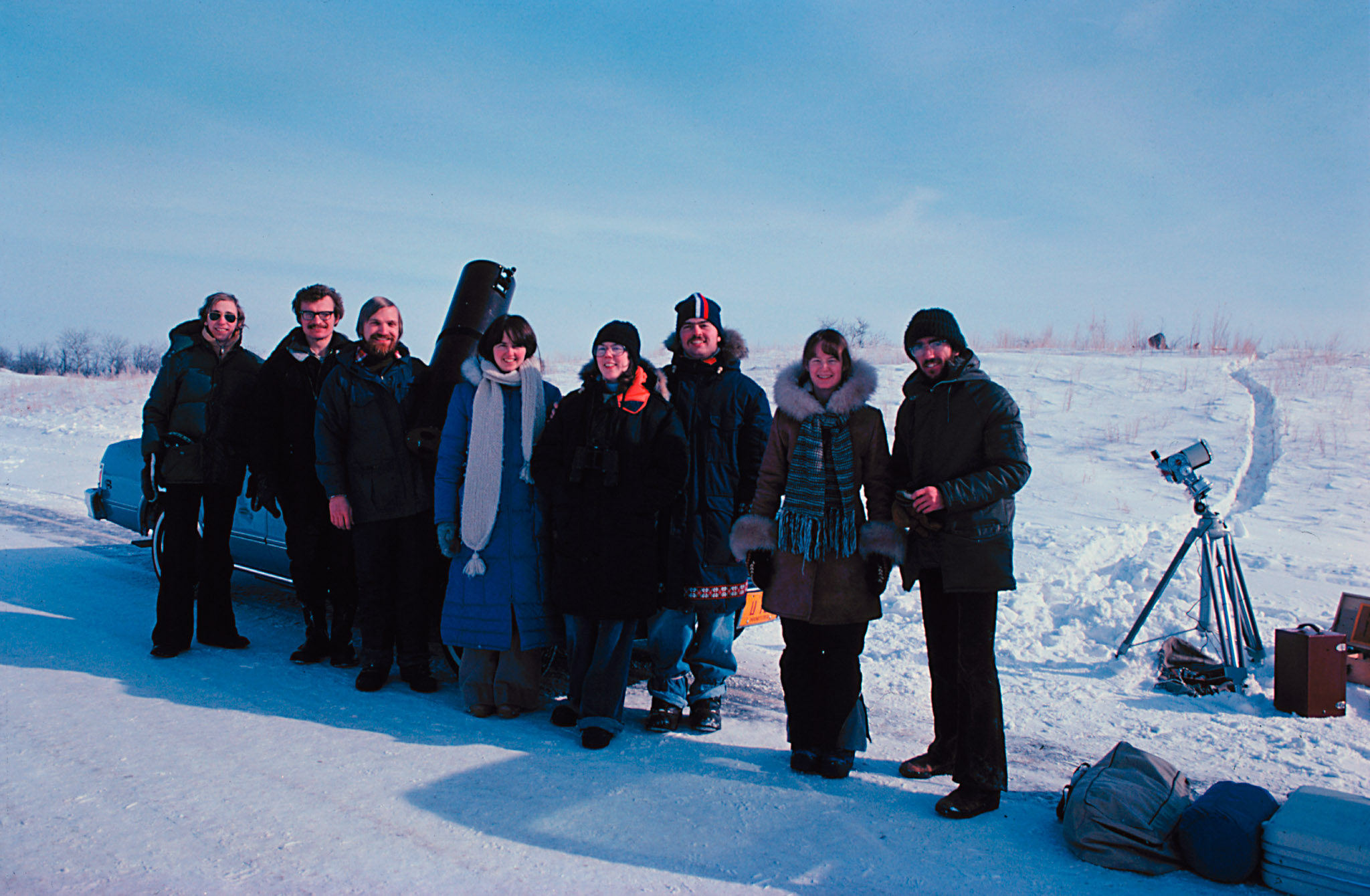
I also stopped at the only total eclipse site, of the 16 I had seen previously, I have ever been able to re-visit. On February 26, 1979 I and a small band of friends from Edmonton viewed the mid-winter eclipse (the last one visible from southern Canada) from a median road (Firdale Road as it is now called) on the TransCanada Highway near Carberry, Manitoba. I found the spot again, where I saw (and shot with my Questar telescope) my first total eclipse of the Sun. 

However, a day after entering Ontario, the bad weather caught up with me, forcing an extra night north of Lake Superior while the only highway across the region, Highway 17, was cleared of snow and re-opened at Wawa, the usual cross-Canada choke point. 

My new destination (after abandoning the site in the Texas Hill Country) was to be southern Ontario. 

However, as eclipse day approached and the weather predictions became more precise, it was apparent that Ontario would also be under some cloud. Southern Quรฉbec was looking better. So the Eastern Townships became my new Plan A site! I was running out of time!

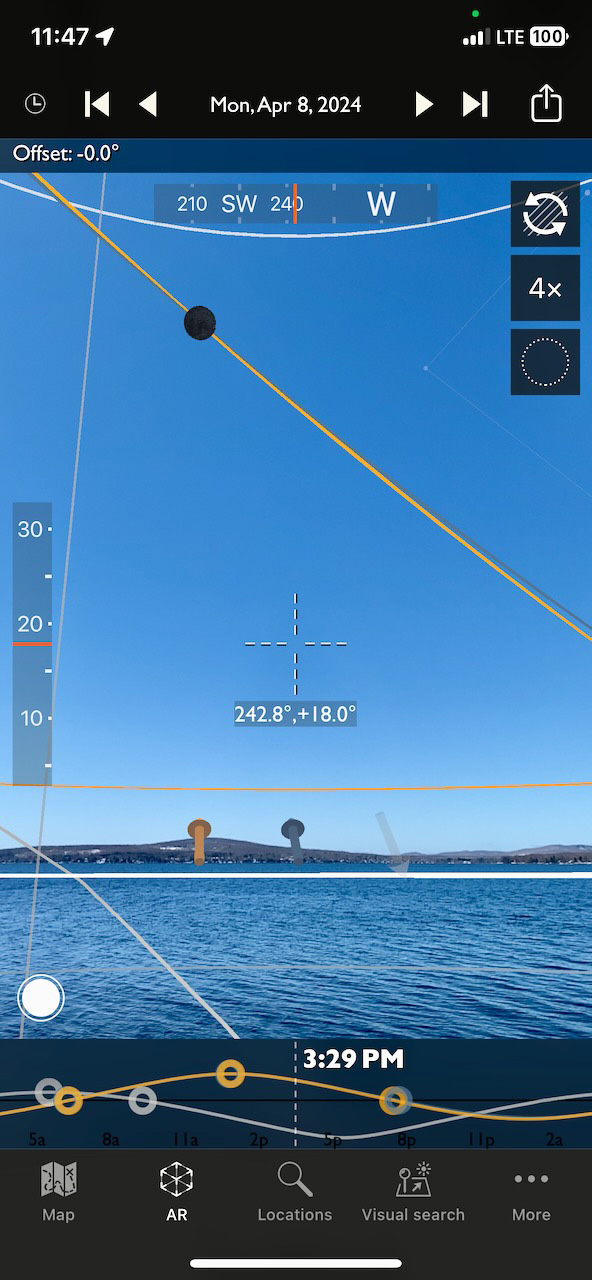
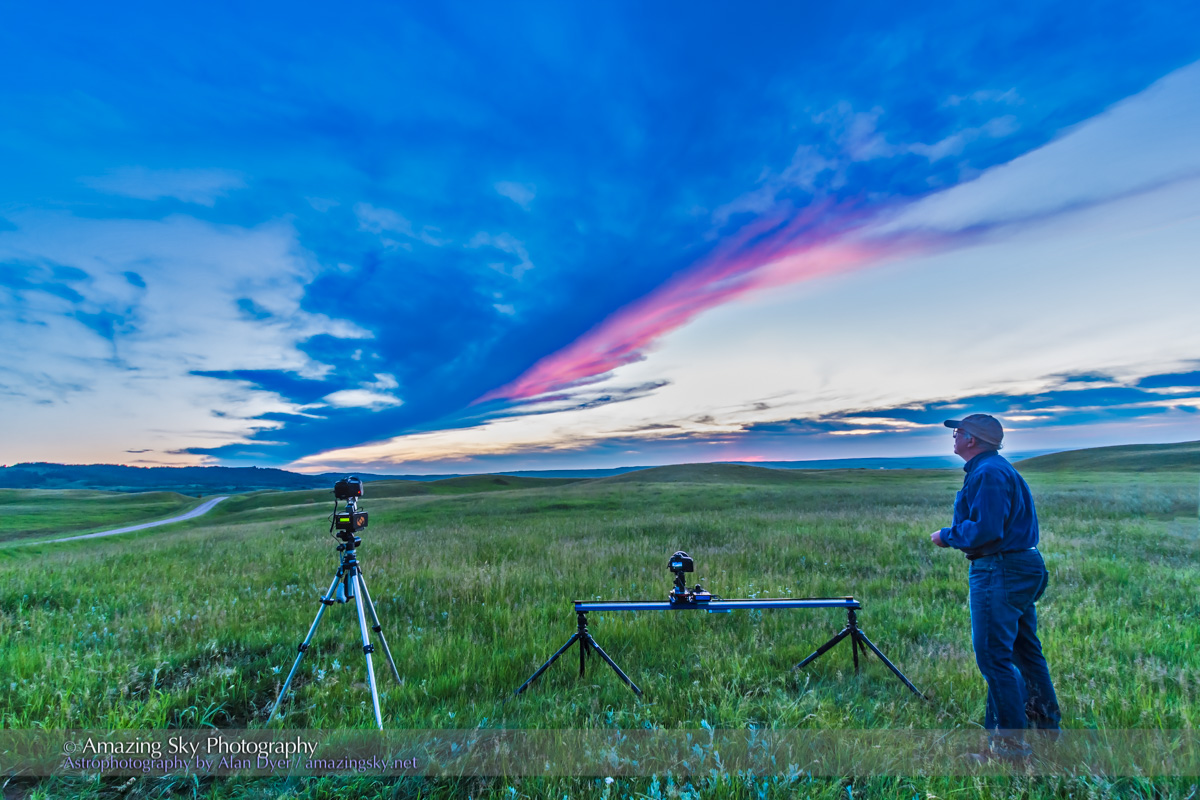
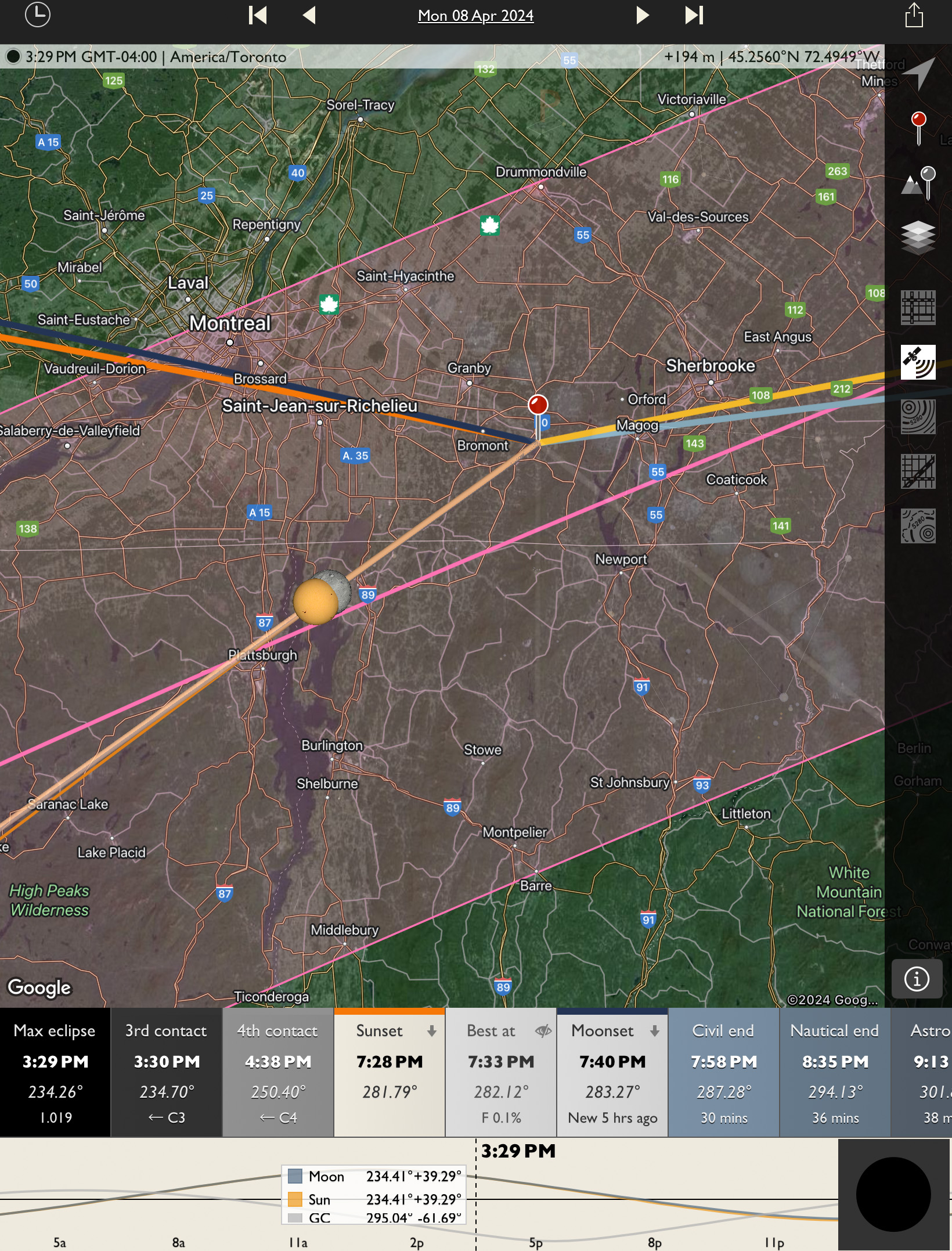
Using the TPE app to check the Sun’s location once on site, the day before the eclipse.

I arrived on site in Quรฉbec with only a day to spare to check out the location I had found by exploring Google maps. 

With the Sun lower in the mid-afternoon sky in Quรฉbec compared to the high-noon Sun in Texas, I decided to shoot a wide-angle scene of the eclipse over a lake, preferably with open water, not ice! That required a site with public parking on an eastern lakeshore.

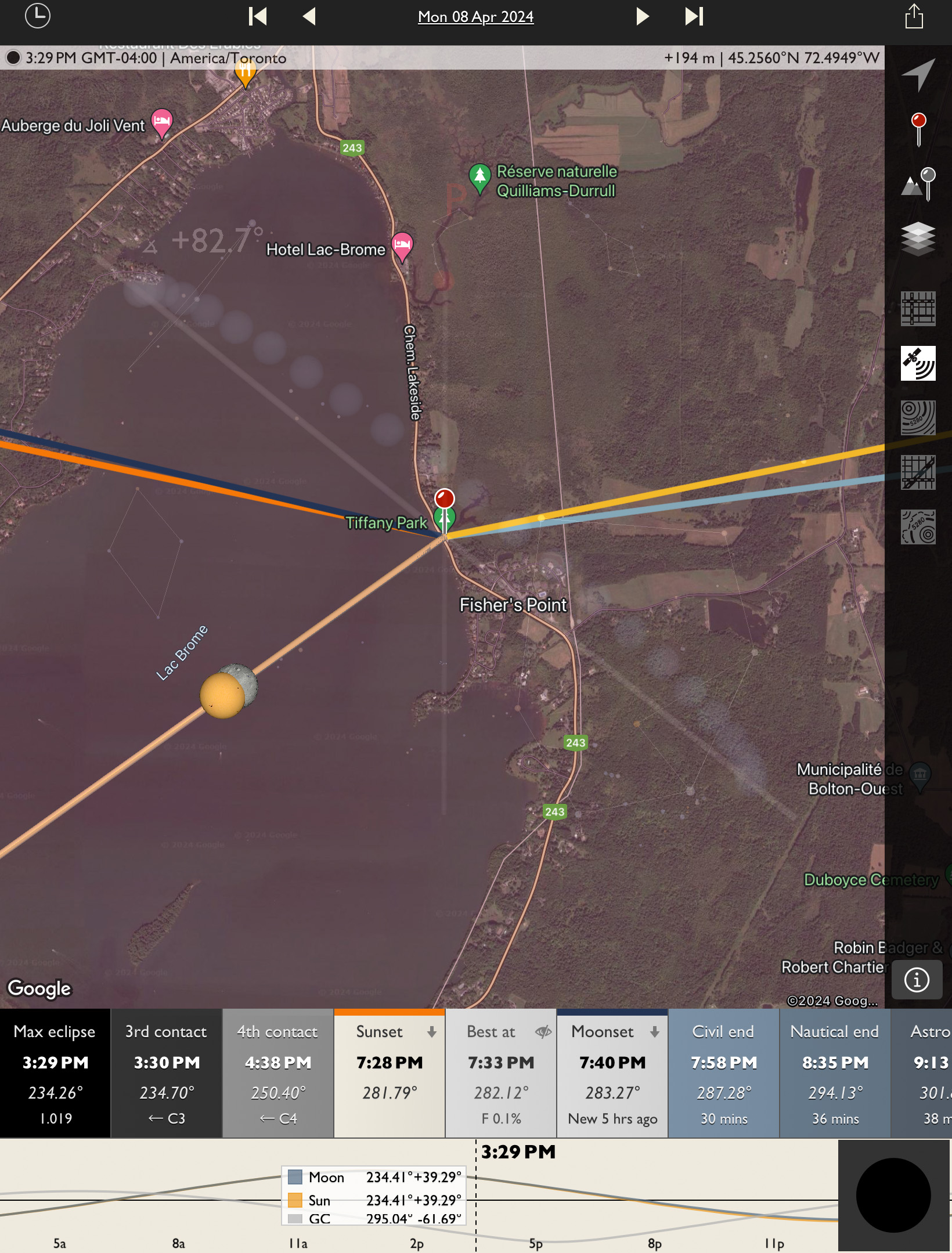
The site I found, then checked out on April 7, was on Lac Brome. It proved ideal โ€” except for the thin cloud that was now predicted to drift through during the eclipse. 

Sure enough, thatโ€™s just what happened. The cloud detracted from the eclipse only in preventing long-exposure images recording the outermost streamers in the Sunโ€™s atmosphere. 

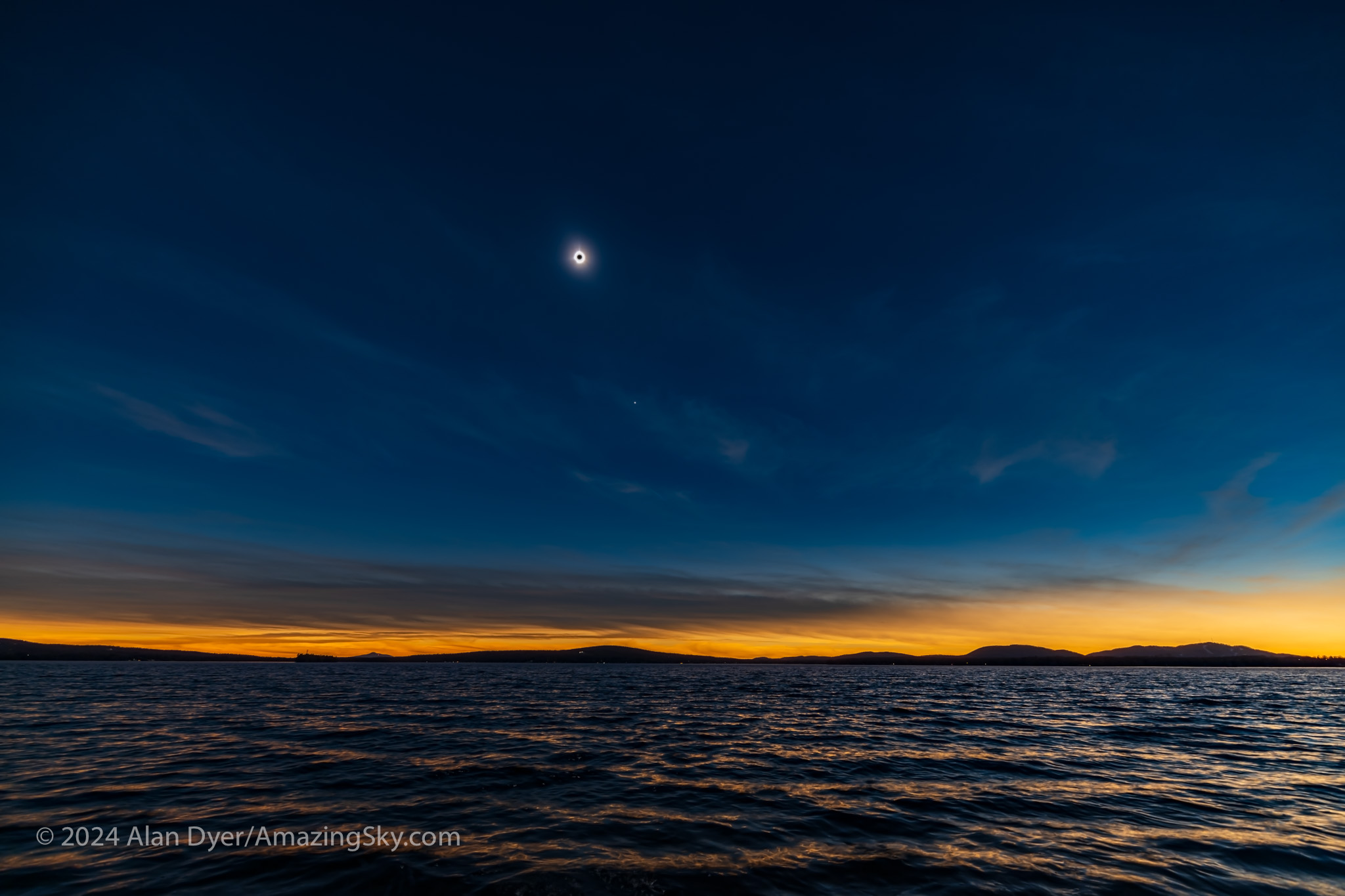
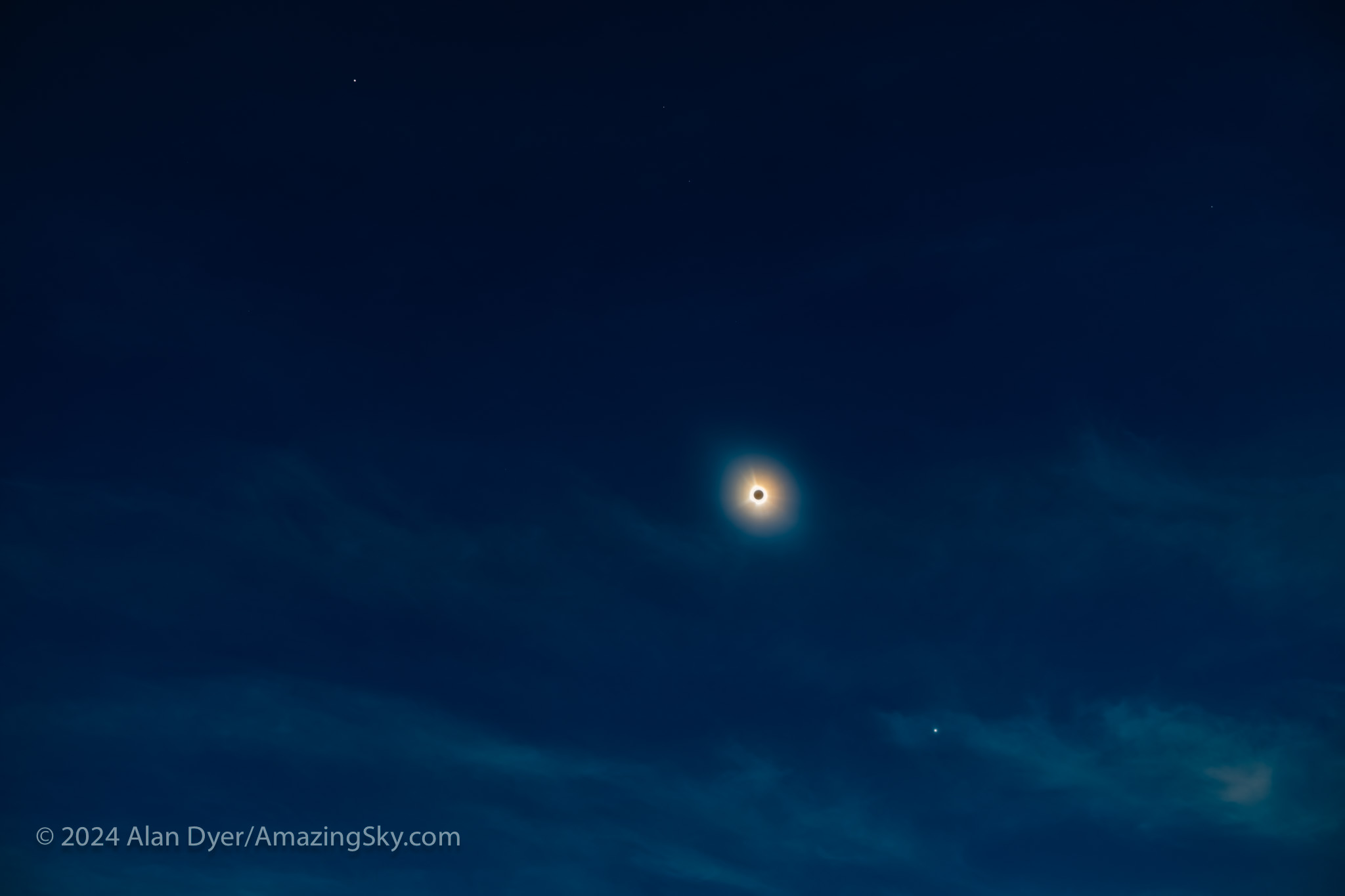
A wide-field view of the eclipse of the Sun, taking in the bright planets Jupiter (at top) and Venus (below) that were easily visible to the unaided eye during totality.

I could have sought out clearer skies by going even farther east, but I was in a crunch for time and hotel rooms! As it was I was able to get rooms everywhere I wanted and at normal โ€œnon-eclipseโ€ rates! 

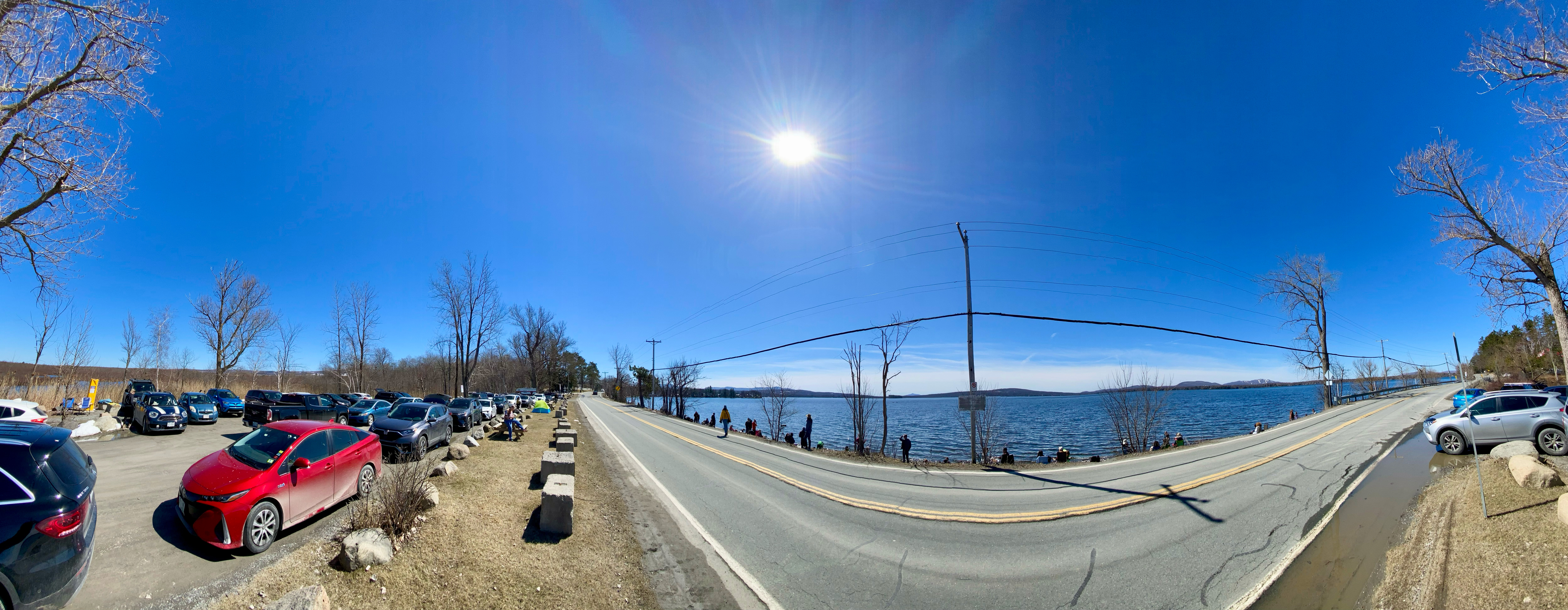
A panorama of the lakeside parking area at Lac Brome prior to the eclipse.

The Lac Brome site filled with cars during the day, with people from Quรฉbec and Ontario, but also from Alberta, and from Pennsylvania, Massachusetts and Maine โ€“ at least those were the homes of the folks I enjoyed meeting on eclipse day. 

Everyone had a great time and had a superb eclipse experience. 

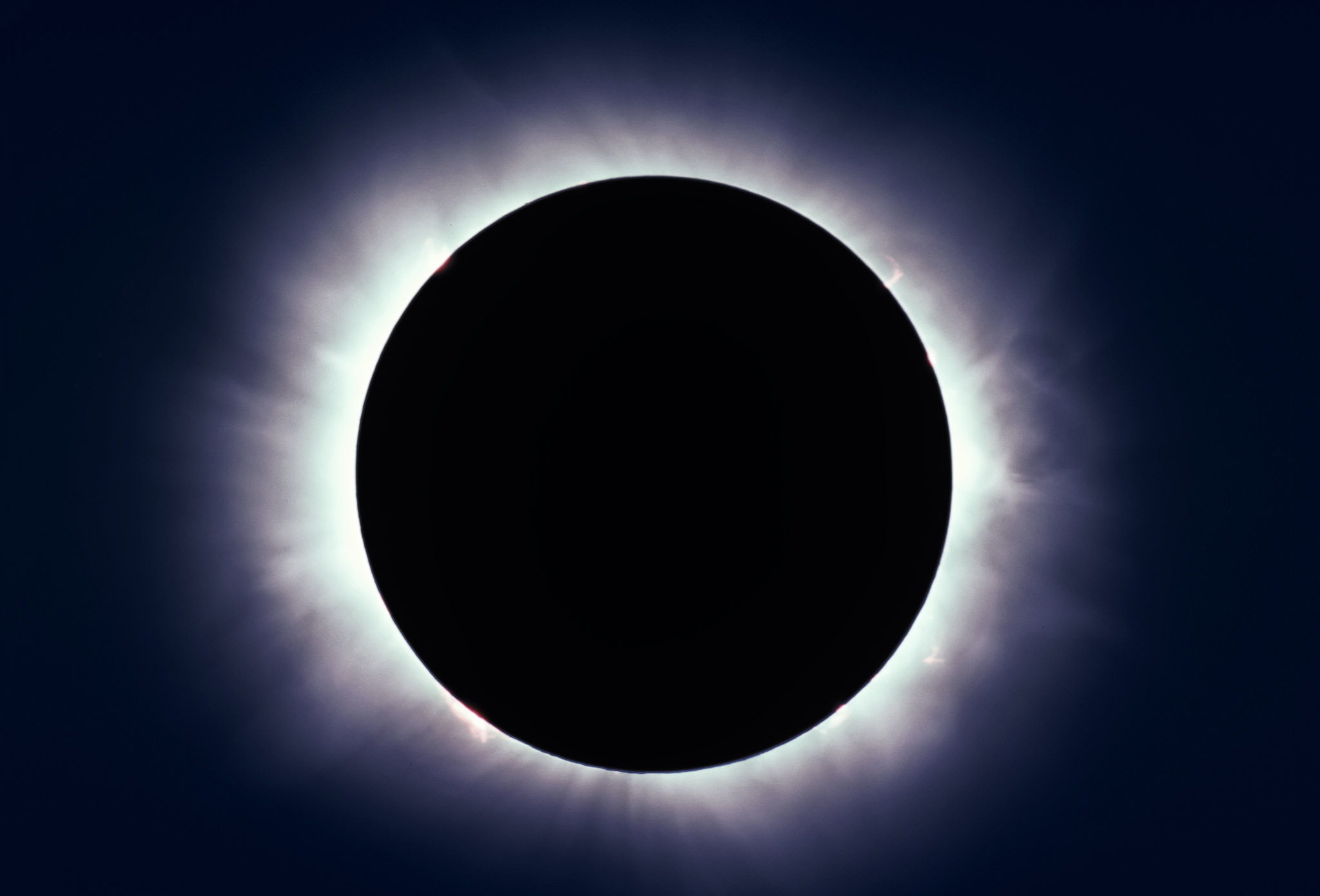
The total eclipse of the Sun over the waters of Lac Brome, in the Eastern Townships of Quebec, Canada. The twilight colours come from sunlight from outside the shadow path.

The lunar shadow arrived from the southwest, from the direction of the Sun, appearing as a dark cloud racing toward us. At the end of the eclipse the sky brightened first in that same direction, as the trailing edge of the shadow shot up across the sky. The clouds helped make the shadow edge more visible. 

A time-lapse of the arrival and departure of the lunar shadow, made of 1200 frames each 1 second apart.

I shot with five cameras, just as I had done in 2017, possible only because I drove. 

The main rig was my faithful Astro-Physics Traveler, a 105mm refractor telescope the company owner designed for his personal use at the 1991 eclipse in Mexico. 

My main eclipse rig, with a 60mm visual scope on the 105mm photo scope, on an equatorial tracking mount.

My Traveler, bought in 1992, has lived up to its name, having now been to six central solar eclipses: the annular eclipses of 1994 (Arizona) and 2023 (Utah), and the total eclipses of 1998 (Curaรงao), 2012 (Queensland, Australia), 2017 (Idaho), and now 2024 in Quรฉbec, Canada. I paired it with the wonderful matching AP400 mount, which I had only just brought back with me the month before from Australia, where it had spent the last two decades. 

All the gear worked great. Unlike six months earlier for the October 14, 2023 annular eclipse in Utah, this time I remembered all the cables needed to have the telescope mount track the Sun.

I did mess up on a couple of settings (such as not framing the 4K movie camera as I should have โ€“ in pre-eclipse excitement I just forgot to check my chart). But none of the errors were serious. 

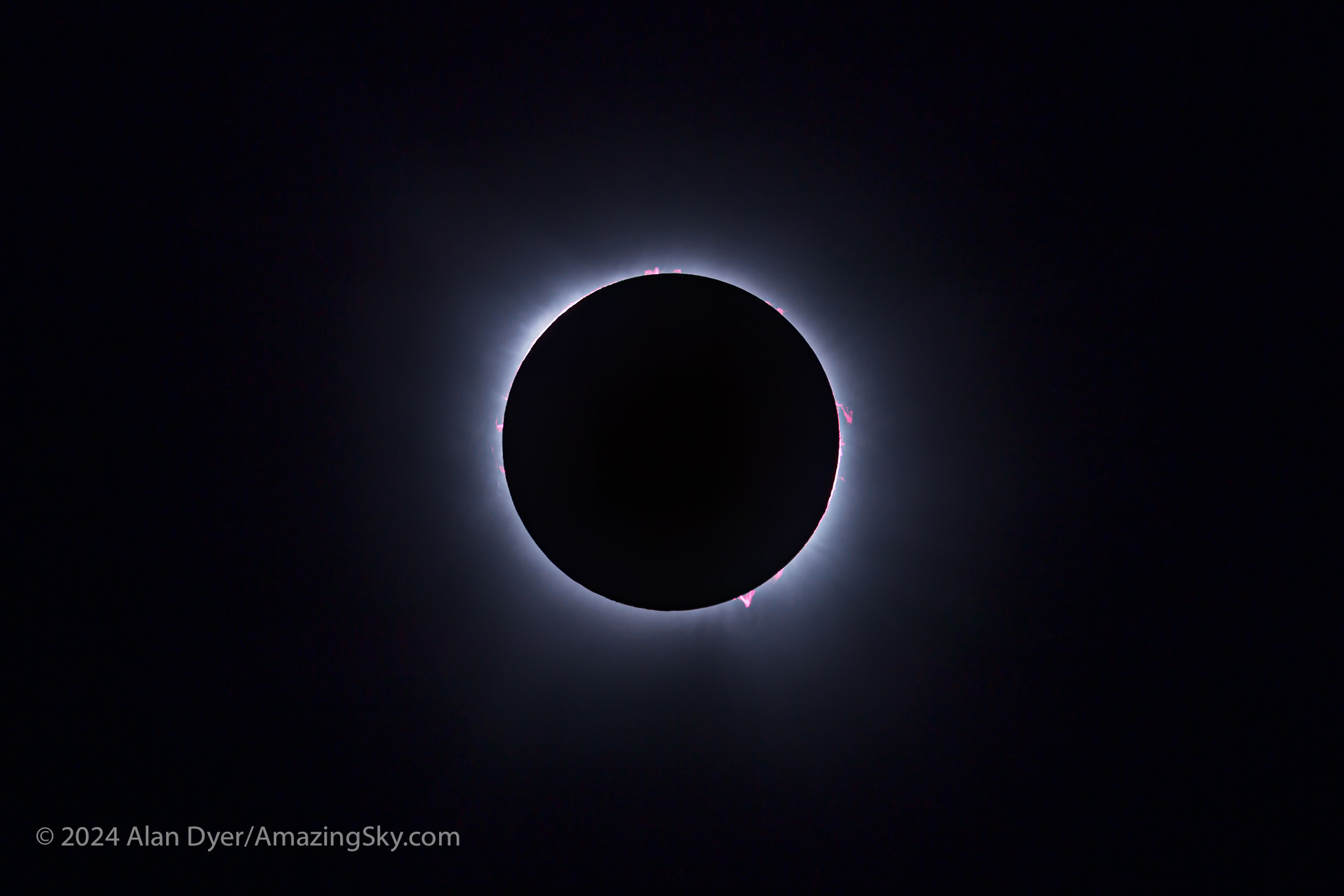
The eclipse in a blend of two exposures to display all the fiery pink prominences that were visible during totality around the lunar disk in one image, set against the bright inner corona of the Sun with the dark disk of the Moon in silhouette in front of the Sun.

Once started all my cameras, except for the one on the Traveler, ran unattended. 

At this eclipse I was determined to get a good look at it through the small visual scope I had piggybacked onto the Traveler photo scope. While I had used a similar rig in 2017, I only thought to look through the visual scope 20 seconds before totality ended. 

Not this year. 

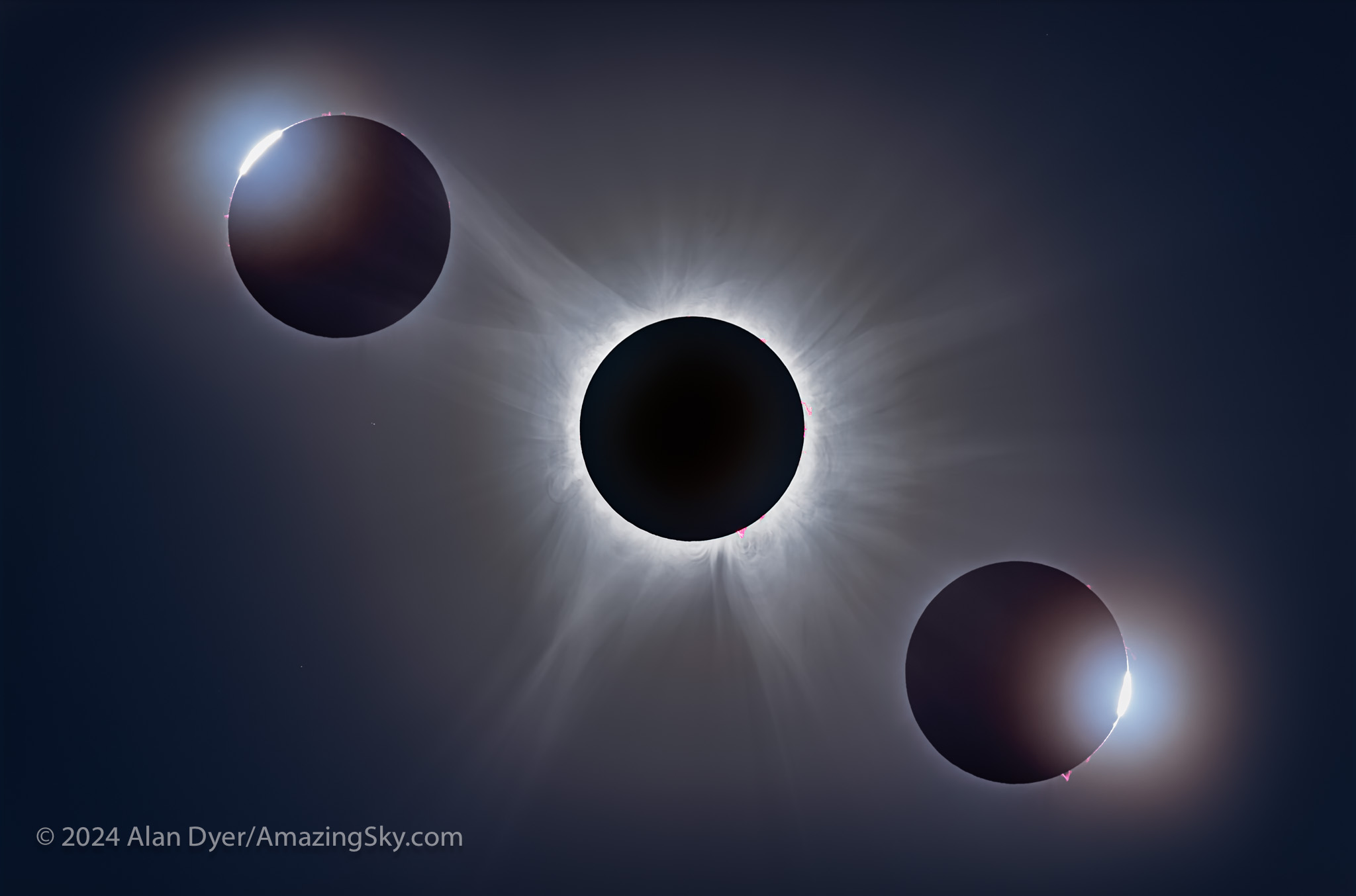
A telescopic close-up of the eclipsed Sun. Onto the central blend of images for totality I layered in single images of each of the diamond rings before and after totality. They are when the last or first burst of sunlight shines through lunar valleys. The first diamond ring is at top left, the last at bottom right, so time runs from left to right.

I got a great look at the eclipsed Sun, its corona structures, flaming pink prominences, and breakout of the red chromosphere layer just as totality ended. (You canโ€™t easily see the chromosphere at the start of totality as it can be risky looking too soon through optics when the Sunโ€™s blindingly bright photosphere is still in view.) 

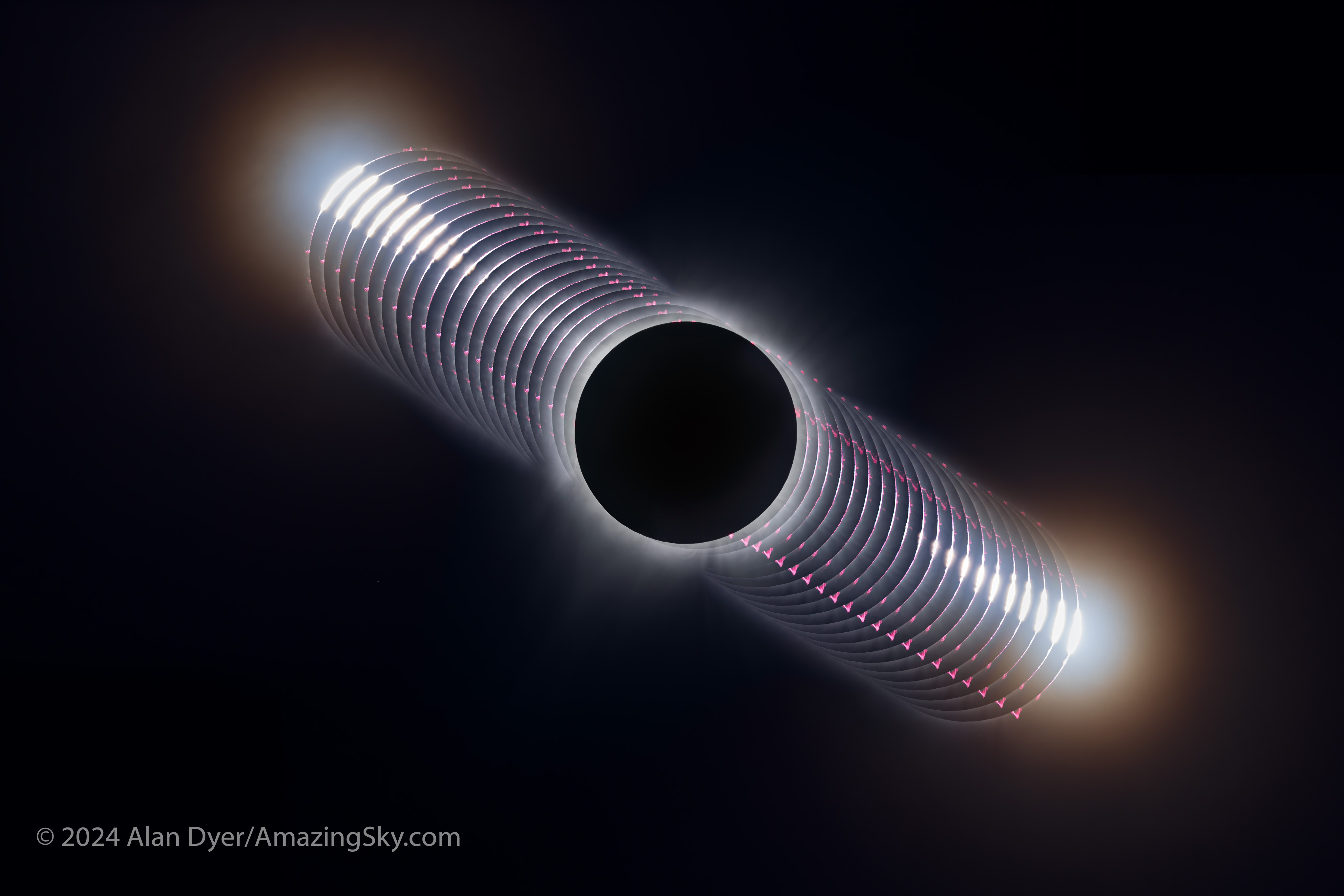
This is a composite showing the sequence of events surrounding totality, from just before totality (at upper left) to just after totality (at lower right), with totality in the middle. The contact images were taken 0.6 seconds apart.

And yet, as at all eclipses, I found the naked eye view the most compelling. The โ€œblack holeโ€ Sun looked huge and unearthly. While I had binoculars handy, the same 12×36 image-stabilized binoculars I bring to most eclipses, I completely forgot to look though them, just as I forget at most eclipses! 

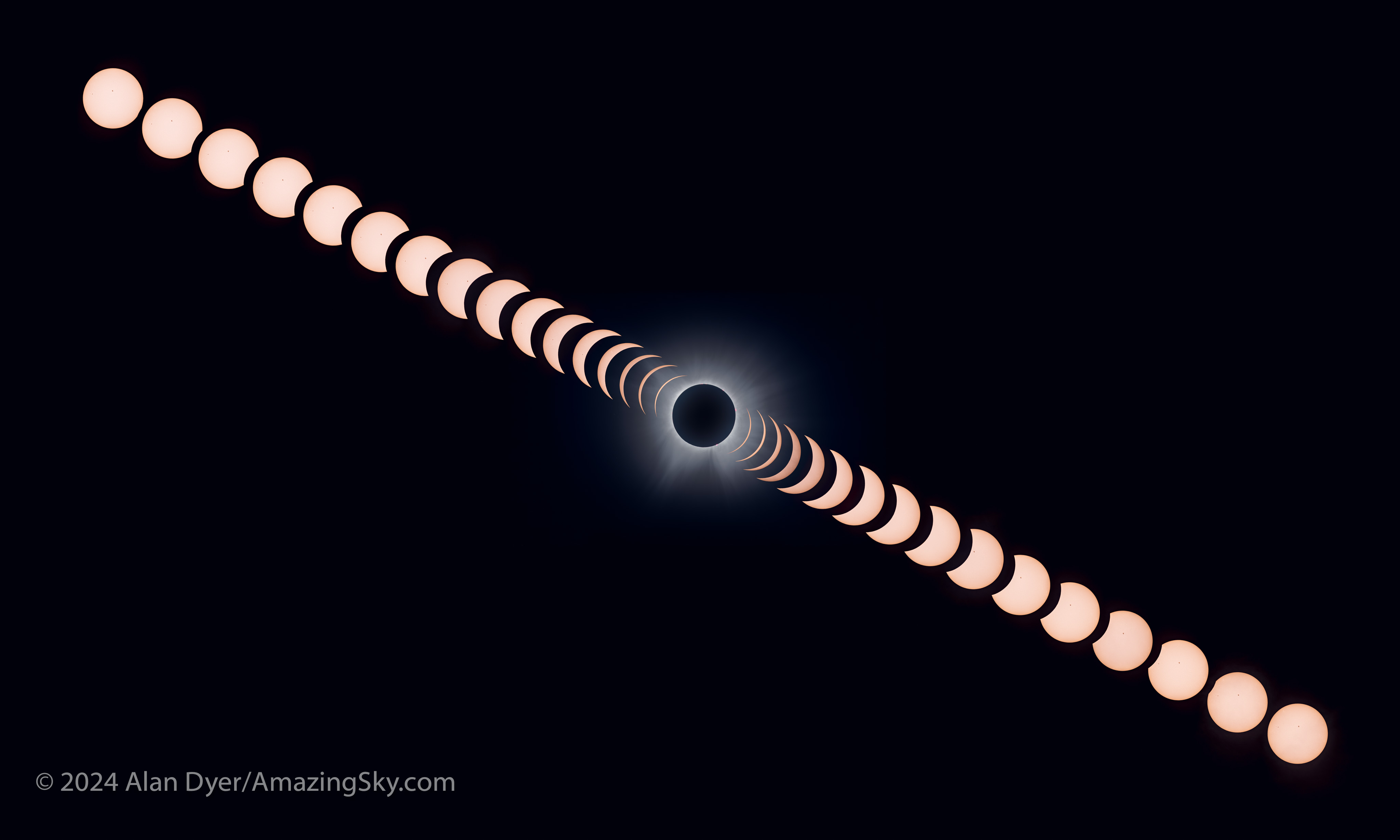
This is a composite showing the complete sequence of the April 8, 2024 eclipse of the Sun, from first contact (at upper left) to last contact (at lower right), with totality at mid-eclipse in the middle.

I shot all the images with the Astro-Physics Traveler 105mm refractor at 630mm focal length and f/6, with the Canon R5 at ISO 100. The partial phases are 1/800 or 1/400 second exposures through a Kendrick/Baader solar filter.

Wanting to record the full sequence, I shot the partial phases until the bitter end. But post-eclipse, people came over and had a look through my scope (I think mine was the only telescope on site). We had a great time exchanging impressions. The hand-held phone camera photos people showed me looked fabulous! 

I looked for fleeting shadow bands just before and after totality (I laid out a white sheet on the ground for the purpose) but saw none, a negative observation confirmed by a fellow eclipse chaser at the site. 

Time-lapse movies of the second and third contact (start and end of totality) diamond rings, shot through the telescope with the Canon R5 in continuous burst mode for hundreds of frames each.

I did two live interviews for CBC Radio, for the Edmonton and Calgary stations, but not until after the eclipse ended. By the time I did those and finished packing away my carload of gear, it was 6:30 p.m., three hours after totality. 

I was the last to leave the site, with fishermen now arriving for an eveningโ€™s catch.

I was in that shadow as the Space Station flew over. Astronauts saw the elliptical shadow moving over eastern Canada.
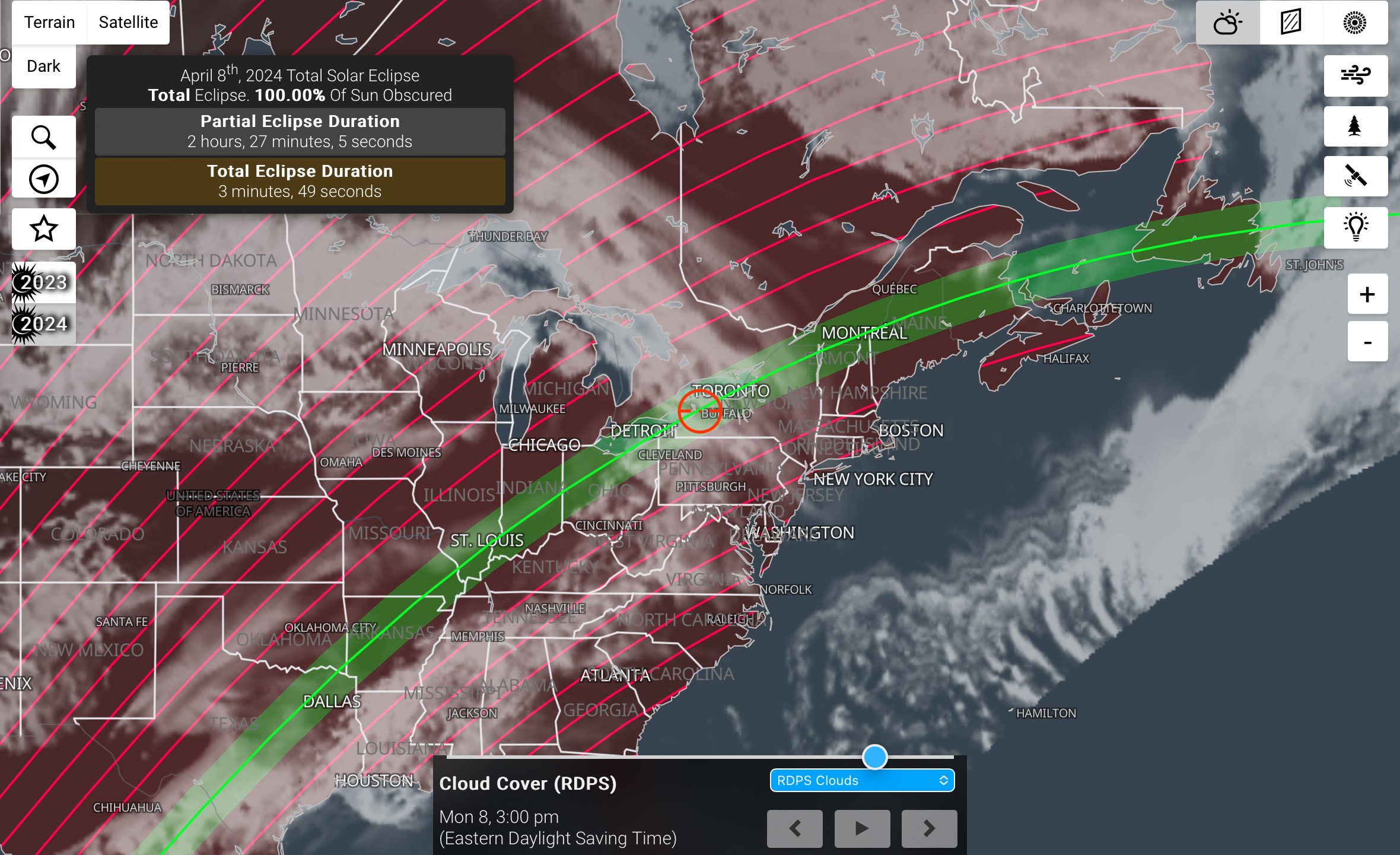
The passage of the lunar shadow across the continent, showing where the clouds were. I was under the wispy clouds at upper right in Quรฉbec.

I faced no traffic jams heading back to the hotel at Ste. Helen-de-Bagot. I processed and posted one eclipse image that night. And I revised the price (down to $2.99 U.S.) and description of my How to Photograph the Solar Eclipses ebook, as now only the big processing chapter is of any value, post-eclipse. It continues to sell. 

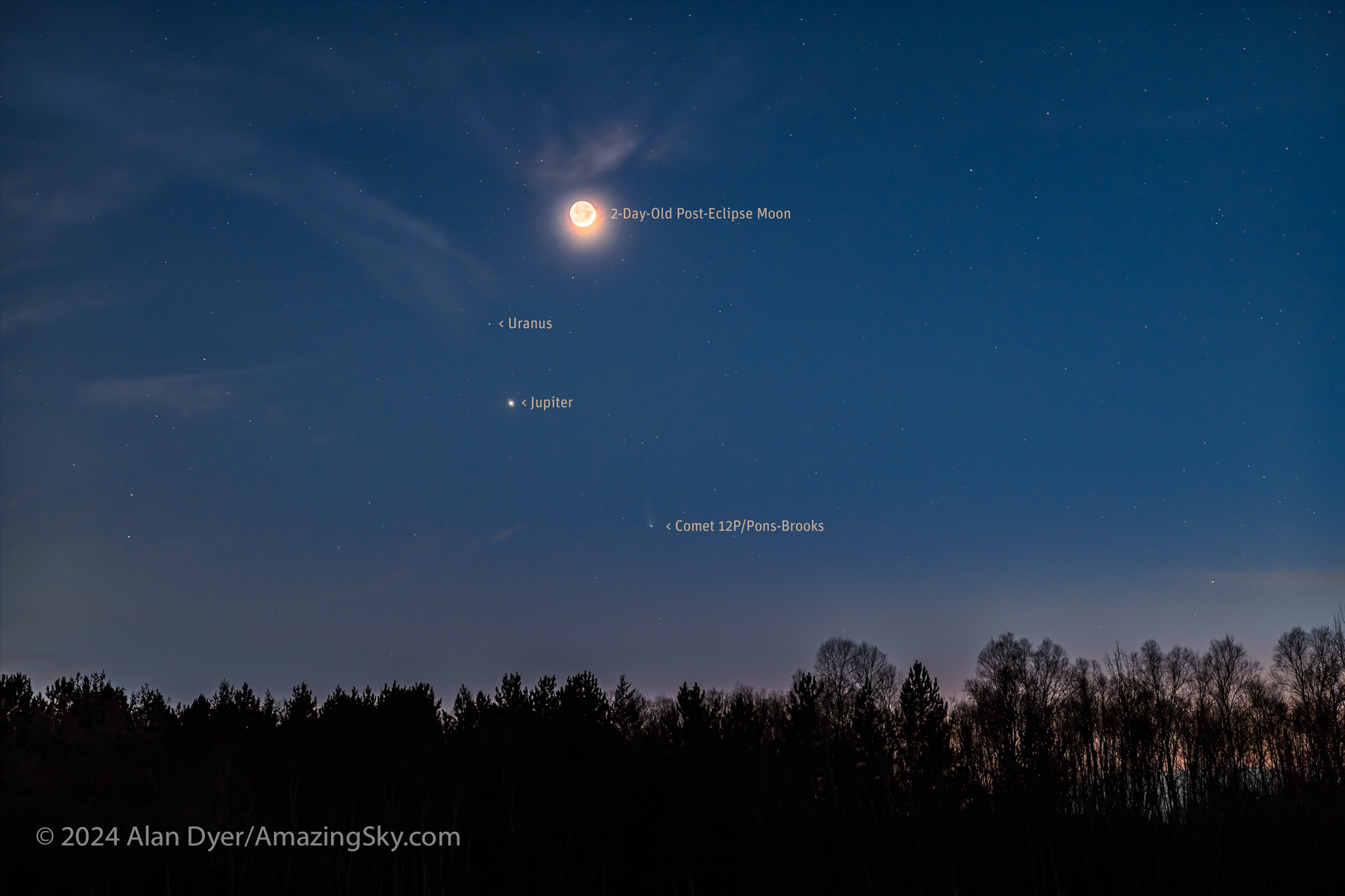
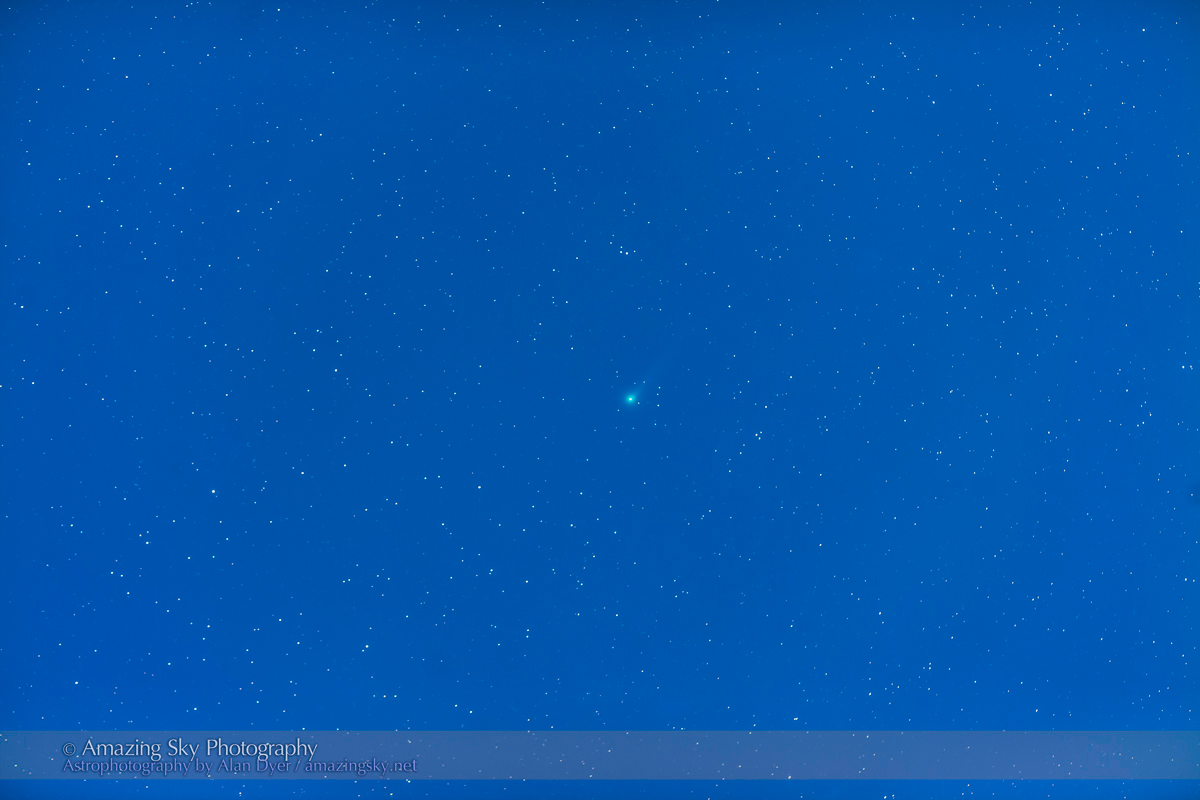
This is the waxing crescent Moon on April 10, 2024, two days after it eclipsed the Sun, and with it above the bright planet Jupiter, with it also near Uranus. Below the solar system worlds is the faint Comet 12P/Pons-Brooks, visible here as a fuzzy star with a stubby tail..

On the long drive back to Alberta, with the pressure of having to make time now gone, I spent pleasant evenings stopping to see friends and family on the road home. So I didnโ€™t start work on the complex blends and composite images I show here until I got home a week after the eclipse. 

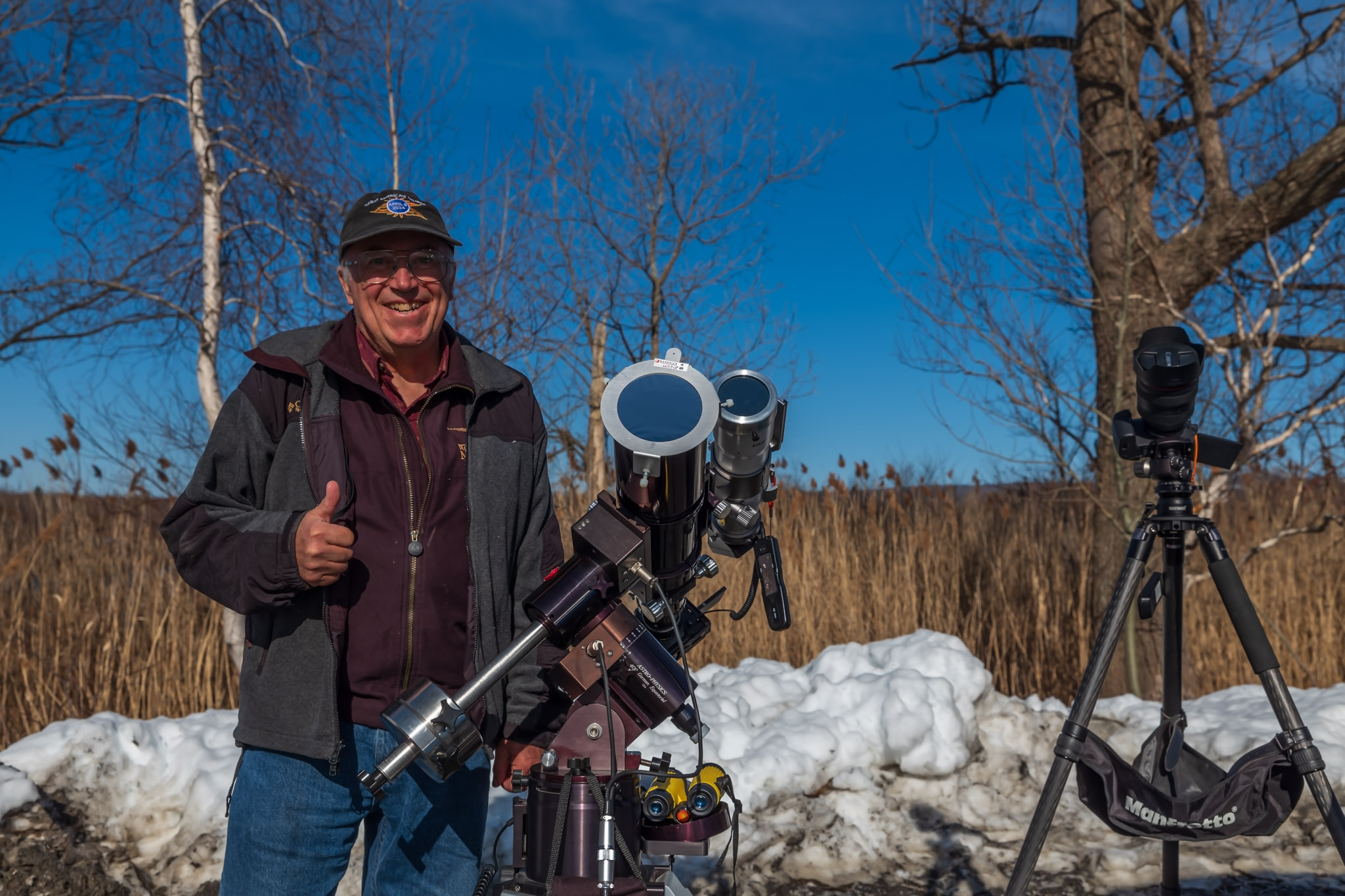
The happy eclipse chaser having bagged his game!

The 17-day-long drive was nearly 9,000 km over 100 hours behind the wheel. Was it worth it? Of course! 

Would I do it again? Itโ€™s a moot question as none of the upcoming eclipses allows for a cross-continent drive. Except perhaps in July 2028 in Australia. But I suspect just heading inland a day or two over the Great Dividing Range will be enough to get away from winter coastal cloud in New South Wales. (Sydney is in the path, but so is a cottage I rented last month near Coonabarabran for my superb March stay under the southern skies!)

The next total eclipse of the Sun visible from anywhere in Canada will be August 22, 2044. I wonโ€™t have to drive anywhere, as it passes right over my house! But I will have to live that long to enjoy a eclipse from my own backyard. 

I suspect this was my last chance to see โ€“ and drive to โ€“ a total eclipse in Canada.

โ€” Alan, ยฉ 2024 amazingsky.com 

Marvelous Nights in the Mountains


In mid-October 2022 I enjoyed a rare run of five clear and mild nights in the Rocky Mountains for shooting nightscapes of the stars. Hereโ€™s a portfolio โ€ฆ and a behind-the-scenes look at its making.

Getting two perfectly clear nights in a row is unusual in the mountains. Being treated to five is a rare treat. Indeed, had I started my shooting run earlier in the week I could have enjoyed even more of the string of cloudless nights in October, though under a full Moon. But five was wonderful, allowing me to capture some of the scenes that had been on my shot list for the last few years.

Here is a portfolio of the results, from five marvelous nights in Banff and Jasper National Parks, in Alberta, Canada. 

For the photographers, I also provide some behind-the-scenes looks at the planning and shooting techniques, and of my processing steps. 


Night One โ€” Peyto Lake, Banff National Park

Peyto Lake, named for pioneer settler and trail guide Bill Peyto who had a cabin by the lakeshore, is one of several iconic mountain lakes in Banff. Every tour bus heading along the Icefields Parkway between Banff and Jasper stops here. By day is it packed. By night I had the newly constructed viewpoint all to myself. 

The stars of Ursa Major, the Great Bear, over the waters of Peyto Lake, Banff, in deep twilight. This is a stack of 6 x 30-second exposures for the ground and a single untracked 30-second exposure for the sky, all at f/2.8 with the Canon RF 15-35mm lens at 15mm, and Canon R5 at ISO 800.

I shot the classic view north in deep twilight, with the stars of Ursa Major and the Big Dipper low over the lake, as they are in autumn. A show of Northern Lights would have been ideal, but I was happy to settle for just the stars. 

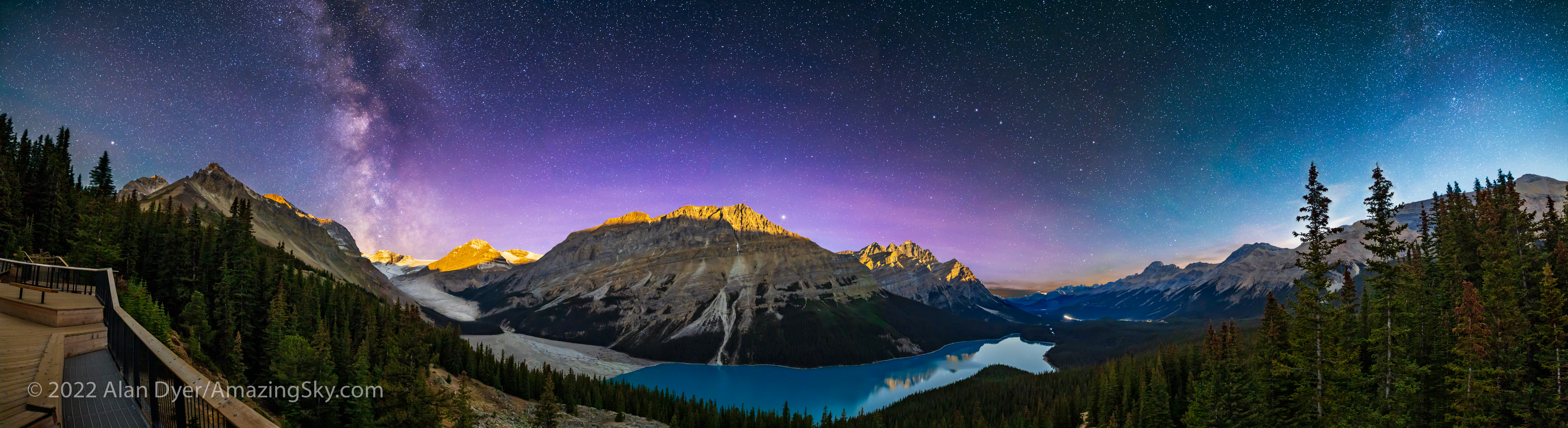
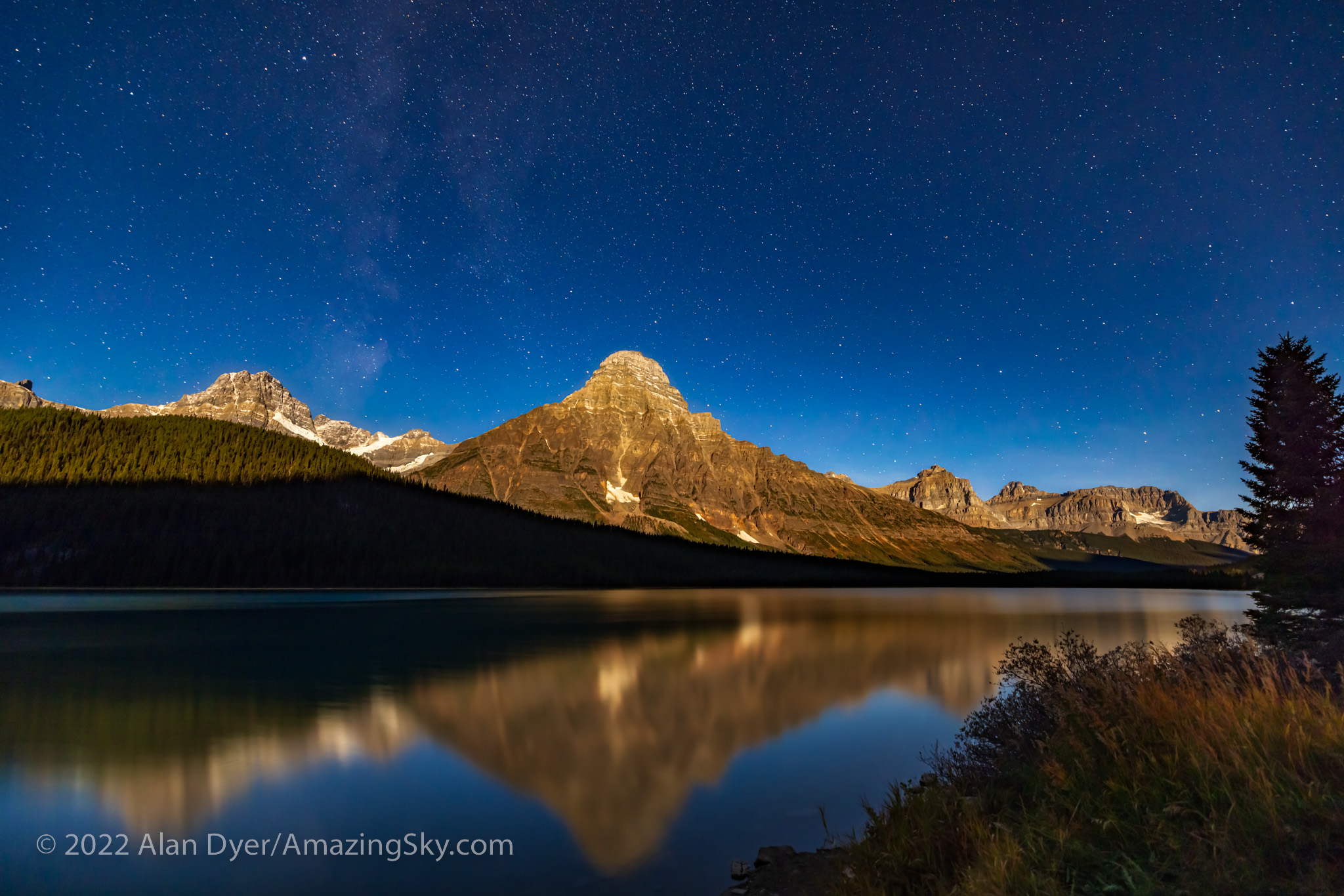
This is a blend of two panoramas: the first of the sky taken at or just before moonrise with the camera on a star tracker to keep the stars pinpoint, and the second taken for the ground about 20 minutes later with the tracker off, when the Moon was up high enough to light the peaks. Both pans were with the Canon RF15-35mm lens at 15mm and f/2.8, and Canon R5 at ISO 1600, with the sky pan being 7 segments for 1 minute each, and the untracked ground panorama being the same 7 segments for 2 minutes each.

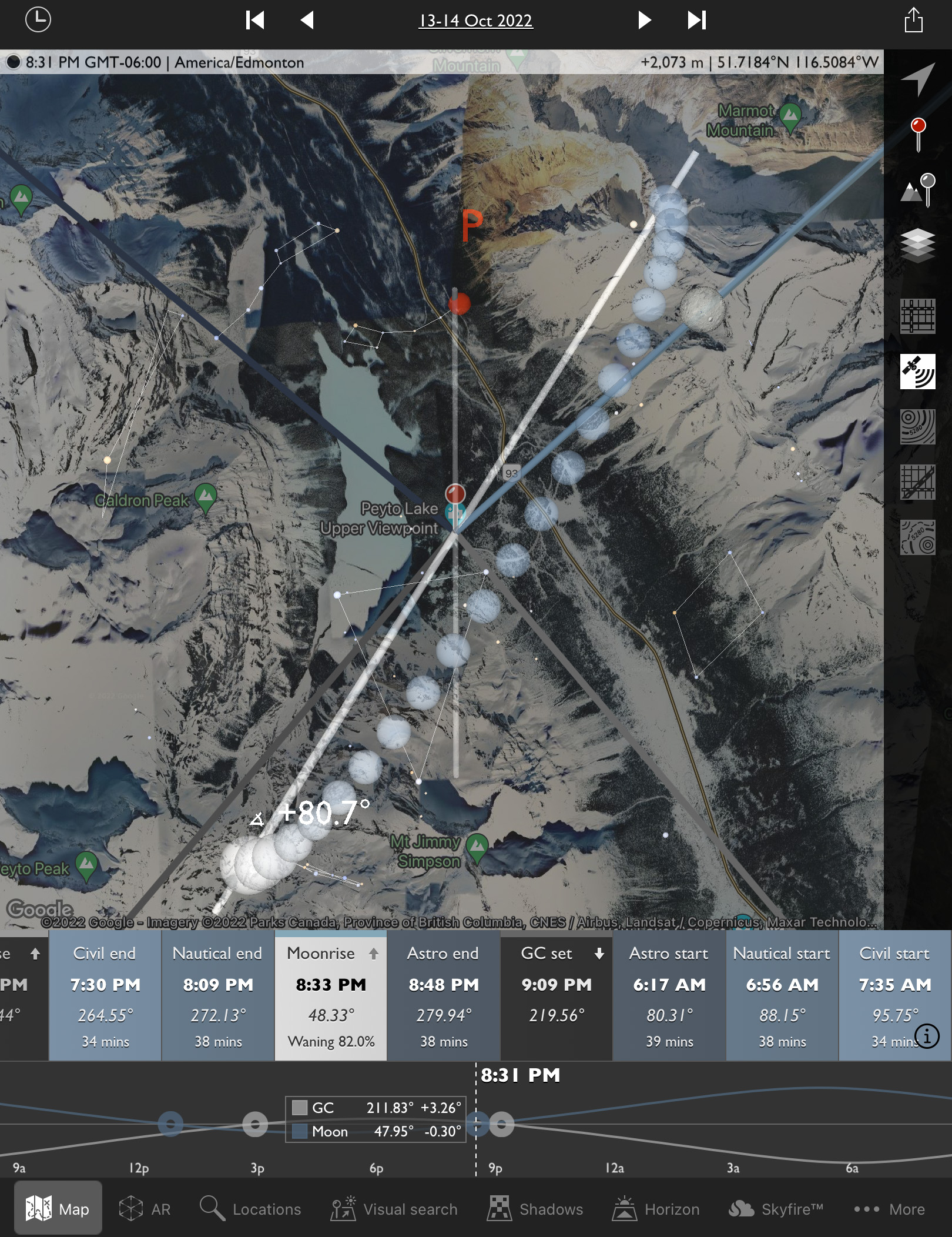
The night was perfect, not just for the clarity of the sky but also the timing. The Moon was just past full, so was rising in late evening, leaving a window of time between the end of twilight and moonrise when the sky would be dark enough to capture the Milky Way. Then shortly after, the Moon would come up, lighting the peaks with golden moonlight โ€” alpenglow, but from the Moon not Sun. 

The above is blend of two panoramas, each of seven segments, the first for the sky taken when the sky was dark, using a star tracker to keep the stars pinpoints. The second for the ground I shot a few minutes later at moonrise with no tracking, to keep the ground sharp. I show below how I blended the two elements. 

The Photographer’s Ephemeris
TPE 3D

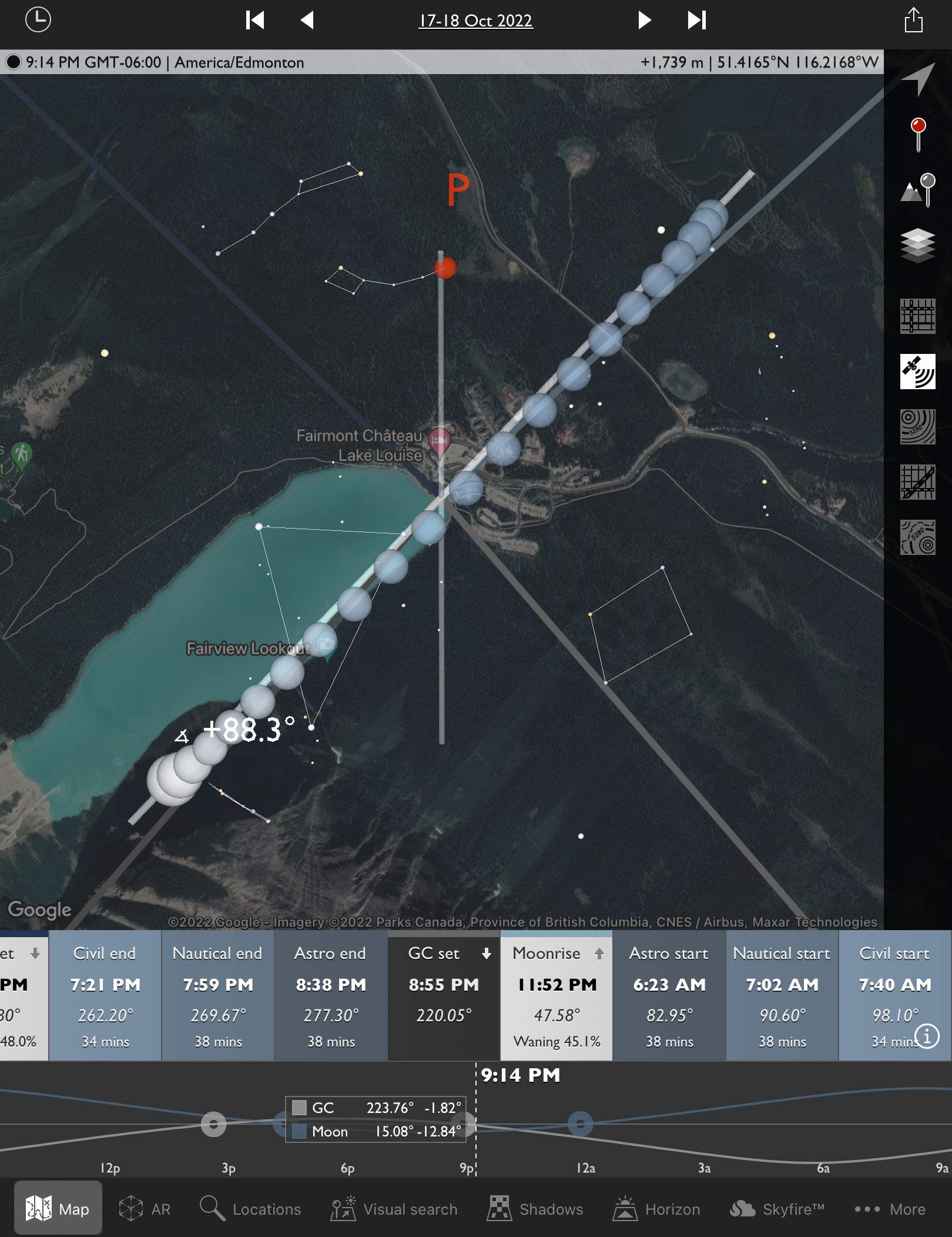
To plan such shots I use the apps The Photographerโ€™s Ephemeris (TPE) and its companion app TPE 3D. The screen shot above at left shows the scene in map view for the night in question, with the Big Dipper indicated north over the lake and the line of dots for the Milky Way showing it to the southwest over Peyto Glacier. Tap or click on the images for full-screen versions.

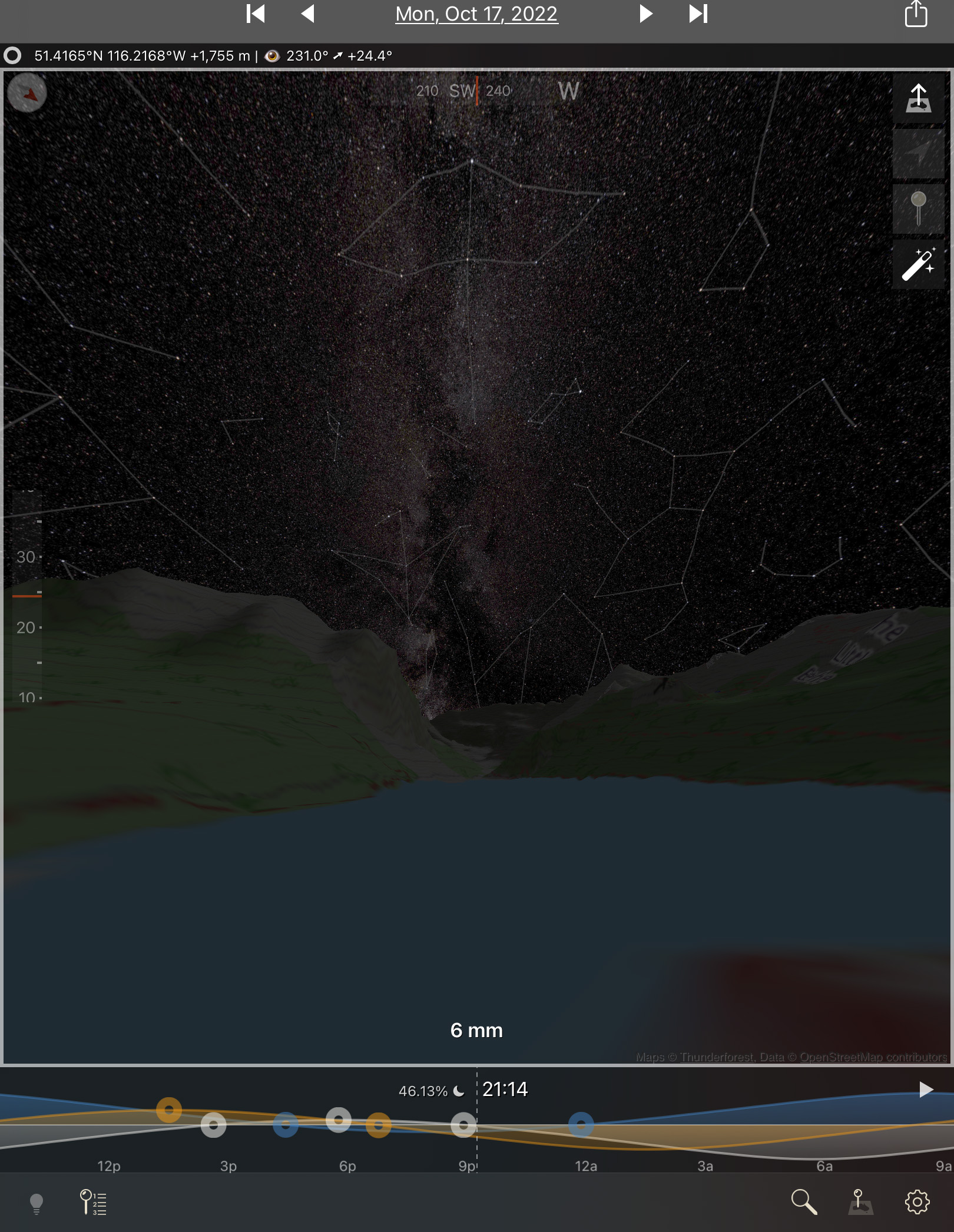
Switch to TPE 3D and its view at right above simulates the scene youโ€™ll actually see, with the Milky Way over the mountain skyline just as it really appeared. The app even faithfully replicates the lighting on the peaks from the rising Moon. It is an amazing planning tool.

This is a blend of 5 x 20-second exposures stacked for the ground to smooth noise, and a single 20-second exposure for the sky, all with the Canon RF15-35mm lens at f/2.8 and Canon R5 at ISO 1600. All were untracked camera-on-tripod shots.

On the drive back from Peyto Lake to Saskatchewan River Crossing I stopped at another iconic spot, the roadside viewpoint for Mt. Cephren at Waterfowl Lakes. By this time, the Moon was well up and fully illuminating the peak and the sky, but still leaving the foreground dark. The sky is blue as it is by day because it is lit by moonlight, which is just sunlight reflecting off a perfectly neutral grey rock, the Moon! 

This is from a set of untracked camera-on-tripod shots using short 30-second exposures. 


Night Two โ€” Pyramid Lake, Jasper National Park 

By the next night I was up in Jasper, a destination I had been trying to revisit for some time. But poor weather prospects and forest fire smoke had kept me away in recent years. 

The days and nights I was there coincided with the first weekend of the annual Jasper Dark Sky Festival. I attended one of the events, the very enjoyable Aurora Chaserโ€™s Retreat, with talks and presentations by some well-known chasers of the Northern Lights. Attendees had come from around North America. 

This is a blend of: a stack of 4 x 1-minute tracked exposures for the sky at ISO 1600 plus a stack of 7 x 2-minute untracked exposures at ISO 800 for the ground, plus an additional single 1-minute tracked exposure for the reflected stars and the foreground water. All were with the Canon RF15-35mm lens at 15mm and f/2.8 and Canon R5.

On my first night in Jasper I headed up to Pyramid Lake, a favorite local spot for stargazing and night sky photography, particularly from the little island connected to the โ€œmainlandโ€ by a wooden boardwalk. Lots of people were there quietly enjoying the night. I shared one campfire spot with several other photographers also shooting the Milky Way over the calm lake before moonrise.

This is a blend of: a stack of 4 x 1-minute tracked exposures for the sky at ISO 1600 plus a stack of 6 x 3-minute untracked exposures at ISO 800 for the ground, all with the Canon RF15-35mm lens at 20mm and f/2.8 and Canon R5. The tracker was the Star Adventurer Mini.

A little later I moved to the north end of Pyramid Island for the view of the Big Dipper over Pyramid Mountain, now fully lit by the rising waning Moon, and with some aspens still in their autumn colours. A bright meteor added to the scene.


Night Three โ€” Athabasca River Viewpoint, Jasper National Park

For my second night in Jasper, I ventured back down the Icefields Parkway to the โ€œGoats and Glaciersโ€ viewpoint overlooking the Athabasca River and the peaks of the Continental Divide. 

This is a blend of three 3-section panoramas: the first taken with a Star Adventurer Mini for 3 x 2-minute tracked exposures for the sky at ISO 800; the second immediately afterward with the tracker off for 3 x 3-minutes at ISO 800 for the ground; and the third taken about an hour later as the Moon rose, lighting the peaks with warm light, for 3 x 2.5-minutes at ISO 1600. All with the Canon RF15-35mm lens at f/2.8 and 15mm and Canon R5,

As I did at Peyto Lake, I shot a panorama (this one in three sections) for the sky before moonrise with a tracker. I then immediately shot another three-section panorama, now untracked, for the ground while it was still lit just by starlight under a dark sky. I then waited an hour for moonrise and shot a third panorama to add in the golden alpenglow on the peaks. So this is a time-blend, bending reality a bit. See my comments below! 


Night Four โ€” Edith Lake, Jasper National Park

With a long drive back to Banff ahead of me the next day, for my last night in Jasper I stayed close to town for shots from the popular Edith Lake, just up the road from the posh Jasper Park Lodge. Unlike at Pyramid Lake, I had the lakeshore to myself. 

This is a panorama of four segments, each 30 seconds untracked with the Canon RF15-35mm lens at 15mm and f/2.8 and Canon R5 at ISO 1000.

This would be a fabulous place to catch the Northern Lights, but none were out this night. Instead, I was content to shoot scenes of the northern stars over the calm lake and Pyramid Mountain. 

This is a blend of a single tracked 2-minute exposure for the sky and water with the reflected stars, with a single untracked 4-minute exposure for the rest of the ground, both at f/2.8 with the Canon RF15-35mm lens at 17mm and Canon R5 at ISO 800.
This is a blend of a single tracked 2-minute exposure for the sky and water with the reflected stars, with a stack of two untracked 3-minute exposure for the rest of the ground, both at f/2.8 with the Canon RF15-35mm lens at 17mm and Canon R5 at ISO 1600. I shot this October 16, 2022.

The Moon was now coming up late, so the shots above are both in darkness with only starlight providing the illumination. Well, and also some annoying light pollution from town utility sites off the highway. Jasper is a Dark Sky Preserve, but a lot of the townโ€™s street and utility lighting remains unshielded. 


Night Five โ€” Lake Louise, Banff National Park

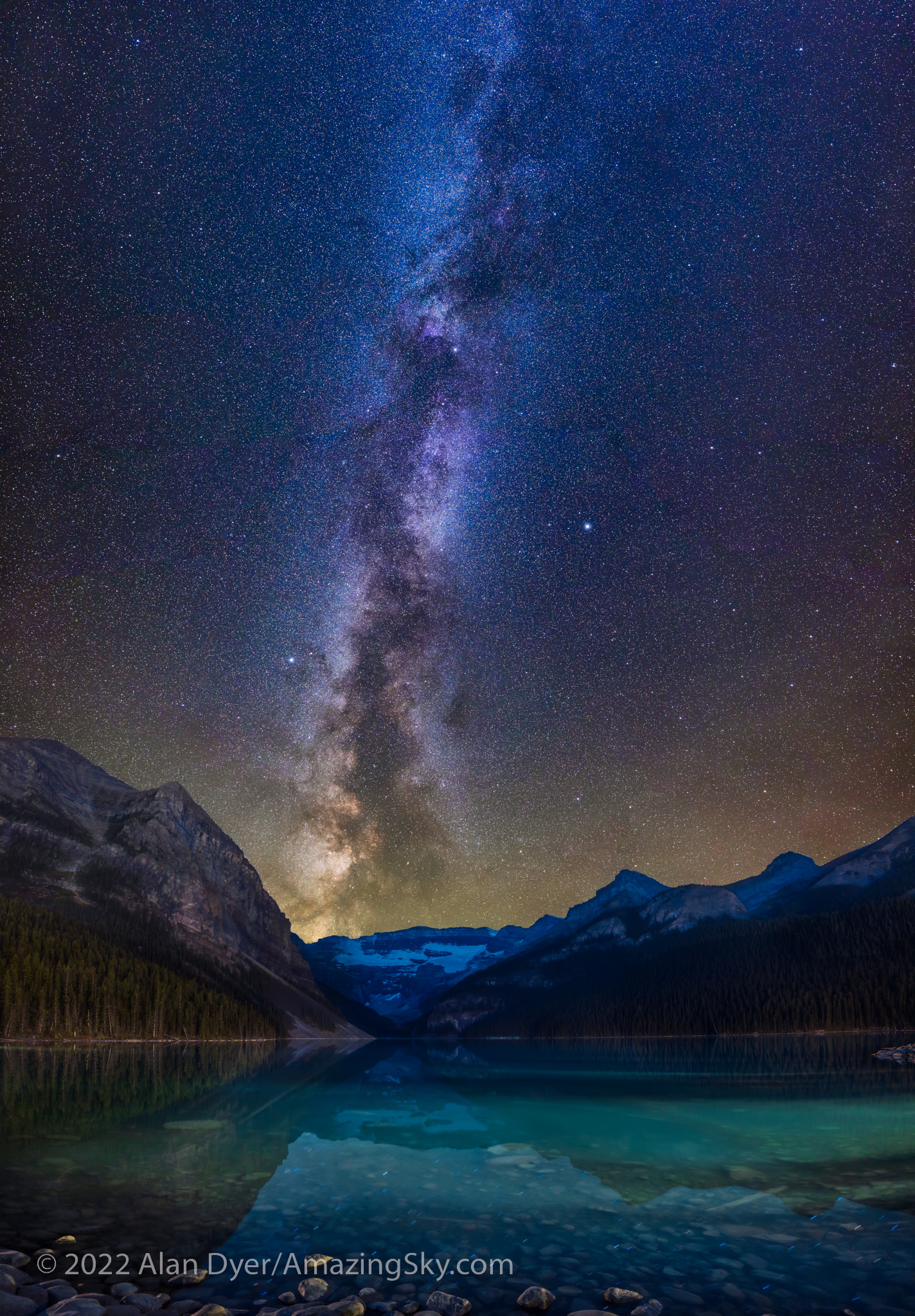
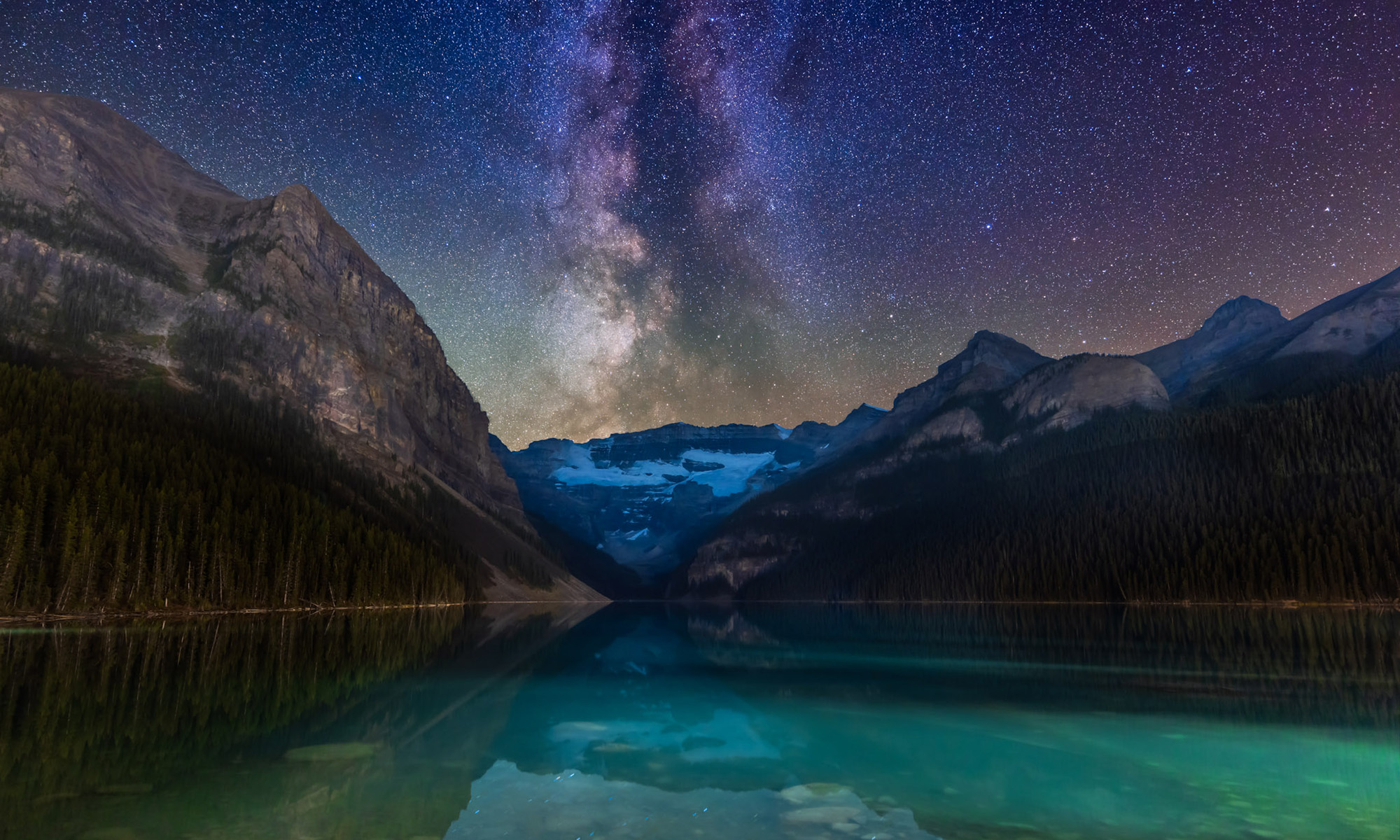
On my last night I was at Lake Louise, as the placement of the Milky Way would be perfect. 

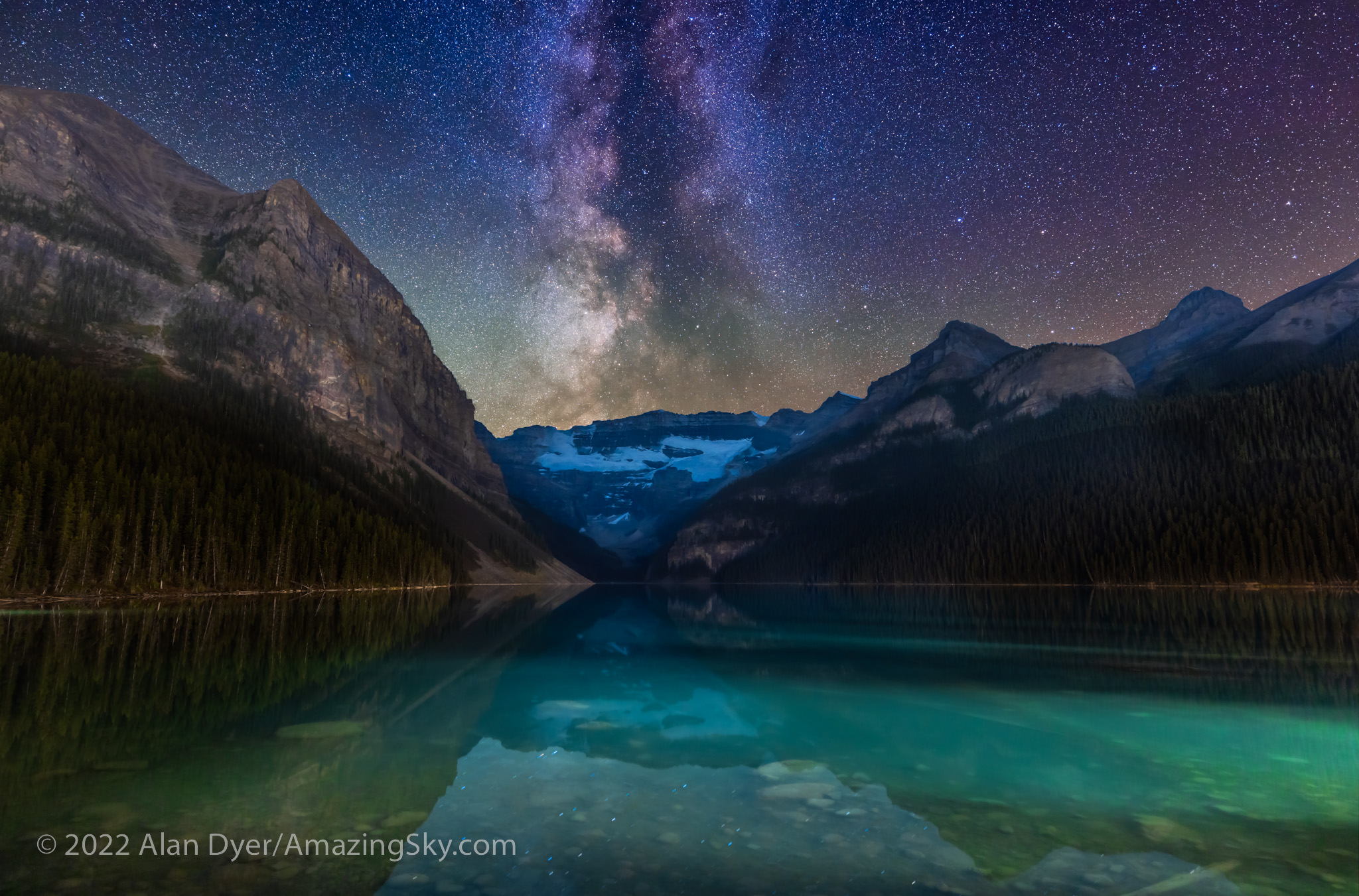
This is a blend of two sets of exposures: – a stack of two untracked 2-minute exposures for the ground at ISO 800 – a stack of four tracked 1-minute exposures for the sky at ISO 1600 All with the Canon RF15-35mm lens at f/2.8 and 20mm and Canon R5, and with the camera and tripod not moving between image sets.

Thereโ€™s no more famous view than this one, with Victoria Glacier at the end of the blue-green glacial lake. Again, by day the site is thronged with people and the parking lot full by early morning. 

By night, there were just a handful of other photographers on the lakeshore, and the parking lot was nearly empty. I could park right by the walkway up to the lake. 

The Photographer’s Ephemeris
TPE 3D

Again, TPE and TPE 3D told me when the Milky Way would be well-positioned over the lake and glacier, so I could complete the untracked ground shots first, to be ready to shoot the tracked sky segments by the time the Milky Way had turned into place over the glacier. 

This is a blend of three vertical panoramas: the first is a set of three untracked 2-minute exposures for the ground at ISO 800 with the camera moved up by 15ยฐ from segment to segment; the second shot immediately afterward is made of 7 x 1-minute tracked exposures at ISO 1600 for the sky, also moved 15ยฐ vertically from segment to segment; elements of a third 3-section panorama taken about 90 minutes earlier during “blue hour” were blended in at a low level to provide better lighting on the distant peaks. All with the Canon RF15-35mm lens at f/2.8 and 20mm and Canon R5.

This image is also a panorama but a vertical one, made primarily of three untracked segments for the ground and seven tracked segments for the sky, panning up from the horizon to past the zenith overhead, taking in most of the summer and autumn Milky Way from Serpens up to Cassiopeia.


Nightscape Gear 

As readers always want to know what gear I used, I shot all images on all nights with the 45-megapixel Canon R5 camera and Canon RF15-35mm lens, with exposures of typically 1 to 3 minutes each at ISOs of 800 to 1600. I had other cameras and lenses with me but never used them. 

The R5 works very well for nightscapes, despite its small pixels. See my review of it here on my blog, and of a holy trinity of Canon RF lenses including the RF15-35mm here

Star Adventurer Mini tracker with Alyn Wallace V-Plate and AcraTech Panorama Head

For a tracker for such images, I used the Sky-Watcher Star Adventurer Mini, a compact and lightweight unit that is easy to pack and carry to shooting sites. See my review of it here at AstroGearToday. 

I use the Mini with a V-Plate designed by nightscape photographer Alyn Wallace and sold by Move-Shoot-Move. It is an essential aid to taking tracked panoramas, as it allows me to turn the camera horizontally manually from one pan segment to the next while the camera is tracking the stars. Itโ€™s easy to switch the tracker on (for the sky) and off (for the ground). The Mini tracks quite accurately and reliably. Turn it on and you can be sure it is tracking. 

For more tips on shooting panoramas, see my blog post from 2019.


Behind-the-Scenes Processing

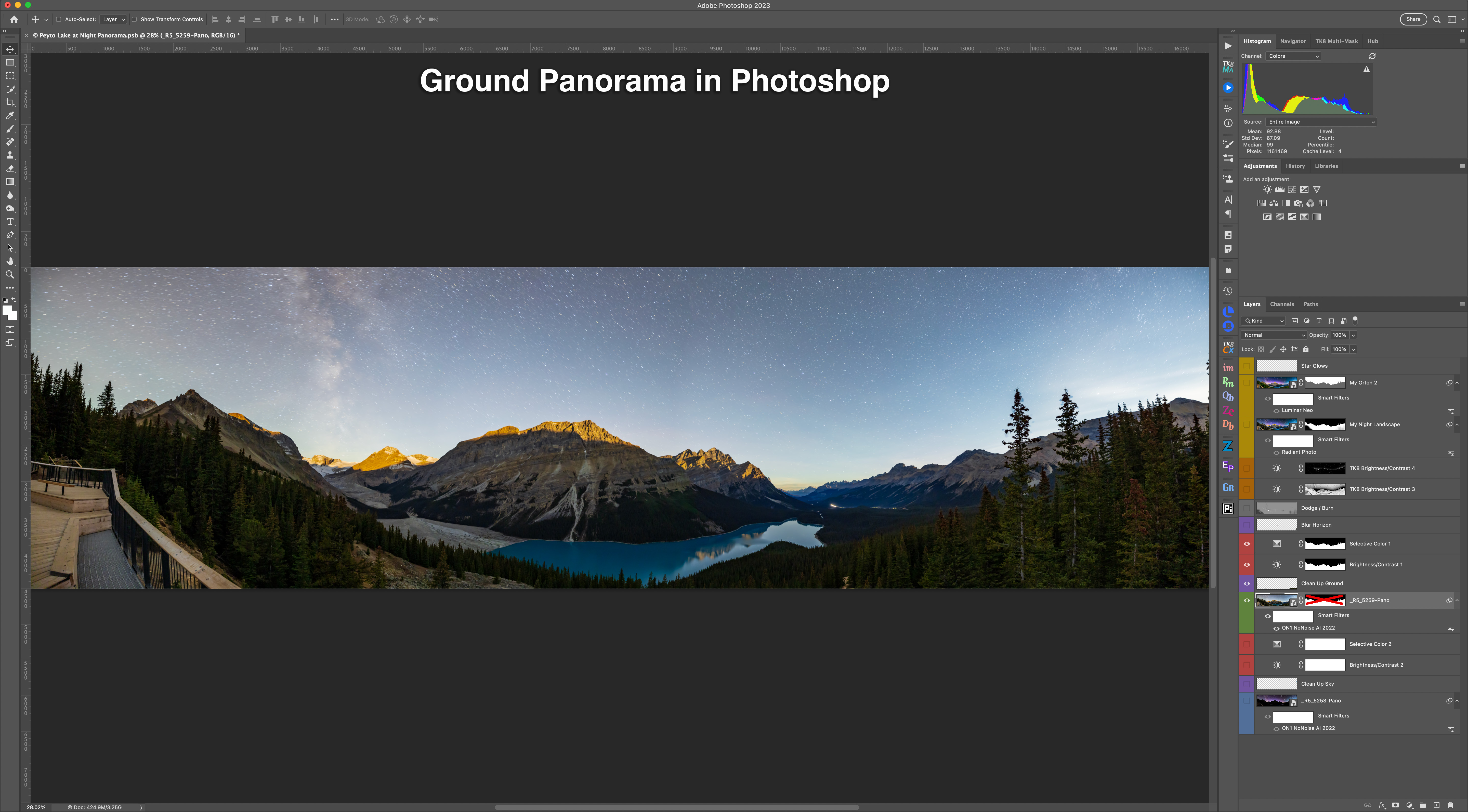
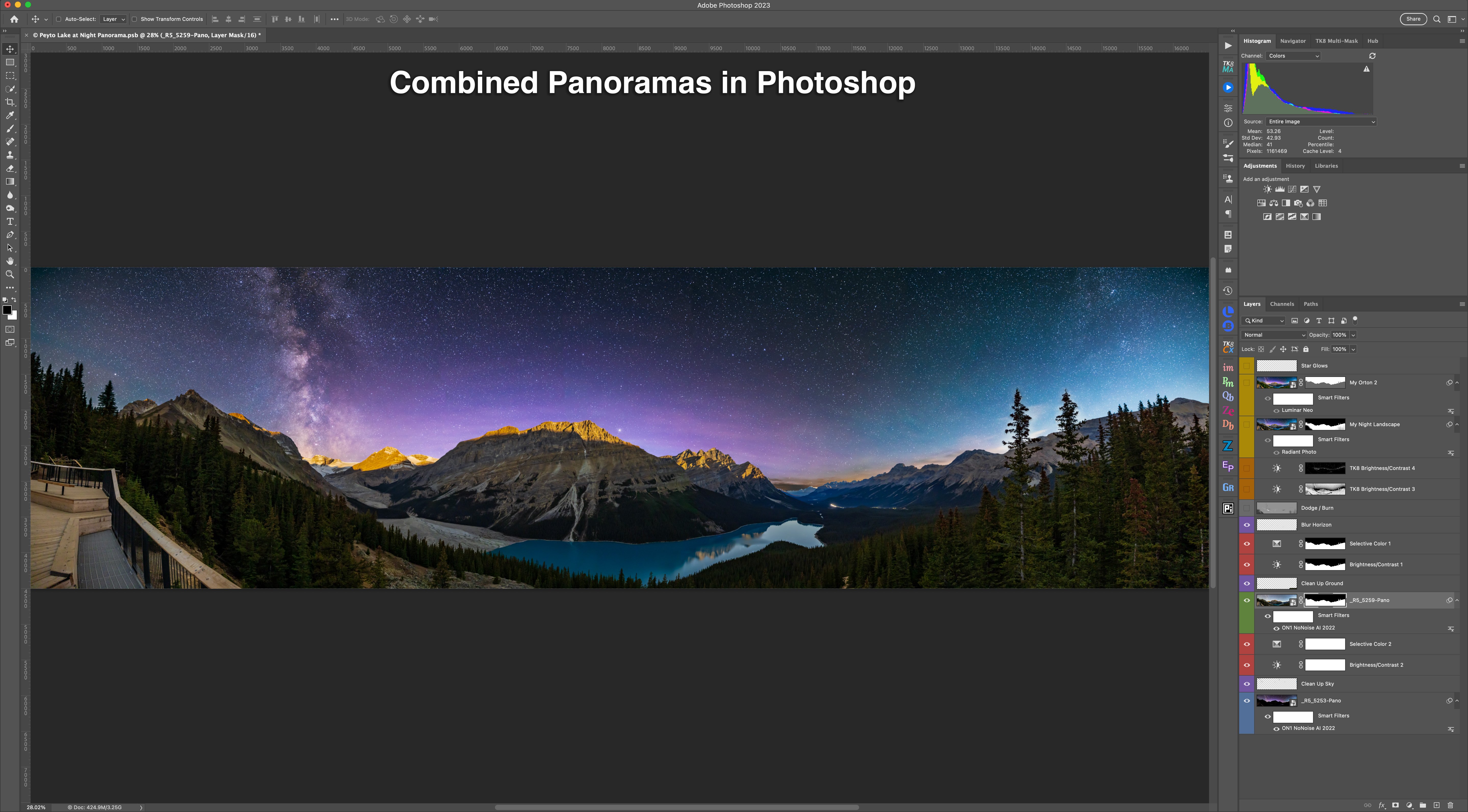
For those who are interested, hereโ€™s a look at how I processed and assembled the images, using the Peyto Lake panorama as an example. This is not a thorough tutorial, but shows the main steps involved. Tap or click on an image to download a full-size version.

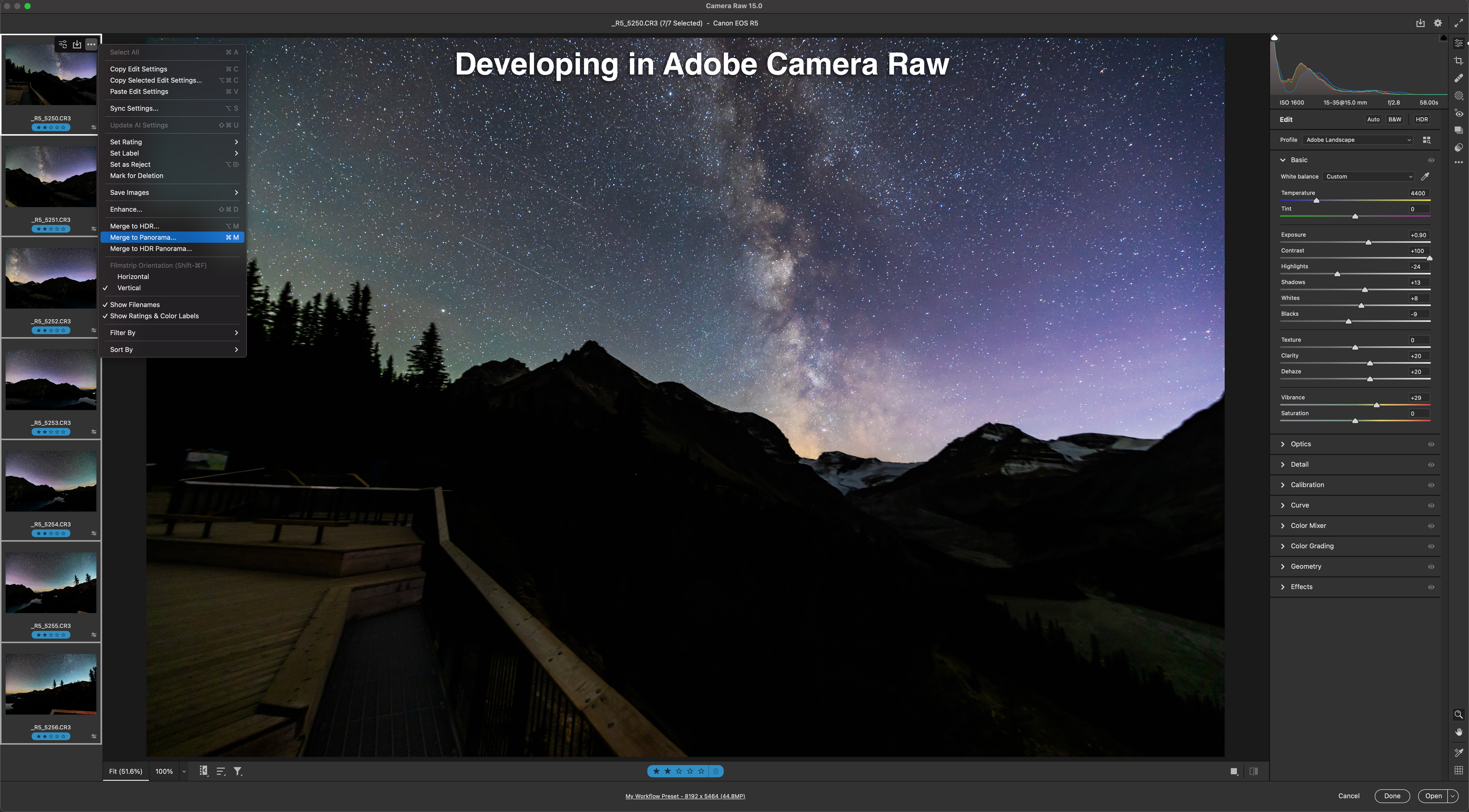
  • I first develop all the raw files (seven here) in Adobe Camera Raw, applying identical settings to make them look best for what they are going to contribute to the final blend, in this case, for the tracked sky with pinpoint stars and the Milky Way. 
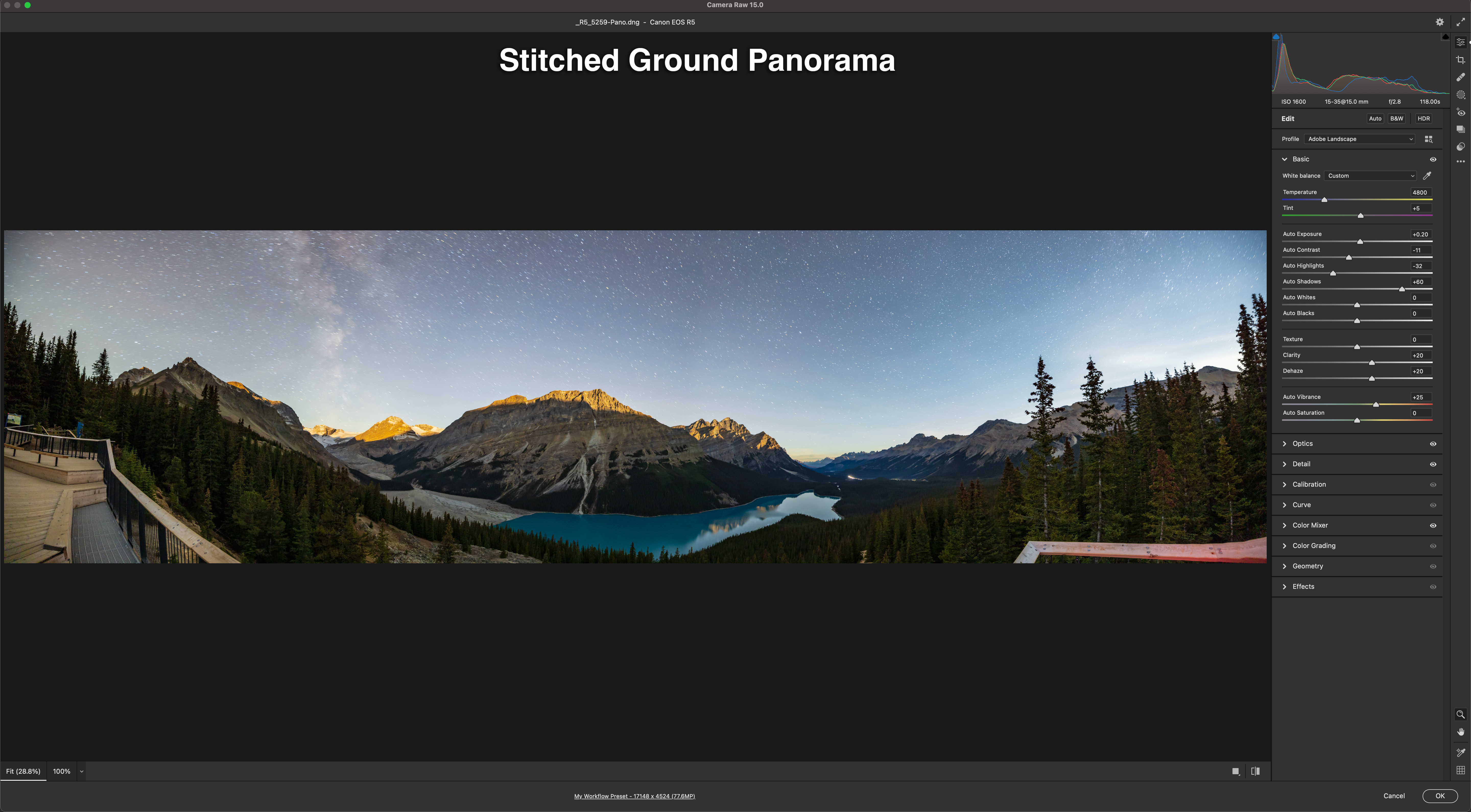
  • Camera Raw (as does Adobeโ€™s Lightroom) has an excellent Merge to Panorama function which usually works very well on such scenes. This shows the stitched sky panorama, created with one click.
  • I develop and stitch the untracked ground segments to look their best for revealing details in the landscape, overexposing the sky in the process. Stars are also trailed, from the long exposures needed for the dark ground. No matter โ€“ these will be masked out.
  • This shows the stack of images now in Adobe Photoshop, but here revealing just the layer for the sky panorama and its associated adjustment layers to further tweak color and contrast. I often add noise reduction as a non-destructive โ€œsmart filterโ€ applied to the โ€œsmart objectโ€ image layer. See my review of noise reduction programs here
  • This shows just the ground panorama layer, again with some adjustment and retouching layers dedicated to this portion of the image. 
  • The sky has to be masked out of the ground panorama, to reveal the sky below. The Select Sky command in Photoshop usually works well, or I just use the Quick Selection tool and then Select and Mask to refine the edge. That method can be more accurate. 
  • Aligning the two panoramas requires manually nudging the untracked ground, up in this case, to hide the blurred and dark horizon from the tracked sky panorama. Yes, we move the earth! The sky usually also requires some re-touching to clone out blurred horizon bits sticking up. Dealing with trees can be a bit messy! 

The result is the scene above with both panorama layers and the masks turned on. While this now looks almost complete, weโ€™re not done yet. 

  • Local adjustments like Dodge and Burn (using a neutral grey layer with a Soft Light blend mode) and some luminosity masks tweak the brightness of portions of the scene for subtle improvements, to emphasize some areas while darkening others. Itโ€™s what film photographers did in the darkroom by waving physical dodging and burning tools under the enlarger. 
  • I add finishing touches with some effect plug-ins: Radiant Photo added some pop to the ground, while Luminar Neo added a soft โ€œOrton glowโ€ effect to the sky and slightly to the ground. 

All the adjustments, filters, and effects are non-destructive so they can be re-adjusted later, when upon further inspection with fresh eyes I realize something needs work.  


Was It Photoshopped?

I hope my look behind the curtains was of interest. While these types of nightscapes taken with a tracker, and especially multi-segment panoramas, do produce dramatic images, they do require a lot of processing at the computer. 

Was it โ€œphotoshopped?โ€ Yes. Was it faked? No. The sky really was there over the scene you see in the image. However, the long exposures of the camera do reveal more details than the eye alone can see at night โ€” that is the essence of astrophotography. 

My one concession to warping reality is in the time-blending โ€” the merging of panoramas taken 30 minutes to an hour apart. Iโ€™ll admit that does push my limits for preferring to record real scenes, and not fabricate them (i.e. โ€œphotoshopโ€ them in common parlance).

But at this shoot on these marvelous nights, making use of the perfectly timed moonrises was hard to resist!

โ€” Alan, November 17, 2022 / AmazingSky.com 

Chasing the Shadowed Moon (2022)


Once again, catching the eclipsed Moon required a chase to clear skies.

As with every previous eclipse of the Moon visible from my area in the last decade, I didn’t have the luxury of watching it from home, but had to chase to find clear skies.

(See my previous tales of the November 19, 2021 and May 26, 2021 eclipses.)

However, the reward was the sight of the reddened Moon from one of my favourite locations in Alberta, Reesor Lake, in Cypress Hills Interprovincial Park.

The eclipse in question was the total lunar eclipse of May 15/16, 2022. As with any eclipse, planning starts with a look at the weather forecasts, or more specifically cloud forecasts.

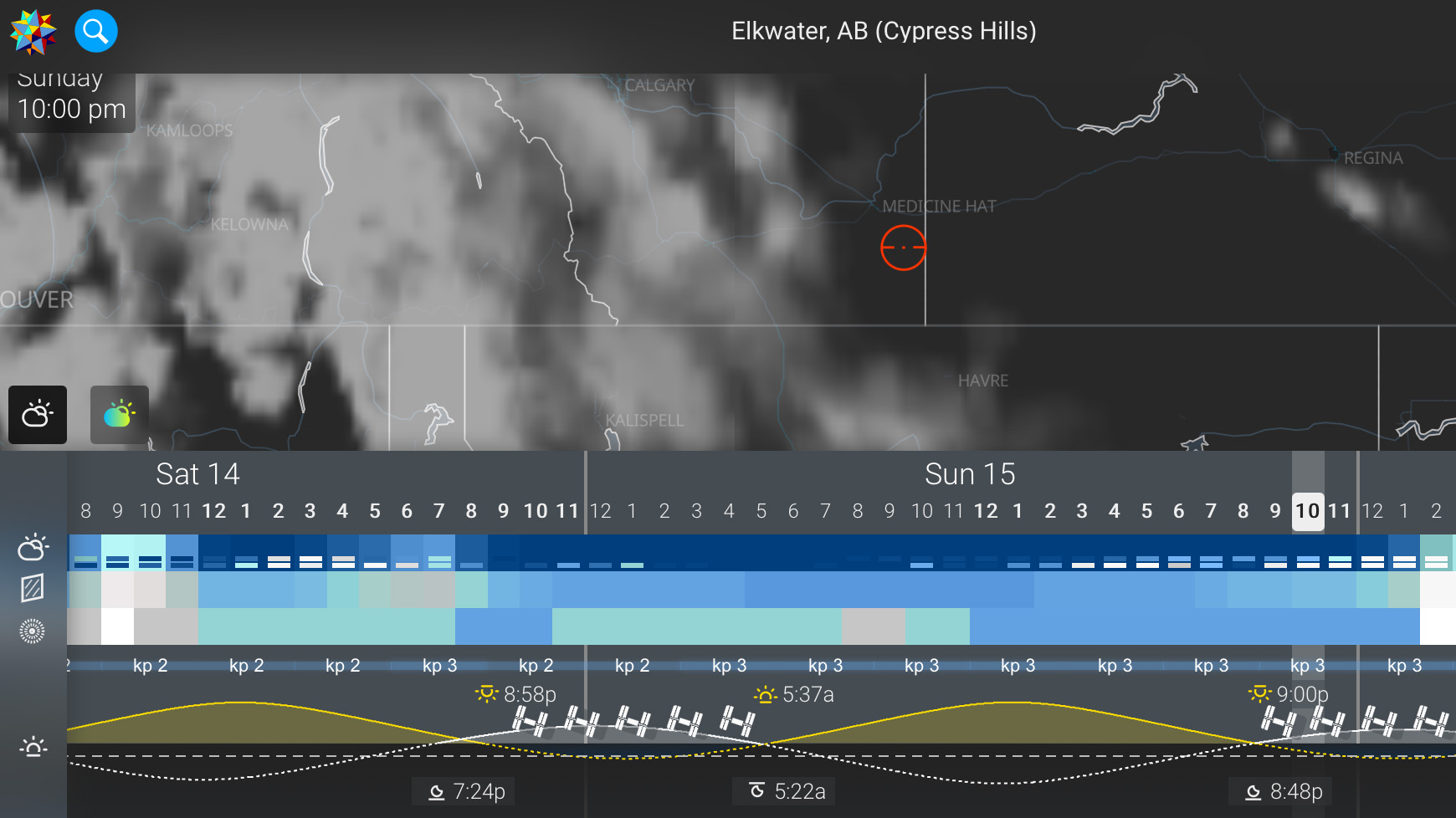
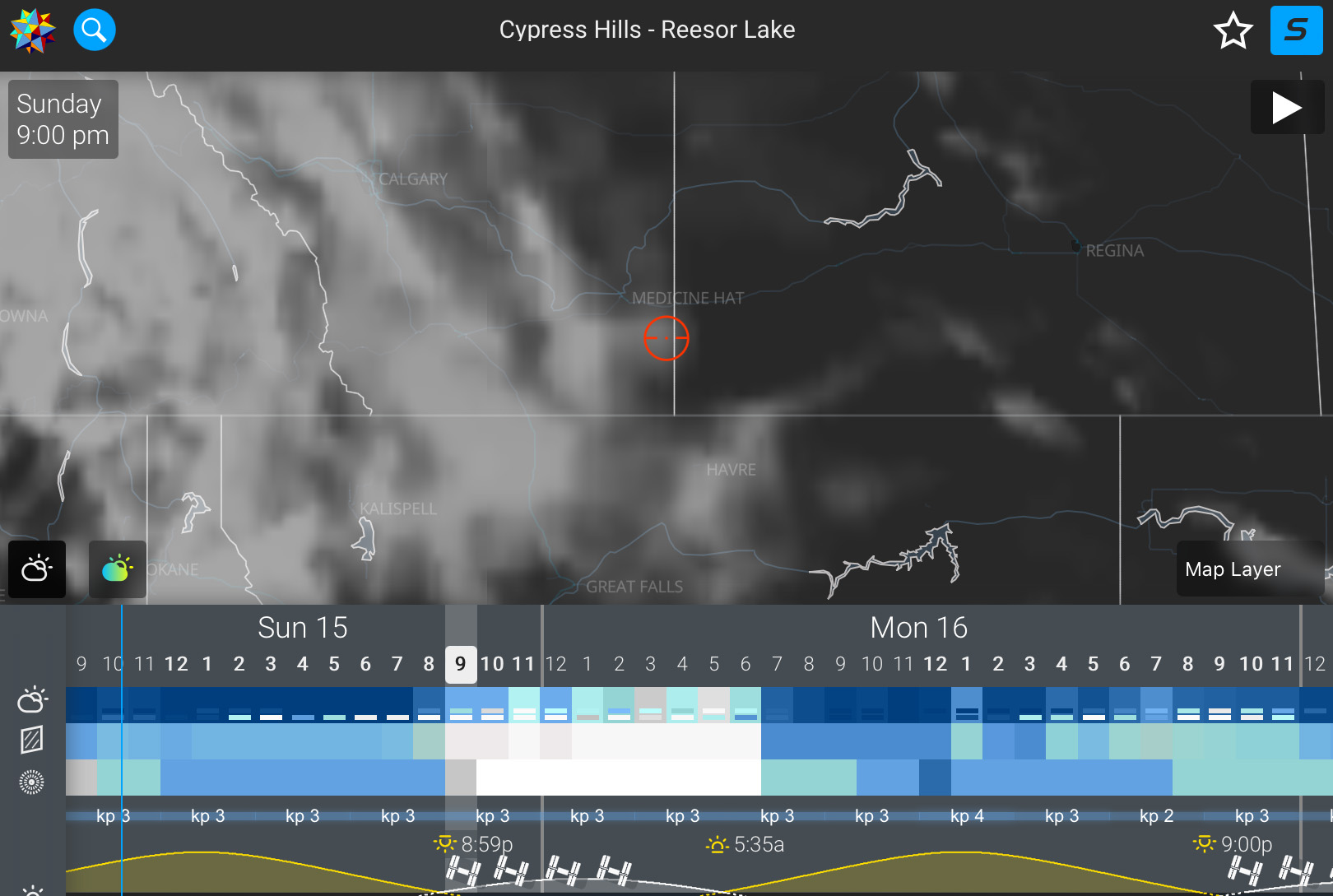
A few days prior, conditions didn’t look good from my home, to the west of the red marker.

Cloud forecast two days prior.

But as the chart from the app Astrospheric shows, very clear skies were forecast for southeast Alberta, in the Cypress Hills area, where I have shot many times before.

Except as eclipse evening drew closer, the forecast got worse. Now, the clouds were going to extend to my chosen site, with a particularly annoying tongue of cloud right over my spot. Clouds were going to move in just as the total eclipse began. Of course!

Cloud forecast the morning of the eclipse.

I decided to go for it anyway, as the Moon would be to the east, in the direction of the clear skies. It didn’t need to be clear overhead. Nor did I want to drive any farther than I really needed, especially to another location with an unknown foreground.

The spot I chose was one I knew well, on the west shore of scenic Reesor Lake, near the Alberta/Saskatchewan border, but on the Alberta side of Cypress Hills Interprovincial Park.

I used the app The Photographer’s Ephemeris (TPE) to help plan the shoot, to ensure the Moon would be well situated over the lake.

A screen shot from TPE

Handily, TPE provides moonrise times and angles for the chosen location, as well as eclipse times for that time zone.

The companion app, TPE 3D, provides a preview of the scene in 3D relief, with the hills depicted, as a check on Moon altitude and azimuth with respect to the horizon below.

TPE 3D’s simulation

As you can see the simulation matched reality quite well, though the image below was from an earlier time than the simulation, which was for well after mid-totality.

The eclipse over Reesor Lake, in the last stages of the partial eclipse.

However, true to the predictions, clouds were moving in from the west all during the eclipse, to eventually obscure the Moon just as it entered totality and became very dim. Between the clouds and the dark, red Moon, I lost sight of it at totality. As expected!

Below is my last sighting, just before totality began.

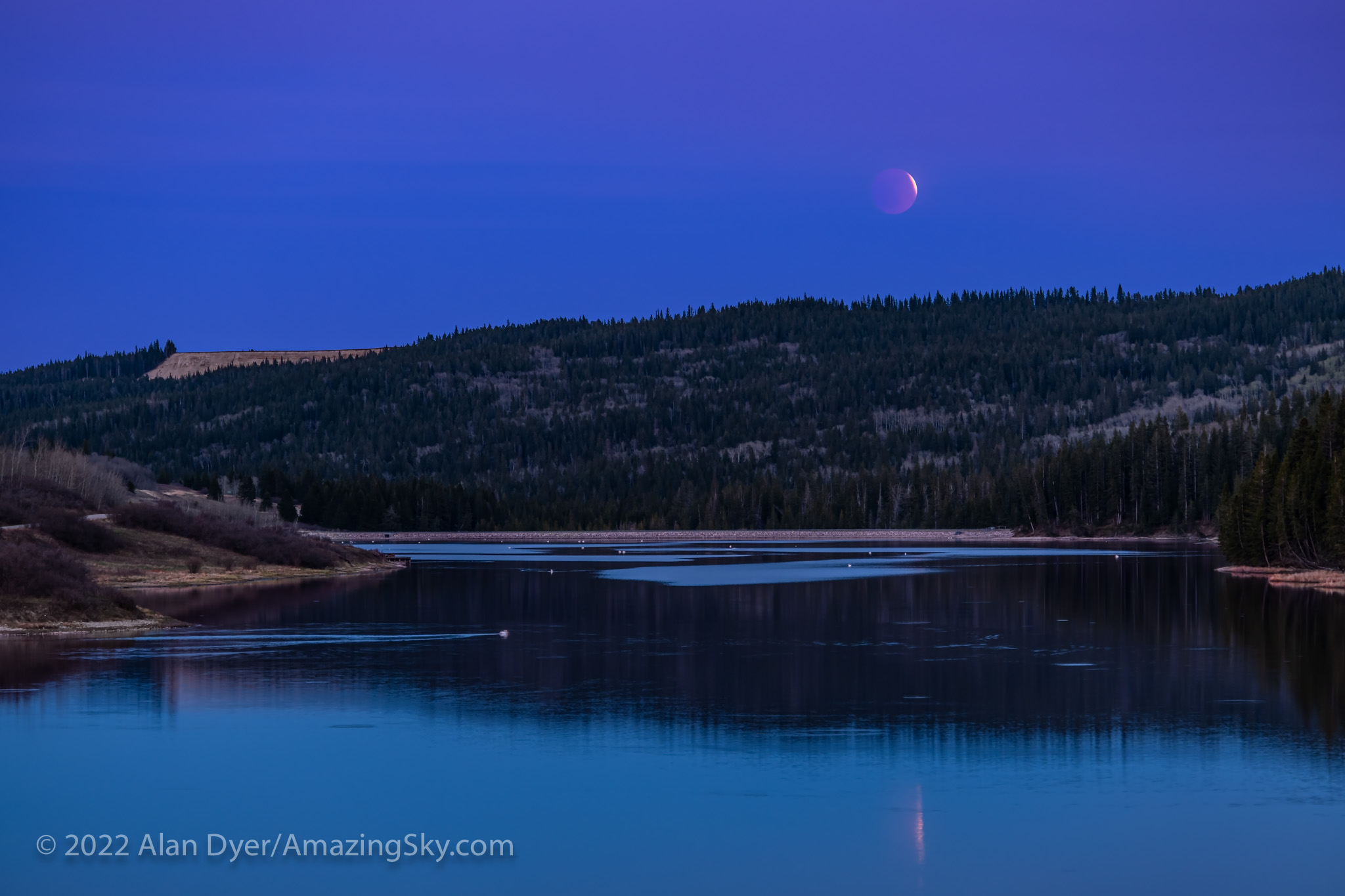
The eclipsed Full Moon rising over Reesor Lake in Cypress Hills Interprovincial Park, Alberta, on May 15, 2022.

However, I was content at having captured the eclipse from a photogenic site. More images of a complete eclipse would have been nice, but alas! I still consider the chase a success.

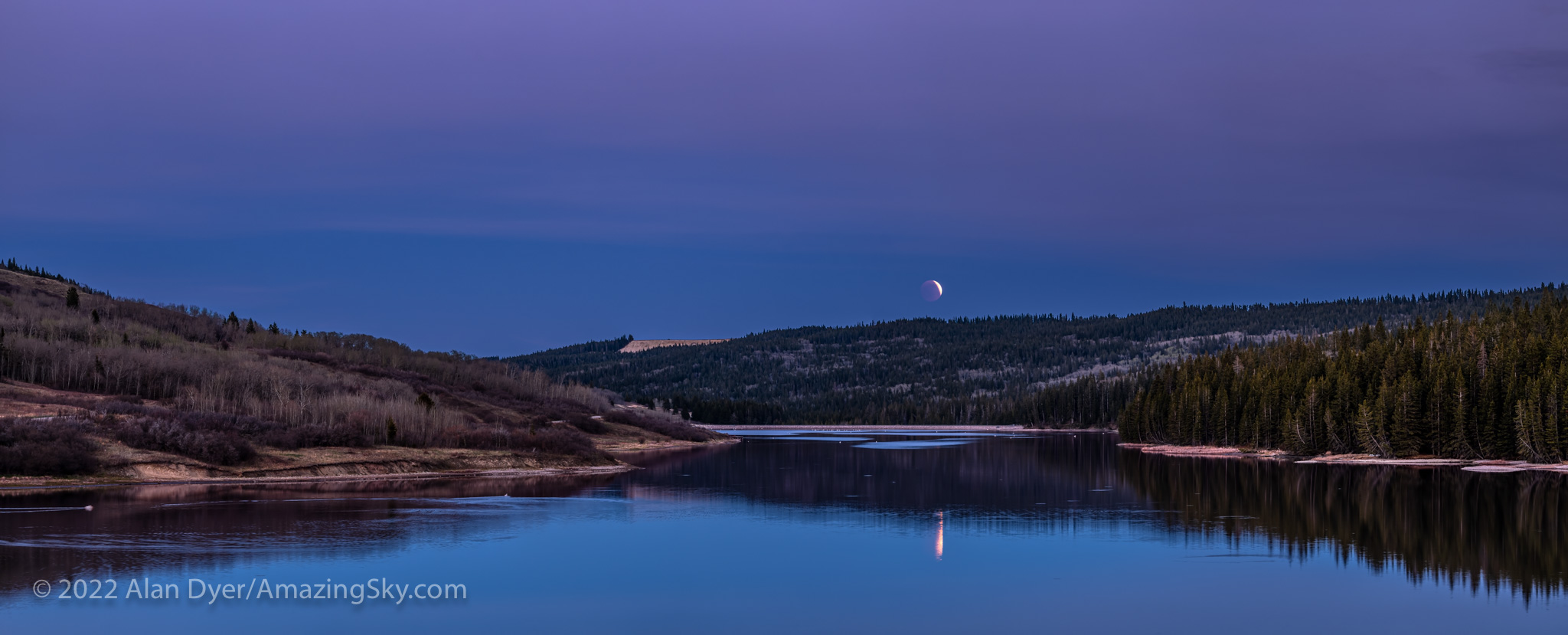
A panorama of the eclipsed Full Moon rising over Reesor Lake in Cypress Hills Interprovincial Park, Alberta, on May 15, 2022.

Just for fun, I shot a quick panorama of three segments, and it turned out to be my favourite image from the eclipse, capturing the scene very well. Pelicans and geese were plying the calm waters of the lake. And owls were hooting in the woods. It was a fabulous evening!

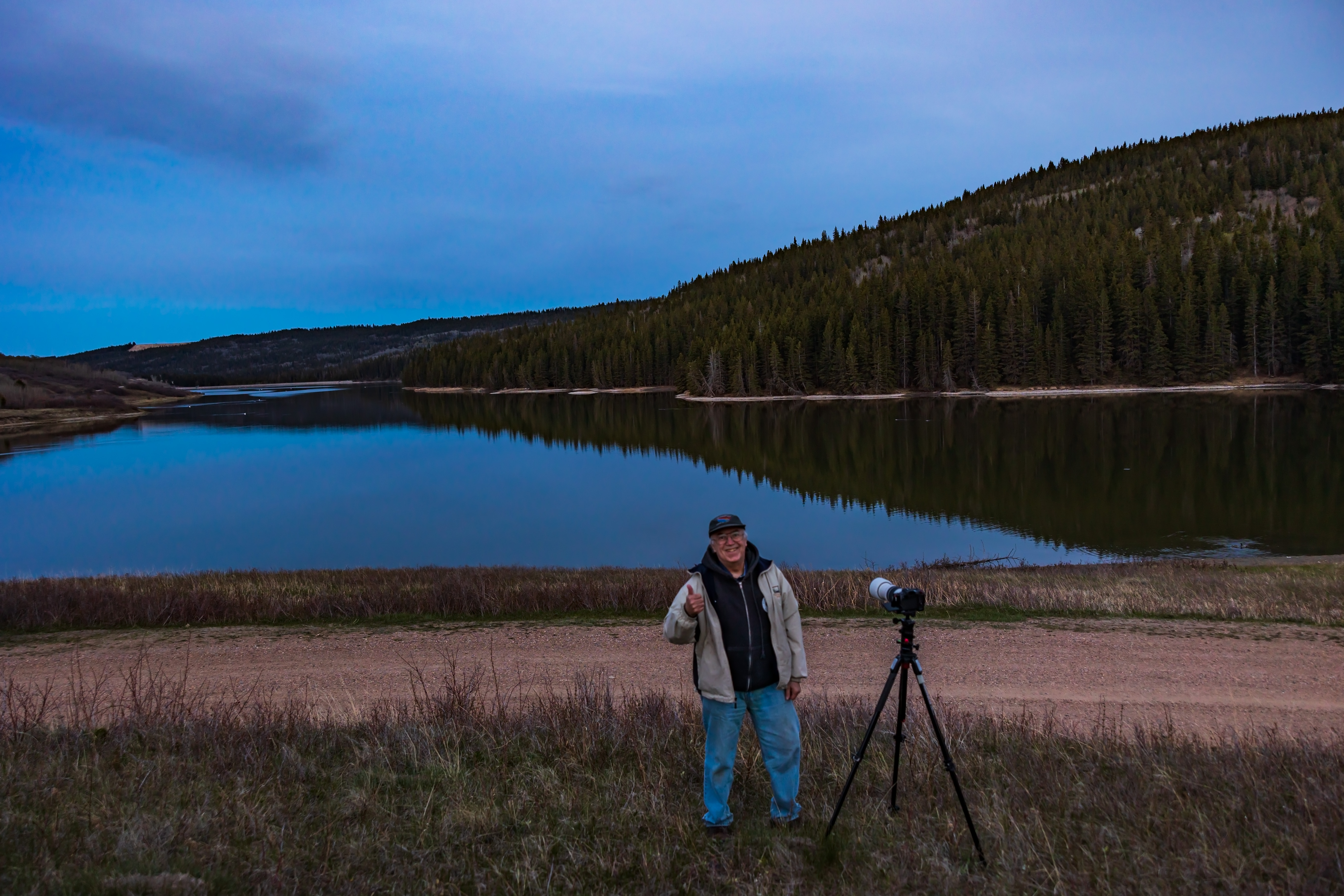
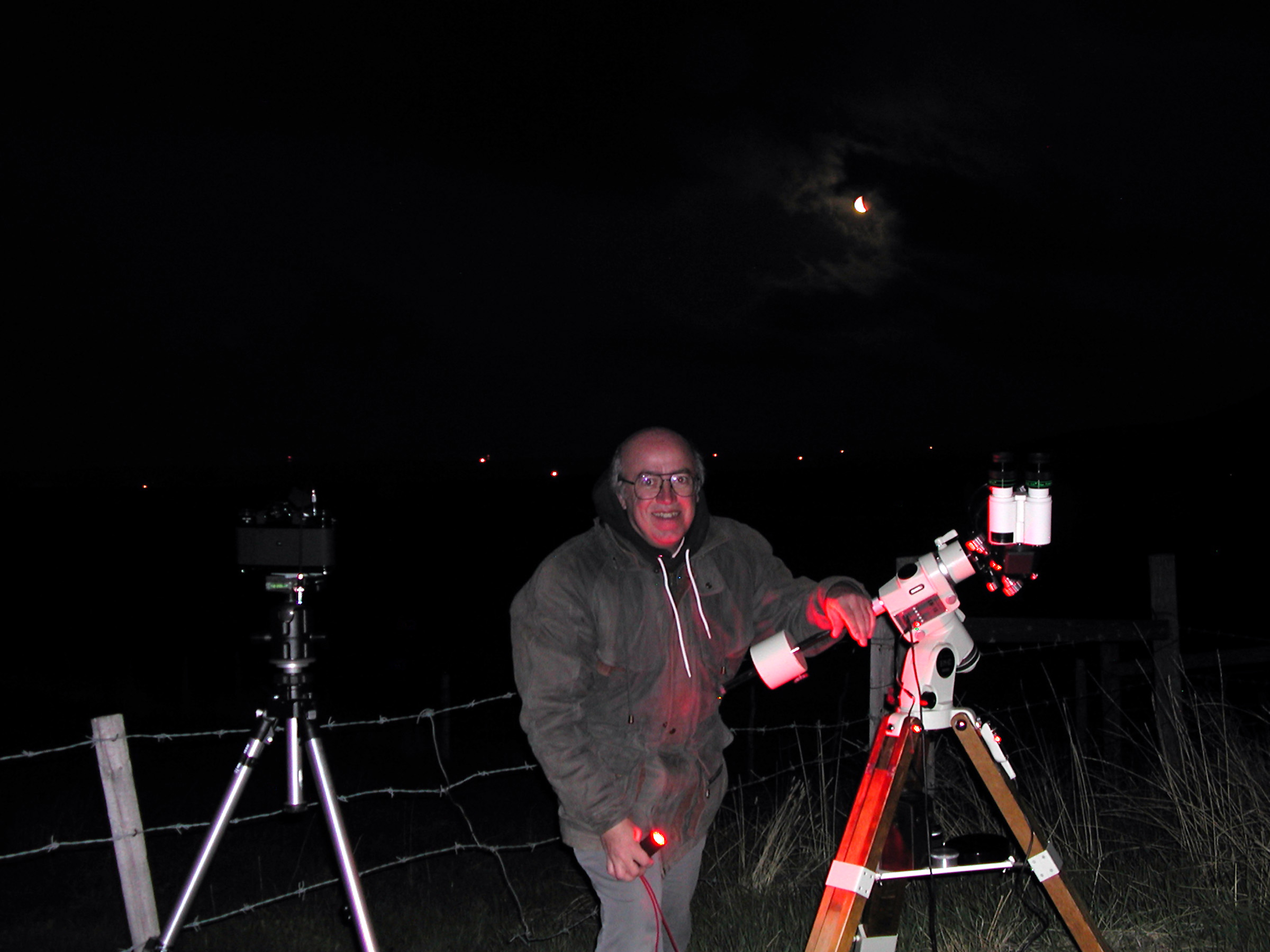
Me at Reesor Lake after shooting the lunar eclipse of May 15, 2022, with the Moon now in clouds behind me.

Before departing, I took my customary “trophy” shot, of the eclipse hunter having bagged his game.


Interestingly, this eclipse was a close repeat of one 19 years earlier to the day, because of the so-called Metonic Cycle where eclipses of the Sun and Moon repeat at 19-year intervals on the same calendar day, at least for 2 or 3 cycles.

The trophy shot from May 15, 2003.

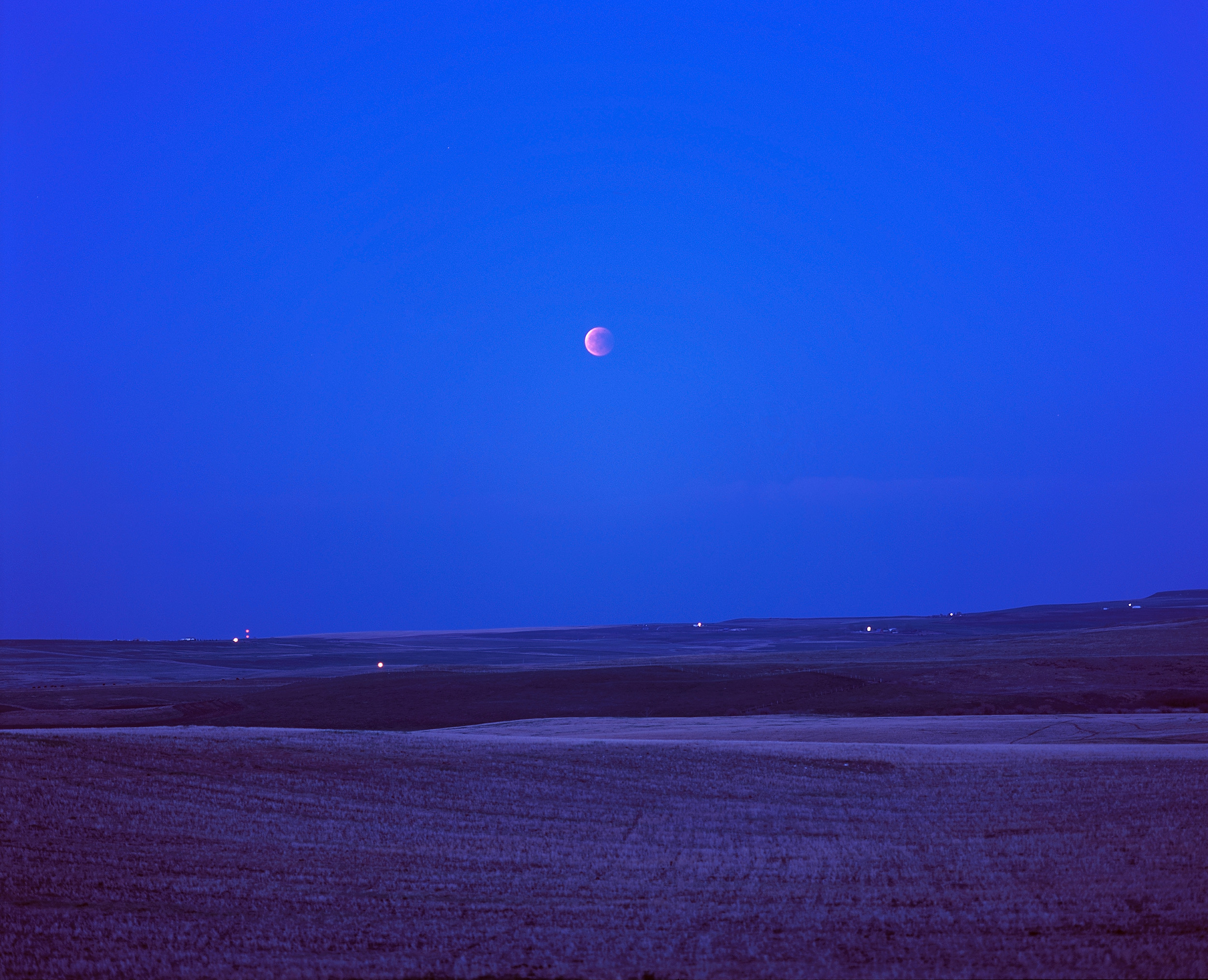
On May 15, 2003, we also had a total lunar eclipse in the early evening, with the eclipsed Moon rising into a spring twilight sky. I also chased clear skies for that one, but in the opposite direction from home, to the southwest, to the foothills. At that time it was all film, and medium format at that.

Total eclipse of the Moon seen May 15, 2003 from southern Alberta (from a site west of Nanton). The Moon rose as totality started so was deep into totality by the time it was high enough to see and sky dark enough to make it stand out. Pentax 67 camera with 165mm lens at f/2.8 with Fujichrome 100F slide film.

So it was another (partially!) successful eclipse chase.

The next opportunity is on the night of November 7/8, 2022, a time of year not known for clear skies!

Just once I would like to see one from home, to make it easier to shoot with various telescopes and trackers, as the reddened Moon will be west of the photogenic winter Milky Way, and very close to the planet Uranus. Plus for me in Alberta the November eclipse occurs in the middle of the night, making a home eclipse much more convenient. After that, the next chance is March 13/14, 2025.

But no matter the eclipse, I suspect another chase will be in order! It just wouldn’t be a lunar eclipse without one.

โ€” Alan, May 19, 2022 (amazingsky.com)


Following the Evening Star


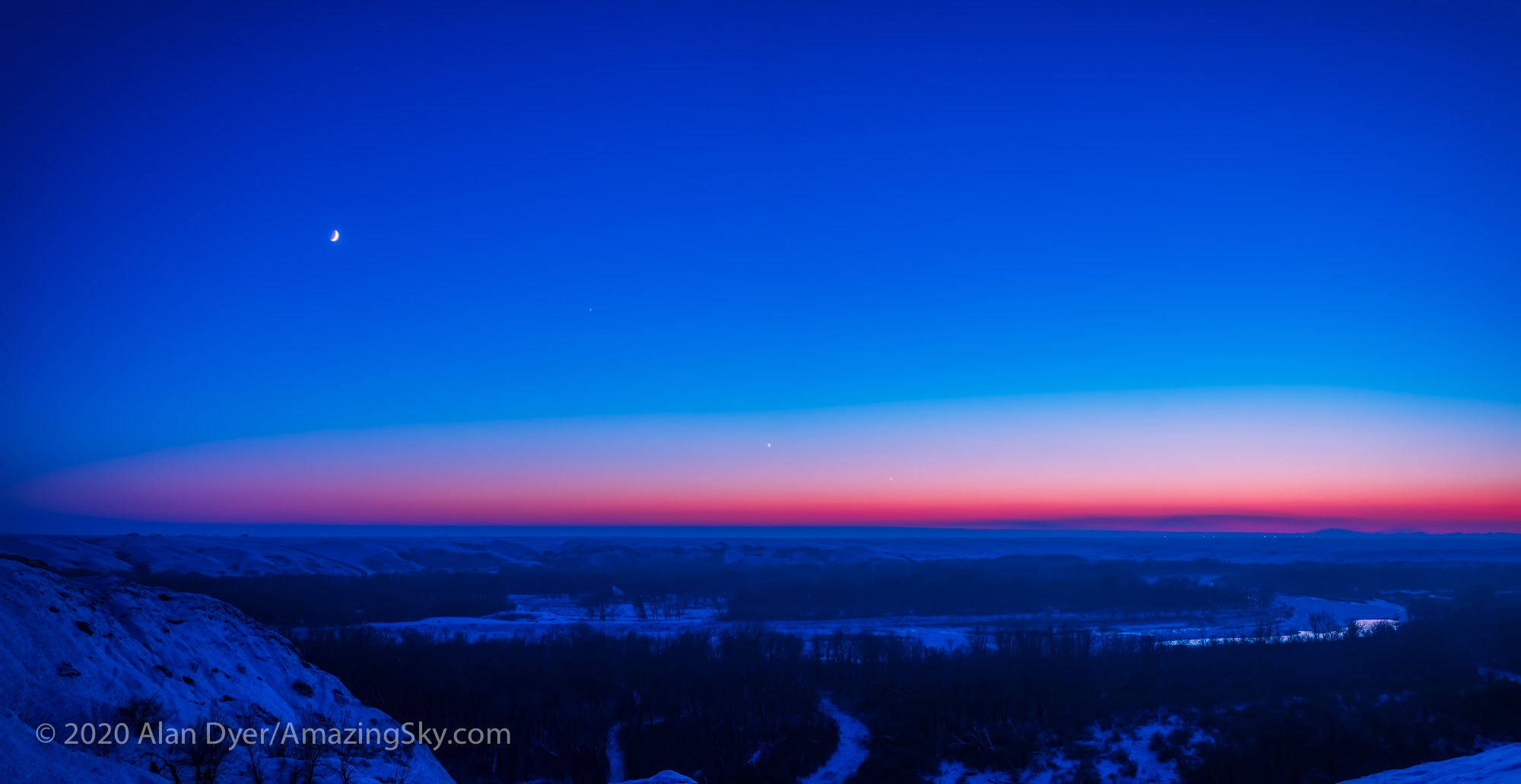
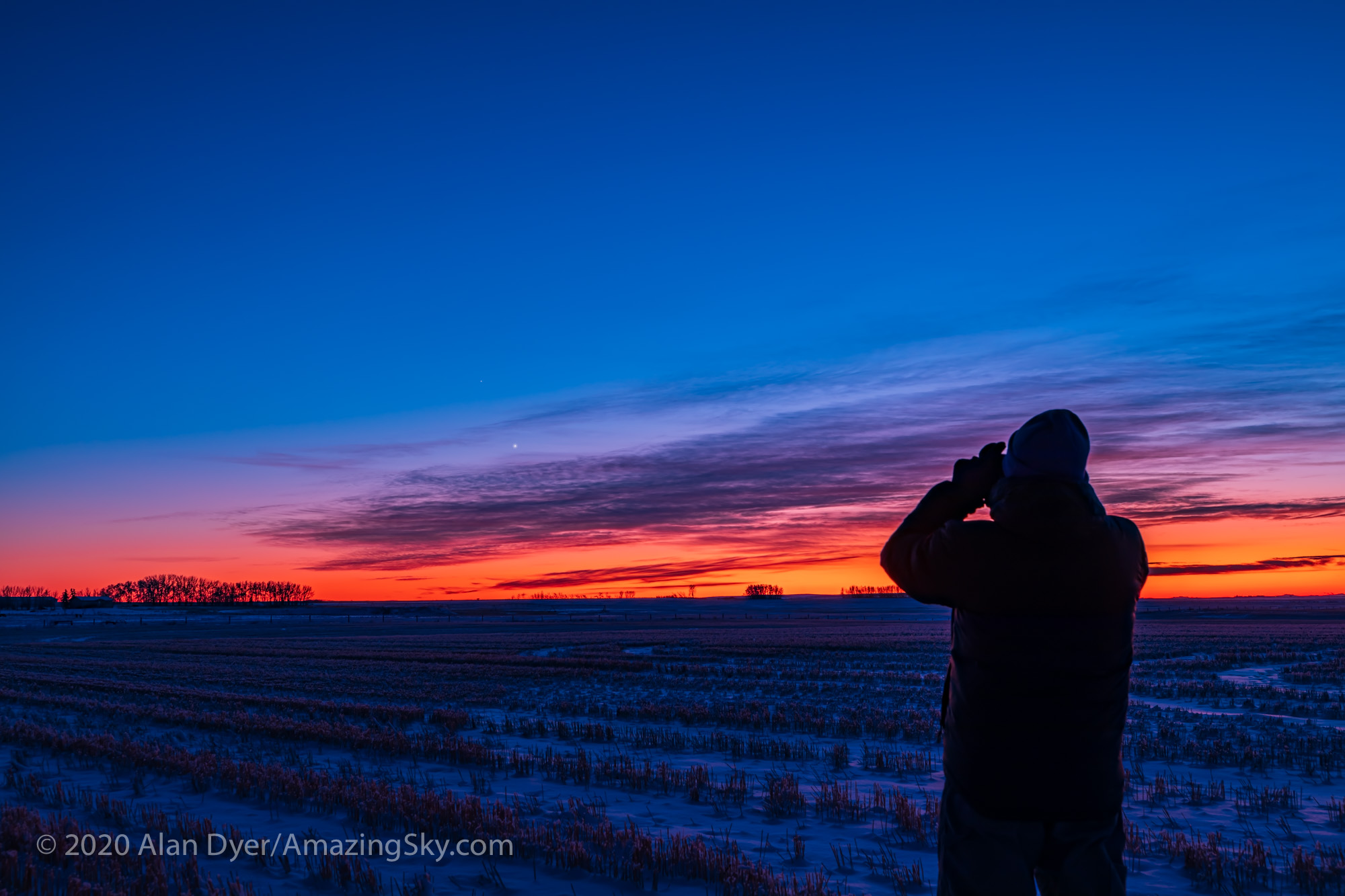
Selfie with Binoculars Looking at Moon (Feb 27, 2020)It’s been a marvelous few months following Venus rise and fall across the evening sky, in its best show in eight years.

Venus is now gone from our western sky, but since late 2019 until late May 2020 it had dominated the sky as a brilliant evening star.

Here’s a gallery of Venus portraits I shot during its wonderful show these last few months.


The show began in November 2019 when rising Venus met declining Jupiter on November 23 for a fine conjunction of the two brightest planets in the evening twilight.

Venus and Jupiter over the Rockies
The conjunction of Venus and Jupiter of November 23, 2019, as seen over the foothills and front ranges of the Rocky Mountains in southwest Alberta. I shot this from the Rothney Astrophysical Observatory, prior to their monthly Open House event that night with about 400 in attendance. But at this time it was just me and one other ardent photographer present to shoot this scene. This is an HDR blend (stacked using Adobe Camera Raw) of 5 exposures at 2/3-stop intervals, with the Rokinon 85mm lens at f/4 on the red-sensitive Canon EOS Ra camera at ISO 100.


A week later I captured the line of the then three evening planets and the Moon across the southwest, defining the path of the ecliptic across the evening sky.

Moon and Three Planets Line-Up
The waxing crescent Moon and three planets in a line across the southwestern evening sky on Nov. 30, 2019, a chilly and frosty night. Saturn is below and to the right of the Moon, Venus is brightest at centre, while Jupiter is to the lower right of Venus just above the horizon. Those two planets were in conjunction a week earlier. The line of Moon and planets visibly defines the ecliptic low across the late autumn evening sky. This is from latitide 51ยฐ N. I shot this from the viewpoint at Blackfoot Crossing overlooking the Bow River in Alberta.


A week after that I took the opportunity to shoot some selfies of me with binoculars looking at Venus, as it met Saturn in a wide conjunction, with Venus then still low in the southwest. It was just beginning its climb up into the western sky.

Observing Venus and Saturn (Dec 8, 2019)
A selfie of me observing the grouping of Venus and Saturn in the evening twilight on Dec 8, 2019, using binoculars. They were closest to each other two nights later.


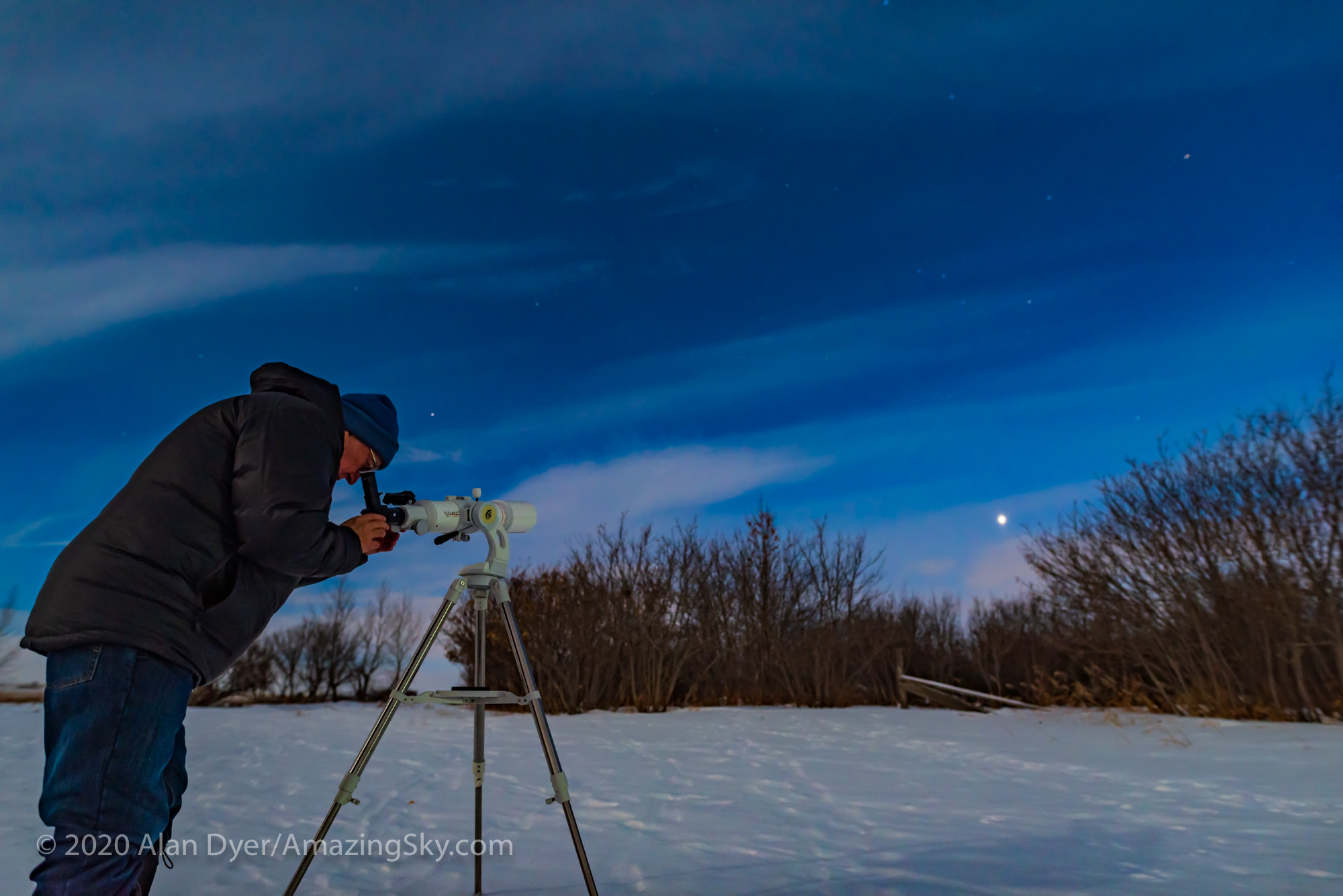
A month later in mid-winter, Venus was still rather low but brilliant even in a hazy moonlit sky, as I posed for another selfie, this time with a small telescope. These images are always useful for illustrations in books and magazines. And blogs!

Observing Venus in Clouds
A selfie of me observing Venus in clouds and in the moonlight. I am using the Explore Scientific 80mm refractor on the Twilight Nano alt-az mount. This was January 9, 2020.


By the end of February Venus had climbed high into the west, and was appearing monthly near the waxing crescent Moon. This is another binocular selfie from February 27.

Selfie with Binoculars Looking at Moon (Feb 27, 2020)
A selfie looking at the waxing crescent Moon near Venus on Feb 27, 2020, using the Celestron SkyMaster 15×70 Pro binoculars on the Sky-Watcher AZ5 mount for a steady view. This is a single shot with the Nikon D750 and Sigma 24mm lens, using the flash on the camera.


In March I visited Churchill, Manitoba just as the lockdown and travel restrictions were coming into effect. But our lone and last tour group at the Churchill Northern Studies Centre saw some fine auroras, as here on this evening with the Northern Lights appearing even in the twilight. And what’s that bright star? Venus, of course!

Aurora in Twilight at Churchill Northern Studies Centre
The Northern Lights in the evening twilight on March 18, 2020, as the aurora appeared in the early evening sky. Orion is at far left in this panorama, with Cassiopeia at top centre. Part of the Big Dipper is at far right. The bright object over the Centre is Venus, with the Pleiades above. This is a panorama of 8 segments with the Venus Optics 15mm lens at f/2 and Sony a7III at ISO 800 for 1.6 seconds each. Stitched with Photoshop.


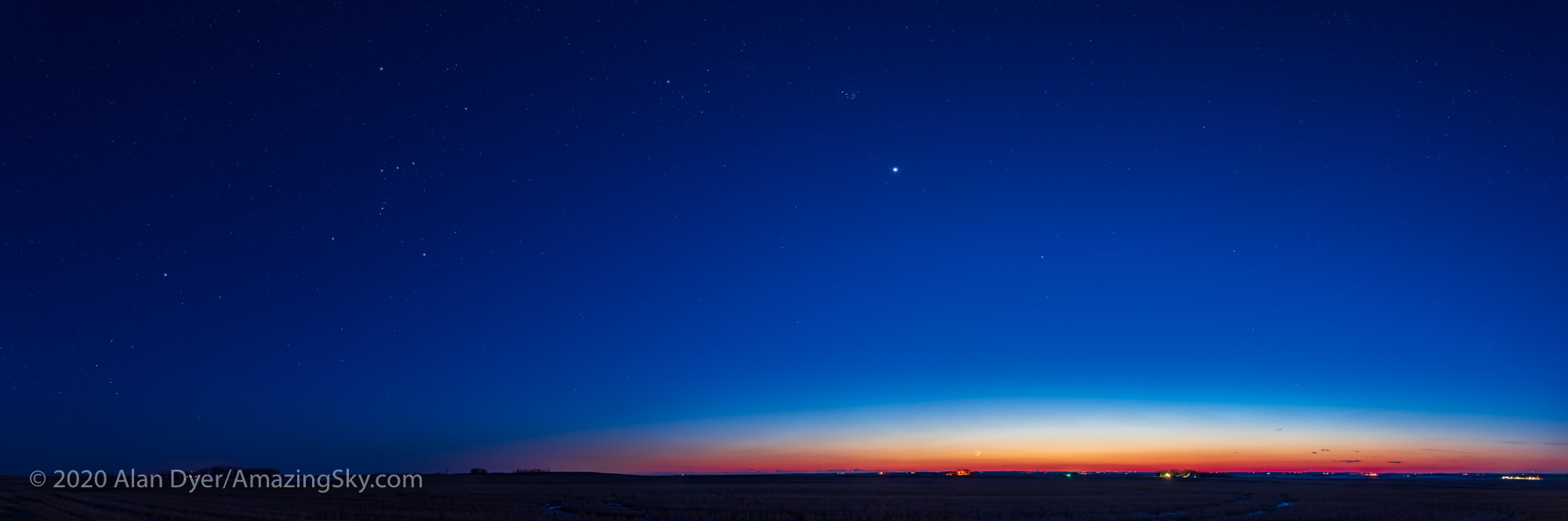
Upon my return home to Alberta, I was able to shoot more panoramas on the prairies of the wonderful early spring sky with Orion setting into the twilight and Venus in Taurus shining below the iconic Pleiades star cluster.

Panorama of  Venus and the Winter Stars (March 25, 2020)
This is a panorama of the evening sky on March 25, 2020, with brilliant Venus high in the west at centre just after the date (March 24) of its greatest elongation in the evening sky for 2020. It appears here about as high as it can get with the ecliptic tipped up to a high angle in spring. To the left is Orion and the winter stars in the twilight, including Sirius at far left. Just above the horizon right of centre in the bright twilight is the day-old thin crescent Moon about to set. Above Venus are the Pleiades and Hyades star clusters. This is a panorama of 5 segments with the Nikon D750 and 24mm Sigma lens, stitched with PTGui. Each segment was 8 seconds at ISO 400 and f/2.8.


March 26 was a superb night for catching Venus now at its highest and almost at its brightest at this appearance, as the waxing Moon appeared below it.


The highlight of the spring Venus season was its close approach to the Pleiades, which it passes only every 8 years. Here I am viewing the conjunction two days before the closest approach, with Orion over my shoulder.

Viewing Venus & Pleiades with Big Binoculars
A selfie of me viewing the close approach of Venus to the Pleiades star cluster on April 1, 2020, using big 15×70 Celestron SkyMaster Pro binoculars mounted on a Canadian-built Starlight Innovations binocular mount, a parallelogram-style mount. Orion is over my left shoulder; the Hyades is at centre above the mount. The waxing gibbous Moon provided the illumination. This is a stack of 4 images for the ground to smooth noise and 1 image for the sky to minimize trailing, all 13 seconds at f/5.6 with the Sigma 24mm lens and Nikon D750 at ISO 1600. Topaz Sharpen AI and DeNoise AI applied.


The night of closest approach, April 3, was cloudy, but here is a consolation closeup taken the next night with brilliant Venus departing the Seven Sisters.

Venus and the Pleiades - Close-Up (April 4, 2020)
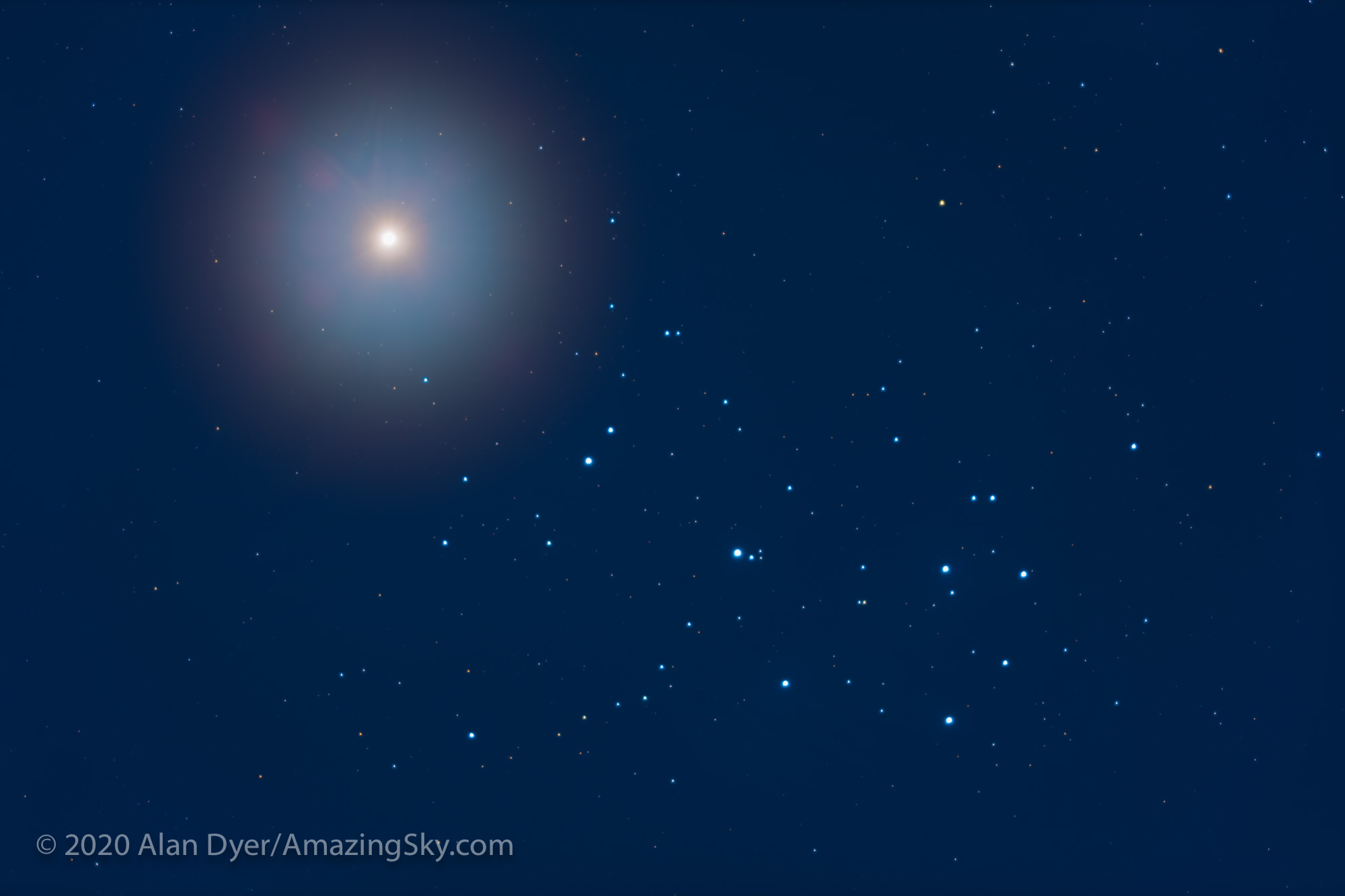
Venus above the Pleiades star cluster, M45, on April 4, 2020, in the twilight and moonlight. Light from the gibbous Moon illuminated the sky, so no long exposure would reveal much detail in and around the Pleiades. Venus passes close to the Pleiades only every 8 years. Some light cloud this night added the glow. This is a stack of multiple exposures of varying lengths: 2 minutes, 30 seconds, 10 seconds and 2 seconds, blended with masks to prevent Venus from being too blown out while still recording the stars. All were with the SharpStar 140mm PH apo refractor with the 0.73x flattener/reducer for f/4.8 and at ISO 400 with the Canon EOS Ra.


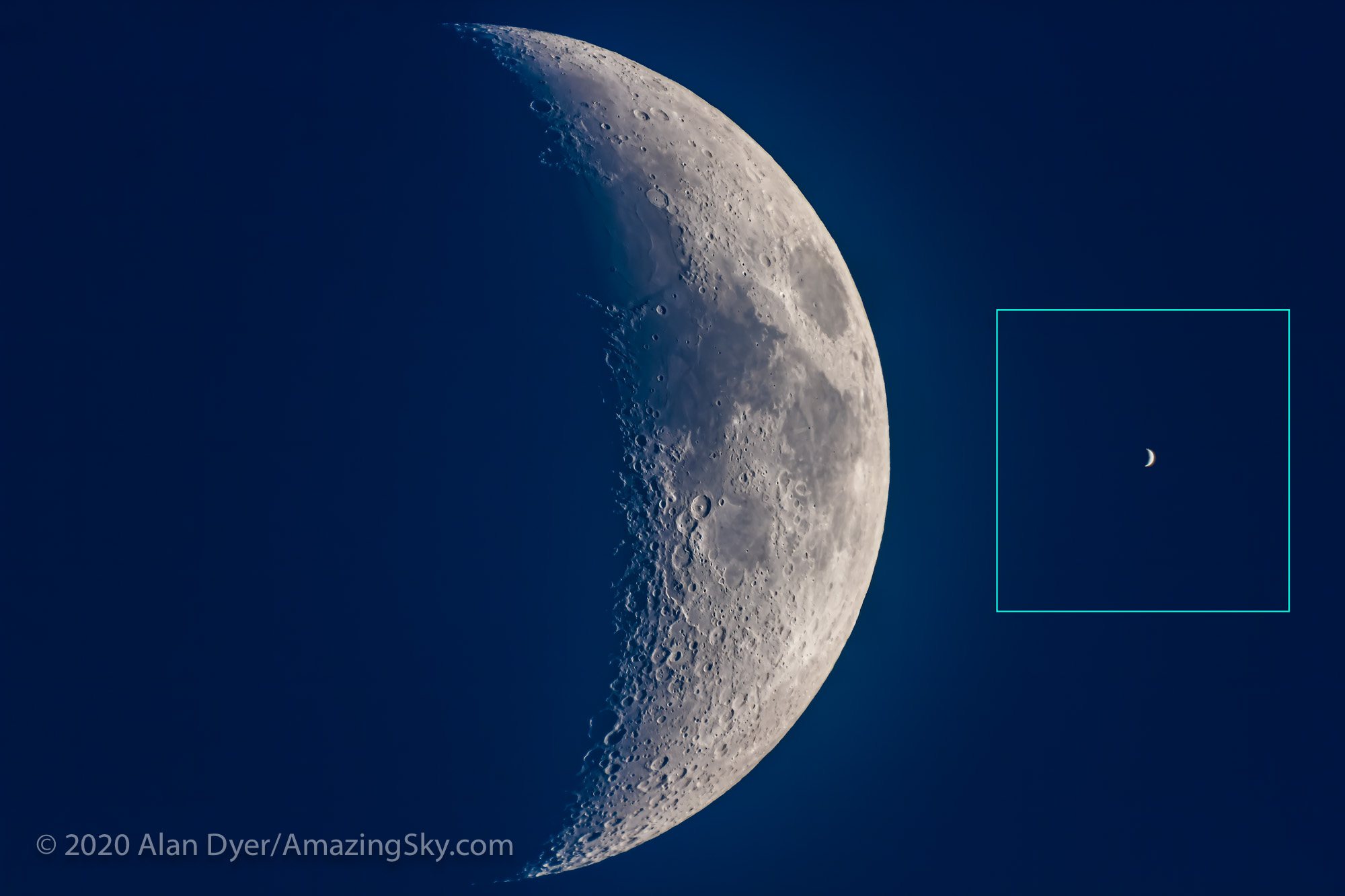
Later in April Venus reached its greatest brilliancy, at magnitude -4.7, the date when the size of is disk, phase, and proximity to Earth converge to make Venus as bright as possible. On this night I shot the Moon, then 30ยฐ away from Venus and the planet with the same gear to show their relative sizes and similar crescent phase this night. The caption provides more details.

Moon and Venus Crescents Compared
A collage of two images of the Moon and Venus taken minutes apart on April 28, 2020, to show the similarity in their phases this night, April 28, 2020. Both images were shot with the same focal length and camera and so are identical in image scale, to compare their apparent sizes. I have not enlarged Venus, but I have put a frame around it to emphasize that its image has been layered in as a composite. The Moon was a 5.6-day-old waxing crescent this night, 32% illuminated. Venus was at its greatest brilliancy, or Greatest Illuminated Extent, with a disk 38 arc seconds across and 27% illuminated, so slightly less. Taken with the 130mm Astro-Physics refractor with a 2X Barlow lens for an effective focal length of 1600mm and with the Canon 60Da APS-sensor camera. The Moon image is the full frame of the sensor, uncropped. Both images are single short exposures at ISO 100.


A week later, with Venus just past its point of greatest brilliancy, I shot the planet by daylight in the early evening sky, using a telescope to zoom into the planet to show its waning crescent phase. By this time the phase was obvious in binoculars.

Venus in the Day Sky
Venus in the daytime sky and through some thin clouds, on May 5, 2020, with Venus at a very high apparition. This was at about 7 pm with the Sun still well up in the early evening, to show how well Venus can be seen in the daytime sky when it is at a wider angle from the Sun; and indeed is often the best time to view it as the planetโ€™s brilliance is muted. This is a single 1/400-second exposure at ISO 100 with the Canon 60Da through the Astro-Physics 130mm refractor and 2X Barlow for f/12 and 1600mm focal length.


But Venus was now dropping rapidly from sight. By May 23, it was low in the twilight and below Mercury, then at its best for 2020 for an evening appearance from my latitude. Note the thin Moon below the planets. This was a superb sight for binoculars.

Thin Moon below Venus and Mercury
On May 23, 2020, the very thin crescent Moon (then 34 hours old) shines below bright Venus (10 days before its inferior conjunction with the Sun) and above it dimmer Mercury , then 10 days before its greatest elongation from the Sun in the evening sky. All were beautifully visible to the naked eye and a great sight in binoculars, looking very much like this scene captured with a 135mm telephoto lens. Venus was magnitude -4.4, Mercury was -0.7. This is a single shot at f/2.8 and 1/ 5 second at ISO 100 with the Canon EOS Ra which does bring out the sunset reds well.


By May 29, Venus was now tough to pick out of the evening sky, and a challenge to shoot even by day, as it then stood only 8ยฐ away from the Sun. What was once obvious to the naked eye now took a computerized telescope to pick out of the noon-day blue sky. A telescope showed the now razor-thin crescent as Venus approached its June 3 “inferior conjunction” โ€” its passage between Earth and the Sun.

Venus Near Inferior Conjunction (May 29, 2020)
Venus as a razor-thin crescent and only 8ยฐ east of the Sun on May 29, 2020, five days before its June 3 inferior conjunction. The crescent is extending a little beyond 180ยฐ here due to scattering in the Venusian clouds. The disk was 57 arc seconds across and 0.9% illuminated. The magnitude was -3.9. This was at midday, shot with the 130mm Astro-Physics f/6 refractor with a 2X Barlow and the Canon 60Da camera, but the frame cropped further in processing. This is a single 1/1250th second exposure at ISO 100, the sharpest of 70 still frames taken.


I shot and narrated video footage of the thin crescent Venus, my parting shots of Venus for its evening appearance in 2020.

But in June, post inferior conjunction, it will rise very quickly into our morning sky, providing a mirror-image repeat performance as a morning star for the rest of 2020.

Venus Near Inferior Conjunction from Alan Dyer on Vimeo.


I wish you all the best and a safe and healthy time in 2020. Take some solace in what the sky can show us and in the beauty of the night.

Clear skies!

โ€” Alan, May 31, 2020 / AmazingSky.comย 


Lilac Passages of the ISS


ISS Title Page

I present a short video, in 4K, of two video clips of the International Space Station in two successive passages across the sky on May 24/25, 2018.

The location was my backyard in southern Alberta.

The clips were shot in 4K in real-time video at 24 frames per second but with a 1/4-second shutter speed with a Sony a7III camera, and with 15mm full-frame fish-eye (first clip) and 8mm circular fish-eye lenses. ISO speeds were 6400 and 16,000.

The clips are sped up by 2x and 4X in post-production to make a shorter video for the web. The background sounds of the night are real-time and were recorded live with the videos.

What I cannot capture is the smell!

The lilacs were in bloom and lent a wonderful fragrant scent to the night air, which added to the sights and sounds of a spring night.

Thus the title of the video.

Much of North America is now enjoying great passes of the ISS. To find out when you can see it from your backyard see NASA’s Spot the Station website and enter your location.

โ€“ Alan, May 26, 2018 / ยฉ 2018 Alan Dyer / AmazingSky.com
 

Dawn Sky Delights


Aldebaran About to be Occulted by the Moon

It was one of those mornings when the sky was full of wonder.

After days and nights of smoke from unfortunate fires burning not far away, including in my favourite national park of Waterton Lakes, the sky cleared enough this morning, September 12, to reveal some fine sights.

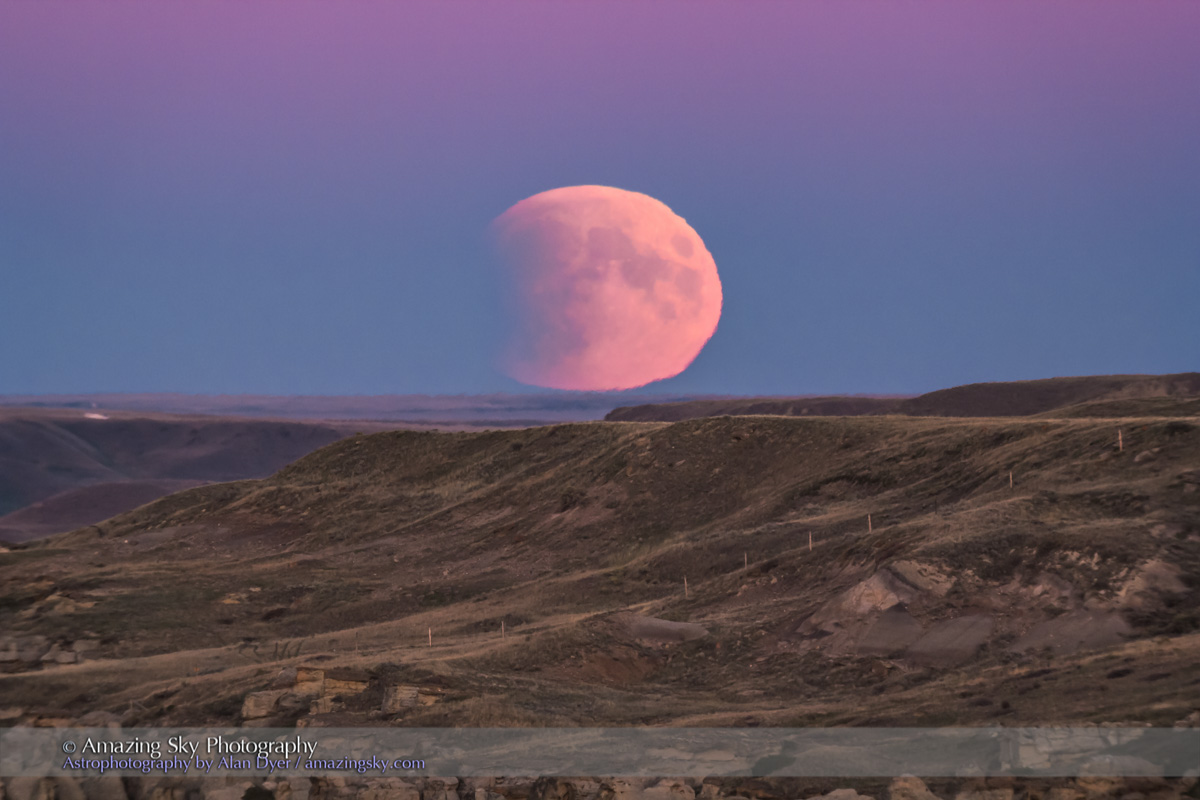
At 6 a.m. the waning gibbous Moon passed in front of the star Aldebaran in Taurus. It is performing many such occultations of Aldebaran this year, but most aren’t well seen from any one location. This one was ideal, right from my backyard.

The lead image is a “high dynamic range” stack of several exposures showing the waning Moon and star set in some high haze adding the sky colours.

The star winked out behind the Moon’s bright limb as the Moon advanced from right to left (west to east) against the background sky.

Occultation of Aldebaran
Aldebaran nearing the limb of the Moon.
This shows a composite sequence, with images of the star taken every four minutes blended with a single image of the Moon. While it looks like the star is moving, it is really the Moon that is edging closer to Aldebaran.

The star reappeared from behind the dark limb of the Moon, but five minutes after sunrise, with the Moon in a bright blue sky. Still, the star stood out nicely in binoculars and in the telescope for this view.

Aldebaran Near the Moon in Day Sky
Aldebaran off the dark limb of the Moon.
Aldebaran is the point of light at right, just off the invisible edge of the Moon.

I shot stills and video, and compiled them into this short video.

Enlarge it to full screen to view it properly.

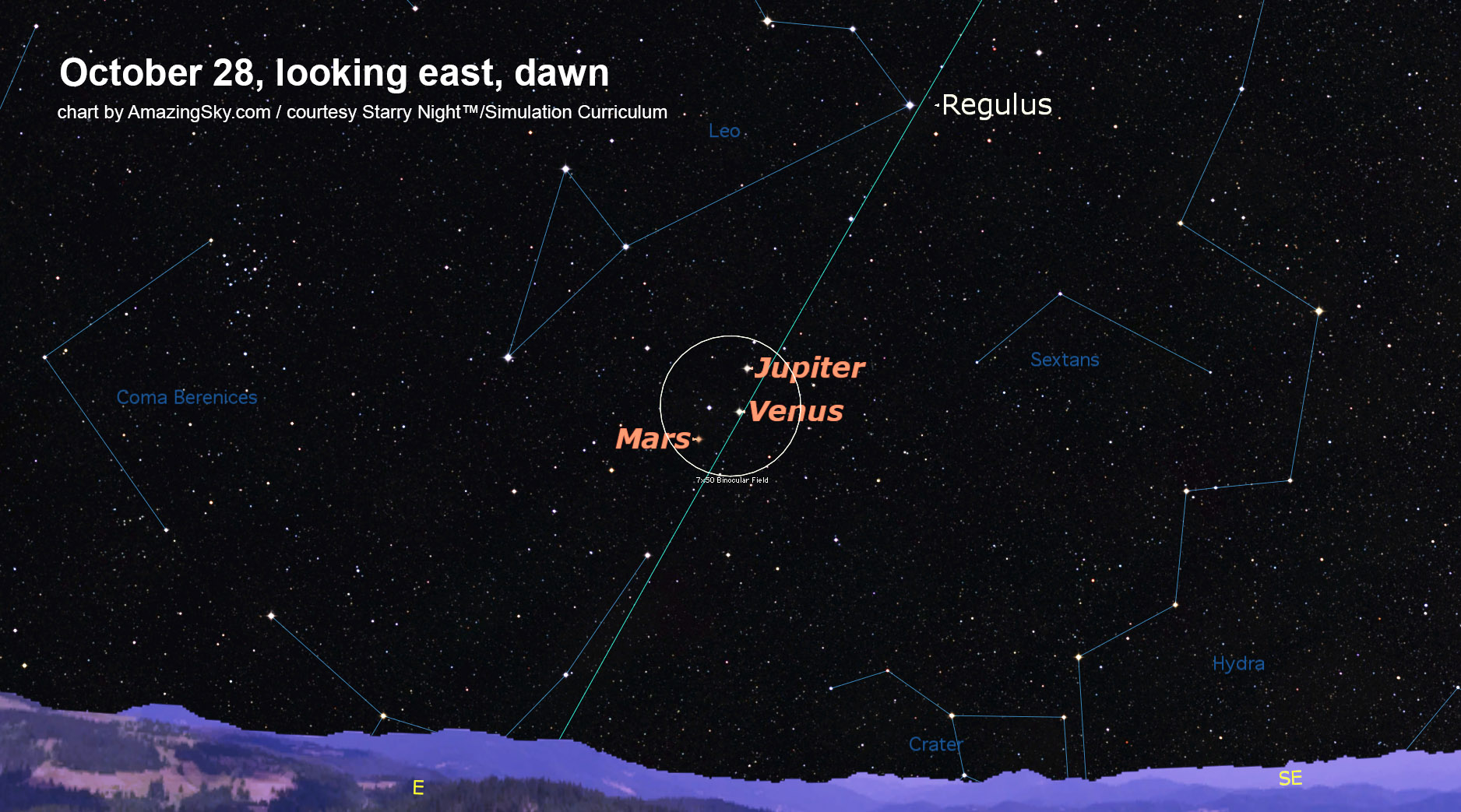
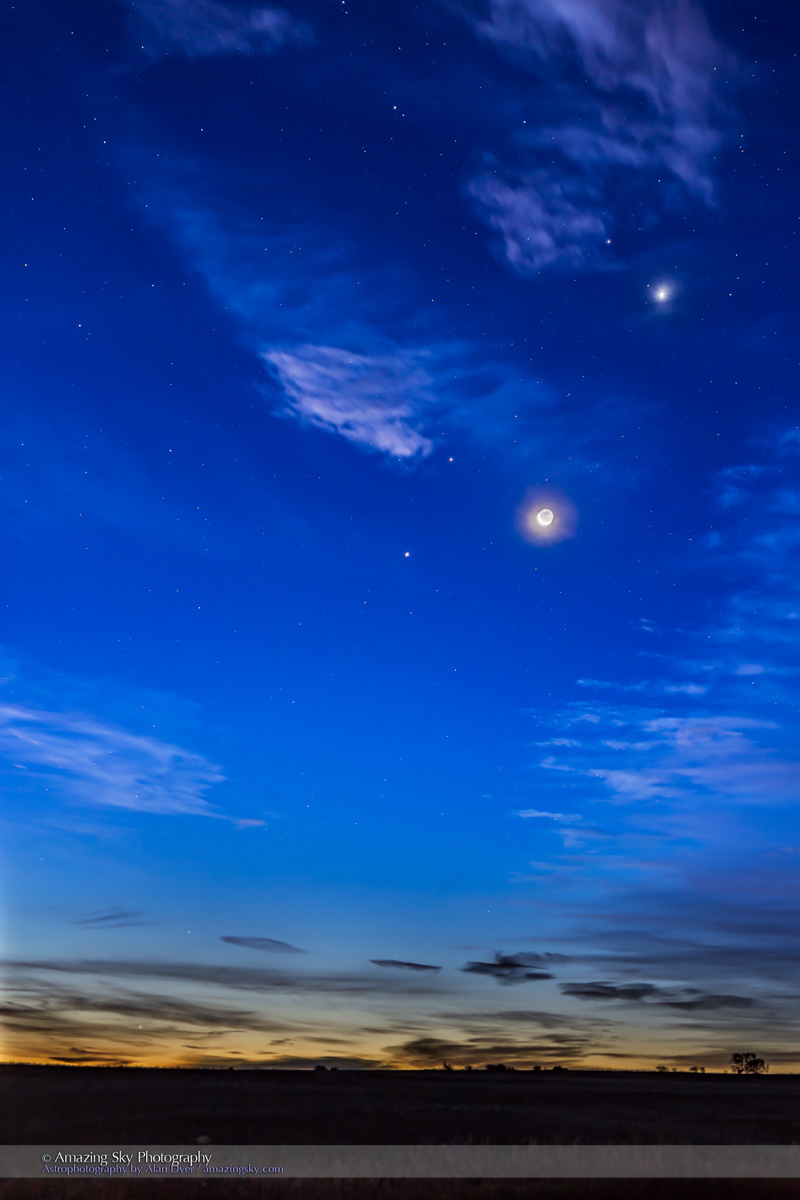
Meanwhile, over to the east the twilight sky was awash in planets.

Rocky Planets at Dawn with Labels (Sept. 12, 2017)
The line of dawn planets, with labels.
All the three inner terrestrial worlds were there: Venus, at top, Mercury below Regulus, and Mars lowest of the trio. Of course, a fourth terrestrial world is in the photo, too โ€“ Earth!

Mercury was at its greatest western elongation this morning, placing it as far from the Sun and as high in the sky as it gets, with this autumn appearance the best of 2017 for a morning showing for Mercury. Even so, you can see how Mercury is always low and easy to miss. However, this morning it was obvious to the naked eye.

Mars and Mercury will be in close conjunction at dawn on the morning of September 16.

Rocky Planets at Dawn (Sept. 12, 2017)

It was a fine morning to be up early and enjoy the solar system show.

โ€” Alan, September 12, 2017 / ยฉ 2017 Alan Dyer / amazingsky.com


The Night-Shadowed Prairie


The Night Shadowed Prairie

“No ocean of water in the world can vie with its gorgeous sunsets; no solitude can equal the loneliness of a night-shadowed prairie.” โ€“ William Butler, 1873

In the 1870s, just before the coming of the railway and European settlement, English adventurer William Butler trekked the Canadian prairies, knowing what he called “The Great Lone Land” was soon to disappear as a remote and unsettled territory.

The quote from his book is on a plaque at the site where I took the lead image, Sunset Point at Writing-on-Stone Provincial Park.

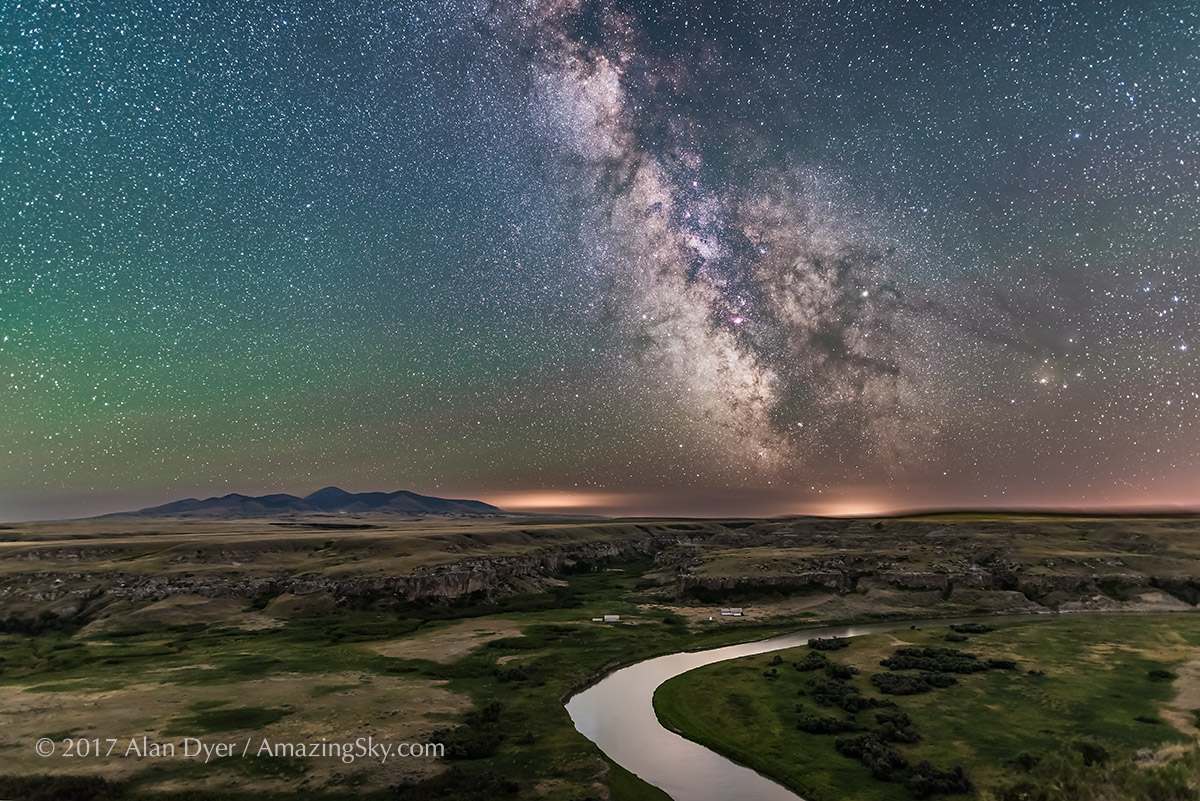
The night was near perfect, with the Milky Way standing out down to the southern horizon and the Sweetgrass Hills of Montana. Below, the Milk River winds through the sandstone rock formations sacred to the Blackfoot First Nations.

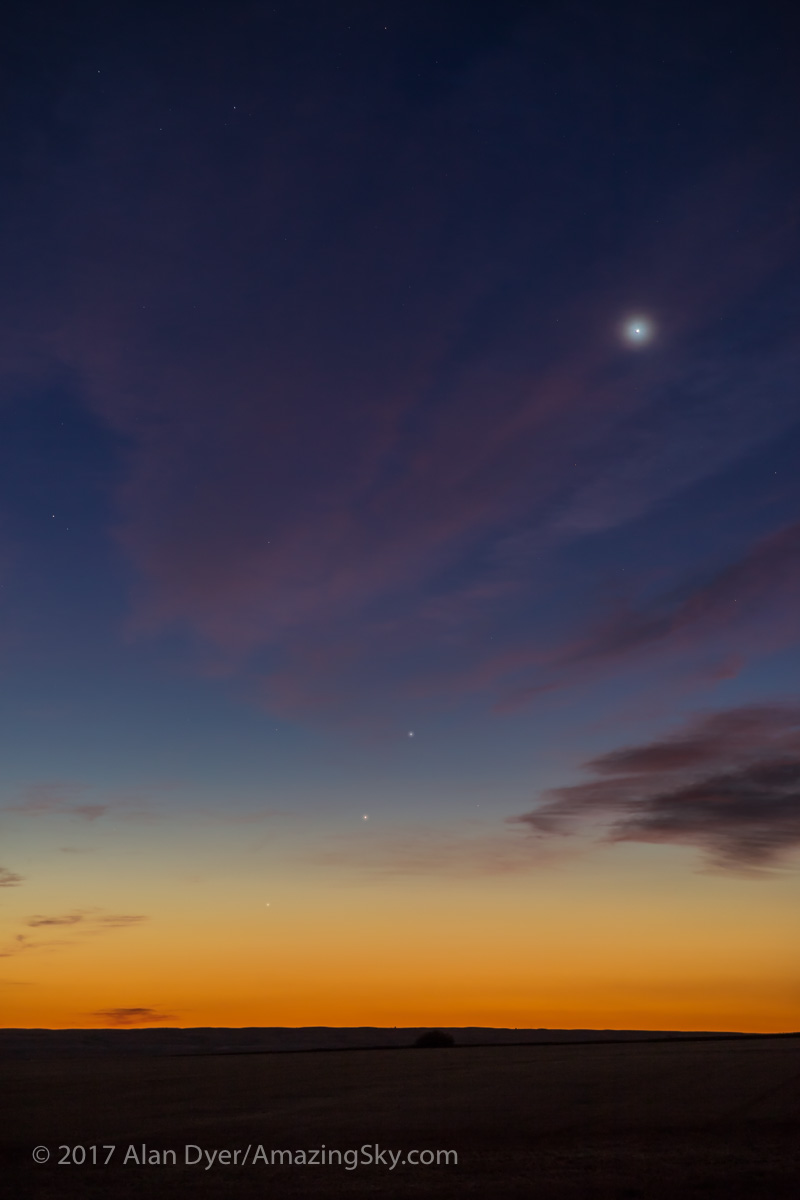
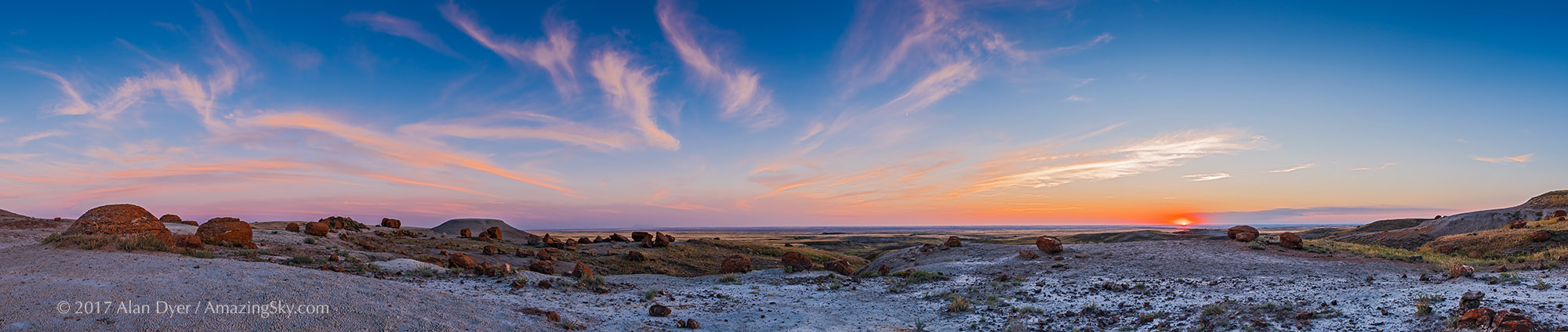
The next night (last night, July 26, as I write this) I was at another unique site in southern Alberta, Red Rock Coulee Natural Area. The sky presented one of Butler’s unmatched prairie sunsets.

Big Sky Sunset at Red Rock Coulee

This is “big sky” country, and this week is putting on a great show with a succession of clear and mild nights under a heat wave.

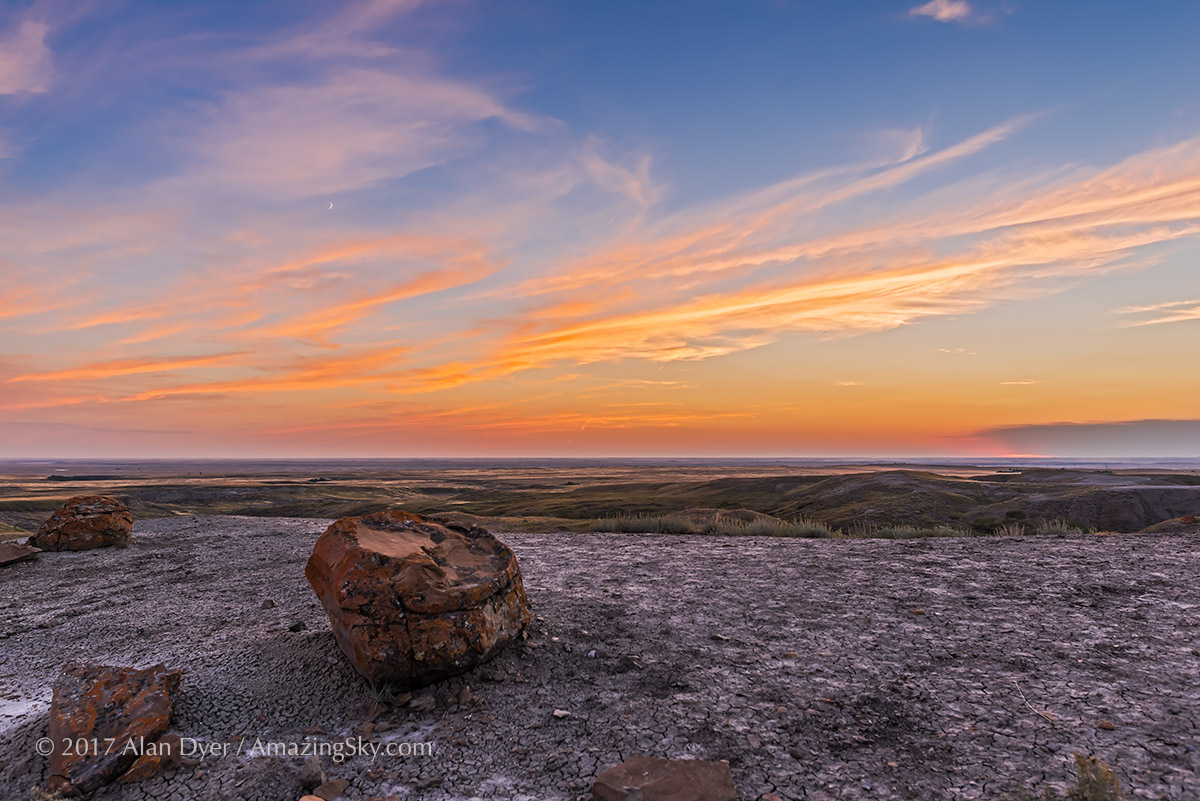
Waxing Crescent Moon at Red Rock Coulee

The waxing crescent Moon adds to the western sky and the sunsets. But it sets early enough to leave the sky dark for the Milky Way to shine to the south.

The Milky Way at Red Rock Coulee

This was the Milky Way on Wednesday night, July 27, over Red Rock Coulee. Sagittarius and the centre of the Galaxy lie above the horizon. At right, Saturn shines amid the dark lanes of the Dark Horse in the Milky Way.

I’m just halfway through my week-long photo tour of several favourite sites in this Great Lone Land. Next, is Cypress Hills and the Reesor Ranch.

โ€” Alan, July 27, 2017 / ยฉ 2017 Alan Dyer / amazingsky.com


The Austral Moon of Evening


Waxing Moon in Evening Twilight Colours

From the southern hemisphere the Moon appears “upside-down” and higher each night in the northern sky as it waxes from crescent to Full.

These are scenes from the last week as the Moon rose higher into the evening sky as seen from Australia.

A northerner familiar with the sky would look at these and think these are images of the waning Moon at dawn in the eastern sky.

Waxing Crescent Moon at Cape Conran
The โ€œupside-downโ€ waxing crescent Moon in the evening sky from Victoria, Australia, at Cape Conran, West Cape area, on the Gippsland Coast, at latitude 37ยฐ South. Earthshine lights the dark side of the Moon. This was March 31, 2017. The Moon lights a glitter path on the water. This is a single 1.3-second exposure at f/2 with the 85mm Rokinon lens, and Canon 5D MkII at ISO 400.

But no, these are of the waxing Moon (the phases from New to Full) with the Moon in the evening sky.

From the southern hemisphere the ecliptic โ€“ the path of the planets โ€“ and the path of the Moon arcs across the northern sky. So as the Moon waxes from New to Full phase it appears to the right of the Sun, which still sets in the west. The world still spins the same way down under!

So the Moon appears upside down and with the crescent phase the “wrong” way for us northerners.

Panorama of the Waxing Moon at Sunset at Welshpool Harbour
A 240ยฐ panorama from 16 segments.

This panorama taken April 4 sweepsย from northwest to southeast, but looksย north at centre, to captureย the scene at sunset of the waxing 8-day gibbous Moon in the northern sky as seen from the southern hemisphere.

The angle between the Sun and Moon is just over 90ยฐ, shown here by the angle between the right-angle arms of the wharf, pointedย to the west at left, to the north at centre, and to the east at right.

The Sun has set just north of west, while the Moon sits 13ยฐ east of due north. The Earthโ€™s shadow rises as the blue arc at far right to the east opposite the Sun.

Philip Island Sunset and Waxing Moon Panorama
A 240ยฐ panorama from 15 segments.

The next night, April 5, I shot this panorama from Philip Island south of Melbourne. Again, it shows the waxing gibbous Moon in the north far to the right of the setting Sun in the west (at left).

Getting used to the motion of the Sun and Moon across the northern sky, and the Moon appearing on the other side of the Sun than we are used to, is one of the challenges of getting to know the southern sky.

Things just don’t appear where nor move as you expect them to. But that’s one of the great delights of southern star gazing.

โ€” Alan, April 8, 2017 / ยฉ 2017 Alan Dyer / www.amazingsky.com


End of Year Skies


New Moon for a New Year

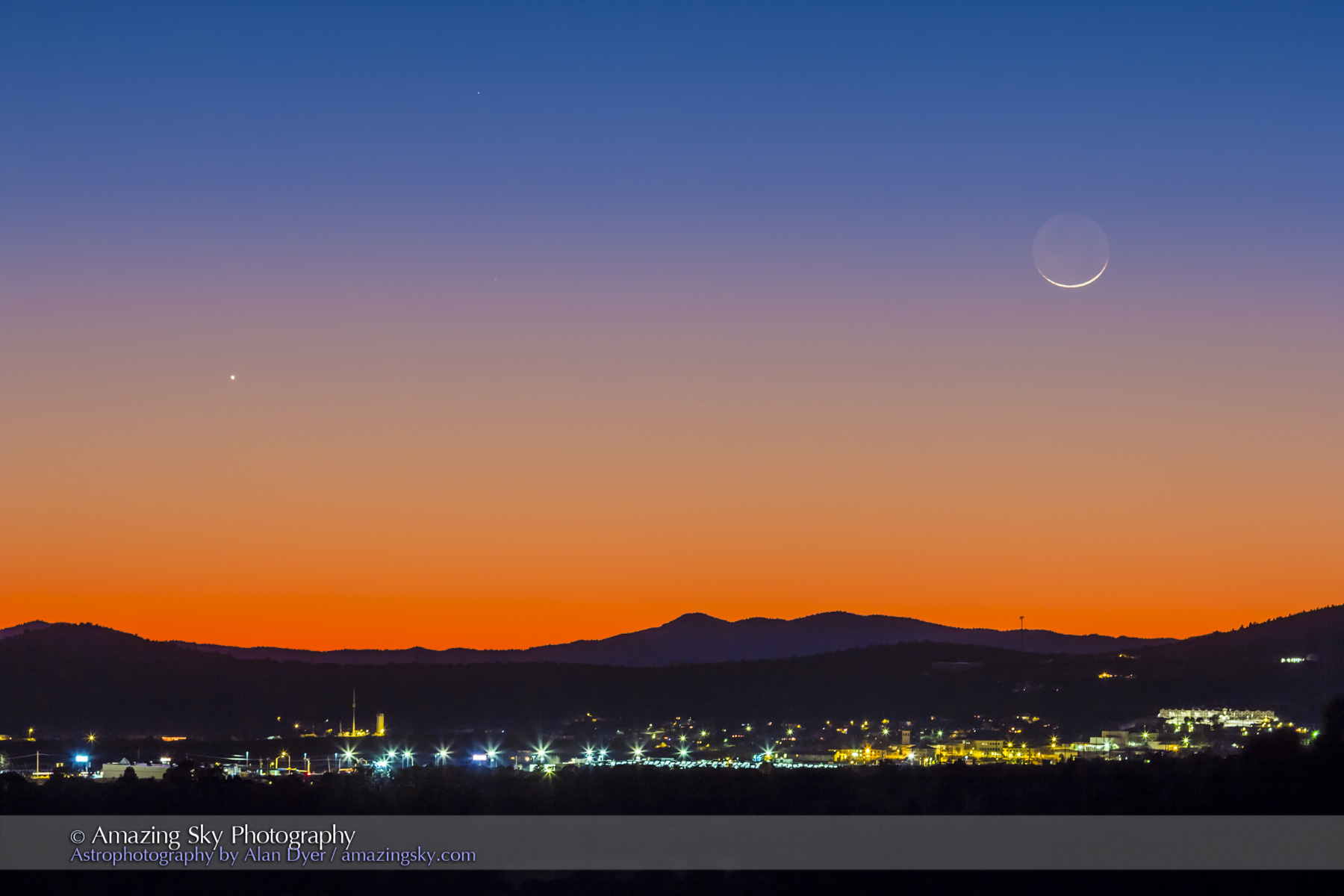
The crescent Moon rises into theย westernย evening sky as 2016 ends, while Venus shines bright, and Orion rises into the east.

Getting clear skies is a rare treat of late, but these are images from two such nights this week. On December 30, the thin waxing Moon appeared in the colourful twilight of a winter night. Despite the clouds and the Moon’s low altitude, the dark side of the Moon is plainly visible illuminated by Earthshine.

Venus in Twilight over Pioneer Grain Elevators

Venus is now brilliantย as an evening star in the southwest. Here is it over the old wood grain elevators at Mossleigh, Alberta, some of the few of these landmarks left standing on the prairies.

Fainter Mars shines above Venus and over the month of January, Venus will climb up to meet Mars by month’s end for a fine conjunction with the crescent Moon as well. Watch through January as Venus and Mars converge.

Orion and Pioneer Grain Elevators

As the planets set into the southwest, Orion the Hunter rises into the east. Here it is over the Mossleigh elevators, illuminated by local lights.

Enjoy the winter skies as clouds permit!

Clear skies and Happy New Year!

โ€” Alan, December 31, 2016 / ยฉ 2016 Alan Dyer / www.amazingsky.com


Arch of the Sky Above and Land Below


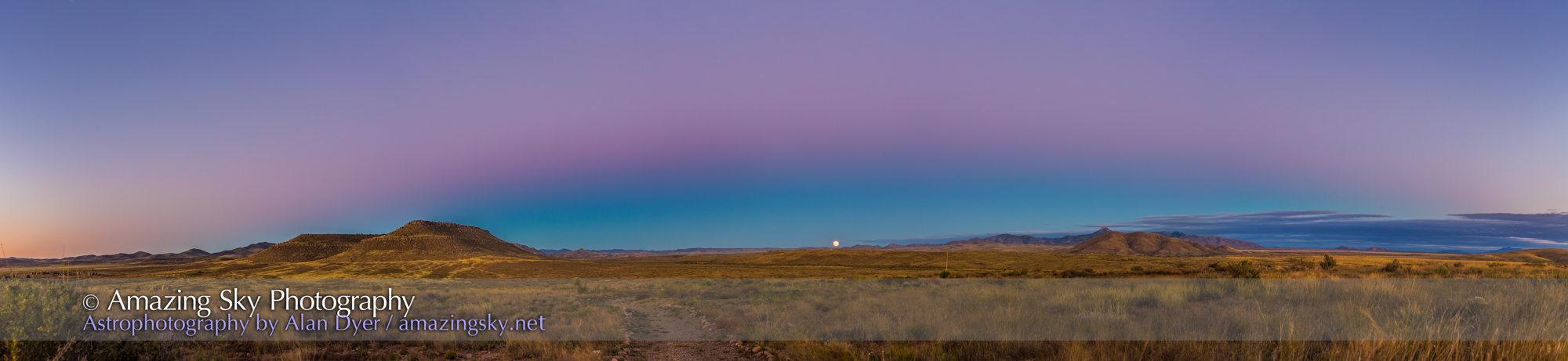
Harvest Moon Rising over the Red Deer River

On Friday night the Harvest Moon rose amid the arching shadow of the Earth.

This was the view on Friday, September 16 at moonrise on the Red Deer River. The view is from the Orkney Viewpoint overlooking the Badlands and sweeping curve of the river.

Above is the wideย arch of the dark shadow of the Earth rising into the deepening twilight. Almost dead centre in the shadow is the Full Moon, the annual Harvest Moon.

Hours earlier the Moon passed through the shadow of our planet out at the Moon’sย distance from Earth, creating a minor penumbral eclipse. No part of that eclipse, such as it was anyway, was visible from here.

But the alignment did place the Moon in the middle of our planet’s shadow projected into our atmosphere, as it doesย at every sunset and sunrise.

But it takes a very clear sky for the shadow to stand out as well as this in the darkening sky. I like how the curve of the shadow mirrors the curve of the river.

This is a marvellous spot for photography. I shared the site with one other photographer, at far right, who also came to capture the rising of the Harvest Moon.

The image is a 7-segment panorama with a 20mm lens, stitched with Adobe Camera Raw.

โ€” Alan, September 17, 2016 / ยฉ 2016 Alan Dyer / AmazingSky.com
TWAN-black


The Cadence of the Moving Sky


Saturn, Mars and the Milky Way over the Bow River

Saturn, Mars and the Milky Way appeared in the twilight over the Bow River.

I shot this scene on August 24 from the viewpoint at Blackfoot Crossing Historical Park, overlooking the Bow River. Mars appears between Saturn above and Antares below, in a line of objects west of the Milky Way.

The valley below is the traditional meeting place of the Blackfoot Nation, and the site of the signing of Treaty Seven between Chief Crowfoot and Colonel MacLeod of the North West Mounted Police in 1877.

The image is a panorama of two images, each 20-second exposures at f/2 and ISO 1600 with the 24mm lens. I shot them just prior to shooting time-lapses of the moving sky, using two cameras to create a comparison pair of videos, to illustrate the choices in setting the cadence when shooting time-lapses.

The movies, embedded here, will be in the next edition of my Nightscapes and Time-Lapse ebook, with the current version linked to below. The text explains what the videos are showing.


Choose Your Style

When shooting frames destined for a time-lapse movie we have a choice:

  • Shoot fewer but longer exposures at slower ISOs and/or smaller apertures.

OR …

  • Shoot lots of short exposures at high ISOs and/or wide apertures.


The former yields greater depth of field; the latter produces more noise. But with time-lapses, the variations also affect the mood of a movie in playback.

This comparison shows a pair of movies, both rendered at 30 frames per second:

Clip #1 was taken over 2 hours using 20-second exposures, all at ISO 2000 and f/2 with 1-second intervals. The result was 300 frames.

Clip #2 was taken over 1 hour using 5-second exposures also at f/2 and 1-second intervals, but at ISO 8000. The result was 600 frames: twice as many frames in half the time.

Clip #1 shows fast sky motion. Clip #2 shows slow motion.

Clip #2 exhibits enough noise that I couldnโ€™t bring out the dark foreground as well as in Clip #1. Clip 2 exhibits a slower, more graceful motion. And it better โ€œtime-resolvesโ€ fast-moving content such as cars and aircraft.

Which is better? It depends …

Long = Fast

The movie taken at a longer, slower cadence (using longer exposures) and requiring 2 hours to capture 300 frames resulted in fast, dramatic sky motion when played back. Two hours of sky motion are being compressed into 10 seconds of playback at 30 frames per second. You might like that if you want a dramatic, high-energy feel.

Short = Slow

By comparison, the movie that packed 600 frames into just an hour of shooting (by using short exposures taken at fast apertures or fast ISOs) produced a movie where the sky moves very slowly during its 10 seconds of playback, also at 30 frames per second. You might like that if you want a slow, peaceful mood to your movies.

So, if you want your movie to have a slow, quiet feel, shoot lots of short exposures. But, if you want your movie to have a fast, high-energy feel, shoot long exposures.

As an aside โ€“ all purchasers of the current edition of my ebook will get the updated version free of charge via the iBooks Store once it is published later this year.ย 

โ€” Alan, August 26, 2016 / ยฉ 2016 Alan Dyer / AmazingSky.com
 

Moon and Star Conjunction


Moon and Aldebaran (July 29, 2016)

The waning Moon shone near the bright star Aldebaran in the dawn sky.

This was a beautiful sight this morning, before dawn on July 29. The crescent Moon, its night side illuminated by Earthshine, shone just below the brightest star in Taurus.

We are currently in 3-year period when the Moon’s path is taking it near or in front of Aldebaran every month. However, most of these occultations or conjunctions are not well-timed for any particular location. And many involve the too-brilliant gibbous or full Moon.

But this morning the timing and Moon phase were perfect. From my longitude on Earth in Alberta, the Moon passed closest to the star just before the sky was getting too bright with dawn. Having them set against the deep blue twilight was perfect.

From farther east the Moon would not have appeared as close to Aldebaran as this before sunrise. From farther west the Moon and star would have appeared much lower in the sky at closest approach.

Moon & Aldebaran Screen

TECHNICAL:

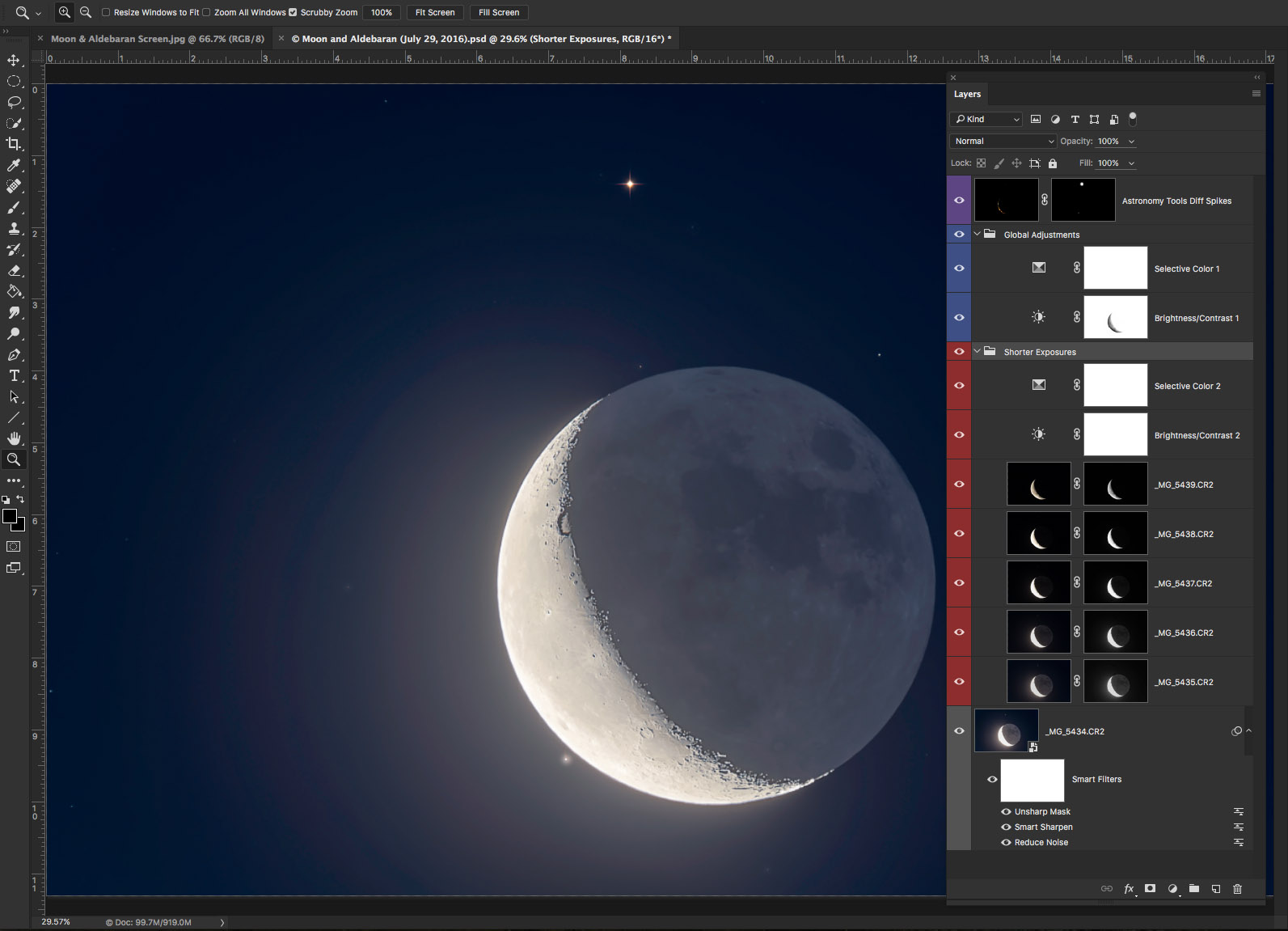
For this image I shot 6 exposures, from 2 seconds for the Earthshine, twilight sky colour and stars, to 1/125th second for the bright crescent. I then stacked, aligned, and blended them together using luminosity masks โ€“ masks that hide or reveal parts of the image based on the brightness of the scene. You can see them in the Photoshop screen shot – Click on the image to enlarge it.

How do you create these masks?

โ€ข Turn off all the layers except the one you want to create a mask for.

โ€ข Go to Channels and Command/Control Click on the RGB Channel.

โ€ข That automatically selects all the highlights.

โ€ข Go back to the image layer and then hit the Add Mask button down at the bottom of the Layers panel (the rectangle with the black dot in it).

โ€ข Done. Repeat that for each image layer.

More traditional high dynamic range or “HDR” stacking left odd colour fringing artifacts and double images on the slowly moving Moon, despite applying what is called “de-ghosting” and despite using a mount tracking at the lunar rate. I tried merging the images withย HDR, but it didn’t work.

A nifty Photoshop action from the Astronomy Tools set by Noel Carboni added the diffraction spikes.

I shot all images with the 130mm Astro-Physics refractor at f/6 and the Canon 60Da camera at ISO 400.

โ€” Alan, July 29, 2016 / ยฉ 2016 Alan Dyer / www.amazingsky.com

Tis the Season for Night Shining Clouds


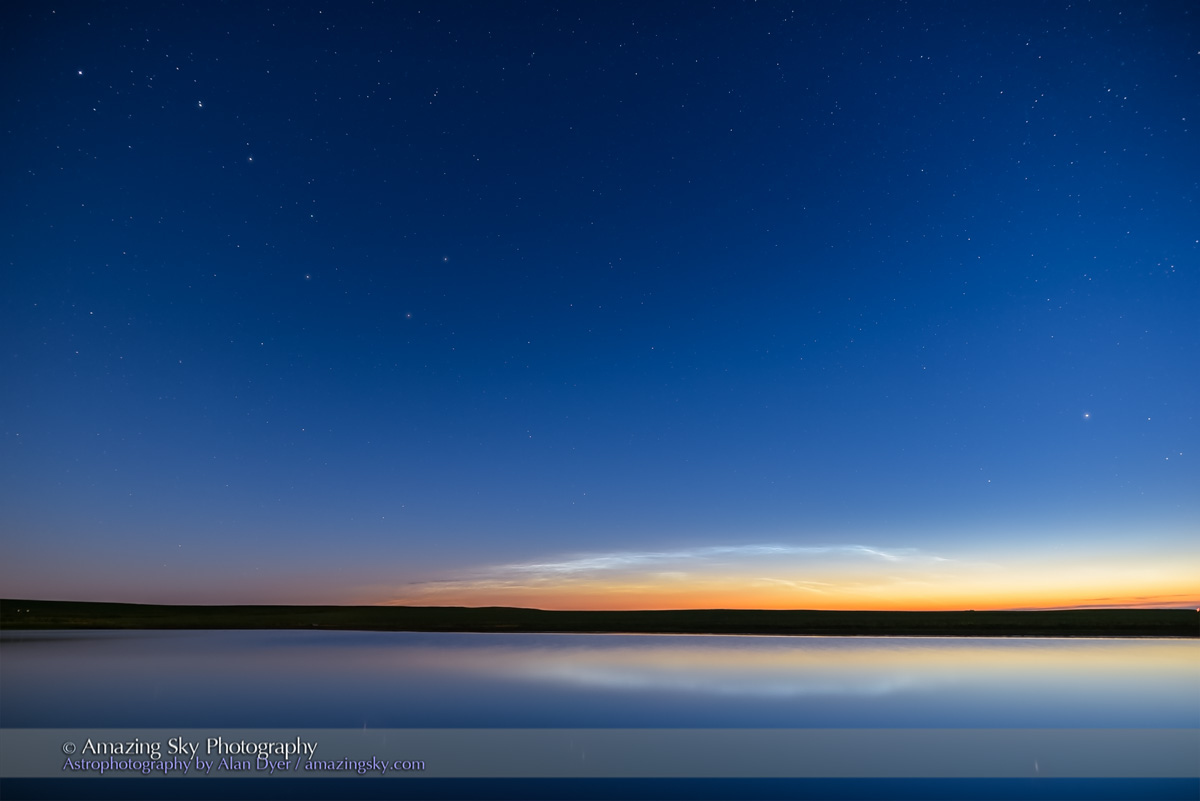
Noctilucent Clouds and Big Dipper

A bright display of noctilucent clouds last night prompts me to remind northerners to look north at this prime season for night shining clouds.

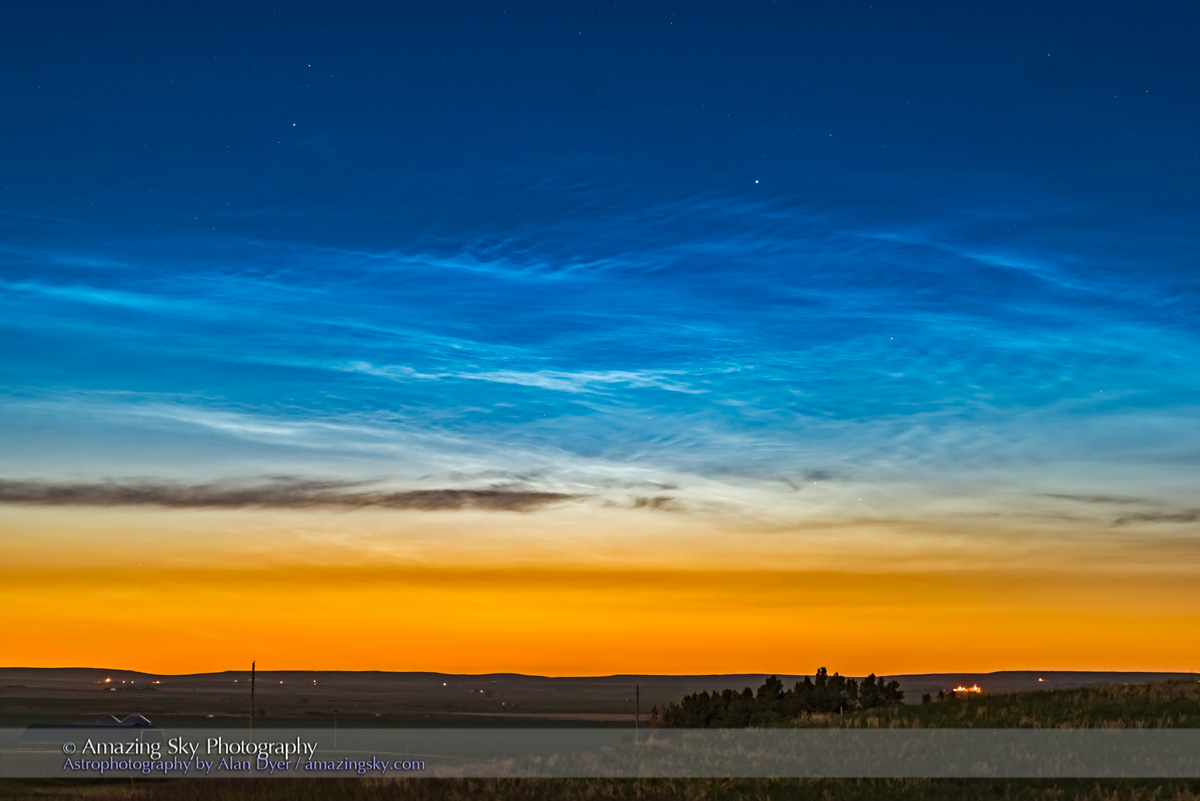
Noctilucent clouds (NLCs) can be seen only in summer and are best in the few weeks before and after (mostly after) summer solstice. I shot all these images in the middle of the night. Indeed, the two images above and just below areย from 3 am on the morning of June 27.

NLCsย are high altitude clouds at the edge of space some 80 kilometres above the Earth, far above any normal weather clouds. Their height allows sunlight streaming over the pole to illuminate them all night long.

Noctilucent Clouds over Pond
Noctilucent clouds at 3 am on June 27 over a prairie pond in southern Alberta. The NLCs were visible as an arc across the north for at least 2 hours and were still there as dawn twilight brightened at 3:30 am. This is looking due north with the bowl of the Big Dipper at upper left. Capella is at lower right. Shot with the 24mm lens.

Their cause is a mystery. They may formย by water vapour condensing on meteoric dust particles.

They look luminescent, as if glowing on their own. But these are not auroras. They shine only by reflected sunlight.

And they have complex structures, with intricate waves and ripples.

Noctilucent Clouds (June 17, 2016)
A display of noctilucent clouds, the first good display of the season from my area of southern Alberta, on June 17/18. 2016. This is with a 105mm telephoto and the Nikon D750, and is the first frame of a 1000-frame time-lapse sequence. However, as the Sun dropped farther below the horizon the clouds did lose illumination and faded, from the top down.

And they move very slowly, as this time-lapse from June 17 shows.

Readers living at a latitude between 45ยฐ and 55ยฐ are best situated to see “NLCs.” From farther south the clouds will be below the horizon. From farther north the sky may be too bright with twilight and the angle of illumination wrong for optimum viewing.

For more information, check the Wikipedia article.ย 

Unlike auroras, there is no predicting when they might appear. Some nights when it is clear where you are, no NLCs appear. Perhaps that’s because of cloud much farther north blocking the pathย of light from the Sun on the other side of the planet to the clouds on our side of the Earth.

But by the end of July NLC season is coming to an end as the Sun drops farther below the northern horizon at night, and the nights get darker.

So over the next four weeks, look low in the north for night shining clouds.

โ€” Alan, June 27, 2016 / ยฉ 2016 Alan Dyer / www.amazingsky.comย 


Mars and the Milky Way at Emerald Lake


The Milky Way over Emerald Lake, Yoho

The nights were short and never fully dark, but early June provided a run of clear nights in the Rockies to enjoy Mars and the Milky Way.

Weather prospects looked good for a run of five nights last week so I took advantage of the opportunity to shoot nightscapes from Banff and, as shown here, in Yoho National Park across the Continental Divide in B.C.

The lead image above is a sweeping panorama at Emerald Lake, one of the jewels of the Rockies. Though taken at 1:30 a.m., the sky still isn’t dark, but has a glow to the north that lasts all night near summer solstice. Even so, the sky was dark enough to reveal the Milky Way arching across the sky.

The mountain at centre is Mt. Burgess, home of the famous Burgess Shale Fossils, an incredible collection of fossilized creatures from the Cambrian explosion.

The image is a panoramic stitch ofย 24 segments but cropped in quite a bit from the original, and all shot with an iPano motorized panning unit. Each exposure was 30 seconds at f/2.2 with the Sigma 24mm lens and Nikon D750 at ISO 4000. One short exposure of the lodge was blended in to reduce its light glare. The original, stitched withย PTGui software, is 15,000 x 9,000 pixels.

The Milky Way at Emerald Lake, Yoho
The Milky Way over the side pond at Emerald Lake, Yoho National Park, BC., from the bridge to the Lodge. This is a stack of 8 x 25-second exposures for the foreground (mean combined to smooth noise), and one untracked exposure for the sky (to minimize trailing), all at f/2.8 with the Rokinon 14mm lens and Canon 6D at ISO 6400.

The viewย above, a single frame image, shows the view to the south as the Milky Way and galactic centre descend toward the horizon over the south end of the lake. Lights from the Lodge illuminate the trees.

Reflections of Mars at Emerald Lake
Mars, at right, reflected in Emerald Lake at twilight in Yoho National Park, BC, June 7, 2016. This is a single 6-second exposure at f/3.2 with the Sigma 20mm lens and Nikon D750 at ISO 100.

The next night (above) I was at the same spot to shoot Mars in the deepening twilight, and reflected in the calm waters of Emerald Lake, with Cathedral Peak at left.

Reflections of Cassiopeia at Emerald Lake
This is a vertical panorama of 4 segments, taken with the iPano unit, and with each segment a 30-second exposure at f/2.2 with the Sigma 24mm Art lens and Nikon D750 at ISO 4000. Stitched with Adobe Camera Raw.

Another multi-frame panorama, this time sweeping up from the horizon, captures Cassiopeia (the “W”) and the rising autumn constellations reflected in the lake waters.

Vega is at top, Deneb below it, while the stars of Perseus and Pegasus are just rising.

It was a magical two nights in Yoho, a name that means “wonderful!” Both by day and by night.

โ€” Alan, June 9, 2016 / ยฉ 2016 Alan Dyer / AmazingSky.com


Glows and Streaks in the Spring Sky


The Spring Sky over the Pioneer Farmstead

How many sources of skyglow can you pick out here?

There are at least five:

โ€ข the Milky Way (at left),

โ€ข green airglow (below the Milky Way),

โ€ข all too prevalent light pollution (especially reflected off the clouds coming in from the west at right),

โ€ข lingering blue twilight across the north (at left and right), common in May and June from my northern latitude,

โ€ข and even a touch of aurora right at the northern horizon at far left.

In this scene from May 28, the Milky Way arches over an abandoned pioneer farmstead from the 1930s and 40s near my home in southern Alberta.

Mars (very bright and in some clouds) and Saturn shine at lower centre, while Jupiter is the bright object in clouds at right just above the old house.

Arcturus is the brightest star here at upper right of centre, made more obvious here by shining through the clouds. The Big Dipper, distorted by the map projection used in the this panorama, is at upper right.

Technical: This is a 360ยฐย horizon to zenith panorama taken with the iPano motorized panning unit, using the 24mm lens at f/2.8 and Nikon D750 at ISO 6400, for a stitch of 28 panels, in 4 tiers of 7 segments each. Stitched with PTGui. South is at centre, north to either end. The original is 25,700 x 7,700 pixels.

Just afterย I shot the panorama I captured the International Space Station passingย directly overhead in one of several passes this night.

ISS Pass #2 (May 28/29, 2016)
The second Space Station pass of May 28/29, 2016, at 1:40 a.m., with cloud moving in adding the glows to all the stars. Taken with the 8mm fish-eye lens from home. The Big Dipper is high in the west at right. Mars is bright at bottom, to the south. Several other satellites are in the sky as well. This is a stack of 3 exposures, each 2.5-minutes with the camera on the Star Adventurer tracker.

At this time of year the ISS is lit all night by the Sun that never sets for the astronauts. We see the ISS cross the sky not once but several times in a night at 90-minute intervals.

While the sky near solstice is never dark at my latitude, it does have its compensations and attractions.

โ€” Alan, May 29, 2016 / ยฉ 2016 Alan Dyer / AmazingSky.com
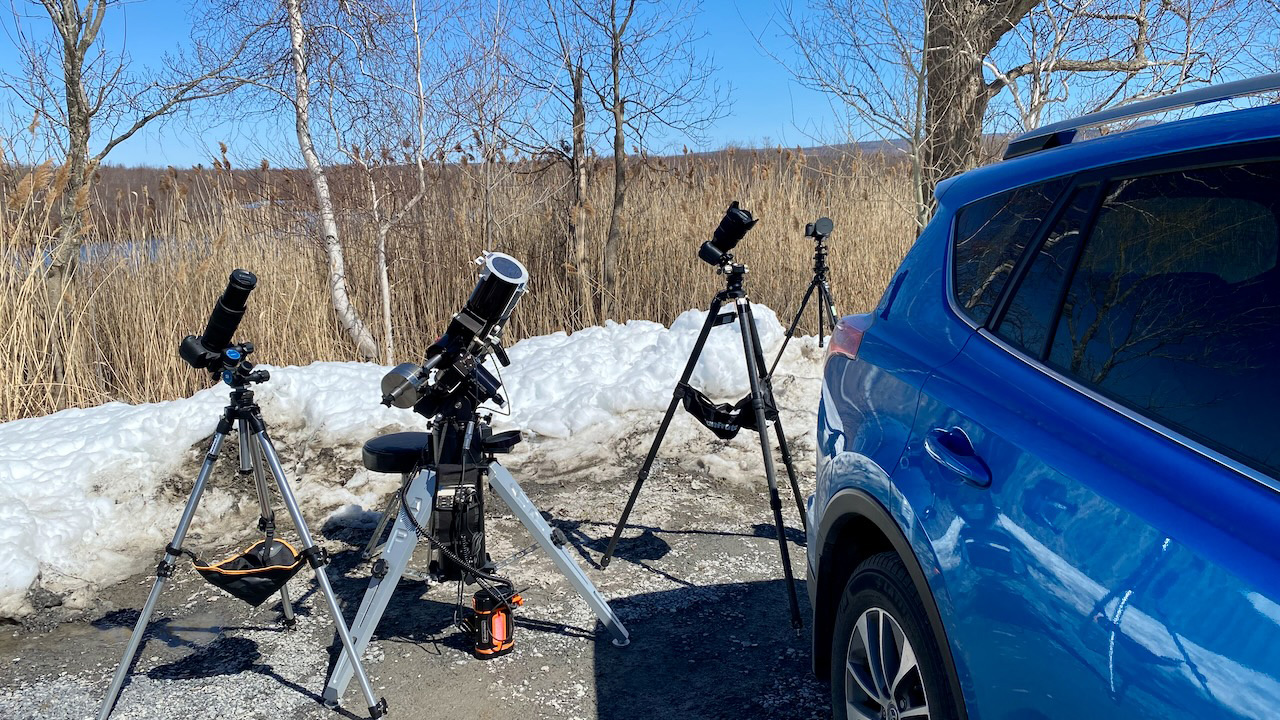
 

Mars Bright in the Spring Sky


Spring Sky over the Badlands Panorama

Mars is now shining brightly in the evening sky, as close and as bright as it has been since 2005.

Look southeast to south after dark and you’ll see a brilliant reddishย “star.” That’s Mars, now at opposition, and retrogradingย slowly westward each night through Scorpius into Libra.

My image above captures Mars set in the entirety of the northern spring sky, complete with the arch of the Milky Way, twilight glows to the north (at left), some satellite trails …

… and Mars itself as the brightest objectย just right of centre shining above the landscape of Dinosaur Provincial Park.

Just to the left of Mars is Saturn, while below both is the star Antares in Scorpius, for a neat triangle of objects. Jupiter is the bright object in Leo at far right.

Technical: I shot the lead imageย on the evening of May 25. It is aย 360ยฐ and horizon-to-zenith panorama stitchedย from 44 images, taken in 4 tiers of 11 panelsย each, shot with aย motorized iOptron iPano mount. I used aย 35mm Canon lens at f/2.8 for 30-second exposures with the Canon 6D at ISO 6400. Iย stitched the images with PTGui. The original image is a monster 32,500 pixels wide by 8,300 pixels high.

Mars at Opposition Rising over the Badlands
This is a stitch in Adobe Camera Raw of 9 segments, each with the Canon 35mm lens at f/5.6 and Canon 6D at ISO 800.

I shot the panorama above earlier in the evening, when Mars and Saturn were just rising in the southeast at left, and the sky to the northwest at right was still bright with twilight.

This shows the geometry of Mars at opposition. It lies opposite the Sun and is so rising at sunset and directly opposite the sunset point. The Sun, Earth and Mars are in a straight line across the solar system with Earth in the middle and as close to Mars as we get.

Actual date of opposition was May 22 but Earth is closest to Mars on May 30. That’s when it will look largest in a telescope. But to the unaided eye it appears as a bright red star.

Whether with eye or telescope, have a look!

โ€” Alan, May 27 / ยฉ 2016 Alan Dyer / www.amazingsky.comย 

Spectacular Skies at a Lighthouse


Lighthouse Beams by the Southern Cross

The sky and sea present an ever-changing panorama of light and colour from the viewย point of an Australian lighthouse.

Last week I spent a wonderful four nights at the Smoky Cape Lighthouse, in Hat Head National Park, on the Mid-North Coast of New South Wales. I was after panoramas of seascapes and cloudscapes, and the skies didn’t disappoint.

At sunset, as below, the sky to the east glowed with twilight colours, with the bright clouds providing a beautiful contrast against the darkening sky. The kangaroo at far right was an added bonus as he hopped into frame just at the right time.

Smoky Cape Lighthouse at Twilight Panorama
A 270ยฐ or so panorama of the Smoky Cape Lighthouse near South West Rocks on Trial Bay, NSW, Australia, and in Hat Head National Park. This is a stitch of 12 segments, each a single 1.6-second exposure at f/8 with the 35mm lens in landscape orientation. Stitching with Adobe Camera Raw.

At sunrise, the Sun came up over the ocean to the east, providing a stunning sceneย to begin the day.

Smoky Cape Lighthouse Sunrise Panorama
I shot this at dawn on April 28, 2016. This is a 7-section panorama with each section being a 5-exposure HDR stack, all stacked and stitched in Adobe Camera Raw.

The Smoky Cape Lighthouse was lit up for the first time inย 1891. It was staffed for decades by three keepers and their families who lived in the cottages visible in the panoramas above. They tended to the kerosene lamps, to cleaning the lenses, and to winding the weight-driven clockwork mechanism that needed resettingย every two hours to keep the reflector and lens assembly turning. By day, they would draw the curtains across to keep the Sun from heating up the optics.

Lighthouse Lenses

The huge optical assembly uses a set of nine lenses, each a massive fresnel lens, to shot focused beams out to sea. The optics produce a trio of beams, in three sets.

Each night you could see the nine beams sweeping across the sky and out to sea, producing a series of three quick flashes followed by a pause, then another three flashes, the characteristic pattern of the Smoky Bay Light. Each lighthouse has its own flashing pattern.

Lighthouse Beams by the Southern Cross
Beams from the Smoky Cape Lighthouse in the twilight sky, beaming out beside the stars of the Southern Cross and the Pointers (Alpha and Beta Centauri) below, rising into the southeast sky in the deepening blue twilight. This is a single 0.6-second exposure at f/2.8 with the 35mm lens and Canon 6D at ISO 6400.

The lead photo, repeated above, shows the beams in the twilight, with the stars of the Southern Cross as a backdrop. Three beams are aimed toward the camera while the otherย two sets of beam trios are shooting away out to sea.

The image below shows the beam trio shining out over the water toward one of the dangerous rocks off shore.

Lighthouse Beams over the Starry Sea
The trio of beams from the Smoky Cape Lighthouse scanning across the sea and sky in an exposure shot as short as possible to freeze the beams. This is a single 1.6-second exposure at f/1.4 and ISO 12800, wide and fasrt to keep the beams from blurring too much.

The Lighthouse was converted to electricity in 1962, when staff was reduced. Then in the 1980s all lighthouses were automated and staff were no longer needed.

While we might romanticize the life of a lighthouse keeper, it was a lonely and hard life. Keepers were usually married, perhaps with children. While that may have lessened the isolation, it was still a difficultย life for all.

Today, some of the cottages have been converted into rentable rooms. I stayed in the former house of the main light keeper, filled with memorabilia from the glory days of staffed lighthouses.

Southern Cross and Pointers from Smoky Cape
The Southern Cross, Crux, and the Pointer Stars, Alpha and Beta Centauri, above in the moonlight of the waning gibbous Moon before dawn, from the Smoky Cape Lighthouse looking southwest, on the coast of New South Wales, Australia. The Cape was named by James Cook in 1770 for the fires he saw on shore here. This is a single 5-second exposure at f/2.8 with the 35mm lens and Canon 6D at ISO 1000.

The image above takes in the Southern Cross over the moonlit beach in the dawn twilight.

The last image below is my final astrophoto taken on my current trip to Australia, a 360ยฐ panorama of the Milky Way and Zodiacal Light from the back garden of the Lighthouse overlooking the beach at Hat Head National Park.

Milky Way over Smoky Cape Panorama
A 360ยฐ panorama and from horizon to zenith of the southern sky and Milky Way from Smoky Cape and the grounds of the Lighthouse and Cottages. The panorama is a stitch of 9 segments, each shot with the 15mm full-frame fish-eye lens in portrait orientation, and at f/2.8 with the Canon 6D at ISO 3200. All exposures 1 minute, untracked on a tripod. Stitched in PTGui using equirectangular projection.

It’s been a superb trip, with over half a terabyte of images shots and processed! The last few blogs have featured some of the best, but many more are on the drives for future posts.

Now, back to Canada and spring!

โ€” Alan, May 4, 2016 / ยฉ 2016 Alan Dyer / www.amazingsky.comย 


Moon of the Austral Sky


Sunset and Waxing Moon over AAT Dome

When visiting southern latitudes nothing disorients a northern hemisphere astronomer more than seeing our familiar Moon turned โ€œthe wrong way!โ€

With the Moon now dominating the night sky, my photo attention in Australia turns to it as my celestial subject.

Itโ€™s wonderful to see the Moon as a crescent phase in the evening sky, but now flipped around so it looks like the Moon we see from home upย north when it is a waning crescent in the morning.

However,ย the lead image above actually shows the waxing crescent in the evening. It shines above the volcanic hills near Warrumbungles National Park, with the added silhouette of the dome of the Australian Astronomical Telescope, the largest optical telescope in Australia.

After a lifetime of seeing the Moon in its northerly orientation, seeing the austral Moon throws off your sense of time and direction. Are we looking west in the evening? Or east in the morning? The Moon just doesnโ€™t make sense!

Full Moon with Glitter Path
This is a two-exposure composite: a long exposure for the sky and ocean, and a short exposure for the disk of the Moon itself, to preserve some detail in the disk, specifically the mare areas to show the face of the Moon and not an overexposed white disk. Both with the 135mm telephoto and Canon 6D, from Woolgoolga, NSW.

Then thereโ€™s the Full Moon. It rises in the east, as does the Sun. But like the Sun, the “down under Moon”ย moves from right to left across the northern, not southern sky. And the familiar โ€œMan in the Moonโ€ figure is upside down, as seen above.

The photo above is from Friday night, and shows the Full Moon rising in the northeast over the Pacific Ocean.

Golden Glitter Path of the Moon
The apogee Full Moon of April 22, 2016 rising over the Pacific Ocean and lighting the waters with a golden glitter path of reflected moonlight. I shot this from the Woolgoolga Headlands viewpoint, with the 135mm telephoto and Canon 6D. This is a high dynamic range stack of 5 exposures to compress the range in brightness. Even so, the Moon itself is still overexposed.

This “HDR”ย image above from earlier in the evening captures the golden glitter path of moonlight on the ocean waves. I photographed these Full Moon scenes from the Headlands viewpoint at Woolgoolga, a great spot for panoramic seascapes.

The Full Moon this night was the apogee Full Moon of 2016 โ€“ the smallest and most distant Full Moon of the year, the opposite of a “supermoon.”

Gibbous Moon Over Upper Ebor Falls
This is a high dynamic range stack of 7 exposures to preserve the range in brightness between the bright sky and Moon, and the dark ground in the dim twilight.

Earlier in the week I was inland, high on the New England Tablelands in New South Wales. This image shows the waxing gibbous Moon in the evening twilight over Ebor Falls on the Guy Fawkes River, one of the few waterfalls on the famed Waterfall Way in New Soith Wales that has water flowing year round.

โ€” Alan, April 24, 2016 / ยฉ 2016 Alan Dyer / www.amazingsky.com
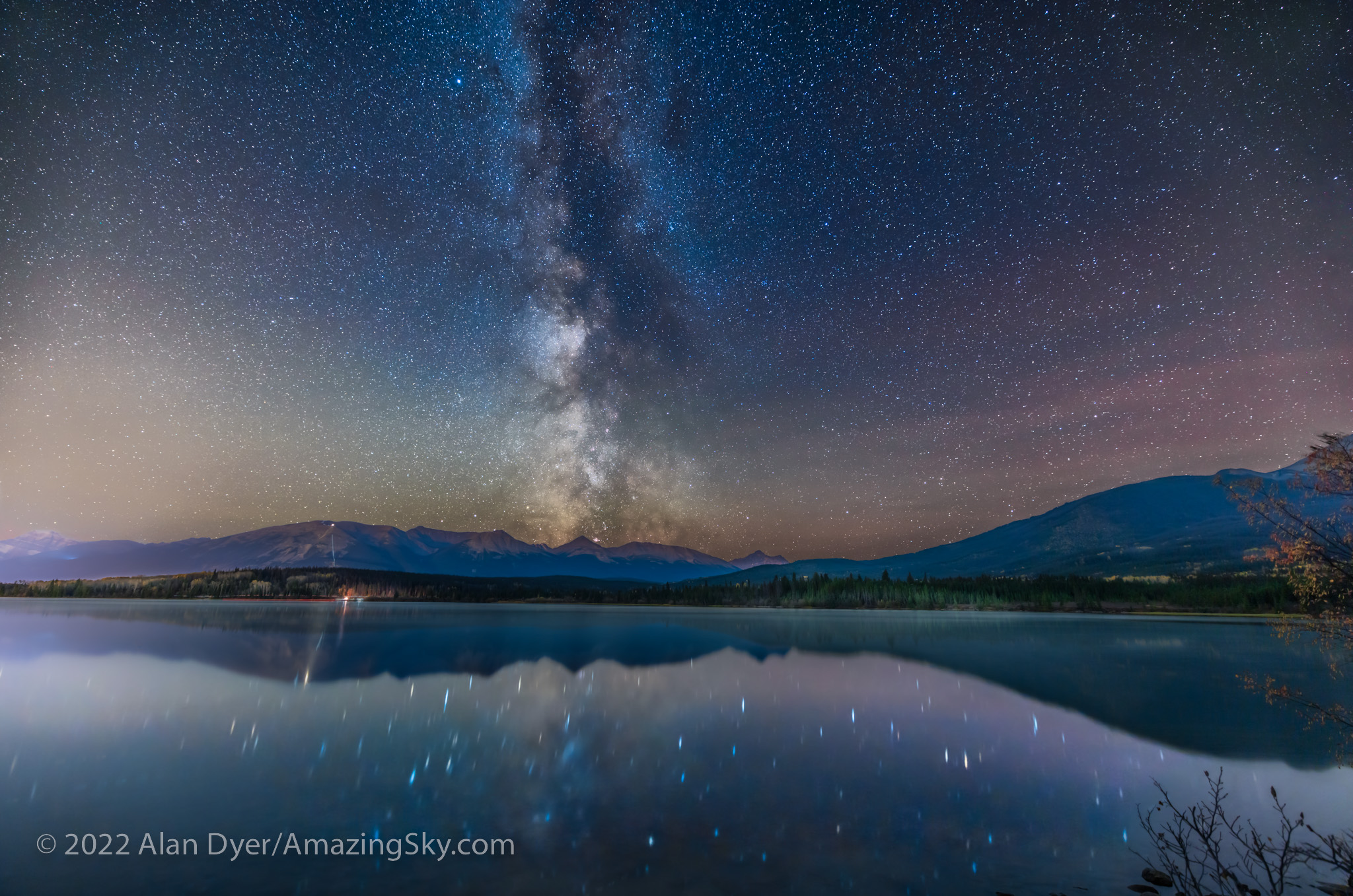
 

Comets, Conjunctions, and Occultations, Oh My!


The Moon, Venus and Comet Catalina

What a morning of sky sights, both before dawn and after sunrise.

December 7 โ€“ This was the prime day I came to Arizona to enjoy, to be better assured of clear skies. As it turned out this will likely be the cloudiest day of the week here, but skies were clear enough for a fine view of a conjunction and an occultation. The comet was a bonus.

Waning Moon and Venus Rising in Conjunction
This is a stack of 5 exposures: 30, 8, 2, 0.5 and 1/8s, blended with luminosity masks as HDR would not blend images with such a large range of brightness and content, with the shortest exposures having almost no content execept for two bright objects! The camera was on the iOptron Sky-Tracker to follow the sky and keep the sky targets stationary and aligned, thus the blurred foreground. All with the 135mm lens at f/2.8 and Canon 6D at ISO 400.

At 4 a.m. the waning crescent Moon rose accompanied by Venus, as the two worlds appeared in close conjunction in the pre-dawn sky. The view above captures the scene as the Moon and Venus rose over the Peloncillo Mountains of New Mexico. Comet Catalina is in this scene but barely visible.

The Moon, Venus and Comet Catalina
This is a stack of 6 exposures: 30, 8, 2, 0.5, 1/8s and 1/30s, blended with luminosity masks as HDR would not blend images with such a large range of brightness and content, with the shortest exposures having almost no content execept for two bright objects! The camera was on the iOptron Sky-Tracker to follow the sky and keep the sky targets stationary and aligned. All with the 135mm lens at f/2.8 and Canon 6D at ISO 800.

An hour or so later, with the Moon and Venus higher and with skies a little less cloudy, I was able to capture this scene, above, that included Comet Catalina, as a tiny blue dot next to Venus and the Moon. But if I hadnโ€™t labeled it, you wouldnโ€™t know it was there! The comet is proving to be less wonderful than anticipated, and any cloud dims the view even more.

I had hoped for a superb scene of a bright comet next to the two brightest objects in the night sky. But comets do what comets do โ€” surprise people with unexpected brightness (as Comet Lovejoy did last January) or with disappointing dimness … or by disappearing altogether, as Comet ISON did two years ago. I came here in December 2013, to this same location on the Arizona-New Mexico border, to catch ISON but no luck there at all!

Moon & Venus Conjunction at Sunrise (Dec 7, 2015)
This is a stack of 7 exposures from 10 seconds to 0.3 seconds at 1 stop intervals and blended with luminosity masks, to compress the huge range in brightness from the bright Moon and Venus, plus horizon sky, and the darker sky and sunrise clouds. All with the 35mm lens and Canon 6D.

Regardless of the comet, the conjunction of the Moon and Venus was stunning, about as good as such events get. Hereโ€™s the view, above, an hour later again, with the eastern sky brightening in the dawn twilight. The only thing that would have made this event even more spectacular is if the Moon had actually covered up Venus in this twilight sky. Not quite.

Daytime Occultation of Venus (Dec 7, 2015)
The occultation of Venus by the waning crescent Moon in the daytime on Monday, December 7 at 9:30 am local time. This is just about 3 minutes before the actual occultation as the advancing Moon is about to cover Venus on the bright limb of the Moon. This is a frame from a 100-frame time lapse. Unfortunately, as I shot this on my trip to Arizona, I did not have more focal length than the 135mm and 1.4x extender used here.

For the occultation itself, we had to wait until well after sunrise for an event in the blue daytime sky, at 9:30 a.m. local time.

All of North America got to see this fairly rare occultation of Venus by the Moon, albeit in the daytime. Nevertheless, the two objects are so bright, this was visible to the unaided eye, even with some cloud about. In binoculars it was wonderful.

To shoot it, all I had was a telephoto lens, so the image scale doesnโ€™t do the event justice. But the image above provides a good impression of the binocular view, with Venus as a brilliant jewel on the โ€œringโ€ of the Moon.

โ€” Alan, December 7, 2015 / ยฉ 2015 Alan Dyer / www.amazingsky.com
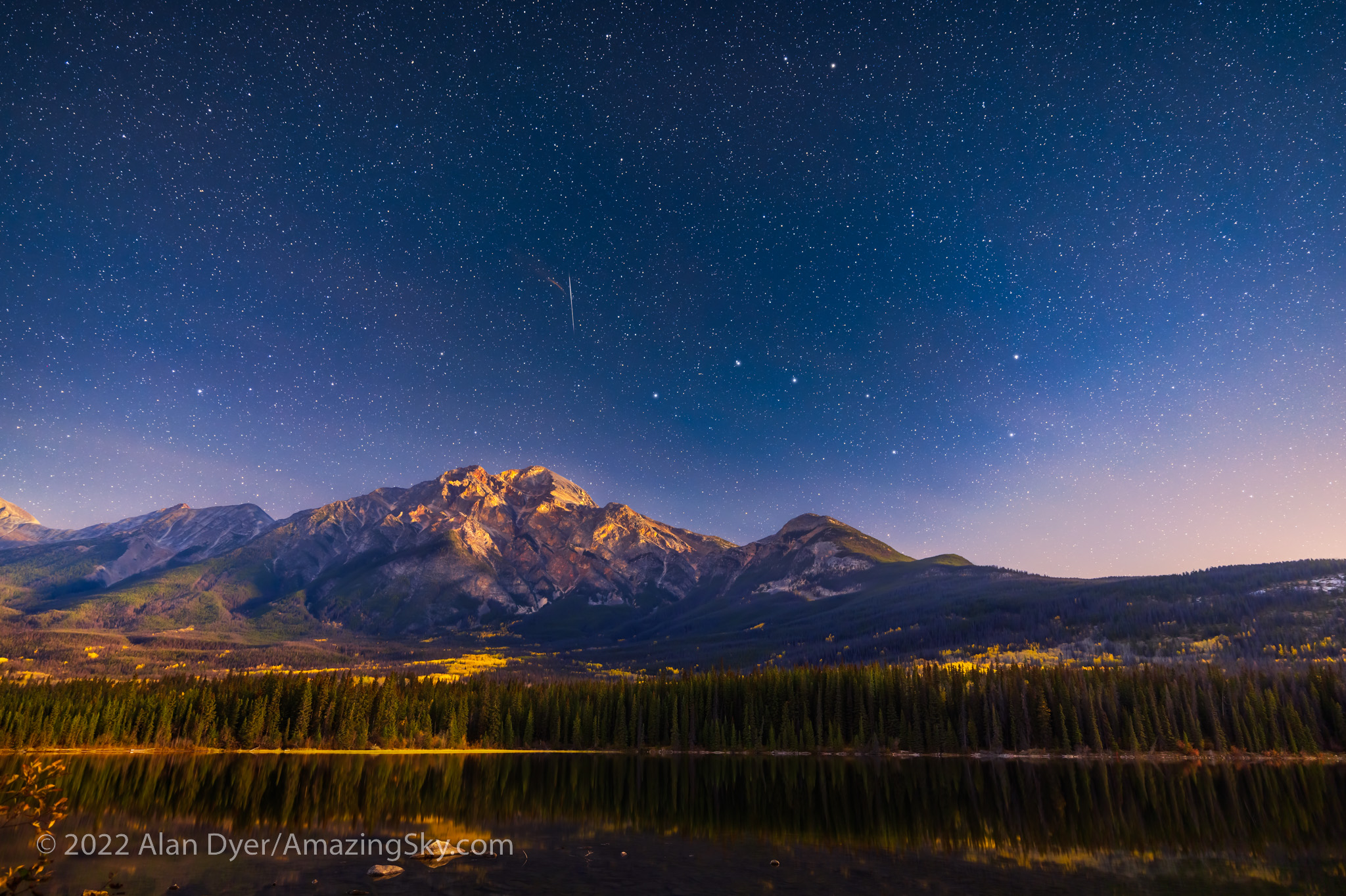
Triangle of Planets in the Twilight


Mars, Venus and Jupiter (in that order from top to bottom) in a triangle, in conjunction, at an old farmstead near Vulcan, Alberta, in the morning twilight, October 28, 2015. Illumination is from the nearly Full Hunterโ€™s Moon in the west. The trio of planets were in Leo in a fine conjunction not to be repeated until November 21, 2111. Almost all of Leo is visible here, with Regulus, the constellationโ€™s brightest star, just to the right of the windmill blades at top. This is a stack of 6 exposures for the ground, mean combined to smooth noise, and one exposure for the sky, all  10 seconds at f/4 and ISO 800 with the Canon 6D and Canon 24mm lens.

This was the trio of planets at their best in the morning sky.ย 

On the morning of October 28, Mars, Venus and Jupiter formed a neat isosceles triangle in the twilight. Venus, the brightest, was in the middle, with Mars below and Jupiter above. The grouping shone amid the stars of Leo, with its brightest star, Regulus, above the windmill in the lead image above. The rest of Leo lies above the planets.

To capture the scene I drove west at 5 am to a farmstead I had shot at before, in June, to capture Venus and Jupiter, also then in Leo nearย Regulus, but in the evening sky looking west. Click here for that blog post from mid-June.

This morning, the Moon, just past full as the annual Hunter’s Moon, shone in the west off camera lightingย the landscape.

Mars, Venus and Jupiter (in that order from top to bottom) in a triangle, in conjunction, over an old red barn near Vulcan, Alberta, in the morning twilight, October 28, 2015. Illumination is from the nearly Full Hunterโ€™s Moon in the west. The trio of planets were in Leo in a fine conjunction not to be repeated until November 21, 2111.  This is a stack of 6 exposures for the ground, mean combined to smooth noise, and one exposure for the sky, all  10 seconds at f/4 and ISO 800 with the Canon 6D and Canon 24mm lens.

The dawn sky colours and the moonlitย red barn made for a fine colour contrast.

After today, the planet configuration breaks up, as Venus descends to meet Marsย on November 2 and 3, while Jupiter climbs higher. But another great morning sight awaits on November 7 when the waning crescent Moon will shine near the Venus-Mars pairing, with Jupiter above.

The conjunction of Mars, Venus and Jupiter (from bottom to top) in the dawn sky over the misty waters of Lake Macgregor in southern Alberta, on October 28, 2015. This is a single 1/4-second exposure at f/4 and ISO 400 with the Canon 6D and 24mm Canon lens.

On the way home I stopped at fog-bound Lake MacGregor to capture the planets in a brightening dawn sky over the misty waters.

This morning the three planetsย lay just 4.5 degrees apart, close enough to frame in high-power binoculars.

We won’t see these three planets this close to each other in a darkened sky โ€” as opposed to being so close to the Sun we really can’t see them โ€” until November 21, 2111.

Be sure to catch the dawn show while it lasts!

โ€” Alan, October 28, 2015 / ยฉ 2015 Alan Dyer / www.amazingsky.com
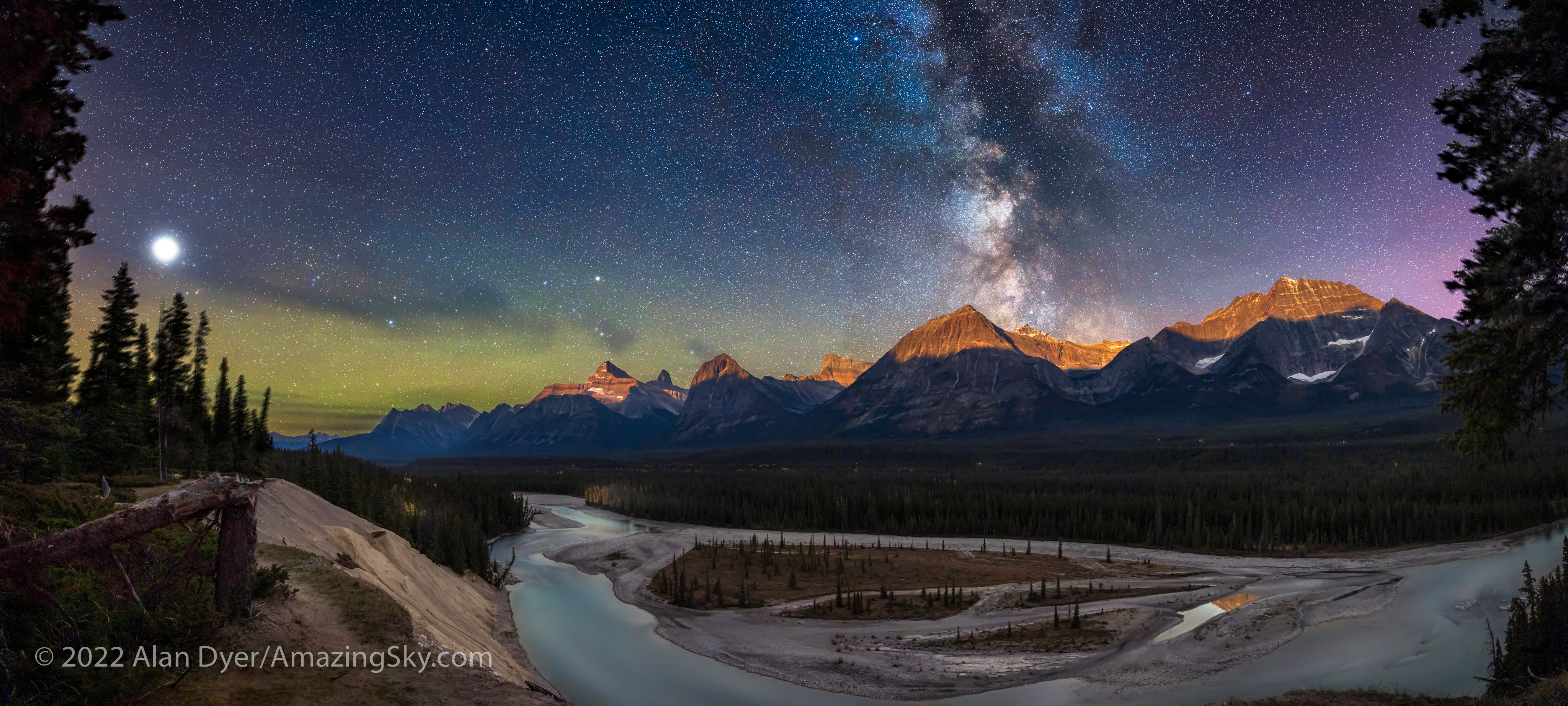
A Stunning Gathering of Worlds


The conjunction of Venus (brightest), Jupiter (above Venus) and Mars (dimmer below Venus & Jupiter) looking east in the morning twilight on October 25, 2015, as seen from the west shore of Lake Annette, in Jasper National Park, Alberta. The mountain is the Watchtower. Morning mist covers the lake waters. Haze in the sky adds the natural glows around the planets โ€” no filters were empolyed here. This is a layered stack of 4 images: 10, 5, 2.5 and 1.3-second exposures, with the longer exposure for the ground and the shorter exposures adding the sky to maintain tonal balance between the dark ground and bright sky. All with the 24mm lens and Canon 6D at ISO 400. It was not possible to capture the reflection of the planets in the water as they were too high in the sky.

Skies were clearย at dawn this morning for a fabulous view of the rare conjunction of three planets. And I could not have been at a more photogenic site.

This was the view before dawn on October 25, as brilliant Venus and dimmer Jupiter shone just a degree apart in the dawn sky. Mars, much fainter, shines just below the close duo. The three planets could easily be contained in a high power binocular field.

Not until November 2111 will these three planets be this close together again in a darkened sky.

Indeed, Venus could not have been higher, as it is just now reaching its maximum elongation from the Sun, placing it high in the eastern morning sky.

A panorama of roughly 120ยฐ showing a star- and planet-filled sky in the dawn twilight over Lake Annette in Jasper National Park, Alberta, on the morning of October 25, 2015.  At left, to the east, are the two bright planets, Venus (brightest) and Jupiter in a close conjunction 1ยฐ apart (and here almost merging into one glow), plus reddish Mars below them, all in Leo, with the bright star Regulus above them. Right of centre, to the south, is Orion and Canis Major, with the bright star Sirius low in the south. At upper right are the stars of Taurus, including Aldebaran and the Hyades star cluster. Venus was near greatest elongation on this morning.  No special filter was employed here โ€” the hazy planets and stars and colourful star images comes naturally from a high haze over the sky this morning. It bloats the images of Venus and Jupiter so they almost merge.  The stars are partly reflected in the waters, with rising mist in the distance on the lake. Distant Whistler peak below Orion is lit by lights from the Jasper Townsite. The site is the shore of Lake Annette near the Jasper Park Lodge and site of the annual star party held as part of the Jasper Dark Sky Festival. I shot this scene the morning after the 2015 Festival. This is a panorama of 8 segments, shot with the 24mm lens mounted vertically (portrait), each for 25 seconds at f/2.8 with the Canon 6D at ISO 3200. Stitched with Photoshop, with some vertical scaling to reduce the distortion introduced by the pan mapping process.

I shot from the shores of Lake Annette, site of one of the major events, the Friday star party, at the annual Jasper Dark Sky Festival which just concluded, in Jasper National Park, Alberta. The Festival celebrates the Park’s status as one of the world’s largest Dark Sky Preserves.

The hotels and restaurants were full with stargazers from around the world, making the Festival a huge success, both educationally and financially. I was honoured to be able to present some of the public and school talks.

But this dawn skyย was a fine way to end a fabulous weekend of astronomy.

The image above is a panorama in the twilight, sweeping from the planets in the east, to the winter stars and constellations, including iconic Orion, in the south and southwest.

A panorama of roughly 180ยฐ showing a star- and planet-filled sky in the pre-dawn hours over Lake Annette in Jasper National Park, Alberta, on the morning of October 25, 2015.  At left, to the east, are the two bright planets, Venus (brightest) and Jupiter in a close conjunction 1ยฐ apart (and here almost merging into one glow), plus reddish Mars below them, all in Leo, with the bright star Regulus above them. At centre, to the south, is Orion and Canis Major, with the bright star Sirius low in the south. At upper right are the stars of Taurus, including Aldebaran and the Pleiades star cluster. Venus was near greatest elongation on this morning.  The Milky Way runs vertically at centre, between Sirius and Procyon, the bright star above centre. The faint glow of morning Zodiacal Light rises in a diagonal band at left in the east through the planets and stars of Leo and into Cancer and the Beehive Cluster at top left.  No special filter was employed here โ€” the hazy planets and stars and colourful star images comes naturally from a high haze over the sky this morning. It bloats the images of Venus and Jupiter so they almost merge.  The stars are partly reflected in the waters with wind distorting some of the reflections. Some green airglow appears in the south as well. Distant Whistler peak below Orion is lit by lights from the Jasper Townsite. The site is the shore of Lake Annette near the Jasper Park Lodge and site to the annual star party held as part of the Jasper Dark Sky Festival. I shot this scene the morning after the 2015 Festival. This is a panorama of 12 segments, shot with the 24mm lens mounted vertically (portrait), each for 30 seconds at f/2.8 with the Canon 6D at ISO 3200. Stitched with Photoshop, with some vertical scaling to reduce the distortion introduced by the pan mapping process.

Earlier in the morning, before twilight began to brighten the sky, I shot another even wider panorama from the south shore of the lake.

In this and other photos, high haze adds the glows around the stars and planets naturally. No special effects filters here!

But Venus and Jupiter are so close and bright theirย images almost merge into one glow.

Brilliant Venus, in conjunction with dimmer Jupiter above, and with even dimmer Mars below, at left here, on the morning of October 25, 2015 when Venus and Jupiter were only 1ยฐ apart.  I shot this from Lake Annette in Jasper National Park before the sky started to brighten with dawn twilight. High haze in the sky adds the glows around the stars and planets, in particular the colored halo around Venus. The mountain is the Watchtower. The site is used as the main star party location for the annual Jasper Dark Sky Festival. This is a 30-second exposure at f/2.8 with the 35mm lens and as ISO 1600 with the Canon 6D.

Here they are, with Mars below, shining in the dark sky over the Watchtower peak and over the misty waters of Lake Annette.

Keep an eye on the sky at dawn, as these three worlds will be close to each other for the next few mornings. See my earlier blog for details.

โ€” Alan, October 25, 2015 / ยฉ 2015 Alan Dyer / www.amazingsky.com
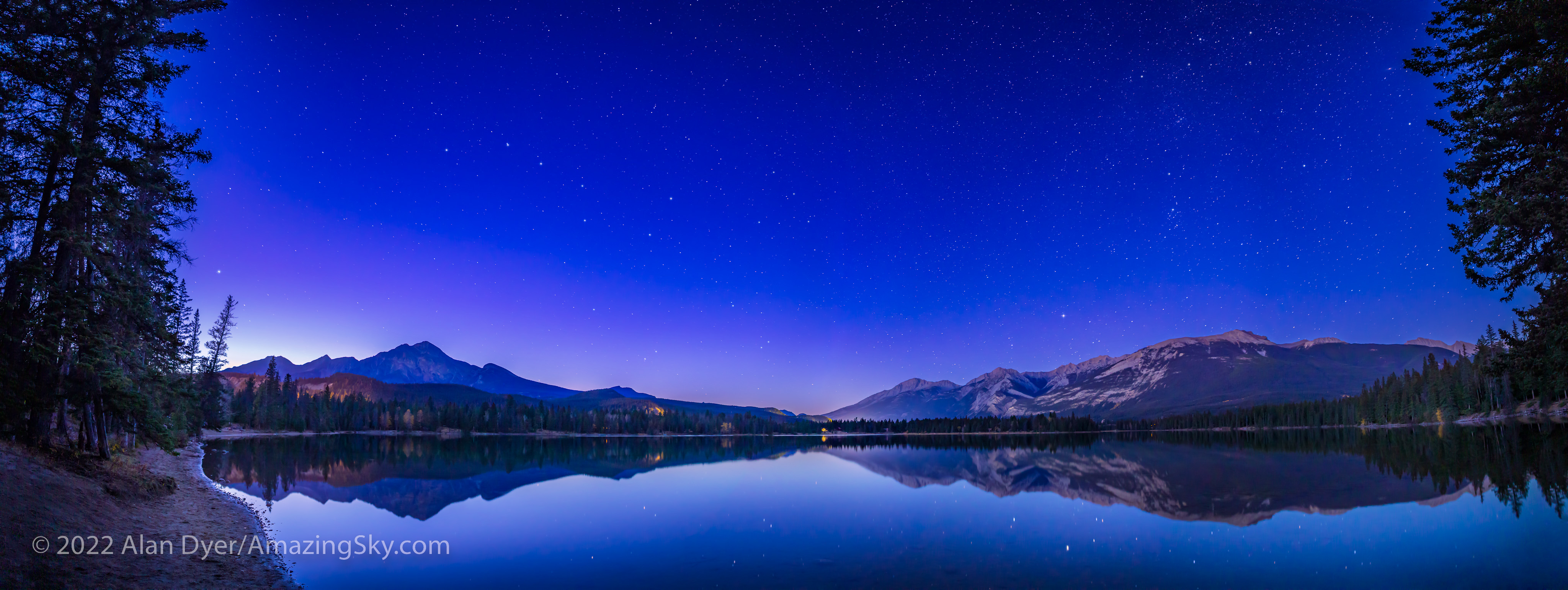
Heads Up! โ€” Planet Dance in the Dawn


Oct 17 Dawn Sky

Watch a trio ofย planets converge in the dawn sky.ย 

You might have already seen Venus shining brightly in the morning sky. And perhaps you’ve seen a slightly less bright object below it. That’s Jupiter.

But there’s a third, even dimmer planet accompanying Venus and Jupiter โ€” reddish Mars. On the morning of Saturday, October 17 (chart above โฌ†๏ธ) Mars and Jupiter pass just 1/2 degree apart, for a mismatched double “star” at dawn.

The planets put on an even better show in the following 10 daysย as all three converge to form a tight triangle of worlds in the morning sky.

Oct 23 Dawn Sky

On October 23 โฌ†๏ธ, Venus, Mars and Jupiter appear in a closeย grouping just 4.5 degrees apart, close enough to each other to be easily contained in the field of typical binoculars, the circle shown in these charts.

Oct 25 Dawn Sky

Two mornings later, on October 25 โฌ†๏ธ, Venus and Jupiter are at their closest apparent separation, just 1 degree apart, for a brilliant double “star” in the morning twilight. If you miss this morning, on the next morning, October 24, the two planets appear about the same distance apart as well.

Oct 28 Dawn Sky

By October 28 โฌ†๏ธ, the three planets have switched positions, as Venus drops lower but Jupiter climbs higher. But they again appear in a triangle, 4.5 degrees wide.

The motion you’re seeing from day to day is due to a combination of the planets’ own orbital motions around the Sun, as well asย our planet’s motion.
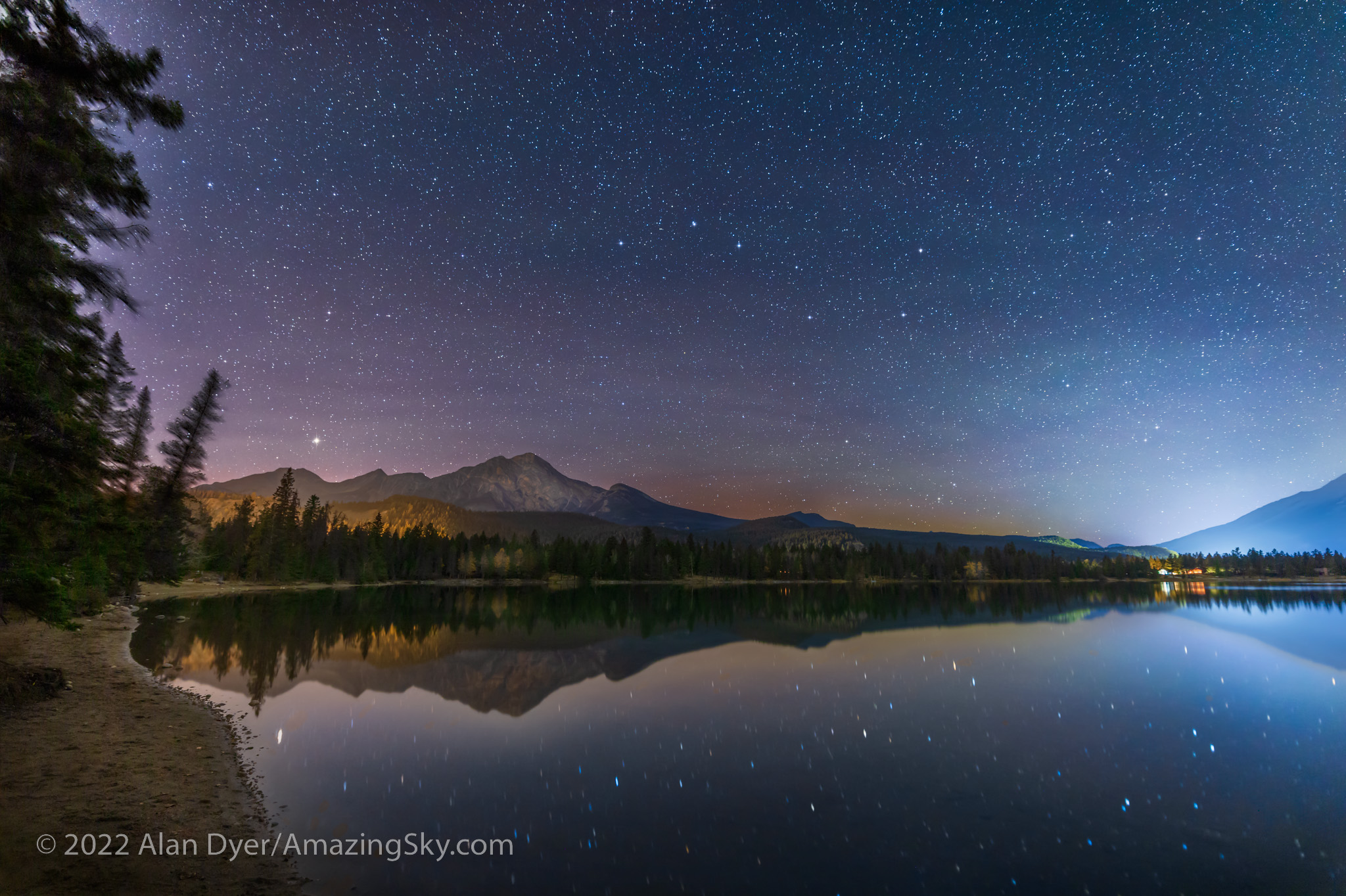
Keep in mind, the planets aren’t really close together in space. They lie tens, if not hundreds, of millions of kilometres apart. They appear close to each other in our sky because they lie along the same line of sight.

Do try to get up early enough โ€” between 6 a.m. and 6:30 a.m. should do it โ€” to look east to see the changing configuration of planets as they dance at dawn. Binoculars will provide the best view.

This is a rare sight! We won’t see these three planets this close to each other in a darkened sky until November 20, 2111!

โ€” Alan, October 16, 2015 / ยฉ 2015 Alan Dyer / www.amazingsky.com

The Moon and Four Planets


The waning crescent Moon, lit by Earthshine, with four planets on the morning of October 9, 2015, with the planets from bottom left to top right: โ€ข Mercury, just above the horizon between the low cloud bands, at lower left โ€ข Jupiter, bright at centre โ€ข Mars, reddish and above Jupiter โ€ข Venus, brightest at upper right and in some thin cloud.  The bright star Regulus in Leo is above and to the left of Venus. This is a blend of four exposures: a long 4-second exposure for most of the sky and ground and shorter 2, 1, amd 1/2 second exposures for the bright twilight area and around the Moon and Venus, to prevent those areas fro being blown out. Blending is with masks, not HDR. All with the Canon 6D at ISO 400 and 50mm Sigma lens at f/2.5

The Moon appeared along with four planets in the dawn sky.

The sky was filled with planets this morning, as all four of the closest planets to the Sun appeared along the ecliptic in the morning sky. Plus there’s a fifth planet in the picture – Earth.

Here, the waning crescent Moon, lit by Earthshine, appears with four planets on the morning of October 9, 2015, with the planets from bottom left to top right:

โ€ข Mercury, just above the horizon between the low cloud bands, at lower left
โ€ข Jupiter, bright at centre
โ€ข Mars, reddish and above Jupiter
โ€ข Venus, brightest at upper right and in some thin cloud.

The bright star Regulus in Leo is above and to the left of Venus.

The waning crescent Moon, lit by Earthshine, with four planets on the morning of October 9, 2015, with the planets from bottom left to top right: โ€ข Mercury, just above the horizon between the low cloud bands, at lower left โ€ข Jupiter, bright at centre โ€ข Mars, reddish and above Jupiter โ€ข Venus, brightest at upper right and in some thin cloud.  The bright star Regulus in Leo is above and to the left of Venus. This is a blend of four exposures: a long 4-second exposure for most of the sky and ground and shorter 2, 1, amd 1/2 second exposures for the bright twilight area and around the Moon and Venus, to prevent those areas fro being blown out. Blending is with masks, not HDR. All with the Canon 6D at ISO 400 and 50mm Sigma lens at f/2.5

Above is an unlabeledย version of the image.

TECHNICAL:

It’s a blend of four exposures: a long 4-second exposure for most of the sky and ground, plusย shorter 2, 1, and 1/2 second exposures for the bright twilight area and around the Moon and Venus, to prevent those areas from being blown out. Blending is with masks, not HDR. All were shot with the Canon 6D at ISO 400 and 50mm Sigma lens at f/2.5.

โ€“ Alan, October 9, 2015 / ยฉ 2015 Alan Dyer / www.amazingsky.com

Dawn Sky Delight โ€“ the Real Scene


A gathering of planets in the dawn sky on October 8, 2015, with - from bottom to top: Jupiter, Mars, Venus and the Moon, with the star Regulus in Leo left of Venus.  This is a 15-second exposure with shorter exposure blended in for the area around Venus and the Moon to avoid them overexposing too much. So not a true HDR, but using masking to blend the short exposure elements.

The Moon, planets and Northern lights provided a wonderful show in the dawn sky.

What a superb scene this was. On October 8 the waning crescent Moon shone near Venus (brightest) and Regulus, with red Mars and bright Jupiter paired below.

If that wasn’t enough, as the wide-angle panorama below shows, the Northern Lights were also ending a night of performance, with an arc along the horizonย and pulsing waves rising up the sky to the northeast near the planet grouping.

A panorama of the pre-dawn sky on October 8, 2015, with a sky full of wonders: โ€ข the Northern Lights, or aurora โ€ข The Big Dipper above the aurora, somewhat distorted by the panorama projection โ€ข at centre, a conjunction and line-up of planets, with from bottom to top: Jupiter, Mars and Venus, with the bright waning crescent Moon beside Venus at top, and also beside the star Regulus in Leo โ€ข The Beehive star cluster well above the planet grouping โ€ข Orion and Canis Major in the winter sky at right with the Milky Way. I shot this from home, using the Canon 6D and 24mm lens on a fixed tripoid (no tracking), for 7 segments, each a 30-second exposure at f/2.2 and at ISO 1250. Stitched in Photoshop.

The panorama also sweeps right, to the south, to take in the winter Milky Way and constellations of Orion and Canis Major. ย Click on the image to bring it up full screen.

The Moon will appear near Mars and Jupiter on the morning of October 9, and then the three planets will begin to converge for a tight gathering for a few mornings around October 25.

Be sure to wake early for the dawn sky show that continues all this month!

โ€“ Alan, October 8, 2015 / ยฉ 2015 ย / www.amazingsky.com
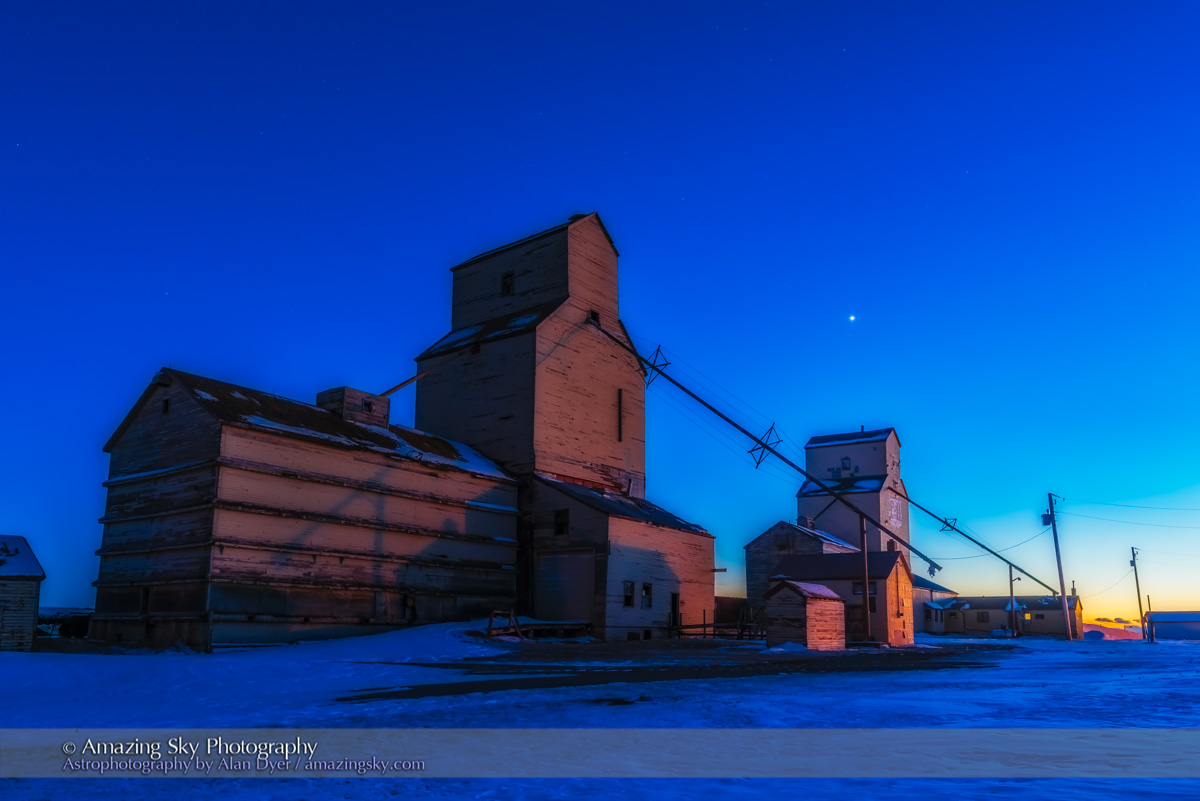
A Super Eclipse of the Moon


The Full Moon rises in partial eclipse over the sandstone formations of Writing-on-Stone Provincial Park in southern Alberta, on the evening of September 27, 2015. This was the night of a total lunar eclipse, which was in progress in its initial partial phase as the Moon rose this night. The blue band on the horizon containing the Moon is the shadow of Earth on our atmosphere, while the dark bite taken out of the lunar disk is the shadow of Earth on the Moon. The pink band above is the Belt of Venus. This is a two-image panorama stitched to extend the scene vertically to take in more sky and ground than one frame could accommodate. Both shot with the 200mm lens and 1.4x extender, on the Canon 5DMkII.

I could not have asked for a more perfectย night for a lunar eclipse. It doesn’t get any better!

On Sunday, September 27, the Moon was eclipsed for the fourth time in two years, the last in a “tetrad” of total lunar eclipses that we’ve enjoyed at six-month intervals since April 2014. This was the best one by far.

The Full Moon rising in partial eclipse on the night of September 27, 2015, night of a total eclipse that began with the partial phase in progress at moonrise from my location. The pink Belt of Venus colours the sky at top. The Moon sits in the blue shadow of the Earth, which also partly obscures the disk of the Moon. I shot this from Writing-on-Stone Provincial Park, Alberta. This is through the TMB 92mm refractor for a focal length of 550mm using the Canon 60Da at ISO 400 for 1/250 second.
This is through the TMB 92mm refractor for a focal length of 500mm using the Canon 60Da at ISO 400 for 1/250 second.

The timing was perfect for me in Alberta, with the Moon rising in partial eclipse (above), itself a fine photogenic site.

In the top image you can see the rising Moon embedded in the blue band of Earth’s shadow on our atmosphere, and also entering Earth’s shadow on its lunar disk. This was a perfect alignment, as lunar eclipses must be.

For my earthly location I drove south to near the Montana border, to a favourite location, Writing-on-Stone Provincial Park, to view the eclipse over the sandstone formations of the Milk River.

The image below shows a screen shot of myย site plan and viewing angles using The Photographer’s Ephemeris app.

IMG_2515

More importantly, weather forecasts for the area called for perfectly clear skies, a relief from the clouds forecast โ€“ and which did materialize โ€“ at home to the north, and would have been a frustration to say the least. Better to drive 3 hours!

This was the second lunar eclipse I viewed from Writing-on-Stone, having chased clear skies to here in the middle of the night for the October 8, 2014 eclipse.

Me, in a selfie, observing a total eclipse of the Moon with binoculars on September 27, 2015, from Writing-on-Stone Provincial Park, Alberta. I had three cameras set up to shoot the eclipse and a fourth to shoot the scene like this. The night was perfect for the eclipse. The Moon is in totality here, with the stars and Moon trailed slightly from the long exposure.

I shot with three cameras: one doing a time-lapse through the telescope, one doing a wide-angle time-lapse of the Moon rising, and the third for long-exposure tracked shots during totality, of the Moon and Milky Way.

The Moon in total eclipse on September 27, 2015 โ€“ the โ€œsupermoonโ€ eclipse โ€“ shining red over the Milk River and sandstone formations at Writing-on-Stone Provincial Park in southern Alberta, with the Milky Way in full view in the sky darkened by the lunar eclipse. The Sweetgrass Hills of Montana are to the south. The centre of the Milky Way is at far right. The Andromeda Galaxy is at upper left. The Moon was in Pisces below the Square of Pegasus. It was a perfectly clear night, ideal conditions for shooting the eclipse and stars. This is a stack of 5 x 2-minute tracked exposures for the sky and 5 x 4-minute untracked exposures for the ground to smooth noise. The Moon itself comes from a short 30-second exposure to avoid overexposing the lunar disk. Illumination of the ground is from starlight. All exposures with the 15mm lens at f/2.8 and Canon 5D MkII at ISO 1600. The camera was on the iOptron Sky-Tracker.
This is a stack of 5 x 2-minute tracked exposures for the sky and 5 x 4-minute untracked exposures for the ground to smooth noise. The Moon itself comes from a short 30-second exposure to avoid overexposing the lunar disk. Illumination of the ground is from starlight. All exposures with the 15mm lens at f/2.8 and Canon 5D MkII at ISO 1600. The camera was on the iOptron Sky-Tracker.

That image is above. It shows the eclipsed Moon at left, with the Milky Way at right, over the Milk River valley and with the Sweetgrass Hills in the distance.

The sky was dark only during the time of totality. As the Moon emerged from Earth’s shadow the sky and landscape lit up again, a wonderful feature of lunar eclipses.

While in the above shot I didย layer in a short exposure of the eclipsed Moon into the long exposure of the sky, it is still to accurate scale, unlike many dubious eclipse images I see where giant moons have been pasted into photos, sometimes at least in the right place, but often not.

Lunar eclipses bring out the worst in Photoshop techniques.

The total eclipse of the Moon of September 27, 2015, in closeup through a telescope, at mid-totality with the Moon at its darkest and deepest into the umbral shadow, in a long exposure to bring out the stars surrounding the dark red moon. This was also the Harvest Moon for 2015 and was the perigee Full Moon, the closest Full Moon of 2015. This is a single exposure taken through the TMB 92mm refractor at f/5.5 for 500 mm focal length using the Canon 60Da at ISO 400 for 8 seconds, the longest I shot during totality. The telescope was on the SkyWatcher HEQ5 mount tracking at the lunar rate.
This is a single exposure taken through the TMB 92mm refractor at f/5.5 for 500 mm focal length using the Canon 60Da at ISO 400 for 8 seconds, the longest I shot during totality. The telescope was on the SkyWatcher HEQ5 mount tracking at the lunar rate.

Above is a single closeup image taken through the telescope at mid-totality. I exposed for 8 seconds to bring out the colours of the shadow and the background stars, as faint as they were with the Moon in star-poor Pisces.

I shot a couple of thousand frames and processing of those into time-lapses will take a while longer, in particular registering and aligning the 700 I shot at 15-second intervals through the telescope. They show the Moon entering, passing through, then exiting the umbra, while it moves against the background stars.

Me celebrating a successful total eclipse of the Moon during the final partial phases, observed and shot from Writing-on-Stone Provincial Park, Alberta, on September 27, 2015. I shot with 3 cameras, with a 4th to record the scene. Two of the cameras at centre are still shooting time-lapses of final partial phases. The camera at right was used to take long tracked exposures of the Milky Way during totality. The telescope at left was used just to look!

So I was a happy eclipse chaser! I managed to see all four of the lunar eclipses in the current tetrad, two from Alberta, one from Australia, and one from Monument Valley.

With the latestย success,ย I’ve had my fill of lunar eclipses for a while. Good thing, as the next one is not until January 31, 2018, before dawn in the dead of winter.

With the mild night, great setting, and crystal clear skies, this “supermoon” eclipse could not have been better. It was a super eclipse.

โ€“ Alan, September 29, 2015 / ยฉ 2015 Alan Dyer / www.amazingsky.com
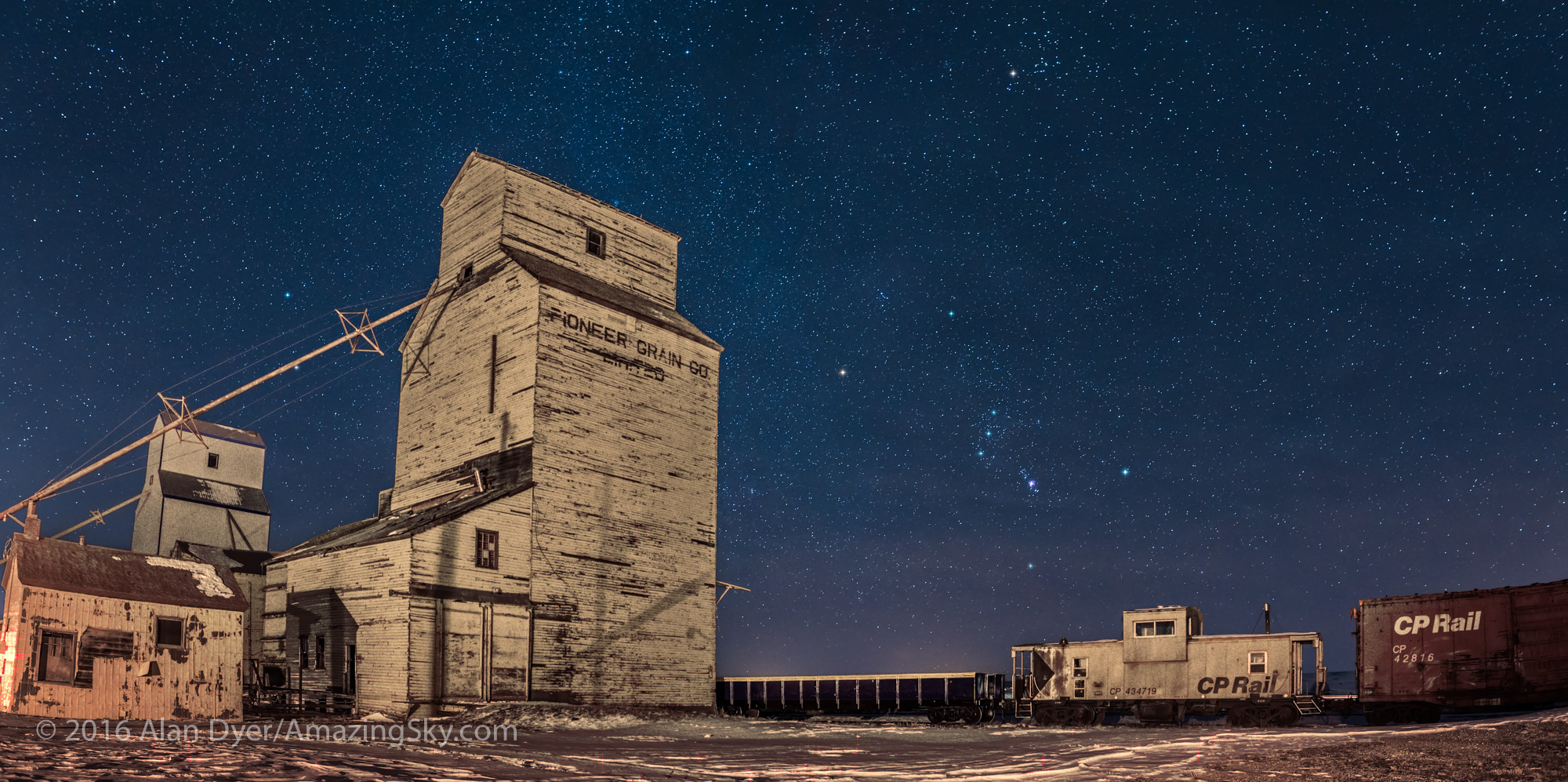
Morning Star, the Milky Way, and the Zodiacal Light


Venus shines brightly, and nearly at its brightest at magnitude -4.7, in the dawn sky on a very frosty morning at 5 am, on September 17, 2015, from home in southern Alberta. Venus appears amid the faint glow of the Zodiacal Light, sometimes called the โ€œFalse Dawn,โ€ stretching vertically from the dawn horizon in the east, up and to the right, and reaching the Milky Way that runs down the frame from top centre to bottom right. Orion and the winter stars shine in the Milky Way, with Sirius above the trees at lower right. The Beehive Cluster, M44, appears as the small group of stars above Venus. The Pleiades, M45, is at top right. Mars is the brightest object left of Venus, with the bright star Regulus just below it and rising in the east. The stars of the Big Dipper are at far left at the edge of the frame. The sky is beginning to brighten with the real glow of morning.  This is a stack of 4 x 2-minute exposures, tracked and mean combine stacked, for the sky and 2 x 2-minute exposures, untracked and stacked, for the ground to minimize blurring in the starlit ground. The Canon 6D was on the iOptron Sky-Tracker, shooting at ISO 1250 with the 15mm full-frame fish-eye lens at f/3.5. The stacking with a mean combine stack mode smooths noise in both sky and ground.

Venus, now at its brightest as a morning star, shines amid the subtle glow of the Zodiacal Light.ย 

This was the scene this morning, September 17, on a very frosty dawn at 5 a.m. from my backyard in southern Alberta.

Here, Venus shines nearly as bright as it can be, at magnitude -4.7, in the dawn sky as a brilliant “morning star.”

Venus appears amid the faint glow of the Zodiacal Light, sometimes called the โ€œFalse Dawn,โ€ stretching diagonallyย from the dawn horizon in the east, up and to the right, and reaching the Milky Way that runs verticallyย down the frame from top centre to bottom right.

Orion and the winter stars shine in the Milky Way, with Sirius above the trees at lower right.

The Beehive Cluster, M44, appears as the small group of stars above Venus. The Pleiades, M45, is at top right.

Mars is the brightest object left of Venus, with the bright star Regulus just below it and rising in the east. The stars of the Big Dipper are at far left at the edge of the frame.

The sky is beginning to brighten with the real glow of morning. It was a marvellous dawn sky delight.

Technical notes:

This is a stack of 4 x 2-minute exposures, tracked and mean-combine stacked, for the sky and 2 x 2-minute exposures, untracked and stacked, for the ground to minimize blurring in the starlit ground. The Canon 6D was on the iOptron Sky-Tracker, shooting at ISO 1250 with the 15mm full-frame fish-eye lens at f/3.5. The stacking with a mean combine stack mode smooths noise in both sky and ground.

โ€“ Alan, September 17, 2015 / ยฉ 2015 Alan Dyer / www.amazingsky.comย 

Worlds Amid the Sunset Clouds


The waxing crescent Moon below Venus low in the sunset colours of a July summer evening over the waters of Little Fish Lake, in southern Alberta. Jupiter is at upper right but much fainter.  This is a 3-segment panorama taken with the Canon 60Da and 18-200mm Sigma zoom.

The thin waxing Moon shines near Venus aboveย the colourful clouds of sunset.

Tonight, July 18, was the evening of a close conjunction of the crescent Moon near Venus in the evening sky. From my latitude at 50ยฐ North, the conjunction was going to be low, and atย riskย of clouds.

In this case, the clouds added to the scene as they lit up with sunset colours.

You can see the Moon and Venus at centre, while fainter Jupiter is at upper right, and perhaps not visible on screen at this scale.

The location is one I used last month for the Venus-Jupiter meeting, Little Fish Lake and Provincial Park, north of Drumheller. It’s a quiet spot. This Saturday night there were just three families there camping.

I shot this telephoto panorama with my red-sensitive Canon 60Da, which is designed to record red nebulas well, but does a nice job on punching up sunsets, too!

Alas, the clouds that painted the sky so nicely here, moved in as the worlds set lower. I wasn’t able to shoot them closer to the horizon amid the deep colours of a late twilight. But I’ll settle for this image.

โ€“ Alan, July 19, 2015 / ยฉ 2015 Alan Dyer / www.amazingsky.com
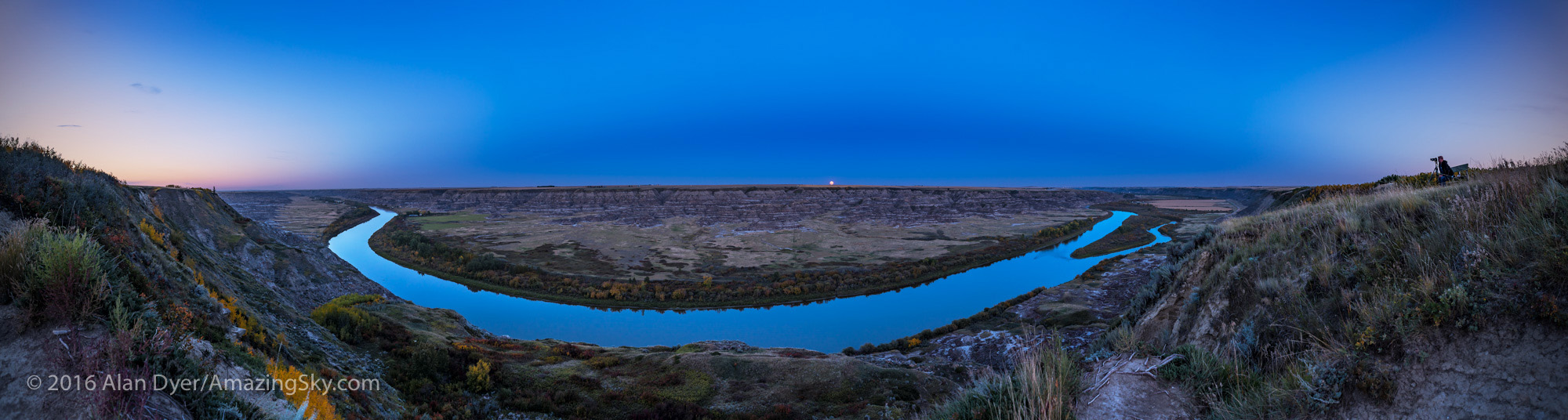
Waterton Lakes in the Twilight


The waxing gibbous Moon over Upper Waterton Lake in Waterton Lakes National Park, Alberta with the iconic Prince of Wales Hotel in the distance, on a calm evening with still waters, rare in Waterton. This is an HDR stack of 3 exposures with the Canon 60Da and 16-35mm lens, shot from Driftwood Beach.
Happy Canada Day! From one ofย the most scenic places in the country.
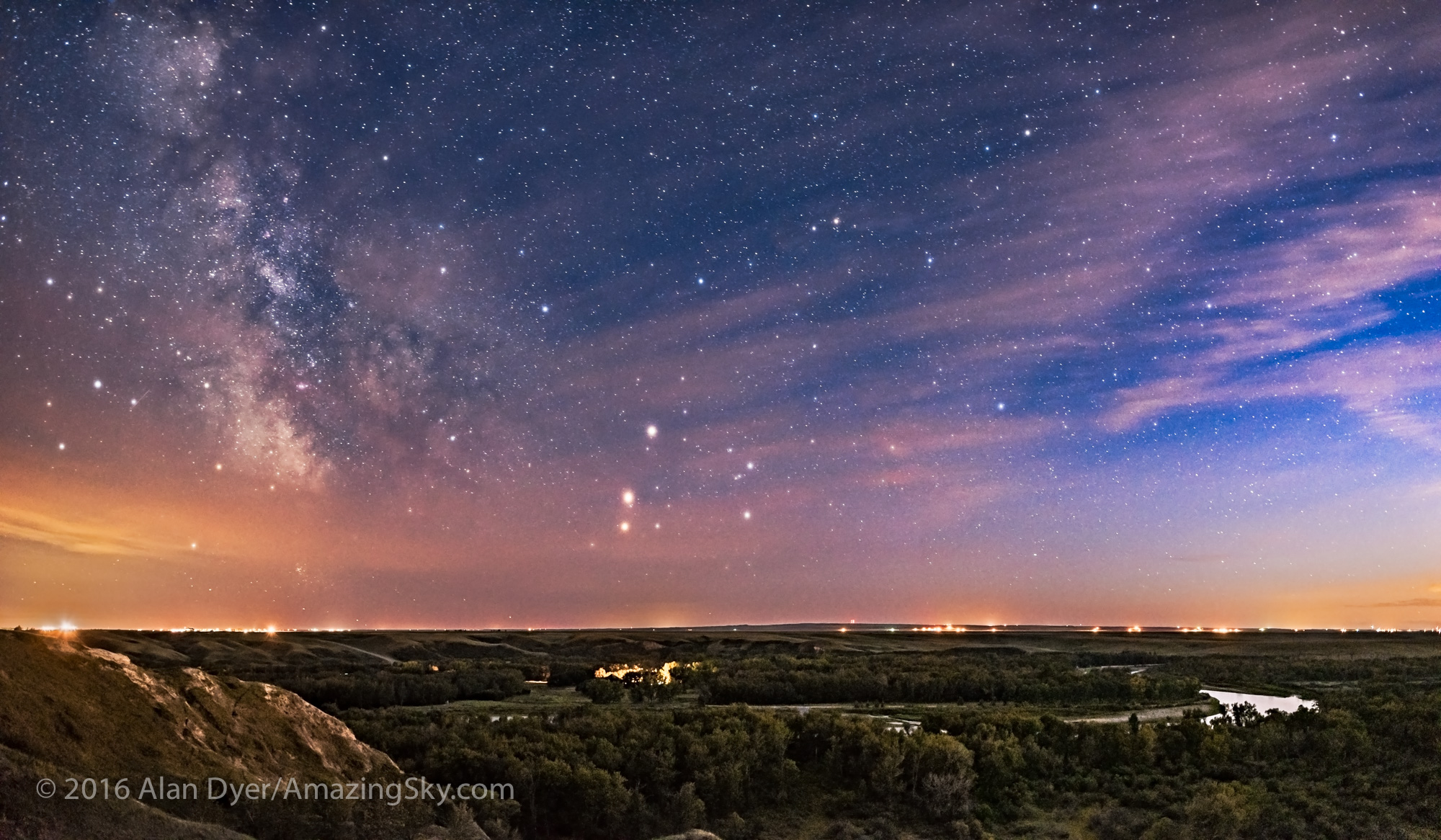
I spent a wonderful four days and nights last week at Waterton Lakes National Park, Alberta, with near perfect weather conditions.

For one, the infamous winds of Waterton weren’t blowing, allowing me to shoot the iconic Prince of Wales Hotel reflected in the calm waters of Middle Waterton Lake at Driftwood Beach, with the waxing Moon above in the twilight sky.

Earlier in the evening, I was at the Maskinonge Overlook shooting some video for upcoming tutorials. At sunset I shot this image, below, of the Moon above the alpenglow of the last rays of sunlight.

The rising waxing gibbous Moon in the sunset sky over Maskinonge Wetlands at Waterton Lakes National Park, Alberta, June 2015. The last rays of sunset are illuminating the peaks in alpen glow. This is an HDR stack of 3 exposures with the Canon 60Da and 16-35mm lens.

Happy Canada Day!

And don’t forget to look west for the ongoing Venus-Jupiter conjunction. I missed the best night last night, June 30 โ€“ clouds! But here’s hoping for tonight.

โ€“ Alan, July 1, 2015 / ยฉ 2015 Alan Dyer / www.amazingsky.com


Double “Star” in the Dusk


Venus and Jupiter on June 28, 2015 approaching a close conjunction two nights later, as seen over the water of Little Fish Lake Provincial Park, Alberta in the evening twilight. Venus is the brighter of the pair. This is an HDR stack of 3 exposures with the Canon 60Da and 16-35mm lens. The long exposure blurs the ripples and waves on the water.

Venus and Jupiter now appear as a brilliant “double star” in the evening sky.

This was the scene last night, Sunday, June 28, as the two brightest planets in the sky appeared close to each other in the evening twilight.

I shot the scene from the eastern shore of Little Fish Lake at a Provincial Park in southern Alberta bordering on the Handhills Conservation Area which preserves northern native prairie grasses and an abundance of bird and wildlife species.

The planetary conjunction culminates on June 30, when they will appear very close to each other (less than a Moon diameter apart), creating the best evening conjunction of 2015.

Venus and Jupiter on June 28, 2015 approaching a close conjunction two nights later, as seen over the water of Little Fish Lake Provincial Park, Alberta in the evening twilight. Venus is the brighter of the pair. Some subtle crepuscular rays from cloud shadows are at right. This is an HDR stack of 3 exposures with the Canon 60Da and 16-35mm lens.

More details are in my previous blog post.ย 

โ€“ Alan, June 29, 2015 / ยฉ 2015 Alan Dyer / www.amazingsky.com

The Great Solstice Aurora of 2015


The all-sky aurora of June 22, 2015, during a level 7 to 9 geomagnetic storm, as the display began already active in the darkening twilight of a solstice night. This is one frame from a 568-frame time-lapse, taken with the 8mm Sigma fish-eye lens at f/3.5 and with the Canon 6D, composed for projection in tilt-dome digital planetariums. I was on the south shore of Crawling Valley Lake and Reservoir in southern Alberta.

Aurora watchers were on alert! Look up after sunset on June 22 and the sky should be alive with dancing lights.

And the predictions were right.

I headed out to a nearby lake in preparation for seeing and shooting the show. And as soon as the sky got dark enough the Lights were there, despite theย bright solstice twilight.

The all-sky aurora of June 22, 2015, during a level 7 to 9 geomagnetic storm, as the display began already active in the darkening twilight of a solstice night. This is one frame from a 960-frame time-lapse, taken with the 15mm full-frame fish-eye lens at f/2.8 and with the Canon 60Da, looking north to the perpetual twilight of solstice. I was on the south shore of Crawling Valley Lake and Reservoir in southern Alberta.

The display reached up to the zenith, as seen in myย fish-eye images, like the one below. I shot with three cameras, all shooting time-lapses, with the fish-eye camera recording the scene suitable for projection in a digital planetarium.

The all-sky aurora of June 22, 2015, during a level 7 to 9 geomagnetic storm, as the display peaked in a substorm with rays converging at the zenith in the darkening twilight of a solstice night. This is one frame from a 568-frame time-lapse, taken with the 8mm Sigma fish-eye lens at f/3.5 and with the Canon 6D, composed for projection in tilt-dome digital planetariums. I was on the south shore of Crawling Valley Lake and Reservoir in southern Alberta.

However, it was apparent we here in western Canada were seeing the end of the display that had been going on for hours during an intense geomagnetic storm. The aurora was most intense early in theย evening, with a minor outburst about 11:30 to 11:45 pm MDT.

The all-sky aurora of June 22, 2015, during a level 7 to 9 geomagnetic storm, as the display began already active in the twilight of a solstice night. This is one frame from a 960-frame time-lapse, taken with the 15mm full-frame fish-eye lens at f/2.8 and with the Canon 60Da, looking north to the perpetual twilight of solstice. I was on the south shore of Crawling Valley Lake and Reservoir in southern Alberta.

The aurora then subsided in structure and turned into a more chaotic pulsating display, typical of the end of a sub-storm.

A sky-covering display of Northern Lights, here in the western sky over a distant thunderstorm on the Alberta prairies. I shot this June 22, 2015 on a night with a grand display over most of the sky, with the sky bright with solstice twilight. The site was on the south shore of Crawling Valley Lake in southern Alberta. This is one frame from a 350-frame time-lapse, taken with the Nikon D750 and 24mm lens,

However, an attraction of this display was its juxtaposition over another storm, an earthly one, flashing lightning to the northwest of me.

The all-sky aurora of June 22, 2015, during a level 7 to 9 geomagnetic storm, as the display brightened again in the middle of the night at about 1 am, with rays converging at the zenith in the perpetual twilight of a solstice night. This is one frame from a 568-frame time-lapse, taken with the 8mm Sigma fish-eye lens at f/3.5 and with the Canon 6D, composed for projection in tilt-dome digital planetariums. I was on the south shore of Crawling Valley Lake and Reservoir in southern Alberta.

By 1 a.m. MDT the display, while still widespread over a large area of the northern sky, had turned into a diffuse glow.

But 60 gigabytes of imagesย later, I headed home. The time-lapse compilation will come later!

โ€“ Alan, June 23, 2015 / ยฉ 2015 Alan Dyer / www.amazingsky.com

Reflections of Solstice Planets and Northern Lights


The evening planets of Venus (right) and Jupiter (left), to the right of the waxing crescent Moon on the evening of summer sosltice, June 21, 2015. The star Regulus is to the upper right of the Moon, between Jupiter and the Moon. The view is overlooking Crawling Lake in southern Alberta. This is an HDR stack of 5 exposures to retain detail in the bright twilight sky and the dark foreground.

The summer solstice sky was filled with twilight glows, planets, and dancing Northern Lights.ย 

What a magical night this was. The evening started with the beautiful sight of the waxing crescent Moon lined up to the left of the star Regulus, and the planets Jupiter and Venus (the brightest of the trio), all set in the late evening twilight.

They are all reflected in the calm waters of a prairie lake.

I shot the above photo about 11 p.m., as late a twilight as we’ll get. From here on, after solstice, the Sun sets sooner and the sky darkens earlier.

An aurora display on the evening of summer solstice, June 21, 2015, overlooking Crawling Valley Reservoir in southern Alberta. This is one frame of 360 shot as part of a time-lapse, each frame being 15 seconds at f/2.5 with the 24mm lens, and with the Canon 6D at ISO 3200.

Later, about 12:30 a.m., as predicted by aurora apps and alert services, a display of Northern Lights appeared on cue to the north. It was never very bright to the eye, but the camera nicely picks up the wonderful colours of a solstice aurora.

At this time of year the tall curtains reaching up into space catch the sunlight, with blue tints adding to the usual reds fringing the curtain tops, creating subtleย shades of magenta and purple.

The display made for a photogenic subject reflected in the lake waters.

โ€“ Alan, June 22, 2015 / ยฉ 2015 Alan Dyer / www.amazingsky.comย 

A Twilight Triangle of Worlds


The waxing crescent Moon below Venus and fainter Jupiter above, with the three worlds forming a triangle in the twilight, on the evening of June 19, 2015, from a site north of Bassano, Alberta. This is an HDR stack of 5 exposures to retain detail in the dark foreground and bright twilight sky. This is with the 50mm lens and Canon 6D.

The three brightest objects in the night sky gathered into a tidy triangle in the twilight.ย 

On Friday night, June 19, I chased around my area of southern Alberta, seeking clear skies to capture the grouping of the waxing crescent Moon with Venus and Jupiter.

My first choice was the Crawling Valley reservoir and lake, to capture the scene over the water. I got thereย in time to get into position on the east side of the lake, and grab some shots.

The waxing crescent Moon below Venus and dimmer Jupiter above, all over Crawling Lake Reservoir, in southern Alberta, on June 19, 2015. This is a 5-exposure HDR stack to preserve deatails in the dark foreground and bright sky. Shortly after I took this shot clouds from an approaching storm front obscured the planets and the sky.

This was the result, but note the clouds! They were moving in quickly and soon formed a dramatic storm front. By the time I got back to the car and changed lenses, I was just able to grab theย panorama below before the clouds engulfed the sky, and the winds were telling me to leave!

A wicker looking storm front moving in quickly over the Crawling Lake Reservoir in southern Alberta. I had just a few minutes to get set up for this after shooting the gathering of the Moon, Venus and Jupiter in the evening twilight from a nearby spot. Then clouds soon covered the planets. By the time I got back to the car to change lenses the storm front was almost on top of me. I grabbed segments for this panorama using a 24mm lens and Canon 6D. While the outflow winds really picked up, the storm didnโ€™t amount to much and cleared off shortly after as it moved to the east from the northwest.

I drove west toward home, taking a new highway and route back, and finding myself back into clear skies, as the storm headed east. I stopped by the only interesting foreground element I could find to make a composition, the fence, and grabbed the lead photo.

Both it, and the second image, are “HDR” stacks of five exposures, to preserve detail in the dark foreground and bright sky.

It was a productive evening under the big sky ofย the prairies.

โ€“ Alan, June 20, 2015 / ยฉ 2015 Alan Dyer / www.amazingsky.com

Solstice Sky at Dinosaur Park


Summer solstice twilight and circumpolar star trails over the badlands of Dinosaur Provincial Park, Alberta. Some bright noctilucent clouds are visible low on the northern horizon. I shot this June 15, 2015 as part of a shoot for a โ€œstar trailโ€ video tutorial, as an example image. This is a stack of the first 200 frames of 275 shot for a time-lapse, each 15 seconds at f/2.8 with the Rokinon 14mm lens and Canon 6D at ISO 1600. I stacked them in Advanced Stacker Actions with the ultrastreak mode. The foreground comes from a mean blend of the first 8 frames, to smooth noise, and to provide a brighter foreground from early in the sequence when the sky and ground were brighter.

The stars circle the bright northern sky at solstice time over the Alberta Badlands.

I spent the evening and well into the night on Monday shooting at a favourite spot, Dinosaur Provincial Park in southern Alberta. The result of about an hour of shooting around midnight is the circumpolar star trail composite at top.

It shows the stars spinning about Polaris, while the northern horizon is rimmed with the bright glow of all-night twilight.

Particularly bright in the northwest are noctilucent clouds low on the horizon. These are high-altitude clouds near the edge of space catching the sunlight streaming over the pole at this time of year.

Noctilucent clouds (NLCs) over the silhouette of the badlands of Dinosaur Provincial Park in southern Alberta, on the night of June 15/16, 2015. The clouds remained low on the northern horizon and faded as the Sun angle dropped through the night but then reappeared in the northwest prior to dawn. The bright star at left is Capella, circumpolar at this latitude of 50ยฐ N.  This is a single exposure for 10 seconds at f/3.2 with the 16-35mm lens and at ISO 800 with the Canon 60Da.

They are a phenomenon unique to the weeks around solstice, and for our latitudes on the Canadian Prairies.

The close-up shot above shows their intricate wave-like formation and pearly colour. They faded though the night as the Sun set for the clouds. But they returned in the pre-dawn light.

If you live at mid-northern latitudes, keep an eye out for these clouds of solstice over the next month. It’s now their peak season.

โ€“ Alan, June 16, 2015 / ยฉ 2015 Alan Dyer / www.amazingsky.com

Heads Up! โ€“ June Moon Passes the Planets


June Moon near Planets

This weekend watch for the waxing crescent Moon passing the “evening stars” of Venus and Jupiter.

On Friday, June 19 look west to see the crescent Moon a binocular field below bright Venus in the evening twilight.

The next night, Saturday, June 20, the Moon appears a little higher and below Jupiter.

On Sunday, June 21, the day of the summer solstice, look for the crescent Moon to the left of the star Regulus in Leo.

Venus and Jupiter are getting closer to each other each night, as they edge toward a very close conjunction on June 30 when they will appear just over a Moon diameter apart in the evening sky.

However, this weekend may bringย better photogenic opportunities, with the picturesque crescent Moon near the two brightest planets in the sky.

โ€“ Alan, June 15, 2015 / ยฉ 2015 Alan Dyer / www.amazingsky.comย 

Venus and Jupiter Converging


Venus (right) and Jupiter (centre), on June 12, 2015, as they are converging toward a close conjunction on June 30, 2015. The star Regulus is at left, left of the windmill. Photographed from an old farm yard north of Vulcan, Alberta. This is an HDR-stack of 3 exposures to record detail in the ground and sky. Shot with the Canon 60Da and 16-35mm lens.

Each night, Venus and Jupiter are converging closer, heading toward conjunction on June 30.

This was Venus (right) and Jupiter (centre) with Regulus at left, in a cloudy twilight sky on Friday, June 12, as Venus and Jupiter converge toward their close conjunction in the evening sky on June 30.

Be sure to watch each night as the two brightest planets in the sky creep closer and closer together. Mark June 19 and 20 on your calendar, as that’s when the waxing crescent Moon will join the duo.

I shot this from near Vulcan, Alberta, after delivering an evening program at the Trek Centre in Vulcan as a guest speaker. Clouds prevented us from seeing anything in the sky at the public event, but on my way home skies cleared enough to reveal the two bright planets in the twilight.

I stopped at an abandoned farmyard I had scouted out earlier in the evening, to serve as a photogenic backdrop.

This is a high dynamic range stack of three bracketed exposures, one stop apart, to record detail in both the dark foreground as well as in the bright sky.

โ€” Alan, June 13, 2015 / ยฉ 2015 Alan Dyer / www.amazingsky.com

Urban and Rural Moons


The waxing crescent Moon near Venus in the spring evening sky over the skyline of Calgary, Alberta, May 21, 2015. I shot this from Tom Campbell Hill near the Telus Spark science centre. This is a single exposure with the 16-35mm lens and Canon 60Da, shot as part of a 360-frame time-lapse sequence.

The waxing Moon and Venus shine over contrasting landscapes, both urban and rural.

I shot theย main image at top last night, May 21, from a site overlooking the urban skyline of Calgary, Alberta. The waxing Moon shines near Venus in the twilight sky.

By contrast I shot the image below the night before, from a location that couldn’t be more different โ€“ remote, rural Saskatchewan, on a heritage farmstead first settled in the 1920s by the Butala family. It is now the Old Man on His Back Prairie and Heritage Conservation Area.

The waxing crescent Moon and Venus (above) over the old farm house at the Visitor Centre at the Old Man on His Back Natural and Historical Conservation Area in southwest Saskatchewan, May 20, 2015, on a very clear night. The old house was the original house lived in by the Butala family who settled the area in the 1920s. This is a single exposure taken as part of an 850-frame time-lapse sequence with the 14mm Rokinon lens and Canon 60Da camera.

Here, the crescentย Moon shines a little lower, below Venus, amid the subtle colours of twilight in a crystal clear prairie sky.

However, as the top image demonstrates, you don’t need to travel to remote rural locations to see and photograph beautiful sky sights. Twilight conjunctions of the Moon and bright planets lend themselves to urban nightscapes.

โ€“ Alan, May 22, 2015 / ยฉ 2015 Alan Dyer / www.amazingsky.com

Moonrise Over Calgary


Full Moonrise over Calgary

The Full Moon rises over the skyline of Calgary on a clear spring night.

This was the moonrise on Sunday, May 3, as the Full Moon rose south of the main skyline of Calgary. The timing of last night’s Full Moon promised a great shot.

The Moonย rose about 15 minutes before sunset, a timing that I was hoping would lead to a shot of the skyline lighting up red with the last rays of the setting Sun in the west as the Moon rose in the east.

Alas, horizon haze obscured the setting Sun and rising Moon. The Full Moonย didn’t appear until a good 30 minutes after moonrise as it rose above the haze into the pink twilight sky. Not quite what I was after, but it made a nice scene after all.

I shot this from the grounds of the CFCN TV building high on Broadcast Hill west of the city. There wasn’t an accessible site farther north with a clear sightline east that would have allowed me to place the Moon right over the city.

From this site at CFCN the Full Moon won’tย rise over the downtown core until the Full Moon of September 27, the night of the total eclipse of the Moon. Photo op!

This is one frame of 430 I shot for a time-lapse sequence. To plan this and other rise and set images I use the handy app, The Photographer’s Ephemeris.

TPE Screenshot
A screen shot from TPE showing the photo’s shooting geometry

This screen shot from TPE illustrates last night’s moonrise geometry, with the moonrise line pointing just south of the downtown core as seen from the CFCN site.

I highly recommend TPEย for planning any nightscape photography of the rising and setting Sun and Moon.

โ€“ Alan, May 4, 2015 / ยฉ 2015 Alan Dyer / www.amazingsky.com

Evening Stars Over the Red Deer River


Evening Stars Over Red Deer River

Mercury and Venus shine as “evening stars” over the Red Deer River in southern Alberta.

What a fine night this was for nightscape shooting. Mercury and Venus are both now about as high as they will get for the year in the evening sky from my western Canadian latitude.

Venus is easy to spot as the brilliant object in the west. But Mercury is more elusive. You can see it here low in the twilight glow and much dimmer than Venus.

The photo illustrates how far each of the two inner planets swings away from the Sun in our skies, and why Mercury has its reputation for being difficult to sight. Also, it appears at its best for only a couple of weeks at a time. By mid-May it will be gone.

Venus, however, continues to dominate our western sky for the next two months.

I shot the main photo from the deck of a rickety wooden bridge over the Red Deer River near Dorothy, Alberta, just off Highway 10 east of Drumheller in the Badlands.

The image is a high-dynamic-range “HDR” stack of five exposures.

Venus over the Atlas Coal Mine

Shortly after taking the lead photo, I drove west to the Atlas Coal Mine to shoot it by the light of the now high and nearly Full Moon. Mercury can still be seen low and to the right of the historic tipple building. Venus shines above it.

This is a single 25-second exposure at ISO 800.

The Atlas Coal Mine is now a National Historic Site and is the last standing from what was once a booming coal mining centre in the Red Deer River Valley.

Now, mostly dinosaur fossils are unearthed here.

โ€“ Alan, May 3, 2015 / ยฉ 2015 Alan Dyer / www.amazingsky.com

Heads Up! โ€“ Mercury Rising


May 6 Mercury

The next two weeks are the best inย 2015 for sighting Mercury in the evening sky.

Mercury is coming into view in our evening sky, climbing as high as it can get for us in the Northern Hemisphere. This is ourย best chance for us to sight Mercury as an evening star in 2015.

Spring is always the best time to catch elusive Mercury. The angle of the ecliptic โ€“ the path of the planets โ€“ swings up highest above the horizon in spring, putting Mercury as high into the evening twilight as it can get. This makes it easier to sight Mercury than at other times of the year when, particularly for observers at northern latitudes, Mercury can be lost in the twilight glow and horizon haze.

When it is at its highest Mercury is surprisingly bright, appearing as a bright star easily visible to the naked eye. However, locating it at firstย in the twilight usually requires a scan with binoculars.

Mercury will be at its highest on May 6 when it reaches “greatest elongation.” However, it will be almost as good for a week on either side of that date.

So set aside a clear evening duringย the first two weeks of May to search for the inner planet. (The green line is Mercury’s path relative to the horizon with the green dots marking its position at daily intervals.)

Mercury will be shining above fainter Mars, and well below brilliant Venus, now dominating our evening spring sky. Look north of due west during the hour after sunset.

Mercury & Venus Conjunction Closeup (Jan. 10, 2015)
Mercury and Venus on January 10, 2015 from New Mexico.

This view captures Mercury at its last good evening appearance, back in early January when it appeared close to Venus, then emerging into the evening sky. You can compareย their relative brightness.

By coincidence, the emergence of Mercury into our evening sky comes just as it loses its lone visitor from Earth. Since 2011, NASA’s Messenger probe has been orbiting and mapping Mercury.

On April 29, with the probeย exhaustedย of its maneuvering fuel, Messenger is scheduled to end its mission by crashing onto the planet, adding a new crater to Mercury’sย barren and volcanic surface.

A global false-color map of the mineral composition of Mercury from Messenger data.

This is a recent map of Mercury from Messenger. For more details, see the mission’s website.

โ€“ Alan, April 30, 2015 / ยฉ 2015 Alan Dyer / www.amazingsky.com

Rising of the Snow Moon & Jupiter


Full Snow Moon over Silver City Panorama #1

Tonight the Full Moon rose paired with Jupiter, in the colourful twilight over Silver City, New Mexico.

Using The Photographer’s Ephemeris app, I scouted out theย location last night for the shoot tonight, February 3.

I drove west of Silver City to a viewpoint on Boston Hill overlooking the town east to the rising Moon.

The Full Moon of February has come to be called the “Snow Moon,” appropriate for many parts of the continent now enduring record snowfalls. But here, we enjoyed summer-like temperatures and a decided lack of snow.

The Moon rose into a clear sky accompanied by Jupiter, now 4 days before its annual opposition date. At opposition we pass between the Sun and an outer planet, in this case Jupiter. This puts Jupiter opposite the Sun, so it rises as the Sun sets.

The Full Moon also always lies opposite the Sun, so tonight the Full Moon joined Jupiter in the sky.

Full Snow Moon over Silver City Panorama #2

To capture the scene I shot several panoramas, each consisting of several segments, to take in the broad sweep of the horizon. The scene above records the pink “Belt of Venus,”ย created byย sunlight lighting the upper atmosphere to the east in the half hour or so after sunset down here on Earth.

Full Snow Moon over Silver City Panorama #3

Once the sky got darker, Jupiter stood out better, shining to the left of the Moon.

Jupiter is now also closest to Earth and brightest for 2015. It will dominate our eastern sky for the rest of the winter and early spring, eventually shining to the south as night falls inย late spring.

โ€“ Alan, February 3, 2015 / ยฉ 2015 Alan Dyer / www.amazingsky.comย 

Shooting the Inner Planet Pairing


Mercury & Venus in Close Conjunction (Jan. 10, 2015)

Here is the Mercury-Venus conjunction for real, from Saturday night.

In my last post I described the upcoming weekend conjunction of Mercury near Venus. Well, here’s the real thing, in shots from Saturday night, January 10.

Mercury is the dimmer of the two objects in the colourful evening twilight in the enchanted skies of New Mexico.

The top photo is a “normal” lens view of the scene. The photo below zooms in on the pair with a telephoto lens.

Mercury & Venus Conjunction Closeup (Jan. 10, 2015)

Mercury is nearing its greatest angle away from the Sun and will remain near Venus for the next week. So if skies are clear in the early evening, take a look. Mercury is very easy to sight with unaidedย eyes. If you have not seen the innermost planet, this is a good chance to check it off your “to see” list.

A fact to keep in mind: both planets have probes orbiting them, but both are nearing the end of their missions. Europe’s Venus Express has ended its mission and is about to make its final plunge into the dense Venusian atmosphere.

At Mercury, NASA’s Messenger probe has gained a small reprieve, with it now expecting to impact on Mercury at the end of April, a month later than expected.

โ€” Alan, January 10, 2015 / ยฉ 2015 Alan Dyer / www.amazingsky.com

Venus and a Silvery Moon over Silver City


Thin Moon and Venus (Dec 22, 2014)

The thin Moon and Venus hang over the lights of Silver City, New Mexico.

Tonight, December 22, the 24-hour-old crescent Moon shone a binocular field to the right of brilliant Venus. I caught both hanging in the sky over downtown Silver City, set in stunningly clear twilight.

Venus is just beginning what promises to be a spectacular evening appearance in the western sky over the next few months, as it climbs higher.

The Moon, on its shorter cycle around the sky, is emerging into the evening sky for the end-of-year holidays. Watch it wax into a quarter Moon, then to Full, over the next two weeks. Tonight, the glow of Earthshine was prominent lighting the dark side of the Moon.

I shot this from east of the city, using a 135mm telephoto on my Canon 60Da camera.

Happy holidays to all!

โ€“ Alan, December 22, 2014 / ยฉ 2014 Alan Dyer / www.amazingsky.com

The Dark Side of the Moon in Twilight


Crescent Moon with Earthshine Amid Stars

The waxing crescent Moon shines amid the stars and deep blue twilight.

This was the scene last night, as the two-day-old Moon reappeared in the evening sky as a thin crescent.

The Moon looks full because most of the side facing us was brilliantly lit by Earthshine, sunlight reflected off the Earth and lighting the Moon. Here, only the thin crescent at right is directly lit by the Sun.

This was a particularly bright example of Earthshine, likely because so much of the northern part of the Earth is now covered with cloud and snow, making Earth even more reflective than it usually is.

To capture this scene through a telescope, I shot a set of high-dynamic-range exposures, from long to short, to capture the huge range in brightness from the dayside to the darkside of the Moon. The long exposure also captured the stars in the deep blue twilight of a clear New Mexico sky.

โ€“ Alan, November 25, 2014ย / ยฉ 2014 Alan Dyer

New Mexico Moonrise


Moonrise at City of Rocks Panorama

The Full Moon rises with the blue arc of Earth’s shadow over a New Mexico landscape.

I’m now in New Mexico for the winter, enjoying the clear skies and mild temperatures. After a few days of settling into the winter home, tonight was my first venture out to take advantage of the skies and shoot some images.

Tonight was Full Moon, a month after the total lunar eclipse. I drove out to the City of Rocks State Park to capture the moonrise over the unique desert landscape.

The main image above captures the Full Moon sitting amid the dark blue arc of Earth’s shadow rising in the east projected onto Earth’s atmosphere. It is rimmed above with a pink band, the “Belt of Venus,” caused by red sunlight still illuminating the high atmosphere. The image is a 5-section panorama.

In the clear air of New Mexico the shadow and Belt of Venus really stand out.

Moonrise at City of Rocks

A few minutes later, with the Moon higher and sky darker, I trekked amid the unusual rock formations of the Park, to shoot the Moon amid an alien lunar landscape.

These two images are both “high dynamic range” stacks of 7 to 8 images, from short to long exposures, to capture the wide range of brightness in a twilight scene, from the dark foreground to the bright Moon.

Full Moon at City of Rocks

I’m looking forward to a productive winter, photographing the sky and writing about photo techniques, rather than shovelling snow!

โ€“ Alan, November 6, 2014 / ยฉ 2014 Alan Dyer

The Rising of a Pre-Eclipse Moon


Rising Pre-Eclipse Moon #4 (Oct 6, 2014)

‘Twas the night before the night before … an eclipse of the Moon.

This was the beautiful moonrise tonight, on Monday, October 6, two days โ€“ by calendar date โ€“ before the total lunar eclipse on October 8.

However, as theย eclipse occurs at pre-dawn on October 8, it’s really just a day and half to go before the Moon turns red as it passes through Earth’s shadow.

I shot these as the gibbous Moon, waxing toward Full, rose over the harvested field to the east of home. The setting Sun nicely lit the clouds which partly hide the Moon.

Rising Pre-Eclipse Moon #1 (Oct 6, 2014)

Earlier in the evening, I grabbed this shot as the Moon appeared and two white-tailed deer ran through the yard and out into the field below the rising Moon. Moon deer!

TLE2014Oct08-MDT

This is the sequence that will happen early on October 8, in a diagram courtesy Fred Espenak at EclipseWise.com. The times are for Mountain Daylight, my local time zone. The eclipse will be total from 4:25 to 5:24 a.m. MDT (6:25 to 7:24 a.m. EDT) when the Moon will be immersed in the umbral shadow and will appear deep red.

Use binoculars for the best view of the colours. An eclipsed Moon looks wonderful, like a glowing red globe lit from within, but it’s really lit by the red sunlight from all the sunsets and sunrises going on around the world at once.

The next total lunar eclipses are April 4, 2015 (again pre-dawn) and September 27, 2015 (at convenient early evening hours), both visible from North America.

Clear skies and happy eclipsing!

โ€“ Alan, October 6, 2014 / ยฉ 2014 Alan Dyer


Moon and Twilight Planets over the Bow River


Moon with Antares, Mars & Saturn over Bow River

The waxing Moon shines between Saturn and Mars over the waters of the Bow River.

It was a beautiful autumn evening for watching the twilight showing of the crescent Moon accompanied by Saturn (at right of centre) and the pairing of Mars (at left, above) with his rival red star, Antares in Scorpius (at left, below).

The river is the Bow, with its headwaters at Bow Glacier in Banff.

To shoot this scene I drove to the grounds of the Blackfoot Crossing Historical Park south of Cluny, Alberta to take advantage of its viewpoint overlooking the Bow River and the heart of the traditional Siksika First Nations tribal lands.

It was here, in the valley below, that Treaty Seven was signed between Chief Crowfoot and Colonel James Macleod in September 1877. Today, a beautiful interpretive centre sits on the hillside at the heart of Blackfoot country.

โ€“ Alan, September 28, 2014 / ยฉ 2014 Alan Dyer


Rocky Mountain Nights โ€“ A Time-Lapse Collage


My new 4-minute video presents time-lapse and still images shot in the Rockies this past summer.

It’s been a busy summer for shooting. Since July I’ve spent a week each in Banff, Jasper and Waterton Lakes National Parks shooting nightscape stills and time-lapse videos of Alberta’sย famous Rocky Mountain landscapes by night.ย 

This compilation includes some of the best footage, plus some panned still images, set to a wonderful piece of royalty-free (i.e. legal!) music by Adi Goldstein.ย 

For many of the sequences I employed “motion control” (MoCo) devices that incrementally move theย cameras during the oneย to three hours that they areย taking the 200 to 450 frames needed for a time-lapse sequence.ย 

I used the compact single-axis Radian, the 2-axis eMotimo, and the Dynamic Perception Stage Zero dolly, now equipped with their new Stage R single-axis panning unit. This was the first summer with the eMotimo and Stage R, so I’m still learning their best settings for speed, angles, and ramping rates.ย 

In recent blogs you’ve seen many still images shot as part of these sequences, or with other cameras dedicated to shooting stills. Now you get to see some of the time-lapse videos that represent many nights of shooting, and many hours sitting in the car waiting for the automated camera gear to finish its shooting task.ย 

Time-lapse shooting is an exercise in dedication and self-denial!

I hope you enjoy the result. Do click on the Enlarge button to go full-screen. Or visit my Vimeo site to watch the video, and others, there.

โ€“ Alan, September 10, 2014 / ยฉ 2014 Alan Dyer


Stars over Mt. Edith Cavell


Mt Edith Cavell by Starlight

The stars of the summer sky shine over the North Face of Mt. Edith Cavell.

The valley below Mt. Edith Cavell in Jasper National Park is one of the most impressive locations in the Canadian Rockies. At few other sitesย do you get the sense of standing at the foot of a vertical mountain face.

I shot this view last Friday night, when the waxing Moon was behind the mountain, lighting the clouds and sky but not the mountain and valley directly.

But enough scattered light came from the sky to light the foreground and mountain face to make a nice photo with detail in both earth and sky.

Use of highlight and shadow recovery in Adobe Camera Raw also helps a lot!

Mt. Edith Cavell Trail at Twilight Panorama

This view is a 360ยฐ ground-to-zenith panorama I shot earlier in the evening in twilight. It’s from the Trail of the Glacier path, where the path crosses Cavell Creek.

Mt. Edith Cavell was named in 1916 after the World War One nurse who was executedย by the Germans for assisting allied soldiers escape occupied Belgium.

โ€“ Alan, September 8, 2014 / ยฉ 2014 Alan Dyer


Star Trails over Athabasca Falls


Star Trails over Athabasca Falls

The autumn stars rise in trails over Athabasca Falls and Mt. Kerkeslin in Jasper National Park.

Last night was a good one for shooting nightscapes in Jasper. Skies cleared for a beautiful moonlit night, ideal for nightscape shooting.

I went to Athabasca Falls, a popular scenic attraction in Jasper but deserted after dark. I set up cameras at the usual overlook, shooting both a time-lapse and star trail set.

The main image above is the result of stacking 100 images in the star trail set. I used the Advanced Stacker Plus actions from Star Circle Academy.

The foreground comes from one image, shot early in the sequence when the Moon lit more of the landscape. The Falls themselves remained in shadow, as I had expected from my lighting angle calculation and knowing the site.

The star trail imageย shows the autumn stars of Andromeda, Cassiopeia ad Perseus rising over Mt. Kerkeslin, the famous backdrop to Athabasca Falls on the Athabasca River, making its way to the Arctic Ocean

Mt Kerkeslin & Athabasca River at Twilight

This image is a 4-segment panorama I shot earlier in the evening in the twilight, with the waxing Moon over the Athabasca River.

In the early 1800s, after explorer, astronomer, and fur trader David Thompson had to abandon his original route over the Rockies at Howse Pass, he came north, and followed the Athabasca and Whirlpool Rivers up over the Athabasca Pass, his new main route to the B.C. interior.

โ€“ Alan, September 4, 2014 / ยฉ 2014 Alan Dyer


Standing Under the Stars at Grasslands Park


Standing Under the Stars at Grasslands Park

Grasslands National Park is one of the finest places in Canada to revel in the dark night sky.

This was the scene last night, in far south Saskatchewan, under clear and super dark night skies, at long last after a week of rain, wind and wintery cold.

I’m at Grasslands National Park south of Val Marie, Saskatchewan, to shoot night sky panoramas in what must rankย as Canada’s darkest Dark Sky Preserve.

The park itself is new, created only a decade and half ago. It preserves original prairie grasses and is home to unique and rare species. Bison roam here, allowing you to travel backย to pre-European times as you gaze out onto a landscape much as it was for thousands of years.

But look up at night and you can gaze at a sky as it was seen for thousands of years, mostly unblemished by the artificial glows of light pollution. Grasslands National Park is a “dark sky preserve,” allowing visitors to see the stars and Milky Way as they should be seen.

I shot this 360ยฐ panorama from the Eagle Butte Loop Trail just inside the boundary of the Park. The main hill is 70 Mile Butte, a landmark to the early NorthWest Mounted Police as it lay 70 miles fromย their posts at Wood Mountain to the east and Eastend to the west.

This viewย looks out across the farmland to the west and a handful of yard lights. But little else spoils the view around the rest of the horizon. The last vestiges of evening twilight provide a backdrop for the lone silhouette.

The Milky Way arches overhead, and some bands of green airglow, a natural night sky phenomenon, stretch fromย east to west. The centre of the Milky Way Galaxy lies to the far right, with its glowing clouds of stars.

โ€“ Alan, August 26, 2014 / ยฉ 2014 Alan Dyer

Dawn Conjunction of Venus and Jupiter


Venus & Jupiter Conjunction, with Moon (August 18, 2014)

It was a fine celestial sight to begin the week, as Venus met Jupiter in the dawn sky.

This morning, August 18, Venus and Jupiter appeared just 1/2 degree apart, as close as they’ve appeared to each other since 1999.

The top image shows the wide-angle setting, with Venus and Jupiter tightly paired near the horizon, and the waning Moon above, itself in conjunction with Aldebaran in the Hyades star cluster.

Venus & Jupiter Conjunction Closeup

This zooms into the main event, the Venus-Jupiter pairing, as they were emerging from the horizon haze.

I shot this from home, off the back deck, having little ambition at 5 a.m. to venture any further afield. I had planned to shoot this from Dinosaur Park but had second thoughts on the hour drive there and back!

Waning Moon in the Hyades near Aldebaran

This zooms into the secondary show this morning, the meeting of the waning crescent Moon with the brightest star in Taurus, Aldebaran, and its companion stars in the Hyades star cluster. This is a telephoto lens shot with a fixed camera, no tracking.

Thus begins a fine two weeks of stargazing, weather permitting, as the Moon exits the sky to leave us the summer Milky Way at its best, and dual pairs of planets in the dusk and dawn sky โ€“ Mars and Saturn converging in the evening and Venus and Jupiter, now parting ways, in the morning.

โ€“ Alan, August 18, 2014 / ยฉ 2014 Alan Dyer


Twilight and Moonlight at Waterfowl Lakes


Twilight at Waterfowl Lakes

Peaks of the Continental Divide reflect in the calm waters of Lower Waterfowl Lake.

These images provide a sense of what a beautiful night this was, last Monday on the Icefields Parkway in Banff.

The evening started with a super-clear twilight providing subtle shadings โ€“ from the last glow of sunset on the horizon, through the “twilight purple” above, to the deep blue of the darkening sky at top.

The purple hue comes from red sunlight still illuminating the upper atmosphere and blending with the blue sky from the usual scattering of short blue wavelengths.

The twilight scene is a high-dynamic range blend of several exposures processed with Photoshop’s HDR Pro as a 32-bit file in Adobe Camera Raw.

Star Trails over Waterfowl Lke v1

Taking different frames from the same set that I used to capture the Space Station I created this star trail scene, of the western stars setting over Mt. Cephren. Light from the one-day-past Full Moon illuminated the peaks that line the Continental Divide.

The star trail scene is a composite โ€“ of many images stacked to create the star trails, blended with a masked single image from the set to supply the landscape.

For the star trail stacking I used the excellent Advanced Stacker Plus actions from Star Circle Academy. To separate and mask out the sky from the landscape image I used Photoshop’s Quick Selection tool and its wonderful Refine Mask function.

โ€“ Alan, August 16, 2014 / ยฉ 2014 Alan Dyer


Sunset over David Thompson Country


Howse Pass Viewpoint Panorama (Partial)

The setting sun lights the clouds over the river plains of the North Saskatchewan.

This was the panoramic view two evenings ago from the Howse Pass viewpoint on the Icefields Parkway in Banff.

We’re looking south over the North Saskatchewan River near its junction with the Howse and Mistaya Rivers. The spot is near where Highway 11, the David Thompson Highway, comes in from the east to join the Parkway. It’s a modern highway now but 200 years ago this was a main canoe route for the fur trade.

The area is known as David Thompsonย Country, named for the great explorer, surveyor, and celestial navigator who mapped much of western Canada in the early 1800s.

Until about 1810, Thompson passed this way every year en route to the furย trade forts he set up in the B.C. interior, his main job for the North West Company.

Conflicts with the local Pikanii people, who objected to Thompson trading with and arming their traditional enemies, the Kootenais, forced Thompson to find a new route across the Rockies, the Athabasca Pass in what is now Jasper National Park.

Howse Pass Viewpoint Sunset Panorama (Full)

The top image is a 180ยฐ panorama, the bottom image is a full 360ยฐ panorama from the viewpoint. In the distance are Mt. Murchison, at left, and Mt. Cephren in the far distance, the prominent peak by Waterfowl Lakes.

I shot these with a 14mm lens, in portrait orientation, and stitched them with PTGui software. The top image is made from 6 segments, the bottom from 12 segments.

The software blended them perfectly, no small feat in such a uniform twilight sky. I’m always impressed with it!

โ€“ Alan, August 14, 2014 / ยฉ 2014 Alan Dyer


Super Moonrise over Banff


Super Moonrise over Banff

Aย much-publicized “super moon” rises over Mt. Rundle and Banff townsite.

I joined a small crowd of moon watchers at the Mt. Norquay viewpoint last night, Sunday,ย August 10, to view the rising of the super moon, the closest Full Moon of 2014.

Of course, no one could possibly detect that this moon was any bigger or brighter than any other moon. Nevertheless, everyone saw an impressive sight and went away happy.

I shot this image at the end of a 700-frame time-lapse, at about 10:15 p.m. This is an HDR “high-dynamic-range” stack of 8 exposures, from dark and underexposed (to capture the bright sky around the Moon) to bright and overexposed (to capture the foreground and dark trees).

Yes, I have cranked up the HDR effect a little, to beyond “natural.” But I think the result looks striking and brings out the structure in the clouds that hid the Moon at first.

Think what you will of “super moons,” they get people outside, looking up and marvelling. In this case, the PRย prompted a moonwatch party on a fine summer Sunday evening in one of the most scenic places on the planet.

โ€“ Alan, August 11, 2014 / ยฉ 2014 Alan Dyer


Super Moonrise at Bow Lake


Full Moon and Flowers at Bow Lake

The nearly Full Moon rises over Bow Lake, Banff then lights up the landscape.

Saturday night was a stunning night to shoot nightscapes in Banff. Skies were mostly clear, allowing the nearly Full Moon, a day before the much-hyped “SuperMoon,” to light the landscapes.

I began last night’s shoot at Bow Lake looking south toward the rising Moon over theย mountainย fireweed flowers.

Twilight at Bow Lake

Shooting the other way toward Bow Glacier reveals this moonlit scene, in a frame I shot as part of the set up for a time-lapse movie. I had three cameras going, each shooting about 350 frames. The computer is processing them as I type. Still-image “nightscapes” like these are so much easier!

When I arrived I thought I wouldn’t be surprised to find otherย time-lapsers present, at such a great spot on a perfect night.

Sure enough, Shane Black from Ohio was setting up for a twilight shoot with much the same gear I use โ€“ a Dynamic Perception Stage Zero dolly system and eMotimo 2-axis motion controller. I was able to help Shane out by supplying a battery to power the rig when his was dying. Glad to help a fellow time-lapser! Good luck on the rest of your cross-country tour!ย 

โ€“ Alan, August 10, 2014 / ยฉ 2014 Alan Dyer


Prairie Sunset Panorama


Prairie Sunset Panorama

What a spectacular sunset tonight. The Sun is just going down in a blaze of red, while the waxing Moon shines in the deep blue twilight.

I grabbed the camera fast when I saw this happening out my front window, and raced out to the ripening wheat field across the road.

The top image is a 360ยฐ panorama of the sky, with the Sun at right and the Moon left of centre. The zenith is along the top of the image.

I used a 14mm lens in portrait mode to cover the scene from below the horizon to the zenith, taking 7 segments to sweep around the scene.

You can see the darkening of the sky at centre, 90ยฐ away from the Sun, due to natural polarization of the skylight.

Red Sun in a Prairie Sunset

I shot this sunset image a little earlier, whenย the Sun was higher but still deep red in the smoky haze that has marked the sky of late. It certainly gives the scene a divine appearance!

This is a 5-exposureย high-dynamic-range composite to capture the tonal range from bright sky to darker ground, the wheat field. I increased the contrast to bring out the cloud shadows โ€“ crepuscular rays.

I boosted colour vibrancy but didn’t alter the actual colours โ€“ it was a superb sky.

I used PTGui v10 to stitch the panorama at top and Photomatix Pro to stack and toneย the HDRย set. While Photoshop is wonderful it did not work for assembling either of these images.

โ€“ Alan, August 6, 2014 / ยฉ 2014 Alan Dyer


Wheatfield Moon and Planets


Wheatfield Moon and Planets

The waxing Moon begins its three-day passage past Spica, Mars and Saturn in the twilightย sky.

This was the scene tonight, August 1, from aย wheat field near home, as the waxing Moon appeared to the right of the star Spica in Virgo.

To the east, or left, of those two objectsย lies Mars, at the centre of the frame. To the left of Mars is Saturn, flanked by stars in Libra.

The Moon was near Spica tonight but will appear near Mars Saturday night and near Saturn on Sunday night.

Look low in the southwest as the sky is getting dark.

โ€” Alan, Aug 1, 2014 / ยฉ2014 Alan Dyer


Wild Rose Twilight at Red Rock Canyon


Waterton Wild Rose Twilight

Evening light illuminates the peaks around Red Rock Canyon in Waterton Lakes National Park.

I took this image last evening as part of a time-lapse sequence, framing the wild roses in the foreground and the peaks of Mount Blakiston (at left) and Mount Anderson (at right) in the distance. The site is the popular Red Rock Canyon area of the Park.

The last rays of sunlight are hitting Blakiston.

That peak is named for Thomas Blakiston, the first scientific explorer to map the area of Waterton and the passes of the southern Canadian Rockies. Although at the time he was here in 1858, this was still British colonial territory separated from the United States by an ill-defined border running along the 49th parallel just south of this spot.

Blakiston was part of the British Palliser Expedition, led by John Palliser, whose mission was to survey the little-known region south of the South Saskatchewan River to assessย its suitability for settlement.

Palliser concluded that the parched rain-shadowย area of what is now southern Saskatchewan and Alberta was “desert, or semi-desert in character, which can never be expected to become occupied by settlers.โ€ That area became known as the Palliser Triangle. Only extensive irrigation made settlement possible.

Blakiston was the expedition’s magnetical observer, taking readings of the Earth’s magnetic field strength and directionย throughout the region. He disputed Palliser’s leadership and soon broke away from the expedition to conduct his own treks and compile his ownย reports. It was Blakiston whoย named the area after Charles Waterton, a famous British naturalist of the time. The region became a nationally-recognized park in 1895.ย 

โ€” Alan, July 18, 2014 / ยฉ 2014 Alan Dyer


Sunset over Waterton Lakes


Waterton Lakes Sunset

The setting Sun lights the clouds over Upper Waterton Lake, Alberta.

Waterton Lakes National Park is certainly one of my favourite places. The scenery is wonderful and the town small and quiet. It has all the beauty of Banff with none of the retail sprawl and traffic jams.

I shot theย scene above two evenings ago, July 15, from the viewpoint at the Prince of Wales Hotel. It overlooks Middleย and Upperย Waterton Lakes, the latterย lighting up as it reflects the sunset clouds. This is a frame from a motion-control time-lapse.

Waterton Lakes Trees

Last night I shot a time-lapse from the lakeshore, looking through the windswept trees toward the south end of the Upper Lake, asย the Milky Way beginsย to appear in the darkening twilight.

Lights from the campground illuminateย the trees with just enough lightย to balance the foreground and sky. Sometimes you can make use of man-made light.

I’m here at Waterton to conduct some public programs Friday and Saturday night. Skies are clear but hazy with smoke and cirrus clouds. But the days and nights are warm and aren’t windy, a welcome treat in Waterton!

โ€“ Alan, July 17, 2014 / ยฉ 2014 Alan Dyer


Super Moonrise over Canola Field


Super Moonrise over Canola Field

The orange Full Moon โ€“ a hyped “super moon” โ€“ rises over a yellow field of canola.

What a colourful sky this was tonight โ€“ the pink Belt of Venus twilight band above the blue shadow of the Earth, above the yellow ripening canola.

And the orange Full Moon embedded in our planet’s shadow.

The onslaught of publicity about super moons this week โ€“ it seems we now have not one but several a year making them all a lot less super! โ€“ does serve one purpose: it gets people out looking at the Moon they might otherwise take for granted.

Supermoon or not,ย this confluence of colours can occur any time the Full Moon rises. But if you aren’t outside watching you miss it.

โ€“ Alan, July 12, 2014 / ยฉ 2014 Alan Dyer


Super Moonrise at Red Rock Coulee


Super Moonrise at Red Rock Coulee

The Full Moon rises over the sandstone formations of Red Rock Coulee, Alberta.

This was moonrise โ€“ a super Moonrise โ€“ on Friday, July 11, 2014.

Publicized as yet another “super moon,” this moonrise was certainly excellent for me, with superb skies at Red Rock Coulee in southern Alberta. There’s no way anyone would be able to detect the fact this Moon was a little closer and larger than most Full Moons of 2014. But it was still a fine sight.

Here, you see it sitting in the pink Belt of Venus fringing the dark blue band of Earth’s shadow rising in the east just after sunset. The already red rocks are lit by the warm light of the western twilight.

The main photo is an HDR stack of 6 exposures, to capture the range in brightness from bright sky to darker foreground.

Mars and Spica above Red Rock Coulee

This night, as it is for a week or so at mid-month, reddish Mars was sitting just above blue-white Spica in Virgo. They are visible here as a double star in the moonlit southwestern sky. Saturn is to the left. This is a single exposure.

It was another perfect night โ€“ warm, dry and bug free, for 3 hours of moonlight time-lapse shooting, as well as taking these still images.

โ€“ Alan, July 12, 2014 / ยฉ 2014 Alan Dyer


Sunset over the Lonely Log Cabin


Log Cabin at Sunset

The clouds paint the skyย at sunset over a pioneer cabin in the Cypress Hills.

This is a scene the original resident of this cabin would have enjoyed โ€“ and painted.

This lonely log cabin in theย Battle Creek valley was built by Robert David Symons, renowned as a rancher, naturalist, game warden, and painter, in the style of western artists such as Charlie Russell.

The cabin looks like it datesย from the pioneer days of the first European settlement of the area, in the late 19th century. But Symons settled here and built this log cabin in 1939, during the time he worked as a game warden in the Hills, posted at the Battle Creek Ranger Station. He lived in the cabinย for only threeย yearsย before selling it to Albert and Sylvia Noble in 1942.

The Nobles expanded the cabin to accommodate their family. They lived here for 10 years, working a sawmill in the area.

Today the cabin is a scenic stop on the rough and often muddy Battle Creek Road that winds from the Alberta to the Saskatchewan side of Cypress Hillsย Interprovincial Park. Travelling it is like being back in the 1940s, when roads were no better than improved cartย tracks.

Shooting Time-Lapses at Cypress Hills Log Cabin

I spent an evening here two nights ago on a perfect summer night, shooting the sunset and then the cabin scene by moonlight using time-lapse cameras and gear.

The main scene at top is a high dynamic range stack of 6 images to preserve details in the bright sky and dark foreground.

The self-portrait is a single shot taken by moonlight. Mars and Spica are just setting as a pair of stars over the hills across the valley.

It was a magical night in the Hills.

โ€“ Alan, July 11, 2014 / ยฉ 2014 Alan Dyer


Circling Stars Over the Open Range


Reesor Ranch Circumpolar Star Trails

The stars swirl in circles above the big sky country of the Canadian Prairies.

Forย these images I set the camera to take hundreds of images over the course of aboutย 4ย hours, then stacked about 100 frames for each of the composites. I stacked the images with the application StarStax.ย 

The result shows the stars circling the North Celestial Pole and Polaris in the northern sky. The top image is from earlier in the night when the Moon was still up lighting the landscape.

Reesor Ranch Circumpolar Star Trails v2

The image above is from late in the night, after moonset, and with the glow of dawn beginning to brighten the northern sky. Some low noctilucent clouds are also appearing on the horizon.

This was a beautiful night at Reesor Ranch in Saskatchewan, on the edge of Cypress Hills Interprovincial Park, on the Alberta-Saskatchewan border. I’ve just wrapping up a week of shooting here with clear nights every night but two. The hard drives are full!

โ€“ Alan, July 11, 2014 / ยฉ 2014 Alan Dyer


Wild Rose Sunset


Wild Rose Sunset

The sky lights up pink to match the wild roses in Cypress Hills.

Last night the twilight sky over the Cypress Hills was simply stunning. The clouds contrasted with the blues and pinks of twilight. On the way out to an evening shoot I stopped to take this image of the darkening sky colours behind the bloomingย wild roses, the floral emblem of Alberta.

In this photograph I’m looking east, opposite the sunset. The dark blue on the horizon is the shadow of the Earth rising. Above the shadow is a fringe of pink, the Belt of Venus, from red sunlight still lighting the upper atmosphere in that direction. Its colour nicely matchesย the pink roses โ€“ Earth and sky in colour coordination.

This is a high dynamic range stack of 6 exposures, to capture the bright sky and darker foreground in one image, to render the scene as the eye saw it but the camera could not, at least not with a singleย exposure.

โ€“ Alan, July 8, 2014 / ยฉ 2014 Alan Dyer


Moon on the Water


Reesor Lake Moon HDR

The Moon shines over the still waters of a prairieย lake.

On Saturday, July 5, the Moon put on a super show in the twilight sky. The Moon was exactly at first quarter phase 90ยฐ from the Sun, and it shoneย between Mars and the star Spica, for a tidy 3-world conjunction in the evening sky.

For these shots I was at one of my favourite places for nightscape shooting, Reesorย Lake in Cypress Hills Interprovincial Park. These are still shots taken with one camera while two others were shootingย time lapses of the fall of night and the Moon movingย over the lake.

Moon on Reesor Lake #5

Later in the evening, some photogenic cirrus clouds movedย through the scene, nicely filling out the composition.

Moon on Reesor Lake #6

Here, you can see Mars to the right of the Moon and Spica to the left of the Moon. Below, on the water swim three white American pelicans that frequent the prairie lakes around here.

This was a perfect night. The anglers weren’t catching too much despite the fish leaping from the water every few seconds. But I managed to catch some nice photos and movies. It was a fine summer night to enjoy the sky.

โ€“ Alan, July 7, 2014 / ยฉ 2014 Alan Dyer


Sunset on the Range


Sunset on the Range

The setting Sun provided a fine light show on the open range of the Canadian Prairies.

This was the scene Friday evening, July 4, as the Sun lit up the clouds in the big sky of the Historic Reesor Ranch.

I’m here for a week of intensive shooting and writing. On the first night the setting Sun put on a fine show, captured in still images, like the high dynamic range composite above, and in time-lapses captured with the motion control gear below.

Reesor Ranch Sunset Shoot #4

When I took these shots I was likely right on the 105th meridian, the line of longitude that marks the boundary of Alberta and Saskatchewan. Either way, the land is expansive and stunning.

Just to the south the land rises to the Cypress Hills and the namesake provincial park where I’m spending most nights shooting stills and time-lapses. More to come this week I’m sure!

โ€“ Alan, July 7, 2014 / ยฉ 2014 Alan Dyer


Waxing Moon on the Water


Moon over Middle Lake HDRThe waxing crescent Moon shines over water at Bow Valley Provincial Park, Alberta.

What an excellent evening this was. On July 2 I was at a newly discovered spot, the Whitefish picnic area, in Bow Valley Provincial Park between Calgary and Canmore, Alberta.

I was there with colleagues doing a shoot for a promotional video for a project I’m involved with. But after the business shoot, I stuck around toย take my own shotsย for time-lapse movies and still images.

In the scene above the Moon is reflected in the still waters of Middle Lake in the Park. It’s a high dynamic range stack of seven exposures.

Crescent Moon over the Bow River

Here, a little earlier in the evening is the scene on the banks of the Bow River, with the Moon over the swiftly flowing waters of the glacier-fed Bow. Its waters nourish much of southern Alberta, making farming, industry and life possible in an otherwise dry,ย rain-shadow climate.

Though a year ago its flood-swollen waters were bringing disaster to many people along the Bow.

Shooting at Bow Valley Park

This evening I shot motion-control time-lapses by the Bow, using some new gear that slowly pans or turns cameras during a time-lapse shoot. This is me playing with the new eMotimo controller, while the Dynamic Perception dolly does its thing below.

Lots of fun!

โ€“ Alan, July 4, 2014 / ยฉ 2014 Alan Dyer


Moon and Venus Rising


Moon and Venus RisingThe waning Moon and Venus rise together into the summer dawn.

This was the scene this morning, June 24, as the waning crescent Moon rose together in conjunction with Venus, into the dawn sky.

The morning could not have been more clear for a great view of them coming up over the distant hills in southern Alberta.

Moon and Venus Above the Mist

Pity there was not also some noctilucent clouds, but this morning there was no sign of them. Nor of any aurora through the night, despite promising signs of activity. But the morning show made up for their absence.

The waning Moon and Venus are together again on the morning of July 24, exactly a month from now.

โ€“ Alan, June 24, 2014 / ยฉ 2014 Alan Dyer


The Clouds of Solstice Twilight Are Here!


Noctilucent Clouds Panorama #1 (June 21-22, 2014)

Look north in June and July from the Canadian Prairies and you are likely to see iridescent clouds shimmering in the mid-summer twilight.ย 

It’s been a good couple of nights for sighting noctilucent clouds โ€“ literally “night shining” clouds, or NLCs. These are odd water vapour clouds that form at the edge of space 80 km up where no self-respecting cloud has a right to exist.

But there they are. Existing and moving in waves in a near vacuum.

We see them because at solstice time the Sun’s light pours over the pole (where theย midnight Sun is shining) and lights up the clouds that hang over the Canadian Northwest Territories and Nunavut.

Noctilucent Clouds and Big Dipper

From the Prairies we see them far in the distance to the north, as here, shining low on the horizon amid the deep blues and reds of a perpetual twilight that never ends on our short summer nights.

The top photo, taken Saturdayย night, is a 5-section panorama with a short telephoto lens. The bottom image, taken early this morning, is just the opposite โ€“ a very wide angle shot showing the clouds in context, with the Big and Little Dippers at top left and centre.

Some images and movies from last year’s NLC season are in my blog post from June 27, 2013.

โ€“ Alan, June 23, 2014 / ยฉ 2014 Alan Dyer


Storm Clouds and Stars on Solstice Eve


Storm Clouds and Stars (June 20, 2014)

On the eve of summer solstice the sky was filled with an amazing light show.

Living on the great plains of southern Alberta gives me access to the big sky right outside my door. On summer nights, the entertainment is often watching thunderstorms roll across the northern horizon down “hailstorm alley” to the north of me.

That was the case on Friday night, the eve of summer solstice. What a photogenic storm this was! Lightning lit up the roiling cloud from within and, as below, shot out in an escape path toward the ground.

Lightning Bolt and Blue Sky

Despite the midnight hour, the sky is blue with the glow of perpetual twilight at this time of year at 51ยฐ north.

As this storm receded, another rolled in, this time directed at my area. Lightning flashed all around (it was too rainy to shoot).

As I was processing these shots, the power flickered, then went off, as a bolt hit someplace critical to the power system. In the country it doesn’t take much to knock out the power to outlying areas. Mine was out for another 14 hours. Thank goodness for laptop batteries!

โ€“ Alan, June 23, 2014 / ยฉ 2014 Alan Dyer


Fireflies Dancing on Solstice Eve


Fireflies and Stars

A field of fireflies dances under the stars on the eve of summer solstice.

On Friday, June 20, the night before summer solstice, I had a superb night at home watching storm clouds, fireflies and the glow of perpetual solstice twilight.

June is firefly season and on a warm night I see them dancing and flickering above the grassy field. They appear here as green sparkles and streaks, with the stars above and Milky Way just showing through inย the blue of a solstice twilight.

Flashesย from distant lightning help illuminate the ground and clouds.

Iridium Satellite Flare (June 20, 2014)

These frames are from a time-lapse sequence, with the frame above picking up few fireflies. But it did reveal the streak from an Iridium satellite flaring in the sunlight as it flew overhead.

While the sky from my latitude of 51ยฐ North never gets dark at this time of year it is filled with other beautiful sky glows and phenomena.

โ€“ Alan, June 22, 2014 / ยฉ 2014 Alan Dyer


The Thin Moon of May


Thin Crescent Moon in Evening Twilight

May ends with a thin waxing Moon returning to the evening sky.

This was the scene on a fine Friday evening, May 30, as the two-day-old Moon returned to the western sky.

Mercury was not far away, and is in this frame but at far upper right. I wasn’t really framing the shot with Mercury in mind, but the Moon and clouds.

This frame is one of 440 I shot for a time-lapse sequence of the setting Moon and moving clouds. This is the result, nicely deflickered with LRTimelapse software, an essential tool for time-lapse processing.

How many times have I tried to shoot the Moon or Mercury low in the west and been foiled by cloud near the horizon? Notice the rain falling from the western cloud. Some place near Calgaryย was getting wet!

โ€” Alan, May 31, 2014 / ยฉ 2014 Alan Dyer


Sunset at the City of Rocks


Sunset at the City of Rocks (May 2, 2014)

The Sun sets behind the desert landscape of the City of Rocks State Park, New Mexico.

This is another shot from two nights ago, May 2, taken during my evening shoot at New Mexico’s City of Rocks State Park. I took this right at sunset, and you might be able toย see the tiny crescent Moon in the twilight sky.

I used an ultra-wide 14mm lens and took a set of 7 exposures taken at 2/3rds stop intervals to capture the full range of brightness from brilliant Sun to shadowy landscape.

I stacked the exposures using Photoshop’s HDR Pro module and then “tone-mapped” the huge range of tonal values using Adobe Camera Raw in its 32 bit mode. This is an excellent way to process “HDR” images, compressing the huge range in brightness into one displayable image. I’ve used several HDR programs in the past but the new method of being able to use ACR, made available in recent updates to Photoshop CC, produces superb natural-looking results. I highlyย recommended it.

โ€” Alan, May 4, 2014 / ยฉ 2014 Alan Dyer


Twilight over the City of Rocks


Evening Twilight over the City of Rocks

The waxing crescent Moon sets in deep twilight over the City of Rocks State Park, New Mexico.

This was the scene tonight, May 2, under fabulous skies on a warm spring evening in New Mexico. I drove 45 minutes south from Silver City to the City of Rocks State Park, and area of oddly-eroded rocks and a fabulous place for stargazing. It actually has an observatory.

For this twilight scene I shot a series of seven exposures from dark to bright with an ultra-wide 14mm lens, and stacked them in a high dynamic range composition to capture both the bright Moon and sky above and dark landscape below. You can see the stars of the winter sky disappearing into the evening twilight as well, plus Jupiter at top.

For the next three nights I’ll be back near the Arizona Sky Village just across the state line fromย Rodeo, New Mexico, under very dark skies, to shoot the summer Milky Way in the wee hours of the morning after moonset. The weather promises to be perfect.

โ€” Alan, May 2, 2014 / ยฉ 2014 Alan Dyer


New Mexico New Moon


New Mexico New Moon (April 30, 2014)

The thin waxing crescent Moon returned to the evening sky tonight, seen here in the deepening blue of a New Mexico evening.

I’m in Silver City, New Mexico (altitude 5900 feet) for a few days and nights, checking out places to spend next winter, under clearer and warmer skies than back home … and with rarely any snow to shovel.

This was the scene tonight, on the ranch road withย one of theย prime propertyย choices โ€“ astronomers check real estate locations by day and night!

The crescent Moon is lit byย Earthshine as it sits amid the deep blue twilight. The stars of Taurus show up flanking the Moon, with the Hyades at left and Pleiades at right.

This image is a high-dynamic range stack of 6 exposures from 2 to 20 seconds, to capture the ground detail without blowing out the Moon. Lights from an approaching pickup truck nicely lit the trees duringย the final longest exposure.

For the technically minded, I stacked the images using Photoshop CC HDR Pro, then “tone-mapped” them using Adobe Camera Raw in 32 bit mode.

Sunset from Silver City, New Mexico

The sky was hazy all day and evening, from wind-blown dust common to the area. Fierce southerly winds were whipping up dust all day, which hung in the sky all evening as well.

The sunset was a golden yellow from all the dust in the air. Once it got dark the sky lacked the idealย desert transparency, muting the zodiacal light I saw last night from the Chiricahuas.

Not every night is perfect in the high desert!

โ€“ Alan, April 30, 2014 / ยฉ 2014 Alan Dyer


Goodbye Winter Sky โ€“ 2014 Edition


Orion Setting & Zodiacal Light (24mm 6D)

After a brutal winter for most of us in the northern hemisphere, we’re glad to see the last of the winter sky.

This was the scene on Tuesday night, April 29 as the last of the winter sky descended into the evening twilight.

Here, Orion (left of centre) sets into the western sky, next to the gossamer glow of the zodiacal light (right of centre). The stars of Taurus sit amid the zodiacal light, with the Pleiades just about to set behind the ridge. Sirius, the sky’s brightest star, shines at far left.

The zodiacal light is the glow of sunlight reflecting off cometary dust particles in the inner solar system. It is a glow from interplanetary space, not from our atmosphere. Spring is the best time to see it in the evening sky, no matter your hemisphere. It also helps to be in the desert of the U.S. Southwest!

I tookย this parting shot of the winter sky from a favourite observing haunt from years’ past, Massai Point, at 6800 feet altitude in the Chiricahua Mountains of southeastern Arizona. The skyย was perfectly clear and the night warm and windless. I’m back in Arizona and New Mexico for a few days, checking out accommodations for a long-term stay next winter, so I won’t have to endure the snow and cold that plagued us last winter. Good bye winter sky! Good bye winter!

โ€“ Alan, April 29, 2014 / ยฉ 2014 Alan Dyer


Venus in the Zodiacal Light


Venus in Zodiacal Light (14mm 5DII)

Venus shines brightly amid the glow of Zodiacal Light below the Milky Way.

At dawn from Australia this was the last view I saw each night on my run of southern sky observing nights. This is Venus, high in the morning sky, amid the faint pillar of light called the Zodiacal Light. The glow is sunlight reflected off cometary dust in the inner solar system.

Above is the centre of the Galaxy area of Sagittarius. This scene was a wonderful way to end a night of perfect astronomy under the southern stars.

โ€” Alan, April 7, 2014 / ยฉ 2014 Alan Dyer

Waning Moon in the Sunrise Clouds


Waning Moon at Sunrise (Feb 27, 2014)

The thin waning Moon sits in the red clouds of sunrise on a winter morning.

This was the scene this morning, February 27, just before sunrise when I was able to catch the thin crescent Moon โ€“ a waning Moon โ€“ amid the sunrise clouds. The Moon just happened to appear in a clearer hole in the clouds, in a blue patch above the pinks and oranges of the clouds. They contrast with the cold blue snow below.

This was a beautiful scene to start the day.

โ€“ Alan, February 27, 2014 / ยฉ 2014 Alan Dyer


Moon and Venus in the Winter Dawn


Moon & Venus Conjunction (Feb 26, 2014)This was the scene at dawn on a cold winter morning as the waning Moon appeared near Venus.

The temperature was only -15ยฐ C, so rather pleasant compared to the -30ยฐ C it has been the last couple of mornings. On February 26, I awoke at 6 a.m. and ventured into the cold winter morning to shoot the conjunction of the crescent Moon beside Venus above the snowy landscape of southern Alberta.

This was not a particularly close conjunction, at least not for us in North America. But its location low on the southeast horizon made the scene attractive and photogenic.

Mars and Saturn in the Winter Dawn (Feb 26, 2014)

I aimed the camera the other way, to the southwest, to catch bright Mars (at right near Spica in Virgo) and Saturn (at left in Libra) above the abandoned farmhouse. The stars of Scorpius shine at left.

So we had three planets visible at dawn this morning, a fine sight to start the winter day.

โ€“ Alan, February 26, 2014 / ยฉ 2014 Alan Dyer

Music Video โ€“ Sky Events of 2013


Myย 2-minuteย music video looks back at some of the celestial highlights of 2013, in images and videos I captured.ย 

Some of the events and scenes I show were accessible to everyone who looked up. But some required a special effort to see.

โ€ข In 2013 we had a couple of nice comets though not the spectacle hoped for from Comet ISON.

โ€ข Chris Hadfield became a media star beaming videos and tweets from the Space Station.ย We on Earth could look up and see his home sailing through the stars.

โ€ข The sky hosted a few nice conjunctions of planets, notably Mars, Venus and Jupiter in late May.

โ€ข The Sun reached its peak in solar activity (we think!) unleashing solar storms and some wonderful displays of northern lights.

โ€ข Locally, record rain storms in Alberta unleashed floods of devastating consequences in June, with a much publicized super moon in the sky.

โ€ข For me, the summer proved a productive one for shooting the “star” of the summer sky, the Milky Way.

โ€ข But the year-end finale was most certainly the total eclipse of the Sun on November 3. Few people saw it. I did, from a ship in the Atlantic Ocean. The video ends with that sight and experience, the finest the sky has to offer.

I hope you enjoy this music video mix of time-lapse, real-time video and still images, shot from Alberta, New Mexico and from the Atlantic.

You can watch a better quality version of this video at my Vimeo channel.

Clear skies for 2014!

โ€“ Alan, January 1, 2014 / ยฉ 2014 Alan Dyer

Moon over the Chiricahuas


Moon over the Chiricahua Mountains #1

The waxing gibbous Moon rises over the Chiricahua Mountains of southeast Arizona.

This was the stunning scene on Sunday night, December 15, as I drove out to Chiricahua National Monument south of Willcox, Arizona for some moonlight photography. I stopped on Highway 186 to catch the colourful twilight in the east with the Moon rising over the desert mountains.

Moon over the Chiricahua Mountains #4

This image, taken a few minutes later, shows a darker sky but with more prominent crepuscular rays โ€“ shadows cast by distant clouds to the west where the Sun set. A photogenically placed windmill adds to the scene.

I love the contrast of Earth tones and twilight tints โ€“ a very desert-like palette.

โ€“ Alan, December 15, 2013 / ยฉ 2013 Alan Dyer


Sunset at White Sands


Sunset at White Sands, New Mexico (Dec 10, 2013)

The setting Sun sets the sky on fire above the gypsum dunes of White Sands National Monument.

A week ago I was at Chiricahua National Monument in Arizona for the sunset. This was the scene tonight, at White Sands National Monument in New Mexico.

I was on top of a sand dune at the Yucca picnic area on the Loop Road, watching an amazing sunset over the dunes. The clouds lit up on cue and Venus began to appear, visible here left of centre. The horizon was rimmed with a rainbow of twilight tints.

It was a cool evening, and driving on the unpaved Loop Road graded out of the white sand made me feel I was back home driving on a snow-covered back road. But the white stuff wasn’t snow but pure white gypsum.

This image is a High Dynamic Range (HDR) stack of seven exposures taken at 2/3rd stop increments and composited with Photomatix Pro. The technique brings out details in the shadowy landscape while preserving the bright sky. I used the 14mm Rokinon lens on the Canon 5D MkII. Final processing was in Photoshop CC.

โ€“ Alan, December 10, 2013 / ยฉ 2013 Alan Dyer


Twilight in the Chiricahuas


Evening Twilight in the Chiricahuas, Arizona (Dec 3, 2013)

The colours of twilight illuminate the eroded rock formations of Chiricahua National Monument in southeast Arizona.

This was the scene tonight, Tuesday, December 3, as night fell over the Chiricahua Mountains in Arizona. The landscape below is a maze of eroded towers of ancient volcanic ash. The sky above is one of the finest on the continent for stargazing.

I spent a week or so here back in May 1995, stargazing with friends from the parking lot at Massai Point at the summit of the Chiricahuas. Tonight was my first visit back to that parking lot in 18 years. The evening was just as windy as I remember it in 1995. And as it was back then, Venus was in the western sky tonight.

Sunset in the Chiricahuas, Arizona (Dec 3, 2013)

This was sunset a few minutes earlier when the clouds were lit red by the setting Sun. I used a 24mm lens for this shot but a 14mm lens for the main image above.

Both shots are 7- to 8-frame “high dynamic range” composites that stack images taken in quick succession over a range of exposures from 2 stops under to 2 stops overexposed. The stack of images, when merged with HDR software, captures what one exposure cannot, due to the huge contrast between the bright sky and the dark foreground at twilight. I used Photomatix Pro software to do the merging and tonal balancing. Such amazing digital tools were unheard of and undreamed of in 1995!

โ€” Alan, December 3, 2013 / ยฉ 2013 Alan Dyer

Sundiving Comet ISON โ€“ A Last Look


Comet ISON C/2012 S1 (Nov 21, 2013)

Comet ISON performs its dive toward the Sun, caught in the morning twilight.

This was the infamous and much-hyped Comet ISON (C/2012 S1) as it appeared this morning, November 21, 2013, a week before it performs its hairpin turn around the Sun.

The comet was easy to see in binoculars, though the camera picks up a bit more of its faint tail. ISON was much more photogenic a week ago when it was higher in a darker and moonless sky. But this morning I had to contend with bright moonlight from a waning Moon and the brightening dawn. The inset shows a blow up of just the comet.

ISON is dropping rapidly toward the Sun, making this perhaps the last sighting I’ll have of it until it reappears โ€“ we hope! โ€“ from behind the Sun in early December. If it survives its perihelion passage it might blossom into brilliance โ€ฆ or fade into obscurity. No one knows.

In the photo above, you can see Mercury at left, shining much brighter than ISON. It was brilliant as it rose into the southeast sky, with the elusive planet now about as well-placed as it gets as a “morning star” for us living at northern latitudes.

Comet Lovejoy C/2013 R1 (Nov 21, 2013)

This morning I was able to shoot not one but two comets.

About half an hour before ISON hove into view I aimed the camera up almost overhead toward Ursa Major, to capture Comet Lovejoy (C/2013 R1) as a bright cyan fuzzball with a short tail. Again, the photo brings out the tail โ€“ to the eye the comet was obvious in binoculars but appeared as just a fuzzy star.

I took both shots with the same gear: a 135mm telephoto lens on the Canon 5D MkII on an iOptron SkyTracker. The Lovejoy shot is a stack of 5 x 75 second exposures. The ISON shot is a 4-second exposure, with the colours and contrast boosted for prettiness.

This is certainly proving to be a year of comets. It would be nice if just one of them got really bright!

โ€“ Alan, November 21, 2013 / ยฉ 2013 Alan Dyer


Red Sky at Night … Sailor’s Delight


Sunset over the Atlantic (Nov 8, 2013) #2

We saw many wonderful sunsets on our sail across the Atlantic, but this was one of the finest.

This was the sky two nights ago, on the evening of November 8, as the Sun, now below the horizon, lit up the clouds to the west. You can see a few people out in the netting of the bow sprit taking in the view.

Sunset and Sails (Nov 8, 2013)

Here was the view looking up into the square rigged sails on the foremast. “The sky is on fire” was the comment I heard from folks on deck.

Red Rainbow over the Atlantic (Nov 8, 2013)

Contributing to our theme of a rainbow eclipse trip, a red rainbow appeared to the east, lit by the light of the setting Sun. What a wonderful sky this was!

Indeed, one of the other astronomers on board tallied up the number of naked eye sky sights he had seen on the voyage. It was an impressive list, equalling what had previously taken him over 30 years of sky gazing to accumulate.

I’m writing this post from back on land, now in Barbados at a latitude of 13ยฐ north. However, now that I have high-speed connectivity I can get caught up with posts from the sea voyage, with a couple of more to come from at sea.

โ€“ Alan, November 10, 2013 / ยฉ 2013 Alan Dyer

The Post-Eclipse Moon over the Atlantic


Moon & Venus Post Eclipse (Nov 6, 2013) #1

Following any total solar eclipse it’s traditional to look for the crescent Moon as it returns to the evening sky.

This was the view on November 6, three days after Sunday’s total solar eclipse when the waxing Moon was near Venus, with both high in our tropical sky as we finish our sail across the Atlantic. As I write this, we have just sighted the lights of Barbados off the port side as we round the north end of the island. It’s our first sighting of any other sign of civilization in two weeks, since we left the Canary Islands.

Moon & Venus Post Eclipse (Nov 7, 2013) #2

This view is from the next night, November 7, with the Moon higher and well above Venus, set amid the square rigged sails of the Star Flyer clipper ship.

It’s been a fabulous voyage across the Atlantic, with largely calm seas and beautiful weather on most days.

Tomorrow I start a week stay in Barbados.

– Alan, November 9, 2013 / ยฉ 2013 Alan Dyer


Eclipse on the Atlantic – Success!


Total Eclipse of the Sun from the Atlantic (Nov 3, 2013)With minutes to go until totality it was unclear – literally! – if we were going to see the eclipse.

We have a happy ship of 150 eclipse chasers. On Sunday, November 3 a morning of gloomy faces gave way to smiles and exclamations of joy as the captain of spv Star Flyer piloted our ship into a clear hole in the clouds. We enjoyed a stunningly clear view of totality โ€“ all 49 seconds of it โ€“ with the eclipsed Sun set in a deep blue sky.

My image above captures some aspects of the scene as it appeared off the port bow of the ship.

But it fails to show just how colourful this eclipse was. Because it was a short eclipse, with the Moonโ€™s disk barely large enough to cover the Sun, the hallmark of this eclipse was the brilliant pink chromosphere that was visible all around the Sun during the entire eclipse, with bits of prominences sticking out.

The pink ring was set amid the silvery-white and symmetrical corona, which in turn was set in a dark blue sky, above the yellow twilit horizon. The naked eye view and the view through binoculars was stunning. It was the most colourful eclipse I can recall, and this was total eclipse #15 for me.

This was also the first eclipse where we had the ability to adjust its time to suit our schedule. We should have been in the -3h GMT time zone at our longitude in the mid-Atlantic. But in a pre-eclipse planning meeting we decided to keep the shipโ€™s clocks on -1 GMT until after the eclipse. This put totality at 10:30 a.m. our time, making it convenient for everyone to have breakfast before the eclipse and not interfere with lunch! Thatโ€™s the luxury of being on a small ship dedicated to seeing the eclipse. The captain and crew have been fantastic.

The second contact diamond ring was prolonged, with the last bits of the Sun breaking up into beads of light as the Sun disappeared behind valleys and craters on the Moon. The third contact diamond ring appeared as a sharp, tiny but brilliant point of light exploding off the top edge of the Moon. It happened all too soon.

In the days leading up to the eclipse we worked with Captain Yuriy Slastenin to choose a new intercept point 160 nautical miles east of our original site, one that would give us another 6 seconds of totality but still allow us to maintain our schedule of reaching Barbados on Sunday, November 10.

Our new site was 17ยฐ 0โ€™ 0โ€ North and 37ยฐ 11โ€™ 56โ€ West, smack on the centreline. The captain got us to that precise spot about an hour before sunrise, exactly when planned.

But after a week of beautifully clear skies on the sail down from the Canary Islands, the sky on eclipse morning was filled with cloud and unsettled weather. We had rain showers and rainbows Sunday morning, but with tantalizing clear holes coming and going all morning and dappling the ocean with spots of sunlight in the distance.

Partial Eclipse Through Filter (Nov 3, 2013)

I shot this view during one of the clear breaks leading to totality when the Sun and spirits brightened, only to be dashed again as clouds rolled in. The weather took us on an emotional roller coaster all morning.

In the minutes leading up to totality the captain was at the helm and propelled us under full engine power into a clear hole that opened up just before totality. We ended up 1.7 nautical miles east of our choice position and slightly south of the centre line, but with the same 49 seconds of totality.

Eclipse Site Map

The image above shows our shipโ€™s track during the eclipse, from the intended site, first drifting around the intercept point, then heading southeast toward clear skies. The track then heads straight west, as we set sail again toward Barbados soon after totality while the champagne was being served.

Our success speaks to the maneuvering advantage of a ship in tropical climates. Iโ€™ve now seen three total eclipses from ships at sea at tropical latitudes, and weโ€™ve always had to move at the last minute to get into clear holes.

Of course, the worst weather weโ€™ve encountered so far on the voyage was on eclipse day and the day after, yesterday. As I write this, on Tuesday, November 5, the day is hot and sunny, and the ocean as calm as weโ€™ve seen it. (Iโ€™ve not been able to post anything until now as our shipโ€™s connection to the internet via the Inmarsat satellite has been off-line for the last few days.)

As totality ended the Sun went into thin cloud again. From then on that morning we saw the Sun only briefly during the final partial phases.

But no one cared. We saw what we had sailed across the Atlantic to see. It is a happy ship of shadow chasers.

The trip was organized by Betchart Expeditions who chartered the Star Flyer, a 4-masted sailing ship, one of three sailing ships in the Star Clipper line. Iโ€™m serving as one of the guest speakers on a program packed with speakers and great talks. After all, we are at sea for two full weeks, crossing the Atlantic from the Canaries to Barbados, with nothing but a limitless horizon in view for all that time. And the eclipse!

โ€“ Alan, November 5, 2013 / ยฉ 2013 Alan Dyer

The Moon in Spain …


The Moon over Spain - Daytime

… shines mainly on the plane!

These were views seen from my airplane window earlier this evening as we descended into Madrid, Spain. The lighting, direction and timing were perfect for catching the crystal clear gibbous Moon shining in a beautifully clear sky (as it should be from this altitude) with a low Sun illuminating the clouds.

The view below, taken later after sunset, catches the Moon in a twilight sky, with the ย shadow of the Earth sharply defined as a dark blue band above the horizon.

The Moon over Spain - Twilight

In two days, on Friday October 18, the Moon passes through the outer part of Earth’s shadow, for a mild penumbral eclipse of the Moon.

I’ll be perfectly positioned in Spain to see it, but that’s not what I’m here for. I’m off to chase not the shadow of the Earth but the shadow of the Moon, as it hits the Earth two weeks after the lunar eclipse. On November 3 worlds will align again for a total eclipse of the Sun across the Atlantic Ocean and central Africa. I’ll be on the ocean.

Internet connections willing, I’ll be blogging from shipboard about the eclipse and views of sea and sky as we cross the Atlantic from Spain to Barbados chasing moonshadows.

โ€“ Alan, October 16, 2013 / ยฉ 2013 Alan Dyer


Zodiacal Light โ€“ Dawn’s Early Light


Zodiacal Light in Dawn Sky (Oct 2013)

The ghostly glow of comet dust brightens an October dawn.

This is the zodiacal light, as it appeared two mornings ago in the pre-dawn sky from my backyard in southern Alberta. This tapering glow angled up from the horizon is best spotted in the eastern sky on clear and moonless autumn mornings, like this one.

What you are seeing is sunlight reflected off dust left by passing comets in the inner solar system. So while this glow looks like it might originate in our atmosphere it really comes from dust out in interplanetary space.

This subtle glow, often called the “false dawn,” appears in the hour or so before the true dawn begins to brighten the sky too much (its purple light is just starting to light the horizon here).

Also visible here: Sirius at far right, Jupiter above centre, the Beehive star cluster below Jupiter, and Leo rising embedded in the zodiacal light, with Mars just above Regulus, Leo’s brightest star. The planets lie along the zodiacal light because the dust that causes it also lies in the same plane as the orbits of the planets, the ecliptic plane.

I shot this with a 14mm lens for a stack of four 2-minute tracked exposures, but with the horizon coming from just one of the exposures to minimize blurring from the moving camera slowly following the sky.

โ€“ Alan, October 10, 2013 / ยฉ 2013 Alan Dyer


Moon and Mars in the Morning


Moon, Mars & Regulus (Oct 1, 2013)

The waning Moon shines below Mars and beside the star Regulus in the dawn twilight.

This was the scene before sunrise this morning with the waning crescent Moon near Mars (above the Moon) and the star Regulus (left of the Moon) in Leo. Mars is getting the attention this week as Comet ISON flies near the planet and also appears near Mars in our earthly sky.

However, the comet is still very faint and needs a large telescope to see from Earth. It will be interesting to see if any of the Mars probes are able to image it, as ISON is still fainter than predicted and might be beyond their reach to detect. But if they do, they couldย help determine just how big ISON is and that in turn will tell us if it might survive its November 28 passage round the Sun to become a fine dawn object in December.

โ€“ Alan, October 1, 2013 / ยฉ 2013 Alan Dyer


Harvest Moon Panoramas


Harvest Moon & Earth Shadow Panorama (Sept 19, 2013)

The Harvest Moon rises into the dark arc of the Earth’s shadow.

What a perfect night this was. The Full Moon rose into a crystal clear sky, tinted with the dark blue shadow of our planet arching across the eastern sky.

The main image above is a 7-section panorama sweeping from northeast to southeast, but centred on the rising Harvest Moon rising almost due east.

The Moon came up just before the Sun set. The panorama below shows that scene. It’s a crop of a full 360ยฐ, 45,000-pixel-wide panorama, taken just as the Sun was setting almost due west and the Moon was rising 180ยฐ away in the east.

Harvest Moon Panorama (Sept 19, 2013)

I took both panoramas with a Canon 5D MkII and 50mm Sigma lens, with the segments at a 30ยฐ spacing. That way I take 12 segments to cover a full 360ยฐ, a habit leftover from the days of shooting photo pans for planetarium projection systems consisting of 12 Kodak slide projectors.


My previous post showed some still frames from a time-lapse movie of the rising Harvest Moon. The final movie is above, assembled from 670 frames taken at 2-second intervals with the Canon 60Da and 200mm lens. I’ve shot this subject a few times now, but this was my best capture of the rising Full Moon at harvest time, always the most photogenic Moon it seems.

It was a marvellous night for a moonrise!

โ€“ Alan, September 20, 2013 / ยฉ 2013 Alan Dyer


Harvest Moonrise at Sunset


Harvest Moonrise #2 (Sept 19, 2013)

The Harvest Moon rises with pink hues into the deep blue twilight over prairie fields.

This was the scene tonight, September 19, as the Full Moon rose into a clear eastern sky. The view was perfect, with a cloudless horizon (for a change!) and the Moon prominent and pink as it rose into the twilight sky.

The main image is from a few minutes after moonrise. The bottom image, with a dimmer Moon, is from just after moonrise.

In neither case did I punch up the Moon in contrast or colour separately from the sky to make it stand out more than it did in real life. And I certainly did not paste a telephoto lens shot of the Moon into a wide-angle scene. That’s faking it. This is real.

Harvest Moonrise #1 (Sept 19, 2013)

Both frames are from a 670-frame time-lapse sequence, from the Moon first peaking above the horizon to when it rose out of frame at top right. That’s still in processing!

โ€“ Alan, September 19, 2013 / ยฉ 2013 Alan Dyer


The Milky Way over Milk River


Milky Way over Writing-on-Stone Park #2 (Sept 1, 2013)

The summer Milky Way sets over the Milk River on the last weekend of the summer.

This was the view last night, Sunday, September 1, from the Visitor Centre hill overlooking the spectacular Milk River valley and the sandstone formations of Writing-on-Stone Provincial Park, Alberta.

The Milk River winds around the park’s campsite, filled on a beautiful long weekend with campers enjoying the clear skies and temperatures in the 30s by day. At night, conditions were perfect. Warm, dry, no bugs, no wind. The best.

I set up two cameras: one for a day-to-night time lapse and one for a time-lapse panning the scene as the Milky Way moved to the west. These two images are frames from the latter.

Above is a shot from later in the evening when the sky was dark …

Milky Way over Writing-on-Stone Park (Sept 1, 2013)

… while this image is from earlier in the shoot, when the last of the blue twilight still lit the sky and the camera was aimed a little more to the east.

On the horizon at left in the image above lie the Sweetgrass Hills of Montana, a prominent landmark in southern Alberta.ย The yellow sky glows are from towns in northern Montana.

Lights from the campground and car headlights illuminate the landscape and the eroded hoodoo formations.

Writing-on-Stone Park preserves ancient rock petroglyphs that record scenes from before and after contact with Europeans. It is a sacred site to First Nations people and is a marvellous place for stargazing.

โ€“ Alan, September 2, 2013 / ยฉ 2013 Alan Dyer


Waterton Lakes Panoramas (Night and Day)


Waterton Lakes Night Panorama #1 (Aug 31, 2013)

Two panoramas compare the view of Waterton Lakes National Park by night and by day.

Last night was as perfect as it gets here in the southwest corner of Alberta. The sky was crystal clear and the wind was calm, unusual for Waterton Lakes.

I spend the night travelling around the Park shooting nightscapes, including this night pan taken from the shoreline in the townsite, again contending with the light pollution of unshielded town streetlights, and the glare from lights on the Prince of Wales Hotel. But even they can’t wash out the marvellous Milky Way.

Just after taking this I went up to the Hotel to shoot scenes from its overlook, back toward the town. As I walked up to the Hotel, a guest was getting out of her car and waving an iPhone around with an astronomy app, hoping to see the stars. I overheard her saying, “I guess we won’t see a lot of stars from here,” referring to the glare of the lights of the Hotel.

The night panorama sweeps from northwest to southwest over 270ยฐ. At left we’re looking north toward the prairies. An aurora there would have been well-placed and timed. As it is, there is just the faintest hint of Northern Lights. At right, is the centre of the Galaxy area of the Milky Way.

Stars shine reflected in the unusually clam waters of Upper Waterton Lake.

Sunset at Waterton Lakes Panorama (Aug 31, 2013)

This day panorama takes in a smaller angular sweep. I took it from a similar shoreline location just at sunset, as the last rays of the Sun lit Vimy Peak in alpenglow. Returning to dock on the last voyage of the day is the historic tour boat, The International, a wood-hulled ship built in 1927, the same year the Prince of Wales Hotel opened. It plies these waters every summer and by winter is stored in a dry dock down the lake on the U.S. side.

It’s been a wonderful weekend here. More photos are in the processing pipeline. But for now, it’s off to Writing-on-Stone Provincial Park.

โ€“ Alan, September 1, 2013 / ยฉ 2013 Alan Dyer


Dinosaur Moon


Waxing Moon in Badlands Twilight (August 18, 2013)

The waxing Moon rises into a colourful twilight sky over the badlands of Dinosaur Provincial Park.

What a great night it was last night! Warm summer temperatures (at last!) allowed for shirtsleeve shooting even well after dark. To shoot on the warm August night I went out to Dinosaur Provincial Park, a magical place to be at sunset and in the summer twilight. The colours on the badlands are wonderful. It’s earth-tones galore, with the banded formations from the late Cretaceous blending with the sagebrush and prairie flowers.

This was the scene after sunset, as the waxing Moon rose into the eastern sky coloured by the blue band of Earth’s shadow, the pink Belt of Venus and dark blue streaks of cloud shadows converging to the point opposite the Sun. That’s where the Moon will be Tuesday night when it’s full. But last night it was a little west of the anti-solar point.

Moon and Sunset Glow at Dinosaur Park (August 18, 2013)

I managed to grab this image as soon as I got to my photo spot on the Badlands Trail, just in time to catch the last rays of the setting Sun illuminating the bentonite hills of the Badlands. Both shots are frames from a 450-frame time-lapse, taken with a device that also slowly panned the camera across the scene over the 90-minute shoot.

It, and three other time-lapses I shot after dark, filled up 40 gigabytes of memory cards. It’s been a terabyte summer for sure!

โ€“ Alan, August 19, 2013 / ยฉ 2013 Alan Dyer


Wheatfield Moon


Wheatfield Moon (Aug 14, 2013)

The waxing Moon shines above a ripening field of wheat on a prairie August evening.

A track winds off through the wheat field toward the western twilight sky, while a waxing Moon shines in the south.

This was the scene tonight just down the county road where I live, on a warm August night on the Canadian Prairies.

For this shot, I assembled a high dynamic range set from eight exposures taken over a range of 8 f-stops, to compress the wide range of brightness into the one photo. Even so, the Moon remains overexposed. But I like shooting these scenes in deep twilight for more saturated colours and for some stars in the sky.

โ€“ Alan, August 14, 2013 / ยฉ 2013 Alan Dyer


Space Station Over a Star Party


ISS Pass Over Star Party (August 10, 2013)

The Space Station flies over a campground of astronomers awaiting the fall of darkness.

Last night was the main night for summer star parties, being a dark-of-the-Moon Saturday in August. As I usually am each year, I was in Cypress Hills, Saskatchewan, attending the annual Saskatchewan Summer Star Party. About 330 attended this year, a near record year.

The night was partly cloudy but stayed clear enough for long enough to allow great views. As the sky was getting dark the International Space Station flew over from horizon to horizon, west to east, passing nearly overhead. I had a camera and ultra-wide lens ready and caught the pass in 10 exposures, each 30 seconds long, here stacked in Photoshop. The accumulated exposure time also makes the stars trail in circles around the North Star at upper right.

It was one of many fine sky sights hundreds of stargazers enjoyed this weekend at the SSSP, and no doubt at dozens of other star parties around the continent this weekend.

โ€“ Alan, August 11, 2013 / ยฉ 2013 Alan Dyer

Wild Rose Stars


Wild Roses and Stars on the Reesor Ranch

The floral emblem of Alberta, the wild rose, appears in front of a twilit starry sky.

Last night was another good one on the Ranch! I had three cameras shooting from my log cabin front yard โ€“ I had no ambition to travel farther afield this night, after 6 nights in a row of shooting around the Cypress Hills. This is a scene from one of the time-lapses taken from “home,” of prairie flowers in front of a prairie sky.

Milky Way over Log Cabin at Reesor Ranch (July 16, 2013)

I also took the opportunity to reshoot the popular “Milky Way over Log Cabin” scene, getting better results I think than the shot I posted from the first night I was here a week ago. This was with the specially-modified camera that picks up the red nebulosity in the Milky Way better. The colours are much nicer.

Reesor Ranch Night Sky Panorama (July 16, 2013)

Finally, this is a 360ยฐ panorama of the scene from last night, taken before the Moon set but when it was behind the trees out of sight. Its light still illuminates the sky blue, yet the Milky Way still stands out. The red lights are from two other cameras shooting time-lapses. This is big sky country for sure!

It’s been a wonderful week of shooting on the century-old Reesor Ranch in the Cypress Hills. I highly recommend the location for anyone who wants an authentic western experience in a stunning setting. I’m sure I’ll be back.

โ€“ Alan, July 17, 2013 / ยฉ 2013 Alan Dyer


Moonset on a Misty Lake


Moonset on a Misty Lake (35mm)

What a marvelous night for a moonset!ย 

Saturday night was one of the finest nights for nightscape shooting I’ve had in a long time. I started with shots of the waxing Moon setting overย Reesor Lake, one of the lakes in Cypress Hills Interprovincial Park, on the Alberta side. Water from this lake drains into the Milk River and then into the Missouri, and Gulf of Mexico. It one of the few bodies of water in Alberta that feed the Mississippi watershed, with the Cypress Hills acting as a continental divide.

I set up two cameras, each shooting a twilight-to-night time-lapse sequence showing the Moon setting behind the hills and the stars coming out. I filled up one card with 600 images. Luckily, the other camera still had space left for what was still to come later that night. One sight was the beautiful auroral arc I featured in my previous blog post. I’ll have more tomorrow, of the Milky Way over the lake.

Moonset on a Misty Lake

It had rained earlier in the day so the air was humid. Mist covered the lake as night fell. In the scene above, a small fleet of American pelicans also glide by.

Watching the peaceful scene while monitoring the cameras clicking away provided one of those magical moments that makes doing this photography worthwhile, regardless of the results. The mist was swirling, the stars were coming out, I put on some music on the iPhone and on came a Chopin nocturne. Perfect.

โ€“ Alan, July 14, 2013 / ยฉ 2013 Alan Dyer